
Gold at (1:30 am est) $1257.60 UP $10.60
silver was : $18.34: UP 20 CENTS
Access market prices:
Gold: $1257.50
Silver: $18.37
THE DAILY GOLD FIX REPORT FROM SHANGHAI AND LONDON
.
The Shanghai fix is at 10:15 pm est last night and 2:15 am est early this morning
The fix for London is at 5:30 am est (first fix) and 10 am est (second fix)
Thus Shanghai’s second fix corresponds to 195 minutes before London’s first fix.
And now the fix recordings:
Shanghai FIRST morning fix Feb 24/17 (10:15 pm est last night): $ NOT REPORTING
NY ACCESS PRICE: $1249.80 (AT THE EXACT SAME TIME)/PREMIUM $XXX
XXXXXXXXXXXXXXXXXXXXXXXXXXXXXXXXXX
Shanghai SECOND afternoon fix: 2: 15 am est (second fix/early morning):$ NOT REPORTING
NY ACCESS PRICE: $1254.35 (AT THE EXACT SAME TIME/2:15 am)
SPREAD/ 2ND FIX TODAY!!: 10.15
China rejects NY pricing of gold as a fraud/arbitrage will now commence fully
XXXXXXXXXXXXXXXXXXXXXXXXXXXXXXXXXXXXXXXX
London FIRST Fix: Feb 24/2017: 5:30 am est: $1255.35 (NY: same time: $1254.35 (5:30AM)
XXXXXXXXXXXXXXXXXXXXXXXXXXXXXXXXXXXXXXXX
London Second fix Feb 24.2017: 10 am est: $1253.65.90(NY same time: $1253.75 (10 am)
It seems that Shanghai pricing is higher than the other two , (NY and London). The spread has been occurring on a regular basis and thus I expect to see arbitrage happening as investors buy the lower priced NY gold and sell to China at the higher price. This should drain the comex.
Also why would mining companies hand in their gold to the comex and receive constantly lower prices. They would be open to lawsuits if they knowingly continue to supply the comex despite the fact that they could be receiving higher prices in Shanghai.
end
For comex gold:
FEBRUARY/
NOTICES FILINGS FOR FEBRUARY CONTRACT MONTH: 638 NOTICE(S) FOR 63,800 OZ. TOTAL NOTICES SO FAR: 5958 FOR 595,800 OZ (18.5318 TONNES)
For silver:
For silver: FEBRUARY
16 NOTICES FILED FOR 80,000 OZ/
TOTAL NO OF NOTICES FILED: 601 FOR 3,005,000 OZ
This is options expiry week for both the silver and gold contracts. First day notice is this Tuesday, Feb 28.2017. Options expired on the comex yesterday and on the OTC market in London they will expire early Tuesday morning. For the first time comex has silver in backwardation February/March by 2 cents. The open interest on the silver comex is now over 1 billion oz and no doubt that the London OTC is multiples of that.
The gold/silver equity shares performed terribly again today against the huge run up in the physical price. Expect extreme volatility in the precious metals and shares in the next two trading days.
Let us have a look at the data for today
.
xxxxxxxxxxxxxxxxxxxxxxxxxxxxxxxxxxxxxxxxxxxxxxxxxxxxxxxxxxxxxxxxxxxxxxxxxx
In silver, the total open interest FELL by 2233 contracts DOWN to 212,096 with respect to YESTERDAY’S TRADING. In ounces, the OI is still represented by just less THAN 1 BILLION oz i.e. 1.060 BILLION TO BE EXACT or 151% of annual global silver production (ex Russia & ex China).
FOR THE NEW FRONT FEBRUARY MONTH: THEY FILED: 16 NOTICE(S) FOR 80,000 OZ OF SILVER
In gold, the total comex gold ROSE BY 22,096 contracts WITH THE RISE IN THE PRICE GOLD ($15.00 with YESTERDAY’S trading ).The total gold OI stands at 452,040 contracts
we had 638 notice(s) filed upon for 63,800 oz of gold.
xxxxxxxxxxxxxxxxxxxxxxxxxxxxxxxxxxxxxxxxxxxxxxxxxxxxxxxxxxxx
With respect to our two criminal funds, the GLD and the SLV:
GLD:
We had no change in tonnes of gold at the GLD:
Inventory rests tonight: 841.17 tonnes
.
SLV
we had no changes in silver into the SLV:
THE SLV Inventory rests at: 335.281 million oz
end
.
First, here is an outline of what will be discussed tonight:
1. Today, we had the open interest in silver FELL by 2233 contracts DOWN to 212,096 DESPITE THE FACT THAT SILVER WAS UP 20 CENTS with YESTERDAY’S trading.WE MUST HAVE HAD CONSIDERABLE SHORT COVERING. The gold open interest ROSE by A WHOPPING 22,431 contracts UP to 452,040 WITH THE RISE IN THE PRICE OF GOLD OF $15.00 (YESTERDAY’S TRADING)
(report Harvey
.
2.a) The Shanghai and London gold fix report
(Harvey)
2 b) Gold/silver trading overnight Europe, Goldcore
(Mark O’Byrne/zerohedge
and in NY: Bloomberg
2c) COT report
(Harvey)
3. ASIAN AFFAIRS
i)Late THURSDAY night/FRIDAY morning: Shanghai closed UP 2,05 POINTS OR .06%/ /Hang Sang CLOSED DOWN 149.15 POINTS OR 0.62% . The Nikkei closed DOWN 87.92 POINTS OR 0.45% /Australia’s all ordinaires CLOSED DOWN 0.78%/Chinese yuan (ONSHORE) closed UP at 6.8695/Oil FELL to 54.08 dollars per barrel for WTI and 56.03 for Brent. Stocks in Europe ALL IN THE RED. Offshore yuan trades 6.8514 yuan to the dollar vs 6.8695 for onshore yuan.THE SPREAD BETWEEN ONSHORE AND OFFSHORE NARROWS A BIT AS POBC ATTEMPTS TO STOP USA DOLLARS FROM LEAVING CHINA’S SHORES. ONSHORE YUAN STRONGER AS IS OFFSHORE YUAN COUPLED WITH THE WEAKER DOLLAR
3a)THAILAND/SOUTH KOREA/NORTH KOREA
The mystery poison has been revealed as the outlawed and dangerous nerve agent VX. The fact that it got into the hands of North Korean agents is deadly. China must act now and remove this monster.
(courtesy zero hedge)
b) REPORT ON JAPAN
none today
c) REPORT ON CHINA
i)Trump has accused China of being the grand master of currency manipulation. China has devalued its yuan in 2016 by 6.6% but now she is trying to keep its currency elevated to keep the IMF happy that their currency is “stable” Beijing responds to Trump in kind:
(courtesy zerohedge
ii)This is to be expected: A Chinese province Liaoning admitted to fabricating fiscal numbers from 2011 through to 2014:
( zero hedge)
4. EUROPEAN AFFAIRS
i)ECB
The ECB is running out of German 1 to 6 year paper. They need to purchase over 80 billion euros by year end, a quantity which is just not there. Also fears of a European collapse caused by Greece, Italy and France also has investors scared. For this reason the 2 yr German note plunged in yield to a record -.95%
(COURTESY ZERO HEDGE)
ii) Italy
I have been highlighting to you Italy’s huge debt and banking problems for quite a few years. Mitchell goes in depth on these and other problems facing Italy
a must read…
(courtesy Mitchell/Foundation for EconomicEducation)
iii)France
The French Prosecutor now officially opens a probe into Francois Fillon’s embezzlement allegations”
(courtesy zero hedge)
5. RUSSIAN AND MIDDLE EASTERN AFFAIRS
none today
6.GLOBAL ISSUES
none today
7. OIL ISSUES
Two important factors tonight:
- Oil rises rise again, up 5 this week and thus the count is now 602, the highest since 2015.
- USA production of oil is now greater than 9 million barrels per day. With the rig count rising expect USA production to greatly exceed 9 million barrels/day
( zerohedge)
8. EMERGING MARKETS
none today
9. PHYSICAL MARKETS
( Pramuk/CNBC)
ii)The uSA treasury is thinking of issuing a 100 yr bond. This would be good as they do not have to worry about refunding. However the cost of a 100 yr old bond will be in the area of 4 to 5% and thus very costly as deficits per year would soar. The short term treasuries are yielding .5% .
( Rennison/London’s Financial times)
iii)Insane!! Bitcoin approaches gold in value: BITCOIN now soars above 1200 usa and it is now at record levels.
( zerohedge)
10.USA STORIES
i)It looks like the traders in the uSA have thrown in the towel that there will not be March rate hike. Judging form trading today, they are right
( zero hedge)
ii)We now have a release of “hard” data new home sales and they rose to 555,000 homes missing expectations of 571,000. All the previous 3 months were downward revised
( zero hedge)
iii)This is not good: USA consumer confidence drops for the first time since the electon:
( zero hedge)
iv)Not good: huge flooding in San Jose
v b) Confusion continues to be the order of the day with respect to releases from the White House
( zero hedge)
Let us head over to the comex:
The total gold comex open interest ROSE BY A WHOPPING 22,096 CONTRACTS UP to an OI level of 452,040 WITH THE HUGE RISE IN THE PRICE OF GOLD ( $15.00 with YESTERDAY’S trading). We are now in the contract month of FEBRUARY and it is one of the better delivery months of the year. In this next big active delivery month of February we had a LOSS of 28 contracts DOWN to 702. We had 5 notice(s) served upon yesterday and therefore we LOST 23 contracts or an additional 2300 oz will NOT stand for delivery and IT LOOKS LIKE THE CASH SETTLEMENTS HAVE RESUMED FOR A FIAT PROFIT . The next non active contract month of March saw it’s OI FALL by 410 contracts DOWN TO 1049. The next big active month is April and here the OI ROSE by 15,700 contracts UP to 293,995.
We had 638 notice(s) filed upon today for 63,800 oz
The active month of February saw the OI FALL BY 54 contract(s) DOWN TO 67. We had 120 notice(s) served YESTERDAY so we GAINED 66 CONTRACTS OR AN ADDITIONAL 330,000 WILL STAND FOR DELIVERY .
The next big active delivery month is March and here the OI decrease by 12,837 contracts down to 32,524 contracts WITH 3 TRADING DAYS LEFT BEFORE FIRST DAY NOTICE. For comparison purposes last year on the same date only 23,657 contracts were standing.(WITH 3 TRADING DAYS TO GO BEFORE FIRST DAY NOTICE)
For historical reference: on the first day notice for the March silver contract: 19,020,000 oz.
However the final amount standing at the end of March: 6,755,000 oz as the banker boys were busy convincing holders of many silver contracts to cash settle.
We had 16 notice(s) filed for 600,000 oz for the FEBRUARY contract.
VOLUMES: for the gold comex
Today the estimated volume was 208,006 contracts which is GOOD.
Yesterday’s confirmed volume was 289,976 contracts which is very good
volumes on gold are getting higher!
| Gold | Ounces |
| Withdrawals from Dealers Inventory in oz | nil |
| Withdrawals from Customer Inventory in oz |
257.20 OZ
Manfra
|
| Deposits to the Dealer Inventory in oz | nil oz |
| Deposits to the Customer Inventory, in oz |
32,150.000 oz
JPMorgan
|
| No of oz served (contracts) today |
638 notice(s)
63,800 oz
|
| No of oz to be served (notices) |
64 contracts
6,400 oz
|
| Total monthly oz gold served (contracts) so far this month |
5958 notices
595800 oz
18.5318 tonnes
|
| Total accumulative withdrawals of gold from the Dealers inventory this month | NIL oz |
| Total accumulative withdrawal of gold from the Customer inventory this month | 319,2088.4 oz |
Today, 0 notice(s) were issued from JPMorgan dealer account and 580 notices were issued from their client or customer account. The total of all issuance by all participants equates to 638 contract(s) of which 0 notices were stopped (received) by jPMorgan dealer and 259 notice(s) was (were) stopped/ Received) by jPMorgan customer account.
March 2016: 2.311 tonnes (March is a non delivery month)
| Silver | Ounces |
| Withdrawals from Dealers Inventory | nil |
| Withdrawals from Customer Inventory |
538,435.640 0z
Brinks
Delaware
Scotia
|
| Deposits to the Dealer Inventory |
nil oz
|
| Deposits to the Customer Inventory |
538,435.640 oz
Scotia
|
| No of oz served today (contracts) |
16 CONTRACT(S)
(80,000 OZ)
|
| No of oz to be served (notices) |
51 contracts
(255,000 oz)
|
| Total monthly oz silver served (contracts) | 601 contracts (3,005,000 oz) |
| Total accumulative withdrawal of silver from the Dealers inventory this month | NIL oz |
| Total accumulative withdrawal of silver from the Customer inventory this month | 7,242,172.3 oz |
end
At 3:30 pm we receive our COT report. Let us see what the crooks have been up to:
| Gold COT Report – Futures | ||||||
| Large Speculators | Commercial | Total | ||||
| Long | Short | Spreading | Long | Short | Long | Short |
| 219,673 | 95,910 | 63,290 | 103,861 | 243,425 | 386,824 | 402,625 |
| Change from Prior Reporting Period | ||||||
| 7,414 | -6,597 | 5,858 | -1,813 | 9,963 | 11,459 | 9,224 |
| Traders | ||||||
| 172 | 103 | 84 | 45 | 49 | 256 | 199 |
| Small Speculators | ||||||
| Long | Short | Open Interest | ||||
| 40,344 | 24,543 | 427,168 | ||||
| 581 | 2,816 | 12,040 | ||||
| non reportable positions | Change from the previous reporting period | |||||
| COT Gold Report – Positions as of | Tuesday, February 21, 2017 | |||||
end
Our large speculators:
Those large specs that have been long in gold added a huge 7414 contracts to their long side.
Those large specs that have been short in gold covered a huge 6597 contracts
this was to be expected.
Our commercials
those commercials that have been long in gold pitched 1813 contracts from their long side.
those commercials that have been short continued with their criminal ways and added 9963 contracts to their short side
Our small specs
Those small specs that have been long in gold added 581 contracts to their long side
those small specs that have been short in gold added 2816 contracts.
Conclusions;
the commercials had an addition to their net short position of: 11,776 contracts and that is bearish. The big move in gold came on Wed, Thur and Friday so this will be included in next week’s COT and you will find the commercials going net short by a huge margin.
end
And now for silver:
| Silver COT Report: Futures | |||||
| Large Speculators | Commercial | ||||
| Long | Short | Spreading | Long | Short | |
| 108,848 | 20,831 | 22,146 | 51,934 | 154,167 | |
| 4,083 | 878 | 5,800 | 3,275 | 6,481 | |
| Traders | |||||
| 103 | 43 | 50 | 37 | 42 | |
| Small Speculators | Open Interest | Total | |||
| Long | Short | 208,147 | Long | Short | |
| 25,219 | 11,003 | 182,928 | 197,144 | ||
| -349 | -350 | 12,809 | 13,158 | 13,159 | |
| non reportable positions | Positions as of: | 164 | 117 | ||
| Tuesday, February 21, 2017 | |||||
Our large speculators:
those large specs that have been long in silver added a large 4083 contracts to their long side
those large specs that have been short in silver added a tiny 878 contracts to their short side.
Our commercials:
those commercials that have been long in silver added 3275 contracts to their long side
those commercials that have been short in silver only added 6481 contracts to their short side.
(it sure looks like the commercials are trapped in their own juice)
Our small specs;
those small specs that have been long in silver pitched a tiny 522 contracts from their long side
Those small specs that have been short in silver covered a tiny 380 contracts from their short side.
Conclusions;
the commercials go net short by only 3206 contracts. It sure looks that they are having difficulty with their delta hedging as they cannot escape from the rising silver prices.
end
And now the Gold inventory at the GLD
Feb 24/no changes in gold inventory at the GLD/Inventory rests at 841.17 tonnes
FEB 23/no changes in gold inventory at the GLD/Inventory rests at 841.17 tonnes
FEB 22/no changes in gold inventory at the GLD/Inventory rests at 841.17 tonnes
FEB 21/no changes in gold inventory at the GLD/Inventory rests at 841.17 tonnes
feb 17/a withdrawal of 2.37 tonnes of gold from the GLD/Inventory rests at 841.17 tonnes
FEB 16/we had no changes in the GLD inventory today/Inventory rests at 843.54 tonnes
Feb 15./another deposit of 2.67 tonnes of gold into the GLD inventory despite another attempted whacking of gold/inventory rests at 843.54 tonnes
FEB 14/another deposit of 4.14 tonnes of gold into the GLD inventory/rests at 840.87 tonnes
FEB 13/another deposit of 4.15 tonnes of gold into the GLD/Inventory rests at 836.73 tonnes
Feb 10/no changes at the GLD/Inventory rests at 832.58 tonnes
feb 9/no changes at the GLD/Inventory rests at 832.58 tonnes
Feb 8/another “deposit” of 5.63 tonnes of gold into the GLD/The addition is a paper addition/total inventory: 832.58 tonnes
Feb 7/another huge fake deposit of 8.30 tonnes of gold into the GLD/the addition is a paper addition and no doubt not physical/ total inventory: 826.95 tonnes
FEB 6/a huge deposit of 7.43 tonnes of gold into the GLD/Inventory rests at 818.65 tonnes
FEB 3/no change in gold inventory at the GLD/Inventory rests at 811.22 tonnes
Feb 2/another huge deposit of 1.48 tonnes/inventory rests at 811.22 tonnes
Feb 1/a huge “deposit” of 10.67 tonnes of gold into the GLD/Inventory rests at 809.74 tonnes. this should stop GLD from sending gold to Shanghai.
JAN 31/no change in gold inventory at the GLD/Inventory rests at 799.07 tonnes
jan 30/no change in gold inventory at the GLD/Inventory rests at 799.07 tonnes
Jan 27/no changes at the GLD/Inventory rests at 799.07 tonnes
Jan 26/no changes at the GLD/Inventory rests at 799.07 tonnes/
jan 25/another exactly the same withdrawal as yesterday: 5.04 tonnes and again this was used in the whacking of gold today/inventory rests at 799.07 tonnes
jan 24/a huge withdrawal of 5.04 tonnes and probably this was used today in the whacking of gold/inventory rests at 804.11 tonnes
Jan 23/a big change/this time a deposit of 1.19 tonnes of gold into the GLD/inventory rests at 809.15 tonnes. The drainage of gold from the GLD to Shanghai has now stopped!
Jan 20/no changes in gold inventory a the GLD/Inventory rests at 807.96 tonnes
Jan 19/no changes in gold inventory at the GLD/Inventory rests at 807.96 tonnes
Jan 18/no changes in gold inventory at the GLD/Inventory rests at 807.96 tonnes
Jan 17/17/a deposit of 2.96 tonnes of gold/inventory at the GLD rests at 807.96 tonnes. I guess there is no more gold inventory to sent to C+Shanghai
end
NPV for Sprott and Central Fund of Canada
end
Major gold/silver trading/commentaries for FRIDAY
GOLDCORE/BLOG/MARK O’BYRNE
Gold Up 9% YTD – 4th Higher Weekly Close and Breaks Resistance At $1,250/oz
- Gold up 1.5% in euros and dollars this week
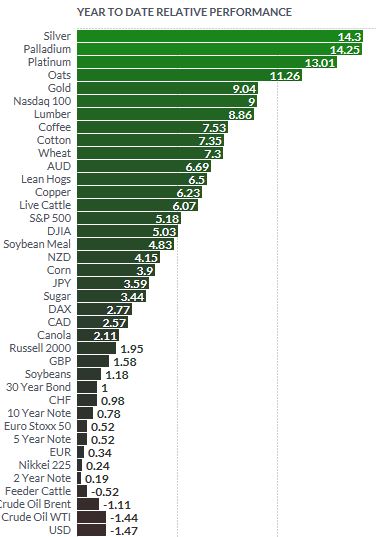
- Silver up 1.4% this week and now up 14.3% and is the best performing market YTD
- Gold up 9% year to date – fourth consecutive higher weekly close and breaks resistance at $1,250/oz
- Gold up 9.4% in euros year to date as Le Pen’s lead in polls widened
- Gold up another 6.4% in sterling pounds year to date as ‘Hard Brexit’ looms
- French and Dutch elections pose risks to Eurozone itself and the entire European Union project
- Euro contagion risk on renewed concerns this week about new debt crisis due to extremely high public debt and very fragile banks in Greece, Italy and Portugal
 Finviz.com
Gold pushed to near a four month high amid heightened political uncertainty in the U.S. and the EU this morning.
Gold rose another $6.40, or 0.5%, to $1,258 an ounce and is currently set for a 1.5% gain this week. It is higher for a second day today and looks set for a fourth consecutive week of gains which is positive from a technical and momentum perspective.
All precious metals have made gains, gold, silver, platinum and palladium, as both the euro and the dollar weakened.
Silver jumped another 1% to $18.25 an ounce. Silver was set for a weekly gain of 1.3%, a ninth straight week of advances and is now 14.3% higher year to date. The best performing market in the world.
Geo-political worries and political concerns in the EU continue which is leading a flight to safety bid in gold futures market and gold exchange traded funds (ETFs) and demand for safe haven gold bullion.
The dollar looks vulnerable due to the uncertainty about US President Donald Trump and the new U.S. administration’s policies. Overnight Trump attacked China and accused the Chinese of being ‘grand champions’ of currency manipulation (see gold news below).
This alone is quite bullish for gold. It does not create confidence about trade relations between the world’s two biggest economies and it suggests that we may be about to embark on the next phase of the global currency wars.
Reduced expectations of a US rate hike in March following the release of the minutes from the US Federal Reserve’s last meeting are also helping gold.
 Gold in Euros (1 Week)
Gold is up 9.4% in euros year to date as Le Pen’s lead in polls has widened. Gold is 6.4% higher in sterling pounds year to date as the feared ‘Hard Brexit’ looms.
The French and Dutch elections pose serious risks to the Eurozone itself and indeed the entire European Union project. There is a real risk of contagion and renewed concerns this week about new debt crises due to extremely high public debt and very fragile banks in Greece, Italy and Portugal – See GoldCore News
-END-
More confusion at the Trump camp. After Mnuchin states that he wants a stronger dollar, Trump pounds the table that he wants a weaker dollar to help USA exporters:
(courtesy Pramuk/CNBC)
Trump suggests he wants a weak dollar to help U.S. exporters
Submitted by cpowell on Fri, 2017-02-24 01:05. Section: Daily Dispatches
By Jacob Pramuk
CNBC, New York
Thursday, February 23, 2017
President Donald Trump signaled today that he wants to keep the U.S. dollar’s value lower to aid American companies selling products abroad.
In a candid exchange with Doug Oberhelman, Caterpillar’s chairman and former CEO, Trump said that when the dollar rises “and we let other people manipulate their currencies, that’s the one thing that stops you.”
“We have to let other countries give you a level playing field,” Trump told Oberhelman at a meeting of manufacturing executives at the White House. …
… For the remainder of the report:
http://www.cnbc.com/2017/02/23/trump-suggests-he-wants-a-weak-dollar-to-…
END
The uSA treasury is thinking of issuing a 100 yr bond. This would be good as they do not have to worry about refunding. However the cost of a 100 yr old bond will be in the area of 4 to 5% and thus very costly as deficits per year would soar. The short term treasuries are yielding .5% .
(courtesy Rennison/London’s Financial times)
Treasury eyeing issuance of 100-year U.S. government debt
Submitted by cpowell on Fri, 2017-02-24 01:15. Section: Daily Dispatches
By Joe Rennison
Financial Times, London
Thursday, February 23, 2017
NEW YORK — Steven Mnuchin, U.S. Treasury secretary, said today that his staff have begun to look into issuing U.S. government debt with maturities of as long as 50 or 100 years.
Mr. Mnuchin said he was not making any “formal announcement” on whether the Treasury would issue longer-dated bonds but he had “already begun to talk to staff” about it. This builds on earlier comments made before he took office that he was open to the idea.
The move would mark a historic shift in policy for the world’s largest and most actively traded government bond market, which has avoided issuing debt of longer than 30 years even as other countries such as Belgium, Austria, and Mexico have sold longer bonds. …
… For the remainder of the report:
https://www.ft.com/content/c1fa2652-f9e3-11e6-bd4e-68d53499ed71
END
Insane!! Bitcoin approaches gold in value: BITCOIN now soars above 1200 usa and it is now at record levels.
(courtesy zerohedge)
Good As Gold (Again)? Bitcoin Soars To New Record Highs
Bitcoin topped $1200 overnight for the first time, bringing it ever closer to the price for an ounce of gold…
As Bloomberg notes, a ten-day rally for the cryptocurrency has narrowed its gap with the precious metal to the smallest on record.

Each asset has been touted as an alternative to regular currencies, because of constraints on their supply and the capacity they offer to sidestep governments.

Partity looms once again…

But, as GoldMoney’s Stefan Wieler previously noted, the price of Bitcoin is closing in on the price of gold again this week; however, this comparison is completely arbitrary.
Gold is measured in weight, while Bitcoin, much like currency, is an abstract form of money and can only be measured in units of itself. One Bitcoin is worth a lot more than 1 gram of gold, but a lot less than 1 tonne. Despite Bitcoin’s stellar performance in 2016, the size and depth of the cryptocurrency market is dwarfed by the $7 trillion gold market.
Gold remains the only true global money with a size and volatility comparable to that of fiat currency.
Bitcoin – or cryptocurrency itself – is the most exciting monetary experiment in modern times.
Unlike fiat currency, it can’t just be printed, and it mimics the scarcity properties of gold in that it needs an enormous amount of energy to create one coin. The energy-proof of value is what links gold to the primary industries and allows it to maintain its purchasing power over incredibly long periods of time. Without it, any form of money will inevitably be corrupted over time and decay. Bitcoin has some of the same energy-proof of value that makes gold far superior to fiat currency, which can be created with the stroke of a key. Bitcoin, also like gold, is a global currency that may be universally accepted in the future. Even USD can’t make that claim.
Bitcoin has some qualities that are not shared by any other form of money, most notably the potential total anonymity in electronic transactions; however, some might feel that aspect that may prevent the universal adoption of Bitcoin as money. Today, the global stock of Bitcoin is just $20 billion (despite its price rally) and its transaction volume is tiny, even when compared to more exotic currencies. That said, as the adoption of Bitcoin increases, governments may no longer be happy with the fact that it can be used for anonymous transactions and may prevent legitimate businesses from accepting it as money if they see this as a threat. Only time will tell. In the meantime, Bitcoin remains the only alternative to gold (and other precious metals) for savers to escape the built-in decay function of fiat currency otherwise known as inflation.
Bitcoin is currently in the limelight because it has apparently exceeded the price of gold for the first time on some exchanges (although at the time of writing, Bloomberg still shows an average price of Bitcoin hasn’t crossed the gold price yet, but it seems just a question of time). We have no doubt that this will lead to a barrage of headlines in online media, and some mainstream outlets will jump on the bandwagon as well. After all, they already widely reported on a claim made by the Winklevoss brothers in mid-2016 that Bitcoin’s volatility had apparently fallen below the volatility of gold, and thus Bitcoin had become “better at being gold than gold”. We rebutted this claim and surely Bitcoin’s volatility shot back up to 100% shortly thereafter.
Bitcoin has rallied almost USD500 last year and USD100 in the first two days of 2017 alone. At the time of writing, 1 Bitcoin was trading at USD1,135, while 1 oz of gold was trading at USD1,164. To some, it may seem like Bitcoin is about to be more valuable than gold, and though this is of course conceptually incorrect, it probably won’t stop the media pundits from publishing the headline anyway.
Gold and elements can be measured by weight (oz, g, kg, t). Mass and weight are the measuring units endowed by nature. Fiat currencies, or any other abstract commodity or money (including Bitcoin), cannot be measured that way. An abstraction can only be measured in units of itself. Gold and silver are therefore the only form of money today that are traded in weight. Fiat currency on the other hand cannot be measured by anything other than other currency, at least since Nixon ended the convertibility to gold in 1971. In that respect, Bitcoin falls into the same category.

Thus, when comparing units of gold to units of Bitcoin, one must first define what unit it is measured against. Is it grams (currently USD37/g), kilograms (USD37,000/kg) or tonnes (USD 37 million/tonne)? Or are we measuring it in the rather obscure measure of troy ounce (USD1,157/ozt), which, apart from exchange traded metals, is not used for anything else?
Hence comparing the price of 1 Bitcoin vs 1 troy ounce of gold is a little bit like comparing the shares of Seaboard Corp. (USD4,179 per share) to those of Apple Inc. (USD116 per share) and concluding that Seaboard Corp. is worth 35 times as much. Clearly, measured accurately by market cap, Apple is the largest and most valuable company in the world and worth 126 times as much as Seaboard Corp.
The same basic principle applies to money. Combined above-ground gold stocks are currently worth around $7 trillion. As we noted last year, that is more than all banknotes in circulation of all currencies combined (see Eliminating cash will also eliminate the checks and balances on banking policy and practice, February 22, 2016), and it certainly dwarfs the market cap of Bitcoin at around $18 billion. In fact, all crypto-currencies combined (we count 710) have a market cap of just $21 billion (see Figure 2).

There is another obvious obstacle when comparing Bitcoin with gold: Volatility. High volatility is often pointed out against gold being used as medium of exchange and store of value. We will look the volatility of gold in more detail in an upcoming report, but in a nutshell, we find the volatility of gold (measured as standard deviation) is roughly comparable with currency, and gold has proven to be a much better store of value than any currency over the long run – even when interest is taken into account. Bitcoin’s volatility significantly exceeds that of both gold and currency. At times, Bitcoin’s volatility declines for a short period and can even approach the volatilities of gold and currency, but tends to shoot up violently shortly thereafter.

However, standard deviation should not be confused with a measure of risk. The standard deviation quantifies the dispersion of returns; what it does not do is distinguish whether that dispersion comes from upward or downward moves.
For example, an asset that has a 1% return every second day and 0% return every other day would exhibit an annualized standard deviation of 8%. An asset that has a -1% performance every second day and 0% every other day exhibits the same standard deviation. In an asset management context, the two assets may have the same risk. In fact, the negatively performing asset might reduce risk in a portfolio if it is negatively correlated to the other assets. But for a saver, the first asset is clearly less risky.
Hence, instead of measuring volatility as standard deviation, we can measure just the downside deviation. This provides a better idea of the risks of money. How does this look for Bitcoin? Bitcoin’s downside deviation is still several orders of magnitude higher than that of gold or currency. Over the past two years, Bitcoin experienced a downside deviation of >45%. Since the beginning of data in 2010, it was >100%.

The volatility – or to be precise, the downside risk – makes it difficult for Bitcoin to be more widely adopted as money. What speaks for Bitcoin is that it has shown stellar performance over its short lifespan, but this stellar performance comes with considerable downside risk. A merchant accepting Bitcoin as payment is exposed to this downside risk unless he instantly exchanges Bitcoins back to currency following the transaction. Even though a cycle takes about 6 minutes in theory, exchanging Bitcoin to currency actually takes about one hour to confirm the transaction and another hour to confirm the price, during which at the very least the merchant is exposed to the downside volatility. Holding Bitcoins permanently might hold huge upside, but that also comes with intolerable downside risk for a merchant. After all, merchants should spend their time and energy with what they are best at (selling goods) rather than trading currencies and Bitcoin.
Another claim we don’t agree with is that Bitcoin is as free of counter-party risk as gold. What we have seen with Ethereum, another nascent cryptocurrency, is that these virtual currencies ultimately have a master key. With Ethereum, that key is controlled by a council that decides its future inflation rate; with Bitcoin, that key is controlled by Gavin Andresen, an engineer based in Massachusetts. There’s no guarantee that they won’t change the source code for the Bitcoin blockchain in the future, and when you “own” a Bitcoin you simply refer to the blockchain – a distributed ledger that tells you what and how much you own. In this regard, we don’t agree that Bitcoin does not have custodial or counter-party risk; the blockchain itself is the fat tail.
This means that for now, gold remains the only global currency in which individuals and corporations can transact with no time delay, with price volatility comparable to that of major currencies yet without counter-party risk, and one that has been proven as a store of value for thousands of years.
Your early FRIDAY morning currency, Asian stock market results, important USA/Asian currency crosses, gold/silver pricing overnight along with the price of oil Major stories overnight
1 Chinese yuan vs USA dollar/yuan STRONGER AT 6.8695(SMALL REVALUATION NORTHBOUND /OFFSHORE YUAN NARROWS TO 6.8514 / Shanghai bourse UP 2.05 POINTS OR .06% / HANG SANG CLOSED DOWN 149.15 POINTS OR 0.62%
2. Nikkei closed DOWN 87.92 POINTS OR 0.45% /USA: YEN FALLS TO 112.32
3. Europe stocks opened ALL IN THE RED ( /USA dollar index FALLS TO 100.80/Euro UP to 1.0606
3b Japan 10 year bond yield: RISES TO +.068%/ !!!!(Japan buying 100% of bond issuance)/Japanese yen vs usa cross now at 112.32/ THIS IS TROUBLESOME AS BANK OF JAPAN IS RUNNING OUT OF BONDS TO BUY./JAPAN 10 YR YIELD FINALLY IN THE POSITIVE/BANK OF JAPAN LOSING CONTROL OF THEIR YIELD CURVE AS THEY PURCHASE ALL BONDS TO GET TO ZERO RATE!!
3c Nikkei now JUST BELOW 17,000
3d USA/Yen rate now well below the important 120 barrier this morning
3e WTI:: 54.08 and Brent: 56.03
3f Gold UP/Yen UP
3g Japan is to buy the equivalent of 108 billion uSA dollars worth of bond per month or $1.3 trillion. Japan’s GDP equals 5 trillion usa./“HELICOPTER MONEY” OFF THE TABLE FOR NOW /REVERSE OPERATION TWIST ON THE BONDS: PURCHASE OF LONG BONDS AND SELLING THE SHORT END
Japan to buy 100% of all new Japanese debt and by 2018 they will have 25% of all Japanese debt. Fifty percent of Japanese budget financed with debt.
3h Oil DOWN for WTI and DOWN for Brent this morning
3i European bond buying continues to push yields lower on all fronts in the EMU. German 10yr bund FALLS TO +.21%/Italian 10 yr bond yield DOWN to 2.207%
3j Greek 10 year bond yield FALLS to : 7.22%
3k Gold at $1257.50/silver $18.33(8:15 am est) SILVER CLOSE TO RESISTANCE AT $18.50
3l USA vs Russian rouble; (Russian rouble DOWN 26/100 in roubles/dollar) 58.03-
3m oil into the 54 dollar handle for WTI and 56 handle for Brent/
3n Higher foreign deposits out of China sees huge risk of outflows and a currency depreciation (already upon us). This can spell financial disaster for the rest of the world/China forced to do QE!! as it lowers its yuan value to the dollar/GOT SMALL REVALUATION NORTHBOUND from POBC.
JAPAN ON JAN 29.2016 INITIATES NIRP. THIS MORNING THEY SIGNAL THEY MAY END NIRP. TODAY THE USA/YEN TRADES TO 112.32 DESTROYING JAPANESE CITIZENS WITH HIGHER FOOD INFLATION
30 SNB (Swiss National Bank) still intervening again in the markets driving down the SF. It is not working: USA/SF this morning 1.0043 as the Swiss Franc is still rising against most currencies. Euro vs SF is 1.0654 well above the floor set by the Swiss Finance Minister. Thomas Jordan, chief of the Swiss National Bank continues to purchase euros trying to lower value of the Swiss Franc.
3p BRITAIN VOTES AFFIRMATIVE BREXIT/LOWER PARLIAMENT APPROVES BREXIT COMMENCEMENT
3r the 10 Year German bund now POSITIVE territory with the 10 year FALLS to +.21%
3s The Greece ELA NOW at 71.4 billion euros,AND NOW THE ECB WILL ACCEPT GREEK BONDS (WHAT A DISASTER)
The bank withdrawals were causing massive hardship to the Greek bank. the Greek referendum voted overwhelming “NO”. Next step for Greece will be the recapitalization of the banks and that will be difficult.
4. USA 10 year treasury bond at 2.367% early this morning. Thirty year rate at 3.011% /POLICY ERROR)GETTING DANGEROUSLY HIGH
5. Details Ransquawk, Bloomberg, Deutsche bank/Jim Reid.
(courtesy Jim Reid/Bloomberg/Deutsche bank/zero hedge)
Dow Streak Of Record Highs In Danger As S&P Slides; Gold Surges
The near-record string of 10 consecutive Dow Industrials record highs, a streak not seen since early 1987, may be about to end if futures, which are currently trading -0.3% lower, fail to stage a rebound.
Global markets started off Friday on the back foot, with most Asian markets dropping, while commodity-related sectors and banks led European shares lower for a third straight session on Friday as the dollar was poised for a weekly loss as the latest attempt to spark the “Trumpflation trade” fizzled, sending gold to $1,256, the highest since the US presidential election, as the dollar slumped following Mnuchin’s comments. Investors are turning cautious as European political risks remain and ahead of a major speech from U.S. President Donald Trump next week.
The big mover in commodities is Gold which has solidly jumped above the $1,250 level, a largely USD-based move, as risk sentiment rose despite the weaker greenback, but sustainability as these levels (Gold) are key over coming sessions. Gold’s rise for a fourth week was aided by Treasury Secretary Steven Mnuchin who said Thursday he expects low borrowing costs to persist, sparking a drop in the dollar. Mnuchin also took the edge off the recent market optimism when he said any policy steps by the Trump administration would probably have only a limited impact this year. The comments, made in his first televised interviews since taking office last week, suggested much work was still needed on a sweeping tax reform plan that Mnuchin called his main priority.
“Mnuchin’s comments were less belligerently reflationary than they could have been, in a dollar strength context, and that probably did much of the damage (to the dollar),” said UBS Wealth Management currency strategist Geoffrey Yu, in London.
Concerns about the credibility of Trump’s tax plan also emerged: “Next week it will be three weeks since President Trump promised something ‘phenomenal’ with respect to tax reform and investors are starting to become a little restless,” Michael Hewson, the London-based chief market analyst at CMC Markets, said in a report. If Trump’s speech next week fails to provide details, “then the rally that we’ve seen in the past three months could become susceptible to some profit-taking,” he said.
As a result, a fifth weekly gain for global equities that’s helped push their value above $70 trillion is losing momentum as money managers grapple with political uncertainty and the Federal Reserve’s schedule for lifting borrowing costs. Traders are taking profits before Trump’s address to House and Senate lawmakers Tuesday in the U.S.

European shares slid after subdued forecasts from European bluechips including BASF and Vivendi and a drop in mining shares, while Standard Chartered was among the worst performers in the FTSE 100 as profits fell short of analyst expectations. RBS also trades in the red after the bank announced a whopping GBP 7bIn loss for 2016. Elsewhere, French telecom giant Vivendi is the notable laggard across Europe amid reports that Milan prosecutors are looking in the company over alleged market manipulation in stake building in MediaSet. The Stoxx Europe 600 Index fell 0.3 percent as of 10:06 a.m. in London, dropping for a third day and paring a weekly advance.
London copper prices recovered slightly from their big overnight fall on the back of fresh doubts about Chinese demand. Three-month copper on the London Metal Exchange CMCU3 was up 0.8 percent at $5,907 a tonne by 0700 GMT after falling 3 percent in the previous session.
Japan’s Topix index lost 0.4 percent. The gauge rose 0.4 percent for the week. Futures on the S&P 500 fell 0.3 percent. The index rose less than 0.1 percent on Thursday, while the Dow posted a 10th day of gains, its longest streak of record closes since 1987.
Oil prices fell after U.S. crude inventories rose for a seventh week, showing the market is still struggling to ease oversupply despite producers’ efforts to rein in output. Benchmark Brent crude oil was down 48 cents at $56.10 a barrel, while U.S. West Texas Intermediate traded at $54.06 a barrel, down 39 cents.
In rates, German bonds were supported as credit spreads widened. German two-year yields dropped three basis points, with the ECB’s bond-buying program seen supporting the sector. Having routed the French bond market recently, sellers are now focusing on Italy where the German-Italian 10Y spread rose above 200 bps.

The swap spread rose to new records across the two- to five-year sector. A note from Citigroup suggested that German two-year yields could fall to minus 1 percent or more, as the ECB will be forced to buy more short-dated bonds.
Market Snapshot
- S&P 500 futures down 0.3% to 2,354
- STOXX Europe 600 down 0.6% to 371
- MXAP down 0.4% to 145.92
- MXAPJ down 0.5% to 468.82
- Nikkei down 0.5% to 19,283.54
- Topix down 0.4% to 1,550.14
- Hang Seng Index down 0.6% to 23,965.70
- Shanghai Composite up 0.06% to 3,253.43
- Sensex up 0.1% to 28,892.97
- Australia S&P/ASX 200 down 0.8% to 5,738.99
- Kospi down 0.6% to 2,094.12
- German 10Y yield fell 2.9 bps to 0.204%
- Euro up 0.07% to 1.0589 per US$
- Brent Futures down 0.7% to $56.19/bbl
- Italian 10Y yield rose 3.1 bps to 2.225%
- Spanish 10Y yield rose 5.4 bps to 1.74%
- Brent Futures down 0.7% to $56.19/bbl
- Gold spot up 0.5% to $1,255.96
- U.S. Dollar Index down 0.2% to 100.90
Top Overnight News from BBG
- Royal Bank of Scotland Group Plc laid out a plan to cut costs by 2 billion pounds ($2.5 billion) over the next four years as it posted its ninth straight annual loss and delayed profitability targets
- After striking deals in Russian oil and Congolese copper mining, Glencore Plc has set its sights on the U.S. grain- trading industry
- Pimco says Beijing’s “cautious tightening signals” are largely being ignored by banks and at the local level, where attention is focused on maintaining steady economic growth
- Value Partners, one of the world’s best-performing junk bond funds, is betting on stressed debt
- New Exxon Chief Darren Woods is focusing on climate change, calling for a carbon tax to discourage use of polluting fuels
In Asia, equity markets traded lower following a mixed lead from US where the DJIA and S&P 500 were buoyed by healthcare and utilities. ASX 200 (-0.8%) underperformed and was weighed by the metals & mining sector amid commodity prices sliding lower, after Dalian Iron ore declined 5.5% yesterday. Nikkei 225 (-0.5%) conformed to the downbeat tone despite support from a weakening JPY overnight as well as Toshiba stocks trading higher by around +5%. In China, Hang Seng (-0.4%) and Shanghai Comp. (+0.1%) suffered from the PBoC’s trend of ever weakening liquidity injections this week, with the daily operation providing only a total of CNY 30bIn. 10yr JGBs traded higher due to the risk averse tone in the region with the curve flattening amid outperformance seen in the super long end.
Top Asia News
- Japan Equity Movers: Komatsu, Kobe Steel, NEG, Morinaga, Line
- China’s New Banking Regulator Chief Faces Daunting Challenges
- Calmer Asian Currencies Spell Return of Global Yield Hunters
- ANA to Spend $270 Million to Raise Stake in Peach Aviation
- China H Shares Pare Weekly Gain as Anhui Conch, Great Wall Drop
- Options Traders Make Bullish Bets on HKEX as Earnings Loom
- Hong Kong Awards Ap Lei Chau Site For HK$16.9b to Logan, KWG
- Hong Kong Existing Home Prices Climb to Record, Defying Curbs
- Pearson Weighs Options for English-Language Units in China
European bourses have started the last trading session of the week on the backfoot, with Standard Chartered among the worst performers in the FTSE 100 as profits fell short of analyst expectations, while RBS also trades in the red after the bank announced a whopping GBP 7bIn loss for 2016. Elsewhere, French telecom giant Vivendi is the notable laggard across Europe amid reports that Milan prosecutors are looking in the company over alleged market manipulation in stake building in MediaSet. Across fixed income markets, yields in the German 2-yr took another leg lower to print fresh record lows (as a reminder, the ECB previously said that they investigating the squeeze in the Eurozone repo market), the GE-FR spread continues to see some modest widening, while the fixed income space has been supported by the wave of short covering.
Top European News
- RBS Cuts CEO’s Potential Share Award 40% After Ninth Annual Loss
- Jupiter Fund CEO Says Firm Is Big Enough to Remain Independent
- Lower Turkish Rate Bets Emerge as Swap Curve Pares Inversion
- Mnuchin Tells Carney to Expect America-First Push on Regulation
- UniCredit’s Record $13.8 Billion Rights Offer 99.8% Subscribed
- Banco BPM Extends Drop; Shares From Withdrawal Right From Feb
In currencies, the Bloomberg Dollar Spot Index dropped 0.1% after falling 0.3 percent in the previous session. The yen rose 0.1 percent to 112.3 per dollar, after rising 0.6 percent Thursday. It’s been more of the same in the FX markets today as the USD continues to lose ground, but very modestly so given the consensus base line of 2 Fed rate hikes this year. Rather the moves are reflective of the skew moving towards an `on-hold’ call at the March meeting, though the odds are mixed among the surveys, stretching form circa 20-40% for a 25bp rate hike. Looking at the USDJPY, TSY yields are grinding towards the lower end of the range established in recent months, with the key 10yr still inside 2.30-2.55%. We have dipped under 2.37% this morning, resulting in a rather reluctant move below 112.50, though no sudden urge to recover. This is much the same for the EUR/USD move towards 1.0600, but with (French/Dutch) election news subsiding, the single unit has moderated since. GBP is in limbo as a result, with EUFt/GBP drawn towards the 0.8450 level. We have attempted a return towards 0.8400 — which may well still materialise — but comments from the Bundesbank’s Dombret including the prospects of UK access looking ‘rather dim’ have, at the very least, curtailed the impromptu rise in GBP. Cable is struggling well ahead of 1.2600, as it did in yesterday’s North American session.
In commodities, West Texas Intermediate traded 0.6 percent lower at $54.12 a barrel. Brent fell 0.7 percent to $56.22. The big mover in commodities are in precious metals where Gold has now pierced the USD1250 level, though with limited momentum. This is purely USD based, as risk sentiment remains on an even keel, so sustainability as these levels (Gold) are key over coming sessions. Base metals may be showing some gains on the day, but after reports that president Trump’s fiscal plans may be delayed into next year, Copper has retreated some way below the USD2.700 level, dragging Iron Ore with it. Adding pressure on the latter are reports of growing stockpiles in China, and this has clear implications on demand forecasts going forward. Oil prices still holding familiar territory on hopes that the agreed production cuts will be followed up by 100% compliance. Yesterday’s build reported in the DoE reported a small build, but having a modest impact in the aftermath.
Looking at the day ahead, the only data due is January new home sales (expected to bounce back) and the final revisions to the University of Michigan consumer sentiment reading.
US Event Calendar
- 10am: New Home Sales, est. 570,500, prior 536,000; MoM, est. 6.44%, prior -10.4%
- 10am: U. of Mich. Sentiment, est. 96, prior 95.7; Current Conditions, prior 111.2; Expectations, prior 85.7; 1 Yr Inflation, prior 2.8%; 5-10 Yr Inflation, prior 2.5%
* * *
DB’s Jim Reid concludes the overnight wrap
It’s perhaps not the best time to admit that I’ve no idea why Bunds are rallying so hard at the moment. 10y yields (-4.7bps) hit 0.228% yesterday, down from their YTD peak of 0.495% intraday on the 26th of January. 2y yields also closed another -3.0bps lower yesterday at -0.932%. They traded as ‘high’ as -0.648% back on the same day. The most obvious explanation is of course Euro systemic risk – especially from France and perhaps Italy. However other markets (equities, equity vol, the Euro, broader credit spreads etc) aren’t moving much to price in redenomination risk in Europe. A lack of high quality collateral has been cited as an explanation but it’s not clear there is much new info on this over recent days to explain the move. Perhaps it’s as simple as government bond investors are generally by nature ultra conservative and Bunds seemingly offer complete safety from redenomination risk. Although on this we’d note that yesterday 10 year French OAT yields fell another -3.6bps and hit their lowest yield (0.978%) for 4 weeks. Ironically the latest Q4 Germany GDP numbers yesterday showed the country as ending the year as the fastest growing advanced economy in 2016. Indeed 2016 GDP growth in Germany was +1.9% which compares to +1.8% for the UK, +1.7% for the Eurozone and +1.6% for the US.
New US Treasury Secretary Steven Mnuchin does however expect growth in the US to hit a “sustainable growth rate of 3% or more” towards the end of next year following comments in a televised interview with CNBC yesterday. Mnuchin also said that the new administration is looking closely at the border adjustment tax and that the White House wants to pass a “very significant” tax reform by August. There was also some focus on his remarks about possibly issuing 50y or 100y Treasury bonds, saying that they are exploring the option and that they will reach out to the market and investors. On China and the recent FX manipulation chatter Mnuchin stopped short of labelling China a manipulator but said that the Treasury would go through the usual processes of looking at “currency manipulation across the board” suggesting also that no judgments will be made before the Treasury’s April report.
On a related note there was also some focus on a Business Insider report suggesting that Trump may be considering delaying a proposed $550bn infrastructure spending plan until 2018. The crux of it was that the administration’s time is being taken up by other big proposed reforms including taxes and the Obamacare repeal and that a timing delay to 2018 would make sense in the context of next year’s mid-term elections.
While industrials and materials names did underperform on the back of that report it was still another fairly dull session overall for US equities. The S&P 500 finished +0.04% while the Dow ended +0.17% and took its run of new record highs to ten sessions in a row. By the way that is now 52 days that the S&P 500 hasn’t closed up or down by more than 1%. As a reminder the run in 2014 was 62 days so it’s now within sight. Needless to say that the VIX – little changed at 11.71 yesterday – continues to hover only just above the decade low levels. In rates Treasury yields also marched lower yesterday. 10y yields finished the day -4.1bps lower at 2.373% and are now down some 18bps from the January highs. The curve did however steepen slightly (30y yields finishing -2.0bps lower) probably reflecting those Mnuchin comments about possible ultra long-dated issuance. In commodities WTI Oil (+1.60%) did rise back above $54/bbl following the latest inventory data although base metals took a hit with Iron Ore and Copper in particular both down over 3%.
With little new news to report of this morning it appears that those declines in metals are to blame for a soft end to the week for risk in Asia. The Nikkei (-0.49%), Shanghai Comp (-0.35%), Hang Seng (-0.34%) and ASX (-0.85%) are all in the red. Currencies have been relatively flat while rates are stronger.
Moving on. The Fedspeak continued again yesterday although it’s clear that the market is failing to price in much more chance of a March move despite a number of Fed officials signalling how “live” the March meeting is. Atlanta Fed President Lockhart was the latest yesterday and he said also that there will be “serious consideration” at the meeting but also that the term “fairly soon” (in reference to the FOMC minutes) “leaves options open for probably the next three meetings”. Lockhart also spoke about the balance sheet and said that he would be in favour of letting “natural runoff gradually shrink the balance sheet”. Late last night Dallas Fed President Kaplan also said that the committee should keep options open for a March move. Bloomberg’s calculator currently sits at a 38% probability for a March rate hike. It’s worth noting that the US data was a bit of a sideshow yesterday. Initial jobless claims came in at 244k and marginally higher than the week before while the Kansas City Fed’s manufacturing survey index rose 5pts to +14 and the highest since June 2011.
Meanwhile there were also some comments from Bundesbank President Weidmann yesterday. He opined that “the balance of risks might be more favourable today that it was before” and that possible market anticipations about a lift in interest rates by the ECB in 2019 “don’t sound absurd” and are “in the possibility that I see”.
Staying in Europe, in terms of the other data yesterday, in Germany the latest consumer confidence reading revealed a small 0.2pt tick down in confidence to 10.0 although it’s worth highlighting that that is still at relatively elevated levels versus the last few years. In France business confidence was flat in February and in the UK the CBI’s distributive trades survey pointed to some improvement in retailers’ sales in February following a soft January. Just wrapping up, it’s worth noting that following a positive meeting between Merkel and Lagarde on Wednesday concerning Greece, the creditors are now expected to return to Greece next Tuesday where talks should focus on the exact fiscal tightening measures needed over 2018 and 2019, as well as conditional easing. So worth keeping an eye on how things proceed there.
Looking at the day ahead, it looks set to be a fairly quiet end to the week. In Europe this morning we’ll get the February consumer confidence reading as well as industrial orders and sales data in Italy. Over in the US the only data due is January new home sales (expected to bounce back) and the final revisions to the University of Michigan consumer sentiment reading.
3. ASIAN AFFAIRS
i)Late THURSDAY night/FRIDAY morning: Shanghai closed UP 2,05 POINTS OR .06%/ /Hang Sang CLOSED DOWN 149.15 POINTS OR 0.62% . The Nikkei closed DOWN 87.92 POINTS OR 0.45% /Australia’s all ordinaires CLOSED DOWN 0.78%/Chinese yuan (ONSHORE) closed UP at 6.8695/Oil FELL to 54.08 dollars per barrel for WTI and 56.03 for Brent. Stocks in Europe ALL IN THE RED. Offshore yuan trades 6.8514 yuan to the dollar vs 6.8695 for onshore yuan.THE SPREAD BETWEEN ONSHORE AND OFFSHORE NARROWS A BIT AS POBC ATTEMPTS TO STOP USA DOLLARS FROM LEAVING CHINA’S SHORES. ONSHORE YUAN STRONGER AS IS OFFSHORE YUAN COUPLED WITH THE WEAKER DOLLAR
3a)THAILAND/SOUTH KOREA/NORTH KOREA
The mystery poison has been revealed as the outlawed and dangerous nerve agent VX. The fact that it got into the hands of North Korean agents is deadly. China must act now and remove this monster.
(courtesy zero hedge)
“Mystery Poison” Used To Murder Kim Jong Nam Revealed As VX Nerve Agent
What was until recently was a real-life reincarnation of the move “The International”, just got a double dose of “The Rock” thrown in for good measure.
When yesterday we shared the most recent update in the bizarre assassination of Kim Jong Nam, the half brother of North Korea’s ruler, who was murdered in broad daylight inside Kuala Lumpur’s budget airline terminal, we reported that while the two women suspected in the fatal poisoning attack had coated their hands with “mystery” toxic chemicals which they then wiped on Nam’s face, a key question remained unanswered, namely what was the poison used to by the woman with the “LOL” shirt used to murder the North Korean scion.

As CBS reported previously, experts routinely tasked with finding answers in poisoning cases were stumped: what substance could have been used to kill the victim so quickly without sickening the women who apparently deployed it, along with anyone else nearby? Difficult, they said, but doable.
“It’s not an agent that could be cooked up in a hotel room. It’s going to take a lot of knowledge regarding the chemical in order to facilitate an attack like this,” said Bruce Goldberger, a leading toxicologist who heads the forensic medicine division at the University of Florida. He said a nerve gas or ricin, a deadly substance found in castor beans, could be possible. A strong opioid compound could also have been used, though that would likely have incapacitated the victim immediately.
“It would have to be cleverly designed in order to be applied in this fashion without hurting anyone else,” Goldberger said.
“The more unusual, the more potent, the more volatile a poison is, the less likely it is to be detected,” said Olif Drummer, a toxicologist at Australia’s Victorian Institute of Forensic Medicine who has spent 40 years in the field. Khalid said the women knew they were handling poisonous materials and “were warned to take precautions.” Surveillance footage showed both keeping their hands away from their bodies after the attack, he said, then going to restrooms to wash. Such details are unclear in video footage that has been released to media.
Well, moments ago the Malaysian police provided the answer, when it reported that the chemical substance used to kill Kim Jong Nam last week was the nerve agent right out of the movei “The Rock” called VX, which happens to be listed as a weapon of mass destruction by the United Nations.

Khalid Abu Bakar, Malaysia’s inspector general of police, said Friday in a statement that identification of the substance came from a preliminary report. He said swabs were taken from the eye and face of the victim.

VX is described by the US Centers for Disease Control and Prevention as “the most potent of all nerve agents”, with a large dose leading to loss of consciousness, paralysis and respiratory failure. Its only known use is as a chemical warfare agent.
VX is banned under the UN Chemical Weapons Convention, to which North Korea is not a party.
The nerve agent, also known as ethyl N-2-Diisopropylaminoethyl Methylphosphonothiolate, was developed in the UK in the 1950s.

As the FT further adds, Malaysian police are seeking at least four North Korean suspects in connection with the murder, who are now believed to be back in Pyongyang. Two other North Korean nationals, including a diplomat in Malaysia, are wanted for questioning.
Police have detained a Vietnamese woman, an Indonesian woman and a North Korean man in connection with Kim’s death.
The murder has frayed relations between North Korea and Malaysia, which this week recalled its ambassador from Pyongyang.
In the aftermath of the fallout from North Korea’s ballistic missile launch and alleged orchestration of Kim Jong Nam’s murder, we reported earlier today that China, which last weekend announced it would ban all coal imports from North Korea, was preparing for “regime collapse” in North Korea, and would “take the necessary measures to safeguard national security in the event of the collapse of the neighbouring North Korean regime”, a defence official said on Thursday
b) REPORT ON JAPAN
none today
c) REPORT ON CHINA
Trump has accused China of being the grand master of currency manipulation. China has devalued its yuan in 2016 by 6.6% but now she is trying to keep its currency elevated to keep the IMF happy that their currency is “stable” Beijing responds to Trump in kind:
(courtesy zerohedge)
Beijing Responds To Trump Charge China Is A “Grand Champion At Currency Manipulation”
When it comes to the latest US stance vis-a-vis China’s currency manipulation, the jury is out, and based on two recent statements it is more confused than ever.
The reason why is that shortly after Treasury Secretary Mnuchin said in a Bloomberg TV interview that there is “no urgency to brand China a currency manipulator”, and that no announcement on currency manipulation will come before the Treasury’s April report (which contradicted an October pledge by candidate Donald Trump to direct his Treasury secretary to name China a manipulator on the first day of his administration), hours later Reuters released an interview with Trump in which he accused China of being a “grand champion” at currency manipulation, adding he had not “held back” in his assessment that China manipulates its yuan currency.
“I think they’re grand champions at manipulation of currency. So I haven’t held back. We’ll see what happens.”
This morning China responded Trump’s accusation, when Beijing said it has no intention of using currency devaluation to its advantage in trade, which presumably excludes China’s August 2015 devaluation which unleashed a period of acute market volatility. Chinese Foreign Ministry spokesman Geng Shuang said he hoped the United States could “fully and correctly” view the exchange rate issue.
Quoted by Reuters, Shuang said “China has no intention of seeking foreign trade advantages via an intentional devaluation of the renminbi. There is no basis for the continued devaluation of the renminbi,” he told a daily media briefing in Beijing.
Geng said there was no basis for the continued devaluation of the renminbi and he hoped “the relevant side can fully and correctly view the renminbi exchange rate issue.” And yet, earlier this month, China’s SAFE, or main fX regulator, said the economy still faced weak global demand and financial market volatility caused by expectations of further interest rate rises by the U.S. Federal Reserve, implying that every move higher in US rates will likely lead to a weaker Chinese currency.
In any case, Geng returned Trump’s “compliment” saying “If you must attach the label ‘grand champion’ to China, then I think China is a grand champion. But we are the grand champions of economic development,” by which he clearly meant central planning, fabricating economic data, bailing out insolvent SOEs and injecting record amounts of unsustainable debt.
According to Reuters, the Foreign Ministry has no say in currency policy, but it is the only Chinese government department that holds a daily briefing that foreign reporters attend. The central People’s Bank of China did not respond to a request for comment.
Trump has frequently accused China of keeping its currency artificially low against the dollar to make Chinese exports cheaper, “stealing” American manufacturing jobs. But he did not act on a campaign promise to declare China a currency manipulator on his first day in office.
In some ways Trump is correct: the yuan fell 6.6% in 2016, its biggest annual drop since 1994, pressured by mounting capital outflows as the domestic population sought to flee China’s economy. On the other hand, in recent months China has been manipulating its currency to be stronger, not weaker, to dissuade continued capital outflows. In addition, Beijing has taken a raft of steps in recent months to curb capital flight to support its weakening yuan, while trying to bring in more foreign investment.
end
This is to be expected: A Chinese province Liaoning admitted to fabricating fiscal numbers from 2011 through to 2014:
(courtesy zero hedge)
Data Fraud At Chinese Province Suggests Local GDP Numbers As Much As 20% “Overcooked”
One month ago, in delightful, if anticipated, confirmation that much if not all of China’s data has been cooked and fabricated as so many skeptics suspected, we reported that according to the People’s Daily, the rust-belt province of Liaoning had admitted to fabricating fiscal numbers from 2011 to 2014. The fabricated economic data was meant to show a state of economic strength with fiscal revenues inflated by at least 20%, and some other economic data were also false, the paper said, without specifying categories.In short, the fabrication opened a hornet’s nest: if one Chinese was doing it, then why not all, and by how much was the real data off?
But why manipulate the numbers to paint a rosier picture? For obvious reasons: the data were made up “because officials wanted to advance their careers.” The fraud misled the central government’s judgment of Liaoning’s economic status, he said, citing a report from the National Audit Office in 2016.
Yet while it was this confirmation of data fraud was gratifying, what was absent was the scale of the fraud, as having the real and fake numbers would provide a useful rule of thumb into just how cooked all of China’s books are, not just those in Liaoning. Conveniently, today we got the answer courtesy of the FT, which reported that the economic output of the province in question shrank by 23% in nominal terms last year, according to official statistics, showing the extent to which officials had previously exaggerated performance in China’s struggling rust-belt.
The sudden drop in provincial gross domestic product is only partly due to a fall in the real economy: in inflation adjusted terms, GDP fell by 2.5 per cent according to the national statistics bureau. The rest was undoing the book cooking: “The main reason for the decline, analysts say, was officials’ attempts to undo the effects of previous over-reporting.”

Further evidence of data fabrication can be seen in Liaoning’s fixed-asset investment figures, which fell 64 per cent in 2016. China International Capital Corporation, a partly state-owned investment bank, said the drop in investment raised doubts about previous years’ figures.
The Lianoing scandal also appears to have convinced even those not overly skeptical, that no Chinese data can be trusted going forward.
“The sharp decline was not only a result of economic downturn but also reflected the correction of its previously inflated data,” wrote CICC last week.
“Liaoning have had stark issues with their data over the past few years. Does that mean other provinces do too? That’s definitely the case — provincial GDP is always higher than national GDP,” said Jonas Short, head of China research at NSBO, an investment bank.
It gets more ironic: the current Premier Li Keqiang was the top official in Liaoning from 2004 to 2007, and once decried GDP data as “man-made” and therefore unreliable. Instead, he preferred three indicators of industrial activity: electricity consumption, railway cargo volume and loans extended by banks. However, such indicators are less relevant to measuring China’s economic output now that the dominance of traditional industries is fading.
While it is still too early to extrapolate, if all of China’s data is “overcooked” by 20%, assuming the country’s debt statistics are reliable, it would mean that instead of 300% as per the IIF’s latest estimate, China’s real debt/GDP is roughly 375%, and fast approaching the world record holder, Japan, which remains untouchable at 400%. The implications for the global economy and capital markets – once a bubble of this magnitude bursts – hardly need elaboration.
4. EUROPEAN AFFAIRS
Italy
I have been highlighting to you Italy’s huge debt and banking problems for quite a few years. Mitchell goes in depth on these and other problems facing Italy
a must read…
(courtesy Mitchell/Foundation for EconomicEducation)
Move Over Greece, Italy’s Crisis Will Be Worse
Submitted by Daniel Mitchell via The Foundation for Economic Education,
Early last month, in a column on my hopes and fears for 2017, I fretted about fiscal chaos in Italy leading to default and bailouts.
Simply stated, I fear that Italy, along with certain other “Club Med” nations, has passed the point of no return in terms of big government, demographic decline, and societal dependency.
And this means that, sooner or later, the proverbial wheels are going to fall off the bus. And it might be sooner.
On Shaky Ground
I don’t always agree with his policy recommendations, but I regularly read Desmond Lachman of the American Enterprise Institute because he is one of the best-informed people in Washington on the fiscal and economic mess in Europe.
And Italy, to be blunt, is in a mess.
Here’s what Desmond just wrote about the country’s economy.
…while the euro could very well survive a Greek exit, it certainly could not survive in anything like its present form were Italy to have a full-blown economic and financial crisis that forced it to default on its public debt mountain. …Among the reasons that there should be greater concern about an Italian, rather than a Greek, economic crisis is that Italy has a very much larger economy than Greece. Being the third-largest economy in the eurozone, Italy’s economy is around 10 times the size of that of Greece. Equally troubling is the fact that Italy has the world’s third-largest sovereign bond market with public debt of more than $2.5 trillion. Much of this debt is held by Europe’s shaky banking system, which heightens the risk that an Italian sovereign debt default could shake the global financial system to its core. …the country’s economic performance since 2008 has been abysmal. Indeed, Italian living standards today are around 10 percent below where they were 10 years ago. Meanwhile, Italy’s banking system has become highly troubled and its public sector debt as a share of gross domestic product (GDP) is now the second highest in the eurozone.”
And here’s some of what he wrote late last year.
…today there would seem to be as many reasons for worrying about the Italian economy as there were for worrying about the Greek economy back in 2009. Like Greece then, Italy today checks all too many of the boxes for the making of a full-blown economic and financial crisis within the next year or two. …the Italian economy today is barely above its level in 1999 when the country adopted the Euro as its currency. Worse still, since the Great Global Economic Recession in 2008-2009, the Italian economy has experienced a triple-dip recession that has left its economy today some 7 percent below its pre-2008 crisis peak level and its unemployment rate stuck at over 11 percent. …deficiencies of its ossified labor market that contributes so importantly to the country’s very poor productivity performance. As a result, since adopting the Euro in 1999, Italy’s unit labor costs have increased by around 15 percentage points more than have those in Germany. …Italian banks now have around EUR 360 billion in non-performing loans, which amounts to a staggering 18 percent of their loan portfolio. If that were not bad enough, the Italian banks also hold unhealthily large amounts of Italian government debt, which now total more than 10 percent of their overall assets. …the country’s public debt level has risen from 100 percent of GDP in 2008 to 133 percent of GDP at present.”
The numbers shared by Lachman are downright miserable.
And he’s not the only one pointing out that Italy’s economy is in the toilet.

I shared numbers last year showing the pervasive stagnation in the country.
Falling Birthrates
So what’s the Italian government doing to solve these problems? Is it slashing tax rates? Reducing the burden of government? Cutting back on red tape?
Of course not. The politicians are either making things worse or engaging in pointless distractions.
Speaking of which, I’m tempted to laugh at the Italian government’s campaign to boost birthrates. Here’s some of what’s been reported by the New York Times.
…a government effort to promote “Fertility Day” on Sept. 22, a campaign intended to encourage Italians to have more babies. …Italy has one of the lowest birthrates in the world… Italian families have been shrinking for decades. In 2015, 488,000 babies were born in Italy, the fewest since the country first unified in 1861. It has one of the lowest birthrates in Europe, with 1.37 children per woman, compared with a European average of 1.6, according to Eurostat figures.”
By the way, I actually commend the government for recognizing that falling birthrates are a problem.
Not because women should feel obliged to have kids if that’s not what they want. But rather because Italy has a massive tax-and-transfer welfare state that is predicated on an ever-expending population of workers (i.e., taxpayers) to finance benefits to retirees.
But old people are living longer and low birthrates mean that there won’t be enough taxpayers to prop up the Ponzi Scheme of big government.
But while the government deserves kudos for acknowledging a problem, it deserves mockery for thinking empty slogans will make a difference.
More of the Same
Moreover, there’s also a problem in that Italian voters have been so conditioned to expect handouts that they think the answer to the problem is even more government!
The problem is not a lack of desire to have children, critics of the campaign say, but rather the lack of meaningful support provided by the government and many employers. …”I still feel very offended,” said Vittoria Iacovella, 37, a journalist and mother of two girls, ages 10 and 8. “The government encourages us to have babies, and then the main welfare system in Italy is still the grandparents.” …Italy’s government has tried to help families with a so-called baby bonus of 80 to 160 euros, or about $90 to $180, for low- and middle-income households, and it has approved labor laws giving more flexibility on parental leave.”
Ms. Iacovella is crazy for thinking that more taxes, more spending, more regulation, and more mandates will make things better.
Heck, even leftists are now admitting such laws undermine employment and specifically hurt women by making them less attractive to employers.
Meanwhile, the Italian government is taking lots of other dumb steps. Including, as reported by the Telegraph, creating a new entitlement for teenagers.
Italian school leavers may face the dismal prospect of 40 per cent youth unemployment, but at least they have one thing to look forward to – a €500 “culture bonus”, courtesy of the government. From next month, every 18-year-old will be entitled to claim the money and spend it on culturally enriching pursuits such as going to theatres, concerts and museums, visiting archaeological sites, and buying books. The scheme, which starts on Sept 15, will benefit 575,000 teenagers, at a cost to the government of €290 million (£250 million).”
By the way, is anyone shocked to learn that Italian teenagers look forward to these handouts?
…it has been welcomed by 18-year-olds, who face a difficult economic landscape when they leave school – high unemployment, a lack of secure, long-term contracts and an economy that has performed dismally for a decade. “Of course we’re happy…,” said Angelica Magazzino, a teenager from the southern region of Puglia who turns 18 in November.”
If you read the entire story, you’ll learn that the government justifies this new entitlement by saying it will fight terrorism. I don’t know if that’s more crazy or less crazy than the American leftists who blame terrorism on climate change or inequality.
Say What?
Last but not least, CNN is reporting that the government is also enabling other forms of Italian “culture.”
Italy’s highest court has ruled that masturbation in public is not a crime, as long as it is not conducted in the presence of minors.”
No, this is not a joke.
The decision came down from the Italian Supreme Court…in the case of a 69-year-old man…The man was convicted in May 2015 after he performed the act in front of students on the University of Catania campus, according to documents filed with Supreme Court. The man was sentenced to three months in prison and ordered to pay a fine of €3,200 (around $3,600). However, the defendant’s lawyer appealed the case to the country’s highest court, which ruled on the side of the accused in June but only just made its decision public. Judges ruled that public masturbation out of the presence of minors is no longer deemed criminal conduct due to a change in the law last year, which decriminalized the act.”
Great. I’m looking forward to my next trip to Italy. Though I guess it’s nice to see Italian seniors are staying active in their communities.
More seriously, this is why I’m sympathetic to Italians that are either privately dodging or publicly revolting when you have a government this profligate and senseless.
P.S. Amazingly, some leftists think the United States should have a bigger government and be more like Italy.
END
Presented with no comment…

end
ECB
The ECB is running out of German 1 to 6 year paper. They need to purchase over 80 billion euros by year end, a quantity which is just not there. Also fears of a European collapse caused by Greece, Italy and France also has investors scared. For this reason the 2 yr German note plunged in yield to a record -.95%
(COURTESY ZERO HEDGE)
German 2Y Yield Plunges To Record -0.95%: Citi Explains Why It Will Keep Dropping
In his latest note this morning, DB’s Jim Reid admits that “I’ve no idea why Bunds are rallying so hard at the moment.” That said, he does attempt to provide some reasons noting that 10y yields (-4.7bps) hit 0.228% yesterday, down from their YTD peak of 0.495% intraday on the 26th of January. 2y yields also closed another -3.0bps lower yesterday at -0.932%. They traded as ‘high’ as -0.648% back on the same day.
The most obvious explanation is of course Euro systemic risk – especially from France and perhaps Italy. However other markets (equities, equity vol, the Euro, broader credit spreads etc) aren’t moving much to price in redenomination risk in Europe. A lack of high quality collateral has been cited as an explanation but it’s not clear there is much new info on this over recent days to explain the move. Perhaps it’s as simple as government bond investors are generally by nature ultra conservative and Bunds seemingly offer complete safety from redenomination risk.
Whatever the reason, the demand for German paper is nowhere more obvious than the “schatz”, the German 2 Year whose yield fell earlier in the week to what was then a record 0.92%, and has since continued to fall, earlier in the session sliding to a new all time low of -0.95%, down 15 bps on the week, before rebounding modestly as ravenous credit traders snapped up every German asset they can find amid rising political fears, and the above mentioned concerns about a collateral shortage.

While in the earlier part of the week the appetite for German paper was as a result of a sudden spike for Marine Le Pen in the presidential polls, this has since moderate and yet the flight to German safety has not faded.
Schatz prices have also been boosted by reports the ECB has been buying the paper at recent prices, after it revised its bond-buying parameters. Previously, the central bank limited its sovereign debt purchases to yields above -0.4 per cent.
But perhaps the big catalyst for today’s move is a note out of Citi’s Harvinder Sian and Jamie Searle, who expect to see the Schatz to drop to -1%, for one main reason which has nothing to do with French politics: the ECB needs to buy around EU80 billion 1-6y Germany by year-end, and as a result traders are merely frontrunning the ECB. They also expect the Bund yield to plunge again, dropping as low as -0.10%.
They write that in QE simulations, based on assumptions and judgments due to the lack of QE holdings data, there is no credible alternative to front-end buying in Germany. The simulation suggests that by Dec. 2017 the available pool of Bunds will be exhausted across all sectors, and this dwindling pool of Bunds raises questions over the ability to extend QE.
Here are the highlights from their note:
Schatz made record yield lows this week at -0.91% (and Bobls at -0.56% were only Gbp off their record). That is despite strong data and ECB hawks wanting to remove rate cut possibilities from forward guidance. We think Schatz yields can go even lower, initial targeting -1%.
This week’s rally has been driven by French politics and associated tail risk redenomination concerns. But, the rally owes a lot to the ECB beginning to purchase bonds below the depo rate (which started on the 16 January according to the ECB accounts). This is likely to be the lasting driver.
That is because prioritising QE purchases above the depo rate doesn’t work for Germany. Just to complete the QE already announced (to Dec-17) requires a heavy dependency on the 1.6yr sector of the German curve, according to our estimates. Our simulation suggests that the monthly average maturity of purchases will fall to just above 6 years very quickly. and stay there. To put a number on it, we think the ECB will buy around €80bn 1-6yr Bunds just to complete QE to year-end.
QE should keep up the downward pressure on Schatz and Bobl yields, regardless of developments in France. It should also drive yields lower further out given the curve is already steep (we forecast a low for lOs of 0.10%). It also means euro swap spreads can continue to richen, even from here.
Another really important point falls out from our simulation of German QE to year-end. It is surprisingly challenging to extend QE beyond Dec-17 without a hard break of the capital key. That greatly reinforces our concern that this heralds the end of the ECB’s lender-of-last-resort function. Huge risks lie ahead for the EMU periphery.
This week: 1) French politics and the chart that scared the market; 2) Simulating GE – why Schatz will stay rich; 3) QE extension beyond Dec-17 is harder than it seems; 4) German yields to fall, regardless of French risks.

And here is Citi’s simulation of QE, according to which the central bank will keep buying this most desired of German financial assets:
Simulating QE – why Schatz will stay rich
To understand the reliance of the German portion of QE (specifically the PSPP) on the 1-6yr sector, we have run a simulation to Dec-17 (announced QE).
We stress from the outset that this requires many assumptions and judgments on our part due to the lack of holdings data for ECB QE.
The starting point for our simulation is how much we think there is left to buy while respecting the 33% issue/issuer limits. As a reminder, the German portion of PSPP can be made up of sovereign bonds, agencies and regional debt. The estimates in Figure 4 are derived from our model’ for QE purchases to date.
An important assumption in the model is that purchases so far have been split 85% in Bunds, 10% in agencies and 5% in regional debt. This is tilted towards Bunds -which are only 60% of the eligible pool – to reflect relative liquidity the and relatively small outstanding sizes of agencies and regional debt. As we will see, how the asset split evolves is crucial to the longevity of QE.
How much left to buy?
Figure 4 makes it clear that the bulk of Bunds available to buy are in the front-end. And this is only thanks to the ECB now allowing purchases below the depo rate. Before this parameter change, Bunds were running out on our model.
There is quite a bit of agency and regional debt available to buy (respecting 33%), but we expect that we are overestimating. On regional debt in particular we may even be doubling the real potential (as we include all listed bonds which fit the ECB criteria of which quite a sizeable portion may be registered bonds). In reality, only benchmark format laender bonds are likely to be bought and may be hard to find.
Running a QE simulation to Dec-17
The model gives us a starting point for our simulation for monthly PSPP purchases of German debt to Dec-17. We calibrate February purchases to have an average maturity of around 7.5 years given the January figure. That involves 85% allocation to Bunds, 9% to agencies and 6% to regional debt. Within Bunds, the bulk is allocated to 1-6yr. A higher allocation to 15yr+ means it would run out very quickly. The allocation to 6-15yr is largely determined by new supply (which we allow for together with bonds dropping below lyr). Further, by running this simulation it quickly becomes apparent that the 85% allocation to Bunds is hard to sustain without prematurely running out of Bunds before Dec-17. Our simulation has this dropping to 80% then 75%.

* * *
If Citi is correct, expect a continuation of the bifurcated paradox of stocks rising even as the German “flight to safety” asset continues to show a level of near panic by market investors, leading to even more confusion.
END
France
The French Prosecutor now officially opens a probe into Francois Fillon’s embezzlement allegations”
(courtesy zero hedge)
French Prosecutor To Open Official Probe Into Francois Fillon’s Embezzlement Allegations
As recently as one week ago, French conservative politician Francois Fillon, who until recently was the favorite to win the upcoming presidential election until centrist Emmanuel Macron stormed ahead of him in popularity, said he would end his presidential campaign if an official probe was launched against him over a long-running graft scandal. Then, one week ago, he backtracked on the promise to quit the race if he is placed under formal investigation over his wife’s employment.
Last Friday Fillon said he would stay in the presidential race come what may, despite an ongoing investigation into whether his wife, Penelopé Fillon, did real work in exchange for receiving €830,000 of taxpayer money as his parliamentary assistant. “My decision is clear: I am a candidate and I will continue until victory,” he said in an interview with French newspaper Le Figaro
“The closer we get to the date of the election, the more scandalous it would be to deny the Right and the Centre of a candidate,” Mr Fillon added.
Or, alternatively, the more scandalous if a formal probe is opened just weeks before the election. Which, incidentally, is precisely what happened on Friday evening when according to the Le Parisien newspaper, France’s financial prosecutor has asked an investigative magistrate to open a probe into allegations that presidential candidate Francois Fillon’s wife was paid large sums of money for work she may not have done.
According to Reuters, the report from Le Parisien followed an earlier media report on the website of French TV station M6 that the prosecutor was likely to publish a statement on the matter later on Friday.
The prosecutor had said earlier this month it was continuing its probe into the affair, which has seen Fillon lose ground in opinion polls. Fillon, the candidate of The Republicans’ right-wing party, has denied any wrongdoing.
It is unclear if now that a formal probe is in play, he will quit, and if so how that would impact the other two frontrunners, Le Pen and Macron.
5. RUSSIAN AND MIDDLE EASTERN AFFAIRS
none today
6.GLOBAL ISSUES
none today
7. OIL ISSUES
Two important factors tonight:
- Oil rises rise again, up 5 this week and thus the count is now 602, the highest since 2015.
- USA production of oil is now greater than 9 million barrels per day. With the rig count rising expect USA production to greatly exceed 9 million barrels/day
(courtesy zerohedge)
US Crude Production Tops 9 Million Barrels As Rig Count Hits 16-Month Highs
The US oil rig count rose once again this week (up 5) to 602 – the highest since October 2015.

US crude production is surging – back above 9 million barrels/day in the last week – the largest since April 2016.

The lagged response to rig count builds implies considerably more production to come.
end
8. EMERGING MARKETS
none today
none today
Your early morning currency/gold and silver pricing/Asian and European bourse movements/ and interest rate settings THURSDAY morning 7:00 am
Euro/USA 1.0606 UP .0023/REACTING TO + huge Deutsche bank problems + USA election:/TRUMP WINS THE ELECTION/USA READY TO GO ON A SPENDING BINGE WITH THE TRUMP VICTORY/ITALIAN REFERENDUM DEFEAT/AND NOW ECB TAPERING BOND PURCHASES/USA RAISING INTEREST RATE/EUROPE BOURSES ALL IN THE RED
USA/JAPAN YEN 112.32 DOWN 0.354(Abe’s new negative interest rate (NIRP), a total DISASTER/SIGNALS U TURN WITH INCREASED NEGATIVITY IN NIRP/JAPAN OUT OF WEAPONS TO FIGHT ECONOMIC DISASTER/KURODA: HELICOPTER MONEY ON THE TABLE AND DECISION ON SEPT 21 DISAPPOINTS WITH STIMULUS/OPERATION REVERSE TWIST
GBP/USA 1.2549 DOWN .0005 (Brexit by March 201/UK government loses case/parliament must vote/PRIME MINISTER MAY DECIDES ON A HARD BREXIT/LOWER HOUSE PASSES BILL TO BEGIN THE BREXIT PROCESS)
USA/CAN 1.3106 UP .0005 (CANADA WORRIED ABOUT TRADE WITH THE USA WITH TRUMP ELECTION/ITALIAN EXIT AND GREXIT FROM EU)
Early THIS FRIDAY morning in Europe, the Euro ROSE by 23 basis points, trading now WELL BELOW the important 1.08 level RISING to 1.0606; Europe is still reacting to Gr Britain HARD BREXIT,deflation, announcements of massive stimulation (QE), a proxy middle east war, and the ramifications of a default at the Austrian Hypo bank, an imminent default of Greece, Glencore, Nysmark and the Ukraine, along with rising peripheral bond yield further stimulation as the EU is moving more into NIRP, and now the Italian referendum defeat AND NOW THE ECB TAPERING OF ITS PURCHASES/ THE USA’S NON tightening by FAILING TO RAISE THEIR INTEREST RATE AND NOW THE HUGE PROBLEMS FACING TOO BIG TO FAIL DEUTSCHE BANK + THE ELECTION OF TRUMP IN THE USA+ AND MONTE DEI PASCHI NATIONALIZATION / Last night the Shanghai composite CLOSED DOWN 2.05 POINTS OR 0.06% / Hang Sang CLOSED DOWN 149.15 POINTS OR 0.62% /AUSTRALIA CLOSED DOWN 0.78% / EUROPEAN BOURSES ALL IN THE RED
We are seeing that the 3 major global carry trades are being unwound. The BIGGY is the first one;
1. the total dollar global short is 9 trillion USA and as such we are now witnessing a sea of red blood on the streets as derivatives blow up with the massive rise in the rise in the dollar against all paper currencies and especially with the fall of the yuan carry trade. The emerging market which house close to 50% of the 9 trillion dollar short is feeling the massive pain as their debt is quite unmanageable.
2, the Nikkei average vs gold carry trade ( NIKKEI blowing up and the yen carry trade HAS BLOWN up/and now NIRP)
3. Short Swiss franc/long assets blew up ( Eastern European housing/Nikkei etc.
These massive carry trades are terribly offside as they are being unwound. It is causing global deflation ( we are at debt saturation already) as the world reacts to lack of demand and a scarcity of debt collateral. Bourses around the globe are reacting in kind to these events as well as the potential for a GREXIT>
The NIKKEI: this FRIDAY morning CLOSED DOWN 8.41 POINTS OR 0.04%
Trading from Europe and Asia:
1. Europe stocks ALL IN THE RED
2/ CHINESE BOURSES / : Hang Sang CLOSED DOWN 149.15 POINTS OR 0.62% / SHANGHAI CLOSED UP 2.05 OR 0 .06%/Australia BOURSE CLOSED DOWN 0.78% /Nikkei (Japan)CLOSED DOWN 87.92 POINTS OR 0.45% / INDIA’S SENSEX IN THE GREEN
Gold very early morning trading: $1256.70
silver:$18.30
Early FRIDAY morning USA 10 year bond yield: 2.367% !!! DOWN 1 IN POINTS from THURSDAY night in basis points and it is trading JUST BELOW resistance at 2.27-2.32%. THE RISE IN YIELD WITH THIS SPEED IS FRIGHTENING
The 30 yr bond yield 3.011, FLAT IN BASIS POINTS from THURSDAY night.
USA dollar index early FRIDAY morning: 100.80 DOWN 18 CENT(S) from THURSDAY’s close.
This ends early morning numbers FRIDAY MORNING
xxxxxxxxxxxxxxxxxxxxxxxxxxxxxxxxxxxxxxxxxxxxxxxxxxxxxxxxxxxxxxxxxxxxxxxxxxxxxxxxxxxxxxxxxxxxxxxxxxxxxxxxxxxxxxx
And now your closing FRIDAY NUMBERS
Portuguese 10 year bond yield: 3.935% DOWN 3 in basis point yield from THURSDAY
JAPANESE BOND YIELD: +.068% DOWN 2 in basis point yield from THURSDAY/JAPAN losing control of its yield curve
SPANISH 10 YR BOND YIELD:1.698% UP 1 IN basis point yield from THURSDAY (this is totally nuts!!/
ITALIAN 10 YR BOND YIELD: 2.195 DOWN 3 POINTS in basis point yield from THURSDAY
the Italian 10 yr bond yield is trading 50 points HIGHER than Spain.
GERMAN 10 YR BOND YIELD: +.186% DOWN 4 IN BASIS POINTS ON THE DAY
END
xxxxxxxxxxxxxxxxxxxxxxxxxxxxxxxxxxxxxxxxxxxxxxxxxxxxxxxxxxxxxxxxxxxxxxxxxxxxxxxxxxxxxxxxxxxxxxxxxxxxxxxxxxxxxxxxxxxxxxxxxxxxxxxxxxxxx
IMPORTANT CURRENCY CLOSES FOR FRIDAY
Closing currency crosses for FRIDAY night/USA DOLLAR INDEX/USA 10 YR BOND YIELD/1:00 PM
Euro/USA 1.0591 UP .0007 (Euro UP 7 basis points/ represents to DRAGHI A COMPLETE POLICY FAILURE/
USA/Japan: 112.12 DOWN: 0.566(Yen UP 57 basis points/
Great Britain/USA 1.2482 DOWN 0.0071( POUND DOWN 71 basis points)
USA/Canada 1.3081 down 0.0022(Canadian dollar up 22 basis points AS OIL FELL TO $54.01
xxxxxxxxxxxxxxxxxxxxxxxxxxxxxxxxxxxxxxxxxxxxxxxxxxxxxxxxxxxxxxxxxxxxxxxxxxxxxxxxx
This afternoon, the Euro was up by 7 basis points to trade at 1.0581
The Yen ROSE to 112.12 for a GAIN of 66 Basis points as NIRP is STILL a big failure for the Japanese central bank/HELICOPTER MONEY IS NOW DELAYED/BANK OF JAPAN NOW WORRIED AS AS THEY ARE RUNNING OUT OF BONDS TO BUY AS BOND YIELDS RISE /OPERATION REVERSE TWIST ANNOUNCED SEPT 21.2016
The POUND FELL 71 basis points, trading at 1.25560/
The Canadian dollar ROSE by 22 basis points to 1.3081, WITH WTI OIL FALLING TO : $54.01
Your closing 10 yr USA bond yield DOWN 7 IN basis points from THURSDAY at 2.3290% //trading well ABOVE the resistance level of 2.27-2.32%) very problematic USA 30 yr bond yield: 2.969 DOWN 5 in basis points on the day /
Your closing USA dollar index, 100.89 DOWN 9 CENT(S) ON THE DAY/1.00 PM
Your closing bourses for Europe and the Dow along with the USA dollar index closing and interest rates for FRIDAY: 1:00 PM EST
London: CLOSED DOWN 27.67 OR 0.38%
German Dax :CLOSED DOWN 143.80 POINTS OR 1.20%
Paris Cac CLOSED DOWN 46.05 OR 0.94%
Spain IBEX CLOSED DOWN 39.90 POINTS OR 0.42%
Italian MIB: CLOSED DOWN 222.83 POINTS OR 1.18%
The Dow closed UP 11.44 OR 0.05%
NASDAQ WAS closed up 9.80 POINTS OR 0.17% 4.00 PM EST
WTI Oil price; 54.01 at 1:00 pm;
Brent Oil: 56.06 1:00 EST
USA /RUSSIAN ROUBLE CROSS: 58.41 UP 64/100 ROUBLES/DOLLAR
TODAY THE GERMAN YIELD FALLS TO +0.186% FOR THE 10 YR BOND 1:30 EST
END
This ends the stock indices, oil price, currency crosses and interest rate closes for today
Closing Price for Oil, 5 pm/and 10 year USA interest rate:
WTI CRUDE OIL PRICE 5 PM:$54.02
BRENT: $55.94
USA 10 YR BOND YIELD: 2.315% (ANYTHING HIGHER THAN 2.70% BLOWS UP THE GLOBE)
USA 30 YR BOND YIELD: 2953%
EURO/USA DOLLAR CROSS: 1.0559 down .0025
USA/JAPANESE YEN:111.95 down 0.742
USA DOLLAR INDEX: 101.12 up 14 cents ( HUGE resistance at 101.80)
The British pound at 5 pm: Great Britain Pound/USA: 1.2454 : down 99 BASIS POINTS.
German 10 yr bond yield at 5 pm: +.186%
END
And now your more important USA stories which will influence the price of gold/silver
TRADING IN GRAPH FORM
Late-Day Panic-Buying Sends Dow To Longest Record Streak In 30 Years
Millions of investors cried out today…
“Pause that refreshes” or “Time to panic”?

Of course utter panic buying into the close ensure a green close and an 11th record in a row – the longest streak in 30 years – because everyone knows stocks don’t close red into the weekend – The Dow went green for the first time of the day with 7 seconds to the close!

But this was the 3rd up-week in a row for The Dow (and 5th up-week in a row for the S&P and Nasdaq). Biggest weekly drop for Small Caps in 5 weeks

After 15 straight days higher, the S&P tech sector suffered its biggest decline of the year…

Financials worst day in 5 weeks, Goldman worst day in Feb, worst week in 5 weeks…The Big Banks were all red on the week…

Stocks and Bonds are both up 5 days in a row…

But while stocks actually having a down day was briefly possible, it was precious metals that stood out…
Gold rose above $1250 this week for the first time since the election – Gold is up 8 of the last 9 weeks… Silver is up 9 weeks in a row, back above its 200DMA – longest streak since May 2006

Bitcoin hit a new record high…

Crucially, anxiety in Europe – ignored by most – has sparked panic bids into short-dated German paper

Dragging global DM yields lower across the curve…

Leaving Treasuries ‘cheapest’ to Bunds since 2000…

Even as 10Y yields tested 3-month lows…

This was the 10Y Bond Future’s best week since June 2016…

The Dollar dropped on the week – the 7th weekly drop of the last 9…

Yen was the biggest driver (stronger against the greenback) but we note Cable had been until it tumbled today…

Copper was clubbed but bounced back, Precious metals were the week’s big winners…

* * *
As we asked earlier… Who’s Right?
The 30Y Yield just dropped back below 3.00% once again and 10Y is back at February lows – what happens next?

Despite the exuberance of hope, protection is heavily bid…

And if Utility stocks’ demand is anything to go by, bond yields have a long way to fall…

Finally – absent the hope-strewn soft-survey data, ‘hard’ data has decidedly deteriorated…

So who’s right? Stocks… or VIX and Bonds and Real macro data?
Today, bond yields are crashing: so much for the reflation trade:
(courtesy zero hedge)
Bond Yields Are Crashing
With net speculative positioning starting to unwind from its historically record short crowd, yields across the curve (and in Eurodollars) are starting to fall.

With 30Y back below 3.00% today, 10Y yields have broken below 2017 closing lows and are near intraday lows back to November.

So much for the reflation trade…

END
It looks like the traders in the uSA have thrown in the towel that there will not be March rate hike. Judging form trading today, they are right
(courtesy zero hedge)
Traders Throw In The Towel On March Rate Hike
As we previously noted, while speculators had been reducing their shorts in Treasury futures, they had added to Eurodollar shorts – pushing their bets on Fed rate hikes to record highs. However, as Bloomberg notes, signals are starting to emerge that traders who built up that heavy short, or hawkish, eurodollar base since the start of 2016 could be starting to throw in the towel on a March Fed rate hike.

CME confirmed that Wednesday saw record volume in fed fund futures of 658.7k contracts, beating the previous record of 613k on Nov. 9, the day after the U.S. presidential election. Over the course of Wednesday’s session, a total of 283k Apr fed funds futures contracts traded, largest single-day volume seen in the contract. Open interest in the contract rose by 109k, suggesting some short covering before the minutes and potential new longs after the minutes.

The March/May fed funds spread steepened to YTD wides, further suggesting short covering in March hike positions.

Morgan Stanley said in a note, adding that “hawkish investors increasingly gave up on March and continued to shift their focus to May”

So much for all that jawboning about March!!
end
MORE CONFUSION !!
Trump opposes the house version of the border tax.
(courtesy zero hedge)
Retail Stocks Surge On Report Trump Opposes House Version Of Border Tax
Shortly before the close yesterday, retailers tanked when in a Reuters interview, Trump said that he supports “some form” of border tax without elaborating, sending the S&P Retail Sector tumbling.

“I certainly support a form of tax on the border,” he told Reuters on Thursday. “What is going to happen is companies are going to come back here, they’re going to build their factories and they’re going to create a lot of jobs and there’s no tax.” Trump also said his administration will tackle tax reform legislation after dealing with Obamacare, the health insurance system put in place by Obama.
Not even 24 hours later, the White House appears to have flip-flopped again because earlier today, according to Axios, Goldman’s ex-president Gary Cohn, and chief economic advisor to President Trump, told a group of CEOs that the White House does not support the House GOP version of a border adjustment tax, according to an attendee.
The comment was made while Cohn was being interviewed by The Carlyle Group CEO David Rubenstein, at a private event hosted by The Business Counsel in Washington, D.C.
The result: A mirror image of yesterday’s selloff, as now the market no longer has to fear Trump’s tweets, but his staggering position reversals, now coming inside the span of a day.

end
Confusion continues to be the order of the day with respect to releases from the White House
(courtesy zero hedge)
White House Denies Axios’ Report Which Denied Reuters Report About Trump’s Border Tax
Around noon today, retail stocks jumped after Axios reported that Trump’s econ advisor Gary Cohn was opposing a House version of the Border Adjustment Tax, giving hope to retailers who were battered following yesterday’s Reuters interview in which Trump said that he supports “some form” of border tax.
The result, as we observed earlier, was a mirror image of yesterday’s retail selloff, “as now the market no longer has to fear Trump’s tweets, but his staggering position reversals, now coming inside the span of a day.”
In retrospect the market had nothing to fear, because shortly after its origianl report on BAT, Axios followed up with a second report, according to which the White House denies the original report on Cohn’s BAT statement, and says that Trump’s position is unchanged from what he said yesterday.
“There is no daylight between Gary Cohn and the President. His comment was taken out of context as it was part of a broader conversation about the proposals that are connected to border adjustability. At no point during this conversation did Gary make a statement of support or opposition to the House border adjustability plan.”
Axios adds that the White House declined to make audio of Cohn’s comments available to Axios, citing the agreed-upon confidentiality of Cohn’s remarks.
While it is likely that the XRT has again tumbled on the news, at this point neither we, nor anyone else car, and we will simply wait for the next fake news market moving event before posting any more charts.
end
We now have a release of “hard” data new home sales and they rose to 555,000 homes missing expectations of 571,000. All the previous 3 months were downward revised
(courtesy zero hedge)
New Home Sales Disappoint As Median Home Price Rises 7.4%
“Soft”, survey and optimism-based, data may (still) be euphoric, but when it comes to “hard”, actual economic data, moments ago the Census reported the latest disappointment when it comes to New Home Sales, which rose to 555K in January, missing expectations of 571K, and up 3.7% from a downward revised 535K in December. The data for all three prior months was revised lower (Dec from 536 to 535), November (598 to 575 and October 571 to 568), as US housing remains unable to capitalize on so-called economic recent strength.
More troubling, however, is that one decade after the last housing peak, new home sales are well below half their peak hit in 2005.

Despite the miss, both New and Existing home sales continue to rise, although if mortgage applications are any indication, sales of housing are due for a sharp pullback in coming months.

Finally, what is notable is that while the Median Home Price dipped in January from $316,200 to $312,900, it was still 7.4% higher compared to a year ago, suggesting that somehow many Americans can still afford to keep chasing offers even without the benefit of new mortgages, which for us is a big red flag, that the Census Bureau is largely goalseeking trends and numbers, if only for the time being.
end
This is not good: USA consumer confidence drops for the first time since the electon:
(courtesy zero hedge)
Consumer Confidence Suffers First Drop Since The Election
Consumer confidence fell for the first time since November’s election, as party lines divided Americans following a boost in enthusiasm for Trump’s economic policies.
As Bloomberg reports, while confidence is still above pre-election levels, Democrats and Republicans are sharply divided on whether they expect a boom or bust, with independent voters leaning more toward optimism to boost the broader gauge, according to the survey. Democrats were also more positive than Republicans on their current financial situation; the opposite was the case for year-ahead views of finances.

Richard Curtin, director of the consumer survey, said in a statement – suddenly willing to opine much more on the survey than he ever did during the Obama years…
Normally, the implication would be that consumers expected Trump’s election to have a positive economic impact.
That is not the case, since the gain represents the net result of an unprecedented partisan divergence, with Democrats expecting recession and Republicans expecting robust growth. Indeed, the difference between these two parties is nearly identical to the difference between the all-time peak and trough values in the Expectations Index —64.6 versus 64.4. While the expectations of Democrats and Republicans largely offset each other, the overall gain in the Expectations Index was due to self-identified Independents, who were much closer to the optimism of the Republicans than the pessimism of the Democrats. (Note: the February Expectations Index was 55.5 among Democrats, 120.1 among Republicans, and 89.2 among Independents.) Since neither recession nor robust growth is expected in 2017, both extremes must eventually converge. Although the data indicate a growth rate of 2.7% in consumption during 2017, the data also indicate we can expect greater volatility and discretionary spending differences across subgroups.
So to clarify – a near 13 year high in Consumer Sentiment is NOT, repeat NOT, positive (according to Curtin), because of the division in the nation. Seems like it’s time for Mr. Curtin to get back to work with some over-sampling.
Notably ‘hope’ (expectations six months from now) dropped to 86.5 from 90.3 in January (but bunced from the preliminary February measure of 85.7).

Dramatic Drone Footage Shows Extent Of San Jose Flooding
While the series of major storms hitting California have begun to subside, residents of San Jose are being warned to keep away from affected homes until water levels decrease to a safe level. Flash floods along the west coast of the US have seen thousands of people forced to leave their homes and a state of emergency declared by California governor Jerry Brown. The majority of mandatory evacuation orders have now been downgraded for areas including Sutter County around the Oroville Dam Spillway, which sparked panic one week ago when it threatened to collapse during the floods.
However, San Jose, the 10th largest city in the US, remains one of the most substantial urban regions affected, with 14,000 resident evacuated and more than 36,000 homes estimated to be hit by floodwater, reports the San Francisco Gate.
To get a sense of the water damage, the following drone footage shows the extent of the flooding in San Jose.
City Mayor Sam Liccardo has admitted failures in the official response to the storm crisis. “If the first time that a resident is aware that they need to get out of a home is when they see a firefighter in a boat, then clearly something went wrong,” Mayor Sam Liccardo said, report KQED News. “We are assessing what it is that led to that failure.”
The reason for the city’s dire predicament is that over the last two weeks, heavy rains pushed water levels at Santa Clara County’s largest reservoir into the danger zone. That happened over the weekend, sending massive amounts of water into the Coyote Creek, which runs through the heart of San Jose. By Tuesday, the creek was overflowing at numerous locations, inundating neighborhoods, flooding hundreds of homes and forcing the frantic evacuations of more than 14,000 residents, who remained out of their homes Wednesday, the LA Times reported.
The worst flooding to hit Silicon Valley in a century left San Jose reeling and residents angry about why they were not given more warning that a disaster was imminent. Even city officials on Wednesday conceded they were caught off guard by the severity of the flooding and vowed a full investigation into what went wrong.

Floodwater surrounds homes in San Jose on Wednesday
Late Wednesday, Assistant City Manager Dave Sykes said officials had learned that the information they had on the capacity of Coyote Creek channel was not accurate. He also said the city was working with the Santa Clara Valley Water District to determine whether debris caused blockages that contributed to flooding.

Neighbors talk in front of their homes, which were inundated after Coyote Creek overflowed
“The creek spilled over the banks faster and higher than anybody expected,” said city spokesman David Vossbrink.

Ricardo Juarez, who has lived in this house for six years, works to free his van Wednesday
Officials said that on Thursday they would focus on assessing the damage and getting residents back home.

Homes and cars are swamped on Wednesday in San Jose
The approximately 14,000 people under mandatory evacuations hailed mostly from central San Jose. Evacuation advisories were also issued to 36,000 residents in a zone that covered a business and industrial area along a roughly seven-mile stretch of Coyote Creek.

Floodwaters surround a play structure in San Jose
By Wednesday evening, city officials had lifted some mandatory evacuations for homes north of Interstate 280. They also revised the number of residents impacted by evacuation advisories down to 22,000.

Cars are covered by floodwater on Wednesday. The Coyote Creek crested to 13.6 feet at a river gauge point on Tuesday
“We haven’t really had anything quite like this before,” Vossbrink said.

Rescuers in chest-deep water steer boats carrying dozens of people, some with babies and pets
Meanwhile, the local government of San Jose has issued an emergency alert declaring that while flood water is creeping back, residents should not return to their homes until authorities deem it safe to do so. The notice informs people to be wary of live electrical units in flooded buildings and structurally unsound walls.

Rescuers travel by boat through a flooded neighborhood looking for stranded residents in San Jose.
The good news, according to a San Jose emergency alert, is that the “water is beginning to subside, however, levels are still high. Many areas are still unsafe to access. The City continues to send in teams to assess damage and determine when it is safe for residents to return to their homes.”

Cars are submerged in a flooded neighborhood in San Jose.
“Flood water and homes, cars, and belongings that have been flooded should be treated as contaminated.” Evacuation notices are still in place in the Oakland and Rock Springs Area of San Jose. A map of the areas still out of bounds for people has been listed on the San Jose government website. Meanwhile, homes to the south of the city near Lexington Reservoir and Anderson Lake remain in flood danger zones.
For the next few days, California will be dry. But according to weather reports by the United States Geological Survey the rain respite will last until Sunday, when another “storm system is predicted to bring 1-3 inches of rain to the regions on Sunday.”
end
Boehner states that full repeal of Obamacare is not going to happen. Most of the ACA will be kept with other small changes
(courtesy zero hedge)
Boehner: Full Repeal And Replace Of Obamacare “Is Not Going To Happen”
Back on January 12th, 8 days before Trump even officially moved into the White House, the prospects of a quick repeal and replacement of Obamacare were looking really good when the Senate voted 51-48 to instruct key committees to start drafting legislation to do away with Obama’s crowning “achievement”. In fact, that early January budget resolution required lawmakers to submit repeal proposals for consideration by January 27th, a lofty goal, but welcome news to conservative voters around the country that were eager for a quick unwind of the controversial legislation.
Alas, today, nearly a full month after the original deadline of January 27th, no replacement plan has been officially introduced and even Trump admits “maybe it will take till sometime into next year, but we are certainly going to be in the process…it’s very complicated.”
But, at least according to comments made by John Boehner at a healthcare conference earlier today, the reason for the delay in the repeal and replacement of Obamacare isn’t that complicated at all and revolves around the GOP’s inability to reach a consensus on the key components of a replacement bill. Per Politico:
On Thursday, Boehner said the talk in November about lightning-fast passage of a new health care framework was wildly optimistic.
Boehner, who resigned in 2015 amid unrest among conservatives, said at an Orlando health care conference that the idea that a repeal-and-replace plan would blitz through Congress is just “happy talk.”
“[Congressional Republicans are] going to fix Obamacare – I shouldn’t call it repeal-and-replace, because it’s not going to happen,” he said.
“I started laughing,” he said. “Republicans never ever agree on health care.”
Meanwhile, for those hoping for a full repeal no matter the timeline, Boehner warns that several key components of Obamacare, including insurance coverage for ‘kids’ up to age 26, required coverage for people with preexisting conditions and subsidies for low-income families are unlikely to go away under a Republican plan.
“Most of the Affordable Care Act, the framework, is going to stay there.”
“Coverage for kids up to age 26, covering those with preexisting conditions, all of that’s going to be there. Subsidies for those who can’t afford it, who aren’t on Medicaid, who I call the working poor, subsidies for them will be there.”
“But what will be different is that CMS will not dictate to every state exactly how the plan is going to run. And if the state wants to run an exchange, the state can run an exchange. The states will control the policies that are offered like they control every other insurance product offered in their state.”
But while the ultimate high-level terms of an Obamacare replacement plan shouldn’t be too difficult to predict, Boehner says that in his 25 years in Washington D.C. “Republicans never, ever, not one time agreed on what a healthcare proposal should look like.”
“So this is not all that hard to figure out. Except this, in the 25 years I served in the United States Congress, Republicans never, ever, not one time agreed on what a healthcare proposal should look like. Not once.”
“And all this happy talk that went on in November and December and January about repeal, repeal, repeal…if you pass repeal without replace, you’ll never pass replace because they will never agree on what the bill should be. The perfect always becomes the enemy of the good.”
Perhaps Trump is now learning why politicians are “all talk”…even the guys playing for the same team can’t seem to reach consensus on pretty much anything.
end
Trump actually did this: he barred CNN, the New York Times, the BBC, Los Angeles Times plus others from attending a briefing:
(courtesy zero hedge)
White House Bars CNN, NYT, Others From Media Briefing
Just a few hours after Trump warned during his CPAC speech that “we’re gonna do something about the media”, he did just that after the White House barred a number of news outlets from covering Sean Spicer’s Q&A session on Friday afternoon. Spicer decided to hold an off-camera “gaggle” with reporters inside his West Wing office instead of the traditional on-camera briefing in the James S. Brady Press Briefing Room according to press reports.
Among the outlets not permitted to cover the gaggle were various news organizations that Trump has singled out in the past including CNN, The NYT, The Hill, Politico, BuzzFeed, the Daily Mail, BBC, the Los Angeles Times and the New York Daily News.
Several non mainstream outlets were allowed into Spicer’s office, including Breitbart, the Washington Times and One America News Network. Several other major news organizations were also let in to cover the gaggle. That group included ABC, CBS, NBC, Fox, Reuters and Bloomberg, however AP and Time have boycotted the event.
The White House Correspondents’ Association sharply criticized the decision.
“The WHCA board is protesting strongly against how today’s gaggle is being handled by the White House,” Jeff Mason, the association’s president, said in a statement. “We encourage the organizations that were allowed in to share the material with others in the press corps who were not,” he added. “The board will be discussing this further with White House staff.”
The New York Times’ Peter Bakersaid he “can’t remember any press secretary from Clinton, Bush or Obama canceling briefing and handpicking small group for gaggle.”
A White House spokesman did not respond to a request for comment.
CNN’s political reporter Sara Murray confirmed that CNN has been blocked from attending a White House press briefing this morning.
Today the White House is handpicking the news outlets they’re allowing into the gaggle with @PressSec. CNN was blocked from attending.

CNN, New York Times, the Los Angeles Times, Politico shut out of White House gaggle with Sean Spicer today. WHCA protesting

Looks like @BrianStelter was right when he pointed out Trump’s comments today “we’re gonna do something about the media” — CNN just blocked

Some boycotted the event due to CNN’s treatment.
AP and Time boycotted the gaggle today because of the way it was handled.

While some – including recently accredited – Breitbart were allowed in…
ABC, NBC, CBS and FOX were all allowed in. https://twitter.com/saramurray/status/835200489847410695 …
Breitbart, Washington Times, One America Network got into the gaggle.
This follows President Trump’s earlier remarks At CPAC against fake news.
Here is Sean Spicer saying “You don’t get to just yell out questions. We’re going to raise our hands like big boys and girls.”

This really just happened.
Spicer: “You don’t get to just yell out questions. We’re going to raise our hands like big boys and girls.”

* * *
This move by The White House is in sharp contrast to what Spicer said in December (via HuffPo):
Sean Spicer, the senior communications advisor for Donald Trump’s presidential transition team and a leading candidate to become White House press secretary, said Thursday night that the incoming president would “absolutely not” kick out news organizations in response to critical coverage. This is an understandable fear given how the Trump campaign blacklisted nearly a dozen outlets through much of the election. In addition to denying some news organizations press credentials, the campaign sometimes placed unusual restrictions on journalists once inside. During an interview with Fox News host Megyn Kelly, Spicer said Trump would not “bounce” reporters from the briefing room and “has a healthy belief in the First Amendment.”
…
“So if the New York Times does a scathing editorial on President Trump, they’re still going to let the New York Times reporters in the press briefing room and have access just the same as all the other news organizations,” Kelly asked.
“They’re in the [press] pool right now and they still have scathing editorials and pretty poor reporting,” Spicer responded.
“So yes, the answer to my question is yes?” she continued.
“Yes,” Spicer said. “Absolutely.”
We now expect most if not all of the presidential press corps to boycott all future White House media events, as the war between Trump and the media goes nuclear.
CNN Responds To Being Blocked From White House Press Briefing
Predictably, those members of the media who were locked out of a Q&A session with White House spokesman Sean Spicer, have reacted furiously, led by CNN who on Friday sharply condemned the White House’s decision to block it and several other outlets.
“This is an unacceptable development by the Trump White House. Apparently this is how they retaliate when you report facts they don’t like. We’ll keep reporting regardless,” CNN said in a statement.
CNN was blocked from WH @PressSec‘s media gaggle today. This is our response:

As discussed previously, on Friday afternoon Spicer held an off-camera “gaggle” with reporters in his West Wing office, as opposed to the regular briefing in the White House briefing room. CNN, together with the New York Times, The Hill, Politico, BuzzFeed and the Los Angeles Times, was barred from the briefing, while outlets such as ABC, CBS, NBC, Fox, Reuters, Bloomberg, McClatchy and Breitbart, The Washington Times and One America News Network were all allowed in.
The hand-picked gaggle came hours after President Trump lashed out at the press during his speech at the Conservative Political Action Conference (CPAC) in Maryland, telling the audience, “I want you all to know that we are fighting the fake news,” a term he has used toward both CNN and The New York Times.
“I called the fake news the enemy of the people,” Trump told CPAC. “They are the enemy of the people, because they have no sources. They just make them up when there are none.”
Since neither Trump, nor CNN or any other media outlets are likely to de-escalate, we look forward to finding what mushroom clouds this particular nuclear war between the Trump administration and the “enemy of the people” press will bring. We certainly anticipate an angry Trump tweet in the most immediate future.
A few months ago, Samsung’s Galaxy 7 exploded. Now on tape we have an i phone 7 exploding. This is not good for Apple’s stock:
(courtesy zero hedge)
Caught On Tape: iPhone 7 Spontaneously “Explodes”, Apple To Investigate
Last September we confirmed that spontaneous pocket explosions were not a desirable feature for smartphones…well, at least not in the opinion of Samsung shareholders who lost nearly $20 billion in market value over just two days after reports first surfaced of the company’s new Galaxy Note7 randomly bursting into flames.

As it turns out, Samsung may not be the only smartphone manufacturer that pushed their batteries just a little too far as Brianna Olivas recently set Twitter ‘on fire’ after posting a video of her smoking iPhone 7 Plus. The video almost immediately went viral and has received well over 1.25mm views and 27k retweets since being posted. Per Mashable:
Brianna Olivas says her rose gold iPhone 7 Plus exploded and began smoking Wednesday morning when her boyfriend grabbed his phone and began recording. The video, which Olivas shared on Twitter later that day, shows smoke pouring out of one side of the phone and the iPhone’s case melting away.
Olivas says the trouble began the day before when her iPhone 7 Plus, which she bought from Sprint in January, wouldn’t turn on. She took the phone to an Apple Store where employees ran tests and told her everything was fine. The phone appeared to be working normally again.
That changed the next morning, she says, when her phone apparently caught fire while sitting on a dresser.
“The next morning I was asleep with my phone charging next to my head, my boyfriend grabbed the phone and put it on the dresser,” she said via a direct message on Twitter. “He went the the [sic] restroom … and from the corner of his eye he saw my phone steaming and [heard] a squealing noise. By the time he got over to the phone it had already caught fire, he quickly grabbed the phone and threw it in the restroom … as soon as he threw it in the restroom is [sic] blew up and more smoke started coming out of the phone.“

So my IPhone 7 plus blew up this morning
was not even using it, literally no explanation for this

And here is the aftermath…
So my IPhone 7 plus blew up this morning


Now the only question is whether Brianna just managed to blow up more than her iPhone 7 and the Twittersphere?

end
Let us wrap up the week with this offering from Greg Hunter of USAWatchdig
(courtesy Greg Hunter)
MSM Lies about Illegal Aliens, Most Americans Don’t Want Illegals, Trump Trapped-Gold Will Soar
By Greg Hunter On February 24, 2017 In Weekly News Wrap-Ups
The mainstream media (MSM) is being exposed for the propaganda press it is. Trump has new guidelines to enforce immigration laws and deport people who are illegally here, and yet the MSM calls them “undocumented” or simply “immigrants.” The MSM will not use the term “illegal immigrant” or “illegal alien” because it destroys the false narrative and would reinforce the idea that people break the law to come to America. Democrats and their lap dog propaganda press want illegals from foreign countries to undermine the legitimate citizens and their wants and needs.
Poll after poll shows most Americans want immigration laws enforced. They certainly favor criminal aliens to be deported. The latest poll shows a whopping 80% of Americans do not support so-called Sanctuary Cities where illegal aliens can hide from deportation. Why isn’t this new poll shown all across the MSM spectrum? Because they are what Donald trump calls “Fake News.” Not showing the overwhelming negativity by America on illegal immigration is a lie by omission by the very fake mainstream media.
Former Fed Head Alan Greenspan says “we need a gold standard” more than ever. Greenspan also says that we would not be in such enormous and historic debt if the U.S. had a gold standard. He also says inflation is coming, and that will “ultimately increase the price of gold.” Multi-billion dollar money managers such as Jeff Gundlach and Kyle Bass are saying the same things and putting their money where their mouths are and buying gold.
Video Link
http://usawatchdog.com/weekly-news-wrap-up-2-24-17-greg- hunter/
end
Well that about does it for this week
I will see you Monday night
Harvey


 harveyorganblog.com
[…] FEB 24/WORK IN PROGRESS/FINAL DRAFT WILL BE READY BY 6:15 EST TONIGHT/ […]
LikeLike
[…] from Harvey Organ: […]
LikeLike