
Gold: $1255.40 UP $7.20
Silver: $18.08 UP 36 cents
Closing access prices:
Gold $1254.50
silver: $18.10!!!
XXXXXXXXXXXXXXXXXXXXXXXXXXXXXXXXXXXXXXXXXXXXXXXXXXXXXXXXXXXX
SHANGHAI GOLD FIX: FIRST FIX 10 15 PM EST (2:15 SHANGHAI LOCAL TIME)
SECOND FIX: 2:15 AM EST (6:15 SHANGHAI LOCAL TIME)
SHANGHAI FIRST GOLD FIX: 1268.38 DOLLARS PER OZ
NY PRICE OF GOLD AT EXACT SAME TIME: 1256.50
PREMIUM FIRST FIX: $11.88
xxxxxxxxxxxxxxxxxxxxxxxxxxxxxxxxxxxxxxxxxxxxxx
SECOND SHANGHAI GOLD FIX: 1269.20
NY GOLD PRICE AT THE EXACT SAME TIME: 1257.40
Premium of Shanghai 2nd fix/NY:$11.80
xxxxxxxxxxxxxxxxxxxxxxxxxxxxxxxxxxxxxxxxxxxxxxxxxxx
LONDON FIRST GOLD FIX: 5:30 am est 1256.90
NY PRICING AT THE EXACT SAME TIME: 1257.15
LONDON SECOND GOLD FIX 10 AM: 1257.55
NY PRICING AT THE EXACT SAME TIME. 1258.00
For comex gold:
MARCH/
NOTICES FILINGS TODAY FOR MARCH CONTRACT MONTH: 10 NOTICE(S) FOR 1000 OZ. TOTAL NOTICES SO FAR: 82 FOR 8200 OZ (0.2550 TONNES)
For silver:
For silver: MARCH
149 NOTICES FILED TODAY FOR 745,000 OZ/
Total number of notices filed so far this month: 3795 for 18,975,000 oz
We have now entered options expiry week so expect gold and silver to be subdued from today forward.
The comex options expiry is tomorrow, Tuesday March 28.
The OTC/LBMA options expiry is the morning of March 31.
Expect, extreme volatility. If China and Russia are ready, they will probably pick up much physical gold if the bankers whack hard.
Tomorrow I will report on the new OI figures which is the result of trading today. Expect the OI for gold to advance by about 20,000 contracts and silver by about 6,000 contracts.
Let us have a look at the data for today
.
xxxxxxxxxxxxxxxxxxxxxxxxxxxxxxxxxxxxxxxxxxxxxxxxxxxxxxxxxxxxxxxxxxxxxxxxxx
In silver, the total open interest ROSE BY only 682 contracts UP to 192,659 with the STRONG RISE IN PRICE ( 16 CENTS) WITH RESPECT TO FRIDAY’S TRADING. THE HEDGE FUNDS (MANAGED MONEY) CONTINUES TO SLOWLY ADD TO THEIR POSITIONS WITH THE BANKERS TRYING TO COVER THEIR EVER BURGEONING SHORTS (OVER 555 MILLION OZ). In ounces, the OI is still represented by just less THAN 1 BILLION oz i.e. 0.964 BILLION TO BE EXACT or 138% of annual global silver production (ex Russia & ex China).
FOR THE NEW FRONT MARCH MONTH: THEY FILED: 149 NOTICE(S) FOR 745,000 OZ OF SILVER
In gold, the total comex gold also ROSE BY STRONG 3,936 contracts WITH THE RISE IN THE PRICE OF GOLD ($1.30 with FRIDAY’S TRADING). The total gold OI stands at 463,025 contracts. AGAIN, SPECS ARE PILING INTO GOLD CONTRACTS AND THE BANKERS ARE USING PAPER SHORTS TO THWART ITS RISE IN PRICE
we had 0 notice(s) filed upon for NIL oz of gold.
xxxxxxxxxxxxxxxxxxxxxxxxxxxxxxxxxxxxxxxxxxxxxxxxxxxxxxxxxxxx
With respect to our two criminal funds, the GLD and the SLV:
GLD:
We had no changes in tonnes of gold at the GLD.
Inventory rests tonight: 832.62 tonnes
.
SLV
We had no changes in inventory at the SLV/
THE SLV Inventory rests at: 332.504 million oz
end
.
First, here is an outline of what will be discussed tonight:
1. Today, we had the open interest in silver ROSE BY 682 contracts UP TO to 192,659 AS SILVER WAS UP 16 CENT(S) with FRIDAY’S trading. The gold open interest ROSE BY 3,936 contracts UP to 463,025 WITH THE RISE IN THE PRICE OF GOLD OF $1.30 (FRIDAY’S TRADING).
(report Harvey
.
2.a) The Shanghai and London gold fix report
(Harvey)
2 b) Gold/silver trading overnight Europe, Goldcore
(Mark O’Byrne/zerohedge
and in NY: Bloomberg
2c) COT report
(Harvey)
3. ASIAN AFFAIRS
i)Late SUNDAY night/MONDAY morning: Shanghai closed DOWN 2.49 POINTS OR .08%/ /Hang Sang CLOSED DOWN 164.57 POINTS OR 0.68% . The Nikkei closed DOWN 276.94 OR 1.44% /Australia’s all ordinaires CLOSED DOWN 0.12%/Chinese yuan (ONSHORE) closed UP at 6.87672/Oil FELL to 47.56 dollars per barrel for WTI and 50.48 for Brent. Stocks in Europe ALL IN THE RED ..Offshore yuan trades 6.8553 yuan to the dollar vs 6.8772 for onshore yuan.THE SPREAD BETWEEN ONSHORE AND OFFSHORE NARROWS CONSIDERABLY AGAIN/ ONSHORE YUAN STRONGER BUT THE OFFSHORE YUAN IS MUCH STRONGER AND THIS IS COUPLED WITH THE HUGELY WEAKER DOLLAR. CHINA IS SATISFIED WITH WASHINGTON’S RESPONSE
3a)THAILAND/SOUTH KOREA/NORTH KOREA
b) REPORT ON JAPAN
none today
c) REPORT ON CHINA
4. EUROPEAN AFFAIRS
GREECE
How much more can Greece withstand as they continue to accept back refugees returned from the EU
( zerohedge)
5. RUSSIAN AND MIDDLE EASTERN AFFAIRS
6.GLOBAL ISSUES
SOUTH AFRICA
South Africa, once the world’s largest gold producers at 1000 tonnes per year, is now sinking into an abyss. It’s finance minister Gordhan has been recalled by Zuma as he did not give the Minister permission to attend a conference.
( zero hedge)
7. OIL ISSUES
Goldman Sachs believes that an OPEC cut will cause the shade boys to ramp up production again;
( Goldman Sachs/zero hedge)
8. EMERGING MARKETS
9. PHYSICAL MARKETS
i)Overnight trading from Asia/: gold and silver rises!
(zerohedge)
ii)The following is a must read…Alasdair discusses how the protectionist policies of Trump will in reality not help America as dollars around the globe will not be needed as before. This should weaken the dollar value and boost the value of gold.
please read..a must
( Alasdair Macleod)
iii)Another great commentary from Andrew Maguire as he states that sovereign gold buyers (Russia and China) know how to play the paper game and buy physical gold especially around options expiry week.
a must read..
( Andrew Maguire/Kingworldnews)
iv)No doubt that this stolen 100 kg gold coin will be melted down. There are two coins made in 2007, with the other one owned by Eric Sprott. He will now own the only one left
( zero hedge)
10.USA STORIES
i)Saturday:
Trump states that Obamacare is the law of the land and it will explode once premiums are set to rise:
( zero hedge)
ii)Trump endorses Judge Jeanine Pirro’s call for Paul Ryan to step down
( zero hedge)
iii)The Republicans if they want to can stick a knife through the heart of Obamacare
( zero hedge)
( zero hedge)
v)Three hurdles facing Trump with respect to the border all:
- Money
- A tough geography
- legal challenges such as placing the wall on private property.
( zero hedge)
vi)Trump hands Merkel an invoice for 375 billion USA for her share of NATO costs. The uSA spends close to 4% of GDP on defense, Germany a little over 1%. The agreement is for countries to spend 2% of GDP on defense so Germany is clearly wrong
( zero hedge)
vii)Many are leaving Cook County Illinois and for that matter many of Illinois counties are seeing a shrinkage. This is going to cause property taxes to rise per person as there is no growth in that state
( Mish Shedlock/Mishtalk)
viii)Soft data reporting Dallas Fed shows that the mgf. sector in the Dallas area slumped down 7.6 points to 16.9, the biggest drop since January 2016:
( zero hedge)
ix)More on the bugging of Trump’s transition team prior to him becoming President:
( zero hedge)
Let us head over to the comex:
The total gold comex open interest ROSE BY A STRONG 3,936 CONTRACTS UP to an OI level of 463,025 WITH THE RISE IN THE PRICE OF GOLD ( $1.30 with FRIDAY’S trading). THE BANKERS SUPPLIED ALL THE NECESSARY CONTRACTS SHORT TO OUR NEWBIE LONGS WHO CONTINUE TO PILE INTO GOLD ON THE LONG SIDE. We are now in the contract month of MARCH and it is one of the poorer delivery months of the year. In this MARCH delivery month we had a LOSS of 10 contract(s) FALLING TO 17. We had 10 contact(s) served ON FRIDAY, so we neither gained nor lost any gold contracts (oz) standing for delivery in this non active delivery month of March. The next active contract month is April and here we saw it’s OI LOST 11,223 contracts DOWN TO 146,297 contracts.
For comparison purposes, the April 2016 contract at this time had an OI of 125,328 contracts. At the end of April/2016 only 12.3917 tonnes stood for physical delivery, although 21.306 tonnes stood initially at the beginning of April 2016.
The non active May contract month GAINED 166 contract(s) and thus its OI is 1478 contracts. The next big active month is June and here the OI ROSE by 16,427 contracts up to 215,599.
We had 10 notice(s) filed upon today for 1000 oz
We are in the active delivery month is March and here the OI decreased by 139 contracts down to 196 contracts. We had 137 notices served on Friday so we LOST 2 CONTRACT(S) OR AN ADDITIONAL 10,000 OZ WILL NOT STAND in this active delivery month of March.
For historical reference: on the first day notice for the March/2016 silver contract: 19,020,000 oz stood for delivery . However the final amount standing at the end of March 2016: 6,755,000 oz as the banker boys were busy convincing holders of many silver contracts to cash settle just like they did today.
The April/2017 contract month GAINED 8 contract(s) to 952 contracts. The next active contract month is May and here the open interest GAINED 706 contracts UP to 144,987 contracts.
FOR COMPARISON
Initially for the April 2016 contract, 1,180,000 oz stood for delivery. At the end of April 2016: 6,775,000 oz as bankers needed much silver to fill major holes elsewhere.
We had 149 notice(s) filed for 745,000 oz for the MARCH 2017 contract.
VOLUMES: for the gold comex
Today the estimated volume was 291,232 contracts which is VERY GOOD.
Yesterday’s confirmed volume was 264,864 contracts which is very good.
volumes on gold are getting higher!
| Gold | Ounces |
| Withdrawals from Dealers Inventory in oz | nil |
| Withdrawals from Customer Inventory in oz |
835.900 oz
Manfra
26 kilobars
|
| Deposits to the Dealer Inventory in oz | 999.98 oz
brinks |
| Deposits to the Customer Inventory, in oz |
nil oz
|
| No of oz served (contracts) today |
0 notice(s)
NIL oz
|
| No of oz to be served (notices) |
17 contracts
1700 oz
|
| Total monthly oz gold served (contracts) so far this month |
82 notices
8200 oz
0.2550 tonnes
|
| Total accumulative withdrawals of gold from the Dealers inventory this month | NIL oz |
| Total accumulative withdrawal of gold from the Customer inventory this month | 122,843.3 oz |
Today, 0 notice(s) were issued from JPMorgan dealer account and 0 notices were issued from their client or customer account. The total of all issuance by all participants equates to 0 contract(s) of which 0 notices were stopped (received) by jPMorgan dealer and 0 notice(s) was (were) stopped/ Received) by jPMorgan customer account.
March 2016: 2.311 tonnes (March is a non delivery month)
| Silver | Ounces |
| Withdrawals from Dealers Inventory | nil |
| Withdrawals from Customer Inventory |
121,780.369 oz
Brinks
Scotia
Delaware
|
| Deposits to the Dealer Inventory |
nil oz
|
| Deposits to the Customer Inventory |
nil oz
|
| No of oz served today (contracts) |
149 CONTRACT(S)
(745,000 OZ)
|
| No of oz to be served (notices) |
47 contracts
(235,000 oz)
|
| Total monthly oz silver served (contracts) | 3795 contracts (18,975,000 oz) |
| Total accumulative withdrawal of silver from the Dealers inventory this month | NIL oz |
| Total accumulative withdrawal of silver from the Customer inventory this month | 4,616,773.7 oz |
end
And now the Gold inventory at the GLD
March 27/no changes in gold inventory at the GLD/Inventory rests at 832.62 tonnes
March 24/another withdrawal of 1.78 tonnes from the GLD/Inventory rests at 832.62 tonnes
March 23/no change in gold inventory at the GLD/Inventory rests at 834.40 tonnes
March 22/no changes in gold inventory at the GLD/Inventory rests at 834.40 tonnes
March 21/a deposit of 4.15 tonnes of gold into the GLD/Inventory rests at 834.40 tonnes
March 20/WE HAD A MASSIVE 6.81 TONNE WITHDRAWAL FROM THE GLD/INVENTORY RESTS AT 830.25 TONNES/THIS GOLD MUST BE ON ITS WAY TO SHANGHAI. WITH GOLD RISING THESE PAST FEW DAYS, IT MAYS NO SENSE WHATSOEVER ON GOLD LIQUIDATION.
March 17/a huge withdrawal of 2.37 tonnes from the GLD/Inventory rests at 837.06 tonnes
March 16/no changes in gold inventory at the GLD/Inventory rests at 839.43 tonnes
March 15/ANOTHER HUGE DEPOSIT OF 4.44 TONNES/inventory rests at 839.43 tonnes
March 14/strange they whack gold and yet the GLD adds 2.93 tonnes of gold./inventory rests at 834.99 tonnes
March 13/a deposit of 6.78 tonnes of gold into the GLD/Inventory rests at 832.03 tonnes
March 10/ a withdrawal of 4.886 tonnes from the GLD/Inventory rests at 830.25
this tonnage no doubt is off to Shanghai
March 9/a withdrawal of 2.67 tonnes from the GLD/Inventory rests at 834.10
March 8/no change in gold inventory at the GLD/inventory rests at 836.77 tones
march 7/a huge withdrawal of 3.81 tonnes from the GLD inventory/inventory rests at 836.77 tonnes
March 6/No change in gold inventory at the GLD/Inventory rests at 840.58 tonnes
March 3/ a huge withdrawal of 2.96 tonnes of gold from the GLD/Inventory rests at 840.58 tonnes
March 2/a deposit of 2.37 tonnes of gold into the GLD/Inventory rests tat 843.54 tonnes
March 1/no change in gold inventory at the GLD/Inventory rests at 841.17 tonnes
FEB 28/no changes in gold inventory at the GLD/Inventory rests at 841.17 tonnes
feb 27/no change in gold inventory at the GLD/Inventory rests at 841.17 tonnes
end
NPV for Sprott and Central Fund of Canada
will update later tonight the central fund of Canada figures
Sprott’s hostile 3.1 billion bid to take over Central Fund of Canada
(courtesy Sprott/GATA)
Sprott makes hostile $3.1 billion bid for Central Fund of Canada
Submitted by cpowell on Thu, 2017-03-09 01:19. Section: Daily Dispatches
From the Canadian Press
via Canadian Broadcasting Corp. News, Toronto
Wednesday, March 8, 2017
http://www.cbc.ca/news/canada/calgary/sprott-takeover-bid-central-fund-c…
Toronto-based Sprott Inc. said Wednesday it’s making an all-share hostile takeover bid worth $3.1 billion US for rival bullion holder Central Fund of Canada Ltd.
The money-management firm has filed an application with the Court of Queen’s Bench of Alberta seeking to allow shareholders of Calgary-based Central Fund to swap their shares for ones in a newly-formed trust that would be substantially similar to Sprott’s existing precious metal holding entities.
The company is going through the courts after its efforts to strike a friendly deal were rebuffed by the Spicer family that controls Central Fund, said Sprott spokesman Glen Williams.
“They weren’t interested in having those discussions,” Williams said.
Sprott is using the courts to try to give holders of the 252 million non-voting class A shares a say in takeover bids, which Central Fund explicitly states they have no right to participate in. That voting right is reserved for the 40,000 common shares outstanding, which the family of J.C. Stefan Spicer, chairman and CEO of Central Fund, control.
If successful through the courts, Sprott would then need the support of two-thirds of shareholder votes to close the takeover deal, but there’s no guarantee they will make it that far.
“It is unusual to go this route,” said Williams. “There’s no specific precedent where this has worked.”
Sprott did have success last year in taking over Central GoldTrust, a similar fund that was controlled by the Spicer family, after securing support from more than 96 percent of shareholder votes cast.
The firm says Central Fund’s shares are trading at a discount to net asset value and a takeover by Sprott could unlock US$304 million in shareholder value.
Central Fund did not have any immediate comment on the unsolicited offer. Williams said Sprott had not yet heard from Central Fund on the proposal but that some shareholders had already contacted them to voice their support.
Sprott’s existing precious metal holding companies are designed to allow investors to own gold and other metals without having to worry about taking care of the physical bullion.
end
Major gold/silver trading/commentaries for MONDAY
GOLDCORE/BLOG/MARK O’BYRNEet.
Gold, Silver Rise 2.5% and 3.2% As ‘Trump Trade’ Fades
Gold and silver jumped another 1% overnight in Asia, building on the respective 1.5% and 2.2% gains seen last week. The ‘Trump trade’ is fading, impacting stock markets and risk off has returned to global markets with the Nikkei, S&P 500 futures and European stocks weakening.
The precious metals had their second consecutive week of gains last week. Gold rose 1.5% and silver 2% while platinum rose 0.5% and palladium surged 4.8%. Today, gold has risen from $1,247.90 to a one month high of $1,259 per ounce and silver from $17.74 to $17.92 per ounce.
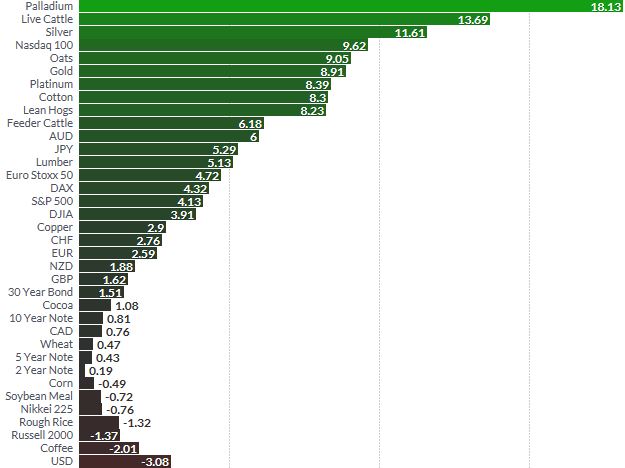 Market Performance 2017 YTD
The precious metals continue to outperform most assets in 2017. Year to date, gold is 9% higher and silver is 11.7% higher. Platinum is 8.4% higher and palladium has surged 18% to two year highs.
Gold and silver have eked out gains as the dollar and stocks have come under pressure after U.S. President Donald Trump failed in his attempts to abolish Obama care. Trump suffered a major political setback on healthcare reform, raising doubts about his ability to steer the economic agenda.
The dollar has fallen to the lowest level in five months and stock markets globally are seeing sharp falls today. Trump’s inability to deliver on a major election campaign promise marked a big defeat for a Republican president whose own party controls Congress, and raised doubts whether he would be able to push through tax reforms and mega-spending packages.
Growing U.S. political uncertainty is creating concerns that a recent pick-up in global business and consumer sentiment, particularly in Asia, may be impacted.
Bullion coin and bar demand remains robust. US Mint data shows that strong demand for gold and silver coins continued last week.
Sales of gold coins were the highest since the week ended February 10 and silver coin sales were the highest since the week ending January 20.
As reported by Coin News:
– Gold coins advanced by 13,000 ounces after rising by 8,000 ounces last week. Splits include 9,000 ounces in American Gold Eagles compared to 5,500 ounces previously and 4,000 ounces in American Gold Buffalo compared to 2,500 ounces previously.
– Silver coins jumped by 795,000 ounces compared to 220,000 ounces previously. And like in the last two weeks, American Silver Eagles accounted for all sales.
| US Mint Bullion Sales (# of coins) | ||||||
|---|---|---|---|---|---|---|
| Friday Sales | Last Week | This Week | Feb Sales | Mar Sales | 2017 Sales | |
| $100 American Eagle 1 Oz Platinum Coin | 0 | 0 | 0 | 0 | 0 | 20,000 |
| $50 American Eagle 1 Oz Gold Coin | 0 | 2,500 | 8,500 | 21,000 | 14,500 | 122,000 |
| $25 American Eagle 1/2 Oz Gold Coin | 0 | 1,000 | 0 | 5,000 | 1,000 | 25,000 |
| $10 American Eagle 1/4 Oz Gold Coin | 0 | 2,000 | 0 | 4,000 | 2,000 | 42,000 |
| $5 American Eagle 1/10 Oz Gold Coin | 0 | 20,000 | 5,000 | 30,000 | 35,000 | 190,000 |
| $50 American Buffalo 1 Oz Gold Coin | 0 | 2,500 | 4,000 | 15,000 | 7,000 | 54,000 |
| $1 American Eagle 1 Oz Silver Coin | 0 | 220,000 | 795,000 | 1,215,000 | 1,295,000 | 7,637,500 |
| 2017 Effigy Mounds 5 Oz Silver Coin | 0 | 0 | 0 | 19,500 | 0 | 19,500 |
Speculators became bullish on gold and raised net gold longs last week. Bullion banks, hedge funds and money managers boosted their net long positions in COMEX gold after two weeks of cuts and reduced them slightly in silver in the week to March 21, U.S. Commodity Futures Trading Commission (CFTC) data showed on Friday.
There is now the real risk that Trump becomes a “lame duck” President and that his business friendly policies struggle to be enacted. This bodes badly for stocks and the dollar and well for safe haven gold which should continue to see risk averse flows.
http://www.goldcore.com/us/gold-blog/gold-silver-rise-2-5-3-2-trump-trade-fades/
end
Overnight trading from Asia/: gold and silver rises!
Stocks, Dollar Tumble As Gold Tops $1250; Dead Bill Bounce Dies
It appears the false narrative of the failed healthcare reform bill being somehow great news for stocks has been eviscerated in early Asia trading. The dollar has tumbled to its lowest since Nov 10th, Gold has ripped back above $1250, and S&P futures have plunged to 6 week lows.

The Bloomberg Dollar Index has almost erased the entire post-Trump-election gains…

US equity futures are tumbling – Dow is down over 700 points from its highs…

And gold is back above $1250…

It appears faith is fading fast in Trump trades.
end
The following is a must read…Alasdair discusses how the protectionist policies of Trump will in reality not help America as dollars around the globe will not be needed as before. This should weaken the dollar value and boost the value of gold.
please read..a must
(courtesy Alasdair Macleod)
Alasdair Macleod: Trump’s hostility to free trade will weaken dollar, boost gold
Submitted by cpowell on Sat, 2017-03-25 01:53. Section: Daily Dispatches
8:53a ICT Saturday, March 25, 2017
Dear Friend of GATA and Gold:
GoldMoney research director Alasdair Macleod argues this week that President Trump’s hostility to free trade will diminish demand for the U.S. dollar and encourage China to increase its acquisition of gold and perhaps even to push up the monetary metal’s price more directly to offset the devaluation of its dollar-denominated foreign-exchange reserves. Macleod’s commentary is headlined “Why Free Trade Is Officially Dead” and it’s posted at GoldMoney here:
https://wealth.goldmoney.com/research/goldmoney-insights/why-free-trade-…
CHRIS POWELL, Secretary/Treasurer
Gold Anti-Trust Action Committee Inc.
CPowell@GATA.org
end
Another great commentary from Andrew Maguire as he states that sovereign gold buyers (Russia and China) know how to play the paper game and buy physical gold especially around options expiry week.
a must read..
(courtesy Andrew Maguire/Kingworldnews)
Sovereign gold buyers know how to play the paper game, Maguire tells KWN
Submitted by cpowell on Sat, 2017-03-25 02:21. Section: Daily Dispatches
9:22a ICT Saturday, March 24, 2017
Dear Friend of GATA and Gold:
London metals trader Andrew Maguire tells King World News this week that manipulation of the gold derivatives market is well understood by sovereign buyers, who time their purchases accordingly.
“Competing central bank and sovereign buyers,” Maguire writes, “know how to game the paper-centric events such as options expiry next week, where they also know that officials and insider commercial bullion banks are forced to defend billions of dollars’ worth of accrued naked short derivative bets. This is when sovereigns who are seeking large tonnage buy. The resulting physical outflows provide observable clues that there is stress in the paper markets — a growing bifurcation between the paper price and the physical price.”
Maguire’s comments are posted at KWN here:
http://kingworldnews.com/andrew-maguire-this-will-rock-the-gold-market-a…
CHRIS POWELL, Secretary/Treasurer
Gold Anti-Trust Action Committee Inc.
CPowell@GATA.org
end
No doubt that this stolen 100 kg gold coin will be melted down. There are two coins made in 2007, with the other one owned by Eric Sprott. I guess that this will be a good news/bad news scenario for Eric.
The good news: He will now own the only one left
The bad news: he will now own the only one left.
(courtesy zero hedge)
Massive 100 Kilogram Gold Coin Worth $4.5 Million Stolen From German Museum
Perhaps even more brazen than the infamous theft of a bucket full of gold worth $1.6 million from an armored truck in broad daylight in Midtown Manhattan last September 29, moments ago local German press has reported that thieves broke into Berlin’s Bode Museum and made off with a massive 100-kilogram (221-pound) gold coin worth millions.

According to German media, the stolen coin is the “Big Maple Leaf”, a commemorative piece issued by the Royal Canadian Mint in 2007. The three-centimeter (1.18-inch) thick coin, with a diameter of 53 centimeters (20.9 inches), has a face value of $1 million. By weight alone, however, it would be worth almost $4.5 million at market prices.
The Bode Museum, located on the German capital’s UNESCO-listed Museum Island, houses one of the world’s biggest coin collections. The holding includes 102,000 coins from ancient Greece and about 50,000 Roman coins.
Spokesman Stefen Petersen said thieves apparently entered through a window about 3:30 a.m. Monday, broke into a cabinet where the “Big Maple Leaf” coin was kept, and escaped with it before police arrived.
German police said on Twitter that the robbers likely used a ladder found at a nearby rail track to break into the museum at around 3:30 am. Suburban rail traffic was interrupted as investigators combed the area for clues. The police did not comment on how the theives managed to cart the extremely heavy “pet rock” out of the museum without being spotted or triggering any alarms.
The museum says the coin is in the Guinness Book of Records for its purity of 999.99/1000 gold. It has a portrait of Queen Elizabeth II on one side and maple leaves on the other.
It was unclear if the coin has already been “deposited” at one of the numerous central or commercial bank vaults who have experienced a dramatic drop in physical gold inventory as much of the yellow metal has moved to China and various private vaults in recent years, and duly replaced by mere paper claims on said metal.
end
This is a good one; my comment on the lack of enforcement due to funding: B.S.
(courtesy Business news/Reuters
Misconduct rife in derivatives – ex-CFTC enforcement chief
A “massive amount of misconduct” in futures, options and swaps markets goes undetected because of insufficient data mining, Aitan Goelman, who until last month was enforcement chief for the top U.S. derivatives regulator, said in an interview.
Goelman said a lack of resources meant the U.S. Commodity Futures Trading Commission (CFTC) did not have the sophisticated software and staff necessary to uncover many of the suspicious trading patterns within the 325 million records filed each day.
Goelman said there is much more manipulation, insider trading, front-running and Ponzi scheming in the markets than is being prosecuted, even though the CFTC receives the data from industry participants and exchanges and gained enhanced enforcement authority under a 2010 financial reform law.
A handful of cases were brought under Goelman over spoofing, the illegal practice of placing orders without intending to execute them. Goelman, who believes the practice is widespread, is credited with bringing groundbreaking cases utilizing the anti-spoofing provision and other powers provided by the Dodd-Frank Act.
“One of my regrets is there’s such a massive amount of misconduct in the market we’re just not pursuing,” said Goelman, who left the CFTC after the change to a Republican administration and nearly three years as enforcement chief.
“We could do a lot more manipulation cases. We have all these new enforcement tools and this vastly expanded jurisdiction and data,” Goelman said in the interview. “But you have to be acutely conscious about the limited resources.”
Derivatives played a central role in the 2008 financial crisis. In the aftermath, through Dodd-Frank, the CFTC went from regulating the now $50 trillion futures and options markets to gaining primary oversight for the over-the-counter U.S. swaps market, now estimated at $300 trillion.
CFTC Commissioner Sharon Bowen, a Democrat, said in an emailed statement that the market data the agency receives is “of little use if we lack the resources to fully analyze it.”
Tyson Slocum, a staffer with the consumer advocacy group Public Citizen who serves on an advisory committee to the CFTC, said the regulator does what it can with the resources it is provided.
But Slocum and Dennis Kelleher, chief executive of government watchdog Better Markets, said Wall Street lobbying left the CFTC chronically underfunded.
Kelleher described that as “one of the biggest scandals in this town.”
The CFTC’s annual budget of $250 million is more than double the $111 million it was allotted in 2008, with just over 20 percent designated for enforcement.
The U.S. Securities and Exchange Commission, by contrast, had a $1.6 billion budget in fiscal 2016, with one-third slotted for enforcement.
Acting CFTC chairman J. Christopher Giancarlo said in a speech last week there would be aggressive enforcement by the CFTC under the administration of President Donald Trump.
Giancarlo, a Republican nominated by Trump to serve as permanent chair, has tapped James McDonald, who just left the U.S. Attorney’s office in Manhattan, to oversee the enforcement unit, sources have told Reuters.
Steven Adamske, a spokesman for the CFTC, declined to comment on how much misconduct might be going undetected.
Adamske said the CFTC’s surveillance unit looks at anomalies on a daily basis, spikes and drops in the market that may not be easily explained, and refers questionable activity to the enforcement division.
“Now and always, the CFTC works diligently within the budget set by Congress and the administration to foster open, transparent, competitive and financially sound markets,” he said.
The commission’s budget is funded solely through congressional appropriations, with fines it collects returned to the U.S. Treasury.
The U.S. Senate and U.S. House of Representatives appropriations committees either declined comment or did not respond to a request for comment on whether lobbyists influenced the outcome for the commission.
Two-thirds of leads on misconduct that come into the “triage unit” of the CFTC’s enforcement division are not pursued, in part because of a lack of resources, Goelman said. A lack of jurisdiction and lack of evidence also play a role, he said.
“It’s really an untenable situation,” Goelman said. He cited two cases that, if they had gone to trial, he said would have used up more than half his operating budget for 2017.
They were the case of former New Jersey governor Jon Corzine who agreed to a $5 million settlement over his role in MF Global Holdings Ltd’s unlawful use of nearly $1 billion in customer funds and Igor Oystacher and his Chicago firm, 3Red Trading LLC, agreeing to pay $2.5 million to settle spoofing allegations in more than 50 trades between 2011 and 2014.
(Reporting By Karen Freifeld; editing by Carmel Crimmins and Grant McCool)
end
Your early MONDAY morning currency, Asian stock market results, important USA/Asian currency crosses, gold/silver pricing overnight along with the price of oil Major stories overnight
1 Chinese yuan vs USA dollar/yuan MUCH STRONGER AT 6.8772( BIGGER REVALUATION NORTHBOUND /OFFSHORE YUAN MOVES MUCH STRONGER FROM ONSHORE AT 6.87553/ Shanghai bourse UP 2.49 POINTS OR .08% / HANG SANG CLOSED DOWN 164.57 POINTS OR 0.68%
2. Nikkei closed DOWN 276.94 POINTS OR 1/44% /USA: YEN FALLS TO 110.30
3. Europe stocks opened ALL IN THE RED ( /USA dollar index FALLS TO 99.12/Euro UP to 1.0867
3b Japan 10 year bond yield: FALLS TO +.056%/ !!!!(Japan buying 100% of bond issuance)/Japanese yen vs usa cross now at 110.30/ THIS IS TROUBLESOME AS BANK OF JAPAN IS RUNNING OUT OF BONDS TO BUY./JAPAN 10 YR YIELD FINALLY IN THE POSITIVE/BANK OF JAPAN LOSING CONTROL OF THEIR YIELD CURVE AS THEY PURCHASE ALL BONDS TO GET TO ZERO RATE!!
3c Nikkei now JUST BELOW 17,000
3d USA/Yen rate now well below the important 120 barrier this morning
3e WTI:: 47.93 and Brent: 50.83
3f Gold DOWN/Yen DOWN
3g Japan is to buy the equivalent of 108 billion uSA dollars worth of bond per month or $1.3 trillion. Japan’s GDP equals 5 trillion usa./“HELICOPTER MONEY” OFF THE TABLE FOR NOW /REVERSE OPERATION TWIST ON THE BONDS: PURCHASE OF LONG BONDS AND SELLING THE SHORT END
Japan to buy 100% of all new Japanese debt and by 2018 they will have 25% of all Japanese debt. Fifty percent of Japanese budget financed with debt.
3h Oil DOWN for WTI and DOWN for Brent this morning
3i European bond buying continues to push yields lower on all fronts in the EMU. German 10yr bund FALLS TO +.382%/Italian 10 yr bond yield DOWN to 2.204%
3j Greek 10 year bond yield FALLS to : 7.37%
3k Gold at $1258.10/silver $17.99(8:15 am est) SILVER RESISTANCE AT $18.50
3l USA vs Russian rouble; (Russian rouble UP 8/100 in roubles/dollar) 56.85-
3m oil into the 47 dollar handle for WTI and 50 handle for Brent/
3n Higher foreign deposits out of China sees huge risk of outflows and a currency depreciation (already upon us). This can spell financial disaster for the rest of the world/China forced to do QE!! as it lowers its yuan value to the dollar/GOT STRONG REVALUATION NORTHBOUND from POBC.
JAPAN ON JAN 29.2016 INITIATES NIRP. THIS MORNING THEY SIGNAL THEY MAY END NIRP. TODAY THE USA/YEN TRADES TO 110.30 DESTROYING JAPANESE CITIZENS WITH HIGHER FOOD INFLATION
30 SNB (Swiss National Bank) still intervening again in the markets driving down the SF. It is not working: USA/SF this morning 0.9849 as the Swiss Franc is still rising against most currencies. Euro vs SF is 1.0704 well above the floor set by the Swiss Finance Minister. Thomas Jordan, chief of the Swiss National Bank continues to purchase euros trying to lower value of the Swiss Franc.
3p BRITAIN VOTES AFFIRMATIVE BREXIT/LOWER PARLIAMENT APPROVES BREXIT COMMENCEMENT
3r the 10 Year German bund now POSITIVE territory with the 10 year FALLS to +.382%
The bank withdrawals were causing massive hardship to the Greek bank. the Greek referendum voted overwhelming “NO”. Next step for Greece will be the recapitalization of the banks and that will be difficult.
4. USA 10 year treasury bond at 2.366% early this morning. Thirty year rate at 2.975% /POLICY ERROR)GETTING DANGEROUSLY HIGH
5. Details Ransquawk, Bloomberg, Deutsche bank/Jim Reid.
(courtesy Jim Reid/Bloomberg/Deutsche bank/zero hedge)
Global Stocks Slide, S&P Futures Tumble Below 50DMA As “Trump Trade” Collapses
Global stocks are lower across the board to start the week, as concerns about Trump’s administration to pull off a material tax reform plan finally emerge, pressuring S&P futures some 20 points lower this morning, following European and Asian shares lower, while crude oil prices fall unable to find support in this weekend’s OPEC meeting in Kuwait where a committee recommended to extend oil production cuts by another 6 months. Safe havens including the yen and bonds climbed as did gold, which continued its advance above the key resistance level of $1,250, while industrial commodities dropped.
So-called “Trumpflation trades” – bets that Trump’s pro-business policies would stoke growth and inflation in the U.S. and global economies, boosting assets such as commodities – came under heavy selling pressure. The dollar, whose index had surged more than 6 percent in the aftermath of Trump’s election to hit 14-year highs at the start of 2017, slipped to its lowest since Nov. 11, two days after the results of the presidential vote.
“Investors are viewing this setback as a broader loss of faith in the Trump administration’s ability to deliver on other campaign pledges – namely tax and spending policies, which have underpinned asset prices since the U.S. elections,” said ING currency strategist Viraj Patel, in London.
U.S. equity index futures suggested stocks would retreat for the seventh time in eight days, with S&P futures sliding below the 50 DMA for the first time since the election.

The fall in risk appetite dominated European stockmarkets, with the pan-European STOXX 600 index falling 0.8 percent on the day led by the Basic Resources index which was the biggest sectoral loser, down 2 percent to a two-week low as copper prices slipped, while the banking index was down 1.3 percent. The Euro rose to the highest level of 2017…

… on the heels of a strong German IFO Business Climate reading, which rose to 112.3, beating expectations and above the last 111 print, indicative of a 3% GDP German print.

However, a potential red flag emerged in the latest monetary aggregate data out of the Eurozone, where M3 growth dipped from 4.9% to 4.7%, below the 4.9% expected, despite the ECB continuing its monetary blast at record levels, not to mention last week’s massive TLTRO.

Bucking the weaker trend among European stocks were precious metal miners such as Randgold and Fresnillo, both up more than 1 percent, as risk aversion boosted gold. Gold prices climbed more than 1 percent to a one-month high of $1,259 an ounce.
Attention today will remain fixed on Trump’s inability to push through the Republican healthcare bill through the House, which as noted last night, has derailed investor hopes that his pro-business agenda will pass smoothly through Congress. Reflation trades sparked by his election are faltering, with the dollar retreating and the S&P 500 Index headed for its worst month since October.
“Trump’s failure to get the health care bill through a Republican majority led Congress has raised some concerns about the President’s ability to implement his agenda of cutting taxes and raising infrastructure spending,” Ole Hansen, chief commodity strategist at Saxo Bank, told Bloomberg.
“Failure would deflate further the months-long rally in stocks while reducing the need for further Fed action. The result of this has seen the dollar, stocks and bond yields lower which are all good news for investors looking for gold as an alternative.”
The market reaction has been uniformly negative, with the MSCI Asia Pacific Index falling 0.3 percent, with more than three shares falling for every one advancing. Japan’s Topix led declines, dropping 1.3% to the lowest since Feb. 9 and almost wiping out gains for 2017. Chinese shares traded in Hong Kong fell 1.1% and India’s Sensex index slid 0.4 percent.
Futures on the S&P 500 lost 0.9 percent, or 20 points, to 2,324 as of 10:12 a.m. in London. The underlying gauge last week tumbled 1.4%, its worst week of 2017. The Stocks Europe 600 Index fell 0.6 percent as it was dragged down by miners and banks. In terms of relative valuations, U.S. stocks are trading well above their historical averages while Asia stocks are still broadly in line with theirs despite a recent bounce.
WTI and Brent both dropped as markets looks past producers’ soft committment to extend oil production cuts. A pledge by crude producers to consider extending their output-cut deal failed to excite oil bulls, with prices dropping as more time seen needed to trim swollen global stockpiles. Five OPEC producers joined with non-member Oman to voice support for prolonging supply curbs past June, with Kuwait saying it should be for an additional six months. Committee of ministers from Kuwait, Algeria and Venezuela and their counterparts from Russia and Oman that met over the weekend asked OPEC to review the market and give them a recommendation in April on rolling over the output reductions. Russia said it needs more time before making a decision.
Oil prices rallied as OPEC, 11 other major producers including Russia agreed last year to slash production; the rally stalled this month as U.S. output, supplies have continued to grow. Libya’s biggest oil terminal was loading its first tanker since fighting earlier this month halted shipments. “There’s a lot of impatience when we continue to see builds in inventory and growing U.S. output,” Daniel Hynes, an analyst in Sydney at Australia & New Zealand Banking Group, says in a Bloomberg Television interview. “The market’s definitely asking for it,” he says, referring to a deal extension.
In rates, U.S. Treasury yields fell to a one-month low of 2.35%, while borrowing costs across the euro zone also fell sharply, as investors ditched riskier assets and unwound bets on higher inflation and interest rates.
Bulletin Headline Summary
- European equities slip after US President Trump’s healthcare bill collapsed, with markets now questioning whether Trump’s other proposals can come to fruition.
- USD is on the backfoot, while EUR finds support early on with a data heavy week for the Eurozone kicking off to a strong start as German IFO data beats expectations.
- Looking ahead, highlights include comments from Fed’s Evans and Kaplan
Market Snapshot
- S&P 500 futures down 0.8% to 2,325.00
- MXAP down 0.3% to 147.70
- MXAPJ down 0.1% to 478.21
- Nikkei down 1.4% to 18,985.59
- Topix down 1.3% to 1,524.39
- Hang Seng Index down 0.7% to 24,193.70
- Shanghai Composite down 0.08% to 3,266.96
- Sensex down 0.5% to 29,284.04
- Australia S&P/ASX 200 down 0.1% to 5,746.70
- Kospi down 0.6% to 2,155.66
- STOXX Europe 600 down 0.7% to 374.02
- German 10Y yield fell 2.5 bps to 0.378%
- Euro up 0.6% to 1.0865 per US$
- Brent Futures down 0.7% to $50.47/bbl
- Italian 10Y yield fell 4.8 bps to 2.224%
- Spanish 10Y yield rose 0.4 bps to 1.697%
- Brent Futures down 0.7% to $50.47/bbl
- Gold spot up 1.1% to $1,257.71
- U.S. Dollar Index down 0.5% to 99.13
Top Overnight News
- German Business Confidence Increases to Strongest Since 2011
- Trump Policy Travails Could Boost the Appeal of Asia’s Markets
- Lockheed’s $29 Billion Copter Poised to Win Pentagon’s Approval
- Apicorp in JV With Goldman Sachs for Energy Investments
- Goldman Sachs Said to Be in Talks for Saudi Equities License
- China Southern Says in Strategic Talks With American Airlines
- MoneyGram Enters Confidentiality Pact With Euronet Worldwide
- Fitbit Moves Toward Trial in Jawbone Trade Secrets Theft Case
- Coca-Cola to Add Fruit Juice to Fanta, Sprite in India: Standard
- Google Plans to Start Android Pay in S. Korea in May: ETNews
- Google Faces Demands for Ad Discounts After YouTube: FT
- Westinghouse Chapter 11 Filing May Come March 28: Nikkei
Asia equity markets traded mostly lower as the region digested the cancellation of the American Health Care Act vote on Friday due to insufficient support and the implications on the Trump reflation trade. This pressured US equity futures and Asia-Pac indices alike, with ASX 200 (-0.1%) also weighed by mining names after iron ore prices extended on last week over 7% declines. Nikkei 225 (-1.4%) underperformed on a firmer currency, while Shanghai Comp. (-0.1%) and Hang Seng (-0.7%) were choppy for much of the session as downside had been initially counterbalanced by several upbeat earnings and a 31.5% increase in Chinese Industrial Profits. 10yr JGBs traded higher as the cautious risk tone spurred safe-havens flows. However, upside was limited after the BoJ Summary of Opinions provided no surprises and the central bank also refrained from a Rinban announcement.
Top Asian News
- Bonds Surge in India as Rupee Rally Spurs Bets of More Inflows
- China Said to Approve Carbon Quota Plans for National Market
- PBOC’s Zhou Signals Financial Opening Will Require Negotiation
- Don’t Fear This Selloff Is Investors’ Bold Call: Markets Live
- Skylark’s Largest Shareholder Bain to Sell Part of Its Stake
- Zhou Signals China Financial Opening Will Need Negotiation
- Korean Prosecutors Seek to Arrest Park on Graft Allegations
- Noble Group’s Elman Mixes Mea Culpa and Optimism Before Exit
- Hong Kong Stocks Decline as Developers Drop Amid Curb Concerns
European equities slip after US President Trump’s healthcare bill collapsed, with markets now questioning whether Trump’s other proposals can come to fruition. As such, there has been a notable broad based sell off as the negative sentiment spares no sector with very few stocks trading in positive territory include precious metal miners, which are being supported by their link with higher gold prices, while financials are providing the biggest drag to EU bourses. In terms of equity specific newsflow, Zurich underperforms in the SMI amid reports that the insurance firm is seeking raise EUR 8.6bIn via a capital increase. Fixed income markets have benefited from the risk averse tone, although the price action among spreads have been somewhat modest. Of note, as we approach the quarter-end, there has been notable corporate issuance.
Top European News
- Oil Producers Consider Extending Output Cuts as Support Grows
- London Mansion Owners Turn to Airbnb as Buyers Turn Up Noses
- BOE Cites Brexit Among Financial Stability Risks for U.K.
- Cecabank Hires BBVA’s Head of Cash Equity Execution for New Unit
- Minsheng Investment Targets Elderly Care Groups Across Globe
In currencies, the Bloomberg Dollar Spot Index fell 0.5 percent. The yen rose 0.9 percent to 110.32 per dollar. The euro gained 0.5 percent to $1.0857 and the British pound added 0.8 percent. There is only one overriding theme the FX markets are trading off, and that is the failure of the Trump administration securing a vote to repeal Obamacare, abandoning proceedings late Friday. The initial response was to be ignored given liquidity issues, but this morning, traders have been left in no doubt as to where market sentiment lies. US Treasuries have been bid up as fiscal stimulus plans in the US have clearly suffered a blow, and watching the cash open on Wall Street, the latest sell off in risk/carry trade does not bode well. USD/JPY is an obvious casualty, but demand still reported ahead of 110.00, and given rate differentials, does not look out of place. EUR/USD has moved higher accordingly, pushing through 1.0850, but as noted, strong resistance levels of note at 1.0900 and 1.0950. Improving economic data in the EU has been a firm driver of trade, with last week’s healthy PM! stats across the region backed up by a better than expected German Ifo survey today. Merkel’s win in Saarland also supportive.
No jitters over Wednesday’s scheduled activation of Article 50 as the Pound remains on the front foot. Cable has tested up to 1.2580 today, supported by the USD backdrop, but EUR/GBP also edging back under 0.8650 to put in a strong showing this morning.
In commodities, gold rose 1.1 percent to $1,257.28, heading for the highest close since Nov. 10. West Texas Intermediate oil slipped 0.7 percent to $47.62 a barrel, erasing an earlier gain of as much as 0.7 percent. Crude producers pledged to consider extending their pact limiting supply. Iron ore futures slid 3.9 percent, after briefly erasing gains for the year. The commodity surged in the opening weeks of 2017 following a surprise rally last year amid optimism about the demand outlook in China. Copper fell 1.3 percent and tin dropped 2 percent. A mixed bag of drivers in the commodity markets at the moment, but a clear move in precious metals in response to the USD drop as a result of the failure to secure a positive health care vote for the Trump administration. US Treasuries have garnered a bid and this has sent Gold cleanly through USD1250.00, trading a little shy of USD1260.00. Sliver still unable to regain USD18.00 however. Base metals largely in the red, but platinum and palladium getting real money demand out of the European car-makers. Copper has dipped below USD2.60, with a (temporary) resumption in the Escondida mine having a modest positive impact. Iron ore prices in China are taking a hit as reports of China stockpiles at the major ports unsettle the supply/demand balance — demand still relatively steady though. Oil prices continue to look on the heavy side, as any recovery now looks to rest on whether OPEC/non OPEC decide to extend the production cut agreement. Some argue that the existing output adjustments have not fed through to inventory levels.
We kick off things this morning in Europe with Germany where the March IFO printed at 112.3, beating expectations and rising from February’s 111. The latest M3 money supply reading for the Euro area was released, and disappointed when it dipped from 4.9% to 4.7%, missing expectations. Over in the US the sole release is the Dallas Fed’s manufacturing survey for March. The Fed’s Evans and Kaplan speak later in the day.
US Event Calendar
- 10:30am: Dallas Fed Manf. Activity, est. 22, prior 24.5
- 1:15pm: Fed’s Evans Speaks on Economy and Policy in Madrid
- 6:30pm: Fed’s Kaplan Speaks in College Station, Texas
* * *
DB’s Jim Reid concludes the overnight wrap
It’ll be interesting to know what words Mr Trump spoke on Friday night after the healthcare bill vote was abandoned. Even though defeat is not encouraging for markets there’s an element of “healthcare reform is dead, long live tax reform”. I write this this morning fairly confused as to how to think about markets in the near term though. The best way to benchmark my thoughts is perhaps to look back at what we expected for 2017 at the end of last year and work out what’s occurred relative to expectations and whether anything has changed. The view then was that ultimately central banks pulling back from extreme policy was good for animal spirits and also that Trump was ultimately good for growth. We also thought Europe would have lots of political near misses without a fatal blow.
A combination of these near misses and the fact that there was plenty of opportunity to doubt the ability of Trump to be radical growth wise meant we thought we’d have plenty of pockets of volatility without it changing the end result of the year. So as we approach the end of the first quarter where do we stand. Well the aborted health care bill is such an example of doubting Trump’s legislative abilities. However so far all it’s done is cause a -1.44% sell off in the S&P 500 last week (only the second down week in nine and the worst week since November last year) and a spike intraday on Friday of the VIX to 14.16 and briefly to the highest point of the year. It’s still very low historically though so as yet there is no major damage done. This morning S&P futures are -0.50% and as we’ll see below sentiment has been a bit softer in Asia.
Although the healthcare bill was always going to be a huge test of the new administration’s ability to peruse aggressive legislation Mr Trump has so far refrained from being too confrontational in defeat and there seems to be a desire to ‘learn’ from any mistakes and move on to tax. However he did blame the Freedom Caucus in a tweet yesterday and before that cryptically tweeted that his followers should watch Jeanine Pirro on Fox News on Saturday. On the show she called for Paul Ryan to step down. So this is perhaps some sign of tension and frustration without things blowing up directly.
Friday’s failure does now increase the risks of further difficult negotiations going forward which Ryan hinted at on Friday night but the reality is that tax reform is of far more economic consequence than healthcare so the market could give the GOP some benefit of the doubt. Event risk should be higher now though and volatility should be higher. However while global growth numbers continue to be decent then the risk premium increases will be probably be more muted than we thought they might be when we published our 2017 outlook. Although we thought growth would hold up in 2017 it’s probably surprised on the upside relative to our expectations.
So net net it leaves us with similar views to the outlook. A decent year for risk but with the technicals slightly negative for credit and thus encouraging mildly wider spreads. We think Euro IG will outperform HY from this starting point and we expect higher yields. However perhaps the vol we were expecting won’t be quite as large even if we think it’s still coming.
Moving on to the immediate future, this week will see the UK activate article 50 on Wednesday with the Scottish Parliament debating the proposed second independence referendum tomorrow. So watch out for plenty of headlines on these topics. I can’t help but think that PM May will have something up her sleeve for announcement day. What I’m not too sure.
While on the topic of politics, Mrs Merkel got an unexpected boost yesterday following a relatively comfortable victory in the state election in Saarland. Merkel’s CDU party secured 40.7% of the vote which is up from 35.2% in the 2012 election. The Social Democratic Party, led by new leader Martin Schulz, took home 29.6% which is down from 30.4% five years ago. The anti-immigration Alternative for Germany secured 6.2% of votes. While Saarland is small with just 1 million people, the strong result for Merkel comes following rising support for the SPD following the announcement of Schulz as the leader of the party. Indeed the last 2 opinion polls (Emnid and Infratest dimap) show that support between the two parties at a national level is tied. This compares to the start of the year when the CDU held a double digit lead over the SPD across the vast majority of pollsters. So it’s worth seeing if this result is reflected in the next round of polls. Two more regional elections are due to be held in May (Schleswig-Holstein and Northrhine Westpahlia) before the national election in September.
Over in markets this morning there is definitely a slightly more negative tone sweeping through Asia to start the week. That is being reflected in the bid for safe havens with the Yen (+0.89%), Gold (+1.07%) and Treasuries (10y -4.8bps) all stronger. In equities the rally for the Yen isn’t helping the Nikkei (-1.51%) while the ASX (-0.25%) and Kospi (-0.57%) are also in the red. The Hang Seng and Shanghai Comp are little changed however.
Staying in Asia for a second, another interesting story from the weekend comes from China where, in a bid to clamp down on further capital flows out of China, banks are asking property agents in Hong Kong not to accept mainland China issued UnionPay cards for home purchases. This follows similar curbs on high priced insurance products and speculative offshore corporate acquisitions.
Moving on and quickly recapping Friday’s session. Despite the abandoned healthcare vote coming to a head late in the day the S&P 500 did only finish down a fairly paltry -0.08% and with that in fact had its second best day in the last seven sessions. That said there’s plenty asking the question about whether or not we’re starting to see the unwind of Trump trades and while the headline moves haven’t been particularly eye catching, there is some evidence of it coming through at a domestic and stock specific level. The biggest loser on Friday in the S&P was a company which supplies gravel for roads – Martin Marietta Materials which tumbled -2.93% – which perhaps reflects some fading hopes in the infrastructure trade. Meanwhile, while the move lower in rates has also clearly had a big impact US Banks declined -4.81% last week and are off nearly 8% from the March highs. Small caps – a decent barometer of domestic performance – also tumbled -2.65% last week and fell for the fourth week in five. So perhaps some evidence of pockets of weakness but the overall magnitude of the selloff has still been fairly muted in the grand scheme of things.
At the other end of the risk spectrum Gold, which did actually edge down -0.13% on Friday, rallied +1.16% last week and is now back into positive territory month to date. In rates Treasuries didn’t move much on Friday but the 10y yield still finished down 8.8bps last week and is now down around 22bps from the intraday highs just two weeks ago. Finally the US Dollar, measured by the Dollar index, fell -0.67% last week and is now down -2.68% from the early month highs.
Closer to home on Friday it was economic data rather than politics which stole the spotlight in Europe. Indeed it was the release of the flash March PMI’s which were the focus with the big news being a further improvement in the Euro area composite PMI this month to 56.7 (vs. 55.8 expected) – a rise of 0.7pts from February. With that the reading notched up a second consecutive cyclical high and encouragingly the growth appeared to be broad-based with both the services (+1pt to 56.5) and manufacturing (+0.8pts to 56.2) PMI’s rising. Regionally both France (+1.7pts to 57.6) and Germany (+0.9pts to 57.0) led the way for the acceleration with the data suggesting a marginal decline (-0.2pts) on average for the composite of the non-core. All in all our economists in Europe highlight that they see a more significant risk from the positive PMIs relative to their view as being for Q2. At its latest level, the euro area composite PMI is in line with the economy growing at between 0.7% and 0.8% qoq. Our economists’ moderate Q2 growth view (0.3%) is predicated on some slowdown in activity due to the political calendar. However, surveys have shown no sign of this having an effect thus far. With less reason to expect temporary effects to weigh on activity as in Q1 (e.g. the very cold January), they see the PMIs as presenting a clearer upside risk to their Q2 view than for Q1.
Wrapping up the remaining data on Friday, in the US headline durable goods orders rose a slightly better than expected +1.7% mom in February (vs. +1.4% expected) however largely as a result of a surge in aircraft orders. Indeed core capex orders were -0.1% mom (vs. +0.5% expected). Meanwhile the flash March composite PMI in the US declined 0.9pts to 53.2 and a six month low with both the manufacturing (-0.8pts to 53.4) and services (-0.9pts to 52.9) readings lower.
To this week’s calendar now. We’re kicking off things this morning in Europe with Germany where the March IFO survey is due out. The latest M3 money supply reading for the Euro area is also due this morning. Over in the US this afternoon the sole release is the Dallas Fed’s manufacturing survey for March. With little to highlight in Europe tomorrow, the focus will be on the US where we get the advance goods trade balance for February, wholesale inventories for February, consumer confidence for March, S&P/Case-Shiller house price index for January and Richmond Fed manufacturing survey for March are due. Wednesday kicks off in Japan where retail sales and small business confidence data is due. Over in Europe the focus will be on the UK with the February money and credit aggregates data. In the US on Wednesday the only data due out is pending home sales. Turning to Thursday, during the European session the most notable data is due out of Germany where the first estimate of CPI in March is due. Also due out are various March confidence indicators for the Euro area. In the US on Thursday the early data is the third estimate of Q4 GDP and Core PCE, while initial jobless claims data is also due. The busiest day looks set to be reserved for Friday. In Japan we will get February CPI, industrial production and employment data, while in China the official manufacturing and non-manufacturing PMI’s for March are due. In Europe we’ll get CPI reports for France and the Euro area along with Q4 GDP in the UK and unemployment in Germany. In the US data due includes February personal income and spending reports, PCE core and deflator readings, the Chicago PMI for March and the final University of Michigan consumer sentiment reading revision.
Away from the data the Fedspeak diary this week is packed. Today we see Evans and Kaplan speak, tomorrow we have George, Kaplan and Powell speaking along with Fed Chair Yellen (albeit at a conference which doesn’t suggest a focus on the economy or monetary policy), Wednesday see’s Evans, Rosengren and Williams speak, Thursday has Mester, Williams and Kaplan scheduled and Friday finishes with Kashkari. Away from that other important events this week include the BoE bank stress test scenarios today, a Scottish Parliament debate on a possible independence vote tomorrow and of course UK PM Theresa May officially triggering Article 50 on Wednesday.
3. ASIAN AFFAIRS
i)Late SUNDAY night/MONDAY morning: Shanghai closed DOWN 2.49 POINTS OR .08%/ /Hang Sang CLOSED DOWN 164.57 POINTS OR 0.68% . The Nikkei closed DOWN 276.94 OR 1.44% /Australia’s all ordinaires CLOSED DOWN 0.12%/Chinese yuan (ONSHORE) closed UP at 6.87672/Oil FELL to 47.56 dollars per barrel for WTI and 50.48 for Brent. Stocks in Europe ALL IN THE RED ..Offshore yuan trades 6.8553 yuan to the dollar vs 6.8772 for onshore yuan.THE SPREAD BETWEEN ONSHORE AND OFFSHORE NARROWS CONSIDERABLY AGAIN/ ONSHORE YUAN STRONGER BUT THE OFFSHORE YUAN IS MUCH STRONGER AND THIS IS COUPLED WITH THE HUGELY WEAKER DOLLAR. CHINA IS SATISFIED WITH WASHINGTON’S RESPONSE
3a)THAILAND/SOUTH KOREA/NORTH KOREA
b) REPORT ON JAPAN
c) REPORT ON CHINA
4. EUROPEAN AFFAIRS
GREECE
How much more can Greece withstand as they continue to accept back refugees returned from the EU
(courtesy zerohedge)
“We’ve Reached Our Limits” – Greece Begins Blocking Refugees
Greece will cease taking back refugees under the controversial Dublin Regulation, as the country’s limited capacities to host people are already on the brink of collapse, the Greek migration minister announced in an interview.

RT reports that as the European Commission pressures Athens to re-implement the Dublin Regulation – stipulating that refugees can be returned to the first EU state they arrived in – the Greek migration minister told Spiegel his country is not in a position to do so. The agreement was put on hold for Greece back in 2011 over problems in the country’s asylum system.
“Greece is already shouldering a heavy burden,” Ioannis Mouzalas, the migration minister, said.
“We accommodate 60,000 refugees… and it would be a mistake to make Greece’s burden heavier by the revival of the Dublin agreement,” he said, also adding that Germany, the primary destination for most refugees, “wants countries where refugees arrive first to bear a large portion of the burden.”
Asked if Athens is ruling out implementation of the Dublin Regulation, Mouzalas answered in the affirmative, adding, “I want the Germans to understand that this is not because of political or ideological reasons, or failure to appreciate Germany’s assistance.”
“Greece simply has no capacities to cope with additional arrival of refugees,” he said. “We’ve just pulled ourselves together, so please, don’t make us falter again.”
At this stage, Mouzalas said, Greece is ready to accommodate only a small number of refugees as a symbolic gesture, showing “that we’re not opposed to the Dublin agreement.” Greece “reached its limits” and “we can’t bring in a single refugee,” he reaffirmed, appealing “to the common sense of Europe.”
Human rights groups warn that imminent transfers from other EU countries back to Greece in line with the regulations are likely to cause more refugees than ever to go underground in western European countries, as many are desperate to stay there because of family links or successful attempts to start a new life. The scheme also adds even greater pressure to existing refugee facilities in Greece and beyond.
Of course, should Greece really go against Merkel’s dream of assimilation, she will simply unleash further austerical despair on the nation in return for their next bailout. How much longer will the Greeks take it?
END
5. RUSSIAN AND MIDDLE EASTERN AFFAIRS
6.GLOBAL ISSUES
SOUTH AFRICA
South Africa, once the world’s largest gold producers at 1000 tonnes per year, is now sinking into an abyss. It’s finance minister Gordhan has been recalled by Zuma as he did not give the Minister permission to attend a conference.
(courtesy zero hedge)
South Africa’s Zuma Unexpectedly Recalls Gordhan From International Roadshow; Rand Tumbles
The rand tumbled as much as 1.7% and banking shares on the Johannesburg bourse fell more than 2% after South African President Jacob Zuma unexpectedly ordered Finance Minister Pravin Gordhan to return from an investor roadshow to Britain and the United States on Monday because he “did not give permission for the trip” a government source said.

“They were told last night or this morning to come back… the presidency did not give permission for the trip,” the government source said.
Gordhan’s team on the trip to London, Boston and New York included deputy finance minister Mcebisi Jonas and Treasury director general Lungisa Fuzile, as well as business executives and union leaders.
Appointed in late 2015 after a predecessor’s sudden sacking, Gordhan was in London for the first leg of a week-long non-deal investor roadshow in Britain and the United States, Reuters reported.
Weak economic growth and tensions within the ruling party African National Congress (ANC) have put South Africa’s investment grade credit rating at risk. Recently Zuma called on parliament to confiscate the land owned by “white people”, a move reminiscent to events that took place in Zimbabwe that led to the collapse of the country’s economy and currency.
Africa’s most industrialised economy escaped being downgraded to junk status last year. S&P Global Ratings and Fitch Ratings both rank the sovereign one level above junk, while Moody’s puts it two notches higher. Moody’s, which put South Africa on negative watch in its latest review, is due to revisit that on April 7, followed by S&P at the beginning of June
then late in the day:
Today’s 3.2% plunge in the Rand is the biggest since the US election.

The government’s rand-denominated bonds due 2026 fell, driving the yield 33 basis points higher to 8.7 percent, the biggest jump since August, when Gordhan refused to report to a special police unit to be questioned about alleged irregularities at the national tax agency.

7. OIL ISSUES
Goldman Sachs believes that an OPEC cut will cause the shade boys to ramp up production again;
(courtesy Goldman Sachs/zero hedge)
Goldman Warns OPEC Production Cut Extension Will Backfire, Result In Lower Prices
As discussed yesterday, while the Joint OPEC/Non-OPEC Ministerial Monitoring Committee meeting on Sunday did not formally recommend an extension to the oil production cuts agreed last year at OPEC’s Vienna summit, several OPEC members announced their support for such a move during this weekend’s meeting in Kuwait. The Committee is now expected to deliberate such an extension at its April meeting at which point OECD inventories are expected to be well short of the targeted “5-year average levels”, or in fact by the May 25 OPEC/Non-OPEC Minister meeting.
While this suggests that an extension could be formalized and be endorsed by OPEC, one bank believes that such a move would not be prudent, as while it may boost near-term prices, oil could hit a “level at which we believe activity levels will ramp up in most regions, making these extended cuts self-defeating.” In other words, should OPEC succumb to pressure to achieve near-term gains, oil would ultimatly suffer a bigger drop over the longer term.
As Goldman’s Damien Courvalin writes overnight, his “assessment of oil fundamentals and the rationale behind the production cuts do not warrant such an extension barring either a sharp deceleration of demand growth or a sharp rebound in Libya/Nigeria production.”
We believe that the rebalancing of the oil market is in fact making progress despite the record high US crude inventories. Further, we forecast that OECD inventories on a days of demand cover will reach their 5-year average level by year-end even with OPEC bringing production back online in 2H17. Ultimately, we believe that the goal of the cuts is to accelerate the draw in OECD inventories but not for inventories to fall too low as this would take prices towards $65/bbl, a level at which we believe activity levels will ramp up in most regions, making these extended cuts self-defeating. While this does not preclude an extension of the cuts from being initially announced in May, such a decision would only exacerbate the backwardation that we project, creating upside risks to our 2H17 $57/bbl Brent forecast but in turn downside risk to our 2018 $58/bbl forecast.
Some more thoughts on why Goldman disagrees with the OPEC/NOPEC committee:
We believe it is beneficial for low cost producers to accelerate the normalization of oil inventories but not target too high a price rebound. Lower inventories imply backwardation – helping low cost producers grow market share by preventing higher cost producers from selling their production forward at a premium. However, oil prices above $60/bbl would prove self defeating in our view given the flattening of the oil cost curve and the unprecedented velocity of the shale supply response. It is useful to understand OPEC’s incentive through the lens of our pricing methodology which compares OECD inventories (as measured vs. OECD demand) to Brent timespreads (Exhibit 5). At the stated 5-year average OECD inventory level target, this relationship would imply a 1-mo to 5-yr backwardation above 20% and, at current 5-year forward Brent prices, spot prices of $65/bbl, a price level where we expect an excessive global drilling response.
We therefore believe that OPEC should be wary of extending its production cuts unless (1) fundamentals weaken sharply driven by transient headwinds such as a ramp up in Libya or a weakening of global demand, or (2) long term oil prices decline further, limiting the rally in spot prices and the incentive to ramp up activity. Absent such conditions, the larger-than-expected ramp up in US activity and the sooner than expected shift by the oil majors to refocus on growth observed so far this year should ultimately be the incentive for an only short duration cut. While this does not preclude an extension of the cuts from being initially announced in May, such a decision would only exacerbate the backwardation that we project, creating upside risks to our 2H17 $57/bbl Brent forecast but in turn downside risk to our 2018 $58/bbl forecast.

In other words, a golidlocks oil price: not too high to stimulate even more shale production, not too low to once again cripple OPEC’s own output. Whether Saudi Arabia will agree will be revealed in a few weeks.
Below are the requisite charts from Goldman, laying out the bank’s case for a slow, steady renormalization in supply and demand.


8. EMERGING MARKETS
Your early morning currency/gold and silver pricing/Asian and European bourse movements/ and interest rate settings MONDAY morning 7:00 am
Euro/USA 1.0867 UP .0080/REACTING TO + huge Deutsche bank problems + USA election:/TRUMP HEALTH CARE DEFEAT//ITALIAN REFERENDUM DEFEAT/AND NOW ECB TAPERING BOND PURCHASES/USA RAISING INTEREST RATE/EUROPE BOURSES all in the RED
USA/JAPAN YEN 110.30 DOWN 0.923(Abe’s new negative interest rate (NIRP), a total DISASTER/SIGNALS U TURN WITH INCREASED NEGATIVITY IN NIRP/JAPAN OUT OF WEAPONS TO FIGHT ECONOMIC DISASTER/KURODA: HELICOPTER MONEY ON THE TABLE AND DECISION ON SEPT 21 DISAPPOINTS WITH STIMULUS/OPERATION REVERSE TWIST
GBP/USA 1.2590 UP .0124 (Brexit March 29/ 2017/
USA/CAN 1.3344 DOWN .0002 (CANADA WORRIED ABOUT TRADE WITH THE USA WITH TRUMP ELECTION/ITALIAN EXIT AND GREXIT FROM EU)
Early THIS MONDAY morning in Europe, the Euro ROSE by 80 basis points, trading now ABOVE the important 1.08 level RISING to 1.0867; Europe is still reacting to Gr Britain HARD BREXIT,deflation, announcements of massive stimulation (QE), a proxy middle east war, and the ramifications of a default at the Austrian Hypo bank, an imminent default of Greece, Glencore, Nysmark and the Ukraine, along with rising peripheral bond yield further stimulation as the EU is moving more into NIRP, and now the Italian referendum defeat AND NOW THE ECB TAPERING OF ITS PURCHASES/ THE USA’S NON tightening by FAILING TO RAISE THEIR INTEREST RATE AND NOW THE HUGE PROBLEMS FACING TOO BIG TO FAIL DEUTSCHE BANK + THE ELECTION OF TRUMP IN THE USA+ TRUMP HEALTH CARE BILL DEFEAT AND MONTE DEI PASCHI NATIONALIZATION / Last night the Shanghai composite CLOSED DOWN 2.49 POINTS OR 0.08% / Hang Sang CLOSED DOWN 164.57 POINTS OR 0.68% /AUSTRALIA CLOSED DOWN 0.08% / EUROPEAN BOURSES ALL IN THE RED
We are seeing that the 3 major global carry trades are being unwound. The BIGGY is the first one;
1. the total dollar global short is 9 trillion USA and as such we are now witnessing a sea of red blood on the streets as derivatives blow up with the massive rise in the rise in the dollar against all paper currencies and especially with the fall of the yuan carry trade. The emerging market which house close to 50% of the 9 trillion dollar short is feeling the massive pain as their debt is quite unmanageable.
2, the Nikkei average vs gold carry trade ( NIKKEI blowing up and the yen carry trade HAS BLOWN up/and now NIRP)
3. Short Swiss franc/long assets blew up ( Eastern European housing/Nikkei etc.
These massive carry trades are terribly offside as they are being unwound. It is causing global deflation ( we are at debt saturation already) as the world reacts to lack of demand and a scarcity of debt collateral. Bourses around the globe are reacting in kind to these events as well as the potential for a GREXIT>
The NIKKEI: this MONDAY morning CLOSED DOWN 276.94 POINTS OR 1.44%
Trading from Europe and Asia:
1. Europe stocks ALL IN THE RED
2/ CHINESE BOURSES / : Hang Sang CLOSED DOWN 164.57 POINTS OR 0.68% / SHANGHAI CLOSED DOWN 2.49 OR .08%/Australia BOURSE CLOSED DOWN 0.12%/Nikkei (Japan)CLOSED DOWN 276.95 OR 1.44% / INDIA’S SENSEX IN THE RED
Gold very early morning trading: $1257.25
silver:$17.94
Early MONDAY morning USA 10 year bond yield: 2.366% !!! DOWN 3 IN POINTS from FRIDAY night in basis points and it is trading JUST BELOW resistance at 2.27-2.32%. THE RISE IN YIELD WITH THIS SPEED IS FRIGHTENING
The 30 yr bond yield 2.975, DOWN 4 IN BASIS POINTS from FRIDAY night.
USA dollar index early MONDAY morning: 99.12 DOWN 26 CENT(S) from FRIDAY’s close.
This ends early morning numbers MONDAY MORNING
xxxxxxxxxxxxxxxxxxxxxxxxxxxxxxxxxxxxxxxxxxxxxxxxxxxxxxxxxxxxxxxxxxxxxxxxxxxxxxxxxxxxxxxxxxxxxxxxxxxxxxxxxxxxxxx
And now your closing MONDAY NUMBERS
Portuguese 10 year bond yield: 4.080% DOWN 7 in basis point yield from FRIDAY
JAPANESE BOND YIELD: +.056% DOWN 1 in basis point yield from FRIDAY/JAPAN losing control of its yield curve
SPANISH 10 YR BOND YIELD: 1.69% DOWN 1 IN basis point yield from FRIDAY (this is totally nuts!!/
ITALIAN 10 YR BOND YIELD: 2.197 DOWN 4 POINTS in basis point yield from FRIDAY
the Italian 10 yr bond yield is trading 51 points HIGHER than Spain.
GERMAN 10 YR BOND YIELD: +.402% DOWN 1 IN BASIS POINTS ON THE DAY
END
xxxxxxxxxxxxxxxxxxxxxxxxxxxxxxxxxxxxxxxxxxxxxxxxxxxxxxxxxxxxxxxxxxxxxxxxxxxxxxxxxxxxxxxxxxxxxxxxxxxxxxxxxxxxxxxxxxxxxxxxxxxxxxxxxxxxx
IMPORTANT CURRENCY CLOSES FOR MONDAY
Closing currency crosses for MONDAY night/USA DOLLAR INDEX/USA 10 YR BOND YIELD/1:00 PM
Euro/USA 1.0875 UP .0088 (Euro UP 88 basis points/ represents to DRAGHI A COMPLETE POLICY FAILURE/
USA/Japan: 110.47 DOWN: 0.748(Yen UP 75 basis points/
Great Britain/USA 1.2573 UP 0.01070( POUND UP 107 basis points)
USA/Canada 1.3374 UP 0.0071(Canadian dollar UP 27 basis points AS OIL FELL TO $47.62
xxxxxxxxxxxxxxxxxxxxxxxxxxxxxxxxxxxxxxxxxxxxxxxxxxxxxxxxxxxxxxxxxxxxxxxxxxxxxxxxx
This afternoon, the Euro was UP by 88 basis points to trade at 1.0875
The Yen ROSE to 110.47 for a GAIN of 75 Basis points as NIRP is STILL a big failure for the Japanese central bank/HELICOPTER MONEY IS NOW DELAYED/BANK OF JAPAN NOW WORRIED AS AS THEY ARE RUNNING OUT OF BONDS TO BUY AS BOND YIELDS RISE /OPERATION REVERSE TWIST ANNOUNCED SEPT 21.2016
The POUND ROSE BY 107 basis points, trading at 1.2573/
The Canadian dollar FELL by 27 basis points to 1.3374, WITH WTI OIL FALLING TO : $47.62
Your closing 10 yr USA bond yield DOWN 3 IN basis points from FRIDAY at 2.375% //trading well ABOVE the resistance level of 2.27-2.32%) very problematic USA 30 yr bond yield: 2.982 DOWN 3 in basis points on the day /
Your closing USA dollar index, 99.12 DOWN 26 CENT(S) ON THE DAY/1.00 PM
Your closing bourses for Europe and the Dow along with the USA dollar index closing and interest rates for MONDAY: 1:00 PM EST
London: CLOSED DOWN 4.332 OR 0.59%
German Dax :CLOSED DOWN 68.20 POINTS OR 0.57%
Paris Cac CLOSED DOWN 3.47 OR 0.07%
Spain IBEX CLOSED DOWN 6.50 POINTS OR 0.06%
Italian MIB: CLOSED DOWN 63.83 POINTS OR 0.32%
The Dow closed DOWN 45.74 OR 0.22%
NASDAQ WAS closed UP 11.64 POINTS OR 0.20% 4.00 PM EST
WTI Oil price; 47.62 at 1:00 pm;
Brent Oil: 50.60 1:00 EST
USA /RUSSIAN ROUBLE CROSS: 56.96 UP 3/100 ROUBLES/DOLLAR
TODAY THE GERMAN YIELD FALLS TO +0.402% FOR THE 10 YR BOND 1:30 EST
END
This ends the stock indices, oil price, currency crosses and interest rate closes for today
Closing Price for Oil, 5 pm/and 10 year USA interest rate:
WTI CRUDE OIL PRICE 5 PM:$47.79
BRENT: $50.80
USA 10 YR BOND YIELD: 2.378% (ANYTHING HIGHER THAN 2.70% BLOWS UP THE GLOBE)
USA 30 YR BOND YIELD: 2.983%
EURO/USA DOLLAR CROSS: 1.0865 UP .0078
USA/JAPANESE YEN:110.64 DOWN .579
USA DOLLAR INDEX: 99.21 down 17 cents ( HUGE resistance at 101.80 broken TO THE DOWNSIDE)
The British pound at 5 pm: Great Britain Pound/USA: 1.2563 : UP .0097 OR 97 BASIS POINTS.
Canadian dollar: 1.3376 UP .0030
German 10 yr bond yield at 5 pm: +.402%
END
END
And now your more important USA stories which will influence the price of gold/silver
TRADING IN GRAPH FORM FOR THE DAY
Despite Dip-Buying Panic, The Dow Has Not Seen Longer Losing Streak Than This Since 1978
Don’t play…
The BTFD’ers were back early on, but once the S&P got within a tick of green, shortly after Europe closed, things stalled, only to ramp again in the last hour, pushing S&P into the green, but that was it…

It was all about crushing VIX (after tagging 15 overnight, the machines hammered it back to a 12 handle)

CNBC’s Bob Pisani – “A very impressive rally” – except Bob we closed red.
Nasdaq is the only major index in the green still for March…

The Dow bounced perfectly off its 50DMA…

The Dow is down 8 days in a row – the longest losing streak since 2011 – if it hits 9, that will be the worst streak since 1978!!

Banks were battered…but bounced (Goldman is now down on 14 of the last 16 days) – this is the worst drop for Goldman since Jan 2016

Banks dipped red for the year, Tech leads and Energy is the big laggard…

March’s great rotation from Goldman To safe-haven Snapchat…

Across asset classes the moves were similar – all inflected at the US Open – but net net – the dollar is lower, yields lower, stocks flat, and gold higher…

Gold remains 2017’s big winner as financials dipped into the red YTD today…

Notably bond yields broke first, then stocks followed, recoupling shortly after the European close

Treasury yields were lower on the day, leaving all but 2Y yields lower on the year… 30Y <3.00%, 10Y <2.40%

Yen weakness ignited the rebound in the Dollar Index around the US Open…

Gold and Silver gained again (pushing the former into the green for March). Copper spiked but crude slipped lower…

While gold gained on the day, Bitcoin bounced back above $1000…

end
Early USA trading/Late European trading;
(courtesy zero hedge)
Dollar Collapse Continues – Over 80% Of Post-Trump Gains Gone
When the dollar was soaring, it was ‘unequivocally’ a reflection of the strength (or potential strength) of the US economy and its safe-haven, cleanest-dirty-short status. Since The Fed hiked rates for the 3rd time in 11 years, however, the dollar has done nothing but decline…
Erasing over 80% of post-Trump gains…

The Dollar Index has also plunged back to a 98 handle…

So is this “good” news? All those multi-national S&P companies benefit? We are sure Wall Street chattering heads will find a positive narrative any second now.
end
Monday morning/NY early trading;
Banks Are Crashing
(courtesy zerohedge)
Party’s over…
With the yield curve flatter than before Trump’s election, and rates collapsing, reform was the last best hope for bank bulls...

And after Friday’s debacle, it appears investors have lost patience…

Banks are now red YTD…

end
Saturday:
Trump states that Obamacare is the law of the land and it will explode once premiums are set to rise:
(courtesy zero hedge)
Trump On What Happens Next: “Obamacare Will Explode”
After the Republican ObamaCare replacement bill failed to generate enough Republican support to pass a House vote Friday, President Trump announced his planned path forward: “Let ObamaCare explode.”
Having insisted there is no Plan B in case the bill failed, the White House found itself in a situation with no backup plan now. “We’re going to go back and figure out what the next steps are,” House Speaker Paul Ryan told reporters at a press conference just minutes after the shocking news that the GOP was pulling the bill hit the wires. Ryan called the failure of his bill “a setback, no two ways about it.” Looking forward, Ryan said Obamacare is “going to remain the law of the land until it’s replaced. We didn’t have the votes to replace this law. So yeah, we’re going to be living with ObamaCare for the foreseeable future.”
A disappointed and embarrassed House Energy and Commerce Committee chairman Greg Walden was blunt with reporters: “This bill’s done.”
In a statement to the media, Trump said that if things get bad enough, Democrats will come aboard the reform effort. At that point, Trump said, it will become possible to pass a bill even better than Ryan’s. “They’re going to reach out whenever they’re ready.”
Until then, Trump said that “we were very close and it was a very, very tight margin. We had no Democrat support. We had no votes from the Democrats. They weren’t going to give us a single vote so it’s a very difficult thing to do.”
Putting a positive spin on events, Trump then said that “I’ve been saying for the last year and a half that the best thing we can do politically speaking is let ObamaCare explode,” Trump said of the path forward. “It is exploding right now. Many states have big problems, almost all states have big problems. I was in Tennessee the other day and they’ve lost half of their state in terms of an insurer. They have no insurer. And that’s happening to many other places.”
“I was in Kentucky the other day and similar things are happening,” he continued. “So, ObamaCare is exploding with no Democrat support. We couldn’t quite get there with just a very small number of votes short in terms of getting our bill passed.”
“People will see how bad it is and it’s getting much worse,” Trump added. “I said the other day when President Obama left, ’17, he knew he wasn’t going to be here. ’17 is going to be a very bad year for ObamaCare, very, very bad. You’re going to have explosive premium increases and your deductibles are so high people don’t even get to use it.”
“But we’re very, very close,” he said. “And, again, I think what will happen is ObamaCare, unfortunately, will explode.”
Trump also said the losers from Friday’s failed vote are Democrats. “The losers are Nancy Pelosi and Chuck Schumer because now they own ObamaCare,” Trump said. “They own it, 100 percent own it. And this is not a Republican health care, this is not anything but a Democrat health care, and they have ObamaCare for a little while longer until it ceases to exist, which it will at some point in the near future.”
Pelosi did not agree and called today’s aborted ObamaCare repeal a “great day for our country.” “What happened on the floor,” she said, “is a victory for the American people.”
“I don’t know what else to say other than ObamaCare is the law of the land,” Ryan told reporters late Friday. “It’s going to remain the law of the land until it’s replaced. We didn’t have the votes to replace this law. So yeah, we’re going to be living with Obama Care for the foreseeable future.”
end
Trump endorses Judge Jeanine Pirro’s call for Paul Ryan to step down
(courtesy zero hedge)
Trump “Endorses” Jeanine Pirro’s Call For Paul Ryan To Step Down
Fox News host Judge Jeanine Pirro, whose show President Trump urged his followers on Twitter to watch earlier in the day, opened her program at 9pm on Saturday by calling for Speaker Paul Ryan’s resignation.
“Ryan needs to step down as Speaker of the House. The reason, he failed to deliver the votes on his healthcare bill, the one trumpeted to repeal and replace ObamaCare, the one that he had 7 years to work on; the one he hid under lock and key in the basement of Congress; the one that had to be pulled to prevent the embarrassment of not having enough votes to pass.” Pirro said in her opening statement.
“Speaker Ryan, you come in with all your swagger and experience and sell them a bill of goods which ends up a complete and total failure and you allow our president, in his first 100 days, to come out of the box like that, based on what?” Pirro said.
What made Pirro’s fiery comments about Ryan especially notable is that they came hours after Trump tweeted to encourage his followers to watch “Justice with Judge Jeanine.”
Watch @JudgeJeanine on @FoxNews tonight at 9:00 P.M.

While Trump has urged people to watch TV shows in the past, typically it was when the president himself was appearing on them. However in a twist, Pirro suggested that she had not coordinated her statement with Trump in advance.
“I have not spoken with the president about any of this,” Pirro said of her call for Ryan to step down on her show, where president’s counter-terrorism adviser Sebastian Gorka also appeared on Saturday evening.
On Friday Trump told Ryan to pull the Republican healthcare bill, upon learning there were not enough votes in support among House Republicans. The move marked Trump’s first legislative defeat as president and followed seven years of rhetoric from Republicans who campaigned on a pledge to repeal and replace former President Barack Obama’s signature healthcare law.
In the initial round of fingerpointing, Trump blamed Democrats for not backing the GOP healthcare bill, warning that Obamacare would “explode” on its own, and signaled that he would move on to other priorities such as tax reform. On Saturday, the NYT reported that the blame among Trump’s closest circles had fallen on Reince Priebus and Health and Human Services Secretary Tom Price, while Ryan was spared Trump’s anger. Trump and White House press secretary Sean Spicer also indicated that they appreciated Ryan’s effort to get the bill passed, amid criticism from some Trump allies over the failed effort.
Following the Pirro statement, the blame now appears to have shifted back to Ryan, as Bloomberg originally reported on Friday.
Pirro insisted in her first segment that the failure was on Ryan and not on Trump. “Folks, I want to be clear. This is not on President Trump,” she said. “No one expected a businessman to completely understand the nuances, the complicated ins and outs of Washington and its legislative process. How would he know on what individuals he could rely?”
“Ryan has hurt you going forward, and he’s got to go,” Pirro said.
end
The Republicans if they want to can stick a knife through the heart of Obamacare
(courtesy zero hedge)
“If They Want To Blow It Up, They Can” – How Republicans Can Hobble Healthcare Without Repeal
Following President Trump’s clarifying tweet yesterday that “Obamacare will explode” on its own…
ObamaCare will explode and we will all get together and piece together a great healthcare plan for THE PEOPLE. Do not worry!
It is becoming increasingly clear that, even without the ‘repeal’, the Trump administration has already begun using its regulatory authority to water down less prominent aspects of Obamacare.

The Republicans’ failure to repeal Obamacare, at least for now, means it remains federal law. But as Reuters reports, newly confirmed Health and Human Services Secretary Tom Price’s power resides in how to interpret that law, and which programs to emphasize and fund. Earlier this week, Price stalled the rollout of mandatory Medicare payment reform programs for heart attack treatment, bypass surgery and joint replacements finalized by the Obama administration in December.
Hospitals and physician groups have been counting on support from Medicare – the federal insurance program for the elderly and disabled – to continue driving payment reform policies built into Obamacare that reward doctors and hospitals for providing high quality care at a lower cost. The Obama Administration had committed to shifting half of all Medicare payments to these alternative payment models by 2018. Although he has voiced general support for innovative payment programs, Price has been a loud critic of mandatory federal programs that dictate how doctors should deliver healthcare.
Without the backing of Medicare, the biggest payer in the U.S. healthcare system which Price now oversees, the nascent payment reform movement could lose momentum, sidelining a transformation many experts believe is vital to reining in runaway U.S. healthcare spending. Price “can’t change the legislation, but of course he’s supposed to implement it. He could impact it,” said John Rother, chief executive of the National Coalition on Health Care, a broad alliance of healthcare stakeholders that has been lobbying the new administration for support of value-based care.
The move Friday to pull the Republican bill only reinforces the risk to the existing law.
“It seems that the Trump Administration now faces a choice whether to actively undermine the ACA or reshape it administratively,” Larry Levitt, senior vice president at Kaiser Family Foundation, wrote on Twitter.
As a painful reminder, the United States spends $3 trillion a year on healthcare – more by far than 10 other wealthy countries – yet has the lowest life expectancy and the highest infant mortality rate, according to a 2013 Commonwealth Fund report.

Health costs have soared thanks in part to the traditional way doctors and hospitals get paid, namely by receiving a fee for each service they provide. So the more advanced imaging tests a doctor orders or pricey procedures they perform, the more money he or she makes, regardless of whether the patient’s health improves.
“We have a completely broken economy in healthcare,” said Blair Childs, senior vice president at hospital purchasing group Premier Inc. “Literally, all of the incentives in fee-for-service are for higher cost.”
As Reuters concludes,President Trump has already signed an executive order directing the HHS to begin unraveling Obamacare. In the early hours of his presidency, Trump directed government agencies to freeze regulations and take steps to weaken the healthcare law. The order directed departments to “waive, defer, grant exemptions from, or delay the implementation” of provisions that imposed fiscal burdens on states, companies or individuals. These moves were meant to minimize the costs and regulatory burdens imposed on states, private entities and individuals.
David Cutler, the Harvard health economist who helped the Obama Administration shape the ACA, said Price could do all sorts of things to undermine the law.
“If he wants to blow it up, he can,” Cutler said in an email. But if they do, he added, “they alone will own the failure.”
end
Mis-stakes were made…

end
With healthcare on the sidelines, Trump will now focus on the tax code. The problem: a 2 trillion funding hole
(courtesy zero hedge)
This Is The Nightmare Scenario For The GOP: A $2 Trillion Funding “Hole”
When one strips away the partisan rhetoric and posturing, the practical impact of Friday’s GOP failure to repeal Obamacare has a specific monetary impact: approximately $1 trillion.
Since the ObamaCare repeal bill would have eliminated most of the 2010 health law’s taxes, this would have lowered by a similar amount the revenue baseline for tax reform. Essentially, with the ObamaCare taxes gone, it would have been easier to pay for lowering tax rates. Now, if Republicans want to eliminate the ObamaCare taxes as part of tax reform and ensure the bill does not add to the deficit – which they need to do to assure Trump’s reform process continues under Reconciliation, avoiding the need for 60 votes in the Senate – they will have to raise almost $1 trillion in revenue.
In other words that – all else equal – is how much less tax cuts Trumps and the republicans will be able to pursue unless of course they somehow find a source of $1 trillion in tax revenue (or otherwise simply add to the budget deficit) to offset the Obamacare overhang.
Considering Paul Ryan’s statement on Friday, it appears that at least for the time being, Republicans would leave the ObamaCare taxes in place. “That just means the ObamaCare taxes stay with ObamaCare,” he said. “We’re going to go fix the rest of the tax code.”
Ryan also pushed back on the idea that the setback on healthcare previews difficulties with other items on the legislative agenda “I don’t think this is prologue to other future things, because members realize there are other parts of our agenda that people have even more agreement on what to achieve,” he said. “We have even more agreement on the need and the nature of tax reform, on funding the government, on rebuilding the military, on securing the border.”
While the failure to pass the healthcare bill makes tax reform harder, “it does not in any way make it impossible,” Ryan said. “We will proceed with tax reform, we will continue with tax reform.” Earlier in the week, Treasury Secretary Steven Mnuchin said that the administration has been working on tax reform for two months and plans to release a plan in the near future. House Ways and Means Committee Chairman Kevin Brady added in a statement that Republicans on his panel “are moving full speed ahead with President Trump on the first pro-growth tax reform in a generation.”
Still, quick action on legislation is unlikely; in fact while the market narrative changed on a dime last Friday, with traders now convincing themselves the delay of Obamacare means tax reform passes quicker, this is not the case. As Larry Lindsey, a former economic adviser for George W. Bush, told CNBC’s “Power Lunch” last Friday, one of the “silliest” things he’s heard from people is that the health-care proposal not passing will be good for Trump’s tax reform. “Absolutely not,” he added.
A replacement for Obamacare “was necessary for budgetary reasons, for tax reform, because it was a revenue gainer,” said Lindsey. Trump’s goals for economic growth should also be questioned now, he warned.
“They might move on to [tax reform] next, but when you have a president who can’t deliver his own caucus, then the president’s position will be weakened on all issues,” Lindsey said. “If you’re in Congress and you don’t like something, you now have an example of how you can ‘roll’ the president.”
* * *
But wait, there’s more.
While the GOP will be hard pressed to find $1 trilion in offsetting savings or revenues, their headaches could be doubled if the proposed border adjustment tax fails to pass next. As a reminder, BAT is expected to generate as much as $1.18 trillion in offsetting revenues; should BAT no be DOA, that’s another $1.2 trillion in potential government revenues that is gone.

According to James Pethokoukis of the American Enterprise Institute of Economic Policy, the fact that the Republicans failed to pass a health-care reform bill makes the odds that they will pass a border adjustment provision much smaller, and “the odds of getting a bigger stimulus plan will drop, too”, he told CNBC on Friday. Investors “won’t get to see cuts to a 15 to 20 percent tax rate” in corporate and marginal tax rates such as those Trump has proposed, Pethokoukis added. Instead, it will likely be closer to what Obama worked toward — something closer to a 30 percent tax rate, he said. It raised the specter of more discontent among Trump’s longtime supporters, considering he campaigned on that specific promise.
Echoing this sentiment, Jared Bernstein, a senior fellow from the Center on Budget and Policy Priorities, said in an interview that tax reform and the health-care proposal were “intimately connected for precise reasons. Trump once suggested achieving growth of 2 to 4 percent, but this might look more like 1 to 2 percent now because of budgetary constraints, he added. Now, the government has less money available to hit “high revenue targets,” Bernstein said.
Summarizing the above, as a result of Friday’s failure, the tax revenue “hole” Republicans have to fill now is at least $1 trillion bigger, and perhaps as large as $2.2 trillion.
* * *
But wait, there’s even more.
As the WSJ writes overnight, in theory rewriting the tax code could be easier than revamping the whole health-care industry. Republicans pride themselves on ideological unity in favor of lower tax rates. And the stakes appear lower for Americans — paperwork and money are far different than matters of life and death. “Tax reform is less visceral,” said Rep. David Schweikert (R., Ariz.) “I can pull up a calculator and say ‘it’s this or this’…it’s hard legislating to anecdotes and stories.”
But scratch deeper, and the GOP quest for a full overhaul of the tax code is fraught with squabbles, procedural hurdles and difficult trade-offs. The party’s failure on health care – after having seven years to prepare – shows how hard it is for Republicans to write complex legislation that attracts support from their moderate and conservative wings. “It’s just a reminder of how incredibly hard transformational legislation is,” said John Gimigliano, a former GOP congressional tax aide now at KPMG LLP.
As the WSJ adds, to succeed, Republicans need to bridge at least three big gaps.
- First, they need to balance competing desires to cut tax rates sharply and to slow the rise of national debt. Republican leaders in Congress say they want a revenue-neutral plan – one that brings in about as much money as today’s tax system. Faster economic growth might help, but it doesn’t fully bridge the divide. To accomplish revenue neutrality while sharply lowering rates, they will attempt to whack popular tax breaks, such as business deductions of interest on debt and individual state and local tax deductions. They will meet resistance from groups that want to protect those breaks.
- Second, they have to reconcile alternate visions of what they are setting out to accomplish and who will benefit. Mr. Trump has said his priority is middle-class tax cuts for individuals. “Not the top 1%,” said Mr. Mnuchin. House Speaker Paul Ryan (R., Wis.) and Ways and Means Chairman Kevin Brady (R., Texas) want an overhaul primarily focused on promoting economic growth, even if that means tax cuts that favor the very top of the income scale.
- The plans they all campaigned on are tilted to the top, according to independent analyses. Third, the party is at odds over the Ryan-Brady plan for border adjustment – taxing imports and exempting exports. The Trump administration has been ambivalent and sometimes critical of the idea. Senate Republicans are outright cold to it. Messrs. Ryan and Brady say it’s crucial because it provides about $1 trillion to offset corporate-tax-rate cuts and it discourages companies from shifting profits abroad.
None of those divisions inside the GOP have been resolved yet, and dozens more are lurking, including debates over tax breaks for renewable energy, credits that aid low-income households, and the treatment of carried interest income for private-equity managers.
“The notion that tax is easier than health is not borne out by the facts, ” a Senate GOP aide told the WSJ. “Having discussed health care for seven years, Republicans were 75% in agreement on the policy. On tax, none of the foundational questions have been answered.”
In short, the market is about to be significantly – perhaps “tremendously” – disappointed once again, and quite soon.
end
Three hurdles facing Trump with respect to the border all:
- Money
- A tough geography
- legal challenges such as placing the wall on private property.
(courtesy zero hedge)
Trump’s Border Wall Plan Faces 3 Key Hurdles
President Donald Trump has now laid out exactly what he wants in the “big, beautiful wall” that he’s promised to build on the U.S.-Mexico border. But, as AP’s Alicia Caldwell reports, his effort to build a huge hurdle to those entering the U.S. illegally faces impediments of its own.

It’s still not clear how Trump will pay for the wall that, as described in contracting notices, would be 30 feet (9 meters) high and easy on the eye for those looking at it from the north. The Trump administration will also have to contend with unfavorable geography and many legal battles.
A look at some of those obstacles:
MONEY
Trump promised that Mexico would pay for his wall, a demand Mexico has repeatedly rejected. Trump’s first budget proposal to Congress, a preliminary draft that was light on details, asked lawmakers for a $2.6 billion down payment for the wall. An internal report prepared for Homeland Security Secretary John Kelly estimated that a wall along the entire border would cost about $21 billion. Congressional Republicans have estimated a more moderate price tag of $12 billion to $15 billion. Trump himself has suggested a cost of about $12 billion.
It’s unclear how much money Congress will approve. Lawmakers have been balking at his plans to sharply cut other federal spending to pay for the wall and other boosts to border security, while increasing military spending. White House spokesman Sean Spicer told reporters this past week that the administration was still looking at how the wall would be funded, adding that it hasn’t given up on Mexico footing the bill.
GEOGRAPHY
Roughly half of the 2,000-mile (3,200-kilometer) U.S.-Mexico border is in Texas and marked by the winding and twisting Rio Grande. A 1970 treaty with Mexico requires that anything built near that river not obstruct its flow. The same treaty applies to a stretch of border in Arizona, where the Colorado River marks the international boundary.
Some fencing that is already in place along the frontier is built well off the river, in some places nearly a mile (about a kilometer) away from the border.
Trump will have to navigate not only the treaty maintained by the International Boundary and Water Commission but also various environmental regulations that protect some stretches of border and restrict what kind of structures can be built and where. The contracting notices of March 17 say the Trump administration wants the wall dug at least 6 feet (almost 2 meters) into the ground. Along parts of the border in California, environmentally sensitive sand dunes required that a “floating fence” was built to allow the natural movement of the sand.
LEGAL CHALLENGES
Nearly all of the land along the Texas border is privately held – much of it by people whose families have been in the region for generations – and buying their land won’t be easy, as Presidents George W. Bush and Barack Obama discovered. Lawyers for both administrations fought in court with private landowners. Obama’s efforts to buy privately held land in the Rio Grande Valley have carried over into Trump’s term.
The Trump administration appears to be preparing for the legal fight and included a request for more lawyers to handle such cases in its budget proposal. Spicer said this past week the administration would “take the steps necessary” to fulfill Trump’s promise to secure the southern border.
end
Trump hands Merkel an invoice for 375 billion USA for her share of NATO costs. The uSA spends close to 4% of GDP on defense, Germany a little over 1%. The agreement is for countries to spend 2% of GDP on defense so Germany is clearly wrong
(courtesy zero hedge)
Trump Handed Merkel $375 Billion Invoice For NATO Defenses During Recent Visit
A couple of weeks ago we wrote several notes about German Chancellor Angela Merkel’s painfully awkward visit to the White House. After meeting in private, the pair sat down in the oval office for a brief press conference where you could cut the tension with a knife. At one point someone from the media asked for a handshake but the request was promptly ignored.
*Merkel looks at Trump*
*Trump grins*
*Press is ushered out without any handshake* pic.twitter.com/dKxu5C5X9Y
— Steve Kopack (@SteveKopack) March 17, 2017
Now, a couple of weeks later, we learn what may have prompted some of the tension in the room between Merkel and Trump that day. According to a new report from The Times of London today, Trump apparently took advantage of Merkel’s visit to Washington D.C. to pass her a $375 billion invoice for ‘overdue’ NATO defense expenses. Per The Hill, Merkel largely ignored the invoice though it certainly seems to have accomplished it’s goal of ruffling some feathers.
“The concept behind putting out such demands is to intimidate the other side, but the chancellor took it calmly and will not respond to such provocations,” a German minister told the newspaper.
Trump during his presidential campaign railed against the NATO alliance and has called for member countries to increase defense spending to support the organization.
Merkel “ignored the provocation,” the Times said.
As reported, the invoice was based on a 2014 pledge from NATO countries to spend 2% of their GDP on national defense. As such, Trump allegedly instructed aides to calculate how much German spending fell below that 2% target for the past 12 years, added interest and created an invoice which he hand delivered.
Meanwhile, with the benefit of this new information, Trump’s tweets from March 18th, after his meetings with Merkel, take on all new meaning.
Despite what you have heard from the FAKE NEWS, I had a GREAT meeting with German Chancellor Angela Merkel. Nevertheless, Germany owes…..
…vast sums of money to NATO & the United States must be paid more for the powerful, and very expensive, defense it provides to Germany!
And while Merkel has largely ignored the invoice, other German ministers have decided upon more aggressive responses. Per the Independent:
In response to the claims, German defence minister Ursula Von der Leyen rejected the notion the European nation owed the US or Nato.
She issued a statement saying: “There is no debt account at Nato
“Defence spending also goes into UN peacekeeping missions, into our European missions and into our contribution to the fight against [Isis] terrorism.”
Her comments were backed by Ivo Daalder, permanent representative to Nato from 2009 to 2013 under the Obama administration, who queried the President’s understanding of the organisation.
He tweeted: “Sorry Mr President, that’s not how Nato works. The US decides for itself how much it contributes to defending Nato.
“This is not a financial transaction, where Nato countries pay the US to defend them. It is part of our treaty commitment.”
Never a dull moment in the Trump White House.
end
Many are leaving Cook County Illinois and for that matter many of Illinois counties are seeing a shrinkage. This is going to cause property taxes to rise per person as there is no growth in that state
(courtesy Mish Shedlock/Mishtalk)
Cook County Illinois Suffers Largest Population Drop In Entire US
Authored by Mike Shedlock via MishTalk.com,
Illinois voters are voting with their feet. Not only are people scrambling to get out of Cook County, but the entire state is suffering.
Illinois Policy Institute writer Michael Lucci explains in this guest post on Cook County Migration.
Cook County has Largest Population Loss of Any County in U.S.
Cook County lost more population than any other county in the United States from July 2015 to July 2016, according to a new data release from the U.S. Census Bureau.
Cook County shrank by 21,324 people. The county had more births than deaths and gained 18,434 people from international immigration. However, Cook County had a net loss of 66,244 people to other parts of the United States, which more than offset the components of population growth.

However, the people leaving Cook County aren’t showing up in other parts of Illinois when the net movements of people are considered.
In fact, most of Illinois is depopulating – 93 of Illinois’ 102 counties are experiencing net out-migration, and 89 of Illinois’ 102 counties have shrinking populations. Illinois’ dysfunctional government, weak job creation, and ever-increasing tax burden help explain why. A Paul Simon Public Policy Institute poll released in October 2016 found that taxes were the No. 1 reason people want to leave Illinois.
Cook, DuPage, Lake, Kane, McHenry, Will counties see net out-migration to other parts of the U.S.
The major driver of Cook County’s shrinking population is that the county’s domestic migration losses have doubled over the last five years, while international gains have remained flat and gains from more births than deaths have declined.
The flow of people out of Cook County did not result in net in-migration for the collar counties. Cook County’s net out-migration of 66,244 people was followed by net out-migration of 9,171 people from DuPage; 5,179 from Lake; 1,824 from Kane; 1,589 from McHenry; and 1,253 from Will. Kendall County is the nearest to Cook to have net inflows, with Kendall gaining 553 more people than it lost to other parts of the country.

The out-migration from Cook, DuPage, Lake and McHenry counties was large enough to make all those counties shrink in total population. Kane County and Will County managed to have population gains despite their out-migration problems.
It should worry policymakers in Chicago and Cook County that out-migration and population loss were already so strong in the July 2015 – July 2016 timeframe. That’s because Chicago and Cook County’s major property and sales tax hikes had not yet taken effect at the time of this out-migration. When those tax hikes are in place, the Chicago area will likely lose more population due to taxation. And the economic effects of increased taxation will be felt a few years later, with fewer jobs and economic growth than would have occurred without the tax hikes. Population loss in the Chicago area is likely to get worse.
Not just the collar counties: All of Illinois is seeing population losses
The problem is not just with Cook and the collar counties: The majority of Illinois counties are shrinking. Eighty-nine of Illinois’ 102 counties are shrinking in total population. Northeast Illinois is shrinking most in terms of total population, but many downstate counties are shrinking and seeing more out-migration as a percentage of population. For example, Rock Island and Peoria counties both have more out-migration as a percentage of population than Cook County.

Most of Illinois’ metropolitan statistical areas are also shrinking due to large migration losses to other parts of the country, with only Elgin and Champaign showing slow population growth. The Chicago metro division saw a net migration loss of nearly 78,000 people, driving a population decline of more than 19,000 people for the Chicago metro division.
Elgin had net migration losses to other parts of the country. However, Elgin’s population growth is attributable to an unusually high birth rate and a solid gain of international immigrants. Champaign similarly relies on international immigration to avoid a shrinking population size. Champaign showed a large gain from international immigration, likely a flow of international students to the University of Illinois.

The U.S. Census Bureau’s report does not come as a surprise, but it should serve as a warning to state and local governments. Illinois is depopulating, and no area is immune from its effects. Downstate communities are especially stressed due to the loss of manufacturing jobs and other blue-collar industries. And the Chicago area is likely to face additional stress as nearly $2 billion dollars in tax hikes are phased in over the next few years.
Lawmakers can take on two key measures to give taxpayers hope. The first is to freeze property taxes statewide so Illinoisans can feel secure in their homes. The second is to pass a balanced budget without any tax increases to give residents confidence that lawmakers can rein in out-of-control spending and not repeatedly hit up taxpayers for more of their hard-earned dollars.
Before considering any more tax increases, policymakers statewide should consider the sobering reality of how quickly people are leaving the state.
Michael Lucci
Mish Getaway
People keep asking “When are you leaving?” Rest assured plans are in progress and have been for some time.
But some people are stuck here. Others want to be here for personal reasons even though they are fed up with the state of affairs.
IPI Push
- Give Illinoisans much-needed property tax relief
- Consolidate Illinois’ many layers of duplicative government
- Cut burdensome regulations to attract businesses and jobs to Illinois
The Illinois Policy Institute is fighting on your behalf every day in Springfield. Please consider Making a Contribution to Illinois Policy Institute.
I am an unpaid senior fellow at the IPI and receive no part of donations. My benefit is the same as yours. The IPI is fighting on our behalf.
The Illinois Policy Institute is a 501(c)(3) charitable organization, and contributions are tax-deductible to the fullest extent allowed by law.
Few organizations work as hard as the IPI to support Illinois taxpayers
end
Soft data reporting Dallas Fed shows that the mgf. sector in the Dallas area slumped down 7.6 points to 16.9, the biggest drop since January 2016:
(courtesy zero hedge)
‘Soft’ Data Slump Continues – Dallas Fed Misses, Tumbles Most In 14 Months
Following disappointing Manufacturing and Services PMIs last week, this week has not started well for the hope embedded in ‘soft’ survey data. After six straight months higher, The Dallas Fed Manufacturing Outlook slumped in March (down 7.6pts to 16.9). This is the biggest drop since Jan 2016 and was lower than all estimates.
New Orders, Inventories, and number of employees all tumbled. Prices Paid and Received fell (but the latter consierably more than the former).

Hope for the future also declined for the second month in a row – with Capex, employment, and new order expectations tumbling.
Some interesting perspectives from respondents…
- The price of oil has been disappointing for the major players and is affecting their maintenance and capital spending levels. Traditionally this should be one of our busiest times of the year, but the uptick normally seen has not materialized. Our major concern is the summer, which for our industry is seasonally the slowest time of the year. It could be difficult.
- As oil and gas goes, so goes our economy.
- Brexit and tumult in Europe will have a significant impact on our export sales. The proposed border adjustment tax is going to clobber our cost of goods sold. It is not looking good for medical devices.
‘Soft’ data is rolling over (as it always has in the past) and catching down to ‘hard’ data’s reality…
 end
end
More on the bugging of Trump’s transition team prior to him becoming President:
(courtesy zero hedge)
Questions Grow Over Devin Nunes’ Mystery White House Visit
The mystery surrounding President Donald Trump’s claim that he was wiretapped by Barack Obama during the 2016 election campaign deepened on Monday, when it was revealed that House Intel Committee Chair Devin Nunes was on the White House grounds where he reviewed classified information the day before he announced he had seen intelligence that showed members of President Trump’s transition team had been caught up in surveillance operations.

U.S. Representative Devin Nunes, who has been embroiled in a firestorm of controversy over the past week, visited the White House the night before announcing on Wednesday that he had information that indicated some Trump associates may have been subjected to some level of intelligence activity before Trump took office on Jan. 20. According to a Daily Beast report, Nunes “went off the grid” that night to meet a source and view dozens of intelligence reports, including accounts of meetings involving President Donald Trump’s advisers.
Nunes admitted he was on White House grounds, but not in the White House itself, for meetings “to confirm what I already knew,” and he noted no one in the White House knew he was there. Nunes then declined to comment further because he didn’t want to “compromise sources and methods.”
Then it gets weirder.
As Bloomberg’s Eli Lake adds, “CNN is reporting that Nunes had in fact slipped off to the White House grounds last Tuesday to view the documents. And then on Wednesday, after briefing reporters on what he had found in those intelligence reports, he went back to the White House to inform the president.”
One question that has emerged since the details of Nunes’ visit were revealed, is why would the Republican Intel Committee Chair need to brief the president on documents he viewed at a facility on White House grounds? The White House directed questions about the episode to Nunes. “We have been made aware through public reports that Chairman Nunes confirmed he was on the White House grounds on Tuesday and any questions concerning his meeting should be directed to the Chairman,” the White House said.
In an interview Monday, Nunes told Lake that he ended up meeting his source on the White House grounds because it was the most convenient secure location with a computer connected to the system that included the reports, which are only distributed within the executive branch. “We don’t have networked access to these kinds of reports in Congress,” Nunes said. He added that his source was not a White House staffer and was an intelligence official.
Nunes, it should be said, has a history of cultivating independent sources inside the intelligence community. He made contact, for example, with the U.S. intelligence contractors who ended up saving most of the Americans stuck in the Benghazi outpost when it was attacked on Sept. 11, 2012. More recently, Nunes has reached out to his network of whistleblowers to learn about pressure inside the military’s Central Command on analysts to write positive reports on the U.S. campaign against the Islamic State.
In this case, Nunes had been hearing for more than a month about intelligence reports that included details on the Trump transition team, and had been trying to view them himself. He told me that when he finally saw the documents last Tuesday evening, he made sure to copy down their identifying numbers so he could request access to them formally for the rest of the committee.
Confirming Lake’s account, Nunes spokesman Jack Langer said in a statement that Nunes “met with his source at the White House grounds in order to have proximity to a secure location where he could view the information provided by the source.”
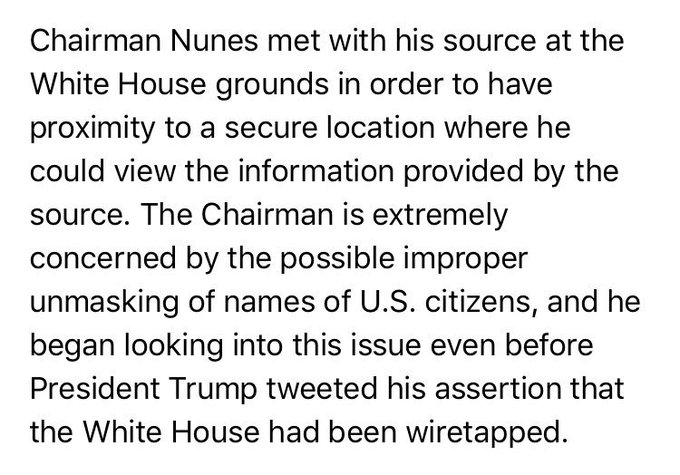
Comment from Chairman Nunes’ spox about his whereabouts the day before his announcement Trump/associates may be swept up in surveillance

As Reuters adds, it was the latest twist in a saga that began on March 4 when Trump said on Twitter that he “just found out that Obama had my ‘wires tapped’ in Trump Tower just before the victory.” FBI Director James Comey told Congress last Monday he had seen no evidence to support the claim. Trump’s mention of wiretapping drew attention away from U.S. intelligence agencies having said that Russia tried to help Trump in the election against Democrat Hillary Clinton by hacking leading Democrats and spreading disinformation. Moscow denies any such activities. Trump has also dismissed them.
Nunes told reporters on Wednesday that he had briefed Trump “on the concerns I had about incidental collection and how it relates to President-elect Trump and his transition team and the concerns that I have.” After an uproar over the allegations and the fact that he briefed Trump first before members of his own committee, Nunes apologized on Thursday for the way he handled the information. A congressional source said congressional investigators have questioned agencies directly to try to find out what intelligence reports and intercepts Nunes is referring to, but that as of Monday the agencies were still saying they did not know what Nunes was talking about.
Earlier on Monday, the Washington Post reported that Nunes was on his way to an event late Tuesday when he left his staff and went to review classified intelligence files brought to his attention by his source, whom he has not identified.
* * *
Meanwhile, the White House has seized on Nunes’ remarks to bolster Trump’s unproven assertion that Obama wiretapped his campaign headquarters in Manhattan’s Trump Tower. Nunes and some other Republicans have focused much of their concern over the investigation about the possibility that some Americans’ names have been improperly “unmasked” and released to the public in leaks about the investigation of whether Trump’s campaign colluded with Moscow. Nunes spokesman Langer cited concerns about the exposure of citizens’ names in his statement.
“The chairman is extremely concerned by the possible improper unmasking of names of U.S. citizens, and he began looking into this issue even before President Trump tweeted his assertion that Trump Tower had been wiretapped,” Langer said.
Democrats have questioned, given his actions, whether he can remain independent during the Intelligence Committee’s own investigation of Russian meddling.
It remains unknown who was Nunes’ source and whether he was doing the White House’s bidding in saying the transition team has been surveilled. Nunes said last week that the surveillance was not related to Russia and that the Trump officials had been caught up in legal snooping.
Previously, CNN reported that Nunes was with a staff member at the White House when he reviewed the intelligence. A spokesman said the intelligence could not have been taken to the House.
“The information comprised executive branch documents that have not been provided to Congress,” a Nunes spokesman said. “Because of classification rules, the source could not simply put the documents in a backpack and walk them over to the House Intelligence Committee space. The White House grounds was the best location to safeguard the proper chain of custody and classification of these documents, so the Chairman could view them in a legal way.”
* * *
Going back to Lake, the Bloomberg reporter said that “Nunes told me these reports were sent to the Obama White House among other executive branch agencies. Nunes until now had only said the reports he viewed were widely distributed inside the government. “The reports included details about the Trump transition, meetings of Trump and senior advisers, they were distributed throughout the intelligence community and to the White House,” Nunes said. “In some cases, there was additional unmasking of Trump transition team officials.”
As Lake concludes, “this is suggestive, though not yet proof, that White House officials privy to the Russia investigation wanted keep tabs on Trump and his advisers in the period after the election and before his inauguration. It also fits together with other facts in this story as well. For example, on March 1, the New York Times reported that Obama White House officials sought to preserve intelligence in the final days and weeks of his presidency on Team Trump’s connections to Russia and Russia’s campaign to influence the election. Though Nunes says the reports he viewed had nothing to do with Russia.”
The implications are two-fold as per Lake:
The good news is that we will soon get a second and third opinion. Nunes told me that he expects that his committee’s members, including Democrats, will be able to read these documents themselves at secure locations outside of Congress as soon as this week.
If it turns out that intelligence about the Trump transition was included in dozens of reports that were sent to the White House, then the House Intelligence Committee really has two investigations. The first is of course a probe into how the Russian state meddled in the election and whether it did so with the aid of Trump’s associates or campaign. The second is about whether the Obama White House inappropriately spied on Trump and his advisers during the transition to power.
While incomplete information and partisan innuendo continues to swirl, both sides are accusing each other of conducting a misdirection campaign meant to cover up either Trump’s links to Russia, or Obama’s surveillance of Trump for reasons still unknown. If Lake is correct, the mystery over Nunes’ White House visit will soon be resolved. As to whether Trump is an alleged puppet of Putin, or if Obama was actively spying on Trump, sadly that particular inquiry is only just starting.
end
We knew that this would be inevitable; Sessions will without money to santuray cities:
(courtesy zero hedge)
AG Sessions Makes Surprise Sanctuary City Announcement; Vows To Withhold Funding
Moments ago Attorney General Jeff Sessions made a surprise appearance at Sean Spicer’s daily White House press briefing to announce that his DOJ will be taking steps to not only require that so-called “sanctuary cities” enforce federal immigration laws but would also be seeking to claw back past DOJ awards granted to those cities if they refuse to certify compliance.
“Today, I’m urging states and local jurisdictions to comply with these federal laws. Moreover, the Department of Justice will require that jurisdictions seeking or applying for DOJ grants to certify compliance with 1373 as a condition for receiving those awards.”
“This policy is entirely consistent with the DOJ’s Office of Justice Programs guidance that was issued just last summer under the previous administration.”
“This guidance requires jurisdictions to comply and certify compliance with Section 1373 in order to be eligible for OJP grants. It also made clear that failure to remedy violations could result in withholding grants, termination of grants and disbarment or ineligibility for future grants.”
“The DOJ will also take all lawful steps to claw back any fines awarded to a jurisdiction that willfully violates Section 1373.”
Sessions also called on states like Maryland and California to scrap their plans for becoming a sanctuary state.
“That would be such a mistake.”
“I would plead with the people of Maryland to understand this makes the state of Maryland more at risk for violence and crime, that it’s not good policy.”
Sessions’ full comments can be viewed below:
Attorney General Sessions says sanctuary cities ‘cannot continue’ https://t.co/YiS9doT3IEpic.twitter.com/nGmICgmiA6
— FOX Business (@FoxBusiness) March 27, 2017
* * *
Update:
It didn’t take long for New York’s Attorney General to
release a statement vowing that he will continue to violate federal
laws.
- NY A.G. ‘WON’T STOP FIGHTING’ TRUMP’S IMMIGRATION POLICIES
- NY AG: STATE, LOCAL GOVTS HAVE BROAD AUTHORITY TO NOT TAKE PART
* * *
For those who missed it, here is an excerpt from our previous post detailing which sanctuary cities receive the most federal funding.
Our organization, American Transparency (website: OpenTheBooks.com) was able to identify that number. We found nearly $27 billion ($26.74 billion to be exact) in federal funding (FY2016) for America’s 106 Sanctuary Cities. Our new report, “Federal Funding of America’s Sanctuary Cites” details federal grants and other forms of federal spending that flow to those cities.
Using our OpenTheBooks interactive map, search federal funding by city. Just click a pin and scroll down to review the municipal agencies and entities (FY2016).
Across America, there are over 300 governmental jurisdictions claiming “sanctuary status.” Of those governments, there are 106 cities, while the rest are states, counties or other units of government.
Under Trump’s order, mayors defending their sanctuary city status are essentially imposing a defiance tax on local residents. On average, this tax amounts to $500 per man, woman and child. Major cities like Washington, D.C., New York and Chicago have the most to lose, and nearly $27 billion is at stake across the country.
Here are the top 10 takeaways from our findings:
- $26.741 billion in annual federal grants and direct payments flowed into America’s 106 sanctuary cities (FY2016).
- On average, the cost of lost federal funding for a family of four residing in one of the 106 sanctuary cities is $1,810 – or $454 per person. A total population of 46.2 million residents live in the 106 sanctuary cities according to census data.
- Washington, D.C., and Chicago, Illinois governments received the highest amount of federal funding per resident and, therefore, have the most to lose by maintaining their sanctuary status.Washington, D.C. municipal government received the highest amount of federal funding on a per capita basis: $3,228 per person; $12,912 per family of four; or $2.09 billion total. The City of Chicago, IL received the second highest amount of federal funding on a per capita basis: $1,942 per person; $7,768 per family of four; or $5.3 billion total.
- In cities with populations of 100,000 and above, the communities with the least per capita federal dollars ‘at risk’ are St. Paul, Minnesota ($47 per person, $14.2 million total); Downey, California ($36 per person, $4.2 million total) and Miami, Florida ($67 per person, $29.7 million total).
- $15.983 billion in federal funds flowed into just twelve major American cities where 1 in 5 illegal entrants reside (FY2016).
- Department of Justice grants to law enforcement – i.e. city police departments – totaled $543.97 million (FY2016). Typically, this funding was only a small percentage of the local law enforcement budgets.
- $4.23 billion in federal funding of the 106 sanctuary cities flowed via the ‘direct payment’ type. These payments funded municipal services such as housing, education, community development, and schools.
- $21.5 billion in federal funding of the 106 sanctuary cities flowed via the ‘grant’ payment mechanism. These payments funded local police and fire departments, schools, housing, and city services.
- In Los Angeles, fully 1 in 5 city residents (22-percent) are illegal entrants. However, the amount of federal funding amounts to only $126 per resident; $504 per family of four; or $502.5 million total.
- In Newark, New Jersey, 19-percent of city residents are undocumented entrants. However, the amount of federal funding amounts to $733 per resident; $2,932 per family of four; or $206.7 million.
The threat of losing nearly $27 billion in federal funding seems to be having an effect on some cities. In fact, Miami already reversed their sanctuary city policy.
end
Let’s close tonight’s commentary with this interview with one of my favourite economists: John Williams.
(courtesy Greg Hunter/USAWatchdog/)
Trump is America’s Last Chance-John Williams
By Greg Hunter’s USAWatchdog.com (Early Sunday Release)
Economist John Williams says President Trump has to do something fast and big to turn the faltering U.S. economy around. Williams explains, “You are seeing the economy slow down. Some people are recognizing that. The Fed’s statement a week or two ago . . . many analysts consider that dovish. The Fed knows what’s going on here. They are trying to get rates up a little, but they have a circumstance that they are not out of the woods with the banks. What they are hoping for is maybe the Trump Administration is going to bail them out and stimulate the economy.”
Williams says “The banks are still not healthy. . . . The Fed is still fighting the battle it effectively lost in 2008. Mr. Trump has several problems. One is the economy. One is the long term budget deficit, and the third is the Federal Reserve. The Fed lost control of the system. The system effectively collapsed. They haven’t been able to bring it back to normal.”
Would Donald Trump simply default on the U.S. debt if countries around the world dump U.S. Treasury bonds? Williams says, “That would be an act of default. You don’t want to do that. What Trump needs to do is address the long term solvency issues of the United States. Then he can convince people that, yes, we are going to be able to handle this, and at the same time, take action to stimulate the economy. That could be very bullish for the dollar fundamentally. . . . If they want this to work and save the system, and Mr. Trump will come out of this with his face on Mount Rushmore if he does, he’s got to turn the economy. To do that, he needs to increase government spending in areas that would help stimulate the economy. He’s got to cut taxes, and that is in the works in some form. As part of the process, there very likely will be a widening of the budget deficit, which could kill the dollar and kill people holding Treasuries.”
Williams says Trump must address the “long term solvency of the United States.” Williams goes on to say, “If he does this, the rest of the world will say, boy, they brought things under control, and they would be happy to own the Treasury bonds. I don’t know if this can be done, but this is what you got to do.”
If Trump does not succeed, Williams says, “The problem will be with the dollar. If the system is not brought under control, the rest of the world is going to dump the dollar. . . . The underlying fundamentals have not changed. The U.S. dollar is, in the long term, insolvent. What has changed here is that there is a chance that the Trump Administration can correct it. As far as I can see, this (Trump) is the last chance to correct it.”
Join Greg Hunter as he goes One-on-One with Economist John Williams, founder of ShadowStats.com.
(There is much more in the video interview.)
(There is much more in the video interview.)
After the Interview:
After the Interview:
Well that about does it for tonight
I will see you tomorrow night
h./


[…] MARCH 27/GOLD BREAKS AWAY FROM RESISTANCE AT $1250 TO CLOSE AT $1255.40/ SILVER THE STAR OF THE SHOW… […]
LikeLike
[…] by Harvey Organ Harvey Organ’s Blog […]
LikeLike