
GOLD: $1277.10 DOWN $2.55
Silver: $16.95 DOWN 10 cents
Closing access prices:
Gold $1277.00
silver: $16.95
SHANGHAI GOLD FIX: FIRST FIX 10 15 PM EST (2:15 SHANGHAI LOCAL TIME)
SECOND FIX: 2:15 AM EST (6:15 SHANGHAI LOCAL TIME)
SHANGHAI FIRST GOLD FIX: $1290.44 DOLLARS PER OZ
NY PRICE OF GOLD AT EXACT SAME TIME: $1281.80
PREMIUM FIRST FIX: $8.64(premiums getting larger)
xxxxxxxxxxxxxxxxxxxxxxxxxxxxxxxxxxxxxxxxxxxxxx
SECOND SHANGHAI GOLD FIX: $1291.54
NY GOLD PRICE AT THE EXACT SAME TIME: $1281.30
Premium of Shanghai 2nd fix/NY:$10.24 PREMIUMS GETTING LARGER)
xxxxxxxxxxxxxxxxxxxxxxxxxxxxxxxxxxxxxxxxxxxxxxxxxxx
LONDON FIRST GOLD FIX: 5:30 am est $1278.30
NY PRICING AT THE EXACT SAME TIME: $1277.90
LONDON SECOND GOLD FIX 10 AM: $1276.45
NY PRICING AT THE EXACT SAME TIME. 1276.90
For comex gold:
OCTOBER/
NOTICES FILINGS TODAY FOR OCT CONTRACT MONTH: 562 NOTICE(S) FOR 56,200 OZ.
TOTAL NOTICES SO FAR: 3005 FOR 300,500 OZ (9.346TONNES)
For silver:
OCTOBER
167 NOTICES FILED TODAY FOR
835,000 OZ/
Total number of notices filed so far this month: 965 for 4,825,000 oz
XXXXXXXXXXXXXXXXXXXXXXXXXXXXXX
Bitcoin: $5693 bid /$5713 offer DOWN $166.00 (MORNING)
BITCOIN CLOSING;$5665 BID:5685. OFFER DOWN $191.00
end
Let us have a look at the data for today
xxxxxxxxxxxxxxxxxxxxxxxxxxxxxxxxxxxxxxxxxxxxxxxxxxxxxxxxxxxxxxxxxxxxxxxxxx
In silver, the total open interest FELL BY ONLY 240 contracts from 192 ,364 DOWN TO 192,124 WITH RESPECT TO YESTERDAY’S TRADING (up 2 CENTS). THE CROOKS ARE STILL HAVING AN AWFUL TIME TRYING TO COVER THEIR MASSIVE SILVER SHORTS SO THEY ONCE AGAIN ORGANIZE ANOTHER ATTEMPTED RAID ON OUR PRECIOUS METALS TODAY.
RESULT: A SMALL SIZED FALL IN OI COMEX WITH THE 2 CENT PRICE RISE. OUR BANKERS COULD NOT COVER MUCH OF THEIR HUGE SHORTFALL SO ANOTHER RAID WAS CALLED UPON.
In ounces, the OI is still represented by just UNDER 1 BILLION oz i.e. 0.962 BILLION TO BE EXACT or 137% of annual global silver production (ex Russia & ex China).
FOR THE NEW FRONT OCT MONTH/ THEY FILED: 167 NOTICE(S) FOR 835,000 OZ OF SILVER.
In gold, the open interest FELL BY 1923 CONTRACTS DESPITE THE TINY RISE IN PRICE OF GOLD ($0.30) . The new OI for the gold complex rests at 527,390. OUR BANKER FRIENDS NO DOUBT COVERED A BIT OF THEIR SHORTFALL WITH THE TINY RISE IN PRICE BUT NOT ENOUGH FOR THEIR LIKING. THUS THEY CALLED FOR ANOTHER RAID TRYING TO SHAKE MORE GOLD/SILVER LEAVES TO FALL.
Result: A SMALL SIZED DECREASE IN OI WITH TINY RISE IN PRICE IN GOLD ($0.30). WE HAD SOME BANKER GOLD SHORT COVERING AS THE BANKERS FAILED MISERABLY TO LOOSEN ANY GOLD LEAVES FROM THE GOLD TREE YESTERDAY..SO THEY ORGANIZED ANOTHER RAID THIS MORNING.
we had: 562 notice(s) filed upon for 56,200 oz of gold.
xxxxxxxxxxxxxxxxxxxxxxxxxxxxxxxxxxxxxxxxxxxxxxxxxxxxxxxxxxx
With respect to our two criminal funds, the GLD and the SLV:
GLD:
Tonight , NO CHANGES in gold inventory at the GLD/
Inventory rests tonight: 853.13 tonnes.
SLV
Today: STRANGE!! WITH SILVER CLOSING HIGHER WE HAD A WITHDRAWAL OF 1,039,000 OZ FROM THE SLV
INVENTORY RESTS AT 320.288 MILLION OZ
end
.
First, here is an outline of what will be discussed tonight:
1. Today, we had the open interest in silver FELL BY ONLY 240 contracts from 192,364 DOWN TO 192,124(AND now A LITTLE FURTHER FROM THE NEW COMEX RECORD SET ON FRIDAY/APRIL 21/2017 AT 234,787) . OUR BANKERS WERE AGAIN UNSUCCESSFUL IN THEIR ATTEMPT TO COVER MUCH OF THEIR SILVER SHORTS.
RESULT: A SMALL DECREASE IN SILVER OI AT THE COMEX WITH THE TINY RISE IN PRICE OF 2 CENTS (WITH RESPECT TO YESTERDAY’S TRADING). OUR BANKER FRIENDS WERE UNSUCCESSFUL IN THEIR ATTEMPT TO COVER MUCH OF OUR SILVER SHORTS SO ANOTHER RAID WAS ORCHESTRATED THIS MORNING.
(report Harvey)
.
2.a) The Shanghai and London gold fix report
(Harvey)
2 b) Gold/silver trading overnight Europe, Goldcore
(Mark O’Byrne/zerohedge
and in NY: Bloomberg
3. ASIAN AFFAIRS
i)Late MONDAY night/TUESDAY morning: Shanghai closed UP 7.55 points or .22% /Hang Sang CLOSED DOWN 150.91 pts or 0.53% / The Nikkei closed UP 108.52 POINTS OR .50/Australia’s all ordinaires CLOSED UP 0.09%/Chinese yuan (ONSHORE) closed UP at 6.6314/Oil UP to 52.27 dollars per barrel for WTI and 57.73 for Brent. Stocks in Europe OPENED IN THE GREEN EXCEPT LONDON . ONSHORE YUAN CLOSED UP AGAINST THE DOLLAR AT 6.6314. OFFSHORE YUAN CLOSED WEAKER TO THE ONSHORE YUAN AT 6.6331 AND //ONSHORE YUAN STRONGER AGAINST THE DOLLAR/OFF SHORE STRONGER TO THE DOLLAR/. THE DOLLAR (INDEX) IS WEAKER AGAINST ALL MAJOR CURRENCIES. CHINA IS HAPPY TODAY.
3a)THAILAND/SOUTH KOREA/NORTH KOREA
i)North Korea/USA/UK
Boris Johnson, Sec of State for Great Britain refuses to rule out a “preemptive strike” against North Korea
( Mac Slavo/SHFTPlan.com)
b) REPORT ON JAPAN
c) REPORT ON CHINA
The 19th Congress will be over shortly, The Congress has now stated that Xi is the most powerful leader since Mao. As for succession, let us see who walks out with him…
Also now that he is confirmed, let us see if they adopt the new Yuan for oil for gold policy..
( zerohedge)
4. EUROPEAN AFFAIRS
As we have highlighted to you on many occasions, the Muslim migration into Italy is becoming a huge crisis
( GEFIRA)
ii)GERMANY/RUSSIA
Germany’s delegation to Russia is another dagger into the heart of USA hegemony as Merkel is looking for new allies
( George Friedman (Stratfor)/Mauldin Economics)
5. RUSSIAN AND MIDDLE EASTERN AFFAIRS
i)IRAQ
Another dagger for the USA: the Shia Militia leader tells the USA to get ready to leave Iraq
( zerohedge)
ii)TURKEY/USA
The fun begins; the USA has just declined to issue visas for a delegation from Turkey’s Justice Ministry
check to Mr Erdogan
( zero hedge)
6 .GLOBAL ISSUES
This Bellwether stock soars 7% to an all time high after smashing earnings as well as boosting guidance. The reason: commodity prices are increasing
( zero hedge)
7. OIL ISSUES
Both WTI and Gasoline extend their gains after major gas and distillate drawdowns
( zerohedge)
8. EMERGING MARKET
9. PHYSICAL MARKETS
i)I agree with Ted that the real reason that Mocatta wants to get out of the silver short business is due to its huge losses. Their problem will be two-fold:
- nobody will want to take the liability
- even if they try and shut their business, the 75 million oz of silver short remains as it is impossible to cover
( Ted Butler)
ii)No surprise here: Venezuela lost its gold that it pawned off to Deutsche bank.
( zerohedge)
iii)We brought you this story yesterday but it is worth repeating. A jury finds an ex HSBC executive guilty of front running a 3.5 billion currency trade. This is just one trade. You can imagine the thousands of trades that these guys executed in gold and silver
( Reuters/GATA)
iv)Ecuador now seems to be the next gold frontier as the country now wants gold/silver exploration
( Dave Forest/OilPrice.com)
10. USA Stories
i)This will go down as the worst scandal in USA history: the Clinton Foundation and the Uranium deal with Putin
( Ortel)
ii)Hillary is lying through her eye teeth as evidence is mounting against her. She can no longer ignore the burgeoning scandal and Jeff Sessions must detail all of her Clinton Foundation donations which is basically a pay for play criminal organization
( zerohedge)
iii) Hillary is having a bad hair day as House Committees finally announce an investigation into Hillary’s approval of Russia’s Uranium One deal
( zerohedge)
iiib)And now James Comey is having a bad hair day as the House is launching a probe into how the FBI handled the Clinton email scandal
( zerohedge)
iv)Trump heads to the Hill as a feud erupts between the President and Corker, just hours before a critical senate meeting. Trump can ill afford to lose some Republicans in his tax reform bill
( zerohedge)
iv b) As promised, I doubt very much if the USA will get its tax reform. There are 3 Republicans that appear to be against the reform:
Rand Paul, Corker and now McCain
(courtesy zerohedge)
iv c) First it was Bob Corker who stated that he would not run in the 2018 race and now Arizona Senator Jeff Flake stated that he would not run. Looks like the Republican party is disintegrating.
( zerohedge)
v)Despite the 2 hurricanes which wiped out huge numbers of cars, the inventory levels at various GM plants are still high
( zerohedge)
( Ron Paul)
vii)The bond king, Jeff Gundlach warns that the financial system is about to be turned upside down and states to get out of bonds
viii)This will not be good for our big on line advertisers as giant Interpublic tumbles due to its warning on the state of the ad industry. Most of our high tech firms rely on advertising for their profits.( zerohedge)
Let us head over to the comex:
The total gold comex open interest FELL BY 763 CONTRACTS DOWN to an OI level of 527,390 DESPITE THE RISE IN THE PRICE OF GOLD ($0.30 RISE IN YESTERDAY’S TRADING). OUR BANKER FRIENDS HAD MINIMAL SUCCESS IN THEIR ATTEMPT TO COVER THEIR HUGE GOLD SHORTFALL BUT NOT ENOUGH FOR THEIR LIKING. THEY THUS CALLED FOR ANOTHER RAID THIS MORNING HOPING MORE GOLD/SILVER LEAVES WILL FALL.
OCTOBER IS AN ACTIVE DELIVERY MONTH ALTHOUGH IT IS THE WEAKEST IN TERMS OF ACTUAL DELIVERIES AND OPEN INTEREST. WE VISUALIZED THAT THROUGHOUT THE MONTH OF SEPTEMBER, THE CROOKS UTILIZED THE EMERGENCY EFP SCHEME TO TRANSFER OBLIGATIONS OVER TO LONDON. IT THEN STANDS TO REASON THAT IF THE EMERGENCY WAS IN FORCE THROUGHOUT THE MONTH OF SEPTEMBER IT WOULD CONTINUE ON FIRST DAY NOTICE WHEREBY ANOTHER 7200 LONG COMEX CONTRACTS WERE GIVEN 7200 EFP’S.
Result: a SMALL SIZED open interest DECREASE DESPITE THE RISE IN THE PRICE OF GOLD ($0.30.) .THERE WAS MINIMAL SHORT COVERING FRIDAY WITH THE BANKERS SLIGHTLY DECREASING TO THEIR HUGE SHORTFALL.
.
We have now entered the active contract month of Oct and here we saw a GAIN of 66 contracts UP TO 752 contracts. We had 0 notices filed yesterday so we GAINED 66 contracts or an additional 6,600 oz will stand for delivery at the comex in this active delivery month of October and 0 EFP notices were given. The low number of notices early in the delivery cycle is evidence of a lack of physical gold. We have just witnessed yet another queue jumping in the gold comex which is another indicator of physical shortage. TO SEE THIS IN BOTH GOLD AND SILVER MUST BE HEARTENING TO US!!
The November contract saw A loss OF 11 contracts down to 888.
The very big active December contract month saw it’s OI loss OF 3,338 contracts DOWN to 395,986
.
We had 562 notice(s) filed upon today for 56,200 oz
VOLUME FOR TODAY (PRELIMINARY) N/A
CONFIRMED VOLUME YESTERDAY: 297,084
We had 167 notice(s) filed for 835,000 oz for the OCT. 2017 contract
Oct.24/2017.
| Gold | Ounces |
| Withdrawals from Dealers Inventory in oz | nil oz |
| Withdrawals from Customer Inventory in oz |
nil oz
|
| Deposits to the Dealer Inventory in oz | nil oz |
| Deposits to the Customer Inventory, in oz |
nil oz
|
| No of oz served (contracts) today |
562 notice(s)
56,200OZ
|
| No of oz to be served (notices) |
190 contracts
(19,000 oz)
|
| Total monthly oz gold served (contracts) so far this month |
3005 notices
300,500 oz
9.3468 tonnes
|
| Total accumulative withdrawals of gold from the Dealers inventory this month | NIL oz |
| Total accumulative withdrawal of gold from the Customer inventory this month | xxx oz |
Today, 0 notice(s) were issued from JPMorgan dealer account and 0 notices were issued from their client or customer account. The total of all issuance by all participants equates to 562 contract(s) of which 0 notices were stopped (received) by j.P. Morgan dealer and 117 notice(s) was (were) stopped/ Received) by j.P.Morgan customer account.
| Silver | Ounces |
| Withdrawals from Dealers Inventory | nil |
| Withdrawals from Customer Inventory |
16,942.54 oz
CNT
|
| Deposits to the Dealer Inventory |
2,402,115.160 oz
Brinks
|
| Deposits to the Customer Inventory |
1,499,296.190
HSBC
Brinks
CNT
oz
|
| No of oz served today (contracts) |
167 CONTRACT(S)
(835,000,OZ)
|
| No of oz to be served (notices) |
61contracts
(305,000 oz)
|
| Total monthly oz silver served (contracts) | 965contracts
(4,825,000 oz) |
| Total accumulative withdrawal of silver from the Dealers inventory this month | NIL oz |
| Total accumulative withdrawal of silver from the Customer inventory this month | xx oz |
NPV for Sprott and Central Fund of Canada
will update later tonight
Sprott WINS hostile 3.1 billion bid to take over Central Fund of Canada
(courtesy Sprott/GATA)
Sprott Inc. to take control of rival gold holder Central Fund of Canada
Posted Oct 2, 2017 8:43 am PDT
Last Updated Oct 2, 2017 at 9:20 am PDT
TORONTO – Sprott Inc. (TSX:SII) says it has struck a deal to take control of rival gold-holding firm Central Fund of Canada Ltd. (TSX:CEF.A) after a protracted takeover effort.
Toronto-based Sprott said Monday it will pay $120 million in cash and stock for Central Fund of Canada Ltd.’s common shares and for the right to administer and manage the fund’s assets.
The deal, which requires approval from Central Fund shareholders, would see its class A shareholders transferred to a new Sprott Physical Gold and Silver Trust.
Sprott says the deal would add $4.3 billion to its assets under management, which are focused largely on holding physical precious metals on behalf of clients, and 90,000 investors to its client base.
In March, Sprott tried to go through the Court of Queen’s Bench of Alberta to allow Central Fund’s class A shareholders to swap their shares to Sprott after the family that controls Central Fund rebuffed their attempt to make a deal.
Last year Sprott took over Central GoldTrust, a similar fund controlled by the same family, after securing support from more than 96 per cent of shareholder votes cast.
END
And now the Gold inventory at the GLD
Oct 24./no change in gold inventory at the GLD/inventory rests at 853.13 tonnes
OCT 23./NO CHANGE IN GOLD INVENTORY AT THE GLD/INVENTORY REMAINS AT 853.13 TONNES
OCT 20/NO CHANGE IN GOLD INVENTORY AT THE GLD/ INVENTORY REMAINS AT 853.13 TONNES
oCT 19/NO CHANGE/853.13 TONNES
Oct 18 /no change in gold inventory at the GLD/ inventory rests at 853.13 tonnes
Oct 17./no change in gold inventory at the GLD/inventory rests at 853.13 tonnes
Oct 16/A HUGE WITHDRAWAL OF 5.32 TONNES FROM THE GLD/INVENTORY RESTS AT 853.13 TONNES
0CT 13/ NO CHANGES IN GOLD INVENTORY AT THE GLD/INVENTORY RESTS AT 858.45 TONNES
Oct 12/NO CHANGES IN GOLD INVENTORY AT THE GLD/INVENTORY RESTS AT 858.45 TONNES
Oct 10/NO CHANGES IN GOLD INVENTORY AT THE GLD/INVENTORY RESTS AT 858.45 TONNES
Oct 9/ANOTHER DEPOSIT OF 4.43 TONNES INTO GLD/INVENTORY RESTS AT 858.45 TONNES
Oct 6/A DEPOSIT OF 2.96 TONNES OF GOLD INVENTORY INTO THE GLD/TONIGHT IT RESTS AT 854.02 TONNES
Oct 5/A LOSS OF 3.24 TONNES OF GOLD INVENTORY FROM THE GLD/INVENTORY RESTS AT 851.06 TONNES
Oct 4/NO CHANGES IN GOLD INVENTORY AT THE GLD/INVENTORY RESTS AT 854.30 TONNES
oCT 3/ A HUGE WITHDRAWAL OF 10.35 TONNES FROM THE GLD/INVENTORY RESTS AT 854.30 TONNES
Oct 2/STRANGE/WITH GOLD’S CONTINUAL WHACKING WE GOT A BIG FAT ZERO OZ LEAVING THE GLD/INVENTORY RESTS AT 864.65 TONNES
SEPTEMBER 29/no changes in gold inventory at the GLD/Inventor rests at 864.65 tonnes
Sept 28/NO CHANGES IN GOLD INVENTORY AT THE GLD/INVENTORY RESTS AT 864.65 TONNES
Sept 27/WOW!! WITH GOLD DOWN $13.25, WE HAD A HUGE 8.57 TONNES OF GOLD ADDED TO THE GLD/
Sept 26/no changes in gold inventory at the GLD/Inventory rests at 856.08 tonnes
Sept 25./Another big deposit of 3.84 tonnes into GLD/Inventory rests tonight at 856.08 tonnes
Sept 22/with gold up only 1 dollar on the day we had a massive 6.21 tonnes of gold added to the GLD/.this is a good sign that gold will advance nicely this coming week.
Sept 21/no change in gold inventory tonight/inventory rests at 846.03 tonnes
Sept 20/no change in gold inventory tonight/inventory rests at 846.03 tonnes
Sept 19/another deposit of 2.07 tonnes of gold into the GLD/inventory rests at 846.03 tonnes
Sept 18/a huge 5.32 tonnes of gold deposit into the GLD despite gold’s whack today/inventory rests at 843.96 tonnes
Sept 15./strange!!no change in GLD after the whacking of gold/inventory remains at 838.64 tonnes
Sept 14./no changes at the GLD/inventory rests at 838.64 tonnes
Sept 13/late last night a huge 4.14 tonnes of gold was added to the GLD inventory/inventory rests at 838.64 tonnes.
Sept 12/as of 5: 40 pm est, no changes in gold inventory at the GLD/Inventory rests at 834.50 tonnes
Sept 11/Today we had a rather large 2.37 tonnes of gold removed from the GLD/Inventory rests at 834.50 tonnes
Sept 8/we had a tiny withdrawal of .34 tonnes and probably that would be to pay for fees like insurance etc.
Inventory rests at 836.87 tonnes
end
Now the SLV Inventory
Oct 24/no change in inventory at the SLV/inventory rests at 320.288 million oz/
oCT 23./STRANGE!!WITH SILVER RISING TODAY WE HAD A HUGE WITHDRAWAL OF 1.039 MILLION OZ/inventory rests at 320.288 million oz/
OCT 20NO CHANGE IN SILVER INVENTORY AT THE SLV/INVENTORY RESTS AT 321.327 MILLION OZ
oCT 19/INVENTORY LOWERS TO 321.327 MILLION OZ
Oct 18 no change in silver inventory at the SLV/inventory rest at 322.271 million oz
Oct 17/ A MONSTROUS WITHDRAWAL OF 3.494 MILLION OZ FROM THE SLV/INVENTORY RESTS AT 322.271 MILLION OZ
Oct 16/ NO CHANGES IN SILVER INVENTORY AT THE SLV.INVENTORY RESTS AT 325.765 MILLION OZ
oCT 13/ NO CHANGES IN SILVER INVENTORY AT THE SLV/INVENTORY RESTS AT 325.765 MILLION OZ
Oct 12/THE LAST TWO DAYS WE LOST 1.113 MILLION OZ FROM THE SLV/INVENTORY RESTS AT 325.765 MILLION OZ
Oct 10/NO CHANGE IN INVENTORY AT THE SLV/INVENTORY RESTS AT 326.898 MILLION OZ/
Oct 9/A HUGE DEPOSIT OF 1.227 MILLION OZ INTO THE INVENTORY OF THE SLV/INVENTORY RESTS AT 326.898 MILLION OZ
Oct 6/NO CHANGE IN SILVER INVENTORY/ INVENTORY RESTS AT 325.671 MILLON OZ
Oct 5/ANOTHER WITHDRAWAL OF 944,000 OZ FROM THE SLV/INVENTORY RESTS AT 325.671 MILLION OZ
OCT 4/NO CHANGE IN SILVER INVENTORY AT THE SLV/INVENTORY RESTS AT 326.615 MILLION Z
Oct 3/A TINY WITHDRAWAL OF 143,000 FROM THE SLV FOR FEES/INVENTORY RESTS AT 326.615 MILLION OZ
Oct 2/NO CHANGES IN SILVER INVENTORY AT THE SLV/INVENTORY RESTS AT 326,757 MILLION OZ
SEPTEMBER 29/no changes in silver inventory at the SLV/inventory rests at 326.757 million oz/
Sept 28/NO CHANGES IN SILVER INVENTORY/INVENTORY RESTS AT 326.757 MILLION OZ/
Sept 27/STRANGE!! SILVER IS HIT FOR 24 CENTS YESTERDAY AND. 9 CENTS TODAY AND YET NO CHANGE IN SILVER INVENTORY/INVENTORY RESTS AT 326.757 MILLION OZ
Sept 26./no change in silver inventory at the SLV/.inventory rests at 326.757 million oz
Sept 25./ a big deposit of 1.842 million oz into the SLV/inventory rests at 326.757 million oz/
Sept 22/no change in silver inventory at the SLV/Inventory rests at 324.915 million oz/
Sept 21/no change in silver inventory at the SLV/Inventory rests at 324.915 million oz
Sept 20/no changes in silver inventory/Inventory remains at 324.915 million oz
Sept 19/strange!! another withdrawal of 1.134 million oz despite the rise in silver/inventory rests at 324.915 million oz
Sept 18/a withdrawal of 1.039 million oz from the SLV/Inventory rests at 326.049 million oz
Sept 15./no change in silver inventory at the SLV/Inventory rests at 327.088 million oz/
Sept 14/no change in silver inventory at the SLV/Inventory rests at 327.088 million oz/
Sept 13/no change in silver inventory at the SLV/Inventory rests at 327.088 million oz/
Sept 12.2017/no change in silver inventory at the SLV/Inventory rests at 327.088 million oz/
Sept 11.2017: no change in silver inventory at the SLV/Inventory rests at 327.088 million oz/
Sept 8/no change in silver inventory at the SLV/Inventory rests at 327.088 million oz/
Oct 24/2017:
-
 Indicative gold forward offer rate for a 6 month duration+ 1.34%
 -
+ 1.58%

end
Major gold/silver trading/commentaries for TUESDAY
GOLDCORE/BLOG/MARK O’BYRNE.
GOLD/SILVER
Gold Is Better Store of Value Than Bitcoin – Goldman Sachs

Gold is better store of value than bitcoin – Goldman Sachs report
– Gold will continue to perform well thanks to uncertainty and wealth demand
– Bitcoin’s volatility continues to impact its role as money
– Gold up 12% in 2017, bitcoin over 600%
– BTC is six times more volatile than gold – see chart
– Gold’s history and physical property shows it meets requirements as a medium of exchange and store of value
Since the birth of bitcoin there has been one question that has repeatedly grabbed headlines and led debates all over the world – will bitcoin replace gold?
The latest to weigh in on this question is Goldman Sachs which, in a research note entitled ‘Fear and Wealth’, has concluded that gold is better than bitcoin.
Examining gold and bitcoin against the key characteristics of money, the report concludes that “Precious metals remain a relevant asset class in modern portfolios, despite their lack of yield…They are neither a historic accident or a relic.”
Goldman Sachs looked at four key properties of a long-term store of value – durability, portability, intrinsic value and unit of account – concluding that the reasons why gold was originally adopted remain relevant to today.
They believe as the level of uncertainty increases investors increase their exposure to gold. Fear is the medium to short-term driver of the gold price. The long-term driver, Goldman Sachs believes, is wealth.
The debate of gold versus bitcoin is really a rather tedious one. So rarely do you see any other two assets pitched against one another. Yet those choosing to debate it manage to find common ground between the two, so the debate rages on. Bitcoin’s finite supply and occasional rise on the back of geopolitical tensions has led to such comparisons.
Conversely the debate is relevant as both assets are ones which evoke a strong emotive reaction and raise similar questions about the state of the economy and the investment space. As bitcoin’s market cap increases (heading to $100 billion) it is inevitable that it will continue to grab the attention of the likes of Goldman Sachs and institutional investors. Most recently, Ray Dallio, the world’s biggest fund manager felt the need to point out the bitcoin bubble and how he favoured gold over the cryptocurrency.
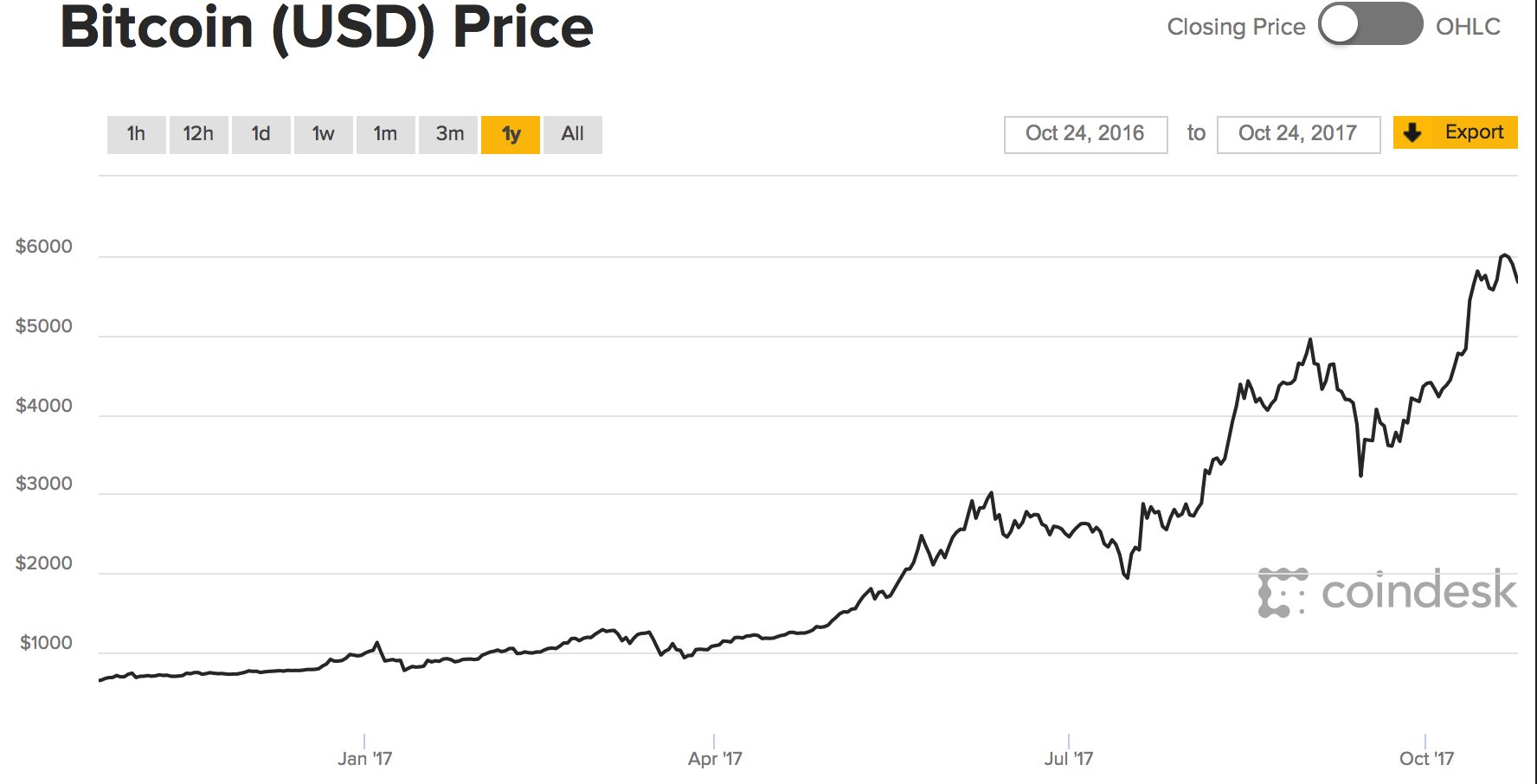
The debate is of particular interest this year given bitcoin’s performance. It has climbed from around $1,000 at the start of the year to nearly $6,000. In the same period gold is up 12%.
“Gold wins out over cryptocurrencies in a majority of the key characteristics of money,”

The first record of gold being used as money is from around 700 B.C. when the Lydians combined it with silver, to form electrum coins.
Bitcoin’s role as money is one which is still being established. Many of the problems it faces are down to infrastructure and price volatility.
Goldman Sachs addressed the main characteristics that make a medium of exchange and found gold to outperform bitcoin.
The findings were summarised by Bloomberg:
Durability: While both require expertise for correct long-term storage, gold wins because cryptocurrencies are vulnerable to hacking through online wallets or the user’s computer or smartphone, are subject to regulatory risk, and network and infrastructure risk during a crisis.
Portability: Transferring bullion can be expensive, given its weight, need for a high level of security and high import taxes in some countries, such as India. In contrast, it’s much faster and cheaper to move bitcoins.
Intrinsic value: There’s a limited supply of gold and other precious metals in the Earth’s crust, whereas in the case of cryptocurrencies, it’s easy to create alternatives, meaning there’s effectively no control over supply at a macroeconomic level and no intrinsic value due to rarity.
Unit of account: Gold is better at holding its purchasing power, and has much lower daily volatility. Bitcoin/dollar volatility has averaged almost seven times that of gold in 2017, the bank said.
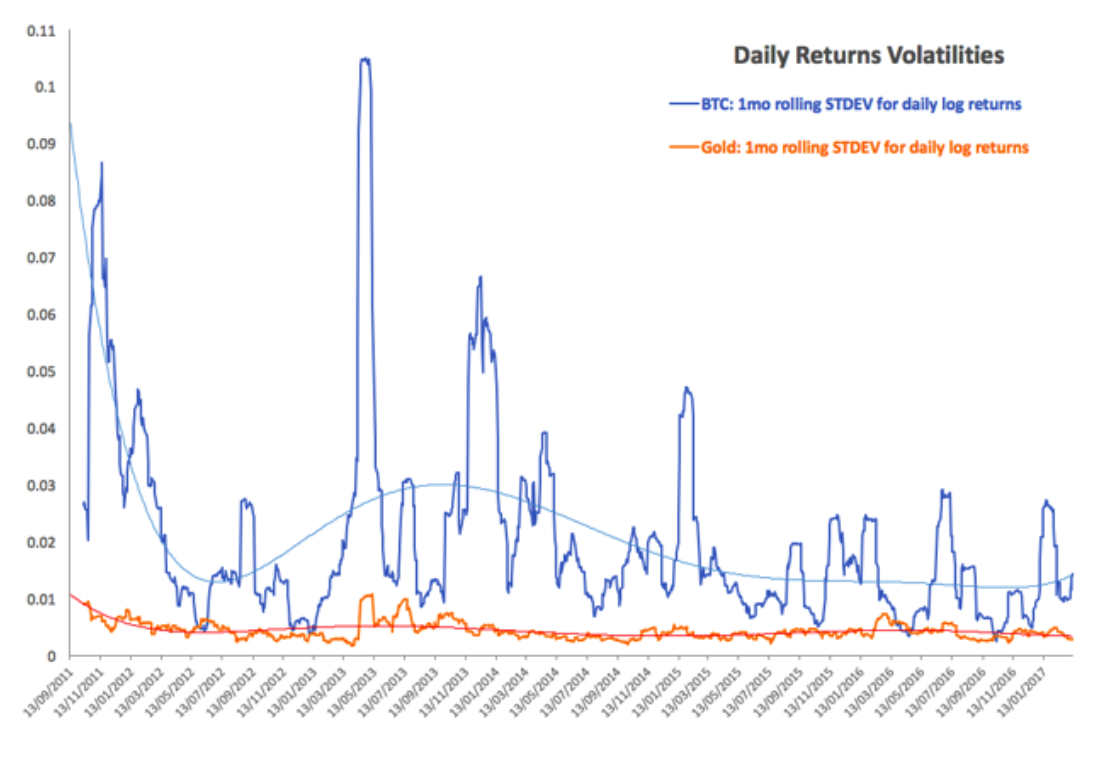
Chart from March 2017
In regard to volatility the Fear and Wealth report stressed how “a 3-day USD/BTC put option at historical average volatility results in a premium of around 2.3%.” This is clearly a prohibitive premium. Fiat to bitcoin volatility this year stands at more than six times that seen with gold.
The authors conclude that these factors “clearly illustrate that Bitcoin as a unit of account and medium of exchange is nowhere near as favourable as it first appears.”
Is gold that immovable?
Goldman Sachs found gold was only at a disadvantage to bitcoin when it came down to portability. This is something that is often cited about gold.
Bullion is often accused of being bulky and therefore dysfunctional as a form of money. However, there are two main factors that are overlooked by those who argue this:
– Size of gold bars and coins relative to value
If you consider that the high income households in the UK are estimated to have around £63,000 (on average) in savings then this would be just 2 kilogram bars of gold. About the size of a smart phone each. Not exactly immovable.
Then consider coins, far more portable and a great way to divide up your gold holdings.
Should you hold gold (either at home or in a vault) then you are rarely under the same requirements to move the gold as you are if you had the equivalent held in a bank. Often banks demand a few days’ notice, or limit the amount of cash you can move in one go. Arguably, less portable than a trusty gold bar.
– Technology
In order to spend bitcoin you are required to be ‘online’. Fantastic for those of us who are able to go anywhere without worrying about connectivity. Not so great for those countries, remote areas or disaster struck places (such as Puerto Rico) that do not find it so easy to just jump online and shift a few bitcoin.
Spending a few gold coins, or even a small gold bar, does not require you to partake in an online transaction. Should you find yourself in a position where you need to spend your gold, a power outage or loss of connection will not be your biggest problem.
Uncertainty and fear: the drivers of gold

It is interesting that given the title of the report is Fear and Wealth, the authors do not consider why gold’s portability is relevant and addresses fears surrounding uncertainty.
There are a number of fears about the direction both the financial and political spheres are heading in. Consider real interest rates issues, debasement, sovereign balance-sheet, geopolitical and other market risks.
The main fear is that no-one knows how bad things will be and so investment decisions are coming down to uncertainty. This is good for gold and its price.
“Stated more simply, we are talking about the drivers of ‘risk-on, risk-off’ behavior in markets…This factor matters so much to gold precisely because it is a safe-haven asset. Accordingly, as uncertainty increases, preferences shift towards having more gold in the portfolio, driving prices higher.”
People like to hold gold because they can balance the uncertainty with the certainty that gold will be accepted regardless of how things pan out. Holders know that they can easily transport and transfer it, in order to make an exchange for goods. They cannot know this with bitcoin, both because of its design and because it has never been tested in such a way.
Gold investors are also exposed to far less uncertainties when it comes to professional storage, something Goldman Sachs does acknowledge:
“While both require expertise for correct long-term storage, gold wins because cryptocurrencies are vulnerable to hacking through online wallets or the user’s computer or smartphone, are subject to regulatory risk, and network and infrastructure risk during a crisis,”
Despite this acknowledgement it is interesting that ‘portability’ is still seen as a negative for gold. This has not restricted gold too much in the past.
Long-term investors are clearly also not too concerned about portability either. Goldman Sachs believes these investors are the key to gold’s long-term performance, thanks to a desire to build and protect their wealth.
Gold’s future
Goldman Sachs forecasts that emerging market economies will be the key drivers of wealth-based demand for gold.
“As more EM economies — including China — are set to grow to these income levels over the next few decades, the underlying long-term demand picture remains supportive of gold prices…While fear can spike or fall relatively quickly, wealth tends to accumulate slowly. This makes wealth an important, but easy to overlook in short-term forecasting, driver of gold.”
The likes of China and India are experiencing a rapidly growing middle-class, all of whom are interested in buying gold. Between the two countries they account for 60% of the global jewellery market.
This is likely to boost long-term demand for the precious metal given rapid accumulation of gold tends to occur when per-capita gross domestic product reaches roughly $20,000 to $30,000.
There is still a long-way to go for 29 developing countries, each of whom have an interest in holding gold.
“Our modeling, based on the historical experiences of 29 countries at various stages of development since the early 1990s, suggests that this is still very far from peak annual demand,”
Uncertainty will lead to wealth protection in the future
Goldman Sachs expects to see the price of gold falter somewhat before reaching nearly $1,400/oz in 2018. The expected stumble is down to tightening of monetary policy and a moderation of the fear factor.
Investors should not be put off by Goldman Sachs’ forecast. If there is any takeaway from their report it is that gold is both a long-term investment and a safe haven.
Whilst fear and uncertainty may well subside, they will not disappear until the factors that cause them also vanish. In all likelihood this is impossible without years of serious economic and political change. Unlikely, especially in the West with short-term policies for maximum political gains and disastrous economic consequences.
By showing gold has true value as a medium of exchange and store of value, Goldman Sachs has demonstrated how important it is to hold some in your portfolio. You may not feel fearful but you cannot be be sure of no uncertainties.
Those who hold gold as a form of financial insurance will benefit in two ways. Firstly, they have a balanced portfolio that will support them in times of unforeseen crises. Secondly, should a crisis be averted then gold will accumulate in value as fiat devaluation continues, thus still protecting the investor and their savings.
Bitcoin has done a stellar job in motivating millennials into taking an interest in money and investments, however the cryptocurrency market is in itself an entire uncertainty. It’s main premise – as a medium of exchange – has been rapidly dismissed on several accounts.
As throughout history, gold remains a vital store of value. It’s role as money and as a safe haven continues to be proven thanks to the actions of central bankers and those using technology to affect monetary markets.
News and Commentary
Gold recovers from two-week low on softer dollar (Reuters.com)
Gold recovers from 2-week lows and rises above $1280 (FXStreet.com)
Wall St. retreats from record highs; tech, industrials drag (Reuters.com)
U.S. Stocks Drop at Start of Big Week for Earnings (Bloomberg.com)
Venezuela allows $1.7 billion gold swap with Deutsche to lapse (Reuters.com)
Spanish Banks Fall on Fresh Political Upheaval (TheStreet.com)

Source: US Funds via Forbes
Here’s Why Bitcoin Won’t Replace Gold So Easily (Forbes.com)
Americans Have More Debt Than Ever — Creating An Economic Trap (BusinessInsider.com)
Here Is The IMF’s Global Financial Crash Scenario (ZeroHedge.com)
Politicians and Unfolding Pensions Disaster – Are You Infuriated Yet? (GoldSeek.com)
History Of Gold and Silver Flows From South America to Medieval Europe and Today (LMBA.org)
Gold Prices (LBMA AM)
24 Oct: USD 1,278.30, GBP 970.36 & EUR 1,087.32 per ounce
23 Oct: USD 1,275.25, GBP 967.79 & EUR 1,085.62 per ounce
20 Oct: USD 1,280.25, GBP 974.27 & EUR 1,084.76 per ounce
20 Oct: USD 1,280.25, GBP 974.27 & EUR 1,084.76 per ounce
19 Oct: USD 1,283.40, GBP 975.64 & EUR 1,087.42 per ounce
18 Oct: USD 1,280.65, GBP 972.53 & EUR 1,090.47 per ounce
17 Oct: USD 1,289.70, GBP 973.47 & EUR 1,097.02 per ounce
Silver Prices (LBMA)
24 Oct: USD 17.04, GBP 12.92 & EUR 14.49 per ounce
23 Oct: USD 17.00, GBP 12.90 & EUR 14.47 per ounce
20 Oct: USD 17.08, GBP 12.96 & EUR 14.46 per ounce
20 Oct: USD 17.08, GBP 12.96 & EUR 14.46 per ounce
19 Oct: USD 17.03, GBP 12.93 & EUR 14.40 per ounce
18 Oct: USD 16.95, GBP 12.86 & EUR 14.42 per ounce
17 Oct: USD 17.11, GBP 12.96 & EUR 14.55 per ounce
Recent Market Updates
– Next Wall Street Crash Looms? Lessons On Anniversary Of 1987 Crash
– Key Charts: Gold is Cheap and US Recession May Be Closer Than Think
– Gold Up 74% Since Last Market Peak 10 Years Ago
– How Gold Bullion Protects From Conflict And War
– Silver Bullion Prices Set to Soar
– Brexit UK Vulnerable As Gold Bar Exports Distort UK Trade Figures
– Puerto Rico Without Electricity, Wifi, ATMs Shows Importance of Cash, Gold and Silver
– U.S. Mint Gold Coin Sales and VIX Point To Increased Market Volatility and Higher Gold
– Global Outlook – Mad, Mad, Mad, MAD World: News in Charts
– Young Guns of Gold Podcast – ‘The Everything Bubble’
– London House Prices Are Falling – Time to Buckle Up
– Perth Mint Gold Coins Sales Double In September
– Survey shows UK and US Pensions Crisis is Imminent
-END-
(COURTESY CHRIS POWELL ON TED BUTLER’S LATEST PIECE)
Ted Butler: Fear of silver shorting spurs Scotia to sell its metals division
Submitted by cpowell on Mon, 2017-10-23 17:39. Section: Daily Dispatches
12:39 CT Monday, October 23, 2017
Dear Friend of GATA and Gold:
Silver market analyst Ted Butler speculates today that the Bank of Nova Scotia is seeking to sell its metals trading division, ScotiaMocatta, because the bank realizes that the silver shorting business in which the division has specialized is a potentially disastrous liability.
Butler writes: “I think the Bank of Nova Scotia’s real motivation for seeking to offload its ScotiaMocatta precious metals unit after 20 years of ownership is liability. It’s the fear of what is to become of a major short seller in silver (and gold) on the Comex. By every count, ScotiaMocatta is one of the seven potential dead men walking who hold large concentrated short positions. It’s not some alleged smuggling ring that is motivating the bank to dump the unit. The only wonder is what took the bank so long to come to this conclusion.”
Butler’s commentary is headlined “Backing Out” and it’s posted at GoldSeek’s companion site, SilverSeek, here:
http://silverseek.com/commentary/backing-out-16919
CHRIS POWELL, Secretary/Treasurer
Gold Anti-Trust Action Committee Inc.
CPowell@GATA.org
END
I agree with Ted that the real reason that Mocatta wants to get out of the silver short business is due to its huge losses. Their problem will be two-fold:
- nobody will want to take the liability
- even if they try and shut their business, the 75 million oz of silver short remains as it is impossible to cover
(courtesy Ted Butler)
THE ARTICLE IN FULL:
Backing Out
|
October 23, 2017 – 1:09pm
News reports this week indicated that the Bank of Nova Scotia (ScotiaBank), Canada’s third largest bank, had put its precious metals operation, ScotiaMocatta, up for sale. Various sources said the unit had been for sale for a year or so and it was thought or hoped that Chinese interests might buy the business. It was also reported that the Bank of Nova Scotia would shrink the unit if no buyer could be found. The impetus for the sale was said to be a scandal involving smuggled gold from South America to the US. Somewhat ironic, and interesting, was that the sale “listing” agent was none other than JPMorgan.
I believe there is more to this story than meets the eye and it involves the ongoing gold and silver price manipulation. About the only thing I find suspect in the news accounts is the motive for the sale. I was aware of the smuggling story, but ScotiaMocatta didn’t seem particularly exposed in this matter. I accept that the unit is up for sale, just not the motivation behind the sale. If my reasoning is correct, this could be a very significant development in the ongoing silver and gold price manipulation on the COMEX; on a par with JPMorgan taking over Bear Stearns in March 2008; which, in my opinion, was the most significant event in the silver market in decades.
Truth be told, I could never figure out why a leading Canadian bank would even want to buy and run a business not remotely in keeping with its core banking businesses – it was like trying to put a square peg in a round hole. The Bank of Nova Scotia has roughly 90,000 employees, whereas the ScotiaMocatta unit has less than 200 employees and accounts for a tiny fraction of the bank’s $2 billion quarterly profits.
I think the Bank of Nova Scotia’s real motivation for seeking to offload its ScotiaMocatta precious metals unit after 20 years of ownership is liability. It’s the fear of what is to become of a major short seller in silver (and gold) on the COMEX. By every count, ScotiaMocatta is one of the 7 potential dead men walking who hold large concentrated short positions. It’s not some alleged smuggling ring that is motivating the bank to dump the unit. The only wonder is what took the bank so long to come to this conclusion.
When it comes to the 8 largest concentrated shorts in COMEX silver and gold, JPMorgan, alone, is protected against financial ruin whenever silver prices explode due to its massive physical silver position. I see no evidence that any other entity has accumulated enough physical silver. Because JPM was so far ahead of the pack in recognizing that silver will soar in the future and began buying as much as it could starting six and a half years ago, it’s too late for the 7 others to jump onto the buy side now. That’s because such buying would set off a price spiral – about the very last thing a big short would want. JPMorgan has played this masterfully.
The best thing the Bank of Nova Scotia could hope to achieve now is to unload the problem on someone else, say an unsuspecting Chinese entity. The problem is that you can’t go from being, most likely, the 2nd largest silver short on the COMEX for years running, to suddenly closing out your shorts or getting long in a flash. You can’t just blink your eyes or click your ruby slippers and have the short position closed out – you must buy back the position or deliver physical metal, no easy task when you are talking perhaps upwards of 75 million ounces they hold short in COMEX silver futures (15,000 contracts). And just in case anyone is wondering – there is also no way that the Bank of Nova Scotia could ever admit to this and hope to unload the unit on anyone else. Hence, the BS smuggling cover story.
As to what has finally awoken ScotiaBank to the potential liability inherent in being a large short seller in silver and gold, there a number of explanations. Back in the summer of 2016, the open and unrealized losses to the 8 largest shorts in COMEX gold and silver combined amounted to $4 billion. By the end of last year, the 8 big shorts had succeeded in rigging gold and silver prices lower and with the price decline, the $4 billion open loss was extinguished. Still, at the gold and silver price highs of 2016, the $4 billion open loss had to be dealt with by the 8 big shorts. This meant that the unrealized loss had to be deposited with the clearing house by all shorts who were underwater, including the 8 big shorts (of which ScotiaMocatta was a card-carrying member).
This meant that ScotiaMocatta had to have deposited anywhere from $500 million to $750 million in unexpected margin calls in the summer of 2016, probably the most ever. Where did the margin money come from? In ScotiaMocatta’s case, from the parent bank. But since the demands for margin were so outside the bounds of what the parent bank was used to providing to its precious metals unit, it had to raise some eyebrows at the Bank of Nova Scotia. Large bank CFO’s and treasury officials tend to become concerned when they are pressed for sudden demands for many hundreds of millions of dollars. There is no way that the chief financial officer for ScotiaBank didn’t investigate why the ScotiaMocatta unit was hemorrhaging hundreds of millions of dollars. That person would have to ask what happens if prices continue to rise. Therefore, the bank came to realize what a potentially ruinous liability its precious metals unit was. Not only does the timeline fit regarding how long the unit has been up for sale, but I’m sure the parent bank came to appreciate the regulatory and general liability risk of being found to have manipulated the price of gold and silver for many years.
Only time will tell, but ScotiaBank trying to slip out the back wouldn’t seem to strengthen the dominant hand of the 8 big shorts in COMEX silver and gold. And it is upon the 8 big COMEX shorts that the price manipulation has always been based. I’ll make it simple – without the concentrated short position of the 4 and 8 largest traders in COMEX silver and gold, no manipulation would be possible. So any time a whiff of distress or disunity emerges from the big 8, it’s wise to sit up and take notice. Anything that might change how the real game has been played is, by definition, a potential game changer.
Ted Butler
October 23, 2017
END
The big question: when will China use the oil for yuan for gold threat?
(courtesy Lawrie Williams/Sharp’s Pixley)
LAWRIE WILLIAMS: China’s gold-for-oil threat to petrodollar
China has recently taken aim at the U.S. petrodollar by announcing a system for paying for imported Arab oil in Chinese yuan which would then be convertible into gold on a Chinese gold exchange. As pointed out by Mike Gleason of Money Metals Exchange in the U.S. this would enable China and its trading partners to bypass the dollar using a common monetary standard.
Mike goes on to comment that “The rise of a “petroyuan” could become the biggest threat to the U.S. dollar’s status as the world reserve currency. China’s appetite for imported oil is enormous and growing. So it makes sense for the country to seek direct trade deals with Saudi Arabia, Russia, and other suppliers. For its part, Russia is all too willing to deal in gold. Russian officials view the monetary metal as integral in combating international economic sanctions and supporting the ruble.”
Even though the United States is no longer on a gold standard, it still holds what is believed to be the world’s largest gold stockpile. Recently, the U.S. Treasury Secretary Steven Mnuchin reportedly did a spot- check on Fort Knox for PR purposes and claims that America’s gold is safe. However how an individual’s ‘spot check’ cold confirm this is very much open to doubt and with no true audit of Fort Knox in more than 60 years, many such doubts remain about who actually holds title to all the gold bars and whether some may be counterfeit, leased out, or just plain missing.
Gleason also notes that “If [U.S.] citizens were allowed to redeem their dollars for gold or silver coins on demand, then nobody would have to take the government’s promises on faith. Of course, there was a time when U.S. currency explicitly stated it was redeemable in precious metal. It’s a history most people today know little about. Those who were around as recently as 1963 may remember when paper dollars were also silver certificates – redeeemable in silver coins.
“Most politicians, bankers, and business titans today quite prefer digital dollars redeemable in nothing. They would prefer the public to not be tangibly connected to its history. There is a war on cash, a war on gold, and a war on history being waged in this country. They all go hand in hand.”
China’s motives here are worth examining. The country is again believed to be building its gold reserves without reporting them to the IMF. Indeed its gold reserves are believed by many observers to be very considerably higher than the reported total of 1,842.6 tonnes in any case – see: The fiction in Chinese gold reserves and media import coverage. Building its gold reserves can be seen as both a move to diversify its foreign exchange holdings away from their current U.S. dollar-related dominance given China sees the dollar as a weak currency given the enormous U.S. debt situation, but also to build up sufficient gold stocks to be able to use them to convert petro-yuan into gold, which would be a popular option for most oil exporting nations – notably Russia, the Middle Eastern oil producers and perhaps Venezuela.
While China has stated that it doesn’t have plans for the yuan to replace the dollar as the global reserve currency, it has seen the many trade benefits which have accrued to the U.S. from the dollar’s dominance and, with the acceptance of the yuan as an integral component of the IMF’s Special Drawing Right (SDR), it has already been able to take the first such step in this direction whether denied or not. The implementation of a ‘petro-yuan’, particularly if redeemable in gold, would be another major step.
While the dollar will almost certainly still remain the worlds’ primary reserve currency for a few years yet, the questin has to be when, not if, the yuan will come to dominate world trade?
24 Oct 2017
-END-
No surprise here: Venezuela lost its gold that it pawned off to Deutsche bank.
(courtesy zerohedge)
Venezuela fails to reclaim the gold it pawned to Deutsche Bank
Submitted by cpowell on Mon, 2017-10-23 23:19. Section: Daily Dispatches
That’s a lot more central bank gold that hit the market since the swap was undertaken in 2016.
* * *
Venezuela Allows $1.7 Billion Gold Swap with Deutsche Bank to Lapse, Legislator Says
By Corina Pons
Reuters
Monday, October 22, 2017
CARACAS — Venezuela this month allowed a $1.7 billion gold swap with Germany’s Deutsche Bank to lapse, according to an opposition legislator who said it weakens the balance sheet of the crisis-stricken OPEC nation’s central bank.
Through the operation, Venezuela had received $1.2 billion in cash in exchange for putting up $1.7 billion worth of gold in guarantee, part of efforts to improve the liquidity of foreign reserves amid heavy foreign debt payments and low oil prices
Legislator Angel Alvarado said the contract’s expiration weakens international reserves, which are hovering near 21-year lows as the country’s socialist economic model collapses under low oil prices.
“Venezuela decided to allow this contract to lapse,” said Alvarado in a telephone interview today. “We think the government could have negotiated better.”
The central bank will receive another $500 million in cash to reflect the difference between the amount of the loan and the value of the guarantee, said Alvarado, who obtained the information from finance industry sources.
Venezuela had to pay $1.2 billion by the middle of October to recover the gold, he said. …
… For the remainder of the report:
http://www.reuters.com/article/us-venezuela-economy/venezuela-allows-1-7…
END
We brought you this story yesterday but it is worth repeating. A jury finds an ex HSBC executive guilty of front running a 3.5 billion currency trade. This is just one trade. You can imagine the thousands of trades that these guys executed in gold and silver
(courtesy Reuters)
Jury finds ex-HSBC executive guilty of fraud in $3.5 billion currency trade
Submitted by cpowell on Mon, 2017-10-23 23:25. Section: Daily Dispatches
By Brendan Pierson
Reuters
Monday, October 23, 2017
NEW YORK — A U.S. jury today found a former HSBC Holdings executive guilty of defrauding Cairn Energy Plc in a $3.5 billion currency trade in 2011.
U.S. prosecutors have said that Mark Johnson, formerly head of HSBC’s global foreign exchange cash trading desk, schemed to ramp up the price of British pounds before executing a trade for Cairn, making millions for HSBC at Cairn’s expense. …
… For the remainder of the report:
https://www.reuters.com/article/us-hsbc-usa-crime/u-s-jury-finds-ex-hsbc..
END
Ecuador now seems to be the next gold frontier as the country now wants gold/silver exploration
(courtesy Dave Forest/OilPrice.com)
Did these mining giants just confirm the next gold frontier — Ecuador?
Submitted by cpowell on Mon, 2017-10-23 23:39. Section: Daily Dispatches
By Dave Forest
OilPrice.com, London
Monday, October 23, 2017
There was a breakthrough deal in the Tanzania gold sector late last week, with major miner Barrick agreeing to pay the government $300 million and surrender a 16-percent stake in operations in order to end an impasse that’s halted production.
But experiences like that aren’t going to encourage further investment in places like Tanzania, with news this week suggesting that the world’s top gold miners are looking to a new spot for growth projects: Ecuador.
That nation’s mining minister, Javier Cordova, told local press over the weekend that numerous major mining players are streaming into Ecuador — after new president Lenin Moreno moved last year to remove a moratorium on new mineral licenses and streamline processes for exploration and mining in the country. …
… For the remainder of the report:
https://oilprice.com/Metals/Gold/Did-These-Mining-Giants-Just-Confirm-Th…
end
Your early TUESDAY morning currency, Asian stock market results, important USA/Asian currency crosses, gold/silver pricing overnight along with the price of oil Major stories overnight/9 AM EST
2. Nikkei closed UP 108.52 POINTS OR 0.50% /USA: YEN RISES TO 113.72
3. Europe stocks OPENED IN THE GREEN/EXCEPT LONDON ( /USA dollar index FALLS TO 93.80/Euro UP to 1.1766
3b Japan 10 year bond yield: FALLS TO -+.069/ GOVERNMENT INTERVENTION !!!!(Japan buying 100% of bond issuance)/Japanese yen vs usa cross now at 113.72/ THIS IS TROUBLESOME AS BANK OF JAPAN IS RUNNING OUT OF BONDS TO BUY./JAPAN 10 YR YIELD FINALLY IN THE POSITIVE/BANK OF JAPAN LOSING CONTROL OF THEIR YIELD CURVE AS THEY PURCHASE ALL BONDS TO GET TO ZERO RATE!!
3c Nikkei now JUST BELOW 17,000
3d USA/Yen rate now well below the important 120 barrier this morning
3e WTI:: 52.27 and Brent: 57.73
3f Gold DOWN/Yen DOWN
3g Japan is to buy the equivalent of 108 billion uSA dollars worth of bond per month or $1.3 trillion. Japan’s GDP equals 5 trillion usa./“HELICOPTER MONEY” OFF THE TABLE FOR NOW /REVERSE OPERATION TWIST ON THE BONDS: PURCHASE OF LONG BONDS AND SELLING THE SHORT END
Japan to buy 100% of all new Japanese debt and by 2018 they will have 25% of all Japanese debt. Fifty percent of Japanese budget financed with debt.
3h Oil UP for WTI and U[ or Brent this morning
3i European bond buying continues to push yields lower on all fronts in the EMU. German 10yr bund RISES TO +.474%/Italian 10 yr bond yield UP to 2.039% /SPAIN 10 YR BOND YIELD DOWN TO 1.641%
3j Greek 10 year bond yield FALLS TO : 5.558???
3k Gold at $1277.12 silver at:17.02: 6 am est) SILVER NEXT RESISTANCE LEVEL AT $18.50
3l USA vs Russian rouble; (Russian rouble UP 12/100 in roubles/dollar) 57.41
3m oil into the 52 dollar handle for WTI and 57 handle for Brent/
3n Higher foreign deposits out of China sees huge risk of outflows and a currency depreciation (already upon us). This can spell financial disaster for the rest of the world/China forced to do QE!! as it lowers its yuan value to the dollar/GOT A SMALL SIZED REVALUATION NORTHBOUND
JAPAN ON JAN 29.2016 INITIATES NIRP. THIS MORNING THEY SIGNAL THEY MAY END NIRP. TODAY THE USA/YEN TRADES TO 113.72 DESTROYING JAPANESE CITIZENS WITH HIGHER FOOD INFLATION
30 SNB (Swiss National Bank) still intervening again in the markets driving down the SF. It is not working: USA/SF this morning 0.9869 as the Swiss Franc is still rising against most currencies. Euro vs SF is 1.1613 well above the floor set by the Swiss Finance Minister. Thomas Jordan, chief of the Swiss National Bank continues to purchase euros trying to lower value of the Swiss Franc.
3p BRITAIN VOTES AFFIRMATIVE BREXIT/LOWER PARLIAMENT APPROVES BREXIT COMMENCEMENT/ARTICLE 50 COMMENCES MARCH 29/2017
3r the 10 Year German bund now POSITIVE territory with the 10 year FALLING to +0.474%
The bank withdrawals were causing massive hardship to the Greek bank. the Greek referendum voted overwhelming “NO”. Next step for Greece will be the recapitalization of the banks and that will be difficult.
4. USA 10 year treasury bond at 2.391% early this morning. Thirty year rate at 2.911% /
5. Details Ransquawk, Bloomberg, Deutsche bank/Jim Reid.
(courtesy Jim Reid/Bloomberg/Deutsche bank/zero hedge)
What Selloff: Futures Rebound, Nikkei Extends Record Winning Streak
European shares are modestly lower as investors monitor tense events in Spain and as focus turns to Thursday’s ECB meeting; US equity futures have rebounded from yesterday’s sharp but shallow selloff and are in the green amid rising odds of U.S. tax reform and the imminent unveiling of the next Fed chair while Asian shares rise and Japan extends its winning streak to a record 16 days. The euro edged higher after data showed Europe’s economy is maintaining momentum, while the USDJPY managed to recover all of yesterday’s sharp losses.
The MSCI’s 47-country world share index stayed near all-time highs after a drop in General Electric shares on Wall Street had seen the ViX volatility index spike up, however that move has been largely faded since.
Overnight currency moves were mostly contained, but the greenback strengthened against most peers and U.S. equity futures edged higher amid continued speculation over who will lead the Federal Reserve, and as optimism over tax reform proved resilient. “There is some support building for Donald Trump’s tax reforms,” Ipek Ozkardeskaya, an analyst at London Capital Group, told Bloomberg by email. News reports suggest “that fiscal hawks may be willing to disregard deficit spending to allow Trump to go ahead with his tax cut plans to boost growth. If approved, the fiscal reforms will cost an arm to the government, but on the other hand, it is important for the congress to achieve some progress before the end of the year in order to restore confidence.”
The USD rallied across G-10 for bulk of the session, with the DXY back to top of recent range between 50- and 100-DMAs. The New Zealand’s dollar stumbled to a five-month low as the incoming Labour coalition’s policies unsettled investors. Prime Minister-designate Jacinda Ardern’s tough stance on foreign investment in housing and on immigration could prove negative for the currency, given the country runs a current account deficit. In addition, Ardern said on Tuesday her government plans to review and reform the Central Bank Act to possibly include employment, alongside inflation, as a dual target. “Everything happening so far is something that is creating uncertainty when it comes to central bank independence,” said Manuel Oliveri, currency strategist at Credit Agricole. “But you also have to keep in mind Labour did point in that direction during the election so it’s not a huge surprise that they want such changes.”
As Bloomberg notes, given that the timing of an announcement on the next Fed chair isn’t certain and that tax reform is a lengthy process, investors’ more immediate focus looks set to be Thursday’s European Central Bank meeting. The ECB is expected to offer more insight into its plans for tapering the QE program that is currently planned to continue until the end of 2017. Expectations are for a €30 billion QE extension for at least 9 months, with some more dovish variants possible. Officials have acknowledged that stimulus is still required to nurture inflation and that interest rates will remain “at or below” current levels for the foreseeable future.
Ahead of the ECB, the consensus trade is to go short the 10Y Bund which however has so far failed to move the benchmark paper substantially as any asset volatility now appears a thing of the past.

Overnight, the euro was a little stronger after strong PMI data showed Europe’s economy maintaining momentum, but the region’s stocks drifted downward as investors kept one eye on events in Spain and the all-important ECB gathering; Bunds sold off from the open with further momentum driven by PMIs and related inflation commentary; USTs and gilts dragged lower in tandem, UST curve steepens. German banks rallied after takeover speculation on Commerzbank (+3.9%); energy stocks rally as crude futures react positively to further reports of output cut extension.
Japanese stocks rose again, with the Nikkei 225 Stock Average extending its record-breaking rally to a 16th day to a fresh 21 year high, as investors shifted their focus to corporate earnings from Sunday’s general election helped by the weaker yen which failed to maintain its gains during the US session. The Topix erased an early decline, completing a 12-day gain, the longest since November, with banks and telecommunications companies providing the biggest boost. Japan’s earnings season kicked off in earnest this week, with Canon Inc. and Nidec Corp. releasing results today, followed by Fanuc Corp., Fujitsu Ltd. and NTT Docomo Inc. later this week. “There’s still more room for Japanese stocks to advance, given the firm prospects for companies’ earnings,” said Kyouko Amemiya, a senior market advisor with SBI Securities Co. in Tokyo. “The economy as well as corporate performance are on firm footing globally. Japanese stocks still look cheap in relative to U.S. equities.” While Sunday’s general election result has already been priced in to a degree, stocks still have some “upside”,
Elsewhere in Asia, equity markets traded with modest gains in what was a quiet and rangebound trading session amid a lack of drivers. Regional bourses shrugged off the weak performance by their US counterparts which pulled back from record levels, with ASX 200 (Unch.) indecisive and Hang Seng (Unch.) and Shanghai Comp. (+0.1%) just about kept afloat as another substantial liquidity operation by the PBoC (140BN net on the session and a whopping 840BN in the past week) only provided minimal support heading to the close of the National Congress. Finally, 10yr JGBs were flat with demand subdued by a modest risk tone and after an uneventful enhanced liquidity auction for super-long JGBs.
Europe’s key stock benchmark was little changed, as most European stocks dipped and bond yields drifted higher on Tuesday, as data from the euro zone’s top economies bolstered the case for the European Central Bank to signal a sizeable cut this week to its stimulus measures. Individual equities dominate moves amid earnings reports, while strong manufacturing data provided support to risk. The Stoxx Europe 600 Index fell less than 0.1%, ahead of an ECB meeting later this week. Apple supplier AMS saw a spectacular 15 percent jump after it pointed to strong demand ahead of the iPhone X release while Boliden drops 9.9% on worse-than-expected profit. France’s CAC 40 up 0.3% on earnings and after October manufacturing data beat estimates. Commerzbank outperformed following the company drafting in financial advisers, preparing for potential bids from European rivals. Europe’s earnings season has begun gaining some traction, notably, Essilor, affirming guidance and leading the CAC.
Also overnight as reported earlier President Xi Jinping of China consolidated his power before the Communist Party’s unveiling of its top leaders on the Politburo and supreme Standing Committee on Wednesday. The composition may determine the pace of Xi’s reform plans, from deleveraging to modernizing the military. Stocks in Shanghai gained, while those in Hong Kong dropped.
In commodities, gold dipped 0.3 percent to $1,278.29 an ounce, the weakest in more than two weeks. West Texas Intermediate crude climbed 0.1 percent to $51.94 a barrel. LME zinc gained 1.2 percent to $3,167.50 per metric ton. LME copper advanced 1.3 percent to $7,092.50 per metric ton.
Interest rates were generally higher, with the yield on 10-year Treasuries increased three basis points to 2.39 percent, the highest in more than five months. Germany’s 10-year yield gained four basis points to 0.47 percent, the highest in almost four weeks. Britain’s 10-year yield climbed three basis points to 1.339 percent, the highest in more than a week.
AT&T, Eli Lilly, Lockheed, GM and McDonald’s among companies due to report earnings. Economic data include Markit manufacturing PMI readings.
Bulletin Headline Summary from RanSquawk
- Bunds drag global bonds lower
- In FX, NZD underperformed amid potential reforms at the RBNZ. Trump claims to be close on Fed Chair decision
- Looking ahead, highlights include US Manufacturing and weekly APIs
Market Snapshot
- S&P 500 futures up 0.1% to 2,566.00
- VIX Index falls -0.29 (2.62%) to 10.78
- STOXX Europe 600 down 0.1% to 390.36
- MSCI Asia up 0.1% to 167.20
- MSCI Asia ex Japan down 0.2% to 547.90
- Nikkei up 0.5% to 21,805.17
- Topix up 0.7% to 1,756.92
- Hang Seng Index down 0.5% to 28,154.97
- Shanghai Composite up 0.2% to 3,388.25
- Sensex up 0.2% to 32,559.34
- Australia S&P/ASX 200 up 0.06% to 5,897.61
- Kospi up 0.02% to 2,490.49
- WTI crude futures down 0.5%
- Brent Futures down 0.3% to $57.21/bbl
- Gold spot down 0.3% to $1,278.46
- U.S. Dollar Index down 0.1% to 93.82
- Bloomberg spot dollar index advances 0.1%
- German 10Y yield rose 3.3 bps to 0.465%
- Euro up 0.1% to $1.1762
- Brent Futures down 0.3% to $57.21/bbl
- Italian 10Y yield fell 3.7 bps to 1.737%
- Spanish 10Y yield rose 0.6 bps to 1.633%
Top Overnight News
- BOJ: considering a small cut to its inflation forecast for FY2017;
doesn’t see the need to expand stimulus as improving output gap and
tightening labor market will continue to push inflation higher according
to people familiar with the central bank’s discussions - As OPEC negotiates the extension of its oil production cuts until the end of 2018, it’s also quietly started working on a tapering-style exit strategy
- The euro-area economy maintained its strong momentum at the start of the final quarter of this year, with rising workloads encouraging companies to take on new staff at the sharpest pace in more than a decade, PMIs showed
- U.K. PM May’s cabinet will meet Tuesday as pressure mounts for it to agree the kind of trade pact Britain wants from the EU — a day after she damped expectations of a swift Brexit transition deal
- The EU is also preparing for a “no deal” with the British says Michel Barnier, the EU’s lead Brexit negotiator in an interview to L’Echo newspaper; EU President Donald Tusk revived the notion that the U.K. will stay in the bloc after all
- Flow Traders NV reported a 35 percent plunge in net trading income in the third quarter as Europe’s largest trader of ETFs continued to suffer from reduced trading activity
- On Wednesday, China will finally get an answer to the big question looming over the Communist Party’s biggest political event: Will President Xi Jinping clearly signal a designated successor? On Tuesday Xi’s name was enshrined in the party’s charter under its guiding principles — an honor that eluded his two immediate predecessors
- U.S. Govt: House Republicans aiming to release prelim tax reform legislation as soon as next week; plans to be released about seven days after Thursday’s vote on budget resolution, meaning bill text would be published on or before Nov. 3
- Treasury Secretary Steven Mnuchin got a swift rebuttal after he went on
national television to claim a hypothetical Indiana family would save
$1,000 under President Donald Trump’s tax plan. At virtually the same
time on another network, White House Budget Director Mick Mulvaney
dismissed as flawed any attempt to predict the impact of the plan - European Oct. prelim composite PMIs: France 57.5 vs 57.0 est; Germany 56.9 vs 57.5 est; euro area 55.9 vs 56.5 est; manufacturing above consensus for all three regions; selling prices rose at the sharpest rate since June 2011
- Global bonds: Sumitomo and Nippon Life both plan to buy unhedged foreign bonds in 2H FY2017
- China’s ruling Communist Party approved a revised charter that enshrined President Xi Jinping’s name under its guiding principles, elevating him to a status that eluded his two immediate predecessors
- White House’s Muddled Tax Message Clouds Pitch for Trump Plan
- U.S. Lumber Companies Plan to Combine in $1.16 Billion Deal
- U.S. Will Curb ‘Sneak-and-Peek’ Searches Microsoft Sued Over
- Taylor’s Walk on Supply Side May Leave Him More Dove Than Yellen
- Facebook Privacy Can Be Regulated in Germany, EU Court Aide Says
- NZ PM-elect Ardern says will review, reform Reserve Bank Act
- Tesla Calls on U.S. to Drop Perry’s Plan to Rescue Nukes, Coal
- China Cuts Offshore Yuan Bond Sale on H.K. Market Correction: MOF
- Novartis Plans to Give Ailing Alcon More Time for Turnaround
- Rise in Texas Earthquakes Near Oilfields Prompts New Monitoring
- Canon Boosts Op. Profit View Above Est., Plans Special Dividend
- Boeing Is Said to Have Walked Away From C Series Deal: Globe
Asia equity markets traded with modest gains in what was a quiet and rangebound trading session amid a lack of drivers. Nonetheless, the regional bourses have shrugged off the weak performance by their US counterparts which pulled back from record levels, with ASX 200 (Unch.) indecisive and Nikkei 225 (+0.2%) mildly positive after the index recovered from early weakness triggered by a firmer JPY to print fresh 21-year highs. Hang Seng (Unch.) and Shanghai Comp. (+0.1%) just about kept afloat as another substantial liquidity operation by the PBoC only provided minimal support heading to the close of the National Congress. Finally, 10yr JGBs were flat with demand subdued by a modest risk tone and after an uneventful enhanced liquidity auction for super-long JGBs. PBoC injected CNY 130bln via 7-day reverse repos and CNY 120bln via 14-day reverse repos. PBoC set CNY mid-point at 6.6268 (Prev. 6.6205)
Top Asian News
- Noble Group’s Next Battle Will Be Over $3 Billion Debt Pile
- Bank of Japan Is Said to Consider Lowering Inflation Outlook
- China Signals Steady Economic Policy as Liu Keeps Party Role
- Sony Is Said to Plan Nov. Event for New Robot Roll-Out: WSJ
- HK Stock Gains Evaporate as Caution Reigns Pre-Earnings
- India Bonds Keep Gains as Jaitley to Make ‘Major Announcement’
- Sumitomo Life Plans to Boost Foreign Bond Holdings in Fiscal 2H
European bourses trade subdued, as 9 out of 10 European sectors trade in the marginal red, supported by energy trading up around 0.30%. Despite the lack of direction in the index markets, stock specific news has resulted in volatility, as Commerzbank outperforms in the Dax, following the company drafting in financial advisers, preparing for potential bids from European rivals. Europe’s earnings season has begun gaining some traction, notably, Essilor, affirming guidance and leading the CAC. Early upside faded and reversed as trade turns defensive ahead of major risk events. Firmer than anticipated flash EZ PMIs probably gave sellers some fundamental/macro momentum, but in truth bears had already gained the upper hand in Bunds when the 10 year German bond topped out ahead of near term chart resistance again. Intraday longs are said to have thrown in the towel from the 161.46-40 area, with hefty stops triggered on a break of the lower level down to 161.28 and Bunds subsequently hitting 161.19. Next downside tech support 161.07, 10 year cash yield 0.47% with 0.5% and obvious target. UK Gilts also on the backfoot and down to 124.22, USTs likewise awaiting news on the next Fed chair.
Top European News
- Deutsche Boerse Trading Probe Extended in Blow to Kengeter
- Commerzbank Is Said to Hire Goldman, Rothschild as Advisers: FT
- UniCredit Third-Quarter Net Rises on Gain From Pioneer Sale
- Swedbank Falls as Investors Focus on Smaller Capital Buffers
- Catalan Exiled CaixaBank’s Quarterly Profit Beats Estimates
- Euro-Area Companies Expand Workforce as Order Growth Picks Up
- Hawkish ECB Tapering Surprise to Give Bigger Jolt to Euro, Bunds
- EU Still Floating Idea That Brexit Can Be Reversed Before 2019
In FX, a fresh setback for the NZD which print fresh 5-month lows at 0.6927. This came as NZ PM-elect Ardern unveiled government plans to review and reform the RBNZ’s Central Bank Act to possibly include employment, alongside inflation as a dual mandate. As it stands, unemployment is near decade lows, while jobs growth however, is at a 2-year low (figures for Q3 released at 2245BST). Although, given that the central bank does not exclude labour market data, its arguable whether a dual mandate will significantly alter the monetary policy skew. What has been brought into question however, is the autonomy of the RBNZ. AUDNZD further supported by the soft NZD, with the cross moving to its highest level since Apr’16. Near term resistance resides at 1.13, which could curb gains a see the cross top out, while the 2016 high is situated 1.1333. JPY: The bid in USD/JPY has been revived by the 16 consecutive days of gains for the Nikkei. Although, the upside could potentially top out just north of 114, with the highs seen in May and July at 114.38-49 within sight. Additionally, the price action may well be dictated by US yields as the 10yr approaches the key 2.4% yet again (currently 2.38%).
In commodities, oil commentary has once again leaked into the news, with Russia’s Energy Minister Novak stating that he plans to discuss an extension of oil cuts with Saudi’s Falih. Oil markets are fairly unfazed, dampened by the latest update of crude oil flows via the Iraqi Kurdistan pipeline to Turkey have modestly risen to around 300,000BPD, possibly indicating the restart of Iraqi/Kurdistan pipeline functionality. Copper continues to impress in metal markets, once again looking towards last week’s highs, aided by the stop hunt through USD 3.20. Elsewhere, gold has come off highs around 1300.00, looking at the key October 6th, 1261.30 low. OPEC is to work on exit strategy alongside cuts extension, according to sources.
Looking at the day ahead, the big highlight datawise are the October flash PMIs due in France (Mfg 56.7, exp. 56.0, Services 57.4, Exp. 56.9), Germany (Mfg 60.5, Exp. 60.2, Services 55.2, Exp. 55.6), the Euro area (Mfg. 58.6. exp. 57.8, Services 54.9, exp. 55.6) and the US. French confidence indicators for October and the Richmond Fed PMI in the US for October are also due. Onto other events, the ECB Bank Lending Survey will also be worth watching while in the UK Chancellor Hammond is scheduled to face questions in the House of Commons. The Bundestag convenes for its inaugural session following the election while in China the CPC wraps up with the appointment of the Central Committee. AT&T, General Motors, Novartis and McDonalds all report earnings.
US Event Calendar
- 9:45am: Markit US Manufacturing PMI, est. 53.5, prior 53.1
- Markit US Services PMI, est. 55.2, prior 55.3
- Markit US Composite PMI, prior 54.8
- 10am: Richmond Fed Manufact. Index, est. 16.5, prior 19
DB’s Jim Reid concludes the overnight wrap
The dull start to the important ECB week should get a little impetus today with the release of the various flash PMIs which are currently at around multiyear highs in many countries. For example the Eurozone and both Germany and France’s manufacturing PMI are at 10 and 6 year highs respectively. For today consensus is expecting a small pullback in October, with manufacturing PMI in the Eurozone expected to be 57.8 (vs. 58.1 previous), Germany at 60 (vs. 60.6 previous) and France at 56 (vs. 56.1 previous). This morning, the Nikkei Japan manufacturing PMI was slightly lower at 52.5 (vs. 52.9 previous).
The quiet start to the week so far is partly due to market participants waiting for ‘Super Thursday’ when the ECB will announce their long awaited updated tapering decision. As we’ll see later it’s also the day the Catalan parliament meet to respond to Madrid’s threat of direct rule and possibly declare independence. There was also a story from thehill.com and Politico yesterday that Thursday may see the US House vote on passing the Senate version of the budget that was approved last week. If so, and successful, this would accelerate the possibility of tax cuts as the weeks of reconciling the two budgets would be sidestepped. So all in all potentially a big day on Thursday.
Ahead of all that, tensions around Catalonia continue to bubble along as we build to a potential crescendo towards the end of the week. Overnight, Bloomberg reported that Catalan activists are considering mobilising human shields near government buildings to deter the Spanish government from taking control of the region. The leader of the main separatist group (Lluis Corominas) said “we’re calling for a peaceful and democratic defence of the
institutions”. Looking ahead, the full Catalan Parliament will meet this Thursday (9am local time), with prior Bloomberg reports suggesting Catalan President Puidgement may consider formally declaring independence. On the other side, the Spanish Senate will debate the Article 155 measures proposed by PM Rajoy on Thursday afternoon with final votes on Friday morning (9:30am local time). If the measures are passed, Rajoy’s new constitutional powers would take effect from next Monday. Elsewhere, El Confidential reported the Spanish Senate would approve intervention of Catalan government even if President Puigdemont calls for early regional election.
Staying with the trend, over in Italy, two of its wealthiest Northern regions have also voted on Sunday in referendums for more autonomy from the central government. The Lombardy region (includes Milan) had a 38% eligible voter turnout and of that, 95% voted for in favour of higher autonomy, while the Veneto region (includes Venice) had 57% voter turnout with 98% voting in favour. The two regions account of c25% of Italy’s population and c30% of economic output. Note the votes are non-binding and unlikely to lead to referendum for independence, in part as Milan and Venice had relatively lower voter turnout, at 31% and 45% respectively. However, it does partly highlight the recent shifts in European politics and perhaps lends greater support to the Northern League Party ahead of next year’s Italian election.
Staying with politics, it seems that a swift Brexit transition deal is increasingly less likely and may instead be part of a wider agreement that will be finalised later on. The PM’s spokesman James Slack said “everybody has always been clear that we’re looking to wrap all this up in one single go….everything will be agreed at the same time”. When asked later on, PM May avoided directly answering the question, but alluded that transitions is about “practical arrangements to reach the future partnership”, but you don’t know those arrangements “until you know what the future partnership is”. Her parliament address was relatively upbeat, signalling progress has been made on Brexit talk, in particular on EU citizen rights and the northern Irish border, but conceded that “we’re preparing for every eventuality to ensure that we leave in a smooth and orderly way”.
Elsewhere, the EC President Junker noted “nothing is true” in reference to a German newspaper article (Frankfurter Allgemeine) which noted the UK PM May “begged for help” from him during their working dinner last week and appeared disheartened and discouraged. Earlier on, Juncker reiterated that the UK must agree on a financial settlement with the EU before parallel talks can begin on the country’s future trade ties with the bloc.
Turning to the US and its search for the next Fed Chair. President Trump told reporters on Monday that he is “very very close” to finalising the winning candidate, but did not provide further details. DB’s Peter Hooper takes an updated look at the three candidates and believes if Ms Yellen do not get re-elected, then a Powell-led Fed makes more sense, in part as i) he would provide the highest degree of continuity to current policy, ii) he has had c5 years of experience working inside the Fed with a reputation as a consensus builder, and iii) while not a PHD trained economist, he has learned the trade well, as evidenced by his speeches and Q&A performance. For more details, refer to link.
This morning in Asia, markets have dismissed the negative lead from US last night and are trading marginally higher. The Nikkei (+0.17%), Hang Seng (+0.15%), Kospi (+0.08%) and Shanghai Comp. (+0.07%) all slightly up as wetype. Before this US bourses softened yesterday ahead of a bumper week for corporate results, with the S&P (-0.40%), Dow (-0.23%) and Nasdaq (-0.64%) all slightly lower. Within the S&P, most sectors excluding utilities (+0.05%) were in the red, with modest losses led by telcos (-0.96%) and industrial stocks. Seagate Technology bucked the trend to rise 12.62% after reporting higher profits and sales. The VIX reversed its three consecutive days of decline and jumped 11.0% to 11.07.
European equities were slightly higher, with the Stoxx 600 up 0.16%, driven by gains in tech and utilities stocks. Across the region, the DAX (+0.09%) and FTSE (+0.02%) were little changed while Spain’s IBEX fell 0.60% following continued tensions at Catalonia.
Over in government bonds, markets were slightly firmer to partly recover the larger losses back on Friday. Core 10y bond yields fell c2bp (UST -1.8bp; Bunds: -2.1bp, Gilts -2bp) while peripherals outperformed with Spanish and Italian yields down c4bp. At the 2y part of the curve, yields were also lower, with UST (-1.2bp), Bunds (-1.1bp) and Gilts (-0.4bp) all down slightly. Turning to currencies, the US dollar index edged higher (+0.16%) while the Euro fell 0.30%. Sterling bucked the trend to be marginally up (+0.06%), partly supported by UK PM May’s more positive address on progress with Brexit talks. In commodities, WTI oil was little changed (+0.12%) and precious metals increased following the risk off bias (Gold +0.14%; Silver +0.33%). Elsewhere, other base metals have also increased slightly (Copper +0.68%; Zinc +1.52%; Aluminium +0.18%).
Away from markets and back to US tax reforms where there has been a bit more clarity on its timing before its expected delivery by the end of the year. The House Ways and Means Chairman Kevin Brady said the timing for the bill “is very shortly”. The House Freedom Caucus Chairman Meadows noted that he has been promised by the House Ways and Means committee that they will release the tax plans on or before 3 November. Following on, he also noted that “I fully expect us voting on this by the middle to third week” of November. Elsewhere, Trump has weighed into the tax reform debate and tweeted “there will be NO change to your 401(k)” as this has “always been a great and popular middle class tax break that works and it stays”.
Over in Germany, the FT reported that according to an internal CDU party paper it obtained, the government has €30bn to spend over the next four years, yet the wish list from CDU and the other coalition partners (FDP & Greens) for tax cuts, social benefits and other spend has already totalled €100bn, which if true is a meaningful departure from Germany’s fiscal discipline. So will this election result force the purse strings to open a little in Germany? Elsewhere, Germany’s long serving finance minister Schäuble is expected to take up the role as the speaker of the Parliament when the Bundestag reconvenes today.
Before we take a look at today’s calendar, we wrap up with other data releases from yesterday, which saw a relatively quiet start to the week. In the US, the September Chicago Fed’s national activity index was higher than consensus at 0.17 (vs. -0.13 expected), with any reading above zero consistent with above trend growth. In Europe, the October flash consumer confidence improved slightly mom to -1 (vs. -1.1 expected), marking a fresh 16 year high. In the UK, the October CBI industrial trends survey was lower than expected, with the orders index falling to an 11-month low of -2 (vs. 9 expected), but the pricing indicator was steady at similar level as the past two months at 18. In Japan, the BoJ’s 3Q senior loan officer Survey reported similar results to the last quarter, with a small net balance of banks reporting household and corporate loan demand have increased slightly and a small net balance reporting that credit conditions had eased slightly.
Looking at the day ahead, the big highlight datawise will be the October flash PMIs due in France, Germany, the Euro area and the US. French confidence indicators for October and the Richmond Fed PMI in the US for October are also due. Onto other events, the ECB Bank Lending Survey will also be worth watching while in the UK Chancellor Hammond is scheduled to face questions in the House of Commons. The Bundestag convenes for its inaugural session following the election while in China the CPC wraps up with the appointment of the Central Committee. AT&T, General Motors, Novartis and McDonalds all report earnings.
end
3. ASIAN AFFAIRS
i)Late MONDAY night/TUESDAY morning: Shanghai closed UP 7.55 points or .22% /Hang Sang CLOSED DOWN 150.91 pts or 0.53% / The Nikkei closed UP 108.52 POINTS OR .50/Australia’s all ordinaires CLOSED UP 0.09%/Chinese yuan (ONSHORE) closed UP at 6.6314/Oil UP to 52.27 dollars per barrel for WTI and 57.73 for Brent. Stocks in Europe OPENED IN THE GREEN EXCEPT LONDON . ONSHORE YUAN CLOSED UP AGAINST THE DOLLAR AT 6.6314. OFFSHORE YUAN CLOSED WEAKER TO THE ONSHORE YUAN AT 6.6331 AND //ONSHORE YUAN STRONGER AGAINST THE DOLLAR/OFF SHORE STRONGER TO THE DOLLAR/. THE DOLLAR (INDEX) IS WEAKER AGAINST ALL MAJOR CURRENCIES. CHINA IS HAPPY TODAY.
3a)THAILAND/SOUTH KOREA/NORTH KOREA
NORTH KOREA/BRITAIN/USA
Boris Johnson, Sec of State for Great Britain refuses to rule out a “preemptive strike” against North Korea
(courtesy Mac Slavo/SHFTPlan.com)
British Secretary Of State Refuses to Rule Out A “Preemptive Strike” On North Korea
Authored by Mac Slavo via SHTFplan.com,
Boris Johnson, the British secretary of state for foreign affairs, has said the option of military action against North Korea “must theoretically remain on the table” in discussions about the country’s nuclear crisis. Johnson refuses to rule out a preemptive strike.

According to The Independent UK, while speaking at Chatham House, the Foreign Secretary said it was “the duty” of United States President Donald Trump to keep the possibility of a preemptive strike against Kim Jong-un’s regime available at all times.
“It is the duty of any president of the US given the threat that his or her country could face from a nuclear-armed North Korea, it is the duty of the President at least to explore those military options and keep them on the table,” he said.
“And yet clearly it must remain on the table. The possibility of some kind of military option – there is a spectrum of things that could be done – that possibility must theoretically remain on the table.”
When pressured as to whether or not the United Kingdom would support a preemptive strike against North Korea, Johnson stressed that he preferred the “productive avenue” of talks orchestrated by China. “I don’t think anybody can conceivably want a military solution to this problem, and I know many who have studied the matter find it hard to see how the military solution might play out,” he said. He was also asked if it was now time that the world accepted the hermit nation as among the club of nuclear states. Although it didn’t appear that he answered that question directly, he did make reference to the Cold War.
“The public can be forgiven for genuinely starting to wonder whether the nuclear sword of Damocles is once again held over the head of a trembling human race,”Johnson said. However, the British politician did say the Pyongyang regime’s nuclear ambitions would not make the country safer.
“No one wants any kind of military solution to the problem,” he said.
“But Kim and the world need to understand that when the 45th President of the United States contemplates a regime led by a man who not only threatens to reduce New York to ‘ashes’, but who stands on the verge of acquiring the power to make good on his threat, I am afraid that the US president – whoever he or she might be – will have an absolute duty to prepare any option to keep safe not only the American people but all those who have sheltered under the American nuclear umbrella.
And I hope Kim will also consider this: that if his objective is to intimidate the US into wholesale withdrawal from East Asia, then it strikes me that his current course might almost be designed to produce the opposite effect.”
Johnson’s comments come on the heels of Donald Trump’s decertification of the 2015 pact with Iran. Trump said that his predecessor Barack Obama was taken advantage of in negotiations, and last week repeated his threat to pull out of the landmark deal entirely. Johnson alleged that the Iran deal proved crucial at a time when the country had been “only months away” from producing a nuclear weapon, which could have triggered an arms race in “one of the most volatile regions of the world.” He said: “Think of the nightmare that deal has avoided.” Johnson also added that Trump had not “junked” the deal and with “determination and courage” the joint comprehensive plan of action deal could be preserved.
Johnson also acknowledged concerns about Iran’s support for Hezbollah, its supply of weapons to Houthi rebels in Yemen and interference in Syria.
“But that does not mean for one minute that we should write Iran off, or that we should refuse to engage with Iran or that we should show disrespect to its people,” he said.
“On the contrary, we should continue to work to demonstrate to that population that they will be better off under this deal and the path of re-engagement that it prescribes.”
END
3b) REPORT ON JAPAN
3C. CHINA REPORT.
The 19th Congress will be over shortly, The Congress has now stated that Xi is the most powerful leader since Mao. As for succession, let us see who walks out with him…
Also now that he is confirmed, let us see if they adopt the new Yuan for oil for gold policy..
(courtesy zerohedge)
All Hail: Xi Jinping Confirmed As “Most Powerful Chinese Leader Since Mao”
The phrase “Socialism with Chinese characteristics in a new era” is hardly catchy, but wields immense power. Xi Jinping became the first incumbent leader since Mao to have his name and thought added to the Party’ guiding principles, symbolising a major elevation in his power.
Bloomberg reports “China’s ruling Communist Party approved a revised charter that enshrined President Xi Jinping’s name under its guiding principles, elevating him to a status that eluded his two immediate predecessors. The amended constitution voted on by the Communist Party in Beijing listed ‘Xi Jinping thought on socialism with Chinese characteristics for a new era’ alongside the theories of Mao Zedong and Deng Xiaoping. While presidents Jiang Zemin and Hu Jintao also secured contributions to the document, neither was featured by name. The revisions confirmed Xi’s rapid consolidation of power and will reinforce speculation that he might seek to stay on after his second term ends in 2022.
No Chinese leader since Mao has managed to put his stamp on the party’s prevailing ideology in its foundational document before stepping down. ‘Enshrining ‘Xi Jinping thought’ in the Constitution will ensure that Xi Jinping is considered one of the great transformative leaders’ of China, said Elizabeth Economy, director of Asia Studies at the New York-based Council on Foreign Relations.
The move ‘again puts him on par with Mao Zedong and Deng Xiaoping.”

Chinese media and state officials had been signalling Xi’s elevation since his opening speech at the 19th Party Congress, as the BBC explains “The unanimous vote to write in ‘Xi Jinping Thought’ took place at the end of the Communist Party congress.” The congress began last week with a three-hour speech by Mr Xi where he first introduced his philosophy called ‘socialism with Chinese characteristics in a new era’. Top officials and state media then began repeatedly mentioning this ideology, calling it ‘Xi Jinping Thought’, in a sign that Mr Xi had cemented his influence over the Party. The BBC’s China editor Carrie Gracie says enshrining ‘Xi Jinping Thought’ in the party constitution means rivals cannot now challenge China’s strongman without threatening Communist Party rule. Previous Chinese Communist Party leaders have had their ideologies incorporated into the party’s constitution or thinking, but none, besides founder Mao Zedong, have had their philosophy described as “thought”, which is at the top of the ideological hierarchy.
Leading party bosses have been positively gushing in their praise of Xi during the congress. The party chief of Xinjiang, Chen Quanguo described Xi’s teachings as “intellectually incisive, visionary and magnificent”. Mr Bayangolu, who heads up Jilin province fawned “General Secretary Xi Jinping is the party’s helmsman”, using a term often used to describe Mao. The Guardian reports that Xi gave a short and glowingly optimistic address to delegates.
“Our party shows strong, firm and vibrant leadership,’ Xi said in a brief address to more than 2,200 delegates. ‘Our socialist system demonstrates great strength and vitality. The Chinese people and the Chinese nation embrace brilliant prospects. Today we, more than 1.3bn China’s people, live in jubilation and dignity. Our land … radiates with enormous dynamism. Our Chinese civilisation… shines with lasting splendour and glamour.”
The question now is whether this increased power is also a stepping stone to extending his reign beyond 2022. The Guardian delves into this question “Bill Bishop, the publisher of the Sinocism newsletter on Chinese politics, said the birth of ‘Xi Jinping Thought’ confirmed the rare levels of power and prestige enjoyed by its creator. ‘It means Xi is effectively unassailable … If you challenge Xi, you are challenging the party – and you never want to be against the party’. Jude Blanchette, an expert in Chinese politics from New York’s Conference Board research group, said: ‘This is about amassing power and credibility and legitimacy and authority within the system to drive through more effectively what he sees as the right path for China. If you tower above the party, then it is very difficult for anyone below you to decide they don’t want to implement your commands.’ Writing in the Financial Times, Australia’s former prime minister Kevin Rudd said the fanfare around China’s leader suggested Xi, who took power in 2012 and had been expected to step down in 2022, would in fact rule well into the next decade. ‘Five years ago I said he would be China’s most powerful leader since Deng Xiaoping. I was wrong. He is now China’s most powerful leader since Mao Zedong,’ Rudd wrote.
Some commentators are reserving judgement on Xi’s leadership ambitions until the announcement of the all-powerful Politburo Standing Committee. It currently consists of seven people and meets weekly to set policy. “Susan Shirk, the head of the 21st Century China Centre at the University of California, San Diego, disputed the portrayal of Xi as an almighty Mao-like figure. ‘He’s ruling differently, for sure, and people are intimidated by him because of the anti-corruption campaign.’ But Shirk said she was reserving judgment on whether Xi was attempting ‘a real dictatorial play’ until the new line-up of China’s top ruling council, the politburo standing committee, was announced on Wednesday. If that committee included at least one of three possible successors – Hu Chunhua, Chen Min’er or Zhang Qingwei – that would signal Xi’s intention to step down in 2022, she said. If no clear successor emerged, however, it would fuel fears that Xi was ‘going for broke, all-out to be a dictator’ and planned to remain in power indefinitely. ‘I’m prepared to call him a dictator after that. But I am waiting to see,’ said Shirk, US deputy assistant secretary of state under Bill Clinton.”
These were Bloomberg’s thoughts on the succession question:
Here are the key scenarios to watch for on Wednesday:
- No Obvious Heir – Xi walks out with six other men who were born before 1960. That would leave nobody young enough to rule for 10 years after 2022, according to current retirement conventions that mandate stepping down at age 68. By not clearly signalling an heir apparent at the middle part of his term, Xi would be departing from party traditions in place since 1992. That would fuel speculation that Xi wants to stay on as party leader. ‘Most likely he won’t appoint clear successors at the party congress,’ said Minxin Pei, professor of government at Claremont McKenna College in California and author of the 2016 book ‘China’s Crony Capitalism: The Dynamics of Regime Decay.’ ‘The safest thing to say is Xi has a lot of flexibility.’
- Successor Emerges – Xi walks out with two officials born in the 1960s, young enough to stay in power through 2032. Many analysts view the most likely successors as Chongqing’s new party chief Chen Miner, 57, and Guangdong party chief Hu Chunhua, 54. It’s important to see who walks out first, signaling a higher rank. Hu was appointed by Xi’s predecessor, former President Hu Jintao, while Chen once worked under Xi as a provincial propaganda chief. Hu is the leader of Guandong province, which has a population of 104 million people and an economy larger than Mexico’s. He’s an advocate of automation as a solution to slowing growth and rising wages, and has urged factories to ‘replace humans with robots.’
- Standing Committee Shrinks – Xi walks out and only four people follow him on stage. Cutting the Standing Committee to five members from seven would put Xi in charge of China’s smallest leadership group in three decades. The move would continue a shift to smaller leadership bodies that began five years ago, when the committee was slashed from nine members. Another reduction would make it less likely that potential successors are among the new members. ‘A smaller Sanding Committee grants more power to the party chief because he can quickly convene a top meeting and needs fewer support votes to push through his agenda,’ said Gu Su, professor of Philosophy and Law at Nanjing University. ‘A bigger standing committee, like a nine-person committee, runs the risk of policy stagnation because the decision-making process is longer.”
- Retirement Norms Shattered – Xi walks on stage followed at some point by anti-corruption chief Wang Qishan, 69. Keeping the anti-corruption chief in the Standing Committee would remove an age limit in place since 2002, setting a precedent for Xi to do the same after he reaches the same retirement age in 2022.
https://www.bloomberg.com/api/embed/iframe?id=3f66f30d-edbc-4551-a5ea-459203937c3f
“It’s A Huge Story”: China Launching “Petroyuan” In Two Months
As a reminder, nothing lasts forever…

The World Bank’s former chief economist wants to replace the US dollar with a single global super-currency, saying it will create a more stable global financial system.
“The dominance of the greenback is the root cause of global financial and economic crises,” Justin Yifu Lin told Bruegel, a Brussels-based policy-research think tank.
“The solution to this is to replace the national currency with a global currency.”
The writing is on the wall for dollar hegemony. As Russian President Vladimir Putin said almost two months ago during the BRICs summit in Xiamen,
“Russia shares the BRICS countries’ concerns over the unfairness of the global financial and economic architecture, which does not give due regard to the growing weight of the emerging economies. We are ready to work together with our partners to promote international financial regulation reforms and to overcome the excessive domination of the limited number of reserve currencies.”
As Pepe Escobar recently noted, ‘to overcome the excessive domination of the limited number of reserve currencies’ is the politest way of stating what the BRICS have been discussing for years now; how to bypass the US dollar, as well as the petrodollar.
Beijing is ready to step up the game. Soon China will launch a crude oil futures contractpriced in yuan and convertible into gold.
This means that Russia – as well as Iran, the other key node of Eurasia integration – may bypass US sanctions by trading energy in their own currencies, or in yuan.
Inbuilt in the move is a true Chinese win-win; the yuan will be fully convertible into gold on both the Shanghai and Hong Kong exchanges.
The new triad of oil, yuan and gold is actually a win-win-win. No problem at all if energy providers prefer to be paid in physical gold instead of yuan. The key message is the US dollar being bypassed.
China’s plans for oil futures trading go back more than two decades, with the government introducing a domestic crude contract in 1993 and stopping a year later amid an overhaul of its energy industry.
But in 2013, we first hinted at the birth of the petroyuan was looming…
In doing so China is effectively lobbing the first shot across the bow of the Petrodollar system, and more importantly, the key support of the USD in the international arena… setting the scene for the petroyuan.
And now, we are within two months of it becoming a reality as China prepares to roll out a yuan-denominated oil contract within the next two months…
“Approval of the trading rules by the securities regulator marks the clearance of a major hurdle toward launch of the contract,” Li Zhoulei, an analyst with Everbright Futures, said by phone.
“The latest rules raised entry threshold for investors from the draft rules, which shows the government wants to avoid volatility when it first starts trading.”
Which, according to Adam Levinson, of hedge fund manager Graticule Asset Management Asia,will be a “wake up call” for investors who haven’t paid attention to the plans.
A Yuan-denominated oil contract will be a “huge story” in the fourth quarter.
“The contract is a hedging tool for Chinese oil companies. We’re convinced Chinese oil companies will be anchor investors in the Aramco IPO.”
All of which fits with recent comments and actions from Russian and Venezuelan officials…
“Venezuela is going to implement a new system of international payments and will create a basket of currencies to free us from the dollar,” Maduro said in a multi-hour address to a new legislative “superbody.” He reportedly did not provide details of this new proposal.
Maduro hinted further that the South American country would look to using the yuan instead, among other currencies.
“If they pursue us with the dollar, we’ll use the Russian ruble, the yuan, yen, the Indian rupee, the euro,” Maduro also said.
Additionally, Levison warns Washington that besides serving as a hedging tool for Chinese companies, the contract will aid a broader Chinese government agenda of increasing the use of the yuan in trade settlement… and thus the acceleration of de-dollarization and the rise of the Petro-Yuan.
“I don’t think there’s any doubt we’re going to see use of the renminbi in reserves go up substantially”
Levinson was even more sanguine about China’s growing credit exposure.
While Chinese debt-to-GDP continues to rise, we note that Chinese sovereign credit risk has collapsed to 9 year lows…

Which as Levinson notes, “All the issues in China are occurring without fully understanding the asset side of the balance sheet.” He is not concerned about China credit issues in the near-term, defining the near term as the next two years, as “the capacity of the sovereign to deal with an issue, should it occur, is pretty significant and therefore important.”
Which appears to the market’s perspective as China is now the least risky relative to US in four years…

Finally, while he is less concerned about China’s credit, Levinson warns that the lack of volatility as stocks and bonds rally is the “scariest part” of global markets…
“If I am concerned about anything it’s where the level of implied volatility trades,” Levinson said in an interview in Singapore on Tuesday.
“It is extremely low. If there is something to be concerned about in global markets, it’s the endogenous level of where implied volatility is trading.”
Small market declines could escalate quickly, Levinson said.
“You don’t know when an event or an issue is going to present itself,” he said.
“But when it does, the nature of the volatility construct in markets today is such that if you have a modest correction it will turn into a much more severe one in a short period of time, because of the entrenched structural short-selling of volatility.”
Any increase in market turbulence could trigger dramatic selling and the biggest of those events could be a broader adoption of China’s PetroYuan contract… as Levinson says “will be a huge story” in Q4.
end
4. EUROPEAN AFFAIRS
ITALY
As we have highlighted to you on many occasions, the Muslim migration into Italy is becoming a huge crisis
(courtesy GEFIRA)
Italian Migration Crisis: The Big Picture
Gianandrea Galiani interviewed by Daniel Moscardi
Gianandrea Gaiani is the director of the highly respected online magazine analisidifesa.it and an expert on immigration. He is a regular contributor to a number of Italian newspapers and appears frequently on numerous TV channels as an on immigration and security topics. He’s also the author (together with Giancarlo Blangiardo and Giuseppe Valditara) of the recent book (in Italian) Immigrazione, tutto quello che dovremmo sapere (Immigration. All you need to know about”).
Gefira asked Gianandrea Gaiani in an exclusive interview about his views on the latest developments in the arrivals from Libya and Tunisia and the current approach of the Italian government. Outspoken and anything but politically correct, Gaiani hits the spot about the recent change of policy of the Italian government on the NGO’s code of conduct as well as Italy’s achievements and (so called) “partners” in Libya.
GE: What caused last summer’s change of course by the Italian government and its approach toward the NGOs and the arrivals from Libya in general?
GG: The answer is quite simple. The disaster for the PD (Partito Democratico), leader of the current government, at the June administrative elections, sounded an alarm, showing clearly that when it comes to immigration, many center-left voters steer clearly to the right. A swift change of course was badly needed, with the obvious intent of reassuring disenchanted and alarmed Italians that the government was in charge of the situation.
GE: The numbers show that the arrivals have diminished significantlybut that’s just that. We are still very far from the pre-2011 numbers.
GG: That’s because the government, on the other side, has to keep being complacent to the industry of immigration. It’s a network that profits – and thrives – on new arrivals, and this network galaxy is NOT happy if the arrivals complete stop. And their votes are also badly needed by the current government.
GE: A network made of?
GG: NGOs, Pro-migrants cooperatives, all the businesses catering to the migrants and last, but certainly not least, the ubiquitous Caritas and other Catholic Church’s organisations. We are talking about a huge pie made of billions of euro, and everybody wants a piece.
GE: What is the current situation in Libya?
GG: The coastal city of Sabratha was the theater of war between different militias for about two weeks in September. This has been hardly covered by mainstream media but we have reports that the two groups which are now in control of the city have received “counseling” from units of the French Army. The two militias are Ghorfat Amaliyet and the Wadi Brigade, and they are opposing the militia groups that were operating on behalf of Al-Sarraj, who had implemented a cooperation partnership with Italy. Italy was committed to financial help for villages and municipalities of the area under control of Al-Sarraj, but not military aid to armed groups of any kind.
Reportedly, upon seizing full control of the city, the militias discovered approximately 7.000 migrants packed in various buildings throughout the city. It is unclear whether the militias now in control will let them leave Libya towards Italy or they will relocate them somewhere else. The problem is, in my opinion, when you have the French and the British in the middle of operations like these.
GE: What do you mean by that?
GG: What I mean is that the French and the British are officially our “partners” but in reality they are acting very much against Italy’s interests in Libya. In fact, let me say, quite openly, that France and the UK are currently our worst enemies in Libya.
GE: Why?
GG: They simply will continue to operate, covertly or not so covertly, in order to make sure that Italy doesn’t have a leading role in Libya. It’s as simple as that. After all, the UK, France and the US knew all too well that the removal of Qaddafi in 2011 was a direct blow to Italy’s numerous interests in Libya, given the strengthened that the Italian government had under Berlusconi.

GE: How coincidental, shall we add, the recent malicious articles by Le Monde and the Financial Times, showing all this “humanitarian concern” about the migrants’ conditions in Libya who are now “held at bay” by (supposedly) Italian-paid militias…
GG: Let’s be pragmatic. In a situation like Libya right now you either send troops, which I see it quite unlikely, or you simply negotiate with those in control, regardless of who they are. If those in control are not exactly paladins of human rights, so be it. That is what any sovereign country concerned about its borders should do. As soon as Italy tries to regain (some) control of the situation, critics full of over zealous – and quite hypocritical – concern about the migrants “shameful conditions” in Libya appear overnight, ready to point their fingers at Italy as the culprit.
GE: Can you tell us more about the recent agreement signed between Italy and Niger?
GG: Niger – one of the poorest countries in the world – has asked Italy for logistic help in order to be more effective in patrolling its borders and eventually reduce the flow of sub-Saharans toward Libya. It is certainly a positive move but one that will hardly make a substantial difference overall.
GE: Why?
GG: Because the only effective move in order to really make a difference in order to significantly reduce the arrivals is to bring them back to the starting point. If they have to pay even more money to get back at sea towards Italy, with the risk of being deported again, they will start thinking: “is this worth it”?
GE: How do you do that?
GG: Given the absolute fact that practically 100% of those landing in Italy are illegal aliens as they are NOT running away from wars and political persecutions, the Geneva convention clearly states that NO country has the duty nor the obligation to welcome and give assistance to immigrants who pay criminal organizations to cross several borders. Now, it is a duty and an obligation to rescue human beings in a situation of distress at sea. That’s maritime law and the Italian Navy alone is perfectly capable of fulfilling that task without any phony “humanitarian” help from these NGOs that are there to fulfil “somebody else’s” agenda, certainly not on behalf of the Italian people.
But, once rescued at sea, these people must be brought back to the departing country. Now, this can be implemented as easily and as safely as possible. If the conditions of the “migrants” in that country of departure are not optimal for human rights or for their comforts, in that case we have an effective tool to curb this trend. People will start going home, especially given the fact that most of them are anything but poor – for African standards – and that no one is threatening their lives at home.
GE: The final question is – given the ongoing debate in Italy – about the Ius Soli law, that is the law that would grant immediate citizenship to many new immigrants.
GG: That is going to be the final blow to our society as we know it today. Those who are in favour of this law are quite careful in not mentioning the alarming situation in western EU countries. They don’t tell the general public that from France to Sweden, not to mention other countries, there are areas, so called no-go zones, that are practically off-limits to local law enforcement agencies, as the local Muslim communities have declared those areas under their control. We still don’t have that in Italy. Everybody knows by now that the left in Italy is pushing hard for this law because they think that, once naturalized, an immigrant will vote for those parties that granted him or her the citizenship. But with these hopes they are naive, or stupid at the same time.
GE: Why do you say that?
GG: Because as soon as they are citizens they will form an Islamic party, with all the related consequences. Now a foreign national suspected of ties or sympathies to terror groups can be deported from Italy, even if he or she are here legally. When they become Italian citizens where will they be deported to? The core of the problem lies in the massive brainwashing we have been subject to in western Europe about “multicultural societies”. Muslims are not interested the least in “multiculturalism”. They want their model, their values, in short their society to prevail and impose itself on the others. When the average Italian realizes this, it will be too late.
GE: Any message of hope at the end of this interview?
GG: I entertain hopes from Mitteleuropa’s countries like Hungary, Slovakia, Czechia and now Austria. They are defending their societies, their citizens, their values from this induced brainwashing that has already overwhelmed us in Western Europe. In fact, at present they are the last defence of our civilisation. I just hope they – in fact all the Visegrad group countries – will resist the incredible pressure from external forces.
END
GERMANY/RUSSIA
Germany’s delegation to Russia is another dagger into the heart of USA hegemony as Merkel is looking for new allies
(courtesy George Friedman (Stratfor)/Mauldin Economics)
Germany’s Delegation To Russia Signals That Merkel Is Looking For New Allies
By George Friedman of Mauldin Economics
A delegation of executives from major German corporations recently met with Russian President Vladimir Putin.
Such delegations are not unusual. Sometimes it is routine, sometimes a courtesy. But occasionally, it has significance. In the case of Russia-Germany relations, such meetings are always potentially significant.

Germany’s Unsteady Relations
Two relationships are critical to Germany.
One is with the European Union, the other is with the United States. Neither relationship is stable right now. Brexit, the Spanish crisis, Germany feuding with Poland and the unsolved economic problems of southern Europe are tearing the European Union apart.
The Germans and the EU apparatus claim that none of these threaten the bloc. In fact, almost a decade after 2008, Europe appears to be achieving very modest economic growth. But the Germans know the dangers that lie ahead, even if Brussels does not.
Many of the EU’s problems are political, not economic. (I wrote about the inherent weakness of Europe in my free e-book, The World Explained in Maps, which you can find here)
Poland and Germany have butted heads over the tension between the right to national self-determination and EU rules. This is also what Brexit was about.
Spain is locked in a dispute over the nature of a nation and the right of a region to secede, while the EU considers what role it should play in the domestic matters of a member state. And although southern Europe’s problems are economic, the fact that Europe has eked out minimal growth means neither that such growth is sustainable nor that the growth rate comes close to solving the Continent’s deep structural problems.
As the de facto leader of the EU, Germany has to appear confident while considering the implications of failure.
The German relationship with the United States is unsettled—and not just because of President Donald Trump’s personality.
The strategic and economic situation in Europe has changed dramatically since the early 1990s—when the Soviet Union fell, Germany reunified and the all-important Maastricht treaty was signed—but Germany’s structural relationship with the US has not.
Both are members of NATO, but they have radically different views of its mission and its economics. Germany has the world’s fourth-largest economy, but its financial contribution to NATO doesn’t reflect that.
Then there is Russia. The American policy toward Russia has hardened since the Democratic Party adopted an intense anti-Russia stance following the presidential election—more intense even than that of the Republican Party, which has always been uneasy with Russia.
The Ukraine crisis continues to fester while US troops are deployed in the Baltics, Poland, and Romania. This has widened rifts within the EU. Germany isn’t interested in a second Cold War; Eastern Europe believes it’s already in one.
The Eastern Europeans are increasingly alienated from the Germans on the issue and more closely aligned with the Americans. At a time when German relations with key Eastern European countries are being tested, the added strain of US policy in the region is a threat to German interests.
Germany wants the Russia problem to subside. The US and its Eastern European allies think the way to accomplish that is through confrontation.
An Alternative That Germany Doesn’t Want
Germany’s foreign policy has remained roughly the same since 1991, even as the international reality has changed dramatically. This is forcing Germany toward a decision it doesn’t want to make.
It must consider what happens if the EU continues to disintegrate and if European countries’ foreign policies and politics continue to diverge.
It must consider what happens if the US continues to shape the dynamics of Europe in a way that Germany will have to confront American enemies, or refuse to do so. This isn’t just about Russia—we can see the same issue over Iran.
Germany can’t exist without stable economic partners. It has never been self-sufficient since it reunified. It must explore alternatives.
The most obvious alternative for Germany has always been Russia, either through alliance or conquest.
Germany needs Russian raw materials. It also needs the Russian market to be far more robust than it is so that it can buy more German goods.
But Russia is incapable of rapid economic development without outside help, and with the collapse of oil prices, it needs rapid development to stabilize its economy. Germany needs Russia’s economy to succeed, and what it has to offer Russia is capital, technology, and management.
In exchange, Russia can offer raw materials and a workforce.
An alignment with Russia could settle Eastern Europe in Germany’s orbit. With the way things are going, and given Germany’s alternatives, the Russian option is expensive but potentially very profitable.
But Germany has a problem with Russia. Every previous attempt at alignment or conquest has failed. Building up the Russian economy to create a robust market for German goods would certainly benefit both countries, but it would also shift the balance of power in Europe.
Right now, Germany is militarily weak and economically strong. Russia is moderately powerful militarily and economically weak. An alignment with Germany could dramatically strengthen Russia’s economy, and with it, its military power.
Having moved away from the United States and de-emphasized military power in the rest of the European peninsula, Germany could find itself in its old position: vulnerable to Russian power, but without allies against Russia.
On a Lookout for New Allies
The corporate chiefs’ trip to Russia is not a groundbreaking event, nor does it mark a serious shift in German policy. But it is part of an ongoing process. As the international reality shifts from what Germany needs, Germany must find another path.
In the short term, the United States is vulnerable to a cyclical recession, and hostility toward Germany is increasing in Europe—particularly in Eastern Europe. China is facing internal challenges of its own. There are few other options than Russia, and Russia is historically a most dangerous option for Germany.
end
5. RUSSIA AND MIDDLE EASTERN AFFAIRS
Another dagger for the USA: the Shia Militia leader tells the USA to get ready to leave Iraq
(courtesy zerohedge)
In A Dramatic Pivot, Shia Militia Leader Tells US: “Get Ready To Leave Iraq”
The Baghdad government and its paramilitary forces increasingly see American troop presence as the actual foreign menace.
A prominent Iraqi militia leader with close ties to Iran has told the United States to go home while also accusing US forces of not actually being interested in fighting ISIS: “Your forces should get ready to get out of our country once the excuse of Daesh’s presence is over,”said Sheikh Qais al-Khazali, the commander of the Shiite PMU group Asaib (Popular Mobilization Unit), through the group’s TV channel on Monday. The threatening statement was issued the same day Iraqi Prime Minister Haider al-Abadi publicly rejected Secretary of State Rex Tillerson’s earlier suggestion that Iraqi paramilitary units who have for years fought Islamic State terrorists are actually “Iranian” and not Iraqi nationals.
On Sunday Tillerson controversially asserted that Iranian “militias” need to leave Iraq as the fight against Islamic State militants was coming to an end while in Riyadh where he engaged in rare high level talks with Abadi and Saudi Arabia’s King Salman. “Certainly Iranian militias that are in Iraq, now that the fighting against (the Islamic State group) is coming to a close, those militias need to go home,” Tillerson said during a press conference in Riyadh, just before boarding a plane for Baghdad. “All foreign fighters need to go home,” he added.

Secretary of State Rex Tillerson meets with Iraqi Prime Minister Haider al-Abadi on Monday. Image source: Government of Iraq/Prime Minister’s office.
But Iraqi PM Abadi pushed back against the Secretary of State in a face to face meeting in Baghdad on Monday. Abadi’s words to Tillerson were publicized through a statement on the prime minister’s official Facebook page posted late Monday, which has been translated by Zero Hedge (emphasis ours):
Prime Minister Dr. Haider al-Abadi during his meeting with the American Secretary of State Rex Tillerson assured him that the fighters of al-Hash’d al Shaabi [PMU militias] are Iraqi fighters who fought terrorism and protected their country, they sacrificed in order to win against Daesh [ISIS], and that Hash’d al Shaabi is an official institution under the state. The Iraqi Constitution doesn’t allow for foreign armed groups under state institutions, and further said that we should encourage these fighters because they are the hope of our country and for the region.

And a separate statement issued earlier in the day by the prime minister’s media office warned, “No party has the right to interfere in Iraqi matters.” So it appears, based on today’s rebuttals, that the Iraqi government and its paramilitary forces increasingly see American troop presence as the actual foreign menace which potentially threatens Iraqi national sovereignty.
Interestingly, Abadi’s defense of the PMU forces appears to hinge on Article 9 section 1A of the Iraqi Constitution:

Tillerson’s statements, however, are a reflection of the Washington foreign policy establishment’s increased frustration at Shiite-led Iran’s expanding sway in the region, especially in Syria and Iraq. US regional allies Saudi Arabia and Israel are arguably even more frustrated, reflected in the increasingly inflammatory rhetoric coming out of both countries, and the fact that the two former enemies are finding more and more common ground against Iran and Syria.
But the US and its allies have created the very situation and conditions they now find untenable. In Syria the West’s fueling of an international proxy war for regime change pushed President Assad to increasingly rely on Iranian forces in a now more than 6-year long war against both homegrown and foreign Sunni jihadists. Furthermore, Iran’s chief paramilitary ally in the region, Hezbollah, has played an even bigger role in pushing out ISIS and other al-Qaeda linked insurgents from Syria’s major cities.
In Iraq, Shiite parties have dominated politics since the U.S. toppled the Sunni-dominated secular Baathist regime of Saddam Hussein in 2003. Essentially, the neocons handed Baghdad to the very pro-Shia forces in Iraq that they now rant in frustration against, as is now commonly understood even among some of the very architects of Bush’s war.
The ultimate fear from the perspective of the US-Israel-Saudi axis remains the possibility of, in the words of Henry Kissinger, “a Shia and pro-Iran territorial belt reaching from Tehran to Beirut” and the establishment of a supposed “Iranian radical empire.” For neocons, the next Middle East threat ever-loomsad infinitum (there will always be another boogeyman…and another, and another, and another…) as an excuse to maintain America’s “forever wars” in the region.
And of course, Iraqi PM Abadi understands all of this very well – he further knows that American officials believe in the principle of “sovereignty” until they simply don’t, that is, up until the point that US allied sovereign governments refuse to remain pliant puppets of American interests. In this case, the some 80,000 to 100,000 Iraqi PMU militias perceived by the US as being under Iranian influence and serving Iranian interests are considered by American and Saudi officials as intolerable,even while they fight ISIS.
end
TURKEY/USA
The fun begins; the USA has just declined to issue visas for a delegation from Turkey’s Justice Ministry
check to Mr Erdogan
(courtesy zero hedge)
Lira Tumbles After US Reportedly Refuses Visa For Turkish Minister Delegation
The Lira is down over 1% following Bloomberg reports from CNN TURK that Washington has declined to issue a visa to a delegation from Turkey’s Justice Ministry.
There was a last-minute development in visa tensions between Turkey and the United States. The US did not give a visa to the officials of the Justice Ministry who would be in contact with Washington.
The group included the following names:
- Aytekin Sakarya (General Director of Criminal Affairs of the Ministry of Justice)
- Mehmet Çkmen (General Director of Laws)
- Orhan Cuni (General Director of Criminal Affairs General Directorate of Alternative Solutions Department)
- Merve Ozcan (Tetkik Hakimi)
- Prof.Dr. Mustafa Serdar Özbek (Ba?kent University Faculty of Law)
The US has announced that the visas have not been approved by the Ministry of Foreign Affairs due to visa restrictions.
The reaction was immediate…

This is the latest escalation in the US/Turkey Visa battle that started 3 weeks ago.
END
6 .GLOBAL ISSUES
This Bellwether stock soars 7% to an all time high after smashing earnings as well as boosting guidance. The reason: commodity prices are increasing
(courtesy zero hedge)
Caterpillar Soars 7% To All Time High After Smashing Earnings, Boosting Guidance
Dow futures are higher by over 100 points following a spate of big beats among Dow components including 3M, GM, UTX, but none more so than Caterpillar which just announced blockbuster Q3 EPS of $1.95, nearly 50% higher than the $1.22 consensus estimate (and above the highest forecast), on revenue of $11.4 billion, which also was well above the $10.73 billion expected, which also was at the top end of the range.
More importantly, CAT also boosted its earnings and revenue forecast for the full year: the company now sees FY revenue $44 billion, up from a previous range of $42 billion to $44 billion, and 2% above the consensus estimate of $43.13 billion. It also expects this to translate into profit per share of about $4.60, or adjusted profit per share of about $6.25, far above the previous outlook for 2017 which was about $3.50 per share and adjusted profit per share of about $5.00
The company reported that Machinery, Energy & Transportation (ME&T) operating cash flow was about $600 million during the third quarter, and ME&T’s debt-to-capital ratio improved to 36.1 percent, down from 38.6% at the end of the second quarter. The company ended the third quarter of 2017 with an enterprise cash balance of $9.6 billion.
“Higher sales volume and our team’s focus on cost discipline resulted in improved profit margins across our three primary segments,” said Caterpillar CEO Jim Umpleby.
The focus was on the outlook. This is what CAT said:
Caterpillar continues to see strength in a number of industries and regions, including construction in China, on-shore oil and gas in North America, and increased capital investments by mining customers. We are working with our supply chain to increase production levels to satisfy customer demand for those markets that have improved.
In July 2017, Caterpillar provided an outlook range for full-year 2017 sales and revenues of $42 billion to $44 billion, with a midpoint of $43 billion. The company now expects full-year 2017 sales and revenues of about $44 billion.
For the full year of 2017, Caterpillar now expects profit per share of about $4.60, or adjusted profit per share of about $6.25. The previous outlook for 2017 profit was about $3.50 per share at the midpoint of the sales and revenues outlook, or adjusted profit per share of about $5.00. The company now expects to incur about $1.3 billion of restructuring costs in 2017, a slight increase from the previous outlook of about $1.2 billion. The outlook does not include potential mark-to-market gains or losses related to pension and other postemployment benefit (OPEB) plans. While the final impact will not be known until year end, the impact would be negative to profit based on information as of the end of the third quarter.
“As a result of our team’s strong performance, we are raising our 2017 profit outlook,” continued Umpleby. “We are executing our new strategy for profitable growth based on operational excellence, expanded offerings and services.”
CAT’s blockbuster results were hinted at yesterday, when the company reported that its September global retail sales rose by 13% Y/Y, the highest increase in over 5 years, going back to August 2012. On Monday, Caterpillar reported that global retail sales accelerated in each of its three main business lines over the past three months, with sales of machinery for resource industries up 8% vs. the year-ago period, construction machinery sales up 15%, and energy and transportation equipment sales up 5%.

A catalyst for CAT’s blockbuster earnings is the ongoing rebound in commodities, lifting demand among miners for heavy equipment, while housing markets in the U.S. and China remain robust. One potential cloud that hasn’t seemed to dampen investor enthusiasm, Caterpillar has been subject to a federal tax investigation and has contested a package of taxes and penalties the IRS has proposed.
Whatever the reason behind the company spectacular results, the market is loving it, sending the stock 7% or $9 higher to $141, a new all time high, and in the process lifting Dow Jones futures by 140 points as of this moment.

end
7.OIL ISSUES
Both WTI and Gasoline extend their gains after major gas and distillate drawdowns
(courtesy zerohedge)
WTI/RBOB Extend Gains After Major Gasoline, Distillate Draws
WTI advanced to the highest level since April today amid OPEC considering an extension of output caps, and extended gains after API data despite a surprise build in crude. RBOB gained on a much bigger than expected gasoline draw (-5.7mm vs +1.7mm exp).
API
- Crude +519k (-3mm exp)
- Cushing -55k
- Gasoline -5.753mm (+1.7mm exp)
- Distillates -4.949mm
Last week’s DOE data confirmed the trend of gasoline builds and crude draws, but if API is correct that normalization trend just ended…

WTI and RBOB both rallied notably today ahead of API and extended gains after…

“People are bullish because they think that U.S. inventories are starting to rebalance and that crude exports will help bring them down,” says Michael Lynch, president of Strategic Energy & Economic Research.
8. EMERGING MARKET
Your early morning currency/gold and silver pricing/Asian and European bourse movements/ and interest rate settings TUESDAY morning 7:00 am
Euro/USA 1.1766 UP.0012/ REACTING TO SPAIN VS CATALONIA/REACTING TO +GERMAN ELECTION WHERE ALT RIGHT PARTY ENTERS THE BUNDESTAG/ huge Deutsche bank problems + USA election:/TRUMP HEALTH CARE DEFEAT//ITALIAN REFERENDUM DEFEAT/AND NOW ECB TAPERING BOND PURCHASES/ /USA FALLING INTEREST RATES AGAIN/HOUSTON FLOODING/EUROPE BOURSES ALL GREEN except LONDON
USA/JAPAN YEN 113.72 UP 0.386(Abe’s new negative interest rate (NIRP), a total DISASTER/SIGNALS U TURN WITH INCREASED NEGATIVITY IN NIRP/JAPAN OUT OF WEAPONS TO FIGHT ECONOMIC DISASTER/
GBP/USA 1.3186 DOWN .0016 (Brexit March 29/ 2017/ARTICLE 50 SIGNED
THERESA MAY FORMS A NEW GOVERNMENT/STARTS BREXIT TALKS/MAY IN TROUBLE WITH HER OWN PARTY/
USA/CAN 1.2652 UP .0012(CANADA WORRIED ABOUT TRADE WITH THE USA WITH TRUMP ELECTION/ITALIAN EXIT AND GREXIT FROM EU/(TRUMP INITIATES LUMBER TARIFFS ON CANADA)
Early THIS TUESDAY morning in Europe, the Euro ROSE by 12 basis points, trading now ABOVE the important 1.08 level FALLING to 1.1766; / Last night the Shanghai composite CLOSED UP 7.55 POINTS OR .22% / Hang Sang CLOSED DOWN 150.91 PTS OR 0.53% /AUSTRALIA CLOSED DOWN 0.09% / EUROPEAN BOURSES OPENED GREEN EXCEPT LONDON
The NIKKEI: this TUESDAY morning CLOSED UP 108.52 POINTS OR 0.50%
Trading from Europe and Asia:
1. Europe stocks OPENED GREEN \EXCEPT LONDON
2/ CHINESE BOURSES / : Hang Sang CLOSED DOWN 150.91 POINTS OR 0.53% / SHANGHAI CLOSED UP 7.55 POINTS OR .22% /Australia BOURSE CLOSED UP 0.09% /Nikkei (Japan)CLOSED UP 108.52 POINTS OR 0.50% / INDIA’S SENSEX IN THE GREEN
Gold very early morning trading: 1278.30
silver:$17.04
Early TUESDAY morning USA 10 year bond yield: 2.391% !!! UP 2 IN POINTS from MONDAY night in basis points and it is trading JUST BELOW resistance at 2.27-2.32%. (POLICY FED ERROR)
The 30 yr bond yield 2.911 UP 3 IN BASIS POINTS from MONDAY night. (POLICY FED ERROR)
USA dollar index early TUESDAY morning: 93.80 DOWN 14 CENT(S) from YESTERDAY’s close.
This ends early morning numbers TUESDAY MORNING
xxxxxxxxxxxxxxxxxxxxxxxxxxxxxxxxxxxxxxxxxxxxxxxxxxxxxxxxxxxxxxxxxxxxxxxxxxxxxxxxxxxxxxxxxxxxxxxxxxxxxxxxxxxxxxx
And now your closing TUESDAY NUMBERS \1 PM
Portuguese 10 year bond yield: 2.312% UP 3 in basis point(s) yield from MONDAY
JAPANESE BOND YIELD: +.069% DOWN 0 in basis point yield from MONDAY/JAPAN losing control of its yield curve/
SPANISH 10 YR BOND YIELD: 1.657% UP 3 IN basis point yield from MONDAY
ITALIAN 10 YR BOND YIELD: 2.061 UP 6 POINTS in basis point yield from MONDAY
the Italian 10 yr bond yield is trading 40 points HIGHER than Spain.
GERMAN 10 YR BOND YIELD: +.476% UP 4 IN BASIS POINTS ON THE DAY
END
xxxxxxxxxxxxxxxxxxxxxxxxxxxxxxxxxxxxxxxxxxxxxxxxxxxxxxxxxxxxxxxxxxxxxxxxxxxxxxxxxxxxxxxxxxxxxxxxxxxxxxxxxxxxxxxxxxxxxxxxxxxxxxxxxxxxx
IMPORTANT CURRENCY CLOSES FOR TUESDAY
Closing currency crosses for TUESDAY night/USA DOLLAR INDEX/USA 10 YR BOND YIELD/1:00 PM
Euro/USA 1.1768 UP 13 (Euro UP 13 Basis points/ represents to DRAGHI A COMPLETE POLICY FAILURE/
USA/Japan: 113.94 UP 0.605(Yen down 61 basis points/
Great Britain/USA 1.3124 DOWN 0.0079( POUND DOWN 79 BASIS POINTS)
USA/Canada 1.2659 UP.00201 Canadian dollar DOWN 20 basis points AS OIL ROSE TO $52.40
xxxxxxxxxxxxxxxxxxxxxxxxxxxxxxxxxxxxxxxxxxxxxxxxxxxxxxxxxxxxxxxxxxxxxxxxxxxxxxxx
This afternoon, the Euro was UP 13 to trade at 1.1768
The Yen FELL to 113.94 for a LOSS of 61 Basis points as NIRP is STILL a big failure for the Japanese central bank/HELICOPTER MONEY IS NOW DELAYED/BANK OF JAPAN NOW WORRIED AS AS THEY ARE RUNNING OUT OF BONDS TO BUY AS BOND YIELDS RISE
The POUND FELL BY 79 basis points, trading at 1.3124/
The Canadian dollar FELL by 20 basis points to 1.2658 WITH WTI OIL RISING TO : $52.40
Your closing 10 yr USA bond yield UP 4 IN basis points from MONDAY at 2.406% //trading well ABOVE the resistance level of 2.27-2.32%) very problematic USA 30 yr bond yield: 2.923 UP 4 in basis points on the day /
Your closing USA dollar index, 93.91 DOWN 3 CENT(S) ON THE DAY/5.00 PM/BREAKS RESISTANCE OF 92.00
Your closing bourses for Europe and the Dow along with the USA dollar index closing and interest rates for TUESDAY: 1:00 PM EST
London: CLOSED UP 2.09 POINTS OR 0.03%
German Dax :CLOSED UP 10.05 POINTS OR .08%
Paris Cac CLOSED UP 7.99 POINTS OR 0.15%
Spain IBEX CLOSED UP 44.30 POINTS OR 0.60%
Italian MIB: CLOSED UP 250.41 POINTS OR 1.12%
The Dow closed UP 167.80 POINTS OR .72%
NASDAQ WAS closed UP 11.60 PTS OR .18% 4.00 PM EST
WTI Oil price; 52.40 1:00 pm;
Brent Oil: 58.06 1:00 EST
USA /RUSSIAN ROUBLE CROSS: 57.64 UP 9/100 ROUBLES/DOLLAR (ROUBLE LOWER BY 9 BASIS PTS)
TODAY THE GERMAN YIELD RISES TO +.476% FOR THE 10 YR BOND 5.00 PM EST EST
END
This ends the stock indices, oil price, currency crosses and interest rate closes for today
Closing Price for Oil, 5 pm/and 10 year USA interest rate:
WTI CRUDE OIL PRICE 5:00 PM:$52.45
BRENT: $58.33
USA 10 YR BOND YIELD: 2.422% (ANYTHING HIGHER THAN 2.70% BLOWS UP THE GLOBE)
USA 30 YR BOND YIELD: 2.937%
EURO/USA DOLLAR CROSS: 1.1762 up .0007
USA/JAPANESE YEN:113.90 UP 0.567
USA DOLLAR INDEX: 93.96 UP 3 cent(s)/
The British pound at 5 pm: Great Britain Pound/USA: 1.3130 : DOWN 72 POINTS FROM LAST NIGHT
Canadian dollar: 1.2676 DOWN 36 BASIS pts
German 10 yr bond yield at 5 pm: +0.476%
END
And now your more important USA stories which will influence the price of gold/silver
TRADING IN GRAPH FORM FOR THE DAY
–
The Dow Hasn’t Done This Since 2008
Don’t celebrate quite yet…
Thanks to MMM and CAT (150 of The Dow’s 170 points today)…

The Dow is massively outperforming today…

And even more so on the year…

In fact this is the great Dow outperformance over the S&P since 2008… and that did not end well…

VIX ended the day higher closing above 11 for the first time in 6 weeks…

So if everything’s so awesome… explain this? Panic-buying demand for calls?

Markets were a little chaotic in the last hour as Flake’s headlines (along with McCain and Paul) crushes the tax plan and then a Senate straw poll signaled John Taylor as the preferred head of The Fed…

FANG Stocks bounced back after the longest losing streak since the election…

Treasury yields spiked today… hurt towards the end of the day John Taylor topped The Senate’s straw poll

With 10Y closing above the crucial 2.40% level…highest since April

The yield curve actually flattened into the close and financials (while higher) underperformed the market…

The Dollar Index ended higher but saw some chaos surrounding the Flake/Taylor headlines…

Despite a roundtrip today, copper continues to surge along with crude as PMs retrace some of yesterday’s gains…

But there’s just one thing odd going on with regard commodities…‘futures’ are massively outperforming ‘physical’ raw commodities…

The blue dotted line shows where China began its intervention this year. which is ironic as the last time China ‘intervened’ – Shanghai Accord in 2015 – the same decoupled pattern emerged… and commodity futures plunged…

Finally, as ForexLive reports, his chart, from Stephen Jen, is doing the rounds and it argues that asset prices are unsustainably high.

US Household Wealth – stocks, bonds, housing etc… – is now 5 times greater than Nominal GDP – something Greenspan and Bernanke never managed.
-END-
HILLARY’S PRIVATE SERVER:

end
This will go down as the worst scandal in USA history: the Clinton Foundation and the Uranium deal with Putin
(courtesy Ortel)
Uranium Deal Turns Spotlight on Hillary Clinton But Not the Way She Wanted
Submitted by Charles Ortel and Ekaterina Blinova

Hillary and Bill Clinton could have been involved in “pay-to-play” schemes, while transferring money through their charity in a non-transparent manner, according to Wall Street analyst and investigative journalist Charles Ortel who believes that the uranium deal may become the trigger for an all-out inquiry into the Clinton Foundation.
The Clintons’ “modus operandi” is first, to lie under oath, and, second, to obstruct justice from within government and even from outside government, Charles Ortel alleged, commenting on investigations launched by the Senate and the House of Representatives into the Obama-era uranium deal. It was rumored that as secretary of state Hillary Clinton approved the agreement benefiting Russia in exchange for donations to the Clinton Foundation (CF) from Canadian mining industry leaders involved in the deal. Clinton refuted the claim that she helped support the donors’ interests.
Hillary’s Uranium Case: Why Now?
Answering the question why of all times Hillary Clinton’s uranium case has surfaced now, Ortel noted that it was Senate Judiciary Committee Chairman Chuck Grassley who kicked off the initiative following the release of reports by US journalists John Solomon and Sara Carter.
Ortel believes that Attorney General Jeff Sessions “has been dragging his feet on putting resources behind a full and complete investigation of the network of charities operated by and for the Clintons that seems to be engaged in the largest frauds perpetrated in modern history, when one considers all the tentacles.”
While speaking to Alabama voters in late September, Donald Trump responded to their chant “lock her [Clinton] up” by saying: “You’ve got to speak to Jeff Sessions about that.” Then, during an October 18 congressional hearing, Attorney General Sessions dropped the hint that the Justice Department was looking into the alleged conflict of interest involving the former secretary of state.
Is the Clinton investigation launched by the US Congress, and, allegedly, Sessions, connected to the ongoing Trump-Russia probe?
Ortel assumed that the narrative concerning Trump’s supposed collusion with the Russians during the 2016 presidential elections, promoted by “Team Obama” and “Team Clinton,” is nothing but an attempt to prevent the US president from disclosing “potential criminal activities involving government officials, donors and others [who] might get prosecuted once the Trump administration finds its feet.”
“When Trump shocked many by winning, Team Obama and Team Clinton must have realized that skeletons created and put in closets from January 20, 2009 onwards, might get exposed,” he explained.
“At first, it seems consideration was given to contesting the election result, and then to obstructing the inauguration. As these moves failed, the Trump-Russia collusion narrative ultimately triggered the appointment of [Special Counsel Robert] Mueller, and then of his team,” Ortel said.
The Clinton Foundation Brought Into the Spotlight, Again
The alleged conflict of interest has once again brought the Clinton charity’s murky financial activities into the spotlight. According to Ortel, who has been investigating the CF for the past few years, the Clintons have a long record of receiving grants, including from foreign nations, and not disclosing it in an appropriate manner.
“There are various laws that require a US charity to disclose its government grants, including those from foreign nations,” the investigative journalist explained. “When you look through the IRS tax forms from 1998 through 2007 for the Clinton Foundation, you will see that the line ‘government grants’ is not filled in for any of these 10 years.”
Ortel noted that “On December 18, 2008, the Clintons reluctantly provided a table that purported to show donor information concerning cumulative contributions, arrayed in a misleading fashion by category.” “This list includes numerous ‘governments’ so the CF and its trustees knowingly omitted crucial information on tax forms submitted for 1998 through 2007,” the analyst highlighted.
However, Ortel emphasized that the list is “misleading” because “the largest category $25 million and up failed to highlight that UNITAID had donated hundreds of millions by December 18, 2008, and had even advanced monies for 2009 to the CF in 2008.”
UNITAID, an organization aimed at providing access to drugs and treatment for AIDS, malaria and tuberculosis patients worldwide, was founded with the assistance of former US President Bill Clinton and then French President Jacques Chirac in 2006. The entity was officially established by the governments of Brazil, Chile, France, Norway and the United Kingdom while the CF was named as one of its key partners.
“These donations had gone to the Clinton Foundation HIV/AIDS Initiative, Inc., an AR [Arkansas] legal entity whose authority to operate had been revoked on March 31, 2008, with effect from December 31, 2007. Moreover, the French government and possibly other donors had grown quite concerned about this illegal activity around then,” the analyst surmised.
In addition to federal filings on government grants, New York and California require detailed disclosures that still have not properly been made by the Clinton charity concerning government grants, amount and intended purposes. “So, one issue that is deeply troubling for the Clintons and for the regulators who still seem willing to give the Clintons, lawyers, accountants, a pass is what purposes did the donors intend the Clinton Foundation to carry out in each year from 1998 forward. And exactly when, if ever, was the CF authorized by the IRS [Internal Revenue Service] and the states to be more than a Little Rock Presidential Records Repository and Research Center,” the Wall Street analyst underscored.
Given the fact that lots of data are omitted in the CF balance sheets the question arises what actually happened to these various government and other donations, Ortel asked.
How Clinton Charity Evolved Into Monstrous Non-Transparent Network
So, when did this trend start?
Citing Taylor Branch, the Pulitzer Prize-winning author and Bill Clinton’s secret diarist, Ortel said “Bill Clinton was thinking about his library immediately after he won his first presidential election.” However, the charity intended to gather money for the William J. Clinton Presidential Center in Little Rock has transformed into an enormous and non-transparent international network.
“Early on in Arkansas, [the Clintons] likely discovered that no one actually checks what really happens to sums spent by governments in the granular ways that forensic accountants and investigators can check, if they wish to,” Ortel remarked.
The investigative journalist elaborated that “with the ‘charities,’ operating without controls, the Clintons, their allies, and others can divert incoming funds to side accounts, and declare only a portion of the vast sums that actually are sent their way.” He highlighted that “with the balance of ‘revenues,’ they can claim expenses of any amount they wish, but ensure monies go to allies who can then kick back portions of sums actually sent.”
“Had the American public learned the truth starting in 2001, the Clinton Foundation long ago would have been shut down, and possibly trustees and Clinton family members, as well as executives would have been prosecuted, convicted, and incarcerated,” he alleged.
According to the analyst, there were many other scandals “that plagued the Clintons, while and after Bill was a president.”
“During and after the 1996 election, allegations were made and subsequently investigated that the Clintons and Democrats tapped foreign money sources, including possibly the Chinese and there were endless hearings,” he said, referring to the 1996 US campaign finance controversy — an alleged effort by the People’s Republic of China to influence domestic American politics.
However, Ortel stressed that “these hearings never seemed to go to the heart of underlying issues, possibly because both politicians in both parties (illegally) may have been engaged in the same bad behavior.”
END
Hillary is lying through her eye teeth as evidence is mounting against her. She can no longer ignore the burgeoning scandal and Jeff Sessions must detail all of her Clinton Foundation donations which is basically a pay for play criminal organization
(courtesy zerohedge)
Hillary Clinton Says ‘Uranium One’ Allegations Are Politically Motivated “Baloney”
As demands intensify for the DOJ appoint a special prosecutor to investigate whether the Clintons were involved in a quid-pro-quo surrounding the controversial Uranium One Deal – where the former Secretary of State voted to approve a deal that ceded 20% of American uranium reserves to a Russian company – Hillary Clinton is finding that she can no longer ignore the burgeoning scandal.
So, in an interview with C-Span published Monday, Clinton hit back at the allegations, claiming they’d been discredited and debunked long ago (of course that was before new reporting by the Hill revealed the FBI had uncovered a Russian bribery plot shortly before the deal was approved). Furthermore, Clinton claimed the Trump administration was using the story to distract from Russia investigations.
“I would say it’s the same baloney they’ve been peddling for years, and there’s been no credible evidence by anyone. In fact, it’s been debunked repeatedly and will continue to be debunked,” she said.
“But here is what they are doing, and I have to give them credit. [President] Trump and his allies, including Fox News, are really experts at distraction and diversion,” she continued. “So the closer the investigation about real Russian ties between Trump associates and real Russians, as we heard [Attorney General] Jeff Sessions finally admit to in his testimony the other day, the more they want to just throw mud on the wall.”
Clinton added, “I’m their favorite target. Me and President Obama, we are the ones they like to put in the crosshairs.”
“I think the real story is how nervous they are about these continuing investigations,” the former Democratic presidential nominee said during an interview broadcast on C-SPAN.
Her response ignored the multiple congressional investigations that have already been launched after newly released FBI documents revealed for the very first time that the Obama administration was well aware of illegal bribery, extortion and money laundering schemes being conducted by the Russians to get a foothold in the atomic energy business in the US. Clinton eventually cast her vote to approve the sale of the uranium assets, which had previously been owned by a Canadian company.
FBI had gathered solid evidence that Russian nuclear industry officials were engaged in bribery and extortion before the Obama administration approved the sale to Russia of a company that controls 20 percent of America’s uranium supply.
As we pointed out last summer when Peter Schweizer first released his feature documentary Clinton Cash – which focused on the Uranium One deal, as approved by the Obama Administration – the Clintons and their Clinton Foundation netted millions of dollars in donations and ‘speaking fees’ from Uranium One shareholders and other Russian entities.
Furthermore, emails uncovered by the Hill revealed that Bill Clinton met with Russian President Vladimir Putin shortly before the committee on which his wife sat approved the deal – and shortly before millions of dollars in Clinton Foundation donations began rolling in.
And in perhaps the most galling revelation to date about the sordid scandal, an informant known only as “Confidential Source 1” claims he was promptly silenced by the FBI and the Obama administration when he tried to come forward with new information suggesting a quid-pro-quo had in fact taken place.
Circling back to Clinton’s claim that the revival of the Uranium One story was meant to distract from the ongoing Russian investigation, as we observed last night, over the past several weeks, the Russia-related talking points of Democrats and their mainstream media echo chambers have undergone a notable shift. They’ve gone from constantly insisting that Trump colluded with Russia during the 2016 election to focus on a seemingly irrelevant amount of advertising dollars that may have been spent on various social media platforms by people that “may have been connected” to the Kremlin…which, to our understanding, is defined as anyone with their browser language set to Russian.
In other words, the focus on Trump-Russia collusion has dissipated as several popular narratives – most notably the uproar over the infamous, Don Jr.-organized Russia meeting – have been roundly debunked.
And as for Clinton’s claim that the allegations are politically motivated, we’d like to point out the new revelations were first reported by the Hill, a news organization that has no known or observable conservative bias. And even the New York Times confirmed the ‘Clinton Cash’ reporting as legitimate.
Seeing how both of these excuses were so easily debunked, we imagine Clinton will need to work out a more elaborate defense of her Uranium One vote before talking to federal investigators. With James Comey gone from the FBI and Republicans controlling Congress, there are no more natural allies of the Clintons to pull punches.
end
Hillary is having a bad hair day as House Committees finally announce an investigation into Hillary’s approval of Russia’s Uranium One deal
(courtesy zerohedge)
House Committees Announce Investigation Into Hillary’s Approval Of Russia’s Uranium One Deal
Today is shaping up to be a fairly bad day for Hillary Clinton. Just moments after the House Judiciary and Oversight committees announced an investigation into Comey’s handling of the Hillary email investigation, the House Intelligence and Oversight committees have also announced an investigation in the Uranium One deal which handed Russia 20% of America’s uranium reserves and landed the Clinton Foundation some $145 million in donations and a $500,000 speaking gig for former President Bill Clinton.
As we’ve pointed out over the past couple of days, the Uranium One deal has recently resurfaced in public discussion after a former FBI informant came forward suggesting that he personally witnessed Russian operatives in a massive bribery, extortion and money laundering scheme discussing efforts to curry favor with the Clintons. The informant has requested an audience with certain Congressional committees but has so far been silenced by an NDA he signed with the FBI.
Here are a couple of our recent posts on the topic as a recap:
As the The Hill points out, the Uranium One investigation will initially look into whether or not the FBI bothered to investigate the circumstances surrounding the approval of the deal which occurred during their ongoing investigation.
Two powerful House committees on Tuesday announced a joint investigation into the 2010 sale of a U.S. uranium company to a Russian company.
The two panels, the House Intelligence and Oversight Committees, will first probe whether there was an FBI investigation into the deal, approved when former Democratic presidential candidate Hillary Clinton was Secretary of State.
Rep. Pete King (R-N.Y.) on Monday cited “very, very real concerns about why we would allow a Russian-owned company to get access to 20 percent of America’s uranium supply.”
“It’s important we find out why that deal went through.”
A confidential informant has come forward to the committees, according to Rep. Ron DeSantis (R-Fla.), and the two panels are currently in discussions with the Justice Department to release that individual from a nondisclosure agreement.
Meanwhile, House Intelligence Committee Chair Devin Nunes told reporters earlier that it’s too early to determine whether Hillary will be called to testify.
“It’s a little premature. Let us first determine whether or not there was an open investigation by FBI or DOJ and then we’ll get back to you with more information,”Nunes told reporters.
Of course, Hillary once againg reiterated that concerns over the approval of the Uranium One deal, a deal which netted her family foundation $145 million in donations, by a committee on which she served is nothing but “politically motivated baloney.”
http://abcnews.go.com/video/embed?id=50676639
Of course, as The Hill points out, Trump’s feud with Corker is just the latest of long series of social media spats with Republicans that have ranged from John McCain to Mitch McConnell and Jeff Flake.
Two senators who have ratcheted up their rhetoric against Trump in recent weeks, Sens. John McCain (R-Ariz.) and Bob Corker (R-Tenn.), are likely to be in the room.
Corker recently compared the White House to an “adult day care center,” while McCain over the weekend criticized wealthy people who avoided the Vietnam War because “they had a bone spur.” Trump was granted one of his five deferments from the war because of a bone spur; McCain late Monday denied that the remark was aimed at the president.
In August, Trump repeatedly blasted McConnell for failing to deliver legislation to repeal and replace ObamaCare. At one point, he suggested McConnell should step aside if he couldn’t deliver.
Trump’s criticism of the Senate leader threatens to become a full-fledged revolt in next year’s elections, when Trump’s former adviser, Stephen Bannon, hopes to support candidates who can defeat members of the GOP establishment.
The president has already signaled his desire to oust Flake, a longtime critic he once called “toxic.” Trump encouraged a conservative former state legislator, Kelli Ward, to challenge Flake in next year’s primary.

That said, GOP Senators warn that Trump will have to set aside his feuds and put the full weight of his office behind tax reform if it’s to have any chance of passing.
“We’re certainly looking for the president to put the full force and power into helping put through a good tax reform bill,” said Senate Finance Committee Chairman Orrin Hatch (R-Utah).
While Trump was dogged in his pursuit of ObamaCare repeal, he did not seize the bully pulpit by traveling around the country to give speeches on the party’s health-care plan.
Hatch said Trump should sell tax reform every chance he gets.
“It’s always an issue. No matter what you do, you never say enough about it,” Hatch observed about some of his colleagues’ grumbling during the health-care debate.
Trump has shown he has learned his lessons from the ObamaCare debate. He has already put in more legwork selling his tax plan to the public and fellow Republicans on Capitol Hill.
The president joined a conference call on Sunday afternoon with House Republicans, urging them to immediately pass the Senate-approved budget resolution and get to work on tax reform.
Of course, part of the problem with crafting the right messaging on tax reform is no one has any idea what will ultimately end up in the bill. With just a few weeks left until the bill was supposed to be passed through the House, Republicans still haven’t set income brackets, are waffling on how to treat state and local tax deductions and have apparently even debated lowering contribution limits for 401(k) plans.
Inconsistent communication from the White House about how its tax plan would work and who would benefit risks undermining Trump’s campaign to build public support for his signature initiative. It also leaves lawmakers guessing about what the president wants — or at least is willing to accept — as Congress fills in the broad tax framework Trump and GOP leaders released last month.
Even Senate Finance Chairman Orrin Hatch, whose panel is responsible for drafting tax legislation, said in an interview Monday that he wasn’t certain of Trump’s red lines — hours after the president shot down in a Twitter post a Republican idea to reduce annual limits on 401(k) retirement account contributions.
“We need to know what the president wants to do to try to coordinate it with him,” he said. “So far I’m not quite sure where he’s going.”
Republicans have vacillated on how to treat state-and-local taxes and whether to add a higher tax bracket for top earners. Administration officials have made several conflicting statements about the effect on the deficit, ranging from predictions of debt-reducing growth to revenue neutrality to active advocacy for more debt.
“It’s a gong show,” said David Stockman, who served as budget director when President Ronald Reagan passed tax cuts in the 1980s. Stockman blamed “naïve cowboys” in the administration with scant Washington experience for the lack of message discipline.
We eagerly await Trump’s live tweets during the meeting.
END
THEN THIS:
“Incompetent, Clueless” Corker Slams “Utterly Untruthful President” Trump Ahead Of Party-Unity Meeting
Update (11:50 am ET): With just one hour remaining until Trump’s lunch meeting with Republican Senators on the Hill, Senator Bob Corker is apparently not yet ready to tone down his feud with President Trump having just told CNN that Trump will be most remembered for“the debasement of our country” after he leaves office.
Update (10:30 am ET): With just hours to go before Trump’s lunchtime meeting with Congressional Republicans, the president is heaping still more twitter scorn on one of his biggest perceived foes, Tennessee Senator and Senate Foreign Relations Committee Chairman Bob Corker.
This time, he’s focusing on Corker’s foreign-policy work. The president previously criticized Corker for helping create the Iran deal.
Sen. Corker is the incompetent head of the Foreign Relations Committee, & look how poorly the U.S. has done. He doesn’t have a clue as…..

…the entire World WAS laughing and taking advantage of us. People like liddle’ Bob Corker have set the U.S. way back. Now we move forward!
Corker was quick to respond himself – repeating his ‘Adult Day Care’ jab…
Same untruths from an utterly untruthful president. #AlertTheDaycareStaff

END
As promised, I doubt very much if the USA will get its tax reform
There are 3 Republicans that appear to be against the reform:
Rand Paul, Corker and now McCain
(courtesy zerohedge)
Tax Reform Suddenly In Jeopardy: Corker, McCain And Paul May Not Back Tax Cuts
With pundits attributing the ongoing market rally, which last week manifested itself in a “perfect week” when every single day was a new record high, the first such occurrence in over two decades, to rising hopes that Trump’s tax reform will pass, the worst possible news for the market was that a blocking group of republicans – three or more – would emerge in the Senate, making tax reform impossible. Well, that’s precisely what CNBC reported moments ago when it announced that Republican senators Bob Corker, John McCain – i.e. the most ardent “never Trumpers” in the Republican party – along with Rand Paul may not support tax overhaul, citing an unidentified adviser to Senate Majority Leader Mitch McConnell. CNBC also notes that if he is elected in Alabama, Roy Moore may also not support the overhaul.
It is well known by now that two of the three Senators mentioned (Corker, McCain) have been sparring with Trump front-and-center in recent weeks, and as such their “nays” are hardly a surprise . As for Rand Paul, he’s been no secret skeptic. Paul was against the budget resolution vote last week but in recent days the press seemed to conclude that he and Trump were getting along great. This appears not to have been the case.
Adding to the confusion, there is growing concern about the upcoming Alabama Senate race on December 12, where frontrunning Roy Moore might not support the bill either if elected.
In response to the news, the dollars has slumped, with the USDJPY dropping nearly 40 pips back to the mid-113 area, while the EURUSD spiked from 1.176 to 1.179.

For now stocks are preparing not to notice that the catalyst for the entire move higher in recent weeks may have just been taken out back and shot.
Moments later, however, the move reversed itself if only briefly following a headline from Bloomberg that:
- TAYLOR APPEARED TO WIN SENATE GOP STRAW POLL, SEN. SCOTT SAYS

That move however has since been faded and the dollar slide continues.
end
First it was Bob Corker who stated that he would not run in the 2018 race and now Arizona Senator Jeff Flake stated that he would not run. Looks like the Republican party is disintegrating.
(courtesy zerohedge)
Jeff Flake Blasts “Reckless, Outrageous And Undignified” Trump; Announces Retirement From Senate

After months of feuding with President Trump, Arizona Senator Jeff Flake has just officially confirmed to the Arizona Republic that he will join Senator Bob Corker in not seeking re-election in 2018.
Condemning the nastiness of Republican politics in the era of President Trump, Sen. Jeff Flake on Tuesday announced he will serve out the remainder of his term but will not seek re-election in 2018.
The bombshell, which Flake, R-Ariz., intended to detail Tuesday afternoon on the Senate floor, will further roil Republican hopes of keeping the party’s 52-seat Senate majority in the midterm elections of Trump’s first term, when the president’s party historically loses seats in Congress.
It also likely will upend the race for Flake’s seat.
Flake, one of the Senate’s more prominent critics of President Donald Trump, has been struggling in the polls.
He told The Arizona Republic ahead of his announcement that he has become convinced “there may not be a place for a Republican like me in the current Republican climate or the current Republican Party.”
Speaking on the Senate floor, Flake told his collegues that U.S. politics have become “injured” by “reckless, outrageous and undignified behavior from the White House.”
“We must stop pretending that the degradation of our politics and the conduct of some in our Executive Branch are normal. They are not normal. Reckless, outrageous and undignified behavior has become excused as just ‘telling it like it is.’ When it is actually just reckless, outrageous and undignified.”
Among other things, Flake said that winning the Republican party’s nomination in 2018 would require him to “ believe in positions I don’t hold on such issues as trade and immigration and it would require me to condone behavior that I cannot condone.”
Flake said he has not “soured on the Senate” and loves the institution, but that as a traditional, libertarian-leaning conservative Republican he is out of step with today’s Trump-dominated GOP.
“This spell will pass, but not by next year,” Flake said.
Among Republican primary voters, there’s overwhelming support for Trump’s positions and “behavior,” Flake said, and one of their top concerns is whether a candidate is with the president or against him. While Flake said he is with Trump on some issues, on other issues he is not. And Trump definitely views him as a foe, having denounced Flake publicly and called him “toxic” on Twitter.
“Here’s the bottom line: The path that I would have to travel to get the Republican nomination is a path I’m not willing to take, and that I can’t in good conscience take,” Flake told The Republic in a telephone interview. “It would require me to believe in positions I don’t hold on such issues as trade and immigration and it would require me to condone behavior that I cannot condone.”
Of course, both Trump and former Chief Strategist Steve Bannon previously threw their support behind Flake’s Republican primary challenger Dr. Kelli Ward.
Great to see that Dr. Kelli Ward is running against Flake Jeff Flake, who is WEAK on borders, crime and a non-factor in Senate. He’s toxic!
Phoenix crowd last night was amazing – a packed house. I love the Great State of Arizona. Not a fan of Jeff Flake, weak on crime & border!
Undoubtedly, many will predict the sudden withdrawal of several previously prominent Republicans as a sign that the party is on the verge of complete collapse. So, what say you?
Despite the 2 hurricanes which wiped out huge numbers of cars, the inventory levels at various GM plants are still high
(courtesy zerohedge)
Inventory Levels Of These GM Plants Still In “Danger Zone” Even After 2 Hurricanes And 6,000 Job Cuts
Over the past two months, General Motors’ stock has rallied nearly 30% on the notion that hurricanes in Texas and Florida solved the company’s nagging inventory problem. But, even after two of the most devastating hurricanes in U.S. history wiped out hundreds of thousands of vehicles and GM’s preemptive elimination of some 6,000 jobs, Automotive Newssays the company still has a ways to go at certain plants if they want to bring system-wide inventories down to healthy levels.
Even after cutting more than 6,000 jobs this year, General Motors might need to further shrink its manufacturing operations to address bloated inventories of some vehicles amid plateauing U.S. sales and pressure from Wall Street to avoid overproduction.
The majority of GM’s U.S. assembly plants, including some where a shift already has been eliminated, produce vehicles that on average have at least an 80-day supply, 33 percent more than what the industry generally considers healthy, according to estimates from the Automotive News Data Center.
“The danger zone is definitely consistently staying in that 80 to 100 days,” said Joe Langley, a senior analyst at economic forecasting and data company IHS Markit. “The ultimate red flag is when volume is at that 120 days or more consistently and incentives aren’t moving the needle.”
GM has at least seven U.S. assembly plants that on average produced vehicles with greater than an 80-day supply entering October, including four that have more than 100 days, according to the estimates. That does not include GM’s two U.S. plants for the Chevrolet Silverado and GMC Sierra, because pickups commonly have higher inventories to meet demand for a variety of trim and feature configurations.

Making matter worse, it’s not just small passenger cars where GM is currently oversupplied as the company is sitting on 125 days worth of GMC Canyons and roughly 80 days worth of other ‘popular’ pickup truck models.
Inventory numbers point to the potential for a cutback in Wentzville, which has run around the clock since spring 2015. It makes the Chevrolet Express and GMC Savana full-size vans and the Chevy Colorado and GMC Canyon midsize pickups. Slowing sales have left GM with an estimated 84-day supply of those vehicles as of Oct. 1, including 81 days’ worth of Colorados and 125 days’ worth of Canyons.
“The Colorado and Canyon have sold far better than they thought they would,” said Ron Harbour, a consultant with Oliver Wyman. “At this point, they’re trying to figure out if this is a long-term trend or not.”
Langley, the IHS analyst, said he thinks GM would need to cut a shift in Wentzville by next summer if inventories remain elevated.
“That’s the one big plant on the truck side that concerns me for getting a shift reduction,” Langley said. “That plant is running at a level it was never designed for either. That’s been the story for a lot of these factories.”
Of course, no matter how bad the company’s persistent inventory problem looks on paper, there is one group that simply couldn’t care less: GM shareholders.

END
Ron Paul talks about the 5 remaining candidates for the Fed and all of them are bad
(courtesy Ron Paul)
“More Of The Same” – Ron Paul Laments Trump’s Fed Picks
Authord by Ron Paul via The Ron Paul Institute for Peace & Prosperity,
This week President Trump revealed his final five candidates for Federal Reserve chair. Disappointingly, but not surprisingly, all five have strong ties to the financial and political establishment.

The leading candidates are former Federal Reserve governor and Morgan Stanley banker Kevin Warsh and current Fed governor, former investment banker, Carlyle Group partner, and George H.W. Bush administration official Jerome Powell.

Gary Cohn, current director of the president’s National Economic Council and former president of Goldman Sachs, is also on Trump’s list. Trump is also considering reappointing Janet Yellen, even though when he was running for president he repeatedly criticized her for pursuing policies harmful to the middle class. Of course candidate Trump also promised to support Audit the Fed and even voiced support for returning to the gold standard. But, he has not even uttered the words “Audit the Fed,” or talked about any changes to monetary policy, since the election.
Instead, President Trump, in complete contradiction to candidate Trump, has praised Yellen for being a “low-interest-rate-person.” One reason Trump may have changed his position is that, like most first-term presidents, he thinks low interest rates will help him win reelection. Trump may also realize that his welfare and warfare spending plans require an accommodative Fed to monetize the federal debt. The truth is President Trump’s embrace of status quo monetary policy could prove fatal to both his presidency and the American economy.
The failure of the Fed’s post-2008 policies of unprecedented money creation and record-low interest rates shows our experiment with fiat money is nearing its inevitable end. All of Trump’s potential picks are likely to continue the Fed’s current policies. Even the ones who say they favor higher rates will likely bow to the wishes of their friends in the financial and political establishment and make sure any rate hikes are minuscule. Appointing a Fed chair who will continue, or only make marginal changes to, these failed policies will hasten the collapse while making the resulting depression more painful.
Some say that Trump could make a radical change in monetary policy by appointing Stanford University professor and former George W. Bush administration Treasury official John Taylor. Professor Taylor is a leading advocate of a “rules-based” monetary policy. Advocates of forcing the Fed to follow specific rules say this will bring stability and predictability to monetary policy. However, a rules-based policy still allows the Fed to control the money supply and distort interest rates, thus still plaguing the economy with Fed-created bubbles and busts.
Trump would do well to appoint a Fed chair who follows the teachings of the Austrian school of economics and thus understands that the only thing the Fed can do to “fix” the economy is allow the correction to run its course. He should also use his bully pulpit to pass Audit the Fed and legislation legalizing competing currencies.
Fortunately, even if Trump is not speaking out on Audit the Fed, many Americans are demanding that Congress vote on and pass this bill. An increasing number of Americans are seeking alternatives to the Federal Reserve System, such as precious metals and cyber currency.
Another positive development is occurring in the states. Arizona recently passed legislation recognizing gold, silver, and other precious metals as legal tender. Wyoming will consider similar legislation next year. If Congress refuses to act to restore a free market in money by auditing and ending the Fed, more states are likely to pass these laws as more Americans reject fiat currency in favor of real money.
Gundlach Warns “The Order of The Financial System Is About To Be Turned Upside Down”
“I’m not a big fan of bonds right now,” may seem like an odd way for the so-called Bond King to begin, but in an audience at Vanity Fair’s Establishment Summit, DoubleLine’s Jeff Gundlach told Bethany McLean, “I haven’t been really [a fan of bonds] for the past four years, even though I manage them, and institutions have to own them for various reasons.”
https://player.cnevids.com/embed/59d43b8c2d1ca05596000025/51097beb8ef9aff9f5000008
Gundlach urged investors to be “light” on bonds.
As Vanity Fair’s William Cohan reports, Gundlach admitted “I’m stuck in it,” of his massive bond portfolio, adding that interest rates have bottomed out and been rising gradually for the past six years.

Gundlach said his job now, on behalf of his clients, “is to get them to the other side of the valley.”
When the bigger, seemingly inevitable hikes in interest rates come, “I’ll feel like I’ve done a service by getting people through,” he said.
“That’s why I’m still at the game. I want to see how the movie ends.”
But it can’t end well. To illustrate his point about the risk in owning bonds these days, Gundlach shared a chart that showed how investors in European “junk” bonds are willing to accept the same no-default return as they are for U.S. Treasury bonds, pointing out that this phenomenon has been caused by “manipulated behavior” by central banks.

European interest rates “should be much higher than they are today,” he said,
“…[and] once Draghi realizes this, the order of the financial system will be turned upside down and it won’t be a good thing.
It will mean the liquidity that has been pumping up the markets will be drying up in 2018…
…Things go down. We’ve been in an artificially inflated market for stocks and bonds largely around the world.”
“My job is to find scary things,”Gundlach told McLean…
“My critics say, ‘You find seven risks for every one that exists.’ Guilty. That’s my job. My job is to try to find out what can go wrong, not cover my ears and hum. It’s better to keep your eyes open.”
end
This will not be good for our big on line advertisers as giant Interpublic tumbles due to its warning on the state of the ad industry. Most of our high tech firms rely on advertising for their profits.
(courtesy zerohedge)
Ad Giant Interpublic Tumbles, Drags Sector Lower After Warning About State Of Ad Industry
Amid the Dow Jones making fresh all time highs on the back of solid earnings by key Dow components, a largely unreported adverse development for the critical – for tech companies – ad sector has gone largely unnoticed this morning, when ad giant Interpublic reported a miss on 3Q adjusted EPS and revenue estimates, with CEO Michael Roth warning that “organic revenue was negatively impacted by broader trends that are being felt throughout much of the industry.“
Interpublic now sees FY organic revenue growth of 1%-2%, below Jefferies’ estimate of 2.1%.
IPG shares fell as much as 7.0, sliding to the lowest since October 2015, and dragging key peer names lower with Omincom shares down 2%, while WPP slides as much as 2.9% and Publicis down as much as 1.8%. IPG’s commentary on ominous advertising industry trends, excerpted below, comes on the heels of disappointing results from Publicis last week.
Here is the concerning language in the press release about the deteriorating state of the ad industry, which in recent months has gathered significant attention especially when it comes to online advertising, as one after another client has warned they may pull slash their online ad spending budgets on disappointing returns:
“Results in the quarter reflect strong operating margin expansion, although organic revenue was negatively impacted by broader trends that are being felt throughout much of the industry. Our agencies and our talent across the portfolio remain among the best in their respective disciplines, which gives us confidence in the long-term competitiveness of our offerings and our client-centric service model,” said Michael I. Roth, Interpublic’s Chairman and CEO. “Domestic performance in the quarter also demonstrates that the business is fundamentally sound in our largest geographic market. That said, client caution and the macro environment require that we adjust our outlook for this year, to margin expansion of 40 basis points, with one to two percent organic revenue growth. Combined with the strength of our balance sheet and our proven commitment to capital returns, delivering on these targets will allow us to enhance shareholder value,” concluded Michael Roth.
The stock, as noted above, has plunged although the weakness in the traditional ad segment has yet to impact tech shares, where advertising remains the primary source of revenue.

Following the Interpublic news, the S&P advertising Index has likewise slumped to multi-week lows.

END
Well that about does it for tonight
I will see you WEDNESDAY night
HARVEY


 harveyorganblog.com
[…] READ MORE […]
LikeLike
[…] OCT 24/GOLD AND SILVER WITHSTAND ANOTHER ATTACK/GOLD DOWN $2.55 AND SILVER IS DOWN 10 CENTS/FINALLY … […]
LikeLike