
GOLD: $1282.95 up $7.10
Silver: $16.54 up 17 cents
Closing access prices:
Gold $1283.50
silver: $16.56
For comex gold:
DECEMBER/
NUMBER OF NOTICES FILED TODAY FOR DECEMBER CONTRACT: 44 NOTICE(S) FOR 4400 OZ.
TOTAL NOTICES SO FAR: 9023 FOR 902,300 OZ (28.065 TONNES),
For silver:
DECEMBER
0 NOTICE(S) FILED TODAY FOR
NIL OZ/
Total number of notices filed so far this month: 6395 for 31,975,000 oz
XXXXXXXXXXXXXXXXXXXXXXXXXXXXXX
Bitcoin: BID $15,892/OFFER $15,976 up $1892 (morning)
BITCOIN : BID $15,911 : OFFER 16,016 UP $2037 (CLOSING)
end
Let us have a look at the data for today
xxxxxxxxxxxxxxxxxxxxxxxxxxxxxxxxxxxxxxxxxxxxxxxxxxxxxxxxxxxxxxxxxxxxxxxxxx
In silver, the total open interest SURPRISINGLY ROSE BY A SMALL 75 contracts from 201,108 RISING TO 201,783 DESPITE FRIDAY’S GOOD 18 CENT RISE IN SILVER PRICING. WE HAD NO COMEX LIQUIDATION. HOWEVER, WE WERE AGAIN NOTIFIED THAT WE HAD ANOTHER FAIR SIZED NUMBER OF COMEX LONGS TRANSFERRING THEIR CONTRACTS TO LONDON THROUGH THE EFP ROUTE: A RESPECTABLE 1760 EFP’S FOR MARCH (AND ZERO FOR DEC AND OTHER MONTHS) AND THUS TOTAL ISSUANCE OF 1760 CONTRACTS. HOWEVER THE MOVEMENT ACROSS TO LONDON IS NOT AS SEVERE AS IN GOLD AS THERE SEEMS TO BE A MAJOR PLAYER TAKING ON THE BANKS AT THE COMEX. STILL, WITH THE TRANSFER OF 1760 CONTRACTS, WHAT THE CME IS STATING IS THAT THERE IS NO SILVER (OR GOLD) TO BE DELIVERED UPON AT THE COMEX AS THEY MUST EXPORT THEIR OBLIGATION TO LONDON. FRIDAY WITNESSED 921 EFP’S FOR SILVER ISSUED. ALSO KEEP IN MIND THAT THERE CAN BE A DELAY OF 24 HRS IN THE ISSUING OF EFP’S. I BELIEVE THAT WE MUST HAVE HAD SOME BANKER SHORT COVERING
ACCUMULATION FOR EFP’S/SILVER/ STARTING FROM FIRST DAY NOTICE/FOR MONTH OF DECEMBER:
44,511 CONTRACTS (FOR 17 TRADING DAYS TOTAL 44,511 CONTRACTS OR 222.55 MILLION OZ: AVERAGE PER DAY: 2,618 CONTRACTS OR 13.091 MILLION OZ/DAY)
TO GIVE YOU AN IDEA OF THE SIZE OF “PHYSICAL” TRANSFERRED TO LONDON: 222.55 MILLION OZ/700 MILLION OZ (EX CHINA EX RUSSIA) = 31.7% OF ANNUAL GLOBAL SILVER PRODUCTION
RESULT: A TINY SIZED GAIN IN OI COMEX DESPITE THE GOOD 18 CENT RISE IN SILVER PRICE WHICH INDICATES SOME BANKER SHORT-COVERING. WE HAD ZERO COMEX SILVER LIQUIDATION . WE ALSO HAD A FAIR SIZED SIZED EFP ISSUANCE OF 1760 CONTRACTS WHICH EXITED OUT OF THE SILVER COMEX AND TRANSFERRED THEIR OI TO LONDON AS FORWARDS: FROM THE CME DATA 1760 EFP’S WERE ISSUED TODAY (FOR MARCH EFP’S) FOR A DELIVERABLE CONTRACT OVER IN LONDON WITH A FIAT BONUS. WE REALLY GAINED 1835 OI CONTRACTS i.e. 1760 open interest contracts headed for London (EFP’s) TOGETHER WITH A INCREASE OF 75 OI COMEX CONTRACTS. AND ALL OF THIS HAPPENED WITH THE RISE IN PRICE OF SILVER BY 18 CENTS AND A CLOSING PRICE OF $16.37 WITH RESPECT TO FRIDAY’S TRADING. YET WE STILL HAVE A MASSIVE AMOUNT OF SILVER STANDING AT THE COMEX.
In ounces AT THE COMEX, the OI is still represented by just OVER 1 BILLION oz i.e. 1.010 BILLION TO BE EXACT or 144% of annual global silver production (ex Russia & ex China).
FOR THE NEW FRONT DECEMBER MONTH/ THEY FILED: 0 NOTICE(S) FOR NIL OZ OF SILVER
In gold, the open interest ROSE BY A SMALL SIZED 669 CONTRACTS UP TO 456,157 DESPITE THE GOOD SIZED RISE IN PRICE OF GOLD WITH FRIDAY’S TRADING ($8.55). HOWEVER, THE TOTAL NUMBER OF GOLD EFP’S ISSUED ON FRIDAY FOR TUESDAY TOTALED A HUGE 9906 CONTRACTS OF WHICH THE MONTH OF DECEMBER SAW 0 CONTRACTS AND FEB SAW THE ISSUANCE OF 9906 CONTRACTS. The new OI for the gold complex rests at 456,157. DEMAND FOR GOLD INTENSIFIES GREATLY AS WE CONTINUE TO WITNESS THE HUMONGOUS NUMBER OF EFP TRANSFERS TOGETHER WITH THE MASSIVE AMOUNT OF GOLD OUNCES STANDING FOR DECEMBER. EVEN THOUGH THE BANKERS ISSUED THESE MONSTROUS EFPS, THE OBLIGATION STILL RESTS WITH THE BANKERS TO SUPPLY METAL BUT IT TRANSFERS THE RISK TO A LONDON BANKER OBLIGATION AND NOT A NEW YORK COMEX OBLIGATION. LONGS RECEIVE A FIAT BONUS TOGETHER WITH A LONG LONDON FORWARD. THUS, BY THESE ACTIONS, THE BANKERS AT THE COMEX HAVE JUST STATED THAT THEY HAVE NO APPRECIABLE METAL!! THIS IS A MASSIVE FRAUD: THEY CANNOT SUPPLY ANY METAL TO OUR COMEX LONGS BUT THEY ARE QUITE WILLING TO SUPPLY MASSIVE NON BACKED GOLD (AND SILVER) PAPER KNOWING THAT THEY HAVE NO METAL TO SATISFY OUR LONGS. LONDON IS NOW SEVERELY BACKWARD IN BOTH GOLD AND SILVER AND WE ARE WITNESSING DELAYS IN ACTUAL DELIVERIES. IN ESSENCE WE HAVE A GOOD GAIN OF 10,575 OI CONTRACTS: 669 OI CONTRACTS INCREASED AT THE COMEX AND A GOOD SIZED 9906 OI CONTRACTS WHICH NAVIGATED OVER TO LONDON.
FRIDAY, WE HAD 6514 EFP’S ISSUED.
ACCUMULATION OF EFP’S/ GOLD(EXCHANGE FOR PHYSICAL) FOR THE MONTH OF DECEMBER STARTING WITH FIRST DAY NOTICE: 201,011 CONTRACTS OR 20.011 MILLION OZ OR 622.42 TONNES (17 TRADING DAYS AND THUS AVERAGING: 11,771 EFP CONTRACTS PER TRADING DAY OR 1.1771 MILLION OZ/DAY)
TO GIVE YOU AN IDEA AS TO THE HUGE AMOUNT OF “PHYSICAL’ TRANSFERRED: SO FAR 622 TONNES/2200 TONNES ) = 38.27% OF ANNUAL GLOBAL PRODUCTION OF GOLD. THIS IS IMPOSSIBLE AND EXPLAINS FULLY THE FRAUD!!
Result: A SMALL SIZED INCREASE IN OI DESPITE THE GOOD SIZED RISE IN PRICE IN GOLD TRADING ON FRIDAY ($8.55). WE HAD A GOOD SIZED NUMBER OF COMEX LONG TRANSFERRING TO LONDON THROUGH THE EFP ROUTE: 9906. THERE OBVIOUSLY DOES NOT SEEM TO BE MUCH PHYSICAL GOLD AT THE COMEX AND YET WE REACHED THE HUGE DELIVERY MONTH OF DECEMBER. I GUESS IT EXPLAINS THE HUGE ISSUANCE OF EFP’S…THERE IS HARDLY ANY GOLD PRESENT AT THE GOLD COMEX FOR DELIVERY PURPOSES. IF YOU TAKE INTO ACCOUNT THE 9906 EFP CONTRACTS ISSUED, WE HAD A NET GAIN IN OPEN INTEREST OF 10,575 contracts:
9906 CONTRACTS MOVE TO LONDON AND A 669 CONTRACTS INCREASED AT THE COMEX. (in tonnes, the gain in total oi equates to 36.16 TONNES)
we had: 44 notice(s) filed upon for 4400 oz of gold.
xxxxxxxxxxxxxxxxxxxxxxxxxxxxxxxxxxxxxxxxxxxxxxxxxxxxxxxxxxx
With respect to our two criminal funds, the GLD and the SLV:
GLD:
Today, A HUGE CHANGE: A DEPOSIT OF 1.48 TONNES OF GOLD INTO THE GLD/
Inventory rests tonight: 837.50 tonnes.
SLV/
THIS MAKES A LOT OF SENSE: ISILVER UP 17 CENTS TODAY:
NO CHANGE IN SILVER INVENTORY AT THE SLV:
INVENTORY RESTS AT 325.582 MILLION OZ/
end
First, here is an outline of what will be discussed tonight:
1. Today, we had the open interest in silver ROSE BY A TINY SIZED 75 contracts from 201,108 UP TO 201,783 (AND now A LITTLE CLOSER TO THE NEW COMEX RECORD SET ON FRIDAY/APRIL 21/2017 AT 234,787) DESPITE THE GOOD SIZED RISE IN PRICE OF SILVER TO THE TUNE OF 18 CENTS ON FRIDAY . HOWEVER,OUR BANKERS USED THEIR EMERGENCY PROCEDURE TO ISSUE ANOTHER 1760 PRIVATE EFP’S FOR MARCH (WE DO NOT GET A LOOK AT THESE CONTRACTS AS IT IS PRIVATE BUT THE CFTC DOES AUDIT THEM). EFP’S GIVE OUR COMEX LONGS A FIAT BONUS PLUS A DELIVERABLE PRODUCT OVER IN LONDON. WE HAD ZERO COMEX SILVER COMEX LIQUIDATION. BUT, IF WE TAKE THE OI GAIN AT THE COMEX OF 75 CONTRACTS TO THE 1760 OI TRANSFERRED TO LONDON THROUGH EFP’S WE OBTAIN A GAIN OF 1835 OPEN INTEREST CONTRACTS, AS WE MUST HAVE HAD SOME BANKER SHORT COVERING. WE STILL HAVE A HUGE AMOUNT OF SILVER OUNCES THAT ARE STANDING FOR METAL IN DECEMBER (SEE BELOW). THE NET GAIN TODAY IN OZ: 9.105 MILLION OZ!!!
RESULT: A SMALL SIZED INCREASE IN SILVER OI AT THE COMEX DESPITE THE GOOD SIZED RISE OF 18 CENTS IN PRICE (WITH RESPECT TO FRIDAY’S TRADING). BUT WE ALSO HAD ANOTHER 1760 EFP’S ISSUED TRANSFERRING COMEX LONGS OVER TO LONDON . TOGETHER WITH THE HUGE AMOUNT OF SILVER OUNCES STANDING FOR DECEMBER, DEMAND FOR PHYSICAL SILVER INTENSIFIES
(report Harvey)
.
2.a) The Shanghai and London gold fix report
(Harvey)
2 b) Gold/silver trading overnight Europe, Goldcore
(Mark O’Byrne/zerohedge
and in NY: Bloomberg
3. ASIAN AFFAIRS
3a)THAILAND/SOUTH KOREA/NORTH KOREA
i)North Korea
b) REPORT ON JAPAN
3 c CHINA
4. EUROPEAN AFFAIRS
5. RUSSIAN AND MIDDLE EASTERN AFFAIRS
6 .GLOBAL ISSUES
7. OIL ISSUES
8. EMERGING MARKET
9. PHYSICAL MARKETS
10. USA stories which will influence the price of gold/silver
Let us head over to the comex:
The total gold comex open interest ROSE BY A SMALL 669 CONTRACTS UP to an OI level of 456,157 DESPITE THE GOOD SIZED RISE IN THE PRICE OF GOLD ($8.55 GAIN WITH RESPECT TO FRIDAY’S TRADING). WE NOT ONLY HAD ZERO COMEX GOLD LIQUIDATION BUT WE ALSO HAVE A HUGE GAIN IN TOTAL OPEN INTEREST AS WE HAD ANOTHER STRONG COMEX TRANSFER THROUGH THE EFP ROUTE AS THESE LONGS RECEIVED A DELIVERABLE LONDON FORWARD TOGETHER WITH A FIAT BONUS. THE CME REPORTS THAT 0 EFPS WERE ISSUED FOR DECEMBER AND 9906 EFP’S WERE ISSUED FOR FEBRUARY FOR A TOTAL OF 9906 CONTRACTS. THE OBLIGATION STILL RESTS WITH THE BANKERS ON THESE TRANSFERS.
ON A NET BASIS IN OPEN INTEREST WE GAINED TODAY: 10,575 OI CONTRACTS IN THAT 9906 LONGS WERE TRANSFERRED AS FORWARDS TO LONDON AND WE GAINED 669 COMEX CONTRACTS. NET GAIN: 10,575 contracts OR 1,057,500 OZ OR 32.92 TONNES
Result: AN SMALL SIZED INCREASE IN COMEX OPEN INTEREST WITH THE GOOD RISE IN THE PRICE OF FRIDAY’S GOLD TRADING ($8.55.) WE HAD NO GOLD LIQUIDATION ANYWHERE. TOTAL OPEN INTEREST GAIN ON THE TWO EXCHANGES: 10,575 OI CONTRACTS…
We have now entered the active contract month of DECEMBER. The open interest for the front month of December saw it’s open interest FALL by 114 contracts DOWN to 146. We had 21 notices filed upon yesterday so we LOST 93 COMEX contracts or an additional 9300 oz will not stand for delivery AT THE COMEX in this active delivery month of December , BUT THESE MORPHED INTO TRANSFERS FOR LONDON GOLD FORWARD CONTRACTS.
January saw its open interest LOSE 223 contracts DOWN to 987. FEBRUARY saw a LOSS of 1175 contacts DOWN to 331,536
We had 44 notice(s) filed upon today for 4400 oz
PRELIMINARY VOLUME TODAY ESTIMATED; 126,412
FINAL NUMBERS CONFIRMED FOR YESTERDAY: 207,169
comex gold volumes are slowing down
xxxxxxxxxxxxxxxxxxxxxxxxxxxxxxxxxxxxxxxxxxxxxxxxxxxxxxxxxxxxxxxxxxxx
And now for the wild silver comex results.
Total silver OI ROSE BY A SMALL 75 CONTRACTS FROM 201,108 UP TO 201,783 DESPITE FRIDAY’S GOOD 18 CENT RISE IN PRICE . HOWEVER, WE DID HAVE ANOTHER STRONG SIZED 1760 EMERGENCY EFP’S FOR MARCH ISSUED BY OUR BANKERS (ZERO FOR DECEMBER) TO COMEX LONGS WHO RECEIVED A FIAT BONUS PLUS A DELIVERABLE PRODUCT OVER IN LONDON.THE TOTAL EFP’S ISSUED: 1760. IT SURE LOOKS LIKE THE SILVER BOYS HAVE STARTED TO MIGRATE TO LONDON FROM THE START OF DELIVERY MONTH AND CONTINUING RIGHT THROUGH UNTIL FIRST DAY NOTICE JUST LIKE WE ARE WITNESSING TODAY. USUALLY WE NOTED THAT CONTRACTION IN OI OCCURRED ONLY DURING THE LAST WEEK OF AN UPCOMING ACTIVE DELIVERY MONTH. THIS PROCESS HAS JUST BEGUN IN EARNEST IN SILVER STARTING IN SEPTEMBER. HOWEVER, IN GOLD, WE HAVE BEEN WITNESSING THIS FOR THE PAST 2 YEARS. WE HAD CONSIDERABLE LONG COMEX SILVER LIQUIDATION AS WELL AS TOTAL SILVER OI LIQUIDATION AS IT SEEMS THAT WE ARE HAVING SOME BANKER SHORT-COVERING. WE ARE ALSO WITNESSING A HUGE AMOUNT OF SILVER OUNCES STANDING FOR COMEX METAL IN DECEMBER AS WELL AS THAT CONTINUAL MIGRATION OF EFPS OVER TO LONDON. ON A PERCENTAGE BASIS THERE ARE MORE EFP’S ISSUED FOR GOLD THAN SILVER AS IT SEEMS THAT A MAJOR PLAYER WISHES TO TAKE ON THE CROOKED COMEX SHORTS. ON A NET BASIS WE GAINED 1835 OPEN INTEREST CONTRACTS:
75 CONTRACTS GAIN AT THE COMEX WITH THE ADDITION OF 1760 OI CONTRACTS NAVIGATING OVER TO LONDON.
NET GAIN: 1835 CONTRACTS
We are now in the big active delivery month of December and here the OI FELL by 32 contracts DOWN to 208. We had 31 notices filed ON FRIDAY so we LOST 1 contract or an additional 5,000 oz will NOT stand in this active COMEX delivery month of December
The January contract month ROSE by 71 contracts UP to 1375. February saw a gain OF 3 OI contract RISING TO 59. The March contract GAINED 184 contracts UP to 160,592.
We had 0 notice(s) filed for NIL oz for the DECEMBER 2017 contracts
INITIAL standings for DECEMBER
Dec 26/2017.
| Gold | Ounces |
| Withdrawals from Dealers Inventory in oz | nil oz |
| Withdrawals from Customer Inventory in oz |
N/A oz
|
| Deposits to the Dealer Inventory in oz | nil oz |
| Deposits to the Customer Inventory, in oz |
nil oz
|
| No of oz served (contracts) today |
44 notice(s)
4400 OZ
|
| No of oz to be served (notices) |
102 contracts
(10,200 oz)
|
| Total monthly oz gold served (contracts) so far this month |
9023 notices
902300 oz
28.065 tonnes
|
| Total accumulative withdrawals of gold from the Dealers inventory this month | NIL oz |
| Total accumulative withdrawal of gold from the Customer inventory this month | xxx oz |
For DECEMBER:
Today, 0 notice(s) were issued from JPMorgan dealer account and 0 notices were issued from their client or customer account. The total of all issuance by all participants equates to 44 contract(s) of which 14 notices were stopped (received) by j.P. Morgan dealer and 1 notice(s) was (were) stopped/ Received) by j.P.Morgan customer account.
xxxxxxxxxxxxxxxxxxxxxxxxxxxxxxxxxxxxxxxxxxxxxxxxxxxxxxxxxxxxxxxxxxxxxxxxxx
To calculate the INITIAL total number of gold ounces standing for the DECEMBER. contract month, we take the total number of notices filed so far for the month (9023) x 100 oz or 902,300 oz, to which we add the difference between the open interest for the front month of DEC. (146 contracts) minus the number of notices served upon today (44 x 100 oz per contract) equals 912,500 oz, the number of ounces standing in this active month of DECEMBER
**DATA CORRECTED DUE TO AN ERROR IN REPORTING
Thus the INITIAL standings for gold for the DECEMBER contract month:
No of notices served (9023) x 100 oz or ounces + {(146)OI for the front month minus the number of notices served upon today (44) x 100 oz which equals 912,500 oz standing in this active delivery month of DECEMBER (28.382 tonnes). THERE IS 33.29 TONNES OF REGISTERED GOLD AVAILABLE FOR DELIVERY SO FAR.
WE LOST 93 COMEX CONTRACTS STANDING OR AN ADDITIONAL 9300 OZ WILL NOT STAND AT THE COMEX
xxxxxxxxxxxxxxxxxxxxxxxxxxxxxxxxxxxxxxxxxxxxxxxxxxxxxxxxxxxxxxxxxxxxxxx
ON FIRST DAY NOTICE FOR DECEMBER 2016, THE INITIAL GOLD STANDING: 39.038 TONNES STANDING
BY THE END OF THE MONTH: FINAL: 29.791 TONNES STOOD FOR COMEX DELIVERY AS THE REMAINDER HAD TRANSFERRED OVER TO LONDON FORWARDS.
XXXXXXXXXXXXXXXXXXXXXXXXXXXXXXXXXXXXXXXXXXXXXXXX
Total dealer inventory 1,070,309.229 or 33.29 tonnes (dealer gold continues to disappear)
Total gold inventory (dealer and customer) = 9,143,181.135 or 284.39 tonnes
I have a sneaky feeling that these withdrawals of gold in kilobars are being used in the hypothecating process and are being used in the raiding of gold!
The gold comex is an absolute fraud. The use of kilobars and exact weights makes the data totally absurd and fraudulent! To me, the only thing that makes sense is the fact that “kilobars: are entries of hypothecated gold sent to other jurisdictions so that they will not be short with their underwritten derivatives in that jurisdiction. This would be similar to the rehypothecated gold used by Jon Corzine at MF Global.
IN THE LAST 14 MONTHS 70 NET TONNES HAS LEFT THE COMEX.
end
And now for silver
AND NOW THE DECEMBER DELIVERY MONTH
DECEMBER INITIAL standings
| Silver | Ounces |
| Withdrawals from Dealers Inventory | nil oz |
| Withdrawals from Customer Inventory |
N/A oz
|
| Deposits to the Dealer Inventory |
nil
oz
|
| Deposits to the Customer Inventory |
N/A oz
Scotia
|
| No of oz served today (contracts) |
0
CONTRACT(S)
(NIL OZ)
|
| No of oz to be served (notices) |
208 contract
(1,040,000 oz)
|
| Total monthly oz silver served (contracts) | 6395 contracts
(31,975,000 oz) |
| Total accumulative withdrawal of silver from the Dealers inventory this month | NIL oz |
| Total accumulative withdrawal of silver from the Customer inventory this month |
CANNOT RETRIEVE COMEX INVENTORY DATA
The total number of notices filed today for the DECEMBER. contract month is represented by 0 contract(s) FOR NIL oz. To calculate the number of silver ounces that will stand for delivery in DECEMBER., we take the total number of notices filed for the month so far at 6395 x 5,000 oz = 31,975,000 oz to which we add the difference between the open interest for the front month of DEC. (208) and the number of notices served upon today (0 x 5000 oz) equals the number of ounces standing.
.
Thus the INITIAL standings for silver for the DECEMBER contract month: 6395 (notices served so far)x 5000 oz + OI for front month of DECEMBER(208) -number of notices served upon today (0)x 5000 oz equals 33,015,000 oz of silver standing for the DECEMBER contract month. This is EXCELLENT for this active delivery month of November.
WE LOST 1 CONTRACTS OR 5,000 additional OZ THAT WILL NOT STAND AT THE COMEX
ON FIRST DAY NOTICE FOR THE DECEMBER 2016 CONTRACT WE HAD 15.282 MILLION OZ STAND.
THE FINAL STANDING: 19.900 MILLION OZ AS QUEUE JUMPING INTENSIFIED.
xxxxxxxxxxxxxxxxxxxxxxxxxxxxxxxxxxxxxxxxxxxxxxxxxxxxxxxxxxx
ESTIMATED VOLUME FOR TODAY: 41,446
CONFIRMED VOLUME FOR FRIDAY: 55,406 CONTRACTS
YESTERDAY’S CONFIRMED VOLUME OF 55046 CONTRACTS EQUATES TO 275 MILLION OZ OR 38.2% OF ANNUAL GLOBAL PRODUCTION OF SILVER
COMMODITY LAW SUGGESTS THAT OPEN INTEREST SHOULD NOT BE MORE THAN 3% OF ANNUAL GLOBAL PRODUCTION. THE CROOKS ARE SUPPLYING MASSIVE PAPER TRYING TO KEEP SILVER IN CHECK.
Total dealer silver: 59.182 million
Total number of dealer and customer silver: 240.232 million oz
The record level of silver open interest is 234,787 contracts set on April 21./2017 with the price at that day at $18.42
The previous record was 224,540 contracts with the price at that time of $20.44
end
holiday in Canada today
NPV for Sprott and Central Fund of Canada
1. Central Fund of Canada: traded at Negative 1.3 percent to NAV usa funds and Negative 1.6% to NAV for Cdn funds!!!!
Percentage of fund in gold 63.2%
Percentage of fund in silver:36.5%
cash .+.3%( Dec 22/2017)
2. Sprott silver fund (PSLV): NAV FALLS TO -1.53% (Dec 22 /2017)??????????????????????????????
3. Sprott gold fund (PHYS): premium to NAV RISES TO -0.53% to NAV (Dec 22 /2017 )
Note: Sprott silver trust back into NEGATIVE territory at -1.53%-/Sprott physical gold trust is back into NEGATIVE/ territory at -0.53%/Central fund of Canada’s is still in jail but being rescued by Sprott.
Sprott WINS hostile 3.1 billion bid to take over Central Fund of Canada
(courtesy Sprott/GATA)
END
And now the Gold inventory at the GLD
Dec 26/no change in gold inventory at the GLD
Dec 22/ A DEPOSIT OF 1.48 TONNES OF GOLD INTO GLD INVENTORY/INVENTORY RESTS AT 837.50 TONNES
Dec 21′ NO CHANGE IN GOLD INVENTORY AT THE GLD/INVENTORY RESTS AT 836.02 TONNES
Dec 20/DESPITE THE GOOD ADVANCE IN PRICE TODAY/THE CROOKS RAIDED THE COOKIE JAR TO THE TUNE OF 1.18 TONNES/INVENTORY RESTS AT 836.02 TONNES
Dec 19/NO CHANGE IN GOLD INVENTORY AT THE GLD/INVENTORY RESTS AT 837.20 TONNES
Dec 18 SHOCKINGLY AFTER TWO GOOD GOLD TRADING DAYS, THE CROOKS RAID THE COOKIE JAR BY THE SUM OF 7.09 TONNES/INVENTORY RESTS AT 837.20 TONNES
Dec 15/NO CHANGES IN GOLD INVENTORY/RESTS AT 844.29 TONNES.
Dec 14/a good sized gain of 1.48 tonnes of gold into the GLD/inventory rests at 844.29 tones
Dec 13/no changes in gold inventory at the GLD/inventory rests at 842.81 tonnes
Dec 12/SURPRISINGLY NO CHANGES IN GOLD INVENTORY AT THE GLD/INVENTORY RESTS AT 842.81 TONNES
Dec 11/SURPRISINGLY NO CHANGES IN GOLD INVENTORY AT THE GLD DESPITE THE CONSTANT RAIDS ON GOLD/INVENTORY RESTS AT 842.81 TONNES
Dec 8/NO CHANGES IN GOLD INVENTORY AT THE GLD/INVENTORY RESTS AT 842.81 TONNES
Dec 7/A BIG WITHDRAWAL OF 2.66 TONNES FROM THE GLD/INVENTORY RESTS AT 842.81 TONNES
Dec 6/No changes in GOLD inventory at the GLD/Inventory rests at 845.47 tonnes
Dec 5/A WITHDRAWAL OF 2.64 TONNES FROM THE GLD/INVENTORY RESTS AT 845.47 TONNES
Dec 4/A MASSIVE DEPOSIT OF 8.56 TONNES OF GOLD INTO THE GLD/THE BLEEDING OF GLD GOLD HAS STOPPED/INVENTORY RESTS TONIGHT AT 848.11 TONNES
Dec 1/NO CHANGE IN GOLD INVENTORY AT THE GLD/INVENTORY RESTS AT 839.55 TONNES
Nov 30/no change in gold inventory at the GLD. Inventory rests at 839.55 tonnes
Nov 29/a withdrawal of 2.66 tonnes at the GLD/Inventory rests at 839.55 tonnes
NOV 28/ no change in gold inventory at the GLD/inventory rests at 842.21 tonnes
Nov 27 Strange!! we gold up by $6.40 today, we had a good sized withdrawal of 1.18 tonnes from the GLD. Here is something that is also strange: we have had exactly 1.18 tonnes of gold withdrawn from the comex on 5 separate occasions in the past 30 days..explanation?
Nov 24/no change in gold inventory at the GLD/Inventory rests at 843.09 tonnes
Nov 22/no change in gold inventory at the GLD/Inventory rests at 843.39 tonnes
xxxxxxxxxxxxxxxxxxxxxxxxxxxxxxxxxx
Dec 26/2017/ Inventory rests tonight at 837.50 tonnes
*IN LAST 298 TRADING DAYS: 103.45 NET TONNES HAVE BEEN REMOVED FROM THE GLD
*LAST 233 TRADING DAYS: A NET 53.83 TONNES HAVE NOW BEEN ADDED INTO GLD INVENTORY.
*FROM FEB 1/2017: A NET 212.72 TONNES HAVE BEEN ADDED.
end
Now the SLV Inventory
Dec 26/no change in silver inventory at the SLV./Inventory rests at 325.582
Dec 21/NO CHANGE IN SILVER INVENTORY AT THE SLV/INVENTORY RESTS AT 326.227 MILLION OZ/
Dec 20/INVENTORY REMAINS CONSTANT AT 326.337 MILLION OZ (COMPARE WITH GLD)
Dec 19/SILVER INVENTORY REMAINS CONSTANT AT 326.337 MILLION OZ
Dec 18.2017//SILVER INVENTORY CONTINUES TO REMAIN PAT./INVENTORY REMAINS AT 326.337 MILLION OZ/
INVENTORY RESTS AT 326.337 TONNES
Dec 15/NO CHANGE IN SILVER INVENTORY AT THE SLV/INVENTORY RESTS AT 326.337 MILLION OZ/
Dec 14/a small withdrawal of 377,000 oz and that usually means to pay for fees./inventory rests at 326.337 million oz/
Dec 13/no change in silver inventory at the SLV/Inventory rests at 326.714 million oz/
Dec 12/WOW!ANOTHER STRANGE ONE: SILVER HAS BEEN DOWN FOR 10 CONSECUTIVE DAYS, YET THE SLV ADDS ANOTHER 1.415 MILLION OZ TO ITS INVENTORY. IN THAT 10 DAY PERIOD, SLV ADDS 9.584 MILLION OZ/
INVENTORY RESTS AT 326.714 MILLION OZ
Dec 11/WOW!! ANOTHER STRANGE ONE: SILVER DESPITE BEING DOWN FOR 9 CONSECUTIVE TRADING DAYS ADDS ANOTHER 944,000 OZ TO ITS INVENTORY. FROM NOV 30 UNTIL TODAY SILVER HAS BEEN DOWN EVERY DAY. HOWEVER THE INVENTORY OF SILVER HAS RISEN 8.169 MILLION OZ.
Dec 8/A HUGE DEPOSIT OF 2.642 MILLION OZ/INVENTORY RESTS AT 324.355 MILLION OZ/
Dec 7/strange!! with the continual whacking of silver, no change in silver inventory at the SLV/Inventory rests at 321.713
Dec 6/no change in silver inventory at the SLV/Inventory remains at 21.713 million oz.
Dec 5/THIS ONE HIT ME LIKE A TON OF BRICKS: SLV ADDS 2.507 MILLION OZ DESPITE THE HUGE DRUBBING SILVER TOOK TODAY. (PRICE DISCOVERY?)
Dec 4/NO CHANGE IN SILVER INVENTORY AT THE SLV
INVENTORY RESTS AT 319.207 MILLION OZ/
Dec 1/VERY STRANGE!! WITH SILVER IN THE DUMPSTER THESE PAST FEW DAYS, SLV ADDS 2.076 MILLION OZ/???
INVENTORY 319.207 MILLION OZ/
Nov 30/no changes in silver inventory despite the huge drop in price/inventory rests at 317.130 million oz
Nov 29/no changes in silver inventory at the SLV/Inventory rests at 317.130 million oz/strange!! at drop of 32 cents and no change in inventory?
Nov 28/no change in silver inventory at the SLV/Inventory rests at 317.130 million oz.
Nov 27/NO CHANGE IN SILVER INVENTORY DESPITE A ZERO GAIN IN PRICE /QUITE OPPOSITE TO GOLD WHICH SAW 1.18 TONNES OF GOLD WITHDRAWN DESPITE A RISE IN PRICE OF $6.40
Nov 24/A WITHDRAWAL OF 944,000 OZ OF SILVER FROM THE SLV//INVENTORY RESTS AT 317.130 MILLION OZ
Nov 22/no change in silver inventory at the SLV/Inventory rests at 318.074 million oz.
Dec 26/2017:
Inventory 325.582 million oz
end
6 Month MM GOFO
Indicative gold forward offer rate for a 6 month duration
+ 1.93%
12 Month MM GOFO
+ 2.01%
30 day trend
end
A
Major gold/silver trading /commentaries for TUESDAY
GOLDCORE/BLOG/MARK O’BYRNE.
GOLD/SILVER
It’s A Wonderful Life Is A Wonderful Lesson To Hold Gold Outside of The Banking System

It’s A Wonderful Life Is A Wonderful Lesson To Hold Gold Outside of The Banking System
– Christmas film serves as reminder that savings are not guaranteed protection by banks
– Savers are today more exposed to banking risks than ever before
– Gold and silver investment reduce exposure to counterparty risks seen in financial system
– Basket of Christmas goods has climbed since 2016 thanks to 11% climb in gold price
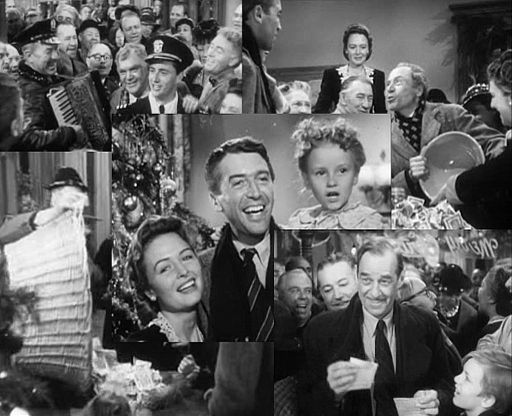
Frank Capra’s 1946 film It’s A Wonderful Life is one that many families will be settling down to watch this Christmas weekend. A story that is ultimately about a suicidal man is one of the most watched holiday films of all time.
Interestingly it wasn’t all that big a hit upon its release (despite garnering five Academy Award nominations) and was disliked by some of the highest intelligence authorities and political thinkers.
Ayn Rand worked with the FBI to identify Hollywood Communist propaganda and helped them to conclude that the Christmas film contained several subversive tendencies, including “demonising bankers” and “attempting to instigate class warfare”, and was “written by Communist sympathisers”.
‘Demonising bankers’ is an interesting accusation and one that doesn’t have to come from an anti-communist perspective. In the 70-odd years since the film’s release there has been a growing level of evidence for bankers (and banks) to absolutely be demonised.
There are some important lessons to be learnt from the film’s protagonist George Bailey. For us the main takeaway for cautious investors and savers is in reference to trusting banks and deposit companies with your hard earned cash.
It is a lesson on how exposing your wealth to various counterparties is exposing it to an incalculable level of risk. Furthermore it should be a lesson on the importance of having savings and learning how best to protect them.
“The money’s not here”
A famous scene early on in the film sees James Stewart’s George Bailey confront a mob of customers who are demanding their money back from his Bailey Building and Loan community bank. It is implied that there is an larger economic crisis going on and Bailey’s savers are panicking about the security of their assets.
Bailey tells them that they can’t have their money for at least two months.
…you’re thinking of this place all wrong.
As if I had the money back in a safe. The money’s not here.
Your money’s in Joe’s house…that’s right next to yours.
And in the Kennedy House, and Mrs. Macklin’s house, and, and a hundred others. Why, you’re lending them the money to build, and then, they’re going to pay it back to you as best they can.
Whilst Bailey’s bank is unlikely to operate using a fractional reserve system the lesson for depositors today is the same. At a simple level our banking structure and finances are deeply interwoven so when a bank, big or small, fails, lots of people will feel the pain.
Viewers should pay attention to this quick lesson in economic fragility. It’s a Wonderful Life shows that the economy at both a national and international level can seemingly change from a healthy position to a dangerous and costly one based on the sort of collective, self-fulfilling beliefs that John Maynard Keynes called “animal spirits”.
For those of you who have seen the scene of Bailey trying to prevent a run on his bank you will recall how similar his customers’ lack of understanding as to how a bank works is similar to the majority of those who use the banking system we have today.
As we saw with the Northern Rock crisis depositors are convinced their money is sitting there in the safe. And, they are sure it is still ‘their’ money (it isn’t). Additionally they fail to question how the banks are able to distribute so much money, such as for mortgages or car loans.
Are the banks and their failures something we should be worried about?
Today a bank run looks quite different to the one we see in It’s A Wonderful Life. The sign of a bank run is usually indicated by a long line of people queuing at an item (as per Northern Rock). But, the fear is the same.
The fear and threat of too much leverage in the system is still very real. The fear that one big loss could take down an entire bank and wipe out the life savings of many—is arguably even scarier than it was back in 1948. Bank failures today are far more serious than Depression-era failures.
This is because so many banks are national and international entities, so intertwined with one another. The collapse of Washington Mutual in 2008, triggered by deposit withdrawals, was the largest failure in U.S. banking history.
This year marked ten years since both the start of the financial crisis and the first bank run in the UK in 140 years. The Bank of England, UK government and regulators rushed to salvage what they could. It made little difference, the financial system was terminal. Afterwards then Bank of England Governor, Mervyn King, reflected:
“In the end the big story, when you look back 10 years, is none of this made any difference at all to the ultimate outcome of what was wrong with the banking system…Whatever we did made no difference to the fact that in the autumn of 2008 the entire banking system failed. Although Northern Rock was a great story in the UK it was little more than a bubble on the boiling sea of the failure of the banking system crisis in 2008.”
In a major critique of the stress tests carried out on UK banks Kevin Dowd, a professor of finance and economics at Durham University writes, “The stress tests are about as useful as a cancer test that cannot detect cancer. They seek to demonstrate a financial resilience on the part of UK banks that simply isn’t there…Our banking system is an accident waiting to happen..“It is disturbing that 10 years on from Northern Rock, the best measures of leverage – those based on market values – indicate that UK banks are even more leveraged than they were then,”
Savers more exposed than ever
Savers are exposed to the huge leverage in the system partly thanks to the huge pensions and debt time bombs that are just looking for a spark to light their short fuse.
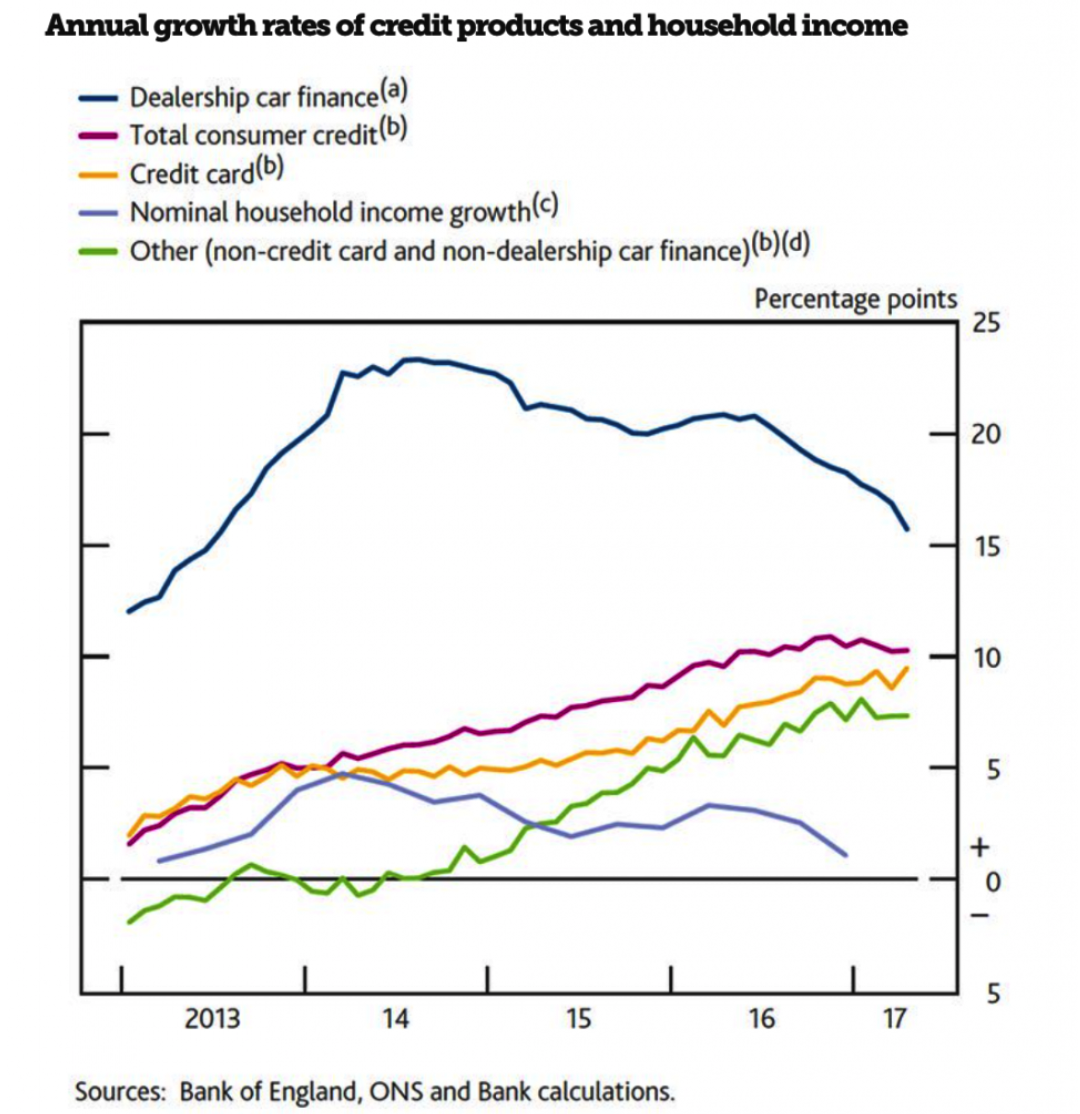
Currently in the UK savers are exposed to a £1 trillion debt time bomb hanging over the country. We are nearing the end of the timebomb’s long fuse and it looks set to explode in the coming months.
It is made up of two major components.
- £710 billion is the terrifying size of the UK pensions deficit
- £200 billion is the amount of dynamite in the consumer credit time bomb
Why is this? It’s because we apparently didn’t learn from the massive man made crisis that was the 2008 financial crisis.
The ‘we’ is referring to UK individuals who are holding over £1.5 trillion of household debt. It refers to the pension fund managers who are ignoring the fact they hold more liabilities than assets. It refers to banks and mortgage and loan providers who give loans to people who are already indebted and who will struggle to pay the debt back. It refers to a compliant media who do not have ask hard questions about irresponsible lending practices and cheer lead property bubbles due to getting significant revenues from the banking and property sectors.
And, ultimately the ‘we’ is the government who peddled such terrible monetary policy that it has brought us as close to nuclear financial disaster as we have been since 2008.
Risks from all sides for savers
Sadly it is not just struggling borrowers and pensioners who are exposing savers to increased risks and expense. 10 million savers here in the UK have been royally screwed over by a government announcement that they will be taxed on their savings.
Buried deep in the 2017 Autumn budget is a a £1.8billion stealth tax raid, discovered by Royal London who explain:
‘…one group of victims of the tax increase will be those who have savings products such as endowments and ‘whole of life’ policies with insurance companies. Under current rules, when these investments grow, tax is paid only on the ‘real’ return, stripping out the effects of inflation. This tax is collected by the insurance companies and passed on to the government. But from January 2018 tax will be payable on the whole return, including anything which simply keeps pace with inflation. Royal London estimates that this could affect up to three million of its own policy holders and many millions more across the whole insurance sector. Yet the Treasury documents accompanying the announcement wrongly claim that it has ‘no impact on individuals or households’…This is a ‘stealth tax’ on millions of people who have made sacrifices and saved hard and are now penalised with extra tax.’
Even if you don’t have one of the affected financial products you are still being screwed over by the banks. Interest rates in the UK have been increased to 0.5% in recent months. One would naturally expect to feel the benefit of this should they have savings. However, research by the Daily Mail’s money arm found that ‘hardly any savers in popular easy-access accounts or in easy-access cash Isas with Barclays, NatWest, RBS, Lloyds, HSBC, Halifax and Santander have benefited from the full rise.’ Many will experience just a sixth of the rate hike seen last month.
What with the tax liability, inflation and negative real rates of interest it is of little question that savers are exposed to risks. The ECB doesn’t care too much about this though and is looking to use individuals’ savings to help prop up the banking system thanks to unprotected deposits and bank bail-ins.
So it seems there is little savers can do rather than look out for number one.
It’s a Wonderful Life or It’s a Horrible Mess?
With best wishes I do hope you really do wake up to think that It’s a Wonderful Life. But beyond the Christmas cosiness of your own home it really is seemingly a Horrible Mess.
According to the PNC’s calculations the true cost of the Twelve Days of Christmas basket climbed by 0.7% when (US) inflation-adjusted. The main culprits were the Pear Tree, the Lords-a-leaping and the Five Gold Rings.
Of those three it was the Gold Rings which saw the biggest increase in price this last year thanks to gold climbing by over 11% in the last twelve months. This is something to take advantage of and to ensure that yours can be a Wonderful Life and not one of the holiday kind.
Savers and prudent spenders can do very little about the current mess of things. All we can do is protect our own finances. This isn’t something to be done by rushing to the bank when things go wrong in the hope that you’ll be able to withdraw all of your money by some miracle. The level of debt in the financial system in the UK and most western countries is completely unsustainable.
For the majority of savers this means personal finances and savings held in deposit accounts are at risk from banks’ over-leveraging. This in turn puts them at risk of bail-ins. Bank bail-ins and negative rates seem increasingly inevitable.
Make sure your savings are not exposed to these risks by diversifying into counterparty risk free gold and silver coins and bars for insured delivery and secure storage.
END
What a terrific report on the total amount of silver produced from the beginning of time: 50 billion oz
You will see that most of the silver has been produced in this century
(courtesy Steve St Angelo/SRSRocco report)
WORLD SILVER PRODUCTION: 3 Charts You Won’t See Anywhere Else


By the SRSrocco Report,
The rate at which global silver production increased over the past century is quite astonishing. When Columbus arrived in America (1492), the world was only producing 7 million oz of silver a year. Today, the world’s largest primary silver mine, Fresnillo’s Sauicto Mine, produced three times that amount in just one year (22 million oz, 2016). Yes, we have come along way in 500 years.
Just think about that for a minute. One silver mine last year produced three times the global amount in 1493. According to the U.S. Bureau of Mines 1930 Report on Summarized Data of Silver Production, the average annual silver production in the world from 1493 to 1600 was 6.9 million oz (Moz). If we look at the following chart, we can see how world silver production increased over the past 500+ years:
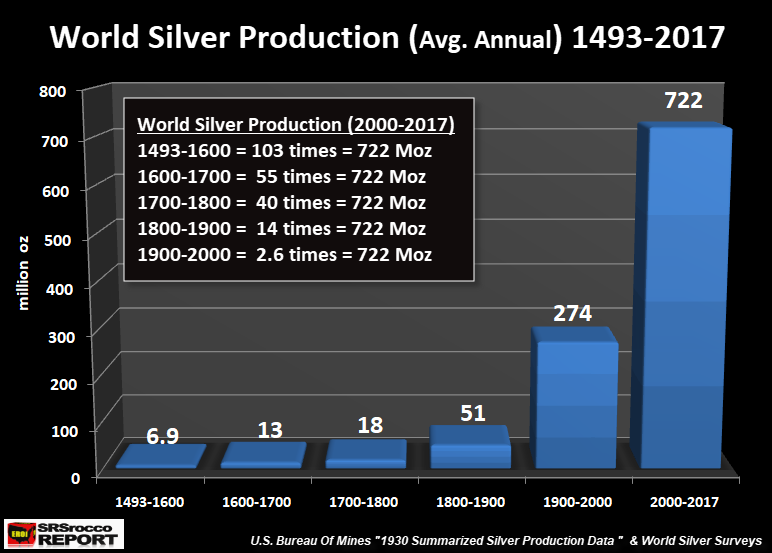
As we can see, average annual world silver production increased from 6.9 Moz during 1493-1600, to 13 Moz from 1600-1700, 18 Moz from 1700-1800, 51 Moz from 1800-1900, 274 Moz from 1900-2000 and a stunning 722 Moz from 2000-2017. Again, these figures represent the average annual silver production for each time period.
In the current period, 2000-2017, the world has produced 103 times more silver per year than from 1493-1600. However, the next chart shows the total silver production for each period. From 1493-1600, the world produced a total of 747 Moz of silver, compared to 13,000 Moz (13 billion oz) in just 18 years from 2000-2017:
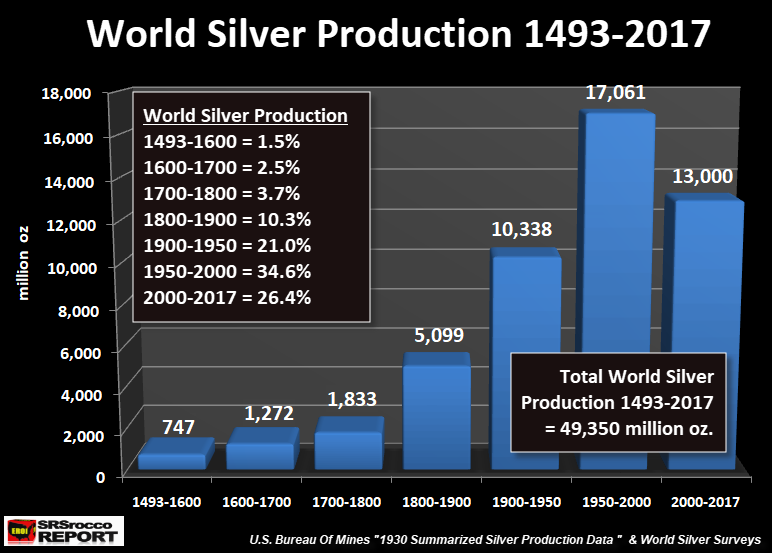
Now, the reason the last silver bar on the right of the chart is lower than the previous one has to do with comparing 18 years worth of silver production (2000-2017) versus 50 years (1950-2000). It took 50 years to produce 17,061 Moz during 1950-2000 versus 13,000 Moz in the 18 years from 2000-2017.
If we compare world silver production from the different periods, here is the result:
Percentage Of World Silver Production (1493-2017)
2000-2017 = 26.4%
1950-2017 = 61%
1900-2017 = 82%
While a little more than a quarter of all world silver production (1493-2017) was produced in the past 18 years, 82% were produced since 1900. That is a lot of silver. It turns out that 40.4 billion oz was produced from 1900-2017 out of the total 49.3 billion oz produced since 1493. Interestingly, more than half of that silver was consumed in industrial silver applications. I will be writing more about that in future articles.
The last chart I find quite interesting. If we go back a little more than a century, the United States was the largest silver producer in the world. In 1915, the U.S. produced 75 Moz of silver out of the total 189 Moz mined in the world that year:
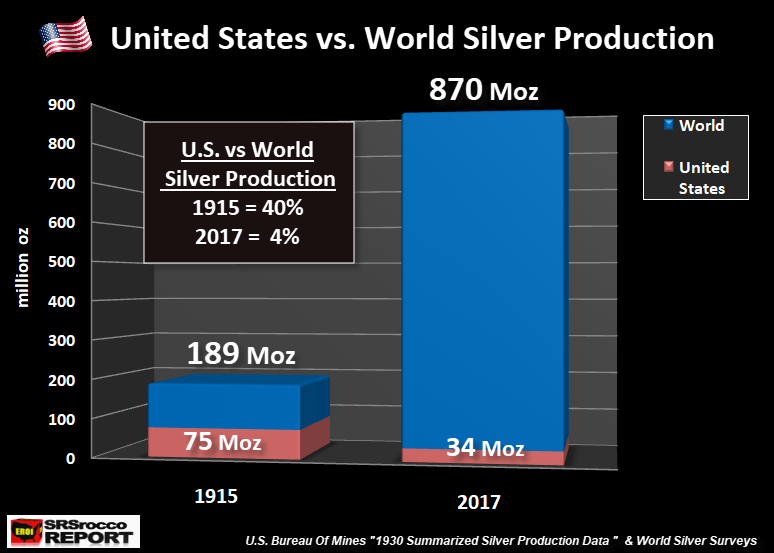
Thus, in 1915, the U.S. produced 40% of all world silver production. Mexico came in second in 1915 by producing 39.3 Moz. However, U.S. silver production in 2017 will only be 34 Moz versus the estimated 870 Moz globally. Thus, U.S. silver production only accounts for 4% of world mine supply versus 40% back in 1915. What a change in 100 years.
Lastly, the U.S. imports approximately 22% of world mine production each year. That is 193 Moz of the total 870 Moz in 2017. While domestic mine supply is only 34 Moz, the United States has to import more than a fifth of global mine production to meet its silver market demand.
If you haven’t checked out our new PRECIOUS METALS INVESTING section or our new LOWEST COST PRECIOUS METALS STORAGE page, I highly recommend you do.
Check back for new articles and updates at the SRSrocco Report.
END
No wonder China is bringing into its country huge amount of silver:
(courtesy Futurism.com)
and special thanks to Robert H for sending this to us
China’s First Solar Highway is Nearly Complete, May Soon Be Able to Charge Electric Cars
IN BRIEF
China will soon be home to one of the first ever solar highways. Located on the Jinan Expressway, the solar road has been constructed using transparent concrete, solar panels, and an additional third layer underneath to keep the panels dry.
SOLAR ROADWAYS ARE NOW OPEN
Roofs and windows of buildings aren’t the only surfaces that can be used to generate solar power. In China, construction has begun of the country’s first solar highway, in which solar panels are placed underneath transparent concrete.
As reported by Electrek, the solar highway is a 2 km (1.2 mile) stretch of road located on the Jinan City Expressway, and it’s divided into three layers. The see-through concrete shields an array of solar panels of two sizes. Beneath the solar panels is a layer that will keep them isolated from the damp ground. The road itself has already been completed, and now it’s only a matter of connecting the grid, which is expected to be finished by the end of the year alongside the completion of the Jinan Expressway’s south section.

This isn’t the first solar road China has worked on. Earlier this year, the Qilu Transportation Development Group — which is also handling the Jinan Expressway solar road — built a 160 meter (0.09 mile) long solar road in the city of Jinan itself. It’s capable of heating up to keep the highway clear of snow and ice, and may one day be able to wirelessly charge electric vehicles. The new solar highway is expected to one day be equipped with the same features.
SOLAR ROADS AROUND THE WORLD
Outside of China, solar roads are nothing new. In 2014, the Netherlands built a bike path fitted with solar panels to generate electricity; a village in the north of France opened a km (0.62 mile) long solar road in 2016. In the U.S. the Missouri Department of Transportation agreed to begin testing solar sidewalks near Route 66.
Solar roadways may have their critics (they are susceptible to being covered by dirt and other debris), but as their efficiency and applications improve, they’re sure to prove their value. And with EVs becoming more popular, the world’s going to need more ways to keep their vehicles charged and ready to go.
end
Your early TUESDAY morning currency, Asian stock market results, important USA/Asian currency crosses, gold/silver pricing overnight along with the price of oil Major stories overnight/9 AM EST
Asian Stocks Slide On iPhone X Demand Fears; US Futures Flat In Thin Holiday Trading
For the second day in a row, most Asian markets – at least the ones that are open – were dragged lower by tech stocks and Apple suppliers, with the MSCI Asia Pacific Index down 0.2% led by Samsung Electronics and Taiwan Semiconductor Manufacturing in response to the previously noted report that Apple will slash Q1 sales forecasts for iPhone X sales by 40% from 50 million to 30 million. Most Asian equity benchmarks fell except those in China. European stocks were mixed in a quiet session while U.S. equity futures are little changed as markets reopen after the Christmas holiday.
Away from Asia, stocks remained closed across the large European markets, as well as in parts of Asia including Australia, Hong Kong, Indonesia, the Philippines and New Zealand. Japanese benchmarks slipped from the highest levels since the early 1990s, helping to pull the MSCI Asia Pacific Index down, while shares in Dubai, Qatar and Russia were among the big losers in emerging markets. S&P 500 futures were flat as those for the Dow Jones slipped. The euro edged lower with the pound – although there were no reverberations from Monday’s odd EURUSD flash crash which was only observed on Bloomberg feeds, while Reuters ignored it even if the FT did note it…

… while the Russian ruble, South African rand and South Korean won were the notable gainers. Gold extended its recent advance as silver also jumped.

In a continuation of Monday’s muted action, Apple’s Asian suppliers again responded to the biggest market news of the week and fell after Taiwan’s Economic Daily reported on Monday that Apple will slash its sales forecast for the iPhone X in the quarter to 30 million units, down from 50 million units originally. Some analysts have also flagged disappointing demand. U.S.-based JL Warren Capital is predicting shipments of just 25 million units as consumers baulk at the “high price point and a lack of interesting innovations”. “Our work continues to suggest the March and June quarters will have a significant amount of iPhone X make-up shipments,” Chicago-based Loop Capital said in a note last week, forecasting shipments of 40-45 million units in the first quarter of 2018, up from an estimated 30-35 million units in the current quarter. Analysts at Jefferies have also forecast around 40 million iPhone X sales for the first quarter.
Apple suppliers that were most hit included Genius Electronic Optical Co Ltd which dropped 2.4 percent on Tuesday to take its losses this week to 11.4 percent. Pegatron Corp also fell on both days, losing 3.2 percent this week.
Meanwhile, China stocks closed higher on Tuesday as an advance by construction machinery makers and financials offset a drop by consumer staples. Hong Kong’s markets will reopen on Wednesday after a two-day holiday break. The Shanghai Composite Index rose 0.8% to 3,306.13, its highest level since Dec. 11 while the blue-chip CSI 300 Index added 0.3%, erasing earlier drop of 0.7%.
Still, as Bloomberg notes, traders are finding little to get excited about as the stellar year for risk assets crawls to its end, with the possible exception of the cryptocurrency roller coaster, where bitcoin was once again trading above $15,000 this morning. Traders may be opting to enjoy the relative calm as tensions continue to simmer between the U.S. and Russia, Italy’s parliament is set to be dissolved for a risky European election, and big decisions on the American debt ceiling were merely kicked down the road. That has set up a potentially eventful 2018.
In rates, U.S. 10-year Treasury yield hovers under last week’s high, and in overnight trading it climbed less than one basis point to 2.48%.
Jesus Was Born In A Police State
The Christmas narrative of a baby born in a manger is a familiar one.

In currencies, the Bloomberg Dollar Spot Index holds two weeks of declines, as most major currencies trade in narrow ranges and volumes remain low heading into the year-end. The yen headed toward a six-week low against the dollar as policy divergence and optimism over the strength of the U.S. economy supported the greenback. Japan’s currency fell against most G-10 peers after the central bank kept its loose monetary policy stance last week and inflation data Tuesday showed prices are still rising at less than half its targeted pace. Passage of U.S. tax reforms and expected interest-rate hikes by incoming Federal Reserve Governor Jerome Powell next year could add to the pressure on the yen, according to FX Prime by GMO Corp. “If Powell confirms the pace of rate increases next year and if Trump unveils more specifics about infrastructure investment, that would support the dollar,” said Hiroshi Yanagisawa, chief analyst at FX Prime by GMO in Tokyo. “USD/JPY will become a bit top-heavy around 113.50, while support is seen firm around 112.50.”
While the yen slid, the South Korean won rose to the strongest in more than two years while most other Asian currencies were little changed as local markets reopened after the Christmas Day holiday. The positive correlation between strong U.S. stocks and Asian currencies remains in play, said Wu Mingze, a foreign-exchange trader at INTL FCStone in Singapore. “The only question is whether the rally in U.S. equities can continue early next year, while there isn’t any bullish factor left. Failure for stocks to climb higher may result in safe-haven currencies regaining strength.”
Elsewhere, the British pound dipped 0.1 percent to $1.3364. South Africa’s rand rose 0.2 percent to 12.5835 per dollar, the strongest in nine months. The Russian ruble jumped 0.4 percent to 57.7458 per dollar, hitting the strongest in two months with its eighth consecutive advance.
In commodities, moves were likewise subdued, with WTI holding above $58 a barrel as trading resumed following the Christmas holiday and after U.S. explorers refrained from adding rigs for a second week. Brent edged lower towards $65 a barrel on Tuesday, but remained within sight of its highest level since mid-2015, as the looming restart of a key North Sea oil pipeline offset support from OPEC-led supply cuts. The North Sea Forties pipeline, which plays an important role in the global oil market, is being tested following repairs and full flows should resume in early January, its operator Ineos said on Monday.
Bitcoin rallied as the biggest cryptocurrency has filled the gap from last week’s dramatic selloff. Gold increased 0.2 percent to $1,278.34 an ounce, hitting the highest in more than three weeks with its fifth consecutive advance. Silver gained 0.6 percent to $16.43 per ounce, the highest in more than three weeks.
Economic data expected today include Richmond Fed Reserve Manufacturing Survey.
Market Snapshot
- S&P 500 futures up 0.02% to 2,686.50
- STOXX Europe 600 down 0.1% to 390.28
- MSCI Asia Pacific down 0.2% to 172.31
- MSCI Asia Pacific ex Japan down 0.2% to 561.44
- Topix down 0.3% to 1,827.01
- Hang Seng Index up 0.7% to 29,578.01
- Australia S&P/ASX 200 up 0.2% to 6,069.71
- Kospi down 0.5% to 2,427.34
- German 10Y yield unchanged at 0.42%
- Euro down 0.06% to $1.1863
- Brent Futures down 0.2% to $65.10/bbl
- Italian 10Y yield rose 0.6 bps to 1.645%
- Spanish 10Y yield unchanged at 1.472%
- Brent Futures down 0.2% to $65.10/bbl
- Gold spot up 0.3% to $1,277.80
- U.S. Dollar Index up 0.04% to 93.30
Top Overnight News from Bloomberg
- The United Nation’s latest sanctions on North Korea are more likely to hurt ordinary people in the isolated nation than slow Kim Jong-Un’s push to develop missiles capable of hitting the U.S. with nuclear weapons.
- Japanese inflation unexpectedly picked up in November but prices are still rising at less than half the rate targeted by the central bank. The tightest job market in decades got even tighter.
- Early Monday morning in New York, the euro currency tumbled about 3 percent against the dollar in a matter of minutes. Given the limited Christmas Day volume, along with a lack of much market-moving news, the sudden plunge could’ve been sparked by computer-driven trading — a suspicion touted by the ZeroHedge website.
- The Kremlin is “concerned” about the possibility the U.S. might further expand sanctions on Russia, presidential spokesman Dmitry Peskov said.
- China can achieve a goal of doubling the size of its economy by 2020 even if annual expansion slows to 6.3 percent, according to a senior Communist Party official, signaling a greater willingness to tackle debt and pollution at the expense of growth.
In Asia, the MSCI Asia Pacific Index fell 0.2% led by declines in tech stocks including Samsung Electronics Co. and Taiwan Semiconductor Manufacturing Co. Main equity benchmarks in the region fell except those in China. Markets were closed for a second day in Australia, Hong Kong, Indonesia, the Philippines and New Zealand. The market had a muted reaction to data released early on Tuesday which showed that Japan’s core consumer prices rose for the 11th straight month, up 0.9 percent year-on-year, and household spending jumped in November. China stocks closed higher on Tuesday as an advance by construction machinery makers and financials offset a drop by consumer staples. Hong Kong’s markets will reopen on Wednesday after a two-day holiday break. Shanghai Composite Index rises 0.8% to 3,306.13, its highest level since Dec. 11. CSI 300 Index adds 0.3%, erasing earlier drop of 0.7%. Shenzhen Composite Index +0.4%; ChiNext Index +0.2% after falling as much as 0.8%. XCMG Construction Machinery Co. surges by 10% daily limit as best performer on big-cap CSI 300 measure; Sany Heavy Industry Co. jumps 7.3%, the most this month; Zoomlion Heavy Industry Science and Technology Co. advances 5.2%, the most since March 2016.
Top Asian News
- China’s Fosun Is Said to Explore Sale of Hollywood Studio Stake
- Japan Stocks Fall in Thin Trade as Technology Shares Drag Index
- China Stocks Rise to Highest in 2 Weeks as Machinery Makers Gain
- Indian Bonds Erase Losses After Recap Debt Report, Trader Says
- Reliance Communications Surges Ahead of ‘Important Announcement’
Across Europe, most financial markets are shut on Tuesday. The euro inched down 0.1 percent to $1.1869. The single currency gave up some ground last week after Catalan separatists won a regional election, deepening Spain’s political crisis in a sharp rebuke to Prime Minister Mariano Rajoy and European Union leaders who backed him.
Top European News
- Euro May Rise Into Year-End If German CPI is Strong: FX Prime
- Kuka’s CEO Plans for Robot Domination in China and Your Garage
- Russia Harvested 85.8m Tons of Wheat in 2017: Statistics Service
- France Sees EU1b Extra Corporate Tax Revenue for 2017: Les Echos
- Bank of Russia Sells 14.3b Rubles in March 2018 KOBR Bills
In currencies, The Bloomberg Dollar Spot Index climbed less than 0.05 percent. The euro declined 0.1 percent to $1.186, the weakest in a week. The British pound dipped 0.1 percent to $1.3364. South Africa’s rand rose 0.2 percent to 12.5835 per dollar, the strongest in nine months. The Russian ruble jumped 0.4 percent to 57.7458 per dollar, hitting the strongest in two months with its eighth consecutive advance.
US Event Calendar
- 9am: S&P CoreLogic CS 20-City MoM SA, est. 0.6%, prior 0.52%
- 10am: Richmond Fed Manufact. Index, est. 21.1, prior 30
- 10:30am: Dallas Fed Manf. Activity, est. 20, prior 19.4
end
3. ASIAN AFFAIRS
3 a NORTH KOREA/USA
NORTH KOREA/
3 b JAPAN AFFAIRS
Japan’s nightmare: birth plunge to only 941,000 in 2017. Thus it’s total population has declined by 400,000. It means that its burgeoning debt is shared by less.
(courtesy zerohedge)
Japan Births Plunge To Lowest Level Ever Recorded As “Celibacy Syndrome” Takes Its Toll
Back in 2013 we asked “Why Have Young People In Japan Stopped Having Sex?” And while that might sound like nothing more than a clever headline intended for The Onion, it was prompted by a very serious survey conducted by the Japan Family Planning Association which found that 45% of Japanese women aged 16-24 and 25% of men were “not interested in or despise sexual contact”…a growing trend that has revealed itself via the nation’s persistently declining birth rates. In fact, “celibacy syndrome” has become of such great concern for the Japanese government that it is considered a bit of a looming national catastrophe….a catastrophe that seems to be getting worse at an accelerating rate.
According to data released today by Japan’s Ministry of Health, Labor and Welfare, child births in Japan will drop to just 941,000 in 2017, the lowest since data first started being recorded in 1899, and nearly 65% below the peak birth rate from the late 1940’s.

As the Financial Times notes today, the persistent declines in Japanese birth rates come despite the best efforts of central planners to encourage population growth via a litany of government entitlement programs aimed at helping young families cover the cost of childrearing…
The government of Shinzo Abe, prime minister, has made raising Japan’s birth rate a priority. On Friday it approved a budget that takes the first steps towards providing free pre-school, private high school and university education in an effort to reverse the trend.
Unless the low birth rate is reversed, the only option to increase Japan’s population would be for it to take in more immigrants. Yet despite high inflows of guest workers drawn by the strong economy, Japanese politicians have been reluctant to debate the subject.
Mr Abe’s government has instead set a target to raise the total fertility rate to 1.8. Officials hope the strong economy, combined with measures making it easier for women to combine work and childcare, will encourage families to have more children.
“We’d like to halt the decline by advancing our strategy to support children and make an easier environment for giving birth,” the ministry said.
…they’ve basically thrown in everything except a pony.
Meanwhile, Japan’s aging population means that the number of deaths will likely rise by 3% YoY in 2017 to 1.34 million, a post-World War Two high, resulting in the largest ever natural population decline of just over 400,000.

Unfortunately, the crisis is only expected to get worse over time as projections from the National Institute of Population and Social Security Research suggest the pace of population declines will accelerate and that by 2045 Japan will be losing about 900,000 residents a year. On current trends, the population is set to fall from 126.5m to 88m by 2065 and to just 51m by 2115.
All of which means there is really only one thing left to do…instruct the BOJ to print even more money and start passing it out to expecting parents…which we’re pretty sure will solidify Haruhiko Kuroda’s official title of “biggest pimp in the world”.
end
Japan is bracing for a big bitcoin exchange collapse
(courtesy zerohedge)
Japan’s Largest Bank Is Preparing For A Bitcoin Exchange Collapse
The February 2014 collapse of Tokyo-based bitcoin exchange Mt. Gox was, for more than 24,000 investors around the world, a traumatic event. It also ushered in a two-year crypto bear market that saw the price of a single bitcoin plunge from a peak of $1,200 to a low of around $200 before the torrid bull market of the present day began. And as the bankruptcy and legal issues surrounding the collapse continue to wend through the Japanese legal system, none of these investors have received a single crypto cent of remuneration – despite the ballooning valuation of the exchange’s remaining assets.
Many market observers believe that one of the biggest risks to the current rally would be a similar incident unfolding across another major exchange like Bitfinex or CoinBase’s GDAX.
So in a move that could go a long way toward legitimizing the burgeoning crypto market, Japanese banking behemoth Mitsubishi UFJ Financial Group which is Japan’s largest financial group and the world’s second largest bank holding company – through its trust and banking unit – is preparing to launch a service that will allow individual investors to secure their bitcoins in the event an exchange should failagain, according to Nikkei Asia Review.
MUFG isn’t the only major global bank seeking to build up its cryptocurrency franchise: Goldman Sachs is reportedly in the process of launching a crypto trading desk. Of course, as observed recerntly, Japan is one of bitcoin’s biggest markets, and its largest exchange, Bitflyer, accounts for nearly 40% of global exchange-based trading.

MFUG’s new trust service would help mitigate what has, in the past, proven to be one of the biggest threats to the crypto market. It will also help Japanese regulators cement their position at the vanguard of crypto’s integration with traditional markets.
Mitsubishi UFJ Trust and Banking is preparing a scheme for protecting holders of cryptocurrencies if the exchanges they use fail – a risk that veteran fans here know all too well.
This highlights how Japan’s finance industry seeks to make the most of the opportunities associated with virtual currencies, which the country has taken to in a big way, accounting for around 40% of global bitcoin trading.
Japan was also the epicenter of one of the digital currency’s biggest shocks — the 2014 collapse of Mt. Gox, the largest bitcoin exchange at the time.
Mitsubishi UFJ Trust will offer a way to keep exchange customers’ cryptocurrency holdings separate from the entrusting exchange’s assets. This will make it the first trust arrangement of its kind in the world, according to the Mitsubishi UFJ Financial Group member, which recently applied for patent protection.
Per Nikkei, the service could launch as early as April, when Japan’s Financial Services Agency is expected to recognize cryptocurrencies as an asset that can be placed in trust, like real estate or securities.
While the market value of major cryptocurrencies has ballooned to $300 billion, bitcoin and its peers have remained remain decentralized creations without an oversight body like a central bank – a core component of their appeal. But as the usage and valuation of digital currencies grows, these exchanges, which are often overwhelmed and under-staffed by the flurry of new accounts, they’re increasingly becoming targets for state-sponsored hackers like the North Korea linked Lazarus Group.
As Nikkei explains, Mitsubishi UFJ Trust will maintain the same records as its exchange clients. In the event that the exchange operator fails to safeguard its customers’ assets, Mitsubishi UFJ will use these records to compensate investors for their losses.

Of course, this service won’t protect customers from violent plunges in the valuation of bitcoin, like the selloff that occurred over the weekend during the runup to the Christmas holiday.
Using an arrangement like Mitsubishi UFJ Trust’s would entail a fee that would be shouldered by individual investors. But “customers will feel peace of mind knowing that a trust bank is managing their assets,” said CEO Noriyuki Hirosue of Tokyo-based exchange Bitbank. After all, the big banks have never violated their fiduciary duty to their clients – therefore, they’re implicitly more trustworthy than crypto startups with few resources and little to no track records.
To use the service, exchange customers will opt in when they start trading. Mitsubishi UFJ Trust will monitor the accounts of those who do for suspicious activity and examine pending transactions in detail as needed. A late-night sale of a huge amount of bitcoins, for instance, would get flagged for inspection instead of being processed immediately.
While regulators in the US have expressed skepticism about digital currencies, Japan established itself as a leader in building a regulatory framework when nearly two years ago, it passed a law clearing the way for financial institutions to become involved in the crypto market.
The Japanese recognize the adoption of cryptocurrencies and blockchain technologies as a competitive advantage, and they’re right. The FSA began registering cryptocurrency exchanges in earnest this past autumn.
Offering this service will help establish one of Japan’s largest financial institutions as a key player in an increasingly contested global market, which has seen a surge of institutional interest in the trading of cryptocurrencies in recent months.
end
c) REPORT ON CHINA
4. EUROPEAN AFFAIRS
END
5. RUSSIAN AND MIDDLE EASTERN AFFAIRS
A Saudi royal has reportedly been tortured to death after refusing to fork over his fortune
(courtesy zerohedge)
Saudi Royal Reportedly Tortured To Death After Refusing To Fork Over His Fortune
Rumors that Saudi Crown Prince Mohammad bin Salman has hired mercenaries to torture recalcitrant royals sleeping in the ballroom of the Ritz Carlton in Riyadh have been circulating since shortly after last month’s “corruption crackdown” naked cash grab.

Crown Prince Mohammad bin Salman
Now, Middle East Eye reports that one of MbS’s guests has reportedly died under torture rather than fork over his money and assets to his domineering relative. He was reportedly beaten and tortured so bad his family members had difficulty recognizing his body.
Major general Ali Alqahtani, who was detained in early November as part of an alleged anti-corruption drive, had been working in the royal guard forces.
He was the manager of the private office of Prince Turki Bin Abdullah, the son of former king Abdullah Bin Abdulaziz,according to the newspaper.
Alqahtani died on 12 December after being tortured with electric shocks, and his family struggled to recognise him after receiving his body, according to sources, the newspaper reported.
We know this might come as a shock to some – Tom Friedman and the New York Times said MbS was such a nice guy! But that doesn’t change the fact that he is effectively extorting members of his own family to help plug a gaping hole in the Saudi government’s budget, willfully employing violence when necessary in a fashion that would make Tony Soprano proud. Case in point: Yesterday, we noted that the Saudi government had reportedly made Prince Alwaleed bin Talal – one of the world’s richest men – an offer he cannot refuse: Either fork over $6 billion to the Treasury, or spend the rest of his life being strung upside down and tortured by foreign mercenaries.

Back when oil was at $100 and above, the Saudi economy was firing on all cylinders, and nobody even dreamed that the crown jewel of Saudi Arabia – Aramaco – would be on the IPO block. But official data released earlier this week showed the Saudi economy contracted this year for the first time in eight years. It’s estimated to have shrunk by 4% as thousands of state-subsidized jobs have disappeared.

But despite the contraction, the Saudis have announced a radically expansionary budget for 2018. The government is forecasting spending at 978 billion riyals ($260.8 billion), up 10% on 2017 estimates, as the royal family’s proxy war against Iran in Yemen enters its third year.
Even though oil prices are seemingly stuck at $50 a barrel, the Saudi government knows that its survival depends in part on placating the country’s citizens, who’ve grown accustomed to the trappings of a lavish welfare state.
This goes back to one of the reasons MbS has been able to get away with his crackdown: millions of regular Saudis have lauded MbS’s treatment of his fellow royals, seeing it as their long-overdue comeuppance.
Given that political opposition to the Crown Prince – who is expected to soon succeed his ailing father as king.
end
Trump states that he will arm Ukraine. To Putin that will cross the line and as he states: will “lead to bloodshed”
(courtesy zerohedge)
“The US Has Crossed The Line”: Russia Warns Trump Decision To Arm Ukraine Will “Lead To Bloodshed”
Russia has reacted fiercely to the end of week breaking news that President Trump plans to approve the legal sale of US antitank missiles and possibly other advanced systems to the Ukrainian government in a move that could change the battlefield calculus of the war between Ukrainian and Russian-aligned forces in the Donbass region along the Russian border. ABC News described the “total defense package of $47 million includes the sale of 210 anti-tank missiles and 35 launchers” which will be sure to harm Trump’s longtime stated goal of improving relations with Moscow.
Though Kiev has long had limited access to US lethal arms through private contracts with American and international arms producers, this represents a significant escalation involving the likelihood that advanced US systems would be used directly on Russian-aligned militias in the eastern Donbass region and potentially Russian forces along the border. Up until now, the White House has been reluctant to escalate the war so openly, as it did when it supplied anti-Assad fighters in Syria with sophisticated TOW anti-tank missiles.
While the US State Department claims the move is “defensive” in nature, Russian deputy foreign minister Sergei Ryabkov charged the US with deliberately “crossing the line” and pushing the Ukrainian authorities “towards new bloodshed,” adding that “American weapons can lead to new victims”.

Ukrainian army soldiers perform a weapons exercise at a training ground outside Lviv, western Ukraine, Thursday, Feb. 5, 2015. Image source: AP via Common Dreams
“Kiev revanchists are shooting at Donbass every day, they don’t want to conduct peace negotiations and dream of doing away with the disobedient population. And the United States has decided to give them weapons to do that,” Ryabkov said. He further slammed the US as an “accomplice in igniting a war” whose political leadership is “blinded by Russophobia and eagerly applaud the Ukrainian nationalist punitive battalions.”
Indeed a number of outspoken Russia hawks in Congress were enthusiastic over the possibility of heavier and direct arms flow to Ukraine, including John McCain, Bob Corker, and Tom Cotton – all supporters of the original Ukraine Freedom Support Act signed into law by President Obama in December 2014, though never fully enacted.
So you’re telling me Putin ordered his puppet Trump to arm Ukrainians that are hostile to Putin?
This is some crazy 5th dimensional chess. https://twitter.com/ap/status/944390445400051712 …

Cotton for example – recently rumored to be Trump’s pick for CIA Director – said of the new initiative for arms exports to Ukraine: “This is a break from failed Obama era policies to make Russia pay a cost for its aggression. With this decision, the Trump administration is reminding Vladimir Putin and his cronies that they lost the Cold War, and we won’t tolerate their bullying of our friend Ukraine.”
But Russian leaders have warned that through the decision the US may be dragged deeper into a quagmire which could result in direct confrontation with pro-Russian rebels in Ukraine’s east. Aleksey Pushkov, member of the Russian Senate security committee, told RT Newsthat delivery of the more advanced systems like the Army’s M-148 Javelin Portable Anti-Tank Missile would require US military advisers on the ground, which could be targeted by separatist forces.
Pushkov told RT, the US “has enough problems already to allow itself to be involved in adventures of the [Ukrainian] regime. And we know too well how adventurous Kiev may be.” This comes as authorities in Kiev are already requesting that Washington adds anti-aircraft missiles to its shopping list as well, according to multiple reports.
Meanwhile German Chancellor Angela Merkel and French President Emmanuel Macron issued a statement calling for “disengagement and the withdrawal of heavy weapons” in the Ukrainian conflict, a scenario now much further away from taking shape than ever. But after years of covert American involvement in the Ukrainian proxy and civil war which has raged since 2014 – and which a leaked recording confirmed was precipitated by the US State Department – it appears that hawks like McCain, Cotton, and Corker are finally getting their way.
6. GLOBAL ISSUES
7. OIL ISSUES
Brent jumps after a huge explosion at a major oil pipeline in Libya
(courtesy zerohedge)
Brent Jumps After Explosion At Major Oil Pipeline In Libya
After a quiet overnight session, the price of Brent Crude spiked following news of an explosion at a Libyan crude oil pipeline that feeds the Es Sider sea terminal – home of the largest oil depot in Libya – a source from the Libyan National Army told The Libya Times Tuesday. The blast happened near 30km northwest of Marada, the source said.
At the same time, the source accused militants from the Benghazi Defense Brigades of the blast. While the reasons for the explosions haven’t been determined yet, media reports are suggesting that it was possibly a terrorist attack.
Meanwhile, the Akhbar Libya news outlet reported that the gas pipeline belonged to the al-Waha oil company. The group’s press service claimed that the explosion could have been caused by a terrorist attack, adding that the communication with an engineering crew working on the scene had been lost.
The media outlet added that the group had sent its forces to the explosion site, located between Es Sider port and an oil field.
While there is still no official update on what impact the explosion could have on Libyan oil output, Brent is higher about 40 cents on the news…

… with Bloomberg reporting that Libya’s Waha output is said to drop 60-70kbpd after the explosion.
end
8. EMERGING MARKET
And now your more important USA stories which will influence the price of gold/silver
DOW: DOWN 7.95 OR .03%
NASDAQ DOWN 23.71 OR .34%
TRADING IN GRAPH FORM FOR THE DAY
Bad Santa Buys Bonds, Bullion, & Bitcoin; Rotten Apple Spoils Promised Stock Rally
This was not the Santa Claus rally that everyone was promised…
All thanks to ‘rotten’ Apple… as analysts lowered iPhone X shipment projections for the first quarter of next year, citing signs of lackluster demand at the end of the holiday shopping season, and the company’s shares fell Tuesday along with those of some suppliers.

Nasdaq ended Boxing Day deep in the red…Small Caps managed to close green…

Futures show when the move started in Apple impacting Nasdaq…

What’s The Greatest Christmas Movie Of All Time?
The news cycle this year was so hectic – particularly around the holidays – that Americans were apparently…

The yield curve was mixed today with the short-end higher in yield and long-end lower…

Pushing the yield curve lower once again…

The Dollar ended the day unchanged as yesterday’s flash-crash in EURUSD stands out like a sore fat finger…

Gold gained once again – rallying to its highest since Dec 1st…

WTI Crude touched $60 intraday for the first time since June 2015…

Bitcoin surged back above $16,000…

House Republicans Secretly Gathering Evidence To Launch Case Against DOJ and FBI: Report
According to Politico, a group of frustrated Republicans on the House Intelligence Committee led by Devin Nunes (R-CA) have been gathering in secret for several weeks to build a case against senior leaders of the Justice Department and the FBI for what they say is “improper” and perhaps criminal mishandling of the salacious and unproven 34-page Trump-Russia dossier, according to four sources familiar with their plans.

Devin Nunes (R-CA)
A subset of the Republican members of the House intelligence committee, led by Chairman Devin Nunes of California, has been quietly working parallel to the committee’s high-profile inquiry into Russian meddling in the 2016 presidential election. […]
The people familiar with Nunes’ plans said the goal is to highlight what some committee Republicans see as corruption and conspiracy in the upper ranks of federal law enforcement. The group hopes to release a report early next year detailing their concerns about the DOJ and FBI, and they might seek congressional votes to declassify elements of their evidence. –Politico
When pressed for details, Reps Mike Conway (R-TX) and Peter King (R-NY) were mum, with Conway telling POLITICO, “I don’t want talk about what we do behind closed doors.”
Nunes’ has gone on record several times to discuss his feelings over the government law enforcement, telling Fox News “I hate to use the word corrupt, but they’ve become at least so dirty that who’s watching the watchmen? Who’s investigating these people?” adding “There is no one.”
House and Senate Republicans have joined countless voices, including President Trump’s outside counsel, Jay Sekulow, to launch a second Special Counsel to investigate the FBI and Justice Department to find out what role the salacious dossier played in the Trump-Russia investigation, as well as a trove of anti-Trump text messages sent between lead FBI investigator Peter Strzok to his FBI attorney mistress Lisa Page while the two of them were working together on both the Clinton email investigation and the Trump-Russia investigation.
Republicans in the Nunes-led group suspect the FBI and DOJ have worked either to hurt Trump or aid his former campaign rival Hillary Clinton, a sense that has pervaded parts of the president’s inner circle. Trump has long called the investigations into whether Russia meddled in the 2016 election a “witch hunt,” and on Tuesday, his son Donald Trump Jr. told a crowd in Florida the probes were part of a “rigged system” by “people at the highest levels of government” who were working to hurt the president.
House Intel Committee member Jim Jordan (R-OH) told Fox News yesterday that they are now considering contempt of the FBI and DOJ leadership and subpoenas over anti-Trump bias:
I think they were putting together a plan to stop Donald Trump from being the next president of the United States. I think it’s amazing in spite of the fact that the Democrats were against him, the Republican establishment was against him, the mainstream press was against him. and now I believe the FBI and the Justice Department were against him, the American people still said that’s the guy we want to be the next president.
“I believe that fake dossier was used as the basis to get Warren to now what we learn about Peter Strzok and Bruce Ohr and the FBI and the Justice Department,” said Jordan, adding, “Everything points to the fact that there was an orchestrated plan to try to prevent Donald Trump from becoming the President of the United States.”
Meanwhile, Trey Gowdy – who notably chose not to call on key witness Peter Strzok or demoted DOJ official Bruce Ohr for testimony – is apparently not included in the group seeking to build a case. As POLITICO reports, “A congressional aide with knowledge of the meetings said Rep. Trey Gowdy (R-S.C.) was not among the participants. ”While he does believe the FBI and DOJ have recently made decisions worth looking into, he is and will always be a defender of the FBI, DOJ and the special counsel,” the aide said.
end
Another swamp member, FBI director McCabe is “retiring” in a few months.
(courtesy zerohedge)
FBI Deputy Director McCabe “Retiring” After “Trump Insurance Policy” Debacle
Just hours after the FBI’s top lawyer, James Baker, was reassigned, WaPo reports that FBI Deputy Director Andrew McCabe will retire in a few months – once he becomes fully eligible for pension benefits.

McCabe, who has been the target of Republican critics for more than a year, spent hours in Congress this past week, facing questions behind closed doors from members of three committees.
Republicans said they were dissatisfied with his answers:
The chairman of the Senate Judiciary Committee, Sen. Charles E. Grassley (R-Iowa), has called for McCabe’s ouster, saying he “ought to go for reasons of being involved in some of the things that took place in the previous administration. We want to make sure that there’s not undue political influence within the FBI — the [Justice] Department and the FBI.”
Democrats called it a partisan hounding:
Democrats emerging from Thursday’s questioning of McCabe urged him to resist Republicans’ calls to step down, saying the GOP’s new focus on McCabe smells of political opportunism. “Mr. McCabe should in no way be fired by biased political commentary,” said Rep. Sheila Jackson Lee (D-Tex.).
But whichever it was, The Washington Post reports, according to people familiar with the matter, McCabe plans to retire in a few months when he becomes fully eligible for pension benefits.
As a reminder, McCabe was former director James B. Comey’s right-hand man, a position that involved him in most of the FBI’s actions that vex President Trump as well as the investigation of Hillary Clinton’s use of a private email server while secretary of state, a matter that still riles Democrats.
McCabe won’t become eligible for his full pension until early March. People close to him say he plans to retire as soon as he hits that mark.
“He’s got about 90 days, and some of that will be holiday time. He can make it,’’ said one.
A spokesman for McCabe declined to comment, as did an FBI spokesman.
There is good reason to question McCabe’s perspective and un-biasedness…
His wife, a Democratic candidate for a Virginia Senate seat in 2015, had received hundreds of thousands of dollars in campaign donations from the political action committee led by a close ally of the Clintons. He had also been part of discussions with Justice Department officials that critics said prevented FBI agents from more aggressively pursuing their investigation of the Clinton Foundation. Agents were trying to determine if donations to the foundation were made with an expectation of government favors from Clinton or her allies.
After reports about those issues surfaced in October 2016, then-candidate Trump singled out McCabe for criticism, and congressional Republicans demanded detailed answers from the FBI about his role in the Clinton probes — questions they insist remain unanswered.
McCabe’s role is being examined by the Justice Department’s inspector general, who has said a report on how the Clinton probe was handled should be finished by spring.
Republicans are also focusing on the FBI’s relationship with the author of a dossier containing allegations against Trump. The bureau offered to pay the author of that document after the election to keep pursuing leads and information, but the agreement was never finalized, The Washington Post reported earlier this year.
And most recently, one of his senior advisers, FBI lawyer Lisa Page, had exchanged numerous pro-Clinton and anti-Trump text messages with Peter Strzok, the top FBI agent on Mueller’s probe. Strzok was removed by Mueller when he learned of their communications; Page had left the Mueller team two weeks earlier for what officials said were unrelated reasons. In one text, Strzok texted that he thought Clinton should win “100,000,000-0.’’
More problematic for McCabe is a text in which Page told Strzok, “I want to believe the path you threw out for consideration in Andy’s office that there’s no way he gets elected — but I’m afraid we can’t take that risk. It’s like an insurance policy in the unlikely event you die before you’re 40.’’
Republican lawmakers have seized on that text as evidence Strzok, Page, and possibly McCabe were involved in an effort to somehow ensure Trump would not win the election. But people familiar with the exchange said the officials were debating how overtly they should begin investigating Trump, and that one of the factors they considered was the likelihood Trump could win the presidency – which they considered small.
Even that explanation presents a headache for McCabe because it places a conversation in his office about how the expected election outcome should or should not affect the FBI’s investigative decisions.
But apart from that.. he is a great guy, according to his former boss James Comey took to the Twitter to defend him and his lackey James Baker today…
“Sadly, we are now at a point in our political life when anyone can be attacked for partisan gain.”
With The FBI’s reputation in tatters (and former FBI Director claiming that anything that exposes corruption or bias is off-limits, “for partisan gain”), it appears FBI Director Christopher Wray may be – just maybe – starting to clean house as first Baker and McCabe (following Peter Strozk’s and Bruce Ohr’s reassignment) are thrown under the bus.. perhaps in an effort to appease those looking for Mueller blood.
end
The following is a terrific article by McCarthy as he details why he believes that the Steele dossier was used to obtain a FISO warrant
a must read..
(courtesy McCarthy/National Review)
Was The Steele Dossier The FBI’s “Insurance Policy”?
Authored by Andrew McCarthy via National Review,
Clinton campaign propaganda appears to have triggered Obama administration spying on Trump’s campaign…

The FBI’s deputy director Andrew McCabe testified Tuesday at a marathon seven-hour closed-door hearing of the House Intelligence Committee.
According to the now-infamous text message sent by FBI agent Peter Strzok to his paramour, FBI lawyer Lisa Page, it was in McCabe’s office that top FBI counterintelligence officials discussed what they saw as the frightening possibility of a Trump presidency.
That was during the stretch run of the 2016 campaign, no more than a couple of weeks after they started receiving the Steele dossier — the Clinton campaign’s opposition-research reports, written by former British spy Christopher Steele, about Trump’s purportedly conspiratorial relationship with Vladimir Putin’s regime in Russia.
Was it the Steele dossier that so frightened the FBI? I think so.
There is a great deal of information to follow. But let’s cut to the chase: The Obama-era FBI and Justice Department had great faith in Steele because he had previously collaborated with the bureau on a big case. Plus, Steele was working on the Trump-Russia project with the wife of a top Obama Justice Department official, who was personally briefed by Steele. The upper ranks of the FBI and DOJ strongly preferred Trump’s opponent, Hillary Clinton, to the point of overlooking significant evidence of her felony misconduct, even as they turned up the heat on Trump. In sum, the FBI and DOJ were predisposed to believe the allegations in Steele’s dossier. Because of their confidence in Steele, because they were predisposed to believe his scandalous claims about Donald Trump, they made grossly inadequate efforts to verify his claims. Contrary to what I hoped would be the case, I’ve come to believe Steele’s claims were used to obtain FISA surveillance authority for an investigation of Trump.
There were layers of insulation between the Clinton campaign and Steele — the campaign and the Democratic party retained a law firm, which contracted with Fusion GPS, which in turn hired the former spy. At some point, though, perhaps early on, the FBI and DOJ learned that the dossier was actually a partisan opposition-research product. By then, they were dug in. No one, after all, would be any the wiser: Hillary would coast to victory, so Democrats would continue running the government; FISA materials are highly classified, so they’d be kept under wraps. Just as it had been with the Obama-era’s Fast and Furious and IRS scandals, any malfeasance would remain hidden.
The best laid schemes . . . gang aft agley.
Why It Matters
Strzok’s text about the meeting in McCabe’s office is dated August 16, 2016. As we’ll see, the date is important. According to Agent Strzok, with Election Day less than three months away, Page, the bureau lawyer, weighed in on Trump’s bid: “There’s no way he gets elected.” Strzok, however, believed that even if a Trump victory was the longest of long shots, the FBI “can’t take that risk.” He insisted that the bureau had no choice but to proceed with a plan to undermine Trump’s candidacy: “It’s like an insurance policy in the unlikely event you die before you’re 40.”
The Wall Street Journal reported Monday that, “according to people familiar with his account,” Strzok meant that it was imperative that the FBI “aggressively investigate allegations of collusion between Donald Trump’s campaign and Russia.” In laughable strawman fashion, the “people familiar with his account” assure the Journal that Strzok “didn’t intend to suggest a secret plan to harm the candidate.” Of course, no sensible person suspects that the FBI was plotting Trump’s assassination; the suspicion is that, motivated by partisanship and spurred by shoddy information that it failed to verify, the FBI exploited its counterintelligence powers in hopes of derailing Trump’s presidential run.
But what were these “allegations of collusion between Donald Trump’s campaign and Russia” that the FBI decided to “aggressively investigate”? The Journal doesn’t say. Were they the allegations in the Steele dossier? That is a question I asked in last weekend’s column. It is a question that was pressed by Chairman Devin Nunes (R., Calif.) and Republican members of the House Intelligence Committee at Tuesday’s sealed hearing. As I explained in the column, the question is critical for three reasons:
(1) The Steele dossier was a Clinton campaign product. If it was used by the FBI and the Obama Justice Department to obtain a FISA warrant, that would mean law-enforcement agencies controlled by a Democratic president fed the FISA court political campaign material produced by the Democratic candidate whom the president had endorsed to succeed him. Partisan claims of egregious scheming with an adversarial foreign power would have been presented to the court with the FBI’s imprimatur, as if they were drawn from refined U.S. intelligence reporting. The objective would have been to spy on the opposition Republican campaign.
(2) In June of this year, former FBI director James Comey testified that the dossier was “salacious and unverified.” While still director, Comey had described the dossier the same way when he briefed President-elect Trump on it in January 2017. If the dossier was still unverified as late as mid 2017, its allegations could not possibly have been verified months earlier, in the late summer or early autumn of 2016, when it appears that the FBI and DOJ used them in an application to the FISA court.
(3) The dossier appears to contain misinformation. Knowing he was a spy-for-hire trusted by Americans, Steele’s Russian-regime sources had reason to believe that misinformation could be passed into the stream of U.S. intelligence and that it would be acted on — and leaked — as if it were true, to America’s detriment. This would sow discord in our political system. If the FBI and DOJ relied on the dossier, it likely means they were played by the Putin regime.
How Could Something Like This Happen?
We do not have public confirmation that the dossier was, in fact, used by the bureau and the Justice Department to obtain the FISA warrant. Publicly, FBI and DOJ officials have thwarted the Congress with twaddle about protecting both intelligence sources and an internal inspector-general probe. Of course, Congress, which established and funds the DOJ and FBI, has the necessary security clearances to review classified information, has jurisdiction over the secret FISA court, and has independent constitutional authority to examine the activities of legislatively created executive agencies.
In any event, important reporting by Fox News’ James Rosen regarding Tuesday’s hearing indicates that the FBI did, in fact, credit the contents of the dossier. It appears, however, that the bureau corroborated few of Steele’s claims, and at an absurdly high level of generality — along the lines of: You tell me person A went to place X and committed a crime; I corroborate only that A went to X and blithely assume that because you were right about the travel, you must be right about the crime.
Here, the FBI was able to verify Steele’s claim that Carter Page, a very loosely connected Trump-campaign adviser, had gone to Russia. This was not exactly meticulous gumshoe corroboration: Page told many people he was going to Russia, saw many people while there, and gave a speech at a prominent Moscow venue. Having verified only the travel information, the FBI appears to have credited the claims of Steele’s anonymous Russian sources that Page carried out nigh-treasonous activities while in Russia.
How could something like this happen? Well, the FBI and DOJ liked and trusted Steele, for what seem to be good reasons. As the Washington Post has reported, the former MI-6 agent’s private intelligence firm, Orbis, was retained by England’s main soccer federation to investigate corruption at FIFA, the international soccer organization that had snubbed British bids to host the World Cup. In 2010, Steele delivered key information to the FBI’s organized-crime liaison in Europe. This helped the bureau build the Obama Justice Department’s most celebrated racketeering prosecution: the indictment of numerous FIFA officials and other corporate executives. Announcing the first wave of charges in May 2015, Attorney General Loretta Lynch made a point of thanking the investigators’ “international partners” for their “outstanding assistance.”
At the time, Bruce Ohr was the Obama Justice Department’s point man for “Transnational Organized Crime and International Affairs,” having been DOJ’s long-serving chief of the Organized Crime and Racketeering Section. He also wore a second, top-echelon DOJ hat: associate deputy attorney general. That made him a key adviser to the deputy attorney general, Sally Yates (who later, as acting attorney general, was fired for insubordinately refusing to enforce President Trump’s so-called travel ban). In the chain of command, the FBI reports to the DAG’s office.
To do the Trump-Russia research, Steele had been retained by the research firm Fusion GPS (which, to repeat, had been hired by lawyers for the Clinton campaign and the DNC). Fusion GPS was run by its founder, former Wall Street Journal investigative journalist Glenn Simpson. Bruce Ohr’s wife, Nellie, a Russia scholar, worked for Simpson at Fusion. The Ohrs and Simpson appear to be longtime acquaintances, dating back to when Simpson was a senior fellow at the International Assessment and Strategy Center. In 2010, all three participated in a two-day conference on international organized crime, sponsored by the National Institute of Justice (see conference schedule and participant list, pp. 27–30). In connection with the Clinton campaign’s Trump-Russia project, Fusion’s Nellie Ohr collaborated with Steele and Simpson, and DOJ’s Bruce Ohr met personally with Steele and Simpson.
Manifestly, the DOJ and FBI were favorably disposed toward Steele and Fusion GPS. I suspect that these good, productive prior relationships with the dossier’s source led the investigators to be less exacting about corroborating the dossier’s claims.
But that is just the beginning of the bias story.
At a high level, the DOJ and FBI were in the tank for Hillary Clinton. In July 2016, shortly before Steele’s reports started floating in, the FBI and DOJ announced that no charges would be brought against Mrs. Clinton despite damning evidence that she mishandled classified information, destroyed government files, obstructed congressional investigations, and lied to investigators. The irregularities in the Clinton-emails investigation are legion: President Obama making it clear in public statements that he did not want Clinton charged; the FBI, shortly afterwards, drafting an exoneration of Clinton months before the investigation ended and central witnesses, including Clinton herself, were interviewed; investigators failing to use the grand jury to compel the production of key evidence; the DOJ restricting FBI agents in their lines of inquiry and examination of evidence; the granting of immunity to suspects who in any other case would be pressured to plead guilty and cooperate against more-culpable suspects; the distorting of criminal statutes to avoid applying them to Clinton; the sulfurous tarmac meeting between Attorney General Lynch and former President Clinton shortly before Mrs. Clinton was given a peremptory interview — right before then–FBI director Comey announced that she would not be charged.
The blatant preference for Clinton over Trump smacked of politics and self-interest. Deputy FBI director McCabe’s wife had run for the Virginia state legislature as a Democrat, and her (unsuccessful) campaign was lavishly funded by groups tied to Clinton insider Terry McAuliffe. Agent Strzok told FBI lawyer Page that Trump was an “idiot” and that “Hillary should win 100 million to 0.” Page agreed that Trump was “a loathsome human.” A Clinton win would likely mean Lynch — originally raised to prominence when President Bill Clinton appointed her to a coveted U.S. attorney slot — would remain attorney general. Yates would be waiting in the wings.
The prior relationships of trust with the source; the investment in Clinton; the certitude that Clinton would win and deserved to win, signified by the mulish determination that she not be charged in the emails investigation; the sheer contempt for Trump. This concatenation led the FBI and DOJ to believe Steele — to want to believe his melodramatic account of Trump-Russia corruption. For the faithful, it was a story too good to check.
The DOJ and FBI, having dropped a criminal investigation that undeniably established Hillary Clinton’s national-security recklessness, managed simultaneously to convince themselves that Donald Trump was too much of a national-security risk to be president.
The Timeline
As I noted in last weekend’s column, reports are that the FBI and DOJ obtained a FISA warrant targeting Carter Page (no relation to Lisa Page). For a time, Page was tangentially tied to the Trump campaign as a foreign-policy adviser — he barely knew Trump. The warrant was reportedly obtained after the Trump campaign and Page had largely severed ties in early August 2016. We do not know exactly when the FISA warrant was granted, but the New York Times and the Washington Post have reported, citing U.S. government sources, that this occurred in September 2016 (see here, here, and here). Further, the DOJ and FBI reportedly persuaded the FISA court to extend the surveillance after the first warrant’s 90-day period lapsed — meaning the spying continued into Trump’s presidency.
The FBI and DOJ would have submitted the FISA application to the court shortly before the warrant was issued. In the days-to-weeks prior to petitioning the court, the FISA application would have been subjected to internal review at the FBI — raising the possibility that FBI lawyer Page was in the loop reviewing the investigative work of Agent Strzok, with whom she was having an extramarital affair. There would also have been review at the Justice Department — federal law requires that the attorney general approve every application to the FISA court.
Presumably, these internal reviews would have occurred in mid-to-late August — around the time of the meeting in McCabe’s office referred to in Strzok’s text. Thus, we need to understand the relevant events before and after mid-to-late August. Here is a timeline.
June 2016
In June 2016, Steele began to generate the reports that collectively are known as the “dossier.”
In the initial report, dated June 20, 2016, Steele alleged that Putin’s regime had been “cultivating, supporting and assisting TRUMP for at least 5 years.” (Steele’s reports conform to the FBI and intelligence-agency reporting practice of rendering names of interest in capital letters.) The Kremlin was said to have significant blackmail material that could be used against Trump.
In mid-to-late June 2016, according to Politico, Carter Page asked J. D. Gordon, his supervisor on the Trump campaign’s National Security Advisory Committee, for permission to go on a trip to Russia in early July. Gordon advised against it. Page then sent an email to Corey Lewandowski, who was Trump’s campaign manager until June 20, and Hope Hicks, the Trump campaign spokeswoman, seeking permission to go on the trip. Word came back to Page by email that he could go, but only in his private capacity, not as a representative of the Trump campaign. Lewandowski says he has never met Carter Page.
July 2016
Page, a top-of-the-class graduate of the U.S. Naval Academy with various other academic distinctions, traveled to Moscow for a three-day trip, the centerpiece of which was a July 7 commencement address at the New Economic School (the same institution at which President Obama gave a commencement address on July 7, 2009). The New York Times has reported, based on leaks from “current and former law enforcement and intelligence officials,” that Page’s July trip to Moscow “was a catalyst for the F.B.I. investigation into connections between Russia and President Trump’s campaign.” The Times does not say what information the FBI had received that made the Moscow trip such a “catalyst.”
Was it the Steele dossier?
Well, on July 19, Steele reported that, while in Moscow, Page had held secret meetings with two top Putin confederates, Igor Sechin and Igor Diveykin. Steele claimed to have been informed by “a Russian source close to” Sechin, the president of Russia’s energy conglomerate Rosneft, that Sechin had floated to Page the possibility of “US-Russia energy co-operation” in exchange for the “lifting of western sanctions against Russia over Ukraine.” Page was said to have reacted “positively” but in a manner that was “non-committal.”
Another source, apparently Russian, told Steele that “an official close to” Putin chief of staff Sergei Ivanov had confided to “a compatriot” that Igor Diveykin (of the “Internal Political Department” of Putin’s Presidential Administration) had also met with Page in Moscow. (Note the dizzying multiple-hearsay basis of this information.) Diveykin is said to have told Page that the regime had “a dossier of ‘kompromat’” — compromising information — on Hillary Clinton that it would consider releasing to Trump’s “campaign team.” Diveykin further “hinted (or indicated more strongly) that the Russian leadership also had ‘kompromat’ on TRUMP which the latter should bear in mind in his dealings with them.”
The hacked DNC emails were first released on July 22, shortly before the Democratic National Convention, which ran from July 25 through 28.
In “late July 2016,” Steele claimed to have been told by an “ethnic Russian close associate of . . . TRUMP” that there was a “well-developed conspiracy of co-operation” between “them” (apparently meaning Trump’s inner circle) and “the Russian leadership.” The conspiracy was said to be “managed on the TRUMP side by the Republican candidate’s campaign manager, Paul MANAFORT, who was using foreign policy adviser, Carter PAGE, and others as intermediaries.”
The same source claimed that the Russian regime had been behind the leak of DNC emails “to the WikiLeaks platform,” an operation the source maintained “had been conducted with the full knowledge and support of TRUMP and senior members of his campaign team.” As a quid pro quo, “the TRUMP team” was said to have agreed (a) “to sideline Russian intervention in Ukraine as a campaign issue,” and (b) to raise the failure of NATO nations to meet their defense commitments as a distraction from Russian aggression in Ukraine, “a priority for PUTIN who needed to cauterise the subject.”
Late July to Early August 2016
The Washington Post has reported that Steele’s reports were first transmitted “by an intermediary” to the FBI and other U.S. intelligence officials after the Democratic National Convention (which, to repeat, ended on July 28). The intermediary is not identified. We do not know if it was Fusion, though that seems likely given that Fusion shared its work with government and non-government entities. Steele himself is also said to have contacted “a friend in the FBI” about his research after the Democratic convention. As we’ve seen, Steele made bureau friends during the FIFA investigation.
August 2016
On August 11, as recounted in the aforementioned Wall Street Journal report, FBI agent Strzok texted the following message to FBI lawyer Page: “OMG I CANNOT BELIEVE WE ARE SERIOUSLY LOOKING AT THESE ALLEGATIONS AND THE PERVASIVE CONNECTIONS.” The Journal does not elaborate on what “allegations” Strzok was referring to, or the source of those allegations.
On August 15, Strzok texted Page about the meeting in deputy FBI director McCabe’s office at which it was discussed that the bureau “can’t take that risk” of a Trump presidency and needed something akin to an “insurance policy” even though Trump’s election was thought highly unlikely.
September 2016
Reporting indicates that sometime in September 2016, the DOJ and FBI applied to the FISA court for a warrant to surveil Carter Page, and that the warrant was granted.
Interestingly, on September 23, 2016, Yahoo’s Michael Isikoff reported on leaks he had received that the U.S. government was conducting an intelligence investigation to determine whether Carter Page, as a Trump adviser, had opened up a private communications channel with such “senior Russian officials” as Igor Sechin and Igor Diveykin to discuss lifting economic sanctions if Trump became president.
It is now known that Isikoff’s main source for the story was Fusion’s Glenn Simpson. Isikoff’s report is rife with allegations found in the dossier, although the dossier is not referred to as such; it is described as “intelligence reports” that “U.S. officials” were actively investigating — i.e., Steele’s reports were described in a way that would lead readers to assume they were official U.S. intelligence reports. But there clearly was official American government involvement: Isikoff’s story asserts that U.S. officials were briefing members of Congress about these allegations that Page was meeting with Kremlin officials on Trump’s behalf. The story elaborated that “questions about Page come amid mounting concerns within the U.S. intelligence community about Russian cyberattacks on the Democratic National Committee.” Those would be the cyberattacks alleged — in the dossier on which Congress was being briefed — to be the result of a Trump-Russia conspiracy in which Page was complicit.
Isikoff obviously checked with his government sources to verify what Simpson had told him about the ongoing investigation that was based on these “intelligence reports.” His story recounts that “a senior U.S. law enforcement official” confirmed that Page’s alleged contacts with Russian officials were “on our radar screen. . . . It’s being looked at.”
Final Points to Consider
After his naval career, Page worked in investing, including several years at Merrill Lynch in Moscow. As my column last weekend detailed, he has been an apologist for the Russian regime, championing appeasement for the sake of better U.S.–Russia relations. Page has acknowledged that, during his brief trip to Moscow in July 2016, he ran into some Russian government officials, among many old Russian friends and acquaintances. Yet he vehemently denies meeting with Sechin and Diveykin. (While Sechin’s name is well known to investors in the Russian energy sector, Page says that he has never met him and that he had never even heard Diveykin’s name until the Steele dossier was publicized in early 2017.) Furthermore, Page denies even knowing Paul Manafort, much less being used by Manafort as an intermediary between the Trump campaign and Russia. Page has filed a federal defamation lawsuit against the press outlets that published the dossier, has denied the dossier allegations in FBI interviews, and has reportedly testified before the grand jury in Robert Mueller’s special-counsel investigation.
Even though the FISA warrant targeting Page is classified and the FBI and DOJ have resisted informing Congress about it, some of its contents were illegally and selectively leaked to the Washington Post in April 2017 by sources described as “law enforcement and other U.S. officials.” According to the Post:
The government’s application for the surveillance order targeting Page included a lengthy declaration that laid out investigators’ basis for believing that Page was an agent of the Russian government and knowingly engaged in clandestine intelligence activities on behalf of Moscow, officials said.
Among other things, the application cited contacts that he had with a Russian intelligence operative in New York City in 2013, officials said. Those contacts had earlier surfaced in a federal espionage case brought by the Justice Department against the intelligence operative and two other Russian agents. In addition, the application said Page had other contacts with Russian operatives that have not been publicly disclosed, officials said.
I’ve emphasized that last portion because it strongly implies that the FISA application included information from the Steele dossier. That is, when the Post speaks of Page’s purported “other contacts with Russian operatives that have not been publicly disclosed,” this is very likely a reference to the meetings with Sechin and Diveykin that Page denies having had — the meetings described in the dossier. Do not be confused by the fact that, by the time of this Post report, the Steele-dossier allegations had already been disclosed to the public by BuzzFeed (in January 2017). The Post story is talking about what the DOJ and FBI put in the FISA application back in September 2016. At that time, the meetings alleged in the dossier had not been publicly disclosed.
Two final points.
First: The FISA application’s reliance on 2013 events as a basis for suspicion in 2016 that Page was a foreign agent of Russia is curious. The 2013 investigation involved Russian intelligence operatives who were trying to recruit business people, such as Page, as sources — i.e., Page was being approached by Russia, not acting on Russia’s behalf. In the 2013 investigation, Page met with a Russian agent, whom he apparently did not realize was an agent. They met at an energy symposium in New York and Page did networking-type things: exchanging contact information and providing his jejune assessment of the energy sector’s prospects. The Russian agent described Page as an “idiot” in a recorded conversation. According to Page, he cooperated with the FBI and helped prosecutors in the case against one of the suspects — claims that the government could easily disprove if he is lying.
Second: In reporting on the FISA warrant that targeted Page, the Washington Post asserted that “an application for electronic surveillance under [FISA] need not show evidence of a crime.” That is not accurate.
Under federal surveillance law (sec. 1801 of Title 50, U.S. Code), the probable-cause showing the government must make to prove that a person is an agent of a foreign power is different for Americans than for aliens. If the alleged agent is an alien, section 1801(b)(1) applies, and this means that no crime need be established; the government need only show that the target is acting on behalf of a foreign power in the sense of abetting its clandestine anti-American activities.
By contrast, if the alleged agent is an American citizen, such as Page, section 1801(b)(2) applies: The government must show not only that the person is engaged in clandestine activities on behalf of a foreign power but also that these activities (1) “involve or may involve a violation of the criminal statutes of the United States”; (2) involve the preparation for or commission of sabotage or international terrorism; (3) involve using a false identity to enter or operate in the United States on behalf of a foreign power; or (4) involve conspiring with or aiding and abetting another person in the commission of these criminal activities. All of these involve evidence of a crime.
The only known suspicions about Page that have potential criminal implications are the allegations in the dossier, which potentially include hacking, bribery, fraud, and racketeering — if Russia were formally considered an enemy of the United States, they would include treason. The FBI always has information we do not know about. But given that Page has not been accused of a crime, and that the DOJ and FBI would have to have alleged some potential criminal activity to justify a FISA warrant targeting the former U.S. naval intelligence officer, it certainly seems likely that the Steele dossier was the source of this allegation.
In conclusion, while there is a dearth of evidence to date that the Trump campaign colluded in Russia’s cyberespionage attack on the 2016 election, there is abundant evidence that the Obama administration colluded with the Clinton campaign to use the Steele dossier as a vehicle for court-authorized monitoring of the Trump campaign — and to fuel a pre-election media narrative that U.S. intelligence agencies believed Trump was scheming with Russia to lift sanctions if he were elected president. Congress should continue pressing for answers, and President Trump should order the Justice Department and FBI to cooperate rather than — what’s the word? — resist.
end
Boxing day tweet special; Trump slams crooked Hillary and the phony dossier
(courtesy zerohedge)
Trump Slams “Crooked Hillary Pile Of Garbage”-Funded “Bogus” Dossier
Having taken a shot at The FBI on Christmas Eve Eve…
President Trump took to Twitter early on this Boxing Day with a very direct shot across the bow of all his DC-swamp adversaries…
As a reminder,we know three things for sure:
(1) The Steele dossier was a Clinton campaign product. If it was used by the FBI and the Obama Justice Department to obtain a FISA warrant, that would mean law-enforcement agencies controlled by a Democratic president fed the FISA court political campaign material produced by the Democratic candidate whom the president had endorsed to succeed him. Partisan claims of egregious scheming with an adversarial foreign power would have been presented to the court with the FBI’s imprimatur, as if they were drawn from refined U.S. intelligence reporting. The objective would have been to spy on the opposition Republican campaign.
(2) In June of this year, former FBI director James Comey testified that the dossier was “salacious and unverified.” While still director, Comey had described the dossier the same way when he briefed President-elect Trump on it in January 2017. If the dossier was still unverified as late as mid 2017, its allegations could not possibly have been verified months earlier, in the late summer or early autumn of 2016, when it appears that the FBI and DOJ used them in an application to the FISA court.
(3) The dossier appears to contain misinformation. Knowing he was a spy-for-hire trusted by Americans, Steele’s Russian-regime sources had reason to believe that misinformation could be passed into the stream of U.S. intelligence and that it would be acted on — and leaked — as if it were true, to America’s detriment. This would sow discord in our political system. If the FBI and DOJ relied on the dossier, it likely means they were played by the Putin regime.
Manifestly, the DOJ and FBI were favorably disposed toward Steele and Fusion GPS. I suspect that these good, productive prior relationships with the dossier’s source led the investigators to be less exacting about corroborating the dossier’s claims.
But that is just the beginning of the bias story.
At a high level, the DOJ and FBI were in the tank for Hillary Clinton. In July 2016, shortly before Steele’s reports started floating in, the FBI and DOJ announced that no charges would be brought against Mrs. Clinton despite damning evidence that she mishandled classified information, destroyed government files, obstructed congressional investigations, and lied to investigators. The irregularities in the Clinton-emails investigation are legion: President Obama making it clear in public statements that he did not want Clinton charged; the FBI, shortly afterwards, drafting an exoneration of Clinton months before the investigation ended and central witnesses, including Clinton herself, were interviewed; investigators failing to use the grand jury to compel the production of key evidence; the DOJ restricting FBI agents in their lines of inquiry and examination of evidence; the granting of immunity to suspects who in any other case would be pressured to plead guilty and cooperate against more-culpable suspects; the distorting of criminal statutes to avoid applying them to Clinton; the sulfurous tarmac meeting between Attorney General Lynch and former President Clinton shortly before Mrs. Clinton was given a peremptory interview — right before then–FBI director Comey announced that she would not be charged.
The blatant preference for Clinton over Trump smacked of politics and self-interest. Deputy FBI director McCabe’s wife had run for the Virginia state legislature as a Democrat, and her (unsuccessful) campaign was lavishly funded by groups tied to Clinton insider Terry McAuliffe. Agent Strzok told FBI lawyer Page that Trump was an “idiot” and that “Hillary should win 100 million to 0.” Page agreed that Trump was “a loathsome human.” A Clinton win would likely mean Lynch — originally raised to prominence when President Bill Clinton appointed her to a coveted U.S. attorney slot — would remain attorney general. Yates would be waiting in the wings.
The prior relationships of trust with the source; the investment in Clinton; the certitude that Clinton would win and deserved to win, signified by the mulish determination that she not be charged in the emails investigation; the sheer contempt for Trump. This concatenation led the FBI and DOJ to believe Steele — to want to believe his melodramatic account of Trump-Russia corruption. For the faithful, it was a story too good to check.
The DOJ and FBI, having dropped a criminal investigation that undeniably established Hillary Clinton’s national-security recklessness, managed simultaneously to convince themselves that Donald Trump was too much of a national-security risk to be president.
* * *
As we previously concluded,while there is a dearth of evidence to date that the Trump campaign colluded in Russia’s cyberespionage attack on the 2016 election, there is abundant evidence that the Obama administration colluded with the Clinton campaign to use the Steele dossier as a vehicle for court-authorized monitoring of the Trump campaign — and to fuel a pre-election media narrative that U.S. intelligence agencies believed Trump was scheming with Russia to lift sanctions if he were elected president. Congress should continue pressing for answers, and President Trump should order the Justice Department and FBI to cooperate rather than — what’s the word? — resist.
I will try and see you TOMORROW night
THROUGHOUT THE HOLIDAYS AND THE FIRST WEEK OF THE NEW YEAR, I WILL BE VERY SPORADIC IN MY COMMENTARIES
I WILL AT LEAST PROVIDE FOR YOU THE COMEX DATA AS I FEEL THAT IS ESSENTIAL
HARVEY


 harveyorganblog.com
Harvey, how can I reach you via email ? I don’t see a contact button or any info on the blog. Joe
LikeLike