
GOLD: $1317.30 UP $5.20
Silver: $16.38 UP 8 cents
Closing access prices:
Gold $1318.50
silver: $16.40
SHANGHAI GOLD FIX: FIRST FIX 10 15 PM EST (2:15 SHANGHAI LOCAL TIME)
SECOND FIX: 2:15 AM EST (6:15 SHANGHAI LOCAL TIME)
SHANGHAI FIRST GOLD FIX: $1323.90 DOLLARS PER OZ
NY PRICE OF GOLD AT EXACT SAME TIME: $1313.80
PREMIUM FIRST FIX: $10.10
xxxxxxxxxxxxxxxxxxxxxxxxxxxxxxxxxxxxxxxxxxxxxx
SECOND SHANGHAI GOLD FIX: $1323.90
NY GOLD PRICE AT THE EXACT SAME TIME: $1313.15
Premium of Shanghai 2nd fix/NY:$10.75
SHANGHAI REJECTS NY /LONDON PRICING OF GOLD
xxxxxxxxxxxxxxxxxxxxxxxxxxxxxxxxxxxxxxxxxxxxxxxxxxx
LONDON FIRST GOLD FIX: 5:30 am est $1311.05
NY PRICING AT THE EXACT SAME TIME: $1310.95
LONDON SECOND GOLD FIX 10 AM: $1315.45
NY PRICING AT THE EXACT SAME TIME. $1315.40
For comex gold:
FEBRUARY/
NUMBER OF NOTICES FILED TODAY FOR FEBRUARY CONTRACT: 55 NOTICE(S) FOR 5500 OZ.
TOTAL NOTICES SO FAR:1592 FOR 159200 OZ (4.9517 TONNES),
For silver:
jANUARY
60 NOTICE(S) FILED TODAY FOR
300,000 OZ/
Total number of notices filed so far this month: 199 for 995,000 oz
XXXXXXXXXXXXXXXXXXXXXXXXXXXXXX
Bitcoin: BID $8562/OFFER $8613: up $998(morning)
Bitcoin: BID/ $8173/offer $8243: UP $630 (CLOSING/5 PM)
end


Let us have a look at the data for today\
xxxxxxxxxxxxxxxxxxxxxxxxxxxxxxxxxxxxxxxxxxxxxxxxxxxxxxxxxxxxxxxxxxxxxxxxxx
In silver, the total open interest FELL BY A FAIR SIZED 2914 contracts from 205,470 FALLING TO 202,506 IN SYMPATHY WITH YESTERDAY’S HUGE 32 CENT FALL IN SILVER PRICING. WE HAD CONSIDERABLE COMEX LIQUIDATION. HOWEVER, WE WERE AGAIN NOTIFIED THAT WE HAD ANOTHER HUGE SIZED NUMBER OF COMEX LONGS TRANSFERRING THEIR CONTRACTS TO LONDON THROUGH THE EFP ROUTE: 3834 EFP’S FOR MARCH AND AND 0 EFP’S FOR MAY AND ZERO FOR ALL OTHER MONTHS AND THUS TOTAL ISSUANCE OF 3834 CONTRACTS. HOWEVER THE MOVEMENT ACROSS TO LONDON IS NOT AS SEVERE AS IN GOLD AS THERE SEEMS TO BE MAJOR PLAYERS WILLING TO TAKE ON THE BANKS AT THE COMEX. STILL, WITH THE TRANSFER OF 3834 CONTRACTS, WHAT THE CME IS STATING IS THAT THERE IS NO SILVER (OR GOLD) TO BE DELIVERED UPON AT THE COMEX AS THEY MUST EXPORT THEIR OBLIGATION TO LONDON. ALSO KEEP IN MIND THAT THERE CAN BE A DELAY OF 24 HRS IN THE ISSUING OF EFP’S. THE 3834 CONTRACTS TRANSLATES INTO 17.04 MILLION OZ
ACCUMULATION FOR EFP’S/SILVER/ STARTING FROM FIRST DAY NOTICE/FOR MONTH OF FEBRUARY:
21,316 CONTRACTS (FOR 7 TRADING DAYS TOTAL 21,316 CONTRACTS OR 106.58 MILLION OZ: AVERAGE PER DAY: 3045 CONTRACTS OR 15.225 MILLION OZ/DAY)
TO GIVE YOU AN IDEA AS TO THE HUGE SUPPLY THIS MONTH IN SILVER: SO FAR THIS MONTH: 106.58 MILLION PAPER OZ HAVE MORPHED OVER TO LONDON. THIS REPRESENTS AROUND 15.2% OF ANNUAL GLOBAL PRODUCTION
ACCUMULATION IN YEAR 2018 TO DATE SILVER EFP’S: 341.51 MILLION OZ.
ACCUMULATION FOR JAN 2018: 236.879 MILLION OZ
RESULT: A CONSIDERABLE SIZED LOSS IN OI SILVER COMEX DESPITE THE HUGE 32 CENT FALL IN SILVER PRICE. WE HOWEVER HAD A GOOD SIZED EFP ISSUANCE OF 3408 CONTRACTS WHICH EXITED OUT OF THE SILVER COMEX AND TRANSFERRED THEIR OI TO LONDON AS FORWARDS. SPECULATORS CONTINUED THEIR INTEREST IN ATTACKING THE SILVER COMEX FOR PHYSICAL SILVER . FROM THE CME DATA 3834 EFP’S FOR MONTHS MARCH AND MAY WERE ISSUED FOR TODAY FOR A DELIVERABLE FORWARD CONTRACT OVER IN LONDON WITH A FIAT BONUS. DESPITE YESTERDAY’S ROUT WE REALLY GAINED 920 OI CONTRACTS i.e. 3834 open interest contracts headed for London (EFP’s) TOGETHER WITH A DECREASE OF 2914 OI COMEX CONTRACTS. AND ALL OF THIS HAPPENED WITH THE HUGE FALL IN PRICE OF SILVER OF 32 CENTS AND A CLOSING PRICE OF $16.30 WITH RESPECT TO YESTERDAY’S TRADING. YET WE STILL HAVE A FAIR AMOUNT OF SILVER STANDING AT THE COMEX.
In ounces AT THE COMEX, the OI is still represented by just OVER 1 BILLION oz i.e. 1.013 BILLION TO BE EXACT or 144% of annual global silver production (ex Russia & ex China).
FOR THE NEW FRONT FEBRUARY MONTH/ THEY FILED: 60 NOTICE(S) FOR 300,000 OZ OF SILVER
In gold, the open interest FELL BY ANOTHER CONSIDERABLE 10,114 CONTRACTS DOWN TO 525,207 WITH THE HUGE SIZED FALL IN PRICE OF GOLD WITH YESTERDAY’S TRADING ($22.60). HOWEVER, IN ANOTHER DEVELOPMENT, WE RECEIVED THE TOTAL NUMBER OF GOLD EFP’S ISSUED FOR TODAY AND IT TOTALED A HUGE SIZED 13,622 CONTRACTS OF WHICH APRIL SAW THE ISSUANCE OF 13,622 CONTRACTS AND JUNE SAW THE ISSUANCE OF 0 CONTRACTS AND THEN ALL OTHER MONTHS ZERO. The new OI for the gold complex rests at 525,207. ALSO REMEMBER THAT THERE WILL BE A DELAY IN THE ISSUANCE OF EFP’S. THE BANKERS REMOVE LONG POSITIONS OF COMEX GOLD IMMEDIATELY. THEN THEY ORCHESTRATE THEIR PRIVATE EFP DEAL WITH THE LONGS AND THAT COULD TAKE AN ADDITIONAL 48 HRS SO WE GENERALLY DO NOT GET A MATCH WITH RESPECT TO DEPARTING COMEX LONGS AND NEW EFP LONG TRANSFERS. DEMAND FOR GOLD INTENSIFIES GREATLY AS WE CONTINUE TO WITNESS A HUGE NUMBER OF EFP TRANSFERS TOGETHER WITH THE MASSIVE INCREASE IN GOLD COMEX OI TOGETHER WITH THE TOTAL AMOUNT OF GOLD OUNCES STANDING FOR FEBRUARY COMEX. EVEN THOUGH THE BANKERS ISSUED THESE MONSTROUS EFPS, THE OBLIGATION STILL RESTS WITH THE BANKERS TO SUPPLY METAL BUT IT TRANSFERS THE RISK TO A LONDON BANKER OBLIGATION AND NOT A NEW YORK COMEX OBLIGATION. LONGS RECEIVE A FIAT BONUS TOGETHER WITH A LONG LONDON FORWARD. THUS, BY THESE ACTIONS, THE BANKERS AT THE COMEX HAVE JUST STATED THAT THEY HAVE NO APPRECIABLE METAL!! THIS IS A MASSIVE FRAUD: THEY CANNOT SUPPLY ANY METAL TO OUR COMEX LONGS BUT THEY ARE QUITE WILLING TO SUPPLY MASSIVE NON BACKED GOLD (AND SILVER) PAPER KNOWING THAT THEY HAVE NO METAL TO SATISFY OUR LONGS. LONDON IS NOW SEVERELY BACKWARD IN BOTH GOLD AND SILVER (BIG RISE IN BOTH GOFO AND SIFO) AND WE ARE WITNESSING DELAYS IN ACTUAL DELIVERIES. IN ESSENCE TODAY DESPITE YESTERDAY’S ROUT IN GOLD, WE HAVE A GAIN OF 3478 CONTRACTS: 10,114 OI CONTRACTS DECREASED AT THE COMEX AND A STRONG SIZED 13,622 OI CONTRACTS WHICH NAVIGATED OVER TO LONDON.(3478 oi gain in CONTRACTS EQUATES TO 10.81 TONNES)
YESTERDAY, WE HAD 14,039 EFP’S ISSUED.
ACCUMULATION OF EFP’S/ GOLD(EXCHANGE FOR PHYSICAL) FOR THE MONTH OF FEBRUARY STARTING WITH FIRST DAY NOTICE: 76,654 CONTRACTS OR 7,665,400 OZ OR 238.42 TONNES (7 TRADING DAYS AND THUS AVERAGING: 10,950 EFP CONTRACTS PER TRADING DAY OR 1,095,500 OZ/DAY)
TO GIVE YOU AN IDEA AS TO THE HUGE SIZE OF THESE EFP TRANSFERS : SO FAR THIS MONTH IN 6 TRADING DAYS: IN TONNES: 238.42 TONNES
TOTAL ANNUAL GOLD PRODUCTION, 2017, THROUGHOUT THE WORLD EX CHINA EX RUSSIA: 2200 TONNES
THUS EFP TRANSFERS REPRESENTS 238.42/2200 x 100% TONNES = 10.83% OF GLOBAL ANNUAL PRODUCTION SO FAR IN FEBRUARY ALONE.
ACCUMULATION OF GOLD EFP’S YEAR 2018 TO DATE: 872.21 TONNES
ACCUMULATION OF GOLD EFP’S FOR JANUARY 2018: 653.22 TONNES
Result: A HUGE SIZED DECREASE IN OI AT THE COMEX WITH THE HUGE FALL IN PRICE IN GOLD TRADING YESTERDAY ($22.60). IT IS WITHOUT A DOUBT THAT MANY OF THE DEPARTED COMEX LONGS RECEIVED THEIR PRIVATE EFP CONTRACT FOR EITHER APRIL OR JUNE. HOWEVER, WE HAD ANOTHER GOOD SIZED NUMBER OF COMEX LONG TRANSFERRING TO LONDON THROUGH THE EFP ROUTE: 13,622 AS THESE HAVE ALREADY BEEN NEGOTIATED AND CONFIRMED. THERE OBVIOUSLY DOES NOT SEEM TO BE MUCH PHYSICAL GOLD AT THE COMEX AND YET WE ALSO OBSERVED A HUGE DELIVERY MONTH FOR THE MONTH OF DECEMBER. I GUESS IT EXPLAINS THE HUGE ISSUANCE OF EFP’S…THERE IS HARDLY ANY GOLD PRESENT AT THE GOLD COMEX FOR DELIVERY PURPOSES. IF YOU TAKE INTO ACCOUNT THE 14039 EFP CONTRACTS ISSUED, WE HAD A NET GAIN IN OPEN INTEREST OF 3478 contracts ON THE TWO EXCHANGES:
13,622 CONTRACTS MOVE TO LONDON AND 10,114 CONTRACTS DECREASED AT THE COMEX. (in tonnes, the GAIN in total oi equates to 10.81 TONNES).
we had: 55 notice(s) filed upon for 5500 oz of gold.
xxxxxxxxxxxxxxxxxxxxxxxxxxxxxxxxxxxxxxxxxxxxxxxxxxxxxxxxxxx
With respect to our two criminal funds, the GLD and the SLV:
GLD
WOW!!!, WITH ALL OF TODAY’S TURMOIL AND GOLD UP 5 DOLLARS, THE CROOKS REMOVED: .928 TONNES OF GOLD FROM THE GLD AND NO DOUBT THAT THIS WILL TURN OUT TO BE CRIMINAL BEHAVIOUR AS THEY ARE LENDING THIS GOLD TO MEET DEMAND FROM THE FAR EAST.
Inventory rests tonight: 828.31 tonnes.
SLV/
NO CHANGES IN SILVER INVENTORY AT THE SLV/ AGAIN WITH TODAY’S TURMOIL AND RISE IN THE PRICE OF SILVER NO CHANGE IN INVENTORY
/INVENTORY RESTS AT 314.045 MILLION OZ/
can someone please explain why GLD behaves differently to SLV????
end
First, here is an outline of what will be discussed tonight:
1. Today, we had the open interest in silver FELL BY A CONSIDERABLE 2914 contracts from 205,470 DOWN TO 202,506 (AND now A LITTLE FURTHER TO THE NEW COMEX RECORD SET ON FRIDAY/APRIL 21/2017 AT 234,787) WITH THE HUGE FALL IN PRICE OF SILVER (32 CENTS WITH RESPECT TO YESTERDAY’S TRADING). OUR BANKERS USED THEIR EMERGENCY PROCEDURE TO ISSUE ANOTHER GOOD 3834 PRIVATE EFP’S FOR MARCH AND 0 EFP CONTRACTS OR MAY (WE DO NOT GET A LOOK AT THESE CONTRACTS AS IT IS PRIVATE BUT THE CFTC DOES AUDIT THEM) AND 0 EFP’S FOR ALL OTHER MONTHS . EFP’S GIVE OUR COMEX LONGS A FIAT BONUS PLUS A DELIVERABLE PRODUCT OVER IN LONDON. WE HAD SOME COMEX SILVER COMEX LIQUIDATION. IF WE TAKE THE OI LOSS AT THE COMEX OF 2914 CONTRACTS TO THE 3834 OI TRANSFERRED TO LONDON THROUGH EFP’S, SURPRISINGLY WE OBTAIN A GOOD GAIN OF 920 OPEN INTEREST CONTRACTS DESPITE YESTERDAY’S ROUT. WE STILL HAVE A GOOD AMOUNT OF SILVER OUNCES THAT ARE STANDING FOR METAL IN JANUARY (SEE BELOW). THE NET GAIN TODAY IN OZ ON THE TWO EXCHANGES: 4.60 MILLION OZ!!!
RESULT: A GOOD SIZED DECREASE IN SILVER OI AT THE COMEX DESPITE THE HUGE SIZED FALL OF 32 CENTS IN PRICE (WITH RESPECT TO YESTERDAY’S ROUT ). BUT WE ALSO HAD ANOTHER GOOD 3834 EFP’S ISSUED TRANSFERRING COMEX LONGS OVER TO LONDON. TOGETHER WITH THE GOOD SIZED AMOUNT OF SILVER OUNCES STANDING FOR FEBRUARY, DEMAND FOR PHYSICAL SILVER INTENSIFIES AS WE WITNESS MAJOR BANK SHORT COVERING ACCOMPANIED BY INCREASES IN GOFO AND SIFO RATES INDICATING SCARCITY.
(report Harvey)
.
2.a) The Shanghai and London gold fix report
(Harvey)
2 b) Gold/silver trading overnight Europe, Goldcore
(Mark O’Byrne/zerohedge
and in NY: Bloomberg
3. ASIAN AFFAIRS
i)Late WEDNESDAY night/THURSDAY morning: Shanghai closed DOWN 47.21 points or 1.43% /Hang Sang CLOSED UP 128.07 or 0.42% / The Nikkei closed UP 245.49 POINTS OR 1.13%/Australia’s all ordinaires CLOSED UP 0.23%/Chinese yuan (ONSHORE) closed DOWN at 6.3295/Oil DOWN to 61.25 dollars per barrel for WTI and 64.94 for Brent. Stocks in Europe OPENED DEEPLY IN THE RED . ONSHORE YUAN CLOSED DOWN AGAINST THE DOLLAR AT 6.3295. OFFSHORE YUAN CLOSED DOWN AGAINST THE ONSHORE YUAN AT 6.3574//ONSHORE YUAN A LOT WEAKER AGAINST THE DOLLAR/OFF SHORE A LOT WEAKER TO THE DOLLAR/. THE DOLLAR (INDEX) IS MUCH STRONGER AGAINST ALL MAJOR CURRENCIES. CHINA IS NOT TOO HAPPY TODAY.(INTERVENTION WEAKER CURRENCY AND WEAK MARKETS THROUGHOUT THE GLOBE )
3a)THAILAND/SOUTH KOREA/NORTH KOREA
i)North Korea
b) REPORT ON JAPAN
3 c CHINA
It begins: The firesale is underway as China NHA defaults for good. One of its holdings is a 10% ownership of Deutsche bank and this stock is tumbling.
( zerohedge)
4. EUROPEAN AFFAIRS
The pound soars after the Bank of England warns that they will hike rates somewhat earlier and greater than expected
( zerohedge)
5. RUSSIAN AND MIDDLE EASTERN AFFAIRS
A bombshell report by the Dept of Defense as they admit and 80 million dollars worth of M1 Abram tanks ended up with Iran backed militias as they took their booty in Iraq
( zerohedge)
Israel last night carried out another bombing mission against Syrian chemical factories near Damascus. Israel is very concerned that Syrian forces are using chemical weapons in the northern provinces where rebels are hanging out. Israel attacked these Syrian facilities from rockets fired from inside Lebanon
( zerohedge)
iii)USA/USA COALITION/SYRIA
( zerohedge)
6 .GLOBAL ISSUES
7. OIL ISSUES
8. EMERGING MARKET
9. PHYSICAL MARKETS
i)Crudele: Washington’s plunge protection team probably halted the Dow spiral on Monday
( John Crudele/GATA)
ii)Two areas are now open for mining and the environmentalists are up in arms. Interestingly nobody showed up and interest is basically zero
( Bloomberg/GATA)
iii)Morgan Stanley believes that China wants a strong yuan. You would not know it today as the yuan badly fell from 6.27 to 6.32
( Lee/Bloomberg)
10. USA stories which will influence the price of gold/silver
( Wolf Richter/WolfStreet)
v)SWAMP STORIES
a)The huge scandal on Uranium One exposed by an FBI informant. The Democrats and the Clinton foundation did everything in their power trying to silence the informant, Campbell
( zerohedge)
b)Another top Dept of Justice official David Laufman who was involved in the Clinton and Russian probes has stepped down
Let us head over to the comex:
The total gold comex open interest FELL BY A CONSIDERABLE 10,114 CONTRACTS DOWN to an OI level 525,207 WITH THE HUGE SIZED FALL IN THE PRICE OF GOLD ($22.60 LOSS WITH RESPECT TO YESTERDAY’S ROUT). WE HAD HUGE COMEX GOLD LIQUIDATION. HOWEVER THE CME REPORTS THAT THE BANKERS ISSUED ANOTHER STRONG COMEX TRANSFER THROUGH THE EFP ROUTE AS THESE LONGS RECEIVED A DELIVERABLE LONDON FORWARD TOGETHER WITH A FIAT BONUS. WE HAD A HUGE SIZED 13,622 EFP’S ISSUED FOR APRIL AND 0 EFP’s FOR JUNE AND ZERO FOR ALL OTHER MONTHS: TOTAL 13,622 CONTRACTS. THE OBLIGATION STILL RESTS WITH THE BANKERS ON THESE TRANSFERS. ALSO REMEMBER THAT THERE IS NO DOUBT A HUGE DELAY IN THE ISSUANCE OF EFP’S AND IT PROBABLY TAKES AT LEAST 48 HRS AFTER LONGS GIVE UP THEIR COMEX CONTRACTS FOR THEM TO RECEIVE THEIR EFP’S AS THEY ARE NEGOTIATING THIS CONTRACT WITH THE BANKS FOR A FIAT BONUS PLUS THEIR TRANSFER TO A LONDON FORWARD… THE COMEX IS NOW AN ABSOLUTE FRAUD!!
ON A NET BASIS IN OPEN INTEREST WE GAINED TODAY: 4723 OI CONTRACTS IN THAT 13,622 LONGS WERE TRANSFERRED AS FORWARDS TO LONDON AND WE LOST 8909 COMEX CONTRACTS.
NET GAIN ON THE TWO EXCHANGES: 4723 contracts OR 472300 OZ OR 14.69 TONNES, AND THIS WAS ACCOMPLISHED WITH A SEVERE ROUT ORCHESTRATED BY OUR BANKERS
Result: A HUGE SIZED DECREASE IN COMEX OPEN INTEREST WITH THE HUGE LOSS IN YESTERDAY’S GOLD TRADING ($22.60.) WE HAD CONSIDERABLE COMEX GOLD LIQUIDATION. TOTAL OPEN INTEREST GAIN ON THE TWO EXCHANGES: 3478 OI CONTRACTS..
We have now entered the active contract month of FEBRUARY where we lost 202 contracts to 1426 contracts. We had 113 notices filed upon yesterday, so we lost 89 contracts or 8900 oz will not stand in this active contract month of February AND THESE WERE MORPHED INTO LONDON BASED FORWARDS.
March saw a LOSS of 11 contracts DOWN to 1956. April saw a LOSS of 10,209 contracts DOWN to 369,047. MARCH BECOMES THE FRONT MONTH FOR GOLD
We had 55 notice(s) filed upon today for 5500 oz
PRELIMINARY COMEX VOLUME FOR TODAY: 349,901 contracts
CONFIRMED COMEX VOLUME FOR YESTERDAY: 363,495 CONTRACTS
comex gold volumes are RISING AGAIN
Here is a summary of the latest gold trading volumes at the Comex per year
certainly the introduction of EFP’s has certainly had an effect:
Trading Volumes on the COMEX
Meanwhile, gold-trading volumes on the COMEX have never been higher:

end
xxxxxxxxxxxxxxxxxxxxxxxxxxxxxxxxxxxxxxxxxxxxxxxxxxxxxxxxxxxxxxxxxxxx
And now for the wild silver comex results.
Total silver OI FELL BY A FAIR SIZED 2914 CONTRACTS FROM 205,470 DOWN TO 202,506 WITH YESTERDAY’S HUGE 32 CENT LOSS (ROUT). HOWEVER,WE WERE ALSO INFORMED THAT WE HAD ANOTHER LARGE SIZED 3834 EMERGENCY EFP’S FOR MARCH ISSUED BY OUR BANKERS (WITH 0 EFP CONTRACTS FOR MAY AND ZERO FOR ALL OTHER MONTHS) TO COMEX LONGS WHO RECEIVED A FIAT BONUS PLUS A DELIVERABLE PRODUCT OVER IN LONDON: THE TOTAL EFP’S ISSUED: 3834. THE SILVER BOYS HAVE STARTED TO MIGRATE TO LONDON FROM THE START OF DELIVERY MONTH AND CONTINUING RIGHT THROUGH UNTIL FIRST DAY NOTICE JUST LIKE WE ARE WITNESSING TODAY. USUALLY WE NOTED THAT CONTRACTION IN OI OCCURRED ONLY DURING THE LAST WEEK OF AN UPCOMING ACTIVE DELIVERY MONTH AS WE HAVE JUST SEEN IN GOLD TODAY. THIS PROCESS HAS JUST BEGUN IN EARNEST IN SILVER STARTING IN SEPTEMBER 2017. HOWEVER, IN GOLD, WE HAVE BEEN WITNESSING THIS FOR THE PAST 2 YEARS. NICK LAIRD WAS KIND ENOUGH TO SUPPLY US THE TOTAL FOR 2017 GOLD EFP’S AND IT WAS 6600 TONNES FOR THE ENTIRE YEAR. WE OBVIOUSLY HAD CONSIDERABLE LONG COMEX SILVER LIQUIDATION BUT A GOOD SIZED GAIN IN TOTAL SILVER OI. WE ARE ALSO WITNESSING A FAIR AMOUNT OF SILVER OUNCES STANDING FOR COMEX METAL IN THIS NON ACTIVE JANUARY AS WELL AS THAT CONTINUAL MIGRATION OF EFPS OVER TO LONDON. ON A PERCENTAGE BASIS THERE ARE MORE EFP’S ISSUED FOR GOLD THAN SILVER. ON A NET BASIS WE GAINED 920 SILVER OPEN INTEREST CONTRACTS:
2914 CONTRACT LOSS AT THE COMEX COMBINING WITH THE ADDITION OF 3834 OI CONTRACTS NAVIGATING OVER TO LONDON.
NET GAIN TWO EXCHANGES: 920 CONTRACTS DESPITE THE ROUT
We are now in the poor non active delivery month of FEBRUARY and here the front month LOST 13 contracts DOWN TO 201 contracts. We had 13 notices filed upon yesterday so we GAINED 0 contracts or NIL ADDITIONAL oz will stand for delivery at the comex
The March contract lost 9159 contracts DOWN to 108,897
April gained 4 contracts up to 43 .
.
We had 60 notice(s) filed for 300,000 for the FEBRUARY 2018 contract for silver
INITIAL standings for FEBRUARY
Feb8/2018.
| Gold | Ounces |
| Withdrawals from Dealers Inventory in oz | nil oz |
| Withdrawals from Customer Inventory in oz |
2,489.622 oz
Scotia
|
| Deposits to the Dealer Inventory in oz | nil oz
|
| Deposits to the Customer Inventory, in oz |
nil
|
| No of oz served (contracts) today |
55 notice(s)
5500 OZ
|
| No of oz to be served (notices) |
1371 contracts
(137,100 oz)
|
| Total monthly oz gold served (contracts) so far this month |
1592 notices
159,200 oz
4.9517 tonnes
|
| Total accumulative withdrawals of gold from the Dealers inventory this month | NIL oz |
| Total accumulative withdrawal of gold from the Customer inventory this month | xxx oz |
For FEBRUARY:
Today, 0 notice(s) were issued from JPMorgan dealer account and 0 notices were issued from their client or customer account. The total of all issuance by all participants equates to 55 contract(s) of which 54 notices were stopped (received) by j.P. Morgan dealer and 0 notice(s) was (were) stopped/ Received) by j.P.Morgan customer account.
xxxxxxxxxxxxxxxxxxxxxxxxxxxxxxxxxxxxxxxxxxxxxxxxxxxxxxxxxxxxxxxxxxxxxxxxxx
To calculate the INITIAL total number of gold ounces standing for the FEBRUARY. contract month, we take the total number of notices filed so far for the month (1592) x 100 oz or 159,200 oz, to which we add the difference between the open interest for the front month of FEB. (1628 contracts) minus the number of notices served upon today (55 x 100 oz per contract) equals 305,200 oz, the number of ounces standing in this active month of FEBRUARY
Thus the INITIAL standings for gold for the FEBRUARY contract month:
No of notices served (1592 x 100 oz or ounces + {(1426)OI for the front month minus the number of notices served upon today (55 x 100 oz )which equals 296,300 oz standing in this active delivery month of February (9.216 tonnes). THERE IS 12.01 TONNES OF REGISTERED GOLD AVAILABLE FOR DELIVERY SO FAR.
WE LOST 89 CONTRACTS OR AN ADDITIONAL 8900 OZ WILL NOT STAND BUT THEY WILL JOIN OTHER LONGS AS THEY HAVE BEEN TRANSFERRED TO A LONDON BASED FORWARD THROUGH THE EFP ROUTE.
THE COMEX IS NOW UNDER STRESS AS THE REGISTERED GOLD FALLS BELOW 13 TONNES.
xxxxxxxxxxxxxxxxxxxxxxxxxxxxxxxxxxxxxxxxxxxxxxxxxxxxxxxxxxxxxxxxxxxxxxx
XXXXXXXXXXXXXXXXXXXXXXXXXXXXXXXXXXXXXXXXXXXXXXXX
IN THE LAST 17 MONTHS 65 NET TONNES HAS LEFT THE COMEX.
end
And now for silver
AND NOW THE DECEMBER DELIVERY MONTH
FEBRUARY FINAL standings
| Silver | Ounces |
| Withdrawals from Dealers Inventory | nil oz |
| Withdrawals from Customer Inventory |
nil oz
|
| Deposits to the Dealer Inventory |
nil
oz
|
| Deposits to the Customer Inventory |
599,197.500 OZ
JPM
|
| No of oz served today (contracts) |
60
CONTRACT(S
(300,000 OZ)
|
| No of oz to be served (notices) |
141 contracts
(705,000 oz)
|
| Total monthly oz silver served (contracts) | 199 contracts
(995,000 oz) |
| Total accumulative withdrawal of silver from the Dealers inventory this month | NIL oz |
| Total accumulative withdrawal of silver from the Customer inventory this month |
we had no inventory movement at the dealer side of things
total inventory movement dealer: nil oz
we had 1 inventory deposits into the customer account
i) into J.P.MORGAN:599,197.500 oz
total inventory deposits: 599,197.500oz
we had 0 withdrawals from the customer account;
total withdrawals; nil oz
we had 1 adjustment
i) Out of Brinks:
303,749.01 oz was adjusted out of the customer account of Brinks and into the dealer account of Brinks
total dealer silver: 43.384 million
total dealer + customer silver: 250.114 million oz
The total number of notices filed today for the FEBRUARY. contract month is represented by 60 contract(s) FOR 300,000 oz. To calculate the number of silver ounces that will stand for delivery in FEBRUARY., we take the total number of notices filed for the month so far at 199 x 5,000 oz = 995,000 oz to which we add the difference between the open interest for the front month of FEB. (201) and the number of notices served upon today (60 x 5000 oz) equals the number of ounces standing.
.
Thus the INITIAL standings for silver for the FEB contract month: 199(notices served so far)x 5000 oz + OI for front month of FEBRUARY(201) -number of notices served upon today (60)x 5000 oz equals 1,700,000 oz of silver standing for the FEBRUARY contract month.
WE GAINED 0 CONTRACTS OR AN ADDITIONAL NIL OZ WILL STAND AT THE COMEX
xxxxxxxxxxxxxxxxxxxxxxxxxxxxxxxxxxxxxxxxxxxxxxxxxxxxxxxxxxx
ESTIMATED VOLUME FOR TODAY: 107,969 CONTRACTS
CONFIRMED VOLUME FOR YESTERDAY: 138,975 CONTRACTS
YESTERDAY’S CONFIRMED VOLUME OF 138,975 CONTRACTS EQUATES TO 694 MILLION OZ OR 99.2% OF ANNUAL GLOBAL PRODUCTION OF SILVER
COMMODITY LAW SUGGESTS THAT OPEN INTEREST SHOULD NOT BE MORE THAN 3% OF ANNUAL GLOBAL PRODUCTION. THE CROOKS ARE SUPPLYING MASSIVE PAPER TRYING TO KEEP SILVER IN CHECK.
The record level of silver open interest is 234,787 contracts set on April 21./2017 with the price at that day at $18.42
The previous record was 224,540 contracts with the price at that time of $20.44
end
NPV for Sprott
1. Sprott silver fund (PSLV): NAV FALLS TO -2.45% (FEB 8/2018)
2. Sprott gold fund (PHYS): premium to NAV RISES TO -0.42% to NAV (FEB 8/2018 )
Note: Sprott silver trust back into NEGATIVE territory at -2.45%-/Sprott physical gold trust is back into NEGATIVE/ territory at -0.42%/Central fund of Canada’s is still in jail but being rescued by Sprott.
Sprott WINS hostile 3.1 billion bid to take over Central Fund of Canada
(courtesy Sprott/GATA)
3.SPROTT CEF.A FUND (FORMERLY CENTRAL FUND OF CANADA): NAV FALLS TO -3.91%: NAV 13.62/TRADING 13.09//DISCOUNT 3.91%
END
And now the Gold inventory at the GLD/
Feb 8/DESPITE THE GOOD GAIN IN PRICE FOR GOLD TODAY/THE CROOKS REMOVED .96 TONNES FROM THE GLD INVENTORY/INVENTORY RESTS AT 828.31 TONNES
FEB 7/AN UNBELIEVABLE 12.08 TONNES WAS REMOVED BY THE CROOKED BANKERS AND THIS GOLD WAS USED IN THE ASSAULT THESE PAST FEW DAYS/INVENTORY RESTS AT 829.27 TONNES
Feb 6/AGAIN VERY STRANGE: WITH TODAY’S TURMOIL, THE CROOKS DID NOT ADD ANY GOLD INVENTORY INTO THE GLD/INVENTORY REMAINS AT 841.35 TONNES
Feb 5 Strange,with all of today’s turmoil, the crooks at the GLD decided to add zero ounces into GLD inventory/inventory rests at 841.35 tonnes
Feb 2/no change in gold inventory at the GLD/Inventory rests at 841.35 tonnes
Feb 1/with gold up by $8.00/the crooks decided not to add any new physical gold metal into the GLD./inventory rests at 841.35 tonnes
Jan 31/with gold up $3.15 today, GLD shed another 5.32 tonnes of gold from its inventory/inventory rests at 841.35 tonnes
jan 30/with gold down by $4.85/GLD shed another 1.47 tonnes of gold from its inventory/inventory rests at 846.67 tonnes
JAN 29/with gold down $11.25, the GLD shed 1.18 tonnes of gold/inventory rests at 848.14 tonnes
jan 26/2018/no changes in gold inventory at the GLD/inventory rests at 849.32 tonnes
jan 25/no changes in gold inventory at the GLD/inventory rests at 849.32 tonnes
Jan 24/A HUGE DEPOSIT OF 2.65 TONNES OF GOLD INTO GLD/INVENTORY RESTS AT 849.32 TONNES
Jan 23/NO CHANGE IN GOLD INVENTORY DESPITE GOLD’S RISE/INVENTORY RESTS AT 846.67 TONNES
Jan 22/a huge deposit of 5.71 tonnes of gold despite a drop in price/inventory rests at 846.67 tonnes. In 3 trading days, the GLD has added 17.71 tonnes/the bankers are now in trouble!!
Jan 19/no change in gold inventory at the GLD/Inventory rests at 840.76 tonnes
Jan 18/SHOCKINGLY A HUGE DEPOSIT OF 11.80 TONNES WITH GOLD DOWN ALMOST $12.00/INVENTORY RESTS AT 840.76
Jan 17/no changes in gold inventory at the GLD/inventory rests at 828.96 tonnes
Jan 16/NO CHANGES IN GOLD INVENTORY AT THE GLD/INVENTORY RESTS AT 828.96 TONNES
Jan 12/no changes in inventory at the GLD despite the rise in gold price/inventory rests at 828.96 tonnes
Jan 11/ANOTHER IDENTICAL WITHDRAWAL OF 2.95 TONNES FROM THE GLD INVENTORY/INVENTORY RESTS AT 828.96 TONNES
Jan 10/with gold up today, a strange withdrawal of 2.95 tonnes/inventory rests at 831.91 tonnes
Jan 9/no changes in gold inventory at the GLD/Inventory rests at 834.88 tonnes
Jan 8/with gold falling by a tiny $1.40 and this being after 12 consecutive gains, today they announce another 1.44 tonnes of gold withdrawal from the GLD/
Jan 5/NO CHANGE IN GOLD INVENTORY AT THE GLD/INVENTORY RESTS AT 836.32 TONNES
Jan 4/2018/no change in gold inventory at the GLD/Inventory rests at 836.32 tonnes
Jan 3/a huge withdrawal of 1.18 tonnes of gold from the GLD/Inventory rests at 836.32 tonnes
Jan 2/2018/no changes in gold inventory at the GLD/inventory rests at 837.50 tonnes
Dec 29/NO CHANGES IN GOLD INVENTORY AT THE GLD/INVENTORY RESTS AT 837.50 TONNES
Dec 28/NO CHANGES IN GOLD INVENTORY AT THE GLD/INVENTORY RESTS AT 837.50 TONNES
Dec 27/NO CHANGES IN GOLD INVENTORY AT THE GLD/ INVENTORY RESTS AT 837.50 TONNES
Dec 26/no change in gold inventory at the GLD
Dec 22/ A DEPOSIT OF 1.48 TONNES OF GOLD INTO GLD INVENTORY/INVENTORY RESTS AT 837.50 TONNES
Dec 21′ NO CHANGE IN GOLD INVENTORY AT THE GLD/INVENTORY RESTS AT 836.02 TONNES
xxxxxxxxxxxxxxxxxxxxxxxxxxxxxxxxxx
Feb 8/2018/ Inventory rests tonight at 829.27 tonnes
*IN LAST 322 TRADING DAYS: 112.84 NET TONNES HAVE BEEN REMOVED FROM THE GLD
*LAST 256 TRADING DAYS: A NET 44.47 TONNES HAVE NOW BEEN ADDED INTO GLD INVENTORY.
end
Now the SLV Inventory
Feb 8/DESPITE THE TURMOIL TODAY AND A PRICE RISE: NO CHANGE IN SILVER INVENTORY AT THE SLV/INVENTORY RESTS AT 314.045 MILLION OZ/
FEB 7/no change in silver inventory at the SLV/Inventory rests at 314.045 million oz/
Feb 6/WITH ALL OF TODAY’S TURMOIL/NO CHANGE IN SILVER INVENTORY AT THE SLV/INVENTORY RESTS AT 314.045 MILLION OZ/
Feb 5/ we had HUGE change in silver inventory at the SLV/ A DEPOSIT OF 1.131 MILLION OZ INTO THE SLV/Inventory rests at 314.045 million oz/
Feb 2/we lost 982,000 oz from the SLV inventory /inventory rests at 312.914 million oz/
Feb 1/no change in silver inventory at the SLV/Inventory rests at 313.896 million oz/
Jan 31/ no change in inventory at the slv in total contrast to gold/inventory rests at 313.896 million oz/
Jan 30/no change in inventory/SLV inventory rests at 313.896 million oz/
Jan 29/no change in inventory/SLV inventory rests at 313.896 million oz/
Jan 26.2018/inventory rests at 313.896 million oz
Jan 25/with silver up today and yesterday, the SLV could only muster a gain of 848,000 oz
Inventory rests at 313.896 oz
jan 24/NO CHANGE IN SILVER INVENTORY DESPITE THE GOOD ADVANCE IN PRICE/INVENTORY RESTS AT 313.048 MILLION OZ/
Jan 23/ANOTHER HUGE WITHDRAWAL OF 1.131 MILLION OZ OF SILVER DESPITE THE TINY LOSS/THE CROOKS ARE USING THE INVENTORY TO RAID ON SILVER.
JAN 22.2018/with silver down by 5 cents/ the crooks at the SLV liquidate 1.321 million oz of silver/inventory rests at 314.179 million oz/
Jan 19/ no changes in silver inventory at the SLV/inventory rests at 315.500 million oz/
jan 18/A WITHDRAWAL OF 848,000 OZ OF SILVER FROM THE SLV/INVENTORY RESTS AT 315.500 MILLION OZ/
Jan 17/no changes in silver inventory at the SLV/inventory rests at 316.348 million oz/
Jan 16/NO CHANGES IN SILVER INVENTORY AT THE SLV/INVENTORY RESTS AT 316.348 MILLION OZ
Jan 12/no changes in silver inventory at the SLV/inventory rests at 316.348 million oz/
Jan 11/NO CHANGE IN SILVER INVENTORY AT THE SLV/INVENTORY RESTS AT 316.348 MILLION OZ/
Jan 10/with silver up again, we had a huge withdrawal of 1.227 million oz from the SLV/inventory rests at 316.348 million oz
Jan 9/a withdrawal of 848,000 oz from the SLV/Inventory rests at 317.575 million oz/
jan 8/no change in silver inventory at the SLV/Inventory rests at 318.423 million oz/
Jan 5/DESPITE NO CHANGE IN SILVER PRICING, WE HAD A HUGE WITHDRAWAL OF 2.026 MILLION OZ/INVENTORY RESTS AT 318.423 MILLION OZ.
Jan 4.2018/a slight withdrawal of 180,000 oz and this would be to pay for fees/inventory rests at 320.449 million oz/
Jan 3/NO CHANGE IN SILVER INVENTORY AT THE SLV/INVENTORY RESTS AT 320.629 MILLION OZ.
Jan 2/WITH SILVER UP DRAMATICALLY THESE PAST 4 TRADING DAYS, THE FOLLOWING MAKES NO SENSE: WE HAD A WITHDRAWAL OF 2.83 MILLION OZ FROM THE SLV
INVENTORY RESTS AT 320.629 MILLION OZ/
Dec 29/no changes in silver inventory at the SLV/inventory rests at 323.459 million oz/
Dec 28/DESPITE THE RISE IN SILVER AGAIN BY 13 CENTS, WE LOST ANOTHER 1,251,000 OZ OF SILVER FROM THE SILVER.
Dec 27/WITH SILVER UP AGAIN BY 17 CENTS, WE LOST ANOTHER 802,000 OZ OF SILVER INVENTORY/WHAT CROOKS/INVENTORY RESTS AT 324.780 MILLION OZ/
Dec 26/no change in silver inventory at the SLV./Inventory rests at 325.582
Dec 21/NO CHANGE IN SILVER INVENTORY AT THE SLV/INVENTORY RESTS AT 326.227 MILLION OZ/
.
Feb 8/2017:
Inventory 314.045 million oz
end
6 Month MM GOFO
Indicative gold forward offer rate for a 6 month duration
+ 1.70%
12 Month MM GOFO
+ 2.10%
end
Major gold/silver trading /commentaries for THURSDAY
GOLDCORE/BLOG/MARK O’BYRNE.
GOLD/SILVER
Peak Gold: Global Gold Supply Flat In 2017 As China Output Falls By 9%
Peak Gold: 2017 Supply Flat As China Output Falls By 9%
– China gold production falls by 9% to 420.5t in 2017
– Chinese gold demand rose 4% to 953.3t in same period
– China is largest producer and accounts for 15% of global gold production
– China does not export gold. Increasing foreign gold acquisitions to meet demand
– Global gold production flat – 3,269t in ’17 from 3,263t in ’16, smallest increase since ’08
– Peak Gold is here: supply set to fall gradually while global demand remains robust
Editor: Mark O’Byrne

Financial markets are abuzz with how much money the global economy lost earlier this week when the Dow Jones Index had a bit of a crash – ahem – ‘correction’. Luckily it has (temporarily at least) recovered but there are many other threats to financial markets in 2018 that suggest the ‘Everything Bubble’ is set to burst.
There is also an unappreciated threat to the gold market and more particularly a threat to gold mining supply and therefore the likelihood of higher gold prices – that is the threat of ‘peak gold’.
The supply of gold increased last year by the smallest margin since 2008. Ourselves and other market experts who have looked at the data, have been contending for many months now that we are on the cusp of ‘peak gold’.
The FT has now recognised the phenomenon of peak gold or ‘plateau gold’ and covered it this week: Global gold mine supply plateaued in 2017 as China output fell 9%.
China is the world’s largest gold supplier. In 2016 the country produced 453t or 56% more than the second highest gold producing nation of Australia.In 2017 Chinese production fell 9% to just 420.5t.
It also leads global gold demand. The demand comes from not only individuals but also a central bank that is determined to no longer rely on the US dollar.

The love trade
China’s love for gold is well known. Over the years, this has shown little sign of abating. According to the China Gold Association demand for gold jewellery climbed by 10% in 2017. For the final half of the year, demand climbed 9% from the previous six months, according to the World Gold Council.
The increased demand for gold comes from the desire to turn profits into value. A property boom and high stock market valuations have boosted wealth amongst the middle classes and wealthy Chinese who are now looking to secure that profit for the long term – by acquiring physical gold.
This isn’t dissimilar to behaviour we have seen during the crypto boom in recent months. Some investors in bitcoin, ether and Ripple have been keen to protect their new found wealth by diversifying into physical gold bullion with GoldCore and other dealers.
The strong buying activity is expected to continue this year as the ‘wealth effect’ encourages Chinese people to buy gold. Gold buying ahead of the Lunar new year, later this month is believed to be very robust.
Control of money
China prudently does not export any of its domestically mined gold. It continues to be somewhat secretive about the amount of gold the central bank holds in reserve and announces a large jump in gold reserves every few years.
The fact that mine supply is down in one of the world’s largest gold producing countries, suggests that the gold market is set to run into yet further supply problems as China seeks gold supplies internationally. After all, gold is clearly part of a wider Chinese plan to reduce dollar hegemony and position the yuan as a potential reserve currency.
This adds further to global monetary and geo-political uncertainties. For the last forty or so years we have lived in a world dominated by the US dollar. Now we see the likes of Russia and China not only building up their official gold reserves but also the monetary ‘systems’ to enable them to trade with each other and other economic partners using gold as a means of payment.
Peak Gold
Awareness of China’s fall in supply first came about last year. At the time of reporting, we explained why this was a long-term problem for gold supply:
In the short term, China may well be able to increase imports in order to satisfy domestic demand. It may struggle to increase its own production. However, in the long-term this is not a sustainable solution. Gold mines are finite and supply relies on an ever-growing number of new mines being discovered. Something which we can no longer rely on, as Pierre Lassonde recently explained:
“If you look back to the 70s, 80s and 90s, in every one of those decades, the industry found at least one 50+ million ounce gold deposit, at least ten 30+ million ounce deposits and countless 5 to 10 million ounce deposits. But if you look at the last 15 years, we found no 50 million ounce deposit, no 30 million ounce deposit and only very few 15 million ounce deposits.”
One of the main reasons for the fall in gold discoveries and mining is clearly because there is nowhere near as much gold left to be discovered or mined.
Today, the average gold mine worldwide is extracting gold at below 1 gram per ton. It is very difficult for mining companies to economically justify mining less than this. The chances of technology that will help to mine lower-grade ore, being developed is unlikely as the problem appears to be largley geological – not technological.
In mid-2017, World Gold Council Chairman Randall Oliphant expressed concern that the world might have already produced the most gold in a year that it ever will, on account of increasing gold demand and declining supply.
“We’re not going to fall off a cliff in the near term, but in the same time it’s really hard to see how we’re going to produce enough gold to meet all this demand…”
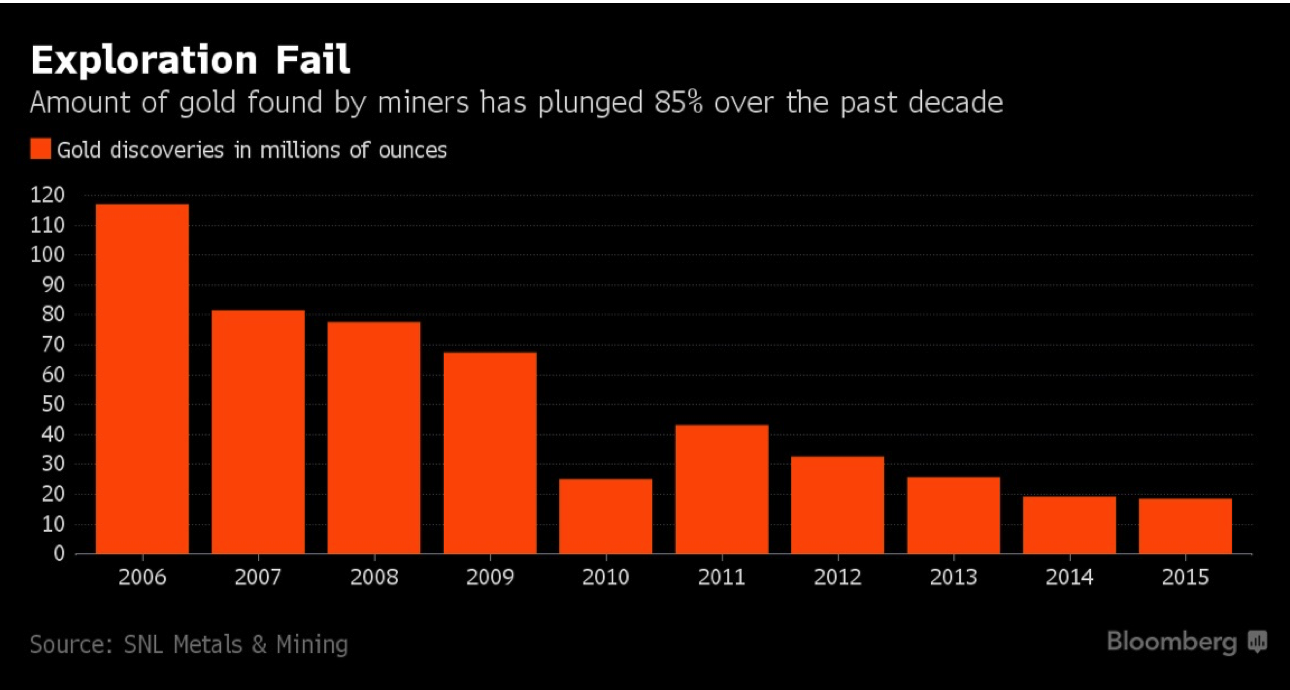
Markets are increasingly volatile and the outlook is uncertain. This is seeing more retail investors, HNW investors, UHNW investors, family offices and institutions diversify into gold.
This and peak gold bodes well for gold’s long-term outlook. The world’s central banks have been embarking on an unprecedented monetary experiment for the last decade. The true consequences of which are yet to play out.
Previously gold has reacted positively to economic downturns, but previously there has been no concerns about supply. When the global financial bubble bursts then we will likely see physical gold demand vastly outstripping gold supply.
Recommended reading:
Peak Gold – Biggest Gold Story Not Being Reported
World’s Largest Gold Producer China Sees Production Fall 10%
What Peak Gold, Interest Rates And Current Geopolitical Tensions Mean For Gold in 2018
News and Commentary
Gold holds losses on firmer dollar amid rate hike views (Reuters.com)
Gold prices log lowest finish in a month (MarketWatch.com)
Senate leaders reach $300 billion federal spending deal (Reuters.com)
Irish ‘house prices to fall if UK fails to get Brexit deal’ (Independent.ie)
UK house prices fell for the second successive month in January (CityAM.com)

Source: VoxEU.org
Gold Wins, Bitcoin Loses (Bloomberg.com)
A Gold Guys View of Crypto, Bitcoin, and Blockchain (Medium.com)
Washington’s ‘Plunge’ Team May Have Halted Dow Spiral (NYPost.com)
Another Arrested Equity Correction? — Paul Craig Roberts (PaulCraigRoberts.org)
Utah Is Open For Gold Mining But Mining Companies Not Interested (CityAM.com)
Gold Prices (LBMA AM)
08 Feb: USD 1,311.05, GBP 944.87 & EUR 1,071.13 per ounce
07 Feb: USD 1,328.50, GBP 956.12 & EUR 1,075.95 per ounce
06 Feb: USD 1,344.65, GBP 962.50 & EUR 1,083.52 per ounce
05 Feb: USD 1,337.10, GBP 947.20 & EUR 1,072.49 per ounce
02 Feb: USD 1,345.00, GBP 946.48 & EUR 1,077.61 per ounce
01 Feb: USD 1,341.10, GBP 941.99 & EUR 1,077.98 per ounce
31 Jan: USD 1,343.35, GBP 950.29 & EUR 1,078.98 per ounce
Silver Prices (LBMA)
08 Feb: USD 16.35, GBP 11.70 & EUR 13.36 per ounce
07 Feb: USD 16.69, GBP 12.02 & EUR 13.52 per ounce
06 Feb: USD 16.81, GBP 12.07 & EUR 13.59 per ounce
05 Feb: USD 16.88, GBP 12.01 & EUR 13.56 per ounce
02 Feb: USD 17.14, GBP 12.05 & EUR 13.72 per ounce
01 Feb: USD 17.19, GBP 12.09 & EUR 13.82 per ounce
31 Jan: USD 17.23, GBP 12.17 & EUR 13.84 per ounce
Recent Market Updates
– Crypto Currency Backlash Sees Flight From Cryptos and Bitcoin
– Gold Rises As Global Stocks Plunge and Bitcoin Crashes 70%
– Shrinkflation Intensifies – Stealth Inflation As Thousands of Food Products Shrink In Size, Not Price
– U.S. Debt Is “Extraordinarily High” and Are Stock And Bond Bubbles – Greenspan
– Gold Bullion Price Suppression To End? Bullion Bank Traders Arrested For Manipulating Market
– ATMs Hit By Malware “Jackpotting” Attacks That Dispense All Cash In Minutes
– London Property Market Tumbles As Glut of Luxury Apartments Grows To 3,000
– Silver Bullion: Once and Future Money
– Greatest Stock Bubble In History? GoldNomics Podcast Transcript
– Davos – My Personal Experience of the $100,000 Event, $60 Burgers, Massive Inequality and the Blockchain Revolution
– Is This The Greatest Stock Market Bubble In History? Goldnomics Podcast
– Cyber War Coming In 2018?
– Government Shutdown Ends – Markets Ignore Looming Debt and Bond Market Threat

END
Crudele: Washington’s plunge protection team probably halted the Dow spiral on Monday
(courtesy John Crudele/GATA)
John Crudele: Washington’s ‘plunge’ team may have halted Dow spiral
Submitted by cpowell on Wed, 2018-02-07 14:38. Section: Daily Dispatches
By John Crudele
New York Post
Monday, February 5, 2018
Did Washington save the stock market on Monday?
It may be hard to make the case that anyone or anything helped Wall Street as stocks lost about 4 percent of their value and the Dow Jones industrial average tumbled 1,175 points — after a 666-point decline on Friday.
But the Dow and other indices were in complete collapse right before Monday’s final hour of trading. At one point the Dow, which represents only 30 stocks but is still a widely followed indicator, tumbled to a loss of about 1,600 points.
That’s as big of a decline as ever.
But then something happened. Someone arbitrarily and aggressively started buying stocks and halved the loss. Monday will still go down as a Wall Street massacre but that superhero buyer made it half as bloody.
Who was the market’s superhero? …
… For the remainder of the commentary:
https://nypost.com/2018/02/05/dc-plunge-team-may-have-halted-unprecedent..
END
Two areas are now open for mining and the environmentalists are up in arms. Interestingly nobody showed up and interest is basically zero
(courtesy Bloomberg/GATA)
Bears Ears is open for mining but no one bothered to show up
Submitted by cpowell on Wed, 2018-02-07 14:44. Section: Daily Dispatches
Why get into a business whose prices are suppressed by surreptitious government intervention in the markets?
* * *
By Joe Deaux
Bloomberg News
Wednesday, February 7, 2018
Early last Friday morning, vast swathes of the red-rock high plateau that surrounds federally protected buttes in southern Utah were officially thrown open to miners.
A controversial decision weeks earlier by President Donald Trump had shrunk two national monuments — known as Bears Ears and Grand Staircase-Escalante — by hundreds of thousands of acres, enraging environmentalists and American Indian groups who feared that a stampede of mine and oil wildcatters would rush in and destroy the area’s sandstone vistas and historic rock carvings and artifacts. And yet, five days in, not only has there been no stampede, no one has shown up at all.
The Utah Division of Oil, Gas, and Mining says it hasn’t received a single permit application for plots in the areas. …
… For the remainder of the report:
https://www.bloomberg.com/news/articles/2018-02-07/bears-ears-mining-rus…
END
U.S. deliberately keeping dollar low, ECB’s Nowotny tells newspaper
Submitted by cpowell on Thu, 2018-02-08 12:37. Section: Daily Dispatches
From Reuters
Wednesday, February 7, 2018
VIENNA, Austria — The United States Treasury Department is deliberately putting downward pressure on the dollar, European Central Bank policymaker Ewald Nowotny said in comments published today.
“The U.S. Finance Ministry is deliberately pressuring the dollar and wants to keep it low,” Nowotny, who heads the Austrian National Bank, said in an interview with the Wiener Zeitung newspaper that was carried out on Feb. 1. …
… For the remainder of the report:
https://www.reuters.com/article/us-ecb-usa-nowotny/u-s-deliberately-keep…
END
Morgan Stanley believes that China wants a strong yuan. You would not know it today as the yuan badly fell from 6.27 to 6.32
(courtesy Lee/Bloomberg)
Dollar will stay weak if China has its way, Morgan Stanley says
Submitted by cpowell on Thu, 2018-02-08 12:41. Section: Daily Dispatches
By Justina Lee
Bloomberg News
Wednesday, February 7, 2018
As China’s currency trades near to its highest level against the greenback since the 2015 devaluation, don’t expect the government to engineer a reversal any time soon, according to Morgan Stanley.
That’s because Chinese policy makers are now embracing a strong yuan as it helps boost consumption and draw inflows, Hans Redeker, London-based global head of foreign-exchange strategy at the U.S. bank, said Tuesday. Thanks to China’s position as the world’s largest reserves holder and trade partner, that means the dollar’s weakness will persist.
“The rising renminbi has a messaging function into the region if not globally,” Redeker said. “It suggests that China sees advantages in a weak U.S. dollar — reverse of renminbi strength — as the weak U.S. dollar helps keep the global economy via credit supported.” …
… For the remainder of the report:
https://www.bloomberg.com/news/articles/2018-02-07/dollar-will-stay-weak…
END
This is a biggy!!. When Shanghai reports its withdrawals it is synonymous with gold demand from its citizenry. Gold purchased for sovereign use is not included in these figures. However gold mined China is included in these figures and the gold first goes onto bank;s balance sheet and then the sovereign must decide when to include it as official reserves.
in the latest figures for Jan. SGE withdrawals totaled 223.58 tonnes. China produces around 480 tonnes per year or 40 tonnes per month. So Chinese citizenry demanded 184 tonnes. If this continues then Chinese demand ex China sovereign will bring in 2208 tonnes which is just above 100% of global annual demand
(courtesy Lawrie Williams/Sharp’s Pixley)
LAWRIE WILLIAMS: China: Jan SGE gold withdrawals up; Central Bank Gold reserves unchanged
China has announced both its latest SGE gold withdrawal figures for January and also an unchanged gold reserve figure which we find hard to believe.
January SGE gold withdrawals came to 223.58 tonnes, comfortably above the 2017 January figure of 184.41 tonnes, but withdrawal figures tend to be a little erratic at this time of year with traders and fabricators stocking up for Chinese New Year demand. The Chinese (Lunar) New Year falls a little later this year than last on February 16th. A week long holiday follows. It is a year of the Dog.
Some analysts equate SGE withdrawals to be equivalent to Chinese gold demand. Others question this, but regardless the figures are probably as good an indicator as any of overall demand strength on the Chinese mainland. It is obviously too early to tell if there is indeed anything significant in a single month’s figures, but we will continue to keep a watchful eye on SGE gold withdrawal numbers as they are announced throughout the year.
Meanwhile the Chinese Central Bank has announced yet another month of unchanged gold reserves the 15th in a row. This will most likely mean that Russia will move ahead of China in fifth place among national gold holders assuming that it has added to its gold reserves in January. It is due to announce its latest gold reserve figure on or around February 20th.
But, as we have noted – most recently a month ago – see: China gold reserve increases – back to the bad old days non-reporting of its gold reserves except at multi- year intervals when it would announce large increases, was a pattern China adopted in the past. We fear it has returned to this non-reporting policy while continuing to build its reserves surreptitiously and will release its new total figure when is sees it as opportune to do so – perhaps not for another four or five years.
08 Feb 2018
-END-
Your early THURSDAY morning currency, Asian stock market results, important USA/Asian currency crosses, gold/silver pricing overnight along with the price of oil Major stories overnight/9 AM EST
i) Chinese yuan vs USA dollar/CLOSED DOWN AT 6.3295 /shanghai bourse CLOSED DOWN AT 47.21 POINTS 1.43% / HANG SANG CLOSED UP 128.07 POINTS OR 0.42%
2. Nikkei closed UP 245.49 POINTS OR 1.13% /USA: YEN FALLS TO 109.64
3. Europe stocks OPENED DEEPLY IN THE RED /USA dollar index RISES TO 90.46/Euro FALLS TO 1.2236
3b Japan 10 year bond yield: RISES TO . +.081/ (CENTRAL BANK INTERVENTION THIS MORNING) GOVERNMENT INTERVENTION !!!!(Japan buying 100% of bond issuance)/Japanese yen vs usa cross now at 109.64/ THIS IS TROUBLESOME AS BANK OF JAPAN IS RUNNING OUT OF BONDS TO BUY./JAPAN 10 YR YIELD FINALLY IN THE POSITIVE/BANK OF JAPAN LOSING CONTROL OF THEIR YIELD CURVE AS THEY PURCHASE ALL BONDS TO GET TO ZERO RATE!!
3c Nikkei now JUST BELOW 17,000
3d USA/Yen rate now well below the important 120 barrier this morning
3e WTI:: 61.25 and Brent: 64.94
3f Gold DOWN/Yen DOWN
3g Japan is to buy the equivalent of 108 billion uSA dollars worth of bond per month or $1.3 trillion. Japan’s GDP equals 5 trillion usa./“HELICOPTER MONEY” OFF THE TABLE FOR NOW /REVERSE OPERATION TWIST ON THE BONDS: PURCHASE OF LONG BONDS AND SELLING THE SHORT END
Japan to buy 100% of all new Japanese debt and by 2018 they will have 25% of all Japanese debt. Fifty percent of Japanese budget financed with debt.
3h Oil DOWN for WTI and DOWN FOR Brent this morning
3i European bond buying continues to push yields lower on all fronts in the EMU. German 10yr bund RISES TO +.772%/Italian 10 yr bond yield UP to 1.965% /SPAIN 10 YR BOND YIELD UP TO 1.43%
3j Greek 10 year bond yield FALLS TO : 3.76?????????????????
3k Gold at $1313.00 silver at:16.38: 7 am est) SILVER NEXT RESISTANCE LEVEL AT $18.50
3l USA vs Russian rouble; (Russian rouble UP 1/100 in roubles/dollar) 57.89
3m oil into the 61 dollar handle for WTI and 64 handle for Brent/
3n Higher foreign deposits out of China sees huge risk of outflows and a currency depreciation. This can spell financial disaster for the rest of the world/
JAPAN ON JAN 29.2016 INITIATES NIRP. THIS MORNING THEY SIGNAL THEY MAY END NIRP. TODAY THE USA/YEN TRADES TO 109.64 DESTROYING JAPANESE CITIZENS WITH HIGHER FOOD INFLATION
30 SNB (Swiss National Bank) still intervening again in the markets driving down the SF. It is not working: USA/SF this morning 0.9412 as the Swiss Franc is still rising against most currencies. Euro vs SF is 1.1550 well above the floor set by the Swiss Finance Minister. Thomas Jordan, chief of the Swiss National Bank continues to purchase euros trying to lower value of the Swiss Franc.
3p BRITAIN VOTES AFFIRMATIVE BREXIT/LOWER PARLIAMENT APPROVES BREXIT COMMENCEMENT/ARTICLE 50 COMMENCES MARCH 29/2017
3r the 10 Year German bund now POSITIVE territory with the 10 year RISING to +0.772%
The bank withdrawals were causing massive hardship to the Greek bank. the Greek referendum voted overwhelming “NO”. Next step for Greece will be the recapitalization of the banks and that will be difficult.
4. USA 10 year treasury bond at 2.8603% early this morning (THIS IS DEADLY TO ALL MARKETS). Thirty year rate at 3.1540% /BOTH DEADLY
5. Details Ransquawk, Bloomberg, Deutsche bank/Jim Reid.
(courtesy Jim Reid/Bloomberg/Deutsche bank/zero hedge)
Dow Set For Another -200 Point Open After A Volatile, Extremely Illiquid Session
U.S. stock index futures turn negative in an illiquid, volatile session as investor sentiment has yet to stabilize amid doubts whether the U.S. equity selloff is over as yields remain just south of the critical 2.85% level. S&P E-mini contracts slid 0.1%, while the VIX is up 1% to 28.1 after 2 days of declines. Including fair value, the Dow is expected to have an implied open of over 200 points lower while the S&P will open around 2,665.

Meanwhile, in this post-VIX ETP world, liquidity remains non-existent, as this chart from nanex shows.

It’s not just the US however which can’t find its footin, as all risk-related assets trade under pressure in a generally muted session following yesterday’s whipsawed session which saw stocks spend much of the day in the green, only to slide at the close.
European equity losses hit ~1.0% as the mining sector underperforms while banks are supported by decent earnings reports from Commerzbank, SocGen and UniCredit. In terms of sector specifics, the financial sector is the outperformer with earnings from the likes of Commerzbank (+2.4%), SocGen (+4.1%), UniCredit (+2.6%) and Zurich Insurance (+3.8%) lifting the sector with Swiss Re (+3.8%) also lending a helping hand near the top of the SMI after news that Softbank could acquire a stake in the Co. Elsewhere, GSK (+2.3%) has been supported by news that Novartis’ launch of their Advair copy will be delayed. In terms of bourses, the CAC (-0.3%) has seen some modest outperformance, with domestic earnings from Total (+1.8%), Pernod Ricard (+2.2%) and Publicis (+3.8%) capping losses.
Earlier, shares in Japan closed higher after a turbulent session while China’s stocks fell for a third day, even as Hong Kong equities climbed. Australia’s ASX 200 (+0.2%) was lower for most of the day as weakness in the commodity complex weighed on mining names, however, the index then gradually pared losses as strong Chinese Imports provided some encouragement. The Nikkei 225 (+1.1%) outperformed with corporate earnings back in the limelight, while Hang Seng (+0.4%) and Shanghai Comp. (-1.4%) ignored strong trade data and were indecisive after the PBoC skipped open market operations for the 11th consecutive occasion, and with heavy losses seen across the big 4 banks in the mainland.
The biggest highlight of the overnight session, however, was the yuan which, as we reported overnight, fell the most since the currency’s devaluation in August 2015 after China reported a much narrower-than-expected trade surplus as imports jumped. According to Reuters, China has resumed its Qualified Domestic Limited Partnership plan after a two-year halt, granting licenses to about a dozen global money managers that can raise funds in China for overseas investments. Increasing imports and investment overseas both contribute to a weaker currency, and the result was a sharp plunge in the Yuan, a move which may again be criticized by Trump as indicative of currency wars.

“Selling of offshore yuan has spurred short covering of the dollar,” said Ko Haruki, head of the financial solutions group at CIBC World Markets (Japan) in Tokyo. “The dollar’s gain against the yuan is lifting dollar-yen, which had also seen short covering as the Nikkei 225 stayed in positive territory.”
In other words, in today’s interlinked market, the plunge in the Yuan, ended up boosting Japanese stocks by way of a dollar, that traded higher much of the overnight session.
Meanwhile, the all important catalyst for the recent equity selloff, U.S. 10-year Treasuries, were steady after Senate leaders unveiled a bipartisan deficit busting deal while weak demand at Wednesday’s 10Y auction pushed the yield back toward the recent four-year high.

At the same time, the pound drifted higher before a Bank of England rate decision, and the euro weakened as ECB member Jens Weidmann said the central bank will monitor the impact of the currency on inflation. USD continues to find support across G-10, with ZAR and TRY particularly weak; yuan in focus after overnight selloff, which was driven by narrower trade surplus and increased outbound investment reports.
A summary of key macro moves, courtesy of Bloomberg:
- EUR/USD reached a two-week low of 1.2232 amid broad dollar strength; BBDXY rose for a second day and earlier reached its highest since Jan. 23
- GBP/USD slips for fifth day, headed for its worst run in 11 months
- USD/JPY climbed, as the yen tracked the plunge in the yuan
- Yield on 10Y Treasuries little changed; dollar-curve bear steepened with 30Y underperforming
In commodities, WTI and Brent crude futures have seen relatively sideways trade overnight and this morning as prices remain in close proximity to yesterday’s lows seen in the wake of the ramp up in US production shown via the DOE’s with output above 10mln bpd and perhaps more crucially, above that of Saudi Arabia. Elsewhere, latest reports confirm that the Forties pipeline has now resumed operations. In metals markets, spot gold is trading lower as the yellow metal succumbs to the firmer USD, while copper’s attempt to nurse losses during Asia-Pac trade was restricted by the risk averse tone in its largest consumer China.
Bulletin Headline Summary from Ransquawk
- European bourses trade lower across the board in sympathy with the pull-back seen on Wall Street yesterday
- DXY has rallied above 90.000 and as far as 90.500. Nzd/Usd has pared some losses to trade back over 0.7200
- Looking ahead, highlights today include the BoE rate decision and a slew of speakers including ECB’s Villeroy, BoE Governor Carney, Fed’s Harker, Fed’s Kashkari, BoC’s Wilkins
Market Snapshot
- S&P 500 futures down 0.1% to 2,665.0
- STOXX Europe 600 down 0.3% to 378.89
- MSCI Asia Pacific up 0.3% to 173.47
- MSCI Asia Pacific ex Japan up 0.09% to 566.67
- Nikkei up 1.1% to 21,890.86
- Topix up 0.9% to 1,765.69
- Hang Seng Index up 0.4% to 30,451.27
- Shanghai Composite down 1.4% to 3,262.05
- Sensex up 1% to 34,405.30
- Australia S&P/ASX 200 up 0.2% to 5,890.70
- Kospi up 0.5% to 2,407.62
- Gold spot down 0.6% to $1,309.95
- U.S. Dollar Index up 0.3% to 90.53
- German 10Y yield rose 1.9 bps to 0.764%
- Euro down 0.3% to $1.2233
- Brent Futures down 0.09% to $65.45/bbl
- Italian 10Y yield fell 3.8 bps to 1.682%
- Spanish 10Y yield rose 1.1 bps to 1.426%
Top Overnight News from BBG
- Fed’s Kaplan: 3 hikes this year is appropriate; best way to continue expansion is to remove accommodation
- Reuters: China revives QDLP outbound investment scheme; licenses granted for some funds to raise money in China for investment overseas ending a 2-year halt, according to people familiar
- Japanese investors dumped U.S. sovereign bonds for a third month in December, taking sales last year to the highest in a decade. Total withdrawals for 2017 were 3.83 trillion yen, the most since 2007, when they offloaded 3.98 trillion yen. They were net buyers between 2014 and 2016.
- Senate leaders in the U.S. announced a bipartisan two-year budget agreement Wednesday that would provide nearly $300 billion in additional funding, a crucial step toward averting a Friday government shutdown
- The European Commission is struggling to translate the U.K.’s Brexit pledges on Ireland into a legally binding text, even before they present it to the U.K. in negotiations, according to people familiar with the EU side.
- New Zealand’s central bank held interest rates at a record low and projected they will stay there until mid-2019 as inflation remains subdued amid slower economic growth.
- Federal Reserve Bank of San Francisco President John Williams said he isn’t altering his view on the U.S. economy or preference for a continued gradual rate hike path after several days of volatile markets. “The risks seem to be moving toward the likelihood of more inflation, and that’s a good thing,” Federal Reserve Bank of Chicago President Charles Evans says
- The greenback gained as much as 0.9% against the offshore yuan, while advancing 0.3% against the yen to 109.61 after earlier being down as much as 0.2%. The Nikkei 225 index climbed 1.1%
- China’s yuan sank the most since the aftermath of the shock devaluation in August 2015. Reuters reported that the Chinese government will relax controls on investment fund outflows. China’s trade surplus figures missed estimates and speculation policy makers will step up efforts to rein in gains, pressured the yuan
- Franklin Templeton bond chief, Michael Hasenstab, is doubling down on bets that Treasuries are doomed due to rising rates. He’s been loading up on wagers that protect against a spike in yields in his $38 billion flagship Global Bond Fund. The move has pushed average duration in the portfolio to the shortest on record.
- The German grand-coalition agreement helped pare peripheral spreads versus bunds to the lowest since 2010, which should allow Greece to resume plans for a 7Y EUR note, Commerzbank analysts said in a note today
- BOE Governor Mark Carney may be less reassuring if he signals more tightening today amid expectations the central bank will upgrade its quarterly outlook
Asian equity markets traded mixed with the region somewhat cautious following the subdued lead from Wall St. where price action was choppy and all majors closed in the red. ASX 200 (+0.2%) was lower for most of the day as weakness in the commodity complex weighed on mining names, and with industry giant Rio Tinto also pressured after investors bought the rumour and sold on the news of a strong earnings report. However, the index then gradually pared losses as strong Chinese Imports provided some encouragement. Elsewhere, Nikkei 225 (+1.1%) outperformed with corporate earnings back in the limelight, while Hang Seng (+0.4%) and Shanghai Comp. (-1.4%) ignored strong trade data and were indecisive after the PBoC skipped open market operations for the 11th consecutive occasion, and with heavy losses seen across the big 4 banks in the mainland. Finally, 10yr JGBs were marginally lower with demand subdued amid gains in Japanese risk assets, while the 30yr JGB auction also failed to provide support despite increased demand and higher accepted prices. PBoC skipped open market operations and was net neutral on the d
Top Asian News
- China’s Yuan Plunges Most Since Aftermath of Devaluation in 2015
- BOJ’s Suzuki Is Monitoring Impact of Monetary Easing on Banks
- China Jan. Exports Rise 6.0% Y/y in Yuan Terms; Est. 2.6%
- Australia’s Lowe Sees No ‘Strong Case’ for Near-Term Rate Move
- Turkey’s Big Year for IPOs Is Off to an Underwhelming Start
- Everything’s a Sell in China After $660 Billion Equity Wipeout
China trade from CapEco: Trade appears strong but seasonal effects muddy the waters. Chinese trade beat expectations at the start to 2018. But seasonal volatility means that we won’t get a clear reading on the pace of foreign shipments until next month. Export growth edged down from 7.4% y/y in December to 6.0% last month in renminbi terms (the Bloomberg median was 2.6%, our forecast was 0.0%). Adjusting for a rise in export prices, we estimate that growth in export volumes dropped from 6.9% y/y to 5.2%. It is surprising that growth in outbound shipments didn’t decline by a wider margin given that Chinese New Year falls later this year than last, which should have meant that less of the pre-holiday rush to meet orders took place in January. We estimate that export volumes rose around 3% m/m in seasonally adjusted terms last month, reaching an all-time high. This suggests that strong foreign demand – the global manufacturing PMI remained close to a seven-year high in January – has continued to support shipments of Chinese goods. Meanwhile, import growth jumped in January, from 0.9% y/y to 30.2% (Bloomberg 5.3%, CE 6.0%). Adjusting for price effects, we estimate that growth in import volumes also surged, from -3.9% y/y to 26.0%. A pick-up was expected given that more of the build-up in inventories ahead of the pre-New Year rush should have taken place in January this year relative to 2017. But as with exports, the outturn exceeded expectations. We estimate that, even after stripping out seasonal factors, import volumes jumped 15% m/m last month, more than reversing a 7.2% fall in December. On the face of it then, the data point to a very strong start to the year for Chinese trade. But the figures need to be treated with caution since although we have done our best to adjust for shifts in the timing of Lunar New Year, it is not always possible to iron out these distortions entirely. The picture will become clearer once we are able to average across the data for first two months of the year. We think export growth will rise further in February but expect import growth to drop back sharply as the seasonal base effects reverse.
European equities (Eurostoxx 50 -0.6%) trade lower across the board in sympathy with the broader pull-back in risk around the globe today and in the US on Wednesday. In terms of sector specifics, the financial sector is the outperformer with earnings from the likes of Commerzbank (+2.4%), SocGen (+4.1%), UniCredit (+2.6%) and Zurich Insurance (+3.8%) lifting the sector with Swiss Re (+3.8%) also lending a helping hand near the top of the SMI after news that Softbank could acquire a stake in the Co. Elsewhere, GSK (+2.3%) has been supported by news that Novartis’ launch of their Advair copy will be delayed. In terms of bourses, the CAC (-0.3%) has seen some modest outperformance, with domestic earnings from Total (+1.8%), Pernod Ricard (+2.2%) and Publicis (+3.8%) capping losses. Finally, Talk Talk (-10%) are enduring a difficult morning of trade after announcing a GBP 200mln share placement.
Top European News
- TDC Soars After News of a Cash Takeover Bid From Giant Funds
- May Said to Plan Instant Split From Some EU Rules After Brexit
- Merkel’s Fourth Term Now Rides on Germany’s Changing Rust Belt
- Zurich Delivers on Dividend Pledge as Insurer Slashes Costs
In currncies,the Nzd/Usd has pared some losses to trade back over 0.7200 from a circa 0.7175 low overnight after the RBNZ stood pat on rates as widely expected, but surprised with a broadly dovish accompanying statement and additional comments projecting a further downturn in the Kiwi on a TWI basis. While maintaining guidance for tightening from Q2 next year, Governor Spencer and his assistant McDermott cautioned that the next move could be a cut or hike. Hence, the Aud/Nzd cross has rebounded above 1.0800 again and almost touched 1.0900 at one stage, as Aud/Usd keeps its head above 0.7800 despite RBA governor Lowe RBA Governor Lowe stating that the RBA does not see a strong case for raising interest rates in the near term. Elsewhere, Usd/Jpy has climbed towards the top of a broad 109.00-110.00 range amidst a renewed pledge from BoJ head Kuroda to continue with powerful QE to achieve price stability as it remains some way from reaching the inflation target. Eur/Usd has also broken out from recent trading parameters, partly on ECB claims that the US is keeping the Dollar weak, but mainly as the Greenback gleans more of a yield advantage. The headline pair has bounced in advance of a series of key chart supports in the 1.2222-27 area, but may not get close to decent option expiry strikes between 1.2300-10 (1.35 bn). Sterling is holding up relatively well in the run up to a potentially more hawkish BoE post-meeting QIR with Cable above 1.3850 and Eur/Gbp sub-0.8850 vs 0.8900 and over of late. Note, option pricing suggests a big market move on the event, 120 pips either way. Usd/Cad still hovering just below 1.2600 as Canadian President Trudeau repeats that no NAFTA deal is better than the wrong one, while Usd/Chf is sitting near the top of a higher 0.9425-50 band having pushed through strong tech resistance at the lower end. Usd/Cny has bounced firmly on a much smaller than forecast Chinese trade surplus and reports about relaxed capital controls – hence the DXY has rallied above 90.000 and as far as 90.500.
In commodities, WTI and Brent crude futures have seen relatively sideways trade overnight and this morning as prices remain in close proximity to yesterday’s lows seen in the wake of the ramp up in US production shown via the DOE’s with output above 10mln bpd and perhaps more crucially, above that of Saudi Arabia. Elsewhere, latest reports confirm that the Forties pipeline has now resumed operations. In metals markets, spot gold is trading lower as the yellow metal succumbs to the firmer USD, while copper’s attempt to nurse losses during Asia-Pac trade was restricted by the risk averse tone in its largest consumer China. North Sea Forties crude oil pipeline has restarted.
Looking at the day ahead, the BoE should be the highlight today with the MPC meeting due around midday. The latest inflation report will be released alongside this and Governor Carney will then follow with his press conference. Away from that, the December trade data is out in Germany and the latest weekly initial jobless claims data in the US are also due. The Fed’s Kashkari and Harker are also slated to speak in the afternoon at separate events, while the ECB’s Mersch, Praet and Villeory will speak. AIGand CVS Health are due to report earnings.
US Event Calendar
- 8am: Fed’s Harker Speaks on Economy: Outlook and Impact for College
- 8:30am: Initial Jobless Claims, est. 232,000, prior 230,000; Continuing Claims, est. 1.94m, prior 1.95m
- 9am: Fed’s Kashkari Speaks in Moderated Q&A
- 9pm: Fed’s George Speaks on the Economy
DB’s Jim reid concludes the overnight wrap
Has the phrase “healthy correction” ever been used more than it has over the past 24 hours? Given that the VIX traded above 50 on Tuesday (a level it hasn’t closed at since March 2009) I’d hate to see what an unhealthy correction looks like. Having said that markets are broadly adhering to the script of what normally happens after the largest VIX spikes seen on record. As a reminder on Tuesday night we published a quick note showing what happens 1 week, 1 month and 3 months after the largest 10 VIX spikes in history. Basically the VIX usually rallies over all subsequent periods but equities tend to be higher the week after but on average fall 3 months later. The reverse is true for bonds.
Things were adhering to this script for most of the day (especially in Europe) but a late US equity sell-off provided some renewed jitters to markets. The VIX did fall 7.5% to 27.73 but the S&P 500 fell -0.50% – well off the day’s highs of +1.21% just before Europe’s strong close (more below) and including a near 1% drop in the last 20 minutes of trading. Activity remains high and according to Bloomberg volume on US exchanges exceeded 9 billion shares for a fourth straight day after surpassing that total just once in the past seven months.
The reversal seemed to stem from a disappointing 10 year Treasury auction which lifted yields around 8bps from the lows for the session (+3.4bps on the day to 2.837%) and perhaps also because of the Senate’s additional spending plans (more below). Given the turmoil this week it is very telling that 10yr US yields are back to where they were at payroll Friday’s close having climbed 19.1bps from Tuesday’s lows.
Very soon we’ll start building up to next Wednesday’s US January CPI print and although the importance of one number should be downplayed in theory, in reality it’s fair to say that this will be an incredibly closely watched number for global markets. A higher than expected print will likely extend the volatility and probablycause risk to sell-off whereas an in-line or softer print will be very risk positive.
We’ve got no idea about where one number is going to come in but we’d expect inflation to more often beat on the upside in 2018. Interestingly DB’s Alan Ruskin yesterday highlighted that over the last 25 years, January core CPI m/m% was lower than Dec core CPI m/m% on only 5 occasions. The Feb core CPI was higher than January core CPI on only 6 of the last 25 occasions. He points out that there is a bias in the seasonally adjusted data for a bump up in January m/m% relative to both December and February. Food for thought.
In the US, Senate leaders have announced a bipartisan two year budget deal – including c$300bn of new spending and suspension of the federal debt ceiling until March 2019. The agreement is expected to extend the government funding until 23 March while the lawmakers refine details on the longer term plans.
Looking ahead, the bill will be voted on in the Senate today and then move to the House, where it is not certain that it will pass. House Minority leader Ms Pelosi noted she won’t back the bill without a commitment from Speaker Ryan to allow an open debate on the immigration issues, similar to the promise made earlier by Senator McConnell.
In Germany, Ms Merkel and the SPD have reached an agreement to form the next coalition government, with the SPD likely to gain the finance and foreign affairs ministry posts as part of the concession (as per Bloomberg). Notably, the SPD has held these two ministries before, back in the 2005-2009’s grand coalition government. For now, Ms Merkel has reaffirmed her commitment to a “solid” fiscal policy and noted “you can only spend the money you have…I’m not worried at all”. In view of the SPD gaining many of the key Government positions and their previously stated desire to create a United States of Europe by 2025, the result could boost the potential for a deeper EU integration as proposed earlier by France’s President Macron where he advocated a joint budget and common finance ministers for the region. Looking ahead, the deal needs to be approved by the SPD’s 463k rank and file members, where confirmation is not certain.
This morning in Asia, markets are mixed but firming as we type. The Nikkei (+1.22%), Kospi (+0.74%) and Hang Seng (+0.77) are all up whilst the China’s CSI 300 (-0.89%) is lower. Datawise, China’s January trade surplus was less than expected at $20.3bn (vs. $54.7b) as a strong rise in imports (36.9% vs. 10.6% expected) outpaced exports growth (11.1%). Elsewhere, in his first public speech since joining the BOJ’s board, Mr Suzuki noted the central bank must continue with easing for a while as inflation is still far from the BOJ’s 2% target.
Now recapping other market performance from yesterday. As mentioned earlier, US bourses fluctuated during the day before closing lower (S&P -0.50%; Dow -0.08%; Nasdaq -0.90%). Within the S&P, modest gains in the telco and financials were more than offset by losses from energy and tech stocks. European markets were all up and rebounded c2%, in part playing a catch up to the positive US lead from the prior day. The Stoxx 600 rose for the first time in seven days and printed the largest gain since June 2016 (+1.97%), while the DAX (+1.60%) and FTSE (+1.93%) also rose. The VSTOXX fell 29% back to April 17 levels (21.37).
Over in government bonds, core 10y bond yields rose 3-5bp (UST +3.4bp; Bunds +5.2bp; Gilts +3bp) while peripherals outperformed, with yields down 1-4bp, in part boosted by the potential for tighter EU integration post the German coalition talks. Turning to currencies, the US dollar index firmed for the fourth consecutive day (+0.75%), while the Euro and Sterling weakened 0.91% and 0.49% respectively. In commodities, WTI oil dropped 2.52% following the latest EIA data showed a rise in US crude inventories and domestic oil output.
Elsewhere, precious metals weakened c1% (Gold -0.44%; Silver -1.64%) and other base metals also retreated (Copper -2.1%; Zinc -1.56%; Aluminium +0.32%). Away from the markets and onto the four Fed speakers. On the recent US equity sell off, they all seemed to be taking it in their stride. The Fed’s Dudley noted that “having a bump like this has virtually no consequences on my view of the economic outlook”. The Fed’s Kaplan added these corrections “can be healthy” and has little implication for the US economy. Then the Fed’s Williams noted “I don’t see any of the movements in asset prices of late to fundamentally change my view of the economy”. Elsewhere, the Fed’s Evans noted the US economy is “firing on all cylinders” and believe the recent equity selloff was “an outsized response”.
Moving onto rates and inflation. Mr Williams who is a voter this year said “we should have a gradual increase in rates this year and next…right now, I’m not taking any signal” from the data, although he also added “even four rate hikes is very gradual”. Elsewhere Mr Evans has reaffirmed his views of keeping rates flat until mid-18 in order to assess the incoming inflation data. Although he also added “suppose inflation picks up more assuredly….then we still could easily raise rates another three or even four times in 2018 if that were necessary”.
Finally, Mr Kaplan noted that “we are likely to overshoot full employment and it would be wise to be removing accommodation in a patient and balance manner”. Back in the UK and ahead of today’s BOE, DB’s Oliver Harvey argues that it will be difficult for the Bank to out-hawk current market pricing at this meeting. While the Bank is unlikely to push back against the tighter path implied by the market forward curve, they think that it is still too difficult for it to signal confidence in a May hike given ongoing risks about Brexit transition, the wedge between domestic and external demand and limited evidence of an overheating labour market.
Staying in Europe, the European Commission has upgraded its GDP growth forecasts for the Euro area. Growth for 2018 is now 2.3% (+0.2ppt from previous) and 2% for 2019. Elsewhere, inflation is expected to be marginally higher to 1.5% this year but unchanged at 1.6% for 2019. The EC forecasts UK growth to slow to 1.4% this year and 1.1% next year (DB expects growth of 1.3% and 1.5% respectively). Elsewhere, the ECB’s Lautenschlaeger noted price trends justify ending the QE program this year.
Before we take a look at today’s calendar, we wrap up with other data releases from yesterday. In the US, the December consumer credit was lower than expected at $18.5bln (vs. $20.0bln), but prior revisions meant annual growth was up 5.4% yoy. Following a stronger November reading, Germany’s December IP fell a bit less than expected at -0.6% mom (vs. -0.7%), leading to an annual growth of 6.5% yoy. In France, the December trade balance deficit narrowed to -EUR3.5bln (vs. -EUR4.9bln) – the smallest deficit since May 2016. A rebound in exports boosted annual growth to 4.1% yoy whereas imports rose 3.0% yoy. In the UK, the January Halifax house price index fell -0.6% mom (vs. 0.2% expected) leading to an annual growth of 2.2% yoy (vs 2.4% expected). Finally, Italy’s December retail sales was lower than expectations at -0.1% yoy (vs 1%).
Looking at the day ahead, the BoE should be the highlight today with the MPC meeting due around midday. The latest inflation report will be released alongside this and Governor Carney will then follow with his press conference. Away from that, the December trade data is out in Germany and the latest weekly initial jobless claims data in the US are also due. The Fed’s Kashkari and Harker are also slated to speak in the afternoon at separate events, while the ECB’s Mersch, Praet and Villeory will speak. AIGand CVS Health are due to report earnings.
3. ASIAN AFFAIRS
i)Late WEDNESDAY night/THURSDAY morning: Shanghai closed DOWN 47.21 points or 1.43% /Hang Sang CLOSED UP 128.07 or 0.42% / The Nikkei closed UP 245.49 POINTS OR 1.13%/Australia’s all ordinaires CLOSED UP 0.23%/Chinese yuan (ONSHORE) closed DOWN at 6.3295/Oil DOWN to 61.25 dollars per barrel for WTI and 64.94 for Brent. Stocks in Europe OPENED DEEPLY IN THE RED . ONSHORE YUAN CLOSED DOWN AGAINST THE DOLLAR AT 6.3295. OFFSHORE YUAN CLOSED DOWN AGAINST THE ONSHORE YUAN AT 6.3574//ONSHORE YUAN A LOT WEAKER AGAINST THE DOLLAR/OFF SHORE A LOT WEAKER TO THE DOLLAR/. THE DOLLAR (INDEX) IS MUCH STRONGER AGAINST ALL MAJOR CURRENCIES. CHINA IS NOT TOO HAPPY TODAY.(INTERVENTION WEAKER CURRENCY AND WEAK MARKETS THROUGHOUT THE GLOBE )
3 a NORTH KOREA/USA
/NORTH KOREA
3 b JAPAN AFFAIRS
c) REPORT ON CHINA
It begins: The firesale is underway as China NHA defaults for good. One of its holdings is a 10% ownership of Deutsche bank and this stock is tumbling.
(courtesy zerohedge)
The Firesale Begins: China’s HNA Starts Liquidating Billions In US Real Estate
Yesterday we explained that one of the reasons why Deutsche Bank stock had tumbled to the lowest level since 2016, is because its top shareholder, China’s largest and most distressed conglomerate, HNA Group, had reportedly defaulted on a wealth management product sold on Phoenix Finance according to the local press reports. While HNA’s critical liquidity troubles have been duly noted here and have been widely known, the fact that the company was on the verge (or beyond) of default, and would be forced to liquidate its assets imminently, is what sparked the selling cascade in Deutsche Bank shares, as investors scrambled to frontrun the selling of the German lender which is one of HNA’s biggest investments.
Now, one day later, we find that while Deutsche Bank may be spared for now – if not for long – billions in US real estate will not be, and in a scene right out of the Wall Street movie Margin Call, HNA has decided to be if not smartest, nor cheat, it will be the first, and has begun its firesale of US properties.
According to Bloomberg, HNA is marketing commercial properties in New York, Chicago, San Francisco and Minneapolis valued at a total of $4 billion as the indebted Chinese conglomerate seeks to stave off a liquidity crunch. The marketing document lists six office properties that are 94.1% leased, and one New York hotel, the 165-room Cassa, with a total value of $4 billion.
One of the flagship properties on the block is the landmark office building at 245 Park Ave., according to a marketing document seen by Bloomberg.

HNA bought that skyscraper less than a year ago for $2.21 billion, one of the highest prices ever paid for a New York office building. The company also is looking to sell 850 Third Ave. in Manhattan and 123 Mission St. in San Francisco, according to the document. The properties are being marketed by an affiliate of brokerage HFF.
This is just the beginning as HNA’s massive debtload – which if recent Chinese reports are accurate the company has started defaulting on – is driving the company to sell assets worldwide.
According to Real Capital Analytics estimates, HNA owns more than $14 billion in real estate properties globally. The problem is that the company has a lot more more debt. As of the end of June, HNA had 185.2 billion yuan ($29.3 billion) of short-term debt — more than its cash and earnings can cover. The company’s total debt is nearly 600 billion yuan or just under US$100 billion. Which means that the HNA firesale is just beginning, and once the company sells the liquid real estate, it will move on to everything else, including its stake in all these companies, whose shares it has already pledged as collateral.

So keep a close eye on Deutsche Bank stock: while HNA may have promised John Cryan it won’t sell any time soon, companies tend to quickly change their mind when bankruptcy court beckons.
Finally, the far bigger question is whether the launch of HNA’s firesale will present a tipping point in the US commercial (or residential) real estate market. After all, when what until recently was one of the biggest marginal buyers becomes a seller, it’s usually time to get out and wait for the bottom.
end
4. EUROPEAN AFFAIRS
The pound soars after the Bank of England warns that they will hike rates somewhat earlier and greater than expected
(courtesy zerohedge)
Pound Soars After Hawkish BOE Warns Rate Hikes May Be “Somewhat Earlier And By Greater Extent”
In light of the previously noted speculation that the BOE may come out on the hawkish side in its commentary today, that’s precisely what the Bank of England did today when it kept rates unchanged at 0.5%, and QE flat as expected in a unanimous 9-0 vote…

MPC vote unanimously to keep #BankRate at 0.5%

… but what traders have immediately honed in on is the following language from the statement, in which the BOE raised its growth forecast and said that the “Committee judges that, were the economy to evolve broadly in line with the February Inflation Report projections, monetary policy would need to be tightened somewhat earlier and by a somewhat greater extent over the forecast period than anticipated at the time of the November Report, in order to return inflation sustainably to the target.”
The reason for the surprisingly hawkish language is that in thequarterly inflation report, the BoE’s Monetary Policy Committee agreed a statement saying that the central bank was no longer willing to tolerate inflation above its 2 per cent target for the next three years.
As the FT reminds us, today’s language was similar to that in September’s MPC minutes, which immediately preceeded the first interest rate rise in a decade in November, raising official rates to their current level of 0.5 per cent.
But the main change in the forecasts from three months ago was an upward revision to the BoE’s expectation of the strength of the global economy, which helps Britain’s exporters, nudging up the forecast UK growth rate in 2018 from 1.7 per cent to 1.8 per cent.
As a result of the clearly hawkish bias, the report is sparking expectations the BoE may proceed with its next hike as soon as its May meeting.
Some caveats via the FT:
- The Committee’s forecasts were finalised before the recent volatility in financial markets and while the MPC said it was “too early” to gauge any effect of lower equity prices on the economy, it added that “notwithstanding recent volatility in financial markets, global financial conditions remain supportive”.
- The committee still assumes a “smooth” Brexit, but adds that leaving the EU “remains the most significant influence on, and source of uncertainty about, the economic outlook”. It noted that leaving the EU was “key influence” in the tepid growth of business investment and household spending growth was likely to remain muted this year as a result of relatively weak rises in income.
Some other observations:
On inflation, a slightly dovish take:
On balance, CPI inflation is projected to fall back gradually over the forecast but remain above the 2% target in the second and third years of the MPC’s central projection.
On the labor market:
The firming of shorter-term measures of wage growth in recent quarters, and a range of survey indicators that suggests pay growth will rise further in response to the tightening labour market, give increasing confidence that growth in wages and unit labour costs will pick up to target-consistent rates.
On growth:
GDP growth is expected to average around 1¾% over the forecast, a slightly faster pace than was projected in November despite the updated projections being conditioned on the higher market-implied path for interest rates and stronger exchange rate prevailing in financial markets at the time of the forecast.
While modest by historical standards, that rate of growth is still expected to exceed the diminished rate of supply growth. Following its annual assessment of the supply side of the economy, the MPC judges that the UK economy has only a very limited degree of slack and that its supply capacity will grow only modestly over the forecast, averaging around 1½% per year.
On Brexit:
The low cost of capital and limited spare capacity, strong global activity is supporting business investment, although it remains restrained by Brexit-related uncertainties.
The kneejerk response has been a burst higher in cable, which has spiked by over 100 pips.

5. RUSSIAN AND MIDDLE EASTERN AFFAIRS
Iran/Iraq/USA
A bombshell report by the Dept of Defense as they admit and 80 million dollars worth of M1 Abram tanks ended up with Iran backed militias as they took their booty in Iraq
(courtesy zerohedge)
Bombshell: DOD Admits $80 Million in M1 Abrams Tanks Ended Up With Iran-Backed Militias
The Lead Inspector General has released a report to the United States Congress on Operation Inherent Resolve (OIR), the overseas contingency operation (OCO) to combat ISIS. The report covers the status of foreign operations from the period of Oct. 01, 2017, to Dec. 31, 2017.

According to the bombshell audit, the Department of State (DoS) finally acknowledged that “U.S.-provided military equipment” made its way into the hands of “of non-authorized end-users.”
The audit specified as many as nine M1 Abrams main battle tanks worth just over $80 million in inflation-adjusted dollars provided to Iraq’s military for the fight against the Islamic State (IS) ended up in the hands of Iranian-backed terrorist groups. The audit details that Popular Mobilization Forces (PMF) obtained the tanks, which ultimately were seized by ISIS after the fall of Mosul and the second battle of Tikrit.

This quarter, the Department of State (DoS) acknowledged that some U.S.-provided military equipment sent to support the mission, including as many as nine M1 Abrams tanks, had fallen into the hands of Iranian-backed militias that fought against ISIS in Iraq. The DoS pressed the Iraqi government to prioritize the return of defense articles provided by the United States as designated in the sale agreements.
Further, the audit highlights that the DoS and Department of Defense (DoD) have many “challenges” when it comes to accountability of arms and equipment transferred to the Iraqi Army, which has ended up in the hands of terrorist organizations.
The challenges for the DoS and DoD to account for the whereabouts of arms and equipment transferred to the ISF have grown since the fight to drive ISIS from Iraq.248 During the past quarter, the DoS reported that it continued to stress to the Iraqi government that it had an obligation to maintain U.S.-origin equipment under the operational control of the end-user designated in the sale agreement. Further, the DoS pressed Iraq to act as quickly as possible to return these articles to their intended recipients.
The audit’s findings add validity to a news report by Baghdad-based al-Ghad news agency, which said American defense company General Dynamics, producer of Abrams tanks, had suspended maintenance support for 160 of its tanks in December amid allegations that Iraqi Security Forces (ISF) broke an agreement on the terms of use.
“The US tank company [General Dynamics] withdrew from its base in Baghdad’s al-Muthanna airport after finding out that Iraq violated the terms of the contract which only authorized the Iraqi army to use the US provided tanks,” the report stated.
According to Kurdistan 24, General Dynamics removed its staff from Iraq once it learned that the Iraqi Army gave Abrams tanks to illegitimate armed groups.
According to the report, the US company had previously informed the Iraqi government about the provision of Abrams tanks to armed groups that do not belong to the Iraqi army. After the company’s compliance, the Iraqi government retrieved one of the tanks from the Hashd al-Shaabi during an anti-Islamic State (IS) operation in Anbar Province, the report added.
General Dynamics’ staff in Iraq left the country for the Christmas holidays and had not returned yet as the Iraqi government promised it would return the tank to the company’s maintenance site by the beginning of February, al-Ghad Press explained.
Al-Ghad Press also noted the company had threatened “a final withdrawal” from Iraq if it was proven that Iran, which backs the Hashd al-Shaabi, had reproduced the tank.
If the DoS and the DoD transferred M1 Abrams tanks to Iraq’s Defense Ministry despite the understanding that it could be given to PMF or other terrorist organizations, then the DoD could have violated the Leahy Law – which prohibits the United States military industrial complex and the DoS from selling defense products to security forces guilty of abusing human rights.
END
ISRAEL/SYRIA
Israel last night carried out another bombing mission against Syrian chemical factories near Damascus. Israel is very concerned that Syrian forces are using chemical weapons in the northern provinces where rebels are hanging out. Israel attacked these Syrian facilities from rockets fired from inside Lebanon
(courtesy zerohedge)
Israel Launches Attack On Syrian Military Facility After Unverified Gas Attack Claims
Overnight Tuesday Israel again launched a major attack on Syrian government locations near Damascus in what seems a monthly exercise that many analysts now openly recognize as an Israeli attempt to provoke war with Syria. For at least the third time since the start of the 7-year long war in Syria, Israeli jets attacked a site just outside of Syria’s capital city called Jamraya – believed to be a military research facility related to chemical weapons.
Jamraya is an area well-known for its multiple government facilities, including a branch of Syria’s Scientific Studies and Research Center, which was the site of two prior attacks by Israel – one in 2013 and another in early December 2017 – but also has sprawling civilian residential areas. It lies on the opposite side of Mt. Qasioun, against which the Damascus city center is nestled.
Like with other recent attacks, Israeli jets are reported to have fired from over Lebanon, with a Syrian military media statement saying that its air defenses intercepted most of the inbound missiles, though no further details were given. Unconfirmed international media reports, however, indicate one or more of the Israeli missiles may have impacted parts of the Syrian government facility during the strikes which occurred at 03:42 am local time Wednesday morning.

Israeli F-15 fighter jet takes off in Negev desert. Image source: AFP via Middle East Eye
In statement picked up by Reuters the Syrian military said, “The general command of the armed forces holds Israel fully responsible for the dangerous consequences of its repeated, aggressive and uncalculated adventures.”
And similar to a September 2017 strike on a military research facility in Masyaf – also said to be a chemical weapons development site, it appears Israel has timed the assault closely on the heels of recent allegations of repeat chemical attacks carried out by the Syrian government against al-Qaeda held pockets of the country – namely Idlib and East Ghouta. Though admitting “no evidence” US Defense Secretary Jim Mattis suggested last week that the Syrian Army may be using sarin gas while also alleging multiple smaller scale chlorine attacks.
Israel, however, has lately been quick to justify what Damascus has condemned as unprovoked “acts of aggression” in humanitarian terms as retribution for supposed gas attacks. Israel has long been on record as condemning Iran’s presence in the region, however, Israeli leaders lately appear increasingly reliant on chemical attack claims as rationale for bombing Syrian government sites.

Overhead view of the Jamraya research facility which the Israeli’s targeted. Image via Times of Israel.
Israeli Prime Minister Benjamin Netanyahu recently stated of Iran’s presence in Syria, “We will not allow a regime hell bent on the annihilation of the Jewish state to acquire nuclear weapons. We will not allow that regime to entrench itself militarily in Syria, as it seeks to do, for the express purpose of eradicating our state.”
Meanwhile, the Israeli Air Force has acknowledged striking targets inside Syria at least 100 times over the past few years of the conflict. Syria has frequently taken its case before the U.N., calling for official condemnation of the unprovoked attacks, but has been just as frequently rebuffed.
In its pursuit of regime change in Syria, Israel has given covert support to al-Qaeda linked groups in Syria’s south, which has reportedly involved weapons transfers and treatment of wounded jihadists in Israeli hospitals, the latter which was widely promoted in photo ops involving Netanyahu himself. As even former Acting Director of the CIA Michael Morell once directly told the Israeli public, Israel’s “dangerous game” in Syria consists in getting in bed with al-Qaeda in order to fight Shia Iran.
This latest attack near Damascus is the latest in what has developed into an open state of war between Israel, Syria, and Syria’s Iranian allied forces.
END
USA/USA COALITION/SYRIA
(courtesy zerohedge)
US-Led Coalition Bombs Syrian Forces Following Israeli Strike Near Damascus
A US-led coalition has conducted several “defensive” airstrikes against Syrian forces allied with President Bashar al-Assad on Wednesday in Syria’s Deir al-Zor province, in retaliation for what the coalition said was an “unprovoked” attack on the US-backed left-wing Syrian Democratic Forces (SDF) headquarters.
Furthermore, CNN reported late Thursday that US forces are now investigating whether Russian contractors were involved in the initial attack against the SDF, after a US official told the news outlet that the possibility could not be ruled out.
The retaliatory airstrikes are said to have occurred 8km (5 miles) east of the Euphrates River, while no U.S. troops embedded with the local fighters at their headquarters are believed to have been wounded or killed in the attack on the headquarters, reports Reuters.
The US-led coalition did not say whether any pro-Syrian forces were killed in the retaliatory strike.

“Syrian pro-regime forces initiated an unprovoked attack against well-established Syrian Democratic Forces headquarters,” reads a Feb 7 press release from Central Command. “In defense of Coalition and partner forces, the Coalition conducted strikes against attacking forces to repel the act of aggression against partners engaged in the Global Coalition’s defeat-Daesh mission.”
Although no U.S. servicemembers were reportedly involved in the attack on the SDF, the US-led coalition has previously asserted a “non-negotiable right to act in self-defense,” pointing to the fact that coalition service members are embedded with the SDF “partners” on the ground in Syria.
Syrian President Bashara al-Assad has repeatedly stated that the presence of the US-led coalition on Syrian soil is an act of aggression and a violation of Syrian sovereignty. Officially, Russian and Syrian air forces are the only military allowed to operate in Syria – however Syria and Iran are close strategic allies, with the latter providing logistical, technical and financial support to the Syrian government during the ongoing Syrian Civil War. Syria has repeatedly asked the United Nations to convince the United States to leave following the defeat of most ISIS forces in the country, however US Secretary of State Rex Tillerson says US troops will remain in Syria as a counter to Syrian President Bashar al-Assad and Iranian forces.

News of the retaliatory coalition airstrike comes on the heels of what we reported was an overnight attack against Syrian government locations near Damascus, in yet another attempt to provoke war with Syria.
Bombs Away
As we discussed earlier, for at least the third time since the start of the 7-year long war in Syria, Israeli jets attacked a site just outside of Syria’s capital city called Jamraya – believed to be a military research facility related to chemical weapons.

Jamraya’s government facilities are well known – and include a branch of Syria’s Scientific Studies and Research Center – the site of two previous Israeli attacks in 2013 and December of 2017.
Like with other recent attacks, Israeli jets are reported to have fired from over Lebanon, with a Syrian military media statement saying that its air defenses intercepted most of the inbound missiles, though no further details were given. Unconfirmed international media reports, however, indicate one or more of the Israeli missiles may have impacted parts of the Syrian government facility during the strikes which occurred at 03:42 am local time Wednesday morning.
In response to Israel’s most recent attack – apparently timed to coincide with recent allegations against repeated chemical attacks conducted by the Syrian government against al-Qaeda held pockets of the country, the Syrian military said “The general command of the armed forces holds Israel fully responsible for the dangerous consequences of its repeated, aggressive and uncalculated adventures.”
Though admitting “no evidence” US Defense Secretary Jim Mattis suggested last week that the Syrian Army may be using sarin gas while also alleging multiple smaller scale chlorine attacks.
Israel, however, has lately been quick to justify what Damascus has condemned as unprovoked “acts of aggression” in humanitarian terms as retribution for supposed gas attacks. Israel has long been on record as condemning Iran’s presence in the region, however, Israeli leaders lately appear increasingly reliant on chemical attack claims as rationale for bombing Syrian government sites.
Looks like more regime change is on the menu. The only question is when, and whether or not chocolate cakewill be served for dessert.
end
6 .GLOBAL ISSUES
end
8. EMERGING MARKET
Your early morning currency/gold and silver pricing/Asian and European bourse movements/ and interest rate settings THURSDAY morning 7:00 am
Euro/USA 1.2236 DOWN .0034/ REACTING TO MERKEL’S FAILED COALITION/ SPAIN VS CATALONIA/REACTING TO +GERMAN ELECTION WHERE ALT RIGHT PARTY ENTERS THE BUNDESTAG/ huge Deutsche bank problems + USA election:/TRUMP HEALTH CARE DEFEAT//ITALIAN REFERENDUM DEFEAT/AND NOW ECB TAPERING BOND PURCHASES/JAPAN TAPERING BOND PURCHASES /USA FALLING INTEREST RATES AGAIN/HOUSTON FLOODING/EUROPE BOURSES DEEPLY IN THE RED
USA/JAPAN YEN 109.64 UP 0.499 (Abe’s new negative interest rate (NIRP), a total DISASTER/SIGNALS U TURN WITH INCREASED NEGATIVITY IN NIRP/JAPAN OUT OF WEAPONS TO FIGHT ECONOMIC DISASTER/
GBP/USA 1.3992 DOWN .01146 (Brexit March 29/ 2017/ARTICLE 50 SIGNED
THERESA MAY FORMS A NEW GOVERNMENT/STARTS BREXIT TALKS/MAY IN TROUBLE WITH HER OWN PARTY/
USA/CAN 1.2578 UP .0011 (CANADA WORRIED ABOUT TRADE WITH THE USA WITH TRUMP ELECTION/ITALIAN EXIT AND GREXIT FROM EU/(TRUMP INITIATES LUMBER TARIFFS ON CANADA)
Early THIS THURSDAY morning in Europe, the Euro FELL by 34 basis points, trading now ABOVE the important 1.08 level RISING to 1.2352; / Last night Shanghai composite CLOSED DOWN 47.21 POINTS OR 1.43 % / 128.07 POINTS ORHang Sang CLOSED UP 0.42% /AUSTRALIA CLOSED UP 0.23% / EUROPEAN BOURSES DEEPLY IN THE RED
The NIKKEI: this THURSDAY morning CLOSED UP 245.49 POINTS OR 1.13%
Trading from Europe and Asia:
1. Europe stocks OPENED DEEPLY IN THE RED
2/ CHINESE BOURSES / : Hang Sang CLOSED UP 128.07 POINTS OR 0.42% / SHANGHAI CLOSED DOWN 47.21 POINTS OR 1.43% /
Australia BOURSE CLOSED UP 0.23% /
Nikkei (Japan)CLOSED UP 245.49 POINTS OR 1.13%
INDIA’S SENSEX IN THE GREEN
Gold very early morning trading: 1311.15
silver:$16.32
Early THURSDAY morning USA 10 year bond yield: 2.8603% !!! UP 3 IN POINTS from WEDNESDAY night in basis points and it is trading WELL ABOVE resistance at 2.27-2.32%. (POLICY FED ERROR)/DEADLY
The 30 yr bond yield 3.1540 UP 4 IN BASIS POINTS from WEDNESDAY night. (POLICY FED ERROR)/DEADLY
USA dollar index early THURSDAY morning: 90.46 UP 21 CENT(S) from WEDNESDAY’s close.
This ends early morning numbers THURSDAY MORNING
xxxxxxxxxxxxxxxxxxxxxxxxxxxxxxxxxxxxxxxxxxxxxxxxxxxxxxxxxxxxxxxxxxxxxxxxxxxxxxxxxxxxxxxxxxxxxxxxxxxxxxxxxxxxxxx
And now your closing THURSDAY NUMBERS \1 PM
Portuguese 10 year bond yield: 2.034% UP 2 in basis point(s) yield from WEDNESDAY/
JAPANESE BOND YIELD: +.0.081% UP 1/2 in basis points yield from WEDNESDAY/JAPAN losing control of its yield curve/
SPANISH 10 YR BOND YIELD: 1.45% UP 4 IN basis point yield from WEDNESDAY/
ITALIAN 10 YR BOND YIELD: 1.993 UP 4 POINTS in basis point yield from WEDNESDAY/
the Italian 10 yr bond yield is trading 55 points HIGHER than Spain.
GERMAN 10 YR BOND YIELD: +.762% UP 2 IN BASIS POINTS ON THE DAY
END
xxxxxxxxxxxxxxxxxxxxxxxxxxxxxxxxxxxxxxxxxxxxxxxxxxxxxxxxxxxxxxxxxxxxxxxxxxxxxxxxxxxxxxxxxxxxxxxxxxxxxxxxxxxxxxxxxxxxxxxxxxxxxxxxxxxxx
IMPORTANT CURRENCY CLOSES FOR THURSDAY
Closing currency crosses for THURSDAY night/USA DOLLAR INDEX/USA 10 YR BOND YIELD/1:00 PM
Euro/USA 1.2242 DOWN.0029 (Euro DOWN 29 Basis points/ represents to DRAGHI A COMPLETE POLICY FAILURE/
USA/Japan: 108.74 DOWN 0.400 Yen UP 40 basis points/
Great Britain/USA 1.3918 UP .0038( POUND UP 38 BASIS POINTS)
USA/Canada 1.2606 UP .0041 Canadian dollar DOWN 41 Basis points AS OIL FELL TO $60.92
xxxxxxxxxxxxxxxxxxxxxxxxxxxxxxxxxxxxxxxxxxxxxxxxxxxxxxxxxxxxxxxxxxxxxxxxxxxxxxxx
This afternoon, the Euro was DOWN 29 to trade at 1.2242
The Yen ROSE to 108.74 for a GAIN of 40 Basis points as NIRP is STILL a big failure for the Japanese central bank/HELICOPTER MONEY IS NOW DELAYED/BANK OF JAPAN NOW WORRIED AS AS THEY ARE RUNNING OUT OF BONDS TO BUY AS BOND YIELDS RISE
The POUND ROSE BY 38 basis points, trading at 1.3918/
The Canadian dollar FELL by 41 basis points to 1.2606/ WITH WTI OIL FALLING TO : $60.96
The USA/Yuan closed AT 6.3298
the 10 yr Japanese bond yield closed at +.081% UP 1/2 BASIS POINTS / yield/
Your closing 10 yr USA bond yield UP 2 IN basis points from WEDNESDAY at 2.8222% //trading well ABOVE the resistance level of 2.27-2.32%) very problematic USA 30 yr bond yield: 3.113 UP 3 in basis points on the day /
THE RISE IN BOTH THE 10 YR AND THE 30 YR ARE VERY PROBLEMATIC FOR VALUATIONS
Your closing USA dollar index, 90.37 UP 12 CENT(S) ON THE DAY/1.00 PM/
Your closing bourses for Europe and the Dow along with the USA dollar index closing and interest rates for THURSDAY: 1:00 PM EST
London: CLOSED DOWN 108.73 POINTS OR 1.49%
German Dax :CLOSED DOWN 330.14 POINTS OR 2.62%
Paris Cac CLOSED DOWN 104.22 POINTS OR 1.98%
Spain IBEX CLOSED DOWN 220.60 POINTS OR 2.21%
Italian MIB: CLOSED DOWN 519.58 POINTS OR 2.26%
The Dow closed DOWN 1032.89 POINTS OR 4.15%
NASDAQ WAS DOWN 274.82 Points OR 3.90% 4.00 PM EST
WTI Oil price; 60.92 1:00 pm;
Brent Oil: 64.61 1:00 EST
USA /RUSSIAN ROUBLE CROSS: 58.29 UP 29/100 ROUBLES/DOLLAR (ROUBLE LOWER BY 29 BASIS PTS)
TODAY THE GERMAN YIELD RISES TO +.762% FOR THE 10 YR BOND 1.00 PM EST EST
END
This ends the stock indices, oil price, currency crosses and interest rate closes for today 4:30 PM
Closing Price for Oil, 4:30 pm/and 10 year USA interest rate:
WTI CRUDE OIL PRICE 4:30 PM:$60.43
BRENT: $64.22
USA 10 YR BOND YIELD: 2.826% THIS RAPID ASSENT IN YIELD IS VERY DANGEROUS/DERIVATIVES START TO BLOW UP/very dangerous
USA 30 YR BOND YIELD: 3.129%/BROKE GUNDLACH’S KEY 3.00% AGAIN WHERE ALL VALUATIONS ON STOCKS BLOW UP/DEADLY
EURO/USA DOLLAR CROSS: 1.2249 DOWN.0020 (DOWN 20 BASIS POINTS)
USA/JAPANESE YEN:108.72 DOWN 0.432/ YEN UP 43 BASIS POINTS
USA DOLLAR INDEX: 90.31 UP 5 cent(s)/
The British pound at 5 pm: Great Britain Pound/USA: 1.3905 : UP 0.0027 (FROM LAST NIGHT UP 27 POINTS)
Canadian dollar: 1.2600 UP 34 BASIS pts
German 10 yr bond yield at 5 pm: +0.762%
VOLATILITY INDEX: 33.46 CLOSE/UP 5.73 AND RISING THROUGHOUT THE DAY!!
END
Humour for today;
Flat tummy
A little boy walks into his parents’ room to see his mom on top of his dad bouncing up and down.
The mom sees her son and quickly dismounts, worried about what her son has seen.
She dresses quickly and goes to find him.
The son sees his Mom and asks, “What were you and dad doing?”
The mother replies, “Well, you know your dad has a big tummy and sometimes I have to get on top of it to help flatten it.”
“You’re wasting your time,” says the boy.
“Why is that?” asked his Mom, puzzled.
“Well, when you go shopping, the lady next door comes over and gets on her knees and blows it right back up.”
END
And now your more important USA stories which will influence the price of gold/silver
TRADING IN GRAPH FORM FOR THE DAY
“Bloodbath” – Dow Crashes Over 1000 Points, Enters Correction
Dow crashed over 1000 points today….

All 2018 gains are gone…

Time for “Markets In Turmoil” special…


Markets “turmoiled” again today as Treasury yields spiked on a weak auction and the implications of a budget deal that means more supply is coming. This spooked stocks once again and XIV, the Inverse ETF, tumbled at the open – after ramping stocks delusionally into the open. As stocks got monkey-hammered again, so bonds were bid and ended with a relatively small rise in rates as plunges in Risk-Parity funds likely prompted forced delevering in stocks and bonds. Perhaps most notably, credit spreads started to snap wider and rate volatility spiked as equity market contagion spreads.
Investors have swung from “extreme greed” to extreme fear” in a record few days…

While the mainstream media attempts to calm investors that this is a “healthy pullback,” one of their pillars of support just snapped. HY credit spreads snapped wider to 10 month wides and even IG spreads spiked…


This should not be a surprise as HY and IG ETFs have seen major outflows…

As credit investors fear rising rates more than anything else…

And the last week has seen huge equity outflows from US ETFs…

And as Risk-Parity funds see one of their biggest crashes in history…

And Risk-Parity had another ugly day today as aggregate bond and stock returns were negative…

So bonds and stocks were sold…NOTE that as stocks dumped, bonds were bid but that never stabilized stock flows…

In cash markets the selling started at the open after a gap up…and accelerated into the close!

Dow’s lowest close since Nov 30th
Futures show the chaotic manipulated swings…

All helped by XIV still!!

VIX is back above 35…

As equity vol surged again…

All the major US equity indices have broken key technical support levels…

10% Correction Levels:
- Dow 23954 – Dow closed at 23860 is in correction
- S&P 2585 – S&P closed at 2581 in correction
- Nasdaq 6755 – Nasdaq closed at 6777, not in correction
Financials are now underwater for 2018 (despite soaring rates?) and Tech is also red…

While stocks were slammed, bonds actually ended the day with only modest yield rises (though plenty of vol)…10Y and 30Y yields are up on the week…

30Y Yields reached new cycle highs and 10Y yields tested them…
30Y INTRA
Today’s yield spike early on, spooked stocks again…


As rate volatility begins to surge…

The Dollar Index ended the day practically unchanged after rallying overnight (on Asia weakness) and selling off this morning…before rallying back as carry trades were unwound…

But the last 24 hours has seen incredible moves in offshore Yuan… Yuan is 1.3% weaker in the last two days against the dollar – the biggest drop since Aug 2015’s devaluation…

Despite the dollar’s quiet day, crude and copper slid lower while gold and silver trod water…

WTI was back to a $60 handle and RBOB back at 1.75…

Cryptos were volatile today but Bitcoin ended higher, extending gains from the pre-hearing lows…


Bitcoin held above the $8,000 level but the correlation with VIX remains a worry…

Overheard on CNBC this afternoon – “Volatility is here, embrace it, and we go back up again”
Easy eh?
It appears every asset class is starting to “embrace” the vol..


Dow Dumps 200 Points From Pre-Market Melt-Up Highs As XIV Sinks
Seriously…
Dow futures are now down almost 200 points from their pre-market highs as the XIV ramp into the open fades…


And Nasdaq’s (green below) panic-bid evaporates as Dow (blue) and S&P (red) tumble…

Did the bond yield spike spook stocks? Or was it simply pure manipulation into the bell?

the 10 yr bond yield hits 2.87%/Early Morning)
(courtesy zerohedge)
10Y Yield Spikes Back To Stock-Spooking Levels
The past week has seen US equities spooked as 10Y yields spike above 2.85%…

10Y yields just lurched even higher, near cycle highs…


As a reminder, the ‘good’ news of a budget deal and no government shutdown, means higher deficits and more Treasury supply, and with The Fed out of the bond-buying game, the search for the marginal buyer continues to push rates higher.
end
Mid-day, the Dow crashes by over 500 points and the VIX hits 30 again. The 10 yr despite the huge drop in the Dow has hit its support level of around 2.844
(courtesy zerohedge)
Dow Crashes Over 500 Points, VIX Tops 30 As Risk-Parity Plunges
Dow futures are now almost 600 points from their pre-opening highs as US equity markets stumble hard with soaring VIX and bond yields…
The Dow is collapsing… (after retracing 50% of its plunge)

XIV and The Dow are in perfect sync once again…

VIX is back above 30…

And while it appears that the spike in yields triggered the weakness in stocks; as stocks sink, bond shave found a safe-haven bid…

As Risk Parity Funds are forced to delever…

This is one of the biggest RP strategy drops ever…

Dow Dumps 600 Points As XIV Crashes Again
XIV is now down 17% today, crashing to new post-volmaggeddon lows…

which is smashing stocks lower…


Fed Shrugs At 10% Tumble In Stocks – “It’s Small Potatoes”
Yesterday, we pointed out the recent Fed speakers appeared to be playing down this equity market turbulence, crushing the hopes that the “Powell Put” is struck anywhere close to Yellen’s.
Today, we get further confirmation.
First of all today we had Philly Fed’s Patrick Harker suggesting this volatility (a VIX above 30) makes sense based on yields…
“There are a lot of potential culprits, I would say, of increasing that volatility,” Philadelphia Fed President Patrick Harker says, referring to recent stock market sell-off.
“If you start to believe that the long end of the curve is going to start to go up, it makes sense that equities would have an adjustment,” Harker says while answering questions from reporters after a speech in New York.
Harker says stock market volatility hasn’t changed his economic outlook, doesn’t think it will impact business investment and consumer spending.

And then New York Fed’s Bill Dudley ventured on to Bloomberg TV to calm the masses, proclaiming that this drop is “small potatoes” and the decline in equity values (has no economic implications.”

Dudley confirmed that “yields moving up are putting pressure on stocks,” and reassured that “further gradual rate-hikes will increase economic confidence.”
Furthermore, Dudley seems to blame Trump – noting that “a too-strong economy could make The Fed tighten harder.”
Good luck with that.
END

It is touch and go whether the bipartisan deal with pass in both houses. In the House, Republican fiscal hawks are revolting against the budget deal and the suspension of the debt ceiling. Not sure what Trump will do if it passes both houses but no wall funding. Pelosi also does not get her deal on DACA
(courtesy zerohedge)
Republican Fiscal Hawks Revolt Against Budget Deal, Suspension Of Debt Ceiling
As more details emerged about today’s bipartisan Senate budget deal, which will lift spending caps by $300 billion above the current limit and which prompted today’s sharp Treasury selloff, it was revealed that the agreement would suspend the federal debt ceiling through March 1, 2019.
This, together with the generous spending terms which are sure to blow out the US budget deficit even more than recent troubling forecasts such as those from Goldman, which recently predicted US debt issuance would more than double, rising from $488bn in 2017 to $1,030 billion in 2018…

… prompted a revolt among GOP conservatives against the massive bipartisan deal, who complained that the GOP could no longer lay claim to being the party of fiscal responsibility.
“I’m not only a ‘no.’ I’m a ‘hell no,'” snapped Rep. Mo Brooks (R-Ala.), one of many members of the conservative Freedom Caucus who left a closed-door meeting of Republicans saying they would vote against the deal.
According to The Hill, one of the Freedom Caucus leader, Rep. Dave Brat (R-Va.), called the budget “a Christmas tree on steroids.”
“This spending proposal is disgusting and reckless — the biggest spending increase since 2009,” conservative Rep. Justin Amash Mich.) tweeted after the meeting. “I urge every American to speak out against this fiscal insanity.”
But the focal issue appears to be the debt hike, which is giving conservatives “heartburn,” said Rep. Dennis Ross (R-Fla.), a member of the GOP vote-counting team.
The swift backlash from fiscal hawks means that Speaker Paul Ryan (R-Wis.) and his leadership team will need dozens of Democratic votes to help get the caps-and-funding deal through the lower chamber to avert a government shutdown set for midnight Friday. At the same time, some Republicans predicted a majority of the majority would back the package.
Opinions were split on the chance of the budget’s passage: Former Republican Study Committee (RSC) Chairman Rep. Bill Flores (R-Texas), who said he will probably support the agreement, estimated that about two-thirds of the lawmakers who spoke at the microphones during the closed-door meeting actually voiced support. Meanwhile, Rep. Mark Meadows (R-N.C.), the current Freedom Caucus chairman, predicted that the budget deal will get support from a majority of the majority, but not enough to pass without Democratic votes.
It’s unclear how many Democrats will support the plan without concessions from Ryan, given immigration demands from House Minority Leader Nancy Pelosi who on Wednesday evening concluded an 8 hour filibuster on “dreamer” immigrants.
BREAKING: House Minority Leader Nancy Pelosi ends 8-hour speech on ‘dreamer’ immigrants.

As reported earlier, just as Senate leaders announced their bipartisan agreement, Pelosi was on the floor threatening to oppose the emerging budget deal without a commitment to consider legislation in the House to protect “Dreamers.”
At the same time, there are a lot of other items in the package that are attractive to Democrats, including money for opioids, disaster aid, more Children’s Health Insurance Program funding, community health center funding and the non-defense spending boost.
“We would need votes coming from both ways,” said Rep. Chris Collins (R-N.Y.). “Pelosi I guess won’t vote for it, but … I do think we will have a number of Democrats that would break.”
Ironically, it’s also possible more Republicans will back the legislation given opposition from Pelosi. GOP Rep. Mark Walker, current RSC chairman, acknowledged in a tweet that the deal is “a struggle for any one with fiscal concerns,” but said he was more inclined to support it “the longer Nancy Pelosi bloviates on the House Floor.”
* * *
As described earlier, the deal between Senate leaders Mitch McConnell and Chuck Schumer calls for raising the debt ceiling through March 2019 and busting budget caps imposed by the 2011 Budget Control Act. It would boost funding for the Pentagon and domestic programs by about $300 billion over current levels over the next two fiscal years, but lawmakers said that only about $100 billion of that would be offset.
The Bipartisan Budget Act also calls for an additional four years of funding for a popular children’s health program; $90 billion in additional disaster aid for hurricane-ravaged Florida, Puerto Rico and Texas; billions more to fight the opioid epidemic and funding for community health centers that serve the poor and uninsured.
In short, a debt tsunami.
Many fiscal hawks who were complaining the loudest Tuesday were among those lawmakers who rode an anti-spending, anti-debt Tea Party wave to Washington during the 2010 and 2012 cycles.
Rep. Scott Perry (R-Pa.) described the atmosphere inside the GOP conference room as “tense,” while Rep. Louie Gohmert (R-Texas) said it was “kind of depressing” to think Republicans could be responsible for adding billions of dollars to the deficit when they control all the levers of power in Washington.
“It’s too much money,” Perry said.
Rep. Matt Gaetz (R-Fla.) quipped that fiscal hawks might now be an “endangered species.” Meadows and Reps. Jim Jordan (R-Ohio) and Warren Davidson (R-Ohio) were among the members who stood up during the conference meeting to vent their frustration, lawmakers in the room said.
Retiring Banking Committee Chairman Jeb Hensarling (R-Texas), a close Ryan friend, also railed against lifting the debt ceiling, sources said.
Jordan, a former Freedom Caucus chairman, said earlier in the day that he was disappointed by the tentative deal and expressed surprise that Ryan — who has staked his political career on being a fiscal hawk — would go along with the proposal.
“It’s a terrible deal,” Jordan said. “I never thought Speaker Ryan would be supportive of this … I just never thought the Speaker would go here with these high numbers.”
Speaking to reporters after the meeting, Brooks slammed the deal as a “debt junkie’s dream.”
“I don’t know if we have enough votes amongst the members to stop this legislation,” the outspoken Alabama conservative said. “All I know is that unfortunately those who vote for this bill are betraying our country’s future and they are selling out our kids and our grandkids.
Brooke went on: “I am baffled why the Republican Party has turned into such a big spending party. It is one thing to spend money; it is another thing to spend money you don’t have. No American family can operate that way; no American business can operate that way, and it is folly to believe that the United States of America can operate that way.”
Some defense hawks were also upset over the proposal because of the inclusion of the debt ceiling. Rep. Bradley Byrne (R-Ala.), a member of the House Armed Services Committee, said he was prepared to swallow the spending boost for domestic programs in exchange for the military bulk-up, but he was thrown off by raising the debt ceiling as part of the deal.
Part of Ryan’s pitch to the conference, according to lawmakers who attended, was that the budget deal not only delivers a long-sought-after spending boost for the military, but it also clears the way for an honest debate over immigration if lawmakers don’t have the debt ceiling, the threat of government shutdown and other unresolved issues looming over their heads.
Trump picked up on the defense angle in a tweet on Wednesday afternoon, saying that “the Budget Agreement today is so important for our great Military. It ends the dangerous sequester and gives Secretary Mattis what he needs to keep America Great. Republicans and Democrats must support our troops and support this Bill!”
The Budget Agreement today is so important for our great Military. It ends the dangerous sequester and gives Secretary Mattis what he needs to keep America Great. Republicans and Democrats must support our troops and support this Bill!

The irony here is that just on Wednesday morning, Trump was also complaining on Twitter that “good economic news” now make the market go down; what Trump was really complaining about was the rise in 10Y yield – an indicator of an overheating economy spurred in part by his fiscal reform, or excessive debt supply in a time when the Fed is also unwinding its balance sheet – which at or above 2.85% is now officially hurting stocks and other risk assets. To be sure, the Budget agreement will achieve one thing – lead to a surge in US debt issuance, and – by implication – even higher yields, leading to an even steeper drop in the market, not to mention more frequent VIX-flaring episodes.

Eventually Trump will have to choose: a budget deal including sharply higher yields and a slump in the stock market, or keep the equity party going and risk a government shutdown every few weeks. For now, he has picked the former, even if his earlier tweet indicates he doesn’t fully understand it just yet.
end
A good commentary today from Wolf Richter on the deteriorating USA trade relationships with various countries as the USA has orchestrated their worst deficit since 2008
(courtesy Wolf Richter/WolfStreet)
How Out-Of-Whack are US Trade Relationships? 2017 Trade Deficit Worst since 2008
Trade deficit in non-petroleum products hit a record of $734 billion.
by Wolf Richter •
2017 was a banner year for the US trade deficit, according to the Commerce Department’s report today. Corporate America’s supply chains weave all over the world in search of lower costs. Other countries have an “industrial policy” designed to produce trade surpluses for them. This combo ballooned the US trade deficit in goods and services to $566 billion, up by $61 billion, or 12%, from 2016. It was the worst trade deficit since 2008.
While exports of goods and services rose by $121 billion, to $2.33 trillion, imports surged by $182.5 billion, to $2.90 trillion.
Exports add to the economy and to GDP; imports subtract from GDP. A big trade deficit is a negative for the economy. This trade deficit of $566 billion is big even in relative terms: 2.9% of GDP, up from 2.7% in 2016.
The trade deficit in goods alone (without services) was $796 billion. As the trade deficit in petroleum and petroleum products shrank due to surging oil production in the US, the trade deficit in non-petroleum products hit a record of $734 billion.
The goods trade deficit with China, Japan, and Germany combined amounted to $453 billion!Years ago, when the trade deficit in goods began to balloon, it was deemed no big deal because the US would export innovative services, and this trade surplus in services would make up for the deficit in goods. That didn’t work out. Then, as the overall US trade deficit ballooned, it was deemed no big deal because soaring imports showed that the US economy was healthy, driven by consumer demand, according to an endless series of economists and politicians. Meanwhile, Corporate America perfected offshoring production and importing from cheaper countries.
Then came Trump with a renewed focus on the trade deficit – something that should have been done 25 years ago, when trade wasn’t that far out of balance. But even with this renewed focus, the problem just got worse.
Here are the countries with which the US has the largest trade imbalances in goods (services not included). In terms of China, since a lot of merchandise is transshipped and/or invoiced via Hong Kong, I netted China’s and Hong Kong’s numbers in one line. I included the EU (purple bar) for memo purposes, though it is not a country and though some member states are also included in the chart:
The opaque nature of some of the trade dealings – transshipments, trade invoicing, tax issues, etc. – can skew trade data. For example, the US had trade surpluses of $24 billion and $15 billion with the Netherlands and Belgium, not because the end-users of US products are in the Netherlands and Belgium but because Rotterdam and Antwerp are the largest and second-largest seaports in Europe, and thus key for the US-EU shipping route for countries that have less convenient or no seaports.
Ireland, with which the US has a trade deficit of $38 billion as the chart above shows, isn’t actually a huge goods supplier of the US. It’s where many US companies shelter part of their profits from US taxes, and some of the trade invoicing is routed through their mailbox entities there.
Biggest partners in the trade deficit of goods:
- China: the deficit jumped by $23 billion, with imports surging by $43 billion and exports rising by $20 billion.
- Mexico: the deficit increased by $8 billion, with imports surging by $20 billion and exports rising by $12 billion.
- Japan and Germany: the deficit remained about flat, with both imports and exports rising with each country by about $4 billion.
The US increased its trade deficit with the EU by $5 billion, mostly via gains by Ireland and Italy, as imports surged $18 billion, and exports rose $13 billion.
The chart below shows US imports (red) and exports (black), in order of the trade deficit (imports minus exports, with the EU color-coded differently):
And here are the problem countries:
- China/Hong Kong exported to the US 3 times as much as it imported from the US.
- Japan exported to the US 2.2 times as much as it imported.
- Germany exported to the US 2.2 times as much as it imported.
By contrast, Mexico exported to the US 1.3 times as much as it imported from the US. And trade with Canada was close to being in balance, given the huge bilateral trade.
So there are two categories of countries with which the US has a trade deficit: Those that import from the US relatively little compared to their exports to the US – China, Japan, and Germany; and those with which the US has a booming bilateral trade, primarily Canada but also Mexico. Canada, with a population the size of California’s, imports as much from the US as the entire EU combined!
Clearly, Canada isn’t a problem in the long-running US trade fiasco. And given how much Mexico imports from the US, it isn’t the top problem either. Instead of hounding both countries, current NAFTA re-negotiations should carefully tweak the trade relationships. But concerning China, Japan, and Germany — the countries that together account for 80% of the US trade deficit — some good ol’ hounding would be appropriate.
Corporate American plays an outsized role in the trade deficit, and removing incentives to offshore production would be a good first step. This is going to cause a lot of squealing overseas and in boardrooms of Corporate America. But it should have been done 25 years ago before trade relationships got this far out of whack.
The corporate bond market is next, after the Treasury market has already taken a hit. It’s only a question of how disruptive the adjustment will be, whether it will be just a painful sell-off or junk-bond mayhem.
end
Late last night: House democrats and conservative republicans both risk a government shutdown by opposing the Senate deal
(courtesy zerohedge)
House Democrats, Conservative Republicans Risk Shutdown By Opposing Senate Deal
In back-to-back speeches last night, Democratic leader Chuck Schumer and Republican Majority leader Mitch McConnell heralded what they described as a promising and fair two-year budget plan – what would be the first of the Trump era – replete with legislative priorities demanded by both sides: Raising spending caps for domestic programs and the military by a combined $300 billion, providing a generous disaster relief package for states and territories wracked by hurricanes and wildfires, generating funding to combat the opioid abuse epidemic and – crucially for US debt markets – agreeing to suspend America’s borrowing limit for two years.
With at least nine Democratic votes needed to pass the bill. McConnell was forced to agree to open a freewheeling debate next week on immigration to help pass a bill that will enshrine DACA into law, include funding for border security and revamp some legal immigration laws.
As it stands, the agreement would raise defense spending by $80 billion over current law in this fiscal year and $85 billion in the one that begins Oct. 1.. Non-defense spending would rise by $63 billion this year and $68 billion next year. Though Congress would still need to pass appropriations bills for both this year and next.

But unfortunately for Schumer and McConnell, the deal has not been met with the same enthusiasm in the House. As we reported last night, members of the Freedom Caucus angrily rebelled against the deal, with one calling it a “Christmas tree on steroids”.
And on the Democratic side of the aisle, Nancy Pelosi vowed during an unprecedented eight-hour speech yesterday to oppose the bill unless Speaker Paul Ryan agrees to open debate on an immigration bill – something he has so far been reluctant to do.
Combined with the recently passed Republican tax cuts, the US budget deficit even more than recent troubling forecasts such as those from Goldman, which recently predicted US debt issuance would more than double, rising from $488bn in 2017 to $1,030 billion in 2018…

Still, as Bloomberg reports, even without the agreement from Ryan, Pelosi hasn’t explicitly advised her caucus to vote against the bill, and some – particularly red state Dems who fear they might’ve taken too big of a political hit from last month’s government shutdown – might still vote for it.
But more progressive members have vowed to oppose any bill unless a DACA deal has been reached first.
Representative Luis Gutierrez, an Illinois Democrat, said a budget deal is unacceptable without protection for the young undocumented immigrants and he wants Pelosi to pressure other Democrats to vote no.
“The deal has everything the Democrats wanted except immigration, because immigration is the glue that holds the Republican Party together,” he said.
However, another Democratic lawmaker said some members didn’t want Pelosi to make a stand on immigration after the party took a political hit over forcing last month’s three-day shutdown. The lawmaker asked for anonymity to discuss private conversations.
More details about the House whip count will likely emerge Thursday morning following a meeting of the House Democratic caucus.
Even if they do agree, President Trump, who has frequently inveighed against the direction of immigration negotiations, could threaten a veto.
But the real question for Democrats is whether McConnell will keep his word and following through with the immigration debate next week. With the deadline for cancellation of DACA protections rapidly running out, Democrats are facing a difficult choice: Risk hurting their 2018 chances with another shutdown, or risk alienating their base by failing to preserve DACA.
With government funding set to expire tonight at midnight, expect frenzied negotiations to continue for most of the day – if not into the evening…
For now, the market seems to believe the government will not shutdown as the Bill curve has normalized…

And the longer-end of the yield curve is pricing in the additional supply implied by the budget deal…

end
THIS IS WHY THE 10 YR BOND YIELD JUMPED THIS MORNING AS THE SENATE BUDGET DEAL PROBABLY NEEDS IN EXCESS OF 300 BILLION PER YEAR. TOTAL DEFICIT FOR 2019 WILL BE AROUND 1.2 TRILLION DOLLARS. ALSO REMEMBER THAT THE FED IS ROLLING OFF ITS BONDS TO THE TUNE OF 600 BILLION. THUS A NEW 1.8 TRILLION BOND WILL BE ISSUED AND NO HOME FOR THEM
THAT IS REASON YIELDS ROSE TODAY
(COURTESY ZEROHEDGE)
Unleash The Debt: Why The Senate Budget Deal Is Sending Yields Surging
When we commented last night on the Senate’s proposed bipartisan “deficit-busting” spending deal – one which will raise spending caps by $300bn over the next two years and incorporate a suspension of the debt limit until March 2019 – we observed that “the agreement will achieve one thing – lead to a surge in US debt issuance, and – by implication – even higher yields, leading to an even steeper drop in the market, not to mention more frequent VIX-flaring episodes.“
With yields jumping and stocks sliding, so far this prediction appears on target.
As a reminder, one month ago Goldman predicted that US debt issuance would more than double, rising from $488bn in 2017 to $1,030 billion in 2018.
Of course, now that the spending caps have been raised by $300 billion, this implications is that the US deficit will surge, and net Treasury debt supply – needed to fund the deficit – in 2018 will get even bigger, something which is duly reflected in today’s surging 10Y yield.
But how much will the proposed deal spike the US deficit by? In a note from BofA’s chief rates strategist, Mark Cabana, we find the answer:
Assuming the bill becomes law, our deficit and Treasury supply estimates will be marked higher.
Yesterday’s bipartisan Senate agreement included a deal to fund the government beyond 8 February and boost spending levels for defense and non-defense programs over the next two years. The $300bn increase over the next two years is modestly larger than we expected and caused us to raise our deficit forecasts by $35bn and $20bn to $825bn and $1,070bn, respectively, assuming the law passage (Table 1).


Not all of the cap increase will translate into direct spending in each fiscal year given actual outlays can be spread over several years. Moreover, some of the increase in the spending caps came from budget gimmicks that just shifted funding toward domestic nondefense spending from other budget provisions; this is why our deficit estimates boost is below the total cap increase. The increase in disaster relief spending was generally in line with our estimates, which did not result in any revisions.
As a result of the highest deficit forecast, BofA has also revised its prior Treasury supply forecast higher:
We have addressed the increase in deficit financing need by raising our estimate of Treasury coupon auction sizes across the curve and relying on slightly greater bill supply in the near term. Specifically, we have amended our issuance forecast to include continued modest increases in 2- and 3-year auction sizes at the May refunding by an incremental $1bn/month while raising all other nominal coupon sizes by $1bn over the quarter. We then expect Treasury will continue with a gradual $1bn auction size for all nominal tenors over upcoming quarters until early 2019 (Table 3). These adjustments result in a more stable Treasury WAM over time (Chart 1).


The problem here is that the Treasury’s most recent quarterly borrowing estimates already imply a very large increase in marketable borrowing supply over the course of 1-2Q, especially in relation to the past five years (Chart 2). As we discussed last week, the Treasury’s 1Q estimates suggest it will end up raising nearly $300bn in bills over the course of the quarter with most occurring between now and end March (Table 4).

The Treasury’s 2Q borrowing estimates also imply a much larger borrowing need and expected increase in bill supply versus recent history. And with the likely increase in the debt limit, there is now even more upside risks to the Treasury’s 1Q borrowing estimates given it might target a higher 1Q cash balance vs the $210bn it previously indicated.
Here, BofA adds, that using the Treasury’s marketable borrowing estimates as a guide, it still expects a sizeable Treasury bill supply boost in the near term, but it a bit more gradual than we previously envisioned (Chart 3). “We expect to see Treasury supply increased as early as next week.”
week.”

What are the immediate market implications: as we said last night, the increase in supply following the debt limit resolution should support higher rates and a steeper curve.
We also expect that increased front-end supply should support higher repo rates and modestly tighter USD funding conditions.
Similar front-end dynamics were observed after the debt limit increase in November 2015 and subsequent large Treasury supply build. After the debt limit resolution, the Treasury raised $267bn in net bill supply over the following five weeks. During that time GCF repo increased sharply, bills cheapened, the TU-OIS moved more negative, and FRA-OIS widened (Table 5). Note that reserve manager Treasury reductions around year end and the December 2015 Fed rate hike may also have contributed to the moves at this time.
At present, BofA flags the following considerations for market participants attempting to gauge the market impact of upcoming supply
- Treasury bills should cheapen to trade flat or slightly above OIS. 3- and 6-month bills should trade at a positive spread vs matched maturity OIS, while 1m bills will likely trade near flat vs OIS. The backup in bills should cheapen discos as well and, together with higher GC repo, contribute to minimal usage of the Fed’s O/N RRP facility on non-quarter-end dates.
- USD funding conditions should tighten as (1) money markets cheapen, placing upward pressure on CP and CD rates and (2) higher Treasury cash balances with the Fed draining reserves and reducing liquidity. This should lead to wider FRA-OIS and greater demand for USD through the cross currency basis market. The market is already pricing in expectations for additional tight funding, though we see risks that near-dated contracts could widen further with the elevated supply.
Finally, amid this debt tsunami, there is a silver lining: should the deal pass, there will be no default in mid-March:
The Senate agreement also suspends the debt limit and staves off a potential Treasury default, which we projected would occur in early March without an increase. The “suspension” of the debt limit does not set a new level for the amount of debt outstanding, but instead sets a date on which the debt limit will be reinitiated. Press reports indicate the debt limit will be suspended until March 2019, which removes this issue until Congress gets beyond the mid-term elections in November. A similar process of “suspending” the debt limit has been used over recent years.
And putting it all together in one chart: lower default risk now, much higher debt supply (and debt yields) later.

SWAMP STORIES
The huge scandal on Uranium One exposed by an FBI informant. The Democrats and the Clinton foundation did everything in their power trying to silence the informant, Campbell
(courtesy zerohedge)
FBI Informant Testifies: Moscow Routed Millions To Clinton Foundation In “Russian Uranium Dominance Strategy”
- Undercover FBI informant William Campbell has given written testimony to Congressional investigators after an “iron clad” gag order was lifted in October
- Campbell was a highly valued CIA and FBI asset deeply embedded in the Russian nuclear industry while Robert Mueller was the Director of the FBI
- Campbell was required by the Russians, under threat, to launder large sums of money – which allowed the FBI to uncover a massive Russian “nuclear money laundering apparatus“
- He collected over 5,000 documents and briefs over a six year period, some of which detail efforts by Moscow to route money to the Clinton Foundation
- Campbell claims to have video evidence of bribe money related to the Uranium One deal being stuffed into suitcases.
- The Obama FBI knew about the bribery scheme, yet the administration still approved the Uranium One deal.
- To thank him for his service, Campbell was paid $51,000 by FBI officials at a 2016 celebration dinner in Chrystal City
- When it emerged that Campbell had evidence against the Clinton Foundation, a Yahoo News articleby Michael Isikoff (of FISA warrant application fame) slammed Campbell as a “disaster” potential witness
An undercover FBI informant embedded in the Russian nuclear industry who was made to sign an “illegal NDA” by former Attorney General Loretta Lynch has finally given his testimony to three Congressional committees.
William D. Campbell became an FBI counterintelligence asset after spending several years as a CIA operative who developed working relationships in the nuclear industry in Kazakhstan and Russia.
“For several years my relationship with the CIA consisted of being debriefed after foreign travel,” Campbell noted in his testimony, which was obtained by this reporter. “Gradually, the relationship evolved into the CIA tasking me to travel to specific countries to obtain specific information. In the 1990’s I developed a working relationship with Kazakhstan and Russia in their nuclear energy industries. When I told the CIA of this development, I was turned over to FBI counterintelligence agents.” –saracarter.com
The FBI embedded Campbell in the Russian nuclear industry for six years, where he gathered extensive evidence of two separate but related “pay for play” schemes related to the United States uranium industry:
First, Campbell discovered that Moscow had compromised an American uranium trucking firm, Transport Logistics International (TLI) in violation of the Foreign Corrupt Practices Act – which bribed a Russian nuclear official in exchange for a contract transport Russian-mined U.S. uranium, including “yellowcake” uranium secured in the Uranium One deal.
Second, Campbell says that Russian nuclear officials told him of a scheme to route millions of dollars to the Clinton Global Initiative (CGI) through lobbying firm ARPCO, which was expected to funnel a portion of its annual $3 million lobbying fee to the charity.
“The contract called for four payments of $750,000 over twelve months. APCO was expected to give assistance free of charge to the Clinton Global Initiative as part of their effort to create a favorable environment to ensure the Obama administration made affirmative decisions on everything from Uranium One to the U.S.-Russia Civilian Nuclear Cooperation agreement.“ –William Campbell
Campbell told Congressional investigators that the Uranium One deal along with billions in other uranium contracts inside the United States during the Obama administration was part of a “Russian uranium dominance strategy” involving Tenex and its American arm Tenem – both subsidiaries of state-owned Russian energy company Rosatom.
“The emails and documents I intercepted during 2010 made clear that Rosatom’s purchase of Uranium One – for both its Kazakh and American assets – was part of Russia’s geopolitical strategy to gain leverage in global energy markets,” he testified. “I obtained documentary proof that Tenex was helping Rosatom win CFIUS approval, including an October 6, 2010 email … asking me specifically to help overcome opposition to the Uranium One deal.”
“Rosatom/Tenex threw a party to celebrate, which was widely attended by American nuclear industry officials. At the request of the FBI, I attended and recorded video footage of Tenam’s new offices,” he added.


Officials with APCO – the lobbying firm accused of funneling the money to the Clinton Global Initiative, told The Hill that its support for CGI and its work for Russia were not connected in any way, and involved different divisions of the firm.
Bribery scheme
While undercover, the Russians forced Campbell to deliver bribes from Maryland transportation company TLI in $50,000 increments to Russian nuclear official Vadim Mikerin of Tenex. Campbell did so under the direction of the FBI in order to maintain his cover, fronting hundreds of thousands of dollars he says he was never reimbursed for.
As a result of Campbell’s work, TLI co-president Mark Lambert was charged in an 11-count indictment in connection with the scheme, while Vadim Mikerin, who resides in Maryland, was prosecuted in 2015 and is halfway through a four-year sentence.


Beginning at least as early as 2009 and continuing until October 2014, Lambert conspired with others at “Transportation Corporation A” to make corrupt and fraudulent bribery and kickback payments to offshore bank accounts associated with shell companies, at the direction of, and for the benefit of, a Russian official, Vadim Mikerin, in order to secure improper business advantages and obtain and retain business with TENEX. –DOJ
Of note, Rod Rosenstein failed to interview Campbell before prosecuting Vadim Mikerin when Rosenstein was Maryland’s chief federal prosectuor, instead relying on the evidence Campbell had gathered. This backfired after prosecutors insisted on sitting down with Campbell to glean more information – forcing prosecutors to recast their entire case against Mikerin.
Campbell got one debriefing after the criminal charges were filed, but was never brought before the grand jury that indicted the Russian figure in November 2014 even though the informer was portrayed as “Victim One” in that indictment, the officials confirmed
When prosecutors finally interviewed Campbell more extensively in early 2015 and reviewed all of the records he had gathered for the FBI, they learned new information about the sequence of transactions he conducted while under the FBI’s supervision, as well as the extensive nature of his counterintelligence work for the U.S. government that went far beyond the Mikerin case and dated to at least 2006, the officials said. –The Hill
Uranium One approval
An extremely important aspect of Campbell’s timeline is that the Obama FBI , headed by Robert Mueller, knew of the bribery scheme with the transportation company before approving the Uranium One deal which would have utilized TLI for transporting the mined uranium.
“The Russians were compromising American contractors in the nuclear industry with kickbacks and extortion threats, all of which raised legitimate national security concerns. And none of that evidence got aired before the Obama administration made those decisions,” a person who worked on the case told The Hill, speaking on condition of anonymity for fear of retribution by U.S. or Russian officials.” –The Hill
Thus, the Uranium One deal clearly never should have been approved.
Praising Campbell
Campbell testified that the FBI thanked him for his undercover with a check for $51,000 in 2016 – which, according to a November report, was given to him at a 2016 celebration dinner in Chrystal City, VA according to Campbell’s attorney, (former Regan Justice Department Official and former Chief Counsel to the Senate Intelligence Committee), Victoria Toensing.
“My FBI handlers praised my work,” testified Campbell. “They told me on various occasions that details from the undercover probe had been briefed directly to FBI top officials. On two occasions my handlers were particularly excited, claiming that my undercover work had been briefed to President Obama as part of his daily presidential briefing,” he testified
Smearing Campbell
Following reports by John Solomon of The Hill and Sara Carter of Circa News revealing that Campbell had gathered evidence implicating the Clinton charity and the Obama administration, Michael Isikoff of Yahoo News wrote an article slamming Campbell – saying he would be a “disaster” as a witness because some of his claims could not be documented, an anonymous source told Isikoff.


And where have we heard Michael Isikoff’s name recently?
Another Yahoo News article written by Isikoff was used by the FBI as supporting evidence in a FISA warrant application by the FBI against one-time Trump campaign advisor Carter Page. Isikoff used information provided by former UK spy Christopher Steele – who assembled the infamous and unverified anti-Trump dossier which the FISA application was largely based on.
Isikoff says he was “stunned” to learn that his article was cited in the FISA warrant. We “believe” him.
Sessions and Rosenstein were running Interference
And in a move which can only be interpreted as an effort to protect the FBI, the Obama administration and the Clintons, AG Jeff Sessions and Deputy AG Rod Rosenstein even tried to suggest the nuclear bribery case uncovered by Campbell is not connected to the Uranium One deal.
Via John Solomon of The Hill last November:
“Attorney General Jeff Sessions in testimony last week and Deputy Attorney General Rod Rosenstein in a letter to the Senate last month tried to suggest there was no connection between Uranium One and the nuclear bribery case. Their argument was that the criminal charges weren’t filed until 2014, while the Committee of Foreign Investment in the United States (CFIUS) approval of the Uranium One sale occurred in October 2010.”
This rubbed several Congressional GOP the wrong way:
“Attorney General Sessions seemed to say that the bribery, racketeering and money laundering offenses involving Tenex’s Vadim Mikerin occurred after the approval of the Uranium One deal by the Obama administration. But we know that the FBI’s confidential informant was actively compiling incriminating evidence as far back as 2009,” Rep. Ron DeSantis, (R-Fla.) told The Hill, adding “It is hard to fathom how such a transaction could have been approved without the existence of the underlying corruption being disclosed”
Senate Judiciary Committee Chairman Chuck Grassley (R-IA) sent a similar rebuke to Rosenstein, saying the deputy attorney general’s first response to the committee “largely missed the point” of the congressional investigations.
“Ask your politics”
When Campbell asked the FBI why all of the illegal schemes he uncovered weren’t being prosecuted, he was explicitly told it was political:
“I remember one response I got from an agent when I asked how it was possible CFIUS would approve the Uranium One sale when the FBI could prove Rosatom was engaged in criminal conduct. His answer: ‘Ask your politics,’ ” Campbell said.
Since his undercover work in Russia, Campbell has undergone 35 intensive radiation treatments after being diagnosed with brain cancer and leukemia.
Watch John Solomon and Sara Carter discuss the Campbell evidence last November:
Top DOJ Official Involved In Clinton And Russia Probes Steps Down
An senior Justice Department official who was involved in oversight of the Hillary Clinton email investigation as well as the Russian interference probe has stepped down, citing personal reasons.

David Laufman, 59, was the DOJ’s chief of the National Security Division’s Counterintelligence and Export Control Section – working his way up the FBI ranks after beginning his career in 1980 as a CIA analyst. Laufman obtained a law degree from Georgetown University.
“It’s tough to leave a mission this compelling and an institution as exceptional as the Department of Justice,” said Laufman, 59. “But I know that prosecutors and agents will continue to bring to their work precisely what the American people should expect: a fierce and relentless commitment to protect the national security of the United States.”
The Washington Post goes to great lengths to describe Laufman as a conservative – citing an incident in which a Democrat wouldn’t write a letter recommending him for a job as the Pentagon’s inspector general:
“I asked a lawyer friend of mine, a Democrat, to sign the letter,” Thompson recalled. The lawyer, a former Justice Department official, consulted Democratic colleagues, who told Thompson they considered Laufman “a conservative — someone they couldn’t support, and so she declined. –WaPo
However The Post then points out that Laufman contributed around $880 to Obama’s two presidential campaigns, according to FEC records – which caused critics to label him a “holdover.”
Journalist Mike Cernovich, who broke the Susan Rice “unmasking” story, claimed that Laufman was the source of “several national security leaks” to the media.
Laufman is hardly the first official to leave the DOJ or FBI in recent months. Last week, former FBI Director James Comey’s assistant, Josh Campbell, left the FBI in order to take a new position at CNN – Defending the FBI according to a flyer for a party thrown by the agency.

EXCLUSIVE: I obtained a copy of former @Comey assistant @joshscampbell‘s goodbye flyer at the FBI. It invites attendee’s to “celebrate his new endeavor defending the bureau as an LE analyst at @CNN” http://dailycaller.com/2018/02/06/fbi-flyer-celebrates-cnn-josh-campbell-defend-the-bureau/ …

In a New York Times op-ed, Campbell wrote, “To be effective, the F.B.I. must be believed and must maintain the support of the public it serves. … These political attacks on the bureau must stop, adding “If those critics of the agency persuade the public that the F.B.I. cannot be trusted, they will also have succeeded in making our nation less safe.”
In late January, James Comey’s chief-of-staff resigned as well.

KEY FBI MAN OUT – James Rybicki, who was chief of staff to former FBI Director James Comey and continued in the post under current Director Christopher Wray, is leaving the bureau, Fox News has learned. http://fxn.ws/2n2UBKW

Finally, Deputy Director Andrew McCabe also stepped down in late January, following what was reportedly a forced retirement according to Fox News.
McCabe, who briefly served as acting director last year after Trump fired Comey, first let it slip to the Washington Post late last year that he would be retiring in the coming months as Congressional Republicans targeted him for criticism surrounding his pro-Clinton bias (McCabe’s wife even secured campaign funding from Clinton ally Terry McAuliffe, something he initially failed to disclose).
END
HARVEY


 harveyorganblog.com
Harvey is GREAT!
LikeLike
You know, I dont see much of a reason to go to other sites for news. About all I want to see is here on this site. I don’t know how many atta-boys Harvey gets, but imo he deserves many.
LikeLike