
GOLD: $1329.05 DOWN $24.15
Silver: $16.48 DOWN 29 cents
Closing access prices:
Gold $1330.20
silver: $16.46
SHANGHAI GOLD FIX: FIRST FIX 10 15 PM EST (2:15 SHANGHAI LOCAL TIME)
SECOND FIX: 2:15 AM EST (6:15 SHANGHAI LOCAL TIME)
SHANGHAI FIRST GOLD FIX: $XXXX DOLLARS PER OZ
NY PRICE OF GOLD AT EXACT SAME TIME: $XXXX
PREMIUM FIRST FIX: $xxx
xxxxxxxxxxxxxxxxxxxxxxxxxxxxxxxxxxxxxxxxxxxxxx
SECOND SHANGHAI GOLD FIX: $XXXX
NY GOLD PRICE AT THE EXACT SAME TIME: $xxx
discount of Shanghai 2nd fix/NY:$
xxxxxxxxxxxxxxxxxxxxxxxxxxxxxxxxxxxxxxxxxxxxxxxxxxx
LONDON FIRST GOLD FIX: 5:30 am est $1337.40
NY PRICING AT THE EXACT SAME TIME: $1337.65
LONDON SECOND GOLD FIX 10 AM: $1339.85
NY PRICING AT THE EXACT SAME TIME. $1340.30
For comex gold:
FEBRUARY/
NUMBER OF NOTICES FILED TODAY FOR FEBRUARY CONTRACT: 0 NOTICE(S) FOR nil OZ.
TOTAL NOTICES SO FAR:1784 FOR 178400 OZ (5.5489 TONNES),
For silver:
FEBRUARY
1 NOTICE(S) FILED TODAY FOR
5,000 OZ/
Total number of notices filed so far this month: 310 for 1,550,000 oz
XXXXXXXXXXXXXXXXXXXXXXXXXXXXXX
Bitcoin: BID $11,443/OFFER $11,514: UP $319(morning)
Bitcoin: BID/ $11,651/offer $11,722: UP $526 (CLOSING/5 PM)
end
Let us have a look at the data for today\
xxxxxxxxxxxxxxxxxxxxxxxxxxxxxxxxxxxxxxxxxxxxxxxxxxxxxxxxxxxxxxxxxxxxxxxxxx
In silver, the total open interest ROSE BY A TINY SIZED 122 contracts from 199,730 RISING TO 199,852 DESPITE FRIDAY’S 7 CENT LOSS IN SILVER PRICING. WE HAD ZERO COMEX LIQUIDATION. HOWEVER, WE WERE AGAIN NOTIFIED THAT WE HAD ANOTHER FAIR SIZED NUMBER OF COMEX LONGS TRANSFERRING THEIR CONTRACTS TO LONDON THROUGH THE EFP ROUTE: 849 EFP’S FOR MARCH AND AND 0 EFP’S FOR MAY AND ZERO FOR ALL OTHER MONTHS AND THUS TOTAL ISSUANCE OF 849 CONTRACTS. WITH THE TRANSFER OF 849 CONTRACTS, WHAT THE CME IS STATING IS THAT THERE IS NO SILVER (OR GOLD) TO BE DELIVERED UPON AT THE COMEX AS THEY MUST EXPORT THEIR OBLIGATION TO LONDON. ALSO KEEP IN MIND THAT THERE CAN BE A DELAY OF 24 HRS IN THE ISSUING OF EFP’S. THE 849 CONTRACTS TRANSLATES INTO 4.245 MILLION OZ DESPITE WITH THE CONTINUAL DROP IN OPEN INTEREST IN SILVER AT THE COMEX.
ACCUMULATION FOR EFP’S/SILVER/J.P.MORGAN’S HOUSE OF BRIBES, / STARTING FROM FIRST DAY NOTICE/FOR MONTH OF FEBRUARY:
38,948 CONTRACTS (FOR 14 TRADING DAYS TOTAL 38,948 CONTRACTS OR 194.740 MILLION OZ: AVERAGE PER DAY: 2782 CONTRACTS OR 13.910 MILLION OZ/DAY)
TO GIVE YOU AN IDEA AS TO THE HUGE SUPPLY THIS MONTH IN SILVER: SO FAR THIS MONTH: 194.74 MILLION PAPER OZ HAVE MORPHED OVER TO LONDON. THIS REPRESENTS AROUND 27.81% OF ANNUAL GLOBAL PRODUCTION
ACCUMULATION IN YEAR 2018 TO DATE SILVER EFP’S: 443.08 MILLION OZ.
ACCUMULATION FOR JAN 2018: 236.879 MILLION OZ
RESULT: A TINY SIZED GAIN IN OI SILVER COMEX DESPITE THE 7 CENT GAIN IN SILVER PRICE. WE ALSO HAD A GOOD SIZED EFP ISSUANCE OF 1247 CONTRACTS WHICH EXITED OUT OF THE SILVER COMEX AND TRANSFERRED THEIR OI TO LONDON AS FORWARDS. SPECULATORS CONTINUED THEIR INTEREST IN ATTACKING THE SILVER COMEX FOR PHYSICAL SILVER . FROM THE CME DATA 849 EFP’S FOR MONTHS MARCH AND MAY WERE ISSUED FOR TODAY FOR A DELIVERABLE FORWARD CONTRACT OVER IN LONDON WITH A FIAT BONUS. WE GAINED 971 OI CONTRACTS i.e. 849 open interest contracts headed for London (EFP’s) TOGETHER WITH A INCREASE OF 122 OI COMEX CONTRACTS. AND ALL OF THIS HAPPENED WITH THE FALL IN PRICE OF SILVER OF 7 CENTS AND A CLOSING PRICE OF $16.77 WITH RESPECT TO YESTERDAY’S TRADING. YET WE STILL HAVE A FAIR AMOUNT OF SILVER STANDING AT THE COMEX.
In ounces AT THE COMEX, the OI is still represented by just OVER 1 BILLION oz i.e. 1.0001 BILLION TO BE EXACT or 143% of annual global silver production (ex Russia & ex China).
FOR THE NEW FRONT FEBRUARY MONTH/ THEY FILED: 1 NOTICE(S) FOR 5,000 OZ OF SILVER
In gold, the open interest ROSE BY A GOOD 4,015 CONTRACTS UP TO 536,075 DESPITE THE SLIGHT RISE IN PRICE OF GOLD WITH FRIDAY’S TRADING ($0.25). HOWEVER, IN ANOTHER DEVELOPMENT, WE RECEIVED THE TOTAL NUMBER OF GOLD EFP’S ISSUED FOR TUESDAY AND IT TOTALED AN GOOD SIZED 6,334 CONTRACTS OF WHICH APRIL SAW THE ISSUANCE OF 6334 CONTRACTS AND JUNE SAW THE ISSUANCE OF 0 CONTRACTS AND THEN ALL OTHER MONTHS ZERO. The new OI for the gold complex rests at 536,075. ALSO REMEMBER THAT THERE WILL BE A DELAY IN THE ISSUANCE OF EFP’S. THE BANKERS REMOVE LONG POSITIONS OF COMEX GOLD IMMEDIATELY. THEN THEY ORCHESTRATE THEIR PRIVATE EFP DEAL WITH THE LONGS AND THAT COULD TAKE AN ADDITIONAL 48 HRS SO WE GENERALLY DO NOT GET A MATCH WITH RESPECT TO DEPARTING COMEX LONGS AND NEW EFP LONG TRANSFERS. DEMAND FOR GOLD INTENSIFIES GREATLY AS WE CONTINUE TO WITNESS A HUGE NUMBER OF EFP TRANSFERS TOGETHER WITH THE MASSIVE INCREASE IN GOLD COMEX OI TOGETHER WITH THE TOTAL AMOUNT OF GOLD OUNCES STANDING FOR FEBRUARY COMEX. EVEN THOUGH THE BANKERS ISSUED THESE MONSTROUS EFPS, THE OBLIGATION STILL RESTS WITH THE BANKERS TO SUPPLY METAL BUT IT TRANSFERS THE RISK TO A LONDON BANKER OBLIGATION AND NOT A NEW YORK COMEX OBLIGATION. LONGS RECEIVE A FIAT BONUS TOGETHER WITH A LONG LONDON FORWARD. THUS, BY THESE ACTIONS, THE BANKERS AT THE COMEX HAVE JUST STATED THAT THEY HAVE NO APPRECIABLE METAL!! THIS IS A MASSIVE FRAUD: THEY CANNOT SUPPLY ANY METAL TO OUR COMEX LONGS BUT THEY ARE QUITE WILLING TO SUPPLY MASSIVE NON BACKED GOLD (AND SILVER) PAPER KNOWING THAT THEY HAVE NO METAL TO SATISFY OUR LONGS. LONDON IS NOW SEVERELY BACKWARD IN BOTH GOLD AND SILVER (BIG RISE IN BOTH GOFO AND SIFO) AND WE ARE WITNESSING DELAYS IN ACTUAL DELIVERIES. IN ESSENCE TODAY DESPITE YESTERDAY’S TRADING IN GOLD, WE HAVE A GAIN OF 10,349 CONTRACTS: 4015 OI CONTRACTS INCREASED AT THE COMEX AND A GOOD SIZED 6334 OI CONTRACTS WHICH NAVIGATED OVER TO LONDON.(10,349 oi gain in CONTRACTS EQUATES TO 32.18 TONNES)
FRIDAY, WE HAD 21,324 EFP’S ISSUED.
ACCUMULATION OF EFP’S GOLD AT J.P. MORGAN’S HOUSE OF BRIBES: (EXCHANGE FOR PHYSICAL) FOR THE MONTH OF FEBRUARY STARTING WITH FIRST DAY NOTICE: 159,088 CONTRACTS OR 15,908,800 OZ OR 494.83 TONNES (14 TRADING DAYS AND THUS AVERAGING: 11,363 EFP CONTRACTS PER TRADING DAY OR 1,136,300 OZ/ TRADING DAY)
TO GIVE YOU AN IDEA AS TO THE HUGE SIZE OF THESE EFP TRANSFERS : SO FAR THIS MONTH IN 14 TRADING DAYS: IN TONNES: 494.83 TONNES
TOTAL ANNUAL GOLD PRODUCTION, 2017, THROUGHOUT THE WORLD EX CHINA EX RUSSIA: 2200 TONNES
THUS EFP TRANSFERS REPRESENTS 494.83/2200 x 100% TONNES = 22.49% OF GLOBAL ANNUAL PRODUCTION SO FAR IN FEBRUARY ALONE.
ACCUMULATION OF GOLD EFP’S YEAR 2018 TO DATE: 1128.23 TONNES
ACCUMULATION OF GOLD EFP’S FOR JANUARY 2018: 653.22 TONNES
Result: A GOOD SIZED INCREASE IN OI AT THE COMEX WITH THE SLIGHT RISE IN PRICE IN GOLD TRADING FRIDAY ($0.25). IT IS WITHOUT A DOUBT THAT MANY OF THE DEPARTED COMEX LONGS RECEIVED THEIR PRIVATE EFP CONTRACT FOR EITHER APRIL OR JUNE. HOWEVER, WE HAD ANOTHER GOOD SIZED NUMBER OF COMEX LONG TRANSFERRING TO LONDON THROUGH THE EFP ROUTE: 6334 CONTRACTS AS THESE HAVE ALREADY BEEN NEGOTIATED AND CONFIRMED. THERE OBVIOUSLY DOES NOT SEEM TO BE MUCH PHYSICAL GOLD AT THE COMEX AND YET WE ALSO OBSERVED A HUGE DELIVERY MONTH FOR THE MONTH OF DECEMBER. I GUESS IT EXPLAINS THE HUGE ISSUANCE OF EFP’S…THERE IS HARDLY ANY GOLD PRESENT AT THE GOLD COMEX FOR DELIVERY PURPOSES. IF YOU TAKE INTO ACCOUNT THE 6334 EFP CONTRACTS ISSUED, WE HAD A NET GAIN IN OPEN INTEREST OF 10,349 contracts ON THE TWO EXCHANGES:
6334 CONTRACTS MOVE TO LONDON AND 4015 CONTRACTS INCREASED AT THE COMEX. (in tonnes, the GAIN in total oi equates to 32.18 TONNES).
we had: 0 notice(s) filed upon for NIL oz of gold.
xxxxxxxxxxxxxxxxxxxxxxxxxxxxxxxxxxxxxxxxxxxxxxxxxxxxxxxxxxx
With respect to our two criminal funds, the GLD and the SLV:
GLD
WITH GOLD DOWN $24.15 TODAY, THE CROOKS DECIDED TO DEPOSIT 3.34 TONNES OF GOLD INTO THE GLD
Inventory rests tonight: 824.64 tonnes.
SLV/
NO CHANGES IN SILVER INVENTORY AT THE SLV/
/INVENTORY RESTS AT 314.045 MILLION OZ/
end
First, here is an outline of what will be discussed tonight:
1. Today, we had the open interest in silver ROSE BY A TINY 122 contracts from 199,730 UP TO 199,852 (AND now A LITTLE FURTHER TO THE NEW COMEX RECORD SET ON FRIDAY/APRIL 21/2017 AT 234,787) DESPITE THE FAIR SIZED FALL IN PRICE OF SILVER (7 CENTS WITH RESPECT TO FRIDAY’S TRADING). OUR BANKERS USED THEIR EMERGENCY PROCEDURE TO ISSUE ANOTHER GOOD 849 PRIVATE EFP’S FOR MARCH AND 0 EFP CONTRACTS OR MAY (WE DO NOT GET A LOOK AT THESE CONTRACTS AS IT IS PRIVATE BUT THE CFTC DOES AUDIT THEM) AND 0 EFP’S FOR ALL OTHER MONTHS . EFP’S GIVE OUR COMEX LONGS A FIAT BONUS PLUS A DELIVERABLE PRODUCT OVER IN LONDON. WE HAD SOME COMEX SILVER COMEX LIQUIDATION. IF WE TAKE THE OI GAIN AT THE COMEX OF 122 CONTRACTS TO THE 849 OI TRANSFERRED TO LONDON THROUGH EFP’S, WE OBTAIN A GAIN OF 971 OPEN INTEREST CONTRACTS . WE STILL HAVE A GOOD AMOUNT OF SILVER OUNCES THAT ARE STANDING FOR METAL IN JANUARY (SEE BELOW). THE NET GAIN TODAY IN OZ ON THE TWO EXCHANGES: 4.855 MILLION OZ!!!
RESULT: A TINY SIZED INCREASE IN SILVER OI AT THE COMEX DESPITE THE FAIR SIZED FALL OF 7 CENTS IN PRICE (WITH RESPECT TO YESTERDAY’S TRADING ). BUT WE ALSO HAD ANOTHER GOOD 849 EFP’S ISSUED TRANSFERRING COMEX LONGS OVER TO LONDON. TOGETHER WITH THE GOOD SIZED AMOUNT OF SILVER OUNCES STANDING FOR FEBRUARY, DEMAND FOR PHYSICAL SILVER INTENSIFIES AS WE WITNESS MAJOR BANK SHORT COVERING ACCOMPANIED BY INCREASES IN GOFO AND SIFO RATES INDICATING SCARCITY.
(report Harvey)
.
2.a) The Shanghai and London gold fix report
(Harvey)
2 b) Gold/silver trading overnight Europe, Goldcore
(Mark O’Byrne/zerohedge
and in NY: Bloomberg
3. ASIAN AFFAIRS
i)Late MONDAY night/TUESDAY morning: Shanghai closed /Hang Sang CLOSED / The Nikkei closed DOWN 224.11 POINTS OR 1.01%/Australia’s all ordinaires CLOSED UP 0.03%/Chinese yuan (ONSHORE) closed UP at 6.3415/Oil DOWN to 62.03 dollars per barrel for WTI and 65.23 for Brent. Stocks in Europe OPENED DEEPLY IN THE GREEN . ONSHORE YUAN CLOSED XXX AGAINST THE DOLLAR AT XXX. OFFSHORE YUAN CLOSED XXX AGAINST THE ONSHORE YUAN AT XXX//ONSHORE YUAN /OFFSHORE YUAN NOT TRADING
3a)THAILAND/SOUTH KOREA/NORTH KOREA
i)North Korea
b) REPORT ON JAPAN
3 c CHINA
4. EUROPEAN AFFAIRS
i)Deutsche bank/Germany
More trouble on the horizon for the world’s biggest derivative player. They seem to be leaning on firing 500 of their workers due to tumbling trading revenues
( zero hedge)
5. RUSSIAN AND MIDDLE EASTERN AFFAIRS
i)SaturdayTurkish forces hit the Kurds with toxic gas after crossing into Syria
( zerohedge)
ii)The Gatestone’s Institute , Bulut comments that relations between Greece and Turkey have soured. Emboldened by its attack on Afrin, it seems that Turkey may wish to attack many Greek islands. Turkey is trying to reassert itself to its former glory days of its powerhouse Ottoman Empire.
( Bulut/Gatestone Institute()
iii)Sunday
( zerohedge)
iv)Monday/ Kurds/Turkey/Syria/Israel/Iran
v)Russia to the USA: stop playing with fire…leave the area in Syria immediately that which the USA controls( zerohedge)
vi)Tuesday
The situation in Syria has now escalated greatly as Syrian fighters loyal to Assad has joined the Kurds in attacking the invading Turks. This has sent the Turkish lira southbound as well as their stock market
( zerohedge)
6 .GLOBAL ISSUES
NATO is to allow free movement of troops across Europe (same as Schengen treaty). Not only that but NATO is going to augment USA troops in Syria and in Iraq as well as in Eastern Europe much to the chagrin of Russia who will not be very happy with this
( Gorka/Strategic Culture Foundation)
7. OIL ISSUES
Rig counts continue to rise in the USA and along with that, huge increase in production. USA production will exceed that of Saudi Arabia which puts OPEC’s future in doubt.
(courtesy zerohedge)
8. EMERGING MARKET
9. PHYSICAL MARKETS
ii)Not sure if foul play is here, but this South Korean regulator who tried to rein in crypto trading was found dead this morning
( zerohedge)
(courtesy Lawrie Williams/Sharp Pixley)
10. USA stories which will influence the price of gold/silver
i)Trading today/big news to be cognizant of:
(zerohedge)
ii)Perennial basket case Winn Dixie after shutting down more than 5,000 stories in 2017, are planning another 200 stories with news that parent Bi Lo LLC is preparing for a potential bankruptcy filing maybe as soon as next month.
( zero hedge)
iii)The Amazon effect is certainly causing troubles for Wal-Mart. It’s shares tumbles after missing earnings, its guidance disappoints and its on line sales slow
( zerohedge)
iv)We close out today’s commentary with Part 4 and Part 5 of David Stockman’s reporting that the USA economy’s reporting is not what it seems
(courtesy David Stockman)
v)SWAMP STORIES
a)Presented with no comment… (but a big eyebrow raise)…
b)The indictment certainly does not end the Mueller probe and it may continue for months
( zerohedge)
c)Manafort is now hit with new bank fraud over claims he “doctored” paperwork to secure a mortgage on one of his properties. He has pledged that property for bail and that may complicate things
( zerohedge)
d)Rick Gates, Manafort’s partner has now plead guilty and will testify against his former partner as part of a plea Mueller deal
( zerohedge)
e)Now Kushner is being probed for his Chinese contacts Anbang along with Russian contacts who were trying to rescue 666 5th Avenue
( zerohedge)
(courtesy zerohedge)
PRELIMINARY COMEX VOLUME FOR TODAY: 365,157 contracts
CONFIRMED COMEX VOL. FOR YESTERDAY: 258,753 CONTRACTS
comex gold volumes are RISING AGAIN
Here is a summary of the latest gold trading volumes at the Comex per year
certainly the introduction of EFP’s has certainly had an effect:
Trading Volumes on the COMEX
Meanwhile, gold-trading volumes on the COMEX have never been higher:

end
xxxxxxxxxxxxxxxxxxxxxxxxxxxxxxxxxxxxxxxxxxxxxxxxxxxxxxxxxxxxxxxxxxxx
And now for the wild silver comex results.
Total silver OI ROSE BY A TINY SIZED 122 CONTRACTS FROM 197,126 UP TO 199,752 DESPITE FRIDAY’S SMALL SIZED 7 CENT FALL IN TRADING). HOWEVER,WE WERE ALSO INFORMED THAT WE HAD ANOTHER GOOD SIZED 849 EMERGENCY EFP’S FOR MARCH ISSUED BY OUR BANKERS (WITH 0 EFP CONTRACTS FOR MAY AND ZERO FOR ALL OTHER MONTHS) TO COMEX LONGS WHO RECEIVED A FIAT BONUS PLUS A DELIVERABLE PRODUCT OVER IN LONDON: THE TOTAL EFP’S ISSUED: 849. THE SILVER BOYS HAVE STARTED TO MIGRATE TO LONDON FROM THE START OF DELIVERY MONTH AND CONTINUING RIGHT THROUGH UNTIL FIRST DAY NOTICE JUST LIKE WE ARE WITNESSING TODAY. USUALLY WE NOTED THAT CONTRACTION IN OI OCCURRED ONLY DURING THE LAST WEEK OF AN UPCOMING ACTIVE DELIVERY MONTH AS WE HAVE JUST SEEN IN GOLD TODAY. THIS PROCESS HAS JUST BEGUN IN EARNEST IN SILVER STARTING IN SEPTEMBER 2017. HOWEVER, IN GOLD, WE HAVE BEEN WITNESSING THIS FOR THE PAST 2 YEARS. NICK LAIRD WAS KIND ENOUGH TO SUPPLY US THE TOTAL FOR 2017 GOLD EFP’S AND IT WAS 6600 TONNES FOR THE ENTIRE YEAR. WE OBVIOUSLY HAD NO LONG COMEX SILVER LIQUIDATION BUT A HUGE SIZED GAIN IN TOTAL SILVER OI. WE ARE ALSO WITNESSING A FAIR AMOUNT OF SILVER OUNCES STANDING FOR COMEX METAL IN THIS NON ACTIVE JANUARY AS WELL AS THAT CONTINUAL MIGRATION OF EFPS OVER TO LONDON. ON A PERCENTAGE BASIS THERE ARE MORE EFP’S ISSUED FOR GOLD THAN SILVER. ON A NET BASIS WE GAINED 971 SILVER OPEN INTEREST CONTRACTS:
122 CONTRACT GAIN AT THE COMEX COMBINING WITH THE ADDITION OF 849 OI CONTRACTS NAVIGATING OVER TO LONDON.
NET GAIN TWO EXCHANGES: 971 CONTRACTS
We are now in the poor non active delivery month of FEBRUARY and here the front month LOST 0 contracts REMAINING AT 77 contracts. We had 1 notices filed upon yesterday so we GAINED 1 contract or 5,000 ADDITIONAL oz will stand for delivery at the comex
The March contract lost 12,565 contracts DOWN to 72,018
April LOST 8 contracts DOWN to 150 .
.
We had 1 notice(s) filed for 5,000 OZ for the FEBRUARY 2018 contract for silver
INITIAL standings for FEBRUARY
Feb 20/2018.
| Gold | Ounces |
| Withdrawals from Dealers Inventory in oz | nil oz |
| Withdrawals from Customer Inventory in oz |
nil oz
|
| Deposits to the Dealer Inventory in oz | nil oz |
| Deposits to the Customer Inventory, in oz | |
| No of oz served (contracts) today |
0 notice(s)
NIL OZ
|
| No of oz to be served (notices) |
1157 contracts
(115700 oz)
|
| Total monthly oz gold served (contracts) so far this month |
1784 notices
178400 oz
5.5489 tonnes
|
| Total accumulative withdrawals of gold from the Dealers inventory this month | NIL oz |
| Total accumulative withdrawal of gold from the Customer inventory this month | xxx oz |
For FEBRUARY:
Today, 0 notice(s) were issued from JPMorgan dealer account and 0 notices were issued from their client or customer account. The total of all issuance by all participants equates to 0 contract(s) of which 0 notices were stopped (received) by j.P. Morgan dealer and 0 notice(s) was (were) stopped/ Received) by j.P.Morgan customer account.
xxxxxxxxxxxxxxxxxxxxxxxxxxxxxxxxxxxxxxxxxxxxxxxxxxxxxxxxxxxxxxxxxxxxxxxxxx
To calculate the INITIAL total number of gold ounces standing for the FEBRUARY. contract month, we take the total number of notices filed so far for the month (1784) x 100 oz or 178,300 oz, to which we add the difference between the open interest for the front month of FEB. (1157 contracts) minus the number of notices served upon today (0 x 100 oz per contract) equals 294,100 oz, the number of ounces standing in this active month of FEBRUARY
Thus the INITIAL standings for gold for the FEBRUARY contract month:
No of notices served (1784 x 100 oz or ounces + {(1157)OI for the front month minus the number of notices served upon today (0 x 100 oz )which equals 294,100 oz standing in this active delivery month of February (9.147 tonnes). THERE IS 12.52 TONNES OF REGISTERED GOLD AVAILABLE FOR DELIVERY SO FAR.
WE GAINED 4 CONTRACTS OR AN ADDITIONAL 400 OZ WILL STAND IN THIS ACTIVE DELIVERY MONTH OF FEBRUARY.
THE COMEX IS NOW UNDER STRESS AS THE REGISTERED GOLD FALLS BELOW 13 TONNES AS WELL AS HUGE NUMBER OF TONNES LEAVING THE CUSTOMER ACCOUNT
xxxxxxxxxxxxxxxxxxxxxxxxxxxxxxxxxxxxxxxxxxxxxxxxxxxxxxxxxxxxxxxxxxxxxxx
XXXXXXXXXXXXXXXXXXXXXXXXXXXXXXXXXXXXXXXXXXXXXXXX
IN THE LAST 17 MONTHS 71 NET TONNES HAS LEFT THE COMEX.
end
And now for silver
AND NOW THE DECEMBER DELIVERY MONTH
FEBRUARY FINAL standings
| Silver | Ounces |
| Withdrawals from Dealers Inventory | nil oz |
| Withdrawals from Customer Inventory |
1,414,916.610 oz
Brinks
HSBC
|
| Deposits to the Dealer Inventory |
nil
oz
|
| Deposits to the Customer Inventory |
1,187,188.710 oz
JPM
|
| No of oz served today (contracts) |
1
CONTRACT(S
(5,000 OZ)
|
| No of oz to be served (notices) |
77 contracts
(385,000 oz)
|
| Total monthly oz silver served (contracts) | 310 contracts
(1,550,000 oz) |
| Total accumulative withdrawal of silver from the Dealers inventory this month | NIL oz |
| Total accumulative withdrawal of silver from the Customer inventory this month |
we had zero inventory movement at the dealer side of things
total inventory movement dealer: nil oz
we had 1 inventory deposits into the customer account
i) into J.P.MORGAN:1,187,188.710 oz ***
total inventory deposits: 1,187,188.710 oz
*** JPMorgan is continually adding to its inventory almost every single day.
JPMorgan now has 135 million oz of total silver inventory or 55% of all official comex silver.
we had 2 withdrawals from the customer account;
iii) Out of Brinks:: 416,190.3200 oz
ii) Out of HSBC: 998,726.310 oz
total withdrawals; 1,414,916.610 oz
we had 1 adjustment and it was a doozy!
i) Out of HSBC: 6,604,821.240 was removed from the customer account and out of the comex altogether.
total dealer silver: 43.827 million
total dealer + customer silver: 246.403 million oz
The total number of notices filed today for the FEBRUARY. contract month is represented by 1 contract(s) FOR 5,000 oz. To calculate the number of silver ounces that will stand for delivery in FEBRUARY., we take the total number of notices filed for the month so far at 310 x 5,000 oz = 1,545,000 oz to which we add the difference between the open interest for the front month of FEB. (77) and the number of notices served upon today (1 x 5000 oz) equals the number of ounces standing.
.
Thus the INITIAL standings for silver for the FEB contract month: 310(notices served so far)x 5000 oz + OI for front month of FEBRUARY(77) -number of notices served upon today (1)x 5000 oz equals 1,935,000 oz of silver standing for the FEBRUARY contract month.
WE GAINED 1 CONTRACT OR AN ADDITIONAL 5,000 OZ WILL STAND AT THE COMEX
xxxxxxxxxxxxxxxxxxxxxxxxxxxxxxxxxxxxxxxxxxxxxxxxxxxxxxxxxxx
ESTIMATED VOLUME FOR TODAY: 144,047 CONTRACTS
CONFIRMED VOLUME FOR YESTERDAY: 111,686 CONTRACTS
YESTERDAY’S CONFIRMED VOLUME OF 111,686 CONTRACTS EQUATES TO 458 MILLION OZ OR 80% OF ANNUAL GLOBAL PRODUCTION OF SILVER
COMMODITY LAW SUGGESTS THAT OPEN INTEREST SHOULD NOT BE MORE THAN 3% OF ANNUAL GLOBAL PRODUCTION. THE CROOKS ARE SUPPLYING MASSIVE PAPER TRYING TO KEEP SILVER IN CHECK.
The record level of silver open interest is 234,787 contracts set on April 21./2017 with the price at that day at $18.42
The previous record was 224,540 contracts with the price at that time of $20.44
end
NPV for Sprott
1. Sprott silver fund (PSLV): NAV RISES TO -2.29% (FEB 20/2018)
2. Sprott gold fund (PHYS): premium to NAV RISES TO -0.44% to NAV (FEB 20/2018 )
Note: Sprott silver trust back into NEGATIVE territory at -2.29%-/Sprott physical gold trust is back into NEGATIVE/ territory at -0.44%/Central fund of Canada’s is still in jail but being rescued by Sprott.
Sprott WINS hostile 3.1 billion bid to take over Central Fund of Canada
(courtesy Sprott/GATA)
3.SPROTT CEF.A FUND (FORMERLY CENTRAL FUND OF CANADA): NAV RISES TO -2.94%: NAV 13.69/TRADING 13.30//DISCOUNT 2.94%.
END
And now the Gold inventory at the GLD/
Feb 20/WITH GOLD DOWN BY $24.25, THE CROOKS DECIDED THAT THY HAD BETTER RETURN (DEPOSIT) 3.34 TONNES OF GOLD INTO THE GLD/INVENTORY RESTS TONIGHT AT 824.64 TONNES
Feb 16/WITH GOLD UP BY 25 CENTS, THE CROOKS DECIDED AGAIN TO RAID THE COOKIE JAR BY WITHDRAWING 2.36 TONNES OF GOLD FROM THE GLD/INVENTORY RESTS AT 821.30 TONNES
Feb 15/NO CHANGE IN GOLD INVENTORY AT THE GLD/INVENTORY RESTS AT 823.66 TONNES
Feb 14/AN ADDITIONAL OF 2.95 TONNES OF GOLD INTO GLD WITH THE HUGE GAIN OF 27.40 IN PRICE/INVENTORY RESTS AT 823.66 TONNES
Feb 13/WITH GOLD UP $3.40 WE HAD NO CHANGE IN GOLD INVENTORY AT THE GLD/INVENTORY REMAINS AT 820.71 TONNES
Feb 12/STRANGE!!WITH GOLD RISING BY 12.00 DOLLARS, THE CROOKS DECIDED AGAIN TO WITHDRAW 5.6 TONNES OF GOLD FOR EMERGENCY USE ELSEWHERE/INVENTORY RESTS AT 820.71 TONNES
Feb 9/AGAIN WITH HUGE TURMOIL ON THE MARKETS, THE CROOKS WITHDREW 2 TONNES OF GOLD FROM THE GLD INVENTORY/INVENTORY RESTS AT 826.31 TONNES
Feb 8/DESPITE THE GOOD GAIN IN PRICE FOR GOLD TODAY/THE CROOKS REMOVED .96 TONNES FROM THE GLD INVENTORY/INVENTORY RESTS AT 828.31 TONNES
FEB 7/AN UNBELIEVABLE 12.08 TONNES WAS REMOVED BY THE CROOKED BANKERS AND THIS GOLD WAS USED IN THE ASSAULT THESE PAST FEW DAYS/INVENTORY RESTS AT 829.27 TONNES
Feb 6/AGAIN VERY STRANGE: WITH TODAY’S TURMOIL, THE CROOKS DID NOT ADD ANY GOLD INVENTORY INTO THE GLD/INVENTORY REMAINS AT 841.35 TONNES
Feb 5 Strange,with all of today’s turmoil, the crooks at the GLD decided to add zero ounces into GLD inventory/inventory rests at 841.35 tonnes
Feb 2/no change in gold inventory at the GLD/Inventory rests at 841.35 tonnes
Feb 1/with gold up by $8.00/the crooks decided not to add any new physical gold metal into the GLD./inventory rests at 841.35 tonnes
Jan 31/with gold up $3.15 today, GLD shed another 5.32 tonnes of gold from its inventory/inventory rests at 841.35 tonnes
jan 30/with gold down by $4.85/GLD shed another 1.47 tonnes of gold from its inventory/inventory rests at 846.67 tonnes
JAN 29/with gold down $11.25, the GLD shed 1.18 tonnes of gold/inventory rests at 848.14 tonnes
jan 26/2018/no changes in gold inventory at the GLD/inventory rests at 849.32 tonnes
jan 25/no changes in gold inventory at the GLD/inventory rests at 849.32 tonnes
Jan 24/A HUGE DEPOSIT OF 2.65 TONNES OF GOLD INTO GLD/INVENTORY RESTS AT 849.32 TONNES
Jan 23/NO CHANGE IN GOLD INVENTORY DESPITE GOLD’S RISE/INVENTORY RESTS AT 846.67 TONNES
Jan 22/a huge deposit of 5.71 tonnes of gold despite a drop in price/inventory rests at 846.67 tonnes. In 3 trading days, the GLD has added 17.71 tonnes/the bankers are now in trouble!!
Jan 19/no change in gold inventory at the GLD/Inventory rests at 840.76 tonnes
Jan 18/SHOCKINGLY A HUGE DEPOSIT OF 11.80 TONNES WITH GOLD DOWN ALMOST $12.00/INVENTORY RESTS AT 840.76
Jan 17/no changes in gold inventory at the GLD/inventory rests at 828.96 tonnes
Jan 16/NO CHANGES IN GOLD INVENTORY AT THE GLD/INVENTORY RESTS AT 828.96 TONNES
Jan 12/no changes in inventory at the GLD despite the rise in gold price/inventory rests at 828.96 tonnes
Jan 11/ANOTHER IDENTICAL WITHDRAWAL OF 2.95 TONNES FROM THE GLD INVENTORY/INVENTORY RESTS AT 828.96 TONNES
xxxxxxxxxxxxxxxxxxxxxxxxxxxxxxxxxx
Feb 20/2018/ Inventory rests tonight at 824.64 tonnes
*IN LAST 327 TRADING DAYS: 116.51 NET TONNES HAVE BEEN REMOVED FROM THE GLD
*LAST 257 TRADING DAYS: A NET 40.80 TONNES HAVE NOW BEEN ADDED INTO GLD INVENTORY.
end
Now the SLV Inventory
Feb 20/NO CHANGES IN SILVER INVENTORY AT THE SLV/INVENTORY RESTS AT 314.045 MILLION OZ
Feb 16/NO CHANGE IN SILVER INVENTORY AT THE SLV/INVENTORY RESTS AT 314.045 MILLION OZ/
Feb 15/NO CHANGE IN SILVER INVENTORY AT THE SLV/INVENTORY RESTS AT 314.045 MILLION OZ/
Feb 14./NO CHANGE IN SILVER INVENTORY DESPITE THE HUGE RISE IN PRICE/INVENTORY RESTS AT 314.045 MILLION OZ
Feb 13./NO CHANGE IN SILVER INVENTORY TODAY/INVENTORY RESTS AT 314.045 MILLION OZ/
Feb 12/AGAIN, WITH TODAY’S HUGE RISE IN SILVER PRICE, IN TOTAL CONTRAST TO GOLD: NO CHANGE IN SILVER INVENTORY/INVENTORY RESTS AT 314.045 MILLION OZ/
Feb 9/AGAIN WITH TURMOIL ON THE MARKETS, STRANGELY IN TOTAL CONTRAST TO GOLD: NO CHANGE IN SILVER INVENTORY/INVENTORY RESTS AT 314.045 MILLION OZ/
Feb 8/DESPITE THE TURMOIL TODAY AND A PRICE RISE: NO CHANGE IN SILVER INVENTORY AT THE SLV/INVENTORY RESTS AT 314.045 MILLION OZ/
FEB 7/no change in silver inventory at the SLV/Inventory rests at 314.045 million oz/
Feb 6/WITH ALL OF TODAY’S TURMOIL/NO CHANGE IN SILVER INVENTORY AT THE SLV/INVENTORY RESTS AT 314.045 MILLION OZ/
Feb 5/ we had HUGE change in silver inventory at the SLV/ A DEPOSIT OF 1.131 MILLION OZ INTO THE SLV/Inventory rests at 314.045 million oz/
Feb 2/we lost 982,000 oz from the SLV inventory /inventory rests at 312.914 million oz/
Feb 1/no change in silver inventory at the SLV/Inventory rests at 313.896 million oz/
Jan 31/ no change in inventory at the slv in total contrast to gold/inventory rests at 313.896 million oz/
Jan 30/no change in inventory/SLV inventory rests at 313.896 million oz/
Jan 29/no change in inventory/SLV inventory rests at 313.896 million oz/
Jan 26.2018/inventory rests at 313.896 million oz
Jan 25/with silver up today and yesterday, the SLV could only muster a gain of 848,000 oz
Inventory rests at 313.896 oz
jan 24/NO CHANGE IN SILVER INVENTORY DESPITE THE GOOD ADVANCE IN PRICE/INVENTORY RESTS AT 313.048 MILLION OZ/
Jan 23/ANOTHER HUGE WITHDRAWAL OF 1.131 MILLION OZ OF SILVER DESPITE THE TINY LOSS/THE CROOKS ARE USING THE INVENTORY TO RAID ON SILVER.
JAN 22.2018/with silver down by 5 cents/ the crooks at the SLV liquidate 1.321 million oz of silver/inventory rests at 314.179 million oz/
Jan 19/ no changes in silver inventory at the SLV/inventory rests at 315.500 million oz/
jan 18/A WITHDRAWAL OF 848,000 OZ OF SILVER FROM THE SLV/INVENTORY RESTS AT 315.500 MILLION OZ/
Jan 17/no changes in silver inventory at the SLV/inventory rests at 316.348 million oz/
Jan 16/NO CHANGES IN SILVER INVENTORY AT THE SLV/INVENTORY RESTS AT 316.348 MILLION OZ
Jan 12/no changes in silver inventory at the SLV/inventory rests at 316.348 million oz/
Feb 14/2017:
Inventory 314.045 million oz
end
HUGE SCARCITY OF GOLD IN LONDON AS THE GOLD LENDING RATE SURPASSES 2.23%
6 Month MM GOFO
Indicative gold forward offer rate for a 6 month duration
+ 1.86%
12 Month MM GOLD LENDING RATE
+ 2.23%
GOFO = LIBOR – GOLD LENDING RATE
GOFO = 2.39 – 2.23 = .16
GOLD IS SCARCE.
end
Major gold/silver trading /commentaries for TUESDAY
GOLDCORE/BLOG/MARK O’BYRNE.
GOLD/SILVER
GoldCore
Bank Bail-In Risk In European Countries Seen In 5 Key Charts
Bank Bail-In Risk In Europe Seen In 5 Charts
– Nearly €1 trillion in non-performing loans poses risks to European banks’
– Greece has highest non-performing loans as a share of total credit
– Italy has the biggest pile of bad debt in absolute terms
– Bad debt in Italy is still “a major problem” which has to be addressed – ECB
– Level of bad loans in Italy remains above that seen before the financial crisis
– Deposits in banks in Greece, Cyprus, Italy, Ireland, Czech Republic and Portugal most at risk from bank bail-in
Editor: Mark O’Byrne
As reported by Bloomberg this week in an important article entitled ‘Five Charts That Explain How European Banks Are Dealing With Their Bad-Loan Problem’:
For European banks, it’s a headache that just won’t go away: the 944 billion euros ($1.17 trillion) of non-performing loans that’s weighing down their balance sheets.
Economists say the pile of past-due and delinquent debt makes it harder for banks to lend more money, hurting their earnings. European authorities are prodding lenders to sell or wind down non-performing credit, but they’re split on how to tackle the issue, and some investors are disappointed by the pace of progress.
There are various ways of calculating soured loans. The European Central Bank advises that non-performing asset indicators should be interpreted with caution because the definition of impaired assets and loss provision differ between countries. The data used below refers to domestic banking groups and standalone banks only, and excludes foreign subsidiaries and controlled branches.
“The data for the Czech banking sector consist of the banks that represent only 6 percent of credit extended by the banks operating in the Czech Republic,” the central bank said by email.Here are five charts (above and below) using the ECB data that help explain the non-performing loan issue and how banks are tackling it.
The problem is particularly acute in the countries that were hit hardest by the sovereign debt crisis. Greece, which has yet to exit its bailout program, tops the list of non-performing loans as a share of total credit, while Italy has the biggest pile of bad debt in absolute terms.
Italian banks have fixed goals for shrinking their bad credit levels by selling portfolios or winding down loans. Intesa Sanpaolo SpA, the country’s biggest bank by market value, got a head start on its rivals two years ago and plans to accelerate the reduction of non-performing loans, Chief Executive Officer Carlo Messina said last month. He says other Italian banks “are doing the right job” and should make further progress this year.
Italy amassed its pile of non-performing loans during years of little or no economic growth. The problem is compounded by the country’s legal system, where it takes lenders longer to liquidate collateral than in many other countries. Italy overhauled its bankruptcy rules in October to make them quicker and more efficient.
European banks overall have cut their non-performing loans by more than 280 billion euros since the end of 2014. The European Central Bank, which supervises most of the bloc’s big lenders, says bad debt is still “a major problem” which has to be addressed lenders while the economy performs well.
The flow of new bad loans is declining in Italy, but the level remains above that seen before the financial crisis. The Bank of Italy says an improvement in the country’s real estate market is helping to reduce the risks for banks. According to the central bank’s most recent financial-stability report, key vulnerability indicators for lenders should continue to decrease over the next few quarters.
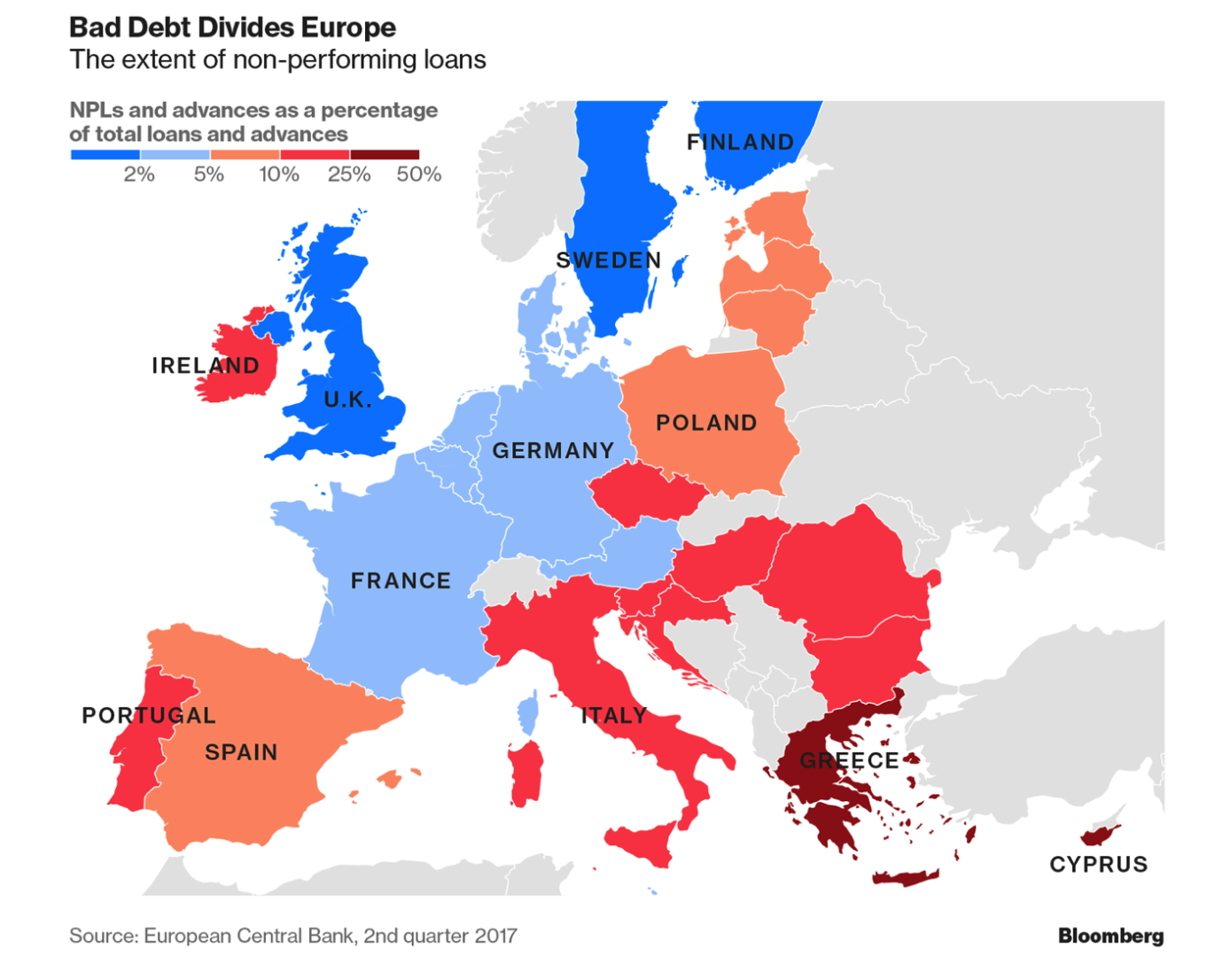

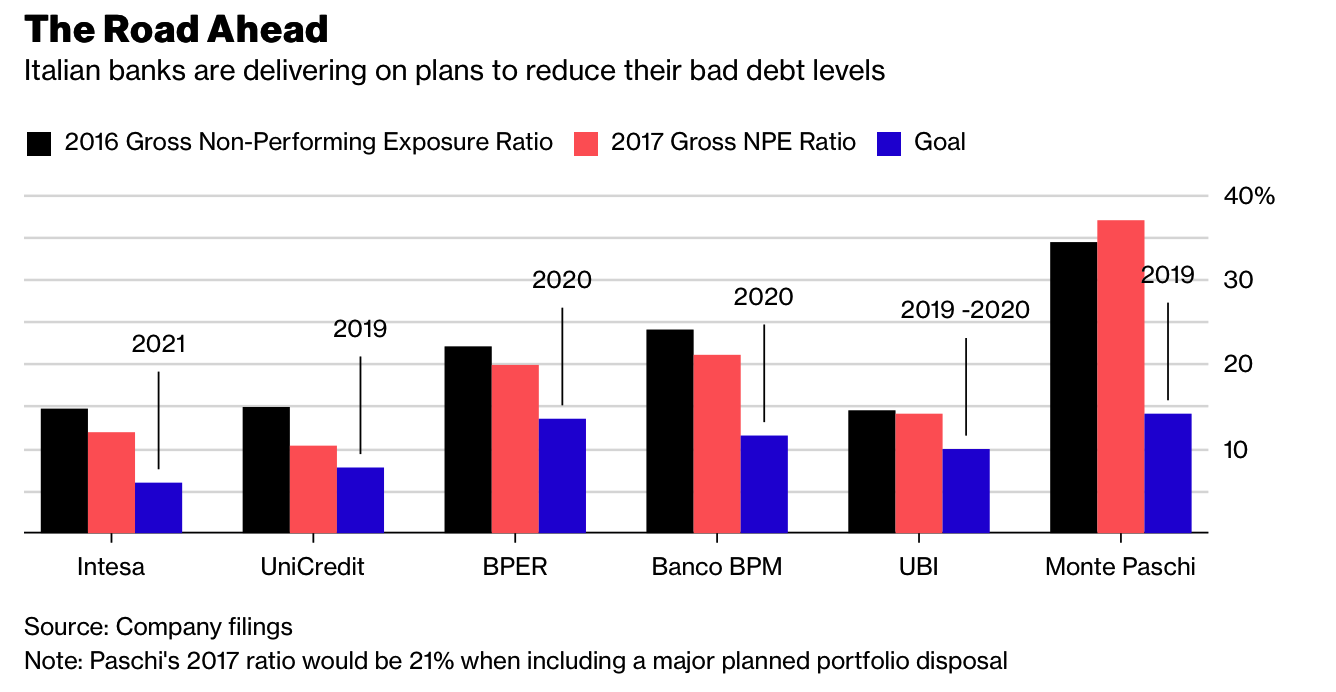
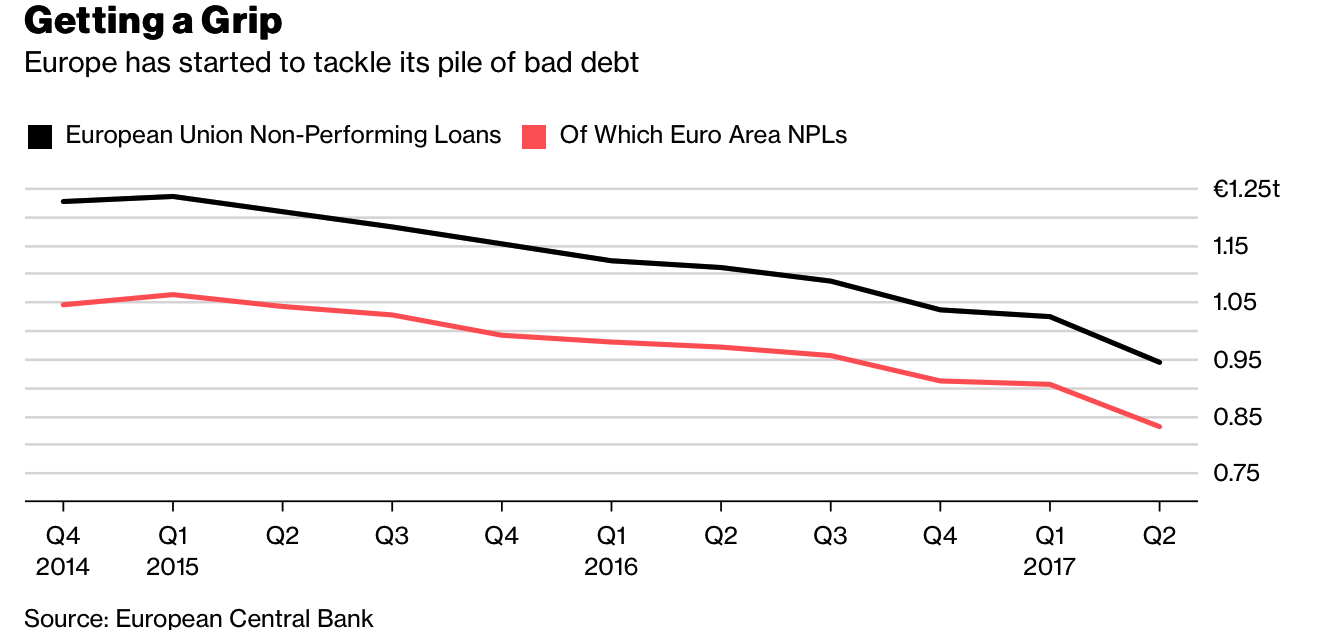
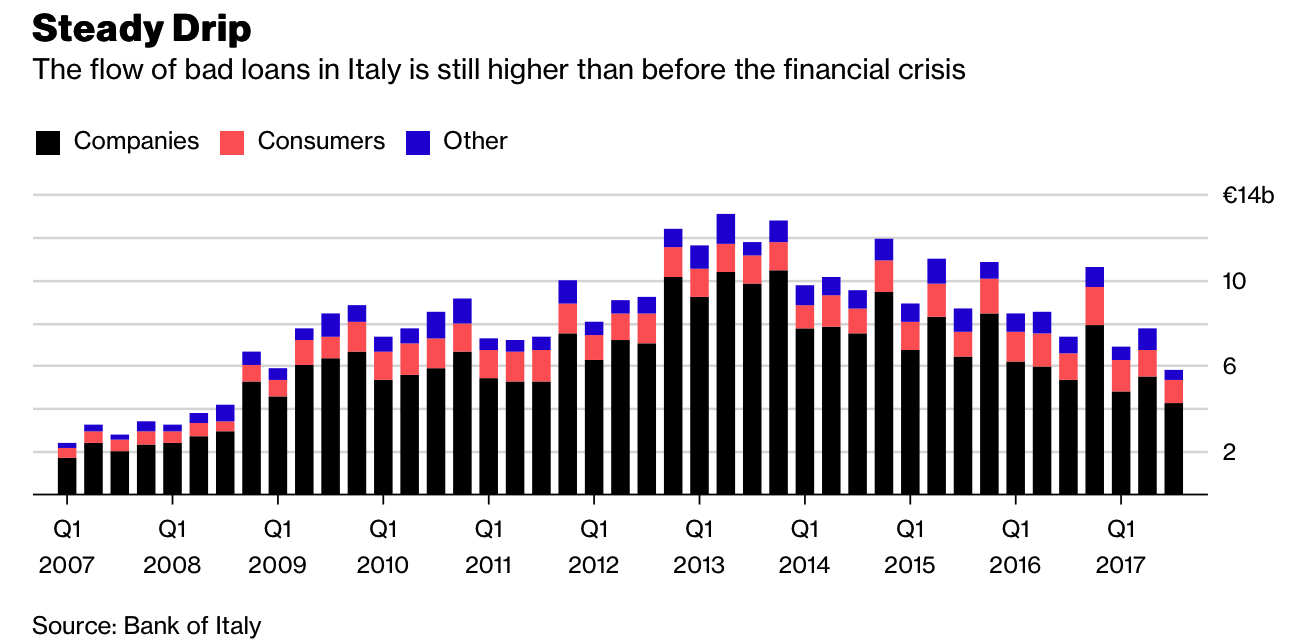
What the five charts don’t show you is how much at risk are the deposits of savers and the capital of small to medium size enterprises (SMEs) who are the backbone of our respective economies. Bank bail-in and bail-in tools are now the preferred option for the ECB when it comes to dealing with failing banks. As you can see from the five charts, failing banks in Europe remain a very real risk.
In the EU it has been two years since the ECB decided it was better to force the financial burden of banks’ failures away from ordinary tax payers and instead onto bondholders and creditors i.e. those with deposits in a bank. Since then there has been very little information from the banks or mainstream media to warn individuals and businesses about the risk their deposits are exposed to and depositors have been lulled into a false sense of security regarding bank bail-ins.

Depositors, including savers, should consider diversifying some of their capital and not having all their eggs in the bank deposit basket. An allocation to physical gold and silver is prudent in this regard.
Gold and silver are financial insurance against bank bail-in, political mismanagement, and insolvent banks and governments. Allocated and segregated coins and bars confers outright legal ownership that is difficult to be appropriated, confiscated or subject to “haircuts”.
If bullion is owned in the safest ways possible, your precious metal intermediary or counter party cannot claim it is legally theirs and jeopardise your ownership of the asset. Nor can they hamper or remove that all important liquidity and the ability to use your precious metal assets as and when you need to.
It has been more than 10 years since the start of the financial crisis and yet banking risks, particularly in Europe, remain very high. The root cause of the problem – too much debt – was not dealt with and as each year goes by it becomes more important than ever to protect yourself from bail-in risks.
Related reading
How To Protect Your Savings From Bank Bail-Ins
Invest In Gold To Defend Against Bail-ins
Precious Metals Are “Best Defence” Against Bail-ins In Economic Crisis
News and Commentary
Gold prices inch down as dollar strengthens (Reuters.com)
Asia Stocks Track U.S. Futures Down; Dollar Steady (Bloomberg.com)
Zimbabwe Plans Gold, Tobacco Diaspora Bonds as Bank Rules Change (Bloomberg.com)
Congress sets sights on federal cryptocurrency rules (Reuters.com)
Morgan Stanley Says Stock Slide Was Appetizer for Real Deal (Bloomberg.com)
London’s Housing Boom Is Over, Rightmove Says (Bloomberg.com)
How One of the Most Profitable Trades of the Last Few Years Blew Up in a Single Day (Bloomberg.com)
World Embraces Debt At Exactly The Wrong Time (DollarCollapse)
Gold: Another Month, Another Test Of Key Resistance – But This Time With A Difference (GoldSeek.com)
Gold Prices (LBMA AM)
20 Feb: USD 1,337.40, GBP 955.97 & EUR 1,083.83 per ounce
19 Feb: USD 1,347.40, GBP 961.10 & EUR 1,085.47 per ounce
16 Feb: USD 1,358.60, GBP 964.61 & EUR 1,086.47 per ounce
15 Feb: USD 1,353.70, GBP 962.21 & EUR 1,084.45 per ounce
14 Feb: USD 1,330.75, GBP 959.74 & EUR 1,077.77 per ounce
13 Feb: USD 1,329.40, GBP 955.04 & EUR 1,077.61 per ounce
12 Feb: USD 1,321.70, GBP 955.19 & EUR 1,077.45 per ounce
Silver Prices (LBMA)
20 Feb: USD 16.57, GBP 11.85 & EUR 13.42 per ounce
19 Feb: USD 16.72, GBP 11.92 & EUR 13.46 per ounce
16 Feb: USD 16.84, GBP 11.97 & EUR 13.49 per ounce
15 Feb: USD 16.83, GBP 11.98 & EUR 13.49 per ounce
14 Feb: USD 16.58, GBP 11.97 & EUR 13.43 per ounce
13 Feb: USD 16.61, GBP 11.94 & EUR 13.46 per ounce
12 Feb: USD 16.43, GBP 11.86 & EUR 13.39 per ounce
Recent Market Updates
– US-China Trade War Escalates As Further Measures Are Taken
– Gold Up 3.8% In Week – If Closes Above $1,360/oz Will Be Biggest Weekly Gain In Nearly 2 Years
– Is The Gold Price Heading Higher? IG TV Interview GoldCore
– Global Debt Crisis II Cometh
– Sovereign Wealth Funds Investing In Gold For “Long Term Returns” – PwC
– Bitcoin and Crypto Prices Being Manipulated Like Precious Metals?
– “This Is Where They Completely Lost Their Minds” – Hussman
– Brexit Risks Increase – London Property Market and Pound Vulnerable
– Peak Gold: Global Gold Supply Flat In 2017 As China Output Falls By 9%
– Crypto Currency Backlash Sees Flight From Cryptos and Bitcoin
– Gold Rises As Global Stocks Plunge and Bitcoin Crashes 70%
– Shrinkflation Intensifies – Stealth Inflation As Thousands of Food Products Shrink In Size, Not Price
– U.S. Debt Is “Extraordinarily High” and Are Stock And Bond Bubbles – Greenspan

Clive Maund still can’t admit that central banks diddle the gold market
Submitted by cpowell on Mon, 2018-02-19 18:19. Section: Daily Dispatches
1:16p ET Monday, February 19, 2018
Dear Friend of GATA and Gold:
Financial letter writer Clive Maund still can’t bear the thought that central banks might be interfering with his technical analysis of the gold market.
In his “Gold Market Update” posted at GoldSeek today —
http://news.goldseek.com/CliveMaund/1519050780.php
— Maund writes: “There has been much grumbling and muttering within the gold community about how ‘The Cartel’ and the Comex, etc., are holding the gold price in restraint by means of naked short-selling, hitting the market with supply when trading is thin during public holidays and overnight, and so on, but the fact of the matter is that the reason the precious metals sector has taken a back seat for years now is that there have been hotter games in town, like biotech, bitcoin, cannabis, the FANGS, tech generally, etc., and endless quantities of cheap money to bid them up into the stratosphere.”
Yes, all investment opportunities compete against each other, but not all of them have to compete against central banks, creators and dispensers of infinite money. After all, might not gold trade more positively if it was not constantly being jostled by a gold derivatives position of nearly 600 tonnes being managed aggressively every day by the Bank for International Settlements on behalf of its member central banks?:
http://www.gata.org/node/18041
If Maund thinks that central banks are not terribly important to the gold market, they plainly disagree with him. Will he not admit that they meddle in that market every day and that the longstanding public policy of Western central banks has been to suppress the price to defend their own currencies and government bonds? That policy is all over the archives that Maund strives to ignore.
Another financial letter writer, Michael Ballanger, in commentary also posted at GoldSeek today, “What the Markets Have in Common with the Film ‘Casablanca'” –
http://news.goldseek.com/GoldSeek/1519048800.php
— delivers a telling chart showing that the gold price was closely tracking the growth in the Federal Reserve’s asset book until 2013, when Fed asset purchases went vertical even as the gold price strangely collapsed. “Try to pick the spot where the interventionalists targeted gold,” Ballanger’s chart says. Even Maund might be able to identify the spot.
“Why,” Ballanger asks, “can the Fed buy, sell, and short (think volatility and gold) infinite amounts of anything and everything without ever getting a margin call? Are you not shocked — shocked — that the Captain Renault of bond vigilante-ism isn’t closing down that casino?”
Close down that casino? Ha! Like Maund, most financial letter writers and nearly all mainstream financial news organizations can’t even acknowledge that central banks have essentially commandeered all markets.
Such an acknowledgment would put most technical analysis and financial journalism out of business.
end
CHRIS POWELL, Secretary/Treasurer
Gold Anti-Trust Action Committee Inc.
CPowell@GATA.org
For your interest…
(courtesy Chris Powell/GATA)
Incredible 19th-century daguerrotypes show the faces of the Gold Rush
Submitted by cpowell on Mon, 2018-02-19 18:30. Section: Daily Dispatches
By Alyssa Pereira
San Francisco Chronicle
Sunday, February 18, 2018
After 1848 the prospectors came from all over to California for gold. The lot of them were hopeful, desperate, and ambitious — “the Forty-Niners” they were called. At a new museum exhibit at the National Gallery of Canada in Ottawa (and in a new book), you can come face to face with them.
As these fortune-seekers arrived in the West — 200,000 or so of them between 1849 and 1851 — so did those hoping to chronicle their efforts. Aiming to make a few bucks by providing portraits to those who were making new money, photographers utilized a method created only 10 years earlier by a Frenchman named Louis Daguerre. It was called daguerreotyping.
Photographers set up their studios in wagons and created these daguerreotypes from silver and copper plates. As the story goes, the photographers would manipulate the images after printing them, “adding gold dust onto streams or gold nuggets onto the sieves of the pioneers.” …
… For the remainder of the report:
https://www.sfgate.com/bayarea/article/Gold-Rush-daguerrotypes-photos-Fo..
END
Not sure if foul play is here, but this South Korean regulator who tried to rein in crypto trading was found dead this morning
(courtesy zerohedge)
Top South Korean Crypto Regulator Found Dead “From Unknown Cause”
The struggle between the South Korean Ministry of Finance and Ministry of Justice over the future of cryptocurrency regulation – a debate that mostly played out during December and January – terrified crypto traders who feared the South Korean government was on the verge of – wittingly or unwittingly – devastating the market.
Headlines about a pending ban in South Korea helped drive the bitcoin price more than 60% lower in January – its largest monthly drop in years – but now that the debate has been settled, the price has been steadily climbing again, breaking above $11,500 earlier today…

…having nearly doubled off the mystery dip-buyer lows…

But in a shocking development that’s almost guaranteed to contribute to speculation about whether any foul play was involved, the Wall Street Journal reports that one of the country’s top crypto regulators was found dead Tuesday.
While some speculated that the cause of death was a heart attack, the official statement – so far – is that the cause of death remains”unknown.”
Semiofficial news agency Yonhap reported that Mr. Jung was presumed to have suffered a heart attack and police had opened an investigation into the cause of death. Yonhap also reported that Mr. Jung was found at home. The government spokesman said later that “he died from some unknown cause. He passed away while he was sleeping and [his] heart [had] already stopped beating when he was found dead.”
His death comes barely a month after the country’s regulators appeared to settle on a suitable regulatory framework: Crypto exchanges and banks will soon be required to collect customers’ names and information.
The meteoric rise in bitcoin concerned South Korean Prime Minister Lee Nak-yon, who warned late last year that rising interest in cryptocurrencies could “lead to some serious distorted or pathological phenomenon.”

The dead regulator ran a government economics office that was responsible for South Korea’s legislative framework for bitcoin:
A South Korean official who guided Seoul’s regulatory clampdown on cryptocurrencies was found dead on Sunday, according to a government spokesman.
Jung Ki-joon, 52, was head of economic policy at the Office for Government Policy Coordination. He helped coordinate efforts to create new legislation aimed at suppressing cryptocurrency speculation and illicit activity, the spokesman said.
Semiofficial news agency Yonhap reported that Mr. Jung was presumed to have suffered a heart attack and police had opened an investigation into the cause of death. Yonhap also reported that Mr. Jung was found at home. The government spokesman said later that “he died from some unknown cause. He passed away while he was sleeping and [his] heart [had] already stopped beating when he was found dead.”
Coincidentally, a different regulator, Choe Heungsik, governor of Financial Supervisory Service, said Tuesday that he wants to see “normal” trading in cryptocurrencies and FSS will “actively” support it. In addition to registering accounts, the country is also seeking to develop a suitable anti-money laundering framework.
Jung’s colleagues said he had been under heavy stress in recent months as South Korea worked to tackle cryptocurrency speculation. There’s no indication that foul play was involved.

According to CryptoCompare, about 4.5% of all bitcoin transactions world-wide last year used the South Korean won, making it the most widely used fiat currency in bitcoin trading after the dollar, the yen and the euro. Bitcoin prices in South Korea are sometimes up to 50% higher than on other exchanges – a phenomenon bitcoin traders have termed “the kimchi premium”.
end
With China away from the gold market celebrating their lunar New Year, generally you can expect the crooks to raid the paper price as we have one less physical zone.
(courtesy Lawrie Williams/Sharp Pixley)
We would advise against backing equities and bitcoin again – at least for the time being. Their recent huge falls will have destroyed a degree of confidence in them and it won’t take much in the way of perceived bad news to bring them crashing back down again. They may recover, but both appeared to be in bubble territory and there is certainly the possibility that the real falls have not fully occurred yet.
Precious metals may have their ups and downs, but they do tend to be less volatile than equities and bitcoin so are probably safer bets in terms of wealth preservation. They may not see the levels of gains that bitcoin and equities have the potential for, but don’t have the massive loss potential either. Gold has, over time, been the most reliable wealth protector and while we may not subscribe to the massive gain predictions seen by some other commentators we do see steady overall growth ahead. Good advice is keep some of your wealth in gold – perhaps 10-12.5% – and it will help iron out the downturns. Because equities have seen big rises over the past few years don’t rely on these continuing ad infinitum.
https://www.sharpspixley.com/articles/lawrie-williams- gold-bears-play-while-chinese-away_276952.html
20 Feb 2018
Your early TUESDAY morning currency, Asian stock market results, important USA/Asian currency crosses, gold/silver pricing overnight along with the price of oil Major stories overnight/9 AM EST
i) Chinese yuan vs USA dollar/CLOSED /shanghai bourse CLOSED / HANG SANG CLOSED
2. Nikkei closed DOWN 224.11 POINTS OR 1.01% /USA: YEN RISES TO 107.15/DEADLY AS YEN CARRY TRADERS DISINTEGRATE
3. Europe stocks OPENED DEEPLY IN THE GREEN /USA dollar index RISES TO 89.64/Euro FALLS TO 1.2340
3b Japan 10 year bond yield: RISES TO . +.066/ !!!!(Japan buying 100% of bond issuance)/Japanese yen vs usa cross now at 107.15/ THIS IS TROUBLESOME AS BANK OF JAPAN IS RUNNING OUT OF BONDS TO BUY./JAPAN 10 YR YIELD FINALLY IN THE POSITIVE/BANK OF JAPAN LOSING CONTROL OF THEIR YIELD CURVE AS THEY PURCHASE ALL BONDS TO GET TO ZERO RATE!!
3c Nikkei now JUST BELOW 17,000
3d USA/Yen rate now well below the important 120 barrier this morning
3e WTI:: 62.23 and Brent: 65.03
3f Gold DOWN/Yen DOWN
3g Japan is to buy the equivalent of 108 billion uSA dollars worth of bond per month or $1.3 trillion. Japan’s GDP equals 5 trillion usa./“HELICOPTER MONEY” OFF THE TABLE FOR NOW /REVERSE OPERATION TWIST ON THE BONDS: PURCHASE OF LONG BONDS AND SELLING THE SHORT END
Japan to buy 100% of all new Japanese debt and by 2018 they will have 25% of all Japanese debt. Fifty percent of Japanese budget financed with debt.
3h Oil UP for WTI and UP FOR Brent this morning
3i European bond buying continues to push yields lower on all fronts in the EMU. German 10yr bund RISES TO +.742%/Italian 10 yr bond yield UP to 2.056% /SPAIN 10 YR BOND YIELD UP TO 1.524%
3j Greek 10 year bond yield RISES TO : 4.426?????????????????
3k Gold at $1339.05 silver at:16.53 7 am est) SILVER NEXT RESISTANCE LEVEL AT $18.50
3l USA vs Russian rouble; (Russian rouble DOWN 16/100 in roubles/dollar) 56.64
3m oil into the 62 dollar handle for WTI and 64 handle for Brent/
3n Higher foreign deposits out of China sees huge risk of outflows and a currency depreciation. This can spell financial disaster for the rest of the world/
JAPAN ON JAN 29.2016 INITIATES NIRP. THIS MORNING THEY SIGNAL THEY MAY END NIRP. TODAY THE USA/YEN TRADES TO 107.16 DESTROYING JAPANESE CITIZENS WITH HIGHER FOOD INFLATION
30 SNB (Swiss National Bank) still intervening again in the markets driving down the SF. It is not working: USA/SF this morning 0.9341 as the Swiss Franc is still rising against most currencies. Euro vs SF is 1.1534 well above the floor set by the Swiss Finance Minister. Thomas Jordan, chief of the Swiss National Bank continues to purchase euros trying to lower value of the Swiss Franc.
3p BRITAIN VOTES AFFIRMATIVE BREXIT/LOWER PARLIAMENT APPROVES BREXIT COMMENCEMENT/ARTICLE 50 COMMENCES MARCH 29/2017
3r the 10 Year German bund now POSITIVE territory with the 10 year RISING to +0.742%
The bank withdrawals were causing massive hardship to the Greek bank. the Greek referendum voted overwhelming “NO”. Next step for Greece will be the recapitalization of the banks and that will be difficult.
4. USA 10 year treasury bond at 2.909% early this morning (THIS IS DEADLY TO ALL MARKETS). Thirty year rate at 3.162% /BOTH VERY DEADLY
5. Details Ransquawk, Bloomberg, Deutsche bank/Jim Reid.
(courtesy Jim Reid/Bloomberg/Deutsche bank/zero hedge)
Futures Slide As Dollar, Rates Jump Ahead Of “Monster” Treasury Issuance
After a week in which stock-trading abruptly algos decided that rising yields are irrelevant at worst, and at best positive for equities, the correlation has again flipped overnight sending Asian shares lower and European share erasing earlier gains as bonds fell around the globe, with the 2Y Treasury yield rising 3bps to 2.23% – highest since September 2008 – and the 10Y briefly as high as 2.93%…


… ahead of this week’s “monster issuance” of $258 billion in TSY bills and notes…

… which in turn has sent the recently beaten down dollar higher for the third day in a row...

… and pushed S&P futures sharply lower for the second consecutive day, as the VIX is above over 21 as of 6am ET.

Europe’s main bourses saw a steady start as lower domestic currencies helped their cause, although early gains were quickly faded amid declines in auto and banking, but weakness across Asia where Tokyo and South Korea saw drops more than 1%, meant MSCI’s 47-country world share index was 0.2 percent in the red.

European equities trimmed initial gains (Eurostoxx 50 flat) to trade with little in the way of firm direction ahead of the US return to market. The FSTE 100 lagged peers (-0.4%) after disappointing earnings from index heavyweights HSBC (-4%) and BHP Billiton (-4%), dampening sentiment for UK stocks and the former leading to underperformance in the financial sector. Other individual movers include Hikma Pharmaceuticals (+9%) after appointing their new CEO, Fidessa (+21.4%) are also seen higher after reports that Swiss-listed Temenos (-6.8%) are to make an offer for the Co., while Intercontinental Hotels (-3.9%) have faced selling pressure this morning following a lacklustre earnings update.
MSCI Asia Pacific index declines for first time in seven days. The Hang Seng index slipped after HSBC profits missed; H-shares erase most losses after falling as much as 1.9%. n. In Australia, the ASX 200 came under pressure from material and financial names, with many of the large banks reversing the prior days gains. Over in Japan, the Nikkei (-1.0%) had tripped through 22,000 amid softness in tech names. The Hang Seng (-0.8%) reopened for the first time since last week, however initial gains had been short-lived.
But all attention today will be on the bond market, where as Bloomberg notes, debt investors are trading with caution as Treasury markets reopened after the Presidents’ Day break as the VIX jumped to its highest level in five sessions. As reported yesterday, Treasuries are under pressure ahead of what Bloomberg has dubbed “monster debt supply” in which the U.S. gets set to sale a record amount of debt with three days of auctions today totaling $258 billion. And while speculators are turning bearish – rapidly covering net short bets across the curve but mostly in the 2Y…

… money managers are looking at the highest U.S. yields in years as a buying opportunity in a world where shorter-term Japanese and German notes still carry negative yields.
“I just advise caution,” said Principal Global Investors’ chief global economist Bob Baur said about stocks as Wall Street futures also pointed lower. “I‘m not sure whether this (early February sell-off) was the dip to buy, there will probably be a relapse and then another relapse, before maybe around mid-summer stocks make another run up.”
European bond yields pushed up too, with traders also working through the options of who could succeed Mario Draghi as European Central Bank chief next year after Spain’s economy minister was nominated for the bank’s number two job.
In other news, BOJ governor Haruhiko Kuroda didn’t discuss monetary policy during an appearance in parliament today. Speculation has been swirling about the possibility the BOJ is scaling back its stimulus since the central bank reduced its purchases of government bonds in January.
The UK is said to have a secret plan to withhold Brexit payments if the EU refuses to provide the UK with a desirable trade deal. Elsewhere, according to a letter seen last week, Netherlands government has linked its decision to activate hard Brexit plan amid a lack of clarity from the UK.
Echoing China, the German Economy Minister says the EU will respond appropriately if the US puts a tariff on European steel imports.
Speaking of Germany, it reported mixed February ZEw numbers: German ZEW Economic Sentiment (Feb) 17.8 vs. Exp. 16.5 (Prev. 20.4); German ZEW Current Conditions (Feb) 92.3 vs. Exp. 93.9 (Prev. 95.2)
South Africa’s rand and Turkey’s lira both gave back more of their recent gains, while growing concerns about the previously reported alleged fraud at India’s second-largest state-run bank sent the rupee skidding to a near three-month low: “Punjab National Bank will need to provide for at least a substantial portion of the exposure. As a result, the bank’s profitability will likely come under pressure,” rating agency Moody’s said as it put it on a downgrade warning.
In commodity markets, Oil prices were mixed, with reduced flows from Canada pushing up U.S. crude while Brent sagged $65.45 per barrel on the back of weaker Asian stocks and the dollar’s bounce. Spot gold slipped 0.4 percent to 1,341.06 an ounce, also corseted by the dollar’s bounce, while industrial metals including copper drifted lower for a second day in a thinner-than-usual trading due to new year holidays in China.
Bitcoin broke above $11,500, almost double its intraday low from just two weeks ago.
Bulletin Headline Summary from RanSquawk
- European equities have trimmed initial gains (Eurostoxx 50 flat) to trade with little in the way of firm direction ahead of the US return to market
- EU Parliament is to call for Britain to have privileged single market access after Brexit, according to Business
- Insider
- Looking ahead, highlights include US supply, WalMart earnings
Market Snapshot
- S&P 500 futures down 0.6% to 2,719.50
- STOXX Europe 600 up 0.1% to 378.63
- MSCI Asia Pacific down 0.9% to 176.50
- MSCI Asia Pacific ex Japan down 0.5% to 575.76
- Nikkei down 1% to 21,925.10
- Topix down 0.7% to 1,762.45
- Hang Seng Index down 0.8% to 30,873.63
- Shanghai Composite up 0.5% to 3,199.16
- Sensex down 0.09% to 33,745.75
- Australia S&P/ASX 200 down 0.01% to 5,940.85
- Kospi down 1.1% to 2,415.12
- German 10Y yield rose 2.0 bps to 0.755%
- Euro down 0.4% to $1.2355
- Brent Futures down 0.6% to $65.28/bbl
- Italian 10Y yield rose 5.6 bps to 1.773%
- Spanish 10Y yield fell 0.3 bps to 1.508%
- Brent Futures down 0.6% to $65.28/bbl
- Gold spot down 0.7% to $1,337.27
- U.S. Dollar Index up 0.6% to 89.60
Top Overnight News
- Latvia will seek to prevent ECB Governing Council member Ilmars Rimsevics from returning to his post after he was caught up in a bribery probe that’s rocked the Baltic nation, the country’s prime minister said in an interview
- Treasuries are about to reach a turning point, with the trend toward a flatter yield curve poised to end in the next few months, says Akira Takei, a fund manager at Asset Management One
- Chancellor Angela Merkel sent a strong signal in the debate over her preferred successor as German leader by appointing close ally Annegret Kramp-Karrenbauer as general secretary of her Christian Democratic Union party
- Prime Minister Theresa May’s team is eyeing up a contingency plan to hold back billions of pounds in Brexit payments, if the European Union refuses to give the U.K. the trade deal it wants
- Brexit Secretary David Davis will reassure the European Union that the U.K. won’t try to undercut the bloc by tearing up regulations after the split, making the case for mutual trust between regulators on each side
- Spain’s Economy Minister Luis de Guindos won the backing of euro-area finance ministers late Monday to replace ECB Vice President Vitor Constancio; some economists reckon he may side with the more optimistic governors on the council, who have long been pushing for an end to quantitative easing, while at the same time being mostly consensus-oriented
- Australia’s central bank reiterated that inflation is expected to “only gradually” accelerate as the economy strengthens and wage pressures increase, in minutes of this month’s policy meeting
Asian equity markets are somewhat fragile, with major Asian bourses off to a weaker start. US markets were closed for President’s day and as such, Asian participants took the cue from European equities which slipped in yesterday’s session. In Australia, the ASX 200 (flat) has come under pressure from material and financial names, with many of the large banks reversing the prior days gains. Over in Japan, the Nikkei (-1.0%) had tripped through 22,000 amid softness in tech names. The Hang Seng (-0.8%) reopened for the first time since last week, however initial gains had been short-lived, with the index conforming to the sombre tone. JGBs are flat in thin-trade, March futures contract down 2 ticks and hovering near yesterday’s levels. USTs off by 6+ ticks with yields continuing to pick up, 2yr yields now at the highest since Sep’08 after hitting 2.22%, while the US curve is also flattening this morning. The RBA meeting minutes failed to provide any fireworks with the central bank sticking with its neutral tone. As such, AUD had been largely unmoved post the release of the minutes and instead focus will fall on the wage price index due out tomorrow. RBA February minutes states that low rates are helping reduce unemployment and lift inflation, additionally rising AUD would impede pickup in economic growth and inflation, however AUD TWI is still within narrow range of past couple of years.
Top Asian News
- Espenilla Says Philippine Rate Hike on Table But Data Dependent
- India Is Said to Tighten Approvals for Offshore Borrowing
- Bitcoin Rises as South Korea Talks ‘Active’ Support for Trading
- BHP Falls as Much as 3.8% in London After Adj Profit Misses Ests
- Toyota Readies Cheaper Electric Motor by Halving Rare Earth Use
European equities have trimmed initial gains (Eurostoxx 50 flat) to trade with little in the way of firm direction ahead of the US return to market. The FSTE 100 modestly lags its peers (-0.4%) after disappointing earnings from index heavyweights HSBC (-4%) and BHP Billiton (-4%), dampening sentiment for UK stocks and the former leading to underperformance in the financial sector. Other individual movers include Hikma Pharmaceuticals (+9%) after appointing their new CEO, Fidessa (+21.4%) are also seen higher after reports that Swiss-listed Temenos (-6.8%) are to make an offer for the Co., while Intercontinental Hotels (-3.9%) have faced selling pressure this morning following a lacklustre earnings update.
Top European News
- Gulliver Ends HSBC Tenure With Rare Profit Miss on Margins
- U.K. Has Plan to Halt Brexit Cash If EU Backslides on Trade Deal
- Morgan Stanley Says Stock Slide Was Just Appetizer for Real Deal
- Oil Holds Momentum That’s Driven by OPEC’s Promise to Re- Balance
- A Diversified Portfolio May Not Help Investors Much This Year
In FX, the DXY has now rebounded above 89.500, and on broad-based gains vs G10 rivals, albeit mainly inspired by another round of short covering. A major French bank notes that the market remains very short of Dollars (in line with latest weekly CFTC spec positioning data) and modestly long Jpy and moves in the headline pairing off last week’s circa 105.55 low support the rebalancing theory as spot trades back over 107.00. 107.32 offers eyed next, and as a recap this level now forms resistance rather than support on the way down as the 2017 low. Similar price moves elsewhere, as Eur/Usd recoils further from recent peaks and briefly testing bids at 1.2350 with small stops just below, but not challenging key Fib support at 1.2319. Cable briefly reclaimed the 1.4000 handle after reports in Business Insider suggested that the EU Parliament is to call for Britain to have privileged single market access after Brexit. Usd/Chf now inching closer to 0.9350 and Usd/Cad just shy of 1.2600 amidst the ongoing Greenback recovery, while Aud/Usd is retesting 0.7900 on the downside with little direction gleaned from RBA minutes overnight, but key data to come
tomorrow (wage growth). Nzd/Usd straddling 0.7350, with strong chart support around 0.7338.
In commodities, WTI and Brent crude futures are seen higher albeit off best levels as the firmer USD caps gains; WTI holds above the USD 62.00bbl level (note the weekly API inventories will be released tomorrow, not today due to yesterday’s US market holiday). In terms of energy news flow, the Joint OPEC/non-OPEC Technical Committee concluded that the oil glut is dissipating at a faster pace than anticipated, according to sources. Additionally, UAE energy minister claims OPEC and allies are to continue oil cooperation beyond 2018 and notes UAE, Saudi Arabia and Russia all support an extension cut beyond 2018. In metals markets, spot gold trades lower alongside the aforementioned firmer USD while copper prices have seen little in the way of firm direction as Chinese participants remain away from market. UAE Energy Minister says the UAE is expected to over-deliver on production cuts in Q1 due to maintenance commitment with OPEC-led pact.
Global Event Calendar
- Mexico Citibanamex Survey of Economists
- 8:30am: Canada Wholesale Trade Sales MoM, Dec., est. 0.4%, prior 0.7%
- 10am: Mexico International Reserves Weekly, Feb. 16, no est., prior 173b
Bond Auctions:
- 11:30am: U.S. to Sell USD51 Bln 3-Month Bills
- 11:30am: U.S. to Sell USD45 Bln 6-Month Bills
- 1pm: U.S. to Sell USD55 Bln 4-Week Bills
- 1pm: U.S. to Sell USD28 Bln 2-Year Notes
DB’s Jim Reid concludes the overnight wrap
With Chinese New Year holidays and President’s Day in the US, yesterday was always going to be quiet and we weren’t disappointed on this. It was a far cry from two weeks ago last night when we saw the largest single day spike in the VIX on record and a 1000 point move on the DOW in c20 minutes towards the end of the session. In reality the market has regained its poise very impressively since. For the markets that were open yesterday, it was generally a down day though. The Stoxx 600 fell for the first time in four days (-0.63%), but trading volume was thin and at roughly half the 30 day average. Within the Stoxx, losses were led by the health care, consumer and real estate sector, with Reckitt Benckiser down 7.5% after warning pricing pressures would continue to hit margins. Across the region, the DAX (-0.53%) and FTSE (-0.64%) also fell modestly while Italy’s FTSE MIB was the relative laggard at -1.0%. The Vstoxx rose for the first time in six days, up 7.7% to 19.13.
Government bonds weakened with core 10y bond yields up 2-4bp (Bunds +2.8bp; Gilts +2bp), in part reversing Friday’s gains in the absence of material macro data. Key peripherals yields were also up 2-5bp, while Greek bonds outperformed with its 10y yields down 1.9bp after Fitch upgraded the country’s long term issuer rating from B- to B with a positive outlook retained. Post the change, Fitch’s rating is now in line with S&P’s. In FX, the US dollar index was marginally higher (+0.13%) while the Euro was broadly flat and Sterling fell 0.19%. In commodities, WTI oil was up 1.33% to $62.50/bbl while precious metals were little changed (Gold -0.04%; Silver +0.18%).
This morning in Asia, markets are broadly lower with the Nikkei down for the first time in four days (-1.06%), while the Kospi (-1.27%) and Hang Seng (-0.37%) are also lower, as the latter pared back earlier gains as trading resumed post the New Year holidays. The UST 10y yield is up 2bp and S&P index futures are down c0.3% this morning.
Back in Europe, finance ministers have nominated the Spanish Economy Minister Luis de Guindos to be the next Vice President of the ECB to replace Mr Constancio. The decision puts Spain back on the ECB’s executive board after a six year absence. Mr de Guindos will resign from his existing post within days and said he is “pragmatic” rather than a dove / hawk when it comes to monetary policy and will always defend the ECB’s independence. Looking ahead, he will face a hearing at the EU Parliament and then EU leaders will ratify his appointment at their summit on March 22. Elsewhere, Germany’s acting Finance Minister Peter Altmaier said Mr de Guindos would be an “excellent choice” for the role.
Staying with the ECB, the latest QE purchases data was released yesterday. It was yet another very strong week for CSPP relative to PSPP which now leaves little doubt about the ECB’s intentions to keep the former elevated relative to the latter, given that we now have 6 full weeks of data since they halved the net flow of QE. The CSPP/PSPP ratio was 29.4% (27.3% over last 4 weeks). As a reminder, before Apr 2017 when QE was still €80bn/m the ratio was 11.5%.
Between Apr-Dec 2017 (QE €60bn/m) the ratio edged up to 12.7% but since Jan 2018 (QE €30bn/m) the ratio is now 25.5%. Indeed the strength of corporate vs. government purchases as proxied by the CSPP/PSPP ratio has so far surpassed our expectations of “roughly 20%”.
Staying in Europe, an interesting story yesterday as SPD members now start voting as to whether to enter a coalition with Mrs Merkel, was the one that suggested that the far right AfD party has overtaken the SPD in the polls for the first time. The Bild/INSA poll put them at 16% and 15.5% respectively against 12.6% and 20.5% at the election back in September. The fear from the SPD was always that a renewed collation agreement would lead to them seeing their popularity drop further but with stalemate elsewhere they were left with limited choice but to negotiate in the end. Are the electorate punishing them for their decision to enter talks or the fact that it took so long to do so? Either way, in our view the fact that far right in Germany are now second in the polls is fairly remarkable really.
Continuing with politics, ahead of the 4th March national election in Italy, DB’s Clemente De lucia noted that the risk of a hung parliament remains high, but it is a close call as the centre-right coalition is closing the gap to get an outright majority. If the elections prove to be inconclusive, Clemente expect the parties and institutions to work hard to form a grand coalition. Whatever the result of the elections, the fiscal stance will be in the spotlight after the vote. All parties are pledging significant expansionary policies. As things stands, Italy does not comply with EU fiscal rules and without some adjustments, Rome could be on a collision course with Brussels. With the gap between Rome and Brussels not significantly large, we expect a compromise to be reached. Refer to the note for more details.
Now turning to some of the Brexit headlines. The BOE governor Carney noted the transitional deal to be reached before the end of March “obviously won’t be a hard, legally binding agreement, but….something that has legal text associated with it, which will be part of the separation agreement, (then) that should be good enough”. Elsewhere, three unnamed senior British officials have told Bloomberg that the UK have a fall back option of withholding the £40bn divorce Brexit payments to ensure the EU agrees to the trade deal it wants. The former leader of PM May’s conservative party Iain Duncan Smith said “either the EU gives us a trade deal or they won’t get any money at all”. Finally, DB’s Oliver Harvey has assessed the suitability of a CETA (comprehensive economic and trade agreement) type deal between the UK and the EU and the implications for growth and markets. Overall, the team believes there are no workable alternatives for the UK to maintain close to present levels of trade with the EU27 in the current time frame outside of the EEA and a separate customs agreement. They expect this to be the ultimate destination of Brexit, but not before a political crisis. Refer to their note for more details.
Before we take a look at today’s calendar, we wrap up with other data releases from yesterday. The February Rightmove index on asking prices for UK homes was above the prior month’s reading at 0.8% mom (vs. 0.7% previous) and 1.5% yoy (vs 1.1% previous). The Euro area’s current account surplus in December was below last month’s reading at €29.9bln (vs. €32.5bln previous) but the fullyear surplus rose to a new high of €392bn. In Asia, Japan’s Reuters’ Tankan manufacturers’ index fell 6pts to +29 in February (vs. the prior reading at an 11- year high), while the non-manufacturers index was steady at a solid level of +33.
Looking at the day ahead, the January PPI and the February ZEW survey are due in Germany. The February CBI selling prices data in the UK and the February consumer confidence print for the Euro area are also due in the afternoon. In terms of politics, the Social Democrats party in Germany will begin a two-week period for members to vote on the proposed coalition pact.
3. ASIAN AFFAIRS
i)Late MONDAY night/TUESDAY morning: Shanghai closed /Hang Sang CLOSED / The Nikkei closed DOWN 224.11 POINTS OR 1.01%/Australia’s all ordinaires CLOSED UP 0.03%/Chinese yuan (ONSHORE) closed UP at 6.3415/Oil DOWN to 62.03 dollars per barrel for WTI and 65.23 for Brent. Stocks in Europe OPENED DEEPLY IN THE GREEN . ONSHORE YUAN CLOSED XXX AGAINST THE DOLLAR AT XXX. OFFSHORE YUAN CLOSED XXX AGAINST THE ONSHORE YUAN AT XXX//ONSHORE YUAN /OFFSHORE YUAN NOT TRADING
3 a NORTH KOREA/USA
/NORTH KOREA
3 b JAPAN AFFAIRS
c) REPORT ON CHINA
end
4. EUROPEAN AFFAIRS
Deutsche bank/Germany
More trouble on the horizon for the world’s biggest derivative player. They seem to be leaning on firing 500 of their workers due to tumbling trading revenues
(courtesy zero hedge)
Deutsche Bank To Fire Up To 500 Amid Tumbling Trading Revenues
The drip-drip-drip death spiral of what was once the world’s most systemically dangerous bank continues as Bloomberg reports Deutsche Bank has started cutting at least another 250 jobs at its corporate and investment bank units.
These new firings, which could widen to more than 500, according to Bloomberg‘s sources, comes after bonus payments that Chief Executive Officer John Cryan said were on the “generous” side, helped push the business in the red.
Cryan is trying to motivate and retain top investment banking staff, while keeping a lid on costs following three straight years of losses.
But with revenue at a seven-year low, even a relatively small increase in compensation can cause losses at the securities unit.
Chief Financial Officer James von Moltke has urged a return to more disciplined cost management after the lender scrapped a target for this year.
And these “generous” bonuses follow a 27% collapse in trading revenues and the disastrous debacle surrounding China’s HNA liquidating its holdings of the giant German bank.
Imagine how “generous” these bonuses would have been if things were really bad?

As Michael Huenseler at Assenagon noted previously:
“The results are disappointing again and we don’t see anything encouraging in them, reinforcing our doubts in the bank’s strategy and management…There’s no silver lining.“
Bloomberg notes that bank officials declined to comment.
For context, Deutsche Bank’s corporate and investment bank employed 17,251 front office full-time staff at the end of last year.
While Deutsche’s share price continues to languish, the last week or so has seen a more concerning re-ignition of short-term counterparty risks as Deutsch Bank’s 1Y Sub CDS spreads have blown out…

Or does someone know something about a short-vol position that DB may be holding?
And even more worrying for the bank itself is the total decoupling of short-term default risk from Germany’s systemic risk…

In other words – you’re on your own Mr. Cryan.
Latvia Bank Crisis: Central Bank In Chaos As ECB Blocks Payments By Third Largest Bank
One day after we reported that Latvia’s central bank governor – and ECB Governing Council member – Ilmars Rimsevics was detained by Latvia’s anti-corruption authority on Saturday on suspicion of accepting a bribe of more than €100,000, prompting both Latvia’s Prime Minister and the president to call on Rimsevics to resign, Latvia now appears to have a full-blown banking crisis on its hands, after the European Central Bank froze all payments by Latvia’s third largest bank, ABLV, following U.S. accusations the bank laundered billions in illicit funds, including for companies connected to North Korea’s banned ballistic-missile program.


The troubles started on February 14, when Latvia began investigating ABLV over suspicions of illegal trading related to North Korea’s weapons system. The investigation was launched after the Treasury Department charged the bank on Feb. 13 with having “institutionalized money laundering as a pillar of the bank’s business practices,” which proposed preventing the bank from opening an account in the U.S.
That decision immediately made ABLV a pariah to other financial institutions, effectively cutting its access to the dollar and funding flows from the world’s most important market, and forcing it to rely exclusively on the ECB as it sole-source of funds.
As the WSJ reported, in proposing the ban on ABLV, Treasury said the bank managed transactions for clients connected to several long-sanctioned North Korean firms.
These include North Korea’s Foreign Trade Bank, the institution that manages Pyongyang’s foreign-currency earnings, revenue that U.S. and United Nations officials say go directly to North Korea’s nuclear and missile programs.
According to the Treasury, ABLV’s alleged illegal activity also included funneling billions of dollars in public corruption proceeds from Azerbaijan, Russia and Ukraine through shell company accounts.


ABLV, Latvia’s third-largest lender by assets, is based in Riga but has an office in Luxembourg and a subsidiary in the U.S. It is also supervised directly by the ECB under a new system of eurozone bank supervision introduced during the region’s recent financial crisis, under which national authorities remain responsible for enforcing money-laundering laws.
On Monday morning, the troubles for ABLV cascaded when the ECBsaid that it had instructed Latvia’s banking supervisor to impose a moratorium on the country’s third-largest bank, which freezes all payments by the bank on its liabilities.
“In recent days, there has been a sharp deterioration of the bank’s financial position. This follows an announcement on 13 February by the US Department of the Treasury’s Financial Crimes Enforcement Network from February to propose a measure naming ABLV bank an institution of primary money laundering concern pursuant to Section 311 of the USA Patriot Act,” the ECB said in a statement.
“A moratorium was considered necessary given that the bank is working with the Latvian central bank and authorities to address the current situation.”
Meanwhile, sensing that a bank run may be imminent, Latvia’s central bank said it had extended a loan of €97.5 million to ABLV following a request by the bank.
The loan was granted against high-quality securities that exceeded the amount of the loan, and state resources weren’t used, the central bank said.
There’s more.
As the WSJ also reported, in a related development Latvian state police on Monday said they had launched a criminal investigation into a complaint a high-ranking official in Latvia’s financial sector had extorted bribes from a Russian businessman, Grigory Guselnikov. The Latvian official wasn’t named. State police announced the probe at a joint press conference with the anticorruption agency, where details of the probe into Mr. Rimsevics were revealed.
And this is where the banking crisis could spread beyond just ABLV: Guselnikov is the largest shareholder of AS Norvik Banka, another Latvian lender that lodged a request for arbitration against Latvia with a World Bank division in December. The bank complained of “unfair, arbitrary, improperly motivated and unreasonable regulatory treatment accorded to the Bank by the Latvian authorities.”
* * *
On Monday, Latvia’s Prime Minister Maris Kucinskis convened a two-hour meeting of cabinet ministers on Monday to discuss the two cases. He suggested after the meeting that the central banker, Rimsevics should step down, at least while the investigation is going on, local news agency Leta reported.
Latvia hopes to contain the sudden central bank chaos by announcing that Rimsevics’ duties will be carried out by his deputy in his absence, however it remains to be seen how effective this last-minute attempt to avoid a depositor panic will be. The ECB declined to comment on Rimsevics’ detention.
Latvian President Raimonds Vejonis said on Twitter on Sunday that the country’s National Security Council would review the situation in the Latvian bank sector this week.
Finally, for those wondering if there is risk of a systemic bank crisis in Latvia, we offer the following Bloomberg quote from the Prime Minister as of this morning:
- LATVIAN PM SAYS ABLV NOT SYSTEMIC FOR LATVIAN DEPOSITORS
Unfortunately, any time a politician tells depositors not to panic it’s usually too late.
end
5. RUSSIAN AND MIDDLE EASTERN AFFAIRS
Turkish forces hit the Kurds with toxic gas after crossing into Syria
(courtesy zerohedge)
Turkish Forces Hit Kurds With Toxic Gas After Crossing Into Syria: Report
Turkish forces which entered Syria in late January have reportedly conducted a gas attack against Kurdish militias in the village of Aranda, sending at least six civilians to the hospital according to Syrian Kurdish forces and local media.

“Six civillians suffering from suffocation as a result of Turkish forces firing missiles containing poison gas,” reports Dr. Joan Mohammed, director of nearby Afrin Hospital (via SANA)
Another Doctor, Khalil Sabri, told local news “all of them suffer the same symptoms of suffocation, malaise, itching skin and burning in the eyes.” At least two of the victims are listed in critical condition, while four are stable.


Artêşa #Tirk gundê Erende yê navçeya şiyê bi gazên kîmyewî bombebaran dike, 6 birîndar gihan nexweşxaneya Avrîn
الجيش التركي يقصف قرية ارندة بناحية شيه بالغازات السامة، 6 مصابيين وصلو لمشفى آفرين#عفرين_تنتصر


Ruha, a child who was playing and singing, didn’t know that Turkey& Jihadists will shell her house. Ruha got injured alongside her father yesterday when Afrin city center was shelled by the invaders.#Afrin#UNspeakUpForAfrin

A spokesman for the Kurdish YPG militia in Afrin, Birusk Hasaka, confirmed to Reuters that Turkish forces hit a village in the northwest of the region, near the Turkish border.
Meanwhile, “the Syrian Observatory for Human Rights told Reuters that Turkish forces and their Syrian insurgent allies hit the village on Friday with shells. The Britain-based monitor said medical sources in Afrin reported that six people in the attack suffered breathing difficulties and dilated pupils, indicating a suspected gas attack.”

Operation Olive Branch
As we reported weeks ago, Turkish ground forces crossed the border and pushed into northern Syria’s Afrin province on January 20, Ankara said, after launching artillery and air strikes on a U.S.-backed Kurdish militia it aims to sweep from its border as part of “Operation Olive Branch.”

Turkish armored divisions crossed into northwest Syria following a day of airstrikes targeting Kurdish YPG forces (“People’s Protection Units”) in and around Afrin to drive the US-allied Kurdish militia from the area.
Following the incursion, Turkish forces set out “liberating” village after village with the support of the anti-Assad Free Syrian Army.


1/ The ground offensive against Afrin enclave has indeed started. Clashes now inside Afrin province. Kurdish YPG claims it destroyed at least 1 Turkish tank. See video.

International fallout
Turkey’s aggression has drawn the attention of NATO allies, with top French officials warning Ankara against “adding war to war” in Syria, while Germany is holding off on new weapons supplies.
We would be remiss not to point out that French President Emanuel Macron threatened to strike Syrian forces if evidence is found that Bashar al-Assad used chemical weapons on civilians. One wonders if Macron will apply the same standard to Turkish forces operating inside Syria?
The United States, meanwhile, has troops stationed a mere 60 miles from Afrin in the town of Manbij, where they are supporting the Syrian Defense Force (SDF) – a militia with strong ties to the Kurdish People’s Protection Unites (YPG), one of Turkey’s primary targets. Turkey has threatened to set it’s sights on Manbij after it’s done with Afrin, while Secretary of State Rex Tillerson has assured Ankara that U.S. support of the SDF is “limited, mission specific, and provided on the incremental basis to achieve military objectives only.”
That said, diplomats for Turkey and the United States have agreed that relations have reached “a crisis point.”
On Wednesday, eight Congressional Democrats released a letter expressing grave concerns over “Operation Olive Branch,” noting that over 5,000 people have been displaced by Turkish operations in the region, and concerns by UN officials over the “dire humanitarian crisis” in the Afrin region.


Eight members of the US Congress release a letter sharing their serious concern in humanitarian situation in #Afrin and urge Secretary of State Tillerson to urge Turkish government to take steps to address humanitarian concerns

end
The Gatestone’s Institute , Bulut comments that relations between Greece and Turkey have soured. Emboldened by its attack on Afrin, it seems that Turkey may wish to attack many Greek islands. Turkey is trying to reassert itself to its former glory days of its powerhouse Ottoman Empire.
(courtesy Bulut/Gatestone Institute()
Turkey Threatens To Invade Greece
Authored by Uzay Bulut via The Gatestone Institute,
In an incident that took place less than two weeks after the Greek Defense Ministry announced that Turkey had violated Greek airspace 138 times in a single day, a Turkish coast guard patrol boat on February 13 rammed a Greek coast guard vessel off the shore of Imia, one of many Greek islands over which Turkey claims sovereignty.
Most of the areas within modern Greece’s current borders were under the occupation of the Ottoman Empirefrom the mid-15th century until the Greek War of Independence in 1821 and the establishment of the modern Greek state in 1832. The islands, however, like the rest of Greece, are legally and historically Greek, as their names indicate.
Turkey’s ruling Justice and Development Party (AKP), however, and even much of the opposition seem intent on, if not obsessed with, invading and conquering these Greek islands, on the grounds that they are actually Turkish territory.
In December, for instance, Kemal Kılıçdaroğlu, the leader of the main Turkish opposition CHP party, stated that when he wins the election in 2019, he will “invade and take over 18 Greek islands in the Aegean Sea, just as former Turkish PM Bulent Ecevit invaded Cyprus in 1974.” He said that there is “no document” proving that those islands belong to Greece.
Meral Akşener, the head of the newly established opposition “Good Party,” has also called for an invasion and conquest of the islands. “What is required must be done,” she tweeted on January 13.
The most garish muscle-flexing has come from Turkish President Recep Tayyip Erdoğan, of course, who seems emboldened by his military invasion of the Afrin region in northern Syria having gone virtually unchallenged.
“We warn those who have crossed the line in the Aegean and Cyprus,” Erdoğan declared, continuing:
“Their courage persists only until they see our army, our ships and our planes…Whatever Afrin is to us, our rights in the Aegean and Cyprus are the same. Do not ever think that the natural gas exploration in the waters of Cyprus and the opportunistic attempts in the Aegean Sea drop off our radar.
“Just as we disrupt the plots [in the region] through Operation Euphrates Shield and Operation Olive Branch [on Syria], and soon in Manbij and other regions, we can and we will disrupt the plots of those who engage in miscalculations on our southern border…
Our warships and air forces are keeping an eye on the area closely to intervene in every way when required.”
Referring to the days of the Ottoman Empire, Erdoğan went on:
“Those who think that we have erased from our hearts the lands from which we withdrew in tears a hundred years ago are wrong.
“We say at every opportunity we have that Syria, Iraq and other places in the geography [map] in our hearts are no different from our own homeland. We are struggling so that a foreign flag will not be waved anywhere where adhan [Islamic call to prayer in mosques] is recited.
“The things we have done so far [pale in comparison to the] even greater attempts and attacks [we are planning for] the coming days, inshallah [Allah willing].”
 Turkish President Recep Tayyip Erdoğan recently said: “We warn those who have crossed the line in the Aegean and Cyprus… Their courage persists only until they see our army, our ships and our planes.” (Photo by Elif Sogut/Getty Images) Turkish President Recep Tayyip Erdoğan recently said: “We warn those who have crossed the line in the Aegean and Cyprus… Their courage persists only until they see our army, our ships and our planes.” (Photo by Elif Sogut/Getty Images) |
The Ottoman dynasty and empire was established by a nomadic Turkmen chief sometime around the year 1300. During the more than 600 years of the Ottoman period, the Ottoman Turks, who also represented the Islamic Caliphate, regularly launched wars of jihad, invading and occupying lands across five continents.
Neo-Ottomanists in Turkey still proudly embrace the concept of jihad (Islamic holy war) against the kafirs (infidels).
The head of the state-funded Directorate of Religious Affairs, the Diyanet, has openly described Turkey’s recent military invasion of Afrin as “jihad.”
This designation makes sense when one considers that Muslim Turks owe their demographic majority in Asia Minor to centuries of Turkish Muslim persecution and discrimination against the Christian, Yazidi and Jewish inhabitants of the area. In the 11th century, Turkic jihadists from Central Asia invaded and conquered the Greek-speaking, Christian Byzantine Empire, paving the way for the gradual Turkification and Islamization of the region through methods such as murder, kidnapping, rape and forced conversions.
The greatest 20th century Turkish assault against Christians took place in the 1914-1923 genocide of Greeks, Armenians and Assyrians (Syriacs/Chaldeans) in Ottoman Turkey. This did not prevent Turkey, which continues to deny the genocide, from becoming a member of NATO in 1952. The assault also did not stop Turkey, three years after joining NATO, from committing a savage anti-Greek pogrom in Istanbul or from forcibly expellingthe remaining Greeks from Turkey in 1964.
It is precisely because the Turks have never been held accountable for their criminal actions and aggression that they continue to threaten the security and sovereignty of their neighbors. It is high time for the West wake up and take Ankara to task.
end
(courtesy zerohedge)
Hezbollah Leader Threatens “We Will Open Fire” On Disputed Israeli Offshore Oil & Gas Operations
During a televised address in Beirut on Friday Hezbollah Secretary General Sayyed Hassan Nasrallah once again warned Israel to back off its claims over disputed oil and gas field just off the southern Lebanese coast, threatening that Hezbollah could “disable [Israel’s offshore oil installations] within hours.”
“If you prevent us, we prevent you; if you open fire at us, we will open fire,” Nasrallah threatened.
The dispute over the eastern Mediterranean gas field goes back to January 2017, but blew up starting in late January of this year as it has been put up for tender by Lebanon and is expected to be developed by an international consortium of energy companies. However, as we reported at the time Israel has aggressively pushed for major sectors of the field to be internationally recognized as lying within its rightful territorial waters, going so far as to warn “respectable” companies from participating in the tender, which would be a “major mistake”.
Israeli Defense Minister Avigdor Lieberman said in late January, “They [Lebanon] are announcing a tender on the gas field, including Block 9, which is ours by any definition,” and Lebanese actions “very, very challenging and provocative conduct here.”


“Lebanese officials previously announced plans to begin exploratory drilling in 2019. Israel is already producing gas at the Tamar field and expects to bring the much larger Leviathan field online next year. For context, the specific contested area at the heart of the recent spat, nicknamed Block 9, extends over an area of roughly 854 square kilometers,” according to RT. Map source: Jon Oronero via Medium.
But the Lebanese have remained unmoved, with Lebanese President Michel ‘Aoun having repeatedly slammed the Israeli threats on Block 9, vowing to defend the country’s territorial waters. But more importantly Hezbollah has made it a central issue, and unlike the Lebanese Army, has displayed a willingness to act on its rhetoric in the past.
Though Israel and Lebanon have remained technically at war after the last major Israeli invasion in 2006, Lebanon has moved forward with the exploration without hesitation, and held a signing ceremony with three oil companies attended by President Aoun over a week ago. The companies are Italy’s Eni, France’s Total and Russia’s Novatek, according to the AP. Lebanon’s Energy Minister Cesar Abi Khalil told reporters at the signing ceremony that there is no reason “that they should not speed the process and they should start right away.”
Meanwhile Nasrallah’s Friday speech made the gas dispute the central theme, and even warned Israel’s American backers to not intervene. Appealing directly to Israeli leadership, the Hezbollah leader said, “If you prevent us, we prevent you; if you open fire at us, we will open fire.”
“In the battle for oil and gas, the only power you have, you the Lebanese people, is the resistance, because the Lebanese army is not allowed to own missiles,” Nasrallah said. And concerning what he described as “US interference” in the region’s diplomacy, he said “The Americans are not honest mediators, especially when the other party is the Israeli entity.”
Nasrallah further addressed US Secretary of State Rex Tillerson’s controversial visit to Beirut last week where he met with President Aoun and Prime Minister Saad al-Hariri. Tillerson had condemned Hezbollah as the chief threat to Lebanese unity and security.
Nasrallah responded in his Friday speech as follows:
America is not an honest broker. And you have to deal with the American medator as an attorney for Israel. It’s not three parties inolved – the Lebanese are negotiating with the Israelis who are being represented by Tillerson… but the Americans don’t care about Lebanon’s interests at all, they care only about the interests of the Zionists, and they want to deny us the maximum that they can from our waters and our resources in favor of the Zionists.
The Hezbollah leader further said that the US military remains in Syria even after the demise of the Islamic State because it wants to maintain control over Syria’s natural resources, especially the old field’s in the countries East, now occupied by US forces in support of the Syrian Democratic Forces.
According to Israel’s Ynet News, Hezbollah activists in Lebanon have recently been disseminating flyers which read: “Whoever harms gas and oil sites in Lebanese economic waters, their own sites will be harmed, and they know Lebanon is fully capable of doing so.”
It goes without saying that the Lebanese gas dispute now involving Hezbollah as a major player, along with Israel’s recent direct confrontation over Syria and the downing of the Israeli F-16 means tensions in the region are set to explode.
Below are translated portions of Nasrallah’s Friday speech:
#Israel is challenging #Lebanon‘s right to explore for gas in it’s own territorial waters. #Nasrallah today said that the Americans are not honest brokers and that Tillerson did not come to Lebanon to mediate but rather to dictate terms and make threats. pic.twitter.com/kpflY6A3od
— Walid (@walid970721) February 16, 2018
#Nasrallah said yesterday that the reason the US is still in #Syria even though they claimed they would leave after Daesh is defeated is because of the huge oil and gas resources in the area that they are occupying. pic.twitter.com/mKgqcFFKDq
— Walid (@walid970721) February 17, 2018
end
Kurdish Fighters Strike Deal With Syrian Army To Drive Turks Out
Confirming that the “enemy of my enemy is my friend”, YPG Kurdish fighters in north-western Syria – who as a reminder are backed by the US, the country which for 7 years has waged a proxy war to overthrow president Bashar al Assad – have struck a deal with the Russia-backed Assad regime for Syrian forces to enter the Afrin region and repel a Turkish offensive which began last month.
Badran Jia Kurd, an advisor to the Kurdish-led administration in northern Syria told Reuters that Syrian troops will deploy along several border positions and could enter the region within the next two days: “we can cooperate with any side that lends us a helping hand in light of the barbaric crimes and the international silence,” Jia Kurd said.

Meanwhile, a conflicting report from a senior Kurdish official comes from YPG representative Brusk Hasake in Afrin, who told Sputnik News “We have repeatedly said that Syrian Army has not entered [and] will not enter Afrin. If there is an agreement we will make a statement [on it].”
As we reported at the time, Turkish ground forces crossed the Syrian border and pushed into northern Syria’s Afrin province on January 20, after Ankara launched artillery and air strikes on a U.S.-backed Kurdish militia it aims to sweep from its border as part of “Operation Olive Branch.”

This an image through the lens of YPG and it is the headquarters for the so called ‘Olive Branch Operation’ inside Kirikhan district of #Hatay that was targeted by Kurdish Forces yesterday.

Turkey considers the Kurdish fighters from the YPG – which receives funding from the United States to fight the Islamic State, to be terrorists.
Senior Kurdish official Badran Jia Kurd told Reuters that Syrian government forces could enter the Afrin region within days to repel the Turks, while Syrian state TV reports that Regime forces will enter “within hours.”

Meanwhile, reports on #Turkey airstrikes in the area, as rebels claim to take more villages and positions in #Afrin#OperationOliveBranch
Assuming the deal has been reached between the YPG and Assad, Turkish forces will have quite the fight on their hands as they will now be fighting forces backed by both the US and Russia at the same time. Furthermore, the return of Syrian forces to the region would mark the first time Syrian President Bashar as-Assad’s troops have set foot in Kurdish territory since a 2012 withdrawal.
Shortly after the retreat, the Kurdish Democratic Union Party (PYD) quickly took charger, backed by its militia – the People’s Protection Units (YPG) currently threatened by Turkey’s Operation Olive Branch. The YPG is responsible for clearing ISIS fighters from large portions of Syria.
Turkey claims that the YPG is an offshoot of the banned Kurdistan Workers’ Party (PKK), which has battled the Turkish government for three decades over Kurdish autonomy in Turkey. The YPG denies any political or military links with the PKK.


The Syrian military and the YPG have largely avoided direct conflict in the Syrian war thus far but have had sporadic clashes.
“We can co-operate with any side that lends us a helping hand in light of the barbaric crimes and the international silence,” Mr Jia Kurd said.
However, he added that the alleged agreement – which he said did not include any political arrangements – could fall through.
“We don’t know to what extent these understandings will last because there are sides that are not satisfied and want to make [it] fail,” he said. –BBC
US has to go says Russia
Meanwhile, Russian Foreign Minister Sergey Lavrov told a Moscow audience at the Valdai Club conference on the Middle East that US troops must immediately cease operations in the Southern Syria area of Al-Tanf, and that the United States must “stop playing with fire.”
“I once again call on our American colleagues not to play with fire and measure their steps proceeding not from immediate needs of today’s political environment, but rather from long-term interests of the Syrian people and of all peoples of this region, including the Kurds, of course,” the Russian top diplomat was quoted as saying by TASS News Agency.

Syria’s border with Jordan has been designated by the U.S. as a “de-confliction” zone under its protection hosts the Rukban refugee camp, said Lavrov. Russia believes the camp to be a recruiting ground for militant groups and blames the United States for restricting humanitarian access to the region.
“This zone must be shut down immediately. And deliveries of humanitarian aid must be allowed into the camp,” said Lavrov, adding that efforts to reduce violence in Southwestern Syria – which has been designated a “de-escalation zone” near Israel’s border – must now focus on forcing all non-Syrian troops from the area.
“We negotiated the creation of this zone with Jordan and the US and it’s not a secret that our Israeli colleagues were informed about what we discussed,” said Lavrov.
Israel has accused Iran of operating in Syria through proxy forces to seize control of areas in southern Syria, and has threatened to use military force to drive them out.
Speaking at the Munich Security Conference over the weekend while holding up a piece of an alleged downed Iranian drone, Israeli Prime Minister Benjamin Netanyahu said that Iran is the “greatest threat to the world,” and that while Iran has supported proxies in Iraq, Yemen, Lebanon and Gaza, however “nowhere are [its] belligerent ambitions clearer than in Syria.” The Israeli Prime Minister said Iran was trying to “colonize” Syria with the establishment of military bases and ambitions for a naval base in the Mediterranean.

While Israel has “so far refrained from entering the Syrian conflict,” said Netanyahu, “if Mr. Assad invites Iran in militarily, that changes our position.” “We will act without hesitation to defend ourselves and we will act, if necessary, not just against Iran’s proxies that are attacking us, but also against Iran itself,” said Netanyahu
end
Russia to the USA: stop playing with fire…leave the area in Syria immediately that which the USA controls
(courtesy zerohedge)
Russia Warns US To “Stop Playing With Fire” In Syria, Immediately Leave Area It Controls
Two weeks after a US B-52 strike killed scores of Russian mercenaries in Syria, which according to Bloombergand Reuters were are as many as 200, while Russia said no more than 5 Russians were killed in the attack then promptly refused to discuss the embarrassing topic further, Moscow has clearly not forgotten this latest – and most serious – escalation in the 7-year-old proxy war, and on Monday Russian Foreign Minister Sergei Lavrov warned the Trump administration not to “play with fire” as he lashed out at the U.S. over what he described as its “provocative” support for autonomy-seeking Kurds in Syria, while urging US troops in the area of Al-Tanf to “leave immediately.”
Speaking to a Moscow audience at the Valdai Club conference on the Middle East, Lavrov said that US troops must immediately cease operations in the Southern Syria area of Al-Tanf, adding that he once again calls “on our American colleagues not to play with fire and measure their steps proceeding not from immediate needs of today’s political environment, but rather from long-term interests of the Syrian people and of all peoples of this region, including the Kurds, of course,” the Russian top diplomat was quoted as saying by TASS News Agency.

Lavrov was referring to an area on Syria’s border with Jordan and Iraq, which the US declared to be under its protection last year. Among other things, it contains the Rukban refugee camp. The facility is apparently used by radical militants, including members of UN-designated terrorist group best known by its former name Al-Nusra Front, to recover and raid other parts of Syria, Lavrov said at the Valdai Club conference on the Middle East in Moscow, alongside his Iranian counterpart Mohammad Javad Zarif and a top adviser of Syrian President Bashar al-Assad. The US is turning a blind eye to such abuses of its protection, he added.
“Inside the Al-Tanf zone, which the Americans unilaterally declared under their protection, and inside the refugee camp jihadists are regularly reported to recover strength. On several occasions they conducted raids from there into other territory of the Syrian Arab Republic. This zone must be shut down immediately,” the Russian minister said.
He added Russia has mounting evidence that the US has no intention to oppose this jihadist group in earnest.
His response came after a question from the think tank International Crisis Group about what “Russia could do more” in Syria to prevent an escalation of violence there, particularly between Iran and Israel. Lavrov said the question should be “what the US could refrain from doing” in Syria and that the answer was “stop playing dangerous games” and cease trying to partition the nation “which could lead to the dismemberment of the Syrian state” and added that Russia is “seeing attempts to exploit the Kurds’ aspirations.”

The Americans “in the territories they patronize east of the Euphrates River and all the way to the state border with Iraq create governing bodies which are designed by intention to have no links with Damascus,” he pointed out.
Lavrov also commented on the situation in the southwestern part of Syria on the border with Jordan and Israel – which was designated as a “de-escalation zone” by Syria, Russia, Turkey and Iran – and Israel’s interests in Syria. Israel accuses Iran of using proxy forces to seize control of parts of southern Syria, including those along the border, and has threatened to use military force to reverse the situation.
“We negotiated the creation of this zone with Jordan and the US and it’s not a secret that our Israeli colleagues were informed about what we discussed,” he said. “Now to implement everything we had agreed on we have to focus on one particular article, which said all parties to the agreement would work to make sure that no non-Syrian forces were present inside and near this de-escalation zone.”
Lavrov’s comments take place as the U.S. is setting up a 30,000-strong Kurdish-led border protection force in the northeast of Syria, which Assad’s backers Russia and Iran have condemned as an attempt to carve out an American zone of influence.
Zarif for his part said Iran is concerned about a “new wave” of foreign intervention in Syria led by the U.S. after the defeat of Islamic State. Quoted by Bloomberg, he accused the U.S. of trying to capture Syrian territory by making use of proxies.
Meanwhile, for the past month has been is pursuing an offensive against Kurdish fighters in northwest Syria – a military operation whose name “Operation Olive Branch” pretty much wins 2018 in the irony category. Also this month, Israel launched its biggest strikes in Syria since the 1982 Lebanon war after one of its warplanes was shot down in the wake of the destruction of an apparent Iranian spy drone inside Israeli territory.
Israel’s prepared to act “not just against Iran’s proxies that are attacking us, but against Iran itself,” Prime Minister Benjamin Netanyahu warned Sunday at the Munich Security Conference.
On Monday, Lavrov dismissed Western criticism of Iran’s role and demands for a pullout of Iranian troops and military advisers, saying they’ve been invited by the government in Damascus, something which no US troops in the region can claim. Iran chimed in too, saying that the Syrian government has a “right to self-defense” and Israel should stop its “acts of aggression,” while Turkey has no right to intervene in Syria, Zarif said.
The dispute between Israel and Iran, Lavrov said, certainly complicated the situation in Syria, and Moscow believes both parties need to take steps to defuse it according to RT. For instance, Iran’s statements that Israel was a Zionist entity that needs to be destroyed are perceived as absolutely unacceptable in Russia. But neither does Russia see as constructive Israel’s policy of turning every problem in the region into a vehicle for opposing Iran, he said.
“This is what we see in Syria, this is what we see in Yemen, and even the latest developments around the Palestinian issue, including Washington’s decision to recognize Jerusalem as Israel’s exclusive capital, are to a large extent caused by the very same anti-Iranian bias,” Lavrov explained. “Both attitudes pose a risk of further damaging the situation in the region, which is already very pitiful.”
The Russian minister suggested that Israel and Iran should try to address their differences – including the latest flare-up involving an Iranian drone destroyed by Israel after reportedly violating the airspace of the Jewish state – by taking them to the UN for proper resolution.
“Otherwise we will be rolling down the slope to a situation in which every incident is simply blamed on the other party and used to justify military action.”
Finally, in the most bizarre twist yet, earlier we reported that Russia-backed Syrian army forces have agreed to help the US-backed Syrian Kurds fight troops belonging to NATO member Turkey, and who “may enter the border town of Afrin within hours,” according to the official SANA news agency. Turkish Foreign Minister Mevlut Cavusoglu said the plan won’t derail the offensive.
end
Tuesday
The situation in Syria has now escalated greatly as Syrian fighters loyal to Assad has joined the Kurds in attacking the invading Turks. This has sent the Turkish lira southbound as well as their stock market
(courtesy zerohedge)
Syrian Fighters Enter Afrin; Turkey Retaliates With Immediate Bombing Sending Turkish Lira, Stocks Tumbling
As we reported yesterday, in a surprising twist in the ongoing Syrian proxy war, YPG Kurdish fighters in north-western Syria – who are backed by the US – had struck a deal with the Russia-backed Assad regime for Syrian forces to enter the Afrin region and repel a Turkish offensive which began last month.

Badran Jia Kurd, an advisor to the Kurdish-led administration in northern Syria told Reuters that Syrian troops will deploy along several border positions and could enter the region within the next two days: “we can cooperate with any side that lends us a helping hand in light of the barbaric crimes and the international silence,” Jia Kurd said.
We didn’t have long to wait for this escalation to unfold, and moments ago a convoy of fighters waving Syrian flags entered the northern Kurdish-held region of Afrin, which Turkey is targeting in a cross-border operation, according to footage on Syrian state TV shows.
BREAKING: Pro-Syrian government forces have begun entering #Afrin in northern Syria, state TV reports. pic.twitter.com/ya1XixC15o

UPDATE: Footage of troops in #Afrin now airing on state TV. pic.twitter.com/zJfrjhIK68

The pro-government fighters were filmed entering the village of Nubul in some 20 pickup trucks.

The moment when #Syrian militias entered #Afrin while ago. pic.twitter.com/N3GFv0mhld


As Bloomberg adds, Rami Abdurrahman, head of the U.K.-based Syrian Observatory for Human Rights, which monitors the war through activists on the ground, also confirmed the movement.
UPDATE: Footage of troops in #Afrin now airing on state TV. pic.twitter.com/zJfrjhIK68
VIDEO: An artillery shell lands nearby during a live report from #Afrin by a correspondent on Lebanese Hezbollah-owend Al-Manar TV pic.twitter.com/miBmfjlFjn

Meanwhile, in response to yesterday’s news of the odd alliance, Turkish officials warned that their forces would lay siege to the city of Afrin if pro-Damascus fighters show up there.
Speaking to members of the ruling Justice and Development Party’s (AKP) on Tuesday, Erdogan said the city center of Afrin will soon be besieged by advancing Turkish troops and allied Syrian militias, according to Hurriyet.
“Preparations in the field take some time. In the coming days, we will lay siege to Afrin city; it’s very important that everywhere we go should remain secure,” Erdogan said, as cited by Hurriyet. He added: “Thanks to the siege, the YPG will have no room for bargaining with the Syrian regime.”
To Erdogan’s chagrin, the Syrian forces would not grant him the time he needs to roll out his siege. However, following news of the Syrian activity, the Turkish response was instant, with headlines quoting local media that Turkish jets are now bombing the area where the pro-Syria convoy entered the fight against Turkey:
*TURKISH JETS BOMBING AREA WHERE PRO-SYRIA CONVOY ENTERED: HT
While Citi notes that “as the situation is developing, there is no way of telling what will happen next” the market has already taken action, and in response both Turkish stocks and the Turkish lira have tumbled, sliding 0.8% to session lows against the dollar…

… while Turkish equities are down 2%; the world now awaits for the reaction, if any, from Russia and Iran, and whether these two protectors of Syria’s president will get directly involved.
6 .GLOBAL ISSUES
NATO
NATO is to allow free movement of troops across Europe (same as Schengen treaty). Not only that but NATO is going to augment USA troops in Syria and in Iraq as well as in Eastern Europe much to the chagrin of Russia who will not be very happy with this
(courtesy Gorka/Strategic Culture Foundation)
Dancing To Washington’s Tune: NATO Creates Military Schengen, Launches Iraq Mission
Authored by Alex Gorka via The Strategic Culture Foundation,
The NATO defense chiefs’ meeting on February 14-15 was mainly devoted to sharing the defense burden and other issues routinely discussed at any event. As usual, there were turgid speeches with opaque meaning to leave one guessing what’s really behind those nice words.

In fact, the alliance took two far-reaching decisions proving a clue to its plans for near future.
The ministers said yes to the creation of military Schengen to ease forces movements across the Old Continent. NATO is to do away with the cumbersome and lingering bureaucratic procedures hindering transportation of troops and hardware through territories of member states. One of the solutions is a standardized form used by European allies and partner states for granting permission for movements. Germany has offered to host the command center to implement the concept of free transit zone in view of its vast experience in providing logistical support.
It’s not red tape only. One thing leads to another. The military Schengen will inevitably result in additional expenditure to adapt the civilian infrastructure to military needs, upgrading roads, tunnels and bridges to enable hardware movements and heavy aircraft landings.
The decision is taken amid burgeoning preparations to boost military infrastructure near Russia’s borders. The fact that by signing the 1997 NATO-Russia Founding Act the bloc pledged not to deploy “substantial” ground forces on permanent basis close to Russia appears to be ignored and forgotten. With the document no longer valid, the bilateral military relationship will be deprived of any legal basis.
To augment the forces in East Europe, the Black Sea, the Baltics and the Scandinavian Peninsula the bloc needs new logistic hubs. Unobstructed large-scale transport movements become top priority for implementation of the war plans, such as concentrating combat-ready stocks for a full US brigade in Poland. So, the alliance is clearing the obstacles that hinder its ability to rapidly boost forward presence and concentrate forces for an attack.
The ministers announced another important decision using euphemisms to obfuscate the essence.
NATO agreed to launch an assist and train mission in Iraq, “establishing specialist military academies and schools.” According to Secretary General Jens Stoltenberg, the alliance’s priorities “in the South” include improving “the ability to react to future crises in the region, including with enhanced planning and exercise.” So, it’s not a pure training mission but rather a commitment to join the US campaign aimed at rolling back the Iran’s influence. The US cuts its forces in Iraq moving them to Afghanistan, where the situation is getting worse, and NATO is right here to fill the gap under the pretext of training and increased military aid. With military presence, which goes hand in hand with training missions, the alliance is on its way to prevent Iraq from falling into the Iran’s orbit and also reduce Russia’s influence in that country. Iraq is too important to be anything but pro-Western.
NATO is also lending the US a helping hand in Syria, the country viewed by Washington as a battlefield in the campaign to roll back Iran. French President Macron has just threatened to strike Syria if the information about the use of chemical weapons by its government is confirmed. The US has made it clear that it has no plans to leave or even reduce its presence in Syria after the defeat of the Islamic State. It will stay indefinitely. The purpose is to counter the threat from Iran. America has quietly launched a nation-building process in the Syrian territories under its control.
The ministers’ meeting of the multinational organization has expressed its readiness to dance to the US tune, confirming its commitment to raise defense expenditure up to 2% of GDP, spur military build-up in Europe, including the creation of two more commands, and join the US in its anti-Iran campaign in an attempt to remake the world in its own image. So, we have the same old song and dance with the alliance remaining in full saber-rattling mode.
7. OIL ISSUES
Rig counts continue to rise in the USA and along with that, huge increase in production. USA production will exceed that of Saudi Arabia which puts OPEC’s future in doubt.
(courtesy zerohedge)
OPEC Future In Doubt As US Production, Rig Count Surge
As US oil production surges to record highs, surpassing Saudi Arabia, rig counts continues to rise (up 7 last week, up 5 of the last 6 weeks) suggesting more production is to come.
The rising rig count continues to track lagged WTI prices…

As production soars…

Surpassing Saudi Arabia and nearing Russia…

All of which has prompted OPEC and Russia, along with other countries participating in the oil production cuts aimed at balancing the market, are looking to create a “super group of oil producing countries,” according to a report from The National.

As OilPrice.com’s Nick Cunningham details, the move would institutionalize the framework that has been in place since late 2016, when OPEC, plus a group of non-OPEC oil-producing countries led by Russia, cut output by a combined 1.8 million barrels per day (mb/d). The trick has been keeping everyone on board with the limits for an extended period of time, with multiple extensions, while also trying to figure out what to do when the oil market reaches the long-sought after “balance.”
The fear has been that all participants would return to producing flat out, ramping up production in a short period of time, a specter that threatened to crash oil prices all over again. Up until now, OPEC has maintained a shockingly high level of compliance, although that has been aided by the involuntary cuts (i.e. collapse) of output in Venezuela. Still, OPEC and its coalition partners have been cagey about what they plan on doing at the end of this year, offering soothing but vague comments about a “gradual” exit.
But, according to The National, the “super group” led by Saudi Arabia and Russia would offer an institutional framework to manage the oil market post-2018. They hope to create a draft proposal before the end of the year. The goal is “together with the secretary general [of Opec, Mohammad Barkindo], to put together a draft agreement for this group [of 24] to stay together for a longer time,” UAE’s oil minster Suhail Al Mazrouei, who currently holds the OPEC presidency, told The National in Abu Dhabi.
In an optimistic scenario, Al Mazrouei said, the draft would be signed by all 24 participants by the end of 2018. The report comes just days after OPEC Secretary-General had hinted that the “building blocks” for a permanent OPEC/non-OPEC arrangement were forming.
The significance of this, if it comes to pass, is profound. OPEC has been around for a long time, cutting output when the market gets oversupplied and ramping up when prices spike. Market management from the cartel has proven to reduce price volatility, although it often translates into higher prices. The period between 2014 and 2016, when OPEC eschewed intervention and let the market sort things out on its own, was characterized by wild price swings, volatility and uncertainty.
A return to management at the end of 2016 brought back stability to a large degree, while also raising prices. And the cuts, both in absolute terms as well as the psychological impact on the market, were augmented by the participation of Russia and the other non-OPEC producers.
A permanent arrangement would extend this level of stability. That isn’t to say that volatility won’t occur (it will, of course), but only that there are greater odds of less volatility relative to a situation in which they abandoned cooperation altogether.
The surge in U.S. shale production complicates their plans, but also makes the vow to cooperate beyond the current agreement all the more substantial. A world in which the U.S. is adding upwards of 1 mb/d of new supply in a single year is also one in which OPEC’s tinkering with output levels would be crucial to avoid another price collapse.
UAE’s oil minister Al Mazrouei said he doesn’t see a reason why “we cannot continue to work in the future, it’s [down to] what framework we deliver together with the secretary general to ensure we are giving something reasonable for everyone to adapt,” according to The National.
For now, OPEC compliance remains well above 100 percent, and all signs point to continued cooperation for the remainder of the year. Some investment banks and market analysts have predicted that OPEC would overshoot the balancing target, draining inventories below the five-year average at some point around mid-year, which could result in a deterioration of compliance levels. Saudi oil minister Khalid al-Falih said that the OPEC/non-OPEC group would continue to keep the limits in place, even if it meant tightening too far.
“If we have to err on over-balancing the market a little bit, so be it,” Falih said after meeting Russian Energy Minister Alexander Novak in Riyadh, according to Reuters. “Rather than quitting too early and finding out we were dealing with less reliable information … Stay the course and make sure that inventories are where the industry needs them,” he added
END
8. EMERGING MARKET
.
end
Your early morning currency/gold and silver pricing/Asian and European bourse movements/ and interest rate settings TUESDAY morning 7:00 am
Euro/USA 1.2340 DOWN .0051/ REACTING TO MERKEL’S FAILED COALITION/ SPAIN VS CATALONIA/REACTING TO +GERMAN ELECTION WHERE ALT RIGHT PARTY ENTERS THE BUNDESTAG/ huge Deutsche bank problems + USA election:/TRUMP HEALTH CARE DEFEAT//ITALIAN REFERENDUM DEFEAT/AND NOW ECB TAPERING BOND PURCHASES/JAPAN TAPERING BOND PURCHASES /USA FALLING INTEREST RATES AGAIN/HOUSTON FLOODING/EUROPE BOURSES DEEPLY IN THE GREEN
USA/JAPAN YEN 107.15 UP 0.427 (Abe’s new negative interest rate (NIRP), a total DISASTER/SIGNALS U TURN WITH INCREASED NEGATIVITY IN NIRP/JAPAN OUT OF WEAPONS TO FIGHT ECONOMIC DISASTER/DEADLY UNWINDING OF YEN CARRY TRADE
GBP/USA 1.3982 DOWN .0010(Brexit March 29/ 2017/ARTICLE 50 SIGNED
THERESA MAY FORMS A NEW GOVERNMENT/STARTS BREXIT TALKS/MAY IN TROUBLE WITH HER OWN PARTY/
USA/CAN 1.2592 UP .0025 (CANADA WORRIED ABOUT TRADE WITH THE USA WITH TRUMP ELECTION/ITALIAN EXIT AND GREXIT FROM EU/(TRUMP INITIATES LUMBER TARIFFS ON CANADA)
Early THIS TUESDAY morning in Europe, the Euro FELL by 51 basis points, trading now ABOVE the important 1.08 level RISING to 1.2340; / Last night Shanghai composite CLOSED / Hang Sang CLOSED /AUSTRALIA CLOSED UP 0.02% / EUROPEAN BOURSES DEEPLY IN THE GREEN
The NIKKEI: this TUESDAY morning CLOSED DOWN 224.11 POINTS OR 1.01%
Trading from Europe and Asia:
1. Europe stocks OPENED DEEPLY IN THE GREEN
2/ CHINESE BOURSES / : Hang Sang CLOSED / SHANGHAI CLOSED /
Australia BOURSE CLOSED DOWN 0.07% /
Nikkei (Japan)CLOSED DOWN 224.11 POINTS OR 1.01%
INDIA’S SENSEX IN THE GREEN
Gold very early morning trading: 1338.70
silver:$16.53
Early TUESDAY morning USA 10 year bond yield: 2.909% !!! UP 3 IN POINTS from FRIDAY night in basis points and it is trading WELL ABOVE resistance at 2.27-2.32%. (POLICY FED ERROR)/ VERY DEADLY
The 30 yr bond yield 3.162 UP 3 IN BASIS POINTS from FRIDAY night. (POLICY FED ERROR)/DEADLY
USA dollar index early FRIDAY morning: 89.64 UP 54 CENT(S) from FRIDAY’s close.
This ends early morning numbers TUESDAY MORNING
xxxxxxxxxxxxxxxxxxxxxxxxxxxxxxxxxxxxxxxxxxxxxxxxxxxxxxxxxxxxxxxxxxxxxxxxxxxxxxxxxxxxxxxxxxxxxxxxxxxxxxxxxxxxxxx
And now your closing TUESDAY NUMBERS \1 PM
Portuguese 10 year bond yield: 2.046%UP 4 in basis point(s) yield from TUESDAY/
JAPANESE BOND YIELD: +.0.066% UP 7/10 in basis points yield from TUESDAY/JAPAN losing control of its yield curve/
SPANISH 10 YR BOND YIELD: 1.531% UP 7 IN basis point yield from TUESDAY/
ITALIAN 10 YR BOND YIELD: 2.069 UP 5 POINTS in basis point yield from TUESDAY/
the Italian 10 yr bond yield is trading 54 points HIGHER than Spain.
GERMAN 10 YR BOND YIELD: +.735% UP 3 IN BASIS POINTS ON THE DAY
END
xxxxxxxxxxxxxxxxxxxxxxxxxxxxxxxxxxxxxxxxxxxxxxxxxxxxxxxxxxxxxxxxxxxxxxxxxxxxxxxxxxxxxxxxxxxxxxxxxxxxxxxxxxxxxxxxxxxxxxxxxxxxxxxxxxxxx
IMPORTANT CURRENCY CLOSES FOR TUESDAY
Closing currency crosses for TUESDAY night/USA DOLLAR INDEX/USA 10 YR BOND YIELD/1:00 PM
Euro/USA 1.2344 DOWN.0056 (Euro DOWN 56 Basis points/ represents to DRAGHI A COMPLETE POLICY FAILURE/
USA/Japan: 107.26 UP 0537 Yen DOWN 54 basis points/
Great Britain/USA 1.4016 UP .0024( POUND UP 24 BASIS POINTS)
USA/Canada 1.2619 UP .0051 Canadian dollar DOWN 51 Basis points AS OIL ROSE TO $62.21
xxxxxxxxxxxxxxxxxxxxxxxxxxxxxxxxxxxxxxxxxxxxxxxxxxxxxxxxxxxxxxxxxxxxxxxxxxxxxxxx
This afternoon, the Euro was DOWN 56 to trade at 1.2344
The Yen FELL to 107.26 for a LOSS of54 Basis points as NIRP is STILL a big failure for the Japanese central bank/HELICOPTER MONEY IS NOW DELAYED/BANK OF JAPAN NOW WORRIED AS AS THEY ARE RUNNING OUT OF BONDS TO BUY AS BOND YIELDS RISE
The POUND ROSE BY 24 basis points, trading at 1.4016/
The Canadian dollar FELL by 51 basis points to 1.2619/ WITH WTI OIL RISING TO : $62.21
The USA/Yuan closed AT 6.3415
the 10 yr Japanese bond yield closed at +.066% UP 7/10 BASIS POINTS / yield/
Your closing 10 yr USA bond yield UP 4 IN basis points from FRIDAY at 2.9097% //trading well ABOVE the resistance level of 2.27-2.32%) very problematic USA 30 yr bond yield: 3.1662 UP 5 in basis points on the day /
THE RISE IN BOTH THE 10 YR AND THE 30 YR ARE VERY PROBLEMATIC FOR VALUATIONS
Your closing USA dollar index, 89.62 UP 52 CENT(S) ON THE DAY/1.00 PM/
Your closing bourses for Europe and the Dow along with the USA dollar index closing and interest rates for TUESDAY: 1:00 PM EST
London: CLOSED DOWN 0.89 POINTS OR 0.01%
German Dax :CLOSED UP 102.30 POINTS OR 0.83%
Paris Cac CLOSED UP 33.68 POINTS OR 0.64%
Spain IBEX CLOSED UP 89.10 POINTS OR 0.91%
Italian MIB: CLOSED UP 104.64 POINTS OR 0.46%
The Dow closed DOWN 254.63 POINTS OR 1.01%
NASDAQ WAS DOWN 5.16 Points OR 0.07% 4.00 PM EST
WTI Oil price; 62.21 1:00 pm;
Brent Oil: 65.61 1:00 EST
USA /RUSSIAN ROUBLE CROSS: 56.44 DOWN 4/100 ROUBLES/DOLLAR (ROUBLE HIGHER BY 4 BASIS PTS)
TODAY THE GERMAN YIELD RISES TO +.736% FOR THE 10 YR BOND 1.00 PM EST EST
END
This ends the stock indices, oil price, currency crosses and interest rate closes for today 4:30 PM
Closing Price for Oil, 4:30 pm/and 10 year USA interest rate:
WTI CRUDE OIL PRICE 4:30 PM:$61.90
BRENT: $65.09
USA 10 YR BOND YIELD: 2.88770% THIS RAPID ASSENT IN YIELD IS VERY DANGEROUS/DERIVATIVES START TO BLOW UP/still dangerous/stays extremely high in yield/
USA 30 YR BOND YIELD: 3.1513%/BROKE GUNDLACH’S KEY 3.00% AGAIN WHERE ALL VALUATIONS ON STOCKS BLOW UP/ STILL DEADLY
EURO/USA DOLLAR CROSS: 1.2336 DOWN.0064 (DOWN 64 BASIS POINTS)
USA/JAPANESE YEN:107.27 UP 0.557/ YEN DOWN 17 BASIS POINTS/ very dangerous as yen carry traders are getting killed/yen continues to rise despite the NYSE rising.
USA DOLLAR INDEX: 89.72 UP 62 cent(s)/dangerous as the lower the dollar the higher the inflation.
The British pound at 5 pm: Great Britain Pound/USA: 1.3992 : UP 0.0008 (FROM YESTERDAY NIGHT UP 8 POINTS)
Canadian dollar: 1.2646 DOWN 79 BASIS pts
German 10 yr bond yield at 5 pm: +0.706%
VOLATILITY INDEX: 20.67 CLOSED UP 1.21
END
And now your more important USA stories which will influence the price of gold/silver
TRADING IN GRAPH FORM FOR THE DAY
‘Dead-Cat’ Dies As Stocks’ Six-Day Win-Streak Ends Abruptly
Everything was awesome again and then….
Just as The S&P was heading towards its best 7-day win-streak since 2003, a long-weekend of reflection on reality ruined the party – not helped by Wal-Mart’s biggest earnings-driven gap-down in years. (Nasdaq failed to hold green)

Futures show the utter idiocy of yesterday’s trading (the plunge at the cash open – that didn’t happen)…

The Dow fell back below 25k this afternoon, having failed to hold its 61.8% Fib retracement and testing back to the 50% level…

The S&P fell back below its 50DMA…

Small Caps are back in the red (with Trannies) for 2018…

Ugly day for the FANG stocks..

VIX pushed back above 20…

And for those looking to pin the blame on Wal-Mart, note that The Dow really did not react to WMT’s moves (and by the close WMT was just 70 of The Dow’s 300-plus point drop…

Treasury yields were all higher from Friday but the last hour of the day, as stocks were slammed, saw bonds bid and the mid- to long-end rally notably…


The belly outperformed with 2s7s down 3bps…

The Dollar Index surged again, erasing its post CPI losses….It seems the holiday in China is helping…

Dollar Strength did not help commodities which all fell today (WTI is holding in for the week amid “super-cartel” headlines)…


As gold has sunk the last few days, Bitcoin has rallied…

Bitcoin continued its February bounce-back…

With Bitcoin now up almost 100% from its early-Fed lows…

Today was the first aggregate bond + stock return day in 7 days…

end
Trading today/big news to be cognizant of:
(zerohedge)
Historic Market Test On Deck: Record $179BN In Treasurys For Sale Today, Quarter Trillion This Week
As noted earlier, bonds fell and the dollar rose as Wall Street turned its attention to today’s – and this week’s – record bond supply – which as Goldman explained over the weekend , is just the start as the US set offs on an “unsustainable” increase in debt, and which this week consists of an unprecedented amount of 4-Week, 3- and 6-Month Bill issuance, as well as 2, 5, 7 and FRN notes to boot.
Today’s selloff was driven by 2Y Treasuries which rose as high as 2.2436%, the highest level since just before the Lehman bankruptcy, while the eurodollar curve steepened too. Yields on 10Y bond rose to 2.93% earlier before fading half of the move.

Commenting on the sharp moves in yields, last week Jeff Gundlach noted that “UST 2 yr, 3 yr, 5 yr, 7 yr & now 10 yr yields all rising >200 bp annual rate since 9/7/17. Faster than Fed hiking.”
One-by-one they join in. UST 2 yr, 3 yr, 5 yr, 7 yr & now 10 yr yields all rising >200 bp annual rate since 9/7/17. Faster than Fed hiking.

As explained last night, the Treasury will sell 3-month bills worth $51 billion and 6-month bills for $45 billion, both unprecedented in their size, with a historic total of $179 billion in bills and notes for sale today:
- 11:30am: U.S. to Sell $51BN 3-Month Bills
- 11:30am: U.S. to Sell $45BN 6-Month Bills
- 1pm: U.S. to Sell $55BN 4-Week Bills
- 1pm: U.S. to Sell $28BN 2-Year Notes
In sum, total issuance this week is expected to hit a record$258 billion.
As Bloomberg observes, the glut in supply follows the passing of a two-year budget deal on Feb. 9 that raises government spending by nearly $300 billion. And, as Goldman and others have warned, investors will now brace themselves for a deluge of issuance over the coming months and years as President Donald Trump’s fiscal stimulus seeks trillions in debt to boost growth; if it fails US deficits are set to soar according to John Davies, a U.S. interest-rate strategist at Standard Chartered Plc.
“The market is setting up for the T-bill and two-year auctions due today, with two-year floating rate notes, five-year and seven-year Treasuries still to come this week,” Davies said.
“The immediate question is what level of yields will be required for that additional supply to be digested, and of course beyond that how the deficit will actually develop.”
We will have the first answer as soon as 11:30am ET when $96BN in 3- and 6-Month bills are sold in what could be the start of biggest bond market test in history.
Needless to say, a failing grade would mean that the 10Y approaches, and perhaps crosses, the “red line” of 3%: according to BBG, CrossBorder Capital said that the 10-year yield could test 3.5% this year, which would set in motion a wave of repricing that would ripple across markets.
“U.S. safe assets – the U.S. dollar and U.S. Treasuries – have been trading 10 percent to 20 percent expensive,” CrossBorder said. “As they adjust lower, more traditional risk assets will similarly fall in price, much like previously occurred in 1987 and 1994.”
Goldman, meanwhile, expects the 10Y to hit 3.25% by the end of 2018, amid the debt issuance deluge needed to fund the soaring US deficit, and warning that “the continued growth of public debt raises eventual sustainability questions if left unchecked.”
Finally, even bond bulls like BMO’s Aaron Kohli are bracing for the 3% test in the coming trading sessions: “We’ve got supply and some supports have given way,” he said, referring to the 10-year note breaching the 2.94 percent level last Thursday. “We could see another revisit this week.”
Which is ironic, because as we showed yesterday, the level of short covering across the curve in the last two weeks was close to all time highs over fears the Fed may actually easy policy after the early February volocause…
Perennial basket case Winn Dixie after shutting down more than 5,000 stories in 2017, are planning another 200 stories with news that parent Bi Lo LLC is preparing for a potential bankruptcy filing maybe as soon as next month.
(courtesy zero hedge)
Retail Apocalypse Accelerates: 200 Winn-Dixie Stores To Close As Parent Goes Bankrupt
After shutting down more than 5,000 stores in 2017, store-closings are accelerating in 2018 with news that Bi-Lo LLC, the supermarket company that owns the Winn-Dixie chain, is preparing for a potential bankruptcyfiling as soon as next month, and is planning to shut almost 200 stores as part of the move – either before or after the filing.


Winn-Dixie joins JCPenney, Bon-Ton, Toys R Us, Sam’s Club, Macy’s, Sears, Kmart and others in the growing list of 2018 shutterings as the ‘great economy’ that stocks foreshadow fails to show up in the retailer landscape.
As Clark.com details, the new year is shaping up to be another difficult one for traditional retailers.
J.C. Penney – 8 stores
After closing more than 140 stores in 2017, J.C. Penney is shutting down one of its distribution centers and eight more stores nationwide, The Dallas Morning News reports. Around 670 jobs will be cut with the closing of the distribution center in Wauwatosa, Wisconsin, this summer. Meanwhile, around 480 employees will be affected by the eight stores that are closing, which follows a post-holiday review. The locations will be shut down between now and May, according to CNBC.
Bon-Ton – 42 stores
The Bon-Ton Stores Inc., a department store chain, is closing more than 40 underperforming locations this year, including stores under all of the company’s nameplates. Store closing sales are scheduled to begin on February 1 and run for approximately 10 to 12 weeks, the company said in a news release. Associates at the affected locations will be offered the opportunity to interview for available positions at other stores.
Toys R Us – Up to 182 stores
Toys R Us, the iconic Wayne, New Jersey-based toy retailer, has announced that it will shut down up to 182 U.S. stores. Store closing sales are likely to begin in early February, with the bulk of the closures expected to take place by mid-April, according to a letter from the company’s CEO. However, some closures may be avoided if the store can negotiate more favorable lease terms.
Sam’s Club – 63 stores
Bad news for Sam’s Club members! The Walmart-owned warehouse club has abruptly shut down multiple locations across the country, according to local media reports. The retailer has confirmed that 63 clubs are closing and up to 12 of them will be converted to e-commerce fulfillment centers. Walmart said the impacted clubs will close over the next few weeks, leaving 597 Sam’s Club locations.
Macy’s – 11 stores
Nearly a dozen Macy’s department stores will soon be closing their doors forever. In a news release, the company announced the closure of 11 Macy’s stores. It’s part of the retailer’s plan to close approximately 100 stores, which was announced back in August 2016. Macy’s intends to close an additional 19 stores as leases or operating covenants expire or sale transactions are completed.
Sears and Kmart – 103 stores
Just days after the holiday shopping season ended, Sears Holdings announced that it’s closing more than 100 stores.In a news release, the struggling retailer said it told associates at 64 Kmart and 39 Sears stores that the locations will be shut down between early March and early April 2018. Liquidation sales will begin as early as January 12 at the impacted department stores. Sears Holdings previously announced plans to shut down 63 Kmart and Sears stores this January. The company closed more than 350 locations last year.
J. Crew – 50 stores
After reporting a 12% sales drop for its third quarter, J. Crew said it will close dozens of stores by the end of January 2018, CNN Money reported. In a news release, J.Crew said it expects to close 50 stores during fiscal 2017, which ends in January.
And now Winn-Dixie plans to shutter 200 of its 500 stores…
Winn-Dixie’s parent, Bi-Lo LLC, which went bankrupt in previous incarnations in 2005 and 2009, may still find a way to restructure its debt out of court.

However, as Bloomberg reports,with low margins and ample competition, the grocery business has always been challenging. But now the industry is contending with a more aggressive push by big-box retailers and Amazon.com Inc., which acquired Whole Foods last year to give it a larger brick-and-mortar presence. The moves threaten to force older chains to either consolidate or revamp their operations.
Bi-Lo is laboring under more than $1 billion in debt following its 2005 buyout by Lone Star Funds.

The company and its creditors have held talks to discuss a possible debt-to-equity swap, as well as alternatives such as asset sales, Bloomberg reported last year.
Lone Star piped in $150 million when the grocer exited Chapter 11 the first time, and invested $275 million to help fund the purchase of Winn-Dixie in 2012. But it probably will still come out ahead, having paid itself at least $800 million since 2012, along with management fees it’s collected, according to regulatory filings.
Southeastern Grocers, based in Jacksonville, Florida, says it’s the fifth-largest supermarket chain, with more than 700 stores and 50,000 employees. It also operates the Harveys and Fresco y Mas chains.
end
The Amazon effect is certainly causing troubles for Wal-Mart. It’s shares tumbles after missing earnings, its guidance disappoints and its on line sales slow
(courtesy zerohedge)
Wal-Mart Tumbles After Missing Earnings, Guidance Disappoints, Online Sales Slow
Walmart reported Q4 non-GAAP EPS of $1.33 (GAAP $0.73), missing consensus est. of $1.37 if more than $1.22 a year ago, largely thanks to the company’s plunging tax rate (Q4 at 21.6%, down 9.2%) on revenue of $136.3BN, also above the est. of $134.83BN, and up 4.1% from the $130.9BN a year earlier (the number includes $1.12BN from membership and other income, down 5.8% y/y). For the full fiscal year 2018, total revenue was $500.3 billion, an increase of $14.5 billion, or 3.0%.

More disappointing was Walmart’s Q4 gross profit, which declined 61bps to 24.1%, even as the company’s effective tax rate tumbled 917bps to 20.3%. Furthermore, gross merchandise volume (a measure of all the goods it sells online) rose 24% in 4Q vs 54% in 3Q;
Also disappointing was Walmart slower Q4 eCommerce sales, which rose only 23% in Q4, down from an average of 50% in the last three quarters. Walmart has been aggressively investing in its eCommerce business to catch up with Amazon, and the efforts had generally paid off until the current slowdown, even if online shopping still makes up only about 4% of the company’s nearly $500bn in annual sales. Looking ahead, the company hopes that eCommerce sales growth will revert back to “approximately 40%.”
But the biggest disappointment to investors is that despite reporting stronger than expected US comp sales of 2.6%, beating expectations of 2.0%, Walmart guided full year 2019 EPS of $4.75-$5.00, well below the consensus estimate of $5.13.
Some more details on the fourth quarter ended Jan 31:
- Walmart U.S. comps. ex-fuel up 2.6%, est. up 2.0%; forecast up 1.5%-2.0%
- Wal-Mart U.S. traffic up 1.6% y/y, avg ticket up 1.0%
- Wal-Mart U.S. E-commerce sales up 23% y/y, GMV up 24%
- Sam’s Club comps. ex-fuel up 2.4%, est. up 1.9% (CM, avg of 19); co. saw up 1.5%-2%
- Sam’s Club traffic up 4.3%, avg ticket down -1.9%
Commenting on the results, WMT CEO Doug McMillon said that “we have good momentum in the business with solid sales growth across Walmart U.S., Sam’s Club and International. We’re making real progress putting our unique assets to work to serve customers in all the ways they want to shop, and I want to thank our associates for their great work this past year. We’re making decisions to position the business for success and investing to win with customers and shareholders.”
But what investors were far more focused on was Walmart’s poor guidance, which as noted above, saw full year adj. EPS $4.75-$5.00 (reflects effective tax rate 24%-26%, excluding benefit of ~5c from currency), versus a Wall Street est. of $5.13. The company also sees FY19 Walmart US comp. sales growth ex-fuel of at least 2%, Sam’s Club (ex-fuel & tobacco) up 3%-4%.


Other guidance details:
- Expect to slightly leverage expenses on a consolidated basis
- Consolidated operating margin (% of sales): approximately 4.3% – 4.4% in constant currency
- Capital expenditures: approximately $11.0 billion
- Effective tax rate: between 24% and 26%
Walmart also sees year net sales growth in constant currency of 1.5%-2.0%, hurt by:
- Sam’s Club closures, decision to remove tobacco from certain clubs
- Decision to wind down first-party eCommerce business in Brazil, divestiture of Suburbia
Another major red flag was that Walmart uncharacteristically did not provide 1Q comp. sales targets.
In light of the poor guidance, despite the sharp tax rate drop, the market was not happy, and send WMT stock over 6% lower in premarket trading.


Finally, the WMT weakness has spilled over into Target, which is also indicated lower at after Walmart forecast year adjusted EPS below estimates and did not provide 1Q comp. sales targets. Also, in another hit to Target, AMZN earlier announced that Amazon Rewards Visa Cardmembers will now get 5% back on all Amazon.com purchases (equal to TGT’s REDCard reward), 2% back at restaurants, gas stations and drugstores, and 1% back on all other purchases.
Source: WMT
end
SWAMP STORIES
Presented with no comment… (but a big eyebrow raise)…

end
The indictment certainly does not end the Mueller probe and it may continue for months
(courtesy zerohedge)
Indictment Is Just The Start: Mueller Probe To Continue “For Months”
The unveiling today of indictments against 13 Russian nationals and three Russian entities has raised speculation that Special Counsel Robert Mueller may be nearing the end of – or has effectively finished – his probe into collusion between the Trump administration and the Russian government.
But sources are telling Bloomberg that this isn’t true.
In addition to obstruction and the various financial improprieties of certain Trump associates, Mueller is still actively investigating collusion.

Earlier today, Trump tweeted in response to the indictment’s release that it effectively vindicates the Trump campaign, since many of the activities cited in the document began in 2014.
Russia started their anti-US campaign in 2014, long before I announced that I would run for President. The results of the election were not impacted. The Trump campaign did nothing wrong – no collusion!

Instead, Mueller’s work is expected to continue “for months” with today’s indictment representing only a small slice of the investigation.
Friday’s indictment of a St. Petersburg-based “troll farm” and 13 Russian nationals should be seen as a limited slice of a comprehensive investigation, the person said. Mueller’s work is expected to continue for months and also includes examining potential obstruction of justice by Trump, said the person, who requested anonymity to discuss an investigation that is largely confidential.
A federal grand jury indicted the Russians for what it alleged was a vast scheme to interfere in the 2016 election and help Trump win. But Deputy Attorney General Rod Rosenstein said at a news conference Friday that there is “no allegation in this indictment that any American was a knowing participant” in the alleged scheme.
Given that there hadn’t been any news from the investigation in a while, Mueller’s indictment could be seen as an effort by to raise awareness about Russia’s capabilities as the 2018 US elections near. It’s still possible Mueller will indict Americans for helping Russia.
Lawmakers from both parties largely applauded the indictment, saying it puts Russia on notice, and some Democrats said it effectively vindicated Mueller.
Representative Jerrold Nadler, a New York Democrat who’s the ranking member on the House Judiciary Committee, said the announcement Friday should “lay to rest” assertions the investigation was a hoax and preempt efforts to remove officials involved in investigating Trump.
“At this point, any step President Trump may take to interfere with the Special Counsel’s investigation — including removing Deputy Attorney General Rosenstein, or threatening to remove Special Counsel Mueller directly — will have to be seen as a direct attempt to aid the Russian government in attacking American democracy,”Nadler said in a statement.
House Minority Leader Nancy Pelosi said Mueller’s inquiry must be allowed to follow the facts “unhindered by the White House or Republicans in Congress.”
House Speaker Paul Ryan, a Republican, said the announcement underscored “why we need to follow the facts and work to protect the integrity of future elections.”
“Mueller just put Moscow on notice,” said Republican Senator Ben Sasse of Nebraska. “This ought to be a wake-up call to Washington: Putin’s shadow war is aimed at undermining Americans’ trust in our institutions. We know Russia is coming back in 2018 and 2020. We have to take this threat seriously.”
But while Mueller might still indict an American for aiding Russia, the bigger question is what is the status of his probe into obstruction, and Trump’s financial dealings? Because after all, last time we checked the Russia narrative – as the content of today’s indictment so effectively conveyed – has pretty much run its course.
END
Manafort is now hit with new bank fraud over claims he “doctored” paperwork to secure a mortgage on one of his properties. He has pledged that property for bail and that may complicate things
(courtesy zerohedge)
Mueller Hits Manafort With New Bank Fraud Claim Over “Doctored” Paperwork
Days after learning that former Donald Trump campaign aide and longtime Paul Manafort business partner Rick Gates may have been flipped by Special Counsel Robert Mueller, a Tuesday court filing released on Friday reveals that Manafort now stands accused of “a series of bank frauds and bank fraud conspiracies” in order to secure a mortgage on one of his properties.

The revelation emerged amid legal wrangling over Manafort’s $10 million bail package, for which prosecutors say Manafort’s real estate pledges are insufficient in light of recent developments.
[T]he proposed package is deficient in the government’s view, in light of additional criminal conduct that we have learned since the Court’s initial bail determination,” reads the court filing. “That criminal conduct includes a series of bank frauds and bank fraud conspiracies.”
The filing offers one example in which Manafort provided Federal Savings Bank with “doctored profit and loss statements“ for 2015 and 2016, overstating the income of his lobbying firm, DMP International “by millions of dollars” to secure a $9 million mortgage on a Fairfax, Virginia property pledged against his $10 million bail.
Of note, the filing specifically reads “bank frauds and bank fraud conspiracies,” suggesting multiple people were involved in the alleged criminal conduct.
The Wall Street Journal reported last year that New York Attorney General Eric Schneiderman’s office was investigating various loans that Manafort obtained for various real estate transactions – including mortgages issued by Federal Savings Bank.
Manafort has been under house arrest at his Alexandria, VA condominium since his October indictment along with Rick Gates. U.S. District Court Judge Amy Berman Jackson has yet to set a trial date in the case, however she suggested last month that September or October might work.
Last October Manafort pleaded not guilty to eight counts of money laundering and failing to register foreign lobbying and other business, while Gates pleaded guilty to nine counts in the same case.
Flipped Gates?


Perhaps one of those individuals involved in the alleged bank fraud was none other than Rick Gates, Manafort’s longtime business partner and a former Trump campaign aide who recently dumped his legal team in exchange for a attorney Tom Green – a senior counsel with Sidley Austin known for specializing in plea deals who has known Robert Mueller personally for years.
Three lawyers representing Trump associate Rick Gates in money-laundering case against him have asked to be dropped from the case. Meanwhile, Tom Green, a lawyer known for hammering out plea deals, stays on as counsel for Gates.

Two weeks later, CNN reports that Gates is about to flip on Manafort.
Gates has already spoken to Mueller’s team about his case and has been in plea negotiations for about a month. He’s had what criminal lawyers call a “Queen for a Day” interview, in which a defendant answers any questions from the prosecutors’ team, including about his own case and other potential criminal activity he witnessed.
Once a plea deal is in place, Gates would become the third known cooperator in Mueller’s sprawling probe into Russian interference in the 2016 presidential election. It would also increase the pressure to cooperate on Gates’ co-defendant Paul Manafort, Trump’s former campaign chairman, who has pleaded not guilty to Mueller’s indictment and is preparing for a trial on alleged financial crimes unrelated to the campaign. Gates pleaded not guilty on October 30 alongside Manafort.
“Nobody (who’s charged) goes in to provide incriminating information to the government unless it’s part of plea negotiations,” said a criminal defense attorney who represents a witness in the case. In a Queen for a Day interview, a defendant can typically admit to crimes with little additional consequences, unless he or she lies. –CNN
As we noted on Thursday, Gates probably didn’t work close enough with Trump to have direct knowledge of misdeeds, but Gates could be valuable in pressuring Manafort to roll on his former boss. Gates’ deal will likely be announced in the coming days, and could also coincide with the filing of new, tax related charges that could increase the amount of prison time he could face. Right now, he’s facing up to 10 years.
end
Rick Gates, Manafort’s partner has now plead guilty and will testify against his former partner as part of a plea Mueller deal
(courtesy zerohedge)
Rick Gates To Plead Guilty, Testify Against Manafort As Part Of Mueller Deal: Report
A former Trump campaign aide and longtime business partner of Paul Manafort, Rick Gates, will plead guilty to fraud-related charges in the coming days, and has indicated that he will testify against Manafort in upcoming proceedings, the LA Times reports.

“Rick Gates is going to change his plea to guilty,’‘ the LA Times quoted a person “with direct knowledge of the new developments”, who added that the revised plea will be presented in federal court in Washington “within the next few days.”
The move follows weeks of speculation and a change in legal representation for Gates, who dropped lawyers Shanlon Wu, Walter Mack and Annemarie McAvoy for Sidley Austin senior counsel and personal acquaintance of Robert Mueller, Thomas C. Green.
Three lawyers representing Trump associate Rick Gates in money-laundering case against him have asked to be dropped from the case. Meanwhile, Tom Green, a lawyer known for hammering out plea deals, stays on as counsel for Gates.
Mueller is prosecuting Gates and Manafort in conjunction with his wide-ranging investigation into Russian interference in the 2016 election, and whether crimes have been committed by Trump or members of his campaign before, during or since the election.
Manafort, who served as Trump’s campaign manager for approximately two months, was fired within 48 hoursof Trump’s first classified intelligence briefing as a candidate – leading some to speculate that Trump found out about an active investigation against the lobbyist in relation to his activities in Ukraine with Gates and Tony Podesta – who stepped down from his now-defunct lobbying firm after Manafort’s indictment.

Last October Manafort pleaded not guilty to eight counts of money laundering and failing to register foreign lobbying and other business, while Gates – who faces 10 years in prison – pleaded guilty to nine counts in the same case.
According to a person familiar with Gates’ new plea bargain, the longtime political consultant can expect “a substantial reduction in his sentence” if he fully cooperates with the investigation, thought to be around 18 months, however the agreement will not be specified in writing.
Gates “understands that the government may move to reduce his sentence if he substantially cooperates – but it won’t be spelled out.” –LA Times
Gates, a 45-year-old married father of four, does not appear to be able to financially sustain a high-powered legal defense. “He can’t afford to pay it,” said one lawyer who is involved with the investigation. “If you go to trial on this, that’s $1 million to $1.5 million. Maybe more, if you need experts” to appear as witnesses.
The October 27 indictment reveals a mountain of evidence against Manafort and Gates – who were longtime business partners in political consulting for around a decade – engaging in a series of complicated and allegedly illegal transactions rooted in Ukraine. Both men operated as unregistered agents of the government of Ukraine, and hid millions of dollars of payments from U.S. authorities according to the indictment.
Additional Charges?
As we previously reported, Paul Manafort was hit with a new bank fraud claim revealed in a court document unsealed on Friday related to the lobbyist’s bail hearing. “[T]he proposed package is deficient in the government’s view, in light of additional criminal conduct that we have learned since the Court’s initial bail determination,” reads the court filing. “That criminal conduct includes a series of bank frauds and bank fraud conspiracies.”
“Conspiracies” indicates that more than one person – ostensibly Rick Gates, was involved in the “additional criminal conduct” Mueller’s team has discovered.
Manafort, Podesta and Ukraine
Manafort worked closely with Tony Podesta – co-founder of the Podesta Group lobbying firm with his brother and Clinton campaign manager, Tony Podesta. Mueller subpoenaed the Podesta Group last August along with four other public relations firms who worked with Manafort on a 2012-2014 lobbying effort for a pro-Ukraine think tank tied to former president Viktor Yanukovych. Yanukovych fled from Ukraine to Russia after he was unseated in a 2014 coup.

Manafort’s firm earned $17 million consulting for Yanukovych’s centrist, pro-Russia ‘Party of Regions.’ During the same period, Manafort oversaw a lobbying campaign for the pro-Russia “Centre for a Modern Ukraine,” (ECMU) a Brussels based think tank linked to Yanukovych which was pushing for Ukraine’s entry into the European Union.
The Podesta group, operating under Manafort, earned over $1.2 million as part of that effort.
While the Podesta group and Paul Manafort both failed to file paperwork related to the Pro-Russia Centre for a Modern Ukraine, retroactive disclosures filed by the Podesta group on August 17 reveal dozens of previously unreported communications with high level democrat officials related to the lobbying campaign – including Hillary Clinton’s State Department and the office of former Vice President Joe Biden.
Peddling Oligarchs
A former longtime executive of the now-defunct Podesta group who has been “extensively” interviewed by Robert Mueller’s team revealed to Fox that Manafort and the Podesta group had been working together since at least 2011 on behalf of Russian interests, and that Manafort was at the Podesta Group offices “all the time, at least once a month,” peddling influence through the ECMU think-tank. Manafort allegedly brought a “parade of Russian oligarchs” to Congress for meetings with members and their staffs, however, Russia’s “central effort” was to get to the Obama administration.”
The former PG exec also told Tucker Carlson (and presumably Mueller’s team) that the Russians, believing that Hillary Clinton would win the 2016 election, considered the Podesta Group’s connection to Hillary highly valuable. Moreover, Carlson’s source said payments and kickbacks could be hard for investigators to trace, describing it as a “highly secret treasure trove.” One employee’s only official job was to manage Tony Podesta’s art collection, which could be used to conceal financial transactions.
It appears that while the 68-year-old Manafort is likely to spend the rest of his days behind bars, his business partner Rick Gates may end up serving 18 months after flipping his plea to guilty on the advice of his new, Mueller-pal attorney Tom Green. Meanwhile, nobody has heard a peep about Tony Podesta. We wonder if he’s vanished to some undisclosed Japanese island.
end
Now Kushner is being probed for his Chinese contacts Anbang along with Russian contacts who were trying to rescue 666 5th Avenue
(courtesy zerohedge)
Kushner In Probe Crosshairs As Mueller Shifts From Russia To China
Special Counsel Robert Mueller has expanded his interest in Jared Kushner’s contacts with Russians to encompass the young real estate mogul’s efforts to secure financing from foreign investors for his troubled 666 Fifth Avenue property, CNN reports.

If true, it would mark a significant departure from Mueller’s mandate to investigate Russian influence in the 2016 election – as Kushner’s discussions with Chinese investors are now on the table.
Mueller’s team began asking questions over Kushner’s efforts to shore up troubled loans for the beleaguered 666 Fifth Avenue property – first profiled here all the way back in 2009 – and purchased by Kushner in December 2006 for $1.8 billion, financed entirely with debt.
In September 2017, the Washington Post reported “With one-fourth of its offices empty, lease revenue does not cover monthly interest payments, according to lending documents. A $1.2 billion mortgage, with escalating interest rates, comes due in 18 months. A ratings agency has classified a $115 million portion of the loan as ‘troubled,’ and company officials decline to say whether it will be fully repaid.”

Kushner divested from the 666 Fifth Avenue property in early 2017, with his interests sold to a family trust that Kushner does not benefit from – a spokesman said at the time. During the transition, however, Kushner reportedly met with Sergey Gorkov, chairman of Russian state-owned Vnesheconombank – which the Presidential son-in-law told Congress was for official US government purposes. The Russian bank, however, maintains that the meeting was part of their “roadshow of business meetings,” and that the sit-down was arranged due to Kushner’s role as the head of Kushner Companies. Mueller has reportedly been scrutinizing this meeting.
Kushner spoke with Mueller’s investigators in November for less than two hours, primarily about Michael Flynn, according to two people familiar with the discussions.
From China to Qatar
Of interest to Mueller’s probe are discussions between Kushner and Chinese investors during the transition, according to sources familiar with the investigation.
In particular, Kushner met with executives of troubled Chinese conglomerate Anbang Insurance which also owns the Waldorf Astoria hotel in New York City locate four blocks away from the 666 5th avenue property. Talks between Kushner and Anbang’s chairman, Wu Xiaohui, broke down in March 2017, according to the New York Times.
Also of interest to Mueller are Kushner’s dealings with a Qatari investor over the 666 property, for which Kusher reportedly sought financing from former Prime Minister Jassim Al Thani, according to The Intercept. The discussion apparently went nowhere, similar to the Anbang deal.
A devil of a time with 666
After Kushner bought the Fifth Avenue property in late 2006 for $1.8 billion – with zero skin in the game coming from Kushner, the building came under intense pressure during the financial crisis. Vornado Realty Trust stepped in with financing in exchange for a 49.5% stake in the building, which is now carring over $1.4 billion in debt according to a March release by Vornado.
In March 2017, Zaha Hadid Architects announced a $12 billion plan to build a 1,400 foot, 464,000 sqft. skyscraper for the Kushner organization to replace the current building, which will include retail space, eleven stories devoted to a hotel, and a new address – changed to 660 5th avenue in order to shed the building’s current and ominous 666 designation.

The new construction would be completed by 2025 at the earliest, and would face a park after razing an entire block of buildings.
Eternal symbol of Kushner/Trump dynasty, looming over Manhattan like a Swarovski phallus https://twitter.com/petergrantwsj/status/844218764417818624 …

appropriate that Jared Kushner would erect a giant middle finger.https://twitter.com/PeterGrantwsj/status/844218764417818624 …

Indeed.
end
This is getting ridiculous: Mueller secures another indictment against Alex Van Der Zwaan who is accused of knowingly giving false statements about his discussions with Paul Manafort
(courtesy zerohedge)
Dollar, Bond Yields Drop As Mueller Unveils New Charges In Russia Probe
Just days after he announced charges against 13 Russian nationals and 3 Russian entities for their role in meddling in the US election, Special Counsel Robert Mueller has secured yet another indictment in his probe into whether the Trump campaign colluded with Russia to sway the US election.
This time, the grand jury approved charges against Alex Van Der Zwaan, who is accused of knowingly giving “false, fictitious or fraudulent” statements to the FBI. Van Der Zwaan reportedly lied about his discussions with former Paul Manafort No. 2 Rick Gates, who has recently decided to cooperate with the probe. Bloomberg described Zwaan as “an attorney for a prominent New York law firm” – the firm is Skadden Arps – who was charged with “making false statements to the FBI as part of Special Counsel Robert Mueller’s probe of Russian collusion in the 2016 presidential election.”
Van Der Zwaan was charged on Feb. 16 in federal court in Washington related to a report he helped prepare on the trial of a Ukrainian politician, Yulia Tymoshenko. Van Der Zwaan was charged with a criminal information, which typically precedes a guilty plea.
One twitter user pointed out that Van Der Zwaan is the nephew of a Russian oligarch…
Special Counsel Mueller announces charges against Alexander Van Der Zwaan, son-in-law of Russian oligarch, for false statements –

Both the US dollar and Treasury yields jerked lower on the news…

Read the full indictment below:

end
(courtesy David Stockman)
Swan Song Of The Central Bankers, Part 4: The Folly Of 2% Inflation Targeting
Authored by David Stockman via Contra Corner blog,
The dirty secret of Keynesian central banking is that under current circumstances its interventions have almost no impact on its famous dual mandate – stable prices and full employment on main street.
That’s because goods and services inflation is a melded consequence of global central banking.The capital, trade, financial and exchange rate movements which result from the tug-and-haul of worldwide central banking policies generate incessant shape-shifting impacts on the CPI; and the ebb and flow of these forces completely dwarfs FOMC actions in the New York money and bond markets.
In today’s world, there is no such thing as inflation in one country. In that regard, the traditional Fed tool of pegging the funds rate is especially obsolete, impotent and ritualistically mindless. After all, if the 2.00%inflation target is meant as a long haul objective, it was achieved long ago. The CPI index for January 2018 at249.2 compared to a level of 169.3 back in January 2000, thereby representing exactly a 2.17% compound annual gain over the 18 year period.
So where’s the Eccles Building beef about missing its target from below—even if that wasn’t one of the more ludicrous notions of “failure” ever to arise from the central banking fraternity?
On the other hand, if 2.00% is meant as a short-run target, how much more evidence do we need? Since the Fed shifted to deep pegging at or near the zero bound in December 2008, there has been no inflation rate correlation with the funds rate whatsoever.

In the sections below we will resolve the inflation matter once and for all by demonstrating that the very idea of 2.00% inflation targeting (or any other target) is singularly stupid and destructive. What the free market/sound money doctor actually calls for is just the opposite: That is, consistent, secular deflation so that domestic prices, wages and costs—which are perched near the top of global cost curves—-can be brought into better competitive alignment.
By the same token, the full employment objective is equally vestigial. That’s because the channels of monetary policy transmission to the real main street economy are broken and done.
With households at Peak Debt, cheap interest rates do not stimulate incremental borrowing and consumption spending: Households have been left with only their paychecks to spend, and what remaining raining day funds (savings) they have not already tapped.
The current levels and risk spreads on unsecured personal loans, in fact, show exactly why the credit channel to households is frozen solid.
With more than $15 trillion of total household debt and other liabilities, it is now all about credit risk. Even in the case of the very highest credit scores, unsecured personal loan interest rates are essentially prohibitive and are designed to recover huge, predictable losses for dodgy credits, not stimulate a tsunami of new consumer borrowing and spending.
The (unsecured) personal loan rates quoted below are more or less in line with the current average APR on credit cards, which stands at 16.15%.
Excellent Scores (720-850)……………………10.5%-12.5%
Good Scores (680-719)………………………….13.5%-15.5%
Average Scores (640-679)…………………….. 17.8%-19.9%
Poor Scores (300-639)…………………………..28.5%-32.0%
The only real categories of household credit still growing are student loans, which are essentially government guaranteed entitlements, not commercial credits; and auto loans, which are collateralized by vehicular rolling stock. The latter, in turn, are kept liquid on a low cost basis by the repo man equipped with sophisticated vehicle tracking and disabling technology.
Growth in auto loans during the current recovery, however, has depended heavily on the inflated value of used cars. The latter became scarce in the years after the 2008 crash, but are already beginning to deflate owing to the soaring supply of off-loan, off-lease vehicles that have been generated by robust new car sales since 2012.
At length, of course, the car loan boom will crumble as used car prices plunge on a cyclical basis. So auto debt will soon join the no growth mortgage market. At that point, the entirety of household collateral will soon be tapped-out, thereby insuring the complete shutdown of the household credit channel of monetary policy transmission.
The fact that virtually every channel of household credit has already been blocked or become highly congested by Peak Debt is self-evident in the household debt data. According to the flow of funds report, household debt doubled between the 2000 peak and mid-2008, growing at a 9.1% annual rate.
By contrast, the growth rate of total household credit from all sources during the last nine years has been just0.5% per annum

Needless to say, 0.5% per annum does not a consumption spending boom make. Our monetary politburo can declaim until the cows come home about how it “stimulated” the US economy back to full-employment health. But consumption spending growth has been tepid since the pre-crisis peak, and what did occur originated mainly in Say’s Law, not the Eccles Building.
To wit, real consumption spending (PCE) grew at a 1.7% rate between Q4 2007 and Q4 2017, while real wages gained about 1.4% per annum over the period. Clearly production and income came first and was the source of most of the spending gain (as it should in a healthy sustainable economy).
By contrast, real PCE grew at a considerably more robust 2.8% annual rate during the 2000-2007 peak-to-peak cycle compared to just 1.7% for real wages and salaries. This means that upwards of 40% of the gain during the Greenspan mortgage/credit boom was accounted for by borrowing and other unearned sources of spending power.
In any event, the Fed’s ability to supercharge income-based spending by ratcheting up household borrowing and leverage is over and done. Household consumption spending is being mainly driven by earnings and savings drawdown, and the Fed has nothing to do with either.
Indeed, the self-evident deleveraging of household earning since 2008 proves that whatever the Fed stimulated during its $3.7 trillion money printing campaign since the financial crisis, it wasn’t household borrowing and spending.

Moreover, the only other channel of transmission to main street has historically been through business sector CapEx. Yet under the auspices of the Fed’s regime of Bubble Finance, the C-suites of corporate America have morphed into financial engineering joints and have become hand-maidens of Wall Street speculation via stock buybacks, M&A deals and sundry forms of LBOs and leveraged recaps.
So the Fed can’t any longer stimulate investment in productive assets such as plant, equipment and technology, either. And that fact is plain as day from the data on business investment trends.
To wit, you can get output growth from both more productive capacity and from improved efficiencies of tools, equipment and technologies. But before either can happen, capital consumed in current period production must first be replaced.
That is to say, what counts for economic growth is net investment, not gross spending for fixed assets. Of course, the latter is the favorite metric of Keynesians in Washington and on Wall Street alike, but even a cursory review of the stats underscores the error.
Thus, in the year 2000, business capital consumed in current production (depreciation and amortization) totaled $1.016 trillion compared to gross capital spending that year of $1.553 trillion. So the pay dirt metric for net investment amounted to $537 billion.
Fast forward 17 years through the massive eruption of financial engineering in the C-suites and you get $1.98 trillion worth of annual capital consumption and $2.49 trillion of gross capital spending (non-residential in all cases). The math therefore computes to just $510 billion of net investment.
In other words, net business investment today is lower than it was 17 years ago, and that’s before factoring-in the cumulative 35-40% rise in the price level during the interim.
Accordingly, constant dollar net investment has been sharply declining on a trend basis for the entirety of this century. Thus, the 2000 peak level of $525 billion (constant 2009$) slipped by 10% to the 2007 cyclical peak ($473 billion), and by 13% to the 2014 peak ($457 billion) of the present cycle.
In fact, constant dollar net investment of $379 billion in 2016 was 28% below its 2000 level and only slightly ahead of real net investment two decades ag0 during 1997.
Needless to say, this explains why productivity gains and economic growth have been so punk during most of this century to date; and it also puts the kibosh on any notion that Fed policy any longer works through the CapEx channel to the main street economy.
The real message in the chart below is that the US economy has been eating its seed-corn—even as our monetary politburo has been taken bows for prosperity which is not all that, and which it had virtually no role in bringing about.

At the end of the day, the real scandal of central banking is that it takes credit for what it doesn’t cause and can’t achieve in the main street economy, while ignoring the mayhem its machinations bring to the financial system.
In fact, plodding 2% growth during the long stretches between financial crises is what capitalism does on its own; and it would do even better without anti-growth fiscal subsidies and regulatory barriers and especially without the central bank induced channeling of financial capital into speculation and financialization.
By contrast, what central banking does accomplish is the systematic inflation of financial assets. That is, the plenary pegging, manipulating, falsifying and distorting of prices, yield curves, credit spreads and other relationships among financial variables.
So doing, it clobbers, flattens and deforms the delicate clockwork of capitalism embedded in the money and capital markets; it’s putrid fruits are unhinged speculation and destructive financials bubbles on Wall Street and anti-growth barriers on main street.
And that gets us to the folly of 2.00% inflation targeting. The latter, in fact, is about all the monetary central planners have left to justify their heavy intrusions in the financial system.
As we have seen, the idea that the Fed had anything to do with the halting recovery of output growth and employment since the June 2009 bottom rests on pure assertion and ritualistic Keynesian rhetoric: Consumers have not spent up a storm and the true measure of business investment has been heading deeply south.
Nevertheless, consider the contrafactual. Had the Fed stayed out of the fiat credit business during the last several decades, market clearing interest rates would have been dramatically higher. In turn, a regime of market-based debt costs and financial asset prices would have caused the main street economy to evolve in a wholly different manner.
In the first place, there would have been no national LBO and therefore no growth-choking build-up of public and private debt. Yet as is evident in the chart below, the two turns of extra debt imposed on the US economy since the early 1980’s has been accompanied by an unmistakable secular decline in the trend rate of output growth.
Stated differently, had the national leverage ratio remained its it historic 1.5X rather than escalating to today’s 3.5X ratio, there would be about $30 trillion of total debt on the US economy, not today’s $67 trillion.
Absent this $37 trillion incremental debt albatross, we have no trouble believing that the trend growth rate of the US economy would have been a lot higher than the paltry 1.2% rate recorded since 2007.

On the margin, the effect of the above debt explosion was to permit the US economy to spend more than it produced for three decades running. That’s because the other major central banks of the world became infected with the same Keynesian delusions which have been rampant in the Eccles Building since 1987.
Consequently, when the Fed printed, they printed. That is, they bought up dollars on a massive multi-trillion scale owing to the mercantilist belief that their export-based prosperity (in both the Asian industrializing economies and the commodity and petro states) would be imperiled by rising exchange rates.
Alas, these central banks have now accumulated upwards of $7 trillion of UST and GSE debt, which they foolishly swapped for the sweat of their workers’ brows and mother nature’s endowments of natural resources. But it also meant that the US trade account never balanced, and that breadwinner jobs and middle class wages got massively and chronically off-shored.
In this regard, it is important to refute the canard of certain crypto-free marketers, who argue that the balance of trade doesn’t matter, and that foreigners have so much confidence in America that they are gladly swapping their goods and services for US debt paper.
Not a chance!
Under a sound money regime, trade accounts do balance over time due to the automatic discipline of the monetary system. That’s because persistent deficits lead to loss of the settlement assets (gold) to foreign creditors, and a corresponding rise of domestic interest rates and deflation of demand, costs, prices and wages.
At length, imports fall, exports rise, balance returns to trade and current accounts, and national economies cycle forward, but do not permanently bury themselves in debt. By contrast, America’s chronic trade deficits are a product of bad money, not free markets.

As we will demonstrate in Part 5, the above chart would have never materialized under a regime of sound money. Instead of 2% inflation (both targeted and actual for most of the period), the domestic price and cost level would have steadily fallen in response to the flow of cheap labor out of the rice paddies of Asia and cheap energy out of the sands of the Persian Gulf.
Most importantly, the anomaly in the chart below would not have happened. Workers have gotten nominal wage gains of 250% since 1987 (red line) but real earnings (blue line) have been virtually stagnant. The effect was simply to off-shore production and to sacrifice middle class jobs and wage levels to the China Price for goods, the India Price for services and the Technology Price for labor substitution.

That is the ultimate irony of Keynesian central banking. Aiming to solve a non-existent problem of alleged cyclical instability and sub-part growth on main street, it has actually brutalized middle class living standards—even as it has gifted the 1% and the 10% with unspeakable financial windfalls.
Swan Song Of The Central Bankers, Part 5: The Flat-Line Does Not Spell Recovery
Authored by David Stockman via Contra Corner blog,
The punk January industrial production (IP) report brought another reminder that the Fed has stimulated nothing at all on the output/employment prong of its dual mandate.
Indeed, as they celebrate a purported “mission accomplished” full employment recovery and confidently prepare to plow forward with an epochal pivot to QT (quantitative tightening), our Keynesian central bankers have remained absolutely mum on this stunning fact: To wit, there has been no recovery at all in US industrial production, and that’s as in nichts, nada and nugatory.
In fact, January 2018 output in the manufacturing sector was still 2.2% below its December 2007 level, and total industrial production has barely crept forward at a 0.19% annual rate. And if you don’t think that is close enough to zero for government work, just recall what a real historical recovery looks like on the IP front.
During the December 2000 to December 2007 cycle, for example, total IP grew at 1.4% per annum and manufacturing output rose by 1.9% per annum on a peak-to-peak basis. Prior to that during the 1990-2000 cycle, the figures were 4.0% and 4.6% per annum, respectively.
And if you want to dial way back in time to the Reagan-Bush cycle from July 1981 to July 1990, the peak-to-peak growth trend for total industrial production was 2.3% per annum and 2.8% for manufacturing output. And, by your way, that cycle also included a deep recession in 1982 that was only slightly less severe than the 2008-2009 downturn.
In short, when you don’t get anywhere on industrial production over the course of 10 full years—-the Great Recession notwithstanding—you are not succeeding. And while you are bragging, you at least ought to attempt to explain or rationalize what is otherwise a screaming aberration in the modern history of business cycles.
Needless to say, the Fed heads haven’t bothered. While you absolutely cannot build an economy on Pilates instructors and bartenders alone, the Eccles Building has, apparently, simply deleted the entire industrial economy from its dashboard.

Nor is that the half of it. The overall IP stasis since December 2007 compared to the solid trend growth rates for prior cycles cited above actually masks the fact that the internals are even more damning: They show that the Fed’s massive “stimulus” cannot claim credit for even the isolated impulses of growth that have materialized in the industrial economy since the pre-crisis peak.
To wit, domestic production of consumer goods is still 6% below its December 2007 peak. And, as also shown below, production of business equipment has inched forward by only 1% compared to where it was 10 years ago!
In fact, the only thing that has remotely held up domestic output is oil and gas production, which has soared by 78% from December 2007 levels owing to the shale boom.
Yet petroleum production is self-evidently driven by global supply/demand balances, not by where the Fed has pegged the Federal funds rate or by its conduct of a massive financial fraud otherwise known as QE.
The truth is, the machinations of the actual Red Politburo in Beijing—-along with production control policy in Riyadh and the tremendous strides in fracking technology coming out of Houston—-have been far more important in fueling the rising blue line in the chart below than the policies of the monetary politburo in the Eccles Building.
Thus, OPEC production has been cut by 1.8 million barrels per day, thereby driving prices higher and incentivizing US shale producers; China’s debt-driven economic boom accounts for 5 million barrels/day of consumption growth since 2007 out of the worldwide gain of 10 million barrels/day— further bolstering prices; and fracking costs have dropped from $75 per barrel or more to $40 per barrel or under, thereby fueling a spectacular 5X gain in domestic shale oil production since 2007.
In that context, fiddling with the funds rate has nothing to do with the leading sector of US industrial production. That is, except for the fact that the Fed’s financial repression policies have dramatically cheapened shale-patch financing costs, thereby showering producers and land speculators with even more spectacular windfall rents.

The irony here is that the industrial production series is actually published by the Fed, and back in the day was one of the core metrics monitored by the FOMC. By contrast, not only has the Fed now studiously ignored its own IP data, but it also seems to have taken no note whatsoever of the chronic downward revision problem that has afflicted this series like most else coming out of the Washington statistical mills.
What we are saying is that one thing which has fueled the illusion of “recovery” is the fact that much of the data coming out of Washington has been impregnated with Keynesian bias. That is, there is a “trend cycle” bias in the statistical constructs which reflect the Washington belief that fiscal and monetary “stimulus” always and everywhere triggers rebounding economic activity.
That bias, in turn, gets expressed in the first prints (and often second) of monthly and quarterly economic reports, which are based on incomplete (and sometimes scanty) data collection and much formula-based extrapolation. Thus, as shown in the graph below, the initial prints for industrial production in the first half of 2015 (top light blue line) turned out to be 6% higher than what actually happened, as embedded in later, more complete data collection.
In this case, of course, the mini-global commodities/industrial deflation down-cycle of 2015-2016 was not supposed to happen—not after the Fed had jammed $3.5 trillion of liquidity into the canyons of Wall Street to insure a robust recovery from the Great Recession. So the trend-cycle bias in the initial prints quesstimates had to be revised out.
But here’s the thing. We keep pointing out the horrible “recency bias” that has been fostered by the Fed’s Bubble Finance regime, and that the FOMC and Wall Street speculators alike take their cues from the latest high frequency “data-deltas”. Yet when a series like this gets revised multiple times, there is no trace of it in the headline monthly rate of change. The purported “good news” just starts from a lower base, yet what counts over time is where the level is, not the noise-ridden monthly deltas.
As we point out below, this isn’t merely a matter of intellectual sloth or even honest error. There has been nothing remotely like a true “recovery”, which means a snap-back to trend in the historical usage of the term; and which also implies that the deeper the downturn, the stronger the rebound—all things equal.
Obviously, something has gone haywire. The probability of getting back to anything that remotely looks like the prior trend after nine-years of tepid expansion is somewhere between slim and none from a purely statistical point of view.
But actually, we will take the “none” option. That’s because the FOMC is so mesmerized by its own Keynesian models and groupthink that it actually believes full-employment prosperity has been essentially attained, and that it is both safe and necessary to now move full speed ahead with its QT pivot.
After all, the last thing our monetary central planners could abide is to be caught in an early recession with their Stimulus Pants down. At least they know full well that their extraordinary and plenary writ to control the US financial system with open-ended discretion depends upon their monetary Houdini act.
That is, the ability to slam the Federal funds rate lower in response to a recessionary downturn, and to then claim credit for the inherent regenerative powers of capitalism and it’s inexorable, natural return to growth of output and employment.
Accordingly, they will stick with QT and not be troubled by the in-coming data in the slightest. Even though the underlying data trends—-as crystalized dramatically in the case of IP—point to a rotten foundation, the monthly delta’s are likely to remain positive until the stock market collapses.
As we pointed out in this series earlier, business cycle causation has been reversed in the era of Bubble Finance. The Fed now longer has the capacity to inflate the main street economy with unsustainable, credit-driven booms.
Its monetary stimulus, in fact, never escapes the canyons of Wall Street, where it fuels rampant speculation and pure financial wagering until the resulting bubbles finally burst. Then the main street economy is hammered by panicked “restructuring” actions in the C-suites involving drastic liquidations of inventories, excess labor and fixed assets.
Needless to say, these liquidations—desperate efforts to appease the trading gods by corporate executives and boards fearing for the value of their stock options—-trigger a sudden contraction of the production chain.
That is, a recession that neither the FOMC or Wall Street sees coming because they are essentially focussed on the wrong data—-the deltas, not the trends and levels—-and because they mistakenly believe that monetary stimulus actually stimulates the main street economy.

Needless to say, the evidence for the Fed’s absolute impotence with respect to stimulating output and employment growth never stops coming. Again today, another Data-Delta generated the typical “strong economy” headline: January housing starts were allegedly up by 7.3% versus last year.
Then again, what counts for GDP growth and jobs is the level of single family housing construction—which accounts for 85% of new housing output, and is not distorted by the wild monthly swings in the start rates for large apartment buildings. In fact, the entire headline was driven by annualizing and seasonally adjusting the 7,800 unit gain in Y/Y starts, of which nearly 40% were low construction value multi-family units.
By contrast, the actual level of single family starts in January 2018 was no higher than 27 year ago in May 1991at the bottom of the 1990-1991 recession!
Of course, back then the population was 256 million compared to today’s 329 million; and the number of households requiring shelter was also about 25% smaller.
Again, the chart below underscores the utter weakness of the housing construction component of GDP, not that the Fed has stimulated an awesome recovery.

It is frequently argued, of course, that none of this matters because housing and industrial production are apparently relics of your grandfather’s economy. We will address Pilates Studio myth on another occasion, but even when you look at the totality of GDP on a peak-to-peak basis for the present cycle, the flat-lining story remains the same.
Thus, during the 2000-2007 cycle, real GDP expanded by 2.5% per annum. Prior to that, real GDP grew by 3.5%in the 1990-2000 cycle on a peak-to-peak basis, and by 3.4% during the 1981-1990 Reagan/Bush cycle.
By contrast, during the ten-year peak-to-peak period from the pre-crisis level of Q4 2007, real GDP has expanded at just 1.45% per annum. Moreover, even a significant chunk of that tepid “growth” is accounted for by the runaway expansion of the health care sector.
As shown in the chart below, in fact, health services grew at nearly double the rate of real GDP during the past decade. If you remove health services alone, the real GDP growth rate drops to just 1.25% per annum.
And its probably not even that strong—-given the fact that the GDP deflator is alleged to have increased at only a 1.7% rate over the same period. Give some allowance for real world inflation, and there simply isn’t much real growth left.
We dwell on the health care sector, of course, because no one in their right mind would attribute the boom in that sector to 100 months of Fed funds on the zero-bound or $3.5 trillion of Fed bond-buying under QE. Instead, the motor force here is the $3 trillion per year of public sector fiscal subsidies including the $300 billion annual revenue cost of employer-provided health care.
In short, the vast expanse of the US economy has spent ten years on the flat-line or even below, as the 7%peak-to-peak decline in nondurable goods production (green line) in the chart below reminds. That’s actually what massive Fed Stimulus has brought to the main street economy: essentially nothing at all.

What the Fed has produced, of course, is a spectacular financial bubble that is once gain fixing to burst. And we are quite confident it will happen soon because our delusional Keynesian central bankers are now all-in on the business of making it happen.
HARVEY


 harveyorganblog.com

