
GOLD: $1323.10 UP 18.70
Silver: $16.50 UP 23 CENTS
Closing access prices:
Gold $1322.80
silver: $16.52
SHANGHAI GOLD FIX: FIRST FIX 10 15 PM EST (2:15 SHANGHAI LOCAL TIME)
SECOND FIX: 2:15 AM EST (6:15 SHANGHAI LOCAL TIME)
SHANGHAI FIRST GOLD FIX: $1325.86 DOLLARS PER OZ
NY PRICE OF GOLD AT EXACT SAME TIME: $1316.70
PREMIUM FIRST FIX: $9.16
xxxxxxxxxxxxxxxxxxxxxxxxxxxxxxxxxxxxxxxxxxxxxx
SECOND SHANGHAI GOLD FIX: $1330.24
NY GOLD PRICE AT THE EXACT SAME TIME: $1317.50
PREMIUM SECOND FIX /NY:$12.74
SHANGHAI REJECTS NY PRICING OF GOLD.
xxxxxxxxxxxxxxxxxxxxxxxxxxxxxxxxxxxxxxxxxxxxxxxxxxx
LONDON FIRST GOLD FIX: 5:30 am est $1316.75
NY PRICING AT THE EXACT SAME TIME: $1316.90
LONDON SECOND GOLD FIX 10 AM: $1322.30
NY PRICING AT THE EXACT SAME TIME. $1323.24
For comex gold:
MARCH/
NUMBER OF NOTICES FILED TODAY FOR MARCH CONTRACT: 0 NOTICE(S) FOR NIL OZ.
TOTAL NOTICES SO FAR:2749 FOR 274900 OZ (8.5505 TONNES),
For silver:
MARCH
204 NOTICE(S) FILED TODAY FOR
1,020,000 OZ/
Total number of notices filed so far this month: 3858 for 19,290,000 oz
XXXXXXXXXXXXXXXXXXXXXXXXXXXXXX
Bitcoin: BID $11,028/OFFER $11,098: UP $150(morning)
Bitcoin: BID/ $10,965/offer $11,040: UP $695 (CLOSING/5 PM)
end
Let us have a look at the data for today
xxxxxxxxxxxxxxxxxxxxxxxxxxxxxxxxxxxxxxxxxxxxxxxxxxxxxxxxxxxxxxxxxxxxxxxxxx
In silver, the total open interest ROSE BY A TINY SIZED 322 contracts from 192,010 RISING TO 192,332 DESPITE YESTERDAY’S 11 CENT FALL IN SILVER PRICING. WE HAD NO COMEX LIQUIDATION. HOWEVER, WE WERE AGAIN NOTIFIED THAT WE HAD ANOTHER STRONG SIZED NUMBER OF COMEX LONGS TRANSFERRING THEIR CONTRACTS TO LONDON THROUGH THE EFP ROUTE: 0 EFP’S FOR MARCH AND AND 2521 EFP’S FOR MAY AND ZERO FOR ALL OTHER MONTHS AND THUS TOTAL ISSUANCE OF 2521 CONTRACTS. WITH THE TRANSFER OF 2521 CONTRACTS, WHAT THE CME IS STATING IS THAT THERE IS NO SILVER (OR GOLD) TO BE DELIVERED UPON AT THE COMEX AS THEY MUST EXPORT THEIR OBLIGATION TO LONDON. ALSO KEEP IN MIND THAT THERE CAN BE A DELAY OF 24 HRS IN THE ISSUING OF EFP’S. THE 2521 CONTRACTS TRANSLATES INTO 13.605 MILLION OZ DESPITE WITH THE CONTINUAL DROP IN OPEN INTEREST IN SILVER AT THE COMEX.
ACCUMULATION FOR EFP’S/SILVER/J.P.MORGAN’S HOUSE OF BRIBES, / STARTING FROM FIRST DAY NOTICE/FOR MONTH OF MARCH:
4370 CONTRACTS (FOR 2 TRADING DAYS TOTAL 4370 CONTRACTS OR 21.850 MILLION OZ: AVERAGE PER DAY: 2185 CONTRACTS OR 10.925 MILLION OZ/DAY
TO GIVE YOU AN IDEA AS TO THE HUGE SUPPLY THIS MONTH IN SILVER: SO FAR THIS MONTH: 21.85 MILLION PAPER OZ HAVE MORPHED OVER TO LONDON. THIS REPRESENTS AROUND 3.12% OF ANNUAL GLOBAL PRODUCTION
ACCUMULATION IN YEAR 2018 TO DATE SILVER EFP’S: 515.325 MILLION OZ.
ACCUMULATION FOR JAN 2018: 236.879 MILLION OZ
ACCUMULATION FOR MONTH OF FEBRUARY: 244.945 MILLION OZ
RESULT: WE HAD ZERO LOSS IN COMEX OI SILVER COMEX DESPITE THE 11 CENT LOSS IN SILVER PRICE. WE ALSO HAD A GOOD SIZED EFP ISSUANCE OF 2521 CONTRACTS WHICH EXITED OUT OF THE SILVER COMEX AND TRANSFERRED THEIR OI TO LONDON AS FORWARDS. SPECULATORS CONTINUED THEIR INTEREST IN ATTACKING THE SILVER COMEX FOR PHYSICAL SILVER . FROM THE CME DATA 2521 EFP’S FOR MONTHS MARCH AND MAY WERE ISSUED FOR A DELIVERABLE FORWARD CONTRACT OVER IN LONDON WITH A FIAT BONUS. WE GAINED 3395 OI CONTRACTS i.e. 2521 open interest contracts headed for London (EFP’s) TOGETHER WITH A INCREASE OF 874 OI COMEX CONTRACTS. AND ALL OF THIS HAPPENED WITH THE FALL IN PRICE OF SILVER OF 11 CENTS AND A CLOSING PRICE OF $16.27 WITH RESPECT TO YESTERDAY’S TRADING. YET WE STILL HAVE A FAIR AMOUNT OF SILVER STANDING AT THE COMEX.
In ounces AT THE COMEX, the OI is still represented by just UNDER 1 BILLION oz i.e. 0.964 BILLION TO BE EXACT or 137% of annual global silver production (ex Russia & ex China).
FOR THE NEW FRONT FEBRUARY MONTH/ THEY FILED: 204 NOTICE(S) FOR 1,020,000 OZ OF SILVER
In gold, the open interest FELL BY A HUGE 17,913 CONTRACTS FALLING TO 509,899 WITH THE CONSIDERABLE FALL IN PRICE OF GOLD WITH RESPECT TO YESTERDAY’S TRADING ($12.30). HOWEVER, IN ANOTHER DEVELOPMENT, WE RECEIVED THE TOTAL NUMBER OF GOLD EFP’S ISSUED FOR FRIDAY AND IT TOTALED AN ATMOSPHERIC SIZED 20,030 CONTRACTS OF WHICH APRIL SAW THE ISSUANCE OF 20,030 CONTRACTS AND JUNE SAW THE ISSUANCE OF 0 CONTRACTS AND THEN ALL OTHER MONTHS ZERO. The new OI for the gold complex rests at 509,899. ALSO REMEMBER THAT THERE WILL BE A DELAY IN THE ISSUANCE OF EFP’S. THE BANKERS REMOVE LONG POSITIONS OF COMEX GOLD IMMEDIATELY. THEN THEY ORCHESTRATE THEIR PRIVATE EFP DEAL WITH THE LONGS AND THAT COULD TAKE AN ADDITIONAL 48 HRS SO WE GENERALLY DO NOT GET A MATCH WITH RESPECT TO DEPARTING COMEX LONGS AND NEW EFP LONG TRANSFERS. DEMAND FOR GOLD INTENSIFIES GREATLY AS WE CONTINUE TO WITNESS A HUGE NUMBER OF EFP TRANSFERS TOGETHER WITH THE MASSIVE INCREASE IN GOLD COMEX OI TOGETHER WITH THE TOTAL AMOUNT OF GOLD OUNCES STANDING FOR FEBRUARY COMEX. EVEN THOUGH THE BANKERS ISSUED THESE MONSTROUS EFPS, THE OBLIGATION STILL RESTS WITH THE BANKERS TO SUPPLY METAL BUT IT TRANSFERS THE RISK TO A LONDON BANKER OBLIGATION AND NOT A NEW YORK COMEX OBLIGATION. LONGS RECEIVE A FIAT BONUS TOGETHER WITH A LONG LONDON FORWARD. THUS, BY THESE ACTIONS, THE BANKERS AT THE COMEX HAVE JUST STATED THAT THEY HAVE NO APPRECIABLE METAL!! THIS IS A MASSIVE FRAUD: THEY CANNOT SUPPLY ANY METAL TO OUR COMEX LONGS BUT THEY ARE QUITE WILLING TO SUPPLY MASSIVE NON BACKED GOLD (AND SILVER) PAPER KNOWING THAT THEY HAVE NO METAL TO SATISFY OUR LONGS. LONDON IS NOW SEVERELY BACKWARD IN BOTH GOLD AND SILVER (BIG RISE IN BOTH GOFO AND SIFO) AND WE ARE WITNESSING DELAYS IN ACTUAL DELIVERIES. IN ESSENCE WE HAVE A GAIN OF 3117 CONTRACTS: 17,913 OI CONTRACTS DECREASED AT THE COMEX AND A STRONG SIZED 20,030 OI CONTRACTS WHICH NAVIGATED OVER TO LONDON.(3117 oi gain in CONTRACTS EQUATES TO 9.86TONNES)
YESTERDAY, WE HAD 13581 EFP’S ISSUED.
ACCUMULATION OF EFP’S GOLD AT J.P. MORGAN’S HOUSE OF BRIBES: (EXCHANGE FOR PHYSICAL) FOR THE MONTH OF MARCH : 29933 CONTRACTS OR 2,993,300 OZ OR 93.09 TONNES (2 TRADING DAYS AND THUS AVERAGING: 14,966EFP CONTRACTS PER TRADING DAY OR 1,496,600 OZ/ TRADING DAY)
TO GIVE YOU AN IDEA AS TO THE HUGE SIZE OF THESE EFP TRANSFERS : SO FAR THIS MONTH IN 2 TRADING DAYS IN TONNES: 93.09 TONNES
TOTAL ANNUAL GOLD PRODUCTION, 2017, THROUGHOUT THE WORLD EX CHINA EX RUSSIA: 2200 TONNES
THUS EFP TRANSFERS REPRESENTS 93.09/2200 x 100% TONNES = 4.23% OF GLOBAL ANNUAL PRODUCTION SO FAR IN MARCH ALONE.
ACCUMULATION OF GOLD EFP’S YEAR 2018 TO DATE: 1345.31 TONNES
ACCUMULATION OF GOLD EFP’S FOR JANUARY 2018: 653.22 TONNES
ACCUMULATION OF GOLD EFP’S FOR FEBRUARY: 649.45 TONNES
Result: A STRONG SIZED DECREASE IN OI AT THE COMEX WITH THE CONSIDERABLE FALL IN PRICE IN GOLD TRADING YESTERDAY ($12.30). HOWEVER, WE HAD ANOTHER GOOD SIZED NUMBER OF COMEX LONG TRANSFERRING TO LONDON THROUGH THE EFP ROUTE: 20,030 CONTRACTS AS THESE HAVE ALREADY BEEN NEGOTIATED AND CONFIRMED. THERE OBVIOUSLY DOES NOT SEEM TO BE MUCH PHYSICAL GOLD AT THE COMEX AND YET WE ALSO OBSERVED A HUGE DELIVERY MONTH FOR THE MONTH OF DECEMBER. I GUESS IT EXPLAINS THE HUGE ISSUANCE OF EFP’S…THERE IS HARDLY ANY GOLD PRESENT AT THE GOLD COMEX FOR DELIVERY PURPOSES. IF YOU TAKE INTO ACCOUNT THE 20,030 EFP CONTRACTS ISSUED, WE HAD A NET GAIN IN OPEN INTEREST OF 3117 contracts ON THE TWO EXCHANGES:
20,030 CONTRACTS MOVE TO LONDON AND 17,913 CONTRACTS DECREASED AT THE COMEX. (in tonnes, the GAIN in total oi equates to 9.86 TONNES).
we had: 0 notice(s) filed upon for NIL oz of gold.
xxxxxxxxxxxxxxxxxxxxxxxxxxxxxxxxxxxxxxxxxxxxxxxxxxxxxxxxxxx
With respect to our two criminal funds, the GLD and the SLV:
GLD
WITH GOLD UP $18.70 : NO CHANGES IN GOLD INVENTORY AT THE GLD /
Inventory rests tonight: 833.98 tonnes.
SLV/
WITH SILVER UP 23 CENTS TODAY:
HUGE CHANGE IN SILVER INVENTORY AT THE SLV/ A DEPOSIT OF:1,479,000 OZ
/INVENTORY RESTS AT 318.069 MILLION OZ/
end
First, here is an outline of what will be discussed tonight:
1. Today, we had the open interest in silver ROSE BY 322 contracts from 192,010 UP TO 192,332 (AND now A LITTLE CLOSER TO THE NEW COMEX RECORD SET ON FRIDAY/APRIL 21/2017 AT 234,787) DESPITE THE FALL IN PRICE OF SILVER (11 CENTS WITH RESPECT TO YESTERDAY’S TRADING). OUR BANKERS USED THEIR EMERGENCY PROCEDURE TO ISSUE ANOTHER 2521 EFP CONTRACTS OR MAY (WE DO NOT GET A LOOK AT THESE CONTRACTS AS IT IS PRIVATE BUT THE CFTC DOES AUDIT THEM) AND 0 EFP’S FOR ALL OTHER MONTHS . EFP’S GIVE OUR COMEX LONGS A FIAT BONUS PLUS A DELIVERABLE PRODUCT OVER IN LONDON. WE HAD CONSIDERABLE COMEX SILVER COMEX LIQUIDATION. IF WE TAKE THE OI GAIN AT THE COMEX OF 322 CONTRACTS TO THE 2521 OI TRANSFERRED TO LONDON THROUGH EFP’S, WE OBTAIN A GAIN OF 2843 OPEN INTEREST CONTRACTS DESPITE THE RAID YESTERDAY (PRIOR TO POWELL FLIP FLOP) WE STILL HAVE A STRONG AMOUNT OF SILVER OUNCES THAT ARE STANDING FOR METAL IN MARCH (SEE BELOW). THE NET GAIN TODAY IN OZ ON THE TWO EXCHANGES: 14.215 MILLION OZ!!!
RESULT: A ZERO DECREASE IN SILVER OI AT THE COMEX DESPITE THE FALL OF 11 CENTS IN PRICE (WITH RESPECT TO YESTERDAY’S TRADING ). BUT WE ALSO HAD ANOTHER GOOD 2521 EFP’S ISSUED TRANSFERRING COMEX LONGS OVER TO LONDON. TOGETHER WITH THE GOOD SIZED AMOUNT OF SILVER OUNCES STANDING FOR MARCH, DEMAND FOR PHYSICAL SILVER INTENSIFIES AS WE WITNESS SEVERE BACKWARDATION IN SILVER IN LONDON.
(report Harvey)
.
2.a) The Shanghai and London gold fix report
(Harvey)
2 b) Gold/silver trading overnight Europe, Goldcore
(Mark O’Byrne/zerohedge
and in NY: Bloomberg
3. ASIAN AFFAIRS
i)FRIDAY MORNING/LATE THURSDAY NIGHT: Shanghai closed DOWN 19.23 POINTS OR 0.59% /Hang Sang CLOSED DOWN 460.80 POINTS OR 1.48% / The Nikkei closed DOWN 542.83 POINTS OR 2.50%/Australia’s all ordinaires CLOSED DOWN 0.78%/Chinese yuan (ONSHORE) closed UP at 6.3454/Oil DOWN to 60.63 dollars per barrel for WTI and 63.47 for Brent. Stocks in Europe OPENED DEEPLY IN THE RED . ONSHORE YUAN CLOSED DOWN AT 6.3450 AGAINST THE DOLLAR. OFFSHORE YUAN CLOSED UP ON THE DOLLAR AT 6.3543 /ONSHORE YUAN TRADING WEAKER AGAINST OFFSHORE YUAN/ONSHORE YUAN TRADING STRONGER AGAINST USA DOLLAR/OFFSHORE YUAN TRADING MUCH STRONGER AGAINST THE DOLLAR . CHINA IS NOT HAPPY TODAY (WEAKER CURRENCY AND TERRIBLE CHINESE MARKETS/ AND POOR GLOBAL MARKETS)
3a)THAILAND/SOUTH KOREA/NORTH KOREA
i)North Korea
b) REPORT ON JAPAN
Kuroda shocks the market by hinting at the end of its QE by April 2019. Also his targeting the 10 yr bond yield at .10% may end as well. The USA./Yen tumbled as did the Nikkei
(courtesy zerohedge)
3 c CHINA
4. EUROPEAN AFFAIRS
i)German stocks crash near one yr lows/European bourses tumble.
( zerohedge)
ii)Handicapping Sunday’s Italian election: what to expect
( zerohedge)
5. RUSSIAN AND MIDDLE EASTERN AFFAIRS
Russia will not be happy with this; The USA sells 210 Javelin anti tank missiles and launchers to the Ukraine
( zerohedge)
6 .GLOBAL ISSUES
Globe responds to Trump tariffs on Steel and Aluminum
( zerohedge)
7. OIL ISSUES
( Irina Slav/OilPrice.com)
8. EMERGING MARKET
Elections are coming in April and everyone expects them to be rigged. The USA wants to slap more sanctions against Venezuela with the hope that Maduro resigns
( Nick Cunningham/OilPrice.com)
9. PHYSICAL MARKETS
i)Andrew Maguire’s Kinesis money which is a “bitcoin” but backed 100% by allocated gold and silver is set to go.
it think it would be a great idea to look at this!
please read at: https://kinesis.money/#/
(Andrew Maguire)
ii)I urge you all to listen to this interview of Andrew Maguire as he discusses his Kinesis cryptocurrency which is backed 100% by allocated gold and silver.
this is a must..
( GATA/Goldseek/Andrew Maguire)
iii)John Embry on the market rigging of gold and silver
( John Embry/Kingworldnews)
10. USA stories which will influence the price of gold/silver
Trade wars escalate sending all bourses deeply into the red!!
( zerohedge)
ii)Trump continues with this protectionist policies by proposing a reciprocal tax. If a foreign country taxes USA products by 50% then the uSA will add a tax of 50% on those foreign products entering the USA
( zerohedge)
( zerohedge)
iv)Mid afternoon stocks back to green as investors embrace Trump trade wars
v)Wilbur Ross states that there will be some casualties in the Trump trade war. Navarro expects no retaliation.(courtesy zerohedge)
vi)Three reasons why pending home sales have plummeted:
1.Mortgage rates have risen from 4.0 to 4.4%
2. Home prices have risen steadily form 2012
3. Tax benefits from home ownership have ended
( WOLF RICHTER)
a)Thoughts on what is truly going on between Trump and Sessions:
( David Blackman)
comex gold volumes are RISING AGAIN
Here is a summary of the latest gold trading volumes at the Comex per year
certainly the introduction of EFP’s has certainly had an effect:
Trading Volumes on the COMEX
PRELIMINARY COMEX VOLUME FOR TODAY: 256,748 contracts
CONFIRMED COMEX VOL. FOR YESTERDAY: 461,251 CONTRACTS
comex gold volumes are RISING AGAIN
Here is a summary of the latest gold trading volumes at the Comex per year
certainly the introduction of EFP’s has certainly had an effect:
Meanwhile, gold-trading volumes on the COMEX have never been higher:

end
xxxxxxxxxxxxxxxxxxxxxxxxxxxxxxxxxxxxxxxxxxxxxxxxxxxxxxxxxxxxxxxxxxxx
And now for the wild silver comex results.
Total silver OI ROSE BY A SMALL 322 CONTRACTS FROM 192,010 UP TO 192,332 DESPITE YESTERDAY’S 11 CENT FALL IN TRADING). HOWEVER,WE WERE ALSO INFORMED THAT WE HAD 2521 EMERGENCY EFP’S FOR MAY ISSUED BY OUR BANKERS AND ZERO FOR ALL OTHER MONTHS TO COMEX LONGS WHO RECEIVED A FIAT BONUS PLUS A DELIVERABLE PRODUCT OVER IN LONDON: THE TOTAL EFP’S ISSUED: 2521. THE SILVER BOYS HAVE STARTED TO MIGRATE TO LONDON FROM THE START OF DELIVERY MONTH AND CONTINUING RIGHT THROUGH UNTIL FIRST DAY NOTICE JUST LIKE WE ARE WITNESSING TODAY. USUALLY WE NOTED THAT CONTRACTION IN OI OCCURRED ONLY DURING THE LAST WEEK OF AN UPCOMING ACTIVE DELIVERY MONTH AS WE HAVE JUST SEEN IN GOLD TODAY. THIS PROCESS HAS JUST BEGUN IN EARNEST IN SILVER STARTING IN SEPTEMBER 2017. HOWEVER, IN GOLD, WE HAVE BEEN WITNESSING THIS FOR THE PAST 2 YEARS. NICK LAIRD WAS KIND ENOUGH TO SUPPLY US THE TOTAL FOR 2017 GOLD EFP’S AND IT WAS 6600 TONNES FOR THE ENTIRE YEAR. WE OBVIOUSLY HAD NO LONG COMEX SILVER LIQUIDATION BUT WE ALSO HAD A GOOD SIZED GAIN IN TOTAL SILVER OI FROM OUR TWO EXCHANGES. WE ARE ALSO WITNESSING A FAIR AMOUNT OF SILVER OUNCES STANDING FOR COMEX METAL IN THIS NON ACTIVE JANUARY AS WELL AS THAT CONTINUAL MIGRATION OF EFPS OVER TO LONDON. ON A PERCENTAGE BASIS THERE ARE MORE EFP’S ISSUED FOR GOLD THAN SILVER. ON A NET BASIS WE GAINED 2843 SILVER OPEN INTEREST CONTRACTS
322 CONTRACT GAIN AT THE COMEX COMBINING WITH THE ADDITION OF 2521 OI CONTRACTS NAVIGATING OVER TO LONDON.
NET GAIN ON THE TWO EXCHANGES:2843 CONTRACTS
We are now in the active delivery month of MARCH and here the front month LOST 260 contracts FALLING TO 1257 contracts. We had 351 contracts filed upon yesterday, so we GAINED 91 contracts or an additional 455,000 will stand in this active delivery month of March, AS SOMEBODY IS IN URGENT NEED OF PHYSICAL SILVER OVER AT THIS END OF THE POND (COMEX)
April GAINED 0 contract REMAINING AT 414 .
The next big active delivery month for silver will be May and here the OI lost by 1081 contracts down to 148,864
We had 204 notice(s) filed for 1020,000 OZ for the MARCH 2018 contract for silver
INITIAL standings for MARCH
MARCH 2/2018.
| Gold | Ounces |
| Withdrawals from Dealers Inventory in oz | nil oz |
| Withdrawals from Customer Inventory in oz |
nil oz
|
| Deposits to the Dealer Inventory in oz | NIL oz |
| Deposits to the Customer Inventory, in oz | nil |
| No of oz served (contracts) today |
0 notice(s)
NIL OZ
|
| No of oz to be served (notices) |
645 contracts
(66,500 oz)
|
| Total monthly oz gold served (contracts) so far this month |
0 notices
|
| Total accumulative withdrawals of gold from the Dealers inventory this month | NIL oz |
| Total accumulative withdrawal of gold from the Customer inventory this month | xxx oz |
For MARCH:
Today, 0 notice(s) were issued from JPMorgan dealer account and 0 notices were issued from their client or customer account. The total of all issuance by all participants equates to 0 contract(s) of which 0 notices were stopped (received) by j.P. Morgan dealer and 0 notice(s) was (were) stopped/ Received) by j.P.Morgan customer account.
xxxxxxxxxxxxxxxxxxxxxxxxxxxxxxxxxxxxxxxxxxxxxxxxxxxxxxxxxxxxxxxxxxxxxxxxxx
To calculate the INITIAL total number of gold ounces standing for the MARCH. contract month, we take the total number of notices filed so far for the month (0) x 100 oz or 0 oz, to which we add the difference between the open interest for the front month of FEB. (645 contracts) minus the number of notices served upon today (0 x 100 oz per contract) equals 64,500 oz, the number of ounces standing in this nonactive month of MARCH (2.0006 tonnes)
Thus the INITIAL standings for gold for the MARCH contract month:
No of notices served (0 x 100 oz or ounces + {(645)OI for the front month minus the number of notices served upon today (0 x 100 oz )which equals 64,500 oz standing in this nonactive delivery month of March . THERE IS 10.556 TONNES OF REGISTERED GOLD AVAILABLE FOR DELIVERY SO FAR.
xxxxxxxxxxxxxxxxxxxxxxxxxxxxxxxxxxxxxxxxxxxxxxxxxxxxxxxxxxxxxxxxxxxxxxx
XXXXXXXXXXXXXXXXXXXXXXXXXXXXXXXXXXXXXXXXXXXXXXXX
IN THE LAST 17 MONTHS 70 NET TONNES HAS LEFT THE COMEX.
end
And now for silver
AND NOW THE DECEMBER DELIVERY MONTH
MARCH INITIAL standings
| Silver | Ounces |
| Withdrawals from Dealers Inventory | nil oz |
| Withdrawals from Customer Inventory |
14,913.410 oz
DELAWARE
|
| Deposits to the Dealer Inventory |
nil
oz
|
| Deposits to the Customer Inventory |
634,781.400 oz
CNT
Scotia
|
| No of oz served today (contracts) |
204
CONTRACT(S
(1,020,000 OZ)
|
| No of oz to be served (notices) |
1053 contracts
(5,265,000 oz)
|
| Total monthly oz silver served (contracts) | 4062 contracts
(20,310,000 oz) |
| Total accumulative withdrawal of silver from the Dealers inventory this month | NIL oz |
| Total accumulative withdrawal of silver from the Customer inventory this month |
we had 0 inventory movement at the dealer side of things
total inventory deposits/withdrawals/ into dealer: nil oz
we had 2 deposits into the customer account
i) into Scotia:
4989.9000 oz was deposited into the customer account of Delaware
ii) Into Scotia:
629,791.500 oz was deposited into the customer account of Scotia
ii) JPMorgan: zero
*** JPMorgan for most of 2017 and in 2018 has adding to its inventory almost every single day.
JPMorgan now has 135 million oz of total silver inventory or 54% of all official comex silver.
total deposits customer account: 985.560 oz
JPMorgan did not add any silver into its warehouses (official) today.
we had 1 withdrawals from the customer account;
i) Out of Delaware: 14,913.410 oz
total withdrawals; 14,913.410 oz
we had 1 adjustments
i) out of CNT: 647,911.540 oz was adjusted out of the customer is this landed into the dealer account of CNT
total dealer silver: 56.841 million
total dealer + customer silver: 252.002 million oz
The total number of notices filed today for the March. contract month is represented by 204 contract(s) FOR 1,020,000 oz. To calculate the number of silver ounces that will stand for delivery in March., we take the total number of notices filed for the month so far at 4062 x 5,000 oz = 20,310,000 oz to which we add the difference between the open interest for the front month of Mar. (1257) and the number of notices served upon today (204 x 5000 oz) equals the number of ounces standing.
.
Thus the INITIAL standings for silver for the March contract month: 4062(notices served so far)x 5000 oz + OI for front month of March(1257) -number of notices served upon today (204)x 5000 oz equals 25,575,000 oz of silver standing for the March contract month.
We gained an additional 91 contracts or 455,000 additional silver oz will stand for delivery at the comex. SOMEBODY WAS IN URGENT NEED OF SILVER.
xxxxxxxxxxxxxxxxxxxxxxxxxxxxxxxxxxxxxxxxxxxxxxxxxxxxxxxxxxx
ESTIMATED VOLUME FOR TODAY: 73,859 CONTRACTS
CONFIRMED VOLUME FOR YESTERDAY: 109,786 CONTRACTS
YESTERDAY’S CONFIRMED VOLUME OF 109,786 CONTRACTS EQUATES TO 548 MILLION OZ OR 78.4% OF ANNUAL GLOBAL PRODUCTION OF SILVER
COMMODITY LAW SUGGESTS THAT OPEN INTEREST SHOULD NOT BE MORE THAN 3% OF ANNUAL GLOBAL PRODUCTION. THE CROOKS ARE SUPPLYING MASSIVE PAPER TRYING TO KEEP SILVER IN CHECK.
The record level of silver open interest is 234,787 contracts set on April 21./2017 with the price at that day at $18.42
The previous record was 224,540 contracts with the price at that time of $20.44
end
NPV for Sprott
1. Sprott silver fund (PSLV): NAV FALLS TO -1.88% (MARCH 2/2018)
2. Sprott gold fund (PHYS): premium to NAV RISES TO -0.40% to NAV (MARCH 2/2018 )
Note: Sprott silver trust back into NEGATIVE territory at -1.88%-/Sprott physical gold trust is back into NEGATIVE/ territory at -0.40%/Central fund of Canada’s is still in jail but being rescued by Sprott.
Sprott WINS hostile 3.1 billion bid to take over Central Fund of Canada
(courtesy Sprott/GATA)
3.SPROTT CEF.A FUND (FORMERLY CENTRAL FUND OF CANADA): NAV RISES TO -3.12%: NAV 13.67/TRADING 13.24//DISCOUNT 3.12.
END
And now the Gold inventory at the GLD/
MARCH 2/WITH GOLD UP $18.70/NO CHANGE IN GOLD INVENTORY AT THE GLD/INVENTORY RESTS AT 833.98 TONNES
March 1/WITH GOLD DOWN ANOTHER $12.30/A HUGE CHANGE IN GOLD INVENTORY/ A DEPOSIT OF 2.96 TONNES/INVENTORY RESTS AT 833.98 TONNES
FEB 28/WITH GOLD DOWN ANOTHER 70 CENTS/NO CHANGE IN GOLD INVENTORY/INVENTORY RESTS AT 831.03 TONNES/.
feb 27/WITH GOLD DOWN $13.80 WE HAD NO CHANGES IN GOLD INVENTORY AT THE GLD/INVENTORY RESTS AT 831.03 TONNES
FEB 26/WITH GOLD UP $2.40/WE HAD ANOTHER INVENTORY GAIN/THIS TIME 1.77 TONNE ADDITION TO THE GLD INVENTORY/INVENTORY RESTS AT 831.03 TONNES/WE HAVE HAD 5 INCREASES IN THE PAST 6 TRADING GOLD SESSIONS/
FEB 23/WITH GOLD DOWN $1.15, WE HAD A GOOD INVENTORY GAIN OF 1.47 TONNES OF GOLD INTO THE GLD/INVENTORY RESTS AT 829.26 TONNES
FEB 22/WITH GOLD UP 90 CENTS AGAIN TODAY, WE HAD NO CHANGE IN GOLD INVENTORY AT THE GLD/INVENTORY RESTS AT 827.79 TONNES
FEB 21/ WITH THE 90 CENT GAIN WE HAD ANOTHER DEPOSIT OF 3.15 TONNES OF GOLD INTO THE GLD INVENTORY/INVENTORY RESTS TONIGHT AT 827.79 TONNES
Feb 20/WITH GOLD DOWN BY $24.25, THE CROOKS DECIDED THAT THEY HAD BETTER RETURN (DEPOSIT) 3.34 TONNES OF GOLD INTO THE GLD/INVENTORY RESTS TONIGHT AT 824,64 TONNES
Feb 16/WITH GOLD UP BY 25 CENTS, THE CROOKS DECIDED AGAIN TO RAID THE COOKIE JAR BY WITHDRAWING 2.36 TONNES OF GOLD FROM THE GLD/INVENTORY RESTS AT 821.30 TONNES
Feb 15/NO CHANGE IN GOLD INVENTORY AT THE GLD/INVENTORY RESTS AT 823.66 TONNES
Feb 14/AN ADDITIONAL OF 2.95 TONNES OF GOLD INTO GLD WITH THE HUGE GAIN OF 27.40 IN PRICE/INVENTORY RESTS AT 823.66 TONNES
Feb 13/WITH GOLD UP $3.40 WE HAD NO CHANGE IN GOLD INVENTORY AT THE GLD/INVENTORY REMAINS AT 820.71 TONNES
Feb 12/STRANGE!!WITH GOLD RISING BY 12.00 DOLLARS, THE CROOKS DECIDED AGAIN TO WITHDRAW 5.6 TONNES OF GOLD FOR EMERGENCY USE ELSEWHERE/INVENTORY RESTS AT 820.71 TONNES
Feb 9/AGAIN WITH HUGE TURMOIL ON THE MARKETS, THE CROOKS WITHDREW 2 TONNES OF GOLD FROM THE GLD INVENTORY/INVENTORY RESTS AT 826.31 TONNES
Feb 8/DESPITE THE GOOD GAIN IN PRICE FOR GOLD TODAY/THE CROOKS REMOVED .96 TONNES FROM THE GLD INVENTORY/INVENTORY RESTS AT 828.31 TONNES
FEB 7/AN UNBELIEVABLE 12.08 TONNES WAS REMOVED BY THE CROOKED BANKERS AND THIS GOLD WAS USED IN THE ASSAULT THESE PAST FEW DAYS/INVENTORY RESTS AT 829.27 TONNES
Feb 6/AGAIN VERY STRANGE: WITH TODAY’S TURMOIL, THE CROOKS DID NOT ADD ANY GOLD INVENTORY INTO THE GLD/INVENTORY REMAINS AT 841.35 TONNES
Feb 5 Strange,with all of today’s turmoil, the crooks at the GLD decided to add zero ounces into GLD inventory/inventory rests at 841.35 tonnes
Feb 2/no change in gold inventory at the GLD/Inventory rests at 841.35 tonnes
Feb 1/with gold up by $8.00/the crooks decided not to add any new physical gold metal into the GLD./inventory rests at 841.35 tonnes
Jan 31/with gold up $3.15 today, GLD shed another 5.32 tonnes of gold from its inventory/inventory rests at 841.35 tonnes
jan 30/with gold down by $4.85/GLD shed another 1.47 tonnes of gold from its inventory/inventory rests at 846.67 tonnes
xxxxxxxxxxxxxxxxxxxxxxxxxxxxxxxxxx
MARCH 2/2018/ Inventory rests tonight at 833.98 tonnes
*IN LAST 334 TRADING DAYS: 107,16 NET TONNES HAVE BEEN REMOVED FROM THE GLD
*LAST 264 TRADING DAYS: A NET 50.14 TONNES HAVE NOW BEEN ADDED INTO GLD INVENTORY.
end
Now the SLV Inventory
MARCH 2/WITH SILVER UP 23 CENTS: A HUGE 1.479 MILLION OZ WAS ADDED TO SILVER’S INVENTORY/INVENTORY RESTS AT 318.069 MILLION OZ/
March 1/WITH SILVER DOWN 11 CENTS TODAY/NO CHANGE IN SILVER INVENTORY AT THE SLV/INVENTORY RESTS AT 316.590 MILLION OZ./
FEB 28/WITH SILVER DOWN 5 CENTS TODAY/NO CHANGE IN SILVER INVENTORY AT THE SLV/INVENTORY RESTS AT 316.590 MILLION OZ/
feb 27/WITH SILVER DOWN 17 CENTS/NO CHANGE IN SILVER INVENTORY/INVENTORY RESTS AT 316.590 MILLION OZ
FEB 26/NO CHANGE IN SILVER INVENTORY AT THE SLV/INVENTORY RESTS AT 316.590 MILLION OZ/
FEB 23/WITH SILVER DOWN 10 CENTS TODAY, WE HAD ANOTHER HUGE ADDITION OF 1.315 MILLION OZ/INVENTORY RESTS AT 316.590 MILLION OZ/
fEB 22.2018/WITH SILVER DOWN 1 CENT TODAY, WE HAD NO CHANGE IN SILVER INVENTORY AT THE SLV/INVENTORY RESTS AT 315.271 MILLION OZ/
FEB 21/WITH SILVER UP 15 CENTS TODAY, WE HAD A GOOD SIZED INVENTORY ADDITION OF 1.226 MILLION OZ/INVENTORY RESTS AT 315.271 MILLION OZ/
Feb 20/NO CHANGES IN SILVER INVENTORY AT THE SLV/INVENTORY RESTS AT 314.045 MILLION OZ
Feb 16/NO CHANGE IN SILVER INVENTORY AT THE SLV/INVENTORY RESTS AT 314.045 MILLION OZ/
Feb 15/NO CHANGE IN SILVER INVENTORY AT THE SLV/INVENTORY RESTS AT 314.045 MILLION OZ/
Feb 14./NO CHANGE IN SILVER INVENTORY DESPITE THE HUGE RISE IN PRICE/INVENTORY RESTS AT 314.045 MILLION OZ
Feb 13./NO CHANGE IN SILVER INVENTORY TODAY/INVENTORY RESTS AT 314.045 MILLION OZ/
Feb 12/AGAIN, WITH TODAY’S HUGE RISE IN SILVER PRICE, IN TOTAL CONTRAST TO GOLD: NO CHANGE IN SILVER INVENTORY/INVENTORY RESTS AT 314.045 MILLION OZ/
Feb 9/AGAIN WITH TURMOIL ON THE MARKETS, STRANGELY IN TOTAL CONTRAST TO GOLD: NO CHANGE IN SILVER INVENTORY/INVENTORY RESTS AT 314.045 MILLION OZ/
Feb 8/DESPITE THE TURMOIL TODAY AND A PRICE RISE: NO CHANGE IN SILVER INVENTORY AT THE SLV/INVENTORY RESTS AT 314.045 MILLION OZ/
FEB 7/no change in silver inventory at the SLV/Inventory rests at 314.045 million oz/
Feb 6/WITH ALL OF TODAY’S TURMOIL/NO CHANGE IN SILVER INVENTORY AT THE SLV/INVENTORY RESTS AT 314.045 MILLION OZ/
Feb 5/ we had HUGE change in silver inventory at the SLV/ A DEPOSIT OF 1.131 MILLION OZ INTO THE SLV/Inventory rests at 314.045 million oz/
Feb 2/we lost 982,000 oz from the SLV inventory /inventory rests at 312.914 million oz/
Feb 1/no change in silver inventory at the SLV/Inventory rests at 313.896 million oz/
Jan 31/ no change in inventory at the slv in total contrast to gold/inventory rests at 313.896 million oz/
Jan 30/no change in inventory/SLV inventory rests at 313.896 million oz/
MARCH 2/2018: NO CHANGES TO SILVER INVENTORY/
Inventory 318.069 million oz
end
6 Month MM GOFO 1.88/ and libor 6 month duration 2.03
Indicative gold forward offer rate for a 6 month duration/calculation:
G0FO+ 1.88%
libor 2.03 FOR 6 MONTHS/
GOLD LENDING RATE: .15%
XXXXXXXX
12 Month MM GOFO
+ 2.37%
LIBOR FOR 12 MONTH DURATION: 2.23
GOFO = LIBOR – GOLD LENDING RATE
GOLD LENDING RATE = -.140
GOLD LENDING RATE IS NOW NEGATIVE AND VERY INDICATIVE OF HUGE SHORTAGE OF METAL.
end
At 3:30 pm we receive the COT report which gives position levels of our major players at the Comex. However due to the huge numbers of EFP’s issued, this report is totally useless. However for completeness sake I am including it for you
First your gold COT
| Gold COT Report – Futures | ||||||
| Large Speculators | Commercial | Total | ||||
| Long | Short | Spreading | Long | Short | Long | Short |
| 251,981 | 73,263 | 72,017 | 161,527 | 361,323 | 485,525 | 506,603 |
| Change from Prior Reporting Period | ||||||
| -5,224 | 6,980 | 4,381 | 6,614 | -8,468 | 5,771 | 2,893 |
| Traders | ||||||
| 173 | 78 | 83 | 46 | 58 | 255 | 187 |
| Small Speculators | ||||||
| Long | Short | Open Interest | ||||
| 47,335 | 26,257 | 532,860 | ||||
| -1,065 | 1,813 | 4,706 | ||||
| non reportable positions | Change from the previous reporting period | |||||
| COT Gold Report – Positions as of | Tuesday, February 27, 2018 | |||||
Our large speculators
those large specs that have been long in gold pitched 5224 contracts from their long side (went to London through EFP)
those large specs that have been short in gold added 6980 contracts to their short side
Our commercials
those commercials who have been long in gold added 6614 contracts to their long side
those commercials who have been short in gold covered (transferred) 8468 contracts from their short side
(the transfer would be EFP’s and the obligation to deliver is still with the bankers)
Our small speculators
those small specs that have been long in gold pitched (transferred) 1065 contracts from their long side
those small specs that have been short in gold added 1813 contracts to their short side.
Now the silver cot.
| Silver COT Report: Futures | |||||
| Large Speculators | Commercial | ||||
| Long | Short | Spreading | Long | Short | |
| 63,023 | 64,531 | 17,765 | 82,138 | 96,601 | |
| -177 | 6,651 | -8,402 | -3,923 | -8,905 | |
| Traders | |||||
| 91 | 62 | 42 | 45 | 35 | |
| Small Speculators | Open Interest | Total | |||
| Long | Short | 193,343 | Long | Short | |
| 30,417 | 14,446 | 162,926 | 178,897 | ||
| 2,216 | 370 | -10,286 | -12,502 | -10,656 | |
| non reportable positions | Positions as of: | 156 | |||
Our large speculators
those large specs that have been long in silver pitched (transferred) 177 contracts from their long side
those large specs that have been short in silver added a huge 6651 contracts to their short side.
Our commercials
those commercials that have been long in silver pitched (transferred) 3923 contracts from their long side
those commercials that have been short in silver covered (transferred) a huge 8905 contracts from their short side
Our small speculators
those small specs that have been long in silver added 2216 contracts to their long side
those small specs that have been short in silver added 370 contracts to their short side.
Major gold/silver trading /commentaries for FRIDAY
GOLDCORE/BLOG/MARK O’BYRNE.
GOLD/SILVER
Trump Risks Trade and Currency Wars – Protectionism and Economic War Loom
– Global stocks slump as Trump risks trade wars
– Gold prices little changed despite dollar weakness after tariff news
– Trump announced plans to impose heavy tariffs on imported metals
– China likely to retaliate with heavy tariffs on U.S. agricultural exports
– Geo-political tensions with EU and of course China and Russia to escalate
– Trade, currency wars and competitive currency devaluations tend to lead to actual war
– Russia unveils next generation of “invincible nuclear weapons”
– Safe haven gold bullion a hedge against protectionism and economic war
Editor Mark O’Byrne
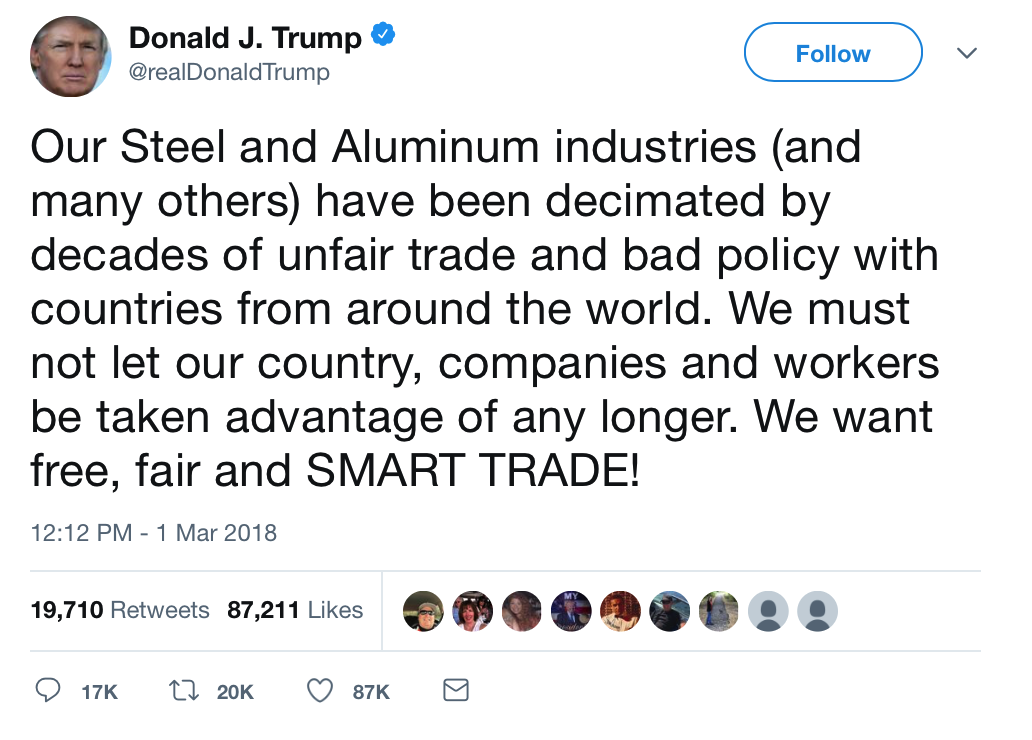
Fears of a global trade and economic war swept across markets yesterday and this morning as President Trump announced very high tariffs on foreign steel and aluminium. In response U.S., Asian and European stocks has slumped, the dollar weakened and gold prices were flat prior to eking out small gains.
The response drew global condemnation but Trump, showing a wonderful grasp and understanding of economic history, pushed back against a wave of criticism against the hefty steel on imported base metals, with an ignorant tweet saying “trade wars are good and easy to win.”
Trump is facing anger from manufacturers and trade partners in Germany, most EU countries and of course China after announcing tariffs as high as 25% on imported steel and 10% on aluminum for “a long period of time.” The formal order is expected to be signed by Trump next week.
Anyone with even a rudimentary knowledge and understanding of history knows that protectionism and trade wars tend be badly impact economies and can lead to recessions, depressions and indeed war.
Reverberations and reactions came from across the globe, from as far as Australia where The Australian Industry Group warned that the move may trigger retaliation and a spread of protectionist policies around the globe.
“It’s a really bad idea…it can get pretty dark pretty quickly”
The general consensus by market and trade experts is that this is a wrong-move by the Trump administration, who are once again sticking to emotive campaign promises to American workers and corporations rather than the welfare of the wider U.S. economy and the now closely integrated global economy.
“It’s a really bad idea — how bad depends on what the the rest of the world does in response,” said Mark Zandi, chief economist at Moody’s Analytics Inc, to Bloomberg.
Zandi went on to tell Bloomberg that whilst the US tariffs alone may have only minimal impact on growth and inflation in the US:
“I can’t imagine the rest of the world is going to stand still for very long. The scenarios you can construct can get pretty dark pretty quickly.”
How can a tariff lead to ‘dark’ times? Quite simply through retaliation and unforeseen consequences on the part of the Trump administration.
The EU has already expressed disgust at the move whilst the United States’ own William Dudley warned yesterday of increased pressure on prices and jobs.
Retaliation from EU, China and anywhere else you can think of
Yesterday the EC’s Head Jean-Claude Juncker promised that the Commission would ‘react firmly’ with ‘countermeasures’ to these moves announced by President Trump.
“We will not sit idly while our industry is hit with unfair measures that put thousands of European jobs at risk.”
Reports state that Trump was advised to exclude allies from the tariff but this was ignored. Juncker picked up on this and referred to the EU’s history as a security ally of the United States, expressing his fury at the impact this new move would have on the wider global economy.
Meanwhile in China, officials were warming up to respond with their own tariffs that will impact the country. These measures by the US said Wen Xianjun, vice chairman of the China Nonferrous Metals Industry Association “overturn the international trade order…Other countries, including China, will [also] take relevant retaliatory measures.”
Many expect China to retaliate with its own tariffs on agricultural goods, namely sorghum of which China is the biggest importer of US produce. This could hurt the US but Trump even more:
The US now sends China about US$1billon a year worth of sorghum, the grain used to make gut-busting baiju alcohol. And in the US, much of the sorghum comes from places like Texas, Kansas and Oklahoma – all states handily won by Trump in the 2016 election. It’s almost as if the Chinese leadership keeps a 2016 electoral college map pinned to the wall in Zhongnanhai. Source SCMP
Inflation and interest rate increases
Good news for gold owners is that tariffs such as these will likely lead to an uptick in inflation. But, surely this will increase interest rates? You might argue. Perhaps. But given gold’s response so far to increased rates from the Federal Reserve, it seems like it is unlikely to respond negatively to tightening in monetary policy.
“Raising trade barriers would risk setting off a trade war, which could damage economic growth prospects around the world,” New York Fed President William Dudley said in Brazil on Thursday. “If tariffs go up, it will, at the margin, tend to put more upward pressure on prices, and those upward pressure on prices will have to be considered by the monetary authority.”
Tariff-lead inflation may add to the stagflation pressures that we are already seeing in many western economies – especially the UK. Inflation has been in stealth mode in the US or the rest of the world. Slowly but surely and imperceptibly, people are seeing a reduction in their spending power and increase in living costs. This may become more obvious in the coming months.
This latest move by Trump may not instantly feed through to every-day Americans but it is likely to cost jobs and increase prices after some time-lag.
The impact on jobs and the subsequent reaction is one we should be wary of. Back in the 1970s a rolling belt of shocks and crises (as we see today) signalled the end of a major boom period. In response more government intervention was triggered across the West. New regulations for both the labour and capital markets were introduced, stifling innovation and global trade.
Trade war today, shooting or cyber war tomorrow?

History repeats itself and it looks like we’re going into full repeat mode on the ‘How Politicians Screw Up’ channel. In previous trade wars they have often descended from currency wars as countries fight to compete by devaluing their currencies in order to maintain share of exports and hence jobs.
We appear to be seeing the same happen today. For many years China has kept it’s currency cheap in order to make exports attractive, Trump is calling them out on this. Yet the U.S. and many countries have themselves engaged in competitive currency devaluations in recent years and we look set to see them again.
Unsurprisingly countries soon find an excuse to take issue with its competitor country’s politics and soon give reason to go to war. As Jim Rickards explains:
After a few years, the futility of currency wars becomes apparent, and countries resort to trade wars. This consists of punitive tariffs, export subsidies and nontariff barriers to trade.
The dynamic is the same as in a currency war. The first country to impose tariffs gets a short-term advantage, but retaliation is not long in coming and the initial advantage is eliminated as trading partners impose tariffs in response.
Trade wars produce the same result as currency wars. Despite the illusion of short-term advantage, in the long-run everyone is worse off. The original condition of too much debt and too little growth never goes away.
Finally, tensions rise, rival blocs are formed and a shooting war begins. The shooting wars often have a not-so-hidden economic grievance or rationale behind them.
Already we appear to be in a low level cyber war as Russia, China and western nations show their muscle when it comes to hacking and taking control of various online services and infrastructures. These tensions and this already fraught situation could deteriorate quickly.
This is no longer just about cyber wars, yesterday Putin proudly unveiled the country’s new armament. Stating that the West needed to learn that the new state of affairs was ‘not a bluff’ he revealed the “low-flying, difficult-to-spot cruise missile… with a practically unlimited range and an unpredictable flight path, which can bypass lines of interception and is invincible in the face of all existing and future systems of both missile defence and air defence.”
The Cold War is back and is hotting up with the very real risk of Hot War and all that entails.
Make sure your wealth doesn’t get ‘called up’ to fight in the war
There are many side-effects of wartime, one of the most long-lasting is the financial impact on individuals’ savings. As explained, trade wars frequently turn to currency wars which can decimate the capital of companies and the wealth of people and nations. It can also result in stocks and shares losing value sharply and crashing and and cause governments to devalue people’s savings and in the next crisis, bail-ins will likely see savers’ accounts plundered … all for the public good of course.
This is where gold bullion comes into its own. Throughout history it has acted as a safe haven during times of protectionism and economic war. This was seen most recently in the 1970s.
The world was already a very uncertain financial and economic place with a lot of clouds on the horizon. Trump’s reckless actions have made this outlook even more uncertain. This bodes well for the gold price in the coming months and years.
Safe haven gold bullion will come into its own as these real risks become manifest.

News and Commentary
Gold prices flat as dollar dips on Trump’s tariff decision (Reuters.com)
Stocks Sink, Bonds Rally on Trump’s Metals Duties (Bloomberg.com)
Dow ends 420 points lower as Trump calls for tariffs (MarketWatch.com)
Silver Bullion Imports In India Surge 2870% In February (DNAIndia.com)
Big freeze stretches UK gas supplies as prices skyrocket (WorldOil.com)

Source: Bonner and Partners
Will the new Fed chairman’s bark be worse than his bite? (MoneyWeek.com)
An Apocalyptic Paul Tudor Jones Warns The Fed Is About To Lose Control (ZeroHedge.com)
How the world’s biggest financial market is affecting share prices right now (MoneyWeek.com)
Total student debt in America now exceeds cost of Iraq War (SovereignMan.com)
This Has Predicted Every Market Crash in History (BonnerAndPartners.com)
Gold Prices (LBMA AM)
02 Mar: USD 1,316.75, GBP 955.70 & EUR 1,071.04 per ounce
01 Mar: USD 1,311.25, GBP 953.80 & EUR 1,075.75 per ounce
28 Feb: USD 1,320.30, GBP 951.14 & EUR 1,080.53 per ounce
27 Feb: USD 1,332.75, GBP 954.78 & EUR 1,081.26 per ounce
26 Feb: USD 1,339.05, GBP 953.00 & EUR 1,085.30 per ounce
23 Feb: USD 1,328.90, GBP 951.09 & EUR 1,079.20 per ounce
22 Feb: USD 1,323.50, GBP 952.66 & EUR 1,076.40 per ounce
Silver Prices (LBMA)
02 Mar: USD 16.45, GBP 11.92 & EUR 13.36 per ounce
01 Mar: USD 16.32, GBP 11.87 & EUR 13.39 per ounce
28 Feb: USD 16.44, GBP 11.88 & EUR 13.45 per ounce
27 Feb: USD 16.61, GBP 11.91 & EUR 13.48 per ounce
26 Feb: USD 16.67, GBP 11.88 & EUR 13.52 per ounce
23 Feb: USD 16.61, GBP 11.88 & EUR 13.50 per ounce
22 Feb: USD 16.47, GBP 11.86 & EUR 13.40 per ounce
Recent Market Updates
– Four Key Themes To Drive Gold Prices In 2018 – World Gold Council
– Is The Gold Price Going To $10,000? (Goldnomics Podcast 3)
– Gold Corridor From Dubai to China Sought By China
– Digital Gold Provide the Benefits Of Physical Gold?
– Weekly Briefing: Currency Wars – ECB Warns Re Trump, Russia and Turkey Buy Gold and BOE Bitcoin Warning
– Russian Central Bank Buys Gold – 600,000 Ounces Or 18.7 Tons In January As Venezuela Launches ‘Petro Gold’
– Bitcoin or British Pound ‘Pretty Much Failed’ As Currency?
– Bank Bail-In Risk In European Countries Seen In 5 Key Charts
– US-China Trade War Escalates As Further Measures Are Taken
– Gold Up 3.8% In Week – If Closes Above $1,360/oz Will Be Biggest Weekly Gain In Nearly 2 Years
– Is The Gold Price Heading Higher? IG TV Interview GoldCore
– Global Debt Crisis II Cometh
– Sovereign Wealth Funds Investing In Gold For “Long Term Returns” – PwC

Andrew Maguire’s Kinesis money which is a “bitcoin” but backed 100% by allocated gold and silver is set to go.
it think it would be a great idea to look at this!
please read at: https://kinesis.money/#/
(Andrew Maguire)
|
2:57 PM (1 hour ago) | ||
|
|||
Harvey
Here It is my friend! https://kinesis.money/#/ Please let everyone know.
Let catch up on Monday if you have time. We have billions in the hopper ready to be allocated on the 1st day of trading. The paper market days are over.
Warm regards
Andy
end
I urge you all to listen to this interview of Andrew Maguire as he discusses his Kinesis cryptocurrency which is backed 100% by allocated gold and silver.
this is a must..
(courtesy GATA/Goldseek/Andrew Maguire)
New gold-backed monetary system described in GoldSeek Radio interview
Submitted by cpowell on Thu, 2018-03-01 15:46. Section: Daily Dispatches
10:48a ET Thursday, March 1, 2018
Dear Friend of GATA and Gold:
GoldSeek Radio’s Chris Waltzek today interviews Thomas Coughlin and London metals trader Andrew Maguire about the launch of the Allocated Bullion Exchange and what they hope will become a worldwide monetary system they call Kinesis, which will include a gold-backed cryptocurrency. The interview is 25 minutes long and can be heard at GoldSeek Radio here:
http://radio.goldseek.com/nuggets/kinesis.02.28.18.mp3
CHRIS POWELL, Secretary/Treasurer
Gold Anti-Trust Action Committee Inc.
CPowell@GATA.org
END
John Embry on the market rigging of gold and silver
(courtesy John Embry/Kingworldnews)
Only stupid, naive, or complicit can deny gold market rigging now, Embry says
Submitted by cpowell on Thu, 2018-03-01 23:52. Section: Daily Dispatches
6:52p ET Thursday, March 1, 2018
Dear Friend of GATA and Gold:
Sprott Asset Management’s John Embry, interviewed by King World News today, says suppression of monetary metals prices can be denied only by people who are “stupid, hopelessly naive, or in some way complicit.” Embry says he expects “a violent upward revision in gold and silver prices shortly,” along with much higher interest rates, which will make much trouble for “an incredibly over-indebted financial system.” Embry’s comments are posted at KWN here:
https://kingworldnews.com/john-embry-expect-violently-higher-gold-silver…
CHRIS POWELL, Secretary/Treasurer
Gold Anti-Trust Action Committee Inc.
CPowell@GATA.org
Alasdair Macleod: Currency exchange value dynamics
Submitted by cpowell on Fri, 2018-03-02 00:29. Section: Daily Dispatches
7:30p ET Thursday, March 1, 2018
Dear Friend of GATA and Gold:
GoldMoney research director Alasdair Macleod writes today that the world reserve currency could collapse faster than anyone expects and that such a day may be close than anyone expects.
“The prospects for the dollar are already deteriorating,” Macleod writes. “The U.S. budget deficit is escalating at the most inappropriate stage of the credit cycle, leading in turn to increasing U.S. trade deficits, and therefore net selling of yet more dollars on the foreign exchanges.
“Government funding through Treasury issues is set to accelerate at a time when overseas ownership of U.S. dollar-denominated bonds, which increased while the dollar was strong, are likely to sold, now that the dollar is weakening. A falling dollar means rising commodity prices on the exchanges, rising domestic inflation, and a sliding bond market. The Fed, having an eye on the risks to both private sector and government debt, is likely to be too slow to counter these negative forces.”
Macleod’s commentary is headlined “Currency Exchange Value Dynamics” and it’s posted at GoldMoney here:
https://www.goldmoney.com/research/goldmoney-insights/currency-exchange-…
CHRIS POWELL, Secretary/Treasurer
Gold Anti-Trust Action Committee Inc.
CPowell@GATA.org
Alasdair Macleod…
Currency exchange value dynamics
In a recent article[i] I postulated that the dollar could lose all its purchasing power with a rapidity that will come as an unpleasant bombshell, even to those who already see inflation as society’s greatest problem in the future. The key to understanding why this may be so lies in human reactions to the monetary consequences of the next credit crisis. The undermining of the dollar as a currency affects all other fiat currencies, because it is the reserve currency and all financial markets use it as the pricing medium for commodities and for much of international trade.
A comprehensible analysis of currency exchange dynamics must therefore concentrate on the dollar, only bringing in the broader picture when appropriate. In this article’s context, currency exchange dynamics refers primarily to events that lead to a change in the dollar’s purchasing power.
The dollar has suffered monetary inflation ever since the Federal Reserve Board was created, both in terms of the expansion of base money and of bank credit. The effect in terms of loss of purchasing power has so far come in two shifts. The first was in 1934, when the dollar was devalued against gold by 40%, and the second following the collapse of the London gold pool in the late 1960s, since when the dollar has lost a further 97.4%.
The precedent has therefore been set for a continuing trend, that will eventually conclude with the destruction of the current monetary system. We know this because monetary regimes come and go, leaving gold and silver as the only solid forms of money throughout human history. Therefore, the end of the dollar, along with the whole fiat currency system, just like the end of empires, is one of the monetary certainties. But only a small minority of analysts are conscious this is so and appear to assume the current monetary state will continue indefinitely.
This article argues the end of the current monetary regime could be much closer than even the uber-bears think. If so, it will be due in part to the extraordinary circumstances currently evolving.
Gold and silver, in terms of their purchasing power, are and always have been a safe haven from state-induced inflation and historically have remained relatively stable measured against other commodities, except in times of escalating financial violence when a credit crisis occurs. However, the quantities of fiat currencies relative to the available monetary gold are now far too large for this relative stability to continue even ahead of the next credit crisis, with gold and silver’s values having the potential to increase significantly, measured against both fiat currencies and commodities.
Potentially, fiat currencies face a perfect storm from an upcoming credit crisis, from the consequences of central banks’ misguided attempts to make the banking system catastrophe-proof, and from the spontaneous development of an alternative asset system in cryptocurrencies.
The prospects for the dollar are already deteriorating. The US budget deficit is escalating at the most inappropriate stage of the credit cycle, leading in turn to increasing US trade deficits, and therefore net selling of yet more dollars on the foreign exchanges. Government funding through Treasury issues is set to accelerate at a time when overseas ownership of US dollar-denominated bonds, which increased while the dollar was strong, are likely to be sold, now that the dollar is weakening. A falling dollar means rising commodity prices on the exchanges, rising domestic inflation and a sliding bond market. The Fed, having an eye on the risks to both private sector and government debt, is likely to be too slow to counter these negative forces.
Within the credit cycle, it is always rising prices, the consequence of earlier credit expansion, that lead into the final crisis stage. To combat rising price inflation in excess of their 2% targets, central banks will be forced to increase their deposit rates, while the time-preference on loans and bonds increases at the behest of markets.
These increases only end when the cost of financing and refinancing commercial projects exceeds the return on them, and malinvestments are revealed. At that point, escalating losses on bank loans force banks to retrench, particularly on loans for working capital. And without working capital, business failures quickly escalate.
Consumer debt is now a major factor
The sequence of events in the classic definition of a credit induced business cycle has gradually changed in one important respect. Instead of bank credit being taken up by businesses seeking to satisfy consumer demand arising from the discouragement to saving from low interest rates, marginal consumer demand has itself been bolstered by increasing levels of borrowing. This is because the wealth transfer due to monetary inflation is now severely taxing American consumers, who have abandoned savings habits and instead are borrowing to maintain their standard of living. Therefore, swings in savings rates, an important signal to businesses in the past, are not so relevant as they used to be.
When the credit crisis arrives, the composition of all that consumer debt also becomes important. At the end of 2017, US household debt stood at $13.15 trillion, and was comprised of $9.33 trillion of mortgage debt and £3.82 trillion of non-housing debt.[ii] Most of the mortgage debt is held by government agencies, taken into conservatorship by the US Treasury during the last credit crisis. We can safely assume government policy will discourage foreclosures on delinquent mortgages. That leaves non-housing debt, which is mostly not collateralised.
Therefore, when a credit crisis hits, in addition to a rapid reduction in interest rates and an expansion of base money through quantitative easing to rescue the wider economy, consumer finance companies will also need a backstop. The difference today from the last crisis is there is no reason to suppose there will be a significant collapse in residential property prices, though they may or may not be undermined to some degree by higher interest rates before the crisis arrives. That being the case and even allowing for the negative effects of losses in financial markets to consumer wealth, consumer credit seems unlikely to contract by very much, as it threatened to do at the height of the last credit crisis. Certainly, it will be the Fed’s policy to maintain consumer confidence at all times.
A further dampener is potential job losses. But here again, the Fed will almost certainly support the banks, on the understanding they don’t exacerbate the crisis by foreclosing on businesses in the general sense. After all, the Fed succeeded in stopping a financial and systemic crisis in 2008 by doing just that and is likely to feel confident today that policy is the most practical solution in a future credit crisis. Therefore, we can conclude that consumers, who are also employees, will see in aggregate little reason to reduce their spending significantly, and consumer finance companies will be encouraged to continue to offer credit. An important consequence is price inflation will continue.
Of course, we must not make light of the dangers. Unemployment will rise, as will personal bankruptcies. Banks will stop offering credit for working capital purposes for smaller businesses. That’s what happens in every credit crisis. But the point at issue is the scale of the initial effects of the crisis stage of the credit cycle, which may not be as disastrous as the mountain of outstanding debt to be unwound implies. What happens after that is another matter.
Perhaps this Panglossian view of how the next credit crisis might commence without a systemic crash will surprise bearish commentators. However, an analysis of bank lending and bank balance sheets in the Eurozone reveals similar trends towards consumer lending, though obviously they vary between member states. Thanks to the ECB’s aggressive and continuing QE policies, banks appear to have reduced their exposure to government debt as a proportion of their total assets, which casts the ECB’s continuing policy on QE in a different light. Eurozone banks have at least made some constructive moves to reduce their exposure to sovereign debt, while decreasing their capital ratios.[iii]
Accordingly, between the world’s two largest economic entities, bank risk appears to be less compared with the position at the time of the last credit crisis. This is not to suggest that systemic risk in the banks has been banished, only that it is almost certainly less than it was. The character of the next credit crisis is bound to be different from the last for this reason. Furthermore, the steps taken by the Financial Stability Board, the Bank for International Settlements and individual central banks to prevent a financial crisis occurring again are bound to have reduced the systemic risk of multiple bank failures.
However, the credit crisis will still occur, because it is baked in the cake of the credit cycle itself. In the interests of preserving banks from the uncertainties of free markets, other potentially far more serious errors have been committed by regulating how money is used and by suppressing symptoms of financial and currency risk.
Central bank policy errors
The first policy error has been to synchronise monetary policy between the major central banks through forums such as the G20. Inevitably, as is gradually becoming apparent today, this leads to a globally synchronised inflation-fed increase in demand for limited resources, semi-manufactured goods and consumer goods. Unless someone like Elon Musk comes up with a credible plan to immediately import the necessary stuff from the moon or Mars, the consequence is bound to be an increase in prices, which not even hedonic adjustments can hide.
It is for this reason that it seems certain that price inflation will accelerate sooner and faster than currently discounted in financial markets. The effect of synchronising monetary policy globally is to bring the increase in interest rates and bond yields forward in time, as well as the credit crisis that follows. Partly for this reason, and partly because of the implied cap imposed on interest rate increases by the overhang of record levels of debt, the expansionary period of the credit cycle seems unlikely to last much beyond the year-end.
We must now turn our attention to the credit crisis that follows this expansionary phase, and the dynamics behind it.
By not permitting the unwinding of past malinvestments, central banks have stored up financial and economic distortions that threaten to imperil the global economy and ultimately state-issued currencies. Prevention of these forces being unleashed has had the effect of suppressing economic potential, which becomes obvious when you cut through misleading state statistics. Take hedonic adjustments out of official price inflation statistics, and you can immediately see that a true GDP deflator would have the US economy still in recession from the last crisis. And why the 2% inflation target adopted by all central banks? As even a child understands, you do not stimulate consumers into buying extra things by a policy of raising prices. No, what you achieve is the ability of a welfare state to fund itself cheaply through the transfer of wealth from ordinary folk to government coffers by way of monetary inflation.
Therefore, the principal victim of monetary policy is an unwitting public, with statistical deception for cover. But having established the primacy of misleading statistics, central banks have moved on. An objective for some time now, in the name of anti-money laundering and tackling tax evasion, is to do away with cash. While this ultimate objective is still a pipe-dream, cash withdrawals are already severely restricted in practice by bank regulations and made impractical for all but small amounts. The truth is central banks do not want depositors to have the option of owning their own currency, because if just some of them decide to increase their cash, they disrupt the banking system, and potentially cause liquidity problems for individual banks as well.
The unintended consequences could become apparent in the next credit crisis. Instead of withdrawing physical cash, depositors will be forced to pass-the-cash-parcel by buying substitutes. The pressure valve, which allows people to retain fiat currency in cash through a credit and financial crisis, has effectively been sealed off, and they are forced to dispose of it’s bank deposits entirely. All it takes is a moderate increase in the quantity of currency deposits being dumped onto unwilling buyers, sellers of assets and goods aware that currency is losing value, for a currency’s value to begin to collapse.
Central banks have therefore transferred banking risk to currency risk by limiting encashment of deposits. Furthermore, increases in interest rates to stabilise the purchasing power of currencies will no longer be a sure-fire solution, because they merely spring debt traps, not least on governments themselves, further destabilising fiat currencies by undermining ‘the full faith and credit’ of the issuers. The option of a Volcker solution as a final backstop to stopping hyperinflation of prices developing appears to be no longer available.[iv]
The rise and rise of currency alternatives
We can draw some important conclusions from our analysis so far. The next credit crisis will be unlike the last, and doubtless the central banks from all their analysing have prepared well thought out solutions to a general banking crisis. Therefore, banks are less likely to be a systemic threat to the extent they were in 2008/09, when a crisis was wholly unexpected. That does not mean depositors will be complacent, and at the margin, they are likely to seek alternatives to holding bank balances during the crisis.
The question then arises as to what alternatives to depreciating currencies might be available to bank depositors. Precious metals, widely accepted as true money, are likely to be in strong demand, as they always have been when currencies begin to lose their value and credibility. But we have a new, disruptive force in cryptocurrencies.
Cryptocurrencies have enjoyed a wave of popularity, driving bitcoin from virtually nothing to nearly $20,000 in mid-December. Since then, there has been an unwinding of excessive public speculation, at a time when regulated institutions have begun to get involved. While retail banks are wary of the losses their customers might suffer, investment banks are investing in this new business line, and regulated products are sure to follow.
The legitimisation of cryptocurrencies as an alternative to cash, if the trend continues, is going to have intense implications for the course of the credit crisis, and the eventual value of fiat currencies. The difference between the restricted issue of an individual cryptocurrency and the potentially infinite issue of fiat currency will not be lost on savvy members of the wider public. And we are not talking of the population of only one country, but over most of the globe. The potential for the purchasing power of fiat currencies to collapse, measured against both traditional metallic money and the new cryptocurrencies, is enormously important, and can be expected to hasten the end of the fiat currency era.
Concluding remarks
The next credit crisis is likely to be a two-stage affair, with the initial crisis developing as it always does, out of rising prices and rising interest rates in the expansionary phase of the credit cycle. However, we can reasonably assume that this time, central banks will be ready to implement previously devised plans to ensure the financial system is supported.
In transferring systemic risk into currency risk by blocking off bank depositors’ escape routes, the initial crisis could soon be followed by the rapid destruction of fiat currencies, beginning with them being sold for alternatives, particularly precious metals and cryptocurrencies. Growing numbers of the general public will begin to realise that commodity prices and everything derived from them will continue to rise, and that therefore cash deposits will buy less and less.
No one wants to think this might be true, and severe inflations always have to overcome a high degree of resistance to the thought that the currency people have been using for decades, even generations, might finally be worthless. Not even central banks will be prepared for this possibility. Of course, it is in their power to do something about it: all they need do is reduce the currency outstanding, absorbing all that is loose. Governments would have to balance their budgets by cutting their spending aggressively and wean themselves off currency seigniorage. But that requires an understanding of economics that is diametrically opposed to the supposed benefits of inflationism, and a contrary embrace of the virtues of sound money and deflation.
The groupthink that inflation is good for us all is too ingrained in the establishment and its epigones for anyone regard a return to an anti-inflation monetary and economic policy as a possibility. Therefore, at this point, we enter the realms of true hyperinflation. As more and more people try to abandon their legally-mandated fiat currencies, the fact that they can only do so by selling them to other increasingly disillusioned holders leads rapidly to a situation where, in terms of goods, there is no bid for fiat currencies.
The collapse could therefore be rapid, considerably faster than, say, the collapse of the German mark in 1923.[v] The speed of the mark’s final collapse was to a degree hampered by the rate at which circulating notes were printed. And who in these times draws a cheque on a bank, taking days to clear? Nowadays, exchanging currency for goods is almost always electronic and instantaneous.
Will anyone escape? That remains to be seen, but Russia, which is rapidly accumulating gold and has reformed her banking system, could do so by offering gold convertibility for the rouble. China could also escape, but because she has relied on bank credit expansion to an enormous extent in recent years, she will have to reveal substantial hidden gold reserves to back the yuan. Both these nations could stabilise their currencies through the issue of undated bonds with a modest coupon, convertible into gold on demand, but only at far higher gold prices.
Both Russia and China appear to have some understanding of the role of gold in stabilising a currency, which must be why these two nations are taking the lead in accumulating physical gold. For the rest of us, unfortunately we are the victims of government hubris about how they can control everything, and the outlook is one of fiat currency destruction, sooner perhaps than almost anyone thinks is likely, or even possible.
[i] See https://www.goldmoney.com/research/goldmoney-insights/a-roman-lesson-on-inflation
[ii] Mortgage debt includes $444bn of home equity lines of credit (HELOC). Data from Federal Reserve Bank of New York.
[iii] See the ECB’s Supervisory Banking Statistics for Third Quarter 2017 Table T02.03.2 for bank asset composition by country.
[iv] Paul Volcker was Chairman of the Fed in 1980-81, when the Fed raised the Fed Funds Rate to over 20% in 1981 tp break the inflation spiral.
[v] Until early 1923, there was a general belief variously in the foreign exchanges and the domestic economy that the mark was bound to recover. Thereafter, the public began to abandon all hope, and the mark’s final collapse took about six months.
Your early FRIDAY morning currency, Asian stock market results, important USA/Asian currency crosses, gold/silver pricing overnight along with the price of oil Major stories overnight/9 AM EST
i) Chinese yuan vs USA dollar/CLOSED DOWN 6.3454 /shanghai bourse CLOSED DOWN 19.23 POINTS OR 0.59% / HANG SANG CLOSED DOWN 460.80 POINTS OR 1.48%
2. Nikkei closed DOWN 542.83 POINTS OR 2.50% /USA: YEN FALLS TO 105.34/ STILL DEADLY AS YEN CARRY TRADERS DISINTEGRATE
3. Europe stocks OPENED DEEPLY IN THE RED /USA dollar index FALLS TO 89.98/Euro RISES TO 1.2318
3b Japan 10 year bond yield: RISES TO . +.068/ !!!!(Japan buying 100% of bond issuance)/Japanese yen vs usa cross now at 106.69/ THIS IS TROUBLESOME AS BANK OF JAPAN IS RUNNING OUT OF BONDS TO BUY./JAPAN 10 YR YIELD FINALLY IN THE POSITIVE/BANK OF JAPAN LOSING CONTROL OF THEIR YIELD CURVE AS THEY PURCHASE ALL BONDS TO GET TO ZERO RATE!!
3c Nikkei now JUST BELOW 17,000
3d USA/Yen rate now well below the important 120 barrier this morning
3e WTI:: 60.63 and Brent: 63.47
3f Gold UP/Yen UP
3g Japan is to buy the equivalent of 108 billion uSA dollars worth of bond per month or $1.3 trillion. Japan’s GDP equals 5 trillion usa./“HELICOPTER MONEY” OFF THE TABLE FOR NOW /REVERSE OPERATION TWIST ON THE BONDS: PURCHASE OF LONG BONDS AND SELLING THE SHORT END
Japan to buy 100% of all new Japanese debt and by 2018 they will have 25% of all Japanese debt. Fifty percent of Japanese budget financed with debt.
3h Oil DOWN for WTI and DOWN FOR Brent this morning
3i European bond buying continues to push yields lower on all fronts in the EMU. German 10yr bund FALLS TO +.616%/Italian 10 yr bond yield DOWN to 1.904% /SPAIN 10 YR BOND YIELD DOWN TO 1.482%
3j Greek 10 year bond yield FALLS TO : 4.4275?????????????????
3k Gold at $1322.40 silver at:16.44 7 am est) SILVER NEXT RESISTANCE LEVEL AT $18.50
3l USA vs Russian rouble; (Russian rouble UP 28/100 in roubles/dollar) 57.07
3m oil into the 60 dollar handle for WTI and 63 handle for Brent/
3n Higher foreign deposits out of China sees huge risk of outflows and a currency depreciation. This can spell financial disaster for the rest of the world/
JAPAN ON JAN 29.2016 INITIATES NIRP. THIS MORNING THEY SIGNAL THEY MAY END NIRP. TODAY THE USA/YEN TRADES TO 105.34 DESTROYING JAPANESE CITIZENS WITH HIGHER FOOD INFLATION
30 SNB (Swiss National Bank) still intervening again in the markets driving down the SF. It is not working: USA/SF this morning 0.9353 as the Swiss Franc is still rising against most currencies. Euro vs SF is 1.1519 well above the floor set by the Swiss Finance Minister. Thomas Jordan, chief of the Swiss National Bank continues to purchase euros trying to lower value of the Swiss Franc.
3p BRITAIN VOTES AFFIRMATIVE BREXIT/LOWER PARLIAMENT APPROVES BREXIT COMMENCEMENT/ARTICLE 50 COMMENCES MARCH 29/2017
3r the 10 Year German bund now POSITIVE territory with the 10 year FALLING to +0.616%
The bank withdrawals were causing massive hardship to the Greek bank. the Greek referendum voted overwhelming “NO”. Next step for Greece will be the recapitalization of the banks and that will be difficult.
4. USA 10 year treasury bond at 2.8010% early this morning (THIS IS DEADLY TO ALL MARKETS). Thirty year rate at 3.091% /BOTH VERY DEADLY
5. Details Ransquawk, Bloomberg, Deutsche bank/Jim Reid.
(courtesy Jim Reid/Bloomberg/Deutsche bank/zero hedge)
Stocks, S&P Futures Plunge After Trump-Kuroda Double Whammy
As if markets did not have enough to worry about with this weekend’s Italian election and SPD “grand coalition” referendum, overnight stocks were slammed by growing worries of global trade war as well as a warning from BOJ governor Kuroda that Japan’s QE may be coming to an end.
As noted earlier, Kuroda hint that the BOJ will start thinking about how to exit its massive monetary stimulus program around the fiscal year starting in April 2019 sent the USDJPY tumbling, pushing it to the lowest level since November 2016. Kuroda’s statement slammed Japan stocks, with the Topix Index deepening losses while Japanese bond yields climbed.

As Bloomberg noted, Kuroda’s comments were seen as further evidence that the era of massive central-bank stimulus is coming to an end. Earlier this week, Fed chair Jerome Powell opened the door to speculation that the central bank may quicken the pace of monetary tightening, a move investors worry could derail economic expansion.
A few hours later, just before 6am ET, a tweet from Donald Trump claiming that “trade wars are good, and easy to win” added to the pain, sending the dollar and S&P futures tumbling to session lows, as the market gradually realizes that Trump may not be backing down.

The result this morning is a sea in global equity markets…

… while S&P futures are currently trading near sessions lows, with the Dow set to open about 200 points lower and the E-mini trading around 2,660, over 100 points below Tuesday’s highs.

In Europe, the Stoxx Euro 600 Index dropped for a fourth day, with Germany’s DAX gauge reaching a six-month low, as carmakers slumped; 85% of the Stoxx 600 was in the red. Industrial and auto names are the underperformers this morning over fears of production cost hikes. Noticeable laggards contain the likes of Fiat Chrysler (-4.9%), LafargeHolcim (-5.0%) ArcelorMittal (-4.0%), ThyssenKrupp (-2.8%), and Peugeot (-1.8%). DAX dropped as much as 3%, a notable laggard as investors grow cautious over Sunday’s SPD vote and as such, the index made a breach of the psychological 12000 level. Political risk is also filtering through to the FSTE MIB (-2.1%) as markets prep themselves for this weekend’s Italian election.
As a result of the confluence of risk events, volatility appears to again be on the rise, with the VIX rising above 24 this morning. The VIX is up over 43% this week in anticipation of more turmoil.

“We’re entering a period of turbulence,” Sebastien Page, head of asset allocation at T. Rowe Price, told Bloomberg TV from Baltimore. “So at the margin we are taking away from equities, adding both bonds and cash.”
In macro, the biggest loser was the dollar, slammed by Trump’s “trade wars are easy to lose” tweet even as bond yields stabilized just above 2.80%. The euro found some support amid profit taking on shorts; The yen rose versus all G-10 peers and advanced as much as 0.9% against the dollar to a 15-month high of 105.28; the yen had climbed initially on risk-off sentiment spurred by concerns over U.S. trade protectionism. The Norwegian krone rallied to a one-month high against the euro after the central bank cut its inflation target to 2% from 2.5%. The pound held steady ahead PM May’s Brexit speech later in the day
In other overnight news, Special Counsel Robert Mueller is reportedly compiling a case against Russians who carried out hacking and information leaking which was intended to hurt Democrats in 2016 election.
There were also reports that White House is said to be preparing to replace Trump National Security Adviser McMaster. However, NSC spokesman later stated that US President Trump labelled the story related to the departure of National Security Adviser McMaster as fake news.
Over in the UK, PM May said Brexit deal must give UK control of its border, laws and money, while she added they will place ‘5 tests’ on the Brexit deal. Meanwhile, the UK Cabinet is said to be in dispute regarding text ahead of PM May’s key Brexit speech, while there were also reports that UK PM May will not commit to mirroring EU regulations.
Elsewhere, oil declined amid concerns about increasing U.S. crude production, while copper headed for a two-week low as most industrial metals fell. Commodity newsflow has been dominated by Trump’s announcement on import tariffs for steel and aluminium. Aluminium futures fell 0.5%, while Shanghai steel prices 5-day rally came to a halt amid fears that the tariff plan could lead to a glut. Precious metals hover around yesterday’s high as risk off flows support gold, alongside the softer USD. WTI and Brent crude futures trending lower this morning with prices dictated by the risk off sentiment. Levels to the downside for Brent which may over some support is situated at USD 63.19 (yesterday’s low) at USD 61.75.
On today’s calendar, Foot Locker is among a handful of companies set to report earnings. The university of Michigan sentiment is expected on the macro side.
Market snapshot
- S&P 500 futures down 0.4% to 2,665.25
- STOXX Europe 600 down 1.3% to 370.17
- MXAP down 0.8% to 174.38
- MXAPJ down 0.9% to 571.54
- Nikkei down 2.5% to 21,181.64
- Topix down 1.8% to 1,708.34
- Hang Seng Index down 1.5% to 30,583.45
- Shanghai Composite down 0.6% to 3,254.53
- Sensex down 0.4% to 34,046.94
- Australia S&P/ASX 200 down 0.7% to 5,928.90
- Kospi down 1% to 2,402.16
- German 10Y yield fell 3.1 bps to 0.613%
- Euro up 0.07% to $1.2275
- Italian 10Y yield fell 2.7 bps to 1.679%
- Spanish 10Y yield fell 1.7 bps to 1.49%
- Brent Futures down 0.2% to $63.70/bbl
- Gold spot up 0.1% to $1,317.76
- U.S. Dollar Index down 0.3% to 90.10
Bulletin Headline Summary from RanSquawk
- European bourses firmly in the red following the sell-off seen in Asia and Wall St. with 85% of the Stoxx 600 in the red after Trump’s aluminium and steel tariffs spooked markets
- The Dollar is on the backfoot again with the DXY unable to extend its recent rebound to or through 91.000
- Looking ahead, highlights include Canadian GDP, Baker Hughes, BoE’s Carney and UK PM May’s Brexit speech
Top Overnight News
- The official response in China, the world’s largest steel producer, to the announced U.S. tariffs was muted; foreign Ministry spokeswoman Hua Chunying merely said in Beijing Friday that China urges the U.S. to follow trade rules
- The EU will consider imposing its own “safeguard” tariffs on imports of steel and aluminum in response to President Trump’s decision to levy national security tariffs, the Financial Times reports, citing EU Trade Commissioner Cecilia Malmstrom as saying in an interview
- The Bank of Japan will start thinking about how to exit its massive monetary stimulus program around the fiscal year starting in April 2019, Governor Haruhiko Kuroda said Friday, marking the first time he’s provided any clear guidance on timing for normalizing policy
- Norway lowered the inflation target of its central bank to 2 percent from 2.5 percent, the Finance Ministry said in a statement. The government also said that inflation targeting shall be forward-looking and flexible
Asian stocks were negative across the board as region followed suit from Wall St. where the majors posted their 3rd consecutive losing streak after reports of incoming Trump tariffs stoked trade war fears and amid raised prospects of 4 Fed hikes this year. The announcement by President Trump to set tariffs on aluminium and steel imports next week also resulted to a global backlash in which EU, Canada and Mexico vowed countermeasures or retaliation against the US, while the China Iron and Steel Association branded the measure as ‘stupid’. As such, ASX 200 (-0.7%), Nikkei 225 (-2.5%) and KOSPI (-1.0%) saw commodity-related pressure with steel names in Asia’s top US-bound steel exporters Japan and South Korea suffering the brunt of the impending tariffs, while heavily-exposed automakers were also reeling from the news. Hang Seng (-1.5%) and Shanghai Comp. (-0.6%) conformed to the downbeat tone, although weakness in the mainland was to a lesser extent as China was said to only export a limited amount of steel to US and after another weekly net liquidity injection by the PBoC. Finally, 10yr JGBs were initially higher with demand spurred amid a broad risk-averse tone and with the BoJ present in the market for 1yr-10yr JGBs under an unchanged Rinban operation, although pressure was later seen on comments from BoJ Governor Kuroda that they will be considering exit around fiscal 2019. PBoC injected CNY 40bln via 7-day reverse repos, CNY 30bln via 28-day reverse repos and CNY 20bln via 63-day reverse repos for a net weekly injection of CNY 120bln vs. Prev. CNY 580bln net injection last week.
BoJ Governor Kuroda said BoJ will be considering exit around fiscal 2019 and that there could be a policy change before 2% target is reached, but BoJ may also keep rates unchanged even with CPI at the target. Kuroda had also commented that he will maintain current policy for now as momentum is good and that he is cautious on raising the yield target even if yields increase and other central banks exit loose policy.
Top Asian News
- Kuroda Says BOJ Will Be Thinking About Exit Around 2019
- Tencent’s Wild Ride Makes China Small Caps a Relative Refuge
- Australia’s ASIC Accuses Rio of Deception on Mozambique Deal
European bourses are also firmly in the red (Eurostoxx 50 -1.5%) following the sell-off seen in Asia and Wall St. with 85% of the Stoxx 600 in the red after Trump’s aluminium and steel tariffs spooked markets amid fears of potential trade wars. Industrial and auto names are the underperformers this morning over fears of production cost hikes. Noticeable laggards contain the likes of Fiat Chrysler (-4.9%), LafargeHolcim (-5.0%) ArcelorMittal (-4.0%), ThyssenKrupp (-2.8%), and Peugeot (-1.8%). DAX (-2.2%) a notable laggard as investors grow cautious over Sunday’s SPD vote and as such, the index made a breach of the psychological 12000 level. Political risk is also filtering through to the FSTE MIB (-2.1%) as markets prep themselves for this weekend’s Italian election
Top European News
- ECB’s Rimsevics Back at Central Bank Despite Bribery Probe
- South Africa Says Bank of Baroda Holds ‘Proceeds of Crime’
- Russia Is EU’S Energy Guardian as Cold Grips, Gazprom CEO Says
- LandSec Chairman’s Retirement Cuts Boardroom Diversity
- Amsterdam Prepares for Bumper Crop of IPOs as Companies Line Up
In FX, the Dollar is on the backfoot again with the DXY unable to extend its recent rebound to or through 91.000 despite hawkish talk from 2018 FOMC voter Dudley (said four tightening moves this year would still constitute a gradual pace of policy normalisation). His comments, and Powell’s second testimony for that matter, were completely overshadowed by the latest moves from President Trump to protect US steel and aluminium producers that have triggered a fresh round of global trade war concerns (and retaliatory remarks unsurprisingly). The index is back down in the low 90.000s having marginally eclipsed nearest chart resistance around 90.900 at one stage yesterday, and the Greenback is a broad loser vs other G10s, bar the Pound and Loonie due to ongoing Brexit and NAFTA related uncertainty/risks. Yet again it is the Jpy that is outperforming and not just against the Usd, but generally as the headline pair trades sub-106.00 and close to ytd lows around 105.55, with put options at the 105.00 strike also weighing, albeit offset by reported barriers at 105.50 and the figure. Eur/Jpy has retreated a bit further below 130.00 and not far from 129.50 support, while Gbp/Jpy is eyeing 145.50. Eur/Usd has rebounded firmly above 1.2200 having slipped to a fresh 2018 low on Thursday around 1.2155, but could remain capped ahead of 1.2300 and drawn to a very big expiry at 1.2250 (3.1 bn). Cable only seeing mild upside within a 1.3750-1.3800 wide range in wake of a firmer than forecast UK construction PMI, with more focus on PM May’s latest Brexit address in response to the EU’s draft on Wednesday after Carney failed to mention anything specific on monetary policy in his text. Usd/Chf has reversed sharply on safe-haven positioning (like the Usd/Jpy and Jpy crosses) to just above 0.9350 vs almost 0.9500 late yesterday as global stocks continue to recoil on the heightened prospect of protectionism. EUR/NOK was dealt a blow after The Norwegian Finance ministry lowered the Norges Bank inflation target to 2.0% from 2.5%. However, the move was partially reversed after Norges Bank stated that this will be unlikely to lead to a significant change in the implementation of monetary policy. Back to the majors, Usd/Cad is hovering around 1.2850 ahead of Candian GDP data.
In commodities, newsflow has been dominated by Trump’s announcement on import tariffs for steel and aluminium. Following this, aluminium futures fell 0.5%, while Shanghai steel prices 5-day rally came to a halt amid fears that the tariff plan could lead to a glut. Precious metals hover around yesterday’s high as risk off flows support gold, alongside the softer USD. WTI and Brent crude futures trending lower this morning with prices dictated by the risk off sentiment. Levels to the downside for Brent which may over some support is situated at USD 63.19 (yesterday’s low) at USD 61.75 (double bottom) Canada and EU vowed countermeasures against US steel and aluminium tariffs, while Mexico also stated that it would retaliate with its own tariffs against US if it is not excluded from the steel and aluminium tariffs. Furthermore, China Iron and Steel Association said US tariffs on steel and aluminium are ‘stupid’ trade protectionism measures and that China only exports a limited amount of steel to US, while China Metals Association said China is among the nations likely to retaliate against the US.
Looking at the day ahead, the final reading for the February Uni. of Michigan’s consumer sentiment will also be out. Onto other events, the BOE’s Carney and the ECB’s Mersch will speak. The UK’s PM May will outline her vision for a post Brexit trade deal with the EU. Then on Saturday, the opening session of the Chinese People’s Political Consultative Conference begins and will run through to 15 March. Finally the Italian elections will be held on Sunday.
US Event Calendar
- 10am: U. of Mich. Sentiment, est. 99.5, prior 99.9; Current Conditions, prior 115.1; Expectations, prior 90.2
DB’s Jim Reid concludes the overnight wrap
Fascinating start to March yesterday. In brief, Chinese manufacturing PMIs weakest since July 2016, US manufacturing ISM strongest since May 2004 (3rd strongest since April 1984) and just 0.6pt below the 34 year high, US prices paid (74.2) highest since May 2011, DAX (-1.97%) worse day since 8th Feb, S&P 500 (-1.33%) seeing the fifth successive plus or minus 1% move in either direction (Feb. had 13 such day vs. only 10 from Jan 17 to Jan 18), VIX spiking back above 25 at one point, Trump confirming Steel/Aluminium tariffs which accelerated the sell-off, a Reuters story suggesting guidance changes for the ECB next week may not happen and Mr Powell relegated to a sideshow. Anyway more on these stories later.
The main event this weekend and heading into the start of next week is of course the Italian election. Before we jump into a preview, in terms of timing logistics, polling stations will officially be open from 7am to 11pm local time on Sunday, and it’s expected that the first exit polls will be out immediately after polls close. A more conclusive result should be available early on Monday. Our house view is that the risk of a hung parliament outcome remains high however it is a close call as the centre-right coalition has been closing the gap to get an outright majority. Ultimately if the result is inconclusive, our economists expect parties and institutions to work hard to form a grand coalition, however the risk of a second election should not be underestimated. Opinion polls show that within the centre-right coalition the more moderate Forza Italia is beating the right-wing Eurosceptic Northern League (NL) ally, but that the gap is within the margin of error. Our colleagues highlight that with the most voted party likely to select the new prime minister, the market might feel more uncertain about the commitment to the euro with a NL-led government. It’s worth noting that opinion polls also suggest that Five Star is likely to be the first party, but at the same time is unlikely to win an outright majority and so the chances of an anti-establishment/ Eurosceptic post-election alliance winning a majority is very low. You can find more in our economists’ report here.
For us the big talking point following the election result – whichever way it goes – will likely be the outlook for fiscal policy in Italy. Fundamentally all political parties and coalitions have proposed expansionary measures and as our economist’s point out the centre-right appears to be the most aggressive. Clearly this could be a short term positive. The risk further out though is that these measures are unfunded leading to higher deficits and therefore undermining the sustainability of public finances. This is particularly significant in terms of potentially intensifying tensions between Brussels and Rome and possibly encouraging sanctions. So one to watch medium-term. In addition to their earlier pieces, late yesterday our Euro team also did a Q&A of the most frequent questions they’ve been asked by clients this week including what is the most negative outcome and what the most plausible negative outcome. See the report here.
Now onto reviewing markets. Starting with the tariffs story, President Trump said he’ll impose tariffs on imported steel (25%) and aluminium (10%) and expects to sign a formal order next week. In terms of initial responses, the EC President Juncker said that “we will not sit idly while our industry is hit with unfair measures that put thousands of European jobs at risk”, adding that the EU will react “firmly and commensurately”. Canada’s Foreign Minister Freeland said “Canada will take responsive measures to defend its trade interest and workers”. Back last week, China’s Ministry of Commerce noted that it reserves the right to retaliate if the tariffs are imposed so we watch China’s response with interest. Finally back in the US, the Senate Finance Committee Chairman Hatch said “tariffs…are a tax hike the American people don’t need…I encourage the President to carefully consider all of the implications”, while the House Ways and Means Chairman Brady noted the President “is right to target unfair trade” but urged him to narrow the focus on the tariffs. Elsewhere, Ohio Democratic Senator Brown noted “this welcome action is long overdue….”
Over the last 10 days we’re starting to see some cracks in the global data which is perhaps why risk is struggling at the moment after the big bounce post the early Feb vol shock. Indeed the PMIs have started showing some more mixed readings. First the flash Euro PMIs were notably weaker than expected last week, then the Chinese manufacturing PMI (50.3) hit the lowest since July 2016 yesterday, while the US manufacturing ISM (60.8) was at the highest since May 2004 and the 2nd highest in the 361 months since December 1987 and the 3rd highest in the 405 months since May 1984!! Also worth noting that the US prices paid component also surged 1.5pts to 74.2 (vs. 70.0 expected) – the highest since 2011) – which should add to the building inflation argument. In the EMR each month we usually do our quick and dirty comparison between the manufacturing PMIs/ISM and the YoY change in equity markets. Given the diverging trends at the moment and the added complication of the big move in the USD over the last 12 months we thought we’d do this month’s as an expanded standalone note which we did yesterday (“Equities cheap or PMIs still too high?”). Interesting the results show the S&P 500 is 15% cheap given yesterday’s data! Meanwhile the DAX is 32% cheap which goes down to 18% if we adjust for the Euro surge of the last 12 months. We try not to take these readings too seriously but when there is such a big gap it usually tells us that something isn’t right and to investigate further.
This morning in Asia, markets have extended the US sell off with the Nikkei (-2.15%), Kospi (-0.96%), Hang Seng (-1.29%) and China’s CSI 300 (-0.56%) all lower. Datawise, Japan’s January unemployment rate was below market and
fell to a c24 year low (2.4% vs. 2.8%) while the February core CPI (ex-fresh food) was slightly above expectations at 0.9% yoy (vs. 0.8%).
Now recapping other markets performance from yesterday. US equities weakened 1.3-1.7%, with all sectors in the S&P in the red and losses led by industrials, financials and tech stocks. Notably, shares in major US steel and aluminium companies rose 3%-9.5%. The VIX closed 13% higher to 22.47 after earlier spiking above 25.
Elsewhere, a flight to safety and a dovish Powell testimony seemed to have benefited government bonds with the UST 10y yield down 5.4bp to 2.809% while Bunds (-1.2bp) and Gilts (-3.4bp) also firmed. The USD dollar index fell 0.44% while the Euro and Sterling gained 0.60% and 0.12% respectively. In commodities, the WTI oil fell for the third straight day (-1.05% to $60.99/ bbl) while precious metals were little changed (Gold -0.10%; Silver +0.31%). Finally most base metals retreated with the exception of aluminium given the aforementioned tariffs (Copper -0.08%; Zinc -0.23%; Aluminium +0.56%).
Away from the markets and onto the Fed Chair Powell where he seemed a bit more dovish this time speaking in front of the Senate. He reiterated the need for gradual increase in rates over time, but added “there’s no evidence the economy is currently over heating”. On wage growth, he said “we don’t see any strong evidence yet of a decisive move up in wages” and does not see a tightening in labour market causing wages to hit “a point of acceleration”. Elsewhere, he noted recent tax cuts will add “meaningfully to growth for at least the next couple of years…but how much it will add to longer run growth is highly uncertain”. Finally he noted “…the tariff’s approach is not the best approach, the best approach is to deal directly with the people who are directly affected…” Following on, the Fed’s Dudley said “protectionism is not the answer” as tariffs “often backfire” and hurt workers. He noted “trade barriers are an expensive way to preserve jobs in less competitive or declining industries” and that “raising trade barriers would risk setting off a trade war…”
Staying in the US, our economists have reiterated that core inflation typically lags real GDP growth by about six quarters but manufacturing indicators leads GDP by a quarter, so there is ample room for inflation to go higher over the next two years. Indeed, this is partly why they continue to expect core CPI to reach 2.3% by the end of 2018 and 2.6% by the end of 2019, which should keep the Fed on track for four hikes this year and three in 2019. Refer to their note for more details.
Before we take a look at today’s calendar, we wrap up with other data releases from yesterday. In the US, the January PCE Core was in line at 0.3% mom and 1.5% yoy, but the three and six month annualised inflation was stronger at 2.1% and 2.0% respectively. The personal income was above market at 0.4% mom (vs. 0.3%) and spending in line at 0.2%. Elsewhere, the weekly initial jobless claims fell to the lowest since 1969 (210k vs. 225k expected) while continuing claims was slightly higher than expected (1,931k vs. 1,925k). Total vehicle sales was below market at 16.9m (vs. 17.2m expected). Following the above, the Atlanta Fed’s GDPNow model now estimate 1Q GDP growth of 3.5% saar (vs. 2.6% previous).
Reviewing the European PMIs yesterday in more detail, the broad Eurozone reading was revised up a modest 0.1pts to 58.6 however remains 1pt and 2pts respectively below the January and December prints. So a slowdown albeit from very elevated levels. Germany was revised up 0.3pts to 60.6 (4-month low) while France was revised down 0.2pts to 55.9 (6-month low). In the periphery most notable was the 2.2pt decline for Italy to 56.8 (vs. 58.0 expected). That is also a 5- month low. Spain was a healthy beat (56.0 vs. 54.8 expected) and also marked a 3-month high. Netherlands actually touched an all-time high at 63.4 while Greece actually jumped to a 212-month high of 56.1. Meanwhile in the UK the reading declined slightly to 55.2 (vs. 55.0 expected) and in the US the print was 55.3 and down 0.2pts from January. However the closer followed ISM manufacturing actually jumped to a better than expected 60.8 (vs. 58.7) – the first >60 print since September last year and the highest since May 2004 as discussed at the top. Elsewhere, the Euro area’s January unemployment rate was in line with the market at 8.6% while Italy was 11.1% (vs. 10.8% expected). In the UK, the January mortgage approvals was above market at 67.5k (vs. 62k expected), but the February Nationwide house price index was below expectations at 2.2% yoy (vs. 2.6%).
Looking at the day ahead, the Euro area’s January PPI, Germany retail sales and the final reading of Italy’s 4Q GDP are due. In the US, the final reading for the February Uni. of Michigan’s consumer sentiment will also be out. Onto other events, the BOE’s Carney and the ECB’s Mersch will speak. The UK’s PM May will outline her vision for a post Brexit trade deal with the EU. Then on Saturday, the opening session of the Chinese People’s Political Consultative Conference begins and will run through to 15 March. Finally the Italian elections will be held on Sunday.
end
3. ASIAN AFFAIRS
i)FRIDAY MORNING/LATE THURSDAY NIGHT: Shanghai closed DOWN 19.23 POINTS OR 0.59% /Hang Sang CLOSED DOWN 460.80 POINTS OR 1.48% / The Nikkei closed DOWN 542.83 POINTS OR 2.50%/Australia’s all ordinaires CLOSED DOWN 0.78%/Chinese yuan (ONSHORE) closed UP at 6.3454/Oil DOWN to 60.63 dollars per barrel for WTI and 63.47 for Brent. Stocks in Europe OPENED DEEPLY IN THE RED . ONSHORE YUAN CLOSED DOWN AT 6.3450 AGAINST THE DOLLAR. OFFSHORE YUAN CLOSED UP ON THE DOLLAR AT 6.3543 /ONSHORE YUAN TRADING WEAKER AGAINST OFFSHORE YUAN/ONSHORE YUAN TRADING STRONGER AGAINST USA DOLLAR/OFFSHORE YUAN TRADING MUCH STRONGER AGAINST THE DOLLAR . CHINA IS NOT HAPPY TODAY (WEAKER CURRENCY AND TERRIBLE CHINESE MARKETS/ AND POOR GLOBAL MARKETS)
3 a NORTH KOREA/USA
/NORTH KOREA
3 b JAPAN AFFAIRS
Kuroda shocks the market by hinting at the end of its QE by April 2019. Also his targeting the 10 yr bond yield at .10% may end as well. The USA./Yen tumbled as did the Nikkei
(courtesy zerohedge)
Kuroda Shocks Markets Hinting At QE End; Nikkei, USDJPY Tumble
In addition to the suddenly escalating global trade war, overnight traders had one more thing to worry about: another central bank unwinding its QE program. This happened shortly after midnight ET, when BOJ Governor Kuroda unexpectedly announced that the Bank of Japan will start thinking about how to exit its massive monetary stimulus program around the fiscal year starting in April 2019, and that there could be policy change before the 2% inflation target is achieved, marking the first time he’s provided any clear guidance on timing for normalizing policy.
“Right now, the members of the policy board and I think that prices will move to reach 2 percent in around fiscal 2019. So it’s logical that we would be thinking about and debating exit at that time too,” he said. “I’m not saying that the negative rate of 0.1 percent and the around 0 percent aim for 10-year bond yields will never change, but it is possible. We will be discussing that at each policy meeting.”
In immediate reaction, Japanese shares fell sharply, the Nikkei sliding as much as 2.9% as the Yen surged as much as 0.5%, with the USDJPY tumbling below 106, a 15 month low, while JGB yields jumped across the curve.

“Kuroda’s comments are important because he officially acknowledged a change in policy was likely before the end of fiscal year 2019,” said Rodrigo Catril, a currency strategist at National Australia Bank Ltd. in Sydney. “A move sub-105 yen over the coming days wouldn’t be surprising under the current risk off/trade war concern environment”
In testimony that lasted about three hours, Kuroda seemed to try mitigating the negative market impact by saying that this doesn’t affect his “overshooting commitment,” which pledges the BOJ to continue expanding the monetary base until inflation exceeds 2 percent in a stable manner. Even with the recent easing in the pace of bond purchases by the central bank, the monetary base is still increasing at an annual pace of more than 9 percent.
By then. however, the damage had been done.
“The BOJ’s stance is that in around fiscal 2019 inflation will reach 2 percent,” said Yoshiki Shinke, chief economist at Dai-ichi Life Research Institute. “If inflation rises above 2 percent, to be honest it’s just logical to consider an exit strategy around then.”
Of course, the problem is that nobody really had, which is surprising because with the Fed already raising rates and the ECB debating normalization, Kuroda has so far snuck between the cracks, even if he has been under increasing pressure to provide details on when the BOJ may follow suit.
And while the outlook for prices and the economy have pointed for quite some time of the need to mull an eventual exit, Kuroda’s acknowledgment of this is significant.
To be sure, the market did not like it.
At least Kuroda has the economy in his side: as Bloomberg reported earlier, Friday showed movement in prices and the job market that should help the central bank. Japan’s unemployment rate fell to 2.4 percent, the lowest since 1993, while inflation in Tokyo rose more than expected in February, suggesting prices could move higher nationwide.
The only problem is that 30 years into its grand monetary experiment, Japan’s wages have still to rise (see “Over half of Japan firms do not plan base pay rise this year“) , which is a problem. Kuroda said stable 2% inflation isn’t possible without wage growth of more than 3%. Pay gains are still well below this level even as the labor market continues to tighten, and Japan’s unemployment rate just tumbled to a fresh 25 year low, an increasingly meaningless metric in the world’s oldest society where the bulk of the population is outside the labor force.


And suggesting that perhaps Kuroda has misspoken, he added that the increases in consumer prices are still quite far from the target, and went on later to say he felt cautious or negative about changing the 0 percent target for bond yields now.
Still, if nothing else, Kuroda did provide a window of action, and as ING Bank’s Rob Carnell said, when the European Central Bank begins to formally normalize its own monetary policy, it may provide a window for the BOJ to act as well.
“You don’t want to be the odd-man out in this game,” said Carnell.
Finally, in response to this surprising announcement, here is how some other analysts reacted to Kuroda’s unexpected announcement, via Bloomberg:
National Australia Bank Ltd. (Rodrigo Catril, currency strategist)
- “Kuroda’s comments are important because he officially acknowledged a change in policy was likely before the end of FY2019. Technically, however this shouldn’t come as a surprise as core inflation is expected to reach 2.3% by then”
- “Still, markets shoot first and ask questions later, so yen appreciation remains the path of least resistance near term”
- “Technically dollar-yen has a lot of room to move lower and the current risk-off environment supports a stronger yen. A move sub 105 yen over the coming days wouldn’t be surprising under the current risk off/trade war concern environment”
Mitsubishi UFJ Morgan Stanley Securities (Daisaku Ueno, chief currency strategist)
- BOJ Governor Kuroda’s comments will add further downward pressure on USD/JPY, which could lead it to push toward 105 in the near term
- Sentiment toward USD/JPY has already been weighed by concerns over U.S. protectionism. Yen-buying also tend to be strong around this time of the year
- Unclear why Kuroda made specific comments about monetary exit when downward pressure on USD/JPY was already in place. May need to closely watch what Kuroda says after the BOJ policy meeting next week
ING Bank NV (Rob Carnell, chief economist for the Asia Pacific)
- Kuroda has “done as well as you could possibly imagine with the tools he’s had. He’s used them imaginatively and aggressively. Has it worked? Not entirely. Do you blame him for that? Not really.”
- “If you set ambitious targets and miss them, but get halfway, that’s better than setting unambitious targets and missing them and not getting there”
- “Japan no longer feels like it’s flirting on the edge of a dangerous deflation cliff”
- When the European Central Bank begins to formally normalize its own monetary policy, it may provide a window for the BOJ to act as well; “You don’t want to be the odd-man out in this game”
Asymmetric Advisors Pte (Amir Anvarzadeh, strategist)
- “First timeline by Kuroda-san as BOJ’s QE looks to start tapering. We expect upward pressure on the long-end and BOJ to steepen the curve as it reduces purchases of the longest-dated paper”
- “We think this scenario bodes well for the banks and other financials”
Bank of America Merrill Lynch (Shusuke Yamada, chief Japan foreign-exchange and equity strategist)
- “Kuroda’s comments could spur speculation among some traders and investors that the BOJ may start discussing an exit strategy now in order to enter into the exit” then
- “He’s just trying to keep a policy option in the future — he could fine-tune the policy before achieving the 2% goal, or he would not do so even after reaching the goal”
- “The stock market may be wary of gains in the yen, which would make it difficult to lure purchases from foreign investors
end
c) REPORT ON CHINA
4. EUROPEAN AFFAIRS
German stocks crash near one yr lows/European bourses tumble.
(courtesy zerohedge)
German Stocks Crash Near 1-Year Lows On Trade Fears
Having soared 34% from the pre-Trump-election lows, the German stock market has tumbled 13% in the last few weeks, crashing almost 6% this week as fears of a global trade-war slam the export-driven economy’s stock market.
As Bloomberg notes, “the threat of a trade war was always likely to hit the export driven German economy hardest.”
This is the lowest for DAX since Aug 29th, and is back at the same level as January 27th…

 And while DAX is worst, the rest of Europe’s majors have tumbled…

Get back to work Mr.Draghi…
end
Handicapping Sunday’s Italian election: what to expect
(courtesy zerohedge)
Italy Election Preview: Here Are The Main Questions On Investors’ Minds
Until Trump’s Thursday trade war announcement, and last night’s shock statement by Kuroda previewing the end of the BOJ’s QE, the single biggest event risk was the Italian election this Sunday, March 4 (together with the SPD “grand coalition” referendum held concurrently in Germany whose outcome could seal Merkel’s fate).
And yet, ahead of the election, investors are feeling especially complacent, with no notable moves in terms of Italy-specific risk assets because, as Reuters noted, “the economy is strengthening and anti-euro sentiment is waning in the single-currency bloc” although many beg to differ. Still, the vote has the potential to throw them a curve ball.
Below we comment on some of the key questions surrounding of the election.
First, the basics:
- The Italian election takes place Sunday, March 4. Polls will be open from 06:00 GMT to 22:00 GMT. As results filter through from 22:00 GMT / 17:00 EST Sunday, the most contentious seats are considered in the south.
- The election will elect the 945 members of the parliament for the 18th legislature – specifically, to select the 630 members of the Camera dei Deputati (lower chamber) and 315 of the Camera del Senato (the Senate/upper house). Note that the electorate does not vote for the PM.
- The main parties in contention are:
- Forza Italia (center-right) led by former PM Silvio Berlusconi
- Democratic Party (center-left, PD) led by former PM Matteo Renzi
- 5 Star Movement (anti-establishment, M5S) led by Luigi Di Maio – seen as the most market negative outcome.
What are the expectations?
- Reuters has put together a useful poll tracker which can be found at the following website.

- No single party or coalition is expected to reach a parliamentary majority thanks to the new electoral law (see below). For example, Bloomberg surveyed 15 economists on February 2-7, with 38% expecting a hung parliament, and 33% a grand coalition:


What is the most likely outcome?
- Latest polls point to a hung parliament, where no one party or coalition has a majority to form a government. If this happens, Italian President Sergio Mattarella, will call on parties to form a broader coalition of pre-election adversaries. This could include the ruling centre-left Democratic Party and Silvio Berlusconi’s Forza Italia.
- Analysts see a hung parliament, leading to a broad coalition that includes mainstream parties, as the most positive market outcome because it could result in political stability and policy continuity on Europe. Even in this situation, any uncertainty over the government’s make-up could lead to short-term volatility.
- While unlikely, the most feasible coalition would be center-right (CR), given that M5S has ruled out a coalition. A CR coalition would be formed by Forza Italia, Lega Nord (the anti-south, anti-immigrant Northern League), Fratelli d’Italia (Brothers of Italy) and Noi con l’Italia (Us with Italy).
- All the polls show the Five Star Movement (M5S) as becoming the single largest party, winning between 27% and 29% of the vote. However risks for EUR have diminished since the party dropped its call for a referendum on the euro in mid-January. A (market positive) surprise would be an outright center-right victory.
Will the winner tackle Italy’s giant debt pile?
- Reuters here is laconic: “Probably not.”
- Whatever Italy’s next government looks like, the chances that it will push through long-term term structural reforms to improve Italy’s economic performance or to tackle the country’s debt pile, are low. At 132% of GDP, Italy has the European Union’s worst debt ratio after Greece.
- In fact election pledges could worsen the situation – Bank of Italy Governor Ignazio Visco has cautioned that parties’ pledges to slash taxes and hike spending could prove counterproductive since the problem of high debt “cannot be sidestepped.” That could increasingly bring investors to view Italy as the euro zone’s weak link, making Italian assets vulnerable at times of market uncertainty or during the withdrawal of European Central Bank stimulus.
What could surprise markets?
- As a reminder, this is the first election to take place under a new, untested voting system introduced last year, which makes the outcome particularly uncertain. It is possible that a coalition of centre-right parties, leading in the polls, will win a majority of its own.
- One surprise would be a centre-right victory, with the eurosceptic League as the biggest party, possibly enabling its leader to become prime minister. Success for the League, which calls the euro a “failed currency,” could revive euro break-up fears and widen the gap between Italian and German bond yields.
- An election outcome that allows the League or the anti-establishment 5-Star Movement to have a central role in government may have the same effect. And if a government is not formed, fresh elections cannot be ruled out
Surprise No. 1: The new electoral law
- One reason why there is elevated uncertainty around Sunday’s election is the newly-approved electoral law called Rosatellum Bis. The new system makes seat projections very difficult and throws historical lessons out of the window.
- 2/3 of seats are elected under a proportional voting system and the remaining 1/3 elected in a ‘first-past-the-post’ electoral system – this favors the most prominent people in the parties seats in Parliament, and thus has been criticized by the M5S.
- Each party needs to get at least 3% of votes in both chambers to get into parliament, while coalitions need 10%.
Surprise No. 2: Uncertainty!
- The high number of undecided voters means that polls and projections have to be taken with a pinch of salt. Politico cites recent polls as saying as much as 30-45%of the electorate is undecided.
- “Around 10mn Italians haven’t decided yet if they will vote and for whom,” Antonio Noto, head of the IPR polling agency said. “That means that the result may change in a substantial way in the last few days before the vote.”
- Some political commentators have also suggested that tactical voting may be at play – given the PD are expected to be defeated, we may see center-left voting to block M5S.
What about Germany’s SPD ballot results?
- A “thumbs-up” for Germany’s coalition deal will suggest modest fiscal expansion, adding in turn to better growth and higher inflation. That could hasten the end of the cheap-money era and keep upward pressure on borrowing costs. If Italy’s election too passes without major ructions, it will remove a layer of political risk from the calendar and reinforce the case for unwinding ECB stimulus.
- Focus can then turn to the next ECB chief, a post that changes hands next year. While speculation is of a German – possibly the hawkish Bundesbank chief Jens Weidmann – taking the reins after the departure of “southerner” Mario Draghi – Germany’s Social Democrats say they have not discussed backing Weidmann for the role.
- But any negative surprise outcome from Italy or Germany could encourage the ECB to keep asset purchases in place beyond their September end-date, in turn prompting investors to rethink the timing of rate rises.
Does EUR care?
- Last Friday a Citi spot EUR trader noted: “I still find the whole Italian election fascinating. No one is talking about it (they shouldn’t), but inside everyone is holding back a little bit (they shouldn’t).”
- To the point, Citi’s options desk noted “something remarkable” about the Italian election: the main characteristic of this event is the lack of significant flows in the short dates. Event variance is stable and this chart below from Bloomberg is a case in point.

Bottom line: unlike the much more “exciting” French election last year, the Italian election is not a simple one-off event risk for EUR – “it is not a binary event where one result is market positive, the other negative” as Citi puts it. The most likely outcome is that the prolonged period of coalition talks after the election will play out much like the German elections; as a reminder, after the hung parliament in the 2013 election, it took 62 days to elect a government.
In other words, Sunday’s event, absent a major surprise, will mean auto-pilot continuity for Italy, and Europe.
5. RUSSIAN AND MIDDLE EASTERN AFFAIRS
USA/Ukraine/Russia
Russia will not be happy with this; The USA sells 210 Javelin anti tank missiles and launchers to the Ukraine
(courtesy zerohedge)
US Sells 210 Javelin Anti-Tank Missiles And Launchers To Ukraine
Well, it’s finally official – after years of preparation by the Obama administration to provide lethal offensive weapons to Ukraine over the vocal objections of the Kremlin, today the Trump administration announced it would sell Ukraine 210 Javelin anti-aircraft missiles and 37 launchers for $47 million. The sale, which was first reported last December, marks a significant increase in U.S. military support for Ukraine and another major deterioration US-Russian relations, and is the first lethal weapons sale of its kind since the breakout of a Russian-backed proxy civil war against the central government in Ukraine’s eastern provinces.
As discussed previously, President Trump approved the plan in the days just before Christmas 2017, and began informal notifications with Congress about it. With Thursday’s formal notification, Congress now has 30 days to sink the deal or it will go through, which is expected.

The FGM-148 Javelin Portable Anti-Tank Missile. Image source: US Army.
Trump has said the sale represents evidence of his “tougher” stance on Russia than President Barack Obama’s, although according to ABC, the Special Representative for Ukraine Negotiations sought to downplay the significance on Monday.
“There is what I view as an artificial distinction between lethal and non-lethal military equipment,” Ambassador Kurt Volker said in Washington on Monday, comparing anti-tank missiles to a counter-battery radar that improves targeting to attack and kill an enemy firing mortars. “That’s non-lethal and an anti-tank missile, which sits in a box and doesn’t get used unless you have a tank coming at you, is lethal. Both are clearly defensive weapons.”
Moscow may disagree, especially since sale is intended to boost Ukrainian military forces as they continue to fight Russian-backed separatists, while U.S. officials argue the U.S. is only supporting Ukraine’s right to self-defense.
“The Javelin system will help Ukraine build its long-term defense capacity to defend its sovereignty and territorial integrity in order to meet its national defense requirements,” the Pentagon’s Defense Security Cooperation Agency said in a statement Thursday. U.S. personnel will travel to Ukraine to train their military on its use, the agency added.
* * *
While Russia has not yet commented on the official notification, Russia’s deputy foreign minister, Sergei Ryabkov, responded harshly in December when news of the sale first broke.
“The United States in a certain sense crossed the line, announcing the intention to transfer weapons of direct damaging action to Ukraine,” the statement said, translated from Russian. “American weapons can lead to new victims in our neighboring country, to which we cannot remain indifferent.”
Kremlin spokesperson Dmitry Peskov said then that the sale “will once again motivate the hotheads” in the Ukrainian government and “unleash bloodshed again.”
Trump’s approval of the arms deal was a major shift from the Republican party platform, which was amended when Trump was the party’s nominee for president, from supporting “lethal defensive arms” to Ukraine to the more vague “appropriate assistance” — language that ran counter to traditional Republican foreign policy.
Needless to say, Trump himself promised a reset with Russia, but since taking office, relations with Moscow have not improved.
* * *
So is this a deep state victory? The Washington Post previously described that “the decision over whether to allow lethal arms sales to Ukraine had been sitting on Trump’s desk for months” even after The National Security Council presented the president with various options for moving forward “months ago”. But concerning the impetus behind internal White House deliberations to move on the issue, the Washington Post reported:
Another senior Trump administration official said that Trump personally approved the decision to allow the issuing of the license after being presented a decision memo by Defense Secretary Jim Mattis and Secretary of State Rex Tillerson. While there was never a formal ban on such weapons transfers, the decision was discussed internally as a lifting of the de facto Obama administration restrictions, the official said.
Congressional anti-Russia hawks have long sought greater long-term military engagement along Russia’s European border, especially after the May 2014 referendum which saw the pro-Russian Ukrainian regions of Donetsk and Luhansk declare independence from Kiev. And though Congress originally authorized weapons sales via the Ukraine Freedom Support Act signed into law in December 2014, the Obama administration never made the decision to actually follow through on the legislation.
Almost as if Obama “had more flexibility” with Putin than even Trump, who allegedly is only president thanks to Russia…
But after years of covert American involvement in the Ukrainian proxy and civil war which has raged since 2014 – and which a leaked recording confirmed was precipitated by the US State Department – it appears that neocon hawks like McCain, Cotton, and Corker are finally getting their way.
Perhaps more scary in terms of escalating an unnecessary war which has already taken more than 10,000 lives since 2014, the Kiev government and some in Washington are already pushing for putting anti-aircraft weapons in the hands of Ukrainian forces.
“What we are awaiting and have called for is the provision of lethal defense weapons that are more advanced – a larger package that is under consideration right now, including anti-tank and anti-aircraft missiles,” a Ukrainian official told ABC News. “We are expecting this decision and would welcome it.”
And as multiple reports have noted in recent weeks, fighting in eastern Ukraine is heating up after a period of relative stalemate and calm, and after general Western media silence on the war. Likely with the announcement of US supplied anti-tank missiles and the additional possibility of US anti-aircraft weapons being openly shipped into the conflict, it will most certainly return to the international and media spotlight.
6 .GLOBAL ISSUES
Globe responds to Trump tariffs on Steel and Aluminum
(courtesy zerohedge)
Furious World Responds To Trump Tariffs, Vows Retaliation
Trump may think that trade wars are “good and easy to win” but the rest of the world, which just happens to have a record trade surplus with the US (excluding petroleum)…


… disagrees, and judging by the barrage of reactions overnight from manufacturers and trade partners from China to Europe, is rather furious ahead of Trump’s import tariff order, expected to be signed next week.
Start with China, the world’s largest steel producer however only the 11th largest US source of imported steel…

… where the official response was generally muted.
Foreign Ministry spokeswoman Hua Chunying merely said in Beijing Friday that China urges the U.S. to follow trade rules. China’s Ministry of Commerce added that US restrictions on steel trade hurt the global trade system, and that Chinese steel exports to the US do not “harm US security.”
Chinese industry insiders, however, were far less restrained. The U.S. measures “overturn the international trade order,” Wen Xianjun, vice chairman of the China Nonferrous Metals Industry Association, said in a statement. “Other countries, including China, will take relevant retaliatory measures.”
Also in China, the vice chairman of China Iron and Steel Association, Li Xinchuang, called the move “a stupid trade protection measure.”
Ultimately, the big question is whether, and how, China would retaliate: MOFCOM made it clear that it is considering just that when it cautioned that China “may take measures to protect its own interests.”
Nations closer to the US, including strategic American allies, responded with bafflement and dismay seeing their industries threatened. Some also panned the idea that metals imports pose a threat to national security.
“Steel and aluminum imports from Japan, which is an ally, do not affect U.S. national security at all,” Japan’s Trade Minister Hiroshige Seko told reporters in Tokyo Friday. “I would like to convey that to the U.S. when I have an opportunity.”
Canada, which is the biggest foreign supplier of steel to the U.S. was furious: Ottawa said the US measures were unacceptable.
Australian Trade Minister Steve Ciobo called the move “disappointing” and said his country is seeking an exemption.
The Netherlands was especially vocal, and said it was “very disappointed” that the U.S. has announced trade measures against steel and aluminum against it and said it finds the reasoning behind the announced U.S. measures “invalid.” The Netherlands also said it “fully” supports the European Commission in defending the economic interests of the European Union and the member states
The French finance Minister Bruno Le Maire echoed the sentiment, warning Europe will retaliate with a firm joint response if the Trump administration goes ahead with its tariff plans. Le Maire told journalists that “all options are on the table” and Washington could expect a“strong, unilateral and coordinated” response from the European Union.
“These unilateral measures are not acceptable. They would have a major impact on the European economy and French companies like Vallourec and Arcelor,” Le Maire said, referring to Luxembourg-based European steel producer ArcelorMittal.
And speaking of the European Union, it also vowed to “react firmly” with World Trade Organization-compliant countermeasures in the next few days. EU Commission spokesman Winterstein said that the EU already has counter-measures ready against US tariffs and stands ready to respond. Reports in late February in the German press suggested that the European Union is drawing up a list of U.S. products to target — including orange juice and Kentucky bourbon — if Trump proceeds with aluminum and steel import tariffs. For the full European response we must wait until March 5, when EU officials said they would formalize their response to the tariffs.
The angry response was not confined to foreign trade partners: U.S. companies from beer brewer MillerCoors to candymaker Hershey Co., which use aluminum for manufacturing and packaging, also warned that operations would be hurt by the tariffs.
“We buy as much domestic can sheet aluminum as is available, however, there simply isn’t enough supply to satisfy the demands of American beverage makers like us,” MillerCoors said in a tweet. “American workers and American consumers will suffer as a result of this misguided tariff.”
* * *
Meanwhile, as reported previously, according to Barclays calculations, the direct economic effects of anti-trade policies to the US would be limited, given their small share in total goods imports. On the issue of what, if any, inflationary impulse will be generated from higher tariffs, it depends on whether firms view the increase as permanent and if the current state of the business cycle would contribute to a high pass-through rate from tariffs to final goods. That said, Barclays estimates tariffs at these levels to boost y/y rates of core CPI and PCE by an almost negligible 0.1pp. Separately, in regard to activity, the tariffs could reduce trade volumes and higher prices could restrain consumer and business spending. Together Barclays estimates they could reduce GDP growth by 0.1-0.2pp.
Others agreed: “China’s total exports of steel and aluminum are equal to about 0.5% of GDP, most of that from steel,” said Bloomberg’s Chief Asia Economist Tom Orlik. “Relative to fears from Trump’s campaign trail rhetoric, in which he threatened an across-the-board 45% tariff on all imports from China, these measures are extremely limited.”
And while the direct threat to the US economy from Trump’s tariffs is negligible, the risk of course, lies in the response of US trading partners and whether the administration’s decision to impose restrictive trade policies is only the first in a series of moves.
As Bloomberg notes, “A U.S. move on tariffs risks provoking retaliation, particularly from Beijing. China has already launched a probe into U.S. imports of sorghum, and is studying whether to restrict shipments of U.S. soybeans — targets that could hurt Trump’s support in some farming states. While China accounts for just a fraction of U.S. imports of the metals, it’s accused of flooding the global market and dragging down prices.”
To be sure, as noted earlier, in light of the record US trade deficit (ex petroleum), it is likely that the White House will seek to enact further steps to restrict trade should a retaliatory tit-for-tat impulse emerge.
Still, some remain hopeful. According to Alex Wolf, economist at Aberdeen Standard Investments who previously worked at the U.S. State Department, the impact of the step hinges in part on which nations will be affected.
“It’s not much ado about nothing, but until we see the final scope of the tariffs and the response from global trading partners it’s hard to say it’s the start of a tit-for-tat trade war.”
Then again, with tweets like this…
When a country (USA) is losing many billions of dollars on trade with virtually every country it does business with, trade wars are good, and easy to win. Example, when we are down $100 billion with a certain country and they get cute, don’t trade anymore-we win big. It’s easy!

… a “tit-for-tat” trade war is all but assured.
(courtesy Irina Slav/OilPrice.com)
Court Rules In Favor Of Ukraine’s Naftogaz In Gazprom Dispute
The Stockholm arbitration court ruled in favor of Naftogaz in a long-running payment dispute between the Ukrainian state company and Russia’s Gazprom. Gazprom has been obliged to pay Naftogaz US$2.56 billion for failing to supply Ukraine with the agreed amount of natural gas over a period of several years and also for failing to pay the full transit fees for the gas it did pump in that direction.

The Ukrainian company’s victory is pyrrhic, however: of the original US$4.63 billion in payments due by Gazprom, the Stockholm court ruled that only US$2.56 billion would actually be paid out to Naftogaz, as Naftogaz had previously been ordered to pay about $2 billion to Gazprom for arrears.
The court also obliged Naftogaz to buy 5 billion cu m of natural gas from the Russian company annually starting this year.

Gazprom acknowledged the ruling, but said it created a “material imbalance, which infringes the basic principles of Swedish law, which regulates the (gas) contract” adding that “Gazprom will defend its rights by all available means in accordance with the applicable law.”
Hours after the ruling was made public by Naftogaz, Gazprom’s CEO Alexander Medvedev said the company had received payment from the Ukrainian company for gas to be pumped its way this month, but had returned it. The reason is that the two companies have yet to sign a supplement to their original contract reflecting the court’s ruling.
Ukraine is Russia’s main gas transit route to Europe, but bilateral relations have been strained for quite a while. Events heated up in 2014 after Russia annexed Crimea after a referendum, and after it backed pro-Russian separatists in eastern Ukraine.
Adding to the problems is Gazprom’s Nord Stream 2 gas project that will divert a significant portion of gas from the Ukrainian transit route, causing Kiev will lose billions in transit fees.

Yesterday Russian President Vladimir Putin said that Nord Stream 2 was not an alternative to Ukraine. After a meeting with Austrian Chancellor Sebastian Kurz, Putin said “If Ukraine presents economically grounded factors for using its gas transportation system, we have nothing against continuing cooperation with Ukraine. The question is only in the volumes of pumping.”
8. EMERGING MARKET
Elections are coming in April and everyone expects them to be rigged. The USA wants to slap more sanctions against Venezuela with the hope that Maduro resigns
(courtesy Nick Cunningham/OilPrice.com)
U.S. Sanctions Could Be The Final Nail In The Coffin For Venezuelan Oil
Authored by Nick Cunningham via OilPrice.com,
The White House is looking at slapping sanctions on a Venezuelan oil services company while also restricting insurance for oil shipments from the South American country, among other possible measures, according to Reuters.

The moves come as the Venezuelan President Nicolas Maduro is planning elections for April, which few expect to be free or fair. Unlike prior elections, the upcoming race will likely be met with global condemnation, and many countries could refuse to recognize the results altogether.
The election would be the latest move by President Maduro to tighten his grip on the nation, having already neutered much of the country’s democratic institutions. But because of the high-profile nature of an essentially rigged presidential election, Washington is planning more sanctions.
How or when such measures are implemented is still unclear. A U.S. official told Reuters that the moves could come in waves, with some sanctions coming before the election and others after. Either way, the more aggressive the action, the more it will take a bite out of Venezuela’s oil sector, while also likely spreading misery among the Venezuelan population.
A few options have been on the table. More minor steps would consist of sanctions on individuals within the Maduro government, although that has already been tried a bit, with little effect. A more serious option would be to prohibit the export of U.S. light oil and diluents to Venezuela, fuels that are used to blend in which Venezuela’s heavy oil. This shipments have already been down because of a lack of cash at state-owned PDVSA.
Another option would be to ban Venezuelan oil into the U.S. These flows have also already declined, although that has more to do with the overall decline in Venezuelan production. Still, a ban would have wide-reaching and dire implications. Venezuela could reroute shipments to India or China, but those sales would likely only occur at a hefty discount.

“Oil sanctions are not taken lightly,” the U.S. official told Reuters. “This would be a fairly strong escalation for U.S. policy, whether it’s a complete oil sanction or salami slices of different graduated steps.”
Last year, the U.S. banned American banks from issuing or restructuring debt with the Venezuelan government or PDVSA. The measures have made it difficult for Venezuela to deal with its mountain of debt, and many analysts say the financial screws have contributed to the steep declines in oil production.
Yet another option would be to target the insurance of oil tankers carrying Venezuelan crude, a tactic used against Iran several years ago and widely cited as a major reason why Iranian oil exports fell. This too would probably severely curtail oil exports.
The effect on the oil market would be significant. “I think (it would cause) a fairly strong shock to the oil market in the short term,” the U.S. official said. Venezuela’s oil production is already expected to continue to decline – Barclays expects output to average 1.43 million barrels per day this year, down from 2.18 mb/d in 2017.
However, measures from the U.S. could make that pretty awful forecast look optimistic. Oil sanctions, in one form or another, would likely lead to severe production losses. U.S. Secretary of State Rex Tillerson suggested that sales of oil from the U.S. SPR could offset the disruption.
The nail in the coffin would be some form of withdrawal by Venezuela’s joint venture partners. A new report from Columbia University, which summarizes a December panel event, noted that Venezuela’s production is in a “death spiral,” and that production declines have spread from PDVSA-run operations to those of the joint ventures, which have held up until now.
“Foreign operators lost confidence after PdVSA, which for years had failed to meet its full budgetary requirements, reportedly stopped making all payments into the JVs’ budgets,” the report concluded. “Having reduced capex, foreign operators are effectively limiting their exposure and cutting back on operations. Production looks set to plummet further in 2018.”
Your early morning currency/gold and silver pricing/Asian and European bourse movements/ and interest rate settings FRIDAY morning 7:00 am
Euro/USA 1.2318 UP .0047/ REACTING TO MERKEL’S FAILED COALITION/ SPAIN VS CATALONIA/REACTING TO +GERMAN ELECTION WHERE ALT RIGHT PARTY ENTERS THE BUNDESTAG/ huge Deutsche bank problems + USA election:/TRUMP HEALTH CARE DEFEAT//ITALIAN REFERENDUM DEFEAT/AND NOW ECB TAPERING BOND PURCHASES/JAPAN TAPERING BOND PURCHASES /USA FALLING INTEREST RATES AGAIN/HOUSTON FLOODING/EUROPE BOURSES ALL IN THE RED
USA/JAPAN YEN 105.34 DOWN 0.830 (Abe’s new negative interest rate (NIRP), a total DISASTER/SIGNALS U TURN WITH INCREASED NEGATIVITY IN NIRP/JAPAN OUT OF WEAPONS TO FIGHT ECONOMIC DISASTER/DEADLY UNWINDING OF YEN CARRY TRADE
GBP/USA 1.3797 UP .0024(Brexit March 29/ 2017/ARTICLE 50 SIGNED
THERESA MAY FORMS A NEW GOVERNMENT/STARTS BREXIT TALKS/MAY IN TROUBLE WITH HER OWN PARTY/
USA/CAN 1.2866 UP .0030 (CANADA WORRIED ABOUT TRADE WITH THE USA WITH TRUMP ELECTION/ITALIAN EXIT AND GREXIT FROM EU/(TRUMP INITIATES LUMBER TARIFFS ON CANADA)
Early THIS FRIDAY morning in Europe, the Euro FELL by 12 basis points, trading now ABOVE the important 1.08 level RISING to 1.2214; / Last night Shanghai composite CLOSED DOWN 19.23 OR 0.59% / Hang Sang CLOSED DOWN 460.80 POINTS OR 1.48% /AUSTRALIA CLOSED DOWN 0.78% / EUROPEAN BOURSES DEEPLY IN THE RED
The NIKKEI: this FRIDAY morning CLOSED DOWN 542.83 POINTS OR 2.53%
Trading from Europe and Asia:
1. Europe stocks OPENED ALL IN THE RED
2/ CHINESE BOURSES / : Hang Sang CLOSED DOWN 460.80 POINTS OR 1.48% / SHANGHAI CLOSED DOWN 19.23 OR 0.59% /
Australia BOURSE CLOSED DOWN 0.78% /
Nikkei (Japan)CLOSED DOWN 542.83 POINTS OR 2.53%
INDIA’S SENSEX IN THE RED
Gold very early morning trading: 1322.75
silver:$16.45
Early FRIDAY morning USA 10 year bond yield: 2.801% !!! DOWN 1 IN POINTS from THURSDAY night in basis points and it is trading WELL ABOVE resistance at 2.27-2.32%. (POLICY FED ERROR)/ VERY DEADLY
The 30 yr bond yield 3.091 DOWN 0 IN BASIS POINTS from THURSDAY night. (POLICY FED ERROR)/DEADLY
USA dollar index early FRIDAY morning: 89.98 DOWN 24 CENT(S) from THURSDAY’s close.
This ends early morning numbers FRIDAY MORNING
xxxxxxxxxxxxxxxxxxxxxxxxxxxxxxxxxxxxxxxxxxxxxxxxxxxxxxxxxxxxxxxxxxxxxxxxxxxxxxxxxxxxxxxxxxxxxxxxxxxxxxxxxxxxxxx
And now your closing FRIDAY NUMBERS \1 PM
Portuguese 10 year bond yield: 1.987% UP 4 in basis point(s) yield from THURSDAY/
JAPANESE BOND YIELD: +.0.068% UP 2 in basis points yield from THURSDAY/JAPAN losing control of its yield curve/
SPANISH 10 YR BOND YIELD: 1.550% UP 4 IN basis point yield from THURSDAY/
ITALIAN 10 YR BOND YIELD: 1.970 UP 3 POINTS in basis point yield from THURSDAY/
the Italian 10 yr bond yield is trading 42 points HIGHER than Spain.
GERMAN 10 YR BOND YIELD: RISES TO +.651% IN BASIS POINTS ON THE DAY
END
xxxxxxxxxxxxxxxxxxxxxxxxxxxxxxxxxxxxxxxxxxxxxxxxxxxxxxxxxxxxxxxxxxxxxxxxxxxxxxxxxxxxxxxxxxxxxxxxxxxxxxxxxxxxxxxxxxxxxxxxxxxxxxxxxxxxx
IMPORTANT CURRENCY CLOSES FOR FRIDAY
Closing currency crosses for FRIDAY night/USA DOLLAR INDEX/USA 10 YR BOND YIELD/1:00 PM
Euro/USA 1.2313 UP .0043 (Euro UP 43 Basis points/ represents to DRAGHI A COMPLETE POLICY FAILURE/
USA/Japan: 105.60 DOWN 0.581 Yen UP 58 basis points/
Great Britain/USA 1.3762 DOWN .0011( POUND DOWN 11 BASIS POINTS)
USA/Canada 1.2884 UP .0053 Canadian dollar DOWN 53 Basis points AS OIL ROSE TO $61.13
xxxxxxxxxxxxxxxxxxxxxxxxxxxxxxxxxxxxxxxxxxxxxxxxxxxxxxxxxxxxxxxxxxxxxxxxxxxxxxxx
This afternoon, the Euro was UP 43 to trade at 1.2313
The Yen ROSE to 105.60 for a GAIN of 58 Basis points as NIRP is STILL a big failure for the Japanese central bank/HELICOPTER MONEY IS NOW DELAYED/BANK OF JAPAN NOW WORRIED AS AS THEY ARE RUNNING OUT OF BONDS TO BUY AS BOND YIELDS RISE
The POUND FELL BY 11 basis points, trading at 1.3762/
The Canadian dollar FELL by 53 basis points to 1.2884/ WITH WTI OIL RISING TO : $61.13
The USA/Yuan closed AT 6.3454
the 10 yr Japanese bond yield closed at +.068% UP 2 BASIS POINTS / yield/
Your closing 10 yr USA bond yield DOWN 0 IN basis points from THURSDAY at 2.859% //trading well ABOVE the resistance level of 2.27-2.32%) very problematic USA 30 yr bond yield: 3.136 UP 1 in basis points on the day /
THE RISE IN BOTH THE 10 YR AND THE 30 YR ARE VERY PROBLEMATIC FOR VALUATIONS
Your closing USA dollar index, 89,99 DOWN 33 CENT(S) ON THE DAY/1.00 PM/
Your closing bourses for Europe and the Dow along with the USA dollar index closing and interest rates for FRIDAY: 1:00 PM EST
London: CLOSED DOWN 105.74 POINTS OR 1.47%
German Dax :CLOSED DOWN 277.23 POINTS OR 2.27%
Paris Cac CLOSED DOWN 125.98 POINTS OR 2.29%
Spain IBEX CLOSED DOWN 207.50 POINTS OR 2.13%
Italian MIB: CLOSED DOWN 536.24 POINTS OR 2.39%
The Dow closed DOWN 70.92 POINTS OR 0.29%
NASDAQ WAS up 77.31 Points OR 1.08% 4.00 PM EST (short squeeze)
WTI Oil price; 60.99 1:00 pm;
Brent Oil: 63.18 1:00 EST
USA /RUSSIAN ROUBLE CROSS: 57.02 UP 21/100 ROUBLES/DOLLAR (ROUBLE LOWER BY 21 BASIS PTS)
TODAY THE GERMAN YIELD RISES TO +.651% FOR THE 10 YR BOND 1.00 PM EST EST
END
This ends the stock indices, oil price, currency crosses and interest rate closes for today 4:30 PM
Closing Price for Oil, 4:30 pm/and 10 year USA interest rate:
WTI CRUDE OIL PRICE 4:30 PM:$61.39
BRENT: $64.48
USA 10 YR BOND YIELD: 2.866% THIS RAPID ASSENT IN YIELD IS VERY DANGEROUS/DERIVATIVES START TO BLOW UP/
USA 30 YR BOND YIELD: 3.142%/BROKE GUNDLACH’S KEY 3.00% AGAIN WHERE ALL VALUATIONS ON STOCKS BLOW UP/
EURO/USA DOLLAR CROSS: 1.2326 UP.0055 (UP 55 BASIS POINTS)
USA/JAPANESE YEN:105.73 DOWN 0.437/ YEN UP 44 BASIS POINTS/ very dangerous as yen carry traders are getting killed/yen continues to rise despite the NYSE rising.
USA DOLLAR INDEX: 89.96 DOWN 37 cent(s)/dangerous as the lower the dollar the higher the inflation.
The British pound at 5 pm: Great Britain Pound/USA: 1.3792: UP 0.0017 (FROM LAST NIGHT UP 17 POINTS)
Canadian dollar: 1.2873 down 42 BASIS pts
German 10 yr bond yield at 5 pm: +0.651%
VOLATILITY INDEX: 19.59 CLOSED down 2.88
LIBOR 3 MONTH DURATION: 2.024%
END
And now your more important USA stories which will influence the price of gold/silver
TRADING IN GRAPH FORM FOR THE DAY
Tariff Tantrum Ends With Massive Short Squeeze
Begun The Trade War Has… and that means the end of the world, apparently?
Or not…While President Trump is being blamed for this week’s ugliness in stock markets, some more open-minded observers could see a few other factors involved…

If The Dow closed down 1% today it would be four 1%-down-days in a row – the first time since August 2015 (the China deval and flash crash).
BUT… it turns out that Trade Wars are good!
On the day, Small Caps outperformed, but it seems investors are not in the least bit worried that the world is ending due to Trump tariffs… (/sarc)


As Gluskin-Sheff’s David Rosenberg notes, the recovery in the stock market is being led by health care, consumer staples and telecom — the recession sectors! How interesting. Cyclically-sensitive Transports, meanwhile, are getting trampled.
Total buying panic into safe-havens AAPL and FANGs… buybacks anyone?

Bwuahahaha – look at NFLX!!

Today’s jump in stocks off the opening lows was a massive short-squeeze… “Most Shorted” stocks are up 4.7% from the lows today!

The Dow bounced back to its Fib38.2% retracement of the big drop…

S&P closed back above its 100DMA…

And remember the massacre in gunmaker stocks overnight? Everything’s fine now…

Still all-in-all, not a pretty week…

Vols across all major equity indices were higher on the week…

But VIX was monkeyhammered lower today after tagging a 26 handle… all the way back down to 19 and change…

Treasury yields jumped today amid chatter of rate-locks on looming issuance, but on the week 30Y Yields were 2bps lower and 5Y 1bp higher…

The Dollar Index ended the week higher for the 4th of the last 5 weeks…

Critically however, the last two days have seen the dollar slump back from the Mnuchin Massacre ledge once again…

Copper and Crude were clubbed like a baby seal this week as gold and silver limped back up towards unchanged…

On the week, Palladium was pounded and Silver was best among the PMs…

Bitcoin had a good week, up 11% and back above $11,000, as Ripple lost some ground… This is the only the 3rd up week for Cryptocurrencies this year.

Finally, we note that Global Macro-economic data has disappointed to the downside for 7 straight weeks and is now at its lowest since September…and Global Stocks seem to be catching down to that…

end
Trade wars escalate sending all bourses deeply into the red!!
(courtesy zerohedge)
Trump: “Trade Wars Are Good And Easy To Win”
In a tweet that knocked US stock futures even lower in pre-market trade, sending the Dow futs over 200 points lower, President Donald doubled down on his support for tariffs on aluminum and steel that triggered an outraged reaction in global markets, and acknowledged that what he has started is nothing short of “trade war.”
When a country (USA) is losing many billions of dollars on trade with virtually every country it does business with, trade wars are good, and easy to win. Example, when we are down $100 billion with a certain country and they get cute, don’t trade anymore-we win big. It’s easy!
When a country (USA) is losing many billions of dollars on trade with virtually every country it does business with, trade wars are good, and easy to win. Example, when we are down $100 billion with a certain country and they get cute, don’t trade anymore-we win big. It’s easy!
Most countries – including Canada, China and much of Europe – have already issued statements condemning Trump’s decision, which also elicited outraged howls from economists and pundits, who argue that the tariffs will make American goods less competitive, and will dethrone the US from global trade flows as shown schematically in the chart below.

Meanwhile, having set off on the war path, it is unlikely that Trump will revise his direction until this chart showing America’s record trade deficit (ex petroleum) changes its direction…

… or the market tumbles too far and the president is forced to admit defeat, just like president Bush’s own mini trade war before him, who in 2002 imposed tariffs of as much as 30% on steel imports before reversing course the following year amid a tsunami of retaliation from trading partners, but not before the S&P tumbled more than 30%, the dollar plunged and bond yields were cut almost in half.

Confirming that even his base is questioning the decision, the Wall Street Journal published an editorial today characterizing the adoption of aluminum and steel tariffs as Trump’s “biggest policy blunder of his presidency.
end
Trump continues with this protectionist policies by proposing a reciprocal tax. If a foreign country taxes USA products by 50% then the uSA will add a tax of 50% on those foreign products entering the USA
(courtesy zerohedge)
Trump Triples-Down: “We Will Soon Be Starting RECIPROCAL TAXES”
Despite what seems like the entire world going full ‘chicken little’, President Trump has doubled- and now tripled-down on his efforts to put America first.

Having earlier doubled-down with his comments on “trade wars being good and easy to win”
When a country (USA) is losing many billions of dollars on trade with virtually every country it does business with, trade wars are good, and easy to win. Example, when we are down $100 billion with a certain country and they get cute, don’t trade anymore-we win big. It’s easy!
Which followed condemnation from most countries – including Canada, China and much of Europe, and also eliciting outraged howls from economists and pundits, who argue that the tariffs will make American goods less competitive, and will dethrone the US from global trade flows as shown schematically in the chart below.

And now Trump has tripled-down, advancing another leg to his trade-war plan – Reciprocal Taxes...
When a country Taxes our products coming in at, say, 50%, and we Tax the same product coming into our country at ZERO, not fair or smart. We will soon be starting RECIPROCAL TAXES so that we will charge the same thing as they charge us. $800 Billion Trade Deficit-have no choice!
Perhaps WSJ is correct that this is “the biggest policy blunder of his presidency”? But for now, Trump appears all-in – or is this just ‘the art of the deal’?
end
Gary Cohn is rumoured to be on the brink of resignation over the stupid Trump trade war. If this happens the Dow will plummet by 2000 points
(courtesy zerohedge)
Gary Cohn Rumored On Brink Of Resignation Over Trump Trade War
In the latest sign of just how much internal opposition Trump is facing over his decision to impose stringent tariffs on steel and aluminum imports, the Washington Post, is reporting that top White House economic advisor (and former Chief Vampire Squid Operating Officer) Gary Cohn threatened to resign over the administration’s heavy-handed tariffs on steel and aluminum.
This morning, on CNBC Larry Kudlow appeared to confirm said rumors when he commented that he had “been urging Gary [Cohn] to stay in recent days.”
To be sure, Trump’s trade war announcement, and the growing tension between Trump and Cohn should not surprise regular readers. A week ago, when commenting on the unexpected promotion of Peter Navarro we said the trade hawk’s “sudden reincarnation within the Trump circle of trust likely indicates that the influence of Trump’s Wall Street-based globalist wing – Gary Cohn and Steven Mnuchin – is waning, and comes as the White House is nearing decisions on several high-profile trade matters (one almost smells an off the record phone call between Trump and Bannon here).”
We further simplified this tense relationship as follows:

Navarro > Cohn

Overnight, Politico added that Cohn was only staying in an attempt to prevent Trump from fully adopting the tariffs.
The trade decision signaled the marginalization of White House National Economic Council Director Gary Cohn, who had argued against tariffs for months but was outmaneuvered by Commerce Secretary Wilbur Ross and trade adviser Peter Navarro. Two senior White House officials said Trump was not listening to Kelly and was making it known to others that he was not listening to Kelly. Those people said that Cohn has complained loudly to colleagues about the decision and privately said that he might leave — but had not made a final decision.
A number of senior administration officials believe one catalyst for the problems was the sudden departure of staff secretary Rob Porter, who left the White House last month amid allegations of abuse by his two ex-wives.
Porter was part of an exodus of advisers who had worked to try to keep Trump focused and away from his protectionist instincts. They had prevented him from ripping apart trade agreements and imposing major tariffs on other countries, even U.S. allies such as Canada and Germany.
It’s unclear what would happen if Trump proceeds with imposing the levies next week.
Cohn, the director of Trump’s National Economic Council who worked at Goldman Sachs before joining the administration, has lobbied aggressively against the protectionist proposals.
But in a sign that Cohn could soon find himself moving up the White House chain of command (his name has been floated a possible successor to Kelly, should the former Marine General ever find himself cast out of eh West Wing), WaPo reported that in the wake of the Rob Porter scandal, Trump has also stopped listening to Kelly (all the while another core Trump advisor, HR McMaster, may be on the way out oo).
Porter’s departure, WaPo said, might’ve inadvertently pushed Trump toward protectionism, because the former staff secretary would actively shield Trump from Peter Navarro and other economic nationalists.
Porter was part of an exodus of advisers who had worked to try to keep Trump focused and away from his protectionist instincts. They had prevented him from ripping apart trade agreements and imposing major tariffs on other countries, even U.S. allies such as Canada and Germany.
Porter tried to streamline decisions and corral divergent views into joint meetings, a challenge in a White House that has secret alliances and a flair for sensationalism. There was a weekly meeting on trade that included top advisers and was held to ensure there would not be surprises or rash decisions. Porter, these officials said, often presented the consensus views of the group or gave Trump recommendations. But Porter’s critics believed he was stonewalling and isolating people such as Navarro, whom Trump often wanted to hear from but did not have direct access to.
And that is when he got news of Navarro’s unexpected promotion.
Meanwhile, hopes that Trump will back down from his trade war path are fading fast: the president has already tripled down on his support for his protectionist policies in an early morning tweets.
Nasdaq Stocks Soar Back To Green As Investors Embrace Trump Trade Wars
Well, this is going to break the mainstream narrative that Trump’s trade war tariffs will end the world…

It seems big tech investors are embracing risk despite the reportedly “catastrophic blunder” from The White House.
Or is this just more of the same “safe-haven” flow? (this was the 4th largest inflow week ever into tech funds)

Small Caps and the S&P are now also green…

The Foolishness Of Trump’s Steel Tariffs In One Simple Chart
Authored by Mike Shedlock via MishTalk,
Trump hopes tariffs will bring back steel manufacturing jobs. It won’t happen.
Trump wants to save steel-related jobs.
Our Steel and Aluminum industries (and many others) have been decimated by decades of unfair trade and bad policy with countries from around the world. We must not let our country, companies and workers be taken advantage of any longer. We want free, fair and SMART TRADE!
However, the jobs are gone and will never return. NAFTA has nothing to do with it.
The US is producing 7.7% more steel than in March of 1990 with over 48,000 fewer workers.

I created that Chart in Fred by totalling steel workers in Indiana, Ohio, Texas, and Pennsylvania. Those are the only states tracked now. If there were more states tracked in 1990, the decline in workers is even greater. There is production in other states but it is minimal.
Don’t blame NAFTA. Steel employment went on a deep dive nearly four years earlier.
The fact of the matter is US plants are aging dinosaurs compared to China’s. China invested in modernized plants, the US didn’t.
Before anyone bitches about subsidies, please take a look at US subsidies in the aerospace sector from absurd defense spending contracts.
Consider Sugar and Corn
The US cannot compete with sugar production from countries like Brazil where cane grows better, so we have sugar tariffs. As a direct result of sugar tariffs, US candy production went overseas.
US crop subsidies support excess corn production which we dump on the rest of the world. Still, we have tariffs on ethanol from Brazil because it is cheaper to make ethanol from sugar cane than corn.
The US and EU are the worst offenders when it comes to agriculture. Global trade talks break down every year over US and EU agricultural policies.
Blatant Hypocrisy
It’s easy to criticize China over steel because no one hears third world complaints against the US on agricultural policy.
Economic Madness
The bottom line is simple: If its good for the consumer, it’s good policy.
Instead, Trump is promoting trade wars that mathematically cannot be won.
For a mathematical explanation of trade deficits, please see Trump’s Tariffs Show He’s “Clueless About Trade”.
Also consider Disputing Trump’s NAFTA “Catastrophe” with Pictures: What’s the True Source of Trade Imbalances?
Trump’s trade policies are set to exacerbate the next global recession, but economic illiterates are egging him on.
A global trade war looms.
It’s economic and mathematical madness.
END
Wilbur Ross states that there will be some casualties in the Trump trade war. Navarro expects no retaliation.
(courtesy zerohedge)
Ross Warns Of “Some Casualties” In Trump Trade War But Navarro Expects “No Retaliation”
Following widespread ‘panic’ responses to President Trump’s new trade tariffs plan, several administration officials have been dispatched to change the narrative from ‘the sky is falling’ to ‘America first’.
On the heels of former Nucor CEO Dan DiMicco’s comments that “China is a cheater,” and that those arguing against these tariffs and expecting higher costs “don’t know shit,” which followed Larry Kudlow’s comments that “tariffs are prosperity killers,” Commerce Secretary Wilbur Ross appeared on CNBC and at the same National Trade Council Director Peter Navarro (who some pinpoint as starting this push for a trade war in Trump’s mind) appeared on Fox Business.
Ross and Navarro had similar messages, summed up by Ross as “all this hysteria is a lot ado about nothing.”
Commerce Secretary Wilbur Ross told CNBC on Friday that President Donald Trump’s tariffs are “no big deal.” During an appearance on “Squawk on the Street,” Ross said the tariffs will have a “broad” but “trivial” impact on prices.
https://player.cnbc.com/p/gZWlPC/cnbc_global?playertype=synd&byGuid=7000003016&size=530_298
Ross used a can of Campbell Soup to stress his point about what he calls insignificant price increase from Trump’s tariffs.

“In a can of Campbell Soup, there are about 2.6 pennies worth of steel. So if that goes up by 25 percent, that’s about six-tenths of one cent on the price on a can of Campbell Soup,” Ross argued. “I just bought this can today at a 7-Eleven … and it priced at a $1.99. Who in the world is going to be too bothered?“
The Commerce Secretary added that there’s been “tremendous over-reaction in markets.”
“Economic strength is military strength,” Ross said, stressing the president is right on that, and noted that countries threatening retaliation would need to find substitutes if they cut of U.S. imports, which could actually hurt their economies..
“In any war there may be a few causalities and that may just be the nature of the beast.”
Ultimately, Ross concluded, it’s the president’s decision and everyone should “rally around” it.
Navarro was a little more boisterous, as is his way, in an interview on Fox Business.

Reiterating Ross’ comments that the price effects would be minimal, Navarro told Maria Bartiromo on Fox Business’ “Mornings with Maria.”
https://video.foxbusiness.com/v/video-embed.html?video_id=5743778657001&loc=zerohedge.com&ref=https%3A%2F%2Fwww.zerohedge.com%2Fnews%2F2018-03-02%2Fross-warns-some-casualties-trump-trade-war-navarro-expects-no-retaliation&_xcf=The price of a six-pack of beer will rise by about 1 cent, and car manufactures will pass along a $45 increase per passenger car, according to Navarro.
“This whole idea that there’s a big downstream effect – it’s just part of the fake news that’s going to be put out to oppose these tariffs,” Navarro said.
“A penny for a six pack of beer—that’s worth it to put Americans back to work in two industries that we need.”
Despite concern over international companies imposing their own sanctions and raising prices for U.S. consumers, Navarro is not worried about retaliation.
“I don’t believe any country in the world is going to retaliate because they know we are the biggest and most lucrative market in the world and they know they are cheating us and all we’re doing is standing up for ourselves.”
And then they traded places with Wilbur Ross heading over to Fox Business and telling them that the recent US stock market drop was not just due to Trump’s tariff announcement…

Three reasons why pending home sales have plummeted:
1.Mortgage rates have risen from 4.0 to 4.4%
2. Home prices have risen steadily form 2012
3. Tax benefits from home ownership have ended
(COURTESY WOLF RICHTER)
and special thanks to Robert H for sending this for you:
I Didn’t Think it Would Go This Fast: Mortgage Rates Blamed for 3-Year Low in Pending Home Sales
But it just started. Could it be the new tax law and sky-high home prices?
by Wolf Richter •
The National Association of Realtors is already blaming rising mortgage rates. Pending home sales – an indicator of future home sales, based on contract signings – in January fell 3.8% from a year ago, to their lowest level since December 2015, NAR reported.
All major regions got hit with year-over-year declines:
- Northeast : -12.1%
- Midwest: -4.1%
- South: -1.1
- West: -2.5
I can see that a harsh-winter scenario in January was in part responsible for the 12% plunge in pending home sales in the Northeast. But year-over-year declines were spread across the nation.
And the trend doesn’t look very hot, outside of the spurt late last year, just before the new tax law took effect, as this 13-month chart of the seasonally adjusted index shows:
On the long-term chart (via Advisor Perspectives), the magnitude of the decline, while significant, pales compared to the plunges during the housing bust:
What gives? The report names two reasons – mortgage rates and low supply of affordable homes:
The economy is in great shape, most local job markets are very strong and incomes are slowly rising, but there’s little doubt last month’s retreat in contract signings occurred because of woefully low supply levels and the sudden increase in mortgage rates.
Mortgage rates have been rising sharply since December. According to the Mortgage Bankers Association, the average interest rate of a conforming 30-year fixed-rate mortgage jumped from around 4.0% in November and December to 4.4% by the end of January, and has continued on this trajectory. The MBA reported today that for the week ended February 23, it was 4.64% (via Trading Economics). So the January move in mortgage rates was just the first baby step, there being a good chance mortgage rates will be above 5% and perhaps close to 6% by year-end:
Despite being very low still, the average mortgage rate is now at the highest since the brief peak in 2013, and before then since April 2011:
But home prices have soared 46% since the beginning of 2012, according to the S&P CoreLogic Case-Shiller National Home Price Index:
These far higher home prices with the same mortgage rates as in 2011 produce much higher monthly mortgage payments – hence the affordability crisis for many households. Which the NAR also points out: “The lower end of the market continues to feel the brunt of these supply and affordability impediments.”
Inventory of homes listed for sale has been low and trending lower. According to the NAR report: “The number of available listings at the end of January was at an all-time low for the month and a startling 9.5% below a year ago.”
Why are homeowners not putting their homes on the market? Here are some reasons:
- In 2017, sellers “typically stayed in their home for 10 years before selling” – an all-time high, according to NAR. And “higher mortgage rates will likely discourage some homeowners from wanting a new home with a higher rate….”
- Homeowners who sell now and buy another home would lose some or all of the tax benefits they still enjoy with the old mortgage.
- The combination of higher rates on a new mortgage and the loss of tax benefits might lock homeowners into their current homes because they cannot afford the payments on a similar home at current prices, and thus cannot afford to sell.
- The new tax law also removes some or all of the tax benefits of homeownership for first-time buyers, as the near-doubling of the standard deduction puts renting and owning on the same tax level in most markets, and there’s one less reason to buy.
January was the first month when higher mortgage rates, the elimination of many of the tax benefits of homeownership, and soaring home prices came together in one package. If pending home sales are any indication, the confluence of these three factors might turn out to be more quickly disruptive than I’d figured just a few weeks ago.
But the proof is not in declining volume but in declining prices – and this is not happening yet.
end
SWAMP STORIES
Thoughts on what is truly going on between Trump and Sessions:
(courtesy David Blackman)
SPECIAL THANKS TO ROBERT H FOR SENDING THIS IMPORTANT COMMENTARY TO US
How to Read Trump’s Wednesday Tweet About Jeff SessionsTalking heads in the mainstream media think attorney general is in president’s doghouse again, but maybe both men know exactly what they are doingby David Blackmon |Updated 01 Mar 2018 at 3:24 PMPresident Donald Trump had a very interesting exchange with Attorney General Jeff Sessions on Wednesday.The Trump tweet and the Sessions statement in response give the untrained eye the impression that Sessions is on the outs with the White House, an impression we’ve been encouraged to adopt on several other occasions since Sessions assumed the AG post 13 months ago.But I don’t think that’s what is going on here at all, and will explain why.First, here is the text of the presidential tweet in question:“Why is A.G. Jeff Sessions asking the Inspector General to investigate potentially massive FISA abuse. Will take forever, has no prosecutorial power and already late with reports on Comey etc. Isn’t the I.G. an Obama guy? Why not use Justice Department lawyers? DISGRACEFUL!”And here is the response Sessions issued a bit later in the day:“We have initiated the appropriate process that will ensure complaints against this department will be fully and fairly acted upon if necessary. As long as I am the attorney general, I will continue to discharge my duties with integrity and honor, and this department will continue to do its work in a fair and impartial manner according to the law and Constitution.”That all seems fairly straightforward, doesn’t it? The media want you to believe the president just burped that tweet out in a fit of pique, and that Sessions, irritated about being once again attacked publicly, just fired off that terse reply to his boss.But we have seen repeatedly over the past three years that the president doesn’t just toss this stuff up on his Twitter feed for no reason — there is almost always a method behind the seeming madness. To understand what that method is, you have to read between the lines.So, why not use Department of Justice (DOJ) lawyers to investigate the … well, the Justice Department? After all, that’s who was abusing the FISA process. Don’t you think the president, who spent 50 years in the business world, understands the conflict of interest that would create? Of course, he does.Those DOJ lawyers already have a pretty big investigation load going on related to abuses during the Obama era. Remember, over a three-week period in December and January, Sessions announced his DOJ lawyers would be investigating Uranium One, the FBI’s sham investigation into Hillary Clinton’s private email servers, the Clinton Foundation, and the Project Cassandra scandal. It’s safe to assume the president is fully aware of all of these ongoing investigations.The president is also very much aware that Department of Justice Inspector General (IG) Michael Horowitz is already investigating FBI and DOJ abuses in the investigation of the Clinton email scandal. That email scandal is directly linked to the FISA abuse scandal, given that both involve several of the same players at FBI, guys with names like Strzok, McCabe and Comey.It is extremely likely that, during the course of his year-long investigation, Horowitz has already been investigating the abuse of the FISA process — he could hardly help coming across evidence of wrongdoing in that case.The president correctly states that the IG does not have prosecutorial powers. But he does have the power to make criminal referrals to the Attorney General. What is going to have more public credibility, indictments issued by the Republican DOJ attorneys working for a Republican AG, or indictments sought by the Republican AG on the advice of an IG who, as Trump also reminds us, was appointed by former President Barack Obama?Related: Historian Challenges Heritage Comparison of Trump’s Success to Reagan’sThen there is this passage from the Sessions statement: “… this Department will continue to do its work in a fair and impartial manner according to the law and Constitution.” What could be more fair and impartial than relying on an Obama appointee with a spotless reputation for fairness and impartiality to conduct these investigations? And who, by the way, every Democrat talking head on TV will spend the next week defending, precisely because of the president’s exchange with his attorney general today.I think that what we saw on Wednesday from the president and his AG is a bit of Kabuki theater. That exchange was designed to produce exactly the reaction in the Establishment news media that ended up taking place, i.e., a knee jerk among all the Democrat talking heads to defend and praise IG Horowitz as an upright and impartial arbiter of the facts.The report will likely also include numerous referrals to the attorney general and his staff for prosecution of Obama-era officials.Why? Well, because it’s likely that we are about to see the release of the IG’s report related to his 14-month investigation, and by that, I mean within the next week. It is likely that that report is going to contain numerous findings of criminal wrongdoing, not only related to the FBI’s fake investigation of the Clinton email server, but to related scandals like Uranium One and the Clinton Foundation. The report will likely also include numerous referrals to the attorney general and his staff for prosecution of Obama-era officials.The news media, which is just the propaganda arm of the Democrat Party, will have an initial knee-jerk response to go after Horowitz and try to destroy him personally, but that’s going to be pretty hard to do, given that they will have just spent a week praising him to the rafters in their never-ending efforts to try to harm Trump.That’s a lot of expectations out of a single tweet and a one-paragraph response, but as I said above, the president really doesn’t just toss stuff like this out onto his Twitter account for no reason. There is a method here, and we will find out soon enough what it is.David Blackmon is a longtime public policy professional who correctly predicted the Trump victory to his clients in 2016, and who has spent the past 18 months providing analysis of the Trump campaign and administration with his Daily Campaign Update.
HARVEY


 harveyorganblog.com
Pentagon: We Are “Fully Prepared” For A Russian Nuclear Attack
The United States accused Russia of being an “irresponsible player” for boasting about an array of new, mostly hypersonic weapons, that President Putin said would make its nuclear arsenal invulnerable to interception by the US.
State Department spokesperson Heather Nauert told reporters it was “unfortunate” to watch a video animation depicting “a nuclear attack on the United States” that accompanied Putin’s state-of-the-nation speech Thursday, calling the video “cheesy” and “irresponsible.”
“We don’t think that kind of imagery, in a cheesy video, as being a responsible action.” She also said Putin’s announcement confirmed, “what the US has known for a long time that Russia has been developing destabilizing weapons systems for more than a decade in direct violation of treaty obligations.”
She then proceeded to ignore Russian reporters at today’s press briefing.
As reported earlier, in his speech which took the west by surprise with the scale of Russian military accomplishments, Putin unveiled the latest additions to the country’s nuclear arsenal, including underwater drones capable of launching nuclear strikes and hypersonic missiles. The Russian president made the announcement at his annual state of the nation address in Moscow, Putin’s last speech before Russia’s presidential election on March 18.
“We don’t regard that as behavior of a responsible player,” Nauert said.
Meanwhile, the Pentagon urged calm and expressed it was “fully prepared” to handle the advanced Russian nuclear threat.
“We’re not surprised by (Putin’s) statement. And the American people should rest assured that we are fully prepared,” Chief Pentagon spokeswoman Dana White adding that she was “very confident” in America’s ability to react to “anything that may come our way.”
“We are prepared and we are ready,” she said. “This is not about defense. This is about deterrence.”
Ratcheting up the new cold war rhetoric, she added that “we need to ensure we have a credible nuclear deterrent, and we are confident that we are prepared to defend this nation no matter what.”
The White House echoed the Pentagon’s statement, saying that US deterrent capabilities “are and will remain second to none.” Spokeswoman Sarah Huckabee Sanders told the press that the country is “moving forward to modernize our nuclear arsenal and ensure our capabilities are unmatched.”
“US defense capabilities are and will remain second to none, and now because of the new defense budget of 700 billion dollars, our military will be far stronger than ever,” Sanders said.
“I see some of this as a response to the US nuclear posture review, which is quite remarkable in that it stresses the importance of nuclear weapons and building up the US nuclear arsenal — something President Trump himself has said,” said Angela Stent, director of Georgetown University’s Center for Eurasian, Russian and East European Studies.
In other words, a new nuclear arms race has begun.
* * *
The Trump administration has asked for a major boost in military spending for 2019, requesting Congress approve a budget of $686 billion, the largest in US history, and an increase of $80 billion from 2017, which the Pentagon says is primarily aimed at countering Russia and China.
US officials are also increasingly turning their attention to trying to develop some sort of defense against hypersonic missiles. In its proposed $9.9 billion requested budget for 2019, the Missile Defense Agency (MDA) is asking for $120 million to develop hypersonic missile defenses, a big increase from the $75 million in fiscal 2018.
END