
GOLD: $1342.70 UP $19.50 (COMEX TO COMEX CLOSINGS)
Silver: $16.67 UP 34 CENTS (COMEX TO COMEX CLOSINGS)
Closing access prices:
Gold $134150
silver: $16605
SHANGHAI GOLD FIX: FIRST FIX 10 15 PM EST (2:15 SHANGHAI LOCAL TIME)
SECOND FIX: 2:15 AM EST (6:15 SHANGHAI LOCAL TIME)
SHANGHAI FIRST GOLD FIX: $1335.22 DOLLARS PER OZ
NY PRICE OF GOLD AT EXACT SAME TIME: $1327.20
PREMIUM FIRST FIX: $8.02
xxxxxxxxxxxxxxxxxxxxxxxxxxxxxxxxxxxxxxxxxxxxxx
SECOND SHANGHAI GOLD FIX: $1335.22
NY GOLD PRICE AT THE EXACT SAME TIME: 1329.04
PREMIUM SECOND FIX /NY:$6.10
SHANGHAI REJECTS NY PRICING OF GOLD.
xxxxxxxxxxxxxxxxxxxxxxxxxxxxxxxxxxxxxxxxxxxxxxxxxxx
ON APRIL 1 2018 I WILL NO LONGER PROVIDE THE LONDON FIXES AS THEY ARE MANIPULATED AND THEY WILL BE PROVIDED 36 HRS AFTER THE FACT AND THUS TOTALLY USELESS TO US!!
LONDON FIRST GOLD FIX: 5:30 am est $xxx
NY PRICING AT THE EXACT SAME TIME: $xxx
LONDON SECOND GOLD FIX 10 AM: $xxx
NY PRICING AT THE EXACT SAME TIME. $xxx
end
For comex gold:
APRIL/
NUMBER OF NOTICES FILED TODAY FOR APRIL CONTRACT:399 NOTICE(S) FOR 39,900 OZ.
TOTAL NOTICES SO FAR 551 FOR 55100 OZ (1.713 tonnes)
For silver:
APRIL
8 NOTICE(S) FILED TODAY FOR
40,000 OZ/
Total number of notices filed so far this month: 19 for 90,000 oz
XXXXXXXXXXXXXXXXXXXXXXXXXXXXXX
Bitcoin: BID $054/OFFER $7154: UP $260(morning)
Bitcoin: BID/ $6889/offer $6989: UP $95 (CLOSING/5 PM)
end
Let us have a look at the data for today
xxxxxxxxxxxxxxxxxxxxxxxxxxxxxxxxxxxxxxxxxxxxxxxxxxxxxxxxxxxxxxxxxxxxxxxxxx
In silver, the total open interest ROSE BY A GOOD SIZED 1901 contracts from 227,230 RISING TO 229,131 DESPITE THURSDAY’S SMALL 6 CENT RISE IN SILVER PRICING. AGAIN, WE HAD NO COMEX LIQUIDATION. HOWEVER, WE WERE AGAIN NOTIFIED THAT WE HAD ANOTHER STRONG SIZED NUMBER OF COMEX LONGS TRANSFERRING THEIR CONTRACTS TO LONDON THROUGH THE EFP : 2261 EFP’S FOR MAY AND ZERO FOR ALL OTHER MONTHS AND THUS TOTAL ISSUANCE OF 2261 CONTRACTS. WITH THE TRANSFER OF 2261 CONTRACTS, WHAT THE CME IS STATING IS THAT THERE IS NO SILVER (OR GOLD) TO BE DELIVERED UPON AT THE COMEX AS THEY MUST EXPORT THEIR OBLIGATION TO LONDON. ALSO KEEP IN MIND THAT THERE CAN BE A DELAY OF 24-48 HRS IN THE ISSUING OF EFP’S. THE 2261 CONTRACTS TRANSLATES INTO 11.30 MILLION OZ ON TOP OF THE RISE IN OPEN INTEREST IN SILVER AT THE COMEX AND THE STRONG AMOUNT OF SILVER OUNCES STANDING FOR APRIL COMEX DELIVERY.
ACCUMULATION FOR EFP’S/SILVER/J.P.MORGAN’S HOUSE OF BRIBES, / STARTING FROM FIRST DAY NOTICE/FOR MONTH OF APRIL:
2261 CONTRACTS (FOR 1 TRADING DAY TOTAL 2261 CONTRACTS) OR 11.30 MILLION OZ: AVERAGE PER DAY: 2261 CONTRACTS OR 11.30 MILLION OZ/DAY
TO GIVE YOU AN IDEA AS TO THE HUGE SUPPLY THIS MONTH IN SILVER: SO FAR THIS MONTH: 11.30 MILLION PAPER OZ HAVE MORPHED OVER TO LONDON. THIS REPRESENTS AROUND 1.61% OF ANNUAL GLOBAL PRODUCTION
ACCUMULATION IN YEAR 2018 TO DATE SILVER EFP’S: 729.795 MILLION OZ.
ACCUMULATION FOR JAN 2018: 236.879 MILLION OZ
ACCUMULATION FOR FEB 2018: 244.95 MILLION OZ
ACCUMULATION FOR MARCH 2018: 236.67 MILLION OZ
RESULT: WE HAD A STRONG SIZED GAIN IN COMEX OI SILVER COMEX OF 1901 WITH THE 6 CENT RISE IN SILVER PRICE. HOWEVER, WE ALSO HAD ANOTHER STRONG SIZED EFP ISSUANCE OF 2261 CONTRACTS WHICH EXITED OUT OF THE SILVER COMEX AND TRANSFERRED THEIR OI TO LONDON AS FORWARDS. SPECULATORS CONTINUED THEIR INTEREST IN ATTACKING THE SILVER COMEX FOR PHYSICAL SILVER . FROM THE CME DATA 2261 EFP’S FOR THE MONTH OF MAY WERE ISSUED FOR A DELIVERABLE FORWARD CONTRACT OVER IN LONDON WITH A FIAT BONUS. WE GAINED A VERY STRONG 4162 OI CONTRACTS ON THE TWO EXCHANGES: i.e. 2261 open interest contracts headed for London (EFP’s) TOGETHER WITH A INCREASE OF 1901 OI COMEX CONTRACTS. AND ALL OF THIS HAPPENED WITH THE RISE IN PRICE OF SILVER OF 6 CENTS AND A CLOSING PRICE OF $16.33 WITH RESPECT TO THURSDAY’S TRADING. YET WE STILL HAVE A GOOD AMOUNT OF SILVER STANDING AT THE COMEX FOR DELIVERY IN THIS NON ACTIVE APRIL DELIVERY MONTH.
In ounces AT THE COMEX, the OI is still represented by just OVER 1 BILLION oz i.e. 1.136 BILLION TO BE EXACT or 164% of annual global silver production (ex Russia & ex China).
FOR THE NEW FRONT APRIL MONTH/ THEY FILED: 8 NOTICE(S) FOR 40,000 OZ OF SILVER
IN SILVER, WE ARE NOW 5,000 CONTRACTS AWAY FROM RECORD LEVELS AND YET THE SILVER PRICE IS EXTREMELY LOW
ON THE DEMAND SIDE WE HAVE THE FOLLOWING:
- HUGE AMOUNTS OF SILVER STANDING FOR DELIVERY (MARCH 27 MILLION OZ AND APRIL 1.8 MILLION OZ)
- HUGE OPEN INTEREST IN SILVER 227,200 CONTRACTS (OR 1.136 BILLION OZ/
- HUGE EFP’S ISSUANCE EQUAL TO 2.9 BILLION OZ OR 400% OF SILVER ANNUAL PRODUCTION
AND YET WE HAVE A CONTINUAL LOWER PRICE OF SILVER DESPITE THE ABOVE HUGE DEMAND. TO ME THE ONLY ANSWER IS THAT WE HAVE SOVEREIGN (CHINA) WHO IS ENDEAVOURING TO GOBBLE UP ALL AVAILABLE PHYSICAL SILVER NO MATTER WHERE, EXACTLY WHAT J.P.MORGAN IS DOING. AND IT IS MY BELIEF THAT JPMORGAN IS HOLDING ITS SILVER FOR ITS BENEFICIAL OWNER..THE USA GOVERNMENT WHO IN TURN IS HOLDING THAT SILVER FOR CHINA.(FOR A SILVER LOAN REPAYMENT)
In gold, the open interest FELL BY AN EXTREMELY LARGE SIZED 8602 CONTRACTS DOWN TO 499,565 ACCOMPANYING THE FAIR SIZED FALL IN PRICE IN THURSDAY TRADING ( LOSS OF $3.20). AS WE ENTER THE ACTIVE DELIVERY MONTH OF APRIL. THE CME RELEASED THE DATA FOR EFP ISSUANCE AND IT TOTALED AN STRONG SIZED 14,769 CONTRACTS : JUNE SAW THE ISSUANCE OF 14,769 CONTRACTS AND THEN ALL OTHER MONTHS ZERO. The new OI for the gold complex rests at 499,565. ALSO REMEMBER THAT THERE WILL BE A DELAY IN THE ISSUANCE OF EFP’S. THE BANKERS REMOVE LONG POSITIONS OF COMEX GOLD IMMEDIATELY. THEN THEY ORCHESTRATE THEIR PRIVATE EFP DEAL WITH THE LONGS AND THAT COULD TAKE AN ADDITIONAL 48 HRS SO WE GENERALLY DO NOT GET A MATCH WITH RESPECT TO DEPARTING COMEX LONGS AND NEW EFP LONG TRANSFERS. DEMAND FOR GOLD INTENSIFIES GREATLY AS WE CONTINUE TO WITNESS A HUGE NUMBER OF EFP TRANSFERS TOGETHER WITH THE MASSIVE INCREASE IN GOLD COMEX OI TOGETHER WITH THE TOTAL AMOUNT OF GOLD OUNCES STANDING FOR FEBRUARY COMEX. EVEN THOUGH THE BANKERS ISSUED THESE MONSTROUS EFPS, THE OBLIGATION STILL RESTS WITH THE BANKERS TO SUPPLY METAL BUT IT TRANSFERS THE RISK TO A LONDON BANKER OBLIGATION AND NOT A NEW YORK COMEX OBLIGATION. LONGS RECEIVE A FIAT BONUS TOGETHER WITH A LONG LONDON FORWARD. THUS, BY THESE ACTIONS, THE BANKERS AT THE COMEX HAVE JUST STATED THAT THEY HAVE NO APPRECIABLE METAL!! THIS IS A MASSIVE FRAUD: THEY CANNOT SUPPLY ANY METAL TO OUR COMEX LONGS BUT THEY ARE QUITE WILLING TO SUPPLY MASSIVE NON BACKED GOLD (AND SILVER) PAPER KNOWING THAT THEY HAVE NO METAL TO SATISFY OUR LONGS. LONDON IS NOW SEVERELY BACKWARD IN BOTH GOLD AND SILVER AND WE ARE WITNESSING DELAYS IN ACTUAL DELIVERIES. IN ESSENCE WE HAVE A GOOD OI GAIN IN CONTRACTS ON THE TWO EXCHANGES: 6167 OI CONTRACTS DECREASED AT THE COMEX AND A VERY STRONG SIZED 14,769 EFP OI CONTRACTS WHICH NAVIGATED OVER TO LONDON.THUS TOTAL OI GAIN: 6167 CONTRACTS OR 616700 OZ =19.18 TONNES
THURSDAY, WE HAD 24,732 EFP’S ISSUED.
ACCUMULATION OF EFP’S GOLD AT J.P. MORGAN’S HOUSE OF BRIBES: (EXCHANGE FOR PHYSICAL) FOR THE MONTH OF APRIL : 14,769 CONTRACTS OR 1,476,900 OZ OR 45.937 TONNES (1 TRADING DAYS AND THUS AVERAGING: 14,769 EFP CONTRACTS PER TRADING DAY OR 1,476,900 OZ/ TRADING DAY)
TO GIVE YOU AN IDEA AS TO THE HUGE SIZE OF THESE EFP TRANSFERS : SO FAR THIS MONTH IN 1 TRADING DAY IN TONNES: 45.937 TONNES
TOTAL ANNUAL GOLD PRODUCTION, 2017, THROUGHOUT THE WORLD EX CHINA EX RUSSIA: 2555 TONNES
THUS EFP TRANSFERS REPRESENTS 45.937/2550 x 100% TONNES = 1.80% OF GLOBAL ANNUAL PRODUCTION SO FAR IN MARCH ALONE.*** THE ACCUMULATION OF EFP CONTRACTS IS RISING PER MONTH.
ACCUMULATION OF GOLD EFP’S YEAR 2018 TO DATE: 2090.5 TONNES
ACCUMULATION OF GOLD EFP’S FOR JANUARY 2018: 653.22 TONNES
ACCUMULATION OF GOLD EFP’S FOR FEBRUARY 2018: 649.45 TONNES
ACCUMULATION OF GOLD EFP’S FOR MARCH 2018: 741.89 TONNES
WHAT IS ALARMING TO ME, ACCORDING TO OUR LONDON EXPERT ANDREW MAGUIRE IS THAT THESE EFP’S ARE TRANSFERRED TO WHAT ARE CALLED SERIAL FORWARD CONTRACT OBLIGATIONS AND THESE CONTRACTS ARE LESS THAN 14 DAYS. ANYTHING GREATER THAN 14 DAYS, THESE MUST BE RECORDED AND SENT TO THE COMPTROLLER, GREAT BRITAIN TO MONITOR RISK TO THE BANKING SYSTEM. IF THIS IS INDEED TRUE, THEN THIS IS A MASSIVE CONSPIRACY TO DEFRAUD AS WE NOW WITNESS A MONSTROUS TOTAL EFP’S ISSUANCE AS IT HEADS INTO THE STRATOSPHERE.
Result: A CONSIDERABLE SIZED DECREASE IN OI AT THE COMEX WITH THE FAIR SIZED FALL IN PRICE IN GOLD TRADING YESTERDAY ($3.20 LOSS). WE HAD A VERY LARGE SIZED NUMBER OF COMEX LONG TRANSFERRING TO LONDON THROUGH THE EFP ROUTE: 14,769 CONTRACTS AS THESE HAVE ALREADY BEEN NEGOTIATED AND CONFIRMED. THERE OBVIOUSLY DOES NOT SEEM TO BE MUCH PHYSICAL GOLD AT THE COMEX AND YET WE ALSO OBSERVED A HUGE DELIVERY MONTH FOR THE MONTH OF DECEMBER. I GUESS IT EXPLAINS THE HUGE ISSUANCE OF EFP’S…THERE IS HARDLY ANY GOLD PRESENT AT THE GOLD COMEX FOR DELIVERY PURPOSES. IF YOU TAKE INTO ACCOUNT THE 14,769 EFP CONTRACTS ISSUED, WE HAD A GOOD NET GAIN IN OPEN INTEREST OF 6721 contracts ON THE TWO EXCHANGES:
14,769 CONTRACTS MOVE TO LONDON AND 8602 CONTRACTS DECREASED AT THE COMEX. (in tonnes, the GAIN in total oi equates to 20.91 TONNES).
we had: 152 notice(s) filed upon for 15,200 oz of gold.
xxxxxxxxxxxxxxxxxxxxxxxxxxxxxxxxxxxxxxxxxxxxxxxxxxxxxxxxxxx
With respect to our two criminal funds, the GLD and the SLV:
GLD
WITH GOLD UP $19.50 : WE HAD A BIG CHANGE IN GOLD TONNAGE AT THE GLD/ A DEPOSIT OF 6.19 TONNES
Inventory rests tonight: 852.31 tonnes.
SLV/
WITH SILVER UP 34 CENTS TODAY: NO CHANGE
/INVENTORY RESTS AT 319.012 MILLION OZ/
end
First, here is an outline of what will be discussed tonight:
1. Today, we had the open interest in silver RISE BY A STRONG 1901 contracts from 227,230 UP TO 229,131 (AND now A LOT CLOSER TO THE NEW COMEX RECORD SET ON FRIDAY/APRIL 21/2017 AT 234,787. THE PRICE OF SILVER ON THAT DAY: $17.89) WITH THE SMALL SIZED RISE IN PRICE OF SILVER (6 CENTS// THURSDAY’S TRADING). OUR BANKERS USED THEIR EMERGENCY PROCEDURE TO ISSUE ANOTHER 2261 EFP CONTRACTS FOR MAY (WE DO NOT GET A LOOK AT THESE CONTRACTS AS IT IS PRIVATE BUT THE CFTC DOES AUDIT THEM) AND 0 EFP’S FOR ALL OTHER MONTHS. EFP’S GIVE OUR COMEX LONGS A FIAT BONUS PLUS A DELIVERABLE PRODUCT OVER IN LONDON. WE HAD AGAIN ZERO COMEX SILVER COMEX LIQUIDATION. IF WE TAKE THE OI GAIN AT THE COMEX OF 2022 CONTRACTS TO THE 2261 OI TRANSFERRED TO LONDON THROUGH EFP’S, WE OBTAIN ASTRONG GAIN OF 4162 OPEN INTEREST CONTRACTS. WE STILL HAVE A GOOD AMOUNT OF SILVER OUNCES THAT ARE STANDING FOR METAL IN APRIL (SEE BELOW). THE NET GAIN TODAY IN OZ ON THE TWO EXCHANGES: 20.81 MILLION OZ!!!
RESULT: A STRONG SIZED INCREASE IN SILVER OI AT THE COMEX DESPITE THE SMALL RISE IN SILVER PRICING THURSDAY (6 CENT RISE IN PRICE) . BUT WE ALSO HAD ANOTHER VERY STRONG SIZED 2261 EFP’S ISSUED TRANSFERRING COMEX LONGS OVER TO LONDON. TOGETHER WITH THE STRONG SIZED AMOUNT OF SILVER OUNCES STANDING FOR MARCH, DEMAND FOR PHYSICAL SILVER INTENSIFIES AS WE WITNESS SEVERE BACKWARDATION IN SILVER IN LONDON.
(report Harvey)
.
2.a) The Shanghai and London gold fix report
(Harvey)
2 b) Gold/silver trading overnight Europe, Goldcore
(Mark O’Byrne/zerohedge
and in NY: Bloomberg
3. ASIAN AFFAIRS
i)MONDAY MORNING/SUNDAY NIGHT: Shanghai closed DOWN 5.71 POINTS OR 0.18% /Hang Sang CLOSED / The Nikkei closed DOWN 65.72/Australia’s all ordinaires CLOSED /Chinese yuan (ONSHORE) closed UP at 6.2831/Oil UP to 65.25 dollars per barrel for WTI and 69.73 for Brent. Stocks in Europe OPENED DEEPLY IN THE GREEN . ONSHORE YUAN CLOSED UP AT 6.2830 AGAINST THE DOLLAR. OFFSHORE YUAN CLOSED UP ON THE DOLLAR AT 6.2650 /ONSHORE YUAN TRADING WEAKER AGAINST OFFSHORE YUAN/ONSHORE YUAN TRADING STRONGER AGAINST USA DOLLAR/OFFSHORE YUAN TRADING MUCH STRONGER AGAINST THE DOLLAR . CHINA IS VERY HAPPY TODAY GOOD CHINESE MARKETS/CHINA RETALIATES WITH TARIFFS/
3a)THAILAND/SOUTH KOREA/NORTH KOREA
i)North Korea/South Korea
b) REPORT ON JAPAN
Friday: Japan experiencing problems as this big exporting nation sees its industrial production slow down. CPI drops which is something that Japan does not want. Also unemployment jumps..another sign that their economy might be in trouble
( zerohedge)
3 c CHINA
i)Fresh from it’s successful introduction of a yuan denominated crude oil futures, now China is orchestrating paying for oil imports directly with yuan instead of dollars
( zerohedge)
ii)China imposes tariffs on more than 125 USA imports including fruit, pork and wine as fears of a trade war grow
two commentaries Mirror and zero hedge
(courtesy Mirror.coUK/zerohedge)
4. EUROPEAN AFFAIRS
i)France/Turkey/Syria
This is becoming a real mess: Now France is sending military forces to North west Syria in a move to help the Kurds, knowing that Trump has announced that he will withdraw his troops “shortly”
( zerohedge)
ii)FRANCE, TURKEY AND SYRIA
Immediately French troops are deployed at 5 military bases in Northern Syria and these forces are being used to fortify the American backed SDF. These forces are helping the Syrian Kurds which is forcing Erodgan into a temper tantrum as he wants to oust the Kurds
( South Front)
5. RUSSIAN AND MIDDLE EASTERN AFFAIRS
Friday: Israeli stealth fighters fly over Iran and they were not detected..speculation of an imminent war is tensifying
( zerohedge)
Israel announces that it will respond by going inside the Gaza Strip if organized terrorist operations continue
( zerohedge)
iii)Friday
( zerohedge)
iv)Russia/USA
Trump warns Putin of a arms race in a phone call over the weekend
( zerohedge)
This is going to hurt Russia a bit: Theresa May is considering a ban on issuance of Russian sovereign debt in London and clearing of Russian debt. Russia will need the assistance of China on this matter.
vi)Turkey/NATO/Russia
Interesting: Turkey breaks with NATO as they refuse to expel Russians. We know that Turkey is playing with fire as they antagonize the EU over Syria . Although Turkey condemned the alleged poisoning of Skripal, they refuse to expel any diplomats. It is also interesting that Israel has refused to expel any Russians as they may deem the attack to be a false flag
( Jim Carey/Geopolitics.Alert com)
vii)MONDAY/RUSSIA
(courtesy zerohedge)
6 .GLOBAL ISSUES
7. OIL ISSUES
i)Two important commentaries re the new Petro yuan scheme. In the first commentary, Pepe Escobar is of the opinion that China is taking the long road to solve the dominance of the USA dollar. It believe it is shorter than what he thinks
two commentaries
( Asia Times/Pepe Escobar)
ii)The following is a very important commentary on the subject of the Petro Yuan scheme.
This is a must read as Macleod outlines the details on the new contract of which the first deliveries will be in September. Already conditions are being laid for gold to be delivered to holders if they do not want to hold yuan. This will ultimately be the death knell of the uSA dollar as excess dollars will now float around the world with no home except the US
a must read.
( Alasdair Macleod)
8. EMERGING MARKET
9. PHYSICAL MARKETS
ii)Another essential commentary from Nicholas as he describes the complete opaqueness of the LBMA( Nicholas Biezanek)
iii)Bitcoin breaks below 6800/Sunday
( zerohedge)
iv)Wishful thinking: Monetary reform would rebalance trade..a good history lesson
( Sean Rushton/GATA)
v)In the 4th quarter, the USA dollar share of currency reserves has hit a 4 yr low
( Reuters)
vi)China is now planning to crackdown on all virtual currencies
( GATA/Reuters)
10. USA stories which will influence the price of gold/silver
I would not pay too much attention to soft data Markit PMI which soared again despite the fact that the same soft data ISM mfg index went the other way. However in both reports, the new tariffs and the decline in the dollar is causing commodity prices to rise and this is causing manufacturing input costs to soar. Looks to me like we have stagflation which is the enemy of the Fed.
( zerohedge)
ib)Early morning trading
ii)The Donald continues with his attack on Amazon and the deal Amazon has with the post office. Citibank has calculated that the USPS is losing 1.50 for every package sent(courtesy zerohedge)
iii)Donald Stockman explains the truth behind the real earnings of the SP 500 and the truth behind Amazon
( Donald Stockman)
iv Looks like we are getting a mutiny on the bounty at McDonald’s especially in California as the company renegs on wage hikes.
( zerohedge)
v)Let us close out tonight with this very important interview of Rob Kirby by Greg hunter
(COURTESY GREG HUNTER)
vi)SWAMP STORIES
a)This does not look promising: Jeff Sessions (and probable a Deep State) hires Prosecutor Huber, an Obama appointee to investigate the FBI and he will join Horowitz in a joint effort.
it keeps the investigation under the dept of Justice.
( zerohedge)
( zerohedge)
( zerohedge)
d)First there was Stormy Daniels, then Karen McDougall, and now a third woman, Jessica Denson that wants to lift NDA’s signed with the Trump administration so they would not disclose affairs with the Donald.
Trading Volumes on the COMEX
PRELIMINARY COMEX VOLUME FOR TODAY:112,749 contracts
CONFIRMED COMEX VOL. FOR YESTERDAY: 265,530 contracts
comex gold volumes are RISING AGAIN
Here is a summary of the latest gold trading volumes at the Comex per year
certainly the introduction of EFP’s has certainly had an effect:
Meanwhile, gold-trading volumes on the COMEX have never been higher:

xxxxxxxxxxxxxxxxxxxxxxxxxxxxxxxxxxxxxxxxxxxxxxxxxxxxxxxxxxxxxxxxxxxx
And now for the wild silver comex results.
Total silver OI ROSE BY A STRONG 1901 CONTRACTS FROM 227,230 UP TO 229,131 DESPITE OUR TINY 6 CENT RISE IN SILVER PRICING/ THURSDAY). ALSO,WE WERE ALSO INFORMED THAT WE HAD A VERY STRONG 2261 EMERGENCY EFP’S FOR MAY ISSUED BY OUR BANKERS AND ZERO FOR ALL OTHER MONTHS TO COMEX LONGS WHO RECEIVED A FIAT BONUS PLUS A DELIVERABLE PRODUCT OVER IN LONDON: THE TOTAL EFP’S ISSUED: 2261. THE SILVER BOYS HAVE STARTED TO MIGRATE TO LONDON FROM THE START OF DELIVERY MONTH AND CONTINUING RIGHT THROUGH UNTIL FIRST DAY NOTICE JUST LIKE WE ARE WITNESSING TODAY. USUALLY WE NOTED THAT CONTRACTION IN OI OCCURRED ONLY DURING THE LAST WEEK OF AN UPCOMING ACTIVE DELIVERY MONTH AS WE HAVE JUST SEEN IN GOLD TODAY. THIS PROCESS HAS JUST BEGUN IN EARNEST IN SILVER STARTING IN SEPTEMBER 2017. HOWEVER, IN GOLD, WE HAVE BEEN WITNESSING THIS FOR THE PAST 2 YEARS. NICK LAIRD WAS KIND ENOUGH TO SUPPLY US THE TOTAL FOR 2017 GOLD EFP’S AND IT WAS 6600 TONNES FOR THE ENTIRE YEAR. WE AGAIN SURPRISINGLY HAD ZERO LONG COMEX SILVER LIQUIDATION AND WE ALSO HAVE A VERY STRONG SIZED GAIN IN TOTAL SILVER OI FROM OUR TWO EXCHANGES. WE ARE ALSO WITNESSING A STRONG AMOUNT OF SILVER OUNCES STANDING FOR COMEX METAL IN THIS NON ACTIVE OF APRIL AS WELL AS THE CONTINUAL MIGRATION OF EFPS OVER TO LONDON. ON A PERCENTAGE BASIS THERE ARE MORE EFP’S ISSUED FOR GOLD THAN SILVER. ON A NET BASIS WE GAINED 4161 SILVER OPEN INTEREST CONTRACTS AS WE OBTAINED A 1901 CONTRACT GAIN AT THE COMEX COMBINING WITH THE ADDITION OF 2261 OI CONTRACTS NAVIGATING OVER TO LONDON.
NET GAIN ON THE TWO EXCHANGES:4162 CONTRACTS
AMOUNT STANDING FOR SILVER AT THE COMEX
We are now in the non active delivery month of April and here the front month LOST 11 contracts FALLING TO 350 contracts. We had 11 notices filed upon (CME correction last Thursday night) so in essence we lost 0 contracts or NIL additional ounces of silver will stand for delivery in this non active delivery month of April.
The next big active delivery month for silver will be May and here the OI LOST 1421 contracts DOWN to 153,449. June saw its first gain of one contract to stand at one. The next big delivery month for silver is July and here the OI rose by 2435 contracts up to 40,007.
We had 8 notice(s) filed for 40,000 OZ for the MARCH 2018 contract for silver
INITIAL standings for APRIL/GOLD
APRIL 2/2018.
| Gold | Ounces |
| Withdrawals from Dealers Inventory in oz | nil oz |
| Withdrawals from Customer Inventory in oz |
nil oz
|
| Deposits to the Dealer Inventory in oz | NIL oz |
| Deposits to the Customer Inventory, in oz | nil OZ |
| No of oz served (contracts) today |
399 notice(s)
39,900 OZ
|
| No of oz to be served (notices) |
2230 contracts
(223,000 oz)
|
| Total monthly oz gold served (contracts) so far this month |
551 notices
55100 OZ
1.7130 TONNES
|
| Total accumulative withdrawals of gold from the Dealers inventory this month | NIL oz |
| Total accumulative withdrawal of gold from the Customer inventory this month | xxx oz |
For APRIL:
Today, 0 notice(s) were issued from JPMorgan dealer account and 41 notices were issued from their client or customer account. The total of all issuance by all participants equates to 399 contract(s) of which 151 notices were stopped (received) by j.P. Morgan dealer and 32 notice(s) was (were) stopped/ Received) by j.P.Morgan customer account.
xxxxxxxxxxxxxxxxxxxxxxxxxxxxxxxxxxxxxxxxxxxxxxxxxxxxxxxxxxxxxxxxxxxxxxxxxx
To calculate the INITIAL total number of gold ounces standing for the APRIL. contract month, we take the total number of notices filed so far for the month (551) x 100 oz or 55100 oz, to which we add the difference between the open interest for the front month of APRIL. (2629 contracts) minus the number of notices served upon today (399 x 100 oz per contract) equals 278,100 oz, the number of ounces standing in this active month of APRIL (8.650 tonnes)
Thus the INITIAL standings for gold for the APRIL contract month:
No of notices served (551 x 100 oz or ounces + {(2629)OI for the front month minus the number of notices served upon today (399 x 100 oz )which equals 278,100 oz standing in this active delivery month of APRIL . THERE IS 12.003 TONNES OF REGISTERED GOLD AVAILABLE FOR DELIVERY SO FAR.
WE LOST A MONSTROUS 3616 CONTRACTS OR 361600 OZ OF GOLD AND THESE GUYS WILL MORPH INTO LONDON BASED FORWARDS.
IN THE LAST 18 MONTHS 72 NET TONNES HAS LEFT THE COMEX.
end
And now for silver
AND NOW THE APRIL DELIVERY MONTH
APRIL INITIAL standings/SILVER
| Silver | Ounces |
| Withdrawals from Dealers Inventory | nil oz |
| Withdrawals from Customer Inventory |
201,355.220
oz
SCOTIA
DELAWARE
BRINKS
|
| Deposits to the Dealer Inventory |
nil
oz
|
| Deposits to the Customer Inventory |
1,798,168.304 oz
CNT
JPMorgan
SCOTIA
|
| No of oz served today (contracts) |
8
CONTRACT(S
(40,000 OZ)
|
| No of oz to be served (notices) |
342 contracts
(1,710,000 oz)
|
| Total monthly oz silver served (contracts) | 19 contracts
(95,000 oz) |
| Total accumulative withdrawal of silver from the Dealers inventory this month | NIL oz |
| Total accumulative withdrawal of silver from the Customer inventory this month |
we had 0 inventory movement at the dealer side of things
total dealer deposits: nil oz
we had 3 deposits into the customer account
i) Into JPMorgan: 597,413.790 oz
*** JPMorgan for most of 2017 and in 2018 has adding to its inventory almost every single day.
JPMorgan now has 137 million oz of total silver inventory or 53.6% of all official comex silver.
JPMorgan deposited zero into its warehouses (official) today.
ii) into CNT: 600,489.604 oz
iii) into Scotia: 660,264.910 oz
total deposits today: 1,798.168.304 oz
we had 3 withdrawals from the customer account;
i) Scotia; 161,516.220 oz
ii) Out of Delaware: 5932.65 oz
iii) Out of CNT: 600,429.240 oz
iii) our od Brinks: 33,905.95 oz
total withdrawals; 201,355.220 oz
we had 0 adjustment
total dealer silver: 58.8561 million
total dealer + customer silver: 262.106 million oz
The total number of notices filed today for the APRIL. contract month is represented by 8 contract(s) FOR 40,000 oz. To calculate the number of silver ounces that will stand for delivery in APRIL., we take the total number of notices filed for the month so far at 19 x 5,000 oz = 95,000 oz to which we add the difference between the open interest for the front month of April. (350) and the number of notices served upon today (8 x 5000 oz) equals the number of ounces standing.
.
Thus the INITIAL standings for silver for the APRIL contract month: 19(notices served so far)x 5000 oz + OI for front month of April(350) -number of notices served upon today (8)x 5000 oz equals 1,805,000 oz of silver standing for the April contract month
WE NEITHER GAINED NOR LOST ANY SILVER OUNCES STANDING IN THIS NON ACTIVE DELIVERY MONTH OF APRIL.
xxxxxxxxxxxxxxxxxxxxxxxxxxxxxxxxxxxxxxxxxxxxxxxxxxxxxxxxxxx
ESTIMATED VOLUME FOR TODAY: 33,834 CONTRACTS
CONFIRMED VOLUME FOR YESTERDAY: 88,190 CONTRACTS
YESTERDAY’S CONFIRMED VOLUME OF 88,190 CONTRACTS EQUATES TO 440 MILLION OZ OR 62.9% OF ANNUAL GLOBAL PRODUCTION OF SILVER
COMMODITY LAW SUGGESTS THAT OPEN INTEREST SHOULD NOT BE MORE THAN 3% OF ANNUAL GLOBAL PRODUCTION. THE CROOKS ARE SUPPLYING MASSIVE PAPER TRYING TO KEEP SILVER IN CHECK.
The record level of silver open interest is 234,787 contracts set on April 21./2017 with the price at that day at $18.42
The previous record was 224,540 contracts with the price at that time of $20.44
end
NPV for Sprott
1. Sprott silver fund (PSLV): NAV FALLS TO -2.45% (APRIL 2/2018)
2. Sprott gold fund (PHYS): premium to NAV RISES TO -0.70% to NAV (APRIL 2/2018 )
Note: Sprott silver trust back into NEGATIVE territory at -2.45%-/Sprott physical gold trust is back into NEGATIVE/ territory at -0.70%/Central fund of Canada’s is still in jail but being rescued by Sprott.
Sprott WINS hostile 3.1 billion bid to take over Central Fund of Canada
(courtesy Sprott/GATA)
3.SPROTT CEF.A FUND (FORMERLY CENTRAL FUND OF CANADA): NAV RISES TO -2.50%: NAV 13.81/TRADING 13.47//DISCOUNT 2.50.
END
And now the Gold inventory at the GLD/
APRIL 2/WITH GOLD UP $19.50, WE HAD A BIG CHANGE IN GOLD INVENTORY AT THE GLD/ A DEPOSIT OF 6.19 TONNES/INVENTORY RESTS AT 852.31 TONNES
MARCH 29/WITH GOLD DOWN $3.20 AND OPTIONS EXPIRY FINISHED, WE HAD NO CHANGE IN GOLD INVENTORY AT THE GLD/INVENTORY RESTS A 846.12 TONNES
March 28/WITH GOLD DOWN $16.70, ANOTHER RAID ORCHESTRATED, AGAIN NO SURPRISES AS WE WITNESS ANOTHER 1.18 TONNES OF GOLD REMOVED/INVENTORY RESTS AT 846.12 TONNES
MARCH 27/WITH GOLD DOWN $11.70 AND A RAID INITIATED, IT WAS NO SURPRISE TO SEE THAT A MASSIVE WITHDRAWAL OF 3.24 TONNES WAS USED IN THE ABOVE RAID/INVENTORY RESTS AT 847.30 TONNES
MARCH 26./WITH GOLD UP $4.60/NO CHANGE IN GOLD INVENTORY AT THE GLD/INVENTORY RESTS AT 850.54 TONNES
MARCH 23/WITH GOLD UP $23.30/NO CHANGE IN GOLD INVENTORY AT THE GLD/INVENTORY RESTS AT 850.54 TONNES
MARCH 22.WITH GOLD UP $5.90, NO CHANGES IN GOLD INVENTORY AT THE GLD/INVENTORY RESTS AT 850.54 TONNES/
MARCH 21/WITH GOLD UP $9.65 NO CHANGES IN GOLD INVENTORY AT THE GLD/INVENTORY RESTS AT 850.54 TONNES
March 20/WITH GOLD DOWN $5.75, A SURPRISING HUMONGOUS DEPOSIT OF 10.32 TONNES OF GOLD INTO THE GLD/INVENTORY RESTS AT 850.64 TONNES/
SO FAR, FOR THE MONTH OF MARCH, THE GLD HAS ADDED 19.61 TONNES WITH A NET LOSS OF $17.45
March 19/WITH GOLD UP $5.25: ANOTHER HUGE DEPOSIT OF GOLD TO THE TUNE OF 2.07 TONNES/GOLD INVENTORY RESTS TONIGHT AT 840.22 TONNES
MARCH 16/WITH GOLD DOWN $5.65/OUR CROOKS DEPOSITED ANOTHER 4.42 TONNES INTO GLD INVENTORY/INVENTORY RESTS AT 838.15 TONNES
FOR THE WEEK: GOLD LOST $11.80, BUT GOLD INVENTORY ADVANCED:4.42 TONNES
MARCH 15/WITH GOLD DOWN $7.85, NO CHANGES IN GOLD INVENTORY AT THE GLD/INVENTORY RESTS AT 833.73 TONNES
MARCH 14/WITH GOLD DOWN $1.55/NO CHANGES IN GOLD INVENTORY AT THE GLD/INVENTORY RESTS AT 833.73 TONNES
MARCH 13/WITH GOLD UP $6.25/NO CHANGES IN GOLD INVENTORY AT THE GLD/INVENTORY RESTS AT 833.73 TONNES
MARCH 12/WITH GOLD DOWN $3.00/NO CHANGES IN GOLD INVENTORY AT THE GLD/INVENTORY RESTS AT 833.73 TONNES
MARCH 9/WITH GOLD UP $2.25/NO CHANGES IN GOLD INVENTORY AT THE GLD/INVENTORY RESTS AT 833.73 TONNES
March 8/NO CHANGES IN GOLD INVENTORY AT THE GLD/INVENTORY RESTS AT 833.73 TONNES
GOLD DOWN 5.45 TODAY.
MARCH 7/WITH GOLD DOWN 8.00/A SLIGHT CHANGE IN GOLD INVENTORY AT THE GLD/A WITHDRAWAL OF .25 TONNES TO PAY FOR FEES//INVENTORY RESTS AT 833.73 TONNES
MARCH 6/WITH GOLD UP $15.60/NO CHANGE IN GOLD INVENTORY AT THE GLD/INVENTORY RESTS AT 833.98 TONNES
March 5/WITH GOLD DOWN $4.10/NO CHANGE IN GOLD INVENTORY AT THE GLD/INVENTORY RESTS AT 833.98 TONNES
MARCH 2/WITH GOLD UP $18.70/NO CHANGE IN GOLD INVENTORY AT THE GLD/INVENTORY RESTS AT 833.98 TONNES
March 1/WITH GOLD DOWN ANOTHER $12.30/A HUGE CHANGE IN GOLD INVENTORY/ A DEPOSIT OF 2.96 TONNES/INVENTORY RESTS AT 833.98 TONNES
FEB 28/WITH GOLD DOWN ANOTHER 70 CENTS/NO CHANGE IN GOLD INVENTORY/INVENTORY RESTS AT 831.03 TONNES/.
feb 27/WITH GOLD DOWN $13.80 WE HAD NO CHANGES IN GOLD INVENTORY AT THE GLD/INVENTORY RESTS AT 831.03 TONNES
FEB 26/WITH GOLD UP $2.40/WE HAD ANOTHER INVENTORY GAIN/THIS TIME 1.77 TONNE ADDITION TO THE GLD INVENTORY/INVENTORY RESTS AT 831.03 TONNES/WE HAVE HAD 5 INCREASES IN THE PAST 6 TRADING GOLD SESSIONS/
FEB 23/WITH GOLD DOWN $1.15, WE HAD A GOOD INVENTORY GAIN OF 1.47 TONNES OF GOLD INTO THE GLD/INVENTORY RESTS AT 829.26 TONNES
xxxxxxxxxxxxxxxxxxxxxxxxxxxxxxxxxx
APRIL 2/2018/ Inventory rests tonight at 846.12 tonnes
*IN LAST 353 TRADING DAYS: 88.73 NET TONNES HAVE BEEN REMOVED FROM THE GLD
*LAST 303 TRADING DAYS: A NET 67.57 TONNES HAVE NOW BEEN ADDED INTO GLD INVENTORY.
end
Now the SLV Inventory/
APRIL 2/WITH SILVER UP 34 CENTS/NO CHANGES IN SILVER INVENTORY AT THE SLV/INVENTORY RESTS AT 319.012 MILLION OZ/
MARCH 29/WITH SILVER UP 6 CENTS, THE CROOKS DECIDED THAT THEY HAD BETTER ADD SOME 943,000 PAPER OZ TO THEIR INVENTORY/INVENTORY RESTS AT 319.012 MILLION OZ
March 28/WITH SILVER DOWN 27 CENTS/AGAIN NO CHANGE IN SILVER INVENTORY AT THE SLV/INVENTORY RESTS AT 318.069 MILLION OZ
MARCH 27/WITH SILVER DOWN 14 CENTS/NO CHANGE IN SILVER INVENTORY AT THE SLV/INVENTORY RESTS AT 318.069 MILLION OZ/
WITH SILVER UP 11 CENTS/NO CHANGE IN SILVER INVENTORY AT THE SLV/INVENTORY RESTS AT 318.069 MILLION OZ/
MARCH 23/WITH SILVER UP 19 CENTS, A HAD A BIG WITHDRAWAL OF 1.602 MILLION OZ.INVENTORY RESTS AT 318.069 MILLION OZ/
MARCH 22/WITH SILVER DOWN ONE CENT, NO CHANGE IN SLV INVENTORY/INVENTORY RESTS AT 319.671 MILLION OZ/
March 21/WITH SILVER UP 21 CENTS/NO CHANGE IN SLV INVENTORY/INVENTORY RESTS AT 319.671 MILLION OZ/
March 20/WITH SILVER DOWN 13 CENTS/NO CHANGE IN SLV INVENTORY/INVENTORY RESTS AT 319.671 MILLION OZ/
March 19/WITH SILVER UP 5 CENTS, THE SLV ADDS A SMALL 659,000 OZ TO ITS INVENTORY/INVENTORY RESTS AT 319.671 MILLION OZ/
MARCH 16/WITH SILVER DOWN 15 CENTS/NO CHANGES IN SILVER INVENTORY AT THE SLV/INVENTORY RESTS AT 319.012 MILLION OZ.
FOR THE WEEK; SILVER IS DOWN 42 CENTS YET ADDS 943,000 OZ OF SILVER INTO THE SLV/
MARCH 15/WITH SILVER DOWN 11 CENTS/NO CHANGES IN SILVER INVENTORY AT THE SLV/INVENTORY RESTS AT 319.012 MILLION OZ/
MARCH 14/WITH SILVER DOWN 8 CENTS/NO CHANGES IN SILVER INVENTORY AT THE SLV/INVENTORY RESTS AT 319.012 MILLION OZ/
MARCH 13/WITH SILVER UP 10 CENTS/NO CHANGES IN SILVER INVENTORY AT THE SLV/INVENTORY RESTS AT 319.012 MILLION OZ/
MARCH 12/WITH SILVER DOWN 8 CENTS/A BIG CHANGES IN SILVER INVENTORY AT THE SLV/ A DEPOSIT OF 943,000 OZ/INVENTORY RESTS AT 319.012 MILLION OZ/
MARCH 9/WITH SILVER UP 21 CENTS, NO CHANGES IN SILVER INVENTORY AT THE SLV/INVENTORY RESTS AT 318.069 MILLION OZ/
March 8/WITH SILVER DOWN 1 CENT TODAY: NO CHANGE IN SILVER INVENTORY AT THE SLV/INVENTORY RESTS AT 318.069 MILLION OZ/
MARCH 7/WITH SILVER DOWN 27 CENTS/NO CHANGE IN SILVER INVENTORY AT THE SLV/INVENTORY RESTS AT 318.069 MILLION OZ/
MARCH 6/WITH SILVER UP 38 CENTS/NO CHANGE IN SILVER INVENTORY AT THE SLV/INVENTORY RESTS AT 318.069 MILLION OZ/
March 5/WITH SILVER DOWN 11 CENTS/NO CHANGE IN SILVER INVENTORY AT THE SLV/INVENTORY RESTS AT 318.069 MILLION OZ/
MARCH 2/WITH SILVER UP 23 CENTS: A HUGE 1.479 MILLION OZ WAS ADDED TO SILVER’S INVENTORY/INVENTORY RESTS AT 318.069 MILLION OZ/
March 1/WITH SILVER DOWN 11 CENTS TODAY/NO CHANGE IN SILVER INVENTORY AT THE SLV/INVENTORY RESTS AT 316.590 MILLION OZ./
FEB 28/WITH SILVER DOWN 5 CENTS TODAY/NO CHANGE IN SILVER INVENTORY AT THE SLV/INVENTORY RESTS AT 316.590 MILLION OZ/
feb 27/WITH SILVER DOWN 17 CENTS/NO CHANGE IN SILVER INVENTORY/INVENTORY RESTS AT 316.590 MILLION OZ
FEB 26/NO CHANGE IN SILVER INVENTORY AT THE SLV/INVENTORY RESTS AT 316.590 MILLION OZ/
FEB 23/WITH SILVER DOWN 10 CENTS TODAY, WE HAD ANOTHER HUGE ADDITION OF 1.315 MILLION OZ/INVENTORY RESTS AT 316.590 MILLION OZ/
APRIL 2/2018: NO CHANGES IN SILVER INVENTORY:
Inventory 319.012 million oz
end
6 Month MM GOFO 2.07/ and libor 6 month duration 2.44
Indicative gold forward offer rate for a 6 month duration/calculation:
G0FO+ 1.97%
libor 2.44 FOR 6 MONTHS/
GOLD LENDING RATE: .47%
XXXXXXXX
12 Month MM GOFO
+ 2.43%
LIBOR FOR 12 MONTH DURATION: 2.66
GOFO = LIBOR – GOLD LENDING RATE
GOLD LENDING RATE = +.23
end
Major gold/silver trading /commentaries for MONDAY
GOLDCORE/BLOG/MARK O’BYRNE.
GOLD/SILVER
Brexit, Stagflation Pressures UK High Street
– UK high street and wider consumer market feeling effects of financial crisis, Brexit and inflation
– 350,000 retails jobs expected to disappear between 2016 and 2020
– Centre for Retail Research predicts 9,500 shops to close this year and 10,200 in 2019
– UK is ‘worst performing’ European market for new car registrations – Moody’s
– UK’s growth outlook is the ‘worst in the G20’ – Institute of Fiscal Studies
– Consumer spending grow just 1.3% in 2018, a seven-year low
– Spending growth dropped by 2.6% since 2016 contributing to UK high street bankruptcies

The eponymous British High Street is on the verge of its biggest crisis since 2008. According to The Centre for Retail Research up to 200,000 retail jobs could be gone by 2020, this is in addition to the 150,000 that have disappeared since 2016. Many household chains are scrambling to negotiate with creditors in order to avoid collapse and total wipeout.
In 2018 alone eleven high street retailers have gone into administration, Professor Joshua Bamfield of the Centre for Retail Research has warned that 1 in 10 shops could disappear in the next two years. Whilst the government has been called on to help this isn’t something that is easily resolved.
Chancellor Philip Hammond is being lobbied to reduce business rates, however this is just one problem amongst many. In all likelihood it is the only problem which can be directly resolved by the government. Larger (more potent) problems such as Brexit uncertainty, inflation and reduced household spending are out of anyone’s control. With Brexit now less than one year away many are asking if this is something that can ever be resolved.
The cause of the problem is a mixture of the aftermath of an unresolved financial crisis and the economic effects of Brexit. The uncertainty following the referendum and the resulting currency-driven inflation has without doubt reduced shoppers’ keenness to let loose on high street, but this outcome was inevitable given the real lack of progress following the financial crisis.
It is estimated that one pound in five is spent online. Not only are retailers having to compete with the countless reams of websites that now offer a more engaged shopping experience but they are facing a market that is heavily indebted, losing jobs, stagnant wages and facing unknown changes in the coming months and years.
Like dominoes
At the end of February two major high street fixtures, Maplins and Toys R Us, announced their collapses within two hours of one another. Each are thought to be responsible for up to 3,000 members of staff losing their jobs.
This is not surprising reading. Last month Visa said the British high street had had its worst start to the year since 2012. Inflation-adjusted consumer spending in February was 1.1% lower than in 2017, after a 1.2% decline in January.
“As we look ahead into March, consumer spending is at risk of posting one of the worst Q1 results on record,” Visa’s chief commercial officer, Mark Antipof, said.
The collapse of the UK high street has been ongoing for nearly a decade. In 2008 Woolworths went under, with 30,000 employees out of work. Since then the likes of MFI, Borders, Comet (one of many white goods firms to go bust) and JJB sports have lost out to the struggling economy.
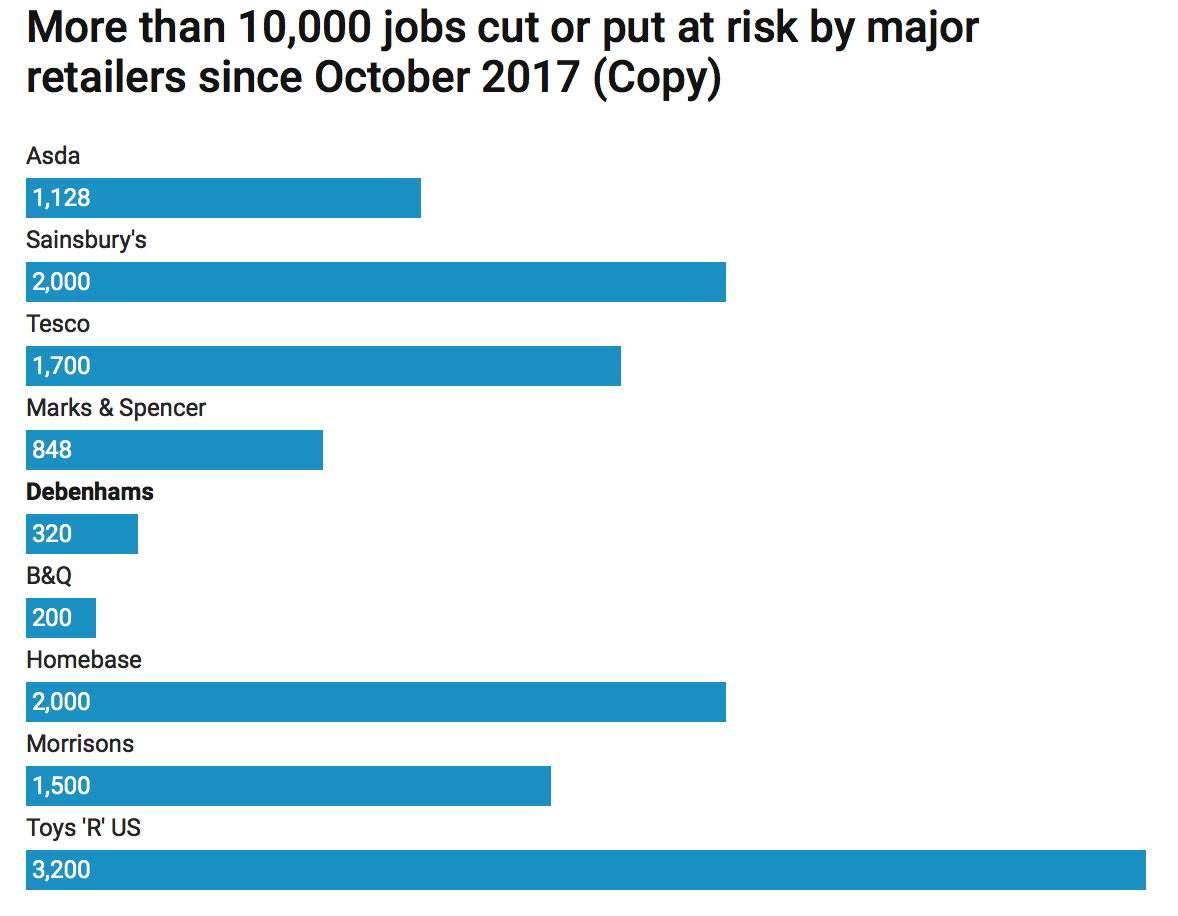
The most recent victim on the British High Street is department store House of Fraser. It is responsible for the jobs of 5,000 direct employees and 12,500 concession stand staff. Last Friday the owners announced EY had been called in to try and help with a dire financial situation. The company is desperately trying to renegotiate rental arrangements whilst navigate its way around hundreds of millions of pounds of debt, £350m of which is a publicly traded bond.
In the background Carpetright is due to close stores (2,700 employees), stark profit warnings have come from Moss Bros (1,350 employees), B&Q’s owners are in trouble (25,000 employees) and Mothercare (5,200 employees) are in ongoing talks with creditors.
Listen on SoundCloud , Blubrry & iTunes. Watch on YouTube below

With the economic situation as it is and changing shopping behaviours there seems to be little let-up for the high street retailer. Whilst this makes stark reading now, it will have profound long-term consequences on an economy which is increasingly finding itself with several thousand retail workers without anywhere to turn to.
Inflation and wage squeeze leads to high street stagflation
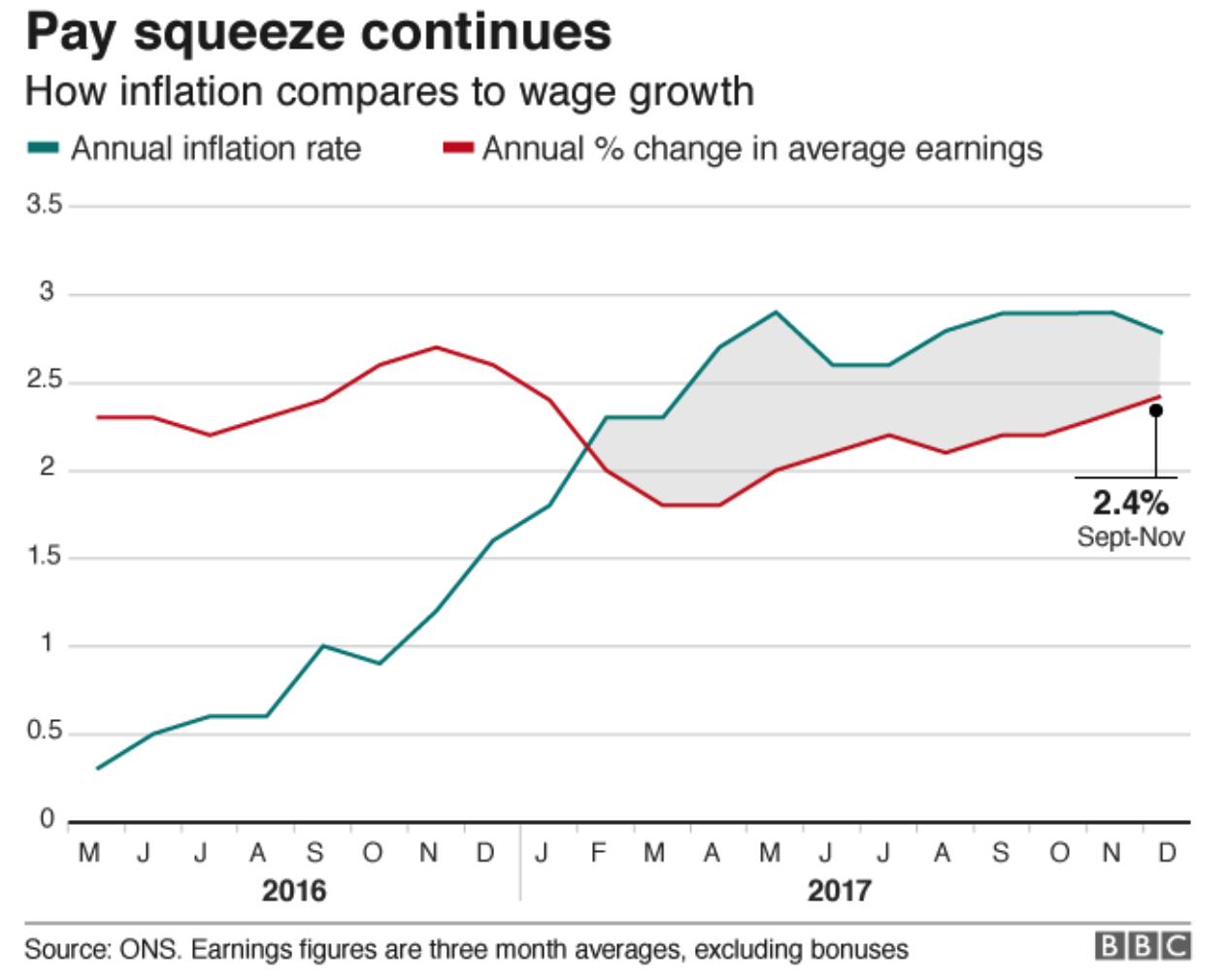
Despite what the government might tell you inflation really is biting at the heels of households. If one considers that it is mainly appearing in food, transport and housing costs then you have accounted for around (at least) 50% of a household’s spending. This is non-discretionary, so what will suffer? Shops.
What is discretionary is purchases of non-essential items. Households that are feeling the pinch through wage stagnation, inflation and the impact of Brexit are unlikely to just buy on a whim anymore.
Inflation has been rising at a faster pace than wages for some time now. Officially the government has only just noticed this since the Brexit vote which has resulted in imported currency-related inflation. But, in truth it has been around along-time, evidenced by shrinkflation and increasing levels of consumer debt.
Conversely, spending is climbing in one area – online shopping. Consumers feeling the pinch are more willing to spend online where they can hunt out bargains, save money on transport to the shops and reduce the chances of overspending whilst shopping. At the moment one in every five pounds is spent online, this is likely to increase as habits evolve.
No hot wheels here
It’s not just on the UK high street where consumers have decided to rein in their spending. The new car market is also feeling the impact of the economic downturn.
According to Ratings agency Moody, new car registrations are likely to fall 5.5% this year, making the UK the ‘worst performing’ market in Europe. This will make the second year in a row that car registrations are down, bringing the fall to 10%.
“The UK market will be the worst performer compared to all other major economies in Europe, and, even worse, the only one that is declining.” Matthias Hellstern, Moody’s
In stark contrast to the UK, Spain and Germany Spain and Germany will see new registrations climb by 4.7% and 4% respectively in 2018.
The UK motor market is just one example of problems outside of the UK retail sector. Consider the reduction in bank branches, post offices and other public service outlets.
Light at the end of the tunnel?
In his Spring statement Chancellor Philip Hammond tried to give a rosy picture of the future of the UK economy. He assured the House of Commons that not only would growth be at 1.5% for 2018 but that debt would represent a smaller proportion of GDP by the end of the year.
This was a lot of political rose-tinting though. Paul Johnson, director of the Institute of Fiscal Studies told the BBC that none of this meant very much, ‘The UK economy was now 14% smaller than would have been expected, based on pre-crisis trends, while median earnings remained below their 2008 level.
“The reality of the economic and fiscal challenges facing us ought to be at the very top of the news agenda,” Mr Johnson said. “And I mean the reality, not the spin and bluster of politicians on all sides pretending there are easy solutions.”‘
An Ernst & Young report released at the beginning of the month reported that the ‘the U.K. consumer will be hit by new issues which will impact their spending power…Our prediction of a ‘so-so’ consumer sector over the next few years points to a ‘so-so’ economy, growing at an unspectacular rate compared with past standards.”
How will this reduction in consumer spending really impact the UK economy? Clearly no-one really knows but you can gain a fair idea when you consider that domestic consumer spending makes up the largest part of British economic demand.
With over 200,000 people losing their jobs that’s a significant number of people now dependent on the UK government. This is not only for unemployment benefit but also for long-term support such as their pensions.
The Toys R Us defined benefit pension fund, which has an estimated £37m deficit, is one such whole the government will have to plug. Other high street retailers collapsing also have very red pension funds. The British tax payer will no doubt end up propping those who now face a retirement without a pension.
Protect yourself from further Brexit blow-ups
Sadly much about the above situations were unavoidable. After years of rapid debt-fuelled expansion, rising inequality and growing nationalism across Europe it was inevitable that we would step out to find our high streets in such a state.
There is also something inevitable about how this will end. But, what happens to your wealth, investments and savings is not a given. At the moment savers are still able to use what is the calm before the storm to reallocate their portfolios so they are well-balanced and protected against the aftermath of easy monetary policy and political fallout.
Investments such as gold and silver by their very nature are immune to the effects of inflation, stagflation and the dangerous ideas and experiments of central banks. Gold has just completed its most successful three quarterly run since 2011. This should offer two key signals – the first that safe haven demand is on the up as buyers become increasingly wary of the outcome of political and economic decisions and, secondly, that now is an ideal time to prepare your portfolio against even more upset in the marketplace.
Listen on SoundCloud , Blubrry & iTunes. Watch on YouTube below
Related reading
UK Debt Crisis Is Here – Consumer Spending, Employment and Sterling Fall While Inflation Takes Off
World is $233 Trillion In Debt: UK Personal Debt At New Record
UK Stagflation Risk As Inflation Hits 3.1% and House Prices Fall
News and Commentary
Gold rises on softer dollar, fresh trade worries (Reuters.com)
Asian Stocks Rise Led by Korea; Treasuries Slip (Bloomberg.com)
Data, earnings set to wrest stock market’s attention from Facebook and trade (MarketWatch.com)
Steel, cocoa among first-quarter gainers, but coal, sugar take biggest hits (MarketWatch.com)
Bitcoin Breaches $7,000 in Downbeat End to Dismal Quarter (Bloomberg.com)
ECB’s Knot Urges QE End to Help Wean World Economy Off Stimulus (Bloomberg.com)
BofA: This Is “The Last QE Trade” (ZeroHedge.com)
The rebel bank, printing its own notes and buying back people’s debts (TheGuardian.com)
Gold Prices (LBMA AM)
29 Mar: USD 1,323.90, GBP 941.69 & EUR 1,075.80 per ounce
28 Mar: USD 1,341.05, GBP 946.24 & EUR 1,082.23 per ounce
27 Mar: USD 1,350.65, GBP 954.64 & EUR 1,087.41 per ounce
26 Mar: USD 1,348.40, GBP 949.27 & EUR 1,086.95 per ounce
23 Mar: USD 1,342.35, GBP 952.80 & EUR 1,088.65 per ounce
22 Mar: USD 1,328.85, GBP 939.36 & EUR 1,078.10 per ounce
21 Mar: USD 1,316.35, GBP 935.53 & EUR 1,071.64 per ounce
Silver Prices (LBMA)
29 Mar: USD 16.28, GBP 11.58 & EUR 13.21 per ounce
28 Mar: USD 16.46, GBP 11.63 & EUR 13.28 per ounce
27 Mar: USD 16.64, GBP 11.79 & EUR 13.41 per ounce
26 Mar: USD 16.61, GBP 11.67 & EUR 13.39 per ounce
23 Mar: USD 16.53, GBP 11.70 & EUR 13.39 per ounce
22 Mar: USD 16.52, GBP 11.64 & EUR 13.41 per ounce
21 Mar: USD 16.25, GBP 11.56 & EUR 13.23 per ounce
Recent Market Updates
– Gold Is Money While Currencies Today Are “IOU Nothings”
– “Stars Are Slowly Aligning For Gold” – Frisby
– Uncle Sam Issuing $300 Billion In New Debt This Week Alone
– Eurozone Faces Many Threats Including Trade Wars and “Eurozone Time-Bomb” In Italy
– Silver Futures Report and JP Morgan Record Silver Bullion Holding Is Extremely Bullish
– London House Prices Falling Sharply – UK’s Much Needed Wake-Up Call
– Global Trade War Fears See Precious Metals Gain And Stocks Fall
– Gold +1.8%, Silver +2.5% As Fed Increases Rates And Trade War Looms
– Credit Concerns In U.S. Growing As LIBOR OIS Surges to 2009 High
– Four Charts: Debt, Defaults and Bankruptcies To See Higher Gold
– Crock Of Gold Hidden In Ireland? Happy Saint Patrick’s Day
– Buy Silver And Sell Gold Now
– Stephen Hawking – Doomsday Prophet’s Top Five Predictions
Andrew Maguire’s Kinesis money which is a “bitcoin” but backed 100% by allocated gold and silver is set to go.
it think it would be a great idea to look at this!
please read at: https://kinesis.money/#/
(Andrew Maguire)
|
2:57 PM (1 hour ago) | ||
|
|||
Harvey
Here It is my friend! https://kinesis.money/#/ Please let everyone know.
Let catch up on Monday if you have time. We have billions in the hopper ready to be allocated on the 1st day of trading. The paper market days are over.
Warm regards
Andy
END
The following exchange from Nicholas Biezanek to me is an essential read. In essence the banks are hiding the huge number of EFP’s through what is called a serial sub 14 day forward obligation. Anything less than 14 day forwards do not have to be included for monitoring by the Office of the Comptroller, Great Britain. I will endeavour to find out if this is exactly true. If so, then this is nothing but a criminal conspiracy to defraud by the bankers. Also note that all physical bars delivered upon at 2018 markings..nothing from the past..obviously bars are disappearing faster than a speeding bullet.
Nicholas to me:
|
10:03 AM (2 minutes ago)  |
|
||
|
||||
Bill,Harvey,
I don’t know whether you have listened to Andrew Maguire’s interview with Greg Hunter but ,if not, then here are some key points.This interview is just to important to miss:
- Whilst the volume of gold EFPs for the 1st quarter ,ending tonight,will almost certainly exceed 2 000 tonnes,Andrew believes that these delivery obligations are rolled into serial forward contract obligations for nominal delivery in less than 14 days ,and hence avoid inclusion in the reports required by the Office of the Comptroller that seeks to monitor any liquidity squeeze on the ‘too big to fail’ banks .The logic for excluding obligations due in less than two weeks is not immediately obvious.Perhaps this delusional Comptroller believes that these criminals will at least have the integrity and risk management systems in place to accommodate all such short term and therefore,unavoidable, commitments.
- All physical gold deliveries out of the LBMA recently bear 2018 markings only-presumably all gold bars refined prior to this date are now ‘AWOL’
- The actual gold market fractional reserving ratio may be as high as 1000/1
- Whilst every time Andrew Maguire goes on air, the paper price of gold is trashed, correlation is not to be confused with causation. At 15.00 on the last Friday of every month (perhaps today as tomorrow is Good Friday), the BIS tries to window dress its trillion USD underwater derivatives book for reporting purposes.Therefore the paper gold price action of the last 24 hours was caste in stone.
- The bad news for the BIS, Cartel and LBMA is that the whole world is now waiting for this end of month market action and seeks to capitalize upon these waterfall paper gold price declines as unmissable windows of opportunity for physical gold acquisition.
- Many astute investors are also loading up on physical gold in order to ‘front run’ the imminent seriously large physical gold purchases for the ‘alternative currency’ -kinesis.com-that will go live in October 2018. If you are in paper gold only (including unallocated gold holdings) you will simply be ostracized from this ‘party to end all parties’ (If you haven’t listened to this interview at least twice, then you are not really serious about the gold market)
- Denis Gartman believes that as soon as the Venezuelan Central Bank has completed its disposal of (184?) tons of gold,an orderly gold market will return.Andrew also believes that it will be ‘business as usual’, but only until the impossible,unsustainable strain and tightness in the physical gold market causes a massive price ‘reset’,probably over a weekend, and it may be soon. (Harvey: I strongly believe that all of the Venezuelan gold has been sold long time ago as soon as Maduro got in trouble)
Whilst I have been immersed in GATA’s attempts to unravel the corruption,and manipulation of the physical gold market for a decade, I still find it difficult to get my mind around the magnitude of this imminent unraveling..
Regards
Nicholas

end
Another essential commentary from Nicholas as he describes the complete opaqueness of the LBMA
(courtesy Nicholas Biezanek)
What exactly is the LBMA?
The Comex warehouses contain a total of about 12 tons of registered gold and yet the entire price setting mechanism for physical gold is dictated in the paper markets based on the premise that, if demanded, physical delivery of Comex gold paper contracts is available at the contract price because of this truly microscopic amount of physical gold backing a gargantuan open interest of 508,000 contracts (as at 29/03/2018.)
Recently, however, thanks to Harvey Organ, it has been revealed, that Exchange for Physical (EFP) contracts have been heavily utilized as a mechanism for transferring physical delivery obligations over to LBMA market participants. Although almost certainly predating Harvey’s first unravelling in Nov of 2017, this EFP manipulative technique has allowed the COMEX to prevent a catastrophic delivery failure and almost certain consequent closure. In just the three months to 29th March 2018, the volume of these EFP transfers over to the LBMA is computed at 2,044 tons.(Impossible)
Let us have a closer look at the LBMA, now that it has assumed this role of being the mechanism to which the corrupt COMEX paper Ponzi scheme owes its continuing existence. The best place to look is the LBMA’s own Annual Review, published for the first time ever in 2017. In is a ‘glossy’ of only 20 pages, and at least half the content relates to pictures. The ‘war cries’ of integrity and transparency abound, but let us unpack the fine words to seek out anything more substantial.
At the end of the report is a brief financial summary. Income=3.546 million ponds and expenditure=3.378 million pounds=operating surplus of 167 thousand pounds only. The LBMA is therefore demonstrably a midget organization so maybe expectations should be commensurately tailored.
The LBMA takes great pride in its harmonization of physical delivery standards, but as the Sino bloc rejects the LBMA finesse standard of .995 to the extent of demanding re refining to a .9999 finesse standard, perhaps the LBMA is not doing a very good job.
The LBMA takes great pride in seeking to harmonize the contractual framework relating to transactions under its umbrella, but as the Holter/Sinclair collaboration keeps reminding us- “what is the value of a contract that cannot perform?” Nonperformance of physical gold delivery obligations out of loco London seems to be a recurring and pervasive theme. (Many weeks delay to receive gold bars refined in 2018 etc.)
The LBMA has now put delivery of its reporting project to bring transparency to the opaque world of OTC transactions on hold. Same day reporting of the London gold fixes has now been discontinued for reasons that don’t appear to be compelling, and consequently all that is sighted in the West are these manipulated paper prices sourced from the COMEX platform that would have lost its right and ability to exist but for the aforementioned co-mingling of physical delivery contracts into the opaqueness of the LBMA vortex.
Even in Nigeria, all the bankers stay behind every trading day in order to balance the day’s trading and consequent cash balances etc. The LBMA takes great pride in the fact that total loco London gold hoardings are now reported. This reporting, however, is 90 days in arrears, whereas based on Nigerian standards it should be after an elapse of 24 hours maximum.(Surely all physical verification is on a perpetual basis?) The biggest farce of all, however is that these (historic) reports of loco London gold hoardings are complete disinformation. It is an insult to our intelligence to provide this historic information without disclosure of all corresponding liabilities of the LBMA members in respect of claims on this gold. Maybe there are indeed 7,800 tons of loco London gold, but if 78,000 tons of gold are required to satisfy all corresponding obligations, that would better contextualize this abomination.
But then I return to the financial information in respect of the LBMA. Less than $5 million total revenue. Ruth Crowell, the CE of the LBMA, has all the authority and budget of a part time meter maid armed with a feather duster. She probably has no idea of what is coming down the road or else she would get out, just like Rothschild, Credit Suisse, Deutsche Bank and Barclays On the other hand, here is the 2018 budget request from the CFTC acting Commissioner:‘ In order for the CFTC to fulfill its duty to oversee these vital markets in FY2018, I am requesting $281.5 million and 739 fulltime equivalents (FTE). This is an increase of $31.5 million and 36 FTE over the FY 2017 continuing resolution (CR) level.’
As we all know only too well, despite all these abundant resources, the CFTC has never intervened, not once, in the grotesque concentration and manipulative heavy trading volumes at the most illiquid trading periods in respect of COMEX precious metal trading. ‘Nothing to see here’ is the eternal war cry. The CFTC and COMEX must be pleased that the Achilles heel of the COMEX, (its inability to deliver physical metal when required) has, for the time being at any rate, been transferred to the opaque, unregulated LBMA and is currently out of sight. For how long? The LBMA does not have the physical metal to satisfy all these EFP transfers from the COMEX. Not at all. The combined authority of both the LBMA and COMEX are probably unaware of the imminent eruption and are clueless about the enormity of the crisis. In the words of Don Rumsfeld, the current situation can be summed up as:
‘There are known knowns. These are things we know that we know. There are known unknowns. That is to say, there are things that we know we don’t know. But there are also unknown unknowns. There are things we don’t know we don’t know.
end
Friday night: Bitcoin below 7,000.
(courtesy zerohedge)
Crypto Carnage Continues – Bitcoin Back Below $7,000, Ether Under $400
Despite a brief bounce overnight, cryptos are sliding once again with Bitcoin below $7,000; Ethereum below $400; and Ripple back below 50c.
“It’s a sea of red,” said one seasoned crypto-trader, adding after a stoic pause, “again!”

Amid the worst month for tech stocks in years, cryptos are in freefall…

Bitcoin is back below $7,000…

Heading towards its early Feb lows…

As CoinTelegraph notes, the overall market slump could be attribued to both Twitter’s recent announcment that would ban crypto-related ads, following on the heels of similar announcements from Google and Facebook, or Mailchimp’s apparent closure of crypto-related accounts.
In response to the social media ad bans, crypto and Blockchain associations in Russia, South Korea, and China have created a joint assocation in order to sue the social media giants, including Yandex, referring to the bans as “market manipulation” by “monolopies.”
Regulatory crackdowns on crypto could also be compounding the market’s downward trend, as two Japanese exhanges this week have decided to close instead of working with regulators for compliance.
end
Bitcoin breaks below 6800/Sunday
(courtesy zerohedge)
Cryptogeddon – Bitcoin Breaks Below $7,000; Ether Down 75% From Highs
As if the last few weeks were not bad enough, cryptocurrencies are re-tumbling since Friday’s close.

Once again there is no clear catalyst but headlines from crypto world include South Korean and Thai regulators preparing to unveil their crypto-tax proposals (and notably the maze of details surrounding US tax requirements for cryptos may also be forcing some unwinds to cover unforeseen ‘costs’).
The Kazakh National Bank has banned crypto-mining and The FBI has issued a warning regarding fraud and cryptos.
Bitcoin is now below $7,000 – a level it first hit in October 2017 – down 67% from its record high in December.

Ethereum is worse – down 75% from its highs and back below $400, this is the lowest level for the second largest crypto by market cap since November 2017.

While this collapse is very reminiscent of the dotcom debacle, CoinTelegraph’s Nikolai Kuznetsov sees innovation and sustainability.
While it is only prudent and smart for anyone entering the crypto space to proceed with caution especially when it comes to trading and investing in crypto assets, it would be unfair to be totally dismissive of what the Blockchain technology has brought about. The parallels with the dotcom bubble should serve as lessons to stakeholders.
One must remember that the aftermath of the dotcom bubble also affirmed that truly innovative organizations and technologies could weather the storm. Companies such as Amazon and eBay proved that pairing novel ideas with good business acumen can lead to success. Surely, the situation today with crypto and the environment of dotcoms from nearly twenty years ago would have their differences. Ventures must be able to navigate these nuances in order to make the best possible decisions moving forward.
Whether or not crypto ventures will share a similar fate to dotcoms remains to be seen. At least for now, crypto stakeholders have a chance to write a different story.
end
Wishful thinking: Monetary reform would rebalance trade..a good history lesson
(courtesy Sean Rushton/GATA)
Sean Rushton: Monetary reform would rebalance trade
Submitted by cpowell on Thu, 2018-03-29 15:00. Section: Daily Dispatches
By Sean Rushton
The Wall Street Journal
Wednesday, March 28, 2018
https://www.wsj.com/articles/monetary-reform-would-rebalance-trade-15222…
Contrary to claims coming from some trade hawks, America’s large and persistent trade deficit is not caused primarily by bad trade deals.
The U.S. dollar’s status as the global reserve currency is at least as responsible as any free-trade agreement or unfair practices. High demand for dollars has tilted the playing field against American exporters and workers. Those arguing against tariffs — including Republicans courting blue-collar voters in the industrial Midwest — should be leading the charge for international monetary reform.
Before World War I the international gold standard amounted to an independent, relatively stable and universally accepted global currency. That system broke down during the interwar years. Then, at the Bretton Woods conference after World War II, the victorious Allies decided that the U.S. dollar, backed by gold, would be the international reserve currency to which exchange rates would be fixed. But this “gold exchange standard” was fatally flawed: The world’s need for dollar reserves soon outstripped America’s gold supply.
In the 1950s and ’60s, the U.S. ran big trade deficits with its Cold War allies Japan and Germany, as they rebuilt their manufacturing bases and stockpiled dollars. By the early 1970s, American policy makers were fed up. They severed the dollar’s link to gold and allowed the greenback’s value to float relative to other currencies, in the hope that it would depreciate and smoothly reduce the trade deficit.
The opposite happened. No longer bound by fixed exchange rates and dollar convertibility, the U.S. government’s fiscal discipline broke down. Federal debt as a percentage of gross domestic product, which had been falling since the end of World War II, soon began rising steadily. As a matter of national income accounting, Johns Hopkins economist Steve Hanke has explained, a rising fiscal deficit means a rising trade deficit.
In the bedlam of floating exchange rates, demand for dollars soared. Many nations abhorred having their currencies—and thus their economies—jerked up and down because of decisions made by central bankers in the U.S. and other large economies. To defend against crises, especially at times of major U.S. monetary easing or depreciation, foreign governments stockpiled dollars. In 1973 the world held $500 billion in foreign-exchange reserves (in 2017 dollars); last year it was $11 trillion, a 22-fold increase. About two-thirds of total reserves are now denominated in dollars. Because of high global demand, the dollar’s international position is always stronger and U.S. interest rates are lower than they would be otherwise. This, in turn, means that America’s budget and trade deficits swell in tandem, while U.S. exports are costlier and imports are cheaper, regardless of trade practices.
Such a dynamic has made it difficult for American companies to add manufacturing jobs inside the U.S. Meantime, the finance industry—driven by profits from trading currencies and hedging the associated risk—has grown from about 2% of GDP to more than 9%.
Leveling the playing field will require reducing global demand for dollars, first by stabilizing the dollar and other major currencies, then by establishing a new international reserve currency. Here’s how to do that:
First, to guide monetary policy, Federal Reserve appointees should commit to targeting the real-time prices of an index of commodities, plus foreign currencies and bonds. Such an approach would have prevented the Fed’s biggest recent errors. Easy money in the 1970s and 2000s led to large increases in world dollar holdings, price bubbles and crashes.
Second, the U.S. should invite other major currencies — starting with the second-largest, the euro — to stay steady with the dollar. A dollar-euro stability pact, later including Japan and other democracies, would stabilize demand for dollars. A recent International Monetary Fund communique expressed positive sentiments on this front: “We recognize that excessive volatility or disorderly movements in exchange rates can have adverse implications for economic and financial stability. We will refrain from competitive devaluations, and will not target our exchange rates for competitive purposes.”
Third and most controversial, the U.S. and other leading economies should establish a new international currency for pricing global commodities and settling trade accounts. Nations would keep their own currencies for domestic use, exchanging them for the international currency at fixed rates.
The Nobel laureate Robert Mundell suggested such an international currency, to be backed 50% by gold and 50% by the world’s five leading currencies. Rep. Jack Kemp once proposed solving the “reserve currency curse” with a return to the full international gold standard. Other ideas, such as expanded use of the IMF’s reserve asset, the Special Drawing Right, are also worth considering.
If the U.S. has reached the end of its rope and is unwilling to feed the world’s demand for dollars through its trade deficit, then international monetary reform is the answer. It would put U.S. trade on a more level playing field, enforce fiscal discipline in Washington, and help millions of American workers.
—–
Mr. Rushton is director of the Project on Exchange Rates and the Dollar at the Jack Kemp Foundation.
end
Eric states the obvious: with the world sporting a rising indebted world economy, he doubts that any economy could withstand any substantial increases in interest rates.
(courtesy Eric Sprott/Criag Hemke)
Sprott doubts that world can stand rising rates
Submitted by cpowell on Fri, 2018-03-30 02:22. Section: Daily Dispatches
9:22a ICT Friday, March 29, 2018
Dear Friend of GATA and Gold:
Sprott Asset Management’s Eric Sprott, interviewed for Sprott Money by the TF Metals Report’s Craig Hemke, doubts that a spectacularly indebted world economy can stand substantial increases in interest rates. They also discuss the positioning of commercial traders that has become favorable to silver. Sprott argues that gold has been in a bull market for more than two years. The interview is 14 minutes long and can be heard at Sprott Money here:
https://www.sprottmoney.com/Blog/weve-been-in-a-bull-market-for-two-year…
CHRIS POWELL, Secretary/Treasurer
Gold Anti-Trust Action Committee Inc.
CPowell@GATA.org
end
In the 4th quarter, the USA dollar share of currency reserves has hit a 4 yr low
(courtesy Reuters)
U.S. dollar share of currency reserves hits 4-year low, IMF says
Submitted by cpowell on Sat, 2018-03-31 05:06. Section: Daily Dispatches
From Reuters
via Malay Mail, Kuala Lumpur
Saturday, March 31, 2018
NEW YORK — The U.S. dollar’s share of currency reserves reported to the International Monetary Fund declined in the final quarter of 2017 to a four-year low, as other currencies’ shares of reserves grew, data released yesterday showed.
The share of dollar reserves has declined for four straight quarters as the greenback weakened in 2017 due to faster growth outside the United States and bets that other major central banks would consider reducing stimulus. Still, the dollar has remained the biggest reserve currency by far.
Global reserves are assets of central banks held in different currencies, mainly used to support their liabilities. Central banks sometimes have used reserves to help support their respective currencies.
“Reserve managers in Q4 liked yen and ‘other currencies,'” Steven Englander, head of research and strategy with Rafiki Capital Management, wrote in a research note. “The limited U.S. dollar buying is not surprising. Reserve managers buy dollars when they have to. They rarely want to buy.” …
… For the remainder of the report:
http://www.themalaymailonline.com/money/article/us-dollar-share-of-globa…
end
China is now planning to crackdown on all virtual currencies
(courtesy GATA/Reuters)
China’s central bank plans crackdown on virtual currencies
Submitted by cpowell on Mon, 2018-04-02 08:52. Section: Daily Dispatches
From Reuters
Thursday, March 29, 2018
https://www.reuters.com/article/us-china-finance-digital-currency/china-…
BEIJING — China’s central bank will launch a crackdown on all types of virtual currencies this year, a vice governor of the central bank said Thursday.
The central bank will also push forward the research and development of its own digital currency this year, Fan Yifei said in a statement posted on the website of the People’s Bank of China.
end
Your early MONDAY morning currency, Asian stock market results, important USA/Asian currency crosses, gold/silver pricing overnight along with the price of oil Major stories overnight/9 AM EST
i) Chinese yuan vs USA dollar/CLOSED UP 6.2830 /shanghai bourse CLOSED DOWN 5.71 POINTS OR 0.18% / HANG SANG CLOSED
2. Nikkei closed DOWN 65.72 POINTS OR 0.31% /USA: YEN RISES TO 106.27/
3. Europe stocks OPENED GREEN /USA dollar index FALLS TO 89.89/Euro RISES TO 1.2332
3b Japan 10 year bond yield: RISES TO . +.045/ !!!!(Japan buying 100% of bond issuance)/Japanese yen vs usa cross now at 106.27/ THIS IS TROUBLESOME AS BANK OF JAPAN IS RUNNING OUT OF BONDS TO BUY./JAPAN 10 YR YIELD FINALLY IN THE POSITIVE/BANK OF JAPAN LOSING CONTROL OF THEIR YIELD CURVE AS THEY PURCHASE ALL BONDS TO GET TO ZERO RATE!!
3c Nikkei now JUST BELOW 17,000
3d USA/Yen rate now well below the important 120 barrier this morning
3e WTI:: 65.25 and Brent: 69.73
3f Gold UP/Yen DOWN
3g Japan is to buy the equivalent of 108 billion uSA dollars worth of bond per month or $1.3 trillion. Japan’s GDP equals 5 trillion usa./“HELICOPTER MONEY” OFF THE TABLE FOR NOW /REVERSE OPERATION TWIST ON THE BONDS: PURCHASE OF LONG BONDS AND SELLING THE SHORT END
Japan to buy 100% of all new Japanese debt and by 2018 they will have 25% of all Japanese debt. Fifty percent of Japanese budget financed with debt.
3h Oil UP for WTI and UP FOR Brent this morning
3i European bond buying continues to push yields lower on all fronts in the EMU. German 10yr bund FALLS TO +.497%/Italian 10 yr bond yield DOWN to 1.786% /SPAIN 10 YR BOND YIELD DOWN TO 1.164%
3j Greek 10 year bond yield FALLS TO : 4.317?????????????????
3k Gold at $1333.40 silver at:16.52 7 am est) SILVER NEXT RESISTANCE LEVEL AT $18.50
3l USA vs Russian rouble; (Russian rouble UP 21/100 in roubles/dollar) 57.39
3m oil into the 65 dollar handle for WTI and 69 handle for Brent/
3n Higher foreign deposits out of China sees huge risk of outflows and a currency depreciation. This can spell financial disaster for the rest of the world/
JAPAN ON JAN 29.2016 INITIATES NIRP. THIS MORNING THEY SIGNAL THEY MAY END NIRP. TODAY THE USA/YEN TRADES TO 106.27 DESTROYING JAPANESE CITIZENS WITH HIGHER FOOD INFLATION
30 SNB (Swiss National Bank) still intervening again in the markets driving down the SF. It is not working: USA/SF this morning 0.9528 as the Swiss Franc is still rising against most currencies. Euro vs SF is 1.1755 well above the floor set by the Swiss Finance Minister. Thomas Jordan, chief of the Swiss National Bank continues to purchase euros trying to lower value of the Swiss Franc.
3p BRITAIN VOTES AFFIRMATIVE BREXIT/LOWER PARLIAMENT APPROVES BREXIT COMMENCEMENT/ARTICLE 50 COMMENCES MARCH 29/2017
3r the 10 Year German bund now POSITIVE territory with the 10 year FALLING to +0.497%
The bank withdrawals were causing massive hardship to the Greek bank. the Greek referendum voted overwhelming “NO”. Next step for Greece will be the recapitalization of the banks and that will be difficult.
4. USA 10 year treasury bond at 2.7530% early this morning (THIS IS DEADLY TO ALL MARKETS). Thirty year rate at 32.985% /
5. Details Ransquawk, Bloomberg, Deutsche bank/Jim Reid.
(courtesy Jim Reid/Bloomberg/Deutsche bank/zero hedge)
Futures Slide With Most Markets On Holiday As China Strikes Back In Trade Wars
Global markets started the new week and quarter with very muted trading in Asia as most key markets including Australia, New Zealand , Hong Kong, Canada, UK and most parts of Europe remain closed for Easter holidays. US stock futures are lower…

…and equities in Asia have given up the gains seen early in the session amid fears of escalating trade wars, while European markets remain offline.

As a reminder, overnight China announced that that starting Monday it would impose tariffs on U.S. products including frozen pork, wine and certain fruits and nuts in response to U.S. duties on imports of aluminum and steel.
MSCI’s world equity index ended up 1.2% last week, but it lost about 1.5% in the first quarter, pushed away from record highs as tensions over global trade escalated, turmoil in the White House deepened and market-leading technology firms wobbled on fears of regulation and other issues. Still, so far the S&P 500 has tested and held the 200d MA twice and has again begun to bounce / stabilize, as all eyes remain on this key technical support level.
“We expect strong and broad-based growth to continue globally,” wrote strategists at Barclays who warned that there were looming risks: “Trade protectionism, U.S. economic policy uncertainty, concerns about higher cross-market volatility and risk premium in core rates markets call for a more tactical approach to risk assets.”
With FX markets on a standstill (more below), the key focus of note today will be China’s new tariffs on 128 US products which officially start today, as well as softer manufacturing PMI data from many countries in Asia.
The main themes remain the same: trade tensions, a dovish start to life under Powell at the Fed, soggy wages and potentially further changes to the Trump administration, Brexit headline risks, rate hike outlooks being pushed forward in the antipodeans, uncertainty around ECB, JPY’s volatility and political risks in EM and for Oil.
What Asian markets were open saw aggressive profit-taking into the close: Chinese stocks erased gains to end Monday at session lows, following their worst quarter in two years. Brokers bucked broad market declines after the central government announced a trial program for Chinese Depositary Receipts. The Shanghai Composite closed down 0.2%, wiping out an earlier advance of 0.7%.

Similarly in Japan, the Topix closes down 0.4%, erasing gain of as much as 0.4%, with volume 20% below 30-day average. Banks were the biggest drag on benchmark, outweighing gain in “other products” gauge. The Nikkei also slumped 0.3% after wiping out a 0.7% rise. Ovenright we got the latest Japan Tankan data: large manufacturers tankan came at 24 (expected 25), with the Japan Tankan manufacturing outlook disappointing at 20 (vs expected 22). The budget rate for USDJPY was lowered a bit from 110.67 to 109.66 during FY2018. CitiFX Strategist Osamu Takashima says, “I believe most of manufacturing companies have lowered it further toward 105 more recently.”
Asian manufacturing PMI for March have mainly disappointed today and while this is not having an impact on the immediate price action, it is something to keep an eye on. Of note, China’s March Caixin manufacturing PMI data came lower than expected at 51.0 versus exp. 51.7.
It has been a quiet start to the FX week as well, with the Bloomberg Dollar Spot Index falling 0.1%, extending the three-day slide to 0.4% although staying within a tight range, amid muted trading due to the Easter holiday. The pound led gains among G-10 currencies at the start of a week flooded with tier-one data releases out of the U.S, while the yen was marginally weaker after Tankan survey slips.
Of note: for Monday, the The People’s Bank of China raised the daily reference rate for the yuan to strongest since Aug. 11, 2015, aka the “day of the devaluation”, as the dollar weakened: PBOC raised the yuan reference rate by 0.19% to 6.2764 per dollar. The fixing was in line with expectations: average estimate in Bloomberg survey of 17 traders and analysts was 6.2762. Some of the other notable FX moves, from Bloomberg:
- The Bloomberg Dollar Spot Index falls 0.1%; the measure declined for a fifth straight quarter, ended March 30, its worst run since March 2008
- The pound is the biggest mover amid thin trading as some markets in Asia and Europe remained shut for Easter holidays
- Sterling rises for the first time in five days versus the dollar, climbing 0.4% to $1.4064; rises 0.3% to 87.67 pence against the euro
- The Japanese yen is little changed during London hours after weakening slightly in Asia; analysts project it will weaken against all its G-10 peers this quarter; USD/JPY is forecast to climb to 108 by the end of June, from the current level of 106.35, the median estimate in a Bloomberg survey shows
- U.S. 10-year Treasury yield climbs 2bps to 2.76% after its third straight quarterly advance in the period through March 30
Crude oil prices extended gains, lifted by a drop in U.S. drilling activity as well as by expectations that the United States could re-introduce sanctions against Iran. U.S. drillers cut seven oil rigs in the week to March 29, bringing the total count down to 797. It was the first time in three weeks that the rig-count fell. U.S. crude futures rose 0.3 percent to $65.14 a barrel and Brent advanced 0.5 percent to $69.67 a barrel.
Bahrain said it has discovered its biggest oil field in more than 80 years. The “highly significant” oil and deep gas resource is thought to dwarf the Gulf kingdom’s current reserves, according to an official announcement on Sunday. It is located in the Khaleej al-Bahrain basin, located off the country’s west coast. “Initial analysis demonstrates the find is at substantial levels, capable of supporting the long-term extraction of tight oil [light crude] and deep gas,” said Bahrain’s minister of oil, Shaikh Mohamed bin Khalifa al-Khalifa.
This week, Fed Chairman Jay Powell will be giving his first speech since the FOMC March meeting. He will be giving a speech on the economic outlook on Friday, April 6 during a visit to Chicago. The speech is at 12:30 Chicago time, which is 11:30 EST and 16:30 BST. This will come just after the latest payrolls and AHE report.
U.S. data due this week include Monday’s Institute for Supply Management (ISM) manufacturing index, Wednesday’s ISM non-manufacturing index and the non-farm payrolls report on Friday.
Below is a list of the top Bloomberg Economics news to start the week:
- Turkish President Recep Tayyip Erdogan was on a tear in a series of speeches Saturday, attacking supporters of high interest rates, Israel for its actions in Gaza and Kosovo’s leader for protecting Turkey’s political enemies
- Electricite de France SA is among companies that have warned the U.K. government about the business threats of Brexit, according to a report in the Mail on Sunday that cites confidential documents
- More trade spats. While China’s retaliatory tariffs on 128 kinds of U.S. imported goods take effect Monday, U.S. President Donald Trump renewed his threat to dump Nafta if Mexico didn’t stem the flows of drugs and people from Central America into the U.S.
- Opening the wallets. Japanese businessmen say they’ll boost investment this year even as the stronger yen puts a dent in their confidence
- China’s Caixin PMI eased in March, in contrast to a rebound in the official PMI released over the weekend, clouding the growth picture for the end of the first quarter
- Music diplomacy. K-Pop girl band Red Velvet on Sunday headlined the first of two concerts packed with South Korean music groups to an audience that included North Korean leader Kim Jong Un and his wife
Market Snapshot
- S&P 500 futures down 0.3% to 2,635.25
- STOXX Europe 600 up 0.4% to 370.87
- MSCI Asia Pacific unchanged at 172.76
- MSCI Asia Pacific ex Japan up 0.3% to 565.48
- Nikkei down 0.3% to 21,388.58
- Topix down 0.4% to 1,708.78
- Hang Seng Index up 0.2% to 30,093.38
- Shanghai Composite down 0.2% to 3,163.18
- Sensex up 0.7% to 33,195.21
- Australia S&P/ASX 200 down 0.5% to 5,759.37
- Kospi down 0.07% to 2,444.16
- Brent Futures up 1% to $70.02/bbl
- Gold spot up 0.5% to $1,331.70
- U.S. Dollar Index down 0.08% to 89.90
- German 10Y yield unchanged at 0.497%
- Euro up 0.05% to $1.2330
- Brent Futures up 0.8% to $69.91/bbl
- Italian 10Y yield fell 5.4 bps to 1.532%
- Spanish 10Y yield unchanged at 1.164%
Top Overnight News
- China urged trade talks with the U.S. to prevent greater damage to relations while saying that previously announced retaliatory measures on American imports took effect Monday
- Trump administration to unveil the list of Chinese imports targeted for tariffs this week, according to unnamed officials: Reuters
- Investors, strategists and traders remain bullish on emerging assets for the rest of 2018, a Bloomberg survey shows. Top picks are Asian stocks, followed by Latin American bonds, according to the survey of 15 participants conducted March 22-28; In currencies, Asia came top again, ahead of Europe, the Middle East and Africa and Latin America
- With pressure escalating after one of the worst weeks in its almost 15-year-history, Tesla Inc. raced to manufacture and deliver its mission-critical Model 3 sedan to burnish the numbers it’s about to report to rattled investors
- More American consumers than at any time in 27 years are convinced that it’s better to make big purchases now because retailer discounts and deals won’t be around much longer, according to the University of Michigan’s latest survey of consumer sentiment
- The U.S. Treasury Department plans to meet with market makers and other electronic trading firms to discuss ways to bring more transparency to the $14.5 trillion market for government debt, according to a person familiar with the matter
- President Donald Trump threatened to pull out of the North American Free Trade Agreement if Mexico doesn’t stop people and drugs from flowing into the U.S. from Central America
- Japan 1Q Tankan index 24 vs 25 est, outlook 20 vs 22 est
Asia equity markets were mostly higher but with gains contained amid a holiday-quietened tone (Australia, New Zealand, Hong Kong, EU and UK are all closed) and as participants digested several key data releases including mostly better than expected Chinese PMI figures. Nikkei 225 (+0.7%) was positive as the index shrugged off a disappointing BoJ Tankan where large manufacturers’ sentiment deteriorated for the first time in 2 years and large industry numbers mostly missed forecasts, as the data also showed a strong all industry capex component and increased confidence across smaller businesses. Elsewhere, KOSPI (+0.2%) was also higher amid the improved geopolitical climate in the Korean peninsula, while Shanghai Comp. (+0.3%) was underpinned after better than expected Chinese Official Manufacturing and Non-Manufacturing PMI data over the weekend. Conversely, the Caixin Manufacturing PMI release was less inspiring and fell short of estimates while China also confirmed tariffs on US products in retaliation to US protectionist measures on steel and aluminium, which in turn capped advances in the mainland. Finally, 10yr JGBs were uneventful with price action range-bound amid gains in riskier assets as well as an unchanged BoJ Rinban announcement
Top Asian News
- China Urges More Trade Talks as Tariffs on U.S. Goods Begin
- Japan Stocks to Watch: Oriental Land, Retail, Shimamura, Toyota
- Gold Climbs as Investors Weigh Rise in Trade Tensions
- Indonesia May Need to Follow Fed Hikes, Ex-Finance Chief Says
- Indian Road Builders Jump on Outlook After Year of Record Orders
Markets across Europe are closed for Easter Monday.
Top European News
- Russian Stocks Are Cheap, And With Good Reason: Markets Live
- Portugal’s CP Has Some Train Services Halted Due to Strike: TSF
- UAE Weighs Investment in Baikonur Cosmodrome Upgrade: Interfax
- Ukraine’s Privatbank Says It Sues PwC in Cyprus Court
- Orthodox Policies May Boost Russian Bonds
- Prosafe Says Standstill Pact With Cosco Extended to May 20
- Russia Fintech Will Make Winners, Just Not for Stocks
In FX, the dollar was steady at 106.350 yen, while the euro was almost unchanged at $1.2317. The greenback had gained about 0.6 percent against a basket of six major currencies last week helped by a combination of factors including perceived progress on North Korea issues. The dollar index still lost more than 2 percent last quarter, marking its fifth straight quarter of declines. “A list of important indicators will be released this week, which could help steady market sentiment even though U.S.-China trade concerns and other geopolitical risks continue to linger in the background,” said Koji Fukaya, president at FPG Securities in Tokyo.
In commodities, crude oil prices extended gains, lifted by a drop in U.S. drilling activity as well as by expectations that the United States could re-introduce sanctions against Iran. U.S. drillers cut seven oil rigs in the week to March 29, bringing the total count down to 797. It was the first time in three weeks that the rig-count fell. U.S. crude futures rose 0.3 percent to $65.14 a barrel and Brent advanced 0.5 percent to $69.67 a barrel.
“Investors took their cue from falling U.S drilling counts,” Wang Xiao, head of crude oil research with Guotai Junan Futures said. “But increasing trade friction between China and U.S. is likely to rock global markets and tarnish bullish sentiment in crude oil markets.”
US Event Calendar
- 9:45am: Markit US Manufacturing PMI, est. 55.7, prior 55.7
- 10am: Construction Spending MoM, est. 0.45%, prior 0.0%
- 10am: ISM Manufacturing, est. 60, prior 60.8;
end
3. ASIAN AFFAIRS
i)MONDAY MORNING/SUNDAY NIGHT: Shanghai closed DOWN 5.71 POINTS OR 0.18% /Hang Sang CLOSED / The Nikkei closed DOWN 65.72/Australia’s all ordinaires CLOSED /Chinese yuan (ONSHORE) closed UP at 6.2831/Oil UP to 65.25 dollars per barrel for WTI and 69.73 for Brent. Stocks in Europe OPENED DEEPLY IN THE GREEN . ONSHORE YUAN CLOSED UP AT 6.2830 AGAINST THE DOLLAR. OFFSHORE YUAN CLOSED UP ON THE DOLLAR AT 6.2650 /ONSHORE YUAN TRADING WEAKER AGAINST OFFSHORE YUAN/ONSHORE YUAN TRADING STRONGER AGAINST USA DOLLAR/OFFSHORE YUAN TRADING MUCH STRONGER AGAINST THE DOLLAR . CHINA IS VERY HAPPY TODAY GOOD CHINESE MARKETS/CHINA RETALIATES WITH TARIFFS/
3 a NORTH KOREA/USA
North Korea/South Korea
3 b JAPAN AFFAIRS
Friday: Japan experiencing problems as this big exporting nation sees its industrial production slow down. CPI drops which is something that Japan does not want. Also unemployment jumps..another sign that their economy might be in trouble
(courtesy zerohedge)
Japanic? Industrial Production Slowest In 16 Months, CPI Drops, Unemployment Jumps
After an exuberant afternoon chasing US stocks higher, NKY futures are sliding into the Japanese open as Industrial Production and Consumer Price Inflation disappointed significantly, and the unemployment rate rose.
Tokyo CPI slowed from +1.4% YoY in February to +1.0% YoY in March (notably below the +1.3% YoY expectation) as it appears – in the words of Abe and Kuroda – “the deflationary mindset has not gone”…

And while disinflationary pressures return, Industrial Production rose just 1.4% YoY – the slowest since Oct 2016 – missing expectations of +2.3% and bouncing back only marginally after the 6.8% MoM collapse in January…

And the Japanese unemployment rate rose for the first time since May 2017...

And while Japanese cash markets will open higher, futures are coming well off their highs..

END
c) REPORT ON CHINA
Fresh from it’s successful introduction of a yuan denominated crude oil futures, now China is orchestrating paying for oil imports directly with yuan instead of dollars
(courtesy zerohedge)
In Unprecedented Move, China Plans To Pay For Oil Imports With Yuan Instead Of Dollars
Just days after Beijing officially launched Yuan-denominated crude oil futures (with a bang, as shown in the chart below, surpassing Brent trading volume) which are expected to quickly become the third global price benchmark along Brent and WTI, China took the next major step in the challenging the Dollar’s supremacy as global reserve currency (and internationalizing the Yuan) when on Thursday Reuters reported that China took the first steps to paying for crude oil imports in its own currency instead of the US Dollars.

A pilot program for yuan payment could be launched as soon as the second half of the year and regulators have already asked some financial institutions to “prepare for pricing crude imports in the yuan“, Reuters sourcesreveal.
According to the proposed plan, Beijing would start with purchases from Russia and Angola, two nations which, like China, are keen to break the dollar’s global dominance. They are also two of the top suppliers of crude oil to China, along with Saudi Arabia.
A change in the default crude oil transactional currency – which for decades has been the “Petrodollar”, blessing the US with global reserve currency status – would have monumental consequences for capital allocations and trade flows, not to mention geopolitics: as Reuters notes, a shift in just a small part of global oil trade into the yuan is potentially huge. “Oil is the world’s most traded commodity, with an annual trade value of around $14 trillion, roughly equivalent to China’s gross domestic product last year.” Currently, virtually all global crude oil trading is in dollars, barring an estimated 1 per cent in other currencies. This is the basis of US dominance in the world economy.
However, as shown in the chart below which follows the first few days of Chinese oil futures trading, this status quo may be changing fast.

Superficially, for China it would be a matter of nationalistic pride to see oil trade transact in Yuan: “Being the biggest buyer of oil, it’s only natural for China to push for the usage of yuan for payment settlement. This will also improve the yuan liquidity in the global market,” said one of the people briefed on the matter by Chinese authorities.
There are other considerations behind the launch of the Yuan-denominated oil contract as Goldman explains:
- A commercial benchmark and hedging tool. Until now, Chinese oil imports were based on FOB benchmarks, with long-term procurement contracts settling off Platts Oman/Dubai or Dated Brent. The INE contract has therefore the potential to become the pricing reference for CIF China crude oil, enabling corporate financial hedging. Its warehouse structure is however likely to limit its use for physical crude delivery and may in fact at times reduce its hedge efficiency.
- A new investment vehicle for onshore investors. The majority of China commodity futures trading volumes are from retail investors, yet these had until now little ability to trade oil futures. China’s capital control was the main bottleneck to trading contracts like Brent as authorities only allow $50,000 outflow a year per person. While several petrochemical and bitumen contracts already trade in China, INE will be the first contract for crude oil, likely drawing significant interest.
- Direct access to China’s commodity markets for offshore investors. China offers deep and liquid commodity markets to its onshore investors. Due to China’s tight capital controls, however, foreign investors have so far only been able to trade these through qualified onshore subsidiaries. The INE contract opens up the first channel for offshore investors to trade in its onshore commodity market, with both the USD deposit and capital gains transferable back to offshore accounts. The government further announced last week that it would waive income taxes for foreign investors trading these new contracts for the first three years. The obligation to trade in Yuan will also add a currency risk exposure to offshore investors. We illustrate in Exhibit 6 a likely template (amongst others) of how overseas investors will be able to access INE liquidity.

The danger, of course, is that such a shift would also boost the value of the Yuan, hardly what China needs considering it was just two a half years ago that Beijing launched a controversial Yuan devaluation to boost its exports and economy.
Still, in light of the relative global economic stability, Beijing may be willing to take the gamble on a stronger Yuan if it means greater geopolitical clout and further acceptance of the renminbi.

Which is why restructuring oil fund flows may be the best first step: as of this moment, China is the world’s second-largest oil consumer and in 2017 overtook the United States as the biggest importer of crude oil; its demand is a key determinant of global oil prices.

If China’s plan to push the Petroyuan’s acceptance proves successful, it will result in greater momentum across all commodities, and could trigger the shift of other product payments to the yuan, including metals and mining raw materials.
Besides the potential of giving China more power over global oil prices, “this will help the Chinese government in its efforts to internationalize yuan,” said Sushant Gupta, research director at energy consultancy Wood Mackenzie. In a Wednesday note, Goldman Sachs said that the success of Shanghai’s crude futures was “indirectly promoting the use of the Chinese currency (which, however as noted above, has negative trade offs as it would also result in a stronger Yuan, something the PBOC may not be too excited about).
Meanwhile, China is wasting no time, and Unipec, the trading arm of Asia’s largest refiner Sinopec already signed a deal to import Middle East crude priced against the newly-launched Shanghai crude futures contract, which incidentally is traded in Yuan.
The bottom line here is whether Beijing is indeed prepared and ready to challenge the US Dollar for the title of global currency hegemon. As Rueters notes, China’s plan to use yuan to pay for oil comes amid a more than year-long gradual strengthening of the currency, which looks set to post a fifth straight quarterly gain, its longest winning streak since 2013.
In a sign that China’s recent Draconian capital control crackdowns have sapped market confidence in a freely-traded Yuan, the currency retained its No.5 ranking as a domestic and global payment currency in January this year, unmoved from a year ago, but its share among other currencies fell to 1.7 percent from 2.5 percent, according to industry tracker SWIFT.
A slew of measures put in place in the last 1-1/2 years to rein in capital flowing out of the country amid a slide in yuan value has taken off some its shine as a global payment currency.
But the yuan has now appreciated 3.4 percent against the dollar so far this year, with solid gains in recent sessions.
“For PBOC and other regulators, internationalization of the yuan is clearly one of the priorities now, and if this plan goes off smoothly then they can start thinking about replicating this model for other commodities purchases,” said a Reuters source.
Still, it will be a long and difficult climb before the Yuan can challenge the dollar and for Beijing to shift the bulk of its commodity purchases to the yuan because of the currency’s illiquidity in forex markets. According to the latest BIS Triennial Survey, nearly 90% of all transactions in the $5 trillion-a-day FX markets involved the dollar on one side of a trade, while only 4% use the yuan.
* * *
Still, not everyone is convinced that the new Yuan-denominated contract will create a “petro-yuan” as the following take from Goldman highlights:
The launch of the INE contract is not just about oil, as it will also be the first Yuan denominated commodity contract tradable by offshore investors. Such a set-up meets the PBOC’s monetary policy committee goal to raise the profile of its currency in the pricing of commodities. It has raised however the question of whether the INE contract is an incremental step in achieving the currency reserve status for the Yuan. We do not believe so.
While the INE launch does represent an additional step in the CNY internationalization, the CNY denomination of the INE contract does not in itself imply CNY investments. The INE contract does not represent an opening of China’s capital accounts since foreign deposits operate in a closed circuit, deposited in designated accounts and not to be used to purchase other domestic assets. In practice, the collateral deposit and any capital gains can be transferred back to offshore accounts. The potential for greater foreign ownership of Chinese assets is therefore not impacted by CNY oil invoicing and would require instead oil exporters to recycle their proceeds in local assets, for example. The incentive to do this has not changed with the introduction of the INE contracts. In particular, most Middle East oil producers still have currencies pegged to the dollar and limited ability to hedge CNY exposure.
Whether or not Goldman is right remains to be seen, however it is undeniable that a monumental change is afoot in global capital flows, where the US – whether Beijing wants to or not – will soon be forced to defend its currency status as oil exporters (and investors in this highly financialized market) will now have a choice: go with US hegemony, or start accepting Yuan in exchange for the world’s most important commodity.
end
China imposes tariffs on more than 125 USA imports including fruit, pork and wine as fears of a trade war grow
two commentaries Mirror and zero hedge
(courtesy Mirror.coUK)
and special thanks to Robert H for sending this to us
China imposes tariffs on more than 125 US imports including fruit and pork as fears of trade war grow
https://www.mirror.co.uk/news/world-news/china-imposes-tariffs-128-imports-12288162
President Xi Jinping’s government has hit back after Donald Trump imposed tariffs on steel and aluminium
China is imposing tariffs on more than 125 US imports including fruit and pork, heightening fears of a trade war between the two countries.
Tariffs of up to 25 per cent go into effect on Monday as President Xi Jinping’s government followed through on a threat to impose the measures.
China confirmed it has suspended duty concessions on 128 US imports after President Donald Trump’s tariffs on steel and aluminium “caused serious damage” to Beijing’s interests.
Global markets were shaken in March when Trump announced he would impose tariffs on Chinese goods as part of his “America first” agenda.
Beijing struck back just days after the Trump administration said the tariffs on Chinese goods may not be imposed until early June.
China’s Ministry of Finance announced the new tariffs in a statement, writing: “The Customs Tariff Commission of the State Council has decided to suspend duty concessions on certain imported goods originating in the United States and implemented it on April 2, 2018.”
It said the measures were imposed in response to Trump’s tariffs on steel and aluminium, adding: “[The US] measures violated the relevant rules of the World Trade Organization and did not comply with the ‘security exceptions’ provision, which actually constituted safeguard measures.
“This measure was implemented on March 23 and caused serious damage to our interests.

“In order to safeguard China’s interests and balance the losses caused by the US measures to China’s interests, China has suspended duties on seven categories of 128 imported goods originating in the United States from duty duties on April 2, 2018, based on the current applicable tariff rates.
“Tariffs have been imposed on the importation of tariffs on 120 items of imported goods such as fruits and products, and a tariff rate of 25 per cent on 8 items such as pork and products. The current policy of tax-free and tax-exemption remains unchanged.”
China is imposing a 15 per cent tariff on the 120 goods including fruit, the state-owned China News Service reported.
The Trump administration hasn’t published its list of Chinese goods that will face tariffs, but US Trade Representative Robert Lighthizer told CNBC last week it would total more than $50bn (£35bn) and include “largely high-technology things”.

The goods will be chosen by a computer algorithm to maximize pain on Chinese exporters while minimising pain on US consumers, he added.
He said it would take years to bring the US-China trading relationship “to a good place”, and there would be “a certain amount of tension between the two” given that they have different economic systems.
Trump is imposing tariffs to punish China over allegations that Beijing systematically misappropriated American intellectual property and to prompt changes in various Chinese government policies aimed at forcing technology transfers.
The tariff list must be published by April 6 under a proclamation that Trump signed in March. The measures will go into effect following a 60-day public consultation process.
The president has led an “America first” agenda on trade which has put him at odds with a number of countries, including allies Britain and Canada.
end
China Slaps Tariffs On US Imports Including Pork, Nuts And Wine
As previewed one week ago, on Sunday China unveiled new retaliatory duties on US food imports including pork, nuts, wine and fruits of between 15% and 25% in response to Trump administration’s Section 232 tariffs (not to be confused with the $60BN in Section 301 tariffs unveiled subsequently) on steel and aluminum imports.
In a statement posted on China’s Ministry of Finance website, China’s Customs Tariffs Commission confirmed reports from March 23, stating that additional duties on 128 kinds of products of US origin would be introduced from Monday “in order to safeguard China’s interests and balance the losses caused by the United States additional tariffs.”
As was already known, the highest tariffs of 25% will be imposed on top of existing duties on imports of US scrap aluminium and various kinds of frozen pork. A lower, 15% tariff, will be slapped on dozens of US foods including wine, fresh and dried fruits such as cherries, nuts such as almonds and pistachios, and various kinds of rolled steel bars
As the FT notes, the list was consistent with measures proposed by Beijing last month when it said it was planning tariffs on $3BN of US imports. The response was seen as relatively measured since it left out key US exports to China such as soyabeans, of which the US exported some $14bn last year. Since Beijing has yet to retaliate to the 25% duty on up to $60bn of annual imports from China that Trump promised later last month, it is almost guaranteed that Beijing will make a tougher response in the future.
While most analysts say Beijing is reluctant to escalate trade disputes with Washington, as its mercantilist economy would have more to lose in any trade war, some influential commentators in China have called for a more robust response to the US’s next set of tariffs, the details of which are yet to be announced but which are expected to be aimed at strategic sectors such as robotics, which Beijing is promoting as part of its industrial policy.
Additionally, as the FT notes, retaliating against soyabean shipments could have a big impact on US farmers, many from states that voted for Mr Trump in the 2016 presidential election. But it would also involve significant pain for China. The country relies heavily on the US for the product, which is used as an animal feed.
For now, however, and as laid out below, items on Beijing’s original hit-list, issued on March 23, includes 128 products split into seven groups and including U.S. pork, recycled aluminum, steel pipes, fruit and wine. The Chinese ministry will implement measures in two stages: first, a 15% tariff on 120 products including steel pipes, dried fruit and wine, and later, a 25% tariff on pork and recycled aluminum.
he full list of US imports targeted by China is below
see zerohedge)


4. EUROPEAN AFFAIRS
France/Turkey/Syria
This is becoming a real mess: Now France is sending military forces to North west Syria in a move to help the Kurds, knowing that Trump has announced that he will withdraw his troops “shortly”
(courtesy zerohedge)
France To Send Military Forces To Syria As Trump Prepares To Withdraw; Turkey Furious
On the same day that Trump made his unexpected announcement that US troops would be “coming out of Syria very soon,” French President Emmanuel Macron reportedly pledged to send a French military force into northern Syria in support of US-backed Kurdish forces near Afrin – now under Turkish control.
News of Macron’s promise to Kurdish officials in a closed door meeting was met with a swift and harsh response from Turkey: “If it’s accurate, the statement on mediation between Turkey and SDF amounts to crossing the line,” President Recep Tayyip Erdogan said on Friday. “Those who yesterday hosted terrorists at the highest level once again should know this is only an expression of enmity against Turkey,” Erdogan added, essentially calling France a ‘state sponsor’ of terror.

Emmanuel Macron and Recep Tayyip Erdogan in Jan 2018. Image source: AFP via Getty images.
Though the French Presidency did not immediately confirm the news Thursday, reports circulated widely after Macron met with a delegation of Syrian Kurdish officials on Thursday representing the self-declared autonomous region of Rojava, of which the Syrian Kurdish People’s Protection Units (YPG/YPJ) are the prime defense forces on the ground.
Turkey’s Erdogan has repeatedly denounced the YPG as a terrorist extension of the PKK, and after successfully capturing the largely Syrian Kurdish Afrin canton following a bloody two-month cross border operation, has vowed to continue pushing deeper into Syrian territory toward Manbij and Tal Rifaat. Early this week Erdogan put the US on notice while addressing a crowd in the Black Sea province of Trabzonin: “the U.S. needs to transfer the control of Manbij to its real owners from the terrorist organization as soon as possible,” Erdogan brazenly declared, while adding, “of course we will not point gun to our allies, but we will not forgive terrorists.”
EHSANI2@EHSANI22CONFIRMED : Trump tells advisers he wants U.S. out of Syria: senior officials https://www.reuters.com/article/us-usa-trump-syria/trump-tells-advisers-he-wants-u-s-out-of-syria-senior-officials-idUSKBN1H61J0?feedType=RSS&feedName=topNews&utm_source=twitter&utm_medium=Social&__twitter_impression=true …
Trump tells advisers he wants U.S. out of Syria: senior officials
President Donald Trump is telling advisers he wants an early exit of U.S. troops from Syria, two senior administration officials said on Friday, a stance that may put him at odds with many top U.S….
reuters.com


Such an expansion would undoubtedly put Turkish troops and Turkey’s proxy FSA forces face to face with US-backed forces – as Syrian Democratic Forces (SDF) are present in both places. Days after Erdogan’s speech on Sunday, Turkish forces began clashing with SDF fighters in Tal Rifaat, in the northern Aleppo countryside – thus it appears the Turkish president is making good on his promise.
Kurdish regional media, Kurdistan24 described Thursday’s meeting at the the Élysée as follows:
A delegation representing the Kurdish, Arab, and Christian components of Syrian Kurdistan (Rojava) held talks with the French Presidency on Thursday to discuss the situation in the country’s north…
Accompanied by his special chief of staff, Admiral Roger, Macron announced that he would send French Special Forces to Manbij in coordination with the US, another report by Le Parisien said.
An unidentified number of French troops will be deployed “very quickly,” Macron assured the Rojava delegation, according to a Kurdish representative who attended the meeting.
Multiple reports identified the initial deployment of French troops to northern Syria as special forces – though it’s likely that French special forces who are already present in the region or in Syria itself would simply be relocated to take a more direct advisory role alongside the Kurdish YPG and SDF.
In statements reported by Reuters, Macron appeared to confirm the headlines of French deployment, however, stopped short of outright confirming direct military deployment:
“The president … paid tribute to the sacrifices and the determining role of the SDF in the fight against Daesh,” Macron’s office said in a statement.
“He assured the SDF of France’s support for the stabilization of the security zone in the north-east of Syria, within the framework of an inclusive and balanced governance, to prevent any resurgence of Islamic State.”
Macron has been seen as less hawkish regarding France’s Syria policy, which recently led former president Francois Hollande to level the accusation of Macron’s abandoning the Syrian Kurds.
Meanwhile, Turkey’s National Security Council on Wednesday repeated Erdogan’s prior threats that Ankara would “take action” to eradicate all Syrian Kurdish groups from northern Syria.
With Trump pledging to withdraw all US troops from Syria “very soon” it appears that France and other coalition allies are declaring their willingness to step in and replace US occupying forces in Syria.
On Friday Trump confirmed to senior aides that US forces will be exiting Syria. In statements carried by Reuters, Trump said, “Let the other people take care of it now. Very soon, very soon, we’re coming out. We’re going to get back to our country, where we belong, where we want to be.”
Trump’s initial announcement of US troop withdrawal came the same day two US coalition soldiers were reported killed in Syria (overnight Thursday). According to early reports, confirmed by the Pentagon, an American & British soldier were killed by an improvised explosive device in Manbij where US personnel are stationed.
With this news and with Turkey’s latest bellicose rhetoric aimed at France, Macron is likely already second-guessing his willingness to jump straight into northern Syria’s quagmire of actors just as the US may be in the process of exiting.
end
FRANCE, TURKEY AND SYRIA
Immediately French troops are deployed at 5 military bases in Northern Syria and these forces are being used to fortify the American backed SDF. These forces are helping the Syrian Kurds which is forcing Erodgan into a temper tantrum as he wants to oust the Kurds
(courtesy South Front)
and special thanks to Robert H for sending this to us)
TURKISH MEDIA SAYS FRENCH TROOPS DEPLOYED AT 5 MILITARY BASES IN NORTHERN SYRIA
French troops are currently deplyoed at 5 military bases within the area controlled by the US-backed Syrian Democratic Forces (SDF) in northern Syria, the Turksih state-run news agency Anadolu Agency says.
According to Anadolu, over 70 French special forcesservice members are stationed at the Lafarge Cement factory near the Mistanur Hill and the village of Harab-Isk. The agency added that over 30 French servicemembers are operating in Raqqah. France’s 1st Marine Infantry Parachute Regiment and 10th Parachute Commando forces also operate in the area.
The Kurdish People’s Protection Units (YPG) is a core of the SDF. Ankara describes the YPG as a terrorist group, a local branch of the Kurdistan Workers’ Party (PKK). Turkey has even recently conducted a large-scale military operation against the YPG in northwestern Syria and has captured the area of Afrin from it.

5. RUSSIAN AND MIDDLE EASTERN AFFAIRS
Israel/Iran
Friday: Israeli stealth fighters fly over Iran and they were not detected..speculation of an imminent war is tensifying
(courtesy zerohedge)
Israeli Stealth Fighters Fly Over Iran Amid Speculation Of Imminent War
One week after Israel demonstratively released a video of a 2007 airstrike on a suspected Syrian nuclear facility (after refusing to officially acknowledge the operation for more than a decade), the Kuwaiti newspaper Al-Jarida reported late on Thursday that 2 Israeli F-35 stealth fighters had entered Iranian airspace over the past month.

Sources quoted in Al-Jarida said that two stealth fighters flew over Syrian and Iraqi airspace to reach Iran, and even targeted locations in the Iranian cities Bandar Abbas, Esfahan and Shiraz. Then the two ultra advanced fighter jets circled at high altitude above Persian Gulf – read Iranian – sites suspected of being associated with the Iranian nuclear program.
Ominously, the Kuwaiti newspaper also reports that the two jets went undetected by radar, including the Russian radar system located in Syria. It was unclear if the provocative Israeli operation was undertaken in coordination with the US army, which recently conducted joint exercises with the IDF (recall “Top US General Says American Troops Should Be Ready To Die For Israel“)
 Brig.-Gen Zvika Haimovitch, the head of the IDF’s Aerial Defense Division
and US Air Force 3rd AF Commander Lt. Gen. Richard Clark.The Kuwaiti report added that the seven F-35 fighters in active service in the Israel Air Force have conducted a number of missions in Syria and on the Lebanese-Syrian border, and highlighted that the fighter jets can travel from Israel to Iran twice without refueling.
As the J-Post puts it, “the act is a signal of heightened regional tensions, especially in light of recent Israeli military attacks in Syria, including against Iranian bases in the country.”
Of course, Israel has had no qualms about admitting it launched about 100 air strikes on Syria over the past five years, targeting Hezbollah terrorists, weapons convoys and infrastructure, and it is believed to be behind dozens more. Things turned ugly in February when an Israel attempt to provoke Syria and Iran backfired: one month ago, Israeli F-16 fighter jets entered Syrian airspace, striking 12 Iranian targets in Syria in response to an Iranian drone that was shot down over Israel. Two Israeli crew members were wounded when they ejected from their jet before it crashed, which, according to Israel, was determined to be caused by pilot error.
In response to the Iranian drone, a senior Israeli official quoted by the JPost warned that Israel will react with force to Iran’s efforts to entrench itself further in Syria: “the Iranians are determined to continue to establish themselves in Syria, and the next incident is only a matter of time,” he said, warning that Israel does not rule out that that the Islamic Republic will continue to try to attack Israel.
* * *
Meanwhile, if Israel is looking for a military conflict spark, whether legitimate or “false flag”, it may get this opportunity as soon as tomorrow, when the Palestinian terrorist group Hamas is reportedly planning a mass demonstration along Israel’s border on Friday, prompting fears of a new war with the Jewish state ahead of the Passover holiday, according to regional experts and U.S. officials who say they are closely monitoring the situation.
According to the Washington Free Beacon, following a recent military exercise described by observers as “unprecedented,” Hamas leaders called for some 100,000 Gaza Strip resident to engage in six weeks of mass demonstrations along the Israeli border as Jewish families gear up for the Passover holiday, which begins Friday evening.
Regional experts closely tracking the situation say the demonstrations are meant as cover for a mass military campaign to swarm Israel’s border and stoke violence against the Jewish state.
The situation is being closely monitored by Trump administration officials, who outlined concerns that Hamas could use civilian protesters as human shields as cover for attacks on Israeli forces. State Department officials told the Washington Free Beacon that they are aware of the upcoming protests and will be tracking the situation closely.
“We are aware of calls by Hamas asking people to march along the Israeli border over the coming weeks,” one U.S. official told the Free Beacon.” We will monitor the situation and developments closely.”
The State Department also emphasized that it still considers Hamas a terror group and is aware of its routine use of human shields during terror operations. “Our position on Hamas has not changed,” the official said. “It is a designated Foreign Terrorist Organization. Any use of human shields is absolutely unacceptable.”
Omri Ceren, a managing director at The Israel Project, a D.C.-based organization that works on Middle East issues, warned that Hamas is using civilian protests as cover for a massive military operation that could launch another regional war.
Evidence suggests Hamas has already prepared to flood Israel with armed assets during the demonstration and has even positioned equipment such as tractors to shift the ground and erect fortifications.
“Hamas is trying to trigger a Passover War and the U.N. seems eager to help them,” Ceren said. “Hamas is preparing thousands of civilians to rush Israel’s border, tear down the defensive fence, and provide cover as Hamas fighters flood into Israel.”
While Israeli military officials have planned to use as little force as possible to control any violent eruption, things could get out of hand quickly, Ceren said.
“The Israelis will do everything possible to prevent escalation and avoid casualties, but this is the kind of thing that could go really bad really quickly,” he explained.
Of course, the alternative is that Israel will be delighted by, and eagerly welcome any military escalation as it will give it a greenlight to strike not only Palestine, but the country it accuses of being the biggest supporter of Hamas, Iran.
In other words, there is a non-trivial probability that a war between Israel and Iran may break out as soon as this weekend, catalyzed by one of several potential triggers.
END
Friday
Israel/Gaza Strip
Hamas organizes protests in Gaza with the theme of the “right to return” something that Israel will never agree to.
Seven Palestinians were killed and 500 wounded
(courtesy zerohedge)
Israeli Troops Kill Seven Palestinians, Wound 500 Amid Massive Border Protests
Deadly clashes broke out on Friday afternoon along the Israeli-Gaza border after Israeli security forces killed at least seven Palestinians and injured up to 500, where as previewed yesterday, a series of massive protests took place along the security fence surrounding the Hamas-controlled Gaza strip.

Sky News✔@SkyNewsThousands of Palestinians in Gaza are taking part in protests along the Israeli border today. So far there have been clashes in several places

Thousands had gathered along the border for a six week-long “Great Return” protest when the violence broke out. IDF troops fired live rounds, rubber-coated steel pellets and tear gas at the protesters during the ongoing violence.

The first protest kicked off on Friday, when Palestinians worldwide mark Land Day, which commemorates the Israeli government’s expropriation of Arab-owned land in the Galilee on March 30, 1976, and ensuing demonstrations in which six Arab Israelis were killed.

The Israel Defense Forces estimated that 17,000 Palestinians were taking part in the demonstrations, and focused at five main protest sites where rioters reportedly threw petrol bombs and stones at troops, and burned tires.

The Israeli military said that its troops had used “riot dispersal means and firing towards main instigators” and that some of the demonstrators were “rolling burning tires and hurling stones” and Molotov cocktails and rocks at IDF troops on the other side of the border. The military maintained that it would not allow Palestinian protesters to “violate Israel’s sovereignty” by crossing the security fence.
One of the dead was aged 16 and most of the casualties were struck by gunfire, according to Palestinian medics who estimated the number of wounded at around 500 by mid-afternoon.

“We have deployed more than 100 sharpshooters, who were called up from all of the military’s units, primarily from the special forces,” Chief of Staff Gadi Eisenkot said, Ynet news reports. “If lives are in jeopardy, there is permission to open fire.”
In a statement reported by Israeli Kan TV, the army said organizers of the protests were deliberately trying to place civilians in harm’s way, and cited an incident in which it said a seven-year-old girl was sent to the security fence in an apparent cynical attempt to draw Israeli fire, but was spotted by troops who realized what was happening and ensured she was not hurt.

Meanwhile, a Hamas official warned that there will be a reaction to any Israeli provocations.
“We don’t want to see a bloodbath. Just a quiet protest,” he said to Israel Hayom, warning that “if there are Israeli provocations and if Israel deliberately harms protesters or our people we will mount a harsh response.” Hamas had said that as many as 100,000 Palestinians will take part in Friday’s massive demonstration.
The protest also coincides with the week-long Jewish holiday of Passover, which regularly leads to increased tensions in the already-volatile region.
The six week-long demonstrations are calling for the right of return for Palestinian refugees to what is now Israel. The protests are set to culminate in May as Israel celebrates the 70th anniversary of its independence, which Palestinians call Nakba (castastrophe) day.
The IDF declared the area around the Israeli side of the Gaza border a “closed military zone,” forbidding Israeli civilians from getting close without army permission. According to the Times of Israel, IDF Chief of Staff Gadi Eisenkot was leading the army’s riot control operation, with assistance from the head of the Southern Command Maj. Gen. Eyal Zamir, the head of IDF Operations Maj. Gen. Nitzan Alon, and Israel’s military liaison to the Palestinians, Maj. Gen. Yoav Mordechai.
The army said it held the Hamas terror group responsible for any violence along the Gaza security fence during the protests and for the “consequences” of it.
Israel’s Defense Minister Avigdor Liberman warned on Friday that any Palestinians from Gaza approaching the security fence with Israel were putting their lives at risk. “Those who approach the fence today are putting themselves in danger,” Liberman said in his post. “I would advise [Gazans] to go on with your lives and not engage in provocations.”
* * *
Friday’s demonstrations mark the beginning of the Palestinians’ return to all of Palestine, Hamas leader Ismail Haniyeh declared in a speech at the scene of the mass protests in the Gaza Strip.
“We are here to declare today that our people will not agree to keep the right of return only as a slogan,” he said and added that the March of Return was also aimed at sending a message to US President Donald Trump to the effect that the Palestinians will not give up their right to Jerusalem and “Palestine.”
Previously Palestinians have also demanded, along with sovereignty in the West Bank, Gaza, East Jerusalem and the Old City, a “right of return” to Israel for Palestinian refugees who left or were forced out of Israel when it was established. The Palestinians demand this right not only for those of the hundreds of thousands of refugees who are still alive — a figure estimated in the low tens of thousands — but also for their descendants, who number in the millions.
Khaled al-Batsh, the leader of the Iran-backed Islamic Jihad group, which is also among the planners of the protest, said tents would be located 500 meters from the border, just outside the buffer zone between Gaza and Israel. The protest comes amid rising tensions as the United States prepares to move its embassy in Israel to Jerusalem.
end
Friday
Israel/Gaza
Israel deploys tear gas drones on the protesters trying to disperse the protesters from penetrating the border fence
(courtesy zerohedge)
Israel Deploys Tear-Gas Drones On Gaza Protesters
Just last week, we highlighted dramatic new footage showing Israeli forces using a weaponized unmanned aerial vehicle (UAV) against a Hamas rally in the Gaza Strip, according to the Times of Israel.

The UAV is seen flying through the skies above hundreds of protestors, while operators of the aircraft drop chemical weapons into the crowd. The Times of Israel states that the UAV released tear gas, formally known as a lachrymator agent, which causes severe eye and respiratory pain, skin inflammation, bleeding, and even blindness.
Israeli Border Police Deputy Commissioner Yaakov Shabtai, the government official behind the deployment of the weaponized unmanned aerial vehicle (UAV), told Hadashot TV news that the tear gas drone provides security forces with an extended range to hurl chemical weapons at protestors.
“Beyond the fact that this equipment neutralizes any danger to the troops, it enables reaching places that until now we could not get to,” Shabtai told Hadashot TV news.
The weaponized unmanned aerial vehicle (UAV) “can carry up to six canisters at a time, and drop them individually, as clusters, or all at the same time,” said the Times of Israel.
Well they have used it once again today, following the deaths of seven protesters (and over 500 wounded) amid massive border protests, AFP reports, Israeli border police unleashed tear gas from a drone onto Palestinian protesters in Gaza this morning.

A police spokesman acknowledged operational deployment of the new technology.

AFP reportsa number of people were injured by the containers, which fell from a height of between 10 and 20 metres (30-60 feet), the correspondent said.
Use of unmanned aerial vehicles to launch gas is a recent innovation, police spokesman Micky Rosenfeld said.
“It was used a few weeks ago around the Gaza Strip area and it is also being used today, in order to prevent protesters getting to the Gaza crossing or Gaza border,” he said.
“It’s a mini-drone which has the capability of flying over certain zones and certain areas and then letting go of tear gas in areas that we want to prevent protesters from reaching.“
Meanwhile, Sputnik news agency states that Israel did not sign the Chemical Weapons Convention of 1993, which enables the Israel Defense Forces (IDF) to legally deploy chemical weapons such as tear gas against civilians.
“The use of tear gas in quelling civil disturbances is legal; however, the use of tear gas in warfare was banned by the Chemical Weapons Convention of 1993, to which Israel was not a signatory, but has acceded.”
Israel’s decision blend high-tech drone technology coupled with chemical weapons against civilians paints a turbulent outlook for spring uprisings in the region.Nevertheless, please do not mention this technology to the countless militarized police forces across the United States; otherwise, this dystopian technology is coming to a town near you.
end
Israel announces that it will respond by going inside the Gaza Strip if organized terrorist operations continue
(courtesy zerohedge)
Israel Will Respond “Inside Gaza Strip” If “Organized Terrorist Operations” Continue
As Israel inches ever-closer to an all-out war against Hezbollah in Syria (a war that could expand to encompass southern Lebanon), the IDF this week also mercilessly crushed yet another massive Hamas-organized border protest in Gaza, deploying drones to shower thousands of demonstrators with tear gas while firing live rounds and rubber-coated steel pellets into the crowd. By the time yesterday’s border clashes had ended, at least 15 Palestinians were dead and over 500 were wounded.
Of course, a spokesman for the IDF – a Brig. Gen. Ronen Manelis – denied allegations of excessive use of force. He said the men killed by the IDF belonged to a violent, militant faction of Hamas, and that several dozen people – at most – were injured by live fire while the rest were merely impacted by the tear gas and other crowd-control responses. Gaza’s Shifa Hospital received 284 injured people Friday – most of them with bullet wounds. Of those, 70 were under the age of 18. And 11 were women, per the Associated Press.

Already Saturday, several hundred people returned to the five makeshift tent encampments several hundred meters from the border; the encampments were meant to be a launch point for the marches. But if demonstrators try to rush the border fence again, Manelis said Israel would have no choice but to “expand” its response beyond the border area – echoing the extremely deadly assault unleashed on Gaza City during the summer of 2014. That episode left nearly 2,000 Palestinians dead. Of those, nearly 500 were civilians, per AP.
He said that Hamas and other Gaza militant groups are using protests as a cover for staging attacks. If violence continues, “we will not be able to continue limiting our activity to the fence area and will act against these terror organizations in other places too,” he said.
Indeed, just like during the runup to the IDF’s Operation Protective Edge, the IDF labeled Palestinians efforts to “breach” the border fence “organized terrorist operations.”
Sure enough, on Saturday Israeli troops fired warning shots toward Palestinian youths gathered at the Gaza-Israel border on Saturday, wounding 13 people, health officials said according to Reuters.
And, as we previewed last week, it is only a matter of time before Israel decides to retaliate not on the border but inside the Gaza Strip itself, potentially sparking yet another regional war.
“We won’t let this turn into a ping-pong zone where they perpetrate a terrorist act and we respond with pinpoint action. If this continues we will not have no choice but to respond inside the Gaza Strip,” Manelis told reporters in a phone briefing.
Separately, during a series of tweets, an IDF spokesperson said the army is “only interested in terrorists who are trying to disrupt Israeli life; we only act against them.” The army also claimed that “nothing was carried out uncontrolled” and that the IDF “knows where every bullet landed.” The IDF also touted its successful thwarting of an infiltration attempt by three terrorists in northern Gaza.
Curiously, those tweets by the Israeli army were then swiftly deleted.

Joseph Willits@josephwillits‘We know where every bullet landed’, Tweeted the Israeli army. ‘Nothing was carried out uncontrolled’. Bullets which killed 15 Palestinian demonstrators and wounded 1,400. They’ve since deleted their admittance of guilt #Gazahttps://972mag.com/live-blog-thousands-rally-in-gaza-return-march/134158/ …

Friday’s demonstrations were meant to be part of a six-week long campaign calling for a “right of return” for Palestinian refugees to what is now Israel. The protests are set to culminate in May when Israel celebrates the 70th anniversary of its independence – a day that Palestinians call Nakba (catastrophe) day.
The United Nations Secretary-General Antonio Guterres is calling for an “independent” investigation of what happened on Friday. The UN Security Council urged restraint on both sides following the clashes, but didn’t decide on any concrete actions.
Since seizing control of Gaza back in 2007 and splitting with the more moderate Fatah party, Hamas has been involved with several deadly clashes with the IDF, as a border blockade imposed by Israel and Egypt has made it increasingly more difficult for Hamas to govern.
end
Russia/USA
Trump warns Putin of a arms race in a phone call over the weekend
(courtesy zerohedge)
“If You Want An Arms Race, We Can Do That” – Trump Challenged Putin During Phone Call
The mainstream media is convinced that all of the measures President Trump has taken to sanction Russia and push back on its expanding influence – in the Middle East and in its own back yard – have been mostly for show.
But once again, an NBC News report shows that there’s more to one-sided stories like a report in the Washington Post claiming that Trump congratulated Russian President Vladimir Putin on his recent electoral victory against the explicit advice of Trump’s foreign policy advisors.
As it turns out, during the same conversation, President Trump didn’t hesitate to challenge Putin to an arms race, and boasted that the US would almost inevitably win.
Two officials said Trump told Putin during a phone call last week: “If you want to have an arms race we can do that, but I’ll win.”
Afterward the president gave no hint of tensions when he told reporters the two leaders had “a very good call” and that he plans to meet with Putin soon to discuss curtailing an arms race.
Within days the split between Trump’s Russia policy and public rhetoric was again on display.
Of course, as anybody with even the most glancing familiarity with global nuclear weapons stockpiles would tell you, Trump isn’t wrong.

Still, NBC News tries to play down the significance of Trump’s defiance of Putin – which included a clash between Russian fighters and US-backed coalition forces in Syria that left hundreds of Russians dead.
On at least one punitive policy – the authorization of an arms shipment to Ukraine to combat separatists in the country’s restive east – NBC said Tillerson “wore him down” – referring to Trump.
Rex Tillerson, Trump’s outgoing secretary of state, led the effort to convince Trump to approve the new arms for Ukraine, officials said. The plan, which Russia opposed, included the sale of U.S.-made Javelin anti-tank missiles that Kiev has for years requested from Washington. President Barack Obama had repeatedly refused to approve Ukraine’s request out of concern it would escalate U.S. tensions with Russia.
Tillerson scheduled a meeting with the president to discuss the plan shortly after the national security team approved it last summer, and he raised the issue with Trump in their regular meetings over the next few months, officials said.
As the policy sat on his desk awaiting his signature, the president expressed concern that it would escalate tensions with Russia and lead to a broader conflict, officials said. They said he also saw Ukraine as a problem for Europe and questioned why he should have to do something about it. And he insisted Ukraine purchase the arms from the U.S., not receive them for free, officials said, before signing off on the policy in December.
“Tillerson just wore him down,” a White House official said.
It also reported that Trump encouraged the administration not to tout any actions that might offend Putin – but the US still went ahead with sanctions and the expulsion of diplomats in solidarity with the UK. Trump has also upped the US’s support for the embattled government of Ukraine – doing more than the Obama administration ever did.
In reality, Trump is taking a much harder line against Russia since Putin unveiled a new nuclear weapon that he claims can surpass NATO missile defenses.
President Donald Trump’s national security advisers spent months trying to convince him to sign off on a plan to supply new U.S. weapons to Ukraine to aid in the country’s fight against Russian-backed separatists, according to multiple senior administration officials.
Yet when the president finally authorized the major policy shift, he told his aides not to publicly tout his decision, officials said. Doing so, Trump argued, might agitate Russian President Vladimir Putin, according to the officials.
“He doesn’t want us to bring it up,” one White House official said. “It is not something he wants to talk about.”
Officials said the increasingly puzzling divide between Trump’s policy decisions and public posture on Russia stems from his continued hope for warmer relations with Putin and stubborn refusal to be seen as appeasing the media or critics who question his silence or kind words for the Russian leader. Critics have suggested Trump’s soft approach to Putin has nefarious roots that are somehow entwined with Russia’s interference in the 2016 election and the federal investigation into whether the president’s campaign colluded in that effort, something the president has repeatedly denied.
Behind the scenes, Trump has only recently taken a sharper tone on Putin, administration officials said, but even then the shift seems more a reaction to the Russian leader challenging the president’s strength than a new belief that he’s an adversary. Putin’s claim earlier this month that Russia has new nuclear-capable weapons that could hit the U.S., a threat he underscored with video simulating an attack, “really got under the president’s skin,” one official said.
Trump isn’t the only one to warn about an arms race. Several Russian diplomats have warned that the West’s response to the Skripal poisoning has been too heavy handed.
So, is NBC correct to doubt President Trump’s commitment to containing and countering Russia as it asserts its geopolitical might? Or is there another explanation for why Trump is doing what he’s doing?
What do you think?
end
Turkey/NATO/Russia
Interesting: Turkey breaks with NATO as they refuse to expel Russians. We know that Turkey is playing with fire as they antagonize the EU over Syria . Although Turkey condemned the alleged poisoning of Skripal, they refuse to expel any diplomats. It is also interesting that Israel has refused to expel any Russians as they may deem the attack to be a false flag
(courtesy Jim Carey/Geopolitics.Alert com)
Turkey Breaks With NATO, Refuses To Expel Russians
Authored by Jim Carey via GeopoliticsAlert.com,
Following the alleged March 4th Russian poisoning of Sergei Skripal, an ex-double agent in the UK, several European countries and the US have begun ejecting Russian diplomats from their countries. With both the UK and US each ejecting dozens of diplomats, it stands to reason that every other NATO country would follow suit.

You will find more infographics at Statista
However, several European Union members have yet to follow London’s lead. One important NATO country isn’t bowing to western Russophobia: Turkey.

Despite calls from the UK for all of their allies to stand with them in “punishing Russia” they have failed to convince many of their fellow EU members, Israel, and Turkey to follow their suggestions. While there isn’t much London can do to their fellow European states, and obviously, they can’t criticize Israel; tension between Turkey and the EU has reached a point where it’s fashionable to demonize Ankara.
Both the US and UK often pander to Turkey due to the country’s strategic location and their control of the second largest military in NATO. This, however, has become much more difficult in recent months due to the increasingly authoritarian governance of the country leading to arrests of western employees, global kidnappings, and blatant defiance of international law.
This tense relationship between Turkey and the EU was on full display yesterday as Turkish President Recep Erdogan met with EU leaders about his nation’s prospects of joining the bloc. Predictably, no new results were achieved between Brussels and Ankara. This allows Erdogan to go back to turkey and play the victim, likely in anticipation of this announcement on Russia, which he will probably frame as ‘retaliation.’
Tensions between NATO and Turkey have also increased following the recent decision by Ankara to purchase Russian-made S-400 anti-air missile systems rather than the US Patriot missiles. According to Turkey the decision for this purchase was due to the vast amount of red tape around the purchase of the Patriot systems (although, they may have dodged a bullet as the Patriots have recently shown to be ineffective).
The Turks have also found themselves quarreling with the US over their support for the Kurds in northern Syria. According to Ankara (and some high level US officials) the Syrian Kurdish group’s armed by the US have very public connections to the terrorist group, the Kurdistan Workers Party (PKK).
Combine all these factors and it shouldn’t be surprising to hear the Turkish Deputy Prime Minister, Bekir Bozdag announce that “Turkey isn’t considering taking any decisions against Russia.” According to Bozdag, the current crises in US-Turkish relations is a large factor in their decision not to alienate Moscow at a time when “there is a positive and good relationship between Turkey and Russia.”
While nobody can be sure what to believe coming from the Turks, Erdogan also confirmed the decision to not retaliate against Russia although he “condemns what happened in the UK and regards the use of chemical weapons as a crime against humanity.”
end
Great Britain/Russia
This is going to hurt Russia a bit: Theresa May is considering a ban on issuance of Russian sovereign debt in London and clearing of Russian debt. Russia will need the assistance of China on this matter.
Theresa May Reportedly Considering Ban On Russian Sovereign Debt Sales
Echoing the Treasury Department’s decision to prohibit trading in Venezuelan “hunger bonds” in US markets, UK Prime Minister Theresa May is mulling whether to throw her support behind a measure that would ban the sale of Russian sovereign debt in City of London financial markets.
And just like with Venezuela, such a short-sighted prohibition wouldn’t make it any more difficult for Russia to sell its sovereign debt. Rather, Russia would be forced to turn to China to compensate for the shortfall, according to the Guardian.
May’s decision to look into the ban comes at the behest of Foreign Affairs Select Committee Chairman Tom Tugendhat, who has repeatedly urged May to do more to punish Russia for allegedly masterminding the poisoning of former Russian spy Sergei Skripal and his daughter Yulia with novichok – a Soviet-era nerve agent. Most recently, the tensions between the UK and Russia have precipitated a round of diplomatic expulsions, with more than two dozen countries expelling at least some Russia diplomats.

EU and US sanctions against Russia didn’t prohibit the bond sales because of a loophole that effectively set up Russian bank VTB as the main liaison between the Russian state and western financial markets. Now, Tugendhat and several of his allies in Parliament are calling for the loophole to be closed – on both sides of the Atlantic. Tugendhat has spoken about the loophole at least three times in the past week.
The denunciations come as Tugendhat’s committee is beginning an investigation into how the UK enables allies of Russian President Vladimir Putin to store and spend their money in the UK.
Tugendhat has proposed that Russian bond sales are no longer made available to key western clearing houses such as Euroclear and Clearstream, making them effectively untradeable on the secondary market and so deterring the majority of EU and US investors from buying them.
Last month’s sale was specifically skewed to make it attractive for Russian citizens living overseas to repatriate their money to Russia, a long-term goal of Putin.
According to Tugendhat and several of his advisors, cutting off Russia’s access to Western markets would be the best way to undermine Putin’s regime, per the Guardian.
Tugendhat has been briefed by a British research fellow at the Harvard Society of Fellows, Emile Simpson, who has argued Russia’s greatest weakness is its dependence on western investors. He contends a policy blindness leads the west to sanction individuals, and sometimes sectors, but not to look at sanctioning the Russian state as a whole.
He said: “At present, Russia can borrow in EU and US capital markets despite western sanctions and then can support the sanctioned Kremlin-linked banks and energy companies that can no longer do so”.
Tugendhat alleges that the bond sales are one way wealthy Russians can move their money back to Russia.
Urging the foreign secretary to look at the issue, Tugendhat said: “One of the ways that people are getting their money out of this country is by allowing Russian sovereign debt to be sold in the UK, and that debt to be used to reimburse Russians, in a way, to bring back their money onshore, in Moscow terms. As that gold is moving towards Moscow, we are, quite extraordinarily, enabling those bond auctions, those debt auctions.”
Of course, thanks to Russia’s relatively low public debt levels ($122 billion in domestic debt and nearly $40 billion in Eurobonds) and its growing economy, there will likely be no shortage of buyers for Russian debt.

Recently, Russia has bragged about the strong demand for its recent auctions (as is evident by the rise in bid-to-cover sen above), saying it might take advantage of low interest rates and offer more Eurobonds thanks to interest from German investors.
Certainly, any economic stress that US sanctions are supposed to putting in Russia are not showing in its sovereign credit risk…

And while sanctions could have an immediate impact, it wouldn’t take Russia long to source new investors in mainland China.
end
MONDAY/RUSSIA
Russia now claims that the Skripal poisoning was staged by UK intelligence. I am also in this camp
(courtesy zerohedge)
Russia Claims Skripal Poisoning Was Staged By UK Intelligence
Russia’s Ambassador to the UK, Alexander Yakovenko, says that London’s reluctance to share information on the March 4 poisoning of former double agent Sergei Skripal has led Moscow to suggest that London authorities actually perpetrated the crime.

“We have very serious suspicion that this provocation was done by British intelligence,” Yakovenko told Russia’s NTV channel – adding however that Moscow had no direct proof, but that the UK’s behavior constitutes strong circumstantial evidence in support of their theory.
Yakovenko also suggested that London had gained several benefits from the poisoning – both short and long-term, in that Theresa May’s government is capitalizing on the event in order to boost support at home, while burying headlines over its failures to negotiate better Brexit terms. The long-term benefit, according to Yakovenko, is that London is able to elevate itself into a primary position in the ongoing confrontation between the West and Russia.
“The Britons are claiming a leading role in the so-called containment of Russia. To win support from the people and the parliament for this containment of Russia, a serious provocation was required. And the Britons may have done a really savage one to get this support” –Alexander Yakovenko
Skripal and his daughter were poisoned in Salisbury using what the UK says was a “military grade” nerve agent developed by Russia from the “Novichok” family of toxins – however Russia’s representative to the Organization for the Prohibition of Chemical Weapons (OPCW) told state-run television in mid-March that the U.S. and U.K. developed the military-grade nerve agent used in the attack.

“There has never been a ‘Novichok’ research project conducted in Russia,” Shulgin told the Rossia-1 television station, as the The Moscow Times first reported. “But in the West, some countries carried out such research, which they called ‘Novichok,’ for some reason.”
According to military experts at the British Defence, Science and Technology Laboratory at Porton Down, the substance used in the attack is part of the “Novichoks” family of nerve agents. This roughly translates into “newcomer” in Russian.
Speaking at the 87th session of the OPCW Friday, Shulgin suggested the “unfounded” accusations from the West should be redirected at themselves. “[It] may very well be that the substance used [in Skripal’s poisoning] may have come from the stocks” of the U.S. and U.K. –Newsweek
“Our British colleagues should recall that Russia and the United Kingdom are members of the OPCW which is one of the most successful and effective disarmament and non-proliferation mechanisms,” Shulgin said. “We call upon them to abandon the language of ultimatums and threats and return to the legal framework of the chemical convention, which makes it possible to resolve this kind of situation.”
Yakovenko also notes that the British authorities have insisted on withholding information from the public regarding the deaths of high-profile people with Russian ties, such as former Russian intelligence officer Alexander Litvinenko, Georgian tycoon-turned-fugitive Badri Patarkatsishvili, Russian businessman Boris Berezovsky, and Russian whistleblower Aleksandr Perepilichny.

Following the Skripal poisoning, the UK and several of its allies responded by expelling Russian diplomats – with the Trump administration kicking 60 Russians out of the country, and the UK expelling 23. Russia returned “fire” with the expulsion of several foreign diplomats, and a demand that Britain scale back its diplomatic mission in Russia – affecting over 50 jobs.
The UK still hasn’t explained why out of the myriad of ways to kill a human being, Russia would use Novichok – certainly knowing it would directly implicate them in Skripal’s POISONING.
END
6 .GLOBAL ISSUES
END
Two important commentaries re the new Petro yuan scheme. In the first commentary, Pepe Escobar is of the opinion that China is taking the long road to solve the dominance of the USA dollar. It believe it is shorter than what he thinks
two commentaries
(courtesy Asia Times/Pepe Escobar)
China taking the long road to solve the petro-yuan puzzle
A number of pieces have to fall into place before the petrodollar moves into second place

The following is a very important commentary on the subject of the Petro Yuan scheme.
This is a must read as Macleod outlines the details on the new contract of which the first deliveries will be in September. Already conditions are being laid for gold to be delivered to holders if they do not want to hold yuan. This will ultimately be the death knell of the uSA dollar as excess dollars will now float around the world with no home except the US
a must read.
(courtesy Alasdair Macleod)
On The Yuan-Oil Futures Contract & Gold
Authored by Alasdair Macleod via GoldMoney.com,
“There can be little doubt that the introduction of the yuan-denominated oil future has been a major strategic step for China.”

Regular readers will be aware that we were among the first to alert western financial markets that China would introduce a new oil futures contract priced in yuan, months before it was officially admitted that the plans for the contract were being finalised and a date for trading was being planned.
Trading in the new Shanghai oil future commenced last Monday, and on the first three days trading there were 151,804 contracts traded with a turnover value of 65bn yuan. It is the first futures contract listed on China’s mainland available to overseas users, putting them on the same footing as domestic investors. There are 15 benchmark contracts for different delivery dates between September next and March 2019.
There is little doubt that the Chinese government views this contract as an important development, with international commodity trading houses, such as Glencore and Trafigura, encouraged to participate. Furthermore, state-owned banks would have been on hand to ensure the necessary currency and financial liquidity is available.
The Chinese are likely to ensure trading liquidity continues to build in its new oil contracts before its oil suppliers routinely use them against physical oil deliveries. Presumably, this is one reason the first delivery date is in September, while actual shipment is never more than a month or so.
This contract goes head-to-head against the petrodollar and is the first serious challenge to it since its inception in the mid-1970s. The petrodollar was born out of the monetary chaos that led to the end of the Bretton Woods Agreement, when excess dollars in foreign hands were redeemed for gold. In that sense, being the first significant threat to the petrodollar, this contract could mark the end of a monetary era.
China does not intend to replace the petrodollar with its own currency, other than for her own energy and commodity imports. To put it into context, China imports about 8 million barrels of oil per day, mostly from the Eurasian continent, which compares with global daily demand of roughly 100 million barrels. China also produces her own oil to the tune of about 3.7 mbd, so if all China’s suppliers take yuan in payment, it leaves about 88% of global demand still being priced in dollars.
Therefore, there is for the moment little alarm in Western financial markets about this development.However, at the same time, US oil production is rising, and her imports declining, so even though the energy world is dominated by dollars, the relative importance between the US and China with respect to the international oil trade is rapidly shifting away from America.
Currency factors and the Triffin dilemma.
The undermining of the petrodollar’s status, even though it is initially only at the margin, provides a weak background for the dollar. China’s trade surplus, coupled with the US trade deficit can also be expected to continue to put downward pressure on the dollar relative to the yuan. To an extent, this relative dollar weakness is expected to be offset by China’s selling of yuan for dollars in order to keep a lid on the exchange rate.
At this juncture it is worth noting that the often-quoted Triffin dilemma is likely to backfire badly on the dollar. Briefly, Robert Triffin held that the country which issues a reserve currency has to run trade deficits to ensure there is a satisfactory supply of the reserve currency for it to function as such. There is a complacent assumption that this is a continuing process, which will always ensure demand for the reserve currency. Not so: as Professor Triffin pointed out, it is a short-term expedient that creates a longer-term problem. That is the dilemma.
At some point in the future, there will be sufficient currency in foreign hands to discharge all reserve currency requirements. This could come about because enough currency has been exported for trade settlement needs. Alternatively, if the global economy goes into a trade recession, or a rival currency for trade settlement emerges, there will be a surplus of the reserve currency. The country issuing the reserve currency must then bring its trade deficit back into balance, or even into surplus, if the currency is to preserve its purchasing power.
Now we turn to the circumstance faced by the dollar. Just at the moment when the role of the petrodollar is being undermined by the new yuan contract, and the non-American world is still awash with dollars following the last financial crisis, President Trump is increasing the budget deficit, and consequently we can expect the trade deficit to increase further as well.
There can only be one result, and that is substantial and sustained selling of the dollar on the exchanges. It is reminiscent of the situation in the mid to late 1960s, when returning dollars led to three distinct failures: a failed attempt to absorb dollar sales for gold by setting up the London gold pool, a failed devaluation of the dollar from $35 to $42.22, and finally the collapse of the Bretton Woods Agreement in August 1971. That was the last great Triffin unwind, and now the next one is in prospect.
Foreign holders of dollars, including China, will wake up to the threat, if they have not already done so. So far, China has been reluctant to undermine the dollar by threatening its reserve status. She is, after all, a very large holder of both dollars and US Treasuries. But China’s priorities are now changing, and the outlook for the dollar has suddenly become a less urgent priority.
The nettle that China must grasp is that her mercantilist plans for the Asian continent are leading to the decline of American influence. There comes a point where she cannot pursue her own objectives without undermining the dollar, and with the introduction of the yuan-settled oil future, that Rubicon has now been crossed.
That is one consideration. China also plans to increase her imports of industrial commodities for domestic and Asia-wide infrastructure development. Following oil, she has no alternative but to develop liquid yuan futures contracts available to both domestic and international players in a range of these raw materials. The level of displacement for the dollar will increase as a result, and dollar prices of commodities are bound to rise, due to both China’s demand for commodities and the falling purchasing power of the dollar in more general terms. From China’s point of view, she will want to offset these price rises by allowing the yuan to rise against the dollar.
The priority for China, as she steers her economy away from her past export dependency, will be to manage domestic price inflation. It seems likely she will pursue a balanced approach, with rises in the yuan against the dollar moderated through currency intervention, along with modest increases in yuan interest rates. But there is a significant risk that selling of both the dollar and US Treasuries by the wider international community will accelerate at a time when the Americans are increasing their budget and trade deficits.
There can be little doubt that the introduction of the yuan-denominated oil future has been a major strategic step for China. China will have been worried about undermining the dollar and global financial markets. It is not her style to act in bovine fashion in a porcelain factory. For the Chinese state, the priority is control of outcomes, but at some stage she had to begin to develop her own financial markets for them to be an effective alternative to the dollar. The intent was always there, but timing of developments was never fully under her control.
Consequences for gold
This nettle has now been grasped, and a trade hullabaloo, undoubtedly connected, with America has followed. A new era for the dollar is in prospect and the price of the dollar measured in real money, gold, seems set to decline. It is put that way here, rather than the conventional approach of regarding gold priced in dollars rising, because that is the way the Chinese and the Russians will look at it. And it accords with the theory and economic history of sound money.
The initial source of the dollar’s decline measured in gold seems likely to be an acceleration of central bank demand for physical metal from the oil-exporting nations dealing with China. Some nations will be content to build their yuan reserves, or maybe sell some of them for other currencies, including the dollar. But others, particularly Russia, Iran, and possibly Qatar can be expected to increase their physical gold holdings by selling some of their yuan.
The introduction of the oil-for-yuan futures contract gives these nations the opportunity to match a sale of oil for yuan with a matching purchase of gold for yuan on two exchanges, Hong Kong and Dubai. Officially, the Chinese government has stood to one side with respect to this issue, but Hong Kong’s gold exchange is in talks with Singapore, Dubai and Myanmar to establish an enhanced gold dealing, delivery and storage facility, with vaulting storage in the Qianhai free trade zone on the Chinese mainland.
Agreement from the Chinese government can be assumed to have been a precondition for these talks to have proceeded, even though it is a private sector matter, because it involves gold, gold markets, vaulting on the mainland and foreign regulators. It is anticipated that the vaulting facility will be available in two or three months’ time, well before the first delivery date for the oil contract.
Therefore, there can be little doubt that the gold exchanges in the region are of the opinion that the new oil future will lead to demand for deliverable futures contracts out of Hong Kong and Dubai. This will represent a new source of physical demand, for which not only the East Asian exchanges are preparing, but for which bullion banks around the world must begin to accommodate.
Therefore, physical gold prices appear at the least to be firmly underwritten, because major bullion banks can be expected to accumulate bullion to deliver into this new gold corridor. But the real fun and games are likely to start when the dollar begins to lose its exorbitant privilege, the other unmentionable side of the Triffin dilemma. The potential hit on the dollar’s purchasing power, measured in grains of gold can only be guessed at this stage. But the diligent analyst might like to rake over the history of monetary chaos the last time this happened, between the 1960s and the early 1970s, for clues as to its potential scale.
end
8. EMERGING MARKET
end
Your early morning currency/gold and silver pricing/Asian and European bourse movements/ and interest rate settings MONDAY morning 7:00 am
Euro/USA 1.2332 UP .0012/ REACTING TO MERKEL’S FAILED COALITION/ SPAIN VS CATALONIA/REACTING TO +GERMAN ELECTION WHERE ALT RIGHT PARTY ENTERS THE BUNDESTAG/ huge Deutsche bank problems + USA election:/TRUMP HEALTH CARE DEFEAT//ITALIAN REFERENDUM DEFEAT/AND NOW ECB TAPERING BOND PURCHASES/JAPAN TAPERING BOND PURCHASES /USA FALLING INTEREST RATES AGAIN/HOUSTON FLOODING/EUROPE BOURSES ALL IN THE GREEN
USA/JAPAN YEN 106.27 UP 0.040 (Abe’s new negative interest rate (NIRP), a total DISASTER/SIGNALS U TURN WITH INCREASED NEGATIVITY IN NIRP/JAPAN OUT OF WEAPONS TO FIGHT ECONOMIC DISASTER/DEADLY UNWINDING OF YEN CARRY TRADE
GBP/USA 1.4064 UP .0061 (Brexit March 29/ 2017/ARTICLE 50 SIGNED/BREXIT FEES WILL BE CAPPED
USA/CAN 1.2876 DOWN .0013 (CANADA WORRIED ABOUT TRADE WITH THE USA WITH TRUMP ELECTION/ITALIAN EXIT AND GREXIT FROM EU/(TRUMP INITIATES LUMBER TARIFFS ON CANADA/CANADA HAS A HUGE HOUSEHOLD DEBT/GDP PROBLEM)
Early THIS MONDAY morning in Europe, the Euro ROSE by 12 basis points, trading now ABOVE the important 1.08 level RISING to 1.2327; / Last night Shanghai composite CLOSED DOWN 5.71 OR 0.18% / Hang Sang CLOSED /AUSTRALIA CLOSED / EUROPEAN BOURSES CLOSED
The NIKKEI: this MONDAY morning CLOSED DOWN 65.72 POINTS OR 0.31%
Trading from Europe and Asia
1/EUROPE CLOSED
2/ CHINESE BOURSES / : Hang Sang CLOSED / SHANGHAI CLOSED DOWN 5.71 OR 0.18% /
Australia BOURSE CLOSED
Nikkei (Japan)CLOSED DOWN 65.72 POINTS OR 0.31%
INDIA’S SENSEX IN THE GREEN
Gold very early morning trading: 1333.10
silver:$16.50
Early MONDAY morning USA 10 year bond yield: 2.753% !!! UP 1 IN POINTS from THURSDAY night in basis points and it is trading WELL ABOVE resistance at 2.27-2.32%. (POLICY FED ERROR)/
The 30 yr bond yield 2.985 UP 1 IN BASIS POINTS from THURSDAY night. (POLICY FED ERROR)/
USA dollar index early MONDAY morning: 89.89 DOWN 8 CENT(S) from THURSDAY’s close.
This ends early morning numbers MONDAY MORNING
xxxxxxxxxxxxxxxxxxxxxxxxxxxxxxxxxxxxxxxxxxxxxxxxxxxxxxxxxxxxxxxxxxxxxxxxxxxxxxxxxxxxxxxxxxxxxxxxxxxxxxxxxxxxxxx
And now your closing MONDAY NUMBERS \1: 00 PM
Portuguese 10 year bond yield: 1.609% DOWN 0 in basis point(s) yield from THURSDAY/
JAPANESE BOND YIELD: +.0.045% up 5/10 in basis points yield from THURSDAY/JAPAN losing control of its yield curve/
SPANISH 10 YR BOND YIELD: 1.164% DOWN 0 IN basis point yield from THURSDAY/
ITALIAN 10 YR BOND YIELD: 1.786 down 0 POINTS in basis point yield from THURSDAY/
the Italian 10 yr bond yield is trading 63 points HIGHER than Spain.
GERMAN 10 YR BOND YIELD:FALLS TO +.497% IN BASIS POINTS ON THE DAY
END
xxxxxxxxxxxxxxxxxxxxxxxxxxxxxxxxxxxxxxxxxxxxxxxxxxxxxxxxxxxxxxxxxxxxxxxxxxxxxxxxxxxxxxxxxxxxxxxxxxxxxxxxxxxxxxxxxxxxxxxxxxxxxxxxxxxxx
IMPORTANT CURRENCY CLOSES FOR MONDAY
Closing currency crosses for MONDAY night/USA DOLLAR INDEX/USA 10 YR BOND YIELD/1:00 PM
Euro/USA 1.2288 down .0032 (Euro down 32 Basis points/ represents to DRAGHI A COMPLETE POLICY FAILURE/
USA/Japan: 106.00 DOWN 0.233 Yen UP 23 basis points/
Great Britain/USA 1.4029 UP .0026( POUND UP 26 BASIS POINTS)
USA/Canada 1.2915 UP .0029 Canadian dollar DOWN 29 Basis points AS OIL FELL TO $63.16
xxxxxxxxxxxxxxxxxxxxxxxxxxxxxxxxxxxxxxxxxxxxxxxxxxxxxxxxxxxxxxxxxxxxxxxxxxxxxxxx
This afternoon, the Euro was DOWN 32 to trade at 1.2288
The Yen ROSE to 106.00 for a GAIN of 23 Basis points as NIRP is STILL a big failure for the Japanese central bank/HELICOPTER MONEY IS NOW DELAYED/BANK OF JAPAN NOW WORRIED AS AS THEY ARE RUNNING OUT OF BONDS TO BUY AS BOND YIELDS RISE
The POUND ROSE BY 26 basis points, trading at 1.4029/
The Canadian dollar FELL by 29 basis points to 1.2915/ WITH WTI OIL FALLING TO : $63.16
The USA/Yuan closed AT 6.2804
the 10 yr Japanese bond yield closed at +.045% DOWN 1/10 IN BASIS POINTS / yield/
Your closing 10 yr USA bond yield DOWN 2 IN basis points from THURSDAY at 2.7407% //trading well ABOVE the resistance level of 2.27-2.32%) very problematic USA 30 yr bond yield: 2.977 DOWN 2 in basis points on the day /
THE RISE IN BOTH THE 10 YR AND THE 30 YR ARE VERY PROBLEMATIC FOR VALUATIONS
Your closing USA dollar index,90.12 UP 15 CENT(S) ON THE DAY/1.00 PM/
Your closing bourses for Europe and the Dow along with the USA dollar index closing and interest rates for MONDAY: 1:00 PM EST
London: CLOSED
German Dax :CLOSED
Paris Cac CLOSED
Spain IBEX CLOSED
Italian MIB: CLOSED
The Dow closed DOWN 458.92 POINTS OR 1.90%
NASDAQ WAS UP 193.32 Points OR 2.74% 4.00 PM EST
WTI Oil price; 63.16 1:00 pm;
Brent Oil: 67.91 1:00 EST
USA /RUSSIAN ROUBLE CROSS: 57.60 UP 26/100 ROUBLES/DOLLAR (ROUBLE LOWER BY 26 BASIS PTS)
TODAY THE GERMAN YIELD FALLS TO +.495% FOR THE 10 YR BOND 1.00 PM EST EST
END
This ends the stock indices, oil price, currency crosses and interest rate closes for today 4:30 PM
Closing Price for Oil, 4:30 pm/and 10 year USA interest rate:
WTI CRUDE OIL PRICE 4:30 PM:$62.86
BRENT: $68.99
USA 10 YR BOND YIELD: 2.729% THIS RAPID DECENT IN YIELD IS ALSO VERY DANGEROUS/RECESSION COMING
USA 30 YR BOND YIELD: 2.962%/
EURO/USA DOLLAR CROSS: 1.2303 DOWN .0015 (DOWN 15 BASIS POINTS)
USA/JAPANESE YEN:105.80 DOWN 0.427/ YEN UP 43 BASIS POINTS/ very dangerous as yen carry traders are getting killed/yen continues to rise despite the NYSE rising. however gold is now breaking away from yen influence.
USA DOLLAR INDEX: 90.04 UP 7 cent(s)/dangerous as the lower the dollar the higher the inflation.
The British pound at 5 pm: Great Britain Pound/USA: 1.4041: UP 0.0039 (FROM LAST THURSDAY NIGHT DOWN 39 POINTS)
Canadian dollar: 1.2909 DOWN 23 BASIS pts
German 10 yr bond yield at 5 pm: +0.497%
VOLATILITY INDEX: 23.62 CLOSED UP 3.65
LIBOR 3 MONTH DURATION: 2.31% ..LIBOR HOLIDAY IN EUROPE TODAY AS ALL BANKS CLOSED
END
And now your more important USA stories which will influence the price of gold/silver
TRADING IN GRAPH FORM FOR THE DAY
Stocks Suffer Worst Q2 Start Since The Great Depression
Well that really escalated quickly…
After last week’s “paint the tape ahead of a long-weekend” melt-up into the close, the first trading day of the second quarter was a bloodbath… In fact the worst since The Great Depression…

As David Rosenberg (@EconguyRosie) summed up so precisely: New math: every tweet by @realDonaldTrump subtracts 70 points off the Dow. Keep ’em coming.
Woah…a ubiquitous opening bounce, then puked into Europe’s close, then another attempt to ignite momentum, fails and stocks puked into red for the year again…

3rd dead cat bounce in a week…

The S&P 500 and The Dow broke below their critical 200DMA… (Nasdaq is closest to its 200DMA since Brexit plunge) –

there was a desperate last few minutes attempt to rally ’em back above the 200DMAs – Dow ended back above its 200DMA

First time the S&P has closed below the 200DMA since June 27th 2016 (Brexit)

VIX topped 25, leading the US equity index vols higher today…

Tech led the tumble…

Lowest close for NYSE FANG+ Index since January 5th…

With Tesla bonds…

and Stocks really ugly – We suspect Elon is regretting the April Fools’ joke…
Remember Friday’s reassuring bounce in bank stocks?

Stocks caught down to bonds’ reality once again…

Treasury yields slipped lower from the US open (after opening higher)…

With the 10Y Yield dropping to neat two-month lows…

And Copper/Gold signals another 20-30bps lower for 10Y Yields…

The Dollar Index rebounded modestly as safe-haven liquidity flows picked up like last week…

Cryptos looked ugly over the weekend but ramped back to even today…

Despite dollar strength, PMs rallied on the day as crude was crushed…

And finally, as stocks sink, gold gains most year-to-date…

Bonus Chart: Fool me once, shame on – shame on you. Fool me – you can’t get fooled again…

end
Monday morning data
I would not pay too much attention to soft data Markit PMI which soared again despite the fact that the same soft data ISM mfg index went the other way. However in both reports, the new tariffs and the decline in the dollar is causing commodity prices to rise and this is causing manufacturing input costs to soar. Looks to me like we have stagflation which is the enemy of the Fed.
(courtesy zerohedge)
Manufacturing Input Costs Soar Most In 7 Years, Trump Tariffs Blamed
March’s final Manufacturing PMI printed at its highest level since 2015 (though very slightly below its flash print) driven by rises in new orders, output, and surging inflation.

However, while the headline data is positive, input costs rose to the greatest extent since November 2012, with companies stating that price rises often stemmed from recently announced tariffs and higher raw material costs. Average prices charged also continued to increase, with the rate of inflation quickening to the fastest since December 2013.
ISM Manufacturing confirmed this inflationary surge, with Prices Paid spiking to their highest since April 2011…

However, the headline ISM Manufacturing print disappointed, falling (in line with US hard macro data) as PMI rose…

In fact only prices paid rose across the ISM subcomponents flashing a stagflationary warning message.

Commenting on the final PMI data, Chris Williamson, Chief Business Economist at IHS Markit said:
“US factories reported a strong end to the first quarter, with the PMI advancing to a three-year high. The goods producing sector should therefore make a positive contribution to economic growth in the first quarter, as rising demand fueled further improvements in factory production.
“Optimism about the year ahead has meanwhile also risen to its highest for three years,generating yet another solid payroll gain and suggesting strong growth momentum will be sustained in the second quarter.
“Companies cited rising demand at home and abroad plus recent government policy announcements as helping shore up confidence in terms of their future production levels.
“However, recent tariff announcements were already reported to have added to inflationary pressures, and also led to the stockpiling of goods expected to rise further in price in coming months. Input cost inflation consequently hit the highest since 2012. Increased costs were often passed on to customers, meaning prices charged for goods at the factory gate showed the steepest rise in over four years.”
Nasdaq Fails To Hold Key Support, Stocks Tumble
It’s deja-vu all over again once more as Friday’s melt-up evaporates just as last week’s midweek dead cat bounce died… Nasdaq leading the way lower as FANGs are FUBAR…

Nasdaq failed to hold its 100 day moving average, and if we now test down to the 200DMA, it would be the first time since Brexit

And just as we saw last week, Friday’s bounce was for selling…
END
LATE TRADING/NY
Dow Dumps Over 750 Points – Takes Out February Crash Lows
The Dow Jones Industrials is now down over 3300 points from its highs, and has broken below February’s spike-crash lows to the lowest since Nov 20th..

The Dow is now the worst-performing major index for 2018 – down almost 6% YTD…

VIX is back above 25 and the curve is notably inverted.

END
Looks like we are getting a mutiny on the bounty at McDonald’s especially in California as the company renegs on wage hikes.
(courtesy zerohedge)
“I Can’t Pay My Bills” – McDonald’s Employees Furious As Company Renegs On Wage Hikes
When the initiative was first announced, McDonald’s decision to raise its employees’ wages to $1 above minimum wage (albeit only at corporate-owned stores, a minority of the company’s total count) was hailed as a radical example of corporate accountability – a direct repudiation of the far-left notion that “quarterly capitalism” and employers accepting responsibility for their employees were mutually exclusive.
As any steely eyed realist might’ve expected, McDonald’s widely lauded “wage hike” was little more than a publicity stunt. In the three years since McDonald’s announced the wage hike in 2015, the firm has essentially frozen employee wages, often leaving them just a few cents above minimum wage, as Bloomberg has discovered.

But the company doesn’t expect to experience any blowback from this decision: After all, McDonald’s never said it was pegging employees’ wages to $1 above minimum wage. The company, it appears, deliberately equivocated during its initial announced – and what’s worse, nobody in the media has called the company out.Until now, that is.
In Milpitas, California, north of San Jose, where the local minimum wage rose to $12 an hour on Jan. 1, several workers’ February paychecks show they received $12.35 or $12.45. In Los Angeles, where the minimum wage for large employers has been $12 since July, some checks show hourly pay of $12.69 or less.
Employees and members of the “Fight for $15” coalition – which had successfully pressured McDonald’s to assent to the wage hike (or so we had thought) – are understandably angry at the company, possibly having planned to receive higher wages in the near future, and based some major financial decisions on that.
“They need to give us the dollar that they promised us,” said one of those employees, Fanny Velazquez, who’s worked for the corporation for a decade. “I can’t pay my rent or my bills.”
The Service Employees International Union – most likely the initial anonymous source who brought the story to Bloomberg – blasted the company in an on-the-record statement. It’s also organizing workers to organize and exert whatever pressure they can.
The Fight For $15, a 6-year-old effort by the Service Employees International Union to organize fast food workers and secure more stringent wage laws, seized on the paychecks as evidence that the McDonald’s 2015 announcement was a “publicity stunt.”
“If McDonald’s wants to play semantics with its workers and continue to drive a race to the bottom instead of giving us real raises, it is going to continue losing workers to the growing number of employers who are leading the way to a better economy for all,” said Betty Douglas, a McDonald’s worker in St. Louis, in a statement on behalf of the Fight for $15.
Fight For $15 criticized McDonald’s pay announcement from the start, because it didn’t apply to the majority of the chain’s stores, which are owned by franchisees, and didn’t meet the group’s signature demand of $15 hourly pay.
The group plans to launch a hotline Monday that workers can call to report their wages, and will hold rallies in three cities on Tuesday to press its case that workers need a union in order to hold the company accountable.
What’s worse than McDonald’s not following through with the wage hike, employees say, is that recent changes to McDonald’s menu – primarily the “Experience the Future” suite of customizable menu options – have made the job harder.
Burger chains like McDonald’s are facing record-high turnover as workers depart for better jobs options in a tightening labor market. Last year, McDonald’s lagged behind peers like Wendy’s and Burger King in average drive-through times. Some employees complain that the chain’s “Experience of the Future,” a suite of changes to menus, technology and food delivery, has meant performing more tasks without commensurate staffing expansions or pay increases.
“It’s going to get increasingly challenging to attract the talent you want into your business,”Easterbrook said earlier this year, “and then you’ve got to work really hard through training and development to retain them.”
Of course, that McDonald’s did this shouldn’t come as a surprise to any long-time Zero Hedge readers. The company has been rapidly adopting kiosks in its dining rooms that allow customers to order without interacting with a cashier. Analysts believe these machines will eventually lead to the disappearance of hundreds of thousands of fast-food service jobs.
As we’ve said before, McDonald’s employees, while you’re agitating for a $15 minimum wage, don’t forget to thank your corporate overlords when they fire you and your comrades and replace you with this guy…

END
The Donald continues with his attack on Amazon and the deal Amazon has with the post office. Citibank has calculated that the USPS is losing 1.50 for every package sent
(courtesy zerohedge)
Trump Triples Down In Amazon Feud: “Deal With Post Office Will Be Changed”
Update (4/2/2018 10 am ET): With Amazon shares already heading lower thanks to Trump’s weekend twitter thrashing, the president has again chimed in Monday morning, tripling down on his recent threatening rhetoric toward the e-commerce giant.
According to Trump, “only fools, or worse, are saying that our money losing Post Office makes money with Amazon. THEY LOSE A FORTUNE, and this will be changed.”
Donald J. Trump✔@realDonaldTrumpOnly fools, or worse, are saying that our money losing Post Office makes money with Amazon. THEY LOSE A FORTUNE, and this will be changed. Also, our fully tax paying retailers are closing stores all over the country…not a level playing field!

Amazon shares were down more than 3.5% as the price of a single share slipped below the $1,400 level.
* * *
President Trump’s obsession and escalating feud with Jeff Bezos, and bringing Amazon to heel before it destroys what’s left of America’s crumbling brick-and-mortar retail industry, was on display Saturday morning when he fired off a series of angry tweets claiming the Bezos-owned Washington Post should register as a lobbyist and that the Post Office should jack up its parcel rates to stick it to Amazon.
“While we are on the subject, it is reported that the U.S. Post Office will lose $1.50 on average for each package it delivers for Amazon,” Trump tweeted.
“That amounts to Billions of Dollars. The Failing N.Y. Times reports that ‘the size of the company’s lobbying staff has ballooned,’ and that does not include the Fake Washington Post, which is used as a ‘lobbyist’ and should so REGISTER. If the P.O. ‘increased its parcel rates, Amazon’s shipping costs would rise by $2.6 Billion.’ This Post Office scam must stop. Amazon must pay real costs (and taxes) now!”
Donald J. Trump✔@realDonaldTrumpWhile we are on the subject, it is reported that the U.S. Post Office will lose $1.50 on average for each package it delivers for Amazon. That amounts to Billions of Dollars. The Failing N.Y. Times reports that “the size of the company’s lobbying staff has ballooned,” and that…
Donald J. Trump✔@realDonaldTrump…does not include the Fake Washington Post, which is used as a “lobbyist” and should so REGISTER. If the P.O. “increased its parcel rates, Amazon’s shipping costs would rise by $2.6 Billion.” This Post Office scam must stop. Amazon must pay real costs (and taxes) now!
Trump’s latest salvo follows several attack tweets earlier this week, where Trump accused Amazon of paying “little or no taxes” while putting “thousands of retailers out of business.”
His angry tweets have sent the company’s shares plunging, extending a drop that began with an Axios report saying Trump is fixated on containing Amazon’s inexorable expansion, potentially by invoking anti-trust measures and breaking down the company. In total, Amazon founder Jeff Bezos saw his net worth plunge by $13 billion during the selloff
Donald J. Trump✔@realDonaldTrumpI have stated my concerns with Amazon long before the Election. Unlike others, they pay little or no taxes to state & local governments, use our Postal System as their Delivery Boy (causing tremendous loss to the U.S.), and are putting many thousands of retailers out of business!
As slumping Amazon shares weighed on the broader market last week, the White House clarified that the White House had no actions planned against Amazon.
“The president has expressed his concerns with Amazon,” White House spokeswoman Lindsay Walters told the press pool on Air Force One. “We have no actions at this time.”
As Politico points out, Trump’s $1.50 number comes from a WSJ op-ed which cited a Citigroup analysis that the Postal Service loses about $1.46 for every package it delivers for Amazon. But part of this is due to a law that prevents the limits the chronically money-losing USPS ability to compete with for-profit private sector peers such as FedEx and UPS.
end
Donald Stockman explains the truth behind the real earnings of the SP 500 and the truth behind Amazon
(courtesy Donald Stockman)
The Donald’s Blind Squirrel Nails An Acorn
It is said that even a blind squirrel occasionally finds an acorn, and so it goes with the Donald. Banging on his Twitter keyboard in the morning darkness, he drilled Jeff Bezos a new one—or at least that’s what most people would call having their net worth lightened by about $2 billion:
I have stated my concerns with Amazon long before the Election. Unlike others, they pay little or no taxes to state & local governments, use our Postal System as their Delivery Boy (causing tremendous loss to the U.S.), and are putting many thousands of retailers out of business!
You can’t get more accurate than that. Amazon (AMZN) is a monstrous predator enabled by the state, but Amazon’s outrageous postal subsidy—-a $1.46 gift card from the USPS stabled on each box—-isn’t the half of it.
The real crime here is that Amazon has been exempted from making a profit, and the culprit is the Federal Reserve’s malignant regime of Bubble Finance. The latter has destroyed financial discipline entirely and turned the stock market into the greatest den of speculation in human history.
That’s why Bezos can kill established businesses with impunity. The casino allows him to run a pernicious business model based on “price to destroy”, rather than price for profit and a return on capital.
Needless to say, under a regime of sound money and honest capital markets Amazon would be a far more benign economic creature. That’s because no real investors would value AMZN’s money-loosing e-Commerce business at $540 billion—-nor even a small fraction of that after 25-years of profitless growth.
As we observed a few weeks ago,
AMZN is allegedly a tech company owing to its cloud business (AWS). But that’s exactly the skunk in the woodpile.
When you set aside AWS’ sales and operating income during 2017, Amazon’s e-Commerce business generated $160 billion of sales, but posted operating income of negative $200 million.
That’s right. The monster of the retail midway posted no profit whatsoever last year!
And it’s getting worse. During 2016 the e-Commerce business posted $1.1 billion of operating income on $124 billion of sales; and the year before that (2015) operating income was $2.6 billion on e-Commerce sales of $99 billion.
Stated differently, incremental annual sales of $61 billion over the past three years resulted in a $2.8 billion reduction in operating profit.
There you have it. As the third great bubble of this century has accelerated towards its blow-off top, the robo-machines and momo traders have turned absolutely rabid, thereby enabling Bezos to go flat-out berserk in pursuit of growth at any cost.
And why not. At the end of the mini-correction in February 2016 Amazon’s market cap was $230 billion, but just 25 months later it was worth $775 billion at its March 12 peak.
That staggering $545 billion gain in market cap had absolutely nothing to do with financial performance, of course. Operating free cash flow was a meager $6.4 billion during 2017 and had been $6.6 billion two years earlier.
That is to say, AMZN was valued at a frisky 35X free cash flow in early 2016 and a completely insane 121X a few weeks ago. The fact that Bezos’ net worth exploded by $100 billion during that same 25 month interval perhaps explains why even the Donald found his acorn.
After all, incentivize an unusually aggressive capitalist entrepreneur with pure madness, and you will indeed get more of exactly that. There is simply no other way to describe Amazon’s preposterous $700 billion valuation and the message that sends to the company’s commander-in-chief.
To be sure, the talking heads try to pass off Amazon as some kind of latter-day technology powerhouse, but that doesn’t wash. As we also recently explained, give its cloud business the most expansive PE multiple imaginable and you still have more than one-half trillion dollars of bottled air:
Even the undoubted prowess and growth capacity of its AWS cloud service doesn’t come close to squaring the circle. In the year just ended, for example, its net income was about $3.2 billion at AMZN’s 20% tax rate.
Needless to say, the cloud business’ current super-hot growth rates mainly represent a one-time share capture from traditional standalone computer capacities. Accordingly, there is no reason to assign a crazy valuation multiple to a highly competitive business based on heavy-duty capital asset throw-weight, which will eventually bend to the single digit growth arc of the GDP.
So give it a 50X PE multiple and be done with it. That implies AWS is worth $160 billion, and the e-Commerce business is worth $540 billion.
Like we said, a market which is valuing at one-half trillion dollars a zero profit business that churns $160 billion per year of GDP anchored goods tells you all you need to know.
The point here is that Bubble Finance is truly pernicious, and in this case you have a veritable double-whammy. The thousands of closed retail stores and malls and the hundreds of thousands of lost jobs the Donald was complaining about this morning had their origin in the same monetary deformation.
To wit, America got fantastically over-stored in the first place owing to cheap debt and ultra-speculative equity markets that funded hundreds of new retail concepts and national rollouts. Indeed, it was a lethal combination: Fast-growing retail chains were awarded nosebleed PE multiples by the stock market, which, in turn, encouraged them to grow their stores bases even faster, thereby generating even more demand for debt financed square footage.
It is not by accident that the US has 5-15 times more retail space per capita than the rest of the developed world. For instance, Australia has 16 square feet per capita and the square footage per capita for UK, France and Germany are all in the single digits.
Needless to say, after all of this cheap-finance driven excess and mal-investment, Bezos now comes in with his half-trillion dollar e-Commerce sledge-hammer and pounds the chart below to smithereens.
In this context, we note that even the Fed heads admit to puzzlement as to why real final sales growth over the last 10 years has fallen to just 1.3% per annum or barely one-third of the historic trend. School marm Yellen, in fact, was always talking about the need for more education and training of the work force.
We’d suggest something a little less modern, however. About 150 years ago, the great French economist, Fredric Bastiat, demonstrated the folly of the “broken window fallacy” or the notion that destruction of capital assets was some kind of boon for growth because their replacement would generate demand for construction, materials and labor.
Obviously, today’s central bankers have done old Bastiat one better. They first fund windows no one needs, and then make the economic felons who smash them fabulously rich from their mayhem.
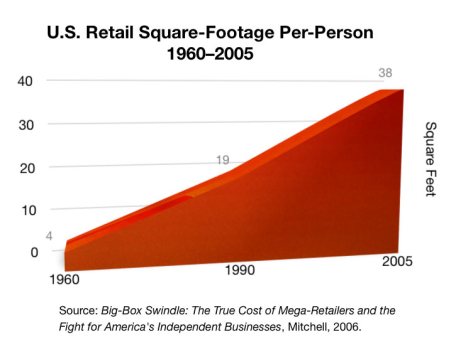
Needless to say, Amazon is merely symptomatic of the manner in which the systematic falsification of financial asset prices by the Fed and other central banks has corrupted the economic and financial narrative.
For instance, you cannot have the sound on for more than 10 minutes when some talking head on bubblevision says not to worry because profits are booming.
Well, no they are not—-save for round-tripping after the world’s mini-recession of 2015-2016.
In fact, the data is now virtually complete and S&P 500 earnings for 2017 posted at $109 per share compared to $106 per share for the September 2014 LTM period more than three years ago. It goes without saying, of course, that earnings growth at $1 per year per share is not much growth at all, but that’s not even the worst of it.
At the pre-crisis peak in June 2007, LTM earnings for the S&P 500 came in at $85 per share, meaning the peak-to-peak growth rate over the entire decade was just 2.5% per annum.
That’s right. The market closed today at a 24.5X PE valuation on three years of flat earnings, and during what will soon be the 10th year of the weakest business expansion in history.
Moreover, the above doesn’t represent some canky distortion unique to the S&P 500. The picture below is for all US corporations—public and private—and is presented on an aggregate dollar pre-tax basis in order to remove the impact of C-suite tax rate engineering and its persistent shrinkage of the share float via massive stock buybacks.
We’d call the trend flat on the decade and be done with it.
Way back in Q3 2006 when Goldilocks was the belle of the Wall Street ball the first time around, pre-tax corporate profits came in at an $1.655 trillion annual rate. With the aid of a magnifying glass you can perhaps see that the rate of $1.684 trillion for Q4 2107 was exactly 1.8% higher.
In a word, economic profits barely grew by 2% over that period, yet it still fostered 11 years of nearly continuous chatter on bubblevision about earnings being incredibly “strong” (except for the winter of 2008-2009, which apparently has now been air-brushed from the record).
So we are inclined to give the Donald a break. The blind squirrel in the Oval Office missed the biggest reason of all to attack Amazon, but he at least found the acorn.
That’s a lot more than you can say for the endless parade of zombified portfolio managers who fill the airtime on bubblevision.

end
Graham Summers has a good way to show us that inflation is screaming high..
a must view
(courtesy zerohedge)
The Inflation “Needle” Just Touched the Everything Bubble
April 2
By Graham Summers
The Fed is lying about inflation.
How do I know?
Because several of the Fed’s OWN in-house inflation measures are roaring.
- The New York Fed’s UIG inflation measure is currently clocking in at 3.06%.
- The Atlanta Fed’s “sticky” inflation measure is growing at an annualized rate of 2.2%.
- Even the Fed’s heavily massaged Personal Consumption Expenditures (PCE) metric is growing at 1.8% on an annualized basis, only slightly below the Fed’s so-called target rate of 2%.
So when I read that “inflation is subdued” or isn’t “rising fast enough” to warrant concern, I know the Fed officials claiming this aren’t even bothering to look at the Fed’s own data.
Even if you don’t believe the Fed’s data, the $199 TRILLION Bond Market is SCREAMING inflation.
The yield on the all-important 10-Year US Treasury has made a confirmed break above its long-term downtrend.

Bond yields trade based on inflation. And this chart is telling us that inflation is spiking higher.
This is not an isolated issue either..
The yields on the 10-Year German Bund, 10-Year Japanese Government Bond, and 10-Year UK Gilt are all rising to test their long-term downtrends.

If these trendlines break (as I expect they will in the coming weeks) it will mark the beginning of the end for The Everything Bubble.
All told, there is over $199 trillion in debt outstanding and an additional $500+ trillion in derivatives trading based on these bond yields.
So when this bubble bursts (as all bubbles do) we will experience a crisis many magnitudes worse than 2008.
Suffice to say, the opportunity to make MASSIVE gains from this trend is HUGE.
Best Regards,
Graham Summers
Chief Market Strategist
Phoenix Capital Research
end
This does not look promising: Jeff Sessions (and probable a Deep State) hires Prosecutor Huber, an Obama appointee to investigate the FBI and he will join Horowitz in a joint effort.
it keeps the investigation under the dept of Justice.
(courtesy zerohedge)
Sessions Names Prosecutor To Investigate FBI Misconduct Claims
Attorney General Jeff Sessions revealed Thursday that John Huber – Utah’s top federal prosecutor, will be paired with DOJ Inspector General Michael Horowitz to investigate a multitude of accusations of FBI misconduct surrounding the 2016 U.S. presidential election. The announcement comes one day after Inspector General Michael Horowitz confirmed that he will be investigating allegations of FBI FISA abuse.
Sessions’ decision stops short of formally appointing a special counsel to investigate – noting in a lengthy letter written to Chairmen Grassley, Goodlatte and Gowdy, Sessions that regulations recognize “the Attorney General may conclude that the circumstances do not justify such a departure “from the normal process of the department,” and that he may instead determine that other “appropriate steps” can be taken…”

Josh Caplan@joshdcaplanBREAKING: Attorney General Jeff Sessions notifies members of Congress he will not appoint second special counsel

That said, Sessions says he will rely on Huber’s review to determine the need for a special counsel.
“I am confident that Mr. Huber’s review will include a full, complete and objective evaluation of these matters in a manner that is consistent with the law and facts,” Sessions wrote.
“I receive regular updates from Mr. Huber and upon the conclusion of his review, will receive his recommendations as to whether any matters not currently under investigation should be opened, whether any matters currently under investigation require further resources, or whether any matters merit the appointment of a special counsel.”
Huber has also been looking at whether the FBI should have more thoroughly probed Hillary Clinton’s ties to Uranium One, a Russian nuclear energy agency. Still, it is worth noting that it was Barack Obama who appointed Huber to his position in 2015.
Sessions’ full letter can be seen below:
Meanwhile, IG Michael Horowitz confirmed that he will be investigating allegations of FBI FISA abuse on Wednesday.
“The OIG will initiate a review that will examine the Justice Department’s and the Federal Bureau of Investigation’s compliance with legal requirements, and with applicable DOJ and FBI policies and procedures, in applications filed with the U.S. Foreign Intelligence Surveillance Court (FISC) relating to a certain U.S. person,” the statement reads.

Justice OIG✔@JusticeOIGThe Department of Justice Office of the Inspector General announces the initiation of a review: https://oig.justice.gov/press/2018/2018-03-28b.pdf …

While the OIG’s current investigation and upcoming report – which led to former FBI Deputy Director Andrew McCabe’s firing, is focused on the agency’s handling of the Clinton email investigation. This new probe will focus on FISA abuse and surveillance of the Trump campaign.
On March 1, House Intelligence Committee (HPSCI) Chairman Devin Nunes (R-CA) wrote in a letter to Attorney General Jeff Sessions that the FBI may have violated criminal statutes, as well as its own strict internal procedures by using unverified information to obtain a surveillance warrant on onetime Trump campaign advisor Carter Page.
Sessions has come under increasing pressure to appoint a special counsel to investigate what President Trump referred to in late February as “potentially massive FISA abuse.”
Donald J. Trump✔@realDonaldTrumpWhy is A.G. Jeff Sessions asking the Inspector General to investigate potentially massive FISA abuse. Will take forever, has no prosecutorial power and already late with reports on Comey etc. Isn’t the I.G. an Obama guy? Why not use Justice Department lawyers? DISGRACEFUL!
And while many have noted that Inspector General Horowitz is significantly limited in his abilities to investigate, with Rep. Bob Goodlatte (R-VA) noting “the IG’s office does not have authority to compel witness interviews, including from past employees, so its investigation will be limited in scope in comparison to a Special Counsel investigation,” Sessions’ pairing of Horowitz with Huber keeps the investigation under the DOJ’s roof and out of the hands of an independent investigator.
Whether that’s a good thing or a bad thing has yet to be seen.
END
With 1500 Central American refugees in a caravan hoping to enter the USA, Trump has now gone nuclear and states that there will not be a DACA deal. That is a nuclear option which will galvanize the Democrats
(courtesy zerohedge)
“No More DACA Deal” Trump Booms, “Must Go Nuclear” As “Refugee Caravan” Approaches
Minutes after wishing Americans a Happy Easter, President Trump revealed a major shift in his strategy for pursuing an immigration deal with Democrats, and it’s one that Trump-supporters-turned-critics like Anne Coulter may finally approve.
In a tweet, Trump – who has been crucified so to speak by the conservative media for caving in and failing to obtain border wall funding – complained that US border agents aren’t allowed to do their jobs properly because of “ridiculous liberal (Democratic) laws” like “catch and release”. And with more “dangerous caravans coming” to the US border, “Republicans must go to Nuclear Option to pass tough laws NOW. NO MORE DACA DEAL!”
Donald J. Trump✔@realDonaldTrumpBorder Patrol Agents are not allowed to properly do their job at the Border because of ridiculous liberal (Democrat) laws like Catch & Release. Getting more dangerous. “Caravans” coming. Republicans must go to Nuclear Option to pass tough laws NOW. NO MORE DACA DEAL!
As previously reported, over 1,500 Central Americans are on a crusade across Mexico in the hopes of being granted asylum at the U.S. border.

Setting out six days ago and marching under the slogan “Migrantes en la lucha” (“Migrants in the Fight”) during holy week, the caravan comprised mostly of Hondurans was organized roughly a month ago by the mysterious group Pueblo Sin Fronteras (People Without Borders).
Trump also accused Mexico of doing “nothing” to stop people from flowing in through the Southern border, saying “they must stop the big drug and people flows” or he will “end their cash cow, NAFTA.”
Donald J. Trump✔@realDonaldTrumpMexico is doing very little, if not NOTHING, at stopping people from flowing into Mexico through their Southern Border, and then into the U.S. They laugh at our dumb immigration laws. They must stop the big drug and people flows, or I will stop their cash cow, NAFTA. NEED WALL!
What Trump is referring to is that, as noted yesterday, despite a majority of the Honduran migrants being in Mexico illegally, the caravan has not been stopped on its journey by local authorities, and people from Mexican towns along the way have been helping the refugees.
He also lashed out at the wave of undocumented immigrants “trying to take advantage of DACA.”
Donald J. Trump✔@realDonaldTrumpThese big flows of people are all trying to take advantage of DACA. They want in on the act!
Of course, this isn’t the first time Trump has called for the Senate to implement the so-called “nuclear option” (allowing a simple majority to close debate on all legislation). Trump demanded that it be implemented just the other week while delivering his explanation for signing the $1.3 trillion omnibus spending bill. However. Senate Majority Leader Mitch McConnell has resisted such a move, fearing it could be brought to bear against the Republicans if the Democrats do win back control of Congress during the 2018 midterms.
Back in 2013, Senate Dems adopted the nuclear option for presidential nominations, a decision that Senate Minority Leader Chuck Schumer says he regrets.
Trump’s tweet comes as more than 1,500 Central Americans are traveling across Mexico in the hopes of being granted asylum at the US border – something that will probably pose a substantial challenge to the Trump administration by reminding his base that the southern border wall that Trump promised during the campaign is still nothing more than a prototype in the vicinity of Tijuana.
end
Trump rages that we wants to finally use the nuclear option stopping the Democrats of filibustering bills coming before Congress. He wants his wall
(courtesy zerohedge)
Trump Rages: “Use Nuclear Option To Stop Massive Inflow Of Drugs And People”
For the second time in two days, Trump took to twitter to warn about the caravan of migrants headed through Mexico to the the US border, and bashed the Mexican government for allowing migrants untrammeled access to its northern border and Democrats for passing laws that “don’t do their job.”
In doing, the president demonstrated that he’s not only listening to his right-wing critics – of which Anne Coulter the most prominent example – who chastised him as a “lazy ignoramous” and levied charges that “all he wants is for Goldman to like him” – but is clearly worried about the midterms and a potential impeachment should Dems win the House and Senate.
It also seems that the recently emboldened President is at least trying to give the impression of putting his foot down when it comes to his promised border wall (even if he failed to obtain the funding needed to build it) with demands that Congress pass a comprehensive border-security package and lift certain restrictions on ICE agents.
Donald J. Trump
✔@realDonaldTrump
Mexico has the absolute power not to let these large “Caravans” of people enter their country. They must stop them at their Northern Border, which they can do because their border laws work, not allow them to pass through into our country, which has no effective border laws…..
Donald J. Trump
✔@realDonaldTrump
…Congress must immediately pass Border Legislation, use Nuclear Option if necessary, to stop the massive inflow of Drugs and People. Border Patrol Agents (and ICE) are GREAT, but the weak Dem laws don’t allow them to do their job. Act now Congress, our country is being stolen!
Trump then reverted to his charge that DACA is officially dead, and it’s the Democrats fault, a claim he first made on Sunday. Still, the president appeared to leave open the possibility of a deal, saying Democrats “must build Wall and secure our borders with proper Border legislation. Democrats want No Borders, hence drugs and crime!”
Donald J. Trump
✔@realDonaldTrump
DACA is dead because the Democrats didn’t care or act, and now everyone wants to get onto the DACA bandwagon… No longer works. Must build Wall and secure our borders with proper Border legislation. Democrats want No Borders, hence drugs and crime!
Yesterday, Trump demanded Senate Majority Leader Mitch McConnell to invoke “the nuclear option” – modifying rules to require only a simple majority to end debate and move to a vote, effectively killing the opposition’s ability to filibuster. Democrats, who made this change for presidential appointments back in 2013, have said they regret it (it allowed Trump to appoint Neil Gorsuch).
Of course, what Trump isn’t saying is just as problematic as whipping up votes from Democrats. Many Republicans are wary of Trump’s lavish border-enforcement promises, and are worried that, between the infrastructure bill, tax reform and the omnibus spending bill – Trump is trying to do to the US what he did to the Trump Organization in the 1990s.
Three’s A Crowd – Another Woman Sues Trump To Lift NDA
First, there was ‘Stormy Daniels’ – the porn star suing President Trump to undo a non-disclosure agreement she signed about their alleged affair.

Second, there is former Playboy model Karen McDougal, who is suing the National Enquirer to void a deal that she says forced her to stay silent about an affair she had with Trump.

And now there’s a third woman seeking to overturn a pre-agreed secrecy deal.

Bloomberg reports that Jessica Denson, a Los Angeles-based journalist and actress who oversaw phone banks and Hispanic outreach for the campaign, claims she was harassed by a superior.
She had earlier filed a discrimination case against ‘Donald Trump for President Inc.’ in New York state court, but the campaign sought to enforce the confidentiality deal, filing an arbitration claim asserting $1.5 million in damages.
Now, she is suing the organization to nullify a non-disclosure agreement she signed, saying it muzzled her from airing discrimination claims.
Denson is reportedly representing herself in the lawsuits.
Michael Avenatti, Stormy Daniels’s lawyer who said he had been approached by other women who had Trump-related non-disclosure agreements, declined to comment on whether Denson had been one of them.
The Trump campaign didn’t respond to a request for comment.
The question is – does any of this matter to anyone but Maxine Waters? Judging by President Trump’s approval ratings surge, it’s not weighing on national sentiment.
By Greg Hunter On April 1, 2018 In Market Analysis

By Greg Hunter’s USAWatchdog.com (Early Sunday Release)
Forensic macroeconomic analyst Rob Kirby says big money knows “gold supplies are tight” and getting tighter by the day. Kirby, who also arranges gold sales by the ton on a global scale, explains, “There are reports of people trying to buy institutional amounts of physical gold bullion in the Asian market, and there is none available even if they are paying a premium. I’m not talking about availability at the coin shop where you would buy two American Gold Eagles or a Gold Panda. I am talking about institutions wanting to buy serious amounts of physical gold bullion in bar form.”
Kirby says the global financial system is packed with unpayable debt, and the insiders know many might wake up someday to find they are living in their very own Mad Max movie. Kirby says, “If the financial world is turned on its head, we could very likely see some social unrest. Things could get very, very unpalatable, and we could see a complete breakdown. . . . This leads naturally to the question if the system is this precarious, why hasn’t anybody with a whole lot of money done anything to tip it over? The reason is that virtually nobody benefits from a situation where anarchy happens, and there aren’t many people who want to be the person that pulls the pin on the grenade.”
How long can this go on for? Kirby says, “Not much longer because the amounts and volumes of delivering physical gold are growing with time at a geometric rate. The demand for physical is growing too fast for the paper to be able to justify the false price discovery. There are fraudulently concocted prices of precious metals on the COMEX exchange . . . to keep these fraudulent prices on metal believable, COMEX has had to give up at least some metal to make their fraudulent price believable. At some point, this whole system is going to be exposed for the massive fraud that it has been for a very long time. . . . What does this mean to the average guy in the street? We could see physical gold and silver prices go Bitcoin. We could see the price of silver go up 5, 10, 20 or 30 times just like Bitcoin did in a very short space of time. I feel this is ultimately what is in store for precious metals prices.”
On the inflation front, Kirby says all the money needed for hyperinflation has already been printed. Kirby contends, “It’s kind of like having a nuclear war, and people say where are the bombs going to come from? The bombs are going to come out of their silos. What people can’t believe or can’t wrap their head around is the notion and the fact that there’s $21 trillion or more that’s been ‘siloed.’ The money has been created and siloed. We know it’s been created because we know it flew through the books of the Department of Defense (DOD) and the Department of Housing and Urban Development (HUD). That’s just two government agencies. . . . We’re talking about tens of trillions of dollars. We don’t know exactly where they are or who controls them. . . . This is why you want to own some tangible stuff. This is why you want to own physical bullion, such as coins and bars, and you want to have them in your control.”
Join Greg Hunter as he goes One-on-One with Rob Kirby of KirbyAnalytics.com.
After the Interview:
Rob Kirby also says the mainstream media should be ashamed of themselves because they are more interested in a porn star that allegedly slept with the President than a missing $21 trillion at the DOD and HUD. When the world realizes this money is already printed, the U.S. dollar and Treasury bonds will take a huge hit.
Video Link
https://usawatchdog.com/global-gold-supplies-getting- tighter-rob-kirby/
HARVEY


 harveyorganblog.com
