
GOLD: $1299.70 DOWN $4.50 (COMEX TO COMEX CLOSINGS)
Silver: $16.37 DOWN 16 CENTS (COMEX TO COMEX CLOSINGS)
Closing access prices:
Gold $1299.00
silver: $16.38
For comex gold:
MAY/
NUMBER OF NOTICES FILED TODAY FOR MAY CONTRACT:1 NOTICE(S) FOR 100 OZ.
TOTAL NOTICES SO FAR 731 FOR 73100 OZ (2.274 tonnes)
For silver:
MAY
167 NOTICE(S) FILED TODAY FOR
835,000 OZ/
Total number of notices filed so far this month: 7157 for 35,785,000 oz
XXXXXXXXXXXXXXXXXXXXXXXXXXXXXX
XXXXXXXXXXXXXXXXXXXXXXXXXXXXXX
Bitcoin: BID $7241/OFFER $7341: UP $188(morning)
Bitcoin: BID/ $7460/offer $7560: up $404 (CLOSING/5 PM)
end
First Shanghai gold fix comes at 10 pm est
The second Shanghai gold fix: 2:15 pm
First Shanghai gold fix gold: 10 pm est: 1304.94
NY price at the same time: 1299.45
PREMIUM TO NY SPOT: $5.49
Second gold fix early this morning: 1301.53
USA gold at the exact same time:1298.95
PREMIUM TO NY SPOT: $3.58
AGAIN, SHANGHAI REJECTS NEW YORK PRICING.
WE WILL NOT PROVIDE LONDON FIXES AS THEY ARE NOT ACCURATE AS TO WHAT IS GOING ON AT THE SAME TIME FRAME.
Let us have a look at the data for today
xxxxxxxxxxxxxxxxxxxxxxxxxxxxxxxxxxxxxxxxxxxxxxxxxxxxxxxxxxxxxxxxxxxxxxxxxx
In silver, the total OPEN INTEREST FELL BY AN TINY 910 CONTRACTS FROM 206,374 DOWN TO 205,464 WITH FRIDAY’S 13 CENT LOSS IN SILVER PRICING. WE ARE NOW WITNESSING OUR USUAL AND CUSTOMARY COMEX LONG LIQUIDATION AS WE ENTERED INTO THE ACTIVE DELIVERY MONTH OF MAY AS LONGS PACK THEIR BAGS AND MIGRATE OVER TO LONDON. WE WERE NOTIFIED THAT WE HAD A STRONG SIZED NUMBER OF COMEX LONGS TRANSFERRING THEIR CONTRACTS TO LONDON THROUGH THE EFP : 2572 EFP’S FOR JULY AND ZERO FOR ALL OTHER MONTHS AND THEREFORE TOTAL ISSUANCE OF 2572 CONTRACTS. WITH THE TRANSFER OF 2572 CONTRACTS, WHAT THE CME IS STATING IS THAT THERE IS NO SILVER (OR GOLD) TO BE DELIVERED UPON AT THE COMEX AS THEY MUST EXPORT THEIR OBLIGATION TO LONDON. ALSO KEEP IN MIND THAT THERE CAN BE A DELAY OF 24-48 HRS IN THE ISSUING OF EFP’S. THE 2572 EFP CONTRACTS TRANSLATES INTO 12.860 MILLION OZ ACCOMPANYING:
1.THE 17 CENT LOSS IN SILVER PRICE AT THE COMEX AND
2. THE STRONG AMOUNT OF SILVER OUNCES STANDING FOR MAY COMEX DELIVERY. (35.870 MILLION OZ)
ACCUMULATION FOR EFP’S/SILVER/J.P.MORGAN’S HOUSE OF BRIBES, / STARTING FROM FIRST DAY NOTICE/FOR MONTH OF MAY: (FINAL)
39,301 CONTRACTS (FOR 20 TRADING DAYS TOTAL 39,301 CONTRACTS) OR 196.505MILLION OZ: (AVERAGE PER DAY: 1965 CONTRACTS OR 9.825 MILLION OZ/DAY)
TO GIVE YOU AN IDEA AS TO THE HUGE SUPPLY THIS MONTH IN SILVER: SO FAR THIS MONTH: 196.505 MILLION PAPER OZ HAVE MORPHED OVER TO LONDON. THIS REPRESENTS AROUND 26.22% OF ANNUAL GLOBAL PRODUCTION (EX CHINA EX RUSSIA)
ACCUMULATION IN YEAR 2018 TO DATE SILVER EFP’S: 1,341.8 MILLION OZ.
ACCUMULATION FOR JAN 2018: 236.879 MILLION OZ
ACCUMULATION FOR FEB 2018: 244.95 MILLION OZ
ACCUMULATION FOR MARCH 2018: 236.67 MILLION OZ
ACCUMULATION FOR APRIL 2018: 385.75 MILLION OZ
RESULT: WE HAD A TINY SIZED DECREASE IN COMEX OI SILVER COMEX OF 910 WITH THE 17 CENT LOSS IN SILVER PRICE. WE HAVE NOW ENTERED THE NEW ACTIVE MONTH OF MAY. THE CME NOTIFIED US THAT IN FACT WE HAD AN HUMONGOUS SIZED EFP ISSUANCE OF 2572 CONTRACTS WHICH EXITED OUT OF THE SILVER COMEX AND TRANSFERRED THEIR OI TO LONDON AS FORWARDS. SPECULATORS CONTINUED THEIR INTEREST IN ATTACKING THE SILVER COMEX FOR PHYSICAL SILVER (SEE COMEX DATA) . FROM THE CME DATA: 2572 EFP CONTRACTS FOR JULY, AND ZERO FOR ALL OVER MONTHS FOR A DELIVERABLE FORWARD CONTRACT OVER IN LONDON WITH A FIAT BONUS (TOTAL: 2572). TODAY WE GAINED 1662 TOTAL OI CONTRACTS ON THE TWO EXCHANGES: i.e.2572 OPEN INTEREST CONTRACTS HEADED FOR LONDON (EFP’s) TOGETHER WITH AN DECREASE OF 652 OI COMEX CONTRACTS. AND ALL OF THIS HAPPENED WITH THE 13 CENT LOSS IN PRICE OF SILVER AND A CLOSING PRICE OF $16.53 WITH RESPECT TO YESTERDAY’S TRADING. YET WE STILL HAVE A GIGANTIC AMOUNT OF SILVER STANDING AT THE COMEX FOR DELIVERY IN THIS ACTIVE MAY DELIVERY MONTH. IT SURE LOOKS LIKE A FAILED BANKER SHORT COVERING EXERCISE!!
In ounces AT THE COMEX, the OI is still represented by OVER 1 BILLION oz i.e. 1.028 MILLION OZ TO BE EXACT or 147% of annual global silver production (ex Russia & ex China).
FOR THE NEW FRONT MAY MONTH/ THEY FILED AT THE COMEX: 167 NOTICE(S) FOR 835,000 OZ OF SILVER
IN SILVER, WE HAVE NOW SET THE NEW RECORD OF OPEN INTEREST AT 243,411 AND AGAIN THIS HAS BEEN SET WITH A LOW PRICE OF $16.51 ON APRIL 9.2018.
ON THE DEMAND SIDE WE HAVE THE FOLLOWING:
- HUGE AMOUNTS OF SILVER STANDING FOR DELIVERY (MARCH: 27 MILLION OZ , APRIL: 2.485 MILLION OZ AND MAY: 35.870 MILLION OZ
- HUGE RECORD OPEN INTEREST IN SILVER 243,411 CONTRACTS (OR 1.217 BILLION OZ/ SET APRIL 9/2018
- HUGE ANNUAL EFP’S ISSUANCE EQUAL TO 2.9 BILLION OZ OR 400% OF SILVER ANNUAL PRODUCTION/2017
- RECORD SETTING EFP ISSUANCE FOR ANY MONTH IN SILVER; APRIL/2018/ 385.75 MILLION OZ/ (FINAL)
AND YET, WITH THE EXTREMELY HIGH EFP ISSUANCE, WE HAVE A CONTINUAL LOW PRICE OF SILVER DESPITE THE ABOVE HUGE DEMAND. TO ME THE ONLY ANSWER IS THAT WE HAVE SOVEREIGN (CHINA) WHO IS ENDEAVOURING TO GOBBLE UP ALL AVAILABLE PHYSICAL SILVER NO MATTER WHERE, EXACTLY WHAT J.P.MORGAN IS DOING. AND IT IS MY BELIEF THAT J.P.MORGAN IS HOLDING ITS SILVER FOR ITS BENEFICIAL OWNER..THE USA GOVERNMENT WHO IN TURN IS HOLDING THAT SILVER FOR CHINA.(FOR A SILVER LOAN REPAYMENT). IT ALSO LOOKS LIKE BANKER CAPITULATION IN SILVER AS THEY STRUGGLE TO REMOVE SOME OF THEIR HUGE OBLIGATIONS.
In gold, the open interest DROPPED BY A CONSIDERABLE SIZED 4006 CONTRACTS DOWN TO 474,566 DESPITE THE TINY LOSS IN THE GOLD PRICE/FRIDAY’S TRADING (LOSS OF $0.80). WE ARE NOW IN THE NON ACTIVE DELIVERY MONTH OF MAY. NO DOUBT THE BOYS ARE CASHING IN THEIR COMEX LONGS TO BEGIN THE PROCESS TO MOVE INTO LONDON FORWARDS. THE CME RELEASED THE DATA FOR EFP ISSUANCE AND IT TOTALED A GOOD SIZED 5399 CONTRACTS : JUNE SAW THE ISSUANCE OF 5396 CONTRACTS , AND AUGUST SAW THE ISSUANCE OF: 3 CONTRACTS WITH ALL OTHER MONTHS ZERO. The new OI for the gold complex rests at 474,566. ALSO REMEMBER THAT THERE WILL BE A DELAY IN THE ISSUANCE OF EFP’S. THE BANKERS REMOVE LONG POSITIONS OF COMEX GOLD IMMEDIATELY. THEN THEY ORCHESTRATE THEIR PRIVATE EFP DEAL WITH THE LONGS AND THAT COULD TAKE AN ADDITIONAL 48 HRS SO WE GENERALLY DO NOT GET A MATCH WITH RESPECT TO DEPARTING COMEX LONGS AND NEW EFP LONG TRANSFERS. . EVEN THOUGH THE BANKERS ISSUED THESE MONSTROUS EFPS, THE OBLIGATION STILL RESTS WITH THE BANKERS TO SUPPLY METAL BUT IT TRANSFERS THE RISK TO A LONDON BANKER OBLIGATION AND NOT A NEW YORK COMEX OBLIGATION. LONGS RECEIVE A FIAT BONUS TOGETHER WITH A LONG LONDON FORWARD. THUS, BY THESE ACTIONS, THE BANKERS AT THE COMEX HAVE JUST STATED THAT THEY HAVE NO APPRECIABLE METAL!! THIS IS A MASSIVE FRAUD: THEY CANNOT SUPPLY ANY METAL TO OUR COMEX LONGS BUT THEY ARE QUITE WILLING TO SUPPLY MASSIVE NON BACKED GOLD (AND SILVER) PAPER KNOWING THAT THEY HAVE NO METAL TO SATISFY OUR LONGS. LONDON IS NOW SEVERELY BACKWARD IN BOTH GOLD AND SILVER AND WE ARE WITNESSING DELAYS IN ACTUAL DELIVERIES.
IN ESSENCE WE HAVE A GOOD SIZED OI GAIN IN TOTAL CONTRACTS ON THE TWO EXCHANGES: 4006 OI CONTRACTS DECREASED AT THE COMEX AND A GOOD SIZED 5399 EFP OI CONTRACTS WHICH NAVIGATED OVER TO LONDON.THUS TOTAL OI GAIN: 1390 CONTRACTS OR 139,000 OZ = 4.323 TONNES. AND ALL OF THIS OCCURRED WITH A TINY LOSS OF $0.80
FRIDAY, WE HAD 12,839 EFP’S ISSUED.
ACCUMULATION OF EFP’S GOLD AT J.P. MORGAN’S HOUSE OF BRIBES: (EXCHANGE FOR PHYSICAL) FOR THE MONTH OF MAY : 190,995 CONTRACTS OR 19,099,500 OZ OR 594.05 TONNES (20 TRADING DAYS AND THUS AVERAGING: 9,549 EFP CONTRACTS PER TRADING DAY OR 954,900 OZ/ TRADING DAY),,
TO GIVE YOU AN IDEA AS TO THE HUGE SIZE OF THESE EFP TRANSFERS : THIS MONTH IN 20 TRADING DAYS IN TONNES: 594.05 TONNES
TOTAL ANNUAL GOLD PRODUCTION, 2017, THROUGHOUT THE WORLD EX CHINA EX RUSSIA: 2555 TONNES
THUS EFP TRANSFERS REPRESENTS 594.05/2550 x 100% TONNES = 23.29% OF GLOBAL ANNUAL PRODUCTION SO FAR IN APRIL ALONE.*** THE ACCUMULATION OF EFP CONTRACTS IS RISING PER MONTH.
ACCUMULATION OF GOLD EFP’S YEAR 2018 TO DATE: 3,351.69* TONNES *SURPASSED ANNUAL PROD’N
ACCUMULATION OF GOLD EFP’S FOR JANUARY 2018: 653.22 TONNES
ACCUMULATION OF GOLD EFP’S FOR FEBRUARY 2018: 649.45 TONNES
ACCUMULATION OF GOLD EFP’S FOR MARCH 2018: 741.89 TONNES (22 TRADING DAYS)
ACCUMULATION OF GOLD EFP’S FOR APRIL 2018: 713.84 TONNES (21 TRADING DAYS)
WHAT IS ALARMING TO ME, ACCORDING TO OUR LONDON EXPERT ANDREW MAGUIRE IS THAT THESE EFP’S ARE BEING TRANSFERRED TO WHAT ARE CALLED SERIAL FORWARD CONTRACT OBLIGATIONS AND THESE CONTRACTS ARE LESS THAN 14 DAYS. ANYTHING GREATER THAN 14 DAYS, THESE MUST BE RECORDED AND SENT TO THE COMPTROLLER, GREAT BRITAIN TO MONITOR RISK TO THE BANKING SYSTEM. IF THIS IS INDEED TRUE, THEN THIS IS A MASSIVE CONSPIRACY TO DEFRAUD AS WE NOW WITNESS A MONSTROUS TOTAL EFP’S ISSUANCE AS IT HEADS INTO THE STRATOSPHERE.
Result: A CONSIDERABLE SIZED DECREASE IN OI AT THE COMEX OF 4006 DESPITE THE TINY $0.80 LOSS IN PRICE // GOLD TRADING FRIDAY ($0.80 FALL). WE ALSO HAD AN GOOD SIZED NUMBER OF COMEX LONG TRANSFERRING TO LONDON THROUGH THE EFP ROUTE: 5399 CONTRACTS AS THESE HAVE ALREADY BEEN NEGOTIATED AND CONFIRMED. THERE OBVIOUSLY DOES NOT SEEM TO BE MUCH PHYSICAL GOLD AT THE COMEX. I GUESS IT EXPLAINS THE HUGE ISSUANCE OF EFP’S…THERE IS HARDLY ANY GOLD PRESENT AT THE GOLD COMEX FOR DELIVERY PURPOSES. IF YOU TAKE INTO ACCOUNT THE 5399 EFP CONTRACTS ISSUED, WE HAD A GOOD SIZED NET GAIN OF 1390 CONTRACTS IN TOTAL OPEN INTEREST ON THE TWO EXCHANGES:
2572 CONTRACTS MOVE TO LONDON AND 4006 CONTRACTS DECREASED AT THE COMEX. (in tonnes, the GAIN in total oi equates to 4.232 TONNES). ..AND BELIEVE IT OR NOT BUT ALL OF THESE OCCURRED AT THE COMEX WITH A TINY LOSS OF $0.80 IN TRADING!!!.
we had: 1 notice(s) filed upon for 100 oz of gold at the comex.
xxxxxxxxxxxxxxxxxxxxxxxxxxxxxxxxxxxxxxxxxxxxxxxxxxxxxxxxxxx
With respect to our two criminal funds, the GLD and the SLV:
GLD...
WITH GOLD DOWN $4.50 TODAY: / NO CHANGES IN GOLD INVENTORY AT THE GLD/ A WITHDRAWAL OF 3.54 TONNES/INVENTORY RESTS AT 848.50 TONNES
Inventory rests tonight: 848.50 tonnes.
SLV/
WITH SILVER UP ON THE WEEK BUT DOWN 13 CENTS TODAY A CHANGES IN THE SILVER INVENTORY AT THE SLV INVENTORY/ A WITHDRAWAL OF 1.035 MILLION OZ.
/INVENTORY RESTS AT 319.968 MILLION OZ/ AND WITH A HUGE DEMAND FOR SILVER AT THE COMEX??
end
First, here is an outline of what will be discussed tonight:
1. Today, we had the open interest in SILVER FELL BY A TINY SIZED 910 CONTRACTS from 206,374 DOWN TO 205,464 (AND, CLOSER TO THE NEW COMEX RECORD SET /APRIL 9/2017 AT 243,411/SILVER PRICE AT THAT DAY: $16.53). THE PREVIOUS RECORD OTHER THAN WAS ESTABLISHED AT: 234,787, SET ON APRIL 21.2017 OVER ONE YEAR AGO. THE PRICE OF SILVER ON THAT DAY: $17.89.OUR CUSTOMARY MIGRATION OF COMEX LONGS MORPH INTO LONDON FORWARDS CONTINUES AS OUR BANKERS USED THEIR EMERGENCY PROCEDURE TO ISSUE: (WE DO NOT GET A LOOK AT THESE CONTRACTS AS IT IS PRIVATE BUT THE CFTC DOES AUDIT THEM), 2572 EFP’S FOR JULY AND ALL OTHER MONTHS: ZERO. TOTAL EFP ISSUANCE: 2572 CONTRACTS. EFP’S GIVE OUR COMEX LONGS A FIAT BONUS PLUS A DELIVERABLE PRODUCT OVER IN LONDON. IF WE TAKE THE OI LOSS AT THE COMEX OF 910 CONTRACTS TO THE 2572 OI TRANSFERRED TO LONDON THROUGH EFP’S, WE OBTAIN A FAIR SIZED GAIN OF 1662 OPEN INTEREST CONTRACTS. THUS IN OUNCES, THE GAIN ON THE TWO EXCHANGES: 8.310 MILLION OZ!!! AND THIS OCCURRED WITH A 13 CENT LOSS IN PRICE . THE BANKERS ORCHESTRATED THEIR RAID THROUGHOUT LAST WEEK DESPERATELY TRYING TO PARE THEIR GIGANTIC OPEN INTEREST SHORT ON BOTH EXCHANGES BUT TO NO AVAIL. JUDGING BY THE RECORD NUMBER OF EFP ISSUANCE DURING LAST MONTH OF APRIL AT 385.75 MILLION OZ AND THE TOTAL OI GAIN ON THE TWO EXCHANGES, THE CONSTANT RAIDS, LIKE YESTERDAY ARE NOW BEING CALLED UPON BY OUR BANKER FRIENDS IN AN ATTEMPT TO SHAKE AS MANY SILVER LEAVES FROM THE SILVER TREE AS POSSIBLE AND JUDGING BY THE RESULTS TO YESTERDAYS ACTION THEY WERE NOT AT ALL SUCCESSFUL.
RESULT: A TINY SIZED DECREASE IN SILVER OI AT THE COMEX WITH THE 13 CENT LOSS IN SILVER PRICING YESTERDAY. BUT WE ALSO HAD ANOTHER STRONG SIZED 2572 EFP’S ISSUED TRANSFERRING COMEX LONGS OVER TO LONDON. TOGETHER WITH THE STRONG SIZED AMOUNT OF SILVER OUNCES STANDING FOR APRIL, DEMAND FOR PHYSICAL SILVER CONTINUES TO INTENSIFY AS WE WITNESS SEVERE BACKWARDATION IN SILVER IN LONDON.
(report Harvey)
.
2.a) The Shanghai and London gold fix report
(Harvey)
2 b) Gold/silver trading overnight Europe, Goldcore
(Mark O’Byrne/zerohedge
and in NY: Bloomberg
3. ASIAN AFFAIRS
)TUESDAY MORNING/MONDAY NIGHT: Shanghai closed DOWN 14.62 points or 0.47% /Hang Sang CLOSED DOWN 307.68 points or 1.06% / The Nikkei closed DOWN 122.66 POINTS OR 0.55% /Australia’s all ordinaires CLOSED UP .13% /Chinese yuan (ONSHORE) closed DOWN at 6.4188/Oil DOWN to 66.87 dollars per barrel for WTI and 75.78 for Brent. Stocks in Europe OPENED ALL RED/. ONSHORE YUAN CLOSED DOWN AT 6.4188 AGAINST THE DOLLAR. OFFSHORE YUAN CLOSED DOWN ON THE DOLLAR AT 6.4211/ONSHORE YUAN TRADING STRONGER AGAINST OFFSHORE YUAN/ONSHORE YUAN TRADING WEAKER AGAINST USA DOLLAR/OFFSHORE YUAN TRADING MUCH WEAKER AGAINST THE DOLLAR /CHINA RETALIATES WITH TARIFFS/ TRUMP RESPONDS TO NEW TARIFFS AND IT NOW LOOKS LIKE A FULL TRADE WAR IS BEGINNING/
i
/NORTH KOREA/SOUTH KOREA
i)North Korea/South Korea/USA
Kim holds another surprise second summit with South Korean Moon and it sure looks like the June 12/2018 summit with Trump is on to be held in Singapore.
( zerohedge)
ii)In another sign that the meeting is still on: USA officials enter north Korea in preparation for the Trump /Kim talks. Kim commits to complete denuculearization.
( zerohedge)
b) REPORT ON JAPAN
3 c CHINA
China will not be happy with this: The USA is set to impose a 25% tariff on Chinese tech goods. But worse of all: export restrictions and export controls for Chinese groups
( zerohedge)
4. EUROPEAN AFFAIRS
i)Sunday, Italy in chaos as the Italy’s appointed President Matteralla blocks Paolo Savona from becoming Finance Minister.
what happens next is anybody’s guess..
( zerohedge)
ii)Monday morning: Major points
- Italian bonds and stock market crash with Mattarella rejecting the coalition pick for finance minister
- 10 yr Italian bonds rip higher to 2.70%
- Matteralla rejects democracy and supports Brussels as he appoints a technocratic leader who will have zero support.
- Looks like we will have an August election in Italy and no doubt the election theme will be whether to remove itself from the euro.
- Contagion spreading to Portugal and Spain
(courtesy zerohedge)
Panic on the streets of Italy as dealers pull their bids on bonds. The ECB is still backstopping Italian bonds. Stocks crash across Europe and we continue to watch the implosion of Deutsche bank. Remember that this bank has the world’s largest derivative portfolio of which the dominant entries are interest rates and they are blowing sky high.
( zerohedge)
iiib )
iv)Saturday:
Raul Meijer already on Saturday saw the writing on the wall: the end game for the Euro. We should see the Spanish government fall as there is going to be a non confidence vote as there is another scandal in Spain. The real problem for Italy right now is the ECB who no doubt will stop purchasing Italian bonds which in turn will cause yields to skyrocket. Remember that Italian banks hold massive amounts of sovereign Italian bonds and they will begin to see massive losses on bonds held. The mark to mark losses will the forerunner for Italy to leave the Euro despite the antics of the ECB
a must read..
Raul Meijer
v)Sunday: just before the rejection announcement, zero hedge lays out perfectly why Italy’s political crisis will explode and they were right (see above)
( zerohedge)
vii)Sunday: We first had Greece…now it looks like Italy, Spain and Portugal are coming next in the debt implosion
(courtesy zerohedge)
viii)Italy: end of European trading: MONDAY
ix)Sunday: London’s Guardian)
UK Posts a terrible first quarter GDP report of only .1% on weak business investment and a total lack of household spending
( Richard Partington/London’s Guardian)
x))The following is a must read: We have many banks that are in trouble due to their heavy purchase of sovereign bonds. As yields rise, bond prices fall and these banks having been using sovereign bonds as tier one collateral. If bond prices fall, they must find more capital to shore up their deficiencies.
The three banks in trouble with the largest Italian and Spanish sovereign holdings;
- Unicredit/Italy’s largest bank
- Intessa (3rd largest Italian bank)
- Mid sized Spanish based Sabadell
a must read..
( Don Quijones/WolfStreet)
xi)UK
For those that missed this story, UK journalist and activist Tommy Robinson was arrested and convicted for filming a court proceeding on gang rapes by Muslims in the UK. He was sentenced to 13 months in jail in a speedy trial. Now Britons rage because their freedom of speech was basically been nullified
( zerohedge)
xii)BELGIUM/TUESDAY
xii)Another Migrant attack in Belgium with 4 dead including 2 cops and one passerby
5. RUSSIAN AND MIDDLE EASTERN AFFAIRS
i)TURKEY
Saturday
The crooked politician Erdogan is now urging fellow Turks to buy Lira and sell their foreign currency accounts. That would be very foolish
(courtesy zerohedge)
Israel launches an air strike on Gaza after a barrage of mortar shells are fired at Israel. Most were shot down by the Iron Dome defense shield but one struck a kindergarten school. Luckily the attack occurred 1 hr before the children were to attend school.
( zerohedge)
6 .GLOBAL ISSUES
Higher prices for Salmon are causing a supply side shock around the globe
(courtesy zeorhedge)
7. OIL ISSUES
i)Sunday
Not good for the west: Russian and NATO ally Turkey reach a deal on the “Southern Stream” gas pipeline which will run from the southern part of Russia, through the Black Sea, onto Istanbul and then onto Greece and the rest of Europe. The USA will not be happy with this
( zerohedge)
(courtesy zerohedge)
iii)According to Irina Slavis it will be extremely difficult to get around the Iranian sanctions
8. EMERGING MARKET
i)Saturday/Brazil
A huge trucking strike which has entered it’s sixth day is crippling Brazil’s economy
( zerohedge)
ii)Brazil’s trucker strike worsens as Petrobras workers are now planning a walkout as well
(zerohedge)
9. PHYSICAL MARKETS
ii)The EU must fix the problems of the Euro as it must be more robust to rival the dollar
iii)A terrific commentary from Chris Powell as he exposes the secret market rigging as the BIS refuses to answer questions of its surreptitious intervention in the gold market( Chris Powell/GATA)
iv)The USA will not like this: China is to host Iran at the Shanghai Cooperation Council as they state that they will evade Iran evade USA sanctions
( GATA/Reuters)
v) Bill Holter interview
(Bill Holter)
10. USA stories which will influence the price of gold/silveri)
i)USA DATA
Seems that inflation is targeting home prices as they are rising at the fastest pace in 4 years and now at a record high
( Case Shiller/zerohedge)
ii)A favourite of everybody: Michael Snyder
Michael Snyder…
iii)All USA banks tumble after JPMorgan warns that 2nd quarter revenue is so far very disappointing;
(courtesy zerohedge)
iv)SWAMP STORIES
Trading Volumes on the COMEX
PRELIMINARY COMEX VOLUME FOR TODAY: 715,285 contracts
CONFIRMED COMEX VOL. FOR YESTERDAY: 400,307 contracts
xxxxxxxxxxxxxxxxxxxxxxxxxxxxxxxxxxxxxxxxxxxxxxxxxxxxxxxxxxxxxxxxxxxx
And now for the wild silver comex results.
Total silver OI FELL BY A TINY SIZED 910 CONTRACTS FROM 206,374 DOWN TO 205,464 (AND FURTHER FROM THE NEW RECORD OI FOR SILVER SET APRIL 9.2018/ 243,411 CONTRACTS) WITH THE 13 CENT LOSS IN SILVER PRICING/ FRIDAY. SINCE WE ARE NOW INTO THE ACTIVE DELIVERY MONTH OF MAY. WE WERE INFORMED THAT WE HAD A STRONG SIZED 2572 EFP CONTRACT ISSUANCE FOR JULY AND ZERO FOR ALL OTHER MONTHS. THESE EFPS WERE ISSUED TO COMEX LONGS WHO RECEIVED A FIAT BONUS PLUS A DELIVERABLE PRODUCT OVER IN LONDON. THE TOTAL EFP’S ISSUED: 2572. ON A NET BASIS WE GAINED 1662 SILVER OPEN INTEREST CONTRACTS AS WE OBTAINED A 910CONTRACT LOSS AT THE COMEX COMBINING WITH THE ADDITION OF 2572 OI CONTRACTS NAVIGATING OVER TO LONDON.
NET GAIN ON THE TWO EXCHANGES: 1662 CONTRACTS
AMOUNT STANDING FOR SILVER AT THE COMEX
We are now in the active delivery month of MAY and here the front month FELL BY 765 contracts FALLING TO 184 contracts. HOWEVER, we had 813 notices filed on Friday so we SURPRISINGLY GAINED ANOTHER STRONG 57contracts or 285,000 additional ounces will stand for delivery in this active delivery month of May AS SOMEBODY AGAIN WAS DESPERATE FOR PHYSICAL SILVER ON THIS SIDE OF THE POND AND A HUGE AMOUNT WAS NEEDED STAT. THIS FEATURE WHERE THE AMOUNT OF PHYSICAL INCREASES AT THE COMEX IN ANY GIVEN DAY IS KNOWN AS QUEUE JUMPING.
June saw a LOSS of 22 contracts to stand at 731. The next big delivery month for silver is July and here the OI LOST 1014 contracts DOWN to 139,885. The next active delivery month after July for silver is September and here the OI ROSE by 1217 contracts UP to 31,759
We had 167 notice(s) filed for 4,065,000 OZ for the MAY 2018 COMEX contract for silver
PLEASE NOTE THE FOLLOWING:
ON MAY 30.2017 WE HAD AT THIS TIME IN THE DELIVERY CYCLE, 651 OI CONTRACTS REMAINED OUTSTANDING WITH ONE DAY TO GO.
ON MAY 31.2017 WE INITIALLY HAD 396 OPEN INTEREST STAND OR A LARGE 1.98 MILLION OZ
AT THE CONCLUSION OF JUNE 2017: 4.92 MILLION OZ AS QUEUE JUMPING STARTED IN EARNEST AND IN THE ENSUING YEAR, IT CONTINUED WITH RECKLESS ABANDON.
INITIAL standings for MAY/GOLD
MAY 29/2018.
| Gold | Ounces |
| Withdrawals from Dealers Inventory in oz | nil oz |
| Withdrawals from Customer Inventory in oz |
2000.94 OZ
Scotia
|
| Deposits to the Dealer Inventory in oz | NIL oz |
| Deposits to the Customer Inventory, in oz | 3603.682
OZ Delaware |
| No of oz served (contracts) today |
1 notice(s)
100 OZ
|
| No of oz to be served (notices) |
1 contracts
(100 oz)
|
| Total monthly oz gold served (contracts) so far this month |
731 notices
73100 OZ
2.2737 TONNES
|
| Total accumulative withdrawals of gold from the Dealers inventory this month | NIL oz |
| Total accumulative withdrawal of gold from the Customer inventory this month | xxx oz |
For MAY:
Today, 0 notice(s) were issued from JPMorgan dealer account and 0 notices were issued from their client or customer account. The total of all issuance by all participants equates to 1 contract(s) of which 0 notices were stopped (received) by j.P. Morgan dealer and 0 notice(s) was (were) stopped/ Received) by j.P.Morgan customer account.
xxxxxxxxxxxxxxxxxxxxxxxxxxxxxxxxxxxxxxxxxxxxxxxxxxxxxxxxxxxxxxxxxxxxxxxxxx
To calculate the INITIAL total number of gold ounces standing for the MAY. contract month, we take the total number of notices filed so far for the month (731) x 100 oz or 73100 oz, to which we add the difference between the open interest for the front month of MAY. (2 contracts) minus the number of notices served upon today (1 x 100 oz per contract) equals 73,200 oz, the number of ounces standing in this active month of APRIL (2.2768 tonnes)
Thus the INITIAL standings for gold for the MAY contract month:
No of notices served (731 x 100 oz) + {(2)OI for the front month minus the number of notices served upon today (1 x 100 oz )which equals 73,200 ozstanding in this active delivery month of MAY . THERE ARE 8.923 TONNES OF REGISTERED GOLD AVAILABLE FOR DELIVERY SO FAR.
WE GAINED 100 OZ OF GOLD (1 CONTRACT) STANDING IN THIS NON ACTIVE DELIVERY MONTH OF MAY
IN THE LAST 18 MONTHS 74 NET TONNES HAS LEFT THE COMEX.
end
And now for silver
AND NOW THE APRIL DELIVERY MONTH
MAY INITIAL standings/SILVER
| Silver | Ounces |
| Withdrawals from Dealers Inventory | nil oz |
| Withdrawals from Customer Inventory |
63,450.300 oz
Brinks
Scotia
|
| Deposits to the Dealer Inventory |
nil
oz
|
| Deposits to the Customer Inventory |
882,550.400
oz
Delaware
Scotia
|
| No of oz served today (contracts) |
167
CONTRACT(S)
(835,000 OZ)
|
| No of oz to be served (notices) |
17 contracts
(85,000 oz)
|
| Total monthly oz silver served (contracts) | 7157 contracts
(35,785,000 oz) |
| Total accumulative withdrawal of silver from the Dealers inventory this month | NIL oz |
| Total accumulative withdrawal of silver from the Customer inventory this month |
we had 0 inventory movement at the dealer side of things
total dealer deposits: nil oz
we had 2 deposits into the customer account
i) Into JPMorgan: nil oz
*** JPMorgan for most of 2017 and in 2018 has adding to its inventory almost every single day.
JPMorgan now has 140 million oz of total silver inventory or 52.3% of all official comex silver. (140 million/268 million)
ii)into Delaware:: 5061.000 oz ???
iii) into Scotia: 877,489.400 oz
total customer deposits today: 882,550.400 oz
we had 2 withdrawals from the customer account;
i) Out of Brinks: 2,976.540 oz
ii) Out of Scotia: 60,473.76 oz
total withdrawals; 63,450.300 oz
we had 0 adjustments
total dealer silver: 69.151 million
total dealer + customer silver: 270.859 million oz
The total number of notices filed today for the MAY. contract month is represented by 167 contract(s) FOR 835,000 oz. To calculate the number of silver ounces that will stand for delivery in MAY., we take the total number of notices filed for the month so far at 7157 x 5,000 oz = 35,785,000 oz to which we add the difference between the open interest for the front month of MAY. (184) and the number of notices served upon today (167 x 5000 oz) equals the number of ounces standing.
.
Thus the INITIAL standings for silver for the MAY contract month: 7157(notices served so far)x 5000 oz + OI for front month of MAY(184) -number of notices served upon today (167)x 5000 oz equals 35,870,000 oz of silver standing for the MAY contract month
WE GAINED 57 CONTRACTS OR AN ADDITIONAL 285,000 OZ WILL STAND AT THE COMEX AS SOMEBODY WAS IN URGENT NEED OF A HUGE QUANTITY OF PHYSICAL SILVER ON THIS SIDE OF THE POND.
xxxxxxxxxxxxxxxxxxxxxxxxxxxxxxxxxxxxxxxxxxxxxxxxxxxxxxxxxxx
ESTIMATED VOLUME FOR TODAY: 103,877 CONTRACTS
CONFIRMED VOLUME FOR YESTERDAY:77,279CONTRACTS
YESTERDAY’S CONFIRMED VOLUME OF 77279 CONTRACTS EQUATES TO 386 MILLION OZ OR 55.1% OF ANNUAL GLOBAL PRODUCTION OF SILVER
COMMODITY LAW SUGGESTS THAT OPEN INTEREST SHOULD NOT BE MORE THAN 3% OF ANNUAL GLOBAL PRODUCTION. THE CROOKS ARE SUPPLYING MASSIVE PAPER TRYING TO KEEP SILVER IN CHECK.
The record level of silver open interest is 234,787 contracts set on April 21./2017 with the price at that day at $18.42
The previous record was 224,540 contracts with the price at that time of $20.44
end
NPV for Sprott
1. Sprott silver fund (PSLV): NAV FALLS TO -2.16% (MAY28/2018)
2. Sprott gold fund (PHYS): premium to NAV RISES TO -0.30% to NAV (MAY 28/2018 )
Note: Sprott silver trust back into NEGATIVE territory at -2.16%-/Sprott physical gold trust is back into NEGATIVE/ territory at -0.30%/Central fund of Canada’s is still in jail but being rescued by Sprott.
Sprott WINS hostile 3.1 billion bid to take over Central Fund of Canada
(courtesy Sprott/GATA)
3.SPROTT CEF.A FUND (FORMERLY CENTRAL FUND OF CANADA): NAV FALLS TO -2.22%: NAV 13.51/TRADING 13.23//DISCOUNT 2.12.
END
And now the Gold inventory at the GLD/
MAY 29/2018/WITH GOLD DOWN $4.50/ NO CHANGES IN GLD INVENTORY/INVENTORY REMAINS AT 848.50 TONNES
May 25/WITH GOLD UP ON THE WEEK BUT DOWN 80 CENTS TODAY: WE HAD A HUGE 3.54 TONNES OF GOLD WITHDRAWAL FROM THE CROOKED GLD/
MAY 24/WITH GOLD UP $12.40/NO CHANGES IN GOLD INVENTORY AT THE GLD/INVENTORY RESTS AT 852.04
MAY 22/WITH GOLD UP $1.05/NO CHANGES IN GOLD INVENTORY AT THE GLD/INVENTORY RESTS AT 852.04 TONNES
MAY 21/WITH GOLD DOWN 50 CENTS/A HUGE CHANGE IN GOLD INVENTORY/A WITHDRAWAL OF 3.24 TONNES FORM GLD INVENTORY/INVENTORY RESTS AT 852.04 TONNES
MAY 18/WITH GOLD UP $1.80/A HUGE CHANGE IN GOLD INVENTORY AT THE GLD/ A DEPOSIT OF 9.11 TONNES INTO GLD INVENTORY/INVENTORY RESTS AT 865.28 TONNES/
GLD WAS ONE MASSIVE FRAUD
May 17/WITH GOLD DOWN $1.75/NO CHANGE IN GOLD INVENTORY AT THE GLD/INVENTORY RESTS AT 856.17 TONNES
MAY 16./WITH GOLD UP $1.05: NO CHANGE IN GOLD INVENTORY AT THE GLD/INVENTORY RESTS AT 856.17 TONNES
MAY 15/WITH GOLD DOWN $27.35, THE CROOKS WITHDREW 10 TONNES OF GOLD FROM THE GLD WHICH WAS USED IN THE RAID TODAY/INVENTORY RESTS AT 856.17 TONNES
MAY 14/ WITH GOLD DOWN $2.35: A HUGE DEPOSIT OF 4.68 TONNES OF GOLD INTO THE GLD and then a withdrawal of 1.48 tonnes /INVENTORY RESTS AT 866.17
A net gain of 3.2 tonnes of gold.
MAY 11/WITH GOLD DOWN $1.75/NO CHANGES IN GOLD INVENTORY AT THE GLD/INVENTORY RESTS AT 862.96 TONNES/
MAY 10/WITH GOLD UP $9.60/A WITHDRAWAL OF 1.17 TONNES FROM THE GLD/INVENTORY RESTS AT 862.96 TONNES/SUCH CROOKS
MAY 9/WITH GOLD DOWN $0.55/NO CHANGES IN GOLD INVENTORY AT THE GLD/INVENTORY RESTS AT 864.13 TONNES
MAY 8/WITH GOLD DOWN $0.10/NO CHANGES IN GOLD INVENTORY AT THE GLD/INVENTORY RESTS AT 864.13 TONNES
MAY 7/WITH GOLD DOWN $0.55/ANOTHER WITHDRAWAL OF 1.47 TONNES OF GOLD FROM THE GLD/INVENTORY RESTS AT 864.13 TONNES
MAY 4/WITH GOLD UP $2.05/A WITHDRAWAL OF 1.13 TONNES OF GOLD FROM THE GLD/INVENTORY RESTS AT 865.60 TONNES
MAY 3/WITH GOLD UP $7.05/NO CHANGES IN GOLD INVENTORY AT THE GLD/INVENTORY RESTS AT 866.77 TONNES
MAY 2/WITH GOLD DOWN $1.15/ A HUGE WITHDRAWAL OF 4.43 TONNES FROM THE GLD/INVENTORY RESTS AT 866.77 TONNES
MAY 1/WITH GOLD DOWN $12.15/NO CHANGE IN GOLD INVENTORY AT THE GLD/INVENTORY RESTS AT 871.20 TONNES
APRIL 30/WITH GOLD DOWN $4.05/NO CHANGE IN GOLD INVENTORY AT THE GLD/INVENTORY RESTS AT 871.20 TONNES.
APRIL 27./WITH GOLD UP $5.90/NO CHANGE IN GOLD INVENTORY AT THE GLD/INVENTORY RESTS AT 871.20 TONNES/
APRIL 26/WITH GOLD DOWN $4.90/NO CHANGE IN GOLD INVENTORY AT THE GLD/INVENTORY RESTS AT 871.20 TONNES
APRIL 25/AFTER 9 CONSECUTIVE DAYS OF NO MOVEMENT OF GOLD INTO OUT OF THE GLD, WE HAD A HUGE DEPOSIT OF 5.31 TONNES OF GOLD INTO THE GLD/INVENTORY RESTS AT 871.20 TONNES.
APRIL 24./WITH GOLD UP $9.90, WE HAD NO CHANGES IN GOLD INVENTORY AT THE GLD/INVENTORY RESTS AT 865.89 TONNES/
APRIL 23.2018/WITH GOLD DOWN $14.00/NO CHANGE IN GOLD INVENTORY AT THE GLD/INVENTORY RESTS AT 865.89 TONNES.
APRIL 20/WITH GOLD DOWN $10.20: NO CHANGES IN GOLD INVENTORY AT THE GLD/INVENTORY RESTS AT 865.89 TONNES
APRIL 19/WITH GOLD DOWN $4.25: NO CHANGES IN GOLD INVENTORY AT THE GLD/INVENTORY RESTS AT 865.89 TONNES/
APRIL 18/WITH GOLD UP $3.65: NO CHANGES IN GOLD INVENTORY AT THE GLD/INVENTORY RESTS AT 865.89 TONNES
xxxxxxxxxxxxxxxxxxxxxxxxxxxxxxxxxx
MAY 29/2018/ Inventory rests tonight at 848.50 tonnes
*IN LAST 388 TRADING DAYS: 82.51 NET TONNES HAVE BEEN REMOVED FROM THE GLD
*LAST 338 TRADING DAYS: A NET 73.79 TONNES HAVE NOW BEEN ADDED INTO GLD INVENTORY.
end
Now the SLV Inventory/
MAY 29.2018/ NO CHANGE IN SILVER INVENTORY AT THE SLV/INVENTORY RESTS AT 319.968 OZ
May 25/INVENTORY LOWERS TO 319.968 AS WE HAD A WITHDRAWAL OF 1.035 MILLION OZ
MAY 24/WITH SILVER UP 27 CENTS/NO CHANGE IN SILVER INVENTORY AT THE SLV/INVENTORY RESTS AT 321.003 MILLION OZ/
MAY 22/WITH SILVER UP 6 CENTS/NO CHANGE IN SILVER INVENTORY AT THE SLV/INVENTORY RESTS AT 321.003 MILLION OZ/
MAY 21/ WITH SILVER UP 5 CENTS/NO CHANGE IN SILVER INVENTORY AT THE SLV/INVENTORY RESTS AT 321.003 MILLION OZ/
MAY 18/WITH SILVER DOWN 5 CENTS A SMALL CHANGE IN SILVER INVENTORY AT THE SLV/ A WITHDRAWAL OF 942,000 OZ/INVENTORY RESTS AT 321.003 MILLION OZ/
May 17/WITH GOLD UP 6 CENTS/A SMALL CHANGES IN SILVER INVENTORY AT THE SLV: A DEPOSIT OF 471,000 OZ//INVENTORY RESTS AT 321.945 MILLION OZ/
MAY 16./WITH SILVER UP 10 CENTS/A HUGE DEPOSIT OF 1.883 MILLION OZ OF SILVER INTO THE SLV/INVENTORY RESTS AT 321.474 MILLION OZ
MAY 15/WITH SILVER DOWN 33 CENTS, NO CHANGES AT THE SLV; THE CROOKS COULD NOT BORROW ANY SILVER BECAUSE THERE IS NONE: INVENTORY RESTS AT 319.591 MILLION OZ
MAY 14/WITH SILVER DOWN 10 CENTS/A SMALL CHANGES IN SILVER INVENTORY AT THE SLV/ A WITHDRAWAL OF 858,000 FROM THE SLV/INVENTORY RESTS AT 319.591 MILLION OZ/
MAY 11/WITH SILVER DOWN 2 CENTS/THE CROOKS WITHDREW A MONSTROUS 2.824 MILLION OZ FROM THE SLV INVENTORY/INVENTORY RESTS AT 320.439 MILLION OZ/
MAY 10/WITH SILVER UP 22 CENTS/NO CHANGES IN SILVER INVENTORY AT THE SLV/INVENTORY RESTS AT 323.263 MILLION OZ/
MAY 9/WITH SILVER UP 6 CENTS/NO CHANGES IN SILVER INVENTORY AT THE SLV/INVENTORY RESTS AT 323.263 MILLION OZ/
MAY 8/WITH SILVER DOWN 2 CENTS:NO CHANGES IN SILVER INVENTORY AT THE SLV/INVENTORY RESTS AT 323.263 MILLION OZ.
MAY 7/WITH SILVER FLAT: A BIG CHANGE IN SILVER INVENTORY AT THE SLV// A WITHDRAWAL OF 942,000 OZ OF SILVER FROM THE SLV INVENTORY/INVENTORY RESTS AT 323.263 MILLION OZ/
MAY4/WITH SILVER UP 5 CENTS/A BIG CHANGES IN SILVER INVENTORY AT THE SLV/ A DEPOSIT OF 1.224 MILLION OZ/INVENTORY RESTS AT 324.205 MILLION OZ/
MAY 2/WITH SILVER UP 24 CENTS/A HUGE CHANGE IN SILVER INVENTORY AT THE SLV// A DEPOSIT OF 6.082 MILLION OZ INTO THE SLV/INVENTORY RESTS AT 322.981 MILLION OZ/
MAY 1/WITH SILVER DOWN 24 CENTS/NO CHANGE IN SILVER INVENTORY AT THE SLV/INVENTORY RESTS AT 316.899 MILLION OZ/
APRIL 30/WITH SILVER DOWN 11 CENTS/NO CHANGES IN SILVER INVENTORY AT THE SLV/INVENTORY RESTS AT 316.899 MILLION OZ/
APRIL 27/WITH SILVER DOWN 5 CENTS/NO CHANGES IN SILVER INVENTORY AT THE SLV/INVENTORY RESTS AT 316.899 MILLION OZ/
APRIL 26/WITH SILVER DOWN 2 CENT/NO CHANGES IN SILVER INVENTORY AT THE SLV/INVENTORY RESTS AT 316,899 MILLION OZ/
APRIL 25./WITH SILVER DOWN 18 CENTS/NO CHANGES IN SILVER INVENTORY AT THE SLV/INVENTORY RESTS AT 316.899 MILLION OZ/
APRIL 24./WITH SILVER UP 8 CENTS/SOMETHING SPOOKED OUR CROOKS TO ADD SOME PAPER SILVER: A DEPOSIT OF 1.601 MILLION OZ/INVENTORY RESTS AT 316.899 MILLION OZ/
APRIL 23.2018/WITH SILVER DOWN 50 CENTS, ANOTHER HUGE WITHDRAWAL FROM THE SLV INVENTORY: A WITHDRAWAL OF 1.413 MILLION OZ/INVENTORY RESTS AT 315.298 MILLION OZ.
APRIL 20/WITH SILVER DOWN 11 CENTS: ANOTHER HUGE CHANGE IN SILVER INVENTORY: A WITHDRAWAL OF 1.13 MILLION OZ//SLV RESTS TONIGHT AT 316.711 MILLION OZ/
APRIL 19/WITH SILVER UP 3 CENTS TODAY: WE HAD A BIG CHANGE IN SILVER INVENTORY AT THE SLV: A WITHDRAWAL OF 2.355 MILLION OZ/ MAKES ABSOLUTELY NO SENSE!!/INVENTORY RESTS AT 317.841 MILLION OZ
APRIL 18/WITH SILVER UP 44 CENTS TODAY: NO CHANGES IN SILVER INVENTORY AT THE SLV/INVENTORY RESTS AT 320.196 MILLION OZ
MAY 25/2018:
Inventory 319.968 million oz
end
6 Month MM GOFO 2.12/ and libor 6 month duration 2.48
Indicative gold forward offer rate for a 6 month duration/calculation:
G0FO+ 2.12%
libor 2.48 FOR 6 MONTHS/
GOLD LENDING RATE: .36%
XXXXXXXX
12 Month MM GOFO
+ 2.73%
LIBOR FOR 12 MONTH DURATION: 2.58
GOFO = LIBOR – GOLD LENDING RATE
GOLD LENDING RATE = +.15
end
Major gold/silver trading /commentaries for TUESDAY
GOLDCORE/BLOG/MARK O’BYRNE.
GOLD/SILVER
Gold Surge
Andrew Maguire’s Kinesis money which is a “bitcoin” but backed 100% by allocated gold and silver is set to go.
it think it would be a great idea to look at this!
please read at: https://kinesis.money/#/
(Andrew Maguire)
|
2:57 PM (1 hour ago) | ||
|
|||
Harvey
Here It is my friend! https://kinesis.money/#/ Please let everyone know.
Let catch up on Monday if you have time. We have billions in the hopper ready to be allocated on the 1st day of trading. The paper market days are over.
Warm regards
Andy
|

The “Axis Of Gold” Will Drive Gold Higher by the
End of 2018
Authored by James Rickards via The Daily Reckoning,
A major blind spot in U.S. strategic economic doctrine is the increasing use of physical gold by China, Russia, Iran, Turkey and others both to avoid the impact of U.S. sanctions and create an offensive counterweight to U.S. dominance of dollar payment systems.
This is the Axis of Gold.

This gold-based payments system will dilute and ultimately eliminate the impact of U.S. dollar-based sanctions.
Gold offers adversaries significant defenses against these dollar-based sanctions. Gold is physical, not digital, so it cannot be hacked or frozen. Gold is easy to transport by air to settle balance of payments or other transactions between nations.
Gold flows cannot be interdicted at SWIFT, the international payment system. Gold is fungible and non-traceable (it is an element, atomic number 79), so its origin cannot be ascertained.
We have a lot of data to support the claim that the Axis of Gold exists and is gaining strength.
We know that for example, Russia has tripled its gold reserves in the last ten years. It’s gone from about 600 tons to over 1800 tons of physical gold, and is moving very quickly towards 2,000 tons. That’s an enormous amount of gold.
China is also amassing physical gold at an astounding rate. Like Russia, it has tripled its gold reserves, officially from 1,600 tons to 1,800 tons.
But we have very good reason to believe China actually has a lot more gold than that.
China might actually own up to 4,000 tons of physical gold. We don’t know the exact number because China is highly secretive about its gold acquisitions. But that’s a reasonable estimate. China is also the world’s largest gold producer with mining output of about 450 tons per year.
Iran also has an enormous amount of gold. Iran received billions of dollars in gold from the Obama administration as bribes to join in the now discredited nuclear deal (the “JCPOA” or Joint Comprehensive Plan of Action) to limit Iran’s nuclear weapons program.
Iran has also received gold imported from Europe via Turkey, but the exact amount is unknown.
We don’t have any insight into how much it has because it’s also highly nontransparent. But in the first quarter of 2018, Iranian gold bar and coin purchases more than tripled.
Turkey is also acquiring enormous amounts of gold, which should not be surprising given Turkish president Recep Erdogan’s recent comments questioning the role of the dollar in global trade.
The Turkish central bank has almost doubled its gold holdings since last May, according to the World Gold Council. And it was the second largest buyer of gold among central banks for the first quarter of 2018.
So that’s the Axis of Gold. Again, evidence for this Axis of Gold is overwhelming.
I have contacts in the national security industry community who have, in their own roundabout way, been able to confirm that to me, so it’s very clear that’s what’s happening.
This is the type of information you don’t see in the headlines. This is very granular, but it’s all going on behind the scenes.
I’ve explored the implications in many financial war games and other meetings as I’ve described in my books.
I’m also on the Board of Advisors of the Center for Sanctions and Illicit Finance, which is the leading think tank on this subject. I meet with others who are expert in this area, including current and former government officials.
I’ve warned the Pentagon and the Treasury Department about this threat for years. But the message has yet to sink in. The U.S. is still unprepared for this coming strategic alternative to dollar dominance.
Meanwhile, U.S. trade sanctions on China, Russia and Europe are just beginning to bite. Trump’s new sanctions on Iran may be the last straw in the world’s willingness to tolerate what is perceived as U.S. bullying through the use of dollar-based sanctions.
These headwinds are illustrated in the chart below. This shows the customers for oil exported by Iran. China is Iran’s largest oil customer by a wide margin. China’s need for imported oil is huge and Iran’s need for hard currency from its oil exports is existential.

If the U.S. makes it impossible for Iran to pay or receive dollars or other hard currencies for its oil exports and machinery imports, Iran will have to resort to other payment channels. China would be willing to pay Iran in yuan, but Iran’s appetite for yuan is limited.
As mentioned above, an obvious solution is for Iran and China to settle their balance of payments accounts in gold.
Trump’s sanctions on Iran are a double-whammy.
On the one hand, they impede global trade and growth; especially in Europe where growth was already slowing down before the sanctions. On the other hand, the Axis of Gold will create enormous demand for physical gold as an alternative to dollar payments vulnerable to U.S. sanctions.
At the same time, the Axis of Gold creates huge embedded demand for gold as the Axis nations build out an alternative to the dollar payments system.
But right now gold mining output is flat, western central bank sales of gold have ceased, and acquisition of gold by the Axis is increasing.
With limited output, limited western sales, and huge eastern purchases, it’s only a matter of time before a link in the physical gold delivery chain snaps and a full-scale buying panic erupts. Then the price of gold will soar regardless of paper gold manipulations.
Meanwhile, Fed tightening combined with weak growth will push the U.S. economy to the brink of recession later this year.
That will cause the Fed to reverse course and pause in their path of rate hikes. The pause will come possibly in September, and almost certainly by December. The perception of the Fed flipping from tightening to ease will remove a major headwind to higher gold prices and create a tailwind.
Future Fed easing combined with strong demand for physical gold will result in much higher gold prices by year end. The next few months could still be a bumpy ride for gold, but late summer and fall look promising for much a push to $1,400 per ounce or higher.
Last week’s drawdown in gold prices should be seen for what it is, a temporary reversal in a new bull market. The current gold price of about $1,300 per ounce is a classic “buy-the-dips” opportunity that won’t come again soon.
But before long it may be too late for investors to benefit because the ready supply of physical gold will be gone. The time to take a position is now.
The days of dollar dominance are numbered. The process won’t happen overnight, but the signs all point in one direction.
Got gold?
end
The “Axis Of Gold” Just Got Stronger
Authored by James Rickards via The Daily Reckoning,
As you probably know by now, President Trump backed out of the nuclear deal with Iran and is re-imposing harsh sanctions.
And this week, Trump announced that he’s canceling the much-anticipated nuclear summit with North Korean leader Kim Jong Un because of Kim’s recent belligerent comments (before then suggesting the summit may be back on, since North Korea’s response).
What does that mean, aside from the added geopolitical risk to markets?
As you’re about to see, you can now expect what I call the “Axis of Gold” to get even stronger. And it has potential to accelerate the demise of the dollar-based international system.

The Axis of Gold includes Russia, China, Iran and Turkey. I would also include North Korea in that list, although as a junior member.
These countries are forming a trading and financial network revolving around gold and are acquiring massive amounts of physical gold to support it. They are steadily moving toward a gold-based balance of payment system.
Why is this happening?
Well, if you’re on the receiving end of American sanctions like Russia, Iran or North Korea, you want a way to work around these sanctions. And gold is a powerful alternative.
Let’s first consider North Korea.
With the summit called off, there’s every reason to expect that North Korea will only intensify its nuclear program.
But how can North Korea obtain the foreign nuclear and missile technology it requires to advance its program?
By using gold.
If a rogue state wants to acquire ballistic missile components or equipment to enrich uranium, it can’t buy them through SWIFT, the international payment system. But it can use gold.
Gold can’t be hacked or traced. Unlike digital money in bank accounts, it can’t be frozen. You just put it on a plane or ship and send it to its destination.
And new U.S. sanctions will once again lock Iran outside of the international payment system. But Iran does a lot of business with Russia and China. That’s where gold comes in.
Let’s break down how a triangle trade involving Iran, Russia and China works using gold…
Russia is building a nuclear power plant in Iran. At the same time, China is building an energy pipeline for Russia.
Meanwhile, Iran sells a lot of oil to China. But Iran might not want too many yuan, because there’s a limited global market for them.
So Iran owes Russia money for the power plant, Russia owes China for the pipeline and China owes Iran money for the oil.
How does gold fit into this dynamic?
Gold allows the three parties to settle the multiple monetary transactions involved in this triangle trade.
The three parties can tabulate who owes what to whom, net it out and settle the transactions in gold. This is basically how a clearinghouse works.
When it’s all added up, for example, if it turns out that China owes Iran, China can then ship gold to Iran to square the account.
Now these three partners have a working payment system to settle trade. They’re not using the dollar payment system, or the SWIFT payment system or anything that the U.S. can interdict or even trace. They’re in effect bypassing U.S. sanctions by using physical gold.
This creates additional demand for gold as these nations acquire gold to preserve wealth and to mitigate their over-dependence on the United States.
But now they’re actually getting to the stage where a non-dollar system is close to becoming a reality.
Wolfgang Munchau: The euro must be made more robust to rival the dollar
Submitted by cpowell on Mon, 2018-05-28 03:12. Section: Daily Dispatches
By Wofgang Munchau
Financial Times, London
Sunday, May 27, 2018
https://www.ft.com/content/ca8c6826-5f76-11e8-ad91-e01af256df68
Many years ago I used to attend an annual seminar in pleasant surroundings in which the participants discussed the politics and economics of two European countries. There were usually two groups.
One would talk about foreign policy — mostly transatlantic relations. The other discussed economics and especially the euro. At the end the two listened to each others’ conclusions with polite boredom. The European Union would today be in a better place if the foreign policy folk inside and outside that room had made the euro their own project.
The dollar, by contrast, has been an integral part of U.S. foreign policy for many years. Its role as the global anchor currency allows the United States to cut off an entire country from access to international commerce and finance, as in the case of Iran. Or a group of individuals as in the case of Russia.
The euro was not designed as a geopolitical instrument. I recall the debate in Germany in the 1990s. The Bundesbank deliberately rejected the idea of a strong international role for the euro, fearing it might conflict with the objective of price stability.
I also recall the debates among international economists about whether the euro could challenge the dollar as a global reserve currency. The opportunity was there. Serious academic papers were written. The fact that it did not happen was the result of a conscious political choice.
That choice is in part responsible for the EU’s difficulty in finding an effective response to Donald Trump today. The biggest problem with the U.S. president’s decision to pull out of the Iran nuclear deal is the extraterritorial effect. European companies that defy the U.S. sanctions would be cut off from U.S. financial and product markets. So would the banks that fund those companies. Multinational companies or banks cannot afford that. Mr. Trump can behave in this way because the U.S. is ultimately in control of all dollar-based financial flows, including those that originate outside the United States.
The EU cannot impose extraterritorial sanctions on U.S. companies that defy European policy. The euro is not as critical to them as the dollar is to Europeans. After the euro was introduced in 1999, it quickly became the world’s second most important currency but still lags behind the dollar on most metrics. Its share of foreign exchange reserves was under 20 per cent at the end of 2016, compared with 64 per cent for the dollar, according to the European Central Bank. The gap was of similar magnitude in the categories of international debt and loans. The dollar leads the euro in foreign exchange turnover by a factor of three to one. The only category where the euro has almost caught up is that of a global payment currency. In the past decade the gap narrowed but it has widened again since the financial crisis.
In response to Mr. Trump’s decision to cancel the Iran deal, the European Commission only managed to dig up the old blocking statute — a ban on European companies complying with the sanctions. The problem is that the EU has no financial instruments to protect European companies. How, for example, would you compensate a European bank for no longer being able to transact in dollars?
The failure to develop the euro into a rival to the dollar also makes the EU more vulnerable to trade tariffs. This is mostly due to the trade surplus. This, in turn, is the result of the eurozone decisions as to how to tackle the debt crisis: by forcing crisis countries to run positive current account balances. One consequence of this policy has been a populist backlash of the kind we see in Italy right now. U.S. protectionism is another.
Before the financial crisis the eurozone ran a small current account surplus. By last year, it reached 3.5 per cent of economic output. The larger the surpluses became, the more dependent the eurozone had become on the rest of the world.
Instead of hyperventilating about Mr. Trump, Europeans might want to reflect on what got them into this mess. The EU would be more resilient today if it had not handled the eurozone crisis the way it did, and if its founders had made the euro more robust from the outset. Technically, it would still be possible for the EU to fix the problem, but that would require a degree of political union that goes far beyond even what Emmanuel Macron, the French president, has proposed. It requires at its core a mutualised debt instrument, a euro bond, as a financial instrument to underpin a large sovereign debt market. It would also require a broader mandate for the European Central Bank.
I am, of course, aware that there is no political support for this in northern Europe. But just wait until Mr. Trump imposes tariffs on BMW, Mercedes, and other European companies. Events are starting to intrude.
—–
Wolfgang Munchau is an associate editor for the Financial Times.
END
A terrific commentary from Chris Powell as he exposes the secret market rigging as the BIS refuses to answer questions of its surreptitious intervention in the gold market
(courtesy Chris Powell/GATA)
Central banking’s secret market rigging, not its credibility, controls price expectations
Submitted by cpowell on Mon, 2018-05-28 14:14. Section: Daily Dispatches
10:30a ET Monday, May 28, 2018
Dear Friend of GATA and Gold:
Oh, for a chance to put critical questions to central bankers at forums where their refusal to reply responsively at least might embarrass them in front of an audience. (Of course that’s why such forums are never held.)
That wish was prompted by an address given last week by the general manager of the Bank for International Settlements, Agustin Carstens, at a conference in Stockholm celebrating the 350th anniversary of Sveriges Riksbank, the Swedish central bank. The address is posted at the BIS’ internet site here —
https://www.bis.org/speeches/sp180525.pdf
— and at GATA’s here:
http://gata.org/files/BISCarstensSpeech-05-25-2018.pdf
The address was called to GATA’s attention by our consultant on the BIS, Robert Lambourne, who reports regularly on the bank’s largely surreptitious interventions in the gold market.
Carstens identified four historic trends in central banking that he said are likely to continue. The first trend, Carstens said, “is from metallic convertibility (as either goal or constraint) to fiat money.”
Carstens continued: “Historically, fiat money was at best a temporary war expedient and at worst a breach of trust. Today, institutional credibility grounds price expectations, not gold.”
But if price expectations have become entirely matters of confidence in central banks and are no longer connected with gold, why has the Bank for International Settlements been trading gold and gold derivatives so frantically on behalf of its member central banks for the last two years?:
http://www.gata.org/node/18022
And how can the BIS and its member central banks maintain credibility when they refuse to acknowledge and explain their surreptitious activity in the gold market?:
http://www.gata.org/node/17793
“I close,” Carstens told the conference in Stockholm, “on what I hope will be a trend rather than a cycle: central bank cooperation.”
But in 2005 another BIS official — William R. White, then the director of the bank’s monetary and economic department — spoke at a conference at BIS headquarters in Basle, Switzerland, and revealed the main objective of “central bank cooperation.” White said it was simply market rigging. He described it as “the provision of international credits and joint efforts to influence asset prices (especially gold and foreign exchange) in circumstances where this might be thought useful”:
For as a high school graduate remarked at GATA’s Washington conference in 2008 —
— “the problem with central banking has been mainly the old problem of power — it corrupts.
“Central bankers are supposed to be more capable of restraint than ordinary politicians, and maybe some are, but they are not always or even often capable of the necessary restraint. One market intervention encourages another and another and increases the political pressure to keep intervening to benefit special interests rather than the general interest — to benefit especially the financial interests, the banking and investment banking industries. These interventions, subsidies to special interests, increasingly are needed to prevent the previous imbalances from imploding.
“And so we have come to an era of daily market interventions by central banks — so much so that the main purpose of central banking now is to prevent ordinary markets from happening at all.
“Central banking controls the value of all labor, services, and real goods, and yet it is conducted almost entirely in secret — because, in choosing winners and losers in the economy, advancing infinite amounts of money to some participants in the markets but not to others, administering the ultimate patronage, central banking cannot survive scrutiny.
“Yet the secrecy of central banking now is taken for granted even in nominally democratic countries.”
Carstens told the Riksbank celebration that he hopes that the trends he has identified in central banking are irreversible. But if they are, Orwell’s awful prophecy from “1984” will be realized: “If you want a picture of the future, imagine a boot stamping on a human face — forever.”
CHRIS POWELL, Secretary/Treasurer
Gold Anti-Trust Action Committee Inc.
CPowell@GATA.org
* * *
END
The USA will not like this: China is to host Iran at the Shanghai Cooperation Council as they state that they will evade Iran evade USA sanctions
(courtesy GATA/Reuters)
China to host Iran at Shanghai Cooperation
Council to help evade U.S. sanctions
Submitted by cpowell on Mon, 2018-05-28 18:08. Section: Daily Dispatches
China to Host Iran to Avoid Project Disruption Amid Nuclear Deal Doubt
From Reuters
Monday, May 28, 2018
BEIJING — China will host Iranian President Hassan Rouhani next month at a regional summit aimed at avoiding disruption of joint projects, its foreign ministry said today, as major powers scramble to save Iran’s nuclear deal after the United States pulled out.
Rouhani will pay a working visit to China and attend the summit of the China and Russia-led security bloc, the Shanghai Cooperation Organization, the ministry said.
It did not give exact dates for his visit, but the summit is scheduled to be held on the second weekend of June in the northern Chinese city of Qingdao.
Iran is currently an observer member of the Shanghai Cooperation Organization, though it has long sought full membership. …
… For the remainder of the report:
https://www.reuters.com/article/us-china-sco-iran/china-to-host-iran-to-…
* * *
end
The upcoming Italian election risks being a referendum on the euro itself
(courtesy Reuters/GATA)
Italy’s fresh election risks being referendum on euro
Submitted by cpowell on Mon, 2018-05-28 18:24. Section: Daily Dispatches
By Steve Scherer
Reuters
Monday, May 28, 2018
ROME — The euro looked to have dodged a bullet when Italy’s would-be eurosceptic coalition government collapsed at the weekend, but it may turn out to have been the opening salvo in a war over Europe’s single currency.
On Sunday, Italy’s president rejected the nomination of a eurosceptic, Paolo Savona, for the economics ministry by the far-right League and anti-establishment 5-Star Movement because Savona had previously said Italy should leave the euro zone.
…
But now the two parties, who were rivals in the March vote, are weighing whether to join forces ahead of a fresh election seen in the autumn or early next year.
“The upcoming elections will not be political, but instead a real and true referendum … between who wants Italy to be a free country and who wants it to be servile and enslaved,” League leader Matteo Salvini said today.
“Today Italy is not free. It is occupied financially by Germans, French, and eurocrats.” …
… For the remainder of the report:
https://www.reuters.com/article/us-italy-politics-euro-election-analysis…
* * *
END
Former IMF official Cottarelli becomes Italy’s interim prime minister but not for long
(courtesy Politi/Londons’ Financial Times)
Former IMF official becomes Italy’s interim prime minister
Submitted by cpowell on Mon, 2018-05-28 18:54. Section: Daily Dispatches
Markets Hit as Carlo Cottarelli Named as Italy’s New Prime Minister
By James Politi
Financial Times, London
Monday, May 28, 2018
Investors ditched Italian bonds and equities on Monday as Sergio Mattarella, Italy’s president, sought to head off political and market tensions by asking Carlo Cottarelli, a former International Monetary Fund official, to run a technocratic government.
The crisis in the eurozone’s third-biggest economy escalated after Mr. Mattarella on Sunday frustrated a bid by two populist parties to form a coalition.
Mr. Cottarelli attempted to deliver a soothing message to markets, although he is widely considered unlikely to win a vote of confidence, which would trigger fresh elections by the autumn. …
… For the remainder of the report:
https://www.ft.com/content/940ad83e-6262-11e8-90c2-9563a0613e56
END
Simon Black on how to buy physical gold
(courtesy Simon Black/SovereignMan
Simon Black On The Most Interesting Way To
Buy Gold Today
Authored by Simon Black via SovereignMan.com,
[Editor’s note: In today’s Notes from the Field, I want to share an excerpt from our premium intelligence – Sovereign Man: Confidential. We recently spoke with one of the world’s top gold experts. And he shared a specific gold investment that’s trading near historical lows and is one of the best ways to buy gold today, in my mind. I doubt you’ll hear about this anywhere else. Read on for the details…]
The beauty, value and heft of a gold coin in your hand is a real pleasure, and it holds real value. I’ve got a fair number of them in my home safe. They’re immediately accessible, valuable and liquid. If I have to, I can quickly turn them into cash.

There are two general types of gold coins – bullion and numismatics.
Bullion coins are the most well-known in the market– US Eagles, Canadian Maple Leafs, etc. These coins are valued almost exclusively on their gold content. For example, a one-troy-ounce Canadian Maple Leaf gold coin typically sells for very close to the spot price of gold… you pay a little more for the workmanship that went into creating the coin and a small premium to the dealer for his services. (A troy ounce, which likely derives its name from the Troyes market in France, is equal to 31.103 4768 grams, or about 1.0971 regular ounces.)
Bullion coins are usually manufactured annually by the government’s mint. So they’re not considered rare. But they’re the cheapest and most-liquid way to invest in physical gold.
Then you have numismatic coins – also known as rare or collectible coins. Examples include:
- Pre-1933 $20 or $10 Eagle/Liberty coins
- Peace Silver Dollars
- British Sovereigns
Like bullion, numismatics also have value because of their metal content. But the biggest determining factor in their price is their rarity. Unlike with bullion coins, government mints aren’t churning out any more 1933 Indian Head Buffalo (Bison) “Hobo” nickels.
In addition to rarity, collectible coins are also valued based on their condition, and whether or not they were circulated. Some of the most sought after coins sell for millions of dollars apiece.
The ultimate authority on numismatics is my friend, renowned coin expert Van Simmons of David Hall Rare Coins. He literally helped create the standard for grading and pricing collectible coins. In 1985, Van co-founded a company called Professional Coin Grading Service (PCGS) to standardize coin grading based on factors such as luster, color and preservation.
And PCGS has evaluated nearly 40 million coins – and continues to grade more and more each and every day. So, trust me when I say Van knows a thing or two about collectibles. (And if you have coins that you want evaluated, do not clean them first. Graders like to see coins in their natural state.)
Now, you might not have $20,000, $45,000 or $65,000 to drop on more premium collectible coins. But that’s OK because there are lots of deals in the lower-end of the market today.
Right now, due to the fact that the gold price has been fairly stagnant for the last several years, certain collectibles are selling for incredibly cheap premiums, as low as $50 over spot price of gold.
This is a big deal: You’re essentially paying bullion prices for a collectible.
Think about that: you can buy a rare coin which has TRUE scarcity for nearly the same price as brand-new coins that are churned out year after year. And you’ve essentially got a free call option on the market realizing its rarity value…
Van says MS 64 $20 St. Gaudens gold pieces are one of the best deals on the market today, selling at historically low premiums over spot. (The sculptor, Augustus Saint-Gaudens, died before the coin was ever struck, which adds to the mystique.) The MS in the description means “Mint State,” and corresponds to the numerical grades MS60 through MS-70. These are the highest-quality numismatics, ones that have never been in circulation. A Mint State coin can range from one that is covered with marks (MS-60) to a flawless example (MS-70).
You can get these coins for about $1,450 today.
But consider this… When gold was $275 an ounce in the late 80’s, these coins sold for $2,000 apiece.
In 2011, when the price of gold was around $1800, these coins were selling for about $2,460.
So the premium was as high as $1,700 per coin (not including broker fees). Today, that premium is around $100 a coin.
If gold price heat up again and demand increases, the premium for this coin could easily increase back to $300 to $500 above spot. In other words, you’d make money TWO ways – due to the increase in gold prices and due to the increase in premium.
Your early TUESDAY morning currency, Asian stock market results, important USA/Asian currency crosses, gold/silver pricing overnight along with the price of oil Major stories overnight/9 AM EST
i) Chinese yuan vs USA dollar/CLOSED DOWN TO 6.4188 /shanghai bourse CLOSED DOWN 14.62 POINTS OR 0.47% HANG SANG CLOSED DOWN 307.68 POINTS OR 1.06%
2. Nikkei closed DOWN 122.66 POINTS OR 0.55% / /USA: YEN FALLS TO 108.84/
3. Europe stocks OPENED RED/ /USA dollar index RISES TO 94.87/Euro FALLS TO 1.1549
3b Japan 10 year bond yield: FALLS TO . +.03/ !!!!(Japan buying 100% of bond issuance)/Japanese yen vs usa cross now at 109.65/ THIS IS TROUBLESOME AS BANK OF JAPAN IS RUNNING OUT OF BONDS TO BUY./JAPAN 10 YR YIELD FINALLY IN THE POSITIVE/BANK OF JAPAN LOSING CONTROL OF THEIR YIELD CURVE AS THEY PURCHASE ALL BONDS TO GET TO ZERO RATE!!
3c Nikkei now JUST BELOW 17,000
3d USA/Yen rate now well below the important 120 barrier this morning
3e WTI:: 66.87 and Brent: 75.78
3f Gold UP/Yen UP
3g Japan is to buy the equivalent of 108 billion uSA dollars worth of bond per month or $1.3 trillion. Japan’s GDP equals 5 trillion usa./“HELICOPTER MONEY” OFF THE TABLE FOR NOW /REVERSE OPERATION TWIST ON THE BONDS: PURCHASE OF LONG BONDS AND SELLING THE SHORT END
Japan to buy 100% of all new Japanese debt and by 2018 they will have 25% of all Japanese debt. Fifty percent of Japanese budget financed with debt.
3h Oil DOWN for WTI and DOWN FOR Brent this morning
3i European bond buying continues to push yields lower on all fronts in the EMU. German 10yr bund FALLS TO +.26%/Italian 10 yr bond yield UP to 3.10% /SPAIN 10 YR BOND YIELD UP TO 1.63%
3j Greek 10 year bond yield RISES TO : 4.85
3k Gold at $1303.20 silver at:16.43 7 am est) SILVER NEXT RESISTANCE LEVEL AT $18.50
3l USA vs Russian rouble; (Russian rouble DOWN 42/100 in roubles/dollar) 62.74
3m oil into the 66 dollar handle for WTI and 75 handle for Brent/
3n Higher foreign deposits out of China sees huge risk of outflows and a currency depreciation. This can spell financial disaster for the rest of the world/
JAPAN ON JAN 29.2016 INITIATES NIRP. THIS MORNING THEY SIGNAL THEY MAY END NIRP. TODAY THE USA/YEN TRADES TO 108.84 DESTROYING JAPANESE CITIZENS WITH HIGHER FOOD INFLATION
30 SNB (Swiss National Bank) still intervening again in the markets driving down the SF. It is not working: USA/SF this morning 0.9973 as the Swiss Franc is still rising against most currencies. Euro vs SF is 1.1514 well above the floor set by the Swiss Finance Minister. Thomas Jordan, chief of the Swiss National Bank continues to purchase euros trying to lower value of the Swiss Franc.
3p BRITAIN VOTES AFFIRMATIVE BREXIT/LOWER PARLIAMENT APPROVES BREXIT COMMENCEMENT/ARTICLE 50 COMMENCES MARCH 29/2017
3r the 10 Year German bund now POSITIVE territory with the 10 year FALLING to +0.260%
The bank withdrawals were causing massive hardship to the Greek bank. the Greek referendum voted overwhelming “NO”. Next step for Greece will be the recapitalization of the banks and that will be difficult.
4. USA 10 year treasury bond at 2.85% early this morning (THIS IS DEADLY TO ALL MARKETS). Thirty year rate at 3.02%
5. Details Ransquawk, Bloomberg, Deutsche bank/Jim Reid.
(courtesy Jim Reid/Bloomberg/Deutsche bank/zero hedge)
Global Markets Descend Into Contagious Panic
As Italy Implodes
Commenting on today’s sheer market chaos as the US and UK return from holiday, Bloomberg writes that “fixed-income markets have descended into panic amid mounting concern over the risk of Italy leaving the euro or leading to its break-up” and while Italy is suffering the biggest losses in peripheral debt, core bonds and Treasuries are spiking higher.

For those who stayed away from market news over the holiday weekend, this is what happened and why we are here today: Italy PM-designate Conte gave up on efforts of forming a government after Italian President Mattarella rejected Eurosceptic Paolo Savona for the Economy Minister position because the appointment would have “alarmed markets and investors, Italians and foreigners” (yes, very ironic in retrospect, although just as we predicted would happen). Mattarella then summoned former-IMF senior director Cottarelli to meet in a move viewed by some as laying the groundwork for a technocratic government. Forza Italia said they would not support this government, and 5SM and League set their sights on the now highly likely new elections (touted from September 9th). Both 5SM and League saying they will evaluate their coalition in these new elections.
Meanwhile, on Sunday Italian President Mattarella gave a mandate to form a government to ex-IMF official Cottarelli, while PM-designate Cottarelli accepted the mandate and sees elections at the start of next year. In related news, League leader Salvini said he hopes there will be a government in October for the approval of the budget law and to avoid a VAT increase and M5S leader Di Maio wants elections as soon as possible, while Forza Italia’s Berlusconi said his party will reject the Cottarelli government.
At the same time, the Spanish Parliament started the process for a no confidence vote against PM Rajoy, while it set the date for debate and vote of confidence on PM Rajoy’s government for May 31st and June 1st.
In short: for those who missed the crazy, volatile days of 2011, here is your change to relive them, and here is the mandatory sea of red to go with it.

But what is different this time, is that while the risk-off sentiment is spreading across risk assets around the world, with Italy and Spain leading declines in European stocks and U.S. equity-index futures also sliding amid soaring contagion fears, with the euro also slammed below 1.16 pushing the yen and USD higher along with gold, it is unclear just what the ECB can do this time, which back in 2012 unleashed the threat of “whatever it takes” to halt the last Italian collapse.
Well this time, “whatever it takes” has been running non stop since July 2012, and the ECB is rapidly running out of bonds to monetize, so it may well be that we are finally approaching the end of the European experiment, unless of course Draghi gets a greenlight from Merkel to start monetizing everything – stocks, bonds, and anything else that is not nailed down – in hopes of stabilizing markets. And before it is all over, he will, just as Europe will file criminal charges against those who dare to short Italian bonds. For now, however, as we showed earlier, Italian bonds are crashing with 2Y yields plunging the most on record, Italian-German spreads exploding, Deutsche Bank stock tumbling below €10 for the first time since September 2016, and Italian bank CDS blowing out.
Hera are some of the key charts from this morning’s Italian avalanche:
Italy 2Y yield and 1-day move:


Italy 10Y yield and 1-day move:


Italy-German Spread: one day move right out of the European crisis:

Italian stocks are crashing…

… with Italian banks now in a bear market. As Italian banks continue to bleed, trading has been periodically halted in Monte Paschi (-4.5%), Bper (-5.4%) and Banca Generali (-3.0%); all limit down.

The contagion is tangible: while the FTSE MIB is back to July lows, Spain’s IBEX 35 is down the most since February…

… while the Stoxx 600 has fallen to an almost four-week low and is again trading below the level at the start of the year.

In fact, all major European benchmarks are also now in the red for 2018, except France’s CAC 40. Even more important, the declining euro isn’t acting as a cushion for exporter-heavy indexes like the DAX, which is also heavily in the red today.
The downfall in Italian banks has spread across the continent with major losses for the likes of Commerzbank (-5.0%), BNP (-4.6%), RBS (-3.8%), Credit Suisse (-3.8%) all resting at the foot of their respective indices. Meanwhile, Europe’s biggest bank, Deutsche Bank, is back under €10 and just shy of all time lows:

Euro back to July lows:

You get the picture.
In short, everyone is only focused on one thing: Italy’s domestic politics. As a reminder, Italian President Mattarella yesterday gave a futile mandate to ex-IMF official Cottarelli to form a technocratic government. Cottarelli’s list of Ministers is expected to be unveiled today, moving the process to a vote in the Italian parliament (League, 5 Star and Forza Italia have majority) where a snap election – now also dubbed a Euro referendum – appears inevitable.
The question now is what the ECB will do: not only how will Draghi stem this outright liquidation of everything Italian, but whether the ECB’s tapering plans are now indefinitely postponed, and/or whether it is time for even more QE.
While Europe is once again a basket case, Asia traded mostly subdued as the region lacked impetus following the market closures in US and UK, while recent weakness in oil prices and political uncertainty surrounding Italy and Spain have added to the cautious tone. Nikkei 225 (-0.6%) was the worst performer as Japanese exporters suffered from flows into the JPY, while Japan Display shares led the declines in Tokyo with losses of over 20% seen in early trade after reports that Apple is to switch to OLED screens on all iPhone models from next year, which in turn underpinned South Korea’s LG Display. ASX 200 (+0.2%) was lifted by strength in its largest weighted financials sector and as energy names shrugged off the recent aggressive pull-back in crude prices. Shanghai Comp. (-0.5%) failed to maintain the early support from a firm PBoC liquidity operation and eventually slipped amid the broad risk-averse tone, while Hang Seng (-1.0%) was weighed by losses in blue-chip property and energy names.
In macro, aside from the ongoing “flight to safety” surge in the dollar which is now at the highest since November…

… the yen rallied against all G10 peers with USDJPY dropping to a one-month low; the Swiss franc was the other top performers while the U.S. 10-year yield fell to the lowest level in almost seven weeks as it played catchup to the sharp rally in Treasuries futures over the holiday.

Scandinavian currencies were the worst group-of-10 performers, weighed down by the souring risk global sentiment. Meanwhile, the pound fell to a fresh 6-month low against the dollar with Brexit uncertainty continuing to weigh on the currency amid a broader risk-off trend.
In geopolitical news, President Trump tweeted that a US team arrived in North Korea to make arrangement for summit between Trump and Kim Jong Un. South Korea President Moon met with North Korea leader Kim in an unannounced meeting over the weekend in which the latter affirmed commitment for denuclearisation. On Monday, the WSJ reported that the US is said to prepare new sanctions push against North Korea although reports later stated the US is to hold off on sanctions for summit talks, while South Korean press reported that US is said to demand that North Korea ship out its nuclear weapons and missiles.
In Brexit news, EU Negotiator Barnier said on Friday his scenario is to reach a realistic Brexit deal and that his worst-case scenario is not a no deal. On Saturday, Barnier warned the UK to stop playing ‘hide and seek’ and come to a realistic solution for their exit from the EU.
Elsewhere, WTI crude continues the declines seen on Monday trade (-2.0%) as traders continue to digest a possible OPEC+ production increase next month. Spreads are widening between WTI and Brent futures, with Brent currently up slightly on the day (+0.2%), as a result of a different settlement date for Brent.
In light of Europe’s repeat crisis, it is probably not a surprise that Gold is currently trading higher and has broken the USD 1,300/oz level as safe-haven demand is proving some support for the yellow metal. Copper prices are seeing strength after the closure of an Indian copper smelter is cutting supply to the market. Steel rebar is higher as Chinese seasonal demand has grown.
Expected data include Conference Board Consumer Confidence and Dallas Fed Manufacturing Outlook. Bank of Nova Scotia, HP Inc. and Salesforce.com Inc. are among companies reporting earnings.
Market Snapshot
- S&P 500 futures down 0.8% to 2,697.00
- STOXX Europe 600 down 1.7% to 383.12
- MXAP down 0.4% to 173.10
- MXAPJ down 0.8% to 564.05
- Nikkei down 0.6% to 22,358.43
- Topix down 0.5% to 1,761.85
- Hang Seng Index down 1% to 30,484.58
- Shanghai Composite down 0.5% to 3,120.46
- Sensex down 0.5% to 35,000.77
- Australia S&P/ASX 200 up 0.2% to 6,013.56
- Kospi down 0.9% to 2,457.25
- German 10Y yield fell 14.8 bps to 0.196%
- Euro down 0.7% to $1.1539
- Italian 10Y yield rose 22.0 bps to 2.417%
- Spanish 10Y yield rose 17.3 bps to 1.698%
- Brent futures up 0.1% to $75.37/bbl
- Gold spot up 0.2% to $1,302.15
- U.S. Dollar Index up 0.6% to 95.00
Top Overnight News from BBG:
- Italy’s populist leaders, incensed by a failed bid for power, began mobilizing for an early election even as premier-designate Carlo Cottarelli puts together a cabinet to present to the head of state
- Italy’s Five Star Movement’s support drops to 29.5% from 31.1% a week earlier, League up to 27.5% from 24.5% in SWG opinion poll published on Tuesday
- “We must never forget that we are only ever a few short steps away from the very serious risk of losing the irreplaceable asset of trust,” Bank of Italy governor and ECB Governing Council member Ignazio Visco says in speech in Rome
- A gauge measuring the likelihood of Italy leaving the currency union within the next 12 months jumped to 11.3 percent in May from 3.6 percent in April, according to research group Sentix
- A Bank of England spokesman refuted suggestions of a rift between the central bank and the U.K. Treasury after a report in the Financial Times said the institutions are at “loggerheads” over the future of City of London regulations after Brexit
- Spain’s government nominated Pablo Hernandez de Cos to head the country’s central bank, backing a fiscal conservative for a job that includes a say in European monetary policy.
- Oil headed for its longest run of losses since February as Saudi Arabia and Russia mull easing curbs on crude production as concerns grow over supply shortages
- North Korean leader Kim Jong Un has dispatched one of his top aides to the U.S. for talks ahead of his planned summit with Donald Trump next month, according to a person familiar with the issue
- The Fed should slow its pace of policy normalization to help re-align price expectations around 2 percent and maintain the credibility of its inflation target, Fed’s Bullard said Tuesday in Tokyo
- The Turkish lira strengthened the most in the world on optimism the central bank’s decision to bring clarity to its interest-rate regime is a sign it may be able to fight the currency’s depreciation without pressure from President Recep Tayyip Erdogan. Stocks and bonds also rallied
Asia traded mostly subdued as region lacked impetus following the market closures in US and UK, while recent weakness in oil prices and political uncertainty surrounding Italy and Spain have added to the cautious tone. As such, Nikkei 225 (-0.6%) was the worst performer as Japanese exporters suffered from flows into the JPY, while Japan Display shares led the declines in Tokyo with losses of over 20% seen in early trade after reports that Apple is to switch to OLED screens on all iPhone models from next year, which in turn underpinned South Korea’s LG Display. ASX 200 (+0.2%) was lifted by strength in its largest weighted financials sector and as energy names shrugged off the recent aggressive pull-back in crude prices. Shanghai Comp. (-0.5%) failed to maintain the early support from a firm PBoC liquidity operation and eventually slipped amid the broad risk-averse tone, while Hang Seng (-1.0%) was weighed by losses in blue-chip property and energy names. Finally, 10yr JGBs were higher amid recent upside in T-notes and declines in US yields, although the gains for Japanese bonds were only modest amid a mixed 40yr auction which printed a higher b/c but lower prices from previous.
Top Asian News
- China Is Said to Consider More U.S. Coal Imports to Cut Deficit
- Japan Display, Sharp Slide on Report Apple to Use OLED Screens
- JD Finance Said to Plan a Listing in China as Soon as 2019
- China Is Likely to Approve Qualcomm NXP Acquisition, WSJ Says
- Copper Supply Shock Hits India as Top Plant Ordered to Close
European equities continue to extend losses (Eurostoxx 50 -1.3%) as financials lead the sell off with the sector down almost 3%. Italian banks continue to bleed with trading halts in Monte Paschi (-4.5%), Bper (-6.3%) and Banca Generali (-4.5%); all limit down. The downfall in Italian banks has spread across the continent with major losses for the likes of Commerzbank (-3.4%), BNP (- 3.6%), RBS (-3.3%), Credit Suisse (-2.8%) all resting at the foot of their respective indices. Italy’s domestic politics remains in scope following Italian President Mattarella giving mandate to ex-IMF official Cottarelli to form a technocratic government. Cottarelli’s list of Ministers is expected to be unveiled today, moving the process to a vote in the Italian parliament (League, 5 Star and Forza Italia have majority) where a snap election appears inevitable. Italy will very much remain the focus as markets price in the uncertainty arising from a snap election. Elsewhere, Dixons Carphone (-19.6%) trades at the bottom of the Stoxx 600 following a profit warning for 2019
Top European News
- Dixons Carphone Slumps 27% on Tough Outlook for U.K. Market
- Standard Life Plans to Return $2.3 Billion to Shareholders
- Intesa CEO Says Investors Are Pricing Italy Worst- Case Scenario
- Nestle to Cut 500 Jobs as CEO Schneider Targets Home Country
In FX, the JPY benefitted most among G10/major currencies from the latest political turmoil in Italy, and to a lesser extent Spain, that has sparked broader risk-aversion and fresh EUR losses to ytd lows, around 125.05 for the cross and circa 1.1510 vs the USD, with very big barriers at 1.1550 breached. In terms of the DXY, the aforementioned Eur slide pushed the index to a new 2018 peak around 95.030, even though Usd/Jpy has retreated further below 109.00 and through a 108.79 Fib to test bids/support around 108.50, but with decent option expiry interest sitting between 108.80-90 (1.2 bn) perhaps limiting downside price action approaching the NY cut. GBP also a fall guy, partly in sympathy with the single currency, but also amidst yet more uncertainty over Brexit and of course UK political unrest, with Cable down through 1.3250 and almost hitting 1.3200 after taking out channel support at 1.3221, albeit briefly. CHF consolidating gains vs the Usd in the low 0.9900 area, but extending advances vs the Eur through 1.1500 and within striking distance of the 1.1447 ytd base, as a prominent US bank goes short for 1.1200 and places a stop at 1.1700. NZD/AUD/CAD: Less pronounced moves, but all weaker for choice of risk-off positioning with the Kiwi around 0.6925, Aud/Usd near 0.7530 and Loonie circa 1.3000. TRY: Bucking the overall trend and clawing back more losses as the Lira derives comfort from moves by the CBRT to simplify its monetary policy operations via officially targeting the 1 week repo rate. Usd/Try currently around 4.6000 vs 4.9000+ less than a week ago.
In commodities, WTI is continuing the declines seen on Monday trade (-1.4%) as traders continue to digest a possible OPEC+ production increase next month. Elsewhere, gold is currently trading upwards and has broken the USD 1,300/oz level as safe-haven demand is proving some support for the yellow metal. Copper prices are seeing strength after the closure of an Indian copper smelter is cutting supply to the market. Steel rebar is higher as Chinese seasonal demand has grown.
Looking at the day ahead, the main highlight in the US will be the May consumer confidence report, while the May Dallas Fed manufacturing activity index and March S&P/Case-Shiller home price index data are also due. Away from that, the OECD conference is also due to kick off (through to Thursday).
US Event Calendar
- 9am: S&P CoreLogic CS 20-City MoM SA, est. 0.7%, prior 0.83%; YoY NSA, est. 6.4%, prior 6.8%
- 10am: Conf. Board Consumer Confidence, est. 128, prior 128.7; Present Situation, prior 159.6; Expectations, prior 108.1
- 10:30am: Dallas Fed Manf. Activity, est. 23, prior 21.8
- 12:40am: Fed’s Bullard Speaks in Tokyo
DB’s Jim Reid concludes the overnight wrap
On paper yesterday should have been one of the quietest trading days of the year with both the US and UK out on holiday. However Italian yields slipped faster than a ball through a Liverpool goalkeeper’s hands as the country’s bond market had a remarkable day. Picture the scene, you are sitting on a European trading floor and as you get breakfast at your desk, Italian 2 year yields have already rallied 21bps to 0.25% after the weekend news that Italy’s President Mattarella blocked the appointment of Paolo Savona as Finance Minister due to his Eurosceptic credentials. On this news the populist coalition collapsed. At that point the market welcomed the appointment of ex-IMF Carlo Cottarelli to run a technocratic administration.
However by late morning fears abounded that this could backfire and make the populists even more popular and with more power when fresh elections are held. So within 2-3 hours we were trading close to 0.96% on the 2 year where they stayed for most of the day before dipping to 0.87% at the close. All in all, a 70.7bps range on the day and +40.7bp wider from Friday’s close.
To put this in perspective we downloaded the available daily G7 + Spain 2 year yields data since 1986 from Bloomberg to see what the biggest daily 2 year moves have been for major economies. Starting with the Italian 2y BTPs, yesterday’s +40.7bp move was the 13th largest daily move over the past 19 years. Notably, if we exclude the 2011/2012 crisis periods, yesterday’s move was actually the second highest print. Compared to its peers, the change was equally remarkable with Spain having had only 11 days over the past 25 years where its 2yr yields posted larger daily moves than 2 yr BTPs yesterday while the data for the other countries are: Canada 10 days, Gilts 4 days, US and France 1 day, and Germany and Japan zero days. Alternatively, if we assume yesterday’s intra-day move of +70.7bp for BTPs was held into the close, this would be the third equal highest daily change across all of our chosen peers, with the two higher prints being 2 yr BTPs back in November 2011 (+81bp) and 2yr Spanish bonds in July 2012 (+76.4bp). So an extraordinary day and move.
Elsewhere, a flight to safety yesterday boosted Core European bonds with Bunds 10y yields down to the lowest in five months (-6.2bp) while OATs also fell -1.5bp. Conversely, peripherals materially underperformed with 10y BTPs up 22.1bp while Portugal (+11.2bp) and Spain (+5.9bp) also rose in sympathy. Meanwhile the spread between 10y Bunds and BTPs are at 233bp, the highest since December 2013.
Over in equities, European bourses were weighed down by the Italian uncertainties with the Stoxx 600 (-0.32%) and DAX (-0.58%) both modestly lower. Within the Stoxx, the energy sector led the losses (-0.96%) as WTI oil fell for the fifth straight day (-1.3%; -7.4% cumulative from the recent peak 5 days ago) as Saudi Arabia and Russia both signalled potentially higher oil supply. Across the region, Italy’s FTSE MIB fell -2.08% with Italian banks hit the hardest, as Banca Monte dei Paschi dropped -7.1% while Unicredit and Intesa Sanpaolo fell -3.8% and -3.2%, respectively.
Following on with Italy, the latest news is that Cottarelli will need to go to Parliament over the next day or so for a vote of confidence that will likely determine whether we get fresh elections as early as August/September (if he loses) or early next year (if he wins it). The President has determined that this was always going to be a short-term administration so Cottarelli and ministers are not expected to stand in the fresh election. According to DB’s Clemente De Lucia it’s highly likely he will lose as Five Star and League have been saying for a while that they will not support a technocrat government. They reaffirmed this yesterday as did Berlusconi who said his Party will vote against Cottarelli.
Indeed it seems Di Maio is intent on mobilising 5SM party supporters as he is calling for a big demonstration against President Mattarella on June 2nd (the Republic Day) in Rome as he noted “I call on citizens to mobilize, make yourselves heard”. Similarly, the League’s Salvini also called for protests over the weekend and said “today Italy is not free, it’s occupied financially by Germans, French and Eurocrats” and that “the upcoming elections will be…a real and true referendum…between who wants Italy to be a free country and who wants it to be servile and enslaved”. In many ways we shouldn’t be surprised by political turmoil in Italy. A stat we regularly discuss is that Italy have had 90 governments in around 116 years.
Last week’s nearly Government doesn’t even count here. Speaking to DB’s Mark Wall and Clemente De Lucia last night they believe that the rest of the EU wants to avoid an immediate confrontation with Italy on policy. Europe will wait for a government to be formed and assess the policies it implements rather than escalate tensions on the basis of proposed policy. This avoids giving the populists something to capitalise on. In the meantime, Europe is probably not averse to letting the market express its opinion on the sustainability of the mooted policies as long as the market reaction is controlled, contagion is avoided, and there is no unwarranted tightening of financial conditions.
Also Mark thinks the extended hiatus on a political government emerging in Rome means lingering uncertainty elsewhere. This risks complicating the ECB’s path to switching off QE and the EU Council’s plans to gain agreement on euro area institutional reforms this summer. The uncertainty is also an additional headwind to an economic cycle facing more constraints in 2018 than was originally expected. As the cyclical tide goes out, the euro area’s structural deficiencies are being revealed once again. So it’s going to be a fascinating summer for Europe as the Italian political situation crashes into the start of the ECB’s preferred timetable for announcing the exit from QE.
Over in Spanish politics now, the leader of the fourth largest party (Ciudadanos) Mr Rivera noted that he won’t back the Socialists Party’s no confidence motion against PM Rajoy for now, but wants PM Rajoy to agree to a new snap election in the fall which would allow an orderly end to the legislature. Elsewhere, the latest poll by El Espanol projected Mr Rivera’s Ciudadanos Party could triple its number of seats to become the biggest party if new elections were held, while support for the ruling People’s Party could collapse and the Socialists Party would be little changed. So this story is bubbling under the surface while the Italian story is truly bubbling above the surface.
This morning in Asia, markets are modestly lower with the Nikkei (-0.88%), Kospi (-0.65%), Hang Seng (-0.62%) and Shanghai Comp. (-0.59%) all down. Meanwhile, futures on the S&P are marginally higher while UST 10y yields are c3bp lower. Elsewhere, the US / North Korea’s meeting on 12th June looks to be back on again as President Trump confirmed that “our US team has arrived in NK to make arrangements for the Summit between Kim and myself”. Datawise, Japan’s April jobless rate was in line and steady mom at 2.5%.
Now recapping other markets performance from yesterday. The US dollar index firmed 0.18% while the Euro reversed gains of c0.7% to close -0.22% lower to a fresh six month low, as the Italian uncertainties played out during the day. Elsewhere, the Turkish Lira jumped 2.8% vs. USD as its central bank simplified its monetary policy, now allowing its one-week repo rate to be the same as the current policy rate of 16.5%. DB’s Kubilay Ozturk believes the move is a belated yet strong response from the MPC. While simplification is welcome, the team still thinks the Bank will complete its response by re-calibrating its new single rate by (at least) another 100bps along with a shift to a single policy rate on the June 7th meeting. They believe delivering such a response at the MPC meeting would be a major positive.
Looking at the day ahead, in Europe we’ve got April money supply data for the Euro area and the May consumer confidence reading in France due. The ECB’s Villeroy is also due to speak again, followed by the ECB’s Visco, Mersch, Lautenschlaeger and Coeure. In the afternoon the main highlight in the US will be the May consumer confidence report, while the May Dallas Fed manufacturing activity index and March S&P/Case-Shiller home price index data are also due. Away from that, the OECD conference is also due to kick off (through to Thursday).
3. ASIAN AFFAIRS
i)TUESDAY MORNING/MONDAY NIGHT: Shanghai closed DOWN 14.62 points or 0.47% /Hang Sang CLOSED DOWN 307.68 points or 1.06% / The Nikkei closed DOWN 122.66 POINTS OR 0.55% /Australia’s all ordinaires CLOSED UP .13% /Chinese yuan (ONSHORE) closed DOWN at 6.4188/Oil DOWN to 66.87 dollars per barrel for WTI and 75.78 for Brent. Stocks in Europe OPENED ALL RED/. ONSHORE YUAN CLOSED DOWN AT 6.4188 AGAINST THE DOLLAR. OFFSHORE YUAN CLOSED DOWN ON THE DOLLAR AT 6.4211/ONSHORE YUAN TRADING STRONGER AGAINST OFFSHORE YUAN/ONSHORE YUAN TRADING WEAKER AGAINST USA DOLLAR/OFFSHORE YUAN TRADING MUCH WEAKER AGAINST THE DOLLAR /CHINA RETALIATES WITH TARIFFS/ TRUMP RESPONDS TO NEW TARIFFS AND IT NOW LOOKS LIKE A FULL TRADE WAR IS BEGINNING/
3 a NORTH KOREA/USA
North Korea/South Korea/usa
Kim holds another surprise second summit with South Korean Moon and it sure looks like the June 12/2018 summit with Trump is on to be held in Singapore.
(courtesy zerohedge)
Kim Jong-Un Holds Surprise Second Summit With South Korea President Moon
North Korea’s president Kim Jong Un held a surprise two-hour second summit with South Korean President Moon Jae-in at the truce village of Panmunjom on Saturday afternoon to pave way for a summit between North Korea and the United States.
The South Korean presidential office said the two leaders met at the DPRK side of the border village of Panmunjom from 3:00 pm to 5:00 pm local time on Saturday, where they “candidly discussed the potential Trump-Kim summit”, and exchanged their opinions on implementing the April 27 Panmunjom Declaration.

Moon will release the result of the summit at 10:00 a.m. local time on Sunday, South Korea’s Blue House said, without elaborating further.
The two leaders previously met on the South Korean side of Panmunjom on April 27, reaching a historic agreement on the complete denuclearization of the Korean Peninsula and the change of the current armistice agreement into a peace treaty.

Their second summit came after U.S. President Donald Trump said on Friday that the United States will possibly reinstate the meeting with Kim. Late on Friday Trump said that “we are having very productive talks with North Korea about reinstating the Summit which, if it does happen, will likely remain in Singapore on the same date, June 12th., and, if necessary, will be extended beyond that date.”
Donald J. Trump
✔@realDonaldTrump
We are having very productive talks with North Korea about reinstating the Summit which, if it does happen, will likely remain in Singapore on the same date, June 12th., and, if necessary, will be extended beyond that date.

Trump on Thursday surprised the world when he sent a letter to the DPRK leader, saying that their originally planned meeting in Singapore on June 12 will not happen. DPRK’s First Vice Foreign Minister Kim Kye Gwan responded then that his country is ready to sit down with the United States anytime in any manner for talks to solve the problems existing between them.
China also chimed in on China, when it said that it hoped the DPRK and the U.S. would cherish the recent progress and continue to address mutual concerns via dialogue and push for the denuclearization of the Korean Peninsula.
The South Korean government also said Friday that Seoul planned to continue diplomatic efforts to maintain a dialogue momentum between the DPRK and the United States. According to the Blue House, at a National Security Council (NSC) meeting held on Friday, the NSC members shared a view that efforts to improve inter-Korean relations will contribute to enhance relations between Pyongyang and Washington and complete denuclearization of the Korean Peninsula.
end
In another sign that the meeting is still on: USA officials enter north Korea in preparation for the Trump /Kim talks. Kim commits to complete denuculearization.
(courtesy zerohedge)
US Officials Enter North Korea To “Prepare Trump-Kim Talks” As Kim Commits To “Complete Denuclearization”
Update: confirming that Trump’s “dear Kim” letter was just a negotiating tactic, the WaPo reports that the US exploratory team is back in North Korea as Reuters previewed yesterday:
- U.S. OFFICIALS CROSS INTO NORTH KOREA FOR SUMMIT PREPARATION TALKS DESPITE UNCERTAINTY SURROUNDING TRUMP-KIM MEETING – WASHINGTON POST
According to WaPo sources, former US ambassador to South Korea, Sung Kim, crossed into North Korea on Sunday to hold talks with Pyongyang’s Vice-Foreign Minister, Choe Son Hui. The US envoy is accompanied by Allison Hooker, the Korea specialist on the National Security Council and an undisclosed official from the Defense Department, the source said.
The meetings between US and N.Korean officials are expected to continue on Monday and Tuesday with the aim of organizing “any summit” between Trump and Kim on the North Korean nuclear program. Sung Kim and Choe reportedly know each other well as they were both involved in nuclear talks in previous years.
* * *
One day after Saturday’s “surprise” second summit between the leaders of North and South Korea, President Moon Jae-in said on Sunday that his Northern counterpart Kim Jong Un reaffirmed his commitment to “complete” denuclearization of the Korean peninsula and to a planned meeting with U.S. President Donald Trump.
“Chairman Kim clearly appealed once again that his intent to completely denuclearize the Korean Peninsula is firm,” Moon said quoted by Reuters.

The statement came one day after Moon and Kim agreed that the possible North Korea-U.S. summit must be held: “Chairman Kim and I have agreed that the June 12 summit should be held successfully, and that our quest for the Korean peninsula’s denuclearization and a perpetual peace regime should not be halted,” Moon said.
Moon also explained that he held Saturday’s impromptu summit – the second between the two sides in a month – after Kim asked for a meeting “without any formality”.
“A meeting was held because officials of both countries thought that meeting face-to-face would be better than a phone call,” Moon said, noting that the summit was in line with previous agreements for the two leaders to meet more often.
The meeting was the latest dramatic turn in a week of diplomatic ups and downs surrounding the prospects for an unprecedented summit between the United States and North Korea, and the strongest sign yet that the two Korean leaders are trying to keep the on-again off-again meeting on track.
North Korea’s state news agency, KCNA, said the Korean leaders had agreed to “high-level” talks between the two countries on June 1. “They shared the opinion that they would meet frequently in the future to make dialogue brisk and pool wisdom and efforts,” KCNA said. KCNA also said that Kim expressed “his fixed will” on the possibility of meeting Trump as previously planned; the agency also said the two leaders had reached a “satisfactory consensus” and expressed “their stand to make joint efforts for the denuclearization of the Korean peninsula”.
Meanwhile, on Saturday night President Trump also indicated he too was effectively ready to proceed with the summit, telling reporters that direct talks with North Korea are talking place and meetings were taking place “as we speak” in an unidentified location to push ahead with the summit which Trump unexpectedly canceled last week due to “open hostility” from North Korea. And just to make sure that the meeting takes place as previously scheduled, a White House team will travel to Singapore to continue preparations for the on-again, off-again meeting.
“We’re doing very well in terms of the summit with North Korea,” Trump said. “We’re looking at June 12 in Singapore. That hasn’t changed, and it’s moving along pretty well. So we’ll see what happens.”
China’s Foreign Ministry said in a statement sent to Reuters on Sunday it “firmly” hoped the summit could happen as scheduled and be successful and reiterated a call for both sides to be patient and show goodwill.
“We have always believed that direct contacts and dialogue between the leaders of North Korea and the United States are crucial to resolving the peninsula nuclear issue,” it said.
* * *
As previously discussed, the biggest tension and dispute between the U.S. and North Korea boils down to how fast Kim should give up his weapons, and what he’ll get in return. Previously, North Korea rejected outright calls from U.S. National Security Adviser John Bolton to follow the “Libya model” of quickly giving up its nuclear weapons before it gets anything in return, and for obvious reasons: Libya’s dictator Moammar Qaddafi was killed in an uprising several years later.
Moon on Sunday dodged a question on whether Kim clearly mentioned if he would agree to the U.S. demand for complete, verifiable, irreversible denuclearization: “What’s unclear for Chairman Kim, in my opinion, is not his willingness for denuclearization but whether he can certainly trust the U.S. saying that it’ll end hostile relations and guarantee the security of his regime after his denuclearization,” Moon said.
In other words, Kim is worried that Trump will pull another Iran and reneg on a deal shortly after it has been enacted.
“If North Korea and the U.S. are to have a summit, then their summit is possible only after they confirm each other’s intention on that regard,” Moon said, however also confirming that the historic summit is all but assured after last week’s negotiating detour by Trump, the South Korea president added that “the fact that North Korea and the U.S. agreed to have a summit and working-level talks indicates that the U.S. has already confirmed the North’s intentions.”
And in an indication that the White House is flexible as to the details of the denuclearization process, Press Secretary Sarah Huckabee Sanders said earlier this month that the administration will follow the “President Trump model.” North Korea seized on that in a statement on Friday calling for talks with the U.S.
Secretary of State Mike Pompeo tweeted on Saturday to “Stay Focused. It’s about the outcome. It’s about keeping Americans and the world safe.”
But the real catalyst was China, whose Foreign Ministry said in a statement sent to Reuters on Sunday it “firmly” hoped the summit could happen as scheduled and be successful and reiterated a call for both sides to be patient and show goodwill.
“We have always believed that direct contacts and dialogue between the leaders of North Korea and the United States are crucial to resolving the peninsula nuclear issue,” it said.
And the only reason it said it? Because Trump caved on the ZTE sanctions, which in turn prompted China’s president Xi to push Kim back to the negotiating table, but is also set to greenlight the NXP-Qualcomm deal which just a few weeks ago was all but dead, and which according to many is the biggest open arb currently on Wall Street.
In other words, it almost appears that a bunch of M&A arb hedge funds are running US foreign policy.
3 b JAPAN AFFAIRS
end
c) REPORT ON CHINA/HONG KONG
China will not be happy with this: The USA is set to impose a 25% tariff on Chinese tech goods. But worse of all: export restrictions and export controls for Chinese groups
(courtesy zerohedge)
4. EUROPEAN AFFAIRS
Sunday, Italy in chaos as the Italy’s appointed President Matteralla blocks Paolo Savona from becoming Finance Minister.
what happens next is anybody’s guess..
(courtesy zerohege)
Italy In Chaos: Country To Vote Again After
President Blocks Government; “Unclear What
Happens Next”
Raúl Ilargi Meijer: This Is The End Of The Euro
Authored by Raúl Ilargi Meijer via The Automatic Earth blog,
The Spanish government is about to fallafter the Ciudadanos party decided to join PSOE (socialist) and Podemos in a non-confidence vote against PM Rajoy. Hmm, what would that mean for the Catalan politicians Rajoy is persecuting?The Spanish political crisis is inextricably linked to the Italian one, not even because they are so much alike, but because both combine to create huge financial uncertainty in the eurozone.
Sometimes it takes a little uproar to reveal the reality behind the curtain.

Both countries, Italy perhaps some more than Spain, would long since have seen collapse if not for the ECB. In essence, Mario Draghi is buying up trillions in sovereign bonds to disguise the fact that the present construction of the euro makes it inevitable that the poorer south of Europe will lose against the north.
Club Med needs a mechanism to devalue their currencies from time to time to keep up. Signing up for the euro meant they lost that mechanism, and the currency itself doesn’t provide an alternative. The euro has become a cage, a prison for the poorer brethren, but if you look a bit further, it’s also a prison for Germany, which will be forced to either bail out Italy or crush it the way Greece was crushed.
Italy and Spain are much larger economies than Greece is, and therefore much larger problems. Problems that are about to become infinitely more painful then they would have been had the countries been able to devalue their currencies.
If you want to define the main fault of the euro, it is that: it creates problems that would not have existed if the common currency itself didn’t. This was inevitable from the get-go. The fatal flaw was baked into the cake.
And if you think about it, today the need for a common currency has largely vanished anyway already. Anno 2018, people wouldn’t have to go to banks to exchange their deutschmarks or guilders or francs, they would either pay in plastic or get some local currency out of an ATM. All this could be done at automatically adjusting exchange rates without the use of all sorts of middlemen that existed when the euro was introduced.
Americans and British visiting Europe already use this exact same system. Governments can make strong deals that make it impossible for banks and credit card companies to charge more than, say, 1% or 0.5%, on exchange rate transactions. This would be good for all cross-border trade as well, it could be seamless.
Technology has eradicated the reason why the euro was introduced in the first place, and made it completely unnecessary. But the euro is here, and it is going to cause a lot more pain and mayhem. Any country that even thinks about leaving the system will be punished hard, even if that’s the by far more logical thing to do.
Europe is not ready to call for the end of the experiment. Because so much reputation and ego has been invested in it, and because the richer nations and their banks still benefit -hugely- from the problems the poorer face. The one country that got it right was Britain, when it decided to stay out of the eurozone.
But then they screwed up the next decision. And found themselves with the most incompetent ever group of ‘chosen few’ to handle the outcome. Still, anyone want to take out a bet on who’s going to be worse off when the euro whip comes down, Britain or for instance Italy or France? Not me. Close call is the best I can come up with.
The euro was devised and introduced, ostensibly, to solve problems. Problems with cross border trade between European nations, with exchange rates. But instead it has created a whole new set of problems that turn out to be much worse than the ones it was supposed to solve. That’s how and why M5S and the League got to form Italy’s government.
In Spain, if an election is called, and it looks that way, you will either get a left wing coalition or more of the Rajoy-style same. Left wing means problems with the EU, more of the same means domestic problems; the non-confidence vote comes on the heels of yet another corruption scandal for Rajoy’s party.
And let’s not forget that all economic numbers are being greatly embellished all over the continent. If you can claim with a straight face that the Greek economy is growing, anything goes. Same with Italy. It’s only been getting worse. And yeah, there’s a lot of corruption left in these countries, and yeah, Europe could have helped them solve that. Only, it hasn’t, that is not what Brussels focuses on.
Italy for now is the big Kahuna. The EU can’t save it if the new coalition is serious about its government program. But it also can’t NOT save it, because that would mean Italy leaving the euro. And perhaps the EU.
If Italian bonds are sufficiently downgraded by the markets, Mario Draghi’s ECB will no longer be permitted to purchase them.

And access to other support programs would depend on doing the very opposite of what the M5S/League program spells out, which is to stimulate the domestic economy. Is that a bad idea? Hell no, it’s just that the eurozone rules forbid it.
The euro has entirely outlived its purpose, and then some. But it exists, and it will be incredibly painful to unravel. The new game for the north will be to unload as much of that pain as possible on the south.
Europe would have been much better off of it had never had the euro. But it does. The politicians and bankers will make sure they’re fine. But the people won’t be.
The euro will disappear because the reasons for it not to exist are much more pressing than for it to do. At least that bit is simple. The unwind will not be.
end
Sunday: just before the rejection announcement, zero hedge lays out perfectly why Italy’s political crisis will explode and they were right (see above)
(courtesy zerohedge)
“A Toxic Coup Narrative”: Why Italy’s Political Crisis May Be About To Explode
On Friday Europe experienced an existentially terrifying “deja vu” moment straight from the 9th circle of Europe’s 2011/2012 sovereign debt hell, when first Italian, and then Spanish, yields exploded amid fears of political chaos in the Eurozone’s 3rd largest economy, coupled with the threat of an imminent collapse of the Rajoy government in Spain, the 5th largest economy.
But while Spain is a late entrant to Europe’s “political chaos” soap opera – although with both El País & El Mundo calling for an early general election, it is only a matter of time before this particular box of gunpowder also explodes, all eyes remain on Italy where not only have short-term rates blown out to levels that would send MF Global into Chapter 22…

… but the BTP-Bund spread exploded well beyond Goldman’s “contagion” threshold of 200bps…

… while the scariest chart of all revealed that Italian redenomination risk is now at an all time high, reflecting the reality of Italy’s ‘Mini-BoT’ parallel currency concerns.

However, if it was the market’s intention into scaring Italy’s political system into submission, the same way it did in 2011 when the ECB got Sylvio Berlusconi to “quit” in just a few days as Italian bond yields exploded, it has failed, and according to the latest development in Europe, the Italian crisis may be about to get much worse.

For those who missed it, Italy entered the weekend with the country deadlocked in what may be a Euro-defining clash whether euroskeptic professor, Paolo Savona, strongly endorsed by the League party, is allowed to become the country’s next economy minister. Here are the latest troubling details from Leonardo Carella:
The nomination of the designated Finance Minister, Paolo Savona, is being held back by the President of the Republic – a prerogative he formally has but that has rarely been exercised – reportedly over Savona’s anti-EU views.
From President Mattarella’s point of view, Savona, an 82 year-old professor who served in Ciampi and Berlusconi’s administrations, would send the markets out of control and would bring Italy to the brink of open conflict with the EU.
From Lega’s point of view, the nomination of Savona was one of their major wins in the coalition formation game, and the only guarantee of a strong anti-EU slant to government policy, after the coalition contract’s sections on Europe were heavily watered down.
Salvini just tweeted that he is “really angry”. M5S is, for now, supportive of their coalition partner.
This is how a constitutional crisis begins. The possible scenarios now are:
- Most likely, President Mattarella gives in under public pressure and threat of a new election. If Mattarella’s worries are correct, we’re in for a rough ride, but the crisis is averted.
- If Mattarella and the coalition partners hold firm, we may be set for new elections, with M5S likely to repeat April’s success and Lega likely to increase its share of the votes, eating up Berlusconi’s party.
- A very unlikely scenario is that Parliament calls for Mattarella’s impeachment, as per Article 72 of the constitution. However this isn’t likely to bring him down as the Constitutional Court has the final word.
- Alternatively, the coalition partners may find an alternative option as Finance Minister. But Lega really stuck its neck out, so it’s unlikely.
- Finally, it’s also possible that Lega holds firm and M5S doesn’t want new elections, so that we’re back to the drawing board, with M5S trying to piece together a new majorit
Overall, while Mattarella’s position is constitutionally sound, it’s politically untenable. There are very high expectations on the new govt and a member of the old guard taking (almost) unprecedented action to block them is going to play in the hands of M5S and Lega.
But the most worrying points are: toxic “coup” narrative developing; in the next days, if the crisis worsens, calls for a show of force, for now limited to a few ultras, will grow louder. Plus, Savona’s appointment means Lega is dead serious to face off the EU.
Savona said in an interview that the EU economic model is a continuation of the 1936 Nazi “Funk plan”, whereby Germany would submit the economies of the rest of Europe to its whims, with the only difference that the EU does that via democratic means.
Meanwhile, the oppositions are AWOL.
In conclusion, this developing crisis could be over by next week, if – as I think will happen – Mattarella folds. But then Italy will have a sharply Eurocritical Finance Minister, with all that it entails in the short (market reaction) and long term (open conflict with the EU).
In other words, Italy now finds itself trapped, with the “best”, and most likely possible outcome being what the sellside predicted was the worst case scenario as recently as March. As for the worst one, well… buy bitcoin and gold.
Not surprisingly, in an interview with Welt am Sonntag, that admiral of “establishment Europe”, and the “euro order”, former ECB chief economist, Otmar Issing called on Italian media and politicians to stop bashing the euro, saying that the “Italians are acting now as if they were dragged into the euro against their will so that Germany could force their exports on them. That’s totally absurd.“
In his defense of Brussels, and ECB policies, Issing also said that “in one swoop, the Italians got the lowest interest rates since Julius Caesar without doing much for it. They were the biggest beneficiaries and even before the ECB’s zero-interest policy saved untold billions on interest payments.”
There is just one problem, of course: those rates were artificial, and the result was an unprecedented wealth transfer from the poor and middle classes, to the rich, which has spurned the anti-globalization movement, which is manifesting itself right now in precisely the policies that will assured the period of artificially low rates end, and explode higher, potentially leading to an Italian default.
But Issing’s punchline was straight (counter) propaganda: “Above all, it shocks me with what kind of vehemence it’s being spread in the media that Germany and the euro are responsible for the misery” adding that “I have to admit I’m a big Italy fan. When you consider the potential there is in this country, the development is really a crying shame.”
In case it was unclear, this preachy sermon did not help Germany, or the ECB, many any new friends in Italy.
Meanwhile, Savona doubled down on his rhetoric, saying telling Ansa he wants “a different Europe, stronger but fairer” and saying that government action will aim to reduce public debt and deficit not through taxes and austerity, but through growth in GDP by boosting domestic and foreign demand. What Europe heard? “cutting debt.”
As for Italy’s next steps, we will get an advance preview shortly: Italy’s president Mattarella is about to meet with the designated prime minister Conte at 7pm local time; expect things to start moving rapidly shortly thereafter.
end
Sunday: London’s Guardian)
UK Posts a terrible first quarter GDP report of only .1% on weak business investment and a total lack of household spending
(courtesy Richard Partington/London’s Guardian)
UK economy posts worst quarterly GDP figures for five years
Growth slumps to 0.1% on weak business investment and household spending
Growth slumps to 0.1% on weak business investment and household spending
The weakest household spending for three years and falling levels of business investment dragged the economy to the worst quarter for five years, official statisticians have said.
The Office for National Statistics confirmed its previous estimate that GDP growth slumped to 0.1% in the first quarter, while sticking to its view that the “beast from the east” had little impact.
The latest figures will further stoke concerns over the strength of the UK economy, amid increasing signals for deteriorating growth as Britain prepares to leave the EU next year. Some economists, including officials at the Bank of England, thought the growth rate would be revised higher as more data became available.
Threadneedle Street delayed raising interest rates earlier this month after the weak first GDP estimate, despite arguing that the negative hit to the economy from heavy snowfall in late February and early March had probably been overblown. Instead the ONS said it had seen a longer-term pattern of slowing growth in the first three months of the year.
Rob Kent-Smith of the ONS said: “Overall, the economy performed poorly in the first quarter, with manufacturing growth slowing and weak consumer-facing services.”
While admitting bad weather will have had some impact, particularly for firms in the construction industry and some areas of the retail business, statisticians said the overall effect was limited, with increased online sales and heightened energy production during the cold snap.
The figures show the services industries contributed the most to GDP growth, with an increase of 0.3% in the first quarter, while household spending grew at a meagre 0.2%. The construction industry declined by 2.7% and business investment fell by 0.2%.
Much will now hinge on how consumers fare over the coming months, with some early indications there could be a rebound in stronger retail sales data for April.
John Hawksworth, the chief economist at PwC, said he still believed the figures from the ONS overstate the underlying weakness of the economy, given job creation in recent months. “We expect some recovery in the second quarter, with GDP growth of around 1.3% for 2018 as a whole,” he said.
end
Sunday: We first had Greece…now it looks like Italy, Spain and Portugal are coming next in the debt implosion
(courtesy zerohedge)
First Greece, Now Italy, Portugal Next?
While most investors are focused on Italian politics – the parallel currency ‘mini-BoT’ fears and potential for a constitutional crisis – Spain is now facing its own political crisis amid calls for a no-confidence vote against Rajoy. However, ‘Spaxit’ remains a distant concern for investors as another member of the PIIGS peripheral problems is starting to signal concerns about ‘Portugone’?

And the fundamental data confirms Portugal is next in line for a debt crisis…
As Statista’s Brigitte van de Pas notes, on average, European Union countries had a gross government debt of roughly 81 percent of GDP in 2018.
This average disguises real differences between EU countries. Whereas Greece had a government debt of 177.8 percent in 2018, Estonia had a debt of only 8.8 percent – the lowest in the entire EU zone.

You will find more infographics at Statista
While, the high Greek debt is well-known, a number of other countries however also have a debt that is higher than their own GDP. The Italian debt, for example, is lower than the Greek but still significant, at over 130 percent of GDP.
Portugal, in third place, had a debt of 122.5 percent.
One small positive note though: all three countries had even higher debts in 2017, and the European Commission forecasted a slow, but further decrease of their government debt in 2019. Whether this holds true for Italy, with their newly-elected government of Movimento 5 Stelle and Lega remains to be seen.
Italian Banks, Bonds Crash As Di Maio Calls For Protests Against “The Arrogance Of Institutions”
✔@paulkrugman
This is really awful: you don’t have to like the populist parties who won a clear electoral mandate to be appalled at the attempt to exclude them from power because they want a eurosceptic finance minister 1/ https://www.ft.com/content/940ad83e-6262-11e8-90c2-9563a0613e56 …

Markets hit as Carlo Cottarelli named as Italy’s new PM
President’s choice comes after high stakes decision to block populist coalition
ft.com
Di Maio’s anti-establishment calls for a demonstration in Rome on June 2nd and demands for an election as soon as possible have sparked further downside in Italian capital markets…
Italian risk premia across the entire curve are exploding…
2Y Yields at the highest since May 2014; 10y yields climbed above 2.70% for the first time since June 2015… and the BTP-Bund 10y yield spread 231 bps, widest since 2013

Plunging bank stocks – with their massive sovereign debt holdings – into a bear market

And in case you were wondering, investors shouldn’t “buy the dips” in Italian stocks after the market plummeted on the country’s political turbulence, Societe Generale strategists including Roland Kaloyan and Charles de Boissezon write in note.
- International investors will stay on the sidelines for now given lack of visibility in coming months, particularly if new elections are in the pipeline
- Expects higher cost of debt for Italian companies: SocGen says Italy’s credit rating downgrade is highly probable by the next review date on Sept. 7,but most likely in the next few weeks; sovereign downgrade could potentially trigger downgrades of some Italian corporates
And Italian redenomination risk soaring…

59-year old Rome resident, Nuzzi Luciana, summed up how many Italians feel…
“I think Italians had expressed themselves and what happened seems to be wanting to cancel the sign of this expression, so, even if I don’t really know this person (Cottarelli), we are left with a bitter taste here.”
end
The following is a must read: We have many banks that are in trouble due to their heavy purchase of sovereign bonds. As yields rise, bond prices fall and these banks having been using sovereign bonds as tier one collateral. If bond prices fall, they must find more capital to shore up their deficiencies.
The three banks in trouble with the largest Italian and Spanish sovereign holdings;
- Unicredit/Italy’s largest bank
- Intessa (3rd largest Italian bank)
- Mid sized Spanish based Sabadell
a must read..
(courtesy Don Quijones/WolfStreet)
Which Banks Are Most Exposed To Italy’s Sovereign Debt? (Other
The The Horribly-Exposed Italian Banks)
Authored by Don Quijones via WolfStreet.com,
“Doom loop” begins to exact its pound of flesh.

Risk. Exposure. Contagion. These are three words we’re likely to hear more and more in relation to Europe, as the Eurozone’s debt crisis returns.
On Friday, Italy’s 10-year risk premium – the spread between Italian ten-year bond yields and their German counterparts — surged almost 20 basis points to 212 basis points. This was the highest level since May 2017, when a number of Italy’s banks, including third biggest bank Monte dei Paschi di Siena (MPS), were on the brink of collapse and were either “resolved” or bailed out. Now, they’re all beginning to wobble again.

Shares of bailed-out and now majority-state-owned MPS, whose management the new government says it would like to change, are down 20% in the last two weeks’ trading. The shares of Unicredit and Intesa, Italy’s two biggest banks, have respectively shed 10% and 18% during the same period.

One of the big questions investors are asking themselves is which banks are most exposed to Italian debt.
A recent study by the Bank for International Settlements shows Italian government debt represents nearly 20% of Italian banks’ assets — one of the highest levels in the world. In total there are ten banks with Italian sovereign-debt holdings that represent over 100% of their tier-1 capital (which is used to measure bank solvency), according to research by Eric Dor, the director of Economic Studies at IESEG School of Management.
The list includes Italy’s two largest lenders, Unicredit and Intesa Sanpaolo, whose exposure to Italian government bonds represent the equivalent of 145% of their tier-1 capital. Also listed are Italy’s third largest bank, Banco BPM (327%), Monte dei Paschi di Siena (206%), BPER Banca (176%) and Banca Carige (151%).
In other words, despite years of the ECB’s multi-trillion euro QE program, which is scheduled to come to an end soon, the so-called “Doom Loop” is still very much alive and kicking in Italy. The doom loop is when weakening government bonds threaten to topple the banks that own the bonds, and in turn, the banks start offloading them, which causes these bonds to fall further, thus pushing the government to the brink. The doom loop is a particular problem in the Eurozone since a member state doesn’t control its own currency, and cannot print itself out of trouble, which leaves it exposed to credit risk.
But it’s not just Italian banks that are heavily exposed to Italian debt. So, too, are French lenders, which last year had combined holdings of Italian bonds worth €44 billion, according to data from the European Banking Authority’s 2017 transparency exercise. Spanish banks had €29 billion.
Which three non-Italian lenders of consequence are most exposed, in absolute terms, to Italian debt, based on Dor’s research?
BNP Paribas, France’s largest bank, with €16 billion of Italian sovereign debt holdings.
Dexia, the French-Belgian lender that collapsed twice and was bailed out twice between 2008 and 2011. It holds €15 billion of Italian debt.
And, drum-roll please: Banco Sabadell, the mid-sized Spanish lender that already has a gargantuan self-inflicted IT crisis on its hands at its UK subsidiary TSB. It has €10.5 billion invested in Italian bonds — the equivalent of almost 40% of its entire fixed asset portfolio, worth €26.3 billion, and 110% of its tier-1 capital.
“With the data from the European Banking Authority, we estimate that the lenders that would suffer the greatest impact [of a new Italian debt crisis] are Unicredit, Sabadell and Intesa Sanpaolo,” analysts from RBC Capital Management recently warned. According to their calculations, with every 10 basis-point rise of Italy’s risk premium, Sabadell will suffer a €28 million hit to its tier-1 capital. Since the coalition between Italy’s Five Star Movement and Lega was first unveiled, on May 15, Italy’s risk premium has surged by 81 basis points.
To make matters worse, another third of Sabadell’s fixed asset portfolio is invested in Spanish bonds.They are also losing value, partly as a result of the contagion effect from Italy but also due to rising domestic political instability, and the approaching end of the ECB’s QE. In the last two weeks, yields on 10-year Spanish bonds have risen from 1.27% to 1.47% while the 10-year risk premium has surged from 72 to 110.
When yields rise, prices fall by definition, and the more prices of Italian and Spanish bonds fall, the bigger the hit the banks’ capital buffers. The more the banks suffer, the more they will shy away from their respective domestic government’s debt, resulting in further falls in bond prices. Such is the fragile relationship of co-dependence between Eurozone banks and the governments whose debt they buy in such abundance.
When banks invest heavily in government debt, they become dependent on the government’s good performance, which is clearly not a given, especially in the Eurozone. Meanwhile, the governments depend on the banks to continue purchasing their debt, which also is no longer a given. This is the “doom loop.” It’s circular. It gets kicked off when either one falters, and the consequences can be dire for both.
In the case of Sabadell, it already has enough on its plate trying to clean up the mess it has created with the botched IT upgrade at its UK subsidiary, TSB, where customers are now leaving in droves. Given that TSB represents roughly a quarter of Banco Sabadell’s total assets, the impact on the Spanish bank’s own financial health could be considerable. If the sell-off in Italian sovereign debt escalates, Sabadell will have even bigger problems on its hands.
Blackstone Group, Cerberus Capital Management, and others face a problem. Read… Wall Street Mega-Landlords Piled into Spain’s Rental Property Boom, and Now it Hits a Wall?
end
UK
For those that missed this story, UK journalist and activist Tommy Robinson was arrested and convicted for filming a court proceeding on gang rapes by Muslims in the UK. He was sentenced to 13 months in jail in a speedy trial. Now Britons rage because their freedom of speech was basically been nullified
(courtesy zerohedge)
Britons Rage Over Robinson Arrest As Mass Protests Break Out Worldwide
The arrest, imprisonment, and government-ordered media blackout of UK journalist and activist Tommy Robinson has set off a firestorm of protests around the world.

Free speech advocates and supporters of Robinson’s movement from Melbourne to Berlin came out by the thousands to protest the Friday arrest outside of Leeds Crown Court while Robinson was reporting on a pedophile grooming trial via Facebook livestream. Within six hours of his detention, Robinson was slapped with a 13 month prison term for violating a prior suspended sentence for a similar offense.
“A big police van with about seven police officers pulled up and arrested [Robinson] and told him to stop live streaming,” Robinson’s producer told RT (before their article (archived) was scrubbed from the internet). “They said it was incitement and a breach of the peace.
“No peace has been breached – there were two other people there and he’s been perfectly quiet talking into his phone. [The police] said nothing about the court proceedings. It’s very strange.”

Caolan Robertson
✔@CaolanRob
Tommy Robinson has been arrested in Leeds court for reporting on grooming gangs. More updates to follow

Equally as disturbing are the implications of a court-ordered media ban, making it a criminal offense for news outlets operating in the UK to cover Robinson’s arrest and incarceration. In a page straight out of George Orwell’s 1984, several news outlets were forced to pull articles which were published before the ban.

Mass protests broke out following Robinson’s arrest – the largest of which was a crowd of thousands in the UK, demonstrating at the gates of Downing Street to demand the release of the conservative activist.


Joe D’Alessandro@Concilium_JoeIs the Mirror’s definition of “hundreds” (https://tinyurl.com/y7c53qqk) my definition of “thousands” (pic.twitter.com/F7aPUYNgKl)? Usual sh*t, different day. #FreeTommyRobbinson


John Leet@JohnLeetAuthorThousands protest the instant jailing of citizen-journalist Tommy Robinson, while social media goes dark after take-down notices. Is he out of order? Or does he have a point to make on free speech? Interesting Times for the UK. #FreeTommy #citizenjournalist


At least six demonstrations were held across Australia on Sunday in Sydney, Melbourne, Perth, Canberra, Brisbane and Adelaide.

Northern Lion@Swede_Watch
Free Tommy Robinson protest in Melbourne, Australia.#FreeTommy #FreeTommyRobinson#UK #US #MAGA #svpol #AFD #Dresden #Pegida

Hundreds demonstrated in the German cities of Berlin and Dresden, while German MP Petr Bystron has offered Robinson political asylum over concerns for his safety in prison.
“Tommy Robinson is a political prisoner, whose life is in clear and pressing danger. We have to do everything we can to make sure he is granted political asylum,” said the office of conservative German MP Petr Bystron in a Saturday statement provided to the Gateway Pundit’s Cassandra Fairbanks.




Petr Bystron@PetrBystronAfDEin guter Tag für Deutschland. Ein Albtraum für die #antifa. Für die #ZukunftDeutschland|s waren heute >5.000 Patrioten auf Berlins Straßen. Die Botschaft ist angekommen: die #AfD gibt unser Land nicht auf. @AfDimBundestag #AfDdemo #AfDwirkt


Northern LionDresden this evening.
German patriots marching for#TommyRobinson#FreeTommy #FreeTommyRobinson #UK #UKIP #MAGA #US #EU
A crowd even showed up at the British embassy in Tel Aviv:

Dr Brian of London@brianoflondon
Tommy Tommy Tommy Tommy Robinson Tel Aviv #FreeTommy

Dutch MP Geert Wilders showed up at the British Embassy in The Hague to deliver comments.
“I am here on behalf of millions. Freedom of speech is being violated all over Europe and also in Britain. Restore freedom of speech.” -Geert Wilders, Dutch MP
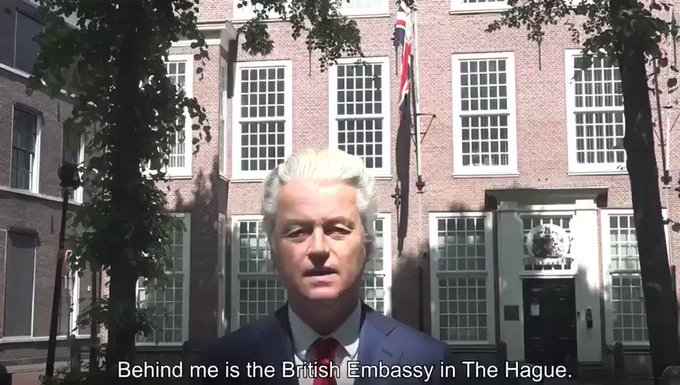
Geert Wilders
✔@geertwilderspvv
My statement in front of the British Embassy in The Hague today.
Free Tommy Robinson!
Restore Freedom Of Speech!#TommyRobinson #FreedomOfSpeech #FreeTommy

Wilders penned a letter to the Dutch Minister of Foreign Affairs over the weekend with five questions about Robinson’s situation.
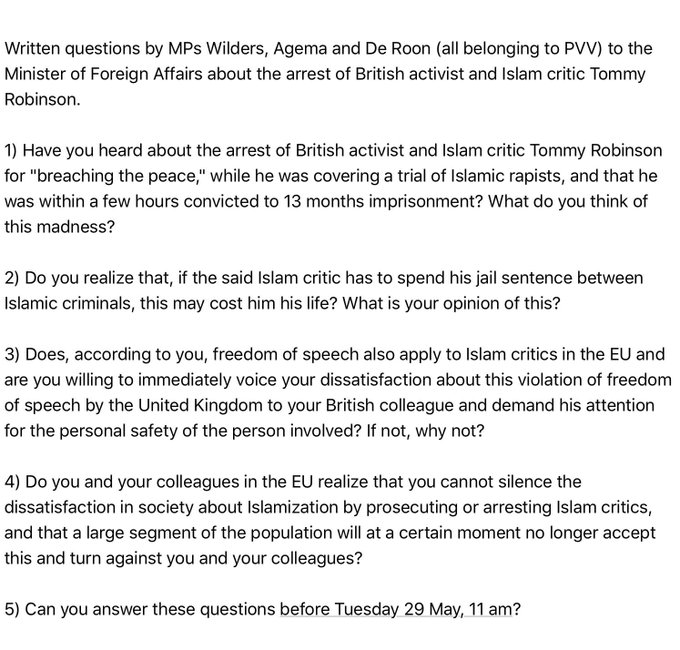
Geert Wilders
✔@geertwilderspvv
Parliamentary questions to the Dutch Minister of Foreign Affairs about the arrest and safety of Tommy Robinson.#TommyRobinson #FreeTommy #FreeSpeech
Robinson, 35, rose to fame as a conservative activist and founder of the English Defence League in Luton, Bedfordshire in 2009. After retiring from the party in 2013, Robinson has continued to advocate for British nationalism and against unchecked migration into Europe.
 END
ENDBELGIUM/TUESDAY
Attacker Shouted “Allahu Akbar” Before Killing 2 Cops, 1 Passerby In Liege, Belgium
Two police officers and a civilian were killed Tuesday during a shootout in the Belgian city of Liege, according to Sputnik.
According to a local TV station, an armed man shot the two police officers at the Cafe des Augustins on the Boulevard d’Avroy, located in the city center. He then fled and tried to take a housekeeper hostage at Waha High School. Police responding to the incident managed to subdue the gunman, but during the shooting, a passerby was also killed. Students were unarmed and did not come into contact with the gunman, who has since been “neutralized”.
Here’s what we know so far:
- 4 dead in total
- Multiple people injured
- Gunman opened fire at a Café in central Liége, Belgium
- Tried to take hostages
- At least two police officers killed
- At least one civilian killed
- Attacker yelled ‘Allahu Akbar’
- Gunman neutralized
According to another local media outlet, the shooter was in front of the high school when he was approached by the two police officers for a routine check. But instead of complying, he opened fire.
Blurry photos of the slain officers appeared on twitter

Shots can be heard in the background of videos circulating online.
BNL NEWS@BreakingNLiveBREAKING NEWS: Gunman opens fire at police officers in Liege, Belgium. At least two police officers killed, attacker has been shot.
DEVELOPING
More info soon…

BNL NEWS@BreakingNLiveBREAKING NEWS: At least 3 dead including 2 officers and 2 injured after a terrorist attack in Liege, Belgium. Terrorist neutralized. The perpetrator yelled ‘Allahu Akbar’ during his shooting rampage.
DEVELOPING

And another video…


Other photos circulating online showed first responders arriving at the scene. Witnesses said they heard many shots ring out during the shootout. Eventually, a security perimeter was established and ambulances dispatched to the scene.


Liege is located in eastern Belgium near the border with Germany.

Belgium’s anti-terror crisis center has been monitoring the situation, officials said. Liege was also the site of a 2011 shooting where a gunman killed four people before turning the gun on himself.
Belgium has been on high alert since a Brussels-based Islamic State cell helped carry out the Paris attacks in 2015 that killed 130 people at the Bataclan theater. Another attack in Brussels in 2016 left 32 dead. Today’s attack unfolded during Ramadan, the Islamic holy month.
END
5. RUSSIAN AND MIDDLE EASTERN AFFAIRS
Saturday
The crooked politician Erdogan is now urging fellow Turks to buy Lira and sell their foreign currency accounts. That would be very foolish
(courtesy zerohedge)
Erdogan Urges Turks To Stick With Collapsing Lira, Warns Financial Speculators “Will Pay A Heavy Price”
Since Recep Tayyip Erdogan’s election to Prime Minister of Turkey in 2002 (and even more so since his ‘election’ to President for life in 2014), the Turkish Lira has been on a one-way street to hyperinflation.
The ailing currency has lost over 20% of its value against the U.S. dollar this year as The FT points out that a volatile mix of electoral populism and a rising dollar have pushed the country to the brink of a currency crisis. At the helm is a leader obsessed with growth, who has long dismissed higher rates as a way to make “the rich richer and the poor poorer” and often feuded with the country’s central bank.

So when he doubled-down again this morning on his demands that the Turkish people to convert their dollar and euro savings into lira, Turks could be forgiven for being reluctant to do as they are told.
“My brothers who have dollars or euros under their pillow. Go and convert your money into lira. We will thwart this game together,” Erdogan said at a rally in the eastern city of Erzurum ahead of parliamentary and presidential elections on June 24.

This follows his demanding the same of them on Friday and comes after the Turkish Central Bank did what many expected it would do long ago: it hiked rates in an emergency meeting, pushing the Late Liquidity Windowrate higher by 3% to 16.5%, in a desperate attempt to prevent a currency crisis dragging Turkish bonds and the broader economy with it.

But the Turkish Central Bank (CBRT) faces trouble in all directions, as BlueLay EM strategist Timothy Ash, who slammed the rate hike decision as too late, explains: the credibility of Turkey’s central bank has been “shot to hell” and Turkey’s policymakers are “far behind the curve.”
Timothy Ash@tasheconOver the past month or so CBRT credibility has been shot to hell. Why has the CBRT now done this 3 times, 13/14, 15/16, ie got so far behind the curve. Never learns. May well need to hike on June 7 again depending if this calms the market in the interim. https://twitter.com/tashecon/status/999324951017656321 …

Ash also said that “It seems likely that the economy team and the central bank implored President Erdogan to give them the green light to hike rates.”
Which, of course, is the real problem here and the punchline, because recall that the most precipitous phase of the TRY selloff started one week ago, when on May 15 during a Bloomberg interview, Erdogan point blank said that he would “take responsibility for monetary policy”, effectively threatening to take over the position of central banker.
“Of course our central bank is independent,” Erdogan said.
“But the central bank can’t take this independence and set aside the signals given by the president, who’s the head of the executive. It will make its evaluations according to this, take its steps according to this. And I believe this will result in very beneficial steps in the future.”
“From the moment we move to a presidential governing system, our effectiveness there will be very different,” he warned. “We’re going to do this so we can be held accountable for the responsibility we’ve taken.”
And now Erdogan, in a speech in the country’s eastern Erzurum province, is continuing his attempted at verbal capital controls, just without the actual prison sentence (for now):
“I am asking my nation not to pay attention to rumors and to protect their currency.”
Erdogan says that Turkey will “soon deflate the exchange rate bubble.”
“We see the game that is being played and are confronting it with the tools at hand,” the president says; “we will spoil this game together.”
Bear in mind, as The FT notes, the chaos of recent weeks has unfolded ahead of make-or-break elections on June 24 for both the presidency and parliament. Victory could pave the way for Mr Erdogan to remain in power for years and would cement his dream of becoming the most important leader of modern Turkey since its founder, Mustafa Kemal Ataturk.
In fact, the origins of a dramatic week can be traced back to April 18, when Mr Erdogan caught his country by surprise with an announcement that he was pulling forward elections by almost a year and a half.Standing in front of a pair of blood red Turkish flags, the president declared that the turmoil in neighbouring Syria and Iraq meant the country needed to convert as quickly as possible to the new governance system that will come into force after the vote, which will abolish the role of prime minister and radically strengthen the next president’s powers.

Which means – implicitly – that Erdogan will do “whatever it takes” to get re-elected, which perhaps explains his threat to speculators that “if the finance sector plays games with Turkey’s investors and entrepreneurs, it will pay a heavy price.”
Phoenix Kalen, an emerging markets strategist at Société Générale, warns that without a change of direction from the political leadership, Turkey was likely to remain trapped in a “recurring nightmare”. She adds: “We believe that an opposition win of the executive presidency would spark a phenomenal rally in [the lira].”
Atilla Yesilada, an Istanbul-based analyst with the consultancy GlobalSource Partners, says the ruling party found itself in a trap.
“They have to feed the voters,” he says.
“But each step they take to feed the domestic audience spooks foreign investors.”
Despite the actions of the central banks and the threats, promises, and cujoling of Erdogan, the lira continued to weaken. On Tuesday, after a warning from the rating agency Fitch put more pressure on the currency, Turks began to share rumours of impending capital controls and rushed to buy gold, which has been doing what gold does… maintaining the wealth of those who hold it…

Tough to argue with a few thousand years of ‘being money’.
Turkish Lira Soars After Central Bank Changes Monetary Policy, But Reserves Emerge As Biggest Concern
After days of getting pounded, today the Turkish Lira is the world’s best performing currency (even as the Brazilian real is getting crushed over the ongoing Trucker strike while the oil-worker union is about to stop work too) after overnight the Turkish central bank announced it was revamping its interest rate corridor, allowing it to tighten liquidity.

The reason for the surge in the Lira, which was up 2.5% to 4.5985 per dollar as of 10:30am EDT, snapping two days of declines amid a nauseating rollercoaster of moves over the past week…

… is that starting June 1, it would return to the structure of rates it was operating in 2016 with the one-week repurchase rate being the benchmark policy rate and the overnight borrowing and lending rates setting the bounds of the standard interest rate corridor. Meanwhile, the current main policy rate, the late liquidity rate, will instead become again a rate used in exceptional circumstances when individual banks face a temporary liquidity short fall.
The TCMB set the one-week repo rate at 16.5% and therefore at the level of the current main policy rate, the late liquidity rate, which it hiked by 300bps last week. The overnight lending and borrowing rates will be set 150bp above and below the one week repo rate, in other words overnight lending rises from 9.25% to 18% while overnight borrowing jumps from 7.25% to 15%. In the statement, the TCMB also announced that the late liquidity rate will be set 150bp above the overnight lending rate, i.e. currently 19.5%.
As Bloomberg notes, “the absence of a single policy rate has long been criticized by investors who say it creates policy uncertainty.”
The use of a wide interest-rate corridor and multiple interest rates that began under Erdem Basci, Cetinkaya’s predecessor, allowed policy makers to adjust the cost of cash provided to commercial banks daily if they decided it was needed.
In kneejerk reaction to the implicit tightening and the attempt to stabilize the currency crisis, the yield on 10-year Turkish bonds plunged 53 basis points, the most since 2013, to 14.14%, while the Borsa Istanbul 100 Index climbed 3%, its biggest jump in more than a month.

Commenting on the move, SEB FX strategist Per Hammarlund said that “the selloff has tipped the balance in favor of increased central bank independence” adding that “a reversal of this stance and increasing political influence over monetary policy is unlikely in the coming months.”
In other words, Per is an optimist, and is convinced that Erdogan has learned his lesson to stay away from the central bank after last week’s crash. Spoiler alert: the fact that things are now somewhat stable will only embolden Erdogan to push even more to also dominate monetary policy.
That said, those who are happy at today’s developments will be able to indulge in even more Turkish exposure shortly: central bank governor Murat Cetinkaya and Deputy Prime Minister Mehmet Simsek are planning to meet with investors in London today (unclear why as it is a holiday) and tomorrow. Then again, even the most ardent Turkophiles may have had enough the “combination of a rising dollar, double-digit inflation, a widening budget deficit and Erdogan’s plan to have more say in monetary policy spurred a flight from lira assets” per Bloomberg.
Meanwhile, according to Hammerlund, “the real test of CBRT independence will come when the lira has strengthened, but inflation and inflation expectations remain high,” the FX strategist told Bloomberg. “For the time being though, the gains in the lira will be sustainable, putting 4.40 within striking distance against the dollar.”
Maybe not: according to GaveKal there is a far greater problem facing Turkey, namely the realization that its total reserves are woefully inadequate. Specifically, although total reserves at $135BN already fall well short of short term debt and current account obligations of $250BN, even this figure artificially inflated as roughly half of CenBank’s FX (ex-gold) consist of reserve positions posted in foreign currency by local banks at CBRT

In other words, as the inflationary feedback loop accelerates, and ends up draining even more reserves, Turkey will find itself in the untenable situation where only pushing its currency even weaker will stabilize the economy, which in turn will restart the currency crisis and potentially lead to far greater economic and political fallout.
In short: like it or not, Erdogan will soon be facing an acute social, political and economic crisis of his own inside Turkey.
end
ISRAEL
Israel launches an air strike on Gaza after a barrage of mortar shells are fired at Israel. Most were shot down by the Iron Dome defense shield but one struck a kindergarten school. Luckily the attack occurred 1 hr before the children were to attend school.
(courtesy zerohedge)
Israel Launches Air Strikes On Gaza After “Barrage Of Mortar Shells” Fired At Israel; Netanyahu Says Retaliation Imminent
With the financial crisis back front and center in Europe, Israel picked a good day to remind markets that geopolitics remains as much of a gaping risk factor as ever, and after Palestinian militants on Tuesday launched what Reuters described as their heaviest mortar bomb barrage against Israel since the 2014 Gaza war, Israeli aircraft retaliated striking more than 30 Gaza camps according to AFP.
More than 25 projectiles were launched from the Gaza Strip and Israel’s planes attacked three of the Iranian-backed armed group’s facilities. There were no immediate reports of casualties from either side, with Israel claiming that the Iron Dome anti-missile system intercepted the majority of the missiles, but one exploded in the yard of a kindergarten, damaging its walls, about an hour before it was scheduled to open for the day.
“The IDF is currently operating in the Gaza Strip. The explosions heard are related to this activity,” the Israeli forces said in a statement released on Twitter. “A barrage” of at least 28 mortar shells was launched towards several locations in Israel, according to the IDF.
IDF
✔@IDFSpokesperson
The IDF is currently operating in the Gaza Strip. The explosions heard are related to this activity. Details to follow

While there was no immediate claim of responsibility from any of the armed groups in Gaza which is controlled by the Islamist militant Hamas movement, the attack came after Islamic Jihad vowed to take revenge after three of its members were killed by Israeli tank shelling. Reuters cited local residents, saying that Israeli aircraft struck a position by the Islamic Jihad militant group in the Gaza Strip as a response to mortar shelling. Israeli military, however, declined to comment on the report.

Israeli Prime Minister Benjamin Netanyahu said the military would launch a forceful retaliation for the mortar attack, pointing the finger at Hamas and Islamic Jihad, which praised the barrage as a response to Israeli killings of Palestinians.
The air strikes occurred shortly after he spoke at a public event. Gaza residents identified the targets as Islamic Jihad training camps. The Israeli army said it was “carrying out activities in the Gaza Strip”, without elaborating.
Nickolay Mladenov, the U.N.’s special coordinator for the Middle East peace process, said he was deeply concerned by “the indiscriminate firing of rockets by Palestinian militants from Gaza towards communities in southern Israel”.
Calling for restraint by all parties, he said at least one of the mortar bombs “hit in the immediate vicinity of a kindergarten and could have killed or injured children”.
Violence has soared along the Gaza frontier in recent weeks during which 116 Palestinians were killed by Israeli fire at mass demonstrations for a right of return to ancestral lands now in Israel. Amid international condemnation for its use of lethal force at the mass demonstrations, Israel said many of the dead were militants and that the army was repelling attacks on the border fence. Palestinians and their supporters say most of the protesters were unarmed civilians and Israel was using excessive force against them.
6 .GLOBAL ISSUES
Norway: Salmon
Higher prices for Salmon are causing a supply side shock around the globe
(courtesy zeorhedge0
Supply-Side Shock: Norwegian Salmon Prices Are Going Wild
Norwegian salmon spot prices just tagged a historical high as faltering supply combines with increasing global demand. This has unleashed a perfect storm sending prices above a multi-year neckline of NOK 70 (€7.48/$8.66), and tagged fresh highs around NOK 80 (€8.40/$9.90) — however, this price surge is not sustainable and unlikely to last for long, a seafood analyst told IntraFish.

Norwegian salmon prices are going wild. (Source: Bloomberg)
Christian Olsen Nordby, a seafood analyst at Kepler Chevreux, describes the current price environment as “not sustainable at all and are way too high.”
Nordby said there are several reasons for the historical price shift. First, the market is being squeezed from the supply-side with cold sea temperatures restricting salmon growth, along with, the holiday season in Norway hitting the harvest. Meanwhile, there is strong demand from major markets in the Eurozone on contract prices, Nordby explained to IntraFish.
“Retail prices, which lag behind by about 10 weeks are still relatively low – which is triggering demand – but these are starting to pick up too,” he said. “Retail prices will pick up, typically resulting in lower demand.”
The seafood analyst believes that prices could be peaking in the near term, as more harvest is expected to hit the open market, as well as, Norway’s holiday season is now over. He said the industry is waiting for more supply to hit the market via the 2017 generation salmon stock.
“There is expected to be more supply in the 2017 generation as it has about 10 percent bigger biomass than the 2016 generation,” Nordby said.
“The price should slide down over the next few months, and I’m quite excited to see what will happen next week and the week after now we are done with the holidays,” Nordby explained.
Nordby could be right about his top call in the salmon market because overlaid with 2017 contracts spot prices — there appears to be weakening in price action into the second half of the year.

Fish Pool ASA is established as an international, regulated marketplace for buying and selling of financial salmon contracts. Contracts are either forwards or options. Clearing services are operated by our cooperative partner, Nasdaq OMX. All contracts are settled against the monthly Fish Pool Index (above). Compare your prices to FPI™ here and investigate Fish Pool Trading Calendar here. (Source: Fish Pool).
Nordby concluded the conversation with IntraFish by forecasting a substantial decline in prices by July/August. He estimates that price could drop to NOK 50 (€5.30/$6.20), or about -37 percent correction from current levels. Bear market ahead?

Kjetil Lye, a commercial fishing analyst at Handelsbanken Markets, also told IntraFish, he was expecting lower prices in the second half of the year.
“I think most people do including Fishpool’s forward prices,” he said. “We certainly expect them to come down from these extraordinary levels,” he added.
Lye’s reasoning behind extraordinarily high salmon prices is similar to Nordby’s thesis of a supply-side shock, coupled with heightened demand in Europe.
“For the short term, they are not sustainable in general for the industry and will have to come down. But with limited supply-side growth, the longer-term outlook for prices is excellent, although levels are too high at the moment,” Lye said.
As salmon prices probe new record highs – all thanks to supply-side shocks in Norway, this could be more bad news for the heavily indebted American consumer who for the first time, might not be able to afford Norweign salmon this summer during barbecue season. However, if the seafood analysts are correct, and a bear market does form in prices, then Americans could certainly put the Norweign salmon on their credit cards.
end
7. OIL ISSUES
Sunday
Not good for the west: Russian and NATO ally Turkey reach a deal on the “Southern Stream” gas pipeline which will run from the southern part of Russia, through the Black Sea, onto Istanbul and then onto Greece and the rest of Europe. The USA will not be happy with this
(courtesy zerohedge)
Russia And Turkey Reach Deal On “Southern Stream” Gas Pipeline, Infuriate Washington
One and a half years after Russia and Turkey signed a deal to build the strategic “Turkish Stream” gas pipeline in October 2016, putting an end to a highly contentious period in Russia-Turkish relation which in late 2015 hit rock bottom after the NATO-member state shot down a Russian jet over Syria, on Saturday Russian state energy giant Gazprom and the Turkish government reached a deal on the construction of the land-based part of the Turkish Stream branch that will bring Russian gas to European consumers.

According to Reuters, the two counterparts signed a protocol that would allow the construction, which was stalled by a legal rift over gas prices, to go forward. Gazprom and Turkey’s state-owned BOTAS agreed on the terms and conditions of the project, Gazprom said in a statement, adding that the deal “allows to move to practical steps for the implementation of the project.” The actual construction would be carried out by a joint venture called TurkAkim Gaz Tasima which will be owned by Gazprom and BOTAS in equal shares, Gazprom said.
Earlier on Saturday, Turkish president Erdogan said that Gazprom and BOTAS resolved a long-running legal dispute over import prices in 2015-2016, and as a result Turkey would gain $1 billion as part of the gas-price settlement reached with Gazprom, in which Turkey and the Russian natgas giant agreed on a 10.25% price discount for gas supplied by Russia in 2015 and 2016.
“We agreed on a 10.25% reduction in the price of natural gas in 2015-2016,” Erdogan announced while speaking at a rally on Saturday. “We got our discount. We get about $ 1 billion worth of our rights before the election,” the Turkish President said, as cited by Anadolu Agency.
BOTAS had refused to approve the building of the land-based part of the pipeline until the import price issue was resolved. Until now, it only permitted Gazprom to construct the undersea part of the line. The construction is currently underway.
Russia and Turkey officially agreed on the project, which consists of two branches, in October 2016. The first branch will deliver gas to Turkish consumers, while the second one will bring it to the countries in southern and south-western Europe. The European leg is expected to decrease Russia’s dependence on transit through Ukraine. Each of the lines has a maximum capacity of 15.75 billion cubic meters a year.
Gazprom finished the construction of the deep-water part of the first line of the Turkish Stream in April. The first Russian gas could start flowing through both legs of the Turkish Stream by December 2019.
The greenlighting of the Turkish Stream project is sure to infuriate the US which previously announced it was considering sanctions of European firms that would participate in the Nothern Stream Russian gas pipeline.

President Trump went as far as to threaten Angela Merkel two weeks ago, telling her to either drop the Russian gas pipeline or the trade war with the US was set to begin.
How Europe reacts to US threats involving the Northern Stream and, soon, the Turkish Stream, will determine whether Europe will once again find itself a subservient vassal state to US military and energy lobbying powers, or if Brussels will side with Putin in this growing conflict, resulting in an unprecedented breach within the so-called “democratic west.”
end
Crude tumbles
(courtesy zerohedge)
WTI Crude Futures Tumble, Test Critical Support
WTI Crude futures are down almost 10% from their highs last week (near $73), testing back to a $65 handle, breaking below critical support levels and testing the major uptrendline…
As Saudi Arabia and Russia signal they will restore some of the production they’ve curbed to drain a global glut, Bloomberg notes that the market awaits a meeting of OPEC and its partners in Vienna late June as extreme positioning starts to get unwound…

“Clearly, the commentary from Russia and Saudi Arabia popped the bubble,”said John Kilduff, a partner at Again Capital LLC, a New York-based hedge fund.
“There’s some legitimate skepticism about whether or not they will follow through. There is going to be nervousness right up until next month’s meeting.”
WTI broke below its 50DMA, is testing its 100DMA and is right at its 12-month up-trend-line…

Talk of rising output from the world’s top two oil exporters wiped out this month’s rally, which Bloomberg noted had been fueled by concerns that supplies from Iran and Venezuela will shrink.
“There’s some discord among the Gulf countries as to whether or not they should increase now or not,” Kilduff said. “There’s some cats to herd.”
Notably, WTI’s weakness is underperforming Brent which remains dominated by geopolitical risk – driving the WTI-Brent spread to over $9…

Its widest since March 2015.
There’s No Getting Around Iranian Sanctions
Authored by Irina Slav via OilPrice.com,
“I personally think none of us will be able to get around it,” Vitol’s chief executive Ian Taylor said last week, commenting on the effects that renewed U.S. sanctions against Iran will have on the oil industry.

The sanctions, to go into effect later in the year, have already started to bite. French Total, for one, announced earlier this month it will suspend all work on the South Pars gas field unless it receives a waiver from the U.S. Treasury Department—something rather unlikely to happen. The French company has a lot of business in the United States and cannot afford to lose its access to the U.S. financial system. So, unless the EU strikes back at Washington and somehow manages to snag a waiver for its largest oil company, Total will be pulling out of Iran.
Other supermajors have not dared enter the country, so there will be no other pullouts of producers, but related industries will be affected, too, in the absence of a strong EU reaction to the sanctions. For example, Boeing and Airbus will both have their licenses for doing business in Iran revoked, Treasury Secretary Steven Mnuchin said, which will cost them some US$40 billion—the combined value of contracts that the two aircraft makers had won in Iran.
Tanker owners are also taking the cautious approach. They are watching the situation closely, anticipating Europe’s move, but acknowledging that the reinstatement could have “significant ramifications” for the maritime transport industry, as per the International Group of PI & Clubs, which insures 90 percent of the global tanker fleet.
Everyone is waiting for Europe to make its move even as European companies in Iran are beginning to prepare their exit from the country. Everyone remembers the previous sanctions, apparently, and they don’t want to be caught off guard. But the signals from Europe are for now positive for these companies, of which there are more than a hundred.
Earlier this month, an adviser to French President Emmanuel Macron said that Europe’s response to the threat of U.S. sanctions on Iran will be “an important test of sovereignty.” Indeed, unlike the last time there were sanctions against Iran, the European Union did all it could to save the nuclear deal and has signaled it will continue to uphold it.
While some doubt there is a lot the EU can do against U.S. sanctions, there is one 1996 law dubbed a blocking statute that will ban European companies from complying with U.S. sanctions, which would put companies such as Total between a rock and a hard place.
European Commission President Jean-Claude Juncker said two weeks ago the commission will amend the statute to include the U.S. sanctions again Iran and that the amendments should be completed before the first round of sanctions kicks in in early August.
Many observers believe that if the sanctions are only limited to the U.S. and no other signatory to the nuclear deal joins them, the effect will be limited as well. As McKinsey analyst Elif Kutsal told Rigzone, “Market fundamentals are not expected to change structurally given that Iran doesn’t export crude oil or refined products to the U.S. and exports go mainly to Europe (20 percent) and Asia Pacific (80 percent). Therefore, if the sanctions are only limited to the United States, then this could cause short-term volatility in prices until a new/revised agreement framework is put in place.”
And this is where Iran’s Supreme Leader Ayatollah Ali Khamenei scored a goal: He demanded that the European Union provide guarantees it will continue to buy Iranian crude. If it doesn’t, he said, Iran will restart its nuclear program. Now, if this happens, the EU will not have much choice but to join the sanctions, and then hundreds of thousands of barrels of Iranian crude could be cut off from global markets.
However, even this will result in only a temporary decline in supplies, according to Kutsal, and others that believe that Asian imports from Iran will offset the effect from the U.S. sanctions. According to this camp, the only thing that can unleash the full effect of sanctions is the UN joining the sanction push against Iran.
8. EMERGING MARKET
Saturday/Brazil
A huge trucking strike which has entered it’s sixth day is crippling Brazil’s economy
(courtesy zerohedge)
Brazilian Military Deployed To Break Up Trucking Strike As State Of Emergency Worsens
A nationwide trucking strike in Brazil entered day six on Saturday, as blocked roads have prevented critical food and supplies from reaching their destinations.


The protests, triggered by a 50% spike in fuel prices over the last year, have resulted in the declaration of a state of emergency across most major cities as shelves run bare and fuel supplies dwindle. Airports have reported running out of fuel, hospitals are running out of supplies, and public transport and trash collection have been reduced or halted across the country. Some food prices have also spiked as supplies dwindle. As we noted on Friday, a lack of livestock feed threatens a billion chickens and 20 million pigs who may starve to death.

CNN International
✔@cnni
There’s a trucker strike in Brazil, and it’s impacting everything from air travel to chicken feed. @ShastaReports on Sao Paulo’s State of Emergency https://cnnmon.ie/2IK3BBz

Brazilian export group ABPA said that over 150 poultry and pork processing plants had indefinitely suspended production, while Brazil’s sugar industry – the world’s largest – is slowly halting cane harvest operations as their machines run out of fuel.


ScheilaSpaderGibson (=^・^=)@spaderGibson
How is our state? No gas, no food, welcome to the truckers strike in Brazil! Zero gasoline

Despite a Thursday agreement with the truckers and the Friday deployment of the military to physically unblock roads, the government has only reported a few blockades being lifted on major highways.


In an attempt to end the dispute, oil company Petrobas cut the price of diesel by 10% for two weeks – however all that did was scare investors. The truckers were not impressed, considering that they’ve been subject to fuel price increases of around 50% over the last year.
Petrobras shares plunged after the announcement and are down at least 20 percent this week, leading losses in the Ibovespa index, which has lost 4.3 percent in the period. That pushed the stock market’s monthly drop to 7.7 percent, one of the worst performers among major global benchmarks. –Bloomberg

The main entity representing truckers, ABCAM, said they haven’t changed their stance – and that they will call off protests only after federal diesel taxes are scrapped.
truckers say they want a definitive solution, saying they will end the protest only when a decision to eliminate federal diesel taxes is published in the official gazette.
Local TV showed footage of federal forces being deployed over the night to some critical areas to help police remove trucks from highways.
There were no reports of violence, but main roads remained blocked in the morning, including a key transport ring around Sao Paulo, the country’s largest city. –Yahoo
Brazil’s auto production, which constitutes around 25% of industrial output, also ground to a halt on Friday. Authorities say that even after the strike ends, it will take several days to replenish vital supplies.

Marina@MissCrazyCryptoNot only crypto is in crisis.
Meanwhile in Brazil…
Truck drivers’ strike paralyzes the country. Gas stations are out of gas, supermarkets are running low on food, so delivery services are going by horse to deliver stuff


end
Brazil’s trucker strike worsens as Petrobras workers are now planning a walkout as well
(zerohedge)
Brazil Trucker Strike Worsens As Petrobras Workers Plan Walkout
Brazil’s crippling trucker strike entered its eight day on Monday, affecting virtually all aspects of the country’s economy as vital resources have been unable to reach their destinations.

The protests, triggered by a 50% spike in fuel prices over the last year, resulted in the declaration of a state of emergency across most major cities as shelves run bare and vital supplies dwindle. Airports have reported running out of fuel, hospitals are running out of supplies, and public transport and trash collection have been reduced or halted across the country. Some food prices have also spiked as supplies dwindle. As we noted on Friday, a lack of livestock feed threatens a billion chickens and 20 million pigs who may starve to death.
Now, after deploying the military to physically unblock roads and several last-ditch measures to seek a resolution Sunday night, President Michel Temer has a new problem on his hands; Petrobras workers are about to go on strike starting May 30 – demanding that the company fire CEO Pedro Parente and permanently lower fuel prices. The company said on Friday that they have no plans to remove Parente.

Petrobas attempted to calm the striking truckers last week by lowering the price of diesel by 10% for two weeks, a move which did not impress the truckers. Shares of Petrobras have dropped 35% since May 16.

Minor progress in the strike was achieved over the weekend, as most of the nationwide roadblocks were at least partially opened, allowing passenger cars to pass freely. The governor of Brazil’s most populous state of Sao Paulo also negotiated a deal Saturday night with truckers’ representatives to remove the roadblocks until Tuesday, while also guaranteeing provisions for essential services.
Police escorts helped tanker trucks reach key fuel depots and gas stations after some people chose to sleep in their cars, sometimes waiting more than 12 hours in line for fuel. While delivery of essential medical supplies is improving, supermarkets still face shortages of perishables such as fruit, vegetables and eggs. The meat producers association ABPA said poultry growers have lost 64 million chickens. Brazil is the world’s largest poultry exporter. -Bloomberg
That said, the road openings and delivery of vital supplies appear to be nothing more than band-aids, which include a Sunday night cut in the price of diesel.
Mr Temer said the diesel price cut would be valid for two months, after which there would be price adjustments only every month rather than on a daily basis. “This way the truck driver can better plan his costs and the value of his freight,” the president said. –FT
Throughout this week, my government has always been open to dialogue,” said President Temer during a brief announcement on national television, conceding a cut of R$0.46 per litre, or an average of about 12 per cent.

Meanwhile, one billion chickens and 20 million pigs continue to be at risk of starvation, as feed supplies are still unable to reach farms according to Brazilian export group ABPA. A leader from ABPA reportedly met with the Temer administration late Sunday, according to Bloomberg.
ABPA said that over 150 poultry and pork processing plants had indefinitely suspended production, while Brazil’s sugar industry – the world’s largest – is slowly halting cane harvest operations as their machines run out of fuel.
The drivers, many of them owners of their own vehicles, have organised themselves through WhatsApp groups and social media and are fiercely opposed to a government they see as corrupt and rapacious. Many of them are calling for a military “intervention” or coup to take over the government.
“This revolt by the truckers is the embryo of a tax rebellion,” said Brazilian economist Eduardo Giannetti, who is also an advisor to one of the candidates in Brazil’s October elections, environmentalist Marina Silva. Speaking in an interview with Folha de S.Paulo newspaper, he said like the American Revolution, tax rebellions began when “the population no longer accepts the legitimacy of the government to tax it”. –FT
Other measures offered by the Temer government to ease the situation include special concessions at toll booths, legislation to establish minimum freight pricing and a guaranteed share of government-contracted commodity deliveries.
end
Your early morning currency/gold and silver pricing/Asian and European bourse movements/ and interest rate settings TUESDAY morning 7:00 am
Euro/USA 1.1549 DOWN .0078/ REACTING TO MERKEL’S FAILED COALITION/ SPAIN VS CATALONIA/REACTING TO +GERMAN ELECTION WHERE ALT RIGHT PARTY ENTERS THE BUNDESTAG/ huge Deutsche bank problems + USA election:///ITALIAN CHAOS /AND NOW ECB TAPERING BOND PURCHASES/JAPAN TAPERING BOND PURCHASES /USA RISING INTEREST RATES /FLOODING/EUROPE BOURSES DEEPLY IN THE RED
USA/JAPAN YEN 108.84 DOWN 0.556 (Abe’s new negative interest rate (NIRP), a total DISASTER/SIGNALS U TURN WITH INCREASED NEGATIVITY IN NIRP/JAPAN OUT OF WEAPONS TO FIGHT ECONOMIC DISASTER/
GBP/USA 1.3248 DOWN 0.0062 (Brexit March 29/ 2017/ARTICLE 50 SIGNED/BREXIT FEES WILL BE CAPPED
USA/CAN 1.3038 UP .0046 (CANADA WORRIED ABOUT TRADE WITH THE USA WITH TRUMP ELECTION/ITALIAN EXIT AND GREXIT FROM EU/(TRUMP INITIATES LUMBER TARIFFS ON CANADA/CANADA HAS A HUGE HOUSEHOLD DEBT/GDP PROBLEM)
Early THIS TUESDAY morning in Europe, the Euro FELL by 78 basis points, trading now ABOVE the important 1.08 level FALLING to 1.1549; / Last night Shanghai composite CLOSED DOWN 14.62 POINTS OR 0.47% /Hang Sang CLOSED DOWN 307,68 POINTS OR 1.06% /AUSTRALIA CLOSED UP .13% / EUROPEAN BOURSES ALL DEEPLY IN THE RED/
The NIKKEI: this TUESDAY morning CLOSED DOWN 122.66 OR 0.55%
Trading from Europe and Asia
1/EUROPE OPENED ALL RED
2/ CHINESE BOURSES / :Hang Sang CLOSED DOWN 307.68 POINTS OR 1.06% / SHANGHAI CLOSED DOWN 14.62 POINTS OR 0.47% /
Australia BOURSE CLOSED UP .13%
Nikkei (Japan) CLOSED DOWN 122.62 POINTS OR 0.55%
INDIA’S SENSEX IN THE RED
Gold very early morning trading: 1304.30
silver:$16.46
Early FRIDAY morning USA 10 year bond yield: 2.85% !!! DOWN 11 IN POINTS from FRIDAY night in basis points and it is trading WELL ABOVE resistance at 2.27-2.32%. (POLICY FED ERROR)/
The 30 yr bond yield 3.02 DOWN 8 IN BASIS POINTS from FRIDAY night. (POLICY FED ERROR)/
USA dollar index early TUESDAY morning: 94.87 UP 45 CENT(S) from FRIDAY’s close.
This ends early morning numbers TUESDAY MORNING
xxxxxxxxxxxxxxxxxxxxxxxxxxxxxxxxxxxxxxxxxxxxxxxxxxxxxxxxxxxxxxxxxxxxxxxxxxxxxxxxxxxxxxxxxxxxxxxxxxxxxxxxxxxxxxx
And now your closing TUESDAY NUMBERS \1: 00 PM
Portuguese 10 year bond yield: 2.19% UP 24 in basis point(s) yield from FRIDAY/
JAPANESE BOND YIELD: +.0.34% DOW 6/10 in basis points yield from FRIDAY/JAPAN losing control of its yield curve/
SPANISH 10 YR BOND YIELD: 1.621% UP 16 IN basis point yield from FRIDAY/
ITALIAN 10 YR BOND YIELD: 3.164 UP 70 POINTS in basis point yield from FRIDAY/
the Italian 10 yr bond yield is trading 144 points HIGHER than Spain.
GERMAN 10 YR BOND YIELD: FALLS TO +.26% IN BASIS POINTS ON THE DAY
END
xxxxxxxxxxxxxxxxxxxxxxxxxxxxxxxxxxxxxxxxxxxxxxxxxxxxxxxxxxxxxxxxxxxxxxxxxxxxxxxxxxxxxxxxxxxxxxxxxxxxxxxxxxxxxxxxxxxxxxxxxxxxxxxxxxxxx
IMPORTANT CURRENCY CLOSES FOR TUESDAY
Closing currency crosses for TUESDAY night/USA DOLLAR INDEX/USA 10 YR BOND YIELD/1:00 PM
Euro/USA 1.1559 DOWN .0067(Euro DOWN 67 Basis points/ represents to DRAGHI A COMPLETE POLICY FAILURE/
USA/Japan: 108.65 UP 0.739 Yen DOWN 74 basis points/
Great Britain/USA 1.3256 DOWN .0057( POUND DOWN 57 BASIS POINTS)
USA/Canada 1.3023 UP .0031 Canadian dollar DOWN313 Basis points AS OIL FELL TO $66.04
xxxxxxxxxxxxxxxxxxxxxxxxxxxxxxxxxxxxxxxxxxxxxxxxxxxxxxxxxxxxxxxxxxxxxxxxxxxxxxxx
This afternoon, the Euro was DOWN 67 to trade at 1.1559
The Yen ROSE to 108.650 for a gain of 74 Basis points as NIRP is STILL a big failure for the Japanese central bank/HELICOPTER MONEY IS NOW DELAYED/BANK OF JAPAN NOW WORRIED AS AS THEY ARE RUNNING OUT OF BONDS TO BUY AS BOND YIELDS RISE
The POUND LOST BY 57 basis points, trading at 1.2356/
The Canadian dollar FELL by 31 basis points to 1.3023/ WITH WTI OIL FALLING TO : $66.04
The USA/Yuan closed AT 6.4170
the 10 yr Japanese bond yield closed at +.034% DOWN 6/10 IN BASIS POINTS / yield/
Your closing 10 yr USA bond yield DOWN 16 IN basis points from FRIDAY at 2.806 % //trading well ABOVE the resistance level of 2.27-2.32%) very problematic USA 30 yr bond yield: 2,994 DOWN 10 in basis points on the day /
THE RISE IN BOTH THE 10 YR AND THE 30 YR ARE VERY PROBLEMATIC FOR VALUATIONS
Your closing USA dollar index, 94.79 UP 37 CENT(S) ON THE DAY/1.00 PM/
Your closing bourses for Europe and the Dow along with the USA dollar index closing and interest rates for TUESDAY: 1:00 PM PM
London: CLOSED DOWN 97.64 POINTS OR 1.26%
German Dax :CLOSED DOWN 196.95 OR 1.53%
Paris Cac CLOSED DOWN 70.87 POINTS OR 1.29%
Spain IBEX CLOSED DOWN 243.10 POINTS OR 2.49%
Italian MIB: CLOSED DOWN 581.0 POINTS OR 2,65%
The Dow closed DOWN 5391.64POINTS OR 1.58%
NASDAQ closed DOWN 37.26 OR .50% 4.00 PM EST
WTI Oil price; 66.04 1:00 pm;
Brent Oil: 74.77 1:00 EST
USA /RUSSIAN ROUBLE CROSS: 62.73 UP 40/100 ROUBLES/DOLLAR (ROUBLE LOWER BY 40 BASIS PTS)
TODAY THE GERMAN YIELD FALLS TO +.26% FOR THE 10 YR BOND 1.00 PM EST EST
END
This ends the stock indices, oil price, currency crosses and interest rate closes for today 4:30 PM
Closing Price for Oil, 4:30 pm/and 10 year USA interest rate:
WTI CRUDE OIL PRICE 4:30 PM:$66.81
BRENT: $75.36
USA 10 YR BOND YIELD: 2.78% the dropping yields signify markets are in turmoil
USA 30 YR BOND YIELD: 2.98%/
EURO/USA DOLLAR CROSS: 1.1536 DOWN .0090 (DOWN 90 BASIS POINTS)
USA/JAPANESE YEN:108.64 DOWN 0.767 YEN UP 77 BASIS POINTS/ .
USA DOLLAR INDEX: 94.86 UP 44 cent(s)/dangerous as the HIGHER dollar IS DESTROYING THE EMERGING MARKETS.
The British pound at 5 pm: Great Britain Pound/USA: 1.3252 DOWN 0.0060 (FROM FRIDAY NIGHT DOWN 60 POINTS)
Canadian dollar: 1.3011 DOWN 19 BASIS pts
German 10 yr bond yield at 5 pm: +26%
VOLATILITY INDEX: 17.02 CLOSED UP 3.80
LIBOR 3 MONTH DURATION: 2.318% .
And now your more important USA stories which will influence the price of gold/silver
TRADING IN GRAPH FORM FOR THE DAY
Euro Crisis Returns With A Bang: Stocks Crash In
Frenzied Liquidation Panic
And there it went…
To summarize:
- Italian 2Y Yield biggest spike ever
- Italian risk curve inverted
- Italian ‘redenomination risk’ record high
- Spanish 2Y bond yields spike to 2Y highs
- Spanish ‘redenomination risk’ record high
- EU banks crash 11% in last 4 days to 18-month lows
- US banks plunge 4% to 6-month lows
- VIX back above 200DMA
- US 5Y Treasury yields plunges over 18bps – most since March 2009
- US 30Y Yield back below 3.00% – lowest in 7 weeks
- Dollar Index spiked to 6-month highs
Italian capital markets collapsed today.

The risk curve inverted…

Meanwhile, if you’re interested in some insane speculation – how about the 5x-levered inverse BTP ETF…

European Banks contagion…

Italian banks are in freefall…

Deutsche Bank closed with a single-digit share price for the first time since it asked for a bailout from the German government…

The biggest US banks are under severe pressure today with Goldman now down 18% from the March peaks…

This is Goldman Sachs’ and Citi’s worst start to a year since 2011.

Bank weakness weighed on The Dow (down 2% at the lows) but all major US equity indices suffered…
Did we get a visit from the Plunge Protection Team into the US close today?

Nasdaq futures were excited yesterday but gave all that back today…

The Dow is back in the red for 2018 and S&P back to almost unchanged…

S&P tumbled through its 100DMA and tested its 50DMA…

Dow broke below its 100DMA and 50DMA…

VIX broke above its 200DMA…

FANG stocks closed at the lows of the day but it was not a bloodbath there…

Credit markets were crushed today…

Treasury yields plunged back to stocks post-Feb crisis…

Investor panic-bid Treasury bonds today – sending yields down 13-18bps across the curve…

This was the biggest daily collapse in 5Y yields since Brexit.

30Y Yield is back below 3.00% to its lowest level in almost 4 months…

Once again the 3.20% range marked significant resistance…

We wonder what this chart of record short aggregate Treasury speculative positioning will look like next week…

The Dollar extended yesterday’s gains as EUR tumbled further… The Dollar is now at 6-month highs.

EURUSD plunged…

Cryptos were bid today as Europe fell apart, ramping Bitcoin back to unchanged from Friday’s close…

Despite the dollar strength of the last two days, gold clung to unchanged since Friday, even as crude crumbled…

Oil prices tumbled further today…

Finally, we note that the odds of The Fed hiking rates 3 more times in 2018 have collapsed…

Bonus Chart: Elon is having a bad day as TSLA Bonds collapse to a record low close…

END
USA DATA
Seems that inflation is targeting home prices as they are rising at the fastest pace in 4 years and now at a record high
(courtesy Case Shiller/zerohedge)
Case-Shiller Home Prices Rise At Fastest Pace In
4 Years To New Record High
Thanks to a modest downward revision in February’s print, March’s Case-Shiller 20-City Composite Home Price Index rose at 6.79% YoY – the fastest price appreciation since June 2014.

Surpassing July 2006’s record high…

Broadening out from the 20-City composite, the national home-price gauge climbed 6.5% YoY, matching February’s YoY advance that was the biggest since May 2014.
Of course, since March, interest rates have spiked and along with them mortgage rates, plunging mortgage apps, and as property-price appreciation continues to outpace worker pay (by 3.8 times!), it is proving a disadvantage for younger or first-time buyers even as it means rising homeowner equity for others.
“Months-supply, which combines inventory levels and sales, is currently at 3.8 months, lower than the levels of the 1990s, before the housing boom and bust,” David Blitzer, chairman of the S&P index committee, said in a statement.
“Until inventories increase faster than sales, or the economy slows significantly, home prices are likely to continue rising.”
All 20 cities in the index showed year-over-year gains, led by a 13 percent increase in Seattle, a 12.4 percent advance in Las Vegas and 11.3 percent pickup in San Francisco.
A favourite of everybody: Michael Snyder
Michael Snyder…
12 Indications That The Next Major Global Economic Crisis Could Be Just Around The Corner
Authored by Michael Snyder via The Economic Collapse blog,
There have not been so many trouble signs for the global economy in a very long time. Analysts are sounding the alarm about junk bond defaults, the smart money is getting out of stocks at an astounding rate, mortgage rates are absolutely skyrocketing, and Europe is already facing a full blown financial meltdown.

Of course expectations that another global economic crisis will happen among the general population are probably at an all-time low right now, but the reality of the matter is that we are probably closer to a new one erupting than at any point since the last one in 2008.
Since the last financial crisis our long-term debt problems have just continued to grow, and there are many that believe that the next crisis will actually be far worse than what we experienced ten years ago.
So how bad are things at this moment?
The following are 12 indications that the next major global economic crisis could be just around the corner…
#1 The “smart money” is getting out of stocks at a rate that we haven’t seen since just before the financial crisis of 2008.
#2 Moody’s is warning that a “particularly large wave” of junk bond defaults is coming. And as I have written about so many times before, junk bonds are often an early warning indicator for a major financial crisis.
#3 According to the FDIC, a closely watched category known as “assets of problem banks” more than tripled during the first quarter of 2018. What that means is that some really big banks are now officially in “problem” territory.
#4 U.S. Treasury bonds are having the worst start to a year since the Great Depression.
#5 Mortgage interest rates just hit a 7 year high, and they have been rising at the fastest pace in nearly 50 years. This is going to be absolutely crippling for the real estate and housing industries.
#6 Retail industry debt defaults have hit a record high in 2018.
#7 We are on pace for the worst year for retail store closings ever.
#8 The two largest economies on the entire globe are on the verge of starting an international trade war.
#9 The 9th largest economy in the world, Italy, is in the midst of yet another financial meltdown. In fact, this one appears to be the worst yet, and there are fears that it could spread to other areas of the eurozone.
#10 Italian banking stocks crashed really hard this week.
#11 Italian two year bond yields are the highest that they have been since the crisis of 2014.
#12 German banking giant Deutsche Bank just announced that it will be cutting another 7,000 jobs as it “seeks to turn the page on years of losses”. Those of you that have followed my work for a long time know that I have written extensively about Deutsche Bank, and it really is amazing that it has survived for this long. If Deutsche Bank fails in 2018, it will essentially be a “Lehman Brothers moment” for the entire planet.
The mainstream media in the United States almost entirely ignores Europe, but I believe that what is going on over there is the key right now.
Italy is a financial basket case, and Europe isn’t going to be able to handle a complete and total Italian financial collapse. If you will remember, Europe could barely handle what happened in Greece, and the Italian economy is many times the size of Greece.
The can has been kicked down the road several times before on the Italian crisis, but now we are getting to the point where it simply won’t be able to be kicked down the road any further.
And once things start unraveling over in Europe, we will be deeply affected in the United States as well. The global financial system is more interconnected than ever before, and at this point we are even more vulnerable than we were just prior to the crisis of 2008.
When this thing breaks loose, it won’t matter who is in the White House, who is in Congress or who is running the Federal Reserve.
When this bubble bursts there is nothing that anyone will be able to do to stop it.
Global central banks have been able to buy a few extra years of time by engaging in unprecedented levels of intervention, but now they are almost out of ammunition and events are beginning to escalate at a very frightening pace.
We shall see if they can pull another rabbit out of a hat in 2018, but I wouldn’t count on it…
end
All USA banks tumble after JPMorgan warns that 2nd quarter revenue is so far very disappointing;
(courtesy zerohedge)
Banks Tumble After JPM Warns On Q2 Revenue
One quarter after banks enjoyed a record boost to their equity/derivative trading revenue from the February 5 “volocaust“, things are looking far more grim for Q2. Consider that one year after on May 31, 2017 JPM made the following warning:
- JPMORGAN 2Q MARKET REVENUE HAS BEEN DOWN ABOUT 15 PERCENT FROM YEAR EARLIER, CFO SAYS
This morning JPM had news that were almost as unpleasant, when investment bank chief Daniel Pinto said that second-quarter markets revenue would be flat compared with a year earlier…
- JPMORGAN MARKETS REV WILL BE `FLAT’ Y/Y, PINTO SAYS
… and by implication, also 15% down from 2016.
Furthermore, speaking on Tuesday at an investor conference, Pinto said that the drag of several one-off items is reducing the benefit of “mid-single digit” percentage improvements in core trading business, such as in rates, credit, and equities. In other words, the bank is set for another overall revenue decline, which the collapse in NIM virtually assures that interest income will be another fiasco.
And while markets already had their hands full with negative news out of Italy, US banks extended losses after the JPM warning with most big bank shares extending losses, sliding between down ~3-5 pct, and the S&P Financial sector tumbling to the lowest in almost a month.

And while it may get far worse before it gets better, especially if the political chaos in Italy continues, both Goldman and Citi are already suffering from the worst start to a year since 2011.
SWAMP STORIES
Carter Page and Caputo speak pout on how the FBI have ruined both of their lives
(courtesy zerohedge)
Carter Page Speaks Out: This Is How The FBI
Ruined My Life
Former Trump campaign adviser Carter Page claims that the FBI has ruined his life – telling the New York Post that “the crimes that have already been committed against President Trump, myself and the entire Trump movement are much worse” than Watergate.

Page details how “Spygate” cost him his business, his income and even his girlfriend.
Page tells The Post that during the media barrage he faced in late 2016, he visited his girlfriend at her London flat, where she was “freaking out with the fake news about me.” –New York Post
“Talking with her later in the evening after dinner, she told me that she didn’t want me staying there anymore, and that our relationship was over… So late that night I booked a last-minute hotel reservation as part of this early chapter of the redefinition of my life.”
Donald J. Trump
✔@realDonaldTrump
Who’s going to give back the young and beautiful lives (and others) that have been devastated and destroyed by the phony Russia Collusion Witch Hunt? They journeyed down to Washington, D.C., with stars in their eyes and wanting to help our nation…They went back home in tatters!
Page says he thinks that Stefan Halper – the longtime CIA and FBI operative used by the latter agency to infiltrate and spy on the Trump campaign, was secretly spying on him in a “politically motivated” sting that involved Halper using “fake sympathy to gain his trust – all while fishing for dirt on Page’s ties to Russia, where he’d worked as an energy consultant,” according to Paul Sperry of The Post.
“I wouldn’t be surprised if it turned out to be a trap,” Page said.
Halper contacted Page in early July 2016, weeks before the FBI claims it first opened an investigation into the Trump campaign’s ties to Russia.
The timing is significant because if Halper was being used as an informant before a case had been officially opened, it raises the possibility the Trump campaign was spied on for political — not law enforcement — reasons. –New York Post
Page agrees with President Trump’s characterization of the scandal as “Spygate,” saying “It is particularly appropriate given recent developments.”
As covered extensively by Chuck Ross of the Daily Caller, Halper reached out to two other Trump campaign aides – George Papadopoulos and Sam Clovis, while also reportedly informing on former national security adviser Gen. Michael Flynn.
Halper’s surveillance of Page, which lasted over 14 months and extended into 2017, coincided with a lucrative series of contracts from the Department of Defense for “research” projects. Halper earned over $400,000 for a period beginning September 26, 2016 – however he was paid over $1 million from contracts awarded by the Obama administration going back to 2012.
While surveilling Page (which ostensibly contributed to the FISA warrant issued on the former Trump aide), Halper portrayed himself as someone who simply wanted to help the Trump campaign, according to Page.
While under surveillance, Page says that Halper “portrayed himself as someone offering help,” who would provide “insights and perspectives” on foreign policy matters – his area of expertise as a Cambridge professor who served several U.S. administrations from Nixon to Bush Sr.
Page recalled the professor “expressed sympathy about what I had been put through with the defamation and smear campaign led by the DNC and the Clinton campaign,” which underwrote the dossier claiming Page conspired with the Kremlin to swing the election for Trump.
For instance, Halper penned a July 28, 2017 “Dear Carter” e-mail, assuaging him that new White House controversies may have taken pressure off him.
“I must assume this gives you some relief,” Halper wrote, adding that it “would be great to catch up.” Halper signed the note, “Stef.” –New York Post

Carter Page, Ph.D.@carterwpageReporters keep asking me about my interactions with Prof. Halper.
I found all our interactions to be cordial.
Like this email I received about a year after I first met him.
He never seemed suspicious.
Just a few scholars exchanging ideas.
He had interests in policy, and politics.

On Saturday, President Trump railed against Democrats, tweeting that they had planted spies “all over my campaign.”
Donald J. Trump
✔@realDonaldTrump
With Spies, or “Informants” as the Democrats like to call them because it sounds less sinister (but it’s not), all over my campaign, even from a very early date, why didn’t the crooked highest levels of the FBI or “Justice” contact me to tell me of the phony Russia problem?
Page isn’t the first person in Trump’s orbit to have suffered as a result of the Russia investigation. In early May, former Trump campaign aide and Republican consultant Michael Caputo lashed out – telling the Senate Intelligence Committee “God damn you to hell,” telling the panel that their investigation “forced” his family out of their home, leaving his children “crushed” over the mounting legal costs due to the inquiry.

“Today, I can’t possibly pay the attendant legal costs and live near my aging father, raising my kids where I grew up,” Caputo said. “Your investigation and others into the allegations of Trump campaign collusion with Russia are costing my family a great deal of money — more than $125,000 — and making a visceral impact on my children.”
Caputo noted that Senate Intelligence Committee members are working together and contributing to the “swamp,” pointing to the fact that a former Senate Intelligence staffer to Sen. Dianne Feinstein (D-CA) – Daniel Jones, was one of two sources in a recent McClatchy report about Michael Cohen, Trump’s personal attorney whose office, home and hotel room were raided last month at special counsel Robert Mueller’s request.

“But who is McClatchy’s second source? It couldn’t be Dan; he was the first source … So who could it be — perhaps one of his former Senate Intelligence colleagues? I mean, you’re all in this together. You’re the swamp.”
Jones, a former FBI investigator who was previously one of Feinstein’s top aides, is conducting an ongoing, private investigation into Trump-Russia claims using $50 million supplied by George Soros and a group of 7-10 wealthy donorsfrom California and New York. Jones is working with opposition research firm Fusion GPS – and Christopher Steele, the former UK spy Fusion commissioned to create the infamous “Steele Dossier” which former Deputy FBI Director Andrew McCabe said was instrumental to the Trump-Russia investigation.
Caputo called for an “investigation of the investigators,” demanding to know who was “coordinating this attack on President Donald Trump.”
“Forget about all the death threats against my family. I want to know who cost us so much money, who crushed our kids, who forced us out of our home, all because you lost an election,” Caputo said. “I want to know because God damn you to hell.”
Meanwhile, many believe that former National Security Advisor Michael Flynn – who FBI agents Peter Strzok and Joe Pientka didn’t think lied – pleaded guilty in order to avoid sure financial ruin trying to fight the Special Counsel. Others say Flynn was protecting his son, Michael Flynn Jr., who served as his father’s aide for his consulting company, Flynn Intel Group.
In a letter sent two weeks ago to Deputy Attorney General Rod Rosenstein and FBI Director Christopher Wray, Grassley gets straight to the point – going after former FBI Director Comey’s blatant contradiction between what he told two Congressional committees – which was that the FBI agents who interviewed Lt. Gen. Michael Flynn “saw nothing that led them to believe [he] was lying.”
Avenatti Frustrates Federal Prosecutors In Cohen Case After Trying To Gag Stormy’s Ex-Lawyer
Michael Avenatti has been frustrating federal prosecutors in their attempts to obtain information related to a $130,000 October 2016 payment made by President Trump’s personal attorney Michael Cohen to adult-film star Stephanie Clifford, also known as Stormy Daniels, who Avenatti represents.

Citing people familiar with the matter, the Wall Street Journal says that Avenatti has “slowed prosecutors’ efforts” to speak with Clifford’s former attorney to discuss a nondisclosure agreement over an alleged 2006 sexual encounter between Clifford and Trump.
Ms. Clifford has recently said she agreed to the $130,000 deal with Mr. Cohen in 2016 not for the money, but because she feared for her family’s safety. That fear, she said, was based on a threat she received from an unidentified man who told her to “leave Trump alone” when a magazine nearly published her story several years earlier.
…
But in the communications sought by prosecutors, Ms. Clifford didn’t mention being threatened or fearing for her safety before making the deal with Mr. Cohen, according to people familiar with the situation. Rather, she was trying actively to sell her story to various outlets, these people say.
Mr. Avenatti called that account “patently false,” and said Ms. Clifford spoke of the threat to many people before executing the hush agreement. –WSJ
Michael Cohen is currently under criminal investigation over potential fraud and campaign-finance violations related to the payment of Clifford. On April 9 his home, office and hotel suite were raided by federal prosecutors at the request of special counsel Robert Mueller. Cohen has denied any wrongdoing and has not been charged with any crimes, while President Trump has denied having sex with Clifford.

Mr. Avenatti hasn’t yet acted on multiple requests from federal prosecutors in Manhattan for Ms. Clifford to waive the attorney-client privilege that prevents her former lawyer from discussing their communications about the nondisclosure deal, the people familiar with the matter said. In April, Mr. Avenatti, acting in his capacity as Ms. Clifford’s current lawyer, sent a cease-and-desist letter to her former lawyer, Keith Davidson, ordering him not to disclose any communications related to her, one of those people said.
Mr. Avenatti made similar demands of Ms. Clifford’s former manager, Gina Rodriguez, who helped engineer the hush-money deal. Mr. Avenatti tried to block Ms. Rodriguez from providing her communications with Ms. Clifford to federal prosecutors until he had reviewed them, other people familiar with the matter said. –WSJ
Federal prosecutors believe Avenatti has been stringing them along after telling them he is trying to get Clifford to waive her attorney-client privilege, according to the people familiar with the matter. While the delays aren’t seen as highly damaging to their investigation, they have reportedly grown frustrated.
Avenatti said on Monday that he and Clifford have “cooperated fully” with government prosecutors, and that they are still “ironing out the details” over reviewing documents he has sought from Davidson, along with whether to waive privilege.
“We have already started producing documents to the government so any suggestion we are not cooperating is meritless,” Mr. Avenatti said.
He also accused Stormy’s former lawyer of “conspiring behind her back with Mr. Cohen,” which Keith Davidson denies.
As Ms. Clifford’s former lawyer, Mr. Davidson has information that could be important to the investigation, because he spoke to Mr. Cohen extensively while negotiating the nondisclosure agreement during Mr. Trump’s campaign.
Ms. Rodriguez also worked closely with Ms. Clifford on the deal. Through her lawyer, she has turned over to prosecutors her text messages and emails with Ms. Clifford since 2016 in response to a subpoena, over Mr. Avenatti’s objections, other people said. -WSJ
Avenatti said in an emailed statement to the Journal that Rodriguez’s communications with Clifford are covered by attorney-client privilege because she was acting as a go-between for Clifford and Davidson. He also said that he had a right to review the documents and would sue Rodriguez if she would not provide them for review.
“We never told her not to provide documents to the government nor did we tell her not to cooperate,” Mr. Avenatti said.
Law professor Steven Lubet of Northwestern Pritzker School of Law told the Journal that Rodriguez’s communications with Clifford would only be protected if they were to convey legal advice from, or giving direction to, Davidson.
Avenatti also denies threatening Rodriguez to enforce at 2016 nondisclosure agreement between the manager and Clifford which prevents the former manager from speaking publicly about her work with the former porn star. “That never happened. Period,” he said.
Given his history of threatening journalists over unfavorable coverage, and his wife’s court testimony that he’s “emotionally abusive,” one has to wonder what Avenatti will say next.
I WOULD LIKE TO WISH ALL OUR AMERICAN FRIENDS A SAFE MEMORIAL WEEKEND
HARVEY


 harveyorganblog.com


