
GOLD: $1386.10 DOWN $24.70 (COMEX TO COMEX CLOSING)
Silver: $15,16 DOWN 16 CENTS (COMEX TO COMEX CLOSING)//
Closing access prices:
Gold : $1383.50
silver: $15.14
This is a holiday week with many taking off as July 4 in the USA is their independence day. As always, this is an excuse for the crooks to raid as many are away. The fun will begin on Monday July 8.
YOUR DATA…
JPMorgan has been receiving gold with reckless abandon and sometimes supplying (stopping)
today RECEIVING 84/193
EXCHANGE: COMEX
CONTRACT: JULY 2019 COMEX 100 GOLD FUTURES
SETTLEMENT: 1,409.700000000 USD
INTENT DATE: 06/28/2019 DELIVERY DATE: 07/02/2019
FIRM ORG FIRM NAME ISSUED STOPPED
____________________________________________________________________________________________
167 H MAREX 6
624 C BOFA SECURITIES 3
657 C MORGAN STANLEY 14
661 C JP MORGAN 74
661 H JP MORGAN 10
690 C ABN AMRO 13 17
737 C ADVANTAGE 73 63
800 C MAREX SPEC 101
905 C ADM 12
____________________________________________________________________________________________
TOTAL: 193 193
MONTH TO DATE: 564
NUMBER OF NOTICES FILED TODAY FOR JULY CONTRACT: 193 NOTICE(S) FOR 19,300 OZ (0.2674 tonnes)
TOTAL NUMBER OF NOTICES FILED SO FAR: 564 NOTICES FOR 56,400 OZ (1.754 TONNES)
SILVER
FOR JULY
515 NOTICE(S) FILED TODAY FOR 2,575,000 OZ/
total number of notices filed so far this month: 3135 for 15,675,000 oz
XXXXXXXXXXXXXXXXXXXXXXXXXXXXXX
Bitcoin: OPENING MORNING TRADE : $ 10,933 DOWN 527
Bitcoin: FINAL EVENING TRADE: $ 10,157 DOWN 675
end
Let us have a look at the data for today
xxxxxxxxxxxxxxxxxxxxxxxxxxxxxxxxxxxxxxxxxxxxxxxxxxxxxxxxxxxxxxxxxxxxxxxxxx
IN SILVER THE COMEX OI FELL A CONSIDERABLE SIZED 2257 CONTRACTS FROM 220,612 DOWN TO 218,355 DESPITE THE 6 CENT GAIN IN SILVER PRICING AT THE COMEX.
TODAY WE ARRIVED FURTHER FROM AUGUST’S 2018 RECORD SETTING OPEN INTEREST OF 244,196 CONTRACTS.
WE HAVE ALSO WITNESSED A LARGE AMOUNT OF PHYSICAL METAL STAND FOR COMEX DELIVERY AS WELL WE ARE WITNESSING CONSIDERABLE LONGS PACKING THEIR BAGS AND MIGRATING OVER TO LONDON IN GREATER NUMBERS IN THE FORM OF EFP’S. WE WERE NOTIFIED THAT WE HAD A STRONG SIZED NUMBER OF COMEX LONGS TRANSFERRING THEIR CONTRACTS TO LONDON THROUGH THE EFP:,
0 FOR JULY. 0 FOR AUGUST, 1816 FOR SEPT, AND ZERO FOR ALL OTHER MONTHS AND THEREFORE TOTAL ISSUANCE 1816 CONTRACTS. WITH THE TRANSFER OF 1816 CONTRACTS, WHAT THE CME IS STATING IS THAT THERE IS NO SILVER (OR GOLD) TO BE DELIVERED UPON AT THE COMEX AS THEY MUST EXPORT THEIR OBLIGATION TO LONDON. ALSO KEEP IN MIND THAT THERE CAN BE A DELAY OF 24-48 HRS IN THE ISSUING OF EFP’S. THE 1816 EFP CONTRACTS TRANSLATES INTO 9.08 MILLION OZ ACCOMPANYING:
1.THE 6 CENT GAIN IN SILVER PRICE AT THE COMEX AND
2. THE STRONG AMOUNT OF SILVER OUNCES WHICH STOOD FOR DELIVERY IN THE LAST 12 MONTHS:
JUNE/2018. (5.420 MILLION OZ);
FOR JULY: 30.370 MILLION OZ
FOR AUG., 6.065 MILLION OZ
FOR SEPT. 39.505 MILLION OZ S
FOR OCT.2.525 MILLION OZ.
FOR NOV: A HUGE 7.440 MILLION OZ STANDING AND
21.925 MILLION OZ FINALLY STAND FOR DECEMBER.
5.845 MILLION OZ STAND IN JANUARY.
2.955 MILLION OZ STANDING FOR FEBRUARY.:
27.120 MILLION OZ STANDING IN MARCH.
3.875 MILLION OZ STANDING FOR SILVER IN APRIL.
18.845 MILLION OZ STANDING FOR SILVER IN MAY.
2.660 MILLION OZ STANDING FOR SILVER IN JUNE//
20.150 MILLION OZ INITIAL STANDING FOR JULY
WE HAD CONSIDERABLE SHORT COVERING AT THE SILVER COMEX FRIDAY ..AND ZERO SPREADING ACCUMULATION SO FAR.
ACCUMULATION FOR EFP’S/SILVER/J.P.MORGAN’S HOUSE OF BRIBES, / STARTING FROM FIRST DAY NOTICE/FOR MONTH OF JULY:
1816 CONTRACTS (FOR 1 TRADING DAY TOTAL 1816 CONTRACTS) OR 9.08 MILLION OZ: (AVERAGE PER DAY: 1816 CONTRACTS OR 9.08 MILLION OZ/DAY)
TO GIVE YOU AN IDEA AS TO THE HUGE SUPPLY THIS MONTH IN SILVER: SO FAR THIS MONTH OF JULY: 9.08 MILLION PAPER OZ HAVE MORPHED OVER TO LONDON. THIS REPRESENTS AROUND 1.29% OF ANNUAL GLOBAL PRODUCTION (EX CHINA EX RUSSIA)* JUNE’S 345.43 MILLION OZ IS THE SECOND HIGHEST RECORDED ISSUANCE OF EFP’S AND IT FOLLOWED THE RECORD SET IN APRIL 2018 OF 385.75 MILLION OZ.
ACCUMULATION IN YEAR 2019 TO DATE SILVER EFP’S: 1166.57 MILLION OZ.
JANUARY 2019 EFP TOTALS: 217.455. MILLION OZ
FEB 2019 TOTALS: 147.4 MILLION OZ/
MARCH 2019 TOTAL EFP ISSUANCE: 207.835 MILLION OZ
APRIL 2019 TOTAL EFP ISSUANCE: 182.87 MILLION OZ.
MAY 2019: TOTAL EFP ISSUANCE: 136.55 MILLION OZ
JUNE 2019 , TOTAL EFP ISSUANCE: 265.38 MILLION OZ
RESULT: WE HAD A CONSIDERABLE SIZED DECREASE IN COMEX OI SILVER COMEX CONTRACTS OF 2257, DESPITE THE 6 CENT GAIN IN SILVER PRICING AT THE COMEX /YESTERDAY... THE CME NOTIFIED US THAT WE HAD A STRONG SIZED EFP ISSUANCE OF 1816 CONTRACTS WHICH EXITED OUT OF THE SILVER COMEX AND TRANSFERRED THEIR OI TO LONDON AS FORWARDS. SPECULATORS CONTINUED THEIR INTEREST IN ATTACKING THE SILVER COMEX FOR PHYSICAL SILVER (SEE COMEX DATA) .
TODAY WE LOST A SMALL SIZED: 441 TOTAL OI CONTRACTS ON THE TWO EXCHANGES:
i.e 1816 OPEN INTEREST CONTRACTS HEADED FOR LONDON (EFP’s) TOGETHER WITH DECREASE OF 2257 OI COMEX CONTRACTS. AND ALL OF THIS DEMAND HAPPENED WITH A 6 CENT GAIN IN PRICE OF SILVER AND A CLOSING PRICE OF $15.32 WITH RESPECT TO FRIDAY’S TRADING. YET WE STILL HAVE A STRONG AMOUNT OF SILVER STANDING AT THE COMEX FOR DELIVERY!!
In ounces AT THE COMEX, the OI is still represented by JUST OVER 1 BILLION oz i.e. 1.187 BILLION OZ TO BE EXACT or 169% of annual global silver production (ex Russia & ex China).
FOR THE NEW FRONT MARCH MONTH/ THEY FILED AT THE COMEX: 515 NOTICE(S) FOR 2,575,000 OZ OF SILVER
IN SILVER,PRIOR TO TODAY, WE SET THE NEW COMEX RECORD OF OPEN INTEREST AT 243,411 CONTRACTS ON APRIL 9.2018. AND AGAIN THIS HAS BEEN SET WITH A LOW PRICE OF $16.51.
AND NOW WE RECORD FOR POSTERITY ANOTHER ALL TIME RECORD OPEN INTEREST AT THE COMEX OF 244,196 CONTRACTS ON AUGUST 22/2018 AND AGAIN WHEN THIS RECORD WAS SET, THE PRICE OF SILVER WAS $14.78 AND LOWER IN PRICE THAN PREVIOUS RECORDS.
ON THE DEMAND SIDE WE HAVE THE FOLLOWING:
- HUGE AMOUNTS OF SILVER STANDING FOR DELIVERY (MARCH/2018: 27 MILLION OZ , APRIL/2018 : 2.485 MILLION OZ MAY: 36.285 MILLION OZ ; JUNE/2018 (5.420 MILLION OZ) , JULY 2018 FINAL AMOUNT STANDING: 30.370 MILLION OZ ) FOR AUGUST 6.065 MILLION OZ. , SEPT: A HUGE 39.505 MILLION OZ./ OCTOBER: 2,520,000 oz NOV AT 7.440 MILLION OZ./ DEC. AT 21.925 MILLION OZ JANUARY AT 5.825 MILLION OZ.AND FEB 2019: 2.955 MILLION OZ/ MARCH: 27.120 MILLION OZ/ APRIL AT 3.875 MILLION OZ/ A MAY: 18.845 MILLION OZ ..JUNE 2.660 MILLION OZ//JULY 20.150 MILLION OZ
- HUGE RECORD OPEN INTEREST IN SILVER 243,411 CONTRACTS (OR 1.217 BILLION OZ/ SET APRIL 9/2018) AND NOW AUGUST 22/2018: 244,196 CONTRACTS, WITH A SILVER PRICE OF $14.78.
- HUGE ANNUAL EFP’S ISSUANCE EQUAL TO 2.9 BILLION OZ OR 400% OF SILVER ANNUAL PRODUCTION/2017
- RECORD SETTING EFP ISSUANCE FOR ANY MONTH IN SILVER; APRIL/2018/ 385.75 MILLION OZ/ AND THE SECOND HIGHEST RECORDED EFP ISSUANCE JUNE 2018 345.43 MILLION OZ
AND YET, WITH THE EXTREMELY HIGH EFP ISSUANCE, WE HAVE A CONTINUAL LOW PRICE OF SILVER DESPITE THE ABOVE HUGE DEMAND. TO ME THE ONLY ANSWER IS THAT WE HAVE SOVEREIGN (CHINA) WHO IS ENDEAVOURING TO GOBBLE UP ALL AVAILABLE PHYSICAL SILVER NO MATTER WHERE, EXACTLY WHAT J.P.MORGAN IS DOING. AND IT IS MY BELIEF THAT J.P.MORGAN IS HOLDING ITS SILVER FOR ITS BENEFICIAL OWNER..THE USA GOVERNMENT WHO IN TURN IS HOLDING THAT SILVER FOR CHINA.(FOR A SILVER LOAN REPAYMENT)
.
WITH RESPECT TO SPREADING: WE WILL WITNESS THE MORPHING OF OUR SPREADERS OUT OF SILVER AND INTO GOLD AS THE JULY MONTH PROCEEDS INTO THE ACTIVE DELIVERY MONTH OF AUGUST.
.
FOR NEWCOMERS, HERE IS THE MODUS OPERANDI OF THE CORRUPT BANKERS WITH RESPECT TO THEIR SPREAD/TRADING.
AS I HAVE MENTIONED IN PREVIOUS COMMENTARIES:
“AS YOU WILL SEE, THE CROOKS WILL NOW SWITCHED TO SILVER AS THEY INCREASE THE OPEN INTEREST FOR THE SPREADERS. THE TOTAL COMEX GOLD OPEN INTEREST WILL RISE FROM NOW ON UNTIL ONE WEEK PRIOR TO FIRST DAY NOTICE AND THAT IS WHEN THEY START THEIR CRIMINAL LIQUIDATION.
HERE IS HOW THE CROOKS USED SPREADING AS WE ARE NO INTO THE NON ACTIVE DELIVERY MONTH OF JULY HEADING TOWARDS THE VERY ACTIVE DELIVERY MONTH OF AUGUST.
AS I HAVE MENTIONED IN PREVIOUS COMMENTARIES, HERE IS THE BANKERS MODUS OPERANDI:
YOU WILL ALSO NOTICE THAT THE COMEX OPEN INTEREST IS STARTING TO RISE IN THIS NON ACTIVE MONTH OF JULY BUT SO IS THE OPEN INTEREST OF SPREADERS. THE OPEN INTEREST IN SILVER WILL CONTINUE TO RISE UNTIL ONE WEEK BEFORE FIRST DAY NOTICE OF AN UPCOMING ACTIVE DELIVERY MONTH (JULY), AND THAT IS WHEN THE CROOKS SELL THEIR SPREAD POSITIONS BUT NOT AT THE SAME TIME OF THE DAY. THEY WILL USE THE SELL SIDE OF THE EQUATION TO CREATE THE CASCADE (ALONG WITH THEIR COLLUSIVE FRIENDS) AND THEN COVER ON THE BUY SIDE OF THE SPREAD SITUATION AT THE END OF THE DAY. THEY DO THIS TO AVOID POSITION LIMIT DETECTION. THE LIQUIDATION OF THE SPREADING FORMATION CONTINUES FOR EXACTLY ONE WEEK AND ENDS ON FIRST DAY NOTICE.”
IN GOLD, THE OPEN INTEREST FELL BY A SMALL 1341 CONTRACTS, TO 580,855 ACCOMPANYING THE TINY $0.90 PRICING GAIN WITH RESPECT TO COMEX GOLD PRICING YESTERDAY// /THE SPREADING LIQUIDATION WILL NOW COMMENCE FOR GOLD….
FOR THE 6TH TIME IN THE LAST 7 TRADING DAYS WE HAVE WITNESSED A HUGE REDUCTION FORM THE PRELIMINARY GOLD OPEN INTEREST TO THE FINAL OI NUMBER. THE ONLY ANSWER TO THIS IS MASSIVE FRAUD TO WHICH THE CFTC REFUSED TO ANSWER…
THE CME RELEASED THE DATA FOR EFP ISSUANCE AND IT TOTALED A STRONG SIZED 5397 CONTRACTS:
APRIL 0 CONTRACTS,JUNE: 0 CONTRACTS, AUGUST 2019: 5397 CONTRACTS, DEC> 0 CONTRACTS AND ALL OTHER MONTHS ZERO. The NEW COMEX OI for the gold complex rests at 580,855. ALSO REMEMBER THAT THERE WILL BE A DELAY IN THE ISSUANCE OF EFP’S. THE BANKERS REMOVE LONG POSITIONS OF COMEX GOLD IMMEDIATELY. THEN THEY ORCHESTRATE THEIR PRIVATE EFP DEAL WITH THE LONGS AND THAT COULD TAKE AN ADDITIONAL, 48 HRS SO WE GENERALLY DO NOT GET A MATCH WITH RESPECT TO DEPARTING COMEX LONGS AND NEW EFP LONG TRANSFERS. . EVEN THOUGH THE BANKERS ISSUED THESE MONSTROUS EFPS, THE OBLIGATION STILL RESTS WITH THE BANKERS TO SUPPLY METAL BUT IT TRANSFERS THE RISK TO A LONDON BANKER OBLIGATION AND NOT A NEW YORK COMEX OBLIGATION. LONGS RECEIVE A FIAT BONUS TOGETHER WITH A LONG LONDON FORWARD. THUS, BY THESE ACTIONS, THE BANKERS AT THE COMEX HAVE JUST STATED THAT THEY HAVE NO APPRECIABLE METAL!! THIS IS A MASSIVE FRAUD: THEY CANNOT SUPPLY ANY METAL TO OUR COMEX LONGS BUT THEY ARE QUITE WILLING TO SUPPLY MASSIVE NON BACKED GOLD (AND SILVER) PAPER KNOWING THAT THEY HAVE NO METAL TO SATISFY OUR LONGS. LONDON IS NOW SEVERELY BACKWARD IN BOTH GOLD AND SILVER AND WE ARE WITNESSING DELAYS IN ACTUAL DELIVERIES.
IN ESSENCE WE HAVE A GOOD SIZED GAIN IN TOTAL CONTRACTS ON THE TWO EXCHANGES OF 6738 CONTRACTS: 1341 CONTRACTS INCREASED AT THE COMEX AND 5397 EFP OI CONTRACTS WHICH NAVIGATED OVER TO LONDON. THUS TOTAL OI GAIN OF 6738 CONTRACTS OR 673,800 OZ OR 20.95 TONNES. FRIDAY WE HAD A TINY GAIN OF $0.90 IN GOLD TRADING.…AND WITH THAT TINY GAIN IN PRICE, WE HAD A STRONG GAIN IN GOLD TONNAGE OF 20.95 TONNES!!!!!! THE BANKERS WERE SUPPLYING INFINITE SUPPLIES OF SHORT GOLD COMEX PAPER.
ACCUMULATION OF EFP’S GOLD AT J.P. MORGAN’S HOUSE OF BRIBES: (EXCHANGE FOR PHYSICAL) FOR THE MONTH OF JULY : 5397 CONTRACTS OR 539,700 oz OR 16.786 TONNES (1 TRADING DAY AND THUS AVERAGING: 5397 EFP CONTRACTS PER TRADING DAY
TO GIVE YOU AN IDEA AS TO THE STRONG SIZE OF THESE EFP TRANSFERS : THIS MONTH IN 1 TRADING DAY IN TONNES: 16.786 TONNES
TOTAL ANNUAL GOLD PRODUCTION, 2018, THROUGHOUT THE WORLD EX CHINA EX RUSSIA: 3555 TONNES
THUS EFP TRANSFERS REPRESENTS 16.786/3550 x 100% TONNES =0.47% OF GLOBAL ANNUAL PRODUCTION
ACCUMULATION OF GOLD EFP’S YEAR 2019 TO DATE: 2,936.92 TONNES
JANUARY 2019 TOTAL EFP ISSUANCE; 531.20 TONNES
FEB 2019 TOTAL EFP ISSUANCE: 344.36 TONNES
MARCH 2019 TOTAL EFP ISSUANCE: 497.16 TONNES
APRIL 2019 TOTAL ISSUANCE: 456.10 TONNES
MAY 2019 TOTAL ISSUANCE: 449.10 TONNES
JUNE 2019 TOTAL ISSUANCE: 642.22 TONNES
WHAT IS ALARMING TO ME, ACCORDING TO OUR LONDON EXPERT ANDREW MAGUIRE IS THAT THESE EFP’S ARE BEING TRANSFERRED TO WHAT ARE CALLED SERIAL FORWARD CONTRACT OBLIGATIONS AND THESE CONTRACTS ARE LESS THAN 14 DAYS. ANYTHING GREATER THAN 14 DAYS, THESE MUST BE RECORDED AND SENT TO THE COMPTROLLER, GREAT BRITAIN TO MONITOR RISK TO THE BANKING SYSTEM. IF THIS IS INDEED TRUE, THEN THIS IS A MASSIVE CONSPIRACY TO DEFRAUD AS WE NOW WITNESS A MONSTROUS TOTAL EFP’S ISSUANCE AS IT HEADS INTO THE STRATOSPHERE.
Result: A FAIR SIZED INCREASE IN OI AT THE COMEX OF 1341 WITH THE TINY PRICING GAIN THAT GOLD UNDERTOOK ON FRIDAY($0.90)) //.WE ALSO HAD A STRONG SIZED NUMBER OF COMEX LONG TRANSFERRING TO LONDON THROUGH THE EFP ROUTE: 5397 CONTRACTS AS THESE HAVE ALREADY BEEN NEGOTIATED AND CONFIRMED. THERE OBVIOUSLY DOES NOT SEEM TO BE MUCH PHYSICAL GOLD AT THE COMEX. I GUESS IT EXPLAINS THE HUGE ISSUANCE OF EFP’S…THERE IS HARDLY ANY GOLD PRESENT AT THE GOLD COMEX FOR DELIVERY PURPOSES. IF YOU TAKE INTO ACCOUNT THE 5397 EFP CONTRACTS ISSUED, WE HAD A GOOD SIZED GAIN OF 6738 CONTRACTS IN TOTAL OPEN INTEREST ON THE TWO EXCHANGES:
5397 CONTRACTS MOVE TO LONDON AND 1341 CONTRACTS INCREASED AT THE COMEX. (IN TONNES, THE GAIN IN TOTAL OI EQUATES TO 20.95 TONNES). ..AND THIS HUGE INCREASE OF DEMAND OCCURRED ACCOMPANYING THE TINY GAIN IN PRICE OF $0.90 WITH RESPECT TO FRIDAY’S TRADING AT THE COMEX. WE WILL COMMENCE WITH SPREADING ACCUMULATION IN GOLD AS THE MONTH PROCEEDS/
we had: 193 notice(s) filed upon for 19300 oz of gold at the comex.
xxxxxxxxxxxxxxxxxxxxxxxxxxxxxxxxxxxxxxxxxxxxxxxxxxxxxxxxxxx
With respect to our two criminal funds, the GLD and the SLV:
GLD...
WITH GOLD DOWN $24.70 TODAY//
A HUGE CHANGE IN GOLD INVENTORY AT THE GLD: A PAPER WITHDRAWAL OF 1.76 TONNES
WHICH WAS UTILIZED IN THE RAID TODAY.
INVENTORY RESTS AT 794.04 TONNES
TO ALL INVESTORS THINKING OF BUYING GOLD THROUGH THE GLD ROUTE: YOU ARE MAKING A TERRIBLE MISTAKE AS THE CROOKS ARE USING WHATEVER GOLD COMES IN TO ATTACK BY SELLING THAT GOLD. IT SURE SEEMS TO ME THAT THE GOLD OBLIGATIONS AT THE GLD EXCEED THEIR INVENTORY
SLV/
WITH SILVER DOWN 16 CENTS TODAY:
A BIG CHANGES WITH RESPECT TO SILVER INVENTORY AT THE SILVER SLV:
A SURPRISING PAPER DEPOSIT OF 936,000 OZ
/INVENTORY RESTS AT 323.330 MILLION OZ.
end
OUTLINE OF TOPICS TONIGHT
First, here is an outline of what will be discussed tonight:
1. Today, we had the open interest in SILVER FELL BY A CONSIDERABLE SIZED 2257 CONTRACTS from 220,612 DOWN TO 218,355 AND FURTHER FROM THE NEW COMEX RECORD SET LAST IN AUG.2018 AT 244,196 WITH A SILVER PRICE OF $14.78/(AUGUST 22/2018)..THE PREVIOUS RECORD WAS SET ON APRIL 9/2018 AT 243,411 OPEN INTEREST CONTRACTS WITH THE SILVER PRICE AT THAT DAY: $16.53). AND PREVIOUS TO THAT, THE RECORD WAS ESTABLISHED AT: 234,787 CONTRACTS, SET ON APRIL 21.2017 OVER 1 1/3 YEARS AGO. THE PRICE OF SILVER ON THAT DAY: $17.89. AS YOU CAN SEE, WE HAVE RECORD HIGH OPEN INTERESTS IN SILVER ACCOMPANIED BY A CONTINUAL LOWER PRICE WHEN THAT RECORD WAS SET…..THE SPREADERS HAVE COMMENCED THEIR ACCUMULATION OF OPEN INTEREST CONTRACTS IN SILVER AND STOPPED THE LIQUIDATION OF THE SPREADERS IN GOLD
EFP ISSUANCE:
OUR CUSTOMARY MIGRATION OF COMEX LONGS CONTINUE TO MORPH INTO LONDON FORWARDS AS OUR BANKERS USED THEIR EMERGENCY PROCEDURE TO ISSUE:
FOR JULY: 0 CONTRACTS FOR AUGUST: 0, FOR SEPT. 1816 AND ALL OTHER MONTHS: ZERO. TOTAL EFP ISSUANCE: 1816 CONTRACTS. EFP’S GIVE OUR COMEX LONGS A FIAT BONUS PLUS A DELIVERABLE PRODUCT OVER IN LONDON. IF WE TAKE THE OI LOSS AT THE COMEX OF 2025 CONTRACTS TO THE 1816 OI TRANSFERRED TO LONDON THROUGH EFP’S, WE OBTAIN A SMALL LOSS OF 441 OPEN INTEREST CONTRACTS. THUS IN OUNCES, THE LOSS ON THE TWO EXCHANGES: 1.045 MILLION OZ!!! AND YET WE ALSO HAVE A STRONG DEMAND FOR PHYSICAL AS WE WITNESSED A FINAL STANDING OF GREATER THAN 30 MILLION OZ FOR JULY, A STRONG 7.475 MILLION OZ FOR AUGUST.. A HUGE 39.505 MILLION OZ STANDING FOR SILVER IN SEPTEMBER… OVER 2 million OZ STANDING FOR THE NON ACTIVE MONTH OF OCTOBER., 7.440 MILLION OZ FINALLY STANDING IN NOVEMBER. 21.925 MILLION OZ STANDING IN DECEMBER , 5.845 MILLION OZ STANDING IN JANUARY. 2.955 MILLION OZ STANDING IN FEBRUARY, 27.120 MILLION OZ FOR MARCH., 3.875 MILLION OZ FOR APRIL 18.765 MILLION OZ FOR MAY ; 2.660 MILLION OZ FOR JUNE AND NOW JULY AT 20.150 MILLION OZ STANDING SO FAR.
RESULT: A CONSIDERABLE SIZED DECREASE IN SILVER OI AT THE COMEX DESPITE THE 6 CENT GAIN IN PRICING THAT SILVER UNDERTOOK IN PRICING// YESTERDAY. WE ALSO HAD A STRONG SIZED 1816 EFP’S ISSUED TRANSFERRING COMEX LONGS OVER TO LONDON. TOGETHER WITH THE STRONG SIZED AMOUNT OF SILVER OUNCES STANDING FOR THIS MONTH, DEMAND FOR PHYSICAL SILVER CONTINUES TO INTENSIFY AS WE WITNESS SEVERE BACKWARDATION IN SILVER IN LONDON.
BOTH THE SILVER COMEX AND THE GOLD COMEX ARE IN STRESS AS THE BANKERS SCOUR THE BOWELS OF THE EXCHANGE FOR METAL
(report Harvey)
.
2 ) Gold/silver trading overnight Europe, Goldcore
(Mark O’Byrne/zerohedge
and in NY: Bloomberg
3. ASIAN AFFAIRS
)MONDAY MORNING/ SUNDAY NIGHT:
SHANGHAI CLOSED UP 66.03 POINTS OR 2.22% //Hang Sang CLOSED DOWN 78.80 POINTS OR 0.28% /The Nikkei closed UP 454.05 POINTS OR 2.13%//Australia’s all ordinaires CLOSED UP .48%
/Chinese yuan (ONSHORE) closed UP at 6.8427 /Oil UP TO 60.02 dollars per barrel for WTI and 66.53 for Brent. Stocks in Europe OPENED GREEN// ONSHORE YUAN CLOSED UP // LAST AT 6.8427 AGAINST THE DOLLAR. OFFSHORE YUAN CLOSED UP ON THE DOLLAR AT 6.8421 TRADE TALKS RESUME//YUAN LEVELS GETTING DANGEROUSLY CLOSE TO 7:1//TRUMP INITIATES A NEW 25% TARIFFS FRIDAY/MAY 10/MAJOR PROBLEMS AT HUAWEI /CFO ARRESTED : /ONSHORE YUAN TRADING BELOW LEVEL OF OFFSHORE YUAN/ONSHORE YUAN TRADING STRONGER AGAINST USA DOLLAR/OFFSHORE YUAN TRADING STRONGER AGAINST THE DOLLAR /TRADE DEAL NOW DEAD..TRUMP RAISED RATES TO 25%
3A//NORTH KOREA/ SOUTH KOREA
b) REPORT ON JAPAN
3 China/Chinese affairs
i)China/
Early Saturday morning/Friday night: China and the USA agree to a ceasefire as their trade talks are back on. Trump concedes on Huawei and China agrees to purchase more goods. The problem is now with Powell as he will probably delay his interest rate cuts.
( zerohedge)
ii)Wall Street responds/Saturday morning
( zerohedge)
iii)This is not good for China. Last night they revealed with latest Mfg PMI and it was awful as it fell below 50 and thus contraction in their economy
( zerohedge)
iv)Hong Kong protests erupt again as thousands storm the legislature. The citizens will no way go for extradition to the Mainland.
( zerohedge)
4/EUROPEAN AFFAIRS
iItaly
A female captain of a Migrant NGO ship has been arrested after illegal docking in Italy
( zerohedge)
5. RUSSIAN AND MIDDLE EASTERN AFFAIRS
i)Turkey
A wounded Erdogan is a dangerous person. From his purchase of Russian made S 400’s to his attack on ships trying to bring out natural gas in the Israeli-Cypriot-Greek waters.
( Hallinan//Counterpunch.org)
i b)Libya/Turkey/USA
Basically Hafter has declared war on Turkish planes flying over Libya and also boats off its shore. This proxy war is escalating fast. It certainly looks like Turkey will have to leave NATO as their policies are continuing to show their true colours as they face east.
(zerohedge)
i)IRAN
Iran enriches Uranium and the level has now surpasses 300 kg. Israel and the uSA are not happy.
( zerohedge)
6. GLOBAL ISSUES
i)Canada/Vancouver
China has long sought to get its money out of China and now Hong Kong is doing the same thing (the latest riots), Vancouver is one of the hot spots for the Chinese with Toronto coming in 2nd. It has made housing unaffordable now.
( zerohedge)
ii)Global warnings
this is something that you must pay attention to: The BIS which is the central bank to the central banks warns of a worsening and spreading global slowdown as central banks are running out of ammo
(courtesy BIS/zerohedge)
iib)The latest manufacturing surveys: Japan’s Tankan mfg survey, China’s PMI and now the uSA all witnessing market declines
7. OIL ISSUES
8 EMERGING MARKET ISSUES
9. PHYSICAL MARKETS
i)Dave is correct: the raid was well orchestrated by our crooks
(Dave Kranzler/IRD/GATA)
ii)Government debts are continually on the rise. So it is probably correct to assume that the only way to handle rising government debt is to lower all interest rates to zero or below
(Smith/Bloomberg/GATA)
iii)A must read…
James Turk states that the run up in gold has created losses of 2.2 billion dollars in gold. Who can withstand such losses other than central banks.
( Kingworldnews/James Turk/GATA)
iv)MbS has been very chummy with Trump who seems to have ignored the Khashoggi murder being orchestrated by the Prince. Now the Saudi’s are buying huge amounts of uSA treasuries.
(Bloomberg/GATA)
v)The following is continually happening in Europe as Swiss banks confiscate citizens allocated gold
( Von Greyerz/Kingworldnews)
10. USA stories which will influence the price of gold/silver)
MARKET TRADING//USA
a)Market trading/LAST NIGHT/USA
II)MARKET TRADING/USA
ii)Market data/USA
iii)USA ECONOMIC/GENERAL STORIES
a)A good look at how millennials are thinking of marriage..how they use high interest loans to pay for their weeddings
etc
( zerohedge)
b)Inflation is ripping apart American way of life…
now more than half of Americans are lying awake at night worrying about how they are going to pay for necessities of life
(courtesy zerohedge)
c)Quite a story…Boeing outsourced its 737 Max software to low paying engineers ( after laying off higher cost engineers)
d)How the USA pension system is on a death spiral and it is reaching crisis mode
e)It is not just the USA that has devastating crop losses. It is happening all over the globe( Michael Snyder)
SWAMP STORIES
Let us head over to the comex:
we had 0 dealer entry:
We had 1 kilobar entries
total gold withdrawals; 32.15 oz
FOR THE JULY 2019 CONTRACT MONTH)Today, 0 notice(s) were issued from JPMorgan dealer account and 0 notices were issued from their client or customer account. The total of all issuance by all participants equates to 193 contract(s) of which 74 notices were stopped (received) by j.P. Morgan dealer and 10 notice(s) was (were) stopped/ Received) by j.P.Morgan customer account and 0 notices by the squid (Goldman Sachs)
xxxxxxxxxxxxxxxxxxxxxxxxxxxxxxxxxxxxxxxxxxxxxxxxxxxxxxxxxxxxxxxxxxxxxxxxxx
To calculate the INITIAL total number of gold ounces standing for the JULY /2019. contract month, we take the total number of notices filed so far for the month (564) x 100 oz , to which we add the difference between the open interest for the front month of JULY. (226 contract) minus the number of notices served upon today (193 x 100 oz per contract) equals 59,700 OZ OR 1.8569 TONNES) the number of ounces standing in this NON active month of JULY
Thus the INITIAL standings for gold for the JULY/2019 contract month:
No of notices served (564 x 100 oz) + (226)OI for the front month minus the number of notices served upon today (193 x 100 oz )which equals 59,700 oz standing OR 1.8569 TONNES in this active delivery month of JUNE.
We GAINED 173 contracts or an additional 17,300 oz will stand as these guys refused to morph into London based forwards as well as negating a fiat bonus. Somebody was in need of physical gold badly on this side of the pond…VERY UNUSUAL TO SEE QUEUE JUMPING THIS EARLY IN THE UP FRONT JULY CONTRACT MONTH.
SURPRISINGLY LITTLE TO NO GOLD HAS BEEN ENTERING THE COMEX VAULTS AND WE HAVE WITNESSED THIS FOR THE PAST YEAR!! WE HAVE ONLY 10.043 TONNES OF REGISTERED ( GOLD OFFERED FOR SALE) VS 1.8569 TONNES OF GOLD STANDING// THEY SEEM TO BE USING CONSIDERABLE GOLD VAPOUR TO SETTLE UPON UNSUSPECTING LONGS.
total dealer silver: 92.323 million
total dealer + customer silver: 305.683 million oz
The total number of notices filed today for the JULY 2019. contract month is represented by 515 contract(s) FOR 2,575,000 oz
To calculate the number of silver ounces that will stand for delivery in JULY, we take the total number of notices filed for the month so far at 3135 x 5,000 oz = 15,675,000 oz to which we add the difference between the open interest for the front month of JULY. (1410) and the number of notices served upon today (515 x 5000 oz) equals the number of ounces standing.
.
Thus the INITIAL standings for silver for the JULY/2019 contract month: 3135(notices served so far)x 5000 oz + OI for front month of JULY( 1410) number of notices served upon today (515)x 5000 oz equals 20,150,000 oz of silver standing for the JULY contract month.
WE GAINED 164 CONTRACTS OR AN ADDITIONAL 820,000 OZ WILL STAND AT THE COMEX AS THESE GUYS REFUSED TO MORPH INTO A LONDON BASED FORWARDS AND AS WELL THEY ALSO NEGATED A FIAT BONUS. IT SEEMS THAT SOMEBODY WAS BADLY IN NEED OF PHYSICAL SILVER ON THIS SIDE OF THE POND JOINING GOLD!.
xxxxxxxxxxxxxxxxxxxxxxxxxxxxxxxxxxxxxxxxxxxxxxxxxxxxxxxxxxx
TODAY’S ESTIMATED SILVER VOLUME: 69,221 CONTRACTS (we had considerable spreading activity..accumulation
CONFIRMED VOLUME FOR YESTERDAY: 60,949 CONTRACTS..
YESTERDAY’S CONFIRMED VOLUME OF 260,949 CONTRACTS EQUATES to 304.7 million OZ 43.5% OF ANNUAL GLOBAL PRODUCTION OF SILVER..makes sense!!
COMMODITY LAW SUGGESTS THAT OPEN INTEREST SHOULD NOT BE MORE THAN 3% OF ANNUAL GLOBAL PRODUCTION. THE CROOKS ARE SUPPLYING MASSIVE PAPER TRYING TO KEEP SILVER IN CHECK.
The record level of silver open interest is 234,787 contracts set on April 21./2017 with the price at that day at $18.42
The previous record was 224,540 contracts with the price at that time of $20.44
end
NPV for Sprott
1. Sprott silver fund (PSLV): NAV RISES TO -0.34% June 27/2019)
2. Sprott gold fund (PHYS): premium to NAV RISES TO -1.10% to NAV (JUNE 27/2019 )
Note: Sprott silver trust back into NEGATIVE territory at -0.34%-/Sprott physical gold trust is back into NEGATIVE/
(courtesy Sprott/GATA)
3.SPROTT CEF.A FUND (FORMERLY CENTRAL FUND OF CANADA):
NAV 13.77 TRADING 13.23/DISCOUNT 3.96
END
And now the Gold inventory at the GLD/
JULY 1: WITH GOLD DOWN $24.70 A HUGE “PAPER GOLD” WITHDRAWAL OF 1.76 TONNES FROM THE GLD/INVENTORY RESTS TONIGHT AT 794.04 TONNES
JUNE 28/WITH GOLD UP $.90 TODAY: ANOTHER 2.05 TONNES OF PAPER GOLD REMOVED AND THIS GOLD WAS USED IN ATTACKING GOLD AT THE COMEX/INVENTORY RESTS AT 795.80 TONNES
JUNE 27/WITH GOLD DOWN $6.10: ANOTHER HUGE WITHDRAWAL OF 1.76 PAPER TONNES FROM THE GLD INVENTORY/INVENTORY RESTS AT 797.61 TONNES
JUNE 26/WITH GOLD DOWN $3.00: WE HAD A HUGE WITHDRAWAL OF 2.37 TONNES FROM THE GLD/INVENTORY RESTS AT 799.61 TONNES
JUNE 25/WITH GOLD UP $1.30 (AND WAY UP BEFORE THE BANKERS WHACKED) WE WITNESSED ANOTHER 1.95 TONNES OF PAPER GOLD ADDED TO THE GLD INVENTORY//INVENTORY RESTS AT 801.98 TONNES
JUNE 24/WITH GOLD UP $18.00 A MONSTROUS PAPER DEPOSIT OF 34.93 TONNES/INVENTORY RESTS AT 799.03 TONNES
JUNE 21/WITH GOLD UP $ 2.90, NO CHANGE IN GOLD INVENTORY: INVENTORY RESTS AT: 764.10 TONNES
June 20/WITH GOLD UP $47.95, NO CHANGE IN GOLD INVENTORY AT THE GLD/INVENTORY RESTS AT 764.10 TONNES
JUNE 19 WITH GOLD DOWN $1.65: NO CHANGE IN GOLD INVENTORY AT THE GLD/INVENTORY RESTS AT 764.10 TONES
JUNE 18/JUNE 18/WITH GOLD UP $7.60: NO CHANGE IN GOLD INVENTORY AT THE GLD/INVENTORY RESTS AT 764.10 TONNES
JUNE 17/WITH GOLD DOWN $1.65 TODAY: NO CHANGE IN GOLD INVENTORY AT THE GLD//INVENTORY RESTS AT 764.10 TONNES
JUNE 14/ WITH GOLD UP $1.05 TODAY: A HUGE CHANGE IN GOLD INVENTORY AT THE GLD: A DEPOSIT OF 4.40 TONNES OF PAPER GOLD INTO THE GLD///INVENTORY RESTS AT 764.10 TONNES
june 13/WITH GOLD UP $6.60 TODAY: A BIG CHANGE IN GOLD INVENTORY AT THE GLD: A DEPOSIT OF 3.52 TONNES INTO THE GLD INVENTORY/INVENTORY RESTS AT 759.70 TONNES
JUNE 12/WITH GOLD UP $7.50 TODAY: NO CHANGES IN GOLD INVENTORY AT THE GLD/INVENTORY RESTS AT 756.18 TONNES
JUNE 11/WITH GOLD UP $1.65 CENTS TODAY: A TINY CHANGES IN GOLD INVENTORY AT THE GLD: A WITHDRAWAL OF .24 TONNES AND THIS IS TO PAY FOR FEES/INVENTORY RESTS AT 756.18 TONNES
JUNE 10/WITH GOLD DOWN $16.40 TODAY: A BIG CHANGE IN GOLD INVENTORY AT THE GLD: A WITHDRAWAL OF 1.17 TONNES/INVENTORY RESTS AT 756.42 TONNES
JUNE 7/WITH GOLD UP $3.50 TODAY: NO CHANGES IN GOLD INVENTORY AT THE GLD/INVENTORY RESTS AT 757.59 TONNES
JUNE 6/WITH GOLD UP $8.40 TODAY/NO CHANGES IN GOLD INVENTORY AT THE GLD/INVENTORY RESTS AT 757.59 TONNES
JUNE 5 WITH GOLD UP $6.00 TODAY/STRANGE: A WITHDRAWAL OF 2.06 TONNES FROM THE GLD/INVENTORY RESTS AT 757.59 TONNES
JUNE 4/WITH GOLD UP 0.85 TODAY: A MONSTROUS PAPER GAIN OF 16.44 TONNES/GLD INVENTORY RESTS AT 759.65 TONNES
JUNE 3/WITH GOLD UP $17.50 TODAY: ANOTHER BIG CHANGE, A DEPOSIT OF 2.35 TONNES OF GOLD INTO THE GLD//
MAY 31/WITH GOLD UP $17.10 TODAY: NO CHANGES IN GOLD INVENTORY AT THE GLD/GLD INVENTORY RESTS AT 740.86 TONNES
MAY 30: WITH GOLD UP $6.40 TODAY: A BIG CHANGE IN GOLD INVENTORY AT THE GLD: A DEPOSIT OF 3.52 TONNES/INVENTORY RESTS AT 740.86 TONNES
MAY 29/WITH GOLD UP $3.90 TODAY: NO CHANGES IN GOLD INVENTORY AT THE GLD/INVENTORY RESTS AT 737.34 TONNES
MAY 28/WITH GOLD DOWN $6.50 TODAY: A BIG CHANGE IN GOLD INVENTORY AT THE GLD> A WITHDRAWAL OF 1.47 TONNES/INVENTORY RESTS AT 737.34 TONNES
MAY 24/WITH GOLD DOWN $1.60 TODAY: NO CHANGE IN GOLD INVENTORY AT THE GLD/INVENTORY RESTS AT 738.81 TONNES
MAY 23/WITH GOLD UP $11.10 TODAY: A STRANGE WITHDRAWAL OF .88 TONNES FORM THE GLD/INVENTORY RESTS AT 738,81 TONNES
MAY 22//WITH GOLD FLAT TODAY: WE HAD A GOOD 1.52 TONNES OF GOLD DEPOSIT INTO THE GLD/INVENTORY RESTS TONIGHT AT 739.69 TONNES
xxxxxxxxxxxxxxxxxxxxxxxxxxxxxxxxxx
JULY 1/2019/ Inventory rests tonight at 794.04 tonnes
*IN LAST 617 TRADING DAYS: 140.72 NET TONNES HAVE BEEN REMOVED FROM THE GLD
*LAST 517 TRADING DAYS: A NET 24.96 TONNES HAVE NOW BEEN ADDED INTO THE GLD INVENTORY.
end
Now the SLV Inventory/
JULY 1/ WITH SILVER DOWN 16 CENTS: A SURPRISING DEPOSIT OF 936,000 OZ INTO THE SLV/INVENTORY RESTS TONIGHT AT 323.330 MILLION OZ/
JUNE 28/WITH SILVER UP 6 CENTS: NO CHANGE IN SILVER INVENTORY AT THE SLV/INVENTORY REMAINS AT 322.394 MILLION OZ//
JUNE 27/WITH SILVER DOWN 7 CENTS: A HUGE CHANGE IN SILVER INVENTORY AT THE SLV: A DEPOSIT OF 2.575 MILLION OZ INTO THE SLV/INVENTORY RESTS AT 322.394 MILLION OZ//
JUNE 26/WITH SILVER UP 17 CENTS: NO CHANGE IN SILVER INVENTORY AT THE SLV/INVENTORY RESTS AT 319.819 MILLION OZ/
JUNE 25/WITH SILVER DOWN 25 CENTS TODAY; NO CHANGES IN SILVER INVENTORY AT THE SLV/INVENTORY RESTS AT 319.819 MILLION OZ.
JUNE 24/WITH SILVER UP 11 CENTS: NO CHANGES IN SILVER INVENTORY AT THE SLV/INVENTORY RESTS AT 319.819 MILLION OZ//
JUNE 21/WITH SILVER DOWN 22 CENTS: NO CHANGES IN SILVER INVENTORY AT THE SLV/INVENTORY RESTS AT 319.819 MILLION OZ//
JUNE 20/WITH SILVER UP 53 CENTS TODAY: NO CHANGES IN SILVER INVENTORY AT THE SLV/INVENTORY RESTS AT 319.819 MILLION OZ/
JUNE 19/WITH SILVER DOWN 3 CENTS TODAY: NO CHANGES IN SILVER INVENTORY AT THE SLV//INVENTORY RESTS AT 319.070 MILLION OZ/
JUNE 18 WITH SILVER UP 18 CENTS TODAY: NO CHANGES IN SILVER INVENTORY AT THE SLV//INVENTORY RESTS AT 319.070 MILLION OZ
JUNE 17/WITH SILVER UP XXX CENTS TODAY: NO CHANGES IN SILVER INVENTORY AT THE SLV/INVENTORY RESTS AT 316.775 MILLION OZ//
JUNE 14/WITH SILVER DOWN 9 CENTS TODAY: NO CHANGES IN SILVER INVENTORY AT THE SLV/INVENTORY RESTS AT 316.775 MILLION OZ/
JUNE 13/WITH SILVER UP 11 CENTS TODAY: NO CHANGES IN SILVER INVENTORY AT THE SLV/INVENTORY RESTS AT 316.775 MILLION OZ/
JUNE 12/WITH SILVER UP 4 CENTS TODAY: A BIG CHANGE IN SILVER INVENTORY AT THE SLV: A DEPOSIT OF 1.413 MILLION OZ INTO THE SLV INVENTORY/INVENTORY RESTS AT 316.775 MILLION OZ/
JUNE 11/WITH SILVER UP 10 CENTS TODAY: NO CHANGE IN SILVER INVENTORY AT THE SLV//INVENTORY RESTS AT 315.652 MILLION OZ//
JUNE 10/WITH SILVER DOWN 38 CENTS TODAY: NO CHANGE IN SILVER INVENTORY AT THE SLV/INVENTORY RESTS AT 315.652 MILLION OZ//
JUNE 7/WITH SILVER UP ANOTHER 12 CENTS, NO CHANGE IN SILVER INVENTORY AT THE SLV/INVENTORY RESTS AT 315.652 MILLION OZ//
JUNE 6/WITH SILVER UP ANOTHER 9 CENTS TODAY: A FAIR SIZE DEPOSIT OF 630,087 OZ//INVENTORY RESTS AT 315.652 MILLION OZ//
JUNE 5/WITH SILVER UP 4 CENTS TODAY: A HUGE PAPER DEPOSIT OF 2.396 MILLION OZ OF SILVER INTO THE SLV/INVENTORY RESTS AT 314.434 MILLION OZ//
JUNE 4/WITH SILVER UP 1 CENT TODAY: NO CHANGE IN SILVER INVENTORY AT THE SLV/INVENTORY RESTS AT 312.038 MILLION OZ//
JUNE 3/WITH SILVER UP 19 CENTS TODAY: NO CHANGE IN SILVER INVENTORY AT THE SLV/INVENTORY RESTS AT 312.038 MILLION OZ//
MAY 31/WITH SILVER UP 6 CENTS TODAY: A DEPOSIT OF 422,000 OZ INTO THE SLV INVENTORY//INVENTORY RESTS AT 312.038 MILLION OZ/
May 30/WITH SILVER UP 19 CENTS TODAY: NO CHANGES IN SILVER INVENTORY AT THE SLV/INVENTORY RESTS AT 311.616 MILLION OZ///
MAY 29/WITH SILVER UP 11 CENTS TODAY: NO CHANGES IN SILVER INVENTORY AT THE SLV/INVENTORY RESTS AT 311.616 MILLION OZ//
MAY 28/WITH SILVER DOWN 23 CENTS TODAY: NO CHANGES IN SILVER INVENTORY AT THE SLV/INVENTORY RESTS AT 311.616 MILLION OZ//
MAY 24/WITH SILVER DOWN 6 CENTS TODAY: NO CHANGES IN SILVER INVENTORY AT THE SLV/INVENTORY RESTS AT 311.616 MILLION OZ/
MAY 23/WITH SILVER UP 16 CENTS TODAY: NO CHANGES IN SILVER INVENTORY AT THE SLV/INVENTORY RESTS AT 311.616 MILLION OZ//
MAY 22/WITH SILVER UP 3 CENTS TODAY: NO CHANGES IN SILVER INVENTORY AT THE SLV/INVENTORY RESTS TONIGHT AT 311.616 MILLION OZ
MAY 21: WITH SILVER DOWN 3 CENTS TODAY: A SMALL CHANGE IN SILVER INVENTORY AT THE SLV; A WITHDRAWAL OF 750,000 OZ///INVENTORY RESTS AT 311.616 MILLION OZ//
MAY 20/WITH SILVER UP 6 CENTS:NO CHANGE IN SILVER INVENTORY AT THE SLV/INVENTORY RESTS AT 312.366 MILLION OZ
Gold Falls 1.4% As Trade Truce Sees Gold Futures Sold Overnight
GoldCore Note
Gold fell 1.4% from a six year high to back below $1,400 at $1,390 an ounce today as traders took profits and sold gold futures after the U.S. and China agreed to a trade war truce.
Risk assets like stocks got a bounce higher while safe havens like gold and the Swiss franc came off as traders digested the better than expected news from the G20 summit. Gold prices fell after the leaders of the two largest economies, Trump and Xi Jinping, simply agreed to resume negotiations.

Markets and many investors are increasingly concerned about the outlook for the U.S. and the global economy. Participants will now focus on the U.S. jobs data which is due Friday.
Gold’s sell off may continue this week and a further correction is likely given the scale of the gains in the last month. Gold’s correction is likely to be temporary and will provide an attractive entry point for those seeking to take a position or buy gold. Dollar, pound and euro cost averaging and accumulating remains prudent.
The long-running and deepening trade, currency and geopolitical tensions will not disappear any time soon and looser monetary policies will also support gold.
LBMA Gold Prices (AM/ PM Fix – USD, GBP & EUR)
01-Jul-19 Prices not available from LBMA at time of publishing
27-Jun-19 1402.25 1402.50, 1103.71 1105.87 & 1233.14 1234.76
26-Jun-19 1406.75 1403.95, 1109.22 1106.73 & 1238.501236.32
25-Jun-19 1429.55 1431.40, 1120.62 1124.36 & 1255.72 1256.20
24-Jun-19 1405.45 1405.70, 1102.58 1105.30 & 1233.56 1235.05
21-Jun-19 1388.35 1397.15, 1095.96 1101.93 & 1228.55 1233.12
20-Jun-19 1381.65 1379.50, 1086.25 1087.74 & 1222.90 1221.27
19-Jun-19 1342.40 1344.05, 1066.67 1066.64 & 1198.36 1199.43
18-Jun-19 1344.55 1341.35, 1073.22 1070.67 & 1201.89 1198.09
News and Commentary
Gold tumbles nearly 1.5% as trade truce dents safe-haven demand
Trump says China trade talks ‘back on track,’ new tariffs on hold
Australia sees gold overtaking thermal coal as export earner
European shares hit 2-month high after U.S-China revive trade talks
UK current account gap hits highest since 2016, pushed up by gold
Facebook Should Link its Libra Cryptocurrency to Gold – Steve Forbes
BIS Warns “Slowdown Is Worsening And Spreading” As Central Banks Run Out Of Ammo
Pension Crisis Deepens in U.S. as Strategies Shift, Outlooks Dim
U.S. Is Heading to a Future of Zero Interest Rates
Highly Leveraged Zombie Companies Threaten the Global Economy
Receive Our Free Daily or Weekly Updates by Signing Up Here

ii) Physical stories courtesy of GATA/Chris Powell
Dave is correct: the raid was well orchestrated by our crooks
(Dave Kranzler/IRD/GATA)
Dave Kranzler: Expect raid on gold next week
Submitted by cpowell on Sun, 2019-06-30 03:34. Section: Daily Dispatches
11:35p ET Saturday, June 29, 2019
Dear Friend of GATA and Gold:
The week ahead probably will see attacks on the gold price by bullion banks because it includes the July 4 holiday in the United States and a financial crisis seems to be developing behind the scenes, Dave Kranzler of Investment Research Dynamics writes today.
“Low-volume holiday periods are the favorite time for the bullion banks to stage a raid on gold,” Kranzler writes. “The success of this raid is crucial to maintaining the illusion that obvious systemic problems are manageable.”
Kranzler’s commentary is headlined “Gold: Boom Goes the Dynamite” and it’s posted at IRD here:
http://investmentresearchdynamics.com/gold-boom-goes-the-dynamite-2/
CHRIS POWELL, Secretary/Treasurer
Gold Anti-Trust Action Committee Inc.
CPowell@GATA.org
end
Government debts are continually on the rise. So it is probably correct to assume that the only way to handle rising government debt is to lower all interest rates to zero or below
(Smith/Bloomberg/GATA)
Noah Smith: Zero interest rates forever may be only way to handle rising government debt
Submitted by cpowell on Sat, 2019-06-29 14:29. Section: Daily Dispatches
U.S. Is Heading to a Future of Zero Interest Rates Forever
By Noah Smith
Bloomberg News
Thursday, June 27, 2019
The Congressional Budget Office has just released its projections for the U.S. federal budget during the next 30 years. The picture is one of steadily rising deficits. Federal government borrowing now amounts to about 4.2% of gross domestic product each year. By 2049, the CBO predicts, that will more than double, to 8.7%:
Only a small portion of these deficits will be due to tax cuts; the CBO projection expects that individual income taxes rise substantially as a share of GDP. Nor will it be due to government profligacy; CBO predicts that discretionary spending will shrink substantially relative to the size of the economy.
…
Instead, the growth in deficits is mostly about two things. First, government health care spending is projected to grow, which is partly due to population aging and partly because the CBO predicts that medical costs will keep going up. Second, and even more importantly, the CBO predicts that interest rates will rise, forcing the government to spend much more on simply paying interest on its debt. The federal government now pays an average of 2.4 % to borrow; in three decades, the CBO predicts that this will rise to 4.2%.
If true, that will cause an exponential increase in the amount the government has to pay for debt service. …
… For the remainder of the commentary:
https://www.bloomberg.com/opinion/articles/2019-06-27/u-s-s-rising-debt-…
* * *
Help keep GATA going:
GATA is a civil rights and educational organization based in the United States and tax-exempt under the U.S. Internal Revenue Code. Its e-mail dispatches are free, and you can subscribe at:
To contribute to GATA, please visit:
end
A must read…
James Turk states that the run up in gold has created losses of 2.2 billion dollars in gold. Who can withstand such losses other than central banks.
(courtesy Kingworldnews/James Turk/GATA)
Only central banks could handle recent losses on gold futures sales, Turk says
Submitted by cpowell on Sun, 2019-06-30 19:39. Section: Daily Dispatches
3:39p ET Sunday, June 30, 2019
Dear Friend of GATA and Gold:
At King World News this weekend, GoldMoney founder James Turk says only central banks could accommodate the sort of losses — more than $2 billion — suffered by gold futures sellers since April:
https://kingworldnews.com/central-banks-see-massive-2-2-billion-in-losse…
And Swiss gold fund manager Egon von Greyerz says another Swiss bank seems to have misplaced its client’s gold, a reminder that no gold investor should store his gold with a bank:
https://kingworldnews.com/greyerz-another-swiss-bank-cant-find-their-cli…
CHRIS POWELL, Secretary/Treasurer
Gold Anti-Trust Action Committee Inc.
CPowell@GATA.org
end
Please join GATA from Nov. 1-4 at the New Orleans Investment Conference
Submitted by cpowell on Mon, 2019-07-01 01:49. Section: Daily Dispatches
9:48p ET Sunday, June 30, 2019
Dear Friend of GATA and Gold:
With four months to go, it’s time to start thinking about the biggest and most comprehensive financial conference in North America, the New Orleans Investment Conference, to be held Friday through Monday, November 1-4.
The conference’s speakers again will include GATA Chairman Bill Murphy and your secretary/treasurer. Also speaking will be GATA favorites including Gold Newsletter editor Brien Lundin, commodity newsletter editor Dennis Gartman, renowned contrarian Doug Casey of Casey Research, newsletter editors Mary Anne and Pamela Aden, Peter Boockvar of Bookmark Advisers, and Thom Calandra of The Calandra Report.
…
..The conference always is oriented toward sound money, free and transparent markets, and limited and accountable government and provides many prospective investment ideas, so GATA supporters always feel both comfortable and challenged there.
The conference continues to be held at the sensational Hilton New Orleans Riverside hotel downtown, on the banks of the Mississippi River at the northern entrance of the city’s famed RiverWalk shopping mall, just a few blocks from the historic French Quarter and across the street from Harrah’s casino.
Full of history, great restaurants, great music, fun, and romance, New Orleans competes mightily with the conference itself even as it much great value to the conference, so anyone considering attending the conference is well-advised to consider spending a few extra days in the city. November in New Orleans is usually balmy as winter descends on the rest of North America.
For more information about the conference and to register to attend, please visit:
https://neworleansconference.com/
We hope to see you there.
CHRIS POWELL, Secretary/Treasurer
Gold Anti-Trust Action Committee Inc.
CPowell@GATA.org
end
MbS has been very chummy with Trump who seems to have ignored the Khashoggi murder being orchestrated by the Prince. Now the Saudi’s are buying huge amounts of uSA treasuries.
(Bloomberg/GATA)
Saudi buying of U.S. Treasuries has soared since Trump election
Submitted by cpowell on Mon, 2019-07-01 02:38. Section: Daily Dispatches
By Liz McCormick
Bloomberg News
Sunday, June 30, 2019
By now, President Donald Trump’s bromance with Mohammed bin Salman of Saudi Arabia is well documented. The platitudes and chummy photo-ops. The billions of dollars in U.S. arms sales. And, of course, the willingness to brush aside evidence implicating the crown prince in the murder of journalist Jamal Khashoggi.
But what’s gone largely unnoticed is just how enthusiastic the kingdom has been in snapping up America’s debt.
…
After aggressively culling its holdings of U.S. government debt for most of 2016, Saudi Arabia has amassed an even larger position since Trump’s election in November that year. Based on the latest reported figures, the nation nearly doubled its ownership of Treasuries to $177 billion. No major foreign creditor has ramped up its lending to the U.S. faster. …
… For the remainder of the report:
https://www.bloomberg.com/news/articles/2019-06-30/saudi-buying-of-u-s-d…
iii) Other physical stories:
The following is continually happening in Europe as Swiss banks confiscate citizens allocated gold
(courtesy Von Greyerz/Kingworldnews)
BREAKING: Greyerz – Another Swiss Bank Can’t Find Their Client’s Gold

As the world edges closer to the next crisis, today the man who has become legendary for his predictions on QE and historic moves in currencies told King World News that another Swiss bank can’t find their client’s gold.
Another Swiss Bank Can’t Find Client’s Gold
June 30 (King World News) – Egon von Greyerz:“Don’t let your bank hold your gold. They might not find it. A gold investor told us recently that his Swiss bank had moved the client’s gold from the the bank’s safe to a private vault in the name of the bank, in Zurich. The client was aware of this move. But then the problems started…
Listen to the greatest Egon von Greyerz audio interview ever
by CLICKING HERE OR ON THE IMAGE BELOW.
 Sponsored
The Gold Was Not To Be Found Anywhere
The gold was allocated and the client had the bar numbers. The client wanted to store the gold through our company and instructed the bank accordingly. But the gold wasn’t there any more. The gold was supposed to be segregated but the bank had stored it in the collective vault. And the client’s allocated, numbered bars were not to be found anywhere.
Presumably, the bank will accept liability and buy new bars for the client. But again this proves that it is not safe to keep your gold in a bank. We have regularly experienced similar problems with many different Swiss Banks, big or small.
In normal times when there is still physical gold available, the bank will clearly rectify the problem. But when there is a shortage of gold and the bank comes under pressure, they could easily “borrow” client gold. If at that point there is no gold available, the bank could have a liability that it wouldn’t be able to meet, especially if the gold price rises fast.
Do Not Store Gold In A Bank Vault Or Safety Deposit Box
So again I warn gold investors not to hold physical gold in a bank vault or in a bank safe deposit box. When the next financial crisis starts, you will not get your gold back from the bank’s vault and you will not get access to your safe deposit box. The bank will obviously tell you that the gold in the box is yours, but I wouldn’t trust them. Also, the bank doors could be closed for a very long time. So even if you did eventually got access, it might take years.Much better to store gold privately in secure vaults which you have physical access to at any time.
Total global government bond market is around $50 trillion. Out of that total, $13 trillion carries negative interest. To me it is totally incomprehensible that anyone can lend bankrupt governments money.First, since most currencies have lost 97-99% of their value in real terms after the Fed was created in 1913, you are guaranteed to get back less real money than you invested if you hold a sovereign bond for more than a few months.Second, no government will be in a position to pay back their debt in coming years. And soon they will reach a point when they can’t even pay the interest.

Who Buys This Stuff?
Then how can investors lend governments $13 trillion of money and pay for the privilege of the state holding your money.That is totally absurd. You give money to an insolvent country and you must pay them for that great honor. Take little Portugal as an example. They have a massive debt to GDP of 125% and they also have negative yields from 2-5 years. What would you do? Would you lend money to a country that will never repay it and also pay them for the pleasure or buy gold? I certainly wouldn’t.
Gold is the only money that has survived for 5,000 years and also the only money that has maintained its purchasing power. It is also no one else’s liability and totally unencumbered. In addition, it is totally liquid and can be used for barter. I doubt that anyone would accept a Portuguese bond as payment in 2025 when it will be totally worthless. But I am completely convinced that everybody will accept a gold coin or gold bar.

Using Gold To Buy A Condo In Vietnam
Many people in the Far East prefer to hold gold or foreign currency to cash. The Bangkok Post reported recently about using gold for house purchases in Vietnam. A shopkeeper in Hanoi bought a new $138,000 condo with half gold, half cash. He said:
“We did it because we and the the seller didn’t want to do a bank transfer. We are so used to buying things with gold and cash.”
Cue The Anti-Gold, Pro-Cashless Society Propaganda
The newspaper stated that Vietnam is one of the world’s fastest growing economies, yet “it is still in the dark ages when it comes to joining the global trend toward cashless transactions.”
Hmmm! It seems that the shopkeeper understands a lot more than the journalist. The shopkeeper understood and trusted the timeless value of gold rather than paper money that is likely to become worthless in the next few years. Seems like the journalist will be more likely to go back to the Dark Ages when paper money dies in the next few years.
The shopkeeper confirms the wisdom of the East that we often talk about. The people in India, China, Vietnam, Thailand and many more Eastern countries all put a major part of their savings in gold since they know that this is by far the best way to preserve wealth. Had the people in Zimbabwe, Argentina or Venezuela done this, it would have saved them from poverty and misery.
As asset prices collapse and gold appreciates, you will be able to buy a house for a fraction of the cost today, especially if you have your savings in gold, just like like the Vietnamese shopkeeper.
Let us look at the coming collapse of the price of a new house in the USA. Today the median price for a new house is $335,000. In 1963 it was $17,000 – a 20x increase.
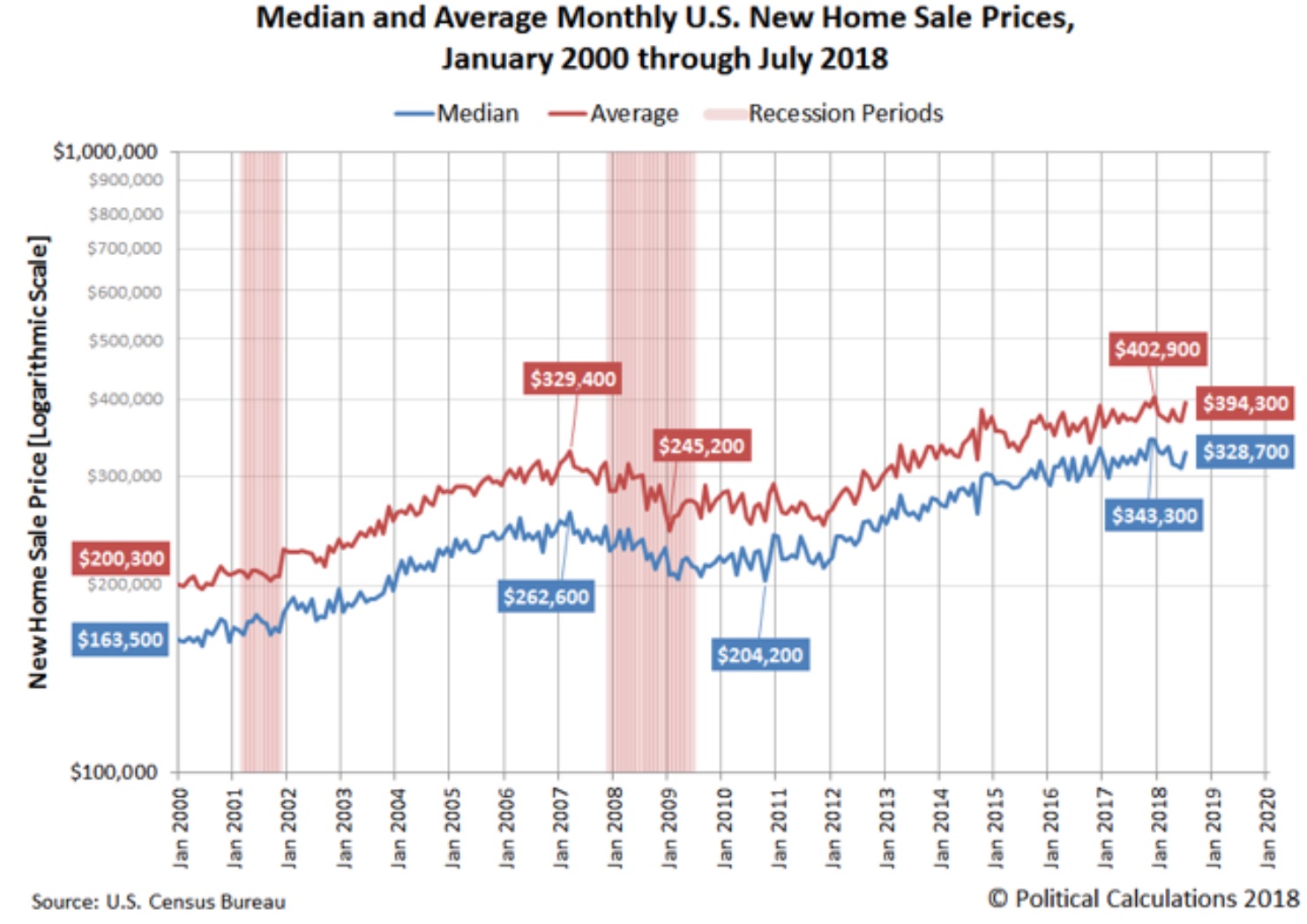
As asset bubbles implode together with debt, a return to at least the 1985 level seems likely. That would mean a 75% fall in house prices. As credit dries up and interest rates surge, I would expect that this will be the minimum fall.
The Road To $10,000+ Gold
At the same time, let’s assume a very likely increase in the gold price to $5,000 in today’s money.In my view this is the very minimum and $10,000 or much higher is more likely.

235 Ounces Of Gold To Buy New Home Today But Only 17 Ounces Later
As the table above shows, a new home today costs $335,000 or 235oz of gold. In 2025, with the average price of houses down 75% to $84,000, and gold up 254% to $5,000, a house would cost only 17oz of gold. That is a 93% fall in gold terms. Sounds unrealistic today but it is very likely.
As the next global financial crisis unravels in the coming few years, we will see massive money printing, total debasement of most currencies and hyperinflation. The only way to protect yourself from the total destruction of paper assets is to hold physical gold and some silver.
There are three kinds of money, Worthless, Soon Worthless, and Eternal. Since all fiat money has always gone to ZERO throughout history, the same will be the case for the dollar and all other currencies in coming years.
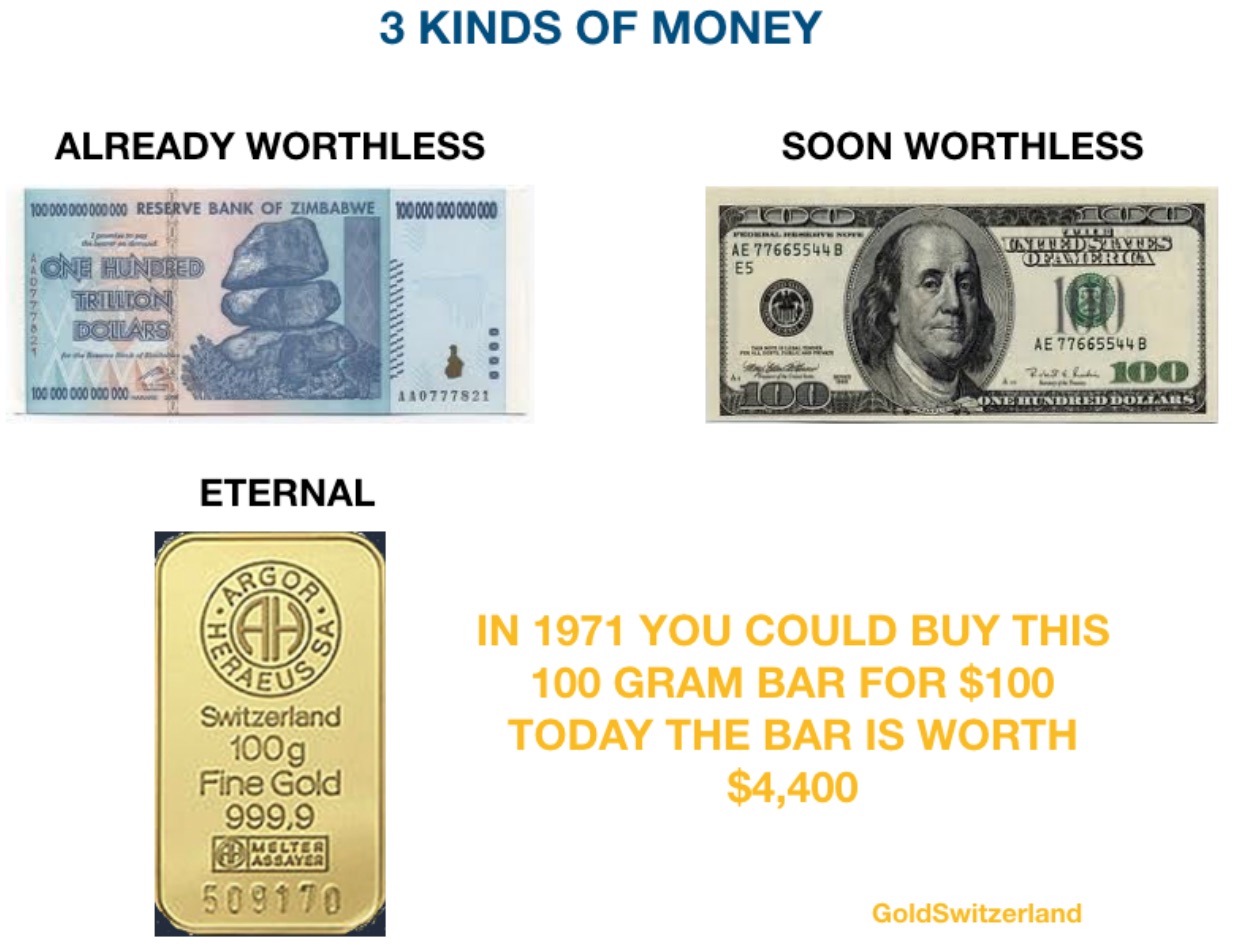
In 1971, you could buy 100 grams of gold (just over 3 oz) for the $100 bill in the picture above. Today the $100 gram bar costs $4,400 and for $100 you would only get a small corner of the gold bar. This is how central banks destroy the value of money with most people being totally unaware since they don’t understand that gold is constant purchasing power and eternal money.
The Gold Maginot Line Broken Decisively
Gold has moved $130 in a short time, decisively breaking the 6 year Maginot Line at $1,350. The current pause in the up-move can last around 2-10 days but thereafter gold will rise quickly toaround $1,650.
Crisis Will Return With A Vengeance
Very important changes will soon take place in markets with the 2007-9 crisis returning with a vengeance. The final phase up in US stocks could last a few weeks but most likely not more than 2 months. Thereafter a secular bear market will start that will be devastating for the world economy, the financial system and paper money. Wealth preservation today is more important than anytime in history…For those who would like to read more of Egon von Greyerz’s fantastic articles CLICK HERE.
$2.2 Billion In Losses For Gold Shorts
READ THIS NEXT! Central Banks See Massive $2.2 Billion In Losses On Gold Shorts, But Here Is Why It May Get Much Worse CLICK HERE TO READ
end
|
11:30 AM (4 minutes ago) |
 |
||
|
||||
Bitcoin Tumbles To 10-Day Lows As Major Korean Bank Clamps Down On Crypto-Linked Accounts
Bitcoin prices have accelerated lower overnight, breaking below the $11,000 level and falling to 10-day lows.
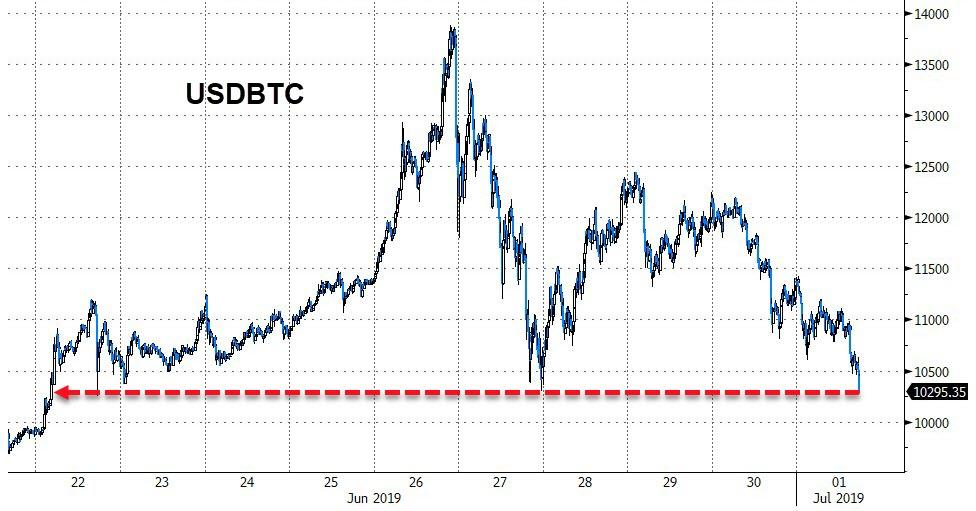
Bitcoin is leading the charge lower but the rest of crypto is also sliding…
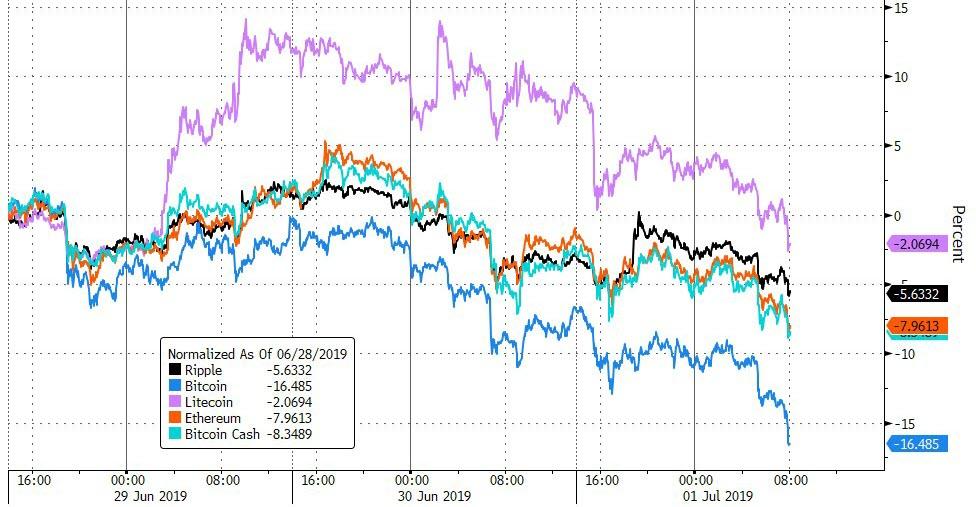
While potentially some relief from the China-US trade truce could be driving some selling in cryptos, some market participants noted that fears of further crackdowns in Asia also sparked some unwinds.
As CoinTelegraph’s Thomas Simms reports, one of South Korea’s biggest banks is planning to intensify regulations on accounts linked tocrypto exchanges, BEI News reported on July 1.

image courtesy of CoinTelegraph
The “special measures” Shinhan Bank are proposing would reportedly involve dedicating staff to analyzing account transactions.
It is believed the bank is hoping to distance itself from claims that it is helping financial criminals, amid a rise in the number of fraud cases involving exchanges.
Later in July, the bank is also hoping to launch an artificial intelligence monitoring system that uses deep learning to identify fraudulent transactions more quickly and accurately.
BEI News quoted a Shinhan Bank spokesperson as saying:
“We have set up a comprehensive plan for the elimination of telecommunication and financial fraud… We will continue to implement preventive measures so that customers will not be harmed in the future.”
The clampdown comes as crypto exchanges continue to fall victim to hacks — including the South Korean platform Bithumb.
Bithumb has suffered several major hacks. In March, more than three million eos (worth $17.5 million at press time) was stolen from a hot wallet.
A bigger attack last summer saw $17 million stolen across 11 cryptocurrencies, predominantly bitcoin (BTC) and ether (ETH.)
end
Interesting report: Reuters believes that world gold demand (consumption) will grow by 3.7% to 4,728 tonnes this year lead by central bank buying. Jewelry demand rises by 5.7% up to 2,257 tonnes. The total world production including China and Russia is 3500 tonnes. If you remove both of these countries gold available to the world is around 2850 tonnes and demand is 4728 tonnes.
(courtesy Reuters)
World Gold consumption to rise in 2019 to 2020, before falling in 2021: report
CANBERRA (Scrap Register): World gold consumption is likely to grow at an average annual rate of 3.7% in 2019 and 2020 – reaching a peak of 4,728 tonnes in 2020 – and then decrease by 4.9% in 2021, to 4,497 tonnes, Australia’s Department of Industry, Innovation and Science said in its Resources and Energy Quarterly report.
The growth is expected to be largely driven by central banks’ gold buying, with a forecast increase of 4.3% a year in 2019 and 2020, to over 700 tonnes by 2020. The official sector is expected to remain a net buyer throughout the forecast period. The need to diversify central bank reserves is the key driver of many central banks’ growing appetite towards gold. After reaching a peak of 711 tonnes in 2020, the pace of central bank purchases is expected to decrease by 10% in 2021, to 640 tonnes, as geopolitical risks moderate, the report said.
Retail investment is expected to drive up global gold consumption, as the demand for gold bars and coins rises in 2019 and 2020. The report estimates retail investment to rise by 13 and 12 per cent in 2019 and 2020, to 1,244 and 1,392 tonnes, respectively.
This is being supported by trade tensions, the economic slowdown across advanced and developing economies, and political uncertainty in Europe, Venezuela and the Middle East. In China, ongoing trade tensions with the US are likely to boost gold demand, as retail investors seek to buy gold as a hedge against the depreciation of the Renminbi. However, gold retail investment is expected to slow down after 2020, as global economic slowdown and trade tensions are expected to ease, the report said.
Jewellery demand is forecast to rise by 5.7% in 2020 and 4.6% (to 2,357 tonnes) in 2021. Demand from China – the world’s largest jewellery consumer – is expected to remain strong, supported by the Chinese Government’s monetary and fiscal stimulus.
In India – the world’s second largest gold jewellery consumer – a strong demand growth forecast is propelled by robust economic growth, ongoing urbanisation, rising farm incomes, and improved consumer sentiment.
-END-
US seeks halt in civil lawsuit accusing JP Morgan of manipulating metals market, citing criminal case
- The U.S. wants a federal judge to halt a civil lawsuit accusing J. P. Morgan of manipulating precious metals markets. The Justice Department cited an ongoing criminal case as its reason for the request.
- A former J. P. Morgan trader pleaded guilty in Connecticut last month to manipulation charges.
- In the guilty plea, the trader said he had learned to make bogus trade orders from senior traders at the bank and that he used the strategy hundreds of times with the knowledge and consent of his immediate supervisors.
CNBC.com
The Justice Department is asking a judge to put the brakes on a civil lawsuit against J. P. Morgan Chase, citing an ongoing probe into a “related criminal case” that involves alleged manipulation of precious metals markets.
The department wants a six-month postponement in the proceedings of the civil lawsuit, which was filed in 2015 by hedge fund manager Daniel Shak and two commodity traders. The government also says it could ask for a longer delay in the case, according to a court filing on Monday.
The move comes days after Shak’s lawyer, David Kovel, sought permission to reopen questioning of two former J. P. Morgan traders and the bank’s current global head of base and precious metals trading.
Kovel, in making the request with the Manhattan federal judge in the civil case, cited last month’s guilty plea by one of those former traders, John Edmonds, in federal court in Connecticut.
Edmonds admitted making bogus bids on precious metals contracts while working at the bank from 2009 to 2015.
Neither J. P. Morgan Chase nor Kovel’s clients have opposed the Justice Department’s request.
In arguing for a delay, the Justice Department said Shak’s lawsuit is “related” to Edmonds’ criminal case and that Edmonds has “pleaded guilty and acknowledged his own participation in such conduct, as well as that of other traders.”
“Edmonds awaits sentencing, but the broader investigation is ongoing,” the Justice Department said. The U.S. wants to delay the civil case “to protect the integrity of its ongoing criminal investigation,” it said.
J. P. Morgan did not respond to a request for comment by CNBC. Kovel declined to comment.
Tuesday night, after this story first was published, Judge Paul Engelmayer ordered the federal prosecutors to explain in detail by Monday why postponing proceedings in the civil lawsuit would not harm those involved, and why reopening questioning “would be detrimental to the Government’s ongoing criminal investigation.”
Englemayer also wrote that he regards Edmonds’ guilty plea “as potentially highly consequential” to the civil case.
In his guilty plea, the 36-year-old Edmonds said he had learned to make bogus trade orders from senior traders at the bank and that he used the strategy hundreds of times with the knowledge and consent of his immediate supervisors. He admitted to working with “unnamed co-conspirators” at J. P. Morgan, according to the Justice Department.
Kovel wants to question Edmonds again as well as Michael Nowak, the bank’s global head of base and precious metal trading, and former J. P. Morgan Chase Managing Director Robert Gottlieb. The three had previously answered questions under oath in the civil case.
Kovel said in court filings that Nowak was the immediate supervisor of Edmonds, while Gottlieb was Edmonds’ mentor.
In his prior deposition, Edmonds said that Gottlieb sat only a “couple feet” away from him for about five years, and that he was “somebody [he] looked up to in the business,” who helped guide and train him.
Nowak is described by Edmonds as his direct supervisor, with whom he would sometimes discuss trading strategies. Nowak was also the person responsible for overseeing the performance and risk of Edmonds’ portfolio, according to the deposition.
Edmonds also stated in his prior deposition that he would enter precious metals trades for both Nowak and Gottlieb, among others.
The civil lawsuit claims Shak and his fellow plaintiffs lost tens of millions of dollars as a result of actions by J. P. Morgan’s traders.
Federal judge tells traders they can combine cases accusing JP Morgan of rigging metals market
- Litigation in a separate civil case has been put on hold until at least May at the behest of the Justice Department, which is investigating a “related criminal case” that involves alleged market manipulation by precious metals traders at J. P. Morgan.
- Judge John Koeltl of the Southern District of New York appointed the White Plains, N.Y., law firm Lowey Dannenberg as interim lead counsel for the proposed class action.
A group of traders from across the U.S. who allege that J. P. Morgan Chase manipulated precious metals markets for years are one step closer to bringing a class action suit against the nation’s largest bank.
Earlier this month, a federal judge said five separate lawsuits making similar allegations against the bank could be combined, potentially including thousands of people who traded in the precious metals market from Jan. 2009 through Dec. 2015.
Litigation in a separate civil case has been put on hold until at least May at the behest of the Justice Department, which is investigating a “related criminal case” that involves alleged market manipulation by precious metals traders at J. P. Morgan.

J. P. Morgan declined to comment on this story.
Judge John Koeltl of the Southern District of New York appointed the White Plains, N.Y., law firm Lowey Dannenberg as interim lead counsel for the proposed class action.
Vincent Briganti, a partner at the firm, filed the first suit seeking class action status in November on behalf of Dominick Cognata, a trader who alleges he suffered losses due to J.P. Morgan’s illegal trading conduct in the silver and gold futures and options markets.
That was after the federal court in Connecticut unsealed a criminal plea agreement by John Edmonds, a former J.P. Morgan metals trader. In his guilty plea, Edmonds, who is 36-years old, admitted that he and other “unnamed co-conspirators” fraudulently manipulated the precious metals markets while they were employed at J. P. Morgan from 2009 to 2015.
Edmonds said he had learned the illegal trading tactics from senior traders, and then used them hundreds of times with the knowledge of and consent of his immediate supervisors.
Briganti’s lawsuit also names John Edmonds and a group of yet-to-be-identified precious metals traders and the bank as defendants.
On Wednesday, the lawyers sent a letter to Judge Koeltl saying they were having difficulty locating Edmonds to serve him legal papers and requested a 30-day extension to do so, which the judge granted on Thursday. Briganti noted that they have been in contact with Edmonds’ attorney in the criminal case. Edmonds’ attorney and Briganti could not be reached for comment.
“We are hopeful that this extension will result in completing service on Mr. Edmonds without formal motion practice and a request for alternative means of service,” Briganti said in the letter.
The next step in the civil case is for the plaintiffs to file an amended class action complaint and set a schedule for defendants to respond.
In addition to the proposed class action, J. P. Morgan also faces a separate civil suit which also accuses the bank of rigging precious metals markets.
end
Your early MONDAY morning currency, Asian stock market results, important USA/Asian currency crosses, gold/silver pricing overnight along with the price of oil Major stories overnight/7 AM EST
i) Chinese yuan vs USA dollar/CLOSED / LAST AT: 6.8427/ GETTING VERY DANGEROUSLY CLOSE TO 7:1
//OFFSHORE YUAN: 6.8421 /shanghai bourse CLOSED UP 66,03 POINTS OR 2.22%
HANG SANG CLOSED DOWN 78,80 POINTS OR 0.28%
2. Nikkei closed UP 454.05 POINTS OR 2.13%
3. Europe stocks OPENED ALL GREEN EXCEPT /
USA dollar index UP TO 96.42/Euro FALLS TO 1.1348
3b Japan 10 year bond yield: RISES TO. –.15/ !!!!(Japan buying 100% of bond issuance)/Japanese yen vs usa cross now at 108.49/ THIS IS TROUBLESOME AS BANK OF JAPAN IS RUNNING OUT OF BONDS TO BUY./JAPAN 10 YR YIELD IS NOW TARGETED AT .11%/JAPAN LOSING CONTROL OF THEIR BOND MARKET//CARRY TRADERS GETTING KILLED
3c Nikkei now JUST BELOW 17,000
3d USA/Yen rate now well below the important 120 barrier this morning
3e WTI:: 60.02 and Brent: 66.53
3f Gold DOWN/JAPANESE Yen DOWN CHINESE YUAN: ON -SHORE UP/OFF- SHORE: UP
3g Japan is to buy the equivalent of 108 billion uSA dollars worth of bond per month or $1.3 trillion. Japan’s GDP equals 5 trillion usa./“HELICOPTER MONEY” OFF THE TABLE FOR NOW /REVERSE OPERATION TWIST ON THE BONDS: PURCHASE OF LONG BONDS AND SELLING THE SHORT END
Japan to buy 100% of all new Japanese debt and by 2018 they will have 25% of all Japanese debt. Fifty percent of Japanese budget financed with debt.
3h Oil UP for WTI and UP FOR Brent this morning
3i European bond buying continues to push yields lower on all fronts in the EMU. German 10yr bund FALLS TO -.33%/Italian 10 yr bond yield DOWN to 2.02% /SPAIN 10 YR BOND YIELD DOWN TO 0.02%…ITALIAN 10 YR BOND YIELD/GERMAN BUND: 2.45: DANGEROUS FOR THE ITALIAN BANKING SYSTEM
3j Greek 10 year bond yield FALLS TO : 2.34
3k Gold at $1392.55 silver at: 14.28 7 am est) SILVER NEXT RESISTANCE LEVEL AT $18.50
3l USA vs Russian rouble; (Russian rouble UP 21/100 in roubles/dollar) 63.01
3m oil into the 60 dollar handle for WTI and 66 handle for Brent/
3n Higher foreign deposits out of China sees huge risk of outflows and a currency depreciation. This can spell financial disaster for the rest of the world/
JAPAN ON JAN 29.2016 INITIATES NIRP. THIS MORNING THEY SIGNAL THEY MAY END NIRP. TODAY THE USA/YEN TRADES TO 108.31 DESTROYING JAPANESE CITIZENS WITH HIGHER FOOD INFLATION
30 SNB (Swiss National Bank) still intervening again in the markets driving down the SF. It is not working: USA/SF this morning .9816 as the Swiss Franc is still rising against most currencies. Euro vs SF is 1.1142 well above the floor set by the Swiss Finance Minister. Thomas Jordan, chief of the Swiss National Bank continues to purchase euros trying to lower value of the Swiss Franc.
3p BRITAIN VOTES AFFIRMATIVE BREXIT/LOWER PARLIAMENT APPROVES BREXIT COMMENCEMENT/ARTICLE 50 COMMENCES MARCH 29/2017
3r the 10 Year German bund now NEGATIVE territory with the 10 year FALLING to –0.33%
The bank withdrawals were causing massive hardship to the Greek bank. the Greek referendum voted overwhelming “NO”. Next step for Greece will be the recapitalization of the banks and that will be difficult.
4. USA 10 year treasury bond at 2.02% early this morning. Thirty year rate at 2.54%
5. Details Ransquawk, Bloomberg, Deutsche bank/Jim Reid.
6. TURKISH LIRA: UP TO 5.6631..
Global Stocks Soar On Trade Truce, As Other Assets Get Cold Feet
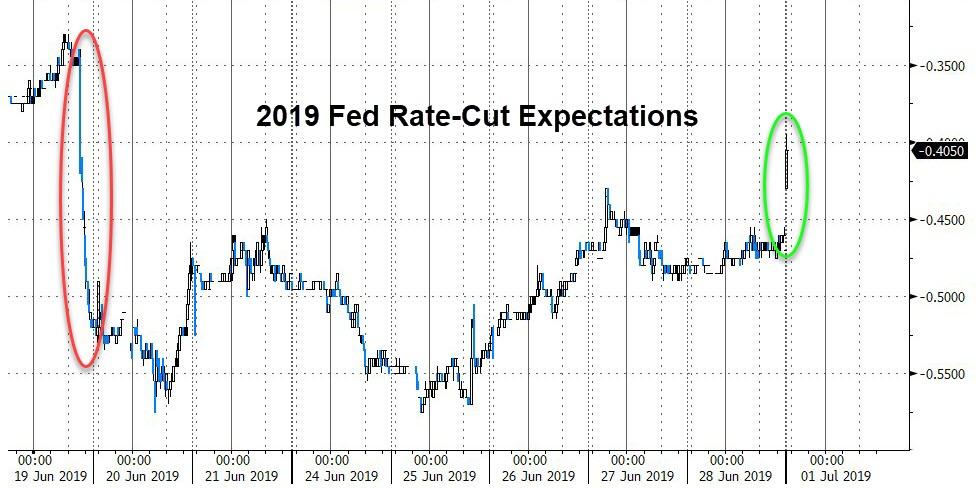
Global bonds retreated on Monday (although losses were pared) as the U.S. and China agreed to restart trade talks, leading investors to pare wagers on aggressive policy easing by the major central banks.
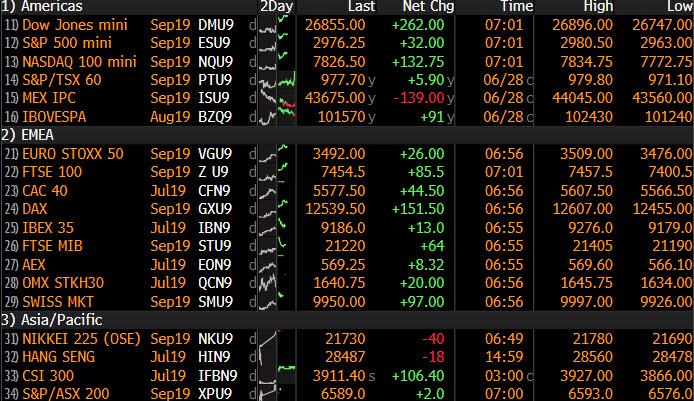
That, however, did not prevent stocks from surging out of the gate, with S&P futures set to open at new all time highs just 20 or so point below 3,000 even though as Bloomberg points out, the outcome of the G-20, or rather G-2, meeting was just as consensus expected.
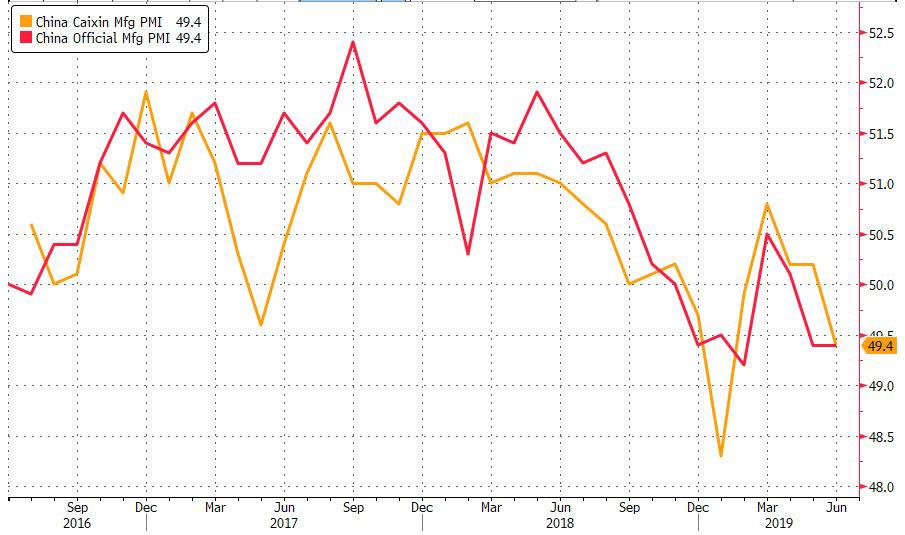
Stocks are jumping even as none of the market Gremlins have left, with Hong Kong protests turning violent again on Monday (incidentally, there was zero mention of China’s growing pains in Hong Kong, just as Beijing wanted),while global PMI continued plumbing new cycle lows, and after both Chinese manufacturing surveys missed expectations, printing in contraction just below 50…
… the picture turned even uglier in Europe, where the UK PMI missed expectations, sliding to a three year low of 48, while Spain’s mfg PMI printed in contraction, or 47.9, for the first time in five and a half years.
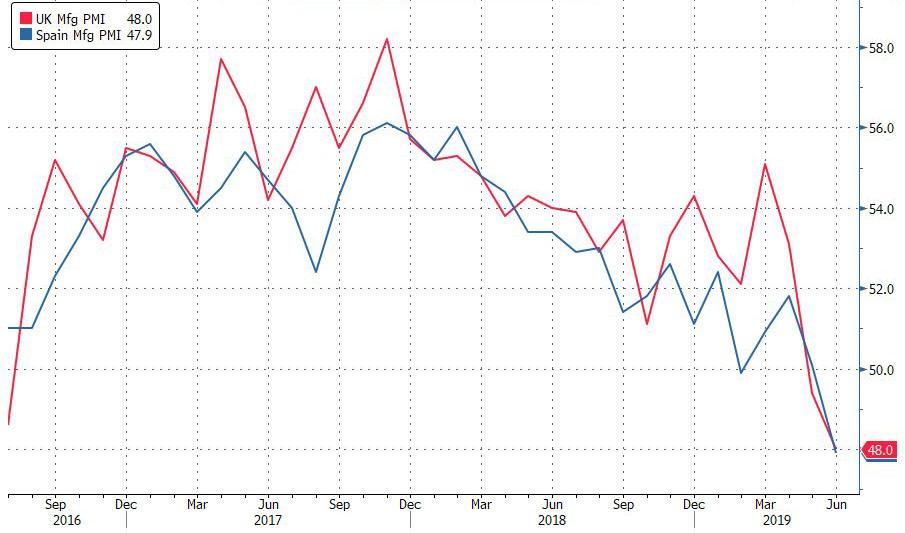
Surveys from Japan and South Korea showed similar slowdowns as did the 19-country euro zone’s reading which contracted for fifth month running and at a faster pace than previously thought.
“Euro zone manufacturing remained stuck firmly in a steep downturn in June, continuing to contract at one of the steepest rates seen for over six years,” said Chris Williamson, chief business economist at IHS Markit. “The disappointing survey rounds off a second quarter in which the average PMI reading was the lowest since the opening months of 2013.”
None of this had an impact on stocks, however, with European markets rising over 1%, chasing the outperformance in Asia, as US equity futures ramped higher, even as the dollar firmed across the board, as traders reined in bets for a half-point rate cut from the U.S. Federal Reserve this month. And yet, the Fed’s dovishness which was responsible for the market’s gain in June (as a reminder PE multiple expansion accounted for 90% of the June surge), is being widely ignored on Monday, with the market’s attention focused on the G-20 outcome instead, where as we noted overnight (and this morning), nothing has been resolved.
To be sure, trader sentiment about the outcome was mixed: “It (Trump-Xi G20 meeting) played as well as possible,” said SEB Investment Management’s global head of asset allocation Hans Peterson. “So It gives us time to digest and get a bit better activity in the global economy.”
On the other hand, Bloomberg’s Cameron Crise was more skeptical, noting that “a truce is a long way from a deal, and it may be worth recalling that the sharp rally after the previous G-20 meeting between Trump and Xi lasted a mere 24 hours, albeit under a somewhat different backdrop. While there’s no guarantee that the rally fades by the end of the day, therefore, it wouldn’t come as a surprise to see a little late-session selling once the euphoria starts to cool off.”
For now, however, risk is certainly higher, with Europe’s STOXX 600 and Japan’s Nikkei climbed 1% and 2.1% respectively to hit two-month tops and MSCI’s global index added 0.2% having only just missed out on its best first half to a year.
In Asia, Chinese blue chips jumped 2.6% to their highest since late April, Germany’s export-heavy DAX sprang 1.5% to its highest since August, Wall Street futures were up over 1% while the combination of the Huawei hiatus and M&A activity hoisted Europe’s the tech sector to a one-year high.
In the US, E-Mini futures for the S&P and Nasdaq rose 1.1% and 1.7%, with the former breaking out above resistance, and just whispers away from 3,000 whereas in the bond market Treasury futures slid 10 ticks as yields on 10-year notes edged up 4 basis points to 2.04%.
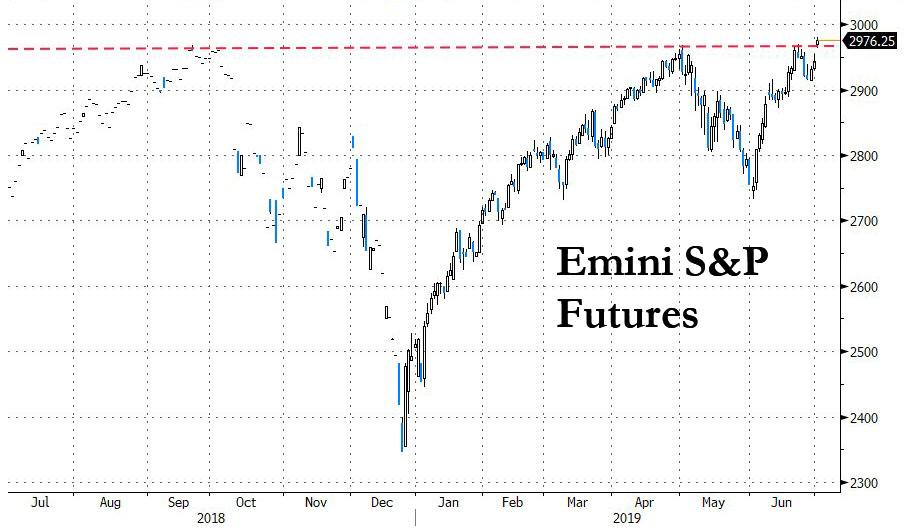
Ironically, the S&P may hit 3,000 on the day the ISM dips below 50 (expectations for the Mfg ISM is for a 51.0 print).
As noted last night, Fed funds dropped over 5 ticks as the market scaled back the probability of a half-point rate cut this month to around 15%, from nearer 50% a week ago. “I think the Fed expectations in the market are very aggressive. Possibly a bit too aggressive,” SEB’s Peterson added.
The reaction in currency markets was to strip some recent gains from safe harbors like the yen and Swiss franc. The dollar crept up 0.4% on the yen to 108.26 and 0.7% on the franc to 0.9830. The dollar strengthened versus all its Group-of-10 peers, while haven currencies weakened. Weaker-than-forecast manufacturing PMIs from the euro zone weighed on the euro and capped losses in the region’s bonds. The pound slipped following disappointing U.K. manufacturing data and before Conservative leadership contender Jeremy Hunt is expected to detail contingency plans for a hard Brexit
In commodities, oil prices sprang higher on news OPEC and its allies look set to extend supply cuts at least until the end of 2019 as Iraq joined top producers Saudi Arabia and Russia in endorsing the policy. Brent crude futures rose $1.85 or 2.8% to $66.40, while U.S. crude gained $1.84 or 2.75% to $59.90 a barrel.
Expected data include manufacturing PMIs. No major company is scheduled to report earnings
Market Snapshot
- S&P 500 futures up 1.1% to 2,976.25
- STOXX Europe 600 up 0.7% to 387.73
- MXAP up 0.8% to 161.38
- MXAPJ up 0.4% to 529.96
- Nikkei up 2.1% to 21,729.97
- Topix up 2.2% to 1,584.85
- Hang Seng Index down 0.3% to 28,542.62
- Shanghai Composite up 2.2% to 3,044.90
- Sensex up 0.8% to 39,716.91
- Australia S&P/ASX 200 up 0.4% to 6,648.10
- Kospi down 0.04% to 2,129.74
- German 10Y yield unchanged at -0.326%
- Euro down 0.4% to $1.1331
- Italian 10Y yield fell 3.2 bps to 1.74%
- Spanish 10Y yield fell 1.3 bps to 0.382%
- Brent futures up 2.8% to $66.53/bbl
- Gold spot down 1.5% to $1,388.10
- U.S. Dollar Index up 0.4% to 96.51
Top Overnight News
- President Donald Trump declared the U.S. was “winning” the trade war a day after reaching a temporary truce with Chinese President Xi Jinping. Gauges of activity in China’s manufacturing sector showed the economy remains fragile, underlining the need for the truce with the U.S. forged at the weekend to be a lasting one
- Manufacturers in the euro area remained firmly stuck in a slump last month as new orders slid and business confidence remained subdued
- Tension returned to Hong Kong’s streets Monday as protesters attempted to break into the city’s legislature and thousands more began marching in opposition to the city’s China- backed government
- Sentiment among Japan’s large manufacturers deteriorated to the lowest level in almost three years amid trade tensions that are adding to uncertainties for the economic outlook
- Jeremy Hunt and Boris Johnson, the candidates competing to become U.K. prime minister, reiterated their willingness to take the nation out of the European Union without a deal if necessary, as both insisted they have the fiscal space to fund their spending plans
- The ECB presidency won’t be decided at the EU summit in Brussels, a high-ranking German official said, who declined to be identified because the matter is confidential. That decision will be postponed until September in an attempt to move it away from the highly political nominations for the commission and council presidencies
- Oil raced higher after Russian President Vladimir Putin struck a deal with Saudi Crown Prince Mohammed Bin Salman at the G-20 to extend output cuts for the rest of this year and potentially into early 2020, while the U.S. and China called a temporary truce in the trade war
- Factory sentiment across Asia became even more frigid in June, signaling a worsening in the region’s growth outlook as U.S.-China trade tensions continue to simmer
- The European Central Bank could be headed for its first-ever female president as European Union leaders haggle over top policy positions
Asian equity markets began H2 with gains across the board as global sentiment was buoyed following the US-China trade truce at the G20, while President Trump also met with North Korea leader Kim at the Demilitarized Zone and became the first sitting US President to step into North Korean territory. ASX 200 (+0.4%) was lifted by the trade sensitive sectors, as well as energy names after oil prices were buoyed by news of a Russia and Saudi agreement regarding the output cut deal. Advances in Nikkei 225 (+2.2%) were exacerbated by favourable currency moves and the KOSPI (U/C) was subdued by domestic tech weakness amid a dispute with Japan related to wartime forced labour in which the latter is to restrict chip material exports to South Korea. Elsewhere, the Shanghai Comp. (+2.2%) was buoyed by the US-China trade truce and after comments from President Trump which raised hopes of a potential U-turn on Huawei. This underpinned tech and telecom stocks with mainland Chinese markets the regional outperformers despite the miss in Chinese Manufacturing PMI data and absence of Hong Kong participants for holiday. Finally, 10yr JGBs were lower as they mirrored the slump seen in T-notes and heavy losses across safe-havens, while the BoJ also recently announced its bond buying intentions last week in which it reduced the amounts of JGBs with 3yr-5yr and 10yr-25yr maturities.
Top Asian News
- Applied Materials Said to Buy Kokusai Electric From KKR
- Turkish Assets Rally After Trump Seen Softening Sanctions Threat
- Iron Ore Tests $120 as Australia Lays Bare Global Market Squeeze
- Dubai’s DP World Acquires Topaz Energy in $1.1b Deal
Major European bourses are posting gains this morning [Euro Stoxx 50 +0.9%] as the positive sentiment generated by the US and China temporary trade truce rolls over from the Asia-Pac session. Sectors are mixed, though predominantly in the green, outperformance is seen in Energy names which are also bolstered by the broader complex; in terms of the laggards, the defensive sectors, i.e. utility and consumer staples sectors are in negative territory. Towards the top of the Stoxx 600 are a number of semiconductors for example, STMicroelectronics (+5.5%), Dialog Semiconductor (+4.4%) and ASML (+3.3%) on the aforementioned US-China updates; however, also of note for chip names is that Japan are to restrict chip material exports to South Korea amidst a dispute concerning the countries ruling on wartime forced labour. Other notable movers include, ArcelorMittal (+3.0%) after the Co. has completed the sale of several steel-making assets to Liberty House Global for EUR 740mln. At the other end of the spectrum is Ericsson (-0.5%), who opened lower by around 1.5% as US President Trump commented that the US is to ease restriction on Huawei; as previously the likes of Huawei and Nokia have benefited from the Huawei restrictions.
Top European News
- ECB May Cut Rates by 20bps, Restart QE in September: Goldman
- Generali Is Said to Lead Bidding for Apollo’s Tranquilidade
- LafargeHolcim Is Said to Join Race for BASF Mortars Unit
- Germany’s DAX Set to Enter Bull Market as Trade Clouds Clear
In currencies, the Franc has slumped across the board and only in part on a loss of safe-haven demand after the US-China trade truce forged on Saturday, as Swiss retail sales and manufacturing PMI both misses consensus by considerable margins, and the SMI kicks off H2 on its own after the EU severed links with the Swiss bourse. Usd/Chf is back up near 0.9850 and Eur/Chf has rebounded further above 1.1100 to just over 1.1150 vs recent lows of sub-1.1000 and circa 1.1055 respectively.
- GBP – Sterling has also succumbed to all round selling in wake of the latest UK manufacturing PMI that was weaker than forecast and deeper in contraction territory, while output fell sharply from 50.3 to 47.2 and the worst level since October 2012. Cable recoiled from around 1.2707 at best through 1.2665-63 support that held several times in late June before breaching 1.2650 and a 1.2646 Fib on its way to a 1.2635 base, while Eur/Gbp has jumped towards 0.8970 from close to 0.8925 at one stage even though the single currency was pressured by disappointing Eurozone manufacturing PMIs as well.
- JPY/AUD/EUR – The Yen has succumbed to the broad post-G20 recovery in risk sentiment, but not to the same extent as the Franc noted above, with 108.50 vs the Greenback tested and marginally topped before a relatively deep pull-back towards 108.25. A decent 1 bn option expiry may have capped the headline pair, while the DXY also faded after edging above 96.600 and a lack of follow-through buying to test near term resistance at 96.711 (June 21 peak). However, the Aussie remains on the backfoot just under 0.7000 ahead of Tuesday’s RBA policy meeting with a firm majority anticipating back-to-back 25 bp rate cuts, and the Euro is holding near the bottom of a hefty expiry zone from 1.1320 to 1.1335 (1.6 bn) having lost grip of the 200 DMA (a few pips below 1.1350) in the run up to the aforementioned poor PMIs and then breaching the 10 DMA (at 1.1328) to a 1.1315 low.
- CAD/NZD/SEK/NOK – The Loonie and Kiwi are both down vs their US counterpart, but holding up better than most major rivals, bar the Scandi Crowns, with Usd/Cad only just above 1.3100 and Nzd/Usd hovering close to 0.6700. A firm rebound in oil prices is impacting, and also boosting the Nok (through 9.7000 vs the Eur), while the Kiwi is eyeing the impending NZIER Q2 survey for independent impetus. Note, Eur/Sek is back below 10.5500 in response to a rare manufacturing PMI beat from Sweden that will likely keep the Riksbank in hawkish mood on Wednesday.
- EM – The Lira has extended gains made on the back of a relatively cordial meeting between Turkish President Erdogan and his US peer Trump on the G20 sidelines that assuaged concerns about sanctions over Russia’s imminent S-400 delivery with additional momentum coming in the form of a less contractionary manufacturing PMI. Usd/Try reversed from 5.7910 to 5.6735 in response before settling around 5.6950.
In commodities, WTI (+2.7%) and Brent (+2.7%) have started the week firmly on the front foot, with WTI having breached the USD 60/bbl level to the upside. Gains in the oil complex are stemming from a sentiment-driven gains (from constructive US-China G20 and North Korea outcomes) alongside an agreement between Russia and Saudi Arabia to extend the OPEC+ deal. The leaders discussed an extension of six to nine months at the level it is currently at (1.2mln BPD), with Russian Energy Minister Novak stating that the extension is a consolidated agreement and other countries are in favour of such an extension. Novak’s comments, and Russia agreeing to extend the OPEC+ deal, have removed a uncertainty from the discussion surrounding the deals future; as until these comments it was not known precisely what Russia’s position around an extension was and whether or not they would support one. In terms of scheduling for today we have both the JMMC and the OPEC meeting, with the closed session of the JMMC having commenced as of 10:00BST, and OPEC’s opening session is due to begin at 13:00BST, closed session at 14:00BST and a presser at 16:00BST, where we may get further insight into the OPEC+ extension; though an official decision will not be released until the presser following tomorrows OPEC+ meeting at 12:00BST. Note, the timing of the various sessions for JMMC, OPEC & OPEC+ is at best an indicative guide only.
Elsewhere, Gold (-1.3%) is suffering due to a firmer USD and a safe-haven unwind, as are other havens including JPY and CHF, with the yellow metal giving up the USD 1400/oz handle after this weekend’s positive trade/geopolitical developments; having printed a session low of USD 1381/oz after the metals largest intraday fall for a year. In contrast, the trade truce has supported copper prices which are just shy of the 6-week high posted earlier in the session at USD 2.72/lb. Finally, iron ore prices have rallied in excess of 4.0%, supported by the overall risk sentiment and underpinned by supply woes.
US Event Calendar
- 9:45am: Markit US Manufacturing PMI, est. 50.1, prior 50.1
- 10am: ISM Manufacturing, est. 51, prior 52.1; ISM Employment, prior 53.7; ISM New Orders, est. 52.5, prior 52.7
- 10am: Construction Spending MoM, est. 0.0%, prior 0.0%
DB’s Jim Reid concludes the overnight wrap
Welcome to July and a very happy 10th birthday to this economic expansion. Today takes us into unchartered territory in the US with this upswing now being the longest on record of all the 34 back to the 1850s. A reminder that we published a note a couple of weeks ago looking at the long cycle world we’ve been in since the 1980s and how it’s only been possible due to a massive global levering up, unparalleled money printing, and likely lower productivity. See the link here .
Before we get to a big weekend for news, Craig has published the latest performance review for H1, Q2 and June. June saw all 38 of our non-FX assets in our survey higher – only the second time in 150 months since we started collating the data in 2007 with January this year being the other. Indeed for H1 2019, 37 out of 38 assets were higher – the highest H1 ratio over the same period. See the full report here .
It feels that the weekend saw positive progress on a lot of things. A US/China trade truce, a constructive surprise Trump meeting with Kim Jong Un, positivity over US/Turkey relations, a Russian/Saudi OPEC+ agreement on extending cuts (official OPEC/OPEC+ meetings today/tomorrow), and in the background the EU and Mercosur (South American trading block) brokered a trade deal after 20 years of negotiating. That timespan is something to consider when thinking about Brexit! On the flip side China’s manufacturing PMI stayed at 49.4 – a tenth below expectations with new export orders edging down 0.2pts to 46.3, the weakest since February. The non-manufacturing PMI slipped a tenth to 54.2 (54.3 expected) bringing the composite to 53.0 (vs. 53.3 expected). China’s Caixin manufacturing PMI also printed this morning at 49.4 (vs. 50.1 expected and 50.2 last month), the weakest since January, with both the new orders and new export orders components falling into contractionary territory, after rising in May.
The main G-20 summit was a sideshow really and the released communique was unanimous only by being bland and not committing anyone to anything. Disagreements on trade and climate change continue. As for the main event, although expectations were building ahead of the Trump/Xi meeting, on balance they exceeded them even if it still feels like a fragile equilibrium. At the moment I’m relieved we went back to being more constructive on credit a couple of weeks ago as news of this meeting broke at the same time as Draghi’s very dovish Sintra speech. The two most positive things from the weekend were that President Trump won’t put the additional tariffs on China for the “time being” and that he softened his stance on Huawei. He will allow US companies to sell some equipment to Huawei, as long as it was “no great national security problem”. At the moment there is no clarity on whether this means Huawei will be taken off the ‘entity list’ of the US Commerce Department, but Trump has promised to discuss this soon and suggested they’ll leave this controversial issue to the end of trade negotiations which is likely to be seen as a positive as its now not standing in the way of an outline deal. However, Trump’s decision to grant Huawei some temporary relief has drawn criticism back home with Senator Marco Rubio tweeting “If President Trump has agreed to reverse recent sanctions against #Huawei he has made a catastrophic mistake.”
Trump also said Xi promised that China will buy “tremendous” amounts of US agricultural products, and that the US will “give them a list of things” they would like China to buy. However, Chinese official media reports are not as clear on this and suggested only that Trump hopes China will import more American goods as part of the trade-war truce. Meanwhile, there has been no official communication from China. So whether China sees things the same way is not clear, but on balance it seems a more positive backdrop for talks to continue even if there is not currently any roadmap. Elsewhere, Trump continued his criticism of the Fed over the weekend saying the Federal Reserve “has not been of help to us at all” in his trade spat with Beijing and added “Despite that, we’re winning, and we’re winning big because we have created an economy that is second to none”.
Meanwhile, in an interview on Fox News, Larry Kudlow, the White House National Economic Council director, said that Mr Trump isn’t offering a “general amnesty” to Huawei Technologies as part of an agreement to restart trade talks while adding that there are no firm promises and no timetable for completion of a potential sweeping trade agreement, and that China still needs to address the issues that the U.S. has said caused the discussions to fall apart in early May. He repeated that the U.S. and China are 90% done on a trade deal but the final 10% will be the hardest.
Asian markets have started the week on a firm footing buoyed by the trade war truce. Chinese markets are leading the advances with the CSI (+2.47%), Shanghai Comp (+1.88%) and Shenzhen Comp (+2.93%) all up along with the Nikkei (+1.91%). The Kospi (-0.06%) is trading down on news that Japan plans to slap export restrictions on some tech items sent to South Korea, a sign of escalating tension between the pair over recent compensation claims for Korean workers dating back from the colonial period. Samsung electronics is down -1.17% on the news. Meanwhile safe haven assets are trading down this morning with the Japanese yen trading weak (-0.39%) and gold prices down -1.19%, the largest drop since March this year. The Chinese onshore yuan is up +0.49% this morning to 6.8332 while the Turkish Lira is up +1.03%. Elsewhere, futures on the S&P 500 are +0.87% with WTI oil prices +2.38% on the likely extension of output cuts. US treasury yields are around 2-3bps higher across the curve. Markets in Hong Kong are closed for a holiday.
Yesterday also saw an EU leaders summit to discuss the important top jobs about to need filling. They have so far failed to agree on candidates with talks getting dragged into a second day. Meanwhile, here in the UK, the Telegraph has reported that in a speech today, Conservative Leadership Candidate Jeremy Hunt will announce plans for a £20 bn “war chest” for a no deal Brexit which would see dramatic tax cuts designed to turbo-charge the economy. Under the plan, Hunt would set aside £6 bn to help farmers and fishermen and spend £13bn cutting corporation tax from 19% to 12.5% to help businesses amongst other measures. So in addition to Mr Johnson’s plans, a no-deal Brexit will likely unleash a huge fiscal spending spree in the UK – another show to drop in the global fiscal movement. Staying with the UK, yesterday Nigel Farage’s Brexit Party announced that it was ready to fight a general election as it unveiled 100 people it said would be candidates.
As for this week, US Independence Day on Thursday will break up the week and activity with US bond and equity markets closing at half time Wednesday and all of Thursday. However we do have some important data including the remainder of today’s global manufacturing PMIs/US ISM, Wednesday’s services equivalent, and Friday’s US employment report which will be important as evidence starts to slowly build of a softening of the strong US labour market. Consensus is at +158k vs +78k last month. The weekend truce will take the edge of any weak numbers in today’s PMIs with hopes that business confidence can slowly start to rebuild again with the caveat that the truce could break at any time. The rest of the week ahead is at the end today.
In advance of the G-20, equity markets ended last week on a positive foot but mixed overall on the week. The S&P 500 ended the five days -0.32% lower (+0.55% on Friday) while the Stoxx 600 was close to flat at +0.03% (+0.70% Friday). On both sides of the Atlantic, financials outperformed, with US and European bank shares up +2.22% and +1.79% (+2.37% and +0.75% Friday) respectively. The moves mostly came after all major banks passed the Fed’s stress tests on Thursday night. US tech firms had more muted price action, with the NASDAQ down -0.32% (+0.48% Friday) and the NYFANG index +0.54% (+0.18% Friday). The DOW lagged slightly trading down -0.45% (+0.28% Friday), as its largest member Boeing dropped (-2.09% on the week and flat on Friday) on new revelations about safety issues with its 737 Max plane. In Europe, performance was a bit bifurcated, with the DAX outperforming +0.48% (+1.04% Friday) while Italy’s FTSE MIB and Spain’s IBEX lagged, down -0.72% and -0.31% (+0.59% and +0.56% Friday) respectively.
The rally in fixed income markets continued relentlessly, with 10-year treasury yields down -4.9bps on the week (-0.9ps Friday). That marks the 8th consecutive weekly rally, the longest streak since 2012. Two-year yields fell less sharply, dropping -1.7bps (+0.6bps Friday), which caused the curve to flatten -3.0bps (-1.3bps Friday). Similar dynamics were at play in Europe, where bunds and schatz rallied -4.2bps and -1.3bps (-0.7bps and -1.4bps Friday), respectively. Action in currency markets was relatively muted, with the dollar index trading listlessly to end the week flat. EM currencies fell -0.30% (+0.06% Friday), though there was heterogeneity within the asset class, e.g. the Brazilian real fell -0.56% (-0.61% Friday), but the South African rand appreciated +1.77% (+0.59%).
3A/ASIAN AFFAIRS
I)MONDAY MORNING/ SUNDAY NIGHT:
SHANGHAI CLOSED UP 66.03 POINTS OR 2.22% //Hang Sang CLOSED DOWN 78.80 POINTS OR 0.28% /The Nikkei closed UP 454.05 POINTS OR 2.13%//Australia’s all ordinaires CLOSED UP .48%
/Chinese yuan (ONSHORE) closed UP at 6.8427 /Oil UP TO 60.02 dollars per barrel for WTI and 66.53 for Brent. Stocks in Europe OPENED GREEN// ONSHORE YUAN CLOSED UP // LAST AT 6.8427 AGAINST THE DOLLAR. OFFSHORE YUAN CLOSED UP ON THE DOLLAR AT 6.8421 TRADE TALKS RESUME//YUAN LEVELS GETTING DANGEROUSLY CLOSE TO 7:1//TRUMP INITIATES A NEW 25% TARIFFS FRIDAY/MAY 10/MAJOR PROBLEMS AT HUAWEI /CFO ARRESTED : /ONSHORE YUAN TRADING BELOW LEVEL OF OFFSHORE YUAN/ONSHORE YUAN TRADING STRONGER AGAINST USA DOLLAR/OFFSHORE YUAN TRADING STRONGER AGAINST THE DOLLAR /TRADE DEAL NOW DEAD..TRUMP RAISED RATES TO 25%
3 a./NORTH KOREA/ SOUTH KOREA
b) REPORT ON JAPAN
3c China/Chinese affairs
Early Saturday morning/Friday night: China and the USA agree to a ceasefire as their trade talks are back on. Trump concedes on Huawei and China agrees to purchase more goods. The problem is now with Powell as he will probably delay his interest rate cuts.
(courtesy zerohedge)
Ceasefire: US, China Trade Talks “Back On Track” After Trump Concedes On Huawei
The “worst case” trade war scenario was avoided in Osaka on Saturday when Trump agreed to restart trade talks with Xi, holding off new tariffs on Chinese exports, and signaling a pause in the trade hostilities between the world’s two largest economies; Trump added that while existing tariffs would remain in place the US president eased restrictions on Huawei as part of what is now the second ceasefire between the two superpowers in two months, removing an immediate threat looming over the global economy even as a lasting peace remains elusive.
“We’re right back on track and we’ll see what happens,” Trump told reporters after an 80-minute meeting with Chinese President Xi Jinping on the sidelines of a summit of leaders of the G-20 major economies in Osaka, western Japan.
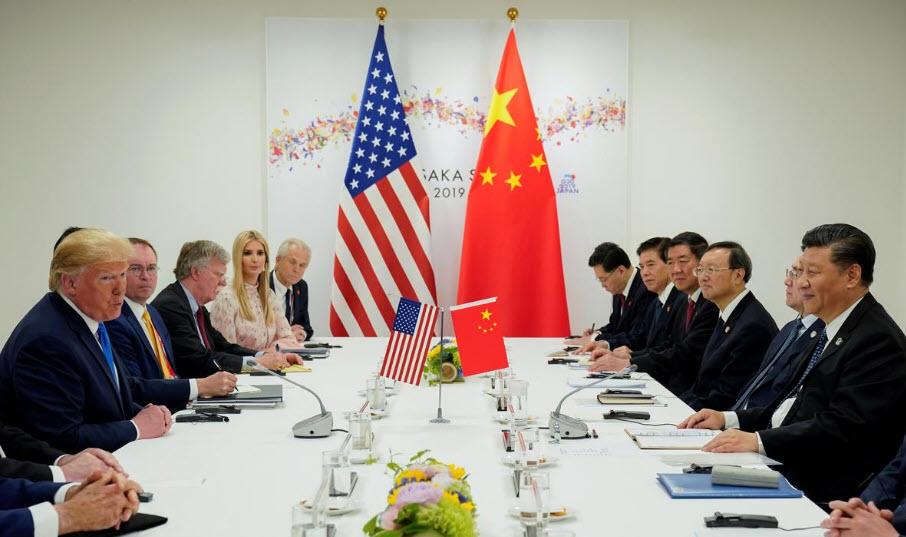
Trump said while he would not lift existing import tariffs, he would refrain from slapping new levies on an additional $300 billion worth of Chinese goods – which would have effectively extended tariffs to everything China exports to the America.
“We’re holding back on tariffs and they’re going to buy farm products,” he said vaguely at a news conference, without giving any details of China’s future agricultural product purchases. “If we make a deal, it will be a very historic event.” He gave no timeline for what he called a complex deal but said he was not in a rush. “I want to get it right.”
Whereas Trump and top admin officials alleged that Beijing had reneged on provisions of a tentative trade deal, it was not immediately clear if Xi agreed to return to previous agreements as part of the new truce.
Trump, however, did relent on one of the major sticking points, saying U.S. firms would be allowed to sell components to Huawei, the world’s biggest telecom network gear maker, where there was no national security problem. The president said the U.S. commerce department would meet in the next few days on whether to take it off a list of firms banned from buying components and technology from U.S. companies without government approval.
“I like our companies selling things to other people, so I allowed that to happen,” Trump said. “We’re talking about equipment where there’s no great national security problem with it.” In recent months, the Trump administration has been lobbying allies around the world not to buy Huawei equipment, which the U.S. says could be used for Chinese espionage.
Huawei was delighted by the news on its verified Twitter account: “U-turn? Donald Trump suggests he would allow #Huawei to once again purchase U.S. technology!”
Huawei Facts
✔@HuaweiFacts
U-turn? Donald Trump suggests he would allow #Huawei to once again purchase U.S. technology! #HuaweiFacts https://twitter.com/cnni/status/1144871406884098048 …
CNN International
✔@cnni
President Trump has appeared to soften his tone on Chinese communications giant Huawei, suggesting that he would allow the company to once again purchase US technology https://cnn.it/322OOb1

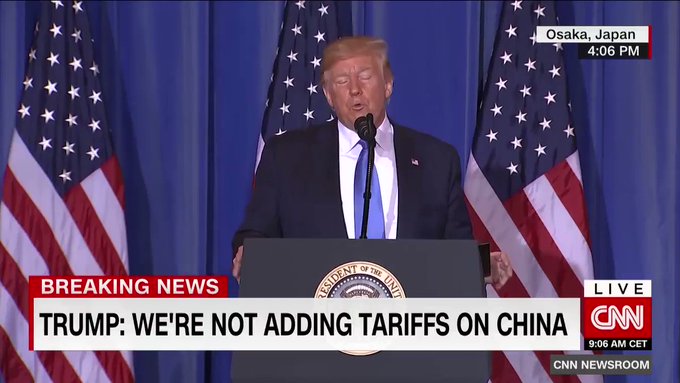
Predictably, China also welcomed the step. “If the U.S. does what it says, then of course, we welcome it,” said Wang Xiaolong, the Chinese foreign ministry’s envoy for G20 affairs.
Trump said he had not yet decided how to allow U.S. companies to continue selling to Huawei or whether to remove the tech giant from the Commerce Department’s entity list. He said he would meet with advisors next week to determine how to proceed.
U.S. microchip makers also applauded the move. “We are encouraged the talks are restarting and additional tariffs are on hold and we look forward to getting more detail on the president’s remarks on Huawei,” John Neuffer, president of the U.S. Semiconductor Association, said in a statement. Recently, Broadcom warned of a broad slowdown in demand as a result of Huawei sanctions and slashed its revenue forecast.
And yet, it was not clear how long the exemption would last. Trump said he had agreed with Xi to wait until the very end of trade talks to resolve broader issues around Huawei, including Washington’s lobbying campaign against allies buying its 5G equipment.
“Huawei is a complicated situation,” Trump said. “We’re leaving Huawei toward the end. We’ll see where we go with a trade agreement.”
The concession will likely draw criticism in Washington where national security hawks have urged Trump not to ease any pressure against Huawei. The company has long been the target of concern at the Pentagon and intelligence agencies in part over what the U.S. claims are its close ties to the Chinese military.
Josh Rogin
✔@joshrogin
By agreeing to weaken restrictions on #Huawei, Trump not only undermined his own government, he undermined the entire argument #Huawei is a real national security threat. #facepalm https://www.google.com/amp/s/www.wsj.com/amp/articles/trump-says-he-is-set-to-discuss-huawei-with-xi-11561769726 …
Trump Allows Sales of U.S. Products to Huawei as Trade Talks With China Resume
President Trump agreed to allow sales of U.S. products to Huawei after he and his Chinese counterpart decided to resume trade talks. The U.S. also consented to halt additional tariffs on Chinese…


* * *
In exchange for his Huawei concession, Trump said Xi Jinping had promised to buy “tremendous” amounts of U.S. agricultural products. “We’re going to give them a list of things we’d like them to buy,” Trump said at a news conference following the Group of 20 summit in Osaka, Japan. However, as Bloomberg notes, the first indications the second fragile truce will collapse soon is that the Chinese official media reports said only that the U.S. president hopes China will import more American goods as part of the truce, without an actual confirmation it will do so.
For now, however, the second truce, after a similar ceasefire was announced on December 1 at the Buenos Aires G-20 summit, has been achieved, offering relief from a nearly year-long trade standoff in which the countries have slapped tariffs on billions of dollars of each other’s imports, disrupting global supply lines, roiling markets and dragging on global economic growth.
In a lengthy statement on the two-way talks, China’s foreign ministry quoted Xi as telling Trump he hoped the United States could treat Chinese companies fairly. On the issues of sovereignty and respect, Xi said that “China must safeguard its core interests.”
“China is sincere about continuing negotiations with the United States … but negotiations should be equal and show mutual respect,” the foreign ministry quoted Xi as saying.
Trump had threatened to extend existing tariffs to almost all Chinese imports into the United States if the meeting brought no progress on wide-ranging U.S. demands for reforms.
The return to the negotiating table ends a six-week stalemate that has unnerved companies and investors, and at least temporarily reduces fears that the world’s two largest economies are headed into a new cold war, which they still are but only after the current stalemate ends allowing the S&P to rise above 3,000 in the the meantime. Because, as Bloomberg notes, it’s unclear how they can overcome differences that led to the collapse of a previous truce reached at the G-20 in November.
* * *
While Trump and Xi were all smiles at their press briefing, the bad blood between the two leaders behind the scenes is clearly still there. Xi spent much of the summit’s first day Friday promising to open up the Chinese economy, and attacking the U.S. (without naming it) for its attack on the global trading system. As Bloomberg reported, Xi took a “not-so-subtle swipe” at Trump’s “America first” trade policy in remarks to African leaders on Friday, warning against “bullying practices” and adding that “any attempt to put one’s own interests first and undermine others’ will not win any popularity.” Xi also called out the U.S. over Huawei and said the G-20 should uphold the “completeness and vitality of global supply chains.”
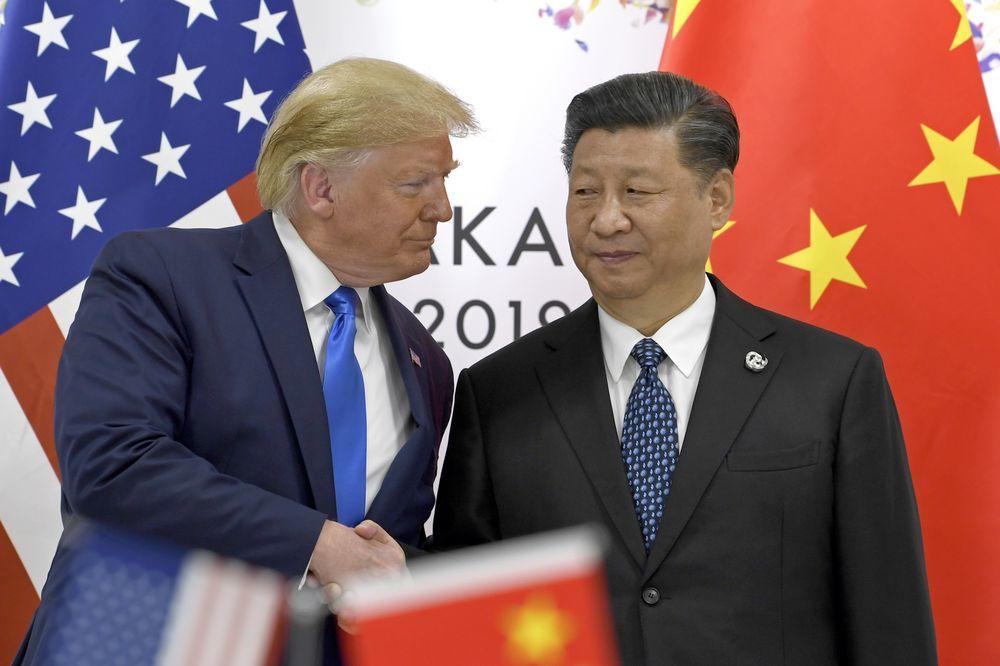
For now, however, there is optimism.
“Returning to negotiations is good news for the business community and breathes some much needed certainty into a slowly deteriorating relationship,” said Jacob Parker, a vice-president of China operations at the U.S.-China Business Council. But “now comes the hard work of finding consensus on the most difficult issues in the relationship, but with a commitment from the top we’re hopeful this will put the two sides on a sustained path to resolution,” he said.
Others were more skeptical, and warned the pause – just like the first ceasefire – will not last.
“Even if a truce happens this weekend, a subsequent breakdown of talks followed by further escalation still seems likely,” Capital Economics said in a commentary on Friday, quoted by Reuters.
The United States says China has been stealing American intellectual property for years, forces U.S. firms to share trade secrets as a condition for doing business in China, and subsidizes state-owned firms to dominate industries. Meanwhile, China has said the United States is making unreasonable demands and must also make concessions.
The talks collapsed in May after Washington accused Beijing of reneging on reform pledges. Trump raised tariffs to 25% from 10% on $200 billion of Chinese goods, and China retaliated with levies on U.S. imports.
The U.S.-China feud had cast a pall over the two-day G20 gathering, with leaders pointing to the threat to global growth. In their communique, the leaders warned of growing risks to the world economy but stopped short of denouncing protectionism, calling instead for a free, fair trade environment after talks some members described as difficult.
* * *
Finally, global markets will breathe a sigh of relief on news of the resumption in U.S.-China trade talks, even as an official deal remains elusive, and there is no indication of how the two countries will bridge the most difficult aspect of a feud that has emerged beyond simple trade and now affects most aspects of US and Chinese life.
The flip-side is that with trade talks back on, the Fed will feel far less pressure to ease in July, and since in June stocks exploded higher on hopes that the Fed will cut rates as much as 50bps next month, such a reversal in US-China relations could potentially prevent Powell from capitulating, and leave the Fed on hold, an outcome which would lead to a sharp drop in US capital markets. Indeed, in recent weeks, the S&P has returned to record highs, treasury yields have tumbled to their lowest level in years. The Japanese yen, a traditional beneficiary of flight to quality, has gained, while the U.S. dollar has slipped across the board, including against China’s yuan.
END
Wall Street responds/Saturday morning
(courtesy zerohedge)
Wall Street Responds To The US-China Ceasefire
As discussed previously, while the kneejerk reaction to the Trump-Xi ceasefire is that global markets will likely be positive, even as a formal trade deal remains elusive as ever, a more detailed take could lead to problems as now the Fed will feel far less pressure to ease in July, and since in June stocks exploded higher on hopes that Powell will cut rates as much as 50bps next month, a positive reversal in US-China relations could prevent Powell from capitulating and leave the Fed on hold, an outcome which would lead to a sharp risk off phase.
Does Wall Street agree with this assessment? Here, courtesy of Bloomberg, is how markets will likely react when they open on Monday, according to strategists and investors:
Mansoor Mohi-uddin, senior macro strategist at NatWest Markets in Singapore:
- “Investor sentiment is set to be buoyed in the week ahead by a truce in the U.S.-China trade war.”
- “Financial markets are unlikely to significantly reduce their expectations for Federal Reserve rate cuts despite global trade tensions easing. Thus risk assets — stocks, commodities and emerging markets — are set to rally while the safe-haven dollar, yen and Swiss franc underperform.”
Stephen Innes, managing partner at Vanguard Markets in Bangkok:
- The “reset button” being hit on trade talks was the markets’ base-case scenario, and this is supportive for risk, but the lack of a timeline for progress may cap “bullish topside ambitions.”
- “With no news reading algorithms to steamroll the markets on Saturday, traders will have a 36-hour cooling off period to quantify their next move. And I would expect the markets to be very orderly on Monday open.”
- The extensive lists of demands from both sides may be “a bridge too far.”
- “Underlying sentiment remains quite bearish in terms of the medium-term outlook for a U.S.-China trade deal as well the global growth outlook.”
Chris Weston, head of research at Pepperstone Financial in Melbourne:
- “I can’t see this meeting doing risk assets any harm, but there is still a lot of work to do to convince central banks they don’t need to act to keep the economic expansion in check.”
- “A few weak shorts may look to close out on Monday” given the tariff reprieve, prospects for negotiations to restart and that both sides “actually appear more united than expected.”
- Watch Sunday’s China PMI data.
Alfonso Esparza, senior market analyst at Oanda in Toronto:
- “Everybody played their part without any additional drama and until more details emerge we are back at square one.”
- “Oil is positioned to rise after the positive trade news.”
- “Gold will be pressured as trade optimism reduces the appeal of the yellow metal as a safe haven.”
Jean-Charles Sambor, deputy of head of emerging-market fixed income at BNP Paribas Asset Management in London:
- “This is of course good. Investors have been generally negative on both the probability of a meeting and the probability of a positive outcome following this meeting.”
- “High-yield spreads should do well. China high yield remains very cheap especially, and emerging-market currencies should continue to rally on the news.”
Banny Lam, head of research at CEB International Investment in Hong Kong:
- The outcome is “exactly” what the market had expected so the impact will be neutral.
- “I would say the G-20 summit delayed the escalation in trade tension, rather than solved the problem.”
- The U.S. and China will probably want to reach a deal soon amid pressures on their economies, but it will be “very difficult.”
Source: Bloomberg
END
This is not good for China. Last night they revealed with latest Mfg PMI and it was awful as it fell below 50 and thus contraction in their economy
(courtesy zerohedge)
China Slumps Into Full-Blown Manufacturing Contraction Following “Awful” Asian PMI Prints
Now that the Osaka G-20 has come and gone, and while nothing has been resolved in the US-China trade war, at least there has been no escalation and China is safe from US tariffs on the remainder of its exports to the US, which in turn has given algos a dose of optimism that all is well pushing S&P futures just shy of 3,000, things in the real world are going from bad to worse.
One day after China’s official NBS manufacturing PMI on Sunday printed unchanged at 49.4 in June, below expectations of an increase from May…
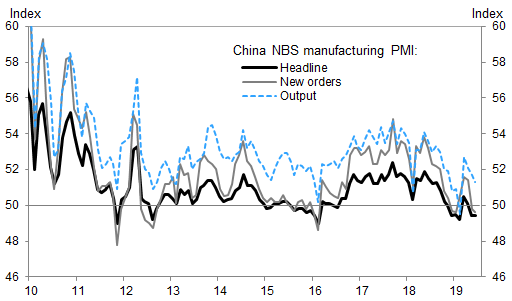
… with most of the key sub-components sliding to new cycle lows:
- production index 0.4 lower at 51.3,
- new orders sub-index was 0.2 lower at 49.6
- employment sub-index edged down 0.1pp to 46.9.
- imports sub-index down to 46.8, from 47.1,
- new export order index down to 46.3, vs. 46.5 in May
… the other Chinese PMI, the Caixin Manufacturing PMI, hammered expectations as it unexpectedly slumped back into contraction.
Falling from 50.2 in May to 49.4 in June, the Cixin PMI – which differs from the official, NBS report by shifting away from SOEs and large enterprises and instead focusing on small and medium businesses – was below the critical 50.0 threshold which divides contraction and expansion, for the first time in four months.
According to the report, the June data highlighted a “challenging month” for Chinese manufacturers, with trade tensions reportedly causing renewed declines in total sales, export orders and production.
Commenting on the June PMI data, Zhengsheng Zhong, Director of Macroeconomic Analysis at CEBM Group said: “The Caixin China General Manufacturing Purchasing Managers’ Index was 49.4 in June, the second lowest since June 2016, indicating a clear contraction in the manufacturing sector, and only for the first time since late 2016, identical to China’s official Mfg PMI print (which was also 49.4).
“The subindex for new orders slid into contractionary territory, pointing to notably shrinking domestic demand. The gauge for new export orders returned to contractionary territory, but was better than the levels seen from last April to last December. Front-loading by exporters was likely to support this gauge as the China-U.S. trade relationship was under great uncertainty.
The output subindex fell into contractionary territory. The employment subindex remained relatively stable in negative territory, likely due to government policies to stabilize the job market. The State Council set up a leading group on employment in late May.
The subindex measuring sentiment toward future output plunged further, albeit staying in expansionary territory, a reflection of continuously weakening business confidence amid the Sino-U.S. trade conflict.
Overall, China’s economy came under further pressure in June. Domestic demand shrank notably, foreign demand was still underpinned by front-loading exports, and business confidence fell sharply. It’s crucial for policymakers to step up countercyclical policies. New types of infrastructure, high-tech manufacturing and consumption are likely to be the main policy focuses.”
In short, the US-China trade war is Trump’s for the taking… if he wants it: companies responded to the latest escalation by reducing headcounts further and making fewer purchases of raw materials and semi-finished items. At the same time, China appears to be sliding into stagflation, as selling prices were raised following another increase in input costs, though rates of inflation were negligible, suggesting that companies failed to pass on costs to consumers. Also, business sentiment was broadly neutral at the end of the second quarter, with firms mainly concerned about the US-China trade dispute.
It wasn’t just China that was a shitshow: Asian factory PMIs were almost universally awful on Monday, adding to the signal from the official China report out Sunday that as Bloomberg put it, “the global economy has been harpooned by the trade wars.” To wit:
- Taiwan’s PMI dropped to 45.5, the lowest since 2011, and it’s now been below the 50 line separating contraction from expansion for 9 straight months — the longest since a 10-month stretch that ended in Feb. 2009.
- South Korea’s gauge slumped further into contraction (47.5 vs 48.4 in May) to confirm April’s spike above 50 was an outlier
- Japan’s came in at 49.3, worse than the initial reading of 49.5.
- Australia’s AIG factory gauge fell into contraction for the first time since 2016
- Malaysia’s PMI sank again to hold below 50.
- Indonesia and Thailand’s gauges fell, while holding above 50.
- The Philippines was the only substantial regional economy to see a tick up.
Meanwhile, futures blissfully continue to ignore the collapsing global economic reality, and instead rejoice at the “successful” conclusion of the Trump-Xi meeting, which notd only achieved nothing, but confirmed the status quo – massive tariffs and the threat of more.
The decision to resume talks, meanwhile, offers little cause for optimism given that this conflict has now dragged on for more than a year as Bloomberg Garfield Reynolds says, adding that “the PMIs underscore how much damage has been done by the trade spat, and even the central bank stimulus being forecast by rates markets is looking more and more like band aids that won’t stop the bleeding.”
Hong Kong Protests Re-Ignite – 1000s Storm Legislature, Cops Unleash Pepper Spray
Just when local (Chinese-beholden) authorities thought it was safe to continue their totalitarian shift to the motherland, the citizens of Hong Kong are rising up once again.
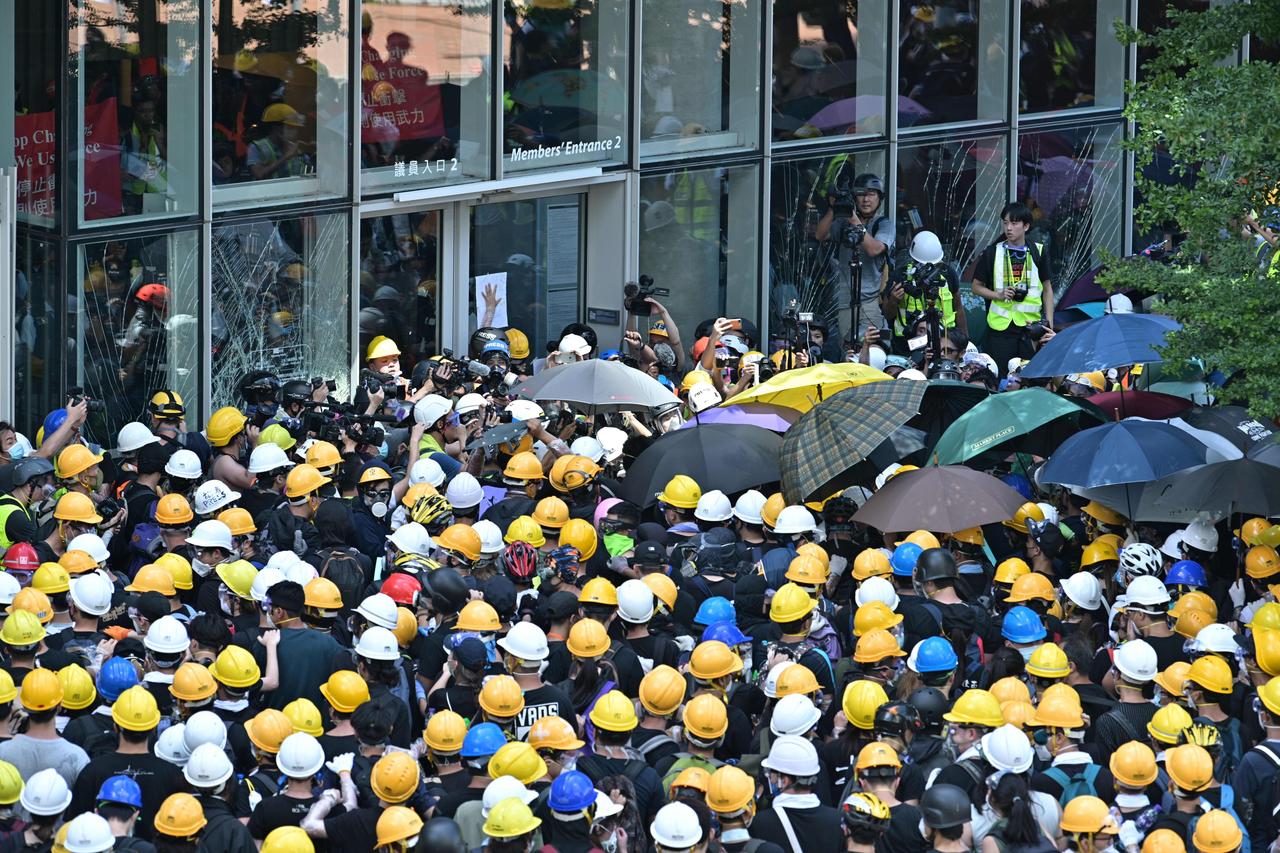
Reuters reports that Hong Kong protesters stormed the Legislative Council on the anniversary of the city’s 1997 return to Chinese rule on Monday amid widespread anger over planned laws that would allow extraditions to China, plunging the city deeper into chaos.
“In the past few years, people have been getting more active, because they found the peaceful way is not working,” said a 24-year-old protester surnamed Chen.
A small group, mostly students wearing hard hats and masks, used a metal trolley, poles and pieces of scaffolding to hack through reinforced glass and charge at the government compound near the heart of the financial center.

Riot police in helmets and carrying batons fired pepper spray in response in a standoff that was lasting into the sweltering heat of the evening.

Tens of thousands marched in temperatures of around 33 degrees Celsius (91.4°F) from Victoria Park in an annual rally that organizers hoped would get a boost from the anger over the extradition bill.
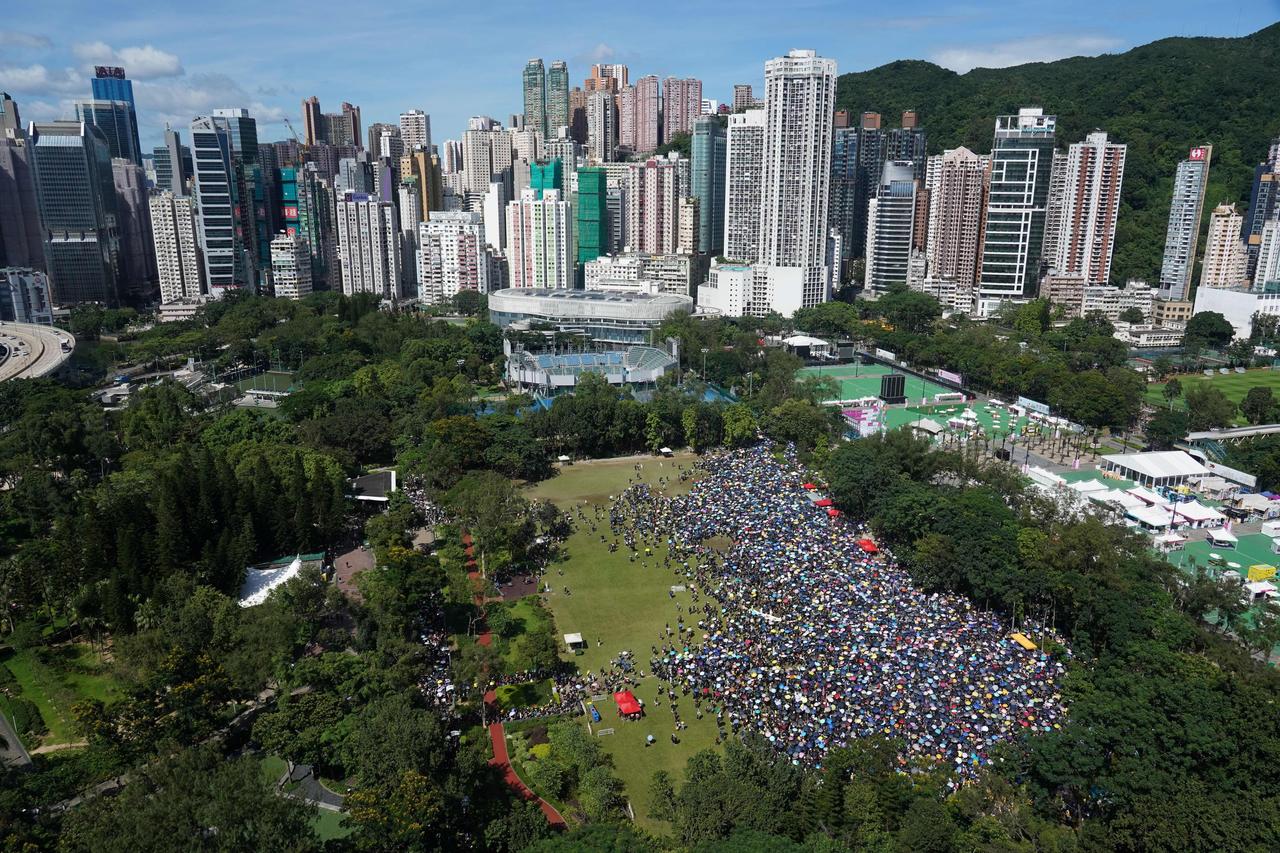
A tired-looking Lam appeared in public for the first time in nearly two weeks, flanked by her husband and former Hong Kong leader Tung Chee-hwa.
“The incident that happened in recent months has led to controversies and disputes between the public and the government,” she said.
“This has made me fully realize that I, as a politician, have to remind myself all the time of the need to grasp public sentiment accurately.”
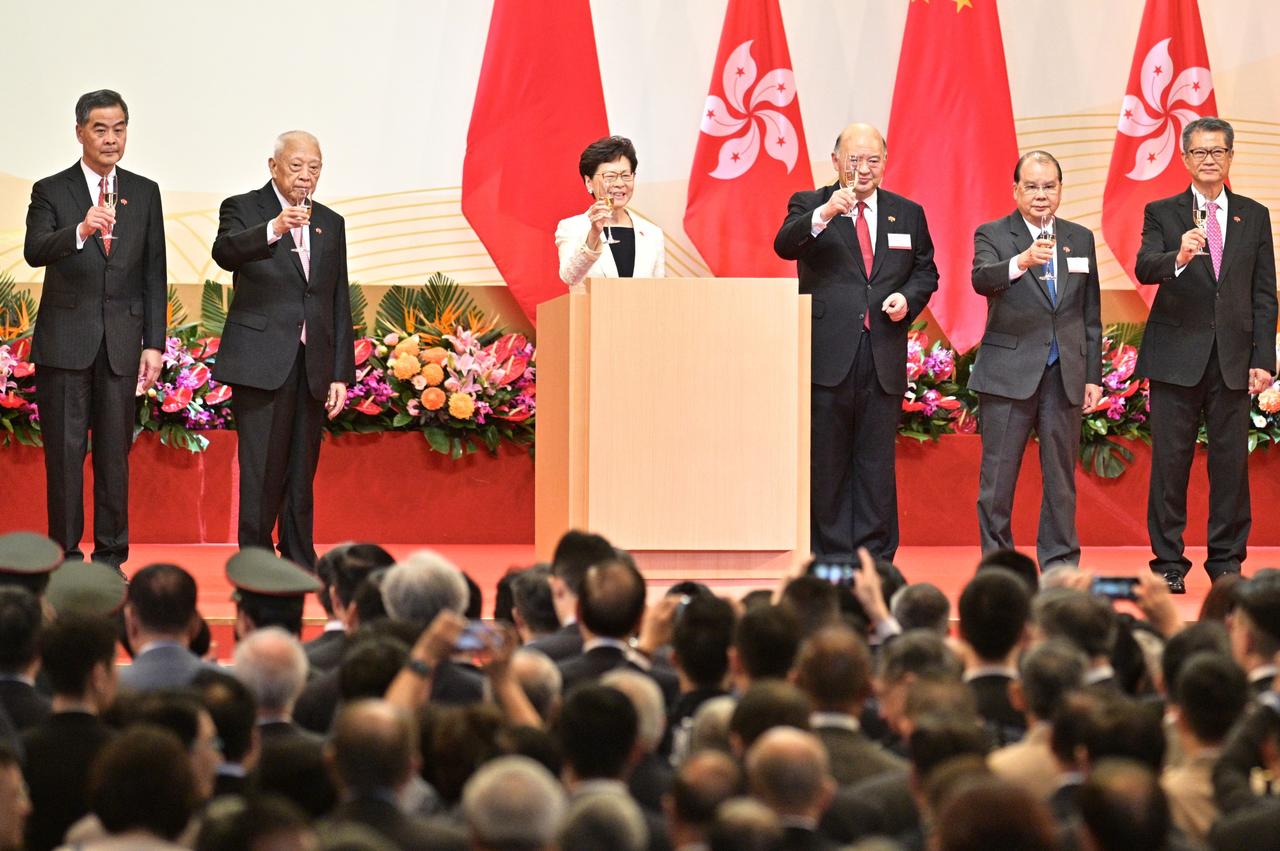
In a statement, a government spokesman has criticised demonstrators for storming “the Legislative Council with extremely violent methods, and destroying the glass door of the Legislative Council with offensive weapons such as an iron cart and iron poles”.
The statement said:
“The government strongly condemns it and expresses deep regret.
“Hong Kong is a society of the rule of law, and violence has never been accepted by society. Demonstrators who use violence must stop immediately, and the police will take appropriate law enforcement actions to ensure social order and public safety.”
More than a million people have taken to the streets at times over the past three weeks to vent their anger.
end
4/EUROPEAN AFFAIRS
Italy
A female captain of a Migrant NGO ship has been arrested after illegal docking in Italy
(courtesy zerohedge)
Italy Arrests Captain Of Migrant NGO Ship After Illegal Docking
The captain of a migrant transport ship that docked at the southern Italian island of Lampedusa was arrested on Saturday following a protracted standoff, according to the New York Times.

The 40 migrants onboard disembarked after 16 days on the Sea Watch 3, operated by German NGO Sea-Watch and operating under the Dutch flag.
Captain Carola Rackete, 31, docked just before 2 a.m. – ramming a border-control vessel trying to stop them in the process. Rackete was arrested on charges of “resisting a war ship,” which carries a penalty of up to 10 years in prison.
Sea Wach spokeswoman Giorgia Linardi said that the situation was still “unfolding,” and that the charges had yet to be formalized. She added that the migrants had been taken to a migration center on the island.
The Sea Watch, which rescued 53 people off the coast of Libya on June 12, had navigated toward Italy after rejecting an offer to dock in Tripoli, Libya, which humanitarian groups do not deem safe. Thirteen migrants had been allowed to disembark in Italy for medical reasons after the rescue. –New York Times
Italy’s Interior Minister, Matteo Salvini, has closed the country’s ports to rescue ships and demanded that other European nations take on the migrants. On Friday, five countries offered to take them. Salvini, who previously referred to the GNO vessel as a “pirate ship,” told RAI state radio that he had “asked for the arrest of an outlaw” who had endangered the lives of border patrol officers. He also ordered authorities to sequester the ship “which goes around the Mediterranean breaking laws.”

Saturday morning, Salvini tweeted a video of the ship’s arrival, writing “Outlaw commander arrested. Pirate ship confiscated. Maxi-fine to a foreign NGO. Migrants distributed to other European countries. MISSION ACCOMPLISHED.”

Matteo Salvini
✔@matteosalvinimi
Comandante ARRESTATA, nave SEQUESTRATA.
#SeaWhatch3

“Humanitarian reasons cannot justify acts of inadmissible violence against those in uniform who work at sea for the security of everyone,” said Luigi Patronaggio, chief prosecutor of Agrigento.
A Sea Watch spokesman based in Germany said on Saturday that the charges against Rackete and the reason she was arrested “remained unclear” and that the organization was awaiting more information.
The captain was notified on Friday that she was under investigation for facilitating unlawful immigration, the spokesman said.
Local supporters, and some hecklers, awaited the arrival of the ship at Lampedusa’s dock Saturday morning, with one woman shouting out, “Brava, Capitano.” –New York Times
The Sea-Watch chairman Johannes Bayer wrote on Twitter: “We are proud of our captain, she did exactly the right thing. She upheld the law of the sea and brought people to safety.”


Sea-Watch International@seawatch_intl
Statement of our Captain, #CarolaRackete, before entering Port with the #SeaWatch3.
“We are proud of our captain, she did exactly the right thing. She upheld the law of the sea and brought people to safety.” – #SeaWatch chairman Johannes Bayer

Italian Prime Minister Giuseppe Conte told Reporters at the G20 meeting in Japan on Saturday that the Sea Watch issue was legal, not political in nature.
“Now it’s up to the magistrate to apply our laws,” he added.
A judge now has 48 hours to validate the arrest of the captain, who has become a heroine to many Italians for opposing Mr. Salvini’s anti-migration tactics. She has been the subject of a multitude of flattering newspaper profiles, with some comparing the German activist to the ancient Greek heroine Antigone.
After the migrants disembarked, the ship returned to sea and was anchored a few miles off shore. –New York Times
Meanwhile, the Times notes that since the standoff with Sea Watch, some 500 migrants have landed on Italian shores in small boats.
Blain: “Nothing Was Solved In Osaka – The US And China Remain On Collision Course”
Blain’s Morning Porridge, submitted by Bill Blain
“We will have an extended meeting next time… ”
That was truly an extraordinary weekend. Trump vs Xi agreed to resume trade negotiations. No more tariffs, but the old ones still in place. Huawei ban to be reconsidered. Trump also met Kim in the DMZ. It was also the end of H1 2019, with stock markets posting their most impressive gains since 1997 even as bonds proved the top returning assets – which should have everyone wondering and worrying how!
I reckon that puts us in a very interesting position for the next 18 months. Trade wars will remain a major distraction and concern – whatever happened in Osaka over the weekend, about the only thing we can confirm is nothing is really fixed! Instead, the dominant factor in coming months could be the US Federal Reserve – and how it is likely to come under increasing pressure from Trump, who is now in full electioneering mode. That puts a whole new complexion on the Game of Markets.
(I am travelling next few days, but I would be fascinated to read any research on how markets perform in the lead up to US elections? I suspect its highly unlikely Trump will countenance any kind of market instability that could damage his prospects ahead of Nov 2020 – therefore expect lots of Fed Bashing as an electoral weapon!)
Let me try to put it all in context. We are posed with far more questions than answers. Its complex:
The renewed trade negotiations between China and US will have little effect on market direction. The news will decrease expectations of an imminent global recession, but it also reduce the pressure on the Fed to cut US rates. Hence it is Market Neutral.
This week’s US Payroll number on Friday is expected to be back in the 150k range, confirming last month was an anomaly and the US is still seeing strong/moderate growth, suggesting little immediate pressure to ease rates.
Both Trump and XI were playing for time – Trump’s demands about opening up China to US agri-goods is simple play for an electoral boost. XI needed the promise of no further tariffs and a Huawei rethink as a sign he’s got concessions. Neither side has much to gain politically from pushing swift agreement, (economically is a very different matter, both China and US will still suffer), meaning trade doubts drag on and remain a major market concern through rest of year.
The debate over Huawei is also a distraction – whatever is now agreed, Huawei is a damaged brand in the West. The US and China are likely to increasingly diverge down separate tech paths. However, Trump’s readiness to trade the Huawei card could cause him domestic political issues.
In the Long Term little was solved in Osaka. The US and China remain on collision course.
Trump – played the G20, Xi Meeting and Korea meeting with Kim to play to US electorate. Trump is in full election mode which is bad for Fed.
The issue for markets is Trump’s willingness to play the short electoral game. The fact he was willing to trade Huawei for an agreement was fascinating. A few weeks ago he was parading advice on the danger Huawei presents to long-term communications systems and therefore the whole economy. The US neo-cons will be furious. They have argued the US has just a few short-years to take-on China economically before it’s transforming economy is settled, and before the Chinese military becomes an effective deterrent to US geopolitical might. Any delay now makes that long-term reckoning less certain to play towards the US.
What is going to be critical is how market reacts – the big danger is that market believes Fed is going to deliver, and it doesn’t. That’s why I think it’s all about how Powell stands up to Trump in coming months. It’s hardly an encouraging time for markets when it’s the expectations of further Fed easing that’s the dominant factor keeping them afloat, and a President who thinks stocks = economic health!
The current market doesn’t speak of strong companies making sound business decisions. Nor does the downwards direction of global yields make any sense if the economy was strong enough to justify stock prices… Nope it speaks of a Fed feeding markets by easing when it should be normalising rates.
Now why would the Fed ease? Someone should tattoo “Hold Fast” on Powell’s knuckles.
Such is the world we live in. Tomorrow, European leaders and all that stuff.
end
5. RUSSIAN AND MIDDLE EASTERN AFFAIRS
Turkey
A wounded Erdogan is a dangerous person. From his purchase of Russian made S 400’s to his attack on ships trying to bring out natural gas in the Israeli-Cypriot-Greek waters.
(courtesy Hallinan//Counterpunch.org)
A Wounded Erdogan Is A Dangerous Erdogan
Authored by Conn Hallinan via Counterpunch.org,
For the second time in a row, Turkish voters have rebuked President Recep Tayyir Erdogan’s handpicked candidate for the mayoralty of Istanbul, Turkey’s largest and wealthiest city. The secular Republican People’s Party (CHP) candidate, Ekrem Imamoglu, swamped Erdogan’s Justice and Development Party (AKP) candidate Binali Yildirim in an election that many see as a report card on the President’s 17 years of power.
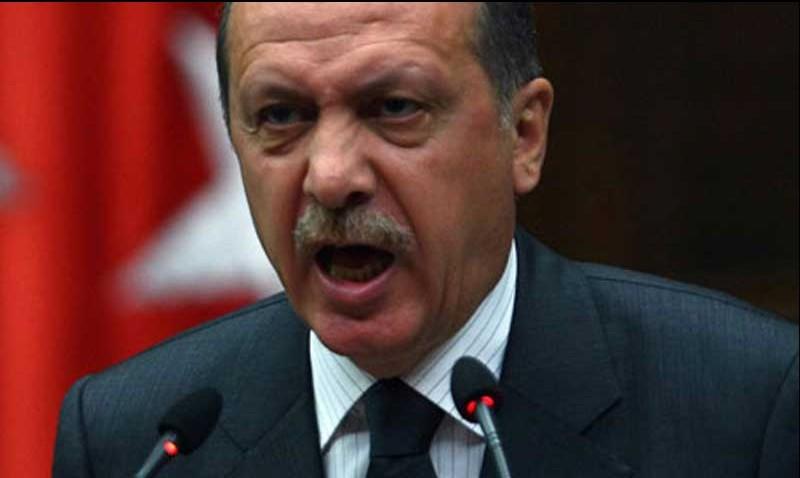
So what does the outcome of the election mean for the future of Turkey, and in particular, its powerful president? For starters, an internal political realignment, but also maybe a dangerous foreign policy adventure.
Erdogan and his Party have been weakened politically and financially by the loss of Istanbul, even though the President did his best to steer clear of the campaign over the past several weeks. Since it was Erdogan that pressured the Supreme Election Council into annulling the results of the March 31 vote, whether he likes it or not, he owns the outcome.
His opponents in the AKP are already smelling blood. Former Prime Minister Ahmet Dovutoglu, who Erdogan sidelined in 2016, has begun criticizing the President’s inner circle, including Berat Albayrak, his son-in-law and current Finance Minister. There are rumors that Dovutoglu and former deputy Prime Minister Ali Babacan are considering forming a new party on the right.
Up until the March election that saw the AKP and its extreme nationalist alliance partner, the National Movement Party (MHP), lose control of most the major cities in the country, Erdogan had shown an almost instinctive grasp of what the majority of Turks wanted. But this time out the AKP seemed tone deaf. While Erdogan campaigned on the issue of terrorism, polls showed most Turks were more concerned with the disastrous state of the economy, rising inflation and growing joblessness.
The “terrorist threat” strategy—short hand for Turkey’s Kurdish minority—not only alienated conservative Kurds who reliably voted for the AKP, but forced the opposition into a united front. Parties ranging from the leftist Kurdish People’s Democratic Party and the Communist Party, to more conservative parties like the Good Party, withdrew their candidates from the Istanbul’s mayor’s race and lined up behind the CHP’s Imamoglu.
The AKP—long an electoral steamroller—ran a clumsy and ill-coordinated campaign. While the Yildirim tried to move to the center, Erdogan’s inner circle opted for a hard right program, even accusing Imamoglu of being a Greek (and closet Christian) because he hails from the Black Sea area of Trabzon that was a Greek center centuries ago. The charge backfired badly, and an area that in the past was overwhelming supportive of the AKP shifted to backing a native son. Some 2.5 million former residents of the Black Sea live in Istanbul, and it was clear which way they voted.
So what does the election outcome mean for Turkish politics? Well, for one, when the center and left unite they can beat Erdogan. But it also looks like there is going to be re-alignment on the right. In the March election, the extreme right MHP picked up some disgruntled AKP voters, and many AKP voters apparently stayed home, upset at the corruption and the anti-terrorist strategy of their party. It feels a lot like 2002, when the AKP came out of the political margins and vaulted over the rightwing Motherland and True Path parties to begin its 17 years of domination. How far all this goes and what the final outcome will be is not clear, but Erdogan has been weakened, and his opponents in the AKP are already sharpening their knives.
An Erdogan at bay, however, can be dangerous. When the AKP lost its majority in the 2015 general election, Erdogan reversed his attempt to peacefully resolve tensions with the Kurds and, instead, launched a war on Kurdish cities in the country’s southeast. While the war helped him to win back his majority in an election six months later, it alienated the Kurds and laid the groundwork for the AKP’s losses in the March 2019 election and the Istambul’s mayor’s race.
The fear is that Erdogan will look for a crisis that will resonate with Turkish nationalism, a strategy he has used in the past.
He tried to rally Turks behind overthrowing the government of Bashar al-Assad in Syria, but the war was never popular. Most Turks are not happy with the 3.7 million Syrian refugees currently camped in their country, nor with what increasingly appears to be a quagmire for the Turkish Army in Northern and Eastern Syria.
In general, Turkey’s foreign policy is a shambles.
Erdogan is trying to repair fences with Saudi Arabia and the United Arab Emirates, because he desperately needs the investment that Gulf monarchs can bring to Turkey. But the price for that is a break with Iran and ending his support for the Muslim Brotherhood. While the Turkish President might be willing to dump the Brotherhood, Erdogan feels he needs Iran in his ongoing confrontation with the Kurds in Syria, and, at least at this point, he is unwilling to join Saudi Arabia’s jihad on Tehran.
In spite of the Turkish President’s efforts to normalize ties with Riyadh, Saudi Arabia recently issued a formal warning to Saudi real estate investors and tourists that Turkey is” inhospitable.” Saudi tourism is down 30 percent, and Turkish exports to Saudi Arabia are also off.
Erdogan is also wrangling with the US and NATO over Ankara’s purchase of the Russian S-400 anti-aircraft system, a disagreement that threatens further damage to the Turkish economy through US-imposed sanctions. There is even a demand by some Americans to expel Turkey from NATO, echoed by similar calls from the Turkish extreme right.
Talk of leaving NATO, however, is mostly Sturm und Drang. There is no Alliance procedure to expel a member, and current tensions with Moscow means NATO needs Turkey’s southern border with Russia, especially its control of the Black Sea’s outlet to the Mediterranean.
But a confrontation over Cyprus—and therefore with Greece—is by no means out of the question. This past May, Turkey announced that it was sending a ship to explore for natural gas in the sea off Cyprus, waters that are clearly within the island’s economic exploitation zone.
“History suggests that leaders who are losing their grip on power have incentives to organize a show of strength and unite their base behind an imminent foreign threat,” writes Greek investigative reporter Yiannis Baboulias in Foreign Policy.
“Erdogan has every reason to create hostilities with Greece—Turkey’s traditional adversary and Cyprus’s ally—to distract from his problems at home.”
Turkey has just finished large-scale naval exercises—code name “Sea Wolf”— in the Aegean and Eastern Mediterranean and, according to Baboulias, Turkish warplanes have been violating Greek airspace.
Cyprus, along with Israel and Egypt, has been trying to develop Cypriote offshore gas resources for almost a decade, but Turkey has routinely stymied their efforts. The European Union (EU) supports the right of Cyprus to develop the fields, and the EU’s foreign policy head, Federica Mogherini, called on Turkey to “respect the sovereign rights of Cyprus to its exclusive economic zone and refrain from such illegal actions.” While Mogherini pledged “full solidarity” with Cyprus, it is hard to see what the big trade organization could do in the event of a crisis.
Any friction with Cyprus is friction with Greece, and there is a distinct possibility that two NATO members could find themselves in a face off. Erdogan likes to create tensions and then negotiate from strength, a penchant he shares with US President Donald Trump. While it seems unlikely that it will come to that, in this case Turkish domestic considerations could play a role.
A dustup with Ankara’s traditional enemy, Greece, would put Erdogan’s opponents in the AKP on the defensive and divert Turks attention from the deepening economic crisis at home. It might also allow Erdogan to use the excuse of a foreign policy crisis to strengthen his already considerable executive powers and to divert to the military budget monies from cities the AKP no longer control.
Budget cuts could stymie efforts by the CHP and left parties to improve conditions in the cities and to pump badly needed funds into education. The AKP used Istanbul’s budget as a piggy bank for programs that benefited members of Erdogan’s family or generated kickbacks for the Party from construction firms and private contractors. Erdogan has already warned his opponents that they “won’t even be able to pay the salaries of their employees.” The man may be down but he is hardly beaten. There are turbulent times ahead for Turkey.
end
Libya/Turkey/USA
Basically Hafter has declared war on Turkish planes flying over Libya and also boats off its shore. This proxy war is escalating fast. It certainly looks like Turkey will have to leave NATO as their policies are continuing to show their true colours as they face east.
(zerohedge)
“Libya Under Turkish Invasion”: Haftar Releases Hostages But Vows War On Turkish Planes, Vessels
We’ve noted before that Libya’s new civil war has increasingly come out in the open as in reality an international proxy war, with even the White House in the past months “switching” support from the UN-backed Government of National Accord (GNA) in Tripoli to the renegade General Khalifa Haftar, whose LNA forces have for months laid siege to the capital in an attempt to wrest the country from GNA authority.
And to nobody’s surprise, advanced American-made anti-tank missiles believed supplied by the UAE have recently been found among Haftar’s weapons stockpiles. All of this makes Gen. Haftar’s latest “declaration of war” on Turkey more interesting. Over the weekend the LNA threatened to shoot down Turkish airplanes found in Libyan air space and to destroy Turkish ships off the Libyan coast, in response to Turkish military support to GNA forces in Tripoli, which resulted in a significant setback for pro-Haftar militants.

Haftar’s rebel force had claimed Libya is “under Turkish invasion” and that it would act against any Turkish threat, including Turkish flagged vessels found in Libyan territorial waters.
Over the weekend Turkey threatened to attack Haftar’s forces in eastern Libya directly as a “legitimate target” if the LNA failed to release six Turkish citizens under its detention. Haftar had previously declared intent to detain all Turkish nationals in Libya, but walked back the threat while additionally releasing the six Turkish hostages on Monday.
Ankara’s threat of attack appeared to have worked, according to Al Jazeera: “The spokesman of Haftar’s forces, Colonel Ahmed Masmari, earlier said they were detaining all Turkish nationals in Libya. But last night [Sunday], he retreated saying he does not have any knowledge of the detention of the Turkish nationals.” The Turkish Foreign Ministry has confirmed the Turkish nationals’ release on Monday.
However, Haftar has yet to walk back LNA statements declaring Turkey “an enemy of the state”. Having such a powerful and military involved enemy as Erdogan’s Turkey could permanently stall his attempts to take all of Libya.
Gen. Haftar — who solidified control of Eastern Libya over the past two years and swept through the south early this year, has sought to capture Tripoli with the support of countries like the UAE and France, but is strongly opposed by Turkey and most European countries. He holds a huge portion of the country as well as oil production.
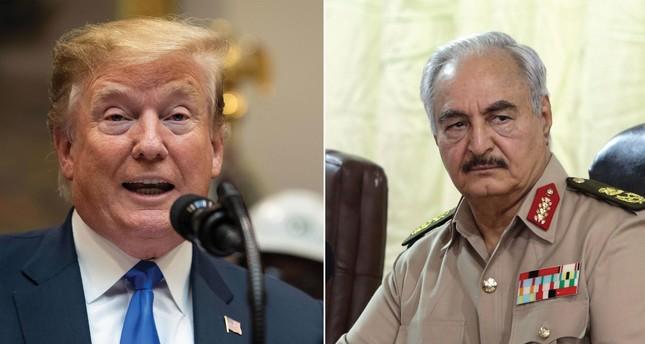
Haftar has long been described by many analysts as “the CIA’s man in Libya” — given he spent a couple decades living in exile a mere few minutes from CIA headquarters in Langley, Virginia during Gaddafi’s rule.
He was inserted back onto the Libyan battlefield before Gaddafi’s eventual capture and field execution at the hands of NATO supported Islamist fighters in 2011.
It was only months ago that President Trump for the first time voiced public support to Haftar’s forces. The president’s April comments signaled a complete reversal of US policy, given that up to that point the US had officially backed the GNA.
ISRAEL/SYRIA
Last night: a major Israeli airstrike on Syrian positions trying to take out the Russian supplied #SAM 300. Also targeted was Iranian posiitions inside Syria
(courtesy zerohedge)
Major Israeli Airstrike On Syria Just As Russian-Supplied S-300 Went Operational
Hours after Israeli reports said Russian S-300 anti-air defense systems in Syria came online and were “operational,” the Israeli military allegedly launched a major aerial attack on Syria in the middle of the night Sunday.

According to a breaking AFP report:
Syria said Israeli jets attacked several military sites near the capital Damascus and the central city of Homs early Monday, killing several people.
State news agency SANA said that Syrian air defense had intercepted several of the incoming missiles that were fired from Lebanese airspace.
Syria reported its aerial defense systems were active during the assault, which further caused damage to multiple civilian homes in the Damascus suburb of Sahnaya, according to SANA.
The major Syrian military airport at Mezzeh on the western edge of Damascus was also a reported target in the attack.


Though total casualties are still unknown, one well-known journalist from Damascus, Danny Makki, is reporting at least 4 civilians killed — including a baby — and over 20 injured.




H.K
✔@Ibra_Joudeh
Some missiles landed in residential areas.


Syrian state media published footage showing missile intercepts of inbound projectiles.
It is also as yet unknown if the S-300s were active during the air strikes, however, Israeli media reports suggested both the newly installed S-300s as well as Iranian troop presence was a prime cause behind the Israeli action, despite the Israeli Defense Forces (IDF) neither confirming nor denying the strikes:
The reported strikes came just hours after an Israeli satellite imagery analysis company said Syria’s entire S-300 air defense system appeared to be operational, indicating a greater threat to Israel’s ability to conduct airstrikes against Iranian and pro-Iranian forces in the country.
Until now, only three of the country’s four surface-to-air missile launchers had been seen fully erected at the Masyaf base in northwestern Syria.
Israel has threatened to destroy the S-300 system if it is used against its fighter jets, regardless of the potential blowback from Russia.
Journalist Danny Makki called the overnight air strikes “certainly one of the biggest Israeli attacks on Syria this year” – given that two provinces were targeted as well as multiple installations and a civilian neighborhood being hit.

developing…
Iran
Iran enriches Uranium and the level has now surpasses 300 kg. Israel and the uSA are not happy.
(courtesy zerohedge)
Iran’s FM Zarif Confirms Enriched Uranium Limit Now Breached
It what appears to be the first known violation of the terms of the 2015 nuclear deal (JCPOA), Iran’s stockpiles of enriched low-grade uranium have surpassed the limit of 300 kg, Iran’s semi-official Fars News is reporting.
Fars noted further that the International Atomic Energy Agency had confirmed the stockpile measurement on Monday, after in May it had already quadrupled its production of the material, the key component to make nuclear reactor fuel – and potentially nuclear weapons. Following the Fars report which had been based on an unnamed “informed source,” Iranian Foreign Minister Javad Zarif was the first government official to confirm the country has exceeded the ceiling of 300kg, according to Iran’s ISNA.
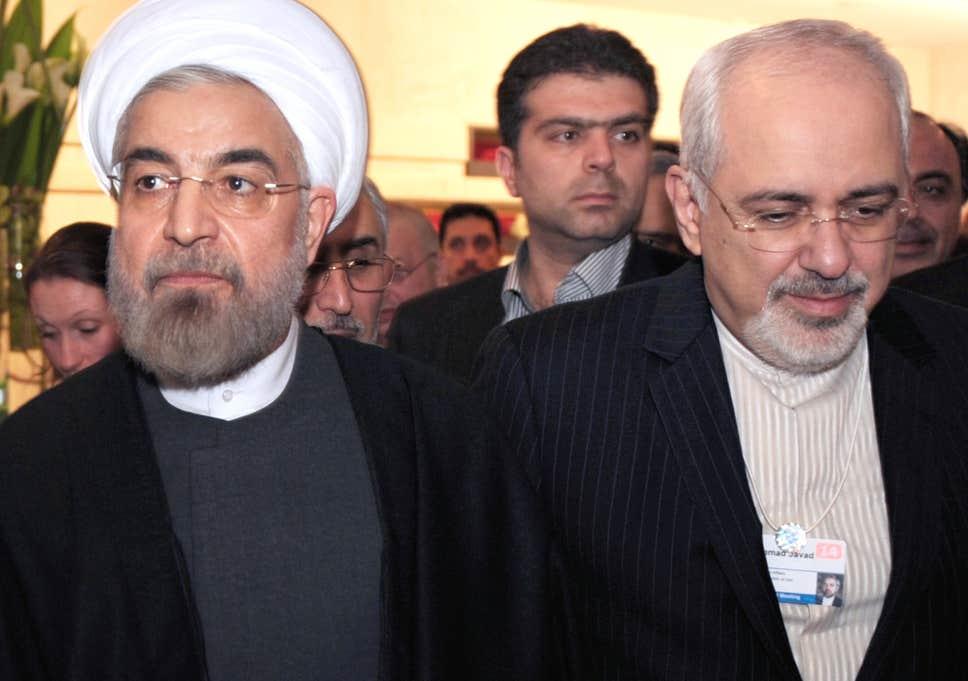
Iran’s leaders warned in the past days and weeks that it was on track to surpass the agreed upon enriched uranium limit set by the JCPOA in reaction to President Trump’s reimposed sanctions, as well as the inability of remaining signatories.
The Fars report announcing the breach of the nuclear deal limits specifically cited European partners as lagging behind commitments to shield Iran from Washington sanctions, despite the new Instrument in Support of Trade Exchange (INSTEX) going live just days ago.
“For Europeans, there is still time, but if they are asking for more time, it means that whether they are incompetent or they are unwilling to deliver on their commitments,” an official with the Atomic Energy Organization of Iran (AEOI) was cited as saying in the Fars report.
Zarif also called INSTEX – which was officially launched by Europe as a SWIFT alternative on Friday – a “preliminary step” of the European members of the nuclear deal which only “partially delivers” on their commitments.
Zarif said Monday while speaking at a public event: “We will never succumb to international pressure, and together with the people of the world, we will force them to only treat Iran with respect and never threaten an Iranian,” and urged European allies to resist US pressures and aggression.
Last week, President Trump had threatened Iran in a tweet with “great and overwhelming force” and in some areas “obliteration” should it pursue nuclear weapons development. Zarif had responded with his own tweet saying “misconceptions endanger peace” and reiterated that US sanctions amount are tantamount to “war.”
6. GLOBAL ISSUES
Canada/Vancouver
China has long sought to get its money out of China and now Hong Kong is doing the same thing (the latest riots), Vancouver is one of the hot spots for the Chinese with Toronto coming in 2nd. It has made housing unaffordable now.
(courtesy zerohedge)
Vancouver Housing Unaffordability Due To Foreign Ownership, Chinese Funds, & Migrant Millionaires, Study Says
A new study has provided evidence linking unaffordable housing in Vancouver to foreign ownership, Chinese capital and millionaire migrants, according to the SCMP.
A white paper published by Josh Gordon, an assistant professor at Simon Fraser University’s school of public policy, found a stunning 96% correlation between metro Vancouver municipalities’ price to income ratios and the proportion of their detached houses in which at least one owner was a non-resident. The correlation was called “unimpeachable” by a leading research who commented on the paper.
In short, this means that the more that a Vancouver municipality was sought after by non-resident owners, the more unaffordable it became.
Gordon said: “When I plugged the numbers in it blew my mind … I mean, holy smokes.”
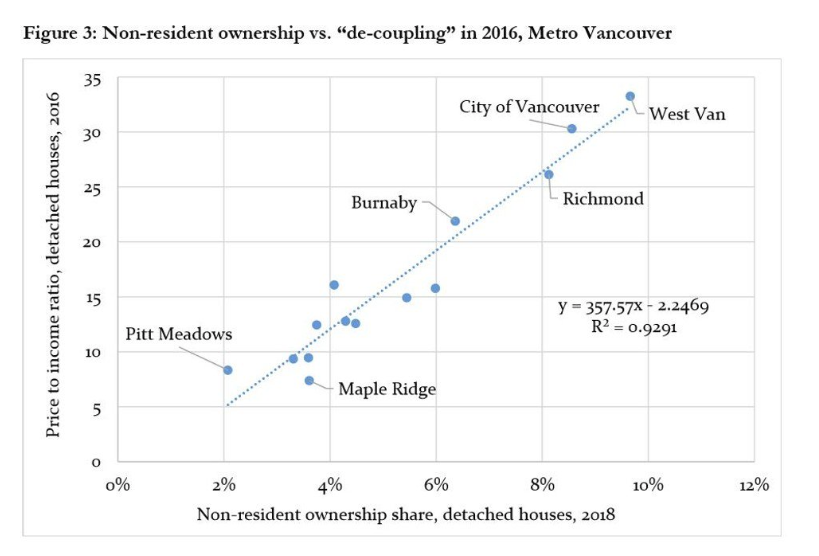
His paper stated: “This is compelling evidence that when it comes to the extreme ‘decoupling’ [of prices from local incomes] seen in the Vancouver housing market, foreign ownership is the primary culprit.”
Vancouver has often been considered the world’s most unafforable housing, second only to Hong Kong. It has a price-to-income ratio for all housing of 12.6. Among detached houses, the ratio climbs to 25 to 30 to one, especially in areas popular with Chinese buyers, like the City of Vancouver, Richmond and West Vancouver.
Gordon’s paper was checked afterwards by University of British Columbia geography professor David Ley, who has studied Vancouver real estate unaffordability for decades. It was also checked by Andy Yan, director of the City Programme at Simon Fraser University.
Ley commented: “Such a high correlation is rarely seen in social science research … It indicates a very strong relationship. So it is the presence of non-resident buyers that is forcing up prices. But there’s a qualifier here because it forces up prices relative to incomes … we can more accurately say that non-resident demand shapes affordability.”
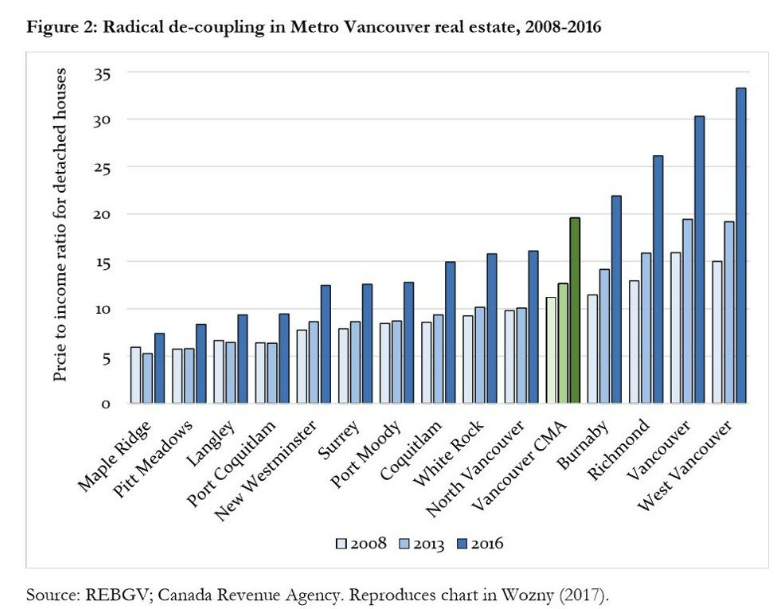
In the country’s condo market in 2016, the correlation between the unaffordability ratio and non-resident ownership was “strong” at 75%. His research shows that the correlation would rise to 88% if the single municipality of West Vancouver was discounted.
Yan commented that the study was “very straightforward” and said: “This puts together the story about the forces that are behind Vancouver real estate … [it] gives us a foundation and a direction, for how we [produce] effective housing policy. Key to that was understanding just how much Vancouver real estate is connected to the global economy, of which a large component is being driven by China.”
Gordon also sought out to investigate “satellite families” who live in Vancouver, but whose breadwinners earned money abroad. The study said: “[A] family with a low declared Canadian income might live in a multimillion-dollar mansion. This particular situation would represent ‘decoupling’ on steroids.”
Millionaire migration from mainland China, Hong Kong and Taiwan is primarily responsible for the satellite family phenomenon. As the article notes, “Vancouver was long the world’s most popular destination city for such migrants under wealth-determined schemes, attracting them by the tens of thousands.”
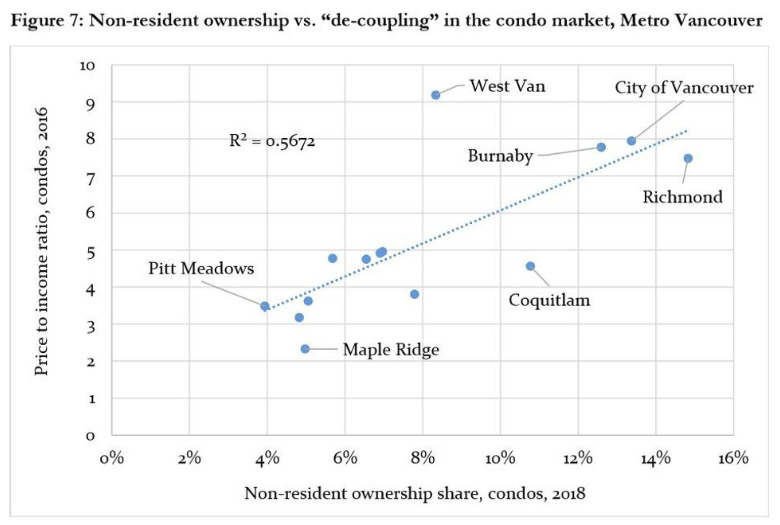
Now, the country has “become a global test bed for affordability policies, with the introduction of a foreign buyers’ tax, a speculation and vacancy tax, and increased provincial property taxes.”
The average price of a detached house in metro Vancouver is now $1.2 million.
Gordon’s study was the result of Richard Wozny’s 2017 report, which concluded that local incomes could not support prices. Wozny examined 14 Vancouver municipalities and Gordon, who said his work was “testament to Richard Wozny’s instincts and character”, looked at the same municipalities during his study.
Yan concluded: “These are proxies for foreign money at times when we don’t have direct measures of foreign money. So we have these various scholars, with various data sets, all pointing in the same direction. That is a call for action.”
And how bad has the market gotten in Vancouver? Just 2 weeks ago, we wrote that desperate developers in Vancouver were trying to woo millennials into buying using avocado toast and free wine.
“It’s a slower, more competitive market,” according to Vancouver-based Wesgroup Properties VP Brad Jones, adding “The onus is on us to show we have the most attractive offering.”
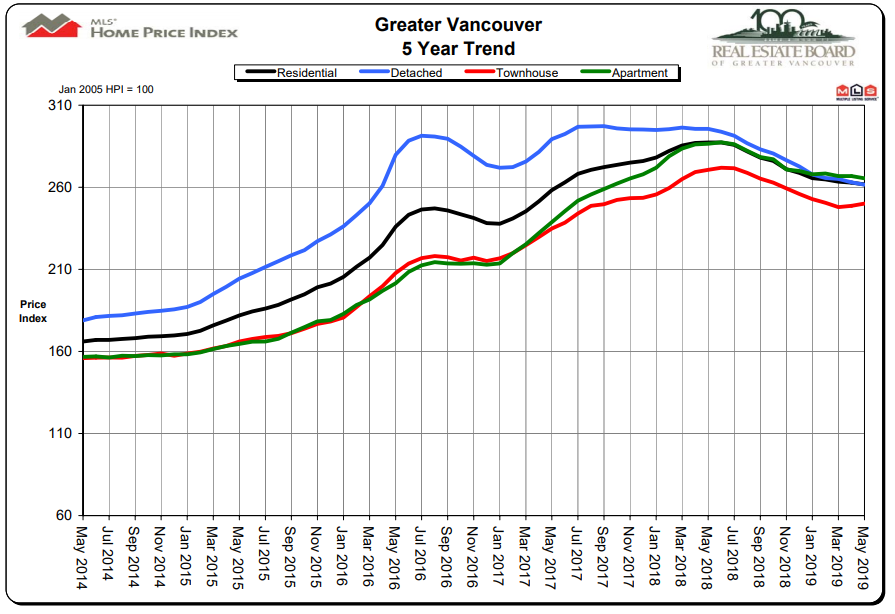
As we noted in April, the decline of Vancouver’s housing market has become worldwide news – with sales plummeting 46% over the past year to levels not seen since 1986.
In late 2018, we wrote about how Chinese fentanyl kingpins had laundered over $5 billion through Vancouver homes since 2012.
end
Global warnings
this is something that you must pay attention to: The BIS which is the central bank to the central banks warns of a worsening and spreading global slowdown as central banks are running out of ammo
(courtesy BIS/zerohedge)
BIS Warns “Slowdown Is Worsening And Spreading” As Central Banks Run Out Of Ammo
Every six month or so, the Bank of International Settlements, also known as the central banks’ central bank, publishes some dire warning about the increasingly precarious state of the global financial system – largely as a result of an unprecedented monetary experiment that is now pushing on a string – and every six months or so the world’s most important central bankers congregate on 18th floor of the circular BIS tower in Basel where they decide to ignore all the warnings and double-down on policies that haven’t worked in a decade, with the expectation that they will work this time (or at least make the world’s richest even richer, while destroying the middle class).
Well, today is one of those days, because at midnight on June 30, the BIS published it Annual Economic Report for the year 2019, and of course, this report too and the speech delivered alongside the Annual General Meeting in Basel by Agustin Carstens, will be summarily ignored by those who matter, until the next financial crisis strikes and everyone is shocked how there were no signals indicating the arrival of what will soon be the greatest financial catastrophe in world history.
Of course, the BIS won’t make any such dire predictions – the last thing it needs is to be accused of sowing the panic that unleashes a crisis – it will however warn that after a failed attempt by central banks to renormalize monetary policy, governments must step in to stimulate their economies and fix policy imbalances that have forced central banks to use up most of their firepower: “The continuation of easy monetary conditions can support the economy, but make normalization more difficult, in particular through the impact on debt and the financial system,” the BIS warned.
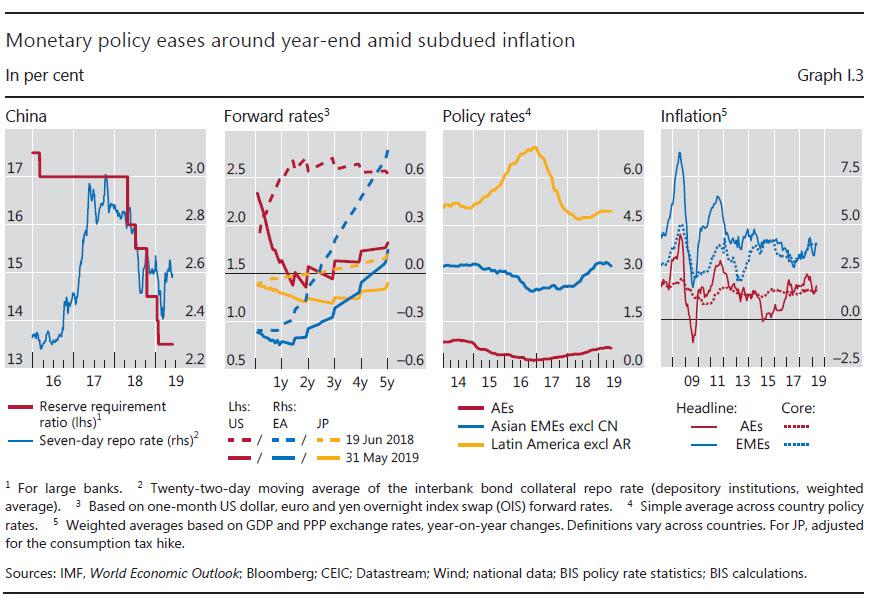
As a result of central banks going all in again in what some have dubbed the last rate to the bottom, “the narrow normalization path has become narrower.”
If that wasn’t enough, in his speech, Carstens explicitly brought attention to this critical issue:
While the near-term outlook is still good, there are many vulnerabilities further out. For the global economy to remain on course towards clear skies, other policies need to play a bigger role and policymakers must take a longer-term perspective. In particular, a better mix is required between monetary policy, fiscal policy, macroprudential measures and structural reforms. And navigating the way to clear skies also means balancing speed with stability as well as conserving some fuel to cope with possible headwinds. This matters all the more given the many uncertainties and risks we face today.
The above excerpt comes from the speech by BIS general manager Agustin Carstens who urge politicians to “ignite all engines” to overcome a global soft patch, which can no longer be punted on central banks in hopes that lower rates will stimulate the global economy for one simple reason: with rates at all time lows, there is virtually nothing left to cut. Worse, rates are now so low that – at least the BIS admits – banks are now suffering as a result of monetary policy:
Price stability – central banks’ key mandate – naturally reinforces the case for maintaining policy accommodation, or easing further, as inflation is below target. Closely related is the need to bring inflation expectations back towards target. This approach is even more compelling if financial markets look fragile, as they appeared late last year, and could impact the economy adversely. The greater the uncertainty about conditions in the financial system and the macro economy, the stronger the case for a more gradual strategy.
At the same time, the gains from such a strategy could be associated with costs and less room for policy manoeuvre in the future. The possible costs arise mainly through financial channels. The historically low-for-long interest rates tend to compress banks’ margins, lower profits and hence reduce banks’ ability to build up capital, essential for a productive economy.
And here is the #timestamp for you warning, so that the next time banks complain that nobody could have possibly seen the catastrophe coming, one can counter that their very supervisor warned them (and again, and again), of what was coming:
Very easy financial conditions may boost growth in the near term but may further build up vulnerabilities. And persistently low rates may undermine efficient resource allocation and productivity
Under such circumstances, the BIS warns, the future room for policy manoeuvre could shrink for two reasons:
- To the extent that normalization does not end up weakening economic activity, a more gradual approach would reduce policy space directly.
- More subtly, the side effects of very accommodative policies might themselves sap the economy’s ability to withstand higher rates, making any normalisation harder.
Meanwhile, since monetary policy has been “unconventional” for more than a decade, the BIS also points out that in addition to the conventional recent bogeymen of trade protectionism and China’s deleveraging, as a result of the prolonged period of easy financial conditions “many vulnerabilities have built up and could throw the global economy off course,” i.e. there are now bubbles everywhere, including household debt, the leveraged loan market, and emerging markets feasting on USD-denominated debt:
- One such vulnerability is high household debt in many advanced economies, especially those not directly affected by the Great Financial Crisis. These historically high debt levels limit the scope for households to drive economic activity.
- Another vulnerability is clear signs of overheating in the corporate sector in a number of advanced countries. Following high growth, the leveraged loan market is now some USD 3 trillion in size, comparable to the collateralised debt obligations that amplified the subprime crisis. Structured products such as collateralised loan obligations (CLOs) have surged. Credit standards have been declining as investors have searched for yield. Should the leveraged loans sector deteriorate, the economic impact could be amplified through the banking system and other parts of the financial system that hold leveraged loans and CLOs. There could be sharp price adjustments and funding tensions. These risks should be seen in the broader context of the longer-term deterioration in credit quality and the generally high corporate leverage in many advanced economies.
- High levels of debt also point to vulnerabilities in a number of emerging market economies (EMEs). In some cases, these are in the household sector. Most often, they are in the corporate sector, not least as foreign currency debt has expanded strongly since the crisis. The current vulnerabilities reflect in part spillovers from prolonged accommodative monetary policies in advanced economies, as EMEs are especially vulnerable to capital flow reversals and exchange rate fluctuations.
Meanwhile, even as central bank ammunition has dwindled to almost nothing, global growth is slowing: “If anything, the slowdown appears to be worsening and spreading since the Report went to press. There are signs of weaker consumption and investment.”
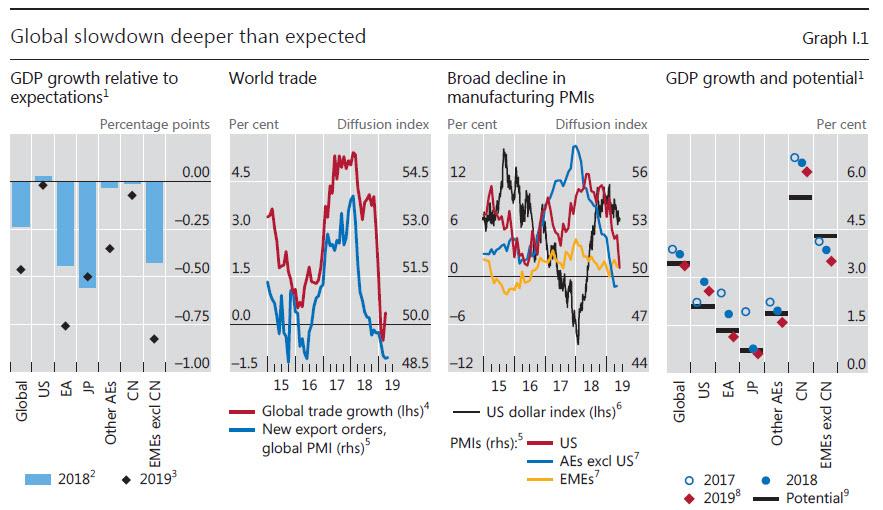
Not only that, but as the BIS also warns, significant near-term risks exist. Notably, the trade tensions that contributed to the slowdown could flare up again, even as financial conditions are undergoing major shifts.
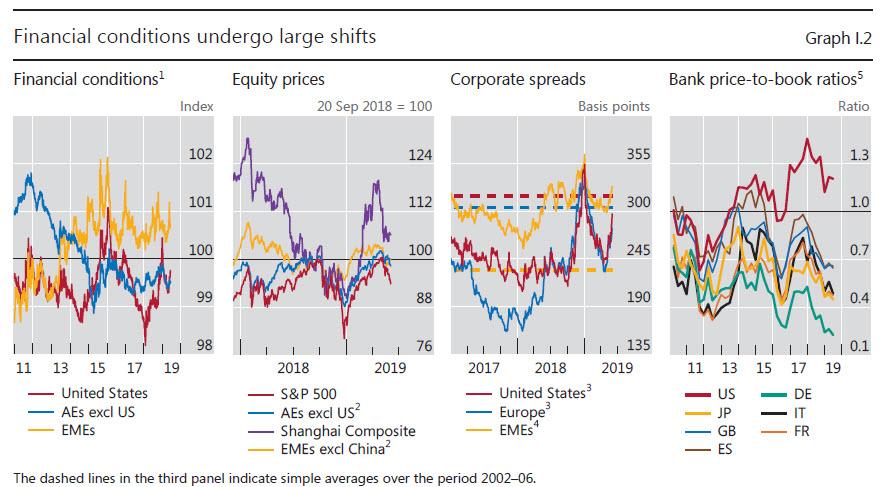
Other threats include political economy risks in some countries. China’s deleveraging is not complete. And if past experience is anything to go by, the contraction phase of the financial cycles under way in many countries is likely to act as a headwind for global growth.
The BIS’ bottom line, with monetary policy now helpless, structural reforms are vital and fard as it is politically, it is essential to revive the flagging efforts to implement structural policies designed to boost growth. These days, policies to adapt economies to rapid technological and other structural changes are especially important.
Clear skies may be over the horizon, but we have yet to cross it. Many risks and vulnerabilities exist, and political uncertainty is high. The course towards normalisation has called for some deviations. A sustainable flight path requires the long-overdue full engagement of all four policy engines, rather than short-term turbo charges. By taking a longer view, one can better balance the needs of today with the needs of tomorrow.
The punchline: “hard as it is politically, it is essential to revive the flagging efforts to implement policies designed to boost growth… Monetary policy can no longer be the main engine.”
US Manufacturing Surveys “Paint A Worrying Sign Of Marked Declines”
Overnight saw surveys confirm that factory activity collapsed in June across Asia and Europe. China’s manufacturers saw sales, exports and production fall, while Germany suffered from weaker foreign demand. Exports from South Korea plunged almost 14%, and Japan’s Tankan confidence index dropped to a three-year low.
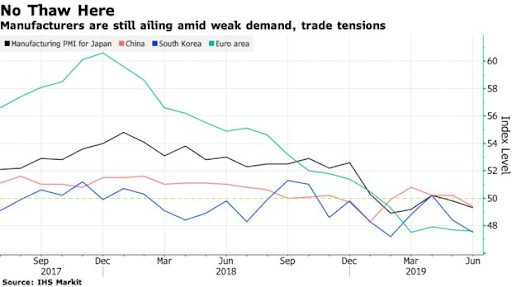
This comes on the heels of the total, broad-based collapse in US regional Fed manufacturing business surveys…
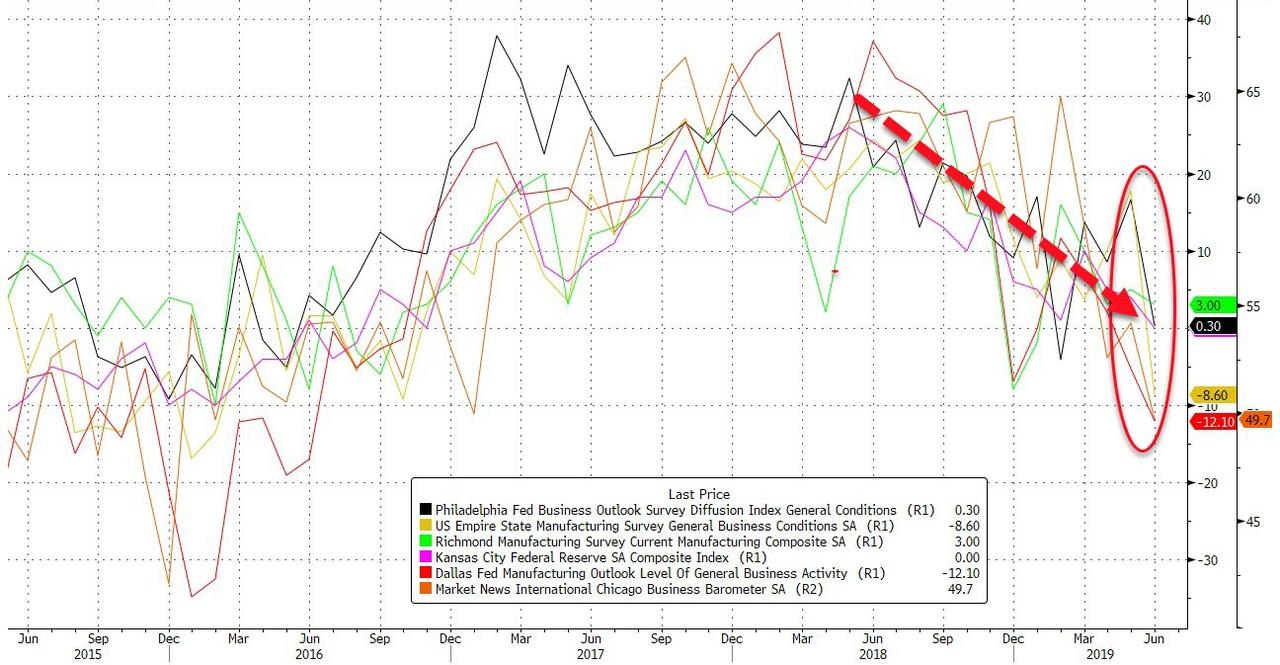
So, expectations were for a downshift in US Manufacturing ISM/PMI headline surveys (Goldman warned that a simple analysis based on the historical deviations between the ISM and our survey tracker suggests slightly more than a one in three chance of the ISM manufacturing index falling into contractionary territory).
But that’s not what happened!!
Markit US Manufacturing PMI beat expectations, rising from 50.1 to 50.6 in June (this was nonetheless the second-lowest figure since September 2009).

However, under the hood, not everything was awesome with employment expanding at its slowest rate since Aug 2016.
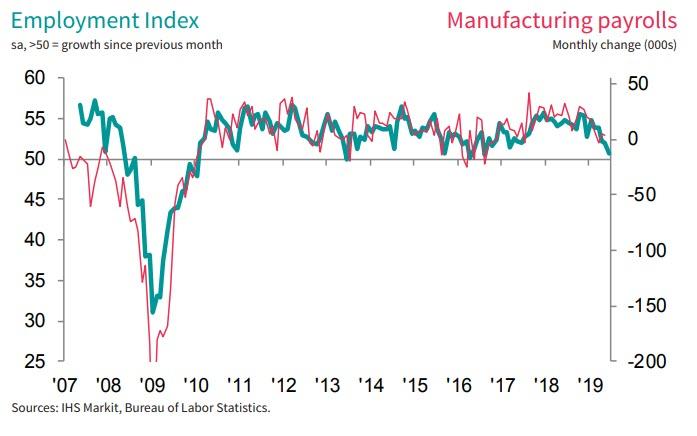
Chris Williamson, Chief Business Economist at IHS Markit said:
“US manufacturers reported business conditions to have remained the toughest for nearly a decade in June. The past two months have seen the lowest readings since the height of the global financial crisis in 2009.
“The survey provides accurate advance indicators of comparable official data, and paints a worrying picture of marked declines in both output and jobs. The June survey sub-index readings are consistent with manufacturing output contracting at a quarterly rate of 0.7% and factory payrolls falling by 18,000.
“A major development in recent months has been the deteriorating performance of larger companies, where the last two months have seen the lowest PMI readings for a decade. After inventories rose sharply earlier in the year, large companies have moved to destocking in May and June amid a sharp slowing in new order inflows.
“Although business optimism about the future lifted slightly higher, it remained close to survey lows to indicate persistent low morale. Worries centred on signs of slowing demand both at home and internationally, weaker sales, and geopolitical uncertainty.
“Tariffs meanwhile continued to push up prices, but weak demand often limited the ability of firms to pass higher prices onto customers, suggesting overall inflationary pressures have weakened compared to earlier in the year.”
Additionally, ISM’s Manufacturing PMI beat expectations, printing 51.7 (better than the 51.0 expected) but still down from the 52.1 level in May – to the weakest since October 2016.
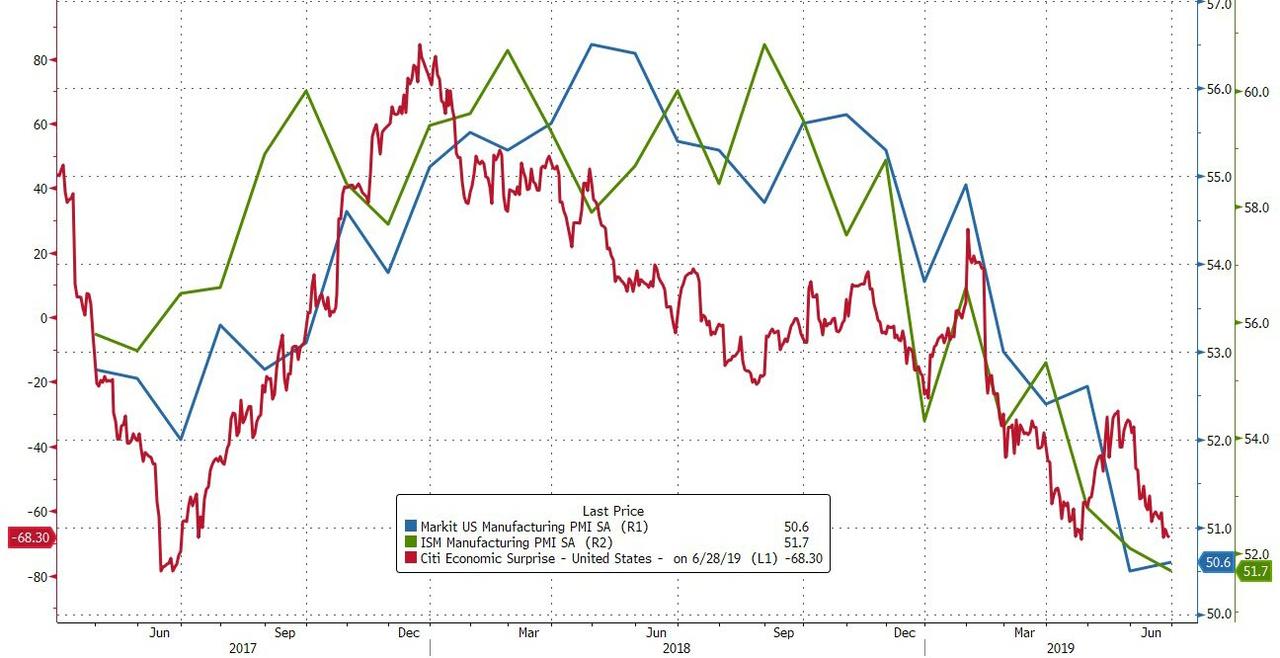
New orders fell to 50, from 52.7 – the lowest since Dec 2015 (and new export orders also slowed).
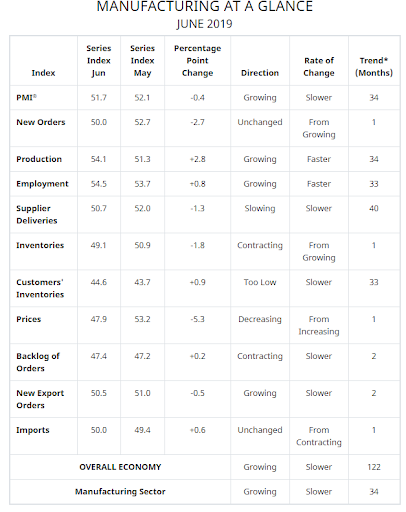
Respondents are unhappy:
“China tariffs and pending Mexico tariffs are wreaking havoc with supply chains and costs. The situation is crazy, driving a huge amount of work [and] costs, as well as potential supply disruptions.” (Computer & Electronic Products)
“Demand for the remainder of 2019 has softened significantly, due to issues in the aerospace industry. The 2020 outlook is looking stronger. Overall, state and local economies remain strong. Recruiting for open positions still requires time to find the right candidates.” (Transportation Equipment)
Is this “bad” enough to help The Fed?
end
Global Manufacturing PMI Crashes To 7-Year Lows As New Orders Slump
It’s a bloodbath. No matter where you look, global manufacturing surveys are signaling growth is over (and in most cases, outright contraction is upon us).
JPMorgan’s Global Manufacturing PMI fell to its lowest level for over six-and-a-half years and posted back-to-back sub-50.0 readings for the first time since the second half of 2012.
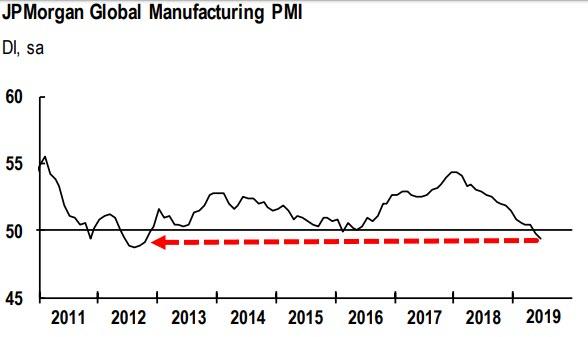
June data signaled a mild decrease in global manufacturing employment for the second month running (but every sub-index declined in June).
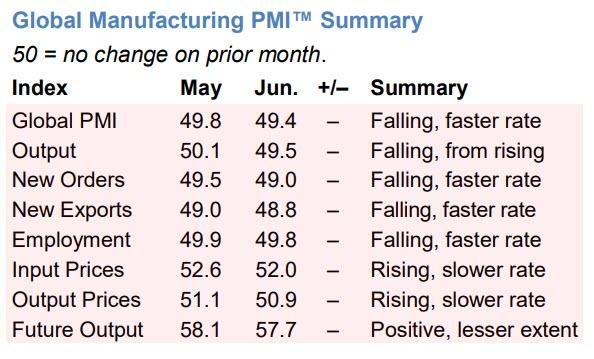
Of the 30 nations for which a June PMI reading was available, the majority (18) signaled contraction. China, Japan, Germany, the UK, Taiwan, South Korea, Italy and Russia were among those countries experiencing downturns. The US, India, Brazil and Australia were some of the larger industrial nations to register an expansion.
Commenting on the survey, Olya Borichevska, from Global Economic Research at J.P.Morgan, said:
“The global manufacturing sector downshifted again at the end of the second quarter. The PMI surveys signaled that output stopped growing, as inflows of new business shrank at the fastest pace since September 2012. This impacted hiring and business optimism, with the latter at a series-record low. Conditions will need to stage a marked recovery if manufacturing is to revive later in the year.”
So, we ask you, which market do you think is getting things right? Bonds or stocks?
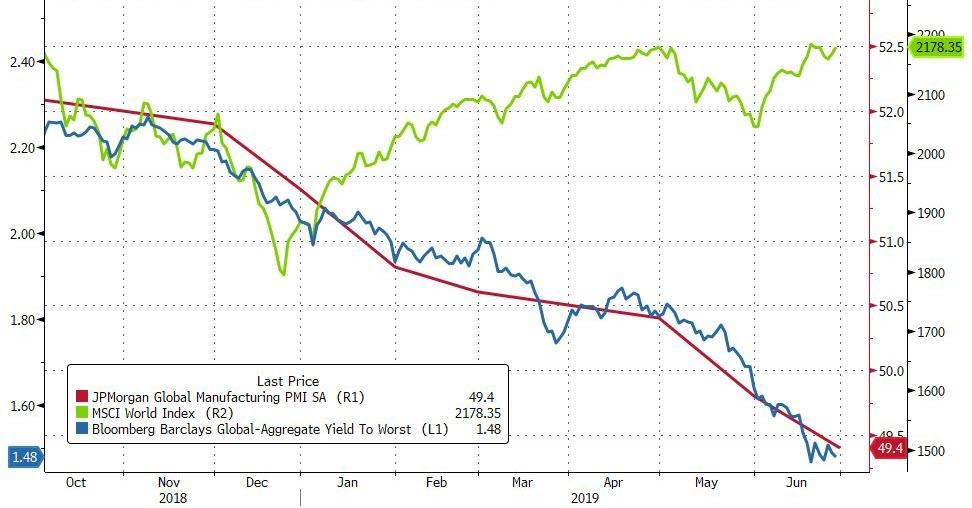
It’s not rocket science!!
end
It is not just the USA that has devastating crop losses. It is happening all over the globe
(courtesy Michael Snyder)
Devastating Crop Losses Are Literally Happening All Over The Globe
Authored by Michael Snyder via The Economic Collapse blog,
Let me warn you right up front – the information in this article might freak you out. If what some experts are telling us is true, a global food crisis appears to be inevitable. Even during good years we have a really difficult time feeding everyone on the planet, and now a major climate shift appears to be happening. Our sun has become exceedingly quiet, and many experts believe that this is a sign that a solar minimum is now upon us. Of course we have seen solar minimums happen quite regularly in the past, and if this is just a normal solar minimum then conditions should begin to return to normal after a couple of years. Unfortunately, evidence continues to mount that we have entered what is known as a “grand solar minimum”. In fact, Professor Valentina Zharkova says that what we are facing is a “super grand solar minimum”, and if that is true we are going to be facing climate chaos like we have never seen before. During previous “grand solar minimums” the globe was gripped by devastating famines and vast numbers of people died. Could a similar scenario potentially be in our future?

Ice Age Farmer has compiled a “Grand Solar Minimum Crop Loss Map” which you can view right here, and I appreciate our friends at ANP for pointing it out to us. Ice Age Farmer’s map shows that there are literally dozens of locations all over the globe right now that are reporting significant crop losses, and this is really unlike anything we have ever seen before. Some parts of our planet are dealing with horrific drought, but in the middle of the United States it just won’t stop raining. In some areas of the world it is too cold, while others are experiencing record heat. Everywhere we look we see extremes, and the behavior of our sun is the primary reason this is happening.
Last November I warned that we could be facing one of the coldest winters in modern times, and that is precisely what happened. Back then top scientists were warning us that a solar minimum had arrived, and since that time the behavior of the sun has continued to confirm that hypothesis…
The surface of the sun is normally a roiling, super-heated hellscape.
But Nasa images have revealed that the face of our star is looking ominously calm right now, prompting claims it’s reached a stage of its cycle called the solar minimum.
During the minimum, there are significantly fewer sunspots and its magnetic field weakens, allowing cosmic rays from outside our solar system to rain down on Earth.
This solar minimum came early, and that is exactly what we would expect if we were entering a “grand solar minimum”. Perhaps the best known “grand solar minimum” in our history was the Maunder Minimum which stretched from 1645 to 1715…
The last time a deep solar minimum was in effect was the Maunder minimum, which saw seven decades of freezing weather, began in 1645 and lasted through to 1715, and happened when sunspots were exceedingly rare.
During this period, temperatures dropped globally by 1.3 degrees celsius leading to shorter seasons and ultimately food shortages.
The food shortages during the Maunder Minimum were quite severe, and the global death toll was enormous.
Could we be facing a similar scenario this time around?
Actually, economist Martin Armstrong seems to believe that it could be even worse…
The Maunder Minimum created such a deep cold in Europe and extreme weather events elsewhere that what unfolds is a series of droughts, floods, and harvest failures. Historically, this leads to massive migrations, wars and revolutions. The fatal synergy between human and natural disasters eradicated perhaps one-third of the human population during the last event and this time we are crashing more rapidly than before. Therefore, we may exceed more than a reduction in population of one-third and reach the levels of the 14th century of 50%, which was also combined with the Black Plague.
Without a doubt, our planet is behaving very strangely right now, and reports of crop failures are regularly coming in from all over the planet.
Just check out these examples…
That layer of stress on the agricultural industry is only intensified when you zoom out to the international level, where farmers around the world are facing various dire situations. As one North Dakota farmer and Twitter user Jordan Gackle pointed out in a recent thread: Drought is continuing to disrupt wheat crops in Australia forcing the country to import some of its wheat from Canada. Some farmers in Canada are now reporting long stretches without rain under the hashtag #drought19. Head over to China and you’ll find that a legion of fall armyworms are spreading rapidly and devouring key grain crops.
It is becoming quite clear that food prices are going to rise substantially and that the world is going to produce a lot less food than it normally does this year.
And as I noted earlier, we have a tough time feeding everyone on the planet even during ideal conditions. Sadly, this even includes the United States…
In fact, it’s not just older Americans who are already suffering from hunger and malnourishment, with this 2017 story over at Feeding America reporting that more than 41 million Americans were suffering from hunger daily, including more than 13 million children, with this National Geographic story reporting that 1 out of every 6 Americans aren’t getting enough to eat.
So what will things look like if global food production drops 10 percent, 20 percent or even more?
We have never had to deal with anything like this in modern times, and meanwhile the population of the planet has grown from 1.6 billion in 1900 to 7.5 billion today.
We have entered the time of “the perfect storm”, and we are going to start to witness things happen that many people would consider to be unimaginable.
I truly hope that things will not be as bad as some of the experts are suggesting. But as far as crop failures are concerned, we don’t have to speculate. They are happening right now all over the planet, and that means that global food supplies are going to get tighter and tighter in the months ahead.
7. OIL ISSUES
8 EMERGING MARKET ISSUES
Your early morning currency/gold and silver pricing/Asian and European bourse movements/ and interest rate settings MONDAY morning 7:00 AM….
Euro/USA 1.1348 UP .0018 REACTING TO MERKEL’S FAILED COALITION/ REACTING TO +GERMAN ELECTION WHERE ALT RIGHT PARTY ENTERS THE BUNDESTAG/ huge Deutsche bank problems ///ITALIAN CHAOS /AND NOW ECB TAPERING BOND PURCHASES/JAPAN TAPERING BOND PURCHASES /USA RISING INTEREST RATES /FLOODING/EUROPE BOURSES /GREEN
USA/JAPAN YEN 108.19 UP 0.479 (Abe’s new negative interest rate (NIRP), a total DISASTER/NOW TARGETS INTEREST RATE AT .11% AS IT WILL BUY UNLIMITED BONDS TO GETS TO THAT LEVEL…
GBP/USA 1.2644 DOWN 0.0034 (Brexit March 29/ 2019/ARTICLE 50 SIGNED/BREXIT FEES WILL BE CAPPED/BREXIT EXTENDED TO OCT 31/2019//
USA/CAN 1.3096 UP .0019 CANADA WORRIED ABOUT TRADE WITH THE USA WITH TRUMP ELECTION/ITALIAN EXIT AND GREXIT FROM EU/(TRUMP INITIATES LUMBER TARIFFS ON CANADA/CANADA HAS A HUGE HOUSEHOLD DEBT/GDP PROBLEM)
Early THIS MONDAY morning in Europe, the Euro FELL BY 18 basis points, trading now ABOVE the important 1.08 level FALLING to 1.1348 Last night Shanghai COMPOSITE CLOSED UP 66.03 POINTS OR 2.22%
//Hang Sang CLOSED DOWN 78,80 POINTS OR 0.28%
/AUSTRALIA CLOSED UP 0,48%// EUROPEAN BOURSES ALL GREEN
Trading from Europe and Asia
EUROPEAN BOURSES ALL GREEN
2/ CHINESE BOURSES / :Hang Sang CLOSED DOWN 78.80 POINTS OR 0.28%
/SHANGHAI CLOSED UP 66.03 POINTS OR 2.222%
Australia BOURSE CLOSED UP. 48%
Nikkei (Japan) CLOSED UP 454.05 POINTS OR 2.13%
INDIA’S SENSEX IN THE GREEN
Gold very early morning trading: 1392.00
silver:$15.28-
Early MONDAY morning USA 10 year bond yield: 2.02% !!! UP 1 IN POINTS from FRIDAY’S night in basis points and it is trading WELL BELOW resistance at 2.27-2.32%.
The 30 yr bond yield 2.54 UP 1 IN BASIS POINTS from FRIDAY night.
USA dollar index early THURSDAY morning: 96.42 UP 29 CENT(S) from FRIDAY’s close.
This ends early morning numbers MONDAY MORNING
xxxxxxxxxxxxxxxxxxxxxxxxxxxxxxxxxxxxxxxxxxxxxxxxxxxxxxxxxxxxxxxxxxxxxxxxxxxxxxxxxxxxxxxxxxxxxxxxxxxxxxxxxxxxxx6
And now your closing MONDAY NUMBERS \12: 00 PM
Portuguese 10 year bond yield: 0.41% DOWN 7 in basis point(s) yield from YESTERDAY/
JAPANESE BOND YIELD: -.15% UP 1 BASIS POINTS from YESTERDAY/JAPAN losing control of its yield curve/56
SPANISH 10 YR BOND YIELD: 0.34%//DOWN 6 in basis point yield from yesterday.
ITALIAN 10 YR BOND YIELD: 1.97 DOWN 13 points in basis points yield from yesterday./
the Italian 10 yr bond yield is trading 164 points higher than Spain.
GERMAN 10 YR BOND YIELD: FALLS TO –.36% IN BASIS POINTS ON THE DAY//
THE IMPORTANT SPREAD BETWEEN ITALIAN 10 YR BOND AND GERMAN 10 YEAR BOND IS 2.33% AND NOW ABOVE THE THE 3.00% LEVEL WHICH WILL IMPLODE THE ENTIRE ITALIAN BANKING SYSTEM. AT 4% SPREAD THERE WILL BE A HUGE BANK RUN…
END
IMPORTANT CURRENCY CLOSES FOR MONDAY
Closing currency crosses for MONDAY night/USA DOLLAR INDEX/USA 10 YR BOND YIELD/1:00 PM
Euro/USA 1.1307 DOWN .0059 or 59 basis points
USA/Japan: 108.43 UP .615 OR YEN UP 62 basis points/
Great Britain/USA 1.2642 UP .0037 POUND DOWN 37 BASIS POINTS)
Canadian dollar DOWN 52 basis points to 1.3127
xxxxxxxxxxxxxxxxxxxxxxxxxxxxxxxxxxxxxxxxxxxxxxxxxxxxxxxxxxxxxxxxxxxxxxxxxxxxxxxx
The USA/Yuan,CNY: AT 6.8517 0N SHORE (UP)..
THE USA/YUAN OFFSHORE: 6.8630 (YUAN UP)..
TURKISH LIRA: 5.6497 EXTREMELY DANGEROUS LEVEL/DEATH WISH.
the 10 yr Japanese bond yield closed at -.15%
Your closing 10 yr US bond yield UP 1 IN basis points from FRIDAY at 2.02 % //trading well ABOVE the resistance level of 2.27-2.32%) very problematic USA 30 yr bond yield: 2.54 UP 1 in basis points on the day
Your closing USA dollar index, 96.71 UP 58 CENT(S) ON THE DAY/1.00 PM/
Your closing bourses for Europe and the Dow along with the USA dollar index closing and interest rates for MONDAY: 12:00 PM
London: CLOSED UP 71.87 0.97%
German DAX : CLOSED UP 122.58 POINTS OR .99%
Paris CAC CLOSED UP 28.94 POINTS 0.52%
Spain IBEX CLOSED UP 65.80 POINTS or 0.72%
Italian MIB: CLOSED UP 19.25 POINTS OR 0.09%
WTI Oil price; 58.76 12:00 PM EST
Brent Oil: 64.99 12:00 EST
USA /RUSSIAN / RUBLE RISES: 62.97 THE CROSS LOWER BY 0.25 RUBLES/DOLLAR (RUBLE LOWER BY 25 BASIS PTS)
TODAY THE GERMAN YIELD FALLS TO –.36 FOR THE 10 YR BOND 1.00 PM EST EST
END
This ends the stock indices, oil price, currency crosses and interest rate closes for today 4:30 PM
Closing Price for Oil, 4:00 pm/and 10 year USA interest rate:
WTI CRUDE OIL PRICE 4:30 PM : 59.25//
BRENT : 65.12
USA 10 YR BOND YIELD: … 2.03… VERY DEADLY//
USA 30 YR BOND YIELD: 2.55..VERY DEADLY/
EURO/USA 1.1287 ( UP 79 BASIS POINTS)
USA/JAPANESE YEN:108.44 UP .624 (YEN DOWN 62 BASIS POINTS/..
USA DOLLAR INDEX: 96.81 up 68 cent(s)/
The British pound at 4 pm Britain Pound/USA:1.2641 DOWN 37 POINTS
the Turkish lira close: 5.6554
the Russian rouble 63.01 UP 0.21 Roubles against the uSA dollar.( UP 21 BASIS POINTS)
Canadian dollar: 1.3134 DOWN 58 BASIS pts
USA/CHINESE YUAN (CNY) : 6.8517 (ONSHORE)/we need to watch these levels/anything greater than 6.95 will be deadly./
USA/CHINESE YUAN(CNH): 6.8599 (OFFSHORE) we need to watch these levels/anything greater than 6.95 will be deadly/
German 10 yr bond yield at 5 pm: ,-0.36%
The Dow closed UP 117,54 POINTS OR 0.44%
NASDAQ closed UP 84.92 POINTS OR 1.06%
VOLATILITY INDEX: 14.01 CLOSED DOWN 1.07
LIBOR 3 MONTH DURATION: 2.32%//libor dropping like a stone
FROM 2.341
And now your more important USA stories which will influence the price of gold/silver
TRADING IN GRAPH FORM FOR THE DAY//
Traders Sell The Trade-Truce News But S&P Holds Record Highs
A China trade truce, surging chip stocks, and bad (economic) news that must be good ammo for The Fed to cut, BUT stocks faded all the gains – simply put, it’s never enough!!
Chinese stocks surged on the trade-truce and while they maintained gains, the afternoon session saw barely any follow-through…
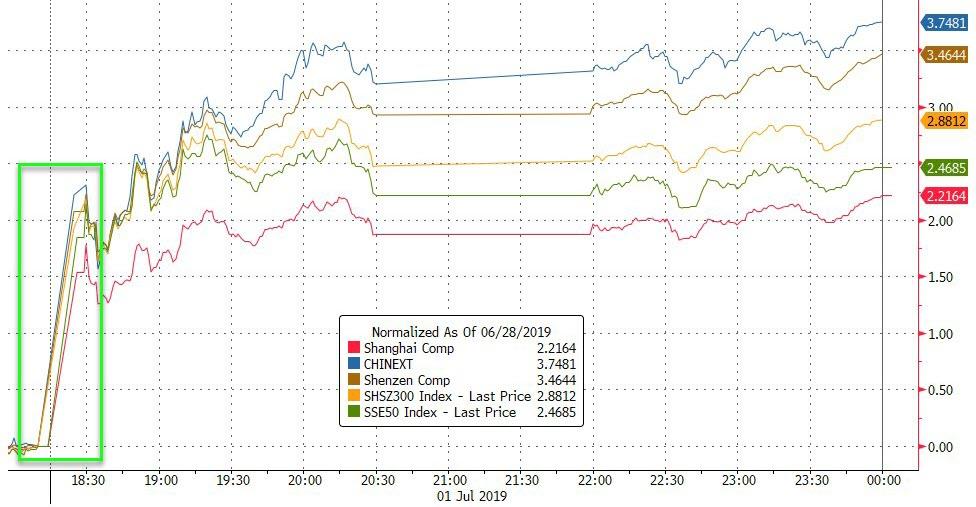
European stocks opened dramatically higher (on the trade truce) but faded practically non-stop from the open with Italy ending unch…
German bund yields fell to new record (negative) lows today and Italian yields dropped below 2.00% for the first time since May 2018…

Almost from the cash market open, US equities went in only one direction as “sell the news” dominated the nothing-burger truce deal…
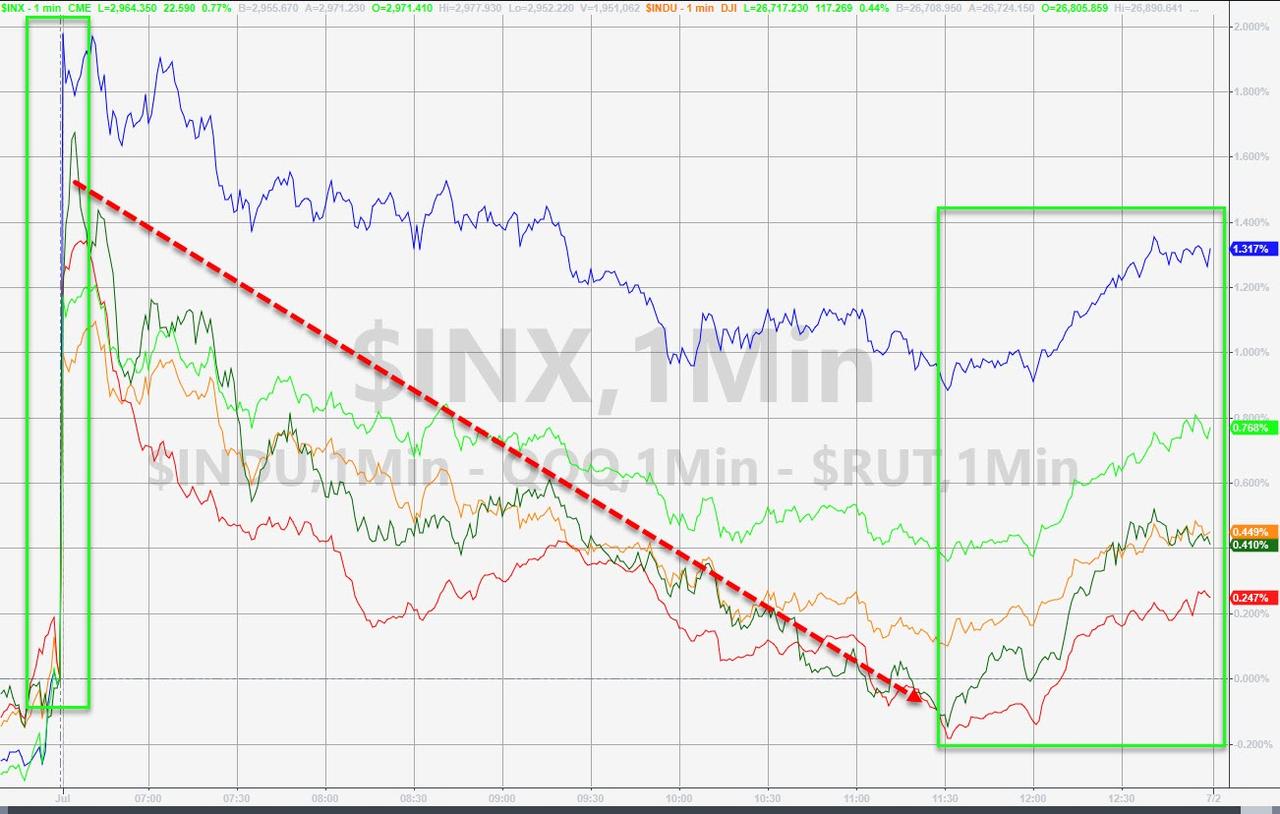
Stocks managed a pretty good run into the close starting at 3pmET to ensure The S&P closed at a record closing high…
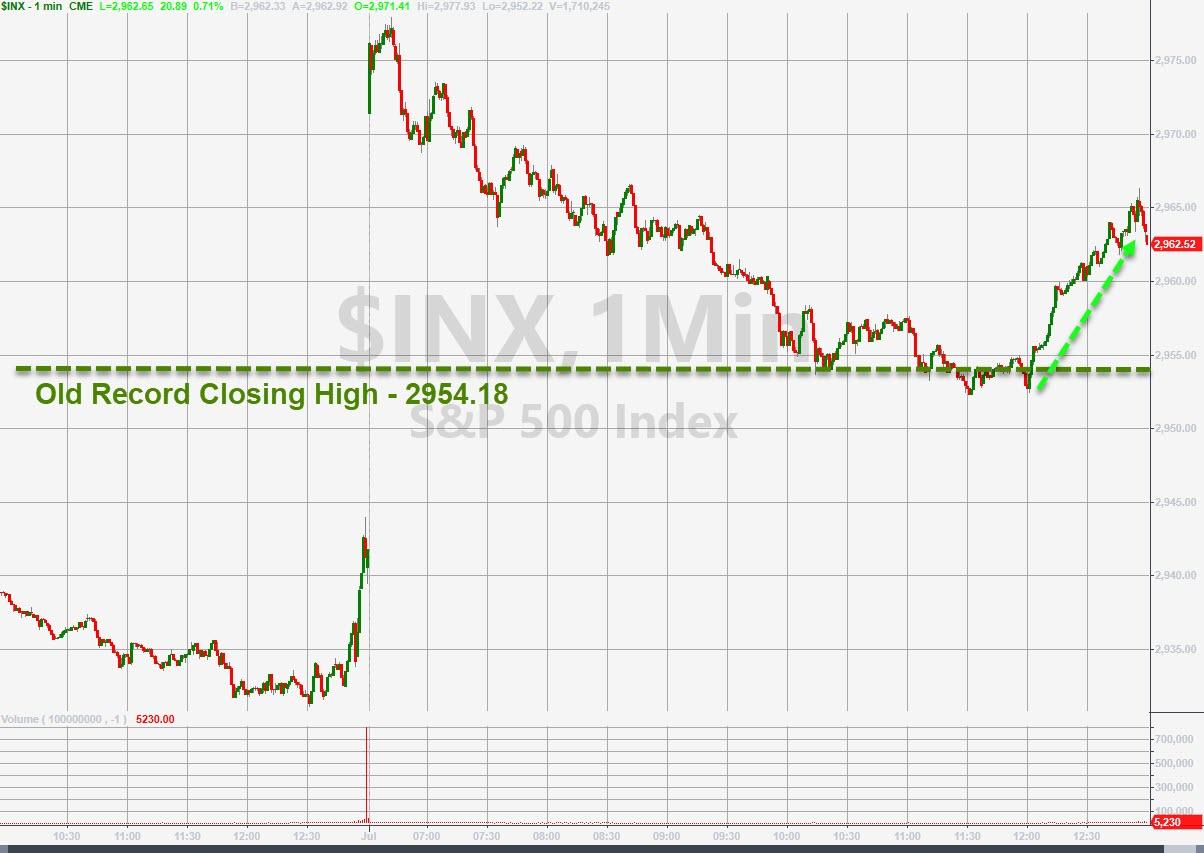
The Nasdaq outperformed however, helped by the biggest gap-up opening in SOX (Semis dramatically outperformed) in its history…
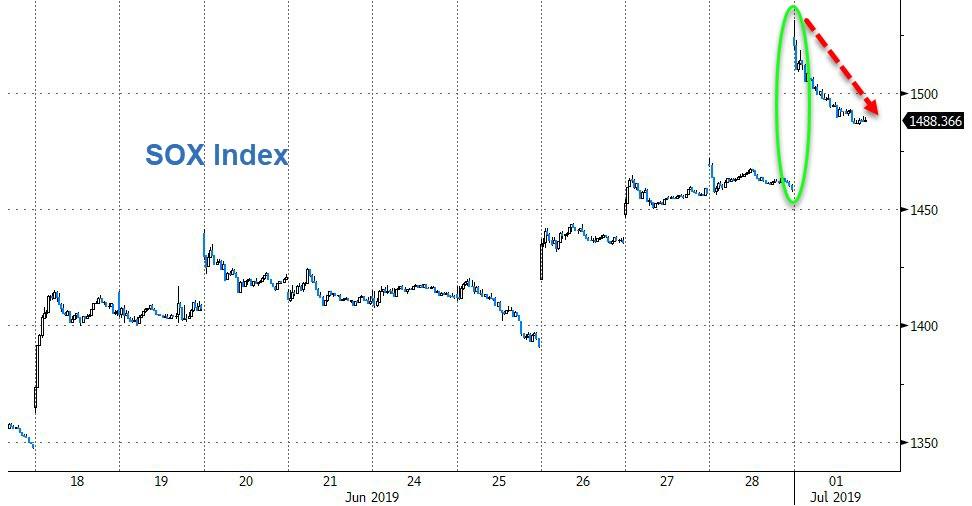
But notably, Nasdaq Composite failed to make new highs and was down by around 100 points from the highs…
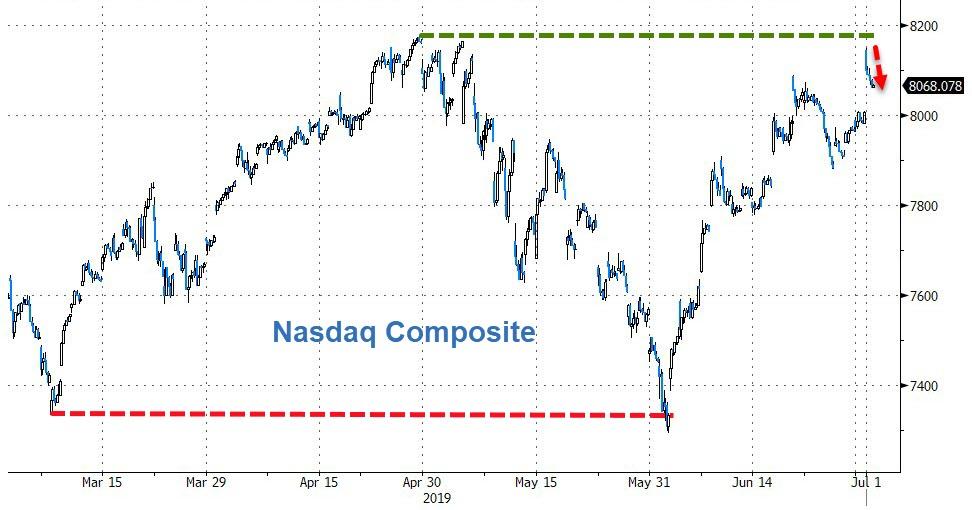
Giant short-squeeze at the US cash open – for the 3rd day in a row…
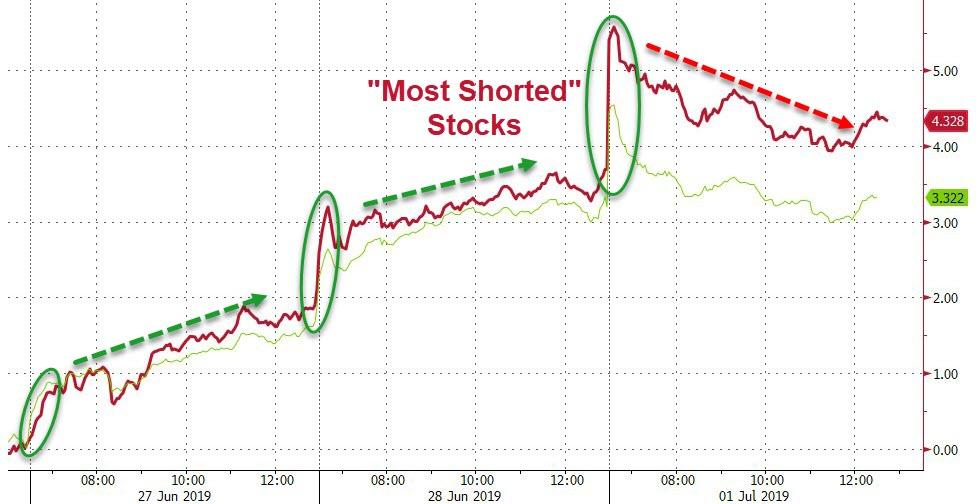
Treasury yields were higher on the day by around 2-3bps across the curve (after rallying from the higher yield open to unchanged)…
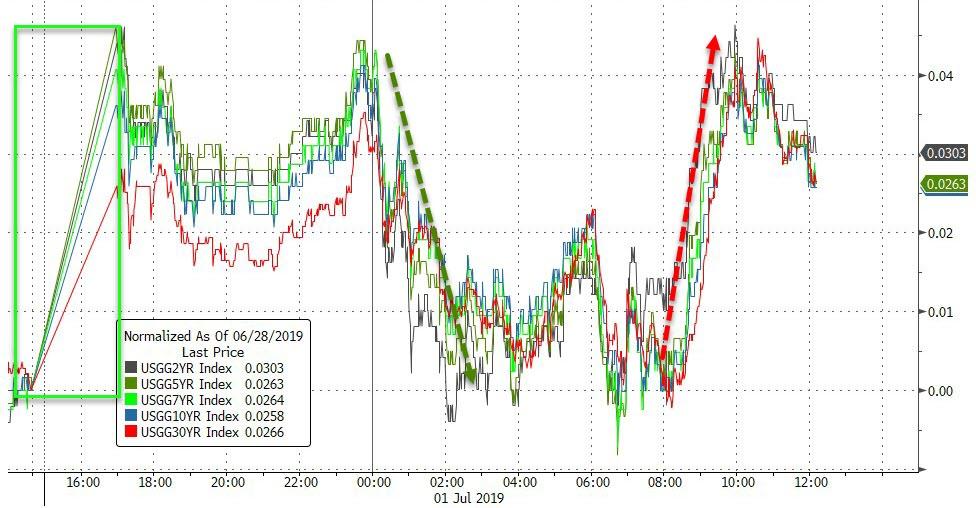
10Y Yields tested down to 2.00% once again (but bounced)…
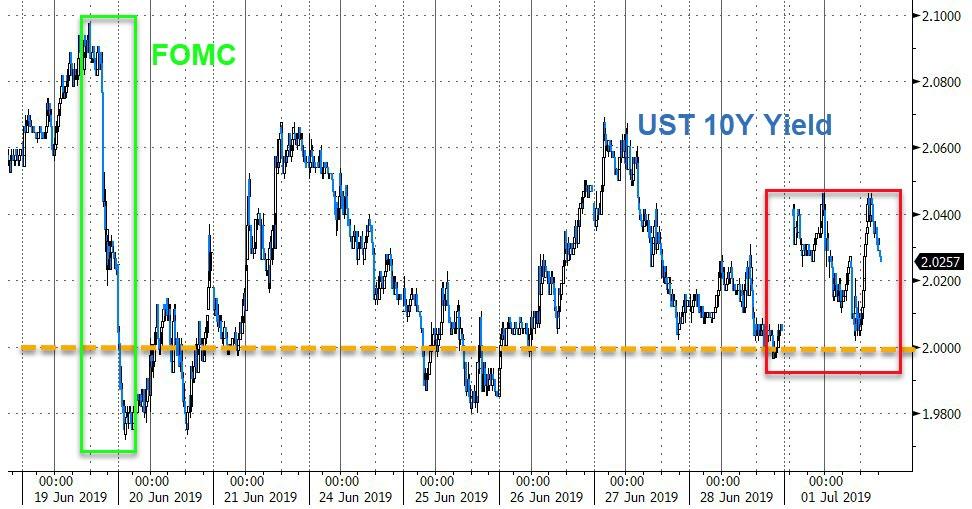
As it seems “sell all the things hit shortly after the US open)
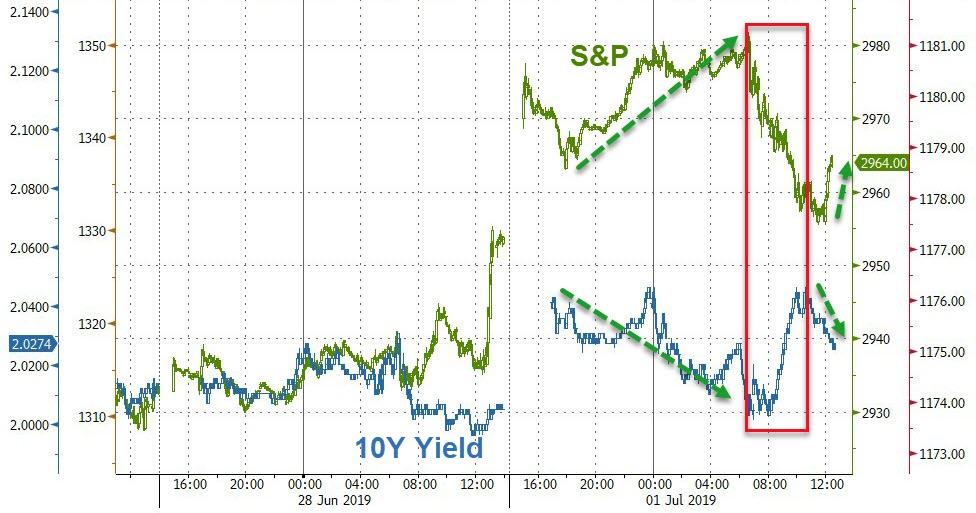
The dollar surged (retracing almost the Fib 61.8% of the post-FOMC losses)…
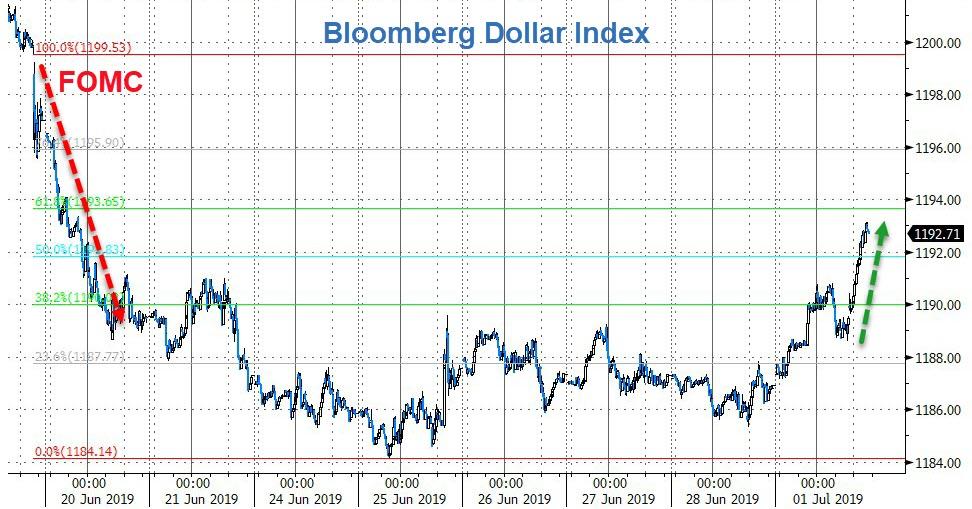
Yuan erased almost all of its trade-truce gains…

Cryptos extended the weekend’s declines…
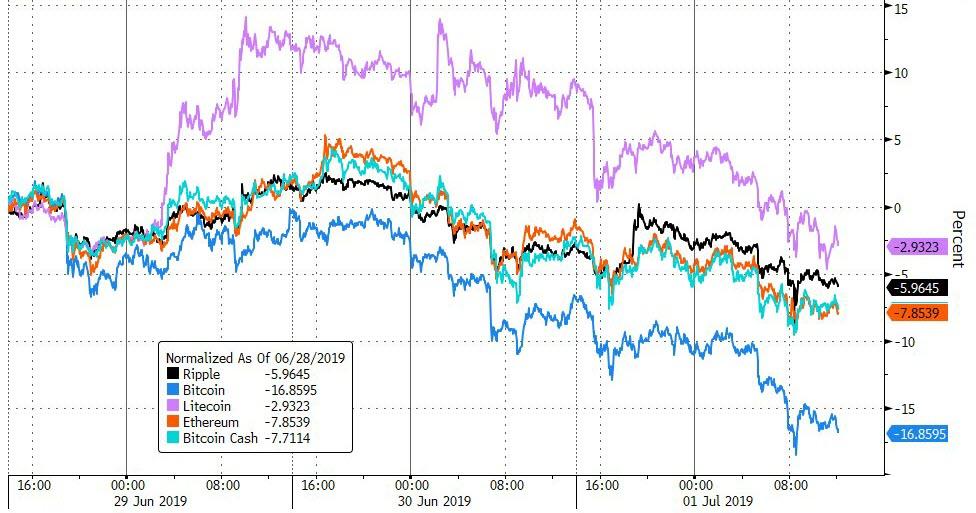
Led by Bitcoin which tested below $10,000 briefly…
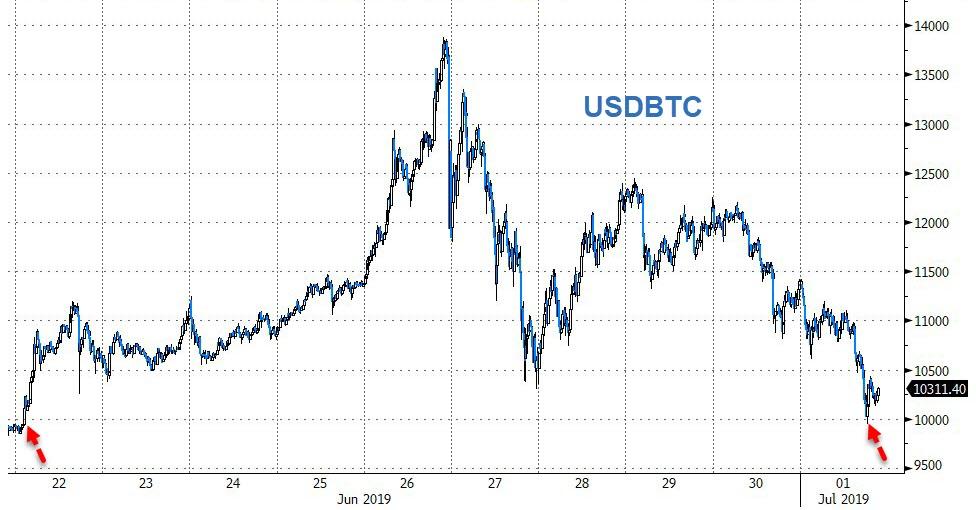
As the 2017 analog loses its trajectory…
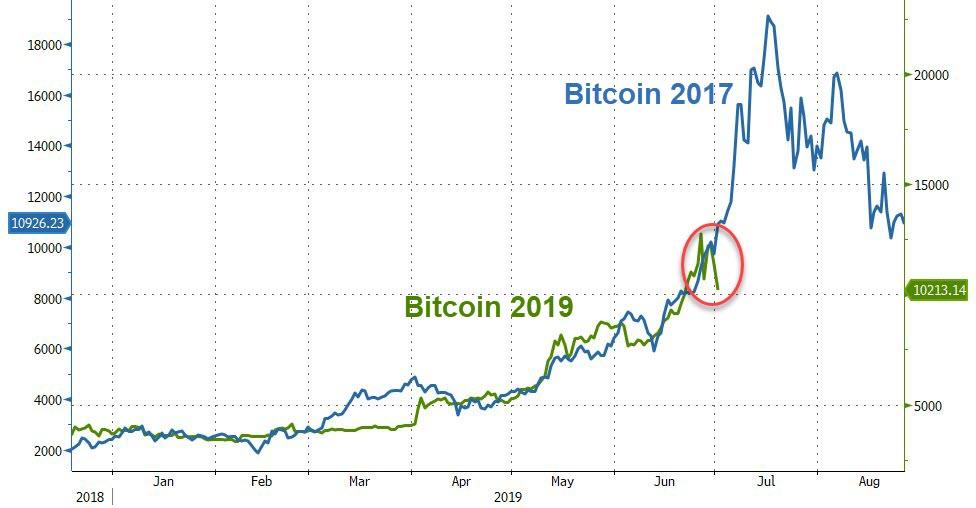
Dollar strength sent commodities broadly lower (even WTI faded despite OPEC+ deal chatter), gold and silver was least hit…
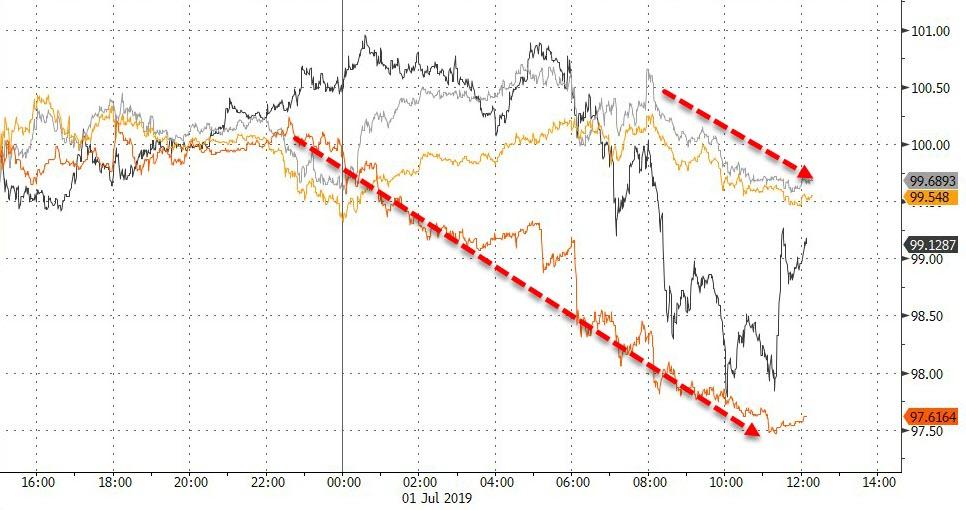
Gold fell back below $1400…
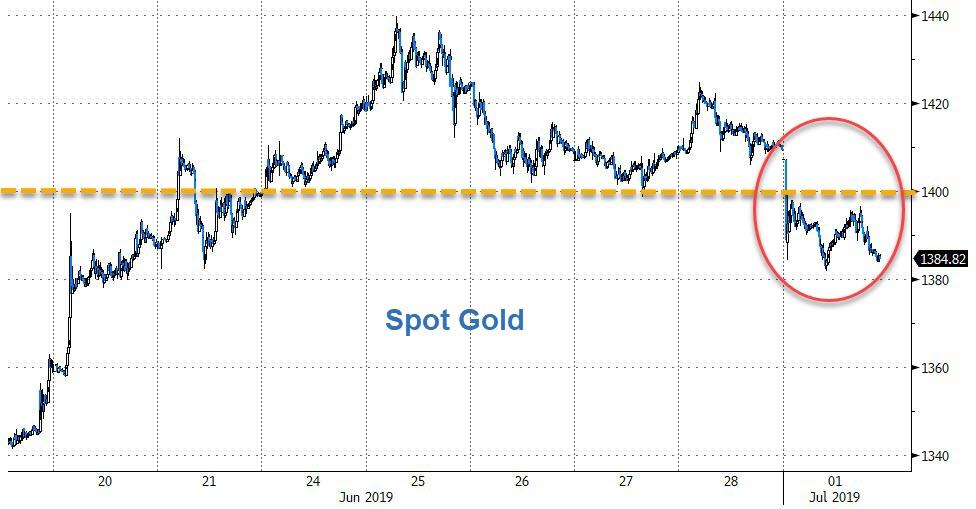
Oil price behavior was quite shocking, spiking on hype about an OPEC+ deal (Russia and Saudi agreeing a deal at G-20), then rolling over from the US equity market open, then spiking towards the NYMEX close…

And if the trade truce is so awesome, why did copper crap the bed?
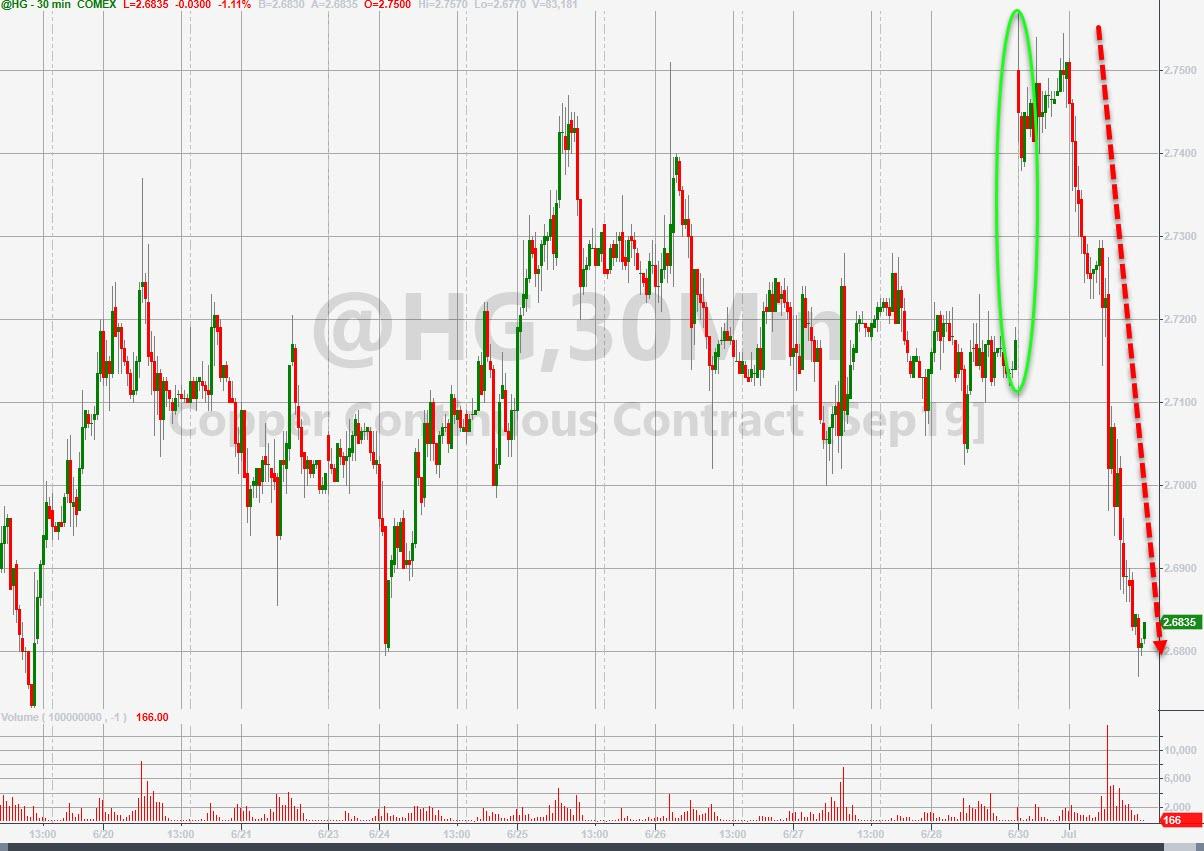
Finally, more dismal global macro data today, not helped at all by the US…
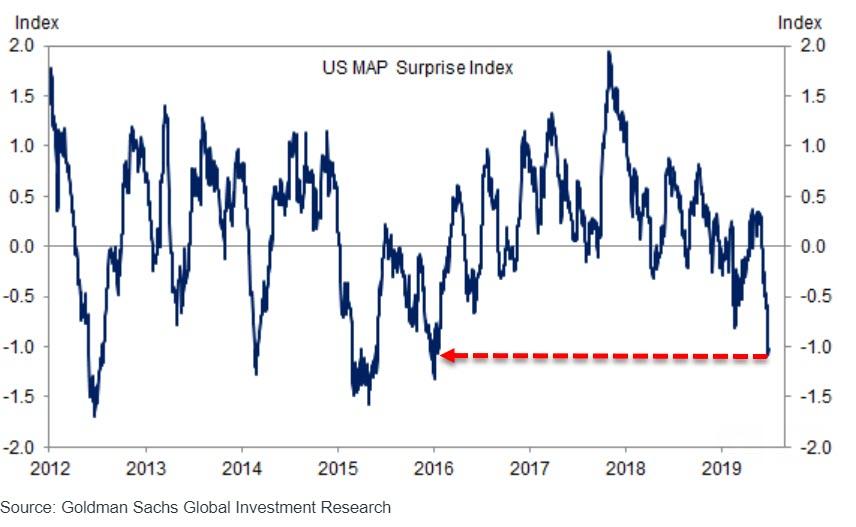
Seems to confirm bonds have it right…
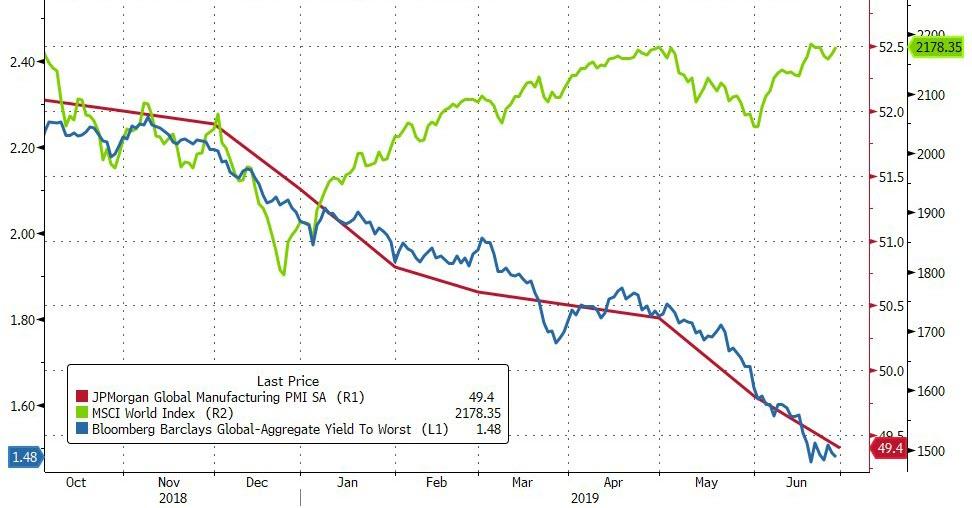
So for all those buying stocks, do you really feel that lucky?

end
i) Market trading/
Stocks, Oil, & Yuan Surge After Trump-Xi and Russia-Saudi “Deals”
Despite nothing being achieved in Osaka apart from a resumption of more-of-the-same trade talks (and a fold by Trump), markets are decided ‘risk-on’ as they open this evening.
Treasuries are being dumped along with gold (because everything is awesome right?) and stocks and yuan are surging.
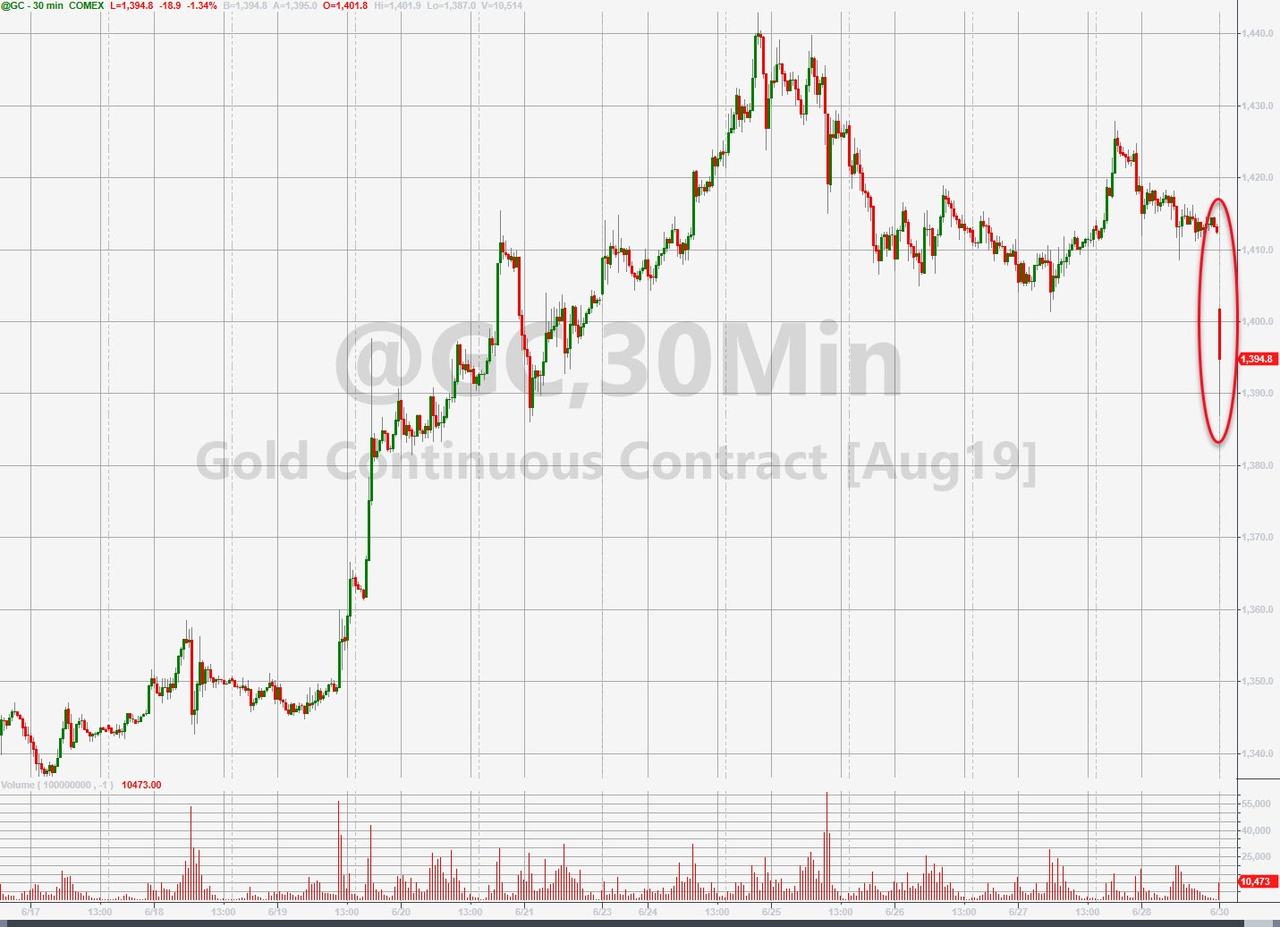
Dow is up over 250 points…
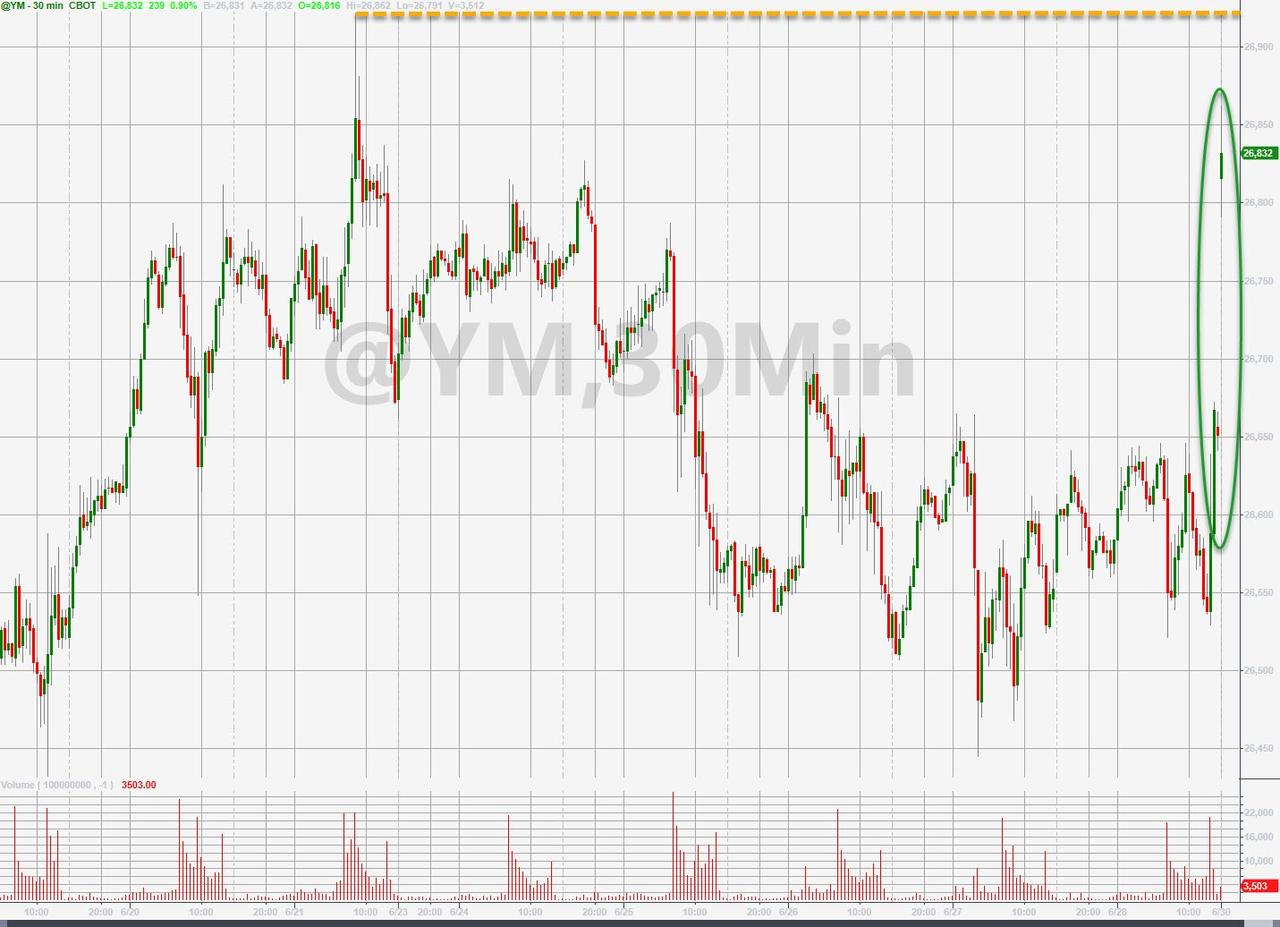
And S&P is at new record highs…
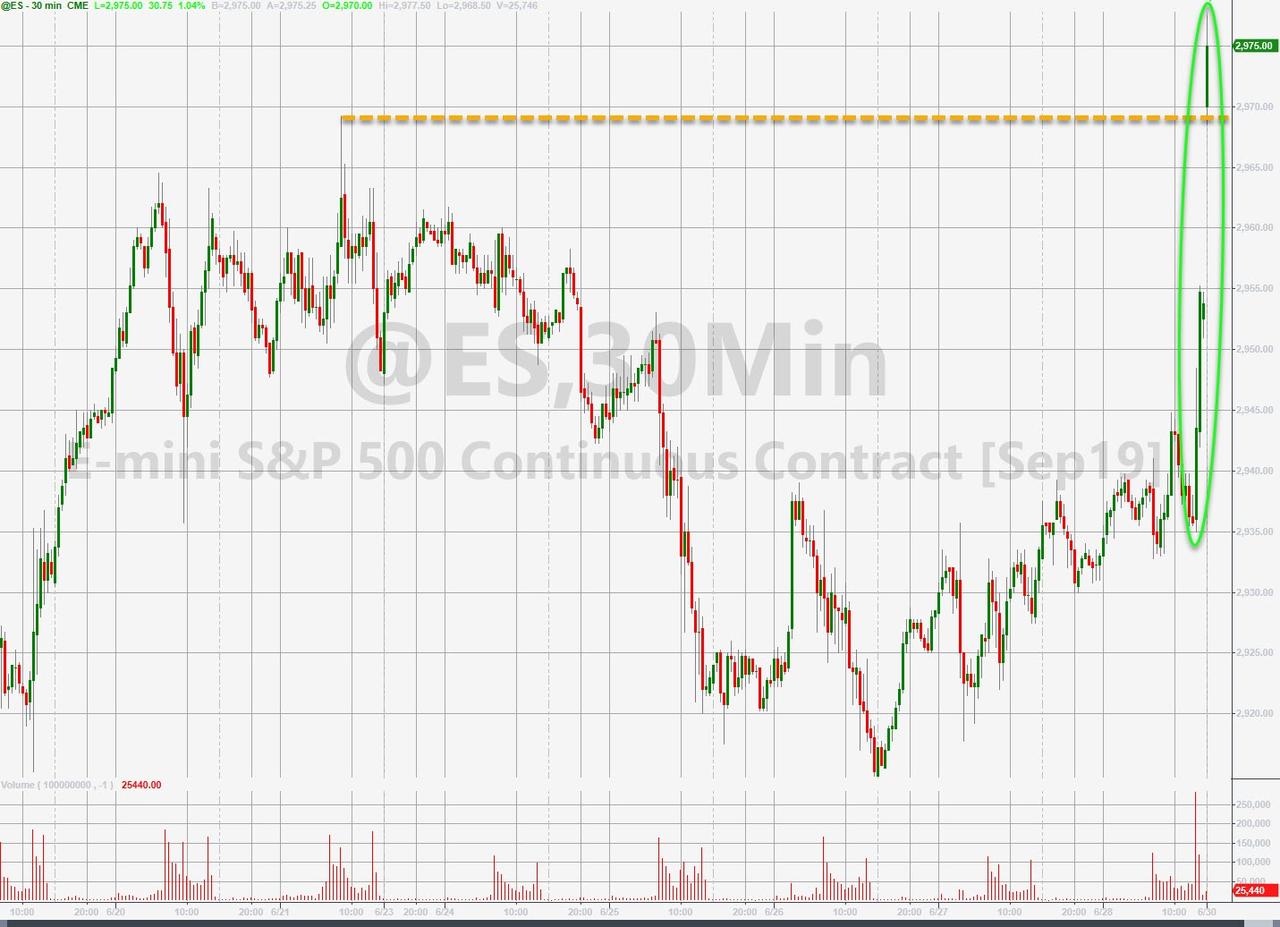
The biggest reaction for now is in Yuan, spiking to 8-week highs…
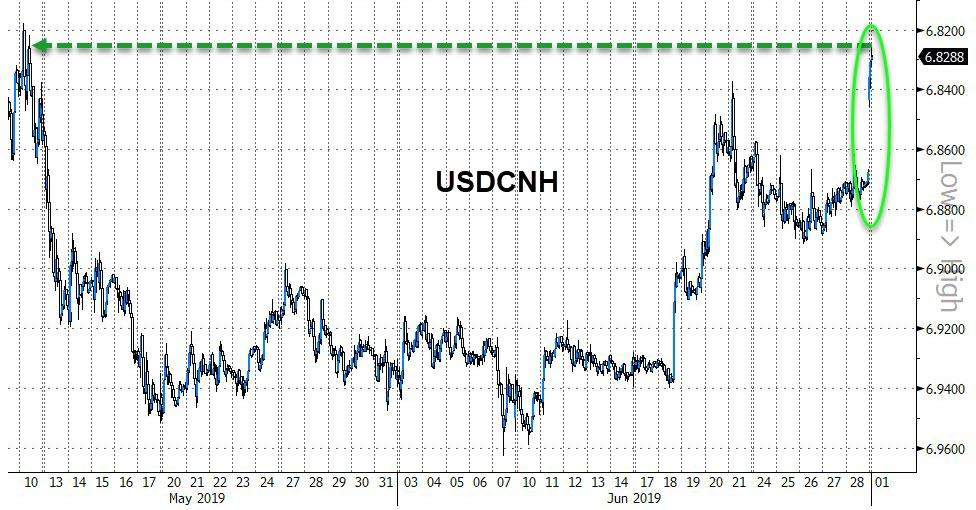
As a reminder, this is not news – but do not tell the algos…
Hipster@Hipster_TraderThis was 7 months ago at the last G20 meeting


Hipster@Hipster_Trader“Stocks rally as China, US closer to a deal following G20”
Headline on Monday probably
S&P 3,000 here we come at tomorrow’s open!?
However, is good “trade” news bad news for stocks as odds of a July rate-cut drop? Futs have almost erased the post-FOMC dovishness.
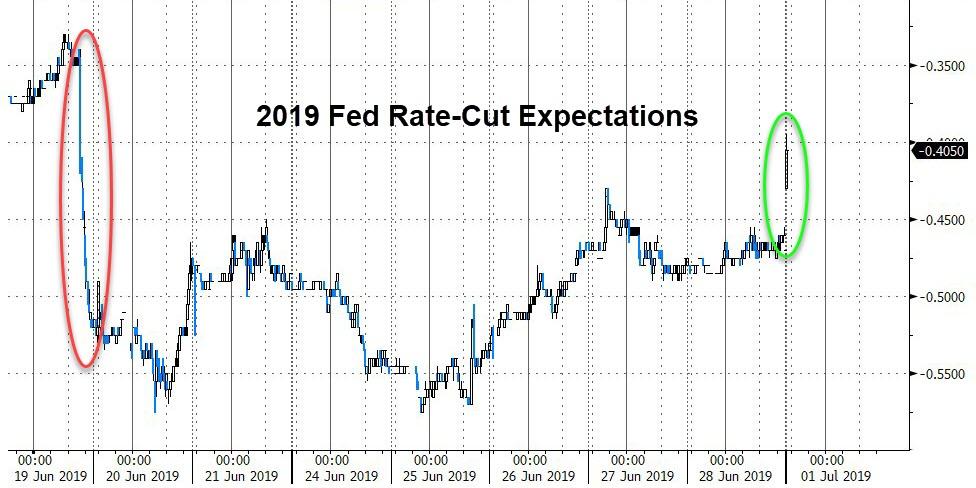
In case you wondered, you are here…
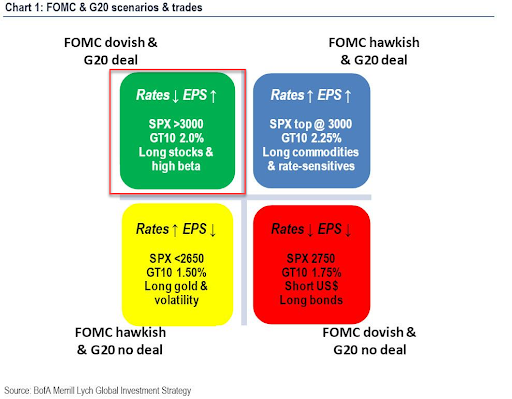
Additionally, reported agreements between Russia and Saudi Arabia to extend the OPEC production cuts has spiked oil prices as they open this evening…

Oil producers from the OPEC+ alliance are moving toward extending their supply cuts for nine months into the first quarter of 2020, as they grapple with surging U.S. shale output and weakening growth in demand.
Since Russia and Saudi Arabia reached a deal on the margins of the Group of 20 summit on Saturday to roll over the curbs by six to nine months, other nations have voiced their support for an extension into next year.
“The longer the horizon, the stronger the certainty to the market,” OPEC Secretary-General Mohammad Barkindo said in Vienna on Sunday after meeting with Khalid Al-Falih, the Saudi oil minister. “It will be more certain to look beyond 2019. I think most of the forecasts that we are seeing now and most of the analysis are gradually shifting to 2020.”
Russian President Vladimir Putin – after meeting with Saudi Crown Prince Mohammed Bin Salman – opened the door to 2020 by mooting longer curbs.
END
Somebody is right and somebody is terribly wrong!
(zerohedge)
WTF Chart Of The Day – Panic-Buying Bonds & Stocks
US Treasury yields are slumping back to unchanged – 10Y hitting 2.00% – as US equities extend overnight gains to new record highs…
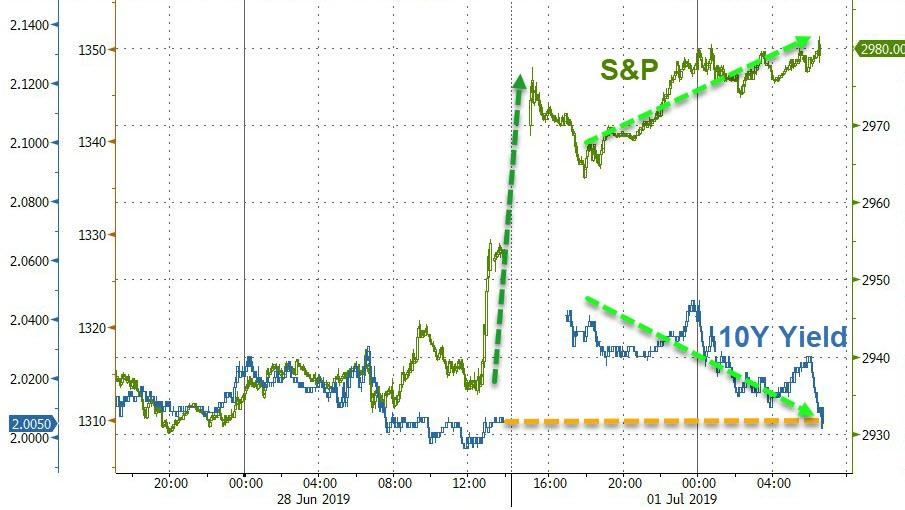
WTF!
French Bond Yields Slide Below Zero, Hit All Time Record Lows
Ten days ago when global bond yields tumbled amid renewed fears that the global economy was headed for a recession, we reported that a record $13 trillion in global sovereign debt was trading with a negative yield.
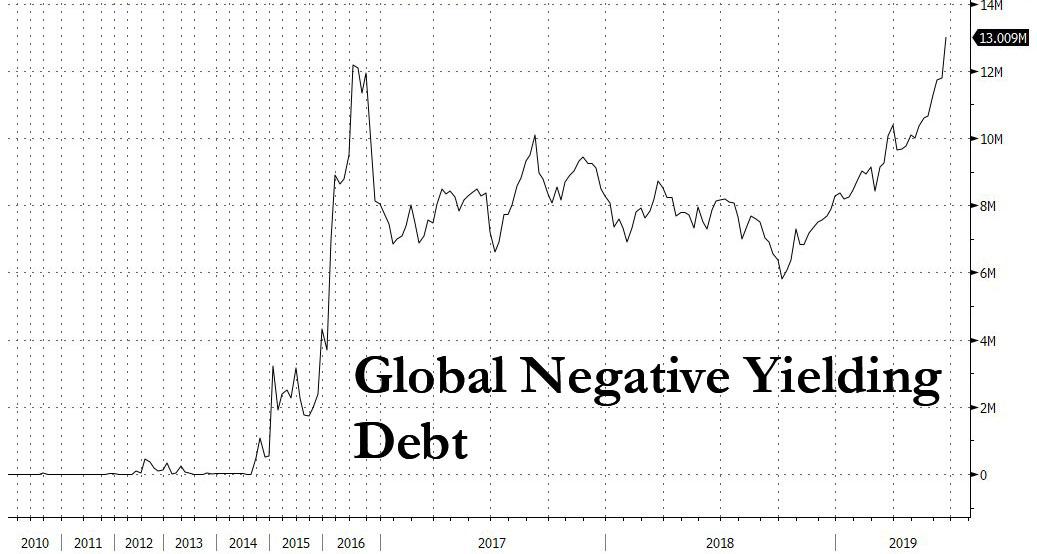
And while we don’t have the latest numbers from Bloomberg, pending their EOD update at the close, it is safe to say that as of this moment, there is a new all time high in negative yielding debt, because while German yields tumbled deeper into record negative territory this morning following abysmal global PMIs and comments from the ECB that the central bank was prepared for any contingency (i.e., ready to cut rates even more), it was the turn of France to follow Germany into sub-zero territory as the French 10Y yield just dropped below 0%, assuring that the total amount of negative-yielding debt just rose by a few hundred billion
Meanwhile, the disconnect between global bonds – which are now screaming “recession is coming” – and global stocks which are partying as if the Fed can’t wait for S&P 3,000 to cut rates not by 25bps but 50bps, if not more, has never been greater.
ii)Market data/
Hard data construction spending is down .8% after a revised .4% gain in April. Another sign of growth dissipating
(courtesy Market Watch)
Construction spending down 0.8% in May after revised 0.4% gain in April
July 1, 2019 10:06 a.m. ET
MarketWatch
Outlays for U.S. construction projects fell 0.8% in May at a seasonally adjusted annual rate of $1.3 trillion, the Commerce Department reported Monday. That’s the biggest drop since November. Economists polled by MarketWatch had expected growth of 0.3%. Spending in April was revised higher to a 0.4% gain from the prior estimate of a flat reading. Residential construction, which has been weak, fell 0.6% in May. Spending on public construction projects dropped 0.9% in the month.
-END-
iii)USA ECONOMIC/GENERAL STORIES
A good look at how millennials are thinking of marriage..how they use high interest loans to pay for their weeddings
etc
(courtesy zerohedge)
“The Broke And Beautiful Life”: Millennials Now Use High-Interest Loans To Pay For Weddings
Millennials, already the most indebted generation of all time, are now flocking to high-interest loans to tie the knot, reported the Washington Post.

Demand for wedding loans has quadrupled in the past year, said David Green, chief product officer at Earnest, a San Francisco-based online lender, noting that couples spend approximately $16,000 on wedding loans and pay it off in three years. Interest rates range from 7% to 18%, is seen as a cheaper alternative to credit cards.
“People are carrying more debt, they want to get married but don’t have the funds to do so,” Green said.
The explosive popularity of these loans, experts say, has been in the last three years, shows how the bride’s parents aren’t picking up the tab anymore, but more of a collective effort by parents, grandparents, and even the bride and groom.
“Couples are getting married later, so they are more willing to pay,” said David Wood, president of the Association of Bridal Consultants. “At the same time, their parents are older, they may be on a retirement income and not have the means to pay for the wedding either.”
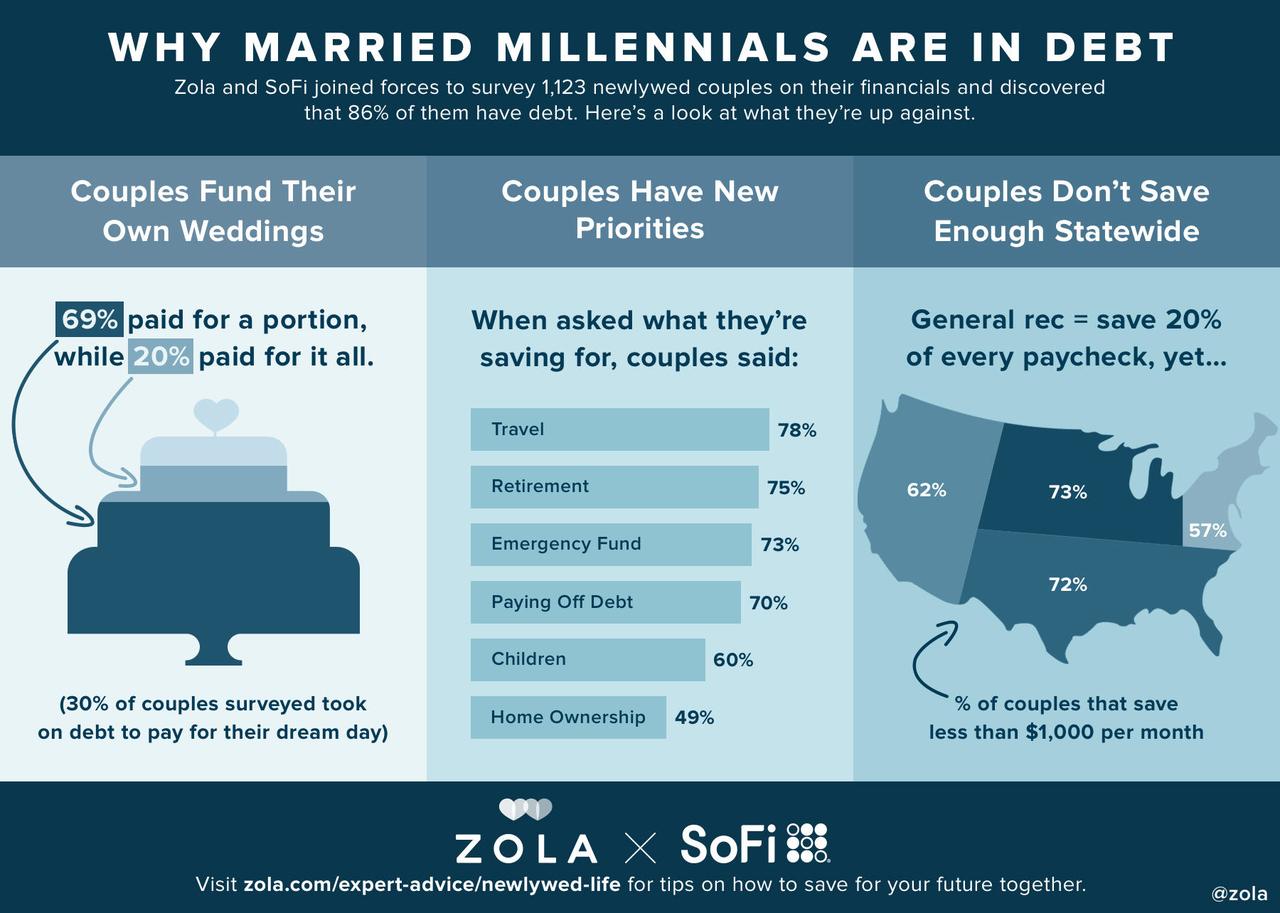
President Trump and the Federal Reserve are aboustely clueless in how they measure inflation. Considering the average cost of a wedding is skyrocketing, according to financial advisers. This comes as student loan debt hits $1.5 trillion and millennials have absolutely no savings.
“What’s driving this growth? Weddings are getting more expensive and people are waiting longer to get married,” said Todd Nelson, director of strategic partnerships for LightStream, a lending division of SunTrust bank. “It used to be, generally speaking, the father of the bride was on the hook for paying for the wedding. That’s not necessarily the expectation anymore.”
Personal finance experts said they’ve noticed more and more millennial clients who are taking out loans to fund their big day. Experts have told their clients that they don’t need an expensive Instagram-worthy wedding.
“The problem is, you don’t want to rely on a personal loan for something that isn’t necessary — and there is nothing necessary about an expensive wedding,” said Stefanie O’Connell, a personal finance expert and author of “The Broke and Beautiful Life.” “Everything about weddings is discretionary, aside from what you pay the county clerk.”

O’Connell, who is getting married later this year will not use loans but rather cash to pay for her big day, said she also helps clients understand that they need to look past their wedding day and see the big picture if a sustainable life without insurmountable debts.
“You have to put it in context,” she said. “You could spend $30,000 on a one-day celebration, or you could use it to put a down payment on a house. These loans sound great when you’re planning your wedding, but afterward, I hear a lot of regret.”
Brad Pritchett and David Chadd expected to pay for their wedding in cash, but a month before their wedding in February, they realized they went over budget.
“Quite frankly, we both have a taste level where we weren’t willing to compromise,” said Pritchett, 38, vice president of marketing for the American Heart Association. “It was important for us to have a great party to celebrate our love.”
So having a great, Instagram-worthy, one-day celebration, or otherwise called a wedding in 2019, is now being funded by high-interest loans that are putting millennials into further debt – thus their long term financial survivability will be in question in the next downturn.
end
Inflation is ripping apart American way of life…
now more than half of Americans are lying awake at night worrying about how they are going to pay for necessities of life
(courtesy zerohedge/TWO COMMENTARIES)
More Than Half Of Americans Are Literally Lying Awake At Night Worrying About Money
Even though unemployment has hit a 49 year low, more than half of Americans are lying awake at night worrying about money, according to MarketWatch.

But we thought jobs were everything?
Instead, a recent report from the Board of Governors of the Federal Reserve System concludes many people are living with wildly fluctuating incomes. In addition, consumer confidence fell to a two-year low in June.
Lynn Franco, senior director at the Conference Board, said: “The escalation in trade and tariff tensions earlier this month appears to have shaken consumers’ confidence. Continued uncertainty could “diminish” people’s confidence in the economic expansion.”
Lynn Reaser, chief economist of the Controller’s Council of Economic Advisors said: “A major trade war between the U.S. and China represents our greatest economic risk.”

And the worries are starting to pile up. According to a Bankrate survey of 2,500 people:
- 78% of adults are losing sleep over work, relationships, retirement and other worries
- Over half (56%) of Americans are lying awake at night worrying about money.
- The key worries are retirement (24%), health care and/or insurance bills (22%), the ability to pay credit-card debt (18%), mortgage/rent payments (18%), educational expenses (11% versus 26%) and stock-market volatility (5%)
In addition, 40% of people in a separate poll by that site say they feel the next recession has already begun or will begin within the next 12 months. 45% of U.S. workers have a second job to make ends meet and middle aged workers are feeling the pressure too, including 48% of millennials, 39% of Generation Xers and 28% baby boomers.

Many believe a recession to be an inevitability at this point. Oxford Economics predicts that fallout from the next recession could trigger a 30% drop in the S&P 500.
Jesse Colombo, analyst at Clarity Financial said: “Virtually everyone is underestimating the tremendous economic risks that have built up globally during the past decade of extremely stimulative monetary policies.”
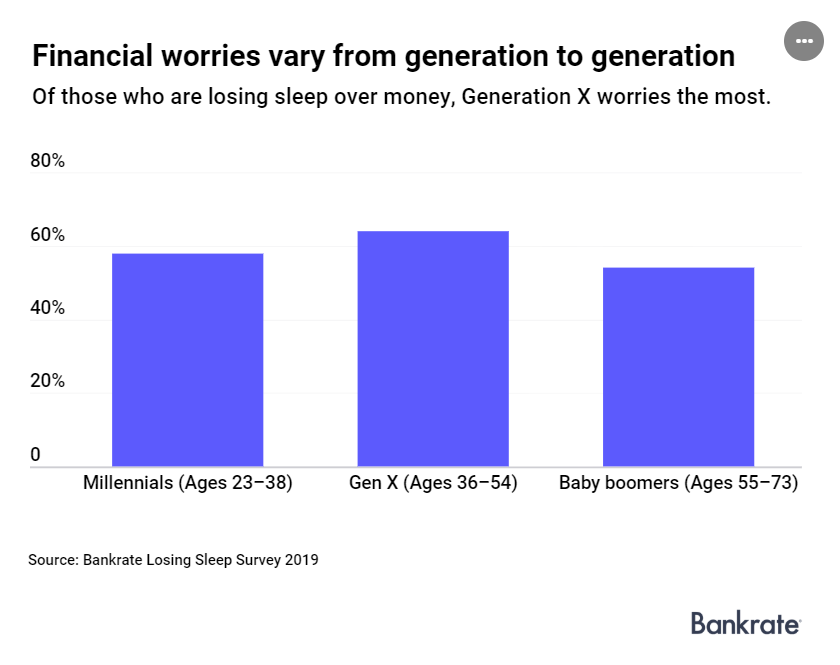
According to the NY Fed’s Yield Curve based model, there remains a 27% probability of a U.S. recession in the next 12 months.
“The last time that recession odds were the same as they are now was in early 2007, which was shortly before the Great Recession officially started in December 2007,” Colombo continued. He sees a 64% likelihood of a recession within the next year.
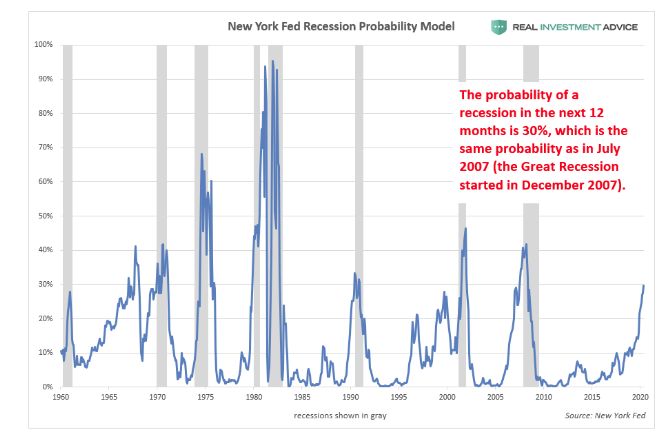
Colombo continued: “The New York Fed’s recession probability model has underestimated the probability of recessions in the past three decades because it is skewed by the anomalous recessions of the early 1980s. That model was skewed by a then-Federal Reserve Chairman Paul Volcker’s unusually aggressive interest rate hikes that were meant to ‘break the back of inflation.’ Looking at the New York Fed’s recession probability model data after 1985 gives more accurate estimates of recession probabilities in the past three decades.”
The bubbles that Colombo is now watching? Global debt, China, Hong Kong, Singapore, the art market, U.S. stocks, U.S. household wealth, corporate debt, leveraged loans, U.S. student loans, U.S. auto loans, tech startups, global skyscraper construction, U.S. commercial real estate and – stop us if you’ve heard this one before – U.S. housing.
Rent Is Becoming Unaffordable For Many U.S. Workers
The National Low Income Housing Coalition has published its latest “Out of Reach” report which shows that renting is becoming increasingly unaffordable for countless Americans.
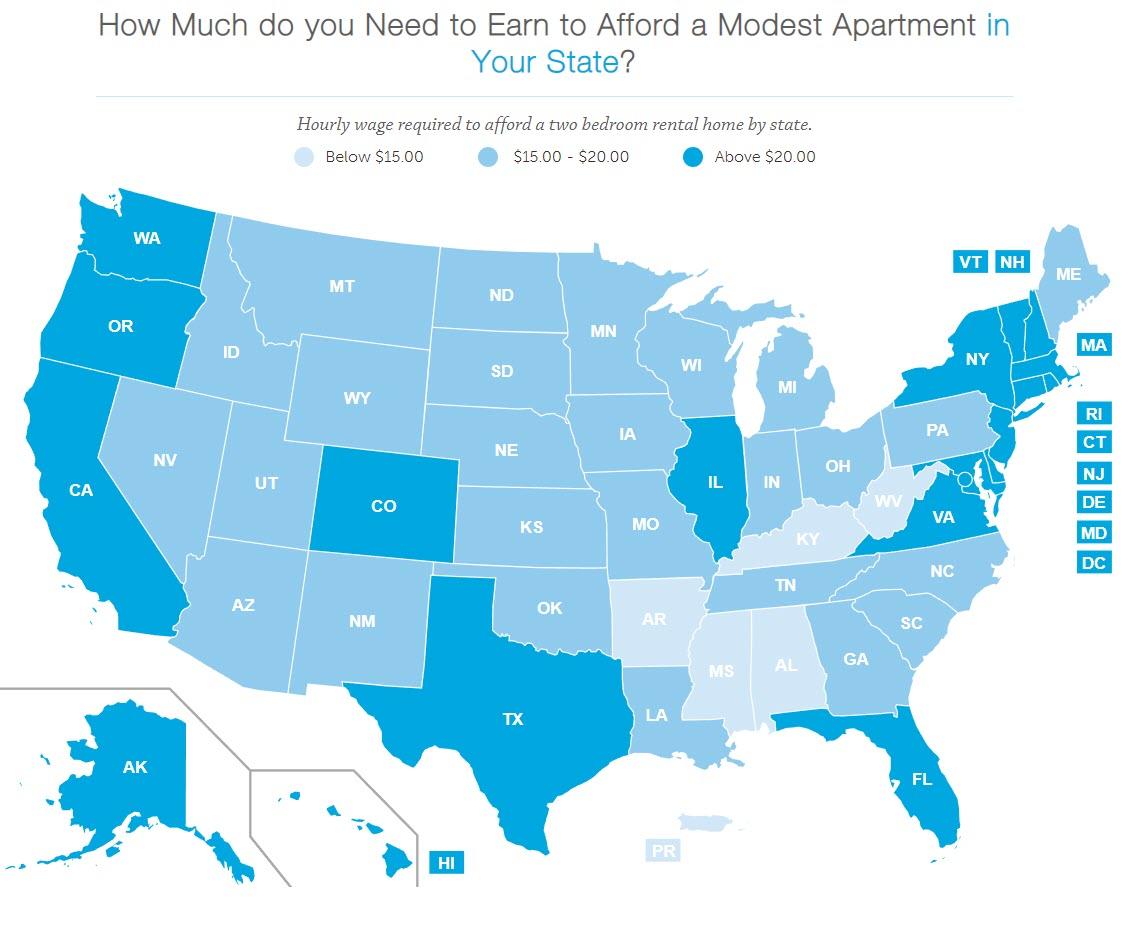
Its central statistic is the Housing Wage which is an estimate of the hourly wage a full-time worker must earn to rent a homewithout spending more than 30 percent of his or her income on housing costs. As Statista’s Niall McCarthy notes, for 2019, the Housing Wage is $22.96 and $18.65 for a modest two and one-bedroom flat respectively based on the “fair market rent”.
A worker earning the federal wage would have to put in 127 hours every week – equivalent to more than two full-time jobs – to afford a two-bedroom apartment. It isn’t just a regional issue – there isn’t a single state, metro area or county in the U.S. where a full-time worker earning the minimum wage can afford to rent a two-bedroom property.
It isn’t just workers on the minimum wage who are effected.
The report also states that the average renter’s hourly wage is $1.08 less than the Housing Wage for a one-bedroom rental and $5.39 less than a two-bedroom rental. That means that an average renter in the U.S. has to work a 52 hour week, something that becomes increasingly difficult if that renter is a single parent of someone struggling with a disability. When it comes to the situation in different occupations, a median-wage worker in eight of the country’s largest ten occupations does not earn enough to afford a one-bedroom apartment.

You will find more infographics at Statista
Software developers, general managers and nurses are able to meet both Housing Wages but for many other occupations and accomodations, renting is becoming increasingly difficult. Medical assistants, laborers and janitors are among those falling short while the gap back to minimum wage workers is even greater still. Worryingly, these are the ten jobs that are expected to see the biggest growth over the coming decade and that is likely to result in an even greater disparity between wages and housing costs by 2026.
Boeing Outsourced Its 737 MAX Software To $9-Per-Hour Engineers
The software at the heart of the Boeing 737 MAX crisis was developed at a time when the company was laying off experienced engineers and replacing them with temporary workers making as little as $9 per hour, according to Bloomberg.
In an effort to cut costs, Boeing was relying on subcontractors making paltry wages to develop and test its software. Often times, these subcontractors would be from countries lacking a deep background in aerospace, like India.
Boeing had recent college graduates working for Indian software developer HCL Technologies Ltd. in a building across from Seattle’s Boeing Field, in flight test groups supporting the MAX. The coders from HCL designed to specifications set by Boeing but, according to Mark Rabin, a former Boeing software engineer, “it was controversial because it was far less efficient than Boeing engineers just writing the code.”
Rabin said: “…it took many rounds going back and forth because the code was not done correctly.”

In addition to cutting costs, the hiring of Indian companies may have landed Boeing orders for the Indian military and commercial aircraft, like a $22 billion order received in January 2017. That order included 100 737 MAX 8 jets and was Boeing’s largest order ever from an Indian airline. India traditionally orders from Airbus.
HCL engineers helped develop and test the 737 MAX’s flight display software while employees from another Indian company, Cyient Ltd, handled the software for flight test equipment. In 2011, Boeing named Cyient, then known as Infotech, to a list of its “suppliers of the year”.
One HCL employee posted online: “Provided quick workaround to resolve production issue which resulted in not delaying flight test of 737-Max (delay in each flight test will cost very big amount for Boeing).”
But Boeing says the company didn’t rely on engineers from HCL for the Maneuvering Characteristics Augmentation System, which was linked to both last October’s crash and March’s crash. The company also says it didn’t rely on Indian companies for the cockpit warning light issue that was disclosed after the crashes.

A Boeing spokesperson said: “Boeing has many decades of experience working with supplier/partners around the world. Our primary focus is on always ensuring that our products and services are safe, of the highest quality and comply with all applicable regulations.”
HCL, on the other hand, said: “HCL has a strong and long-standing business relationship with The Boeing Company, and we take pride in the work we do for all our customers. However, HCL does not comment on specific work we do for our customers. HCL is not associated with any ongoing issues with 737 Max.”
Recent simulator tests run by the FAA indicate that software issues on the 737 MAX run deeper than first thought. Engineers who worked on the plane, which Boeing started developing eight years ago, complained of pressure from managers to limit changes that might introduce extra time or cost.
Rick Ludtke, a former Boeing flight controls engineer laid off in 2017, said: “Boeing was doing all kinds of things, everything you can imagine, to reduce cost, including moving work from Puget Sound, because we’d become very expensive here. All that’s very understandable if you think of it from a business perspective. Slowly over time it appears that’s eroded the ability for Puget Sound designers to design.”
Rabin even recalled an incident where senior software engineers were told they weren’t needed because Boeing’s productions were mature. Rabin said: “I was shocked that in a room full of a couple hundred mostly senior engineers we were being told that we weren’t needed.”

endfAny given jetliner is made up of millions of parts and millions of lines of code. Boeing has often turned over large portions of the work to suppliers and subcontractors that follow its blueprints. But beginning in 2004 with the 787 Dreamliner, Boeing sought to increase profits by providing high-level specs and then asking suppliers to design more parts themselves.
Boeing also promised to invest $1.7 billion in Indian companies as a result of an $11 billion order in 2005 from Air India. This investment helped HCL and other software developers.
For the 787, HCL offered a price to Boeing that they couldn’t refuse, either: free. HCL “took no up-front payments on the 787 and only started collecting payments based on sales years later”.
Rockwell Collins won the MAX contract for cockpit displays and relied in part on HCL engineers and contract engineers from Cyient to test flight test equipment.
Charles LoveJoy, a former flight-test instrumentation design engineer at the company, said: “We did have our challenges with the India team. They met the requirements, per se, but you could do it better.”
Pension “Death Spiral” Crisis Reaching Fever-Pitch In The US
Pensions across the U.S. are falling deeper into a crisis, as the gap between their assets and liabilities widens at the same time that investment returns are falling, according to Bloomberg.
Chief Investment Officer Ben Meng told the board of the California Public Employees’ Retirement System last week: “For the next 10 years, our expected returns are 6.1%, not 7%.”
And if you think you’ve seen panic now, just wait until he finds out that Calpers’ target of 7% – lowered in 2016 – is still a pipe dream.
Put simply: the record, decade long bull market hasn’t been enough to save pensions. The average U.S. plan has only 72.5% of its future obligations in 2018, compared to more than 100% in 2001. The Center for Retirement Research at Boston College attributes the deficit to “recessions, insufficient government contributions and generous benefit guarantees.”
Jean-Pierre Aubry, associate director said: “The really bad plans went heavily out of equities after the financial crisis.”
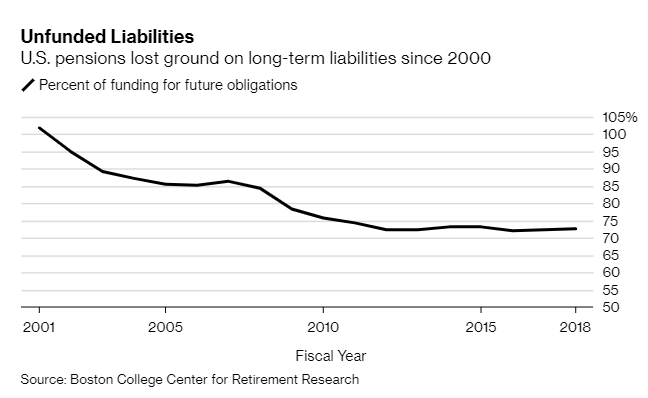
Pensions that aggressive bet on stock outperformed funds that moved money into alternative investment vehicles, like hedge funds.
Andrew Junkin, president of Wilshire Consulting, said: “Sometimes diversification, while it’s the right strategy, makes you look dumb.”
And this success isn’t a guarantee in the future, either.
Phillip Nelson, asset-allocation director at pension advisory firm NEPC said: “The discussion we have internally is over the next ten years is do you see an equal amount of Fed support and profit margins increasing by another 50% from this level? Both seem really unlikely to us.”
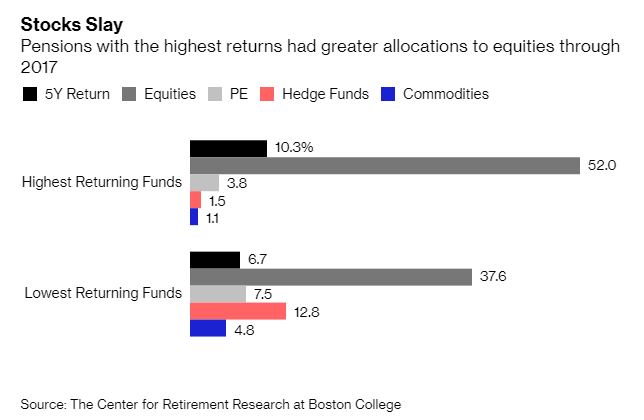 Public pensions have increased their exposure to PE to 10.2% on average in 2018. This is up from 5.6% in 2008, a trend that will probably continue. Many pension funds, like the Texas Teachers’ Retirement System, are hiring new staff to manage private equity. Their fund invests 40% of its portfolio in alternatives.Mohan Balachandran, senior managing director of asset allocation at Texas Teachers said: “Our pension liability duration is 20-plus years. We felt that we could invest for the long-term in some of these vehicles where your money’s locked up for seven to 12 years.”
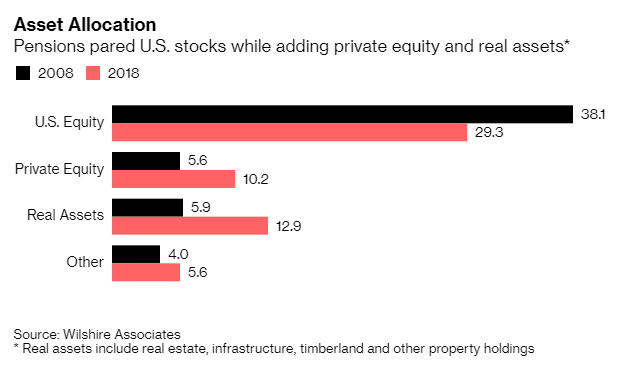 Now, about 85% of the 129 public pensions in the U.S. have cut return assumptions since 2014. These targets are expected to continue moving lower.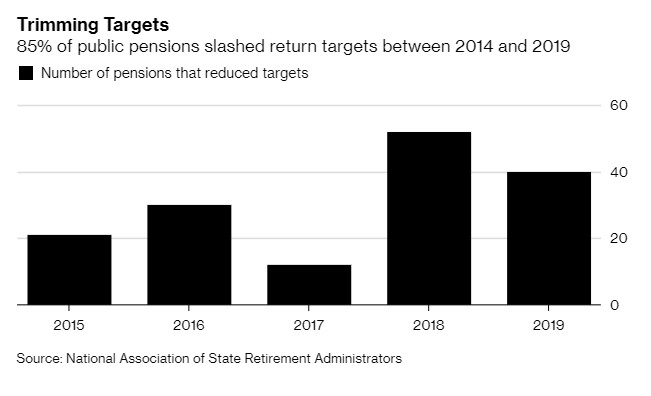
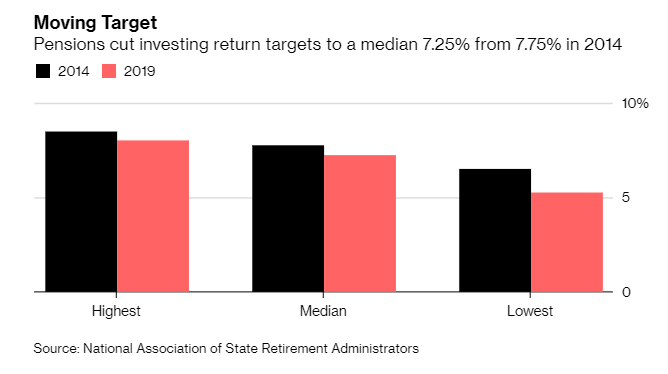 And lower assumptions aren’t always well received by taxpayers, despite lowering the risk for pension funds. Often, they lead to money out of the pockets of taxpayers to cover the difference.The Kentucky Retirement Systems’ plan for 123,000 employees in non-emergency jobs could be one of the worst off systems in the U.S. It currently only has $2 billion in assets for $15.6 billion in liabilities. The burden has resulted in government service cuts, pay freezes and a falling headcount.
 Executive Director David Eager said: “We call it the death spiral. You can’t earn your way out of this.”
end
SWAMP STORIES
E)SWAMP STORIES/MAJOR STORIES//THE KING REPORT
A rally into the European close to game Q2 performance appeared. This rally encouraged the usual suspects to aggressively manipulate ESUs and stocks higher to embellish Q2 performance. The rally peaked as a Noon Balloon. ESUs headed south when the afternoon arrived.
Contributing to the afternoon decline was this EU Statement: Special EU Channel to Allow Trade with Iran and Circumvent U.S. Sanctions is Now Operational
https://news.yahoo.com/special-eu-channel-allow-trade-182105259.html
How will Trump retaliate against EU apparatchiks for circumventing US sanctions on Iran?
Ex-Dallas Fed analyst @DiMartinoBooth: Investors are nuts to think a July interest rate cut is a slam dunk – “Would companies suddenly regain their capex…just because credit is marginally cheaper? In the aggregate, businesses have plenty of cash & credit; what they don’t have is global demand”
Boeing’s 737 Max Software Outsourced to $9-an-Hour Engineers
Trump: “We have a treaty with Japan. If Japan is attacked we will fight World War III. We will go in and we will protect them and we will fight with our lives and with our treasure. But if we’re attacked, Japan doesn’t have to help us. They can watch it on a Sony television.”
Trump Relents on Huawei in China Truce, Reviving Stalled Talks [as widely expected]
- President says China to buy ‘tremendous’ amounts of farm goods
- U.S. companies can supply Huawei despite blacklist, Trump says
https://www.bloomberg.com/news/articles/2019-06-29/xi-trump-agree-to-restart-trade-talks-china-says
U.S.-China Trade Truce: a Side-by-Side Comparison of Statements [Substantial differences remain]
@NorthmanTrader: Basically Trump has signaled to the Chinese that he is the one who needs a deal.
The Chinese pulled the plug in May and they just called the bluff of more tariffs and won. Which also means any deal with not be meaningful, but a PR jingle.
@SenSchumer (D-NY, Dem minority leader): Huawei is one of few potent levers we have to make China play fair on trade. If President @realDonaldTrump backs off, as it appears he is doing, it will dramatically undercut our ability to change China’s unfair trades practices.
Sen. @marcorubio (R-FL): If President Trump has in fact bargained away the recent restrictions on #Huawei, then we will have to get those restrictions put back in place through legislation. And it will pass with a large veto proof majority.
@Jkylebass: Trump wants to help the Greeks (Chinese) build the Trojan Horse that they will use to destroy the US from within. He should stick to checkers and let Pompeo play Go. The good news… There is a MONSTER of a story coming on Huawei this week. Bad move Trump
Today – The S&P 500 Index initially broke out to upside on Friday from its Inside Day on Thursday on Q2 performance schemes. ESUs are soaring on: usual Sunday night buying, expected start of July buying near the close and the widely expected US-China truce on trade. However, it’s just a restart of US-China trade negotiations. Plus, over the weekend, criticism of Trump for caving to Xi appeared from all political spectrums and numerous Street types. It will be interesting to see how DJT and his lackeys spin his latest capitulation. ‘Crocodile mouth & hummingbird ass’ comes to mind.
Another big risk now is Trump’s retaliation against the EU for circumventing US sanctions on Iran.
U.S. Warns Europe That Its Iran Workaround Could Face Sanctions May 29, 2019
“I urge you to carefully consider the potential sanctions exposure of Instex,” Mandelker wrote in the letter to Instex President Per Fischer. “Engaging in activities that run afoul of U.S. sanctions can result in severe consequences, including a loss of access to the U.S. financial system.” Germany, France and the U.K. finalized the Instex system in January, allowing companies to trade with Iran without the use of U.S. dollars or American banks, allowing them to get around wide-ranging U.S. sanctions that were imposed after the Trump administration abandoned the 2015 Iran nuclear deal last year…
NBC News: The winner of the first Democratic debate: Donald Trump
The second Democratic debate was even worse for Dems. At the second Democrat debate (Thursday night), the world saw why Joe Biden has been losing presidential campaigns for parts of four decades. Joe now needs a Lazarus routine or his latest campaign is over.
New York Magazine’s Olivia Nuzzi: A source close to the Biden campaign tells me his staff is ‘freaking out’ about his poor performance tonight. The source said that internally, field staff says the campaign-organized debate watch parties in early voting states have been ‘awkward’ and that Biden isn’t playing well to those who attended… According to Biden’s staff, he isn’t listening to his debate prep and he’s ‘set in his ways… Biden spokesperson says that Biden campaign staff is not “freaking out,” as a source close to the Biden campaign said:
CNN’s Van Jones on Biden and the debate: “I’m hurt…. a bad night for Democrats.”
@IngrahamAngle: The Obamas won again. Kamala was always their choice. She filleted Biden.
Jeffrey Gundlach: I said at Sohn Biden has no chance. Joe’s performance tonight proved it.
Sen. Kamala Harris pummeled Biden with the race card. She emotionally attacked Biden for praising segregationist senators and working with them on busing. “There was a little girl in California who was part of the second class to integrate her public schools, & she was bused to school every day. That little girl was me.” [Reports show Harris fibbed about being in the 2nd class to integrate her private school.]
Biden Says He Only Opposed Busing by Department of Education, Which Did Not Exist
When asked what his focus would be as president, Biden responded, “defeating Donald Trump.”
Ex-Senator (Democrat, Arkansas) @MikeGravel: “What’s the one issue you’ll focus on as president?” “Defeating Donald Trump.” Joe Biden is an idiot.
GOP Rep. @mattgaetz: After being elected @JoeBiden’s first priority would be defeating Trump.
Biden called the clock on himself when he apparently lost his train of thought. When shown a clip of this after the debate, someone on the CNN panel, snarked, ‘yea, your time is up; those words could have a deeper meaning.’ Van Jones said Biden’s response to Harris on his race issues was ‘unacceptable’.
When moderator Lester Holt asked candidates who would cancel their private insurance in favor of a government run plan, only Sanders and Harris raised their hands. After the crowd erupted in applause, Biden looked around and raised his hand waist high. https://twitter.com/mooncult/status/1144426379833835520
@DonaldJTrumpJr: Live shot inside Biden HQ #DemDebate2 (a GIF of the Hindenburg burning)
Bernie Sanders said he would hike taxes on the middle class.
Sen. Kirsten Gillibrand, who is 52, referred to herself as a “young mom.”
WaPo & CNN’s @rachaelmbade: Overheard while watching the debate just now: “I’m not sure I’m a Democrat anymore.” – Democrat next to me complaining abt how far left the party has moved
On Friday, Biden groveled at Jesse Jackson’s Rainbow-Push Convention in Chicago. Joe tried to justify his record on racial issues. He advocated for criminal justice reform; an attempt to obfuscate and mitigate his role in passing Clinton’s tough sentencing legislation from the 90’s. Joe repeatedly bashed DJT for being a racist.
Joe Biden loses support of top campaign fundraiser [Attorney Tom McInerney] in Bay Area…
“I don’t think he did well last night… I would imagine I’m not alone,” he tells CNBC…
NPR resurfaces 1975 interview with Biden supporting constitutional amendment to end court-ordered busing http://hill.cm/ksjHjzT
This Biden tape sat in NPR’s vault for 44 years; but now it surfaces. Qui bono?
Polls show Biden is losing voters to Sanders and Harris. The bad stuff on Kamala started to appear over the weekend. Wait until the Will Brown stuff and her prosecution controversies hit the fan!
On Friday, Kamala Harris tried to backpedal of abolishing private health care insurance. Harris claimed that she misinterpreted the question about using a government plan instead of a private plan.
The biggest political news over the week was this tweet that went viral: Ali Alexander @ali: Kamala Harris is *not* an American Black. She is half Indian and half Jamaican. I’m so sick of people robbing American Blacks (like myself) of our history. It’s disgusting. Now using it for debate…
Harris’s Jamaican father is an economics professor at Stanford. Her mom was cancer researcher & teacher. She moved to Canada with her mom in the mid-70’s, and returned to the US for college around 1981. Her father Donald wrote that one of his grandparents was a slave owner. Now that Harris is on the radar, her opponents and critics are sending flak her way.
Warren, Harris, others Dem and media types attacked Ali. Obviously Ali hit a very, very raw nerve.
Left-Wing Media Sends Lynch Mob after Black GOP Strategist for Tweeting about Kamala Harris’s Slave Owner Ancestry
The attacks on Ali Alexander provoked more @ali tweets. Elizabeth Warren identifies as a Native American. Bill Clinton identified as the first black president. Robert Beto Francis O’Rourke implies he’s a Mexican… Notice how Media called Bill Clinton to “first black president” and then said that Herman Cain wasn’t “really black” and now we’re being handed an Indian-Jamaican Kamala Harris. We Blacks are Ruled over by White Liberal Media and I’m over it. Canceled! NYT and BuzzFeed have inspired a racist hate mob against me. I’m getting death threats. Three presidential candidates have denounced me. All white Democrats. Warren called to have me banned from the Internet…
Odds of Trump being re-elected went from 45% before the Dem Debates to 52% on Saturday.
https://dailycaller.com/2019/06/29/betting-markets-favor-trump/
NY Mag’s Andrew Sullivan: The Democratic Candidates Are in a Bubble on Immigration
I suspect that the Democrats’ new position — everyone in the world can become an American if they walk over the border and never commit a crime — is political suicide… Advantage Trump.
http://nymag.com/intelligencer/2019/06/andrew-sullivan-democrats-are-in-a-bubble-on-immigration.html
Did the Democrats Step on a Second Big Landmine? By Jeff Greenfield, ABC’s 5-time Emmy winner
On immigration, they’ve steered the party close to an open-borders policy without any serious reckoning with how to handle the influx of arrivals… Now add to that the universal embrace of health care for the undocumented… https://www.politico.com/magazine/amp/story/2019/06/28/democrats-debate-immigration-landmine-227247
Ace columnist John Kass: Border pandering, not Kamala Harris-Joe Biden drama, will decide 2020
Biden… ran to the Rainbow/PUSH Coalition convention in Chicago, and the Rev. Jesse Jackson let him try and clean himself up… when Biden put his arms around Jackson and whispered into Jackson’s ear, Jackson didn’t return the hug…
What defines elections, and political parties, are ideas with sweep, ideas that announce “This is who we are” to the voters. Like the Democrats’ new open borders policy. And their agreement to provide “free” health care to immigrants here illegally… But ideas have consequences too.
WaPo: Winners and losers from the Democratic presidential debate’s second night
Winners: Harris, Buttigieg, Sanders and Trump
Losers: Biden, The old Democratic Party on immigration and Barack Obama (for deportation record)
It is astonishing that Biden and other Dem candidates faired so poorly with the largely fawning moderators refraining from asking tough questions.
@Barnes_Law: Zero questions to Biden on China, Ukraine & #metoo scandals.
Zero questions to Harris on #MeToo staffer scandal, Willie Brown, Hunter Point/Lennar scandals & imprisonment of the innocent.
Zero questions to Buttigieg on his firing of a black police chief. Debate loser? Media.
END


 harveyorganblog.com