
GOLD:$1695.60 UP $10.00 The quote is London spot price
Silver: $15.32 UP 16 CENTS
May Crude Oil Closes At Negative $37.63 Per Barrel
Tomorrow is first day notice for the May contract month!!
U.S. oil’s May contract plunged into negative territory on Monday, meaning that you would have to pay to get someone to take barrels of oil off your hands. West Texas Intermediate oil trading on the New York Mercantile Exchange plunged nearly 300% to settle at negative $37.63 a barrel. The May contract expires CL.1, -193.04% CLK20, -193.04% Tuesday. That one-day drop marks the first time the contract has traded negative in history and would be the largest tumle on record going back to 1983, while a finish near its current level would be far below the previous all-time low for a front-month contract, according to Dow Jones Market Data. The June contract CLM20, -15.90% which is the most-active, ended down $4.60, or 18.3%, at $20.03 a barrel.
Here Is The Full Explanation Behind Today’s Unprecedented Negative Oil Price
Courtesy of IHSMarkit’s energy vice president Roger Diwan
How did you end up with negative oil prices today? This happens when a physical futures contract find no buyers close to or at expiry.
Let me explain what that means:
A physical contract such as the NYMEX WTI has a delivery point at Cushing, OK, & date, in this occurrence May. So people who hold the contract at the end of the trading window have to take physical delivery of the oil they bought on the futures market. This is very rare.
It means that in the last few days of the futures trading cycle, (which is tomorrow for this one) speculative or paper futures positions start rolling over to the next contract. This is normally a pretty undramatic affair.
What is happening today is trades or speculators who had bought the contract are finding themselves unable to resell it, and have no storage booked to get delivered the crude in Cushing, OK, where the delivery is specified in the contract.
This means that all the storage in Cushing is booked, and there is no price they can pay to store it, or they are totally inexperienced in this game and are caught holding a contract they did not understand the full physical aspect of as the time clock expires.
The contract roll and liquidity crunch that made the extreme sell-off today possible but it DOESN’T necessarily represent futures market conditions: NYMEX June settled today at $21.13.
The June contract is not out of the woods either: today’s action indicate that physical oil markets at Cushing are not in good shape and that storage is getting very full
END
HARVEY: THEY WERE CARRIED OUT ON A STRETCHER TONIGHT IN OIL
Closing access prices: London spot
i)Gold : $1696.00 LONDON SPOT 4:30 pm
ii)SILVER: $15.30//LONDON SPOT 4:30 pm
CLOSING FUTURES PRICES: KEY MONTHS
APRIL comex gold price CLOSE 1.30 PM: $1701.50
MAY COMEX GOLD: 1705.30 1:30 PM
JUNE GOLD: $1712.50 CLOSE 1.30 PM// SPREAD SPOT/FUTURE JUNE: $17.90
CLOSING SILVER FUTURE MONTH
SILVER APRIL COMEX CLOSE: XXX
SILVER MAY COMEX CLOSE; $15.62-…1:30 PM.//SPREAD SPOT/FUTURE MAY: 30 CENTS PER OZ
the gold market continues to be broken as future prices are much higher than spot prices. The comex is desperate to fix things but they have no available gold.
If one is to buy gold and or gold coins, the price is around $2800. usa per oz
and silver; $31.00 per oz//
LADIES AND GENTLEMEN: YOU ARE NOW WITNESSING FIRST HAND THE DIFFERENCE BETWEEN PAPER GOLD/SILVER AND THE REAL PHYSICAL STUFF!!
DO NOT PAY ANY ATTENTION TO WHAT THE CROOKS ARE DOING AT THE COMEX AND LONDON LBMA..PHYSICAL IS THE NAME OF THE GAME AND NOTHING ELSE
COMEX DATA
JPMorgan has been receiving gold with reckless abandon and sometimes supplying (stopping)
today RECEIVING: 14/106
EXCHANGE: COMEX
CONTRACT: APRIL 2020 COMEX 100 GOLD FUTURES
SETTLEMENT: 1,689.200000000 USD
INTENT DATE: 04/17/2020 DELIVERY DATE: 04/21/2020
FIRM ORG FIRM NAME ISSUED STOPPED
____________________________________________________________________________________________
132 C SG AMERICAS 1
657 C MORGAN STANLEY 6
657 H MORGAN STANLEY 88
661 C JP MORGAN 14
686 C INTL FCSTONE 5
690 C ABN AMRO 88 3
905 C ADM 7
____________________________________________________________________________________________
TOTAL: 106 106
MONTH TO DATE: 29,741
NUMBER OF NOTICES FILED TODAY FOR APRIL CONTRACT: 106 NOTICE(S) FOR 10,600 OZ (0.3297 tonnes)
TOTAL NUMBER OF NOTICES FILED SO FAR: 29,741 NOTICES FOR 2,974,100 OZ (92.506 TONNES)
SILVER
FOR APRIL
0 NOTICE(S) FILED TODAY FOR nil OZ/
total number of notices filed so far this month: 806 for 4,025,000 oz
BITCOIN MORNING QUOTE $7030 DOWN 135
BITCOIN AFTERNOON QUOTE.: $6828 DOWN $300
GLD AND SLV INVENTORIES:
WITH GOLD UP $10.00: AND NO PHYSICAL TO BE FOUND ANYWHERE:
WITH ALL REFINERS CLOSED//MEXICO ORDERING ALL MINES SHUT: WHERE ARE THEY GETTING THE “PHYSICAL”?
SURPRISINGLY NO GOLD LEAVES THE GLD//
GLD: 1,021.69 TONNES OF GOLD//
WITH SILVER UP 16 CENTS TODAY: AND WITH NO SILVER AROUND
A HUGE CHANGE IN SILVER INVENTORY AT THE SLV
A PAPER WITHDRAWAL OF 2.797 MILLION OZ FROM THE SLV..
RESTING SLV INVENTORY TONIGHT:
SLV: 411.241 MILLION OZ./
XXXXXXXXXXXXXXXXXXXXXXXXX
Let us have a look at the data for today
xxxxxxxxxxxxxxxxxxxxxxxxxxxxxxxxxxxxxxxxxxxxxxxxxxxxxxxxxxxxxxxxxxxxxxxxxx
IN SILVER THE COMEX OI ROSE BY A TINY SIZED 79 CONTRACTS FROM 141,102 UP TO 141,181 AND CLOSER TO OUR NEW RECORD OF 244,710, (FEB 25/2020. THE TINY SIZED GAIN IN OI OCCURRED WITH OUR CONSIDERABLE 24 CENT LOSS IN SILVER PRICING AT THE COMEX. IT SEEMS THAT THE TINY GAIN IN COMEX OI IS DUE TO SOME BANKER SHORT COVERING PLUS A CONSIDERABLE EXCHANGE FOR PHYSICAL ISSUANCE, ZERO LONG LIQUIDATION ALONG WITH OUR ZERO GAIN IN SILVER OZ STANDING. WE HAD A SMALL NET GAIN IN OUR TWO EXCHANGES OF 387 CONTRACTS (SEE CALCULATIONS BELOW).
WE HAVE ALSO WITNESSED A STRONG AMOUNT OF PHYSICAL METAL STAND FOR COMEX DELIVERY AS WELL WE ARE WITNESSING CONSIDERABLE LONGS PACKING THEIR BAGS AND MIGRATING OVER TO LONDON IN GREATER NUMBERS IN THE FORM OF EFP’S. WE WERE NOTIFIED THAT WE HAD A STRONG SIZED NUMBER OF COMEX LONGS TRANSFERRING THEIR CONTRACTS TO LONDON THROUGH THE EFP ROUTE: MARCH: 00 AND MAY: 260 AND JUNE: 30 ZERO FOR ALL OTHER MONTHS AND THEREFORE TOTAL ISSUANCE 290 CONTRACTS. WITH THE TRANSFER OF 290 CONTRACTS, WHAT THE CME IS STATING IS THAT THERE IS NO SILVER (OR GOLD) TO BE DELIVERED UPON AT THE COMEX AS THEY MUST EXPORT THEIR OBLIGATION TO LONDON. ALSO KEEP IN MIND THAT THERE CAN BE A DELAY OF 24-48 HRS IN THE ISSUING OF EFP’S. THE 290 EFP CONTRACTS TRANSLATES INTO 1.450 MILLION OZ ACCOMPANYING:
1.THE 24 CENT LOSS IN SILVER PRICE AT THE COMEX AND
2. THE STRONG AMOUNT OF SILVER OUNCES WHICH STOOD FOR DELIVERY IN THE LAST 12 MONTHS:
JUNE/2018. (5.420 MILLION OZ);
FOR JULY: 30.370 MILLION OZ
FOR AUG., 6.065 MILLION OZ
FOR SEPT. 39.505 MILLION OZ S
FOR OCT.2.525 MILLION OZ.
FOR NOV: A HUGE 7.440 MILLION OZ STANDING AND
21.925 MILLION OZ FINALLY STAND FOR DECEMBER.
5.845 MILLION OZ STAND IN JANUARY.
2.955 MILLION OZ STANDING FOR FEBRUARY.:
27.120 MILLION OZ STANDING IN MARCH.
3.875 MILLION OZ STANDING FOR SILVER IN APRIL.
18.845 MILLION OZ STANDING FOR SILVER IN MAY.
2.660 MILLION OZ STANDING FOR SILVER IN JUNE//
22.605 MILLION OZ STANDING FOR JULY
10.025 MILLION OZ INITIAL STANDING IN AUGUST.
43.030 MILLION OZ INITIALLY STANDING IN SEPT. (HUGE)
7.32 MILLION OZ INITIALLY STANDING IN OCT
2.630 MILLION OZ STANDING FOR NOV.
20.970 MILLION OZ FINAL STANDING IN DEC
5.075 MILLION OZ FINAL STANDING IN JAN
1.480 MILLION OZ FINAL STANDING IN FEB
23.005 MILLION OZ FINAL STANDING FOR MAR
4.145 MILLION OZ INITIALLY STANDING FOR APRIL
FRIDAY, AGAIN OUR CROOKS USED COPIOUS PAPER IN ORDER TO LIQUIDATE SILVER’S PRICE…AND THEY WERE SUCCESSFUL IN KNOCKING THE PRICE OF SILVER DOWN (IT FELL 24 CENTS).. BUT, OUR OFFICIAL SECTOR/BANKERS WERE UNSUCCESSFUL IN THEIR ATTEMPT TO FLEECE SOME SILVER LONGS FROM THEIR POSITIONS, AS WE DID HAVE A SMALL NET GAIN OF 369 CONTRACTS OR 1.845 MILLION OZ ON THE TWO EXCHANGES! YOU CAN BET THE FARM THAT OUR BANKER ARE DESPERATE TO LIQUIDATE THEIR HUGE SHORT POSITIONS IN SILVER
OUR SPREADING OPERATION HAS NOW SWITCHED INTO SILVER…..
SPREADING OPERATION FOR OUR NEWCOMERS:
WE HAVE NOW COMMENCED IN SILVER THE ILLEGAL SPREADING OPERATION \ FOR NEWCOMERS, HERE ARE THE DETAILS:
SPREADING LIQUIDATION HAS NOW STOPPED IN GOLD AS THEY NOW BEGIN TO MORPH INTO SILVER AS WE HEAD TOWARDS THE NEW FRONT MONTH WILL BE MAY.
FOR THOSE OF YOU WHO ARE NEW, HERE IS THE MODUS OPERANDI OF THE SPREADERS AND THE CRIMINAL ELEMENT BEHIND IT:
HERE IS A BRIEF SYNOPSIS OF HOW THE CROOKS FLEECE UNSUSPECTING LONGS IN THE SPREADING ENDEAVOUR;
THE SPREADING LIQUIDATION OPERATION IS NOW OVER FOR GOLD..AND WE WILL NOW MORPH INTO AN ACCUMULATION PHASE OF SPREADING CONTRACTS FOR SILVER. THEY WILL ACCUMULATE CONSIDERABLE AMOUNT OF THE CONTRACTS AND THEN LIQUIDATE ONE WEEK PRIOR TO FIRST DAY NOTICE
MODUS OPERANDI OF THE CORRUPT BANKERS AS TO HOW THEY HANDLE THEIR SPREAD OPEN INTERESTS:
.
AS I HAVE MENTIONED IN PREVIOUS COMMENTARIES:
“AS YOU WILL SEE, THE CROOKS WILL NOW SWITCH TO SILVER AS THEY INCREASE THE OPEN INTEREST FOR THE SPREADERS. THE TOTAL COMEX SILVER OPEN INTEREST WILL RISE FROM NOW ON UNTIL ONE WEEK PRIOR TO FIRST DAY NOTICE AND THAT IS WHEN THEY START THEIR CRIMINAL LIQUIDATION.
HERE IS HOW THE CROOKS USED SPREADING AS WE ARE NOW INTO THE NON ACTIVE DELIVERY MONTH OF APRIL HEADING TOWARDS THE ACTIVE DELIVERY MONTH OF MAY FOR SILVER:
YOU WILL ALSO NOTICE THAT THE COMEX OPEN INTEREST STARTS TO RISE IN THIS NON ACTIVE MONTH OF APRIL. BUT SO IS THE OPEN INTEREST OF SPREADERS. THE OPEN INTEREST IN GOLD WILL CONTINUE TO RISE UNTIL ONE WEEK BEFORE FIRST DAY NOTICE OF AN UPCOMING ACTIVE DELIVERY MONTH (MAY), AND THAT IS WHEN THE CROOKS SELL THEIR SPREAD POSITIONS BUT NOT AT THE SAME TIME OF THE DAY. THEY WILL USE THE SELL SIDE OF THE EQUATION TO CREATE THE CASCADE (ALONG WITH THEIR COLLUSIVE FRIENDS) AND THEN COVER ON THE BUY SIDE OF THE SPREAD SITUATION AT THE END OF THE DAY. THEY DO THIS TO AVOID POSITION LIMIT DETECTION. THE LIQUIDATION OF THE SPREADING FORMATION CONTINUES FOR EXACTLY ONE WEEK AND ENDS ON FIRST DAY NOTICE.”
ACCUMULATION FOR EFP’S/SILVER/J.P.MORGAN’S HOUSE OF BRIBES, / STARTING FROM FIRST DAY NOTICE/FOR MONTH OF APRIL:
13,127 CONTRACTS (FOR 12 TRADING DAYS TOTAL 13,127 CONTRACTS) OR 65.635 MILLION OZ: (AVERAGE PER DAY: 1167 CONTRACTS OR 5.684 MILLION OZ/DAY)
TO GIVE YOU AN IDEA AS TO THE HUGE SUPPLY THIS MONTH IN SILVER: SO FAR THIS MONTH OF APRIL: 65.635 MILLION PAPER OZ HAVE MORPHED OVER TO LONDON. THIS REPRESENTS AROUND 9.38% OF ANNUAL GLOBAL PRODUCTION (EX CHINA EX RUSSIA)* JUNE’S 345.43 MILLION OZ IS THE SECOND HIGHEST RECORDED ISSUANCE OF EFP’S AND IT FOLLOWED THE RECORD SET IN APRIL 2018 OF 385.75 MILLION OZ.
ACCUMULATION IN YEAR 2020 TO DATE SILVER EFP’S: 959.125 MILLION OZ.
JANUARY 2020 EFP TOTALS SO FAR: 181.61 MILLION OZ
FEB 2020 EFP’S TOTAL : …… 259.600 MILLION OZ
MARCH EFP’S ….. 452.280 MILLION OZ //TOTALS//AND A NEW RECORD FOR THE MONTH)
APRIL EFP SO FAR 65.635 MILLION OZ. (EX. FOR PHYSICALS BECOMING A LOT LESS)
EXCHANGE FOR PHYSICAL ISSUANCE THIS MONTH IS A LOT LESS. NO DOUBT THAT THE COST TO CARRY THESE THINGS HAS EXPLODED AND AS SUCH CANNOT BE DONE AS FREUENTLY AS BEFORE.
RESULT: WE HAD A TINY SIZED INCREASE IN COMEX OI SILVER COMEX CONTRACTS OF 79, DESPITE THE CONSIDERABLE 24 CENT LOSS IN SILVER PRICING AT THE COMEX /FRIDAY… THE CME NOTIFIED US THAT WE HAD A SMALL SIZED EFP ISSUANCE OF 290 CONTRACTS WHICH EXITED OUT OF THE SILVER COMEX AND TRANSFERRED THEIR OI TO LONDON AS FORWARDS. SPECULATORS CONTINUED THEIR INTEREST IN ATTACKING THE SILVER COMEX FOR PHYSICAL SILVER
TODAY WE GAINED A SMALL SIZED OI CONTRACTS ON THE TWO EXCHANGES: 369 CONTRACTS (DESPITE OUR 24 CENT LOSS IN PRICE)
THE TALLY//EXCHANGE FOR PHYSICALS
i.e 290 OPEN INTEREST CONTRACTS HEADED FOR LONDON (EFP’s) TOGETHER WITH A TINY INCREASE OF 79 OI COMEX CONTRACTS. AND ALL OF THIS DEMAND HAPPENED WITH A 24 CENT LOSS IN PRICE OF SILVER/ AND A CLOSING PRICE OF $15.16 // FRIDAY’S TRADING. YET WE STILL HAVE A STRONG AMOUNT OF SILVER STANDING AT THE COMEX FOR DELIVERY.
In ounces AT THE COMEX, the OI is still represented by JUST UNDER 1 BILLION oz i.e. 0.7050 BILLION OZ TO BE EXACT or 100.7% of annual global silver production (ex Russia & ex China).
FOR THE NEW MAR DELIVERY MONTH/ THEY FILED AT THE COMEX: 0 NOTICE(S) FOR nil OZ OF SILVER.
IN SILVER,PRIOR TO TODAY, WE SET THE NEW COMEX RECORD OF OPEN INTEREST AT 244,196 CONTRACTS ON AUG 22.2018. AND AGAIN THIS HAS BEEN SET WITH A LOW PRICE OF $14.70//TODAY’S RECORD OF 244,705 IS SET WITH A PRICE OF: 18.91 (FEB 25/2020)
.
ON THE DEMAND SIDE WE HAVE THE FOLLOWING:
- HUGE AMOUNTS OF SILVER STANDING FOR DELIVERY (MARCH/2018: 27 MILLION OZ , APRIL/2018 : 2.485 MILLION OZ MAY: 36.285 MILLION OZ ; JUNE/2018 (5.420 MILLION OZ) , JULY 2018 FINAL AMOUNT STANDING: 30.370 MILLION OZ ) FOR AUGUST 6.065 MILLION OZ. , SEPT: A HUGE 39.505 MILLION OZ./ OCTOBER: 2,520,000 oz NOV AT 7.440 MILLION OZ./ DEC. AT 21.925 MILLION OZ JANUARY AT 5.825 MILLION OZ.AND FEB 2019: 2.955 MILLION OZ/ MARCH: 27.120 MILLION OZ/ APRIL AT 3.875 MILLION OZ/ A MAY: 18.845 MILLION OZ ..JUNE 2.660 MILLION OZ//JULY 22.605 MILLION OZ; AUGUST 10.025 MILLION OZ/ SEPT 43.030 MILLION OZ//OCT: 7.665 MILLION OZ// NOV: 2.630 MILLION OZ//DEC: 20.970 MILLION OZ; JAN: 5.075 MILLION OZ.//FEB 1.480 MILLION OZ//MAR: 23.005 MILLION OZ/APRIL 4.145 MILLION OZ//
- THE RECORD PRIOR TO TODAY WAS SET IN FEB 25/2018: 244,710 CONTRACTS, WITH A SILVER PRICE OF $18.90//.
- HUGE ANNUAL EFP’S ISSUANCE EQUAL TO 2.9 BILLION OZ OR 400% OF SILVER ANNUAL PRODUCTION/2017 RECORD SETTING EFP ISSUANCE FOR ANY MONTH IN SILVER; APRIL/2018/ 385.75 MILLION OZ/ AND THE SECOND HIGHEST RECORDED EFP ISSUANCE JUNE 2018 345.43 MILLION OZ
AND YET, WITH THE EXTREMELY HIGH EFP ISSUANCE, WE HAVE A CONTINUAL LOW PRICE OF SILVER DESPITE THE ABOVE HUGE DEMAND. TO ME THE ONLY ANSWER IS THAT WE HAVE SOVEREIGN (CHINA) WHO IS ENDEAVOURING TO GOBBLE UP ALL AVAILABLE PHYSICAL SILVER NO MATTER WHERE, EXACTLY WHAT J.P.MORGAN IS DOING. AND IT IS MY BELIEF THAT J.P.MORGAN IS HOLDING ITS SILVER FOR ITS BENEFICIAL OWNER..THE USA GOVERNMENT WHO IN TURN IS HOLDING THAT SILVER FOR CHINA.(FOR A SILVER LOAN REPAYMENT)
GOLD
IN GOLD, THE COMEX OPEN INTEREST ROSE BY A SMALL SIZED 1044 CONTRACTS TO 492,498 AND CLOSER TO OUR NEW RECORD (SET JAN 24/2020) AT 799,541 AND PREVIOUS TO THAT: (SET JAN 6/2020) AT 797,110.
THE GAIN OF COMEX OI OCCURRED DESPITE OUR COMEX LOSS IN PRICE OF $27.80 /// COMEX GOLD TRADING// FRIDAY// WE HAD CONSIDERABLE BANKER SHORT COVERING ALONG WITH ZERO LONG LIQUIDATION ACCOMPANYING A GOOD EX. FOR PHYSICAL ISSUANCE AND THIS WAS COUPLED WITH OUR STRONG LOSS IN THE PAPER PRICE OF GOLD.
WE HAD NO ISSUANCE OF OUR NEW 4 GC CONTRACT
WE GAINED A GOOD 4367 CONTRACTS (13.58 TONNES) ON OUR TWO EXCHANGES.
E.F.P. ISSUANCE
THE CME RELEASED THE DATA FOR EFP ISSUANCE AND IT TOTALED A FAIR SIZED 3323 CONTRACTS:
CONTRACTS, FEB> 0 CONTRACTS; MARCH 00 APRIL: 0. MAY: 0, AND JUNE 3323.; DEC 0 AND ALL OTHER MONTHS ZERO//TOTAL: 3323. The NEW COMEX OI for the gold complex rests at 492,498. ALSO REMEMBER THAT THERE WILL BE A DELAY IN THE ISSUANCE OF EFP’S. THE BANKERS REMOVE LONG POSITIONS OF COMEX GOLD IMMEDIATELY. THEN THEY ORCHESTRATE THEIR PRIVATE EFP DEAL WITH THE LONGS AND THAT COULD TAKE AN ADDITIONAL, 48 HRS SO WE GENERALLY DO NOT GET A MATCH WITH RESPECT TO DEPARTING COMEX LONGS AND NEW EFP LONG TRANSFERS. . EVEN THOUGH THE BANKERS ISSUED THESE MONSTROUS EFPS, THE OBLIGATION STILL RESTS WITH THE BANKERS TO SUPPLY METAL BUT IT TRANSFERS THE RISK TO A LONDON BANKER OBLIGATION AND NOT A NEW YORK COMEX OBLIGATION. LONGS RECEIVE A FIAT BONUS TOGETHER WITH A LONG LONDON FORWARD. THUS, BY THESE ACTIONS, THE BANKERS AT THE COMEX HAVE JUST STATED THAT THEY HAVE NO APPRECIABLE METAL!! THIS IS A MASSIVE FRAUD: THEY CANNOT SUPPLY ANY METAL TO OUR COMEX LONGS BUT THEY ARE QUITE WILLING TO SUPPLY MASSIVE NON BACKED GOLD (AND SILVER) PAPER KNOWING THAT THEY HAVE NO METAL TO SATISFY OUR LONGS. LONDON IS NOW SEVERELY BACKWARD IN BOTH GOLD AND SILVER AND WE ARE WITNESSING DELAYS IN ACTUAL DELIVERIES.
IN ESSENCE WE HAVE A FAIR SIZED INCREASE IN TOTAL CONTRACTS ON THE TWO EXCHANGES OF 4367 CONTRACTS: 1044 CONTRACTS INCREASED AT THE COMEX AND 3323 EFP OI CONTRACTS WHICH NAVIGATED OVER TO LONDON. THUS TOTAL OI GAIN OF 4367 CONTRACTS OR 13.58 TONNES. FRIDAY, WE HAD CONSIDERABLE LOSS OF $27.80 IN GOLD TRADING.…..
AND DESPITE THAT LOSS IN PRICE, WE HAD A GOOD SIZED GAIN IN TOTAL/TWO EXCHANGES GOLD TONNAGE OF 13.58 TONNES!!!!!! THE BANKERS/OFFICIAL SECTOR WERE SUPPLYING INFINITE SUPPLIES OF SHORT GOLD COMEX PAPER WITH RECKLESS ABANDON. THE BANKERS WERE SUCCESSFUL IN THEIR ATTEMPT TO LOWER GOLD’S PRICE (FELL $27.80). AND IT ALSO SEEMS THAT THEIR ATTEMPT TO FLEECE ANY GOLD LONGS FROM THE GOLD ARENA WERE UNSUCCESSFUL (SEE BELOW).
4 GC ISSUANCE: ZERO
CALCULATIONS ON GAIN/LOSS ON OUR TWO EXCHANGES:
WE HAD A GOOD SIZED INCREASE IN EXCHANGE FOR PHYSICALS (3323) ACCOMPANYING THE GAIN IN COMEX OI (2576 OI): TOTAL GAIN IN THE TWO EXCHANGES: 4367 CONTRACTS. WE NO DOUBT HAD 1 )HUGE BANKER SHORT COVERING, 2.)A STRONG INCREASE IN STANDING AT THE GOLD COMEX FOR THE FRONT APRIL MONTH, 3) ZERO LONG LIQUIDATION AND …ALL OF THIS WAS COUPLED WITH THAT HUGE LOSS IN GOLD PRICE TRADING//FRIDAY
HISTORICAL ACCUMULATION OF EXCHANGE FOR PHYSICALS IN 2020 INCLUDING TODAY
ACCUMULATION OF EFP’S GOLD AT J.P. MORGAN’S HOUSE OF BRIBES: (EXCHANGE FOR PHYSICAL) FOR THE MONTH OF APRIL : 56,482 CONTRACTS OR 5,648,200 oz OR 175.68 TONNES (12 TRADING DAYS AND THUS AVERAGING: 4706 EFP CONTRACTS PER TRADING DAY
TO GIVE YOU AN IDEA AS TO THE STRONG SIZE OF THESE EFP TRANSFERS : THIS MONTH IN 12 TRADING DAY(S) IN TONNES: 175.68 TONNES
TOTAL ANNUAL GOLD PRODUCTION, 2019, THROUGHOUT THE WORLD EX CHINA EX RUSSIA: 3555 TONNES
THUS EFP TRANSFERS REPRESENTS 175.68/3550 x 100% TONNES =4.95% OF GLOBAL ANNUAL PRODUCTION
ISSUANCE OF EXCHANGE FOR PHYSICAL GOLD HAS DISSIPATED THIS MONTH…THE COST TO THE BANKERS TO CARRY THESE CONTRACTS IN LONDON IS BECOMING TOO GREAT FOR THEM.
ACCUMULATION OF GOLD EFP’S YEAR 2020 TO DATE: 2498.58 TONNES
JANUARY 2220 TOTAL EFP ISSUANCE; : 570.19 TONNES
FEB 2020 TOTAL EFP ISSUANCE : 653.78 TONNES
MARCH TOTAL EFP ISSUANCE 1,098.93 TONNES (*AND A NEW ALL TIME RECORD ISSUANCE//22 DAYS)
APRIL TOTAL EFP. ISSUANCE: 175.68 TONNES (EFP ISSUANCE BECOMING A LOT LESS)
WHAT IS ALARMING TO ME, ACCORDING TO OUR LONDON EXPERT ANDREW MAGUIRE IS THAT THESE EFP’S ARE BEING TRANSFERRED TO WHAT ARE CALLED SERIAL FORWARD CONTRACT OBLIGATIONS AND THESE CONTRACTS ARE LESS THAN 14 DAYS. ANYTHING GREATER THAN 14 DAYS, THESE MUST BE RECORDED AND SENT TO THE COMPTROLLER, GREAT BRITAIN TO MONITOR RISK TO THE BANKING SYSTEM. IF THIS IS INDEED TRUE, THEN THIS IS A MASSIVE CONSPIRACY TO DEFRAUD AS WE NOW WITNESS A MONSTROUS TOTAL EFP’S ISSUANCE AS IT HEADS INTO THE STRATOSPHERE.
First, here is an outline of what will be discussed tonight:
1.Today, we had the open interest at the comex, in SILVER, ROSE BY A TINY SIZED 79 CONTRACTS FROM 141,102 UP TO 141,181 AND CLOSER TO OUR COMEX RECORD //244,710(SET FEB 25/2020). THE LAST RECORDS WERE SET IN AUG.2018 AT 244,196 WITH A SILVER PRICE OF $14.78/(AUGUST 22/2018)..THE PREVIOUS RECORD TO THAT WAS SET ON APRIL 9/2018 AT 243,411 OPEN INTEREST CONTRACTS WITH THE SILVER PRICE AT THAT DAY: $16.53). AND PREVIOUS TO THAT, THE RECORD WAS ESTABLISHED AT: 234,787 CONTRACTS, SET ON APRIL 21.2017 OVER 2 3/4 YEARS AGO. THE PRICE OF SILVER ON THAT DAY: $17.89.
ALL OF THE TINY GAIN IN COMEX OI WAS DUE TO 1) SOME BANKER SHORT COVERING , 2) THE ISSUANCE OF A FAIR SIZED NUMBER OF EXCHANGE FOR PHYSICALS (SEE BELOW), 3) A ZERO INCREASE IN SILVER OZ STANDING AT THE COMEX FOR APRIL AND 4) ZERO LONG LIQUIDATION
EFP ISSUANCE 290 CONTRACTS
OUR CUSTOMARY MIGRATION OF COMEX LONGS CONTINUE TO MORPH INTO LONDON FORWARDS AS OUR BANKERS USED THEIR EMERGENCY PROCEDURE TO ISSUE:
FOR FEB. 0; FOR MAR 0: AND MAY: 260; JUNE: 30 CONTRACTS AND ALL OTHER MONTHS: ZERO. TOTAL EFP ISSUANCE: 290 CONTRACTS. EFP’S GIVE OUR COMEX LONGS A FIAT BONUS PLUS A DELIVERABLE PRODUCT OVER IN LONDON. IF WE TAKE THE TINY COMEX OI GAIN OF 79 CONTRACTS TO THE 290 OI TRANSFERRED TO LONDON THROUGH EFP’S, WE OBTAIN A SMALL GAIN OF 369 OPEN INTEREST CONTRACTS. THUS IN OUNCES, THE GAIN ON THE TWO EXCHANGES 1.845 MILLION OZ!!! DESPITE THE STRONG LOSS IN PRICE///
RESULT: A TINY SIZED INCREASE IN SILVER OI AT THE COMEX DESPITE THE 24 CENT LOSS IN PRICING THAT SILVER UNDERTOOK IN PRICING// FRIDAY. WE ALSO HAD A SMALL SIZED 290 EFP’S ISSUED TRANSFERRING COMEX LONGS OVER TO LONDON. TOGETHER WITH THE STRONG SIZED AMOUNT OF SILVER OUNCES STANDING FOR THIS MONTH, DEMAND FOR PHYSICAL SILVER CONTINUES TO INTENSIFY AS WE WITNESS SEVERE BACKWARDATION IN SILVER IN LONDON.
BOTH THE SILVER COMEX AND THE GOLD COMEX ARE IN STRESS AS THE BANKERS SCOUR THE BOWELS OF THE EXCHANGE FOR METAL
(report Harvey)
2 ) Gold/silver trading overnight Europe, Goldcore
(Mark O’Byrne/zerohedge
and in NY: Bloomberg
3. ASIAN AFFAIRS
I)MONDAY MORNING/ SUNDAY NIGHT:
SHANGHAI CLOSED UP 14.06 POINTS OR 0.52% //Hang Sang CLOSED DOWN 228.14 POINTS OR 1.15% /The Nikkei closed DOWN 228.14 POINTS OR 1.15%//Australia’s all ordinaires CLOSED DOWN 2.34%
/Chinese yuan (ONSHORE) closed DOWN at 7.0741 /Oil UP TO 11.48 dollars per barrel for WTI and 26.37 for Brent. Stocks in Europe OPENED RED// ONSHORE YUAN CLOSED DOWN // LAST AT 7.0741 AGAINST THE DOLLAR. OFFSHORE YUAN CLOSED DOWN ON THE DOLLAR AT 7.0866 TRADE TALKS STALL//YUAN LEVELS GETTING DANGEROUSLY CLOSE TO 7:1//TRUMP INITIATES A NEW 25% TARIFFS FRIDAY/MAY 10/MAJOR PROBLEMS AT HUAWEI /CFO ARRESTED//CORONAVIRUS : /ONSHORE YUAN TRADING ABOVE LEVEL OF OFFSHORE YUAN/ONSHORE YUAN TRADING WEAKER AGAINST USA DOLLAR/OFFSHORE YUAN TRADING WEAKER AGAINST THE DOLLAR /TRADE DEAL NOW DEAD..TRUMP RAISED RATES TO 25%
COMEX DATA//AMOUNTS STANDING//VOLUME OF TRADING/INVENTORY MOVEMENTS
GOLD
LET US BEGIN:
total dealer deposits: 0 oz
total dealer withdrawals: 0 oz
i)we had 1 deposits into the customer account
into JPMorgan: 0
ii)into CNT; 625,592.490 oz
*** JPMorgan for most of 2017, 2018 and onward, has adding to its inventory almost every single day.
JPMorgan now has 160.819 million oz of total silver inventory or 50.04% of all official comex silver. (160.819 million/321.170 million
total customer deposits today: 625,592.490 oz
we had 3 withdrawals:
total withdrawals; 801,847.613 oz
We had 1 adjustments: and all from the dealer to the customer:
i) From CNT 5111,800 oz from dealer to customer
total dealer silver: 81.788 million
total dealer + customer silver: 317.926 million oz
xxxxxxxxxxxxxxxxxxxxxxxxxxxxxxxxxxxxxxxxxxxxxxxxxxxxxxxxxxxxxxxxxxxxxxxxxx
The total number of notices filed today for the APRIL 2020. contract month is represented by 0 contract(s) FOR nil oz
To calculate the number of silver ounces that will stand for delivery in APRIL we take the total number of notices filed for the month so far at 806 x 5,000 oz = 4,025,000 oz to which we add the difference between the open interest for the front month of APRIL.(23) and the number of notices served upon today 0 x (5000 oz) equals the number of ounces standing.
.
Thus the INITIAL standings for silver for the APRIL/2019 contract month: 806 (notices served so far) x 5000 oz + OI for front month of APRIL (23)- number of notices served upon today (0) x 5000 oz of silver standing for the APRIL contract month.equals 4,145,000 oz.
WE GAINED 0 CONTRACTS OR AN ADDITIONAL NIL OZ OF SILVER WILL STAND AT THE COMEX.
TODAY’S ESTIMATED SILVER VOLUME: 42,884 CONTRACTS //
FOR YESTERDAY: 52,810 CONTRACTS..,CONFIRMED VOLUME
YESTERDAY’S CONFIRMED VOLUME OF 52,810 CONTRACTS EQUATES to 264 million OZ 37.2% OF ANNUAL GLOBAL PRODUCTION OF SILVER..
COMMODITY LAW SUGGESTS THAT OPEN INTEREST SHOULD NOT BE MORE THAN 3% OF ANNUAL GLOBAL PRODUCTION. THE CROOKS ARE SUPPLYING MASSIVE PAPER TRYING TO KEEP SILVER IN CHECK.
The record level of silver open interest is 234,787 contracts set on April 21./2017 with the price at that day at $18.42. The previous record was 224,540 contracts with the price at that time of $20.44
end
NPV for Sprott
1. Sprott silver fund (PSLV): NAV FALLS TO -0.75% ((APRIL 20/2020)
2. Sprott gold fund (PHYS): premium to NAV FALLS TO -0.16% to NAV: (APRIL 20/2020 )
Note: Sprott silver trust back into NEGATIVE territory at +%-/Sprott physical gold trust is back into NEGATIVE/ 0.75%
(courtesy Sprott/GATA
3.SPROTT CEF.A FUND (FORMERLY CENTRAL FUND OF CANADA):
NAV 15.57 TRADING 15.38///DISCOUNT 1.24
END
And now the Gold inventory at the GLD/
APRIL 20//WITH GOLD UP $10.00 TODAY; NO CHANGES IN GOLD INVENTORY AT THE GLD//INVENTORY RESTS AT 1021.69 TONNES
APRIL 17/WITH GOLD DOWN $27.80 TODAY: SURPRISINGLY NO CHANGES IN GOLD INVENTORY AT THE GLD///INVENTORY RESTS AT 1021.69 TONNES TONNES..THE STRING OF 12 STRAIGHT STRONG DEPOSITS ENDS..
APRIL 16/WITH GOLD DOWN $4.50 TODAY: ANOTHER HUGE CHANGE IN GOLD INVENTORY: A STRONG DEPOSIT OF 4.10 TONNES WAS ADDED TO THE GLD INVENTORY//INVENTORY RESTS AT 1021.69 TONNES/12TH STRAIGHT STRONG DEPOSIT
APRIL 15//WITH GOLD DOWN $19.10 TODAY; ANOTHER HUGE CHANGE IN GOLD INVENTORY; A STRONG 7.89 TONNES WAS ADDED TO THE GLD INVENTORY//INVENTORY RESTS AT 1117.59 TONNES.//11TH STRAIGHT STRONG DEPOSIT
APRIL 14/WITH GOLD UP $23.55 TODAY: ANOTHER HUGE CHANGE IN GOLD INVENTORY: A STRONG 15.51 TONNES WAS ADDED TO THE GLD INVENTORY/INVENTORY RESTS AT 1009.70 TONNES//THIS IS THE 10TH STRAIGHT STRONG DEPOSIT//THIS IS A FRAUDULENT VEHICLE..THEY HAVE NO PHYSICAL GOLD IN THE TRUST..
APRIL 13//WITH GOLD UP $27.65 TODAY: ANOTHER HUGE CHANGE IN GOLD INVENTORY: A STRONG 5.36 TONNES WAS ADDED TO THE GLD//INVENTORY RESTS AT 994.19 TONNES
APRIL 9 WITH GOLD UP $37.30 TODAY: ANOTHER HUGE CHANGE IN GOLD INVENTORY: A STRONG 2.92 TONNES WAS ADDED TO THE GLD//GOLD INVENTORY RESTS TONIGHT AT..988.63 TONNES
APRIL 8/WITH GOLD DOWN $.60//ANOTHER HUGE CHANGE IN GOLD INVENTORY/;; A STRONG 1.45 TONNES WAS ADDED TO THE GLD/GOLD INVENTORY RESTS AT 985.71 TONNES
APRIL 7/WITH GOLD UP $.30: ANOTHER HUGE CHANGE IN GOLD INVENTORY AT THE GLD: A DEPOSIT OF 5.27 TONNES OF GOLD INTO THE GLD INVENTORY//INVENTORY RESTS AT 984.26 TONNES
APRIL 6//WITH GOLD UP $32.00//ANOTHER STRONG DEPOSIT INTO THE GLD; A HUGE 7.02 TONNES OF GOLD INTO THE GLD////INVENTORY RESTS AT : 978.99 TONNES
APRIL 3//WITH GOLD UP $7.80 TODAY//ANOTHER STRONG DEPOSIT OF 3.22 TONNES INTO THE GLD/INVENTORY RESTS AT 971.97 TONNES
APRIL 2//WITH GOLD UP $31.80 TODAY: ANOTHER STRONG DEPOSIT OF 1.75 TONNES INTO THE GLD//INVENTORY RESTS AT 968.75 TONNES
APRIL 1/WITH GOLD DOWN $7.70 TODAY: ANOTHER CHANGE IN GOLD INVENTORY AT THE GLD: A DEPOSIT OF 2.62 TONNES OF GOLD INTO THE GLD////INVENTORY RESTS AT 967.00 TONNES
MARCH 31//WITH GOLD DOWN $32.70//A MONSTROUS PAPER DEPOSIT OF 10.84 TONNES INTO THE GLD//INVENTORY RESTS AT 964.38 TONNES
MARCH 30/WITH GOLD DOWN $6.10 TODAY: NO CHANGE IN GOLD INVENTORY AT THE GLD//INVENTORY RESTS AT 953.54 TONNES
MARCH 27.WITH GOLD DOWN $16.40: A BIG CHANGE IN GOLD INVENTORY AT THE GLD A HUGE DEPOSIT OF 4.39 TONES INTO THE GLD/INVENTORY RESTS AT 953.54 TONES
MARCH 26//WITH GOLD UP $24.00 TODAY: A HUGE CHANGE IN GOLD INVENTORY AT THE GLD: A DEPOSIT OF 13.17 TONNES INTO THE GLD/INVENTORY RESTS AT 949.15 TONNES
MARCH 25/WITH GOLD DOWN $11.40 TODAY//A HUGE CHANGE IN GOLD INVENTORY AT THE GLD: A DEPOSIT OF 11.99 TONES INTO THE GLD INVENTORY////INVENTORY RESTS AT 935.98 TONNES
MARCH 24//WITH GOLD UP $67.00 TODAY: A HUGE CHANGE IN GOLD INVENTORY AT THE GLD: A PAPER DEPOSIT OF 15.80 TONNES OF GOLD INTO GLD////INVENTORY RESTS AT 923.99 TONNES..THIS PROVES THAT THE GLD IS A FRAUD AS LONDON SUSPENDED DELIVERY AS WELL AS ALL REFINERS. THEY HAD NO WAY OF GETTING ANY PHYSICAL OZ INTO ITS INVENTORY//
MARCH 23//WITH GOLD UP $76.00 TODAY: A HUGE PAPER WITHDRAWAL OF 21.50 TONNES FROM THE GLD////INVENTORY RESTS AT 908.19 TONNES
MARCH 20//WITH GOLD UP $5.50//A BIG CHANGE IN GOLD INVENTORY AT THE GLD: A PAPER WITHDRAWAL OF 7.46 TONNES FROM THE GLD////INVENTORY RESTS AT 922.23 TONNES
MARCH 19/WITH GOLD DOWN 90 CENTS: NO CHANGES IN GOLD INVENTORY AT THE GLD//INVENTORY RESTS AT 929.84 TONNES
MARCH 18/WITH GOLD DOWN $48.00: NO CHANGES IN GOLD INVENTORY AT THE GLD////INVENTORY RESTS AT 929.84 TONNES
MARCH 17/WITH GOLD UP $37.60: A BIG CHANGE IN GOLD INVENTORY AT THE GLD: A WITHDRAWAL OF 1.75 TONNES FROM GLD INVENTORY//INVENTORY RESTS AT 929.84 TONNES
MARCH 16/WITH GOLD DOWN $30.00/ A HUGE CHANGE IN GOLD INVENTORY AT THE GLD: A PAPER WITHDRAWAL OF 12.59 TONNES/INVENTORY RESTS AT 931.59 TONNES
MARCH 13//WITH GOLD DOWN $73.60: A HUGE WITHDRAWAL OF 9.02 TONNES OF PAPER GOLD FROM THE GLD//
INVENTORY RESTS AT 944.18 TONNES
MARCH 12/WITH GOLD DOWN $55.05 TODAY: NO CHANGE IN GOLD INVENTORY AT THE GLD/953.26 TONNES
MAR 11/WITH GOLD DOWN $14.95?/A HUGE WITHDRAWAL OF 10.53 TONNES//INVENTORY RESTS AT 953.26 TONNES
MARCH 10/WITH GOLD DOWN $14.25//A HUGE 8.00 TONNES OF PAPER GOLD DEPOSIT INTO THE GLD//INVENTORY RESTS AT 963.79
MARCH 9//WITH GOLD UP $1.50 : NO CHANGE IN GOLD INVENTORY AT THE GLD//INVENTORY RESTS AT 955.60 TONNES
March 6/WITH GOLD UP $6.25 A MASSIVE 21.37 PAPER TONNES OF GOLD INTO THE GLD INVENTORY//INVENTORY RESTS AT 955.60 TONNES
MARCH 5/WITH GOLD UP $25.40//NO CHANGE IN GOLD INVENTORY AT THE GLD/INVENTORY RESTS TONIGHT AT 934.23 TONNES
MARCH 4//WITH GOLD DOWN 1 DOLLAR: NO CHANGE IN GOLD INVENTORY AT THE GLD//INVENTORY RESTS AT 934.23 TONNES//
MARCH 3//WITH GOLD UP 48.55 TODAY; NO CHANGE IN GOLD INVENTORY AT THE GLD/INVENTORY RESTS AT 934.23 TONNES
MARCH 2//WITH GOLD UP $27.00// no change in gold inventory at the gld//inventory remains at 934.23 tonnes
FEB 28/WITH GOLD DOWN $73.00 WE LOST NO GOLD FROM THE GLD/INVENTORY REMAINS 934.23 TONNES
xxxxxxxxxxxxxxxxxxxxxxxxxxxxxxxxxx
Inventory rests tonight at
APRIL 20/WITH SILVER UP 16 CENTS TODAY; NO CHANGES IN SILVER INVENTORY AT THE SLV//INVENTORY RESTS AT 414.038 MILLION OZ///2020/ 1021.69 tonnes*
IN LAST 802 TRADING DAYS: +75.35 NET TONNES HAVE BEEN REMOVED FROM THE GLD
LAST 702 TRADING DAYS;+250.33 TONNES HAVE NOW BEEN ADDED INTO THE GLD INVENTORY.
end
Now the SLV Inventory/
APRIL 20//WITH SILVER UP 16 CENTS TODAY: A BIG CHANGES IN SILVER INVENTORY AT THE SLV: A WITHDRAWAL OF 2.797 MILLION OZ FROM THE SLV////INVENTORY RESTS AT 414.038 MILLION OZ//
APRIL 17/WITH SILVER DOWN 24 CENTS TODAY; A BIG CHANGE IN SILVER INVENTORY AT THE SLV: A WITHDRAWAL OF 1.3999 MILLION OZ FROM THE SLV////INVENTORY RESTS AT 415.437 MILLION OZ//
APRIL 16/WITH SILVER UP 5 CENTS TODAY: NO CHANGE IN SILVER INVENTORY AT THE SLV////INVENTORY RESTS AT 415.437 MILLION OZ//
APRIL 15//WITH SILVER DOWN 45 CENTS TODAY: TWO HUGE CHANGES IN SILVER INVENTORY AT THE SLV TWO HUGE DEPOSITS: A DEPOSIT OF 1.679 MILLION OZ AND ANOTHER 5.222 MILLION OZ INTO THE SLV////INVENTORY RESTS AT 415.437 MILLION OZ//
APRIL 14./WITH SILVER UP 51 CENTS TODAY: A HUGE CHANGE IN SILVER INVENTORY AT THE SLV//A MASSIVE PAPER DEPOSIT OF XXX MILLION OZ//INVENTORY RESTS AT 408.536 MILLION OZ//
APRIL 13//WITH SILVER DOWN 29 CENTS TODAY; A HUGE CHANGE IN SILVER INVENTORY AT THE SLV: A MASSIVE PAPER DEPOSIT OF 6.155 MILLION OZ////INVENTORY RESTS AT 408.536 MILLION OZ//
APRIL 9/WITH SILVER UP 60 CENTS TODAY: A HUGE CHANGE IN SILVER INVENTORY AT THE SLV: A HUGE DEPOSIT OF 1.84 MILLION OZ INTO THE SLV///INVENTORY RESTS AT 402.381 MILLION OZ.
APRIL 8//WITH SILVER DOWN 21 CENTS TODAY: NO CHANGE IN SILVER INVENTORY AT THE SLV//INVENTORY RESTS AT 401.541 MILLION OZ///
APRIL 7/WITH SILVER UP 26 CENTS TODAY: A HUGE CHANGE IN SILVER INVENTORY AT THE SLV: A DEPOSIT OF 5.766 MILLION OZ INTO THE SLV..//INVENTORY RESTS AT 395.826 MILLION OZ
APRIL 6/WITH SILVER UP 50 CENTS TODAY: ANOTHER BIG CHANGE IN SILVER INVENTORY AT THE SLV//INVENTORY RESTS AT 395.826 MILLION OZ.
APRIL 3//WITH SILVER DOWN 15 CENTS TODAY: A BIG CHANGE IN SILVER INVENTORY AT THE SLV: A DEPOSIT OF 746,000 OZ INTO THE SLV//INVENTORY RESTS AT 395.826 MILLION OZ
APRIL 2/WITH SILVER UP 65 CENTS; A SMALL CHANGE TODAY..A WITHDRAWAL OF .335 MILLION OZ TO PAY FOR FEES//INVENTORY RESTS AT 394.826 MILLION OZ/
APRIL 1/WITH SILVER DOWN 11 CENTS TODAY: NO CHANGES IN SILVER INVENTORY AT THE SLV//INVENTORY RESTS AT 395.181 MILLION OZ//
MARCH 31/WITH SILVER UP 2 CENTS TODAY: A BIG CHANGE IN SILVER INVENTORY: A DEPOSIT OF 1.679 MILLION OZ INTO THE SLV//INVENTORY RESTS AT 375.181 MILLION OZ//
MARCH 30/WITH SILVER DOWN 44 CENTS TODAY; NO CHANGES IN SILVER INVENTORY AT THE SLV//INVENTORY RESTS AT 393.502 MILLION OZ.
MARCH 27/WITH SILVER DOWN 5 CENTS TODAY: A HUGE CHANGE IN SILVER INVENTORY AT THE SLV: A MONSTROUS PAPER DEPOSIT OF 8.115 MILLION OZ INTO THE SLV../INVENTORY RESTS AT 393.502 MILLION OZ//
MARCH 26/WITH SILVER DOWN 11 CENTS TODAY: NO CHANGES IN SILVER INVENTORY AT THE SLV//INVENTORY RESTS AT 385.387 MILLION OZ///
MARCH 25/WITH SILVER UP 44 CENTS TODAY: TWO HUGE CHANGES IN SILVER INVENTORY AT THE SLV: TWO DEPOSITS OF 7.369 MILLION OZ AND 2.239 MILLION OZ OF PAPER SILVER INTO THE SLV////INVENTORY RESTS AT 385.387 MILLION OZ//
MARCH 24//WITH SILVER UP 100 CENTS TODAY: NO CHANGES IN SILVER INVENTORY AT THE SLV//INVENTORY RESTS AT 375.779 MILLION OZ///
MARCH 23//WITH SILVER UP 70 CENTS TODAY: A HUGE CHANGE IN SILVER INVENTORY AT THE SLV; A DEPOSIT OF 2.332 MILLION OZ OF SILVER INTO THE SLV////INVENTORY RESTS AT 375.779 MILLION OZ
MARCH 20//WITH SILVER UP 39 CENTS TODAY: 2 HUGE CHANGES IN SILVER INVENTORY AT THE SLV; A PAPER WITHDRAWAL OF 1.026 MILLION OZ FROM THE SLV AND THEN A PAPER ADDITION OF 3.638 MILLION OZ INTO THE SLV.////INVENTORY RESTS AT 373.447 MILLION OZ//
MARCH 19/WITH SILVER UP 38 CENTS TODAY//A HUGE CHANGE IN SILVER INVENTORY AT THE SLV: ANOTHER 5.597 MILLION OZ OF SILVER VAPOUR ADDED TO THE SLV INVENTORY//INVENTORY RESTS AT 370.835 MILLION OZ/
MARCH 18//WITH SILVER DOWN 75 CENTS TODAY: A HUGE CHANGE IN SILVER INVENTORY AT THE SLV: A MONSTROUS 12.035 MILLION PAPER OZ ADDED INTO INVENTORY//INVENTORY RESTS AT 365.238 MILLION OZ//
MARCH 17/WITH SILVER DOWN 20 CENTS TODAY; A BIG CHANGES IN SILVER INVENTORY AT THE SLV; A WITHDRAWAL OF 3.735 MILLION OZ FROM THE SLV INVENTORY: INVENTORY RESTS AT 353.203 MILLION OZ///
MARCH 16/WITH SILVER DOWN 177 CENTS TODAY: NO CHANGES IN SILVER INVENTORY AT THE SLV//INVENTORY RESETS AT 356.938 MILLION OZ//
MARCH 13//WITH SILVER DOWN 155 CENTS TODAY: A BIG CHANGE IN SILVER INVENTORY AT THE SLV: A WITHDRAWAL OF 2.893 MILLION OZ FROM THE SLV///INVENTORY RESTS AT 356.938 MILLION OZ;
MARCH 12/WITH SILVER DOWN 77 CENTS TODAY: A BIG CHANGE IN SILVER INVENTORY AT THE SLV: A WITHDRAWAL OF 1.119 MILLION OZ FROM THE SLV//INVENTORY RESTS AT 359.828 MILLION OZ
MARCH 11/SILVER DOWN 16 CENTS: A SMALL WITHDRAWAL OF .467 MILLION OZ AT THE SLV/INVENTORY RESTS AT 360.947 MILLION OZ//
MARCH 10/WITH SILVER DOWN 10 CENTS: NO CHANGE IN SILVER INVENTORY AT THE SLV//INVENTORY RESTS AT 361.414 MILLION OZ//
MARCH 9/NO CHANGE IN INVENTORY LEVELS: SLV INVENTORY RESTS AT 361.414 MILLION OZ//
MARCH 6//WITH SILVER DOWN 10 CENTS: NO CHANGE IN SILVER INVENTORY AT THE SLV//INVENTORY RESTS AT 361.414 MILLION OZ
MARCH 5//WITH SILVER UP 15 CENTS TODAY; A SMALL WITHDRAWAL DUE TO FEES ETC//INVENTORY RESTS TONIGHT AT 361.414 MILLION OZ..
MARCH 4/SILVER SILVER UP 3 CENTS TODAY: NO CHANGE IN SILVER INVENTORY AT THE SLV//INVENTORY RESTS AT 361.880 MILLION OZ//
MARCH 3/WITH SILVER UP 44 CENTS//A HUGE CHANGE IN SILVER INVENTORY AT THE SLV/: A LOSS OF 5.75 MILLION OZ FROM THE SLV../INVENTORY RESTS AT 361.880 MILLION OZ
MARCH 2//WITH SILVER UP 18 CENTS//NO CHANGE IN SILVER INVENTORY AT THE SLV..INVENTORY RESTS AT 367.632 MILLION OZ//
FEB 28/ WITH SILVER DOWN 18 CENTS: a loss of 1.867 million oz//inventory rests at 367.632 million oz
APRIL 20.2020:
SLV INVENTORY RESTS TONIGHT AT
411.241 MILLION OZ.
END
LIBOR SCHEDULE AND GOFO RATES:
YOUR DATA…..
6 Month MM GOFO 1.99/ and libor 6 month duration 1.10
Indicative gold forward offer rate for a 6 month duration/calculation:
G0LD LENDING RATE: – .89
gold scare//central bankers are now refusing to lease their gold.
XXXXXXXX
12 Month MM GOFO
+ 1.03%
LIBOR FOR 12 MONTH DURATION: 0.98
GOFO = LIBOR – GOLD LENDING RATE
GOLD LENDING RATE = -.05
end
PHYSICAL GOLD/SILVER STORIES
i) GOLDCORE BLOG/Mark O’Byrne
ii) Important gold commentaries courtesy of GATA/Chris Powell
A must read: Chris Powell explains what happened to that new 400 oz bar comex gold futures contract that was suppose to start trading on April 6. You will recall that we have been reporting zero trades.
(Chris Powell/Andrew Maguire/GATA)
So what happened to that wonderful new 400-ounce-bar Comex gold futures contract?
Submitted by cpowell on Sat, 2020-04-18 03:45. Section: Daily Dispatches
11:46p ET Friday, April 17, 2020
Dear Friend of GATA and Gold:
More than three weeks ago the London Bullion Market Association and CME Group, operator of the New York Commodities Exchange, announced that they were cooperating in the creation of a Comex gold contract offering delivery not just of the usual Comex 100-ounce bar but also the option of a certificate for a one-quarter stake of ownership in a 400-ounce bar.
The CME Group’s announcement is here:
https://www.cmegroup.com/media-room/press-releases/2020/3/24/cme_group_t…
The LBMA, the Comex, and financial news organizations portrayed this new futures contract as the remedy to what was starting to seem like a delivery problem in New York, where the gold futures price had exploded far above the so-called “spot” price in London.
…
But while the new contract is supposed to have been trading on the Comex for the last two weeks, the exchange’s trading data for the contract shows that it has not yet traded at all:
https://www.cmegroup.com/trading/metals/precious/gold-enhanced-delivery_…
Your secretary/treasurer e-mailed CME Group’s press office about this yesterday, asking for an explanation. There has been no reply.
The various news organizations that greeted the new contract as the solution to any scarcity of gold at the Comex and to logistical problems in shipping gold to New York might seem obliged to seek an explanation from CME Group as well.
A Bloomberg News story called to your attention by GATA tonight —
— suggests that transport impairments have been resolved but acknowledges, toward the end, that the strange divergence between New York and London prices continues and that the wonderful new contract for certificate ownership of a quarter of a 400-ounce bar has not yet traded. The Bloomberg News report doesn’t ask why.
Bloomberg News did not ask the rogue London metals trader Andrew Maguire for comment, but your secretary/treasurer did, and it may be fair to quote him extensively as long as CME Group is clamming up.
Maguire says: “The new 4GC contract is not being marketed by CME Group. This raises a major red flag. In fact, it increasingly looks like this contract is not fit for purpose and is just smoke and mirrors.
“All the news reports from last week through this week were touting phantom chartered airplanes full of 400-ounce bars being transported to New York. If this was true, the bullion is missing.
“No London 400-ounce bars have entered any CME Group vaults. Furthermore, underscoring deliberately spun misinformation, these erroneous air shipment reports are distributed to assure CME Group and LBMA customers that gold spot and futures contracts are backed by physical. Any wholesaler will tell you that employing special charter flights — which require specialist insurance requirements — is not the way gold is transported. Bullion shipments are regularly sent as cargo on passenger flights without any additional insurance being undertaken. To date, no bullion has been transported from London to New York.”
But if the financial news organizations that touted the new Comex contract won’t follow up on its quick disappearance, the contract will have served its purpose.
CHRIS POWELL, Secretary/Treasurer
Gold Anti-Trust Action Committee Inc.
CPowell@GATA.org
end
Another must view: Alasdair Macleod explains why we will need infinite money to maintain high asset prices
(Macleod/GATA)
Maintaining asset values will require ‘infinite’ money creation, Macleod tells KWN
Submitted by cpowell on Sat, 2020-04-18 15:07. Section: Daily Dispatches
11:05a ET Saturday, April 18, 2020
Dear Friend of GATA and Gold:
Preventing the collapse of asset values and the explosion of the financial derivatives system will require creation of “infinite” money, GoldMoney research director Alasdair Macleod tells King World News. That, Macleod adds, foretells hyperinflation and currency destruction, and it could happen quickly, just as hyperinflation in Weimar Germany developed in only six months.
The interview is 26 minutes long and can be heard at King World News here:
https://kingworldnews.com/alasdair-macleod-4-18-2020/
CHRIS POWELL, Secretary/Treasurer
Gold Anti-Trust Action Committee Inc.
CPowell@GATA.org
END
Dan Oliver explains why the new Federal Reserve QE will not help the productive economy and it will cause unprecedented inflation
(Dan Oliver)
Myrmikan Research’s Dan Oliver: Inflation — good and hard
Submitted by cpowell on Sun, 2020-04-19 01:13. Section: Daily Dispatches
9:13p ET Saturday, April 18, 2020
Dear Friend of GATA and Gold:
In his latest market analysis, Dan Oliver of Myrmikan Research details how the latest round of intervention by the U.S. Federal Reserve is many times greater than the Fed’s intervention during the world financial crisis a decade ago but is unlikely to help the productive economy and probably will only cause unprecedented inflation.
Oliver’s analysis is titled “Inflation: Good and Hard” and with his kind permission is posted at GATA’s internet site here:
http://gata.org/files/MyrmikanResearch2020-04-13.pdf
CHRIS POWELL, Secretary/Treasurer
Gold Anti-Trust Action Committee Inc.
CPowell@GATA.org
END
Trump flip flops again. He now states that the strong dollar is good for markets. The market disagrees.
(Bloomberg/GATA)
Trump now says strong dollar is good, yet markets beg to differ
Submitted by cpowell on Sun, 2020-04-19 01:48. Section: Daily Dispatches
By Rich Miller
Bloomberg News
Saturday, April 18, 2020
Just weeks after a surging dollar was causing havoc in world financial markets, President Donald Trump has decided that a muscular U.S. currency is a good thing after all.
“The dollar is very strong,” he told a press conference on Friday. “And dollars — strong dollars are overall very good.”
The comment marked a U-turn from the president’s rhetoric for much of the past few years, in which he repeatedly called for a weaker dollar to aid U.S. manufacturing companies and boost American exports. It also comes at a time when many economists say that the resurgent U.S. currency is the last thing a global economy — knocked low by the coronavirus shock — needs. …
… For the remainder of the report:
https://www.bloomberg.com/news/articles/2020-04-18/trump-now-says-strong…
END
Lawrence Lepard describes how gold will do will as we proceed to hyperinflation
(Lawrence Lepard/GATA)
Lawrence Lepard: Why gold should do well on the way to hyperinflation
Submitted by cpowell on Sun, 2020-04-19 16:36. Section: Daily Dispatches
12:34p ET Sunday, April 19, 2020
Dear Friend of GATA and Gold:
All the reasons gold should do extraordinarily well in the new environment of beyond-infinite money provided by the Federal Reserve and other central banks on the way to hyperinflation are brilliantly detailed in the first-quarter 2020 report by Lawrence Lepard of Equity Management Associates in Wellesley, Massachusetts.
Lepard notes that historically every $500 billion increase in U.S. government budget deficits has meant a $500 increase in the price of gold, in which case current deficit projections forecast a gold price around $6,000.
…
Lepard also argues that even more inflation will result if, as seems likely, foreign investors don’t keep buying U.S. government bonds.
But Lepard acknowledges that “financial repression” by governments may extend to gold confiscation and expropriation of gold mines, even as he does not address the prospects of continued success for the gold price suppression aspect of “financial repression” policy.
With Lepard’s kind permission his report is posted in PDF format at GATA’s internet site here:
http://gata.org/files/EMA-GARP-Fund-Letter-04-2020.pdf
CHRIS POWELL, Secretary/Treasurer
Gold Anti-Trust Action Committee Inc.
CPowell@GATA.org
iii) Other physical stories:
A must read…we are now heading for a hyperinflationary depression
(Egon Von Greyerz)
Von Greyerz: A Hyperinflationary Depression Has Always Been The Inevitable Endgame
Authored by Egon von Greyerz via GoldSwitzerland.com,
A Hyperinflationary Depression has always been the inevitable end to the biggest financial bubble in history. And this time it will be global. Hyperinflation will spread from country to country like Coronavirus. It could start anywhere but the most likely first countries are the US and the EU or ED (European Disunion). They will quickly be followed by many more like Japan and most developing countries. Like CV it will quickly jump from country to country with very few being spared.
CURRENT INTEREST RATES ARE A FALSE INDICATOR
Ever since the last interest cycle peaked in 1981, there has been a 39 year downtrend in US and global rates from almost 20% to 0%. Since in a free market interest rates are a function of the demand for credit, this long downtrend points to a severe recession in the US and the rest of the world. The simple rules of supply and demand tell us that when the price of money is zero, nobody wants it. But instead debt has grown exponentially without putting any upside pressure on rates. The reason is simple. Central and commercial banks have created limitless amounts of credit out of thin air. In a fractional banking system banks can lend the same money 10 to 50 times. And central banks can just print infinite amounts.
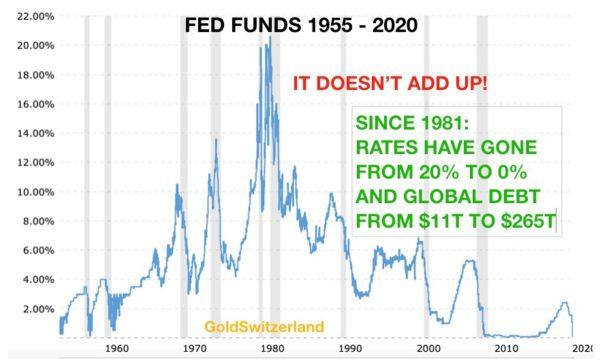
Global debt in 1981 was $14 trillion. One would have assumed that with interest rates crashing there would not have been a major demand for debt. High demand would have led to high interest rates. But if we look at global debt in 2020 it is a staggering $265 trillion. So debt has gone up 19X in the last 39 years and cost of debt has gone from 20% to 0% – Hmmm!
CORONAVIRUS IS THE CATALYST BUT NOT THE CAUSE
The crisis that the world is now encountering has not been caused by the Coronavirus. As I have stressed in many articles recently, CV is just the catalyst, albeit the most vicious one which could have hit the world. The real cause of the Greatest Financial Crisis in history is the Central Banks. They have been pouring fuel on the fire for 50 years by continuously reducing the cost of money until it became free in 2008 when rates were reduced to ZERO. Since then we have also seen negative rates around the world.
Negative rates are not just a total paradox but also absolute lunacy. Bankrupt sovereign nations around the world have been issuing debt at no cost or have even been paid for it. The whole purpose of interest is to be paid for the risk of lending money. As governments around the world have issued virtually unlimited debt which will never be repaid, the risk of lending to them has increased exponentially. But instead of much higher rates, to reflect the massive increase in debt plus severely elevated risk, central banks have got away with defying the laws of nature buy falsely manipulating rates..
FALSE MARKETS WITH NO REAL PRICES
Money is a commodity and the price should be a direct function of risk plus supply and demand. But since we currently have a false financial system with fake money and false markets, there are no real prices. So through constant manipulation and intervention central banks together with a few accomplices can totally rig most markets and prices.
Therefore, the cost of money today neither reflects the risk nor the demand. All it represents is malicious manipulation to serve governments and their masters the central bankers. But like all fake markets, also this one will end, not just badly but catastrophically.
THE SITUATION IS DESPERATE FOR BUSINESSES AND INDIVIDUALS
As I discussed in last week’s article, we now have the perfect storm. Virtually every government in the world is now committing billions and trillions of dollars, euros etc in fruitless attempts to save a collapsing world economy. In many countries, 50% or more of industry is shut. Most service industries are in a total lockdown and so is aviation, transport and most small businesses. Unemployment is approaching rates not seen since the 1930s depression. All businesses need assistance, from major corporations to small firms. The majority of individuals haven’t got savings for more than a couple of weeks living and for the ones who are now becoming unemployed, the situation is desperate.
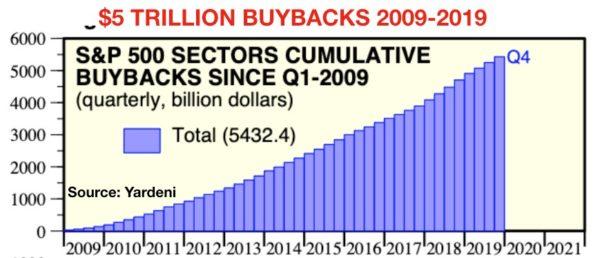
Many major US corporations need assistance from the government. Very few of these have put aside profits to reserves for a rainy day. Instead management has been too generously rewarded as well as the shareholders. Since 2009, S&P 500 companies have spent $5.4 trillion in share buybacks. Instead of asking government for assistance, management should pay back their bonuses and shareholders who have received major payouts should recapitalise the companies. But this will obviously not happen. Just like in 2006-9, profits are privatised and losses are socialised.
Businesses are haemorrhaging cash and so are individuals. All that becomes a vicious circle with bills not being paid including rents, mortgages and taxes. Estimates predict a 40-50% fall in Q2 2020 GDP in the US. The problem is that this is not a temporary crisis. This means that GDP will see permanent erosion of a major magnitude in most countries.
SECULAR DOWNTURN LEADING TO HYPERINFLATIONARY DEPRESSION
So what we are experiencing is the start of a secular downturn which soon will become a hyperinflationary depression. This was always the inevitable end to this cycle as I have discussed in many articles for over 20 years.
A crisis of this magnitude is always a debt crisis. Very soon we will see debt around the world come under enormous pressure as borrowers start defaulting. This will lead to bonds crashing and rates surging. Central banks will then lose control of interest rates as long rates first go up and soon also pulling the shorter rates up. Rates can easily go to 15-20%. Many bonds will go to zero and rates to infinity. I have previously talked about paying 21% on my first mortgage in the UK in 1974. So I have personal experience of high inflation but never hyperinflation.
Since the majority of the $1.5 quadrillion derivatives market is interest related, this market will also blow up. All this will lead to unlimited money printing and currencies crashing fast to their intrinsic value of ZERO. At that point the entire financial system will be unrecognisable and parts of it nonexistent. All of this could happen very quickly, possibly within the next 6 -18 months.
2006-9 WAS A REHEARSAL
Could my Cassandra forecast be wrong. Yes, of course it could. But let’s be clear that the rehearsal of what I am predicting took place in 2006-9. Nothing was resolved at that point, just temporarily deferred. This is now the real thing and whatever money central banks print this time will have no effect. So I doubt very much that our banker “friends” can pull another trick out of the hat again. Because the only trick they know, to print more money, can never solve a debt problem.

MARKETS
Stock markets, in their first leg down of the new secular bear market, reached a 40% loss in most countries and that in less than 4 weeks. We are now seeing a typical correction that can go a bit higher. But when that is finished which could take 1-3 weeks, the next devastating downleg will start. Anyone trying to catch this falling knife will be slaughtered.
Bond markets might hold up for a bit longer with massive central bank manipulation and money printing. Junk bonds will first start crashing and constant downgrades will turn a lot of debt to junk. Much of corporate debt will go the same way and within 6-12 months also sovereign debt will come under attack.
Property markets are a major bubble and are already starting to disintegrate. Industrial, commercial, retail and residential, no sector will be spared. There will be no buyers, no financing and many forced sellers. A perfect recipe for a collapse.
Before the secular bear market has bottomed in these three markets, prices will be down 90-100% in real terms. And real terms means in constant purchasing power like gold.
We must remember that markets will bottom long before the economy. The likely development is first a hyperinflationary depression that could come and go very quickly within the next couple of years. Thereafter we will most probably see a deflationary implosion of all assets and a collapse of most of the financial system.
But we mustn’t believe that this is the end. It is just another phase in the world economy to correct excesses of the 100 or 300 years or even 2000 years. Once debt has imploded and all asset prices have come down from current fantasy valuations, a new system will emerge built on sound values and principles. And then the cycle starts all over again.
GOLD
There are currently severe pressures in both the paper gold market and the physical market. The Comex and LBMA are making noises that everything is under control. LBMA is giving the illusion that they have plenty of gold in their vaults. But virtually all of that gold is already committed. Comex, the gold futures exchange is under tremendous pressure since they can’t deliver more than a small fraction in physical when paper holders of gold demand delivery. And that day is not far away.
The 3 biggest refiners in the world based in Ticino, Switzerland have been closed for 2 1/2 weeks, representing at least 50% of world production. The refiners have just opened this week but at a very reduced capacity of 25-33%.
If we just take the Gold ETFs as an example, they increased their holdings by 93 tonnes in the last 4 weeks. That represents a total value of $5 billion
It is today virtually impossible to get hold of physical gold so you wonder where the ETFs have bought their gold.
The answer is of course simple. It was lent to them by LBMA banks which are custodians for the biggest gold ETF GLD. These banks also hold central bank gold and all they need to do is to lend the same gold yet one more time to the ETFs. So if you hold a gold ETF, which you mustn’t, you know that it is unlikely to be backed by gold for more than a small portion of the fund total.
In a world where prices of most assets are about to implode, gold is life insurance and virtually the only asset that will maintain its value in real terms. Silver is also likely to do very well and will most probably outperform gold. But gold is safer and much less volatile.
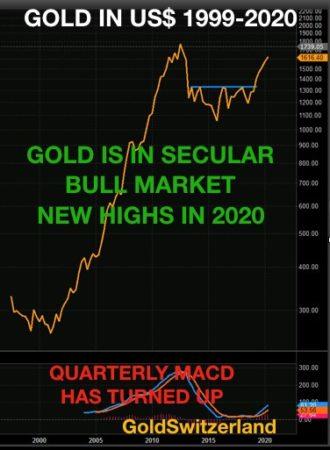
As the 20 year gold chart shows above, gold is in an extremely strong uptrend. In all currencies but US dollars, gold has surpassed the 2011 highs. The gold price in dollars has just broken out and is now likely to go to $1,700 on its way to the old high of $1,920 and thereafter much, much higher.
As I have expressed before, I have been standing on a soap box for 20 years in my attempt to inform investors of the critical importance of gold for wealth preservation purposes. Fortunately many investors have listened but they still represent less than 0.5% of world financial assets. Since we started 18 years ago, gold is up 6-7X depending on the currency. That rise is insignificant compared to what is coming next.
But remember you are not holding gold to measure the gains in debased paper money. Instead you are holding physical gold as insurance against a broken financial system that is unlikely to be repaired for a very long time.
end
|
|
|||
https://www.jsmineset.com/2020/04/19/virus-vs-printlook-what-gold-has-done/
Virus Vs. Print…Look What Gold Has Done
Posted April 19th, 2020 at 10:09 AM (CST) by J. Johnson & filed under General Editorial.
Great and Wonderful Sunday Morning Folks,
Over the past few years, part of my daily writeups have been on 3 emerging market currencies that went into supersonic-print which created the inflated prices of Silver and Gold under those currencies. Friday, after my early morning write up, I started to wonder how bad things have really gotten when it came to the Virus Vs. Print and decided to visit Egon von Greyerz’s website to look over all the currencies that are posted.
Under my normal watch, I observed the Venezuelan Bolivar had Gold rising 62.34% over the past 30 days and over 4,182.76% in 1 years’ time. The Argentine Peso’s price for Gold rose 17.8% over the last 30 days and 88.96% over the past 18 months, or since July 2019. The Turkish Lira’s value sent Gold up 21.02% over the past 30 days and 49.23% since July 2019. But wait! There’s More!
The situation here is Gold’s value has risen under ALL the currencies over the past 30 days! Even against the Euro and the US Dollar which are supposed to go against each other … Gold has risen against the print! Whether this is “the print against the product” or “the people of every single nation” are buying, or both at the same time, may no longer matter. The point is, Gold is starting to break free under all the fiats posted. With the markets in absolute turmoil because of this viral strain, gold’s overall performance over these past 30 days, may prove we are about to enter into the run of a lifetime. On average, the currencies show a median of 13 to 15% gains, with very few UNDER these percentages, and the world’s people, under their overprinted fiat economies, are not even working anymore. What happens next is anyone’s guess, but it sure does seem to be the people are starting to catch on.
Our day may be here, after all these years, as the news moves faster than we can report on it. So, enjoy the rest of your Sunday, and keep the faith. …
Stay Strong!
Jeremiah Johnson
end
Hold Silver And Gold Like A Resolute!
Posted April 20th, 2020 at 9:38 AM (CST) by J. Johnson & filed under General Editorial.
Great and Wonderful Monday Morning Folks,
The precious metals are barely moving with June Gold at $1,697.00 down $1.70 after the dip hit a low at $1,685.00 with the high nearby at $1,699.70. Silver, the tag a long kid, continues to be dragged along with its July trade at $15.440, down ½ a penny after hitting a low of $15.325 with the high up at $15.585. The amazing Dollar, that had 2 trillion reasons to drop in value, is still above par with the trade at 100.085, up 24.9 points after its recovery from 99.750 with the high at 100.185. All of this of course, was done before 5 am pst, the Comex open, the London close, and after May Crude Oil dropped another $5.84 with the price at $12.44 per barrel.
Silver, under the Emerging Markets, seems to be pointing the way again with the Venezuelan Bolivar pricing Gold at 16,948.79, showing a reduction of 82.89 Bolivar since Friday mornings quote, with Silver gaining 0.649 Bolivar with its value pegged at 154.207. Argentina’s Peso now has Gold valued at 111,668.88, showing a 337.61 A-Peso reduction with Silver gaining 6.24 with its price at 1,016.07 Peso’s. Gold, under the Turkish Lira, is bucking the trend with the noble metal gaining 26.10 Lira with its new price at 11,768.06 with Silver gaining 1.180 T-Lira with its price pegged at 107.081.
April Silver’s Delivery Demands have been completely stagnated with last week’s total Volume reaching 6 with the receipt count still at 23, unchanged from last Wednesday’s total, and still with no Volume up on the board today, leaving us with the adjusted Friday close at $15.237. Silver’s Overall Open Interest, gained another 51 contracts to start off this week’s tally at 141,200 Overnighters waiting for the inevitable increase in price because there is a minimum of 2 trillion reasons for the predicted rise.
April Gold’s Delivery Demands are doing the exact opposite of Silvers. The receipt requests have been stellar and continues to show more and more Resolute Buyers coming in, even at these prices, with the Demand Count now at 851 fully paid for contracts and with a Volume of 77 up on the board today with a trading range between $1,688.60 and $1,680.00 with the last buy at $1,683.40 down $5.80 from Friday’s close. Last Friday’s trading range was between $1,725.00 and $1,684.90 with the adjusted close at $1,689.20. This proves the increase in receipt requests being too much for the sellers to settle out (on Friday) which caused the demand count to rise by 23 more requests for physicals. I wonder what would happen to the price discoveries, if these requests were forced into receipts the day the buyer puts in his order, instead of allowing the shorts to hold back on the fill like they do? The Overall Open Interest gained another 2,523 giving us a total of 494,030 Overnighters willing to sell with the hopes that these buyers will exit their purchase orders. Good Luck there shorties!
“Volume Liquidity is in tatters. There is no depth to this market”, so says BOA and the market liquidity issues are everywhere! Especially within the commodities as it seems, the algos are looking for the blinking eyes of a trader in fear, but can’t seem to see one because everything is controlled by an algo with no eyes to see. Most will point at Silver and Gold and say “see? … there’s nothing to worry about”. If that was true, then why is China cutting the one and five-year prime rate loans, despite its story claiming a “V-Shaped Recovery”? The other “why” question we have is what will the M2 Velocity of Money look like when they finally add 2 trillion plus reasons, is put into the chart?
We’ll know more enough, as more and more data comes out and as we all hope and pray, that the world is done with the CCP-19 that has devastated the world’s economy in “one fell swoop”. The worlds governments have regained the religion of borders, and protecting its own. That includes everything we grow and produce, as we are all forced to regroup as we recreate our economies as we reshape the future once again. So, keep the faith, hold Silver and Gold like the Resolutes, and hold on tight to the idea that mankind, regardless of its own stupidity, always seems to find a way out. It is this reason why we …
Stay Strong!
Jeremiah Johnson
END
US seeks halt in civil lawsuit accusing JP Morgan of manipulating metals market, citing criminal case
- The U.S. wants a federal judge to halt a civil lawsuit accusing J. P. Morgan of manipulating precious metals markets. The Justice Department cited an ongoing criminal case as its reason for the request.
- A former J. P. Morgan trader pleaded guilty in Connecticut last month to manipulation charges.
- In the guilty plea, the trader said he had learned to make bogus trade orders from senior traders at the bank and that he used the strategy hundreds of times with the knowledge and consent of his immediate supervisors.
CNBC.com
The Justice Department is asking a judge to put the brakes on a civil lawsuit against J. P. Morgan Chase, citing an ongoing probe into a “related criminal case” that involves alleged manipulation of precious metals markets.
The department wants a six-month postponement in the proceedings of the civil lawsuit, which was filed in 2015 by hedge fund manager Daniel Shak and two commodity traders. The government also says it could ask for a longer delay in the case, according to a court filing on Monday.
The move comes days after Shak’s lawyer, David Kovel, sought permission to reopen questioning of two former J. P. Morgan traders and the bank’s current global head of base and precious metals trading.
Kovel, in making the request with the Manhattan federal judge in the civil case, cited last month’s guilty plea by one of those former traders, John Edmonds, in federal court in Connecticut.
Edmonds admitted making bogus bids on precious metals contracts while working at the bank from 2009 to 2015.
Neither J. P. Morgan Chase nor Kovel’s clients have opposed the Justice Department’s request.
In arguing for a delay, the Justice Department said Shak’s lawsuit is “related” to Edmonds’ criminal case and that Edmonds has “pleaded guilty and acknowledged his own participation in such conduct, as well as that of other traders.”
“Edmonds awaits sentencing, but the broader investigation is ongoing,” the Justice Department said. The U.S. wants to delay the civil case “to protect the integrity of its ongoing criminal investigation,” it said.
J. P. Morgan did not respond to a request for comment by CNBC. Kovel declined to comment.
Tuesday night, after this story first was published, Judge Paul Engelmayer ordered the federal prosecutors to explain in detail by Monday why postponing proceedings in the civil lawsuit would not harm those involved, and why reopening questioning “would be detrimental to the Government’s ongoing criminal investigation.”
Englemayer also wrote that he regards Edmonds’ guilty plea “as potentially highly consequential” to the civil case.
In his guilty plea, the 36-year-old Edmonds said he had learned to make bogus trade orders from senior traders at the bank and that he used the strategy hundreds of times with the knowledge and consent of his immediate supervisors. He admitted to working with “unnamed co-conspirators” at J. P. Morgan, according to the Justice Department.
Kovel wants to question Edmonds again as well as Michael Nowak, the bank’s global head of base and precious metal trading, and former J. P. Morgan Chase Managing Director Robert Gottlieb. The three had previously answered questions under oath in the civil case.
Kovel said in court filings that Nowak was the immediate supervisor of Edmonds, while Gottlieb was Edmonds’ mentor.
In his prior deposition, Edmonds said that Gottlieb sat only a “couple feet” away from him for about five years, and that he was “somebody [he] looked up to in the business,” who helped guide and train him.
Nowak is described by Edmonds as his direct supervisor, with whom he would sometimes discuss trading strategies. Nowak was also the person responsible for overseeing the performance and risk of Edmonds’ portfolio, according to the deposition.
Edmonds also stated in his prior deposition that he would enter precious metals trades for both Nowak and Gottlieb, among others.
The civil lawsuit claims Shak and his fellow plaintiffs lost tens of millions of dollars as a result of actions by J. P. Morgan’s traders.
Federal judge tells traders they can combine cases accusing JP Morgan of rigging metals market
- Litigation in a separate civil case has been put on hold until at least May at the behest of the Justice Department, which is investigating a “related criminal case” that involves alleged market manipulation by precious metals traders at J. P. Morgan.
- Judge John Koeltl of the Southern District of New York appointed the White Plains, N.Y., law firm Lowey Dannenberg as interim lead counsel for the proposed class action.
A group of traders from across the U.S. who allege that J. P. Morgan Chase manipulated precious metals markets for years are one step closer to bringing a class action suit against the nation’s largest bank.
Earlier this month, a federal judge said five separate lawsuits making similar allegations against the bank could be combined, potentially including thousands of people who traded in the precious metals market from Jan. 2009 through Dec. 2015.
Litigation in a separate civil case has been put on hold until at least May at the behest of the Justice Department, which is investigating a “related criminal case” that involves alleged market manipulation by precious metals traders at J. P. Morgan.

J. P. Morgan declined to comment on this story.
Judge John Koeltl of the Southern District of New York appointed the White Plains, N.Y., law firm Lowey Dannenberg as interim lead counsel for the proposed class action.
Vincent Briganti, a partner at the firm, filed the first suit seeking class action status in November on behalf of Dominick Cognata, a trader who alleges he suffered losses due to J.P. Morgan’s illegal trading conduct in the silver and gold futures and options markets.
That was after the federal court in Connecticut unsealed a criminal plea agreement by John Edmonds, a former J.P. Morgan metals trader. In his guilty plea, Edmonds, who is 36-years old, admitted that he and other “unnamed co-conspirators” fraudulently manipulated the precious metals markets while they were employed at J. P. Morgan from 2009 to 2015.
Edmonds said he had learned the illegal trading tactics from senior traders, and then used them hundreds of times with the knowledge of and consent of his immediate supervisors.
Briganti’s lawsuit also names John Edmonds and a group of yet-to-be-identified precious metals traders and the bank as defendants.
On Wednesday, the lawyers sent a letter to Judge Koeltl saying they were having difficulty locating Edmonds to serve him legal papers and requested a 30-day extension to do so, which the judge granted on Thursday. Briganti noted that they have been in contact with Edmonds’ attorney in the criminal case. Edmonds’ attorney and Briganti could not be reached for comment.
“We are hopeful that this extension will result in completing service on Mr. Edmonds without formal motion practice and a request for alternative means of service,” Briganti said in the letter.
The next step in the civil case is for the plaintiffs to file an amended class action complaint and set a schedule for defendants to respond.
In addition to the proposed class action, J. P. Morgan also faces a separate civil suit which also accuses the bank of rigging precious metals markets.
end
March 4.2019
Parker City News
JP Morgan faces potential class action lawsuit after guilty pleas by a former metals trader
Traders from across the U.S. are banding together to accuse J. P. Morgan Chase of manipulating precious metals markets for years.
At least six lawsuits, all making similar allegations against the nation‘s largest bank, have been filed in New York federal court in the past month, since federal prosecutors in Connecticut with a former J. P. Morgan Chase metals trader.
The cases could potentially include thousands of people who traded in the precious metals market. The White Plains, N.Y., law firm Lowey Dannenberg is asking the court to combine the cases and name it as the lead.
The law firm‘s commodities group is led by Vincent Briganti, the attorney who filed the first lawsuit on behalf of Dominick Cognata, a New York resident who alleges he suffered losses due to J. P. Morgan‘s trading conduct in the silver and gold futures and options markets.
A combined case, seeking class action status, would include anyone who purchased or sold futures contracts or an option on NYMEX platinum or palladium or COMEX silver or gold between at least Jan. 1, 2009, and Dec. 31, 2015. The lawyers believe that “at least hundreds, if not thousands” of traders would be eligible to join the case.
Named as defendants in all of the lawsuits are John Edmonds, a 36-year old former metals trader at J. P. Morgan, a group of yet-to-be-identified precious metals traders and the bank.
Edmonds, a New York resident, pleaded guilty in October to one count of conspiracy to defraud the market and manipulate prices of precious metals futures contracts and one count of commodities fraud. In the criminal plea, Edmonds admitted that he and other “unnamed co- conspirators” at J. P. Morgan, fraudulently manipulated precious metals markets from 2009 to 2015, the same time frame covered in the class action suits.
Briganti filed the initial class action on Nov. 7, just one day after the Justice Department unsealed Edmonds‘ plea in the U.S. District Court of Connecticut.
Edmonds admitted in his guilty plea that he deployed the illegal trading scheme hundreds of times with the direct knowledge and consent of his immediate supervisors. Plaintiffs say they have suffered economic injury, including monetary losses, as a direct result of actions by Edmonds and the other unnamed J. P. Morgan metals traders in the futures and options contracts.
One of the suits alleges that “the number of unlawful trades that JP Morgan traders executed in precious metals futures markets is at least in the thousands.”
J. P. Morgan declined to comment. Lowey Dannenberg did not respond to a request for comment by CNBC.
The Justice Department‘s criminal investigation is still ongoing and recently caused a separate related civil case to be put on hold for at least six months while the government continues its investigation. That civil lawsuit, which also accuses J. P. Morgan of rigging the precious metals market, was filed in 2015 by hedge fund manager Daniel Shak and two commodity traders.
After reviewing the details of the plea agreement, David Kovel, the attorney for Shak‘s suit, sought to re- interview Edmonds, along with two other current and former senior traders at the bank. However, the government argued that reopening questioning would be detrimental to the ongoing criminal investigation. The federal judge overseeing the proceedings ordered a six-month stay in the civil case.
Kovel declined to comment.
Edmonds was originally scheduled to be sentenced in Hartford, Conn., on Wednesday, Dec. 19, but a court filing on Nov. 27 shows the sentencing has been postponed until June. A spokesman for the U.S. Attorney for Connecticut could not elaborate on why the sentencing was postponed since the court filing is under seal.
-END-
Futures Plunge As WTI Crashes By Most On Record, Tumbling To $11 Per Barrel
Oil prices crashed the most on record with the May WTI futures contract hitting its lowest level since 1999, plunging as low as $11 or down 38%, as nobody wants to take actual physical storage amid widespread fears crude storage will soon be full; meanwhile companies prepare to report the worst quarterly earnings since the financial crisis, while tens of thousands of people continue to get sick every day with the coronavirus.
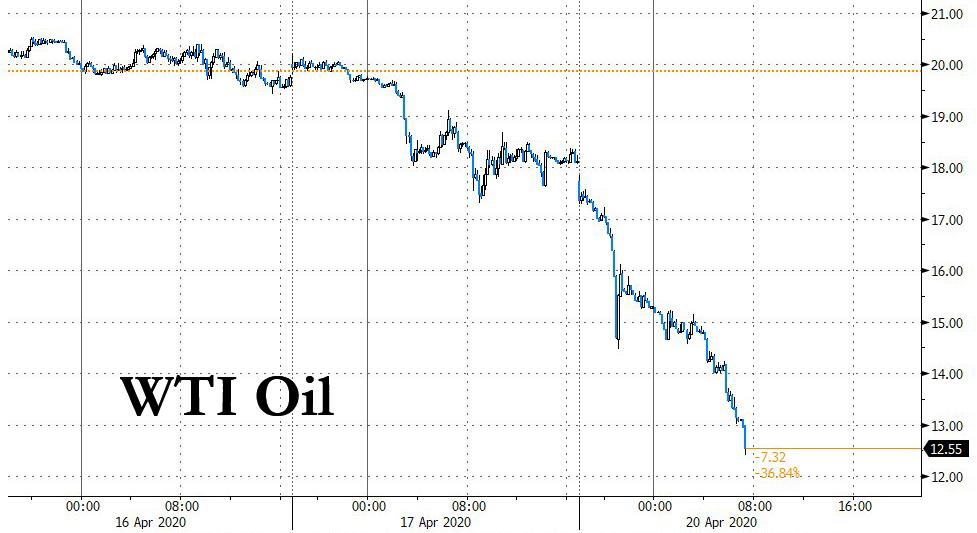
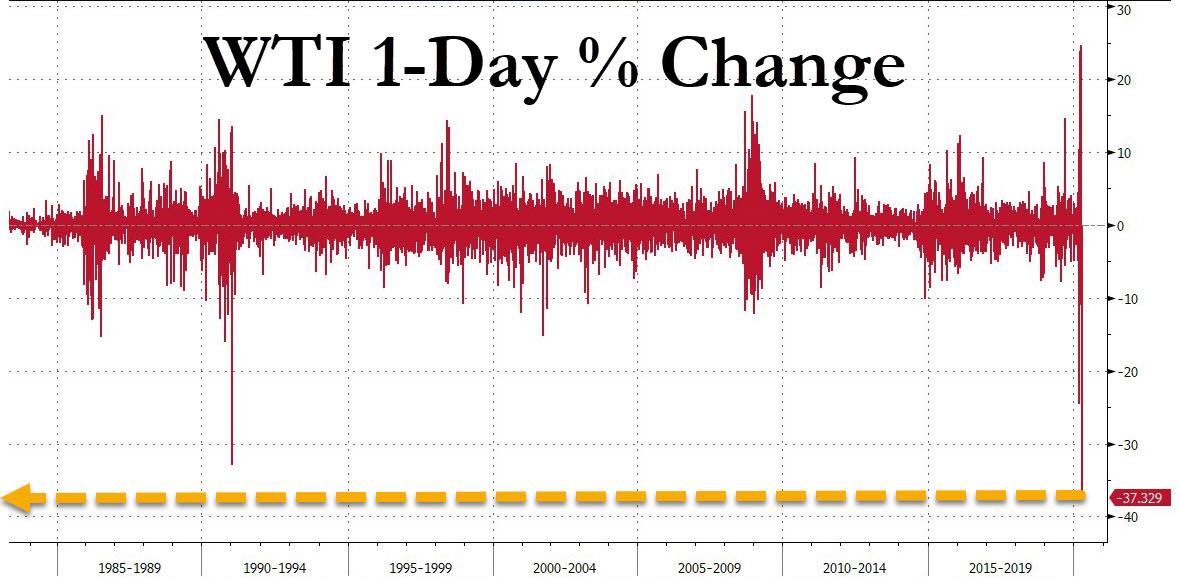
While Brent was only down $1.12, or 4%, at $26.96 a barrel on Monday morning, the carnage took place in the landlocked WTI, whose May contract fell $5.70 to its lowest since March 1998 though the sell-off was exaggerated by the contract’s Tuesday expiry because no one wants to be left long to take delivery as there is nowhere to put the physical product. In any case, the 37% drop was the biggest one-day drop on record!
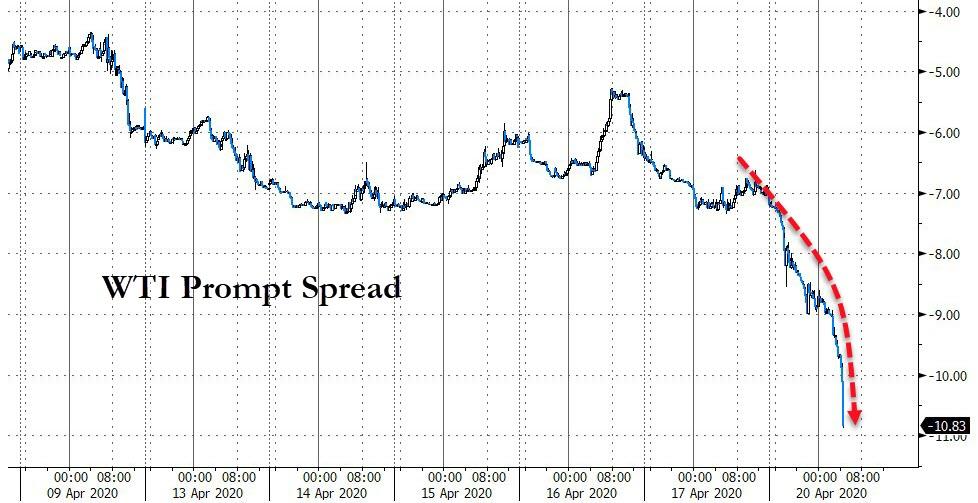
“The May contract is set to expire tomorrow and the bulk of the open interest and volume is already in the June contract,” said ING’s head of commodities strategy, Warren Patterson. To be sure, the June contract, which is more actively traded, fell only $2.18, or 8.7%, to $22.85 a barrel, sending the prompt spread to a record $11/barrel.
Not helping oil was an interfax report that Russia increased oil output by almost 1% in the last 3-days. While the OPEC+ deal comes into effect on May 1st, Russia is not bound by the pact to reduce its output until then; and – it appears – Moscow is looking to make the most of the next 10 days, even if it means sending the front-end to zero.
While some may dismiss the plunge in the front contract, the reality is that the world most popular oil ETF, the USO which, is driven mostly off the front end of the curve has crashed to just $3.73 despite registering a record one-day inflow of $552.5MM on Friday, and steamrolling countless retail traders who went long USO after the OPEC+ deal only to see their “profits” turn into catastrophic losses.
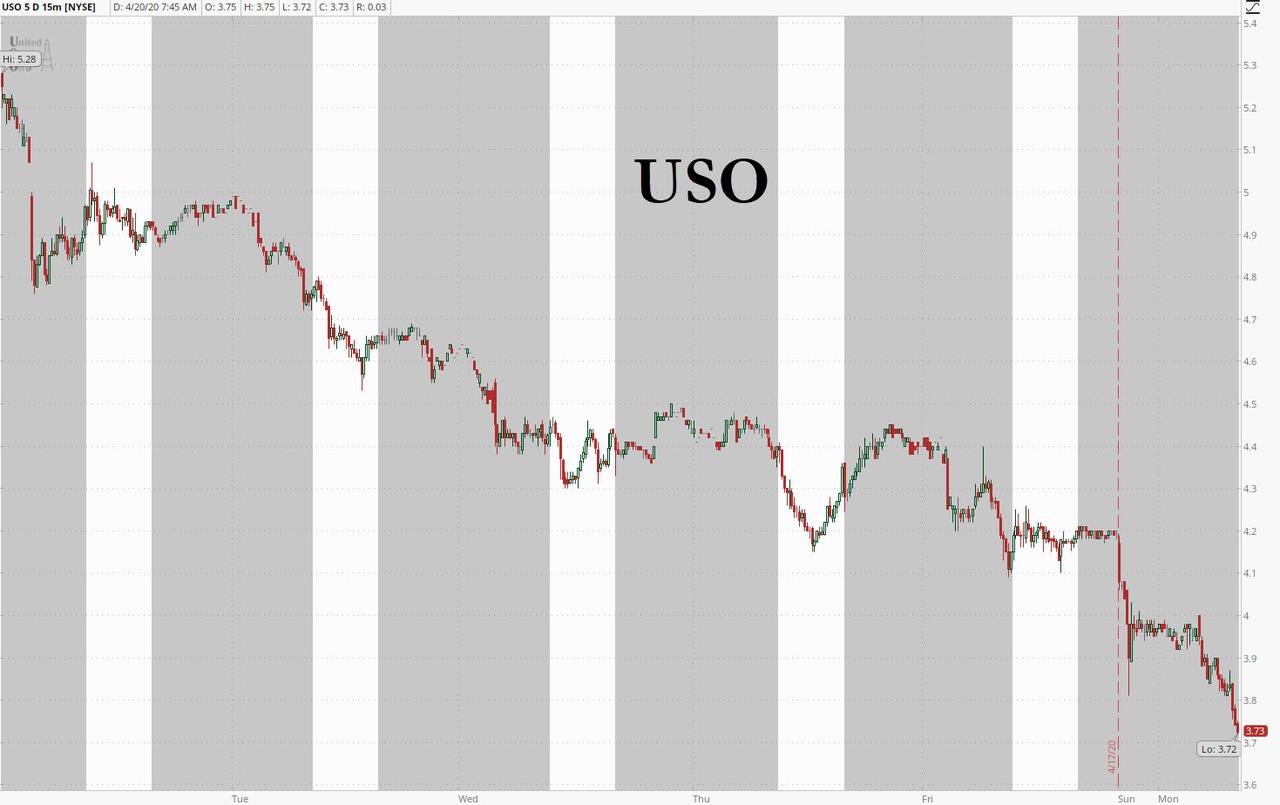
Commenting on the oil price move, Bloomberg points out that
the first of these spikes, in December 2008, came as the S&P 500 was putting in a nice rally of some 27.5% on a trough to peak basis from mid-November to early January. Perhaps it’s a coincidence that the index is once again ripping higher as crude exhibits this type of behavior. But maybe the oil market is offering a warning of just how significant the economic damage will be — damage that you could argue is no longer reflected in the price of equities.
Meanwhile, with a record 198MMb/d now stored offshore, the volume of oil held in U.S. storage, especially at Cushing is rising as refiners throttle back activity in the face of weak demand. “As production continues relatively unscathed, storage is filling up by the day. The world is using less and less oil and producers now feel how this translates in prices,” said Rystad’s head of oil markets, Bjornar Tonhaugen.
The mood in other markets was also gloomy as the first-quarter earnings season gets underway. Analysts expect STOXX 600 companies to post a 22% plunge in earnings, which would represent the steepest decline since the 2008 global financial meltdown, IBES data from Refinitiv showed.
After starting off higher, U.S. equity futures fell alongside European and Asian stocks on Monday as investors grappled with everything from the spread of the coronavirus to oil’s collapse and the next raft of corporate earnings. Contracts on the S&P 500 extended their decline through the European morning as the price of West Texas oil cratered.
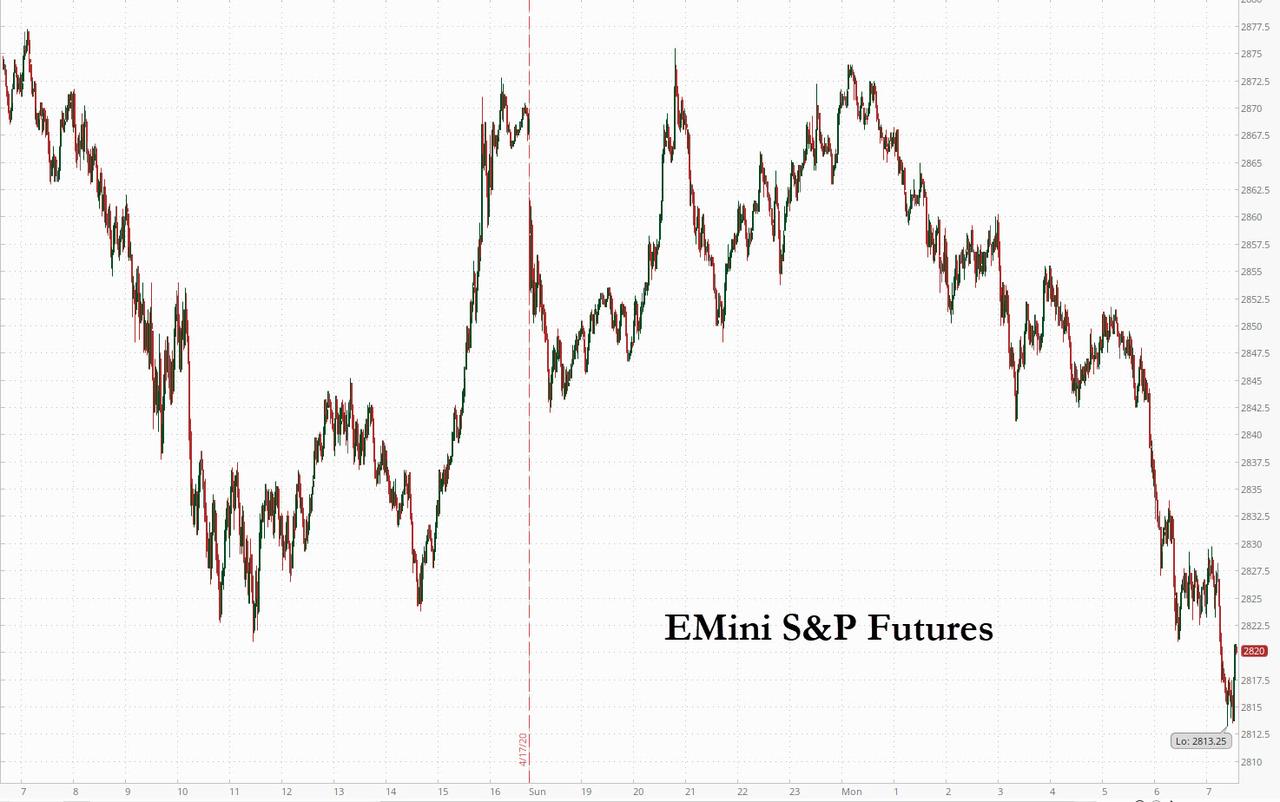
The Stoxx Europe 600 Index fluctuated before turning lower, with energy companies slumping. Shares retreated across much of Asia, though the benchmark in Shanghai rose. The euro, pound and yen all weakened. European bonds mostly dropped. The German economy is in severe recession and recovery is unlikely to be quick, given that many coronavirus-related restrictions could stay in place for an extended period, the Bundesbank said on Monday.
Earlier in the session, Asian stocks also fell, led by health care and materials, after rising in the last session. Markets in the region were mixed, with Australia’s S&P/ASX 200 and Jakarta Composite falling, and Thailand’s SET and Shanghai Composite rising. The Topix declined 0.7%, with Takakita and Fuji PS falling the most. The Shanghai Composite Index rose 0.5%, with Sichuan Xichang Electric Power and Shanghai Sanmao Enterprise Group posting the biggest advances. Japanese exports declined the most in nearly four years in March as U.S.-bound shipments, including cars, fell at their fastest rate since 2011.
It was not all bad news with coronavirus infection rates clearly slowing in several major economies, while investors were bracing for the pace of earnings season to pick up.
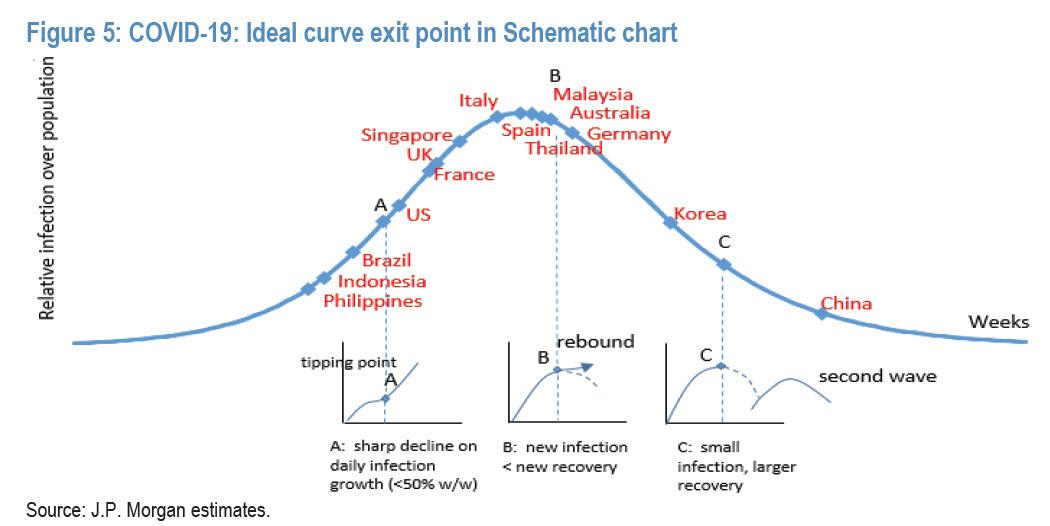
IBM, Coca-Cola Co. and Netflix Inc. are among companies due to report in the coming days. Meanwhile, governments and policy makers are continuing attempts to limit the economic damage of the outbreak. U.S. lawmakers are moving closer to a deal to top up funds for small businesses, China pledged more stimulus as banks lowered borrowing costs and European officials are discussing creating a bad bank for the region, according to the Financial Times.
In rates, 10Y TSY yields were slightly lower, trading at 0.6273% with bunds trading through Friday’s best levels and peripheral debt widens to core as regional sensitivities around jointly issued debt come to the fore. Moves are modest, save for Italy as short-dated yields rise 14bps. Cash USTs drift higher, outperforming Bunds by ~1bp at the long end. Gilts close their opening gap, brushing off comments from BOE officials. The Bund curve bull-steepened, yet underperformed Treasuries; Italian debt extended its decline, underperforming euro-area peers amid speculation the nation’s Treasury may announce a bond syndication this week. Japan’s government bond yield curve bull flattened as the government was seen boosting issuance of short-tenor bonds to fund its extra budget, which was boosted by 8.9 trillion yen to fund cash handouts
In FX, the Bloomberg Dollar Spot Index firmed along with Treasuries as risk sentiment was fragile, with European stocks mainly mildly positive and U.S. equity futures slipping as earnings season intensifies. Oil-linked currencies tanked as crude prices plunged further. The Dollar initially gave back most of Asia’s gains, before surging higher again and back to session highs. Australian and New Zealand dollars led Group-of-10 gains; the kiwi gained after the government said it will partially ease lockdown restrictions next week. The greenback’s overall advance came in the wake of the Fed’s slowing QE purchases and with the earlier rally in equity markets loosing momentum. The Norwegian krone and the Canadian dollar led losses following a deepening slump in oil prices to the lowest level in more than two decades.
Elsewhere in commodities, spot gold spiked to session highs in early US trading, rising to $1,690. Base metals are mixed, LME Nickel rallies over 2.5%, aluminum drops 1.2%.
Expected data include Chicago Fed National Activity Index. Halliburton, Equifax, and IBM are among companies reporting earnings.
Market Snapshot
- S&P 500 futures down 0.9% to 2,844.75
- STOXX Europe 600 down 0.02% to 333.41
- MXAP down 0.8% to 143.94
- MXAPJ down 0.6% to 465.88
- Nikkei down 1.2% to 19,669.12
- Topix down 0.7% to 1,432.41
- Hang Seng Index down 0.2% to 24,330.02
- Shanghai Composite up 0.5% to 2,852.55
- Sensex up 0.3% to 31,679.98
- Australia S&P/ASX 200 down 2.5% to 5,353.01
- Kospi down 0.8% to 1,898.36
- German 10Y yield fell 1.7 bps to -0.489%
- Euro down 0.1% to $1.0864
- Italian 10Y yield fell 4.0 bps to 1.619%
- Spanish 10Y yield rose 1.6 bps to 0.832%
- Brent futures down 3.7% to $27.04/bbl
- Gold spot little changed at $1,682.21
- U.S. Dollar Index down 0.1% to 99.67
Top Overnight News
- Signs emerged that the global pandemic is easing in some hot spots, as regions from Spain to New York saw a slowdown in fatalities, though some Asian countries wrestled with worsening conditions
- Chinese banks lowered borrowing costs and the government promised to sell another 1 trillion yuan ($141.3 billion) in bonds to pay for stimulus spending after the economy had its first contraction in decades due to the coronavirus outbreak
- Spain will propose a rescue fund for Europe of as much as 1.5 trillion euros at an April 23 summit, according to newspaper El Pais
- Britain and the EU will restart talks on Monday over their future relationship, with time running out to get an agreement after a six-week interruption caused by coronavirus
- ECB officials have held early talks with the European Commission’s department for financial stability and capital markets on setting up a eurozone bad bank that would take billions of euros in debt off lenders’ balance sheets, the Financial Times reported, citing people briefed on the discussions
- President Donald Trump raised the prospect that China deliberately caused the Covid-19 outbreak that’s killed over 39,000 Americans and said there should be consequences if the country is found to be “knowingly responsible”
- Democrats and the Trump administration are near an agreement for Congress to act this week on a deal as large as $500 billion putting more funding into a tapped-out small business aid program and providing money for coronavirus testing and overwhelmed hospitals
- Markets are pricing for the spread between Libor and overnight index swaps — a proxy for the risk-free rate — to compress sharply into June as funding conditions improve. Huge activity in both Eurodollar options and futures — used to bet on the path of Libor — suggest divisions on the pace of the easing
Asian equity markets traded mixed amid the ongoing fallout from the coronavirus pandemic and extended rout in oil prices which briefly saw the WTI May contract drop below USD 15/bbl for the first time since 1999 and the June contract briefly slip below USD 23/bbl with the sell-off due to a collapse in demand, concerns of declining storage capacity and ahead of Tuesday’s contract settlement. ASX 200 (-2.5%) and Nikkei 225 (-1.2%) were negative with the energy sector front-running the broad declines in Australia alongside the oil market woes and as Caltex also suffered from Couche-Tard abandoning its pursuit of the Co., while Tokyo risk appetite was sapped after mostly weaker than expected trade data including the largest decline in exports since 2016. Hang Seng (-0.2%) and Shanghai Comp. (+0.5%) were somewhat indecisive although outperformed their regional peers after the PBoC cut the 1-year and 5-year Loan Prime Rates by 20bps and 10bps respectively as expected, while the state planning agency noted that China will roll out more forceful and targeted fiscal, financial and employment policies. Finally, 10yr JGBs lacked demand following recent comments from the Japan Securities Dealers Association that global funds sold record levels of 10yr JGBs last month and with Japan’s government planning to issue more than JPY 25.69tln to fund supplementary budget, although losses were stemmed by support at 152.00 and amid weakness in Japanese stocks.
Top Asian News
- China Pledges More Stimulus as Banks Cut Lending Rates
- India’s Ban on Flying to Stay Until Virus No Longer a Danger
- Singapore’s Daily Virus Infections Top 1,000 For First Time
European equities have given up gains since the open and trade mostly lower (Euro Stoxx 50 -0.4%), as the cautious tone from APAC trade reverberated across the continent. US equity futures see more pronounced losses in comparison following the State-side gains posted on Friday. European sectors remain mixed with no clear indication of the risk-tone, whilst Energy and Materials reside at the bottom of the bunch. Looking at the breakdown, the downside sees Basic Resources alongside Oil & Gas, whilst Healthcare resides at the other end of the spectrum; Travel & Leisure remains relatively flat. In terms of movers, miners see pressure in European trade after giant Vale reported Q1 iron ore sales -6.8% YY and iron ore production -18% YY. Co. cut its FY20 iron ore production to 310-330mln tons vs. Prev. 340-355mln tons amid delays to the resumption of operations at certain mines. FY nickel production guidance cut to 180-195k tons vs. Prev. 200-210k tons. Thus, Glenore (-1.6%), Rio Tinto (-1.8%), Anglo American (-2.8%), Fresnillo (-2.5%), BHP (-1.3%) all see losses. European bank also see downside after reports downplayed ideas that the a EZ bad-bank will be formed to deal with debt from the 2008 crisis. Elsewhere, Phillips (+6.4%) extends on opening gains despite overall downbeat earnings as the Co. aims to return to growth and improved profitability in H2 2020. Sanofi’s (+1.1%) Head of French business said the Co. will pay out a dividend this year, with the overall value modestly higher YY, albeit shares are moving in tandem with the European Healthcare sector.
Top European News
- Riksbank Governor Lashes Out at Efforts to Strip Bank of Powers
- CEO of Norway’s Wealth Fund Faces Probe After Luxury Jet Use
- Nordic M&A Lawyers Say Clients Want to Exit Deals Already Struck
- German Virus Cases Rise the Least Since March as Curbs Ease
In FX, the Kiwi only got a fleeting fillip from firmer than forecast NZ inflation overnight, but is outperforming fellow majors on PM Arden’s acknowledgement of the progress made in containing the spread of nCoV to the point that plans are afoot to re-open businesses end lockdown this time next week. Nzd/Usd is firmly back over 0.6000 in response and eyeing resistance ahead of 0.6100, while the Aud/Nzd cross has retreated markedly to test 1.0500 as the Aussie lags below 0.6400 vs its US peer amidst weak oil and other commodity prices, albeit with the DXY unable to retain a grasp of the 100.000 handle.
- CAD/NOK/RUB/MXN – The Loonie, Norwegian Krona, Russian Rouble and Mexican Peso are all suffering alongside crude that is extending losses to deeper multi-year lows ahead of the looming May WTI futures expiry, with Usd/Cad hovering around 1.4050, Eur/Nok above 11.3000, Usd/Rub circa 74.5900 and Usd/Mxn back over 24.0000.
- GBP/JPY/CHF/EUR – Pragmatic rather than poignant in terms of policy remarks from the BoE via Broadbent and Haldane have not really impacted the Pound, but Cable has pulled back from 1.2500 and Eur/Gbp is edging up towards the 200 DMA (0.8739) despite the draw of a particularly large option expiry at the 0.8700 strike (2.8 bn). Instead, Sterling seems to be suffering from general coronavirus fallout highlighted by IHS reporting the biggest fall in household income since it began publishing data. Similarly, but to a lesser extent due to fading risk sentiment after a mild boost from PBoC rate cuts, the Yen on a softer footing across the board, as Usd/Jpy meanders from 108.00 to 107.00 and Eur/Jpy pivots 117.00. Conversely, the Franc is rebounding from around 0.9700 and still close to 1.0500 against the Euro even though the single currency is forging gains vs the Greenback towards 1.0900 and latest Swiss bank sight deposits reveal even heftier intervention to curb Chf strength.
In commodities, WTI and Brent futures kick the week off on the back foot, with the former’s front-month future (May) -18% but disregarded given its expiry tomorrow and with open interest and volumes minuscule in comparison to the following month (June). There is little by way of fresh fundamental developments to sway the markets, although traders continue to attempt to gauge the supply/demand imbalance against the backdrop of COVID-19. WTI June dipped sub-23/bbl to a low of around USD 22.70/bbl (high USD 24.92/bbl), whilst the Brent June future losses further ground below USD 28/bbl, having printed a fresh intraday base at 27.06/bbl. Meanwhile, the Arb between the two June contracts has widened to almost USD 4/bbl vs. sub-3/bbl on Friday. Elsewhere, spot gold continues to be subdued below USD 1700/oz, with a firmer Buck providing further pressure to the yellow metal. Copper prices largely tracked lower with APAC sentiment, whilst action in the USD provides no relief to the red metal. Elsewhere, iron ore futures and nickel prices were supported overnight after mining giant Vale cut its production figures for the metals.
US Event Calendar
- 8:30am: Chicago Fed Nat Activity Index, est. -3, prior 0.2
DB’s Jim Reid concludes the overnight wrap
Talking of working from home I must say it suits the hours I work far better so I’m a fan. However when something goes wrong at home being able to escape to the office has always been a piece of salvation. Today I could have done with it as yesterday we had a small leak that I discovered in our garage. I came back into the house and told my wife I was going to go back and try to find the stopcock and turn it off. She rapidly replied that she didn’t want me to mess with it and she’d ring the builders that re-plumbed our house after she’d prepared lunch. I went back to lock the garage feeling like my masculinity had been taken away from me and couldn’t resist trying to turn off what I suspected was the stopcock just by the leak. As I turned it the valve blew and a small leak turned into a replica of the Las Vegas Bellagio fountains. Water was gushing out powerfully and spraying everywhere. To cut a long story my wife was furious at me for meddling and given that the stopcock had failed we had to find where the water supply came into the house. Half an hour and a lot of damage later we uprooted a manhole cover at the top of the drive and turned off the whole water supply to the house. That’s where we are still left this morning. Hopefully a plumber will be out this morning to give us water back. I think that classes as a job you can’t do working from home.
Talking of gushes of liquidity, the confusing thing for markets at the moments is the huge dichotomy between what will possibly be one of the worst synchronised global economic slumps in history against what is undoubtedly the largest ever intervention. On the second point DB’s Alan Ruskin showed at the end of last week ( link here ) that global central bank balance sheet expansion has already spiked c.$2.7 trillion since early March which now comfortably eclipses the full peak 12-month increase seen during the GFC (under $2.5tn). On our calculations this is the same amount as the annual total output of either the U.K. or French economies. Two thirds of this increase has come from the Fed so far.
Again using our back of the envelope calculations, given that the global economy is worth around $80 trillion dollars annually and that the IMF last week said it would fall -3% in 2020 (in real terms under the base case) that’s potentially ‘only’ $2.4 trillion of lost activity (less if you add inflation). Relative to the pre-covid trend they forecast $9 trillion of global GDP losses by the end of 2021. Even if you think these numbers are a bit low, when central banks have so far pumped in an annualised $23.4 trillion into the financial system you can see how it’s hard to get a feel for where markets can go. Clearly they won’t keep up that pace of liquidity injections unless economies fall even further but could you really have a situation in 1-2 months’ time where economies are still struggling to fully open and yet equity markets are back at record highs? I don’t think so but you couldn’t rule it out given the ginormous liquidity injections. Crazy times and we haven’t even mentioned the government injections.
In this liquidity rush one crucial part of the financial system that hasn’t managed to suck it up yet is Italian debt where 10yr spreads to bunds have widened around 100bps from the pre-covid tights to 226bps now. They’ve also widened nearly 70bps since the 26th March. For prospective the S&P 500 is up +9.30% since then.
On this hot topic and for other things in the market, Thursday is the key day this week with the EU leaders summit a potentially big event for the future of Europe as they discuss how close the region can get to joint issuance in the near future. Expect creative ambiguity to rule as it normally does on the continent. Nevertheless you would expect more explicit details to be outlined as to how Europe will help Italy. Will this be enough to keep Italian spreads (and domestic politics) in check though? To add to the story, S&P are expected to finalise the review of their BBB rating on Friday. Our colleagues did a piece last week on what the implications are if they are junked. See more here. Staying with European discussions, the FT broke a story yesterday saying the supervisory wing of the ECB is pushing for an EU wide bad bank. It’s not clear whether this story will have legs but it’s clearly something that the weaker members will welcome much more than the stronger ones. Whether it’s NPLs or peripheral debt, can this crisis be the catalyst for more European financial solidarity or will it be one to expose the cracks of an imperfect union.
On the issuance of joint Eurogroup debt, Italian PM Conte said in an interview to Germany’s Sueddeutsche Zeitung yesterday reiterating the need for joint debt issuance highlighting the risk of market contagion if European leaders fail to act on pressure from Italy and Spain. He also added that the ESM rescue fund, Germany’s preferred tool to address the economic impact, “has a bad reputation in Italy.” Meanwhile, Klaus Regling, the ESM’s director-general, said in a separate interview with Italy’s Corriere Della Sera that concerns that the fund’s lending will have two parts — one to specifically deal with the outbreak, the other to reduce budget deficits — was misplaced. He added, “The conditions agreed at first will change during the period of which the line of credit is available. The Eurogroup will clarify it, saying that the only requirement for obtaining the loan is the way in which they spend the money.”
Back to Thursday and not only will we see the latest jobless claims but also the flash PMIs from around the world for April – the first reading covering nothing but lockdowns. If you want a potential worst case scenario Italy was the only Western country to be on full lockdown in the survey period for March and they saw their services PMI fell to an astonishingly low 17.4. In all truth though the market has rightly or wrongly moved on from how bad data could get in the near-term to absorbing up the extra liquidity and also whether economies can open progressively through May.
On this the latest on new cases and fatalities generally continue to show steady improvements as you’ll see in our Corona Crisis Daily. However this improvement is being used by many countries to encourage debate on what exit strategies will look like and the lifting of restrictions at potentially an earlier stage than China did. A risky balancing act.
To markets now where the big mover overnight has been WTI oil which has slumped -16.31% to $15.29/bbl and the lowest in over 20 years. It should be noted however that near-term WTI prices are trading at massive discounts to later-dated contracts – primarily due to concerns about the storage hub in Cushing filling to capacity – with the more active June contract falling by around a third as much (currently trading at $23.73/bbl). Currencies for oil exporting nations are leading the declines this morning with the Norwegian krone down -0.81% while the Canadian dollar is down -0.52%. However, equity markets are more mixed. The Nikkei (-0.95%) and ASX (-1.25%) both down while the Hang Seng (+0.16%), Shanghai Comp (+0.30%) and Kospi (+0.33%) have all posted modest gains. The increase in confirmed virus cases over the weekend appears to be weighing on the markets in Japan as is the latest trade data. Elsewhere, futures on the S&P 500 are little changed.
In other overnight news, President Trump said that the talks between the White House and Democrats in Congress are near an agreement that would add cash to a program aimed at helping small businesses. He suggested that an announcement towards this might come today. Meanwhile, Bloomberg has also reported overnight that the US will allow importers and manufacturers to defer payments on many imported goods for 90 days, a move aimed at freeing up cash for pandemic-hit businesses. The deferral doesn’t apply to anti-dumping or countervailing duties, or so-called Section 201, Section 232 or Section 301 duties. As such, it won’t ease Trump’s duties on China, steel and aluminum, or enforcement actions he took including against Airbus. Elsewhere, China’s finance ministry said overnight that the country will issue an extra CNY 1tn ($141.3bn) in special-purpose bonds “in the near term,” for infrastructure spending. The moves comes after China’s top leaders in politburo meeting on Friday said that the nation is facing “unprecedented” economic difficulties and signaled that more stimulus was in the works.
Elsewhere this week, Q1 earnings will also step up a notch with 88 S&P 500 companies reporting this week and Europe joining the fray with 64 companies. In terms of the highlights to look out for, proceedings kick off today with IBM. Then tomorrow we’ll hear from The Coca-Cola Company, Netflix, SAP, Philip Morris International, Lockheed Martin, Texas Instruments and BHP. On Wednesday, we’ll then get AT&T and Thermo Fisher Scientific. Thursday sees releases from Intel, Eli Lilly and Company, NextEra Energy, Union Pacific, Credit Suisse and Hyundai. And finally on Friday we’ll hear from Verizon Communications, Sanofi, T-Mobile and American Express.
In the background, all this week we’ll see the UK and the EU holding their second negotiating round via videoconference on their future partnership following Brexit. This had originally been scheduled to take place in mid-March but was postponed as a result of the coronavirus pandemic. Although speculation has risen that the transition would be extended given the coronavirus, the UK reiterated last week that they would refuse to extend the transition period, which is due to conclude at the end of this year, even if it were the EU who requested the extension. Should either side seek an extension, under the Withdrawal Agreement they have until the end of June to agree on one. Before that deadline, a “High Level meeting” is planned in June where the two sides will be taking stock of the progress made. A high stakes game but maybe the U.K. are seeing the internal EU divisions over Italy as a chance to take some leverage at the negotiating table.
Reviewing last week now before the day-by-day week ahead listings. Equity markets continued their rally as investors weighed the expectations of economies reopening against the start of 2020 first quarter US earnings and deteriorating economic data. The S&P 500 rose +3.04% on the week (+2.68% Friday), after rising over +12% the week before. This is the first back-to-back weekly gains since the second week of February, before the index hit its highs. Technology stocks outperformed over the week and in general during the downturn, with the NASDAQ rising +6.09% (+1.38% Friday) on the week and is only just under 12% from its highs, versus the S&P 500 14.8% from highs. Bank (-7.64%) and Energy (+0.21%, but +10.4% Friday) sectors were key laggards as investors fretted about loan loss provisions in the former’s earnings and the further slump in oil for the latter. On the more positive side, European equities also rose for a second week in a row for the first time since February, with a strong Friday rally (+2.63%) pushing the Stoxx 600 to finish up +0.50% on the week. Equity performance was more mixed across Europe with correlations falling as different countries and regions roll out different reopening guidelines. The EU summit this week also cast a shadow on peripheral markets. The DAX rose +0.58% (+3.15% Friday), while the Italian FTSE MIB fell -3.21% (+1.71% Friday). The bank and oil heavy FTSE fell -0.95% (+2.82% Friday). Many Asian equities indices also rallied for a second week in a row, with Japanese stocks doing so for the first time since January. The Nikkei rose +2.05% (+3.15% Friday), while the CSI 300 gained 1.87% (+0.98% Friday) and the Kospi rallied +2.89% (+3.09% Friday) on the week. It was the fourth week in a row that Chinese stocks rose, with the CSI 300 roughly -8.7% down from both January highs and the more recent March 5 highs, before the virus outbreaks in the West.
The VIX fell -3.5pts over the course of the week to finish at 38.15, the lowest closing weekly level since February. Credit spreads continued to tighten even as oil again fell on the week. US HY cash spreads were -65bps tighter on the week (-27bps Friday), while IG tightened -27bps on the week (-2bps Friday). In Europe, HY cash spreads were -27bps tighter over the 5days (-3bps tighter Friday), while IG was -9bps tighter on the week (-1bps Friday). Oil was not able to benefit from the Easter weekend OPEC+ cut as investors did not think they went far enough and the gloomy demand forecasts grew more dire. Brent fell -10.80% (+0.93% Friday) while WTI fell -19.73% (-8.05% Friday) though this is partly due to the pressure on first month futures in US crude currently. WTI May futures, expiring next week, are trading at nearly a $7/barrel discount to June futures, close to the biggest spread between 1st/2nd month contracts in 11 years. This is due to concerns that some storage hubs could run into capacity problems.
Even as equity prices improved globally, core sovereign bond yields fell on the week in both Europe and the US, partly driven by increased central bank purchases. US 10yr Treasury yields fell -7.7bps (+1.5bps Friday) to finish at 0.64%, just 10bps from all-time lows. 10yr Bund yields fell -12.5bps (+0.2bps Friday) to -0.47% but peripherals spreads widened out on concerns about how coordinated the European recovery plan will be. French 10yr yields were -5.0bps tighter on the week against bunds (-0.6bps Friday), while Italian yields widened +32.7bps over the 5 days (-4.2bps Friday). Spanish 10yr bonds widened +15.9bps (-1.6bps Friday).
END
3A/ASIAN AFFAIRS
MONDAY MORNING/ SUNDAY NIGHT:
SHANGHAI CLOSED UP 14.06 POINTS OR 0.52% //Hang Sang CLOSED DOWN 228.14 POINTS OR 1.15% /The Nikkei closed DOWN 228.14 POINTS OR 1.15%//Australia’s all ordinaires CLOSED DOWN 2.34%
/Chinese yuan (ONSHORE) closed DOWN at 7.0741 /Oil UP TO 11.48 dollars per barrel for WTI and 26.37 for Brent. Stocks in Europe OPENED RED// ONSHORE YUAN CLOSED DOWN // LAST AT 7.0741 AGAINST THE DOLLAR. OFFSHORE YUAN CLOSED DOWN ON THE DOLLAR AT 7.0866 TRADE TALKS STALL//YUAN LEVELS GETTING DANGEROUSLY CLOSE TO 7:1//TRUMP INITIATES A NEW 25% TARIFFS FRIDAY/MAY 10/MAJOR PROBLEMS AT HUAWEI /CFO ARRESTED//CORONAVIRUS : /ONSHORE YUAN TRADING ABOVE LEVEL OF OFFSHORE YUAN/ONSHORE YUAN TRADING WEAKER AGAINST USA DOLLAR/OFFSHORE YUAN TRADING WEAKER AGAINST THE DOLLAR /TRADE DEAL NOW DEAD..TRUMP RAISED RATES TO 25%
3 a./NORTH KOREA/ SOUTH KOREA
South Korea
b) REPORT ON JAPAN
JAPAN/GLOBE/CORONAVIRUS UPDATE/MONDAY MORNING
Tokyo Hospitals Turn Away Patients As 1/5th Of World Takes First Steps Toward Reopening Economies: Live Updates
Summary:
- Japanese hospitals turn away non-COVID-19 patients
- Russia outbreak continues to accelerate
- Demonstrators demand economies reopen now in Denver, Austin
- South Korea reports clusters as reopening continues
- 1/5th of world is taking first steps toward reopening economies
- “Corona curve” shows outbreak “over the hump”
- UK business furlough scheme flooded with applications
- Shake Shack returns $10M ‘PPP’ loan, Ivy league schools face criticism for accepting theirs
- French foreign minister slams China over propaganda
- German newspaper slams Beijing for “exporting” virus
* * *
Across America, hundreds of protesters showed up to State Capitol buildings in Denver, Austin and elsewhere on Sunday to demand that governors lift their ‘stay-at-home’ orders immediately.

The protests quickly became a flashpoint for confrontation as a few nurses in Denver stepped out to quietly confront the “Covidiots” demanding an immediate reopening. The scene quickly attracted the attention of the MSM as it offered yet another opportunity to promote their narrative of the brave ‘health-care heroes’ – multicultural paragons of not just health care, but every progressive cause under the sun (at least according to the narrative) – confronting the idiotic, ignorant, Trump-supporting ‘covidiots’.
Don Moynihan
✔@donmoyn
The photojournalist who created the first two images Alyson McClaren, now on twitter @McclaranAlyson. https://twitter.com/McclaranAlyson/status/1252043676445839361?s=20 …
Alyson McClaran@McclaranAlysonHealth care workers stand in the street in counter-protest to hundreds of people who gathered at the State Capitol to demand the stay-at-home order be lifted in Denver, Colo., on Sunday, April 19, 2020. Photos by Alyson McClaran




Don Moynihan
✔@donmoyn
This video gives more of a flavor of what it was like for those nurses:
“If you want communism, go to China” yells this at the nurse.
Incredible discipline by the nurse, who doesn’t respond. https://twitter.com/MarcZenn/status/1251975162926227457?s=20 …Marc Zenn@MarcZennTwo nurses, who have witnessed first hand the toll Covid is taking in Colorado, stood up and peacefully counter protested. Here is how they were treated. I had join them.

Keep in mind: We’re not defending the covidiots, or explicitly condemning them. Denial is one of the most predictable of human responses, and terrified people sometimes do ridiculous shit when the chips are down. That’s human nature, and while they certainly shouldn’t be celebrated or catered to (as President Trump has been doing, to his obvious political detriment) decrying them as monsters also doesn’t help.
Meanwhile, health-care workers who are risking their lives to treat infected patients are done a disservice when they’re asked to take these risks without enough protective equipment, or with other handicaps. These are tremendous sacrifices; that they are putting themselves at risk to safeguard the public health has never been in doubt, and many nurses and doctors around the world have paid the ultimate price during this outbreak. This crisis has witnessed a new spate of ‘health-care martyrs’ celebrated around the world, and especially in China.
Moreover, while a majority of Americans are reportedly fearful of reopening the economy too quickly – according to one recent poll that has been noted repeatedly on “Squawk Box” this morning – if steps aren’t taken soon, we could risk upsetting the very social fabric upon which order depends.
While the outbreak is a crisis that demands to be taken seriously, the potential consequences of a total economic collapse – incidences of severe food shortages, riots, uprisings and looting on top of an unprecedented public-health crisis involving a virus that, in some patients, produces almost unbelievably brutal symptoms – would make things many, many times worse.
Yet, to be sure, the consequences of rushing to reopen could also be disastrous, as Morgan Stanley explains.
In reality, the crowds of these ‘reopen now’ protesters have been modest. Ignoring them might be a better strategy if the goal is getting them to go back inside.
But we digress…
As far as we could tell, the big news overnight is the continued resurgence of the virus in Asia, a phenomenon that hasn’t received nearly enough attention in the mainstream press. Japan, Russia and Singapore are quickly emerging as hotspots, while China is also suffering more outbreaks and clusters than Beijing is letting on.
In Japan, PM Shinzo Abe extended a state of emergency order to cover the entire country as the number of confirmed coronavirus cases soars, indicating that the virus has likely already deeply penetrated Japanese society, many Japanese are simply ignoring the social distancing recommendations. The Japanese constitution treats individual liberty as paramount, so the government can’t actually order businesses to close. Unfortunately, this has meant that many have stayed open, and crowds of people in restaurants and in public remain a not-uncommon site.
Now, as Japan Times explains, hospitals in Tokyo are being overwhelmed with surging coronavirus patients. Some hospitals have even been forced to turn patients away, echoing the horrifying early days of the outbreak in Wuhan.
Except, in an interesting twist, the patients who are being turned away are people suffering from heart attacks, serious accidents and other health problems as hospitals focus all their resources on COVID-19 patients.
Hospitals in Japan are increasingly turning away sick people as the country struggles with surging coronavirus infections and its emergency medical system collapses. In one recent case, an ambulance carrying a man with a fever and difficulty breathing was rejected by 80 hospitals and forced to search for hours for a hospital in downtown Tokyo that would treat him. Another feverish man finally reached a hospital after paramedics unsuccessfully contacted 40 clinics.
In one recent case, an ambulance carrying a man with a fever and difficulty breathing was rejected by 80 hospitals and forced to search for hours for a hospital in downtown Tokyo that would treat him. Another feverish man finally reached a hospital after paramedics unsuccessfully contacted 40 clinics.
Russia is essentially in the same boat as Japan. During the early days of the outbreak, Russian President Vladimir Putin instituted sweeping measures to try and keep the virus out by closing Russia’s border with China and North Korea over the objections of the international community. However, Russia’s hesitation in implementing a countrywide lockdown – it didn’t impose one until late last month – has seemingly cost it these early gains, and Putin is now warning that the country is likely on the precipice of an enormous crisis.
Even South Korea has reported clusters of outbreaks as it has reopened its economy.
Laura Bicker
✔@BBCLBicker
A man in Busan now confirmed with COVID19, voted in the election and went to an Easter service while having symptoms. Church is closed for 2 weeks. His daughter, a nurse, is also infected. The hospital she works in is now under cohort quarantine. 296 others have been isolated.

On Sunday, Russia reported the 8th day of record numbers of new cases, as rapidly-expanding testing capacity reveals just how widespread the virus has already become. Sweden – which just added “obesity” to its list of high-risk coronavirus preconditions (sorry, Jameela Jamil) – has seen a jump in cases and deaths, even as the government insists that cases are already beginning to plateau, even as gyms, restaurants and businesses have remained open.
The drawback, as President Trump intimated last week, has been a recent runup in cases and deaths, but the country has avoided an out-of-control outbreak while leaving businesses open.
For better or worse, countries are moving ahead with their reopening efforts. By our country, roughly one-fifth of the world’s population – India, Ghana, Iran, Italy, Austria, Germany etc – is taking the first tentative steps toward reopening their economies.
In addition to Italy and Austria, which have started the process of reopening, India, Ghana – the first country in Sub-Saharan Africa to start reopening – announced on Monday their plans to start opening their economies. Iran has also been forced to start reopening again.
In some places, reopening isn’t the craziest idea. As we noted last night, after weeks of “climbing the coronacurve”, we finally have some good news – we are now officially over the “tipping point,” as the global rate of infection growth has slowed from 90% W/W to just 38% W/W in the last fortnight (total infections: 2,157,108, deaths: 143,844, 6.7% mortality rate), and the number of global new daily cases has dropped to 65.6K, the lowest since the end of March.
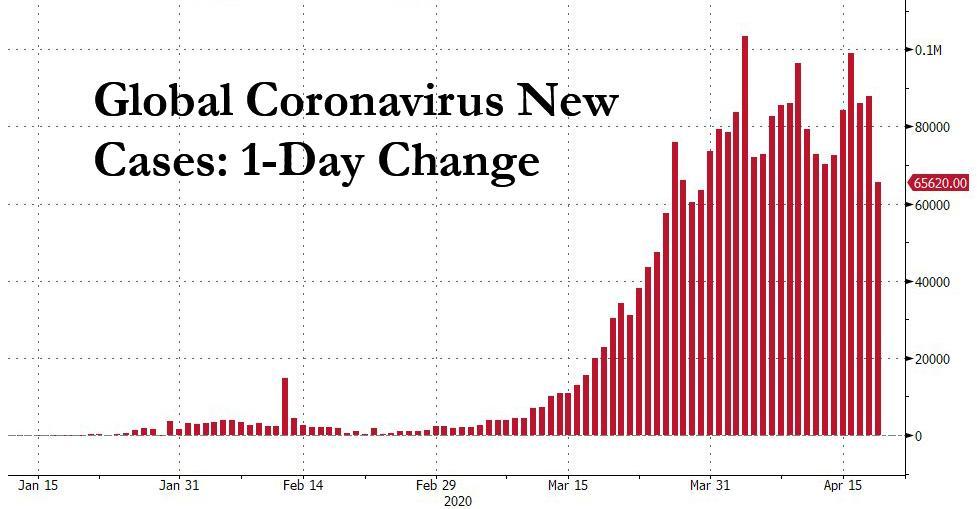
Here’s what the curve looks like now:
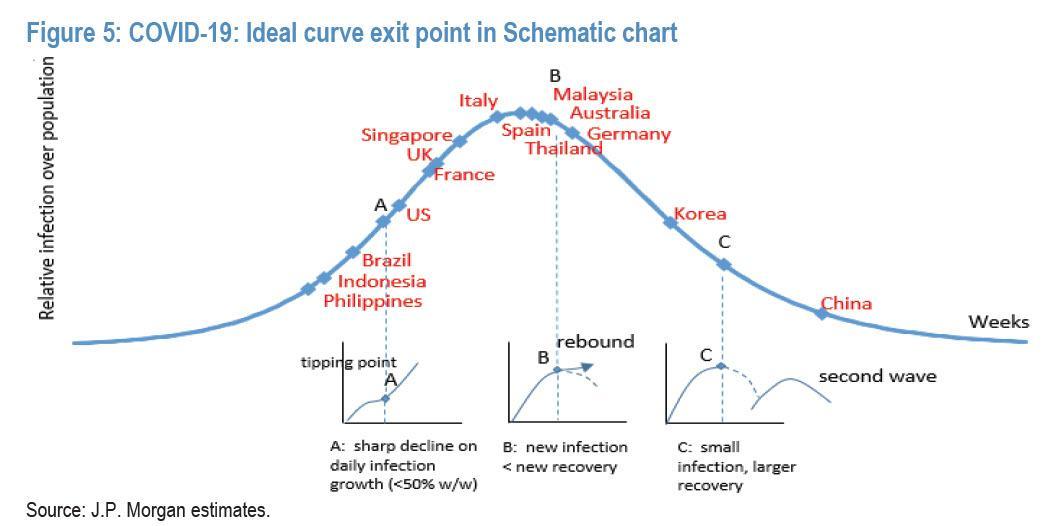
Meanwhile, in the UK, HMG’s worker-furlough scheme – whereby companies are given money for payroll to keep workers on and not fire them – has received more than 70k applications in the first half hour of eligibility as businesses scramble to get cash to pay workers whom they are keeping on the payroll. Businesses will lose access to the money if they don’t keep workers employed.
Back in the US, most of the biggest coronavirus-related stories overnight involved corporations and nonprofits facing pressure to return bailout money. Shake Shack won plaudits for giving back a $10 million (that’s million with an ‘m’) ‘PPP’ loan, however, Ivy League universities including Harvard and Columbia are facing pressure to return millions of dollars that these institutions – which have tens of billions of dollars in their endowments – have accepted from the program, exposing what is perhaps its biggest flaw: The businesses who need the money the most probably aren’t the ones who are getting it first.
Before we go, we’d like to note that the international pressure on China intensified overnight, as French foreign minister Jean-Yves Le Drian sharply criticized Beijing over a propaganda campaign Le Drian said appeared to be intended to “deepen divisions” in the EU. Additionally, as we noted last night, Germany’s largest newspaper accused Beijing of “exporting” the virus, provoking an outraged response from the CPC.
END
3 C CHINA
Beijing Arrests Hong Kong Media Tycoon & 14 Activists In Sweeping Pro-Democracy Crackdown
We’ve been watching Hong Kong closely these past few weeks to see if Beijing, having mostly reopened the mainland economy, relieving the pressure for the first time in months, would turn its attention back to its top priority pre-corona: Crushing an insurgent pro-democracy movement in the Special Administrative Region.
Early on Saturday morning in Hong Kong, HK police arrested 15 pro-democracy movement activists, including a high-profile tycoon who was one of the few members of the HK business community to vehemently back the protest movement, according to the SCMP.
The targets included Hong Kong media tycoon Jimmy Lai Chee-ying, and 14 other supporters. The pretext for the arrest was their involvement in last year’s protests.

Jimmy Lai
Even if the name isn’t widely known in the US, Lai is a major figure in the leaderless and mostly amorphous Hong Kong pro-democracy movement. He has been targeted before, including an attack on his home carried out last fall by thugs likely backed by the Communist Party.
The sweeping crackdown comes more than six months after the last major pro-democracy demonstration in the city, though some protesters took to the streets during the early weeks of the corona outbreak to demand that borders be closed and other heavy handed measures be taken by the city government to prevent a re-run of the SARS outbreak, which killed more than 300 in HK. That movement, of course, was first set in motion last spring in response to an extradition bill being expedited by the government that would have made Hong Kongers subject to prosecution (and, they feared, persecution) in mainland Communist Party-controlled courts.
Details provided by SCMP claimed that police tried to arrest Lai n the middle of the night, but were forced to wait until he returned home (American cops could definitely show their colleagues in Hong Kong a thing or two about how to pull off a ‘tactical GPS takedown’).
The arrest were reportedly sanctioned by Hong Kong Chief Executive and Beijing puppet Carrie Lam.
Officers earlier showed up at the home of the Apple Daily founder, but he was not in at the time. He returned in the afternoon and was arrested at 2.50pm. He was accused of organising and participating in unlawful marches on August 18 and October 1 from Causeway Bay to Chater Road in Central.
Police also entered and searched his place under a warrant.
Others arrested included former lawmakers Martin Lee Chu-ming, Albert Ho Chun-yan, Lee Cheuk-yan, “Long Hair” Leung Kwok-hung and Au Nok-hin, according to legal sources.
Several former lawmakers were also detained and arrested (Beijing has already pushed out many of the most progressive pro-democracy hardliners from the HK legislature), including those named by the SCMP below:
Also held were former lawmakers Yeung Sum, Sin Chung-kai, Cyd Ho Sau-lan, and activists Raphael Wong Ho-ming, Figo-Chan Ho-wun and Avery Ng Man-yuen.
They were detained over organising and joining unlawful assemblies on August 18, October 1 or October 20 last year. The suspects were taken to several police stations.
Martin Lee was taken to Central Police Station in Sheung Wan, while Leung Kwok-hung was sent to Ngau Tau Kok Police Station.
Police also showed up at the home of former legal sector lawmaker Margaret Ng Ngoi-yee. She later reported to Central Police Station and was arrested there. She was involved in the August 18 rally.
Several of those arrested were charged with additional crimes – that is, appearing at more rallies than the demonstrations cited above, according to a police superintendent. Lam added that the operations are “still ongoing” and that more arrests might follow. The arrested will be arraigned in a Hong Kong court on May 18.
Of course, this crackdown will be seen as nothing less than a brutal outrage and a betrayal by most democracy-minded Hong Kongers (the vast majority of the population). By arresting Lai and targeting other well-known figures in the movement, authorities almost seem like they’re trying to bait Hong Kongers into returning to the streets.
Perhaps that’s their strategy: If anybody tries to march this time, police can resort to brutally suppressive tactics in the name of safeguarding public health. However, we can’t help but notice that it almost seems like Beijing is trying to trigger a return to the massive rallies of last summer.
But why is Beijing even willing to risk the possibility that thousands – potentially hundreds of thousands – of Hong Kongers might react by crowding into the streets in the middle of a resurgence of the virus? Recent reports from Hong Kong suggest the economy is already reopening, and locals are growing more comfortable being back out in the street.
Why did Beijing pick now to rock the boat, and prosecute individuals for crimes that roughly one-third of HK’s population engaged in at one time or another?
Wuhan Reopening Spells Trouble For A World Emerging From Lockdown
Residents of Wuhan, China – the epicenter of the global pandemic which has killed more than 150,000 people in roughly four months – are now free to venture out after more than two months of home confinement in the largest quarantine in human history.
Unfortunately for local restaurants, the lifted restrictions haven’t translated to desperately needed customers, as residents are still subject to curbs on their movements such as temperature checks before one can enter a building, and people are still being encouraged to limit travel to essentials – such as work and shopping.
Restaurant owner Xiong Fei says that the end of the lockdown hasn’t brought relief – just a new set of challenges, according to Bloomberg. According to Xiong, people have changed their behavior, perhaps for good.

Photographer: Gilles Sabrie
“People in the past dined out with their colleagues in their lunch hour, now they’re all getting lunchboxes,” he said, sitting in an empty booth at his Sichuan restaurant. “They’re more likely to cook at home than go out.”
Of the 10 restaurants Xiong’s company, Bainianfeng Catering Management Co., operated before the outbreak, none have reopened for dining in. And while three have resumed making food deliveries, Xiong has already decided to shutter three other locations for good because he expects fewer customers. Now the 40-year-old entrepreneur and his business partners are trying to decide what to do long term. Half of Bainianfeng’s restaurants were hotpot joints, where groups of diners cook raw meat and vegetables in communal pots of boiling broth—the sort of places customers now are likely to avoid. “There will be a significant downturn in consumption,” Xiong says, predicting the city’s hospitality scene will see a shakeout. –Bloomberg
“I knew restaurants would be the most heavily affected,” said Xiong, whose restaurants had already been largely closed before the lockdown due to the mysterious new pneumonia which had been circulating since late December. “I also worried about our workers’ health.”

Photographer: Gilles Sabrie
And while perhaps Wuhan residents simply don’t trust their goverment’s “all clear” – Xiong’s experience portends continued pain for restaurants around the world currently shuttered or suffering from a lack of foot traffic due to COVID-19.
Last week, Gallup revealed that more than 80% of Americans will wait to return to normal activities after restrictions are lifted. Of that, 71% will wait to see what happens with the virus, while 10% will wait indefinitely.
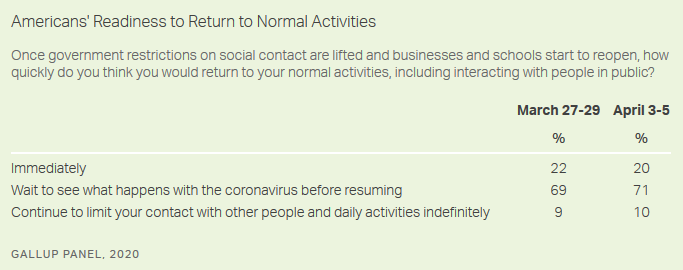
What’s more, The Spoon‘s Michael Wolf noted on March 17 – right as the lockdowns went into place, that New York city restaurant traffic was already down 17% before the lockdown.
New York City’s restaurant traffic was down by 69%, while Seattle’s restaurant traffic had dropped by 62%. Despite being two of the earliest hotspots, these were not the biggest drops. San Francisco restaurant traffic was down by 72% on Sunday compared to a year earlier, while Boston’s traffic was down 70%. -The Spoon (Mar. 17)
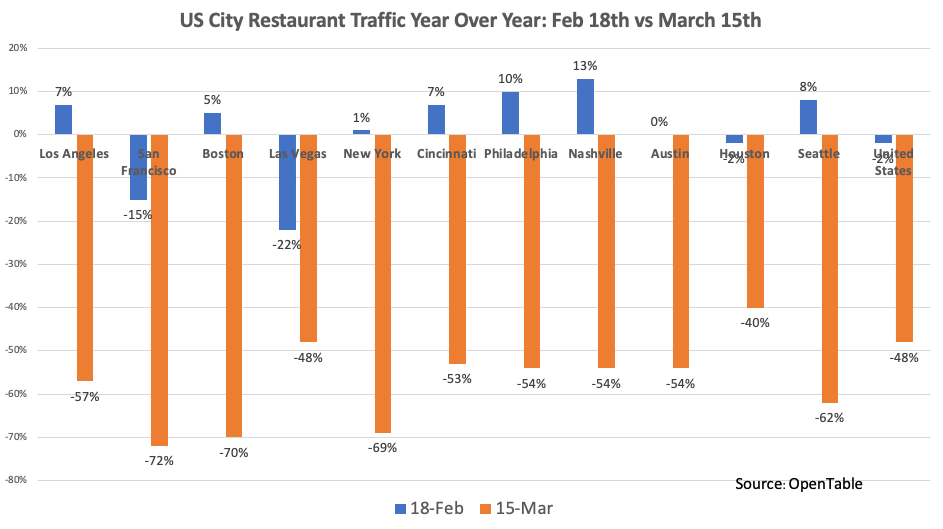
According to UBS, restrictions in the EU and US will be lifted starting as early as May in the ‘upside’ scenario, and as late as June or July in the ‘downside’ scenario, with consumer activity estimated to rebound – as defined as a “sustained return to a level 20% below the pre-crisis baseline, or higher” – between June 2020 and June 2021.
Making the best of a bad situation
One of Xiong’s companies, a catering business called Bainianfeng, has sought refuge in meal deliveries – though when the lockdown went into place, it was difficult to safely source and transport ingredients which were spiking in price as supplies dwindled. Meanwhile, his staff was greatly reduced, as most were too afraid to show up to work, or were restricted from leaving their homes.
Before the outbreak, people would stand in line for 40 minutes on weekends to get a seat at Xiong’s more popular spots. But under lockdown, he was lucky to get 20% of the orders he used to receive via delivery apps such as Alibaba Group Holding Ltd.’s Ele.me and Meituan Dianping, another backed by Tencent Holdings Ltd. To draw more diners, Xiong’s three operating restaurants are offering to deliver food to any location in the huge city, even if it takes hours. The online platforms take 20% of sales, but “we don’t dare to increase our prices because people will complain,” Xiong says.
And while his businesses are dying on the vine, Xiong is getting scrappy – importing high-tech food packaging machines from Taiwan to resell to other restaurants, and embarking on a livestreaming channel featuring his cousin cooking in one of his restaurants and eating the food.
“There definitely will be restaurants sifted out,” he said, adding “The market just follows natural selection, and only the fittest will survive.”
END
German Newspaper Bild attacks China for the coronavirus pandemic..it accuses Beijing of its greatest export: Covid 19 or Wuhan virus. The newspaper demands 149 billion euros in damages for Germany.
China Outraged After Largest German Newspaper Accuses Beijing Of “Exporting” Coronavirus Pandemic, Demands €149 Billion In Damages
Let’s see how the pro-China “fact checkers” blow up on this one.
The editor-in-chief of Germany’s largest paper Bild on Thursday launched a full frontal attack on China’s communist president Xi Jinping for his regime’s failure to lying about the coronavirus outbreak and the massive human rights violations carried out by the Communist Party, and demanding no less that €149 billion in damages as a result of China’s actions.
In an article titled “What China Owes Us”, Julian Reichelt, the prominent editor-in-chief of the Bild, wrote to Jinping that “Your embassy in Berlin has addressed me in an open letter because we asked in our newspaper Bild whether China should pay for the massive economic damage the coronavirus is inflicting worldwide.”
Addressing the Chinese president, the German editor wrote that, “You, your government and your scientists had to know long ago that coronavirus is highly infectious, but you left the world in the dark about it. Your top experts didn’t respond when Western researchers asked to know what was going on in Wuhan. You were too proud and too nationalistic to tell the truth, which you felt was a national disgrace.”
Reichelt said that, “You rule by surveillance. You wouldn’t be president without surveillance. You monitor everything, every citizen, but you refuse to monitor the diseased wet markets in your country. You shut down every newspaper and website that is critical of your rule, but not the stalls where bat soup is sold. You are not only monitoring your people, you are endangering them – and with them, the rest of the world.”
He continued with his bill of particulars, noting that “surveillance is a denial of freedom. And a nation that is not free, is not creative. A nation that is not innovative, does not invent anything. This is why you have made your country the world champion in intellectual property theft.
“China enriches itself with the inventions of others, instead of inventing on its own,” Reichelt wrote. “The reason China does not innovate and invent is that you don’t let the young people in your country think freely. China’s greatest export hit (that nobody wanted to have, but which has nevertheless gone around the world) is coronavirus.”
We can’t wait to read what Reichelt will have to say when it is confirmed that the “Wu Flu” escaped from the Wuhan Institute of Virology, a development we expect will take place any day.
The best-selling paper Bild calculated prior to Reichelt’s editorial that China owed Germany €149 billion for coronavirus damages, triggering the angry response from the Chinese embassy in Berlin. Bild said the compensation amounts to €1,784 per person if Germany’s GDP drops by 4.2 percent. The Bild article was titled: “What China owes us.”
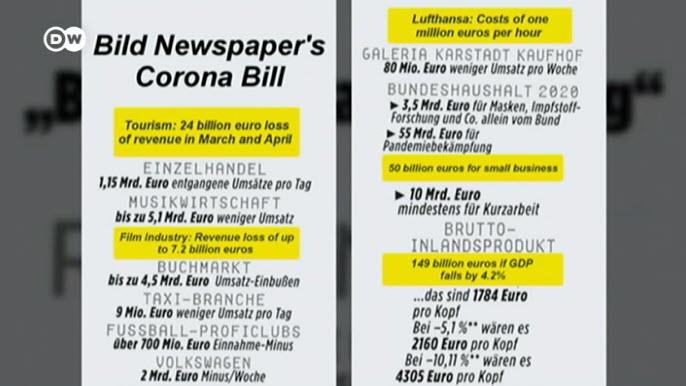
In response, the spokeswoman for China’s embassy, Tao Lil, published an open letter to Bild in German on the embassy’s website stating that, “I followed your reporting on the corona pandemic in general and China’s alleged guilt in particular today. Apart from the fact that we consider it a pretty bad style to blame a country for a pandemic that is affecting the whole world and then to present an explicit account of alleged Chinese debts to Germany, the article ignores some essential facts.”
She added that “We note that many countries now struggling with COVID-19 have had time to prepare for the cross-border spread of the pathogen after China reported its outbreak under IHR [World Health Organization] guidelines.”
And in taking a page out of every liberal textbook, everywhere, having no credible defense, China’s embassy spokeswoman promptly changed subjects and said the article “stirs up xenophobia and nationalism.”
So… accusing a government of a giant cover up – which we already know happened as China itself admitted when it silenced the Wuhan doctor who tried to bring the world’s attention to the plague ravaging his town only to be arrested and forecefully silenced before dying from the coronavirus – is now nothing more than an act of racism. Got it. Perhaps the next time the IRS comes knocking and demanding a “fairer share” of one’s income, the same “you are racist” excuse can be applied as well?
Oh, and yes, the same line of questioning that got this site banned by the “ultra liberal” arbiters of all that is true and just in this world – and direct whose actions may have facilitates the deaths of thousands of people around the globe – was not lost on the Bild editor-in-chief, who cited last week’s Washington Post article reporting that, “your laboratories in Wuhan have been researching coronaviruses in bats, but without maintaining the highest safety standards. Why are your toxic laboratories not as secure as your prisons for political prisoners? Would you like to explain this to the grieving widows, daughters, sons, husbands, parents of corona victims all over the world?”
We couldn’t have said it better ourselves, even if we did say it about 3 months earlier, for which we got the ultimate punishment from that paragon of free speech, Jack Dorsey.
Reichelt concluded that, “In your country, your people are whispering about you. Your power is crumbling. You have created an inscrutable, non-transparent China. Before Corona, China was known as a surveillance state. Now, China is known as a surveillance state that infected the world with a deadly disease.That is your political legacy.”
Bild’s full frontal attack on China may have been the trigger for everyone else to pile on, and on Saturday, President Donald Trump warned that China should face consequences if it was “knowingly responsible” for unleashing the coronavirus pandemic, especially if it involved open lies about the origin of the deadly virus: the country’s only maximum security Level 4 biolab, which as Nature wrote in February 2017 was tasked with “studying the world’s most dangerous pathogens” in which the highly respected scientific publication also warned about “worries surround the Chinese lab. The SARS virus has escaped from high-level containment facilities in Beijing multiple times.”
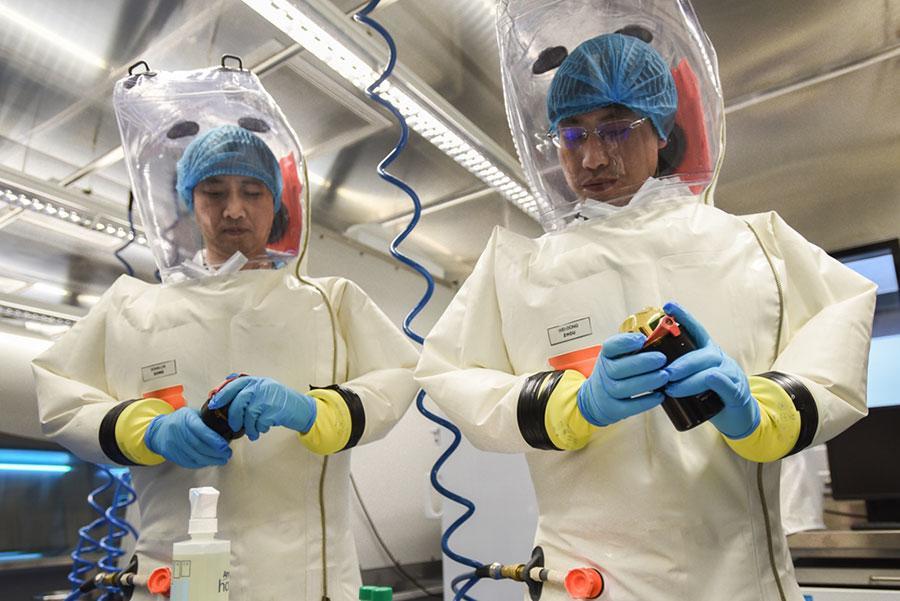
Trump told reporters: “It could have been stopped in China before it started and it wasn’t, and the whole world is suffering because of it. “If it was a mistake, a mistake is a mistake. But if they were knowingly responsible, then there should be consequences.”
We eagerly look forward to finding out just what those consequences are… not just for China, but for all those – such as Jack Dorsey and Twitter – who enabled this lie to be perpetuated for months.
Trump concluded the Chinese were “embarrassed” and the question was whether what happened with the coronavirus was “a mistake that got out of control, or was it done deliberately?” All this happened just hours after this week the city of Wuhan, where the outbreak started, revised its number of fatalities by with a sudden 50% jump in the figure, confirming yet again that anything that comes out of China is a lie, and that all those who defend China’s position – for purely monetary pursuits even if it means the deaths of countless people – should be judged, if not in a just as corrupt legal system, then in a court of the people.
4/EUROPEAN AFFAIRS
SPAIN//CORONAVIRUS UPDATE/SATURDAY
Spain “Authorizes” Military Planes To Spray Disinfectants Over Cities
The Spanish government has just “authorized” the military to prepare planes for aerial spraying of disinfectants across major metro areas as confirmed COVID-19 cases and deaths continue to rise, reported La Razón News.
The order was first published in the Boletín Oficial del Estado, the country’s official gazette, on Friday, that “authorizes the NBQ (Nuclear, Biological and Chemical) units of the Armed Forces and the UME to use biocides authorized by the Ministry of Health in disinfection efforts to deal with the health crisis caused by the coronavirus.”
According to the order, “the most effective disinfection techniques are the use of aerial means because through them, with nebulization, thermonebulization and micronebulization techniques, all surfaces are reached quickly, avoiding reliance on manual application, which it is slower, and sometimes it does not reach all surfaces because there are obstacles that prevent reaching them.”
The order continues to say “aerial disinfection” missions will be conducted “regularly” as long as the pandemic continues to ravage the country.
On Friday, Spain reported 5,252 new infections, the most significant jump in cases in more than a week, pushing up total cases to 184,948, with 19,478 deaths. The surge in cases could suggest that curve flattening via strict social distancing measures are not working, hence why the government has called up the military to conduct aerial disinfectant spraying missions.
La Razón News said the 43rd Air Force Group would operate Canadair CL-415 aerial firefighting planes that will most likely be outfitted with special sprayers to create an even stream of disinfectants while blanketing a metro area.

Each CL-415 has a range of 1,518 miles with a 1,620-gallon tank that can be mixed with chemicals. The plane is amphibious and can refill on a body of water.
Spain has deployed unmanned aerial systems and ground-based robots to spray disinfectants on the street level. Still, the move by the government to blanket entire towns with disinfectants via airplanes suggests that current efforts are failing to suppress the virus.
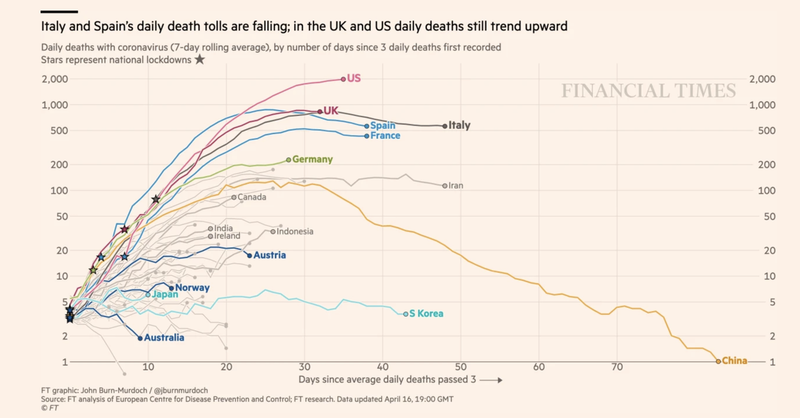
As early as late January, we started to note that China was deploying drones with 5-gallon tanks of disinfectants to spray streets.
Malak Manatazach@mjtruIysChina using drones to spray the citizen with chemicals to combat the virus.


In late February, China started converting ground-based agriculture robots with sprayers to disinfect public areas.
XAG@XAG_officialOur farm #robot R80 has stepped forward to join the #fightcoronavirus operation, disinfecting parking lot outside the office block in Guangzhou. Lightweight, flexible to traverse small districts, R80 can disinfect an area of up to 64800 square metres per hour, with no dead ends.


Spray cannons on trucks in China.
Tomthunkit™@TomthunkitsMindSPRAY, SPRAY, SPRAY THE #CORONAVIRUS AWAY.
China continues spraying disinfectant to contain the CoronaVirus. pic.twitter.com/qmXNwM5Ni0 03#FBR


More spraying in China.
People’s Daily, China
✔@PDChina
Disinfection is underway! China’s most virus-stricken province, Hubei, is disinfecting entire cities to curb #coronavirus, as trucks and medical workers spray disinfectant through the streets.


By March, Spain deployed its Army personnel to disinfect train stations.
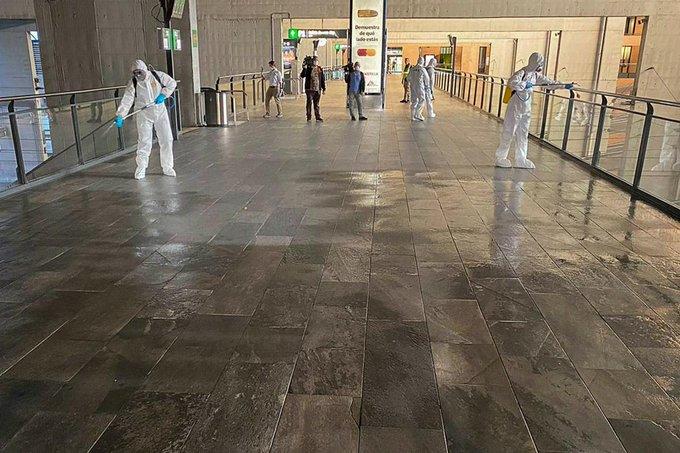
The Russians converted a jet engine to spray disinfectants…
Radio Free Europe/Radio Liberty
✔@RFERL
Russian engineers in Chelyabinsk have converted a jet engine to spray disinfectant, as cities around the world try to destroy viral cells that may be lingering on surfaces.


Just remember, the spraying of disinfectants, if that is by ground-based systems or humans, or aerial systems such as drones or airplanes, it will be coming to major metros across the US.
END
5. RUSSIAN AND MIDDLE EASTERN AFFAIRS
6.Global Issues
CORONAVIRUS UPDATE/THE GLOBE//MANY PERISHED UNCOUNTED/SATURDAY
Shocking Reports Claim 1000s Perished Uncounted In NY, UK Nursing Homes; Spanish Death Toll Tops 20k: Live Updates
Summary:
- Spain death toll tops 20k, joining US & Italy
- Report claims 7,500 died uncounted in UK nursing homes
- NYPost claims nursing home deaths in NY went uncounted
- Japan case total passes 10k
- Dr. Fauci says tests ‘aren’t everything’ when reopening states
- Iran death toll crosses 5k as country’s reopening begins
* * *
Investors cheered and pundits dared to speculate that the worst just might be over Friday evening after US stocks finished the week with a blowout rally into the close (a rally that, sadly, appears to have been driven by misplaced optimism among retail investors, while hedge funds that were long GILD have cashed out).
A sketchy report touting unexpectedly promising results from one leg of an international study of Gilead’s anitviral remdesivir, a drug that was developed to treat ebola but hasn’t been approved by the FDA to treat…well…anything. Which is why several patient trials are being conducted around the world, to try and determine ASAP whether this might be the ‘miracle cure’ Trump and everybody else has been hoping for. Just days after CPC officials shut down two trials in mainland China because of a ‘shortage’ of ‘eligible patients’ (likely a hilarious ruse), Statnews reported late Thursday that a trial at the University of Chicago had essentially cured every patient in the trial except for 2.
The market took that story and ran with it, ignoring warnings from Gilead itself that the connotations of the data had been exaggerated by the story, and that this is only one trial out of many, with evidence of the drug’s efficacy remaining mostly ‘anecdotal’. Remdesivir has been given to enough COVID-19 patients at this point that, if the drug truly were a ‘miracle cure’, doctors would have known by now.
Thanks to a revision in new numbers coupled with a rash of deaths in the US and UK that have cleared out hospital beds and ICUs, while still likely falling well short of the ‘real’ numbers, it appears that the world about to experience a rapid rise in the virus’s global death toll, which topped 150k as of Friday. Late Thursday evening, the US reported a massive jump in deaths over the last 24 hours, driven by NJ, NY and Michigan, along with several other of the worst hit states.

Splashed across the front-page of the Saturday edition of the Telegraph is a story claiming the number of deaths in nursing homes is ~3,700% higher than government figures reflect.
Citing a seemingly authoritative – if ‘unofficial’ – survey of patients from one of the UK’s largest care-home associations, the Telegraph claimed that as many as 7,500 elderly patients have passed away from COVID-19 in nursing homes and other assisted-living facilities across the UK. That contrasts with the roughly 217 care-home deaths recorded by the Office of National Statistics, which is responsible for compiling data for the Department of Health and Social Care. It’s also roughly 5x higher than a previous estimate of 1,400 released by the organization earlier this week.
Around the world, more than 2.2 million cases of COVID-19 have been confirmed, and nearly 155k have died, as of Saturday morning in the US. And deaths have continued to accelerate, even as the pace of newly reported cases has slowed.
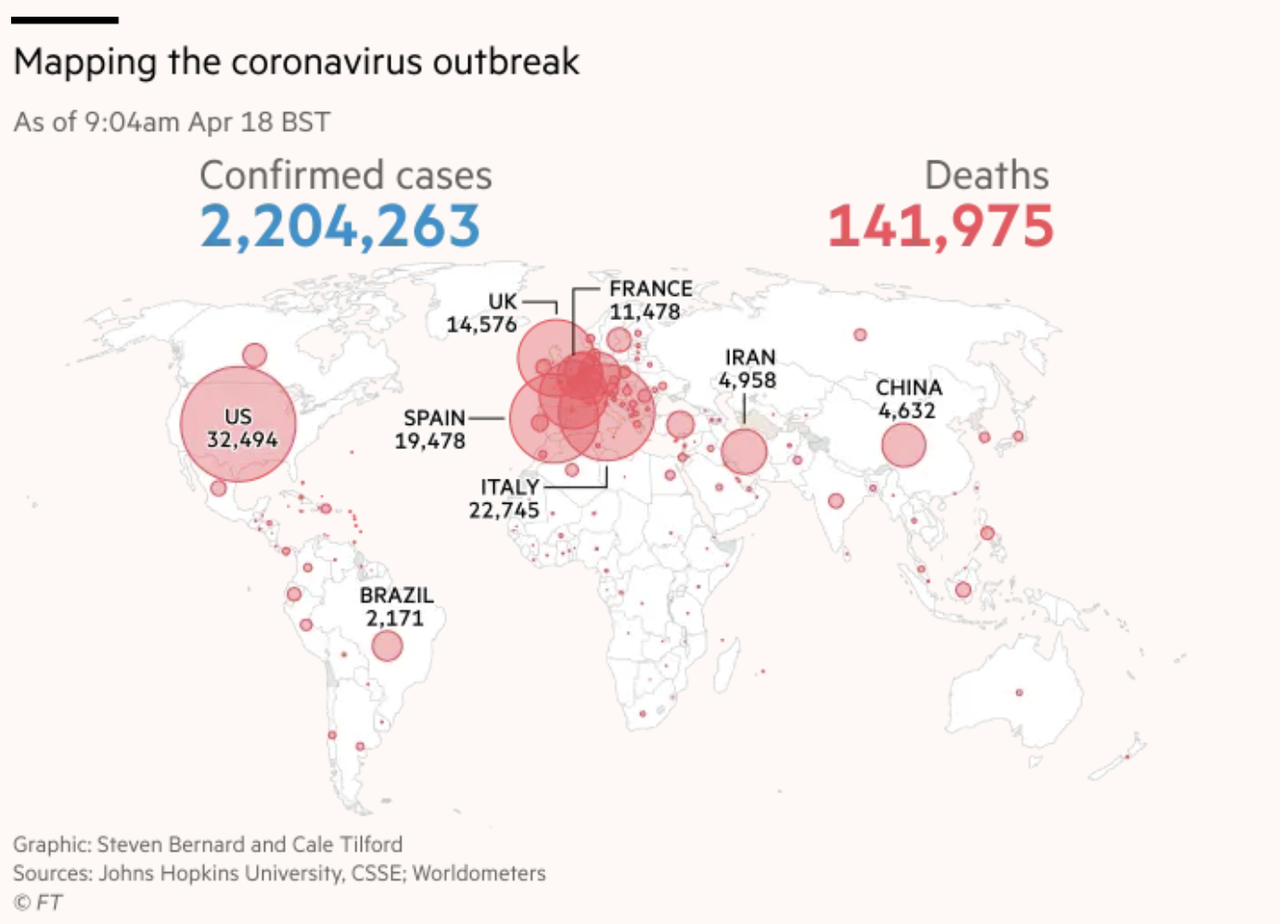
Source: FT
That initial report helped spark a national conversation about undercounting at UK nursing homes that has become a huge problem for Health Secretary Matt Hancock as Boris Johnson continues to recover from COVID-19 (Hancock was also infected).
The number of care home residents who have died of suspected coronavirus may have reached 7,500, according to the latest estimate, The Telegraph has learned.
New data collated by Care England, the country’s largest representative body for care homes, suggests the number of deaths from Covid-19 is far higher than its previous estimate of 1,400 from earlier this week.
The number is also far in advance of the official figure from the Office for National Statistics (ONS), which has recorded 217 care home deaths from the virus up to April 3 – the most recent date for which official data is available.
Of course, without testing, it’d be extremely difficult to say with any degree of certainty exactly how many have died. The only thing that seems almost certain is that the official number is a serious under-representation.
The notion that deaths have almost certainly been undercounted not just in the UK, but also in the US, Spain and around the world has become a major scandal in some countries because it makes so much sense. The US isn’t alone in not having enough tests: Shortages abound; even China struggled for months and is still likely exaggerating its real testing capacity. Earlier this week, NYC Mayor Bill de Blasio added nearly 4k deaths to the roll that included patients who died at home, or who died in the hospital of COVID-19-liked symptoms, but were never tested.
When supplies are limited, wasting precious resources on the dead solely for record-keeping purposes hardly seems sensible, and we can understand why hospitals wouldn’t want to waste those resources. We understand it – and so should everybody else. De Blasio’s revision followed pressure from the NYT. And just yesterday, health authorities in Wuhan “revised” its official numbers, claiming the decision was made as officials reconcile numbers across different data sets and so forth, stuff they didn’t have time to do when the crematoriums were running at full tilt back in February and March.
The WHO quickly stepped up to defend the decision, claiming Beijing simply won’t rest until it accounts for every single COVID-19 related death. Much of the world, including – of course – President Trump, but also many who have been persistent Trump critics, suspect that China has undercounted the number of cases and deaths in Wuhan by several orders of magnitude, not by a few thousand. You saw the pictures, remember? People were literally dropping dead in the streets – that’s how overwhelmed Wuhan’s hospitals were at the time. Video showed dying patients lying in hospital hallways and splayed out across packed rooms. The evidence was so glaringly obvious that not even the CPC, which had permitted thousands of foreign journalists into the city, could hide it. In fact, in terms of information suppression, it seems the best the part could do in Wuhan was “disappear” a few local citizen journalists.
In Spain, the opposition is accusing the socialist-led government of PM Pedro Sanchez of being reckless in reopening the country, a process Spain has already tentatively started, and accusing the government of deliberately lying about the deaths. The country’s health ministry reported more dismaying news on Saturday as the country’s death toll has climbed above 20k, even as the number of new cases reported each day is half what it was two weeks ago. With a mortality rate of roughly 10%, Spain’s outbreak has become one of the deadliest in the world.
And it’s only the third country (after the US and Italy) to report more than 20,000 deaths.
Per the Health Ministry, the number of new coronavirus cases in Spain rose by 4,499 people in the last 24 hours, pushing the countrywide total to 191,726 as the government continues to “review” its process for reporting the data. The official death toll is now 20,043 deaths, since another 565 people have reportedly died in the last 24 hours. That’s roughly in line with this week’s data, although the ministry hasn’t clarified discrepancies in the number of deaths reported yesterday.
Across the Atlantic, the New York Post reported in its Saturday edition that the outbreak has ravaged the city’s nursing homes to such a horrifying degree that even de Blasio’s revisions earlier this week didn’t fully cover it. Citing new data released Friday by the New York State Department of Health (likely, we suspect, handed to the NYP to undercut de Blasio), the paper cited several alarming examples that we imagine the mayor will be forced to address during his next press briefing.
In one Brooklyn facility – the Cobble Hill Health Center – 55 patients have died during the outbreak, the highest single-facility number in the whole state. 45 patients at the Kings Harbor Multicare Center in the Bronx have died, the next highest death toll among the city’s nursing homes. Another 40 people died at the Holliswood Center for Rehabilitation in Queens. Starting to get the picture?
Here’s the latest data broken down by the NYP…
The partial breakdown only includes 72 nursing homes across the state that reported more than five deaths. Of those, 42 reported at least 10 deaths. There are more than 600 nursing homes in New York State.
More than 1,100 residents cumulatively died just at these 72 facilities.
Overall, 3,316 elderly nursing resident residents died at either nursing homes, adult day care facilities or hospitals from COVID-19. Of that total, the virus killed 2,056 nursing residents in New York City.
There are 6,475 confirmed COVID-19 positive cases in licensed nursing homes.
…and to prove that even these numbers are still woefully incomplete, the Post added that several homes in the city that reportedly suffered dozens of deaths weren’t even listed in the state database.
But two other nursing homes highlighted by The Post as having dozens of deaths combined amid the pandemic — the Chateau at Brooklyn Rehabilitation & Nursing Center in Sheepshead Bay and the King David Center for Nursing and Rehabilitation in Gravesend — were not listed in the tally.
Cuomo signed an executive order Friday requiring these facilities report deaths to families within 24 hours to prevent the kind of terrible confusion that occurred at one suburban Seattle nursing home in Kirkland that found itself at the center of Washington state’s first outbreak.
While an abundance of tests would certainly have helped health authorities all over the world keep better track of cases and deaths, the fact remains that, looking forward, Dr. Fauci, Dr. Birx and their team believe that the US is now approaching the testing capacity that we need for some parts of the country to enter the initial phases of reopening which, remember, is all that they’re currently planning to do. For all the talk about starting back up before May, it seems May 1 is a real line in the sand for most states. And President Trump has repeatedly attacked Cuomo (during last night’s press conference and in tweets sent earlier in the day) for complaining too much about the ‘lack’ of tests, pointing out that the state did the same complaining about the lack of beds and ventilators, only to find that the social distancing worked better than the projections indicated.
That’s nobody’s fault, and it’s an unmitigated win for America. But do governors and the mainstream media need to make such a massive deal about the shortage of tests? Sen. Angus King, an Independent from Maine who caucuses with the Dems, accused VP Pence of a “dereliction of duty” during a phone call last night, a comment that was promptly leaked and played up in the press.
Speaking of undercounting, health authorities in Japan reported on Saturday that the number of confirmed cases in the country had finally topped 10k, NHK reports.
The case count continues to climb by stunning margins just days after PM Abe extended a state of emergency to the entire nation in an attempt to slow the spread of the virus and promised to hand out nearly $1,000 in Japanese yen to the entire country. He pleaded with Japanese to stay indoors as cases reported in Tokyo hit a record high. Abe, too, expressed fears about the virus spreading in nursing homes, but given Japan’s large population of elderly, its official death rate – well below 1% – seems far too low to be realistic.
Finally, one new study out of Santa Clara County found some astonishing data suggesting the number of cases that weren’t counted among the county’s residents could be many times higher than currently believed.
And in Iran, officials reported another 73 deaths on Saturday, raising the official death toll to 5,031, breaking above 5k, just as officials warn that the country’s return to work doesn’t mean citizens should cease taking social distancing precautions. Overall, Iran has reported 80,868 cases, though the totals for both deaths and cases are suspected of being much higher.
A new study shows that we may have 50 to 80 x the number of infections but that are asymptomatic. Remember Friday’s commentary where Luc Montagnier, 2008 nobel prize winner for his study on the AIDS virus, states that the COVID 19 virus is man made but over time, it loses its “man made” form and reverts to its natural state. We may have something like this occuring now throughout the globe
(zerohedge)
7. OIL ISSUES
WTI crashes to 11 dollars.. this should kill off USA shale and Canadian oil sands..
(zerohedge)
WTI Crashes To 19 Year Low As Trading Reopens; S&P Futures Slide
After a relatively drama-free weekend, futures have started off the new week lower by about 0.4%, trading at 2850, down 20 points from Friday’s CTA inspired and momentum-driven meltup which appears to be reversing as algos realize they have frontrun a rebound in not just 2021 earnings but also 2022 and 2023.
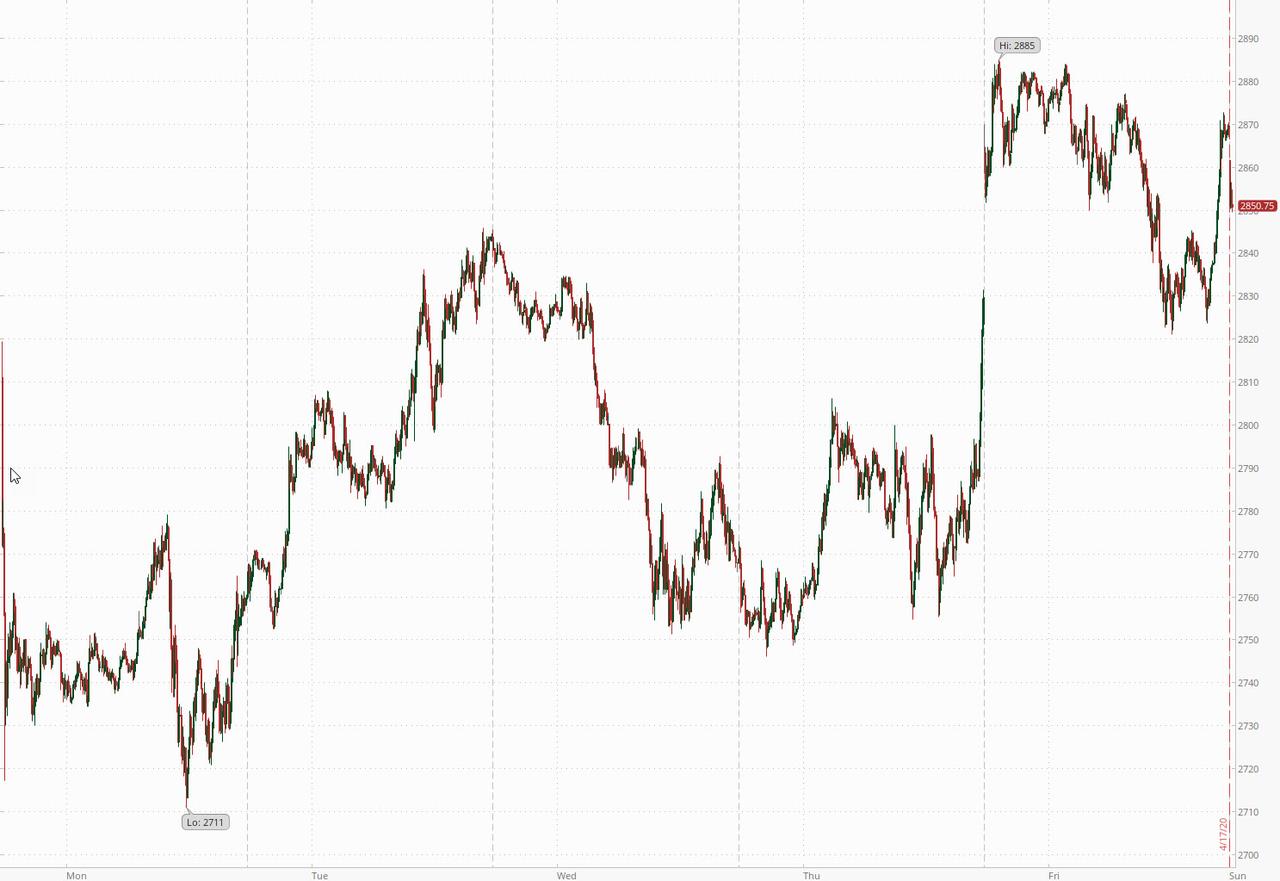
However, just like last week, it is commodities and specifically oil where the deflationary puke is taking place, with WTI tumbling over 5% at the open, and sliding to $17.30, down more than $10 from last Monday’s post OPEC+ kneejerk reaction higher and the lowest price since November 2001,
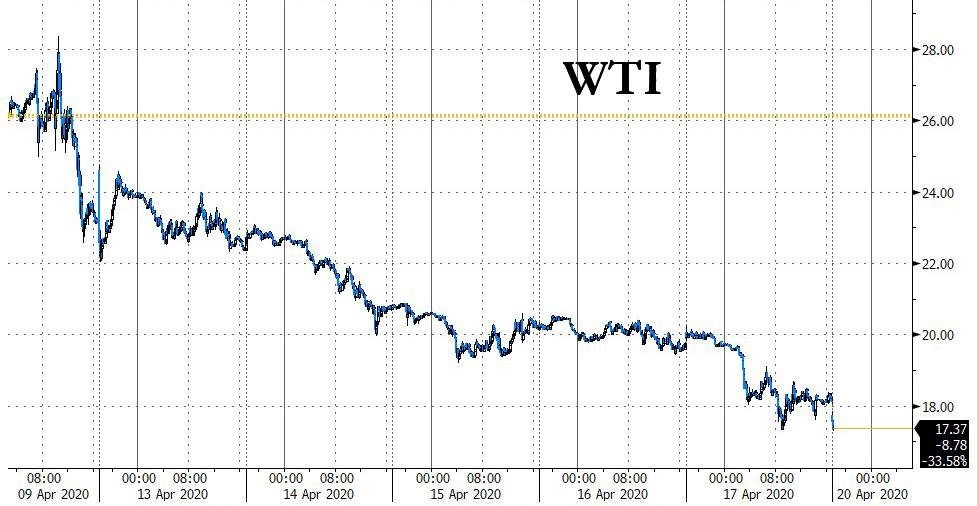
The ongoing crash in oil which OPEC+’s agreement to cut 9.7mmb/d in output last weekend has failed to halt, takes place as Crude prices in the US oil capital are getting dangerously close to zero. According to Bloomberg buyers bidding for crude in landlocked sections of Texas, ground zero of the shale revolution, are offering as little as $2 a barrel for some oil streams, a precipitous markdown from a month ago. And, as discussed here on various occasions, the plunging value of physical barrels is raising the possibility that Texas producers may soon have to pay customers to take crude off their hands.
Negative prices already hit more obscure corners of the North American oil market amid a bearish trifecta of collapsing demand, swelling supplies and limited storage capacity. AS we reported at the end of March, the first U.S. grade to bid under zero was a small landlocked crude stream known as Wyoming Asphalt Sour, which went for negative 19 cents a barrel last month.
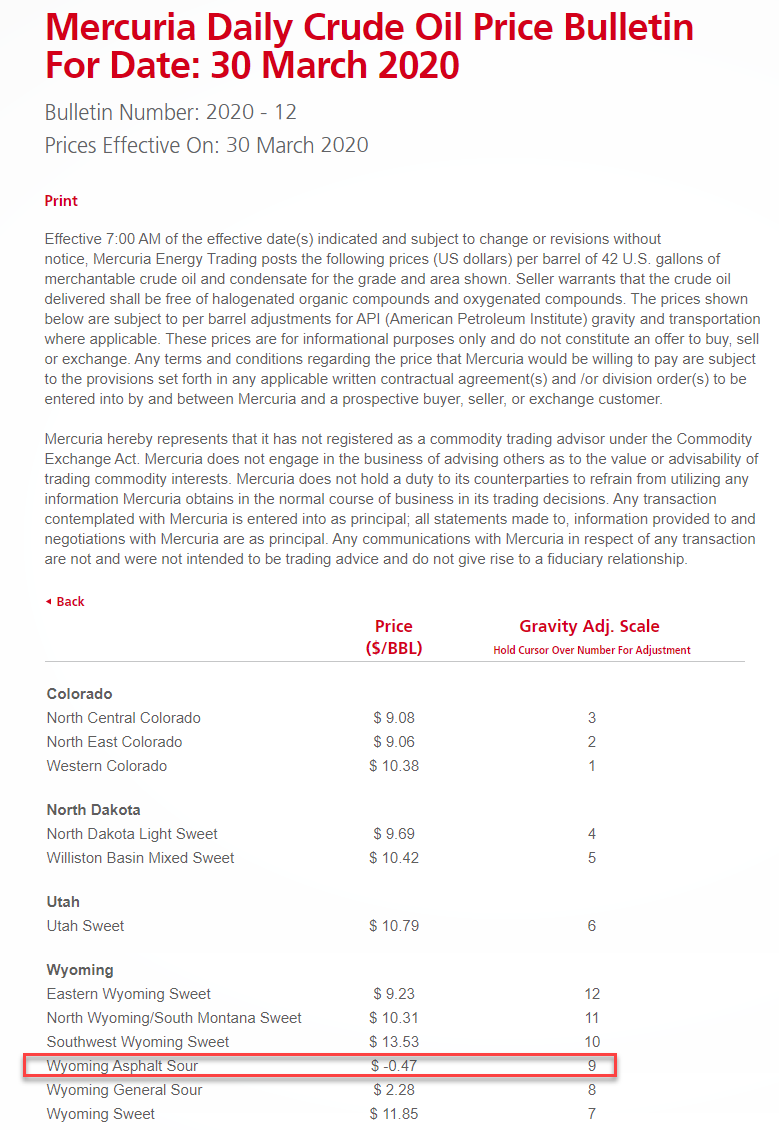
Meanwhile, in Texas prices are heading in that direction. A subsidiary of Plains All American Pipeline bid just $2 a barrel for South Texas Sour on Friday, while Enterprise Products Partners LP offered $4.12 for Upper Texas Gulf Coast crude this week, according to Bloomberg.
“I’ve never seen Texas crude oil transition to negative price” but it’s possible, said Andy Lipow, president of Lipow Oil Associates LLC in Houston. “It’s happened in the natural gas market at the Waha hub in west Texas,” Lipow added.
Fast depleting storage is still a major issue against a backdrop of unprecedented demand destruction from the coronavirus pandemic, and these could pressure prices below zero fast, Lipow added. To be sure, producers have been stashing oil both on land and at sea, with crude tankers now carrying a record 160mmb/d, double the amount two weeks ago, and there is still at least 150 million barrels of available land-based capacity. “But it’s the fill rate that is likely alarming the market, said Reid I’Anson, a global energy economist at Kpler, an industry research firm. Stocks at the key storage hub at Cushing, Oklahoma, have risen 18 million barrels in three weeks, which is 20% of shell capacity, he added.
The good news is that negative prices would be “extremely temporary,” said John Auers, executive vice president at energy consultant Turner Mason & Co. Under those circumstances, ultimately, supply will be forced to shut in. On that note, we will only remind readers that the Fed’s QE was also supposed to be temporary and instead if has since mutated into a permanent debt monetization ponzi scheme.
OIL STORAGE
Oil storage hits a record 160 million barrels
(zerohedge)
Oil Stored At Sea Hits A Record 160 Million Barrels, Doubling In Two Weeks
The historic OPEC+ “Mexican Standoff” production cut came and went, and after a very short kneejerk spike higher oil has continued to plunge to historic lows for the two reasons we laid out previously: i) the production cut was not nearly enough to offset the demand collapse of as much as 36 million barrels, and ii) every day that tens of millions of excess barrels are produced brings us one day closer to that catastrophic D-day when oil storage runs out.
Of course, just like not all oil producers are equal – recall Goldman recently predicted that landlocked producers may see oil prices go negative, as they run out of buyers or places where to store the oil, while tanker access to most Brent exporters means that the price of Brent will not drop materially below $20 – not all storage is equal either, and while Cushing and ARA commercial storage is expected to hit full in just a few months at the current rate of net supply, many producers are using water storage as a flexible alternative.
As a result, traders are now storing an estimated record 160 million barrels of oil on ships – double the level from two weeks ago as they seek to tackle a glut of stocks, Reuters reports as traders have rushed to find storage on land and at sea in what is believed to be the biggest oil glut in history.
The surge in water storage, which started with Saudi Arabia unleashing an armada of tankers last month to flood the world with cheap oil…
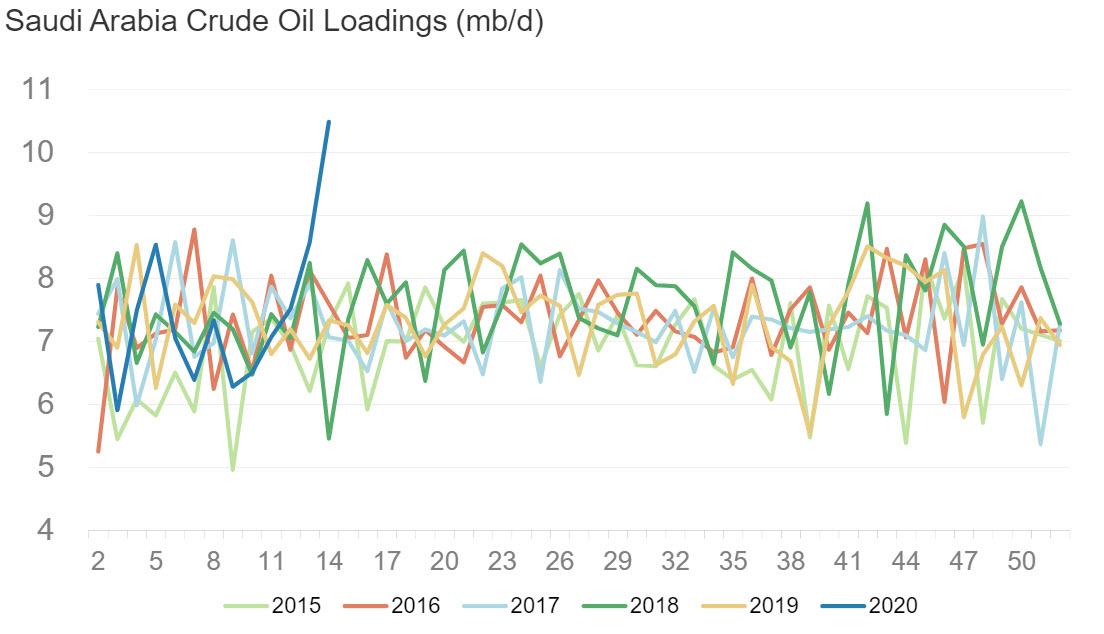
… has swept the globe and shipping sources say oil held in floating storage on tankers had reached at least 160 million barrels including 60 supertankers, aka very large crude carriers (VLCCs), which can each hold 2 million barrels. This compared with just 25 to 40 VLCCs already chartered with storage options at the start of April and fewer than 10 VLCCs in February, the sources said adding that smaller tankers were also being used, which was also boosting volumes being held at anchor.
The last time floating storage reached levels close to this was in 2009, when traders stored over 100 million barrels at sea before offloading stocks; the plunge in oil prices then prompted one of our very first posts in January 2009 “Risk-Free Profit Idea of the Day” in which we explained how to benefit from $25 contango.
Putting naval oil infrastructure in context, the red dots show oil-tankers transporting over 100 million barrels each day. Now add another 60 million barrels to begin..
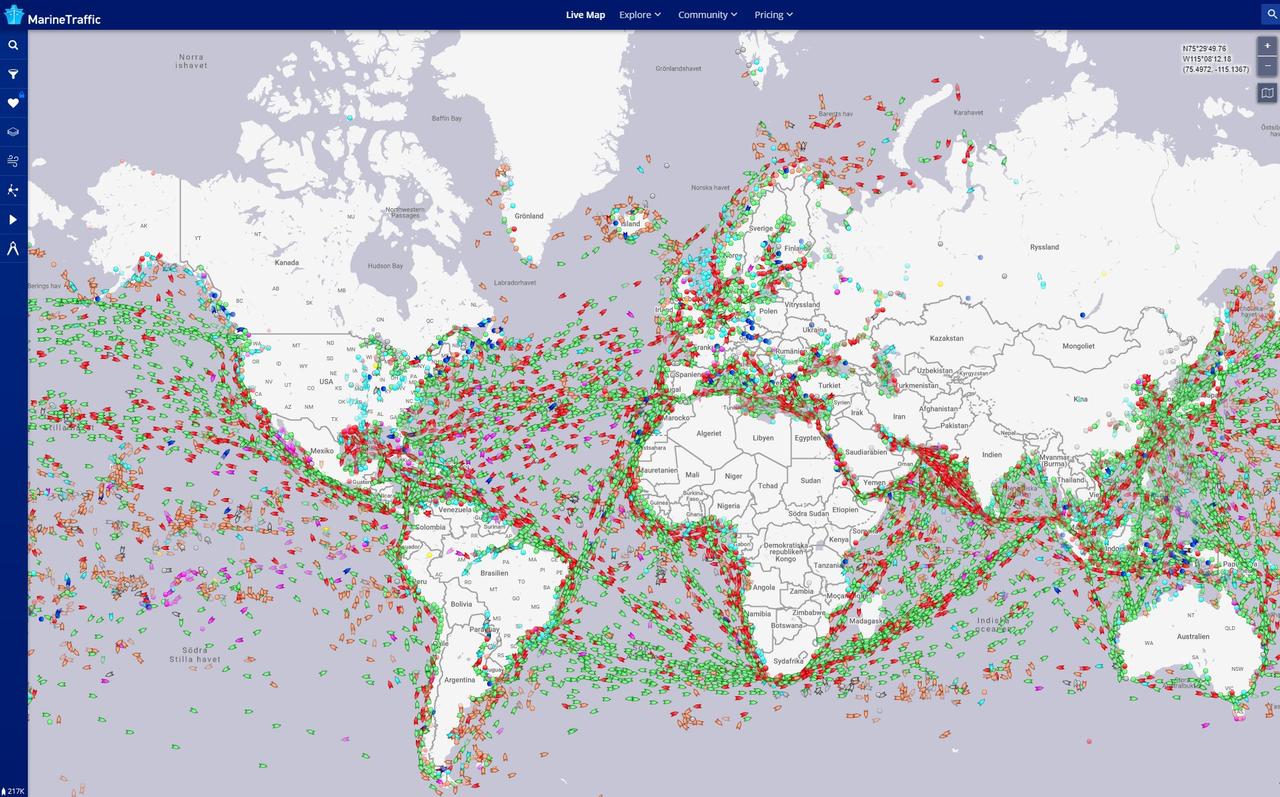
“This is an unprecedented time in the history of tankers and while VLCC tanker storage is garnering the headlines, smaller crude and product tankers are also being used for storage,” said BTIG shipping analyst Gregory Lewis.
Locations typically include the U.S. Gulf and Singapore, where major oil hubs are situated. A supercontango that briefly emerged in 2016 when oil prices also crashed for a period of time, resulted in the following stunning navel map of tankers parked off Singapore.
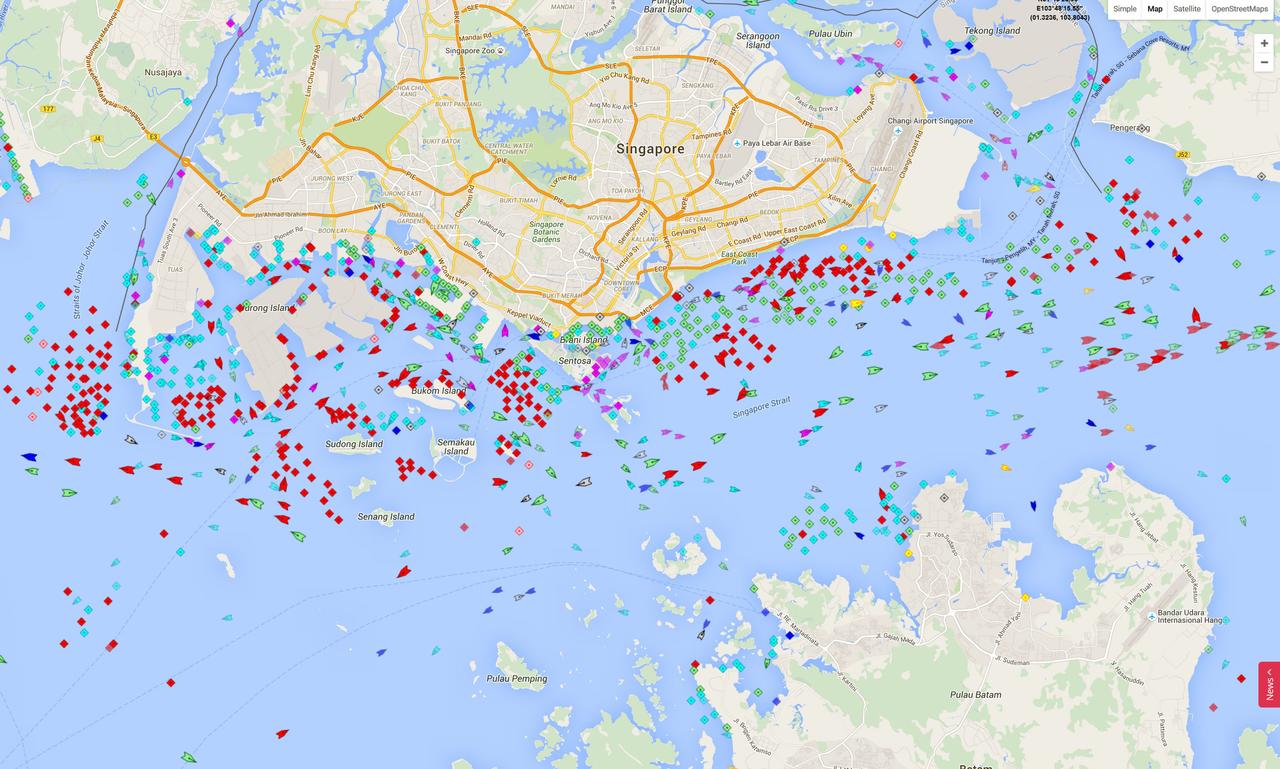
As mentioned above, the crude market is currently trading in deep contango, where forward prices are higher (in some cases much higher)than immediate prices.
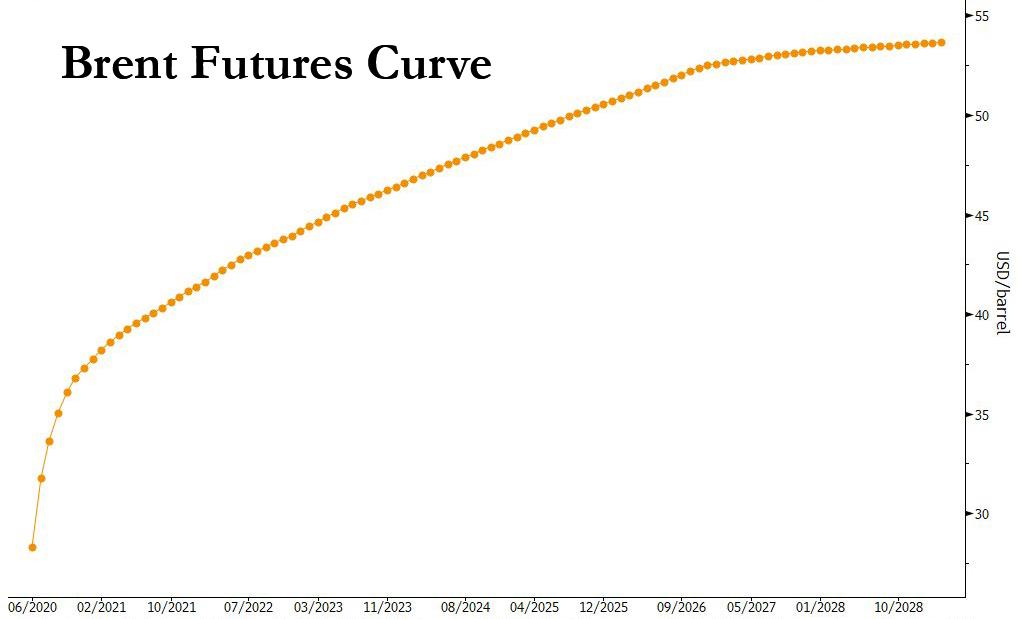
The ability to buy a barrel of oil cheap today and lock in a profit by selling it in the future, encourages traders to park barrels in storage in the hopes of selling them for a profit later.
And with the contango barely budging, analysts – who notes that there are over 770 VLCCs in the world – estimate that as many as 100 to 200 supertankers could be deployed for floating storage in coming months.
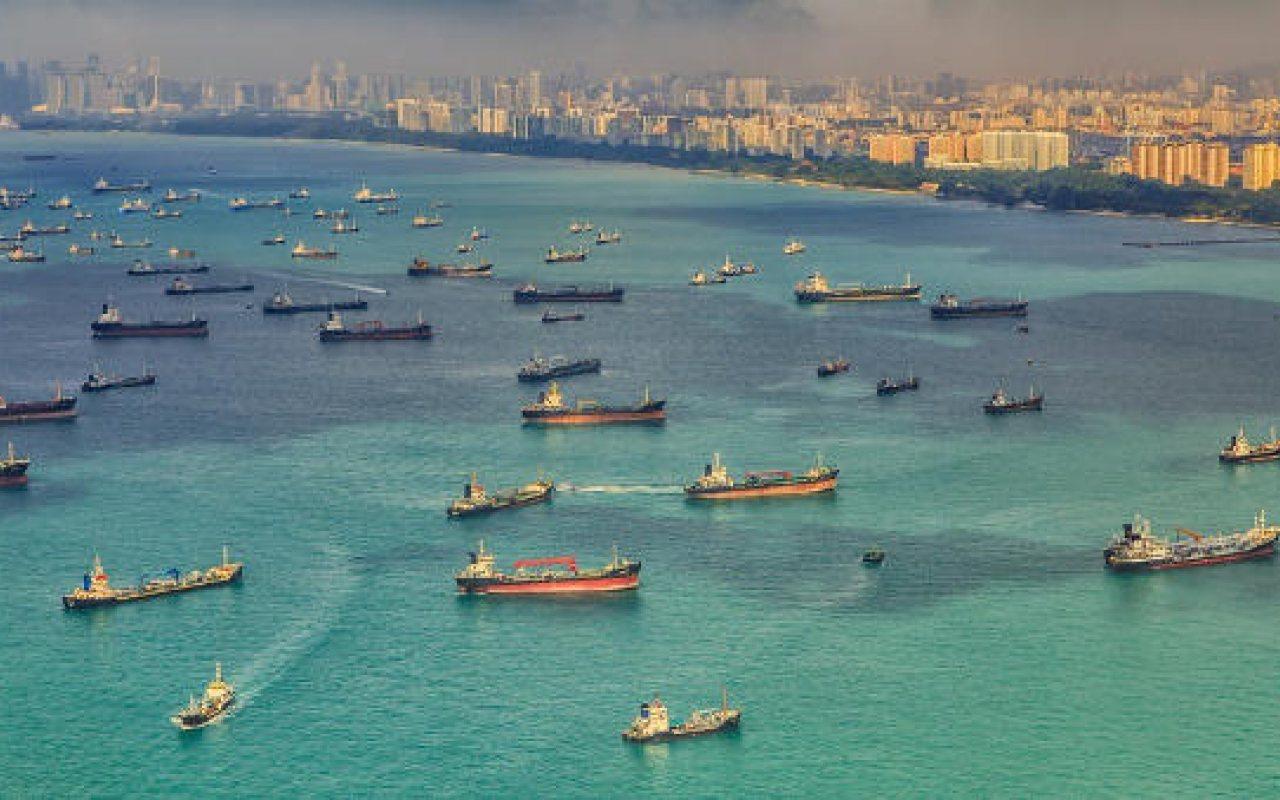
“The eventual wind down of this inventory glut will be most painful to tanker demand, but in the meantime floating storage remains the only outlet for a mismatched production and consumption backdrop,” said Jonathan Chappell with investment banking advisory Evercore ISI
Singapore Oil Trading Giant Files For Bankruptcy After Hiding $800 Million In Losses, Secretly Selling Loan Collateral
Last weekend we reported that one of Singapore’s biggest and most iconic – and extremely secretive – oil traders, Hin Leong Trading, whose website reported the company’s revenue surpassed $14 billion back in 2012, was on the verge of collapse as the company’s banks had frozen letters of credit for the firm – a death sentence for any commodity merchant – over its ability to repay debt; as a result, the firm appointed advisers this week to help negotiate with banks for more time to resolve its finances.
After pointing out the perplexing lack of high-profile blow-ups in the current commodity crush (as a reminder back in 2016 when oil dropped less than it has now, the Glencores and Trafiguras of the world were this close to collapse), we explained the critical nature of L/Cs…
Letters of credit are a critical financial backstop for commodity traders, used as way of financing critical short-term trade. A bank issues the so-called L/C on behalf of the buyer as a guarantee of payment to the seller. Once the goods have exchanged hands, the buyer repays the lender.
… and said that Hin Leong had “suddenly found itself without providers of L/Cs – for reasons still not exactly known – without which it is effectively paralyzed as it needs to front cash for any transactions, something no modern commodity merchant can afford to do.”
One week later we may have found the reason: according to a Bloomberg report, the son of the “legendary” founder of Hin Leong said the Singapore oil trader hid about $800 million in losses racked up in futures trading, suggesting a much bigger hole in the company’s finances than many expected, even if it explains why the banks scrambled to cut off the giant company’s funding.
Not only that but the Singapore commodity giant was also involved in the oldest trick in the commodity trader’s book: liquidation of pledged collateral to obtain critical funding. According to Evan Lim, the son of company founder Oon Kuin “OK” Lim, the company also sold some of the million of barrels of refined products it had used as collateral to secure loans from its banks, Bloomberg adds citing an April 17 email sent by the shipping affiliate of Hin Leong, notifying recipient parties of proposed moratorium proceedings.
As Bloomberg notes, the downfall of Hin Leong Trading, one of the biggest and most secretive forces in the world of physical fuel-oil trading, whose markets include crude oil, feedstock, middle distillates, petrochemicals, biofuel, mogas, naphtha, fuel oil, LPG, asphalt, base oil and lubricants, shows “the depth of the fallout from the dramatic drop in oil prices so far this year as a consequence of the Saudi-Russia price war and the coronavirus pandemic.”
It also suggests that we have finally found our first mega casualty from the corona//commodity//crisis (a long overdue offset to Pierre Andurand who managed to reverse just in time and to generate record profits in the past month having gone short oil): as a result of cooking its books and collateral shortfall, Hin Leong faces a significant shortfall between the oil stocks it held and the inventories pledged to its banks.That potentially means huge losses for the banks which provided the merchant with billions in loans as the collateral they thought they have as a guarantee isn’t there.
In what may be the most brutal case of cooking one’s books since Enron, the founder’s son, also known as Evan Lim, said he was unaware of the reason for losses suffered over some years and his father had instructed Hin Leong’s finance department to omit them from its financial statements;all this was disclosed in an email sent by Ocean Tankers Ltd., the group’s shipping arm which owns a fleet of more than 130 tankers, signed by the son and his sister Lim Huey Ching.
Completing the picture, just hours earlier, Hin Leong and Ocean Tankers both filed for court protection from creditors on Friday as the former struggles to repay its debts. Both companies are solely owned by the Lim family.
While Bloomberg focuses on the plight of the commodity trading giant, noting that “the trader’s financial distress has rocked the tightly-knit trading community in Singapore” and is “raising speculation that the privately-held company could be the latest casualty of the historic collapse in oil prices triggered by the coronavirus” the bigger question is whether this collapse will be systemic enough to send shockwaves among Singapore’s banks, some of the most levered in the world, and one of the world’s last remaining spot to launder money which is why so many Chinese have opened Singapore bank accounts in recent years.
The deception was simple: Hin Leong posted a positive equity of $4.56 billion and net profit of $78 million in the period ended October 31, according to the Bloomberg sources. But Hin Leong told its creditors this month that total liabilities reached $4.05 billion as of early April, while assets were just $714 million, leaving a hole of at least $3.34 billion.
The balance sheet of the company showed no equity at all as of April 9, 2020, and warned that “figures obtained from the company are subject to verification”.
What is even more bizarre, is that the company had used an otherwise reputable auditor, with Hin Leong Trading accounts for the financial year ending October 31, 2019 were audited by Deloitte & Touche LLP. The auditor didn’t flag any problems, according to people familiar with the matter. Meanwhile the banks too, were apparently unaware of the gross fraud taking place right under their noses, begging the question just what is the use of banker diligence?
That said, while auditors should have caught the accounting fraud, even they would have had trouble catching the company’s secret liquidation of pledged collateral. As noted above, Lim’s son said his father sold a substantial part of the company’s inventories even those used as collateral for banks loans.As a result, he said there was a large shortfall of oil inventories compared with the amount that had been pledged to secure the credit lines.
It also explains why as recently as last weekend, the banks had pulled their letters of credit.
Altogether, Hin Leong is said to owe almost $4 billion to more than 20 banks including HSBC, who will now scramble to figure out just how massive their loan losses are.
Meanwhile, the company which is not just a giant commodity trader and one of Asia’s largest suppliers of ship fuel, or bunkers, but co-owns oil storage unit Universal Terminal with PetroChina, and whose bunkering arm, Ocean Bunkering Services Ltd., was ranked the third-largest shipping fuel supplier in Singapore last year, is no more. Founder Lim Oon Kuin, known to many in the industry as OK Lim, will be resigning from all executive roles in Hin Leong, the Xihe Group and related companies as of April 17, Bloomberg sources reported. He will also step down as director and managing director of Ocean Tankers.
Meanwhile, the banks will be fighting with other creditors for whatever scraps are leftover: both Hin Leong and Ocean Tankers filed for protection from its creditors under Section 211B of Singapore’s Companies Act.
One unexpected consequence of the company’s sudden bankruptcy, is that with a record 160MM barrels of oil loaded up on tankers to ease the global commodity glut, Singapore may suddenly lose its place as the world’s tanker “parking lot.” While traditionally Singapore has had massive spare oil storage capacity which explains photos such as shits one…
… it is Hin Leong’s Universal Terminal that has storage capacity of 2.33 million cubic meters and is the largest independent petroleum storage terminal in Singapore and one of the biggest independent storage facilities worldwide. But now that the company is bankrupt, the ability of tankers to store their holdings in the terminal is suddenly in limbo, which means that storing oil on sea may suddenly become far more complicated.
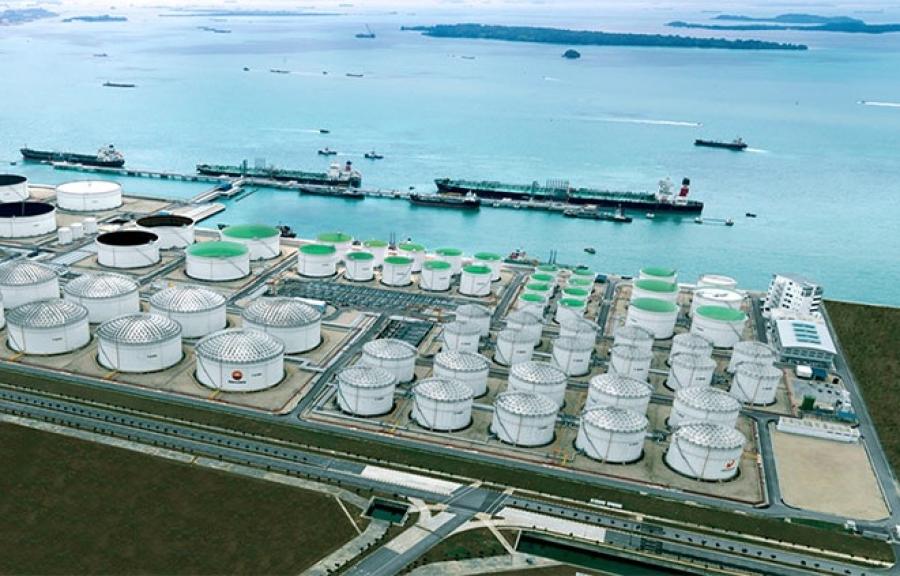
Last week, before we know the extent of the company’s financial debacle – and fraud – we concludes that “it is unclear what will happen to the Singapore commodity trading giant if it is unable to find banks that will backstop its operations.” Well, we now know – game over – which makes the second part of our forecast especially applicable: “should the firm become insolvent, the downstream cascade for companies in the Pacific Rim could be devastating.” We now wait to see if we were correct again.
Historic Oil Crash Sends Canadian Oil Prices Negative
When Goldman’s crude oil analysts turned apocalyptic last month, writing that “This Is The Largest Economic Shock Of Our Lifetimes“, they echoed something we said previously namely that the record surge in excess oil output amounting to a mindblowing 20 million barrels daily or roughly 20% of the daily market…

… the result of the historic crash in oil demand (estimated by Trafigura at 36mmb/d) which is so massive it steamrolled over last week’s OPEC+ 9.7mmb/d production cut, could send the price of landlocked crude oil negative: “this shock is extremely negative for oil prices and is sending landlocked crude prices into negative territory.”
We didn’t have long to wait, because while oil prices for virtually all grades have now collapsed below cash costs…
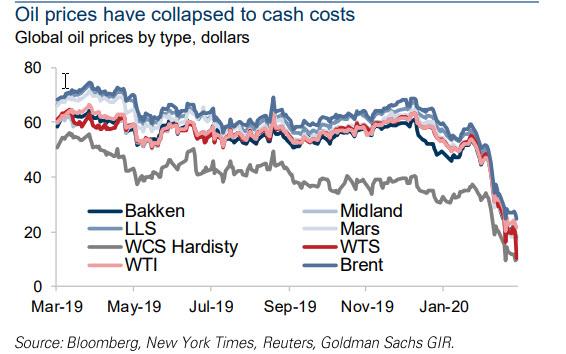
… today’s historic plunge in WTI – the biggest on record – which sent the price of the front-month future freefalling 40% to just $10/barrel…

… has resulted in selected Canadian crude oil prices now officially turning negative with Canada’s Edmonton C5 Condensate deep in the red…
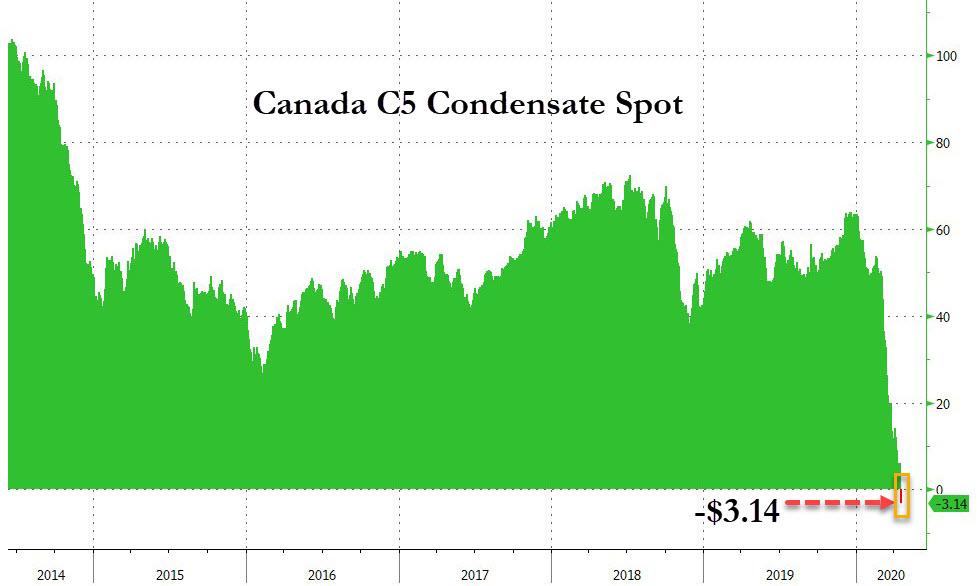
… while the Edmonton Mixed Sweet Blend dipped briefly negative for the first time ever before fractionally rebounding in the green.
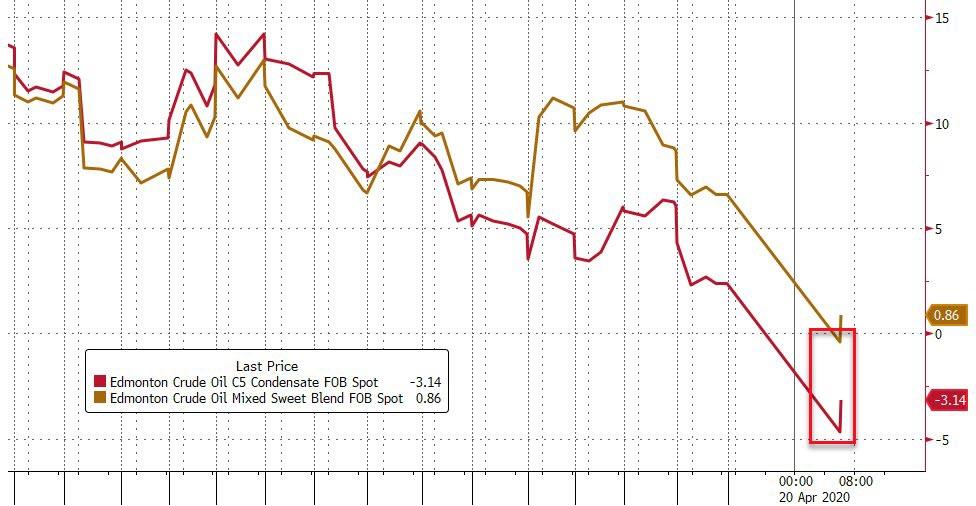
In other words, landlocked Canadian oil prdeucers – who don’t have easy access to expandable tanker storage – are now paying their customers to take the oil off their hands!
Why the historic plunge in the front-end? Simple: it shows the real demand and how much storage capacity there is for actual physical oil (virtually none), as opposed to speculating on future oil prices and hopes for a recovery, which however with every passing month will get dragged to the catastrophic spot (current-month) price. As such, where the May contract – which matures tomorrow – prices will show what the market for physical delivery looks like but as Adam Button notes, “the June contract is also increasingly ugly as it approaches the cycle low” adding that “so far retail keeps buying the dip but I think there’s a rising chance they puke it in the days ahead.”
And while retail keeps hoping that the Fed will somehow start buying crude next, Button is absolutely correct.
end
CLOSING OIL: 10.35
MAY OIL: 2.20
Crude Oil Futures QuotesGlobex
| Month | Options | Charts | Last | Change | Prior Settle | Open | High | Low | Volume | Hi / Low Limit | Updated | ||
|---|---|---|---|---|---|---|---|---|---|---|---|---|---|
|
|||||||||||||
| MAY 2020 | MAY 2020 | Show Price Chart | 2.20 | -16.07 | 18.27 | 3.48 | 17.85 | 1.02 | 130,435 | No Limit / 0.01 | 12:39:53 CT 20 Apr 2020 |
||
| JUN 2020 | JUN 2020 | Show Price Chart | 22.20 | -2.83 | 25.03 | 24.76 | 24.92 | 21.65 | 831,136 | No Limit / 0.01 | 12:39:53 CT 20 Apr 2020 |
||
| JUL 2020 | JUL 2020 | Show Price Chart | 27.69 | -1.73 | 29.42 | 29.33 | 29.41 | 26.88 | 182,496 | No Limit / 0.01 | 12:39:53 CT 20 Apr 202 |
||
Here’s The Next Problem: Where Do 100 Million Oil Barrels Get Delivered… And What Happens Next Month?
The entire financial world is watching in stunned amazement as the May WTI contract crashed as low as -$40, an unprecedented – until today – event, and one which is sparking frenzied speculation who will be oil’s “Amaranth”, the nat-gas trader which remains the best example of how futures-spread positions can go wrong.
But sooner or later, investors will ask themselves the next question: where will roughly 100 million barrels of oil be delivered. That is roughly the equivalent of the outstanding May WTI open interest of some 109 thousand contracts.
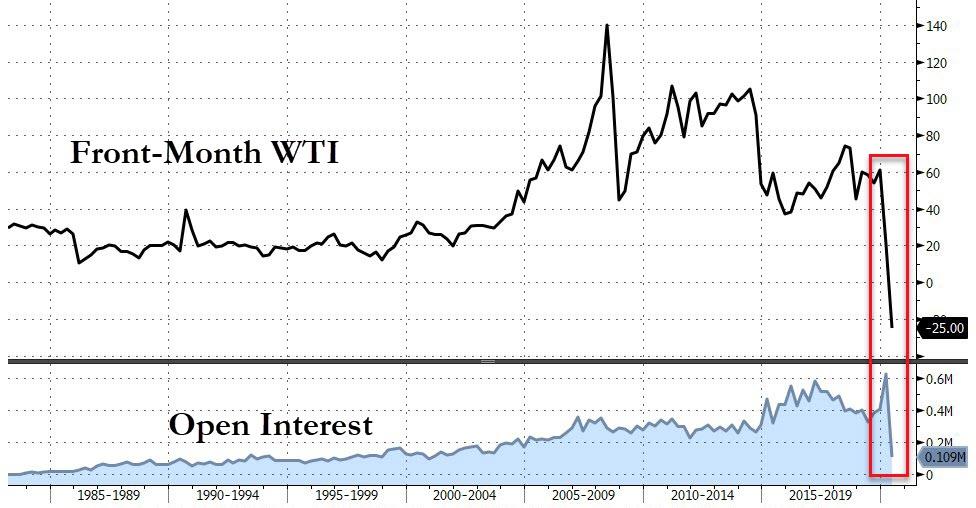
As Bloomberg’s Mike McGlone writes, “the greater-than-normal level of open interest in May futures has no place to go but is likely to mark an extreme, if history is a guide.”
As of April 17, there were over 100,000 open positions in the May contract, well above the five-year average of about 60,000. What is more striking is that while the May position stops trading at 230pm tomorrow, April 21, only about 2,000 contracts are usually delivered. This time we are looking at 100,000 contracts, or about 100 million barrels of oil. The question, of course, is where does all this oil get delivered in a world where commercial storage is expected to run out as soon as next month?
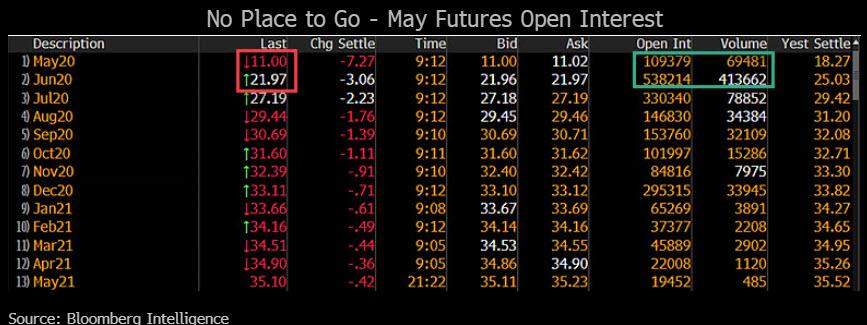
And let’s say the May contract somehow finds enough space – this brings up the June contract, which is trading at around $21.51 because somehow traders believe that some magical solution will present itself in the next 4 weeks (spoiler alert: it won’t). The open interest for June is 538K contract, or the equivalent of over half a billion barrels of. While much of this will be rolled up the contago-ing curve, this still means that the world is looking at hundreds of thousands of oil barrels to be delivered next month, and the question again: where will all this oil be delivered, and what happens to the price of WTI next month?
And what about July… and August… And September? As prominent squawker Yogi Chan put it best, “Back of the fag box: Take all WTI contracts from May 2020 through to Dec 2021 (covers 93% of all OI). Average price weighted by open interest? $43.48/bbl” (editor’s note: in the UK “fag” means cigarette)
Yogi Chan@Yogi_ChanBack of the fag box: Take all WTI contracts from May 2020 through to Dec 2021 (covers 93% of all OI). Average price weighted by open interest? $43.48/bbl #oott

The unfortunate answer: oil producers will have to eat the billions of dollars in foregone production even as they shut down and keep oil in the ground, suffering unprecedented losses by “selling” oil at negative prices.
To be sure, some had creative solutions, such as airplane guru and Editor in chief of the Air Current, Jon Ostrower:
Jon Ostrower
✔@jonostrower
Free dumb idea: Oil companies pay airlines to take oil. Airlines subsidize plane tickets with the proceeds.

Jon Ostrower
✔@jonostrower
I mean it’s no better or worse than handing every adult $1,200 one time.
Which brings us to the tragic, if accurate, conclusion from the FT’s energy director: “this is a colossal economic tragedy in the making right now.”
Derek Brower@derek_browerThis crash is going to destroy so many livelihoods and so many jobs. Whatever anyone thinks about the oil sector — and there many obvious reasons why the world needs to reduce oil use — this is a colossal economic tragedy in the making right now. #oott

And to think all of this could have been avoided if only the Fed had some way of printing oil storage in the US.
/sarc
8 EMERGING MARKET ISSUES
Your early morning currency/gold and silver pricing/Asian and European bourse movements/ and interest rate settings MONDAY morning 7:00 AM….
Euro/USA 1.0861 DOWN .0098 REACTING TO MERKEL’S FAILED COALITION/ REACTING TO +GERMAN ELECTION WHERE ALT RIGHT PARTY ENTERS THE BUNDESTAG/ huge Deutsche bank problems ///ITALIAN CHAOS//CORONAVIRUS /AND NOW ECB TAPERING BOND PURCHASES/JAPAN TAPERING BOND PURCHASES /USA RISING INTEREST RATES /FLOODING/EUROPE BOURSES /RED
USA/JAPAN YEN 107.76 UP 0.654 (Abe’s new negative interest rate (NIRP), a total DISASTER/NOW TARGETS INTEREST RATE AT .11% AS IT WILL BUY UNLIMITED BONDS TO GETS TO THAT LEVEL…
GBP/USA 1.2439 DOWN 0.0029 (Brexit March 29/ 2019/ARTICLE 50 SIGNED/BREXIT FEES WILL BE CAPPED/
USA/CAN 1.4119 UP .0127 CANADA WORRIED ABOUT TRADE WITH THE USA WITH TRUMP ELECTION/ITALIAN EXIT AND GREXIT FROM EU/(TRUMP INITIATES LUMBER TARIFFS ON CANADA/CANADA HAS A HUGE HOUSEHOLD DEBT/GDP PROBLEM// HUGE DROP IN PRICE OF OIL
Early THIS MONDAY morning in Europe, the Euro FELL BY 9 basis points, trading now ABOVE the important 1.08 level FALLING to 1.0861 Last night Shanghai COMPOSITE CLOSED UP 14.06 POINTS OR 0.50%
//Hang Sang CLOSED DOWN 49.98 POINTS OR 0.20%
/AUSTRALIA CLOSED DOWN 2,34%// EUROPEAN BOURSES ALL RED
Trading from Europe and Asia
EUROPEAN BOURSES ALL RED
2/ CHINESE BOURSES / :Hang Sang CLOSED DOWN 49.98 POINTS OR 0.20%
/SHANGHAI CLOSED UP 14.06 POINTS OR 0.50%
Australia BOURSE CLOSED DOWN 2.34%
Nikkei (Japan) CLOSED DOWN 228.14 POINTS OR 1.15%
INDIA’S SENSEX IN THE RED
Gold very early morning trading: 1686.00
silver:$15.21-
Early MONDAY morning USA 10 year bond yield: 0.63% !!! DOWN 1 IN POINTS from FRIDAY’S night in basis points and it is trading WELL BELOW resistance at 2.27-2.32%.
The 30 yr bond yield 1.26 DOWN 1 IN BASIS POINTS from FRIDAY night.
USA dollar index early MONDAY morning: 100.10 UP 26 CENT(S) from FRIDAY’s close.
This ends early morning numbers MONDAY MORNING
xxxxxxxxxxxxxxxxxxxxxxxxxxxxxxxxxxxxxxxxxxxxxxxxxxxxxxxxxxxxxxxxxxxxxxxxxxxxxxxxxxxxxxxxxxxxxxxxxxxxxxxxxxxxxx6
And now your closing MONDAY NUMBERS \1: 00 PM
Portuguese 10 year bond yield: 1.04% UP 9 in basis point(s) yield from YESTERDAY/
JAPANESE BOND YIELD: +.01% DOWN 1 BASIS POINTS from YESTERDAY/JAPAN losing control of its yield curve/56
SPANISH 10 YR BOND YIELD: 0.89%//UP 8 in basis point yield from yesterday.
ITALIAN 10 YR BOND YIELD:1,94 UP 10 points in basis points yield from yesterday./
the Italian 10 yr bond yield is trading 105 points higher than Spain.
GERMAN 10 YR BOND YIELD: FALLS TO –.44% IN BASIS POINTS ON THE DAY//
THE IMPORTANT SPREAD BETWEEN ITALIAN 10 YR BOND AND GERMAN 10 YEAR BOND IS 2.38% AND NOW ABOVE THE THE 3.00% LEVEL WHICH WILL IMPLODE THE ENTIRE ITALIAN BANKING SYSTEM. AT 4% SPREAD THERE WILL BE A HUGE BANK RUN…
END
IMPORTANT CURRENCY CLOSES FOR TUESDAY
Closing currency crosses for TUESDAY night/USA DOLLAR INDEX/USA 10 YR BOND YIELD/1:00 PM
Euro/USA 1.0873 UP .0003 or 3 basis points
USA/Japan: 107.69 UP .550 OR YEN DOWN 55 basis points/
Great Britain/USA 1.2461 DOWN .0008 POUND DOWN 8 BASIS POINTS)
Canadian dollar DOWN 61 basis points to 1.4054
xxxxxxxxxxxxxxxxxxxxxxxxxxxxxxxxxxxxxxxxxxxxxxxxxxxxxxxxxxxxxxxxxxxxxxxxxxxxxxxx
The USA/Yuan,CNY: AT 7.0735 ON SHORE (DOWN)..GETTING DANGEROUS
THE USA/YUAN OFFSHORE: 67.0811 (YUAN DOWN)..GETTING REALLY DANGEROUS
TURKISH LIRA: 5.9490 EXTREMELY DANGEROUS LEVEL/DEATH WISH.
the 10 yr Japanese bond yield closed at +.01%
Your closing 10 yr US bond yield DOWN 1 IN basis points from FRIDAY at 0.64 % //trading well ABOVE the resistance level of 2.27-2.32%) very problematic USA 30 yr bond yield: 1.25 DOWN 1 in basis points on the day
Your closing USA dollar index, 99.93 UP 9 CENT(S) ON THE DAY/1.00 PM/
Your closing bourses for Europe and the Dow along with the USA dollar index closing and interest rates for MONDAY: 12:00 PM
London: CLOSED UP 3.91 0.12%
German Dax : CLOSED UP 29.28 POINTS OR .28%
Paris Cac CLOSED UP 20.69 POINTS 0.46%
Spain IBEX CLOSED DOWN 68.10 POINTS or 0.99%
Italian MIB: CLOSED DOWN 17.76 POINTS OR 0.10%
WTI Oil price; 10.35 12:00 PM EST/DEADLY TO CANADA AND THE SHALE BOYS
Brent Oil: 26.48 12:00 EST
USA /RUSSIAN / RUBLE FALLS: 74.58 THE CROSS HIGHER BY 0.56 RUBLES/DOLLAR (RUBLE LOWER BY 56 BASIS PTS)
TODAY THE GERMAN YIELD FALLS TO –.44 FOR THE 10 YR BOND 1.00 PM EST EST
END
This ends the stock indices, oil price, currency crosses and interest rate closes for today 4:30 PM
Closing Price for Oil, 4:00 pm/and 10 year USA interest rate:
WTI CRUDE OIL PRICE 4:30 PM : –32.25// YES!! NEGATIVE 32.25!!
BRENT : 26.07
USA 10 YR BOND YIELD: … 0.63.. down 2 basis points.
USA 30 YR BOND YIELD: 1.23..down 4 basis points..
EURO/USA 1.0859 ( DOWN 11 BASIS POINTS)
USA/JAPANESE YEN:107.71 UP .565 (YEN DOWN 57 BASIS POINTS/..
USA DOLLAR INDEX: 100.01 UP 23 cent(s)/
The British pound at 4 pm Britain Pound/USA:1.2431 DOWN 37 POINTS
the Turkish lira close: 6.9444
the Russian rouble 75.25 DOWN 1.22 Roubles against the uSA dollar.( DOWN 122 BASIS POINTS)
Canadian dollar: 1.4126 DOWN 134 BASIS pts
German 10 yr bond yield at 5 pm: ,-0.44%
The Dow closed DOWN 592.05 POINTS OR 2.44%
NASDAQ closed DOWN 89.41 POINTS OR 1.03%
VOLATILITY INDEX: 43.16 CLOSED UP 5.01
LIBOR 3 MONTH DURATION: 1.109%//
libor-OIS: 1.042 //rising again
USA trading today in Graph Form
The Market Is Breaking… Everywhere
Today was historic…
…for a number of reasons.
1) Front-month oil traded at an utterly irrational and unprecedented negative $43 intraday (this was not about storage into settlement, this was forced selling into settlement, then notice the bounce, and then later more selling.)
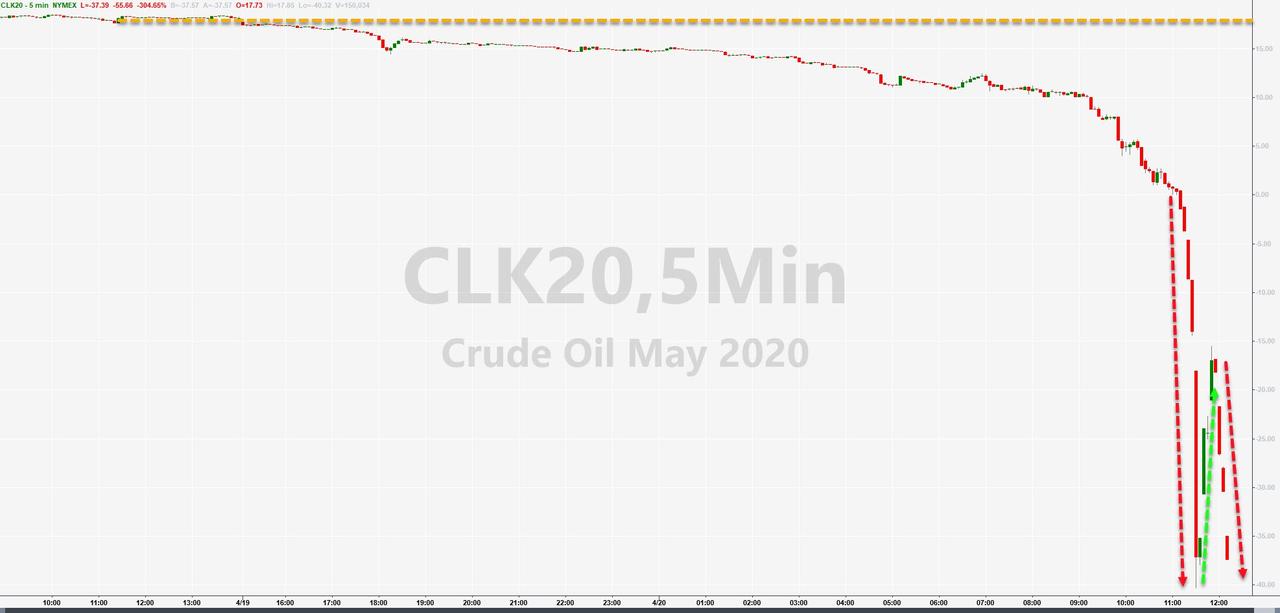
2) Oil’s prompt-spread exploded to a record negative $60 (smells like at least one fund was carried out on an arb)
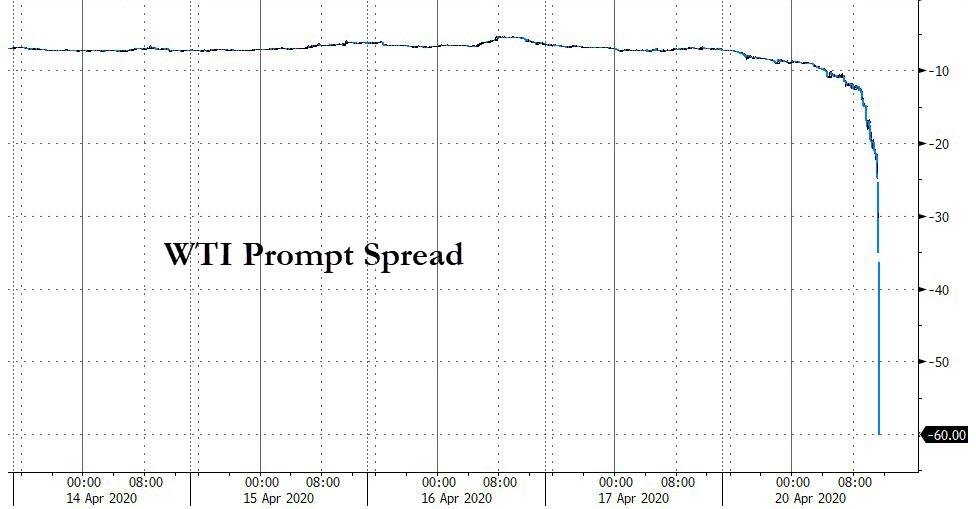
Source: Bloomberg
3) Oil ‘VIX’ exploded today to record highs…
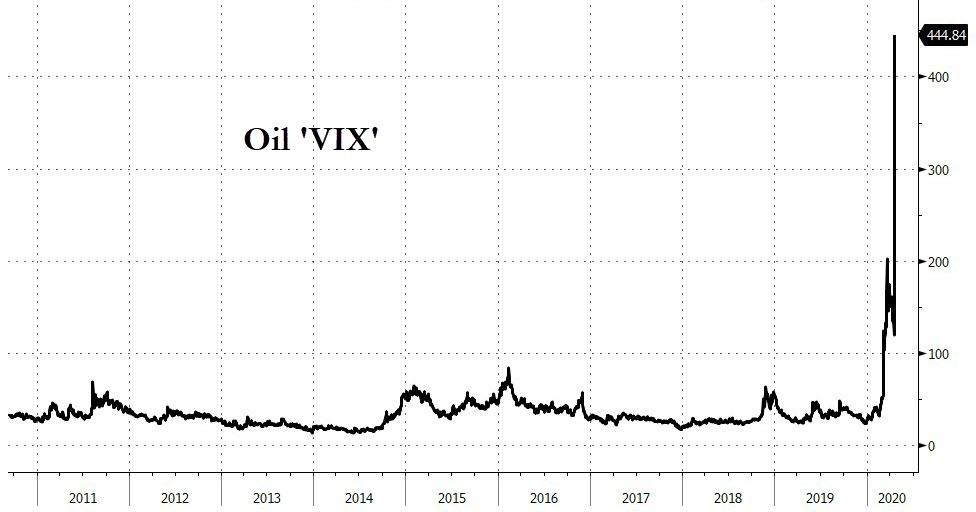
Source: Bloomberg
4) Russell 2000 ‘VIX’ has never been higher relative to Nasdaq ‘VIX’ than today (The widening gap reflects the damage being done to smaller companies by the coronavirus, Julian Emanuel, head of equity and derivatives strategy at BTIG LLC, wrote in a report.)…
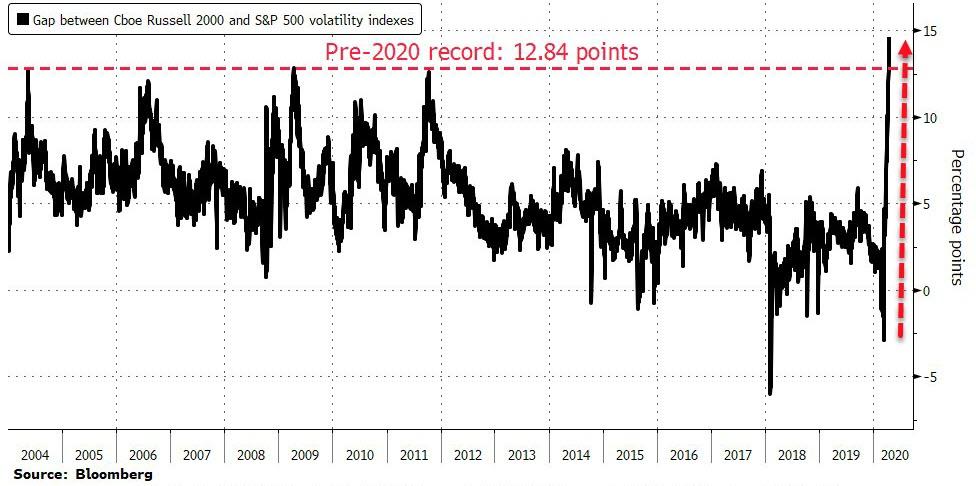
Source: Bloomberg
5) A AAA CLO tranche failed its O/C test (this is a major liquidity problem – it means that a key pillar of the credit market will be crushed for years: CLOs have been the biggest buyers in the $1.2 trillion leveraged loan market, helping fuel a surge in debt-fueled buyouts and other transactions.)
6) Liquidity shortages reappeared as the 3m FRA-OIS Spread blew out once again… despite the massive injections of cash from The Fed…
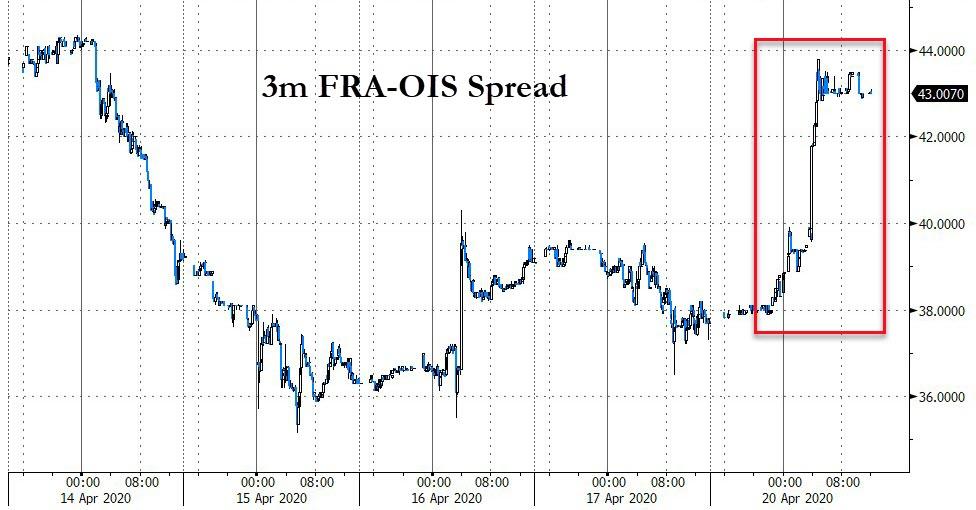
Source: Bloomberg
7) US Macro-economic data crashed at a record pace back to the worst levels since the peak of the 2008 financial crisis…

Source: Bloomberg
* * *
World stocks continue to make a mockery of every rational investor…
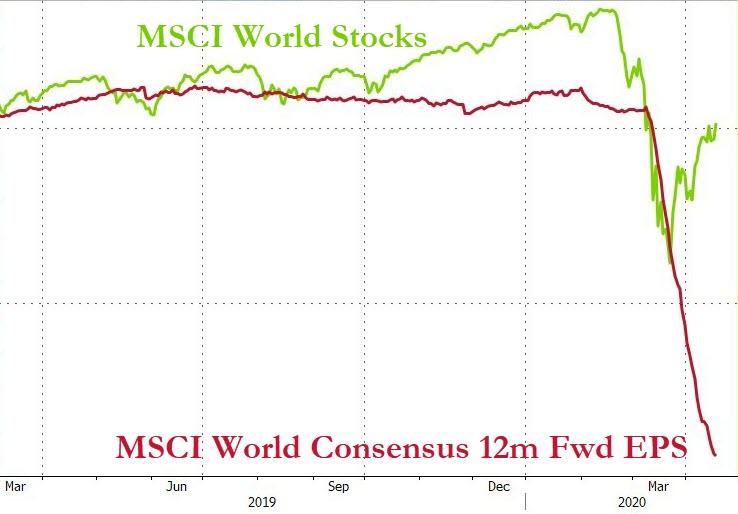
Source: Bloomberg
Chinese markets were a shitshow overnight when the CSI-300 Healthcare Index crashed 17% for no good reason, hung around there for hours and then spiked back to the green…
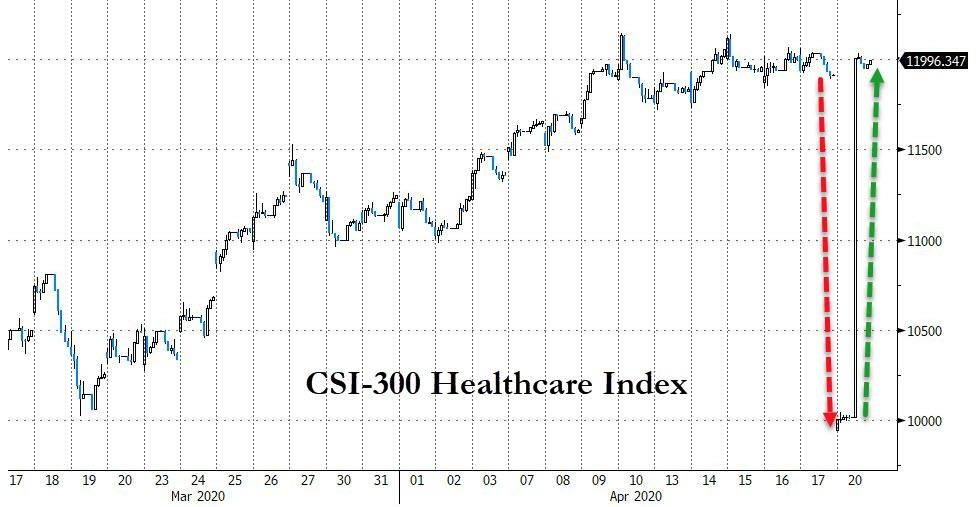
Source: Bloomberg
European stocks roundtripped from ugliness overnight to end mixed but all eyes were on Italian credit markets which were once again starting to signal redenomination risk…

Source: Bloomberg
US equity markets were in the red on the day with Nasdaq relatively outperforming once again and Trannies weakest (odd given the huuuge benefits from oil’s collapse)…NOTE the red rectangle shows the drop in all stocks as oil crashed into settlement…
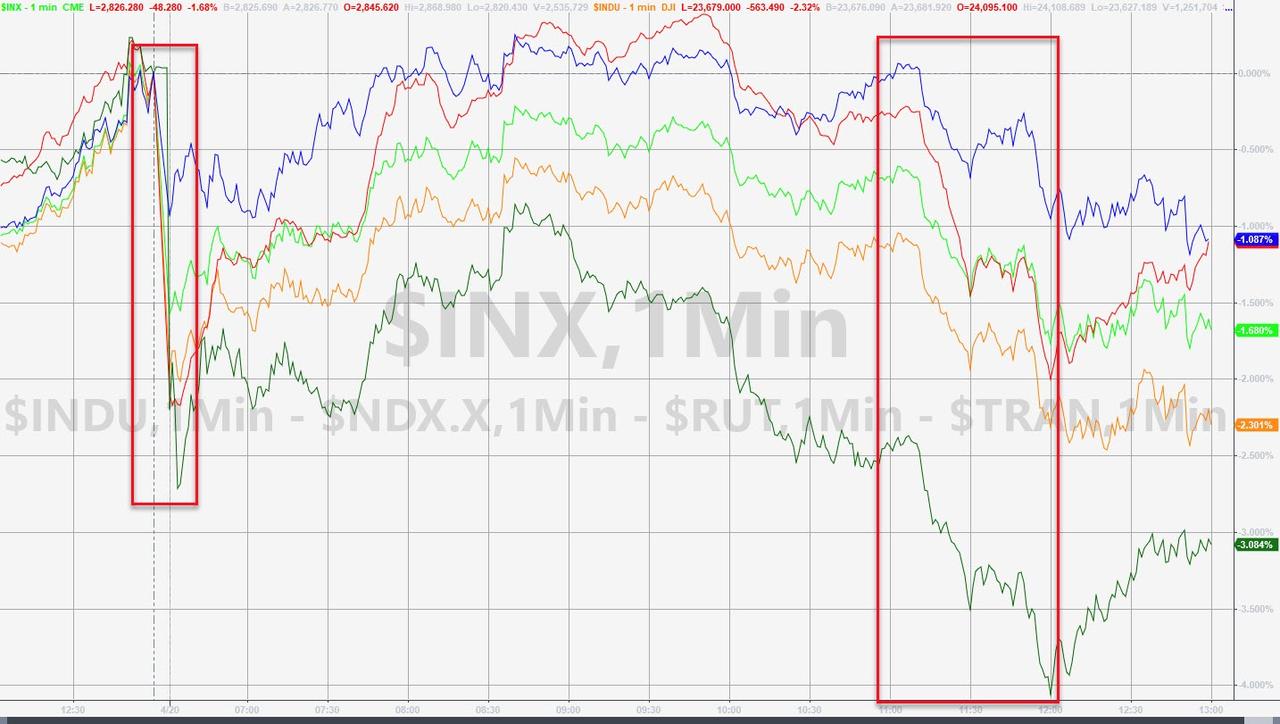
Remember the last few minutes on Friday where The Dow shot up almost 400 points… well that’s all gone now…
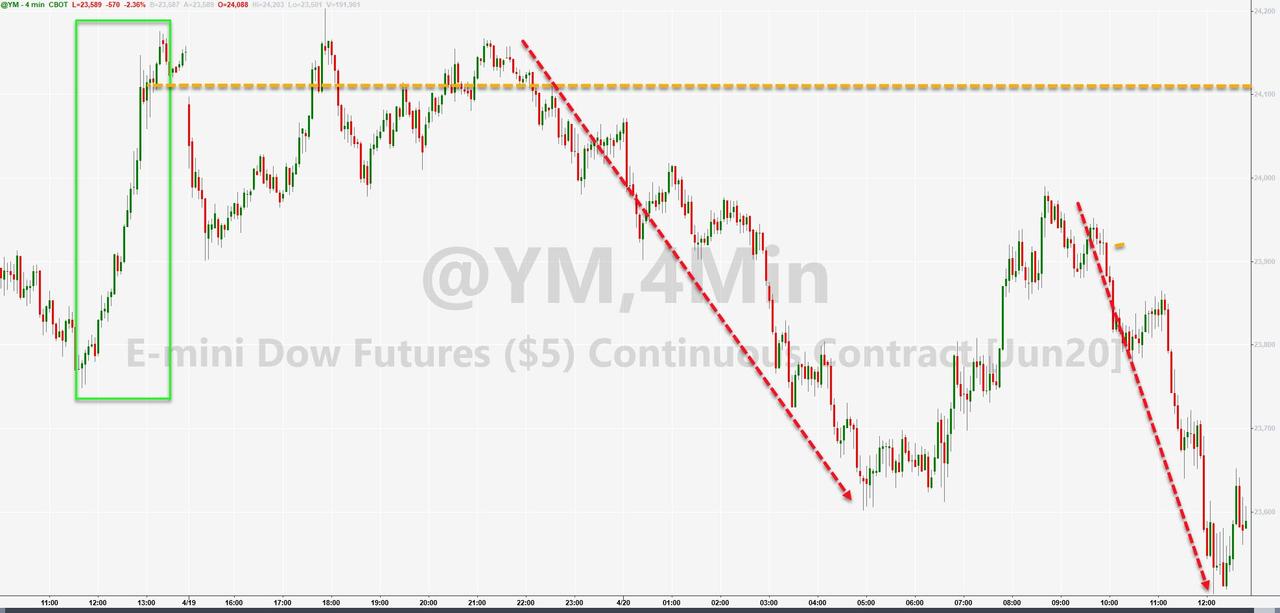
The Dow was unable to hold above the 50% retrace level…

FANG Stocks made another new record high today…
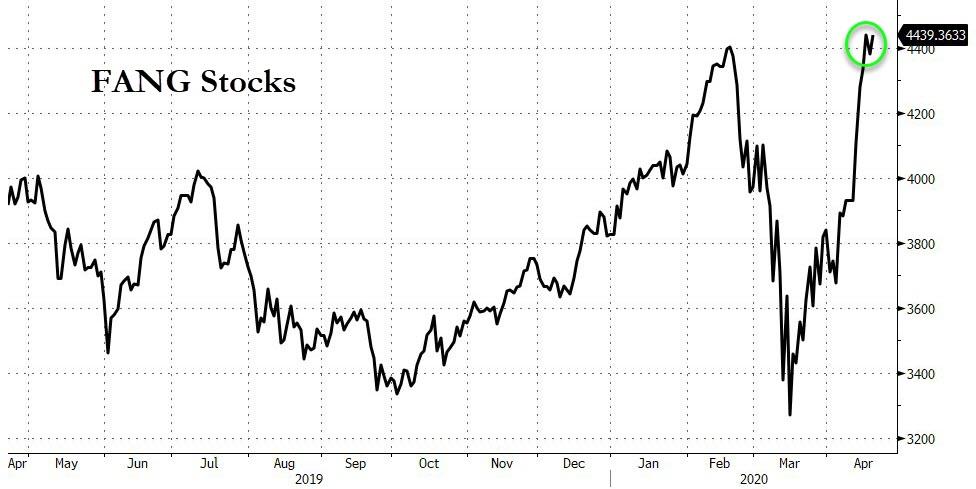
Source: Bloomberg
Both HY and IG credit markets stumbled today…
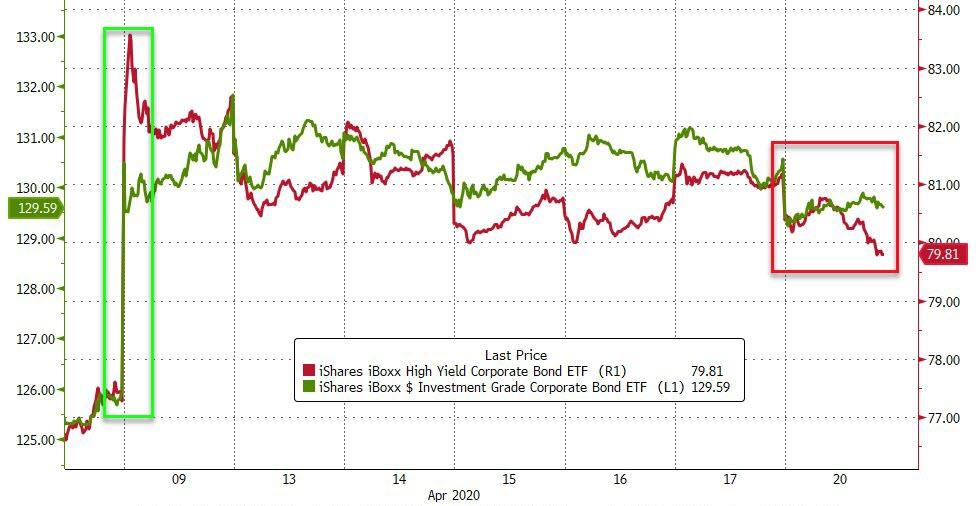
Source: Bloomberg
Treasury yields largely shrugged off everything today ending modestly lower (2Y -1bps, 30Y -3bps)…
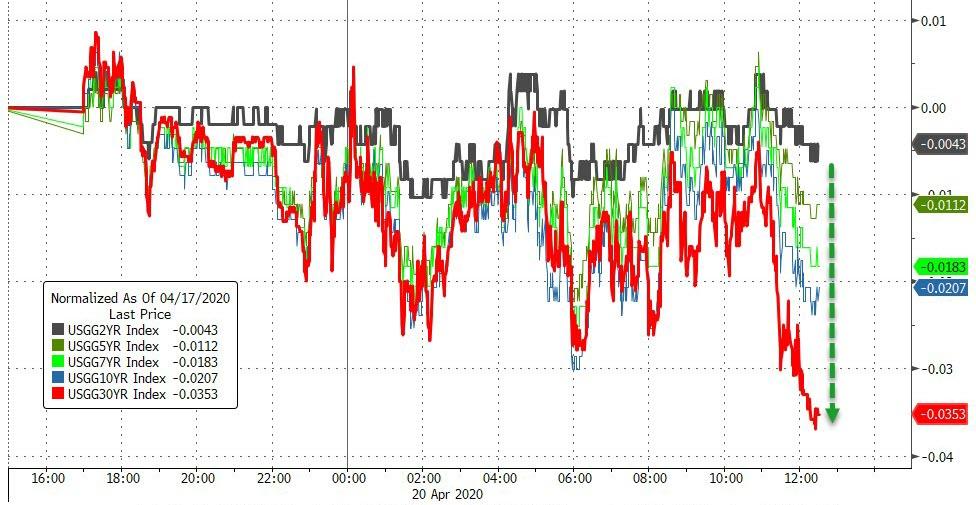
Source: Bloomberg
10Y Yield drifted lower…
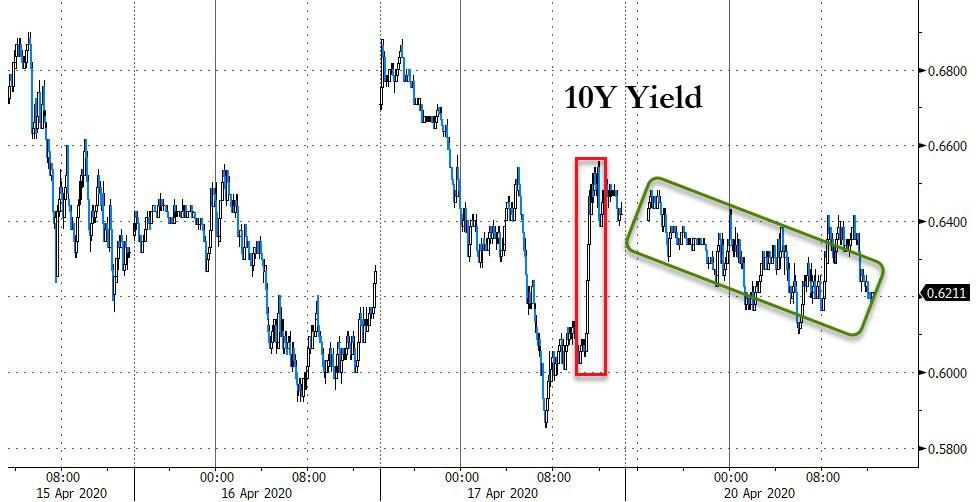
Source: Bloomberg
The dollar trod water today for a second day, ending slightly higher…
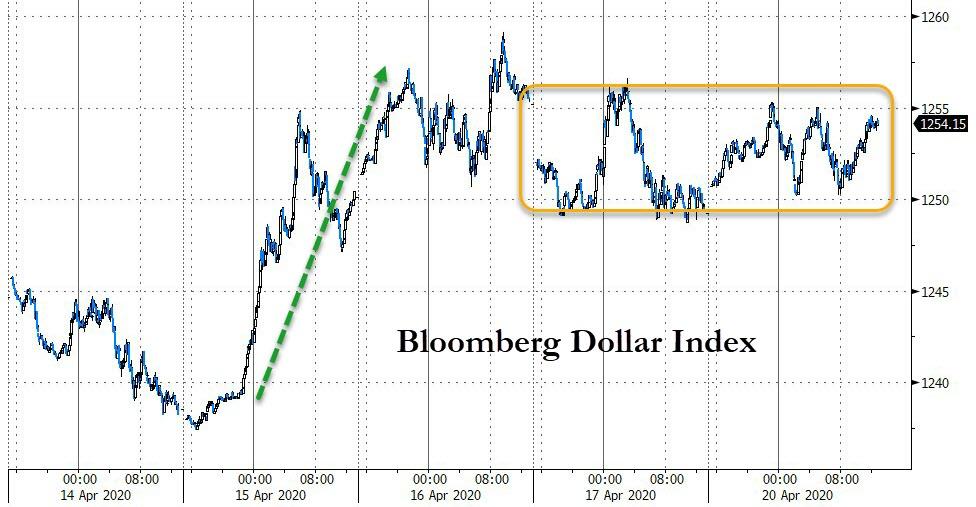
Source: Bloomberg
Cryptos had an ugly day today, erasing gains from the weekend…
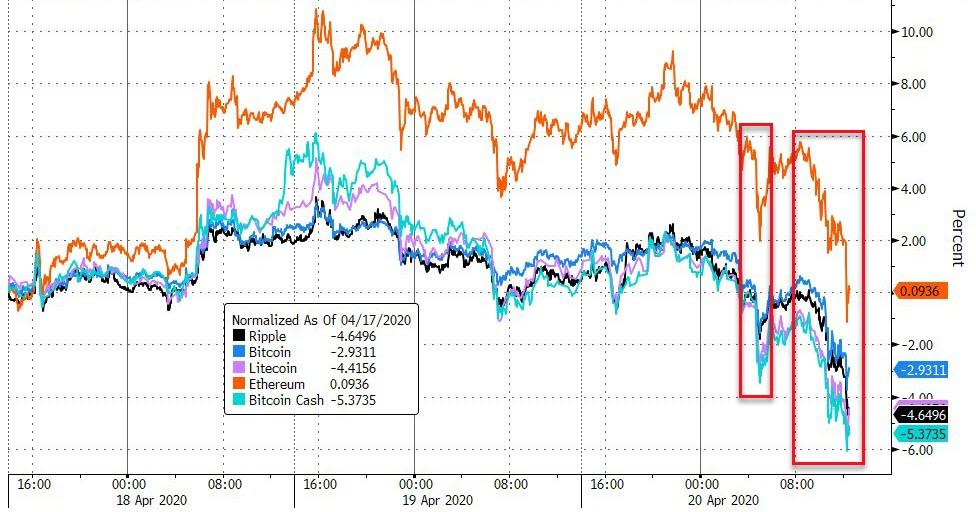
Source: Bloomberg
Gold prices rallied on the day (spot and futures) and compressed the premium modestly…
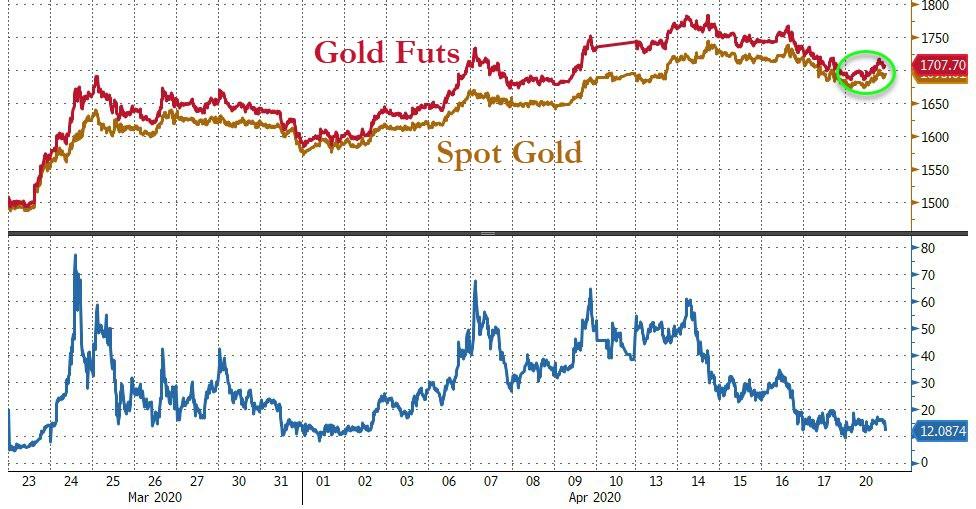
Source: Bloomberg
Finally, the price of a barrel of oil has traded generally between 2.5oz and 5oz of silver for over 40 years… until today – using the June contract, it now costs just 1.3oz of silver to buy a barrel of oil – the cheapest ever.
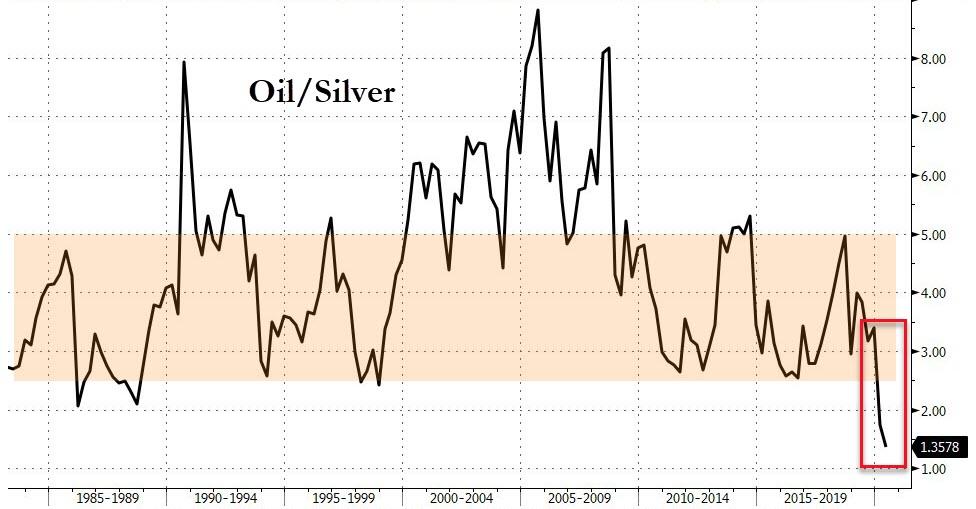
Source: Bloomberg
end
And now your more important USA stories which will influence the price of gold/silver
MARKET TRADING//USA
a)Market trading/LAST NIGHT/USA
b)MARKET TRADING/USA/AFTERNOON
The Last Time This Happened To Oil, Stocks Collapsed 30%
While the velocity of stock markets’ rebound is making headlines, it’s the energy complex that is screaming at the top of its lungs – something is wrong, very wrong.
A total bloodbath in black gold this morning as a combination of fundamental (weaker and weaker demand outlooks as global GDP forecasts collapse and headlines that Russia actually increased supply by 1% in the last 3 days) and technical (massive flows into USO – the Oil ETF – and shifts in the way the ETF is constructed to use 2nd month futures, combined with the contract roll) has sent the front-month (May) WTI futures down a stunning 40%-plus….
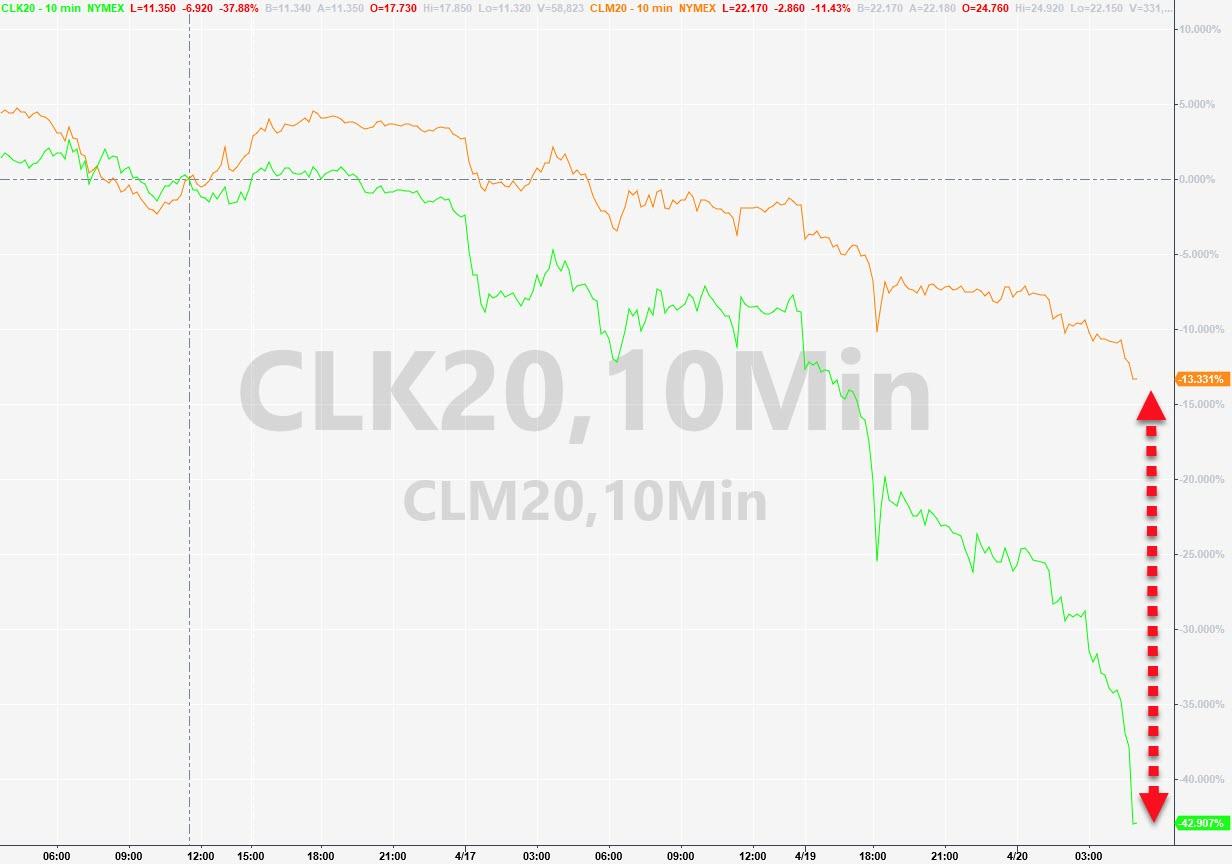
With the May contract trading with an $10 handle…
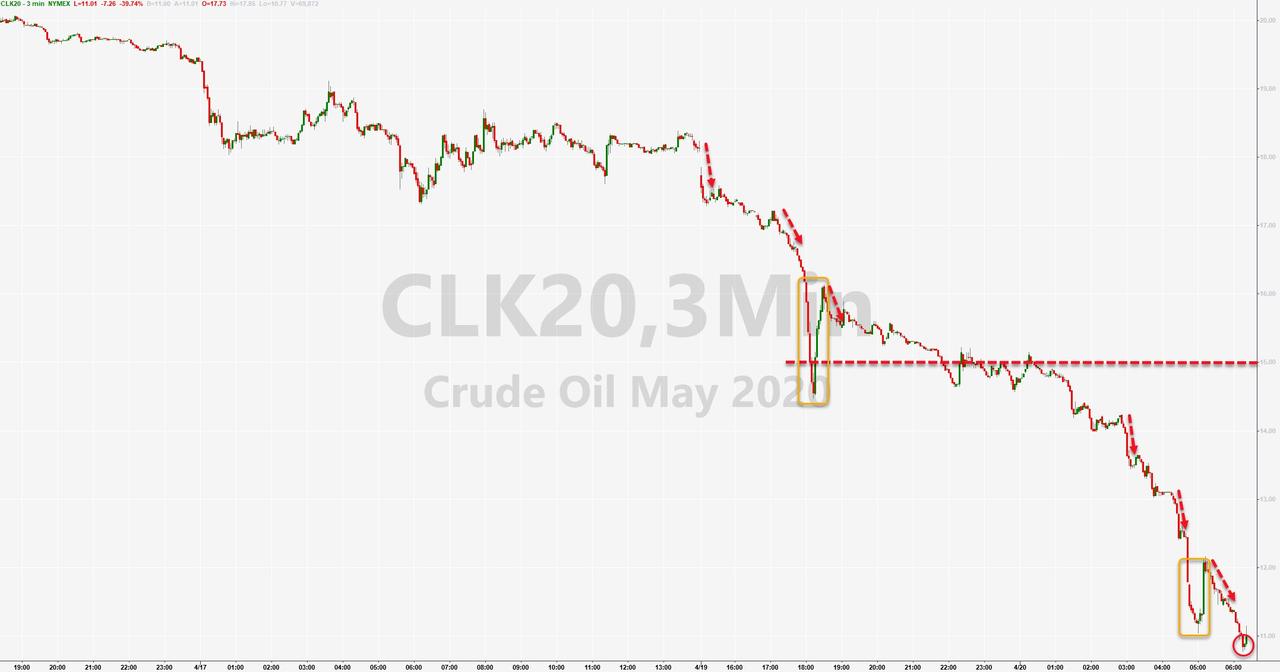
Most critically, the prompt-spread (between May and June in this case) has collapsed to record lows…
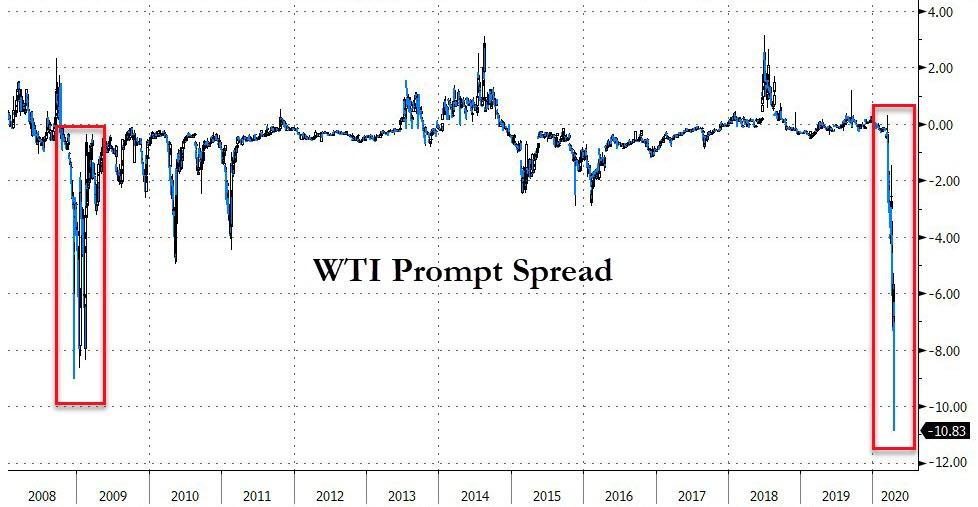
We have seen this pattern before – as the chart above suggests. Bloomberg’s Cameron Crise also notes that the last time we saw such a huge spike the prompt-spread was December 2008… which just happens to coincide with an equally impressive surge/rebound in US equity markets (27.5% on a trough to peak basis from mid-November to early January)… only to end very badly around 30% lower…
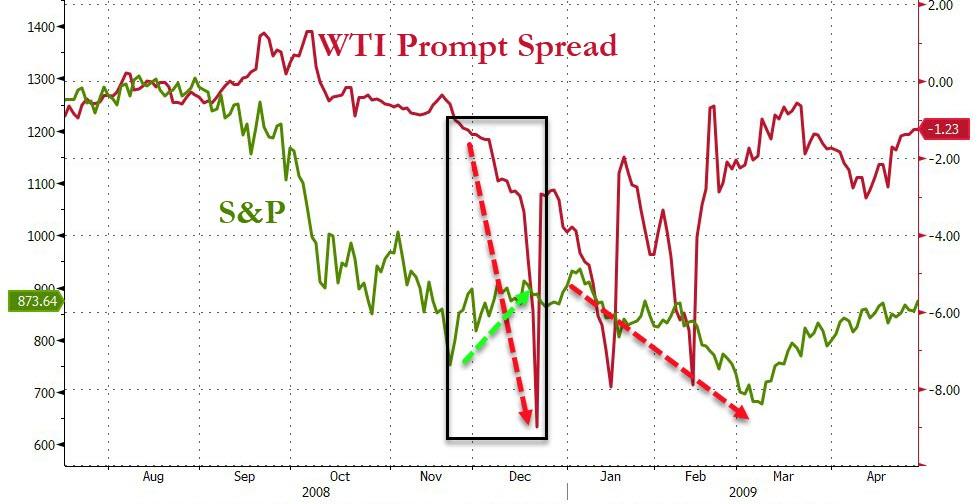
Coincidence that we are seeing the exact same pattern play out as stocks soar and oil’s curve implodes?
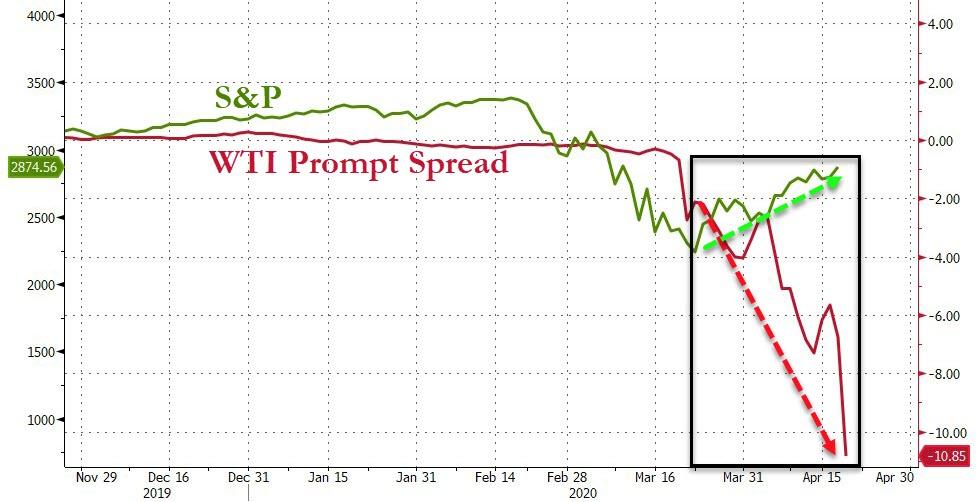
As Crise warns, maybe the oil market is offering a warning of just how significant the economic damage will be – damage that you could argue is no longer reflected in the price of equities (which seem entirely focused on The Fed put and vaccine/treatment hopes).
Trade accordingly.
end
ii)Market data/USA
Muni market collapse is imminent as much of this debt is backed by revenue received from the asset and this has disappeared
(zerohedge)
Muni Market Chaos Sparked By Covid Has Potential To Trigger Default Tsunami
The economic collapse triggered by COVID-19 lockdowns across America has torpedoed the municipal bond market, which has come under severe stress in the last 4-6 weeks. The Federal Reserve has expanded a bailout facility to make sure liquidity continues to flow to crucial states and municipal money markets. However, it appears a tidal wave of muni defaults is nearing.
About 22 million Americans have lost their jobs in the last four weeks, the quickest ever period of job loss in the country’s history, as it now appears turmoil is about to be unleashed deep inside the $3.9 trillion muni bond market.
Bloomberg notes, “hospitals, airports, stadiums and speculative ventures like the Virgin Trains USA railroad in Florida” have survived over the years through debt sales via government agencies, and much of this debt is backed by the revenue received from the asset.

And now it becomes increasingly evident with much of the country in lockdown, millions out of work, and an economic depression that is unfolding, many of these companies that issued debt through muni markets might not be able to service their obligations and trigger a wave of defaults.
“Speculation about such strains contributed to a record-setting pullback from municipal-bond funds last month, sending prices tumbling by the most in at least four decades until they rebounded on optimism about the $2.2 trillion economic stimulus enacted in Washington,” Bloomberg notes.
Bloomberg compiled a list of borrowers that suggests the default wave has already begun:
Senior Living
Senior living centers were already among the riskiest borrowers in the municipal market and the deadly pandemic that’s swept through many homes for the elderly has made them even more so. At least eight senior living facilities have either defaulted or reported some kind of trouble since mid-March, according to data compiled by Municipal Market Analytics.
PSL Wiregrass LP, which issued $23 million bonds through Capital Trust Agency in Florida to build an 110-bed senior living facility, defaulted on its April 1 interest payment, in part because of cost increases connected to the virus. The Trousdale Foundation had to draw on reserve funds to make a April 1 bond payment, saying its financial strains have been “exacerbated” by additional staffing and safety protocols.
Factory Closures
A tire recycling company in Terre Haute, Indiana, said it won’t be able to make loan payments backing municipal bonds sold in 2017 after the facility suspended production due to the virus, according to an April 6 regulatory filing by Pyrolyx USA Indiana LLC. The company has an interest payment due on June 1 it is unlikely to make.
Columbia Pulp I LLC, a waste-to-pulp facility in Washington, has also suspended operations. Because of the uncertainty about when it will reopen, the company said it is looking to pursue “additional sources of capital to sustain its operations through this challenging time,” according to an April 6 filing.
A California company building the world’s first facility for converting debris from rice cultivation into fiberboard said it will run out of money in May, according to a filing to bondholders by CalPlant I LLC. The company said the coronavirus pandemic has caused construction delays and higher expenses.
Proton Facilities
The Provision Cares Proton Therapy Center, which operates facilities in Tennessee, said April 2 “under normal operating conditions, the operating proton centers have been unable to generate sufficient cash flow to service the bond debt.” But the reduced number of patients because of the virus outbreak has made it even worse. Provision estimated the center’s cash deficit after debt service for 2020 will be negative $16.9 million, a $6.5 million increase from 2019.
Transportation
Virgin Trains USA, which runs a passenger railroad in Florida, issued a combined $2.7 billion in municipal bonds in 2019 to fund its extension to Orlando, a crucial step in its effort to turn a profit. It temporarily shut down after tourists and business travelers disappeared virtually overnight. In a disclosure document to bond holders the company said they plan to “monitor the situation” to decide when to reopen, maintaining that the construction work on the new leg is continuing on schedule. Ben Porritt, a spokesperson for Virgin Trains, declined to provide additional comment.
The Las Vegas Monorail, which has already gone bankrupt once, asked for bondholders’ consent to use cash in reserves for operations and to temporarily suspend required payments to those funds, according to a letter dated April 3. The Monorail indefinitely suspended service on March 18.
Besides the Fed meddling in municipal bond markets, we would like to remind readers the Fed is also intervening directly in:
- Treasury markets
- Corporate bond markets (both IG and HY)
- Commercial paper markets (short-term corporate debt market)
- Asset-backed security market (everything from student loans to Certificates of Deposit and more)
It appears the Fed might be powerless over the latest muni default wave..
end
Fed activity index crashes into deep recession (deep depression territory)
(zerohedge)
Fed’s National Activity Index Crashes Into Deep Recession Territory
On the heels of ‘hard’ data crashing (retail sales, industrial production, and employment) and ‘soft’ data seeing all hope evaporating with regional Fed surveys collapsing at record pace, it is not surprising that The Fed’s National Activity Index has also suddenly imploded.
Regional Fed Surveys have crashed in the last month – after making cyclical highs on the confusing surge in supply chain delivery times…
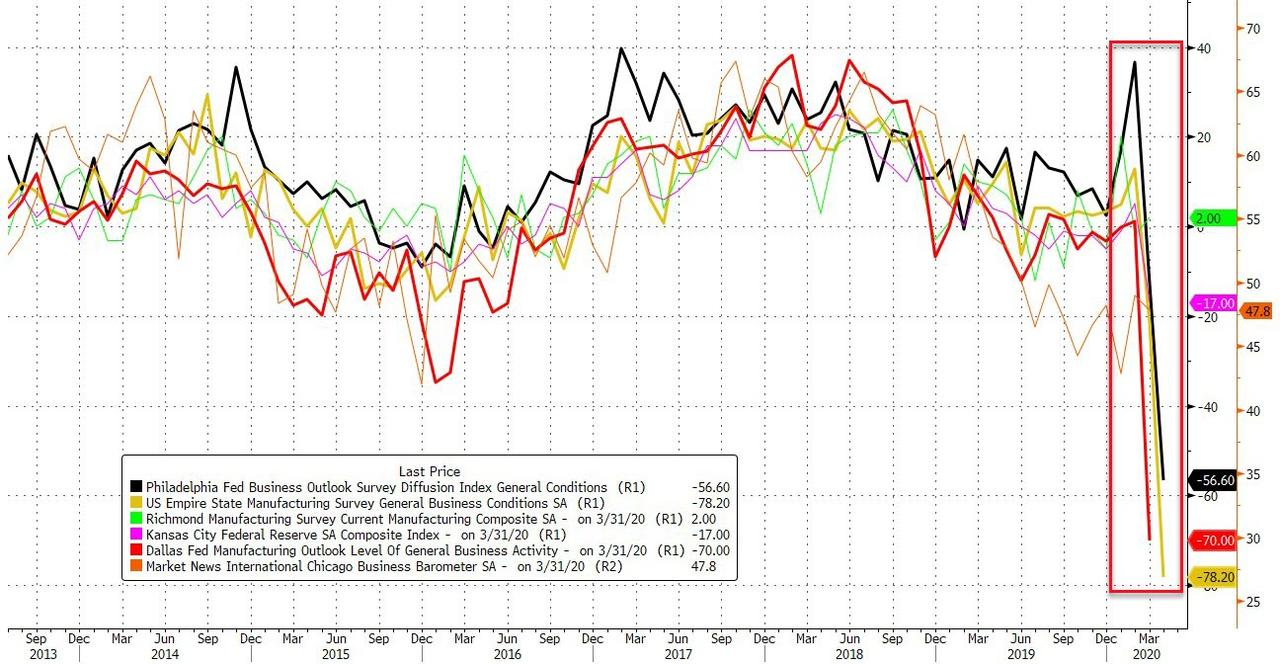
And that combined with the biggest disappointments in US macro data on record, has sent The Chicago Fed’s National Activity Index careening towards its deepest recession since the 70s…

All four broad categories of indicators used to construct the index made negative contributions in March, and three of the four categories decreased from February.
- 18 of the 85 monthly individual indicators made positive contributions
- 65 of the 85 monthly individual indicators made negative contributions
The drop was led by weaker production (-2.72) and employment indicators (-1.23) that highlight the severe impact of the COVID-19 pandemic… and this is before 80% of the nation was locked down in April!
end
Trump ends the grant of 3.7 million dollars to the Wuhan lab
(Watson/Summit News)
Watch: Trump Vows To End Obama Admin’s Funding To Wuhan Virus Lab
Authored by Steve Watson via Summit News,
President Trump vowed over the weekend to end US funding to the tune of $3.7 million that had been approved to the Wuhan Institute of Virology by the Obama administration.
With questions swirling over the lab being the possible source of the coronavirus outbreak, Trump addressed the issue when asked at the press briefing.
“The Obama administration gave them a grant of $3.7 million. I’ve been hearing about that. We’ve instructed that if any grants are going to that area, we are looking at it literally about an hour ago and also early in the morning,” Trump said.
“We will end the grant very quickly. It was granted quite a while ago. They were granted a substantial amount of money. We are going to look at it and take a look. But I understand it was a number of years ago.” Trump further noted.
The President asked the reporter who brought up the issue when the grant when given. When she replied 2015, Trump said “2015. Who was president then? I wonder.”
Republican Florida Rep. Matt Gaetz, who had previously raised the issue in an appearance on Fox News, tweeted his approval for Trump’s promise to end the funding:
Rep. Matt Gaetz
✔@RepMattGaetz
“The Obama administration gave them a grant of $3.7 million…we will end that grant very quickly.”
Thank you President @realDonaldTrump and @SecAzar for committing to end this America Last grant given to labs in Wuhan by the Obama administration!


The President’s promise came with an acknowledgement that the government is investigating the origins of the virus, including the lab in Wuhan:
iii) Important USA Economic Stories
Housing activists in New York are urging a massive wave of rent strikes. They feel that landlords have been taken care and thus the “authority to a rent strike”
(zerohedge)
NYC Housing Activists Urge “Massive Wave” Of Rent-Strikes Because “Landlords Have Gotten Taken Care Of”
The wealth inequality story is not a complicated one to figure out. In essence, tens of millions of Americans were already suffering from insurmountable debts, no savings, and low wage jobs, even before the pandemic unfolded and crashed the economy.
Now the working-class poor are starting to get angry, sitting on their couches in quarantine, as they have recently been laid off, only to watch President Trump at afternoon press briefings tout about his epic bailouts of corporate America and Wall Street, while everyone else gets a lousy $1,200 check.
A “social bomb” is brewing in America – we’ve been documenting how the next crisis could be a social one. The bottom 90% of Americans are getting smarter by the day as they sit in lockdown, now organizing on the internet, and are plotting their very next big move that could be severely disruptive: rent strikes.
New York City housing activists are preparing to unleash a “massive wave” of rent strikes in the next two weeks, reported Bloomberg.
Housing Justice For All hopes to have as many as one million New Yorkers on May 1 participate in a rent strike to pressure Gov. Andrew Cuomo to cancel rent for the duration of the lockdown.
“With so many New Yorkers unable to pay rent for the foreseeable future, the current crisis is unsustainable and demands action,” Housing Justice for All and New York Communities for Change said in a statement Thursday. “Many tenants have no ability to pay rent, and landlords can’t collect rent from tenants who are broke.”
Lena Melendez, an activist who spoke with Bloomberg, said people in her building have organized and will not pay rent on May 1.
Melendez said landlords “have gotten taken care of” by the government, making the case that working-class poor do not need to pay rent.
“They have gotten tax abatements and deferments on their mortgages. And tenants have just gotten a temporary freeze, a pause, on evictions,” she said.
New York City’s Independent Budget Office projects about half a million people will lose their jobs in 2020. The city has been thrown into a recession, if not depression for the 1H20, as a social crisis is brewing…
How long until rent strikes start developing in other large major metros?
end
Huge number of homeless people at a Boston shelter tested positive and all of these were asymptomatic. No doubt the virus has mutated from the deadly man made form to its natural state. ie. the common cold.
(zerohedge)
Shocking Report Shows Half The Homeless At Boston Shelter Tested Positive For COVID-19: And None Had Symptoms
Researchers and clinicians who have ‘experimented’ with random mass testing for COVID-19 have made some pretty amazing – and amazingly depressing – discoveries. Yesterday, we shared a report about one sweeping antibody testing regime set up by researchers in Santa Clara County in California.
The study found that the estimated level of novel coronavirus penetration in the county was “50-80% higher” than what had been recorded.
If that isn’t enough to terrify every day trader who ratcheted up their exposure heading into the weekend, a news story about another surprising discovery – this time on the East Coast – has just come to our attention.
After a cluster of cases involving residents of a South Boston homeless shelter, Massachusetts public health officials tested every resident of the Pine Street shelter in Boston’s South End.

The results have garnered the attention of the CDC, which is “actively investigating the situation,” according to Boston 25 News.
The CDC is now “actively looking into” into universal COVID-19 testing at Pine Street Inn homeless shelter.
The broad-scale testing took place at the shelter in Boston’s South End a week and a half ago because of a small cluster of cases there.
Of the 397 people tested, 146 people tested positive. Not a single one had any symptoms.
“It was like a double knockout punch. The number of positives was shocking, but the fact that 100 percent of the positives had no symptoms was equally shocking,” said Dr. Jim O’Connell, president of Boston Health Care for the Homeless Program, which provides medical care at the city’s shelters.
O’Connell said that the findings have changed the future of COVID-19 screenings at Boston’s homeless shelters.
The big takeaway, if you couldn’t tell, is that a pattern is developing here: When mass testing is conducting, a shocking number of new cases are being identified, and – what’s even more surprising – often none of them even show any symptoms/.
As we’ve noted several times already today, the theme of under-counting cases and deaths in institutions like nursing homes, prisons, homeless shelters and other settings has been especially prominent lately, as officials try to compensate for missed or undercounted cases and, in some countries, the veracity of the ‘official’ numbers is becoming a hot potato political issue.
The discovery of so many asymptomatic cases, many of which involve individuals who are indigent and presumably at high risk, has, according to the report, changed the way public health officials in Massachusetts are testing.
O’Connell said that the findings have changed the future of COVID-19 screenings at Boston’s homeless shelters.
“All the screening we were doing before this was based on whether you had a fever above 100.4 and whether you had symptoms,” said O’Connell. “How much of the COVID virus is being passed by people who don’t even know they have it?”
The 146 people who tested positive were immediately moved to two different temporary isolation facilities in Boston. According to O’Connell, only one of those patients needed hospital care, and many continue to show no symptoms.
But that’s not all: It’s also forces officials to confront the uncomfortable elephant in the room: what would “the curve” look like if we had the capacity for general testing?
“If we did universal testing among the general population, would these numbers be similar?” said Lyndia Downie, president and executive director at the Pine Street Inn. “I think there are so many asymptomatic people right now. We just don’t know. We don’t have enough data on universal testing to understand how many asymptomatic people are contagious.”
Hundreds of tests are now set to be conducted at additional Boston homeless shelters in the coming days.
“It tells you, you don’t know who’s at risk. You don’t know what you need to do to contain the virus if you don’t actually have the details or facts,” said Marty Martinez, Boston’s chief of Health and Human Services.
What would be the takeaway here? Is the mortality rate in the US, which has lingered at a surprisingly high 5% according to the official numbers, in reality significantly lower? Or is there perhaps even more that we’re missing here?
end
We are now witnessing seed shortages as locked down Americans are turning to growing their own food
(zerohedge)
It’s Not Just Toilet Paper, Seed Shortages Spread As Locked-Down Americans Turn To Growing Their Own Food
Americans are panic hoarding plant seeds as the coronavirus outbreak confines millions to their homes, crashes the economy, and disrupts food supply chains. This has resulted in people questioning their food security.
A Google search of “buy seeds” has rocketed to an all-time high across the US in March to early April, the same time as supermarket shelves went bare.
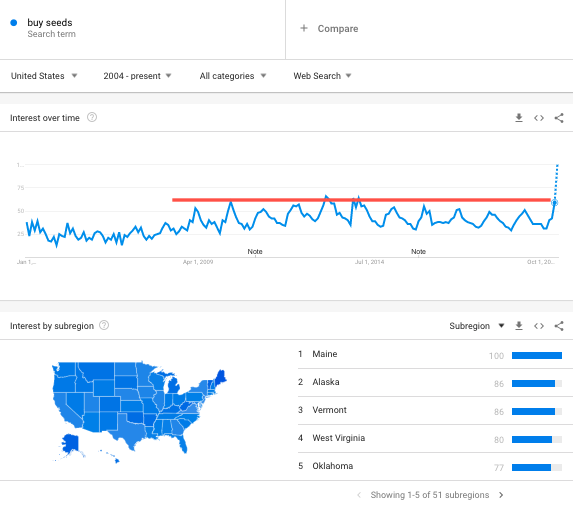
We’ve done a pretty good job of documenting the evolution of panic hoarding over the last several months. Americans started buying 3M N95 masks in mid-January, then non-perishables in February, followed by toilet paper, hand sanitizer, and guns.
Now apparently, plant seeds are the next big thing…
Seed companies who spoke with CBS News said they have stopped taking new orders after unprecedented demand. George Ball, chairman of Pennsylvania-based Burpee Seeds, said the recent increase in new orders is “just unbelievable.” The company will start accepting orders again on Wednesday after it stopped taking new ones for several days to catch up on the backlog.
Americans in quarantine are becoming increasingly concerned about their food security. What has shocked many is that food on supermarket shelves that existed one day, could be completely wiped out in minutes via panic hoarding. Some people are now trying to restore the comfort of food security by planting “Pandemic Gardens.”
“If I had to put my thumb on it, I would say people are worried about their food security right now,” said Emily Rose Haga, the executive director of the Seed Savers Exchange, an Iowa-based nonprofit devoted to heirloom seeds.
“A lot of folks even in our region are putting orders into their grocery stores and having to wait a week to get their groceries. Our society has never experienced a disruption like this in our lifetime.”

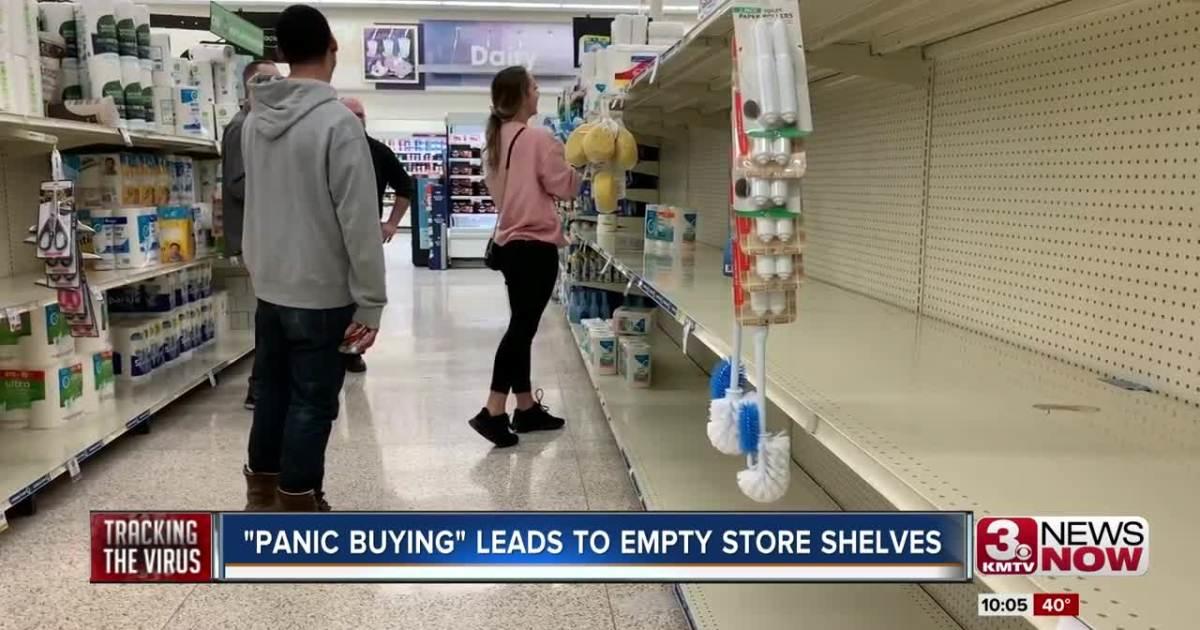
One of the most significant trends besides a crashed economy and high unemployment is that tens of thousands of Americans, mainly of the working poor, who just lost their jobs, are ending up at food banks. These facilities have reported surging demand, as a hunger crisis unfolds.
Today’s economic, health, and social crisis has made people realize that relying on supermarkets for food is not a safe bet. Some are now reverting to the land for survival.
Seed Savers Exchange noticed a surge in seed demand started in mid-March, the same time lockdowns across the country went into effect. The nonprofit has also halted new orders to catch up on the backlog.
“We received twice the amount of orders we normally receive,” the company said, adding it has had to hire more staff to deal with rising seed demand.
With America at war with coronavirus, the “Victory Gardens” our ancestors planted in WWI & II have now morphed into Pandemic Gardens. The surge in seed demand suggests a new trend of the 2020s is developing, one where reliance on corporations and government for survival are coming to an end for some people, as rural communities and living off the land is the safest bet in times of crisis.
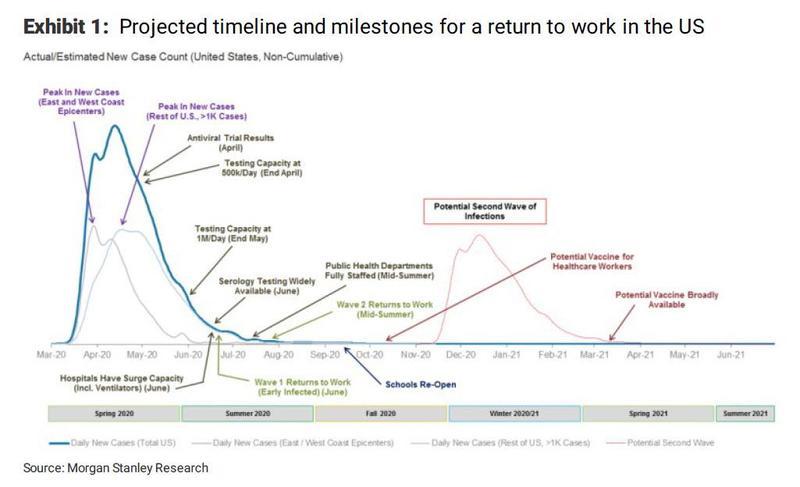
And maybe now is the time to plant a Pandemic Garden considering Morgan Stanley is predicting a second coronavirus wave could arrive in the US later this year. In essence, that would mean more runs on supermarkets would be seen, jeopardizing food security for many.
Crowds Swarm Florida Beaches Amid Phased Reopening As Critics Slam “#FloridaMorons”
Controversy is ensuing over viral images and video showing Florida beaches swarming with crowds a mere day after Republican Governor Ron DeSantis said they could reopen based on local leaders’ and counties’ discretion.
The Hill reports, “Images of people flocking to beaches in the Jacksonville, Fla., area went viral on Twitter on Saturday, prompting backlash from users on the platform and the hashtag #FloridaMorons.”
Among the first beaches to reopen to the public was in Jacksonville, where Mayor Lenny Curry (R) declared “This can be the beginning of the pathway back to normal life.”
The Hill
✔@thehill
Large crowds flock to the beaches in Jacksonville, FL as they reopen http://hill.cm/DW1DGin


Restrictions till required beach-goers in Jacksonville and other Florida beaches to avoid gathering in crowds, remain six feet apart from non-family members, and to avoid setting up chairs and tents.
As of Saturday Curry said residents were practicing “social distancing and responsible behavior” as he defended the move to open up the beaches.
Evan Kirstel #StayHome #RemoteWork@evankirstel#Florida beach is crowded within 30 MINUTES of reopening at 5pm, despite state recording 1,413 new #COVID19 cases – its highest one-day increase since the pandemic crisis began #floridabeaches #FloridaMorons #SaturdayMorning #SaturdayThoughts #StayAtHomehttps://www.dailymail.co.uk/news/article-8229933/Beaches-Florida-start-reopening-EVENING.html …


Miami-Dade Mayor Carlos Gimenez is also expected to soon announce reopening of area beaches, however, the precise date is unclear, but is expected to happen this coming week.
The largely Republican decision-makers in Florida appear to be using the momentum that President Trump set in motion Thursday in announcing guidelines for a ‘phased reopening’ of the US economy, which ultimately gives powers to the governors to enact the steps.
As is always the case in this polarized time, not everyone was supportive of the re-opening. Lake Worth Beach City Commissioner Omari Hardy tweeted angrily (and clearly politically):
“When a person doesn’t believe in science, they do dumb things.”
“When a person in power doesn’t believe in science, they do dumb things that hurt the public. This move is so dumb that I had to make sure it wasn’t fake news. You guys, it isn’t fake news.”
And Miami Mayor Francis Suarez, who contracted coronavirus himself, called the reopening in Jacksonville “very concerning,” adding that Florida was “not out of the woods yet” and the consequences of reopening too soon were “very, very scary.”
As of Sunday morning Florida has 25,492 COVID-19 cases with 748 reported fatalities, with most cases concentrated in Central Florida among people ages 65 and older.
Jacksonville’s mayor defended the controversial move to reopen by arguing citizens can remain cautious and sensible while going back out to public venues:
Lenny Curry
✔@lennycurry
Thank you Jacksonville. I appreciate your social distancing and responsible behavior as we opened our beaches for walking, swimming, running etc. No groups congregating. 5 pm to 8pm opening tonight. This is the 7pm shot from Councilman Diamond from the beach. Well done Jax https://twitter.com/rorydiamond/status/1251286983919493120 …
Rory Diamond@RoryDiamond7pm at the Beaches.

It should be noted that the predicted explosion in numbers of cases in the South has yet to materialize on the level expected.
Thus we could see a situation in which the hard-hit tri-state area as well as places like Michigan continue to peak, while at the same time looking on southern states’ earlier than expected return to relative ‘normalcy’.
Spamalot, No More? Hormel Shutters Illinois Plant Amid COVID-19 Fears
A cluster of COVID-19 cases forced health officials in Illinois to shutter Hormel’s Rochelle Foods plant on Friday.
Ogle County Health Department (OCHD) said the food processing plant would be closed for at least two weeks. On Friday (April 17), the facility was linked to 19 cases across Ogle County, three in Whiteside County, and two in Winnebago County, reported Daily Chronicle.
The facility employs more than 800 workers, many of whom have been sent home on paid leave. The facility will have 48 hours to comply with new health measures to mitigate the spread of the virus.

“My team has spent countless hours in collaboration with Rochelle Foods in an attempt to mitigate the virus spread,” OCHD Administrator Kyle Auman said.
OCHD made several attempts to assist the plant in testing workers, employee monitoring, and recommendations for sanitary protocols, but health officials said, “the efforts were unsuccessful” to stop the spread.
“Since those efforts were unsuccessful, it is my duty to order a complete closure of the facility,” Auman said.
Rochelle Mayor John Bearrows released a statement that said, “Although many essential businesses are open and operating, we will not tolerate them risking the health and safety of their employees or our community during this pandemic or any other time.”
A statement released from Rochelle Foods said OCHD notified them that the plant had to be shut down due to a localized breakout at the facility. The closure, the company stated, was “voluntarily:”
“Rochelle Foods was issued a notice of closure from the local health department on April 17. We are working to further understand the closure order and are consulting with our legal
counsel to understand next steps,” Rochelle Foods said. “We have decided to voluntarily close our facility to ensure a broader understanding of COVID-19 in the Rochelle community, Ogle county and the impact on our operations. Rochelle Foods team members will continue to be paid during the closure.”
As virus deaths surge across the country in the last several days, President Trump is attempting to reopen economies on a state-by-state basis on May 01. However, it appears that reopening America at this point could be met with failure and result in a second wave of the virus.
24 Hour Fitness Prepares For Bankruptcy
Despite hopes of a gradual reopening in the coming weeks, the US economy remains paralyzed with most non-essential venues still closed, and since gyms were among the first to be put on lockdown it will hardly come as a surprise that gym chain 24 Hour Fitness has been working with restructuring advisors including Lazard and law firm Weil, Gotshal & Manges to weigh options including a bankruptcy that could come as soon as the next few months, according to CNBC.

The story is familiar for most US gym operators: a heavy debt load, deteriorating performance and a coronavirus pandemic that forced it to shut its more than 400 clubs. Worse, the mid-priced fitness provider was already struggling to compete against premium rivals like Equinox and cheaper competitors like Planet Fitness. Moody’s recently downgraded the chain over worries around its “negative membership trends, very high-interest burden and negative free cash flow prior to the coronavirus outbreak, as well as approaching maturities to provide limited flexibility to manage through the crisis.”
As CNBC reports, 24 Hour Fitness has an $837 million term loan maturing in March 2022 and $500 million in unsecured notes maturing in June 2022, if more than a fifth of those notes remain outstanding. And while the San Ramon, California-based fitness chain had roughly $1.5 billion in sales in 2019, its cash is currently a catastrophic $1 million, according to Moody’s. It is controlled by private equity firm AEA Investors, which acquired it through a $1.8 billion deal with Fitness Capital Partners and Ontario Teachers’ Pension Plan in 2014.
Already highly levered, the company found itself in a dire predicament after regulators and states ordered they close their doors to help prevent further spread of the virus. “We need to limit indoor activities that are purely recreational, especially those where there are a lot of shared surfaces that can be contaminated,” said former FDA Commissioner Dr. Scott Gottlieb. “Bars and gyms fall squarely in that category.”
As a result, 24 Hour Fitness announced on March 16 it was closing all its clubs, later acknowledging the closures may last for “an extended period of time” due to coronavirus. It has said it would suspend all membership billings effective this week if it was unable to reopen its clubs.
In other words, the company’s cash flows have hit a hard stop.
Its struggles are emblematic of broader challenges and questions the fitness industry must face. Even after gyms reopen, mounting unemployment may mute appetite for excess costs like gym membership. There remain questions as to how many people will be comfortable working out in a crowded environment.
It’s not just the mid-range clubs that are hurting; in early April the high-end gym chain Equinox sent a letter to its landlords declaring that it would not be paying its monthly rent because of the hardship caused by the crisis, according to the FT. Like 24 Hour Fitness, Equinox has had to halt most of its operations because of the outbreak. The indebted group stopped collecting monthly fees from members when it began closing its clubs, forgoing tens of millions of dollars in revenues.
The move put immediate pressure on its finances. The group borrowed $140MM in emergency funds from its lenders through a revolving credit facility to cover what credit rating agency Moody’s called its “high monthly cash burn”. Investors have nonetheless raised concerns about the company’s cash position, sending the price on a $1bn loan it owes in 2024 tumbling in value. The Equinox loan traded at roughly 80 cents on the dollar on Friday, after tumbling as low as 70 cents in late March.
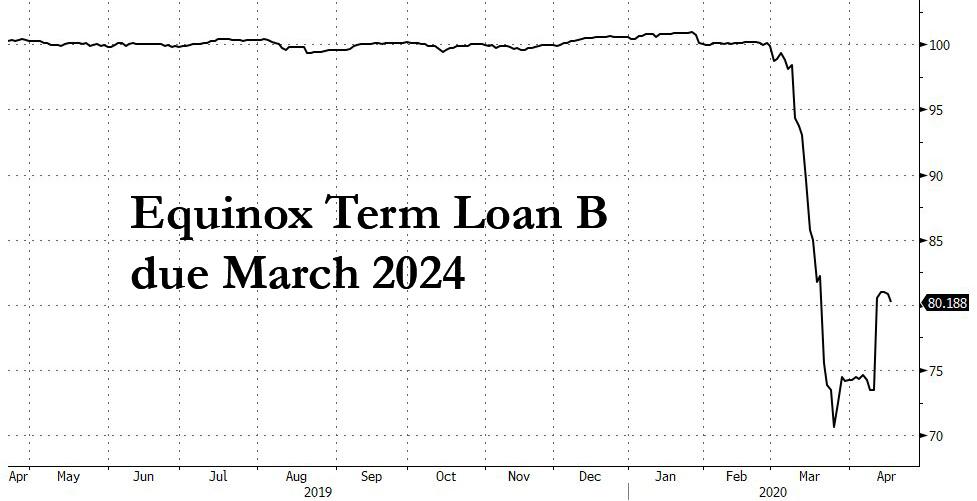
While the industry scored a small victory last week when the administration said gyms would be among the first to reopen business in a 3-phase plan, provided gyms “adhere to strict physical distancing and sanitation protocols”, the recommendation to open gyms before school raised some eyebrows. It is also unclear how many (former) clients will jump at the opportunity.
Meat Prices Suddenly Surge As Food Processing Plants Shut Down, With 1000s Of Tons Left To Spoil
As we pointed out earlier in the week, China-owned Smithfield Food’s decision to temporarily shutter the largest pork processing plant in the US, based in Sioux Falls, SD, due to a coronavirus outbreak is a much more significant even than the mainstream media gave credit for. While WaPo focused on bashing the state’s governor, whose refusal to issue a ‘stay at home’ order was blamed for the outbreak, the real significant wasn’t accorded sufficient time and attention, we feel.
The real takeaway here, is that the supply chain for American staples was badly damaged by the outbreak, with the damage still more extensive and stubborn than government officials have really acknowledged. Two months on, and millions of Americans are still having trouble finding toilet paper and sterilizing wipes. A comprehensive list of products in perpetual short-supply would be quite lengthy, at this point.
For all we know, Smithfield might be only the beginning. Earlier on Sunday, we noted a Hormel foods plant in Illinois has been forced to close temporarily after a cluster of cases in the surrounding counties was traced back to workers at the plant. That could leave millions of Americans without access to popular processed foods like Spam. An unopened can of Spam can keep for between 2 an 5 years, depending on storage conditions.
If closures like these continue, it could add further strain on the supply chain. Everywhere you look, you see experts talking about an overabundance of food thanks to the closure of restaurants, which has resulted in unprecedented levels of food waste. But sadly, thanks to the way our food distribution is set up, if there’s no way to process the products, package them and then distribute them to markets around the country, then the food will spoil before it’s eaten.
And if enough hungry, scared, desperate and irrepressibly, unceasingly furious Americans hear that piles of food are being left to spoil in the farm belt as the country starves – or if a sudden burst of inflation rattles both the Fed and hungry Americans as one of the many worst-case “supply-side” shocks unfolds – well, they just might riot.
Bloomberg warned on Sunday that these closures, along with a handful of others, are already putting upward pressure on meat prices at the point of sale in the market. As more processing facilities close, supermarkets are left with fewer options – because unfortunately many farmers who sell mostly to restaurants simply aren’t equipped to ship to supermarkets, and these types of changes unfortunately take time, as frustrating as that might sound.
BBG does a better job explaining the phenomenon:
The slaughter-plant closures are the latest injection of volatility in food markets in the coronavirus era. Shifting consumer buying patterns and closed restaurants has upended the supply chain, resulting in surging prices for goods like eggs but also prompted farmers to dump milk and vegetables due to lost markets.
“When you have a reduction in the slaughter like we’re having right now, we are going to have a jump in the cut-out values,” said Brian Hoops, senior market analyst at Midwest Market Solutions in Springfield, Missouri, said by telephone.
Wholesale pork posted the biggest back-to-back gain in more than two years, rising 15% to 60.13 cents a pound. Last week, pork prices fell to the lowest since 2009, U.S. Department of Agriculture data show. Choice-grade beef prices climbed six straight days through Thursday, rising to $2.36 a pound, a one-month high.
The report also noted several other major slaughterhouses where workers have been diagnosed with COVID-19, and closures have been raised.
Smithfield Foods Inc., the world’s biggest pork producer, indefinitely shut down a slaughter plant in South Dakota this week after hundreds of workers tested positive for Covid-19. The plant typically accounted for 4% to 5% of total hog processing in the U.S.
Two people who worked at a Tyson Foods Inc. pork plant in Iowa died and two dozen are ill, with operations down. Three people died who worked at a Tyson poultry plant in Georgia. A worker at a Cargill Inc. plant in Colorado also died. JBS USA delayed the reopening of a Pennsylvania beef plant from Thursday to Monday.The companies are working with government officials on cleaning and testing to ensure they safely produce food and protect workers. But the disruptions mean less meat, at least short term.
The coronavirus that has killed several workers and sickened hundreds of others at U.S. meat plants is raising concerns of a shortfall in pork and beef at grocery stores.
As some slaughterhouses halt or slow output and buyers brace for more disruptions, meat prices are surging.
“This is sending wholesale prices sharply higher and will result in a noticeable reduction in supply for the consumer,” said Cassie Fish, an Omaha, Nebraska-based livestock market strategist.
Bottom line: Thanks to the surprising complexity of food supply chains, there’s a scenario where farmers dumping milk and other products while factories and farms close or roll back activity while the number of product getting to the shelves falls, leading to instantaneous upward pressure on prices.
Of course, as Russell Clark (Horseman Capital) noted in his letter to investors last week, he is giving up on deflation after a decade, and bracing for inflation:
“…what drives inflation is lack of supply. And I see supply chain disruption everywhere. I also see falling investment in the supply chain everywhere.”
Of course, if inflation suddenly comes roaring back after all these years, that would be Jerome Powell’s worst nightmare: it would force the central bank into a terrible dilemma: either hike rates and destroy the economy, or keep them low, and risk triggering a cycle of uncontrollable hyperinflation, that could cause just as much damage – probably more.
end
As the coronavirus depression continues more and more Americans are putting their rent money on the credit cards
(zerohedge)
As Coronavirus Depression Continues, Americans Are Putting Their Rent On Credit Cards
Despite what the stock market would have you believe, the United States is sinking further into a depression. And the unemployed are now resorting to putting their rent on credit cards.
It’s a temporarily solution that may help tenants get through a month or two, but it’s ultimately driving an already broke consumer deeper into debt that will cripple them in the long term. About 84% of tenants in the U.S. have paid full or partial rent through April 12, the WSJ reports, a number that has risen significantly since the first week of April.

But credit cards as a form of payment are also rising by 13%, compared to the first three months of the year. The number of tenants paying with a credit card is up 30% when compared to the same period in March.
While sometimes tenants pay rent with credit cards to boost their credit score or earn rewards, this is increasingly looking like a desperation scenario, where credit cards could be the last fallback before tenants start filing for bankruptcy and wind up out on the street.

In general, electronic payments have risen since the start of the pandemic. Building owners will sometimes accept credit cards through apartment management software or third party apps. Even with interest rates near 0%, the average interest rate on a credit card is still in the double digits. It’s even higher for those taking cash advances.

While some landlords and creditors have said they would make provisions for those who have lost their jobs, the credit bureaus will be far more unforgiving. They will be offering no special treatment, according to the WSJ, because a revision to the CARE act that would have prevented them from reporting negative information due to the pandemic was left out at the last minute.
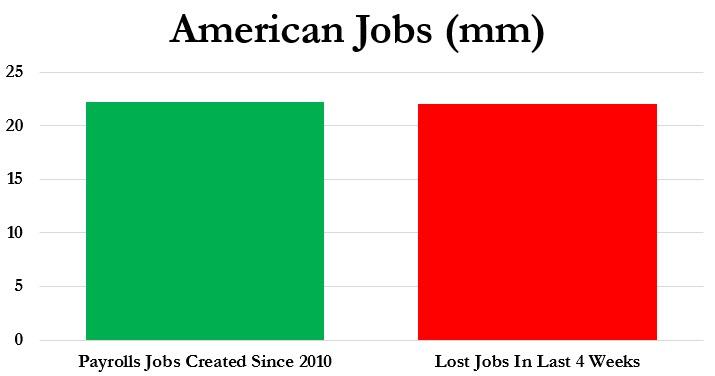
Some landlords have offered to absorb the transaction costs related to using credit cards. “Once we saw where things were going with this pandemic, a lot of our rules just kind of went out the window,” one landlord said.
But if unemployment doesn’t start to arrive by the time many of these tenants have to pay May rent, they could be faced with far more dire consequences.
Bruce McClary, spokesman for the National Foundation for Credit Counseling, said: “Your rent payment isn’t the only thing you owe, and chances are you have other financial commitments you’re having to keep on track as well.”
Over 22 million people have applied for unemployment over the past fourweeks.
United Reports $2.1BN Loss As Airlines Brace To Fire 100,000 Once Bailout Loans Expire
United Airlines confirmed the carnage hitting US airlines today when it reported a $2.1 billion loss for first quarter as the coronavirus pandemic drove travel demand down to the lowest level in decades.
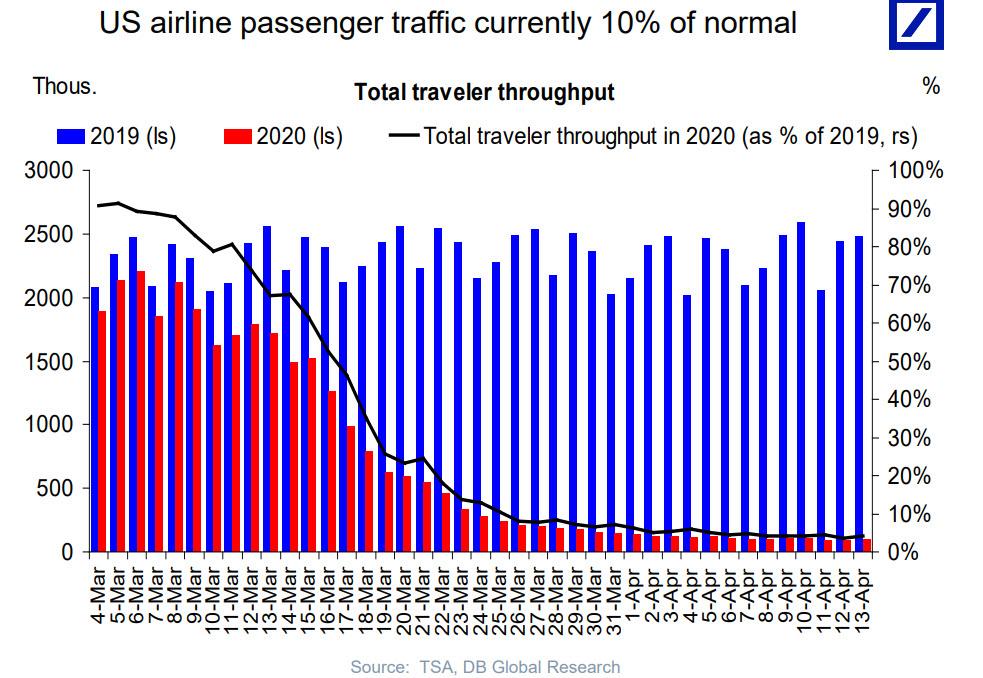
United said revenue plunged 17% in the first quarter from a year ago to $8 billion which as a reminder is largely due to the collapse in traffic in just the second half of March, so one can imagine what happens in all of Q2 should the situation fail to normalize.
With revenues unlikely to return any time soon even as losses mount, the Chicago-based airline said it applied for up to $4.5 billion in government loans on top of about $5 billion federal payroll grants and loans it also expects to receive to weather the crisis. As CNBC details, United was the first major U.S. airline to detail the results — while they are preliminary — of the virus on its results in the first three months of the year. The disease and harsh measures to stop it from spreading such as stay-at-home orders has ravaged air travel demand and and prompted carriers to slash most of their flights.
And as US airlines face a bleak future of depressed traffic and volatile revenue well into 2021, they are preparing to cut costs to the bone. As Bloomberg reports, the next big crunch date for airlines is this fall, when billions of dollars in government assistance will come to an end. As a result, key carriers including Delta and United have already begun openly contemplating how they will shrink operations, and one analyst expects that as many as 105,000 jobs could be lost industrywide.
“Without a quick improvement in demand, we could see the airlines look to shed 800 to 1,000 aircraft, which could result in a reduction of 95,000 to 105,000 airline jobs,” Cowen analyst Helane Becker wrote in an April 13 client note. “The rightsizing of the fleet and work force is an unfortunate truth.”
“The challenging economic outlook means we have some tough decisions ahead as we plan for our airline, and our overall workforce, to be smaller than it is today,” United’s chief executive and president, Oscar Munoz and Scott Kirby, wrote in an April 15 employee memo.
As a reminder, under the terms of the $50 billion government bailout, airlines are barred from slashing jobs through Sept. 30 but they’re already warning employees that cuts are almost inevitable. The planned contraction reflects a widespread belief that 2020 revenues could shrink to levels not seen in years. Recovery will probably be a long-term affair, said Cowen & Co., which predicted that ticket sales may not rebound to pre-pandemic levels until 2025.
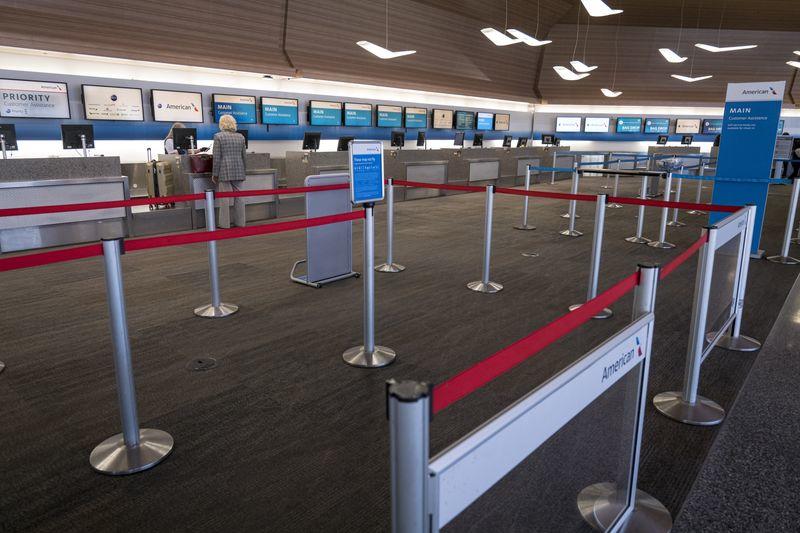
Unable to cut jobs or salaries while receiving grants to cover payroll, airlines will staff their typical summer peak largely as usual, even with millions of fewer travelers. But come fall, it will get ugly for employees unless the government bailout is rolled into 2021. “We’re going to be smaller coming out of this,” Delta CFO Paul Jacobson told employees last month. “Certainly quite a bit smaller than when we went into it.”
The upcoming mass layoffs will add to 87,000 employees – more than one quarter of the Big Three airlines’ workforce – who have taken voluntary leaves, early retirement or reduced work hours in the past two months.
Carriers face “the worst cash crisis in the history of flight,” with booked revenues down 103% year over year, according to industry lobby Airlines for America. Domestic flights are averaging just 10 passengers while international flights average 24, the group said.
Once laid off, those employees have years of unemployment to look forward to.
While airlines foresee an uptick in bargain-hunting leisure travelers this summer, rich travelers will take longer to win back. Corporations will be reluctant to assume the liability of putting employees back in the sky with Covid-19 still in wide circulation. Plus, many companies have learned to function via video conference—which is a lot cheaper than a business class seat.
According to Bloomberg, the airline industry generally has taken three to four years to fully recover from major disruptions, said Samuel Engel, head of the aviation group at consultant ICF. Economic downturns often accelerate trends that were already underway, like pulling down marginal routes and, more recently, the decline in demand for large aircraft, he said.
“The last couple of years, you have seen extensions of flights toward end of day and early morning, and growth of long, thin routes to secondary cities in Asia,” he said. “Those types of things get pulled back, and some don’t reappear until quite late in the economic cycle.”
iv) Swamp commentaries)
John Solomon Eliz. Vaughn/Red State
Solomon: ‘Could See a Handful of Indictments, Much More Information’ Next Week in Durham Investigation

Investigative reporter John Solomon joined Lou Dobbs on Friday night and told him there has been some criminal investigative activity that he thinks will result in some action. He added that we could see a handful of indictments next week and much more information. (Video below)
Here is a partial transcript of their exchange:
John Solomon: In my worst nightmare I could never have imagined what would come out this week. The level of information that the FBI had that raised red flags that they should have never, not even for a moment, entertained Christopher Steele as a human source, as a confidential informant, is now overwhelming, Overwhelming evidence. Let’s think of the things we know. One of the people he was talking to was a Russian intelligence official who was under surveillance by us. They had a separate FISA on him, yet they were taking Christopher Steele’s word that that was credible information. His other source disowned it. He’s paid by Hillary Clinton. Some of his information was disproven right away. He exaggerates his record at MI6. All of these things came out this week.
Christopher Steele should never have been shown a door inside the FBI and instead we sustained two-and-a-half years of an investigation into false allegations, put this country and our president through an unnecessary process.
Lou Dobbs: Unnecessary? This was an attempt to overthrow the president? This was an attempt to align the entire FBI with Russian intelligence objectives and missions…They are refusing to bring these people to justice! This is outrageous!…
John Solomon: Yeah, I know, it’s taken a long time and part of the reason is the FBI and the intelligence community are very good at obfuscating and hiding the truth. Whether they redact things, claim they are classified, falsify documents which they did in this case. They’ve done a good job.
But I will say this. There is some fairly significant evidence that at this very moment, this week, the last couple of weeks, Lou, that there is some criminal investigative activity that I think will result in some action coming out soon. It’s not going to be a lot. Don’t expect 10 or 12 indictments but there could be a handful of of indictments and much more information.
I think one important thing. The FBI had something right. There was a campaign that was taking Russian information and trying to influence the election. It just wasn’t Donald Trump’s campaign. It was Hillary Clinton through the person of Christopher Steele and his Russian informants. That has to be resolved and one of the documents that are still sitting out there unchallenged is the Intelligence Assessment. Our intelligence community said that the Russians were trying to help Trump win, Hillary lose. That does not appear to be the case from the body of evidence.
Solomon is one of a few who have followed this case extremely closely. He’s been in Washington for several decades and has an extensive network of contacts and I’ve always found him to be both credible and accurate. So I don’t doubt that some indictments are coming. But the question is, will it be low-level people like FBI lawyer Kevin Clinesmith who altered a document to say that Carter Page “was not a source” for another agency? Or will it be a big fish like former CIA Director John Brennan who I believe was the architect of the whole sorry episode?
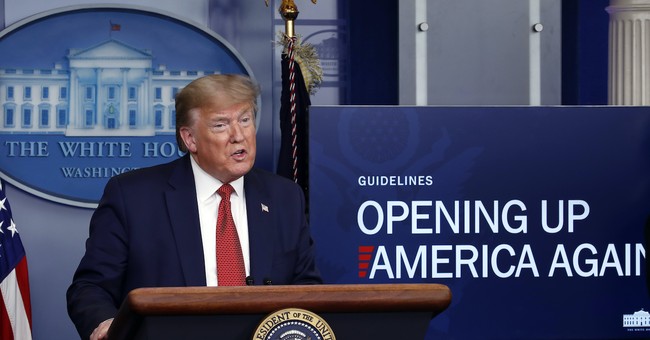
Solomon spoke to Sean Hannity on his radio show the Friday before last and said he didn’t “believe that those people [former Deputy Attorney General Rod Rosenstein, former FBI Director James Comey, and former FBI Deputy Director Andy McCabe] will be prosecuted for signing the documents.” I find that to be a travesty because all of them were acutely aware of what they were signing.
“Now, there may be other questions, right?” asked Solomon. “False testimony is an area that I believe Durham has been focusing on, based on the grand jury subpoenas and questions that I’ve heard. It’s possible that some of the people that gave false representations to Congress could get prosecuted for those false representations. That’s an area I’d keep an eye on.”
Who do we know who’s lied to Congress?
We know that John Brennan has given false testimony on at least two occasions. In May 2017, Brennan was asked by then-Rep. Trey Gowdy (R-SC) if the Steele dossier had been the basis for the conclusion in the January 2017 Intelligence Community Assessment that the Russians had interfered in the 2016 election to help Trump win.
Brennan replied, “No. Because we — we didn’t. It wasn’t part of the corpus of intelligence information that we had. It was not in any way used as a basis for the Intelligence Community assessment that was done. It was — it was not.”
We learned from the DOJ Inspector General’s report released in December that the dossier was, in fact, the basis for that conclusion.
He also lied to Congress during the Obama Administration in an unrelated matter.
Others come to mind, namely James Comey and Andrew McCabe.
And Attorney General Bill Barr’s remarks during a recent interview with Laura Ingraham sounded encouraging. I posted on the interview here. I wrote:
The Attorney General said, “My own view is that the evidence shows that we’re not dealing with just mistakes and sloppiness. There’s something far more troubling here. And we’re going to get to the bottom of it.” And he still considers the deep state’s assault on the President to be “one of the greatest travesties in American history.”
These two statements, in my opinion, were the most important takeaways from the interview. Durham’s investigation has been going on for nearly a year, even longer by some accounts, and Barr remains convinced that the Democrats worked to sabotage Trump’s presidency. It’s easy for us to become discouraged and say ‘nothing will happen’ because, outside of a few leaks from the CIA or other similar entities, we never hear anything. But Barr’s response to this question reassures us that they’re on it and that nothing Durham’s team has uncovered so far has changed his mind.
We’ll see what happens. I am, as they say, “cautiously optimistic.”
Lou Dobbs
✔@LouDobbs
FBI Corruption: @jsolomonReports says indictments may be coming this week in the FBI’s corrupt handling of the sham Russia collusion investigation. #AmericaFirst #KAG2020 #Dobbs


end
v) King report/Courtesy of Chris Powell of GATA which includes the major swamp stories.
Behold the power and glory of the expiry manipulation! It seldom lets stocks down!
Though the usual suspects attribute Friday’s boffo rally to Trump’s Reopening America plan and the effectiveness of Remdesivir in treating Covid-19, both are old news that had been around for days.
The financial media and some Street pundits attribute the rally on Friday to Gilead’s drug for Covid 19. As we opine above, Gilead and Reopening America were excuses for manipulators. Both are old news. Gilead his its all-time high of 85.97 on 3/19/20 (see ensuing story). It closed at 83.99 on Friday. PS – Why didn’t the stock market surge on the many reports that Hydroxychloroquine cures Covid-19?
Gilead Jumps to Two-Year High on Covid-19 Drug Hopes March 19, 2020
Gilead Sciences Inc. stock jumped as much as 7% on Thursday, reaching a two-year high, as a Piper Sandler analyst doubled down on his call on the approval prospects for the biotech company’s experimental therapy for the pandemic now sweeping the U.S…
Not ‘a zero’ or ‘a silver bullet’: Biotech analysts are urging caution on the latest data on Gilead’s coronavirus drug as stocks surge Friday, April 17, 2020
Two STAT reporters, Adam Feuerstein and Matthew Herper, wrote Thursday that a leaked video recording showed doctors at the medical center discussing remdesivir’s results…
[Who leaked the video and was it a coincidence the leak appeared on the night before expiration?]
The UBS analyst Navin Jacob cautioned that the University of Chicago trial represented about 3% of Gilead’s clinical-trial program… he also noted “many caveats” given the lack of a control group and no detailed data on how healthy or sick the patients were… STAT did not report any detailed data from the University of Chicago, just the general description of results given by doctors…
@CBSNews: All New York City non-essential events will be canceled for the month of May, Mayor Bill de Blasio said. “There is one chance to get the restart right. If you rush it, if you ignore the warning signs … you’re going to end up with the boomerang effect”
Disney stops paying 100,000 workers to save $500m a month
Theme park owner risks reputational damage as it slashes costs more severely than rivals
https://www.ft.com/content/db574838-0f40-41ce-9bcd-75039f8cb288
BBG’s @lisaabramowicz1: So far larger companies, such as publicly-traded restaurant chains, received big amounts of the government’s lending program while much smaller businesses like neighborhood eateries and hair salons were locked out: “An SBA report showed that about 2% of the firms approved for loans accounted for almost 30% of the funding.”…
Chicago Tribune: With 11 million jobs on the line, restaurants renew plea for government help. 80% not certain they can survive, poll says – the $349 billion Paycheck Protection Program had run out of money… essentially shutting small restaurants out of the program… https://www.chicagotribune.com/coronavirus/ct-food-independent-restaurant-coalition-0416-20200416-q2uzj4o4gfbhtbuhwk4dyldfyy-story.html
Pelosi made enormous political mistakes when she bragged about halting the replenishment of the small business loan program and gave an interview to CBS’s “Late, Late Show” in front of her massive side-by- side refrig/freezer while displaying the ‘flown-in gourmet’ ice cream she favors (chocolate).
15 House Democrats Call to Replenish Small Business Relief Fund despite Pelosi’s Objections
GOP Mocks “Nancy Antoinette” Pelosi’s Quarantine Stash of Expensive Ice Cream in A Very Expensive Freezer [Pelosi now has to make a deal to add more funds to the PPP.]
@business [Saturday]: House Speaker Pelosi said Congress is “very close” to striking a bipartisan deal to replenish funds in the small-business loan program[PPP] that ran out of money this week
Pelosi has avoided Fox News like it was a subpoena. Trump-hating Chris Wallace enticed Pelosi to appear on his Sunday morning show. Big mistake! After Wallace confronted her with her February 24 plea to citizens to join her at the Chinese Lunar New Year celebration, Pelosi blamed Trump. PS – Last week Pelosi deleted a video of her Feb. 24 big-time faux pas from her Twitter account.
https://twitter.com/AKA_RealDirty/status/1251883569187819520?s=09
Pelosi’s performance was so bad, liberal law professor Turley admonished her. @JonathanTurley: Nancy Pelosi just said to Chris Wallace on Fox that she does not understand people publicly protesting civil liberties on lock down orders. However, this followed her defense of her calling people to join her in Chinatown in late February as a protest against discrimination. Pelosi said that “leaders take responsibility” and do not blame others. However, when asked about her calling people out in mass to Chinatown in late February, she said it was because of what Trump “said about Asian Americans.” Trump did refer to “the Chinese virus,” not citizens.
Wall Street agency downgrades Illinois debt after Gov. J.B. Pritzker says coronavirus will blow multibillion [$2.7B+ this year, $6.2B+ for 2021] hole in state budget… Fitch Ratings on Thursday downgraded the state’s credit from BBB to BBB-… including $137 billion in pension debt…
Pritzker sees $2.7B budget jab now, $6.2B later… $7.4 billion without graduated tax hike…
Illinois blows $17M on shoddy face masks from China https://trib.al/nGfha6c
Sunlight destroys virus quickly, new govt. tests find, but experts say pandemic could last through summer – Simulated sunlight “rapidly killed the virus in aerosols,” the briefing says, while without that treatment, “no significant loss of virus was detected in 60 minutes.”… The results of these tests have not been previously made public… [WHY? Yet US officials closed parks, golf courses, playgrounds and beaches!!!] https://news.yahoo.com/sunlight-destroys-coronavirus-very-quickly-new-government-tests-find-but-experts-say-pandemic-could-still-last-through-summer-200745675.html
Nearly a third of 200 blood samples taken in Chelsea show exposure to coronavirus
Mass. General researcher says the results point to a ‘raging epidemic,’ but may also indicate the city is further along the disease curve than some other municipalities …[Ergo, the fatality rate is much lower than predicted.] https://www.bostonglobe.com/2020/04/17/business/nearly-third-200-blood-samples-taken-chelsea-show-exposure-coronavirus/
Antibody study suggests coronavirus is far more widespread than previously thought – Non-peer reviewed study from Stanford found rate of virus may be 50 to 85 times higher than official figures
Chinese Coronavirus Is a Man Made Virus According to Luc Montagnier the Man Who Discovered HIV – Indian researchers have already tried to publish the results of the analyses that showed that this coronavirus genome contained sequences of another virus, …the HIV virus (AIDS virus), but they were forced to withdraw their findings as the pressure from the mainstream was too great… in order to insert an HIV sequence into this genome, molecular tools are needed, and that can only be done in a laboratory…https://www.gilmorehealth.com/chinese-coronavirus-is-a-man-made-virus-according-to-luc-montagnier-the-man-who-discovered-hiv/
NYC ER surgeon says about half his patients are being treated for Covid-19 even though “their symptoms are not consistent with Covid at all.” https://twitter.com/AlexBerenson/status/1251569290089824267/photo/1
@julie_kelly2: ILI [Influenza like Illnesses] activity nationwide trending downward even before stay-at-home orders issued in late March. Raises lots of Qs about why we didn’t see big spikes across the country—if contagion rate, virulence is what we’ve been told, this makes no sense:
More than HALF of Los Angeles residents are unemployed with 1.3M jobs lost in a month after coronavirus forced California lockdown
Neiman Marcus to file for bankruptcy as soon as this week – sources https://www.reuters.com/article/us-neimanmarcus-bankruptcy-exclusive/exclusive-neiman-marcus-to-file-for-bankruptcy-as-soon-as-this-week-sources-idUSKBN2210CW
Goldman Now Sees A 123% Plunge in Q2 S&P Earnings, $850BN Drop in Corporate Cash Spending https://www.zerohedge.com/markets/goldman-now-sees-123-plunge-q2-sp-earnings-850-billion-drop-cash-usage
@GordonGChang: Correspondent @Michael_Yon tells me that, after speaking to a journalist source there, he thinks #China is about to go “full Tibet” on #HongKong.
@Jkylebass: As we all know, the CCP just put Luo Huining (the Butcher of Tibet) in charge of the Liaison Office in HK. His interview in the SCMP last weekend sent chills down my spine. By the way, he DOESN’T even speak Cantonese! Here comes the Butcher
GOP Rep. Jim Banks Urges Firing of California’s Public Pension [Calpers] Head over Ties to China’s ‘Thousand Talents Program’ – The CIO of the largest pension fund in the US enrolled in China’s “1,000 Talents Program”… described by the FBI as an “unofficial espionage” arm of CCP…
@bennyjohnson [Sunday]: Gov. Cuomo calls the Federal Govt. Coronavirus Response a “Phenomenal Accomplishment” and says it’s an “Undeniable Fact”.
DJT last night: “The governors want to have control of opening their states, but they want the federal government to do all the testing. You can’t have it both ways.” DJT praised Cuomo and Newsom. He said it has been a bipartisan effort. DJT (shock!) graciously thanked Cuomo for the compliments. Trump is exploiting the egregious wrong Covid-10 models. He claimed thousands of lives were saved by his travel ban and social distancing. He thanked 3M and its CEO and said the earlier skirmish was resolved.
@KellyannePolls: Today on CNN, MD Governor Larry Hogan noted that the White House provided a panel of experts – including Doctors Fauci and Redfield – to brief governors of both parties about Coronavirus during annual governors visit to White House – way back on February 9.
With the winds of a robust stock market rally and the end of the Covid-19 panic at his back, DJT reverted into snarky campaign/ rank politicking mode on Friday.
@realDonaldTrump: Today people started losing their jobs because of Crazy Nancy Pelosi, Cryin’ Chuck Schumer, and the Radical Left, Do Nothing Democrats, who should immediately come back to Washington and approve legislation to help families in America. End your ENDLESS VACATION!
Why did the W.H.O. Ignore an email from Taiwanese health officials in late December alerting them to the possibility that CoronaVirus could be transmitted between humans? Why did the W.H.O. make several claims about the CoronaVirus that were either inaccurate or misleading in January and February, as the Virus spread globally? Why did the W.H.O. wait as long as it did to take decisive action? Lanhee Chen, Hoover Institution Fellow
@realDonaldTrump: “On February 19th there was a Democratic Debate, in Las Vegas. Three words weren’t said: Virus, CoronaVirus, or COVID19. NEVER came up!” @BretBaier
The political fault lines in the USA now and possibly through the 2020 Elections:
Trump & GOP: Against China & WHO’s Covid actions; want to reopen economy
Dems & MSM: Against DJT period; ergo, Pro China/WHO’s Covid actions and maintaining shutdowns
Secondary political fault lines: DJT blames Dems’ impeachment for delayed Covid response; Dems and MSM blame Trump for delayed and racist Covid response What do the facts and timelines say?
Can We Talk About American Media’s Connections to Chinese Interests?
You only need to understand the power of the Chinese market when it comes to the film industry…
CBS News is part of a conglomerate of media and entertainment companies called National Amusements. The companies under their control include Viacom and Paramount Pictures.
NBC News/MSNBC is part of Universal and Comcast.
CNN is part of AT&T Time Warner, which owns Warner Brothers.
ABC News is owned by Disney, which owns…pretty much everything else coming out of Hollywood…
These companies also own theme parks, cellular telephone networks, cable networks, movie theatres and much more…Angering the Chinese government is just bad for business for these companies…
CBC Instructs Kids on How to Shut Down Their Parents’ “Conspiracy Theories”
Despite the “conspiracy theory” in question [China created Covid] literally being true
The presenter laments how somebody’s Dad may drop a message into chat blaming China for “manufacturing the coronavirus” with a “link to a site you’ve never heard of” (translation – a link that’s not, God forbid, mainstream media). The piece then features a woman from a group that combats “misinformation online” who urges the son or daughter not to get confrontational with their Dad but to accuse him of being accurate and stirring fear…
Tucker Carlson: China is waging coronavirus distraction campaign
The Chinese instructed their employees and assets in the United States to exert influence on elected officials… For example, according to an informed U.S. government official: “Beijing has instructed diplomats in their consulate in San Francisco to work with American state and local officials and members of Congress to push back against anyone who gets too far out on blaming China for this.”
On March 12, Rep. Judy Chu, D-Calif., wrote: “China didn’t ‘unleash’ anything. A virus spread, as viruses do. Blaming China and insisting on calling this the ‘Wuhan’ virus, even though every medical expert said not to, is putting people’s lives in danger. Stop politicizing this and put people first!” Just the week before Chu wrote that, on March 6, a man called Zhang Ping, who runs the Chinese consulate in Los Angeles, met with Los Angeles Mayor Eric Garcetti about the American response to coronavirus. He tweeted about it that day: “Look forward to working closely with the city of Los Angeles to address this common public health challenge and develop closer ties between our cities and peoples.”
According to a story in National Review, the head of the state Senate in Wisconsin recently received multiple emails from the wife of the Chinese consulate-general in Chicago. She asked him to propose a resolution praising China for its handling of the Wuhan coronavirus outbreak…
https://www.foxnews.com/opinion/tucker-carlson-china-coronavirus-origin
If Carlson is right, China has procured the aid of the MSM and Dems vs. Trump. Think about that!
China Push for COVID-19 Praise Backfires in US amid Rising WHO Criticism
The request to sing China’s praises directly from Beijing’s script had the opposite effect on Wisconsin Senate President Roger Roth, who was so angered by e-mails on Feb. 26 and March 10 that he drafted a harsh resolution condemning China’s handling of COVID-19 and a litany of well-known human rights abuses… https://www.rfa.org/english/news/china/wisconsin-legislature-04162020223653.html
Economist Danielle DiMartino Booth has claimed China committed an “act of war” by failing to report coronavirus while simultaneously adding a pandemic clause to their recent $200 billion U.S. trade deal.The CEO says China announced the first coronavirus case “within days” of signing the Phase One agreement on January 15…
https://www.thesun.co.uk/news/worldnews/11414045/china-pandemic-out-clause-coronavirus/
Trump is ratcheting up pressure on China over Covid-19. “Was it a mistake that got out of control or was it done deliberately?” [Dear Xi, if you don’t tell us the truth, we might assume the worst.] Trump has changed from restraint on China’s Covid culpability to insinuation that China did something sinister. Obviously, polling data is telling Team Trump that Americans are very upset with China and Covid-19. And, as we have stated, the blame game over Covid-19 is in full bloom.
China grows as campaign theme during pandemic [DJT anti-China, Biden anti-DJT’s anti-China]
President Trump has shifted from praising the transparency of Chinese President Xi Jinping, to blaming China for the spread of the coronavirus. He’s halted funding to the World Health Organization for being too “China-centric” and aired a campaign ad portraying Joe Biden as too cozy with China.
The ad has been slammed by Biden’s team, Democrats and some Asian-American leaders, who were quick to point out that a montage showing Biden with Chinese government officials included former Washington Governor Gary Locke, an Asian-American…
https://www.cbsnews.com/news/china-grows-as-campaign-theme-during-coronavirus-pandemic/
The More Anger at China, the Worse for Biden – Cozy, profitable, and possibly corrupt connections with the Chinese government are the last thing Americans want to hear about their politicians right now.
Voters see China as a rising threat and its economic gains as coming out of American pockets. The Trump campaign was already pushing these issues. It won’t have any trouble tying them to Joe Biden… Until recently, Biden was still saying China was hardly worth considering as an economic rival… his words are on tape and he’ll surely hear them replayed in ads this fall. He’ll also hear his attack on Trump as “xenophobic” for banning travel from China to limit the COVID-19 pandemic. Two months later, Biden took it all back. Too late… Voters increasingly consider China a malevolent and menacing adversary… https://www.realclearpolitics.com/articles/2020/04/17/the_more_anger_at_china_the_worse_for_biden_142953.html
Trump on Saturday: “If Sleepy Joe Biden wins [the election]… China would own the United States…”
https://twitter.com/TeamTrump/status/1251637934744272897
GOP House leader Kevin McCarthy: China’s Lies, Democrats’ Gamesmanship Combine to Harm American Health, Economy in Coronavirus Crisis https://www.breitbart.com/politics/2020/04/19/exclusive-kevin-mccarthy-chinas-lies-democrats-gamesmanship-combine-to-harm-american-health-economy-in-coronavirus-crisis/
Cuomo Blunders Big Tying NY Recovery to CCP Apologists McKinsey
But don’t believe me. Believe the unstintingly liberal New York Times that did an extensive exposé of the company in 2018 entitled “How McKinsey Has Raised the Stature of Totalitarian Governments”:…
McKinsey advises a good swatch of China’s state-owned companies, including those building the artificial islands in the South China Sea that the United States and much of the West… holds to be illegal. These islands are an integral part of the escalating Chinese military threat… why would Andrew Cuomo in the attempt to make New York state’s recovery “Trump-proof” (if we are to believe The Hill) choose McKinsey of all companies to lead this reconstruction?… McKinsey has also been deeply involved with China’s Belt-and-Road Initiative, a program many see as the linchpin of communist imperialist expansionism… https://nationandstate.com/2020/04/17/cuomo-blunders-big-tying-ny-recovery-to-ccp-apologists-mckinsey/
@JoeConchaTV: President Trump calls on New York Times WH correspondent Maggie Haberman to give back her Pulitzer Prize awarded for Russia reporting during coronavirus task force briefing.
John Solomon says indictments of Deep State operatives over Spygate could appear later this week.
Biden should consider ‘shadow government’ to combat Trump, MSNBC’s Ruhle says
[Even MSM types were aghast by this suggestion of subversion.]
https://www.washingtontimes.com/news/2020/apr/15/joe-biden-should-consider-shadow-government-to-com/
What were they thinking?!?! Team Biden invited the public to make memes Joe !?!?
The Biden Campaign Made an Avatar Generator and the Responses Are Hilarious
Users can insert an image of themselves into an internet graphic declaring themselves on “Team Joe.”
[Our favorite is the pic of Xi with “I’m on Team Joe! WuFlu Death Crew, Beijing China”; 1st runner up is: “I’m on Team Joe – Burisma Holdings”]
@paulsperry_: The president on Saturday retweeted a message by conservative author Paul Sperry, asking whether authorities would “enforce the social-distancing orders for mosques during Ramadan (April 23-May 23) like they did churches during Easter.”
NY Times Article Blames Fox News for Trump Supporter’s Coronavirus Death; Hypocrite Reporter [who blamed Fox] Questioned Virus ‘Panic’ – Ginia Bellafante @GiniaNYT: I fundamentally don’t understand the panic: incidence of the disease is declining in China. Virus is not deadly in vast majority of cases. Production and so on will slow down and will obviously rebound… – Feb 27, 2020
[There’s a pandemic of ‘projection’ psychosis in the MSM and US politics!]
END
Losing Faith In Fiat – COVID Crisis Has Dragged Forward The Moment When “The Money Is No Good”
Via Greg Hunter’s USAWatchdog.com ,
Money manager and economist Michael Pento says the Federal Reserve has only massive money printing left to try to save the economy from the current and ongoing debt implosion. There is going to be lots of fresh cash needed.

Pento runs down a list of just few of the things the Fed will need to spend money on and says,
“We all should know more than 22 million people have lost their jobs in the last four weeks alone. That’s 22 million people, and the unemployment rate, according to me, is heading up to 15% to 17%. That, my friends, is a depression. We also have the Philly Fed (Manufacturing Index rating) come out with a -56.6. That’s a minus 56.6. That’s the worst ever. Empire State Manufacturing -78.2, which is the worst rating ever. Retail sales plunged in March 8.7%. That is also the worst reading ever. That’s the worst plunge ever, and that’s just March. In my opinion, it will be something worse in April because all of the month will be completely shut down. That’s 90% to 95% of the economy.”
Now you know why the Fed freaked out and started printing money at the highest pace ever. Pento predicts the Fed, who took $4.5 trillion onto its balance sheet as a result of the “Great Recession,” will explode “The Federal Reserve’s balance sheet to $10 trillion by end of the year.”
Pento says forget the so-called “V shaped recovery” because “you cannot simply turn back on the economy like a light switch. There’s no electricity.” On top of that, Pento points out that,
“Millions of people who have been thrown out of work have taken on even more debt . . . . So, the economy is not bouncing back.”
So, it is clear the Fed is going to print trillions of dollars in fresh cash to pay for bailouts, unemployment checks and debt payments to avoid massive defaults in the U.S. economy. Pento asks, “What kind of faith will people have in the purchasing power of their fiat currencies?”
“…If the Fed can print trillions of dollars with no consequences… why bother working? Everybody can just stay home and cash a check…This is a recipe for hyper-inflation. It’s been tried many, many times in history, and it has never worked…
The gap between the real economy, asset prices and debt and the underlying economy has never been greater…
You have a massive increase of insolvent debt…Then you are going to ad inflation to that mix? Think about the carnage that is to come. That is the real crash… We will partially recover from this virus. . . . We are now sending money, helicopter money, directly to consumers, and that will cause inflation.”
Pento predicts a “tsunami of inflation” is coming in the not-too-distant future. Pento says,
“People are losing faith in fiat currencies. The price of gold in other currencies is already at all-time record highs. Even in dollar terms it’s $1,700 per ounce and on its way to record highs. What is the government going to do when you have insolvency and inflationary implosion of the bond market? The real crash is coming…
- A government cannot issue more debt to bail out an insolvent condition—fact.
- A government cannot print more money to placate a market that is afraid of inflation—fact.
That’s what they are going to be faced with: Yields spiking because of inflation and insolvency concerns, and then there is nothing a government can do. It’s not going to be just the United States, it’s going to be the case globally… That’s when the money is no good, and the bonds are no good.”
Join Greg Hunter of USAWatchdog.com as he goes One-on-One with money manager and economist Michael Pento.
* * *
Well that is all for today
I will see you MONDAY night.


 harveyorganblog.com
[…] by Harvey Organ, Harvey Organ Blog: […]
LikeLike