
GOLD$1712.00 DOWN $12.75 The quote is London spot price
Silver:$15.15 UP 1 CENT
Today is comex options expiry so again the crooks whack.
This Thursday is OTC/LBMA options expiry
Closing access prices: London spot
i)Gold : $1715.50 LONDON SPOT 4:30 pm
ii)SILVER: $15.19//LONDON SPOT 4:30 pm
CLOSING FUTURES PRICES: KEY MONTHS
APRIL comex gold price CLOSE 1.30 PM: $XX
MAY COMEX GOLD: 1710.80 1:30 PM
JUNE GOLD: $1723.20 CLOSE 1.30 PM// SPREAD SPOT/FUTURE JUNE: $11.20.//PREMIUMS WENT DOWN AGAIN
CLOSING SILVER FUTURE MONTH
SILVER APRIL COMEX CLOSE: XXX
SILVER MAY COMEX CLOSE; $15.23…1:30 PM.//SPREAD SPOT/FUTURE MAY: 8 CENTS PER OZ//PREMIUMS DOWN AGAIN
the gold market continues to be broken as future prices are much higher than spot prices. The comex is desperate to fix things but they have no available gold.
If one is to buy gold and or gold coins, the price is around $2800. usa per oz
and silver; $31.00 per oz//
LADIES AND GENTLEMEN: YOU ARE NOW WITNESSING FIRST HAND THE DIFFERENCE BETWEEN PAPER GOLD/SILVER AND THE REAL PHYSICAL STUFF!!
DO NOT PAY ANY ATTENTION TO WHAT THE CROOKS ARE DOING AT THE COMEX AND LONDON LBMA..PHYSICAL IS THE NAME OF THE GAME AND NOTHING ELSE
COMEX DATA
JPMorgan has been receiving gold with reckless abandon and sometimes supplying (stopping)
today RECEIVING: 49/151
issued 40
EXCHANGE: COMEX
CONTRACT: APRIL 2020 COMEX 100 GOLD FUTURES
SETTLEMENT: 1,723.500000000 USD
INTENT DATE: 04/24/2020 DELIVERY DATE: 04/28/2020
FIRM ORG FIRM NAME ISSUED STOPPED
____________________________________________________________________________________________
132 C SG AMERICAS 38
159 C ED&F MAN CAP 1
357 C WEDBUSH 1
657 C MORGAN STANLEY 9
661 C JP MORGAN 40 49
686 C INTL FCSTONE 14 5
690 C ABN AMRO 85 2
737 C ADVANTAGE 4
905 C ADM 3
991 H CME 51
____________________________________________________________________________________________
TOTAL: 151 151
MONTH TO DATE: 31,442
NUMBER OF NOTICES FILED TODAY FOR APRIL CONTRACT: 151 NOTICE(S) FOR 15,100 OZ (0.4696 tonnes)
TOTAL NUMBER OF NOTICES FILED SO FAR: 31,442 NOTICES FOR 3,144,200 OZ (97.79 TONNES)
SILVER
FOR APRIL
6 NOTICE(S) FILED TODAY FOR 30,000 OZ/
total number of notices filed so far this month: 832 for 4,160,000 oz
BITCOIN MORNING QUOTE $7718 UP 29
BITCOIN AFTERNOON QUOTE.: $7702 UP $7
GLD AND SLV INVENTORIES:
WITH GOLD DOWN $12.75: AND NO PHYSICAL TO BE FOUND ANYWHERE:
WITH ALL REFINERS CLOSED//MEXICO ORDERING ALL MINES SHUT: WHERE ARE THEY GETTING THE “PHYSICAL”?
WE HAD ANOTHER HUGE CHANGE IN GOLD INVENTORY AT THE GLD//
A PHONY PAPER GOLD DEPOSIT OF 5.85 TONNES
GLD: 1,048.31 TONNES OF GOLD//
WITH SILVER UP 1 CENT TODAY: AND WITH NO SILVER AROUND
TWO SMALL PAPER WITHDRAWALS IN SILVER INVENTORY AT THE SLV: 373,000 OZ AND LATE IN THE AFTERNOON: 466,000 OZ
RESTING SLV INVENTORY TONIGHT:
SLV: 412.826 MILLION OZ./
XXXXXXXXXXXXXXXXXXXXXXXXX
Let us have a look at the data for today
xxxxxxxxxxxxxxxxxxxxxxxxxxxxxxxxxxxxxxxxxxxxxxxxxxxxxxxxxxxxxxxxxxxxxxxxxx
IN SILVER THE COMEX OI ROSE BY A SMALL SIZED 323 CONTRACTS FROM 142,976 UP TO 143,299 AND CLOSER TO OUR NEW RECORD OF 244,710, (FEB 25/2020. THE SMALL SIZED GAIN IN OI OCCURRED WITH OUR 3 CENT GAIN IN SILVER PRICING AT THE COMEX. IT SEEMS THAT THE GAIN IN COMEX OI IS DUE TO SOME BANKER SHORT COVERING PLUS A CONSIDERABLE EXCHANGE FOR PHYSICAL ISSUANCE, ZERO LONG LIQUIDATION ALONG WITH OUR ZERO GAIN IN SILVER OZ STANDING. WE HAD A VERY GOOD NET GAIN IN OUR TWO EXCHANGES OF 2,108 CONTRACTS (SEE CALCULATIONS BELOW).
WE HAVE ALSO WITNESSED A STRONG AMOUNT OF PHYSICAL METAL STAND FOR COMEX DELIVERY AS WELL WE ARE WITNESSING CONSIDERABLE LONGS PACKING THEIR BAGS AND MIGRATING OVER TO LONDON IN GREATER NUMBERS IN THE FORM OF EFP’S. WE WERE NOTIFIED THAT WE HAD A STRONG SIZED NUMBER OF COMEX LONGS TRANSFERRING THEIR CONTRACTS TO LONDON THROUGH THE EFP ROUTE: MARCH: 00 AND MAY: 1192 AND JULY: 0 AND ZERO FOR ALL OTHER MONTHS AND THEREFORE TOTAL ISSUANCE 1192 CONTRACTS. WITH THE TRANSFER OF 1192 CONTRACTS, WHAT THE CME IS STATING IS THAT THERE IS NO SILVER (OR GOLD) TO BE DELIVERED UPON AT THE COMEX AS THEY MUST EXPORT THEIR OBLIGATION TO LONDON. ALSO KEEP IN MIND THAT THERE CAN BE A DELAY OF 24-48 HRS IN THE ISSUING OF EFP’S. THE 1192 EFP CONTRACTS TRANSLATES INTO 5.96 MILLION OZ ACCOMPANYING:
1.THE 3 CENT GAIN IN SILVER PRICE AT THE COMEX AND
2. THE STRONG AMOUNT OF SILVER OUNCES WHICH STOOD FOR DELIVERY IN THE LAST 12 MONTHS:
JUNE/2018. (5.420 MILLION OZ);
FOR JULY: 30.370 MILLION OZ
FOR AUG., 6.065 MILLION OZ
FOR SEPT. 39.505 MILLION OZ S
FOR OCT.2.525 MILLION OZ.
FOR NOV: A HUGE 7.440 MILLION OZ STANDING AND
21.925 MILLION OZ FINALLY STAND FOR DECEMBER.
5.845 MILLION OZ STAND IN JANUARY.
2.955 MILLION OZ STANDING FOR FEBRUARY.:
27.120 MILLION OZ STANDING IN MARCH.
3.875 MILLION OZ STANDING FOR SILVER IN APRIL.
18.845 MILLION OZ STANDING FOR SILVER IN MAY.
2.660 MILLION OZ STANDING FOR SILVER IN JUNE//
22.605 MILLION OZ STANDING FOR JULY
10.025 MILLION OZ INITIAL STANDING IN AUGUST.
43.030 MILLION OZ INITIALLY STANDING IN SEPT. (HUGE)
7.32 MILLION OZ INITIALLY STANDING IN OCT
2.630 MILLION OZ STANDING FOR NOV.
20.970 MILLION OZ FINAL STANDING IN DEC
5.075 MILLION OZ FINAL STANDING IN JAN
1.480 MILLION OZ FINAL STANDING IN FEB
23.005 MILLION OZ FINAL STANDING FOR MAR
4.160 MILLION OZ INITIALLY STANDING FOR APRIL
FRIDAY, AGAIN OUR CROOKS USED COPIOUS PAPER IN ORDER TO LIQUIDATE SILVER’S PRICE…AND THEY WERE UNSUCCESSFUL IN KNOCKING THE PRICE OF SILVER DOWN (IT ROSE 3 CENTS).. BUT, OUR OFFICIAL SECTOR/BANKERS WERE UNSUCCESSFUL IN THEIR ATTEMPT TO FLEECE SOME SILVER LONGS FROM THEIR POSITIONS, AS WE DID HAVE A VERY GOOD NET GAIN OF 1515 CONTRACTS OR 7.575 MILLION OZ ON THE TWO EXCHANGES! YOU CAN BET THE FARM THAT OUR BANKER ARE DESPERATE TO LIQUIDATE THEIR HUGE SHORT POSITIONS IN SILVER
OUR SPREADING OPERATION HAS NOW SWITCHED INTO SILVER…..
SPREADING OPERATION FOR OUR NEWCOMERS:
WE HAVE NOW COMMENCED IN SILVER THE ILLEGAL SPREADING OPERATION \ FOR NEWCOMERS, HERE ARE THE DETAILS:
SPREADING LIQUIDATION HAS NOW STOPPED IN GOLD AS THEY NOW BEGIN TO MORPH INTO SILVER AS WE HEAD TOWARDS THE NEW FRONT MONTH WILL BE MAY.
FOR THOSE OF YOU WHO ARE NEW, HERE IS THE MODUS OPERANDI OF THE SPREADERS AND THE CRIMINAL ELEMENT BEHIND IT:
HERE IS A BRIEF SYNOPSIS OF HOW THE CROOKS FLEECE UNSUSPECTING LONGS IN THE SPREADING ENDEAVOUR;
THE SPREADING LIQUIDATION OPERATION IS NOW OVER FOR GOLD..AND WE WILL NOW MORPH INTO AN ACCUMULATION PHASE OF SPREADING CONTRACTS FOR SILVER. THEY WILL ACCUMULATE CONSIDERABLE AMOUNT OF THE CONTRACTS AND THEN LIQUIDATE ONE WEEK PRIOR TO FIRST DAY NOTICE
MODUS OPERANDI OF THE CORRUPT BANKERS AS TO HOW THEY HANDLE THEIR SPREAD OPEN INTERESTS:
.
AS I HAVE MENTIONED IN PREVIOUS COMMENTARIES:
“AS YOU WILL SEE, THE CROOKS WILL NOW SWITCH TO SILVER AS THEY INCREASE THE OPEN INTEREST FOR THE SPREADERS. THE TOTAL COMEX SILVER OPEN INTEREST WILL RISE FROM NOW ON UNTIL ONE WEEK PRIOR TO FIRST DAY NOTICE AND THAT IS WHEN THEY START THEIR CRIMINAL LIQUIDATION.
HERE IS HOW THE CROOKS USED SPREADING AS WE ARE NOW INTO THE NON ACTIVE DELIVERY MONTH OF APRIL HEADING TOWARDS THE ACTIVE DELIVERY MONTH OF MAY FOR SILVER:
YOU WILL ALSO NOTICE THAT THE COMEX OPEN INTEREST STARTS TO RISE IN THIS NON ACTIVE MONTH OF APRIL. BUT SO IS THE OPEN INTEREST OF SPREADERS. THE OPEN INTEREST IN GOLD WILL CONTINUE TO RISE UNTIL ONE WEEK BEFORE FIRST DAY NOTICE OF AN UPCOMING ACTIVE DELIVERY MONTH (MAY), AND THAT IS WHEN THE CROOKS SELL THEIR SPREAD POSITIONS BUT NOT AT THE SAME TIME OF THE DAY. THEY WILL USE THE SELL SIDE OF THE EQUATION TO CREATE THE CASCADE (ALONG WITH THEIR COLLUSIVE FRIENDS) AND THEN COVER ON THE BUY SIDE OF THE SPREAD SITUATION AT THE END OF THE DAY. THEY DO THIS TO AVOID POSITION LIMIT DETECTION. THE LIQUIDATION OF THE SPREADING FORMATION CONTINUES FOR EXACTLY ONE WEEK AND ENDS ON FIRST DAY NOTICE.”
ACCUMULATION FOR EFP’S/SILVER/J.P.MORGAN’S HOUSE OF BRIBES, / STARTING FROM FIRST DAY NOTICE/FOR MONTH OF APRIL:
17,218 CONTRACTS (FOR 17 TRADING DAYS TOTAL 17,218 CONTRACTS) OR 86.09 MILLION OZ: (AVERAGE PER DAY: 1001 CONTRACTS OR 5.008 MILLION OZ/DAY)
TO GIVE YOU AN IDEA AS TO THE HUGE SUPPLY THIS MONTH IN SILVER: SO FAR THIS MONTH OF APRIL: 86.09 MILLION PAPER OZ HAVE MORPHED OVER TO LONDON. THIS REPRESENTS AROUND 12.29% OF ANNUAL GLOBAL PRODUCTION (EX CHINA EX RUSSIA)* JUNE’S 345.43 MILLION OZ IS THE SECOND HIGHEST RECORDED ISSUANCE OF EFP’S AND IT FOLLOWED THE RECORD SET IN APRIL 2018 OF 385.75 MILLION OZ.
ACCUMULATION IN YEAR 2020 TO DATE SILVER EFP’S: 979,58 MILLION OZ.
JANUARY 2020 EFP TOTALS SO FAR: 181.61 MILLION OZ
FEB 2020 EFP’S TOTAL : …… 259.600 MILLION OZ
MARCH EFP’S ….. 452.280 MILLION OZ //TOTALS//AND A NEW RECORD FOR THE MONTH)
APRIL EFP SO FAR 86.09 MILLION OZ. (EX. FOR PHYSICALS BECOMING A LOT LESS)
EXCHANGE FOR PHYSICAL ISSUANCE THIS MONTH IS A LOT LESS. NO DOUBT THAT THE COST TO CARRY THESE THINGS HAS EXPLODED AND AS SUCH CANNOT BE DONE AS FREQUENTLY AS BEFORE.
RESULT: WE HAD A SMALL SIZED INCREASE IN COMEX OI SILVER COMEX CONTRACTS OF 323, WITH OUR 3 CENT GAIN IN SILVER PRICING AT THE COMEX ///FRIDAY… THE CME NOTIFIED US THAT WE HAD A GOOD SIZED EFP ISSUANCE OF 1192 CONTRACTS WHICH EXITED OUT OF THE SILVER COMEX AND TRANSFERRED THEIR OI TO LONDON AS FORWARDS. SPECULATORS CONTINUED THEIR INTEREST IN ATTACKING THE SILVER COMEX FOR PHYSICAL SILVER
TODAY WE GAINED A STRONG SIZED OI CONTRACTS ON THE TWO EXCHANGES: 1515 CONTRACTS (WITH OUR 3 CENT GAIN IN PRICE)
THE TALLY//EXCHANGE FOR PHYSICALS
i.e 1192 OPEN INTEREST CONTRACTS HEADED FOR LONDON (EFP’s) TOGETHER WITH A GOOD INCREASE OF 323 OI COMEX CONTRACTS. AND ALL OF THIS DEMAND HAPPENED WITH A 3 CENT GAIN IN PRICE OF SILVER/ AND A CLOSING PRICE OF $15.17 // FRIDAY’S TRADING. YET WE STILL HAVE A STRONG AMOUNT OF SILVER STANDING AT THE COMEX FOR DELIVERY.
In ounces AT THE COMEX, the OI is still represented by JUST UNDER 1 BILLION oz i.e. 0.7050 BILLION OZ TO BE EXACT or 100.7% of annual global silver production (ex Russia & ex China).
FOR THE NEW MAR DELIVERY MONTH/ THEY FILED AT THE COMEX: 6 NOTICE(S) FOR 30,000 OZ OF SILVER.
IN SILVER,PRIOR TO TODAY, WE SET THE NEW COMEX RECORD OF OPEN INTEREST AT 244,196 CONTRACTS ON AUG 22.2018. AND AGAIN THIS HAS BEEN SET WITH A LOW PRICE OF $14.70//TODAY’S RECORD OF 244,705 IS SET WITH A PRICE OF: 18.91 (FEB 25/2020)
.
ON THE DEMAND SIDE WE HAVE THE FOLLOWING:
- HUGE AMOUNTS OF SILVER STANDING FOR DELIVERY (MARCH/2018: 27 MILLION OZ , APRIL/2018 : 2.485 MILLION OZ MAY: 36.285 MILLION OZ ; JUNE/2018 (5.420 MILLION OZ) , JULY 2018 FINAL AMOUNT STANDING: 30.370 MILLION OZ ) FOR AUGUST 6.065 MILLION OZ. , SEPT: A HUGE 39.505 MILLION OZ./ OCTOBER: 2,520,000 oz NOV AT 7.440 MILLION OZ./ DEC. AT 21.925 MILLION OZ JANUARY AT 5.825 MILLION OZ.AND FEB 2019: 2.955 MILLION OZ/ MARCH: 27.120 MILLION OZ/ APRIL AT 3.875 MILLION OZ/ A MAY: 18.845 MILLION OZ ..JUNE 2.660 MILLION OZ//JULY 22.605 MILLION OZ; AUGUST 10.025 MILLION OZ/ SEPT 43.030 MILLION OZ//OCT: 7.665 MILLION OZ// NOV: 2.630 MILLION OZ//DEC: 20.970 MILLION OZ; JAN: 5.075 MILLION OZ.//FEB 1.480 MILLION OZ//MAR: 23.005 MILLION OZ/APRIL 4.160 MILLION OZ//
- THE RECORD PRIOR TO TODAY WAS SET IN FEB 25/2018: 244,710 CONTRACTS, WITH A SILVER PRICE OF $18.90//.
- HUGE ANNUAL EFP’S ISSUANCE EQUAL TO 2.9 BILLION OZ OR 400% OF SILVER ANNUAL PRODUCTION/2017 RECORD SETTING EFP ISSUANCE FOR ANY MONTH IN SILVER; APRIL/2018/ 385.75 MILLION OZ/ AND THE SECOND HIGHEST RECORDED EFP ISSUANCE JUNE 2018 345.43 MILLION OZ
AND YET, WITH THE EXTREMELY HIGH EFP ISSUANCE, WE HAVE A CONTINUAL LOW PRICE OF SILVER DESPITE THE ABOVE HUGE DEMAND. TO ME THE ONLY ANSWER IS THAT WE HAVE SOVEREIGN (CHINA) WHO IS ENDEAVOURING TO GOBBLE UP ALL AVAILABLE PHYSICAL SILVER NO MATTER WHERE, EXACTLY WHAT J.P.MORGAN IS DOING. AND IT IS MY BELIEF THAT J.P.MORGAN IS HOLDING ITS SILVER FOR ITS BENEFICIAL OWNER..THE USA GOVERNMENT WHO IN TURN IS HOLDING THAT SILVER FOR CHINA.(FOR A SILVER LOAN REPAYMENT)
GOLD
IN GOLD, THE COMEX OPEN INTEREST FELL BY A TINY SIZED 114 CONTRACTS TO 498,089 AND FURTHER FROM OUR NEW RECORD (SET JAN 24/2020) AT 799,541 AND PREVIOUS TO THAT: (SET JAN 6/2020) AT 797,110.
THE TINY LOSS OF COMEX OI OCCURRED DESPITE OUR CONSIDERABLE COMEX LOSS IN PRICE OF $4.90 /// COMEX GOLD TRADING// FRIDAY// WE HAD CONSIDERABLE BANKER SHORT COVERING , A GOOD INCREASE IN GOLD OZ STANDING AT THE COMEX, ALONG WITH ZERO LONG LIQUIDATION ACCOMPANYING A GOOD EX. FOR PHYSICAL ISSUANCE. THIS ALL HAPPENED DESPITE OUR LOSS IN THE PAPER PRICE OF GOLD.
WE HAD NO ISSUANCE OF OUR NEW 4 GC CONTRACT
WE GAINED A GOOD 2698 CONTRACTS (8.3919 TONNES) ON OUR TWO EXCHANGES.
E.F.P. ISSUANCE
THE CME RELEASED THE DATA FOR EFP ISSUANCE AND IT TOTALED A GOOD SIZED 2812 CONTRACTS:
CONTRACTS, FEB> 0 CONTRACTS; MARCH 00 APRIL: 0. MAY: 0, AND JUNE 2812.; DEC 0 AND ALL OTHER MONTHS ZERO//TOTAL: 2812. The NEW COMEX OI for the gold complex rests at 498,089. ALSO REMEMBER THAT THERE WILL BE A DELAY IN THE ISSUANCE OF EFP’S. THE BANKERS REMOVE LONG POSITIONS OF COMEX GOLD IMMEDIATELY. THEN THEY ORCHESTRATE THEIR PRIVATE EFP DEAL WITH THE LONGS AND THAT COULD TAKE AN ADDITIONAL, 48 HRS SO WE GENERALLY DO NOT GET A MATCH WITH RESPECT TO DEPARTING COMEX LONGS AND NEW EFP LONG TRANSFERS. . EVEN THOUGH THE BANKERS ISSUED THESE MONSTROUS EFPS, THE OBLIGATION STILL RESTS WITH THE BANKERS TO SUPPLY METAL BUT IT TRANSFERS THE RISK TO A LONDON BANKER OBLIGATION AND NOT A NEW YORK COMEX OBLIGATION. LONGS RECEIVE A FIAT BONUS TOGETHER WITH A LONG LONDON FORWARD. THUS, BY THESE ACTIONS, THE BANKERS AT THE COMEX HAVE JUST STATED THAT THEY HAVE NO APPRECIABLE METAL!! THIS IS A MASSIVE FRAUD: THEY CANNOT SUPPLY ANY METAL TO OUR COMEX LONGS BUT THEY ARE QUITE WILLING TO SUPPLY MASSIVE NON BACKED GOLD (AND SILVER) PAPER KNOWING THAT THEY HAVE NO METAL TO SATISFY OUR LONGS. LONDON IS NOW SEVERELY BACKWARD IN BOTH GOLD AND SILVER AND WE ARE WITNESSING DELAYS IN ACTUAL DELIVERIES.
IN ESSENCE WE HAVE A GOOD SIZED INCREASE IN TOTAL CONTRACTS ON THE TWO EXCHANGES OF 2698 CONTRACTS: 114 CONTRACTS DECREASED AT THE COMEX AND 2812 EFP OI CONTRACTS WHICH NAVIGATED OVER TO LONDON. THUS TOTAL OI GAIN OF 2698 CONTRACTS OR 8.3919 TONNES. FRIDAY, WE HAD A CONSIDERABLE LOSS OF $4.90 IN GOLD TRADING……
AND WITH THAT LOSS IN PRICE, WE HAD A STRONG SIZED GAIN IN TOTAL/TWO EXCHANGES GOLD TONNAGE OF 8.3919 TONNES!!!!!! THE BANKERS/OFFICIAL SECTOR WERE SUPPLYING INFINITE SUPPLIES OF SHORT GOLD COMEX PAPER WITH RECKLESS ABANDON. THE BANKERS WERE SUCCESSFUL IN THEIR ATTEMPT TO LOWER GOLD’S PRICE (IT FELL $4.90). AND IT ALSO SEEMS THAT THEIR ATTEMPT TO FLEECE ANY GOLD LONGS FROM THE GOLD ARENA WERE UNSUCCESSFUL (SEE BELOW).
4 GC ISSUANCE: ZERO
CALCULATIONS ON GAIN/LOSS ON OUR TWO EXCHANGES:
WE HAD A GOOD SIZED INCREASE IN EXCHANGE FOR PHYSICALS (2812) ACCOMPANYING THE LOSS IN COMEX OI (114 OI): TOTAL GAIN IN THE TWO EXCHANGES: 2698 CONTRACTS. WE NO DOUBT HAD 1 )HUGE BANKER SHORT COVERING, 2.)A STRONG INCREASE IN STANDING AT THE GOLD COMEX FOR THE FRONT APRIL MONTH, 3) ZERO LONG LIQUIDATION AND …ALL OF THIS WAS COUPLED WITH THAT CONSIDERABLE LOSS IN GOLD PRICE TRADING//FRIDAY
HISTORICAL ACCUMULATION OF EXCHANGE FOR PHYSICALS IN 2020 INCLUDING TODAY
ACCUMULATION OF EFP’S GOLD AT J.P. MORGAN’S HOUSE OF BRIBES: (EXCHANGE FOR PHYSICAL) FOR THE MONTH OF APRIL : 73,484 CONTRACTS OR 7,348,400 oz OR 228.56 TONNES (17 TRADING DAYS AND THUS AVERAGING: 4322 EFP CONTRACTS PER TRADING DAY
TO GIVE YOU AN IDEA AS TO THE STRONG SIZE OF THESE EFP TRANSFERS : THIS MONTH IN 17 TRADING DAY(S) IN TONNES: 228.56 TONNES
TOTAL ANNUAL GOLD PRODUCTION, 2019, THROUGHOUT THE WORLD EX CHINA EX RUSSIA: 3555 TONNES
THUS EFP TRANSFERS REPRESENTS 228.56/3550 x 100% TONNES =6.43% OF GLOBAL ANNUAL PRODUCTION
ISSUANCE OF EXCHANGE FOR PHYSICAL GOLD HAS DISSIPATED THIS MONTH…THE COST TO THE BANKERS TO CARRY THESE CONTRACTS IN LONDON IS BECOMING TOO GREAT FOR THEM.
ACCUMULATION OF GOLD EFP’S YEAR 2020 TO DATE: 2551.46 TONNES
JANUARY 2220 TOTAL EFP ISSUANCE; : 570.19 TONNES
FEB 2020 TOTAL EFP ISSUANCE : 653.78 TONNES
MARCH TOTAL EFP ISSUANCE 1,098.93 TONNES (*AND A NEW ALL TIME RECORD ISSUANCE//22 DAYS)
APRIL TOTAL EFP. ISSUANCE: 228.56 TONNES (EFP ISSUANCE BECOMING A LOT LESS)
WHAT IS ALARMING TO ME, ACCORDING TO OUR LONDON EXPERT ANDREW MAGUIRE IS THAT THESE EFP’S ARE BEING TRANSFERRED TO WHAT ARE CALLED SERIAL FORWARD CONTRACT OBLIGATIONS AND THESE CONTRACTS ARE LESS THAN 14 DAYS. ANYTHING GREATER THAN 14 DAYS, THESE MUST BE RECORDED AND SENT TO THE COMPTROLLER, GREAT BRITAIN TO MONITOR RISK TO THE BANKING SYSTEM. IF THIS IS INDEED TRUE, THEN THIS IS A MASSIVE CONSPIRACY TO DEFRAUD AS WE NOW WITNESS A MONSTROUS TOTAL EFP’S ISSUANCE AS IT HEADS INTO THE STRATOSPHERE.
First, here is an outline of what will be discussed tonight:
1.Today, we had the open interest at the comex, in SILVER, ROSE BY A SMALL SIZED 323 CONTRACTS FROM 142,976 UP TO 143,299 AND CLOSER TO OUR COMEX RECORD //244,710(SET FEB 25/2020). THE LAST RECORDS WERE SET IN AUG.2018 AT 244,196 WITH A SILVER PRICE OF $14.78/(AUGUST 22/2018)..THE PREVIOUS RECORD TO THAT WAS SET ON APRIL 9/2018 AT 243,411 OPEN INTEREST CONTRACTS WITH THE SILVER PRICE AT THAT DAY: $16.53). AND PREVIOUS TO THAT, THE RECORD WAS ESTABLISHED AT: 234,787 CONTRACTS, SET ON APRIL 21.2017 OVER 2 3/4 YEARS AGO. THE PRICE OF SILVER ON THAT DAY: $17.89.
ALL OF THE GAIN IN COMEX OI WAS DUE TO 1) SOME BANKER SHORT COVERING , 2) THE ISSUANCE OF A GOOD SIZED NUMBER OF EXCHANGE FOR PHYSICALS (SEE BELOW), 3) A SMALL INCREASE IN SILVER OZ STANDING AT THE COMEX FOR APRIL AND 4) ZERO LONG LIQUIDATION
EFP ISSUANCE 1192 CONTRACTS
OUR CUSTOMARY MIGRATION OF COMEX LONGS CONTINUE TO MORPH INTO LONDON FORWARDS AS OUR BANKERS USED THEIR EMERGENCY PROCEDURE TO ISSUE:
FOR FEB. 0; FOR MAR 0: AND MAY: 1192; JULY: 0 CONTRACTS AND ALL OTHER MONTHS: ZERO. TOTAL EFP ISSUANCE: 1192 CONTRACTS. EFP’S GIVE OUR COMEX LONGS A FIAT BONUS PLUS A DELIVERABLE PRODUCT OVER IN LONDON. IF WE TAKE THE GOOD COMEX OI GAIN OF 916 CONTRACTS TO THE 1192 OI TRANSFERRED TO LONDON THROUGH EFP’S, WE OBTAIN A STRONG GAIN OF 1515 OPEN INTEREST CONTRACTS FROM OUR TWO EXCHANGES. THUS IN OUNCES, THE GAIN ON THE TWO EXCHANGES 7.574 MILLION OZ!!! WITH THE 3 GAIN IN PRICE///
RESULT: A GOOD SIZED INCREASE IN SILVER OI AT THE COMEX WITH THE 3 CENT GAIN IN PRICING THAT SILVER UNDERTOOK IN PRICING// FRIDAY. WE ALSO HAD A GOOD SIZED 1192 EFP’S ISSUED TRANSFERRING COMEX LONGS OVER TO LONDON. TOGETHER WITH THE STRONG SIZED AMOUNT OF SILVER OUNCES STANDING FOR THIS MONTH, DEMAND FOR PHYSICAL SILVER CONTINUES TO INTENSIFY AS WE WITNESS SEVERE BACKWARDATION IN SILVER IN LONDON.
BOTH THE SILVER COMEX AND THE GOLD COMEX ARE IN STRESS AS THE BANKERS SCOUR THE BOWELS OF THE EXCHANGE FOR METAL
(report Harvey)
2 ) Gold/silver trading overnight Europe, Goldcore
(Mark O’Byrne/zerohedge
and in NY: Bloomberg
3. ASIAN AFFAIRS
I)MONDAY MORNING/ SUNDAY NIGHT:
SHANGHAI CLOSED UP 6.97 POINTS OR 0.25% //Hang Sang CLOSED UP 448.81 POINTS OR 1.88% /The Nikkei closed UP 521.22 POINTS OR 2.71%//Australia’s all ordinaires CLOSED UP 1.65%
/Chinese yuan (ONSHORE) closed DOWN at 7.0832 /Oil DOWN TO 14.04 dollars per barrel for WTI and 20.35 for Brent. Stocks in Europe OPENED GREEN// ONSHORE YUAN CLOSED DOWN // LAST AT 7.0832 AGAINST THE DOLLAR. OFFSHORE YUAN CLOSED DOWN ON THE DOLLAR AT 7.0883 TRADE TALKS STALL//YUAN LEVELS GETTING DANGEROUSLY CLOSE TO 7:1//TRUMP INITIATES A NEW 25% TARIFFS FRIDAY/MAY 10/MAJOR PROBLEMS AT HUAWEI /CFO ARRESTED//CORONAVIRUS : /ONSHORE YUAN TRADING ABOVE LEVEL OF OFFSHORE YUAN/ONSHORE YUAN TRADING WEAKER AGAINST USA DOLLAR/OFFSHORE YUAN TRADING WEAKER AGAINST THE DOLLAR /TRADE DEAL NOW DEAD..TRUMP RAISED RATES TO 25%//FED INITIATES MASSIVE QE
total dealer deposits: nil oz
total dealer withdrawals: nil oz
i)we had 2 deposits into the customer account
into JPMorgan: 0
ii)into DELAWARE: 31,036.000
III) Into Scotia: 606,504.100 oz
*** JPMorgan for most of 2017, 2018 and onward, has adding to its inventory almost every single day.
JPMorgan now has 160.819 million oz of total silver inventory or 50.04% of all official comex silver. (160.819 million/321.170 million
total customer deposits today: 637,540.100 oz
we had 3 withdrawals:
i Out of Brinks: 812,812.02 oz
ii) Out of CNT: 242,078.120
iii) Out of Delaware: 25,364.193 oz
total withdrawals; 1,080 ,254.333 oz
We had 0 adjustments: and all from the dealer to the customer:
total dealer silver: 81.137 million
total dealer + customer silver: 316.103 million oz
xxxxxxxxxxxxxxxxxxxxxxxxxxxxxxxxxxxxxxxxxxxxxxxxxxxxxxxxxxxxxxxxxxxxxxxxxx
The total number of notices filed today for the APRIL 2020. contract month is represented by 6 contract(s) FOR 30,000 oz
To calculate the number of silver ounces that will stand for delivery in APRIL we take the total number of notices filed for the month so far at 832 x 5,000 oz = 4,160,000 oz to which we add the difference between the open interest for the front month of APRIL.(6) and the number of notices served upon today 6 x (5000 oz) equals the number of ounces standing.
.
Thus the INITIAL standings for silver for the APRIL/2019 contract month: 832 (notices served so far) x 5000 oz + OI for front month of APRIL (6)- number of notices served upon today (6) x 5000 oz of silver standing for the APRIL contract month.equals 4,160,000 oz.
WE GAINED 4 CONTRACTS OR AN ADDITIONAL 20,000 OZ WILL NOT STAND AT THE COMEX..
TODAY’S ESTIMATED SILVER VOLUME: 48,908 CONTRACTS //
FOR YESTERDAY: 60,579 CONTRACTS..,CONFIRMED VOLUME
YESTERDAY’S CONFIRMED VOLUME OF 60,579 CONTRACTS EQUATES to 302 million OZ 43.2% OF ANNUAL GLOBAL PRODUCTION OF SILVER..
COMMODITY LAW SUGGESTS THAT OPEN INTEREST SHOULD NOT BE MORE THAN 3% OF ANNUAL GLOBAL PRODUCTION. THE CROOKS ARE SUPPLYING MASSIVE PAPER TRYING TO KEEP SILVER IN CHECK.
The record level of silver open interest is 234,787 contracts set on April 21./2017 with the price at that day at $18.42. The previous record was 224,540 contracts with the price at that time of $20.44
end
NPV for Sprott
1. Sprott silver fund (PSLV): NAV RISES TO +1.19% ((APRIL 27/2020)
2. Sprott gold fund (PHYS): premium to NAV RISES TO +0.19% to NAV: (APRIL 27/2020 )
Note: Sprott silver trust back into POSITIVE territory at +%-/Sprott physical gold trust is back into POSITIVE/ 1.19%
(courtesy Sprott/GATA
3.SPROTT CEF.A FUND (FORMERLY CENTRAL FUND OF CANADA):
NAV 15.66 TRADING 15.62///DISCOUNT 0.25
END
And now the Gold inventory at the GLD/
APRIL 27/WITH GOLD DOWN $12.75//NA HUGE CHANGES IN GOLD INVENTORY AT THE GLD: A PAPER DEPOSIT OF 5.85 TONNES INTO THE GLD////INVENTORY RESTS TONIGHT AT 1048.31 TONNES
APRIL 24/WITH GOLD DOWN $4.90 TODAY: NO CHANGES IN GOLD INVENTORY AT THE GLD//INVENTORY RESTS TONIGHT AT 1042.46 TONNES
APRIL 23/WITH GOLD UP $10.00 TODAY: NO CHANGES IN GOLD INVENTORY AT THE GLD///INVENTORY RESTS TONIGHT AT 1042.46 TONNES
APRIL 22/WITH GOLD UP $40.75 TODAY:; TWO HUGE CHANGES IN GOLD INVENTORY AT THE GLD//A)A MONSTROUS 3.8 PAPER TONNES WERE ADDED TO THE GLD INVENTORY AND B) ANOTHER HUGE 9.07 TONNES OF PAPER GOLD ADDED LATE IN THE DAY//INVENTORY RESTS AT 1042.46 TONNES
APRIL 21/WITH GOLD DOWN $21.60 TODAY: A HUGE CHANGES IN GOLD INVENTORY AT THE GLD: A MONSTROUS ADDITION OF 7.9 PAPER TONNES TO THE GLD INVENTORY//INVENTORY RESTS AT 1029.59 TONNES
APRIL 20//WITH GOLD UP $10.00 TODAY; NO CHANGES IN GOLD INVENTORY AT THE GLD//INVENTORY RESTS AT 1021.69 TONNES
APRIL 17/WITH GOLD DOWN $27.80 TODAY: SURPRISINGLY NO CHANGES IN GOLD INVENTORY AT THE GLD///INVENTORY RESTS AT 1021.69 TONNES TONNES..THE STRING OF 12 STRAIGHT STRONG DEPOSITS ENDS..
APRIL 16/WITH GOLD DOWN $4.50 TODAY: ANOTHER HUGE CHANGE IN GOLD INVENTORY: A STRONG DEPOSIT OF 4.10 TONNES WAS ADDED TO THE GLD INVENTORY//INVENTORY RESTS AT 1021.69 TONNES/12TH STRAIGHT STRONG DEPOSIT
APRIL 15//WITH GOLD DOWN $19.10 TODAY; ANOTHER HUGE CHANGE IN GOLD INVENTORY; A STRONG 7.89 TONNES WAS ADDED TO THE GLD INVENTORY//INVENTORY RESTS AT 1117.59 TONNES.//11TH STRAIGHT STRONG DEPOSIT
APRIL 14/WITH GOLD UP $23.55 TODAY: ANOTHER HUGE CHANGE IN GOLD INVENTORY: A STRONG 15.51 TONNES WAS ADDED TO THE GLD INVENTORY/INVENTORY RESTS AT 1009.70 TONNES//THIS IS THE 10TH STRAIGHT STRONG DEPOSIT//THIS IS A FRAUDULENT VEHICLE..THEY HAVE NO PHYSICAL GOLD IN THE TRUST..
APRIL 13//WITH GOLD UP $27.65 TODAY: ANOTHER HUGE CHANGE IN GOLD INVENTORY: A STRONG 5.36 TONNES WAS ADDED TO THE GLD//INVENTORY RESTS AT 994.19 TONNES
APRIL 9 WITH GOLD UP $37.30 TODAY: ANOTHER HUGE CHANGE IN GOLD INVENTORY: A STRONG 2.92 TONNES WAS ADDED TO THE GLD//GOLD INVENTORY RESTS TONIGHT AT..988.63 TONNES
APRIL 8/WITH GOLD DOWN $.60//ANOTHER HUGE CHANGE IN GOLD INVENTORY/;; A STRONG 1.45 TONNES WAS ADDED TO THE GLD/GOLD INVENTORY RESTS AT 985.71 TONNES
APRIL 7/WITH GOLD UP $.30: ANOTHER HUGE CHANGE IN GOLD INVENTORY AT THE GLD: A DEPOSIT OF 5.27 TONNES OF GOLD INTO THE GLD INVENTORY//INVENTORY RESTS AT 984.26 TONNES
APRIL 6//WITH GOLD UP $32.00//ANOTHER STRONG DEPOSIT INTO THE GLD; A HUGE 7.02 TONNES OF GOLD INTO THE GLD////INVENTORY RESTS AT : 978.99 TONNES
APRIL 3//WITH GOLD UP $7.80 TODAY//ANOTHER STRONG DEPOSIT OF 3.22 TONNES INTO THE GLD/INVENTORY RESTS AT 971.97 TONNES
APRIL 2//WITH GOLD UP $31.80 TODAY: ANOTHER STRONG DEPOSIT OF 1.75 TONNES INTO THE GLD//INVENTORY RESTS AT 968.75 TONNES
APRIL 1/WITH GOLD DOWN $7.70 TODAY: ANOTHER CHANGE IN GOLD INVENTORY AT THE GLD: A DEPOSIT OF 2.62 TONNES OF GOLD INTO THE GLD////INVENTORY RESTS AT 967.00 TONNES
MARCH 31//WITH GOLD DOWN $32.70//A MONSTROUS PAPER DEPOSIT OF 10.84 TONNES INTO THE GLD//INVENTORY RESTS AT 964.38 TONNES
MARCH 30/WITH GOLD DOWN $6.10 TODAY: NO CHANGE IN GOLD INVENTORY AT THE GLD//INVENTORY RESTS AT 953.54 TONNES
MARCH 27.WITH GOLD DOWN $16.40: A BIG CHANGE IN GOLD INVENTORY AT THE GLD A HUGE DEPOSIT OF 4.39 TONES INTO THE GLD/INVENTORY RESTS AT 953.54 TONES
MARCH 26//WITH GOLD UP $24.00 TODAY: A HUGE CHANGE IN GOLD INVENTORY AT THE GLD: A DEPOSIT OF 13.17 TONNES INTO THE GLD/INVENTORY RESTS AT 949.15 TONNES
MARCH 25/WITH GOLD DOWN $11.40 TODAY//A HUGE CHANGE IN GOLD INVENTORY AT THE GLD: A DEPOSIT OF 11.99 TONES INTO THE GLD INVENTORY////INVENTORY RESTS AT 935.98 TONNES
MARCH 24//WITH GOLD UP $67.00 TODAY: A HUGE CHANGE IN GOLD INVENTORY AT THE GLD: A PAPER DEPOSIT OF 15.80 TONNES OF GOLD INTO GLD////INVENTORY RESTS AT 923.99 TONNES..THIS PROVES THAT THE GLD IS A FRAUD AS LONDON SUSPENDED DELIVERY AS WELL AS ALL REFINERS. THEY HAD NO WAY OF GETTING ANY PHYSICAL OZ INTO ITS INVENTORY//
xxxxxxxxxxxxxxxxxxxxxxxxxxxxxxxxxx
Inventory rests tonight at
APRIL 27/ GLD INV 1048.31 tonnes*
IN LAST 807 TRADING DAYS: +101.97 NET TONNES HAVE BEEN REMOVED FROM THE GLD
LAST 707 TRADING DAYS;+276.95 TONNES HAVE NOW BEEN ADDED INTO THE GLD INVENTORY.
end
Now the SLV Inventory/
APRIL 27/WITH SILVER UP ONE CENT TODAY: TWO SMALL CHANGE IN SILVER INVENTORY AT THE SLV:a) A WITHDRAWAL OF 373,000 OZ FORM THE SLV// b) A SECOND WITHDRAWAL OF 466,000: ////INVENTORY RESTS AT 412.826 MILLION OZ//
APRIL 24//WITH SILVER UP 3 CENTS TODAY: NO CHANGES IN SILVER INVENTORY AT THE SLV//INVENTORY RESTS AT 413.665 MILLION OZ
APRIL23/WITH SILVER UP 0 CENTS TODAY: A HUGE CHANGE IN SILVER INVENTORY AT THE SLV: A DEPOSIT OF 2.891 MILLION OZ INTO THE SLV/////INVENTORY RESTS AT 413.665 MILLION OZ//
APRIL 22/WITH SILVER UP 42 CENTS TODAY: A HUGE CHANGE IN SILVER INVENTORY: A PAPER WITHDRAWAL OF 1.865 MILLION OZ INTO THE SLV//INVENTORY RESTS AT 410.774 MILLION OZ//
APRIL 21//WITH SILVER DOWN 60 CENTS TODAY; A HUGE CHANGE IN SILVER INVENTORY AT THE SLV: A PAPER ADDITION OF 1.398 MILLION OZ INTO THE SLV INVENTORY//INVENTORY RESTS AT 412.639 MILLION OZ//
APRIL 20//WITH SILVER UP 16 CENTS TODAY: A BIG CHANGES IN SILVER INVENTORY AT THE SLV: A WITHDRAWAL OF 2.797 MILLION OZ FROM THE SLV////INVENTORY RESTS AT 414.038 MILLION OZ//
APRIL 17/WITH SILVER DOWN 24 CENTS TODAY; A BIG CHANGE IN SILVER INVENTORY AT THE SLV: A WITHDRAWAL OF 1.3999 MILLION OZ FROM THE SLV////INVENTORY RESTS AT 415.437 MILLION OZ//
APRIL 16/WITH SILVER UP 5 CENTS TODAY: NO CHANGE IN SILVER INVENTORY AT THE SLV////INVENTORY RESTS AT 415.437 MILLION OZ//
APRIL 15//WITH SILVER DOWN 45 CENTS TODAY: TWO HUGE CHANGES IN SILVER INVENTORY AT THE SLV TWO HUGE DEPOSITS: A DEPOSIT OF 1.679 MILLION OZ AND ANOTHER 5.222 MILLION OZ INTO THE SLV////INVENTORY RESTS AT 415.437 MILLION OZ//
APRIL 14./WITH SILVER UP 51 CENTS TODAY: A HUGE CHANGE IN SILVER INVENTORY AT THE SLV//A MASSIVE PAPER DEPOSIT OF XXX MILLION OZ//INVENTORY RESTS AT 408.536 MILLION OZ//
APRIL 13//WITH SILVER DOWN 29 CENTS TODAY; A HUGE CHANGE IN SILVER INVENTORY AT THE SLV: A MASSIVE PAPER DEPOSIT OF 6.155 MILLION OZ////INVENTORY RESTS AT 408.536 MILLION OZ//
APRIL 9/WITH SILVER UP 60 CENTS TODAY: A HUGE CHANGE IN SILVER INVENTORY AT THE SLV: A HUGE DEPOSIT OF 1.84 MILLION OZ INTO THE SLV///INVENTORY RESTS AT 402.381 MILLION OZ.
APRIL 8//WITH SILVER DOWN 21 CENTS TODAY: NO CHANGE IN SILVER INVENTORY AT THE SLV//INVENTORY RESTS AT 401.541 MILLION OZ///
APRIL 7/WITH SILVER UP 26 CENTS TODAY: A HUGE CHANGE IN SILVER INVENTORY AT THE SLV: A DEPOSIT OF 5.766 MILLION OZ INTO THE SLV..//INVENTORY RESTS AT 395.826 MILLION OZ
APRIL 6/WITH SILVER UP 50 CENTS TODAY: ANOTHER BIG CHANGE IN SILVER INVENTORY AT THE SLV//INVENTORY RESTS AT 395.826 MILLION OZ.
APRIL 3//WITH SILVER DOWN 15 CENTS TODAY: A BIG CHANGE IN SILVER INVENTORY AT THE SLV: A DEPOSIT OF 746,000 OZ INTO THE SLV//INVENTORY RESTS AT 395.826 MILLION OZ
APRIL 2/WITH SILVER UP 65 CENTS; A SMALL CHANGE TODAY..A WITHDRAWAL OF .335 MILLION OZ TO PAY FOR FEES//INVENTORY RESTS AT 394.826 MILLION OZ/
APRIL 1/WITH SILVER DOWN 11 CENTS TODAY: NO CHANGES IN SILVER INVENTORY AT THE SLV//INVENTORY RESTS AT 395.181 MILLION OZ//
MARCH 31/WITH SILVER UP 2 CENTS TODAY: A BIG CHANGE IN SILVER INVENTORY: A DEPOSIT OF 1.679 MILLION OZ INTO THE SLV//INVENTORY RESTS AT 375.181 MILLION OZ//
MARCH 30/WITH SILVER DOWN 44 CENTS TODAY; NO CHANGES IN SILVER INVENTORY AT THE SLV//INVENTORY RESTS AT 393.502 MILLION OZ.
MARCH 27/WITH SILVER DOWN 5 CENTS TODAY: A HUGE CHANGE IN SILVER INVENTORY AT THE SLV: A MONSTROUS PAPER DEPOSIT OF 8.115 MILLION OZ INTO THE SLV../INVENTORY RESTS AT 393.502 MILLION OZ//
MARCH 26/WITH SILVER DOWN 11 CENTS TODAY: NO CHANGES IN SILVER INVENTORY AT THE SLV//INVENTORY RESTS AT 385.387 MILLION OZ///
MARCH 25/WITH SILVER UP 44 CENTS TODAY: TWO HUGE CHANGES IN SILVER INVENTORY AT THE SLV: TWO DEPOSITS OF 7.369 MILLION OZ AND 2.239 MILLION OZ OF PAPER SILVER INTO THE SLV////INVENTORY RESTS AT 385.387 MILLION OZ//
MARCH 24//WITH SILVER UP 100 CENTS TODAY: NO CHANGES IN SILVER INVENTORY AT THE SLV//INVENTORY RESTS AT 375.779 MILLION OZ///
APRIL 27.2020:
SLV INVENTORY RESTS TONIGHT AT
412.826 MILLION OZ.
END
LIBOR SCHEDULE AND GOFO RATES:
YOUR DATA…..
6 Month MM GOFO 3.56/ and libor 6 month duration 0.92
Indicative gold forward offer rate for a 6 month duration/calculation:
G0LD LENDING RATE: – 2.64
GOLD’S LEASE RATES PLUMMET TO HUGE NEGATIVE
CENTRAL BANKS CALLING IN THEIR LEASES.
GOLD NON EXISTENT.
XXXXXXXX
12 Month MM GOFO
+ 1.92%
LIBOR FOR 12 MONTH DURATION: 0.94
GOFO = LIBOR – GOLD LENDING RATE
GOLD LENDING RATE = -.98
GOLD’S LEASE RATES PLUMMET TO HUGE NEGATIVE
CENTRAL BANKS CALLING IN THEIR LEASES.
GOLD NON EXISTENT.
end
PHYSICAL GOLD/SILVER STORIES
i) GOLDCORE BLOG/Mark O’Byrne
ii) Important gold commentaries courtesy of GATA/Chris Powell
A must read…Mooney presses again the CFTC on jurisdiction over manipulative trading by the Governments/
(Chris Powell/Mooney)
CFTC: Does it have jurisdiction over manipulative trading by
government?
Submitted by cpowell on 03:54PM ET Saturday, April 25, 2020.
Section: Daily Dispatches
11:57a ET Saturday, April 25, 2020
Dear Friend of GATA and Gold:
U.S. Rep. Alex X. Mooney, R-West Virginia, is pressing the U.S.
Commodity Futures Trading Commission to answer the critical
questions about market manipulation the commission long has
refused to answer lest it expose the U.S. government’s rigging
of the futures markets and especially the gold and silver
futures markets.
In a letter dated April 13 and made public this week, Mooney
reminded the commission that it had evaded the key questions
asked in his previous letter and that the questions are capable
of yes-or-no answers:
1) Does the commission have jurisdiction over manipulative
futures trading by the U.S. government or its brokers or agents
or other governments?
2) Is the commission aware of futures trading by the U.S.
government, its brokers, or agents?
Of course these are the questions that long should have been
pressed on the commission by those who pose as financial
journalists and market analysts. That the commission refuses to
answer them would be big financial news in itself if there was
any serious financial journalism.
GATA urges those market analysts who have been skeptical of our
claims of surreptitious manipulation of the monetary metals
markets by governments and particularly the U.S. government —
claims extensively documented here —
http://gata.org/taxonomy/term/21
— to put the two critical questions to the CFTC themselves and
then report the commission’s refusal to answer. No one has any
authority to dispute gold and silver market manipulation
without having attempted such research himself.
Mooney’s new letter to the CFTC is here:
http://gata.org/files/MooneyLetter-CFTC-04-13-2020.pdf
CHRIS POWELL, Secretary/Treasurer
Gold Anti-Trust Action Committee Inc.
CPowell@GATA.org
* * *
To contribute to GATA, please visit:
end
With so much registered and eligible gold why is it necessary for gold bars to be flying from the Perth Mint in Australia to the comex in New to easy supply squeeze?
(Bloomberg/GATA)
Gold bars are flying from Perth Mint to New York to ease supply squeeze
Submitted by cpowell on Sat, 2020-04-25 15:37. Section: Daily Dispatches
And still the Comex’s recently touted contract for a quarter claim on a 400-ounce London Good Delivery bar hasn’t traded even once yet — and the Comex won’t say why and the news organizations that hailed the contract won’t even ask, being only propagandists, not journalists.
* * *
By David Stringer
Bloomberg News
Friday, April 24, 2020
Australia’s largest gold refinery has ramped up production of one kilogram bars to ease the supply squeeze in the United States that helped propel a surge in the premium for New York futures.
The collapse in air travel that has grounded passenger jets — frequently used to transport gold products — and virus-related disruptions to some refining capacity has tightened availability of the rectangular bars, typically used to settle the Comex futures contracts.
“We’re producing as many kilobars as we can. We’re probably churning out 7 1/2 tons of them a week at the moment and we are forward-sold well into May,” Richard Hayes, chief executive officer of the Perth Mint, said in an interview. “A very large portion of those kilobars are ending up as Comex deliveries.” …
… For the remainder of the report:
https://www.bloomberg.com/news/articles/2020-04-24/gold-bars-heading-11-…
* * *
end
Kim collectedly states that coin demand/pricing has relevance when we have no delivery at the London spot//fx facility.
(Kim/GATA)
John Kim: The persistent gold and silver price illusion
Submitted by cpowell on Sun, 2020-04-26 16:24. Section: Daily Dispatches
12:23p ET Sunday, April 25, 2020
Dear Friend of GATA and Gold:
While Voima Gold’s researcher Jan Nieuwenhuijs argued last week that coin demand has little relevance to the prices of gold and silver —
— market analyst John Kim argues today that the commonly quoted “spot” prices of the monetary metals have no relevance at all when metal really isn’t available to the public at those prices and that coin prices are the only relevant monetary metals prices if coins are the only form of metal the public can obtain.
As a result, Kim adds, the real gold price is above $1,900 per ounce, the real silver price is nearly $26 per ounce, and the gold-to-silver price ratio is not the 125-1 ratio derived from “spot” prices but the 74-1 ratio derived from coin prices.
Kim’s commentary is headlined “The Persistent Gold and Silver Price Illusion” and it’s posted at his internet site, Maalamalama.com, here:
https://maalamalama.com/wordpress/the-persistent-gold-and-silver-price-i…
CHRIS POWELL, Secretary/Treasurer
Gold Anti-Trust Action Committee
CPowell@GATA.org
end
iii) Other physical stories:
https://www.jsmineset.com/2020/04/27/nothing-but-crickets-from-the-cme-lords-of-common-core/
Nothing But Crickets From The CME Lords Of Common Core
Posted April 27th, 2020 at 9:11 AM (CST) by J. Johnson & filed under General Editorial.
Great and Wonderful Monday Morning Folks,
Gold is recovering from a British hangover but only after a high of $1,745.80 was reached with the London low at $1,728.80 with the “now” price at $1,734.40, down $1.20. Silver is still trading in the positive, even after hitting the side of my screen to see if the price was stuck, with the trade at $15.50, up 5.5 cents after reaching a high of $15.635 with the London low at $15.410. The US Dollar broke below par with the trade at 99.970, down 46.4 points, recovering from a low at 99.84 with the high start at 100.370. Of course all this happened already, before 5 am pst, the Comex open, the London lows, and after 21+ years of absolute proof that the EuroCurrency has retained only 15% of what it was worth when it was conceived against the price of Gold. I’m quite certain the Euro-leaders are patting themselves on the back for this too.
In Venezuela, Gold’s price now sits at 17,322.32, showing a 233.7 Bolivar pullback with Silver’s price reduced by 1.249 with its current value at 154.806 Bolivar. Argentina’s Peso now has Gold valued at 115,096.11 Pesos, offering those that delayed their buying a 1,411.80 discount from Friday’s quote with Silver at 1,028.78 Peso’s, a reduction of only 6.64. Turkey’s Lira price for Gold is trading at 12,114.65 showing a 138.56 T-Lira pullback with Silver losing 0.657 Lira with the price set at 108.261.
April Silver Delivery Demands now sit at 6 fully paid for contracts waiting for receipts and with No Volume up on the board so far this morning. This proves 15 out of 21 demands for physical, were finally fulfilled on Friday even after the Comex Lords of Math posted a Volume of 10 on Friday but gave no price for that 10-lot trade. We are forced to believe this is an exit/entry spread trade because that is what the CME-people tell us it is. As a reminder, we have spoken at length to these people, including real former licensed pit brokers. They all tell us the prices of spread trades are not necessary to post because they only profit off the differences, with my query, “how can anyone have a profit or loss if there is no price to post?” How can I do that in my account? We always get nothing but crickets from the CME Lords of Common Core. Silver’s Overall Open Interest gained another 805 more short contracts in order to control the price with the count now at 143,893 Overnighters. What a coincidence it is to see the Open Interest always gain on the day the Sellers of Calls need a lower price in order to not pay. Especially since today is that day the sellers of these derivatives, settle out by buying back their sold May Call Options. The day this turns, will be a day to remember.
April Gold’s Delivery Demands now sit at 203 fully paid for contracts waiting for receipts and with a Volume of 66 up on the board with a trading range between $1,731.90 and $1,720.00 with the last single lot sell order, so far today, at the low. Friday’s final trading range for the delivery month was between $1,744.00 and $1,714.40 with the last registered trade at $1,723.50 yet that famous “adjusted close” was done at the low, as usual, and with a total Volume count at 221. Gold’s Overall Open Interest also gained more shorts in order to keep things under control with the count now at 499,428 Overnighters showing a gain of 472 more shorts, as we wait for tomorrows count to “not show” any manipulations on the Precious Metals Options Expiration Day. Maybe more concerning is the spread between the COMEX spot price and the next few month’s trades, which should be looked at and with suspicion, with April’s discounted price being $1,720.00 with May’s price at $1,724.30, with June’s price way up at $1,735.80 showing a huge spread of $15.80, between the 2 big delivery months. We are now being led to believe that these past 2 months of staying in place, with a large portion of the mining industry being shuttered because of the airborne CCP19, is giving everyone a better deal as the supplies are being dried up. Only in an Algo trading world can this occur, because it goes against all common sense!
Not only are the precious metals numbers way off kilter, so is the rest of the central banking system, as their print promoters tell everyone they need more cash as the BOJ Launches another round of Unlimited QE, as we see more supertankers off our California coast and as our nations real estate market has had nothing to show with everyone staying in place. Tom Barrack, whose Colony Capital owns $50 billion in a real estate portfolio, used the word “chaos”, but we think the better term would be “Funny you Ask, there’s No Bid”.
Tomorrow is the last day to buy into the April Delivery system for both Silver and Gold. I’ve always thought that when Mr. Resolute wanted to make a real hard statement, it would be on the last day of delivery of any given month. Yeah, I’m waiting for it, and I would wager the shorts in $40k suites are phinkstering about it too. Alas, Mr. Resolute(s) may want to survive this too, so I guess it depends on your level of continence or is it confidence? Let’s find out what the future holds, so in the meantime, hold on tight to the real. Lose no sleep over being away from the markets while the world rushes into bankruptcy. Keep that smile on your face and a positive attitude in your head no matter what, and as always…
Stay Strong!
Jeremiah Johnson
end
Since Inception, The Euro Has Devalued 85% Against Gold
Authored by Jan Nieuwenhuijs for Voima Insight,
Technically, the euro was launched on January 1, 1999, although euro notes and coins started circulating in January of 2002.
The first gold price recorded in 1999 was €7,879 euros per Kg – or €7.88 euros per gram (we’ll use euros per gram as the gold price in the remainder of this article). By now, the gold price has crossed €51 euros per gram. A new all-time high.
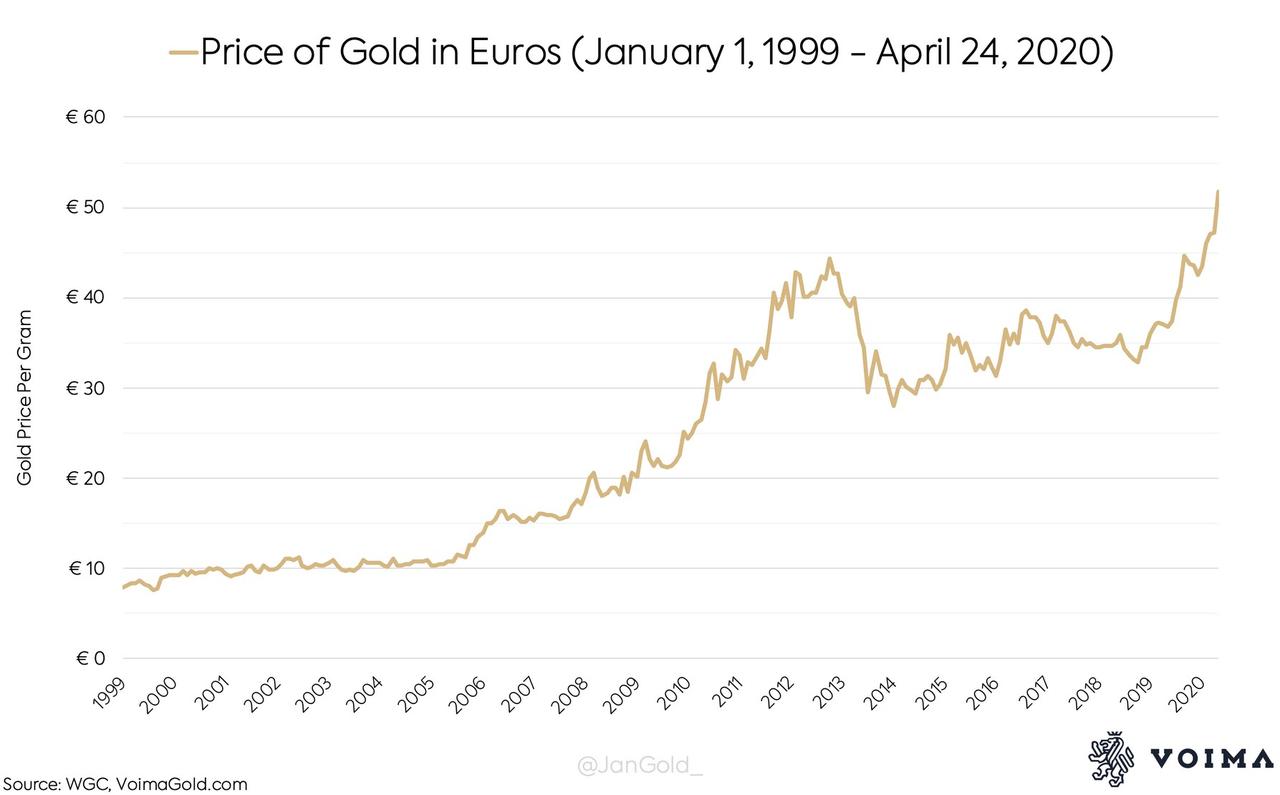
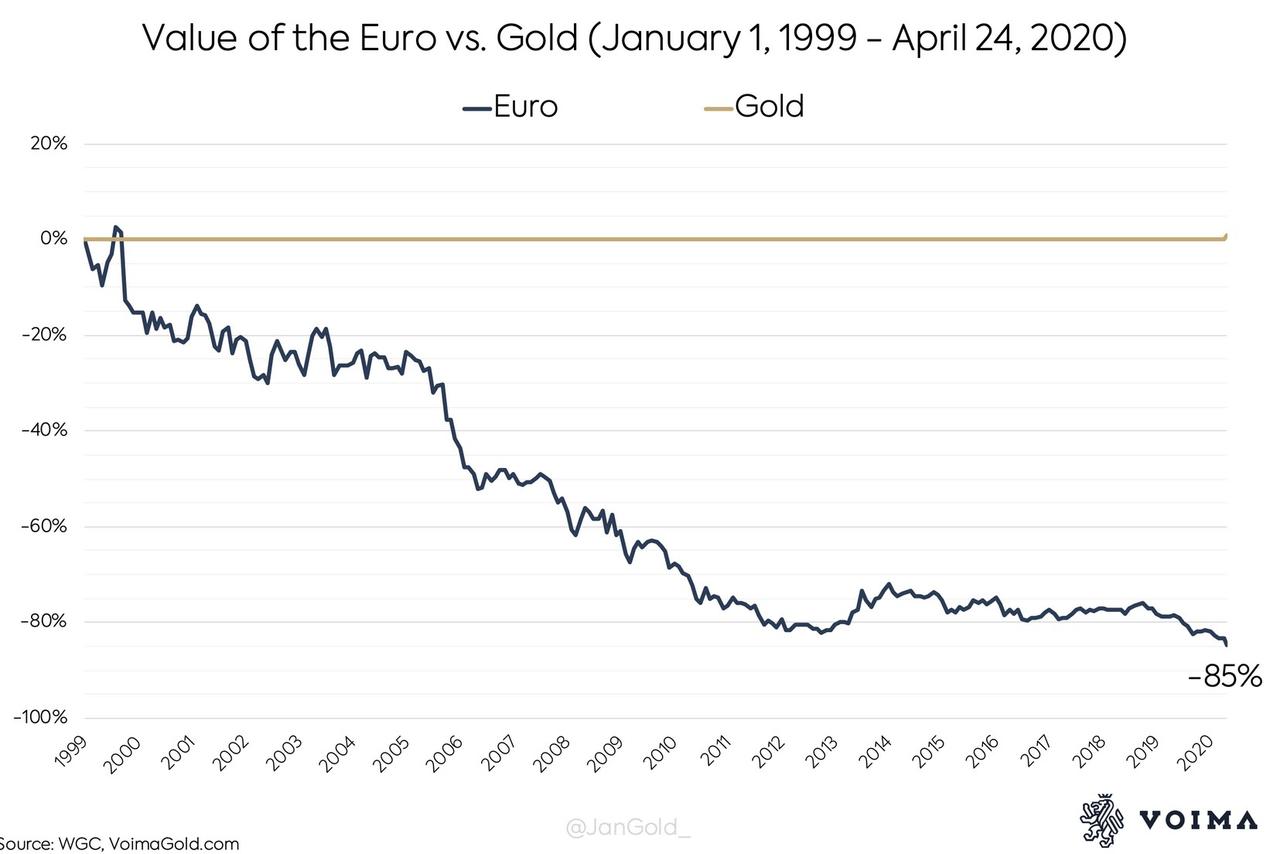
Over the course of 20 years, the price of gold in euros has increased by 555%. From a historic perspective the euro is a young currency, but already lost 85% of its value against gold. This reveals the instability of fiat money.
To evaluate by how much the euro has devalued against gold, it must be measured in gold terms (because a currency can’t devalue by more than 100%). In 1999 it took 0.13 gram to buy one euro; today only 0.02 gram. The result is that the euro lost 85% of its value versus gold. In the chart below you can see the euro’s descent versus gold since 1999.
Measuring the value of currencies against each other is interesting, but most important is what this means for the purchasing power of currencies locally. The end goal of every participant in the economy is goods and services. What truly matters for a currency is its purchasing power. We will compare the purchasing power of euros versus gold in the eurozone.
Many people think that euros only lose purchasing power when a bank needs to be paid to store the euros. In other words, if the interest rate on a bank account is negative. This is called “the money illusion.” In reality, one has to subtract consumer price inflation from the interest rate, to arrive at the real interest rate. For the sake of simplicity, let’s say the current interest rate for most savers is zero, minus one percent inflation, is -1%. Currently, euros approximately lose 1% of their purchasing power per year.
Jan Nieuwenhuijs@JanGold_A friend just told me his bank account might be charged with “negative interest rates” in the future. Outraged he was. I told him inflation was eating away his money for years now, with interest rates at zero. It seemed he didn’t “want” to understand this is the same thing.

Now, let’s have a look at gold. Over the past 12 months the gold price has increased by 39%. Subtracted by 1% inflation, is 38%. In one year the purchasing power of gold has increased by 38% in the eurozone (minus storage costs, that is). However, the gold price doesn’t go up by 39% every year, it can even go down for some years. Nevertheless, gold’s purchasing power has greatly increased over the past 20 years. Which is why physical gold should be seen as a long-term reserve asset.
To reveal gold’s purchasing power in the eurozone I have adopted an index. First, I divided the gold price by consumer prices, and then created an index with a base of 100 in the year 1999. I have computed gold’s purchasing power index for Finland, Germany and Italy. Because consumer prices slightly differ for the selected countries, the purchasing power of gold in these countries is not exactly equal. Though, I found gold’s purchasing power is roughly the same for the entire eurozone.
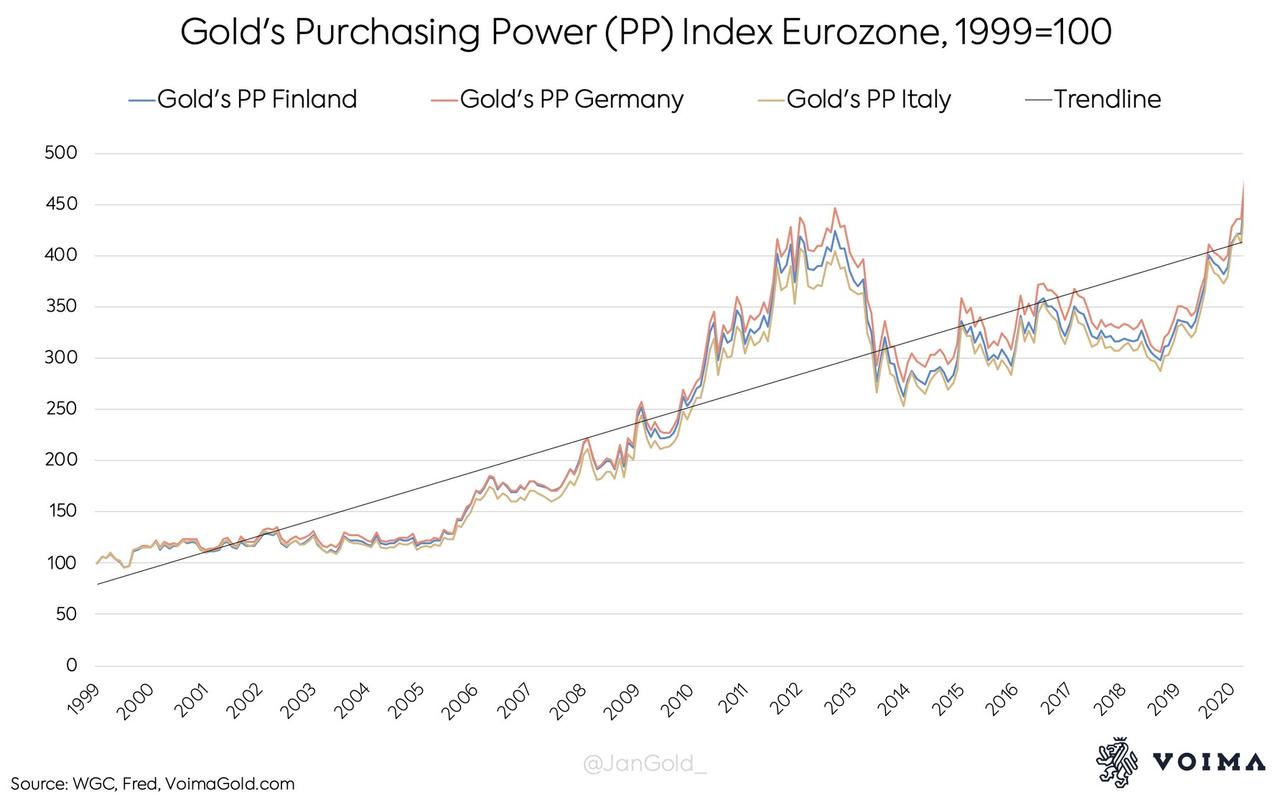
First and foremost, you can see gold’s purchasing power has increased in the eurozone since 1999. This means that the price of gold has outpaced consumer prices. From the index number you can see that gold’s purchasing power, on average, has increased by a staggering 350% (450 – 100) over 20 years. The gold price can be volatile, at times, but over longer periods of time it preserves its purchasing power, with the benefit that it doesn’t have any counterparty risk, so it withstands every crisis.
* * *
US seeks halt in civil lawsuit accusing JP Morgan of manipulating metals market, citing criminal case
- The U.S. wants a federal judge to halt a civil lawsuit accusing J. P. Morgan of manipulating precious metals markets. The Justice Department cited an ongoing criminal case as its reason for the request.
- A former J. P. Morgan trader pleaded guilty in Connecticut last month to manipulation charges.
- In the guilty plea, the trader said he had learned to make bogus trade orders from senior traders at the bank and that he used the strategy hundreds of times with the knowledge and consent of his immediate supervisors.
CNBC.com
The Justice Department is asking a judge to put the brakes on a civil lawsuit against J. P. Morgan Chase, citing an ongoing probe into a “related criminal case” that involves alleged manipulation of precious metals markets.
The department wants a six-month postponement in the proceedings of the civil lawsuit, which was filed in 2015 by hedge fund manager Daniel Shak and two commodity traders. The government also says it could ask for a longer delay in the case, according to a court filing on Monday.
The move comes days after Shak’s lawyer, David Kovel, sought permission to reopen questioning of two former J. P. Morgan traders and the bank’s current global head of base and precious metals trading.
Kovel, in making the request with the Manhattan federal judge in the civil case, cited last month’s guilty plea by one of those former traders, John Edmonds, in federal court in Connecticut.
Edmonds admitted making bogus bids on precious metals contracts while working at the bank from 2009 to 2015.
Neither J. P. Morgan Chase nor Kovel’s clients have opposed the Justice Department’s request.
In arguing for a delay, the Justice Department said Shak’s lawsuit is “related” to Edmonds’ criminal case and that Edmonds has “pleaded guilty and acknowledged his own participation in such conduct, as well as that of other traders.”
“Edmonds awaits sentencing, but the broader investigation is ongoing,” the Justice Department said. The U.S. wants to delay the civil case “to protect the integrity of its ongoing criminal investigation,” it said.
J. P. Morgan did not respond to a request for comment by CNBC. Kovel declined to comment.
Tuesday night, after this story first was published, Judge Paul Engelmayer ordered the federal prosecutors to explain in detail by Monday why postponing proceedings in the civil lawsuit would not harm those involved, and why reopening questioning “would be detrimental to the Government’s ongoing criminal investigation.”
Englemayer also wrote that he regards Edmonds’ guilty plea “as potentially highly consequential” to the civil case.
In his guilty plea, the 36-year-old Edmonds said he had learned to make bogus trade orders from senior traders at the bank and that he used the strategy hundreds of times with the knowledge and consent of his immediate supervisors. He admitted to working with “unnamed co-conspirators” at J. P. Morgan, according to the Justice Department.
Kovel wants to question Edmonds again as well as Michael Nowak, the bank’s global head of base and precious metal trading, and former J. P. Morgan Chase Managing Director Robert Gottlieb. The three had previously answered questions under oath in the civil case.
Kovel said in court filings that Nowak was the immediate supervisor of Edmonds, while Gottlieb was Edmonds’ mentor.
In his prior deposition, Edmonds said that Gottlieb sat only a “couple feet” away from him for about five years, and that he was “somebody [he] looked up to in the business,” who helped guide and train him.
Nowak is described by Edmonds as his direct supervisor, with whom he would sometimes discuss trading strategies. Nowak was also the person responsible for overseeing the performance and risk of Edmonds’ portfolio, according to the deposition.
Edmonds also stated in his prior deposition that he would enter precious metals trades for both Nowak and Gottlieb, among others.
The civil lawsuit claims Shak and his fellow plaintiffs lost tens of millions of dollars as a result of actions by J. P. Morgan’s traders.
Federal judge tells traders they can combine cases accusing JP Morgan of rigging metals market
- Litigation in a separate civil case has been put on hold until at least May at the behest of the Justice Department, which is investigating a “related criminal case” that involves alleged market manipulation by precious metals traders at J. P. Morgan.
- Judge John Koeltl of the Southern District of New York appointed the White Plains, N.Y., law firm Lowey Dannenberg as interim lead counsel for the proposed class action.
A group of traders from across the U.S. who allege that J. P. Morgan Chase manipulated precious metals markets for years are one step closer to bringing a class action suit against the nation’s largest bank.
Earlier this month, a federal judge said five separate lawsuits making similar allegations against the bank could be combined, potentially including thousands of people who traded in the precious metals market from Jan. 2009 through Dec. 2015.
Litigation in a separate civil case has been put on hold until at least May at the behest of the Justice Department, which is investigating a “related criminal case” that involves alleged market manipulation by precious metals traders at J. P. Morgan.

J. P. Morgan declined to comment on this story.
Judge John Koeltl of the Southern District of New York appointed the White Plains, N.Y., law firm Lowey Dannenberg as interim lead counsel for the proposed class action.
Vincent Briganti, a partner at the firm, filed the first suit seeking class action status in November on behalf of Dominick Cognata, a trader who alleges he suffered losses due to J.P. Morgan’s illegal trading conduct in the silver and gold futures and options markets.
That was after the federal court in Connecticut unsealed a criminal plea agreement by John Edmonds, a former J.P. Morgan metals trader. In his guilty plea, Edmonds, who is 36-years old, admitted that he and other “unnamed co-conspirators” fraudulently manipulated the precious metals markets while they were employed at J. P. Morgan from 2009 to 2015.
Edmonds said he had learned the illegal trading tactics from senior traders, and then used them hundreds of times with the knowledge of and consent of his immediate supervisors.
Briganti’s lawsuit also names John Edmonds and a group of yet-to-be-identified precious metals traders and the bank as defendants.
On Wednesday, the lawyers sent a letter to Judge Koeltl saying they were having difficulty locating Edmonds to serve him legal papers and requested a 30-day extension to do so, which the judge granted on Thursday. Briganti noted that they have been in contact with Edmonds’ attorney in the criminal case. Edmonds’ attorney and Briganti could not be reached for comment.
“We are hopeful that this extension will result in completing service on Mr. Edmonds without formal motion practice and a request for alternative means of service,” Briganti said in the letter.
The next step in the civil case is for the plaintiffs to file an amended class action complaint and set a schedule for defendants to respond.
In addition to the proposed class action, J. P. Morgan also faces a separate civil suit which also accuses the bank of rigging precious metals markets.
end
March 4.2019
Parker City News
JP Morgan faces potential class action lawsuit after guilty pleas by a former metals trader
Traders from across the U.S. are banding together to accuse J. P. Morgan Chase of manipulating precious metals markets for years.
At least six lawsuits, all making similar allegations against the nation‘s largest bank, have been filed in New York federal court in the past month, since federal prosecutors in Connecticut with a former J. P. Morgan Chase metals trader.
The cases could potentially include thousands of people who traded in the precious metals market. The White Plains, N.Y., law firm Lowey Dannenberg is asking the court to combine the cases and name it as the lead.
The law firm‘s commodities group is led by Vincent Briganti, the attorney who filed the first lawsuit on behalf of Dominick Cognata, a New York resident who alleges he suffered losses due to J. P. Morgan‘s trading conduct in the silver and gold futures and options markets.
A combined case, seeking class action status, would include anyone who purchased or sold futures contracts or an option on NYMEX platinum or palladium or COMEX silver or gold between at least Jan. 1, 2009, and Dec. 31, 2015. The lawyers believe that “at least hundreds, if not thousands” of traders would be eligible to join the case.
Named as defendants in all of the lawsuits are John Edmonds, a 36-year old former metals trader at J. P. Morgan, a group of yet-to-be-identified precious metals traders and the bank.
Edmonds, a New York resident, pleaded guilty in October to one count of conspiracy to defraud the market and manipulate prices of precious metals futures contracts and one count of commodities fraud. In the criminal plea, Edmonds admitted that he and other “unnamed co- conspirators” at J. P. Morgan, fraudulently manipulated precious metals markets from 2009 to 2015, the same time frame covered in the class action suits.
Briganti filed the initial class action on Nov. 7, just one day after the Justice Department unsealed Edmonds‘ plea in the U.S. District Court of Connecticut.
Edmonds admitted in his guilty plea that he deployed the illegal trading scheme hundreds of times with the direct knowledge and consent of his immediate supervisors. Plaintiffs say they have suffered economic injury, including monetary losses, as a direct result of actions by Edmonds and the other unnamed J. P. Morgan metals traders in the futures and options contracts.
One of the suits alleges that “the number of unlawful trades that JP Morgan traders executed in precious metals futures markets is at least in the thousands.”
J. P. Morgan declined to comment. Lowey Dannenberg did not respond to a request for comment by CNBC.
The Justice Department‘s criminal investigation is still ongoing and recently caused a separate related civil case to be put on hold for at least six months while the government continues its investigation. That civil lawsuit, which also accuses J. P. Morgan of rigging the precious metals market, was filed in 2015 by hedge fund manager Daniel Shak and two commodity traders.
After reviewing the details of the plea agreement, David Kovel, the attorney for Shak‘s suit, sought to re- interview Edmonds, along with two other current and former senior traders at the bank. However, the government argued that reopening questioning would be detrimental to the ongoing criminal investigation. The federal judge overseeing the proceedings ordered a six-month stay in the civil case.
Kovel declined to comment.
Edmonds was originally scheduled to be sentenced in Hartford, Conn., on Wednesday, Dec. 19, but a court filing on Nov. 27 shows the sentencing has been postponed until June. A spokesman for the U.S. Attorney for Connecticut could not elaborate on why the sentencing was postponed since the court filing is under seal.
-END-
Futures Surge As BOJ Goes Full Brrr, States Reopen While Oil Craters
S&P futures climbed alongside stocks in Europe and Asia to start the week after the BOJ went full Brrr earlier when the central bank announced it would buy unlimited amount of bonds (even though nobody actually wants to sell to the BOJ) as more state and countries edged toward reopening, even as earnings season is shaping up to be an even greater disaster than expected (US EPS of -24% yoy is coming in some 9% lower than consensus expectations), while oil prices plunged again, with the June WTI contract plunging below $13.
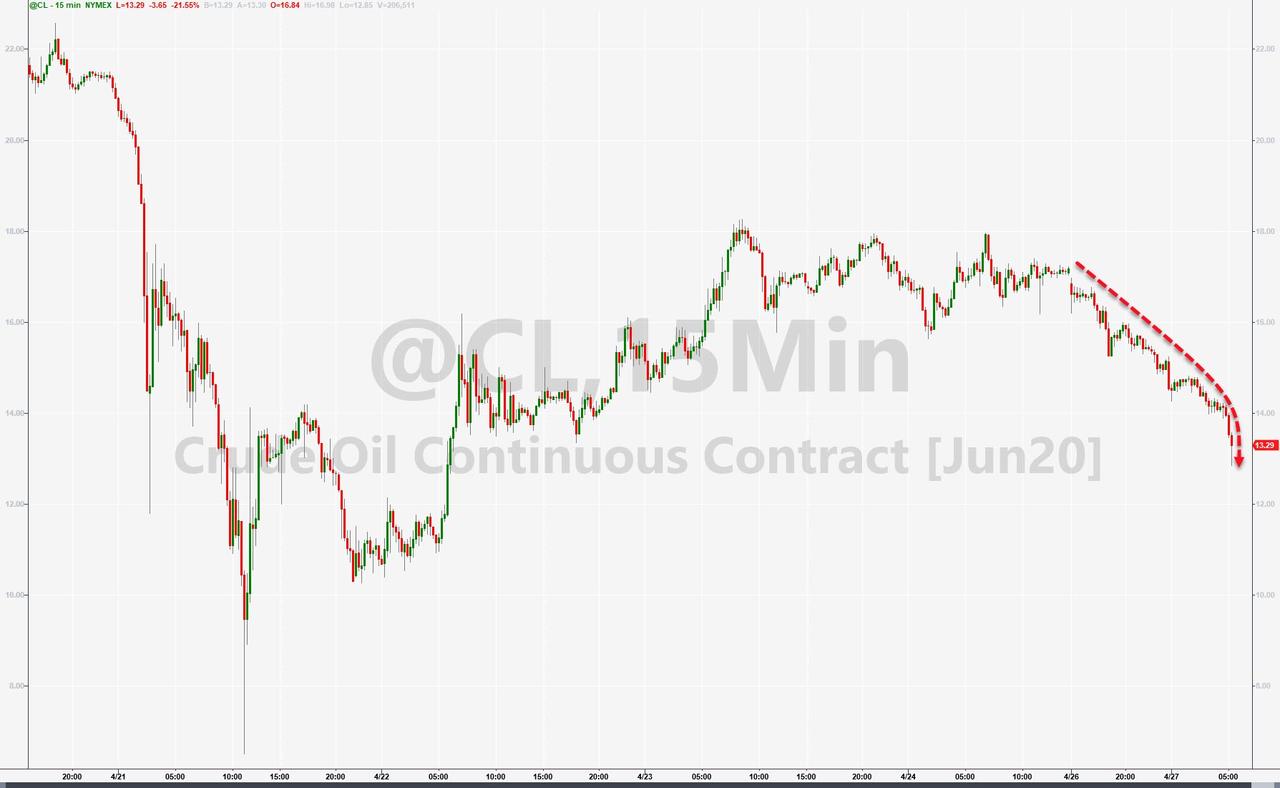
Futures for the three main US benchmarks all pointed to a second day of gains with the Emini approaching its resistance level around 2850 amid continued talk of easing the lockdowns that have been used to help contain the coronavirus…
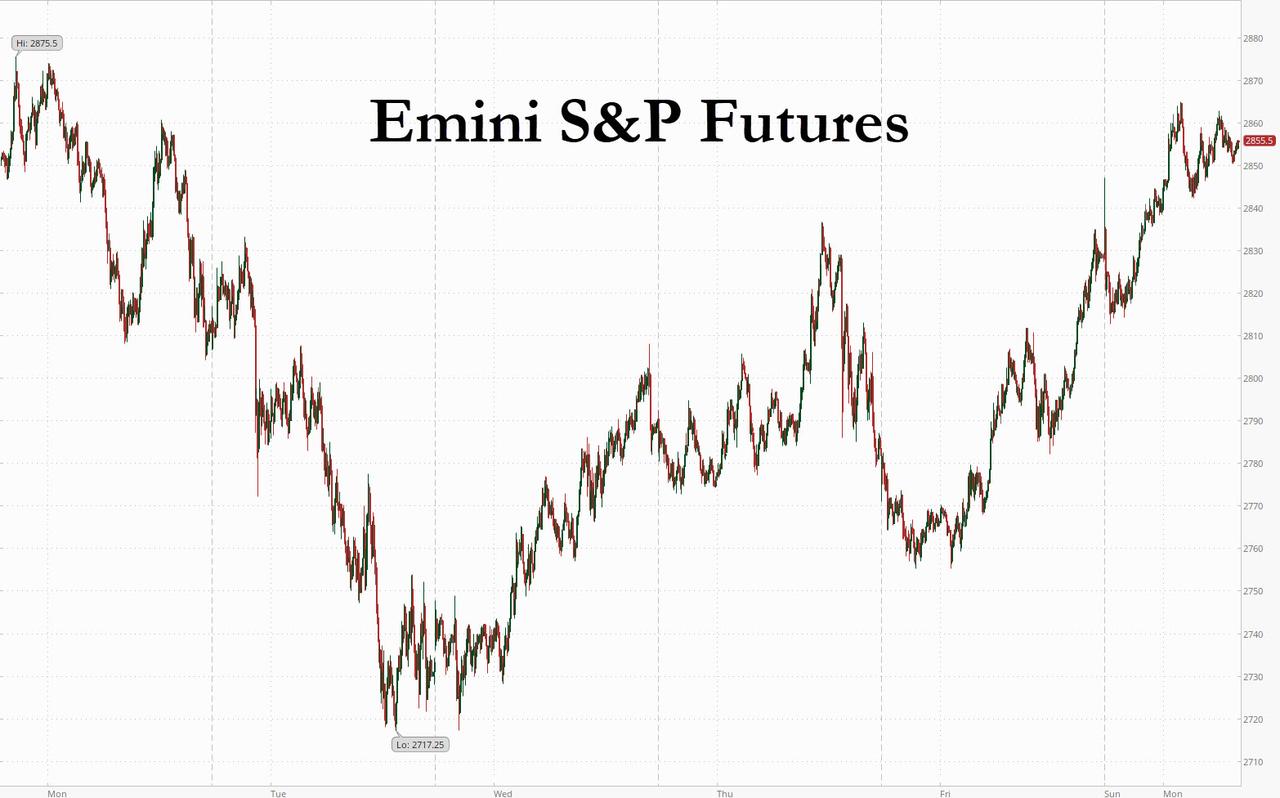
… and as investors turned to quarterly earnings reports from marquee companies including Apple and Microsoft later this week, which however Goldman warned over the weekend have surged too much, too fast and that will result in the next market crash.

The Stoxx Europe 600 Index also rose after missing out on a late Wall Street rally on Friday. Deutsche Bank AG rallied after joining other investment banks by beating first quarter earnings expectations, even as it warned about looming loan defaults. Bayer AG raised the specter of “considerable liquidity challenges” as it continues to deal with litigation related to Roundup weedkiller. Still, shares gained as the company said its core earnings per share target is unchanged for now, with the effect of Covid-19 impossible to assess. Adidas AG fluctuated after forecasting the first quarterly loss in over four years as more than two-thirds of the German athletic wear maker’s stores remain closed.
Earlier in the session, Asian stocks gained, led by industrials and materials, after falling in the last session. The Topix gained 1.8%, with Mitani Sangyo and eBook Initiative rising the most after the BOJ announced earlier that it would go “full BRRRR” as it removed limits on its purchases of government bonds and ramped up its scope for buying corporate debt and commercial paper. And in delightful irony to this “all in” easing move, the yen strengthened.
David Ingles
✔@DavidInglesTV
The Bank of Japan going all in pretty much:
– removes limits on JGB buys
– raises limits on corporate bond, CP buys
– removes price momentum from forward guidanceLooks like one of the world’s biggest “bond funds” is about to get bigger.


David Ingles
✔@DavidInglesTV
Relative to the size of its economy, the BOJ’s pretty much gone “hold my biru”

Elsewhere, the Shanghai Composite Index rose 0.2%, with Kingswood Enterprise and China First Heavy Industries posting the biggest advances.
Data over the weekend showed coronavirus deaths slowed the most in more than a month in Spain, Italy and France, and all three countries have signaled tentative moves to reopen their economies. Italian stocks were among the biggest winners and its bonds outperformed after the nation dodged a credit rating downgrade late on Friday.
In the US too, many more U.S. states have looked to reopen businesses as the health crisis wreaks havoc on the economy, with the White House forecasting a staggering jump in the nation’s monthly jobless rate. Although trillions of dollars in stimulus have helped the benchmark S&P 500 recover nearly 30% from its March trough, analysts say further gains might be limited unless there is progress on developing treatments for the deadly disease.
In commodities, as noted earlier, the big mover was again oil which did buckled the general risk on mood and plunged below $14, which as noted over the weekend is a problem as “The Oil Price Is A Rare Indicator Of What Is Still Real In This Market”
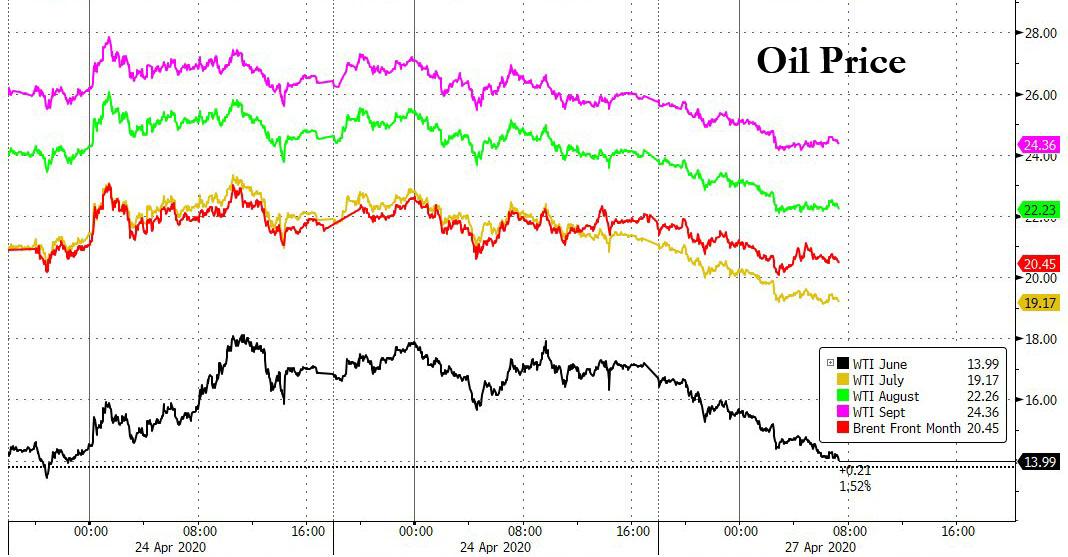
It’s a busy week, with the Federal Reserve and European Central Bank due to announce policy decisions following the BOJ as the battle against the pandemic continues. Several major economies will release GDP numbers, while corporate earnings will keep flooding in.
“This coming week will be huge from a macro data perspective and the extent to which the global economy has been floored by Covid-19,” said Simon Ballard, chief economist at First Abu Dhabi Bank. “Until we are clearly past the peak of the outbreak, on a global scale, and can feasibly deem the pathogen to be contained and there to be no meaningful risk of a second wave of infection, we believe a defensive investment strategy will remain the most appropriate.”
Focus this week will also be on a two-day Federal Reserve meeting ending on Wednesday, although expectations are low for more easing by the central bank. About a third, or some 173 companies in the S&P 500 are scheduled to report quarterly earnings later in the week, including Apple, Amazon.com, Microsoft, Boeing, Ford, General Electric and Chevron. Overall analysts expect a decline of nearly 15% in first-quarter earnings of S&P 500 companies – a number which so far is roughly 25% – with profits for the energy sector estimated to have slumped 68%.
In FX, the dollar weakened broadly and Treasuries slipped as risk sentiment improved on the prospect of an easing of lockdown restrictions around the globe. The Bloomberg Dollar Spot Index dropped the most in more than a week, with the greenback weakening against all Group-of-10 peers; EUR/USD rose a second day. Bunds slipped while European peripheral debt continued to lead euro-area gains; Italian bonds and stocks climbed after S&P Global Ratings left the nation’s credit rating unchanged, delaying the risk of a downgrade toward junk to later this year. The pound rose in its longest winning streak in a month as U.K. Prime Minister Boris Johnson’s return to work fueled speculation he may consider moving toward lifting the lockdown. The Australian dollar outperformed all G-10 peers and rose to a 6-week high versus the greenback as easing coronavirus-related restrictions in two states spurred optimism that the outbreak was slowing in the nation. The New Zealand dollar also advanced, partly by cross flows versus Aussie amid thin liquidity due to public holiday. Japan’s bonds advanced, led by five- and 10-year maturities, as the Bank of Japan scrapped the limitation on its JGB purchases to support the economy; the BOJ also ramped up its purchases of corporate debt
Expected data include Dallas Fed Manufacturing Activity. F5 Networks and Universal Health are among companies reporting earnings.
Market Snapshot
- S&P 500 futures up 0.9% to 2,855.00
- STOXX Europe 600 up 1.4% to 334.34
- MXAP up 1.9% to 144.33
- MXAPJ up 1.8% to 464.18
- Nikkei up 2.7% to 19,783.22
- Topix up 1.8% to 1,447.25
- Hang Seng Index up 1.9% to 24,280.14
- Shanghai Composite up 0.3% to 2,815.50
- Sensex up 1.9% to 31,910.86
- Australia S&P/ASX 200 up 1.5% to 5,321.40
- Kospi up 1.8% to 1,922.77
- German 10Y yield rose 0.5 bps to -0.468%
- Euro up 0.2% to $1.0842
- Brent Futures down 4.3% to $20.52/bbl
- Italian 10Y yield fell 14.6 bps to 1.664%
- Spanish 10Y yield fell 6.5 bps to 0.887%
- Brent Futures down 2.5% to $20.90/bbl
- Gold spot down 0.5% to $1,721.49
- U.S. Dollar Index down 0.4% to 99.94
Top Overnight News from Bloomberg
- Italy will start easing lockdown restrictions next week and Germany reopened some schools on Monday as new cases and fatalities drop in Europe. In Britain, Premier Johnson returned to work and urged the public not to let up on social distancing measures
- Despite the Bank of Japan ramping up its stimulus measures on Monday, the dollar-yen has slid into a bearish death cross technical pattern. The currency pair’s 50-day moving average dropped below its 200-day equivalent, which could signal more downside if the move holds
- Nearly one-third of U.S. business economists expect operations at their companies will return to normal within five to eight weeks, though almost as many say it’s likely to be three to six months before coronavirus- mitigation efforts wind down in earnest
- The top two trade groups representing major retailers such as Walmart Inc., Target Corp. and Best Buy Co. are calling on U.S. governors to adopt uniform reopening standards as the pandemic subsides
- Market manipulation is still on the rise in the U.K. even after a decade of crackdowns onschemes to rig foreign-exchange rates and other key benchmarks. And the coronavirus pandemic could make things worse
- A collapse in the volume of short-term IOUs issued by European companies and a dramatic shortening in their maturities show the region’s commercial paper market remains under stress
Asian equity markets were mostly positive with sentiment underpinned by optimism regarding the reopening of global economies after some US states began to reopen businesses and with Italy, Spain and France preparing to ease restrictions after recording their lowest death tolls in a month. ASX 200 (+1.5%) was led higher by tech and industrials with sentiment also supported by loosening of lockdown measures after Queensland announced to permit some outings from next Saturday. However, upside was initially restricted by weakness in the largest weighted financials sector after big 4 bank NAB posted a 51% slump in cash profit and unveiled plans for a substantial share placement, while Nikkei 225 (+2.7%) outperformed amid a weaker currency and the BoJ policy announcement where the central bank announced further measures including a shift to unlimited bond buying as widely speculated. Hang Seng (+1.9%) and Shanghai Comp. (+0.3%) were also higher with Hong Kong surging as its government was said to consider easing social distancing controls and the mainland somewhat lagged after weak Chinese Industrial Profits which contracted by almost 35% Y/Y. Finally, 10yr JGBs were initially lower amid the gains in stocks and similar pressure in T-notes, although JGBs prices were later boosted after the BoJ policy announcement in which the central bank also upped its corporate bond and commercial paper purchases with the maximum limits of purchases from a single issuer upped to JPY 500bln and JPY 300bln respectively from JPY 100bln.
Top Asian News
- BOJ Vows to Buy as Many Bonds as Needed in Stimulus Move
- China Industrial Profits Dropped by More Than a Third in March
- Alibaba Is Said to Demote Top Exec After Probe into Scandal
- India Will Probably Miss Deficit Goal, RBI Chief Tells Cogencis
European equities trade comfortably on a firmer footing [Euro Stoxx 50 +2.2%], as the risk-appetite from the APAC session followed through and intensifies as European economies near an easing lockdown measures – with Italy to begin its lifting from May 4th, Spain relieving some of its strictest measures and UK to reportedly update on measures as early as this week. Bourses see broad-based gains but Italy’s FTSE MIB (+2.5%) modestly outperforms after S&P refrained from downgrading the country’s rating on Friday. Sectors all reside in positive territory, with Financials leading the gains – propped up by Deutsche Bank (+11.2%) earnings – whilst energy underperforms amid price action in the oil complex. This performance is also reflected in the sector breakdown with Banks the outperformer and Oil & Gas the laggard, Travel & Leisure resides towards the top amid lockdown lifts across Europe and US. In terms of individual movers, earnings see more focus on German firms; DAX-giant Bayer (+2.7%) sees impetus from Q1 revenue and adj. EBITDA topping analyst estimates, and improvement in EPS and gains across all its units – the Co. accounts for 6.8% of the DAX 30. Adidas (+2.5%) conformed to the broad risk-appetite after nursing opening losses of over 3%, which initially emanated from dismal earnings alongside a failure to provide FY20 guidance. Adidas noted that 70% of its global stores remain shut. Deutsche Bank (+11.2%) shares soar on an early earnings release in which Q1 pre-tax posted a profit of EUR 206mln vs. Exp. loss 269mln, albeit the group notes that it is unlikely to meet its FY20 leverage ratio target of 4.5%. A spokesman said the release of key metrics was due to a significant divergence with analyst forecasts – Commerzbank (+6.5%) rises in sympathy. Elsewhere, Lufthansa (+7.2%) was propelled at the open after Germany’s Economy Minister stated the group must get a chance to return to profitability, whilst the Co. is also seeking a EUR 290mln loan from the Belgium gov’t for its Belgian subsidiary. Similarly, Air France-KLM (+4.7%) and Renault (+5%) see upside after the French gov’t announced a EUR 7bln package for the former, whilst mulling a EUR 5bln loan guarantee for the latter. On the flip side, Airbus (-1.5%) is pressured amid comments from its CEO regarding the severity of the group’s position – stating that the Co. is “bleeding cash” at a rate which threatens the Co’s existence, adding that a third of its business has been lost in the past few weeks.
Top European News
- Why the World’s Highest Virus Death Rate Is in Europe’s Capital
- Deutsche Bank Warns of Loan Defaults After Surprise Profit
- Johnson Returns to Work Urging Britain to Maintain Lockdown
- Rally in Italy’s Bonds Is Only Knee-Jerk Reprieve: Markets Live
In FX, the Greenback has retreated further against G10 counterparts and almost across the board, with the DXY struggling to retain grip or sight of the 100.000 mark within a 100.320-99.847 range amidst an upturn in broad risk sentiment that is only really being tainted by more weakness in crude oil on bearish supply/storage-demand dynamics.
- AUD/NZD – The Aussie and Kiwi are both seemingly reaping the rewards of relative progress and success on the coronavirus front as the respective Governments eye reopening schedules. Aud/Usd is now firmly back above 0.6400 and pivoting 0.6450, while Nzd/Usd is straddling 0.6050 and Aud/Nzd is probing above 1.0650 on Anzac Day. Note, NZ markets return on Tuesday and will be looking towards trade data for some fundamental direction/impetus in the same vein as Australia’s preliminary report last week.
- GBP – The next best major and the Pound could well be receiving another Boris boost as the UK PM returns to his official residence to resume duties with an encouraging update on Britain’s battle to combat COVID-19. Cable has reclaimed 1.2400+ status and Eur/Gbp is meandering between 0.8754-10 parameters with the cross retreating below its 200 DMA again.
- CAD/JPY/EUR – The Loonie is also outpacing its US peer even though oil prices are tanking again, with Usd/Cad under 1.4100 ahead of somewhat dated Canadian securities balances for February, while the Yen has strengthened in wake of the BoJ policy meeting despite further stimulus via QE as speculated ahead of the event. Usd/Jpy got close to 107.00 before a mild bounce that could have been option expiry related given 1.2 bn rolling off at the strike, but also technical as strong chart support sits just beneath the round number circa 106.93/92 (April 15th and 1st lows). On the flip-side, 2 bn expiries from 107.50 to 107.60 may cap the headline pair, while the Euro has 1.1 bn at 1.0800 to provide a cushion alongside a raft of options in to the Fed and ECB on Wednesday and Thursday respectively.
- CHF/NOK/SEK – The Swiss Franc and Norwegian Krona are marginal underperformers following latest weekly sight deposits revealing another significant rise in bank coffers, while the latter is eyeing the aforementioned weakness in crude, like the Russian Rouble. However, the Swedish Crown continues to hold up better on the premise that the Riksbank will stick to its guns on rates tomorrow in favour of non-standard policy measures should the situation warrant more than already implemented. Hence, Usd/Chf idling within a 0.9744-13 band, Eur/Chf off recent near 1.0500 lows between 1.0532-58, Eur/Nok rotating around 11.5000, Usd/RUB encircling 74.5000 and Eur/Sek still suppressed sub-10.9000.
- EM – Some much needed respite for the Rand that has pared declines from 19.1000+ amidst the aforementioned revival in risk appetite, but Usd/Zar may be impacted by thinner than normal volumes due to SA’s Freedom Day holiday, while the Hong Dollar remains close to the top of its peg vs the Dollar prompting the HKMA to intervene again.
Inn commodities, WTI and Brent front-month futures have resumed selling off as storage scarcity continues to weigh on investor sentiment – with the former underperforming amid reports that Cushing, Oklahoma, may hit full capacity soon. Goldman Sachs believes that storage capacity limits could be tested in as little as three weeks. This week also sees the official implementation of the OPEC+ reduction pact, but some members, including Saudi, have brought forward cuts in a bid to somewhat stabilise the price rout. ING, among other desks, believes that the move is “helpful, [but] it will have little impact on the oil balance in the short term.” Nonetheless, despite the recent geopolitically induced upside in prices – underlying fundamentals remain unchanged. That being said, with major economies set to loosen lockdown restrictions, pressure on demand could start to ease – early signs could be seen in China as refinery activity at independent refiners has been hitting record levels in the Shandong region. WTI June briefly dipped below USD 14.50/bbl to a current base at USD 14.18/bbl (vs. high USD 16.98/bbl), whilst its Brent counterpart sees declines in tandem having tested USD 20/bbl to the downside in early trade (vs. high USD 21.91/bbl). Elsewhere, spot gold sees losses despite a softer Buck, with desks attributing the pressure to improved risk appetite on countries lifting COVID-19 measures. The yellow metal remains comfortably north of USD 1700/oz, having waned off highs of around USD 1720/oz. Copper prices meanwhile remain in the green but somewhat subdued amid a slump in Chinese Industrial profits – prices edging towards USD 2.37/lb vs. high of around USD 2.39/lb. Finally, Dalian iron ore futures recovered as stocks of the raw material fell to their lowest in over 9 months.
US Event Calendar
- 10am: Revisions: Retail Trade
- 10:30am: Dallas Fed Manf. Activity, est. -75, prior -70
DB’s Jim Reid concludes the overnight wrap
It’s hard to believe it’ll be May on Friday. It only feel like yesterday that it was January and the age of innocence. This week we’ll be bombarded with a peak week of Q1 earnings, the big 3 central banks having policy meetings, China PMIs and Q1 GDP growth in Europe/US. Our annual 2020 Default Study has also just been published so please keep an eye out for that.
Before we preview all of the above, one of the most interesting things I read this weekend was a fairly simple piece that explained that the saviour of the world’s health services – namely PPE – is a product of polypropylene and thus the oil and gas sector. It is in effect single-use plastic. Yet I’ve not heard anyone complain about the impact on the environment of trying to produce as much of it as possible. When we discussed in our 2020 climate change related Davos note (link here ) about the difficult global warming dilemmas ahead, we noted that the very things that have helped pollute the atmosphere over the last couple of centuries have also improved the health and wealth of all humans beyond recognition relative to our forefathers. Before the industrial revolutions being a human was a bleak existence for the vast majority. In the Davos note we speculated as to whether humans would soon realise the economic trade-offs necessary if they really wanted to halt global warming. The covid-19 experience has kicked the debate into the long grass for now but I suppose we’re learning a bit more about what life would be like without growth during these lockdowns and also interestingly that single use plastics can be worshiped if used to save lives. Fascinating to see and think about.
Onto slightly less deep things. This morning we have published our annual default study. This is the 22nd year I’ve published the note (with my colleague Nick Burns helping to co-author most of this time) and this one is entitled “Defaults seem to be the hardest word”. Although we’re about to hit the worst economic crash since either WWII or the Great Depression, after many arguments within the team we think that HY defaults (US at 11% and Europe at 7%) will be lower than their previous three modern day recessionary peaks and noticeably so in Europe. With all the intervention out there, authorities are clearly loathed to see companies go to the wall. So 2020/21 will be a supercharged version of the last 17 years where the default beta to GDP has become lower and lower as explicit intervention and ultra-low yields have made it pretty tough for companies issuing in the capital markets to fall over. The risks are if there is a rolling pandemic that lasts say 12-36 months and where governments run out of balance sheet. At this point sovereign default risk could be realistic especially if central banks can’t intervene for some reason at this point. Then the sky could fall in for many companies. See the note here.
Onto this week and central banks can be expected to dominate the headlines even if for now they are more in reflective mode, and waiting to see the impact of their various spectacular interventions so far. The Bank of Japan have got the ball rolling this morning and has removed the limit on buying of JGBs (previously JPY 80tn per year) thereby confirming last week’s news. The BoJ also ramped up its scope for buying corporate bonds and commercial paper by raising its ceiling on holdings to JPY 20tn while keeping its short- and long-term interest rate targets unchanged.
In other weekend news, the US Small Business Administration announced that it is limiting the maximum dollar amount of loans each bank can issue to $60 billion, or 10% of $600 billion allocated so far in two rounds of funding for the Paycheck Protection Program. The cap is intended to help all lenders have equal access for their small business clients. Meanwhile, the EU Economy and Financial Affairs Commissioner Paolo Gentiloni said in a weekend interview with Italy’s Rai 3 television that an EU recovery fund worth around 1.5 trillion euros ($1.62 trillion) needs to be available by mid-September and include loans as well as a portion of non-repayable money.
We also heard from the PBoC governor Yi overnight and he said that “too aggressive” macro stimulus may bring inflation risks and cause too rapid an increase in the macro leverage ratio, in an article on China’s financial assets structure. He added that China should strike a balance between stabilizing growth and preventing risks while, keeping the leverage ratio basically stable is a proper choice.
Asian markets have kicked off the week on the front foot this morning with the Nikkei (+2.21%), Hang Seng (+1.64%), Shanghai Comp (+0.70%) and Kospi (+1.71%) all up. Elsewhere, futures on the S&P 500 are up +0.35% while yields on 10y USTs are up +2.8bps to 0.630% and the US dollar index is down -0.28%. WTI oil prices are down -7.91% this morning to $15.60.
Late on Friday S&P decide to affirm Italy’s BBB rating and not downgrade as most would have expected. They cited the country’s diversified and wealthy economy, net external creditor position and low levels of private debt in partly offsetting the higher public finances. Importantly they also said the ECB were “backstopping this additional public borrowing”. This followed an earlier affirmation of the Baa3 rating from Moody’s who said that the rating should be “broadly unaffected” by the pandemic. Given that their debt/GDP is likely to go up 15-25% over the next 18 months depending on the severity of the shock this is an impressive statement. However it should give the market confidence that Italy will not be downgraded to HY now unless the facts change. The most likely would be a big market led spread widening or a break down in domestic politics.
Back to central banks and we’ll hear from the Federal Reserve on Wednesday and the ECB on Thursday). Our US economists (link here) are expecting that this meeting will primarily provide a status update on the Fed’s actions to date and the Committee’s evolving views about the economic outlook. Attention will then turn to the ECB the following day. While they have been super active of late, the last time they met near the start of the market sell-off there was a big communication error with the ‘we’re not here to close spreads’ type comment. So expect this to be a very carefully worded statement and press conference. Some attention will be as to whether they include fallen angels in their list of purchases following the Fed earlier this com month.
Turning to economic data, this week sees a number of high profile releases that will be of interest to investors. The first look at Q1 GDP readings will be closely watched, with the US (DB at -2.3%) reporting on Wednesday, and the Euro Area then following on Thursday. Even though lockdowns only started in March expect the numbers to help shape economists as they refine their 2020 and 2021 growth forecasts.
Also of interest will be a number of PMI readings out towards the end of the week. On Thursday we’ll get the composite, manufacturing and nonmanufacturing PMIs from China, which will give us an indication of how their economy has recovered as lockdown measures have been eased, and what that might mean for elsewhere. Friday sees the release of the final PMIs from Japan, the UK and the US, and there’s also the ISM manufacturing reading from the US on Friday as well. Europe is on holiday so its PMIs are delayed until next week. The rest of the data is in the day by day guide at the end. China is also on holiday on Friday.
Earnings season kicks up another gear this week, with 173 companies in the S&P 500 reporting, along with a further 95 in the STOXX 600. Looking at the highlights we begin today with Adidas. Then tomorrow things move into full flow, with Alphabet, Novartis, Merck & Co., Pfizer, PepsiCo, HSBC, Starbucks, BP, Caterpillar, UBS, Santander and Ford all reporting. Then on Wednesday, we’ll hear from Microsoft, Facebook, Mastercard, AstraZeneca, American Tower, GlaxoSmithKline, Boeing, Volkswagen, General Electric, Daimler, Barclays, Samsung and Tesla. Thursday sees Apple, Amazon, Visa, Comcast, McDonald’s, Amgen, Royal Dutch Shell, Gilead Sciences, Lloyds Banking Group, Nokia, Twitter all reporting. And finally on Friday, we’ll get ExxonMobil, Chevron, Charter Communications, AbbVie, Honeywell International and RBS.
Recapping last week and it was truly one for the history books. In a year that has seen markets move in once-in-a-generation fashion across asset classes, oil’s move into negative territory stands out. May WTI futures, which expired this past Tuesday, closed in negative territory on Monday. Due to the global demand shock and the lack of prompt storage capacity, the oversupply manifested in negative futures prices – with holders effectively paying to not take delivery. WTI ended Monday at -$37.63/barrel. WTI recovered +$54.57 by the end of the week to finish the down ‘just’ -7.28% (+2.67% Friday) over the five days, this follows two weeks of over -19% drops. Brent crude fell -23.65% on the week (+0.52% Friday).
Global equities retreated on the week with the S&P 500 falling -1.32% (+1.39% Friday), after rising over 15% over the previous two weeks. It was the smallest absolute weekly move for the index since the first week in March. Technology stocks continue to outperform as earning season progresses with the NASDAQ falling just -0.18% (+1.65% Friday) on the week. European equities also fell, with the Stoxx 600 down -1.16% (-1.10% Friday). Equity performance across Europe was fairly correlated. The DAX fell -2.73% (-1.69% Friday), the Italian FTSE MIB fell -1.15% (-0.89% Friday) and the FTSE fell -0.60% (-1.28% Friday). In Asia the Nikkei declined -3.19% (-0.86% Friday), while the CSI 300 fell -1.11% (-0.86% Friday) and the Kospi lost -1.33% (-1.34% Friday) on the week. It was the first weekly decline for Chinese equities – using the CSI 300 – since March 20.
In a sign that equity markets are calming down for now, equity index volatility fell on the week even as spot prices fell. The VIX fell -2.22pts to finish at 35.93 (-5.45 Friday), the lowest closing weekly level for the index since February. On the other hand credit spreads widened on the week. US HY cash spreads were +72bps wider on the week (+16bps Friday), while IG was +2bps wider on the week (unchanged Friday). In Europe, HY cash spreads were +12bps wider over the 5days (+3bps Friday), while IG was -5bps tighter on the week (-2bps Thursday).
Core sovereign bond yields fell slightly in both Europe and the US. US 10yr Treasury yields fell -4.1bps (-0.1bps Friday) to finish at 0.60%, just 6bps from all-time lows. 10yr Bund yields were essentially unchanged (-4.9bps Friday) at -0.47%. Meanwhile, Gilt yields fell -1.3 bps over the 5 days (-0.1 bps Friday). With European leaders unable to reach agreement on the EU Recovery Fund late in the week peripheral spreads widened on the week. Italian yields widened +4.6bps over the 5 days (-9.8bps Friday), and the Bund spread to Spanish 10yr bonds grew +13.7bps (-4.8bps Friday).
On the economic data front last Friday, UK retail sales fell by -5.1% in March, the largest monthly decline since the series began. The German Ifo business climate indicator fell to 74.3 in April, a record low and well below consensus expectations of a 79.7 reading. In the US, the University of Michigan Sentiment survey came in better than expected at 71.8, compared to the expected 68.0 and slightly better than the prior reading of 71.0. US durable goods orders for March fell -14.4% versus the -12.0% expected and 1.2% the prior month, the biggest one month drop since August 2014.
3A/ASIAN AFFAIRS
I)MONDAY MORNING/ SUNDAY NIGHT:
SHANGHAI CLOSED UP 6.97 POINTS OR 0.25% //Hang Sang CLOSED UP 448.81 POINTS OR 1.88% /The Nikkei closed UP 521.22 POINTS OR 2.71%//Australia’s all ordinaires CLOSED UP 1.65%
/Chinese yuan (ONSHORE) closed DOWN at 7.0832 /Oil DOWN TO 14.04 dollars per barrel for WTI and 20.35 for Brent. Stocks in Europe OPENED GREEN// ONSHORE YUAN CLOSED DOWN // LAST AT 7.0832 AGAINST THE DOLLAR. OFFSHORE YUAN CLOSED DOWN ON THE DOLLAR AT 7.0883 TRADE TALKS STALL//YUAN LEVELS GETTING DANGEROUSLY CLOSE TO 7:1//TRUMP INITIATES A NEW 25% TARIFFS FRIDAY/MAY 10/MAJOR PROBLEMS AT HUAWEI /CFO ARRESTED//CORONAVIRUS : /ONSHORE YUAN TRADING ABOVE LEVEL OF OFFSHORE YUAN/ONSHORE YUAN TRADING WEAKER AGAINST USA DOLLAR/OFFSHORE YUAN TRADING WEAKER AGAINST THE DOLLAR /TRADE DEAL NOW DEAD..TRUMP RAISED RATES TO 25%
3 a./NORTH KOREA/ SOUTH KOREA
South Korea
b) REPORT ON JAPAN
JAPAN
Japan officially goes unlimited QE and expands its corporate bond buying..huge helicopter money spree…
(zerohedge)
Japan Printer Go Brrr As BOJ Launches Unlimited QE, Expands Corporate Bond Buying
As was purposefully leaked last week to avoid any chance of market surprise, that giant monetary chemistry lab that is the Bank of Japan did precisely as had been reported, and on Monday morning the BOJ joined the Fed’s and announced it would launch unlimited QE, or rather that it would purchase “a necessary amount of JGBs without setting an upper limit so that 10-year JGB yields will remain at around zero percent.” Previously, the BOJ’s guideline on government debt was to increase holdings by around 80 trillion yen ($743 billion) per year, which is ironic as the BOJ was having trouble monetizing a far smaller percentage of this amount.
While we wish Kuroda the best of luck in overtaking the Fed and ECB in nationalizing the market, we will remind the central banker that it is not an issue of monetization demand, but rather supply, that has shrank the impact of Japan’s QE on devaluing the Japanese Yen, with the annual amount of bonds purchased by the central bank declining consistently every year as there are simply not enough bonds available in the open market for the central bankto buy, and is also one of the reasons why Japan has been urged by various entities to boost its fiscal stimulus to provide the BOJ with the “helicopter money” ammo it so desperately needs to keep the Japanese economy running.

Monday’s decision signals that the BOJ’s concern over the pandemic has intensified quickly with Bloomberg reporting that “unlimited bond buying was not an ideal option to take, in the view of some officials, as it further narrows bank’s policy choices at a time of heightened uncertainty.” On the other hand, it underscores that central banks are now fresh out of any original ideas and will keep doubling down on policies that crashed the system until the entire fiat edifice crashes.
As was also leaked before, the central bank also increased its scope for buying corporate bond and commercial paper by raising its ceiling on holdings to 20 trillion yen, according to its statement Monday in Tokyo.
In keeping with the now default gibberish of the past few years, Kuroda’s central bank said it will “conduct further active purchases of both JGBs and T-Bills for the time being, with a view to maintaining stability in the bond market and stabilizing the entire yield curve at a low level.”
The BOJ said that it would keep negative rate and yield target for 10-year JGB unchanged, and added that it will continue to closely monitor the impact of coronavirus and won’t hesitate to take additional easing measures if necessary although what the BOJ can do after launching unlimited QE while it is also massively monetizing the entire stock market- short of actively starting short squeezes – was unclear.
As Bloomberg notes, a return to relative stability in stock markets and reduced concern over the possibility of a sudden strengthening of the yen have given the BOJ some breathing space to leave its main interest rate policy levers untouched. Furthermore, the BOJ also likely saw a need to take action before the Fed and the European Central Bank meet later this week, so as not to be seen lagging behind its peers, which too have become deranged chemical labs.
The bank had come under increasing pressure to take more action as the declaration of a nationwide state of emergency this month brought more shutdowns and a growing need for financial support.
The central bank also said it “expects short- and long-term policy interest rates to remain at their present or lower levels,” removing a reference to a need to “pay close attention to the possibility that the momentum toward achieving the price stability target will be lost.”
The additional measures announced by Governor Haruhiko Kuroda also show a greater degree of fiscal-monetary policy coordination, with Prime Minister Shinzo Abe unveiling more than $1 trillion in stimulus this month and an accompanying plan to issue more bonds.
“The BOJ must be aggressive as Japan’s virus situation is getting worse,” Yoshimasa Maruyama, chief market economist at SMBC Nikko Securities, said before today’s decision. “The BOJ will continue to be walking on a tight rope with few tools left.”
And speaking of few tools, with the BOJ decision leaked so far in advance today’s announcement was just a formality, there wasn’t even a trace of a reaction in the market.
3 C CHINA
CHINA
China continues to flood the world with defective medical supplies and also they are gauging as well
(Kern/Gatestone Institute)
China Continues To Flood The World With Defective Medical Supplies
Authored by Soeren Kern via The Gatestone Institute,
More than a dozen countries on four continents recently disclosed problems with Chinese-made coronavirus tests and personal protective equipment. The problems range from test kits tainted with the coronavirus to medical garments contaminated with insects. Defective Chinese face masks, purchased by Spain’s Ministry of Health, were distributed to hospitals and nursing homes across the country, and more than 100 healthcare workers who used them tested positive for Covid-19.
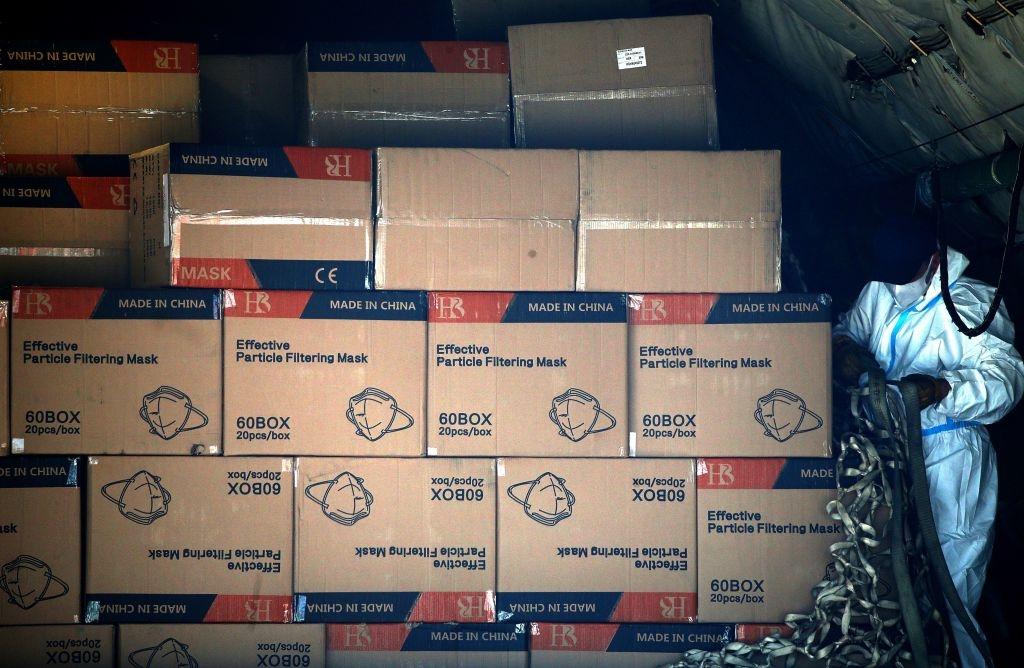
A shipment from China of 8.6 million protective face masks and 150 tons of sanitary equipment arrives at Paris-Vatry Airport in France, on April 19, 2020. (Photo by Francois Nascimbeni/AFP via Getty Images)
Gatestone Institute recently reported that millions of pieces of medical equipment purchased from China by European governments to combat the coronavirus pandemic are defective and unusable.
Since that report, more than a dozen countries on four continents have disclosed problems with Chinese-made coronavirus tests and personal protective equipment. The problems range from test kits tainted with the coronavirus to medical garments contaminated with insects.
Chinese authorities have refused to take responsibility for the defective equipment and in many instances have cast blame on the countries that purchased the material. They have also called on nations of the world to stop “politicizing” the problem — at the same time that Chinese President Xi Jinping and his Communist Party have sought to leverage the pandemic to assert a claim to global leadership.
Spain, the epicenter of the coronavirus crisis in Europe, has experienced the greatest number of problems with medical equipment purchased from China.
After the epidemic hit Spain, the Spanish government purchased medical supplies from China in the amount of €432 million ($470 million). Chinese vendors demanded they be paid up front before making any deliveries. It now appears that much of the material being supplied by China is substandard.
In late March, for instance, the Spanish Ministry of Health revealed that more than a half million coronavirus tests it had purchased from a Chinese vendor were defective. The tests, manufactured by Shenzhen Bioeasy Biotechnology, a company based in China’s Guangdong Province, had an accurate detection rate of less than 30%. Bioeasy had claimed, in writing, that its tests had an accurate detection rate of 92%.
After the swindle made international headlines, Bioeasy agreed to replace the tests. On April 21, however, the Spanish newspaper El País reported that all 640,000 replacement tests were also useless. The Spanish government is now seeking a refund.
The Chinese Embassy in Madrid blamed the Spanish government for purchasing the tests from an unauthorized vendor. Bioeasy, apparently, does not have a license to sell coronavirus tests. Spain, however, has also reported problems with material purchased from vendors that are authorized by the Chinese government.
On April 15, Spain’s Ministry of Health recalled 350,000 so-called FFP2 masks after laboratory tests determined that they were substandard. The defective masks were manufactured by Garry Galaxy Biotechnology, a company included on the Chinese government’s list of approved manufacturers of personal protective equipment. FFP2 masks are required to filter at least 94% of aerosols, but those delivered to Spain filtered only between 71% and 82% of aerosols.
The defective masks were purchased by the Spanish Ministry of Health and distributed to hospitals and nursing homes across the country. After the defective masks were recalled, more than a hundred healthcare workers who had used them tested positive for coronavirus disease (Covid-19).
In the northeastern Spanish region of Catalonia, local health officials on April 18 recalled 180,000 Covid-19 antibody tests — also known as serological tests — because of their low rate of detection. The tests, produced by the Chinese manufacturer Guangzhou Wondfo Biotech, were purchased by the central government in Madrid and distributed to regional health authorities to detect Covid-19 in two priority groups: healthcare personnel and elderly people in nursing homes. The Wondfo tests reportedly gave negative results to people who had previously tested positive for Covid-19, and also failed to distinguish between two types of antibodies, including those that confer immunity.
In the eastern city of Alicante, the General Hospital recalled 640 disposable medical garments after one of the boxes from China contained cockroaches. The hospital said that it had received a total of 3,000 garments in 75 boxes and that it found two insects inside one of the boxes. It added that given the shortage of medical supplies, the garments would be sterilized, not destroyed.
Other countries — in Europe and beyond — have also criticized the quality of Chinese medical supplies:
- Australia. On April 1, the Australian Broadcasting Corporation (ABC) reported that the Australian Border Force (ABF) had seized nearly one million Chinese-made faulty face masks and other protective clothing that was exported to Australia to help halt the spread of coronavirus. The material was valued at A$1.2 million (US$760,000). “We started seeing this stuff arriving roughly three weeks ago when news of the pandemic was really taking off,” an ABF official told ABC. “The dodgy material is coming via air cargo because there is a backlog of sea freight at Australian ports.”
- Austria. On April 6, the Ministry of Economic Affairs confirmed that 500,000 masks ordered from China for use in South Tyrol were “completely unusable” because they did not meet safety standards: “The result of the quality control check showed that the masks do not meet an FFP standard. When putting on the masks, it is impossible to obtain a tight fit in the area of the chin and cheeks.” Minister of Economics Margarete Schramböck complained that international providers of the urgently needed FFP2 and FFP3 masks had not delivered the required quality in nine out of ten cases. On April 9, Austrian media reported that the defective mask problem was far greater than initially thought. The Austrian Red Cross ordered 20 million masks from the same Chinese manufacturer that made the defective masks for South Tyrol.
- Belgium. On March 31, the University Hospital of Leuven rejected a shipment of 3,000 masks from China because the equipment was substandard.
- Canada. On April 7, the City of Toronto recalled more than 60,000 surgical masks made in China. The masks, valued at more than $200,000, were provided to staff at long-term care facilities. Toronto health authorities were investigating whether caregivers were exposed to Covid-19 while wearing the equipment. The masks represented around 50% of Toronto’s inventory of surgical masks, according to Matthew Pegg, Toronto’s fire chief and general manager of emergency management.
- Czech Republic. On March 23, the Czech news site iRozhlas reported that 300,000 coronavirus test kits delivered by China had an error rate of 80%. The Czech Ministry of Interior had paid $2.1 million for the defective kits.
- Finland. On April 10, the Managing Director of Finland’s National Emergency Supply Agency, Tomi Lounema, resigned after he admitted to spending €10 million ($11 million) on defective protective equipment from China.
- Georgia. On March 27, Health Minister Ekaterine Tikaradze cancelled an order for 200,000 coronavirus tests manufactured by the China-based Shenzhen Bioeasy Biotechnology Company. The move came after Spain reported that 640,000 tests that it purchased from the company were defective. She said: “Georgia had a contract with this company, but today it has been canceled. The money has not been transferred. We are negotiating with another company and at first, they will send two thousand tests. If the reliability of those is approved by us, we will purchase an additional quantity.”
- India. On April 16, the Mumbai-based Economic Times reported that 50,000 pieces of personal protective equipment donated by China were defective and unusable.
- Ireland. On April 6, the Health Service Executive (HSE) revealed that a large portion of the €200 million delivery of personal protective equipment supplied by China was found to be unusable for health care workers. The HSE told the Chinese company responsible for the delivery that unless the quality of the equipment being sent is guaranteed, there will not be any more deals between the two nations with regards to PPE. The government said that it was seeking a refund.
- Malaysia. On April 16, Malaysian authorities approved the use of coronavirus test kits from South Korea after similar kits from China were found to be defective. A senior official in the Ministry of Health, Noor Hisham Abdullah, said that the accuracy of the Chinese tests was “not very good.” He expressed optimism over the South Korean tests: “Now that we have a test kit that is fast, portable and is cheap, that will make the difference.”
- Netherlands. On March 28, the Netherlands recalled 1.3 million face masks produced in China because they did not meet the minimum safety standards for medical personnel. The so-called KN95 masks are a less expensive Chinese alternative to the American-standard N95 mask, which currently is in short supply around the world. The KN95 does not fit on the face as tightly as the N95, thus potentially exposing medical personnel to the coronavirus.
- Philippines. On March 29, the Department of Health apologized for comments it made a day earlier that two batches of coronavirus test kits provided by China were substandard. Undersecretary for Health Maria Rosario Vergeire had said that kits made by Chinese manufacturers BGI Group and Sansure Biotech were only 40% accurate in diagnosing Covid-19 and that some of them would have to be discarded. The Chinese Embassy in Manila rejected those accusations and claimed that the kits complied with standards established by the World Health Organization. “The Chinese Embassy firmly rejects any irresponsible remarks and any attempts to undermine our cooperation in this regard,” a spokesman tweeted.
- Slovakia. On April 1, Prime Minister Igor Matovič disclosed that more than a million coronavirus tests supplied by China for a cash payment of €15 million ($16 million) were inaccurate and unable to detect Covid-19. “We have a ton of tests and no use for them,” he said. “They should just be thrown straight into the Danube.” China accused Slovakian medical personnel of using the tests incorrectly.
- Turkey. On March 27, Health Minister Fahrettin Koca said that Turkey had tried Chinese-made coronavirus tests but authorities “weren’t happy about them.” Professor Ateş Kara, a member of the Turkish Health Ministry’s coronavirus task force, added that the batch of testing kits were only 30 to 35% accurate: “We have tried them. They don’t work. Spain has made a huge mistake by using them.”
- United Kingdom. On April 6, the London-based newspaper The Times reported that 17.5 million coronavirus antibody tests supplied by China were defective. The Chinese manufacturers of the tests blamed British officials and politicians for misunderstanding or exaggerating the utility of the tests. The British government, which reportedly paid at least $20 million (£16 million) for the tests, said that it was seeking a refund. Meanwhile, other coronavirus tests destined for the UK were found to be tainted with coronavirus.
- United States. On April 17, the director of the Missouri Department of Public Safety, Sandy Karsten, revealed that 3.9 million KN95 masks manufactured in China were defective. The State of Missouri had signed a $16.5 million contract with an unidentified vendor for the masks and paid half in advance. The vendor is refusing to return the $8.25 million. Missouri Governor Mike Parson said: “We got cheated here in this state and we are going to go out there and try to get our money back and hold people accountable.” In neighboring Illinois, Governor J.B. Pritzker said that the state had spent $17 million on KN95 masks that may be unusable: “You know things come in shipments of a million — you can’t go through one mask at a time and so you try to take samples from the shipments that come in, make sure you got what you are paying for.” In Washington State, 12,000 coronavirus testing kits produced in China were recalled after some of them were found to be contaminated with the coronavirus.
On March 30, China urged European countries not to “politicize” concerns about the quality of medical supplies from China. “Problems should be properly solved based on facts, not political interpretations,” Foreign Ministry spokeswoman Hua Chunying said.
On April 1, the Chinese government reversed course and announced that it was increasing its oversight of exports of coronavirus test kits made in China. Chinese exporters of coronavirus tests must now obtain a certificate from the National Medical Products Administration (NMPA) in order to be cleared by China’s customs agency.
On April 16, the Wall Street Journal reported that millions of pieces of medical equipment destined for the United States were being held in warehouses in China due to the new export restrictions imposed by the Chinese government. “We appreciate the efforts to ensure quality control,” the U.S. State Department said. “But we do not want this to serve as an obstacle for the timely export of important supplies.”
U.S. Senator Kelly Loeffler from Georgia accused China of holding up shipments of test kits: “Testing is core to opening our country back up. I’m concerned that China’s holding up test kits. They’re playing games with trade policy to prevent us, the United States, from getting the testing that we need.”
The coronavirus pandemic has exposed the flaws of globalization by laying bare how the West has allowed itself to become dangerously dependent on Communist China for the supply of essential health care and medical products.
Andrew Michta, Dean of the College of International and Security Studies at the George C. Marshall European Center for Security Studies, explained:
“The Wuhan Virus and the attendant misery that the Chinese communist state has unleashed upon the world (very much including its own people) has laid bare a core structural flaw in the assumptions underpinning globalization. It turns out that the radical interweaving of markets — which was supposed to lead to the ‘complex interdependence’ that international relations theorists have been predicting for the better part of the century would lead to an increase in global stability… has instead created an inherently fragile and teetering structure that is exacerbating uncertainty in a time of crisis….
“If there is any good to come from the devastating impact on our nation of this pandemic brought about by the Chinese communist regime through its malice and incompetence, it will be the likely demise of enthusiasm for globalization as we know it across the West. After three decades of intellectual gymnastics aimed at convincing Americans that the off-shoring of manufacturing and the attendant deindustrialization of the country are good for us, the time has come for a reckoning.
“Since the end of the Cold War, Western elites seem to have been in thrall to the idea that various ‘natural forces’ in the economy and politics were propelling us forward to a digitally interconnected brave new world, one in which traditional considerations of national interest, national economic policy, national security, and national culture would soon be eclipsed by an emergent peaceful global reality. This virus crisis is a wake-up call, and while some argue we are waking up too late to effectively counter current trends, my money is on the ability of the American people to rally in a crisis and on the resilience of Western democratic institutions.
“Today, while battling the Wuhan Virus consumes the attention of our government agencies and health care systems, we should not lose sight of the foundational strategic challenge confronting the West in the emerging post-globalization era: We are in a long twilight competition with the Chinese communist regime, a struggle we cannot escape, whether we like it or not. Now is the time to wake up, develop a new strategy for victory, and to move forward.”
end
Now Australia is looking closely into the Wuhan Level 4 lab as to the origins of the pandemic. They are studying not only Shi but also Peng Zhou
(zerohedge)
Western Spy Agencies Investigating Wuhan Scientist Highlighted By Zero Hedge In January
Western intelligence agencies are “looking closely at the work of a senior scientist at the Wuhan Institute of Virology, Peng Zhou,” as part of a joint international investigation into the origins of COVID-19, according to the Daily Telegraph.

In a stunning expose, the Australian newspaper reports that “the Five Eyes intelligence agencies of Australia, Canada, NZ, UK and US, are understood to be looking closely at the work of a senior scientist at the Wuhan Institute of Virology, Peng Zhou, as they examine whether COVID-19 originated from a wet market or whether the naturally-occurring virus may have been released from the level four laboratory in Wuhan that was studying deadly coronavirus pathogens from bats.”
Of course, the name of Peng has been long familiar to our readers, and would have been familiar to far more people had Twitter not decided to arbitrarily suspend the Zero Hedge account over a report exposing Mr. Zhou.
As we reported in January – posting publicly available professional contact information and suggesting people ask him about the outbreak near his lab – Peng, head of the Bat Virus Infection and Immunization Group, sought to hire two post-doc fellows last November, who would be tasked with using bats “to research the molecular mechanism that allows Ebola and SARS-associated coronaviruses to lie dormant for a long time without causing diseases.”
One press release from his lab was titled: “How bats carry viruses without getting sick.” Via the Telegraph:
It can be revealed that Zhou — the head of the Bat Virus Infection and Immunity Project at the Wuhan Institute of Virology — spent three years at the bio-containment facility, Australian Animal Health Laboratory between 2011 and 2014, where he was sent by China to complete his doctorate.
During this time, Zhou arranged for wild-caught bats to be transported alive by air from Queensland to the Australian Animal Health Laboratory in Victoria where they were euthanised for dissection and studied for deadly viruses.
His work was funded jointly by the CSIRO and the Chinese Academy of Sciences.
It examined bat immunology and the role of interferons and how “bats are rich reservoirs for emerging viruses, including many that are highly pathogenic to humans and other mammals” and “many of which cause significant morbidity and mortality in humans and other mammals.”
Western intelligence is also looking into the work of the original “Bat Woman” Shi Zhengli, a colleague of Zhou who is the director of the Center for Emerging Infectious Diseases at the Wuhan Institute of Virology.

As we reported in February, Shi notably co-authored a controversial paper in 2015 which described the creation of a new virus by combining a coronavirus found in Chinese horseshoe bats with another that causes human-like severe acute respiratory syndrome (SARS) in mice. This research sparked a huge debate at the time over whether engineering lab variants of viruses with possible pandemic potential is worth the risks.
As Nature.com reported in 2015, the findings reinforce suspicions that bat coronaviruses capable of directly infecting humans (rather than first needing to evolve in an intermediate animal host) may be more common than previously thought, the researchers say.
Zhengli also spent time in Australia as a visiting scientist for three months from February 22 to May 21, 2006 where she worked at the CSIRO’s top-level Australian Animal Health Laboratory.
She used faecal samples of horseshoe bats to identify that they were the natural host for SARS-like coronaviruses. -Daily Telegraph
Meanwhile, the Wall Street Journal reported earlier this month that researchers at the WIV had collected bats in a cave over 1,000 miles away in Yunnan which carried COVID-19.
Also disturbing is that the lab had been operating in part on a $3.7 million grant from the US government.
The Mail on Sunday has learned that scientists there experimented on bats as part of a project funded by the US National Institutes of Health, which continues to licence the Wuhan laboratory to receive American money for experiments. –Daily Mail
In mid-April, the Washington Post reported that the US State Department received two cables from US Embassy officials in 2018 warning of inadequate safety at Wuhan Institute of Virology, which was conducting ‘risky studies’ on bat coronaviruses, according to the report – which notes that the cables have “fueled discussions inside the U.S. government about whether this or another Wuhan lab was the source of the virus.”

According to the Telegraph, the revelation comes as Australian politicians are ramping up pressure on China to cooperate with the international investigation into the origins of the novel coronavirus. Accroding to Andrew Hastie, Chair of the Parliamentary Joint Committee on Intelligence and Security, “The Chinese Communist Party must take responsibility for the virus that began inside their borders and work with the rest of the world to prevent it from happening again. We are simply asking for transparency and co-operation.”
Australia’s official position is that the virus likely originated in the Wuhan wet market, however they are now considering whether the virus escaped fom the Wuhan Institute of Virology due to human error – a theory which US Secretary of State Mike Pompeo endorsed last week when he told Fox News: “Look, we know it began at one [lab], but we need to figure this out.”
4/EUROPEAN AFFAIRS
Italy
Somehow Italy who is mired in debt (over 150% debt/GDP) is saved by S and P as they refuse to downgrade the sovereign to junk
(zerohedge)
Italy Stick Saved As S&P Refuses To Downgrade To Junk
Heading into Friday’s close, everyone – even the ECB, which earlier this week changed its criteria for bonds it can purchase to include potential fallen angels a move that was clearly meant to provide cover for BBB-rated Italy – expected Italy to finally lose its investment grade rating when S&P was fully expected to downgrade the troubled European nation which is facing a catastrophic recession, to junk. However, “surprising” everyone, S&P did not do that, and instead just after the close it affirmed Italy’s BBB rating (with negative outlook), saying “we could lower the ratings if government debt to GDP fails to shift onto a clearly discernible downward path over the next three years, or if there is a marked deterioration in borrowing conditions that jeopardizes the sovereign’s public finance sustainability, including for example due to insufficiently supportive policy measures at the eurozone level.”
Yes, the S&P really said that it expect Italian debt – which is about to go parabolic – to “shift onto a clearly discernible downward part.” We wonder which ECB staffer wrote that particular part of the rating agency report.
That said, the risk of a junking by S&P is now off the table even though the covid crisis assures that Italy will not only be hit with the biggest recession in decades, but since the Eurozone failed to endorse and implement coronabonds or any other joint-funding mechanisms, will scramble to obtain the needed fiscal stimulus even if the ECB provides a critical backstop to the country’s bonds which earlier this week were hit amid fears of the upcoming downgrade.
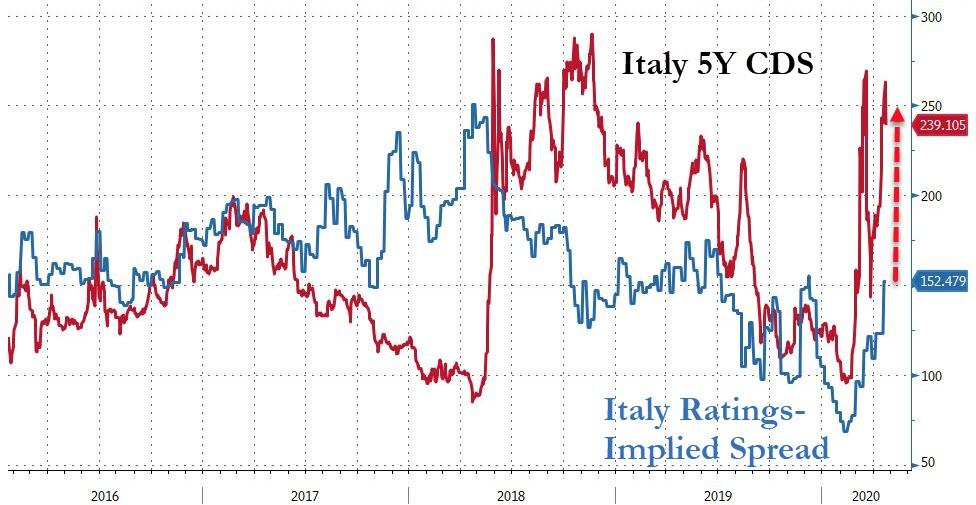
One can only wonder how much behind the scenes negotiations took place (and who was involved) to keep Italy from losing its investment grade rating, or frankly, for the S&P to once again punt even as the rating agency had no problem with downgrading Mexico just a few days earlier.
The full S&P report is below:
Italy ‘BBB/A-2’ Ratings Affirmed; Outlook Negative
Overview
- To mitigate the economic consequences of the public health emergency, Italian authorities have launched budgetary stimulus measures worth 1.5% of GDP, and provided guarantees to small and midsize enterprise (SMEs) and exporters worth 25% of GDP.
- These measures, in tandem with pre-existing automatic stabilizers, will push Italy’s general government deficit to an estimated 6.3% of GDP this year, and increase public debt to close to 153% of GDP by end-2020, according to our projections.
- The ECB is backstopping this additional public borrowing under its pre-existing and newly launched asset purchase programs, together worth over 9% of eurozone GDP.
- Italy’s other credit strengths–its diversified and wealthy economy, net external creditor position, and the lowest levels of private debt in the G7–partly offset the drag from high public leverage on Italy’s creditworthiness, in our opinion.
- We are affirming the sovereign credit ratings on Italy at ‘BBB/A-2’ with a negative outlook.
Rating Action
On April 24, 2020, S&P Global Ratings affirmed its unsolicited long- and short-term foreign and local currency sovereign credit ratings on Italy at ‘BBB/A-2’. The outlook is negative.
Outlook
We could lower the ratings if government debt to GDP fails to shift onto a clearly discernible downward path over the next three years, or if there is a marked deterioration in borrowing conditions that jeopardizes the sovereign’s public finance sustainability, including for example due to insufficiently supportive policy measures at the eurozone level. At present, the ECB’s current financing backstop enables Italy to refinance its debt at real interest rates of around 0%.
We could revise the outlook to stable if we see Italy’s economy performing better than our current prognosis, leading to fiscal outcomes stronger than we are currently forecasting.
We could also revise the outlook to stable if Italy’s banking system weathers the shock to the real economy from COVID-19, without a material increase in nonperforming loans (NPLs) or a depletion of its capital base.
Rationale
On March 9, government authorities put Italy on a nationwide lockdown to contain the spread of COVID-19. Encouragingly, the last two weeks of data indicate progress in lowering hospitalization and mortality rates.
To mitigate the economic fallout from the lockdown, the Italian authorities have launched budgetary stimulus measures worth 1.5% of GDP, over and above the budget’s automatic stabilizers, as well as providing guarantees to SMEs and exporters equivalent to 25% of GDP.
These measures, in tandem with pre-existing automatic stabilizers, are likely to push Italy’s general government deficit to an estimated 6.3% of GDP this year compared to 2019’s fiscal deficit of 1.6%, which was the lowest budgetary gap since 2007. On the back of this year’s expected near 10% contraction of GDP, we project that Italian gross general government debt will increase to 153% of GDP by end-2020, before declining toward 140% of GDP by 2023 as the economy stages a comeback.
We expect that most of the Italian sovereign debt newly created this year as a consequence of the pandemic will be purchased by the ECB under pre-existing and new initiatives, including a new €750 billion asset purchase program called the Pandemic Emergency Purchase Programme (PEPP). We expect that the ECB’s net asset purchases during 2020 will comfortably exceed 9% of eurozone GDP. The ECB’s governing board has emphasized its willingness to increase the size of its asset purchase programs and to widen its criteria for acquiring public and private bonds so as to support the euro area economy throughout 2020. In our view, that commitment means that the Italian government will be able to finance itself at nominal rates of around 0.8% on average this year compared to the 2.5% average borrowing rate on its existing debt stock. In nominal terms, and absent a significant deterioration in borrowing costs, Italy will pay less to service its total debt stock this year and into 2021-2023, than it paid in 2019.
While public debt stocks are high and rising, Italian private debt levels are the lowest in both the G7 and Western Europe. As of end-2019, Italian household plus corporate debt levels totaled 110% of GDP versus 114% in Germany, 150% in Spain, and 250% in the Netherlands. Including financial sector debt, Italian private debt has declined by more than public debt has increased since the global financial crisis. As of fourth-quarter 2019, Italy became a net external creditor to the rest of the world. The economy is, moreover, running a current account surplus of around 3% of GDP, the eighth highest external surplus in the world in absolute terms.
Though we believe even higher public debt levels may be sustainable in economies like Italy’s, where private debt continues to decline, the current policy settings within the euro area are not optimal. Specifically, the eurozone appears hampered, compared with the U.S. and U.K., by the lack of a central fiscal capacity capable of handling economic shocks, such as those following the pandemic. Indeed, the absence of private and public cross-border risk sharing–and the vigorous disagreements around mutualizing debt issuance–appears to place the eurozone and its individual economies at a disadvantage compared with older monetary areas such as the U.S. and the U.K., which issue common risk-free instruments.
Institutional and economic profile: Backed by the ECB, Italian authorities have delivered a coherent response to a public health emergency
- Italy has been in lockdown since March 9, with negative implications for growth, and public finances.
- Employment protection policies should limit the rise in unemployment to around 1.3 percentage points (ppts) on average this year, considerably less than most of its European peers.
- Italy’s economy is diversified and rich, with household savings in excess of 10% of disposable income and notably low private sector debt levels.
After Germany, Italy is the most open economy in the G7, with exports totaling 32% of Italian GDP. Italy remains the seventh-largest exporter in the world and is a diversified and wealthy economy, with no single export category exceeding 4.5% of the total. The economy’s openness, and its sizable current account surplus, make it sensitive to global developments including this year’s synchronized global recession.
Italy’s lockdown, in place since March 9, is already testing the resilience of its economy, including the SME sector–the source of over 75% of total nonfinancial business employment.
Our projection that GDP contracts by just under 10% this year is based on our revised assumption that the lockdown lasts for eight weeks (compared to six previously), but also that the exit from current restrictions is gradual–meaning that the Italian government will require two weeks to reopen the economy, starting with small shops, then bigger shops, then schools and restaurants. We do not expect the authorities to condone large gatherings before the end of the summer. Finally, we assume that some social distancing measures will have to stay in place for at least a year, until a vaccine is found, which could be sometime in mid-2021. Under this scenario, the size of the Italian economy will probably remain below last year’s until early 2023.
Italy’s weak economic growth performance pre-dates the pandemic, reflecting several factors:
- A rigid labor market, where wages are set at a national rather than company level, and the high cost of redundancies tend to dissuade employers, particularly SMEs, from hiring.
- The tax burden on the formal economy is elevated. For example, the World Bank estimates the total tax and contribution rate for businesses at 53%, versus 47% in Spain and 49% in Germany.
- Enforcing contracts is time-consuming and expensive.
- The population is ageing, with the working-age population declining on average by 0.4% per year since 2015.
- Italy’s banks continue to grapple with relatively high levels of NPLs and large exposures to the public sector. The economic lockdown will almost certainly increase the number of NPLs after several years of decline.
For 2021, we project that GDP will recover by 6.4%, but the timing and shape of that recovery remains uncertain. Several factors could lend momentum to a gradual recovery beyond 2021. These include:
- Greater certainty about the current government’s budgetary plan and its compliance with the EU Stability and Growth Pact (last year’s budget deficit was the lowest since 2007).
- Historically low borrowing costs for both the public and private sector.
- The potential for a rise in public and private investment, the latter on the reintroduction of the accelerated depreciation tax scheme, also reflecting lower interest rates.
- The government’s measures to reduce the tax wedge (which is the difference between the hourly labor cost for employers and the hourly post tax earnings for employees) on labor could push up participation in Italy’s labor market.
Italy’s near-term economic outlook is uncertain. We forecast the average unemployment rate will rise to 11.2% this year versus less than 10% on average during 2019, signifying quite low elasticity of unemployment to real GDP growth. The rigidity in Italy’s labor market, particularly in manufacturing, may play a stabilizing role in the face of the global pandemic. At the same time, this rigidity may constrain the extent of the economic recovery during 2021 and 2022. Employment in many seasonal sectors such as tourism and agriculture is less protected and likely to suffer a higher pace of job destruction over the next few months.
One reason for Italy’s low growth is the private sector’s propensity to save rather than spend. Funded by these private savings, domestic banks and other financial institutions have become the Italian government’s single largest creditor, holding an estimated 45% of Italy’s debt stock as of end-January 2020 (but below their 48% share of the total at end-2018). Banca d’Italia holds another 16.7% of outstanding debt (this figure excludes the 3% of Italy’s general government debt held by the Eurosystem under the ECB’s securities markets program and public sector purchase programs). Since March 26, when the ECB began to purchase debt under the newly introduced PEPP, we expect that the Eurosystem’s holdings of Italian public debt will have increased.
The average cost of debt for 2020 is estimated at 2.5% across the entire debt profile. Despite COVID-related spread-widening, Italy’s current average yield at issuance is just under 0.8% as of mid-April.
One of Italy’s macroeconomic vulnerabilities, in our view, is its large untaxed gray economy, particularly in the south. Widespread economic informality explains why official labor participation data indicates that 65.7% only of Italy’s working-age population is active in the formal labor market. This is the fifth-lowest participation rate among the 34 members of the OECD, after Turkey, South Africa, Mexico, and North Macedonia; it is nearly 8 ppts below the 73.4% average labor participation rate in the EU.
Flexibility and performance profile: COVID-19 will push the budgetary deficit to levels beyond those during the global financial crisis
- We expect the public health emergency to push the general government deficit to 6.3% of GDP this year, before it narrows back to 3.0% in 2021 on a recovering economy.
- General government debt to GDP is projected to end 2020 at 153% of GDP before declining thereafter.
- Italy is a net external creditor. Its current account surplus is the eighth-largest in the world in absolute terms.
- The damage that the economic standstill does to the SME sector is likely to boost NPLs.
To mitigate the economic fallout from the lockdown, Italy has launched budgetary stimulus measures worth 1.5% of GDP, alongside the provision of guarantees to SMEs and exporters equivalent to 25% of GDP.
Specific measures included in the “Cura Italia” Decree of March 9 include:
- €3 billion (0.2% of GDP) of transfers to the National Health System and Civil Protection
- Worker Protection: A broadening of workers’ eligibility for benefits disbursed by Italy’s unemployment fund, Cassa Integrazione Guadagni (CIG). Transfers to the self-employed and other workers ineligible for CIG.
- Tax deferrals and relief for firms, particularly those in more hard hit regions.
- Liquidity Support: Guarantees for SME loans, as well as a moratorium on mortgage payments.
These measures, in tandem with the automatic stabilizers and an anticipated decline in tax receipts, are likely to push Italy’s general government deficit to an estimated 6.3% of GDP. That compares to 2019’s fiscal deficit of 1.6% of GDP, which was the lowest budgetary gap since 2007. A widening of the deficit on that scale would exceed the fiscal deterioration suffered in the first year of the global financial crisis (2009), but we expect the fiscal situation to improve faster in 2020 than it did in 2010. This reflects a stronger starting position in 2019, and also solid progress made in reducing VAT evasion thanks to a highly effective digitization policy.
Based on our fiscal and growth projections this year, we estimate that Italian general government debt will increase to 153% of GDP by end-2020, compared to 132.6% in 2019 before declining toward 140% by 2023 as the economy recovers. Our debt estimates exclude Italy’s portion of guarantees on European Financial Stability Facility (EFSF) issuance (in contrast to Eurostat methodology). These projections are highly uncertain, hinging on a relatively smooth relaunching of the economy commending in mid-May.
Since the ECB launched its quantitative easing program in March 2015, the Italian Treasury has improved the government debt profile in several ways:
- By lengthening the average maturity of debt to about seven years, hence reducing gross expected refinancing substantially.
- By locking in lower average financing costs.
As a result, the lag between rising borrowing costs and increasing interest expenditure has lengthened. We estimate that a 100 basis points increase in Italy’s average funding costs would increase its interest expenditure in the first year by 0.1% of GDP compared with the base year, and by 0.3% of GDP in the second year.
Our estimates exclude guarantees given to the EFSF (see “S&P Clarifies Its Approach To Accounting For EFSF Liabilities When Rating The Sovereign Guarantors,” published Nov. 2, 2011).
Italian public and private claims on the rest of the world exceed the world’s financial claims on Italian residents. Levels of private debt (household plus corporate) are the lowest in the G7 and the lowest in advanced Europe at around 109.6% of GDP (at end-2019 according to Banca d’Italia) or less than half of levels in the Netherlands (250%). We estimate that, including financial sector debt, overall private debt levels in Italy have declined by 48 ppts of GDP, or even more than public debt has increased (27 ppts), since the onset of the global financial crisis.
We expect Italy’s net external creditor position to continue to increase over the next half decade. Moreover, we project that Italy will continue to operate current account surpluses of about 2%-3% of GDP over our forecast period. During 2020, we expect a sharp decline in goods and services exports (including tourism) to be offset by a proportional contraction in imports (including tourism, given that Italy is one of the largest importers of tourism services in the world), and lower energy prices. We calculate Italy’s net energy imports to be equivalent to 2.5% of GDP; savings due to a near 50% correction in the price of oil should exceed 1% of Italian GDP this year. That implies that Italy will continue to operate a current account surplus this year of about 2.6% of GDP compared to 3.0% last year.
We see Italy’s membership in the eurozone as an institutional strength, but we note that it entails a loss of monetary flexibility when competitiveness trends diverge from those of other large eurozone members. Despite falling short of meeting its inflation target of just below 2%, we believe the ECB maintains a credible monetary policy. This is, in our assessment, due to its overall track record on inflation, the depth of the eurozone’s capital markets, and its policy response to date in addressing risks from financial flows across the eurozone.
Between now and 2022, we expect inflation in Italy to remain significantly below the ECB’s about 2% target.
Up until February of this year, progress on NPL reduction had been steady, but the economic standstill combined with the moratorium on mortgage payments will almost certainly weigh on asset quality going forward.
END
The coronavirus is having a devastating effect on the EU especially the Southern Club Med boys, like Italy and Spain. It seems that Spain and Italy will now like to keep their lockdown longer in the hope for mutualization of debt. If the Northern boys fail, then the Club Med boys will leave the EU and everything goes bonkers
(Baggus/Mises)
The COVID-19 Crisis Is Driving The EU To The Brink
Authored by Philipp Bagus via The Mises Institute,
The eurozone is a gigantic machine of monetary redistribution. Several independent governments can finance their expenditures through deficits that are monetized directly or indirectly by one printing press. More specifically, the European Central Bank (ECB) may buy eurozone government bonds directly from market participants or accept them as collateral in its lending operations, effectively increasing the monetary base.

Through this monetization, a government can externalize the costs of its deficit partially onto the citizens of other eurozone countries in the form of a lower purchasing power for the euro. The setup resembles a tragedy of the commons. The commonly owned resource is the purchasing power of the euro, which is exploited by several users. These users are the eurozone governments. They issue debts resulting in an increase in the money supply. By running comparatively higher deficits than their peers, eurozone governments can attempt to live at the expense of foreigners.
It cannot be surprising that most governments have ignored the new treaty instituted in the wake of the European debt crisis to bring down debts and deficits. During the last years of moderate economic growth, with interest rates at virtually zero, highly indebted governments did not take advantage of the situation to reduce their debts. Rather they took advantage of the higher tax revenues and reduced interest spending to boost government expenditures in other areas. Governments think that they will get away with it. The rationale for this irresponsible behavior was simple: when there was another crisis someday, these governments would just print more government bonds, have their banks buy them, and make others pay in form of a loss in the euro’s purchasing power.
These governments believe that no one will put an end to the monetization, because ending this mechanism would trigger a sovereign debt default, which would harm the other eurozone governments. European banks and especially the ECB are loaded with eurozone government bonds. A government default would imply losses not only in the defaulting country, but for all eurozone banks. It would lead to cascading bankruptcies, an immense banking, sovereign debt, and economic crisis. The confidence in the euro could be severely shaken by the risk of (hyper)inflation.
Although southern governments such as Italy, France, and Spain did not use the last years to reduce their deficits, Germany and other northern countries such as the Netherlands did reduce their debts, thereby increasing, ironically, the possibility of southern government relying on Germany and the north for bailouts.
Government Deficits and Surpluses in Percentage of GDP
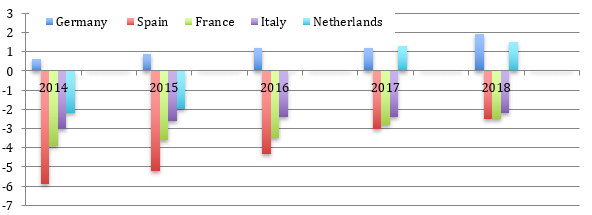
Government Debts in Percentage of GDP
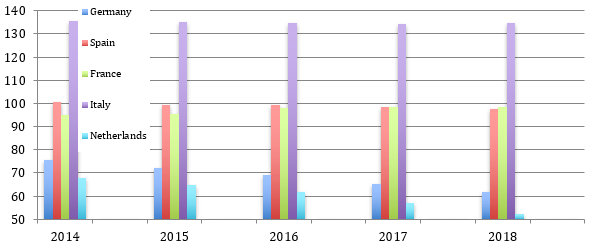
During the COVID-19 panic and resulting lockdowns, Italy, Spain, and France have vehemently demanded “solidarity” from Germany, bluffing about leaving the EU if their demands remain unfulfilled. In spite of their failure to reduce government spending and deficits in good times, they believe it to be their right to be bailed out. Their past excessive deficits can be explained by the prospect of European debt mutualization. Indeed, several bailout schemes have already been instituted during the corona panic. The ECB announced that it would buy €750 billion in bonds, and the EU has agreed upon a €540 billion bailout package.
Unfortunately, the moral hazard implied in the euro setup not only influenced excessive government spending before the corona crisis, but most likely is influencing government responses to the epidemic as well. The costs of lockdowns and government bailouts of citizens and companies are enormous. A government must carefully consider the decision to enforce a costly lockdown. But what if a government can externalize part of the lockdown costs on others through new debts or bailouts? If this possibility exists, as it does in the eurozone, it becomes more likely that a government will declare a lockdown and continue with it for longer. Instead of lifting the restrictions as fast as possible, southern governments maintain them, because they count on a bailout and the support of governments with better fiscal balance sheets. By ruining their own economies, southern governments actually increase the pressure for the institution of new redistribution schemes, and finally a European superstate.
The reasoning, as exemplified by infamous former Greece finance minister Yanis Varoufakis, is:
if you do not rescue us, we will default, leading to a European banking crisis, high losses for the ECB, and a severe depression. So, you better bail us out.
Thus, the setup of the euro may be responsible for suicidal lockdowns in some eurozone countries that will be longer than in other places, with all their detrimental social, political, health, and economic consequences. And it is possible that this crisis will lead to a final decision for the future of the euro and toward a European superstate.
end
SPAIN
Again we witness faulty Chinese products infiltrate the west..
(zerohedge)
1,000 Front-Line Medical Workers Forced Into Isolation Due To Faulty Chinese Masks
Earlier this month, we warned that Chinese companies were flooding Europe with shoddy medical supplies, including defective personal protective equipment (PPE).
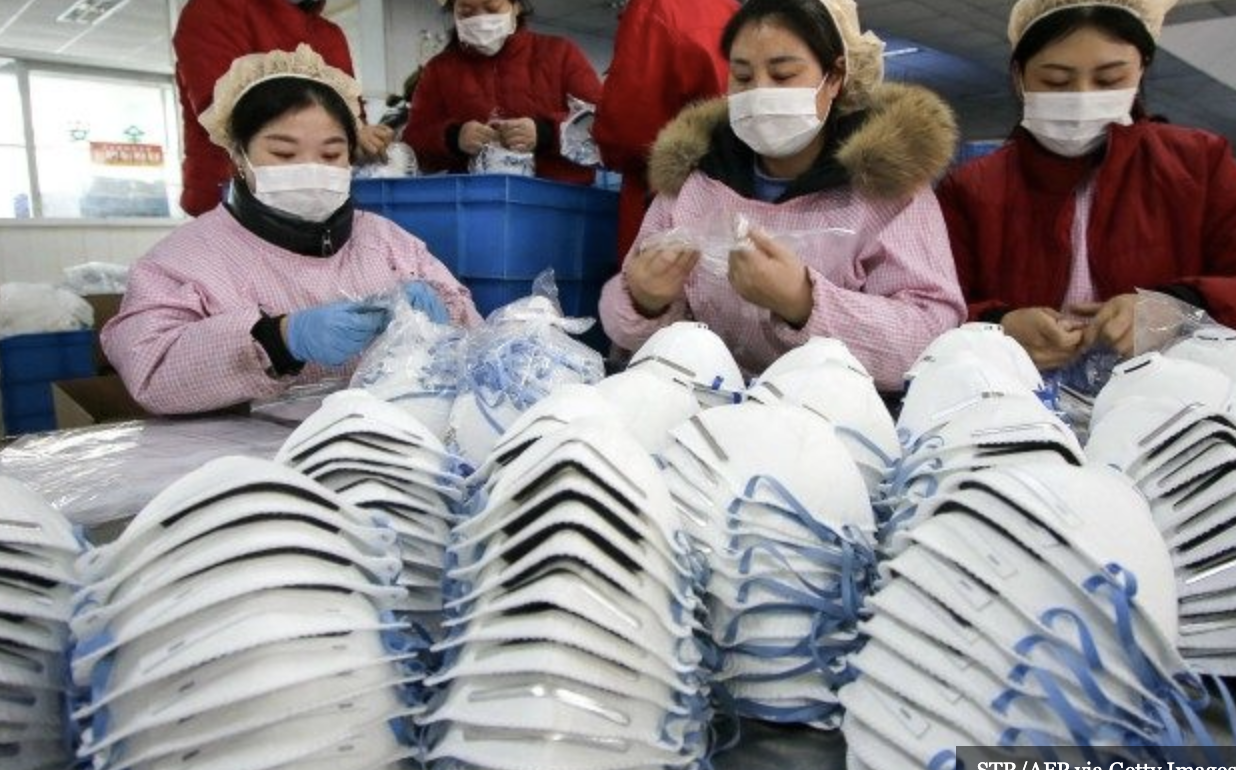
Unfortunately given the mad rush for supplies as governments around the world scramble to buy them from any supplier available, no matter how shady, there hasn’t been enough time to discerningly inspect the equipment, and many dangerous lapses have accrued.
And while stories about defective equipment on the Continent have been ppearing with increasing frequency, this incident from Spain is particularly alarming:Breitbart has reported that more than 1,000 Spanish healthcare workers have gone into isolation after wearing faulty medical masks bought from China.
As Spain moves ever-closer to the May 9 reopening date, the country ordered 400,000 masks from the Chinese to help protect front-line medical workers.
Unfortunately, many of the masks were defective, forcing the workers to undergo testing and enter quarantine following being repeatedly exposed to the virus. The mass exposure will likely result in many testing positive.
The masks were purchased by Spain from a shady Chinese firm called Garry Galaxy; they were reportedly used for about ten days before it was discovered that they were defective.
Spanish newspaper El País reported that the masks have been recalled, yet as some are still believed to be in circulation.
“There are people who worked the whole day using a mask that offers ten minutes of protection,” said the General Council of Nursing Associations. Spanish healthcare workers have been particularly hard hit by coronavirus. Medical staff represent some 15% of all infections in Spain, where at least 31,000 Spanish healthcare workers have contracted coronavirus (though some say the number is likely significantly higher due to deliberate undercounting).
Spain also has the worst mortality rate and the highest number of cases per capita in Europe. The severe shortage of PPE has been cited by the Spanish Health Ministry as the main cause.
US Banks Are Pulling Back From Lending To European Companies: FT
One week ago we showed that the largest US commercial bank, JPMorgan, which just hiked its provisions for loan losses in anticipation of a surge in defaults…
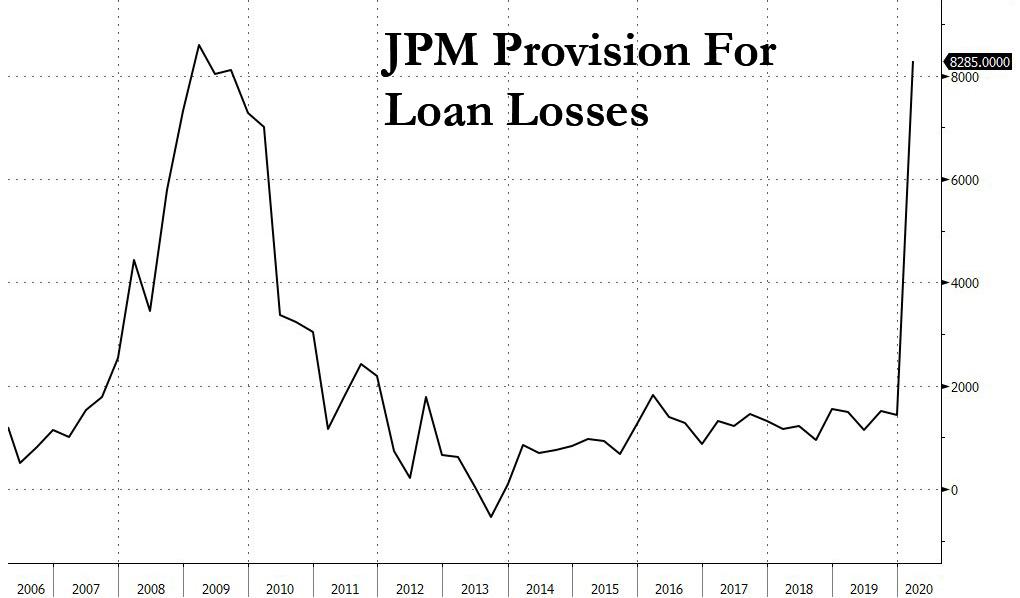
… appeared to be “getting out of Dodge“, because after exiting (non-government guaranteed) loans and hiking mortgage standards, JPMorgan had also stopped accepting HELOCs. It now appears that the largest US bank – and its peers – are also quietly shunning all European business as well, because as the FT reports, “US banks are pulling back from lending to European companies during the coronavirus pandemic, fuelling concerns that Wall Street may be quietly withdrawing to its home market in a repeat of the last financial crisis.”
One small correction here: Wall Street is not withdrawing to its home market – as we have described before, US banks are also quietly shunning their home market as well amid rising fears of a surge in corporate defaults, suggesting that the current crisis could be far worse than 2008/2009.
We do agree with the rest of the FT note however: “bankers, advisers and company executives said American lenders had become more cautious in underwriting bilateral and syndicated loans to large corporate clients across the region in recent weeks.”
As an example of US bank reticence, the FT notes that in Germany, JPMorgan recently pulled out of talks over an additional credit line for BASF, the world’s largest chemicals group, while Bank of America lent half as much as the other six international banks that underwrote a €3bn state-backed loan to sportswear giant Adidas.
At events and publishing group Informa, JPMorgan and BofA turned down a request for a short-term loan and were not among underwriters on a £1bn share placement, even though the latter had been broker to the UK company for 10 years. BofA also turned down a potential capital raise for struggling cinema chain Cineworld.
Even Goldman Sachs – which helped underwrite a €3.5bn syndicated loan for Italian-American carmaker Fiat Chrysler this month – is getting cold feet and did not take part in a similar €12bn facility for German rival and long-standing client Daimler, leaving other lenders to make up the difference.
“We are increasingly observing an ‘America first’ attitude among large US banks,” said an adviser directly involved in negotiations between banks and corporates in Germany. “Those are not just idiosyncratic cases: there is a clear pattern.”
That pattern is that in the first quarter, the five large US banks’ combined market share in syndicated loans in Germany fell by more than a third to 14.6%, according to Refinitiv data. It’s only gotten worse since then.
“Every bank is under the cosh of its national regulators, who in times of crisis show a huge home bias,” said Jan Pieter Krahnen, director of the Center for Financial Studies at the University of Frankfurt. “This heavily influences risk management and regional exposure, which comes at the expense of clients abroad.”
The trend has attracted the attention of European regulators. “We have received many signals that foreign lenders are starting to retreat from the German market,” said a senior supervisory official. “We cannot force them to lend.”
In the UK, JPMorgan pulled out of a recent £324m debt and equity rescue package for airport concession operator SSP, despite being the company’s corporate broker. Only British banks were left in the consortium.
Amusingly, the pull back by US bank lending in Europe has caused concerns in Europe about the reliability of US banks in a crisis. One reason Berlin politicians last year endorsed merger talks between Deutsche Bank and domestic rival Commerzbank was the desire for a “national champion” that would continue to lend at times of stress.
German companies that want to tap large government-backed loans are in a particular bind because they need the support of their existing lending group to access funds from state-owned development bank KfW, which can shoulder as much as 80% of new syndicated loans. But KfW insists private-sector banks take on the remaining 20% as well as guaranteeing existing credit lines, which need to be drawn first.
Judging by the comments of one of the FT’s unnamed sources, Europe is clearly not used to getting shunned: “If one bank in an existing consortium steps out of line, it’s not only that the others have to fill in the blank, but some of them may also start to get second thoughts.”
BofA, Goldman Sachs and JPMorgan declined to comment to the FT on specific clients, but stressed they had increased lending globally in recent weeks. While the data shows BofA’s share of syndicated loans has declined, the US bank pointed out it ranked second in league tables of euro-denominated bonds since March 18, when debt markets reopened after the initial coronavirus shock.
JPMorgan said: “We extended over $25bn in new credit to clients in March alone, and nearly half of that was in Europe. Our commitment to companies in the region remains unwavering.”
Senior US bank executives said that compared with American clients, European companies had drawn down more of their credit lines, reducing banks’ appetite for further lending. They also typically wanted to borrow money over longer time horizons whereas US companies saw bank loans more as a “bridge to markets”.
Indeed, one look at the recent surge in outstanding loans and leases shows that there has been roughly half a trillion dollars in new product, which may explain why US banks are now calling it a day, both in Europe and domestically.
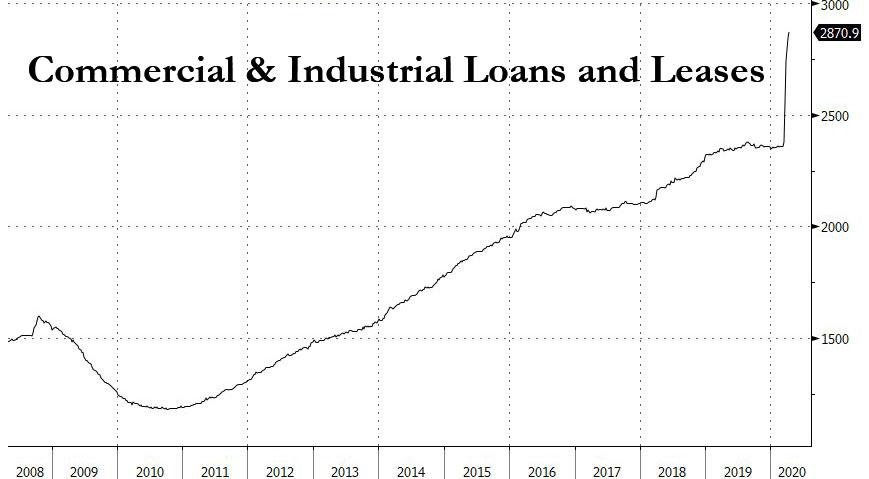
Amusingly, some US bankers told the FT that European lenders were acting “recklessly”, loading up their weak balance sheets with more risky loans that could turn into problems in years to come. “I don’t understand why the Europeans want to do these things,” said a senior investment banker, who apparently has not looked at US balance sheets in the past five years…
END
5. RUSSIAN AND MIDDLE EASTERN AFFAIRS
a must read…
George Friedman explains why Russia is the biggest loser from oil’s crash and we must worry about it..
(George Friedman)
Opinion: Russia is the world’s biggest loser from oil’s crash, and that’s reason to worry
Russia’s economy and power is highly dependent on oil and energy prices

6.Global Issues
THE GLOBE/CORONAVIRUS UPDATE/SATURDAY
WHO Warns Against “Immunity Passports”, US COVID-19 Cases Near 1 Million Mark: Live Updates
Summary:
- WHO warns against “immunity passports”
- Global case total nears 2.8 million, deaths near 200k
- Brussels relaxes rules on state financing for companies
- US death toll passes 50k while total cases passes 900k
- Oregon finds its distancing measures may have prevented 70k infections
- Global single-day deaths declined for third-straight day on Friday
- Internet traffic is up 20% across Europe and US as lockdowns drag on
- Spain sees promising decline in deaths
- Former UK Chancellor urges gov’t to share plan for reopening with the people
* * *
Bill Gates might want to rethink his decision to firmly defend the WHO against President Trump’s decision to defund the organization – technically an arm of the UN – over allegations that it aided China’s initial dissembling about the virus.

Gates and others have loudly cheered the expansion of surveillance methods to aid in efforts like ‘contact tracing’ and other advanced techniques to try and track who may or may not have been exposed to the virus. Many proponents of civil liberties, meanwhile, have argued that some of the more extreme measures in play offer little benefit in exchange for such a dramatic expansion of the security state.
One of this movement’s favorite proposals is the “immunity passport”, which would, in theory, allow those who are theoretically immune go about their lives while everybody else remains stuck inside.
In an announcement early Saturday in Europe, the WHO warned members against issuing so-called “immunity passports”, essentially a document allowing individuals who test positive for coronavirus antibodies to return to work. The organization explained that – as we’ve noted numerous times over the past few months – there’s no actual evidence that patients with antibodies – including those who’ve recovered from the virus, a group that includes at least 800,000 people – will be immune to reinfection.
“There is currently no evidence that people who have recovered from Covid-19 and have antibodies are protected from a second infection,” the WHO said. The health agency said it is reviewing the evidence on whether people who recover from Covid-19 become immune, but that there are no studies on whether the presence of antibodies indicates immunity in humans. It said giving people who have antibodies special rights to travel or work “may therefore increase the risks of continued transmission.”
Meanwhile, the number of confirmed coronavirus cases continues to expand at a roughly steady pace. Thankfully, the surge in daily fatalities observed over the past 2 weeks has finally begun to subside.
The FT reports that the worldwide COVID-19 death toll has risen by 6,182 on Friday to stand at 182,690. This is the third consecutive day where the number of new deaths has been lower than the previous day.
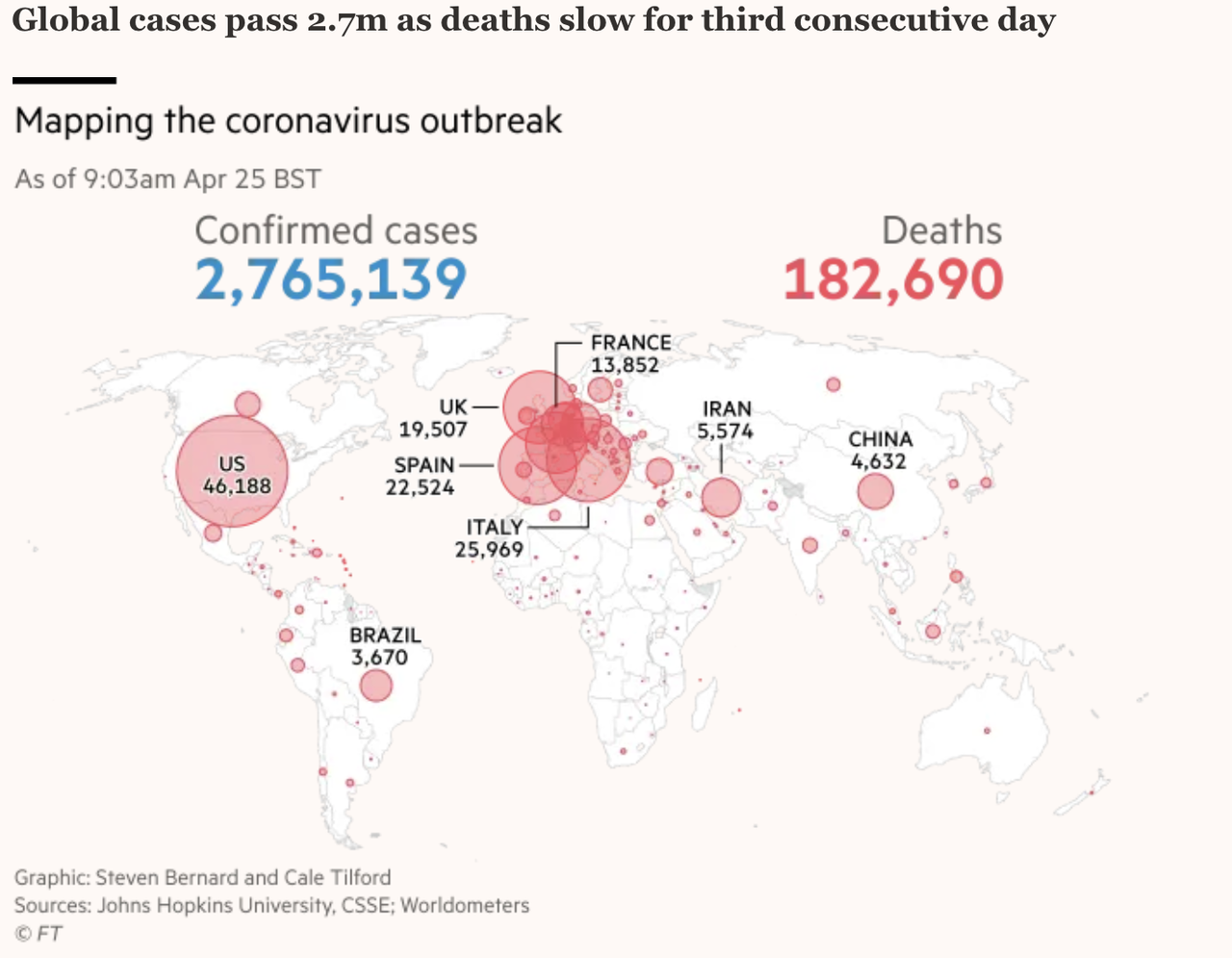
Still, if this pace of expansion continues, we should expect to see the global total pass the 3 million mark by Tuesday, if not earlier. Public health authorities from around the world reported 105,825 new cases yesterday, bringing the total to 2.76 million, according to data from Worldometers.
The global death toll is rapidly approaching 200k, with the US is responsible for 25% of them. As businesses in Georgia continue to reopen, the White House is debating a new legal liability shield for American businesses to prevent them from being sued over the coronavirus.
In the US, the number of deaths passed 50k on Friday while the case total passed 900k early Saturday, leaving the country well on the way to the 1 million case mark. The US would be the first country to report 1 million confirmed cases.
In Brussels, bureaucrats have rushed to relax state aid rules, and regulators have approved a series of multi-billion-euro schemes to allow member states to extend financing to companies – in some cases via direct equity injections – to help them weather the pandemic. Although leaders of both factions have told reporters that important progress was made at Thursday’s virtual summit to work out the details of a massive pan-European relief program to help the worst-hit governments in the bloc. As one might expect, German and a handful of wealthy northern states have gotten into an intense disagreement with the poorer, worst-hit southern states (Spain, Italy joined in this instance by Emmanuel Macron’s France) over how the program should be financed, and whether the loans should come in the form of loans, or outright grants.
As the country with the highest mortality rate in Europe, Spain has eased its lockdown measures only slightly, while warning that the current target date to begin reopening is May 9. But in a promising bit of news, the country reported fewer than 400 fatalities for the second consecutive day on Saturday (the count was accurate as of 9pm Madrid Time Friday) while the spread of new cases has also slowed.
Across Europe and the US, Internet traffic is up 20%, according to the FT and Media analytics group ComScore, which measured the number of unique page views and compared it with an “average” benchmark across several key markets.
With no end to a strict national lockdown in sight, millions of Britons are starting to get a little squirrely. To try to assuage these anxieties, former UK Chancellor Philip Hammond has suggested that No. 10 share its plan for reopening the economy with the public.
“The reality is that we have to start reopening the economy but we have to do it living with Covid,” Mr Hammond told BBC’s Today. “We can’t wait until a vaccine is developed… and rolled out across the population. The economy won’t survive that long.”
Now that the pace of new cases and deaths has slowed, it’s clear that lockdowns and social distancing measures are pretty effective at slowing the virus’s spread, which – remember – is the whole point of this: Eventually, scientists say, much of the global population will be exposed to this virus. It’s just a question of whether that’s going to happen over a few years, or a few months. In the latest positive indication, Oregon health officials have found that their state’s aggressive social distancing measures may have prevented more than 70,000 cases since early March.
Surprise Cruise Ship Outbreak In Nagasaki Exposes Staggering Negligence
The story of the outbreak aboard the “Costa Atlantica” has left many readers amazed by the staggering negligence of both local officials in Nagasaki, as well as the Japanese and Italian governments. After the dozens of deaths and thousands of infections reported aboard cruise ships around the world, the notion that more than 600 crewmembers were left to live on-board this ship for months while it was being repaired is simply mind-blowing, given the obvious risk.
Then again, governments around the world from Europe to the US to Asia have largely failed to protect the most vulnerable in society, that being, in this case, patients in nursing homes. But as Bloomberg pointed out in a Friday update on the situation, there’s another familiar player involved – one that really has no excuse for allowing this to happen.

That’s right. Somehow, the “Costa Atlantica” is a Carnival Corp ship (owned by a subsidiary). Carnival has been far and away the worst offender in the travel and leisure industry in terms of its management of the many crises and outbreaks that have unfolded aboard its cruises. It failed to act fast enough to shut down operations, and even after it did, the company and personnel made many decisions which suggested they blithely placed the company’s bottom line before the well-being of customers.
Australia has already launched a criminal investigation into Carnival over the “Ruby Princess” fiasco…
The number of confirmed Covid-19 infections on the Costa Atlantica had climbed to 91 as of Thursday from 48 a day earlier, the Nagasaki prefecture said.
The Atlantica is operated by CSSC Carnival Cruise Shipping, a partnership between Carnival Corp. and state-owned China State Shipbuilding Corp. The Chinese entity is the majority owner.
Coronavirus cases at sea forced the industry to suspend new sailings in mid-March. Many ships were caught mid-voyage, leading to weeks of drama as companies hustled to get passengers to ports.
Even now, ships around the world still have crew on board.
The episode has captured the attention of Japan’s government, which already faced widespread Covid-19 on Carnival’s Diamond Princess, at one point the largest concentration of coronavirus outside of mainland China.
Japan’s Health Minister Katsunobu Kato said Thursday that all crew will now be tested on the Costa Atlantica.
Since the first case was confirmed on Monday, authorities have been investigating how the outbreak began, since the ship has been at port without passengers for weeks, and crew members weren’t supposed to have left the vessel.
Kato said some of the crew apparently got off the vessel at some point.
…will Japan, or perhaps Italy, be next to join in?
And yet, somehow, hundreds maybe thousands of crew members continue to live onboard hastily recalled cruise ships all around the world, apparently.
Let’s hope they’re at least getting some hazard pay.
Whisteblowing ER Docs Urge “Open Up Society Now” Because “Lockdowns Are Weakening Our Immune Systems”
Authored by Edward Peter Stringham via The American Institute for Economic Research,
Dr. Daniel W. Erickson of Bakersfield, California, is a former emergency-room physician who co-owns, with his partner Dr. Artin Massih, Accelerated Urgent Care in Bakersfield.
They are experienced medical professionals who have 40 years of hands-on experience in dealing with viruses and respiratory infections.

Watching the news in China in January, they knew the virus was on its way. They ordered many COVID-19 tests because they knew they would need them. They tested many thousands of people, and discovered for themselves what epidemiologists around the world are saying: COVID-19 came here earlier than previously believed, is more ubiquitous, and ultimately for the general population less deadly than we thought.
While this realization is gradually dawning on people around the world, they went public with their findings, which are not generated out of a predictive model but rather the actual facts of the case. In the course of their press conference, they addressed the question of whether or not California should have shut down much of its economy. Their answer is no. They conclude with the need to open up immediately, on grounds of health and human rights.
“If you’re going to dance on someone’s constitutional rights you better have a good reason, you better have a really good reason, not just a theory,” he said.
“The data is showing us it’s time to lift (the stay-at-home orders) so if we don’t lift, what is the reason?”
Here are some selected quotes from their interview with a hostile reporter (emphasis added).
We’d like to look at how we’ve responded as a nation, and why you responded. Our first initial response two months ago was a little bit of fear: [the government] decided to shut down travel to and from China. These are good ideas when you don’t have any facts. [Governments] decided to keep people at home and isolate them. Typically you quarantine the sick. When someone has measles you quarantine them. We’ve never seen where we quarantine the healthy.
So that’s kind of how we started. We don’t know what’s going on, we see this new virus. How should we respond? So we did that initially, and over the last couple months we’ve gained a lot of data typically. We’re going to go over the numbers a little bit to kind of help you see how widespread COVID is, and see how we should be responding to it based on its prevalence throughout society—or the existence of the cases that we already know about….
So if you look at California—these numbers are from yesterday—we have 33,865 COVID cases, out of a total of 280,900 total tested. That’s 12% of Californians were positive for COVID. So we don’t, the initial—as you guys know, the initial models were woefully inaccurate. They predicted millions of cases of death – not of prevalence or incidence – but death.
That is not materializing. What is materializing is, in the state of California is 12% positives.
You have a 0.03% chance of dying from COVID in the state of California. Does that necessitate sheltering in place? Does that necessitate shutting down medical systems? Does that necessitate people being out of work?
96% of people in California who get COVID would recover, with almost no significant sequelae; or no significant continuing medical problems. Two months ago we didn’t know this. The more you test, the more positives you get. The prevalence number goes up, and the death rate stays the same. So [the death rate] gets smaller and smaller and smaller. And as we move through this data—what I want you to see is—millions of cases, small death. Millions of cases, small death.
We extrapolate data, we test people, and then we extrapolate for the entire community based on the numbers. The initial models were so inaccurate they’re not even correct. And some of them were based on social distancing and still predicted hundreds of thousands of deaths, which has been inaccurate. In New York the ones they tested they found 39% positive. So if they tested the whole state would we indeed have 7.5 million cases? We don’t know; we will never test the entire state. So we extrapolate out; we use the data we have because it’s the most we have versus a predictive model that has been nowhere in the ballpark of accurate. How many deaths do they have? 19,410 out of 19 million people, which is a 0.1% chance of dying from COVID in the state of New York. If you are indeed diagnosed with COVID-19, 92% of you will recover.
We’ve tested over 4 million… which gives us a 19.6% positive out of those who are tested for COVID-19. So if this is a typical extrapolation 328 million people times 19.6 is 64 million. That’s a significant amount of people with COVID; it’s similar to the flu. If you study the numbers in 2017 and 2018 we had 50 to 60 million with the flu. And we had a similar death rate in the deaths the United States were 43,545—similar to the flu of 2017-2018. We always have between 37,000 and 60,000 deaths in the United States, every single year. No pandemic talk. No shelter-in-place. No shutting down businesses…
We do thousands of flu tests every year. We don’t report every one, because the flu is ubiquitous and to that note we have a flu vaccine. How many people even get the flu vaccine? The flu is dangerous, it kills people. Just because you have a vaccine doesn’t mean it’s gonna be everywhere and it doesn’t mean everyone’s going to take it… I would say probably 50% of the public doesn’t even want it. Just because you have a vaccine—unless you forced it on the public—doesn’t mean they’re going to take it.
Norway has locked down; Sweden does not have lock down. What happened in those two countries? Are they vastly different? Did Sweden have a massive outbreak of cases? Did Norway have nothing? Let’s look at the numbers. Sweden has 15,322 cases of COVID—21% of all those tested came out positive for COVID. What’s the population of Sweden? About 10.4 million. So if we extrapolate out the data about 2 million cases of COVID in Sweden. They did a little bit of social distancing; they would wear masks and separate; they went to schools; stores were open. They were almost about their normal daily life with a little bit of social distancing. They had how many deaths? 1,765. California’s had 1,220 with isolation. No isolation: 1,765. We have more people. Norway: its next-door neighbor. These are two Scandinavian nations; we can compare them as they are similar. 4.9% of all COVID tests were positive in Norway. Population of Norway: 5.4 million. So if we extrapolate the data, as we’ve been doing, which is the best we can do at this point, they have about 1.3 million cases. Now their deaths as a total number, were 182. So you have a 0.003 chance of death as a citizen of Norway and a 97% recovery. Their numbers are a little bit better. Does it necessitate shutdown, loss of jobs, destruction of the oil company, furloughing doctors?
I wanted to talk about the effects of COVID-19, the secondary effects. COVID-19 is one aspect of our health sector. What has it caused to have us be involved in social isolation? What does it cause that we are seeing the community respond to? Child molestation is increasing at a severe rate. We could go over multiple cases of children who have been molested due to angry family members who are intoxicated, who are home, who have no paycheck. Spousal abuse: we are seeing people coming in here with black eyes and cuts on their face. It’s an obvious abuse of case. These are things that will affect them for a lifetime, not for a season. Alcoholism, anxiety, depression, suicide. Suicide is spiking; education is dropped off; economic collapse. Medical industry we’re all suffering because our staff isn’t here and we have no volume. We have clinics from Fresno to San Diego and these things are spiking in our community. These things will affect people for a lifetime, not for a season.
I’d like to go over some basic things about how the immune system functions so people have a good understanding. The immune system is built by exposure to antigens: viruses, bacteria. When you’re a little child crawling on the ground, putting stuff in your mouth, viruses and bacteria come in. You form an antigen antibody complex. You form IgG IgM. This is how your immune system is built. You don’t take a small child put them in bubble wrap in a room and say, “go have a healthy immune system.”
This is immunology, microbiology 101. This is the basis of what we’ve known for years. When you take human beings and you say, “go into your house, clean all your counters—Lysol them down you’re gonna kill 99% of viruses and bacteria; wear a mask; don’t go outside,” what does it do to our immune system? Our immune system is used to touching. We share bacteria. Staphylococcus, streptococcal, bacteria, viruses.
Sheltering in place decreases your immune system. And then as we all come out of shelter in place with a lower immune system and start trading viruses, bacteria—what do you think is going to happen? Disease is going to spike. And then you’ve got diseases spike—amongst a hospital system with furloughed doctors and nurses. This is not the combination we want to set up for a healthy society. It doesn’t make any sense.
…Did we respond appropriately? Initially the response, fine shut it down, but as the data comes across—and we say now, wait a second, we’ve never, ever responded like this in the history of the country why are we doing this now? Any time you have something new in the community medical community it sparks fear—and I would have done what Dr. Fauci did—so we both would have initially. Because the first thing you do is, you want to make sure you limit liability—and deaths—and I think what they did was brilliant, initially. But you know, looking at theories and models—which is what these folks use—is very different than the way the actual virus presents itself throughout communities….
Nobody talks about the fact that coronavirus lives on plastics for three days and we’re all sheltering in place. Where’d you get your water bottles from? Costco. Where did you get that plastic shovel from? Home Depot. If I swab things in your home I would likely find COVID-19. And so you think you’re protected. Do you see the lack of consistency here? Do you think you’re protected from COVID when you wear gloves that transfer disease everywhere? Those gloves have bacteria all over them. We wear masks in an acute setting to protect us. We’re not wearing masks. Why is that? Because we understand microbiology; we understand immunology; and we want strong immune systems. I don’t want to hide in my home, develop a weak immune system, and then come out and get disease.
When someone dies in this country right now they’re not talking about the high blood pressure, the diabetes, the stroke. They say they died from COVID. We’ve been to hundreds of autopsies. You don’t talk about one thing, you talk about comorbidities. COVID was part of it, it is not the reason they died folks. When I’m writing up my death report I’m being pressured to add COVID.
Why is that? Why are we being pressured to add COVID? To maybe increase the numbers, and make it look a little bit worse than it is. We’re being pressured in-house to add COVID to the diagnostic list when we think it has nothing to do with the actual cause of death. The actual cause of death was not COVID, but it’s being reported as one of the disease processes and being added to the death list. COVID didn’t kill them, 25 years of tobacco use killed.
There’s two ways to get rid of virus: either burns itself out or herd immunity. For hundreds of years we relied on herd immunity. Viruses kill people, end of story. The flu kills people. COVID kills people. But for the rest of us we develop herd immunity. We developed the ability to take this virus in and defeat it and for the vast majority 95% of those around the globe. Do you want your immune system built or do you want it not built? The building blocks of your immune system is a virus and bacteria. There’s normal bacteria in normal flora that we have to be exposed to bacteria and viruses that are not virulent are our friends. They protect us against bad bacteria and bad viruses.
Right now, if you look at Dr. Erikson’s skin or my skin we have strep, we have stuff—they protect us against opportunistic infections. That’s why for the first three to six months [babies are] extremely vulnerable to opportunistic infection. Which is why, when we see a little baby in the ER with fever who is one month old, you do a spinal tap, you do a chest x-ray, you do blood cultures, you do urine cultures. But if you had a fever I wouldn’t do that for you. Why? Because that baby does not have the normal bacteria and flora from the community, whereas you do. I guarantee when we reopen there’s going to be a huge, huge amount of illness that’s going to be rampant because our immune systems have weakened. That’s just basic immunology.
Do we need to still shelter in place? Our answer is emphatically no. Do we need businesses to be shut down? Emphatically no. Do we need to have it, do we need to test them, and get them back to work? Yes, we do. The the secondary effects that we went over—the child abuse, alcoholism, loss of revenue—all these are, in our opinion, a significantly more detrimental thing to society than a virus that has proven similar in nature to the seasonal flu we have every year.
We also need to put measures in place so economic shutdown like this does not happen again. We want to make sure we understand that quarantining the sick is what we do, not quarantine the healthy. We need to make sure if you’re gonna dance on someone’s constitutional rights you better have a good reason. You better have a really good scientific reason, and not just theory.
One of the most important things is we need our hospitals back up. We need our furloughed doctors back. We need our nurses back. Because when we lift this thing, we’re gonna need all hands on deck. I know the local hospitals have closed two floors. Folks, that’s not the situation you want. We’re essentially setting ourselves up to have minimal staff, and we’re going to have significant disease. That’s the wrong combination.
I’ve talked to our local head of the Health Department and he’s waiting… for the powers that be to lift. Because the data is showing it’s time to lift. I would start slowly [open up schools sporting events] I think we need to open up the schools start getting kids back to the immune system you know and the major events the sporting events these are non-essential let’s get back to those slowly let’s start with schools let’s start with cafe Rio and the pizza place here… Does that make sense to you guys and I think I can go into Costco and I can shop with people and there’s probably a couple hundred people but I can’t go in Cafe Rio so big businesses are open little businesses are not….
Eventually we treat this like we treat flu. Which is if you have the flu and you’re feeling fever and body aches you just stay home if you have coughing or shortness of breath—COVID is more of a respiratory thing—you stay home. You don’t get tested, even when people come with flu a lot of times we don’t test them. We go, “you have flu. Here’s a medication.” You have COVID, go home, let it resolve and come back negative.
If you have no symptoms you should be able to return to work. Are you an asymptomatic viral spreader? Maybe, but we can’t test all of humanity. Sure we’re gonna miss cases of coronavirus, just like we miss cases of the flu. It would be nice to capture every coronavirus patient, but is that realistic? Are we gonna keep the economy shut down for two years and vaccinate everybody? That’s an unrealistic expectation. You’re going to cause financial ruin, domestic violence, suicide, rape, violence and what are you going to get out of it? You’re still going to miss a lot of cases. So we need to treat this like the flu, which is familiar, and eventually this will mutate and become less and less virulent…
I don’t need a double-blind clinically controlled trial to tell me if sheltering in place is appropriate, that is a college-level understanding of microbiology. A lot of times in medicine you have to make you have to make educated decisions with the data that you have. I can sit up in the 47th-floor in the penthouse and say we should do this, this, and this, but I haven’t seen a patient for 20 years—that’s not realistic.
If you’re healthy and you don’t have significant comorbidities and you know you’re not immunodeficient and you’re not elderly you should be able to go out without any gloves and without a mask. If you are those things you should either shelter in place or wear a mask and gloves. I don’t think everybody needs to wear the masks and gloves because it reduces your bacterial flora… and your bacterial flora and your viruses your friends that protect you from other diseases [if they] end up going away and now you’re more likely to get opportunistic infections infections that are hoping you don’t have your good bugs fighting for you.
The videos are embedded below. ..
The videos are embedded below. ..
7. OIL ISSUES
Saturday/OIL//A MUST READ……
(JAVIER BLAS)
The Next Chapter of the Oil Crisis: The Industry Shuts Down
By-
U.S. output set to drop significantly after negative prices
-
Oil refiners to curtail processing as fuel demand remains weak
Negative oil prices, ships dawdling at sea with unwanted cargoes, and traders getting creative about where to stash oil. The next chapter in the oil crisis is now inevitable: great swathes of the petroleum industry are about to start shutting down.
The economic impact of the coronavirus has ripped through the oil industry in dramatic phases. First it destroyed demand as lockdowns shut factories and kept drivers at home. Then storage started filling up and traders resorted to ocean-going tankers to store crude in the hope of better prices ahead.
Now shipping prices are surging to stratospheric levels as the industry runs out of tankers — a sign of just how distorted the market has become.
The specter of production shut-downs — and the impact they will have on jobs, companies, their banks, and local economies — was one of the reasons that spurred world leaders to join forces to cut production in an orderly way. But as the scale of the crisis dwarfed their efforts, failing to stop prices diving below zero last week, shut-downs are now a reality. It’s the worst-case scenario for producers and refiners.
“We are moving into the end-game,” Torbjorn Tornqvist, head of commodity trading giant Gunvor Group Ltd., said in an interview. “Early-to-mid May could be the peak. We are weeks, not months, away from it.”
Read more: The 20 Minutes That Broke the U.S. Oil Market
In theory, the first oil output cuts should have come from the OPEC+ alliance, which earlier this month agreed to reduce production from May 1. Yet after the catastrophic price plunge on Monday, when West Texas Intermediate fell to –$40 a barrel, it’s the U.S. shale patch that is leading.
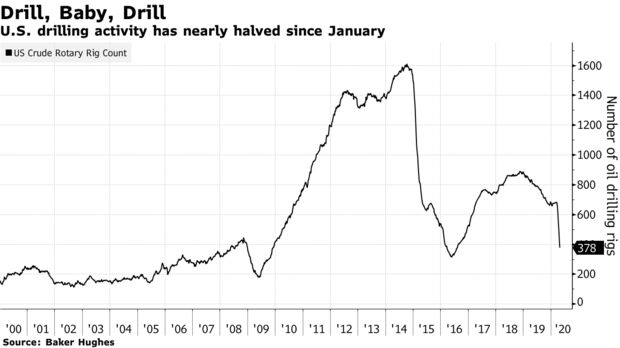
The best indicator of how the U.S. industry is reacting is the rapid drop in the number of oil rigs in operation, which last week fell to a four-year low. Before the coronavirus crisis hit, oil companies ran about 650 rigs in the U.S. By Friday, more than 40% of them had stopped working, with only 378 left.
“Monday really focused people’s minds that production needs to slow down,” Ben Luckock, co-head of oil trading at commodity merchant Trafigura Group, said. “It’s the smack in the face the market needed to realize this is serious.”
Trafigura, one of the largest exporters of U.S. crude from the U.S. Gulf of Mexico, believes that output in Texas, New Mexico, North Dakota and other states will now fall much faster than expected as companies react to negative prices, which have persisted for several days last week in the physical market.
Until prices collapsed on Monday, the consensus was that output would drop by about 1.5m barrels a day by December. Now market watchers see that loss by late June. “The severity of the price pressure is likely to act as a catalyst for the immediate turndown in activity and shut-ins,” said Roger Diwan, oil analyst at consultant IHS Markit Ltd.
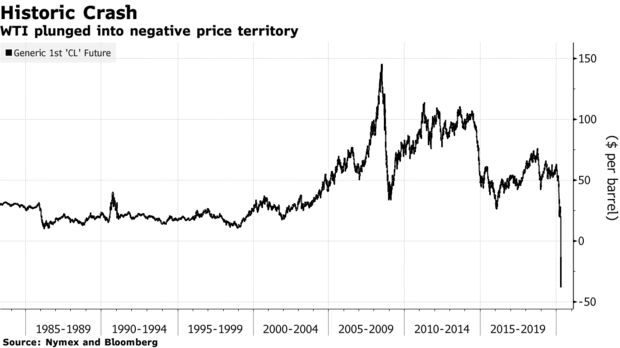
The price shock has been particularly intense in the physical market: producers of crude streams such as South Texas Sour and Eastern Kansas Common had to pay more than $50 a barrel to offload their output last week. ConocoPhillips and shale producer Continental Resources Inc. have all announced plans to shut in output. Regulators in Oklahoma voted to allow oil drillers to shut wells without losing leases; New Mexico made a similar decision.
North Dakota, which for years was synonymous with the U.S. shale revolution, is witnessing a rapid retrenchment. Oil producers have already closed more than 6,000 wells, curtailing about 405,000 barrels a day in production, or about 30% of the state’s total.
The output cuts won’t be limited to the U.S. From Chad, a poor and landlocked country in Africa, to Vietnam and Brazil, producers are now either reducing output or making plans to do so.
“I wouldn’t want to get sensational about it but yes, clearly there must be a risk of shut-ins,” Mitch Flegg, the head of North Sea oil company Serica Energy, said in an interview. “In certain parts of the world it is a real and present risk.”
In emergency board meetings last week, oil companies small and large discussed an outlook that’s the most somber any oil executive has ever witnessed. For the small firms, the next few weeks will be all about staying afloat. But even for the bigger ones, like Exxon Mobil Corp. and BP Plc, it’s a challenge. Big Oil will offer an insight into the crisis when companies report earnings this week.
Saudi Arabia, Russia and the rest of the OPEC+ alliance will join the output cuts on Friday, slashing their output by more than 20%, or 9.7 million barrels a day. Saudi Aramco, the state-owned company, is already trimming to reach the target. And Russian oil companies have announced exports of their flagship Urals crude would drop in May to a 10-year low.
Even so, it may not be enough. Every week, 50 million barrels of crude are going into storage, enough to fuel Germany, France, Italy, Spain, and the U.K. combined. At that rate, the world will run out of storage by June. What’s not stored onshore, is stashed in tankers. The U.S. Coast Guard on Friday said there were so many tankers at anchor off California that it was keeping an eye on the situation.
Javier Blas
✔@JavierBlas
VIDEO: US Coast Guard says it’s keeping an eye on 27 oil tankers anchored off the coast of Southern California. Another great example of floating storage build-up as demand for oil and refined products plunge | #OOTT #Contango video via @USCGLosAngeles


Before the crisis hit, the world was consuming about 100 million barrels a day. Demand now, however, is somewhere between 65 and 70 million barrels. So, in a worst-case scenario, about a third of global output needs to be shut.
The reality is likely to be less severe as storage would continue to bridge the gap between supply and demand. Plus, oil traders say consumption has probably hit a bottom, and will start a very gentle recovery.
Refiners Shut
But before that takes hold, the great shutdown will spread through oil refining too.
Over the past week, Marathon Petroleum Corp., one of the biggest U.S. refiners, announced it would stop production at a plant near San Francisco. Royal Dutch Shell Plc has idled several units in three U.S. refineries in Alabama and Louisiana. And across Europe and Asia, many refineries are running at half rate. U.S. oil refiners processed just 12.45 million barrels a day on the week to April 17, the lowest amount in at least 30 years, except for hurricane-related closures.
More refinery shutdowns are coming, oil traders and consultants said, particularly in the U.S. where lockdowns started later than in Europe and demand is still contracting. Steve Sawyer, director of refining at Facts Global Energy, said that global refineries could halt as much as 25% of total capacity in May.
“No one is going to be able to dodge this bullet.”
— With assistance by Rachel Graham, Alex Longley, David Marino, Alaric Nightingale, Laura Hurst, Kevin Crowley, Rachel Adams-Heard, Robert Tuttle, and Barbara J Powell
END
SUNDAY/BANK OF CHINA CLIENTS LOSE BIG TIME ON OIL’S CRASH INTO NEGATIVE TERRITORY LAST WEEK
(ZEROHEDGE)
Bank Of China Clients Lose Over $1 Billion During Oil Crash, Many End Up Owing The Bank Money
It’s not just investors in the largest US oil ETF, the USO, the suffered billions in losses last week after WTI plunged, its May contract settling at minus $37.63 on Monday: the shockwave from the crash in near-dated crude prices, which has forced the USO to halt for trading on several occasions as it scrambles to rebalance daily and purchase as many longer-dated futures as it possibly can to avoid another deliverable disaster and stay in business, has also wiped out countless Chinese investors, many of whom ended up owing money to the bank.
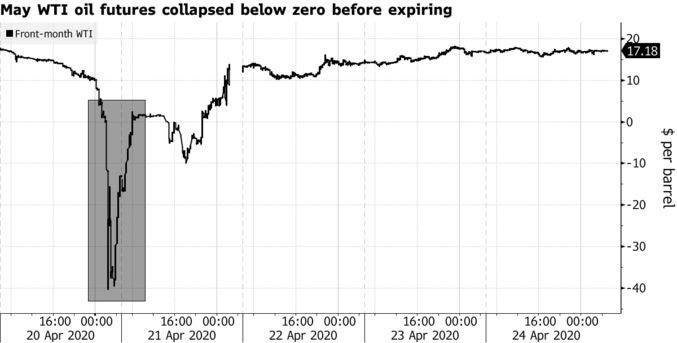
The latest Bank of China estimates for the carnage to retail investors from the collapse in a product linked to U.S. crude oil futures has surged 11-fold to more than 7 billion yuan ($1 billion) as it consolidated reports from its nationwide network, Bloomberg reported. The fourth largest Chinese bank’s estimate of losses to customers across China increased from just 600 million yuan in the middle of last week as more information was gathered from its over 10,000 outlets, said the sources. And since the number “isn’t final and subject to further changes as the lender examines the data from its branches”, the full loss will likely be even greater.
The losses stem from the bank settling May West Texas Intermediate contracts that underpinned its very inappropriately named “Crude Oil Treasure” (Yuan You Bao in Chinese) product on April 20 at minus $37.63 a barrel, leaving Bank of China customers caught in the middle of oil’s unprecedented collapse below zero, one which some had speculated could leave clients owing money to the bank. Hundreds of investor took to the Internet to protest the lender’s handling of the contract rollover and to demand it shoulder some of the losses.
Bank of China hasn’t disclosed the size or performance of “Crude Oil Treasure” since launching the product in January 2018, although it did suspend trading in the product on Tuesday after Monday’s historic rout. China’s biggest banks including China Construction Bank and Bank of Communications also halted sales of similar vehicles that had become a popular way for individuals to speculate on swings in oil.
More than 60,000 clients have invested in Bank of China’s product, Caixin reported, adding that investors have lost their margins of 4.2 billion and owed the bank a further 5.8 billion yuan. BoC said Wednesday that investors still need to settle their positions at the Monday WTI settlement price, and the bank has completed settlement of all May contracts. Over the next few days, more investors were likely settling their losses with some strategically disappearing and hoping they can leave the bank to foot the bill. As Caixin adds, one investor took a 9.2 million yuan ($1.3 million) loss on a 3.9 million yuan investment in the product, according to a document circulating online. The oil price slump left the investor owing 5.3 million yuan to the bank.
On Saturday, Bloomberg carried a vivid depiction of how some Chinese investors lost all their life savings in the blink of an eye investing in the “Crude Oil Treasure”:
26-year-old named A’Xiang Chen watched events unfold on her phone in stunned disbelief. A few weeks earlier, she and and her boyfriend had sunk their entire nest egg of about $10,000 into a product that the state-run Bank of China dubbed Yuan You Bao, or Crude Oil Treasure.
As the night wore on, A’Xiang began preparing to lose it all. At 10 p.m. in Shenzhen — 10 a.m. in New York — she checked her phone one last time before heading to bed. The price was now $11. Half their savings had been wiped out.
As the couple slept, the rout deepened. The price set new low after new low in rapid-fire succession: the lowest since the Asian financial crisis of the 1990s, the lowest since the oil crises of the 1970s, the first time ever below zero.
And then, in a 20-minute span that ranks among the most extraordinary in the history of financial markets, the price cratered to a level that few, if any, thought conceivable. Around the world, Saudi princes and Texan wildcatters and Russian oligarchs looked on with horror as the world’s most important commodity closed the trading day at a price of minus $37.63. That’s what you’d have to pay someone to take a barrel off your hands.
* * *
“It was mind-bending,” said Keith Kelly, a managing director at the energy group of Compagnie Financiere Tradition SA, a leading broker. “Are you seeing what you think you’re seeing? Are your eyes playing tricks on you?”
For A’Xiang who bet enthusiastically on oil, waking up the next day meant a new world with no life savings. She awoke to a text at 6 a.m. from Bank of China informing her that not only had their savings been lost but that she and her boyfriend may actually owe money.
“When we saw the oil price start plunging, we were prepared that our money may be all gone,” she said. They hadn’t understood, she said, what they were getting into. “It didn’t occur to us that we had to pay attention to the overseas futures price and the whole concept of contract rolling.”
Yes, well, that’s what happens when retail investors, or rather “investors” get complacent in a centrally planned market where central banks have removed all risk… except when risk makes an ugly appearance.
Naturally investors – none of whom ever expected that oil prices could turn negative and end up owing the bank money for being long a security – were livid, But multiple bank traders told Caixin that the settlement date was set well in advance, so it wasn’t as if the bank had suddenly changed it. A bank trader said this was a situation where the “trading mechanism encountered an extreme situation in the extreme.”
Several traders and market participants told Caixin that some investors in the paper crude trading products were caught up in the price plunge because they tried to “buy on the dip” when crude prices dropped to $20 a barrel… without considering that prices could sink further into negative territory. As a result buyers ended up owing money to the bank.
END
OIL/MONDAY MORNING/END GAME BEING PLAYED OUT
“Nobody will dodge this bullet”
(ZEROHEDGE)
“We Are Moving Into The End-Game”: 27 Tankers Anchored Off California, Hundreds Off Singapore As Oil Industry Shuts Down
Back in the late fall of 2014, when Saudi Arabia broke up OPEC for the first time and unleashed a torrent of crude oil on the world despite the protests of its fellow cartel members, oil prices crashed as a result of what then seemed to be a “calculated” move by Riyadh which hoped to put US shale out of business amid a flawed gamble betting that shale breakeven prices were around $60-80. They, however, turned out to be much lower, which coupled with Saudi misreading of the willingness of junk bond investors to keep funding US shale producers, meant that despite a 3 years stretch of low oil prices, US shale emerged stronger than ever before, with the US eventually eclipsing both Saudi Arabia and Russia as the world’s biggest crude oil producer.
Fast forward to March 2020, when Saudi Arabia doubled down in its attempt to crush shale, only to avoid angering long-time ally Donald Trump, the Crown Prince pretended that the latest flood of oil was an oil price war aimed at Moscow not Midland. And this time, unlike 2014, with the benefit of the global economic shutdown resulting from the coronavirus pandemic, the Saudis may have finally lucked out in the ongoing crusade against US oil, because as Bloomberg writes with “negative oil prices, ships dawdling at sea with unwanted cargoes, and traders getting creative about where to stash oil”, the next chapter in the oil crisis is now inevitable: “great swathes of the petroleum industry are about to start shutting down.”
As the recent OPEC summit so vividly demonstrated, the marginal price of oil is no longer determined by supply or cuts thereof (such as the recently announced agreement by OPEC+ for a 9.7mmb/d output cut), but rather by demand, or the lack thereof, which according to some estimate is as much as 36mmb/d lower, or roughly a third of the global oil market every day, as billions of people are stuck at home instead of driving, while major corporations mothball production in a world where major economies have ground to a halt.
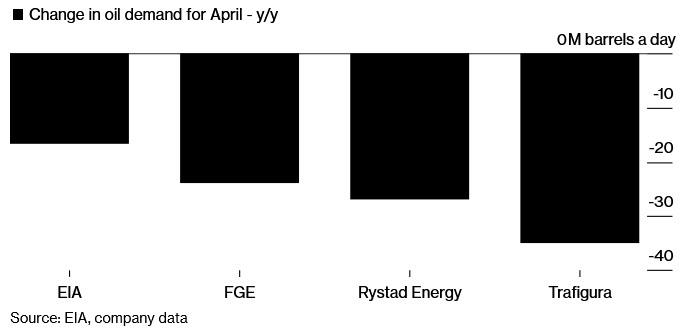
The economic impact of the coronavirus has ripped through the oil industry in dramatic phases, Bloomberg’s Javier Blas writes. First it destroyed demand as lockdowns shut factories and kept drivers at home. Then storage started filling up and traders resorted to ocean-going tankers to store crude in the hope of better prices ahead.
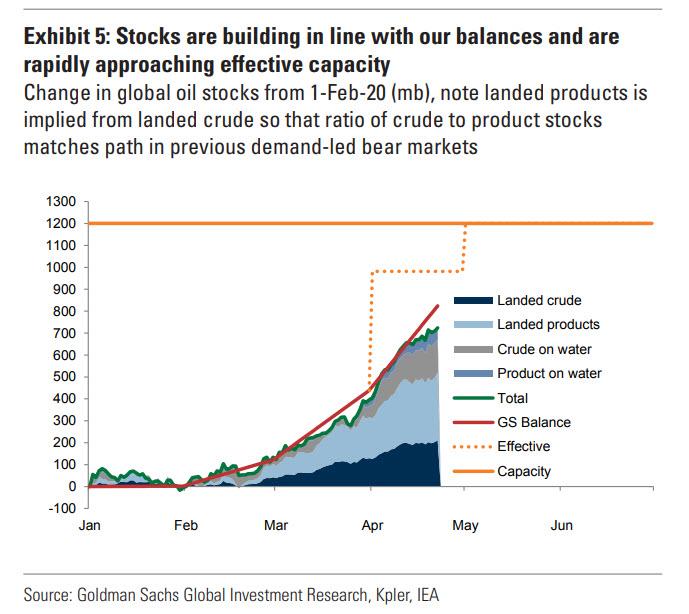
Now shipping prices are surging to stratospheric levels as the industry runs out of tankers, a sign of just how distorted the market has become.
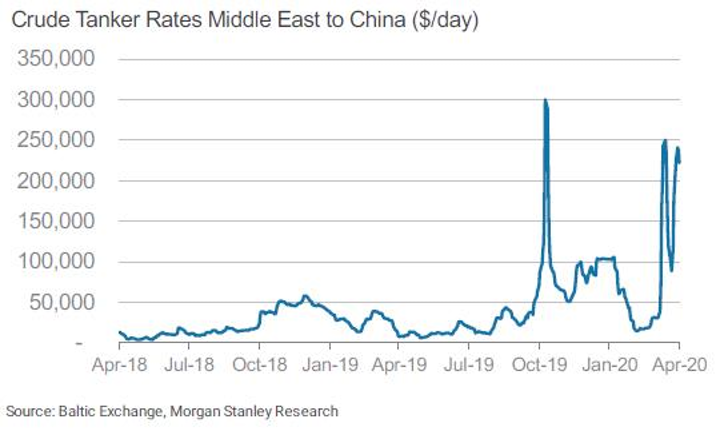
Ironically, in its latest attempt to kill off shale, Saudi Arabia may have gone a step too far, as “the specter of production shut-downs – and the impact they will have on jobs, companies, their banks, and local economies – was one of the reasons that spurred world leaders to join forces to cut production in an orderly way. But as the scale of the crisis dwarfed their efforts, failing to stop prices diving below zero last week, shut-downs are now a reality. It’s the worst-case scenario for producers and refiners.”
In short, the entire oil production industry is shutting down, not because it wants to – of course – but because it has no choice. According to Goldman, in as little as three weeks there will be literally no place left on earth to store oil, and unless oil producers want to pay “buyers” to hold the oil as happened on that historic date of April 20, they have no choice but to shut in output.
“We are moving into the end-game,” said Torbjorn Tornqvist, head of commodity trading giant Gunvor Group. “Early-to-mid May could be the peak. We are weeks, not months, away from it.”
Which brings us back to why in 2020 Riyadh has succeeded where it failed in 2014: as Bloomberg writes “in theory, the first oil output cuts should have come from the OPEC+ alliance, which earlier this month agreed to reduce production from May 1. Yet after the catastrophic price plunge on Monday, when West Texas Intermediate fell to -$40 a barrel, it’s the U.S. shale patch that is leading”
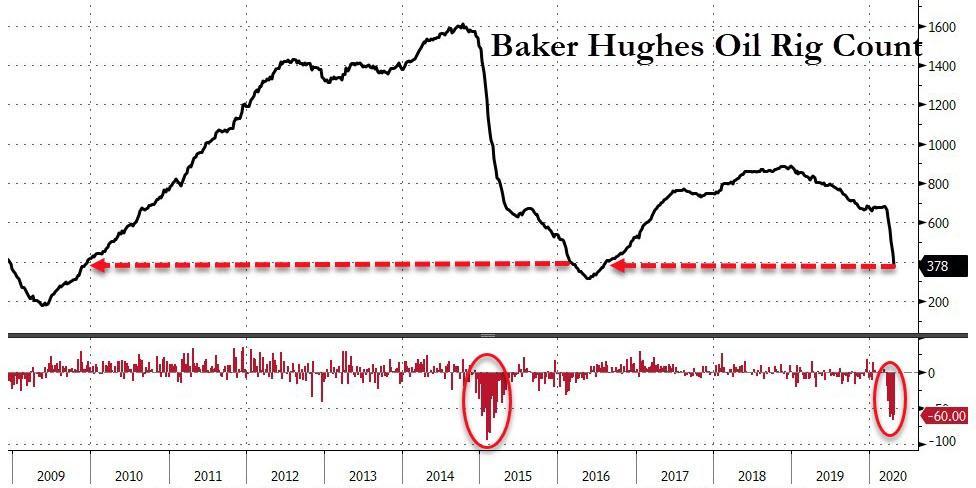
The best indicator of how the shale industry is reacting is the sudden collapse in the number of oil rigs in operation, which last week fell to a four-year low: “Before the coronavirus crisis hit, oil companies ran about 650 rigs in the US. By Friday, more than 40% of them had stopped working, with only 378 left.”
And while there is a delay between total US oil production and the rig count, it is now obvious that US production is set to collapse next:
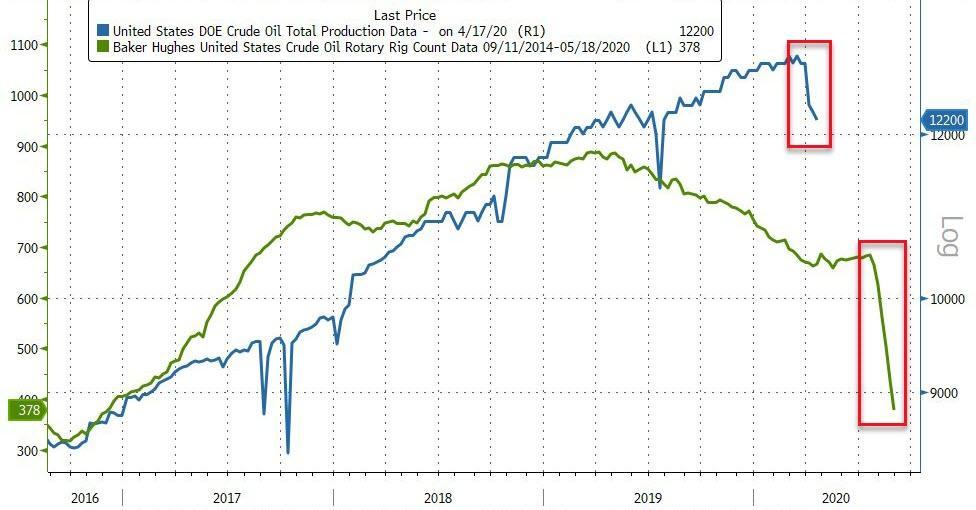
“Monday really focused people’s minds that production needs to slow down,” said the co-head of oil trading at commodity merchant Trafigura. “It’s the smack in the face the market needed to realize this is serious.” Incidentally, Trafigura, one of the largest exporters of US crude from the U.S. Gulf of Mexico, believes that output in Texas, New Mexico, North Dakota and other states will now fall much faster than expected as companies react to negative prices…
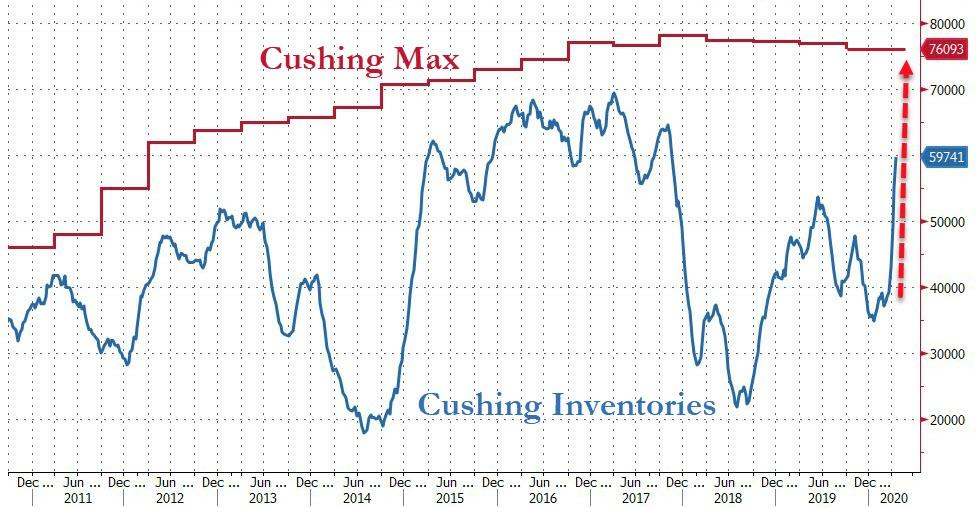
… evidence US commercial storage space for physical at Cushing has run out with what inventory is left having been called for -which have persisted for several days last week in the physical market.
Until prices collapsed on Monday, the consensus was that output would drop by about 1.5MM barrels a day by December. Now market watchers see that loss by late June. “The severity of the price pressure is likely to act as a catalyst for the immediate turndown in activity and shut-ins,” said Roger Diwan, oil analyst at consultant IHS Markit Ltd.
As detailed last week, this price shock has been especially acute in the physical market where producers of crude streams such as South Texas Sour and Eastern Kansas Common had to pay more than $50 a barrel to offload their output last week.
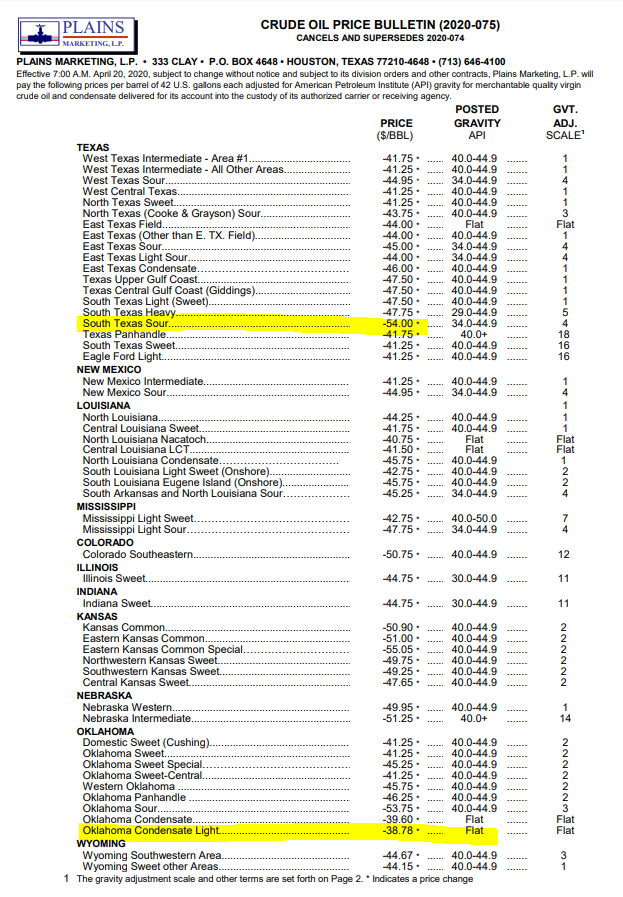
And so the US industry is finally shutting down as ConocoPhillips and shale producer Continental Resources have all announced plans to shut in output. Regulators in Oklahoma voted to allow oil drillers to shut wells without losing leases; New Mexico made a similar decision. Even North Dakota, which for years was synonymous with the U.S. shale revolution, is witnessing a rapid retrenchment, as Bloomberg notes that “oil producers have already closed more than 6,000 wells, curtailing about 405,000 barrels a day in production, or about 30% of the state’s total.”
However, it won’t be just the US: output cuts can be seen from Chad, a poor and landlocked country in Africa, to Vietnam and Brazil, producers are now either reducing output or making plans to do so. “I wouldn’t want to get sensational about it but yes, clearly there must be a risk of shut-ins,” Mitch Flegg, the head of North Sea oil company Serica Energy, said in an interview. “In certain parts of the world it is a real and present risk.”
In emergency board meetings last week, oil companies small and large discussed an outlook that’s the most somber any oil executive has ever witnessed. For the small firms, the next few weeks will be all about staying afloat. But even for the bigger ones, like Exxon Mobil Corp. and BP Plc, it’s a challenge. Big Oil will offer an insight into the crisis when companies report earnings this week.
Then on Friday, May 1, Saudi Arabia, Russia and the rest of OPEC+ will join the output cuts, slashing their output by 23%, or 9.7 million barrels a day. Saudi Aramco, the state-owned company has already cut production, and Russian oil companies have announced exports of their flagship Urals crude would drop in May to a 10-year low.
And yet, as warned here repeatedly, it may still not be enough, as every week, another 50 million barrels of crude are going into storage, enough to fuel Germany, France, Italy, Spain, and the U.K. combined, with estimates that the world will run out of land-based storage some time in late May or early June. Meanwhile, what’s not stored onshore, is stashed in tankers. As Bloomberg’s Blas points out, the U.S. Coast Guard on Friday said there were so many tankers at anchor off California that it was keeping an eye on the situation.
Javier Blas
✔@JavierBlas
VIDEO: US Coast Guard says it’s keeping an eye on 27 oil tankers anchored off the coast of Southern California. Another great example of floating storage build-up as demand for oil and refined products plunge | #OOTT #Contango video via @USCGLosAngeles
But if the two dozen or so tankers piled up off the coast of California is bad…
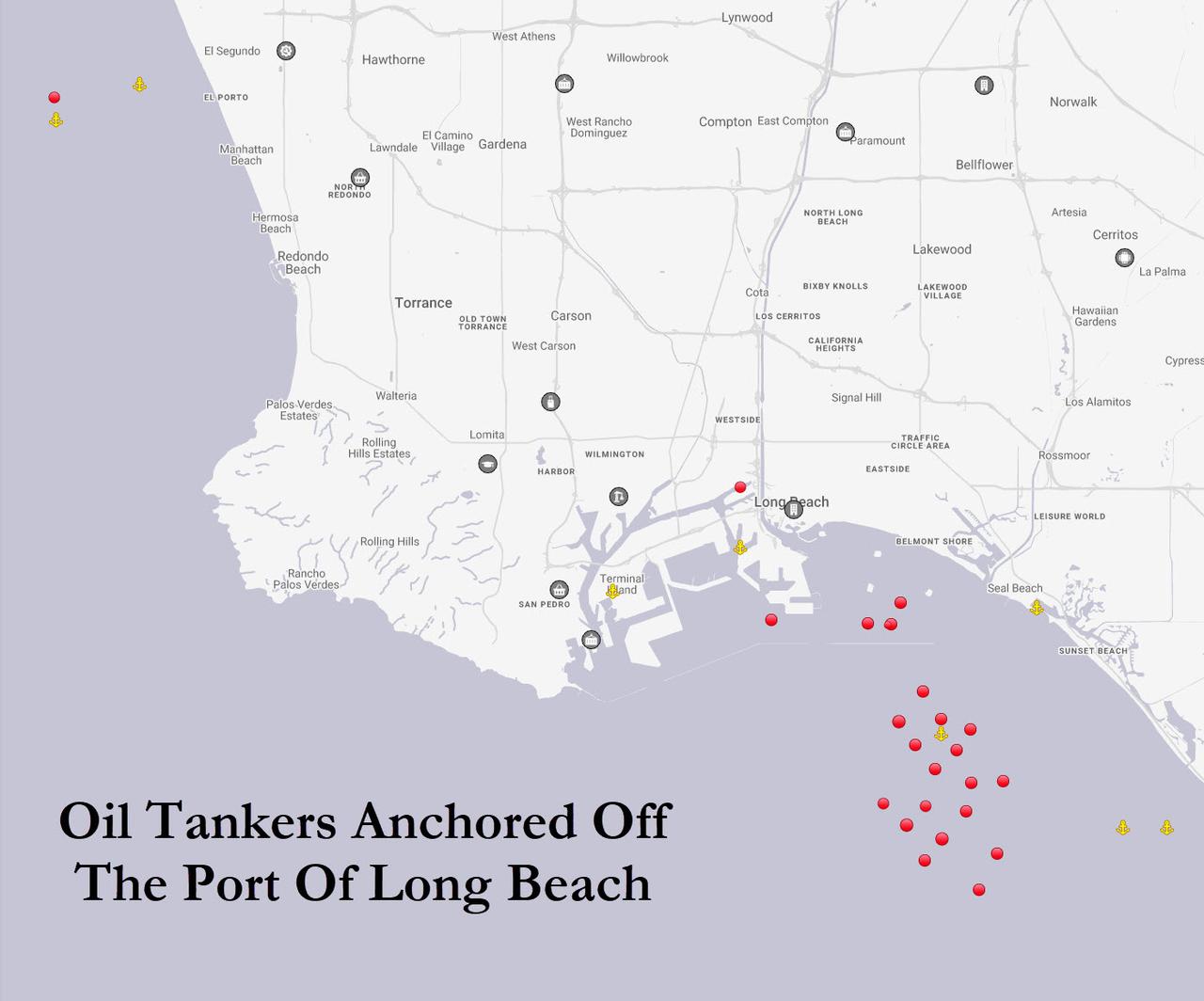
… and those next to Galveston, TX is worse…
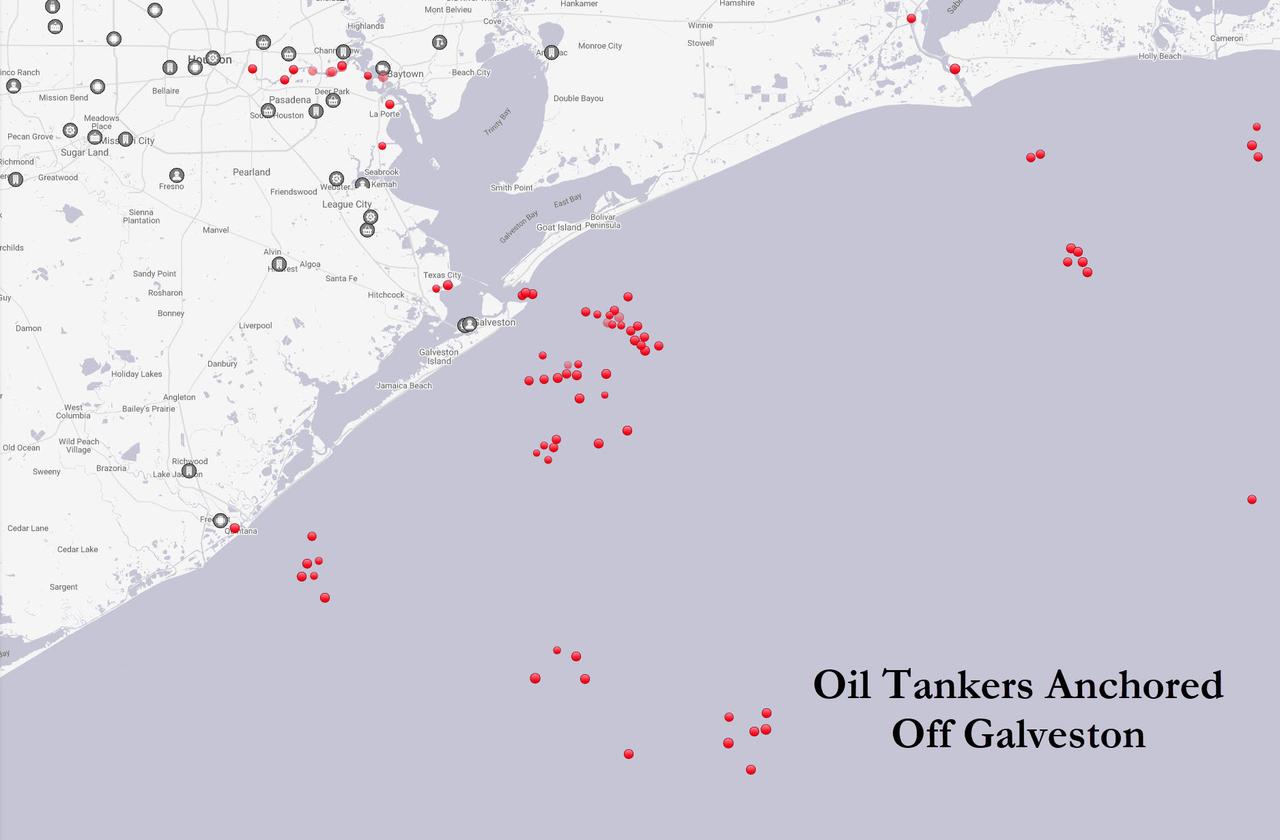
… what is going on in that tanker parking lot off of Singapore is absolutely insane.
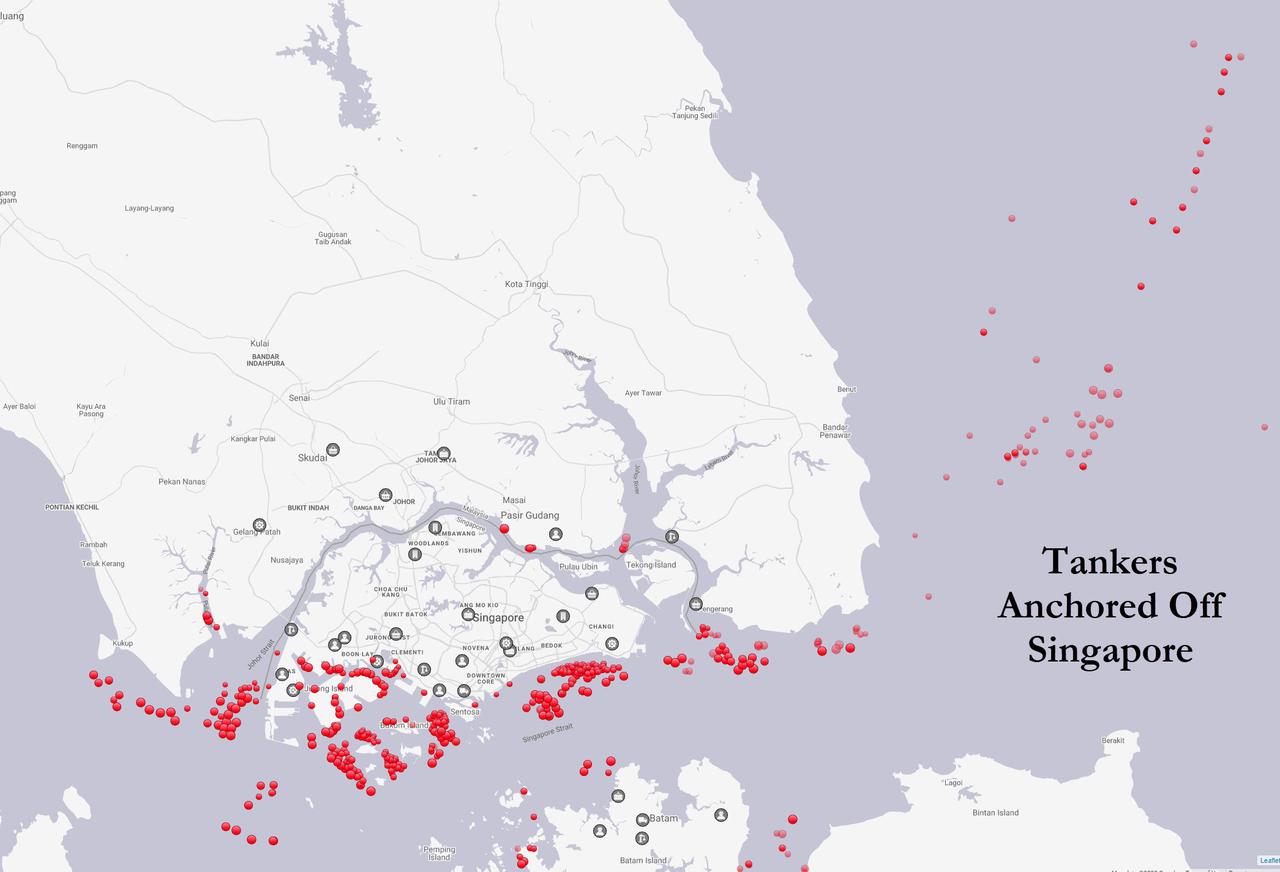
There is some good news: oil traders say after plunging by a third, US oil consumption has probably hit a bottom, and will start a very gentle recovery, although that also depends on how fast the US economy can reopen from the coronavirus coma.
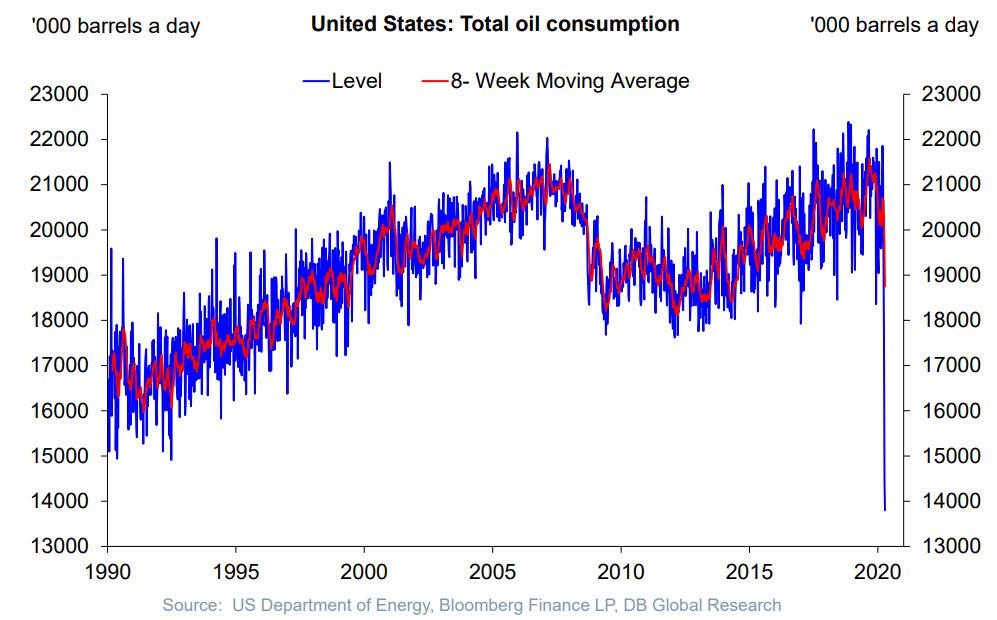
But before even a modest recovery takes hold, the great shutdown will spread through oil refining too. Over the past week, Marathon Petroleum, one of the biggest U.S. refiners, announced it would stop production at a plant near San Francisco. Royal Dutch Shell has idled several units in three U.S. refineries in Alabama and Louisiana. And across Europe and Asia, many refineries are running at half rate. U.S. oil refiners processed just 12.45 million barrels a day on the week to April 17, the lowest amount in at least 30 years, except for hurricane-related closures.
The closures have already sent thousands packing: the oil and gas industry shed nearly 51,000 drilling and refining jobs in March, a 9% reduction that will only get worse in April. March’s job losses rise by 15,000 when ancillary jobs such as construction, manufacturing of drilling equipment and shipping are included, according to BW Research Partnership, a research consultancy, which analyzed Department of Labor data combined with the firm’s own survey data of about 30,000 energy companies.
“We’re looking at anywhere between five and seven years of job growth wiped out in a month,” Philip Jordan, the company’s vice president said in an interview. “What makes it sort of scary is this really is just the beginning. April is not looking good for oil and gas.”
And so, as the oil industry shuts down – at least for a few weeks (or perhaps months) – more refinery shutdowns are coming, oil traders and consultants said, particularly in the U.S. where lockdowns started later than in Europe and demand is still contracting. Steve Sawyer, director of refining at Facts Global Energy,
END
Oil Tumbles As Traders Frontrun USO Liquidation Of Entire June Exposure
While the culprits behind last week’s historic oil plunge to a negative $40/barrel have yet to be conclusively identified, with some pointing fingers at US retail traders, while others blaming tremendous losses in Chinese structured products, one clear usual suspect is the USO, the largest oil ETF and the preferred crude oil investment derivative for thousands of retail investors everywhere. As Bloomberg’s Laura Cooper writes, oil trading negative last week brought to light the risks inherent in ETF’s easy liquidity: “while the market appears to be viewing the USO episode as an outlier, proof that funds can become unhinged from their benchmark leaves risk assets exposed.”
Of particular interest remains the composition of USO’s WTI futures holdings, with some speculating that the nearly 100,000 barrels held for May delivery may have precipitated the liquidation wave observed last Monday. Well, as it turns out, the CFTC data was actually stale, because as Bloomberg writes this morning, the USO wasn’t holding May WTI futures last Monday as it began rolling its underlying assets to June futures contracts in early to mid April – by construction to avoid trading complications near the date of contract expiry.
Even so, the tumble in both May WTI and USO quickly became a mutually reinforcing – and self-fulfilling – prophecy, and as the June price tumbled towards zero as May collapsed, the risk of liquidation from a negative NAV prompted the fund to take the unprecedented step to change its structure to lessen sensitivity to the moves and shift its mandate for future flexibility.
The chart below courtesy of Bloomberg summarizes how the USO – which historically only held the forward month leading to much pain during times of contango when the USO suffered major losses as it rolled its contract into a more expensive one – changed its composition in the past three weeks,.
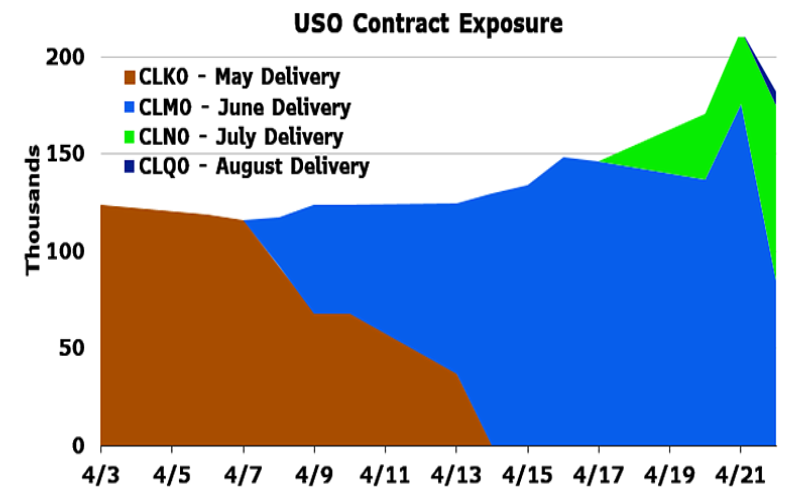
These color-coded changes in the USO’s exposure to carious WTI contracts reflect the ETF’s ongoing near-death experience, as the fund’s managers scramble to prevent it from going negative by having extensive exposure to a contract month that could go negative next… such as June.
Then, in the latest update published this morning, the USO got out of the June WTI contract altogether, rolling out of the June contract on April 27, 2020 through April 30, 2020, well ahead of the scheduled roll out which was supposed to take place on May 5-8th, while adding to other, longer-dated contracts:
And as it sells June, this is what the USO is buying as per the latest 8K:
- 30% of its portfolio in the July contract,
- 15% of its portfolio in the August contract,
- 15% of its portfolio in the September contract,
- 15% of its portfolio in the October contract,
- 15% of its portfolio in the December contract,
- 10% of its portfolio in the June 2021 contract.
And since USO manager, USCF, said it will roll the current portfolio positions into the positions described above over a three-day period with approximately 33.3% of the investment changes taking place each day on each of April 27, 2020, April 28, 2020, and April 29, 2020, that explains why the June WTI contract is tumbling this morning as traders frontrun the USO selling.

It’s not just WTI – June Brent also fell as much as 7% to take it back below $20/bbl. And unlike worst of last week’s bloodbath, the pain was also felt further along the curve, with CL3 down 9.1%, as traders now are frontrunning future USO rolls.
Looking ahead, Cooper speculates that USO is likely to shift back to 100% front-end contracts once the ‘exceptional market conditions’ ease, but last week’s events brought to retail participants’ light the negative carry paid in perpetuity by crude-tracking funds, rolling over at higher price much of the time.
Meanwhile, as Bloomberg ETF strategist Eric Balchunas notes volatility in commodity markets is still fueling the rise of sector-specific ETFs with April on track for the third-best month in past six years. But, as Cooper concludes, one has to wonder whether the cracks revealed in exchange-traded products that offer oil exposure will result in cratering ahead. One look at the surge in USO short interest should answer that question.
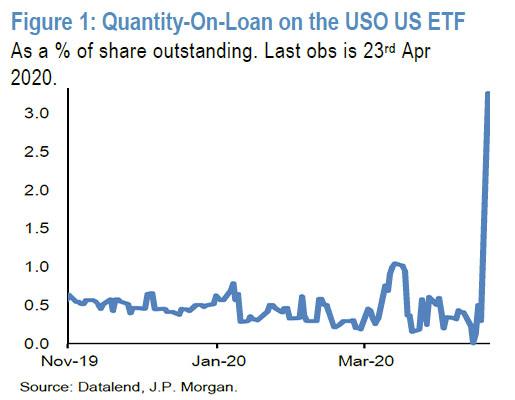
end
More and more retails investors in oil are being led to the slaughter house as they do not understand the delivery process
(zerohedge)
200,000 Retail Investors Hoping To Buy The F**king Dip In USO End Up Just Getting F**ked
For the second week in a row, the largest US oil ETF, the USO roiled oil markets after it unexpectedly starting selling its holdings of the most active West Texas Intermediate futures contract, triggering a massive swing in the price relationship between the June and July contracts, which – as we reported earlier – sent both the June WTI contract tumbling…
… which pushed WTI spreads even deeper into contango, as the discount between June WTI and the contract for December deepened sharply after the filing, reaching as low as $15.17 a barrel…
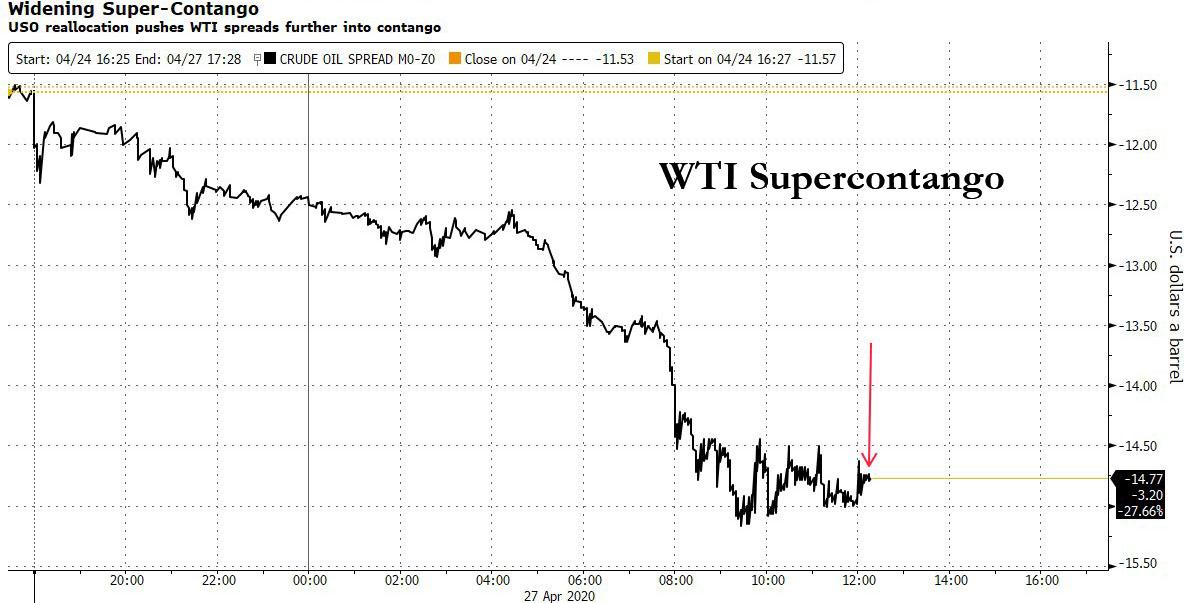
… while the price of USO to all time lows.

The changes, which were detailed in a Monday morning regulatory filing, represented the latest in a series that Bloomberg said “have wreaked havoc on crude prices.” The fund said it’s moving its money to contracts spread between July 2020 and June 2021 due to new limits imposed upon it by regulators and its broker. Specifically, USCF which manages the USO ETF, said it would now target the following allocation:
- 30% of its portfolio in the July contract,
- 15% of its portfolio in the August contract,
- 15% of its portfolio in the September contract,
- 15% of its portfolio in the October contract,
- 15% of its portfolio in the December contract,
- 10% of its portfolio in the June 2021 contract.
… and revealed that it would roll into the positions described above over a three-day period with approximately 33.3% of the investment changes taking place each day on each of April 27, 2020, April 28, 2020, and April 29, 2020, which explains why the June WTI contract is tumbling this morning as speculators frontran the USO selling.
The ETF has changed its investment policy five times in the last two weeks, as shown in the following chart which depicted the ETF’s holdings as of Friday’s close:
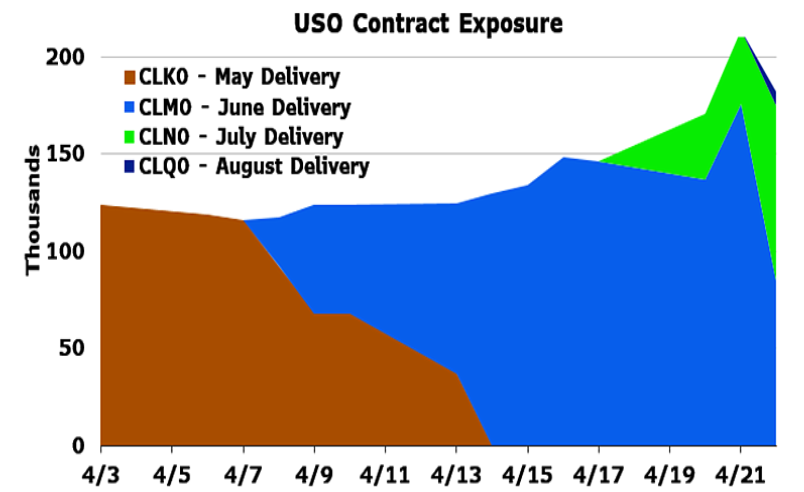
It also warned investors its valuation may deviate significantly from the underlying oil price, in effect acknowledging that it’s momentarily less focused on the price of WTI crude.
“While it is USO’s expectation that at some point in the future it will be able to return to primarily investing in the Benchmark Futures Contract or other similar futures contracts of the same tenor based on light, sweet crude oil, there can be no guarantee of when, if ever, that will occur,” it said in the filing, adding that USO investors “should expect that there will be continued deviations between the performance of USO’s investments and the Benchmark Oil Futures Contract, and that USO may not be able to track the Benchmark Oil Futures Contract or meet its investment objective.”
The fund listed factors including “a change in regulator accountability levels and position limits” as part of its reasons for the shift. As a result it will now struggle to meet its own investment objectives, it warned.
As Bloomberg notes, the long-only oil fund has in recent weeks become a magnet for retail investors looking to Buy The Fucking Dip and time the bottom to the historic price rout that’s pushed oil futures in New York into negative territory for the first time in history. The knock-on effects have impacted retail investors everywhere. While USO was not holding the May contract when it plunged below zero, traders pointed to retail money as having caused large gyrations in the market.
And while the USO has quickly become a rich target for speculators that are able to take advantage of the moves by trading ahead of it, thanks to its detailed regulatory disclosures, such as today’s crash, retail investors continue getting slaughtered and according to the latest Robin Hood data, there was now a record…
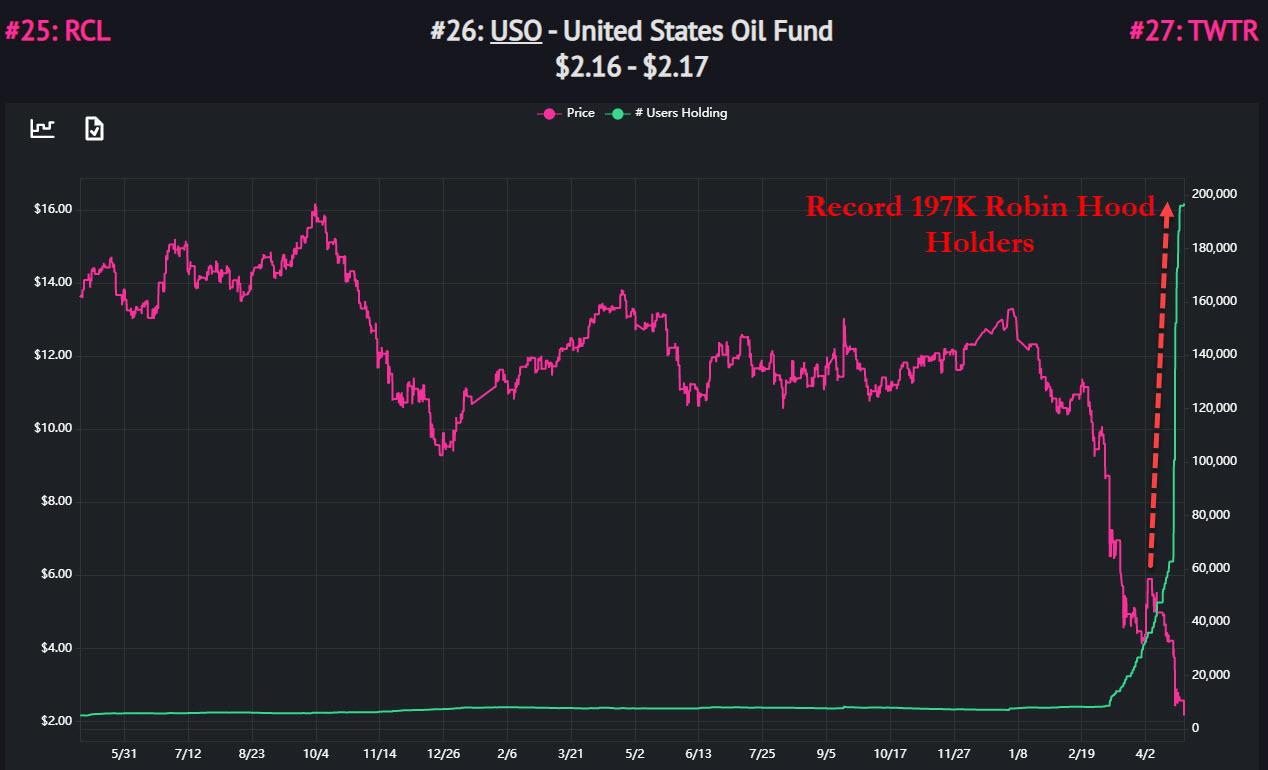
… even though the USO is by definition a product designed to fleece retail, offering a detailed calendar and the exact contracts that’s selling and buying, it allows others to place financial bets ahead.
Our advice: only when retail has “dumped it”, and hedge funds have to look elsewhere for sheep to fleece, will it be safe to expect a modest oil rebound.
end
Just out…
In a stunning news release, Continental Resources, the largest shale producer in the Bakken, is shutting in most of its production in the region. That is one hell of a lot of output to shut-in as Continental Resources was producing over 200,000 barrels per day in the Bakken at the end of 2019…
http://charleshughsmith.blogspot.com/2020/04/no-this- is-not-another-1929-1973-1987.html
***
8 EMERGING MARKET ISSUES
Your early morning currency/gold and silver pricing/Asian and European bourse movements/ and interest rate settings MONDAY morning 7:00 AM….
Euro/USA 1.0845 UP .0027 REACTING TO MERKEL’S FAILED COALITION/ REACTING TO +GERMAN ELECTION WHERE ALT RIGHT PARTY ENTERS THE BUNDESTAG/ huge Deutsche bank problems ///ITALIAN CHAOS//CORONAVIRUS /AND NOW ECB TAPERING BOND PURCHASES/JAPAN TAPERING BOND PURCHASES /USA RISING INTEREST RATES /FLOODING/EUROPE BOURSES /GREEN
USA/JAPAN YEN 107.14 DOWN 0.301 (Abe’s new negative interest rate (NIRP), a total DISASTER/NOW TARGETS INTEREST RATE AT .11% AS IT WILL BUY UNLIMITED BONDS TO GETS TO THAT LEVEL…
GBP/USA 1.2422 UP 0.0072 (Brexit March 29/ 2019/ARTICLE 50 SIGNED/BREXIT FEES WILL BE CAPPED/
USA/CAN 1.4071 DOWN .0017 CANADA WORRIED ABOUT TRADE WITH THE USA WITH TRUMP ELECTION/ITALIAN EXIT AND GREXIT FROM EU/(TRUMP INITIATES LUMBER TARIFFS ON CANADA/CANADA HAS A HUGE HOUSEHOLD DEBT/GDP PROBLEM)
Early THIS MONDAY morning in Europe, the Euro ROSE BY 27 basis points, trading now ABOVE the important 1.08 level RISING to 1.0848 Last night Shanghai COMPOSITE CLOSED UP 6.97 POINTS OR 0.25%
//Hang Sang CLOSED UP 448.81 POINTS OR 1.88%
/AUSTRALIA CLOSED UP 1,65%// EUROPEAN BOURSES ALL GREEN
Trading from Europe and Asia
EUROPEAN BOURSES ALL GREEN
2/ CHINESE BOURSES / :Hang Sang CLOSED UP 448.81 POINTS OR 1.898%
/SHANGHAI CLOSED DOWN 6.97 POINTS OR 0.25%
Australia BOURSE CLOSED UP 1.65%
Nikkei (Japan) CLOSED UP 521.22 POINTS OR 2.71%
INDIA’S SENSEX IN THE GREEN
Gold very early morning trading: 1715.20
silver:$15.20-
Early TUESDAY morning USA 10 year bond yield: 0.62% !!! U2 1 IN POINTS from FRIDAY’S night in basis points and it is trading WELL BELOW resistance at 2.27-2.32%.
The 30 yr bond yield 1.20 UP 3 IN BASIS POINTS from FRIDAY night.
USA dollar index early MONDAY morning: 99.98 DOWN 40 CENT(S) from FRIDAY’s close.
This ends early morning numbers MONDAY MORNING
xxxxxxxxxxxxxxxxxxxxxxxxxxxxxxxxxxxxxxxxxxxxxxxxxxxxxxxxxxxxxxxxxxxxxxxxxxxxxxxxxxxxxxxxxxxxxxxxxxxxxxxxxxxxxx6
And now your closing MONDAY NUMBERS \1: 00 PM
Portuguese 10 year bond yield: 1.03% DOWN 5 in basis point(s) yield from YESTERDAY/
JAPANESE BOND YIELD: -.04% DOWN 2 BASIS POINTS from YESTERDAY/JAPAN losing control of its yield curve/56
SPANISH 10 YR BOND YIELD: 0.90%//DOWN 5 in basis point yield from yesterday.
ITALIAN 10 YR BOND YIELD:1,76 DOWN 12 points in basis points yield from yesterday./
the Italian 10 yr bond yield is trading 86 points higher than Spain.
GERMAN 10 YR BOND YIELD: FALLS TO –.45% IN BASIS POINTS ON THE DAY//
THE IMPORTANT SPREAD BETWEEN ITALIAN 10 YR BOND AND GERMAN 10 YEAR BOND IS 2.11% AND NOW ABOVE THE THE 3.00% LEVEL WHICH WILL IMPLODE THE ENTIRE ITALIAN BANKING SYSTEM. AT 4% SPREAD THERE WILL BE A HUGE BANK RUN…
END
IMPORTANT CURRENCY CLOSES FOR MONDAY
Closing currency crosses for MONDAY night/USA DOLLAR INDEX/USA 10 YR BOND YIELD/1:00 PM
Euro/USA 1.0837 UP .0015 or 15 basis points
USA/Japan: 107.21 DOWN .236 OR YEN UP 24 basis points/
Great Britain/USA 1.2418 UP .0068 POUND UP 68 BASIS POINTS)
Canadian dollar UP 41 basis points to 1.4046
xxxxxxxxxxxxxxxxxxxxxxxxxxxxxxxxxxxxxxxxxxxxxxxxxxxxxxxxxxxxxxxxxxxxxxxxxxxxxxxx
The USA/Yuan,CNY: AT 7.0864 ON SHORE (DOWN)..GETTING DANGEROUS
THE USA/YUAN OFFSHORE: 7.0934 (YUAN DOWN)..GETTING REALLY DANGEROUS
TURKISH LIRA: 6/9853 EXTREMELY DANGEROUS LEVEL/DEATH WISH.
the 10 yr Japanese bond yield closed at -.04%
Your closing 10 yr US bond yield UP 5 IN basis points from FRIDAY at 0.65 % //trading well ABOVE the resistance level of 2.27-2.32%) very problematic USA 30 yr bond yield: 1.23 UP 6 in basis points on the day
Your closing USA dollar index, 100.09 DOWN 29 CENT(S) ON THE DAY/1.00 PM/
Your closing bourses for Europe and the Dow along with the USA dollar index closing and interest rates for TUESDAY: 12:00 PM
London: CLOSED UP 69.19 1.20%
German Dax : CLOSED UP 278.38 POINTS OR 2.69%
Paris Cac CLOSED UP 94.60 POINTS 2.15%
Spain IBEX CLOSED UP 97.20 POINTS or 1.47%
Italian MIB: CLOSED UP 439.10 POINTS OR 2.60%
WTI Oil price; 12.26 12:00 PM EST
Brent Oil: 19.20 12:00 EST
USA /RUSSIAN / RUBLE FALLS: 74.71 THE CROSS HIGHER BY 0.13 RUBLES/DOLLAR (RUBLE LOWER BY 13 BASIS PTS)
TODAY THE GERMAN YIELD FALLS TO –.45 FOR THE 10 YR BOND 1.00 PM EST EST
END
This ends the stock indices, oil price, currency crosses and interest rate closes for today 4:30 PM
Closing Price for Oil, 4:00 pm/and 10 year USA interest rate:
WTI CRUDE OIL PRICE 4:30 PM : 13.09//
BRENT : 20.06
USA 10 YR BOND YIELD: …0.66 up 7 basis points…
USA 30 YR BOND YIELD: 1.26..up 8 basis basis..
EURO/USA 1.10832 ( UP 14 BASIS POINTS)
USA/JAPANESE YEN:107.24 DOWN .208 (YEN UP 21 BASIS POINTS/..
USA DOLLAR INDEX: 100.10 DOWN 1 cent(s)/
The British pound at 4 pm Britain Pound/USA:1.2428 UP 29 POINTS
the Turkish lira close: 6.9885
the Russian rouble 74.38 UP 0.21 Roubles against the uSA dollar.( UP 21 BASIS POINTS)
Canadian dollar: 1.4031 UP 56 BASIS pts
German 10 yr bond yield at 5 pm: ,-0.32%
The Dow closed UP 353.55 POINTS OR 1.49%
NASDAQ closed UP 95.64 POINTS OR 1.11%
VOLATILITY INDEX: 33.06 CLOSED DOWN 2.87
LIBOR 3 MONTH DURATION: 0.889%//libor dropping like a stone
LIBOR/OIS: .831
TED SPREAD: .764
USA trading today in Graph Form
Small Caps Panic-Bid On Massive Short-Squeeze As Crude Crashes… Again
Global stocks – according to the narrative du jour – got a bid from The BoJ’s promise of yet more asset-buying…
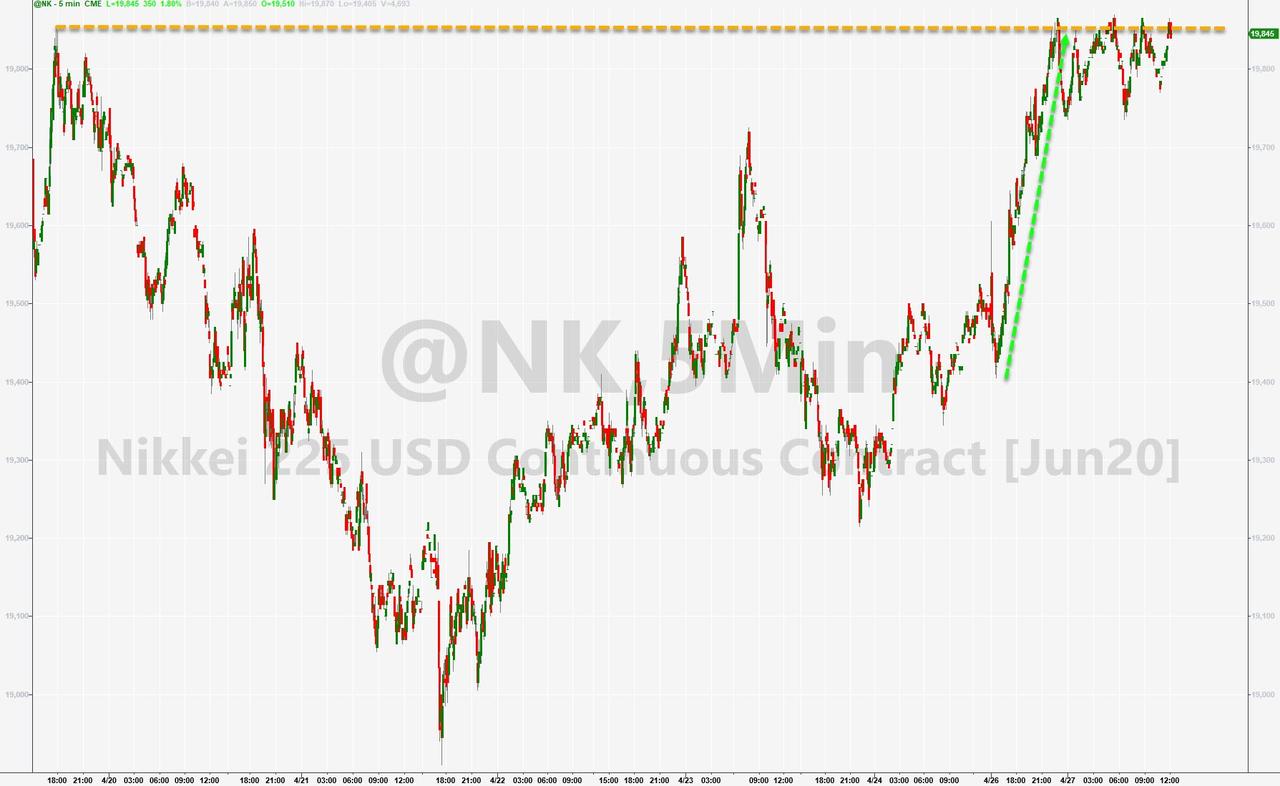
But all that money printing did nothing for any real economy as crude prices collapsed with June WTI plunging to an $11 handle (this market is so fnorked – look at the manic ramp to $14.00 then dump)…
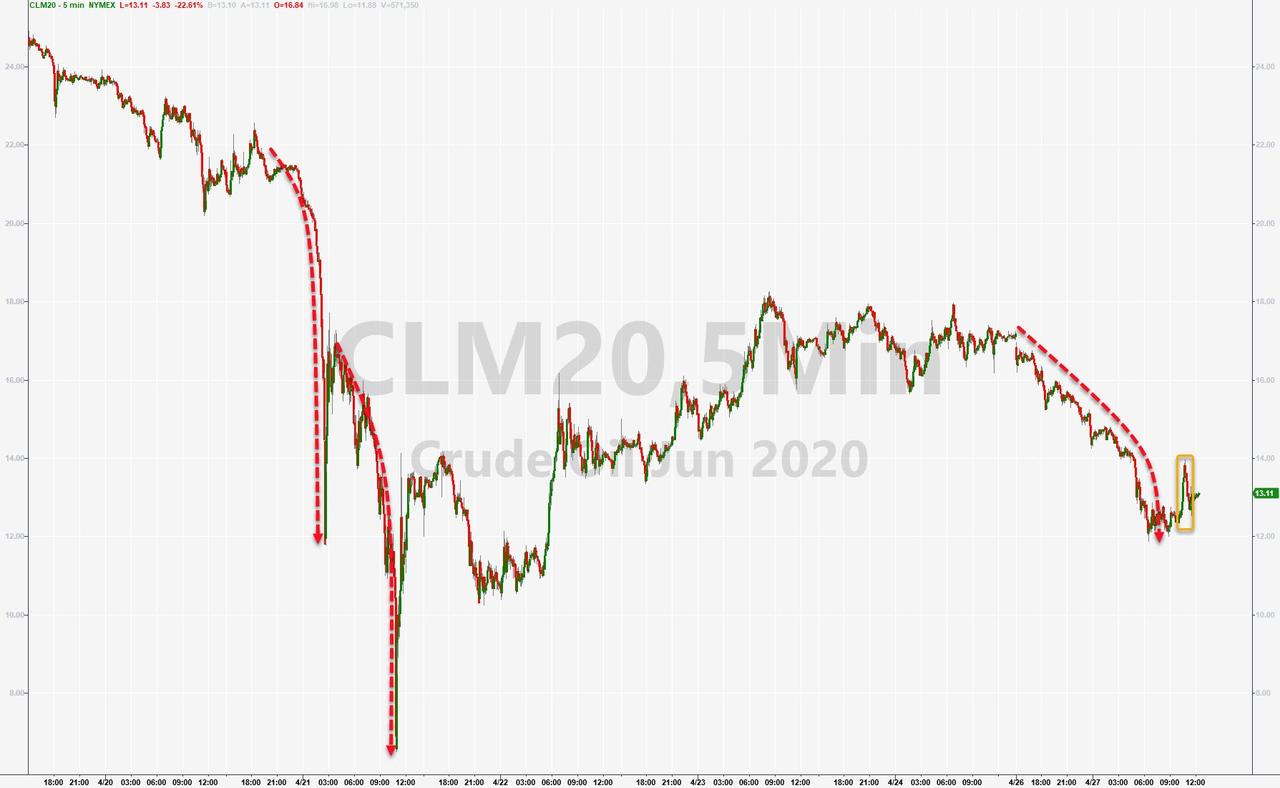
And so as stocks test 2-month highs, the real economy as evidenced by crude is collapsing…
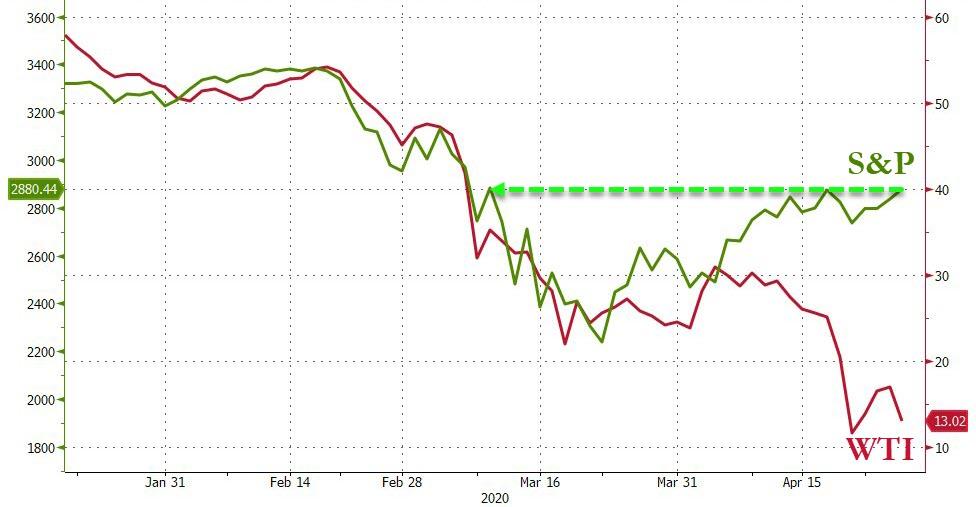
Source: Bloomberg
And Earnings expectations are screaming lower…
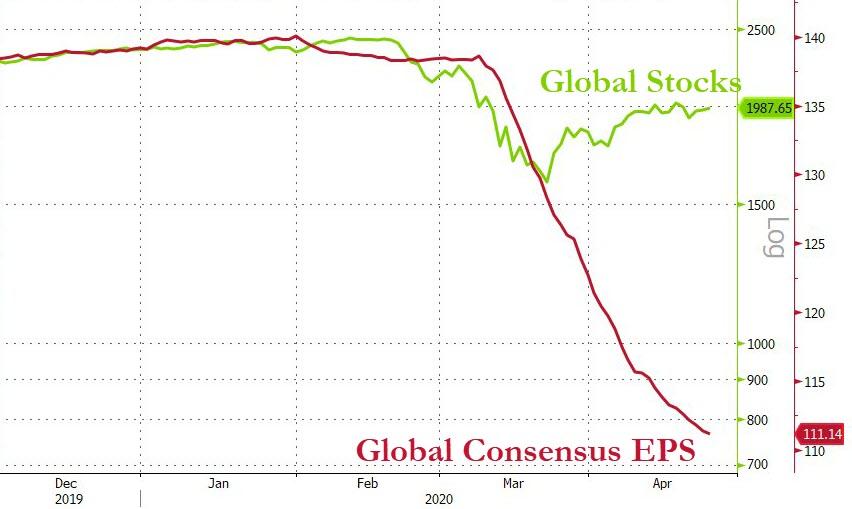
Source: Bloomberg
Explained…
Oh that explains it… US Stocks surged on the back of another short-squeeze…
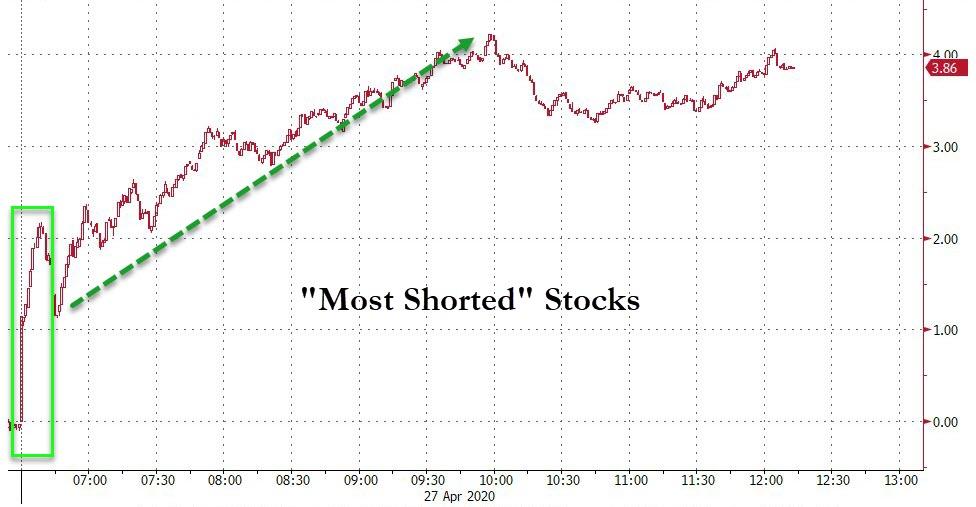
Source: Bloomberg
And a rotation into small cap as people appear to have listened to Goldman’s mega-tech warnings…YES – that is the Russell 2000 up 4.5% TODAY before the late-day tumble…
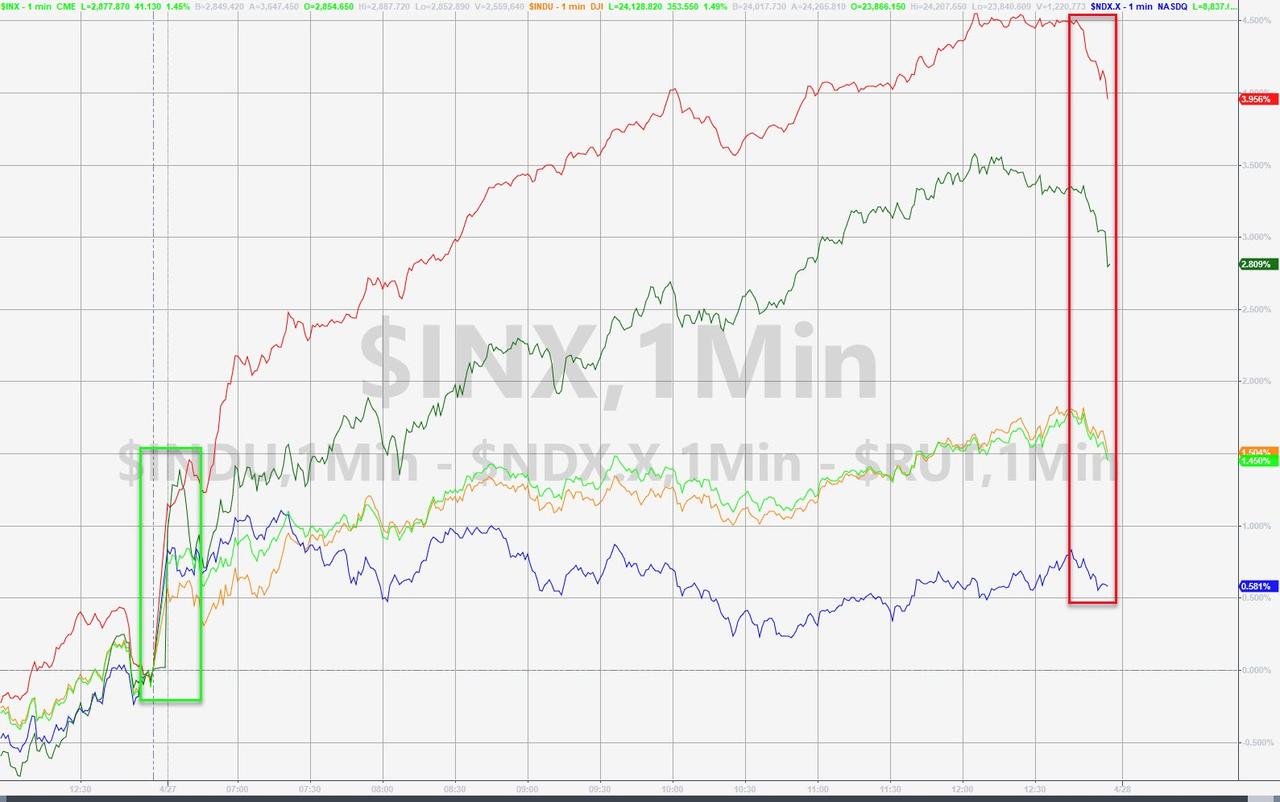
This is The Dow’s first 4-day win streak since early February.
FANG Stocks were sold as small caps soared
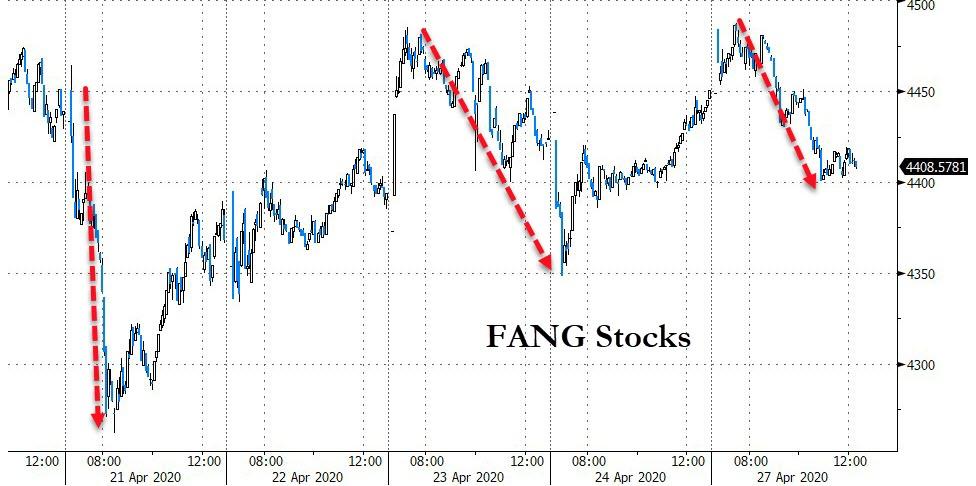
Source: Bloomberg
But Banks were panic-bid (GS now erased most of post-earnings losses)…
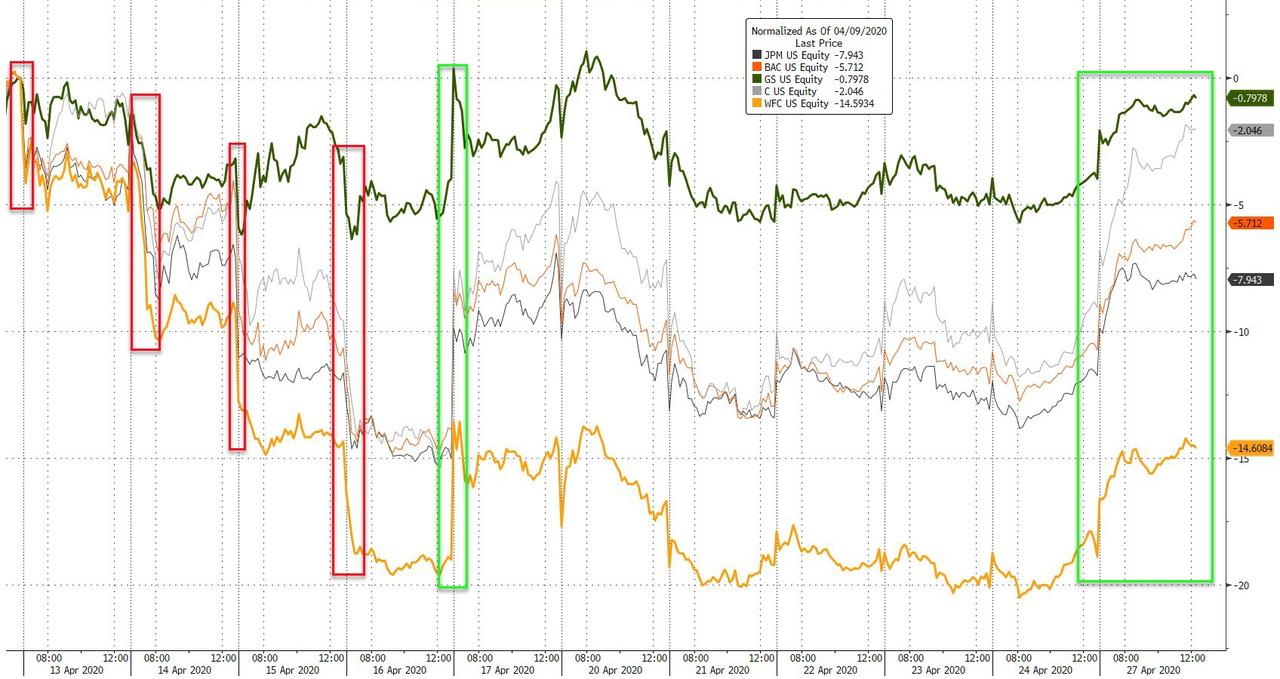
Source: Bloomberg
Russell’s surge was driven by a rip higher in small cap financials – but be very careful – look where they turned around today…

Source: Bloomberg
VIX and Vol of VIX tumbled further…
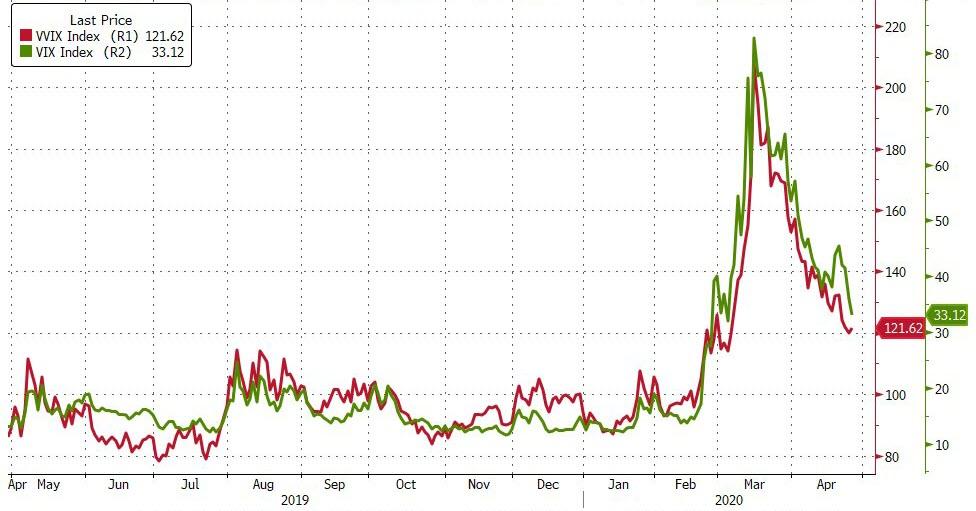
Source: Bloomberg
The VIX term structure is no longer inverted…
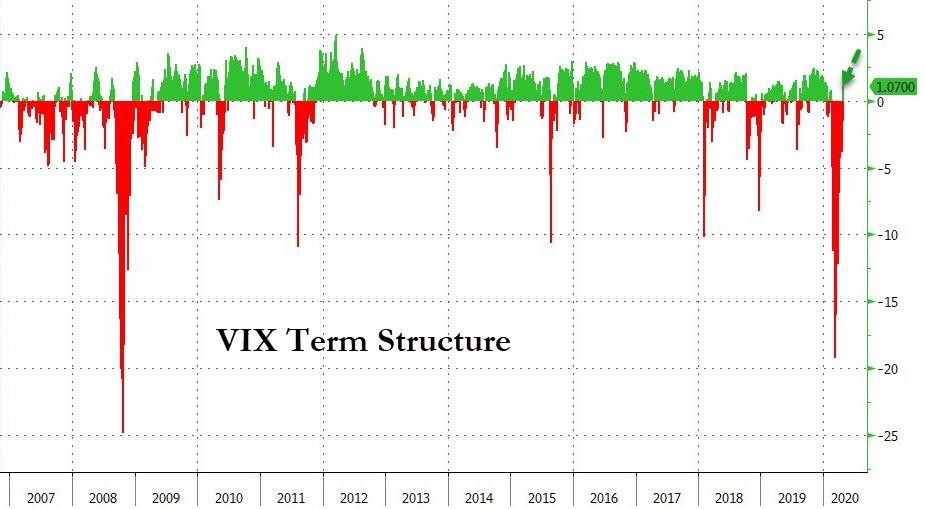
Source: Bloomberg
Despite all the excitement, the Virus-Fear trade refuses to ebb back to normal levels…

Source: Bloomberg
Investment Grade bonds were sold today, HY flatish…
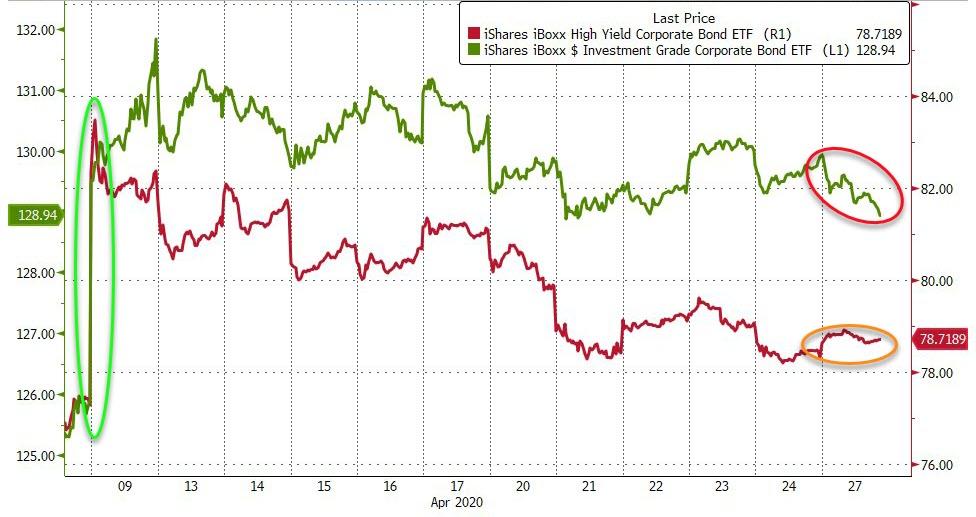
Source: Bloomberg
Yields remain notably decoupled from stocks still…
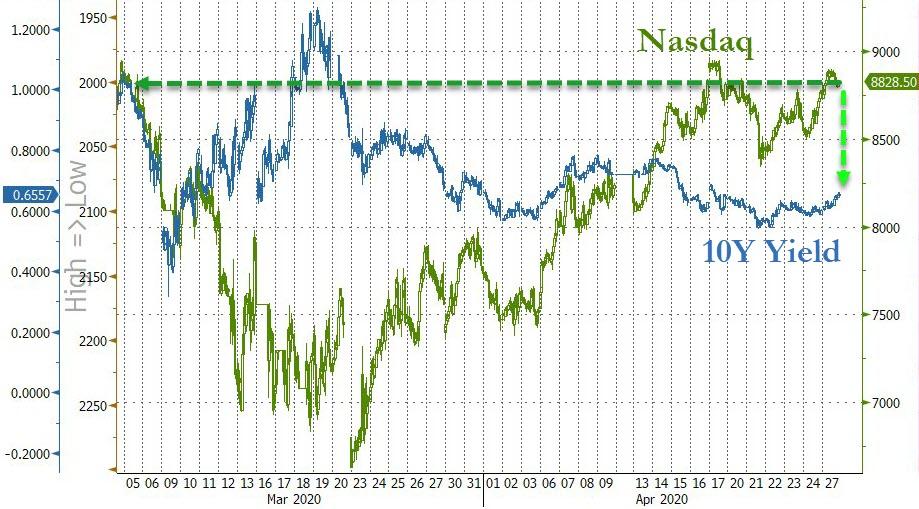
Source: Bloomberg
Treasuries were mixed with the short-end very modestly bid as the long-end was dumped…

Source: Bloomberg
The dollar dropped back today, erasing most of last week’s gains…
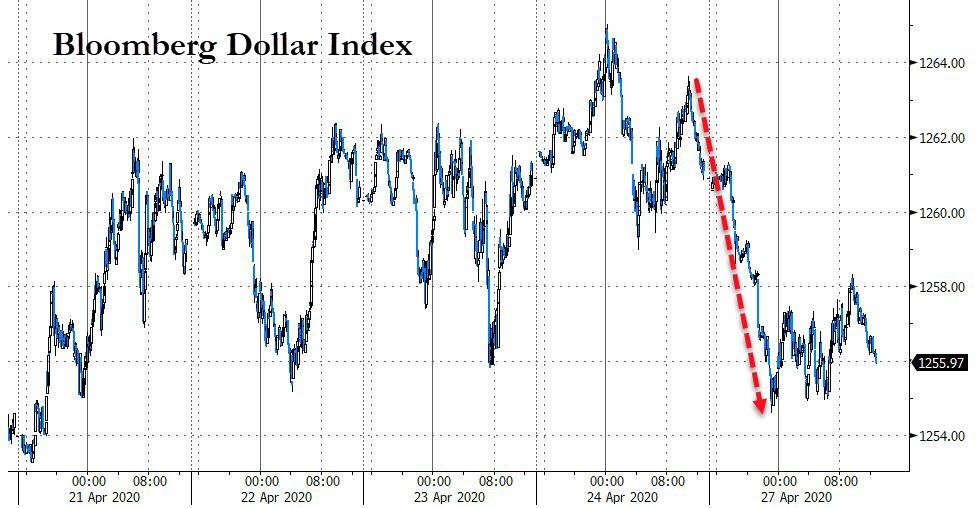
Source: Bloomberg
But despite dollar weakness, the Brazilian Real collapsed…
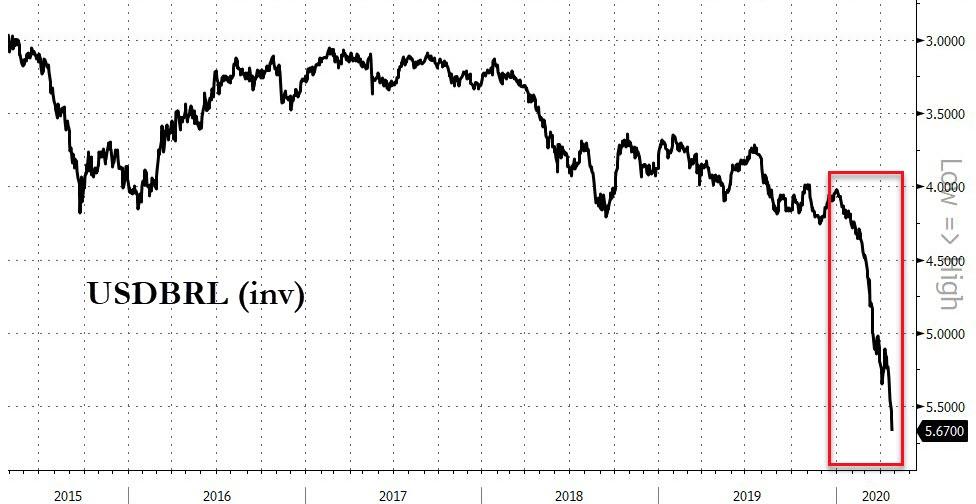
Source: Bloomberg
Cryptos were mixed with Ethereum and Bitcoin higher and Litecoin and Bictoin Cash lower…
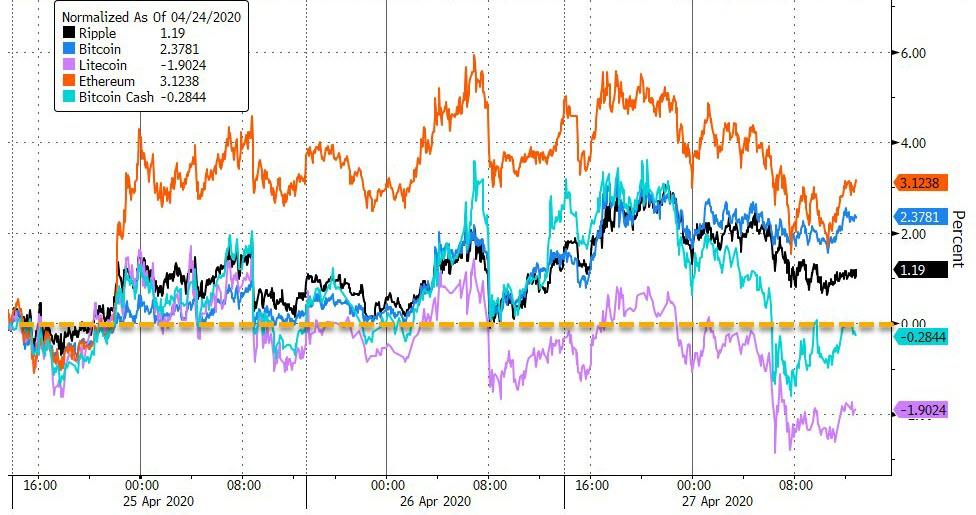
Source: Bloomberg
In commodity-land, gold and silver were slightly lower, copper higher and as we noted above, crude was clubbed like a baby seal…
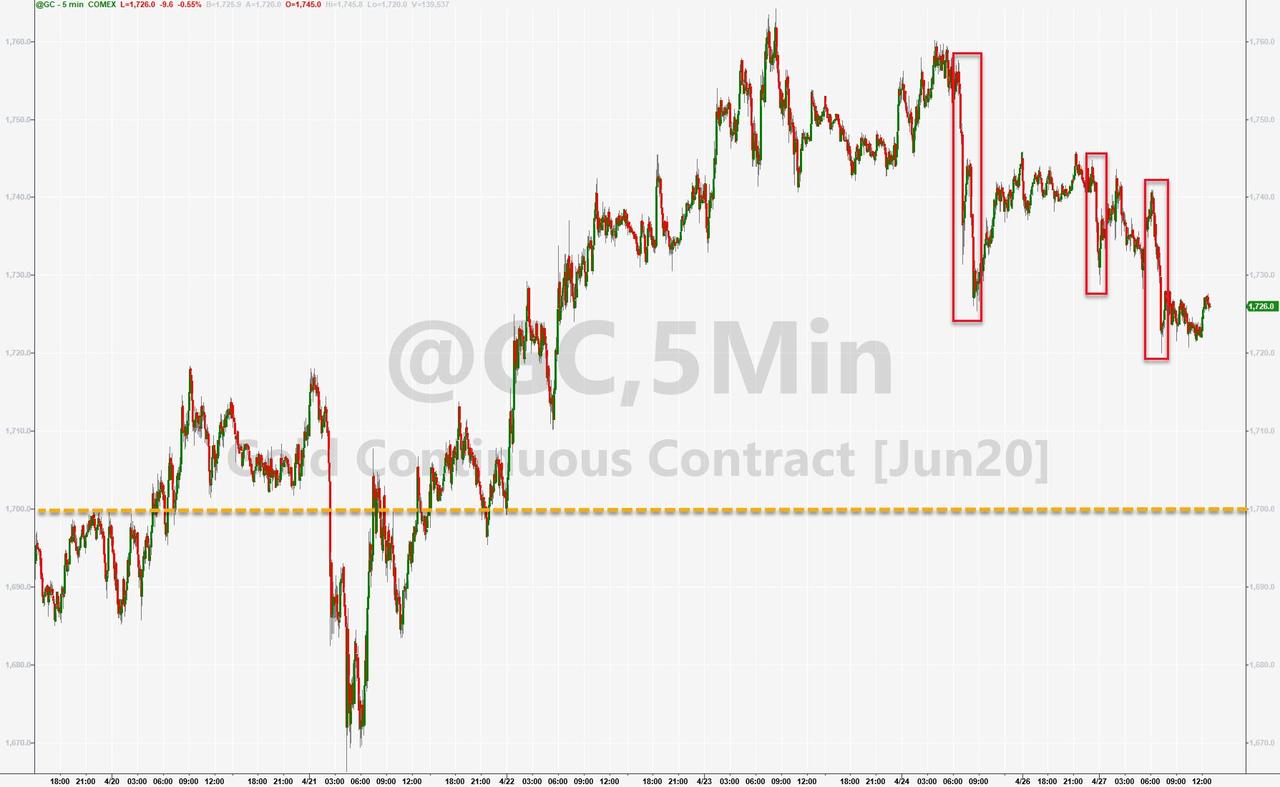
Copper bounced off 2.32…
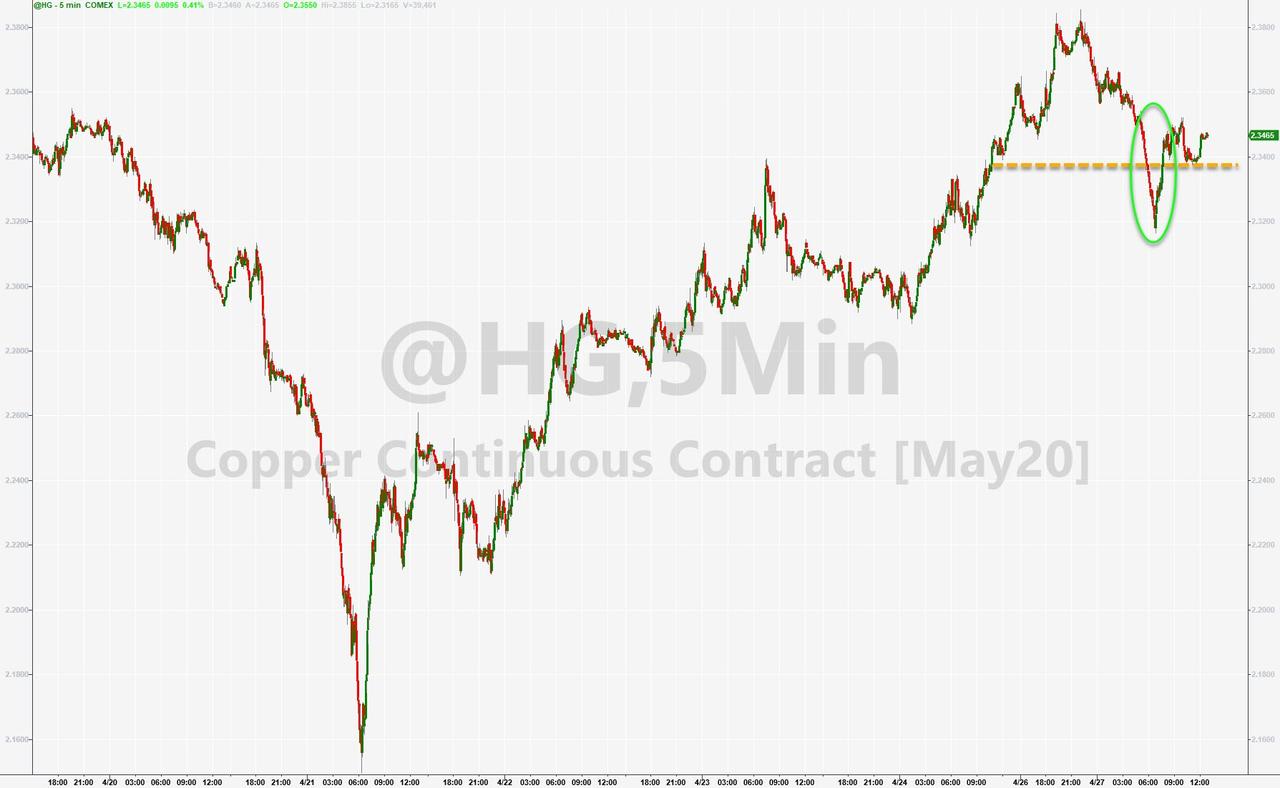
And finally, as @Not_Jim_Cramer illustrates, today’s final regional Fed survey suggests PMI is about to be a bloodbath… nope no v-shaped comeback imminent here in any hope-driven soft survey…
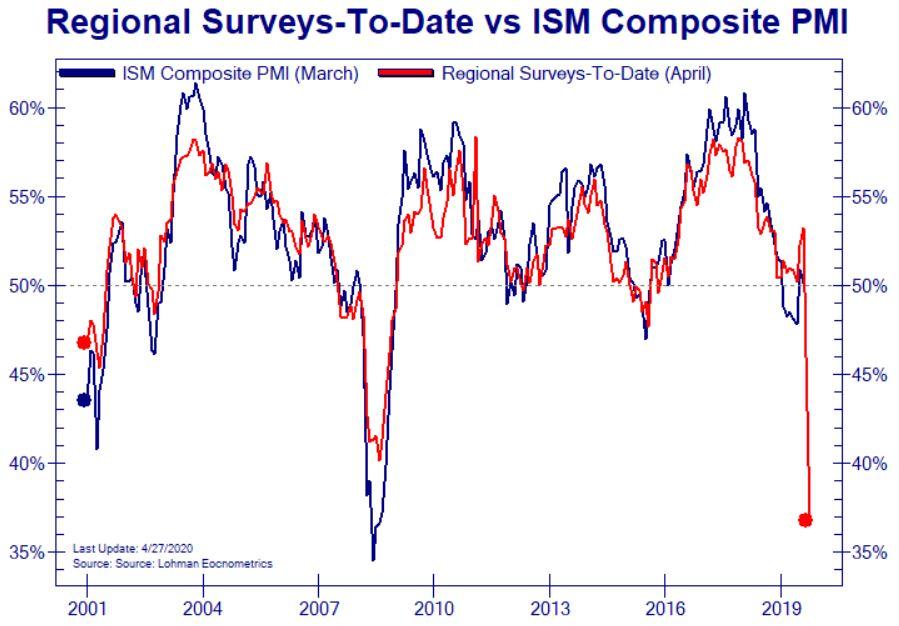
Source: Bloomberg
And now your more important USA stories which will influence the price of gold/silver
MARKET TRADING//USA
a)Market trading/LAST NIGHT/USA
b)MARKET TRADING/USA/AFTERNOON
ii)Market data/USA
Expect 2nd quarter GDP to be negative to 20 to 30
(zerohedge)
White House Economic Adviser: Q2 GDP Will Be Biggest Negative Number Since Great Depression; -20% To -30%
White House economic adviser Kevin Hassett says Q2 GDP will be the ‘biggest negative number since the great depression,’
Hassett says that a lot of the unemployment insurance claims occurred after they were included in the survey for official unemployment data, and so “the really bad news that we’ve been seeing in initial claims will be spread over a couple of months.”
He then said that he expects the unemployment rate will be around 16% – 17%, and that the Q2 GDP number will be the “biggest negative number that we’ve seen since the great depression,” which could be in the -20% to -30% range.
“The question is what happens next,” Hassett concluded.
“The unemployment rate for the first week of May, we’re going to see a number that’s going to be 16, maybe 17% … for second quarter GDP it’s going to be the biggest negative number that we’ve seen since the Great Depression,” says Kevin Hassett, Senior Advisor to the President.

Freight Trucking Demand Plunges To All Time Lows; Rates Crash And Industry Grapples With Lockdown
Bank of America’s Truckload Diffusion Indicator for shippers continues to paint a grim picture not only of freight, but of the overall economy. Put simply, the pandemic has led to record lows and some of the ugliest survey numbers since the bank started conducting it back in 2012.
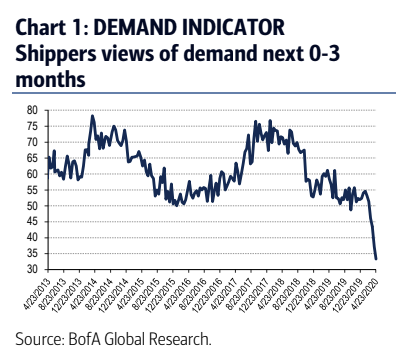
Heavy duty trucking was already in the midst of trying to shake off the results of a bloated Class 8 order backlog that started in 2018, as we document on a month-by-month basis here on Zero Hedge. Not unlike the auto industry, it was a terrible time for the industry to be hit with demand interruption and the coronavirus has forced the sector from “bad” to “worse”.
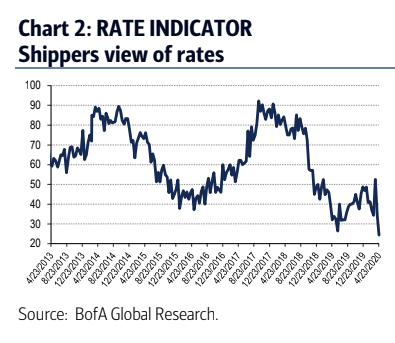
Bank of America’s Truckload Diffusion Indicator for shippers’ 0- to 3-month freight demand outlook dropped to 33.3 from 37.2 last issue, a -10% sequential decline. It’s the fourth survey in a row that sets an all time low.
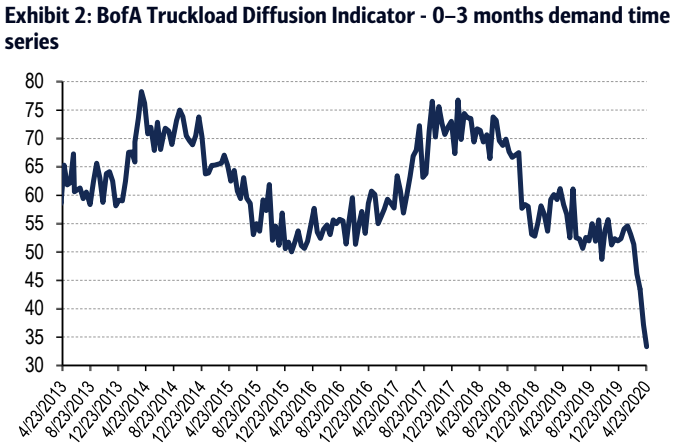
The bank wrote in a note on Friday of last week: “The Demand Indicator is down -39% after hitting a temporary peak of 54.6 on January 30. The survey is down 43% year-over-year, its 43rd consecutive decline (its longest stretch), and posting the largest ever year-year decline, accelerating from last survey’s -39% decline.”
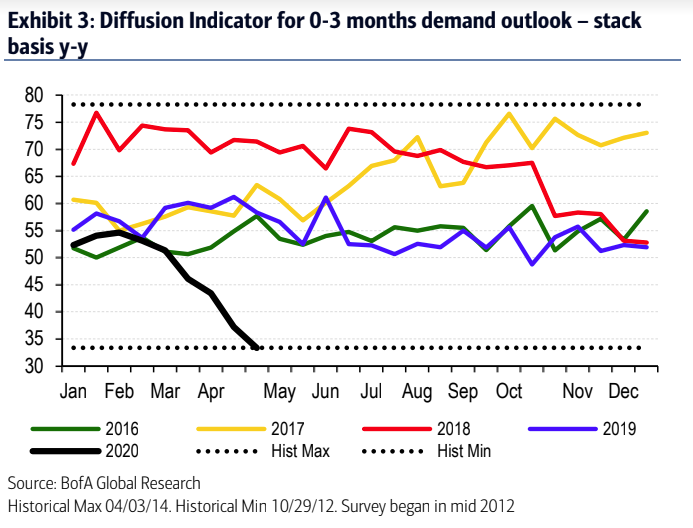
The note continued: “Shippers’ short-term positive outlooks was stable at 21% from last survey, neutral outlooks fell to 15% from 22%, while negative outlooks increased to 64% from 56% (the highest level in our survey history). For the week of April 23, we surveyed 39 shippers across the US to get current views on freight demand and supply.”
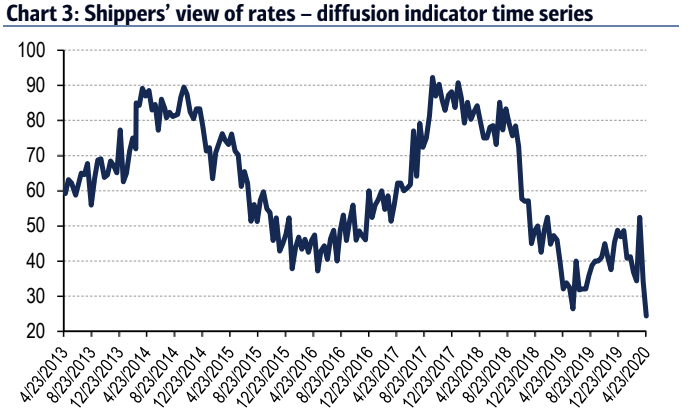
Meanwhile, freight supply has ballooned: “The Truck Capacity Indicator rose to 80.8, up 12% from 72.0 last issue, matching the all-time survey high, highlighting the over-supply of trucking capacity that emerged in May.”
end
Inventory has also risen while capacity frees up and prices fall: “The Inventory Indicator is at 53.8, up 13% from 47.6 last issue, indicating shipper’s inventory levels are building rapidly. With respect to rates, 44% of shippers expect rates to be flat, mirroring last issue, 54% expect rates to fall, rising from 44%, and only 3% expect rates to rise, down from 12%. On capacity, 67% of shippers expect capacity to increase, up from 56% last survey, 28% expect the fleet to remain flat, down from 32% and only 5% expect capacity to be lower, down from 12%.”
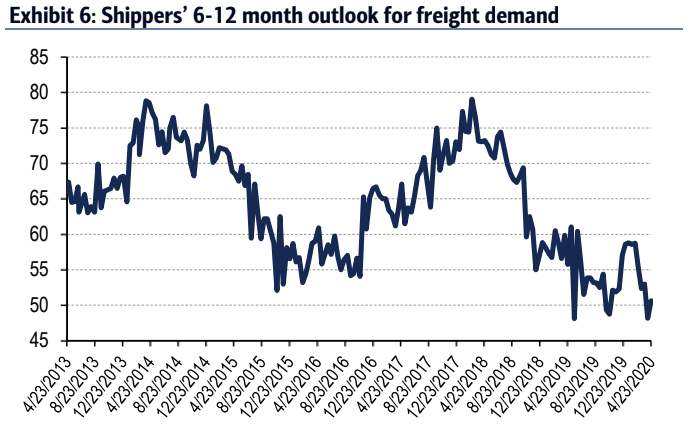
The bank is also getting pessimistic feedback from the corporations that utilize freight as an integral part of their business. For instance, a shipper from the consumer staples industry noted “there remains heightened uncertainty around the timing of resumption of non-essential businesses, and how the remaining truckload carriers will be able to manage that influx.”
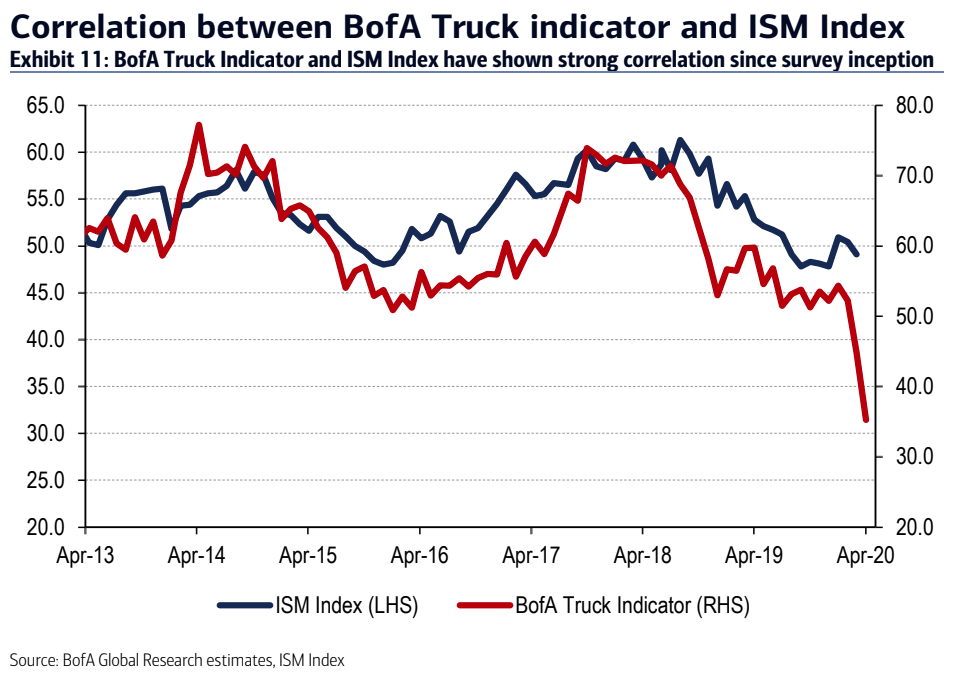
Finally, there doesn’t seem to be any help coming from Class 8 producers, who produced 18,123 heavy duty trucks in March versus just 7,610 orders. The nearly 11,000 truck spread was the largest since September 2019 and will likely continue to weigh on rates.
iii) Important USA Economic Stories
Americans are receiving money money than before the virus and now refuse to go back to work..they are afraid of losing unemployment benefits.
(zerohedge)
Scared Americans Refuse Return To Work And “Risk Losing Unemployment”
Remember when the Fed said now is not the time to worry about moral hazard? That kind of thinking leads down some uncertain paths.
Like the one we’re on now – where workers who have been living a now semi-lavish life provided by increased unemployment checks aren’t exactly feeling motivated to risk their lives going back to work.
And hey, we can’t blame them. Because given the choice to work and make less money or not work and make more money – well, the decision is obvious.
Now, with the “Phase I” of the country’s reopening, more and more workers are going to face this decision. In Georgia, for instance, “barbershops, gyms, nail salons and tattoo parlors will be able to open on Friday, with restaurants able to open for sit-down service on Monday,” according to Reuters. South Carolina is following suit with Texas and Tennessee close behind.
But many workers are still scared to go back to work. Others are simply scared of losing their unemployment benefits. About 22 million people have filed for unemployment over the last 4 weeks.
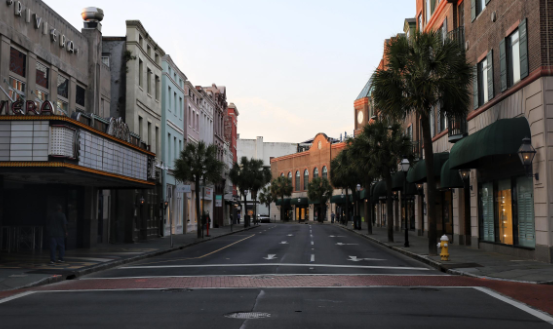
People in states like Georgia and South Carolina could be worried about going back to work at a time when the virus hasn’t necessarily abated.
Thomas Smith, an associate professor at Emory University’s Goizueta Business School said: “You’re asking people to put their life on the line. These people aren’t Army Rangers – those people signed up for combat. A barber did not.”
The state has processed more than 860,000 unemployment claims since mid-March, about 17% of the state’s total workforce. The state is paying out twice as many claims in a week than they did for all of 2019. Georgia has paid out more than $500 million in benefits so far.
But Kemp notes there is a new rule that allows people to keep collecting full benefits even if they earn up to $300 per week.
State Labor Commissioner Mark Butler has basically told employees and businesses they’re on their own: “If an employee is concerned about returning to work due to exposure to COVID-19, we are encouraging employees to communicate with their employers on plans to safely return to work.”
Manuel’s Tavern General Manager Steve Pitts said: “I have a daughter and I want to be around for her. It’s still too dangerous.”
iv) Swamp commentaries)
“What Else Has The FBI Buried?” – Stunning Newly-Disclosed Docs Exonerate Gen. Mike Flynn
Stunning documents withheld for years from former National Security Advisor Michael Flynn’s defense reveal that the retired three-star general did not commit any crimes, as suggested by Department of Justice prosecutors in former Robert Mueller’s special counsel investigation, his attorney said.

Embattled Lt. Gen. Michael Flynn has hired well known defense attorney Sidney Powell to represent him before his sentencing hearing in Washington D.C.’s federal court.
Flynn, who fired his attorney’s last week, will still fully cooperate with the government in all cases pending, Powell told SaraACarter.com.

The new evidence was turned over to Sidney Powell, Flynn’s defense lawyer, by U.S. Attorney Timothy Shea, who obtained the information after an extensive review by attorneys appointed by U.S. Attorney General William Barr to review Flynn’s case. Barr’s team included United States attorney in St. Louis, Jeff Jensen, who is handling the Flynn matter, along with prosecutors from the office of the deputy attorney general, Jeffrey A. Rosen.
The documented evidence was sent to Powell by Shea but is under court seal.
“The enclosed documents were obtained and analyzed by USA EDMO in March and April 2020 and are provided to you as a result of this ongoing review; additional documents may be forthcoming. These materials are covered by the Protective Order entered by the Court on February 21, 2018,” Shea’s letter to Powell states.
Powell, who could not discuss the exact contents of the Brady material she has now obtained but has been fighting for since taking Flynn’s case, told SaraACarter.com the material exonerates her client.
“What else has the FBI buried,” said Powell to this reporter Friday.
“Where’s the original 302? And obviously some of the good agents are finally stepping up.”
In the supplement to Flynn’s motion to dismiss his case for egregious government misconduct Powell stated Friday that “this afternoon, the government produced to Mr. Flynn stunning Brady evidence that proves Mr. Flynn’s allegations of having been deliberately set up and framed by corrupt agents at the top of the FBI.”
“It also defeats any argument that the interview of Mr. Flynn on January 24 was material to any ‘investigation.’ The government has deliberately suppressed this evidence from the inception of this prosecution—knowing there was no crime by Mr. Flynn,” she added.
According to the documents produced by the government Powell “has found further evidence of misconduct by Mr. Van Grack specifically,” referring to the DOJ prosecutor in Flynn’s case, Brandon Van Grack.
“Not only did he make baseless threats to indict Michael G. Flynn, he made a side deal not to prosecute Michael G. Flynn as a material term of the plea agreement, but he required that it be kept secret between himself and the Covington attorneys expressly to avoid the requirement of Giglio v. United States, 405 U.S. 150 (1972). Exs. 1, 2,” she states in the motion.
“Since August 2016 at the latest, partisan FBI and DOJ leaders conspired to destroy Mr. Flynn,” Powell argued to the court in the motion.
“These documents show in their own handwriting and emails that they intended either to create an offense they could prosecute or at least get him fired. Then came the incredible malfeasance of Mr. Van Grack’s and the SCO’s prosecution despite their knowledge there was no crime by Mr. Flynn.”
“All this new evidence, and the government has advised there is more to come, proves that the crimes were committed by the FBI officials and then the prosecutors,” Powell’s motion to dismiss Flynn’s case states.
“The government’s misconduct in this case is beyond shocking and reprehensible. It mandates dismissal.”
“Furthermore, this Court should order the government immediately to provide the defense with unredacted copies of the documents we have filed under seal solely in an abundance of caution because the government produced them under the protective order, and we request that they be unsealed as provided herein as Exhibit 3,” the motion states.
Powell, who has had a long battle to obtain the evidence and is still fighting to obtain information from FBI Director Christopher Wray, who replaced fired FBI Director James Comey said, “this Court must dismiss this concocted prosecution of General Flynn in full recognition of the travesty of justice that it is.”
This story is developing…
Trump Asks Why American Taxpayers Should Bail Out “Poorly Run, Democrat” States
Pouring gasoline on a fire started by Mitch McConnell last week, when the Senate Majority leader said there would be no taxpayer bailout for US states and that he is open to allowing states to declare bankruptcy – rather than sending governors more federal money to deal with their own ballooning deficits, moments ago President Trump tweeted a “question” that is sure to incite the states’ – and media’s – ire, namely why should taxpayers be bailout out mostly “poorly run, in all cases Democrat run” states.
Why should the people and taxpayers of America be bailing out poorly run states (like Illinois, as example) and cities, in all cases Democrat run and managed, when most of the other states are not looking for bailout help? I am open to discussing anything, but just asking?
Donald J. Trump
✔@realDonaldTrump
Why should the people and taxpayers of America be bailing out poorly run states (like Illinois, as example) and cities, in all cases Democrat run and managed, when most of the other states are not looking for bailout help? I am open to discussing anything, but just asking?

Trump’s tweet comes just days after Nancy Pelosi insisted Friday that Congress’ next economic package would provide billions for financially reeling state and local governments, foreshadowing a sharp partisan fight ahead in lawmakers’ continuing response to the coronavirus pandemic.
“There will not be a bill without state and local” aid, Pelosi, D-Calif., told reporters in the Capitol. Suggesting that Democrats have leverage to address a problem that shows no signs of vanishing soon, she also said, “There will be a bill, and it will be expensive.”
While Pelosi cited no price tag, she said it could be roughly what Congress has already provided for small businesses in previous legislation, which has exceeded $500 billion. Pelosi has begun framing the battle in political terms. She has said House Democrats will include the money in legislation they will call the “Heroes Act” because it will include funds to pay the salaries of police, firefighters, transit workers, health workers in public hospitals and others battling the virus.
With a salmon-colored scarf lowered from covering her face, Pelosi told reporters at a news conference that it would be “morally wrong” to not help those workers. “We can’t defeat this pandemic if Mitch McConnell is letting our health heroes get fired, and that’s what’s happening,” she said.
That was just one of several remarks she made criticizing McConnell by name, something congressional leaders often avoid doing to one another. “Speaking of Mitch, what’s gotten into him?” she said, citing his support for letting states declare bankruptcy.
Senate Minority Leader Chuck Schumer, D-N.Y., and other congressional Democrats are also demanding more aid for state and local governments.
Pelosi’s remarks put her in direct conflict with Senate Majority Leader Mitch McConnell, who as we noted last week, expressed opposition to providing more local help. Indeed, in last week’s follow-up bailout bill that Trump signed Friday providing roughly $480 billion more for small businesses and hospitals, Republicans blocked all of the additional $150 billion that Democrats wanted for state and local governments.
McConnell has expressed strong opposition to providing more money for those governments. On Fox News this week, he cited concerns about the mushrooming national debt and opposition to helping states resolve pension and other problems.
“We’re not going to let them take advantage of this pandemic to let them solve problems they created for themselves,” McConnell said.
But what sparked broad democrat outrage, was McConnell’s suggestion that states be allowed to declare bankruptcy, which is not currently permitted. His suggestion drew ire from members of both parties because it would jeopardize popular state services and cause their future borrowing costs to soar. Retiring Rep. Peter King, R-N.Y., tweeted this week that McConnell’s suggestion “makes McConnell the Marie Antoinette of the Senate.”
Until today, President Donald Trump has been a wild card, making comments that have wavered between support and skepticism – especially with some GOP senators and governors calling for more aid for state and local governments. Last Thursday, Trump told reporters at the White House that “we’re always going to help states,” but added, “The states that seem to have the problem happen to be Democrat.” He added that New York and New Jersey “were in a lot of trouble long before the plague came.”
In light of his latest tweet, we now know where the president stands on this debate… at least for the time being.
v) King report/Courtesy of Chris Powell of GATA which includes the major swamp stories.
Bank of China Clients Said to Have $1 Billion Losses on Oil Bet
Over 60,000 customers invested in WTI-linked product: Caixin
Bank of China says main investors to settle crude oil product at -$37
BoC said on Wednesday it had confirmed with CME Group Inc that the negative settlement price of crude oil futures at -$37.63 per barrel was not an error… [Where was the US media on this!]
Bank of China says main investors to settle crude oil product at -$37
BoC said on Wednesday it had confirmed with CME Group Inc that the negative settlement price of crude oil futures at -$37.63 per barrel was not an error… [Where was the US media on this!]
If China is active in oil, it is also fooling around in other future contracts, ESMs, USMs (bonds), etc.
Where are the regulators and Congress? Yep, financial industry bribes donations keep them at bay. You give a cop $50 to avoid a ticket, it’s a bribe. You give millions to Congress for a billion+ dollar benefit, it’s a donation. Free speech, my backside, Supreme Court!
@RealSaavedra: Bill Gates claims that criticisms of how China lied and covered up the coronavirus is a “distraction”: “China did a lot of things right at the beginning … they avoided the incredible economic pain… I think there’s a lot of incorrect and unfair things said” [Gates continues to stooge for China!]
https://twitter.com/RealSaavedra/status/1254510348889026560
It’s terrifying to contemplate the magnitude of influence that China has procured with US elites.
Have you noticed that the officials and people that are the most adamant about keeping the economy closed are still getting paid, mostly by government?
DJT said he will end daily Covid-19 briefings. This means polling shows the public is tired of him/them.
@charliebilello: With 28% of companies reported, S&P 500 Q1 GAAP earnings down 29% yr-over-yr
BOE Warns That Loan Charges Could Hurt Business Funding: FT
The Bank of England has warned U.K. lenders that booking large charges on bad loans could curb their ability to support struggling companies… [Is the BoE telling banks to cook their books?]
Icahn Says Stocks Are Overvalued, Virus May Cause ‘Downdrafts’
- Billionaire doubts economy can be turned on ‘like a spigot’
- He’s hoarding cash and keeping a big bet against real estate
Sen] Tom Cotton Explains Why He Thinks China Allowed Flights Out of Wuhan during Outbreak
They were going to suffer an economic contraction, they were not going to allow the world to continue to prosper, and China be the only country whose economy was declining.”…
@ThinkTankCharts: CDC reports: Deaths in the USA per year: 2,813,508; Deaths per day 7708; Death rate: 863.8 deaths per 100,000 population; Life expectancy: 78.6 years; Coronavirus hype – Media & Government 100%
Top Virginia health official warns state lockdown could be ‘two-year affair’
Fox contributor @RCamposDuffy: Crime scene tape over park swing set in Wausau, WI park. Seriously? We have virtually no covid19 cases here. Healthy kids need to get outside and play. Time to open up rural Wisconsin. https://twitter.com/RCamposDuffy/status/1254418585793040384
NYC tailor defies state order: ‘I’m opening my doors come hell or high water’ https://trib.al/kuRAOVc
Dallas Salon Fined after Opening in Defiance of ‘Stay-at-Home’ Order but Continues Operating
Hamilton [NJ] teacher caught on tape telling students she hopes they ‘die’ of coronavirus
At a group of teenagers playing football in the park… https://www.trentonian.com/news/hamilton-teacher-caught-on-tape-telling-students-she-hopes-they-die-of-coronavirus/article_3f27faf8-8750-11ea-b87f-475554a8dffd.html
@tracybeanz: She’s outside. With her dog. With no mask or gloves or anything.
Texas cops use undercover sting operation to arrest women offering salon services at their homes https://bit.ly/355SN8V
Viral video shows large house party in Chicago amid coronavirus pandemic – “You’re literally putting everyone around you in danger:” Governor JB Pritzker says after video of house party goes viral
https://wgntv.com/news/coronavirus/viral-video-shows-large-house-party-on-south-side-amid-pandemic/
If officials don’t ‘open up’ society soon, the burgeoning revolt will intensify.
‘Playing Russian Roulette’: Nursing Homes Told to Take the Infected
California, New Jersey and New York have made nursing homes accept Covid-19 patients from hospitals. Residents and workers fear the policy is risking lives…
On Saturday, Gov. Andrew M. Cuomo of New York described nursing homes as a “feeding frenzy for this virus.”… New York issued a strict new rule last month: Nursing homes must readmit residents sent to hospitals with the coronavirus and accept new patients as long as they are deemed “medically stable.”… Asked about admissions of Covid-19 patients in light of nursing-home deaths at a briefing on Monday, Mr. Cuomo seemed unaware of the state rule. “It’s a good question,” he said. “I don’t know.”… On Thursday, Mr. Cuomo reiterated that nursing homes had to accept the patients — but only, he clarified, if they could do so safely… https://www.nytimes.com/2020/04/24/us/nursing-homes-coronavirus.html
Why Some People Get Sicker Than Others
COVID-19 is proving to be a disease of the immune system. This could, in theory, be controlled.
“It’s very unusual. None of this variability really fits with any other diseases we’re used to dealing with.”… This degree of uncertainty has less to do with the virus itself than how our bodies respond to it. As Murphy puts it, when doctors see this sort of variation in disease severity, “that’s not the virus; that’s the host.”… https://www.theatlantic.com/health/archive/2020/04/coronavirus-immune-response/610228/
Pa. removes 200 deaths from state coronavirus count as questions mount about reporting process, accuracy – spikes in numbers due to “probable deaths” included deaths that occurred days, even weeks earlier… Coroners have complained over the past month regarding discrepancies in the death figures… https://www.foxnews.com/us/pa-removes-200-deaths-official-coronavirus-count-questions-mount-reporting-process-data-accuracy
Coronavirus chokes the drug trade — from Wuhan, through Mexico and onto U.S. streets
For drug traffickers interested in getting in on the fentanyl business, all roads once led to Wuhan…The biggest customers were Mexican drug cartels… it is cheaper and easier to produce than heroin… https://www.latimes.com/world-nation/story/2020-04-24/wuhan-china-coronavirus-fentanyl-global-drug-trade
MSNBC’s Nicolle Wallace: Coronavirus ‘Silver Lining’ Is Damage to Donald Trump
Pritzker under federal investigation for property tax scheme – Removing toilets from the governor’s Gold Coast mansion saved his family more than $331,000 in property taxes…
The ongoing federal probe will cast further doubt on one of Pritzker’s key political objectives: removing the state’s flat income tax protection in order to install a $3.4 billion progressive income tax hike…
https://www.illinoispolicy.org/pritzker-under-federal-investigation-for-property-tax-scheme/
Stunning Brady Docs Disclosed By Gov Exonerates Lt. Gen. Michael Flynn, Defense Says
The new evidence was turned over to Sidney Powell, Flynn’s defense lawyer, by U.S. Attorney Timothy Shea, who obtained the information after an extensive review by attorneys appointed by U.S. Attorney General William Barr to review Flynn’s case… [The DoJ/FBI hid the exculpatory evidence for years!]
“What else has the FBI buried… Where’s the original 302? And obviously some of the good agents are finally stepping up.”… According to the documents produced by the government Powell “has found further evidence of misconduct by Mr. Van Grack specifically,” referring to DOJ prosecutor in Flynn’s case, Brandon Van Grack…[Some top DoJ/FBI agents are in big trouble!]
Source Says FBI Director Christopher Wray Pushed To Withhold Exculpatory Evidence In Mike Flynn Case – FBI general counsel Dana Boente was acting in coordination with Wray…
America Has a Jared Kushner Problem – President Trump’s greatest weakness now is his inability to recognize that his son-in-law is the leader of a faction within the White House whose interests come at the expense of the very people who voted for him.
Project Airbridge, Kushner’s plan to take the reins of the Federal Emergency Management Agency supply-chain task force and partner with private companies to fly health care supplies to New York City from China… Kushner’s solution for a problem caused by China, and exacerbated by our manufacturing dependency on that country, was to turn to Beijing for “help.”…
His immigration plan, shopped to GOP senators in a PowerPoint presentation, was dismissed as “laughably simplistic.” His plan for the Palestinian economy was lampooned by Michael J. Koplow of the Israel Policy Forum as “the Monty Python version of Israeli-Palestinian peace, where no contention is too absurd to be floated.”… After President Trump announced he would be suspending immigration to the United States to protect the jobs and wages… Sources familiar with the situation told the Spectator that Kushner “is one of the loudest voices pushing back on a full ban and is seeking to carve out exemptions for refugees, temporary workers under the H1B visa program, and farmworkers under the H-2A visa program.”… The president’s supporters may rightly wonder if they voted for Kushner or Trump at this point… https://amgreatness.com/2020/04/24/america-has-a-jared-kushner-problem/
After backlash that Trump’s disinfectant ‘ingestion’ idea could be deadly, WH claims taken ‘out of context – “So supposing we hit the body with a tremendous — whether it’s ultraviolet or just a very powerful light — and I think you said that hasn’t been checked because of the testing,” Trump said, looking at Bryan. “And then I said, supposing you brought the light inside the body, which you can do either through the skin or some other way, and I think you said you’re going to test that too.”
“I see the disinfectant that knocks it out in a minute, one minute. And is there a way we can do something like that by injection inside or almost a cleaning? As you see, it gets in the lungs, it does a tremendous number on the lungs, so it would be interesting to check that,” the president continued…
Here’s what ABC and other MSM outlets did NOT report: ABC’s John Karl: “There’s no scenario that that could be injected into a person is there?…” Trump: “It wouldn’t be through injection. We’re talking about through almost a cleaning, sterilization of the area. Maybe it works, maybe it doesn’t work. But it certainly has a big effective if it’s on a stationary object.” https://www.factcheck.org/2020/04/the-white-house-spins-trumps-disinfectant-remarks/
Chris Cuomo’s wife Cristina is mocked for saying she bathed in CLOROX to treat coronavirus while the CNN host slams Trump’s suggestion people could be infected with disinfectant
She says it was recommended to her by an energy medicine doctor…
Michigan State University: COVID-19 – Disinfecting with Bleach – CDC and the World Health Organization recommend (1, 2) using a bleach solution as one way to disinfect areas contaminated with the novel coronavirus… https://www.canr.msu.edu/news/covid-19-disinfecting-with-bleach
Joe Biden fuels election conspiracy theory while the media keeps quiet – He said, “Mark my words, I think he is going to try to kick back the election somehow, and come up with some rationale why it cannot be held.” https://thehill.com/opinion/campaign/494632-joe-biden-fuels-election-conspiracy-theory-while-the-media-keeps-quiet
Elements within the Dem Party are making a move to oust Biden, a move many expected. Who would try to torpedo Joe now? A DJT ally would have waited until after Labor Day [Like the DJT NBC tape in October 2016]. Someone wants Joe out ASAP.
Ex-Clinton/Kerry advisor @peterdaou: DIFFICULT THREAD — #BIDEN SHOULD WITHDRAW
I respect the will of the voters. 2. But new information has emerged supporting #TaraReade’s account of being sexually assaulted by #JoeBiden. 3. Credible rape accusations are disqualifying or we have NO moral standards. https://twitter.com/peterdaou/status/1254047496655065088
The Intercept, whose owner (Pierre Omidyar) is a large Dem donor, originally broke the story.
New Evidence Supporting Credibility of Tara Reade’s Allegation against Joe Biden Emerges
https://theintercept.com/2020/04/24/new-evidence-tara-reade-joe-biden/
New evidence surfaces in Tara Reade allegation against Biden – A 1993 video appears to show her mother calling the Larry King Show to discuss “problems” while working for “a prominent senator.”
https://www.politico.com/news/2020/04/24/tara-reade-biden-video-207670
DJT’s weakest flank is swing voter women, which are largely professional and suburban women. Dems cannot win in November unless they capture this demographic by a significant margin. If Bernie Sanders does NOT get the nod, IF Biden steps aside, Bernie supporters will be livid.
[UK] Judges told to stop using ‘beyond reasonable doubt’ because jurors don’t understand what it means and ask if they’re ‘satisfied that they are sure’ instead [Can’t dumb-down enough these days]
@ThomasSowell: “There is nothing so bad that politics cannot make it worse.”
Well that is all for today
I will see you TUESDAY night.


 harveyorganblog.com