
FEB 10
FEB10
· by harveyorgan · in Uncategorized · Leave a comment ·Edit
GOLD; UP $1.00 to $1836.20
SILVER: $23.52 UP 19 CENTS
ACCEDD MARKET: GOLD $1826.85
SILVER: $23.20
Bitcoin: morning price: 44,730 DOWN 55
Bitcoin: afternoon price: 43,527 DOWN 1258
Platinum price: closing UP $8.20 to $1041.00
Palladium price; closing DOWN $10.70 at $2288.40
END
end
DONATE
Click here if you wish to send a donation. I sincerely appreciate it as this site takes a lot of preparation
comex notices//JPMorgan notices filedcomex notices//JPMorgan notices filed 255/614
EXCHANGE: COMEX
CONTRACT: FEBRUARY 2022 COMEX 100 GOLD FUTURES
SETTLEMENT: 1,835.200000000 USD
INTENT DATE: 02/09/2022 DELIVERY DATE: 02/11/2022
FIRM ORG FIRM NAME ISSUED STOPPED
118 C MACQUARIE FUT 100 29
332 H STANDARD CHARTE 28
363 H WELLS FARGO SEC 16
435 H SCOTIA CAPITAL 2
624 H BOFA SECURITIES 264
661 C JP MORGAN 141
661 H JP MORGAN 114
709 C BARCLAYS 506 5
732 C RBC CAP MARKETS 4
800 C MAREX SPEC 10
905 C ADM 8 1
TOTAL: 614 614
MONTH TO DATE: 17,433
COMEX//NOTICES:EXCHANGE: COMEX FILED:EXCHANGE: COMEX
NUMBER OF NOTICES FILED TODAY FOR FEB. CONTRACT: 614 NOTICE(S) FOR 61400 OZ (1.9097 TONNES)
total notices so far: 17,433 contracts for 1,743,300 oz (54.233 tonnes)
SILVER NOTICES:
0 NOTICE(S) FILED TODAY FOR nil OZ/
total number of notices filed so far this month 1249 : for 6,245,000 oz
GLD
WITH GOLD UP $1.00
WITH RESPECT TO GLD WITHDRAWALS: (OVER THE PAST FEW MONTHS):
NO CHANGES IN GOLD INVENTORY AT THE GLD/
GOLD IS “RETURNED” TO THE BANK OF ENGLAND WHEN CALLING IN THEIR LEASES: THE GOLD NEVER LEAVES THE BANK OF ENGLAND IN THE FIRST PLACE. THE BANK IS PROTECTING ITSELF IN CASE OF COMMERCIAL FAILURE
ALSO INVESTORS SWITCHING TO SPROTT PHYSICAL (phys) INSTEAD OF THE FRAUDULENT GLD//
CLOSING INVENTORY: 1015.96 TONNES/
Silver//SLV
WITH NO SILVER AROUND AND SILVER UP 19 CENTS:/:
NO CHANGE IN SILVER INVENTORY AT THE SLV/:
AT THE SLV//
INVESTORS ARE SWITCHING SLV TO SPROTT’S PSLV
CLOSING INVENTORY SLV/ TONIGHT: 544.573 MILLION OZ
Let us have a look at the data for today
SILVER//OUTLINE
SILVER COMEX OI ROSE BY A HUGE 3144 CONTRACTS TO 150,523 AND RESTS CLOSER TO THE NEW RECORD OF 244,710, SET FEB 25/2020 AND DESPITE THIS HUGE GAIN IN OI, IT WAS ACCOMPANIED WITH OUR SMALL $0.14 GAIN IN SILVER PRICING AT THE COMEX ON WEDNESDAY. OUR BANKERS WERE UNSUCCESSFUL IN KNOCKING THE PRICE OF SILVER DOWN (IT ROSE BY $0.14) AND WERE UNSUCCESSFUL IN KNOCKING OUT ANY SILVER LONGS AS WE HAD A HUGE GAIN OF 3319 CONTRACTS ON OUR TWO EXCHANGES .
WE MUST HAVE HAD:
I) HUGE BANKER SHORT COVERING AS THEY ARE VERY ANXIOUS TO GET OUT OF DODGE!!/. II)WE ALSO HAD SOME REDDIT RAPTOR BUYING//. iii) A TINY ISSUANCE OF EXCHANGE FOR PHYSICALS iiii) A HUGE INITIAL SILVER STANDING FOR COMEX SILVER MEASURING AT 4.110 MILLION OZ FOLLOWED BY TODAY’S 190,000 OZ QUEUE JUMP//NEW STANDING 6.535 MILLION OZ. V) HUGE SIZED COMEX OI GAIN.
I AM NOW RECORDING THE DIFFERENTIAL IN OI FROM PRELIMINARY TO FINAL:
THE DIFFERENTIAL FROM PRELIMINARY OI TO FINAL OI SILVER TODAY: CONTRACTS -220
HISTORICAL ACCUMULATION OF EXCHANGE FOR PHYSICALS FEB. ACCUMULATION FOR EFP’S SILVER/JPMORGAN’S HOUSE OF BRIBES/STARTING FROM FIRST DAY/MONTH OF FEB:
TOTAL CONTACTS for 8 days, total contracts: : 4045 contracts or 20.225 million oz OR 2.528 MILLION OZ PER DAY. (505 CONTRACTS PER DAY)
TOTAL NO OF OZ UNDERGOING EFP TO LONDON 4045 CONTRACTS X 5,000 PER CONTRACT:
EQUATES TO: 20.225 MILLION OZ
.
LAST 10 MONTHS TOTAL EFP CONTRACTS ISSUED IN MILLIONS OF OZ:
MAY 137.83 MILLION
JUNE 149.91 MILLION OZ
JULY 129.445 MILLION OZ
AUGUST: MILLION OZ 140.120
SEPT. 28.230 MILLION OZ//
OCT: 94.595 MILLION OZ
NOV: 131.925 MILLION OZ
DEC: 100.615 MILLION OZ
JAN 2022// 90.460 MILLION OZ
FEB 2022: 20.225 MILLION OZ//
SPREADING OPERATIONS
(/NOW SWITCHING TO SILVER) FOR NEWCOMERS, HERE ARE THE DETAILS
SPREADING LIQUIDATION HAS NOW COMMENCED AS WE HEAD TOWARDS THE NEW ACTIVE FRONT MONTH OF MAR.WE ARE NOW INTO THE SPREADING OPERATION OF SILVER
HERE IS A BRIEF SYNOPSIS OF HOW THE CROOKS FLEECE UNSUSPECTING LONGS IN THE SPREADING ENDEAVOUR ;MODUS OPERANDI OF THE CORRUPT BANKERS AS TO HOW THEY HANDLE THEIR SPREAD OPEN INTERESTS:HERE IS HOW THE CROOKS USED SPREADING AS WE ARE NOW INTO THE NON ACTIVE DELIVERY MONTH OF JAN HEADING TOWARDS THE ACTIVE DELIVERY MONTH OF FEB, FOR GOLD:
YOU WILL ALSO NOTICE THAT THE COMEX OPEN INTEREST STARTS TO RISE BUT SO IS THE OPEN INTEREST OF SPREADERS. THE OPEN INTEREST IN WILL CONTINUE TO RISE UNTIL ONE WEEK BEFORE FIRST DAY NOTICE OF AN UPCOMING ACTIVE DELIVERY MONTH (MAR), AND THAT IS WHEN THE CROOKS SELL THEIR SPREAD POSITIONS BUT NOT AT THE SAME TIME OF THE DAY. THEY WILL USE THE SELL SIDE OF THE EQUATION TO CREATE THE CASCADE (ALONG WITH THEIR COLLUSIVE FRIENDS) AND THEN COVER ON THE BUY SIDE OF THE SPREAD SITUATION AT THE END OF THE DAY. THEY DO THIS TO AVOID POSITION LIMIT DETECTION. THE LIQUIDATION OF THE SPREADING FORMATION CONTINUES FOR EXACTLY ONE WEEK AND ENDS ON FIRST DAY NOTICE.”
RESULT: WE HAD A HUGE SIZED INCREASE IN COMEX OI SILVER COMEX CONTRACTS OF 3144 DESPITE OUR SMALL $0.14 GAIN SILVER PRICING AT THE COMEX// WEDNESDAY THE CME NOTIFIED US THAT WE HAD A SMALL SIZED EFP ISSUANCE OF 175 CONTRACTS( 175 CONTRACTS ISSUED FOR MAR AND 0 CONTRACTS ISSUED FOR ALL OTHER MONTHS) WHICH EXITED OUT OF THE SILVER COMEX TO LONDON AS FORWARDS THE DOMINANT FEATURE TODAY: /HUGE BANKER SHORT COVERING AS THEY GET OUT OF DODGE//// WE HAVE A GOOD INITIAL SILVER OZ STANDING FOR FEB OF 4.1 MILLION OZ FOLLOWED BY TODAY’S 190,000 OZ QUEUE JUMP //NEW STANDING 6.535, MILLION OZ// .. WE HAD A VERY STRONG SIZED GAIN OF3319 OI CONTRACTS ON THE TWO EXCHANGES FOR 16.595 MILLION OZ//
WE HAD 0 NOTICES FILED TODAY FOR nil OZ
GOLD//OUTLINE
IN GOLD, THE COMEX OPEN INTEREST ROSE BY A STRONG SIZED 7784 TO 520,699 AND CLOSER TO OUR NEW RECORD (SET JAN 24/2020) AT 799,541 AND PREVIOUS TO THAT: (SET JAN 6/2020) AT 797,110.
THE DIFFERENTIAL FROM PRELIMINARY OI TO FINAL OI IN GOLD TODAY: — 73 CONTRACTS.
THE BIS HAS ABANDONED THE GOLD COMEX TRADING!!!
.
THE STRONG SIZED INCREASE IN COMEX OI CAME WITH OUR STRONG GAIN IN PRICE OF $8.05//COMEX GOLD TRADING/WEDNESDAY/.AS IN SILVER WE MUST HAD HUGE BANKER/ALGO SHORT COVERING ACCOMPANYING OUR GOOD SIZED EXCHANGE FOR PHYSICAL ISSUANCE. WE HAD ZERO LONG LIQUIDATION AS THE TOTAL GAIN ON OUR TWO EXCHANGES TOTALED 12,314 CONTRACTS…
WE ALSO HAD A HUGE INITIAL STANDING IN GOLD TONNAGE FOR FEB AT 64.3 TONNES FOLLOWED BY TODAY’S 300 OZ QUEUE JUMP //NEW STANDING: 58.463 TONNES
YET ALL OF..THIS HAPPENED WITH OUR GAIN IN PRICE OF $8.05 WITH RESPECT TO TUESDAY’S TRADING
WE HAD A GOOD SIZED GAIN OF 12,241 OI CONTRACTS (38.074 PAPER TONNES) ON OUR TWO EXCHANGES
E.F.P. ISSUANCE
THE CME RELEASED THE DATA FOR EFP ISSUANCE AND IT TOTALED A GOOD SIZED 4457 CONTRACTS:
FOR APRIL 4457 ALL OTHER MONTHS ZERO//TOTAL:4457
The NEW COMEX OI FOR THE GOLD COMPLEX RESTS AT 520,626.
IN ESSENCE WE HAVE A VERY STRONG SIZED INCREASE IN TOTAL CONTRACTS ON THE TWO EXCHANGES OF 12,241, WITH 7784 CONTRACTS INCREASED AT THE COMEX AND 4457 EFP OI CONTRACTS WHICH NAVIGATED OVER TO LONDON. THUS TOTAL OI GAIN ON THE TWO EXCHANGES OF 12,241 CONTRACTS OR 38.074TONNES.
CALCULATIONS ON GAIN/LOSS ON OUR TWO EXCHANGES
WE HAD A GOOD SIZED ISSUANCE IN EXCHANGE FOR PHYSICALS (4457) ACCOMPANYING THE STRONG SIZED GAIN IN COMEX OI (7784,): TOTAL GAIN IN THE TWO EXCHANGES 12,241 CONTRACTS. WE NO DOUBT HAD 1) HUGE BANKER SHORT COVERING ,2.) HUGE INITIAL STANDING AT THE GOLD COMEX FOR FEB. AT 64.30 TONNES WHICH FOLLOWS TODAY’S QUEUE JUMP OF 300 OZ//NEW STANDING 58.463 TONNES// 3) ZERO LONG LIQUIDATION ,4) STRONG SIZED COMEX OI. GAIN 5) GOOD ISSUANCE OF EXCHANGE FOR PHYSICAL
HISTORICAL ACCUMULATION OF EXCHANGE FOR PHYSICALS IN 2022 INCLUDING TODAY
FEB
ACCUMULATION OF EFP’S GOLD AT J.P. MORGAN’S HOUSE OF BRIBES: (EXCHANGE FOR PHYSICAL) FOR THE MONTH OF FEB :
12919 CONTRACTS OR 1,291,900 oz OR 40.18 TONNES 8TRADING DAY(S) AND THUS AVERAGING: 1615 EFP CONTRACTS PER TRADING DAY
TO GIVE YOU AN IDEA AS TO THE SIZE OF THESE EFP TRANSFERS : THIS MONTH IN 8 TRADING DAY(S) IN TONNES: 40.18 TONNES
TOTAL ANNUAL GOLD PRODUCTION, 2020, THROUGHOUT THE WORLD EX CHINA EX RUSSIA: 3555 TONNES
THUS EFP TRANSFERS REPRESENTS 40.18/3550 x 100% TONNES 1.13% OF GLOBAL ANNUAL PRODUCTION
ACCUMULATION OF GOLD EFP’S YEAR 2021 TO 2022
JANUARY/2021: 265.26 TONNES (RAPIDLY INCREASING AGAIN)
FEB : 171.24 TONNES ( DEFINITELY SLOWING DOWN AGAIN)..
MARCH:. 276.50 TONNES (STRONG AGAIN/
APRIL: 189..44 TONNES ( DRAMATICALLY SLOWING DOWN AGAIN//GOLD IN BACKWARDATION)
MAY: 250.15 TONNES (NOW DRAMATICALLY INCREASING AGAIN)
JUNE: 247.54 TONNES (FINAL)
JULY: 188.73 TONNES FINAL
AUGUST: 217.89 TONNES FINAL ISSUANCE.
SEPT 142.12 TONNES FINAL ISSUANCE ( LOW ISSUANCE)_
OCT: 141.13 TONNES FINAL ISSUANCE (LOW ISSUANCE)
NOV: 312.46 TONNES FINAL ISSUANCE//NEW RECORD!! (INCREASING DRAMATICALLY)//SIGN OF REAL STRESS//SURPASSING THE MARCH 2021 RECORD OF 276.50 TONNES OF EFP
DEC. 145.12 TONNES//FINAL ISSUANCE//
JAN:2022 247.25 TONNES //FINAL
FEB: 40.18 TONNES//INITIAL
WHAT IS ALARMING TO ME, ACCORDING TO OUR LONDON EXPERT ANDREW MAGUIRE IS THAT THESE EFP’S ARE BEING TRANSFERRED TO WHAT ARE CALLED SERIAL FORWARD CONTRACT OBLIGATIONS AND THESE CONTRACTS ARE LESS THAN 14 DAYS. ANYTHING GREATER THAN 14 DAYS, THESE MUST BE RECORDED AND SENT TO THE COMPTROLLER, GREAT BRITAIN TO MONITOR RISK TO THE BANKING SYSTEM. IF THIS IS INDEED TRUE, THEN THIS IS A MASSIVE CONSPIRACY TO DEFRAUD AS WE NOW WITNESS A MONSTROUS TOTAL EFP’S ISSUANCE AS IT HEADS INTO THE STRATOSPHERE.
First, here is an outline of what will be discussed tonight:
1.Today, we had the open interest at the comex, in SILVER, ROSE BY A GIGANTIC SIZED 3144 CONTRACTS TO 150,523 AND FURTHER FROM OUR COMEX RECORD //244,710(SET FEB 25/2020). THE LAST RECORDS WERE SET IN AUG.2018 AT 244,196 WITH A SILVER PRICE OF $14.78/(AUGUST 22/2018)..THE PREVIOUS RECORD TO THAT WAS SET ON APRIL 9/2018 AT 243,411 OPEN INTEREST CONTRACTS WITH THE SILVER PRICE AT THAT DAY: $16.53). AND PREVIOUS TO THAT, THE RECORD WAS ESTABLISHED AT: 234,787 CONTRACTS, SET ON APRIL 21.2017 OVER 4 1/2 YEARS AGO.
EFP ISSUANCE 175 CONTRACTS
OUR CUSTOMARY MIGRATION OF COMEX LONGS CONTINUE TO MORPH INTO LONDON FORWARDS AS OUR BANKERS USED THEIR EMERGENCY PROCEDURE TO ISSUE:
MAR 175 ALL OTHER MONTHS: ZERO. TOTAL EFP ISSUANCE: 175 CONTRACTS. EFP’S GIVE OUR COMEX LONGS A FIAT BONUS PLUS A DELIVERABLE PRODUCT OVER IN LONDON. IF WE TAKE THE COMEX OI GAIN OF 3364 CONTRACTS AND ADD TO THE 175 OI TRANSFERRED TO LONDON THROUGH EFP’S,
WE OBTAIN A HUGE SIZED GAIN OF 3319 OPEN INTEREST CONTRACT FROM OUR TWO EXCHANGES.
THUS IN OUNCES, THE GAIN ON THE TWO EXCHANGES 16.595 MILLION OZ,
OCCURRED DESPITE OUR SMALL $0.14 GAIN IN PRICE.
OUTLINE FOR TODAY’S COMMENTARY
1/COMEX GOLD AND SILVER REPORT
(report Harvey)
2 ) Gold/silver trading overnight Europe,
(Peter Schiff,
3. Egon von Greyerz///Matthew Piepenburg via GoldSwitzerland.com,
4. Chris Powell of GATA provides to us very important physical commentaries
5. Other gold commentaries
6. Commodity commentaries/cryptocurrencies
3. ASIAN AFFAIRS
i)THURSDAY MORNING// WEDNESDAY NIGHT
SHANGHAI CLOSED UP 5.96 PTS OR 0.17% //Hang Sang CLOSED UP 94.36 PTS OR 0.38% /The Nikkei closed UP 116.21 PTS OR 0.42% //Australia’s all ordinaires CLOSED UP 0.30% /Chinese yuan (ONSHORE) closed UP 6.3676 /Oil UP TO 90.29 dollars per barrel for WTI and DOWN TO 92.10 for Brent. Stocks in Europe OPENED ALL GREEN // ONSHORE YUAN CLOSED UP AGAINST THE DOLLAR AT 6.3676. OFFSHORE YUAN CLOSED UP ON THE DOLLAR AT 6.3608: /ONSHORE YUAN TRADING BELOW LEVEL OF OFFSHORE YUAN/ONSHORE YUAN TRADING STRONGER AGAINST USA DOLLAR/OFF SHORE STRONGER/
A)NORTH KOREA//USA/OUTLINE
b) REPORT ON JAPAN
OUTLINE
3 C CHINA
OUTLINE
4/EUROPEAN AFFAIRS
OUTLINE
5. RUSSIAN AND MIDDLE EASTERN AFFAIRS
OUTLINE
6.Global Issues
OUTLINE
7. OIL ISSUES
OUTLINE
8 EMERGING MARKET ISSUES
COMEX DATA//AMOUNTS STANDING//VOLUME OF TRADING/INVENTORY MOVEMENTS
GOLD
LET US BEGIN:
THE TOTAL COMEX GOLD OPEN INTEREST ROSE BY A STRONG SIZED 7784 CONTRACTS AND FURTHER FROM THE RECORD THAT WAS SET IN JANUARY/2020: {799,541 OI(SET JAN 16/2020)} AND PREVIOUS TO THAT: 797,110 (SET JAN 7/2020). AND THIS COMEX INCREASE OCCURRED WITH OUR STRONG GAIN OF $8.05 IN GOLD PRICING WEDNESDAY’S COMEX TRADING. WE ALSO HAD A GOOD SIZED EFP (4457 CONTRACTS). . THEY WERE PAID HANDSOMELY NOT TO TAKE DELIVERY AT THE COMEX AND SETTLE FOR CASH.
WE NORMALLY HAVE WITNESSED EXCHANGE FOR PHYSICALS ISSUED BEING SMALL AS IT JUST TOO COSTLY FOR THEM TO CONTINUE SERVICING THE COSTS OF SERIAL FORWARDS CIRCULATING IN LONDON. HOWEVER, MUCH TO THE ANNOYANCE OF OUR BANKERS, THE COMEX IS THE SCENE OF AN ASSAULT ON GOLD AS LONDONERS, NOT BEING ABLE TO FIND ANY PHYSICAL ON THAT SIDE OF THE POND, EXERCISE THESE CIRCULATING EXCHANGE FOR PHYSICALS IN LONDON AND FORCING DELIVERY OF REAL METAL OVER HERE AS THE OBLIGATION STILL RESTS WITH NEW YORK BANKERS. IT SEEMS THAT ARE BANKERS FRIENDS ARE EXERCISING EFP’S FROM LONDON AND NOW THEY ARE LOATHE TO ISSUE NEW ONES.
EXCHANGE FOR PHYSICAL ISSUANCE
WE ARE NOW MOVING TO THE ACTIVE DELIVERY MONTH OF FEB.. THE CME REPORTS THAT THE BANKERS ISSUED A GOOD SIZED TRANSFER THROUGH THE EFP ROUTE AS THESE LONGS RECEIVED A DELIVERABLE LONDON FORWARD TOGETHER WITH A FIAT BONUS.,
THAT IS 4457 EFP CONTRACTS WERE ISSUED: ;: , & FEB. 0 APRIL: 4457 & ZERO FOR ALL OTHER MONTHS:
TOTAL EFP ISSUANCE: 4457 CONTRACTS
WHEN WE HAVE BACKWARDATION, EFP ISSUANCE IS VERY COSTLY BUT THE REAL PROBLEM IS THE SCARCITY OF METAL AND IT IS FAR BETTER FOR OUR BANKERS TO PAY OFF INDIVIDUALS THAN RISK INVESTORS ESPECIALLY FROM LONDON STANDING FOR DELIVERY. THE LOWER PRICES IN THE FUTURES MARKET IS A MAGNET FOR OUR LONDONERS SEEKING PHYSICAL METAL. BACKWARDATION ALWAYS EQUAL SCARCITY OF METAL!
ON A NET BASIS IN OPEN INTEREST WE GAINED THE FOLLOWING TODAY ON OUR TWO EXCHANGES: A VERY STRONG SIZED 12,241 TOTAL CONTRACTS IN THAT 4457 LONGS WERE TRANSFERRED AS FORWARDS TO LONDON AND WE HAD A STRONG SIZED COMEX OI GAIN OF 7784 CONTRACTS..
// WE HAVE A STRONG AMOUNT OF GOLD TONNAGE STANDING FOR FEB (58.463),
HERE ARE THE AMOUNTS THAT STOOD FOR DELIVERY IN THE PRECEDING 12 MONTHS OF 2021:
DEC 2021: 112.217 TONNES
NOV. 8.074 TONNES
OCT. 57.707 TONNES
SEPT: 11.9160 TONNES
AUGUST: 80.489 TONNES
JULY: 7.2814 TONNES
JUNE: 72.289 TONNES
MAY 5.77 TONNES
APRIL 95.331 TONNES
MARCH 30.205 TONNES
FEB ’21. 113.424 TONNES
JAN ’21: 6.500 TONNES.
TOTAL SO FAR THIS YEAR (JAN- DEC): 601.213 TONNES
FEB 2022: 58.463 TONNES
THE BANKERS WERE UNSUCCESSFUL IN LOWERING GOLD’S PRICE //// (IT ROSE $8.05)AND THEY WERE UNSUCCESSFUL IN FLEECING ANY LONGS AS WE HAVE REGISTERED A GAIN OF 38.301 TONNES OF TOTAL OI, ACCOMPANYING OUR HUGE GOLD TONNAGE STANDING FOR FEB (58.463 TONNES)…
WE HAD –73 CONTRACTS REMOVED FROM COMEX TRADES. THESE WERE REMOVED AFTER TRADING ENDED LAST NIGHT
NET GAIN ON THE TWO EXCHANGES 4327 CONTRACTS OR 432,700 OZ OR 13.455 TONNES
Estimated gold volume today: 225,470 /// fair
Confirmed volume yesterday: 147,663 contracts poor
INITIAL STANDINGS FOR FEB ’22 COMEX GOLD //FEB 10
| Gold | Ounces |
| Withdrawals from Dealers Inventory in oz | nil oz |
| Withdrawals from Customer Inventory in oz | NIL oz |
| Deposit to the Dealer Inventory in oz | nilOZ |
| Deposits to the Customer Inventory, in oz | nil |
| No of oz served (contracts) today | 614 notice(s) 61,400 OZ 1.9097 TONNES |
| No of oz to be served (notices) | 1363 contracts 136,300 oz 4.239 TONNES |
| Total monthly oz gold served (contracts) so far this month | 17,433 notices 1,743,300 OZ 54.233 TONNES |
| Total accumulative withdrawals of gold from the Dealers inventory this month | NIL oz |
| Total accumulative withdrawal of gold from the Customer inventory this month | xxx oz |
For today:
No dealer deposit 0
No dealer withdrawal 0
0 customer deposit
total deposit: nil oz
0 customer withdrawal
total withdrawals: NIL oz
ADJUSTMENTS: 1//DEALER TO CUSTOMER/
OUT OF BRINKS 62,983.809 oz (1959 kilobars)
CALCULATIONS FOR THE AMOUNT OF GOLD STANDING FOR JANUARY.
For the front month of FEBRUARY we have an oi of 1977 stand for LOSING 10 contracts.
We had 13 contracts served upon yesterday, so we GAINED 3 contracts or an additional 300 oz will stand on this side of the pond looking for gold metal.
The month of March saw a loss of 134 contracts and thus the OI standing is 4311.
April saw a GAIN of 7463 contracts up to 405,126.
We had 614 notice(s) filed today for 61,400 oz FOR THE FEB 2022 CONTRACT MONTH.
Today, 0 notice(s) were issued from J.P.Morgan dealer account and 0 notices were issued from their client or customer account. The total of all issuance by all participants equates to 614 contract(s) of which 127 notices were stopped (received) by j.P. Morgan dealer and 128 notice(s) was (were) stopped/ Received) by J.P.Morgan//customer account and 0 notice(s) received (stopped) by the squid (Goldman Sachs)
To calculate the INITIAL total number of gold ounces standing for the FEB /2021. contract month,
we take the total number of notices filed so far for the month (17,433) x 100 oz , to which we add the difference between the open interest for the front month of (FEB: 1977 CONTRACTS ) minus the number of notices served upon today 614 x 100 oz per contract equals 1,879,600 OZ OR 58.463 TONNES the number of TONNES standing in this active month of FEB.
thus the INITIAL standings for gold for the FEB contract month:
No of notices filed so far (17,433) x 100 oz+ (1977) OI for the front month minus the number of notices served upon today (614} x 100 oz} which equals 1,878,300 oz standing OR 58.463 TONNES in this active delivery month of FEB.
We gained 3 contracts or an additional 300 oz will stand for gold over here
TOTAL COMEX GOLD STANDING: 58.463 TONNES (HUGE FOR A FEBRUARY DELIVERY MONTH)
XXXXXXXXXXXXXXXXXXXXXXXXXXXXXXXXXXXXXXXXXXXXXXXXXXXXXXXXXXXXX
COMEX GOLD INVENTORIES/CLASSIFICATION
NEW PLEDGED GOLD:
157,392.690, oz NOW PLEDGED /HSBC 4.89 TONNES
125,410.592 PLEDGED MANFRA 2.90 TONNES
54,339.114oz PLEDGED JPMorgan no 1 1.690
288,481,604, oz JPM No 2 8.97 TONNES
898,821.330 oz pledged Brinks/27,96 TONNES
12,249,333 oz International Delaware: 0..3810 tonne
Loomis: 18,615.429 oz
total pledged gold: 1,553,863.297 oz 48.331 tonnes
TOTAL REGISTERED AND ELIZ GOLD AT THE COMEX: 32,705,495.033 OZ (1017.27 TONNES)
TOTAL ELIGIBLE GOLD: 15,452,304.256 OZ (480.63 tonnes)
TOTAL OF ALL REGISTERED GOLD: 17,253,190.377 OZ (536.64 tonnes)
REGISTERED GOLD THAT CAN BE SERVED UPON: 15,699,327.0 OZ (REG GOLD- PLEDGED GOLD) 488.31 tonnes
END
FEBRUARY 2022 CONTRACT MONTH//SILVER
INITIAL STANDING FOR SILVER//FEB 10
| Silver | Ounces |
| Withdrawals from Dealers Inventory | NIL oz |
| Withdrawals from Customer Inventory | 402,353.088 oz HSBC CNT |
| Deposits to the Dealer Inventory | nilOZ |
| Deposits to the Customer Inventory | nil oz |
| No of oz served today (contracts) | 0CONTRACT(S) NIL OZ) |
| No of oz to be served (notices) | 58 contracts (290,000 oz) |
| Total monthly oz silver served (contracts) | 1249 contracts 6,245,000 oz) |
| Total accumulative withdrawal of silver from the Dealers inventory this month | NIL oz |
| Total accumulative withdrawal of silver from the Customer inventory this month |
| Total accumulative withdrawal of silver from the Customer inventory this month |
And now for the wild silver comex results
we had 0 deposits into the dealer
total dealer deposits: nil oz
i) We had 0 dealer withdrawal
total dealer withdrawals: nil oz
We have 0 deposit into the customer account
total deposit: nil oz
JPMorgan has a total silver weight: 184.649 million oz/352.754 million =52.16% of comex
ii) Comex withdrawals: 2
a)Out of CNT 105,594.398 oz
b) Out of HSBC: 296,758.690 oz
total withdrawal 402,353.088 oz
we had 0 adjustments
the silver comex is in stress!
TOTAL REGISTERED SILVER: 84.153 MILLION OZ
TOTAL REG + ELIG. 32.754 MILLION OZ
CALCULATION OF SILVER OZ STANDING FOR FEBRUARY
silver open interest data:
FRONT MONTH OF FEB//2022 OI: 58 CONTRACTS gaining 38 contracts on the day. We had 0 contracts served upon yesterday.
So we gained 38 contracts or an additional 190,000 oz will stand for silver on this side of the pond.
FOR MARCH WE HAD A LOSS OF 7360 CONTRACTS DOWN TO 75,923 CONTRACTS.
APRIL HAD A SMALL GAIN OF 8 CONTRACTS UP TO 78
MAY HAD A GAIN OF 9630 CONTRACTS UP TO 56,631 contracts
.
TOTAL NUMBER OF NOTICES FILED FOR TODAY: 0 for NIL oz
Comex volumes: 94,730// est. volume today//strong
Comex volume: confirmed YESTERDAY: 75,956 contracts (good)
To calculate the number of silver ounces that will stand for delivery in FEB. we take the total number of notices filed for the month so far at 1249 x 5,000 oz =. 6,245,000 oz
to which we add the difference between the open interest for the front month of FEB (58) and the number of notices served upon today 0 x (5000 oz) equals the number of ounces standing.
Thus the standings for silver for the FEB./2021 contract month: 1249 (notices served so far) x 5000 oz + OI for front month of FEB (58) – number of notices served upon today (0) x 5000 oz of silver standing for the FEB contract month equates 6,535,000 oz. .
We gained 38 CONTRACTS OR 190,000 ADDITIONAL oz of silver will stand at the comex.
the record level of silver open interest is 234,787 contracts set on April 21./2017 with the price on that day at $18.42. The previous record was 224,540 contracts with the price at that time of $20.44
END
GLD AND SLV INVENTORY LEVELS:
GLD
FEB 10/WITH GOLD UP $1.00: NO CHANGES IN GOLD INVENTORY AT THE GLD///INVENTORY RESTS AT 1015.96 TONNES
FEB 9/WITH GOLD UP $8.05//NO CHANGES IN GOLD INVENTORY AT THE GLD//INVENTORY RESTS AT 1015.96 TONNES
FEB 8/WITH GOLD UP $5.95 TODAY: A HUGE CHANGES IN GOLD INVENTORY AT THE GLD: A DEPOSIT OF 4.36 TONNES INTO THE GLD//INVENTORY RESTS AT 1015.96 TONNES
FEB 7/WITH GOLD UP $14.00 TODAY: A HUGE CHANGE IN GOLD INVENTORY AT THE GLD: A WITHDRAWAL OF 3.24 TONNES FROM THE GLD/////INVENTORY RESTS AT 1011.60 TONNES//
FEB 4/WITH GOLD UP $3.40 TODAY: A HUGE CHANGE IN GOLD INVENTORY AT THE GLD: A WITHDRAWAL OF 1.75 TONNES FROM THE GLD////INVENTORY RESTS AT 1014.84 TONNES
FEB 3/WITH GOLD DOWN $5.55: HUGE CHANGES IN GOLD INVENTORY AT THE GLD: A WITHDRAWAL OF 1.45 TONNES FROM THE GLD////INVENTORY RESTS AT 1016.59 TONNES
FEB 2/WITH GOLD UP $7.95//A HUGE CHANGES IN GOLD INVENTORY AT THE GLD: A DEPOSIT OF 3.78 TONES OF GOLD INTO THE GLD////INVENTORY RESTS AT 1018.04 TONNES
FEB 1/WITH GOLD UP $5.40: NO CHANGES IN GOLD INVENTORY AT THE GLD//INVENTORY RESTS AT 1014.26 TONNES
JAN 31/WITH GOLD UP $10.10//NO CHANGE IN GOLD INVENTORY AT THE GLD//INVENTORY RESTS AT 1014.26 TONNES
JAN 28/WITH GOLD DOWN $8.30//NO CHANGE IN GOLD INVENTORY AT THE GLD//INVENTORY RESTS AT 1014.26 TONNES
JAN 27/WITH GOLD DOWN $36.15//ANOTHER HUGE CHANGE IN GOLD INVENTORY AT THE GLD: A DEPOSIT OF 1.16 TONNES INTO THE GLD.//INVENTORY RESTS AT 1014.26 TONNES
JAN 26/WITH GOLD DOWN $21.60 A HUGE CHANGES IN GOLD INVENTORY AT THE GLD: A DEPOSIT OF 4.65 TONNES INTO THE GLD///INVENTORY RESTS AT 1013.10 TONNES
JAN 25/WITH GOLD UP $10.40 TODAY: NO CHANGES IN GOLD INVENTORY AT THE GLD//INVENTORY RESTS AT 1008.45 TONNES
JAN 24/WITH GOLD UP $10.10 TODAY: A HUGE CHANGE IN GOLD INVENTORY AT THE GLD: AN UNBELIEVABLE DEPOSIT OF 27.59 TONNES INTO THE GLD//INVENTORY RESTS AT 1008.45 TONNES
JAN 21/WITH GOLD DOWN $10.80 TODAY: NO CHANGES IN GOLD INVENTORY AT THE GLD//INVENTORY RESTS AT 980.86 TONNES
JAN 20/WITH GOLD UP $.20 TODAY: A SMALL CHANGE IN GOLD INVENTORY AT THE GLD: A WITHDRAWAL OF .58 TONNES FROM THE GLD///INVENTORY RESTS AT 980.86 TONNES
JAN 19/WITH GOLD UP $29.65 TODAY: A HUGE CHANGE IN GOLD INVENTORY AT THE GLD//A DEPOSIT OF 5.27 TONNES INTO THE GLD/INVENTORY RESTS AT 981.44 TONNES
JAN 18/WITH GOLD DOWN $3.25//NO CHANGES IN GOLD INVENTORY AT THE GLD//INVENTORY RESTS AT 976.21 TONNES
JAN 14/ WITH GOLD DOWN $5.25/NO CHANGES IN GOLD INVENTORY AT THE GLD/INVENTORY RESTS AT 976.21 TONNES
JAN 13/WITH GOLD DOWN $5.75: NO CHANGES IN GOLD INVENTORY AT THE GLD//INVENTORY RESTS AT 976.21 TONNES
JAN 12/WITH GOLD UP $8.65//NO CHANGES IN GOLD INVENTORY AT THE GLD//INVENTORY RESTS AT 976.21 TONNES
JAN 11/WITH GOLD UP $19.25/A SMALL CHANGE IN GOLD INVENTORY AT THE GLD: A WITHDRAWAL OF .87 TONNES FROM THE GLD/INVENTORY RESTS AT 976.21 TONNES
JAN 10/WITH GOLD UP $2.00/NO CHANGE IN GOLD INVENTORY AT THE GLD/INVENTORY RESTS AT 977.08 TONNES
JAN 7/WITH GOLD UP $8.15//A SMALL CHANGE IN GOLD INVENTORY AT THE GLD: A WITHDRAWLA OF 1.16 TONNES FROM THE GLD////INVENTORY RESTS AT 978.83 TONNES
JAN 6/WITH GOLD DOWN $35.30//A SMALL CHANGE IN GOLD INVENTORY AT THE GLD//A WITHDRAWAL OF .32 TONNES/INVENTORY RESTS AT 979.99 TONNES
JAN 5/WITH GOLD UP $10.30: NO CHANGES IN GOLD INVENTORY AT THE GLD/INVENTORY RESTS AT 980.31 TONNES
CLOSING INVENTORY: 1015.96 TONNES
Now the SLV Inventory/( vehicle is a fraud as there is no physical metal behind them
SLV/FEB 10/WITH SILVER UP 19 CENTS TODAY: NO CHANGES IN SILVER INVENTORY AT THE SLV//INVENTORY RESTS AT 544.573 MILLION OZ//
FEB 9/WITH SILVER UP 14 CENTS TODAY; NO CHANGES IN SILVER INVENTORY AT THE SLV//INVENTORY RESTS AT 544.573 MILLION OZ//
FEB 8/WITH SILVER UP 15 CENTS TODAY: A HUGE CHANGE IN SILVER INVENTORY AT THE SLV: A DEPOSIT OF 3.143 MILLION OZ INTO THE SLV////INVENTORY RESTS AT 544.573 MILLION OZ//
FEB 7/WITH SILVER UP 52 CENTS TODAY: A BIG CHANGE IN SILVER INVENTORY AT THE SLV: A DEPOSIT OF 2.218 MILLION OZ INTO THE SLV///INVENTORY RESTS AT 541.430 MILLION OZ/
FEB 4/WITH SILVER UP 16 CENTS TODAY: NO CHANGES IN SILVER INVENTORY AT THE SLV//INVENTORY RESTS AT 539.212 MILION OZ
FEB 3/WITH SILVER DOWN 35 CENTS: NO CHANGES IN SILVER INVENTORY AT THE SLV//INVENTORY RESTS AT539.212 MILLION OZ//
FEB 2/WITH SILVER UP 15 CENTS TODAY: A HUGE CHANGE IN SILVER INVENTORY AT THE SLV: A DEPOSIT OF 5.411 MILLION OZ INTO THE SLV.//INVENTORY RESTS AT 539.212 MILLION OZ/
FEB 1/WITH SILVER UP 18 CENTS TODAY: NO CHANGES IN SILVER INVENTORY AT THE SLV//INVENTORY RESTS AT 533.801 MILLION OZ
JAN 31/WITH SILVER UP 7 CENTS TODAY: A HUGE CHANGE IN SILVER INVENTORY AT THE SLV: A WITHDRAWAL OF 1.202 MILLION OZ FORM THE SLV.//INVENTORY RESTS AT 533.801 MILLION OZ//
JAN 28/WITH SILVER DOWN 36 CENTS : NO CHANGE IN SILVER INVENTORY AT THE SLV//INVENTORY RESTS AT 535.003 MILLION OZ//
JAN 27/WITH SILVER DOWN $1.13 TODAY: NO CHANGES IN SILVER INVENTORY AT THE SLV//INVENTORY RESTS AT 535.003 MILLION OZ//
JAN 26/WITH SILVER DOWN 7 CENTS TODAY: NO CHANGES IN SILVER INVENTORY AT THE SLV//INVENTORY RESTS AT 535.003 MILLION OZ//
JAN 25/WITH SILVER UP 10 CENTS TODAY: A HUGE CHANGE IN SILVER INVENTORY AT THE SLV: A DEPOSIT OF 2.311 MILLION OZ INTO THE SLV////INVENTORY RESTS AT 535.003 MILLION OZ/
.JAN 24/WITH SILVER DOWN 48 CENTS TODAY: A MASSIVE CHANGE IN SILVER INVENTORY AT THE SLV: A DEPOSIT OF 4.8 MILLION OZ INTO THE SLV////INVENTORY RESTS AT 532.692 MILLION OZ//.
JAN 21/WITH SILVER DOWN 41 CENTS TODAY: NO CHANGES IN SILVER INVENTORY AT THE SLV//INVENTORY RESTS AT 527.792 MILLION OZ
JAN 20/WITH SILVER UP 52 CENTS TODAY: A BIG CHANGE IN SILVER INVENTORY AT THE SLV: A DEPOSIT OF 1.998 MILLION OZ INTO THE SLV///INVENTORY RESTS AT 527.792 MILLION OZ
JAN 19/WITH SILVER UP 71 CENTS TODAY: A BIG CHANGES IN SILVER INVENTORY AT THE SLV: A DEPOSIT OF 1.942 MILLION OZ INTO THE SLV/INVENTORY RESTS AT 525.804 MILLION OZ
JAN 18/WITH SILVER UP 51 CENTS TODAY: TWO HUGE CHANGES IN SILVER INVENTORY AT THE SLV: 2 WITHDRAWALS OF 1.11 MILLION OZ AND 1.424 MILLION OZ FROM THE SLV////INVENTORY RESTS AT 527.246 MILLION OZ//
JAN 14/WITH SILVER DOWN 21 CENTS: NO CHANGES IN SILVER INVENTORY AT THE SLV//INVENTORY RESTS AT 529.780 MILLION OZ//
JAN 13/WITH SILVER DOWN 2 CENTS: A BIG CHANGE IN SILVER INVENTORY AT THE SLV:A WITHDRAWAL OF 832,000 OZ FROM THE SLV////INVENTORY RESTS AT 529.780 MILLION OZ
JAN 12/WITH SILVER UP 38 CENTS TODAY : NO CHANGES IN SILVER INVENTORY AT THE SLV//INVENTORY RESTS AT 530.612 MILLION OZ//
JAN 11/WITH SILVER UP 33 CENTS TODAY; NO CHANGES IN SILVER INVENTORY AT THE SLV//INVENTORY RESTS AT 530.612 MILLION OZ/.
JAN 10/WITH SILVER UP 9 CENTS TODAY: NO CHANGES IN SILVER INVENTORY AT THE SLV/INVENTORY RESTS AT 530.612 MILLION OZ//.
JAN 7/WITH SILVER UP 17 CENTS TODAY:NO CHANGES IN SILVER INVENTORY AT THE SLV//INVENTORY RESTS AT 530.612 MILLION OZ//.
JAN 6/WITH SILVER DOWN 94 CENTS TODAY: A SMALL CHANGES IN SILVER INVENTORY AT THE SLV: A WITHDRAWAL PF 226,000 OZ FROM THE SLV///INVENTORY RESTS AT 530.612 MILLION OZ?/
JAN 5/WITH SILVER UP 8 CENTS TODAY: NO CHANGES IN SILVER INVENTORY AT THE SLV//INVENTORY RESTS AT 530.838 MILLION OZ//
JAN 4/WITH SILVER UP 21 CENTS TODAY: NO CHANGES IN SILVER INVENTORY AT THE SLV//INVENTORY RESTS AT 530.838 MILLION OZ//
JAN 3/WITH SILVER DOWN 45 CENTS TODAY: A HUGE CHANGE IN SILVER INVENTORY AT THE SLV: A WITHDRAWAL OF 2.219 MILLION OZ FROM THE SLV///INVENTORY RESTS AT 530.838 MILLION OZ//
CLOSING INVENTORY: 544.573 MILLION OZ
PHYSICAL GOLD/SILVER STORIES
1.PETER SCHIFF
Peter Schiff: The Fed’s Important Admission
THURSDAY, FEB 10, 2022 – 02:01 PM
Atlanta Fed President Raphael Bostic made an important admission during a CNBC interview. He confessed the Fed wasn’t really going all-in on the inflation fight. That raises a question: how is it going to tame the inflation monster? Peter Schiff talked about this admission during his podcast, along with a head-scratching article about the trade deficit in the Wall Street Journal.
The US trade deficit shattered historical records in 2021. The Wall Street Journal claims this is a sign of a strong economy. Peter said that’s an absurd statement.
That’s like your kid brings home an F on his report card and you’re like, ‘Oh, that must stand for fabulous.’ It doesn’t. It is failure. A 27% explosion in a deficit is an abysmal failure of an economy.”
Imagine if the trade surplus was up 27%. Would the Wall Street Journal be reporting this as a sign of a weak economy? Of course not.
You can’t have it both ways. Either an increase in your trade surplus is good or an increase in your trade deficit is good. They can’t both be good. And clearly, a bigger surplus is a good thing.”
When you produce a surplus of goods and then sell them, you can take the earnings from those surpluses and invest them. That makes the country richer because you’ve earned assets in exchange for your exports.
That’s how creditor nations become richer because they invest their earnings from trade. On the other hand, when you are running a trade deficit, you are accumulating liabilities in order to pay for those deficits. So, debtor nations go deeper into debt as a result of running trade deficits. That’s why the US has gone from the world’s biggest creditor nation to the world’s biggest debtor because we used to run surpluses and now we run deficits.”
Peter called the WSJ article “all spin.”
They’re trying to take the facts and spin them around and make lemonade out of economic lemons.”
Speaking of trying to turn lemons into lemonade, Atlanta Fed President Raphael Bostic made an important admission during a recent interview. Journalist Steve Leisman noted that the Fed plans to raise interest rate about 1% this year. But he pointed out that the central bank would have done that anyway, even if there wasn’t inflation to fight. So, how is this rate hike going to work as “inflation-fighting,” and how has the Fed adjusted its policy in light of the fact that inflation is much higher than originally anticipated? The only thing the Fed is doing differently now that it’s admitted inflation isn’t transitory is speeding up the rate hike timeline. But the trajectory of liftoff is identical to what it might have been if inflation had remained under 2%.
Bostic actually admitted the Fed wasn’t really doing anything significant, but he said the hope was by communicating to the markets that the central bank intends to return to historically normal monetary policy would be enough to bring inflation down.
Well, why should it?
If we have this abnormally high inflation rate, how is a return to ‘normal’ monetary policy going to do anything about that inflation problem?”
The pretense for the Fed’s easy money stance in the Greenspan era has been the lack of inflation. The central bank has justified low rates by pointing to inflation below 2% and claiming that was too low.
When inflation is 7%, what is the justification for going back down to the same type of monetary policy that was supposedly appropriate when inflation was less than 2% and your goal was to make inflation higher?”
In the same interview, Bostic said the Fed would be moving to a “less accommodative stance.” Notice he did not say a “restrictive” stance. He said less accommodative, implying that the monetary policy will continue to be accommodative despite high inflation.
We’re not talking about tight money. We’re talking about less loose. And that’s exactly what Bostic confirmed. The Fed is going to go to a less accommodative policy than the accommodative policy it has right now. Well, how do you fight inflation with an accommodative policy?”
In this podcast, Peter also talked about the quiet rally in gold, bitcoin’s bear market rally, unemployment numbers and COVID and the labor market.
end
2.LAWRIE WILLIAM//,//Egon von Greyerz///Matthew Piepenburg via GoldSwitzerland.com, James RICKARD
end
3. Chris Powell of GATA provides to us very important physical commentaries
Awful!
(Reuters/GATA)
Fed insists on concealing correspondence on members’ trading and ethics
Submitted by admin on Wed, 2022-02-09 10:41Section: Daily Dispatches
By Howard Schneider
Rueters
Wednesday, February 9, 2022
The U.S. Federal Reserve, responding to a Freedom of Information Act request by Reuters, said there are about 60 pages of correspondence between its ethics officials and policymakers regarding financial transactions conducted during the pandemic year 2020.
But it “denied in full” to release the documents, citing exemptions under the information act that it said applied in this case
The disclosure of trading by two regional reserve bank presidents during the pandemic led them to resign last fall, and prompted Fed chair Jerome Powell to overhaul Fed ethics rules and request the central bank’s inspector general to investigate. …
… For the remainder of the report:
Fed Refuses To Release 60 Pages Of Correspondence On Pandemic Trades Scandal
WEDNESDAY, FEB 09, 2022 – 10:30 PM
Having cost the jobs of three top Fed officials, including the Dallas and Boston Fed presidents as well as that of Vice Chair Clarida, one would think that matters relating to (potentially extremely lucrative) insider trading by members of the Federal Reserve should be fully in the public domain. One would be wrong.
In response to a Reuters Freedom of Information Act, the Fed said that there are about 60 pages of correspondence between its ethics officials and policymakers regarding financial transactions conducted during the pandemic year 2020 which have become an extremely sore spot for the Fed, with members of Congress demanding full transparency as to who knew and did what, when. The only problem: nobody is allowed to see them, as the Fed “denied in full” to release the documents, citing exemptions under the information act that it said applied in this case. Exemptions traditionally involve matters of national security, so how exactly alleged insider trading by a bunch of millionaires threatens “US Democracy” is something we would love to understand.
The disclosure of trading by two regional reserve bank presidents during the pandemic led them to resign last fall, and prompted Fed chair Jerome Powell to overhaul Fed ethics rules and request the central bank’s inspector general to investigate.
The FOIA responses to Reuters for the first time quantify how much back and forth may have occurred over policymakers’ personal trading in a year when markets first cratered, then rebounded on the basis of both massive federal fiscal stimulus and an aggressive rescue effort by the Fed.
Reuters reports that it had requested release under the information act of any 2020 communication “regarding the propriety of individual financial transactions” exchanged between the Fed’s general counsel or ethics staff and members of the Board of Governors, then Dallas Fed president Robert Kaplan, or then Boston Fed president Eric Rosengren.
Fed FOIA officer and deputy board secretary Margaret McCloskey Shanks responded to Reuters that staff had identified “approximately 47 pages of information” involving Fed board members and around 13 pages involving either Kaplan or Rosengren. However release of the documents was denied.
“The responsive documents contain predecisional and deliberative information, as well as information that is subject to attorney-client privilege,” she wrote. There was, she said, nothing in the documents that was “reasonably segregable” and not exempt from release under FOIA.
Gunita Singh, a staff attorney at the Reporters Committee for Freedom of the Press, said the FOIA exemption cited by the Fed is meant to “protect agency candor” so U.S. government staff and officials can discuss issues freely as decisions are being made.
The response from Shanks did not detail what current discussions or deliberations warranted withholding the information.
Demands for more disclosure from the Fed about the ethics scandal has been widespread, with public interest groups and elected officials including Elizabeth Warren calling on the central bank to release more details about policymakers’ stock trading and the guidance or opinions provided to them by ethics officials.
The inspectors general’s investigation of Fed trading during the pandemic is still underway. The Fed is also still finalizing the procedures and rules for the new ethics regulations adopted because of the controversy.
The Fed has released the substance of one email sent from its ethics office to policymakers at the height of the crisis. In late October, after a New York Times report, the Fed released a March 23, 2020, email from its ethics officer which noted that Fed rules were meant to avoid even the appearance that officials used their access to market moving information for personal profit.
Policymakers were advised to “consider observing a trading blackout and avoid making unnecessary securities transactions for at least the next several months,” or until Fed meetings and decisions moved back to normal from the emergency footing of that spring.
The advice was ignored by at least three Fed officials.
The ethics scandal blindsided the Fed last fall after reports in the Wall Street Journal and Bloomberg about Kaplan’s active trading in stocks during the pandemic and Rosengren’s investment in real estate securities.
That activity was noted in the annual financial disclosure reports that Fed policymakers are required to file. Both officials initially responded that their trades complied with Fed ethics rules, but said they planned to divest nevertheless. They eventually resigned.
END
Fat chance that this will happen!!
London’s Financial Times/GATA
Turkey to target ‘under the mattress’ gold in effort to bolster the lira
Submitted by admin on Wed, 2022-02-09 20:18Section: Daily Dispatches
By Laurel Pitel
Financial Times, London
Wednesday, February 9, 2022
Turkey will expand its drive to lure savers back to the lira next week with a scheme aimed at bringing billions of dollars worth of “under the mattress” gold into the banking system, the country’s finance minister told investors during a visit to London.
Nureddin Nebati, who this week made his first trip to the UK since being appointed at the end of last year, said that the government hoped that 10% of the estimated $250 billion worth of gold kept by Turks in their homes would be converted into lira under the initiative, according to two participants at the event.
Nebati said that 30,000 gold shops would play a central role in the scheme, which will build on a broader package of emergency measures unveiled in December in order to halt a freefall in the lira, which lost 44% of its value against the dollar in 2021.
The government had signed contracts with five gold refineries to convert jewellery handed over under the programme into gold bullion that would contribute to the country’s central bank reserves, he added.
The ministry of finance declined to comment on the plan but Turkey’s state-run Anadolu news agency cited Nebati as saying that new measures would soon be announced to put “under the mattress gold into the [financial] system.”
A traditional gift given for weddings and births, gold has long been a preferred way for Turks suspicious of the banking system — and their country’s history of inflation — to guard their wealth. But Turkish officials see it as part of a broader problem of “dollarisation,” or flocking to foreign currencies and precious metals, that has been a persistent source of pressure on the Turkish lira.
While the new deposit schemes have had some success, attracting about $23 billion in total, analysts are sceptical that they will provide a lasting solution to mistrust of the lira. Turkey has negative real interest rates of almost 35% once Turkey’s inflation rate of 48.7% in January is taken into account. …
end
Special thanks to Doug C for providing this for us:
The Royal Mint saw significant demand for gold and silver from international markets in Q4 of 2021, achieving record sales in America as investors flocked for Britannia bars and coins.
They British manufacturer, with a 1,100 year history of working with precious metals, observed a14.4% increase of sales from international markets (excluding the UK) compared to the same period the year before.
The Royal Mint has been growing its footprint internationally over the last two years, and the USA has seen the biggest growth in terms of gold – with sales of gold increasing by 96% in the final quarter of 2021 (versus Q4 2020). Silver has also seen a buying frenzy in markets such as mainland Europe where silver has increased 342% vs last year following Brexit and the continued pandemic uncertainty. In the UK it is the primary producer of gold and silver bars and coins, with gold sales experiencing an 84% increase YoY.
Nick Bowkett, Head of Bullion Sales at The Royal Mint, said: “We are famous in the UK for making coins and bars from precious metals, and over recent years we have focused on appealing to international markets too. The Royal Mint represents trust, security, and quality, which has seen investors in markets such as the US and Germany look to add our bullion products to their portfolio as a safe haven asset.
Globally precious metals continue to experience a buying frenzy with retail buying increasing to record levels in markets such as Europe and the US showing that the retail investor is concerned over the progress of the global economic recovery as the pandemic continues.
In the last quarter of 2021, we saw significant demand from international markets as investors looked to offset inflations risks by adding precious metals to their portfolio. Our increased global sales and marketing activity meant we were able to capitalise on this and saw sales increase by 92% between September and December year on year.”
As part of its commitment to sustainability, last year The Royal Mint signed an agreement with Canadian clean tech start up Excir to introduce a world first technology to the UK, to safely retrieve and recycle gold and other precious metals from electronic waste. Initial use of the technology at The Royal Mint has already produced gold with a purity of 999.9, and when fully scaled up, the process has potential to also recover palladium, silver and copper. The Royal Mint and Excir technology has the potential to ensure electronic waste is handled in a controlled and regulated manner – preserving natural resources for longer, helping to reduce the environmental impact of e-waste and fostering new skills and employment in the UK.
For more information visit: royalmint.com/invest
SPECIAL THANKS TO KEVIN W FOR PROVIDING THE FOLLOWING FOR US:
June 1978 and February 2022
Inbox

| Kevin Wallien | 9:34 PM (2 hours ago) |  | |
| to me |
Who is afraid of higher nominal rates with high levels of inflation? The Fed is and not much they can do about it because the markets are wise to their errors and no longer afraid of their mass weapon of destruction. The $USD is a dud.
Very close to breaking out of range in similar scope and momentum to Q3 1978 in not just gold and silver but nominal interest rates. Higher nominal rates with high levels of inflation
Monthly Charts compare June 1978 with Feb. 2022 – using 36 period RSI (Purple Line) and 36 period SMA on RSI aka RSI momentum (Orange line); 9 period price SMA (blue line); 36 period price SMA (Red line)
Quarterly Charts compare Q2 (APRIL-JUNE) 1978 with Q1 2022 – using 36 period RSI; 9 period price SMA (blue line); 36 period price SMA
Real Interest Rates using 1 yr. Treasury Rate minus yearly percentage change in CPI (bear in mind 1978’s CPI was more accurate than today’s recalculated misnomer)
5.OTHER COMMODITIES/OIL TO GOLD
SPECIAL THANKS TO DOUG C FOR SENDING THIS TO US:
Russia Eyes $65-$73 Billion Plus Oil Windfall in 2022, 20% Allocated to Gold
February 10, 2022

Peter Spina
President, GoldSeek.com
- Russia’s “National Wellbeing Fund”
- Total assets: $197.8 Billion (Nov-2021) & GORWING!
- 2022: Russia projects $65 – $73Billion “Oil Windfall” ($90-$100 oil)
- By Law windfall goes into Fund: 20% Allocation to Gold
- $13-$14.6 Billion in Oil flows into Physical Gold!
More:
Bloomberg reports, “By law, the bulk of the windfall will go to the National Wellbeing Fund, most of which is held in gold and foreign currency by the central bank as part of its reserves.”
The Russian National Wealth Fund has seen its assets grow substantially over the prior couple of years. With the rising oil price, total assets should exceed $200 Billion by now.
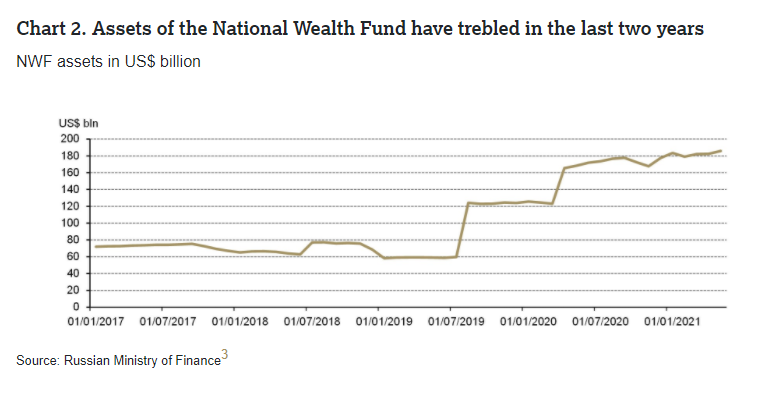
The largest change to occur to the fund was the re-organization of its assets last June of 2021 when it was announced that the Russian National Wealth Fund would de-dollarize with a focus on the Euro, Yuan and Gold.
June 2021:
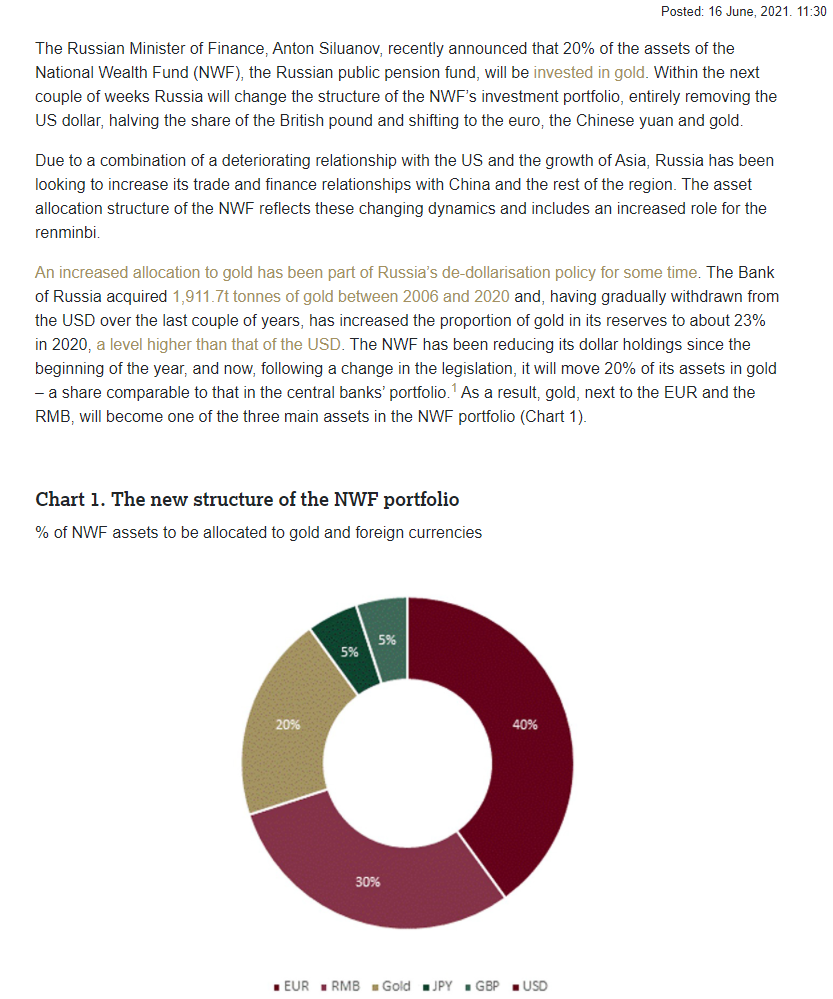
“The Russian Minister of Finance, Anton Siluanov, recently announced that 20% of the assets of the National Wealth Fund (NWF), the Russian public pension fund, will be invested in gold. Within the next couple of weeks Russia will change the structure of the NWF’s investment portfolio, entirely removing the US dollar, halving the share of the British pound and shifting to the euro, the Chinese yuan and gold.”
6.CRYPTOCURRENCIES
Your early currency/gold and silver pricing/Asian and European bourse movements/ and interest rate settings THURSDAY morning 7:30 AM
ONSHORE YUAN: CLOSED UP 6.3676
OFFSHORE YUAN: 6.3608
HANG SANG CLOSED UP 94.38 PTS OR 0.38%
2. Nikkei closed UP 116.21 PTS OR 0.42%
3. Europe stocks ALL GREEN
USA dollar INDEX UP TO 95.53/Euro RISES TO 1.1435-
3b Japan 10 YR bond yield: RISES TO. +.230/ !!!!(Japan buying 100% of bond issuance)/Japanese yen vs usa cross now at 115.78/ THIS IS TROUBLESOME AS BANK OF JAPAN IS RUNNING OUT OF BONDS TO BUY./JAPAN 10 YR YIELD IS NOW TARGETED AT .11%/JAPAN LOSING CONTROL OF THEIR BOND MARKET//
3c Nikkei now ABOVE 17,000
3d USA/Yen rate now well below the important 120 barrier this morning
3e WTI:: 90.29 and Brent: 92.10–
3f Gold DOWN /JAPANESE Yen DOWN CHINESE YUAN: ON -SHORE CLOSED UP// OFF- SHORE UP
3g Japan is to buy the equivalent of 108 billion uSA dollars worth of bond per month or $1.3 trillion. Japan’s GDP equals 5 trillion usa./“HELICOPTER MONEY” OFF THE TABLE FOR NOW /REVERSE OPERATION TWIST ON THE BONDS: PURCHASE OF LONG BONDS AND SELLING THE SHORT END
Japan to buy 100% of all new Japanese debt and by 2018 they will have 25% of all Japanese debt. Fifty percent of Japanese budget financed with debt.
3h Oil UP for WTI and UP FOR Brent this morning
3i European bond buying continues to push yields lower on all fronts in the EMU. German 10yr bund FALLS TO +.0.221%/Italian 10 Yr bond yield FALLS to 1.79% /SPAIN 10 YR BOND YIELD FALLS TO 1.09%…ITALIAN 10 YR BOND YIELD/GERMAN BUND: 1.57: DANGEROUS FOR THE ITALIAN BANKING SYSTEM
3j Greek 10 year bond yield RISES TO : 2.50
3k Gold at $1831.60 silver at: 23.35 7 am est) SILVER NEXT RESISTANCE LEVEL AT $30.00
3l USA vs Russian rouble;// Russian rouble UP 25/100 in roubles/dollar AT 74.80
3m oil into the 90 dollar handle for WTI and 92 handle for Brent/
3n Higher foreign deposits out of China sees huge risk of outflows and a currency depreciation. This can spell financial disaster for the rest of the world/
JAPAN ON JAN 29.2016 INITIATES NIRP. THIS MORNING THEY SIGNAL THEY MAY END NIRP. TODAY THE USA/YEN TRADES TO 115.78 DESTROYING JAPANESE CITIZENS WITH HIGHER FOOD INFLATION
30 SNB (Swiss National Bank) still intervening again in the markets driving down the FRANC. It is not working: USA/SF this morning .9242– as the Swiss Franc is still rising against most currencies. Euro vs SF 1.0569well above the floor set by the Swiss Finance Minister. Thomas Jordan, chief of the Swiss National Bank continues to purchase euros trying to lower value of the Swiss Franc.
USA 10 YR BOND YIELD: 1.933 UP 1 BASIS PTS
USA 30 YR BOND YIELD: 2.233 DOWN 2 BASIS PTS
USA DOLLAR VS TURKISH LIRA: 13.54
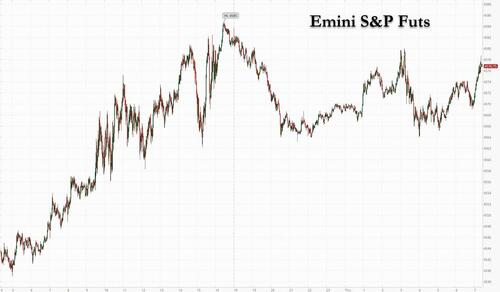
Futures Paralyzed Ahead Of Critical CPI Print
THURSDAY, FEB 10, 2022 – 07:52 AM
US index futures are unchanged from Wednesday’s close after some rangebound trades in another illiquid, overnight session, as traders were paralyzed and unwilling to commit capital ahead of today’s critical CPI print which consensus expects to come in at 7.2% YoY headline and 5.9% core, but which may well surprise to the downside (we explained why yesterday) after beating expectations on 8 of the past 10 occasions. A miss will likely send yields lower and risk sharply higher, especially when considering that the BLS will revise its CPI basket weightings and seasonal adjustments today. On the other hand, an upside surprise could spur additional pricing for a 50bp rate hike at the March meeting, currently priced in the swaps market at around 28%, and as such the 830am CPI print will shape views on how aggressively the Federal Reserve will tighten monetary policy in coming weeks.
Contracts on the S&P 500 were flat, and the Nasdaq drifted lower after a broad Wall Street rally on Tuesday, US Treasury yields were lower as was the dollar while bond yields in most of Europe ticked higher, as did bitcoin which briefly rose above $45,000 .
“This inflation data will provide investors with more clues on how aggressive the Fed could be at its next policy meeting, sparking volatility in both bond and stock markets,” said Pierre Veyret, a technical analyst at ActivTrades.
Markets are pricing in more than five quarter-point Fed hikes in 2022. Some remain skeptical about such bets, such as Bokeh Capital Partners Chief Investment Officer Kim Forrest, who said on Bloomberg Television that she sees expects inflation to ease as government handout programs are removed.
Five to seven Fed hikes “is just so crazy — it’s a lot driven by bond people here who really just want to get that 10-year to the 3% rate and I don’t know that’s possible,” said Forrest, who expects maybe two Fed rate increases in 2022.
Walt Disney jumped in premarket trading after beating estimates, with positive surprises from streaming service subscriptions and theme parks. Twitter rose in premarket trading after announcing a $4 billion share buyback to offset earnings and projections that disappointed expectations. Coca-Cola and Pepsico also climbed on robust earnings. Here are some other notable premarket movers:
- Uber (UBER US) rises 5% in premarket trading after it reported fourth- quarter revenue that beat the average analyst estimate. Analysts say pandemic-linked headwinds may ease for the ride-hailing company.
- Mattel (MAT US) jumps 11% in premarket trading. The toy manufacturer reported an “impressive” beat in 4Q, according to Truist Securities.
- Twilio (TWLO US) shares jump 19% in U.S. premarket trading, after the infrastructure software company reported fourth-quarter results that beat expectations and forecast first-quarter revenue ahead of the analyst consensus. Analysts were particularly positive on the firm’s improved growth prospects.
- Shares of MGM Resorts (MGM US) rose 3% in post- market trading, after the entertainment company reported adjusted earnings per share for the fourth quarter above the average analyst estimate.
- Emcore (EMKR US) tumbles 16% in postmarket trading after the aerospace and communications supplier’s fiscal second-quarter revenue outlook missed the average analyst estimate.
- O’Reilly Automotive (ORLY US) shares rallied 9% in postmarket trading after the car-parts retailer’s 2022 profit forecast beat the average analyst estimate.
- Vimeo (VMEO US) slumped 21% in postmarket trading after the software company forecast full-year revenue growth below the average analyst estimate and said its chief financial officer is departing.
- Lumen Technologies (LUMN US) shares plunged over 11% in postmarket trading after the company’s 2022 adjusted Ebitda forecast missed the average analyst estimate.
- Impinj (PI US) forecast revenue for the first quarter that exceeded the average analyst estimate at the midpoint. The stock tumbled in postmarket trading after rallying more than 19% in the past four trading sessions.
While robust corporate earnings provided support for stocks this week, the U.S. inflation print is the center of attention on Thursday. Data are expected to show U.S. inflation exceeding 7%. A surprise reading either side could shift bets on the pace of Fed interest-rate hikes and inject more volatility into stocks and bonds.
“The market is being somewhat sanguine about what will happen in the second half of 2022,” Sonal Desai, chief investment officer at Franklin Templeton Fixed Income, wrote in a note. “There is an expectation that inflation will decline sharply. I think that might be optimistic because a lot of the factors driving inflation will still be with us. The Fed is already behind the curve.”
Fed Bank of Cleveland President Loretta Mester and her Atlanta counterpart Raphael Bostic said all options are on the table for the size of policy makers’ first interest-rate increase in March, but Mester doesn’t see a “compelling case” for a 50-basis-point hike. They indicated they prefer the Fed to start reducing its balance sheet soon.
In Europe, the Stoxx Europe 600 Index erased earlier gains to drop 0.1%, dragged by consumer goods and personal care sectors after a slew of earnings reports. Personal-care heavyweight Unilever Plc dropped after sounding the alarm on cost increases, and L’Oreal SA declined even after reporting record sales, with traders focusing on eroding margins; Delivery Hero slumped after providing a disappointing guidance. Travel, real estate and health care outperformed. Siemens and AstraZeneca were lifted by stronger-than-expected earnings. Here are some of the biggest European movers today:
- Siemens shares jump as much as 8% after the company reported first-quarter earnings that analysts said beat estimates “across the board.” The gain is the steepest since November 2020.
- Societe Generale shares climb as much as 4.2%, to the highest since Oct. 2018, after the lender reported 4Q results that Jefferies says are “very strong,” with net profit 40% above consensus.
- Huhtamaki shares rise the most since July 2020, after the Finnish maker of food packaging reported adjusted Ebit for the fourth quarter that beat the average analyst estimate.
- AstraZeneca rises on 4Q earnings which beat analyst expectations on core EPS and product sales. Handelsbanken calls the outlook a “relief although broadly in line.”
- H&M rises after Deutsche Bank upgraded the company to hold, saying the Swedish fashion retailer has an attractive valuation on about “5.5% dividend yield that is growing.”
- Delivery Hero shares lose a quarter of their value in a record one-day loss following a quarterly update, with analysts saying that the online food delivery firm’s Ebitda guidance for 2022 is disappointing.
- Credit Suisse shares fall as much as 5.1% after the lender rounded off a challenging 2021 with a fourth- quarter net loss of CHF2 billion, with analysts calling the quarter “messy.”
Earlier in the session, Asian equities rose for a second straight day ahead of key U.S. inflation data due later that may provide clues on the Federal Reserve’s tightening pace. The MSCI Asia Pacific Index advanced as much as 0.7%, helped by technology and material stocks. Shares in Japan, Hong Kong and Taiwan rose on Thursday while mainland China’s CSI 300 declined. Global stocks have had a broadly positive week as the 10-year U.S. Treasury yield’s slip from multi-year highs helped boost demand for growth stocks. Still, the prospect of hotter-than-expected U.S. inflation spurring a big Fed rate hike has kept investors on edge. “Inflationary pressure will probably stay for a while –the takeaways from the current earnings season mean it is not going away for the next quarter or so,” Christina Woon, investment manager at Abrdn Asian Equities, said in an interview on Bloomberg TV. “So investors need to watch out for margins.” The Reserve Bank of India stuck to its dovish tone to ensure an economic recovery in a surprise move, while Indonesia’s central bank kept borrowing costs unchanged to maximize support for the economy
Japanese equities rose, capping a third day of gains and a second-straight weekly advance amid an extended rebound from the rate-driven selloff. Electronics and chemical makers were the biggest boosts to the Topix, which rose 0.5%, rounding a weekly advance of 1.7%. Tokyo Electron and Advantest were the largest contributors to a 0.6% gain in the Nikkei 225. “People are waiting for U.S. CPI figures,” said Tetsuo Seshimo, a portfolio manager at Saison Asset Management Co. “But for Japan stocks, earnings will likely continue to provide support.”
Indian stocks rose as the Reserve Bank of India’s monetary policy panel kept the benchmark interest rate unchanged to extend its stance of focusing on growth despite mounting inflation. The S&P BSE Sensex gained 0.8% to 58,926.03 in Mumbai while the NSE Nifty 50 Index advanced by a similar measure. The key gauges extended their rally into a third day. All but one of the 19 sector sub-indexes compiled by BSE Ltd. climbed, led by a gauge of power companies. “It is quite reassuring for stocks that the RBI has continued with an accommodative stance and kept the inflation estimate at its current level,” said Abhay Agarwal, a fund manager at Piper Serica Advisors Pvt. He sees rate-sensitive shares to be the biggest beneficiaries of the central bank’s decision and commentary. RBI’s priority on growth is not unwarranted given that economic recovery is yet to gather momentum while private consumption lags pre-pandemic levels, according to Naveen Kulkarni, chief investment officer at Axis Securities. “We believe over the medium term, policy rates are likely to gradually harden, and markets will continue to gauge impact from global policy changes,” he said. Corporate earnings for the quarter through December have been mixed, with rising input costs eating into margins of manufacturing-linked companies. Automaker Mahindra and miner Hindalco Industries were the latest Nifty 50 companies to report profit that beat analysts estimates. Of the 43 Nifty 50 companies that have reported quarterly numbers thus far, 23 either met or exceeded analyst estimates, 18 missed and two can’t be compared. Hero MotoCorp will be reporting results later Thursday. HDFC Bank contributed the most to the Sensex’s gain, increasing 1.8%. Out of 30 shares in the Sensex index, 26 rose and 4 fell
In rates, treasuries were richer across tenors led by front-end, with long-dated yields off session lows, steepening the curve ahead of January CPI report and 30-year bond auction. Yields were richer by more than 2bp across 2-year sector, steepening 2s10s by 1.7bp; the 10-year yield traded around 1.925%, outperforming bunds and gilts by 1.5bp and 0.5bp. Italian bonds lead euro-zone bonds lower as ECB rate hike wagers increase ahead of EU and U.S. inflation numbers. January CPI data is expected to show 7.2% y/y increase; an upside surprise could spur additional pricing for a 50bp rate hike at the March meeting, currently priced in the swaps market at around 28%. Treasury auction cycle concludes with $23b 30-year new issue at 1pm ET, week’s third and final sale; demand was strong for 3- and 10-year notes
Fixed income was broadly steady with the belly of the German curve underperforming U.K. and U.S. peers. Curve moves are modest, U.S. 2s10s ~1.5bps steeper ahead of today’s inflation print. Peripheral spreads have a small widening bias with 10y Italy ~2bps wider to Germany near 156bps. JGB futures snap higher, JPY goes small offered after a BOJ special purchase operation announcement.
In FX, the Bloomberg Dollar Spot Index gave up a modest gain as the greenback slipped against risk-sensitive peers, led by the kiwi; short-end Treasury yields slipped. The euro edged up a second day to near $1.1450; yield curves bear-steepened in the region, and peripheral bonds underperformed the core. One-month implied volatility in the euro now captures the next ECB meeting and the relative premium suggests options are fairly priced. The pound led gains before a speech by BOE Governor Andrew Bailey. Sweden’s krona was the worst performer, dropping as much as 0.6%, after the Riksbank kept up its dovish monetary-policy stance as Governor Stefan Ingves blocked a push from officials for stimulus withdrawal; Swedish yields dropped by up to 7bps, led by the front end. The yen weakened while Japanese government bonds fell with the benchmark 10-year yield rising to a six-year high amid wariness over U.S. CPI data ahead of a Japanese holiday on Friday. The BOJ offered to buy an unlimited amount of bonds at a fixed rate, pushing back against traders that are testing its yield curve control policy.
In commodities, crude futures drift: WTI trades either side of $90, Brent near $91.50. Base metals trade well with most up over 1.5%, Spot gold trades a narrow range near $1,833/oz.
To the day ahead now, and the aforementioned US CPI release will be the main highlight. Other data releases include the US weekly initial jobless claims and the monthly budget statement for January. From central banks, we’ll hear from BoE Governor Bailey, ECB Vice President de Guindos, and the ECB’s Lane and Villeroy. Earnings releases include The Coca-Cola Company, PepsiCo, Philip Morris International and Twitter. Finally, the European Commission will be publishing their latest economic forecasts.
Market Snapshot
- S&P 500 futures down 0.2% to 4,569.50
- MXAP up 0.6% to 191.62
- MXAPJ up 0.7% to 630.21
- Nikkei up 0.4% to 27,696.08
- Topix up 0.5% to 1,962.61
- Hang Seng Index up 0.4% to 24,924.35
- Shanghai Composite up 0.2% to 3,485.91
- Sensex up 0.9% to 58,996.33
- Australia S&P/ASX 200 up 0.3% to 7,288.45
- Kospi up 0.1% to 2,771.93
- STOXX Europe 600 little changed at 473.35
- German 10Y yield little changed at 0.24%
- Euro up 0.1% to $1.1442
- Brent Futures up 0.6% to $92.07/bbl
- Gold spot down 0.1% to $1,831.24
- U.S. Dollar Index little changed at 95.48
Top Overnight News from Bloomberg
- The ECB will take a gradual approach to unwinding some of its ultra-expansionary monetary policy, Governing Council member Olli Rehn says in Helsinki seminar
- Euro-area inflation will ease below the ECB’s 2% target next year, according to new draft projections from the EU that will feed the growing debate about how quickly to raise interest rates
- Worries about Britain’s cost of living crisis and a shortage of workers pushed U.K. starting salaries up by their third-fastest pace on record in January, according to a survey that will add to growing concerns at the BOE about inflation and rampant wage gains
- The BOE’s quantitative easing program is on course to book a 3 billion-pound ($4.1 billion) loss in the coming weeks as the central bank’s massive bond holdings start their journey from government cash cow to a drain on the public finances
- EU and U.K. attempts to jump-start negotiations over the post-Brexit trading relationship in Northern Ireland have so far failed to make any progress, and diplomats see little chance for any substantial progress until they get past a key election scheduled for May
- Bank of Japan chief Haruhiko Kuroda says that it’s impossible for the central bank to make a hawkish turn before his term ends next year, Mainichi newspaper reported, citing an interview with the governor
- Some of this year’s worst-performing emerging markets will get another chance to lure back bond investors after their first round of aggressive rate hikes failed to contain inflation. At least seven countries including Russia, Mexico and India are set to follow Poland and Romania, which raised benchmark rates this week
A more detailed look at global markets courtesy of Newsquawk
Asian stocks traded mixed as participants digested another deluge of earnings and US-China frictions. ASX 200 (+0.3%) was supported by tech and with financials boosted after AMP and NAB reported higher H1 profits. Nikkei 225 (+0.5%) finished off highs with the index swayed by a choppy currency and numerous earnings. Hang Seng (-0.2%) and Shanghai Comp. (-0.3%) were subdued after Hong Kong reported its first COVID death in five months, while Biden administration is said to mull trade actions on China. Nifty 50 (+0.7%) was initially choppy heading into the RBI decision but was then lifted after the central bank kept the Repurchase Rate at 4.00% and unexpectedly maintained the Reverse Repo Rate at 3.35%.
Top Asian News
- BOJ Seeks to Rein in Yields With Unlimited Fixed-Rate Purchases
- BOJ to Conduct Unlimited Fixed-Rate JGB Purchases at 0.25%
- Credit Suisse Hires 80 Wealth Bankers for Asia Growth
- India’s Central Bank Chief Says Crypto Is ‘Not Even a Tulip’
European bourses are mixed/positive having pulled back modestly from a firmer cash open, individual movers heavily dictated by pre-market earnings. Sectors are mixed with Basic Resources outperforming while Consumer Products/Services are pressured on earnings dynamics.
Top European News
- Italy Is Set to Approve Start of Process to Sell Airline ITA
- U.K. Salaries Jump as Workers Grapple With Cost-of-Living Crisis
- Delivery Hero Slumps Most on Record as Outlook Disappoints
- Turkey Kicks Off Latest Round of Capital Injections in Banks
Central Banks:
- BoJ to purchase unlimited 10yr JGBs on Feb 14th at 0.25% (#363, #364 and #365); decided on fixed rate operation given recent yield moves. Will firmly keep policy to keep 10yr yields around 0%.
- Riksbank maintains its Repo Rate at 0.00% as expected. QE maintained for Q2 (SEK 37bln for Q1 2022); three hawkish dissenters on QE. Q1 2024 rate path lifted marginally; even if the risk of too low inflation has declined, it still remains. Governor Ingves says a rate hike is inching closer than we earlier believed.
- RBI kept the Repurchase Rate unchanged at 4.00% and maintained accommodative policy stance, as expected, but also surprisingly held the Reverse Repo Rate at 3.35% (exp. 20bps increase). RBI Governor Das said the MPC flagged potential downside risks to activity from Omicron and they are seeing some loss of momentum for economic activity, while the MPC was of the view that continued policy support is
- warranted for a durable and broad-based recovery.
- ECB’s Rehn says it is more preferable to progress one step at a time in normalising monetary policy in an uncertain environment; will use all tools to stabilise inflation around 2%.
In FX, DXY somewhat deflated into US CPI even though expectations are lofty, as Fed’s Mester sees no compelling case for 50bp March liftoff. Riksbank rattles SEK with only minor rate path tweak and no real tilt from transitory inflation view. BoJ undermines YEN by announcing unlimited JGB purchases to prevent 10 year yield spiking further from target. ZAR continues shine alongside Gold in the run up to SA State of Nation Address. Turkish Finance Minister is to announce “a new support package” on Feb 12th; will focus on measures to curb recent price rises whilst providing support to export firms, plans to bring “under-the-mattress gold” into the Turkish banking system.
In fixed income, core bonds back-off after a fade below midweek highs as US CPI looms before the long bond refunding leg. JGBs buck the bearish trend as the BoJ steps in to defend its YCT via unlimited purchases of 10 year maturities from February 14th.
In commodities, WTI and Brent remain choppy in fairly tight ranges in the context of recent performance, focus very much on geopols as Russian military drills commence. White House said President Biden and Saudi King spoke about commitment to ensure stability of global energy supplies, while Energy Intel noted that Saudi’s King Salman stressed importance of maintaining balance and stability in oil markets, highlighting importance of maintaining the OPEC+ agreement. OPEC MOMR to be released at 12:45GMT/07:45EST. Spot gold trades sideways and confirmed support at USD 1,830/oz, which acted as resistance on the way up. Base metals derived support in APAC hours while Coal pulled-back given recent commentary.
US Event Calendar
- 8:30am: Jan. CPI YoY, est. 7.2%, prior 7.0%; CPI MoM, est. 0.4%, prior 0.5%, revised 0.6%
- 8:30am: Jan. CPI Ex Food and Energy YoY, est. 5.9%, prior 5.5%, CPI Ex Food and Energy MoM, est. 0.5%, prior 0.6%
- 8:30am: Jan. Real Avg Hourly Earning YoY, prior -2.4%, revised -2.0%; Real Avg Weekly Earnings YoY, prior -2.3%, revised -2.0%
- 8:30am: Feb. Initial Jobless Claims, est. 230,000, prior 238,000; Continuing Claims, est. 1.62m, prior 1.63m
- 2pm: Jan. Monthly Budget Statement, est. $23b, prior -$162.8b
DB’s Jim Reid concludes the overnight wrap
I’ll be honest, life is so dull for me at the moment that work is my salvation. 9.5 days down on crutches now and 32.5 to go. Given I only went through the same thing on my other knee in September and October last year it is fair to say I’m ready for a decent stretch of no injuries. As is my wife who has to deal with me and also our 6-year old Maisie who is going to continue to be in wheelchair for the best part of this year. For those that have kindly asked the good news is that she’s swimming 4 times a week now and absolutely loves it. In fact she’s very good now and is a couple of years better than her age so that is one silver lining that has come out of her hip condition. The only benefit for me is that as I’m not going outside much, my usual blast of January onwards hay fever has not really made an appearance this year. Usually the silver birches (I think) at the golf course are my Kryptonite at this time of year. It is usually horrendous.
The Kryptonite for markets is undoubtedly inflation at the moment and it’s that time again with US CPI today the main event of the week. Last summer on a couple of occasions I suggested that the then upcoming day’s US CPI number could be the most important economic data release in perhaps a generation given the potential for regime change. However the summer inflation prints whilst consistently higher than expected were largely shrugged off by the market so my hyperbole was clearly misplaced. Without repeating my mistake, we are approaching a crucial point for US CPI. If we don’t start gliding lower in line with expectations soon, the market is going to be pricing some 50bps Fed hikes into the equation for 2022. Today’s number is a complicated one as Omicron could create distortion that unwind next month.
As readers will likely be familiar, recent months have seen repeated upside surprises, with the monthly headline CPI print above the consensus estimate on Bloomberg for 8 of the last 10 releases, sending the year-on-year number up to +7.0% for the first time since 1982. In terms of what to expect, our US economists are looking for a further increase in the year-on-year figure to +7.2% (in line with consensus), with core also rising to +5.8% (consensus 5.9%). That said, their view is that the month-on-month measure should subside to +0.38% from +0.58% in December, which would be a 5-month low and mark a third consecutive decline in the monthly reading. Core is expected to dip to +0.40% from +0.58% mom.
The wildcards might be lodging away and airfares due to Omicron. These fell -2.7% and -8.6% last August around the Delta variant. So the risks feel a touch skewed toward the downside this month even if that will likely be a temporary thing given the Omicron wave is well past the peak. Structurally we still see primary rents and OER as seeing enough upward pressure to keep the glidepath lower (when it comes) more shallow than the market thinks regardless of what happens today. As an aside, food prices continue to increase which won’t help, with Bloomberg’s Agriculture Spot index up +1.68% yesterday to its highest levels since 2011.
We’ll have to wait and see what happens, but it was only last Friday that a much stronger-than-expected jobs report turbocharged calls for a 50bp hike from the Fed. Immediately afterwards, futures moved to pricing in a more than 40% chance one could happen, although that number’s since fallen back to 30% this morning. Fed Chair Powell notably did not rule out moving by 50bps at the press conference after the last meeting, and a higher-than-expected inflation number today would only add fuel to the fire.
On the other hand, yesterday we did begin to see some signs of pushback on recent market pricing, with a number of central bank officials adopting a more cautious and measured tone relative to the market narrative of recent days. The comments on Monday evening from the ECB’s Villeroy after the European close that there “were perhaps reactions that were very high and too high in recent days” helped matters from the get-go. We then heard from the Fed’s Mester (a voter on the FOMC this year), who didn’t find a compelling case for raising rates by +50bps at liftoff. And earlier in the day, BoE Chief economist Pill also said that “I worry that taking unusually large policy steps may validate a market narrative that bank policy is either foot-to-the-floor on the accelerator or foot-to-the-floor with the brake”.
That pushback held more water in Europe, where there was a rally across all maturities and countries, with yields on 10yr bunds (-5.3bps), OATs (-5.5bps) and BTPs (-9.6bps) all moving lower on the day. Bunds saw their first yield fall in 12 days and ended the longest run of increases since reunification in 1990. Meanwhile in the US, the yield curve twist flattened, with 2yr Treasuries +2.3bps higher and 10yr Treasuries down -2.2bps, bringing the 2s10s yield curve to a fresh low of just +57bps yesterday, the lowest closing level since October 2020. Nevertheless, US rate moves were small in magnitude with most investors looking to CPI today as a key risk event.
Even with some pushback to the recent yield rises, the global tightening continued apace yesterday, with Romania’s central bank announcing a 50bps hike in their monetary policy rate, and Iceland’s central bank announced a 75bps hike in their 7-day term deposit rate as well, their biggest hike since 2008.
With the bond rout easing yesterday, equities continued their advance as both the S&P 500 (+1.45%) and Europe’s STOXX 600 (+1.72%) closed at their highest level in a week. It was a very broad-based advance for both indices; 428 companies in the S&P were in the green, the second-highest number of 2022 so far, while every sector advanced. Tech and mega cap stocks put in a strong performance in particular, with the NASDAQ (+2.08%) and the FANG+ index (+2.44%) both seeing a decent advance for the second day running.
Overnight in Asia, equity markets are struggling to find direction with the major indexes fluctuating in the morning trade. The Nikkei (+0.33%) and Kospi (+0.25%) have reversed early morning losses while the Shanghai Composite (-0.10%), CSI (-0.52%) and the Hang Seng (-0.48%) are all moving lower. Meanwhile, shares of China Evergrande Group in Hong Kong are up +2.99% after reports came in that the embattled developer plans to deliver 600,000 apartments this year and will refrain from selling off its assets to repay its debt. Elsewhere, the Reserve Bank of India (RBI) decided to keep its repo rate unchanged at +4.0% and will continue with its accommodative stance to foster economic growth. Additionally, the central bank has projected real GDP growth at +7.8% for FY 2022-23. Looking forward, equity futures are pointing to a weak opening in the US with contracts on the S&P 500 (-0.21%) and the NASDAQ (-0.30%) both lower ahead of the crucial US inflation data later today.
On the data front, Japan’s producer price inflation in January came in +8.6% year-on-year, which is a slight decline from the previous month’s +8.7%, but was still some way above the +8.2% expected. Against that backdrop, Mainichi reported Bank of Japan Governor Kuroda saying that there is “no chance” that monetary easing would be reduced, and that the chance of a big increase in inflation as seen elsewhere was “very low”.
Staying on central banks, the Boston Fed named Susan Collins, an economist serving currently as executive vice president of University of Michigan, as their new President. Regional Fed Presidents get to vote on the FOMC every three years, and this year the Boston Fed President is up. We’re sure to learn more about her monetary policy views before she assumes office in July.
Finally, a number of countries have been removing Covid restrictions lately, and in the UK Prime Minister Johnson announced yesterday that all remaining restrictions in England could end later in February. He said he’d be announcing a plan to live with Covid on February 21, so if we do see an end to restrictions that will provide an interesting example to other countries amidst increasing political momentum to get back to normal. Over in the US, Dr Fauci also said in a recent FT interview that he hoped that pandemic restrictions could end in the months ahead, whilst New York Governor Hochul said that the state’s mask mandate for businesses would end today.
To the day ahead now, and the aforementioned US CPI release will be the main highlight. Other data releases include the US weekly initial jobless claims and the monthly budget statement for January. From central banks, we’ll hear from BoE Governor Bailey, ECB Vice President de Guindos, and the ECB’s Lane and Villeroy. Earnings releases include The Coca-Cola Company, PepsiCo, Philip Morris International and Twitter. Finally, the European Commission will be publishing their latest economic forecasts.
3. ASIAN AFFAIRS
i)THURSDAY MORNING// WEDNESDAY NIGHT
SHANGHAI CLOSED UP 5.96 PTS OR 0.17% //Hang Sang CLOSED UP 94.36 PTS OR 0.38% /The Nikkei closed UP 116.21 PTS OR 0.42% //Australia’s all ordinaires CLOSED UP 0.30% /Chinese yuan (ONSHORE) closed UP 6.3676 /Oil UP TO 90.29 dollars per barrel for WTI and DOWN TO 92.10 for Brent. Stocks in Europe OPENED ALL GREEN // ONSHORE YUAN CLOSED UP AGAINST THE DOLLAR AT 6.3676. OFFSHORE YUAN CLOSED UP ON THE DOLLAR AT 6.3608: /ONSHORE YUAN TRADING BELOW LEVEL OF OFFSHORE YUAN/ONSHORE YUAN TRADING STRONGER AGAINST USA DOLLAR/OFF SHORE STRONGER//
3 a./NORTH KOREA/ SOUTH KOREA
///NORTH KOREA
3B JAPAN
3c CHINA
CHINA
Wow! this is a biggy: China injects $1 trillion equivalent into the markets, the biggest monthly credit surge on record.
(zerohedge)
Meanwhile, China Quietly Injects $1 Trillion In Biggest Monthly Credit Surge On Record
THURSDAY, FEB 10, 2022 – 02:19 PM
While Wall Street is being torn apart by fierce debate whether the upcoming “six or seven” in rate hikes coupled with $2.5 trillion in QT over the next two years will blow up US capital markets, overnight China showed how trivial such debates are when it published its latest monthly credit data which showed that in January, the Chinese financial system injected just shy of $1 trillion in total new credit.
Four months after we wrote that “China Credit Growth Finally Bottoms, Setting Stage For Powerful Credit Impulse Bounce“, and just weeks after China’s credit impulse indeed bounce staged a powerful move higher just as we had forecast…
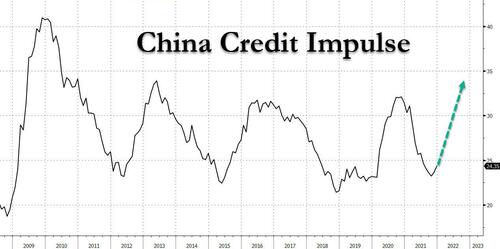
… in January Beijing showed just how serious it is about rebooting the stalling Chinese economy, when the latest amount of total social financing and RMB loans accelerated materially and blew away market expectations. Indeed, as shown below, both new TSF and RMB loans were the highest on record with the former surging by a 6.170 trillion …
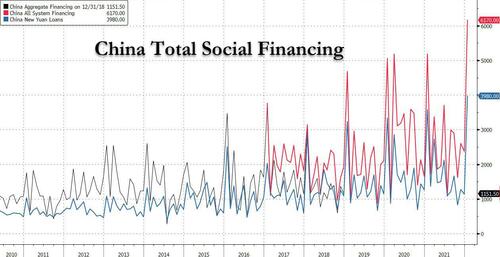
… with Goldman writing that seasonality and – more importantly – policy easing contributed to the acceleration.
As a reminder in recent months, PBOC cut RRR, policy interest rates and LPR, and also guided commercial banks to accelerate loan extensions. Sector-level RMB loan growth data painted a less positive picture than the headline figures, as short-term loan growth was still faster than medium-to-long term loan growth, and household medium-to-long term loans only showed a modest acceleration. Last but not least, M2 growth exploded to the upside as well, blowing away expectations.
Here are the highlights:
- Total social financing: RMB 6,170bn in January, vs. consensus: RMB 5400bn.
- New CNY loans: RMB 3980bn in January vs. RMB 3700bn. Outstanding CNY loan growth: 11.5% yoy in January vs December at 11.6% yoy.
- TSF stock growth: 10.5% yoy in January, higher than 10.3% in December. The implied month-on-month growth of TSF stock picked up to 13.9% from 9.4% in December.
- M2: 9.8% yoy in January vs. Bloomberg consensus of 9.2% yoy, and up from December’s 9.0% yoy
Needless to say, January total social financing was well above expectations. The sequential growth of TSF stock accelerated to 13.9% mom annualized S/A in January from 9.4% in December after clear easing signals from PBOC and a policy rate cut in January. Overall RMB loans growth remained relatively solid at 10.3% mom annualized sa. M2 year-on-year growth also surprised to the upside and rose 9.8% yoy in January.
Among major TSF components, loan extension picked up meaningfully and shadow banking credit also showed a much smaller contraction. Based on loans to different sectors, corporate short-term loan growth accelerated to 22.3% mom annualized from 2.9% in December. Corporate mid-to-long term loan growth remained roughly unchanged at 10.6% mom annualized in December. Corporate bill financing rose further by 34.6% mom annualized following a sharp surge of +61.7% in December. On loans to household, short-term loans grew 8.4% mom annualized (vs. 8.3% in December), while household mid-to-long term loan (mostly mortgages) growth picked up to 10.0% mom annualized (vs. 9.5% in December). Government bond issuance slowed slightly in January while corporate bond issuance accelerated. The drag from shadow banking credit (trust and entrusted loans, bank acceptance bills) was smaller in January – after adjusting for seasonality, shadow banking credit contracted by RMB40bn in January, vs an average of RMB 470bn contraction in the prior three months.
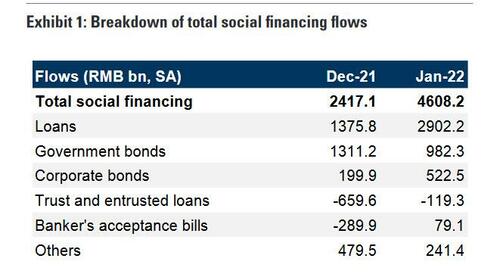
M2 growth also surprised to the upside. Among major M2 drivers, fiscal deposits rose by 0.6 trillion in January, much lower than the +1.2 trillion in January last year. FX purchases might have also increased in January as the strong FX inflow pressures continued.
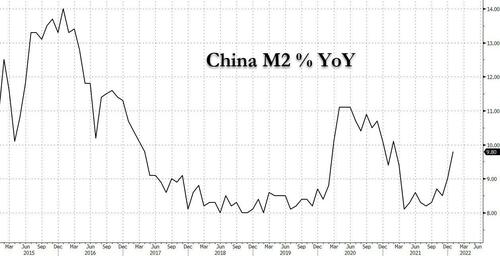
January total social financing and RMB loans accelerated materially and beat market expectations. The strong credit extensions would support economic growth and help buffer downward pressures on growth from Covid outbreak and other restrictions such as production suspension due to the winter Olympics.
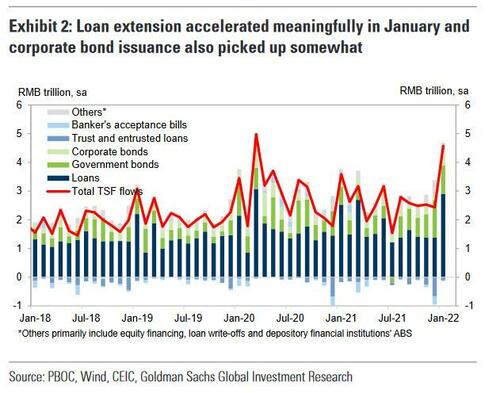
According to Goldman, “the rebound in January credit growth was stronger than what seasonality would suggest on the back of policy easing – PBOC cut RRR, policy interest rates, and LPR in December last year and in January this year, and also guided commercial banks to accelerate loan extensions.”
That said, it remains to be seen whether the strong credit extension is sustainable – seasonality would suggest much smaller new credit extensions in February, and based on sector-level loan growth, short-term loans still grew much faster than medium-to-long term loans. Household medium-to-long term loans, which are mostly mortgages, only accelerated modestly in January as property policy easing has been measured so far.
However, clearly Beijing has other plans and in what appears to be the start of a powerful credit injection cycle similar to that observed in 2008 and around the covid crash. Putting this in context, China is willing to ignore any signs of persistent inflation (China’s PPI remains sky high) and is plowing full bore into a major reflation cycle just as the US and the developed worlds are doing all they can to contain their own out of control inflation. We don’t know how this unprecedented divergence will resolve itself but we are certain that there won’t be a happy ending.
end
4/EUROPEAN AFFAIRS
UK/VACCINE/VACCINE MANDATE
Failed policies have caused massive harm especially to children
(EpochTimes)
130+ UK Doctors: Failed COVID Policies Caused “Massive” Harm, Especially To Children
THURSDAY, FEB 10, 2022 – 06:30 AM
A letter signed by more than 130 UK medical professionals accused UK Prime Minister Boris Johnson and other government officials of causing “massive, permanent and unnecessary harm” to the country

A letter to UK Prime Minister Boris Johnson and other UK government officials, signed by more than 130 UK medical professionals, accused the government of mishandling its response to the COVID pandemic, resulting in “massive, permanent and unnecessary harm” to the country.
The letter, “Our Grave Concerns About the Handling of the COVID Pandemic by Governments of the Nations of the UK,” outlined 10 ways in which the authors argued UK government policies not only failed to protect citizens, but in many cases caused additional, unnecessary harm.
The letter’s 10 lead authors wrote:
“We write as concerned doctors, nurses and other allied healthcare professionals with no vested interest in doing so. To the contrary, we face personal risk in relation to our employment for doing so and / or the risk of being personally ‘smeared’ by those who inevitably will not like us speaking out.”
The authors accused government officials of failing to measure the harms of lockdown policies, of exaggerating the virus’ threat and of improper mass testing of children.
They wrote:
“Repeated testing of children to find asymptomatic cases who are unlikely to spread virus, and treating them like some sort of biohazard is harmful, serves no public health purpose and must stop.”
The letter also called out officials for actively suppressing discussion of early treatment using protocols being successfully deployed elsewhere, and said vaccination of the entire adult population should never have been a prerequisite for ending restrictions.
The authors concluded:
“The UK’s approach to COVID has palpably failed. In the apparent desire to protect one vulnerable group – the elderly – the implemented policies have caused widespread collateral and disproportionate harm to many other vulnerable groups, especially children.”
In addition to Johnson, the letter was addressed to Nicola Sturgeon, First Minister for Scotland; Mark Drakeford, First Minister for Wales; Paul Givan, First Minister for Northern Ireland; Sajid Javid, Health Secretary; Chris Whitty, Chief Medical Officer; and Dr. Patrick Vallance, Chief Scientific Officer.
* * *
Read the Full Letter:
Dear Sirs and Madam,
Our grave concerns about the handling of the COVID pandemic by Governments of the Nations of the UK.
We write as concerned doctors, nurses, and other allied healthcare professionals with no vested interest in doing so. To the contrary, we face personal risk in relation to our employment for doing so and / or the risk of being personally “smeared” by those who inevitably will not like us speaking out.
We are taking the step of writing this public letter because it has become apparent to us that:
- The Government (by which we mean the UK government and three devolved governments/administrations and associated government advisors and agencies such as the CMOs, CSA, SAGE, MHRA, JCVI, Public Health services, Ofcom etc, hereinafter “you” or the “Government”) have based the handling of the COVID pandemic on flawed assumptions.
- These have been pointed out to you by numerous individuals and organisations.
- You have failed to engage in dialogue and show no signs of doing so. You have removed from people fundamental rights and altered the fabric of society with little debate in Parliament. No minister responsible for policy has ever appeared in a proper debate with anyone with opposing views on any mainstream media channel.
- Despite being aware of alternative medical and scientific viewpoints you have failed to ensure an open and full discussion of the pros and cons of alternative ways of managing the pandemic.
- The pandemic response policies implemented have caused massive, permanent and unnecessary harm to our nation, and must never be repeated.
- Only by revealing the complete lack of widespread approval among healthcare professionals of your policies will a wider debate be demanded by the public.
In relation to the above, we wish to draw attention to the following points. Supporting references can be provided upon request.
1. No attempt to measure the harms of lockdown policies
The evidence of disastrous effects of lockdowns on the physical and mental health of the population is there for all to see. The harms are massive, widespread, and long lasting. In particular, the psychological impact on a generation of developing children could be lifelong.
It is for this reason that lockdown policies were never part of any pandemic
preparedness plans prior to 2020. In fact, they were expressly not recommended in WHO documents, even for severe respiratory viral pathogens and for that matter neither were border closures, face coverings, and testing of asymptomatic individuals. There has been such an inexplicable absence of consideration of the harms caused by lockdown policy it is difficult to avoid the suspicion that this is willful avoidance.
The introduction of such policies was never accompanied by any sort of risk/benefit analysis. As bad as that is, it is even worse that after the event when plenty of data became available by which the harms could be measured, only perfunctory attention to this aspect of pandemic planning has been afforded. Eminent professionals have repeatedly called for discourse on these health impacts in press-conferences but have been universally ignored.
What is so odd, is that the policies being pursued before mid-March 2020 (self-isolation of the ill and protection of the vulnerable, while otherwise society continued close to normality) were balanced, sensible and reflected the approach established by consensus prior to 2020. No cogent reason was given then for the abrupt change of direction from mid-March 2020 and strikingly none has been put forward at any time since.
2. Institutional nature of COVID
It was actually clear early on from Italian data that COVID (the disease, as opposed to SARS-Cov-2 infection or exposure) was largely a disease of institutions. Care home residents comprised around half of all deaths, despite making up less than 1% of the population. Hospital infections are the major driver of transmission rates as was the case for both SARS1 and MERS.
Transmission was associated with hospital contact in up to 40% of cases in the first wave in Spring 2020 and in 64% in winter 2020/2021.
Severe illness among healthy people below 70 years old did occur (as seen with flu pandemics) but was extremely rare.
Despite this, no early, aggressive and targeted measures were taken to protect care homes; to the contrary, patients were discharged without testing to homes where staff had inadequate PPE, training and information. Many unnecessary deaths were caused as a result.
Preparations for this coming winter, including ensuring sufficient capacity and preventative measures such as ventilation solutions, have not been prioritised.
3. The exaggerated nature of the threat
Policy appears to have been directed at systematic exaggeration of the number of deaths which can be attributed to COVID. Testing was designed to find every possible ‘case’ rather than focusing on clinically diagnosed infections and the resulting exaggerated case numbers fed through to the death data with large numbers of people dying ‘with COVID’ and not ‘of COVID’ where the disease was the underlying cause of death.
The policy of publishing a daily death figure meant the figure was based entirely on the PCR test result with no input from treating clinicians. By including all deaths within a time period after a positive test, incidental deaths, with but not due to COVID, were not excluded thereby exaggerating the nature of the threat.
Moreover, in headlines reporting the number of deaths, a categorisation by age was not included. The average age of a COVID-labelled death is 81 for men and 84 for women, higher than the average life expectancy when these people were born.
This is a highly relevant fact in assessing the societal impact of the pandemic. Death in old age is a natural phenomenon. It cannot be said that a disease primarily affecting the elderly is the same as one which affects all ages, and yet the government’s messaging appears designed to make the public think that everyone is at equal risk.
Doctors were asked to complete death certificates in the knowledge that the deceased’s death had already been recorded as a COVID death by the Government. Since it would be virtually impossible to find evidence categorically ruling out COVID as a contributory factor to death, once recorded as a “COVID death” by the government, it was inevitable that it would be included as a cause on the death certificate.
Diagnosing the cause of death is always difficult and the reduction in post mortems will have inevitably resulted in increased inaccuracy. The fact that deaths due to non-COVID causes actually moved into a substantial deficit (compared to average) as COVID-labelled deaths rose (and this was reversed as COVID-labelled deaths fell) is striking evidence of over-attribution of deaths to COVID.
The overall all-cause mortality rate from 2015-2019 was unusually low and yet these figures have been used to compare to 2020 and 2021 mortality figures which has made the increased mortality appear unprecedented. Comparisons with data from earlier years would have demonstrated that the 2020 mortality rate was exceeded in every year prior to 2003 and is unexceptional as a result.
Even now COVID cases and deaths continue to be added to the existing total without proper rigour such that overall totals grow ever larger and exaggerate the threat. No effort has been made to count totals in each winter season separately which is standard practice for every other disease.
You have continued to adopt high-frequency advertising through publishing and broadcast media outlets to add to the impact of “fear messaging”. The cost of this has not been widely published, but government procurement websites reveal it to be immense — hundreds of millions of pounds.
The media and government rhetoric is now moving onto the idea that “Long Covid” is going to cause major morbidity in all age groups including children, without having a discussion of the normality of postviral fatigue which lasts upwards of 6 months. This adds to the public fear of the disease, encouraging vaccination amongst those who are highly unlikely to suffer any adverse effects from COVID.
4. Active suppression of discussion of early treatment using protocols being successfully deployed elsewhere
The harm caused by COVID and our response to it should have meant that advances in prophylaxis and therapeutics for COVID were embraced. However, evidence on successful treatments has been ignored or even actively suppressed.
For example, a study in Oxford published in February 2021 demonstrated that inhaled Budesonide could reduce hospitalisations by 90% in low risk patients and a publication in April 2021 showed that recovery was faster for high risk patients too. However, this important intervention has not been promoted.
Dr. Tess Lawrie, of the Evidence Based Medical Consultancy in Bath, presented a thorough analysis of the prophylactic and therapeutic benefits of Ivermectin to the government in January 2021. More than 24 randomised trials with 3,400 people have demonstrated a 79-91% reduction in infections and a 27-81% reduction in deaths with Ivermectin.
Many doctors are understandably cautious about possible over-interpretation of the available data for the drugs mentioned above and other treatments, although it is to be noted that no such caution seems to have been applied in relation to the treatment of data around the government’s interventions (eg the effectiveness of lockdowns or masks) when used in support of the government’s agenda.
Whatever one’s view on the merits of these repurposed drugs, it is totally unacceptable that doctors who have attempted to merely open discussion about the potential benefits of early treatments for COVID have been heavily and inexplicably censored. Knowing that early treatments which could reduce the risk of requiring hospitalisation might be available would alter the entire view held by many professionals and lay people alike about the threat posed by COVID, and therefore the risk / benefit ratio for vaccination, especially in younger groups.
5. Inappropriate and unethical use of behavioural science to generate unwarranted fear
Propagation of a deliberate fear narrative (confirmed through publicly accessible government documentation) has been disproportionate, harmful and counterproductive. We request that it should cease forthwith.
To give just one example, the government’s face covering policies seem to have been driven by behavioural psychology advice in relation to generating a level of fear necessary for compliance with other policies.
Those policies do not appear to have been driven by reason of infection control, because there is no robust evidence showing that wearing a face covering (particularly cloth or standard surgical masks) is effective against transmission of airborne respiratory pathogens such as SARS-Cov-2.
Several high profile institutions and individuals are aware of this and have advocated against face coverings during this pandemic only inexplicably to reverse their advice on the basis of no scientific justification of which we are aware. On the other hand there is plenty of evidence suggesting that mask wearing can cause multiple harms, both physical and mental.
This has been particularly distressing for the nation’s school children who have been encouraged by government policy and their schools to wear masks for long periods at school.
Finally, the use of face coverings is highly symbolic and thus counterproductive in making people feel safe. Prolonged wearing risks becoming an ingrained safety behaviour, actually preventing people from getting back to normal because they erroneously attribute their safety to the act of mask wearing rather than to the remote risk, for the vast majority of healthy people under 70 years old, of catching the virus and becoming seriously unwell with COVID.
6. Misunderstanding of the ubiquitous nature of mutations of newly emergent viruses
The mutation of any novel virus into newer strains — especially when under selection pressure from abnormal restrictions on mixing and vaccination — is normal, unavoidable and not something to be concerned about. Hundreds of thousands of mutations of the original Wuhan strain have already been identified.
Chasing down every new emergent variant is counterproductive, harmful and totally unnecessary and there is no convincing evidence that any newly identified variant is any more deadly than the original strain.
Mutant strains appear simultaneously in different countries (by way of ‘convergent evolution’) and the closing of national borders in attempts to prevent variants travelling from one country to another serves no significant infection control purpose and should be abandoned.
7. Misunderstanding of asymptomatic spread and its use to promote public compliance with restrictions
It is well-established that asymptomatic spread has never been a major driver of a respiratory disease pandemic and we object to your constant messaging implying this, which should cease forthwith.
Never before have we perverted the centuries-old practice of isolating the ill by instead isolating the healthy. Repeated mandates to healthy, asymptomatic people to self-isolate, especially school children, serves no useful purpose and has only contributed to the widespread harms of such policies.
In the vast majority of cases healthy people are healthy and cannot transmit the virus and only sick people with symptoms should be isolated.
The government’s claim that one in three people could have the virus has been shown to be mutually inconsistent with the ONS data on prevalence of disease in society, and the sole effect of this messaging appears to have been to generate fear and promote compliance with government restrictions.
The government’s messaging to ‘act as if you have the virus’ has also been unnecessarily fear-inducing given that healthy people are extremely unlikely to transmit the virus to others.
The PCR test, widely used to determine the existence of ‘cases’, is now indisputably acknowledged to be unable reliably to detect infectiousness. The test cannot discriminate between those in whom the presence of fragments of genetic material partially matching the virus is either incidental (perhaps because of past infection), or is representative of active infection, or is indicative of infectiousness.
Yet, it has been used almost universally without qualification or clinical diagnosis to justify lockdown policies and to quarantine millions of people needlessly at enormous cost to health and well-being and to the country’s economy.
Countries that have removed community restrictions have seen no negative consequences which can be attributed to the easing. Empirical data from many countries demonstrates that the rise and fall in infections is seasonal and not due to restrictions or face coverings.
The reason for reduced impact of each successive wave is that: (1) most people have some level of immunity either through prior immunity or immunity acquired through exposure; (2) as is usual with emergent new viruses, mutation of the virus towards strains causing milder disease appears to have occurred.
Vaccination may also contribute to this although its durability and level of protection against variants is unclear.
The government appears to be talking of “learning to live with COVID” while apparently practicing by stealth a “zero COVID” strategy which is futile and ultimately net-harmful.
8. Mass testing of healthy children
Repeated testing of children to find asymptomatic cases who are unlikely to spread virus, and treating them like some sort of biohazard is harmful, serves no public health purpose and must stop.
During Easter term, an amount equivalent to the cost of building one District General Hospital was spent weekly on testing schoolchildren to find a few thousand positive ‘cases’, none of which was serious as far as we are aware.
Lockdowns are in fact a far greater contributor to child health problems, with record levels of mental illness and soaring levels of non-COVID infections being seen, which some experts consider to be a result of distancing resulting in deconditioning of the immune system.
9. Vaccination of the entire adult population should never have been a prerequisite for ending restrictions
Based merely on early “promising” vaccine data, it is clear that the Government decided in summer 2020 to pursue a policy of viral suppression within the entire population until vaccination was available (which was initially stated to be for the vulnerable only, then later changed — without proper debate or rigorous analysis — to the entire adult population).
This decision was taken despite massive harms consequent to continued lockdowns which were either known to you or ought to have been ascertained so as to be considered in the decision making process.
Moreover, a number of principles of good medical practice and previously unimpeachable ethical standards have been breached in relation to the vaccination campaign, meaning that in most cases, whether the consent obtained can be truly regarded as “fully informed” must be in serious doubt:
- The use of coercion supported by an unprecedented media campaign to persuade the public to be vaccinated, including threats of discrimination, either supported by the law or encouraged socially, for example in co-operation with social media platforms and dating apps.
- The omission of information permitting individuals to make a fully informed choice, especially in relation to the experimental nature of the vaccine agents, extremely low background COVID risk for most people, known occurrence of short-term side-effects and unknown long-term effects.
Finally, we note that the Government is seriously considering the possibility that these vaccines — which have no associated long-term safety data — could be administered to children on the basis that this might provide some degree of protection to adults. We find that notion an appalling and unethical inversion of the long-accepted duty falling on adults to protect children.
10. Over-reliance on modeling while ignoring real-world data
Throughout the pandemic, decisions seem to have been taken utilising unvalidated models produced by groups who have what can only be described as a woeful track record, massively overestimating the impact of several previous pandemics.
The decision-making teams appear to have very little clinical input and, as far as is ascertainable, no clinical immunology expertise.
Moreover, the assumptions underlying the modeling have never been adjusted to take into account real-world observations in the UK and other countries.
It is an astonishing admission that, when asked whether collateral harms had been considered by SAGE, the answer given was that it was not in their remit — they were simply asked to minimise COVID impact. That might be forgivable if some other advisory group was constantly studying the harms side of the ledger, yet this seems not to have been the case.
Conclusions
The UK’s approach to COVID has palpably failed. In the apparent desire to protect one vulnerable group — the elderly — the implemented policies have caused widespread collateral and disproportionate harm to many other vulnerable groups, especially children.
Moreover your policies have failed in any event to prevent the UK from notching up one of the highest reported death rates from COVID in the world.
Now, despite very high vaccination rates and the currently very low COVID death and hospitalisation rates, policy continues to be aimed at maintaining a population handicapped by extreme fear with restrictions on everyday life prolonging and deepening the policy-derived harms.
To give just one example, NHS waiting lists now stand at 5.1m officially, with — according to the previous Health Secretary — a likely further 7m who will require treatment not yet presented. This is unacceptable and must be addressed urgently.
In short, there needs to be a sea change within the Government which must now pay proper attention to those esteemed experts outside its inner circle who are sounding these alarms.
As those involved with healthcare, we are committed to our oath to “first do no harm”, and we can no longer stand by in silence observing policies which have imposed a series of supposed “cures” which are in fact far worse than the disease they are supposed to address.
The signatories of this letter call on you, in Government, without further delay to widen the debate over policy, consult openly with groups of scientists, doctors, psychologists and others who share crucial, scientifically-valid and evidence-based alternative views and to do everything in your power to return the country as rapidly as possible to normality with the minimum of further damage to society.
Yours sincerely,
Dr Jonathan Engler, MB ChB LLB (Hons) DipPharmMed
Professor John A Fairclough, BM BS B Med Sci FRCS FFSEM, Consultant Surgeon, ran vaccination program for a Polio Outbreak, Past President BOSTA, for Orthopaedic Surgeons, Faculty member FFSEM
Mr. Tony Hinton, MB ChB, FRCS, FRCS(Oto), Consultant Surgeon
Dr. Renee Hoenderkamp, BSc (Hons) MBBS MRCGP, General Practitioner
Dr. Ros Jones, MBBS, MD, FRCPCH, retired consultant paediatrician
Mr. Malcolm Loudon, MB ChB MD FRCSEd FRCS (Gen Surg) MIHM VR
Dr. Geoffrey Maidment, MBBS, MD, FRCP, retired consultant physician
Dr. Alan Mordue, MB ChB, FFPH (ret), Retired Consultant in Public Health Medicine
Mr. Colin Natali, BSc(Hons), MBBS FRCS FRCS(Orth), Consultant Spine Surgeon
Dr. Helen Westwood, MBChB MRCGP DCH DRCOG, General Practitioner
Click here, for the complete list of signatories
END
Unbelievable, B of E chief has requested that citizens not ask for wages hikes as inflation surges
(zerohedge)
British Public “Outraged” By BoE Chief’s Request That They Not Ask For Wage Hikes As Inflation Surges
THURSDAY, FEB 10, 2022 – 04:15 AM
Finally, Britons have somebody else to focus their fury on aside from Prime Minister Boris Johnson.
Instead, BoJo and the British public have joined together to lash out at Bank of England Governor Andrew Bailey for telling Britons not to ask for a raise this year despite the threat of runaway inflation, which is already forcing many Britons to make difficult choices – like choosing between eating and heating their homes.
Last week, the BoE continued its interest rate liftoff, raising its benchmark rate to 0.5%, while officially voting to end QE and stressing the primacy of price stability in the UK’s monetary framework.
As a result, financial journalists and commentators (and even Baily himself) have apologized to the British people for taking steps that will, in all likelihood, crush their standard of living and quality of life.
But at a time when the British government is directly subsidizing the heating bills of millions of Britons while inflation surges at its fastest rate in 30 years, telling Brits not to ask for a raise is simply too much for many to bear. Speaking to the press hours after the central bank hiked its benchmark rate to 0.5% last week, the governor said businesses should assert “restraint” while negotiating pay packages with their workers to try and help keep inflation, already at its strongest level in 30 years, in check.
When asked whether the BoE was asking workers not to demand big pay rises, Bailey said: “Broadly, yes.”
“In the sense of saying, we do need to see a moderation of wage rises. Now that’s painful. I don’t want to in any sense sugar that, it is painful. But we need to see that in order to get through this problem more quickly,” Bailey said.
BoJo and the workers’ unions have been among those decrying Bailey’s comments, even as inflation is expected to accelerate to 7.25% in April; it’s already reached an annualized rate of 5.4% in January (according to data from the BoE).
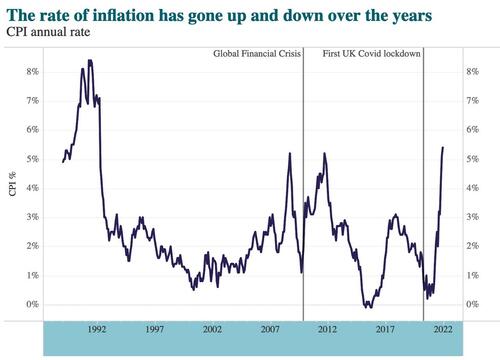
Source: BoE
But Bailey’s comments were taken as insensitive largely because of his own pay package (disbursed out of the public purse) is worth more than £575K ($777K).
One CNBC reporter spoke with some Britons to gauge their thoughts on Bailey’s comments, and as expected, they were furious.
“Telling the hard-working people who carried this country through the pandemic they don’t deserve a pay rise is outrageous,” said Gary Smith, general secretary of the pan-industry GMB trade union.
After all, it’s bad enough that surging heating costs are forcing many to choose between eating and staying warm.
5. RUSSIAN AND MIDDLE EASTERN AFFAIRS
YEMEN/USA/UAE/IRAN
Biden has decided to ramp up its involvement in the Yemen war, reversing course.
(DeCamp/Antiwar.com)
Pentagon Ramps Up Involvement In Yemen War As Biden Reverses Course
WEDNESDAY, FEB 09, 2022 – 10:10 PM
Authored by Dave DeCamp via AntiWar.com,
Gen. Frank McKenzie, the head of US Central Command (CENTCOM), visited the UAE this week and vowed more support for Abu Dhabi’s war against the Houthis as the US escalates its involvement in the war in Yemen.
In the wake of recent Houthi attacks on the UAE, the US is deploying the USS Cole to the country, and McKenzie said a squadron of US F-22s would arrive next week. “We’re going to bring in a squadron of F-22 fighter jets, the best air superiority fighters in the world,” he said, according to UAE state media.

McKenzie said the F-22s will work with the UAE to “help defend the nation.” In recent weeks, the US helped Abu Dhabi intercept Houthi missiles. He said the USS Cole will “patrol the waters of the UAE, working closely with UAE air defenders to protect their nation.”
The cooperation is framed as “defensive” in nature, but it’s important to note that the Houthis wouldn’t be attacking the UAE if the country hadn’t been waging war on Yemen since 2015. The UAE’s support for militant groups on the ground in Yemen has brought the Saudi-backed government recent success on the battlefield against the Houthis.
McKenzie said the US is also working to give the UAE the ability to hit Houthi drones inside Yemen before they’re launched. “We are working with our partners here in the region and with the industry back in the United States to develop solutions that would work against drones. We would like to work against drones what we call ‘Left of Launch’, [which means] before they can be launched,” he said.
The Biden administration recently approved a $65 million arms sale to the UAE to upgrade Abu Dhabi’s Hawk, THAAD, and Patriot missile defense systems.
Israel is also looking to bolster the UAE’s missile defenses and is reportedly considering selling Abu Dhabi the Iron Dome. On Tuesday, Lt. Gen. Michael Kurilla, who is nominated to be McKenzie’s replacement, said Israel’s cooperation with the UAE and other Gulf nations in missile defense is promising.
“That’s probably the area with some of the greatest opportunity: working toward an integrated air and missile defense. I think the addition of Israel… will help with that,” Kurilla said.
end
Russia Lashes Out After UK Talks: “Like A Mute Talking To A Deaf Person”
THURSDAY, FEB 10, 2022 – 11:40 AM
For the past month Britain has been at the forefront of Western allies taking muscular action aimed at Russia over the Ukraine standoff, being the first country to initiate large military weapons shipments into the country, and recently issuing explosive allegations that Moscow is plotting a coup in Ukraine to install a pro-Kremlin puppet.
Given all of this, it should come as no surprise that a high-level meeting between UK Foreign Secretary Liz Truss and Russia’s Foreign Minister Sergey Lavrov ended in anger and finger-pointing, which was a much different tone compared to the amicable atmosphere of the Putin-Macron meeting days ago. It further underscores the emergent de facto divide among NATO allies – the Germany-France side is seeking robust diplomacy and de-escalation, while the US-UK and some Baltic states appear bent on muscle-flexing and confrontation. In recent days, NATO leaders have taken pains to stress the Western alliance is “unified” and unshaken in the face of Russian “aggression”.
The Thursday meeting in Moscow appears to have been disastrously confrontational, with the Russian side charging the UK with grandstanding and stubborn refusal to listen to any legitimate concerns…
“I’m honestly disappointed that what we have is a conversation between a dumb and a deaf person…Our most detailed explanations fell on unprepared soil,” Lavrov told a joint news conference with Britain’s Liz Truss.
“They say Russia is waiting until the ground freezes like a stone so its tanks can easily cross into Ukrainian territory. I think the ground was like that today with our British colleagues, from which numerous facts that we produced bounced off,” he continued in usually accusatory language.
Truss in response used the occasion to again charge Russia with preparing to invade its sovereign neighbor:
“I can’t see any other reason for having 100,000 troops stationed on the border, apart from to threaten Ukraine. And if Russia is serious about diplomacy, they need to remove those troops and desist from the threats,” she said.

“No one is undermining Russia’s security – that is simply not true,” Truss added. On the question of seeking NATO membership, she said it remains “perfectly proper” for Ukraine to seek allies to help defend itself.
In a marked departure from Macron’s more conciliatory words while in Moscow this week (good cop, bad cop perhaps?), she said, “If there were to be a Russian incursion into Ukraine, the Ukrainians will fight.” She warned: “This would be a prolonged and drawn-out conflict. The UK and our allies would put in place severe sanctions targeting individuals and institutions. The United States has been clear that Nord Stream 2 [the pipeline project] would not go ahead.” Though the question remains just how the US could go about shutting down a pipeline which is complete, and already a de facto reality.
END
6// GLOBAL COVID ISSUES/VACCINE MANDATE ISSUES/
CORONAVIRUS/UPDATE/VACCINE MANDATE
a very good commentary from TomLuongo
(Tom Luongo)
END
CANADA
This person is correct … please read this
Inbox

| Robert Hryniak | 9:44 AM (2 minutes ago) | | |
| to |
Please take the TIME to read It’s not my text, but because it’s VERY IMPORTANT FOR US to know… I copied it to pass on to you…
“It is not Trudeau’s choice to step down or to attempt to stay. It is the decision of the World Economic Forum (WEF). This is a critical decision which will affect the entire world. This is not a battle for just Canada, it is a battle for the World. This is the first domino of corruption and if it falls, the entire plan of the WEF fails because all the corrupt dominos will fall if they are forced out of power. Leaving them in power really is simply a short respite for the People.
Frankly, the WEF cannot afford for Trudeau to step down. If he falls, Biden falls, Australia falls, New Zealand falls and all of Europe falls. Then the rest of the world joins in.
The sane world is crazy not to make Ottawa the hill they will die on and not give in. It is an opportunity unexpected. Probably an opportunity that will not come again.
The Truckers are truly the People’s Army. Where else could you quickly assemble such a strong, younger Army to possibly confront the Globalist Tyranny Army? It is an Army everyone else can join and get behind. Half the Globalist Tyranny Army will desert them and join the Truckers if they appear to succeed in Ottawa.
Truckers can win, this but it will take support from everyone. There is a window of opportunity that will not stay open forever. Time is not on our side.
The WEF is not going to go without a fight or without having great fear that they will be smashed by this world-wide movement. Even then the WEF members will be sorely afraid of ending up like Mussolini hanging in the Milan Square and will fight to avoid that.
I think people greatly underestimate the overall importance of Ottawa and underestimate the difficulty of overcoming Trudeau. He and the WEF simply cannot afford to lose. I fear also that the People of the world cannot afford to lose in Ottawa. It will likely be the People’s last battle if they lose Ottawa.
I do not agree that this is only about a non violent confrontation. I don’t think the WEF will fold because of a lengthy non violent protest of a few thousand truckers. They have been working on this tyranny plan for 100 years. I think they will fold only if they are clearly weaker in strength than the People’s Army. Whether it is non violent or violent confrontation, for either way to succeed requires great power standing behind the Truckers with obvious reserve waiting behind them. This means the WEF must act now before the People’s Army grows too large with strong reserves. I expect action by the WEF soon to squash this uprising. This is not about Trudeau, this is the WEF plan in place around the world. Everyone must be ready to heavily support the Truckers and step into the battle if they are attacked.”
The reality is the amount of protests across Canada is growing, not diminishing. This is especially true as more and more Canadians and other people around the world realize and learn what this is really about and the Pawn that Trudeau really is. Even long time die hard liberals are turning away from what Trudeau represents as they realize the truth of what he symbolizes. The liberal party is no more as it has become an extension of the WEF agenda. And it is clear that his support within the party is minimal at best and the cracks are clearly showing. Just listen to the 2 liberals who have broken ranks in recent days. Trudeau is both weak and a fool. He has listened to Schwab who could care less about Trudeau as all that matters to him is force his economic theories on the world. And he does not care about you or what you want.
This no longer a simple Canadian expression of saying no but a growing grassroots event that is inspiring the world to stand up for freedom. Whether a natural born Canadian or a immigrant from another country, people have always seen Canada as a refugee from tyranny and enslavement and a beacon of FREEDOM and many people have given their lives so that Canadians can be free, and we have been blessed by their sacrifice. It is now our time and turn to stand for Canada, one and all, and not give in to the boot of tyranny of politicians acting on behalf of the WEF. If you still doubt, listen to the video made back in 2017 where Klaus Schwab brags about how he controls Trudeau and other members of cabinet. His lips tell all!
This is a serious international plot to FORCE by undemocratic means, the economic philosophy of one very sick man with visions of Marxist grandeur. This is no conspiracy theory. This is the best-organized plot to take over the world far beyond anything ever played out in a James Bond movie.
You may not know the Police in Ottawa took away the fuel and other supplies from the Truckers, only to find out that volunteer Firemen were returning the same supplies as they legally are entitled to do so and there is nothing the police can do. If we do nothing and do not take a stand and give support we will fail ourselves, our relatives, our neighbors and friends, our country and all those around the world that the Truckers have inspired including us to talke action.
The choice is yours to make.
GLOBAL ISSUES/INFLATION
We knew that this will happen!! North American automakers shutter production amid Canadian trucker blockade
(zerohedge)
North American Automakers Shutter Production Amid Canadian Trucker Blockade
THURSDAY, FEB 10, 2022 – 09:02 AM
We warned days ago that if the Ambassador Bridge that connects Windsor, Ontario, with Detroit, were to remain closed until the end of the week, there would be severe consequences for North America’s auto industry.
As of Thursday morning, automakers including Toyota, Chrysler Pacifica, Ford, and General Motors halted or limited production at their Canada/U.S. manufacturing plants due to Canadian truckers blocking the busiest international land border crossing between the U.S. and Canada over vaccine mandates.
Ford told AP that it suspended engine production in Windsor while its factory outside Toronto had reduced production.
“We hope this situation is resolved quickly because it could have a widespread impact on all automakers in the U.S. and Canada,” the company said.
Chrysler-maker Stellantis is facing an urgent parts shortage at its assembly plant in Windsor, where it had to cut shifts on Tuesday but resumed some production yesterday,
Due to part shortages, General Motors reduced output at its Lansing, Michigan, making SUVs for Buick, Chevrolet, and GMC brands.
Toyota expects to have three manufacturing facilities in Ontario offline for the rest of the week due to part disruptions. The company told Newsweek via email:
“Due to a number of supply chain, severe weather, and COVID-related challenges, Toyota continues to face shortages affecting production at our North American plants, including Toyota Motor Manufacturing Canada,” the company said in its statement. “Our teams are working diligently to minimize the impact on production. While the situation is fluid and changes frequently, we do not anticipate any impact to employment at this time.”
Taking a look at Ambassador Bridge’s live cam into the U.S. (around 0840 ET) shows no truck and car inbound traffic.

Ambassador Bridge’s live cam in Canada is the same.
The blockade is so concerning that the Bank of Canada’s Governor Tiff Macklem warned Wednesday afternoon that the entire situation is very distressing and could impact the economy.
As Katabella Roberts writes at The Epoch Times, politicians are furious at the growing ‘minority’ daring to challenge their dominion.
White House spokesperson Jen Psaki also urged protesters to “understand what the impact of this blockage is” and the potential impact it could have on the supply chain.
“We’re also looking to track potential disruptions to U.S. agricultural exports from Michigan into Canada,” Psaki said in a press briefing.
Meanwhile, Trudeau decried the demonstrations this week, insisting that while “Canadians have the right to protest, to disagree with their government, and to make their voices heard,” what they do not have is the right “to blockade our economy, or our democracy, or our fellow citizens’ daily lives.”
“It has to stop,” Trudeau said.
For their part, Organizers of the Freedom Convoy 2022 maintain that Canada’s COVID-19 mandates and restrictions, which have been far stricter than those in the United States, are “destroying the foundation of our businesses, industries, and livelihoods.”
The vaccine mandate could see 10 to 15 percent, or about 12,000 to 16,000 of truck drivers off the road, estimated the Canadian Trucking Alliance (CTA), which said it does not support and strongly disapproves of the demonstration.
“Small businesses are being destroyed, homes are being destroyed, and people are being mistreated and denied fundamental necessities to survive. It’s our duty as Canadians to put an end to this mandate,” organizers say.
A recent survey by the Angus Reid Institute found that a majority of Canadians, 54 percent, are in favor of lifting restrictions in the country.
end
GLOBAL ISSUES/BIG PHARMA
Big Pharma is about to be sued out of existence because…….
Posted onFebruary 10, 2022byState of the Nation
FacebookTwitterPinterestRedditEmailPrintShare
FRAUD VITIATES EVERYTHING
There is now an overwhelming body of hard evidence that categorically proves that the American Big Pharma producers of Covid ‘vaccines’ committed intentional and egregious fraud in the roll-out of their extremely dangerous and deadly injections.
The true scope and magnitude of their fraudulent corporate conduct is only now coming to light; nevertheless, the irrefutable proof of premeditated fraud which has already been accumulated is so incriminating that Big Pharma will eventually collapse.
Pfizer, Moderna and Johnson & Johnson are not the only Big Pharma companies that have poisoned to death and/or sickened countless American citizens; all the other vaccine manufacturers are also culpable of perpetrating a multi-decade criminal conspiracy. For example, both the mandatory childhood vaccination schedules and voluntary adult flu shot programs have been rife with fraud and malicious intent as the rapidly growing number of serious vaccines injuries and deaths clearly indicates. See: FLASHBACK: COURT RULES VACCINES CONTRIBUTE TO AND CAUSE SIDS DEATHS
In point of fact, the great number of vaccine-induced injuries and post-vaccination deaths suffered by school children, which have occurred uninterruptedly over many years, is proof positive that Big Pharma knowingly committed a murderous fraud as they continue to today.
Let’s face it: When even a former BlackRock executive comes out and makes these damning statements, the end is near for the entire Big Pharma international crime syndicate.
Intentional Vax Fraud Committed by Big Pharma
Strips Liability Shield — Former Blackrock Exec
Conclusion
It’s not only Big Pharma that is BIG trouble with the American people.
The corporate Mainstream Media is also a willful accomplice in this genocidal scheme that is killing trusting citizens across the USA. For they could never have deliberately killed this many people were those two co-conspirators — Big Media & Big Pharma — not thicker than thieves.
If there’s any doubt about the sheer depth and breadth of this highly organized and well planned Covid depopulation scheme, the following video will forever erase it.
BOMBSHELL! Opening Statements at Grand Jury Investigation
Into Covid Crimes Against Humanity (Video)
All of this unprecedented litigation concerning COVID-19 crimes against humanity translates to one very firm and unmistakable conclusion as far as the Big Pharma corporate criminals are concerned:

Which means that Big Pharma will crash and burn in a day and a night after the U.S. citizenry takes them to court for the massive and highly calculated fraud that defines their unparalleled Covid crime spree. Because once they committed that intentional fraud, they immediately relinquished their corporate shield of liability.
Even more significantly, Pfizer, Moderna and Johnson & Johnson recklessly exposed themselves — both the corporate officers, scientists and physicians as well as the corporation — to criminal prosecution for mass murder.
Given the enormity and gravity of this ongoing crime wave, the only expected outcome of these legal proceedings is that these rogue companies will be shut down as fast as they terminated the Arthur Andersen accounting firm in 2002 after the Enron Scandal was fully prosecuted.
State of the Nation
February 9, 2022
END
VACCINE IMPACT
California Lawmakers Fast-Tracking Child Health Bills to Erode Parental Rights
February 9, 2022 5:25 pm

California lawmakers have chosen to fast-track several key child health bills that will further erode parental rights and infringe on parents’ ability to maintain medical freedom. Specifically, three fast-tracked bills involve forced COVID-19 vaccinations for children for school enrollment, and another allowing minor children to make their own vaccine decisions away from a parent. A third bill requires health care staff to complete cultural humility training to provide trans-inclusive health care. The Globe spoke with Karen England, Executive Director of the Capitol Resource Institute (CRI), a pro-family public policy organization educating, equipping, and engaging California citizens for 34 years. England shared her grave concerns about the bills, as well as the legislative processes being circumvented. “California has become like a co-parent in a divorce,” England said. “Government is the parent with custody and we are the visiting parent which has little say in important decisions. They think parents are the enemy and the barrier for what government wants to do.”
Bank Of Canada Warns “Very Distressing” Bridge Blockade Could Impact Economy
February 9, 2022 5:32 pm

At least one hundred protesters and dozens of vehicles blocked traffic between the busiest commercial crossing between the U.S. and Canada, the Ambassador Bridge, for the third day on Wednesday as some truckers have been given orders to re-route deliveries hundreds of miles to avoid logjams. “Problems for motorists heading toward the U.S. border continue. The Ambassador Bridge between Windsor and Detroit remains closed,” according to CityNews Toronto’s traffic reporter Kyle Hocking. Bank of Canada (BoC) Governor Tiff Macklem explained this afternoon that the Ambassador Bridge blockade is very distressing and could impact the economy. He said the disruption at the busiest commercial crossing between the U.S. and Canada could further strain supply chains.
END
Michael Every
on the major topics of the day
Michael Every…
Rabobank: An Echo Of The 1970s
THURSDAY, FEB 10, 2022 – 09:20 AM
By Michael Every of Rabobank
We are all focused on US inflation numbers today. So focused, in fact, that some of us think we know what the number already is, at least compared to the consensus of 0.4% m/m, 7.2% y/y. There was a strong response to the US 10-year auction yesterday, with indirect bidders (i.e., nudge-nudge-wink-wink foreign central banks) stepping up, which does not suggest much fear of an upside surprise pushing the US 10-year yield through the psychological 2% level. There is also market chatter of whispers that today will see a CPI downside surprise –so only 7.1% y/y? Such non-inflationaryness!!– for the first time in a while.
I get this is important. Another upside surprise and the odds of the Fed going 50bp in March would increase. A downside surprise and ‘inflation is over!’ memes will build, helped by ‘Too Big to Sail’ supply-chain logjams easing slightly at LA/LB port. (To be expected at this time of year by the way: and ready to change for the worst due to any number of trigger points).
But really, given all the statistical deep-tissue massaging going on –akin to the neck-cracking Thailand’s Wat Po school used to do before it was dropped for health and safety reasons– does anyone think inflation would actually be ‘over’ on the back of a one-tick downside surprise today? Of course, base effects alone say the y/y inflation headline rate will ease ahead. Yet in energy and in food in particular, ‘what goes up does not have to come down’, and 7% headline inflation can still be followed by 3% and still not mark any kind of win for central banks or consumers.
The key issue is if a workforce already either moving into crypto and out of their jobs, into retirement, onto the streets, or into trucks, is going to swallow a double-digit drop in real incomes or will push for much higher nominal wage growth. No wage growth suggests a nasty outcome, as you cannot spend what you don’t have. Wage growth suggests an echo of the ‘70’s. So the 2022 (and 2023) inflation story is far from over whatever happens today.
At the same time, the same people who focus intently on the minutiae of a 0.34% or a 0.35% reading in US inflation are not even glancing on the start of Russian military exercises next to Ukraine that could indicate an invasion according to the US sources markets are supposed to listen to. That is despite the fact that any invasion would force changes to everybody’s inflation forecasts. The logic of concentrating on the odds of a 0.01% difference in the m/m change in the CPI index as opposed to the bright-pink-rhino tail risk of 130,000 men, tanks, ships, planes, artillery and missiles, etc., eludes me. But you do you, Wall Street.
Ominously, Russia has already declared most of Ukraine’s Black Sea and Sea of Azov coastlines closed for missile drills from February 13-19. That map is an overlay with the one showing where fighting in Ukraine could hit the global grains trade, even though winter is not a worrying time for this to be happening. Moreover, there are other things to note with concern.
- First, Putin’s luxury superyacht, ‘Graceful’, just hurriedly left Germany before finishing repairs, according to local media. It did not require any historic bridges to be demolished to do so.
- Second, Ukraine almost certainly won’t accept the Minsk accords Russia and France want it to, even if backed by the EU, even if that were to be the united EU position. Experts say if Ukraine were forced to do so, the country would be thrown into chaos and likely splinter – again bringing Russia into the picture.
- Third, Russia has so far achieved nothing much beyond demonstrating the West is not united and the EU not capable of serious action (e.g., recent military flights taking cargo to Ukraine show 13-14 each from the UK and US vs. 1 from the EU). Will Russian troops just go home when military exercises officially end on 20 February, leaving Ukraine and NATO to rearm over the next few years? Russian military equipment could be stockpiled next to Ukraine (and stay in Belarus), meaning hostilities could restart quickly.
- Fourth, the Russian press make clear this issue is not going to go away. Ruslan Pushkov, a military analyst in Moscow, states even if Western concessions stall conflict for now, they will not hold longer term as “The West just doesn’t understand how much this is a question of life and death for us.” The Dean of the school of international relations at an elite Moscow university likewise argues, “I expect we’ll have this crisis with us, in various forms, for all of 2022, at least.” He sees it as just the start of a drawn-out, high-stakes phase of a Russian effort to change the European security architecture to a new form the West rejects. The aim, he believes, is to keep the threat of war ever-present, in order to harass war-averse Western leaders to negotiate. Yet continually threatening war and not acting could eventually see the West shrug – ironically, just like the market analysts who have a 0.01% difference in the m/m change in the US CPI index to worry about. What would Russia do then if it really is ‘a question of life and death’?
The key point is that we have significant room for market-moving upside or downside surprises today: and regardless of the US CPI print, the further out you look, the more that dynamic holds true.
(I would also like to apologise to the majority of readers who, even with translate functions, didn’t get the Russian punchlines yesterday. Both phrases were polite Soviet equivalents of very impolite US military acronyms to describe very bad situations that are not easily resolved.)
7. OIL ISSUES
8 EMERGING MARKET& AUSTRALIA ISSUES
Australia//// NEW ZEALAND/ SOUTH AFRICA/BRAZIL//COVID/VACCINES/LOCKDOWNS
AUSTRALIA
END
Your early currency/gold and silver pricing/Asian and European bourse movements/ and interest rate settings THURSDAY morning 7:30 AM
Euro/USA 1.1435 UP .0015 /EUROPE BOURSES //ALL GREEN
USA/ YEN 115.78 UP 0.180 /NOW TARGETS INTEREST RATE AT .11% AS IT WILL BUY UNLIMITED BONDS TO GETS TO THAT LEVEL…
GBP/USA 1.3574 UP 0.0042
Last night Shanghai COMPOSITE CLOSED UP 5.96 PTS OR 0.17%
Hang Sang CLOSED UP 94.36 PTS OR 0.38%
AUSTRALIA CLOSED UP 0.30% // EUROPEAN BOURSES OPENED ALL GREEN
Trading from Europe and ASIA
I) EUROPEAN BOURSES ALL GREEN
2/ CHINESE BOURSES / :Hang SANG CLOSED UP 94.36 PTS OR 0.38%
/SHANGHAI CLOSED UP 5.96 PTS OR 0.17%
Australia BOURSE CLOSED UP 0.30%
(Nikkei (Japan) CLOSED UP 116.21 PTS OR 0.42%
INDIA’S SENSEX IN THE GREEN
Gold very early morning trading: 1831.49
silver:$23.35-
USA dollar index early THURSDAY morning: 95.53 UP CENT(S) from WEDNESDAY’s close.
THIS ENDS THURSDAY MORNING NUMBERS
xxxxxxxxxxxxxxxxxxxxxxxxxxxxxxxxxxxxxxxxxxxxxxxxxxxxxxxxxxxxxxxxxxxxxxxxxxxxxxxxxxxxxxxxxxxxxxxxxxxxxxxxxxxxxx
And now your closing THURSDAY NUMBERS 1: 00 PM
Portuguese 10 year bond yield: 1.12% UP 10 in basis point(s) yield from YESTERDAY/
JAPANESE BOND YIELD: +0.230% up 2 AND 8/10 BASIS POINTS from YESTERDAY/JAPAN losing control of its yield curve/
SPANISH 10 YR BOND YIELD: 1.18%// UP 10 in basis points yield from yesterday.
ITALIAN 10 YR BOND YIELD 1.92 UP 15 points in basis points yield from yesterday./
the Italian 10 yr bond yield is trading 72 points higher than Spain.
GERMAN 10 YR BOND YIELD: RISE TO +0.302% IN BASIS POINTS ON THE DAY//
THE IMPORTANT SPREAD BETWEEN ITALIAN 10 YR BOND AND GERMAN 10 YEAR BOND IS 1.62% AND NOW ABOVE THE 3.00% LEVEL WHICH WILL IMPLODE THE ENTIRE ITALIAN BANKING SYSTEM. AT 4% SPREAD THERE WILL BE A HUGE BANK RUN…
END
IMPORTANT CURRENCY CLOSES FOR THURSDAY
Closing currency crosses for THURSDAY night/USA DOLLAR INDEX/USA 10 YR BOND YIELD/1:00 PM
Euro/USA 1.1482 UP .0061 or 61 basis points
USA/Japan: 115.87 UP 0.273 OR YEN DOWN 27 basis points/
Great Britain/USA 1.3629 UP 96 BASIS POINTS
Canadian dollar UP 24 pts to 1.2633
xxxxxxxxxxxxxxxxxxxxxxxxxxxxxxxxxxxxxxxxxxxxxxxxxxxxxxxxxxxxxxxxxxxxxxxxxxxxxxxx
The USA/Yuan, CNY: closed ON SHORE (CLOSED )..UP 6.3541
THE USA/YUAN OFFSHORE: (YUAN CLOSED (UP)..6.3534
TURKISH LIRA: 13.49 EXTREMELY DANGEROUS LEVEL/DEATH WISH/HYPERINFLATION TO BEGIN.
the 10 yr Japanese bond yield at +0.230
Your closing 10 yr US bond yield UP 10 IN basis points from WEDNESDAY at 2.021% //trading well ABOVE the resistance level of 2.27-2.32%) very problematic
USA 30 yr bond yield: 2.322 UP 7 in basis points
Your closing USA dollar index, 95.22 DOWN 27 CENT(S) ON THE DAY/1.00 PM/
Your closing bourses for Europe and the Dow along with the USA dollar index closing and interest rates for WEDNESDAY: 12:00 PM
London: CLOSED UP 21.48 PTS OR 0.28%
German Dax : CLOSED UP 16.05 points or 0.10%
Paris CAC CLOSED DOWN 36.20PTS OR 0.51%
Spain IBEX CLOSED UP 159.20PTS OR 1.84%
Italian MIB: CLOSED UP 25.42 PTS OR 0.09%
WTI Oil price 90.21 12: EST
Brent Oil: 91.45 12:00 EST
USA /RUSSIAN / RUBLE RISES: 74.69 THE CROSS LOWER BY 11 RUBLES/DOLLAR (RUBLE HIGHER BY 11 BASIS PTS)
GERMAN 10 YR BOND YIELD; +.302
CLOSING NUMBERS: 4 PM
Euro vs USA: 1.1449 UP .0028 OR 28 BASIS POINTS
British Pound: 1.3568 UP .0035 or 35 basis pts
USA dollar vs Japanese Yen: 115.96 UP .356
USA dollar vs Canadian dollar: 1.2713 UP .0036 (cdn dollar DOWN 36 basis pts)
West Texas intermediate oil: 90.14
Brent: 91.44
USA 10 yr bond yield: 2.036 UP 11 points
USA 30 yr bond yield: 2.322 UP 7 pts
DOW JONES INDUSTRIAL AVERAGE: DOWN 526.43 PTS OR 1.47%
NASDAQ 100 DOWN 351.32 OR 2.33%
VOLATILITY INDEX: 24.06 UP 4.06 PTS (UP 20.34.%
GLD/NYSE CLOSING PRICE $170.60 DOWN $0.61 OR 0.36%
SLV/NYSE CLOSING PRICE: $21.53// DOWN $.11 OR 0.51%
end)
USA trading day in Graph Form
Bullard Bombshell & Soaring CPI Spark VaR Shock-nado, Rate-Hike Odds Explode
THURSDAY, FEB 10, 2022 – 04:01 PM
A 40-year-high print for US CPI stole the jam out of most investors donuts today as the hawkish implications of the far hotter than expected inflation print sparked a total VaR Shock across every asset class
Notably, The White House commented that it would be appropriate for The Fed to recalibrate support for the economy (after blaming the soaring inflation on the pandemic). This sounds a lot like “meddling” with the independence of The Fed (cough Trump cough) but seems like a clear message to Powell that it’s ok to crash the economy (to slow inflation)… perhaps in the mistaken belief that it will somehow help his approval ratings?
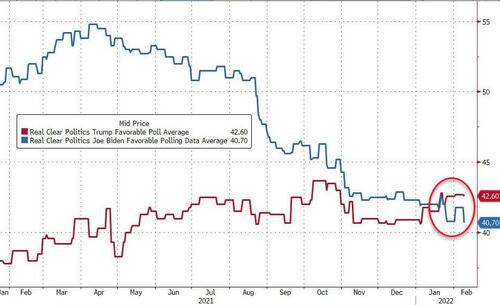
Since even Goldman admitted that the Fed has never successfully hiked its way into a soft landing, Biden is basically telling Powell to start a recession to undo the consequences of his idiotic fiscal policies that have sparked the biggest inflationary conflagration since Volcker… and having no job and soaring inflation would make matters worse for Biden’s approval rating.
As David Rosenberg (@EconguyRosie) notes, the best way to cure inflation? Recession. Yield curve getting close to inverting and making the call – 2s/10s less than 50 basis points away and 5s/10s within 10 basis points. Never mind bonds – things are getting very interesting for the stock market. Will the bulls fight the Fed?
St.Louis Fed’s Bullard piled on, urging a 50bps hike asap… and suggesting an inter-meeting hike (and a Q2 start to QT).
What the hell happened in the last 9 days to get to that from this…
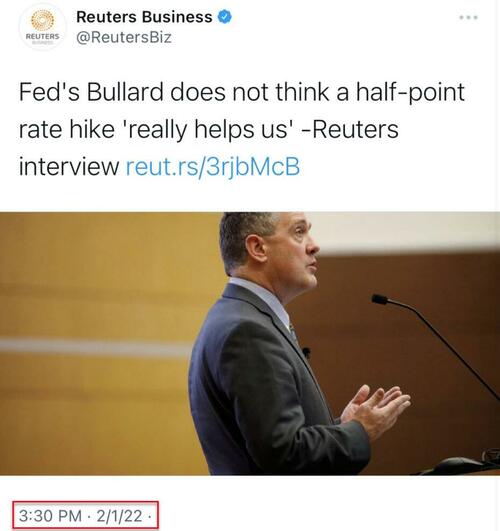
The Fed has not started a rate-hike cycle with a 50bps increase since at least 1990.
Rate-hike odds exploded higher with a 50bps hike by March now fully priced in…
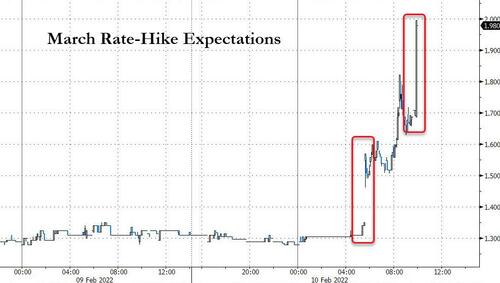
Source: Bloomberg
And even February now pricing in some rate-hike premium…
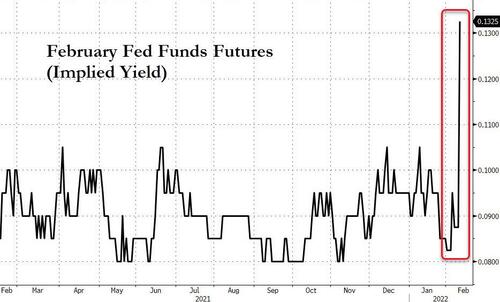
Source: Bloomberg
And finally, the market is pricing in a 40% chance of 7 rate-hikes this year…
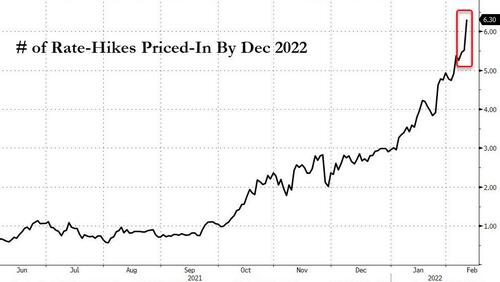
Source: Bloomberg
Today saw the greatest front-month Fed Funds Futures volume day ever… The volumes were at 300,000 in late Thursday trading, that’s about eight times more than usual levels.
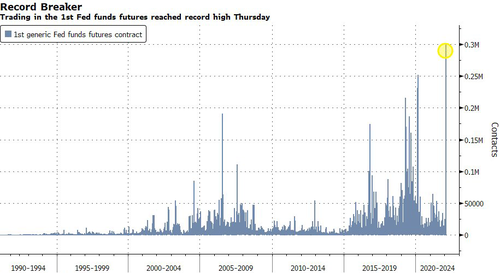
Source: Bloomberg
Yields exploded higher across the curve with the short-end massively underperforming (2Y +25bps, 30Y +8bps)…
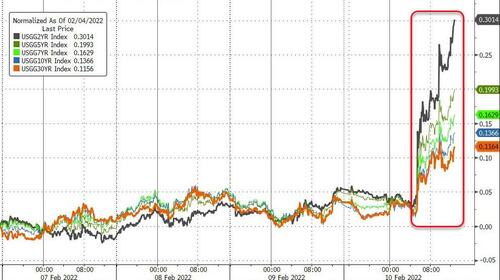
Source: Bloomberg
…pushing 10Y yields above 2.00% and 2Y above 1.60%…
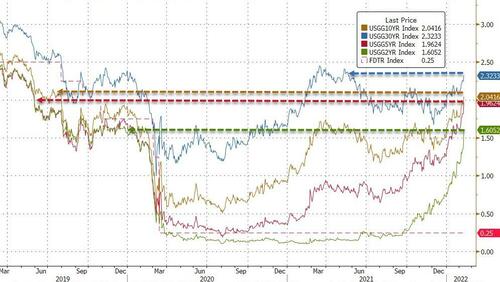
Source: Bloomberg
And as the market anticipates a sooner and faster rate-hike trajectory, the yield collapses as it prices in an imminent policy error.
The 5s30s curve crashed to just 35bps above inversion today…
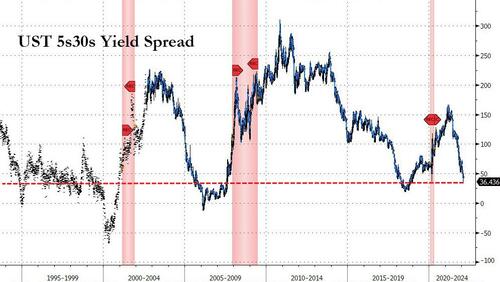
Source: Bloomberg
In the last 30 years, there have been just two times where the curve inverted and in both cases it was brief. Both times a recession followed but also the curve widened as short- term rates fell more aggressively than the longer end of the curve.
The last time we saw rates this jumpy was 2008/9…
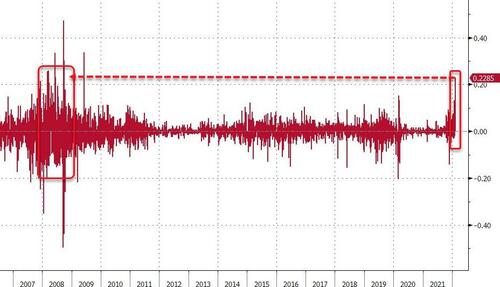
Source: Bloomberg
And the forward market shows 2s30s has actually inverted one-year out (recessionary indicator)…
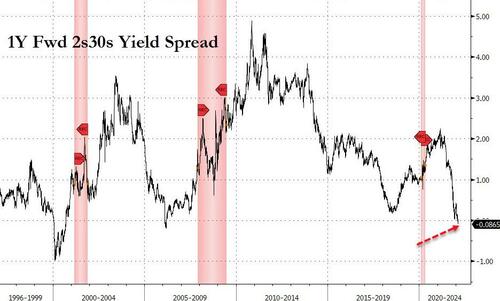
Source: Bloomberg
Equity markets were an utter shitshow also today, flying around all day until Europe closed and then it was “sell Mortimer, sell!” with all the majors closing at the lows of the day. Nasdaq was the worst performer on the day but Small Caps had the wildest swings…
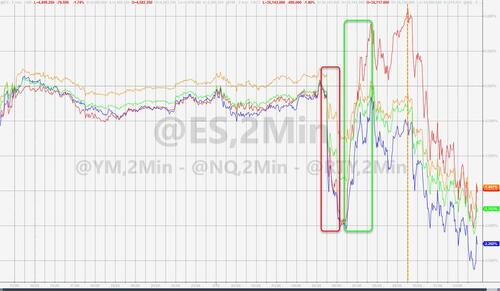
Today’s drop sent The Dow, S&P, and Nasdaq back underwater on the week.
The S&P fell back below its 100DMA, as did The Dow…
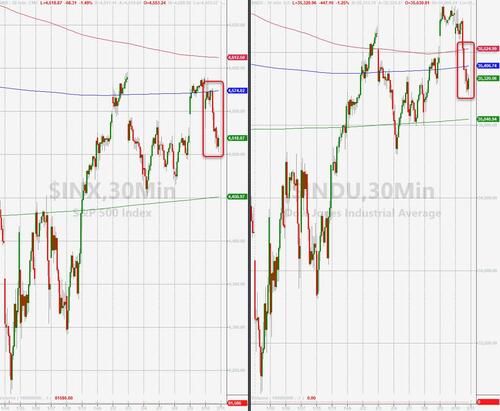
All the sectors ended red on the day, with financials and energy the least bad horse in the glue factory…
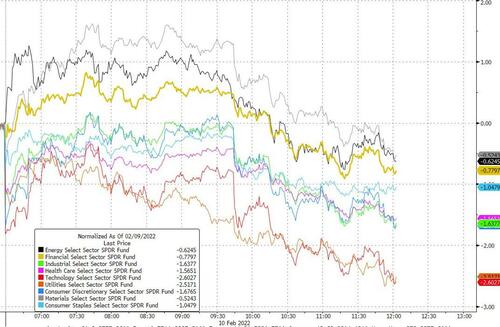
Source: Bloomberg
Notably financials are still relatively outperforming the market (as rates rise), but have dramatically decoupled from the yield curve…
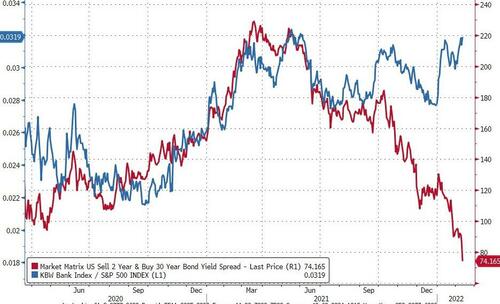
Source: Bloomberg
And Nasdaq has a long way to fall relative to Small Caps if Real Yields are to be believed…
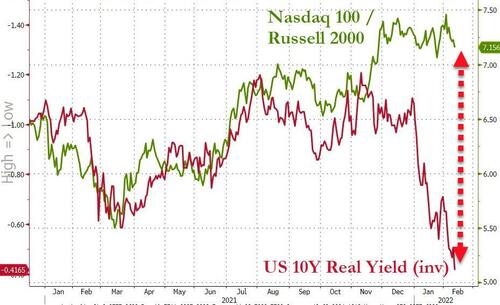
Source: Bloomberg
Credit markets cracked wider again today and VIX started to play catch up…
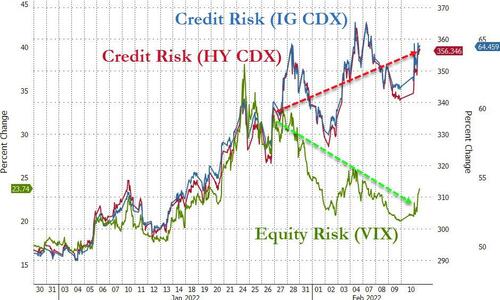
Source: Bloomberg
Credit anticipates, equity confirms…
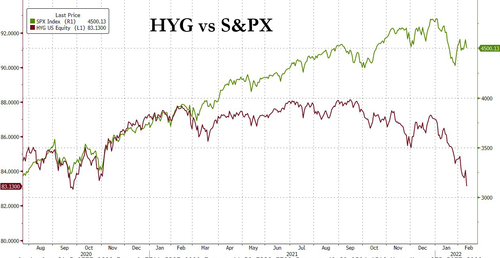
Source: Bloomberg
The Dollar was utter chaos: soaring on the hawkish CPI print, then collapsing to 4-week lows before rebounding on Bullard’s hawkish comments…
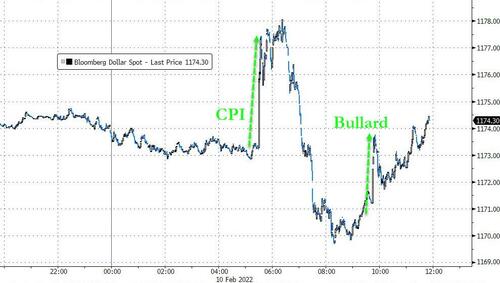
Source: Bloomberg
And the dollar closed unchanged on the year…
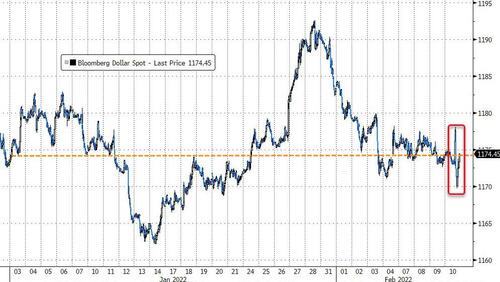
Source: Bloomberg
Bitcoin was just as chaotic, dumping below $43.5k, ripping to almost $46k, and then back to $44.5k…
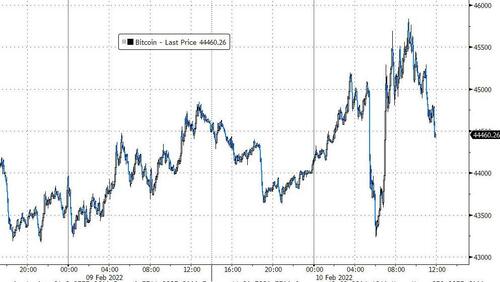
Source: Bloomberg
Gold ended the day marginally lower but also had quite a volatile day..
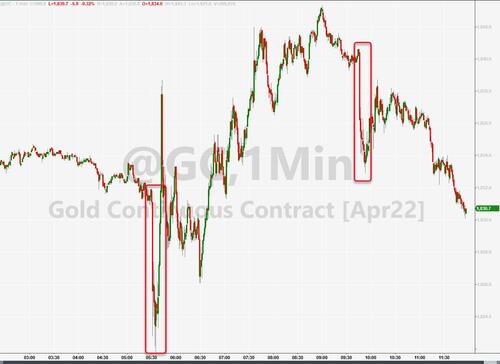
WTI ripped back above $91.50 after tumbling on CPI, then fell back below $90 at the settle…
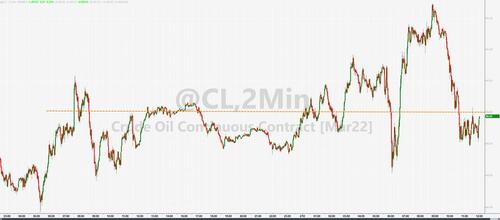
And finally, the forward OIS market is signaling rate-cuts are coming between 2023 and 2024… The last time the market was here, The Fed folded on its monetary tightening…
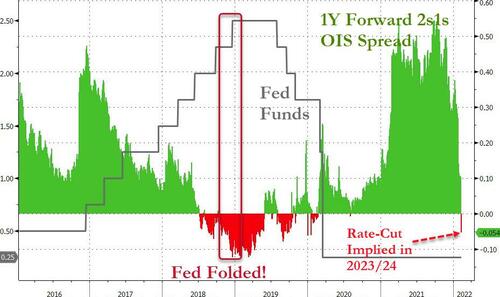
Source: Bloomberg
In fact OIS expect rates to top in Dec 2022 before The Fed is forced to react…
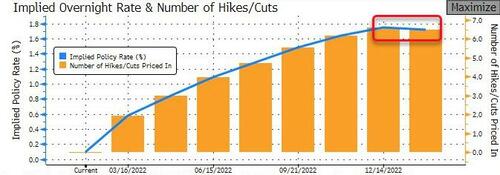
Source: Bloomberg
So there’s your recession countdown indicator!! 1 year and counting.
I) MORNING/AFTERNOON TRADING/
Everything Is Exploding Higher Now… Except The Dollar
THURSDAY, FEB 10, 2022 – 10:48 AM
Well that all turned around quickly.
The dollar is in freefall after spiking ion the hot CPI…
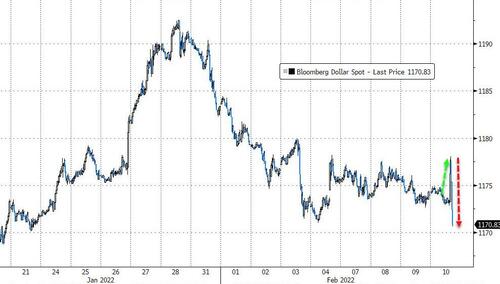
Stocks are soaring (S&P, Dow back into the green)
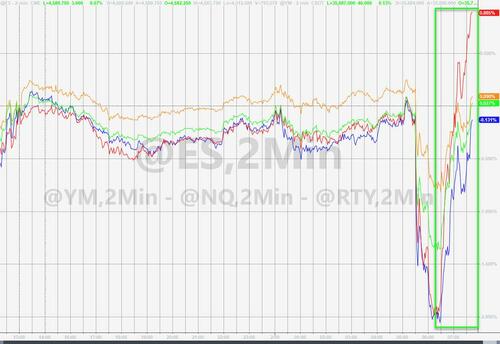
Gold is ripping higher…
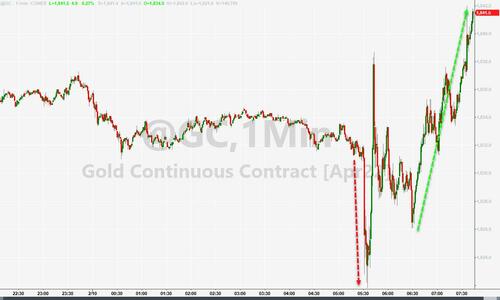
Crypto is rebounding to the highs of the day..
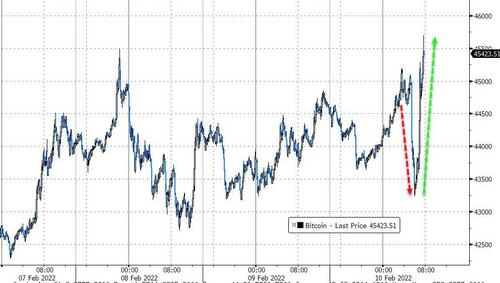
But bonds remain at their high yields of the day as 10Y breaks above 2.00%…
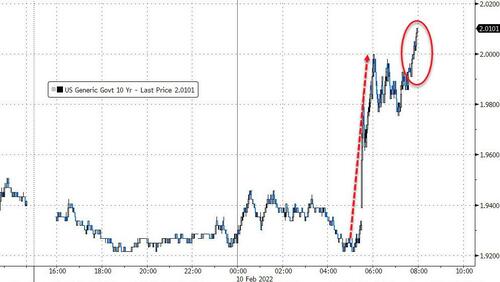
How long will this last? The European close, maybe?
END
Biden Addresses Soaring Inflation, Blames Pandemic, Lies About Wages
THURSDAY, FEB 10, 2022 – 10:37 AM
As his approval rating plunged below 40 for the first time – and is now significantly below that of President Trump at this time in his term – President Biden knew he had to come out and address the fact that despite all his promises, the average American is facing prices on consumer goods rising at their fastest in 40 years.
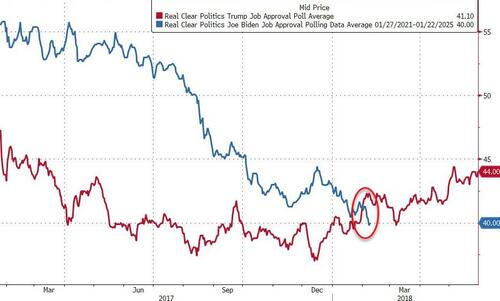
In a statement from The White House, the president blames the pandemic, says he has lots of tools, empathizes with ‘real stress at the kitchen table’, and then tells a giant fib about wages…
My two top economic priorities have been to create a growing economy with more good-paying jobs, and to lower the prices Americans have faced from the global problem of inflation related to the pandemic. We have seen historic success on the first priority, with the greatest year of job growth in history, Americans finding better jobs, better wages, and better benefits, along with the fastest economic growth in decades. On higher prices, we have been using every tool at our disposal, and while today is a reminder that Americans’ budgets are being stretched in ways that create real stress at the kitchen table, there are also signs that we will make it through this challenge.
While today’s report is elevated, forecasters continue to project inflation easing substantially by the end of 2022. And fortunately we saw positive real wage growth last month, and moderation in auto prices, which have made up about a quarter of headline inflation over the last year. We separately saw good news with new unemployment claims continuing to decline. That’s a sign of the real progress we’ve made in getting Americans back to work over the last year.
My administration will continue to be all hands on deck to win this fight. We will continue to rebuild our infrastructure and manufacturing, so we can make more in America and strengthen our supply chains here at home. We will continue to fight for costs in areas that have held back families and working people for decades, from prescription drugs to child care and elder care to their energy costs. And we will continue to promote more competition to make our markets more competitive and give consumers more choices.
The problem is – that is a lie!
Auto prices did anything but moderate…
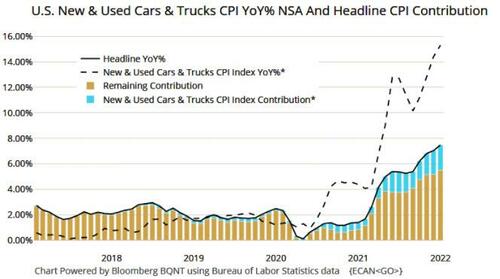
And Real wages are down for 10 straight months on a year-over-year basis…
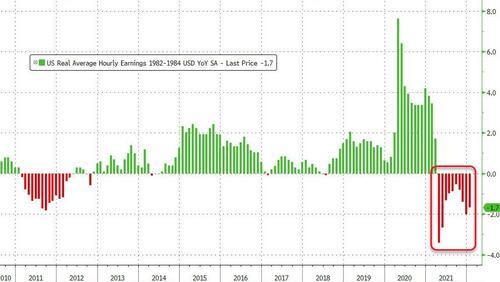
… but we thought ‘disinformation’ was terrorism now?
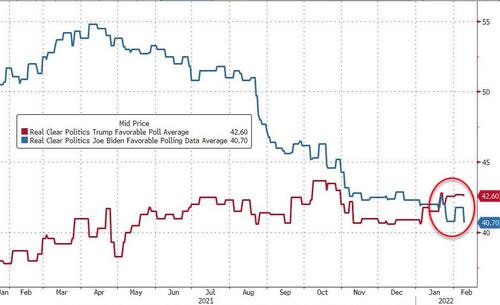
Perhaps that is why Biden’s current approval rating is below that of Trump’s current approval rating also?
END
II) USA DATA
Inflation hot at 7.5% per annum//real inflation around 13%
(zerohedge)
Rate-Hike Odds Spike After Hottest CPI In 40 Years
THURSDAY, FEB 10, 2022 – 08:36 AM
Expectations for this morning’s must-watch CPI were a continued non-transitory acceleration to +7.3% YoY (Core +5.9% YoY), but they underestimated as the headline printed a shocking +7.5% YoY – the highest since March 1982.
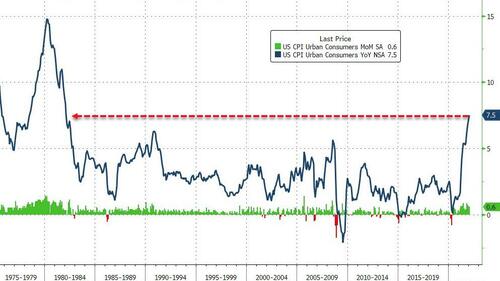
Source: Bloomberg
This is the 20th straight monthly rise in CPI, with both goods and services costs rising…
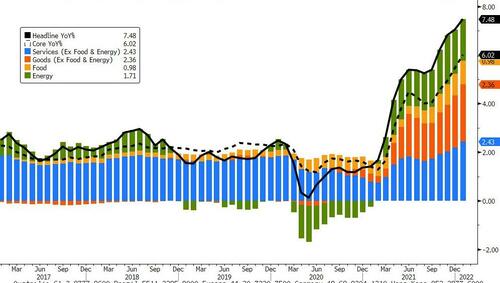
Source: Bloomberg
Below the headline print, core consumer prices rose 6.0% YoY (hotter than the 5.9% expected and highest since Aug 1982) as food, energy, and used car prices were the biggest drivers. The energy index rose 27.0% over the last year, and the food index increased 7.0%.
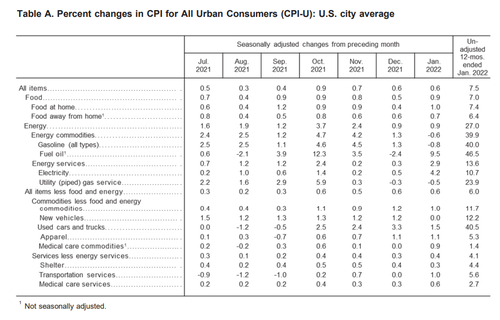
Source: Bloomberg
The food index increased 0.9 percent in January. The food at home index increased 1.0 percent over the month after rising 0.4 percent in December. Five of the six major grocery store food group indexes increased in January. The index for cereals and bakery products increased the most, rising 1.8 percent over the month. The index for other food at home increased 1.6 percent in January, while the index for dairy and related products rose 1.1 percent. The fruits and vegetables index rose 0.9 percent over the month, and the meats, poultry, fish, and eggs index increased 0.3 percent. The only grocery store group index not to increase in January was the index for nonalcoholic beverages, which was unchanged.
The energy index increased 0.9 percent in January. The electricity index rose sharply in January, increasing 4.2 percent. The gasoline index fell 0.8 percent in January after rising rapidly in the autumn of 2021. (Before seasonal adjustment, gasoline prices rose 0.1 percent in January.) The index for natural gas also declined in January, falling 0.5 percent after declining 0.3 percent in December.
Perhaps most problematic is Shelter/Rent inflation:
- Shelter inflation +4.36% Y/Y, highest since June 1991
- Rent inflation +3.76% Y/Y, highest since July 2019
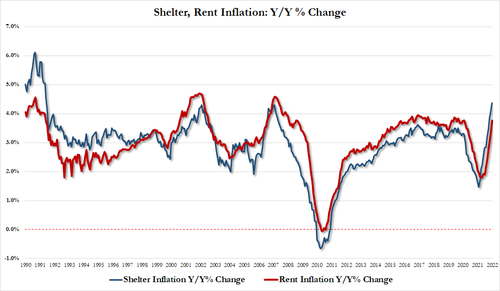
We also note that CPI-PPI – a proxy for margin compression – remains at extreme levels (and just this morning Unilever showed)
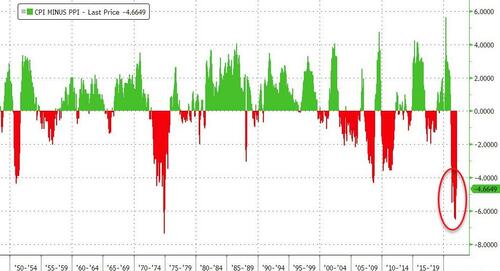
Source: Bloomberg
Finally, while politicians may proclaim wages are rising as a victory, the fact is that for 10 straight months, the cost of the shit you buy is outpacing the increases in incomes…
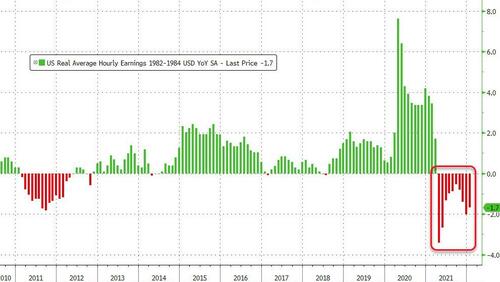
Source: Bloomberg
This print pushed the market up from 30% to 55% odds of a 50bps rate-hike in March…
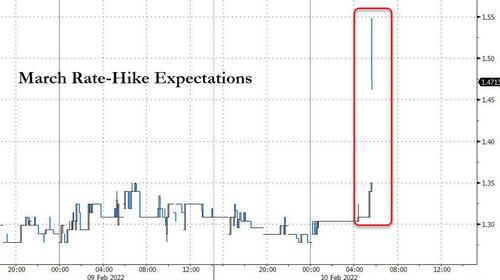
Source: Bloomberg
Now will The Fed start jawboning a higher risk of 50bps so as not to tally shock stocks?
end
Whispers Of An Emergency Fed Rate Hike As Soon As Tomorrow
THURSDAY, FEB 10, 2022 – 03:10 PM
With the punditry obsessing over the March FOMC meeting, where odds earlier today hit 100% of a 50bps rate hike before easing modestly (and more than 6 hikes for all of 2022)…
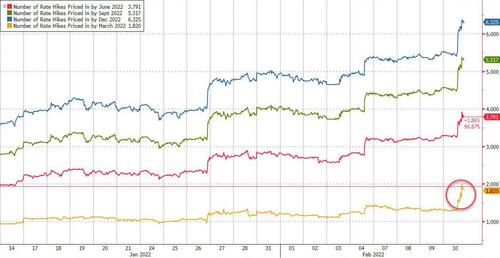
… the real action is in the February Fed funds contract which has spiked to 13bps, suggesting 5bps of tightening relative to the effective Fed funds rate of 0.08%.
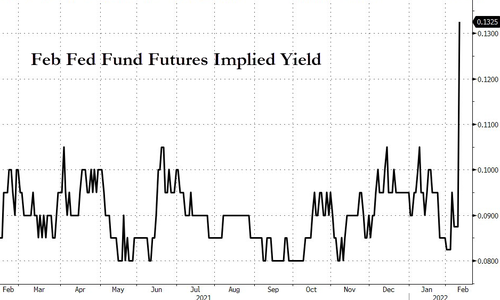
Why is this notable? Because the February contract expires on Feb 28, more than two weeks before the March 16 FOMC decision. This means that someone is preparing for an intermeeting rate hike, some time before March. And plugging in the numbers, the 13bps in the Feb contract means that there is now a 30% chance of an emergency rate hike.
Impossible? Not according to Fed watcher and SGH Macro strategist Tim Duy who writes that he would “not be surprised by an intermeeting move either tomorrow Friday or by Monday. I know, this is crazy aggressive.”
Aggressive? yes. Crazy? perhaps – after all the Fed is still buying bonds as part of its ongoing QE which is expected to conclude in late February/early March.
In other words, we may soon face the monetary paradox of the Fed hiking rates even as the Fed is still easing monetary policy through QE, and the biggest joke here – the Fed would be tightening conditions to contain inflation that is almost entirely supply-driven and which the Fed has no control over.
Of course, the Fed has done crazier things – like backstopping the entire corporate bond market and effectively nationalizing it during the peak of the covid crisis. So while we don’t know if the 30% odds of an emergency rate hike are accurate, be on the watch for an emergency Fed declaration tomorrow and Monday at 8:00am ET which is the Fed’s preferred time for unexpected pre-market announcements.
IIb) USA COVID/VACCINE MANDATE STORIES
Insanity! LA country sheriff’s department could lose 4,000 employees over COVID 19 vaccine mandate
LA County Sheriff’s Department Could Lose 4,000 Employees Over COVID-19 Vaccine Mandate
WEDNESDAY, FEB 09, 2022 – 08:10 PM
Authored by Katabella Roberts via The Epoch Times,
The Los Angeles County Sheriff’s Department is set to lose 4,000 employees who have not been vaccinated against the CCP (Chinese Communist Party) virus, which causes COVID-19.

The LA County Board of Supervisors is set to vote on the potential termination of 18,000 employees who have not complied with the COVID-19 vaccination requirements on Tuesday, the Los Angeles County Sheriff’s Department posted on Twitter Monday.
Of those 18,000 non-compliant employees, 4,000 belong to the Sheriff’s Department.
“These are the same law enforcement professionals, fire professionals, medical & health care professionals, mental health professionals, and others who we called HERO’s just a short time ago,” the department said. “Call the Board meeting tomorrow to share your public safety concerns and stop this social experimentation!”
The Board of Supervisors began establishing a policy requiring all LA County employees to submit proof of full vaccination against COVID-19 in August 2021.
Officials said employees needed to be vaccinated in an effort to “combat the elevated risk presented by the highly transmissible Delta variant and to prepare for the County’s imminent reopening of its buildings to the public.”
A COVID-19 vaccination policy was then implemented in October and requires that all LA County employees be fully vaccinated and submit proof of vaccination unless they have been granted a medical or religious exemption.
As of Feb. 1, 2022, 81.5 percent (82,298) of LA County’s approximately 100,000 employees are fully vaccinated, Los Angeles County Supervisor Sheila Kuehl said.
More than 90 percent of those vaccinated are employed by approximately a dozen LA County departments, while less than 60 percent of the employees in the Sheriff’s Department are fully vaccinated, Kuehl said.
“Unsurprisingly, approximately 74 percent of the more than 5,000 COVID-19-related workers’ compensation claims filed by County employees as of Jan. 29, 2022, have been filed by employees in the Sheriff’s Department,” the supervisor said.
The LA County Board of Supervisors says that this data illustrate the “vaccinations’ vital role in limiting the spread of COVID-19” and the “urgent need to increase vaccination rates across the entire County workforce.”
They have agreed to “discipline the employees of any County department for noncompliance” with the COVID-19 vaccine mandate and will be suspending or terminating such employees.
The Association for Los Angeles Deputy Sheriffs in December sued the Board of Supervisors, claiming that it does not have the legal authority to suspend or fire LA County sheriff’s deputies for noncompliance with the county’s mandatory vaccination order.
But the board maintains it has the legal authority to do so.
The Epoch Times has contacted the LA County Board of Supervisors for comment.
Los Angeles County Sheriff Alex Villanueva has been a vocal critic of the county’s vaccine mandate and repeatedly said he will not force his employees to get vaccinated, while calling the issue of COVID-19 vaccines “politicized.”
In October, Villanueva said that the termination of so many Sheriff’s Department employees could have dire consequences to public safety as the department was already struggling with “barebones” staffing issues due to “defund the police” efforts.
Prior to that, the sheriff also said that forcing vaccinated individuals and those who have already contracted COVID-19 to wear masks indoors is “not backed by science and contradicts the U.S. Centers for Disease Control and Prevention (CDC) guidelines.”
end
USA truckers set to support Canada with their own convoys to several USA cities
(Stieber/EpochTimes)
US Department Of Homeland Security Confirms It’s Monitoring Reports Of Potential Truck Convoy Protests
THURSDAY, FEB 10, 2022 – 12:40 PM
Authored by Zachary Stieber via The Epoch Times,
The U.S. Department of Homeland Security (DHS) has confirmed it’s tracking potential truck convoys in the United States after Canadian protests against COVID-19 vaccine mandates unfolded in multiple cities.
DHS “is tracking reports of a potential convoy that may be planning to travel to several U.S. cities,” an agency spokesperson told The Epoch Times in an email.
“We have not observed specific calls for violence within the United States associated with this convoy, and are working closely with our federal, state, and local partners to continuously assess the threat environment and keep our communities safe,” the spokesperson added.
“DHS will continue to share timely and actionable information with the public. Over the past year, DHS has increased timely and actionable intelligence and information sharing and strengthened operational coordination with partners across every level of government and the private sector.”
Secretary of Homeland Security Alejandro Mayorkas testifies before a Senate panel in the Dirksen Senate Office Building in Washington on Sept. 21, 2021. (Jim Lo Scalzo/Pool/Getty Images)
DHS is involved in helping secure the upcoming Super Bowl LVI, set to take place in Inglewood, California on Feb. 13.
“There are online discussions that suggest holding an event at a specific location near the Super Bowl on game day,” DHS said in a notice sent to federal, state and local partners and obtained by ABC News.
“While there are currently no indications of planned violence or civil unrest, if hundreds of trucks converge in a major metropolitan city, the convoy could potentially severely disrupt transportation, federal government and law enforcement operations, and emergency services through gridlock and potential counterprotests,” the DHS said.
The agency has also worked with various partners to boost security in the Washington region following the Jan. 6, 2021, breach of the U.S. Capitol.
Truckers in Canada recently descended upon multiple cities, including Ottawa, in protest against vaccine mandates. Starting Jan. 15, truck drivers entering Canada were required to be vaccinated. Foreigners were told they’d be rejected entry while Canadians who don’t show proof of vaccination must quarantine.

Protesters talk to police as a vehicle convoy blocks the Ambassador Bridge in Windsor, Ont., on Feb. 9, 2022. (Lisa Lin/The Epoch Times)
Some Americans have floated plans to organize similar convoys to Washington and elsewhere in protest against mandates, including one that requires truck drivers and other people trying to cross one of America’s land borders to be fully vaccinated.
Organizers of a group called The People’s Convoy announced Wednesday plans to gather in Indio, California on March 4 and rally that weekend “to defeat the unconstitutional mandates.”

Trucks part of the “Freedom Convoy” ride through downtown Ottawa, Canada, on Jan. 29, 2022. (Noé Chartier/The Epoch Times)
The trucker convoy will “roll out” of the state following the rally, organizers added, promising more details soon.
“Our brothers and sisters of the highway succeeded in opening Canadians’ eyes about the unconstitutional mandates and hardships forced onto their people,” organizers told more than 52,000 people on Facebook.
“Now it’s time for the citizens of the United States of America to unite and demand restoration of our constitutional rights.”
Other social media posts indicate the convoy will travel to Washington.
The convoys in Canada have disrupted some shipments to or from the United States, the White House said Feb. 7. The busiest U.S.-Canada border crossing was blocked by protesters starting the same day. Some U.S. automakers have paused output due to the protests.
end
Rand Paul: Dems Have “Overplayed Their Hand” With “Stupid Theater” COVID Mandates
THURSDAY, FEB 10, 2022 – 01:22 PM
Authored by Steve Watson via Summit News,
Senator Rand Paul urged Wednesday that Democrats have gone too far with forced mask mandates and other “theater” COVID restrictions, and that ironically it is working to bring Americans on the left and the right together in opposition to the regime taking away freedoms.

“You know, I think it’s no longer a right-left issue,” Paul stated, explaining “There may have been more of us on the right not liking the government mandates, but I think now you’re finding parents of children, whether they’re left of center, in the center, independents who really don’t like the idea of just forcing children to wear masks when the science doesn’t really indicate that the masks are working.”
“Even the CDC admits the cloth masks aren’t working,” Paul continued, noting “You see kids outside huddled in the cold, eating their sandwiches. You see kids playing outside in masks.”
“So I think it is bringing right and left together.” Paul continued, adding “I think in the end, the Democrats have really overplayed their hand on the mandates, because they’re going to lose their populous, they’re going to lose their public.”
The Senator further asserted “This is a turning point. I think it’s really getting to the point where the science is clear that the bulk and the vast majority of the masks people are wearing have no difference, make no difference, in the trajectory of the virus.”
“Ultimately Democrats are going to lose the public. And if they haven’t already lost the public, I think they’re getting there,” Paul reiterated.
He added “If it were just adults being stupid that would be fine, you have a right to be stupid in a free country, but you don’t have a right to force this on children.”
“These people will never let go of our freedoms or our children if we don’t push back,” Paul urged.
iii) USA inflation commentaries//LOG JAMS//
Stocks Tumble After Fed’s Bullard Urges 50bps Rate Increase, Suggests Inter-Meeting Hike
THURSDAY, FEB 10, 2022 – 12:55 PM
St.Louis Fed president Jim Bullard has gone full hawktard after the Biden White House appears to have greenlit The Fed to crash the economy:
- *FED’S BULLARD FAVORS 100 BPS INTEREST-RATE INCREASES BY JULY 1
- *BULLARD FAVORS FIRST HALF-POINT U.S. RATE INCREASE SINCE 2000
Finally, this seemed to trigger the push…
- *BULLARD: SHOULD BE OPEN TO CONSIDERING INTER-MEETING INCREASE
That sent the odds of a 50bps March rate-hike up to 100%…
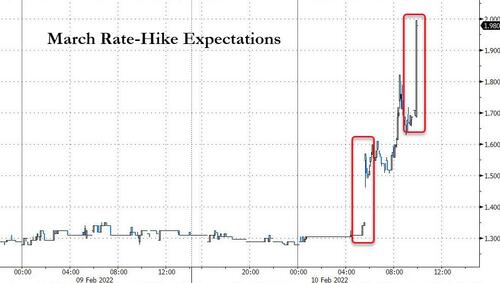
The February Fed funds contract expires Feb. 28, over two weeks before the March 16 policy decision, yet hike premium is creeping into the contract.
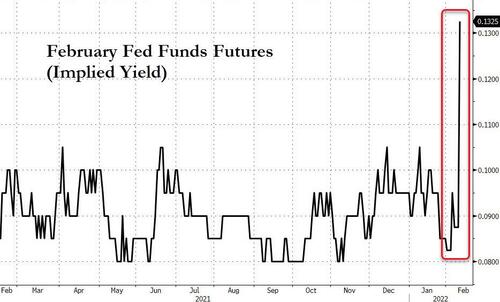
Stocks immediately lurched lower…
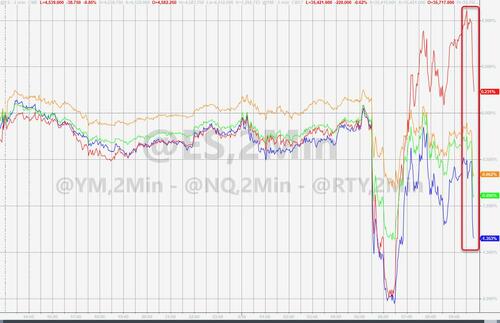
The 2Y yield is exploding higher after Bullard’s comments…
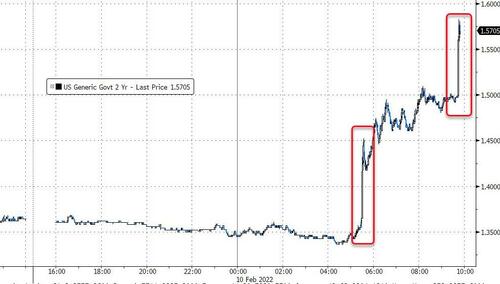
And finally, Bullard also noted that he favors starting QT (balance sheet reduction) in Q2 and added that this action may require asset-sales.
It is clear The Fed is desperate to figure out how to start a softly-landed recession without also crashing the market.
end
iv)swamp stories
end
KING REPORT/SWAMP STORIES
end
Let us close out the week with this offering courtesy of Greg Hunter
end
Well that is all for today. I will see you FRIDAY night


 harveyorganblog.com


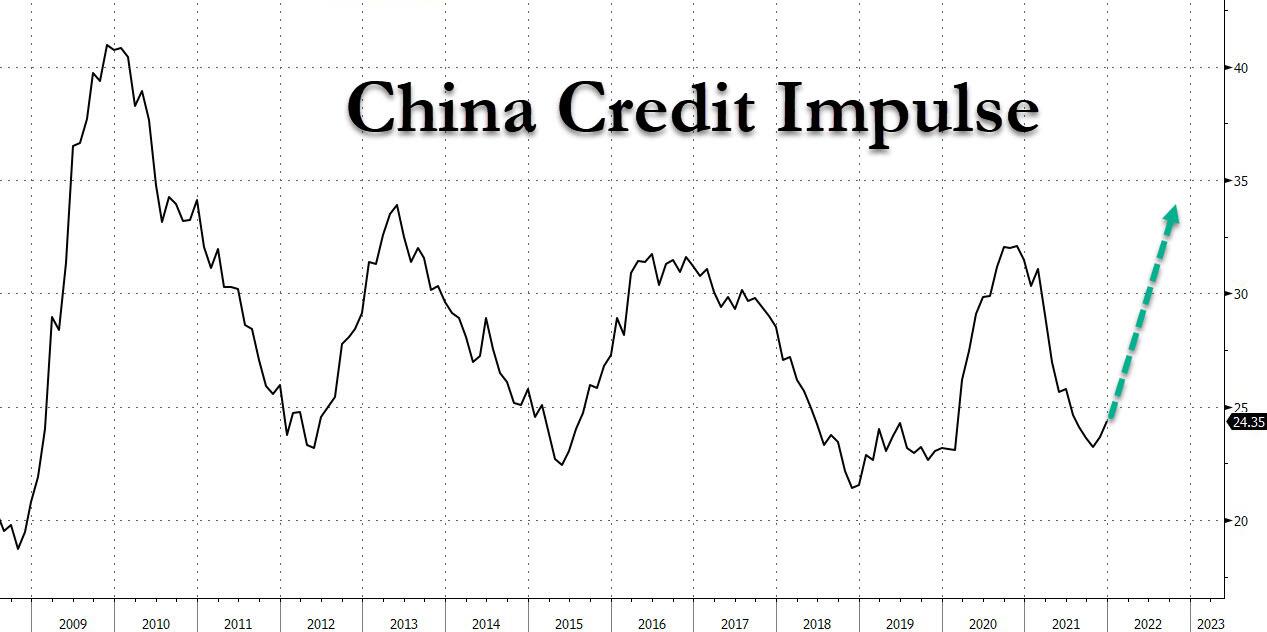
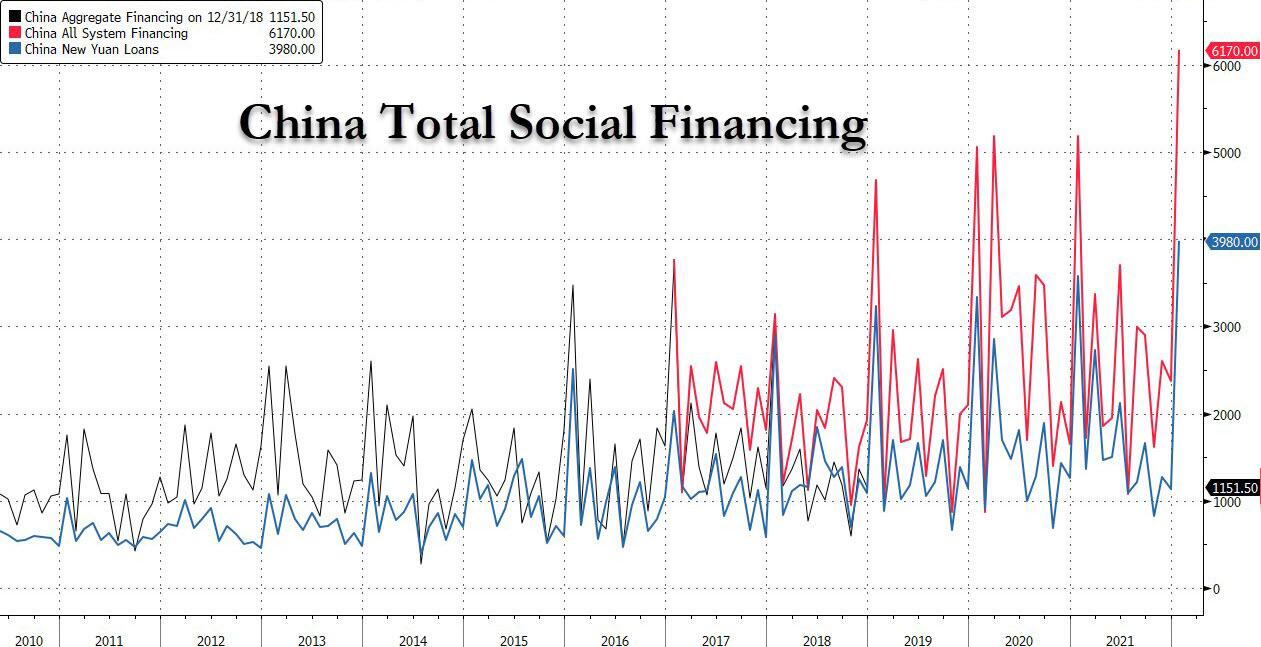

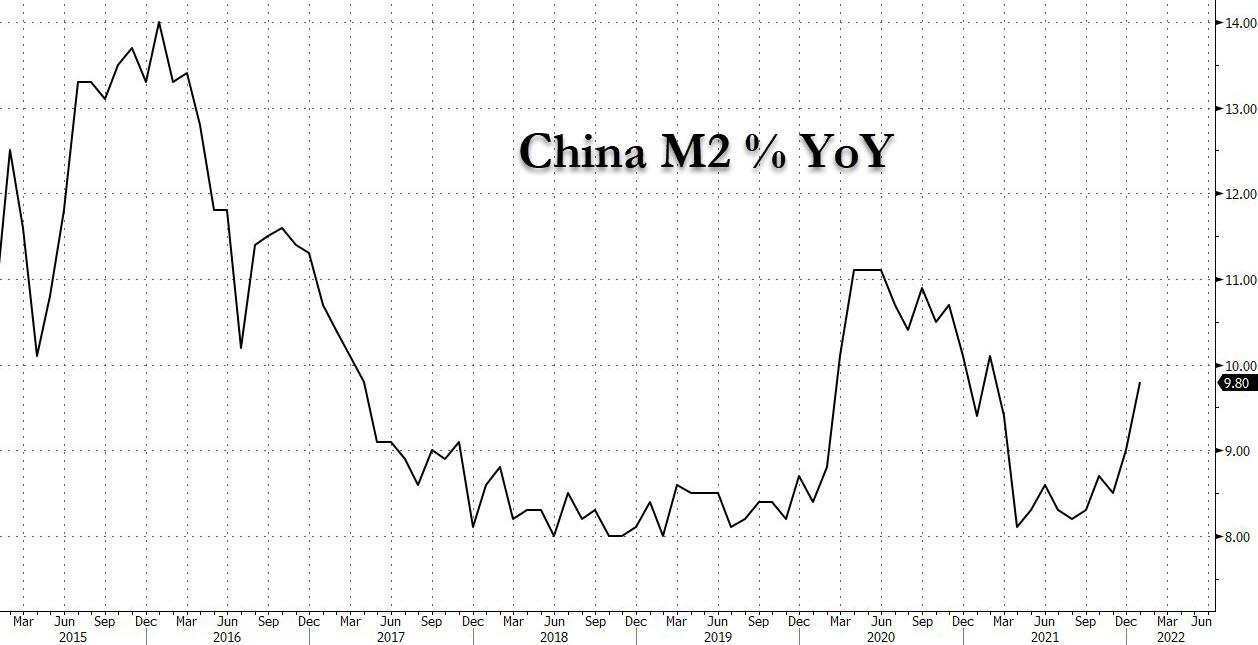
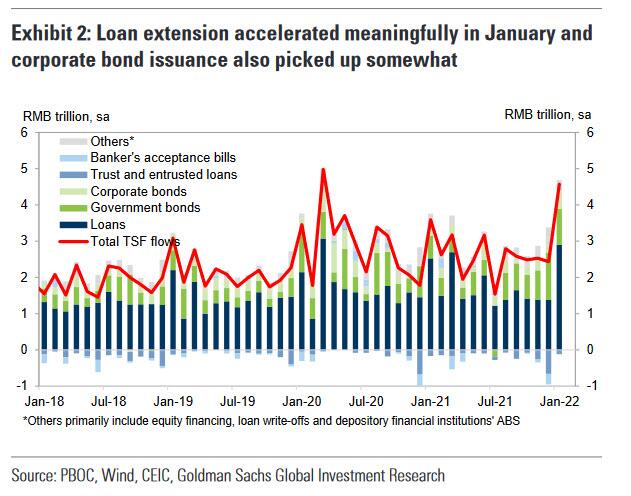

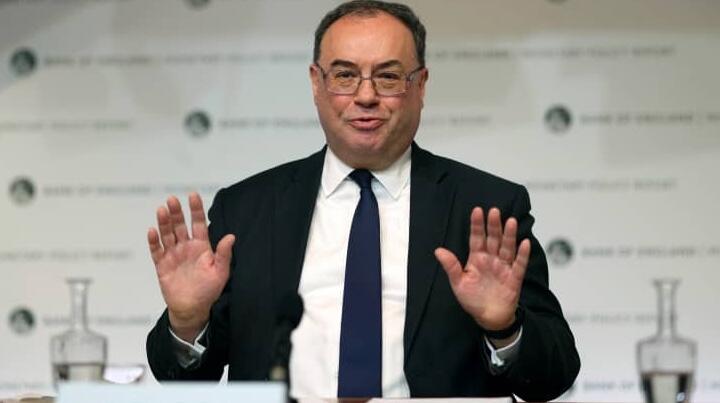


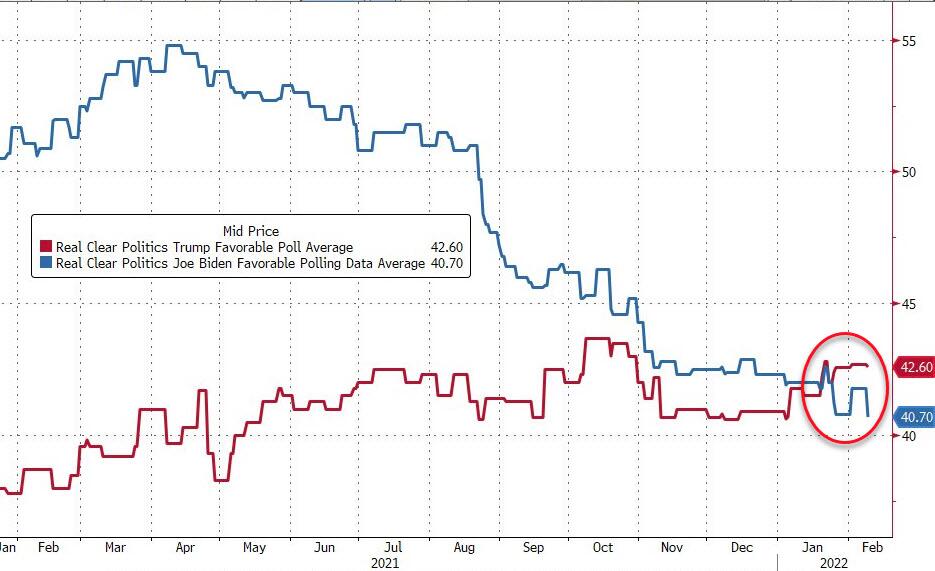

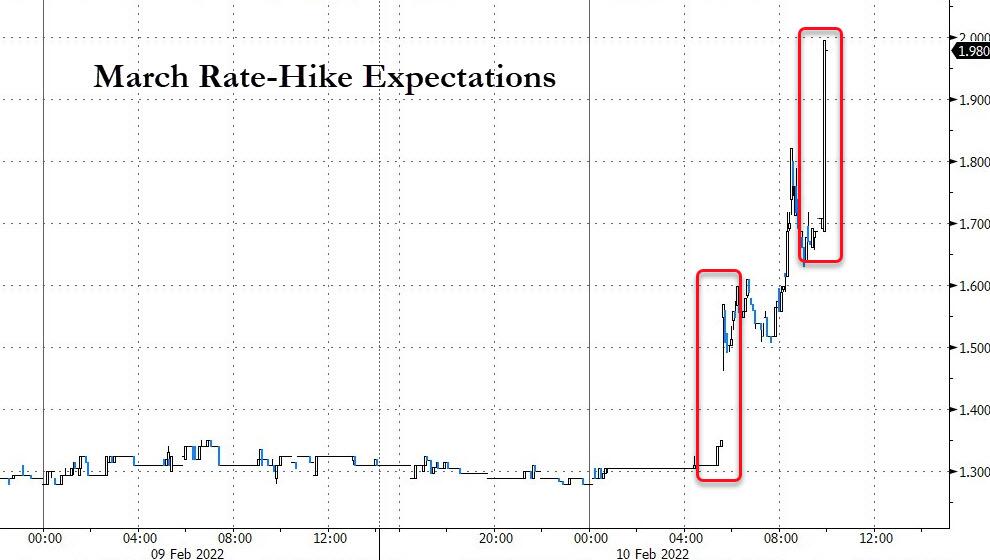
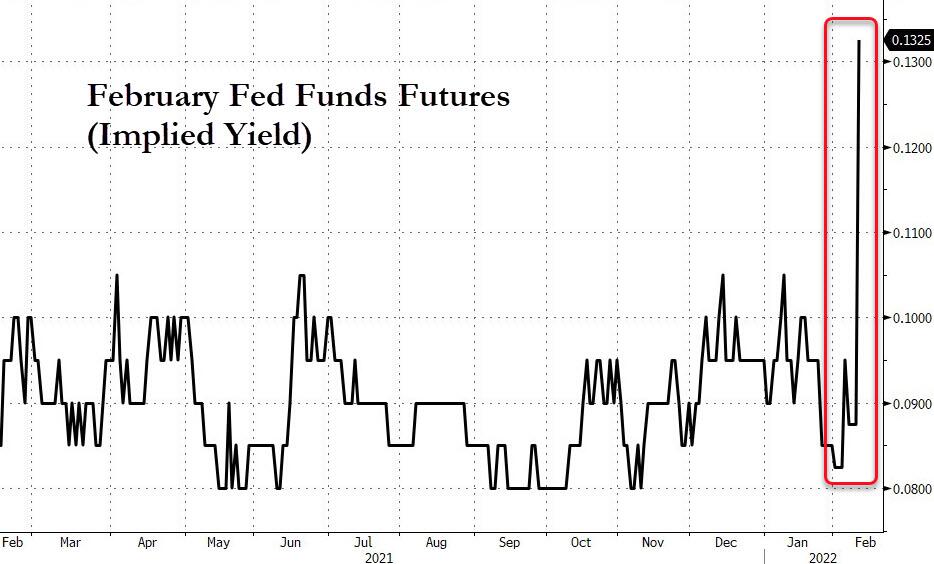

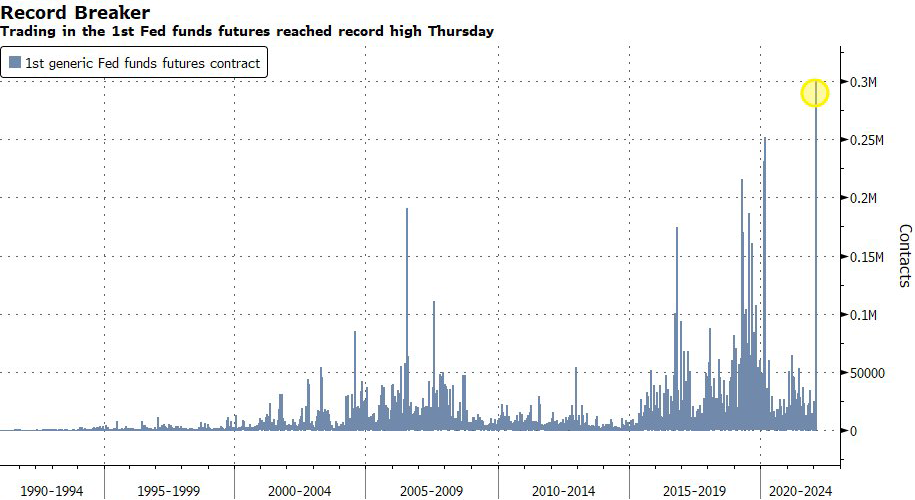
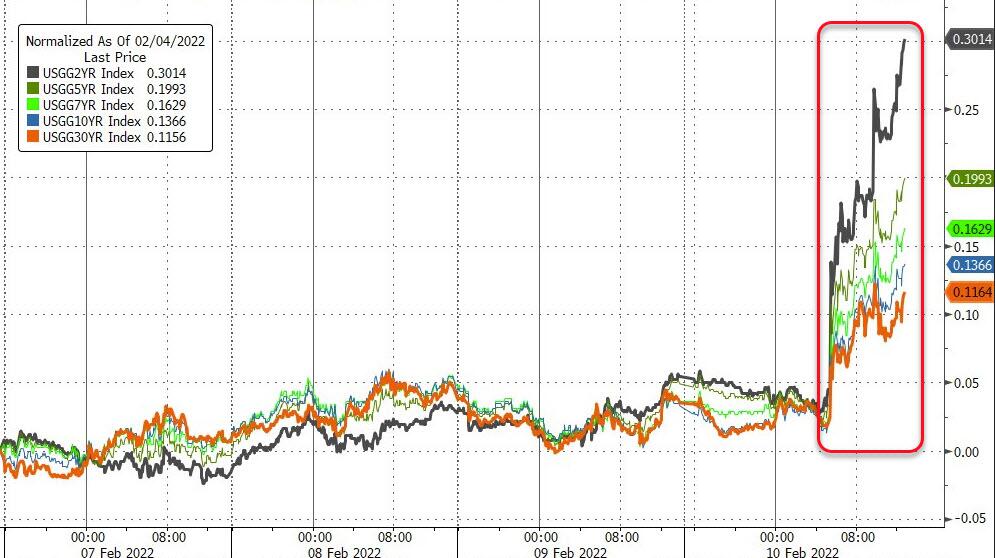
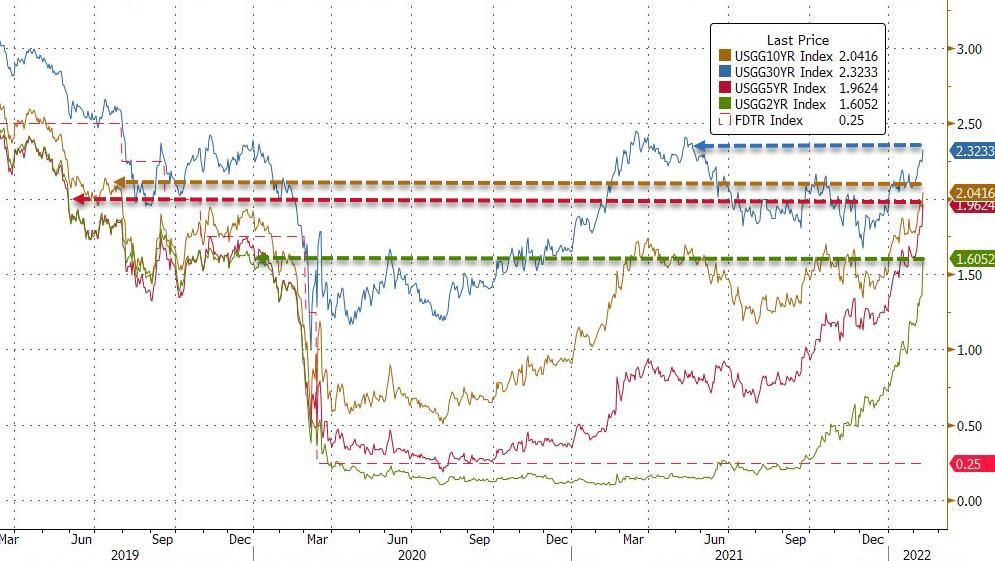

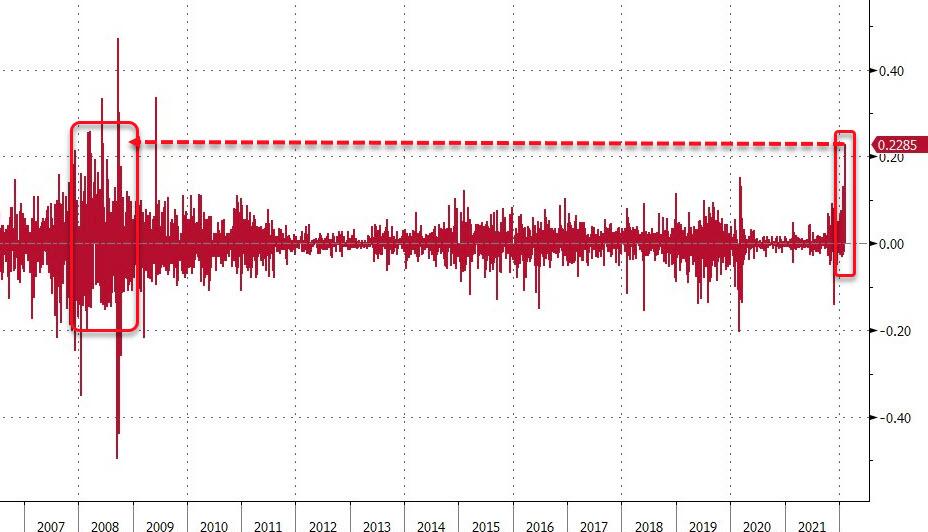
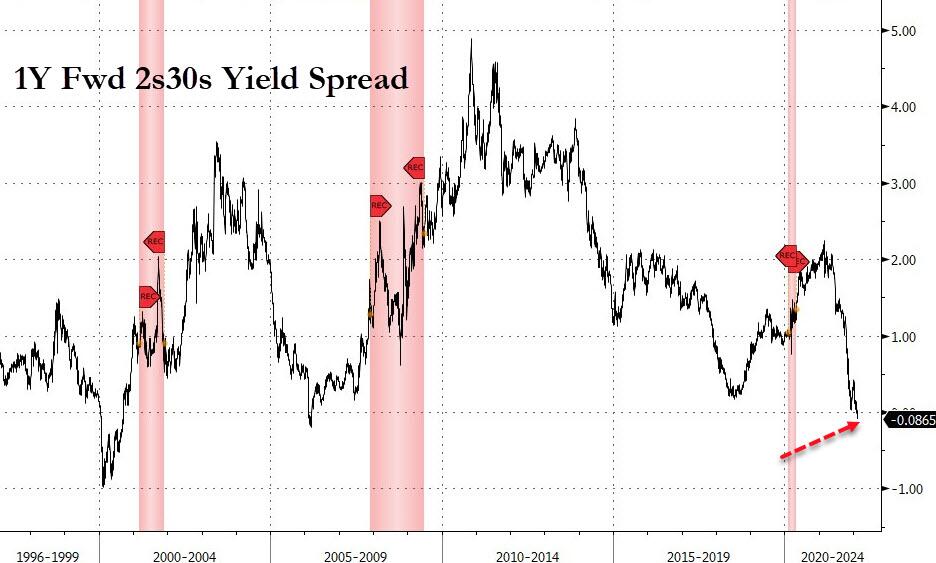

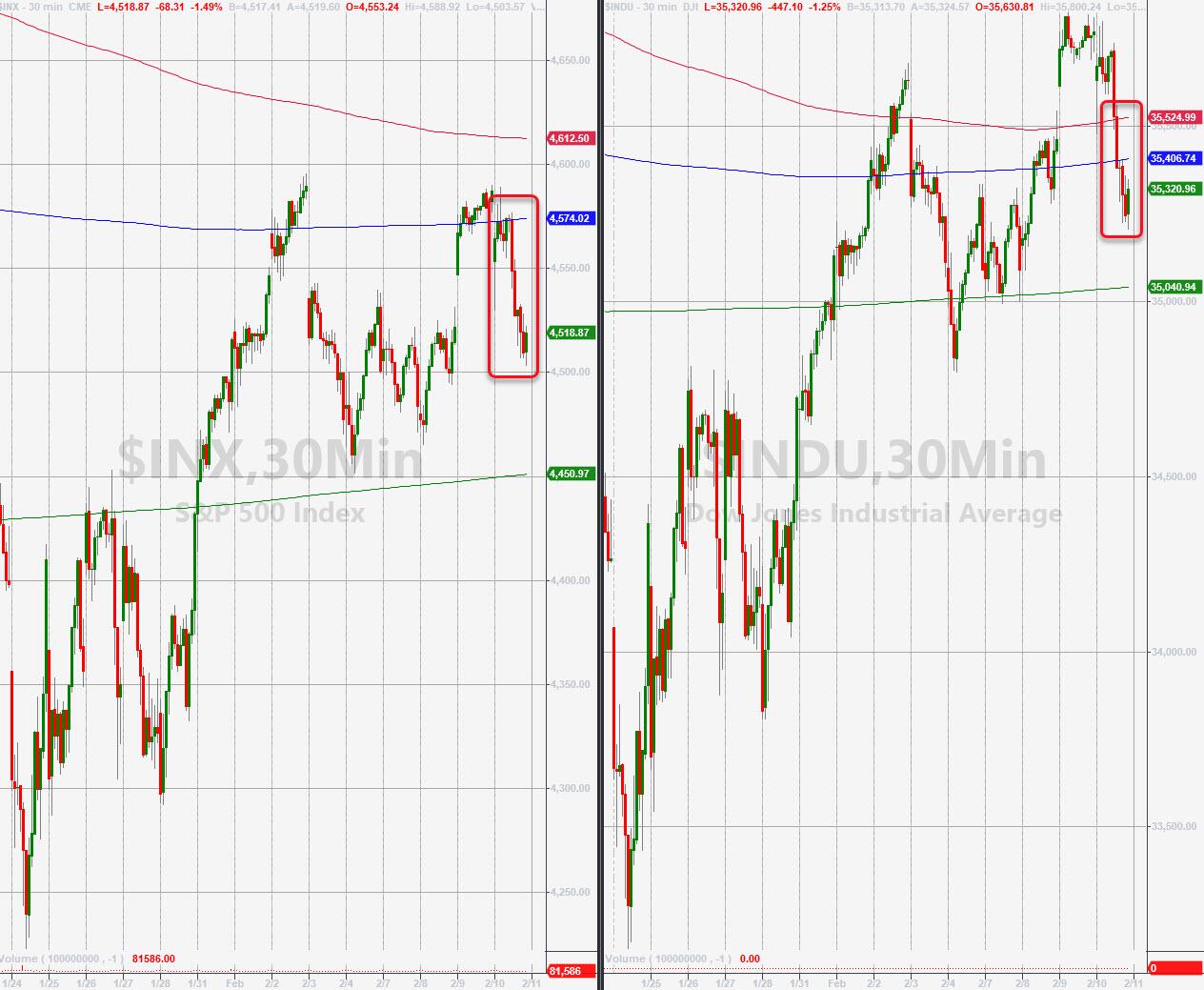
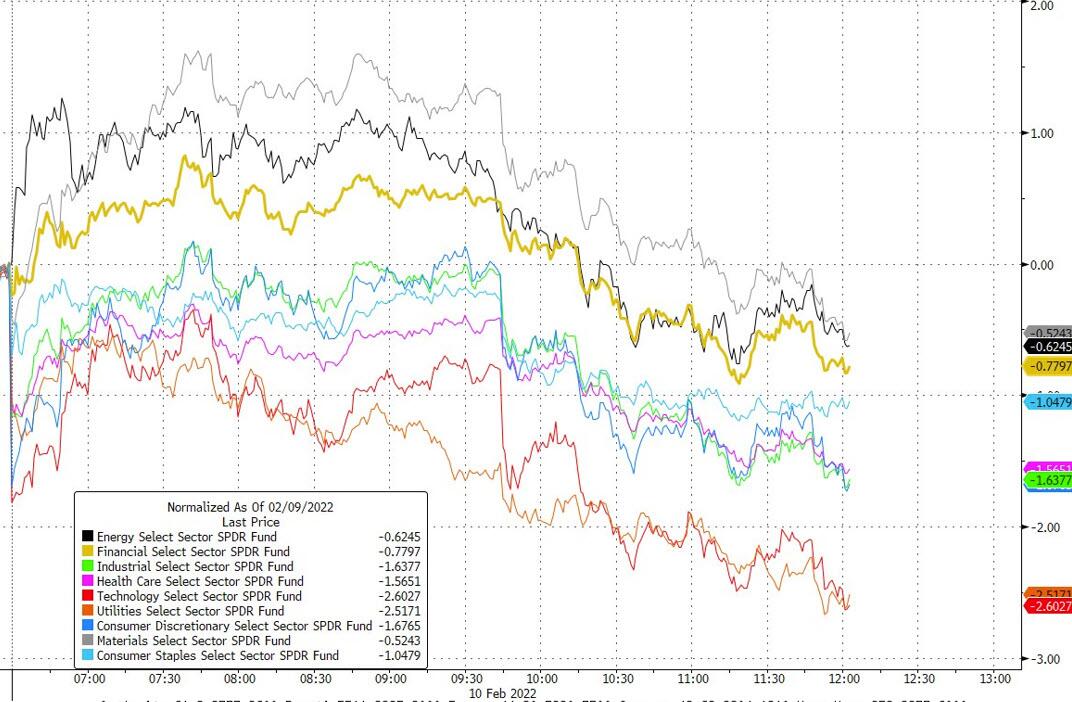
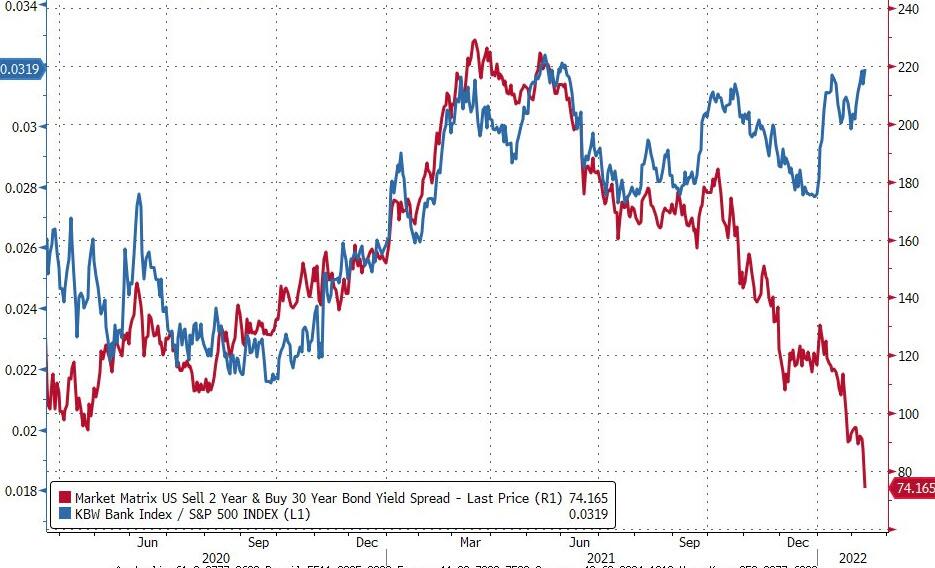
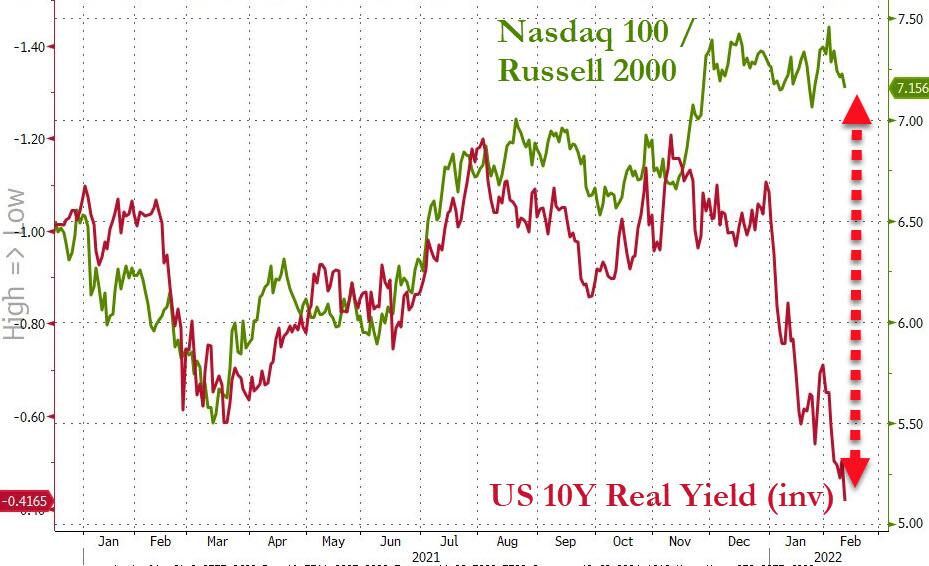
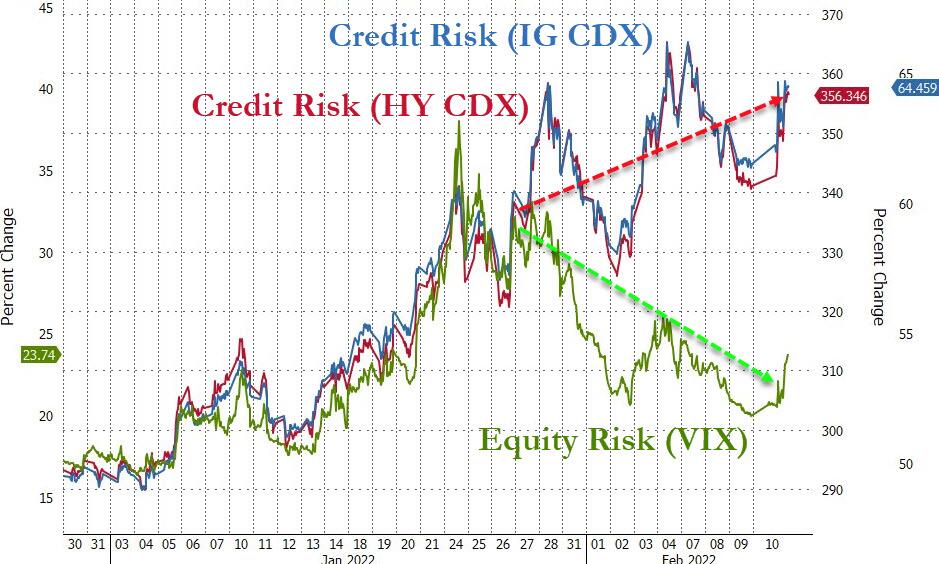
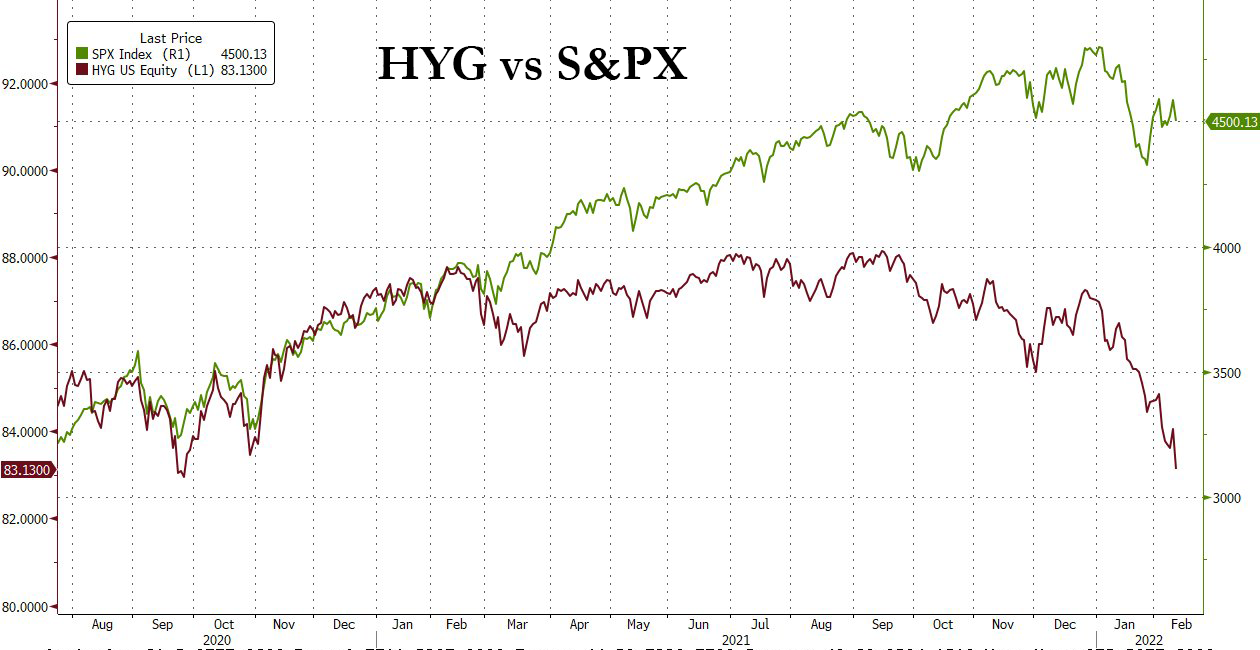
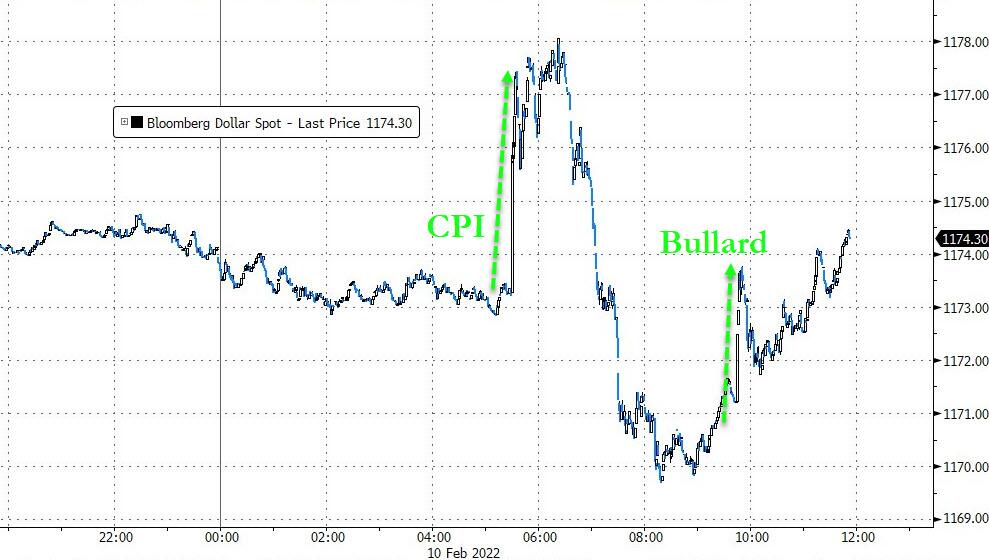
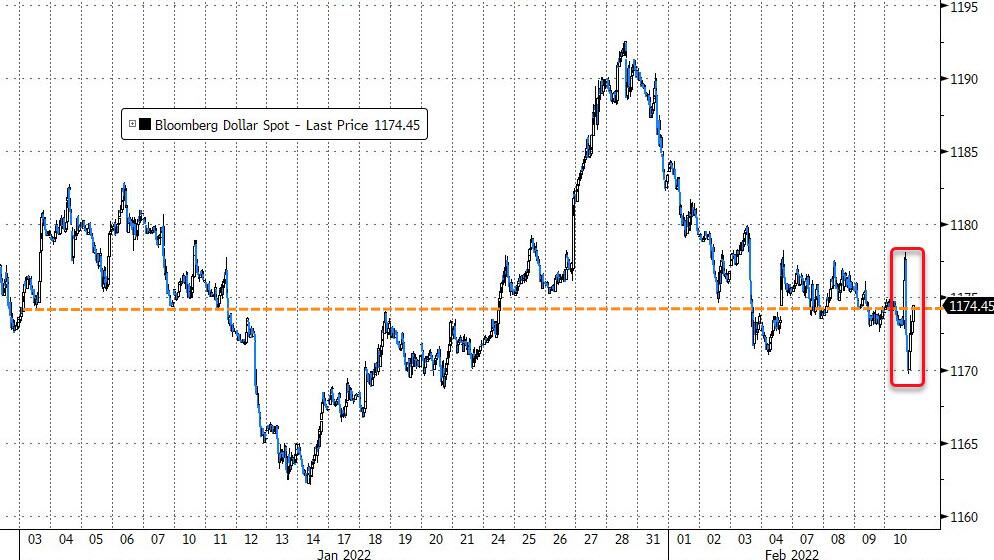
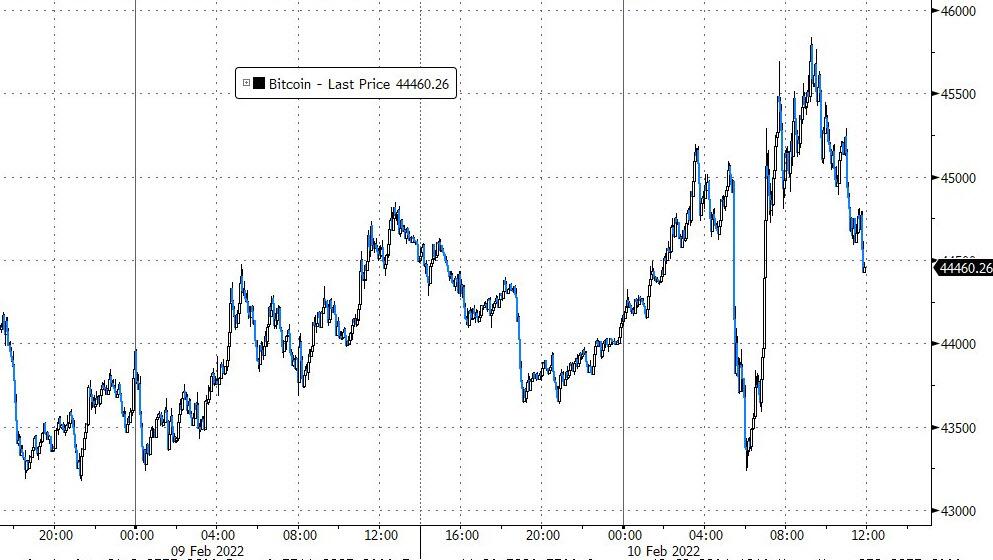
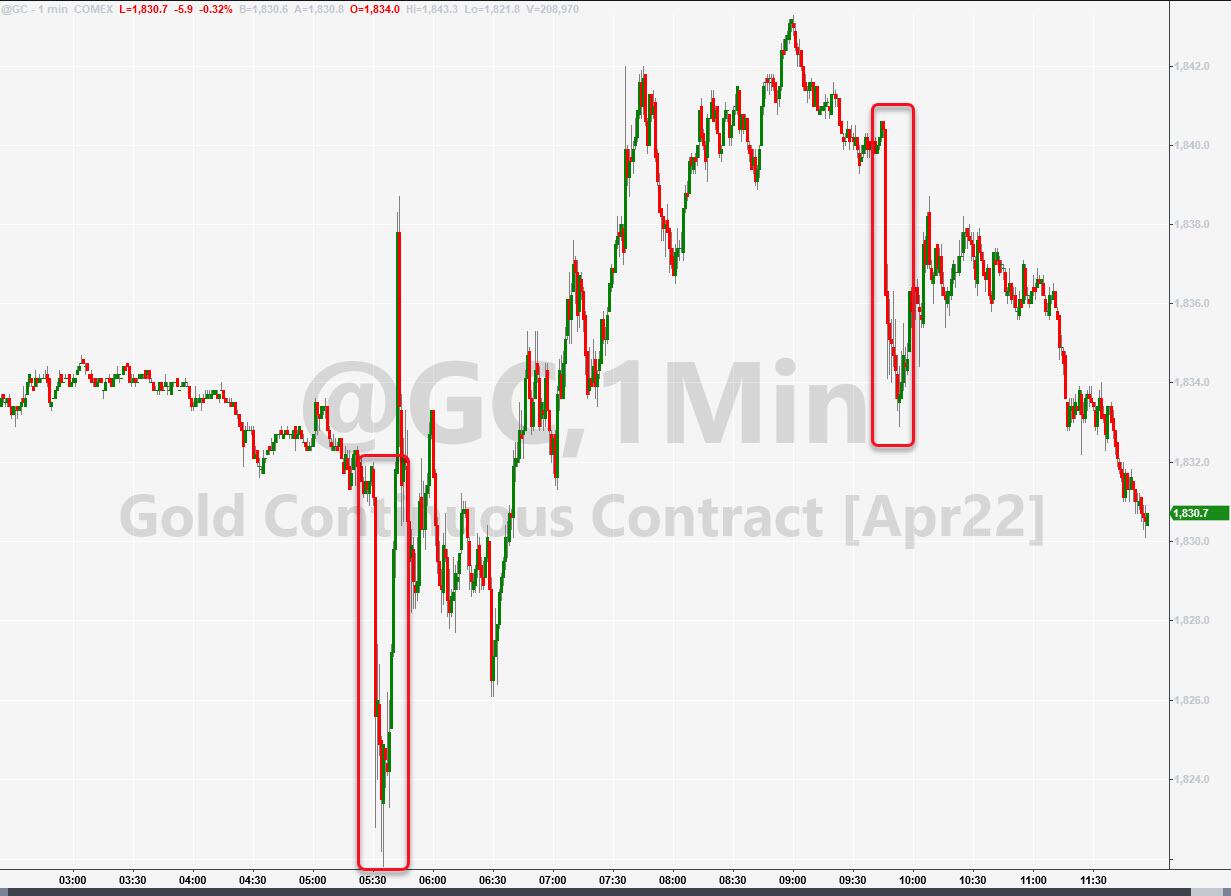
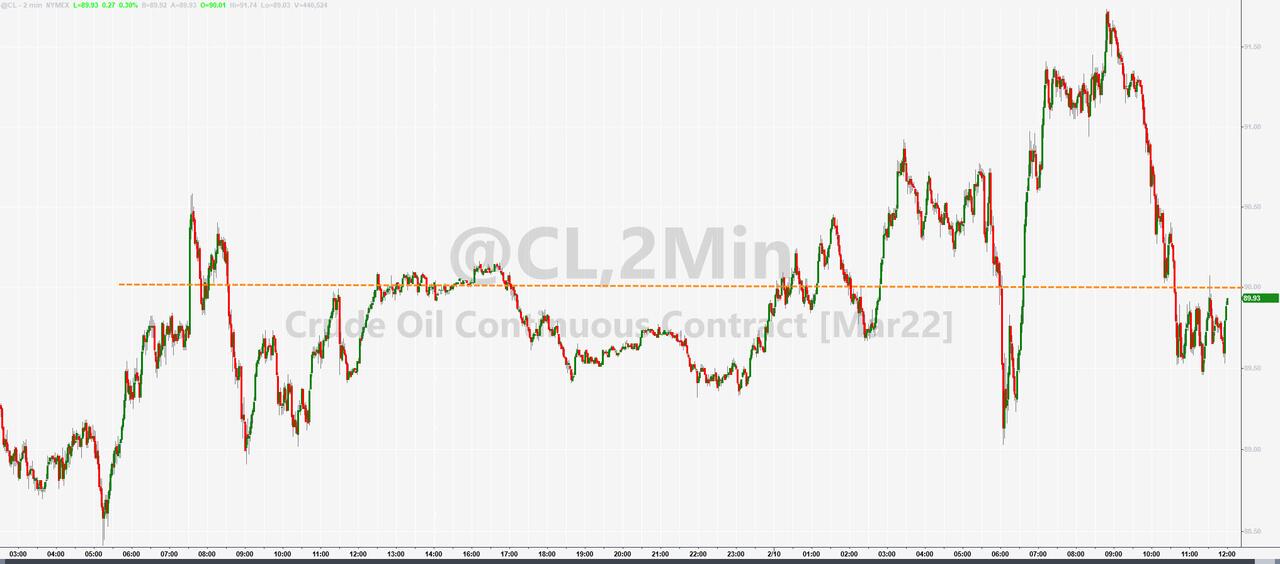
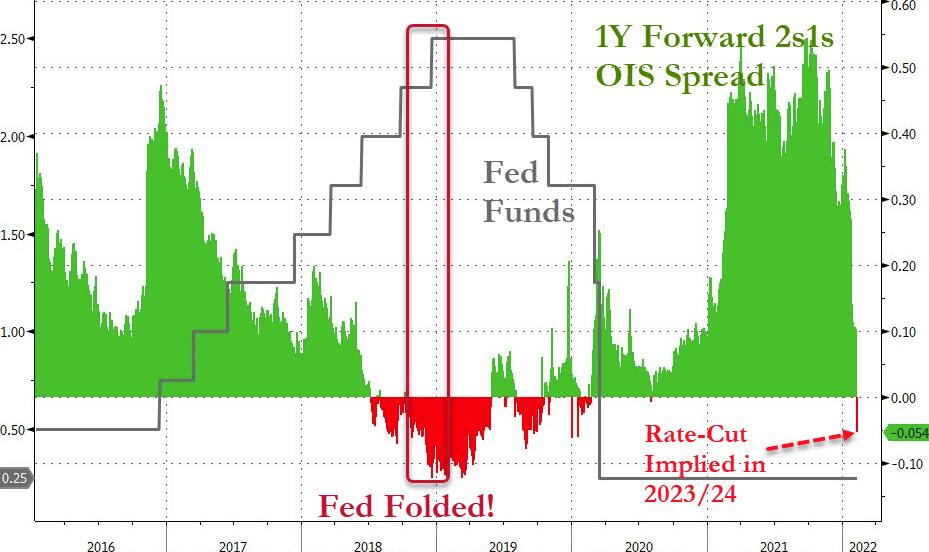

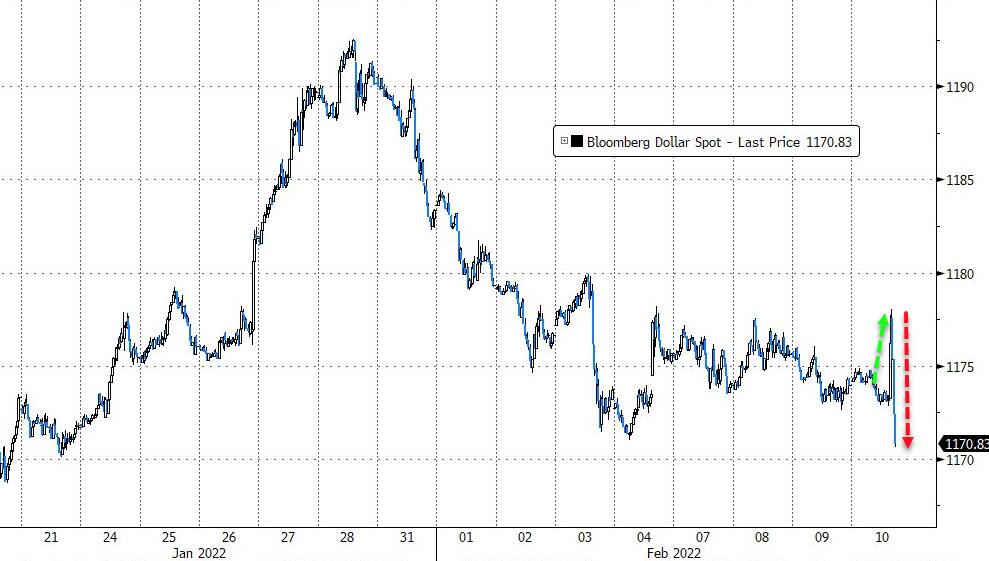
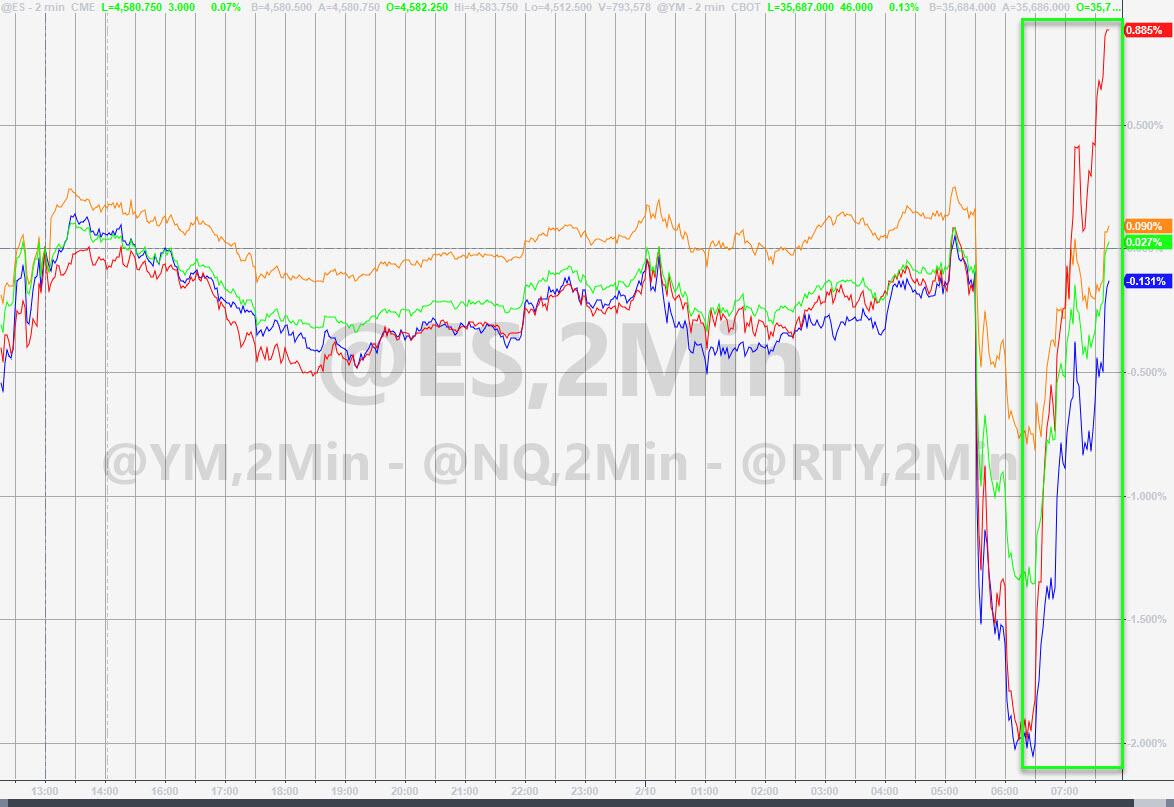
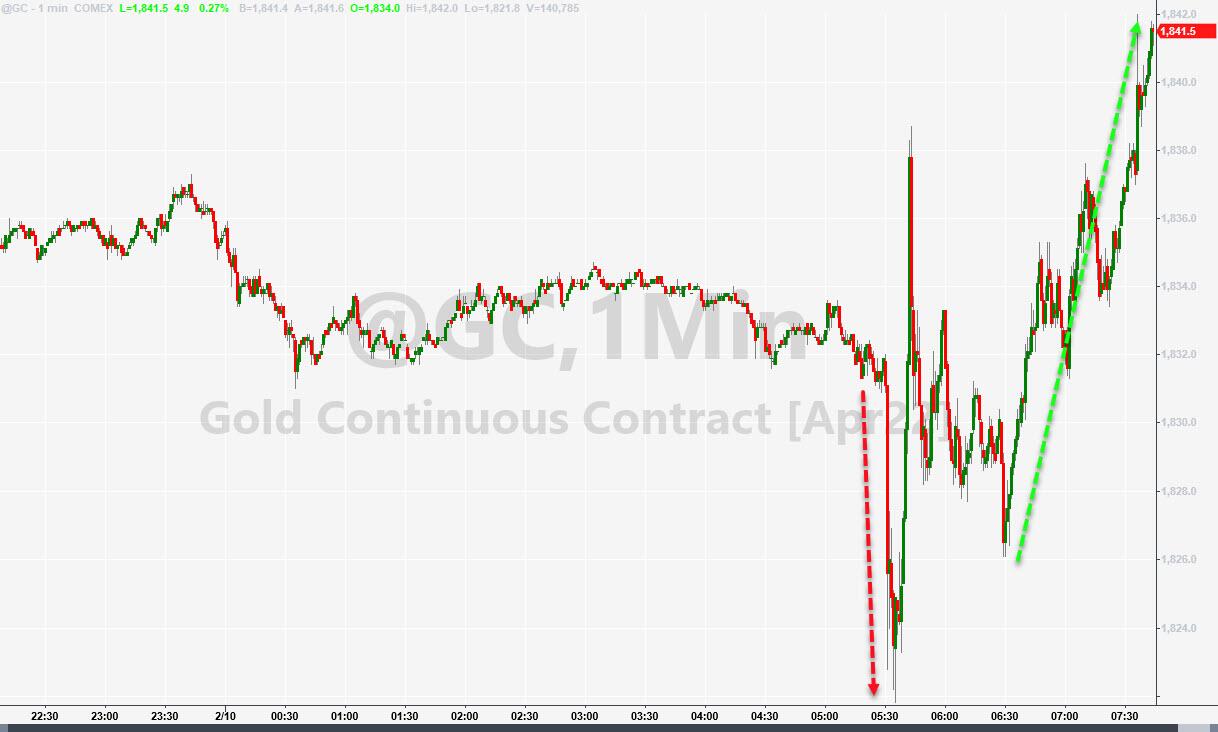
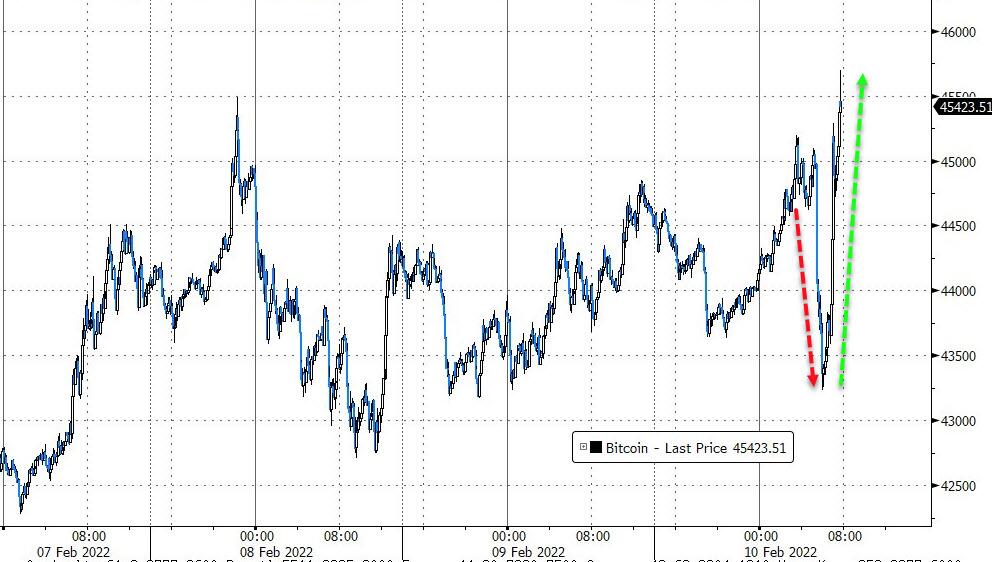
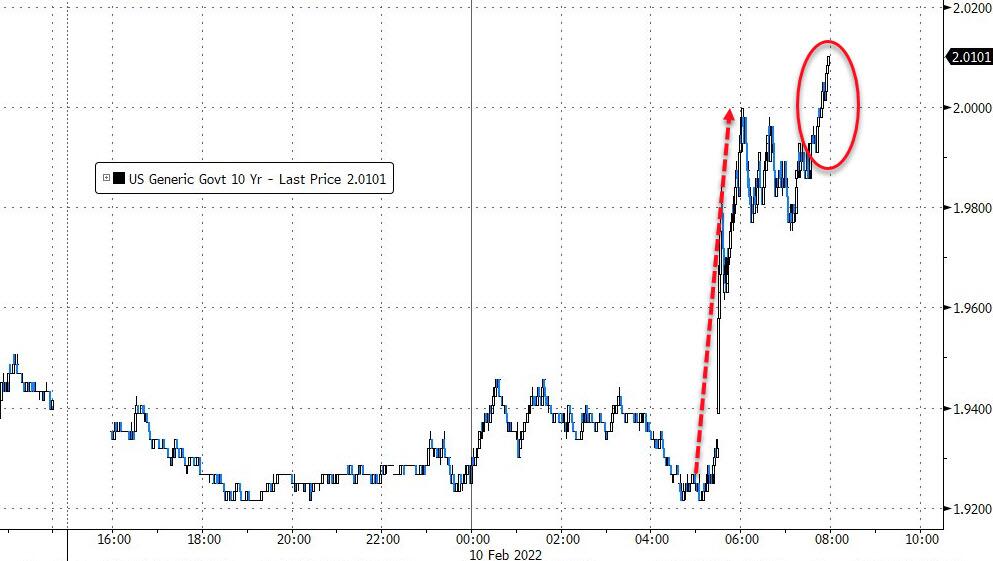
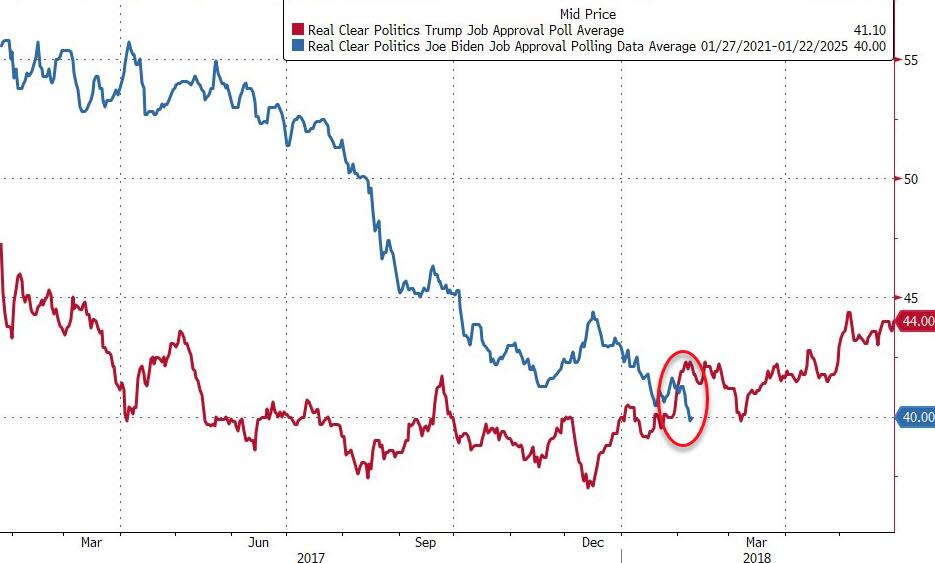
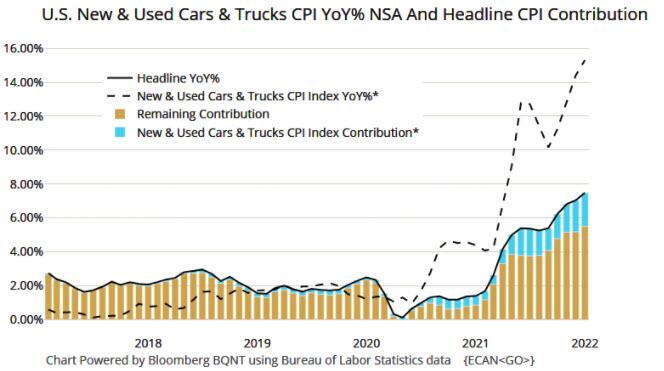
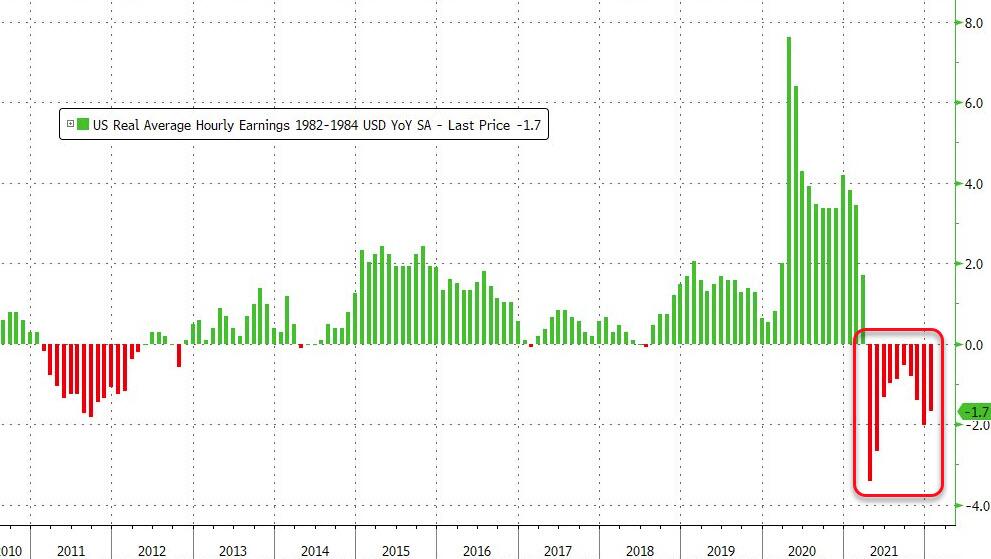
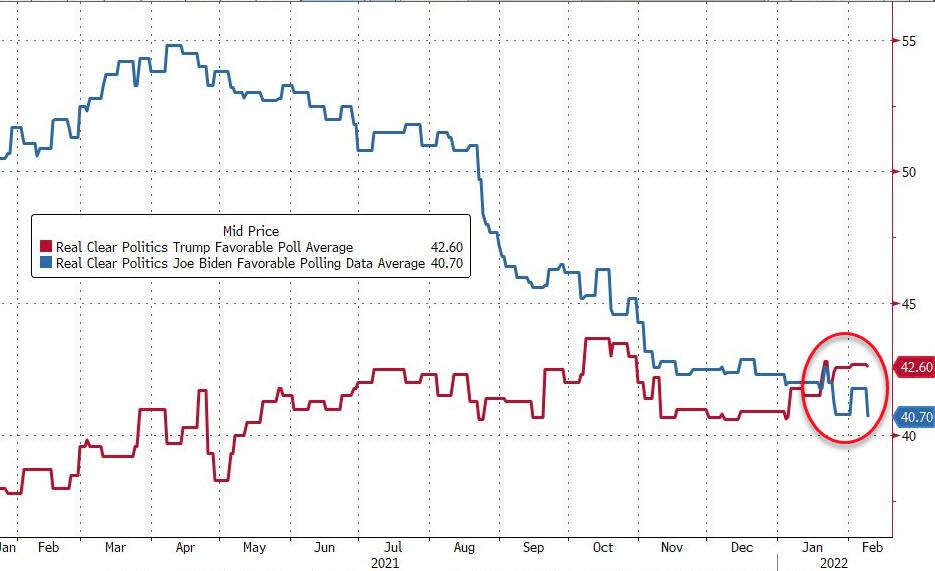
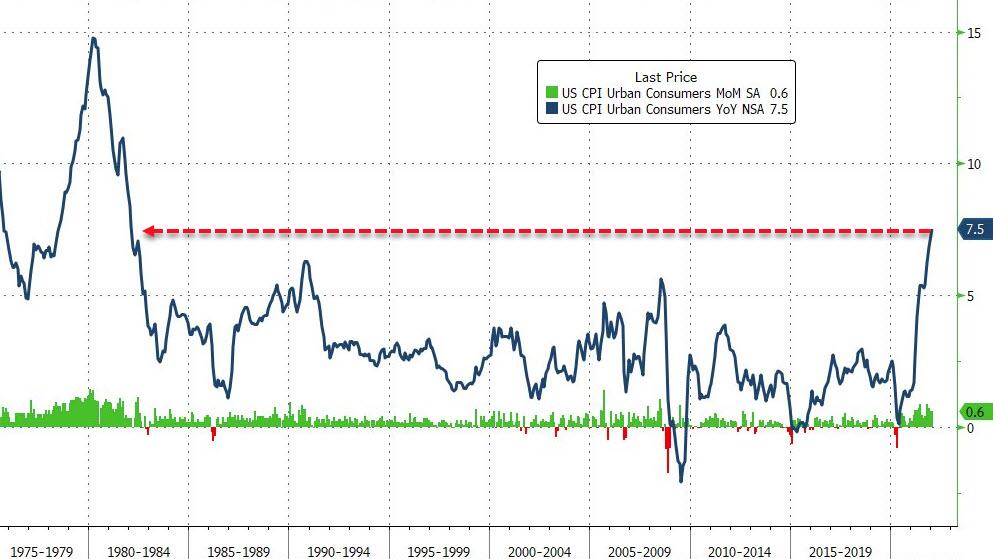
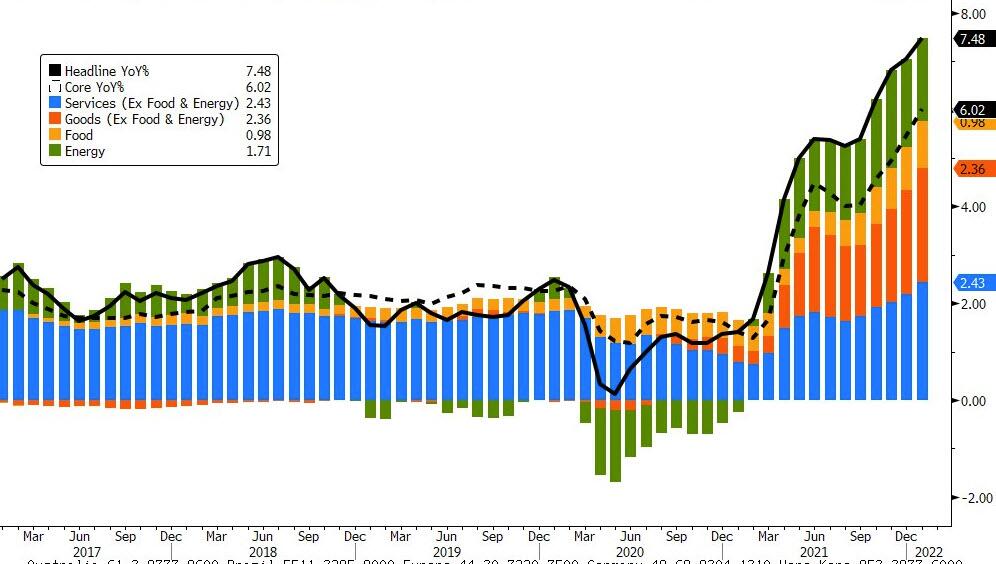
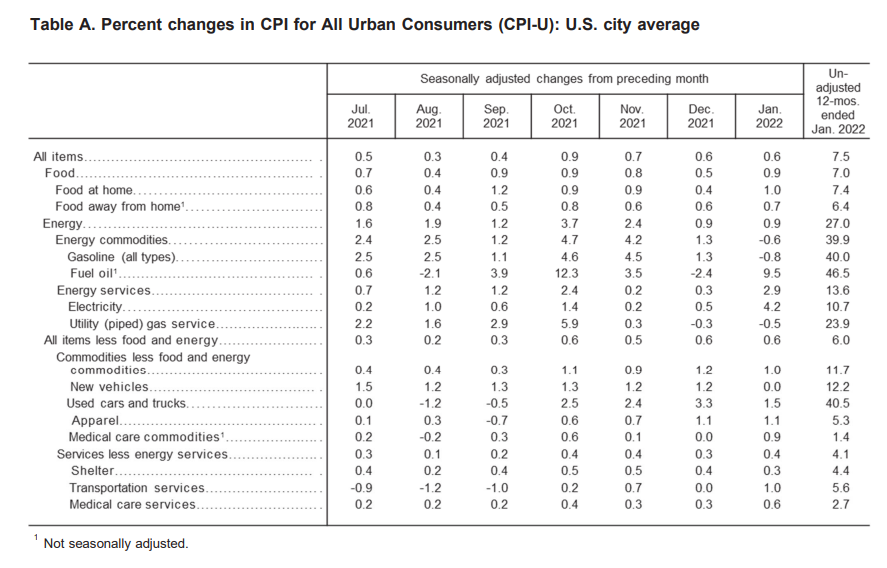

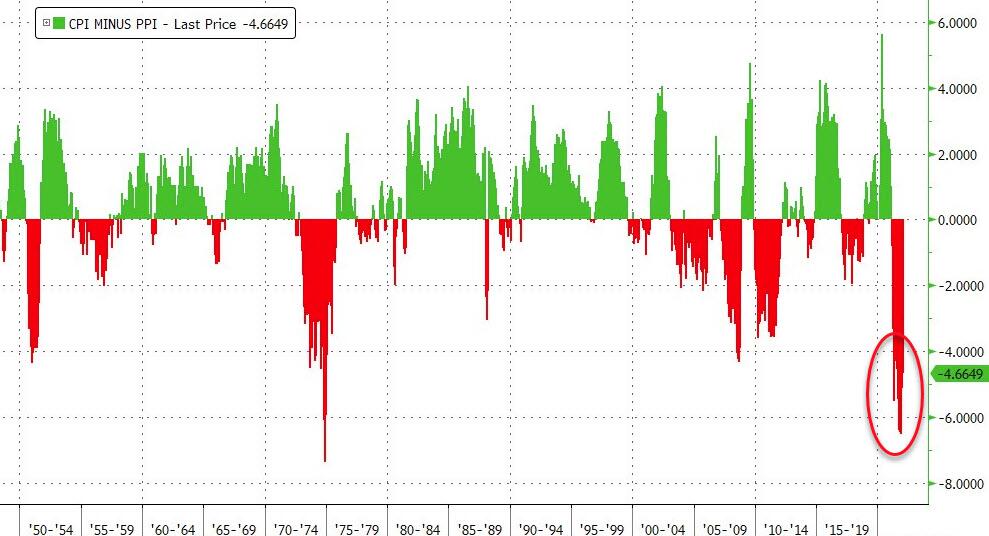
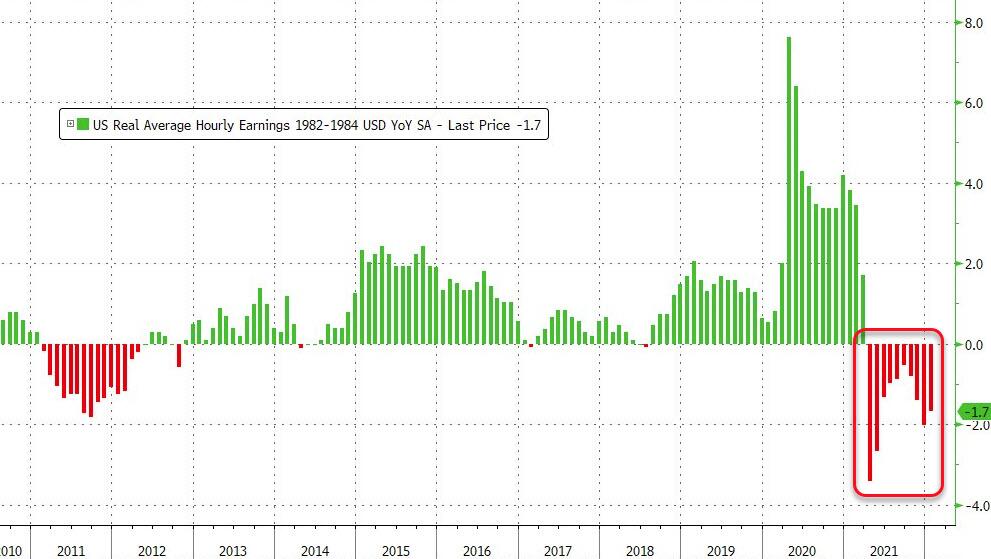
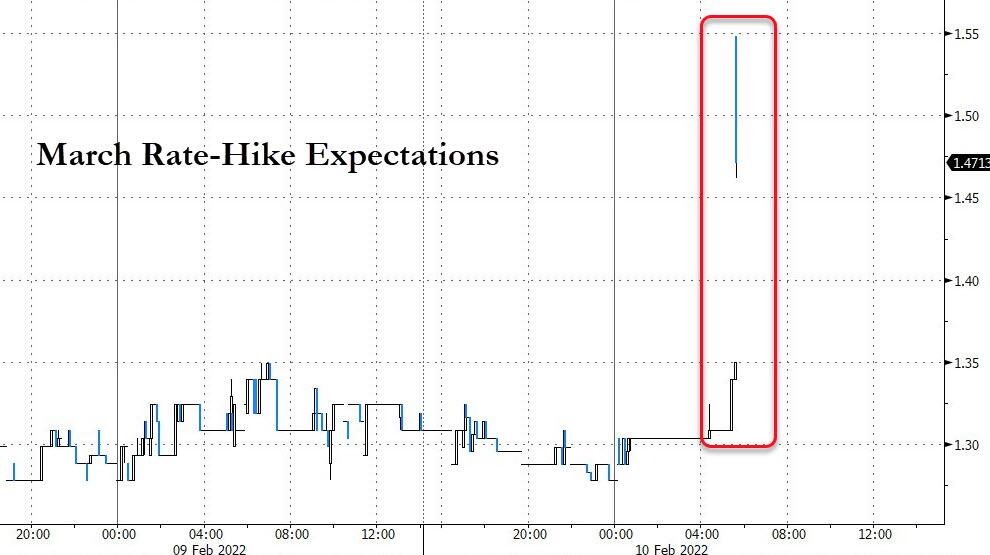
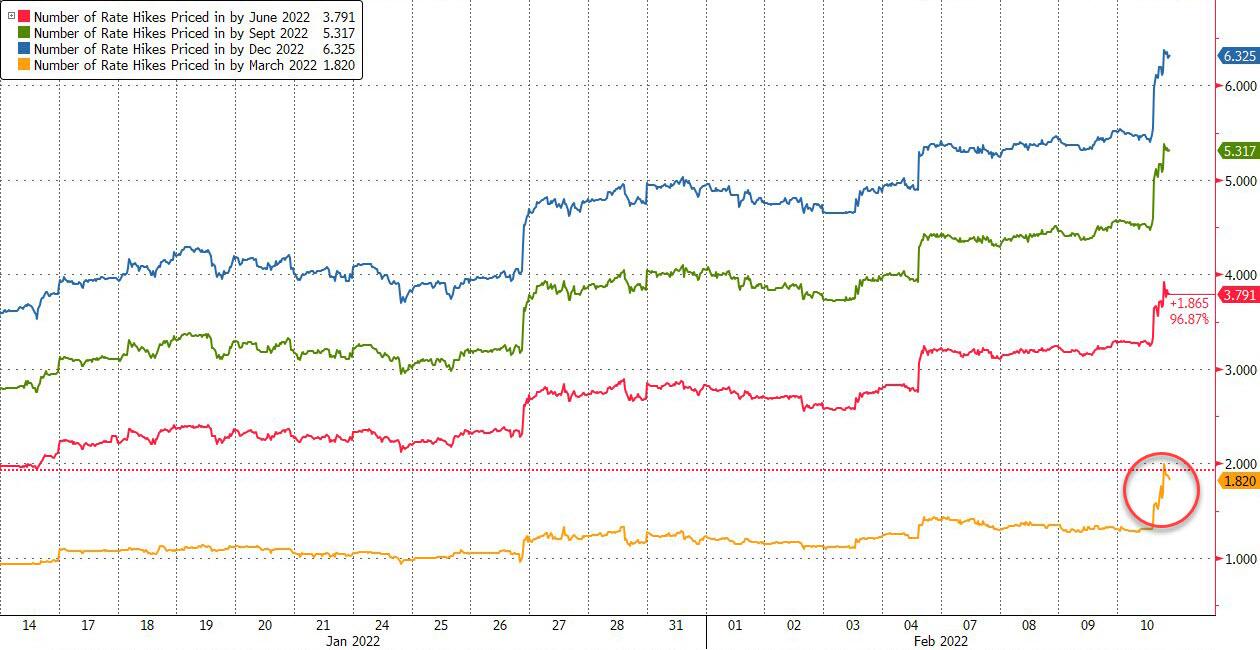
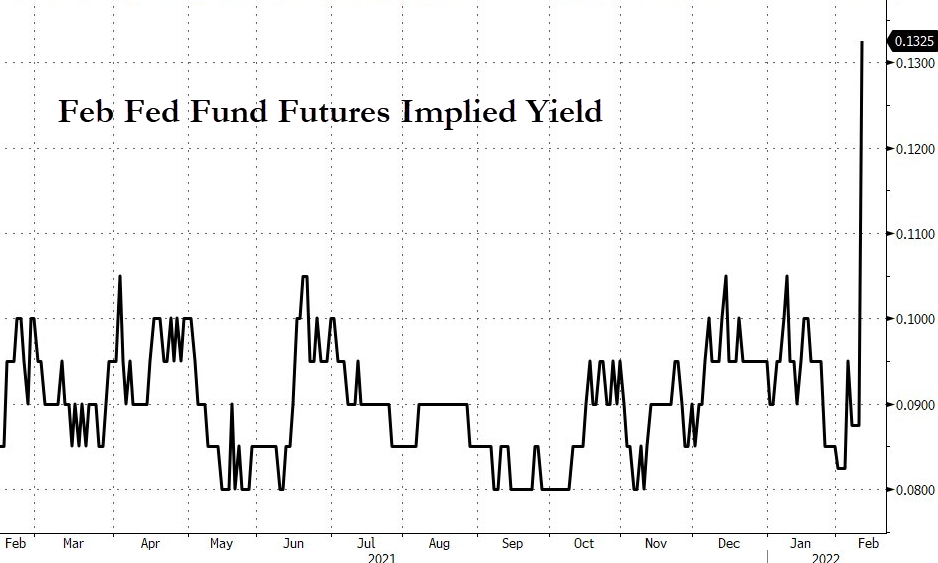


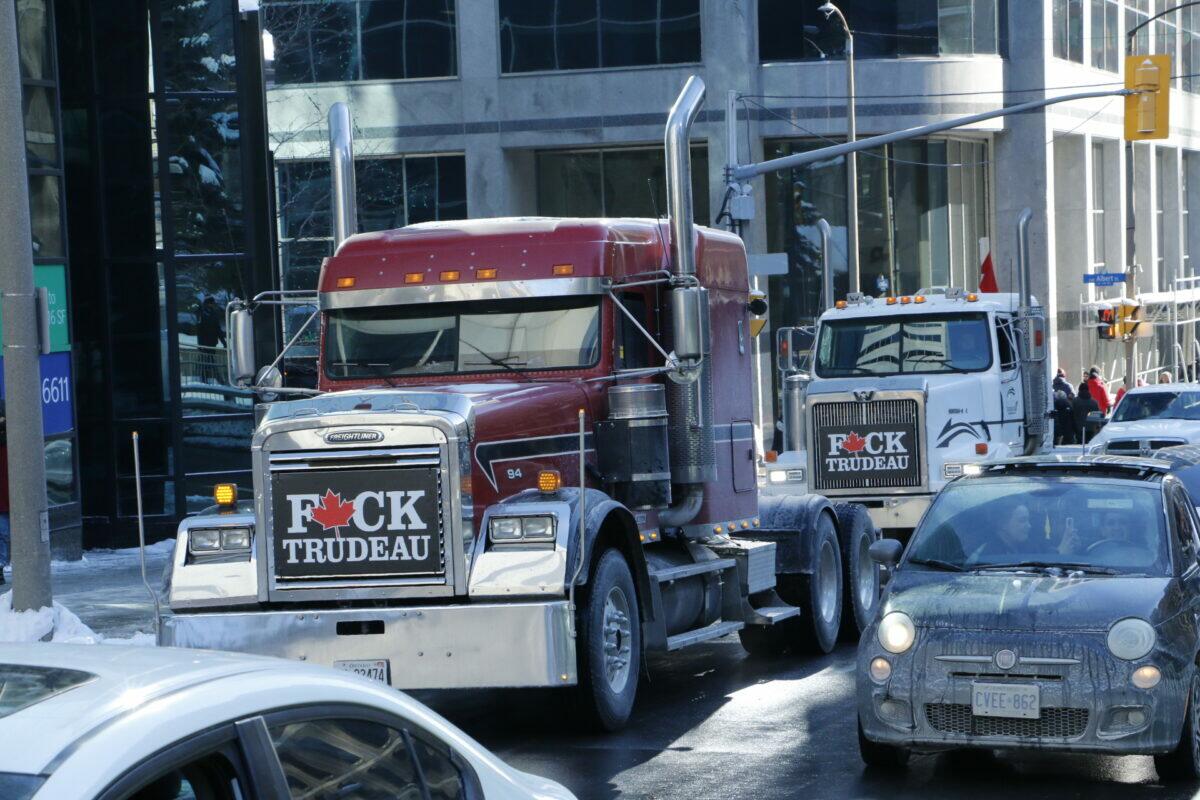

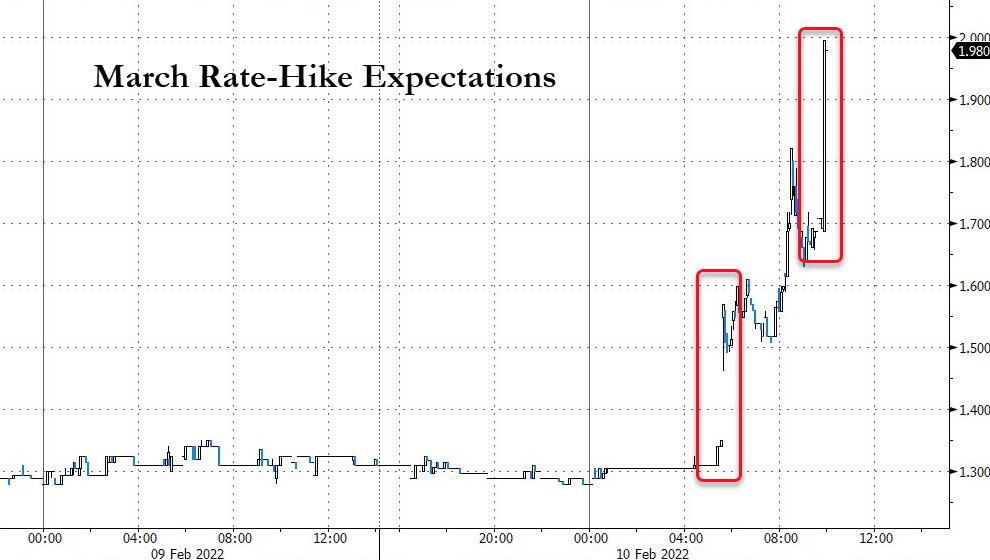
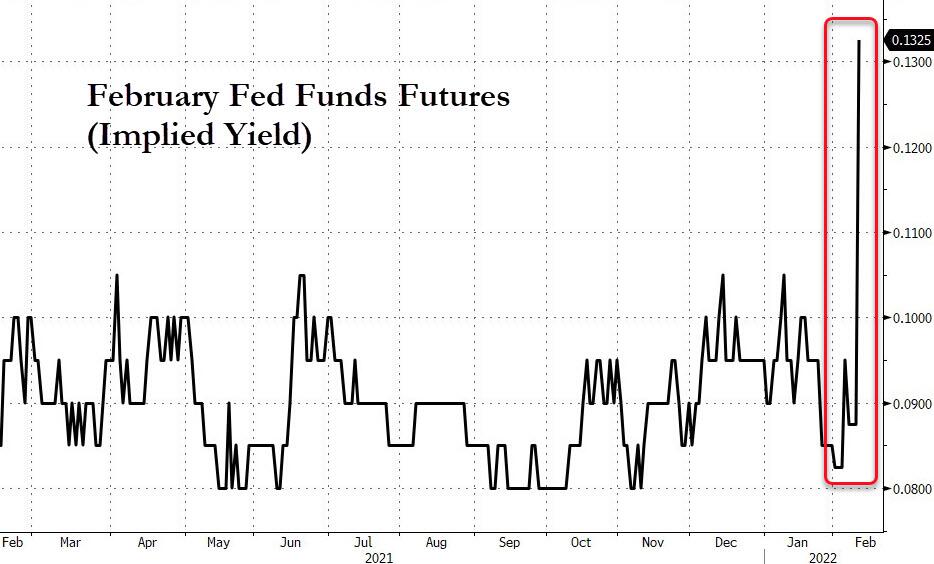
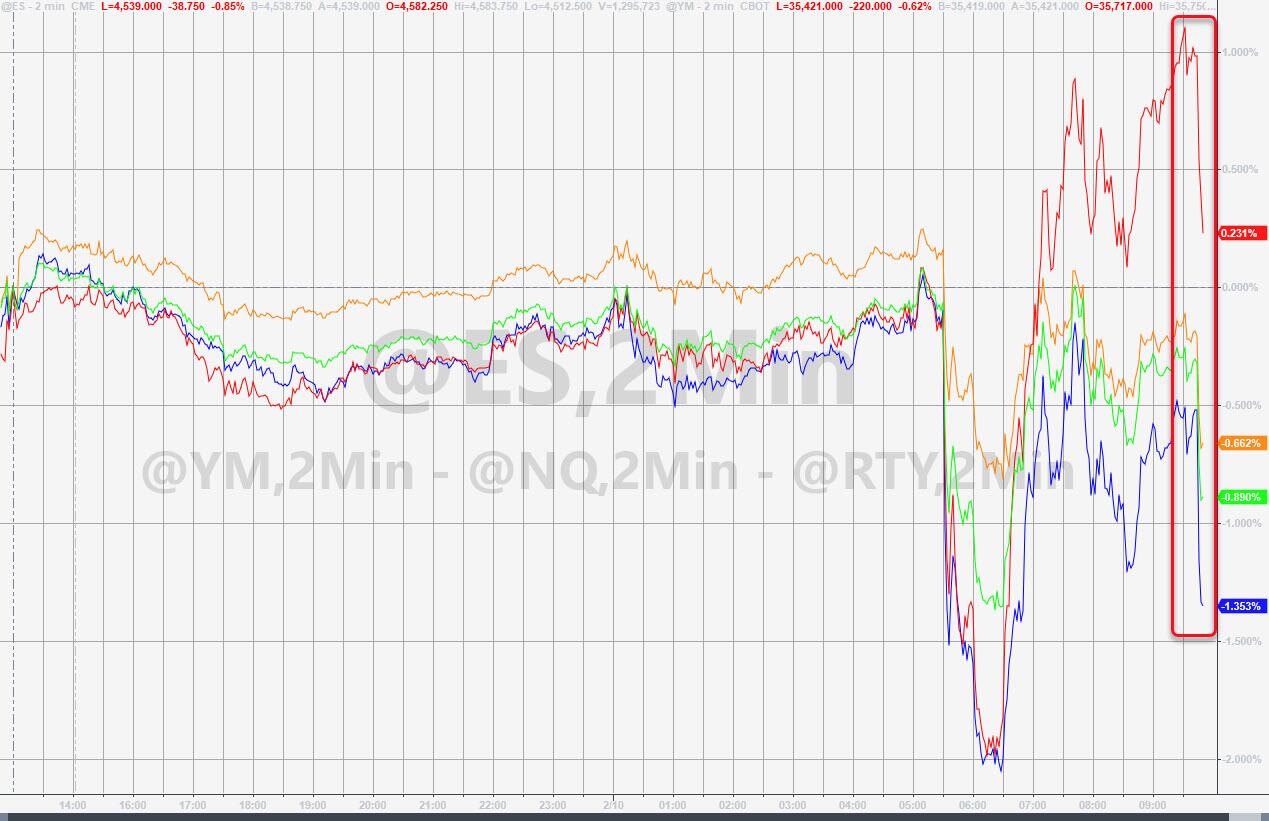
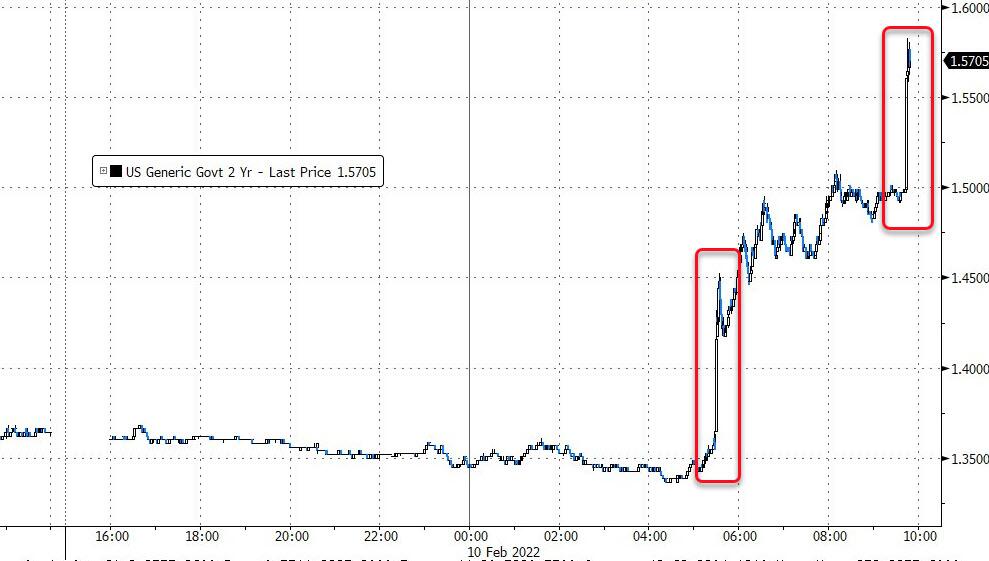
[…] by Harvey Organ, Harvey Organ Blog: […]
LikeLike
[…] by Harvey Organ, Harvey Organ Blog: […]
LikeLike