
March 10, 2022 · by harveyorgan · in Uncategorized · Leave a comment·Edit
MARCH10
GOLD; $1995.70 UP $11.55
SILVER: $25.93 UP $0.39
ACCESS MARKET: GOLD $1996.25
SILVER: $25.92
Bitcoin morning price: $39,329 DOWN 2622
Bitcoin: afternoon price: $39472 UP 2479
Platinum price: closing UP $3.20 to $1079.75
Palladium price; closing UP $27.30 at $2949.50
END
end
DONATE
Click here if you wish to send a donation. I sincerely appreciate it as this site takes a lot of preparation
comex notices/
March: JPMorgan stopped/total issued 586/1193
EXCHANGE: COMEX
CONTRACT: MARCH 2022 COMEX 100 GOLD FUTURES
SETTLEMENT: 1,985.900000000 USD
INTENT DATE: 03/09/2022 DELIVERY DATE: 03/11/2022
FIRM ORG FIRM NAME ISSUED STOPPED
072 C GOLDMAN 30
104 C MIZUHO 57
363 H WELLS FARGO SEC 93
435 H SCOTIA CAPITAL 72
624 H BOFA SECURITIES 221
657 C MORGAN STANLEY 7
657 H MORGAN STANLEY 56
661 C JP MORGAN 800 586
661 H JP MORGAN 313
690 C ABN AMRO 8
737 C ADVANTAGE 11 6
800 C MAREX SPEC 34 27
905 C ADM 20 45
TOTAL: 1,193 1,193
MONTH TO DATE: 9,161
NUMBER OF NOTICES FILED TODAY FOR Mar. CONTRACT:1193 NOTICE(S) FOR 119300 OZ (3.7107 TONNES)
total notices so far: 9161 contracts for 916,199 oz (28.494 tonnes)
SILVER NOTICES:
224 NOTICE(S) FILED TODAY FOR 1,120,000 OZ/
total number of notices filed so far this month 9410 : for 47,050.000 oz
END
Russia is a major supplier of silver to London while Mexico supplies the COMEX
With the sanctions, London has no way to obtain silver other than compete with NY.
END
GLD
WITH GOLD UP $11.55
WITH RESPECT TO GLD WITHDRAWALS: (OVER THE PAST FEW MONTHS):
GOLD IS “RETURNED” TO THE BANK OF ENGLAND WHEN CALLING IN THEIR LEASES: THE GOLD NEVER LEAVES THE BANK OF ENGLAND IN THE FIRST PLACE. THE BANK IS PROTECTING ITSELF IN CASE OF COMMERCIAL FAILURE
ALSO INVESTORS SWITCHING TO SPROTT PHYSICAL (phys) INSTEAD OF THE FRAUDULENT GLD//
A HUGE CHANGE IN GOLD INVENTORY AT THE GLD//A WITHDRAWAL OF 4.06 TONNES FROM THE GLD.
INVENTORY RESTS AT 1063.28 TONNES
Silver//SLV
WITH NO SILVER AROUND AND SILVER UP $0.39
AT THE SLV//
INVESTORS ARE SWITCHING SLV TO SPROTT’S PSLV
NO CHANGE IN SILVER INVENTORY AT THE SLV//A WITHDRAWAL OF 5.174 MILLION OZ FROM THE SLV//
FROM THE SLV.
CLOSING INVENTORY: 542.897 MILLION OZ
Let us have a look at the data for today
SILVER//OUTLINE
SILVER COMEX OI FELL BY A GIGANTIC SIZED 4301 CONTRACTS TO 163,982 AND FURTHER FROM THE NEW RECORD OF 244,710, SET FEB 25/2020 AND WITH THIS HUGE LOSS IN OI, STRANGELY WAS ACCOMPANIED WITH OUR STRONG $0.88 LOSS IN SILVER PRICING AT THE COMEX ON WEDNESDAY. OUR BANKERS WERE SUCCESSFUL IN KNOCKING THE PRICE OF SILVER DOWN (IT FELL BY $0.88) AND WERE SUCCESSFUL IN KNOCKING OUT SOME SILVER LONGS AS WE HAD A STRONG LOSS OF 2335 CONTRACTS ON OUR TWO EXCHANGES DESPITE THE LOSS IN PRICE!!!
WE MUST HAVE HAD:
I) HUGE BANKER SHORT COVERING AS THEY ARE VERY ANXIOUS TO GET OUT OF DODGE!!/. II)WE ALSO HAD SOME REDDIT RAPTOR BUYING//. iii) A STRONG ISSUANCE OF EXCHANGE FOR PHYSICALS iiii) A HUGE INITIAL SILVER STANDING FOR COMEX SILVER MEASURING AT 42.860 MILLION OZ FOLLOWED BY TODAY’S QUEUE JUMP OF 3,175,000 OZ //NEW STANDING 51.465 MILLION OZ // V) GIGANTIC SIZED COMEX OI LOSS/
I AM NOW RECORDING THE DIFFERENTIAL IN OI FROM PRELIMINARY TO FINAL:
THE DIFFERENTIAL FROM PRELIMINARY OI TO FINAL OI SILVER TODAY: CONTRACTS : —3999 (absolutely criminal)
HISTORICAL ACCUMULATION OF EXCHANGE FOR PHYSICALS MAR. ACCUMULATION FOR EFP’S SILVER/JPMORGAN’S HOUSE OF BRIBES/STARTING FROM FIRST DAY/MONTH OF MAR:
TOTAL CONTACTS for 8 days, total contracts: : 22,903 contracts or 114.515 million oz OR 14.314 MILLION OZ PER DAY. (2862 CONTRACTS PER DAY)
TOTAL NO OF OZ UNDERGOING EFP TO LONDON 22,93 CONTRACTS X 5,000 PER CONTRACT:
EQUATES TO: 114,515 MILLION OZ
.
LAST 11 MONTHS TOTAL EFP CONTRACTS ISSUED IN MILLIONS OF OZ:
MAY 137.83 MILLION
JUNE 149.91 MILLION OZ
JULY 129.445 MILLION OZ
AUGUST: MILLION OZ 140.120
SEPT. 28.230 MILLION OZ//
OCT: 94.595 MILLION OZ
NOV: 131.925 MILLION OZ
DEC: 100.615 MILLION OZ
JAN 2022// 90.460 MILLION OZ
FEB 2022: 72.39 MILLION OZ//
MARCH: 114.515 MILLION OZ//THIS IS GOING TO BE A HUGE EFP ISSUANCE MONTH AND MOST LIKELY WILL SET A RECORD FOR ANY MONTH
RESULT: WE HAD A SMALL SIZED DECREASE IN COMEX OI SILVER COMEX CONTRACTS OF 302 DESPITE OUR STRONG $0.88 LOSS SILVER PRICING AT THE COMEX// WEDNESDAY THE CME NOTIFIED US THAT WE HAD A VERY STRONG SIZED EFP ISSUANCE OF 2335 CONTRACTS( 2335 CONTRACTS ISSUED FOR MAR AND 0 CONTRACTS ISSUED FOR ALL OTHER MONTHS) WHICH EXITED OUT OF THE SILVER COMEX TO LONDON AS FORWARDS THE DOMINANT FEATURE TODAY: /HUGE BANKER SHORT COVERING AS THEY GET OUT OF DODGE//// WE HAVE A HUGE INITIAL SILVER OZ STANDING FOR MAR. OF 42.860 MILLION OZ FOLLOWED BY TODAY’S 3,175,000 OZ QUEUE JUMP /// .. WE HAD A STRONG SIZED GAIN OF 2033 OI CONTRACTS ON THE TWO EXCHANGES FOR 10,165 MILLION OZ
WE HAD 224 NOTICES FILED TODAY FOR 1,120,,000 OZ
THE SILVER COMEX IS NOW BEING ATTACKED FOR METAL BY LONDONERS ET AL.
GOLD//OUTLINE
IN GOLD, THE COMEX OPEN INTEREST ROSE BY A FAIR SIZED 3,473 CONTRACTS TO 641,975 AND CLOSER TO OUR NEW RECORD (SET JAN 24/2020) AT 799,541 AND PREVIOUS TO THAT: (SET JAN 6/2020) AT 797,110.
THE DIFFERENTIAL FROM PRELIMINARY OI TO FINAL OI IN GOLD TODAY: –9681 CONTRACTS. (HUGE CRIMINAL ACTIVITY REMOVING CONTRACTS)
THE BIS HAS ABANDONED THE GOLD COMEX TRADING!!!
.
THE FAIR SIZED INCREASE IN COMEX OI CAME DESPITE OUR HUGE LOSS IN PRICE OF $53.85//COMEX GOLD TRADING/WEDNESDAY/.AS IN SILVER WE MUST HAD HUGE BANKER/ALGO SHORT COVERING ACCOMPANYING OUR STRONG SIZED EXCHANGE FOR PHYSICAL ISSUANCE. WE HAD ZERO LONG LIQUIDATION AS THE TOTAL GAIN ON OUR TWO EXCHANGES TOTALED AN ATMOSPHERIC 10,173 CONTRACTS…CONSIDERING THE LOSS IN PRICE
WE ALSO HAD A HUGE INITIAL STANDING IN GOLD TONNAGE FOR MARCH AT 14.818 TONNES FOLLOWED BY TODAY’S QUEUE JUMP OF 86,700 OZ//NEW STANDING 32.087 TONNES
YET ALL OF..THIS HAPPENED WITH OUR LOSS IN PRICE OF $53.85 WITH RESPECT TO WEDNESDAY’S TRADING
WE HAD A HUGE SIZED GAIN OF 10.173 OI CONTRACTS (31.642 PAPER TONNES) ON OUR TWO EXCHANGES
E.F.P. ISSUANCE
THE CME RELEASED THE DATA FOR EFP ISSUANCE AND IT TOTALED A STRONG SIZED 6700 CONTRACTS:
The NEW COMEX OI FOR THE GOLD COMPLEX RESTS AT 641,975.
IN ESSENCE WE HAVE AN ATMOSPHERIC SIZED INCREASE IN TOTAL CONTRACTS ON THE TWO EXCHANGES OF 10,173, WITH 3,473 CONTRACTS INCREASED AT THE COMEX AND 6700 EFP OI CONTRACTS WHICH NAVIGATED OVER TO LONDON. THUS TOTAL OI GAIN ON THE TWO EXCHANGES OF 10,173 CONTRACTS OR 31.642 TONNES.
CALCULATIONS ON GAIN/LOSS ON OUR TWO EXCHANGES
WE HAD A STRONG SIZED ISSUANCE IN EXCHANGE FOR PHYSICALS (6700) ACCOMPANYING THE FAIR SIZED GAIN IN COMEX OI (3,473,): TOTAL GAIN IN THE TWO EXCHANGES 10,173 CONTRACTS. WE NO DOUBT HAD 1) HUGE BANKER SHORT COVERING ,2.) HUGE INITIAL STANDING AT THE GOLD COMEX FOR MARCH. AT 14.818 TONNES FOLLOWED BY TODAY’S MAMMOTH QUEUE JUMP OF 86,700 OZ//NEW STANDING 32.087 TONNES /// 3) ZERO LONG LIQUIDATION/. ,4) FAIR SIZED COMEX OI. GAIN 5) STRONG ISSUANCE OF EXCHANGE FOR PHYSICAL/
LADIES AND GENTLEMEN: THE GOLD COMEX IS ALSO BEING ATTACKED FOR GOLD METAL FROM LONDON ET AL.
HISTORICAL ACCUMULATION OF EXCHANGE FOR PHYSICALS IN 2022 INCLUDING TODAY
MARCH
ACCUMULATION OF EFP’S GOLD AT J.P. MORGAN’S HOUSE OF BRIBES: (EXCHANGE FOR PHYSICAL) FOR THE MONTH OF MAR :
52,153 CONTRACTS OR 5,215,300 OR 162.21 TONNES 8 TRADING DAY(S) AND THUS AVERAGING: 651 EFP CONTRACTS PER TRADING DAY
TO GIVE YOU AN IDEA AS TO THE SIZE OF THESE EFP TRANSFERS : THIS MONTH IN 8 TRADING DAY(S) IN TONNES: 162.21TONNES
TOTAL ANNUAL GOLD PRODUCTION, 2020, THROUGHOUT THE WORLD EX CHINA EX RUSSIA: 3555 TONNES
THUS EFP TRANSFERS REPRESENTS 162.21/3550 x 100% TONNES 4.56% OF GLOBAL ANNUAL PRODUCTION
ACCUMULATION OF GOLD EFP’S YEAR 2021 TO 2022
JANUARY/2021: 265.26 TONNES (RAPIDLY INCREASING AGAIN)
FEB : 171.24 TONNES ( DEFINITELY SLOWING DOWN AGAIN)..
MARCH:. 276.50 TONNES (STRONG AGAIN/
APRIL: 189..44 TONNES ( DRAMATICALLY SLOWING DOWN AGAIN//GOLD IN BACKWARDATION)
MAY: 250.15 TONNES (NOW DRAMATICALLY INCREASING AGAIN)
JUNE: 247.54 TONNES (FINAL)
JULY: 188.73 TONNES FINAL
AUGUST: 217.89 TONNES FINAL ISSUANCE.
SEPT 142.12 TONNES FINAL ISSUANCE ( LOW ISSUANCE)_
OCT: 141.13 TONNES FINAL ISSUANCE (LOW ISSUANCE)
NOV: 312.46 TONNES FINAL ISSUANCE//NEW RECORD!! (INCREASING DRAMATICALLY)//SIGN OF REAL STRESS//SURPASSING THE MARCH 2021 RECORD OF 276.50 TONNES OF EFP
DEC. 145.12 TONNES//FINAL ISSUANCE//
JAN:2022 247.25 TONNES //FINAL
FEB: 196.04 TONNES//FINAL
MARCH: 162.21 TONNES INITIAL( THIS WILL PROBABLY BE A RECORD EFP ISSUANCE MONTH)
SPREADING OPERATIONS
(/NOW SWITCHING TO GOLD) FOR NEWCOMERS, HERE ARE THE DETAILS
SPREADING LIQUIDATION HAS NOW COMMENCED AS WE HEAD TOWARDS THE NEW ACTIVE FRONT MONTH OF APRIL.WE ARE NOW INTO THE SPREADING OPERATION OF GOLD
HERE IS A BRIEF SYNOPSIS OF HOW THE CROOKS FLEECE UNSUSPECTING LONGS IN THE SPREADING ENDEAVOUR ;MODUS OPERANDI OF THE CORRUPT BANKERS AS TO HOW THEY HANDLE THEIR SPREAD OPEN INTERESTS:HERE IS HOW THE CROOKS USED SPREADING AS WE ARE NOW INTO THE NON ACTIVE DELIVERY MONTH OF MARCH HEADING TOWARDS THE ACTIVE DELIVERY MONTH OF APRIL, FOR GOLD:
YOU WILL ALSO NOTICE THAT THE COMEX OPEN INTEREST STARTS TO RISE BUT SO IS THE OPEN INTEREST OF SPREADERS. THE OPEN INTEREST IN WILL CONTINUE TO RISE UNTIL ONE WEEK BEFORE FIRST DAY NOTICE OF AN UPCOMING ACTIVE DELIVERY MONTH (MAR), AND THAT IS WHEN THE CROOKS SELL THEIR SPREAD POSITIONS BUT NOT AT THE SAME TIME OF THE DAY. THEY WILL USE THE SELL SIDE OF THE EQUATION TO CREATE THE CASCADE (ALONG WITH THEIR COLLUSIVE FRIENDS) AND THEN COVER ON THE BUY SIDE OF THE SPREAD SITUATION AT THE END OF THE DAY. THEY DO THIS TO AVOID POSITION LIMIT DETECTION. THE LIQUIDATION OF THE SPREADING FORMATION CONTINUES FOR EXACTLY ONE WEEK AND ENDS ON FIRST DAY NOTICE.”
WHAT IS ALARMING TO ME, ACCORDING TO OUR LONDON EXPERT ANDREW MAGUIRE IS THAT THESE EFP’S ARE BEING TRANSFERRED TO WHAT ARE CALLED SERIAL FORWARD CONTRACT OBLIGATIONS AND THESE CONTRACTS ARE LESS THAN 14 DAYS. ANYTHING GREATER THAN 14 DAYS, THESE MUST BE RECORDED AND SENT TO THE COMPTROLLER, GREAT BRITAIN TO MONITOR RISK TO THE BANKING SYSTEM. IF THIS IS INDEED TRUE, THEN THIS IS A MASSIVE CONSPIRACY TO DEFRAUD AS WE NOW WITNESS A MONSTROUS TOTAL EFP’S ISSUANCE AS IT HEADS INTO THE STRATOSPHERE.
First, here is an outline of what will be discussed tonight:
1.Today, we had the open interest at the comex, in SILVER, FELL BY A GIGANTIC SIZED 4301 CONTRACTS TO 167,901 AND FURTHER FROM OUR COMEX RECORD //244,710(SET FEB 25/2020). THE LAST RECORDS WERE SET IN AUG.2018 AT 244,196 WITH A SILVER PRICE OF $14.78/(AUGUST 22/2018)..THE PREVIOUS RECORD TO THAT WAS SET ON APRIL 9/2018 AT 243,411 OPEN INTEREST CONTRACTS WITH THE SILVER PRICE AT THAT DAY: $16.53). AND PREVIOUS TO THAT, THE RECORD WAS ESTABLISHED AT: 234,787 CONTRACTS, SET ON APRIL 21.2017 OVER 4 1/2 YEARS AGO.
EFP ISSUANCE 2335 CONTRACTS
OUR CUSTOMARY MIGRATION OF COMEX LONGS CONTINUE TO MORPH INTO LONDON FORWARDS AS OUR BANKERS USED THEIR EMERGENCY PROCEDURE TO ISSUE:
MAR 2335 ALL OTHER MONTHS: ZERO. TOTAL EFP ISSUANCE: 2335 CONTRACTS. EFP’S GIVE OUR COMEX LONGS A FIAT BONUS PLUS A DELIVERABLE PRODUCT OVER IN LONDON. IF WE TAKE THE COMEX OI LOSS OF 4301 CONTRACTS AND ADD TO THE 2335 OI TRANSFERRED TO LONDON THROUGH EFP’S,
WE OBTAIN A VERY STRONG SIZED LOSS OF 2355 OPEN INTEREST CONTRACT FROM OUR TWO EXCHANGES.
THUS IN OUNCES, THE LOSS ON THE TWO EXCHANGES 11.675 MILLION OZ,
OCCURRED WITH OUR $0.88 LOSS IN PRICE.
OUTLINE FOR TODAY’S COMMENTARY
1/COMEX GOLD AND SILVER REPORT
(report Harvey)
2 ) Gold/silver trading overnight Europe,
(Peter Schiff,
3. Egon von Greyerz///Matthew Piepenburg via GoldSwitzerland.com,
4. Chris Powell of GATA provides to us very important physical commentaries
5. Other gold commentaries
6. Commodity commentaries/cryptocurrencies
3. ASIAN AFFAIRS
i)THURSDAY MORNING// WEDNESDAY NIGHT
SHANGHAI CLOSED UP 39.70 PTS OR 1.22% //Hang Sang CLOSED UP 262.55 PTS OR 1.27 % /The Nikkei closed UP 972.87 PTS or 3.94% //Australia’s all ordinaires CLOSED UP 1.08% /Chinese yuan (ONSHORE) closed DOWN 6.3214 /Oil DOWN TO 113.20 dollars per barrel for WTI and DOWN TO 115.87 for Brent. Stocks in Europe OPENED ALL RED // ONSHORE YUAN CLOSED DOWN AGAINST THE DOLLAR AT 6.3214. OFFSHORE YUAN CLOSED DOWN ON THE DOLLAR AT 6.3268: /ONSHORE YUAN TRADING ABOVE LEVEL OF OFFSHORE YUAN/ONSHORE YUAN TRADING WEAKER AGAINST USA DOLLAR/OFF SHORE WEAKER/
A)NORTH KOREA/
b) REPORT ON JAPAN
OUTLINE
3 C CHINA
OUTLINE
4/EUROPEAN AFFAIRS
OUTLINE
5. RUSSIAN AND MIDDLE EASTERN AFFAIRS
OUTLINE
6.Global Issues
OUTLINE
7. OIL ISSUES
OUTLINE
8 EMERGING MARKET ISSUES
COMEX DATA//AMOUNTS STANDING//VOLUME OF TRADING/INVENTORY MOVEMENTS
GOLD
LET US BEGIN:
THE TOTAL COMEX GOLD OPEN INTEREST ROSE BY A FAIR SIZED 3,473 CONTRACTS AND CLOSER TO THE RECORD THAT WAS SET IN JANUARY/2020: {799,541 OI(SET JAN 16/2020)} AND PREVIOUS TO THAT: 797,110 (SET JAN 7/2020). AND THIS COMEX INCREASE OCCURRED DESPITE OUR STRONG LOSS OF $53.85 IN GOLD PRICING WEDNESDAY’S COMEX TRADING. WE ALSO HAD A STRONG SIZED EFP (6700 CONTRACTS). . THEY WERE PAID HANDSOMELY NOT TO TAKE DELIVERY AT THE COMEX AND SETTLE FOR CASH.
WE NORMALLY HAVE WITNESSED EXCHANGE FOR PHYSICALS ISSUED BEING SMALL AS IT JUST TOO COSTLY FOR THEM TO CONTINUE SERVICING THE COSTS OF SERIAL FORWARDS CIRCULATING IN LONDON. HOWEVER, MUCH TO THE ANNOYANCE OF OUR BANKERS, THE COMEX IS THE SCENE OF AN ASSAULT ON GOLD AS LONDONERS, NOT BEING ABLE TO FIND ANY PHYSICAL ON THAT SIDE OF THE POND, EXERCISE THESE CIRCULATING EXCHANGE FOR PHYSICALS IN LONDON AND FORCING DELIVERY OF REAL METAL OVER HERE AS THE OBLIGATION STILL RESTS WITH NEW YORK BANKERS. IT SEEMS THAT ARE BANKERS FRIENDS ARE EXERCISING EFP’S FROM LONDON AND NOW THEY ARE LOATHE TO ISSUE NEW ONES.
EXCHANGE FOR PHYSICAL ISSUANCE
WE ARE NOW MOVING TO THE NON ACTIVE DELIVERY MONTH OF MAR.. THE CME REPORTS THAT THE BANKERS ISSUED A STRONG SIZED TRANSFER THROUGH THE EFP ROUTE AS THESE LONGS RECEIVED A DELIVERABLE LONDON FORWARD TOGETHER WITH A FIAT BONUS.,
THAT IS 6700 EFP CONTRACTS WERE ISSUED: ;: , & FEB. 0 APRIL:6700 & ZERO FOR ALL OTHER MONTHS:
TOTAL EFP ISSUANCE: 6700 CONTRACTS
WHEN WE HAVE BACKWARDATION, EFP ISSUANCE IS VERY COSTLY BUT THE REAL PROBLEM IS THE SCARCITY OF METAL AND IT IS FAR BETTER FOR OUR BANKERS TO PAY OFF INDIVIDUALS THAN RISK INVESTORS ESPECIALLY FROM LONDON STANDING FOR DELIVERY. THE LOWER PRICES IN THE FUTURES MARKET IS A MAGNET FOR OUR LONDONERS SEEKING PHYSICAL METAL. BACKWARDATION ALWAYS EQUAL SCARCITY OF METAL!
ON A NET BASIS IN OPEN INTEREST WE GAINED THE FOLLOWING TODAY ON OUR TWO EXCHANGES: AN ATMOSPHERIC SIZED TOTAL OF 10,173 CONTRACTS IN THAT 6700 LONGS WERE TRANSFERRED AS FORWARDS TO LONDON AND WE HAD A FAIR SIZED COMEX OI GAIN OF 3,473 CONTRACTS..AND THIS OCCURRED WITH A HUGE LOSS IN PRICE OF $53.85
// WE HAVE A STRONG AMOUNT OF GOLD TONNAGE STANDING FOR MAR (32.087),
HERE ARE THE AMOUNTS THAT STOOD FOR DELIVERY IN THE PRECEDING 12 MONTHS OF 2021:
DEC 2021: 112.217 TONNES
NOV. 8.074 TONNES
OCT. 57.707 TONNES
SEPT: 11.9160 TONNES
AUGUST: 80.489 TONNES
JULY: 7.2814 TONNES
JUNE: 72.289 TONNES
MAY 5.77 TONNES
APRIL 95.331 TONNES
MARCH 30.205 TONNES
FEB ’21. 113.424 TONNES
JAN ’21: 6.500 TONNES.
TOTAL SO FAR THIS YEAR (JAN- DEC): 601.213 TONNES
YEAR 2022:
JANUARY 2022 XXXX
FEB 2022: 59.023 TONNES
MARCH: 32.087 TONNES
THE BANKERS WERE SUCCESSFUL IN LOWERING GOLD’S PRICE //// (IT FELL $53.85) BUT THEY WERE UNSUCCESSFUL IN FLEECING ANY LONGS AS WE HAVE REGISTERED A HUGE SIZED GAIN OF 31.173 TONNES ON TOTAL OI FROM OUR TWO EXCHANGES, ACCOMPANYING OUR HUGE GOLD TONNAGE STANDING FOR MAR (32.087 TONNES)…
WE HAD –9681 CONTRACTS REMOVED FROM COMEX TRADES. THESE WERE REMOVED AFTER TRADING ENDED LAST NIGHT
NET GAIN ON THE TWO EXCHANGES 10,173 CONTRACTS OR 1,017,300 OZ OR 31.642 TONNES
Estimated gold volume today: 396,515 ///STRONG
Confirmed volume yesterday: 431,330 contracts strong
INITIAL STANDINGS FOR MAR ’22 COMEX GOLD //MARCH 10
| Gold | Ounces |
| Withdrawals from Dealers Inventory in oz | nil oz |
| Withdrawals from Customer Inventory in oz | nil oz |
| Deposit to the Dealer Inventory in oz | nil OZ |
| Deposits to the Customer Inventory, in oz | 160,755.000 oz 5,000 kilobars JPMorgan |
| No of oz served (contracts) today | 1193 notice(s) 119,300 OZ 3.7107 TONNES |
| No of oz to be served (notices) | 1155 contracts 115500 oz 3.592 TONNES |
| Total monthly oz gold served (contracts) so far this month | 9161 notices 916,100 OZ 28.494 TONNES |
| Total accumulative withdrawals of gold from the Dealers inventory this month | NIL oz |
| Total accumulative withdrawal of gold from the Customer inventory this month | xxx oz |
For today:
0 dealer deposit
total dealer deposit nil oz
No dealer withdrawal 0
1 customer deposit
i) Into JPMorgan: 160,755.000oz (5,000 kilobars)
total deposit: 160,755.000 oz
0 customer withdrawal
total withdrawals: nil oz
ADJUSTMENTS: 0/
CALCULATIONS FOR THE AMOUNT OF GOLD STANDING FOR MARCH.
For the front month of MARCH we have an oi of 2348 contracts having lost 338
We had 1205 notices filed yesterday so strangely again on day 9 we gained another whopper of a queue jump i.e. 867 contracts or an additional 86,700 oz will stand for delivery and these guys refused again to be EFP’d over to London. They must
be after large amounts of gold on this side of the pond after Russia cannot//will not supply any precious metals to London. The 86,700 oz is represented by 2.696 tonnes,
April saw a loss of 25,809 contracts down to 382,298.
May saw a gain of 25 contracts to stand at 3539
June saw a GAIN of 31,005 contracts up to 192,092 contracts
We had 1193 notice(s) filed today for 119300 oz FOR THE MAR 2022 CONTRACT MONTH.
Today, 0 notice(s) were issued from J.P.Morgan dealer account and 800 notices were issued from their client or customer account. The total of all issuance by all participants equates to 1193 contract(s) of which 0 notices were stopped (received) by j.P. Morgan dealer and 586 notice(s) was (were) stopped/ Received) by J.P.Morgan//customer account and 30 notice(s) received (stopped) by the squid (Goldman Sachs)
To calculate the INITIAL total number of gold ounces standing for the MAR /2021. contract month,
we take the total number of notices filed so far for the month (9161) x 100 oz , to which we add the difference between the open interest for the front month of (MAR: 2348 CONTRACTS ) minus the number of notices served upon today 1193 x 100 oz per contract equals 1,031,600 OZ OR 32.087 TONNES the number of TONNES standing in this active month of mar.
thus the INITIAL standings for gold for the MAR contract month:
No of notices filed so far (9161) x 100 oz+ (2348) OI for the front month minus the number of notices served upon today (1193} x 100 oz} which equals 1,031,600 oz standing OR 32.087 TONNES in this NON active delivery month of MAR.
TOTAL COMEX GOLD STANDING: 32.087 TONNES (A WHOPPER FOR A MAR (NON ACTIVE) DELIVERY MONTH)
XXXXXXXXXXXXXXXXXXXXXXXXXXXXXXXXXXXXXXXXXXXXXXXXXXXXXXXXXXXXX
COMEX GOLD INVENTORIES/CLASSIFICATION
NEW PLEDGED GOLD:
191,133,764.7, oz NOW PLEDGED /HSBC 5.94 TONNES
123,963.792 PLEDGED MANFRA 3.86 TONNES
54,339.114oz PLEDGED JPMorgan no 1 1.690 tonnes
243,923.704, oz JPM No 2 7.58 TONNES
898,821.330 oz pledged Brinks/27,96 TONNES
12,249,333 oz International Delaware: 0..3810 tonnes
Loomis: 18,615.429 oz
total pledged gold: 1,543,044.471 oz 47.99 tonnes
TOTAL REGISTERED AND ELIG GOLD AT THE COMEX: 32,916,124.475 OZ (1023.82 TONNES)
TOTAL ELIGIBLE GOLD: 15,497,781.235 OZ (482.04 tonnes)
TOTAL OF ALL REGISTERED GOLD: 17,418,343.240 OZ (541.78 tonnes)
REGISTERED GOLD THAT CAN BE SERVED UPON: 15,875,299.0 OZ (REG GOLD- PLEDGED GOLD) 493.78 tonnes
END
MAR 2022 CONTRACT MONTH//SILVER//MARCH 10
| Silver | Ounces |
| Withdrawals from Dealers Inventory | NIL oz |
| Withdrawals from Customer Inventory | 608,524.762 oz Brinks CNT Delaware |
| Deposits to the Dealer Inventory | 777,367.640 oz CNT Delaware |
| Deposits to the Customer Inventory | nil oz |
| No of oz served today (contracts) | 224CONTRACT(S) 1,120,000 OZ) |
| No of oz to be served (notices) | 883 contracts (4,415,000 oz) |
| Total monthly oz silver served (contracts) | 9410 contracts 47,050,000 oz |
| Total accumulative withdrawal of silver from the Dealers inventory this month | NIL oz |
| Total accumulative withdrawal of silver from the Customer inventory this month |
And now for the wild silver comex results
we had 0 deposits into the dealer
total dealer deposits: nil oz
i) We had 0 dealer withdrawal
total dealer withdrawals: nil oz
We have 2 deposits into the customer account
i) Into Delaware: 177,324.640 oz
ii) Into CNT: 600,043.630 oz
total deposit: 777,367.640 oz
JPMorgan has a total silver weight: 182.328 million oz/345.308 million =52.79% of comex
ii) Comex withdrawals: 3
a)Out of Brinks 602,555.300 oz
b) Out of CNT: 4014.600 oz
c) Out of Delaware 1954.862 oz
total withdrawal 608,524.762 oz
we had 1 adjustments// dealer to customer
a) Malca 85,414.060 oz
the silver comex is in stress!
TOTAL REGISTERED SILVER: 90.688 MILLION OZ
TOTAL REG + ELIG. 345.308 MILLION OZ
CALCULATION OF SILVER OZ STANDING FOR MARCH
silver open interest data:
FRONT MONTH OF MARCH OI: 1107, HAVING LOST 345 CONTRACTS FROM WEDNESDAY.
WE HAD 980 NOTICES SERVED UPON YESTERDAY, SO WE GAINED A HUGE 635 CONTRACTS OR AN ADDITIONAL 3,175,000 OZ WILL STAND
FOR DELIVERY OVER HERE AS THESE GUYS REFUSED TO BE EFP’D TO LONDON.
APRIL HAD A 9 CONTRACT LOSS// CONTRACTS FALLING TO 629
MAY HAD A LOSS OF 5334 CONTRACTS UP TO 126,949 contracts
.
TOTAL NUMBER OF NOTICES FILED FOR TODAY: 224 for 1,120,000 oz
Comex volumes: 59,163// est. volume today//fair/
Comex volume: confirmed yesterday: 96,619 contracts (strong/l )
To calculate the number of silver ounces that will stand for delivery in MAR. we take the total number of notices filed for the month so far at 9410 x 5,000 oz = 47,050,000 oz
to which we add the difference between the open interest for the front month of MAR (1107) and the number of notices served upon today 224 x (5000 oz) equals the number of ounces standing.
Thus the standings for silver for the MAR./2021 contract month: 9410 (notices served so far) x 5000 oz + OI for front month of MAR (1107) – number of notices served upon today (224) x 5000 oz of silver standing for the MAR contract month equates 51,465,000 oz. .
the record level of silver open interest is 234,787 contracts set on April 21./2017 with the price on that day at $18.42. The previous record was 224,540 contracts with the price at that time of $20.44
END
GLD AND SLV INVENTORY LEVELS:
MARCH 10//WITH GOLD UP $11.55: A HUGE CHANGES IN GOLD INVENTORY AT THE GLD: A WITHDRAWAL OF 4.06 TONNES FORM THE GLD///INVENTORY RESTS AT 1063.28 TONNES
MARCH 9/WITH GOLD DOWN $53.85//A HUGE CHANGE IN GOLD INVENTORY AT THE GLD: A DEPOSIT OF 4.64 TONNES INTO THE GLD//INVENTORY RESTS AT 1067.34 TONNES
MARCH 8/WITH GOLD UP $46.10: A HUGE CHANGE IN GOLD INVENTORY AT THE GLD: A DEPOSIT OF 8.42 TONNES INTO THE GLD///INVENTORY RESTS AT 1062.70 TONNES
MARCH 7/WITH GOLD UP $28.40 A HUGE CHANGES IN GOLD INVENTORY AT THE GLD: A DEPOSIT OF 4.06 TONNES INTO THE GLD..//INVENTORY RESTS AT 1054.28 TONNES
MARCH 4/WITH GOLD UP $28.40//NO CHANGES IN GOLD INVENTORY AT THE GLD//INVENTORY RESTS AT 1050.22 TONNES
MARCH 3/WITH GOLD UP $13.95: A HUGE CHANGE IN GOLD INVENTORY AT THE GLD: A DEPOSIT OF 7.84 TONNES//INVENTORY RESTS AT 1050.22 TONNES
MARCH 2/WITH GOLD DOWN $20.80//A MONSTER CHANGES IN GOLD INVENTORY AT THE GLD: A DEPOSIT OF 13.36 TONNES OF GOLD INTO THE GLD////INVENTORY RESTS AT 1042.38 TONNES
MARCH 1/WITH GOLD UP $42.60: NO CHANGES IN GOLD INVENTORY AT THE GLD: //INVENTORY RESTS AT 1029.32 TONNES
FEB 28/WITH GOLD UP $12.95: NO CHANGES IN GOLD INVENTORY AT THE GLD//INVENTORY RESTS AT 1029.32 TONNES
FEB 25/WITH GOLD DOWN $38.95: NO CHANGES IN GOLD INVENTORY AT THE GLD//INVENTORY RESTS AT 1029.32 TONNES
FEB 24/WITH GOLD UP $17.35//A HUGE CHANGE AT THE GLD: 5.23 TONNES INTO THE GLD// IN GOLD INVENTORY AT THE GLD/INVENTORY REST AT 1029.32 TONNES
FEB 23/WITH GOLD UP $2.00 : NO CHANGES IN GOLD INVENTORY AT THE GLD//INVENTORY RESTS AT 1024.09 TONNES
FEB 22/WITH GOLD UP $6.20: A HUGE CHANGE IN GOLD INVENTORY AT THE GLD: A DEPOSIT OF 4.65 TONNES OF GOLD INTO THE GLD////INVENTORY RESTS AT 1024.09 TONNES
FEB 18/WITH GOLD DOWN $1.80: NO CHANGES IN GOLD INVENTORY AT THE GLD//INVENTORY RESTS AT 1019.44 TONNES
FEB 17/WITH GOLD UP $29.50: NO CHANGES IN GOLD INVENTORY AT THE GLD//INVENTORY RESTS AT 1019.44 TONNES
FEB 16/WITH GOLD UP 414.60 NO CHANGES IN GOLD INVENTORY AT THE GLD//INVENTORY RESTS AT 1019.44 TONNES
FEB 15/WITH GOLD DOWN $12.70 NO CHANGES IN GOLD INVENTORY AT THE GLD//INVENTORY RESTS AT 1019.44 TONNES
FEB 14/WITH GOLD UP $27.20 NO CHANGES IN GOLD INVENTORY AT THE GLD//INVENTORY RESTS AT 1019.44 TONNES
FEB 11/WITH GOLD UP $4.50 A HUGE CHANGE IN GOLD IVNETORY AT THE GLD// A DEPOSIT OF 3.48 TONNES INTO THE GLD//INVENTORY RESTS AT 1019.44 TONES
FEB 10/WITH GOLD UP $1.00: NO CHANGES IN GOLD INVENTORY AT THE GLD///INVENTORY RESTS AT 1015.96 TONNES
FEB 9/WITH GOLD UP $8.05//NO CHANGES IN GOLD INVENTORY AT THE GLD//INVENTORY RESTS AT 1015.96 TONNES
FEB 8/WITH GOLD UP $5.95 TODAY: A HUGE CHANGES IN GOLD INVENTORY AT THE GLD: A DEPOSIT OF 4.36 TONNES INTO THE GLD//INVENTORY RESTS AT 1015.96 TONNES
FEB 7/WITH GOLD UP $14.00 TODAY: A HUGE CHANGE IN GOLD INVENTORY AT THE GLD: A WITHDRAWAL OF 3.24 TONNES FROM THE GLD/////INVENTORY RESTS AT 1011.60 TONNES//
FEB 4/WITH GOLD UP $3.40 TODAY: A HUGE CHANGE IN GOLD INVENTORY AT THE GLD: A WITHDRAWAL OF 1.75 TONNES FROM THE GLD////INVENTORY RESTS AT 1014.84 TONNES
FEB 3/WITH GOLD DOWN $5.55: HUGE CHANGES IN GOLD INVENTORY AT THE GLD: A WITHDRAWAL OF 1.45 TONNES FROM THE GLD////INVENTORY RESTS AT 1016.59 TONNES
FEB 2/WITH GOLD UP $7.95//A HUGE CHANGES IN GOLD INVENTORY AT THE GLD: A DEPOSIT OF 3.78 TONES OF GOLD INTO THE GLD////INVENTORY RESTS AT 1018.04 TONNES
FEB 1/WITH GOLD UP $5.40: NO CHANGES IN GOLD INVENTORY AT THE GLD//INVENTORY RESTS AT 1014.26 TONNES
CLOSING INVENTORY FOR THE GLD//1067.34 TONNES
Now the SLV Inventory/( vehicle is a fraud as there is no physical metal behind them
MARCH 10/WITH SILVER UP 39 CENTS TODAY: NO CHANGES IN SILVER INVENTORY AT THE SLV//INVENTORY RESTS AT 542.897 MILLION OZ/
MARCH 9/WITH SILVER DOWN 88 CENTS TODAY: A HUGE CHANGE IN SILVER INVENTORY AT THE SLV: A WITHDRAWAL OF 5.174 MILLION OZ OF FAKE SILVER.//INVENTORY RESTS AT 542.897 MILLION OZ//
MARCH 8/WITH SILVER UP 88 CENTS TODAY; HUGE CHANGES IN SILVER INVENTORY AT THE SLV: A DEPOSIT OF 2.217 MILLION OZ INTO THE SLV////INVENTORY RESTS A 548.071 MILLION OZ//
MARCH 7/WITH SILVER UP 40 CENTS TODAY: NO CHANGES IN SILVER INVENTORY AT THE SLV//INVENTORY RESTS AT 545.854 MILLION OZ//
MARCH 4/WITH SILVER UP 50 CENTS TODAY: NO CHANGES IN SILVER INVENTORY AT THE SLV//INVENTORY RESTS AT 545.854 MILLION OZ/
MARCH 3/WITH SILVER UP 2 CENTS TODAY: NO CHANGES IN SILVER INVENTORY AT THE SLV//INVENTORY RESTS AT 545.854 MILLION OZ//
MARCH 2/WITH SILVER DOWN $.32 TODAY: A SMALL CHANGES IN SILVER INVENTORY AT THE SLV: A WITHDRAWAL OF 198,000 OZ FROM THE SLV//INVENTORY RESTS AT 545.854 MILLION OZ//
MARCH 1/WITH SILVER UP $1.13 TODAY: NO CHANGES IN SILVER INVENTORY AT THE SLV//INVENTORY RESTS AT 546.052 MILLION OZ//
FEB 28/WITH SILVER UP 31 CENTS TODAY: NO CHANGES IN SILVER INVENTORY AT THE SLV//INVENTORY REST AT 546.052 MILLION OZ//
FEB 25/WITH SILVER DOWN 64 CENTS TODAY: A HUGE CHANGE IN SILVER INVENTORY AT THE SLV: A WITHDRAWAL OF 5.510 MILLION OZ FROM THE SLV///INVENTORY RESTS AT 546.052 MILLION OZ/
FEB 24/WITH SILVER UP 15 CENTS TODAY: NO CHANGES IN SILVER INVENTORY AT THE SLV//INVENTORY RESTS AT 551.597 MILLION OZ
FEB 23/WITH SILVER UP 22 CENTS TODAY; NO CHANGES IN SILVER INVENTORY AT THE SLV//INVENTORY RESTS AT 551.597 MILLION OZ//
FEB 22/WITH SILVER UP 30 CENTS TODAY: A SMALL CHANGE IN SILVER INVENTORY AT THE SLV: A DEPOSIT OF 350,000 OZ INTO THE SLV///INVENTORY RESTS AT 551.597 MILLION OZ//
FEB 18/WITH SILVER UP 7 CENTS TODAY: A HUGE CHANGE IN SILVER INVENTORY AT THE SLV: A DEPOSIT OF 1.017 MILLION OZ INTO THE SLV//INVENTORY RESTS AT 551.227 MILLION OZ
FEB 17/WITH SILVER UP 31 CENTS TODAY: A HUGE CHANGE IN SILVER INVENTORY AT THE SLV: A DEPOSIT OF 2.402 MILLION OZ//INVENTORY RESTS AT 550.210 MILLION OZ/
FEB 16/WITH SILVER UP 21 CENTS TODAY: NO CHANGES IN SILVER INVENTORY AT THE SLV//INVENTORY RESTS AT 547.808 MILLIONOZ
FEB 15/WITH SILVER DOWN 46 CENTS TODAY : NO CHANGES IN SILVER INVENTORY AT THE SLV//INVENTORY RESTS AT 547.808 MILLION OZ//
FEB 14/WITH SILVER UP 49 CENTS TODAY; A HUGE CHANGES IN SILVER INVENTORY AT THE SLV: A DEPOSIT OF 3.235 MILLION OZ INTO THES LV////INVENTORY RESTS AT 547.808 MILLION OZ
FEB 11/WITH SILVER DOWN 18 CENTS TODAY:NO CHANGES IN SILVER INVENTORY AT THE SLV//INVENTORY RESTS AT 544.573 MILLION OZ///
SLV/FEB 10/WITH SILVER UP 19 CENTS TODAY: NO CHANGES IN SILVER INVENTORY AT THE SLV//INVENTORY RESTS AT 544.573 MILLION OZ//
FEB 9/WITH SILVER UP 14 CENTS TODAY; NO CHANGES IN SILVER INVENTORY AT THE SLV//INVENTORY RESTS AT 544.573 MILLION OZ//
FEB 8/WITH SILVER UP 15 CENTS TODAY: A HUGE CHANGE IN SILVER INVENTORY AT THE SLV: A DEPOSIT OF 3.143 MILLION OZ INTO THE SLV////INVENTORY RESTS AT 544.573 MILLION OZ//
FEB 7/WITH SILVER UP 52 CENTS TODAY: A BIG CHANGE IN SILVER INVENTORY AT THE SLV: A DEPOSIT OF 2.218 MILLION OZ INTO THE SLV///INVENTORY RESTS AT 541.430 MILLION OZ/
FEB 4/WITH SILVER UP 16 CENTS TODAY: NO CHANGES IN SILVER INVENTORY AT THE SLV//INVENTORY RESTS AT 539.212 MILION OZ
FEB 3/WITH SILVER DOWN 35 CENTS: NO CHANGES IN SILVER INVENTORY AT THE SLV//INVENTORY RESTS AT539.212 MILLION OZ//
FEB 2/WITH SILVER UP 15 CENTS TODAY: A HUGE CHANGE IN SILVER INVENTORY AT THE SLV: A DEPOSIT OF 5.411 MILLION OZ INTO THE SLV.//INVENTORY RESTS AT 539.212 MILLION OZ/
FEB 1/WITH SILVER UP 18 CENTS TODAY: NO CHANGES IN SILVER INVENTORY AT THE SLV//INVENTORY RESTS AT 533.801 MILLION OZ
SLV FINAL INVENTORY FOR TODAY: 542.897 MILLION OZ//
PHYSICAL GOLD/SILVER STORIES
1.PETER SCHIFF
END
2.LAWRIE WILLIAM//,//Egon von Greyerz///Matthew Piepenburg via GoldSwitzerland.com, James RICKARDS/
PAM AND RUSS MARTENS:
-END-
LAWRIE WILLIAMS:
LAWRIE WILLIAMS: Gold and oil prices drop and recover, stocks rise and fall, Inflation still the key
With Russia apparently making only slow progress in Ukraine and reportedly taking heavy losses of troops and military equipment, perhaps a negotiated peace deal seems marginally closer and markets have been moving accordingly. Oil and gold prices both fell back sharply initially and equities made something of a recovery, But beware – these latest price moves may not hold. Indeed the gold price regained the $2,000 level this morning in Europe, albeit briefly. Oil also regained some of its losses and despite some quite big equity price rises in the U.S. and Asia yesterday and overnight, they were turning down again in Europe today and also at the opening of the U.S. markets.
However, although higher level negotiations between the warring parties appear to have got under way in Turkey, Russia appears to be playing hardball and is demanding terms that it knows are unacceptable to the Ukraine government in order to cease the attacks. Bullying tactics in other words.
High inflation levels, though, remain a major problem for the global economy and these still look to be rising and may well be the major influence on market performance going forward. The latest CPI figure in the U.S. came in at an annual inflation increase of 7.9% and that will have been before the impact of the Ukrainian conflict will have had any effect. The Ukrainian impasse will have been having a particularly big impact on energy prices, which have already been a major constituent of rising U.S. inflation. Thus things are likely to get worse for the U.S. and global inflation rates before they even begin to get better. Higher energy prices will be even mor of a problem in continentl Europe than in the U.S. because of the high reliance thefre on Russian oil and gas supplies.
High inflation and ultra-low interest rates lead to strong negative real interest rates, and these tend to be hugely positive for a non interest-generating asset like gold, so upwards pressure on the gold price seems likely to continue unchecked. This is because central banks are unlikely to be able to raise rates fast enough, or high enough, to stem the tide without a devastating effect, even initiating a recession, on their own domestic economies.
We will thus follow with particular interest what the biggest central bank of all, the U.S. Federal Reserve (the Fed) does at its forthcoming FOMC meeting in a week’s time. The world’s central banks tend to take their lead from the Fed so the report on the deliberations and decisions taken at the event will almost certainly be key to the global approach to the inflation problem. We suspect there will only be perhaps a 25, or possibly 50, basis point U.S. interest rate rise agreed at the meeting and this seems unlikely to slow the pace of inflation measurably, although it may have a knee-jerk adverse effect on stock prices given that the markets will expect it to be followed by more interest rate rises this year, and in the future. Gold may thus start to stabilise above the $2,000 an ounce level and equities see another downturn develop.
We still see gold and gold stocks as positive investment choices. The former will act as a safe haven wealth protector while the latter should see good gains because of high profitability levels and the prospect of increased dividends even at current price levels. Most of the major gold miners are profitable at a gold price of a little higher than $1,000 – how much more so when gold is at double this price level?
10 Mar 2022
-END-
3. Chris Powell of GATA provides to us very important physical commentaries
I agree with Chris Powell; good luck to them on this one!!!!!
(Udasin/The Hill)
Senators seek to freeze Russian gold reserves
Submitted by admin on Wed, 2022-03-09 22:12Section: Daily Dispatches
Good luck with that silly posturing.
* * *
By Sharon Udasin
The Hill, Washington
Tuesday, March 8, 2022
A bipartisan group of senators today offered legislation to freeze Russia’s gold reserves, arguing the move would make it more difficult for Moscow to avoid the pain from international sanctions imposed over the country’s invasion of Ukraine.
“The free world’s sanctions are devastating Russia’s economy — and as long as Putin continues his unprovoked and horrific invasion of Ukraine, we must keep up the pressure,” Sen. Angus King, I-Maine, said in a statement announcing the legislation. “Russia’s massive gold supply is one of the few remaining assets that Putin can use to keep his country’s economy from falling even further.”
The Stop Russian Government and Oligarchs from Limiting Democracy Act would apply secondary sanctions to American entities that intentionally transacted with or transported gold from Russia’s central bank holdings.
Americans would also be subject to sanctions if they sold gold physically or electronically in Russia, according to the proposal, sponsored by King and fellow Sens. John Cornyn, R-Texas, Bill Hagerty, R-Tenn., and Maggie Hassan, D-N.H. The bill would also provide guidance to Americans as to how they could avoid such sanctions, the senators explained. …
... For the remainder of the report:
Senators seek to freeze Russian gold reserves
end
We brought this story to you yesterday, but it is worth repeating:
JPMorgan and Chinese banks join in the rescue of a big nickel short as the LME breaks its own rules
(Bloomberg.GATA)
JPMorgan and Chinese banks join rescue of big nickel short
Submitted by admin on Wed, 2022-03-09 11:54Section: Daily Dispatches
Chinese Nickel Giant Secures Bank Lifelines After Epic Squeeze
By Alfred Cang and Cathy Chan
Bloomberg News
Wednesday, March 9, 2022
The Chinese nickel company at the center of a historic short squeeze has secured a package of loans from local and international banks to help it meet a wave of margin calls, according to people familiar with the matter.
Tsingshan Holding Group Co., which faces billions of dollars in potential losses on short positions in nickel futures, won credit promises from banks including JPMorgan Chase & Co. and China Construction Bank Corp. in meetings that ran into the pre-dawn hours of this morning, the people said, asking not to be named since the matter is private.
Some of the terms, such as how much extra collateral Tsingshan needs to pledge, are still under discussion, the people said.
Chinese authorities directed Tsingshan’s domestic banks to offer more credit lines to the company, two of the people said. A majority of these new loans will be used for margin calls on its existing positions on the London Metal Exchange, the people said.
China Construction Bank and Tsingshan, the world’s largest nickel producer, didn’t immediately respond to requests for comment. JPMorgan couldn’t immediately comment. …
… For the remainder of the report:
https://www.bloomberg.com/news/articles/2022-03-09/chinese-nickel-giant-…
4.OTHER GOLD/SILVER COMMENTARIES
a must view….Ronan Manly
Key paragraph..
“Which is why also on 7 March, Zoltan Pozsar the guru of global financial infrastructure who works with Credit Suisse, came out with an astounding report titled “Bretton Woods III“, in which he says:
“We are witnessing the birth of Bretton Woods III – a new world (monetary) order centered around commodity-based currencies in the East that will likely weaken the Eurodollar system and also contribute to inflationary forces in the West.
A crisis is unfolding. A crisis of commodities. Commodities are collateral, and collateral is money, and this crisis is about the rising allure of outside money over inside money. Bretton Woods II was built on inside money, and its foundations crumbled a week ago when the G7 seized Russia’s FX reserves…”
And with the US “Stop Russian GOLD Act” now targeting the Russian gold reserves, this has just accelerated Bretton Woods III to a whole new level.
This article was originally published on the BullionStar.com website under the title “US tees up ‘Stop Russian Gold Act’, triggering LBMA and COMEX to eject Russian refiners”.
(courtesy Ronan Manly)
please view……
US Tees Up ‘Stop Russian Gold Act’, Triggering LBMA And COMEX To Eject Russian Refiners
THURSDAY, MAR 10, 2022 – 08:10 AM
Submitted by Ronan Manly, BullionStar.com
end
Robert h comments on the above Russian Gold Act:
War fronts expanding
Inbox

| Robert Hryniak | 11:09 AM (32 minutes ago) |  | |
| to |
The scope of naivety in western leadership is beyond shocking. The brain-dead Republicans are joining the even more brain-dead delusional Biden crowd in proposing a bill targeting Russia’s $132 billion in gold, per Axios.
The legislation would apply restrictions on American entities making gold transactions with Russia’s central bank holdings. Does this mean that Western companies cannot buy or sell Russian gold? The senators also aim to include the gold sanctions in the omnibus spending package that could pass as soon as Friday. They fail to understand Russia’s internal gold capacity or external reach.
Several days ago i noted that Russia have removed the VAT tax on gold purchases domestically and encouraged their citizens to buy gold with local currency. This in effect internally tied the Ruble to gold prices. And Russia sells its’ oil in Yuan which is exchanged for gold and China actually holds about 14% of Russia’s gold.
If this action occurs what will these folks dream up, if Russia decides and reacts, to price all raw materials exported in gold? Do you really think the markets will not be hit Monday morning with a broadside to fall? What happens in Europe as the dawn of reality hits at gas pumps? At what point will common sense overcome stupidity of sanctions? They have never worked and only lead to war. Just read history.
Months ago i cautioned that the time to keep Russia in the west was closing. One might imagine that by the time they acted in the Ukraine they already closed their eyes to the west as a lost cause to turn their attention away. And in so doing determined that crossing into the Ukraine meant they were going to go all in. No matter the cost, expecting to suffer. Russians are good at suffering well beyond what we in west even care to imagine.
Both moves should they occasion are one step removed from calling this a true war of wills. And where that might go is unknown and dark. As all hegemony past is put to the test of modern realities of real hegemony backed by power.
Cheers
Robert
END
John Rubino
a must read….
Nick Giambruno: Why US Threats Against Russian Gold Reserves Mean A Monetary Reset Is Imminent
John Rubino
March 10, 2022
“It’s possible to have more than one reserve currency.”
These are the recent words of Jerome Powell, the Chairman of the Federal Reserve.
It’s a stunning admission from the one person who has the most control over the US dollar, the current world reserve currency.
It would be as ridiculous as Mike Tyson saying that it’s possible to have more than one heavyweight champion.
In other words, the jig is up.
Not even the Chairman of the Federal Reserve can go along with the farce of maintaining the dollar’s supremacy anymore… and neither should you. (This has profound consequences for you and your savings, more on that in a moment.)
Powell’s comments occur in the context of what could prove to be one of the most short-sighted and self-destructive acts in history… the US government’s economic war against Russia.
In the wake of Russia’s invasion of Ukraine, the US government has launched its most aggressive sanctions campaign ever.
Exceeding even Iran and North Korea, Russia is now the most sanctioned nation in the world.
“This is financial nuclear war and the largest sanctions event in history,” said Peter Piatetsky, a former Treasury Department official.
He went on to say, “Russia went from being part of the global economy to the single largest target of global sanctions and a financial pariah in less than two weeks.”
Here’s a brief rundown of what has happened.
The US and European governments froze the US dollar and euro reserves of Russia – the accumulated savings of the nation – worth around $300 billion.
Russian banks have been kicked out of SWIFT, the system to send international wire transfers.
A stampede of Western companies have left Russia and are banning average Russian citizens from using their platforms.
Popular cryptocurrency exchange Coinbase blocked over 25,000 accounts linked to Russia.
Visa, MasterCard, and American Express have cut off Russia from their networks.
Even formerly neutral Switzerland joined the orgy of sanctions.
These are just a few examples of how Russia is being cut off from the US-dominated global financial system.
Of course, all this comes as no surprise to the Russians. They have prepared for this exact outcome for many years together with China. The Chinese Communist Party understands that if the US can take down Putin, they will be next. That’s why the Chinese are unlikely to abandon their strategic partnership with Russia.
So, instead of capitulating to US pressure, Russia immediately implemented alternatives to bypass the US dollar and US-controlled financial institutions.
Russia and China have alternatives to SWIFT to facilitate international financial transactions.
After US credit card companies blacklisted anything to do with Russia from their systems, Russian banks seamlessly switched much of their payment processing to China UnionPay.
UnionPay is China’s alternative global payment processing network.
It works just like Visa, MasterCard, or American Express, except it doesn’t depend on the US government’s good graces. It can operate independently of the US financial system.
China UnionPay is growing rapidly worldwide. Merchants and ATMs in over 140 countries accept it. It’s now one of the largest payment processors in the world.
Further, China, India, Iran, and Turkey, among other countries, announced, or already are, doing business with Russia in their local currencies instead of the US dollar. These countries represent a market of over three billion people that no longer need to use the US dollar to trade with one another.
All of this is a big problem for the US government, which reaps an enormous amount of power because the US dollar is the world’s premier reserve currency. It allows the US to print fake money out of thin air and export it to the rest of the world for real goods and services – a privilege no other country has.
It also gives Uncle Sam tremendous leverage to pressure people and businesses alike… but only if it is not clumsily used as a blunt instrument that instead fosters the development of alternatives. But that’s precisely what is happening.
By isolating Russia and its trading partners, the US government incentivizes almost half of mankind to find alternatives to the dollar.
In other words, they are undermining their own racket and promoting de-dollarization on an unprecedented scale.
When relatively small countries like North Korea, Syria, and Iran are cut off from the dollar, it’s one thing. However, it’s a different dynamic when the billions of people represented by Russia, China, and their friends stop using the dollar.
Here’s the bottom line.
These historical events are unfolding rapidly and could soon reach a tipping point.
Recent developments in the gold market are the giant flashing red sign that something big could be imminent.
As part of their strategy to insulate themselves from US sanctions, Russia has accumulated over 2,300 tonnes – or nearly 74 million troy ounces – of gold, one of the largest stashes in the world.
All of that gold – worth over $140 billion as of writing – is held in Russia, which means the US cannot touch it short of a military invasion.
In addition, the gold mining industry in Russia makes up around 10% of global output or approximately $20 billion per year. Most of that gold finds its way into the Russian government’s treasury.
Russia’s gold is a big deal because it gives them access to an apolitical neutral form of money with no counterparty risk.
Remember, gold has been mankind’s most enduring form of money for over 2,500 years because of unique characteristics that make it suitable to store and exchange value.
Gold is durable, divisible, consistent, convenient, scarce, and most important, it’s the “hardest” of all commodities.
In other words, gold is the one commodity that is the “hardest to produce” (relative to existing stockpiles) and, therefore, the most resistant to inflation.
That’s why gold represents a genuine monetary alternative to the US dollar, and Russia has a lot of it.
Russia can use that gold to engage in international trade and perhaps back the ruble.
Russia’s gold – along with China’s – could form the foundation of a new monetary system outside of the control of the US.
Such moves would be the final nail in the coffin of dollar dominance, and recent events suggest they could be imminent.
It seems that the US and their allies sense that Russia is about to make a move in this area. It would be a logical next step for Russia because they have already been cut off from the Western financial systems and had hundreds of billions in funds frozen.
In other words, Russia has nothing to lose and everything to gain by playing the gold card.
It would seem the US and its allies know this, which is why they have taken unprecedented measures to try to target Russia’s gold reserves.
Recently, they have kicked Russia out of the London Bullion Market Association. Also, a group of US senators introduced a bill that aims to sanction anyone buying or selling Russian gold.
Those measures will have little effect on Russia’s ability to interact with the enormous Asian and Middle Eastern markets, which are less likely to follow unilateral US sanctions.
In any case, it is clear that the US dollar’s days of unchallenged dominance are quickly coming to an end – something even the Fed Chairman openly admits.
That means we are likely on the cusp of a historic financial earthquake…
One that could alter that direction of the US forever and mark the biggest economic event of our lifetimes.
The moves to target Russia’s gold reserves – and the surging gold price – suggest it could be imminent.
end
5.OTHER COMMODITIES/ COOKING OILS/EDIBLE OILS
Indonesia creates a panic buying on cooking oils and this has spread to many other countries. USA Palm Oil futures skyrocket
(zerohedge)
Cooking Oil Shortage Sparks Panic Buying In Indonesia
WEDNESDAY, MAR 09, 2022 – 09:40 PM
Indonesia, the world’s largest exporter of cooking oil, will reduce exports of edible oils as a domestic shortage sparks panic hoarding among households, a sign of rising protectionism around the world as countries deal with record-high food prices, according to Bloomberg.
Trade Minister Muhammad Lutfi announced new rules Wednesday for palm oil exporters to increase domestic shipment volumes from 20% to 30% to ensure local consumers have access to affordable cooking oil.
The move by the Indonesian government comes as dwindling cooking oil supplies has unleashed record high prices. Togar Sitanggang, vice chairman of the Indonesian Palm Oil Association (Gapki), said in a pre-recorded speech at a conference that households are panic buying edible oils as a shortage emerges. They’re buying more than they need worsening the shortage, he said.
Palm oil for May delivery in Malaysia soared 10% to $1,687 per ton, a new record high for the contract and most active contract with the largest daily gain since 2001. Palm and soybean oil also rose to a record in Chicago.

“All those who were short in the market have had their hearts pulled out,” said Dorab Mistry, a veteran trader and director at Godrej International Ltd. “This is a knee-jerk reaction. I don’t think these prices are sustainable.”
Russia’s invasion of Ukraine has thrown global food supply chains into disarray. Governments worldwide are beginning to take proactive measures that are considered protectionist to safeguard domestic food supplies. On edible oils, Ukraine and Russia export about 80% of sunflower oil and a quarter of the world’s wheat — as we’ve noted, shipments from the region have been halted or limited due to conflict or sanctions. Compound snarled supply chains and food shortages from the COVID era with the latest disruption, and it appears record-high food prices will be sticking around.

Food protectionism is also happening in Hungary, Argentina, Turkey, and Moldova. The world is on a collision course of high prices and shortages could trigger social instabilities in these emerging market economies.
end
NICKEL UPDATE
Chinese Tycoon Who Faces $8 Billion In Margin Calls Tells Bank He Wants To Keep Shorting Nickel
THURSDAY, MAR 10, 2022 – 01:39 PM
Update (1400ET): In what appears to be LME’s latest attempt to ‘manage’ Xiang’s outsize position risk, the exchange is ‘changing the rules’ (one might say):
Due to the uncertainty of a firm resumption date and the potential for excessive volatility immediately upon resumption, S&P Dow Jones Indices (“S&P DJI”) will implement the following with effect as of this announcement:
1) The London Metal Exchange currently anticipates that it will set a maximum limit-up and limit-down for all outright contracts in Nickel when trading resumes. A limit event would constitute a market disruption event for index purposes.
2) For the remaining portion of the roll which has not yet been achieved (as indicated in the table below), S&P Dow Jones Indices will implement an Unscheduled Roll Event over a two-day roll period as further described in our S&P Commodities Indices Policies & Practices Methodology. The roll will begin on the third (consecutive or non-consecutive) London Metal Exchange business day in which the Nickel contract settles absent of a market disruption event.

Here’s what Cliff Asness thinks about what’s going on…
* * *
The Chinese tycoon – Xiang Guangda – whose massive short bet on nickel helped trigger one of the most dramatic price spikes in history when Nickel exploded more than 250% on Tuesday to hit a record high just over $100,000 per ton – and who faces a multi-billion margin call that has required a coordinated bank bailout including the participation of JPMorgan, has told his banks and brokers that he doesn’t intend to reduce his position, Bloomberg reported citing people familiar with the matter.

The move, as Bloomberg puts it, “is a characteristic display of self-confidence from Xiang Guangda, the owner of Tsingshan Holding Group Co., and means that the nickel market could be set for more fireworks once it reopens” which however we now learn won’t be on Friday as the exchange previously noted.
As a reminder, the London Metal Exchange halted trading in nickel on Tuesday morning after prices spiked as much as 250% in two days, driven by brokers rushing to close out short positions after holders of bearish bets including Tsingshan struggled to make margin calls.
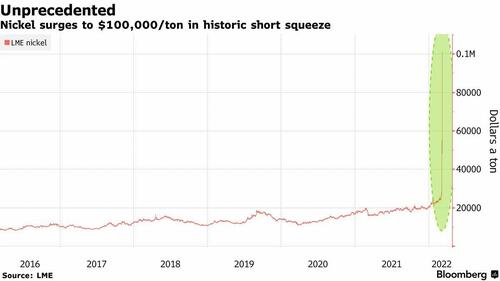
As reported overnight, in order to avoid a default of Xiang Guangda’s Tsingshan Holding Group, which is the world’s largest producer of the nickel, and which faced a paper loss of at least $8 billion on Monday according to the WSJ, a consortium of banks including JPMorgan would provide Tsingshan with liquidity in the form of credit promises, following a marathon meeting that “ran into the pre-dawn hours of Wednesday morning.”
Meanwhile, the LME has said it would start a process to try to close out short positions by matching market participants with long and short positions before the market reopened, to reduce the risk that this week’s squeeze is repeated when trading resumes. But Xiang, whose short position through Tsingshan still stood in the region of 150,000 tons, has shown little interest in this overture according to Bloomberg which.
Instead, in recent conversations, Xiang has told the roughly 10 banks and brokers through which Tsingshan holds its nickel position that he still believes prices will fall and that he would like to keep his short position, which likely means that banks that seek to bail him out could be facing even greater losses should Xiang be hit with another margin call in the coming days, one which soaks up any new, incremental liquidity.
That said, the discussions are said to still be ongoing, and it’s not clear what stance Tsingshan’s banks will take. People familiar with the matter said earlier this week that Xiang was considering what to do with his short position and might be willing to exit it entirely, although having obtained assurances from banks that much needed liquidity will be there, he appears to have changed his mind again.
Taking a page out of the Erdogan playbook, in an interview with Chinese news outlet Yicai, Xiang blamed “foreigners making some moves” for nickel’s price spike.
Tsingshan’s difficulties in paying its margin calls, and the company’s ongoing bailout negotiations, have put its banks and brokers in a bind, as they have had to make hefty margin calls of their own at the LME to cover their short positions on the exchange. As reported earlier this week, on Monday, a unit of China Construction Bank failed to pay a margin call on time, but was given additional time by the Hong Kong-owned LME and made the payment the following morning.
While the latest news from Bloomberg as of Wednesday was that Tsingshan had secured credit promises from banks including JPMorgan and China Construction Bank that could allow it to avoid defaulting on its margin calls, the fact that Xiang plans on holding on to its short may scuttle the deal as “some of the banks” are worried that if the market reopens with Tsingshan’s short position still in place, it could see a repeat of the brutal short squeeze earlier this week. But, as Bloomberg concludes, it may be difficult for them to force Xiang’s hand: if he were to walk away from Tsingshan’s commitments, the banks could lose billions confirming once again that “If you owe the bank $1000, that’s your problem. If you owe the bank $8 billion, that’s the bank’s problem.”
And so we wait to see if Tsingshan will soon be the second coming of Melvin Capital which instead of unwinding its catastrophic shorts, decided to press them instead, with even more catastrophic results.
Overnight, unaware of Xiang’s stuborness, some Shanghai Futures Exchange nickel contracts dropped by the daily limit Wednesday evening as trading partially resumed on the Chinese bourse, perhaps expecting Tsingshan to cover its short and allow normalcy to return. The SHFE nickel contract for March delivery fell as much as 13.5% to 220,000 yuan ($34,807) a ton, and was trading at 221,000 yuan at 11 a.m. local time on Thursday. Trade in the August contract was halted after it slumped to 211,500 yuan a ton, falling by a 17% daily limit.
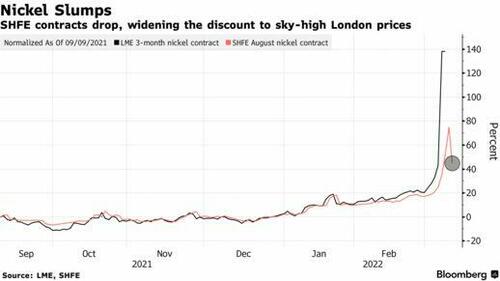
However, now that the fate of the massive short appears to be back in limbo, it is unclear how the SHFE Nickel contract will trade when it reopens tonight.
Incidentally, the above leaves open the question as to the propriety of the HK (and thus China) owned LME exchange giving such preferential terms to a Chinese metal tycoon. In a scathing critique on twitter this morning, AQR Capital’s Cliff Asness slammed the LME saying “And the cheaters win. @LME_news please note, I’m accusing you of reversing trades to save your favored cronies and robbing your non-crony customers. Everyone who trades should know what you did.”
END
6.CRYPTOCURRENCIES
7. GOLD/ TRADING TODAY
Your early currency/gold and silver pricing/Asian and European bourse movements/ and interest rate settings THURSDAY morning 7:30 AM
ONSHORE YUAN: CLOSED DOWN 6.3214
OFFSHORE YUAN: 6.3268
HANG SANG CLOSED UP 262.55 PTS OR 1.27%
2. Nikkei closed UP 972.87 PTS 3.94%
3. Europe stocks ALL RED
USA dollar INDEX DOWN TO 97.96/Euro RISES TO 1.1095-
3b Japan 10 YR bond yield: RISES TO. +.192/ !!!!(Japan buying 100% of bond issuance)/Japanese yen vs usa cross now at 115.88/ THIS IS TROUBLESOME AS BANK OF JAPAN IS RUNNING OUT OF BONDS TO BUY./JAPAN 10 YR YIELD IS NOW TARGETED AT .11%/JAPAN LOSING CONTROL OF THEIR BOND MARKET//
3c Nikkei now ABOVE 17,000
3d USA/Yen rate now well below the important 120 barrier this morning
3e WTI:: 113.20 and Brent: 115.87–
3f Gold UP /JAPANESE Yen UP CHINESE YUAN: ON -SHORE CLOSED DOWN// OFF- SHORE DOWN
3g Japan is to buy the equivalent of 108 billion uSA dollars worth of bond per month or $1.3 trillion. Japan’s GDP equals 5 trillion usa./“HELICOPTER MONEY” OFF THE TABLE FOR NOW /REVERSE OPERATION TWIST ON THE BONDS: PURCHASE OF LONG BONDS AND SELLING THE SHORT END
Japan to buy 100% of all new Japanese debt and by 2018 they will have 25% of all Japanese debt. Fifty percent of Japanese budget financed with debt.
3h Oil DOWN for WTI and DOWN FOR Brent this morning
3i European bond buying continues to push yields lower on all fronts in the EMU. German 10yr bund RISES TO +.0.308%/Italian 10 Yr bond yield RISES to 1.81% /SPAIN 10 YR BOND YIELD RISES TO 1.23%…ITALIAN 10 YR BOND YIELD/GERMAN BUND: 1.51: DANGEROUS FOR THE ITALIAN BANKING SYSTEM
3j Greek 10 year bond yield RISES TO : 2.34
3k Gold at $2006.20 silver at: 25.81 7 am est) SILVER NEXT RESISTANCE LEVEL AT $30.00
3l USA vs Russian rouble;// Russian rouble UP 19.7/100 in roubles/dollar; ROUBLE AT 116.84
3m oil into the 113 dollar handle for WTI and 115 handle for Brent/
3n Higher foreign deposits out of China sees huge risk of outflows and a currency depreciation. This can spell financial disaster for the rest of the world/
JAPAN ON JAN 29.2016 INITIATES NIRP. THIS MORNING THEY SIGNAL THEY MAY END NIRP. TODAY THE USA/YEN TRADES TO 115.88 DESTROYING JAPANESE CITIZENS WITH HIGHER FOOD INFLATION
30 SNB (Swiss National Bank) still intervening again in the markets driving down the FRANC. It is not working: USA/SF this morning .9266– as the Swiss Franc is still rising against most currencies. Euro vs SF 1.0285 well above the floor set by the Swiss Finance Minister. Thomas Jordan, chief of the Swiss National Bank continues to purchase euros trying to lower value of the Swiss Franc.
USA 10 YR BOND YIELD: 1.982 UP 3 BASIS PTS
USA 30 YR BOND YIELD: 2.350 UP 1 BASIS PTS
USA DOLLAR VS TURKISH LIRA: 14.85
Futures Slide On Inflation Fears As Ukraine Ceasefire Hopes Crumble
THURSDAY, MAR 10, 2022 – 07:53 AM
After yesterday’s furious short covering/technical driven surge in risk assets, futures and global markets are sliding this morning after Ukraine and Russia failed to make progress in halting the war and bridging the vast differences between them at the first high-level talks between their foreign ministers since the Russian invasion began. Emini S&P futures dropped 0.83% or 36 points to 4,240 as of 730am after rising as high as 4,298 yesterday, with the Nasdaq dropping 1.3% and Dow futures sliding 0.9%. The dollar was higher, as were 10Y Treasury yields which rose to 1.9532%, while oOil rebounded after the biggest one-day plunge in over three months as the fallout from Russia’s invasion of Ukraine continues to rattle what one analyst called a “panic-stricken” market. DXY regains 98.00, while the EUR slides pre-ECB and following yesterday’s advances while the RUB remains bid. Looking ahead, highlights include US CPI, ECB Policy Announcement & Press Conference with President Lagarde, EU Leaders Summit, RBA’s Lowe, US Supply.

The big highlight this morning was news of the latest failed ceasefire attempt: Ukraine’s Foreign Minister Dmytro Kuleba said that Russia indicated it will continue attacks until its goals are met, Ukrainian Foreign Minister Dmytro Kuleba said after the meeting lasting about 90 minutes with his Russian counterpart Sergei Lavrov in Turkey on Thursday. “The broad narrative he conveyed to me is that they will continue their aggression until Ukraine meets their demands, and the least of these demands is surrender,” Kuleba said.
In other words, there was no progress on a ceasefire as “Russia stuck to its script” although Kuleba said he is ready to meet again in this format. Meanwhile, the Russian Foreign Minister says a possible meeting between the Ukrainian and Russian presidents was discussed, but need more preparations. Gere are all the other notable reecnt developments in the Ukraine/Russia negotiations:
- Ukrainian Foreign Minister Kuleba says no progress on ceasefire; Russia stuck to its script; holding the meeting with his Russian counterpart was not easy; ready to meet again in this format; ready to continue engagement to stop the war. Mariupol was the most difficult situation, Lavrov did not commit to a humanitarian corridor in Mariupol. Have two tasks now: organising humanitarian corridor from Mariupol and reaching 24-hour truce.
- Russian Foreign Minister Lavrov says a possible meeting between the Ukrainian and Russian presidents was discussed; but need more preparations, Reminded Ukraine that Russia had presented its proposals and Moscow wants a reply. Prepared to discuss security guarantees for Ukraine. Possible meeting between the Ukrainian and Russian presidents was discussed; but need more preparations. No one here today was discussing a ceasefire; on oil/gas sanctions, says never used oil and gas like weapons.
- Reminder, prior to the Foreign Ministers meeting the Russian Kremlin said the Turkey meeting could open the way for talks between Russian President Putin and Ukrainian President Zelensky, awaiting the outcome of today’s Foreign Minister talks.
- EU is to back Ukraine’s European bid although fast membership is unlikely, according to Sputnik citing reports.
- White House said Russia’s claims of alleged US biological weapons labs and chemical weapons development in Ukraine are false and that the US should be on the lookout for Russia to possibly use chemical or biological weapons in Ukraine in light of its false claims.
- US Secretary of State Blinken discussed with Ukrainian Foreign Minister Kuleba additional security and humanitarian assistance for Ukraine and discussed Russian attacks on population centres
- US Defense Secretary Austin spoke with Ukrainian counterpart about continued provision of defensive assistance for Ukraine.
- Spain is ready to send a new batch of weapons to Ukraine, according to reports in Sputnik citing the Defence Minister
As a result of today’s ceasefire disappointment, equities have moved sharply lower as yesterday’s exuberance fizzled, dragging the Euro Stoxx 50 down -2.4%. US futures have been moving in-line with European bourses as geopolitics currently dominates ahead of the ECB and US CPI.
Both the S&P and Nasdaq rallied on Wednesday as investors took advantage of lower valuations following a four-day rout in the wake of Russia’s invasion of Ukraine. Among notable premarket moves, Amazon.com Inc. jumped after the e-commerce giant announced a stock split and a $10 billion stock buyback, which analysts said were positive signs of management confidence. CrowdStrike Holdings rose 12% after it posted another strong quarter, analysts said, with all metrics beating expectations. Here are some other notable premarket movers:
- Cryptocurrency-exposed stocks fall on Thursday, following Bitcoin lower after Wednesday’s jump. Among U.S. crypto stocks falling in premarkettrading are Riot Blockchain (RIOT US, -5.4%), Marathon Digital (MARA US, -6%).
- Shares of companies related to infrastructure may be in focus Thursday after the House passed a long-delayed $1.5 trillion spending bill that would fund the U.S. government through the rest of the fiscal year. Stocks to watch include Vulcan Materials (VMC US), Martin Marietta Materials (MLM US).
- Asana (ASAN US) plunges 25% in U.S. pre-market trading after the software company said it plans to increase spending next year, leading to a 1Q earnings forecast that missed estimates and concern from analysts about margins. The results prompted a downgrade to underweight from neutral at JPMorgan.
- CrowdStrike (CRWD US) jumped 12% in premarket trading after it posted another strong quarter, analysts said, with all metrics beating expectations.
- Marqeta (MQ US) shares jumped 13% in postmarket trading after reporting revenue for the fourth quarter that beat the highest analyst estimate.
- Fossil (FOSL US) dropped 15% in extended trading on Wednesday, after the maker of fashion accessories reported its fourth-quarter results and gave a forecast for full-year sales growth.
In Europe, the Stoxx 600 slumped as much as 1.5% – its fifth drop in six days – after posting its biggest gain in two years on Wednesday. All sectors were in the red barring health care, miners and energy. Autos, banks and consumer products are the worst-performing sectors. FTSE MIB lags, dropping 2.9%. The European Central Bank is set to announce its policy decision later in the day. Here are some of the biggest European movers today:
- K+S shares gain as much as 8.3% in Frankfurt after the company reported a dividend per share for 2021 that was a “surprise” beat of analysts’ estimates, Baader says in a note to investors.
- SMCP shares jump as much as 11% after the French owner of the fashion brands Sandro and Maje reported FY results that showed good progress in terms of profitability, according to Jefferies,
- Thales rose alongside European defense peers after the company was raised to a new Street-high of EU142 from EU108 at Citi; Saab meanwhile gain as much as 9% after Sweden said it wants to boost defense spending to reach 2% of GDP.
- Boohoo shares soar as much as 15% as clothing retailer’s reiteration of guidance reassures analysts, with Liberum saying the stock looks oversold.
- Leroy Seafood and other Norwegian salmon-producing peers rise after DNB named its top picks by DNB in a review of the sector, reiterating its bullish outlook for it.
- Russia- exposed European stocks slide afresh after Wednesday’s rebound as the war in Ukraine continued to bring volatility, with Nokian Renkaat (-8.1%) among the worst performers.
- Hugo Boss falls as much as 7.2% after the German apparel maker reported full-year results. Citi expects mid-single-digit Ebit consensus downgrades due to Russia’s invasion of Ukraine.
- JCDecaux shares fall as much as 4.1%. The French outdoor ad company reported 2021 results that beat estimates, yet it surprised some analysts by saying it won’t pay a dividend this year.
Data on the U.S. consumer price index due later in the day are forecast to show an acceleration to a 7.8% increase in February from a year earlier, which would be the most since 1982, when the Fed Funds rate was about 10%.

Still, the figures will capture data from before the Ukraine war and economists now expect inflation to peak at 8%-9%, given the jump in prices of staples like oil and food. Traders have also reduced bets on the pace of monetary tightening by the Federal Reserve due to economic uncertainty. Chair Jerome Powell has signaled a quarter-point rate hike at the central bank’s meeting next month — its first increase since 2018.
“The wider question will be around how many more hikes will follow,” Michael Hewson, chief market analyst at CMC Markets UK, said in an email. “It seems highly unlikely that we’ll need to see anywhere near the number of rate hikes expected right now, given the strength of the dollar.”
Earlier in the session, Asian stocks headed for their best daily performance since June 2020 following an overnight retreat in oil prices that helped ease investor worries over global inflation. The MSCI Asia Pacific Index climbed as much as 2.6%, bolstered by gains in the information-technology and financial sectors. TSMC, Sony Group and Toyota were among the largest contributors to Thursday’s rally. The stock benchmark is headed for a second-straight gain following a slump that had pushed the measure into a technical bear market. Oil fluctuated after posting the biggest drop since November in the previous session. Futures rose near $111 a barrel on Thursday after plunging 12% in New York. An earlier spike in crude prices triggered by a ban on Russia oil by the U.S. had seen the Asian equities benchmark sink on Tuesday to the lowest since October 2020, as many economies in the region rely on imported oil. “There’s a bit of relief among investors given how sharply share prices had fallen because of oil prices,” said Ayako Sera, a market strategist at Sumitomo Mitsui Trust Bank. “But it’ll be difficult for investors to push prices higher and higher, unless we see a resolution” to the war between Russia and Ukraine, she said. Gains were broad-based in the region with benchmarks in Japan, Taiwan and South Korea leading. The Topix index snapped a four-day selloff, rising 4%, the most in 21 months
In FX, the Bloomberg Dollar Spot Index advanced, yet moved in a narrow range compared to the wild swings in the previous days. The dollar strengthened against most of its Group-of-10 peers; the Australian and New Zealand dollars were the best performers and Scandinavian pairs were the worst. The euro hovered around $1.1050 while Bunds lead European bonds higher, following three days of losses that drove 10-year yields almost 30 basis points higher. The ECB policy announcement as well as possible news on European Union joint bonds are in focus as leaders meet at a summit in Versailles.
In rates, Treasuries are flat across the curve, fading earlier gains even as S&P 500 futures are under pressure after Wednesday’s 2.6% advance, after Ukraine ceasefire talks failed to end Russian assault on Ukraine. Yields are higher by less than 1bp across the curve with curve spreads little changed; 10-year flat at ~1.95%, underperforms bunds and gilts by 1bp-2bp. The Auction cycle concludes with $20b 30-year reopening at 1pm; Wednesday’s 10-year tailed by 0.3bp; the WI 30-year yield around 2.318% is ~2bp richer than February’s new-issue sale, which tailed by 1.1bp. Focal points for U.S. session include February CPI, expected to show highest y/y rates since 1980s, and 30-year bond reopening, week’s third and last coupon auction.
In commodities, crude futures advance. WTI trades within Wednesday’s range, adding 4.8% to trade below $114. Brent rises 5.6% around $117. Spot gold rises to about $2,000/oz. Base metals are mixed; LME tin falls 2.6% while LME aluminum gains 5.4%.
To the day ahead now, and the main highlights will include the aforementioned ECB meeting and President Lagarde’s press conference, the US CPI release for February, as well as the EU leaders’ summit in Versailles. On top of that, there’s the weekly initial jobless claims from the US, and an earnings release from Oracle.
Market Snapshot
- S&P 500 futures down 0.4% to 4,256.50
- STOXX Europe 600 down 0.9% to 430.75
- MXAP up 2.5% to 175.19
- MXAPJ up 1.9% to 572.19
- Nikkei up 3.9% to 25,690.40
- Topix up 4.0% to 1,830.03
- Hang Seng Index up 1.3% to 20,890.26
- Shanghai Composite up 1.2% to 3,296.09
- Sensex up 1.4% to 55,414.06
- Australia S&P/ASX 200 up 1.1% to 7,130.83
- Kospi up 2.2% to 2,680.32
- German 10Y yield little changed at 0.17%
- Euro down 0.2% to $1.1054
- Brent Futures up 4.5% to $116.12/bbl
- Gold spot down 0.5% to $1,982.73
- U.S. Dollar Index up 0.14% to 98.11
Top Overnight News from Bloomberg
- The ECB is set to decide how it can shield the continent’s economy from the consequences of the war in Ukraine while navigating an unprecedented inflation shock that shows no signs of abating
- Ukraine and Russia made little apparent progress in halting the war and bridging the vast differences between them at the first high-level talks between their foreign ministers since the Russian invasion began
- The euro looks set to cap the most volatile week in two years with more wild swings around the European Central Bank meeting. Overnight volatility is at the highest on the day of an ECB meeting since the pandemic concerns of March 2020. Euro bears are aiming for a return below $1.10 after the common currency sank Monday to $1.0806, its lowest since May 2020, while bulls hope to build on Wednesday’s biggest rally since June 2016
- If the swap market is to be believed, Russia is going to default on foreign debt, and insurance is going to pay out. Trading on credit-default swaps, used to insure against non-payment, has skyrocketed this week despite the myriad of questions over whether Russia’s plan to repay some foreign bondholders in rubles could ultimately be judged as a default
- Pacific Investment Management Co. has amassed a huge wager that Russia will not default on its debt, the Financial Times reported
- China will widen the yuan trading band for the ruble from March 11. CNY/RUB will be allowed to trade 10% around the fixing rate for the currency pair to meet the demand for market development, according to a statement from the China Foreign Exchange Trade System
- The House passed a long-delayed $1.5 trillion spending bill that would fund the U.S. government through the rest of the fiscal year and provide $13.6 billion to respond to Russia’s invasion of Ukraine
- Hungary’s central bank continued to raise the key interest rate as policy makers double-down in their efforts to shore up the forint, one of the world’s hardest-hit currencies since Russia’s invasion of Ukraine. The central bank hiked the one-week deposit rate by 50 basis points to 5.85% on Thursday. The median estimate in a Bloomberg survey was for an increase to 6%
- European factories and households used to benefit from a summer lull in power prices. Not this year. In one of the clearest signs of how the electricity market has been turned upside down as the war in Ukraine makes energy supplies more uncertain, German power futures for July are almost six times more expensive than the December average over the past ten years
A more detailed look at global markets courtesy of Newsquawk
Asia Pacific stocks traded with firm gains following a rally in global peers alongside an aggressive pullback in oil prices and with some optimism ahead of Russia-Ukraine talks after Ukrainian President Zelensky voiced a willingness for compromises. ASX 200 was lifted by strength across most industries aside from the commodity sectors following the cooling in underlying prices. Nikkei 225 surged with the gains magnified by a weaker currency and with Japan to raise the daily cap of foreign arrivals to 10k from 3k. Hang Seng and conformed to the heightened risk environment in which the former attemptedShanghai Comp. to reclaim the 21k level but with further upside restricted by weakness in some developers and blue-chip energy stocks.
Top Asian News
- U.K. Sanctions Abramovich, Deripaska on Russia’s War in Ukraine
- China to Double Yuan’s Trading Band for Russian Ruble to 10%
- China Will Double Yuan Trading Band Against Ruble to 10%
- Behind-the-Curve Fed Confronts an Inflation Shock: Macro View
European equities continue to move lower as yesterday’s exuberance wanes and further pressure emerges from the
readout of the Ukrainian-Russian Foreign Ministers meeting, -2.4%Euro Stoxx 50
US futures are pressured, -0.7%, though to a lesser extent than but have been moving in-line with EuropeanES
bourses as geopolitics currently dominates ahead of the ECB and US CPI.
Sectors are pressured and defensives are faring marginally better, while Basic Resources and Oil/Gas gain amid
commodity action.
Top European News
- European Gas Fluctuates With Russia-Ukraine Talks in Focus
- Sweden Aims to Boost Defense Spending to NATO Target
- China to Double Yuan’s Trading Band for Russian Ruble to 10%
- Spirax-Sarco Rises as Jefferies Notes ‘Robust’ Outlook
In Fixed income, bonds claw back some heavy losses, but fade from recovery highs ahead of ECB, US CPI and the 30 year auction.
BTPs lag awaiting anything supportive from the ECB or President Lagarde at the post-meeting presser. Treasury curve essentially flat following weak 3 and 10 year note sales irrespective of big back-up in yields In FX, the Euro showing signs of fatigue following extensive recovery gains on the eve of ECB as risk sentiment sours again; EUR/USD fades from just shy of 1.1100 through key Fib at 1.1060 towards hefty option expiries at round number below. DXY regains composure and 98.000+ status, while Gold rebounds through USD 2000/oz in wake of no progress on a ceasefire between Russia and Ukraine. Rouble remains on a firmer footing however as a Putin/Zelensky meeting is still possible and dialogue to continue; USD/RUB around 119.00. Forint failed to get full 1 week depo hike anticipated from NBH and Norwegian Krona capped after strong CPI data and Brent’s big midweek reversal. NBH increase the one-week deposit rate to 5.85% vs prev. 5.35% (exp. 6.00%).
In commodities, WTI and are firmer but remain well within recent ranges as the benchmarks derive further upside from theBrent Foreign Ministers remarks; thus far, WTI Apr and Brent May have highs of USD 114.21/bbl and USD 117.28/bbl UAE Energy Minister said UAE is committed to the OPEC+ agreement and its existing monthly production adjustment mechanism, while it believes in the value that OPEC+ brings to the oil market. UK PM Johnson is facing calls to urge Saudi to produce more oil, while it was also reported that Foreign Secretary Truss supports a push within the Cabinet to convince UK PM Johnson to approve the return of in the UK, according to The Telegraph fracking Standard Chartered expects a sharp fall in Russian oil output after volumes are displaced from the European market and sees as it will be unable to sell all the oilRussia having to shut-in oil production; displaced from the European market. Spot gold derived notable upside from Kuleba/Lavrov, eclipsing the USD 2000/oz mark and moving to a high of USD 2007/oz from circa. USD 1980/oz prior to the presser commencing. LME said it will permit nickel position transfers although trading remains halted. Chinese nickel giant Tsingshan secured bank lifelines following the historic short squeeze.
US Event Calendar
- 8:30am: Feb. CPI MoM, est. 0.8%, prior 0.6%; Feb. CPI YoY, est. 7.9%, prior 7.5%
- CPI Ex Food and Energy YoY, est. 6.4%, prior 6.0%
- CPI Ex Food and Energy MoM, est. 0.5%, prior 0.6%
- 8:30am: Feb. Real Avg Weekly Earnings YoY, prior -3.1%, revised -3.0%; Real Avg Hourly Earning YoY, prior -1.7%, revised -1.8%
- 8:30am: March Initial Jobless Claims, est. 217,000, prior 215,000; Continuing Claims, est. 1.45m, prior 1.48m
- 12pm: 4Q US Household Change in Net Wor, prior $2.36t
- 2pm: Feb. Monthly Budget Statement, est. -$212b, prior -$310.9b
DB’s Jim Reid concludes the overnight wrap
When it comes to dislocations and extreme moves, it’s been another volatile 24 hours for markets. But for the first time in a while there’s been a much more optimistic tone across multiple asset classes, with the biggest daily decline in commodities since 2008, a major rebound in global equities, as well as a continued move higher in sovereign bond yields. That comes ahead of another pivotal day ahead for investors, with many important events taking place. First, the Russian and Ukrainian foreign ministers will be meeting in Turkey, marking the first cabinet-level meeting between the two sides since the invasion began. Second, we’ll get some idea of how the ECB are viewing matters with their policy decision at 12:45 London time, followed by President Lagarde’s press conference 45 minutes later. Third, we’ve got the US CPI release at the same time as Lagarde begins her press conference, which will be the final print before the Fed are expected to commence their hiking cycle next week. And finally, EU leaders are meeting in Versailles later on, amidst growing speculation about whether they might move further on fiscal policy.
Ahead of all that however, stock markets in Asia have followed their global counterparts higher this morning following a blockbuster session for their US and European peers during which oil prices fell back sharply from their recent surge. The moves have been massive, with Brent Crude oil sliding by -13.16% in yesterday’s session to close at $111.14/bbl, the biggest daily move lower since April 2020, although this morning it’s seen a partial recovery to $115.15/bbl. That’s helped equities post strong gains, with the Nikkei (+4.02%) leading the way, followed by the CSI (+2.30%), Shanghai Composite (+1.91%) and the Hang Seng (+0.76%). South Korea’s Kospi (+1.82%) has also returned to trade this morning from yesterday’s presidential election, in which conservative opposition candidate Yoon Suk-yeol narrowly prevailed. Looking forward, US equity futures are only pointing towards a slight loss of momentum, with contracts on the S&P 500 down -0.19%.
A key factor that’s bolstered sentiment and led to that sharp move lower in commodities have been indicators from Ukraine that there could be a basis for talks to continue with Russia, alongside signals about a potential boost to OPEC+ output. Indeed, Bloomberg’s Commodity Spot Index (-5.20%) saw its largest daily decline since 2008 yesterday. A particular driver of those moves was that Ukrainian President Zelensky himself said in an interview with Germany’s Bild newspaper that he was prepared for certain compromises, with oil prices extending their decline on the back of those comments. That also followed separate remarks from his deputy chief of staff earlier in the day, who said Ukraine was open to discussing Russia’s demands on neutrality if they were given security guarantees. It’s worth stressing that the two sides are still a long way apart from each other, with the deputy chief of staff also saying that they wouldn’t cede a “single inch” of territory, but the gap between the two has narrowed relative to where it had been.
That decline in oil prices was then offered further support by the potential for greater supply, thanks to comments from officials in various OPEC countries. The FT reported that the UAE’s ambassador to Washington said that they would encourage OPEC “to consider higher production levels”, whilst Iraq’s oil minister said that the country could increase output if the OPEC+ group required. Outside of OPEC, two roadblocks toward a renewed Iran deal were also cleared, even if a final deal still remains out of reach, while the US Secretary of Energy urged domestic producers to increase oil output and said that US energy strategy was on an emergency “war footing”.
As well as those developments on Ukraine and oil, the growing risk-on tone in markets yesterday (particularly in Europe) occurred against the backdrop of additional signals that the EU summit tonight could see bold action on the fiscal front, with reports over recent days indicating that further joint borrowing was possible in response to the Ukraine crisis. Then around the time of the European close, news came through from a French Presidency official that leaders would be holding talks about a possible EU resilience and investment plan. That said, they also mentioned that discussions were at an initial stage, and comments from officials in some of the northern European countries over recent days had indicated more resistance to that, so it’ll be interesting to see how this ends up developing today.
Speculation about such measures coincided with a massive surge in European equities, with the STOXX 600 (+4.68%), Germany’s DAX (+7.92%) and Italy’s FTSE MIB (+6.94%) all posting their largest daily advances since March 2020. And that also went hand-in-hand with a major turnaround on the rates side, with sovereign bond yields moving higher across the continent, including those on 10yr bunds (+10.4bps), OATs (+10.1bps) and BTPs (+8.3bps). Over the 3 sessions since the start of the week, yields on 10yr bunds are up by a massive +28.5bps, putting them roughly around their pre-invasion levels. That has coincided with a re-appraisal of ECB pricing this year, with 34bps of hikes now priced in for 2022 as a whole, up from a closing low of 6bps earlier last week.
These moves will put the ECB’s decision today in focus, with investors interested in how the Ukraine conflict and its implications are affecting their thinking on monetary policy. At the February meeting before markets were worried about Ukraine, we got a big hawkish surprise, since President Lagarde failed to repeat her previous remarks that a 2022 hike was unlikely, and said there was “unanimous concern” about inflation surprises. Inflation has continued to surprise on the upside since then, hitting a record since the single currency’s formation at +5.8% in February, but clearly the downside risks to growth have also increased, so an unenviable dilemma for policymakers. In terms of what to expect this time round, our European economists write in their preview (link here) that the Ukraine conflict raises the risk that liftoff in rates is delayed. But they still expect a strong message from this meeting will be the ECB’s unwavering commitment to delivering on the 2% inflation target, with a resolve to hike when necessary to preserve price stability. So the ECB can stall normalisation, but only if the data (and in particular inflation expectations and other indicators of second round effects) allow it to stall. Keep an eye out for their latest staff forecasts as well, and in particular what they’re saying about the all-important 2024 inflation forecast, since one of the ECB’s conditions for liftoff is that they see inflation stabilising at 2% over the medium term.
Staying on that central bank theme, the US CPI release today will be important as we approach the Fed’s decision next week, and represents the last big piece of data they’ll get alongside last week’s stronger-than-expected jobs report. Our US economists are expecting that the year-on-year number for February will rise to +7.8%, which if realised would be the strongest print in 40 years. They’re also forecasting core at +6.3%, and they published a strategy update on the release as well yesterday (link here). In terms of the implications for next week, Fed funds futures have mostly discounted the possibility of a 50bps move that we saw turbocharged by the last CPI reading (just ahead of US warnings about a Russian invasion), and were pricing in 26.4bps worth of hikes next week by yesterday’s close. That’s in line with the view put forward by Fed Chair Powell in his testimony last week, who said that he was “inclined to propose and support a 25bp rate hike” at this meeting, as well as our US economists, who are also expecting a 25bp hike in March, followed by further hikes of 25bps at subsequent meetings for the rest of the year. Our US econ team also put out a note yesterday (link here) expecting the Fed to unveil plans for the structure of QT at next week’s meeting, as well.
Treasury yields moved higher ahead of the CPI print, with those on 10yr yields up +10.8bps to 1.95% on the improvement in risk sentiment which accelerated after the Treasury auctioned 10yr securities, and this morning they’ve only seen a slight pullback of -1.4bps. Yesterday’s gain was thanks to a sizable +15.7bp rise in real rates, the largest daily increase since February 2021, and the S&P 500 also benefitted from the improved risk tone, albeit underperforming European equities by “only” advancing +2.57% on the day. The gains were broad based, with 422 shares ending the day in the green. The NASDAQ did better than the S&P, picking up +3.59%. There were signs of some market stresses easing as well, with Bloomberg’s index of US financial conditions easing for the first time this week, and the VIX index of volatility (-2.68pts) fell for a 2nd consecutive session.
There wasn’t much in the way of data yesterday, though we did get the US jobs openings for January, which came in higher than expected at 11.263m (vs. 10.95m expected), whilst the December reading was revised up to a record 11.448m. The slight decline in job openings in January meant that the ratio of vacancies per unemployed worker fell slightly from a record 1.8 in December to 1.7 in January, but that’s still the second highest on record and points to an incredibly tight labour market. The quits rate also fell back from a record 3.0% to 2.8%, but that still leaves it some way above its pre-pandemic peak. Overnight, we’ve also had producer price inflation from Japan, which came in at +9.3% on a year-on-year basis, above the +8.6% expected and hitting its highest level in four decades.
To the day ahead now, and the main highlights will include the aforementioned ECB meeting and President Lagarde’s press conference, the US CPI release for February, as well as the EU leaders’ summit in Versailles. On top of that, there’s the weekly initial jobless claims from the US, and an earnings release from Oracle.
END
3. ASIAN AFFAIRS
i)THURSDAY MORNING// WEDNESDAY NIGHT
SHANGHAI CLOSED UP 39.70 PTS OR 1.22% //Hang Sang CLOSED UP 262.55 PTS OR 1.27 % /The Nikkei closed UP 972.87 PTS or 3.94% //Australia’s all ordinaires CLOSED UP 1.08% /Chinese yuan (ONSHORE) closed DOWN 6.3214 /Oil DOWN TO 113.20 dollars per barrel for WTI and DOWN TO 115.87 for Brent. Stocks in Europe OPENED ALL RED // ONSHORE YUAN CLOSED DOWN AGAINST THE DOLLAR AT 6.3214. OFFSHORE YUAN CLOSED DOWN ON THE DOLLAR AT 6.3268: /ONSHORE YUAN TRADING ABOVE LEVEL OF OFFSHORE YUAN/ONSHORE YUAN TRADING WEAKER AGAINST USA DOLLAR/OFF SHORE WEAKER//
3 a./NORTH KOREA/ SOUTH KOREA
///NORTH KOREA
3B JAPAN
3c CHINA
CHINA/RUSSIA/UKRAINE
The Ukrainian invasion is causing problems with commercial ties with both Moscow and Kiev
(zerohedge)
Ukraine Crisis Strains Beijing’s Commercial Ties With Moscow & Kiev
THURSDAY, MAR 10, 2022 – 04:15 AM
China may be the largest trading partner of both Ukraine and Russia, but that doesn’t mean it hasn’t faced any blowback from the flight. Commerce Minister Wang Wentao said Tuesday that China is hoping to “promote our normal trade”

Commerce Minister Wang Wentao said on Tuesday that China was hoping to “promote our normal trade” with both Moscow and Ukraine while Beijing continues to walk a diplomatic tightrope of trying to satisfy both governments.
One small business owner says his business in Russia and Ukraine has taken a major hit as Russian customers “no longer want to pay”.
“My Ukrainian and Russian business has been directly impacted,” said Bob Yao, co-founder of a digital printing production company in Guangdong province.
“We lost contact with my Ukraine client. And another Russian customer sounded no desire to pay and let us deliver goods all at once because the rouble has been devalued.”
Yao added that the impact of Russia’s invasion has already spread to customers in other regions. “A customer in Central Asia informed us on Tuesday that he has decided to postpone payment and shipping plans for six containers, because of concerns over world affairs,” he added.
China does a lot of business with both Russia and Ukraine, importing wheat from the latter and buying energy from the former. Experts have warned that the price spike in international oil prices serves as a wake-up call for China’s energy security. China’s state broadcaster also said that export orders from Ukraine have declined substantially since December. And unfolding financial sanctions against Russia are fueling worries about the risks to Chinese traders.
Both Russia and Ukraine are participants in the Belt and Road Initiative, China’s plan to expand its importance in global trade. Notably, Beijing and Kyiv deepened their cooperation in the initiative by agreeing in December 2020 to work together on projects related to trade, transport, infrastructure, industrial investments and agriculture.
In a statement made by the Commerce Ministry, Beijing reiterated the importance of Ukraine to its European trade, and called for a specific bilateral trade deal to be ratified.
“China and Europe are two independent forces in the world, with broad strategic consensus and common interests … We believe that China-EU cooperation is greater than competition,” Wang said, while also calling for the China-EU bilateral investment deal to be ratified and brought into force.
As for the deal, the EU will try and de-fuse the growing trade tensions with China by holding an economic summit in April to try and help smooth over any concerns Beijing might have. The summit couldn’t come at a better time for China-Ukraine’s bilateral relationship: EU trade chief Valdis Dombrovskis pointed to the worsening drop in FDI coming out of Europe and into China that has beeen worsening.
end
4/EUROPEAN AFFAIRS//UK AFFFAIRS
POLAND/USA/UKRAINE
More problems: the uSA will not give Poland’s jets to Ukraine over concerns Putin will see the move as “escalatory”
(Stieber/EpochTimes)
US Won’t Give Poland’s Jets To Ukraine Over Concerns Putin Would See Move As “Escalatory”
WEDNESDAY, MAR 09, 2022 – 09:35 PM
By Zachary Stieber of the Epoch Times

The United States won’t act on a proposal from Poland to take fighter jets from the ally and transfer them to Ukraine because of concerns Russian officials would view the move as “escalatory,” a U.S. official said March 9.
“The intelligence community has assessed the transfer of MiG-29s to Ukraine may be mistaken as escalatory, and could result in significant Russian reaction that might increase the prospects of a military escalation with NATO,” John Kirby, the U.S. Department of Defense’s spokesman, told reporters in Washington.
Based on the assessment, with which Defense Secretary Lloyd Austin concurs, the military assesses the transfer as “high-risk” and will not carry it out, at least for now.
The proposal from Poland was Polish officials would transfer jets to the United States, which could then send the jets to Ukraine. Poland’s government also called on NATO allies to send jets to U.S. bases. But U.S. officials quickly rejected the proposal, though they had not detailed the intelligence assessment until Wednesday.
Kirby also framed the decision as in Ukraine’s best interests, arguing that Ukraine would benefit more in the conflict with Russia by receiving anti-armor and air defense weapons.
While Russia’s air force has significant capabilities, air assaults have been met with resistance in the air and on the ground, according to U.S. officials. Additionally, the Ukrainian Air Force was also said to have several squadrons of fully capable aircraft already, and a U.S. assessment concluded “giving them more is not likely” to make a big impact, according to Kirby.
Austin conveyed the position to Polish Defense Minister Mariusz Blaszczak in a call and also spoke with a top Ukraine official about similar matters.
U.S. officials had previously said Poland was welcome to transfer planes to Ukraine directly and Kirby said each nation “can decide for themselves what they want to do.”
Ukraine’s public position is that getting fighter jets would help tremendously against Russia, which invaded its neighbor on Feb. 24.
“That’s absolutely the way we see it,” Vadym Prystaiko, Ukraine’s ambassador to the United Kingdom, said on Sky News on Wednesday when asked if jets would give Ukraine the advantage it needs.
“All the tactical means you are talking about, they can be covered if we have at least not superiority, but at least control over our skies,” he added.
Ukraine prefers older jets because its pilots are trained to work with them. Around the same time, U.S. House Speaker Nancy Pelosi (D-Calif.) told reporters in Washington said she was asked by Ukrainian President Volodymr Zelensky for help getting planes.
The updates came hours after Mateusz Morawiecki, Poland’s prime minister, said Poland would only provide jets to Ukraine directly if all NATO members agree, as Russian officials have threatened countries that undertake such moves.
end
Volkswagen CEO warns Ukrainian war could be worse for Europe than Covid.
(zerohedge)
Volkswagen CEO Warns Ukrainian War Could Be Worse For Europe Than COVID
THURSDAY, MAR 10, 2022 – 10:00 AM
No, this isn’t an April Fool’s joke.
Volkswagen CEO Herbert Diess told the FT in an interview published Thursday that a prolonged war in Ukraine would be “very risky” for the European and German economies – and that it ultimately might be even worse for them than COVID.
According to the FT, Diess said the economic damage from the war could be “very much worse” than the pandemic.
“The interruption to global supply chains could lead to huge price increases, scarcity of energy and inflation,” Herbert Diess, chief executive of the German carmaker, told the Financial Times.
“It could be very risky for the European and German economies.”
The warning, from one of Europe’s most authoritative business leaders (since Volkswagen is still Europe’s biggest car maker by sales volume), is just the latest reminder that the ripples from the conflict are being felt far away from the battlefield. Just yesterday, McDonald’s and Coca-Cola caved to public pressure and decided to temporarily suspend operations in Russia. They’re the latest in a long line of western businesses who have cut ties.

Volkswagen, like all auto makers, has struggled thanks to shortages of semiconductor supplies.
But Deiss fears these “supply chain” risks will worsen thanks to western sanctions against Russia, which has become seriously entangled with Europe in terms of not just oil and gas exports but wheat and other commodities as well.
But it’s not just the supply chain issues: there’s also the “threat of war”, which Europeans should take seriously.
The warning from one of the continent’s best-known business leaders comes as western governments ratchet up their economic efforts to punish Russia, a key global supplier of commodities from gas to palladium, for its invasion of Ukraine.
The sanctions imposed so far – and the prospect that the Kremlin could retaliate by turning off gas supply to Europe – has sent energy markets into turmoil.
“The threat of this war for Germany and Europe is huge,” said Diess, pointing out that higher inflation could severely squeeze consumers.
As we noted earlier, US CPI climbed to 7.9% YoY in February, with the hottest monthly rate since October and the 21st straight (non-transitory) monthly increase in prices.

Inflation is an international problem, and the Europeans are also feeling the pain: European inflation has hit a new record of 5.8% in February and is forecast to rise as high as 7% this year. The European Central Bank meets on Thursday, facing the threat of both rising prices and slower economic growth.
Germany has already opted not to follow the US with sanctions on Russian energy products, and Deiss said that while he was personally in favor of “maximum sanctions”, afterwards, Germany would need to return “to the negotiating table” to find a permanent solution to this conflict.
“We have to come back to negotiations, to dialogue, because what we don’t want is a never-ending war in Ukraine,” Deiss said.
Though Deiss didn’t come out and say it (at least not in the interview), concessions from the Ukrainian side would be inevitable to achieve lasting peace. France 24 recently reported that Ukrainian President Volodymyr Zelensky had said he is no longer pressing for NATO membership for Ukraine, and Zelensky himself has said that his desire to join the alliance has “cooled” .
Stopping the war would probably require assurances from the US.
ECB
The Euro jumps on surprise hawkish statement from the ECB
(zerohedge)
Euro Jumps As ECB Surprises With Hawkish Statement
THURSDAY, MAR 10, 2022 – 07:56 AM
With expectations set low for any actual market-moving announcements, today’s ECB statement was expected to be more about buying time before big decisions than actual decisions, with the economic forecasts underpinning its decision-making likely to be subject to greater uncertainty than normal due to Russia sanctions fallout.
However, it appears The ECB was in more of a hurry than expected to normalize and fight inflation and did not use the escalating conflict as an excuse, rather it accelerated the end of its bond-buying program (APP).
Based on its updated assessment and taking into account the uncertain environment, the Governing Council today revised the purchase schedule for its APP for the coming months. Monthly net purchases under the APP will amount to €40 billion in April, €30 billion in May and €20 billion in June. The calibration of net purchases for the third quarter will be data-dependent and reflect its evolving assessment of the outlook
The Governing Council also dropped wording that suggested interest rates could go “lower” than the present level, and said that any changes in borrowing costs will take place “some time after” the end of net bond purchases, and will be “gradual.”
Additionally, the ECB says that it will take whatever action is needed to fulfil mandate.
This was a packed statement. Here are the main headlines:
- ECB Announces Faster Winding Down of Asset Purchase Program
- ECB: Will Take Whatever Action Is Needed to Fulfill Mandate
- ECB Drops Wording That Rates Could Be Lower Than Currently
- ECB Says It May End Asset Purchase Program in the Third Quarter
- ECB Drops Pledge to End APP ‘Shortly’ Before Rates Rise
The statement is overall on the hawkish side as it also drops wording that it could lower rates in the future.
Additionally, in response to the war, the ECB is also extending a facility to provide euros to peers outside of the euro area.
The aim is to provide a “comprehensive set of backstop facilities” to avert distress that could upset the transmission of ECB policy.
As we detailed earlier, the conflict in Ukraine had dominated the hawkish shift signaled by Lagarde in February and following Powell’s lead to some extent (where he jawboned expectations for a March hike down from 50bps to 25bps), but after the biggest surge since April 2020 yesterday, the euro was leaking lower ahead of the ECB statement and then spiked higher on the surprise acceleration in ending APP…

And that also raised rate-hike expectations for the year…

The press conference will offer Lagarde more opportunity to show how ‘flexible’ the ECB will be – whether she will build on this statement’s hawkishness or try and jawbone it back.
Watch live (due to start at 0830ET):
ECB Redline below:

Read the full statement below:
Monetary policy decisions
The Russian invasion of Ukraine is a watershed for Europe. The Governing Council expresses its full support to the people of Ukraine. It will ensure smooth liquidity conditions and implement the sanctions decided by the European Union and European governments. The Governing Council will take whatever action is needed to fulfil the ECB’s mandate to pursue price stability and to safeguard financial stability.
Asset purchase programme (APP)
Based on its updated assessment and taking into account the uncertain environment, the Governing Council today revised the purchase schedule for its APP for the coming months. Monthly net purchases under the APP will amount to €40 billion in April, €30 billion in May and €20 billion in June. The calibration of net purchases for the third quarter will be data-dependent and reflect its evolving assessment of the outlook. If the incoming data support the expectation that the medium-term inflation outlook will not weaken even after the end of our net asset purchases, the Governing Council will conclude net purchases under the APP in the third quarter. If the medium term inflation outlook changes and if financing conditions become inconsistent with further progress towards our two per cent target, we stand ready to revise our schedule for net asset purchases in terms of size and/or duration.
The Governing Council also intends to continue reinvesting, in full, the principal payments from maturing securities purchased under the APP for an extended period of time past the date when it starts raising the key ECB interest rates and, in any case, for as long as necessary to maintain favourable liquidity conditions and an ample degree of monetary accommodation.
Key ECB interest rates
The interest rate on the main refinancing operations and the interest rates on the marginal lending facility and the deposit facility will remain unchanged at 0.00%, 0.25% and -0.50% respectively.
Any adjustments to the key ECB interest rates will take place some time after the end of the Governing Council’s net purchases under the APP and will be gradual. The path for the key ECB interest rates will continue to be determined by the Governing Council’s forward guidance and by its strategic commitment to stabilise inflation at two per cent over the medium term. Accordingly, the Governing Council expects the key ECB interest rates to remain at their present levels until it sees inflation reaching two per cent well ahead of the end of its projection horizon and durably for the rest of the projection horizon, and it judges that realised progress in underlying inflation is sufficiently advanced to be consistent with inflation stabilising at two per cent over the medium term.
Pandemic emergency purchase programme (PEPP)In the first quarter of 2022, the Governing Council is conducting net asset purchases under the PEPP at a lower pace than in the previous quarter. It will discontinue net asset purchases under the PEPP at the end of March 2022.
The Governing Council intends to reinvest the principal payments from maturing securities purchased under the PEPP until at least the end of 2024. In any case, the future roll-off of the PEPP portfolio will be managed to avoid interference with the appropriate monetary policy stance.
The pandemic has shown that, under stressed conditions, flexibility in the design and conduct of asset purchases has helped to counter the impaired transmission of monetary policy and made the Governing Council’s efforts to achieve its goal more effective. Within the Governing Council’s mandate, under stressed conditions, flexibility will remain an element of monetary policy whenever threats to monetary policy transmission jeopardise the attainment of price stability. In particular, in the event of renewed market fragmentation related to the pandemic, PEPP reinvestments can be adjusted flexibly across time, asset classes and jurisdictions at any time. This could include purchasing bonds issued by the Hellenic Republic over and above rollovers of redemptions in order to avoid an interruption of purchases in that jurisdiction, which could impair the transmission of monetary policy to the Greek economy while it is still recovering from the fallout from the pandemic. Net purchases under the PEPP could also be resumed, if necessary, to counter negative shocks related to the pandemic.
Refinancing operations
The Governing Council will continue to monitor bank funding conditions and ensure that the maturing of operations under the third series of targeted longer-term refinancing operations (TLTRO III) does not hamper the smooth transmission of its monetary policy. The Governing Council will also regularly assess how targeted lending operations are contributing to its monetary policy stance. As announced, it expects the special conditions applicable under TLTRO III to end in June this year. The Governing Council will also assess the appropriate calibration of its two-tier system for reserve remuneration so that the negative interest rate policy does not limit banks’ intermediation capacity in an environment of ample excess liquidity.
Liquidity lines with non-euro area central banks
In view of the highly uncertain environment caused by the Russian invasion of Ukraine and the risk of regional spillovers that could adversely affect euro area financial markets, the Governing Council decided to extend the Eurosystem repo facility for central banks (EUREP) until 15 January 2023. EUREP will therefore continue to complement the regular euro liquidity-providing arrangements for non-euro area central banks. Together, these form a comprehensive set of backstop facilities to address possible euro liquidity needs in the event of market dysfunctions outside the euro area that could adversely affect the smooth transmission of the ECB’s monetary policy. Requests from non-euro area central banks for individual euro liquidity lines will be assessed by the Governing Council on a case-by-case basis.
***
The Governing Council stands ready to adjust all of its instruments, as appropriate, to ensure that inflation stabilises at its 2% target over the medium term.
The President of the ECB will comment on the considerations underlying these decisions at a press conference starting at 14:30 CET today.
end
Inflation is ramping up throughout Europe
(zerohedge)
Trichet Trickery: ECB Turns Hawkish Just As It Warns Of Sharply Higher Inflation, Slower Growth
THURSDAY, MAR 10, 2022 – 09:22 AM
As noted earlier, the ECB this morning came out with a surprisingly hawkish statement according to which it now expects to QE on an accelerated schedule and end the Asset Purchase Program as soon as Q3 while hinting at an earlier lift off to rates, news which sent peripheral, and especially Italian bonds, tumbling.

And in light of Europe’s record CPI, this is perhaps to be expected. The problem is the ECB is now pulling a page right out of the Jean-Claude Trichet playbook…
.. and is telegraphing tighter financial conditions just as stagflation is rearing its ugly head.
To wit, the ECB slashed its economic growth projections for the euro area to 3.7% in 2022 from 4.2% and 2.8% in 2023 from 2.9%, while still expecting the economy ti grow 1.6% in 2024.
“In the baseline of the new staff projections which incorporate 1st assessment of implications of the war, GDP has been revised downward,” Lagarde says, blaming the slowdown on the Ukraine war.
More ominously, however, the ECB took its inflation forecasts sharply higher, and now expects 2022 inflation to soar 5.1%, up almost 2% from its 3.2% forecast just three months ago. The bank also hiked its 2023 inflation forecast to 2.1% from 1.8%, but in order to avoid having to hike today, kept its 2024 inflation forecast below 2.0% at 1.9%. Anything else and the central bank would have been accused to violating any number of its mandates.

Alas, there is much more inflation to come: as Lagarde admitted, the war in Ukraine is a substantial upside risk, especially to energy prices,” adding that “energy prices continue to be the main reason for this high rate of inflation.”
She noted that gigher energy prices “also pushing up prices across many other sectors” and warned that iIf price pressures feed through into higher than anticipated wage rises, or if there are adverse persistent supply side implications, inflation could also turn out to be higher.”
It will be, and that’s why the ECB is now trapped, and has no choice but to hike, which however will have absolutely zero impact on the supply-shock (over which central banks are powerless) and instead will not only drag Europe into the next recession but will send peripheral yields soaring which, as everyone knows by now, have only been contained thanks to the ECB’s infinite QE. End that, and everyone will get a stark reminder of Europe’s “doom loop” which after all these years, has still not been fixed.
Bottom line: the ECB may be tightening now, but in one year we almost certainly be witness to another European financial crisis, just like back in 2011, when J-C Trichet hiked rates twice in April and July, only to send Europe into its biggest existential crisis of all time.
ITALY
for your interest…
Does This Mysterious Superyacht In Italian Port Belong To A Russian Oligarch?
WEDNESDAY, MAR 09, 2022 – 11:00 PM
A mysterious superyacht is docked in Marina di Carrara, a small Italian town on the Tuscan coast. Italian police have boarded the vessel, searching for clues and interviewing the ship’s captain to figure ownership, according to NYTimes.
Scheherazade, a 140-meter superyacht, is estimated to be worth around $700 million, has two helipads, a swimming pool, and gold-plated fixtures in the bathrooms.

Locals believe the yacht could be owned by a Russian oligarch or even Russian President Vladimir Putin. They’ve nicknamed it “Putin’s yacht.”
“Everybody calls it Putin’s yacht, but nobody knows whose it is,” Ernesto Rossi, a local interviewed by NYT. “It’s a rumor that’s been going around for months.”
The ship’s captain, Guy Bennett-Pearce, said Putin had ever been on the yacht.
“I have never seen him. I have never met him.” He noted the owner of the yacht is currently not under any sanction list though didn’t rule out that the person could be Russian, adding he couldn’t reveal the owner because of a “watertight nondisclosure agreement.”
Captain Bennett-Pearce said Italian investigators had recently come aboard to examine the vessel’s certification documents. “They are looking hard. They are looking at every aspect,” he said. “This isn’t the local coppers coming down, these are men in dark suits.”
On Monday, the captain was forced to hand over documents revealing the owner’s identity and was told by investigators it would be handled with “confidentiality.”
“I have no doubt in my mind whatsoever that this will clear the vessel of all negative rumors and speculations,” he said.
The investigation into the Scheherazade comes as the Biden administration made it very clear last week they will “seize the yachts, luxury apartments, and private jets” of Russian billionaires. Sanctions were announced by Western countries that have hit Russia’s economy hard and targeted Putin’s inner circle of oligarchs.
Even though some Russian superyachts and other assets of the oligarchs have been seized, there has been tremendous difficulty (see: here) of linking assets to oligarchs on the sanctions list (and even assets secretly controlled by Putin).
END
GERMANY
Porsche halts Taycan production due to shortage of parts from Ukraine
(zerohedge)
Porsche Halts Taycan Production Due To Shortage Of Parts From Ukraine
THURSDAY, MAR 10, 2022 – 02:45 AM
Despite claims to the contrary, the supply chain crisis is still wreaking havoc in the auto world.
In fact, this week Porsche said it would suspend production of its all electric Taycan until “at least” the end of next week. The production halt comes as a result of “missing parts”, Bloomberg reported on Tuesday, citing Stuttgarter Zeitung.
The suspension affects Porsche’s factory in Stuttgart-Zuffenhausen, where the vehicle is manufactured. Roughly 200 Taycan cars cannot be built per day, Yahoo reported. Porsche will resume production at its Leipzig plant, which had been suspended for similar reasons, this week.
In addition to the ongoing crunch for semiconductors, Porsche is also suffering from a short supply of cable harnesses, which are manufactured in Ukraine.

It isn’t just car parts that are made in Ukraine. We also wrote days ago that the shut down of the country’s neon production meant that the ongoing semiconductor shortage could continue longer than expected.
Little known companies like Ukraine’s Cryoin play large roles in the global production of semiconductors. Cryoin, for example, makes the neon gas used to power lasers that make patterns on chips.
It supplies to the U.S., Europe, Japan, Korea, China, and Taiwan – and the ripple effects of disruption in its supply “can be felt around the world,” the report says.
Business development director Larissa Bondarenko told Wired that production came to a halt after Russia’s invasion last Thursday. “We decided that [our employees] should stay at home for the next couple of days until the situation is clearer, to make sure that everyone is safe,” she said.
Bondarenko says the plant had planned to re-open but “missiles over Odesa”, where it is headquartered, meant that it was still too dangerous. She said she has been sleeping in her basement in her home, which is 30 minutes away. “Thank God we have one in our house,” she told Wired
END
EUROPE/TRUCKING
Now a major European based trucking firm Girteka Logistics, Europe’s largest trucking company announced that it has experienced some fuel shortages in Poland. Diesel prices skyrocket!’
(zerohedge)
Major European Trucking Firm Hit With Fuel Shortage After Ukraine Invasion
THURSDAY, MAR 10, 2022 – 06:55 AM
Europe’s already strained diesel market came under even more pressure as the Russian invasion of Ukraine has disrupted energy markets over the last two weeks. Now one of Europe’s leading logistics companies warns about fuel shortages.
Lithuania-based Girteka Logistics, Europe’s largest trucking company by ownership, announced it had “experienced some fuel shortages in Poland,” according to Bloomberg.
Poland has introduced several limitations, including 500 liters (132 gallons) per refill. This comes after oil refiners, regulators, and industry groups in the country reported people have been panic hoarding fuel since the Ukrainian invasion. Poland shares the 530km (330-mile) border with Ukraine.

Girteka Logistics said fuel shortages appear to be localized to Poland and haven’t spread across Europe. “We see more differentiation between pump prices in different countries and many trucking companies try to benefit from fuel at lower-cost countries,” the trucking firm said. It added, “cost pressure was already heavy due to growing costs of new trucks.” The Ukraine conflict appears to have put additional pressure on the logistics company.
Outlining Girteka Logistics’ nightmare of emerging fuel shortages is a futures curve signaling extremely tight supplies on the continent.
Traders are willing to pay as much as $142 a ton more to procure the fuel this month rather than waiting until April. That’s the biggest premium of its kind in data going back to early 2008. In barrel-equivalent terms, the March contract is trading at over $195 — also an all-time high. – Bloomberg

There are increasing signs fuel markets are tightening in Poland and spreading across the continent. OMV AG reported Tuesday it would limit the supply of heating oil and diesel from its Burghausen refinery in Germany due to tight supplies.
The move comes a day after Shell Plc slashed how much Russian crude it processes. This will make fuel availability worse.
So only two weeks after Russia invaded Ukraine, Europe’s energy security is already breaking down. Maybe EU leaders should rethink their energy policies and give up (temporarily) on going green. They should restart coal and nuclear power plants to survive the energy crisis.
end
UK/SANCTIONS ON RUSSIAN OLIGARCHS
The sale of Chelsea Football Club was disrupted with new sanctions on Abramovich and others.
(zerohedge)
UK Disrupts Sale Of Chelsea FC With New Sanctions On Abramovich, Others
THURSDAY, MAR 10, 2022 – 08:25 AM
Following a handful of asset seizures in Italy, Switzerland, and France that prompted some wealthy Russian businessmen to rapidly move yachts, jets, and other billionaire flotsam, the UK is cracking down and seizing assets belonging to more than half-a-dozen oligarchs.
UK authorities are sanctioning all assets of Chelsea Football Club owner Roman Abramovich as well as six other Russians. They will all face the full asset freeze and travel ban which could leave them effectively trapped where they are.
The British said the total value of the sanctions is approximately £15 billion ($19.74 billion).

Some of the other individuals being sanctioned are: Oleg Deripaska who has stakes in En+ Group, Igor Sechin, the Chief Executive of Rosneft and Andrey Kostin, Chairman of VTB bank. What’s more, Abramovich also has stakes in Evraz and Norilsk Nickel.
The steps came as the British authorities received pressure to sanction the 55-year-old oligarch in response to Russia’s military operation in Ukraine, a step which they initially announced on Thursday.
Abramovich and six others face a full asset freeze and travel ban, and are prohibited from transacting with U.K. citizens or businesses, the Foreign Office said in a statement Thursday.
The move effectively derails Abramovich’s plan to sell Chelsea, which plays in England’s highest soccer league, and raises major questions about the future of the club.
Rumors about Abramovich potential sale of Chelsea FC have been circulating for days. The Daily Mail reported last week that Abramovich had been circulating generous offers, including to a Swiss bullion baron who confirmed that Abramovich had been in touch with an offer.
“He’s terrified of being sanctioned,” the bullion magnate said.
For now, the sanctions won’t stop the club from playing its upcoming home game, granted they still have a sporting license to continue playing their fixtures, but can no longer sell tickets to their games at Stamford Bridge, which will only be attended by season ticket holders.
Their club merchandise shop must also close, and the west Londoners cannot sign or sell players either. Furthermore, the measures could also determine the previously uncertain fate of players about to become free agents, who now can’t be offered new contracts under measures which expire on May 31, 2022, but can be reviewed.
end
5. RUSSIAN AND MIDDLE EASTERN AFFAIRS
RUSSIA/USA/AMAZON
Amazon suspends retail shipments to both Russia and Belarus as well as blocking Prime Video
(zerohedge)
Amazon Suspends Retail Shipments To Russia & Belarus, Blocks Prime Video
WEDNESDAY, MAR 09, 2022 – 05:20 PM
Amazon has announced it has suspended most of its main services across Russia and Belarus, including access to Prime Video in Russia, and also confirming it will no longer ship retail orders to customers in both countries.
The US-based multinational e-commerce company has been backing away from services in Russia amid ratcheting pressure to do so, which also now includes stopping all new signups for Amazon Web Services. “Given the ongoing situation in Russia and Ukraine, we’ve taken additional actions in the region,” Amazon announced in a blog post.

“We’ve suspended shipment of retail products to customers based in Russia and Belarus, and we will no longer be accepting new Russia and Belarus-based AWS customers and Amazon third-party sellers,” Amazon said.
“We are also suspending access to Prime Video for customers based in Russia, and we will no longer be taking orders for New World, which is the only video game we sell directly in Russia.”
In the last week, and since Russia’s invasion of Ukraine which started on Feb.24, Amazon has come under increased pressure from the public and politicians to suspend services in Russia as punishment.
Already, Apple, Microsoft and Google (Alphabet) had been among the first tech companies with the largest market capitalizations in the world to begin winding down services in Russia.
At the same time Amazon has said it his helping Ukraine’s government with cybersecurity assistance, with an eye toward preventing external hacks of “charities, NGOs, and other aid organizations in order to spread confusion and cause disruption.”
For the full (and growing by the day) list of companies that are pulling out of Russia, see Forbes.
end
RUSSIA/FERTILZER
This is cause food prices to escalate
(zerohedge)
Russia To Ban Fertilizer Exports To ‘Not Friendly’ Countries; China Warns US Against Retaliation
THURSDAY, MAR 10, 2022 – 11:00 AM
Russia’s war on Ukraine is continuing to boost food prices. While the US and European countries are engaged in economic warfare against Moscow, it appears Russia’s turn to strike back has emerged.
On Thursday, Russian Minister of Industry and Trade Denis Manturov said Russia decided to suspend fertilizer exports. This comes when global food prices are at record highs, and European fertilizer makers are struggling to produce nutrients ahead of the spring growing season, increasing global food inflation risks.
President Vladimir Putin said the fertilizer export ban was a move to ensure stable domestic food prices. This is another sign of growing protectionism worldwide as countries grapple with soaring food prices. Putin said fertilizer markets are deteriorating, making food a lot more expensive.
Notably, Putin added that Russia has agreements with “friendly countries” on fertilizers.
Making matters worse, Interfax, an independent Russian news agency, reported earlier that Moscow is considering retaliatory economic measures to ban exports of certain agricultural products to countries outside the Eurasian Economic Union.
Interfax said Moscow could temporarily ban grain exports to the Eurasian Economic Union (EEU) and ban sugar exports beyond the EEU. This may result in declining food supplies for those countries and soaring food costs.
Add this to the fertilizer ban and Europe and maybe the West is headed for a major food crisis.

Possible Russian retaliatory measures follow a series of Western sanctions on Russia, which have collapsed the ruble, locked the central bank out of a large chunk of its foreign-currency savings, and crushed its ability to trade with the outside world by removing certain Russian banks from SWIFT.
Russian President Vladimir Putin has been quoted well before the invasion of Ukraine of the need to strengthen an emerging multipolar world order.
“It is important to maintain and boost mutually respectful, constructive and effective cooperation globally, as well as to strengthen the emerging multipolar world order that consists of independent centers of economic growth and political influence, which certainly includes BRICS,” Putin emphasized.
It’s early to declare if Western sanctions will paralyze Russia, but what appears to be happening is that the global economy is becoming more fractured than ever as a great power struggle between the West and East flourishes.
Earlier this week, Russian banks that were cut off from SWIFT turned to China’s state-owned UnionPay system. Also, Russian Foreign Minister Sergei Lavrov said Thursday its oil and gas firms have other buyers as many Western nations halt or wind down purchases for energy products.
The global economy is splintering, and Russia could be inclined to unleash retaliatory economic measures outside the Eurasian Economic Union. This area in Eastern Europe, Western Asia, and Central Asia, is also home to some of China’s Belt and Road Initiative, also known as One Belt One Road… and likely includes numerous so-called “friendly countries” including China.
Meanwhile, China FM Spokesperson, Zhao Lijian was quoted earlier today as saying Beijing will retaliate with a “serious response” if the US hits sanctions on China over Ukraine.
Things are getting a little bit out of control.

To sum up, Russia banning fertilizer and the possibility of certain agricultural products to the West will result in elevated food prices. At the same time, we see a multipolar world order emerging that is bringing Moscow and Beijing closer by the day.
END
IRAQ/RIOTS
Iraqis take to the street in protest of soaring food prices as Arab Spring 2.0 begins
(zerohedge)
Arab Spring 2.0 Begins: Iraqis Take To The Streets In Protest Of Soaring Food Prices
WEDNESDAY, MAR 09, 2022 – 10:32 PM
With commodity costs hitting daily record highs, and food prices far surpassing levels seen in the historic 2011 as a result of the collapse of Russian and Ukrainian food exports…


… and Russia’s upcoming fertilizer trade ban…

… an ever louder question on the lips of geopolitical strategists is when, not if, global protests over food will re-emerge and begin toppling unstable – or perhaps stable – governments across the world in a rerun of the Arab Spring revolutions of 2011 when widespread public outrage started as a result of surging food prices.Iraqis demonstrate to denounce rising prices of basic food items, in al-Haboubi Square in Nasiriya
It appears that the answer is “now”, because as Al Jazeera reports, on Wednesday protests erupted in Iraq’s impoverished south over a rise in food prices that officials attributed to the conflict in Ukraine. Here, for the past week, the price of cooking oils and flour have skyrocketed in local markets as government officials have sought to address growing anger with various statements and measures.
Today, the public frustration with these runaway prices finally boiled over, and more than 500 protesters gathered on Wednesday in a central square in the southern city of Nasiriya – a flashpoint of anti-corruption protests that gripped the country in 2019.
“The rise in prices is strangling us, whether it is bread or other food products,” retired teacher Hassan Kazem told AFP news agency. “We can barely make ends meet.”An Iraqi carries a placard that reads in Arabic: ‘When you revolt for pride, you won’t stop until you achieve your goal’ during a demonstration to denounce rising prices of basic food items, in Nasiriya
On Tuesday, the Iraqi government announced measures to confront the increase in international prices. These included a monthly allowance of about $70 for pensioners whose incomes do not exceed one million dinars (almost $700), as well as civil servants earning less than 500,000 dinars ($343). The authorities also announced the suspension of customs duties on food products, basic consumer goods and construction materials for two months.
Local trade ministry spokesman Mohamed Hanoun attributed the rise in cooking-oil prices to the conflict in Ukraine. Indeed, as we noted last week, a whopping 70% of Egypt’s wheat is in the form of Ukraine and Russian imports, imports which have now been indefinitely halted.

The interior ministry announced it had arrested 31 people accused of “raising the prices of food commodities and abusing citizens”. A protester in Nasiriya on Wednesday denounced the “greed of traders who manipulate prices”.
“There’s a major global crisis because Ukraine has a large share of [the world market in cooking] oils,” he said. On Tuesday, a protester was seriously injured in a demonstration in the central province of Babil that was marred by violence, a security source said.
While some will be willing to brush this off as just another third world protest, recall that the 2011 Arab Spring had similar inauspicious beginnings until Mohamed Bouazizi set himself on fire in Dec 2010 and dying a few weeks later, in the process launching a cascade of uprisings across the MENA region, many of which led to bloody revolutions and unprecedented geopolitical upheaval.
And while it might be viewed as entering the fringe zone of conspiracy theories, one should probably consider that a wave of violence may also have the blessing of the WEF nomenklatura: after all, a big part of the “Great Reset” is the efficient depopulation of broad swaths of the globe, and a second Arab Spring would be just what the billionaire overclass ordered.
END
RUSSIA/RUSSIAN BONDS/CDS/PIMCO
PIMCO Set To Lose Billions If Russia Defaults On Foreign Debt
THURSDAY, MAR 10, 2022 – 02:20 PM
While plenty of American firms have recorded massive losses on Russian assets, PIMCO, the bond trading giant founded by Bill Gross decades ago, has somehow managed to lose money on both its holdings of Russian bonds, as well as its CDS.
How is this possible? As we explained earlier this week, many fear that even if Russia defaults on its foreign currency sovereign debt, western sanctions might prevent CDS holders from collecting on their winnings.

PIMCO had $1.5 billion in Russian government bonds on its books. Then early this year, it sold $1.1 billion in CDS, with at least five PIMCO funds selling the CDS to investors, leaving PIMCO holding the bag if the Russians default. So, if Russia defaults, not only will PIMCO be left holding worthless bonds (which have already rapidly depreciated in recent weeks), but it will be on the hook for the CDS payments, the FT reports.
Of course, in the interim, PIMCO receives payments from the CDS holders. The payments are like insurance premiums. In anticipation of a Russian default (something that Wall Street expects with growing certainty), PIMCO has already started with the write-downs.
Russia last week made an interest payment on one of its ruble-denominated bonds, but said the money wouldn’t reach foreign investors, in accordance with a Moscow ban on the central bank sending foreign currency abroad.
Two interest payments on Russia’s foreign currency debt, which is covered by CDS, are due on March 16.
Of course, any losses would pale in comparison to PIMCO’s $2.2 trillion in assets.
The majority of PIMCO’s swaps sit in its $140 billion Income fund, which is run by Chief Investment Officer Dan Ivascyn, along with Alfred Murata and Joshua Anderson, according to Bloomberg. The fund disclosed that it had sold roughly $942 million of Russian CDS by the end of 2021. The other funds holding positions include PIMCO’s Total Return bond fund, its Emerging Markets bond fund, and Low Duration income funds.
It costs roughly $5.8 million upfront (and $100K annually) to insure $10 million of Russia’s debt for one year, according to ICE Data Services.
If Russia defaults on its foreign debt, it would mark the first time since the Bolshevik Revolution that Russia refused to pay foreign bondholders. The country defaulted on its domestically owned debt in 1998, which was the default that helped to sink Long Term Capital Management, while the foreign debt was ultimately restructured.
RUSSIA/UKRAINE UPDATE
No Ceasefire Progress: All The Latest News And Developments From The Ukraine War – March 10
THURSDAY, MAR 10, 2022 – 10:22 AM
With newsflow out of Ukraine having become a firehose, with market moving headlines firing every minute, traders can be forgiven if they have just given up following the narrative. To help out, here is a snapshot of all the latest market-moving news out of Ukraine from the last few hours:
Ceasefire Negotiations:
- Ukraine and Russia failed to make progress in halting the war at the first high-level talks between their foreign ministers since the Russian invasion began.
- Ukrainian Foreign Minister Kuleba says no progress on ceasefire; Russia stuck to its script; holding the meeting with his Russian counterpart was not easy; ready to meet again in this format; ready to continue engagement to stop the war. Mariupol was the most difficult situation, Lavrov did not commit to a humanitarian corridor in Mariupol. Have two tasks now: organizing humanitarian corridor from Mariupol and reaching 24-hour truce.
- “The broad narrative he conveyed to me is that they will continue their aggression until Ukraine meets their demands, and the least of these demands is surrender,” Kuleba said.
- Hosted by Turkish Foreign Minister Mevlut Cavusoglu in the Mediterranean resort city of Antalya, this was the most senior in-person meeting between Ukraine and Russia since the Russian invasion began Feb. 24.
- The main sticking point, from a Ukrainian perspective at least, appears to be the humanitarian corridors as Kuleba noted that there was no progress on a ceasefire and the city of Mariupol was the most difficult situation. During the presser, the Mariupol, Ukraine City Council says the city is under attack from the air; residential buildings have been hit and the Deputy Ukrainian PM added that a humanitarian corridor attempting to reach the city had to turn around given the fighting.
- Russia is open to serious talks between the two presidents “but those contacts must have added value,” Lavrov told reporters after the meeting. He reiterated that Russia is seeking the demilitarization of Ukraine.
- “We want a Ukraine that’s friendly and demilitarized, a Ukraine in which there isn’t a risk of the creation of another Nazi state, a Ukraine where there won’t be a ban on the Russian language, on Russian culture,” Lavrov said.
- German Chancellor Olaf Scholz and French President Emmanuel Macron spoke to Putin by phone Thursday and reiterated their demand for an immediate cease-fire. The three leaders agreed to stay in close touch in coming days, according to a statement from Scholz’s office.
- In terms of the market reaction, Kuleba began speaking first and his remarks that there was no ceasefire progress and seemingly intimating that a Presidential-level meeting was not due imminently sparked some pressure in the equity space, hampering the ES March’22 contract by around 15-points, geopolitical-premia lent some support to WTI and Brent as well, moving to fresh incremental highs. However, the most significant move was in Spot Gold, which tested USD 2k/oz to the upside (high USD 2000.03/oz), gaining around USD 20/oz amid the commentary from the ministers.
- Looking ahead, look for updates on Kuleba’s focus points of a humanitarian corridor from Mariupol and attaining a 24-hour truce. Additionally, for any indications towards, as suggested by Ukraine, another Foreign Ministers meeting and/or a gathering between the respective Presidents. Note, the situation at the Chernobyl nuclear plant has not developed following the power outage reported earlier in the week, during the Foreign Ministers press conference the Ukrainian Energy Minister confirmed the ongoing lack of power.
Other Discussions/Negotiations:
- Russian Foreign Minister Lavrov says a possible meeting between the Ukrainian and Russian presidents was discussed; but need more preparations, Reminded Ukraine that Russia had presented its proposals and Moscow wants a reply. Prepared to discuss security guarantees for Ukraine. Possible meeting between the Ukrainian and Russian presidents was discussed; but need more preparations. No one here today was discussing a ceasefire; on oil/gas sanctions, says never used oil and gas like weapons.
- Reminder, prior to the Foreign Ministers meeting the Russian Kremlin said the Turkey meeting could open the way for talks between Russian President Putin and Ukrainian President Zelensky, awaiting the outcome of today’s Foreign Minister talks.
- Ukrainian President Volodymyr Zelenskiy has said he’s willing to consider some compromises on Russia’s demand that his country abandons ambitions to join the North Atlantic Treaty Organization and adopt a neutral position.
- Zelenskiy’s also said that “only after the direct talks between the two presidents can we end this war,” and that there’s been no direct contact between him and Putin.
- EU is to back Ukraine’s European bid although fast membership is unlikely, according to Sputnik citing reports.
Energy/Economic Updates
- UK PM Johnson told Ukrainian President Zelensky that he is committed to further tightening sanctions to impose maximum economic costs on Russia, according to a Downing Street spokesperson.
- Russian Finance Ministry said domestic banks would be allowed to lend to companies controlled by non- residents and the move will allow firms wishing to continue doing business in Russia to work as usual.
- Morningstar Indexes determined it is necessary to reclassify Russia from emerging market to unclassified and will remove all Russian securities from the Morningstar fixed income indexes as of March 31st.
- Ukraine gas transmission network operator says that Russian forces have taken control of gas compressor stations, which threatens transit to Europe.
- European Union has reached the limit of its capabilities when it comes to financial sanctions against Russia, according to NEXTA citing Head of EU diplomacy Borrell, via NEXTA
Defence/Military
- White House said Russia’s claims of alleged US biological weapons labs and chemical weapons development in Ukraine are false and that the US should be on the lookout for Russia to possibly use chemical or biological weapons in Ukraine in light of its false claims.
- US Secretary of State Blinken discussed with Ukrainian Foreign Minister Kuleba additional security and humanitarian assistance for Ukraine and discussed Russian attacks on population centres US Defense Secretary Austin spoke with Ukrainian counterpart about continued provision of defensive assistance for Ukraine.
- Spain is ready to send a new batch of weapons to Ukraine, according to reports in Sputnik citing the Defence Minister
Third Party Remarks
- Pimco risks losing billions in the event of a default by Russia with the fund manager exposed to a derivative bet of at least USD 1.1bln and holds USD 1.5bln of sovereign bonds, according to FT.
Other
- White House said the US is continuing to engage with Iran deal partners including Russia, while it believes US and Russia share an objective on the Iran nuclear deal.
- Iran’s Secretary of the Supreme National Security Council of Iran Shamkhani said nuclear talks have become more complicated every hour and that the US’s desire for a quick agreement indicates it has no will for a strong nuclear deal.
- Iranian Supreme Leader says Iran will not bow to pressure to reduce defensive power, regional presence and progress in nuclear technology.
- end
special thanks to Robert H for sending this to us:
AZOV
Inbox
| Robert Hryniak | 9:10 AM (2 minutes ago) | | |
| to |
The biggest danger to Europe and beyond is the right wing groups that have gone or will go for killing experience to bring it back into their home countries.
As it is many AZOV types are moving into neighboring countries to organize such activities. And that should worry these countries.
RUSSIA/UKRAINE/GLOBAL SUPPLIES
Hundreds of Ships Trapped by Ukraine War, Endangering Sailors and Global Trade – WSJ
Inbox
| Robert Hryniak | 5:59 PM (0 minutes ago) | | |
| to |
Most people will be caught flared footed by not being aware or understanding the true nature of commodity stoppages and its’ impact on prices and supply.
By fall we will see escalating prices like at no time in modern history. And come winter severe supply chains will be obvious even if you are fast asleep.
Ask yourself what happens when oil prices keep escalating. Today i paid $2.20 per liter for Super. In weeks ahead this will seem cheap compared to what prices will be. This in of itself will change behavior and will have consequences.
We are very naive to believe the politics of clubs to think oil is going away anything soon. The amount of ignorance politicians have about the impact of energy on economies is epic.
https://www.wsj.com/articles/ukraine-war-ships-stranded-sailors-global-supply-chain-11646754357
Cheers
Robert
END
IRAN/EU/ISRAEL/GLOBE
6// GLOBAL COVID ISSUES/VACCINE MANDATE ISSUES/
GLOBAL ISSUES//FREIGHT//FOOD INFLATION
BASF will have to shut down their enormous vitamin plant due to energy shortages
special thanks to Robert H for sending this to us;
and his comments….
The fallout in the west is coming to light
Inbox
| Robert Hryniak | 6:40 PM (47 minutes ago) | | |
| to |
BASF will have to shut down their enormous vitamin plant at Ludwigshafen. The site’s huge energy requirements are met by a natural gas pipeline fed directly by Russia’s State energy company, Gazprom. The plant is a major global provider of vitamins A, E, B2, and B5 for animal feed and human care.
In Holland, Green houses were under great stress already due to escalating energy cost. And it will get worse affecting food availability. As more and more industry is forced to shut down or limit activities due to energy costs, more and more people will find themselves out of work causing less spending.
As spending dries up, more and more other types of companies will see sales slumps, forcing THEM to shut down . . . putting even more people out of work. We already are seeing changing behavior due escalating gas prices. Panic lineups will be seen for gas before this ends. What will happen to people who need to drive long distances as escalating prices cut deep into their cashflow? Builders are telling me the escalating prices for materials make extremely difficult to make a profit. What happens when they cannot?
This cycles repeats itself until everything collapses because NO ONE is able to afford to stay open and without jobs, no one can afford to buy anything.
Once this cycle begins, it spreads very rapidly to EVERY other sector of an economy, and country to country.
Are we ready?
PS . According to the RUSSIAN DEFENSE MINISTRY: NATO PLANES ARE CONDUCTING RECONNAISSANCE OPERATIONS FROM POLAND FOR THE BENEFIT OF THE UKRAINIAN ARMY…… at what point will the Russians see this as participation ? Oh yes, the US has told Americans to leave by any means possible as they are on their own.
 | ReplyForward |
end
COVID 19/ONTARIO
FUREY: Ontario reveals deaths caused by COVID much lower than previously reported | Toronto Sun
https://torontosun.com/opinion/columnists/furey-ontario-reveals-deaths-caused-by-covid-much-lower-than-previously-reported
END
VACCINE INJURIES/
VACCINE MANDATES
VACCINE IMPACT
The Disappearance of the Annual Flu Which was Replaced with COVID-19 Shows Corruption at its Highest Level at the CDC
March 9, 2022 3:44 pm

The flu bug is dead! It had a long run of success at the CDC, being used to rake in $BILLIONS in sales over the years with the yearly influenza vaccine, but alas its run is over now, as it has been supplanted by the new deadlier “virus,” COVID-19. Oh make no mistake about it, the CDC tried to keep both viruses alive to have double the fear factor, and double the sales in vaccines, but in the end there just weren’t enough sick people to go around and support both with actual death statistics. So the flu died. COVID-19 is way more scary than the annual flu, so one of them had to go, and people were just too used to the annual flu and were not fearing it as much anymore. And if you think I am using sarcasm here to make a point, then go listen to Anthony Fauci say the exact same thing back in 2019 when he stated people did not fear the flu enough anymore, and that something new was needed, and hear it directly from his own mouth. But everything is OK if you are invested in pharmaceutical stocks, because with the Federal Reserve banks creating money out of thin air and then having their puppet politicians give $TRILLIONS to the pharmaceutical industry, there was plenty of money to go around for other vaccines besides COVID, and annual sales of the flu vaccine skyrocketed to its highest total ever in the 2020-21 flu season, at 193.8 MILLION doses, the same year the COVID-19 vaccines were introduced. Talk about a windfall for Big Pharma, wow! While they were raking in record profits from the COVID-19 shots, they also profited from the most doses of the flu vaccine ever sold, for a “disease” that basically doesn’t even exist anymore, according to the CDC’s own statistics. Welcome to the Pharmaceutical Drug Cartel, and their criminal front group, the CDC.
CDC/FDA Smoking Gun of Smoking Guns
March 9, 2022 5:51 pm

Quiz: If an agency of the federal government revealed they had no basis for constructing a diagnostic test that was used on millions of people; but the test was the cornerstone of a national lockdown; and the lockdown drove the economy off a cliff; and destroyed millions of lives; however, NOW, that agency says, they DO have a basis for the test; would you buy what they’re selling? If your answer is yes, you’re in good company; the company I call Blind, Ignorant, Denialist, Hoaxing Journalists.
Michael Every
on the major topics of the day
Michael Every…
Rabobank: Imagine How Many People Won’t Want To Be Part Of A Digital Dollar System Now
THURSDAY, MAR 10, 2022 – 10:40 AM
By Michael Every of Rabobank
“You get the biggest rallies in bear markets” as they say, and Tuesday saw a phenomenal risk rally to lift global stocks (DAX +7.9%, S&P +2.6%), hammer bonds (US 10s +11bp, German 10s +11bp), and a concurrent collapse in oil prices (Brent -12%). The Euro also surged vs. the USD. In short — and this was all about shorts — ‘Merry Xmas, War is Over’ by John Lennon was in the air.
Let’s be clear, the rally was about options hedging/short squeezes, not new developments in the war or energy markets. We are seeing a change in some of the rhetoric on both but delivering on it such that it matters on the ground (and, eventually, for markets) is another thing. Meanwhile, broader developments point to far more volatility of the sort seen so far this week.
In the actual war, the UK is sending more anti-tank and more advanced anti-jet weaponry to Ukraine, but the US is firmly blocking MiG-29 jets from Poland for fear of escalation. Russia is now formally accused of using thermobaric weapons. Hospitals are being bombed. Mariupol’s blockade is a humanitarian disaster. President Zelenskiy is calling Russia’s implied tactical nuclear threat a “bluff”; US intelligence yesterday stated they don’t think it is.
In negotiations about how to end the war, US press — hours after the news was out- – are picking up reports that Israeli PM Bennett, a mediator between Russia and Ukraine, sees a possible window of opportunity for a ceasefire if Ukraine: hands over Crimea and the Donbas, demilitarises, won’t join NATO (or presumably the EU), and hands over real power to a pro-Russian prime minister. (Who will presumably guide the country back east over time.) The story also says there are doubts that Ukraine will agree: the Ukrainian people, if not the leadership, may well not go along with it, risking a Syria-style insurgency. What the US press did not cover was that Putin has apparently stated if Zelenskiy does not accept these terms he will crush Ukraine, even at the cost of tens of thousands of lives. And Ukraine yesterday stated it will not give up an inch of territory.
This is not to say Ukraine won’t eventually be forced into accepting such Melian terms, especially if the West refuses to back it any further. Yet that ‘off-ramp’, which markets will cheer as they did yesterday, would mean a Russian military and geopolitical victory and Ukraine losing sovereignty. That opens doors to more wars elsewhere in the future. So do you want massive market volatility now, or even more later? (Do I really have to ask? The can-kicking market answer will be “later!”)
In already massively-volatile energy, the US announced the UAE would increase output – which the UAE then denied. The Iran deal is on hold, as Russia publicly insists it isn’t enough to give Tehran billions, let it build ballistic missiles, and free its terrorists from US watchlists; Moscow also has to have carte-blanche to trade with it without US and EU sanctions applying. That may be a bridge too far even for the US. Bloomberg says President Biden will eventually have to pick up the phone to Saudi Prince MBS. If that is also a bridge too far, US Department of Energy (DOE) Secretary Granholm yesterday told US energy executives: “We are on a war footing. The DOE and Biden administration are ready to work with you. We need oil and gas production to rise.” But it will take time for the US to bridge energy shortfalls, and the entire green/ESG framework will have to change to do so. Granholm added: “We can walk and chew gum at the same time.” Can they?
In other commodities, Ukraine has banned the export of agri products until the end of the year, which while expected by markets underlines where risks still lie – a lack of physical product for delivery. Indeed, Russia will today announce which countries it will stop selling which of its commodities to – and there have been hints that energy could be involved.
On physical supply, Richard Field, Director of the Institute for Financial Transparency, tweets: “Is there a reason anyone would want to trade on an exchange that cancels trades after they have been made because the exchange doesn’t have policies in place to ensure there is adequate collateral to guarantee performance of the trade?”
He’s talking about the LME and its ‘do-over’ this week that, along with a credit line to a Chinese metals broker from a US financial institution with a focus on Chinese wealth management, saw ‘calm’ return to trading – if by calm you mean the end of trading. Yes, Indonesia is going to produce more nickel. But the growing risks are we see failures to deliver becoming a recurrent theme across markets as the commodity complex gets sucked into the maelstrom Russia has created.
If you want a further indication of how much messier things can get yet, Russia is proposing legislation to nationalize the assets left behind by foreign firms departing the country; and Russia’s sanctioned VTB bank is offering ordinary Russians CNY deposits paying 8%.
The US, on the other hand, is to officially launch the initial stage of a potential ‘digital dollar’. Imagine the centralized power of the dollar’s global hegemony AND the power to switch access to it and off instantly, as happened with Russia’s ‘analogue’ FX reserves. And imagine how many people won’t want to be a part of that geopolitical system. (Or of a Chinese or Russian equivalent when they are rolled out.)
Understand that and understand that where we are heading is not about a simple counter trade (i.e., the rally we just saw) but Countertrade, the economic definition of which at Investopedia is:
“a reciprocal form of international trade in which goods or services are exchanged for other goods or services rather than for hard currency. This type of international trade is more common in developing countries with limited foreign exchange or credit facilities. Countertrade can be classified into three broad categories: barter, counterpurchase, and offset.
In any form, countertrade provides a mechanism for countries with limited access to liquid funds to exchange goods and services with other nations. Countertrade is part of an overall import and export strategy that ensures a country with limited domestic resources has access to needed items and raw materials. Additionally, it provides the exporting nation with an opportunity to offer goods and services in a larger international market, promoting growth within its industries.
Barter: Bartering is the oldest countertrade arrangement. It is the direct exchange of goods and services with an equivalent value but with no cash settlement. The bartering transaction is referred to as a trade. For example, a bag of nuts might be exchanged for coffee beans or meat.
Counterpurchase: Under a counterpurchase arrangement, the exporter sells goods or services to an importer and agrees to also purchase other goods from the importer within a specified period. Unlike bartering, exporters entering into a counterpurchase arrangement must use a trading firm to sell the goods they purchase and will not use the goods themselves.
Offset: In an offset arrangement, the seller assists in marketing products manufactured by the buying country or allows part of the exported product’s assembly to be carried out by manufacturers in the buying country. This practice is common in aerospace, defence and certain infrastructure industries. Offsetting is also more common for larger, more expensive items. An offset arrangement may also be referred to as industrial participation or industrial cooperation.”
You know when this was last prevalent? In the Cold War, when the world was split into blocs (West/Communist/unaligned), with the Communists including Soviet and Chinese ‘foreign trade organizations’ with monopolies. (And fixed/dual exchange rates; capital controls; and central planning.)
Just as many in markets had to dust off economic history books for words like “mercantilism” and “monetisation”, they now need to look at scanned PDFs of 1980’s economic journals describing how trade within and with the former COMECON communist bloc worked. Yet modern Countertrade did not originate there, dear readers. As just such a 1980’s economic journal notes:
“Ominously, the origin of many modern CT terms can be traced to the inter-war years, and in particular to Hjalmar Schacht, President of the Reichsbank under Hitler. Schacht resorted to countertrade because some of the underdeveloped countries at that time, notably in the Balkans, were faced with acute liquidity problems, and were unable to pay for German goods, while Germany wanted their raw materials. A clearing system was established which permitted the countries to settle their net positions once a year in hard currency or gold. The term “compensation”, used to describe many forms of countertrade, derives from the German word Kompensationsgeshäft, as such clearing operations were called in the 1930s. Another common term for those transactions is Gegengeschäft, which translated into English literally means countertrade.”
Any comparison with the 1930’s should always raise eyebrows. However, that decade’s FX – clearing – trade – geopolitical fragmentation of a previous liberal international system, the USSR aside, remains a clear warning to us today. As does the fact that despite countertrade, in 1939 Germany was still importing 1/3 of its raw materials but then switched to military conquest to gain its resources. We already have a war, and on some of the same territory.
If you don’t deal in physical commodities this can all seem very abstract, except where it perhaps implies a smaller universe of FX markets to day-trade. But don’t think the maelstrom in the fundamental global architecture that feeds and fuels us, and makes the products we buy, won’t eventually spread to other financial assets too.
Indeed, look at the massive market volatility this week and imagine a Fed blindly pressing ahead with 6 or 7 hikes this year on top of it! And if you want a near-term example, wait to see what the ECB say today about the risks of a major war on their doorstep, a fiscal revolution towards EU rearmament, and a rapid decoupling from Russian energy and commodities. Or wait for the US CPI report, where the February m/m figure is seen at 0.8% and the y/y at 7.9%, and 6.4% even excluding food and energy. Bloomberg economics are now flagging risks of double-digit US inflation ahead if the stars align wrongly.
end
7. OIL ISSUES
end
8 EMERGING MARKET& AUSTRALIA ISSUES
Australia//// NEW ZEALAND/ SOUTH AFRICA/BRAZIL//COVID/VACCINES/LOCKDOWNS
NEW ZEALAND
END
Your early currency/gold and silver pricing/Asian and European bourse movements/ and interest rate settings THURSDAY morning 7:30 AM
Euro/USA 1.1095 UP .0026 /EUROPE BOURSES //ALL RED
USA/ YEN 115.88 DOWN + .026 /NOW TARGETS INTEREST RATE AT .11% AS IT WILL BUY UNLIMITED BONDS TO GETS TO THAT LEVEL…
GBP/USA 1.3185 UP 0.0008
Last night Shanghai COMPOSITE CLOSED UP 39.70 PTS OR 1.22%
Hang Sang CLOSED UP 262,55PTS OR 1.27%
AUSTRALIA CLOSED UP 1.08% // EUROPEAN BOURSES OPENED ALL RED
Trading from Europe and ASIA
I) EUROPEAN BOURSES ALL RED
2/ CHINESE BOURSES / :Hang SANG CLOSED UP 262,55 PTS OR 1.27%
/SHANGHAI CLOSED UP 39.70 PTS OR 1.22%
Australia BOURSE CLOSED UP 1.08%
(Nikkei (Japan) CLOSED UP 972.83 PTS OR 3.94%
INDIA’S SENSEX IN THE GREEN
Gold very early morning trading: 2003.90
silver:$25.77-
USA dollar index early THURSDAY morning: 97.96 DOWN 2 CENT(S) from WEDNESDAY’s close.
THIS ENDS THURSDAY MORNING NUMBERS
xxxxxxxxxxxxxxxxxxxxxxxxxxxxxxxxxxxxxxxxxxxxxxxxxxxxxxxxxxxxxxxxxxxxxxxxxxxxxxxxxxxxxxxxxxxxxxxxxxxxxxxxxxxxxx
And now your closing THURSDAY NUMBERS 1: 00 PM
Portuguese 10 year bond yield: 1/14% UP 16 in basis point(s) yield from YESTERDAY/
JAPANESE BOND YIELD: +0.192% UP 2 AND 5/10 BASIS POINTS from YESTERDAY/JAPAN losing control of its yield curve/
SPANISH 10 YR BOND YIELD: 1.26%// UP 11 in basis points yield from yesterday.
ITALIAN 10 YR BOND YIELD 1.92 UP 26 points in basis points yield from yesterday./
the Italian 10 yr bond yield is trading 66 points higher than Spain.
GERMAN 10 YR BOND YIELD: RISES TO +0.271% IN BASIS POINTS ON THE DAY//
THE IMPORTANT SPREAD BETWEEN ITALIAN 10 YR BOND AND GERMAN 10 YEAR BOND IS 1.59% AND NOW ABOVE THE 3.00% LEVEL WHICH WILL IMPLODE THE ENTIRE ITALIAN BANKING SYSTEM. AT 4% SPREAD THERE WILL BE A HUGE BANK RUN…
END
IMPORTANT CURRENCY CLOSES FOR THURSDAY
Closing currency crosses for THURSDAY /USA DOLLAR INDEX/USA 10 YR BOND YIELD/1:00 PM
Euro/USA 1.1005 DOWN .0068 or 68 basis points
USA/Japan: 116.05 UP 0.146 OR YEN DOWN 15 basis points/
Great Britain/USA 1.3119 DOWN 66 BASIS POINTS
Canadian dollar UP 16 BASIS pts to 1.2783
xxxxxxxxxxxxxxxxxxxxxxxxxxxxxxxxxxxxxxxxxxxxxxxxxxxxxxxxxxxxxxxxxxxxxxxxxxxxxxxx
The USA/Yuan, CNY: closed ON SHORE (CLOSED )..DOWN 6.3219
THE USA/YUAN OFFSHORE: (YUAN CLOSED (DOWN)..6.3287
TURKISH LIRA: 14.83 EXTREMELY DANGEROUS LEVEL/DEATH WISH/HYPERINFLATION TO BEGIN.
the 10 yr Japanese bond yield at +0.192
Your closing 10 yr US bond yield UP 5 IN basis points from TUESDAY at 2.003% //trading well ABOVE the resistance level of 2.27-2.32%) very problematic
USA 30 yr bond yield: 2.383 UP 4 in basis points
Your closing USA dollar index, 98.40 UP 43 CENT(S) ON THE DAY/1.00 PM/
Your closing bourses for Europe and the Dow along with the USA dollar index closing and interest rates for THURSDAY: 12:00 PM
London: CLOSED DOWN 110.70 PTS OR 1.54%
German Dax : CLOSED DOWN 410.85 points or 2.92%
Paris CAC CLOSED DOWN 185.46.PTS OR 2.90%
Spain IBEX CLOSED DOWN 105.10PTS OR 1.29%
Italian MIB: CLOSED DOWN 1012.04 PTS OR 4.24%
WTI Oil price 109.61 12: EST
Brent Oil: 113.48 12:00 EST
USA /RUSSIAN /// RUBLE FALLS TO: 131.00 DOWN 5.50 RUBLES/DOLLAR (RUBLE DOWN BY 5.5 BASIS PTS )
GERMAN 10 YR BOND YIELD; +.271
CLOSING NUMBERS: 4 PM
Euro vs USA: 1.0985 DOWN .0089 OR DOWN 89 BASIS POINTS
British Pound: 1.3091 UDOWN .0094 or DOWN 94 basis pts
USA dollar vs Japanese Yen: 116.00 UP .155
USA dollar vs Canadian dollar: 1.2774 DOWN .0026 (CDN dollar UP 26 basis pts)
West Texas intermediate oil: 106.64
Brent OIL: 109.76
USA 10 yr bond yield: 1.993 UP 14 points
USA 30 yr bond yield: 2.378 UP 4 pts
USA DOLLAR VS TURKISH LIRA: 14.86
USA DOLLAR VS RUSSIA ROUBLE: 133.75 UP 7.00ROUBLES (ROUBLE DOWN 7 ROUBLES/USA )//
DOW JONES INDUSTRIAL AVERAGE: DOWN 151.33 PTS OR 0.45%
NASDAQ 100 DOWN 151.20 PTS OR 1.10%
VOLATILITY INDEX: 30.52 DOWN 1.93 PTS OR 5.95%
GLD: 186.40 UP 0.58 PTS OR 0.31%
SLV/ 24.01 UP .21 PTS OR 0.88%
end)
USA trading day in Graph Form
Bonds, Stocks, & Crypto Crumble As Global Financial Conditions Tighten Drastically
THURSDAY, MAR 10, 2022 – 04:00 PM
The invasion of Ukraine and the events that have unfolded since have changed the outlook materially. A surge in energy prices has triggered a sharp downward revision in growth expectations and has increased the uncertainty over the growth path from here, particularly in Europe, and Goldman notes, has resulted in a shift in the narrative away from reflation towards stagflation. While US equities have been more defensive in this episode, global financial conditions have now tightened materially…
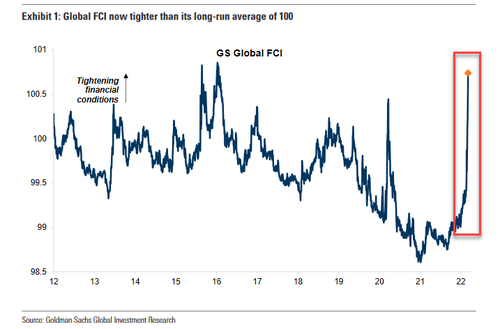
Which brings us to the question of “why hike?” that we asked and answered earlier in the week.
While the global picture is extremely tight, Goldman’s US financial conditions index – while notably tighter than it was – remains easier than at any other time in decades apart from 2020/2021 (which may help explain the 40 year high print in CPI today, because unlike Psaki’s narrative, we know this isn’t all Putin’s fault)…

Source: Bloomberg
For now, with negative-delta having been assuaged yesterday, and no optimistic headlines today upon which to ignite momentum (in fact the opposite – *KULEBA: RUSSIA SEEKS SURRENDER, UKRAINE WON’T SURRENDER; RUSSIA CONVEYED WILL CONTINUE TO ATTACK UNTIL DEMANDS MET)…
Re-enactment…
…global assets were hammered today (not helped by a surprisingly hawkish ECB). Of course, once Europe closed, dip buyers were back lifting everything back towards unch. Nasdaq was down 2.5% before the post-EU bid returned (but it still lagged while the rest of the majors fell around 0.5% on the day before the last second buying panic ensued)…
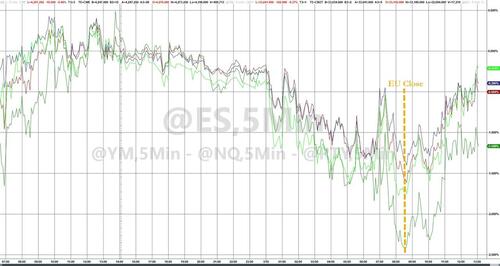
Bonds extended losses today with yields up across the curve as the long-end underperformed (2Y +3.5bps, 30Y +6bps). The belly continues to underperform on the week though with the long-end the least bad horse in the glue factory (yes 5Y and 7Y yields are up almost 30bps this week)…
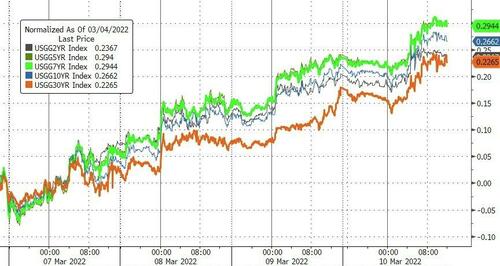
Source: Bloomberg
10Y yields hit 2% and 30Y yields broke out above 2.40% – the highest since May 2021 – before a very solid 30Y auction dragged yields back off those highs, only to sold back to the highs in the last hour…
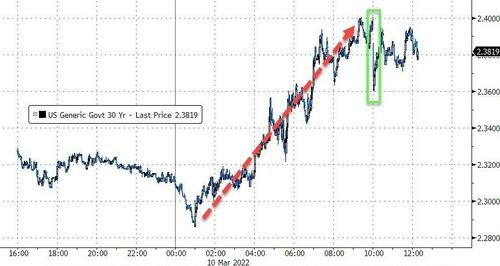
Source: Bloomberg
Rate-hike odds dropped very modestly for March (next week) but rose further for the end of the year with a 60-plus % chance of 7 hikes now…
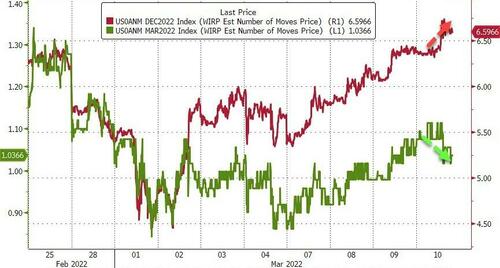
Source: Bloomberg
The dollar rallied back into the green for the week after an initial burst of post-ECB euro-strength weakened the greenback, but could not hold…
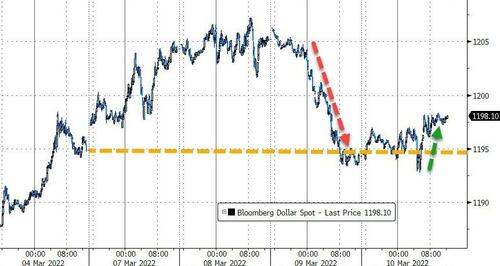
Source: Bloomberg
Cryptos roundtripped Tuesday night’s Biden EO gains with Bitcoin back below $40k…
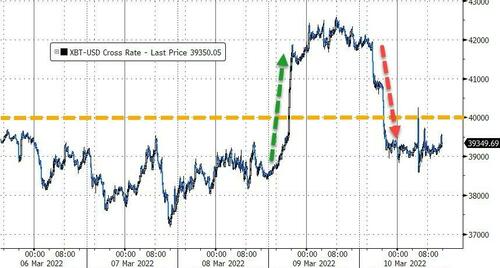
Source: Bloomberg
ICE raised Brent crude futures margins by a dramatic 32% today (and Diesel Futs by an astonishing 90%) which did not help support the energy complex. It has been a wild week for industrial and energy commodities while PMs have held relatively calm and firm. Copper also took a beating this week…
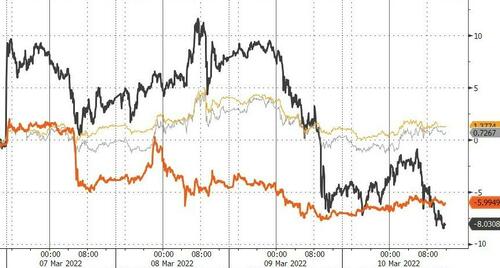
Source: Bloomberg
WTI extended its losses today, trading back down to a $105 handle…
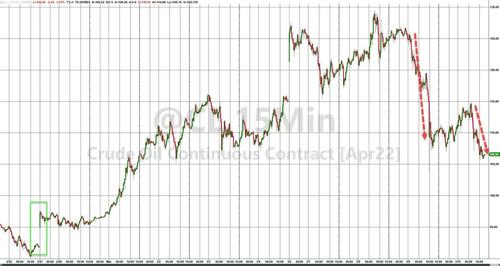
And a very similar picture in RBOB…
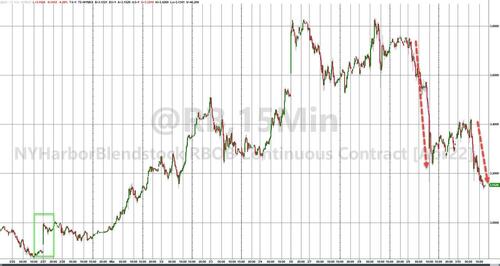
Gold rebounded back above $2000…
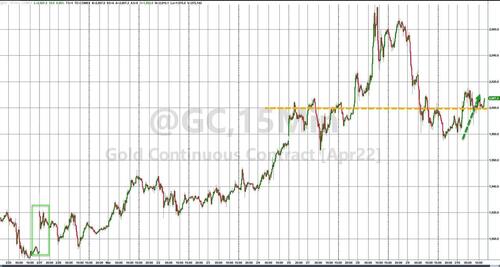
Finally, it could be worse… you could be long China tech…
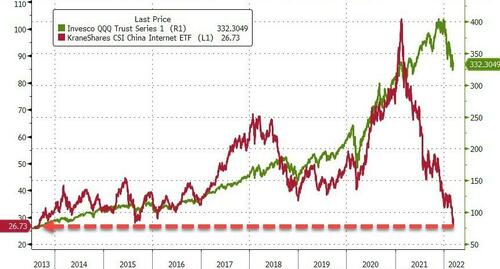
Source: Bloomberg
In Rubles…
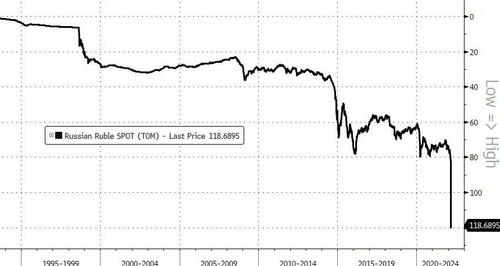
Source: Bloomberg
I) /MORNING TRADING
Futures Slide As First Round Of High-Level Russia/Ukraine Peace Talks Stall
THURSDAY, MAR 10, 2022 – 07:15 AM
After yesterday’s optimism-inspired, negative-delta triggered melt up in stocks, futures have slid significantly overnight as lack of options market ‘rampage’ collateral (until the cash open) combined with a material lack of progress in the first high-level peace-talks between Russia and Ukraine stole the jam from the market’s donut.

Following the meeting, which lasted around 90 minutes and was situated in Turkey, the two principles – Ukrainian Foreign Minister Dmytro Kuleba and his Russian counterpart Sergei Lavrov – had very little positive to say about the discussion, and reflected the vast chasm between their opposing views remains.
Kuleba had set out Ukraine’s three key demands before the meeting with Lavrov – a cease-fire, an improvement of the humanitarian situation in besieged cities, and the withdrawal of Russian forces from the country. He would be disappointed…
“The broad narrative he conveyed to me is that they will continue their aggression until Ukraine meets their demands, and the least of these demands is surrender,” Kuleba said.
Russia is open to serious talks between the two presidents “but those contacts must have added value,” Lavrov told reporters after the meeting, reiterating that Russia is seeking the demilitarization of Ukraine.
“We want a Ukraine that’s friendly and demilitarized, a Ukraine in which there isn’t a risk of the creation of another Nazi state, a Ukraine where there won’t be a ban on the Russian language, on Russian culture,” Lavrov said.
Ukrainian President Volodymyr Zelenskiy had earlier said he’s willing to consider some compromises on Russia’s demand that his country abandons ambitions to join the NATO and adopt a neutral position, but made it clear that “only after the direct talks between the two presidents can we end this war,” and that there’s been no direct contact between him and Putin.
As Bloomberg reports, three earlier rounds of lower-level talks in Belarus between Russian and Ukrainian officials yielded few results beyond attempts to establish some humanitarian corridors for civilians caught in the fighting.
END
AFTERNOON
END
II) USA DATA
CPI: 7.9% y/y
US Consumer Prices Are Rising At Their Fastest Pace In Over 40 Years
THURSDAY, MAR 10, 2022 – 08:37 AM
With the Biden administration already setting the narrative yesterday that today’s inflation print could be ‘high’, and expectations for a headline print of +7.9% YoY (from +7.5% YoY in January), the bar was high for any surprises and the headline print came in right in the dot at +7.9% YoY – the highest since Jan 1982.

Source: Bloomberg
That is the 21st straight month of MoM (non-transitory) increases in consumer prices, with Energy (and Services) dominating the recent surge…

Source: Bloomberg
On a MoM basis, Energy and Services costs also dominated the increases…

Source: Bloomberg
One thing of note… one tiny sliver of hope… Used Car prices fell very modestly in February…


But, in the interest of balance, the costs of a roof over your head are exploding higher…
- March shelter inflation 4.74%, up from 4.36% in Jan and the highest since May 1991
- March rent inflation 4.17%, up from 3.76% and the highest since July 2007

Source: Bloomberg
Core CPI rose 6.4% YoY in February (in line with +6.4% expectations and well above +6.0% in January)

Source: Bloomberg
Finally, and to many, most importantly, real wages (average hourly earnings) dropped on a YoY basis for the 11th straight month…

Source: Bloomberg
So the next time the Biden admin tries to tell you to be grateful that your wages are rising, show them that chart!
end
House passes an enormous $1.5 trillion omnibus spending bill
(Van Brugen/EpochTimes)
House Passes $1.5 Trillion Spending Bill With $13.6 Billion For Ukraine
THURSDAY, MAR 10, 2022 – 08:45 AM
Authored by Isabel van Brugen via The Epoch Times (emphasis ours),House Speaker Nancy Pelosi (D-Calif.) speaks to reporters on Capitol Hill in Washington on Feb. 9, 2022. (Saul Loeb/AFP via Getty Images)
The U.S. House of Representatives voted on Wednesday to pass a $1.5 trillion omnibus spending bill that includes $13.6 billion in aid for Ukraine and European allies, and would fund the federal government through to Sept. 30.
Hours earlier, Democratic lawmakers scrapped the bill’s initial $15.6 billion COVID-19 aid provision, marking a major setback for the Biden administration who had pushed for weeks to have the additional funds approved.
House Speaker Nancy Pelosi (D-Calif.) called the decision to abandon the provision “heartbreaking.” Republicans had demanded cuts to state aid to fund the new initiative.
“We’ve got a war going on in Ukraine,” Pelosi told reporters, explaining the urgency Democrats felt in making concessions in bargaining with Republicans. “We have important work that we’re doing here.” She said with her party in the 50-50 Senate needing at least 10 GOP votes to pass legislation, Democrats “are going to have to know there has to be compromise.”
The overall bill was approved by the House in two separate votes. The measure’s security programs were overwhelmingly approved by 361-69, the rest by 260-171, with most Republicans opposed.
The Ukraine aid included $6.5 billion for the U.S. costs of sending troops and weapons to Eastern Europe and equipping allied forces there in response to Russian President Vladimir Putin’s invasion, which he launched on Feb. 24.
A further $6.8 billion would go toward care for refugees and provide economic aid to allies, and more to help federal agencies enforce economic sanctions against Russia and protect against cyber threats at home.
The figure is higher than the sum initially requested by the Biden administration, $6.5 billion, and the $10 billion figure in the White House’s formal request to Congress.
On Tuesday, Senate Minority Leader Mitch McConnell (R-Ky.) said Congress’s aid package for Ukraine and its Eastern European allies stood at $14 billion. He criticized the speed at which the aid package has moved along.
Rep. Tom Cole (R-Okla.), the GOP leader on the House Rules Committee, called the $1.5 trillion bill a “reasonable compromise” and said its extra defense spending was “clearly necessary in the wake of Vladimir Putin’s unprovoked aggression against Ukraine.”
Some $730 billion has also been allocated for military spending under the Defense Department, and a further $125 billion would go to the Department of Veterans Affairs.
The bill would increase spending for child nutrition and child care, local law enforcement, improving broadband in rural areas, and education aid for disabled students and historically black colleges and universities.
The spending bill still needs to be passed by the Senate. Majority Leader Chuck Schumer (D-N.Y.) has said he hopes to pass the legislation before Friday to avert a government shutdown.
end
IIb) USA COVID/VACCINE MANDATE STORIES
All mandates totally removed in Florida
(Watson/SummitNews0
DeSantis: “There Is No Place In Florida For COVID Theater”
THURSDAY, MAR 10, 2022 – 04:20 PM
Authored by Steve Watson via Summit News,
Florida Governor Ron DeSantis announced that all COVID restrictions have come to an end in the State Wednesday with a video post on social media captioned “There is no place in Florida for COVID theater.”

The footage was taken from a panel talk from earlier in the week with Florida Surgeon General Dr. Joseph Ladapo and other medical experts advocating ‘closing the curtain’ on COVID restrictions (see what he did there?)
“These experts agree – no masking, no mandates and no medical censorship,” DeSantis also noted.
“Over the past two years, the data has shown us what works and what doesn’t work. It is long past time to stop the COVID Theater,” DeSantis asserted, adding “In Florida, we told the truth, we let the data drive our response, and we let Floridians make decisions for themselves and their children.”
“As a result, Florida is in a better spot than states who used fear mongering and mandates,” he further urged.
Dr. Ladapo issued a statement noting that it is time to “get back to living,” noting that “under the leadership of Governor DeSantis, Florida has continued to stay ahead of the federal government by following sound science – not coercion.”
He continued, “Today, we were able to bring doctors from around the world to discuss COVID-19 and the lack of data to support mandates. Scientific debate takes place in a public forum – it is not hidden in federal bureaucracy. We need to get back to living – not hiding in fear.”
Watch:
Dr. Jay Bhattacharya, M.D., Ph.D., Professor of Health Policy, Stanford University Medical School joined the panel and emphasised that lockdowns have been “an enormous catastrophic mistake that should never be repeated.”
“When we think about lockdowns, we should recoil with horror because the policies we followed have violated not just medical ethics, but also crushed the ability for scientists to discuss openly with each other facts and evidence, Bhattacharya proclaimed.
end
In the age of mass Silicon Valley censorship It is crucial that we stay in touch. We need you to sign up for our free newsletter here. Support our sponsor – Turbo Force – a supercharged boost of clean energy without the comedown. Also, we urgently need your financial support here.
Insanity: Navy refuses to deploy a warship while its commander remains unvaccinated
Van Brugen/EpochTimes
Navy Refuses To Deploy Warship While Commander Remains Unvaccinated
WEDNESDAY, MAR 09, 2022 – 06:00 PM
Authored by Isaben van Brugen via The Epoch Times (emphasis ours),
U.S. Navy officials have said a warship can’t be deployed because its commander has refused the COVID-19 vaccine.A Navy petty officer gives a Marine a COVID-19 vaccine on Camp Pendleton, Calif., on Sept. 22, 2021. (U.S. Marine Corps photo by Cpl. Andrew Cortez via The Epoch Times)
The service said an East Coast guided-missile destroyer is “out of commission” after a Florida federal judge ruled that the Navy and Marine Corps cannot remove its officer for being unvaccinated against COVID-19.
The warship now remains docked in Norfolk, Virginia.
It comes after U.S. District Judge Steven Merryday, a George H. W. Bush nominee, ruled on Feb. 2 to bar Secretary of Defense Lloyd Austin and all other military officials from taking punitive action against the unnamed Navy officer, who sought religious exemptions to the military’s COVID-19 vaccine mandate.
Merryday wrote that the Navy’s rejection failed to note that the branch has separately granted hundreds of medical exemptions to the COVID-19 vaccine mandate
The Navy officer was told he would be removed from command of his ship on Feb. 3 if he didn’t start a COVID-19 vaccination series.
Top military officials determined that the commander’s religious beliefs were sincere and that they would be “substantially burdened” by being forced to get vaccinated, but also claimed that granting the exemption request “would have a predictable and detrimental effect on the readiness of you and the Sailors who serve alongside you.”
On Feb. 28, the Navy asked Merryday for an emergency stay on the preliminary injunction, arguing that the judge’s ruling prevents it “from removing an officer from … commanding officer billets who the military has deemed unfit for command.”
“The order is an extraordinary intrusion upon the inner workings of the military that presents a direct and imminent threat to national security during a global military crisis, and it indefinitely sidelines a Navy warship,” the Navy said, according to court papers, Stripes and Stars reported.
“With respect to Navy Commander, the Navy has lost confidence in his ability to lead and will not deploy the warship with him in command,” the filing states.
Admiral Daryl Caudle filed a statement on Feb. 28 saying that the Navy “cannot have a Sailor who disobeys a lawful order to receive a vaccine because they harbor a personal objection any more than we can have a Sailor who disobeys the technical manual for operating a nuclear reactor because he or she believes they know better.”
Merryday on Thursday denied the U.S. Department of Defense’s request to halt the injunction, and accused the defense of attempting “to evoke the frightening prospect of a dire national emergency resulting from allegedly reckless and unlawful overreaching by the district judge.”
The Epoch Times has reached out to the Navy for comment.
Zachary Stieber contributed to this report.
end
INSANITY
Biden Admin Bans Unvaccinated Tennis Ace Djokovic From Competing
THURSDAY, MAR 10, 2022 – 01:22 PM
Authored by Steve Watson via Summit News,
Tennis star Novak Djokovic has been denied entry into the U.S. by the Biden administration because he remains unvaccinated against COVID.

Djokovic announced Wednesday that as he expected, he will not be able to compete in upcoming tournaments in California and Florida because CDC regulations mean as a foreign national he will not be granted a visa.
Djokovic tweeted “While I was automatically listed in the @BNPPARIBASOPEN and @MiamiOpen draw I knew it would be unlikely I’d be able to travel.”
The multi time grand slam champion added that “The CDC has confirmed that regulations won’t be changing so I won’t be able to play in the US. Good luck to those playing in these great tournaments.”
So there’s no entry for Djokovic into the U.S. without a vaccination, but for more than two million illegal immigrants the Biden administration is willing to look the other way.
Following his incarceration and eventual deportation from Australia at the beginning of the year, Djokovic asserted that “my body is more important than any title or anything else.”
The legend has vowed to boycott all tournaments, including Wimbledon in London and the French Open in Paris if organisers say he must be vaxxed in order to take part.
In an interview with the BBC, the multi-time grand slam champion said “That is the price I am willing to pay,” when asked if he would miss further events should they mandate vaccinations for participants.
“I’m trying to be in tune with my body as much as I possibly can,” Djokovic continued, adding “for me, as an elite professional athlete I have always carefully reviewed and assessed everything that comes in, from the supplements, the food, the water that I drink or sports drinks, anything really that comes into my body as a fuel.”
“Based on all the information that I got, I decided not to take the vaccine,” he further declared.
Watch:
As we reported at the time, Djokovic won his appeal against having his visa cancelled, yet Australian authorities clearly planned to make an example out of him over his beliefs on vaccination as a warning to others.
While he has only managed to play three matches in 2022, Djokovic is still ranked number 2 in the world.
end
They see the light:
United Airlines are to let workers who did not get a COVID vaccine will be allowed to return to work
(Stieber/EpochTimes)
United Airlines To Let Workers Who Didn’t Get COVID Vaccine Return To Work
THURSDAY, MAR 10, 2022 – 05:00 PM
Authored by Zachary Stieber via The Epoch Times (emphasis ours),
United Airlines plans to let workers who declined to get a COVID-19 vaccine return to work, according to a missive obtained by The Epoch Times.

Unvaccinated employees can return to their positions on March 28, according to the memorandum, which was sent to workers on Thursday morning.
Kirk Limacher, vice president of human resources at United, said the change was due to the plunge in COVID-19 cases and COVID-19-related hospitalizations across the country in recent weeks. Many states and cities are lifting COVID-19 restrictions, and the U.S. Centers for Disease Control and Prevention dramatically eased its masking guidance, he noted.
“These changes suggest that the pandemic is beginning to meaningfully recede. As a result, we’re confident we can safely begin the process of returning our RAP employees to their jobs,” Limacher wrote.
United imposed a COVID-19 vaccine mandate for all of its 67,000 U.S. employees in the fall of 2021. It was the first U.S. airline to impose a company-wide mandate.
Workers could apply for a religious or medical exemption, but if such an exemption request was deemed reasonable—known as RAP in company parlance—the worker was placed on unpaid leave indefinitely instead of being allowed to continue in their job. The company later let some of these workers switch jobs instead of going on unpaid leave.
United CEO Scott Kirby also told workers “to be very careful about” requesting accommodations and said workers were putting their jobs on the line if they did.
The policy triggered a lawsuit, which is ongoing. In a ruling in February, a federal court said United’s mandate was “actively coercing employees to abandon their convictions.”
United ended up firing more than 200 workers for not getting a vaccine.
United declined to say whether the workers who were fired will be offered their jobs back.
John Sullivan, an attorney representing the plaintiffs in the case, told The Epoch Times in an email: “We are gratified to see United returning employees to work since they should have never been put on unpaid leave for their faith or health. Hopefully people are beginning to see that individual rights should not be swept aside even during a pandemic.”
Limacher said workers with an approved exemption request would get an email on Thursday with instructions on how to return to “active status” or how they would be transitioned from their role if they were allowed to work in a position that does not deal with customers.
“Of course, if another variant emerges or the COVID trends suddenly reverse course, we will reevaluate the appropriate safety protocols at that time,” he said.
The United official also alleged the vaccination policy was successful at preventing COVID-19 infections and severe cases of the disease.
“Our vaccinated employees have been significantly less likely to lose their lives to COVID,” he said, adding that vaccines continue to provide “high protection.”
Limacher did not mention how all three of the vaccines that received regulatory clearance in the United States have performed much worse against virus infection and worse against severe COVID-19 since the Omicron variant of the virus became dominant in the country in late 2021.
end
iii) USA inflation//SHIPPING commentaries//LOG JAMS//
iii) USA economic stories
iv)swamp stories
Wisconsin Special Counsel Alleges Massive Misconduct In 2020 Election
WEDNESDAY, MAR 09, 2022 – 08:40 PM
Authored by Steven Kovac via The Epoch Times (emphasis ours),
Special Counsel Michael Gableman says in a 136-page interim report that he has uncovered numerous instances of alleged lawbreaking in Wisconsin in the 2020 election.Election officials count absentee ballots in Milwaukee, Wis. on Nov. 4, 2020. (Scott Olson/Getty Images)
The former justice of the Wisconsin Supreme Court was hired last summer by the Republican Speaker of the State Assembly, Robin Vos, to investigate suspected election fraud during the 2020 presidential election.
In the report released March 1, Gableman wrote that his investigation uncovered instances of numerous mentally incompetent nursing home residents, non-citizens, and ineligible felons casting votes.
He cited the use by municipal and county clerks of unstaffed absentee ballot drop-boxes, in violation of state law.
Laws were also allegedly violated when the Wisconsin Elections Commission (WEC) allegedly exceeded its authority by ordering local election officials to disregard state statutes that regulate absentee voting.
The Special Counsel raised concerns that private money influenced municipal officials in the state’s five largest cities to “disfavor” many of their own citizens, as well as the vast majority of state residents, by spending millions of dollars of grant money on voter registration drives, absentee voter efforts, and Get-Out-The-Vote campaigns designed to serve certain favored, and specifically targeted, racial groups, in violation of the equal protection clauses of the state and federal constitution.Claire Woodall-Vogg, executive director of the Milwaukee election commission, collects the count from absentee ballots in Milwaukee, Wisconsin, on Nov. 4, 2020. (Scott Olson/Getty Images)
Gableman offered a list of suggested reforms designed to restore public confidence in Wisconsin elections.
Among Gableman’s recommendations was a call to abolish the WEC, prohibit outside money and personnel from participating in election administration, and improved training to better acquaint local election officials with their powers, duties, and rights.
He also laid out the legal rationale for decertifying the state’s 10 electors who voted for Democrat Joe Biden.
Biden was declared the winner of Wisconsin’s popular vote by six-tenths of one percent, or 20,000 votes.
Relying on the common law principle that fraud or illegality invalidate results under an illegal or fraudulent process, Gableman asserted that the state legislature had the constitutional plenary power to decertify the results of the 2020 presidential election in Wisconsin because state laws were broken.
Democrat Governor Tony Evers released a statement the day the Special Counsel’s Report came out, saying: “This circus has long surpassed being a mere embarrassment to our state … Every day this effort continues, it is an increasingly dangerous and ongoing threat to our democracy.”
Wisconsin Attorney General Josh Kaul, who has sued to block, or curtail, subpoenas issued by the Office of the Special Counsel (OSC), said in a March 1 statement that Gableman’s report was a “full-throated attack on democracy” and an attempt to “overturn the will of the voters.”
Kaul said that Republican state legislators “have an obligation to our democracy to condemn, and end, this preposterous fake investigation.”
The OSC report detailed instances of what it called “obstruction” on the part of some state officials and private interest groups, which have filed nine lawsuits against the OSC and snowed it under with what it calls “dilatory,” “frivolous,” and “voluminous” public information requests.Wisconsin Gov. Tony Evers speaks in Madison, Wis., on Feb. 6, 2020. (Steve Apps/Wisconsin State Journal via AP)
Gableman alleges in his report that Democrat political operatives, paid for by grants from the Zuckerberg-funded non-profit Center for Tech and Civic Life (CTCL), all but took over administration of the 2020 election in five of Wisconsin’s largest cities.
According to OSC’s report, as the COVID-19 pandemic raged in the spring and summer of 2020, CTCL donated nearly $8.8 million to county clerks and municipal election administrators throughout Wisconsin.
The stated purpose of the grant funding was to help ensure that communities had enough money to be able to conduct elections in accordance with public health safety guidelines.
Five of Wisconsin’s largest cities—Milwaukee, Madison, Green Bay, Racine, and Kenosha—received a total of $6.3 million in grant funding, ostensibly to purchase PPE and other health-related equipment, such as plexiglass barriers and hand-sanitizer.
The grants were conditioned on the five cities agreeing to guidelines of the Wisconsin Safe Voting Plan (WSVP).
Gableman alleged that WSVP was little more than a partisan campaign program designed to maximize voter registration and turnout in heavily minority-populated precincts.
The report states that the Wisconsin Elections Commission supported the WSVP Get-Out-The-Vote program, an action Gableman asserts is not part of the agency’s mission.
How Did the Five Cities Spend the Grant Money?
The cities used grant funds to pay for curbside voting tents, mobile polling places operated out of trucks, and for a drive-thru voting window at one city hall.
The cities spent grant money on voter education, a multi-media advertising and phone blitz, geo-fencing (a computer technique used to pin-point particular areas of geographic and demographic interest) and they paid for personnel called “voter navigators” (also known as ballot harvesters), whose job was to shepherd a prospective voter through the process of voting.
The municipalities purchased and installed in strategic locations, unstaffed absentee ballot drop-boxes in violation of Wisconsin law.
The OSC report presented data showing that the city of Green Bay spent eight-tenths of one percent of its $1 million in grant funding on PPE and health equipment.
Green Bay spent $50,000 for ballot drop-boxes and purchased a couple of new Ford trucks. The city paid a public relations firm $150,ooo for a voter outreach campaign.
The public relations campaigns in each city zeroed in on preferred racial groups, which, coincidentally matched the demographic profile of Biden voters, according to the OSC report.
The report said the cities’ actions were discriminatory and “disfavored” city and state residents who did not fit the targeted profile, raising issues of unequal treatment under the law.
CTCL and other private workers, called “grant mentors,” along with many volunteers, worked for weeks assisting city election officials and county clerks in conducting the 2020 presidential election.
What kind of assistance did the CTCL-supplied workers provide?
According to the OSC report, representatives of private organizations participated in much of the planning and administration of the election.
Tasks they performed included, curing defective mail-in ballots, challenging voted ballots, verifying photo ID, setting up voting equipment and vote counting centers, training volunteers, and writing instructions controlling the activities of count observers
Workers provided by private organizations assigned inspectors for polling places and vote counting centers, transported ballots to city hall and counting centers, issued a purchase order, made decisions whether or not to accept ballots after 8 p.m. on Election Day, participated in the counting of ballots, and set up wireless digital networks in polling places, clerks’ offices, and other buildings, according to the report.
The OSC report stated that local election officials, made beholden to private organizations by grant funding, could be susceptible to leverage pressuring them to do things in violation of their oath of office.
Other Alleged Offenses and Abuses by State and Local Election Officials
The special counsel alleged that rampant fraud and abuse occurred statewide in many of Wisconsin’s 6,875 nursing homes (housing 92,000 residents) during the 2020 election.
When visited by OSC investigators, many nursing home residents who are on record as having voted absentee in the election, were unaware of their surroundings, what year it was, or to whom they were speaking.
Some nursing home residents who purportedly voted had been adjudicated by a court to be mentally incompetent and whose voting rights had been taken away.
Wisconsin election laws require that a nursing home resident desiring to vote absentee must be visited by a Special Voting Deputy (SVD) designated by the local clerks or election boards to assist the resident and supervise the application and voting process.
Under the statute, only the resident’s immediate family, or an SVD, can have any contact with the ballots. They are never to be mailed.Meagan Wolfe, the head of the Wisconsin Elections Commission, speaks during a virtual press conference on Nov. 4, 2020. (Wisconsin Elections Commission via Reuters)
In June 2020, for reasons of public health, the Wisconsin Elections Commission directed all clerks to handle nursing home voting according to the rules governing ordinary mail-in voting, thereby disrupting the strictly limited chain of custody of residents’ ballots—a direct violation of Wisconsin law.
The result was thousands of application forms, ballot envelopes, and ballots were illegally handled by nursing home employees, according to the report.
The report alleges nursing home administrators and staff members illegally assisted residents in marking their ballots. Some family members have reported suspected cases of staff forging the voter’s signature.
According to the OSC, the result was an “improbably high” voting rate, with many nursing homes reporting that 100 percent of their residents voted in the 2020 election.
Wisconsin Elections Commission Administrator Meagan Wolfe said in a statement: “The integrity of the November 2020 election, and of the WEC, has been shown time, and time again, through court cases and previous investigations.”
KING REPORT/SWAMP STORIES
| The King Report March 10, 2022 Issue 6716 | Independent View of the News |
| The Kremlin accuses the U.S. of ‘economic war,’ but looks ahead to talks with Ukraine. The Kremlin’s spokesman on Wednesday accused the United States of declaring “an economic war” against Russia, but described an upcoming meeting between the Russian and Ukrainian foreign ministers as a key step toward resolving the military conflict. A meeting scheduled for Thursday in Turkey between Foreign Minister Sergey V. Lavrov of Russia and his Ukrainian counterpart, Dmytro Kuleba, will be the first face-to-face encounter between the countries’ top diplomats in the nearly two weeks since Russian forces invaded Ukraine. The Kremlin spokesman, Dmitri S. Peskov, described the meeting, which will take place in the Turkish resort of Antalya, as “a very important continuation of the negotiation process.”… https://www.nytimes.com/live/2022/03/09/world/ukraine-russia-war?smtyp=cur&smid=tw-nytimes#the-kremlin-accuses-the-us-of-economic-war-but-looks-ahead-to-talks-with-ukraine With the Kremlin, per the above NY Times article, indicating that today’s peace talks in Turkey are a ‘key step toward resolving the military conflict’, and Zelensky conceding to Putin’s demand that Ukraine stays out of NATO and maintains neutrality, the prospect of a peace deal is greater than any time since Putin invaded Ukraine. The difficult issues, for now, are the disposition of the breakaway states in eastern Ukraine and the type of weaponry that Ukraine can possess. Ukraine should seek reparations. In Kyiv, they announced a request to Scholz to help organize a meeting between Putin and Zelensky Deputy head of the office of the President of Ukraine Igor Zhovkva, in an interview with the German television program Tagesschau, said that Kyiv had turned to German Chancellor Olaf Scholz with a request to organize a meeting between Russian and Ukrainian presidents Vladimir Putin and Vladimir Zelensky… https://www.tellerreport.com/news/2022-03-09-in-kyiv–they-announced-a-request-to-scholz-to-help-organize-a-meeting-between-putin-and-zelensky.HyZoKGLIW5.html Ukraine’s Zelensky: Aim of Talks Is to End War 12:22 ET Ukraine’s Zelensky: I Am Prepared for Certain Compromises; the Other Side Also Need to Compromise – 12:23 ET Oil Drops More Than 10% after Ukraine Says Ready to Compromise – BBG 12:37 ET Oil sank further on the above headlines. At 12:36 ET, WTI Oil hit -20.00; gold hit -52.40. Stocks traded to new session highs. WTI Oil bounced from a low of 103.63 to 109.38 in one minute! Ukraine Open to Neutrality, Won’t Yield Territory, Aide Says – BBG 13:36 ET https://www.bloomberg.com/news/articles/2022-03-09/ukraine-open-to-neutrality-but-won-t-yield-territory-aide-says Congress reaches a $1.5 TRILLION deal – including $13.6 billion in aid to Ukraine and Europe and $15.6 billion for covid pandemic – to avoid a government shutdown by Friday The House is expected to vote on the massive bill – it clocks in at 2,741 pages – on Wednesday and send it to the Senate…To help ensure passage by a healthy margin in both chambers, this year’s budget package also marks the return of earmarks. Now called ‘member-directed spending’ – the provisions allow funds for specific projects in lawmakers’ districts for the first time since the earmark ban went into effect 11 years ago… https://www.dailymail.co.uk/news/article-10594255/Congress-reaches-1-5-TRILLION-deal-fund-government.html January JOLTS Job Openings are 11.263m. December was revised to a record 11.448m from 10.925m. BlackRock Hedge Fund Raised Its Russia Bet, Suffered Record Loss https://www.bloomberg.com/news/articles/2022-03-09/blackrock-hedge-fund-raised-its-russia-bet-suffered-record-loss @philbak1: Blackrock buying Russian stocks while lecturing you about ESG @amlivemon: New: Top 3 November Midterms Issues – All Voters 1 – Inflation – 88% Concerned, 62% Very Concerned 2 – Violent Crime – 88% Concerned, 61% Very Concerned 3 – Election Integrity – 83% Important, 62% Very Important Rasmussen poll…. This is devastating to Dems midterms hopes UK @DefenceHQ: The Russian MoD has confirmed the use of the TOS-1A weapon system in Ukraine. The TOS-1A uses thermobaric rockets, creating incendiary and blast effects. Watch the video below for more information about this weapon and its devastating impact. https://twitter.com/DefenceHQ/status/1501621370614173701 @pboockvar: BN: *SENATOR WARREN WORKING ON BIG OIL WINDFALL PROFITS TAX There goes that domestic oil supply that we now need so badly. Was there ever any talk about windfall profit taxes on Wall Street or Big Tech? Either Team Biden is stupid, or they think most Americans are stupid. To wit: @RNCResearch: Biden’s Deputy National Security Advisor Daleep Singh: “Even if we drilled as much as we could” it wouldn’t affect the price of oil… https://twitter.com/RNCResearch/status/1501566271497940992 GOP Sen. @tedcruz: Biden admin: supply & demand has no impact on price. OK, then…. @Rasmussen_Poll: “Should the U.S. government encourage increased oil and gas production to reduce America’s dependence on foreign sources of oil and gas?” – YES – Democrats: 55%, Independents: 70%, Republicans: 87%, All Voters: 70% – The Biden Admin is currently punching down on their own voters. @RNCResearch: This is a lie. Psaki: Numbers measuring inflation have gone down month-to-month https://twitter.com/RNCResearch/status/1501630226006261760 GOP Rep. @michaelgwaltz: Why didn’t Ukraine have U.S. Stingers sooner? Months ago, the Pentagon briefed Congress that the U.S. could not export Stingers to Ukraine because we only had a non-exportable variant. Now we find out all they simply needed a screwdriver to remove a part. Seriously? @TPostMillennial: Nancy Pelosi: “When I spoke to President Zelenskyy I said ‘Billie Jean King sends you her regards and wants to know how she can help in any event.‘ (Tis why the US is in deep Schiff) https://twitter.com/TPostMillennial/status/1501669353028308994 @DineshDSouza: Imagine poor Zelensky looking to the United States for hope and then getting THIS from Vodka Nancy (The abjectly embarrassing Pelosi is Speaker solely cuz she controls Big Tech $$$.) JPMorgan Bails Out Chinese Nickel Giant Facing Billions in Losses from Record Margin Call If you are a small nobody and your margin call will wipe out just you, nobody will think twice to margin you out; on the other hand, if you are a Chinese tycoon whose default will ruin not just him but lead to massive losses for all LME members and also drag down more than one broker in the process…, well then… the rules can certainly be bent…. https://www.zerohedge.com/commodities/jpmorgan-bails-out-chinese-nickel-giant-facing-billions-losses-record-margin-call It’s ‘Alarming’: Children Are Severely Behind in Reading The fallout from the pandemic is just being felt. “We’re in new territory,” educators say. In Virginia, one study found that early reading skills were at a 20-year low this fall… Children in every demographic group have been affected, but Black and Hispanic children, as well as those from low-income families, those with disabilities and those who are not fluent in English, have fallen the furthest behind… https://www.nytimes.com/2022/03/08/us/pandemic-schools-reading-crisis.html @CNBCnow: Amazon announces 20-for-1 stock split, $10 billion buyback @zerohedge: The last time AMZN split its stock was in 1999. One year later the stock was 80% lower Amazon misled, obstructed Congress in competition inquiry, House panel says in letter to DOJ seeking probe https://www.foxbusiness.com/politics/amazon-misled-obstructed-congress-competition-inquiry-house-panel-says-letter-doj-probe Today – Rumors and headlines regarding the Ukraine-Russia peace talks in Turkey will impact trading. February CPI will have an impact only if it is worse than expected. A better-than-expected CPI report will have only a transitory effect for two reasons: 1) Everyone knows inflation is higher now and will be higher in coming weeks; and 2) most people will assume that the BLS crafted a fraudulent report. The S&P 500 Index peaked at 4299.40. The index must get comfortably above 4300 to spark more enthusiasm for stocks. ESHs are -2:25; WTI oil is +1.03; and gold is -9.20 at 20:30 ET. Expected economic data: Feb CPI 0.8% m/m, 7.8% y/y; Core CPI 0.5% m/m, 6.4% y/y; Initial Jobless Claims 219k, Continuing Claims 1.45m; Feb Monthly Budget Statement -$210.0B S&P 500 Index 50-day MA: 4498; 100-day MA: 4567; 150-day MA: 4523; 200-day MA: 4467 DJIA 50-day MA: 34,928; 100-day MA: 35,291; 150-day MA: 35,153; 200-day MA 35,002 S&P 500 Index – Trender trading model and MACD for key time frames Monthly: Trender is positive; MACD is negative – a close below 4153.02 triggers a sell signal Hourly: Trender and MACD are negative – a close above 4547.45 triggers a buy signal Daily: Trender and MACD are negative – a close above 4439.74 triggers a buy signal Hourly: Trender and MACD are positive – a close below 4189.17 triggers a sell signal Russia Tells the US “We Have Found Your Biological Weapons” https://www.thegatewaypundit.com/2022/03/breaking-video-russia-tells-us-found-biological-weapons-video/ Victoria Nuland: Ukraine Has “Biological Research Facilities,” Worried Russia May Seize Them The neocon’s confession sheds critical light on the U.S. role in Ukraine and raises vital questions about these labs that deserve answers. Self-anointed “fact-checkers” in the U.S. corporate press have spent two weeks mocking as disinformation and a false conspiracy theory the claim that Ukraine has biological weapons labs, either alone or with U.S. support… What is in those Ukrainian biological labs that make them so worrisome and dangerous?… https://greenwald.substack.com/p/victoria-nuland-ukraine-has-biological?s=w Deleted Web Pages Show Obama Led an Effort to Build a Ukraine-Based BioLab Handling ‘Especially Dangerous Pathogens’… Originally posted on June 18th, 2010, the article “Biolab Opens in Ukraine” details how Obama, while serving as an Illinois Senator, helped negotiate a deal to build a level-3 bio-safety lab in the Ukrainian city of Odessa… https://thenationalpulse.com/2022/03/08/obama-led-ukraine-biolab-efforts/ @JackPosobiec: Psaki claims Poland and US fighter jet scandal was “a temporary breakdown in communications” She can’t understand why it worked on West Wing but doesn’t in real life @charliekirk11: Billions of dollars have flowed into Ukraine over the years, and we have very little idea of where it went or what it was used for. We know Ukrainian Money made Hunter Biden rich. John Kerry’s son was involved as well. So why are we trying to send $14 Billion MORE to Ukraine? John Kerry: Ukraine crisis is bad, but ‘wait until you see’ flood of climate refugees https://www.foxnews.com/politics/john-kerry-ukraine-crisis-climate-refugees @JackPosobiec: NYT reporter says there were ‘a ton of FBI informants’ among the people who attacked the Capitol https://twitter.com/JackPosobiec/status/1501369508698759169 FBI waited more than year to probe sources over Jan. 6 pipe bomb incident The whistleblower, described as a “senior FBI special agent” told the lawmakers that the request was “‘unusual’ because it was transmitted more than a year after the FBI had begun the investigation, and it raises questions about the progress and extent of the FBI’s investigation.”… (What is the FBI hiding?) https://justthenews.com/accountability/whistleblowers/fbi-waited-more-year-probe-sources-over-jan-6-pipe-bomb-incident Texas election commissioner resigns after 10,000 uncounted ballots found in last week’s primary https://justthenews.com/politics-policy/elections/texas-election-commissioner-resigns-after-10000-uncounted-ballots-found |
END Let us close with this offering courtesy of Greg Hunter interviewing xxxx |
Well that is all for today. I will see you FRIDAY night


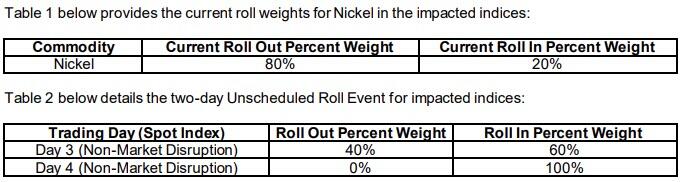
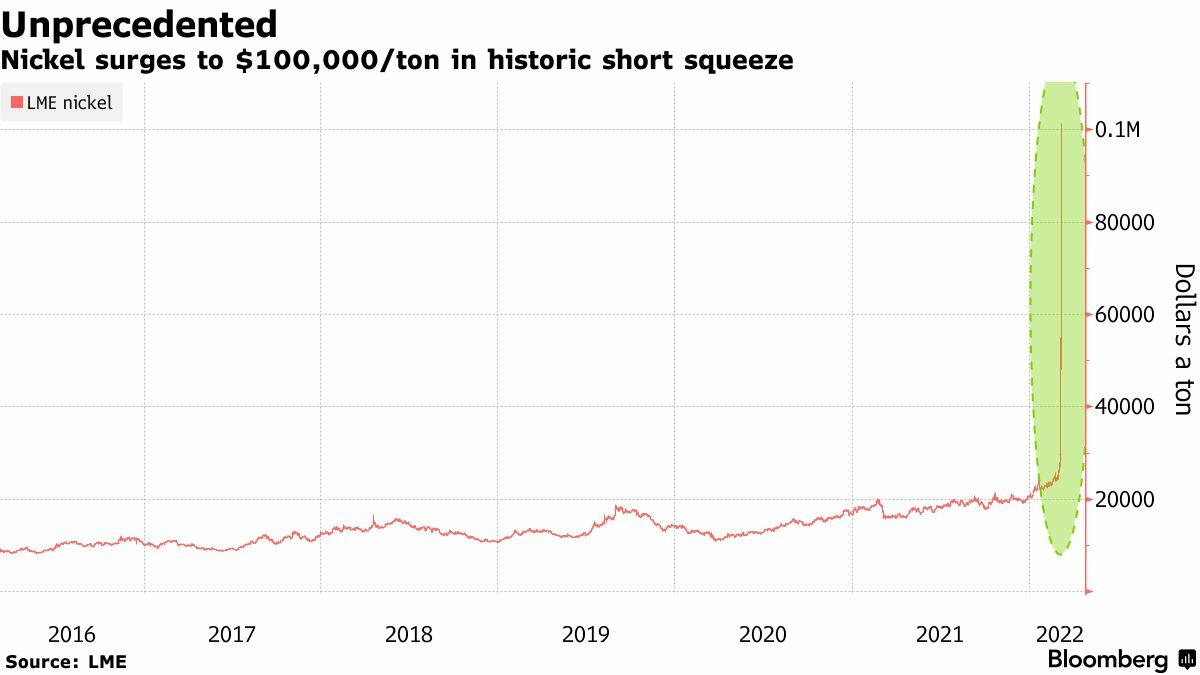
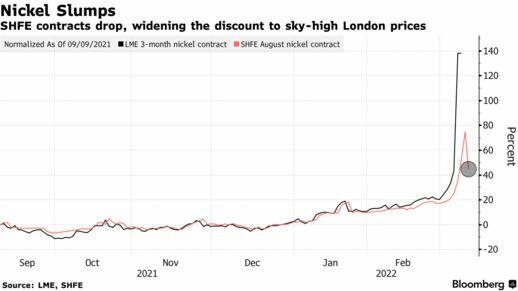

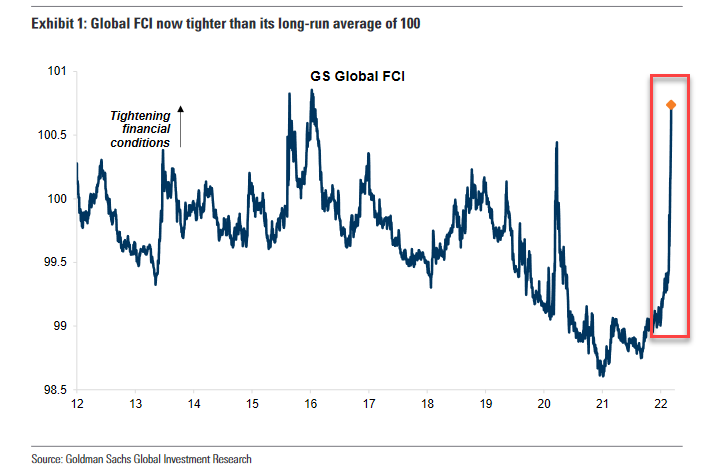
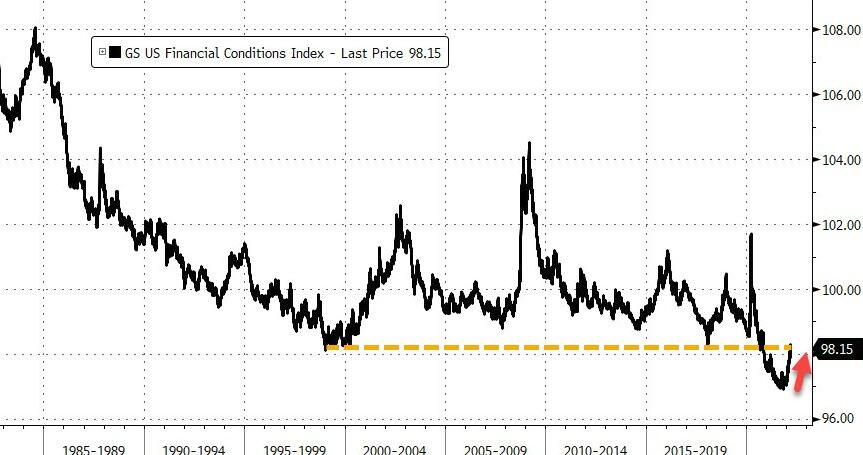
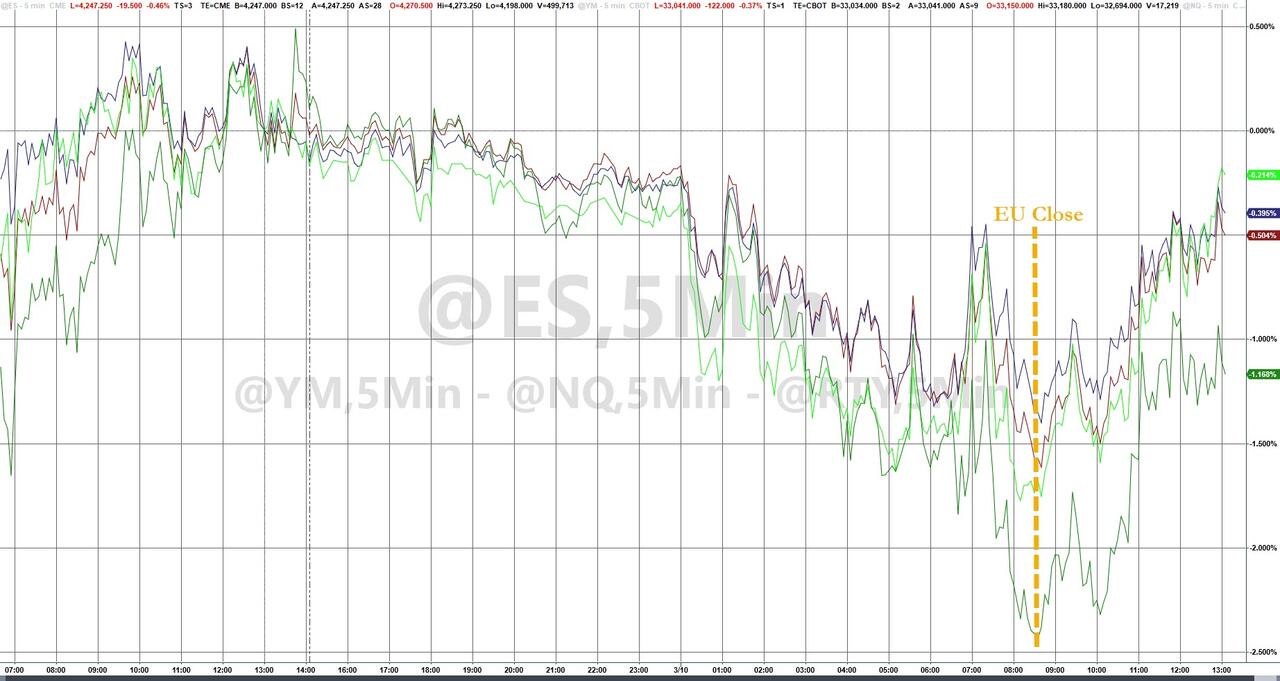
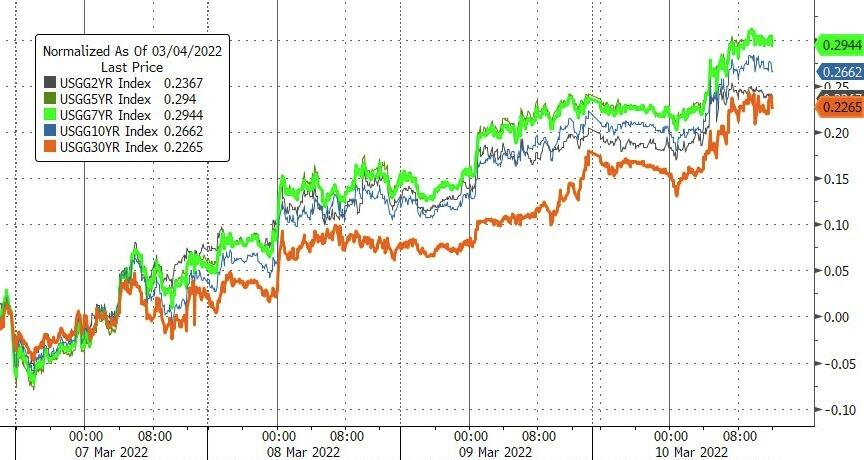

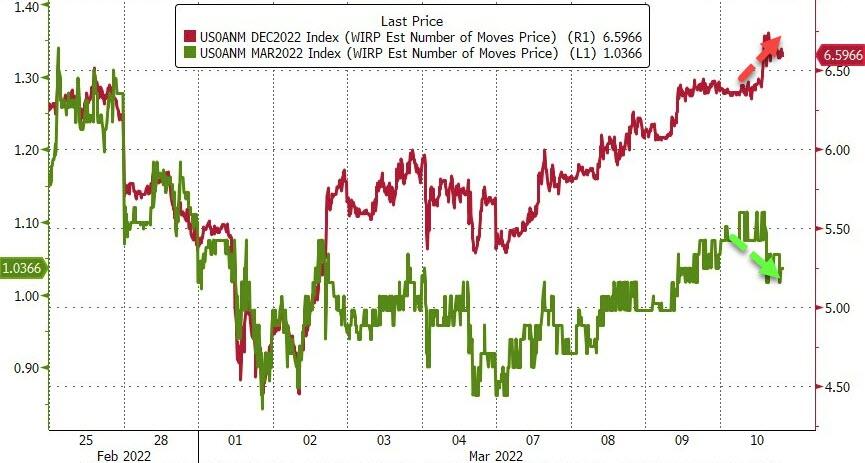
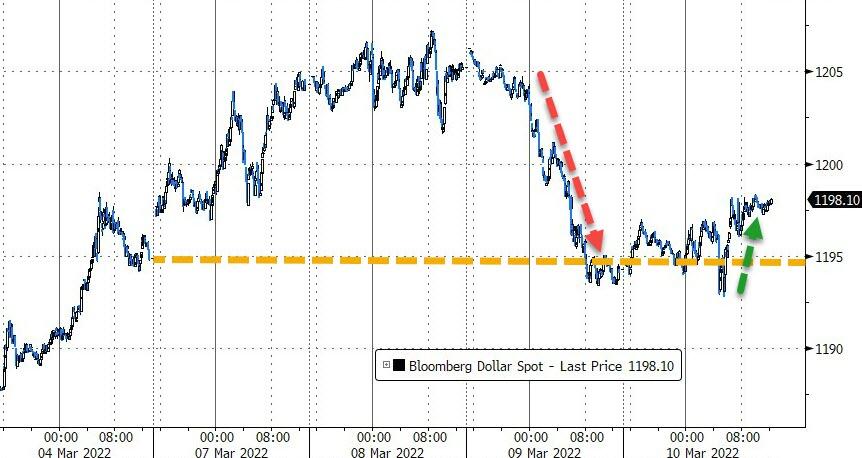
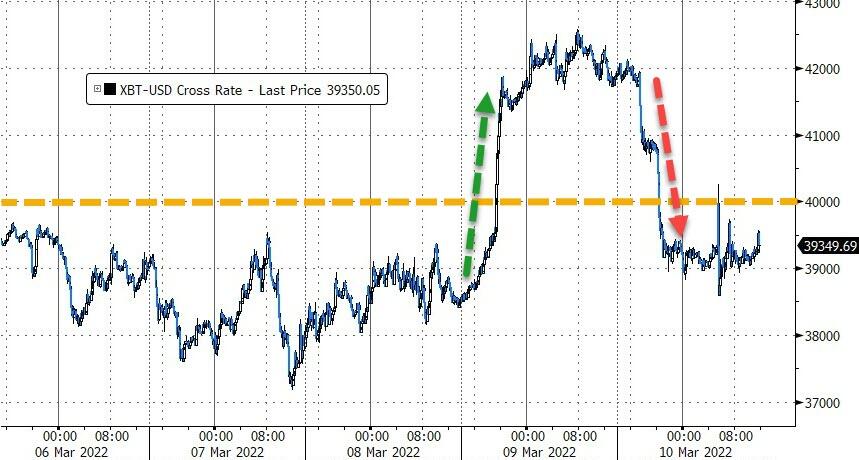
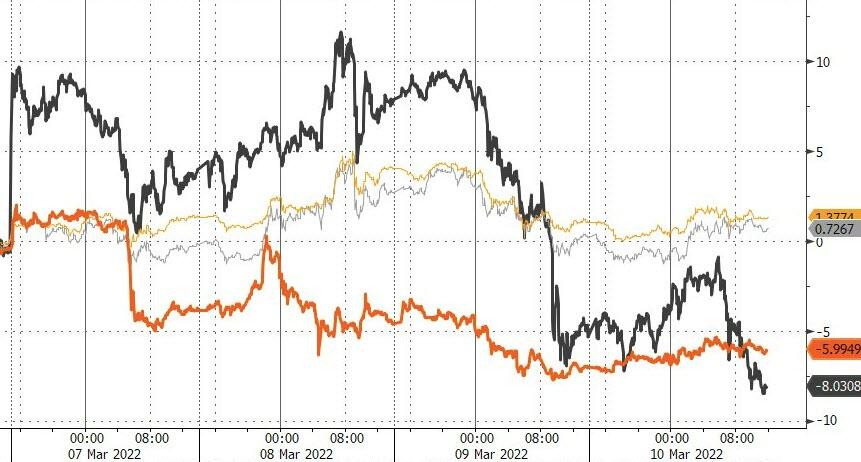
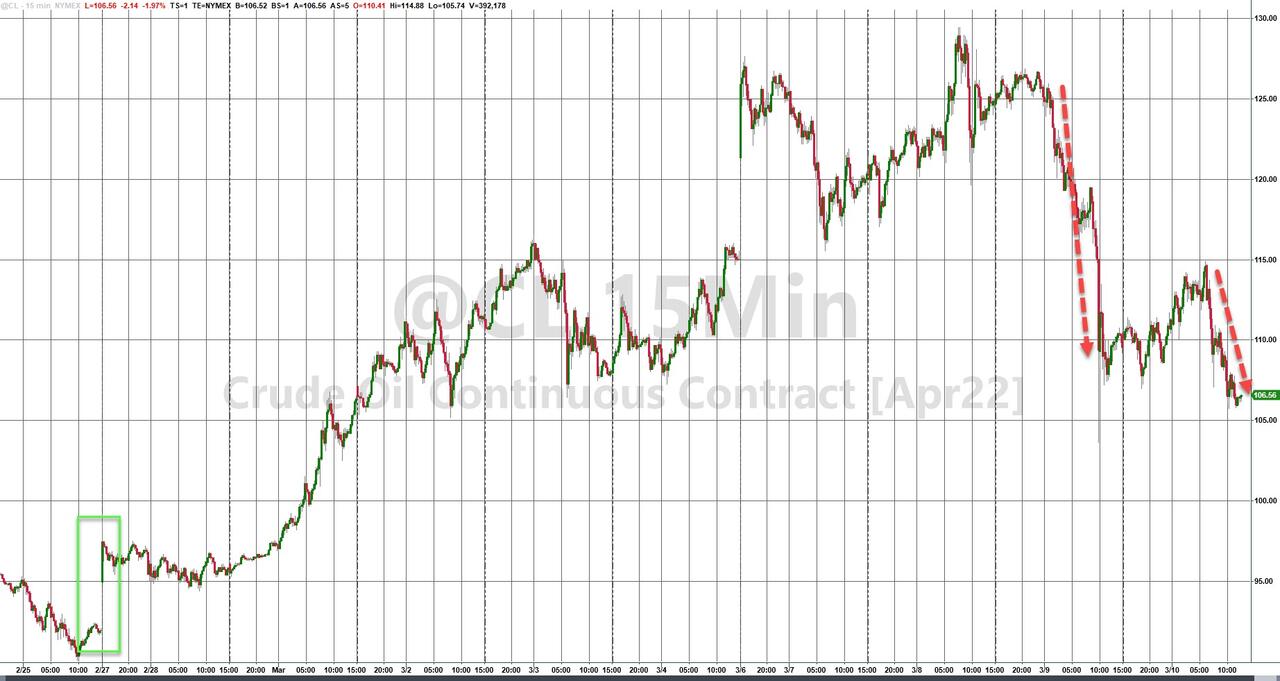
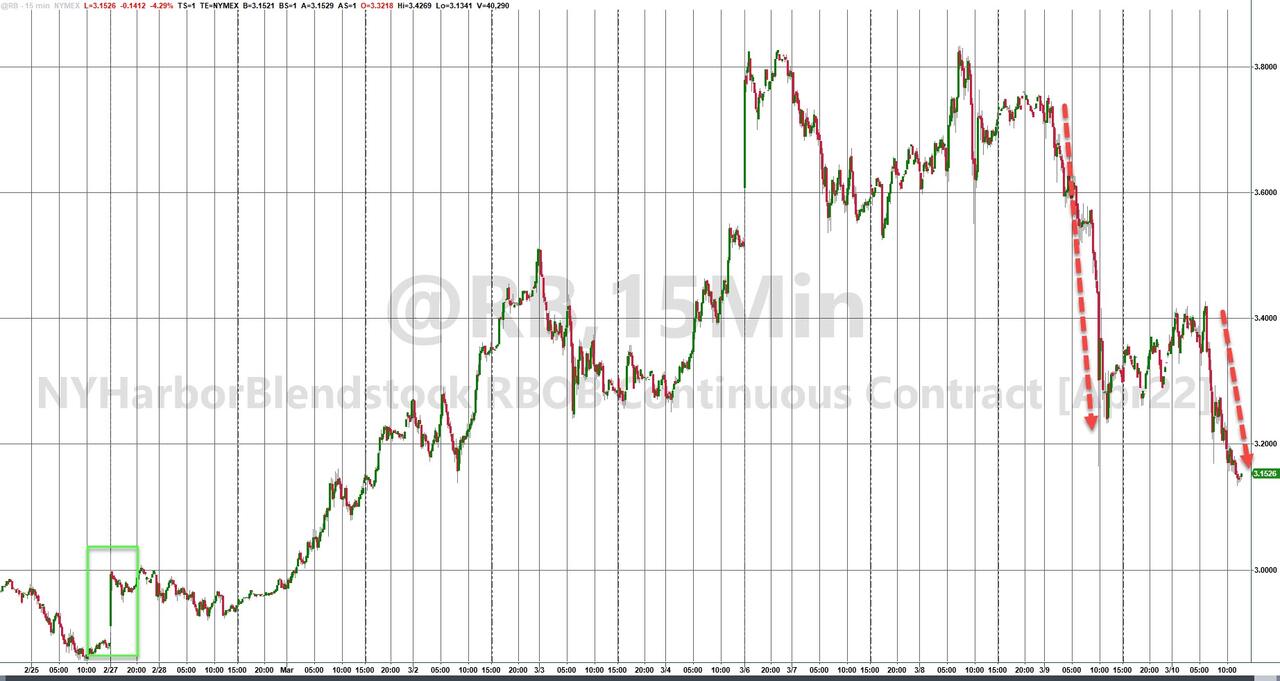
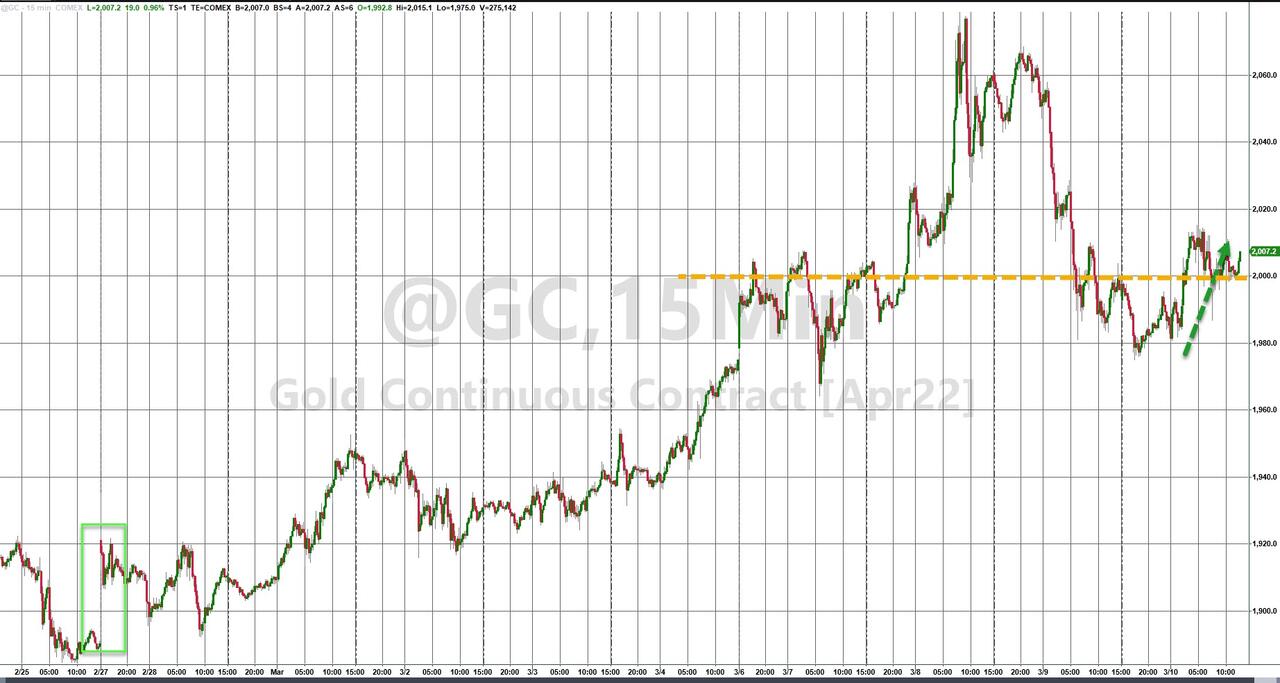
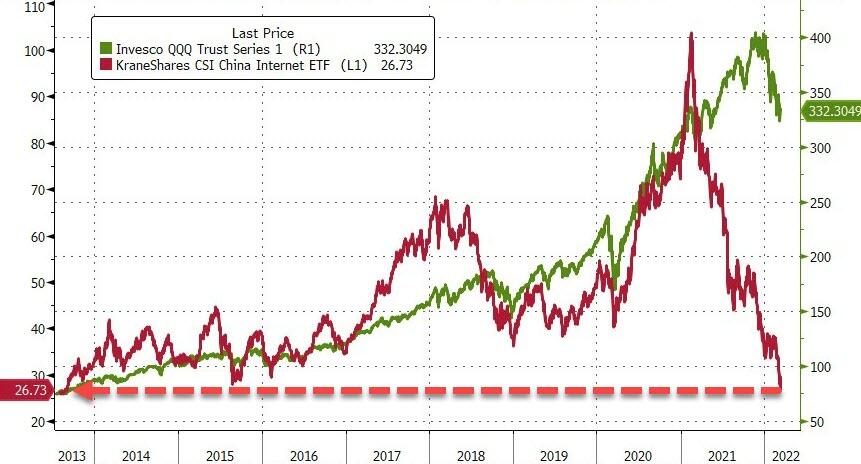
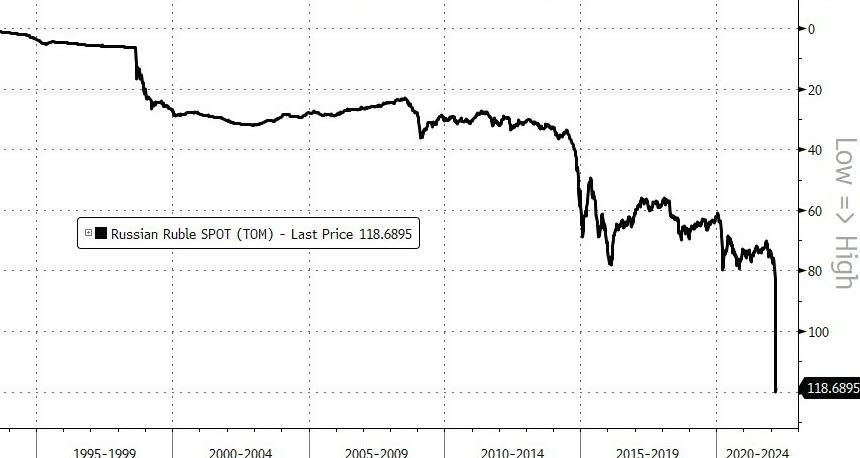


[…] by Harvey Organ, Harvey Organ Blog: […]
LikeLike
[…] by Harvey Organ, Harvey Organ Blog: […]
LikeLike
[…] by Harvey Organ of Harvey Organ Blog […]
LikeLike
[…] by Harvey Organ of Harvey Organ Blog […]
LikeLike
[…] by Harvey Organ of Harvey Organ Blog […]
LikeLike