by harveyorgan · in Uncategorized · Leave a comment·Edit
by harveyorgan · in Uncategorized · Leave a comment·Edit
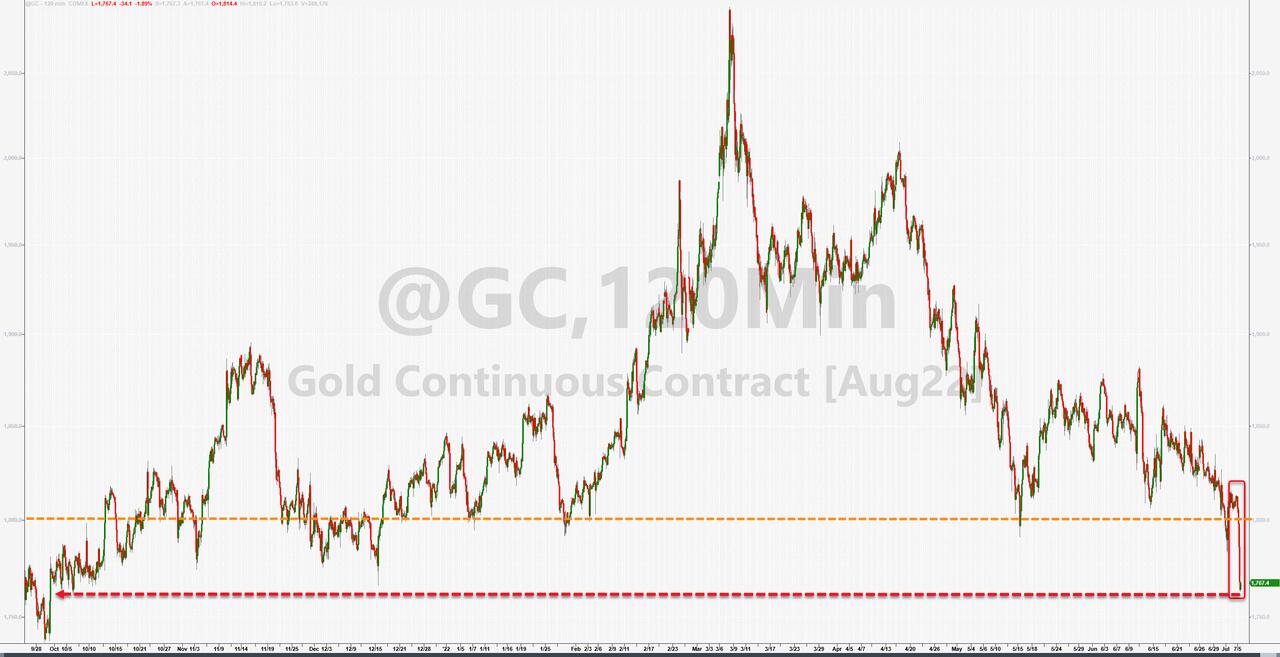
GOLD; $1764.95 DOWN $36.55
SILVER: $19.19 DOWN 55 CENTS
ACCESS MARKET: GOLD $1767.00
SILVER: $19.25
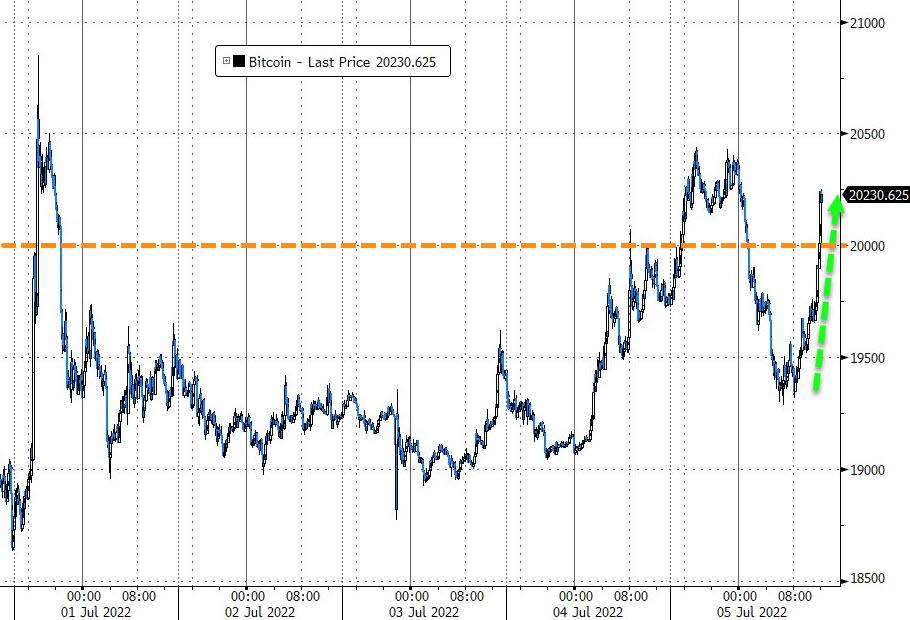
Bitcoin morning price: $19,640 UP 240
Bitcoin: afternoon price: $20,203. UP 90-3
Platinum price: closing DOWN $15.70 to $863.96
Palladium price; closing DOWN $312.45 at $1929.60
END
DONATE
Click here if you wish to send a donation. I sincerely appreciate it as this site takes a lot of preparation
EXCHANGE: COMEX
CONTRACT: JULY 2022 COMEX 100 GOLD FUTURES
SETTLEMENT: 1,798.900000000 USD
INTENT DATE: 07/01/2022 DELIVERY DATE: 07/06/2022
FIRM ORG FIRM NAME ISSUED STOPPED
118 C MACQUARIE FUT 186
365 H ED&F MAN CAPITA 2
657 C MORGAN STANLEY 1
661 C JP MORGAN 181
737 C ADVANTAGE 11 14
800 C MAREX SPEC 11 9
905 C ADM 3
TOTAL: 209 209
MONTH TO DATE: 977
no. of contracts issued by JPMorgan: 181/209
_____________________________________________________________________________________
NUMBER OF NOTICES FILED TODAY FOR JULY CONTRACT 209 NOTICE(S) FOR 20,900 Oz//0.6500 TONNES)
total notices so far: 977 contracts for 97700 oz (3.0388 tonnes)
SILVER NOTICES:
254 NOTICE(S) FILED 1,270,000 OZ/
total number of notices filed so far this month 1892 : for 9,460,000 oz
END
Russia is a major supplier of silver to London while Mexico supplies the COMEX
With the sanctions, London has no way to obtain silver other than compete with NY.
GLD
WITH GOLD DOWN $36.55
WITH RESPECT TO GLD WITHDRAWALS: (OVER THE PAST FEW MONTHS):
GOLD IS “RETURNED” TO THE BANK OF ENGLAND WHEN CALLING IN THEIR LEASES: THE GOLD NEVER LEAVES THE BANK OF ENGLAND IN THE FIRST PLACE. THE BANK IS PROTECTING ITSELF IN CASE OF COMMERCIAL FAILURE
ALSO INVESTORS SWITCHING TO SPROTT PHYSICAL (phys) INSTEAD OF THE FRAUDULENT GLD//
BIG CHANGES IN GOLD INVENTORY AT THE GLD: A WITHDRAWAL OF 8.41 TONNES FROM THE GLD//
INVENTORY RESTS AT 1050.31 TONNES
Silver//SLV
WITH NO SILVER AROUND AND SILVER DOWN 55 CENTS
AT THE SLV// ://NO CHANGES IN SILVER INVENTORY AT THE SLV//
INVESTORS ARE SWITCHING SLV TO SPROTT’S PSLV
CLOSING INVENTORY: 540.709 MILLION OZ
Let us have a look at the data for today
SILVER//OUTLINE
SILVER COMEX OI ROSE BY A SMALL SIZED 244 CONTRACTS TO 140.169 AND CLOSER TO THE NEW RECORD OF 244,710, SET FEB 25/2020 AND THE STRONG GAIN IN OI WAS ACCOMPLISHED DESPITE OUR $0.61 LOSS IN SILVER PRICING AT THE COMEX ON THURSDAY. OUR BANKERS WERE SUCCESSFUL IN KNOCKING THE PRICE OF SILVER DOWN (IT FELL BY $0.61) BUT WERE UNSUCCESSFUL IN KNOCKING OFF SOME SILVER LONGS//BUT MAINLY WE HAD ADDITIONAL SPECULATOR ADDITIONS.
WE MUST HAVE HAD:
I) HUGE SPECULATOR SHORT ADDITIONS /. II) WE ALSO HAD SOME REDDIT RAPTOR BUYING//. iii) A STRONG ISSUANCE OF EXCHANGE FOR PHYSICALS iiii) A POOR INITIAL SILVER STANDING FOR COMEX SILVER MEASURING AT 15.220 MILLION OZ FOLLOWED BY TODAY’S 575,000 OZ EFP JUMP TO LONDON / // V) SMALL SIZED COMEX OI GAIN
I AM NOW RECORDING THE DIFFERENTIAL IN OI FROM PRELIMINARY TO FINAL:
THE DIFFERENTIAL FROM PRELIMINARY OI TO FINAL OI SILVER TODAY: CONTRACTS : -18
HISTORICAL ACCUMULATION OF EXCHANGE FOR PHYSICALS JULY. ACCUMULATION FOR EFP’S SILVER/JPMORGAN’S HOUSE OF BRIBES/STARTING FROM FIRST DAY/MONTH OF JULY:
TOTAL CONTACTS for 2 days, total 2760 contracts: 13.800 million oz OR 6.9MILLION OZ PER DAY. (1380 CONTRACTS PER DAY)
TOTAL EFP’S FOR THE MONTH SO FAR: 6.9 MILLION OZ
.
LAST 11 MONTHS TOTAL EFP CONTRACTS ISSUED IN MILLIONS OF OZ:
MAY 137.83 MILLION
JUNE 149.91 MILLION OZ
JULY 129.445 MILLION OZ
AUGUST: MILLION OZ 140.120
SEPT. 28.230 MILLION OZ//
OCT: 94.595 MILLION OZ
NOV: 131.925 MILLION OZ
DEC: 100.615 MILLION OZ
JAN 2022// 90.460 MILLION OZ
FEB 2022: 72.39 MILLION OZ//
MARCH: 207.430 MILLION OZ//A NEW RECORD FOR EFP ISSUANCE AND WE ARE STILL GOING STRONG THIS MONTH.
APRIL: 114.52 MILLION OZ FINAL//LOW ISSUANCE
MAY: 105.635 MILLION OZ//
JUNE: 94.470 MILLION OZ
JULY : 6.9 MILLION OZ
RESULT: WE HAD A SMALL SIZED INCREASE IN COMEX OI SILVER COMEX CONTRACTS OF 262 DESPITE OUR $0.61 LOSS IN SILVER PRICING AT THE COMEX// FRIDAY.,. THE CME NOTIFIED US THAT WE HAD A STRONG SIZED EFP ISSUANCE CONTRACTS: 2260 CONTRACTS ISSUED FOR SEPT AND 0 CONTRACTS ISSUED FOR ALL OTHER MONTHS) WHICH EXITED OUT OF THE SILVER COMEX TO LONDON AS FORWARDS THE DOMINANT FEATURE TODAY: /HUGE BANKER SHORT COVERING AS THEY GET OUT OF DODGE//// WE HAVE A HUGE INITIAL SILVER OZ STANDING FOR JUNE. OF 15.22 MILLION OZ FOLLOWED BY TODAY’S EFP JUMP TO LONDON OF 570,000 OZ // .. WE HAD A VERY STRONG SIZED GAIN OF 2522 OI CONTRACTS ON THE TWO EXCHANGES FOR 12.610 MILLION OZ DESPITE THE STRONG LOSS IN PRICE..
WE HAD 254 NOTICES FILED TODAY FOR 1,270,000 OZ
THE SILVER COMEX IS NOW BEING ATTACKED FOR METAL BY LONDONERS ET AL.
GOLD//OUTLINE
IN GOLD, THE COMEX OPEN INTEREST FELL BY A SMALL SIZED 1168 CONTRACTS TO 494,664 AND FURTHER FROM THE RECORD (SET JAN 24/2020) AT 799,541 AND PREVIOUS TO THAT: (SET JAN 6/2020) AT 797,110.
THE DIFFERENTIAL FROM PRELIMINARY OI TO FINAL OI IN GOLD TODAY: —838 CONTRACTS.
.
THE SMALL SIZED DECREASE IN COMEX OI CAME WITH OUR FALL IN PRICE OF $5.40//COMEX GOLD TRADING/FRIDAY / WE MUST HAVE HAD SOME SPECULATOR SHORT COVERING ACCOMPANYING OUR GOOD SIZED EXCHANGE FOR PHYSICAL ISSUANCE. WE HAD ZERO LONG LIQUIDATION //AND SOME SPECULATOR SHORT COVERING
WE ALSO HAD A HUGE INITIAL STANDING IN GOLD TONNAGE FOR JULY AT 2.914 TONNES ON FIRST DAY NOTICE FOLLOWED BY TODAY’S QUEUE JUMP OF 1300 OZ
YET ALL OF..THIS HAPPENED DESPITE OUR LOSS IN PRICE OF $5.40 WITH RESPECT TO FRIDAY’S TRADING
WE HAD A STRONG SIZED GAIN OF 4980 OI CONTRACTS 18.489 PAPER TONNES) ON OUR TWO EXCHANGES..
E.F.P. ISSUANCE
THE CME RELEASED THE DATA FOR EFP ISSUANCE AND IT TOTALED A STRONG SIZED 6148 CONTRACTS:
The NEW COMEX OI FOR THE GOLD COMPLEX RESTS AT 494,664
IN ESSENCE WE HAVE A STRONG SIZED INCREASE IN TOTAL CONTRACTS ON THE TWO EXCHANGES OF 4980, WITH1168 CONTRACTS DECREASED AT THE COMEX AND 6148 EFP OI CONTRACTS WHICH NAVIGATED OVER TO LONDON. THUS TOTAL OI GAIN ON THE TWO EXCHANGES OF 4980 CONTRACTS OR 15.489TONNES.
CALCULATIONS ON GAIN/LOSS ON OUR TWO EXCHANGES
WE HAD A STRONG SIZED ISSUANCE IN EXCHANGE FOR PHYSICALS (6148) ACCOMPANYING THE SMALL SIZED LOSS IN COMEX OI (1168,): TOTAL GAIN IN THE TWO EXCHANGES 4980 CONTRACTS. WE NO DOUBT HAD 1) SOME SPECULATOR SHORT COVERING AND SOME ADDITION TO SPECULATOR SHORTS ,2.) STRONG INITIAL STANDING AT THE GOLD COMEX FOR JULY. AT 2.914 TONNES FOLLOWED BY TODAY’S 1300 OZ QUEUE JUMP 3) ZERO LONG LIQUIDATION//SOME SPECULATOR SHORT COVERING//SOME SPECULATOR SHORT ADDITIONS //.,4) SMALL SIZED COMEX OPEN INTEREST LOSS 5) STRONG ISSUANCE OF EXCHANGE FOR PHYSICAL/
HISTORICAL ACCUMULATION OF EXCHANGE FOR PHYSICALS IN 2022 INCLUDING TODAY
JULY
ACCUMULATION OF EFP’S GOLD AT J.P. MORGAN’S HOUSE OF BRIBES: (EXCHANGE FOR PHYSICAL) FOR THE MONTH OF JULY :
12,121 CONTRACTS OR 1,212,100 OZ OR 37,70 TONNES 2 TRADING DAY(S) AND THUS AVERAGING: 6061 EFP CONTRACTS PER TRADING DAY
TO GIVE YOU AN IDEA AS TO THE SIZE OF THESE EFP TRANSFERS : THIS MONTH IN 2 TRADING DAY(S) IN TONNES: 37.70 TONNES
TOTAL ANNUAL GOLD PRODUCTION, 2021, THROUGHOUT THE WORLD EX CHINA EX RUSSIA: 3555 TONNES
THUS EFP TRANSFERS REPRESENTS 37.70/3550 x 100% TONNES 1.06% OF GLOBAL ANNUAL PRODUCTION
ACCUMULATION OF GOLD EFP’S YEAR 2021 TO 2022
JANUARY/2021: 265.26 TONNES (RAPIDLY INCREASING AGAIN)
FEB : 171.24 TONNES ( DEFINITELY SLOWING DOWN AGAIN)..
MARCH:. 276.50 TONNES (STRONG AGAIN/
APRIL: 189..44 TONNES ( DRAMATICALLY SLOWING DOWN AGAIN//GOLD IN BACKWARDATION)
MAY: 250.15 TONNES (NOW DRAMATICALLY INCREASING AGAIN)
JUNE: 247.54 TONNES (FINAL)
JULY: 188.73 TONNES FINAL
AUGUST: 217.89 TONNES FINAL ISSUANCE.
SEPT 142.12 TONNES FINAL ISSUANCE ( LOW ISSUANCE)_
OCT: 141.13 TONNES FINAL ISSUANCE (LOW ISSUANCE)
NOV: 312.46 TONNES FINAL ISSUANCE//NEW RECORD!! (INCREASING DRAMATICALLY)//SIGN OF REAL STRESS//SURPASSING THE MARCH 2021 RECORD OF 276.50 TONNES OF EFP
DEC. 175.62 TONNES//FINAL ISSUANCE//
JAN:2022 247.25 TONNES //FINAL
FEB: 196.04 TONNES//FINAL
MARCH: 409.30 TONNES INITIAL( THIS IS NOW A RECORD EFP ISSUANCE FOR MARCH AND FOR ANY MONTH.
APRIL: 169.55 TONNES (FINAL VERY LOW ISSUANCE MONTH)
MAY: 247,44 TONNES FINAL//
JUNE: 2238.13 TONNES FINAL
JULY: 37.70 TONNES
SPREADING OPERATIONS
(/NOW SWITCHING TO GOLD) FOR NEWCOMERS, HERE ARE THE DETAILS
SPREADING LIQUIDATION HAS NOW COMMENCED AS WE HEAD TOWARDS THE NEW ACTIVE FRONT MONTH OF JUNE. WE ARE NOW INTO THE SPREADING OPERATION OF SILVER
HERE IS A BRIEF SYNOPSIS OF HOW THE CROOKS FLEECE UNSUSPECTING LONGS IN THE SPREADING ENDEAVOUR ;MODUS OPERANDI OF THE CORRUPT BANKERS AS TO HOW THEY HANDLE THEIR SPREAD OPEN INTERESTS:HERE IS HOW THE CROOKS USED SPREADING AS WE ARE NOW INTO THE NON ACTIVE DELIVERY MONTH OF JUNE HEADING TOWARDS THE ACTIVE DELIVERY MONTH OF JULY, FOR SILVER:
YOU WILL ALSO NOTICE THAT THE COMEX OPEN INTEREST STARTS TO RISE BUT SO IS THE OPEN INTEREST OF SPREADERS. THE OPEN INTEREST IN WILL CONTINUE TO RISE UNTIL ONE WEEK BEFORE FIRST DAY NOTICE OF AN UPCOMING ACTIVE DELIVERY MONTH (JULY), AND THAT IS WHEN THE CROOKS SELL THEIR SPREAD POSITIONS BUT NOT AT THE SAME TIME OF THE DAY. THEY WILL USE THE SELL SIDE OF THE EQUATION TO CREATE THE CASCADE (ALONG WITH THEIR COLLUSIVE FRIENDS) AND THEN COVER ON THE BUY SIDE OF THE SPREAD SITUATION AT THE END OF THE DAY. THEY DO THIS TO AVOID POSITION LIMIT DETECTION. THE LIQUIDATION OF THE SPREADING FORMATION CONTINUES FOR EXACTLY ONE WEEK AND ENDS ON FIRST DAY NOTICE.”
WHAT IS ALARMING TO ME, ACCORDING TO OUR LONDON EXPERT ANDREW MAGUIRE IS THAT THESE EFP’S ARE BEING TRANSFERRED TO WHAT ARE CALLED SERIAL FORWARD CONTRACT OBLIGATIONS AND THESE CONTRACTS ARE LESS THAN 14 DAYS. ANYTHING GREATER THAN 14 DAYS, THESE MUST BE RECORDED AND SENT TO THE COMPTROLLER, GREAT BRITAIN TO MONITOR RISK TO THE BANKING SYSTEM. IF THIS IS INDEED TRUE, THEN THIS IS A MASSIVE CONSPIRACY TO DEFRAUD AS WE NOW WITNESS A MONSTROUS TOTAL EFP’S ISSUANCE AS IT HEADS INTO THE STRATOSPHERE.
First, here is an outline of what will be discussed tonight:
1.Today, we had the open interest at the comex, in SILVER, ROSE BY A SMALL SIZED 244 CONTRACT OI TO 140,187 AND CLOSER TO OUR COMEX RECORD //244,710(SET FEB 25/2020). THE LAST RECORDS WERE SET IN AUG.2018 AT 244,196 WITH A SILVER PRICE OF $14.78/(AUGUST 22/2018)..THE PREVIOUS RECORD TO THAT WAS SET ON APRIL 9/2018 AT 243,411 OPEN INTEREST CONTRACTS WITH THE SILVER PRICE AT THAT DAY: $16.53). AND PREVIOUS TO THAT, THE RECORD WAS ESTABLISHED AT: 234,787 CONTRACTS, SET ON APRIL 21.2017 OVER 5 YEARS AGO.
EFP ISSUANCE 2260 CONTRACTS
OUR CUSTOMARY MIGRATION OF COMEX LONGS CONTINUE TO MORPH INTO LONDON FORWARDS AS OUR BANKERS USED THEIR EMERGENCY PROCEDURE TO ISSUE:
SEPT 2260 ALL OTHER MONTHS: ZERO. TOTAL EFP ISSUANCE:2260 CONTRACTS. EFP’S GIVE OUR COMEX LONGS A FIAT BONUS PLUS A DELIVERABLE PRODUCT OVER IN LONDON. IF WE TAKE THE COMEX OI GAIN OF 244 CONTRACTS AND ADD TO THE 2260 OI TRANSFERRED TO LONDON THROUGH EFP’S,
WE OBTAIN A GIGANTIC SIZED GAIN OF 2504 OPEN INTEREST CONTRACTS FROM OUR TWO EXCHANGES.
THUS IN OUNCES, THE GAIN ON THE TWO EXCHANGES 12.520 MILLION OZ
OCCURRED DESPITE OUR FALL IN PRICE OF $0.61 .
OUTLINE FOR TODAY’S COMMENTARY
1/COMEX GOLD AND SILVER REPORT
(report Harvey)
2 ) Gold/silver trading overnight Europe,
(Peter Schiff,
end
3. Egon von Greyerz///Matthew Piepenburg via GoldSwitzerland.com,
4. Chris Powell of GATA provides to us very important physical commentaries
end
5. Other gold commentaries
6. Commodity commentaries//
3. ASIAN AFFAIRS
i)TUESDAY MORNING// MONDAY NIGHT
SHANGHAI CLOSED UP 1.43 PTS OR 0.04% //Hang Sang CLOSED UP 22.72 /The Nikkei closed UP 269.64 OR % //Australia’s all ordinaires CLOSED UP .31% /Chinese yuan (ONSHORE) closed UP 6.7050 /Oil DOWN TO 107.98 dollars per barrel for WTI and DOWN TO 111.64 for Brent. Stocks in Europe OPENED ALL RED // ONSHORE YUAN CLOSED UP AGAINST THE DOLLAR AT 6.7050 OFFSHORE YUAN CLOSED UP ON THE DOLLAR AT 6.7086: /ONSHORE YUAN TRADING ABOVE LEVEL OF OFFSHORE YUAN/ONSHORE YUAN TRADING STRONGER AGAINST US DOLLAR/OFFSHORE STRONGER
a)NORTH KOREA/SOUTH KOREA
outline
b) REPORT ON JAPAN/
OUTLINE
3 C CHINA
OUTLINE
4/EUROPEAN AFFAIRS
OUTLINE
5. RUSSIAN AND MIDDLE EASTERN AFFAIRS
OUTLINE
6.Global Issues
OUTLINE
7. OIL ISSUES
OUTLINE
8 EMERGING MARKET ISSUES
COMEX DATA//AMOUNTS STANDING//VOLUME OF TRADING/INVENTORY MOVEMENTS
GOLD
LET US BEGIN:
THE TOTAL COMEX GOLD OPEN INTEREST FELL BY A SMALL SIZED 1168 CONTRACTS TO 494,664 AND FURTHER FROM THE RECORD THAT WAS SET IN JANUARY/2020: {799,541 OI(SET JAN 16/2020)} AND PREVIOUS TO THAT: 797,110 (SET JAN 7/2020). AND THIS SMALL COMEX DECREASE OCCURRED DESPITE OUR LOSS OF $5.40 IN GOLD PRICING FRIDAY’S COMEX TRADING. WE ALSO HAD A STRONG SIZED EFP (6148 CONTRACTS). . THEY WERE PAID HANDSOMELY NOT TO TAKE DELIVERY AT THE COMEX AND SETTLE FOR CASH. IT NOW SEEMS THAT THE COMMERCIALS HAVE GOADED THE SPECS TO GO SHORT BIG TIME AND THEY ADDED TO THEIR SHORT POSITIONS
WE NORMALLY HAVE WITNESSED EXCHANGE FOR PHYSICALS ISSUED BEING SMALL AS IT JUST TOO COSTLY FOR THEM TO CONTINUE SERVICING THE COSTS OF SERIAL FORWARDS CIRCULATING IN LONDON. HOWEVER, MUCH TO THE ANNOYANCE OF OUR BANKERS, THE COMEX IS THE SCENE OF AN ASSAULT ON GOLD AS LONDONERS, NOT BEING ABLE TO FIND ANY PHYSICAL ON THAT SIDE OF THE POND, EXERCISE THESE CIRCULATING EXCHANGE FOR PHYSICALS IN LONDON AND FORCING DELIVERY OF REAL METAL OVER HERE AS THE OBLIGATION STILL RESTS WITH NEW YORK BANKERS. IT SEEMS THAT ARE BANKERS FRIENDS ARE EXERCISING EFP’S FROM LONDON AND NOW THEY ARE LOATHE TO ISSUE NEW ONES.
EXCHANGE FOR PHYSICAL ISSUANCE
WE ARE NOW IN THE NON ACTIVE DELIVERY MONTH OF JULY.. THE CME REPORTS THAT THE BANKERS ISSUED A STRONG SIZED TRANSFER THROUGH THE EFP ROUTE AS THESE LONGS RECEIVED A DELIVERABLE LONDON FORWARD TOGETHER WITH A FIAT BONUS.,
THAT IS 6148 EFP CONTRACTS WERE ISSUED: ;: , . 0 AUG :6148 & ZERO FOR ALL OTHER MONTHS:
TOTAL EFP ISSUANCE: 6148 CONTRACTS
WHEN WE HAVE BACKWARDATION, EFP ISSUANCE IS VERY COSTLY BUT THE REAL PROBLEM IS THE SCARCITY OF METAL AND IT IS FAR BETTER FOR OUR BANKERS TO PAY OFF INDIVIDUALS THAN RISK INVESTORS ESPECIALLY FROM LONDON STANDING FOR DELIVERY. THE LOWER PRICES IN THE FUTURES MARKET IS A MAGNET FOR OUR LONDONERS SEEKING PHYSICAL METAL. BACKWARDATION ALWAYS EQUAL SCARCITY OF METAL!
ON A NET BASIS IN OPEN INTEREST WE GAINED THE FOLLOWING TODAY ON OUR TWO EXCHANGES: A STRONG SIZED TOTAL OF 4980 CONTRACTS IN THAT 6148 LONGS WERE TRANSFERRED AS FORWARDS TO LONDON AND WE HAD A SMALL SIZED COMEX OI LOSS OF 1168 CONTRACTS..AND THIS STRONG GAIN ON OUR TWO EXCHANGES HAPPENED DESPITE OUR FALL IN PRICE OF GOLD $4.25.
// WE HAVE A STRONG AMOUNT OF GOLD TONNAGE STANDING JULY (3.216),
HERE ARE THE AMOUNTS THAT STOOD FOR DELIVERY IN THE PRECEDING 12 MONTHS OF 2021-2022:
DEC 2021: 112.217 TONNES
NOV. 8.074 TONNES
OCT. 57.707 TONNES
SEPT: 11.9160 TONNES
AUGUST: 80.489 TONNES
JULY: 7.2814 TONNES
JUNE: 72.289 TONNES
MAY 5.77 TONNES
APRIL 95.331 TONNES
MARCH 30.205 TONNES
FEB ’21. 113.424 TONNES
JAN ’21: 6.500 TONNES.
TOTAL SO FAR THIS YEAR (JAN- DEC): 601.213 TONNES
YEAR 2022:
JANUARY 2022 17.79 TONNES
FEB 2022: 59.023 TONNES
MARCH: 36.678 TONNES
APRIL: 85.340 TONNES FINAL.
MAY: 20.11 TONNES FINAL
JUNE: 74.933 TONNES FINAL
JULY 3.216 TONNES
THE BANKERS WERE SUCCESSFUL IN LOWERING GOLD’S PRICE //// (IT FELL $5.40) BUT WERE UNSUCCESSFUL IN KNOCKING OFF SPECULATOR LONGS/COMMERCIAL LONGS BUT SPECULATOR SHORTS CONTINUED TO ADD TO THEIR POSITIONS//// WE HAVE REGISTERED A STRONG SIZED GAIN OF 15.489 TONNES ON TOTAL OI FROM OUR TWO EXCHANGES, ACCOMPANYING OUR GOLD TONNAGE STANDING FOR JULY (3.216 TONNES)…
WE HAD -838 CONTRACTS REMOVED FROM COMEX TRADES. THESE WERE REMOVED AFTER TRADING ENDED LAST NIGHT
NET GAIN ON THE TWO EXCHANGES 4980 CONTRACTS OR 498,000 OZ OR 15.489 TONNES
Estimated gold volume 353,881/// STRONG/RAID/
final gold volumes/yesterday 299.284 /STRONG/RAID
INITIAL STANDINGS FOR JULY ’22 COMEX GOLD //JULY 5 (the inventory movements are Friday’s
the jerks have not updated it for today.
| Gold | Ounces |
| Withdrawals from Dealers Inventory in oz | nil oz |
| Withdrawals from Customer Inventory in oz | 93,612.421 oz Int. Delaware JPMorgan Brinks 10 kilobars and 2690 kilobars |
| Deposit to the Dealer Inventory in oz | nilOZ |
| Deposits to the Customer Inventory, in oz | 24,581.842 oz HSBC |
| No of oz served (contracts) today | 209 notice(s)20,900 OZ0.6500 TONNES |
| No of oz to be served (notices) | 57 contracts 5700 oz0.1773 TONNES |
| Total monthly oz gold served (contracts) so far this month | 977 notices97700 OZ3.0388 TONNES |
| Total accumulative withdrawals of gold from the Dealers inventory this month | NIL oz |
| Total accumulative withdrawal of gold from the Customer inventory this month | xxx oz |
| the comex is now completely corrupt: the data below is yesterday’s they have not filed today’s |
total dealer deposit 0
No dealer withdrawals
1 customer deposit
i) Into HSBC xxx oz
total deposits: 24,581.842 oz
3 customer withdrawals:
i) Brinks: 86,679.09 oz
ii) JPMorgan 10,616.821 oz
iii) Int. Delaware: 321.510 oz (10 kilobars)
total withdrawal: 97,617.421 oz
ADJUSTMENTS:3 all dealer to customer
Brinks 2849.366 oz
JPMorgan 302.303 oz
Manfra: 64,628.510 oz
CALCULATIONS FOR THE AMOUNT OF GOLD STANDING FOR JULY.
For the front month of JULY we have an oi of 266 contracts losing 412 contracts . We had
425 notices filed on Friday so we gained 13 contracts or an additional 81300 oz will stand in this non active
delivery month of July.
August has a LOSS OF 9824 contracts down to 387,697 contracts
Sept. gained 59 contracts to 112.
We had 209 notice(s) filed today for 20,900 oz FOR THE July 2022 CONTRACT MONTH.
Today, 0 notice(s) were issued from J.P.Morgan dealer account and 0 notices were issued from their client or customer account. The total of all issuance by all participants equate to 209 contract(s) of which 181 notices were stopped (received) by j.P. Morgan dealer and 0 notice(s) was (were) stopped/ Received) by J.P.Morgan//customer account and 0 notice(s) received (stopped) by the squid (Goldman Sachs)
To calculate the INITIAL total number of gold ounces standing for the JULY /2022. contract month,
we take the total number of notices filed so far for the month (977) x 100 oz , to which we add the difference between the open interest for the front month of (JULY 266 CONTRACTS ) minus the number of notices served upon today 209 x 100 oz per contract equals 103,400 OZ OR 3.216 TONNES the number of TONNES standing in this active month of July.
thus the INITIAL standings for gold for the JULY contract month:
No of notices filed so far (977) x 100 oz+ (266) OI for the front month minus the number of notices served upon today (209} x 100 oz} which equals 103,400 oz standing OR 3.216 TONNES in this active delivery month of JULY.
TOTAL COMEX GOLD STANDING: 3.216 TONNES (A FAIR STANDING FOR A JULY ( NON ACTIVE) DELIVERY MONTH)
XXXXXXXXXXXXXXXXXXXXXXXXXXXXXXXXXXXXXXXXXXXXXXXXXXXXXXXXXXXXX
COMEX GOLD INVENTORIES/CLASSIFICATION
NEW PLEDGED GOLD:
241,794.285 oz NOW PLEDGED /HSBC 5.94 TONNES
204,937.290 PLEDGED MANFRA 3.08 TONNES
83,657.582 PLEDGED JPMorgan no 1 1.690 tonnes
265,999.054, oz JPM No 2
1,152,376.639 oz pledged Brinks/
Manfra: 33,758.550 oz
Delaware: 193.721 oz
International Delaware:: 11,188.542 o
total pledged gold: 2,419,784.828 oz 75.26 tonnes
TOTAL OF ALL GOLD ELIGIBLE AND REGISTERED: 32,989.550.8 OZ
TOTAL ELIGIBLE GOLD: 15,877,907.178 OZ
TOTAL OF ALL REGISTERED GOLD: 17,111,643.639 OZ
REGISTERED GOLD THAT CAN BE SERVED UPON: 14,691,859.0 OZ (REG GOLD- PLEDGED GOLD)
END
SILVER/COMEX/JULY 5
data today is Friday’s data
and it will not be out for quite a while
do not have time to wait
| Silver | Ounces |
| Withdrawals from Dealers Inventory | NIL oz |
| Withdrawals from Customer Inventory | xx oz |
| Deposits to the Dealer Inventory | nil OZ |
| Deposits to the Customer Inventory | nil oz |
| No of oz served today (contracts) | 254CONTRACT(S)1,270,000 OZ) |
| No of oz to be served (notices) | 969 contracts (4,845,000 oz) |
| Total monthly oz silver served (contracts) | 1892 contracts 9,460,000 oz) |
| Total accumulative withdrawal of silver from the Dealers inventory this month | NIL oz |
| Total accumulative withdrawal of silver from the Customer inventory this month |
And now for the wild silver comex results
i) 0 dealer deposit
total dealer deposits: 0 oz
i) We had 0 dealer withdrawal
total dealer withdrawals: x oz
We have x deposits into the customer account
i
total deposit: xxx oz
JPMorgan has a total silver weight: 171.727 million oz/337.321 million =50.90% of comex
Comex withdrawals: 4
i) Out of Brinks 370,852.600 oz
ii) out of Int. Delaware 167,586.840 oz
iii) Out of JPMorgan 791,827.510 oz
iv) Out of Manfra: 191,892.860 oz
total withdrawal 1,522,159.820 oz
adjustments: 0
the silver comex is in stress!
TOTAL REGISTERED SILVER: 69.331 MILLION OZ
TOTAL REG + ELIG. 337,321 MILLION OZ
CALCULATION OF SILVER OZ STANDING FOR JUNE
silver open interest data:
FRONT MONTH OF JULY OI: 123 CONTRACTS HAVING LOST 256. WE HAD 141 NOTICES FILED
ON FRIDAY, SO WE LOST 115 CONTRACTS OR 575,000 OZ WERE E.F.P.’d TO LONDON
AUGUST GAINED 91 CONTRACTS TO STAND AT 1528
SEPTEMBER HAD A GAIN OF 511 CONTRACTS UP TO 117,506 CONTRACTS.
.
TOTAL NUMBER OF NOTICES FILED FOR TODAY: 254 for 1,270,000 oz
Comex volumes:82,786// est. volume today// good
Comex volume: confirmed yesterday: 80,883 contracts ( GOOD )
To calculate the number of silver ounces that will stand for delivery in JULY we take the total number of notices filed for the month so far at 1892 x 5,000 oz = 9,460,000 oz
to which we add the difference between the open interest for the front month of JULY(1223) and the number of notices served upon today 254 x (5000 oz) equals the number of ounces standing.
Thus the standings for silver for the JULY./2022 contract month: 1892 (notices served so far) x 5000 oz + OI for front month of JULY (1223) – number of notices served upon today (254) x 5000 oz of silver standing for the JULY contract month equates 14,305,000 oz. .
the record level of silver open interest is 234,787 contracts set on April 21./2017 with the price on that day at $18.42. The previous record was 224,540 contracts with the price at that time of $20.44
END
GLD AND SLV INVENTORY LEVELS:
JULY 5/WITH GOLD DOWN $36.55//BIG CHANGES IN GOLD INVENTORY AT THE GLD: A WITHDRAWAL OF 8.41 TONNES FROM THE GLD///INVENTORY RESTS AT 1041.90 TONNES
JULY 1/WITH GOLD DOWN $5.40: BIG CHANGES IN GOLD INVENTORY AT THE GLD: A WITHDRAWAL OF 2.32 TONNES//INVENTORY RESTS AT 1050.31 TONNES
JUNE 30/WITH GOLD DOWN $9.20: big CHANGES IN GOLD INVENTORY AT THE GLD: A WITHDRAWAL OF 1.74 TONNES FROM THE GLD///INVENTORY RESTS AT 1052.63 TONNES//
JUNE 28/WITH GOLD DOWN $3.05//BIG CHANGES IN GOLD INVENTORY AT THE GLD: A WITHDRAWAL OF 4.64 TONNES FROM THE GLD///INVENTORY RESTS AT 1056.40 TONNES
JUNE 27/WITH GOLD DOWN $4.90 CENTS TODAY: BIG CHANGES IN GOLD INVENTORY AT THE GLD: A WITHDRAWAL OF 2.03 TONNES FROM THE GLD///INVENTORY RESTS AT 1061.04 TONNES
JUNE 24/WITH GOLD UP 45 CENTS TODAY: HUGE CHANGES IN GOLD INVENTORY AT THE GLD: A WITHDRAWAL OF 8.70 TONNES FROM THE GLD//INVENTORY RESTS AT 1063.07 TONNES
JUNE 23/WITH GOLD DOWN $8.60:HUGE CHANGES IN GOLD INVENTORY AT THE GLD: A WITHDRAWAL OF 2.03 TONNES FROM THE GLD//INVENTORY RESTS AT 1071.77 TONNES
JUNE 22/WITH GOLD UP 15 CENTS:BIG CHANGES IN GOLD INVENTORY AT THE GLD: A WITHDRAWAL OF 1.74 TONNES FROM THE GLD////INVENTORY RESTS AT 1073.80 TONNES
JUNE 21/WITH GOLD DOWN $2.00: NO CHANGES IN GOLD INVENTORY AT THE GLD/INVENTORY RESTS AT 1075.54 TONES
JUNE 17/WITH GOLD DOWN $11.25: HUGE CHANGES IN GOLD INVENTORY AT THE GLD: A DEPOSIT OF 11.60 TONNES INTO THE GLD.///INVENTORY RESTS AT 1075.54 TONNES
JUNE 16/WITH GOLD UP $28.95: NO CHANGES IN GOLD INVENTORY AT THE GLD//INVENTORY RESTS AT 1063.74 TONNES
JUNE 15/WITH GOLD UP $6.50/BIG CHANGES IN GOLD INVENTORY AT THE GLD: A WITHDRAWAL OF 1.65 TONNES FROM THE GLD////INVENTORY RESTS AT 1063.74 TONNES
JUNE 14/WITH GOLD DOWN $18.80/NO CHANGES IN GOLD INVENTORY AT THE GLD//INVENTORY RESTS AT 1065.39 TONNES
JUNE 13/WITH GOLD DOWN $41.55: NO CHANGES IN GOLD INVENTORY AT THE GLD//INVENTORY RESTS AT 1065.39 TONNES
JUNE 10/WITH GOLD UP $21.40: NO CHANGES IN GOLD INVENTORY AT THE GLD//INVENTORY RESTS AT 1065.39 TONNES
JUNE 9/WITH GOLD DOWN $3.50: HUGE CHANGES IN GOLD INVENTORY AT THE GLD: A DEPOSIT OF 2.32 TONNES OF GOLD INTO THE GLD////INVENTORY RESTS AT 1065.39 TONNES
JUNE 8/WITH GOLD UP $4.75: NO CHANGES IN GOLD INVENTORY AT THE GLD//INVENTORY RESTS AT 1063.07 TONNES
JUNE 7/WITH GOLD UP $7.45: NO CHANGES IN GOLD INVENTORY AT THE GLD//INVENTORY RESTS AT 1063.07 TONNES
JUNE 6/WITH GOLD DOWN $5.85: NO CHANGES IN GOLD INVENTORY AT THE GLD//INVENTORY RESTS AT 1066.04 TONNES
JUNE 3/WITH GOLD DOWN $19.75//A BIG CHANGE IN GOLD INVENTORY AT THE GLD: A WITHDRAWAL OF 1.16 TONNES FROM THE GLD//INVENTORY RESTS AT 1066.04 TONNES
JUNE 2/WITH GOLD UP $22.50: HUGE CHANGES IN GOLD INVENTORY AT THE GLD: A WITHDRAWAL OF 1.64 TONNES FROM THE GLD//INVENTORY RESTS AT 1067.20 TONNES
JUNE 1/WITH GOLD UP $1$ HUGE CHANGES IN GOLD INVENTORY AT THE GLD: A WITHDRAWAL OF 1.45 TONNES FROM THE GLD///INVENTORY RESTS AT 1068.36 TONNES
GLD INVENTORY: 1041.90 TONNES
Now the SLV Inventory/( vehicle is a fraud as there is no physical metal behind them
JULY 5/WITH SILVER DOWN 55 CENTS TODAY: NO CHANGES IN SILVER INVENTORY AT THE SLV//INVENTORY RESTS AT 540.709MILLION OZ//
JULY 1/WITH SILVER DOWN 61 CENTS TODAY: A SMALL CHANGE IN SILVER INVENTORY AT THE SLV: A WITHDRAWAL OF 553,000 OZ//INVENTORY RESTS AT 540.709 MILLION OZ//
JUNE 30/WITH SILVER DOWN 41 CENTS : SMALL CHANGES IN SILVER INVENTORY AT THE SLV: A WITHDRAWAL OF 738,000 OZ FROM THE SLV//INVENTORY RESTS AT 541.262 MILLION OZ//
JUNE 28/WITH SILVER DOWN 26 CENTS TODAY: NO CHANGES IN SILVER INVENTORY AT THE SLV//INVENTORY RESTS AT 542.00 MILLION OZ..
JUNE 27/WITH SILVER DOWN 4 CENTS TODAY: NO CHANGES IN SILVER INVENTORY AT THE SLV//INVENTORY RESTS AT 542.000 MILLION OZ
JUNE 24/WITH SILVER UP 10 CENTS TODAY: HUGE CHANGES IN SILVER INVENTORY AT THE SLV: A WITHDRAWAL OF 3.137 MILLION OZ FROM THE SLV////INVENTORY RESTS AT 542.000 MILLION OZ
JUNE 23/WITH SILVER DOWN 41 CENTS TODAY; HUGE CHANGES IN SILVER INVENTORY AT THE SL: A WITHDRAWAL OF 2.029 MILLION OZ FROM THE SLV//INVENTORY RESTS AT 545.137 MILLION OZ//
JUNE 22/WITH SILVER DOWN 14 CENTS TODAY: NO CHANGES IN SILVER INVENTORY AT THE SLV//INVENTORY RESTS AT 547.166 MILLION OZ.
JUNE 21/WITH SILVER UP 9 CENTS TODAY: HUGE CHANGES IN SILVER INVENTORY AT THE SLV: A DEPOSIT OF 3.506 MILLION OZ INTO THE SLV///INVENTORY RESTS AT 547.166 MILLION OZ//
JUNE 17/WITH SILVER DOWN 15 CENTS TODAY: SMALL CHANGES IN SILVER INVENTORY AT THE SLV/: A WITHDRAWAL OF 739,000 OZ FROM THE SLV./:INVENTORY RESTS AT 543.660 MILLION OZ/
JUNE 16/WITH SILVER UP 46 CENTS TODAY: NO CHANGES IN SILVER INVENTORY AT THE SLV//INVENTORY RESTS AT 544.399 MILLION OZ
JUNE 15/WITH SILVER UP 44 CENTS TODAY: NO CHANGES IN SILVER INVENTORY AT THE SLV//INVENTORY RESTS AT 544.399 MILLION OZ
JUNE 14/WITH SILVER DOWN 32 CENTS TODAY: NO CHANGES IN SILVER INVENTORY AT THE SLV//INVENTORY RESTS AT 544.399 MILLION OZ//
JUNE 13/WITH SILVER DOWN 62 CENTS TODAY: NO CHANGES IN SILVER INVENTORY AT THE SLV//INVENTORY RESTS AT 544.399 MILLION OZ//
JUNE 10.WITH SILVER UP 13 CENTS TODAY: HUGE CHANGES IN SILVER INVENTORY AT THE SLV: A WITHDRAWAL OF 830,000 Z FROM THE SLV//INVENTORY RESTS AT 544.399 MILLION OZ//
JUNE 9/WITH SILVER DOWN 27 CENTS TODAY:HUGE CHANGES IN SILVER INVENTORY AT THE SLV: A DEPOSIT OF 923,000 OZ INTO THE SLV////INVENTORY RESTS AT 545.229 MILLION OZ
JUNE 8/WITH SILVER DOWN 8 CENTS TODAY: NO CHANGES IN SILVER INVENTORY AT THE SLV/INVENTORY RESTS AT 544.306 MILLION OZ//
JUNE 7/WITH SILVER UP 6 CENTS TODAY: NO CHANGES IN SILVER INVENTORY AT THE SLV//INVENTORY RESTS AT 544.306 MILLION OZ/
JUNE 6/WITH SILVER UP 20 CENTS TODAY: A HUGE CHANGE IN SILVER INVENTORY AT THE SLV: A WITHDRAWAL OF 6.459 MILLION OZ FROM THE SLV///INVENTORY RESTS AT 547.167 MILLION OZ//
JUNE 3/WITH SILVER DOWN $.34: A SMALL CHANGES IN SILVER INVENTORY AT THE SLV: A WITTHDRAWAL OF 246,000 OZ FORM THE SLV//INVENTORY RESTS AT 553.626 MILLION OZ..
JUNE 2/WITH SILVER UP 57 CENTS TODAY: HUGE CHANGES IN SILVER INVENTORY AT THE SLV: A WITHDRAWAL OF 2.261 MILLION OZ FORM THE SLV.//INVENTORY RESTS T 553.872 MILLION OZ
JUNE 1/WITH SILVER UP 19 CENTS TODAY: HUGE CHANGES IN SILVER INVENTORY AT THE SLV//: A WITHDRAWAL OF 2.538 MILLION OZ FROM THE SLV//INVENTORY RESTS AT 556.133 MILLION OZ//
CLOSING INVENTORY 540.709 MILLION OZ//
PHYSICAL GOLD/SILVER STORIES
1.PETER SCHIFF
2. Lawrie Williams//Pam and Russ Martens/Jim Rickards/Mathew Piepenburg/Von Greyerz
Von Greyerz: This Implosion Will Be Fast… Hold On To Your Seats
MONDAY, JUL 04, 2022 – 07:10 AM
Authored by Egon von Greyerz via GoldSwitzerland.com,
The massive money creation in the 2000s has led to a debt and asset bubble, which is about to burst. Investors will be shocked by the speed of the decline and won’t react before it is too late.
The massive money creation by central and commercial banks in this century has resulted in a growth of global assets from $450 trillion in 2000 to $1,540 trillion in 2020.

DEBT TO GDP GROWTH
As the chart below shows US debt to GDP held well below 25% from 1790 to the 1930s, a period of almost 150 years. The depression with the New Deal followed by WWII pushed debt to GDP up to 125%. Then after the war, the debt came down to around 30% in the early 1970s.

The closing of the gold window in 1971 ended all fiscal and monetary discipline. Since then, the US and much of the Western world has seen debt to GDP surge to well over 100%. In the US, Public Debt to GDP is now 125%. Back in 2000 it was only 54% but since then we have seen a vote buying system with a money printing bonanza and an exponential increase in debt to 125%.
A major part of the debt increase has gone to finance the rapid growth in property values.
The table below shows that property has grown on average by 250% between 2000 and 2020. So individuals are creating wealth by swapping properties with each other. Hardly a sustainable form of wealth creation.

The exponential growth in property prices has been global although countries like China, Canada, Australia and Sweden stand out with over 200% gains since 2000. Most of the properties bought in the last 20+ years involve massive leverage. When the property bubble soon bursts, many property owners will have negative equity and could easily lose their homes.
So both private and government debt is continuing to grow rapidly. But nobody should believe that it will stop here. The Fed’s intention to reduce the balance sheet is not working and the debt is at best going sideways currently.
BIDEN BANS RUSSIAN GOLD
So it is happening again. The US has decided to ban imports of Russian gold and told the whole G7 to follow suit. President Biden sent the following Tweet last week:

So what will the consequences be?
Russia is the second biggest gold producer in the world after China. Just like with oil, gas and many other commodities, the effect will be higher gold prices over time. The gold trade is international and the major buyers of gold are China and India. So Russia can continue to sell gold to the Far East, the middle East and South America.
Also, when the EU sanctions started, the LBMA (London Bullion Market Association) decided not to accept gold that had been refined in Russia.
So the effect of the G7 ban will be minimal since gold deliveries from Russian refiners to the bullion banks already stopped in early March.
SANCTIONS ARE COUNTER PRODUCTIVE
Biden also signed an executive order on 15 March this year, prohibiting US persons to be involved with gold trading with Russian parties.
Still, more sanctions by the US and Europe will over time create shortages in gold just as it has in other commodities. So Russia will be able to sell its commodities including gold to other markets at higher prices.
But since Russia by far has the greatest commodity reserves in the world at $75 trillion, the value of these reserves are going to appreciate for years as we are now at the beginning of a major bull market in commodities.
The US and EU sanctions of Russia affect around 15% of the world population so there are still plenty of markets where Russia can trade.
The Roman Empire controlled parts of Europe, North Africa and the Middle East. The Empire prospered primarily due to free trade within the whole area with no sanctions. Sanctions hurt all parties involved. And since Russia is such a major commodity country that can continue to trade with major nations, they will over time suffer less than the sanctioning countries.
The consequences of these sanctions especially for Europe where many countries are dependent on Russian oil and gas will be totally devastating. So the US and Europe have really shot themselves in the foot.
GOLD, THE US DOLLAR & STOCK MARKETS
Coming back to gold, the US and G7 move is more likely to have a beneficial effect on gold over time with demand increasing and supply being restricted.
Gold started an uptrend in year 2001 that lasted for 10 years to 2011 when gold reached $1,920. After a major correction for 3 years until 2016, to $1,060, gold has resumed its exponential uptrend as can be seen in the chart below.

Although gold has not yet made sustained new highs in dollars, we have seen much higher highs in gold against most currencies. The temporarily strong dollar is making gold look weak measured in the US currency but that is unlikely to last for long.
MAJOR GOLD MOVE COMING
As the chart below shows, gold is finishing a Cup and Handle technical pattern. It does allow for a slightly lower price before the next move up although that is not certain. Regardless, the major trend for gold is substantial and I expect a sustained move up to at least 2026 but probably for much longer. Obviously there will be major corrections on the way.

DOLLAR FALL NEXT
If we look at the chart of the dollar against the Swiss franc since 1970, we can see that the 78% fall so far has gone sideways for 10 years.
The next move down is likely to be another 50% to 0.45-0.50 at least.

So the feeble and temporary dollar correction up is likely to end soon with a strong down move next.
MAJOR STOCK MARKET FALL AHEAD
Stocks globally are down around 20% this year.
The next move down in stocks could happen within the next few weeks. This is likely be a shocking move which will paralyse investors as they won’t have time to react.

So we could see stocks and dollar strongly down at the same time with the metals up. Even if gold and silver comes down initially, that move will not last. The uptrend in the metals is soon about to resume.
Wealth preservation
Our company made substantial purchases of physical gold at the beginning of 2002 for our investors and ourselves. The price was then $300. We have never sold an ounce since then but added at opportune moments.
There was, as the gold chart above shows, a major move until 2011 and then a vicious 3 year correction to $1,060 before the bull trend resumed. As I mentioned above, gold has made much higher highs above the 2011-12 highs in Euros, Pounds,Yen, Swedish kronor, Australian dollars etc.
US dollar highs are just around the corner.
As we bought gold for wealth preservation purposes, it was essential that it was physical with direct ownership and control for the investor. To be able to inspect your own gold is also a requirement.
It is also imperative to store the gold outside an increasingly fragile financial system. If you buy gold as insurance against such an over-leveraged and weak system, it obviously serves no purpose to store it within that system.
To store your insurance asset in a safe jurisdiction is clearly critical. Especially with the current geopolitical unrest it is essential to take advice on location. Also important is to be able to move the gold quickly if necessary.
The reputation and values of the company that assists you with your gold investments must be impeccable.
It serves no purpose to make your choice based on the lowest cost of storage, insurance and handling when you are protecting one of your most important assets.
BE CAREFUL
So there are likely to be major moves in markets next.
No one can of course time these moves exactly. But what is critical to understand is that risk is now extremely high and investors are not going to be saved by central banks.
And remember that fire insurance can only be bought before the fire starts!
-END-
END
3. Chris Powell of GATA provides to us very important physical commentaries
For your interest…
(BBC/GATA)
Exceptional’ Roman gold coin hoard found in Britain
Submitted by admin on Fri, 2022-07-01 09:39Section: Daily Dispatches
After two millennia, Augustus’ money is still good.
* * *
By Katy Prickett
British Broadcasting Co., London
Friday, July 1, 2022
A hoard of Roman gold coins hidden in the decades before the Roman invasion of Britain has been discovered.
Eleven coins have been found so far, scattered near Norwich in Iceni tribe territory. Their queen Boudica would later rebel against Roman rule
Numismatist Adrian Marsden said the hoard is “really quite exceptional” and more coins might be unearthed.
An inquest at Norfolk Coroner’s Court into the two latest finds deemed them treasure. …
… For the remainder of the report and excellent photos of the coins:
https://www.bbc.com/news/uk-england-norfolk-61984020
end
This will cause more gold smuggling into India
The move to raise import tax on gold is to support the ralling rupee
(Reuters.GATA)
India raises import tax on gold to support rupee
Submitted by admin on Fri, 2022-07-01 09:31Section: Daily Dispatches
By Rajendra Jadhav
Reuters
Friday, July 1, 2022
MUMBAI — India has raised its basic import duty on gold to 12.5% from 7.5%, the government said today, as the world’s second biggest consumer of the precious metal tries to dampen demand and bring down the trade deficit.
Local gold prices jumped to an over-two-month peak of 52,032 rupees per 10 grams today, the highest since April 25.
India meets most of its gold demand through imports. That has put pressure on the rupee, which hit a record low today. …
… For the remainder of the report:
https://www.reuters.com/world/india/india-raises-import-tax-gold-125-75-2022-07-01/
END
A must read: Peter Hambro states that Putin and Xi know the golden rule and are not fooled by paper gold
(Hambro/GATA)
Peter Hambro: Putin and Xi know the golden rule
Submitted by admin on Mon, 2022-07-04 22:19Section: Daily Dispatches
10:20p ET Monday, July 4, 2022
Dear Friend of GATA and Gold:
Gold mining executive and trader Peter Hambro today reviews how the gold derivatives racket — an enterprise of central banks, bullion banks, and futures-trading investment houses — have rigged the gold market for many years using imaginary metal.
But Hambro warns: “Vladimir Putin and Xi Jinping are among those who know the golden rule: Whoever has the gold makes the rules.”
His commentary is headlined “Don’t Forget the Golden Rule: Whoever Has the Gold Makes the Rules” and it’s posted at Reaction here:
CHRIS POWELL, Secretary/Treasurer
Gold Anti-Trust Action Committee Inc.
CPowell@GATA.org
END
4. OTHER GOLD COMMENTARIES
Special thanks to Doug C. for sending this to us:
https://mises.org/wire/contra-ben-bernanke-gold-standard-promotes-economic-stability
Contra Ben Bernanke, the Gold Standard Promotes Economic Stability
Currently the world is on a fiat money standard—a government-issued currency that is not backed by a commodity such as gold. The fiat standard is the primary cause behind the present economic instability, and is tempted to suggest that a gold standard would reduce instability. The majority of experts however, oppose this idea on the ground that the gold standard is in fact a factor of instability.
For instance, the former Federal Reserve Board chairman Ben Bernanke echoed this opposition in his lecture at the George Washington University on March 20, 2012. According to Bernanke, the gold standard prevents the central bank from engaging in policies aimed at stabilizing the economy on account of sudden shocks. This, in turn, according to Bernanke, could lead to severe economic upheavals:
Since the gold standard determines the money supply, there’s not much scope for the central bank to use monetary policy to stabilize the economy…. Because you had a gold standard which tied the money supply to gold, there was no flexibility for the central bank to lower interest rates in recession or raise interest rates in an inflation.
A great merit of the gold standard is that it prevents authorities from pursuing reckless money pumping. Also, in his speech, Bernanke argued that because of the relatively low growth rate in the supply of gold, this could lead to a general decline in the prices of goods and services, which could seriously damage the economy.
What matters is not the growth rate of money as such but its purchasing power. With an expansion in wealth all other things being equal, the purchasing power of dollars is going to increase and every holder of dollars is going to command more wealth.
Bernanke also argued that another major negative of having the gold standard is that it creates a system of fixed exchange rates between the currencies of countries that are on the gold standard. There is no variability as we have it today, argued Bernanke:
If there are shocks or changes in the money supply in one country and perhaps even a bad set of policies, other countries that are tied to the currency of that country will also experience some of the effects of that.
It seems that Bernanke was arguing in support of the floating currency system. He doesn’t understand that in a free market, money is a commodity, and a dollar or other currencies are not independent entities.
Prior to 1933, the name “dollar” was used to refer to a unit of gold that had a weight of 23.22 grains. Since there are 480 grains in one ounce, this means that the name dollar also stood for 0.04838 ounce of gold. This in turn means that one ounce of gold referred to $20.67. Please note that $20.67 is not the price of one ounce of gold in terms of dollars as Bernanke and other experts are saying. Dollar is just a name for 0.04838 ounce of gold. According to Murray N. Rothbard,
No one prints dollars on the purely free market because there are, in fact, no dollars; there are only commodities, such as wheat, cars, and gold.
Likewise, the names of other currencies stood for a fixed amount of gold. Contrary to Bernanke, in a free market, currencies do not float against each other. They are exchanged in accordance with a fixed definition. For example, if the British pound stands for 0.25 ounces of gold and the dollar stands for 0.048 ounces of gold, then one British pound will be exchanged for around five dollars, as Rothbard showed.
Increases in the Gold Supply Don’t Cause Boom-Bust Cycles
According to Rothbard, increases in the supply of gold do not set boom-bust cycles into motion. For Rothbard the key reason behind boom-bust cycles is the act of embezzlement brought about by the monetary policies of the central bank.
Rothbard believed that the business cycle is unlikely to emerge in a free-market economy where money is gold and there is no central bank. According to Rothbard,
Inflation, in this work, is explicitly defined to exclude increases in the stock of specie. While these increases have such similar effects as raising the prices of goods, they also differ sharply in other effects: (a) simple increases in specie do not constitute an intervention in the free market, penalizing one group and subsidizing another; and (b) they do not lead to the processes of the business cycle. (bold added)
To better explain this point, we begin with a barter economy in which John the miner produces ten ounces of gold. The reason why he mines gold is because there is a market for it. John then exchanges his ten ounces of gold for various goods and services.
Over time, individuals have discovered that gold—being originally useful in making jewelry—is also useful for other uses such as to serve as the medium of the exchange. They now begin to assign a much greater exchange value to gold than before. As a result, John the miner can exchange his ten ounces of gold for more goods and services than before.
Observe that gold is part of the pool of wealth and promotes the individual’s life and well-being. Every time John the miner exchanges gold for goods, he is engaging in an exchange of something for something. He is exchanging wealth for wealth.
Contrast this with the paper receipts that are employed as the medium of exchange. These receipts are issued without the corresponding gold deposited for safekeeping. This sets a platform for consumption without contributing to the pool of wealth.
The printing of receipts unbacked by gold sets the exchange of nothing for something. This in turn sets in motion the process of the diversion of resources from wealth-generating activities to the holders of unbacked receipts. This leads to the so-called economic boom.
Stopping the issuing of unbacked receipts arrests the diversion of resources towards activities that emerged because of unbacked by gold receipts. As a result, non-wealth-generating activities come under pressure—an economic bust emerges.
To clarify this point further, consider counterfeit money generated by a forger. No goods were exchanged to obtain the forged money. (The forger just printed the money hence the counterfeit money emerged out of “thin air.”) Once the forged money is exchanged for goods, this results in nothing being exchanged for something, leading to the channeling of goods from individuals that produced goods to the forger.
Now, a forger by embarking on the purchases of various goods provides in fact support for the production of these goods. Observe that the increase in the production of goods would not emerge in the absence of the counterfeit money. Resources are now directed towards the production of goods that are supported by the counterfeiter.
Once the support for goods emerging on account of counterfeiter activities slows down, or comes to a halt, the demand for these goods also slows down or vanishes. Consequently, the production of these goods slows down or is aborted. Observe that on account of the increase in the money with no backing, an increase in the production of goods emerges. A decline in the money created from nothing results in the decline in the production of these goods. Hence, what we have here is a boom of activities that emerged as a result of money out of “thin air” and their bust because of a decline in the supply of unbacked money.
While increases in the supply of gold (when used as money) are likely to cause fluctuations in economic activity, these fluctuations do not occur because of intervention with the free market. Thus, these fluctuations do not cause the impoverishment of wealth generators. A gold miner (wealth producer) exchanges gold for other useful goods. He does not require empty money to divert wealth to himself.
Summary and Conclusion
Boom-bust cycles are the outcome of central bank policies that are aimed at stabilizing the economy. In the past the alleged instability of economies on the gold standard took place because the authorities were issuing unbacked by gold money thereby undermining the gold standard. Contrary to popular thinking, the gold standard, if not abused by the central bank, does not cause instability.
5.OTHER COMMODITIES: NICKEL:
Nickel jumped 6% following news that the UK government as added billionaire and owner of Norlisk to its list of sanctioned individuals.
The LME has not banned Norilsk due to the massive short position of one trader and they do not need another huge rise in price of Ni.
(OilPrice.com)
Nickel Prices Surge As UK Sanctions Major Russian Miner
TUESDAY, JUL 05, 2022 – 03:30 AM
- Nickel prices jumped by 6% following news that the UK government has added Vladimir Potanin, Norisk Nickel’s president, to its list of sanctioned individuals.
- Potanin, the board chairman for Moscow-based conglomerate Interros, holds a 35.9% stake in Norilsk Nickel.
- Norilsk, one of the world’s largest single nickel producers, accounts for approximately 7% of the global supply.
The UK government has added Vladimir Potanin, Norilsk Nickel’s president and chairman of the management board, to its list of sanctioned individuals. The LME nickel price remains in question. A June 29 update notification from HM Treasury’s Office of Financial Sanctions Implementation (OFSI) noted Potanin’s addition. The stated reason was that he would benefit from or support the Russian government by owning or controlling Rosbank.
“Rosbank is carrying on business in the Russian financial services sector, which is a sector of strategic significance to the Government of Russia,” OFSI said in its update. Potanin, the board chairman for Moscow-based conglomerate Interros, holds a 35.9% stake in Norilsk Nickel. That holding group acquired Rosbank from French investment bank Société Générale back in April.
The LME Reacts to Sanction News and Nickel Price
The market quickly voiced concerns over possible supply issues. According to reports, news of the sanctions caused nickel prices on the London Metal Exchange to jump by 6%. The base metal’s official three-month closing price was $23,158 per metric ton on June 28. According to data from the bourse, this represents a decline of 10.8% from June 21, when prices were $25,949.
The sanctions are part of the “Russian Regulations”. This information falls under the Sanctions and Money Laundering Act of 2018. According to the OFSI documents, these stipulate freezing funds and economic resources belonging to entities “involved in destabilizing Ukraine. It undermines or threatens the territorial integrity, sovereignty, or independence of Ukraine. It’s about obtaining a benefit from or supporting the Government of Russia.”
The asset freeze also prevents any UK citizen or business from dealing with any funds owned, held, or controlled by the named individual. “It also prevents funds or economic resources being provided to or for the benefit of the designated person,” a government statement said. Potanin will also not be able to enter the United Kingdom or remain in the country
A Long List of Bans and Sanctions
Norilsk, one of the world’s largest single nickel producers, accounts for approximately 7% of the global supply. Of course, Nickel’s primary application is the production of austenitic stainless steel. However, the metal’s application also extends to batteries, including those designed for electric vehicles. Platinum and palladium are also sourced heavily from Norilsk’s production. Back in May, the UK government imposed a 35% duty on all imports of the rare metals sourced from Russia or Belarus.
That same month, the UK froze the assets of London-headquartered Evraz. As a major steel manufacturer, Evraz has steelmaking and mining assets in Russia. The Financial Conduct Authority had already suspended the group’s shares on the London Stock Exchange two months earlier. This was largely due to the government’s addition of Roman Abramovich to its list of sanctioned individuals.
In March, steel and iron imports from Russia and Belarus were subjected to a 35% import duty. The move was the result of denying the two countries “Most Favored Nation” status for hundreds of their exports.
It Remains Unclear How Much Impact the Move Will Have
The LME has still not banned Russian Nickel. It’s just that the stocks from Russia are lower due to concerns over supply and logistics. So, while things might seem tight in Europe for now, there are ample opportunities to source Nickel from other places and producers.
Indonesia, for instance, has been ramping up its nickel production exponentially. This will effect its nickel price. In fact, estimates put the country’s primary production forecast for 2022 at 1.3 million metric tonnes. That’s a 52% increase on the year. Currently, primary nickel demand within Europe is forecasted at 310,000 metric tonnes for the year. This is a significant increase from 2021, when demand was 300,000. Fortunately, the LME does not require high-quality nickel for all of the nickel it pushes through.
Despite the sanctions, Norilsk Nickel will likely turn its attention towards China as a primary end-user. If demand holds up in that market, the company will not get too broken up about Potanin’s inclusion on the U.K.’s list.
END
COMMODITIES IN GENERAL/
END
6.CRYPTOCURRENCIES
7. GOLD/ TRADING
Your early currency/gold and silver pricing/Asian and European bourse movements/ and interest rate settings TUESDAY morning 7:30 AM
ONSHORE YUAN: CLOSED UP 6.7050
OFFSHORE YUAN: 6.7986
HANG SANG CLOSED UP AT 22.72 PTS OR .10%
2. Nikkei closed UP 269.64 OR 1.23%
3. Europe stocks CLOSED ALL RED
USA dollar INDEX UP TO 106.05/Euro FALLS TO 1.0297
3b Japan 10 YR bond yield: FALLS TO. +.205/ !!!!(Japan buying 100% of bond issuance)/Japanese yen vs usa cross now at 136.04/JAPANESE FALLING APART WITH YEN FALTERING AS WELL AS LONG TERM YIELDS RISING BREAKING THE JAPANESE CENTRAL BANK.
3c Nikkei now ABOVE 17,000
3d USA/Yen rate now well ABOVE the important 120 barrier this morning
3e Gold UP /JAPANESE Yen DOWN CHINESE YUAN: UP -// OFF- SHORE UP
3f Japan is to buy the equivalent of 108 billion uSA dollars worth of bond per month or $1.3 trillion. Japan’s GDP equals 5 trillion usa./“HELICOPTER MONEY” OFF THE TABLE FOR NOW /REVERSE OPERATION TWIST ON THE BONDS: PURCHASE OF LONG BONDS AND SELLING THE SHORT END
Japan to buy 100% of all new Japanese debt and by 2018 they will have 25% of all Japanese debt. EIGHTY percent of Japanese budget financed with debt.
3g Oil UP for WTI and UP FOR Brent this morning
3h European bond buying continues to push yields lower on all fronts in the EMU. German 10yr bund DOWN TO +1.271%/Italian 10 Yr bond yield RISES to 3.35% /SPAIN 10 YR BOND YIELD RISES TO 2.38%…
3i Greek 10 year bond yield FALLS TO 3.45//
3j Gold at $1799.30 silver at: 19.75 7 am est) SILVER NEXT RESISTANCE LEVEL AT $30.00
3k USA vs Russian rouble;// Russian rouble DOWN 5 AND 1/4 roubles/dollar; ROUBLE AT 60.52
3m oil into the 107 dollar handle for WTI and 111 handle for Brent/
3n Higher foreign deposits out of China sees huge risk of outflows and a currency depreciation. This can spell financial disaster for the rest of the world/
JAPAN ON JAN 29.2016 INITIATES NIRP. THIS MORNING THEY SIGNAL THEY MAY END NIRP. TODAY THE USA/YEN TRADES TO 136.04DESTROYING JAPANESE CITIZENS WITH HIGHER FOOD INFLATION
30 SNB (Swiss National Bank) still intervening again in the markets driving down the FRANC. It is not working: USA/SF this morning 0.9653– as the Swiss Franc is still rising against most currencies. Euro vs SF 19.99395well above the floor set by the Swiss Finance Minister. Thomas Jordan, chief of the Swiss National Bank continues to purchase euros trying to lower value of the Swiss Franc.
USA 10 YR BOND YIELD: 2.897 DOWN 1 BASIS PTS
USA 30 YR BOND YIELD: 3.124 DOWN1 BASIS PTS
USA DOLLAR VS TURKISH LIRA: 17.01
Futures Slide As Recesson Fears Trump Tariff Optimism
TUESDAY, JUL 05, 2022 – 12:03 PM
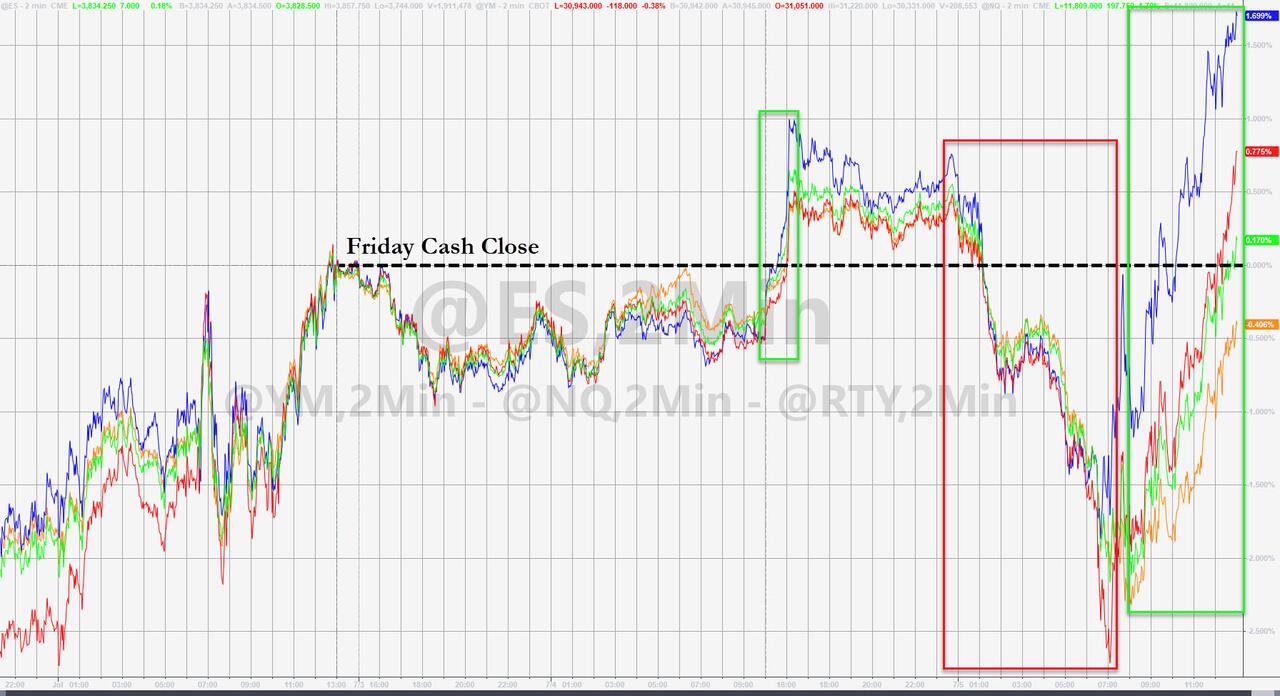
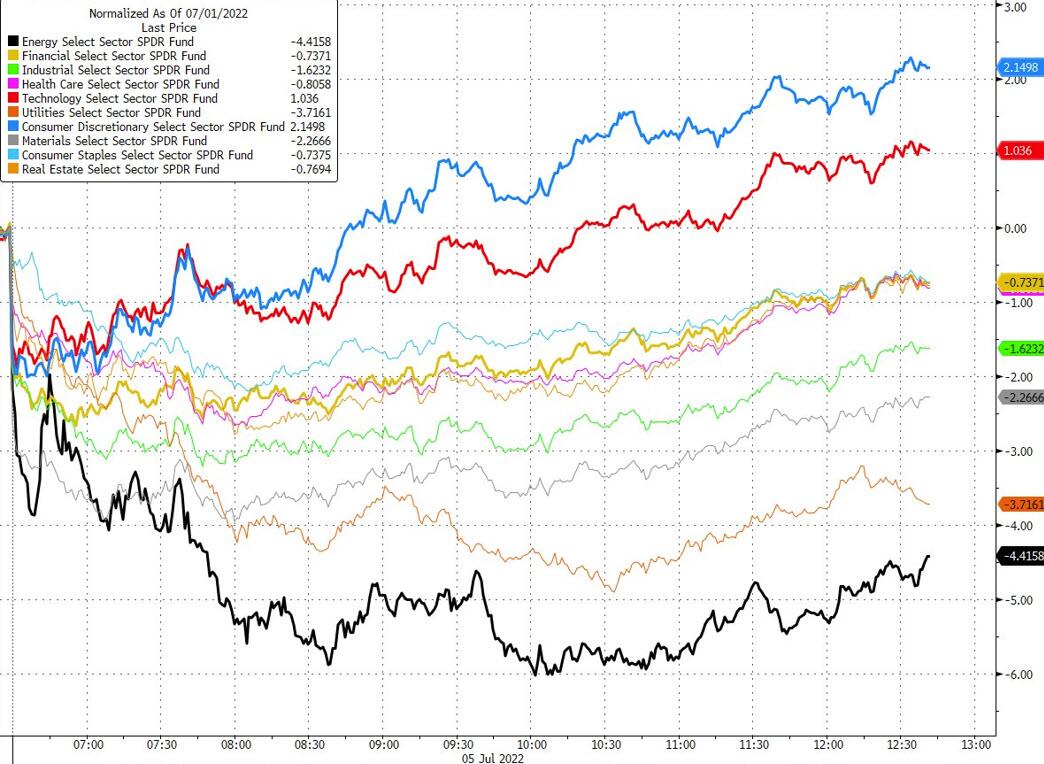
The rally that pushed stocks well above 3,800 during Monday’s illiquid session when US cash stocks were closed for July 4 amid speculation that Biden was about to rollback many Chinese tariffs (unclear how this would help ease inflation but a move that the market clearly read as risk positive), fizzled as soon as Europe opened this morning and alongside the tumbling euro which plunged to a 20-year-low and approached parity with the USD on growing recession fears, also dragged US equity US futures lower as investors turned their focus back to the looming recession, which outweighed optimism around an improvement in Washington’s ties with Beijing. Contracts on the Nasdaq 100 were down 0.7% by 730 a.m. in New York, while S&P 500 futures slipped 0.6%. The cash market was closed for a holiday on Monday. 10Y TSY yields swung from gains to losses before trading 2bps higher around 2.90% while bitcoin rose, and traded around $20K after dropping below $19K over the weekend.
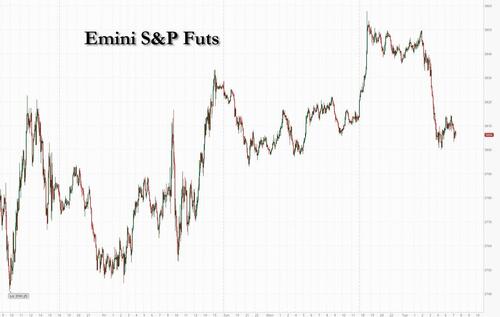
US markets are set to reopen Tuesday after capping 11 declines in the past 13 weeks as an unprecedented first-quarter contraction boosted the prospects of a recession to near certainty. At the same time, consumer prices are far from peaking with inflation surging to 8.6% in May that left little room for the Federal Reserve to slow monetary tightening.
Sentiment was lifted on Monday as senior US and Chinese officials discussed US economic sanctions and tariffs amid reports the Biden administration is close to rolling back some of the trade levies imposed by President Donald Trump. While that came as a relief, investors continued to fret over a potential US recession, stubborn inflation and monetary tightening. Economic reports in Europe, including French purchasing managers’ indexes, came in below estimates.
“The Fed will likely remain aggressive in its fight against inflation for now,” said Joachim Klement, head of strategy, accounting and sustainability at Liberum Capital. “At the same time, European growth is slowing down fast. This just puts additional fire on the growth concerns about the US.”
“The government is very conscious that they need to act on the supply side of the inflation issue because the Fed has been slamming the brakes on the demand side whereas the real issue is on the supply side,” said Deepak Mehra, the head of investments at the Commercial Bank of Dubai. “Trying to fix that issue is giving the market a bit of an ease and comfort that we are finally addressing the problem where it is and not giving the wrong medicine,” he said in an interview with Bloomberg TV.
Among notable moves in premarket trading, cryptocurrency-exposed stocks edged higher as Bitcoin briefly traded above the closely watched $20,000 level. Recession fears echoed in US premarket trading, where Carnival Corp. and ASML Holding NV dropped more than 4% each. Meanwhile, Morgan Stanley strategists led by Michael Wilson said the US economy is firmly in the middle of a slowdown that’s turning out to be worse than expected amid the war in Ukraine and China’s Covid Zero policy. “Any fall in rates should be interpreted as more of a growth concern rather than as potential relief from the Fed,” they wrote in a note. Here are some other notable premarket movers:
- Cowen (COWN US) shares jump as much as 14% in US premarket trading, following a report late Friday that Canadian bank Toronto-Dominion was said to be exploring a takeover of the brokerage. Piper Sandler says that a possible combination would be “reasonable” for Cowen at the right price.
- Antero Resources (AR US) shares rise 2.8% in premarket trading after the stock was upgraded to buy from hold at Truist Securities, with the broker saying that a recent selloff in the oil company is an opportune entry point given gas and natural gas liquids are likely to remain strong.
- Cryptocurrency-exposed stocks are gaining in US premarket trading on Tuesday as Bitcoin trades above the closely watched $20,000 level. Coinbase (COIN US) +1.4%, Riot Blockchain (RIOT US) +1.9%, Marathon Digital (MARA US) +2.4%, MicroStrategy (MSTR US) +2.8%, Ebang (EBON US) +5.9%
- Tesla (TSLA US) shares fall 0.8% in premarket trading, though analysts note that the electric vehicle company’s record production in June is a silver lining in an otherwise disappointing quarter of deliveries.
- Netflix (NFLX US) shares decline 0.8% in premarket trading as Piper Sandler cuts PT to $210 from $293, reiterating neutral recommendations, while estimating that the company’s ad-supported tier, which is expected to launch by year-end, represents a quarterly revenue opportunity of about $1.4 billion.
- HP Inc. (HPQ) shares slip 2% as Evercore ISI downgrades the tech company to in-line, saying PC “headwinds could get more severe.”
Most European equity indexes slumped over 1% with miners, autos and insurance names among the worst-performing Stoxx 600 sectors. CAC 40 and FTSE 100 lag, dropping as much as 1.4%. Miners underperformed the broader European market on Tuesday amid concerns over the risks of a global recession and the blow it would deliver to demand for raw materials. Copper fell to the lowest level in 17 months and traded solidly below $8,000 a ton, as sentiment remains sour toward the industrial material used in everything from construction to new energy vehicles. Stoxx 600 Basic Resources sub-index declines 1.6% as of 9:42am in London, led lower by miners like Antofagasta, KGHM and Anglo American, even as iron ore rises after a four-day slide. Broader European benchmark is down 0.4%. The Stoxx 600 energy sub-index slides 1.3% after rising most since May on Monday. TotalEnergies drops 1.6%, BP -1.1%, Shell -1.3%. Shares in renewable fuel producer Neste outperform, rising 1.3%. The Stoxx 600 Automobiles & Parts Index dropped 1.5%, the third-worst performing subgroup in the broader European equity market. Automakers had their worst June sales in decades in the UK, while German new-car registrations also plunged. Here are some of the biggest European movers today:
- Miners and energy shares underperform the broader European market on Tuesday amid concerns over the risks of a global recession and the blow it would deliver to demand for raw materials.
- KGHM shares decline as much as 6.7%, Anglo American -4.5%, TotalEnergies -2.5%, Shell -2.2%
- Rheinmetall shares fall as much as 6.1%; Deutsche Bank expects 2Q at the lower end of the guidance range for the quarter while most-in-focus unit Defence will likely trend above.
- SAS falls as much as 15% after the company announced it was filing for chapter 11 bankruptcy protection in the US.
- European media stocks slide after Goldman Sachs slashed earnings forecasts across its media and internet coverage to factor in a more cautious macro outlook. Prosieben drops as much as 9.5%, Publicis -4.5%
- Uniper shares edged lower, paring earlier gains of as much as 11%, as analysts speculated on what a possible government bailout might look like.
- Dechra Pharmaceuticals advances as much as 4.5% on Tuesday after RBC upgrades to outperform in note in which it describes the stock as the “pick of the litter.”
- Cellnex Telecom shares rise as much as 5% following a Bloomberg News report that a KKR-led consortium is emerging as the frontrunner to buy a stake in Deutsche Telekom’s tower unit, beating out a rival bid from Cellnex and Brookfield Asset Management that had been viewed negatively by analysts.
- Lonza Group climbs as much as 3.8% after it got upgraded to buy from neutral at Citi, citing the market’s under-appreciation of demand for biologics manufacturing.
- PGS shares soar as much as 20% as Pareto Securities upgrades the oilfield services firm to buy following a period under review, with the broker saying that “the future is looking brighter” for the company.
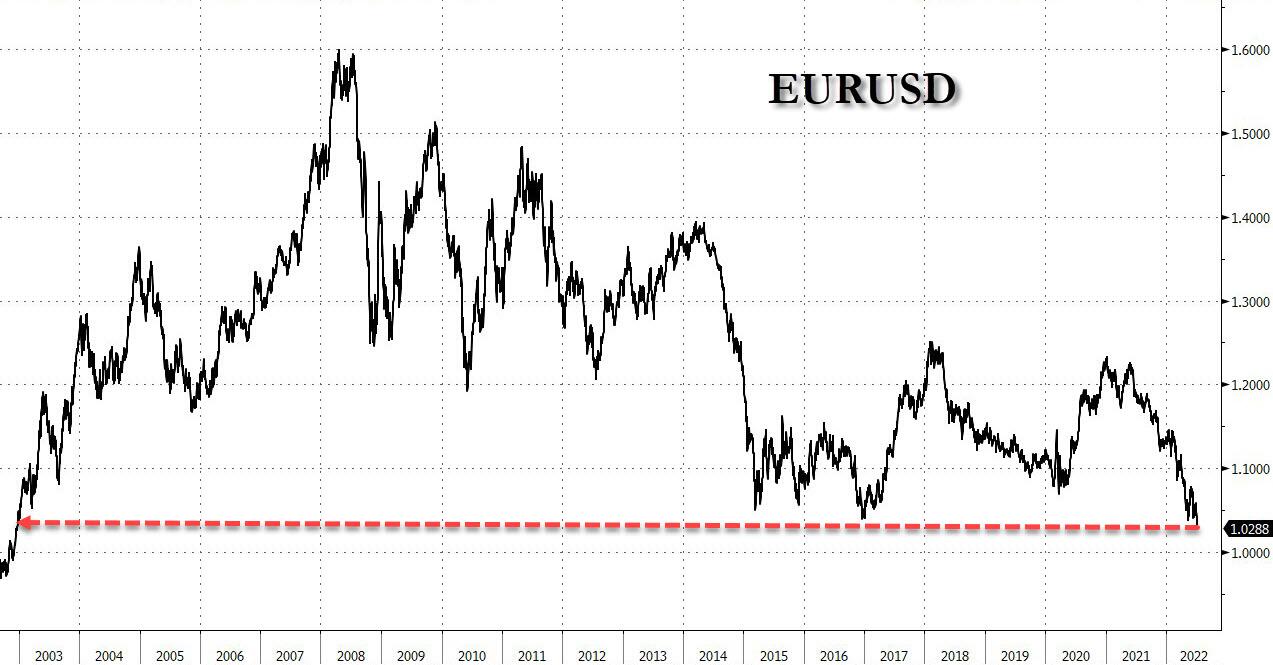
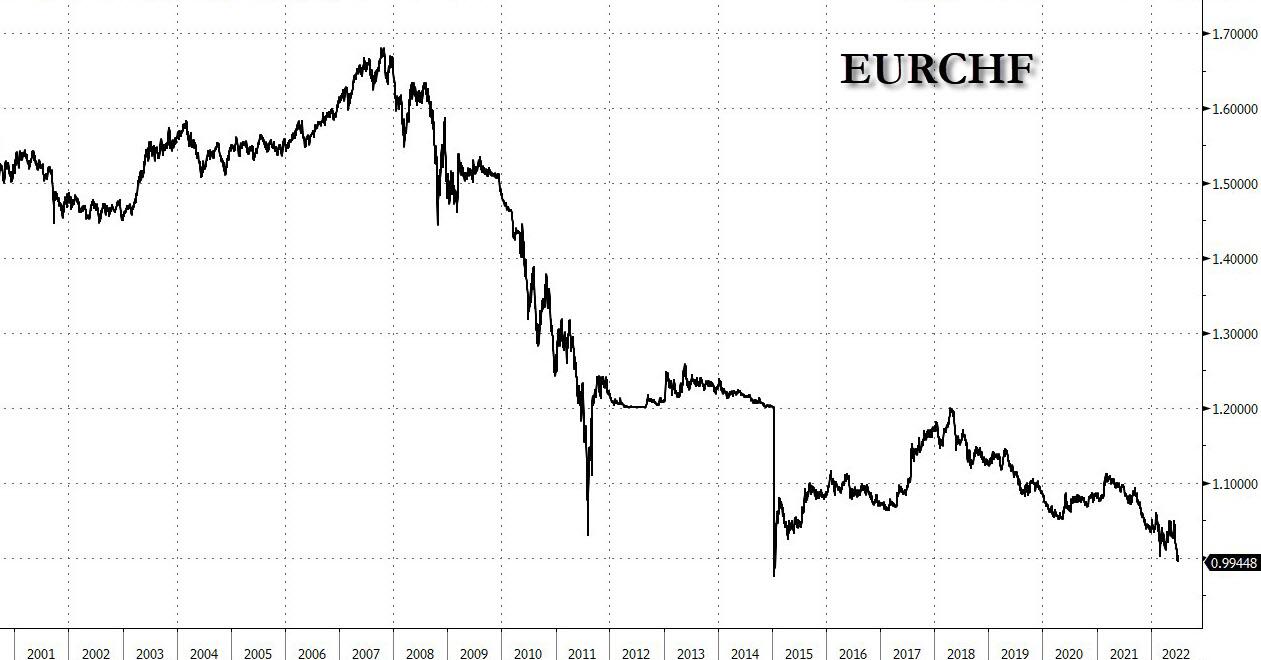
The euro extended its losses, tumbling to the lowest level since 2002 against the dollar. It also slid to the weakest since January 2015 against the Swiss franc.
Earlier in the session, Asian equities were modestly higher Tuesday as China’s stocks gave back early gains after initial enthusiasm about the country’s improving ties with the US waned. The MSCI Asia Pacific Index rose as much as 0.8% before narrowing the advance to 0.2% as of 6:14 p.m. in Singapore. Energy and health care shares were among the gainers. Chinese shares fell, after the province of Anhui reported more than 200 Covid cases for Monday and market participants assessed whether the potential scrapping of US tariffs on Chinese goods would help address global inflation concerns. The US 10-year Treasury yield trimmed an intraday advance over recession worries, giving tech shares a slight boost.
Australia’s main index edged higher as the domestic central bank met market expectations by raising interest rates a half-percentage point and suggesting that inflation may peak this year. Benchmarks in the Philippines and South Korea led gains in Asia, with each rising at least 1.8%. “The easing of tariffs — if confirmed — comes at the dream timing to save its economy from the endless virus battle,” said Hebe Chen, an analyst at IG Markets, referring to the China. “Even though it may not stop the downtrend, it could at least slow the pace and restore the world’s confidence in the second-largest economy.” Meanwhile, Thailand’s gauge was the latest to enter a technical correction. Asian stocks have been stuck in range-bound trading since the end of April as markets digest higher interest rates, the possibility of a recession in advanced economies and continued virus flareups in China. The MSCI regional gauge is down more than 18% this year
In Australia, the central bank raised its key interest rate as expected to 1.35%. It’s among more than 80 central banks to have raised rates this year. The nation’s dollar weakened after the decision.
Key equity gauges in India pared early advances to close lower as worries over an economic recession weighed on the sentiments. The S&P BSE Sensex dropped 0.2% to 53,134.35 in Mumbai, while the NSE Nifty 50 Index also dropped by the same magnitude. Stocks rose earlier in the day, tracking advances in Asian peers on the possibility of US rolling back some levies on China. A fast progress of monsoon rainfall, which waters most farmland in India, along with quarterly earnings for top companies that start this week added to the sentiment. Consumer goods maker ITC was the biggest drag on the Sensex, falling 1.7%. Seven of BSE Ltd.’s 19 sectoral sub-gauges declined, led by information technology companies. Asia’s biggest software exporter Tata Consultancy Services, will kickoff the April-June earnings season for companies on Friday
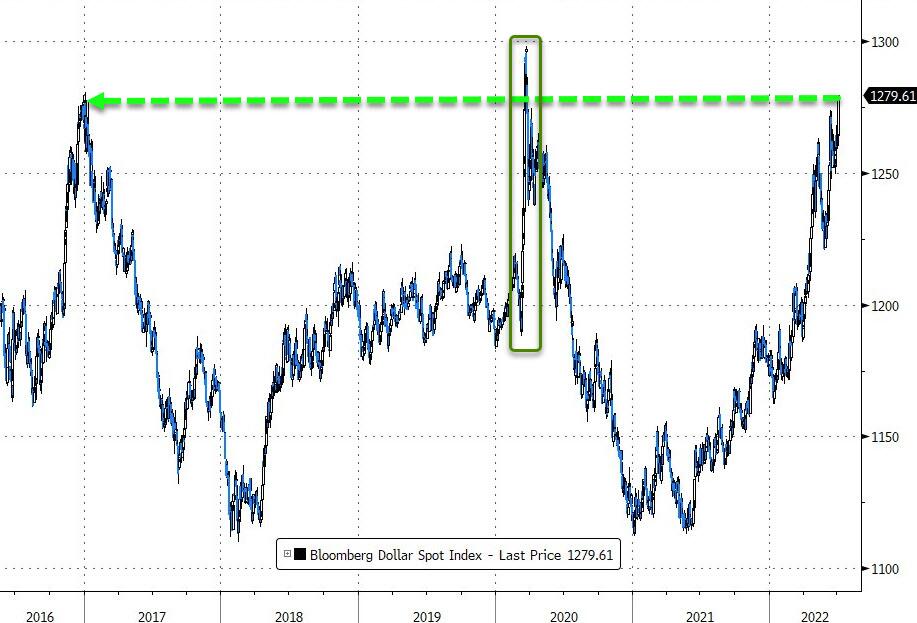
In FX, the Bloomberg Dollar Spot Index advanced for a third day as the greenback gained against all of its Group-of-10 peers. Treasuries were mixed. The single currency fell as much as 0.9% to 1.0331, its weakest level since December 2002, with losses compounded by poor liquidity and selling in euro-Swiss franc. German bond curve bull steepened and money markets trimmed ECB tightening bets to less than 140 basis points this year after French services PMI was revised lower. That’s down from more than 190 basis points almost three weeks ago, widening the interest-rate differential with the Federal Reserve. Scandinavian currencies were also dragged down by the euro sell-off and were leading G-10 losses against the greenback. Cable fell amid broad- based dollar strength. Bank of England rate-setter Silvana Tenreyro speaks later Tuesday and the BOE will issue its financial stability report. The Australian dollar extended a slump on the back of the broad-based US dollar strength. The Aussie had already given up gains after the RBA increased its cash rate to 1.35% as expected. It had risen earlier amid reports the US will roll back tariffs on some Chinese goods. The yen pared an Asia session loss as risk sentiment worsened.
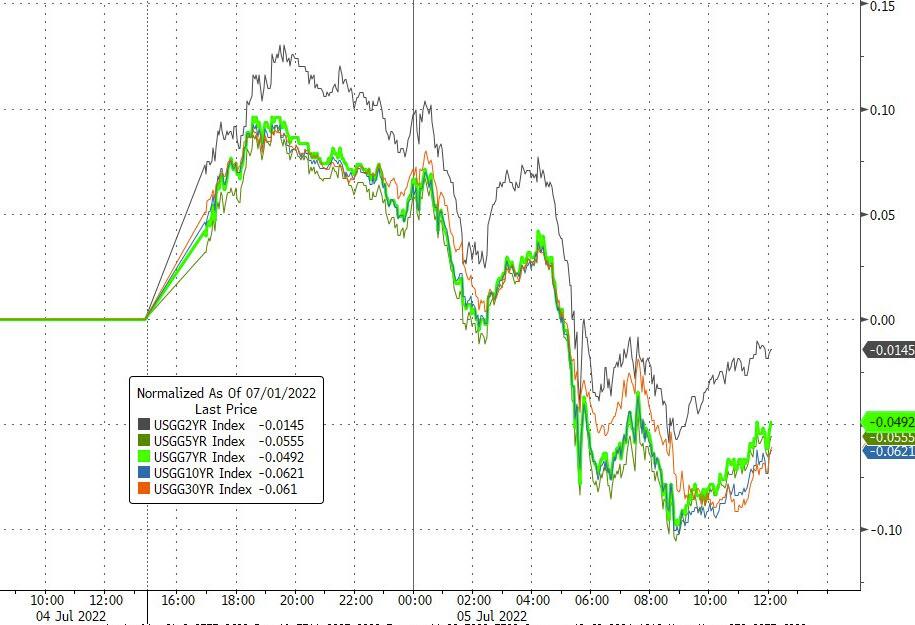
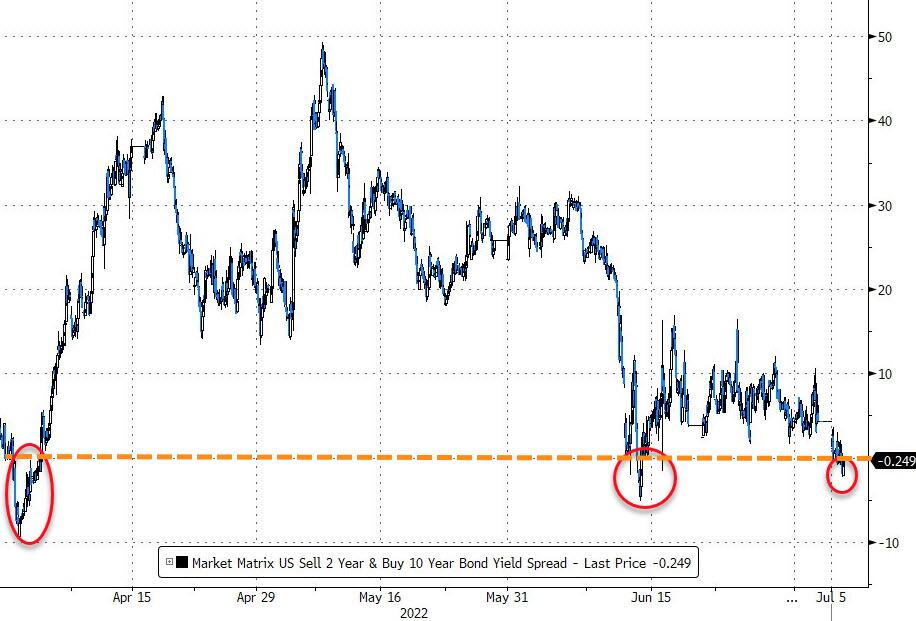
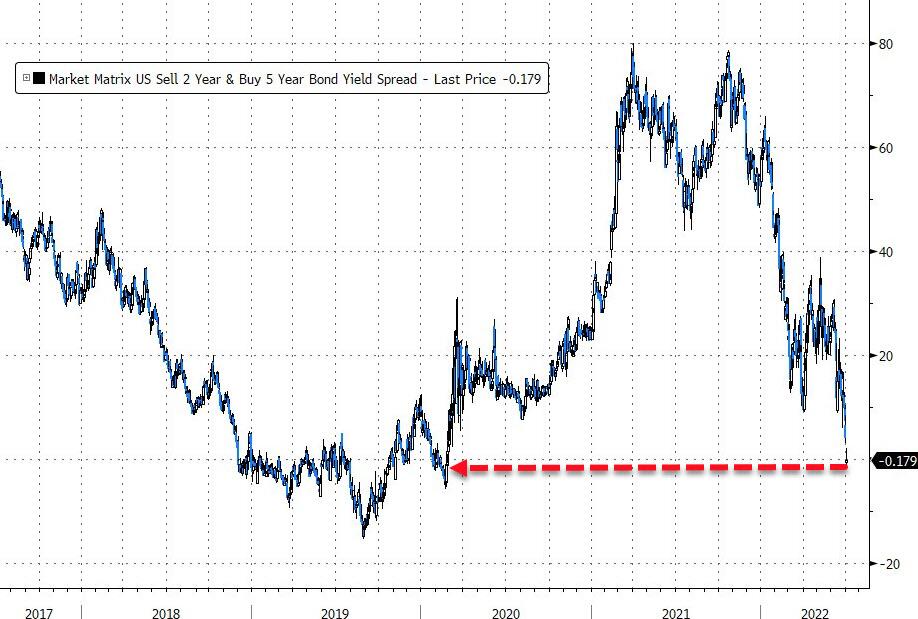
In rates, Treasuries were off session lows reached during Asia session, remain under pressure as US markets reopen after Monday’s holiday, giving back a portion of Friday’s steep gains. Five- and 10-year yields remain below 50-DMA levels while 2- and 30-year are back above. Yields higher by as much as 6bp at short end vs ~3bp at long end after rising as much as 13bp and 9bp, respectively. 2s10s curve is slightly positive after briefly inverting for first time since mid-June; 5s30s spread ~22bp after reaching widest level since May 31 on Friday. Short-end Germany richens over 10bps, outperforming gilts. Cash USTs fade Asia’s gains. Peripheral spreads widen to core with short-end Italy underperforming.
In commodities, brent crude swung between gains and losses, last trading Brent down 1.5% near $111.78, while WTI rose after a long holiday weekend in the US with investors weighing still-strong underlying market signals against concerns a recession will eventually sap demand. Most base metals trade in the red; LME aluminum falls 2.8%, underperforming peers. Spot gold falls roughly $5 to trade near $1,803/oz.
Bitcoin resides underneath the USD 20k mark and at session lows of 19.4k amid the broader risk tone. BoE Financial Stability report said falling crypto markets expose vulnerability, but not stability risk overall.
To the day ahead now, and data highlights include the global services and composite PMIs for June, as well as the ISM services index from the US. Otherwise, there’s French industrial production for May and US factory orders for May. From central banks, the BoE will be releasing their Financial Stability Report and we’ll also hear from the BoE’s Tenreyro.
Market Snapshot
- S&P 500 futures down 0.3% to 3,814.75
- STOXX Europe 600 down 0.3% to 408.04
- MXAP up 0.3% to 157.72
- MXAPJ up 0.2% to 521.38
- Nikkei up 1.0% to 26,423.47
- Topix up 0.5% to 1,879.12
- Hang Seng Index up 0.1% to 21,853.07
- Shanghai Composite little changed at 3,404.03
- Sensex up 0.3% to 53,387.68
- Australia S&P/ASX 200 up 0.3% to 6,629.33
- Kospi up 1.8% to 2,341.78
- German 10Y yield little changed at 1.27%
- Euro down 0.8% to $1.0338
- Brent Futures up 0.4% to $114.01/bbl
- Gold spot down 0.3% to $1,803.33
- U.S. Dollar Index up 0.64% to 105.81
Top Overnight News from Bloomberg
- Senior US and Chinese officials discussed US economic sanctions and tariffs Tuesday amid reports the Biden administration is close to rolling back some of the trade levies imposed by former President Donald Trump
- UK automakers had their worst June sales in decades in the UK as ongoing components shortages kept them from meeting demand. New-car registrations declined by 24% to 140,958 vehicles, the lowest for the month since 1996, according to data from the Society of Motor Manufacturers and Traders
- Italy declared a state of emergency in five northern and central regions devastated by a recent drought, as a severe heat wave takes its toll on agriculture and threatens power supplies
A more detailed summary of global markets courtesy of newsquawk
Asia-Pac stocks traded mostly positive amid a pick-up from the holiday lull although Chinese markets faltered. ASX 200 was led by the tech and commodity-related sectors with further support from a lack of hawkish surprise from the RBA. Nikkei 225 was propelled by a weaker currency but pulled back from early highs after hitting resistance around the 26,500 level and following softer-than-expected wages data. Hang Seng and Shanghai Comp. were both initially lifted following reports US President Biden could make a decision on rolling back some China tariffs as soon as this week and with Vice Premier Liu He said to have had a constructive exchange with US Treasury Secretary Yellen on the economy and supply chains. Furthermore, participants also welcomed the strong Caixin Services and Composite PMI data, although the advances in the mainland were then pared as the central bank continued to drain liquidity and amid lingering COVID concerns.
Top Asian News
- PBoC injected CNY 3bln via 7-day reverse repos with the rate at 2.10% for a CNY 107bln net drain.
- China is to set up a CNY 500bln state infrastructure investment fund and will issue 2023 advance local government special bonds quota in Q4, according to Reuters sources.
- Chinese Premier Liu He spoke with US Treasury Secretary Yellen regarding the economy and supply chains, while the exchange was said to be constructive and both sides believed in the need to strengthen communication and coordination of macro policies between China and the US, according to Reuters.
- US Treasury Department confirmed Treasury Secretary Yellen held a virtual meeting with China’s Vice Premier Liu He as part of efforts to maintain open lines of communication, while they discussed macroeconomic and financial developments in both China and US, as well as the global economic outlook and food security challenge. Furthermore, Yellen raised issues of concern including the impact of Russia’s war against Ukraine on the global economy and “unfair, non-market PRC economic practices”, according to Reuters.
- RBA hiked the Cash rate Target by 50bps to 1.35%, as expected, while it reiterated that the board expects to take further steps in the process of normalising monetary conditions with the size and timing of future interest rate increases will be guided by the incoming data and the board’s assessment of the outlook for inflation and the labour market. Furthermore, the central bank noted that Australian inflation was high but was not as high as in other countries and it forecast inflation to peak this year before declining back towards the 2-3% range next year.
European bourses are pressured across the board, Euro Stoxx 50 -0.8%, as a broader risk-off move takes hold despite a relatively constructive APAC handover and limited newsflow in European hours. A move that has impaired US futures, ES -0.4%, as we await the lead from stateside participants re-joining after the long-weekend with a quiet schedule ahead. European sectors are predominantly in the red, though the clear defensive bias is keeping the likes of Food and Healthcare afloat.
Top European News
- UK faces its first national train drivers’ strike in 25 years with the head of the UK train drivers’ union warning of ‘massive’ disruption as members vote on their first strike since 1995, according to FT.
- BoE Financial Stability Report (July): will raise the counter-cyclical capital buffer rate to 2% in July 2023. Click here for more detail.
- Ukraine Latest: Turkey Renews Threat to Veto NATO Expansion
- Bunds Bull Steepen, ECB Hike Bets Pared After French PMI Revised
- UK Train Drivers Would Make Threatened Strikes National: Union
FX
- DXY sets new 2022 best above 106.000 after taking time out to mark US Independence Day, reaches 106.24 before waning marginally.
- Euro slumps to fresh multi-year lows as EGBs rebound strongly and risk appetite evaporates; EUR/USD probes 1.0300, EUR/CHF sub-0.9950 and EUR/JPY below 140.00.
- Aussie underperforms irrespective of 50bp RBA rate hike as accompanying statement sounds less hawkish on inflation; AUD/USD under 0.6800 from close to 0.6900 overnight and AUD/NZD cross retreats through 1.1050.
- Pound down regardless of upgrades to final UK services and composite PMIs as Buck rallies broadly and BoE’s FSR flags material deterioration in global economic outlook, Cable beneath 1.2050 from circa 1.2125 peak.
- Yen holds up better than others amidst Greenback strength on risk and rate grounds; USD/JPY eyes support into 135.50 vs 136.00+ at the other extreme.
Fixed Income
- Bonds on course for a turnaround Tuesday after marked retreat from pre-weekend peaks on Independence Day.
- Bunds back above 150.00 from 148.72 low and Friday’s 151.65 high, Gilts reclaim 115.00+ status within 116.58-114.60 range and 10 year T-note above 119-00 between 119-20+/118-23 parameters.
- UK 2051 and German 2033 linker supply reasonably well received, but yields considerably higher.
In commodities
- Crude benchmarks were fairly resilient to the broader risk tone, but have most recently succumbed to the pressure and are at the lower-end of a USD 3-4/bbl range.
- Reminder, the lack of settlement due to the US market holiday is causing some discrepancy between WTI and Brent, though they are directionally moving in tandem.
- UAE’s ADNOC set Murban crude OSP for August at USD 117.53/bbl vs prev. USD 109.68/bbl in July, according to Reuters.
- Norway’s Lederne union said the strike in the Norwegian oil sector had begun, according to Reuters.
- Saudi Aramco has increased all oil prices for customers in August; sets Aug light crude OSP to Asia at +9.30/bbl vs Oman/Dubai average, according to Reuters sources; NW Europe set at +USD 5.30 vs. ICE Brent; US set at +USD 5.65 vs. ASCI.
- Russian Deputy Chair of the Security Council Medvedev says the Japanese proposal to cap Russian oil prices would lead to higher global prices, oil prices could increase to over USD 300-400/bbl, via Reuters.
- Chile’s Codelco copper output fell 6.3% Y/Y in May to 142.9k tonnes, while Chile’s Collahuasi mine copper output fell 15.4% to 49k tonnes and Chile’s Escondida copper output rose 26% to 106.9k tonnes, according to Cochilco cited by Reuters.
- Russian billionaire Potanin says he is ready to discuss a possible merger of Nornickel with Rusal, via Reuters citing RBC TV; UK sanctions on him do not target Nornickel, Co. is still working under pressure.
- Spot gold is impaired by the rampant USD action, pressure seen in base metals as well on such dynamics and LME copper now below 8k/T.
US Event Calendar
- 10:00: May -Less Transportation, est. 0.7%, prior 0.7%
- 10:00: May Cap Goods Ship Nondef Ex Air, prior 0.8%
- 10:00: May Cap Goods Orders Nondef Ex Air, est. 0.5%, prior 0.5%
- 10:00: May Factory Orders Ex Trans, prior 0.3%
- 10:00: May Factory Orders, est. 0.5%, prior 0.3%
- 10:00: May Durable Goods Orders, est. 0.7%, prior 0.7%
DB’s Jim Reid concludes the overnight wrap
I can only apologise in advance for the next few weeks! The Global Institutional Investor Awards will open later this afternoon and not to put it too bluntly we’d like to do well. So if you value our research please vote if you can. More details to follow when the poll opens.
It’s been a quieter 24 hours for markets thanks to the US holiday, but the market remains confused about how to price fixed income in an environment where a recession is coming at some point. We’ve seen a big yield sell-off to start the week even if equities have stabilised, with a fresh rise in energy prices only adding to concerns about how different economies (particularly in Europe) will fare this winter if Russia cuts off the flow of gas. Overnight the US 2s10s curve has inverted again, the RBA has hiked 50bps as expected and Chinese PMI data has massively beat expectations so a few things going on even in a quieter trading period.
We’ll start with markets in Europe since they were open yesterday. The biggest story there was a sizeable selloff among sovereign bonds as they gave up some of their gains over the last couple of weeks. Yields on 10yr bunds were up +10.1bps, but they were one of the better performers given the risk-off tone and yields on 10yr OATs (+12.7bps) and BTPs (+15.8bps) saw even larger rises, which followed comments from Bundesbank president Nagel who said that it was “virtually impossible to establish for sure whether or not a widened spread is fundamentally justified”. Nevertheless, Nagel did not entirely rule out an anti-fragmentation instrument but said that this “can be justified only in exceptional circumstances and under narrowly-defined conditions.”
This question of how the ECB will deal with a potential widening in spreads is set to come increasingly to the fore as they almost certainly embark on their first hiking cycle in over a decade this month. And yesterday we heard some further comments from ECB officials on that hiking cycle, with Estonia’s Muller pushing back against the calls from others to start with a 50bps hike, saying that it was appropriate to begin with a 25bps move in July, and then 50bps in September as they’ve signalled. In line with the rise in sovereign bond yields, overnight index swaps priced in a slightly more aggressive series of hikes from the ECB, with the rate implied by December up by +7.1 bps on the day.
Whilst the ECB is set to hike rates, their life is being made significantly more difficult by the ongoing energy shock that’s creating increasingly stagflationary conditions. Unfortunately, there was more bad news on that front yesterday, with natural gas futures up by another +10.26% to €163 per megawatt-hour, which is their highest rate since early March and more than double their recent low in early June. Matters haven’t been helped by a planned strike in Norway that puts around 13% of Norway’s daily gas exports at risk, according to the Norwegian Oil and Gas Association, which comes ahead of next week’s scheduled maintenance of the Nord Stream pipeline, which will last from July 11-21.
When it came to equities, the main European indices mostly managed to advance, although as mentioned at the top that was partly a catch-up to the late rally on Friday afternoon in the US, and the STOXX 600 was up +0.54% thanks to a strong performance amongst energy stocks. By contrast, futures on the S&P 500 were lower throughout European trading even if they have flipped higher this morning (futures +0.36%). One similarity between the US and Europe was a slightly more hawkish path for central bank rates being priced, with Fed funds futures taking the Dec-2022 implied rate up by +3.8 bps after last week’s declines. This fits with what Henry mentioned in his latest newsletter yesterday (link here), in which he points out that the recent repricing of the hiking cycle in a more dovish direction is inconsistent with the historic pattern whereby the Fed has always taken rates above inflation as they hike. This morning, yields on US 10yrs (+6.6bps) and 2yrs (+10.8bps) are catching up the global move after the holiday leaving 2s10s very slightly inverted as we go to press.
Speaking of inflation, it was reported by Dow Jones yesterday that President Biden could ease some tariffs on Chinese imports soon, with the article saying that a decision could be announced this week. As discussed in the article and other media reports, this has apparently been a divisive issue inside the administration, since although their removal could help ease inflation, it would also give up leverage in obtaining concessions from China, so there’s geopolitical as well as economic factors at play here.
Asian equity markets are mostly trading higher this morning partly on the tariffs story above and partly on better data overall. Across the region, the Kospi (+1.13%) is leading gains followed by the Nikkei (+0.82%) and the Hang Seng (+0.41%). Bucking the trend are the mainland Chinese markets with the Shanghai Composite (-0.20%) and CSI (-0.95%) both slipping as I type, perhaps on less stimulus hopes after a big beat in the Caixin PMI (see below). Outside of Asia, US and European equities are set to follow the Asian trend with futures on the S&P 500 (+0.36%), NASDAQ 100 (+0.47%) and DAX (+0.60%) moving higher.
Early morning data showed that Japan’s services activity accelerated at the fastest pace since October 2013 as the Jibun Bank services PMI advanced to 54.0 in June from 52.6 in May. Meanwhile, Japan’s real wages (-1.8% y/y) extended its decline in May, notching its biggest contraction in two years compared to an upwardly revised -1.7% decline in April. At the same time, cash earnings rose +1.0% y/y in May (vs +1.5% market consensus, and +1.3% in April), thus adding downside risk to a consumption driven rebound in 2Q22 GDP. Moving to China, growth in the nation’s services sector surprisingly beat as the Caixin services PMI jumped to 54.5 in June, its highest level in nearly a year from 41.4 in May as Covid curbs eased. Elsewhere in the region, South Korea’s CPI rose +0.6% m/m in June (v/s +0.5% expected) and against a +0.7% increase in the prior month.
As widely anticipated, we did see policy tightening by the RBA as the central bank raised its cash rate by 50bps to 1.35% as it moves to tame strengthening inflation. This is the third consecutive increase of the cash rate. The AUD/USD pair was little changed in an immediate reaction.
There wasn’t a massive amount of data yesterday, although we did get German trade figures that showed the country had a monthly trade deficit in goods in May for the first time since 1991. That was thanks to higher import costs as a result of the recent commodity shocks, alongside disruptions to trade from factors including sanctions on Russia, which left the monthly deficit at €1.0bn.
To the day ahead now, and data highlights include the global services and composite PMIs for June, as well as the ISM services index from the US. Otherwise, there’s French industrial production for May and US factory orders for May. From central banks, the BoE will be releasing their Financial Stability Report and we’ll also hear from the BoE’s Tenreyro.
TUESDAY /MONDAY NIGHT
SHANGHAI CLOSED UP 1.43 PTS OR 0.04% //Hang Sang CLOSED UP 22.72 /The Nikkei closed UP 269.64 OR % //Australia’s all ordinaires CLOSED UP .31% /Chinese yuan (ONSHORE) closed UP 6.7050 /Oil DOWN TO 107.98 dollars per barrel for WTI and DOWN TO 111.64 for Brent. Stocks in Europe OPENED ALL RED // ONSHORE YUAN CLOSED UP AGAINST THE DOLLAR AT 6.7050 OFFSHORE YUAN CLOSED UP ON THE DOLLAR AT 6.7086: /ONSHORE YUAN TRADING ABOVE LEVEL OF OFFSHORE YUAN/ONSHORE YUAN TRADING STRONGER AGAINST US DOLLAR/OFFSHORE STRONGER
3 a./NORTH KOREA/ SOUTH KOREA
///NORTH KOREA/SOUTH KOREA/
3B JAPAN
end
3c CHINA
CHINA
end
4/EUROPEAN AFFAIRS//UK AFFAIRS/
Parity when the dollar is now within side as the Euro crashes to a 20 year low//recession reality trounces ECB rate hike delusions
(zerohedge)
“Parity Is Just A Matter Of Time Now”: Euro Crashes To 20 Year Low As Recession Reality Trounces ECB Rate Hike Delusions
TUESDAY, JUL 05, 2022 – 12:34 PM
We have long mocked the ECB for making the typical European mistake codified over a decade ago by Jean-Claude Trichet, when it launches rate hikes right into a recession (and after that, debt crisis).
*ECB SLASHES GDP FORECASTS, NOW PREDICTS 2.8% IN 2022
hiking into a slowdown and then recession— zerohedge (@zerohedge) June 9, 2022
Today, it finally appears that the market got the memo and sent the euro plunging crashing a 20-year low against the US dollar as traders bet that the European Central Bank will go slower on raising interest rates as the economy risks being tipped into a recession.
The artificially constructed common currency which was meant to keep German exports competitive, fell as much as 1.4% to $1.0281, its weakest level since December 2002. The losses came as money markets finally agree with us, and continued to trim bets the ECB will tighten as the growth outlook for the region darkens, with traders now eyeing the prospect of gas shortages as Russia cuts back on supplies.
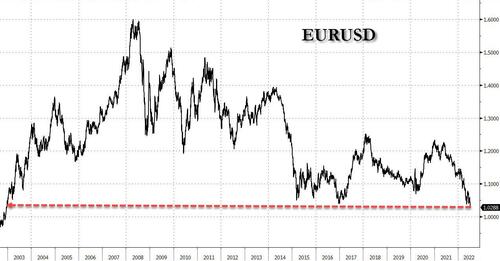
Europe’s slide into recession was accelerated by the latest Italian and Spanish composite PMIs which both declined in June, led by a deceleration in the services sector, and which Goldman said was “consistent with our view of a deceleration in the growth momentum across the Euro area going into H2. Accordingly, we continue to forecast subdued growth in the second half of the year and see risks as skewed towards the downside if gas flows from Russia do not pick up following the end of the pipeline maintenance period in mid-July.”
Indeed, the fallout from war in Ukraine is hampering the ECB’s ability to raise rates as fast as the Fed, despite record inflation, widening the interest-rate differential.
According to Bloomberg’s options-pricing model, there is a 60% chance the currency hits parity versus the dollar by year-end, up from 46% on Monday.
“Parity is just a matter of time now,” said Neil Jones, head of FX sales to financial institutions at Mizuho.
Parity may be on deck for the EURUSD, but it already well in the rearview mirror for the swiss franc cross, with the EUR now trading at levels last seen when the SNB broke the peg against the euro: the euro fell as much as 0.9% against the Swiss franc to 0.99251, the lowest level since 2015, a tumble compounded by by poor liquidity.
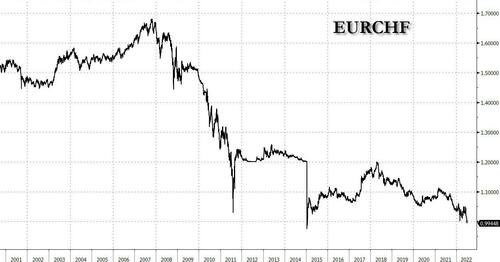
Even as they price in a recession, traders also bet the ECB will kick off their first tightening cycle in a decade later this month with a 25 basis-point increase. The Fed in contrast has already raised rates by 150 basis points, with markets pricing in an 80% chance of a 75-basis-point hike at their July meeting; the US is also now widely expected to enter recession by late 2022 or early 2023 at the latest.
“It is hard to find much positive to say about the EUR,” said Dominic Bunning, the head of European FX Research at HSBC. “With ECB sticking to its line that we will only see a 25bp hike in July – at a time when others are hiking much faster – and waiting for September to deliver a faster tightening, there is also little support coming from higher yields.”
And while few are predicting the ECB will capitulate before it hikes even once, money-market traders are betting ECB will deliver around 140 basis points this year, down from more than 190 basis points almost three weeks ago. The repricing gathered pace after a string of weak economic data last week, with traders trimming bets again on Tuesday after French services PMI was revised lower.
Investors have also been more cautious on the euro due to the risk of so-called fragmentation, when economically weaker nations see unwarranted spikes in borrowing costs as financial conditions tighten. The ECB is expected to deliver further details of a new tool to backstop more vulnerable countries’ debt at their policy meeting later this month.
“The FX market is not back up to full liquidity given the US holiday,” said Mizuho’s Jones. “Any given size of trade is likely to have a greater impact on market movement.”
END
BOJO’s government on verge of collapse!
BoJo Government On Verge Of Collapse After Top Ministerial Resignations
TUESDAY, JUL 05, 2022 – 01:55 PM
In the latest shock to Boris Johnson’s shambolic cabinet, on Tuesday afternoon Chancellor Rishi Sunak and health secretary Sajid Javid both unexpectedly resigned from BoJo’s government as a row over the UK prime minister’s honesty intensified.
In separate letters to Johnson, both ministers criticized the prime ministers conduct: Sunak wrote that “we cannot continue like this,” while Javid told Johnson that he’s lost confidence in him. Both men published their resignation letters on Twitter.
Sunak wrote: “The public rightly expect government to be conducted properly, competently and seriously . . . I recognise this may be my last ministerial job, but I believe these standards are worth fighting for and that is why I am resigning.”
He added that “the public rightly expect government to be conducted properly, competently and seriously” and said that “I believe these standards are worth fighting for and that is why I am resigning.”
In his letter to Johnson, Javid wrote “the vote of confidence last month showed that a large number of our colleagues agree. It was a moment for humility, grip and new direction. I regret to say, however, that it is clear to me that this situation will not change under your leadership.”
The resignations of two of his most senior ministers came just as Johnson was acknowledging in a televised address that it was a “mistake” to promote Chris Pincher in February – two years after being told of a complaint against the Tory MP. Pincher quit as a government enforcer, or whip, last week when the Sun newspaper alleged he had groped two men.
While Pincher has denied allegations of specific incidents, he said in his resignation letter last week that he’d “embarrassed” himself and “caused upset” to others. He and his office haven’t replied to repeated requests for comment.
“I think it was a mistake and I apologize for it,” Johnson said of Pincher’s promotion. “In hindsight it was the wrong thing to do. I want to make absolutely clear that there’s no place in this government for anybody who is predatory or who abuses their position of power.”
But, as Bloomberg notes, the apology came too late for Sunak and Javid after a febrile day in Westminster in which Conservative MPs demanded the Cabinet act to oust Johnson.
While BoJo recently survived a vote of no confidence, the odds that he stays on as UK PM through August have collapsed from virtual certainty to just over 50%…
… suggesting that it is now a coin toss if BoJo calls it quits after all the recent humiliating setbacks to his cabinet.
Holland
Dutch protesters pour manure on Government officers over an industry killing regulation (Nitrogen levels)
(zerohedge)
Dutch Protesters Pour Manure On Government Offices Over Industry-Killing Regulations
MONDAY, JUL 04, 2022 – 09:45 AM
Dutch farmers who have been protesting for weeks over the government’s radical plan to cut nitrogen emissions by 50% – 95% by 2030 have taken things to the next level – pouring manure on government offices in response to the plan which would cause widespread chaos – including the death of 1/3 of Dutch farms.
Pissed off protesters became aggressive with police last week, with angry farmers demanding that the Hague backtrack on their ‘green’ agenda.
Bloomberg also reported last week that several farmers showed up to parliament with cows in tow to protest the policy – with some threatening to slaughter them on the spot.

“If the nitrogen measures are adopted, one of these two ladies [cows] will not go home but will receive a one-way ticket to the slaughterhouse,” said farmer Koos Cromwijk in a statement to Dutch news agency ANP outside parliament (via The Counter Signal).
Last week Dutch farmers also blocked the border between Holland and Germany, while even bigger protests are slated for July 4.
Meanwhile, farmers in Spain are coming out against inflation for fuel and essential goods.
And what did the Dutch government have to say about the new law?
“The honest message … is that not all farmers can continue their business.“
end
Germany/EU/Russian Natural Gas
The lack of Natural Gas to German industries can wipe out entire industries like aluminum, glass and the production of chemicals
(zerohedge)
Top German Trade Union Head Warns Entire Industries May Collapse Amid Worsening Energy Crisis
MONDAY, JUL 04, 2022 – 06:35 AM
Last month, Russia reduced Nordstream natural gas flows by 60% because of an alleged disruption. German industries, heavily reliant on cheap Russian NatGas, face skyrocketing energy costs that have put many in danger of collapse.
“Because of the NatGas bottlenecks, entire industries are in danger of permanently collapsing: aluminum, glass, the chemical industry,” Yasmin Fahimi, the head of the German Federation of Trade Unions, told the newspaper Bild am Sonntag.
Fahimi warned: “Such a collapse would have massive consequences for the entire economy and jobs in Germany.”

Economics Minister Robert Habeck was quoted by Bloomberg on Saturday saying the government is working to address surging energy costs for utilities and power costs for businesses and households. He warned weeks ago Germany should prepare for further cuts NatGas.
Germany recently triggered the “alarm stage” of its NatGas-emergency plan to address shortages as the energy crisis in Europe’s largest economy is far from over.
Habeck had also likened the squeeze on Russian NatGas supplies and its damaging effects on industries to a catalyst that could spark a Lehman Brothers-like crisis.
Deutsche Bank’s chief FX strategist George Saravelos told clients days ago he was becoming increasingly concerned about the unfolding energy crisis in Germany.
Saravelos pointed out that dwindling NatGas supplies to Germany and the resulting surge in electricity prices have created massive problems for industries and utilities.
The biggest blowup last week was German gas and power utility Uniper. Shares in the company crashed because it only received 40% of NatGas from Russia, and the rest had to be purchased in the open market (outside of long-term contracts), where prices have soared. This has created an immense strain on the utility, losing upwards of $30 million per day, or if annualized, could be an $11 billion loss.
Risks are mounting of a full NatGas disruption: “Europe should be ready in case Russian gas is completely cut off,” IEA head Fatih Birol recently told FT.
Saravelos also told clients if NatGas supply woes via Nordstream aren’t resolved in the coming weeks, this would lead to a broadening out of energy disruption with material upfront effects on economic growth, and of course, much higher inflation, or as he put it, “beyond the market’s worries about slower global growth in recent months, what is unfolding in Europe in recent days is a fresh big negative supply shock.”
Sooner or later, Germany will learn if that’s because of economic disruption, that getting virtue signaled into supporting the Ukraine war was a bad idea.
END
UK
The UK fuel price protests are crippling their hiways with go- slow convoys
(zerohedge)
UK Fuel Price Protests Cripple Motorways With “Go-Slow” Convoys
TUESDAY, JUL 05, 2022 – 04:15 AM
British authorities warned drivers of “serious disruption” on Monday as protestors seeking relief from high fuel costs used “go-slow” convoys to cause traffic jams on major UK motorways over a wide swath of territory.
Organized via social media under the banner of “Fuel Price Stand Against Tax,” rolling, slow-moving roadblocks of cars, trucks and tractors started their protests around 7am. According to The Guardian:
Motorways in the Bristol area, Devon, Cornwall, south Wales, Essex, Yorkshire and Lincolnshire were among those affected. Two tractors caused long tailbacks into Aberdeen by driving slowly side by side along the A92 northbound.
Police escorted some of the blockades, only to block them at their turnaround points and make arrests. The PA News Agency reports a dozen motorists were detained after blocking traffic across the Prince of Wales Bridge between South Wales and Somerset. The Telegraph reported the bridge was hardest hit in the protest, with traffic closed for more than an hour.
“The right to protest under UK law must be balanced with the rights of the wider community who may be affected,” said Gwent police chief superintendent Tom Harding. UK authorities say the protests threaten to impede the response of emergency services.
The founder of the FairFuelUK, Howard Cox, told the Scottish Sun that protestors were targeting three-lane freeways, with the intent to slow traffic in two lanes while leaving the “fast lane” free.

The price of petrol in the UK has surged to to a record 191.53 pence per liter, which equates to $8.78 a gallon.—the highest among the five largest European economies.
The protestors are bent on achieving a cut in fuel taxes. None of their quoted rhetoric connects the dots between the price at the pump and Western sanctions against Russia. In March, the UK declared it will phase out Russian oil imports by December, as will the European Union.
Cox told The Independent the effort is largely driven by small business owners:
“People are at the end of their tether. This is hard-working, decent people who are fed up to their back teeth with the high cost of pump prices. Across Europe, diesel is on average 25p cheaper and petrol 20p cheaper than in the UK. Germany cut fuel tax by 26p, Spain by 20p and Ireland by 17p. Why can’t the Government do the same? They did 5p in the Spring Statement and it didn’t even touch the sides.”
That 5 pence tax cut came in March and is slated to last until March 2023. At the time, UK Chancellor of the Exchequer Rishi Sunak touted it as “the biggest cut to all fuel duty rates ever.” The 8.6% cut left the tax at 53 pence per liter.
Protestor Vicky Stamper told The Guardian she and her partner quit their jobs because they couldn’t afford the commute. “It was costing us £380 [$460] a week just to get to and from work. I then lost a job two weeks ago because the company couldn’t afford to put fuel in that many lorries so last in, first out,” she said.
Protestors warned their next action might come in the form of a blockade on oil refineries. When previously employed in 2000 by farmers and truck drivers fighting taxes so high they represented 80% of the cost of gas, just one week of the tactic caused havoc, from huge lines at gas pumps to mail stoppages and grocery-rationing.
The Royal Automobile Club (RAC), akin to the American Automobile Club, told Bloomberg the rising price at the pump is inconsistent with a five-week drop in wholesale prices. “We would love to hear their reasoning for keeping their prices so high in this instance,” said RAC spokesman Simon Williams.
Some drivers on the M4 stepped out of their idle vehicles and took the opportunity to hone their soccer skills—or, football skills, if you like:

end
GERMANY/UNIPER
German energy giant in bailout talks:
(zerohedge)
German Energy Giant In Talks Over €9 Billion Bailout Package
MONDAY, JUL 04, 2022 – 04:00 PM
Remember when Germans laughed at Donald Trump in 2018 for saying they had become “totally dependent” on Russian energy? Well… yhey aren’t laughing now.
Just a few days after we reported that the stock of German gas and power utility Uniper – and the single largest importer of Russian gas in Germany – crashed after the company slashed its outlook and said it was in talks with the government to secure liquidity, potentially including a full-blown bailout from the German government after Russia reduced natural gas deliveries to Europe, on Monday Bloomberg reports that the giant utility is in advanced talks with the German government over a bailout package of as much as 9 billion euros, (or $9.4 billion).
The government is looking at applying a set of measures, including loans, taking an equity stake and also passing part of the surge in costs onto customers, said two people familiar with the talks.
As part of the plan, Reuters reported earlier that Germany’s government is preparing legislation that will allow it to take stakes in utilities and impose emergency levies on consumers as ministers are scrambling to deal with the impact of soaring energy prices on electricity firms after Russia’s invasion of Ukraine, with Economy Minister Robert Habeck recently warning of “a Lehman effect” as suppliers face soaring costs to meet obligations to customers. The new law will also allow for customers to shoulder more of the burden of rising gas prices. The cabinet is set to approve the bill this week.
Uniper shares sank another 28% on Monday, taking the company’s market value to 4.14 billion euros, just shy of its all time low. The stock was worth roughly 4x more at the start of the year.

Germany, which has built its economic model on a cheap common currency (which has crushed Europe’s periphery ) to avoid the strong Deutsche mark, and even cheaper Russian gas, is wrestling with a squeeze in supplies and surging fuel prices as Moscow punishes Europe for its support for Ukraine. German Economy Minister Robert Habeck has warned the gas crunch risks triggering a collapse in the market, similar to the role of Lehman Brothers in the financial crisis. The surge in energy import prices has crushed Germany’s exporting powerhouse, sending its trade balance plummeting and as shown in the chart below at this rate Germany faces an unprecedented outcome: a negative trade balance, something that has not happened since the early 1990s.

German utilities have been urging the government to impose a levy on consumers to help offset the rising cost of gas. Analysts estimate that curbed Russian flows are costing Uniper 30 million euros a day.
Meanwhile, Habeck has said that the squeeze on Russian flows may get worse, and warned of the risk of a domino effect of failing companies. The broader economy is also in peril as the government is trying to contain the fallout for consumers and industry. Plans have been drafted for rationing, with Germany’s vast industry poised to suffer shortages.
“We aren’t dealing with erratic decisions but with economic warfare, completely rational and very clear,” Habeck said on Saturday. “After a 60% reduction, the next one logically follows.”
Well, maybe if it is all “rational and very clear”, then Germany should not have sided with Ukraine in the all too real war taking place just a few hundred miles east of Germany.
So just how will Germany add another company to its bailout roster? According to Bloomberg, Chancellor Olaf Scholz signaled at the weekend the government could use bailout tools created during the pandemic to rescue Lufthansa in the current crisis.
“The federal government should be given options along the lines of the Lufthansa aid,” a Reuters source said.
Lufthansa’s bailout saw the state taking a 20% stake in the airline through an Economic Stabilization Fund, but without being able to exercise shareholder voting rights. The airline was not allowed to take over other companies until 75% of the state aid had been repaid, and its shareholders and managers could not benefit from taxpayers’ money, meaning dividends and bonus payments were put on hold.
Decades after de-regulating their energy markets, governments across Europe are intervening to prop up utility companies buckling under sky-high prices, while also protecting consumers from soaring costs. Several European energy suppliers have gone bust over the past year, where they have had long-term contracts with customers and have been unable to pass on the swift spike in prices.
To try to shield consumers from soaring energy bills, governments have also turned to windfall taxes on oil and gas companies, subsidies and discounts.
Russia is Germany’s top supplier of gas, making it more exposed than other European states to an economic war with Moscow. Soaring prices have heaped political pressure on Chancellor Olaf Scholz, who on Monday will meet unions and employers to try to build a consensus on fighting inflation, reviving a concept established in 1967 in response to economic recession that ended the country’s post-war boom.
Meanwhile, Germany’s government has warned of possible energy shortages and rationing in the winter months if it cannot fill its gas storage quickly enough.
“The hope of filling the gas storage facilities to some extent by winter could be torpedoed by Russia at any time. Then there are hardly any compensatory possibilities left,” said a note from Sentix that tracks investor morale in the euro zone.
“In Germany, some ideological boundaries have to be crossed to prevent a “Lehman moment” in the energy sector,” it said, referencing the U.S. bank whose demise help triggered the 2008 financial crisis.
end
GERMANY, HAMBURG:
Germany’s second largest city is telling residents to prepare for hot water rationing amid energy crisis
(zerohedge)
Hamburg Official Tells Residents Prepare For Hot Water Rationing Amid Energy Crisis
TUESDAY, JUL 05, 2022 – 05:45 AM
The second-largest city in Germany is mulling over the potential rationing of hot water as the energy crisis worsens.
“In an acute gas shortage, warm water could only be made available at certain times of the day in an emergency,” Hamburg’s environment senator Jens Kerstan told German newspaper Welt am Sonntag on Saturday.
Kerstan also spoke with the German daily newspaper Hamburger Abendblatt and warned, “We are in a much worse crisis than most people realize.”
He asked Hamburg residents to reduce shower times, install energy-saving shower heads, and modernize thermostats for maximum power savings.
“The more we save now, the better the situation will be in winter because the storage tanks fill up,” he added, referring to the need to save power so more NatGas injections can be made into storage ahead of the winter season.
Kerstan’s possible hot water restrictions follow German Vice-Chancellor and Economy Minister Robert Habeck’s interview with Der Spiegel magazine last month that called for German citizens to shower less to overcome the worst energy crisis in a generation.

The German government’s increasing talk about reducing shower time and conserving hot water comes as Russia reduced Nordstream NatGas flows by 60%. Germany is heavily reliant on cheap Russian Natgas, and fears mount that Europe’s largest economy could face even more NatGas cuts later this summer.
Weeks ago, Germany triggered the “alarm stage” of its NatGas-emergency plan to address shortages. Yasmin Fahimi, the head of the German Federation of Trade Unions, warned over the weekend, “Because of the NatGas bottlenecks, entire industries are in danger of permanently collapsing: aluminum, glass, the chemical industry.”
Fahimi warned: “Such a collapse would have massive consequences for the entire economy and jobs in Germany.”
Germany’s worsening energy crisis shows no signs of abating, and it seems probable that Hamburg residents could be showering in cold water.
end
Sweden/Finland/Turkey
Erdogan is at it again and demands that listed “terrorists” be removed from Sweden and Turkey
(zerohedge)
Turkey Threatens It Can Still Block Sweden, Finland Entry As NATO Protocols Of Accession Signed
TUESDAY, JUL 05, 2022 – 09:25 AM
Tuesday was hailed as a “historic day” as NATO chief Jens Stoltenberg oversaw members of the military alliance formally signing the protocols of accession related to Sweden and Finland’s bids. “This is a good day for Finland and Sweden, and a good day for NATO. With 32 nations around the table, we will be even stronger and our people will be even safer, as we face the biggest security crisis in decades,” he said.
“Russia has shattered peace in Europe so it’s important we stand together at this important time,” Stoltenberg declared further. However, a mere week after finally agreeing to the Scandinavian countries’ joining, Turkey is threatening to block the expansion if they don’t follow through on extraditing people the Turkish government sees as terrorists.
The expansion requires ratification by parliaments and governments of each of the alliance’s 30 member nations in order to continue. Stoltenberg said in his remarks that NATO’s door is open for those democracies which stand “ready and willing to contribute to our shared security.”
After signing a joint memorandum paving the way for expansion last week at the NATO summit in Madrid, Turkish President Recep Tayyip Erdogan said that Sweden committed to extraditing 73 “terrorists” linked to the Kurdistan Workers Party (PKK), which is a designated terror group also under the US, UK, and EU.
The memorandum indicated the Nordic countries agreed to promptly pursue “pending deportation or extradition requests of terror suspects expeditiously and thoroughly,” with “bilateral legal frameworks to facilitate extradition.”
According to the BBC, Sweden “had already sent three or four of them. Pro-government Turkish daily Hurriyet published a list of 45 people, including 33 sought from Sweden and 12 from Finland.”
Others on the list include members of the Gulen movement, or what Turkey sees as the Fethullah Terrorist Organization – a global Turkish opposition network which has set up schools in the West. BBC details of one Gulen-associated journalist now wanted by Turkey, Bulent Kenes:
For years, he was editor-in-chief of Today’s Zaman, a major English-language daily in Turkey, before it was shut down in 2016. Now, he lives in exile in Stockholm.
…Mr Kenes said he became a target for his outspoken criticism of President Erdogan and faced accusations of plotting to topple the government: “All the allegations are fabricated. I am an independent journalist with no affiliations with any organization.”
Kenes fled Turkey and went to Stockholm after being accused and convicted of “insulting the president” in 2015, in a case which underscored the Erdogan government’s increasing crackdown on anti-Erdogan speech.
It will be interesting to see if Sweden in particular, which is home to many Turkish and Syrian Kurds, moves legally against individuals Turkey has listed as having terror links, yet who ran afoul of Ankara for mere free speech related issues such as criticism of Erdogan personally.
5. RUSSIAN AND MIDDLE EASTERN AFFAIRS/
RUSSIA/UKRAINE//THE WEST
With their new long range missiles, Ukraine has successfully hit Russian command posts
according to the Pentagon
(zerohedge)
Ukraine Successfully Hitting Russian Command Posts With New Rocket System: Pentagon
SATURDAY, JUL 02, 2022 – 03:00 PM
A little over a week ago Ukraine’s military began showing off it newly acquired long-rage rocket systems from the US by uploading videos of launches against Russian forces.
Ukraine’s Defense Minister Oleksii Reznikov announced last month, “HIMARS have arrived to Ukraine. Thank you to my colleague and friend SecDef Lloyd J. Austin III for these powerful tools! Summer will be hot for Russian occupiers. And the last one for some of them,” in reference to the High Mobility Artillery Rocket Systems.
Already, Ukraine’s forces and their American backers are touting that they’ve been able to target and strike Russian command centers with the HIMARS, which are well past the front lines.HIMAR, Army file image
The Hill has cited a senior US defense official who said Ukraine is now having “a good deal of success” with the recently deployed HIMARS rockets, particularly in the hotspot of current fighting, the Donbas in the east of the country.
“Because it is such a precise, longer-range system, Ukrainians are able to carefully select targets that will undermine the effort by Russia in a more systematic way, certainly than they would be able to do with the shorter-range artillery systems,” the Pentagon official said further.
“What you see is the Ukrainians are actually systematically selecting targets and then accurately hitting them, thus providing this, you know, precise method of degrading Russian capability,” the official added. “I see them being able to continue to use this throughout Donbas.”
At the moment, only four are reportedly in use on the battlefield, after lately arriving, but four more were pledged starting last month. The somewhat slow rollout of the systems is related to the time-gap of training Ukrainian operators on how to use them effectively.
The HIMARS being provided to the Ukrainians are estimated to be able to hit targets about 40 to 50 miles away, which from the administration’s standpoint marks a significant improvement in range, but still makes it unlikely the missiles could be used to strike within Russian territory, which Biden had expressly said he wants to avoid.
The US has said that Ukraine’s military leadership has provided “assurances” it won’t use the newly provided systems to attack Russian territory, amid persisting fears Washington and Moscow could enter direct conflict.
end
Russia will now demand rubles for grain exports. Russia is the world’s largest wheat exporter
(zerohedge)
Russia Now Demands Rubles For Grain As World’s Largest Wheat Exporter
SATURDAY, JUL 02, 2022 – 11:00 AM
After threatening to do so for a couple months now, Russia has pulled the trigger on expanding the list of commodities for which it demands payment in rubles to now include grain exports, effective Friday per a government legal website.
So now grain, sunflower oil and extracted meal are the next to follow the March decision to charge clients from “unfriendly” countries – including major customers in Europe – in rubles for natural gas instead of the normative dollars and euros.
On top of this move, recently Agriculture Dmitry Patrushev announced that Russia’s agricultural products will go to “friendly countries” only, and according to “who needs it most” – a hugely significant statement sure to continue sowing uncertainty and chaos for the global food supply.

Via Farmdocdaily: Russia and Ukraine account for 14% of global wheat production and rank 1stand 5threspectively. Both countries are prominent exporters, providing nearly 30% of global wheat exports. The EU, U.S., and Canada are also major producers and exporters of wheat. China and India are major wheat producers, but are net importers and provide relatively small shares of global wheat exports. Other countries with fairly large wheat export shares include Australia (8.4%), Argentina (6.6%), Kazakhstan (4.1%), and Turkey (3.4%).
Russian state media detailed further of the new decree published to a government law portal, “It also provides for a one-year extension of duties to be paid in the national currency in respect of exported sunflower oil and sunflower meal until August 31, 2023.”
And further, “As part of the new payment mechanism, the base price for calculating the export duty on wheat will be 15,000 rubles (over $267) per ton.”
While Russia has blamed Western sanctions aiming to punish and isolate the Russian economy for blowing back on the global food supply, and especially the Middle East and African countries already heavily reliant on Ukraine and Russia grain exports, G7 countries days ago at their summit in Germany blasted Moscow in a statement for what it called “a geopolitically motivated attack on global food security.”
As these “attack on food supply” charges against Russia from the West have been persisting especially within the last couple months as Ukraine’s grain exports have remained blocked at war-torn ports, the Kremlin has also blamed Ukraine’s military mining its own coastline for blocking grain ships’ safe passage. The so-called “Putin price hike” – as the White House has dubbed it – has also been a central talking point in discussing rising inflation fears.

In statements last Friday, Russian President Vladimir Putin laid blame on the “irresponsible actions” of G7 countries themselves. He said at the time, according to a Russian media translation:
“The sharp increase in inflation did not happen yesterday – it is the result of… many years of irresponsible macroeconomic policy of the G7 countries,” Putin said during the BRICS Plus meeting.
“We are certainly ready to continue to fulfill in good faith all our contractual obligations for the supply of agricultural products, fertilizers, energy carriers and other critical products,” Putin stressed. He further took a swipe at what Western leaders often refer to as Russia’s flouting of the ‘rules-based order,’ questioning sarcastically: “What rules? Who made those rules up?” Source: Farmdodaily
Farmdocdaily: Ukraine and Russia are the leading producers and exporters of sunflower oil which comprises a 9% production share and nearly a 2% export share for the world vegetable oil market. Nearly 60% of world sunflower oil production occurs in Ukraine and Russia, and the two countries account for over 75% of world exports.
Meanwhile The New York Times earlier in the summer assessed just where things stand on the US-EU efforts to inflict severe and lasting damage on the Russian economy, writing, “Russia’s invasion of Ukraine triggered global condemnation and tough sanctions aimed at denting Moscow’s war chest. Yet Russia’s revenues from fossil fuels, by far its biggest export, soared to records in the first 100 days of its war on Ukraine, driven by a windfall from oil sales amid surging prices, a new analysis shows.”
“Russia earned what is very likely a record 93 billion euros in revenue from exports of oil, gas and coal in the first 100 days of the country’s invasion of Ukraine, according to data analyzed by the Center for Research on Energy and Clean Air, a research organization based in Helsinki, Finland,” the report continued, based on the study.
end
Re: Russia Now Demands Rubles For Grain As World’s Largest Wheat Exporter | ZeroHedge
Inbox

| Robert Hryniak | 1:11 PM (1 hour ago) |  | |
| to |
I told you this would happen and it will extend to all raw materials soon. As this happens the ability of metal exchanges and various commodity players to manipulate is severely constricted and logically London will be hit hard. As volumes become Russian priced controlled beyond British Games of manipulation for which they are famous and infamous. Never forget it was the East India Company and their tea pricing that gave rise to American colonies to say enough, bringing war. They have always resented the creation of America as a part of the empire that got away. And further resented that America made them pay back loans made during WWII and that they were forced to take a back seat to the financial order created after WWII where they were a important part but not the controller. However, who really knows what games have occurred behind the curtain? But even today, grudges are clear and evident and have agenda.
You can see the zest and zeal of war led by them with European NATO falling into place. They doubt the US will go along but want to ensure it gets hit, ( Biden does not control Cheyenne Mountain). This is why American planes and troops are being set up for destruction as a dumb administrative move as part of NATO. British dreams of 3,500 missiles striking Russia first knowing that 5 Russian missiles will remove them from the planet is not enough logic to cause caution or peace, so they prepare for war and a first strike. The exhibit of pure insanity is there in open view. Note, it is the Brits who unannounced allowed Zelensky to speak via video conference to Security Council to remove Russia, which is not possible without disbanding the UN. So whose bitch is Zelensky, if not British? It is why he takes direction from BOJO. It would not surprise me to learn that they have Brits around him in case he deviates, in which case he will be terminated. In the meanwhile they will the American Neocons sacrifice the last Ukrainian for their ends as simply expendable, without thought. And oddly, the laundering of weapons provided is simply business. And no one cares about future consequences.
Russians need peace agreements to overcome their paranoid memories of WWII where no family was left untouched by loss of life. In 4 battles they suffered more casualties than the allied forces through the whole war. Such memories keep you awake and they see the same threat in plain view. They may get wiped out but they will fight. And China will finish off anyone left who is a threat including America.
America can recover and rebuild by looking inwards to find itself while Britain cannot and this is the real problem. You can trust Russia to honor a agreement but not Britain. Such are realities. The best thing America could do is walk away from this insanity publicly and let the Chips fall. Trump knew that and that is why they were determined to cast him out.
When I wrote that i would at my own expense, broker a peace deal with Russia, America and the Ukraine and NATO it was the Brits who said no and in America there is no one to talk to. At least not yet. Oddly, America and Russia are natural allies which the Brits are adamant should never happen because it would render them as irrelevant.
So the game of chaos will play out to whatever end that comes forth.
end
Ukraine – the situation (July 5, 2022) – Asia Times
Inbox
| Robert Hryniak | 10:47 AM (1 minute ago) |  | |
| to |
Remember that the Russian forces are still outnumbered 3 to 1 by Ukrainians and that they have yet to use much of the modern hardware they possess to control the front lines. I expect that soon there will be some more field testing of such weapon systems that have been improved upon after initial testing in Syria and further refinement. There has only been limited glimpses of such systems so far. In some of the most recent fights the directed forward control of artillery is actually controlled by robotic systems in advanced forward positions attacking while giving coordinated direction to artillery in a support role. Think of a Minnie tank flushing out troops while in real time directing artillery in a support capacity, while maintaining a safe fire control area for itself. There are no soldiers doing this. This is why surviving Ukrainian soldiers ran away and refuse to return as there is no where to hide only a place to die.
Given that order and repair is quickly being brought to bear in territory freed those areas will blossom quickly and act to contribute to the Russian economy. Things like demolished bridges are being repaired in days and not weeks or months as ready supply is brought into repair as quickly as the areas are secured. Further fertilizers and seeds are being supplied quickly to restore crop yields. This confirms the Russian intent to minimize the destruction, as to rebuild quickly. I doubt the rest of the Ukraine will fare as well. There is a ever growing sentiment in the Kremlin by hard liners to demonstrate to the WEST what lies in store for them, if they continue to prod Russia.
Anti missile systems in Kiev supplied by America, if actually provided may learn that certain hypersonic missiles do not just travel from great heights and have a inherent ability to alter speed and direction and can hit a target horizontally and not just vertically, once unleashed. Some of these missiles are quite capable to actually enter a railway tunnel in flight before exploding. And there are certain missiles that work in pairs to draw fire and destroy it.
It is the same type of software used in Drones being tested as wingmen for piloted planes. Due to cost and manpower SU57 planes will be covered by drones that act act as WIng men with a pack mentality in attack and a defensive hunt and kill mentality when attacked. This software is actually able to share real time data with multiple Points of an analysis and sharing of fire solutions. This is done to build redundancy in the event one node is damaged allowing for alternative direction by another drone. This also allows for coordinated ground support where integrated communications exist typing both air and ground with satellite feed giving complete battlefield coordination and understanding. This is most complete IRS integration i have seen to date, on a actual combat field basis. Thus was recently applied in the Donbas by a squad of SU57 accompaniment.
end
Saudi Arabia/BRICS
A must read.
It makes sense for Saudi Arabia to abandon the uSA and join the BRICS.
(Sundance)
Is Saudi Arabia In Discussion To Join BRICS?
MONDAY, JUL 04, 2022 – 06:00 AM
Authored by ‘sundance’ via The Last Refuge,
It is very curious timing in this article from Newsweek, containing massive geopolitical implications, using identified Saudi Arabia sources, would come in advance of Joe Biden’s visit to the Kingdom of Saudi Arabia.

Is this strategic geopolitical pressure from Saudi leader Mohamed Bin Salman (MbS) ahead of the meeting with Biden; or is this a genuine possibility that looms as likely? If the former, then Joe Biden is being geopolitically slow roasted by Saudi Arabia for his previous disparagements and ideological hypocrisy in his visit. If it is the latter, well, then the tectonic plates of international trade, banking and economics are about to shift directly under our American feet.
We have been closely monitoring the signs of a global cleaving around the energy sector taking place. Essentially, western governments’ following the “Build Back Better” climate change agenda which stops using coal, oil and gas to power their economic engine, while the rest of the growing economic world continues using the more efficient and traditional forms of energy to power their economies.

This article from Newsweek is exactly about this dynamic with Saudi Arabia now potentially joining the BRICS team.
NEWSWEEK – Finland and Sweden’s green light to join NATO is set to bring about the U.S.-led Western military alliance’s largest expansion in decades. Meanwhile, the G7, consisting of NATO states and fellow U.S. ally Japan, has adopted a tougher line against Russia and China.
In the East, however, security and economy-focused blocs led by Beijing and Moscow are looking to take on new members of their own, including Iran and Saudi Arabia, two influential Middle Eastern rivals whose interest in shoring up cooperation on this new front could have a significant impact on global geopolitical balance.
The two bodies in question are the Shanghai Cooperation Organization (SCO) and BRICS. The former was established in 2001 as a six-member political, economic and military coalition including China, Russia and the Central Asian states of Kazakhstan, Kyrgyzstan and Tajikistan before recruiting South Asian nemeses India and Pakistan in 2017, while the latter is a grouping of emerging economic powers originally consisting of Brazil, Russia, India and China (BRIC) upon its inception 2006, and including South Africa in 2010.
Here is the money quote:
[…]
“China’s invitation to the Kingdom of Saudi Arabia to join the ‘BRICS’ confirms that the Kingdom has a major role in building the new world and became an important and essential player in global trade and economics,” Mohammed al-Hamed, president of the Saudi Elite group in Riyadh, told Newsweek. “Saudi Arabia’s Vision 2030 is moving forward at a confident and global pace in all fields and sectors.”
[…]
“This accession, if Saudi joins it, will balance the world economic system, especially since the Kingdom of Saudi Arabia is the largest exporter of oil in the world, and it’s in the G20,” Hamed said. “If it happens, this will support any economic movement and development in the world trade and economy, and record remarkable progress in social and economic aspects as Saudi Arabia should have partnerships with every country in the world.” (read more)
That would essentially be the end of the petrodollar, and -in even more consequential terms- the end of the United States ability to use the weight of the international trade currency to manipulate foreign government. The global economic system would have an alternative. The fracturing of the world, created as an outcome of energy development, would be guaranteed.

Keep in mind, in early June Federal reserve Chairman Jerome Powell stated, “rapid changes are taking place in the global monetary system that may affect the international role of the dollar.” {LINK}
The western alliance (yellow) would be chasing climate change energy policy to power their economies. The rest of the world (grey) would be using traditional and more efficient energy development. The global cleaving around energy use would be complete.
This is not some grand conspiracy, ‘out there‘ deep geopolitical possibility, or foreboding likelihood as an outcome of short-sighted western emotion. No, this is just a predictable outcome from western created events that pushed specific countries to a natural conclusion based on their best interests.
You can debate the motives of the western leaders who structured the sanctions against Russia, and whether they knew the outcome would happen as a consequence of their effort, but the outcome was never really in doubt. Personally, I believe this outcome is what the west intended. The people inside the World Economic Forum are not stupid – ideological, yes, but not stupid. They knew this global cleaving would happen.

For a deep dive on BRICS, as predicted by CTH, {SEE HERE}. The bottom line is – the 2022 punitive economic and financial sanctions by the western nations’ alliance against Russia was exactly the reason why BRICS assembled in the first place.
Multinational corporations in control of government are what the BRICS assembly foresaw when they first assembled during the Obama administration. When multinational corporations run the policy of western government, there is going to be a problem.
In the bigger picture, the BRICS assembly are essentially leaders who do not want corporations and multinational banks running their government. BRICS leaders want their government running their government; and yes, that means whatever form of government that exists in their nation, even if it is communist.
BRICS leaders are aligned as anti-corporatist. That doesn’t necessarily make those government leaders better stewards, it simply means they want to make the decisions, and they do not want corporations to become more powerful than they are. As a result, if you really boil it down to the common denominator, what you find is the BRICS group are the opposing element to the World Economic Forum assembly.
The BRICS team intend to create an alternative option for all the other nations. An alternative to the current western trade and financial platforms operated on the use of the dollar as a currency. Perhaps many nations will use both financial mechanisms depending on their need.
The objective of the BRICS group is simply to present an alternative trade mechanism that permits them to conduct business regardless of the opinion of the multinational corporations in the ‘western alliance.’
The BRICS team, especially if Saudi Arabia, Iran and Argentina are added creating BRICS+, would indeed be a counterbalance to the control of western trade and finance. This global cleaving is moving from a possibility to a likelihood. If Saudi Arabia joins BRICS the fracture becomes almost certain.
end
Tensions between Bulgaria and Russia soar! In April Russia cut off Bulgaria from natural gas. Now Bulgaria expels 70 Russian dipomats as the Kremlin is likely to reprocate.
(zerohedge)
Bulgaria Expels 70 Russian Diplomats As Kremlin Says Kiev Must Accept ‘All Conditions’ To End War
MONDAY, JUL 04, 2022 – 11:40 AM
Russia’s says it’s preparing to respond in kind after Bulgaria expelled up to 70 Russian diplomats from its territory on Sunday. Starting June 28, the Bulgarian government declared that Russian diplomats in the eastern European NATO country “persona non grata” as they were “working against” Sofia’s interests, and they were given until July 3rd to depart Bulgaria.
Bulgaria’s acting Prime Minister Kiril Petkov said, “Anyone who works against the interests of Bulgaria will be called to go back to the country from which they came.”Sofia, Bulgaria via EUReporter
The Associated Press confirmed on Sunday that “Two Russian airplanes were set to depart Bulgaria on Sunday with scores of Russian diplomatic staff and their families amid a mass expulsion that has sent tensions soaring between the historically close nations, a Russian diplomat said.”
Russia’s ambassador to Bulgaria had earlier stated that Moscow is ready to close its embassy in Sofia altogether in retaliation for the expulsions. Amb. Eleonora Mitrofanova issued Bulgaria an ultimatum days ago, saying, “I intend to urgently raise before the leadership of my country the issue of the closure of the Embassy of Russia in Bulgaria, which will inevitably lead to the closure of the Bulgarian diplomatic mission in Moscow.”
Meanwhile, Moscow is celebrating the complete capture of the cities of Lysychansk and Severodonetsk, effectively bringing the whole of Luhansk province under Moscow control. Crucially, Kremlin spokesman Peskov has on Monday asserted that for the war to end, Ukraine must agree to all of Russia’s conditions.
Russian presidential press secretary Dmitry Peskov earlier said that Ukraine “must understand Russia’s conditions, agree to them, sit down at the negotiating table, and sign a document.”
And in televised statements Monday, President Vladimir Putin has congratulated Russian troops for “achieving victory” over the region:
In a meeting televised by Russian state media on Monday, defense minister Sergei Shoigu reported to Putin the Russian advances in the area.
“Starting June 19, [Russian] formations and military units … in cooperation with units of the second corps of the people’s militia of the [self-proclaimed] Luhansk People’s Republic (LPR) and with the support of the southern group of troops … successfully carried out an offensive operation to liberate the territory of the Luhansk People’s Republic,” Shoigu said.
…Putin told Shoigu that the military personnel who contributed to fighting in LPR, will be rewarded for their “bravery,” and that they should now “rest.”
“Other military units, including the East and West military groups, they have to fulfil their tasks, according to the previously suggested plan,” Putin said. “I hope everything will be successful as it happened in the [Luhansk] area,” he added.
It’s widely believed that Russia will next push to secure the whole of the Donbas, and from there continue an assault against the major northeast city of Kharkiv.
As for deteriorating relations with Bulgaria, this was perhaps inevitable after in April Russian energy giant Gazprom had completely cut off gas flows to both Bulgaria and Poland.
EU/Russia/Kaliningrad:
Russia wins! Transporation of goods to Kaliningrad through Lithuania will resume
(Conservativetreehouse.com)
EU Caves Putin Wins, Transportation of Russian Goods to Kaliningrad Through Lithuania Will Resume – The Last Refuge
Inbox
| Robert Hryniak | Sun, Jul 3, 7:18 PM (13 hours ago) | | |
| to |
A step back from escalation .. hopefully more will come ..
GLOBAL ISSUES AND COVID COMMENTARIES
My friend and colleague, Dr. Harvey Risch’s statement on Dr. Vladimir Zev Zelenko in Brownstone in case you missed; I felt brilliant.
In Memory of Dr. Vladimir Zev Zelenko
| Dr. Paul AlexanderJul 3 |
‘Dr. Zev Zelenko had both moral and intellectual courage in a society dominated by go-along-to-get-along. Dr. Zelenko was an astute physician, keenly aware of the nuances in disease presentations of his patients. They came to him for treatment of the respiratory disease that would become Covid-19.
Dr. Zelenko’s mind was always active in thinking about the best ways to care for his patients, and in the absence of established methods of treatment, he searched for what other clinicians had been doing for this and similar respiratory infections.
In Korea, doctors had been using chloroquine or hydroxychloroquine–in fact, this agent was known to be effective in the SARS-CoV-1 era–so he adopted that. He knew that zinc had been suggested to help in respiratory virus infections. And he found that doctors in Marseille had been using the antibiotic azithromycin in regimens to treat Covid patents.
So he incorporated all three as the basis for his initial outpatient treatment recipe, for patients who he classified as “high risk”–the remainder not needing treatment as they would recover well on their own. After treating 400 high-risk patients and having only one, who started the medications late and didn’t continue, hospitalized, he recognized that this recipe was highly effective in treating the respiratory infection early.
But Dr. Zelenko didn’t keep this to himself. He informed numerous other doctors, as well as the Trump Administration, about how well his early treatment worked.
President Trump’s public announcement is claimed to have politicized this treatment regimen, but that assertion can only be considered to be an infantile response if indeed the treatment worked. However, Dr. Zelenko, like the rest of us, did not understand that suppression of effective generic medications against Covid had started well before President Trump said anything, in fact, before Dr. Zelenko formulated his treatment protocol or even the first cases of Covid were recognized in the US.
When his treatment recipe received massive fraudulent pushback in the regular media, in social media, by academic doctors (who however had never themselves treated any Covid outpatients), he understood that there was a major campaign to discredit him, to suppress his treatment in order to pave the way for patent agents to compete in an economic marketplace where an effective and safe $20 treatment would severely curtail their market share.
But economic considerations do not alter the underlying truth about whether a medication regimen works for its intended treatment. Dr. Zelenko was zealous for truth.
Thus, he steadfastly maintained his public position that hydroxychloroquine-based early treatment regimens were effective for outpatient Covid, and grew to understand that this fact was a major obstacle for the pharma and vaccine manufacturers who would think it nothing to spend billions of dollars to manipulate and corrupt the marketplace and medical and lay media against his treatment, and later against ivermectin as well. He fought this battle to the end of his life.
In his four years of struggle with what was a terminal cancer, Dr. Zelenko looked death in the eye numerous times. He said that these experiences made him unafraid of the opinions of men. But I think that he had a strength of character that enabled him to get to that point, separate from his own illness, that surely made him unique.
He was a dear friend, colleague and leader to me. His legacy will live on, for indeed a blessing on society.’
end
Twitter ‘Silenced’ Physicians Who Posted Truthful Information About COVID, Lawsuit Alleges
MONDAY, JUL 04, 2022 – 04:30 PM
Authored by Megan Redshaw via The Epoch Times (emphasis ours),
Three physicians are suing Twitter, alleging the company violated its own terms of service and community standards when it suspended their accounts for posting “truthful statements regarding COVID-19 policy, diagnosis and/or treatment.”
Drs. Robert Malone, Peter McCullough and Bryan Tyson on Monday filed the lawsuit in Superior Court in California, San Francisco County.Plaintiffs allege Twitter’s actions were a substantial factor in causing them harm, and are asking the judge to order Twitter to reactivate their accounts. (By Lightspring/Shutterstock)
The complaint alleges Twitter breached the terms of its contract when it permanently suspended the plaintiffs’ accounts, silenced their voices and failed to provide them with “verified” badges.
Plaintiffs allege Twitter’s actions were a substantial factor in causing them harm, and are asking the judge to order Twitter to reactivate their accounts.
All three doctors are represented by attorneys Bryan M. Garrie and Matthew P. Tyson (no relation to the plaintiff, Bryan Tyson).
Matthew Tyson on May 12, sent a letter to the directors and managing agents of Twitter requesting the company reinstate the accounts of five physicians, including the plaintiffs, and provide them with “verified” badges. Twitter failed to respond.
In the letter, Matthew Tyson acknowledged Twitter is a “private company” and its terms state it can “suspend user accounts for any or no reason.”
“However, Twitter also implemented specific community standards to limit COVID-19 misinformation on the platform, and Twitter was bound to follow those terms,” he added.
According to the complaint, Twitter’s content-moderation terms included removal procedures for ineffective treatments and false diagnostic criteria, and measures for “labeling” information as “misleading.”
Twitter has a “five-strike policy” as part of its COVID-19 misinformation guidelines and community standards.
Twitter’s website states:
“The consequences for violating our COVID-19 misleading information policy depend on the severity and type of the violation and the account’s history of previous violations. In instances where accounts repeatedly violate this policy, we will use a strike system to determine if further enforcement actions should be applied.”
Strike 1 is “no account-level action.” Strike 2 results in a 12-hour account lock. Strike 3 results in another 12-hour account lock. Strike 4 results in a seven-day account lock and five or more strikes lead to permanent suspension.
Plaintiffs claim they relied on Twitter to employ and enforce its terms in good faith and it was foreseeable to Twitter that plaintiffs would rely on the terms the company is obligated to follow.
According to the complaint, a “truthful tweet regarding COVID-19 policy, diagnosis and/or treatment” would not violate Twitter’s terms of service, community standards, content moderation policies or misinformation guidelines.
“None of these physicians posted false or misleading information, nor did they receive five strikes before suspension,” Matthew Tyson stated in his letter to Twitter.
“It’s no accident that Twitter violated its own COVID-19 misinformation guidelines and suspended the accounts of Drs. Zelenko, Malone, Fareed, Tyson and McCullough,” he wrote.
The letter stated:
“Twitter received express and implied threats from government officials to censor certain viewpoints and speakers, lest Twitter face the amendment or revocation of Section 230, or antitrust enforcement. This was a financial decision for Twitter.
“For the sake of profits, it chose to abandon its role as a neutral internet service provider and instead openly and intentionally collude with government to silence lawful speech.”
In an email to The Defender, lead attorney Garrie and co-counsel Matthew Tyson said:
“In this political climate, honesty is a rare commodity, and concerns over new and experimental vaccines and drug therapies and the safety and effectiveness of alternative outpatient treatments should be the subject of full and transparent public debate.
“Drs. Malone, Tyson and McCullough are highly qualified and credentialed physicians and scientists who posted truthful information on Twitter that contradicted the mainstream narrative regarding COVID-19 policy, diagnosis, and treatment.
“They shared fact-based information which furthered an important public interest as people around the world try to decide how to treat themselves and their loved ones for COVID-19. Twitter silenced them.
“Our clients seek to hold Twitter liable not as a Section 230 publisher, but as a counterparty to a contract, as a promisor who has breached the very terms it put in place to moderate tweets. We will hold Twitter accountable in court and prove the truth of our clients’ statements for the world to see.”
Twitter Refused to Verify Physicians’ Accounts
In addition to being suspended from Twitter, the company refused to verify the plaintiffs’ accounts even though the accounts met Twitter’s criteria for verification.
To be verified, an account must be “notable and active.”
Twitter defines a notable account to include “activists, organizers, and other influential individuals,” including “prominently recognized individuals.”
According to the complaint, Malone is an “internationally recognized scientist and physician” who completed a fellowship at Harvard Medical School as a global clinical research scholar and was scientifically trained at the University of California and Salk Institute Molecular Biology and Virology laboratories.
Malone is the “original inventor of mRNA vaccination technology, DNA vaccination and multiple non-viral DNA and RNA/mRNA platform delivery technologies,” and has “roughly 100 scientific publications, which have been cited more than 12,000 times.”
He holds an “outstanding” impact factor rating on Google Scholar and sits as a non-voting member on the National Institutes of Health [Accelerating COVID-19 Therapeutic Interventions and Vaccines] committee, which is tasked with managing clinical research for a variety of drug and antibody treatments for COVID-19.
The complaint states Malone used his Twitter account to post truthful statements regarding COVID-19 policy, diagnosis and/or treatment. He received no strikes for his content and he did not violate Twitter’s rules, yet his account was permanently suspended.
McCullough, according to the complaint, is a highly accomplished physician who is the founder and current president of the Cardiorenal Society of America.
He has been “published more than 1,000 times, made presentations on the advancement of medicine across the world and has been an invited lecturer at the New York Academy of Sciences, the National Institutes of Health, U.S. Food and Drug Administration and the European Medicines Agency.”
McCullough has also served on the editorial boards of multiple specialty journals and was a member or chair of data safety monitoring boards of 24 randomized clinical trials.
He was a “leader in the medical response to COVID-19, has more than 30 peer-reviewed publications on the infection, and has commented and testified extensively on COVID19 treatment, including before the U.S. Senate Committee on Homeland Security and Governmental Affairs,” the lawsuit states.
McCullough’s account was suspended, but Twitter allowed him to create a new account that is followed by more than 480,000 people. Yet, he is still unable to receive a “verified” badge.
In a June 28 tweet, McCullough said “trouble is on the horizon for the “common carrier” whose only role is to provide a platform for communications operations,” referring to the lawsuit.
Tyson is a licensed physician with15 years of hospital and emergency medicine experience. He practices with Dr. George Fareed, who also was suspended from Twitter for posting what he claimed was truthful COVID-19 information.
Tyson and Fareed have “gained international recognition for providing successful early treatment to more than 10,000 COVID-19 patients, with zero patient deaths when treatment was started within 7 days,” the complaint states.
Tyson testified in various proceedings about early treatment protocols and co-authored a book about COVID-19.
He also ran as a candidate for the U.S. House of Representatives for California’s 25th Congressional District, yet was not deemed a “notable figure of public interest” regarding COVID-19 policy, diagnosis and/or treatment, which prohibited him from obtaining a “verified” badge on Twitter.
Tyson says he posted only truthful statements about COVID-19 policy, diagnosis and/or treatment with his account, and none of his tweets were classified as a “strike” or violated Twitter’s terms of service.
Like Malone’s, Tyson’s and Fareed’s accounts were permanently suspended.
“In a nutshell, these are five [physicians] of the most knowledgeable and helpful voices in the world regarding COVID-19 treatment,” Matthew Tyson wrote in his letter. “Disturbingly, Twitter silenced all of them.”
end
Dr, Paul Alexander..
Open in browserGermany, UK, & US COVID infection/cases today July 4th 2022; all rising Omicron BA.4 & BA.5, relative to South Africa; difference? vaccination rates and use of massive early treatment; India? Even if India sees a blip rise, it will fare very well due to a young population, use of early treatment, natural immunity & more trained innate immune systems as it staved of vaccine for a long timeDr. Paul AlexanderJul 4Vaccinated nations like US and UK and Germany and Portugal seeing massive rises in infections and cases in the vaccinated. Issue is we are about to see massive rises in hospitalization and possibly death too. We warned about this, for nations to stop this injection. I fear it is coming. The unvaccinated person, young person, the unvaccinated child with an intact functional innate immune system with trained innate antibodies is the gold standard and prize. Protect that innate immune system in children, it is the most potent weapon on the immunological battlefield. South Africa is a perfect example for it has a low vaccine rate and this staved off the shot. It’s people and young people and children benefitted from training of their innate immune systems that served them well for the omicron sub-variants. LikeCommentShare |
Dr Paul Alexander…
Natural immunity wins AGAIN!! Patalon et al.: pre-print “Naturally-acquired Immunity Dynamics against SARS-CoV-2 in Children and Adolescents’
Children and adolescents who were previously infected with SARS-CoV-2 remain protected against reinfection; Policy decision makers should consider if prior-infected children & adolescents to be vaxxed
| Dr. Paul AlexanderJul 4 |
This Israeli study reveals exceptional long-lasting immunity post infection in children, and particularly in 5-11 year olds.
SOURCE:
Naturally-acquired Immunity Dynamics against SARS-CoV-2 in Children and Adolescents
para ‘A retrospective study using a matched test-negative case control design and a retrospective cohort design.
Setting: Nationally centralized database of Maccabi Healthcare Services, an Israeli national health fund that covers 2.5 million people.
Participants: The study population included between 293,743 and 458,959 individuals (depending on the model), 5-18 years of age, who were unvaccinated SARS-CoV-2 naive persons or unvaccinated convalescent patients.
Evaluated three SARS-CoV-2-related outcomes: (1) documented PCR confirmed infection or reinfection, (2) COVID-19 and (3) severe COVID-19.
Results: Overall, children and adolescents who were previously infected acquired durable protection against reinfection (symptomatic or not) with SARS-CoV-2 for at least 18 months. Importantly, no COVID-19 related deaths were recorded in either the SARS-CoV-2 naive group or the previously infected group. Effectiveness of naturally-acquired immunity against a recurrent infection reached 89.2% (95% CI: 84.7%-92.4%) three to six months after first infection, mildly declining to 82.5% (95% CI, 79.1%-85.3%) nine months to one year after infection, then remaining rather steady for children and adolescents for up to 18 months, with a slight non-significant waning trend. Found that ages 5-11 exhibited no significant waning of naturally acquired protection throughout the outcome period, whereas waning protection in the 12-18 age group was more prominent, but still mild.
Conclusions: Children and adolescents who were previously infected with SARS-CoV-2 remain protected against reinfection to a high degree and policy decision makers should consider when and if convalescent children and adolescents should be vaccinated.’

Some additional information:
Recall this study by Dorabawila et al. Effectiveness of the BNT162b2 vaccine among children 5-11 and 12-17 years in New York after the Emergence of the Omicron Variant and key findings, “in the Omicron era, the effectiveness against cases of BNT162b2 declined rapidly for children, particularly those 5-11 years.”

“From December 13, 2021 to January 30, 2022, among 852,384 fully-vaccinated children 12-17 years and 365,502 children 5-11 years, VE against cases declined from 66% (95% CI: 64%, 67%) to 51% (95% CI: 48%, 54%) for those 12-17 years and from 68% (95% CI: 63%, 72%) to 12% (95% CI: 6%, 16%) for those 5-11 years. During the January 24-30 week, VE for children 11 years was 11% (95%CI -3%, 23%) and for those age 12 was 67% (95% CI: 62%, 71%).
VE against hospitalization declined changed from 85% (95% CI: 63%, 95%) to 73% (95% CI: 53%, 87%) for children 12-17 years, and from 100% (95% CI: -189%, 100%) to 48% (95% CI: -12%, 75%) for those 5-11 years. Among children newly fully-vaccinated December 13, 2021 to January 2, 2022, VE against cases within two weeks of full vaccination for children 12-17 years was 76% (95% CI: 71%, 81%) and by 28-34 days it was 56% (95% CI: 43%, 63%). For children 5-11, VE against cases declined from 65% (95% CI: 62%, 68%) to 12% (95% CI: 8%, 16%) by 28-34 days.”
Remember Föhse et al. showed us the evidence of vaccine-induced disturbance of both innate and adaptive immune responses.
SOURCE:
Föhse et al.: The BNT162b2 mRNA vaccine against SARS-CoV-2 reprograms both adaptive and innate immune responses
Researchers confirmed that BNT162b2 (Pfizer) vaccination of healthy individuals induced effective humoral and cellular immunity against several SARS-CoV-2 variants. “The BNT162b2 vaccine also modulated the production of inflammatory cytokines by innate immune cells upon stimulation with both specific (SARS-CoV-2) and non-specific (viral, fungal and bacterial) stimuli. The response of innate immune cells to TLR4 and TLR7/8 ligands was lower after BNT162b2 vaccination, while fungi-induced cytokine responses were stronger. In conclusion, the mRNA BNT162b2 vaccine induces complex functional reprogramming of innate immune responses”…
SOURCE:
Seneff et al.: Innate immune suppression by SARS-CoV-2 mRNA vaccinations: The role of G-quadruplexes, exosomes, and MicroRNAs
“The mRNA SARS-CoV-2 vaccines were brought to market in response to the public health crises of Covid-19. The utilization of mRNA vaccines in the context of infectious disease has no precedent. The many alterations in the vaccine mRNA hide the mRNA from cellular defenses and promote a longer biological half-life and high production of spike protein. However, the immune response to the vaccine is very different from that to a SARS-CoV-2 infection. In this paper, we present evidence that vaccination induces a profound impairment in type I interferon signaling, which has diverse adverse consequences to human health. Immune cells that have taken up the vaccine nanoparticles release into circulation large numbers of exosomes containing spike protein along with critical microRNAs that induce a signaling response in recipient cells at distant sites. We also identify potential profound disturbances in regulatory control of protein synthesis and cancer surveillance. These disturbances potentially have a causal link to neurodegenerative disease, myocarditis, immune thrombocytopenia, Bell’s palsy, liver disease, impaired adaptive immunity, impaired DNA damage response and tumorigenesis. We show evidence from the VAERS database supporting our hypothesis. We believe a comprehensive risk/benefit assessment of the mRNA vaccines questions them as positive contributors to public health.”
SOURCE:
Follmann et al.: Anti-nucleocapsid antibodies following SARS-CoV-2 infection in the blinded phase of the mRNA-1273 Covid-19 vaccine efficacy clinical trial
‘N-antibodies were seen in only 40% of those infected after vaccination, compared with 93% of those infected after placebo. Among participants with PCR-confirmed Covid-19 illness, seroconversion to anti-N Abs at a median follow up of 53 days post diagnosis occurred in 21/52 (40%) of the mRNA-1273 vaccine recipients vs. 605/648 (93%) of the placebo recipients (p < 0.001).’
end
A death sentence if you take the shot!!
(zerohedge)
We’ll Never Be Fully Vaxxed’; Canadians will be required to get a Covid shot every nine months for the foreseeable future, says Health Minister Jean-Yves Duclos; despite that the vaccine may kill you
“Previous definitions of “fully vaccinated” made no sense, he told reporters: “We will never be fully vaccinated against Covid-19.”
| Dr. Paul AlexanderJul 5 |
We know that all these shots do, all that is accomplished, is they amp up vaccinal antibodies that wane near instantly, and that original antigenic sin in play means you are recalling antibodies to the initial Wuhan legacy strain as this is the content of the vaccine and not the dominant circulating variant e.g. OMI BA.5 etc. So you are getting in Canada a vaccine that is worthless and we have shown how it is damaging the natural and acquired-adaptive immune system. We know that the vaccinal antibodies are non-neutralizing and as such do not sterilize the virus and eliminate it and as such you cannot cut the chain of transmission. You can never ever get to herd immunity (protection of those with weaker immune systems and who cannot take the vaccine) with these non-neutralizing vaccines. We know that the vaccinal antibodies bind to the virus’s spike and facilitates infection to the vaccinated (antibody dependent enhancement of infection (ADEI) and soon of disease (ADED), in so doing blocking the functionally potent innate antibodies from binding.
So in effect Canada is phucked with this insanity and as I have always said, when we get back to a proper government and we can get proper public inquiries, proper, for both sides, we take this guy, and all his health ministers and all his advisors into a proper court room and examine each decision like this one. From day 1, including the lockdown lunacy. If they were proper, we praise, we hug. If it is shown their decisions were reckless and not science based, and costed lives, caused people to die like many police officers and military who are at risk of future death from these shots, then we impose maximal financial penalties and clean them out of every cent and we imprison them! The public health officials doing this know the wrongs they are doing!
SOURCE:
Canada’s Health Minister: “You Will Never Be Fully-Vaxxed”
TUESDAY, JUL 05, 2022 – 11:44 AM
Authored by Mark Jeftovic via BombThrower.com,
This is the new ‘right way’ to think about vaccinations…
Despite increasingly compelling data and peer reviewed studies coming out detailing the harms and side-effects of vaccinations, Canada’s Liberal-Socialist coalition government is doubling down on vaccinations, and appear ready move the goalposts on what constitutes vaccine compliance.
As reported via Blacklocks Reporter (@mindingottawa on Twitter),
Canadians will be required to get a Covid shot every nine months for the foreseeable future, says Health Minister Jean-Yves Duclos. Previous definitions of “fully vaccinated” made no sense, he told reporters.
“Nine months is very clear and will help people understand why ‘up to date’ is the right way to think about vaccination now,” said Duclos.
“‘Fully vaccinated’ makes no sense now. It’s about ‘up to date.’ So am I up to date in my vaccination? Have I received a vaccination in the last nine months?”
Duclos previously called for the provinces to make vaccinations mandatory and when asked by reporters if mandates would return this fall, he replied “We must continue to fight against Covid.”
Canada seems to be one of the few countries outside Communist China who is frantically clinging to the COVID narrative, relentlessly pushing largely ineffective (and arguably dangerous) vaccines on an increasingly fed up population.
The Trudeau regime is increasingly unpopular, a recent Angus Reid poll finding those who “strongly support” the government falling into single digits. The largest single category was “strongly disapprove” at 41%,
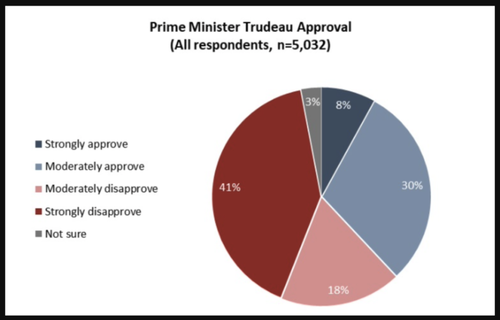
Reeling with numerous scandals, corruption and gaffes, Justin Trudeau holds power solely through the merger of his party with the Canada’s Socialist NDP, headed by millionaire Jagmeet Singh.
The deal ostensibly keeps him in office until 2025. Singh is also on the ropes, frequently being jeered in public even among his base constituency in Brampton, Ontario. His brother lost his seat in the recent Ontario election, and Sing himself was run out of a campaign stop by enraged Sikhs who called him “a sell out”.
Time For Your Plan B
Most agnostic and object political observers agree: should the Liberal-Socialist Party make it to 2025, they will be mercilessly deposed on par with the 1993 electoral bloodbath. When Canadians had had enough of Brian Mulroney (he bailed before the election, leaving Kim Campbell holding the bag) and the Conservatives were blown out so badly they lost their party status: going from 156 seats in Parliament, to just 2.
Both the Liberals and NDPs face similar prospects by Canadians who are sick and tired of being called “fringe” and “racists”, fed up with being gaslit by a smug, out-of-touch, government subsidized media, and well beyond done with this COVID business.
But until that happens, this clown show can do a lot of damage – mandatory vaccinations being just the beginning.
The economy is headed for a depression because our Finance Minister is an economically illiterate ideologue. We should be an energy super-power but instead this fully Woke government is demonizing our oil and gas industry and probably driving the West right out of confederation. Then they’re ramming through internet censorship bills that would make the CCP proud.
If you haven’t decided your line in the sand, it’s time to do that. I know mine.
And then get to work putting your Plan B in motion:
Start working on a second passport, setting up businesses, revenue streams and assets outside of Canada. Everybody knows I’m a huge Bitcoin fan, so holding a portion of your wealth in BTC keeps it out of the reach of these plundering tyrants.
If the government is going to move the goalposts, then the rest of us have to move the playing field. In this coming era of decentralization, the antidote to government overreach is extreme Sovereign Individualism.
* * *
Stay in the loop on setting up your Plan B and the coming monetary regime change by joining the Bombthrower mailing list. Wherever you are on the path to being a Sovereign Individual, Bombthrower can help you navigate the terrain. (Gettr, Twitter, Telegram)
end
Journalist Alex Berenson Reaches Settlement With Twitter
TUESDAY, JUL 05, 2022 – 01:07 PM
Authored by Zachary Stieber via The Epoch Times,
Independent journalist Alex Berenson and Twitter have agreed to a settlement over a lawsuit that alleged the big tech company violated Berenson’s constitutional rights when it banned him.

The parties “have reached a settlement in principle,” according to a joint stipulation filed in federal court in California on June 29.
However, additional time is needed to finalize details of the settlement, the parties said.
Lawyers for Berenson and Twitter, in the filing, asked U.S. District Judge William Alsup, a Clinton appointee, to extend deadlines to produce certain documents, known as discovery, in light of the agreement.
Alsup extended the deadlines by 14 days, less than the 28 days requested, and said that he would not allow any further extensions.
“Counsel are fully able to negotiate and litigate at the same time,” he wrote in an order.
The extensions mean Berenson had until June 30 to produce certain documents and Twitter has until mid-July to produce certain materials.
Additionally, Twitter can take a deposition of Berenson by the end of July and Berenson can take depositions of two current or former Twitter employees by mid-August.
Discovery
The filings contain no details concerning the settlement details.
Berenson said in an initial blog post that he couldn’t share details until the settlement is actually filed but later pointed out how he’d promised that “there would be no settlement without third-party discovery.”
Berenson emphasized he will not accept an agreement unless it allows him to not only obtain materials from Twitter, but to talk about those materials.
Twitter did not respond to a request for comment.
Twitter banned Berenson, formerly of the New York Times, from the platform in August 2021, claiming he violated the company’s rules against promoting COVID-19 misinformation.
Berenson said in the suit that he was assured by a senior executive that he would not be banned, that he did not break the rules, and that Twitter broke its promises and policies in removing him.
He accused Twitter of violating the U.S. Constitution’s First Amendment, federal laws, and the California Common Carrier Law, as well as breaching the user contract it entered with Berenson.
Twitter tried to dismiss the suit, but Alsup allowed it to proceed with the breach of contract claims.
“Here, Twitter allegedly established a specific, detailed five-strike policy regarding COVID-19 misinformation and its vice president gave specific and direct assurances to plaintiff regarding his posts pursuant to that policy. Any ambiguities in a contract like Twitter’s terms of service are interpreted against the drafter, Twitter,” he said in his order on Twitter’s motion.
“And, at the pleading stage, this order must construe all allegations in the light most favorable to plaintiff’s allegations. Plaintiff plausibly avers that Twitter’s conduct here modified its contract with plaintiff and then breached that contract by failing to abide by its own five-strike policy and its specific commitments set forth through its vice president.”
Steve Kirsch/Rhoda Wilson/Expose-news.com
And you wonder why mainstream Health officials are losing creditability?
Latest Survey Shows 3.7% Rate of Myocarditis in “Vaccinated” Americans
Rhoda WilsonJune 30, 2022
This is a health disaster. This rate is over 500 times higher than what the CDC claims. Doctors will remain silent on this as they are not permitted to challenge the “safe and effective” narrative.
By Steve Kirsch
Executive summary
The CDC has always told us that there is only a slightly elevated risk of myocarditis from getting the vaccine. They cite data from the VAERS system showing low report rates. However, they always conveniently “forget” to mention that VAERS is under-reported and fail to estimate the VAERS under-reporting factor. This means their estimates are likely off by a factor of 100 or more.
Now we have confirmation from multiple sources that the CDC is misleading people and that their numbers are, in fact, at least 100X too low:
- A direct user survey of a cross-section of America done by a professional polling firm (with a 4% nominal margin of error) shows a 3.7% rate of myocarditis among those Americans who took the vaccine who responded to the survey. This number is consistent with earlier runs of the survey with different respondents. It is 500X higher than the CDC numbers.
- A paper published in Nature shows rates of myocarditis post-vaccine that can be up to 140 times normal. That’s not a “slightly elevated risk.”
- An estimate from a US Army Flight Surgeon of a 4% myocarditis rate among military pilots who were vaccinated, very consistent with our survey.
- A myocarditis rate of at least 1% in a local school near me where a parent revealed the number of myocarditis rates in the school.
Also, this latest survey confirmed the death estimate in the earlier survey (which was 600,000 minimum). In this case, 8.12/12.79 which is Q19/Q23 which is the ratio of deaths from the vaccine/deaths from Covid. So, if 1M people died from Covid, then over 600,000 people died from the vaccine.
Introduction
The CDC says the highest rates of myocarditis are among 12- to 17-year-old males with up to 69 cases per million second doses.
But we just got back a survey that clearly shows that the rates of myocarditis are much higher than that: 3.7 cases per 100 people vaccinated. That’s a statistic over all Americans who have been vaccinated, not just young boys. It’s Question 5. 14.03 said yes out of 371 who were vaccinated. 14.03/371= 3.7%.
That’s a rate that is 536 times higher than the highest value the CDC told us. They assured us that there was just a “slightly elevated risk” of myocarditis from the vaccine.
They never told us that we’re seriously injuring 3.7% of the people being vaccinated. This new number explains why hospitals are seeing so many cases of myocarditis.
An Army flight surgeon estimated a 4% rate of myocarditis among military pilots based upon personal professional observation. It appears that that estimate was not far off.
Also, at Monte Vista Christian School in Watsonville, CA there are now 5 known cases of myocarditis but only 400 boys, not all have been vaccinated. So, this again supports the survey. Note that the head of school isn’t talking. Apparently, Christian values compel the administration to keep silent about injuries to the kids so that other parents are not alerted to the risks and will thus be more likely to vaccinate their kids. So, the rates could be much higher than 1% at the school since the 5 cases are just the ones we know about from one of the parents at the school.
About the latest survey
See this article analysing a recent survey. It has three runs of the survey and has the source data. The article also has a methodology section describing how the survey was done (and referring to an earlier article for details).
Basically, 500 people are selected at random from across the US. Once they answer the first question, they are counted in the 500. The first question cannot be used to tell the nature of the survey so there is no selection bias. The numbers are adjusted based on the demographics of the people who responded to match the overall US demographics.
You can use the raw numbers or the adjusted numbers in the computations. It doesn’t matter: the results, either way, are devastating for the US government.
This is why the CDC and mainstream media never run these surveys: they don’t want to know the truth and, more importantly, they do not want you to know the truth.
Confirmation from peer-reviewed scientific literature
Here’s exactly what the paper published in Nature says (Age and sex-specific risks of myocarditis and pericarditis following Covid-19 messenger RNA vaccines). Note that on Dose 2 for males (lower left graph), all error bars for males are above the dotted “normal” line:

So even if you don’t believe our survey, this paper says that the risks can be as much as 88 times higher than the normal rate in males and up to 140 times higher than normal in females.
Summary
The CDC tells us that there is just a “slightly elevated risk” of myocarditis from the vaccine and there is absolutely nothing to worry about.
Our latest survey and this new article in Nature just don’t match up with what the CDC says.
Our surveys suggest you should avoid the vaccines entirely as the risk profile doesn’t justify the benefits, especially for a virus that if treated early is a minor annoyance. This matches the recommendations of a recent paper by Peter Doshi and others.
Your doctor will not be able to mention any of this to you without fear of losing her license to practice medicine. So, the medical community will ignore this result even though they can easily replicate the study.
That’s just how medicine works nowadays.
Source: A 3.7% rate of myocarditis in our latest survey of vaccinated Americans, Steve Kirsch, 28 June 2022
Further reading: Serious Heart Inflammation 44 Times Higher After Covid Vaccination, Nature Study Finds, The Daily Sceptic, 27 June 2022
GLOBAL INFLATION/SUPPLY ISSUES
GLOBE//SUPPLY PROBLEMS
END
VACCINE INJURY/
Vaccine Impact
Pfizer’s Puppet President Biden Gives $9 Billion Taxpayer Funds for Millions More COVID Vaccines that Nobody Wants
July 1, 2022 4:44 pm

Is there any more doubt that the COVID-19 plandemic, which was used to transfer America’s wealth to Big Pharma with literally TRILLIONS of taxpayer funds transferred into their accounts, has now allowed Pfizer to have complete control of the country by buying the White House and President of the United States? It began with fellow billionaire Donald Trump, of course, in 2020 who strong-armed the FDA into giving fast-track emergency use authorization to Pfizer’s COVID-19 vaccine. Then Biden was installed as President and kept the coffers full, and now that 80% of Americans have already received a COVID-19 vaccine and demand is waning, with 98 million doses of Pfizer’s vaccine currently sitting unused due to lack of demand, the call was put in to Joe this week to keep the faucet running, and the White House obliged and pledged another $9 BILLION for 300 million more doses of the deadly COVID-19 shots. Trump and Biden might disagree on a lot of things, but Pfizer COVID-19 vaccines ain’t one of them. The top three firms who hold the most stock in Pfizer are Vanguard, Blackrock, and State Street, and there probably are very few investment firms who do NOT own some Pfizer stock, so when you see officials with the FDA, CDC, and others promoting Pfizer COVID-19 vaccines, they are probably all shareholders and cashing in, as are most members of Congress.
An Idolatrous Nation Celebrates “Freedom” Even Though They are Slaves to the Pharmaceutical Cult
July 3, 2022 4:17 pm

Francis Scott Key penned the words to the song “The Star-Spangled Banner” in the 1800s that would go on to become the “National Anthem” of the United States, and it ends with the words: “The land of the free, and the home of the brave.” I am not sure these words have ever been a true description of life in the United States, but today, here in 2022, those words should read: “The land of the slaves, and the home of the cowards.” I never thought I would live to see the day where most Americans would willingly choose slavery over freedom, and then when their choices did not work out the way they thought, rather than own up to their mistake in making the wrong choice, blame the government instead, all the while raising their voices to claim “I’m a victim!” believing that somehow they are entitled to certain things from their slave masters. But that characterizes the United States of America today.
MICHAEL EVERY
Michael Every on the day’s most important topics
And now Michael Every…Elwin de Groot
“Many Unholy Trinities” – ECB Failure Is (Almost) Guaranteed
TUESDAY, JUL 05, 2022 – 01:52 PM
By Elwin de Groot, head of macro strategy at Rabobank
After last week’s recession fear-driven bounce-back in bonds (especially those at the shorter maturity section of the curve), markets took a breather on Monday as the US were closed for Independence Day. The European 2-year swap rate (which declined by a whopping 80bp in the last two weeks of June), recovered by more than 10bp yesterday. Arguably that was also driven by hawkish comments from ECB officials, such as Bank of Slovenia Governor Vasle, who warned that there will “likely be more rate hikes […] after September”. The RBA’s second consecutive 50bp hike this morning – albeit in line with the market’s expectations – served as another reminder that short-term rates are on a (steep) upward slope, globally.
Meanwhile, the US and China are in talks over a roll-back of tariffs imposed by the former Trump administration. It is our understanding that Treasury Secretary Yellen is a proponent of such a reversal, but that there is no unity on this issue in the Biden team. US Trade Representative Katherine Tai, for example, sees the tariffs as useful leverage in broader discussions with China (although sceptics will argue that the tariffs have done little to rebalance the trade relation between the two countries). The downward impact this would have on inflation is likely to be quite modest according to many analysts. Still, if such a decision were to coincide with the start of a downward trajectory in inflation (for entirely different reasons, such as ‘peak’ commodity prices), President Biden –who has also expressed great concern over cost of living issues for US households– may spin it as a vote-winner as the November mid-term elections are drawing closer.
Overnight, we’ve seen more ‘positive’ news from China, as the Caixin composite PMI survey for June rebounded strongly (55.3 from 42.2 in May) following the relaxation of lockdown measures in big cities such as Shanghai and Beijing. However with new reports of flare-ups of Covid-19 in the eastern province of Anhui as well as the broader Yangtze Delta region, which is a key economic hub, the pick-up in activity may well prove to be short-lived.
Indeed, we would argue that it is far too soon to throw recession fears out of the window. From the European side, we were also kindly reminded of that over the weekend by German Federation of Trade Unions (DGB) head Yasmin Fahini, who warned in an interview with Bild that “entire industries are in danger of permanently collapsing: aluminum, glass, the chemical industry” as a result of the current gas bottle necks. The 60% decline in Russian gas deliveries through the German Nordstream-1 pipeline system has pushed European gas prices to levels not seen since the first weeks of the Russian invasion in Ukraine. The TTF 1-month contract rose above EUR160/MWh yesterday, the highest level since 8 March. Rising import prices were also the main culprit behind Germany’s first monthly trade deficit (a EUR 1bn net loss) in May since 1991, as export activity is being hampered by Chinese lockdowns, slowing global demand and ongoing supply chain issues whilst import prices (of energy in particular) are going through the roof.
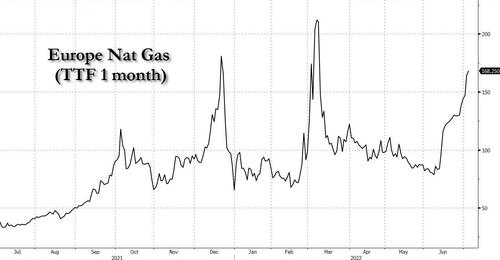
Germany has already switched to phase 2 of its national gas emergency plan, just one step shy from taking complete control over the allocation of natural gas. Its previously mothballed coal-powered electricity plants are being fired up again and the government is still in talks with Uniper, its biggest gas importer, on what support measures it will provide. According to Germany’s Spiegel magazine, the government is working on legal basis to support gas supply companies with measures that could include the acquisition of shares and/or grant loans or guarantees. The Lufthansa bailout is seen as a blueprint for such measures. Bloomberg reports this morning that the potential bailout package could be as much as EUR 9bn.
But Chancellor Scholz acknowledged yesterday that the country is facing a “historic challenge” and that the rising costs of living could have “explosive” effects on German society, as it also drives a further wedge between the rich and the poor. Arguably, the Chancellor himself is facing one of those Unholy (or Impossible) Trinities: he cannot prevent social unrest, if he wants to have lower inflation and wants to prevent a recession at the same time. One could argue that simultaneously achieving the latter two objectives are already a daunting task in itself, let alone doing so without causing tensions between those in work and those enjoying their pension, or between the providers of capital and the providers of labour.
So he’d better leave the prevention of inflation in the safe hands of the ECB, right? Oh, hang on, that other institution is actually dealing with an Unholy (or Impossible) Trinity itself. In fact, we would argue, one that is of its own making.
Before you start googling, the “Impossible trinity” concept dates back to the research by international economists Robert Mundell and John Fleming. The central tenet of their reasoning is that it is impossible to have all three of the following at the same time:
- i) independent monetary policy (i.e. full control of your money supply),
- ii) a fixed/stable exchange rate and
- iii) the free movement of capital.
The prime example often used to explain the trinity is the situation where the central bank choses its own monetary policy amidst free capital flows. Under that regime – which basically is the regime under which many developed-markets central banks are currently operating – the central bank cannot control the exchange rate. For if it wants to fix the exchange rate it would have to use its FX reserves to steer the exchange rate. Since these reserves are limited it cannot support its currency indefinitely should it want to maintain an interest rate that is below the ‘global’ interest rate. Should it want to maintain an interest rate that is above the global level, it would likely see considerable capital inflows and the only way to stabilize the exchange rate is to purchase the influx of foreign currency by printing more of its own money, thus raising the money supply and stimulating growth and inflation.
But, we hear you thinking: things are absolutely fine for the ECB, right? Because the “exchange rate is not a policy target”. So no problem there. However, we are actually thinking about yet another Impossible Trinity that is currently playing havoc with the ECB. Over the weekend, the FT reported that the ECB is in discussion over whether and how it could prevent banks from making “multibillion euro” windfall profits from the cheap loans that the ECB has provided them during the pandemic. The basic idea here is that many banks have met their TLTRO targets and therefore borrow at the average deposit facility rate over the entire life of the loan. Since this average rises much more slowly than the actual deposit facility rate when the ECB hikes rates later this month, this effectively offers banks a free lunch.
We asked ourselves: this is not a new issue and the ECB could have seen this coming when it devised the policy. So why and why now? Well, one explanation could be that the ECB has been surprised by the relative low amount of TLTRO repayments by banks so far. But a more interesting explanation – in this regard – is that, in the process of designing its Anti Fragmentation Tool, the ECB may suddenly be realising that it has to give up control of the size of its balance sheet (or better: the monetary base), if it wants to maintain control over interest rates and spreads and prevent fragmentation at the same time.
A thought experiment helps explain the issue. Let’s assume concerns over Italian spreads force the ECB to buy more Italian bonds. And let’s assume that in order to fully sterilize the impact on the monetary base, the ECB decides to sterilize by mopping up liquidity through ‘weekly deposits’ (at a slight premium over de deposit facility rate). This, however, implies that the monetary base would effectively continue to expand, posing long-term risks to inflation. Alternatively, should the ECB decide to raise its reserve requirements by the same amount as it has pumped into Italian bonds, the increase in those requirements would likely pose a problem for those banks already low on excess reserves and who would not see a commensurate increase in their reserves. As a consequence, the fragmentation issue may not be solved. And if the central bank were to issue securities with a long maturity, this would probably raise long-term interest rates (as they would compete with other core bonds). So while that may contain spreads, it would not be able to contain long-term yield levels.
So the basic conclusion here is that, with so many goals to achieve, the ECB risks becoming all tied up in its own instruments. Failure is almost guaranteed. It just has to choose where it accepts such failure.
7. OIL ISSUES//NATURAL GAS//ELECTRICITY ISSUES/USA//GLOBE
This will surely hurt supplies
(zerohedge)
Biden Admin Halts 2nd Largest US LNG Plant From Restarting Operations After Blast
FRIDAY, JUL 01, 2022 – 05:20 PM
The Biden administration is preventing the second-largest US liquefied natural gas export facility from repairing or restarting operations in the wake of a fire earlier this month over ‘risks to public safety.’Smoke billows from the Freeport LNG plant in Quintana, Texas, U.S., June 8, 2022, in this still image obtained from a social media video on June 9, 2022. Courtesy of Maribel Hill/via REUTERS
As Reuters reports, the U.S. Pipeline and Hazardous Materials Safety Administration (PHMSA), which operates under DOT Secretary Pete Buttigieg, has prevented Freeport LNG’s 15 million tonne per year (mtpa) Quintana plant in Houston, TX, exacerbating the global energy crunch.
“Continued operation of Freeport’s LNG export facility without corrective measures may pose an integrity risk to public safety, property or the environment,” PHMSA said in its preliminary report, after a problem with a safety valve led to an 18-inch stainless steel pipe to overpressurize and burst. This released LNG and methane, leading to the blast.
It laid out a series of steps for investigating what caused a 300-foot (91-m) section of pipe to burst and release about 120,000 cubic feet of LNG.
The root cause analysis likely will delay a partial restart of the plant for 90 to 120 days, and could delay a full restart, analysts said.
Closely-held Freeport said it will continue working with PHMSA and other regulatory bodies to obtain necessary approvals to restart operations. It estimated resumption of partial liquefaction operations to be in early October and a return to full production by year-end. -Reuters
“The actual process (of reviews, repairs and approvals) will take longer than three months, and potentially take six to 12 months,” said Alex Munton, director of global gas and LNG at consultants Rapidan Energy Group.
According to the report, PHMSA ordered the company to submit a plan within 60 days for an outside investigator to report on the extent of the damage to the facility – and gave no indication of how long it would take to approve a plan. Freeport must also contract with a third-party to review the condition of its LNG storage tanks.
Then, and only then, can the company submit a repair plan, derailing their goal of a partial restart in September, and full operation by year-end.
END
As discussed above, the Saudis are pivoting toward China and Russia (and the other BRICS) and away from the USA
The Saudi’s are unwilling to upset Putin as Biden begs for more crude
(Paraskova/OilPrice.com)
Saudis Unwilling To Upset Putin As Biden Begs For More Crude
TUESDAY, JUL 05, 2022 – 06:30 AM
By Tsvetana Paraskova of Oilprice.com
The world’s largest crude oil exporter, Saudi Arabia, continues to keep close ties with Russia while the top oil consumer, the United States, pleads with major producers—including the Kingdom—to boost supply to the market and help ease consumers’ pain at the pump. While the U.S. and its Western allies are sanctioning Moscow and banning oil imports from Russia, U.S. President Joe Biden is also turning to Saudi Arabia to ask it to pump more oil as Americans pay on average $5 a gallon for gasoline.
The Saudis prefer to keep close ties with Russia in oil policy as the OPEC+ pact and the control over a large portion of global oil supply has benefited both OPEC+ leaders—the Kingdom and Russia—over the past half a decade. Saudi Arabia, however, could use a little thaw in Saudi-U.S. relations under President Biden, who is no longer talking about the world’s top crude exporter as a “pariah” state.
The Saudis are carefully maneuvering to keep Russia as an ally in the OPEC+ group and possibly improve relations with the United States.
President Biden—desperate to see relief for American drivers ahead of the midterm elections—has made a U-turn on Saudi Arabia and is expected this month to visit the Kingdom, which he said on the campaign trail would be treated as a “pariah” state during his presidency. But U.S. gasoline prices at $5 a gallon and the loss of part of the Russian supply have made President Biden reconsider and meet with Crown Prince Mohammed bin Salman.
Saudi Arabia has publicly reiterated its “warm” ties with Russia on several occasions since Putin invaded Ukraine, and considers keeping Russia in the OPEC+ alliance an important part of its oil policy. With Russia leading a dozen non-OPEC producers in the pact, Saudi Arabia has more sway over global oil markets with the larger OPEC+ group than with OPEC alone.
Russian President Vladimir Putin and Saudi Crown Prince Mohammed bin Salman have discussed their countries’ cooperation in the OPEC+ oil production pact in a few telephone conversations since February, and have vowed to continue their cooperation.
Last month, Russian Deputy Prime Minister Alexander Novak said that Russia could continue its participation in the OPEC+ agreement even after it officially expires at the end of this year. Novak was speaking after a meeting in St Petersburg with Saudi Arabia’s Energy Minister, Prince Abdulaziz bin Salman, who made a surprise appearance at a Russian economic forum.
During that meeting, the Saudi minister said that Saudi-Russian relations were “as warm as the weather in Riyadh.”
Two weeks before that meeting, Russia’s Foreign Minister Sergey Lavrov visited Riyadh and met with his Saudi counterpart Prince Faisal bin Farhan Al Saud. The two ministers said that the OPEC+ alliance is solid, with the level of cooperation within it strong.
The recent OPEC+ decision to accelerate the production increase and roll back all cuts in August, a month earlier than initially planned, was pushed by Saudi Arabia amid U.S. pressure. But the Kingdom had to check with Russia first before proposing the redistribution of the September increase in July and August, sources with knowledge of the behind-the-scenes diplomacy told Reuters this week.
Both the Saudis and Russia benefit from the OPEC+ deal, so Riyadh wants to keep Russia on board, the sources say.
“The Saudis are enjoying high prices while the Russians need guaranteed support from OPEC+ in the current circumstances,” a source familiar with Russian thinking told Reuters.
“No one is interested in a market collapse,” added the source.
After the production cuts are completely rolled back next month, a more difficult decision for OPEC+ looms: what to do next as Russia is more than 1 million bpd behind target and could lose more supply as the EU embargo on its oil begins at the end of this year.
Neither is OPEC+ as a group anywhere close to reaching its target production, nor has Saudi Arabia much spare capacity left to boost production further, as the U.S. and other major consumers want. Per the OPEC+ deal, the Saudi target (as well as Russia’s) is at 11.004 million bpd for August. The Kingdom has rarely reached this level, and not for a sustained period of time. So, it’s not certain that the Saudis have the ability to pump 11 million bpd or more on a sustainable basis. It’s even less certain that the Kingdom can quickly tap—if it wanted to—into the 12.2 million bpd production capacity it claims it has.
end
Oil Crashes Below $100 As Recession Risk Roars, Dollar Soars
TUESDAY, JUL 05, 2022 – 11:33 AM
Oil prices are puking this morning, after some modest gains overnight, as recession risks roar higher around the world and the dollar’s strength hits the energy complex with a double whammy.
“In the very near term the Dow & S&P will have a major factor on crude direction as recession fears remain,” said Dennis Kissler, senior vice president of trading at BOK Financial.
Fundamentally, there are concerns that fuel demand could “drop significantly now that the 4th of July holiday is behind us.”
WTI has broken below the $100 Maginot Line for the first time since May 11…
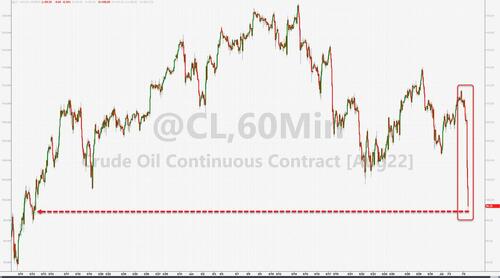
Brent Crude is trading below $100/bbl from November 2022 out…
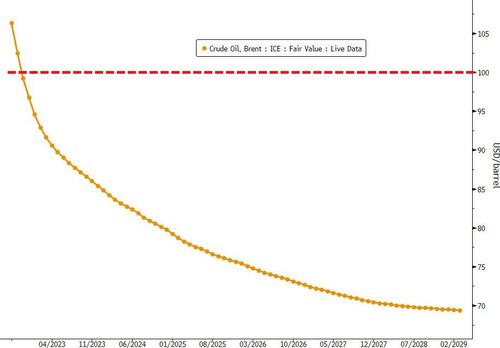
The dollar’s explosive surge higher (on the back of a weak euro) is also not helping as it reaches its highest since March 2020…
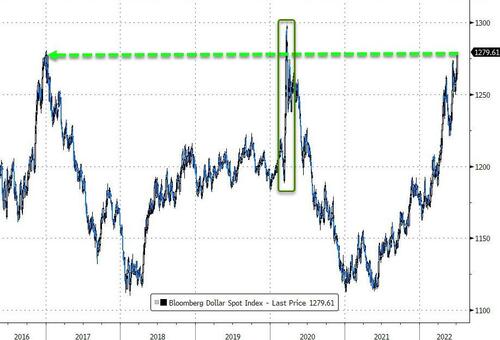
Interestingly, Citi said that crude could fall to $65 this year in the event of a recession, dramatically different from JPMorgan’s most bullish $380 a barrel scenario.
Most notably, US retail gasoline prices have fallen for 21 straight days according to AAA.
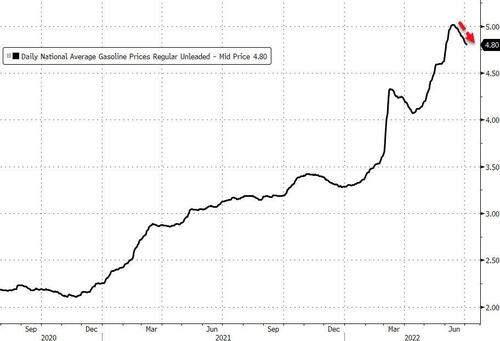
Is President Biden hoping for a recession?
END
This is a very important read…..
Is Saudi Arabia Exaggerating Its Oil Production Potential?
TUESDAY, JUL 05, 2022 – 03:45 PM
Authored by Simon Watkins via OilPrice.com,
- For years, Saudi Arabia has made some pretty hefty claims about its oil potential.
- It is becoming increasingly clear, however, that the Kingdom may be stretching the truth a little too far.
- Analysts are now beginning to doubt that Saudi Arabia even has the reserves it says it has.
For many years now, Saudi Arabia has been wildly exaggerating every metric connected to its oil business, from how much crude it can produce to its level of reserves and everything in between, as analyzed in depth in my first book on the oil sector in 2015 and the latest one in 2021. Why does it lie so much and so often about these figures? Because without the power it has in the world directly associated with its crude oil production, spare capacity, and reserves it has no real power at all, so enormously exaggerating each of these figures is geared towards puffing itself up in terms of its geopolitical importance. The problem Saudi Arabia has right now, however, is that the U.S. and all other developed market countries whose economies are suffering under the weight of ongoing high oil prices are pressuring Riyadh to deliver on these claims, in order to bring these oil prices down. If Saudi Arabia had not been lying all these years about the amount of oil it can produce then it will not have a problem, but it has been, so it does.

To the figures themselves, then, and firstly, Saudi Arabia’s crude oil reserves figures. At the beginning of 1989, Saudi Arabia claimed proven oil reserves of 170 billion barrels, but only a year later, and without the discovery of any major new oil fields, the official reserves estimate had somehow increased by 51.2 percent, to 257 billion barrels. Shortly thereafter, it increased again to just over 266 billion barrels, a level that persisted until a slight increase in 2017 to just over 268 billion barrels. On the other side of the supply-demand equation, from 1973 to the end of last week, Saudi Arabia pumped an average of 8.192 million barrels per day (bpd) of crude oil. Therefore, taking 1989 as a starting point (with 170 billion of crude oil reserves officially claimed in that year), in the subsequent 32 years Saudi Arabia has physically pumped and removed forever from its oil fields, a total of 95,682,560,000 barrels of crude oil. Over the same period, there has been no significant discovery of major new oil fields. Despite this, Saudi Arabia’s crude oil reserves have not gone down, but rather have actually gone up. This is a mathematical impossibility.
Secondly, Saudi Arabia’s spare capacity figures, which are a function of Riyadh not just lying about the numbers outright but also engaging in semantic trickery involving the use of various oil market terms interchangeably, despite their not meaning the same thing at all. To be clear here: the official Energy Information Administration (EIA) definition is very specific about what constitutes ‘spare capacity’ in the global oil markets, and it is as follows, directly quoted from the EIA rules: “Spare capacity is production that can be brought online within 30 days and sustained for at least 90 days.” That is it; that is what spare capacity is, no more and no less. However, Saudi Arabia includes within its own use of the term ‘spare capacity’ every drop of crude oil that it can get hold of: including oil supplies in storage, supplies that can be withheld from contracts and re-directed into those stored supplies, and any oil that it can buy through brokers in the spot market and then sell on as its own. Exactly this semantic trickery was used to cover up the actual supply shortfalls in the aftermath of the September 2019 attacks by the Iran-backed Houthis on Saudi’s Khurais and Abqaiq facilities and later attacks.
In reality, as written in the 2015 book: “The country has often stated that it has a spare capacity of between 2-2.5 million barrels per day (mbpd), with the capability to ramp up its production to about 12.5 mbpd in the event of unexpected disruptions elsewhere. However, it is very unlikely that it could pump at these levels for a sustained period of time, and this idea has been supported by comments from Gulf officials at OPEC, which stated in the midst of Iraqi supply fears that Saudi Arabia could ramp up output by another 1-1.3 mbpd in a best-case scenario. Officials also mentioned that production of 11.5 mbpd is untested and could only be maintained for a very short period and that, in any event, higher production would be very difficult and would require producing heavy crudes.” Nothing meaningful has changed since then.
And thirdly, the ludicrously-inflated ‘production’ figures that Saudi Arabia has been bandying around for years and which appear to be from the Hans Christian Andersen School of Oil Economics. As highlighted above and back in the 2015 book, despite all the flim-flam and general nonsense from the Saudis about being able to ‘produce’ 11 million bpd or 12 million with ease, and plans to ‘increase this’ to 13 million bpd, Saudi Arabia has actually produced from 1973 to the end of last week, an average of 8.192 million barrels per day (bpd) of crude oil; that is it. Moreover, as analyzed as long ago as the 2015 book, it has only ever – in the history of the world, up to and including the end of last week – managed to produce 11 million bpd and sustain it for a month on two occasions. Even when Saudi was at almost existential points in its recent history – such as the all or nothing 2014-2016 Oil Price War it instigated to destroy or disable the then-nascent U.S. shale oil sector, or when former U.S. President Donald Trump threatened withdrawal of military support for it if it did not increase oil production – Saudi still could not increase oil production above just 10.5 million bpd for long.
It is consequently of no surprise whatsoever that OPEC+ last week decided not to increase its production over and above what had previously been agreed – because it simply cannot do so. Perhaps this was why neither the Saudi Crown Prince, Mohammed bin Salman (MbS), and the Crown Prince of Abu Dhabi, Mohammed bin Zayed Al Nahyan (MbZ), agreed to take telephone calls from U.S. President, Joe Biden, after all: not because they were seeking to marginalize him (although that is more than likely true as well) but because they could offer him nothing and have been caught out in a lie. This latter inference can be taken from subsequent remarks – relayed to the world last week by the French President, Emmanuel Macron – that he had a call with MbZ: “He told me two things. I’m at a maximum, maximum [oil production capacity], this is what he claims,” said the French President. “And then he said [the] Saudis can increase by [only] 150 [thousand barrels per day], maybe a little bit more, but they don’t have huge capacities before six months’ time,” Macron concluded.
8 EMERGING MARKET& AUSTRALIA ISSUES
Australia//// NEW ZEALAND/ SOUTH AFRICA/BRAZIL/ARGENTINA/INDIA/PAKISTAN
Your early currency/gold and silver pricing/Asian and European bourse movements/ and interest rate settings TUESDAY morning 7:30 AM
Euro/USA 1.0297 DOWN 0.01351 /EUROPE BOURSES //ALL RED
USA/ YEN 135.034 UP .187 /NOW TARGETS INTEREST RATE AT .11% AS IT WILL BUY UNLIMITED BONDS TO GETS TO THAT LEVEL…
GBP/USA 1.20079 DOWN 0.01103
Last night Shanghai COMPOSITE CLOSED DOWN 1.43 POINTS UP 0.04%
Hang Sang CLOSED UP 22.72 PTS OR .16%
AUSTRALIA CLOSED UP 0.31% // EUROPEAN BOURSES ALL RED
Trading from Europe and ASIA
I) EUROPEAN BOURSES ALL RED
2/ CHINESE BOURSES / :Hang SANG CLOSED UP 22.72 PTS OR .10%
/SHANGHAI CLOSED DOWN 1.43 PTS UP 0.04%
Australia BOURSE CLOSED UP 0.31%
(Nikkei (Japan) CLOSED UP 269.72 OR 0.16%
INDIA’S SENSEX IN THE RED
Gold very early morning trading: 1798.55
silver:$19.73
USA dollar index early TUESDAY morning: 106.05 UP 1.14 CENT(S) from FRIDAY’s close.
TUESDAY MORNING NUMBERS ENDS
xxxxxxxxxxxxxxxxxxxxxxxxxxxxxxxxxxxxxxxxxxxxxxxxxxxxxxxxxxxxxxxxxxxxxxxxxxxxxxxxxxxxxxxxxxxxxxxxxxxxxxxxxxxxxx
And now your closing TUESDAY NUMBERS 1: 00 PM
Portuguese 10 year bond yield: 2.30% UP 4 in basis point(s) yield
JAPANESE BOND YIELD: +0.210% DOWN 0 AND 1/10 BASIS POINTS /JAPAN losing control of its yield curve/
SPANISH 10 YR BOND YIELD: 2.30%// UP 4 in basis points yield
ITALIAN 10 YR BOND YIELD 3.28 UP 9 points in basis points yield ./
GERMAN 10 YR BOND YIELD: FALLS TO +1.805%
END
IMPORTANT CURRENCY CLOSES FOR TUESDAY
Closing currency crosses for day /USA DOLLAR INDEX/USA 10 YR BOND YIELD/1:00 PM
Euro/USA 1.0241 DOWN 0.01911 or 191 basis points
USA/Japan: 135.76 DOWN 0.105 OR YEN up 11 basis points/
Great Britain/USA 1.19025 DOWN 0.02075 OR 208 BASIS POINTS
Canadian dollar DOWN .0238 OR 238 BASIS pts to 1.30622
xxxxxxxxxxxxxxxxxxxxxxxxxxxxxxxxxxxxxxxxxxxxxxxxxxxxxxxxxxxxxxxxxxxxxxxxxxxxxxxx
The USA/Yuan, CNY: closed ON SHORE (CLOSED ..DOWN 6.7174
THE USA/YUAN OFFSHORE: (YUAN CLOSED (DOWN)..6.7148
TURKISH LIRA: 16.98 EXTREMELY DANGEROUS LEVEL/DEATH WISH/HYPERINFLATION TO BEGIN.
the 10 yr Japanese bond yield at +0.210
Your closing 10 yr US bond yield DOWN 10 IN basis points from FRIDAY at 2.802% //trading well ABOVE the resistance level of 2.27-2.32%) very problematic
USA 30 yr bond yield 3.047 DOWN 8 in basis points
Your closing USA dollar index, 105.53 UP 16 CENT(S) ON THE DAY/1.00 PM/
Your closing bourses for Europe and the Dow along with the USA dollar index closing and interest rates TUESDAY: 12:00 PM
London: CLOSED DOWN 209.35 PTS OR 2.89%
German Dax : CLOSED DOWN 264.50 POINTS OR 2.85%
Paris CAC CLOSED DOWN 161.38 PTS OR 2.31%
Spain IBEX CLOSED DOWN 192.80 OR 2.32%
Italian MIB: CLOSED DOWN 620.43PTS OR 2.93%
WTI Oil price 10307 12: EST
Brent Oil: 100.52 12:00 EST
USA /RUSSIAN /// RUBLE FALLS TO: 61.38 DOWN 6 & 14/100 RUBLES/DOLLAR
GERMAN 10 YR BOND YIELD; +1.1805
CLOSING NUMBERS: 4 PM
Euro vs USA: 1.0262 down .01708 OR 171 BASIS POINTS
British Pound: 1.1952 DOWN .01612 or 162 basis pts
USA dollar vs Japanese Yen: 135.78 DOWN 0.888//YEN UP 88 BASIS PTS
USA dollar vs Canadian dollar: 1.30366 up .01784 (CDN dollar down 178 basis pts)
West Texas intermediate oil: 99,78
Brent OIL: 103.01
USA 10 yr bond yield: 2.822 down 8 points
USA 30 yr bond yield: 3.045 DOWN 9 pts
USA DOLLAR VS TURKISH LIRA: 16.98
USA DOLLAR VS RUSSIA//// ROUBLE: 61.150 DOWN 5 AND 94/100 ROUBLES
DOW JONES INDUSTRIAL AVERAGE: DOWN 130.14 PTS OR 0.42 %
NASDAQ 100 UP 194.23 PTS OR 1.67%
VOLATILITY INDEX: 27.56 UP 0.03 PTS (0.11)%
GLD: 164.75 DOWN 3.57 PTS OR 2.12%
SLV/ 17.73 DOWN .58 PTS OR 3.17%
end)
USA trading day in Graph Form
Crude Crashes, Yield Curve Inverts, Bonds & The Dollar Surge
TUESDAY, JUL 05, 2022 – 04:01 PM
With July 4th hangovers, America came back to work focused on growth scares, Fed reaction-functions, and shrugging off inflation anxiety. The dollar roared higher on euro weakness (because ECB is scared to hike as aggressively as The Fed as the European economy looks like its collapsing). Oil and bond yields plunged on recession fears – and the yield curve inverted. Breakevens were battered as inflation fears fade (sparking a dovish shift in rate-hike trajectory which helped send growthy stocks soaring in anticipation of Fed rate-cuts and QE), and gold was clobbered on the soaring dollar.
The market is now pricing in less than 7 more rate-hikes (having peaked at over 12 more) and almost 4 subsequent rate-cuts in 2023…
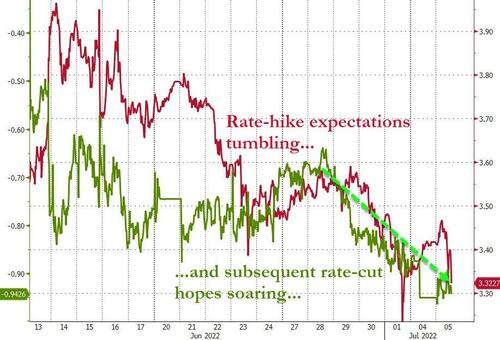
Source: Bloomberg
With a 50% chance of a rate-cut happening in Q1 2023…
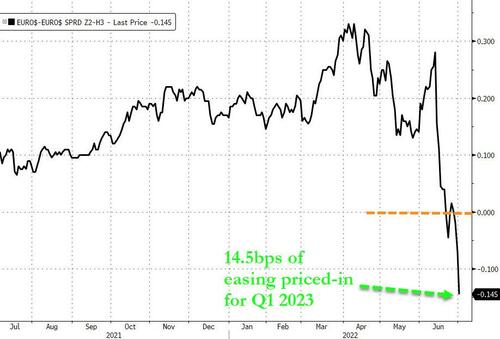
Source: Bloomberg
And as that dovishness was priced in, so stocks rebounded as Europe closed. The Nasdaq screamed from down 2% to up over 1.6%, the S&P was down over 2% at its lows and rallied back into the green in the last hour. Small Caps stalled at overnight highs…
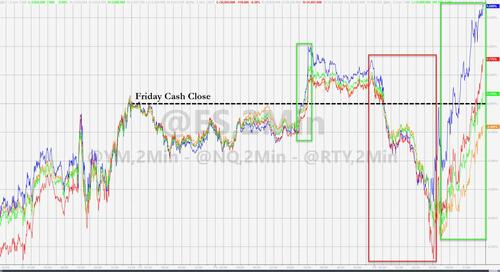
Energy stocks were the hardest hit but only Tech and Discretionary stocks made gains on the day…
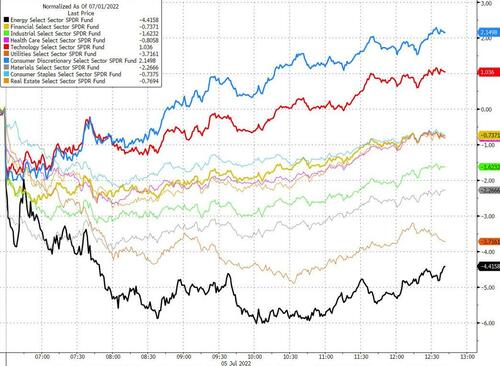
Source: Bloomberg
However, credit markets were not buying this bounce in stocks…
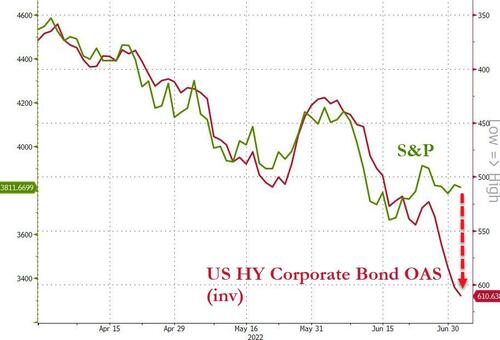
Source: Bloomberg
Treasury yields were lower on the day with a massive 20bps swing from high to low on the day…
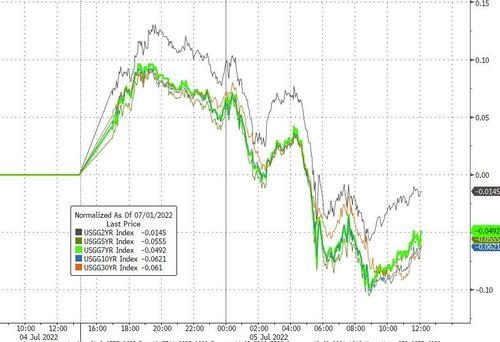
Source: Bloomberg
All of which inverted 2s10s for the 3rd time this year…
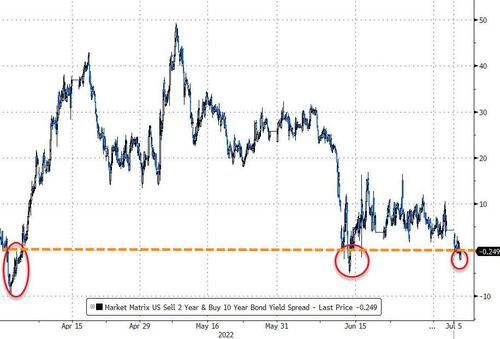
Source: Bloomberg
And inverted 2s5s for the first time since the 2020 COVID lockdowns…
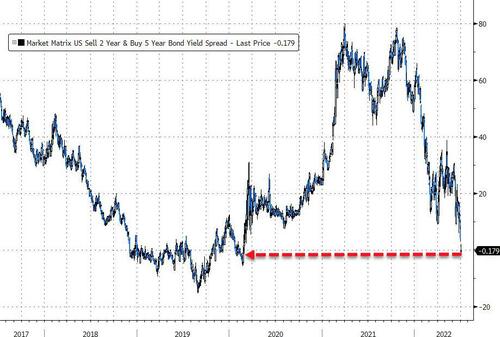
Source: Bloomberg
As inflation fears abate, Breakevens tumbled back to Oct 2021 levels…
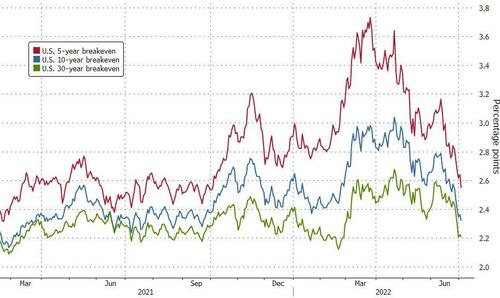
Source: Bloomberg
The Euro was routed to near parity and 20 year lows against the dollar…
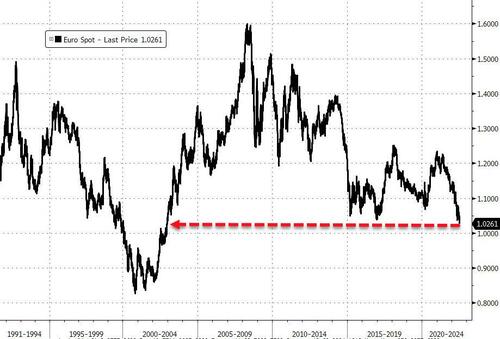
Source: Bloomberg
Which smashed the Dollar Index back nears its COVID Lockdown crisis safe0-haven spike highs (if biggest one day jump since June 2020)…
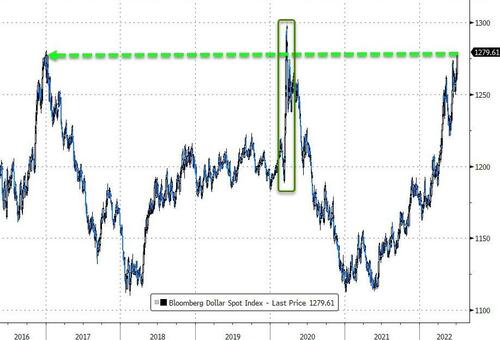
Source: Bloomberg
Cryptos rallied today, in sync with Nasdaq’s gains, erasing all the early losses…
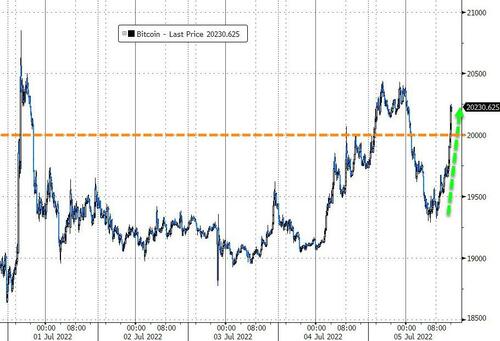
Source: Bloomberg
As the dollar ripped, gold was clubbed like a baby seal back below $1800 to its lowest level since Oct 2021…
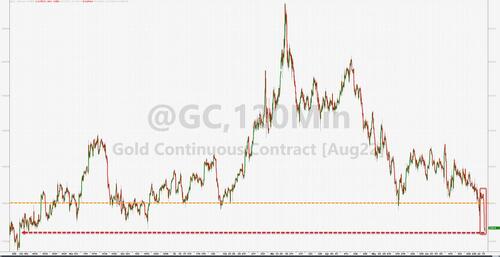
Copper crashed to its lowest since Nov 2020, which along with Gold implies a dramatically lower 10Y Yield…
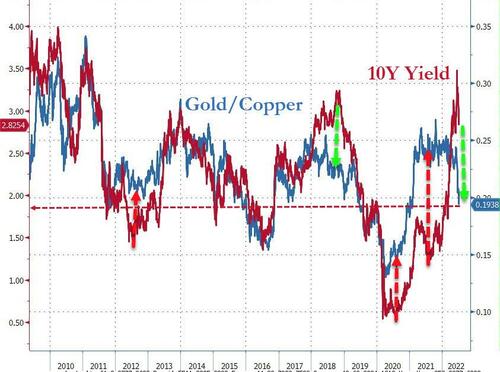
Source: Bloomberg
Worst day for WTI since the world locked down in March 2020 and back below $100 for the first time since May 11…
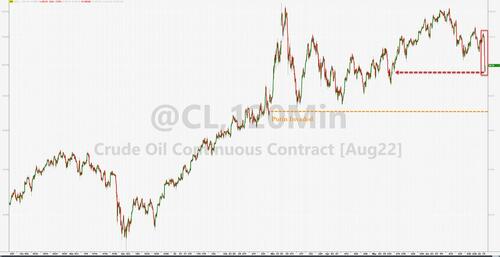
Wholesale gasoline prices crashed alongside, back to $3.27 at their lows…
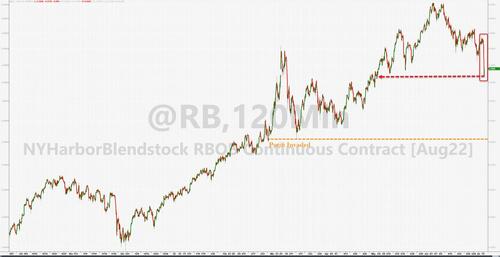
US National gas prices are down 21 straight days…
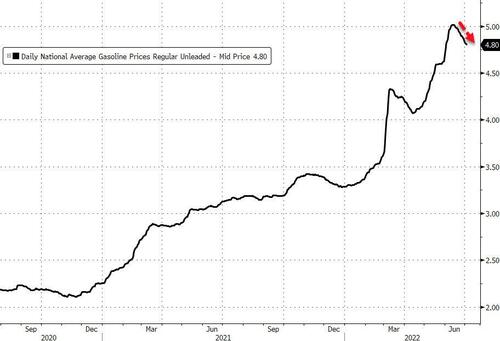
Source: Bloomberg
Finally, however, the falling gas prices are not helping President Biden’s approval rating…
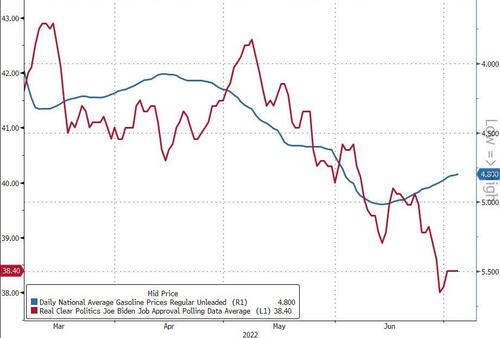
Source: Bloomberg
Perhaps it’s not just about that after all?
I) / EARLY MORNING TRADING//
ii) USA DATA
US Factory Orders Surprised To The Upside In May Despite Collapsing ISM
TUESDAY, JUL 05, 2022 – 10:03 AM
After decelerating in April – and despite plunging Manufacturing PMIs – analysts expected US Factory Orders to re-accelerate from +0.3% MoM to +0.5% MoM in May… and they were right as orders soared 1.6% MoM (the eight straight month of rising orders)…
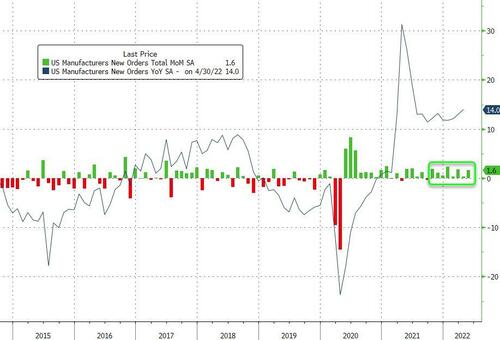
Source: Bloomberg
Year-over-year, orders are up 14.0% after April’s data was also revised higher (from +0.3% MoM to +0.7% MoM).
Core Orders (Ex Transports), rose rose 1.7% MoM in May (accelerating from the upwardly revised 0.6% MoM in April).
Let’s get some context for this move in US Factory Orders. ISM Manufacturing New Orders is at its lowest since the COVID lockdowns… and US Factory Orders are reportedly at record highs (ex the July 2014 glitch)…
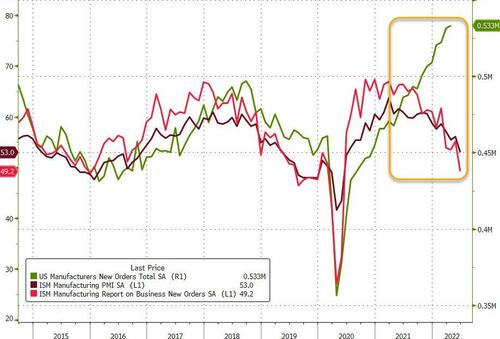
Source: Bloomberg
Which are you going to believe?
IIB) USA COVID/VACCINE MANDATES
end
iii)a. USA economic stories
3b/INFLATION COMMENTARIES/LOG JAMS ETC
This will shut down California: no longer independent contractors//they will be deemed employees, This effects GIG workers and Uber/Lyft
(John Kingston/Freightwaves)
California trucking prepares for shake-up under independent contractor law AB5
John Kingston Follow on TwitterFriday, July 1, 2022
7 minutes read
 Photo: Jim Allen/FreightWaves
Listen to this article
0:00 / 10:341X
It is going to be a radically new world in California’s trucking sector with the imposition of AB5, and it isn’t clear what parts of the industry — if any — are ready for it.
“Most immediately, motor carriers must evaluate and adopt alternative operating models to mitigate risk if they intend to continue to do business in California” was the admonition from the Benesch law firm in the wake of the Supreme Court decision in the case of California Trucking Association vs. (state Attorney General) Bonta. The decision opens the door for the imposition of AB5, the law on independent contractors that leans heavily toward classifying workers as employees rather than ICs.
“Motor carriers should immediately evaluate their California operations to determine what steps, if any, should be taken to respond to the changed backdrop for trucking” was the call to action from the trucking-focused Scopelitis law firm.
On the other side of the divide, there was celebration, including a victory lap by Lorena Gonzalez, the former and future labor leader who successfully pushed for AB5’s passage in the California legislature in 2019.
“The fact that trucking companies will have to abide by basic labor laws in CA takes us one step closer to rebuilding the middle class that was almost deregulated out of existence,” Gonzalez said in a tweet.
In denying a review of the appellate court decision, the Supreme Court returned the case to the 9th U.S. Circuit Court of Appeals. A 9th Circuit ruling in 2021 overturned a lower court injunction that had kept AB5 at bay from California’s trucking sector, even as the law that seeks to define independent contractors was implemented in other parts of the economy.
The original injunction from the lower court was based on its conclusion that AB5 was in conflict with provisions in the Federal Aviation Administration Authorization Act of 1994 (F4A). Attorneys for the trucking industry were heartened when the court agreed to consider questions of state preemption of F4A, including looking at a case involving C.H. Robinson (NASDAQ: CHRW). But ultimately, the court failed to take up both the CTA and C.H. Robinson cases.
The appellate court had allowed the injunction against the law to remain in effect while the CTA pushed to have the Supreme Court hear its appeal. With that denied, the stay is expected to be lifted within days and AB5 will go into effect, retroactively, to Jan. 1, 2020. That creates the prospect of litigation or state action for past actions.
A mixed bag of earlier exemptions
The implementation of AB5 throughout the California economy in 2020 came with a Swiss cheese lineup of exemptions, both in the original bill and in AB 2257, which sought to address the concerns of sectors that said they had been particularly hard-hit by AB5.
Among the exempted professions: doctors, dentists and hairstylists. Among those exempted in the second bill: translators (who were particularly vocal about the damage to their industry under AB5,) youth sports coaches and insurance inspectors.
Critics of AB5 have held that the lengthy, seemingly random list of exemptions was evidence that AB5 was largely targeting two sectors: trucking and gig drivers such as those at Uber, Lyft and with parcel services. So far, that latter group has not come under AB5 because of voter approval of Proposition 22 on Election Day 2020, though a court later ruled Prop 22 unconstitutional. That court decision is on appeal, and a stay has allowed gig drivers protected by Prop 22 to remain outside the control of AB5.
AB5 is particularly problematic for the trucking sector. That’s because it is based on the ABC test to define independent contractors, the B prong of which is being interpreted as a possible death knell or at least a major hindrance to the independent owner-operator model in trucking.
The B test defines an independent contractor as a worker who is engaged in “work that is outside the usual course of the hiring entity’s business.” A trucking company hiring an independent owner-operator to move freight is seen as likely in violation of the B prong.
Unions eye drayage drivers as an opportunity
The question now turns to what the trucking industry does specifically in response to the hard reality that AB5 has arrived on the doorstep.
From the organized labor side, recommendations on how trucking companies should proceed include turning drivers into employees.
“If I was advising the trucking sector, I would be getting ready for AB5 to be the law of the land in California, and for the state to begin enforcing it,” Doug Bloch, political director for Teamsters Joint Council 7, which represents the union in Northern California and northern Nevada, told FreightWaves.
Bloch said the Teamsters “recognizes there are legitimate owner-operators out there in trucking.” But he pivoted when discussing trucking to a specific part of the trucking ecosystem: drayage drivers.
“In places like the ports, the state has found misclassification to be the norm,” Bloch said. Drayage drivers should now be “looking at where I am going to end up working,” he said, predicting that port companies that now utilize the services of independent drayage drivers will turn to an employee model.
Bloch said the Teamsters ran a campaign “a decade ago” that was successful in converting some drayage companies to an employee model rather than one utilizing independent owner-operators.
“That is our goal, to have owner-operators hired as drivers,” Bloch said. “Our goal is for the shipping industry to take responsibility for these drivers.” If the workers are converted to employees, he said, it will be easier for them to be paid an amount that reflect at least the minimum wage, and it would push the responsibility for buying new zero-emission vehicles on to the port companies, rather than on to the drivers. “We’ll be asking fleet owners to do this,” Bloch said.
Given the state’s focus on regulatory issues surrounding the ports, it is reasonable to think actions by California under AB5 might first arrive in the drayage industry.
Matt Schrap, the CEO of the Harbor Trucking Association, which represents drayage companies, issued a brief but harsh statement in response to the high court’s decision.
“It is extremely unfortunate that this Court couldn’t see through their own political agenda to identify the obvious preemption that exists under the F4A,” he wrote in an email to FreightWaves. “This ruling will have far reaching impacts that will upend the industry as we know it. Tens of thousands of truck drivers will be driven out of established business relationships within a week. No doubt this will further stress the supply chain.”
Bloch was asked what would be the impact on freight movement in lanes away from the ports — specifically an example in which an independent owner-operator moves freight between Riverside County outside of Los Angeles and Northern California. What might that person’s legal status become?
“It’s a good question,” he said. But he came back to the issue of misclassification. “I don’t really care what sector of the trucking industry you’re in, I would be concerned about misclassification.”
Bloch added that “what we’ve seen is that every time the laws change, the industry finds some way to adapt.”
CTA issues blistering statement
Not surprisingly, the statement issued by the CTA after the SCOTUS non-action held little back.
“Gasoline has been poured on the fire that is our ongoing supply chain crisis,” the organization said. “In addition to the direct impact on California’s 70,000 owner-operators who have seven days to cease long-standing independent businesses, the impact of taking tens of thousands of truck drivers off the road will have devastating repercussions on an already fragile supply chain, increasing costs and worsening runaway inflation.”
Existing trucking company models may need to change
In a note Marc Blubaugh of the Benesch law firm sent to clients, he discussed several alternatives to the traditional model.
One is an employee driver model, along the lines of what union officials would like to see. Another is largely turning a carrier that now utilizes independent owner-operators into a brokerage house, and putting freight in the drivers’ hands in the same way that a traditional brokerage would do. Since freight movement would no longer be part of the company’s activity, the independent owner-operators would be engaged in “work that is outside the usual course of the hiring entity’s business,” the specific wording in the B prong.
Blubaugh did not mention it, but AB5 came with the business-to-business exception, a multipronged test that must be fully met to legally hire an independent contractor who might otherwise violate the ABC test. There is disagreement in the industry about whether the exception’s rigorous tests and need for 100% compliance make it largely unworkable.
Greg Feary, a partner with the Scopelitis law firm, said Thursday he already had discussions with clients who are “starting to take action. You are going to see the trucking industry respond to this relatively rapidly.”
He said there was a “laundry list of options on the table.” Some of them are extreme, like halting all business in California, particularly if it’s a relatively small part of a company’s business. “Why take the risk?” Feary said.
A push by a company to bring on more employee drivers might come into conflict with what Feary said was the “conventional wisdom … that most of these independent contractors don’t want to be employee drivers.”
The brokerage option as discussed by Feary would involve drivers who are now independent but are leased to a company, and operating under their DOT authority, would obtain their own authority. The company they are leased to would then broker freight to that driver.
“For me, motor carriers are going to have to be making decisions and review all of the potential options,” Feary said.
Action by the state might come quickly, Feary said. The state agencies most likely to bring legal action for what are seen as violations of AB5 would be the state Division of Labor Standards Enforcement or the state’s Employment Development Department.
More articles by John Kingston
END
SWAMP STORIES
.
King Report
Greg Hunter: interviewing
Martin Armstrong
a must view..
Greg Hunter/Martin Armstrong
Prepare for War, Higher Energy Prices & Significant Civil Unrest -Martin Armstrong
By Greg Hunter On July 2, 2022 In Political Analysis108 Comments
By Greg Hunter’s USAWatchdog.com (Saturday Night Post)
Legendary financial and geopolitical cycle analyst Martin Armstrong says, “If my computer had legs, it would hide under my bed.” That’s how bad things are looking for the rest of 2022 and 2023, according to Armstrong’s “Socrates” program that foresees future geopolitical and economic trends and events. Let’s start with war that is already underway with Russia. Armstrong says, “They wanted war. It’s all been provoked, and it’s intentional. . .”
Armstrong points out, “Ukraine President Zelensky already has hundreds of millions of dollars stashed off-shore. He’s been offered a golden parachute, and he’s willing to fight until the last Ukrainian dies on the battlefield. This is nothing more than a proxy war between the United States and Russia, and they know that. Russia knows Ukraine is not the enemy. It is the United States.”
How close are we to all-out war with the U.S. directly involved against Russia? Armstrong says, “I can tell you I have a friend whose brother is in the U.S. military here, and they have already been told to prepare for war. The U.S. is shipping more troops over to Europe. They are not shipping troops to Ukraine, but to NATO countries. They want war.”
So, are higher energy prices coming? Armstrong says, “They need to get gas prices to $10 a gallon so people will drive less, and that way they can get their electric cars. This is the insanity of what is going on in Washington.”
One rumor that Armstrong is hearing from his Washington D.C. sources is talk about granting citizenship to illegal aliens flooding across the southern border with a Presidential Executive Order shortly before the mid-term election in November. That would allow illegals to vote, and that sort of outright cheating could touch off violence. Armstrong says, “I am concerned if they pull that and they grant all these people citizenship. He’s been flying them in and dropping them off in the middle of the night, why are they doing that? It is to change the election. . . . I am concerned you would be talking about civil unrest going into 2023 that is going to be significant. You have already divided the country between blue and red to begin with. They have misrepresented the abortion thing. Now, with the aliens, how much more are we going to take of this?”
Armstrong talks about the dumbest world leaders he has ever seen. He also talks about Soros and defund the police. Armstrong tells us the importance of silver and cash if there is a total break down on the financial system, the disease cycle that started in 2022 and the decline of the global population that will keep falling until 2040.
In closing, Armstrong says, “The higher the gasoline prices, the greater the economic stress and not just in the U.S and EU, I am talking everywhere. This is why they need war. They need the great distraction, and that is manufacturing World War III.”
There is much more in the 1-hour and 7-minute interview.
Join Greg Hunter of USAWatchdog.com as he goes One-on-One with Martin Armstrong, cycle expert and author of the upcoming new book “Manufacturing World III,” for 7.2.22.
After the Interview:
There is some free information, analysis and articles on ArmstrongEconomics.com.
To get a copy of Armstrong’s 5th edition of “Manipulating the World Economy,” click here.
To get a copy of “The Cycle of War and the Coronavirus: The New Threat to World Peace & Battle of the Billionaires,” click here.
There are hard cover and Kindle editions for both books.
Keep checking for Armstrong’s upcoming book “Manufacturing World War III.” This book will be given away if you sign up for the conference below.
For tickets to Martin Armstrong’s “2022 World Economic Conference” in Orlando, FL, November 11, 12, and 13, click here.
SEE YOU ON WEDNESDAY