
EXCHANGE: COMEX
EXCHANGE: COMEX
CONTRACT: APRIL 2026 COMEX 100 GOLD FUTURES
SETTLEMENT: 4,761.900000000 USD
INTENT DATE: 04/10/2026 DELIVERY DATE: 04/14/2026
FIRM ORG FIRM NAME ISSUED STOPPED
092 C DEUTSCHE BANK 1
118 H MACQUARIE FUTURES US 3
323 C HSBC 60
323 H HSBC 2
332 H STANDARD CHARTERED B 5
363 H WELLS FARGO SECURITI 450
365 C MAREX CAPITAL MARKET 17
435 H SCOTIA CAPITAL (USA) 1
555 C BNP PARIBAS SEC CORP 606
661 C JP MORGAN SECURITIES 246 2
686 H STONEX FINANCIAL INC 1
726 C PLUS500US FINANCIAL 1
905 C ADM 3
TOTAL: 699 699
MONTH TO DATE: 18,042
GOLD: NUMBER OF NOTICES FILED FOR APRIL/2026: 699 CONTRACTs NOTICES FOR 69,900 OZ or 2.174TONNES
total notices so far: 18,042 contracts FOR 1,804,200 OZ OR 56.118 TONNES
SILVER NOTICES: 100 NOTICE(S) FILED FOR 500,000 OZ /
total number of notices filed so far this month : 1652 CONTRACTS (NOTICES) for 8.260 million oz
SILVER//OUTLINE
INITIAL STANDING FOR JANUARY: 22.915 MILLION OZ FOLLOWED BY TODAY’S 1.185 MILLION OZ QUEUE JUMP//NEW NORMAL STANDING ADVANCES TO 49.445 MILLION OZ// TO WHICH WE ADD OUR FIRST EXCHANGE FOR RISK FOR .100 MILLION OZ//NEW STANDING ADVANCES TO 49.545 MILLION OZ!!
INTIAL STANDING FOR FEBRUARY/SILVER: 13.505 MILLION OZ FOLLOWED BY TODAY’S HUGE 0.005 MILLION OZ QUEUE JUMP / : NEW STANDING FOR SILVER AT THE COMEX ADVANCES TO 25.180 MILLION OZ. BUT WE MUST ADD OUR FIRST EXCHANGE FOR RISK OF 25 CONTRACTS FOR .125 MILLION OZ AND THEN OUR SECOND EXCHANGE FOR RISK OF .0600 MILLION OZ TO OUR THIRD HUGE 2.825 MILLION OZ EXCHANGE FOR RISK!!
INITIAL STANDING FOR MARCH: A SURPRISINGLY LOW 31.076 MILLION OZ/ FOLLOWED BY A STRONG QUEUE JUMP OF 42 CONTRACTS OR 0.210 MILLION OZ/NEW STANDING REDUCES TO 46.060 MILLION OZ
INITIAL STANDING FOR APRIL: 7.120 MILLION OZ FOLLOWED BY TODAY’S 501 CONTRACT QUEUE JUMP WHERE 505,000 ADDITIONAL OZ WILL TAKE DELIVERY OVER ON THIS SIDE OF THE POND. NEW STANDING FOR SILVER AT THE COMEX THUS ADVANCES TO 8.943 MILLION OZ
NOW OUR APRIL 2026 COMEX CONTRACT MONTH:
JULY: 50.925 MILLION OZ (QUITE SMALL)
AUGUST: 59.455 MILLION OZ (QUITE SMALL)
SEPT. 50.510 MILLION OZ.(QUITE SMALL)
OCT; 82.020 MILLION OZ (WILL BE STRONG THIS MONTH)/ OCC WANTS TO REIN IN THESE ISSUANCES!
NOVEMBER: 36.425 MILLION OZ
DEC: 45.765 MILLION OZ
JANUARY 2026: 134.270 MILLION OZ (WILL BE A VERY STRONG MONTH FOR EXCHANGE FOR PHYSICAL!)
FEB : 82.130 MILLION OZ
MARCH: 56.075 MILLION OZ
APRIL; 11.550 MILLION OZ
AND JULY: 46.720 MILLION OZ//
AUGUST: 4.70 MILLION OZ INITIAL STANDING PLUS TODAY;S 5,000 OZ QUEUE JUMP //NEW STANDING ADVANCES TO 10.960 MILLION OZ
SEPTEMBER: 68.040 MILLION OZ NORMAL DELIVERY(INCLUDES ALL QUEUE JUMPING AND EXCHANGE FOR PHYSICAL TRANSFERS) PLUS 3.0 MILLION OZ EX FOR RISK = 71.040 MILLION OZ. (THIS IS THE FIRST AND ONLY ISSUANCE OF EXCHANGE FOR RISK FOR SILVER SINCE MAY.)
OCTOBER: 39.565 MILLION OZ OF NORMAL DELIVERY INCLUDES ALL QUEUE JUMPING
PLUS
2.110 MILLION OZ EXCHANGE FOR RISK//TOTAL OZ STANDING IN OCT ADVAN
NOVEMBER: INITIAL STANDING AT 11.575 MILLION OZ FOLLOWED BY TODAY’S 195,000 OZ QUEUE JUMP WHICH FOLLOWS ALL OTHER QUEUE JUMPS OF 9.155 MILLION OZ//STANDING ADVANCES TO 19.670 MILLION OZ/
DECEMBER: INITIAL AMOUNT STANDING FOR DELIVERY: 49.33 MILLION OZ// FOLLOWED BY ANOTHER STRONG 835,000OZ QUEUE JUMP+ DEC. FIRST EXCHANGE FOR RISK 0F .850 MILLION OZ + LAST WEEK.S 495,000 OZ EXCHANGE FOR RISK AND THEN A 3RD ISSUANCE IF 1.00MILLION OZ THEN FINALLY DEC 249ISSUANCE OF 1.35 MILLION OZ EXCHANGE FOR RISK//NEW TOTAL EX FOR RIS IS 3.685 MILLION OZ // STANDING ADVANCES TO 68.415 MILLION OZ//
JANUARY: INITIAL STANDING 22.915 MILLION OZ FOLLOWED BY TODAY’S 1.185 MILLION OZ QUEUE JUMP//NORMAL STANDING ADVANCES TO 49.445 MILLION OZ// TO WHICH WE ADD OUR FIRST EXCHANGE FOR RISK OF 0.100 MILLLION OZ//NEW STANDING ADVANCES TO 49.545 MILLION OZ
FEB: 13.399 MILLION OZ IS OUR INITIAL STANDING FOR SILVER! TO WHICH WE ADD OUR NEXT QUEUE JUMP FOR 5,000 OZ AND THEN ADD OUR 3 EXCHANGE FOR RISK FOR 3.010 MILLION OZ STANDING ADVANCES TO 28.190 MILLION OZ!!
MARCH: INITIAL AMOUNT OF SILVER STANDING IS 31.076 MILLION OZ FOLLOWED BY A FINAL 0.210 MILLION OZ QUEUE JUMP //NEW TOTAL STANDING ADVANCES TO 46.060 MILLION OZ
APRIL 2026: INITITAL AMOUNT OF SILVER STANDING 7.120 MILLION OZ FOLLOWED BY TODAY’S 505,000 OZ QUEUE JUMP//NEW STANDING ADVANCES TO 8.943 MILLION OZ
- MAY: SUMMARY FOR MAY TONNES WHICH STOOD FOR DELIVERY:
4. AUGUST: 60.547 TONNES OF INITIAL GOLD FIRST DAY NOTICE FOLLOWED BY THE NET MONTH’S QUEUE JUMP OF 47.2312 TONNES TO WHICH WE ADD THE FOLLOWING EXCHANGE FOR RISK ISSUANCE RECEIVED FOR THE MONTH: 5.4432 TONNES EX FOR RISK/AUG 7 , AUG 11: 2.413 TONNES EX FOR RISK AND AUG. 12 OF 2.
5.SEPT: INITIAL 8.093 TONNES OF GOLD PLUS TODAY’S QUEUE JUMP OF 0.4883 TONNES PLUS 2.2827 TONNES OF EXCHANGE FOR RISK TODAY//NEW TOTAL EX. FOR RISK/MONTH = 22.923//NEW TOTAL STANDING FOR GOLD SEPT ADVANCES TO = 48.801 TONNES!!
6.OCTOBER: 90.012 TONNES OF INITIAL GOLD STANDING WITH TODAY’S TINY 0.00311 TONNES QUEUE JUMP WHICH FOLLOWS ALL OTHER QUEUE JUMPS DURING OCT OF 76.1656 TONNES
THEN WE MUST ADD OUR 14.553 TONNES OF OUR ISSUANCE OF EXCHANGE FOR RISK/6 OCCASIONS//NEW TOTAL OF GOLD STANDING ADVANCES TO 197.5141 TONNES OF GOLD.
7.NOVEMBER BEGINS WITH 15.651 TONNES INITIALLY STANDING FOR DELIVERY FOLLOWED BY TODAY’S QUEUE JUMP OF 2.323 TONNES FOLLOWED BY ALL PREVIOUS QUEUE JUMPS IN OF OF 21.3775 TONNES TO WHICH WE ADD OUR TWO EXCHANGE FOR RISK ISSUANCE OF 4.5596 TONNES//NEW STANDING ADVANCES TO 43.9716 TONNES OF GOLD.
8. DECEMBER BEGINS WITH INITIAL STANDING OF 83.813 TONNES OF GOLD FOLLOWED BY TODAY’S 0.0TONNE QUEUE JUMP WHICH FOLLOWS ALL OTHER QUEUE JUMPS OF: 37.163 TONNES//NEW STANDING ADVANCES TO 115.390 TONNES TO WHICH WE ADD OUR 4 EXCHANGE FOR RISK FOR DECEMBER OF 6.587 TONNES/NEW STANDING ADVANCES TO 121.977 TONNES
9. JANUARY: INITITAL STANDING: 13.785 TONNES TO WHICH WE ADD OUR FIRST EXCHANGE FOR PHYSICAL TRANSFER OF 0.08709 TONNES WHICH FOLLOWS ALL OTHER QUEUE JUMPS OF 30.7117TONNES //NEW TOTAL QUEUE JUMPS 30.7117//NORMAL DELIVERY OF GOLD ADVANCES TO 36.8958 TONNES TO WHICH WE ADD OUR SIX EXCHANGE FOR RISK OF 22.315 TONNES//NEW STANDING ADVANCES TO 59.2108 TONNES.
FEB; INITIAL AMOUNT OF GOLD STANDING FOR DELIVERY: 93.567 TONNES OF GOLD TO WHICH WE ADD OUR NEXT 0.0248 TONNES 0.1555 TONNES QUEUE JUMP TO 41.2082 TONNES/ NEW NET QUEUE JUMP INCREASES TO 41.233 TONNES// AND THEN WE ADD OUR SIX EXCHANGE FOR RISK: 10,080 CONTRACTS OR 31.251 TONNES//NEW STANDING REDUCES TO 157.878 TONNES
MARCH:: INITIAL AMOUNT OF GOLD STANDING FOR DELIVERY: 8.099 TONNES TO WHICH WE ADD TODAY’S FAIR 4600 OZ QUEUE JUMP (0.2320 TONNES) AND THEN WE ADD OUR THREE EXCHANGE FOR RISK OF 22.3818 TONNES //NEW STANDING ADVANCES TO 67.6648 TONNES/
APRIL: INITIAL AMOUNT OF GOLD STANDING FOR DELIVERY: 52.600 TONNES FOLLOWED BY OUR STRONG 595 CONTRACT QUEUE JUMP FOR 59500 OZ//NEW STANDING ADVANCES TO 55.623 TONNES
MARCH:: SMALL INITIAL STANDING FOR GOLD FOR MARCH AT 8.099 TONNES TO WHICH WE ADD TODAY’S FAIR 46 CONTRACT QUEUE JUMP OF 4400 OZ OR 0.2320 TONNESAND THEN WE ADD BY OUR THREE EXCHANGE FOR RISK: 22.3818///NEW STANDING ADVANCES TO 67.6648 TONNES OF GOLD./
APRIL: INITIAL STANDING FOR GOLD; 52.600 TONNES FOLLOWED BY TODAY’S 60,500 OZ QUEUE JUMP //NEW STANDING ADVANCES TO 57.505 TONNES.
STANDING FOR THE LAST 4 MONTHS JANUARY TO APRIL:
FINAL STANDING FOR GOLD, JANUARY CONTRACT AT 59.2108 TONNES OF GOLD
FEBRUARY: INITIAL STANDING FOR GOLD: 157.878 TONNES!! WHICH INCLUDES ALL QUEUE JUMPING, THREE EXCHANGE FOR PHYSICAL TRANSFERS TO LONDON AND OUR SIX ISSUANCES EXCHANGE FOR RISK!!
MARCH: INITIAL STANDING AT 8.099 TONNES TO WHICH WE ADD OUR FINAL DAY: 0.2320 TONNES QUEUE JUMP AND THEN ADD +22.3818 TONNES EXCHANGE FOR RISK//NEW STANDING ADVANCES TO 67.6648 TONNES
APRIL: INITIAL STANDING 52.600 TONNES PLUS 60.500 OZ QUEUE JUMP (1.881 TONNES): NEW STANDING ADVANCES TO 57.505 TONNES
JAN. 2025: 257.919 TONNES (ISSUANCE WILL BE PRETTY GOOD THIS MONTH BUT MUCH LOWER THAN LAST MONTH)
FEB: 207.21 TONNES//EX FOR PHYSICAL ISSUANCE (WILL BE A FAIR SIZED ISSUANCE THIS MONTH)
MARCH 130.84 TONNES//QUITE SMALL THIS MONTH.
APRIL; 208.57 TONNES. STRONG THIS MONTH
MAY: 113.499 TONNES OF GOLD EFP ISSUANCE//QUITE SMALL THIS MONTH
JUNE: 97.79 TONNES OF GOLD EFP ISSUANCE/EXTREMELY SMALL
JULY : 150.877 TONNES// QUITE SMALL
AUGUST: 175.86 TONNES A LOT LARGER THIS MONTH.
SEPT. 116.13 TONNES VERY SMALL
OCT. 252.72 TONNES//CERTAINLY MUCH LARGER THIS MONTH/VERY STRONG
NOV: 124.74 TONNES
DEC: 190.04 TONNES//GOOD SIZED THIS MONTH FINAL.
TOTAL EXCHANGE FOR PHYSICAL ISSUED FOR YEAR 2025: 2,026.20 TONNES (LOWER THAN LAST YR 2,569.00 TONNES
JANUARY: 209.08 TONNES ( (WILL BE A STRONG MONTH FOR EXCHANGE FOR PHYSICAL)
FEB. 176.35 TONNES (WHICH IS A FAIR ISSUANCE)
MARCH: 214.67 TONNES//WILL BE STRONG ISSUANCE THIS MONTH
APRIL; 34/466 TONNES// WILL BE VERY SMALL THIS MONTH
HERE IS A BRIEF SYNOPSIS OF HOW THE CROOKS FLEECE UNSUSPECTING LONG
YOU WILL ALSO NOTICE THAT THE COMEX OPEN INTEREST STARTS TO RISE BUT SO IS THE OPEN INTEREST OF SPREADERS. THE OPEN INTEREST IN WILL CONTINUE TO RISE UNTIL ONE WEEK BEFORE FIRST DAY NOTICE OF AN UPCOMING ACTIVE DELIVERY MONTH (OCT), AND THAT IS WHEN THE CROOKS SELL THEIR SPREAD POSITIONS BUT NOT AT THE SAME TIME OF THE DAY. THEY WILL USE THE SELL SIDE OF THE EQUATION TO CREATE THE CASCADE (ALONG WITH THEIR COLLUSIVE FRIENDS) AND THEN COVER ON THE BUY SIDE OF THE SPREAD SITUATION AT THE END OF THE DAY. THEY DO THIS TO AVOID POSIT
WHAT IS ALARMING TO ME, ACCORDING TO OUR LONDON EXPERT ANDREW MAGUIRE IS THAT THESE EFP’S ARE BEING TRANSFERRED TO WHAT ARE CALLED SERIAL FORWARD CONTRACT OBLIGATIONS AND THESE CONTRACTS ARE LESS THAN 14 DAYS. ANYTHING GREATER THAN 14 DAYS, THESE MUST BE RECORDED AND SENT TO THE COMPTROLLER, GREAT BRITAIN TO MONITOR RISK TO THE BANKING SYSTEM. IF THIS IS INDEED TRUE, THEN THIS IS A MASSIVE CONSPIRACY TO DEFRAUD AS WE NOW WITNESS A MONSTROUS TOTAL EFP’S ISSUANCE AS IT HEADS INTO THE STRATOSPHERE.
The crooks also use the spread in the TAS account (trade at settlement). They buy the spot TAS (e.g. June) and sell the future TAS two months out (e.g. August). Then they unload the front month (i.e. unload the buy side first so the price of gold/silver falls. This occurs in the middle of the front delivery month cycle. They unload the sell side of the equation, two months down the road. The crooks violate position limits as the OCC refuse to hear our complaints.
First, here is an outline of what will be discussed tonight:
SILVER:
1.TODAY WE HAD THE OPEN INTEREST AT THE COMEX IN SILVER FELL BY A MEGA STRONG 1428 CONTRACTS
EFP ISSUANCE 116 CONTRACTS
OUR CUSTOMARY MIGRATION OF COMEX LONGS CONTINUE TO MORPH INTO LONDON FORWARDS AS OUR BANKERS USED THEIR EMERGENCY PROCEDURE TO ISSUE:
MAY 116 CONTRACTS and 0 ALL OTHER MONTHS: ZERO. TOTAL EFP ISSUANCE: 0 CONTRACTS. EFP’S GIVE OUR COMEX LONGS A FIAT BONUS PLUS A DELIVERABLE PRODUCT OVER IN LONDON. IF WE TAKE THE COMEX OI LOSS OF 1438 CONTRACTS AND ADD TO THE 116 E.FP. ISSUED
WE OBTAIN A HUGE SIZED LOSS OF 1303 OI OPEN INTEREST CONTRACTS FROM OUR TWO EXCHANGES DESPITE OUR TINY LOSS OF $0.16
THUS IN OUNCES, THE LOSS ON THE TWO EXCHANGES TOTALS 6.515 MILLION PAPER OZ
OCCURRED WITH OUR LOSS IN PRICE.OF $0.16
2.ASIAN AFFAIRS APRIL 13 /2025
SHANGHAI CLOSED UP 2.93 PTS OR 0.06%
HANG SENG CLOSED DOWN 232.69 PTS OR 0.90%
Nikkei CLOSED DOWN 1063.18352.61 PTS OR 0.62%
//Australia’s all ordinaries CLOSED DOWN 0.87%
//Chinese yuan (ONSHORE) CLOSED DOWN 6.8341
/ OFFSHORE CLOSED DOWN AT 6.8332 Oil UP TO 104.28 dollars per barrel for WTI and BRENT UP TO 102.78 Stocks in Europe OPENED ALL RED
ONSHORE USA/ YUAN TRADING 6.8341 (DOWN) OFFSHORE YUAN TRADING DOWN TO 6.8332 ONSHORE YUAN TRADING BELOW OFF SHORE AND DOWN ON THE DOLLAR// / AND THUS WEAKER/OFF SHORE YUAN TRADING DOWN AGAINST US DOLLAR/ AND THUS WEAKER
XXXXXXXXXXXXXXXXXXXXXXXXXXXXXXXXXXXXX
1. COMEX DATA//AMOUNTS STANDING//VOLUME OF TRADING/INVENTORY MOVEMENTS
THE TOTAL COMEX GOLD OPEN INTEREST FELL BY A FAIR 1438 CONTRACTS UP TO AN OI OF 357,178 CONTRACTS (OI) , HAVING ADVANCED FROM OUR NEW LOW OI SET LATE LAST WEEK AND SURPASSING THE PREVIOUS ALL TIME LOW IN OI OF 354,581 SET APRIL6/2026. PREVIOUS TO THAT THE ALL TIME LOW IN OI WAS 390,000 SET IN THE YEAR 2001 WHEN GOLD WAS TRADING $260.00. THE CME SHOULD BE PROUD OF THEMSELVES AS MANY HAVE ABANDONED THIS CROOKED ARENA!!THUS OUR NEW ALL TIME LOW OF COMEX OI HAS NOW BEEN SET AT 354,581 WITH GOLD AT AN EXTREMELY HIGH $4700.00 WHICH MAKES ABSOLUTELY NO SENSE!!!
WE HAD NO T.A.S. LIQUIDATION DURING FRIDAY’S TRADING. IT SEEMS THAT THE SPECULATORS CONTINUED AGAIN TO GO MASSIVELY ON THE LONG SIDE WITH THE BANKERS TAKING THE SHORT SIDE, SUPPLYING THE NECESSARY PAPER, AS WELL AS COVERING THEIR SHORTFALL.
CENTRAL BANKS ALSO TENDERED THEIR NEW LONG CONTRACTS AT THE END OF THE DAY FOR PHYSICAL GOLD. YOU CAN VISUALIZE THIS WITH THE MASSIVE AMOUNT OF GOLD STANDING AT THE COMEX FOR THIS APRIL CONTRACT MONTH!!
THE FAIR SIZED GAIN ON OUR TWO EXCHANGES OCCURRED DESPITE OUR LOSS IN PRICE IN GOLD. THE SPECS HAVE NOW GONE MASSIVELY ON THE LONG SIDE AGAIN WITH THE BANKERS BUYING UP ALL THEY COULD AND COVERING THEIR SHORTFALL IN GOLD. THE SHORT SPECS WERE MURDERLIZED WITH THIS WEEK’S HUGE GAIN IN PRICE WITH ANNOUNCEMENT OF A CEASEFIRE!.
WE THUS HAD A SMALL GAIN IN OI ON BOTH OF OUR EXCHANGES, THE COMEX AND LONDON’S EXCHANGE FOR PHYSICAL EQUATING TO 274 CONTRACTS (OR 0.8522 TONNES) DESPITE OUR LOSS IN PRICE, AS WE WERE INFORMED OF A FAIR 1712 CONTRACT EXCHANGE FOR PHYSICAL ISSUANCE..
THEN WE WERE NOTIFIED TODAY OF A ZERO CONTRACT EXCHANGE FOR RISK ISSUANCE IN GOLD CONTRACTS FOR 0 OZ OR 0.0 TONNES OF GOLD.
DURING THE MIDDLE OF THE FEBRUARY CONTRACT MONTH, WE HAD TWO IDENTICAL MONSTER 3,000 CONTRACT ISSUED FOR THE SAME 9.33 TONNES OF GOLD, AND THESE WERE THE HIGHEST EVER IN TONNAGE EVER ISSUED BY THE COMEX. ALTOGETHER THE TOTAL ISSUANCE FOR FEB TOTALLED SIX.(31.251 TONNES).
MARCH:
THURSDAY MARCH 17 WE RECEIVED ITS INITIAL 2000 CONTRACT EXCHANGE FOR RISK ISSUANCE FOR 6.22 TONNES. LAST FRIDAY: 0 ISSUANCE OF EXCHANGE FOR RISK. BUT ON MONDAY MARCH 23 WE RECEIVED NOTICE OF OUR SECOND EXCHANGE FOR RISK ISSUANCE FOR 2,200 CONTRACTS (220,000 OZ OR 6.843 TONNES) AND NOW FRIDAY WITH A MONSTER 2996 CONTRACTS FOR 9.3138 TONNES. THESE THREE ISSUANCES WILL NOW BE ADDED TO THE REGULAR AMOUNT OF GOLD STANDING, I.E. 22.3818 TONNES TO OUR NORMAL GOLD STANDING TO GIVE US WHAT WILL STAND FOR PHYSICAL GOLD FOR MARCH!
APRIL;: 0 EXCHANGE FOR RISK FOR FAR.
A LITTLE HISTORY OF EXCHANGE FOR RISK DECEMBER THROUGH TO APRIL:
IN DECEMBER WE HAVE RECORDED 5 ISSUANCES OF EXCHANGE FOR RISK/4 FOR DEC AND THE LAST ONE ON DEC 31 FOR JANUARY. WE NOW HAVE 3 CHOICES FOR THE RECIPIENT OF THIS ISSUANCE AND IT MUST BE A CENTRAL BANK. YOU WILL RECALL THAT THE BUYER ASSUMES THE RISK OF THAT DELIVERY. (THUS TOTAL EXCHANGE FOR RISK FOR THE MONTH OF DECEMBER IS 6.56 TONNES/4 OCCASIONS.
MONTH OF JANUARY/EXCHANGE FOR RISK
IN JANUARY THEY HAVE 6 TOTAL ISSUANCE : 3.446 TONNES EARLY, THEN JAN 9 ISSUANCE OF 9,331 TONNES AND THEN JAN 16: 0.1996 TONNES JAN 26: 1.499 TONNES, JAN 27: 3.160 AND FINALLY JAN 29: 4.659 TONNES TONNES//TOTAL EXCHANGE FOR RISK JANUARY 22.315 TONNES WHICH WAS ADDED TO OUR NORMAL DELVERIES.
AND FEBRUARY:
FEB EXCHANGE FOR RISK: NOW 6 ISSUANCES: 10,080 CONTRACTS FOR 1,008,000 OZ OR 31.251 TONNES!
HERE ARE THE CHOICES FOR THE RECIPIENT OF THOSE ISSUANCES:
1 THE CENTRAL BANK OF ENGLAND. BUT THEY RECEIVED CLEARANCE THAT THEIR GOLD IS BACK SO IT IS NOT LIKELY THAT THEY WOULD LIKE TO ADD TO THEIR RESERVES.
2. THE CENTRAL BANK OF THE USA: THE FED. LOGICAL CHOICE AS THEY CLAMOUR TRYING TO REDUCE THEIR 106+ TONNES OF SHORTAGE. HOWEVER THEY SEEM NOT TO BE IN A HURRY TO COVER THEIR HUGE SHORTFALL
3. THE CENTRAL BANK OF CHINA AS THEY BATTLE WITS WITH THE USA.
TOTAL EXCHANGE FOR RISK FOR DECEMBER IS 6.56 TONNES AND THIS WAS ADDED TO OUR NORMAL DELIVERY TOTALS..
THE JANUARY ISSUANCE OF 17.656 TONNES WAS ADDED TO OUR DAILY DELIVERY TOTALS!!
FEBRUARY ISSUANCES 6 FOR; 31.251 TONNES !! AND THIS WAS ADDED TO OUR DELIVERY TOTALS FOR THIS MONTH.
MARCH: CME ANNOUNCES ITS FIRST EXCHANGE FOR RISK FOR 2000 CONTRACTS FOR 200,000 OZ OR 6.22 TONNES OF GOLD DURING THE FIRST WEEK OF MARCH, AND THEN MONDAY, MARCH 22, WE RECEIVED ITS SECOND NOTICE ISSUANCE OF 2200 CONTRACTS OR 220000 OZ (6.843 TONNES). THEN FINALLY WE RECEIVED NOTICE OF OUR THIRD EXCHANGE FOR RISK OF 2996 CONTRACTS OR 9.3188 TONNES. TOGETHER ALL 3 ISSUANCES TOTAL 22.3818 TONNES WHICH WILL BE ADDED TO OUR NORMAL DELIVERY SCHEDULE.
APRIL: 0 EXCHANGE FOR RISK SO FAR.
DETAILS ON OUR NEW APRIL COMEX CONTRACT MONTH//
IN TOTAL WE HAD A FAIR SIZED GAIN ON OUR TWO EXCHANGES OF 3895 CONTRACTS DESPITE OUR LOSS IN PRICE ($11.90). HOWEVER, OUR FRIENDLY PHYSICAL LONDON BOYS HAD ANOTHER FIELD DAY AGAIN THROUGHOUT THIS WEEK AS THEY WERE READY FOR THE FRBNY.S CONTINUED ORCHESTRATED ATTACKS VERY EARLY IN THE COMEX SESSIONS AS THEY TRIED TO ABSORB EVERYTHING IN SIGHT FROM THEIR DAILY ATTACKS. LONDONERS EXERCISED THEIR BOUGHT CONTRACTS FOR PHYSICAL GOLD VIA THE EXCHANGE FOR PHYSICAL ROUTE AND THANKED THE FRBNY AND OUR SHORT SPECULATORS FOR THE THOUGHTFULNESS.
LONDON ANNOUNCED EARLY IN THE YEAR (AND SCARCITY CONTINUES TO THIS DAY) THAT THEY WERE OUT OF GOLD. WRONGLY IT WAS ATTRIBUTED TO THEIR SHIPPING PHYSICAL GOLD TO COMEX FOR STORAGE DUE TO TRUMP’S INITIATION OF TARIFFS. THE TRUTH OF THE MATTER IS THAT THIS GOLD LEFT LONDON TO OTHER CENTRAL BANKS, AND COMEX BANKS HAVE BEEN PAPERING THEIR LOSSES (DERIVATIVE) WITH KILOBAR ENTRIES. BOTH COMEX AND LBMA ARE WITNESSING MASSIVE AMOUNTS OF GOLD LEAVING THEIR VAULTS.
THE LIQUIDATION OF T.A.S. CONTRACTS THROUGHOUT THE MONTHS OF JUNE THROUGH APRIL/ CONTINUES TO DISTORT OPEN INTEREST NUMBERS GREATLY ALTHOUGH THE T.A.S. ISSUANCES IN GOLD HAVE GENERALLY BEEN ON THE LOW SIDE COMPARED TO SILVER WHICH HAVE BEEN HUGE. TODAY’S NUMBER IS A STRONG SIZED T.A.S ISSUANCE CONTRACTS .THE CME NOTIFIES US THAT THEY HAVE ISSUED 2893 T.A.S CONTRACTS. THESE ARE GENERALLY USED FOR RAID PURPOSES TO STOP GOLD’S RISE AND TO TEMPER HUGE LOSSES IN OTC DERIVATIVE BETS AND IT WAS IN FULL FORCE DURING THIS WEEK WITH MUCH FAILURE DURING LONDON LBMA/OTC OPTION EXPIRY WEEK!! (APRIL FIRST DAY NOTICE)
IT SURE LOOKS LIKE THE BIS HAS SOMEHOW LOOKED THE OTHER WAY WITH ITS GOLD SWAPS WITH THE FRBNY AS THIS ENTITY FOR THE FED REFUSES THE BIS MARCHING ORDERS TO COVER AND THAT MAY EXPLAIN THE STRONG NUMBER OF T.A.S. ISSUANCES IN DECEMBER , JANUARY AND THROUGHOUT FEBRUARY TO GO ALONG WITH OUR HUGE NUMBER OF EXCHANGE FOR RISK ISSUED DURING THESE MONTHS INCLUDING FEBRUARY’S 6 EXCHANGE FOR RISK WHICH ALSO INCLUDED TWO MONSTER 9.3312 TONNE ISSUANCE (FEB 10 AND FEB 12). TOTAL EXCHANGE FOR RISK/FEB EQUALS 31.251 TONNES!! AND MARCH’S THREE ISSUANCES FOR 22.3818 TONNES! OTHER CENTRAL BANKS ARE PAYING ATTENTION AS THEY TAKE DELIVERY OF HUGE AMOUNTS OF PHYSICAL GOLD.
FOR MARCH WE HAVE 3 EXCHANGE FOR RISK ISSUANCES SO FAR FOR 7196 CONTRACTS OR 719,600 OZ/22.3818 TONNES.. AS DELIVERIES OF GOLD THESE PAST SEVERAL MONTHS HAVE BEEN HUGE!!
APRIL: 0 SO FAR HAVE BEEN ISSUED
HERE IS A SUMMARY OF GOLD STANDING FOR DELIVERY ON OUR LAST 12 MONTHS:
- FOR APRIL AT 209 TONNES
2. AND THIS CONTINUED INTO MAY WITH FINAL STANDING AT 90.23 TONNES.
3. JUNE WHICH IS A HUGE DELIVERY MONTH , FINAL STANDING WAS RECORDED AT A STRONG 93.085 TONNES. //(TOTAL NET QUEUE JUMPING FOR THE JUNE MONTH: 31.027 TONNES.)
4. IN JULY WE HAD HUGE DELIVERY NOTICES ESPECIALLY FOR A NON ACTIVE DELIVERY MONTH WITH INITIAL STANDING AT 17.947 TONNES PLUS MANY QUEUE JUMPS + 3.75 TONNES EX FOR RISK = 41.106 TONNES OF GOLD // FINAL TOTAL TONNES STANDING JULY: 41.106 TONNES
5. FOR THE MONTH OF AUGUST:
INITIAL AMOUNT OF GOLD STANDING FOR AUGUST: 60.547 TONNES PLUS THE MONTHS HUGE QUEUE JUMPS OF 47.2312 TONNES +44.696 TONNES EX FOR RISK (7 ISSUANCES) //NEW STANDING 152.208 TONNES WHICH IS MONSTROUS!!!
6. FINAL AMOUNT OF GOLD STANDING FOR SEPT; INITIAL STANDING; 2,602 CONTRACTS OR 260,200 OZ FOR 8.093 TONNES OF GOLD FOLLOWED BY TODAY’S 0.4883 TONNES QUEUE JUMP TO GO ALONG WITH TODAY’S 1.244 TONNES OF EXCHANGE FOR RISK ISSUANCE TODAY AND // TOTAL EXCHANGE FOR RISK ISSUANCE SEPT: 22.923 TONNES//NEW TOTALS STANDING ADVANCES TO 48.801 TONNES OF GOLD!!!
7. OCTOBER:
OCTOBER: INITIAL STANDING FOR GOLD: 90.164 TONNES TO WHICH WE ADD OUR LATEST OCT 30 QUEUE JUMP OF 0.00311 TONNES WHICH FOLLOWS OCT 29 QUEUE JUMP OF .4096 WHICH FOLLOWS; OCT 28 QUEUE JUMP OF .5069 TONNES WHICH FOLLOWS OCT 27 OF 0.3048 TONNES WHICH FOLLOWS: OCT 24 OF 0.8615 TONNES, FOLLOWING OCT 23 QUEUE JUMP OF 1.695 TONNES OCT 22 JUMP OF 8.622 TONNES WHICH FOLLOWS OCT 21: 3.8600 TONNES TO OCT 20 QUEUE JUMP OF 7.695 TONNE
SUMMARY FOR OCTOBER STANDING:
NOVEMBER WHERE INITIAL AMOUNT OF GOLD STANDING IS REGISTERED AT 15.651 TONNES OF GOLD FOLLOWED BY TODAY’S QUEUE JUMP OF 2 TONNES AND FOLLOWED BY ALL OTHER NOV QUEUE JUMPS OF 21.3775 TONNES TO WHICH WE ADD OUR TWO EXCHANGE FOR RISK ISSUANCE FOR 4.5596 TONNES.
/STANDING ADVANCES TO 43.9716 TONNES OF GOLD.
XXXXXXXXXXXXXXXXXXXXXXXXXXXXXXXXXXXXXXXXXXXXXXXXXXXXXXXXXXXXXXXXXXXXXXX
DECEMBER: INITIAL AMOUNT OF GOLD STANDING FOR DELIVERY IN THIS ACTIVE MONTH IS 83.813 TONNES FOLLOWED BY TODAY’S 0.XXXX TONNES QUEUE JUMP. THIS FOLLOWS ALL OTHER QUEUE JUMPING: 37.163 TONNES//NEW STANDING ADVANCES TO 115.390 TONNES TO WHICH WE ADD OUR FOUR EXCHANGE FOR RISK ISSUANCE OF 6.559 TONNES//NEW STANDING THUS INCREASES TO 121.977 TONNES
JANUARY: INITITAL STANDING: 13.785 TONNES TO WHICH WE ADD OUR QUEUE JUMP OF 0.000 TONNES WHICH FOLLOWS ALL OTHER QUEUE JUMPS OF 30.7117TONNES //NEW TOTAL QUEUE JUMPS 30.7117//NORMAL DELIVERY OF GOLD ADVANCES TO 36.8958 TONNES TO WHICH WE ADD OUR SIX EXCHANGE FOR RISK OF 22.315 TONNES//NEW STANDING ADVANCES TO 59.2108 TONNES.
FEBRUARY: . FEBRUARY: INITIAL STANDING: 93.566 TONNES TO WHICH WE ADD OUR NEXT QUEUE JUMP OF 0.0248 TONNES WHICH MUST BE ADDED ALL OTHER QUEUE JUMPS OF 41.2087 TONNES QUEUE JUMP//TOTAL QUEUE JUMP FOR FEB::ADVANCES TO 41.233 TONNES///STANDING ADVANCES TO 126.628 TONNES TO WHICH WE ADD OUR SIX EXCHANGE FOR RISK OF 31.251 TONNES/NEW STANDING RISES TO 157.879 TONNES
MARCH: INITIAL STANDING FOR GOLD: 8.099 TONNES TO WHICH WE ADD OUR NEXT QUEUE JUMP OF 0.2320 TONNES AND THEN WE ADD OUR THREE EXCHANGE FOR RISK OF 22.3818 TONNES////NEW STANDING FOR GOLD ADVANCES TO: 67.6648TONNES WHICH IS ABSOLUTELY HUGE FOR A NON ACTIVE DELIVERY MONTH!!
AND NOW APRIL 2026: INITIAL STANDING FOR GOLD: 52.600 TONNES FOLLOWED BY TODAY’S STRONG 60,500 OZ (1.881 TONNES) QUEUE JUMP. THUS STANDING FOR GOLD AT THE COMEX ADVANCES TO 57.505 TONNES.
HERE ARE THE AMOUNTS THAT STOOD FOR DELIVERY IN THE PRECEDING 48 MONTHS 2021-2024
DEC 2021: 112.217 TONNES
NOV. 8.074 TONNES
OCT. 57.707 TONNES
SEPT: 11.9160 TONNES
AUGUST: 80.489 TONNES
JULY 7.2814 TONNES
JUNE: 72.289 TONNES
MAY 5.77 TONNES
APRIL 95.331 TONNES
MARCH 30.205 TONNES
FEB ’21. 113.424 TONNES
JAN ’21: 6.500 TONNES.
TOTAL YEAR 2021 (JAN- DEC): 601.213 TONNES
YEAR 2022: STANDING FOR GOLD/COMEX
JANUARY 2022 17.79 TONNES
FEB 2022: 59.023 TONNES
MARCH: 36.678 TONNES
APRIL: 85.340 TONNES FINAL.
MAY: 20.11 TONNES FINAL
JUNE: 74.933 TONNES FINAL
JULY 29.987 TONNES FINAL
AUGUST:104.979 TONNES//FINAL
SEPT. 38.1158 TONNES
OCT: 77.390 TONNES/ FINAL
NOV 27.110 TONNES/FINAL
Dec. 64.000 tonnes
(TOTAL YEAR 656.076 TONNES)
JAN/2023: 20.559 tonnes
FEB 2023: 47.744 tonnes
MAR: 19.0637 TONNES
APRIL: 75.676 tonnes
MAY: 19.094 TONNES + 1.244 tonnes of exchange for risk = 20.338
JUNE: 64.354 TONNES
JULY: 10.2861 TONNES
AUGUST: 38.855 TONNES(INCLUDING .6842 EXCHANGE FOR RISK)
SEPT: 15.281 TONNES FINAL
OCT. 35.869 TONNES + 1.665 EXCHANGE FOR RISK =37.0355 tonnes
NOV: 18.7122 TONNES + 16.2505 EX. FOR RISK = 34.9627 TONNES
DEC. 47.073 + 4.634 TONNES OF EXCHANGE FOR RISK = 51.707 TONNES
TOTAL 2023 YEAR : 436.546 TONNES
2024/STANDING FOR GOLD/COMEX
JAN ’24. 22.706 TONNES
FEB. ’24: 66.276 TONNES (INCLUDES 1.723 TONNES EX. FOR RISK)
MARCH: 18.8398 TONNES + 1.1695 EX FOR RISK = 20.093 TONNES
APRIL: 2024: 53.673TONNES FINAL
MAY/ 2024 8.5536 TONNES + 3.3716 TONNES EX FOR RISK/= 11.9325
JUNE; 95.578 TONNES. + 1.045 TONNES EXCHANGE FOR RISK =96.623 THIS IS THE HIGHEST RECORDED GOLD STANDING SINCE AUGUST 2022
JULY: 11.692 TONNES
AUGUST 69.602 TONNES//FINAL STANDING
SEPT. 13.164 TONNES.
OCT 39.474 TONNES + + 20.917 TONNES EXCHANGE FOR RISK =60.391 TONNES
NOV . 11.265 TONNES +4.665 TONNES EXCHANGE FOR RISK/TUESDAY + 3.11 TONNES OF EX. FOR RISK/PRIOR = 19.0425 TONNES
DEC: 80.4230 TONNES PLUS DEC MONTH EXCHANGE FOR RISK TOTAL 14.6836 TONNES EQUALS 95.1066 TONNES
total year 2024: 540.30 tonnes
COMEX GOLD TRADING BEGINNING APRIL,. CONTRACT;
THE SPECS/HFT WERE SUCCESSFUL IN LOWERING GOLD’S PRICE( IT FELL BY $11.90)
WE HAD ZERO T.A.S. SPREADER LIQUIDATION // COMEX SESSION// WITH OUR LOSS IN PRICE , OUR LONG SPECULATORS REMAIN RELENTLESS POURING INTO THE COMEX STARTING TO BUILD ON ITS OI //(OTHER SPECULATORS WENT THIS WEEK ON THE SHORT SIDE AND THEY WERE TORCHERED YESTERDAY!!). OTHER EASTERN CENTRAL BANKS TENDERED FOR PHYSICAL EVERY NIGHT WHICH ALSO EXPLAINS THE HUGE NUMBER OF TONNES OF GOLD THAT STOOD FOR GOLD DURING THESE PAST SEVERAL MONTHS
FRIDAY NIGHT//SATURDAY MORNING
THE CROOKS COULD NOT STOP OTHER CENTRAL BANK LONGS, SEIZING THE MOMENT, THEY EXERCISED AGAIN FOR PHYSICAL IN A BIG WAY TENDERING FOR PHYSICAL FRIDAY EVENING/SATURDAY MORNING AND THUS OUR HUGE NUMBER OF GOLD CONTRACTS STANDING FOR DELIVERY AT THE COMEX. CENTRAL BANKERS WAIT PATIENTLY FOR THE GOLD
A LITTLE REVIEW OF GOLD STANDING THESE PAST 7 MONTHS:
STANDING FOR GOLD OCT THROUGH TO APRIL:
- ANALYSIS// OCT DELIVERY MONTH GOING FROM FIRST DAY NOTICE// OCT COMEX CONTRACT TO FINALIZATION OCT 31:
OCT AT 90.164 TONNES TO BE FOLLOWED BY ALL PREVIOUS QUEUE JUMPS OF 75.696 TONNES WHICH WE ADD OUR 14.553 TONNES EX FOR RISK/6 OCCASIONS:
/ TOTAL STANDING 197.551 TONNE/OCTOBER FINAL//ABSOLUTELY A MONSTER DELIVERY FOR A NORMALLY QUIET OCT MONTH
2. AND NOW NOVEMBER:
NOVEMBER BEGINS WITH A HUGE 15.651 TONNES INITIALLY STANDING FOR DELIVERY FOLLOWED BY OUR TODAY’S QUEUE JUMP OF 2.323 TONNES WHICH FOLLOWED ALL OTHER NOVEMBER QUEUE JUMPS OF 21.3775 TONNES TO WHICH WE ADD OUR TWO ISSUANCES OF EXCHANGE FOR RISK OF 4.5596 TONNES..
NEW STANDING ADVANCES TO 43.9716 ONNES OF GOLD.
3. AND NOW DECEMBER:
3. DECEMBER: INITIAL AMOUNT OF GOLD STANDING FOR DELIVERY: 83.813 TONNES FOLLOWED BY A 0 CONTRACT QUEUE JUMP FOR NIL OZ OR 0.000 TONNES WHICH FOLLOWS OTHER DEC QUEUE JUMPS OF: 0 TONNES///STANDING ADVANCES TO 115.390 TONNES TO WHICH WE ADD OUR FOUR EXCHANGE FOR RISK ISSUANCE OF 6.559TONNES/NEW STANDING ADVANCES TO 121.977TONNES
4. JANUARY:
9. JANUARY: INITITAL STANDING: 13.785 TONNES TO WHICH WE ADD OUR QUEUE JUMP OF 0.000 TONNES WHICH FOLLOWS ALL OTHER QUEUE JUMPS OF 30.7117TONNES //NEW TOTAL QUEUE JUMPS 30.7117//NORMAL DELIVERY OF GOLD ADVANCES TO 36.8958 TONNES TO WHICH WE ADD OUR SIX EXCHANGE FOR RISK OF 22.315 TONNES//NEW STANDING ADVANCES TO 59.2108 TONNES.
10. FEBRUARY: INITIAL STANDING: 93.566 TONNES TO WHICH WE ADD OUR LATEST QUEUE JUMP OF 0.0298 TONNES TO WHICH THIS IS ADDED TO ALL OTHER QUEUE JUMPS OF 41.2082 / NEW QUEUE JUMP ADVANCES TO: 41.233 TONNES//STANDING ADVANCES TO: 126.628 TONNES TO WHICH WE ADD OUR SIX EXCHANGE FOR RISK OF 10,080 CONTRACTS FOR 1,008,000 OZ OR 31.251 TONNES/NEW STANDING ADVANCES TO 157.879 TONNES
MARCH: INITIAL STANDING: 8.099 TONNES TO WHICH WE ADD OUR NEXT QUEUE JUMP OF 0.2320 TO WHICH WE THEN ADD OUR THREE EXCHANGE FOR RISK FOR 22.3818 TONNES// GOLD STANDING ADVANCES TO: 67.6648 TONNES/
APRIL: INITIAL STANDING: A VERY STRONG 52.600 TONNES FOLLOWED BY TODAY’S STRONG 60,500 OZ QUEUE JUMP (1.881 TONNES). THUS STANDING FOR GOLD AT THE COMEX ADVANCES TO 57.505 TONNES
ALL OF THIS WAS ACCOMPLISHED WITH OUR LOSS IN PRICE TO THE TUNE OF $11.90
WE HAD A 3621 CONTRACTS REMOVED FROM THE COMEX TRADES TO OPEN INTEREST (CROOKS)//PRELIMINARY TO FINAL.
NET GAIN ON THE TWO EXCHANGES : 274 CONTRACTS OR 27,400 OZ OR 0.8522 TONNES
INITIAL GOLD COMEX
APRIL DELIVERY MONTH
APRIL 13 2026
| Gold | Ounces |
| Withdrawals from Dealers Inventory in oz | nil |
| Withdrawals from Customer Inventory in oz | ENTRIES; 3 a) HSBC: 17,181.199 oz b) JPMorgan: 64,132.788 oz c) 3496.400 oz JPMorgan enhanced (6 Good London delivery bars of 400 oz each) total withdrawal: 88,711.157 oz or /2.75 tonnes |
| Deposit to the Dealer Inventory in oz | 0 ENTRY |
| Deposits to the Customer Inventory, in oz | DEPOSITS/CUSTOMER 0 ENTRY xxxxxxxxxxxxxxxxI |
| No of oz served (contracts) today | 699 CONTRACTS OR 69,900 OZ 2.174 TONNES OF GOLD |
| No of oz to be served (notices) | 446 Contracts 44,600 OZ 1.387 TONNES |
| Total monthly oz gold served (contracts) so far this month | 18,042 notices 1,804,200 oz 56.118 TONNES |
| Total accumulative withdrawals of gold from the Dealers inventory this month | NIL oz |
| Total accumulative withdrawal of gold from the Customer inventory this month |
dealer deposits: 0
DEPOSITS/CUSTOMER
0 ENTRY
ENTRIES; 3
a) HSBC: 17,181.199 oz
b) JPMorgan: 64,132.788 oz
c) 3496.400 oz JPMorgan enhanced (6 Good London delivery bars of 400 oz each)
total withdrawal: 88,711.157 oz
or /2.75 tonnes
customer withdrawals:
they are draining the comex of gold
xxxxxxxxxxxxxxxxxxxxxxxxxxxxxxxxxxxxxxxxxx
ADJUSTMENTs
adjustments: / / 3
all dealer to customer accounts
i) Asahi 4629.744 oz
ii) Brinks 13,214.061 oz
iii) JPMorgan 9645.282 oz
total oz leaving dealer to customer account; 27,489.087 oz or .855 tonnes
COMEX IS DRAINING GOLD
chaos inside the comex
THE FRONT MONTH OF APRIL OI STANDS AT 1145 CONTRACTS HAVING A LOSS OF 82 CONTRACTS.
WE HAD 687 CONTRACTS SERVED UPON FRIDAY SO WE GAINED ANOTHER MONSTROUS QUEUE JUMP OF 605 CONTRACTS. THUS 60,500 OZ OF ADDITIONAL GOLD WILL STAND ON THIS SIDE OF THE BORDER AND THIS EQUATES TO 1.881 TONNES.
MAY LOST 485 CONTRACTS TO AN OI OF 2983
JUNE IS A HUGE DELIVERY MONTH AND HERE THE OI FELL BY 2470 CONTRACTS DOWN TO AN OI OF 264,357
We had 699 contracts filed for today representing 69900 oz
Today, 0 notice(s) were issued from J.P.Morgan dealer and 246 notices issued from their client or customer account. The total of all issuance by all participants equate to 699 contract(s) of which 3 notices were stopped (received) by j.P. Morgan dealer and 0 notice(s) was (were) stopped (received) by J.P.Morgan//customer account
To calculate the INITIAL total number of gold ounces standing for APRIL. /2026. contract month, we take the total number of notices filed so far for the month (18,042) to which we add the difference between the open interest for the front month of APRIL (1145 CONTRACTS) minus the number of notices served upon today 699 x 100 oz per contract) equals 1,848,800 OZ OR (57.505 Tonnes of gold)
THUS: INITIAL total number of gold ounces standing for APRIL. /2026. contract month, we take the total number of notices filed so far for the month (18,042) to which we add the difference between the open interest for the front month of APRIL (1145 CONTRACTS) minus the number of notices served upon today 699 x 100 oz per contract) equals 1,848,800 OZ OR (57.505Tonnes of gold)
new total of gold standing in APRIL is 57.505 TONNES//
TOTAL COMEX GOLD STANDING FOR APRIL 57.505 TONNES TONNES WHICH IS NOW HUGE FOR THIS NORMALLY VERY ACTIVE ACTIVE DELIVERY MONTH OF APRIL.
confirmed volume FRIDAY confirmed 140,301 poor
COMEX GOLD INVENTORIES/CLASSIFICATION
NEW PLEDGED GOLD:
241,794.285 oz NOW PLEDGED /HSBC 5.94 TONNES
204,937.290 OZ PLEDGED MANFRA 3.08 TONNES
83,657.582 PLEDGED JPMorgan no 1 1.690 tonnes
265,999.054, oz JPM No 2
1,152,376.639 oz pledged Brinks/
Manfra: 33,758.550 oz
Delaware: 193.721 oz
International Delaware:: 11,188.542 oz
total pledged gold: 1,921,741.416 oz 59.77 tonnes pledged gold lowers
total inventories in gold declining rapidly
total pledged gold: 1,921,741.416 tonnes oz 59.77 tonnes
TOTAL OF ALL GOLD ELIGIBLE AND REGISTERED GOLD 30,467,147.091 oz
TOTAL REGISTERED GOLD 15,985,321.757 or 497.211 Tonnes
TOTAL OF ALL ELIGIBLE GOLD 14,481,825.334 oz//eligible gold leaving hand over fist
REGISTERED GOLD THAT CAN BE SERVED UPON 14,063,580 oz ((REG GOLD- PLEDGED GOLD)=
437.436 Tonnes //
total inventories in gold declining rapidly
SILVER COMEX
APRIL DELIVERY MONTH
APRIL13
| Silver | Ounces |
| Withdrawals from Dealers Inventory | NIL oz |
| Withdrawals from Customer Inventory | 4 entries i) Out of Brinks 591,289.490 oz ii) Out of Delaware 3,962.060 oz iii) out of Loomis 600,798.570 oz iv) Out of Manfra: 598,565.020 oz total withdrawal: 1,794,615.140 oz |
| Deposits to the Dealer Inventory | 0 entries xxxxxxxxxxxxxxxxxxxxxxxxxxxxxx |
| Deposits to the Customer Inventory | DEPOSIT ENTRIES/CUSTOMER ACCOUNT 1 ENTRIES i) Into Stonex: 5194.730 oz total deposit 5194.730 oz |
| No of oz served today (contracts) | 100 CONTRACT(S) ( 500,000 OZ |
| No of oz to be served (notices) | 34 Contracts (0.170 MILLION oz) |
| Total monthly oz silver served (contracts) | 1652 contracts 8.260 MILLION oz |
| Total accumulative withdrawal of silver from the Dealers inventory this month | NIL oz |
| Total accumulative withdrawal of silver from the Customer inventory this month |
DEPOSITS INTO DEALER ACCOUNTS
0 entries
DEPOSIT ENTRIES/CUSTOMER ACCOUNT
DEPOSITS ONE ENTRY
1 ENTRIES
i) Into Stonex: 5194.730 oz
total deposit 5194.730 oz
xxxxxxxxxxxxxxxxxxxxxxxxx
withdrawals: customer side/eligible
4 entries
i) Out of Brinks 591,289.490 oz
ii) Out of Delaware 3,962.060 oz
iii) out of Loomis 600,798.570 oz
iv) Out of Manfra: 598,565.020 oz
total withdrawal: 1,794,615.140 oz
the comex is being drained of silver
the comex is being drained of silver
adjustments:
one adjustments customer to dealer: Brinks
a) Brinks 40,401.220 oz oz
net oz leaving customer only: 1196,997.700 oz
THURSDAY volume: 61,554 oz
xxxxxxxxxxxxxx
TOTAL REGISTERED SILVER: 76.880 MILLION OZ//.TOTAL REG + ELIGIBLE. 326.145 Million oz
registered silver dropping in numbers
CALCULATIONS FOR THE NEW STANDING FOR SILVER FOR APRIL
silver open interest data:
FRONT MONTH OF APRIL /2026 OI: 134 OPEN INTEREST CONTRACTS FOR A GAIN OF 100 CONTRACTS. WE HAD 1 CONTRACT SERVED ON FRIDAY, SO WE GAINED 101 CONTRACTS OR 505,000 OZ UNDERWENT A QUEUE JUMP. STANDING THUS ADVANCES TO 8.943 MILLION OZ WHICH IS PRETTY GOOD FOR THIS NORMALLY SMALL NON ACTIVE DELIVERY MONTH OF APRIL
MAY SAW A LOSS OF 4203 CONTRACTS DOWN TO 57,316 CONTRACTS.
JUNE SAW A LOSS OF 40 CONTRACTS UP TO 581 OI CONTRACTS
TOTAL NUMBER OF NOTICES FILED FOR TODAY: 1 or 5,000 oz
CONFIRMED volume; ON FRIDAY; 52,965 fair
AND NOW APRIL. DELIVERIES:
To calculate the number of silver ounces that will stand for delivery in APRIL. we take the total number of notices filed for the month so far at 1652 X5,000 oz = 8.260 MILLION oz
to which we add the difference between the open interest for the front month of APRIL (134) AND the number of notices served upon today (100)x (5000 oz)
Thus the standings for silver for the APRIL 2026 contract month: (1652 )Notices served so far) x 5000 oz + OI for the front month of APRIL (134) minus number of notices served upon today (100 )x 5000 oz equals silver standing for the APRIL..contract month equating to 8.943 MILLION OZ.
NEW STANDING: 8.943 MILLION OZ WHICH IS STRONG FOR A GENERALLY LOUSY DELIVERY MONTH OF APRIL.
We must also keep in mind that there is considerable silver standing in London coming from our longs
There are ONLY 76.880 million oz of registered silver
JPMorgan as a percentage of total silver: 145.541/326.145million: 44.62%
The record level of silver open interest is 234,787 contracts set on April 21./2017 with the price on that day at $18.42. The previous record was 224,540 contracts with the price at that time of $20.44.
BOTH GLD AND SLV ARE MASSIVE FRAUD
APRIL 13/2026/WITH GOLD DOWN $50.60 TODAY/HUGE CHANGES IN GOLD AT THE GLD A WITHDRAWAL OF 3.514 TONNES OF GOLD FROM THE GLD//:/INVENTORY RESTS AT 1048.906 TONNES
APRIL 10/2026/WITH GOLD DOWN $11.90 TODAY/SMALL CHANGES IN GOLD AT THE GLD A WITHDRAWAL OF 0.724 TONNES OF GOLD FROM THE GLD//:/INVENTORY RESTS AT 1052.42 TONNES
APRIL 9/2026/WITH GOLD UP $42.50 TODAY/HUGE CHANGES IN GOLD AT THE GLD A WITHDRAWAL OF 1.429 TONNES OF GOLD FROM THE GLD//:/INVENTORY RESTS AT 1052.990 TONNES
APRIL 8/2026/WITH GOLD UP $88.95 TODAY/NO CHANGES IN GOLD AT THE GLD A//:/INVENTORY RESTS AT 1054.419 TONNES
APRIL 7/2026/WITH GOLD UP $5.25 TODAY/HUGE CHANGES IN GOLD AT THE GLD A DEPOSIT OF 3.429 TONNES OF GOLD INTO THE GLD//:/INVENTORY RESTS AT 1054.419 TONNES
APRIL 6/2026/WITH GOLD UP $5.30 TODAY/NO CHANGES IN GOLD AT THE GLD:/INVENTORY RESTS AT 1050.99 TONNES
APRIL 2/2026/WITH GOLD DOWN $132.75 TODAY/HUGE CHANGES IN GOLD AT THE GLD:A DEPOSIT OF 3.714 TONNES OF GOLD INTO THE GLD/INVENTORY RESTS AT 1050.99 TONNES
APRIL 1/2026/WITH GOLD UP $134.70 TODAY/HUGE CHANGES IN GOLD AT THE GLD:A DEPOSIT OF 1.143 TONNES OF GOLD INTO THE GLD/INVENTORY RESTS AT 1047.276 TONNES
MAR 31/2026/WITH GOLD UP $119.65 TODAY/HUGE CHANGES IN GOLD AT THE GLD:A MASSIVE WITHDRAWAL OF 3.429 TONNES OF GOLD OUT OF THE GLD/INVENTORY RESTS AT 1046.133 TONNES
MAR 30/2026/WITH GOLD UP $33.45 TODAY/HUGE CHANGES IN GOLD AT THE GLD:A WITHDRAWAL OF 3.143 TONNES OF GOLD OUT OF THE GLD/INVENTORY RESTS AT 1049.562
MAR 27/2026/WITH GOLD UP $103.55 TODAY/SMALL CHANGES IN GOLD AT THE GLD:A DEPOSIT OF 0.285 TONNES OF GOLD INTO THE GLD/INVENTORY RESTS AT 1052.705
MAR 26/2026/WITH GOLD DOWN $213.05 TODAY/SMALL CHANGES IN GOLD AT THE GLD:A WITHDRAWAL OF 0.580 TONNES OF GOLD INTO THE GLD/INVENTORY RESTS AT 1052.42
MAR 25/2026/WITH GOLD UP $155.30 TODAY/SMALL CHANGES IN GOLD AT THE GLD:A DEPOSIT OF 0.300 TONNES OF GOLD INTO THE GLD/INVENTORY RESTS AT 1053.000
MAR 24/2026/WITH GOLD DOWN $7.25 TODAY/HUGE CHANGES IN GOLD AT THE GLD:A HUGE WITHDRAWAL OF 4.286 TONNES OF GOLD OUT OF THE GLD/INVENTORY RESTS AT 1052.705
MAR 23/2026/WITH GOLD DOWN $165.65 TODAY/HUGE CHANGES IN GOLD AT THE GLD:A HUGE WITHDRAWAL OF 5.149 TONNES OF GOLD OUT OF THE GLD/INVENTORY RESTS AT 1056.991
MAR 20/2026/WITH GOLD DOWN $39,55 TODAY/HUGE CHANGES IN GOLD AT THE GLD:A HUGE WITHDRAWAL OF 4.855 TONNES OF GOLD OUT OF THE GLD/INVENTORY RESTS AT 1062.135
MAR 19/2026/WITH GOLD DOWN $XXX TODAY/HUGE CHANGES IN GOLD AT THE GLD:A HUGE WITHDRAWAL OF 2.57 TONNES OF GOLD OUT OF THE GLD/INVENTORY RESTS AT 1066.99
MAR 18/2026/WITH GOLD DOWN $111.80 TODAY/HUGE CHANGES IN GOLD AT THE GLD:A HUGE WITHDRAWAL OF 1.144 TONNES OF GOLD OUT OF THE GLD// /// ///INVENTORY RESTS AT 1069.564 TONNES
MAR 17/2026/WITH GOLD UP $6.80 TODAY/HUGE CHANGES IN GOLD AT THE GLD:A HUGE WITHDRAWAL OF 0.857 TONNES OF GOLD OUT OF THE GLD// /// ///INVENTORY RESTS AT 1070.708 TONNES
MAR 16/2026/WITH GOLD DOWN $60.45 TODAY/HUGE CHANGES IN GOLD AT THE GLD:A HUGE WITHDRAWAL OF 4/327 TONNES OF GOLD OUT OF THE GLD// /// ///INVENTORY RESTS AT 1071/.565 TONNES
MAR 13/2026/WITH GOLD DOWN $61.40 TODAY/HUGE CHANGES IN GOLD AT THE GLD:A HUGE WITHDRAWAL OF 1.428 TONNES OF GOLD INTO THE GLD// /// ///INVENTORY RESTS AT 1075.852 TONNES
MAR 12/2026/WITH GOLD DOWN $49.25 TODAY/HUGE CHANGES IN GOLD AT THE GLD:A HUGE DEPOSIT OF 3.715 TONNES OF GOLD INTO THE GLD// /// ///INVENTORY RESTS AT 1077.28 TONNES
MAR 11/2026/WITH GOLD DOWN $70.55 TODAY/HUGE CHANGES IN GOLD AT THE GLD:A HUGE DEPOSIT OF 2.858 TONNES OF GOLD INTO THE GLD// /// ///INVENTORY RESTS AT 1073.565 TONNES
MAR 10/2026/WITH GOLD UP $137.75 TODAY/HUGE CHANGES IN GOLD AT THE GLD:ANOTHER MONSTER WITHDRAWAL OF 2.614 TONNES OF GOLD OUT OF THE GLD// /// ///INVENTORY RESTS AT 1070.707 TONNES
MAR 9/2026/WITH GOLD DOWN $53.80 TODAY/HUGE CHANGES IN GOLD AT THE GLD:ANOTHER MONSTER WITHDRAWAL OF 2.573 TONNES OF GOLD OUT OF THE GLD// /// ///INVENTORY RESTS AT 1073.321 TONNES
MAR 6/2026/WITH GOLD UP $77.25 TODAY/HUGE CHANGES IN GOLD AT THE GLD:ANOTHER MONSTER WITHDRAWAL OF 5.144 TONNES OF GOLD OUT OF THE GLD// /// ///INVENTORY RESTS AT 1075.894 TONNES
MAR 5/2026/WITH GOLD DOWN $49.00 TODAY/HUGE CHANGES IN GOLD AT THE GLD:A WITHDRAWAL OF 18.032 TONNES OF GOLD INTO THE GLD// /// ///INVENTORY RESTS AT 1081.038 TONNES
MAR 4/2026/WITH GOLD UP $9.55 TODAY/HUGE CHANGES IN GOLD AT THE GLD:A WITHDRAWAL OF 2.545 TONNES OF GOLD INTO THE GLD// /// ///INVENTORY RESTS AT 1099.07 TONNES
MAR 3/2026/WITH GOLD DOWN $188.75 TODAY/SMALL CHANGES IN GOLD AT THE GLD:A SMALL DEPOSIT OF 0.35 TONNES OF GOLD INTO THE GLD// /// ///INVENTORY RESTS AT 1101.36 TONNES
MAR 2/2026/WITH GOLD UP $71.00 TODAY/HUGE CHANGES IN GOLD AT THE GLD:A HUGE DEPOSIT OF 3.23 TONNES OF GOLD INTO THE GLD// /// ///INVENTORY RESTS AT 1101,13 TONNES
FEB 27/2026/WITH GOLD UP $52.50 TODAY/SMALL CHANGES IN GOLD AT THE GLD:A SMALL DEPOSIT OF 0.28 TONNES OF GOLD INTO THE GLD// /// ///INVENTORY RESTS AT 1097.90 TONNES
FEB 26/2026/WITH GOLD DOWN $30.25 TODAY/HUGE CHANGES IN GOLD AT THE GLD:A MASSIVE DEPOSIT OF 11.45 TONNES OF GOLD INTO THE GLD// /// ///INVENTORY RESTS AT 1097.62 TONNES
FEB 25/2026/WITH GOLD UP $48.40 TODAY/SMALL CHANGES IN GOLD AT THE GLD:A SMALL WITHDRAWAL OF 0.300 TONNES OF GOLD OUT OF THE GLD// /// ///INVENTORY RESTS AT 1086.17 TONNES
FEB 24/2026/WITH GOLD DOWN $47.40 TODAY/HUGE CHANGES IN GOLD AT THE GLD:A MASSIVE PAPER DEPOSIT OF 7.72 TONNES OF GOLD INTO THE GLD// /// ///INVENTORY RESTS AT 1086.47 TONNES
GLD INVENTORY: 1048.906 TONNES, TONIGHTS TOTAL GOLD INVENTORY
SILVER
APRIL 13 WITH SILVER DOWN 0.79: SMALL CHANGES IN SILVER INVENTORY AT THE SLV: A WITHDRAWAL OF 0.589 MILLION OZ OUT THE SLV// // :INVENTORY RESTS AT 491.624 MILLION OZ
APRIL 10 WITH SILVER DOWN 0.16: SMALL CHANGES IN SILVER INVENTORY AT THE SLV: A WITHDRAWAL OF 0.724 MILLION OZ OUT THE SLV// // :INVENTORY RESTS AT 492.213 MILLION OZ
APRIL 9 WITH SILVER UP $0.91: HUGE CHANGES IN SILVER INVENTORY AT THE SLV: A DEPOSIT OF 2.173 MILLION OZ INTO THE SLV// // :INVENTORY RESTS AT 492.937 MILLION OZ
APRIL 8 WITH SILVER UP $3.50: NO CHANGES IN SILVER INVENTORY AT THE SLV // :INVENTORY RESTS AT 490.764 MILLION OZ
APRIL 7 WITH SILVER DOWN $0.89: NO CHANGES IN SILVER INVENTORY AT THE SLV // :INVENTORY RESTS AT 490.764 MILLION OZ
APRIL 6 WITH SILVER UP $0.41: TINY CHANGES IN SILVER INVENTORY AT THE SLV:A SMALL WITHDRAWAL OF 0.224 MILLION OZ OUT OF THE SLV // :INVENTORY RESTS AT 490.764 MILLION OZ
APRIL 2 WITH SILVER DOWN $3.57: TINY CHANGES IN SILVER INVENTORY AT THE SLV:A WITHDRAWAL OF 0.091 MILLION OZ OUT OF THE SLV // :INVENTORY RESTS AT 490.988 MILLION OZ
APRIL 1 WITH SILVER UP $1.38: HUGE CHANGES IN SILVER INVENTORY AT THE SLV:A MASSIVE AND WITHDRAWAL OF 0.453 MILLION OZ OUT OF THE SLV // :INVENTORY RESTS AT 491.079 MILLION OZ
MAR 31 WITH SILVER UP $4.22: HUGE CHANGES IN SILVER INVENTORY AT THE SLV:A MASSIVE AND FRAUDULENT WITHDRAWAL OF 3.893 MILLION OZ FROM THE SLV // :INVENTORY RESTS AT 491.532 MILLION OZ
MAR 30 WITH SILVER UP $0.74: NO CHANGES IN SILVER INVENTORY AT THE SLV: // :INVENTORY RESTS AT 495.425 MILLION OZ
MAR 27 WITH SILVER UP $1.91: HUGE CHANGES IN SILVER INVENTORY AT THE SLV: A HUGE WITHDRAWAL OF 3.351 MILLION OZ FROM THE SLV// :INVENTORY RESTS AT 495.425 MILLION OZ
MAR 26 WITH SILVER DOWN $4.75: NO CHANGES IN SILVER INVENTORY AT THE SLV// :INVENTORY RESTS AT 498.776 MILLION OZ
MAR 25 WITH SILVER UP $3.25: NO CHANGES IN SILVER INVENTORY AT THE SLV// :INVENTORY RESTS AT 498.776 MILLION OZ
MAR 24 WITH SILVER DOWN $0.15: HUGE CHANGES IN SILVER INVENTORY AT THE SLV// A MASSIVE AND FRAUDULENT DEPOSIT OF 10.505 MILLION OZ INTO THE SLV :INVENTORY RESTS AT 498.776 MILLION OZ
MAR 23 WITH SILVER UP $0.06: HUGE CHANGES IN SILVER INVENTORY AT THE SLV// NO CHANGE IN INVENTORY/.. ./ :INVENTORY RESTS AT 488.271 MILLION OZ
MAR 20 WITH SILVER DOWN $1.92: HUGE CHANGES IN SILVER INVENTORY AT THE SLV// A WITHDRAWAL OF 2.490 MILLION OZ FROM THE SLV/.. ./ :INVENTORY RESTS AT 488.271 MILLION OZ
MAR 19 WITH SILVER DOWN $6.22: HUGE CHANGES IN SILVER INVENTORY AT THE SLV// A WITHDRAWAL OF 2.9444 MILLION OZ FROM THE SLV/.. ./ :INVENTORY RESTS AT 490.761 MILLION OZ
MAR 18 WITH SILVER DOWN $2.36: HUGE CHANGES IN SILVER INVENTORY AT THE SLV// A DEPOSIT OF 1.087 MILLION OZ FROM THE SLV/.. ./ :INVENTORY RESTS AT 494.792 MILLION OZ.
MAR 17 WITH SILVER DOWN $0.89: HUGE CHANGES IN SILVER INVENTORY AT THE SLV// A WITHDRAWAL OF 3.351 MILLION OZ FROM THE SLV/.. ./ :INVENTORY RESTS AT 493.705 MILLION OZ.
MAR 16 WITH SILVER DOWN $0.57: HUGE CHANGES IN SILVER INVENTORY AT THE SLV// A WITHDRAWAL OF 2.536 MILLION OZ FROM THE SLV/.. ./ :INVENTORY RESTS AT 497.056 MILLION OZ.
MAR 13 WITH SILVER DOWN $3.83: NO CHANGES IN SILVER INVENTORY AT THE SLV// . ./ :INVENTORY RESTS AT 499.592
MAR 12 WITH SILVER DOWN $0.51 HUGE CHANGES IN SILVER INVENTORY AT THE SLV// ANOTHER MONSTER WITHDRAWAL OF 3.713 MILLION OZ OUT OF THE SLV. ./ :INVENTORY RESTS AT 499.592 MILLION OZ
MAR 11 WITH SILVER DOWN $3.96 HUGE CHANGES IN SILVER INVENTORY AT THE SLV// ANOTHER MONSTER WITHDRAWAL OF 1.812 MILLION OZ OUT OF THE SLV. ./ :INVENTORY RESTS AT 503.305 MILLION OZ
MAR 10 WITH SILVER UP $5. HUGE CHANGES IN SILVER INVENTORY AT THE SLV// A MONSTER WITHDRAWAL OF 1.63 MILLION OZ OUT OF THE SLV. ./ :INVENTORY RESTS AT 505.117 MILLION OZ
MAR 9 WITH SILVER DOWN $0.30 HUGE CHANGES IN SILVER INVENTORY AT THE SLV// A MONSTER WITHDRAWAL OF 1.54 MILLION OZ OUT OF THE SLV. ./ :INVENTORY RESTS AT 506.747 MILLION OZ
MAR 6 WITH SILVER UP $2.02 HUGE CHANGES IN SILVER INVENTORY AT THE SLV// A MONSTER WITHDRAWAL OF 5.526 MILLION OZ OUT OF THE SLV. ./ :INVENTORY RESTS AT 508,287 MILLION OZ
MAR 5 WITH SILVER DOWN $0.98 HUGE CHANGES IN SILVER INVENTORY AT THE SLV// A WITHDRAWAL OF 1.097 MILLION OZ INTO THE SLV. ./ :INVENTORY RESTS AT 512.726 MILLION OZ
MAR 4 WITH SILVER DOWN $0.21 HUGE CHANGES IN SILVER INVENTORY AT THE SLV// A DEPOSIT OF 2.545 MILLION OZ INTO THE SLV. ./ :INVENTORY RESTS AT 513.813 MILLION OZ
MAR 3 WITH SILVER DOWN $5.27 HUGE CHANGES IN SILVER INVENTORY AT THE SLV// A WITHDRAWAL OF 2/899 MILLION OZ OUT OF THE SLV. ./ :INVENTORY RESTS AT 511.268 MILLION OZ
MAR 2 WITH SILVER DOWN $3.87 HUGE CHANGES IN SILVER INVENTORY AT THE SLV// A WITHDRAWAL OF 3.352 MILLION OZ OUT OF THE SLV. ./ :INVENTORY RESTS AT 514.167 MILLION OZ
FEB 27 WITH SILVER UP $5.54 SMALL CHANGES IN SILVER INVENTORY AT THE SLV// A DEPOSIT OF 0.544 MILLION OZ OUT OF THE SLV. ./ :INVENTORY RESTS AT 517.519 MILLION OZ
FEB 26 WITH SILVER DOWN $4.05 HUGE CHANGES IN SILVER INVENTORY AT THE SLV// A WITHDRAWAL OF 0.906 MILLION OZ OUT OF THE SLV. ./ :INVENTORY RESTS AT 516.975 MILLION OZ
FEB 25 WITH SILVER UP $3.43 HUGE CHANGES IN SILVER INVENTORY AT THE SLV// A FRAUDULENT PAPER DEPOSIT OF 8.923 MILLION OZ INTO THE SLV. ./ :INVENTORY RESTS AT 517.881 MILLION OZ
FEB 24 WITH SILVER UP $0.55 HUGE CHANGES IN SILVER INVENTORY AT THE SLV// A FRAUDULENT PAPER DEPOSIT OF 10.056 MILLION OZ INTO THE SLV. ./ :INVENTORY RESTS AT 508.958 MILLION OZ
FEB 23 WITH SILVER UP $4.89 HUGE CHANGES IN SILVER INVENTORY AT THE SLV// A FRAUDULENT WITHDRAWAL OF 0.951 MILLION OZ OUT OF THE SLV. ./ :INVENTORY RESTS AT 498.902 MILLION OZ
CLOSING INVENTORY 491.624 MILLION OZ OF SILVER..
1.PETER SCHIFF
2. MATHEW PIEPENBERG/EGON VON GREYERZ
MATHEW PIEPENBURG…
XXX
JOHN RUBINO
ALASDAIR MACLEOD…
Global inflation will skyrocket
Analysts and commentators severely underestimate the inflationary consequences of the Iran war. The current energy stoppage is far worse than the 1973 oil embargo.
| Alasdair MacleodApr 12∙Paid |
“The only surefire protection to one’s wealth is to get out of all forms of credit and into the safety of gold, which is real legal money. The Iran war and its consequences have made this decision increasingly urgent.”
As usual, general commentary plays down the consequences of today’s Hormuz crisis, which is entering a new phase with the much-heralded talks in Islamabad now stillborn. The fact of the matter is that the US and its Israeli lobby will not accept Iran’s red lines, and the war, which is already lost, will continue. Not only that, but the Houthis will almost certainly restrict shipping in the Red Sea or stop it altogether as the war escalates.
Admittedly, the 1973 crisis which was similarly driven by a conflict between Arab petroleum exporters and Israel led to a substantial increase of the oil price from $3 per barrel to $12. So far, the Iran war has led only to a 60% rise, but it is changing hands in Asia at more than double and doubtless there’s more to come.
The 1973 crisis led to the combined economic slump and inflation shock, peaking at 11.1% in 1974 in the US, 24.2% in the UK in 1975, 13.7% in France in 1974, and 23.2% in Japan in 1974. Why should it be different this time?
In 1973 the oil embargo led to less than a 10% drop in global oil supply. This time, it’s about 15% and counting. Furthermore, 20% of global LNG supplies are cut off, supplies which didn’t exist in the early 1970s: gas was usually flared off. Downstream products such as fertilisers, urea, ammonia, and sulphur have become major Gulf exports in recent years, because of access to cheap natural gas. The flow chart below from Wired.me breaks down regional impacts:

Additionally, G7 nations face protectionism from other exporters of these commodities. China has announced a ban on fertiliser exports to protect her domestic market, withdrawing supplies available to importers. The chart below illustrates the importance of China’s move. Other exporting nations are likely to follow, leaving Russia as the sole significant global supplier.

As the second largest fertiliser exporter, China’s ban combined with the Gulf’s supply restrictions is simply horrendous for agriculture, particularly coupled with restrictions of diesel supplies vital to farming. And this is at the start of the planting season.
G7 economic policy options
Broadly, there are two policy options. Governments intervene, or they don’t. If they don’t intervene, markets will restore the balance between supply and demand for all production and consumer prices affected, which is everything. The consequence would be an immediate slump as consumers cut out all unnecessary spending, businesses go bankrupt, unemployment soars, and stock markets crash. At least those with a roof over their heads should remain housed, because their mortgage lenders will go bust and liquidators will be unable to call in mortgages from non-payers.
Besides the dubious benefit to homeowners, the ensuing slump would almost certainly be considerably worse than the 1930s depression. Governments facing a collapse in tax revenue and escalating welfare costs they would be unable to pay would find it impossible to finance their debt obligations, and their currencies, being fiat, would simply collapse to their true value, which will be nothing.
Therefore, G7 governments will intervene to prevent this outcome — not that they will succeed in doing so.
Political intervention will be aimed at expanding government credit without limit to subsidise prices where essential consumer products cannot be rationed, to provide emergency funding for failing businesses, and to suppress interest rates to support financial markets and protect government finances. Intervention will involve massive credit expansion, undermining the purchasing power of their fiat currencies. It will depend on very short-term finance through the issuance of T-bills because bond finance will be too expensive or unavailable.
The slump will still be worse than the 1930s depression, concealed only slightly by currency devaluation.
Consequences for personal wealth
The depression caused the US stock market to collapse by 89% between September 1929 and mid-1932. The equity bubble today almost certainly dwarfs that which preceded the Wall Street crash, going by the level of margin debt and the already high level of long bond yields which will rise considerably further as the inflationary impact hits government finances.
The 1929-1932 difference from today was that the dollar was firmly on its gold standard of $20.67 to the ounce. That meant that the 89% decline in the Dow was measured in a gold substitute and reflected the true position. Today’s U.S. markets are measured in fiat dollars, which will lose significant value at the same time as equity values collapse.
The best illustration of the difference between the two comes from the reichsmark era in 1920-1923 Germany. This is illustrated in the next chart:

In the runup to hyperinflation, gold began to outperform the German equity index assembled by Collet & Fohlin, indicated by the gap between the two closing. The C&F Index rose from 375 in February 1921 to 1,250 in October, before declining to 750 in June 1922. That was measured in reichsmarks. In gold, it had peaked at 152 in February 1921 before declining to only 3 in November 1922. During the hyperinflation period that followed, considerable volatility ensued before the index became worthless valued in gold.
Given the similarity and inevitability of debasement conditions evolving in today’s financial markets, it would be a brave investor who hangs on to stocks for a hyperinflationary blowoff. The only surefire protection to one’s wealth is to get out of all forms of credit and into the safety of gold, which is real legal money. The Iran war and its consequences have made this decision increasingly urgent.
4. ANDREW MAGUIRE/LIVE FROM THE VAULT NO 267
end.
5. COMMODITY REPORT//..ALUMINUM..
Metal Shock: Gulf’s Largest Aluminum Producer Declares Force Majeure
Saturday, Apr 11, 2026 – 08:45 AM
A little more than a week after Emirates Global Aluminum (EGA), the Gulf’s largest aluminum producer, halted operations at its Al Taweelah smelter following Iranian missile and drone strikes, EGA has now declared force majeure on parts of its contract book, signaling that supply chain disruptions are spreading beyond energy markets and into industrial metals.
Bloomberg obtained new documents showing that EGA invoked force majeure clauses to suspend at least some deliveries after Iranian drone and missile strikes damaged the Taweelah smelter and forced it to shut down operations.
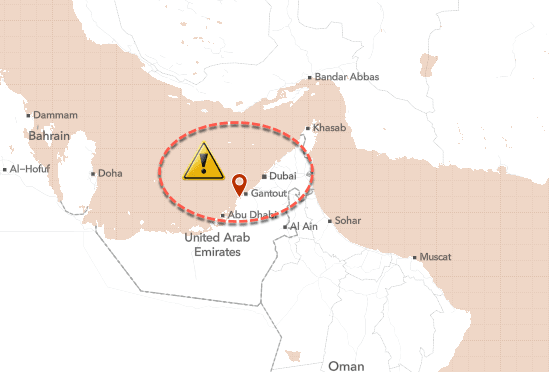
EGA is jointly owned by Mubadala Investment Company of Abu Dhabi and the Investment Corporation of Dubai, and it reported 2.83 million tons of cast metal sales in 2025, indicating on its website that it accounted for 4% of the world’s aluminum production. The broader Middle East accounts for about 9% of global aluminum supply.
The EGA outage adds to mounting pressure on the global aluminum market, which was already strained by the closure of the Strait of Hormuz for six weeks, and still, as of this weekend, muted traffic flows through the critical waterway. Producers across the region now risk broader production cuts unless the maritime chokepoint fully reopens with no tolls.
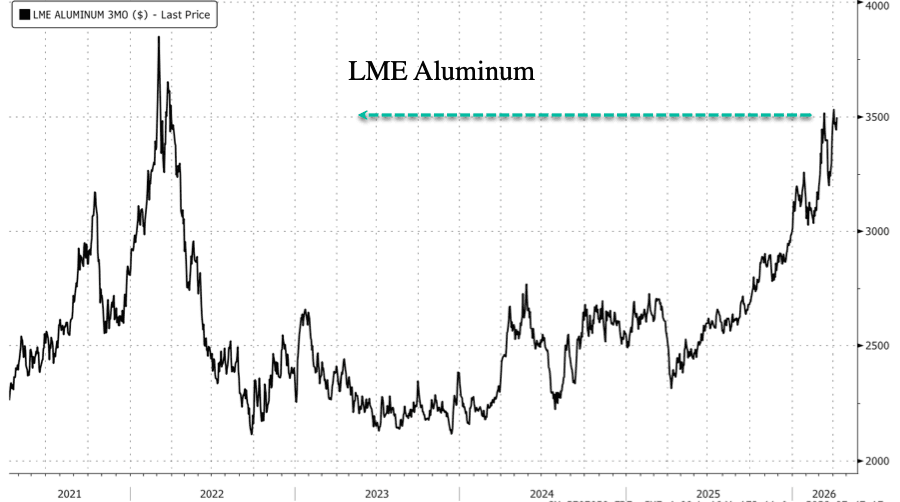
Aluminum futures on the London Metal Exchange have surged since the strikes, with LME Aluminum trading up 50% from a year ago. The force majeure from EGA, as well as continued Hormuz chokepoint disruptions, signals tighter global supplies that may send prices even higher.
Earlier this month, Goldman commodity specialist James McGeoch told clients, “Hard to think of a bigger metal supply shock: High degree of expectation this was where it was heading, but the initial reaction was to fade the uncertainty yesterday, that should be replaced by fresh length if history is a guide.”
END
Key Aluminum Spread In London Hits Biggest Backwardation Since 2007
Monday, Apr 13, 2026 – 07:45 AM
Aluminum futures in London surged to a four-year high on Monday as President Trump’s Strait of Hormuz blockade, set to take effect this morning, threatened to deepen supply chain disruptions across the Gulf region. On top of that, the Gulf’s largest aluminum producer declared force majeure on parts of its contract book over the weekend.
Aluminum climbed 1.4% to $3,547 per ton on the London Metal Exchange as traders priced in increased shipment disruption risk ahead of President Trump’s Hormuz blockade, which U.S. officials said would take effect at 10:00 a.m. New York time on Monday.
The move extends a broader war-driven rally in industrial metals, with aluminum up about 18% year to date, as the market remains gripped by supply fears and tightening Gulf flows.
Emirates Global Aluminum (EGA), the Gulf’s largest aluminum producer, recently halted operations at its Al Taweelah smelter following Iranian missile and drone strikes.
By Saturday, Bloomberg had obtained documents indicating that EGA declared force majeure on parts of its contract book.
EGA is jointly owned by Mubadala Investment Company of Abu Dhabi and the Investment Corporation of Dubai, and it reported 2.83 million tons of cast metal sales in 2025, indicating on its website that it accounted for 4% of the world’s aluminum production. The broader Middle East accounts for about 9% of global aluminum supply.
One of the clearest signs of stress in aluminum markets is the front-end squeeze in the LME curve.
The cash-to-three-month spread jumped 37% to $91.50 a ton from $66.70 on Friday, marking the biggest backwardation since 2007 and signaling a scramble among traders for metal supply.
Earlier this month, Goldman commodity specialist James McGeoch told clients, “Hard to think of a bigger metal supply shock: High degree of expectation this was where it was heading, but the initial reaction was to fade the uncertainty yesterday, that should be replaced by fresh length if history is a guide.”
ASIAN AFFAIRS APRIL 13/2026
YOUR EARLY CURRENCY VALUES/GOLD AND SILVER PRICING/ASIAN AND EUROPEAN BOURSE MOVEMENTS/AND INTEREST RATE SETTINGS MONDAY MORNING.7:30 AM
SHANGHAI CLOSED UP 2.93 PTS OR 0.06%
HANG SENG CLOSED DOWN 232.69 PTS OR 0.90%
Nikkei CLOSED DOWN 1063.18352.61 PTS OR 0.62%
//Australia’s all ordinaries CLOSED DOWN 0.87%
//Chinese yuan (ONSHORE) CLOSED DOWN 6.8341
/ OFFSHORE CLOSED DOWN AT 6.8332 Oil UP TO 104.28 dollars per barrel for WTI and BRENT UP TO 102.78 Stocks in Europe OPENED ALL RED
ONSHORE USA/ YUAN TRADING 6.8341 (DOWN) OFFSHORE YUAN TRADING DOWN TO 6.8332 ONSHORE YUAN TRADING BELOW OFF SHORE AND DOWN ON THE DOLLAR// / AND THUS WEAKER/OFF SHORE YUAN TRADING DOWN AGAINST US DOLLAR/ AND THUS WEAKER
XXXXXXXXXXXXXXXXXXXXXXXXXXXXXXXXXXXXX
YOUR EARLY CURRENCY VALUES/GOLD AND SILVER PRICING/ASIAN AND EUROPEAN BOURSE MOVEMENTS/AND INTEREST RATE SETTINGS MONDAY MORNING.7:30 AM
ONSHORE YUAN: CLOSED DOWN AT 6.8341
OFFSHORE YUAN: DOWN TO 6.8332
1.HANG SANG CLOSED DOWN 232.69 PTS OR 0.90%
2. Nikkei closed DOWN 352.61 PTS OR 0.62%
WEST TEXAS INTERMEDIATE OIL UP TO 104.28
BRENT; 102.78
3. Europe stocks SO FAR: ALL RED
USA dollar INDEX UP TO 98.79/// EURO FALLS TO 1.1686 DOWN 32 BASIS PTS
3b Japan 10 YR bond yield:RISES TO. +2.474 UP 7 FULL BASIS PTS/ VERY TROUBLESOME//Japan buying 100% of bond issuance)/Japanese YEN vs USA cross now at 159.69… JAPANESE YEN NOW FALLING AS WE HAVE NOW REACHED THE ENDING OF THE YEN CARRY TRADE AGAIN AND THE REPATRIATION OF YEN DENOMINATED BONDS TRADING IN THE USA/EUROPE. JAPAN 30 YR BOND YIELD: 3.700 UP 7 FULL BASIS PTS
3c Nikkei now ABOVE 17,000
3d USA/Yen rate now well ABOVE the important 120 barrier this morning
3e Gold DOWN /JAPANESE Yen DOWN CHINESE ONSHORE YUAN: 6.8341( DOWN AND OFFSHORE: DOWN AT 6.8332
3f Japan is to buy INFINITE TRILLION YEN worth of BONDS. Japan’s GDP equals 5 trillion USA
Japan to buy 100% of all new Japanese debt and NOW they will have OVER 50% of all Japanese debt.
3g Oil UP for WTI and BRENT UP this morning
3h European bond buying continues to push yields HIGHER on all fronts in the EMU. German 10yr bund YIELD UP TO +3.0654 Italian 10 Yr bond yield UP to 3.866// SPAIN 10 YR BOND YIELD UP TO 3.527%
3i Greek 10 year bond yield DOWN TO 3.785%
3j Gold at $4724.05 //Silver at: 74.36 1 am est) SILVER NEXT RESISTANCE LEVEL AT $100.00
3k USA vs Russian rouble;// Russian rouble UP 0 AND 67 100 roubles/76.11
3m oil (WTI) into the 104 dollar handle for WTI and 102 handle for Brent/
3n Higher foreign deposits moving out of China// huge risk of outflows and a currency depreciation. This can spell financial disaster for the rest of the world/
JAPAN ON JAN 29.2016 CONTINUES NIRP. THIS MORNING RAISES AMOUNT OF BONDS THAT THEY WILL PURCHASE UP TO .5% ON THE 10 YR BOND///YEN TRADES TO 159.69 10 YEAR YIELD AFTER FIRST BREAKING .54% LAST YEAR NOW EXCEEDS THAT LEVEL TO 2.474% UP 3 BASIS PTS STILL ON CENTRAL BANK (JAPAN) INTERVENTION//YEN CARRY TRADE NOW UNWINDING//YEN BOND TRADING OVERSEAS REPATRIATED.//JAPAN 30 YR: 3.700 UP 7 PTS..: USA/SF this 0.7903 as the Swiss Franc . Euro vs SF: 0.9236
USA 10 YR BOND YIELD: 4.334 UP 2 BASIS PTS…
USA 30 YR BOND YIELD: 4.930 UP 2 BASIS PTS/
USA 2 YR BOND YIELD: 3.824 UP 2 BASIS PTS
USA DOLLAR VS TURKISH LIRA: 44.72 UP 12 BASIS PTS/LIRA GETTING KILLED//IDIOTS FOR SELLING GOLD
10 YR UK BOND YIELD: 4.8660 UP 4 PTS
30 YR UK BOND YIELD: 5.525 UP 4 BASIS PTS
10 YR CANADA BOND YIELD: 3.469 UP 2 BASIS PTS
5 YR CANADA BOND YIELD: 3.077 DOWN 0 BASIS PTS.
1a New York Opening report
Futures Slide But Off Session Lows As Oil Spikes Above $100 Ahead Of Trump’s 10am Hormuz Blockade
Monday, Apr 13, 2026 – 08:23 AM
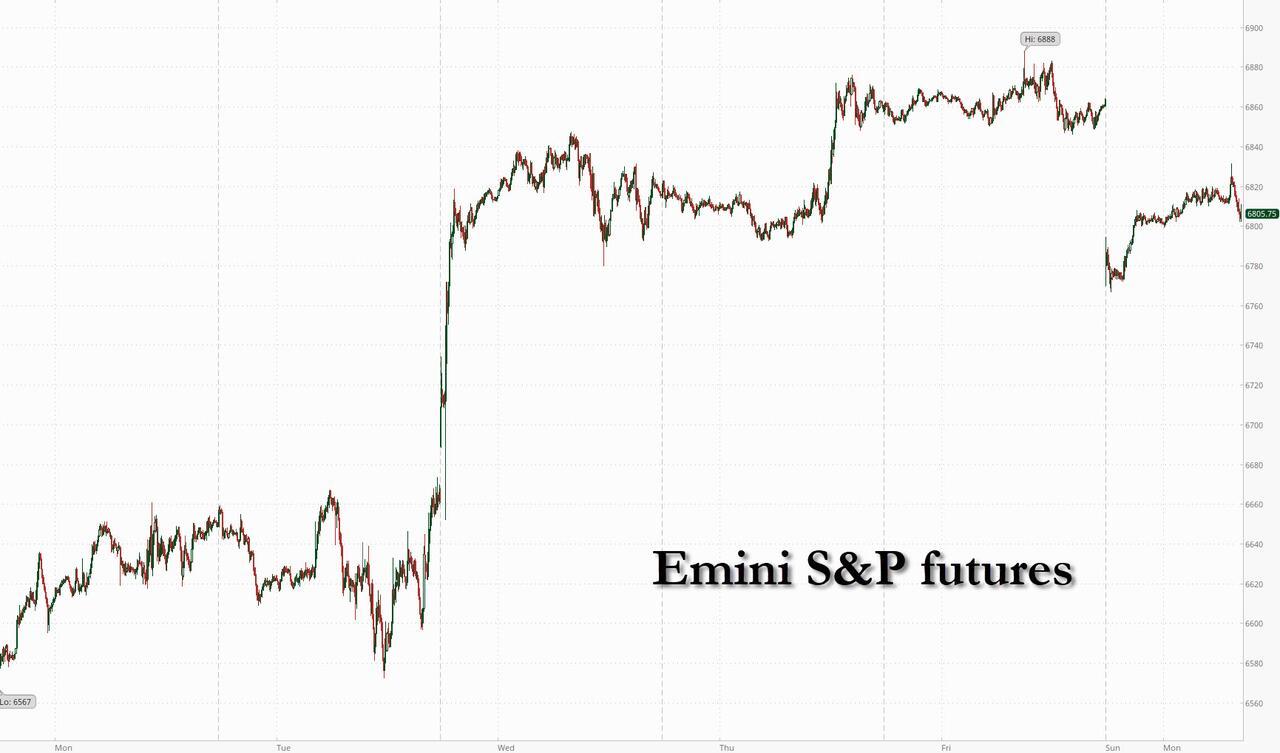
Stock futures are lower, but off their worst levels of the session, as Brent crude surged 7% to over $102 after Trump ordered a blockade of the Strait of Hormuz to take place at 10am ET. The moves look relatively contained given the breakdown of US-Iran talks, with strategists saying this is a moment to buy the dip. Goldman Sachs is kicking off the earnings season shortly with earnings that missed on FICC revenue, sending the stock lower. As of 8:00am ET, S&P 500 futures and Nasdaq 100 contracts were both 0.7% lower with all Mag 7 names lower and Defensives leading Cyclicals ex-Energy. According to JPM, the market continues to price in a resolution leading to a lower than expected set of global losses, even as the situation remains a race against the clock with the world on the brink of an economic calamity; JPMorgan’s commodity team has updated the timeline with impacts from shorts becoming more acute this week and through early May. Bonds trimmed initial losses, with the two-year Treasury yield up three basis points to 3.82% while 10Y yields also rise 3bps to 4.35% . The dollar rose 0.3%, its biggest advance in more than a week. Commodities are higher led by Ags and Energy with gold moderately lower near $4,710 an ounce as the dollar rose. US economic data calendar includes March existing home sales at 10am New York time. Fed speaker slate includes Miran at 6:20pm
In premarket trading, Mag 7 stocks are all lower: Meta -1%, Amazon -0.9%, Nvidia -1.3%, Alphabet -1%, Tesla -0.6%, Apple -0.5%, Microsoft -0.2%
- Baker Hughes (BKR) rises 1% after Hexagon AB agreed to buy the company’s Waygate Technologies unit for about $1.45 billion in cash
- Children’s Place (PLCE) falls 17% after the kids apparel retailer reported adjusted loss per share for the fourth quarter of $1.86 vs. a loss per share of 75 cents in the year-ago period.
- Fastenal (FAST) slips 4% after the industrial supplies company reported operating income for the first quarter that came in just below the average analyst estimate.
- GFL Environmental (GFL) falls over 3% after the waste management company agreed to acquire Canada’s Secure Waste Infrastructure Corp. for C$24.75 per share representing an enterprise value of approximately C$6.4 billion. GFL is also trading ex-dividend on Monday.
- Goldman Sachs (GS) slips 3% after reporting equities sales and trading revenue for the first quarter.
- Ideaya Biosciences (IDYA) rises 15% after the drug developer said a mid-late stage trial of its experimental combination therapy for a type of eye cancer had met its main goal.
- Leggett & Platt (LEG) climbs 7% after bedding company Somnigroup agreed to buy the home furniture manufacturer in an all-stock deal valued at about $2.5 billion.
- Replimune (REPL) plunges 63% after the US Food and Drug Administration rejected the company’s skin cancer treatment for a second time.
In corporate news, the federal government is moving to settle a case over Amazon’s treatment of a group of delivery drivers. Sweden’s Hexagon agreed to buy Waygate Technologies for about $1.45 billion in cash from Baker Hughes. Wise is on track to shift its primary listing from London to Nasdaq next month, with the US listing expected on May 11.
Shipments of oil and gas through the Hormuz strait remain in focus after Trump’s restrictions on vessels calling at Iranian ports threatened to deepen a global energy shock. If successful, the blockade would restrict the one Persian Gulf flow that has continued throughout the war, while Tehran’s warning to target vessels and ports in response amplifies the risks for other producers. Trump has made a “high stakes gamble aimed at forcing Iran to bow to his demands,” said Wealth Club strategist Susannah Streeter. The move makes the energy crisis even more acute, but Trump’s record of pulling back from the brink leaves markets hopeful an agreement can be salvaged, she said. The blockade may also be designed to pressure Beijing into playing a more active role in reopening the Strait, according to Capital Economics. In response, Iran said it will target all ports in or near the Persian Gulf if its shipping hubs are threatened
The relatively mild pullback in riskier assets suggested investors were cautiously optimistic that a resolution was still within reach.
“I was expecting much worse both for the equity market and oil prices this morning,” said Mary-Sol Michel, director of discretionary portfolio management at Swiss Life Banque Privée. “The market sees the blockade as a negotiation tool, but nonetheless, I feel the impact on stocks is quite modest.”
Meanwhile, after a sharp bounce in stocks last week, strategists – always late to the party – are getting increasingly vocal about opportunities to buy the dip. JPMorgan’s Mislav Matejka picked up where his trading desk stopped last week, and said equities have historically proved resilient to oil shocks, with past crude spikes seeing S&P 500 returns positive over 6- and 12-month horizons. Morgan Stanley’s Mike Wilson sees any renewed stock weakness as a buying opportunity, with a strong earnings backdrop anchoring his positive view.
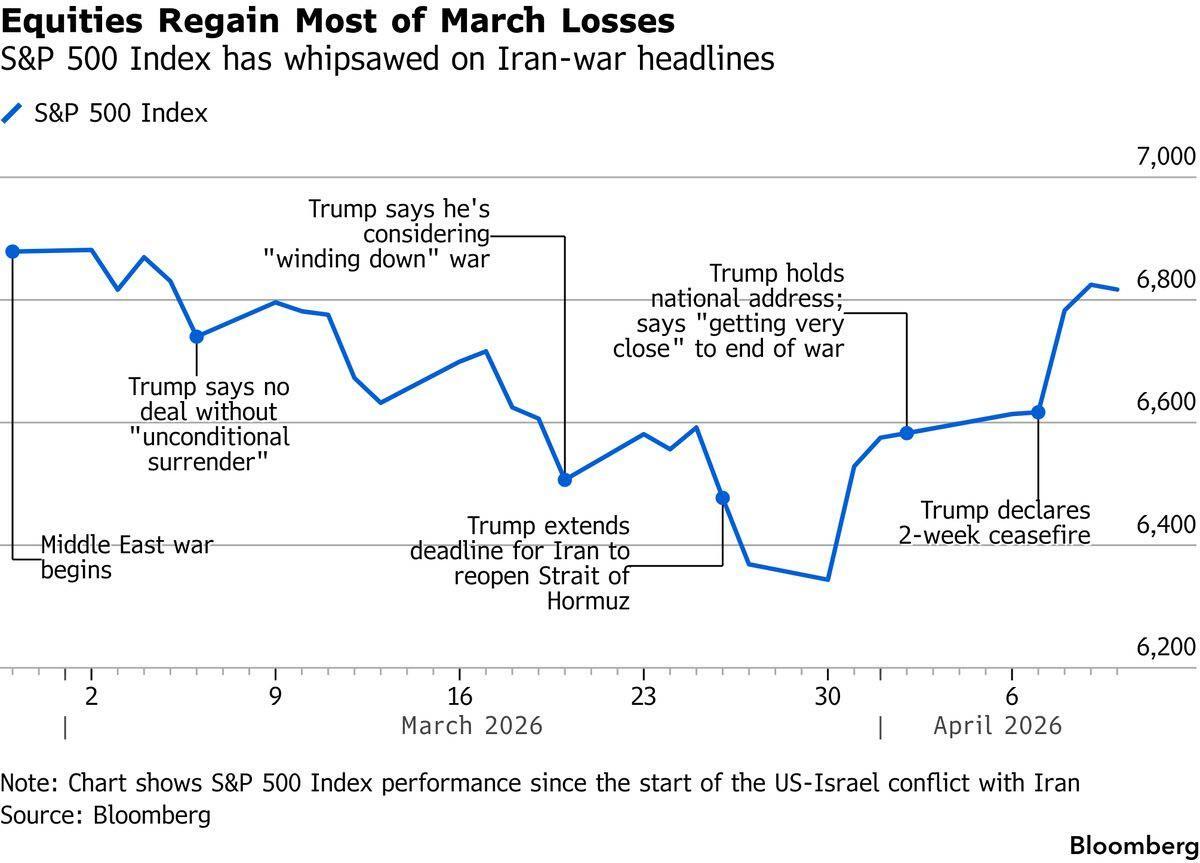
As we noted last week, Goldman traders’ models show CTAs turning into net buyers of US equities over both one-week and one-month horizons, regardless of market direction. In a flat market scenario alone, demand could reach roughly $45 billion over the next week, among the largest such inflows on record.
“Time is playing against markets as each day that goes by with oil prices this high weighs on global growth and pushes inflation,” said Gilles Guibout, head of European equities at BNP Paribas Asset Management. “It’s difficult to see how markets could stage a sustainable rebound without a sustainable solution to this crisis.”
With earnings season kicking off in earnest, investors are eager to hear from executives about risks stemming from the war, artificial intelligence and private credit. Analysts project S&P 500 earnings will show roughly 12% annual growth for the first-quarter, but this drops to just 3% ex Mag 7. Unlike prior quarters, where valuations and expectations were high, the tech sector enters this cycle at its lowest multiple in years. We may be “approaching peak AI doomerism,” according to Gary Paulin of Northern Trust Asset Management, highlighting that compute capacity remains scarce and demand will likely exceed supply for years. Meanwhile, Goldman Sachs Group Inc. fell 3.7% in the US premarket as a revenue miss in fixed-income, currency and commodities trading outweighed a record haul from equities.
In other assets, the prospect of an energy shock spurring inflation is hitting bonds and gold, while copper is tracking lower amid concern about damage to the global economy. The dollar, the wartime haven of choice, is higher against major peers.
Europe’s Stoxx 600 falls 0.7% tracking losses in the US and Asia as energy prices spike. Hungary’s forint surged to a four-year high and local stocks hit a record after Prime Minister Viktor Orban lost Sunday’s election, with the opposition’s victory expected to help unlock billions of euros in European Union funding. Here are the biggest movers Monday:
- European airlines are under pressure as resurgent oil prices reignites concerns about fuel costs and Bernstein warning rising fuel costs will erode earnings
- Meanwhile, oil stocks are the top performers on the Stoxx 600 Monday
- Fertilizer stocks are gaining ground as the US threat to blockade the Strait of Hormuz heightens expectations of possible supply disruptions, while President Donald Trump warned companies against price gouging
- Wise shares rise as much as 6%, hitting their highest level in over six months, after the financial technology company delivered underlying income that mildly topped expectations
- Polypeptide shares rise as much as 16% to the highest since December 2022. The Swiss contract development and manufacturing organization is attracting potential takeover interest from private equity firms
- Vistry shares fall as much as 4.8% as the UK homebuilder promoted Adam Daniels to chief executive officer, succeeding Greg Fitzgerald with immediate effect. RBC says investors were expecting an external hire
- Wickes shares drop as much as 5.9% after Panmure Liberum downgrades the home improvement retailer to hold, citing elevated spending and ambitious targets.
Asian equities fell as a surge in oil prices after US President Donald Trump ordered a blockade of the Strait of Hormuz weighed on sentiment. The MSCI Asia Pacific Index declined as much as 1.3%, with Samsung Electronics and Tencent Holdings among the biggest drags. Most markets in the region were in the red, while shares rose in mainland China. Thailand was closed for a holiday. Benchmarks in Taiwan and mainland China edged higher as Asia’s largest economy unveiled policy measures to demonstrate “goodwill” toward the island on Sunday, following a landmark meeting between President Xi Jinping and Taiwan opposition leader Cheng Li-wun. The Taiex Index closed at a record high.
In FX, the Bloomberg Dollar Spot Index is up 0.3%. The Norwegian krone is the best performing G-10 currency, rising 0.4% against the greenback. The Hungarian forint rallies over 2% against the euro after Prime Minister Viktor Orban’s election defeat.
In rates, treasuries are in the red, pushing US 10-year yields up 4 bps to 4.35% having partially recovered from opening gap down that followed US President Trump’s weekend order to blockade the Strait of Hormuz after US-Iran peace talks failed; bunds and gilts underperform slightly. Gilts lead the rates selloff in European bond markets, with UK 10-year yields rising 3 bps to 4.86%.
In commodities, Brent crude futures are up over 7% and back above $100 a barrel while European natural gas futures jump 9%. Precious metals slide with spot silver down 2%.
The US economic data calendar includes March existing home sales at 10am New York time. Fed speaker slate includes Miran at 6:20pm
Market Snapshot
- S&P 500 mini -0.6%
- Nasdaq 100 mini -0.6%
- Russell 2000 mini -0.9%
- Stoxx Europe 600 -0.6%
- DAX -0.9%
- CAC 40 -0.8%
- 10-year Treasury yield +2 basis points at 4.33%
- VIX +2 points at 21.24
- Bloomberg Dollar Index +0.3% at 1201.98
- euro -0.3% at $1.1687
- WTI crude +8.2% at $104.45/barrel
Top Overnight News
- Oil jumped after Donald Trump ordered a blockade of the Strait of Hormuz, escalating tensions with Iran after the collapse of weekend peace talks. The blockade starts at 10 a.m. ET and applies to all maritime traffic entering and exiting Iranian ports. Iran’s military said it would target all ports in the Gulf region if its own shipping hubs are threatened. BBG
- The UK won’t take part in the proposed Hormuz blockade, the government said, setting up another point of contention between Trump and PM Keir Starmer. BBG
- Policymakers gathering for IMF and World Bank meetings in Washington this week will take a hard look at the war’s impact on all things economic. IMF chief Kristalina Georgieva told CBS that prices will take time to come down even if a ceasefire holds. BBG
- AI Is Using So Much Energy That Computing Firepower Is Running Out. AI companies are rationing offerings and products, rankling users—a warning sign for a boom that depends on rapid adoption. WSJ
- Anthropic is gaining ground on OpenAI in the race for paying customers, as new data points to rising business adoption and a levelling-off in its rival’s growth. Nearly one in three US businesses paid for Anthropic’s tools in March, according to data from payments group Ramp, marking a rise of more than 6 percentage points from the previous month. FT
- Japan’s 10-year government bond yield climbed to its highest level since 1997. The BOJ’s policy decision this month is too close to call, a former executive director said. BBG
- Kevin Warsh’s confirmation as the next chair of the Federal Reserve is at risk of being delayed until after the end of Jay Powell’s term, as Donald Trump’s pick to lead the central bank faces an increasingly tight timeline. FT
- China announced measures to improve relations with Taiwan after a meeting between Xi Jinping and the island’s opposition leader, Cheng Li-wun. BBG
- Bank of Japan Governor Kazuo Ueda signaled a more cautious stance on the impact of the US-Iran conflict, cooling expectations of an interest rate hike later this month. BBG
- Hedge Funds net bought Macro Products (Index and ETF combined) at the fastest pace since May ‘25 (+2.2 SDs 1-year), driven by short covers and long buys (2.4 to 1). US-listed ETF shorts decreased -11.5% (now down -6% MoM), the largest weekly % covering in the past decade (-3.2 z score), led by covers in Large Cap Equity and to a lesser extent Credit ETFs. Goldman Prime Brokerage
Iran War
- US delegation led by Vice President Vance left US-Iran talks in Pakistan to return to the US without an agreement after 21 hours of talks, while Vance said the US had sought an affirmative commitment Iran would not seek a nuclear weapon or tools to quickly achieve one, and the US left behind a “final and best offer”. Iranian Foreign Ministry spokesperson Baqaei said any success depended on the US refraining from excessive demands and unlawful requests, and negotiating with seriousness and good faith, while an Iranian report noted there was disagreement on several issues and that the Americans demanded through negotiations what they could not obtain through war.
- US President Trump said the US Navy will begin the process of blockading any and all ships trying to enter or leave the Strait of Hormuz, while he stated that the meeting went well and most points were agreed to, apart from nuclear, which was the only point that mattered. Trump also stated that at some point, we will reach an “ALL BEING ALLOWED TO GO IN, ALL BEING ALLOWED TO GO OUT” basis, but Iran has not allowed that by saying there may be mines somewhere, which is world extortion, and leaders of world countries, especially the US, will never be extorted. Furthermore, he said at an appropriate moment, the US is fully locked and loaded, and the military will finish up the little that is left of Iran, and warned that any Iranians who fire at the US or at peaceful vessels will be blown to hell.
- US Central Command said it will begin implementing a blockade on all maritime traffic entering and leaving Iranian ports on April 13th at 17:00 Israeli time (15:00BST/10:00EDT), although it would “not impede” vessels transiting the Strait of Hormuz travelling to or from non-Iranian ports. US President Trump later posted that “The United States to Blockade Ships Entering or Exiting Iranian Ports on April 13 at 10:00 A.M. ET.”
- US President Trump and his advisers are weighing resuming limited strikes in Iran, in addition to the US blockade, to break the stalemate in peace talks, according to WSJ citing officials and people familiar with the situation. However, it was also reported that Trump is said to remain open to a diplomatic solution.
- Pakistani, Egyptian and Turkish mediators will continue talks with the US and Iran in the coming days, aiming to help close the gaps between US-Iran, Axios reported citing sources; all parties believe a deal is possible. This follows on from earlier reports by Pakistani press stating that Pakistani officials are continuing efforts to convince the US delegation to return to talks; talks took place in a positive atmosphere, indicating both sides are interested in continuing dialogue.
- White House outlined the red lines it said Iran refused to agree onaccording to an official cited by CNN. Red lines included ending all of its uranium enrichment, dismantling its major nuclear enrichment facilities, retrieving the more than 400 kilograms of highly enriched uranium believed to be buried underground, accepting a broader “peace, security and de-escalation framework” that includes regional allies, ending funding for terrorist proxy groups Hamas, Hezbollah and the Houthis, fully opening the Strait of Hormuz, and charging no tolls for passage.
- Iran’s Foreign Minister posted “In intensive talks at highest level in 47 years, Iran engaged with U.S in good faith to end war. But when just inches away from “Islamabad MoU”, we encountered maximalism, shifting goalposts, and blockade”.
- Iranian armed forces say if Iran’s ports are threatened, then “no port in the Persian Gulf and Oman Sea will be safe”, IRIB News reported.
- Iranian National Security Commission Spokesman said US blockade claim is a bluff, ISNA reported.
- IDF troops are expanding targeted ground operations against Hezbollah infrastructure in the Bint Jbeil area of southern Lebanon to strengthen forward defence. The statement said troops killed more than 100 Hezbollah fighters, dismantled dozens of infrastructure sites and found hundreds of weapons in the area.
- Tasnim Agency reported, citing sources, US President Trump will lose the Bab al-Mandab Strait should he decide to take action against the Strait of Hormuz.
- IRGC warns the approach of military vessels toward the Strait of Hormuz is a breach of the ceasefire, IRNA reported.
- Israeli forces carry out two airstrikes near Choukine in southern Lebanon.
- IDF defines Lebanon as the main arena at this stage, while Iran is defined as an “arena of readiness” – with high alertness for any development.
- Israel has decided to establish 15 permanent camps along the front line of the Lebanese villages, Al Jazeera reported, citing Channel 12.
- Israel reportedly conducts raid targeting Beyout Al-Siyad in southern Lebanon.
- Sirens sound in Kiryat Shmona, Northern Israel, according to SNN, while Tasnim also reported that Hezbollah is conducting missile attacks on Israeli towns.
- French President Macron said France and the UK will organise a conference in coming days aimed at restoring freedom of navigation in Hormuz. Macron said any Hormuz naval mission would be strictly defensive and stressed that every effort must be made to reach a lasting, solid diplomatic end to the Middle East conflict. He also reiterated the importance of finding a way to restore peace in Lebanon.
A more detailed look at global markets courtesy of Newsquawk
APAC stocks declined after the negotiations marathon over the weekend between the US and Iran in Pakistan ended without an agreement, as the sides remained at loggerheads over Iran’s nuclear ambitions. Furthermore, US President Trump announced a US naval blockade on ships travelling through the Strait of Hormuz, while the US military said it would start a blockade of Iranian ports on Monday at 10:00EDT/15:00BST, but would “not impede” vessels transiting the Strait of Hormuz travelling to or from other countries. ASX 200 was dragged lower by underperformance in tech and miners, while energy was at the other end of the spectrum following a surge in oil prices. Nikkei 225 retreated amid headwinds from the higher energy prices, which weighed heavily on power companies and large manufacturers, while there were also recent suggestions from Japan’s economy minister that BoJ policy to boost the yen could be an option to curb inflation. Hang Seng and Shanghai Comp followed suit to the losses in regional peers, with sentiment not helped by another meagre PBoC liquidity operation and with a mixed performance seen in tech stocks.
Top Asian News
- Chinese Total Social Financing (Mar) 5230B vs. Exp. 5400B (Prev. 2380B).
- Chinese Outstanding Loan Growth YoY (Mar) Y/Y 5.7% vs. Exp. 5.9% (Prev. 6.0%).
- Chinese New Yuan Loans (Mar) 2990B vs. Exp. 3400B (Prev. 900B).
- Chinese M2 Money Supply YoY (Mar) Y/Y 8.5% vs. Exp. 8.9% (Prev. 9%).
- New Zealand Services NZ PSI (Mar) 46.0 (Prev. 48, Rev. 47.6).
- New Zealand Composite NZ PCI (Mar) 48.8 (Prev. 50.5).
European bourses (STOXX 600 -0.6%) have started the week on the backfoot, following talks between the US and Iran resulting in no agreement. US President Trump, in response, stated that the US Navy is to begin the process of blockading any and all ships trying to enter or leave the Strait of Hormuz, causing crude futures to surge. The DAX 40 is the underperformer, while the FTSE 100 is supported. Elsewhere, Hungary’s BUX index is surging following Peter Magyar’s Tisza party secured a supermajority. European sectors point negatively, with all sectors in the red, except Energy. Cyclical sectors continue to be hit the hardest, with Travel & Leisure and Consumer Products & Services lying at the bottom of the pile. To add, SocGen downgraded multiple airlines (Ryanair, easyJet, Wizzair) as a result of the higher energy prices hitting the sector
Top European News
- Peter Magyer’s Tisza party wins the Hungarian election with a supermajority. Preliminary results, based on more than 98% of counted votes thus far, put Peter Magyar on course for 138 seats, exceeding the 133 seats needed for supermajority.
- German Finance Minister Klingbeil said tobacco tax is to be increased in 2026 as counter-financing measure for tax relief bonus.
- German CSU Leader Soeder said that it is right to tax excess profits from mineral oil companies at the European level.
- Spanish PM Sanchez said Spain wants to cooperate with China in all areas.
Central Banks
- BoJ Governor Ueda said Japan’s economy is recovering moderately but with some weakness; said the economy and prices are moving roughly in line with BoJ forecasts; underlying inflation is gradually accelerating towards the BoJ’s target.
- ANZ revises outlook for RBNZ rate hikes in which it now sees hikes in July, September and October.
FX
- FX markets are displaying a slight risk-off bias. A somewhat calm move in currency markets follows the conclusion of US-Iran talks without an agreement on the nuclear issue; however, both sides framed negotiations as positive and recent Qatari reporting suggests Pakistani officials are continuing efforts to bring both sides back to the negotiating table, each reportedly interested in continuing dialogue.
- DXY trades without conviction on either side of a 99.00 handle. The buck looks towards a heavy week of Fed speak, alongside PPI data on Tuesday. On the docket today, uber-dove Miran is set to speak on “Building the Financial System.”
- HUF benefits from the election of the opposition Tisza’s Magyar. Preliminary results, based on more than 98% of counted votes, put Magyar on course for 138 seats (supermajority 133 seats). Although markets had already priced in a Magyar victory, a supermajority will catapult the incoming PM’s bid to fast track various HUF-positive pledges (See Newsquawk Analysis on the headline feed). As such, EUR/HUF surpassed April 2022 lows, marking a session low of 364.02.
- NZD remains the most resilient in the face of energy prices as markets move to price in 82bps of hikes by year-end, an increase of c. 7bps from Friday. Kiwi trades just off highs, after facing resistance at the 0.5840 mark.
Fixed Income
- Global fixed benchmarks are entirely in the red this morning, with energy prices once again surging after the US-Iran peace talks in Pakistan ended without an agreement. Following this, US President Trump said the US Navy will begin the process of blockading any and all ships trying to enter or leave the Strait of Hormuz – this is expected to begin at 15:00 BST / 10:00 EDT.
- USTs currently trade lower by a handful of ticks, and are currently trading at the mid-point of a 110-22+ to 111-00 range. European trade has seen US paper edge off worst levels, potentially as traders digest reports of the possibility of further talks, and as the ceasefire remains for now. Geopols aside, US existing home sales for March is due later, with Fed’s Miran also on the docket.
- Bunds and Gilts have also been pressured, with some underperformance in Gilts, which are lower by around 50 ticks (vs Bunds -24 ticks). Both, as with USTs, are off worst levels. As above, Gilts and Bunds are moving at the whim of geopolitical developments, given the regions’ net-importer of oil statuses. Homing in on Germany, earlier today, the Merz coalition agreed on measures worth EUR 1.6bln to ease the impact of surging energy prices on the German consumer.
- From a yield perspective, the German 2yr has jumped back towards 2.637% (vs Friday close at 2.588%). The 2-year BTP-Bund spread has widened ever so slightly vs Friday’s close, but remains well off the peaks from the heights of the Iran war. Commerzbank’s rate strategist Siemssen said “we would probably need to see a more significant escalation for BTP-Bund spreads to test the March highs again”, adding that “BTPs should also underperform OATs again this week as they are more susceptible to energy prices”.
Trade/Tariffs
- Japan Post (6178 JT) to resume accepting all US-bound mail from Tuesday, after 7-month suspension due to end of ‘de minimis’ exemption, according to a statement.
- China Foreign Ministry, on Trump threatening tariffs if China supplies weapons to Iran, said trade wars have no winners.
- China is to remove tariffs on all products imported from 53 African nations starting May 1st, according to Caixin.
- India is to relax market access for European-standard medical devices.
Commodities
- US-Iran peace talks over the weekend collapsed, and Washington announced a naval blockade of the Strait of Hormuz, effective 10:00EDT/15:00BST on Monday, applying to all vessels entering or departing Iranian ports. Trump and his advisers are also weighing limited military strikes against Iran, though a full bombing campaign is considered less likely. Iran’s military adviser said Tehran “will not allow” the embargo. (full Newsquawk Analysis on the feed).
- Brent surged above USD 100/bbl, with some analysts forecasting prices could rise to USD 150/bbl if the blockade proceeds along the waterway, which carried around one-fifth of global oil and LNG before the conflict. Brent Jun resides in a current USD 100.94-103.87/bbl range and WTI Jun in a USD 93.58-96.93/bbl parameter. Dutch TTF futures jumped above EUR 51.30/MWh before paring gains, with Bloomberg noting the contract’s trading day was extended to 21 hours from 10. The May and June contracts currently reside sub-EUR 50/MWh.
- Spot gold fell below USD 4,650/oz before paring losses, and currently trades around USD 4,725/oz, pressured by a stronger USD and fears of central bank rate increases. Spot gold resides in a USD 4,644-4,740/oz range at the time of writing.
- Copper fell, and aluminium spiked, with metals broadly facing weaker demand risks as soaring energy prices weigh on the global economy. 3M LME copper oscillates in a USD 12,684.63- 12,920.23/t range at the time of writing.
- CPC’s oil exports rose 48% in March from February to 1.58mln bpd, boosted by recovery at the Tengiz field, according to sources cited by Reuters. CPC exports boosted by Tengiz field recovery.
- German Government to reduce energy tax on diesel and petrol by EUR 0.17/L for two months. Employers may provide employees with tax-free bonus of EUR 1000 as part of tax reform. Income tax reform will be adopted in January.
- Kuwait raises May crude prices for Asia, according to pricing document.
- Saudi Aramco’s crude sales to China is set to half next month to around 20mln barrels, Bloomberg reported citing sources.
Geopol
- Taiwan will carry out new drills in coming weeks to ensure the island has access to vital supplies in the event of a Chinese blockade.
US Event Calendar
- 10:00 am: United States Mar Existing Home Sales, est. 4.05m, prior 4.09m
- 6:20 pm: United States Fed’s Miran in Moderated Conversation
DB’s Jim Reid concludes the overnight wrap
Crude above USD 100/bbl as Trump threatens Hormuz blockade, though reports suggest US-Iran talks to continue – Newsquawk US Market Open

Monday, Apr 13, 2026 – 06:16 AM
- The US delegation left US-Iran talks in Pakistan without an agreement after 21 hours of talks. As a response, US President Trump said the US Navy will begin the process of blockading any and all ships trying to enter or leave the Strait of Hormuz, effective 10:00EDT/15:00BST.
- Pakistani, Egyptian and Turkish mediators will continue talks with the US and Iran in the coming days, aiming to help close the gaps between US-Iran, Axios reported citing sources. All parties believe a deal is possible.
- Energy spikes, Brent returns above USD 100/bbl as Trump threatens Hormuz blockade.
- European bourses weaker but off worst levels, LHA GY suffer from another strike; US equity futures in the red.
- DXY firmer on haven demand, HUF surges on Tisza supermajority.
- Global fixed income hit as energy surges; busy speaker slate ahead.
- Looking ahead, highlights include US Existing Home Sales (Mar), OPEC MOMR (Apr). Speakers include ECB’s de Guindos, RBA’s Hauser & Fed’s Miran. Earnings from Goldman Sachs & LVMH.
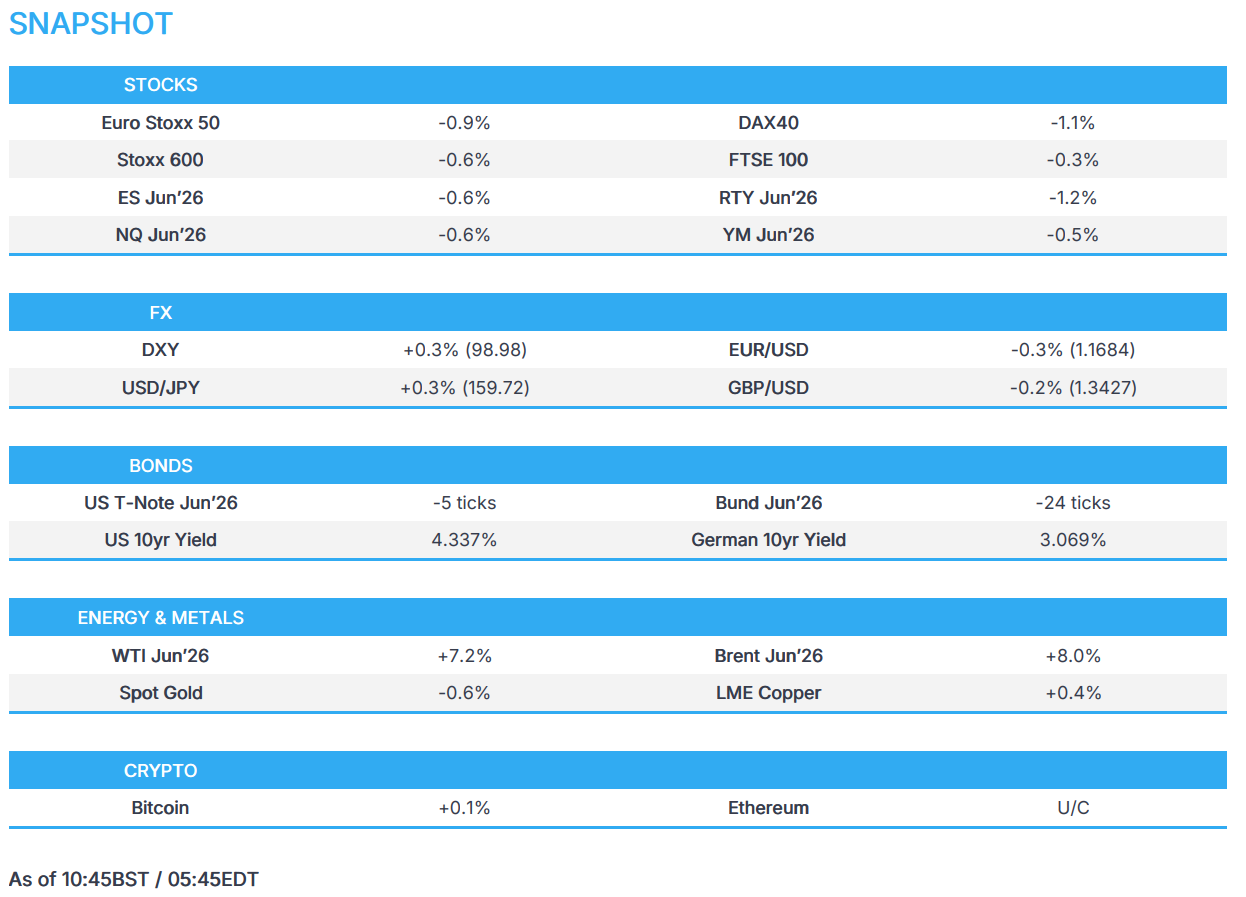
Newsquawk in 3 steps:
1. Subscribe to the free premarket movers reports
2. Listen to this report in the market open podcast (available on Apple and Spotify)
3. Trial Newsquawk’s premium real-time audio news squawk box for 7 days
IRAN CONFLICT
- US delegation led by Vice President Vance left US-Iran talks in Pakistan to return to the US without an agreement after 21 hours of talks, while Vance said the US had sought an affirmative commitment Iran would not seek a nuclear weapon or tools to quickly achieve one, and the US left behind a “final and best offer”. Iranian Foreign Ministry spokesperson Baqaei said any success depended on the US refraining from excessive demands and unlawful requests, and negotiating with seriousness and good faith, while an Iranian report noted there was disagreement on several issues and that the Americans demanded through negotiations what they could not obtain through war.
- US President Trump said the US Navy will begin the process of blockading any and all ships trying to enter or leave the Strait of Hormuz, while he stated that the meeting went well and most points were agreed to, apart from nuclear, which was the only point that mattered. Trump also stated that at some point, we will reach an “ALL BEING ALLOWED TO GO IN, ALL BEING ALLOWED TO GO OUT” basis, but Iran has not allowed that by saying there may be mines somewhere, which is world extortion, and leaders of world countries, especially the US, will never be extorted. Furthermore, he said at an appropriate moment, the US is fully locked and loaded, and the military will finish up the little that is left of Iran, and warned that any Iranians who fire at the US or at peaceful vessels will be blown to hell.
- US Central Command said it will begin implementing a blockade on all maritime traffic entering and leaving Iranian ports on April 13th at 17:00 Israeli time (15:00BST/10:00EDT), although it would “not impede” vessels transiting the Strait of Hormuz travelling to or from non-Iranian ports. US President Trump later posted that “The United States to Blockade Ships Entering or Exiting Iranian Ports on April 13 at 10:00 A.M. ET.”
- US President Trump and his advisers are weighing resuming limited strikes in Iran, in addition to the US blockade, to break the stalemate in peace talks, according to WSJ citing officials and people familiar with the situation. However, it was also reported that Trump is said to remain open to a diplomatic solution.
- Pakistani, Egyptian and Turkish mediators will continue talks with the US and Iran in the coming days, aiming to help close the gaps between US-Iran, Axios reported citing sources; all parties believe a deal is possible. This follows on from earlier reports by Pakistani press stating that Pakistani officials are continuing efforts to convince the US delegation to return to talks; talks took place in a positive atmosphere, indicating both sides are interested in continuing dialogue.
- White House outlined the red lines it said Iran refused to agree onaccording to an official cited by CNN. Red lines included ending all of its uranium enrichment, dismantling its major nuclear enrichment facilities, retrieving the more than 400 kilograms of highly enriched uranium believed to be buried underground, accepting a broader “peace, security and de-escalation framework” that includes regional allies, ending funding for terrorist proxy groups Hamas, Hezbollah and the Houthis, fully opening the Strait of Hormuz, and charging no tolls for passage.
- Iran’s Foreign Minister posted “In intensive talks at highest level in 47 years, Iran engaged with U.S in good faith to end war. But when just inches away from “Islamabad MoU”, we encountered maximalism, shifting goalposts, and blockade”.
- Iranian armed forces say if Iran’s ports are threatened, then “no port in the Persian Gulf and Oman Sea will be safe”, IRIB News reported.
- Iranian National Security Commission Spokesman said US blockade claim is a bluff, ISNA reported.
- IDF troops are expanding targeted ground operations against Hezbollah infrastructure in the Bint Jbeil area of southern Lebanon to strengthen forward defence. The statement said troops killed more than 100 Hezbollah fighters, dismantled dozens of infrastructure sites and found hundreds of weapons in the area.
- Tasnim Agency reported, citing sources, US President Trump will lose the Bab al-Mandab Strait should he decide to take action against the Strait of Hormuz.
- IRGC warns the approach of military vessels toward the Strait of Hormuz is a breach of the ceasefire, IRNA reported.
- Israeli forces carry out two airstrikes near Choukine in southern Lebanon.
- IDF defines Lebanon as the main arena at this stage, while Iran is defined as an “arena of readiness” – with high alertness for any development.
- Israel has decided to establish 15 permanent camps along the front line of the Lebanese villages, Al Jazeera reported, citing Channel 12.
- Israel reportedly conducts raid targeting Beyout Al-Siyad in southern Lebanon.
- Sirens sound in Kiryat Shmona, Northern Israel, according to SNN, while Tasnim also reported that Hezbollah is conducting missile attacks on Israeli towns.
- French President Macron said France and the UK will organise a conference in coming days aimed at restoring freedom of navigation in Hormuz. Macron said any Hormuz naval mission would be strictly defensive and stressed that every effort must be made to reach a lasting, solid diplomatic end to the Middle East conflict. He also reiterated the importance of finding a way to restore peace in Lebanon.
EUROPEAN TRADE
EQUITIES
- European bourses (STOXX 600 -0.6%) have started the week on the backfoot, following talks between the US and Iran resulting in no agreement. US President Trump, in response, stated that the US Navy is to begin the process of blockading any and all ships trying to enter or leave the Strait of Hormuz, causing crude futures to surge. The DAX 40 is the underperformer, while the FTSE 100 is supported. Elsewhere, Hungary’s BUX index is surging following Peter Magyar’s Tisza party secured a supermajority.
- European sectors point negatively, with all sectors in the red, except Energy. Cyclical sectors continue to be hit the hardest, with Travel & Leisure and Consumer Products & Services lying at the bottom of the pile. To add, SocGen downgraded multiple airlines (Ryanair, easyJet, Wizzair) as a result of the higher energy prices hitting the sector.
- US equity futures have followed its peers but have come off worst levels. In pre-market trade Sandisk (+1.9%) moves higher, with the Co. set to join the Nasdaq 100.
- Click for the sessions European pre-market equity newsflow
- Click for the additional news
FX
- FX markets are displaying a slight risk-off bias. A somewhat calm move in currency markets follows the conclusion of US-Iran talks without an agreement on the nuclear issue; however, both sides framed negotiations as positive and recent Qatari reporting suggests Pakistani officials are continuing efforts to bring both sides back to the negotiating table, each reportedly interested in continuing dialogue.
- DXY trades without conviction on either side of a 99.00 handle. The buck looks towards a heavy week of Fed speak, alongside PPI data on Tuesday. On the docket today, uber-dove Miran is set to speak on “Building the Financial System.”
- HUF benefits from the election of the opposition Tisza’s Magyar. Preliminary results, based on more than 98% of counted votes, put Magyar on course for 138 seats (supermajority 133 seats). Although markets had already priced in a Magyar victory, a supermajority will catapult the incoming PM’s bid to fast track various HUF-positive pledges (See Newsquawk Analysis on the headline feed). As such, EUR/HUF surpassed April 2022 lows, marking a session low of 364.02.
- NZD remains the most resilient in the face of energy prices as markets move to price in 82bps of hikes by year-end, an increase of c. 7bps from Friday. Kiwi trades just off highs, after facing resistance at the 0.5840 mark.
FIXED INCOME
- Global fixed benchmarks are entirely in the red this morning, with energy prices once again surging after the US-Iran peace talks in Pakistan ended without an agreement. Following this, US President Trump said the US Navy will begin the process of blockading any and all ships trying to enter or leave the Strait of Hormuz – this is expected to begin at 15:00 BST / 10:00 EDT.
- USTs currently trade lower by a handful of ticks, and are currently trading at the mid-point of a 110-22+ to 111-00 range. European trade has seen US paper edge off worst levels, potentially as traders digest reports of the possibility of further talks, and as the ceasefire remains for now. Geopols aside, US existing home sales for March is due later, with Fed’s Miran also on the docket.
- Bunds and Gilts have also been pressured, with some underperformance in Gilts, which are lower by around 50 ticks (vs Bunds -24 ticks). Both, as with USTs, are off worst levels. As above, Gilts and Bunds are moving at the whim of geopolitical developments, given the regions’ net-importer of oil statuses. Homing in on Germany, earlier today, the Merz coalition agreed on measures worth EUR 1.6bln to ease the impact of surging energy prices on the German consumer.
- From a yield perspective, the German 2yr has jumped back towards 2.637% (vs Friday close at 2.588%). The 2-year BTP-Bund spread has widened ever so slightly vs Friday’s close, but remains well off the peaks from the heights of the Iran war. Commerzbank’s rate strategist Siemssen said “we would probably need to see a more significant escalation for BTP-Bund spreads to test the March highs again”, adding that “BTPs should also underperform OATs again this week as they are more susceptible to energy prices”.
COMMODITIES
- US-Iran peace talks over the weekend collapsed, and Washington announced a naval blockade of the Strait of Hormuz, effective 10:00EDT/15:00BST on Monday, applying to all vessels entering or departing Iranian ports. Trump and his advisers are also weighing limited military strikes against Iran, though a full bombing campaign is considered less likely. Iran’s military adviser said Tehran “will not allow” the embargo. (full Newsquawk Analysis on the feed).
- Brent surged above USD 100/bbl, with some analysts forecasting prices could rise to USD 150/bbl if the blockade proceeds along the waterway, which carried around one-fifth of global oil and LNG before the conflict. Brent Jun resides in a current USD 100.94-103.87/bbl range and WTI Jun in a USD 93.58-96.93/bbl parameter. Dutch TTF futures jumped above EUR 51.30/MWh before paring gains, with Bloomberg noting the contract’s trading day was extended to 21 hours from 10. The May and June contracts currently reside sub-EUR 50/MWh.
- Spot gold fell below USD 4,650/oz before paring losses, and currently trades around USD 4,725/oz, pressured by a stronger USD and fears of central bank rate increases. Spot gold resides in a USD 4,644-4,740/oz range at the time of writing.
- Copper fell, and aluminium spiked, with metals broadly facing weaker demand risks as soaring energy prices weigh on the global economy. 3M LME copper oscillates in a USD 12,684.63- 12,920.23/t range at the time of writing.
- CPC’s oil exports rose 48% in March from February to 1.58mln bpd, boosted by recovery at the Tengiz field, according to sources cited by Reuters. CPC exports boosted by Tengiz field recovery.
- German Government to reduce energy tax on diesel and petrol by EUR 0.17/L for two months. Employers may provide employees with tax-free bonus of EUR 1000 as part of tax reform. Income tax reform will be adopted in January.
- Kuwait raises May crude prices for Asia, according to pricing document.
- Saudi Aramco’s crude sales to China is set to half next month to around 20mln barrels, Bloomberg reported citing sources.
TRADE/TARIFFS
- Japan Post (6178 JT) to resume accepting all US-bound mail from Tuesday, after 7-month suspension due to end of ‘de minimis’ exemption, according to a statement.
- China Foreign Ministry, on Trump threatening tariffs if China supplies weapons to Iran, said trade wars have no winners.
- China is to remove tariffs on all products imported from 53 African nations starting May 1st, according to Caixin.
- India is to relax market access for European-standard medical devices.
NOTABLE EUROPEAN HEADLINES
- Peter Magyer’s Tisza party wins the Hungarian election with a supermajority. Preliminary results, based on more than 98% of counted votes thus far, put Peter Magyar on course for 138 seats, exceeding the 133 seats needed for supermajority.
- German Finance Minister Klingbeil said tobacco tax is to be increased in 2026 as counter-financing measure for tax relief bonus.
- German CSU Leader Soeder said that it is right to tax excess profits from mineral oil companies at the European level.
- Spanish PM Sanchez said Spain wants to cooperate with China in all areas.
CENTRAL BANKS
- BoJ Governor Ueda said Japan’s economy is recovering moderately but with some weakness; said the economy and prices are moving roughly in line with BoJ forecasts; underlying inflation is gradually accelerating towards the BoJ’s target.
- ANZ revises outlook for RBNZ rate hikes in which it now sees hikes in July, September and October.
GEOPOLITICS
OTHERS
- Taiwan will carry out new drills in coming weeks to ensure the island has access to vital supplies in the event of a Chinese blockade.
CRYPTO
- Bitcoin trades either side of USD 71k, while Ethereum oscillates around USD 2k.
APAC TRADE
- APAC stocks declined after the negotiations marathon over the weekend between the US and Iran in Pakistan ended without an agreement, as the sides remained at loggerheads over Iran’s nuclear ambitions. Furthermore, US President Trump announced a US naval blockade on ships travelling through the Strait of Hormuz, while the US military said it would start a blockade of Iranian ports on Monday at 10:00EDT/15:00BST, but would “not impede” vessels transiting the Strait of Hormuz travelling to or from other countries.
- ASX 200 was dragged lower by underperformance in tech and miners, while energy was at the other end of the spectrum following a surge in oil prices.
- Nikkei 225 retreated amid headwinds from the higher energy prices, which weighed heavily on power companies and large manufacturers, while there were also recent suggestions from Japan’s economy minister that BoJ policy to boost the yen could be an option to curb inflation.
- Hang Seng and Shanghai Comp followed suit to the losses in regional peers, with sentiment not helped by another meagre PBoC liquidity operation and with a mixed performance seen in tech stocks.
NOTABLE APAC DATA RECAP
- Chinese Total Social Financing (Mar) 5230B vs. Exp. 5400B (Prev. 2380B).
- Chinese Outstanding Loan Growth YoY (Mar) Y/Y 5.7% vs. Exp. 5.9% (Prev. 6.0%).
- Chinese New Yuan Loans (Mar) 2990B vs. Exp. 3400B (Prev. 900B).
- Chinese M2 Money Supply YoY (Mar) Y/Y 8.5% vs. Exp. 8.9% (Prev. 9%).
- New Zealand Services NZ PSI (Mar) 46.0 (Prev. 48, Rev. 47.6).
- New Zealand Composite NZ PCI (Mar) 48.8 (Prev. 50.5).
1c) Asian opening report
Crude above USD 100/bbl as US-Iran talks stall on nuclear ambitions – Newsquawk EU Market Open
Monday, Apr 13, 2026 – 02:09 AM
- The US delegation, led by Vice President Vance, left US-Iran talks in Pakistan to return to the US without an agreement after 21 hours of talks.
- US President Trump said the US Navy will begin the process of blockading any and all ships trying to enter or leave the Strait of Hormuz.
- US Central Command said it will begin implementing a blockade on all maritime traffic entering and leaving Iranian ports on April 13th at 17:00 Israeli time (15:00BST/10:00EDT).
- Crude futures surged with Brent crude back above the USD 100/bbl level following the failure of US-Iran talks in Islamabad and with the US to begin a naval blockade in the Strait of Hormuz.
- APAC stocks declined; European equity futures indicate a lower cash market open with Euro Stoxx 50 futures down 1.4%, off worst levels.
- Looking ahead, highlights include US Existing Home Sales (Mar), OPEC MOMR (Apr). Speakers include ECB’s de Guindos, RBA’s Hauser & Fed’s Miran. Earnings from Goldman Sachs & LVMH.
SNAPSHOT
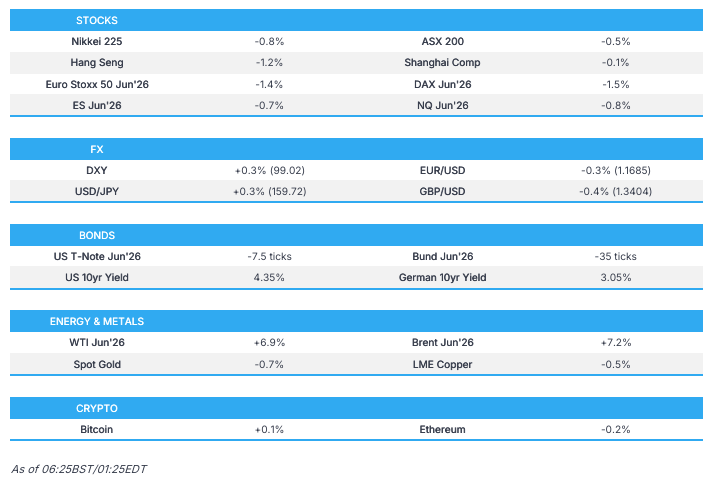
Newsquawk in 3 steps:
1. Subscribe to the free premarket movers reports
2. Listen to this report in the market open podcast (available on Apple and Spotify)
3. Trial Newsquawk’s premium real-time audio news squawk box for 7 days
IRAN CONFLICT
- US delegation led by Vice President Vance left US-Iran talks in Pakistan to return to the US without an agreement after 21 hours of talks, while Vance said the US had sought an affirmative commitment Iran would not seek a nuclear weapon or tools to quickly achieve one, and the US left behind a “final and best offer”. Iranian Foreign Ministry spokesperson Baqaei said any success depended on the US refraining from excessive demands and unlawful requests, and negotiating with seriousness and good faith, while an Iranian report noted there was disagreement on several issues and that the Americans demanded through negotiations what they could not obtain through war.
- US President Trump said the US Navy will begin the process of blockading any and all ships trying to enter or leave the Strait of Hormuz, while he stated that the meeting went well and most points were agreed to, apart from nuclear, which was the only point that mattered. Trump also stated that at some point, we will reach an “ALL BEING ALLOWED TO GO IN, ALL BEING ALLOWED TO GO OUT” basis, but Iran has not allowed that by saying there may be mines somewhere, which is world extortion, and leaders of world countries, especially the US, will never be extorted. Furthermore, he said at an appropriate moment, the US is fully locked and loaded, and the military will finish up the little that is left of Iran, and warned that any Iranians who fire at the US or at peaceful vessels will be blown to hell.
- US Central Command said it will begin implementing a blockade on all maritime traffic entering and leaving Iranian ports on April 13th at 17:00 Israeli time (15:00BST/10:00EDT), although it would “not impede” vessels transiting the Strait of Hormuz travelling to or from non-Iranian ports. US President Trump later posted that “The United States to Blockade Ships Entering or Exiting Iranian Ports on April 13 at 10:00 A.M. ET.”
- IRGC warned the approach of military vessels toward Strait of Hormuz is a breach of ceasefire, IRNA reported.
- US President Trump said it won’t take long to clean out the Strait and will have to re-examine NATO, which wasn’t there for the US, but he thinks numerous countries will be helping the US with this. Trump also stated that Iranians have not left the bargaining table, and he predicts Iran will give the US everything it wants. Furthermore, he said that prices for oil and gas will eventually be lower when this is over, and could be lower before the midterm elections, or maybe a little higher.
- US President Trump commented that Iran promised to open the Strait of Hormuz and they knowingly failed to do so, while he noted regarding talks that Iran is unwilling to give up its nuclear ambitions. Trump added that in many ways, the points that were agreed to are better than continuing the military operations to conclusion, but those points don’t matter compared to allowing nuclear power in the hands of ‘volatile, difficult and unpredictable people’. Furthermore, he reiterated that Iran will never have a nuclear weapon.
- US President Trump said very good things are happening in the Hormuz Strait and the blockade will be very effective, while he also commented that Iran is in very bad shape and will not have a nuclear weapon, as well as stated that the Iran ceasefire is holding well.
- US President Trump warned that China will have big problems if it ships arms to Iran, while the warning comes amid reports that China is preparing shipments of new air defence systems to Iran in the next couple of weeks that are to be hidden through shipments via third-party nations and shippers.
- US President Trump and his advisers are weighing resuming limited strikes in Iran, in addition to the US blockade, to break the stalemate in peace talks, according to WSJ citing officials and people familiar with the situation. However, it was also reported that the door remains open to a diplomatic solution with Iran, and a second round of talks could be held within days.
- US President Trump told The New York Post on Friday that US warships are being reloaded with “the best ammunition” to resume strikes on Iran if peace talks in Pakistan fail.
- White House officials said on Friday that doubts prevail in the White House and that President Trump believes that opening the Strait of Hormuz is unlikely anytime soon.
- Iranian President Pezeshkian said if the American government abandons its totalitarianism and respects the rights of the Iranian nation, ways to reach an agreement will certainly be found.
- Iran’s Foreign Ministry said that they reached an agreement on a number of points, but differed on two important issues and that talks were held in an atmosphere of mistrust, so it is natural that they should not expect to reach an agreement in just one session. It also stated that contacts and consultations between Iran, Pakistan and other friends in the region will continue, while Iranian press sources said that the Strait of Hormuz and nuclear rights were among the main points of contention.
- Iranian Foreign Minister Araghchi posted “In intensive talks at the highest level in 47 years, Iran engaged with U.S in good faith to end war. But when just inches away from “Islamabad MoU”, we encountered maximalism, shifting goalposts, and blockade”.
- Iranian Parliamentary Speaker Ghalibaf posted a picture of prices of gas near the White House, and commented, “Enjoy the current pump figures. With the so-called ‘blockade’, Soon you’ll be nostalgic for $4–$5 gas.”
- Iranian officials said US President Trump’s threat to mount a blockade of the Strait of Hormuz will have no effect on Iran.
- Iranian state TV said the US continued with extravagant demands during talks, and that the Strait remained a point of disagreement in talks, while Iran insists on keeping its military gains. Furthermore, it was stated that Iran is in no hurry for negotiations, and Iranian state TV reported that talks would continue on Sunday.
- Pakistan’s Foreign Minister said it is imperative that parties continue to uphold their commitment to the ceasefire and wants to express gratitude to the US and Iran for appreciating Pakistan’s efforts to help broker the ceasefire.
- Israeli PM Netanyahu said he wants a true peace pact with Lebanon.
- US officials said two US Navy ships crossed the Strait of Hormuz on Saturday, while Iran claimed it warned it would attack any military vessels that cross the Strait and that the US Navy vessels withdrew. It was separately reported that three oil supertankers (2 Chinese vessels and 1 Greek vessel) sailed through the Strait of Hormuz on Saturday, while two empty supertankers attempted to travel through the Strait of Hormuz on Sunday before making a last-minute U-turn as US-Iran peace negotiations broke down, according to Bloomberg.
- Qatar’s Transport Ministry announced the return of full navigation for all maritime vessels in its waters from Sunday.
- Sirens sounded in Kiryat Shmona, Northern Israel, according to SNN, while Tasnim also reported that Hezbollah conducted missile attacks on Israeli towns.
US TRADE
EQUITIES
- US stocks closed mixed, but rangebound on Friday, in which the Nasdaq 100 edged out slight gains, and the SPX closed lower by a couple of tenths, with sectors predominantly in the red, in which only Tech, Materials, and Discretionary were in the green, while Consumer Staples and Healthcare lagged. Middle East rhetoric once again dominated the tape, and all focus turned to the US-Iran talks on Saturday, despite the ever-ongoing differences between the sides, with the latest reports suggesting that Iran said talks with the US are to begin if ‘preconditions are accepted’, as there continues to be differing opinions regarding Lebanon and the Strait of Hormuz. Meanwhile, Trump told NYP that US warships are being reloaded with “the best ammunition” to resume strikes on Iran if peace talks in Pakistan fail. As such, WTI and Brent were choppy on Friday, but ultimately settled with losses.
- SPX -0.11% at 6,817, NDX +0.14% at 25,116, DJI -0.56% at 47,917, RUT -0.22% at 2,631.
- Click here for a detailed summary.
TARIFFS/TRADE
- China is to remove tariffs on all products imported from 53 African nations starting May 1st, according to Caixin.
- Spanish PM Sanchez said Spain wants to cooperate with China in all areas.
NOTABLE HEADLINES
- Federal Reserve is asking major US banks to provide details regarding their exposure to private credit amid a surge in redemptions, according to Bloomberg.
APAC TRADE
EQUITIES
- APAC stocks declined after the negotiations marathon over the weekend between the US and Iran in Pakistan ended without an agreement, as the sides remained at loggerheads over Iran’s nuclear ambitions. Furthermore, US President Trump announced a US naval blockade on ships travelling through the Strait of Hormuz, while the US military said it would start a blockade of Iranian ports on Monday at 10:00EDT/15:00BST, but would “not impede” vessels transiting the Strait of Hormuz travelling to or from other countries.
- ASX 200 was dragged lower by underperformance in tech and miners, while energy was at the other end of the spectrum following a surge in oil prices.
- Nikkei 225 retreated amid headwinds from the higher energy prices, which weighed heavily on power companies and large manufacturers, while there were also recent suggestions from Japan’s economy minister that BoJ policy to boost the yen could be an option to curb inflation.
- Hang Seng and Shanghai Comp followed suit to the losses in regional peers, with sentiment not helped by another meagre PBoC liquidity operation and with a mixed performance seen in tech stocks.
- US equity futures fell at the open as markets reacted to the failed US-Iran talks and Trump’s Hormuz blockade.
- European equity futures indicate a lower cash market open with Euro Stoxx 50 futures down 1.4% after Euro Stoxx 50 futures closed with gains of 0.5% on Friday.
FX
- DXY strengthened amid the rise in oil prices and risk-off mood owing to the lack of agreement by the US and Iran in marathon talks over the weekend, while President Trump announced is to impose a US naval blockade in the Strait of Hormuz, which is set to begin today at 15:00BST/10:00EDT. This risks flaring up tensions, and he also warned that any Iranians who fire against them will be ‘blown to hell’, but separately noted the ceasefire is going well.
- EUR/USD slipped back beneath the 1.1700 handle amid the firmer buck and with headwinds from rising EU energy prices, while there was little reaction to Hungarian PM Orban’s election defeat after 16 years in power, which is seen as a nod to Europe.
- GBP/USD struggled to hold on to the 1.3400 status amid pressure in cyclicals and despite reports that UK ministers are to introduce legislation that would allow them to align the UK with new Brussels regulations in areas such as food standards or carbon emissions.
- USD/JPY edged higher as it coat-tailed on advances in the greenback and as higher oil prices increase the headwinds for Japan’s economy.
- Antipodeans declined amid the downbeat risk appetite, although the losses were stemmed by support in AUD/USD and NZD/USD at the 0.7000 and 0.5800 levels, respectively.
- PBoC set USD/CNY mid-point at 6.8657 vs exp. 6.8395 (Prev. 6.8654).
- Mexican Central Bank appointed Aldo Heffner Rodriguez as its new chief economist, effective Monday.
FIXED INCOME
- 10yr UST futures retreated with focus on geopolitics and as the oil price surge stoked inflationary concerns.
- Bund futures fell beneath the 125.00 level as the latest geopolitical developments in the Middle East propelled EU gas futures higher by double-digit percentages.
- 10yr JGB futures conformed to the downside in global peers with Japan’s 10yr yield rising to its highest since 1997, although JGB futures are off their worst levels as the higher oil prices, the dampening effects on the economy and inflationary fears muddle the outlook for BoJ policy.
COMMODITIES
- Crude futures surged with Brent crude back above the USD 100/bbl level following the failure of US-Iran talks in Islamabad and with the US to begin a naval blockade in the Strait of Hormuz from Monday at 15:00BST/10:00EDT.
- Saudi Arabia restored the East-West pipeline to full pumping capacity of 7mln bpd.
- Japanese Economy Minister Akazawa said Japan will work closely with Asian nations to ease the oil bottleneck.
- India raised export duties on diesel and jet fuel amid the energy crisis with duties on diesel raised to INR 55.50/litre from INR 21.50/litre.
- Spot gold retreated amid a firmer dollar and surge in oil prices, but is well off the initial lows after rebounding from a brief dip beneath the USD 4,700/oz level.
- Copper futures declined following the lack of a breakthrough in US-Iran talks over the weekend, while reports also noted that President Trump and advisers are weighing resuming limited strikes in Iran, in addition to the US blockade, to break the stalemate in peace talks.
- Chile’s Codelco copper production fell 9.8% Y/Y in February to 88.5k tons.
CRYPTO
- Bitcoin found some slight reprieve from the declines seen over the weekend and retested the USD 71,000 level to the upside.
NOTABLE ASIA-PAC HEADLINES
- Japanese Economy Minister Akazawa said BoJ monetary policy could be an option to curb higher prices by strengthening the domestic currency, according to Reuters.
- RBNZ Governor Breman said the central bank will soon announce steps to increase the transparency of monetary policy decisions.
GEOPOLITICS
OTHER
- US Southern Command said five narco terrorists were eliminated in strikes carried out on two vessels in the Eastern Pacific on Saturday.
- China unveiled policy measures to show goodwill to Taiwan following a meeting between Chinese President Xi and Taiwan’s opposition leader Cheng Li-wun, according to Bloomberg. In relevant news, Taiwan will carry out new drills in the coming weeks to ensure the island has access to vital supplies in the event of a Chinese blockade.
EU/UK
NOTABLE HEADLINES
- UK PM Starmer wants the power to sign the UK up to EU single market rules under plans that would avoid a normal parliamentary vote, with ministers to introduce legislation that would allow them to align the UK with new Brussels regulations in areas such as food standards or carbon emissions, according to The Times.
- UK Chancellor Reeves will set out plans to boost businesses’ competitiveness amid rising energy bills, while warning against large government borrowing, according to Bloomberg.
- S&P affirmed the UK at ‘AA’; outlook stable.
- Hungarian PM Orban conceded defeat in the election after 16 years in power, with Peter Magyar set to become the next PM, as his Tisza party secured two-thirds of seats in parliament.
2.a NORTH KOREA/SOUTH KOREA/JAPAN
NORTH AND SOUTH KOREA
3. CHINA/
$92 Million In Banned AI Chips Went From Super Micro To Little Known Chinese Tech Company
Monday, Apr 13, 2026 – 02:45 AM
A little-known Chinese tech company saw its stock drop sharply after U.S. authorities charged a co-founder of Super Micro Computer with illegally smuggling advanced AI chips into China, according to Bloomberg.
The case is putting fresh focus on how restricted American technology may still be entering the country.
The company, Sharetronic Data Technology, quickly denied any connection to Super Micro and said it complies with all hardware purchasing regulations. However, newly surfaced records tell a more complicated story.
Those records suggest that Sharetronic procured hundreds of Super Micro systems containing high-end chips from Nvidia Corp.—technology that has been banned from being sold to or used within China without approval from Washington since 2022.

The documents point to shipments of servers equipped with Nvidia’s H100 and H200 processors, widely used for training and running advanced AI systems. Some of these systems were reportedly transferred between company entities, raising further questions about how they were obtained.
Bloomberg writes that although the overall scale is small compared to major tech giants, the situation highlights strong demand in China for restricted AI hardware. Companies like Sharetronic often rely on these systems to rent computing power to clients, making access especially valuable.
The case also underscores the difficulty of tracking where sensitive technology ends up. Both Nvidia and Super Micro have said they do not knowingly supply restricted products without proper authorization, yet the records suggest such equipment may still circulate.
As the U.S. continues tightening export controls, this situation highlights gaps in enforcement and leaves open bigger questions about whether current measures are enough to fully limit the global flow of advanced AI chips.
Back in March, Federal prosecutors charged a co-founder of Super Micro Computer Inc. and two associates with participating in a scheme to divert roughly $2.5 billion in advanced Nvidia chips to China. The charges marked a notable escalation in Washington’s effort to police the flow of high-end artificial-intelligence hardware, shifting focus from overseas resellers to individuals with direct ties to U.S. technology firms.
Now defunct short seller Hindenburg Research had identified the executive by name in a report they published earlier the year before.
4. EUROPEAN AND SCANDINAVIAN AFFAIRS PLUS NATO
FRANCE/MACRON OPINION PIECE
(SHURK/AMERICAN THINKER.COM)
Who’s Afraid Of Emmanuel Macron?
Saturday, Apr 11, 2026 – 07:00 AM
Authored by J.B.Shurk via AmericanThinker.com,
French President Emmanuel Macron is doing that peculiar French thing again…acting tough while looking weak.
He gave a speech last Friday at Yonsei University in Seoul during which he demanded that nations not become “vassals” of China or the United States. Macron wants South Korea to join Canada, Australia, and the European Union in forming what he calls a “coalition of independence” (because “coalition of the willing” was taken) united by shared love for “international order,” “democracy,” and wasting money on “climate change.”
What a tool. I understand that “the powers that be” have so successfully co-opted the West’s political systems that they regularly install absolute nincompoops as nominal leaders (Biden, Starmer, Carney, Merz, and European Queen Ursula, just to name a few) and call it “democracy,” but Macron is such a doofus that his “leadership” is laughable.
Remember when the little Rothschild banker came to power a few months after President Trump had taken office and he couldn’t stop talking about standing up to “bullies”? After putting on some high-heeled loafers and taking some lessons on masculinity from his former-schoolteacher-turned-much-older-wife, Macron insisted on turning a handshake with Trump into a death grip meant to showcase French power. In that effete style of speech that Gaulish-Roman aristocrats enjoy — in which words sound as if they’re dropping from lips suckling grapes and licking honey — le petit fromage told the world that his fierce handshake and determined stare were the perfect weapons for countering President Trump. Trump just laughed and patted the little French boy on the shoulder as one does to help the weak feel strong.
Fast-forward a decade, and Macron hasn’t learned a thing about being tough. He still prances around the world like a eunuch looking for long-lost cojones. He says he wants countries to resist the “hegemonic powers” of China and the United States by clinging to the rules-based “international order.” Okay. Good luck, tiny dancer.
What’s left of the international order without the two most powerful nations on the planet? The United States has assumed the responsibilities of the globe’s police chief since WWII. Through its naval fleet, it ensures the security of maritime trade. Through its economic clout, it ensures the stability of the international financial system. Through its military might, it decides which dictators get black-bagged in the middle of the night. As China continues its geopolitical ascent, its tentacles have stretched further into international organizations such as the United Nations’ World Health Organization and across continents with its Belt and Road Initiative. Mark Carney has spent his time as Canada’s prime minister practically groveling at the feet of China’s Xi Jinping and begging the communist dictator to save his wintry vassal state from the bad orange man down south.
France, on the other hand, continues to be ejected from former African colonies whose peoples have grown tired of French meddling. The French military excels only at surrendering. And France remains distinct from Germany only because of the United States. When little Macron insists on restoring a French-led “international order,” he sounds a lot like little Napoleon, who insisted on being called “emperor” while imprisoned on Saint Helena.
As for urging all who hear his grating voice to unite in defense of “democracy,” that’s a lark! Europe is where “democracy” goes to die. Every time non-Establishment political parties win the most votes in former nations (now just multicultural zones of Islamic conquest within the federation of European nothingness) such as France, Germany, and the Netherlands, “the powers that be” proudly block the winners from exercising any power.
Europe’s political class shamelessly calls this the “firewall” against “far-right” political parties. Of course, if you believe that nations should have borders and that government powers should be limited, you are designated “far-right.” Just as Democrats bastardize language in the United States by calling everyone who cares about the Bill of Rights a “fascist,” the European Establishment labels anyone who believes in self-determination and personal liberty a “Nazi sympathizer.” Then they prosecute the members of those fake “far-right” parties for expressing opinions out loud.
That’s right! Europe’s little gang of dimwitted yet dangerous dictators — Macron, Starmer, Merz, and the ruling queen — insist on locking up the “fascists” for their speech in the name of “democracy”! When the “firewall” fails — as it did in Romania a little over a year ago — the European oligarchy simply cancels the election and insists on a rigged do-over (or outright overthrows the government as it did, with the help of the U.S. State Department and CIA, in Ukraine in 2014).
When little European tyrants such as Macron stand on footstools, puff out their chests, and shriek about “democracy,” they have no intention of supporting the decisions of the people. What they mean is, let’s form a European Commission of aristocrats, have them choose a ruling monarch, and call that a “democratic” election. That’s how the nations of Europe lost their sovereignty and why the people of Europe must now bow down to unelected Queen Ursula von der Leyen.
Even if mini-mouse Macron’s calls for “international order” and “democracy” fail to rally a sufficient posse of vassal states willing to take on the United States and China, he’ll surely find ready volunteers who want to keep shooting their economies in the gonads over “climate change,” right? Who doesn’t want to continue wasting taxpayer dollars on fighting the weather? While Russia, China, and the United States continue spending more on their militaries than ever before, the soft-headed “leaders” of Europe have been pretending to wage war against nature. “Tilting at windmills” was one of Cervantes’s best jokes in Don Quixote. The Europeans — having jettisoned their civilization for that of their Islamic invaders — no longer understand why pretending to fight imaginary monsters is funny!
For decades, Europe’s quixotic “leaders” have spent their military budgets on wind and solar energy. In the name of “fighting climate change,” Europe’s brilliant tacticians severely limited hydrocarbon exploration, extraction, and processing. Germany ignored scientific reason after the Fukushima nuclear accident in Japan and rid itself almost entirely of nuclear energy. First, Europe’s braintrust made the sub-continent dependent upon the Russian Federation for energy. Then, that same gaggle of Mensa geniuses sanctioned Russian energy in the name of Ukrainian “democracy.” Now Europe is largely dependent on the United States, Russia, and the Middle East for energy. Europe’s producers must spend more to make things. Europe’s consumers must pay more to buy things. Europe’s middle class keeps getting poorer. How many times can Europe’s moronic “leaders” cripple their economies before Europe’s peoples raid the museums for functioning guillotines?
If little-bitty Macron doesn’t want France to be a “vassal” of China or the United States, he should strive to deregulate his nation, protect private property, incentivize innovation, grow the economy, and encourage self-sufficiency. Instead, France and the rest of Europe embrace bureaucratic rule-making, collective ownership, expansive welfare, centralized economic planning, and dependency upon U.S. military muscle. If you spend your country’s wealth on fighting bad weather and providing Islamic invaders “free” food and housing, don’t complain when China and the United States refuse to take you seriously.
To be fair to Europe’s retarded governing class, we’re fighting similar idiotic policies being promoted by the fifth-column Democrat Party in America, too.
The difference is that Americans are actively trying to right the ship, and, as President Trump continues to demonstrate, our military can still blow things up.
Reality is not kind to those who prefer handouts and fantasy to handwork and preparation. Because Europe’s “leaders” have hollowed out their economies and militaries for decades, they are in no position to influen
end
FRANCE
France’s Gig-Economy Built On Migrant Labor As 99% Of Surveyed Delivery-Riders Are Foreign-Born, Two-Thirds Are Illegal
Monday, Apr 13, 2026 – 02:00 AM
Authored by Thomas Brooke via Remix News,
A major new study has found that France’s food delivery sector is almost exclusively staffed by migrant workers, a majority of whom are living in France illegally.

The Enquête report, based on a survey of more than 1,000 riders in Paris and Bordeaux, reveals that 98.7 percent of delivery couriers were born outside France, with nearly two-thirds lacking legal residency status, highlighting the extent to which the platform economy depends on a highly vulnerable migrant labor force.
The workforce is dominated by recent arrivals from Africa, the majority of whom are not undertaking any other education or training in France.
A total of 55.2 percent of riders come from West Africa, making it by far the largest group. A further 17.4 percent are from North Africa, while 4.6 percent come from other African countries, meaning that over 77 percent of all riders are African-born. By comparison, 16.6 percent are from Asia, 4 percent from the Middle East, and fewer than 2 percent from France.
Most riders are new or relatively new arrivals. Some 98 percent of those surveyed had arrived in France after 2014, while 47.2 percent had arrived in the last five years.
The vast majority do not have the right to work in France and are living there illegally — 64.4 percent of riders have no residence permit, meaning they are undocumented. Among the remainder, 12.4 percent hold a residence permit of at least one year, 9.7 percent have a permit of less than one year, and 13.3 percent have a 10-year residency card.
Many operate using accounts rented from third parties to circumvent work requirements, creating an additional layer of economic dependency.
The findings suggest that this structure helps explain the extreme working patterns documented in the report. Riders work an average of 63 hours per week, with most working six or seven days, often year-round. Despite this, average gross earnings were just €1,480 per month, with hourly pay equivalent to €5.83 before expenses.
END
HUNGARY
Orbán Concedes: 16-Year Fidesz Rule Collapses In Historic Hungarian Landslide
Sunday, Apr 12, 2026 – 03:32 PM
In a stunning collapse that ends 16 years of uninterrupted rule, Hungarian Prime Minister Viktor Orbán has conceded defeat in Sunday’s parliamentary elections, according to statements from opposition leader Péter Magyar.
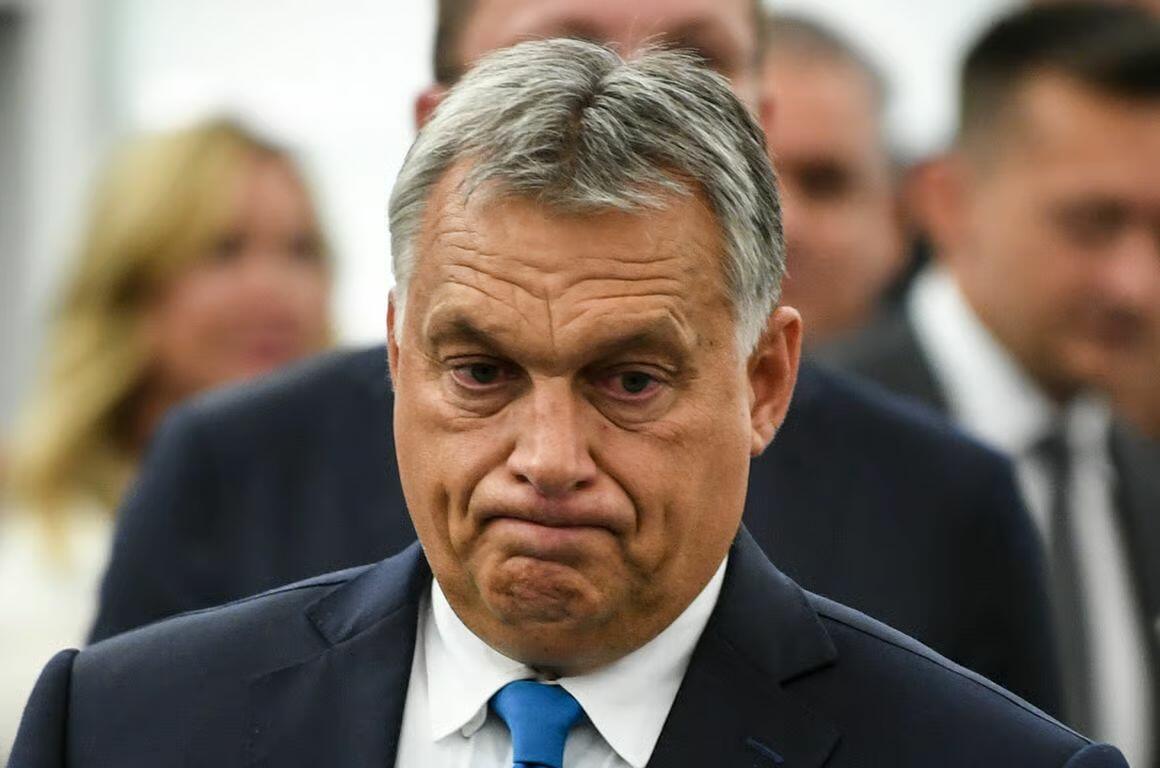
With early results showing the Tisza Party on track for 128 seats in the 199-seat National Assembly and Fidesz collapsing to just 62 seats (based on more than 21% of votes counted), Orbán’s long-dominant alliance has suffered a decisive repudiation. Four years after securing a supermajority of 135 seats, Fidesz is projected to fall well short of even a simple majority.
The concession, delivered as vote tallies continued to roll in with record 77.8% turnout, marks the first time in the post-communist era that Orbán’s Fidesz has lost control of parliament. It validates the dire warning Orbán himself issued just days ago in his final campaign rally: “We could now lose everything.”
Péter Magyar, the 43-year-old former Fidesz insider who rocketed Tisza from fringe movement to projected governing force in under two years, hailed the moment as a turning point for Hungary.

“Today the Hungarian people have chosen change,” Magyar told supporters in Budapest. “Orbán has conceded. A new era begins.”
The scale of the upset is seismic. Tisza appears headed not only for a simple majority (requiring 100 seats) but potentially the two-thirds supermajority (133 seats) needed to rewrite cardinal laws and amend the constitution — the very tools Orbán used to entrench his “illiberal democracy” model.
What the Numbers Mean
- Tisza: ~128 seats (and climbing as more precincts report)
- Fidesz: ~62 seats
- Previous election (2022): Fidesz 135 seats
Urban centers, younger voters, and economically frustrated middle-class families drove the surge, while Fidesz held rural strongholds. The opposition’s consolidation under Magyar — a center-right, pro-EU, anti-corruption platform — proved decisive after years of fragmented resistance.
Immediate Geopolitical Shockwaves
The result upends the European political landscape:
- Brussels truce: Frozen EU funds (over €20 billion) are now expected to flow again. Hungary’s systematic vetoes on Ukraine aid, migration policy, and rule-of-law mechanisms are likely to end.
- Ukraine/Russia pivot: Orbán’s pro-peace, Russia-friendly stance – including delays on sanctions and energy deals – will almost certainly be reversed.
- Populist right in freefall: The defeat delivers a body blow to Europe’s nationalist movements. Marine Le Pen, Matteo Salvini, and Germany’s AfD lose their strongest Central European anchor. Donald Trump’s recent endorsement of Orbán as a “strong leader” and JD Vance’s pre-election Budapest visit now look like backing the wrong horse.
- Markets react: Early trading signals suggest a stronger forint and narrowing sovereign spreads as investors price in EU reconciliation and policy normalization.
Orbán, 62, has not yet issued a personal statement, but sources close to Fidesz say he will address the nation later today. The party retains pockets of deep loyalty, particularly among older voters and in the countryside, but the scale of the urban and youth revolt proved overwhelming.
Official final results are still days away (including overseas and mail-in ballots), but with Orbán’s concession the political reality is already set: Hungary’s voters have delivered a verdict that will reverberate across Europe and the global populist movement for years.
This is a breaking story. ZeroHedge will update as Orbán speaks and final tallies come in.
END
UK
ISIS Calls On Muslims To Murder UK’s Tommy Robinson
Monday, Apr 13, 2026 – 05:00 AM
Authored by Robert Spencer via PJMedia.com,
English freedom fighter Tommy Robinson on Friday posted on X an article from the Middle East Media Research Institute (MEMRI), detailing how the Islamic State (ISIS) wants him dead, and is calling upon Muslims to make sure he ends up that way quickly. And so it was just another day in the storied career of the celebrated religion of peace.

The Islamic State Pakistan Province (ISPP) issued the call in the inaugural issue of its glossy, slickly produced magazine, which is called, appropriately enough, Invade. The call to murder Tommy Robinson was, according to MEMRI, the beginning of a “major series called ‘Terrorize Them!’ – arguing that all non-Muslim nations can be terrorized by a single mujahid and gives the example of a ‘lone mujahid from Jerusalem who silently slaughtered a couple in their apartment.’”
Terrorize them? There those “extremists” go again, misunderstanding Islam, right? Well, not exactly. The Qur’an commands Muslims to “strike terror in the enemies of Allah and your enemies” (8:60), and even depicts Allah boasting about how he terrorized the unbelievers: “When your Lord inspired the angels, I am with you. So make those who believe stand firm. I will cast terror into the hearts of those who disbelieve. Then strike the necks and strike their fingertips.” (8:12)
If Allah is behaving that way, why shouldn’t his dutiful slaves?
The magazine includes a poster of Tommy Robinson, featuring a statement of the fourteenth-century Islamic theologian Ibn Taymiyya, whose writings remain popular and influential among many Muslims today. Ibn Taymiyya pronounces definitively that those who insult Muhammad should be killed: “The Quran, the Prophetic tradition, the unanimous consensus of the Prophet’s Companions, the generation that followed them, and the leading scholars of Islam all establish that: Whoever reviles or insults the Prophet Muhammad (Peace be upon him) has committed disbelief, and such a person is to be executed unconditionally, whether they claim to be Muslim or are a non-Muslim, and whether they later repent or do not repent.” The bold part here is bold on the poster.
Alongside the Ibn Taymiyya quote is an unflattering photo of Tommy Robinson, along with images of what appear to be X posts from Tommy, calling Muhammad a “nonce.” Not being all that familiar with the King’s English, as opposed to that of the good old U.S. of A., I had to look that word up, and found that it refers to “a stupid or despised person,” or alternatively, “a convicted or alleged sex offender, particularly those involved with children.” Islamic tradition holds that Muhammad had sexual relations with a nine-year-old girl, so that last one would apply, but ISIS was still insulted.
Counterterror “experts” inside and outside our intelligence and law enforcement agencies will dismiss this as more “extremism,” and assume that the vast majority of Muslims in the U.S. reject and abhor this point of view. Yet we know there are Muslims in the West who would be happy to kill Tommy Robinson; just as Hadi Matar was happy to try to murder Salman Rushdie, also for insulting Muhammad.
Yet not a single mosque in the U.S. teaches against the idea that someone should be killed for insulting Muhammad. Why don’t they? Because it isn’t an “extremist” idea; it’s mainstream Islam.
It’s not just Ibn Taymiyya; Islamic tradition tells these stories, among others:
A critic of the prophet of Islam, Ka’b bin Al-Ashraf, had mocked Muhammad in verse. Muhammad asked his followers: “Who is willing to kill Ka’b bin Al-Ashraf who has hurt Allah and His Apostle?” One of the Muslims, Muhammad bin Maslama answered, “O Allah’s Apostle! Would you like that I kill him?” When Muhammad said that he would, Muhammad bin Maslama said, “Then allow me to say a (false) thing (i.e. to deceive Kab).” Muhammad responded: “You may say it.” Muhammad bin Maslama duly lied to Ka’b, luring him into his trap, and murdered him. (Sahih Bukhari, volume 5, book 59, number 369)
Abu Afak, a centenarian poet who had mocked Muhammad, was killed in his sleep, in response to Muhammad’s question, “Who will avenge me on this scoundrel?” Similarly, Muhammad on another occasion cried out, “Will no one rid me of this daughter of Marwan?,” that is, Asma bint Marwan, yet another poet who ridiculed the prophet of Islam. One of his followers, Umayr ibn Adi, went to her house that night, where he found her sleeping next to her children. The youngest, a nursing babe, was in her arms. But that didn’t stop Umayr from murdering her and the baby as well. Muhammad commended him: “You have done a great service to Allah and His Messenger, Umayr!” (Ibn Ishaq, 674-676)
Yet Islamic apologists in the West routinely lie about all this and claim that Muhammad reacted with grace and tolerance in the face of impossible provocations, and the leftist establishment media does its part by smearing as an “Islamophobe” anyone who dares to point out the relevant facts.
Meanwhile, those who supposedly misunderstand Islam are baying for the blood of Tommy Robinson. Will anyone with any authority lift a finger to protect him?
Views expressed in this article are opinions of the author and do not necessarily reflect the views of ZeroHedge.
END
UK
A FAILED STATE:
UK Bans Pretend “Stepsister” Porn Months After Actual Muslim Incest Protections
Monday, Apr 13, 2026 – 03:30 AM
Authored by Steve Watson via modernity.news,
The British government has banned “step” porn, where the porn stars pretend to be related in a scripted format. Meanwhile, a bill earlier this year to ban first cousin marriage was rejected.

The crackdown targets consenting adults role-playing taboo family scenarios, including step-family tropes.
Offenders face prison time, and platforms must block UK access or face Ofcom fines. It’s sold as “protecting children” and aligning online rules with offline laws.
Yet the same government draws a firm line at stopping the real thing when it involves actual blood relatives.
First-cousin marriage remains fully legal in the UK. A Tory MP’s bill to prohibit it was blocked. Successive governments, including the current one, have opted for “education” and genetic counselling instead of legislation.
An NHS report last year even highlighted supposed “benefits” of first-cousin marriage – stronger family networks and economic stability – before being quietly pulled after public backlash.
Critics have repeatedly pointed out that such unions are far more common in certain Muslim communities, particularly among British Pakistani groups where rates have historically hit 40-55 percent in places like Bradford.
Many argue that’s precisely why Westminster refuses to touch the issue with a bargepole – cultural sensitivity trumps public health data showing doubled risks of serious birth defects, genetic disorders, and long-term strain on the NHS.
Meanwhile, the porn ban isn’t happening in a vacuum. It’s the latest incremental step in a broader push that funnels users through age-verification gateways. Those systems don’t stop at blocking “step” content or barely-legal role-play. They lay the groundwork for something far more permanent.
As we previously detailed, Apple is already forcing iPhone users in the U.K. to prove age with ID or lose unrestricted internet access:
https://twitter.com/i/status/2012128466661974520

The UK government’s plans for newborn digital IDs show the endgame: cradle-to-grave tracking dressed up as child protection:

This is classic nanny-state sleight of hand. Ban the pretend taboo to justify scanning everyone’s ID at the digital door, while the real taboo that carries measurable human costs gets waved through for political reasons.
Fictional step-siblings on a screen? Criminal. Actual cousin marriages producing children with elevated health risks? Carry on, just don’t film it.
The message to the public is unmistakable: your private fantasies are the state’s business, but protecting future generations from documented genetic harm is not – especially if it risks offending key voting blocs.
Britain’s ruling class has its priorities exactly backwards. While they lecture the public on online harms and roll out surveillance-by-stealth, they leave untouched practices that clash with basic Western norms of family and child welfare.
Freedom isn’t protected by banning role-play; it’s eroded when governments pick and choose which realities to ignore for the sake of political convenience.
Your support is crucial in helping us defeat mass censorship. Please consider donating via Locals or check out our unique merch. Follow us on X @ModernityNews.
END
5 RUSSIAN AND MIDDLE EASTERN AFFAIRS
ISRAEL/USA VS IRAN
SATURDAY: THE MEETINGS BEGIN:
Arriving in Pakistan, Iran’s top negotiator demands US accept ‘preconditions’ before talks start
As his VP Vance heads to Islamabad negotiations, Trump claims ‘the Iranians don’t seem to realize they have no cards,’ insists Strait of Hormuz to soon reopen ‘with or without them’
By Agencies and Jacob Magid
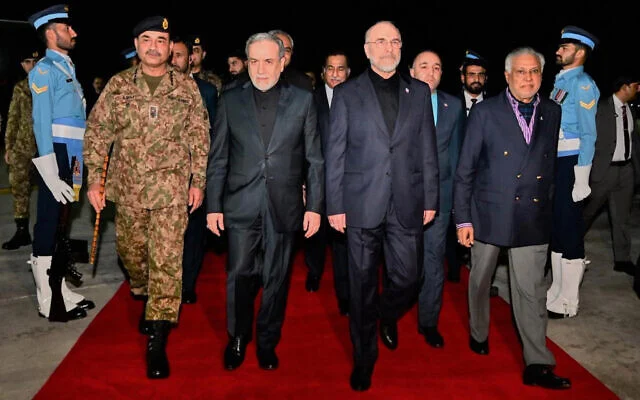

In this first photo released by the Pakistan Foreign Ministry, Iran’s Parliament Speaker Mohammad Bagher Ghalibaf, center right, and Iran’s Foreign Minister Abbas Araghchi, center left, are greeted by Pakistan Foreign Minister Ishaq Dar, right, and Army Chief Field Marshal Gen. Asim Munir, left, upon their arrival at Nur Khan airbase in Rawalpindi, Pakistan, April 11, 2026. (Pakistan Ministry of Foreign Affairs via AP)
second photo:
US Vice President JD Vance boards Air Force Two, April 10, 2026, at Joint Base Andrews, Maryland, for expected departure to Pakistan, for talks on Iran. (AP Photo/Jacquelyn Martin, pool)
An Iranian negotiating delegation led by Parliament Speaker Mohammad Baqher Ghalibaf arrived in Islamabad Friday ahead of Saturday’s peace talks with the United States, which Ghalibaf demanded accept Iran’s “preconditions” before talks could begin.
Speaking from Islamabad, Ghalibaf claimed Iran had goodwill toward negotiations but no trust in the United States, adding that the Islamic Republic was ready to reach a deal if Washington offered what he described as a genuine agreement and granted Iran its rights, Iranian state media reported.
Ghalibaf stated earlier that Tehran’s demands include a ceasefire in Lebanon, which Iran and mediating Pakistan have stated was supposed to be part of the ceasefire with the US to begin with. The US and Israel have said otherwise. Ghalibaf has also called for the release of billions of dollars in frozen assets belonging to Iran.
Ghalibaf’s delegation includes senior political, military and economic officials, including the Iranian foreign minister, defense council secretary, central bank governor and several members of parliament.
A US delegation led by Vice President JD Vance also departed Friday, with Vance warning Tehran not to “play” the US during the negotiations.
Ahead of the talks, Pakistani Prime Minister Shehbaz Sharif called the negotiations being hosted in his country’s capital “make or break.”
“In response to my sincere invitation, the leaderships of both countries are coming to Islamabad. There, negotiations will be held for the establishment of peace,” Sharif said in an address to the nation.
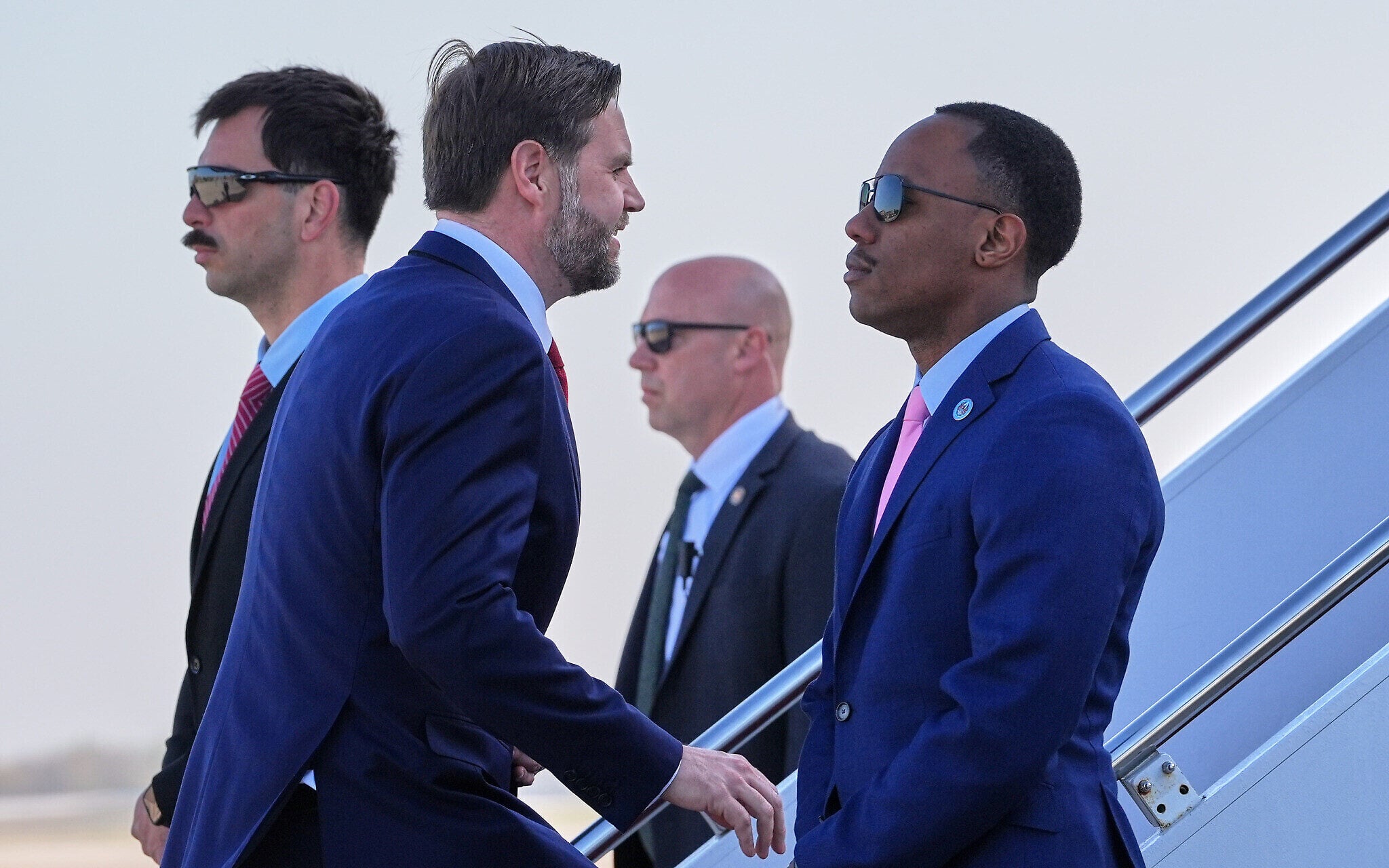
Pakistan added that it hopes the parties would engage constructively, and reiterated its desire to “continue facilitating the parties towards reaching lasting and durable solution to the conflict.”
Israel, which launched the military campaign against Iran jointly with the US six weeks ago, is not represented at the talks. Host Pakistan has no diplomatic ties with Israel and does not recognize its sovereignty.
The ceasefire declared by US President Donald Trump on Tuesday night came with core declared goals of the war unfulfilled, including ensuring that Iran does not attain nuclear weapons, destroying its missile program, and creating the conditions for the Iranian public to overthrow the regime.
Trump: Strait of Hormuz to reopen soon ‘one way or the other’
As his vice president was on his way to Pakistan, Trump commented several times on the upcoming talks.
“The Iranians don’t seem to realize they have no cards, other than a short-term extortion of the world by using international waterways,” he wrote on social media.
“The only reason they are alive today is to negotiate!” he claimed in another post about the Iran conflict on his Truth Social platform.
“The Iranians are better at handling the fake news media and public relations than they are at fighting!” he said.
In an interview with the New York Post published Friday, Trump said US warships were being reloaded with weaponry to strike Iran if the Pakistan talks fail to produce a deal.
“We have a reset going. We’re loading up the ships with the best ammunition, the best weapons ever made — even better than what we did previously and we blew them apart,” Trump was quoted as saying.
“And if we don’t have a deal, we will be using them, and we will be using them very effectively,” he said.
In a brief and cryptic message on his Truth Social network earlier, Trump had spoken of the “WORLD’S MOST POWERFUL RESET!!!”
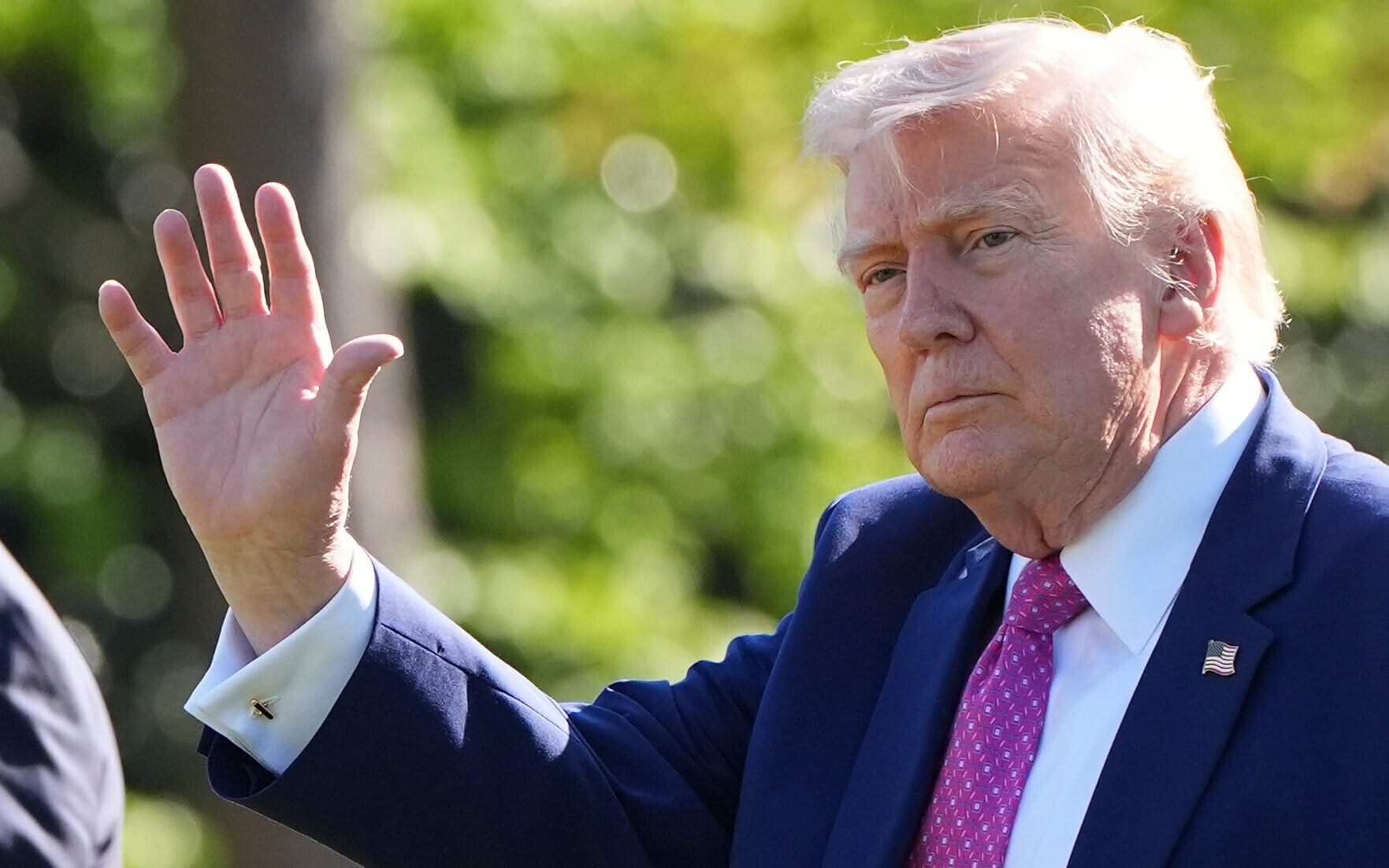
Later, talking with reporters, Trump expressed his confidence that the Strait of Hormuz will soon reopen to uninhibited ship flow.
“We’re going to open up the (strait) with or without them, but that’ll be open,” Trump said. “I think it’s going to [be opened] pretty quickly, and if it doesn’t, we’ll be able to finish it off one way or the other.”
The US has claimed that the strait was opened up already on Wednesday, denying reports that Iran was holding up much of the traffic and charging toll. In the past day, Trump appeared to acknowledge that Iran was in fact blocking ships from using the channel, with the president issuing a series of Truth Social posts threatening Iran.
Asked Friday if he would allow Iran to charge tolls for ships in Hormuz, Trump said he would not. “It’s international water.”
He then clarified that he has not verified Iran is actually charging tolls.
Asked what he was looking for in a deal with Iran ahead of Saturday’s talks. Trump responded, “No nuclear weapon.”
As for a backup plan if Iran refuses to reopen Hormuz, Trump insisted that he did not need one and claimed Iran already was “militarily defeated.”
END
SATURDAY MORNING
US clearing out Strait of Hormuz, Trump claims as Iran threatens to attack unauthorized ships
“We’re now starting the process of clearing out the Strait of Hormuz as a favor to Countries all over the World, including China, Japan, South Korea, France, Germany, and many others,” Trump stated.

US President Donald Trump holds a press conference in the James S. Brady Press Briefing Room at the White House in Washington, DC, US, April 6, 2026.(photo credit: REUTERS/Evan Vucci)
ByGOLDIE KATZ,
REUTERSAPRIL 11, 2026 17:05Updated: APRIL 11, 2026 17:22
US Navy ships reportedly crossed the Strait of Hormuz on Saturday afternoon as US-Iran ceasefire negotiations kicked off in Pakistan, though Iran denied the reports and threatened to attack any unauthorized ships in the strait.
Axios, citing a US official, reported that several US Navy ships crossed the Strait of Hormuz. According to the report, the move was not coordinated with the Iranian Navy and was the first time US Navy ships made such a move since the start of the war.
According to the Wall Street Journal, three US officials confirmed that two US Navy guided-missile destroyers passed through the strait without issue in what was described as a “freedom-of-navigation mission.”
Minutes later, a senior Iranian military official denied the reported crossing of US vessels on Iranian government-owned state television.
Iranian media additionally released a warning that any US Military ship will be attacked within 30 minutes if it attempts to cross the Strait. According to State TV, a US vessel in the strait turned back after receiving the warning.
Axios reporter Barak Ravid disputed Iranian media claims that the ship turned back after the warning, stating that a senior US official informed him that the US had not received any such threats.
Trump says US ‘clearing out’ Strait of Hormuz
This comes after President Donald Trump said that the United States is starting the process of clearing underwater mines out of the Strait of Hormuz.
“We’re now starting the process of clearing out the Strait of Hormuz as a favor to Countries all over the World, including China, Japan, South Korea, France, Germany, and many others,” Trump stated, slamming the named nations for not having the “courage or will” to do so themselves.
He asserted that Iran is “losing big,” with US and Israeli strikes having decimated much of Iran’s military, navy, and air force capabilities.

“The only thing they have going is the threat that a ship may ‘bunk’ into one of their sea mines, which, by the way, all 28 of their mine dropper boats are also lying at the bottom of the sea,” Trump continued.
US Navy ships cross Strait of Hormuz as Trump says empty oil tankers incoming
ByREUTERS, JERUSALEM POST STAFF
Several United States Navy ships crossed the Strait of Hormuz on Saturday, Axios’s Barak Ravid reported on X/Twitter, citing a US official.
According to Ravid, the move was not coordinated with the Iranian Navy and was the first time US Navy ships made such a move since the start of the war.
US President Donald Trump also said on Saturday that large numbers of completely empty oil tankers were heading to the United States to load up with oil and gas.
ISRAEL TBN SATURDAY MORNING\
end
ISRAEL /USA/IRAN UPDATES/SATURDAY MORNING UPDATES
Trump Announces Start Of “Clearing Out” The Strait As A “Favor” To RoW As ‘Indirect’ Talks With Iran Continue
Saturday, Apr 11, 2026 – 11:00 AM
Summary:
- President Trump announces start of “clearing out the Strait” as a favor to the rest of the world as two U.S. Navy guided-missile destroyers passed without incident.
- Peace talks in Pakistan begin in indirect format, led by Vance and on Iran side – Ghalibaf, Arachchi – expected to continue tomorrow
- Saturday sees more Israeli strikes on Lebanon, with Hezbollah supporting Pakistan talks but rejecting ‘separate deal’ directly with Israel.
- Trump on talks and potential bigger future attacks on Iran: “You don’t need a backup plan” as Iran’s “military is defeated”.
https://embed.polymarket.com/market?market=will-the-us-invade-iran-before-2027&height=300
Will the U.S. invade Iran before 2027?
Yes 31% · No 70%
View full market & trade on Polymarket
Trump Announces Start Of “Clearing Out” The Strait As A “Favor” To RoW
Earlier reports appears to have been confirmed as three US officials have stated to The Wall Street Journal that two U.S. Navy guided-missile destroyers passed through the Strait of Hormuz on Saturday, marking the first transit of American warships through the waterway since the war began six weeks ago.
President Trump took to social media to explain what was going on. But first, he clarified a few things to the ‘fake news media’…
The Fake News Media has lost total credibility, not that they had any to begin with. Because of their massive Trump Derangement Syndrome (Sometimes referred to as TDS!), they love saying that Iran is “winning” when, in fact, everyone knows that they are LOSING, and LOSING BIG!
Their Navy is gone, their Air Force is gone, their Anti Aircraft apparatus is nonexistent, Radar is dead, their Missile and Drone Factories have been largely obliterated along with the Missiles and Drones themselves and, most importantly, their longtime “Leaders” are no longer with us, praise be to Allah!
The only thing they have going is the threat that a ship may “bunk” into one of their sea mines which, by the way, all 28 of their mine dropper boats are also lying at the bottom of the sea.
Having got all that off his chest, he then confirmed the operation to open the Strait:
We’re now starting the process of clearing out the Strait of Hormuz as a favor to Countries all over the World, including China, Japan, South Korea, France, Germany, and many others.
Incredibly, they don’t have the Courage or Will to do this work themselves.
Very interestingly, however, empty Oil carrying ships from many Nations are all heading to the United States of America to LOAD UP with Oil.
Thank you for your attention to this matter! President DONALD J. TRUMP
But he wasn’t done with that. A few minutes later he followed with a shorter pithier version of the same narrative:
The Fake News Media is CRAZY, or just plain CORRUPT!
The United States has completely destroyed Iran’s Military, including their entire Navy and Air Force, and everything else. Their Leadership is DEAD!
The Strait of Hormuz will soon be open, and the empty ships are rushing to the United States to “load up.”
But, if you listen to the Fake News, we’re losing!
Iran explicitly informed the Pakistani mediator during talks that if the vessel continued its movement it would be targeted within 30 minutes and the Iran-US negotiations would be damaged.
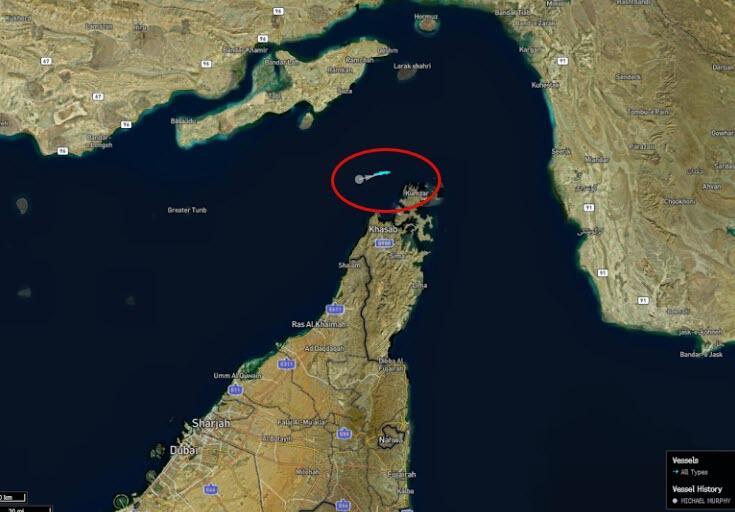
However, no issues were reported during the ships transit of the Strait, and the move was described as a freedom-of-navigation mission.
The (successful) timing of this action – as talks begin in Islamabad – is certainly a show of strength amid the delicate negotiations.
Several US Warships Cross Hormuz Strait: Axios
Just as indirect talks kick off in Islamabad, a shocking and surprise development is being reported by Axios’ Barak Ravid, though this is not confirmed:
If accurate, are we witnessing Trump suddenly pile on more leverage before negotiations even get off the ground? It seems like the Iranians would have noticed several US Navy warships passing. Either they held off attack for the sake of pursuing peace, or this was truly done ‘stealthily’ and Iranian capabilities are degraded to the point they may have ‘missed’ it. Or is this an attempt to muddy the negotiations? Sabotage? Ravid after all has long stood accused of pushing an Israeli agenda in his reporting.
Talks Begin with Indirect Format Mediated by Pakistanis
By Saturday afternoon (local), the highest-level US-Iran-related talks since the 1979 Islamic Revolution have kicked off in Islamabad. Vice President JD Vance met Pakistan’s Shehbaz Sharif just ahead of the negotiations, and also senior Iranian officials were greeted by Sharif and other Pakistani leaders. Iran’s delegation is led by Parliament Speaker Mohammad Bagher Ghalibaf and Foreign Minister Abbas Araghchi. The engagement by each side has begun indirectly.
Pakistan has made clear it is working to facilitate direct negotiations between the US and Iran to fully bring to an end the six-week war in the Middle East. Sharif hailed both sides’ commitment to engaging constructively, and “expressed the hope that these talks would serve as a stepping stone toward durable peace in the region,” his office stated in a news release.
“Vance was joined for the bilateral meeting by special envoy Steve Witkoff and President Donald Trump’s son-in-law, Jared Kushner,” CNN reviews. “Sharif was joined by Deputy Prime Minister and Foreign Minister Sen. Mohammad Ishaq Dar, along with Interior Minister Sen. Syed Mohsin Raza Naqvi, according to a news release from the Pakistani prime minister’s office. There was no press coverage of the meeting.”
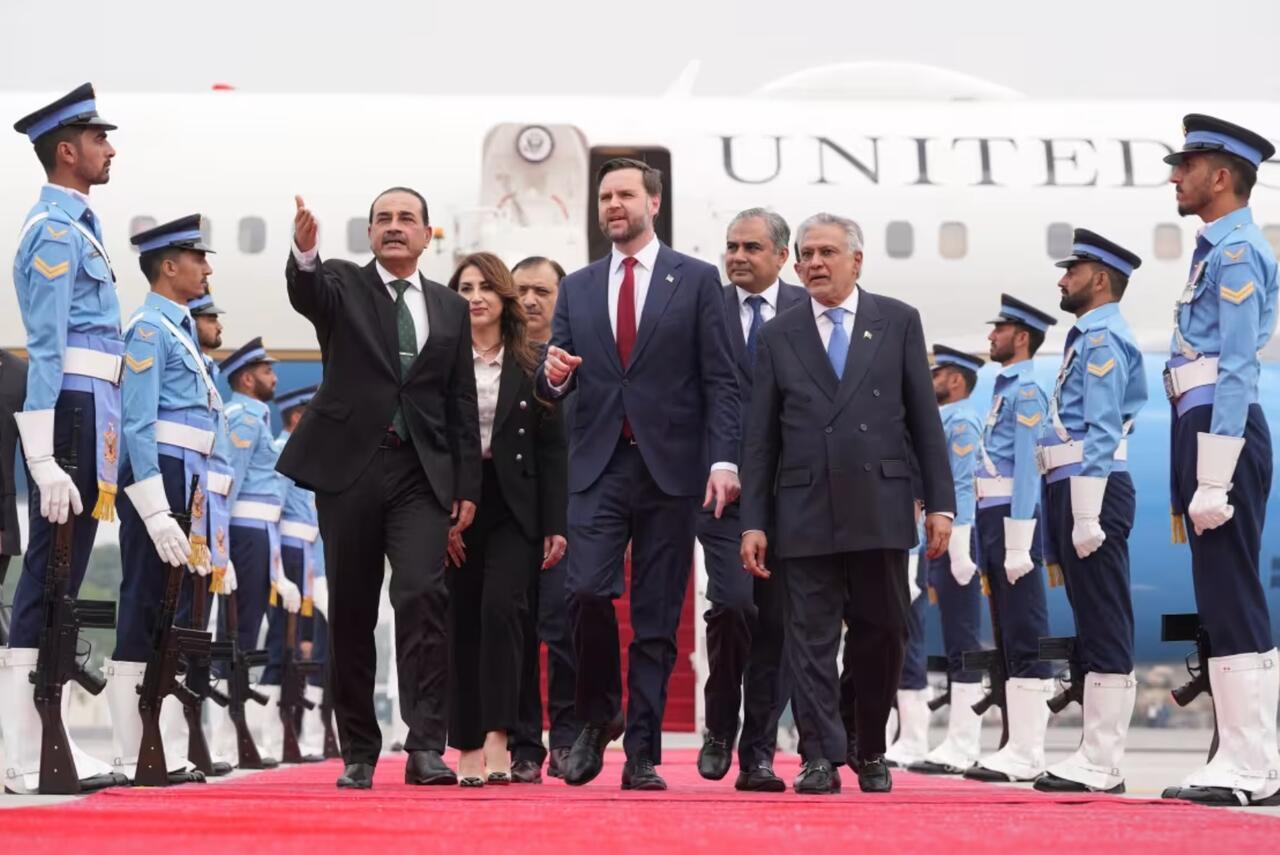
CNN also has this interesting detail on just how many officials have traveled with the Iranian side: “Iran’s delegation in Islamabad is made up of 71 people, including negotiators, experts, media representatives and security, Tasnim reported.” According to some of the latest:
Tehran reportedly set 2 main conditions. The issue of frozen funds being already accepted by Washington. Despite no strikes on Beirut, attacks in southern Lebanon are ongoing and are now part of the negotiations.
Below: Ghalibaf (Speaker of Parliament) – Araghchi (Foreign Minister) – Ahmadian (Secretary of the Defense Council) – Hemmati (Central Bank Governor)
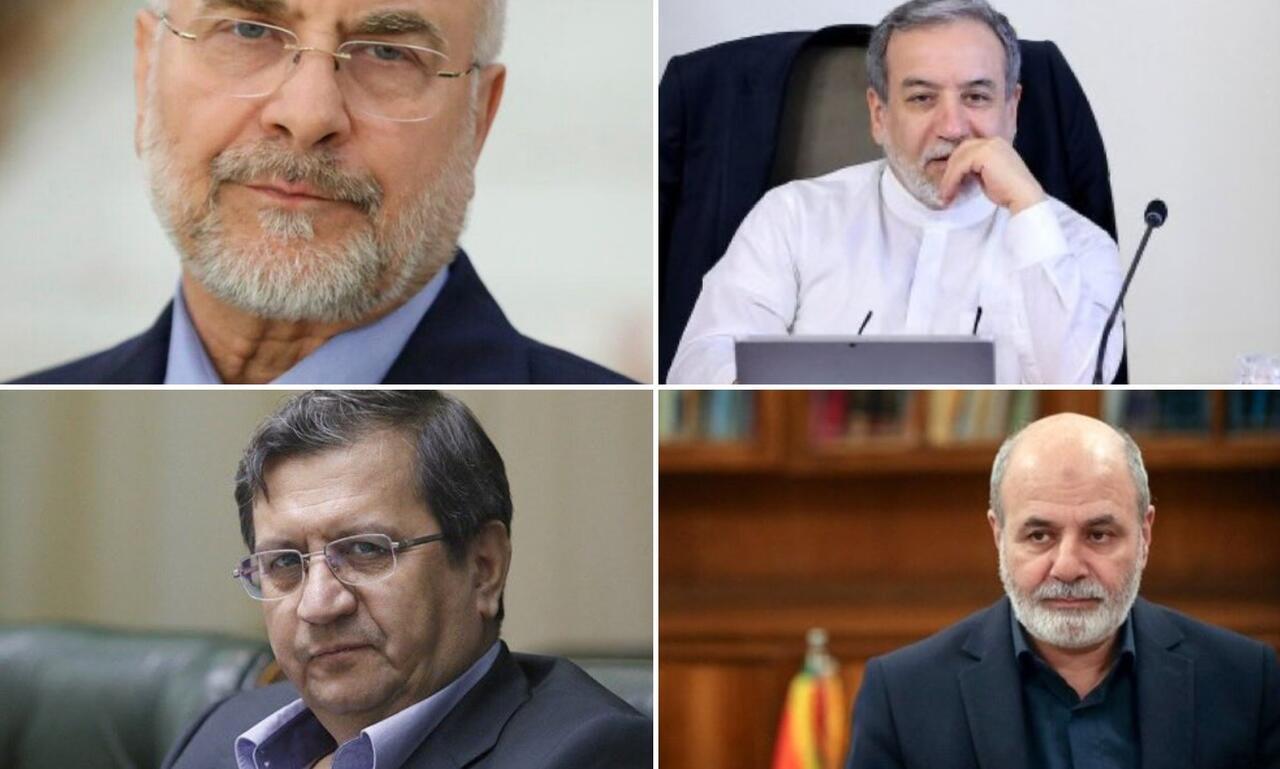
Lebanon Fighting Has Not Stopped But Rare Diplomatic Contact Made
Fighting has not fully stopped in Lebanon, raising the possibility of derailing the Pakistan talks, after Tehran had earlier in the week threatened that it could pull out if Israel keeps ups its attacks. On Saturday, Lebanon’s Health Ministry raised the death toll from the Israeli surprise Wednesday strikes to 357, and suggested the figure could rise amid several days of search and recovery operations.
But one rare bright spot in terms of diplomatic contact, as international reports say the Lebanese and Israeli ambassadors to the United States held a phone call in the first direct contact reported between the two countries, ahead of ceasefire talks scheduled in Washington for next week.
Meanwhile, Iran confirmed it is coordinating with Lebanon to ensure ceasefire commitments are upheld across all fronts, a foreign ministry spokesperson said on state TV from Islamabad, where senior US and Iranian officials are holding talks to end the six-week war. At the same time, Lebanese officials close to Hezbollah told Reuters the group supports the Pakistan dialogue and considers it the appropriate path, rejecting a separate round of talks planned in Washington next week.
Iranian delegation in Pakistan seeks to present ‘unity’ of government/military leadership and coordination:
x.com/vali_nasr/status/2042923057958842627?ref_src=twsrc%5Etfw%7Ctwcamp%5Etweetembed%7Ctwterm%5E2042923057958842627%7Ctwgr%5E209b8fff1b677e32927b53c415e42dc212a14826%7Ctwcon%5Es1_&ref_url=https%3A%2F%2Fwww.zerohedge.com%2Fgeopolitical%2Fseveral-us-warships-reportedly-transit-strait-hormuz-pakistan-talks-led-vance-start
Israeli airstrikes have continued on a sporadic basis: “Lebanon’s National News Agency (NNA) reports that an Israeli air attack on the town of Kfar Sir in the Nabatieh district has killed four people, including a paramedic, and injured four,” writes Al Jazeera Saturday. “Another Israeli attack on the town of Zefta, also in the Nabatieh district, killed three people, including a member of the Lebanese Civil Defense, and wounded two.” There’s been an additional third attack on Toul and Nabatieh, killing three and injuring several more.
END
Live Updates: Trump floats Hormuz naval blockade as Netanyahu says Israel’s war with Iran ‘not over yet’
Vance: No deal reached after talks with Iran • Iran warns military vessels against transiting Strait of Hormuz • CENTCOM clears underwater mines in Hormuz

A bird flies near the Jag Vasant vessel transferring LPG at a port after transiting the Strait of Hormuz amid supply disruptions linked to the U.S-Israeli conflict with Iran, in Mumbai, India, April 1, 2026.(photo credit: Francis Mascarenhas/Reuters)
‘Out-blockade Iran’: Trump floats Hormuz naval blockade in post after Islamabad talks fail
“It would be very easy for the US Navy to exert complete control over what does and does not go up and down the Strait now,” the article, from Just the News, claimed.
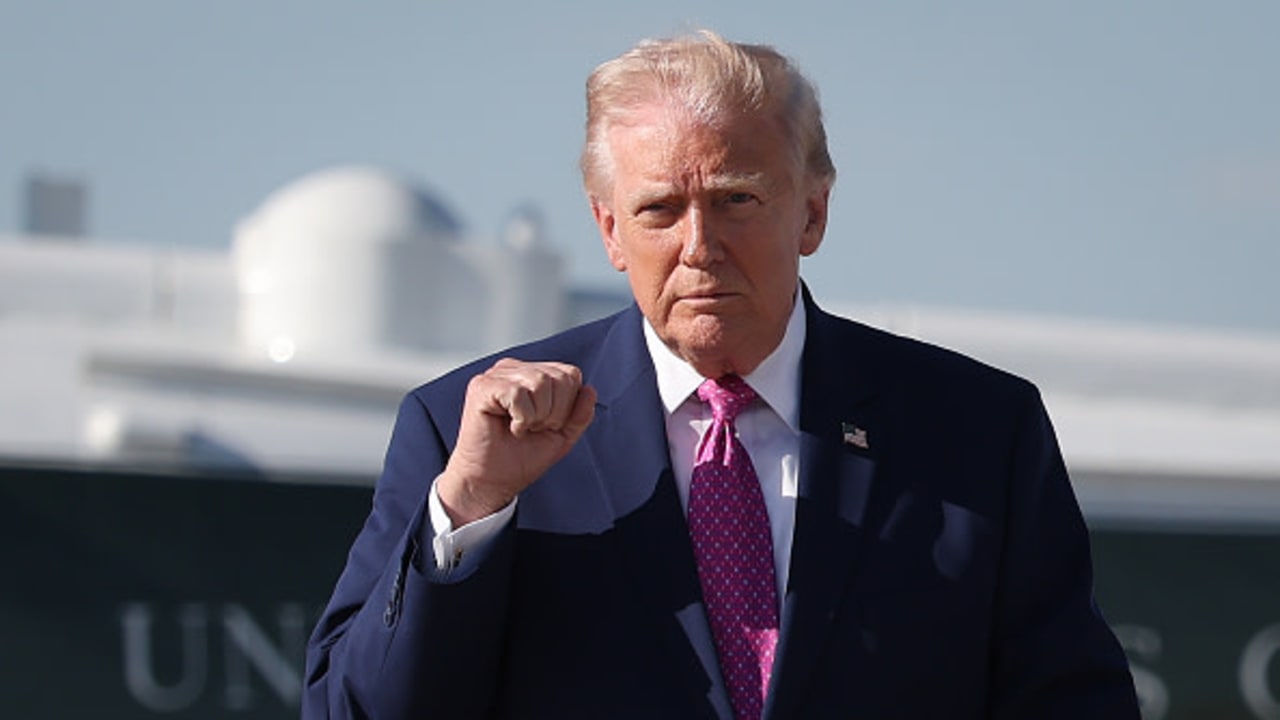
US President Donald Trump walks toward reporters before answering questions prior to boarding Air Force One on April 10, 2026 at Joint Base Andrews, Maryland. President Trump is traveling to Charlottesville, Virginia.(photo credit: Win McNamee/Getty Images)BySHIR PERETSAPRIL 12, 2026 08:29
After both the US and Iran reported a failure to reach a deal during the weekend’s ceasefire talks in Islamabad, US President Donald Trump on Sunday shared an article suggesting he would “out-blockade Iran’s hold over the Strait of Hormuz.”
The article, from Just the News, claimed that the president could repurpose the strategy he used against Venezuela, and that “it would be very easy for the US Navy to exert complete control over what does and does not go up and down the Strait now.”
“We leave here with a very simple proposal, a method of understanding that is our final and best offer,” Vice President JD Vance said after nearly 24 hours of negotiations.
“We will see if the Iranians accept it.”
Pakistan, the country currently leading the mediation efforts, released a statement expressing gratitude to both sides for their willingness to negotiate and urging them to uphold the ceasefire until a deal could be reached.

Reports claim talks were tense, officials nearly came to blows
As of Sunday morning, both the US and Iranian delegations left the negotiation table unsatisfied, with Vance claiming the US had been “quite flexible,” and the Iranian team saying the negotiations had been “conducted in an atmosphere of mistrust.”
In addition, Turkish media reported that negotiations surrounding certain key topics were so tense – namely, the management of the Strait of Hormuz – that Iranian Foreign Minister Abbas Aragchi and US Special Envoy Steve Witkoff nearly came to blows.
Alongside nuclear disarmament, the Strait of Hormuz remains at the center of the US-Iran talks. US Navy ships reportedly crossed the Strait of Hormuz on Saturday just as the negotiations kicked off, though Iran has denied the reports and threatened to attack any unauthorized ships in the strait.
This comes after Trump said in a Saturday post to Truth Social that the United States has begun the process of clearing underwater mines from the Strait of Hormuz.
“We’re now starting the process of clearing out the Strait of Hormuz as a favor to Countries all over the World, including China, Japan, South Korea, France, Germany, and many others,” Trump stated, slamming the named nations for not having the “courage or will” to do so themselves.
END
ISRAEL VS HEZBOLLAH/LEBANON
Ending Lebanon war seen as price for reopening Strait of Hormuz in US-Iran talks – analysis
Iran wanted the Lebanon war to end before talks, to take credit for ending it, and the US wanted Hormuz to be opened, so that negotiations would be focused immediately on the nuclear issue.

An Israeli artillery unit fires towards Lebanon, amid escalation between Iran-backed Hezbollah and Israel, and amid the U.S.-Israeli conflict with Iran, on the Israeli side of the Israel-Lebanon border, in northern Israel, March 17, 2026.(photo credit: AMMAR AWAD/REUTERS)ByYONAH JEREMY BOBAPRIL 12, 2026 12:51Updated: APRIL 12, 2026 13:18
The coming months of Iran-US formal and informal negotiations, and of jockeying by all sides on the ground, at sea, and in the air, will be fascinating and crucial in shaping the direction of the Middle East for years to come.
But right now, readers should get used to the idea that many of the most crucial issues are unlikely to be resolved immediately, and even if framework deals are reached on some of them, the process of truly resolving them could easily take months.
In that sense, Saturday’s negotiations in Pakistan and further Iran-US talks between now and the 14-day deadline ending at the end of April are actually quite narrow: will the countries go back to war, will they make enough progress within 14 days to continue talks and refrain from going back to war, and will they reach a framework deal for resolving the Straits of Hormuz crisis and ending the Lebanon war.
Resolving the nuclear issue, the ballistic missiles issue, the sanctions issue, when US forces will withdraw from the region, and ending the war in a more final sense will likely take longer.
Given that at this stage, both the US and Iran think they have the upper hand (yes, shockingly, the Islamic regime thinks it has the upper hand even though it has been clobbered, since it survived so far and has a chokehold on Hormuz), neither side is rushing to make long-term strategic concessions to the other side.
This is why the first round of talks ended not only with no deal, but not even with setting a new date for talks.
Even if the talks jump forward in positive ways between now and the end of April or are extended, along with the ceasefire, into May, thorny and complex technical issues like Iran’s 60% enriched uranium cannot be resolved in a couple of weeks.
Rather, the expectation is that in the best-case scenario, Iran, supervised by the IAEA and possibly the US or other third parties, extracts its 60% enriched uranium from under significant amounts of rubble under multiple bombed nuclear sites over a period of months, in order to have it transferred to Russia or otherwise neutralized.
Resolving the Hormuz crisis and the Lebanon war situation will not wait months, so they are the first issues likely to be resolved.
Iran wanted the Lebanon war to end before talks, to take credit for ending it, and to bank it as a concession they would not need to pay for in talks.
The US wanted Hormuz to be opened as the price for ending the war, so that negotiations would be focused immediately on the nuclear issue.
Neither side got what they wanted entering talks, since both pressing issues remain open.
However, the US and Iran are not standing still outside the negotiating room.
After a one-off massive bombing by Israel on Tuesday, all over Lebanon to show that Jerusalem viewed Lebanon as excluded from the ceasefire, US President Donald Trump ordered (not an exaggeration) Prime Minister Benjamin Netanyahu to tone down attacks on Hezbollah.
Since then, there have been no IDF attacks in Beirut or in general in sensitive areas North of the Litani River, with most attacks focused on fighting in southern Lebanon or on Hezbollah rocket teams who are about to fire on Israel.
Hezbollah has maintained some fire on northern Israel, but at overall reduced levels.
The US also sent two destroyer naval vessels through the Straits of Hormuz to establish that there is a safe passage and to potentially deal with sea mines.
Iran’s public desires
In public, Iran claimed that it forced the vessels to retreat, but in practice, it allowed the vessels to pass through without firing on them, though it retains the capability to attack such ships.
Iran also wants money, since it is falling apart economically on levels never seen before, following 38 days of being pounded from the air.
An easy partial initial deal would be to release some or all of around six billion dollars of Iranian funds (a tiny fraction of what Iran needs), which Qatar has held frozen since fall 2023
These funds were supposed to go to Iran with the approval of the Biden administration as part of a prisoner release and multi-part potential new nuclear deal, but everything was frozen after Hamas’s October 7, 2023, invasion of Israel.
There is some symmetry here, since neither side will win anything militarily or on nuclear or ballistic missile issues, but both sides will get a needed economic breather.
Paradoxically, Iran has the upper hand on this issue since its economic situation is so horrible and will take so long to fix that if negotiations drag out for more weeks or even for a period of months, strategically speaking, it will not actually be that worse off.
In contrast, Trump promised Americans that the war would not impact them economically, and it has been impacting them at the gas tank severely for a few weeks now.
Alleviating that pressure is a political necessity for Trump, such that dragging out talks on the issue for several weeks or months will damage him much more in relative terms.
Put differently, the Iranians have already hit rock bottom; Trump can still avoid that scenario if he cuts a deal soon enough.
Because the Iranians have this short-term advantage and because Israel has not really accomplished anything new in Lebanon strategically for the last few weeks since it completed seizing southern Lebanon, Tehran will likely get a ceasefire between the IDF and Hezbollah as part of the price for any initial agreement relating to Hormuz.
Of course, the sides could still go back to war, and it is crucial that Trump has kept all US forces in the region to preserve that viable, continuous military threat.
Israeli military officials are beside themselves that they believe they delivered nearly everything they possibly could have on the military playing field, but that almost nothing lasting has been achieved diplomatically to date by Netanyahu, who retains influence with Trump, but may be to some extent excluded from any real decisive impact on the Iran-US talks.
Yet, neither side came into these talks in good shape. Both sides came in because they had been losing ground for a period of weeks despite multiple attempts to try to gain a more decisive upper hand.
That means that neither side is likely to rush back to war, even if no deal is sealed after 14 days.
Rather, both sides are likely in a staring contest to try to eke out whatever small additional initial concessions they can get around the 14-day deadline or after a first extension of the talks into May.
Only after a deal of at least a framework for opening Hormuz in exchange for ending the Lebanon war, will more serious talks about the larger issues for permanently ending the war likely occur.
END
SUNDAY
Trump Eyes Limited Iran Strikes, Hormuz Blockade After Peace Talks Collapse
Sunday, Apr 12, 2026 – 07:20 PM
Summary
- Trump weighs limited strikes on Iran
- CENTCOM confirms blockade to begin at 1000ET Monday morning and will only impact Iran-related vessels
- President Trump begins blockading the Strait of Hormuz, warns US military will “finish up the little that is left of Iran”
- Door for diplomacy remains open, WSJ reports: Regional countries are racing to bring the U.S. and Iran back to the negotiating table after marathon peace talks in Islamabad ended without a deal
- The US delegation in Islamabad delivered the following six “red lines” to Iran: 1) End all uranium enrichment; 2) Dismantle all major nuclear enrichment facilities; 3) Retrieve highly enriched uranium; 4) Accept a broader peace, security and de-escalation framework that includes regional allies; 5) End funding for terrorist proxies Hamas, Hezbollah, and the Houthis; 6) Fully open the Strait of Hormuz, charging no tolls for passage
- 2 Supertankers U-turn after peace deal talks fail
- UAE Oil Chief warns Iran blocking Hormuz is “a direct threat to the energy, food and health security of every nation”
The odds of a peace deal by the end of the ceasefire period have improved modestly today but remain down significantly from pre-talks…
Trump Weighs Limited Strikes On Iran
Brent crude futures are up 7.5% to around $102 per barrel, while S&P 500 futures traded down about 1% after President Trump ordered the U.S. military to impose a blockade on the Strait of Hormuz, beginning Monday morning.
A Wall Street Journal report indicates that President Trump is weighing limited strikes on high-value Iranian assets to break the stalemate in peace talks.
The report continued:
That is among the options that Trump was considering Sunday, hours after negotiations collapsed in Pakistan, the officials said.
Trump could also resume a full-fledged bombing campaign, though officials said that was less likely given the prospect of further destabilizing the region and the president’s aversion to prolonged military conflicts.
He could also seek a more temporary blockade while he pressures allies to take responsibility for a prolonged military escort mission through the strait in the future.
U.S.-Iran ceasefire talks in Pakistan ended late Saturday without an agreement. These periods generally allow both sides to restock weapons and prepare for the next phase of fighting.
OSINT (Open Source Intelligence) accounts on X are reporting a steady stream of U.S. Air Force cargo jets heading to the Middle East late Sunday.
“My advice to the White House folks I’ve spoken to is secure the strait at any cost and immediately as a matter of economic and national and global security,” said Steve Moore, a former economic adviser to Trump, who was quoted by the WSJ.
Moore noted, “We have the power to protect the flow of international trade and must use it. Or the whole world economy could tumble into a global recession.”
Fred Fleitz, a senior National Security Council official during Trump’s first term, told the outlet that Iran’s large delegation to Islamabad showed that a diplomatic solution is possible.
“I think Trump’s right, Iran is out of cards,” Fleitz said. “This conflict has only been going on for a few weeks. It’s too early to know how this will come out, but I think it looks promising.”
CENTCOM Says Blockade Will Begin Monday Morning at 1000ET
U.S. Central Command (CENTCOM) forces will begin implementing a blockade of all maritime traffic entering and exiting Iranian ports on April 13 at 10 a.m. ET, according to a statement on X.
CENTCOM provided some further clarification regarding who will be blocked, in accordance with President Trump’s earlier proclamation.
Specifically, they are only (and impartially) blocking any vessel leaving or entering an Iranian port…
The blockade will be enforced impartially against vessels of all nations entering or departing Iranian ports and coastal areas, including all Iranian ports on the Arabian Gulf and Gulf of Oman.
But, vessels from non-Iranian ports are free to transit the Strait
CENTCOM forces will not impede freedom of navigation for vessels transiting the Strait of Hormuz to and from non-Iranian ports.
Now the fun begins.
Iran Says It Won’t Allow Blockade Of Hormuz Strait, But Room For Diplomacy Remains
As the US failed to open the Strait of Hormuz, it is also “doomed to fail in a naval blockade,” Iran’s military adviser to the supreme leader, Mohsen Rezaee, said in a post on X.
Iran’s armed forces “will not allow America to do so and have great untapped leverage to counter it,” he adds.
“Iran is not a place to be surrounded by tweets and imaginary plans.”
However, despite defiant statements from the U.S. and Iran, The Wall Street Journal reports that, according to regional officials familiar with the matter said, the door remains open for further diplomacy and a second round of talks could be held within days. Regional countries were also in consultation with the U.S. to secure an extension of the fragile two-week ceasefire period announced late Tuesday, they said.
The Islamabad talks were the highest-level face-to-face meeting between American and Iranian leaders since 1979. The main sticking points, said the officials, were reopening the Strait of Hormuz without collecting fees, the fate of Iran’s highly enriched uranium, and Iran’s demand that about $27 billion in frozen revenues held abroad be released. Iranian officials have presented counterproposals to continue to enrich token amounts or curtail its stockpile of enriched uranium, but the two sides were unable to reach a compromise, the officials said.
Trump’s 6 Red Lines
Fox News reports that Vice President Vance’s final offer delivered to the Iranian delegation in Islamabad includes the following “red lines.”
- End all uranium enrichment
- Dismantle all major nuclear enrichment facilities
- Retrieve highly enriched uranium
- Accept a broader peace, security and de-escalation framework that includes regional allies
- End funding for terrorist proxies Hamas, Hezbollah, and the Houthis
- Fully open the Strait of Hormuz, charging no tolls for passage
Needless to say, Iran refused to agree.
President Trump Begins Blockading Strait Of Hormuz
President Trump said the US would blockade the Strait of Hormuz following the collapse of peace talks with Iran in Islamabad this weekend.
“Effective immediately, the United States Navy, the Finest in the World, will begin the process of BLOCKADING any and all Ships trying to enter, or leave, the Strait of Hormuz,” Trump said in a social media post.
In a pair of lengthy social media posts, Trump first explained the situation in the Strait…
Iran promised to open the Strait of Hormuz, and they knowingly failed to do so.
This caused anxiety, dislocation, and pain to many people and Countries throughout the World.
They say they put mines in the water, even though all of their Navy, and most of their “mine droppers,” have been completely blown up.
They may have done so, but what ship owner would want to take the chance?
There is great dishonor and permanent harm to the reputation of Iran, and what’s left of their “Leaders,” but we are beyond all of that.
As they promised, they better begin the process of getting this INTERNATIONAL WATERWAY OPEN AND FAST! Every Law in the book is being violated by them.
I have been fully debriefed by Vice President JD Vance, Special Envoy Steve Witkoff, and Jared Kushner, on the meeting that took place in Islamabad through the kind and very competent leadership of Field Marshal Asim Munir, and Prime Minister Shehbaz Sharif, of Pakistan. They are very extraordinary men, and continuously thank me for saving 30 to 50 million lives in what would have been a horrendous War with India. I always appreciate hearing that — The amount of Humanity spoken of is incomprehensible.
Before discussing the outcome of the talks:
The meeting with Iran began early in the morning, and lasted throughout the night — Close to 20 hours. I could go into great detail, and talk about much that has been gotten but, there is only one thing that matters — IRAN IS UNWILLING TO GIVE UP ITS NUCLEAR AMBITIONS!
In many ways, the points that were agreed to are better than us continuing our Military Operations to conclusion, but all of those points don’t matter compared to allowing Nuclear Power to be in the hands of such volatile, difficult, unpredictable people.
My three Representatives, as all of this time went by, became, not surprisingly, very friendly and respectful of Iran’s Representatives, Mohammad-Bagher Ghalibaf, Abbas Araghchi, and Ali Bagheri, but that doesn’t matter because they were very unyielding as to the single most important issue and, as I have always said, right from the beginning, and many years ago, IRAN WILL NEVER HAVE A NUCLEAR WEAPON!
Trump noted that talks went well… until they didn’t…
“So, there you have it, the meeting went well, most points were agreed to, but the only point that really mattered, NUCLEAR, was not.“
The US president is hopeful…
At some point, we will reach an “ALL BEING ALLOWED TO GO IN, ALL BEING ALLOWED TO GO OUT” basis, but Iran has not allowed that to happen by merely saying, “There may be a mine out there somewhere,” that nobody knows about but them.
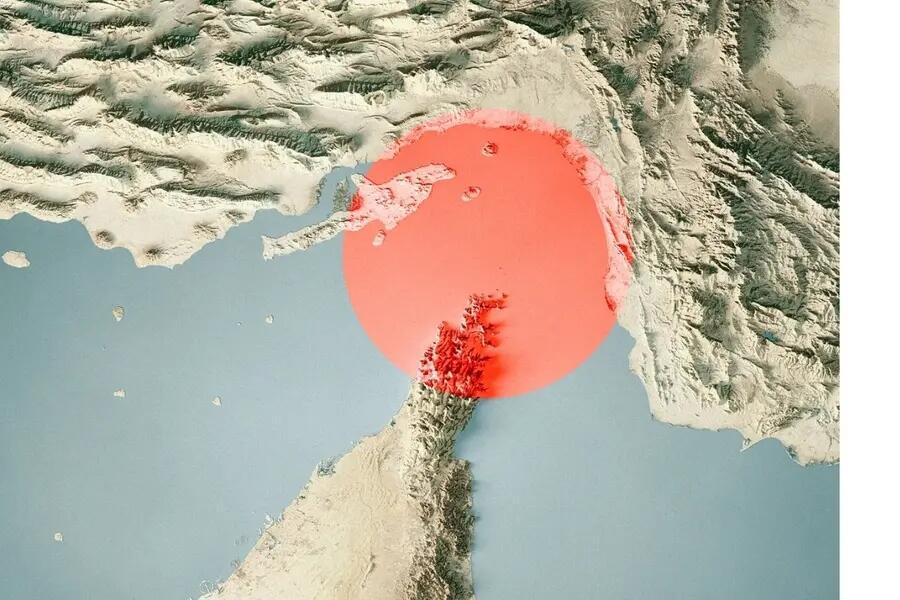
But then came the threats, with Trump apparently widening his purview to international waters:
THIS IS WORLD EXTORTION, and Leaders of Countries, especially the United States of America, will never be extorted.
I have also instructed our Navy to seek and interdict every vessel in International Waters that has paid a toll to Iran.
No one who pays an illegal toll will have safe passage on the high seas.
We will also begin destroying the mines the Iranians laid in the Straits.
Any Iranian who fires at us, or at peaceful vessels, will be BLOWN TO HELL!
And the art of the deal… Escalate to De-Escalate… how long can Iran last with no oil revenues at all?
Iran knows, better than anyone, how to END this situation which has already devastated their Country.
Their Navy is gone, their Air Force is gone, their Anti Aircraft and Radar are useless, Khomeini, and most of their “Leaders,” are dead, all because of their Nuclear ambition.
The Blockade will begin shortly. Other Countries will be involved with this Blockade. Iran will not be allowed to profit off this Illegal Act of EXTORTION.
They want money and, more importantly, they want Nuclear.
Additionally and, at an appropriate moment, we are fully “LOCKED AND LOADED,” and our Military will finish up the little that is left of Iran!
Trump’s decision follows his re-tweeting of this story from JustTheNews.com, suggesting that he could reprise his successful Venezuela blockade strategy to choke an already teetering Iranian economy and ratchet up diplomatic pressure on China and India by cutting them off one of their key sources of oil.
Ironically, the massive USS Gerald Ford carrier that led the Venezuelan blockade is now in the Persian Gulf after a brief hiatus for repairs and crew rest after a deadly fire. And now it joins the USS Abraham Lincoln and other major naval assets.
In short, Trump simply could out-blockade Iran’s hold over the Strait of Hormuz, experts said.
On Sunday, the president confirmed that he is proceeding with a blockade.
“It would be very easy for the US Navy to exert complete control over what does and does not go up and down the Strait now,” the Lexington Institute’s national security expert Rebecca Grant told Just the News.
“I’ve heard about 10 ships have moved in the last 24 hours. One of them was a reflagged Russian tanker, and we know that cargos have gone out to China, to India, and we’ve seen some inbound traffic.
“If Iran gets intransigent, then absolutely, the US Navy can set up with great overwater surveillance … and watch everything that goes in and out of that Strait and you’ll have to ask the US Navy if you want to move past Kharg Island or past that narrow part by Oman,” she added.
Iran’s semi-official media cited “excessive” US demands, while the foreign ministry said it was natural that differences wouldn’t be resolved in a single round of talks, leaving the door open for more discussions.
A month ago we wondered…
…and now we have an answer.
The question is – how will the UAE oil chief deal with a US closure versus an Iranian closure?
China will certainly be pissed off as their tankers were flowing relatively freely until now.
Is the US endgame to take control of another chokepoint too…
Attempted Boarding of Commercial Ship in Bab el-Mandeb Strait
United Kingdom Maritime Trade Operations reported that a “sailing vessel” was approached by a small boat carrying 10 to 12 people, several of them heavily armed with automatic weapons, in what appeared to be an attempted boarding.
“The Master deployed a flare and the skiff turned away and departed to the southeast,” UKMTO wrote in an advisory posted on X about the maritime incident near the Bab el-Mandeb Strait, another critical chokepoint that Iran-aligned Houthi rebels have threatened to close in recent weeks.
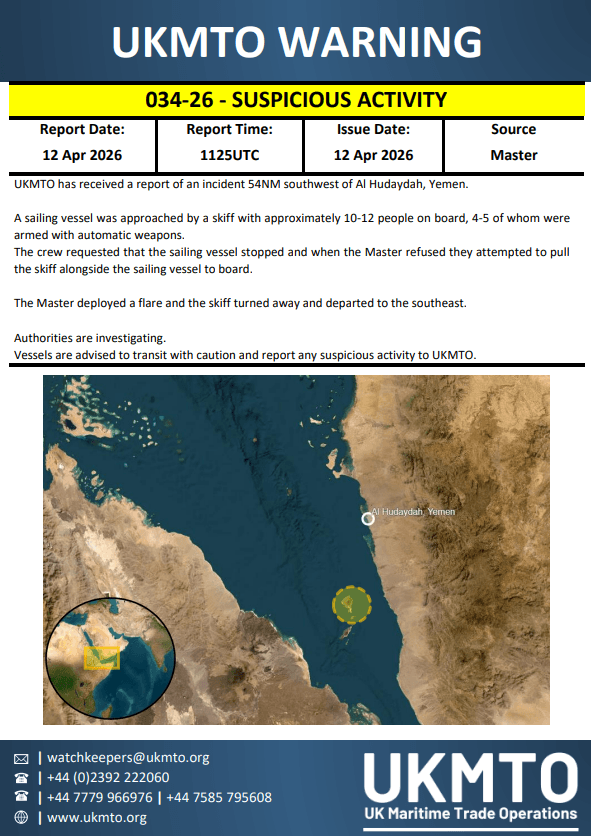
2 Supertankers U-Turn In Strait After Peace Talks End Without A Deal
The marathon peace talks this weekend in Islamabad between Iranian negotiator Mohammad Bagher Ghalibaf, Vice President JD Vance, and other officials ended without a deal. Still, the top Iranian negotiator signaled that the door remains open for future talks. Polymarket odds of a peace deal being signed this month collapsed late Saturday.https://embed.polymarket.com/market?market=us-x-iran-permanent-peace-deal-by-april-30-2026&creator=Alastair&height=300US x Iran permanent peace deal by April 30, 2026?
Yes 16% · No 85%
View full market & trade on Polymarket
Ahead of the weekend peace talks, three fully loaded supertankers carrying Iraqi and Saudi crude safely transited the Strait of Hormuz. But after U.S.-Iran negotiations ended without a deal late Saturday, two separate empty supertankers abruptly turned around at the mouth of the chokepoint rather than enter the Persian Gulf.
The exact reason for the U-turns of the two supertankers remains unclear, especially since Iraq and Pakistan had reportedly received Iranian transit approvals. However, the reversals clearly coincide with the breakdown in negotiations, highlighting just how quickly conditions on the strait can change.
UAE Oil Chief Warns “Illegal, Dangerous, & Unacceptable” For Iran To Close Strait
On Sunday morning, as vessel traffic through the Strait of Hormuz remained muted, Sultan Ahmed Al Jaber, ADNOC’s managing director and group CEO and one of the most influential people in global energy markets, wrote on X: “The Strait of Hormuz has never been Iran’s to close or restrict.”
Al Jaber continued, “Any attempt to do so is not a regional issue; it is the disruption of a global economic lifeline and a direct threat to the energy, food and health security of every nation.”
“Setting such a precedent is illegal, dangerous, and unacceptable. The world simply cannot afford it and must not allow it,” he concluded in the X post.
On Saturday, the U.S. Department of War confirmed that two U.S. warships transited the waterway to begin marine mine-clearing operations. Only a handful of ships have transited the strait this weekend.
Polymarket odds for vessel traffic returning to “normal” by the end of April plunged this weekend from 30% to 17%.https://embed.polymarket.com/market?market=strait-of-hormuz-traffic-returns-to-normal-by-april-30&height=300Strait of Hormuz traffic returns to normal by end of April?
Yes 17% · No 83%
View full market & trade on Polymarket
US Becomes World’s ‘Gas Station Of Last Resort’
Disruptions at Gulf energy facilities and the continued paralysis across the Hormuz chokepoint led us early in the U.S.-Iran conflict to conclude that global energy flows were being rewired, whether temporarily or over the medium term, with energy exporters in the Gulf of America emerging as a potential net beneficiary.
END
Iranians rally outside US embassies worldwide, urge continued pressure on Tehran
Protesters sent a unified message to Washington, urging policymakers not to reach agreements with Tehran and instead to “stay the course” in confronting the regime.

People hold signs featuring images of Reza Pahlavi, the exiled son of Iran’s last shah and an Iranian opposition figure, during a protest against the Iranian government, amid the US-Israel conflict with Iran, in front of the Iranian embassy in London, Britain, April 4, 2026.(photo credit: REUTERS/Isabel Infantes)ByJERUSALEM POST STAFFAPRIL 12, 2026 12:03
Hundreds of thousands of Iranians across the diaspora rallied outside US embassies and consulates in more than 20 countries on Saturday, calling on the international community to maintain pressure on the Islamic Republic and support the Iranian people.
The coordinated demonstrations, held in at least 34 cities across Europe, Asia, and North America, followed a call by Iranian opposition figure Crown Prince Reza Pahlavi.
Footage circulating from multiple locations showed crowds gathering in cities including London, Paris, Berlin, Rome, Stockholm, Seoul, Vienna, Toronto, Los Angeles, and Washington, DC, with participants carrying signs and chanting slogans against the Iranian regime.
Protesters sent a unified message to Washington, urging policymakers not to reach agreements with Tehran and instead to “stay the course” in confronting the regime. Demonstrators argued that the Islamic Republic is in a weakened position and warned that easing pressure could allow it to regroup and intensify internal repression. It was later announced on Sunday that talks between the two parties in Islamabad, Pakistan, had finished with no deal agreed.
Participants also called for sustained international action targeting Iran’s security and judicial apparatus, amid concerns over an increase in executions and continued crackdowns on dissent.

Rallies to amplify voices of those in Iran
According to organizers, the rallies were also intended to amplify the voices of Iranians inside the country, where communication remains restricted under ongoing internet limitations – the internet blackout has now stretched over 40 days inside Iran.
In a statement, Pahlavi said the demonstrations continue to apply pressure in the struggle against the regime.
“The message from hundreds of thousands of Iranians around the world is loud and clear: this is a decisive moment for our nation and the struggle for freedom — the Iranian people will not accept the survival of the murderous regime,” he said. “We urge the international community to stay the course and support the people of Iran in their struggle for freedom.”
END
A ceasefire won’t stop Iran’s military industry -analysis
Periods of reduced kinetic activity can ease pressure, allowing for Iran to once again clandestinely reorganize, restock, and even expand their weapons procurement.

ILLUSTRATIVE: Iranian missiles are displayed at the Islamic Revolutionary Guard Corps(IRGC) Aerospace Force Museum in Tehran, Iran, November 12, 2025.(photo credit: MAJID ASGARIPOUR/WANA (WEST ASIA NEWS AGENCY) VIA REUTERS)ByANNA AHRONHEIMAPRIL 12, 2026 12:05Updated: APRIL 12, 2026 14:00
A ceasefire with Iran may have stopped the immediate exchange of missiles or drones, but just like the last war, less than a year ago, it will not halt the technological processes that underpin Iran’s arsenal of ballistic missiles and drones still aimed at and primed to be launched toward Israel and the Gulf states.
Tehran’s missile and drone programs are long‑term strategic projects that have advanced through close to half a century with periods of both conflict and calm as these systems are central to Iran’s national security doctrine.
The Islamic Republic of Iran’s emphasis on missile and drone technology is rooted in structural constraints. The country’s Air Force – already aging and limited – was severely degraded during the war. Not only have sanctions restricted access to modern aircraft and parts, but many of the aircraft they possessed were struck in the opening days of the war.
An Israeli F-35 also downed an Iranian aircraft, marking the first air-to-air combat hit by an aircraft in decades.
As a result, Tehran has invested heavily in alternatives that allow it to project power and deter adversaries. It views its missile and drone technology as a potent substitute for an air force, enabling it to reach targets across the region and even further, into the Indian Ocean close to some 4,000 kilometers away.

Advertisement
Over the past 40 years, Iran has been massively increasing its inventory of cruise and ballistic missiles and, more recently, focusing on its drone program. Prior to this most recent war, it was estimated that Tehran could produce 10,000 drones per month with thousands more ballistic missiles. The focus on these offensive systems have provided the regime with flexibility and deniability, making them attractive tools to proxies in Yemen, Lebanon. and even Russia.
During the war, these relatively cheap platforms struck thousands of targets across the region. Others were also taken out by expensive interceptors – from the American THAAD or Patriot to the Israeli Arrow, David’s Sling, or Iron Dome.
Iran’s infamous ballistic missiles fitted with cluster submachines inflicted a wider range of damage across Israel. Israeli systems, especially David’s Sling, were unable to handle the cluster munitions.
Back to the ceasefire
Both the US and Israel have said that they struck thousands of targets in Iran, especially the country’s defense industrial base.
IDF Chief of Staff Lt.-Gen. Eyal Zamir said that the IDF’s achievements in the war against Iran “are unprecedented and historic,” and that “Iran before this war is not the same Iran [as now]; it is much weaker.
Chairman of the Joint Chief of Staff Gen. Dan Caine said that the US attacks “destroyed Iran’s defense industrial base and their ability to reconstitute those capabilities for years to come. We attacked, along with our partners, approximately 90 percent of their weapons factories. Every factory that produced Shahed one-way attack drones was struck. Every factory that produces the guidance systems that go into those drones was struck.”
But similar remarks were made by Israel in the 12 Day War last June. Nine months later, there were still thousands of targets in Iran for both militaries to hit. So how much was really destroyed? How much is left? How easily will Iran re-arm itself? Iran’s leadership, now even more extreme than before the war, might double down on missile and drone development during the ceasefire.
A month of war will have helped Iran’s battered yet resilient military industry learn for the next war. Ceasefires can create conditions that accelerate the development of offensive systems. When immediate operational demands decrease, resources can shift toward testing and integration. This pattern is visible in Iran’s missile and drone programs, which, despite everything, continued to improve in accuracy, survivability, and responsiveness.
Regional context
The broader regional context reinforces this dynamic. Drone warfare has become a central feature of modern conflicts, and Iran has been both a contributor to and beneficiary of this shift.
Iran’s use of low‑cost, high‑volume drones such as the Shahed family reflects a global trend toward scaling inexpensive, accurate systems that reshape the battlefield, especially during Russia’s war against Ukraine. Moscow quickly adopted the platform and locally produced variants of the design were made and even shipped back to Iran and used against Gulf targets that for years had worked to stay out of any conflict between Iran and Israel
During the war, thousands of Iranian drones wreaked havoc across the Gulf States and the regime’s drone fire led several nations to reach out to Ukrainian President Volodymyr Zelenskyy for cheap interceptors to take out the Shaheds. It was as if wars had come full circle. Iran helped Russia against Ukraine. Now Ukraine was helping the Gulf against the Islamic Republic, which was being helped by Russia.
Ceasefires also affect supply chains and procurement networks. Iran’s missile and drone programs rely on a mix of domestic production and imported components, including electronics and materials that can be sourced through commercial channels.
Countries like China continue shipping to Iran and will also aid in the recovery of its military industry. Beijing has been critical in helping Iran build its arsenal, and even sold the regime precision machine tools and guidance components, such as gyroscopes and accelerometers. Even during the war, Beijing shipped critical components, notably precursor chemicals for missiles.
Periods of reduced kinetic activity can ease pressure, allowing for Iran to once again clandestinely reorganize, restock, and even expand their weapons procurement.
Friendly fire
At the same time, the ceasefire will allow Israel and the United States to adjust their own technological posture. Both nations continue to invest heavily in counter‑drone and missile defense systems, and these systems depend on continuous software updates, data integration, and doctrinal refinement.
After the war in June, Israel carried out several updates to the Iron Dome and David’s Sling systems and will likely do so again, to incorporate lessons learned from this round. The war made it clear that static air defense systems are major targets for Iran, and measures must be taken to protect or hide them better.
The Israel Air Force, which was the main corps involved in the war, has also likely learned important lessons following the downing of an American F-15 fighter by Iran during the last week of the war and will work towards better defenses on its platforms.
Israel might also work towards incorporating more at-scale production of counter-drone technology at-scale likethe US, which began deploying the LUCAS low‑cost one‑way attack drones modeled on Iranian Shahed designs.
The technological competition is not, and cannot be, one‑sided as both sides use the periods of calm to prepare for future scenarios. But that results in a strategic paradox. While a ceasefire reduces immediate risk to civilian populations, it also marks the beginning of a new phase of technological adaptation.
The Islamic Republic’s missile and drone programs have advanced through decades of sanctions, diplomatic pressure, and intermittent conflict. Iran’s new leadership still views these technologies as essential to its long‑term objectives of reshaping regional and global power dynamics, and their development will continue as long as the regime and their objectives remain in place.
Understanding this distinction between halting fire and halting development is essential for assessing what a ceasefire with Iran can actually change.
A ceasefire can stop the exchange of missiles and drones, but it will not stop the laboratories, workshops, training facilities, or procurement networks that support Iran’s military capabilities.
Those will continue to operate according to strategic timelines that extend far beyond the duration of any ceasefire and the effects of that work will become visible only when hostilities resume. Be that in two weeks time, two months, or two years.
end
ISRAEL/USA/IRAN/MONDAY
Netanyahu Says Iran Ceasefire Could End At Any Moment, Backs Trump’s Blockade – Tehran Blasts ‘Piracy’
Monday, Apr 13, 2026 – 08:30 AM
Summary
- Iran’s military says the planned US blockade on Gulf ports will be an “illegal” act tantamount to “piracy” as Trump is also weighing limited strikes on Iran.
- US military is to enforce the blockade in the Gulf of Oman and Arabian Sea, Reuters reports. Pentagon says any vessel is subject to interception and capture.
- Pundits review breakdown of Pakistan talks, where the “gaps were enormous” – and yet Iran’s FM says the sides were “inches away” from an “Islamabad MoU”.
- Israel-Hezbollah fighting persists on eve of planned Tuesday talks in Washington between Israeli and Lebanese officials.
https://embed.polymarket.com/market?market=will-the-united-kingdom-send-warships-through-the-strait-of-hormuz-by-april-30-2026&height=300Will the United Kingdom send warships through the Strait of Hormuz by April 30, 2026?
Yes 11% · No 90%
View full market & trade on Polymarket
* * *
Gaps Were Enormous
In terms of airstrikes and rockets being lobbed across the Middle East, things have been relatively quiet since US-Iranian talks in Pakistan broke down over the weekend. As we reported earlier President Trump is mulling possible limited strikes on the Islamic Republic from here on out. The previously agreed-upon two week ceasefire is still holding despite the Pakistan talks having collapsed with no plans for any future round.
The only area that continues to see significant exchanges of fire is the Israel-Lebanon situation, where on Monday regional outlets are reporting a flurry of new Hezbollah attacks on northern Israel, alongside heavy IDF strikes on southern Lebanon from Sunday evening into Monday.
Iran’s foreign minister Abbas Araghchi had summarized the situation from Tehran’s point of view, writing on X Sunday that Iran and the US were “inches away” from an “Islamabad MoU” following “intensive talks at highest level in 47 years.” He continued, “We encountered maximalism, shifting goalposts and blockade,” before concluding: “Zero lessons earned. Good will begets good will. Enmity begets enmity.”
Meanwhile Israeli Channel 12 journalist Amit Segal in an Islamabad post mortem has affirmed that the “gaps were enormous” between the two sides prior to Vice President JD Vance and his team calling it quits and flying back to Washington by early Sunday. “The Americans agreed to release a certain portion of the frozen funds and to end the war in the negotiations in Islamabad,” writes Segal. “In return, they demanded a 20‑year freeze on enrichment, the removal of enriched material from Iran, and free navigation in Hormuz without tax payments.” The nuclear front, he notes: “The Iranians discussed the nuclear issue contrary to instructions from Tehran, but the gaps were enormous.”
Hormuz Strait Latest Threats
But after President Trump has begun his own blockade of the Strait of Hormuz (or is imminently about to begin), warning that the US military will “finish up the little that is left of Iran” – two oil tankers linked to Iran have exited the Gulf via the Strait of Hormuz, shipping data from Kpler and LSEG show. Reuters identified one as the tanker Auroura, laden with Iranian oil products, and the other is the diesel-carrying New Future loaded from the Hamriyah port in the UAE.
The ongoing standoff has resulted in a fresh Monday warning out of Iran’s armed forces. It said according to state-run IRIB News, also cited in Bloomberg: “If the security of Iran’s ports in the Persian Gulf and the Sea of Oman is threatened, no port in the Persian Gulf and the Sea of Oman will be safe.” The statement added that “security in the ports of the Persian Gulf and the Sea of Oman is either for everyone or for no one.” US restrictions on the movement of vessels in international waters are “illegal and constitute an act of piracy” and thus Iran stands ready to “firmly implement a permanent mechanism to control the Strait of Hormuz.” Reuters reports Monday:
The U.S. military will enforce a blockade in the Gulf of Oman and Arabian Sea east of the Strait of Hormuz and it will apply to all vessel traffic regardless of flag, the U.S. Central Command said in a note to seafarers seen by Reuters on Monday.
The note said the blockade would come into effect at 1400 GMT on Monday.
Meanwhile the Europeans continue to pay lip service joining some kind of coalition to reopen the strait. France and the United Kingdom have said they are busy organizing a conference for the coming days for countries seeking to establish a “strictly defensive” and “peaceful” mission aimed at reopening the Strait of Hormuz. French President Emmanuel Macron stated on X Monday that “France stands ready to play its full part, as it has consistently sought to do since the very first day of the conflict.”
He also made clear France’s position that the “core issues” of Iran’s nuclear program as well as ballistic missile arsenal must still be addressed. According to Bloomberg, the UK continues to resist calls from Washington for a proposed Hormuz blockade. This ensures another point of contention between Trump and PM Keir Starmer.
Lingering Fighting in Lebanon on Eve of Washington Talks
Tit-for-tat attacks across the Israel-Lebanon border have not ceased, while certainly becoming less severe compared to the last Wednesday massive surprise Israeli attacks on Beirut and the south. However, Al Jazeera reports Monday that “Israeli attacks have not let up in southern Lebanon, hitting many villages and towns, with the latest attacks on Nabatieh al-Fawqa, al-Abbassieh and Bint Jbeil.”
Hezbollah in turn declared it targeted Israeli soldiers in the Shlomi settlement “with a swarm of attack drones.” Warning sirens have continued to blare across Northern Israel and the Galilee area as a result, with Israeli media reporting that four rockets were fired by Hezbollah, but Israeli defenses were able to intercept two, with the other pair falling in an open area and no reports of casualties.
Lebanon’s National News Agency has said that Israeli forces struck at least 30 locations across southern Lebanon on Sunday, along with areas of the western Beqaa Valley. From Sunday into Monday at least five people were killed and nine injured in strikes on Bazouriyeh, amid an ongoing rescue effort. One strike hit the town’s main school and damaged the structure, and elsewhere one person was killed in Nabatieh al-Fawqa, another in Sir al-Gharbiya, and two residents of Shoukin were killed early Monday morning.
Planned peace talks involving Israel and Lebanon are still set to go forward for Tuesday in Washington. Israel’s ambassador to the United States, Yechiel Leiter, is spearheading the Israeli side.
“In the conversation earlier today in Washington between the Israeli and Lebanese ambassadors to Washington, together with the US ambassador to Lebanon, and under the auspices of the US State Department, Israel agreed to begin formal peace negotiations this coming Tuesday,” Leiter said in a statement. “Israel refused to discuss a ceasefire with the Hezbollah terrorist organization, which continues to attack Israel and is the main obstacle to peace between the two countries.” Hezbollah too has said it would not talk to the Israelis, and so all of this means that Lebanese government officials will be doing the negotiating in Washington D.C. – setting up for only limited results if any.
Netanyahu Warns Iran Ceasefire Could End ‘Quickly’
Bigger war returning imminently? Fresh Monday words from Israeli Prime Minister Benjamin Netanyahu said in a government meeting that the ceasefire with Iran could end quickly. He said, “I spoke yesterday with U.S. Vice President J.D. Vance. He called me from his plane on the way back from Islamabad. He reported to me in detail, as members of this administration do every day, on the developments in the negotiations. In this case, the explosion in the negotiations.”

Netanyahu asserted that the breakdown came from the American side, which would not tolerate what he described as Iran’s violation of the agreement to enter negotiations. He said the understanding required halting fire and reopening the straits immediately, which Iran did not do.
He said the Americans rejected that outcome and added that Vance made clear the central issue for President Trump and the United States is the removal of all enriched material and ensuring there will be no further enrichment in the coming years, potentially for decades, within Iran. He reminded officials that objective is also important to Israel.
More Geopolitical Latest
Via Newsquawk…
- A U.S. delegation led by Vice President JD Vance left talks with Iran in Pakistan after 21 hours without an agreement. Vance said the U.S. sought a firm commitment that Iran would not pursue a nuclear weapon or the capability to rapidly obtain one, leaving behind a “final and best offer.” Iranian Foreign Ministry spokesperson Nasser Kanaani Baqaei said progress depends on the U.S. avoiding excessive and unlawful demands and negotiating in good faith, while Iranian reporting cited disagreements and said the U.S. demanded through talks what it failed to achieve through war.
- U.S. President Donald Trump said the U.S. Navy will begin blockading ships entering or leaving the Strait of Hormuz. He said talks went well and most issues were agreed except the nuclear issue, which he called the only one that matters. He added the goal is to reach an “ALL BEING ALLOWED TO GO IN, ALL BEING ALLOWED TO GO OUT” framework, accused Iran of obstructing that by claiming possible mines, called it “world extortion,” and warned that any Iranian attack on U.S. forces or vessels would be met with overwhelming force.
- United States Central Command said it will implement a blockade on maritime traffic entering and leaving Iranian ports on April 13 at 17:00 Israeli time (15:00 BST / 10:00 EDT), while not impeding vessels transiting the Strait of Hormuz to or from non-Iranian ports. Trump later confirmed the timing publicly.
- Trump and his advisers are considering resuming limited strikes inside Iran alongside the blockade to break the stalemate, according to reporting by The Wall Street Journal, while remaining open to a diplomatic resolution.
- Mediators from Pakistan, Egypt, and Turkey will continue efforts in the coming days to bridge gaps between the U.S. and Iran, according to Axios. All parties assess that a deal remains possible, and earlier reports said talks occurred in a positive atmosphere with continued engagement expected.
- The White House outlined red lines Iran refused, including ending all uranium enrichment, dismantling major nuclear facilities, recovering over 400 kilograms of highly enriched uranium believed buried underground, accepting a broader regional de-escalation framework, ending support for groups such as Hamas, Hezbollah, and Houthis, fully reopening the Strait of Hormuz, and eliminating transit tolls.
- Iran’s Foreign Minister stated: “In intensive talks at highest level in 47 years, Iran engaged with U.S in good faith to end war. But when just inches away from “Islamabad MoU”, we encountered maximalism, shifting goalposts, and blockade”.
- Iranian armed forces warned that if Iran’s ports are threatened, no port in the Persian Gulf or Oman Sea will remain safe, according to IRIB News.
- An Iranian National Security Commission spokesperson called the U.S. blockade claim a bluff, according to ISNA.
- Israel Defense Forces said troops are expanding targeted ground operations against Hezbollah infrastructure in the Bint Jbeil area of southern Lebanon, killing over 100 fighters, dismantling dozens of sites, and seizing hundreds of weapons.
- Tasnim News Agency reported that the U.S. risks losing access to the Bab al-Mandab Strait if it escalates actions around the Strait of Hormuz.
- The Islamic Revolutionary Guard Corps warned that the approach of military vessels toward the Strait of Hormuz violates the ceasefire, according to IRNA.
- Israeli forces carried out two airstrikes near Choukine in southern Lebanon.
- The IDF defined Lebanon as the primary operational arena, while Iran is classified as an “arena of readiness” with heightened alert.
- Israel approved plans to establish 15 permanent camps along front-line Lebanese villages, according to Al Jazeera citing Channel 12.
- Israeli forces reportedly conducted a raid targeting Beyout Al-Siyad in southern Lebanon.
- Sirens sounded in Kiryat Shmona in northern Israel, while reports indicated Hezbollah launched missile attacks on Israeli towns.
- Emmanuel Macron said France and the United Kingdom will organize a conference in the coming days to restore freedom of navigation in the Strait of Hormuz, emphasizing a defensive approach and the need for a lasting diplomatic resolution and renewed peace efforts in Lebanon.
- Trump: Iranian Ships Coming Near Blockade Will Be Eliminated
- The Trump-ordered US military blockade of the Hormuz Strait has gone into effect as of early evening local time (and 10am in the US), and Trump soon after issued the below Truth Social message warning that if any of Iran’s ships – which he says at this point are merely small ‘fast attack ships’ – come “anywhere close to our blockade, they will be immediately eliminated.” He described this will be “the same system of kill that we use against the drug dealers” – in reference to the Caribbean and prior Venezuela operations.
- The US Navy is said to be operating from the Gulf of Oman and Arabian Sea while enforcing it. Within the first couple hours of it being in place, there have been no initial reported hostile incidents. In effect a standoff is ensuing.
- As a reminder, after the earlier CENTCOM announcement of the blockade plans, Iranian Parliament Speaker Mohammad Bagher Ghalibaf on Sunday had declared, “enjoy the current pump figures,” adding that “with the so-called ‘blockade,’ Soon you’ll be nostalgic for $4–5 gas.”
- Trump: Iranian Ships Coming Near Blockade Will Be Eliminated
- The Trump-ordered US military blockade of the Hormuz Strait has gone into effect as of early evening local time (and 10am in the US), and Trump soon after issued the below Truth Social message warning that if any of Iran’s ships – which he says at this point are merely small ‘fast attack ships’ – come “anywhere close to our blockade, they will be immediately eliminated.” He described this will be “the same system of kill that we use against the drug dealers” – in reference to the Caribbean and prior Venezuela operations.
- The US Navy is said to be operating from the Gulf of Oman and Arabian Sea while enforcing it. Within the first couple hours of it being in place, there have been no initial reported hostile incidents. In effect a standoff is ensuing.
- As a reminder, after the earlier CENTCOM announcement of the blockade plans, Iranian Parliament Speaker Mohammad Bagher Ghalibaf on Sunday had declared, “enjoy the current pump figures,” adding that “with the so-called ‘blockade,’ Soon you’ll be nostalgic for $4–5 gas.”
ISRAEL/.HEZBOLLAH/LEBANON/MONDAY
IDF: Within a few days, there won’t be major fights left in Lebanon
The IDF might still engage in limited fighting with leftover Hezbollah forces in parts of southern Lebanon who have not withdrawn north of the Litani River with most of Hezbollah’s other forces.

IDF soldiers operating in southern Lebanon, April 10, 2026.(photo credit: IDF SPOKESPERSON UNIT)ByYONAH JEREMY BOBAPRIL 13, 2026 11:01Updated: APRIL 13, 2026 15:16
The IDF on Monday said that once it completes its operation against Hezbollah in Bint Jbail in southern Lebanon in the coming days, there will not be any remaining major fights for it to undertake in the area.
In addition, the IDF added that there were still several areas where it would continue to clear Hezbollah weapons that it had found during its invasion of southern Lebanon.
Such clearing operations could continue for a longer, somewhat indefinite period.
Further, the IDF might still engage in limited fighting with leftover Hezbollah forces in parts of southern Lebanon who have not withdrawn north of the Litani River with most of Hezbollah’s other forces.
https://player.jpost.com/public/player.html?player=jpost&media=4037159&url=www.jpost.comIDF destroys underground Hezbollah terror tunnel in southern Lebanon. (Credit: IDF SPOKESPERSON’S UNIT)
IDF will have no remaining strategic targets in southern Lebanon
However, broadly speaking, the IDF will have no remaining strategic targets in southern Lebanon, and for several days since the Iran ceasefire on Tuesday-Wednesday of last week, the military has refrained from attacks in Beirut and other more strategic areas for Hezbollah.
Even ongoing air force attacks are more focused now on preventing real-time rocket crew threats to Israel’s home front than they are on eliminating Hezbollah’s deeper capabilities, which had been a goal of the IDF when the Israel-Hezbollah conflict was still at its height.
Regarding the Bint Jbail battle, which has already lasted several days, the IDF has already broken into the heart of the village.
The 98th Division caught Hezbollah’s dozens or more fighters there by surprise, surrounding them from all sides before they could find a way to retreat and escape.
The Givati Brigade, the Paratroopers Brigade, and multiple commando units, including Maglan, have been involved in the battles in and around Bint Jbail.
Commando Brigade soldiers, including those from Maglan and Egoz Commando Units, killed three armed terrorists in an airstrike on Sunday. The terrorists were planning to carry out an imminent attack against the IDF operating in the area.
In an additional incident, the IDF located a terror cell planning to use explosive drones to attack soldiers operating in the area. The IDF located one of these terrorists, killing them in a drone strike, the military announced.
Further, the IDF located a loaded rocket launcher aimed towards Israel and destroyed it in a drone strike.
Since the 98th Division entered the Bint Jbail area, the IDF said that it has successfully eliminated rocket fire on Israel from the area.
Given that some of the heaviest fire from Lebanon had been from Bint Jbail, this has also reduced Hezbollah’s ability to fire on northern Israel in broader strategic terms.
That said, Hezbollah still has significant volumes of rockets that can strike northern Israel from deeper parts of Lebanon beyond the Litani River.
The IDF admitted that despite a huge invasion of southern Lebanon for three months in the fall of 2024, it had failed to fully clear Bint Jbil of weapons at the time.
This current invasion of Bint Jbail is, in part, a corrective measure for that oversight.
In addition to the 98th Division, the 162nd, 146th, 91st, and 36th Divisions are operating in southern Lebanon.
Collectively, the IDF has killed around 1,400 Hezbollah fighters, around 100 in the Bint Jbil area.
The 98th Division Chief Brig.-Gen. Guy Levi said, “Bint Jbail, the year is 2,000. Someone here once spoke, boasting about webs and spiders. Today, that man is gone, the field is gone, and his words mean nothing.”
Levi continued, “Bint Jbail, the year is 2026. Our forces control the space, destroying terrorist infrastructure and killing dozens of terrorists. Behind us are the residents of the north whom we protect, before us are the national days that remind us why and for what we are fighting.”
James Genn contributed to this report.
END
Trump: Iranian Ships Coming Near Blockade Will Be Eliminated
The Trump-ordered US military blockade of the Hormuz Strait has gone into effect as of early evening local time (and 10am in the US), and Trump soon after issued the below Truth Social message warning that if any of Iran’s ships – which he says at this point are merely small ‘fast attack ships’ – come “anywhere close to our blockade, they will be immediately eliminated.” He described this will be “the same system of kill that we use against the drug dealers” – in reference to the Caribbean and prior Venezuela operations.
The US Navy is said to be operating from the Gulf of Oman and Arabian Sea while enforcing it. Within the first couple hours of it being in place, there have been no initial reported hostile incidents. In effect a standoff is ensuing.
As a reminder, after the earlier CENTCOM announcement of the blockade plans, Iranian Parliament Speaker Mohammad Bagher Ghalibaf on Sunday had declared, “enjoy the current pump figures,” adding that “with the so-called ‘blockade,’ Soon you’ll be nostalgic for $4–5 gas.”
END
Iran Faces ‘Existential Threat’ From Economic Costs Of US Blockade
The headline “Iran Faces ‘Existential Threat’ From Economic Costs Of US Blockade” captures a real and growing vulnerability for the Iranian regime as the U.S. naval operation in the Strait of Hormuz enters its early phase on April 13, 2026. While “existential” is strong language often used by analysts and Iranian exiles, the economic pressure is undeniably severe and could accelerate internal strains on Tehran.
iranintl.com
Current Status of the Blockade
The U.S. blockade of Iranian ports and coastal areas officially began at 10 a.m. ET (early evening local time in the region). It targets vessels entering or exiting Iranian facilities, aiming to cut off Iran’s remaining oil export revenue and any “toll” payments Iran had been extracting from some transiting ships. Non-Iranian traffic between other Gulf ports is still permitted in principle, though enforcement creates friction and insurance/risk issues.
nytimes.com
President Trump reiterated on Truth Social that any Iranian vessels — particularly the remaining “fast attack ships” — approaching the blockade zone would be “immediately eliminated,” drawing parallels to U.S. counter-narcotics operations in the Caribbean. No major incidents have been reported in the first hours, but a tense naval standoff is underway with U.S. forces operating from the Gulf of Oman and Arabian Sea.
cbsnews.com
Economic Impact on Iran
Iran’s economy was already battered by years of sanctions, the recent war with Israel and the U.S., and its own earlier disruption of Hormuz traffic (which backfired by cratering its own export income). Key points:
- Oil Revenue Chokepoint: The strait normally handles ~20% of global seaborne oil. Iran’s direct exports (already reduced) are now under direct interdiction. Losing this income stream removes a critical lifeline for funding the regime, military, and subsidies that help maintain domestic stability.
- Currency and Inflation: Further isolation would accelerate rial depreciation, import shortages, and hyperinflation — problems that have repeatedly sparked protests in Iran.
- Regime Survival Calculus: Iranian leadership has long relied on oil money and asymmetric threats (mines, proxies, speedboat swarms) to deter pressure. A sustained blockade risks creating the very “existential” domestic crisis analysts warn about: eroded elite cohesion, military discontent over losses, and public hardship that could boil over. iranintl.com
Iranian officials, including Parliament Speaker Mohammad Bagher Ghalibaf, continue defiant rhetoric, mocking U.S. gas prices and suggesting America will suffer more from any oil spike. However, Iran’s own economy has far less resilience — it cannot easily pivot exports or absorb prolonged revenue loss.Global and U.S. Side EffectsThe blockade is not cost-free elsewhere:
- Oil prices have surged again, with WTI climbing toward or above $100–104/bbl and Brent near $98–102 in early reactions. This adds to volatility already seen since the broader conflict began. nbcnews.com
- U.S. gasoline prices, already elevated in some regions, face upward pressure, though American domestic production and diversified imports provide a buffer compared to Europe or Asia.
- Allies (Europe, UK, others) have largely declined direct participation, emphasizing freedom of navigation without joining enforcement.
- China, a major buyer of discounted Iranian oil, and other Asian importers stand to lose more from sustained disruption.
Economists like Nouriel Roubini have described this as a “game of chicken”: Iran may bet it can endure longer through smuggling, proxies, or waiting out U.S. domestic political pain from higher energy costs. The U.S. bet is that targeted pressure on Iran’s revenue will force concessions on the nuclear program and strait access without a wider war.
Outlook
This remains highly fluid. Trump has noted that Iran reportedly reached out on negotiations even as the blockade starts, suggesting back-channel diplomacy continues.
youtube.com
A quick off-ramp is possible if Tehran signals serious movement on its nuclear ambitions and ends any obstruction of the strait. Conversely, Iranian retaliation (via missiles, proxies in the Gulf, or attempts to swarm U.S. assets) could escalate rapidly.For the Iranian regime, the economic costs do pose a serious threat to stability — potentially more so than direct military strikes, given how oil revenue underpins patronage networks. Whether it qualifies as truly “existential” will depend on how long the operation lasts and whether Tehran finds workarounds or folds under pressure. Markets, shipping data, and any initial clashes will drive the next developments. The U.S. objective appears to be maximum economic leverage short of full-scale invasion or regime-change war.
RUSSIA VS UKRAINE
6.GLOBAL ISSUES, COVID ISSUES, VACCINE INJURIES/HEALTH ISSUES
BREAKING: Largest Real-World Analysis of Ivermectin + Mebendazole in Cancer Patients Shows 84.4% Clinical Benefit — Nearly HALF Report Cancer Disappearance or Regression
https://www.2ndsmartestguyintheworld.com/p/breaking-largest-real-world-analysis
Study Shows That All Exposed to COVID-19 Have an Increased Risk of Developing Lung Cancer Over Time – Thailand Medical New
https://www.thailandmedical.news/news/study-shows-that-all-exposed-to-covid-19-have-an-increased-risk-of-developing-lung-cancer-over-time
GLOBAL ISSUES
MARK CRISPIN MILLER
NEWSWIZE
MICHAEL EVERY/OR OR PICTON/GIFFIN OR RABOBANK EXECUTIVE/COMMENTARY ON WORLDLY AFFAIRS
It will be a mess!
What does a US naval blockade of Iran mean for oil flows? – explainer
After weekend peace talks in Islamabad between negotiators from the US and Iran ended without a deal, US President Donald Trump ordered a full blockade on the Strait of Hormuz.

A vessel at the Strait of Hormuz, off the coast of Oman’s Musandam province, April 12, 2026.(photo credit: REUTERS)ByREUTERSAPRIL 13, 2026 10:48
The United States military said it would block shipping traffic in and out of Iran’s ports starting at 10 a.m. ET on Monday, a move that would prevent roughly two million barrels of Iranian oil a day from entering the world’s markets, further tightening global supply.
Here are details on the planned blockade and its implications for oil markets.
What was announced?
After weekend peace talks in Islamabad between negotiators from the US and Iran ended without a deal, US President Donald Trump said the US Navy “will begin the process of blockading any and all ships trying to enter, or leave, the Strait of Hormuz.”
The US military’s Central Command later said the blockade would only apply to ships going to or from Iran, including all Iranian ports on the Gulf and Gulf of Oman. US forces would not impede freedom of navigation for vessels transiting the Strait of Hormuz to and from non-Iranian ports, and additional information would be provided, it said.
Iran’s Islamic Revolutionary Guard Corps responded to Trump by warning that military vessels approaching the strait would be considered a ceasefire breach and dealt with harshly and decisively.

Retired Admiral Gary Roughead, a former chief of US naval operations, cautioned that Iran could fire on ships in the Gulf or attack the infrastructure of Gulf states that host US forces.
What is the implication for oil flows?
Blocking Iranian shipments would disconnect a significant source of oil from the world’s markets. Iran exported 1.84 million barrels per day (bpd) of crude in March and has shipped 1.71 million bpd thus far in April, compared with a full-year average of 1.68 million bpd in 2025, according to Kpler data.
However, a surge in Iranian output before the war started on February 28 has led to near-record levels of Iranian oil loaded on ships, with more than 180 million barrels floating as of earlier this month, according to Kpler data.
What about oil flows from other Gulf producers?
Shipping traffic through the Strait of Hormuz, which has been severely curtailed by an Iranian blockade since the start of the war, remains nearly halted despite last week’s two-week ceasefire agreement between Washington and Tehran.
Oil tankers were steering clear of the strait on Monday.
On Sunday, two Pakistan-flagged tankers, Shalamar and Khairpur, entered the Gulf to load cargoes from the United Arab Emirates and Kuwait; a third ship, the Liberia-flagged very large crude carrier (VLCC) Mombasa B, also transited the strait earlier on Sunday and was ballasting in the Gulf.
Another VLCC, the Malta-flagged Agios Fanourios I, which tried to pass through the strait on Sunday to load Iraqi crude destined for Vietnam, turned back and was anchored near the Gulf of Oman.
On Saturday, three fully loaded supertankers passed through the Strait of Hormuz in what appeared to be the first vessels to exit the Gulf since the US-Iran ceasefire deal.
Some 187 laden tankers carrying 172 million barrels of crude oil and refined products were inside the Gulf as of last Tuesday, according to Kpler.
Which importers are most affected?
Before the war, most Iranian oil exports were shipped to China, the top global crude importer. Last month, the US unveiled a sanctions waiver that has enabled other buyers, including India, to import Iranian oil.
India is set to receive its first crude shipment from Iran in seven years this week, ship tracking data from LSEG and Kpler showed on Wednesday.
Before the war, roughly 20% of global oil and natural gas exports were shipped through the Strait of Hormuz, with most cargoes headed to Asia, the largest importing region.
END
TOTAL INSANITY
The ‘Leading UK Scientists’ Letter Urging Abandonment Of North Sea Is Ideology Masquerading As Science
Saturday, Apr 11, 2026 – 08:10 AM
Authored by Tilak Doshi via Tilak’s Substack,
The Financial Times reported on Good Friday that “more than 65 leading UK scientists” had signed an open letter, published as a Google Doc, urging the Government to abandon new North Sea oil and gas drilling in favour of renewables.
“Here is the scientific establishment speaking with one voice,” the FT tells us, warning against the supposed folly of extracting what remains of Britain’s hydrocarbon resources and to choose renewables that, according to the scientist-signatories, provide both energy security and “cheaper solutions [that] we have already, that we know work”.
Also on Good Friday, Catherine McBride OBE — co-author of the recently published report for the Great British Business Council on Britain’s climate policy-induced de-industrialisation and a plan to reverse it — published a Substack article on X titled ‘What the Greens, most MPs and the FT don’t understand about the North Sea oil and gas‘. Ms McBride and her co-authors have little time for the sheer illiteracy of the Greens and mainstream media in economic and energy issues related to the UK government’s punitive taxes on North Sea oil and gas production.
To point out that the “FT is nothing more than the Guardian with stock prices these days”, a “once mighty publications fallen into the abyss of wokery” would be only to shoot the messenger bearing the familiar pink newsprint. Let’s now turn to the message itself, lest one stand accused of employing ad hominem tactics.
What the so-called ‘consensus’ scientists say
The open letter from the 65 “scientists” declares with solemn authority: “Extracting North Sea fossil fuels will threaten lives and livelihoods.” It asserts that “around 90% of North Sea oil and gas has already been extracted”, that additional production “is unlikely to move prices”, and that the world already possesses “more global reserves of oil and gas than we can safely burn if we are to limit global temperature rise to below 2°C”.
Of course, the usual fire and brimstone warnings of climate damnation apply if we refuse to abide by ‘the Science’.
We will soon exceed the ambitious 1.5°C Paris goal. Any overshoot pushes our climate further out of balance, threatening catastrophic tipping points, including ones that could plunge the UK into a much colder climate in which we would struggle even to grow our own food.
As per the usual climate sermon, warnings of Armageddon are followed by promises of salvation: “As climate scientists, we urge leaders to look to the cheaper solutions we have already, that we know work.”
It is curious that the letter refers to “tipping points” that could plunge the UK into a much colder climate which they say would destroy British agriculture. Apparently, the climate scientists like to cover all bases, global warming or cooling.
The layman, conditioned by years of mainstream media headlines proclaiming scientific unanimity on climate matters, is meant to nod along. After all, so many experts cannot be wrong!
Yet this is precisely the illusion that the late Michael Crichton dissected so ruthlessly on scientific consensus. Genuine science advances through falsification and debate, not through petitions or press releases:
Let’s be clear. The work of science has nothing whatever to do with consensus. Consensus is the business of politics. Science, on the contrary, requires only one investigator who happens to be right, which means that he or she has results that are verifiable by reference to the real world. In science consensus is irrelevant. What is relevant is reproducible results. The greatest scientists in history are great precisely because they broke with the consensus. …There is no such thing as consensus science. If it’s consensus, it isn’t science. If it’s science, it isn’t consensus. Period.
The North Sea letter is not a scientific paper. It is a political intervention dressed in lab coats. It reveals a familiar pattern: selective data, economic illiteracy and a refusal to confront the scale of global emissions realities — above all, those of China. Like China, other large developing countries such as India, South Korea, Japan, Indonesia, Thailand, the Philippines, Vietnam and Bangladesh are stepping up generation of coal-fired power to offset Liquified Natural Gas shortages created by the closure of the Strait of Hormuz. Even Germany, the world’s leading proponent of renewable energy, is seriously considering reopening some of its coal-fired power stations in response to the energy crisis caused by the war with Iran.
Who are these “climate scientists”?
Let us begin with the signatories themselves, the supposed “leading UK climate scientists”. The letter lists 65 names with affiliations and qualifications. On the face of the document alone, without external sleuthing, only a small minority display explicit indicators of hard-science credentials in climate-relevant fields — specific post-nominals such as FRMetS and FLSW, or clear roles at institutions like the British Antarctic Survey, National Centre for Atmospheric Science or Royal Meteorological Society.
By a quick AI-assisted count, based solely on what the letter itself states, fewer than a quarter of the signatories meet the minimal threshold of verifiable hard-science standing. The rest are listed with generic “Dr” or “Prof” titles, or none at all, attached to affiliations ranging from the NHS and Wiltshire Psychology Service to community energy groups, wildlife trusts and independent roles. Several entries provide no qualifications whatsoever. This is not the roster of a disinterested scientific academy. It is a coalition of activists, communicators and academics from adjacent or non-empirical fields, many of whom have long signalled their alignment with Net Zero orthodoxy.
The letter’s primary coordinator, Dr Ella Gilbert — a climate scientist and presenter at the University of Reading’s Meteorology Department with ties to the environmental NGO Climate Outreach – has been openly described in multiple reports as the driving force behind its circulation. Professor Ed Hawkins of the same institution played a key initiating role, posting on LinkedIn to solicit signatures and stating he had “written an open letter”. There is no public evidence of external financial direction or sponsorship; the effort appears to have been an internal academic-network exercise amplified through professional channels. Yet the very act of framing it as a consensus of “climate scientists” performs the rhetorical heavy lifting. It invokes the authority of science while sidestepping the awkward reality that science is not, and has never been, a democracy of signatures.
Mad Ed says: “North Sea oil and gas: no way”
The substantive claims fare no better under scrutiny. Take the repeated assertion that “around 90% of North Sea oil and gas has already been extracted”. This figure originates not from primary geological data but from a March 2026 analysis by the Energy and Climate Intelligence Unit, which aggregates North Sea Transition Authority (NSTA) projections of ultimately recoverable resources through 2050. Official NSTA data as of end-2024 records 47.7 billion barrels of oil equivalent (BOE) produced historically from the UK Continental Shelf, with 2.9 billion BOE of proven and probable (2P) reserves and a further 6.2 billion BOE in contingent resources—roughly 19% of what has already been extracted still potentially accessible.
Industry body Offshore Energies UK (OEUK) rightly notes that framing the basin as “93% drained” ignores the reserves-replacement ratio. Norway, operating under more supportive policies, has consistently replaced a higher share of its production through exploration. The UK’s low ratio of 14% over 2019-2024 reflects not inexorable geology but punitive fiscal terms, windfall taxes and licensing uncertainty under successive governments.
Only active exploration and production (E&P) investment can delineate the true commercial potential of remaining prospects. As the late economist Julian Simon observed, resources are not fixed endowments buried in the earth but functions of human ingenuity, technology and price. Proven reserves expand with higher prices or better recovery techniques; they are not a predetermined pie chart awaiting final division.
The open letter refers to “two proposed new oil and gas fields in the North Sea”, claiming that the likely lifetime emissions from them would be more than most individual nations emit in a year. Presumably the reference is to the Rosebank and Jackdaw oil and gas fields in the North Sea, with Rosebank being the largest untapped oil field in UK waters. Both are in advanced stages of development with significant infrastructure already in place and first oil could be delivered to shore by the end of 2026.
The open letter was launched in time to influence the debate over whether Ed Miliband, Secretary of State for Energy Security and Net Zero, should allow new production from the fields. He is under growing pressure to allow new production in the North Sea to combat what some call ‘the energy crisis’ sparked by the Iran war. Rachel Reeves has backed more North Sea drilling in a potential split with Miliband. The Chancellor said she was “very happy” to back exploration at Rosebank oilfield and Jackdaw gas field. Miliband, Labour’s chief Net Zero ideologue, is expected to make a decision on whether to grant licences for the two fields.
The Telegraph expects Miliband to block North Sea oil drilling, stating that he is “said to be unwavering in his opposition despite impending fuel shortages and surging oil prices”. In this, of course, Miliband is true to his “Mad Ed” designation, fiercely devoted to the UK’s immiserating “global climate leadership” role.
Economic and geopolitical illiteracy
The letter’s economic and geopolitical analysis is equally detached from reality. It laments “the volatility of oil and gas prices” that have “caused our energy and food bills to rocket — twice”, attributing this to dependence on “imported fossil fuels whose price is vulnerable to the actions of the world’s most authoritarian and least reliable leaders”. The implicit prescription appears to be greater independence through renewables. Yet this inverts the logic of comparative advantage that has enriched nations since David Ricardo.
International trade in hydrocarbons has historically buffered supply shocks precisely because diversified sources and spot markets prevent any single actor from dictating terms. The North Sea producers themselves demonstrated this in the mid-1980s by helping collapse the OPEC cartel’s administered pricing system. Britain – like most countries including large oil producers such as Saudi Arabia and Russia – remains a price-taker; incremental North Sea output will not set global benchmarks. But neither will it exacerbate volatility if it displaces imports. The alternative — deeper reliance on Chinese-manufactured solar panels, wind turbines and batteries, whose production is powered overwhelmingly by coal — merely shifts dependence to Beijing’s supply chains and the very fossil fuel infrastructure the letter condemns.
Here the letter’s silence on China’s emissions is deafening. The world’s largest emitter continues to approve coal-fired power stations at a furious pace that dwarfs Western renewables deployment, while its Nationally Determined Contributions under the Paris Agreement are little more ambitious than business-as-usual trajectories. Western Net Zero advocates prefer not to dwell on this, choosing hope over experience lest it complicate the narrative of renewable salvation.
Yet the arithmetic is merciless: even if the entire OECD ceased all emissions tomorrow — an impossibility — the impact on global temperatures by 2100 would remain marginal in IPCC-modelled scenarios, as Bjørn Lomborg has repeatedly demonstrated. The letter’s claim that “the likely lifetime emissions from two proposed new oil and gas fields in the North Sea would be more than most individual nations emit in a year” is true only in the most trivial sense; it ignores the fact that non-OECD emissions dominate the trajectory by far. Meanwhile, the UK’s share of global carbon emissions sits at 0.8%.
Our poor farmers
Farmers, meanwhile, receive the letter’s ritual concern: “rising prices and increasingly empty supermarket shelves”, “worst harvests in recent years” and “extremes of heat, drought, fire and flood”. Evidently, the letter’s signatories spent little time consulting actual IPCC studies. While the IPCC reports increases in heatwaves and some heavy-precipitation events in certain regions, it finds no clear global rise — only “low confidence” — in many of the extreme events (droughts, floods, tropical cyclones, wildfires) that are routinely invoked in climate alarmism.
One wonders when the signatories last consulted real life British farmers. The largest and most sustained rural protests of recent years — repeated tractor convoys into central London from late 2024 through 2026 — have centred not on ‘climate extremes’ but on the Government’s imposition of inheritance tax on agricultural assets above £1 million (later softened to £2.5 million after sustained pressure). Family farms face break-up, not because of marginal weather shifts but because of policy-driven cost pressures: the world’s highest electricity prices, diesel taxes exceeding 50% and regulatory burdens that make food production uneconomic.
The letter’s pastoral alarmism about “catastrophic tipping points” that “could plunge the UK into a much colder climate” is rhetorical. Earth’s 4.5-billion-year history records repeated glacial-interglacial cycles without human help; warm periods in antiquity and medieval times allowed, for instance, northern England to grow wine grapes and Greenland to support barley cultivation. The term “tipping point” itself is not a precise physical concept but a metaphor borrowed from non-linear systems. Large natural systems, per Le Chatelier’s principle in dynamic equilibrium, tend toward equilibrium when perturbed — not runaway instability.
Tropes and ideology
The signatories, like their fellow ideologues in academia, employ the cheap renewables trope. The letter urges leaders to embrace “the cheaper solutions we have already”. Renewables, we are told, are proven and cost-effective. This assertion rests on the familiar Levelised Cost of Electricity (LCOE) metric, which systematically understates the system-wide costs of intermittency: overbuilding, backup dispatchable generation (often gas-fired at inefficient part-load), grid reinforcement and balancing services. Full-cost-of-electricity analyses, incorporating adequacy and integration expenses, tell a different story — as detailed in the work of Lars Schernikau and others. Renewables’ “cheapness” is an artefact of subsidies, mandates and selective accounting, not a market verdict.
In the end, this letter, embraced and publicised by the FT, is less about science than about maintaining the climate-industrial consensus. The University of Oxford’s Smith School of Enterprise and the Environment came out recently with its analysis which echoes the conclusions of the open letter. In the open letter and in the Oxford analysis, there is no reference to the benefits of increased North Sea oil and gas production: added value to the nation’s GDP, improvements to Great Britain’s balance of payments as a net oil and gas importer, increases in Government tax revenues and oil and gas jobs and ancillary benefits in cities like Aberdeen which serve the offshore oil and gas industry.
Science advances not by petition but by relentless scepticism. The North Sea’s remaining resources — whether measured in billions of barrels of oil equivalent or in the potential unlocked by competitive exploration and production — are not a climate sin but a strategic asset. Ignoring them in favour of virtue-signalling autarky serves neither energy security nor affordability.
Britain’s leaders would do well to treat such letters with the scepticism they deserve: not as oracles, but as more noise in a debate that ideology has long sought to close. The real crisis is not the climate; it is the West’s self-imposed energy anorexia in the face of a multipolar world that has no intention of following suit.
END
Oil Jumps, Stocks Dump As Peace Talks Fail, Hormuz Blockade Looms
Sunday, Apr 12, 2026 – 06:00 PM
Before the ‘official’ futures markets opened, the risk-off tone (due to the failed peace talks and Trump’s threat to blockade Iranian vessels) was very evident in FX and crypto markets.
Even given the usual caveats about thin liquidity, AUD/USD is down around 1%, a classic growth-sensitive barometer flashing warning signs, while EUR/USD is weaker by roughly 0.5%.
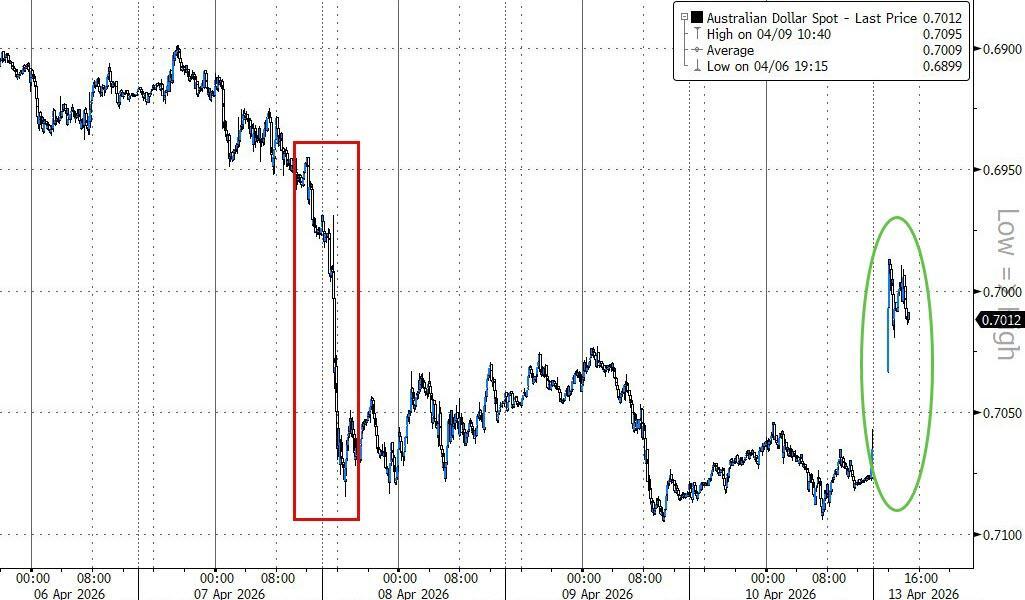
The moves point to a softer tone for risk assets and sure enough bitcoin is down notably, but still up from pre-ceasefire levels…
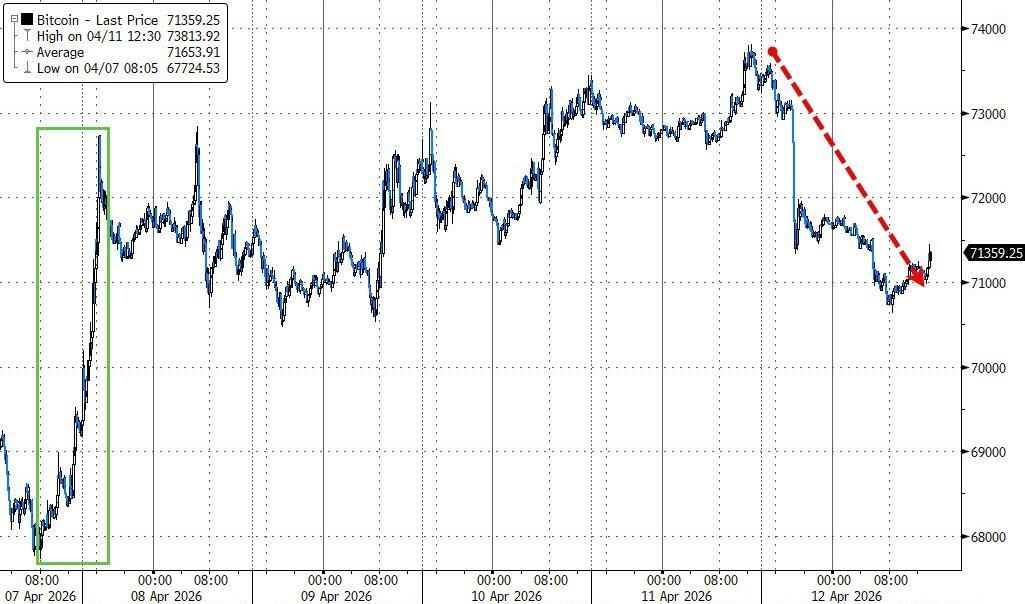
All eyes are of course on the oil markets where hyperliquid perps were signaling a major jump higher as traders react to peace talks falling apart over the weekend, and the US moving to blockade the Strait of Hormuz in response.
WTI opened up over 8% surging back above $100 (topping $105)…
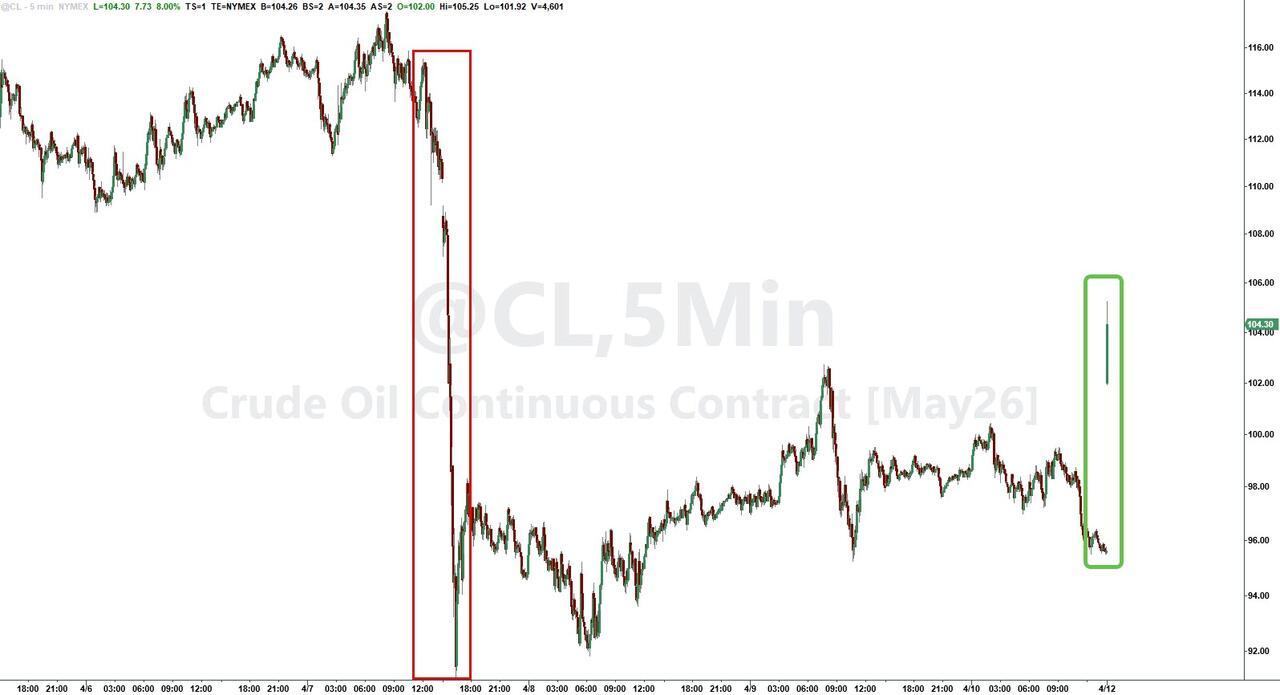
European gas futures also surged more than 10% as the trading day for the product expanded to 21 hours, from 10 hours, on Monday.
The timeline for the start of efforts to unwind the extreme supply shocks created by the war looks to be getting longer and longer.
And of course, as goes oil, so goes stocks etc…
Since the war started, markets have increasingly taken their cues from crude prices given their far-reaching consequences. Surging energy costs have driven both the pullback in risk appetite as an immediate reaction to the conflict, as well as investors’ longer-term anticipation for a pickup in inflation and slowdown in consumption.
The extent of the divergence (between oil and stocks) has now surpassed levels seen in 2022.
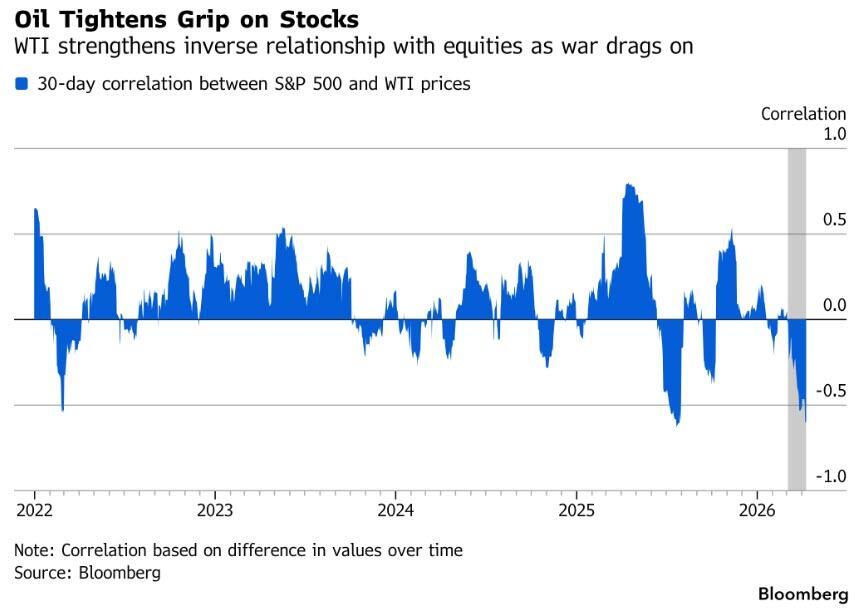
But, even as the bond-stock-oil correlations started to creak on Friday…
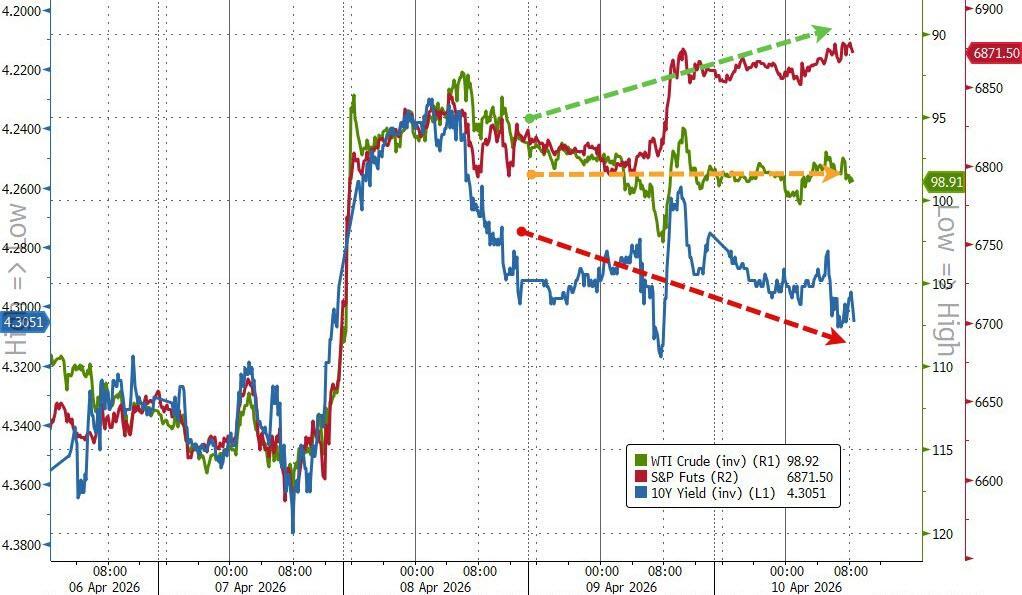
…they are back in sync on this thin Sunday evening with S&P futures down over 1% for now…
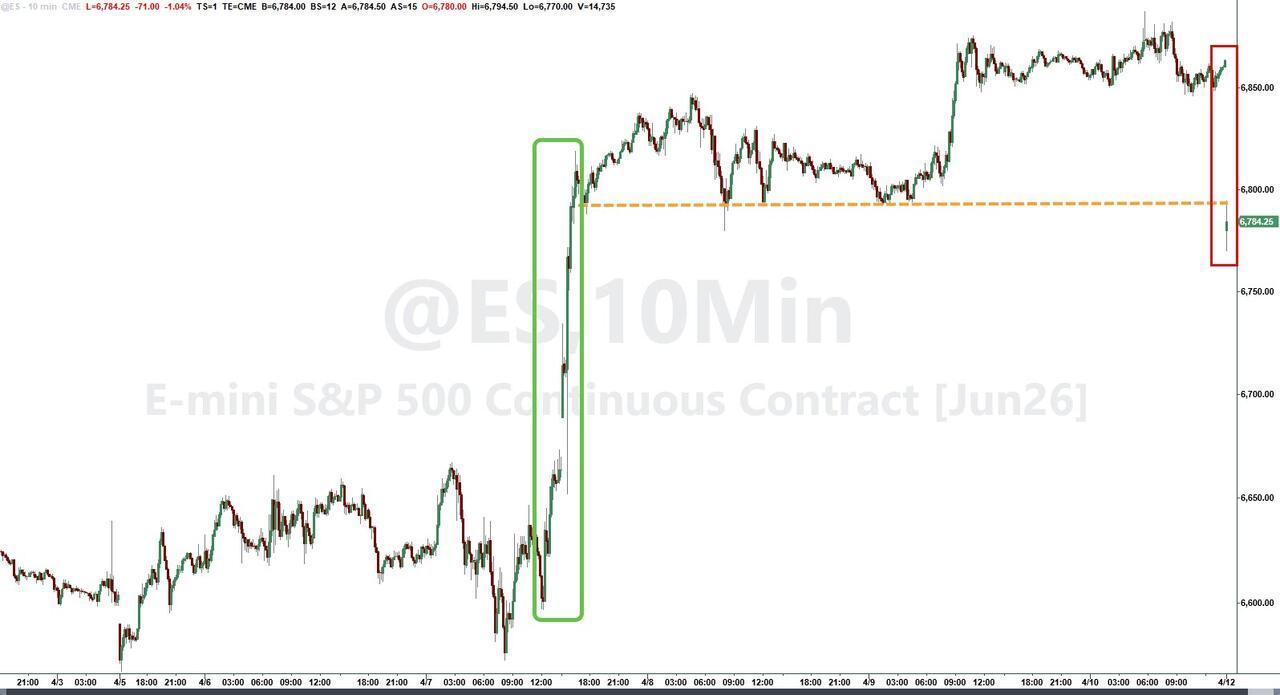
Treasury futures prices are down notably (implying around a 5bps jump in 10Y Yields)…
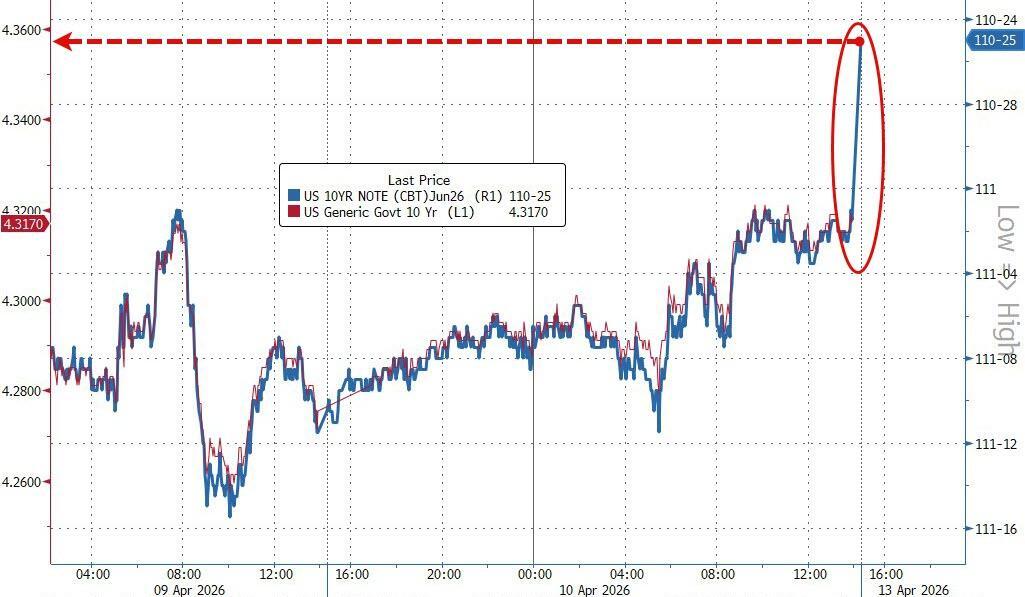
The stronger dollar has pushed gold back down below $4700…
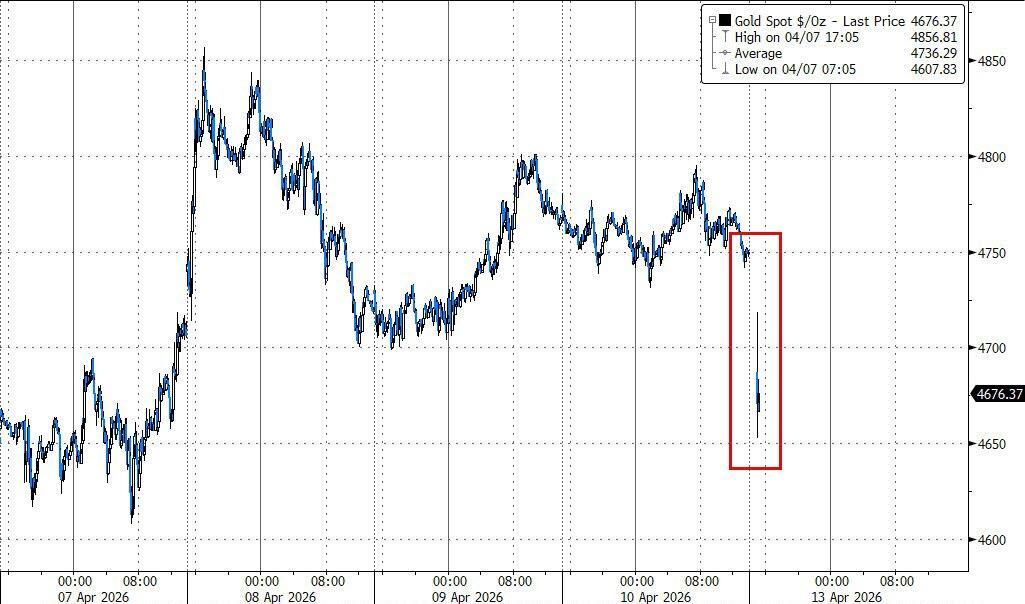
Obviously, investors will continue to monitor Middle East tensions in the coming week, while monthly reports from OPEC and the IEA will add some insight into how the Iran war is affecting the oil market.
Several major US banks are due to report earnings, where any commentary on the impact from the conflict will also be closely watched.
US data releases include producer prices, industrial production and existing home sales, while the Fed’s Beige Book will offer additional color on the health of the economy.
China is also due to report first-quarter GDP plus retail sales and industrial production data for March.
As Morgan Stanley’ Michael Wilson warned: The final phase of a correction is rarely easy and could require another re-test for markets, particularly if rates or bond volatility push higher again.
It may be about to get more difficult again.
END
Mapping The Hormuz Blockade: At Least 15 US Navy Ships Are In Place
Monday, Apr 13, 2026 – 12:20 PM
President Trump is once again engaged in a high risk bet in hopes that Iran will buckle to US demands after failed initial truce talks in Pakistan. The blockade now in effect as of Monday seeks to starve Iran of $200 million in daily oil revenues.
The Wall Street Journal has newly detailed that more 15 American warships are now in place to support the operation, in the Gulf of Oman and the Arabian Sea. The report further specified that “An advisory to mariners from U.K. Maritime Trade Operations, which is affiliated with Britain’s Royal Navy, said maritime-access restrictions were being enforced for Iranian ports and coastal areas along the Persian Gulf, Gulf of Oman and parts of the Arabian Sea.”
Fox News has at the same time issued a map which purports to identify 17 total naval ships deployed in the blockade area as a Monday morning. They are listed in the map and infographic below: The location of US ships around Iran as of Monday.

“Any vessel entering or departing the blockaded area without authorization is subject to interception, diversion, and capture,” a notification from US Central Command (CENTCOM) has said.
As for the advisory from the UK Maritime Trade Operations, it has warned that ships should be prepared to encounter the US blockade, and any vessels in the area must “maintain heightened situational awareness” pending more specific guidance is to follow.
It lays out that additional guidance for mariners regarding “how these measures will be applied in practice, including routing, verification and authorized transit producers, are in development”.
“These access restrictions apply without distinction to vessels of any flag engaging with Iranian ports, oil terminals, or coastal facilities,” UKMTO said of the threatened blockade.
It added: “Further clarification is expected to be provided through subsequent advisories as information becomes available.”
In the meantime Gulf states are still calling on Iran to stop using the Strait of Hormuz as leverage and as a bargaining chip. The latest Gulf leader to speak out is Qatari Prime Minister Sheikh Mohammed bin Abdulrahman bin Jassmin Al-Thani.
He announced that he said he spoke with his Iranian counterpart on the issue on Monday. “Sheikh Mohammed emphasized the need for all parties to respond positively to ongoing mediation efforts, calling for dialogue and peaceful means to address the root causes of the crisis and reach a sustainable agreement that prevents renewed escalation,” the Qatari PM’s office said in a statement.
“He also underlined the importance of keeping maritime routes open and ensuring freedom of navigation, warning against using them as a bargaining chip,” the statement continued.
“His Excellency further cautioned that any disruption to shipping lanes could have serious consequences for countries in the region, as well as for global energy and food supplies, with wider implications for international peace and security,” it added.
Soon after the blockade having taken effect, Trump issued a Truth Social message warning that if any of Iran’s ships – which he says at this point are merely small ‘fast attack ships’ – come “anywhere close to our blockade, they will be immediately eliminated.” He described this will be “the same system of kill that we use against the drug dealers” – in reference to the Caribbean and prior Venezuela operations.
END
As US Initiates Blockade Of Hormuz, Trump Warns Any Iranian Ships Coming Near Will Be ‘Eliminated’
Monday, Apr 13, 2026 – 10:45 AM
Summary
- Iran’s military says the US blockade on Gulf ports, now in effect, is an “illegal” act tantamount to “piracy” as Trump is also weighing limited strikes on Iran. Trump warns Iranian fast boats to be ‘eliminated’.
- US military says it is enforcing the blockade in the Gulf of Oman and Arabian Sea, Reuters reports. No major incidents or acts of aggression reported, hours into US operation.
- Pundits review breakdown of Pakistan talks, where the “gaps were enormous” – and yet Iran’s FM says the sides were “inches away” from an “Islamabad MoU”.
- Israel-Hezbollah fighting persists on eve of planned Tuesday talks in Washington between Israeli and Lebanese officials.
https://embed.polymarket.com/market?market=strait-of-hormuz-traffic-returns-to-normal-by-april-30&height=300Strait of Hormuz traffic returns to normal by end of April?
Yes 13% · No 88%
View full market & trade on Polymarket
* * *
At Least 15 US Navy Ships Enforce Blockade
The Wall Street Journal has newly detailed that more 15 American warships are now in place to support the operation, in the Gulf of Oman and the Arabian Sea. The report further specified that “An advisory to mariners from U.K. Maritime Trade Operations, which is affiliated with Britain’s Royal Navy, said maritime-access restrictions were being enforced for Iranian ports and coastal areas along the Persian Gulf, Gulf of Oman and parts of the Arabian Sea.
“Any vessel entering or departing the blockaded area without authorization is subject to interception, diversion, and capture,” a notification from US Central Command (CENTCOM) has said. And UKMTO has warned maritime traffic, “These access restrictions apply without distinction to vessels of any flag engaging with Iranian ports, oil terminals, or coastal facilities.” Trump boasts the following on Monday:
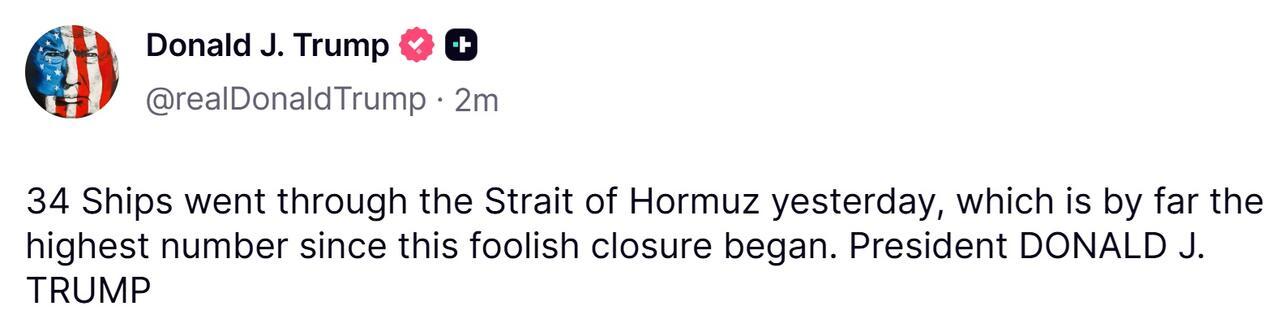
Trump: Iranian Ships Coming Near Blockade Will Be Eliminated
The Trump-ordered US military blockade of the Hormuz Strait has gone into effect as of early evening local time (and 10am in the US), and Trump soon after issued the below Truth Social message warning that if any of Iran’s ships – which he says at this point are merely small ‘fast attack ships’ – come “anywhere close to our blockade, they will be immediately eliminated.” He described this will be “the same system of kill that we use against the drug dealers” – in reference to the Caribbean and prior Venezuela operations.
The US Navy is said to be operating from the Gulf of Oman and Arabian Sea while enforcing it. Within the first couple hours of it being in place, there have been no initial reported hostile incidents. In effect a standoff is ensuing.
As a reminder, after the earlier CENTCOM announcement of the blockade plans, Iranian Parliament Speaker Mohammad Bagher Ghalibaf on Sunday had declared, “enjoy the current pump figures,” adding that “with the so-called ‘blockade,’ Soon you’ll be nostalgic for $4–5 gas.”
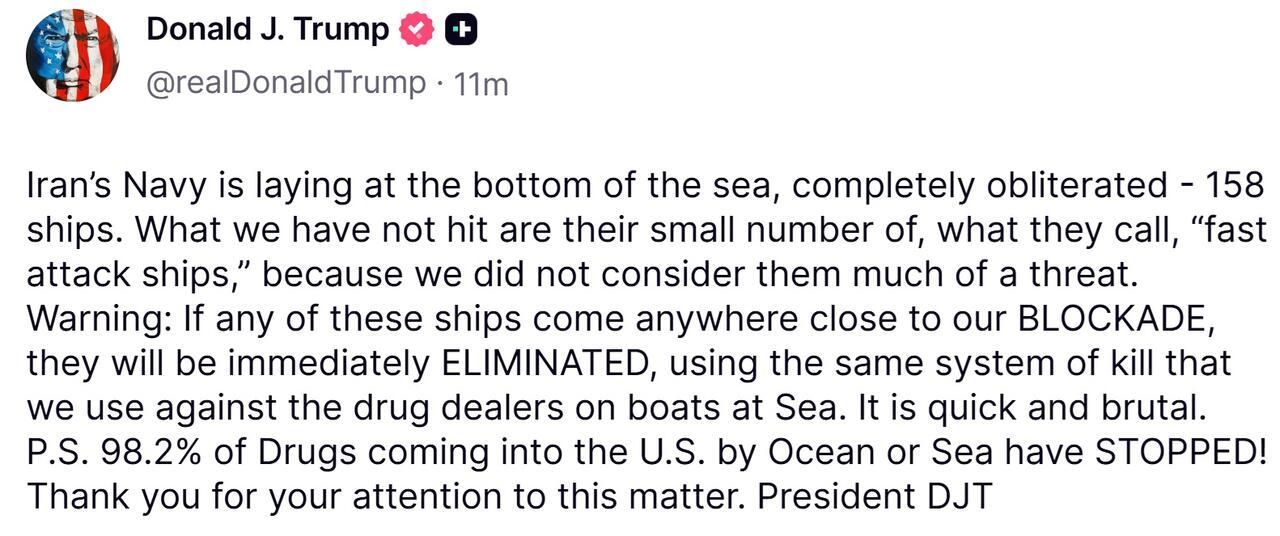
Gaps Were Enormous
In terms of airstrikes and rockets being lobbed across the Middle East, things have been relatively quiet since US-Iranian talks in Pakistan broke down over the weekend. As we reported earlier President Trump is mulling possible limited strikes on the Islamic Republic from here on out. The previously agreed-upon two week ceasefire is still holding despite the Pakistan talks having collapsed with no plans for any future round.
The only area that continues to see significant exchanges of fire is the Israel-Lebanon situation, where on Monday regional outlets are reporting a flurry of new Hezbollah attacks on northern Israel, alongside heavy IDF strikes on southern Lebanon from Sunday evening into Monday.
Iran’s foreign minister Abbas Araghchi had summarized the situation from Tehran’s point of view, writing on X Sunday that Iran and the US were “inches away” from an “Islamabad MoU” following “intensive talks at highest level in 47 years.” He continued, “We encountered maximalism, shifting goalposts and blockade,” before concluding: “Zero lessons earned. Good will begets good will. Enmity begets enmity.” Some of the latest:
IRANIAN OFFICIALS ARE STUDYING ABANDONING URANIUM ENRICHMENT AS A U.S. CONDITION FOR ENDING THE WAR – NEW YORK POST
NEW YORK POST: IRANIAN OFFICIALS ARE STUDYING ABANDONING URANIUM ENRICHMENT AS A U.S. CONDITION FOR ENDING THE WAR
Oil dumped on the headline once it hit Reuters:
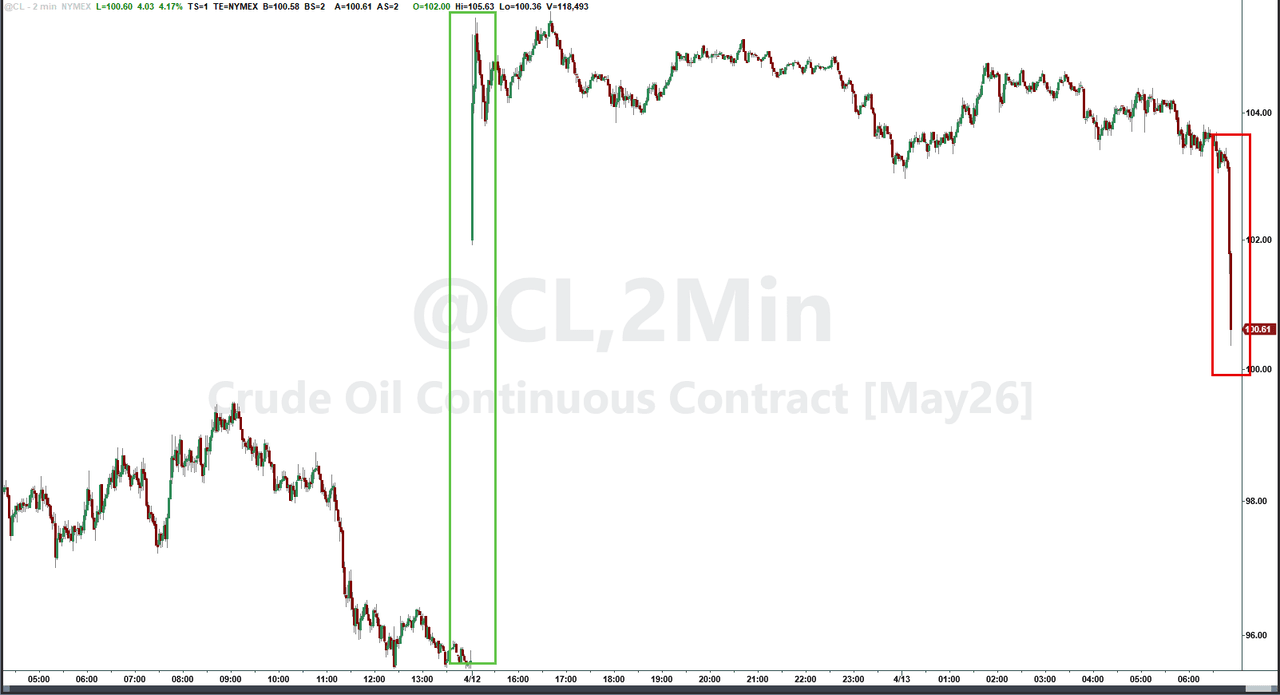
Meanwhile Israeli Channel 12 journalist Amit Segal in an Islamabad post mortem has affirmed that the “gaps were enormous” between the two sides prior to Vice President JD Vance and his team calling it quits and flying back to Washington by early Sunday. “The Americans agreed to release a certain portion of the frozen funds and to end the war in the negotiations in Islamabad,” writes Segal. “In return, they demanded a 20‑year freeze on enrichment, the removal of enriched material from Iran, and free navigation in Hormuz without tax payments.” The nuclear front, he notes: “The Iranians discussed the nuclear issue contrary to instructions from Tehran, but the gaps were enormous.”
Hormuz Strait Latest Threats
But after President Trump has begun his own blockade of the Strait of Hormuz (or is imminently about to begin), warning that the US military will “finish up the little that is left of Iran” – two oil tankers linked to Iran have exited the Gulf via the Strait of Hormuz, shipping data from Kpler and LSEG show. Reuters identified one as the tanker Auroura, laden with Iranian oil products, and the other is the diesel-carrying New Future loaded from the Hamriyah port in the UAE.
The ongoing standoff has resulted in a fresh Monday warning out of Iran’s armed forces. It said according to state-run IRIB News, also cited in Bloomberg: “If the security of Iran’s ports in the Persian Gulf and the Sea of Oman is threatened, no port in the Persian Gulf and the Sea of Oman will be safe.” The statement added that “security in the ports of the Persian Gulf and the Sea of Oman is either for everyone or for no one.” US restrictions on the movement of vessels in international waters are “illegal and constitute an act of piracy” and thus Iran stands ready to “firmly implement a permanent mechanism to control the Strait of Hormuz.” Reuters reports Monday:
The U.S. military will enforce a blockade in the Gulf of Oman and Arabian Sea east of the Strait of Hormuz and it will apply to all vessel traffic regardless of flag, the U.S. Central Command said in a note to seafarers seen by Reuters on Monday.
The note said the blockade would come into effect at 1400 GMT on Monday.
Meanwhile the Europeans continue to pay lip service joining some kind of coalition to reopen the strait. France and the United Kingdom have said they are busy organizing a conference for the coming days for countries seeking to establish a “strictly defensive” and “peaceful” mission aimed at reopening the Strait of Hormuz. French President Emmanuel Macron stated on X Monday that “France stands ready to play its full part,
YOUR EARLY CURRENCY/GOLD AND SILVER PRICING/ASIAN CLOSING MARKETS AND EUROPEAN BOURSE OPENING AND CLOSING/ INTEREST RATE SETTINGS MONDAY MORNING 6;30AM//OPENING AND CLOSING
OPENING LEVELS OF CURRENCIES// AND CLOSING ASIAN STOCK MARKET AND OPENING EUROPEAN STOCKS:6 AM EST
EURO VS USA DOLLAR: 1.1686 DOWN 0.0032
USA/ YEN 159.69 UP 0.564 NOW TARGETS INTEREST RATE AT 1.75% AS IT WILL BUY UNLIMITED BONDS TO GETS TO THAT LEVEL…//YEN STILL FALLS//END OF YEN CARRY TRADE BEGINS AGAIN DEC 2024/Bank of Japan raises rates by .25% TO 1.75 ..TAKAICHI NEW PM AS YIELDS RISE//JAPAN DEEPLY IN TROUBLE WITH RISING RATES AND A FALLING YEN!!
GBP/USA 1.3424 DOWN 0.0029 OR 29 BASIS PTS
USA/CAN DOLLAR: 1.3845 UP 0.0018 CDN DOLLAR DOWN 18 BASIS PTS//
Last night Shanghai COMPOSITE CLOSED UP 2.93 PTS OR 0.06%
Hang Seng CLOSED DOWN 232.69 PTS OR 0.90%
AUSTRALIA CLOSED DOWN 0.87%
// EUROPEAN BOURSE: ALL RED
Trading from Europe and ASIA
I) EUROPEAN BOURSES: ALL RED
2/ CHINESE BOURSES / :Hang SENG CLOSED DOWN 282.69 PTS OR 0.90%
/SHANGHAI CLOSED UP 2.93 PTS OR 0.06%
AUSTRALIA BOURSE CLOSED DOWN 0.87%
(Nikkei (Japan) CLOSED DOWN 3652.69 PTS OR 0.62%
INDIA’S SENSEX IN THE RED
Gold very early morning trading: $4735/5-
silver:$74.44
USA DOLLAR VS TRY (TURKISH LIRA): 44.72 PLUS 12 BASIS PTS AND NOW WE SEE THEIR STUPIDITY OF SELLING SOME OF THEIR GOLD.
USA DOLLAR VS RUSSIAN ROUBLE: 76.11 ROUBLE// UP 0 ROUBLE AND 96 BASIS PTS
UK 10 YR BOND YIELD: 4.9660 UP 3 BASIS PTS
UK 30 YR BOND YIELD: 5.6294 UP 3 BASIS PTS
CDN 10 YR BOND YIELD: 3.469 UP 2 BASIS PTS
CDN 5 YR BOND YIELD; 3.077 DOWN 0 BASIS PTS
USA dollar index early MONDAY MORNING: 98.79 UPP 95 BASIS POINTS FROM FRIDAY’s CLOSE
MONDAY MORNING NUMBERS ENDS
And now your closing FRIDAY NUMBERS 10.00 AM
Portuguese 10 year bond yield: 3.492% UP 5 in basis point(s) yield
JAPANESE BOND 10 yr YIELD: +2.475% UP 2 FULL POINTS BASIS POINTS /JAPAN losing control of its yield curve/
JAPAN 30 YR: 3.716 UP 7 BASIS PTS//
SPANISH 10 YR BOND YIELD: 3.532 UP 3 in basis points yield
ITALY 10 YR BOND: 3.809 UP 4 points in basis points yield ./ THE ECB IS QE’ ING ITALIAN BONDS (
GERMAN 10 YR BOND YIELD: 3.0782 UP 4 BASIS PTS
IMPORTANT CURRENCY CLOSES : MID DAY MONDAY
Closing currency crosses for day /USA DOLLAR INDEX/USA 10 YR BOND YIELD/10:00 AM
Euro/USA 1.1699 DOWN 0.0019 OR 19 basis points
USA/Japan: 159.78 UP 0.645 OR YEN IS DOWN 65 BASIS PTS// HIGHLY INFLATIONARY TO JAPAN
Great Britain 10 YR RATE 4.860 UP 4 BASIS POINTS //
GREAT BRITAIN 30 YR BOND; 5.530 UP 4 BASIS POINTS.
Canadian dollar DOWN 6 BASIS pts to 1.3834
xxxxxxxxxxxxxxxxxxxxxxxxxxxxxxxxxxxxxxxxxxxxxxxxxxxxxxxxxxxxxxxxxxxxxxxxxxxxxxxx
The USA/Yuan CNY DOWN 6.8312 ON SHORE ..
THE USA/YUAN OFFSHORE// CNH DOWN TO 6.8299
TURKISH LIRA: 44.72 EXTREMELY DANGEROUS LEVEL/DEATH WATCH/HYPERINFLATION TO BEGIN.//
Your closing 10 yr US bond yield UP 2 in basis points from FRIDAY at 4.321.% //trading well ABOVE the resistance level of 2.27-2.32%)
USA 30 yr bond yield 4.918 UP 1 basis points /10:00 AM
USA 2 YR BOND YIELD: 3.802 UP 2 BASIS PTS.
GOLD AT 10;00 AM 4730.40
SILVER AT 10;00: 74.13
Your 11:00 AM bourses for Europe and the Dow along with the USA dollar index closing and interest rates MONDAY CLOSING TIME 10:00 AM//
London: CLOSED DOWN 17..57 PTS OR 0.17%
GERMAN DAX: CLOSED DOWN 61.51 PTS OR 0.26%
FRANCE: CLOSED DOWN 23.62 PTS OR 0.29%
Spain IBEX CLOSED DOWN 180.60 PTS OR 0.99%
Italian MIB: CLOSED DOWN 82.20 PTS OR 0.17%
WTI Oil price 103.34 10.00 EST/
Brent Oil: 101.94 10:00 EST
USA /RUSSIAN ROUBLE /// AT: 76.06 ROUBLE UP 1 AND 1 / 100
CDN 10 YEAR RATE: 3.492 UP 3 BASIS PTS.
CDN 5 YEAR RATE: 3.094 UP 2 BASIS PTS
CLOSING NUMBERS: 4 PM
Euro vs USA 1.1759 UP 0.0042 OR 42 BASIS POINTS//
British Pound: 1.3505 UP 0.0052 OR 52 basis pts/
BRITISH 10 YR GILT BOND YIELD: 4.8440 UP 1 FULL BASIS PTS//
BRITISH 30 YR BOND YIELD: 5.515 UP 4 IN BASIS PTS.
JAPAN 10 YR YIELD: 2.475 UP 3 FULL BASIS PTS (DANGEROUS TO THEIR ECONOMY
JAPANESE 30 YR BOND: 3.708 UP 8 PTS AND STILL VERY DANGEROUS TO THEIR ECONOMY
USA dollar vs Japanese Yen: 159.33 UP 0.960 OR YEN DOWN 96 BASIS PTS EXTREMELY DANGEROUS/YEN FALLING DEEPLY IN VALUE
USA dollar vs Canadian dollar: 1.3787 DOWN 0.0059 PTS// CDN DOLLAR UP 59 BASIS PTS
West Texas intermediate oil: 97.79
Brent OIL: 98.33
USA 10 yr bond yield DOWN 2 BASIS pts to 4.298
USA 30 yr bond yield: DOWN 2 PTS to 4.899%
USA 2 YR BOND 3.781 DOWN 2 PTS
CDN 10 YR RATE 3.472 UP 0 BASIS PTS
CDN 5 YEAR RATE: 3.083 UP 0 BASIS PTS
USA dollar index: 98.19 DOWN 20 BASIS POINTS
USA DOLLAR VS TURKISH LIRA: 44.70 GETTING QUITE CLOSE TO BLOWING UP/IDIOTS SOLD GOLD
USA DOLLAR VS RUSSIA//// ROUBLE: 77.07 DOWN 0 AND 5/100 roubles //
GOLD $4743.40 3:30 PM)
SILVER: 75.52 3;30 PM)
DOW JONES INDUSTRIAL AVERAGE: UP 302.48 UP .63%
NASDAQ 100 UP 267.38 PTS OR 1.06%
VOLATILITY INDEX 19.22 DOWN 0.01 PTS OR 0.005%
GLD: $ 435.40 DOWN 1.73 PTS OR 0.40%
SLV/ $68,28 PTS OR OR 0.80%
TORONTO STOCK INDEX// TSX INDEX: CLOSED UP 156.66 PTS OR 0.46%
end
TRADING today ZEROHEDGE 4 PM: HEADLINE NEWS/TRADING
‘Deal Or No Deal’: Risk Roller-Coasters As Deal-Hope Trumps Hormuz Doldrums
WRAP UP
Markets unwound geopolitical risk as ongoing US/Iran talks keep hopes for a deal alive – Newsquawk US Market Wrap
Monday, Apr 13, 2026 – 04:10 PM
- SNAPSHOT: Equities up, Treasuries up, Crude up, Dollar down, Gold down.
- REAR VIEW: US/Iran talks end with no agreement as US begins own blockade of Strait of Hormuz; Mediators pursue Iran-US deal in back channel diplomacy; US/Iran negotiations ongoing with the aim of reaching an agreement; Progress on talks is being made; GS miss on FICC sales & trading rev.; US existing home sales disappoint.
- COMING UP: Data: Australian Consumer Confidence (Apr), Chinese Balance of Trade (Mar), Japanese Industrial Production Final (Feb), Swedish CPIF Final (Mar), German Wholesale Prices (Mar), Spanish HICP Final (Mar), US NFIB Business Optimism Index (Mar), ADP Weekly Change, PPI (Mar), South Korean Export/Import Prices (Mar). Events: IEA OMR (Apr), IMF World Economic Outlook Press Briefing (Apr). Speakers: BoE’s Mann, Bailey, Greene; ECB’s Lane, Cipollone, Lagarde; Fed’s Goolsbee, Barr, Paulson, Collins, Barkin; RBNZ’s Breman. Supply: Japan, Netherlands, Germany. Earnings: JPMorgan Chase, BlackRock, Citi, J&J, Wells Fargo, BMW, Kering.
- WEEK AHEAD: Highlights include US Earnings Season, US PPI, Chinese GDP, Australian Jobs, UK GDP and ECB Minutes. Click here for the full report.
- WEEKLY US EARNINGS ESTIMATES: Earnings season begins with big banks kicking things off. Click here for the full report.
More Newsquawk in 2 steps:
- 1. Subscribe to the free premarket movers reports
- 2. Trial Newsquawk’s premium real-time audio news squawk box for 7 days
MARKET WRAP
Markets returned from the weekend in escalation mode after the US and Iran failed to reach an agreement, with equity futures lower, oil surging, and Treasuries under pressure. However, sentiment improved throughout the session on reports that talks remain ongoing and progress is being made, with the possibility of another in-person meeting before the ceasefire expires. Equities pared initial losses, with the Russell outperforming, while the Dow lagged amid weakness in Goldman Sachs (GS) following softer FICC trading revenues. Oil prices settled higher but well off overnight peaks, while Treasuries reversed earlier losses to close firmer. In FX, price action was largely driven by oil, with CAD outperforming and the Yen lagging, while the Dollar weakened, reversing earlier strength. Precious metals were mixed, with gold little changed and silver softer, while Bitcoin posted gains. Overall, the session reflects a shift away from immediate escalation risk as talks kept the prospects for peace alive, unwinding some of the geopolitical risk premium seen overnight. Markets are increasingly focused on the prospect of a negotiated outcome, although remains sensitive to further headline risk.
US
EXISTING HOME SALES: Existing home sales fell 3.6% M/M in March to 3.98mln from 4.09mln, and beneath the expected 4.06mln. Inventory of homes for sale was 1.36mln units or 4.1 months’ worth (prev. 3.8 months’ worth), while median home price for existing homes rose 1.4% Y/Y to USD 408,800. NAR Chief Economist Dr. Lawrence Yun noted that, “March home sales remained sluggish and below last year’s pace, as lower consumer confidence and softer job growth continues to hold back buyers.” Yun added, “because inventory remains limited, the median home price rose to a new record high for the month of March.”
FIXED INCOME
T-NOTE FUTURES (M6) SETTLED 4+ TICKS HIGHER AT 111-07+
Yields reverse initial upside as hopes build for US/Iran de-escalation agreement. At settlement, 2-year −1.8bps at 3.781%, 3-year −2.2bps at 3.800%, 5-year −2.3bps at 3.918%, 7-year −2.3bps at 4.100%, 10-year −1.6bps at 4.301%, 20-year −1.7bps at 4.883%, 30-year −0.8bps at 4.901%.
THE DAY: T-notes initially gapped lower at the reopen as oil prices surged after the US and Iran failed to reach an agreement over the weekend, with the US imposing a blockade in the Strait of Hormuz to restrict Iranian vessels.
However, the initial move reversed as reports suggested negotiations between the US and Iran were still ongoing and that progress was being made. Oil prices subsequently pared gains, finishing higher but well off session highs, while Treasuries rallied, with yields across the curve closing below Friday’s levels.
The price action suggests markets are looking through the initial escalation, instead focusing on the potential for a deal to still be reached, with the existing ceasefire framework allowing negotiations to continue.
Looking ahead, the data calendar is light, with PPI the main release which will help shape March PCE expectations. This also marks the final week of Fed speak before the blackout period ahead of the April 29th meeting.
SUPPLY
Bills
- US sold 6-month bills at a high rate of 3.610%, B/C 2.84x; sold 3-month bills at a high rate of 3.62%, B/C 2.77x
- US to sell USD 70bln of 6-wk bills and USD 50bln of 52-week bills on April 14th; all to settle on April 16th
STIRS/OPERATIONS
- Fed Money Market Pricing (D/D): April +1.8bps (prev. +1.8bps), June +1.8bps (prev. +1.8bps), July -0.2bps (prev. +0.8bps), Dec -7bps (prev. -5.3bps)
- NY Fed RRP op demand at 0.23bln (prev. 0.51bln) across 4 counterparties (prev. 5) on April 13th
- SOFR at 3.61% (prev. 3.57%), volumes at USD 3.063tln (prev. USD 3.147tln) on April 10th
- EFFR at 3.64% (prev. 3.64%), volumes at USD 106bln (prev. USD 105bln) on April 10th
CRUDE
WTI (M6) SETTLED USD 2.51 HIGHER AT 99.08/BBL; BRENT (M6) SETTLED USD 4.16 HIGHER AT 99.36/BBL
The crude complex was bid throughout the session, albeit settling around the lows, after US-Iran talks in Pakistan ended without agreement. In response, US President Trump said a US naval operation in the Strait of Hormuz would begin at 10:00 EDT on Monday, something he has since confirmed is under way. In his latest remarks, Trump said Iran wants very badly to make a deal and that he had been called by them this morning, but reiterated that if Iran does not agree to no nuclear weapons, there will be no deal. As expected, there was plenty of geopolitical rhetoric at the start of the week, especially given the lack of a breakthrough over the weekend. Axios, citing sources, reported that the US proposed Iran accept a 20-year moratorium on uranium enrichment during negotiations, but the Iranians countered with a shorter “single-digit” period. It added that the US also asked Iran to remove all highly enriched uranium from the country, but the Iranians said they would instead agree to a “monitored process of down-blending”. Multiple reports suggested talks between the US and Iran are continuing even now and that there is progress in trying to reach an agreement. Benchmarks came under pressure after a post on X by a New York Post journalist suggested Iranian officials were still considering the US proposal to end the war, but she later clarified it was not new information and benchmarks pared the weakness. Overall, oil retraced from the highs during the day as hopes build for an agreement while the ceasefire seemingly still holds. Crude still settled firmly in the green however. WTI traded between USD 92.40-96.83/bbl and Brent between USD 98.75-103.87/bbl. Away from geopolitics, OPEC’s March MOMR said crude oil production by countries participating in the DoC (OPEC+) fell by 7.70mln bpd M/M to average about 35.06mln bpd.
EQUITIES
CLOSES: SPX +1.03% at 6,887, NDX +1.07% at 25,284, DJI +0.63% at 48,219, RUT +1.43% at 2,668.
SECTORS: Financials +1.73%, Technology +1.72%, Consumer Discretionary +0.85%, Communication Services +0.78%, Industrials +0.76%, Real Estate +0.52%, Health +0.46%, Energy +0.33%, Materials +0.22%, Consumer Staples -1.04%, Utilities -1.19%.
EUROPEAN CLOSES: Euro Stoxx 50 -0.35% at 5,906, Dax 40 -0.23% at 23,749, FTSE 100 -0.17% at 10,583, CAC 40 -0.29% at 8,236, FTSE MIB -0.17% at 47,527, IBEX 35 -0.99% at 18,024, PSI -1.04% at 9,360, SMI -0.32% at 13,148, AEX +0.19% at 1,012
STOCK SPECIFICS:
- Goldman Sachs (GS): FICC sales & trading rev. light & provision for credit losses rises; note, EPS, rev., NII topped.
- Leggett & Plat (LEG) to be acquired by Somnigroup (SGI) in an all-stock transaction valued at approx. USD 2.5bln.
- Telix Pharmaceuticals (TLX) to co-develop & co-commercialise next-gen radiopharmaceutical therapies with Regeneron (REGN); TLX to receive $40mln upfront & up to USD 2.1bln in milestones.
- ON Semiconductor (ON) upgraded at BofA to ‘Buy’ from ‘Neutral’
- Blackstone (BX) upgraded at Oppenheimer to ‘Outperform’ from ‘Perform’.
- SanDisk (SNDK) will join the Nasdaq 100 index, replacing TEAM, effective BMO on 20th April
- Baker Hughes (BKR) will sell Waygate Technologies to Hexagon for c. USD 1.45bln.
- Third Point will not pursue a proxy fight at CoStar Group (CSGP) & sold its entire stake.
- Best Buy (BBY) double downgraded at Goldman Sachs to ‘Sell’ from ‘Buy’.
- GFL Environment (GFL) confirmed to buy Secure Waste Infrastructure for more than CAD 6bln, incl. debt.
- Michael Burry said he bought shares of Adobe (ADBE), Autodesk (ADSK), and Veeva (VEEV)
FX
In FX, the Dollar is broadly weaker as US-Iran talks have seemingly continued despite the initial failure over the weekend. DXY initially started the week firmer as flight to quality arose from failed diplomacy efforts and Trump’s plan to blockade the Strait of Hormuz; however, weakness gradually followed on numerous positive headlines. Axios reported that a senior American official said talks between the US and Iran are continuing even now, and there is progress in trying to reach an agreement. Regarding the main sticking point, nuclear, disagreement reportedly remains with the US wanting a longer moratorium on uranium enrichment than the Iranians. Additionally, the US seeks for Iran to remove all highly enriched uranium, while the Iranians instead want a “monitored process of down-blending”. Geopolitics was the main focus, though the Goldman Sachs Q1 report kicked off financial earnings, beating on most major metrics.
Antipodes led G10 strength against the dollar, buoying the risk-taking backdrop. NZD continued to price in further hikes, with 82bps priced by year-end; unchanged on the session, though an increase of the previously seen 75bps last week. Yen, unsurprisingly, lagged amid the risk-on mood and higher oil prices, leaving USD/JPY trading at 159.35.
HUF benefited from the election of the opposition Tisza’s Magyar. The surprise was the supermajority that Magyar achieved with 138 seats. This environment allows the PM-Elect to fast-track various HUF-positive pledges. EUR/HUF surpassed April 2022 lows, marking a session low of 362.52.
USA DATA RELEASES
Existing US Home Sales Plunged In March, Despite Falling Mortgage Rates
Monday, Apr 13, 2026 – 10:09 AM
Affordability-aiding lower mortgage rates battled a sentiment-sapping surge in geopolitical panic in March, with analysts expecting the latter to outweigh the former with a modest 0.7% MoM decline (after January’s plunged – weather? – and February’s modest rebound).
The analysts under-estimated the fear from war-mongering as existing home sales plunged 3.6% MoM (down bigly from an upwardly revised 2.7% MoM jump in Feb). That is the second biggest drop in existing home sales since Nov 2022…
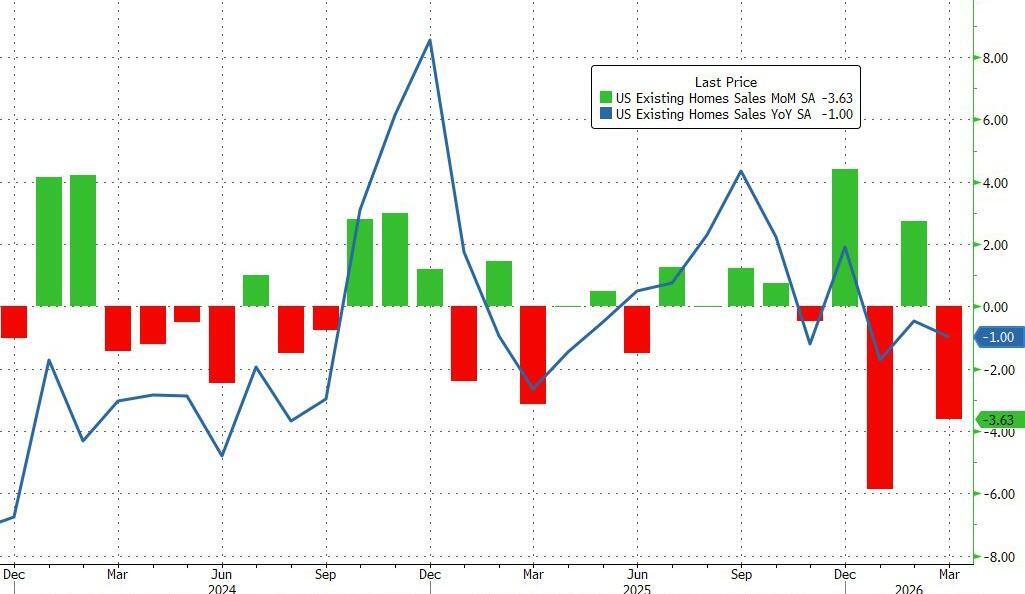
Source: Bloomberg
That dragged Existing Home Sale SAAR back below 4 million homes (3.98m to be exact), near the lowest level since Lehman…
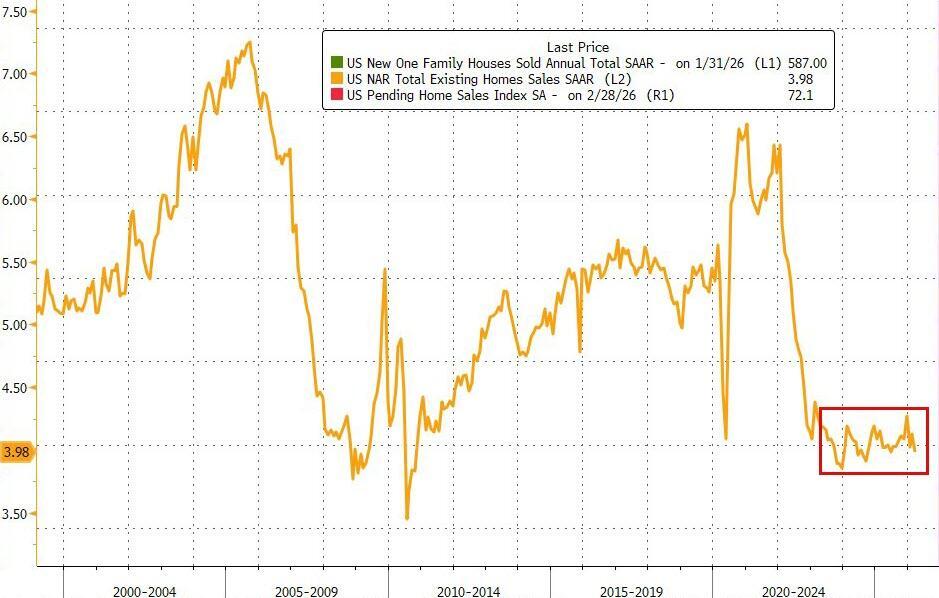
Source: Bloomberg
The NAR report showed the median selling price rose 1.4% from a year earlier in March, to $408,800.
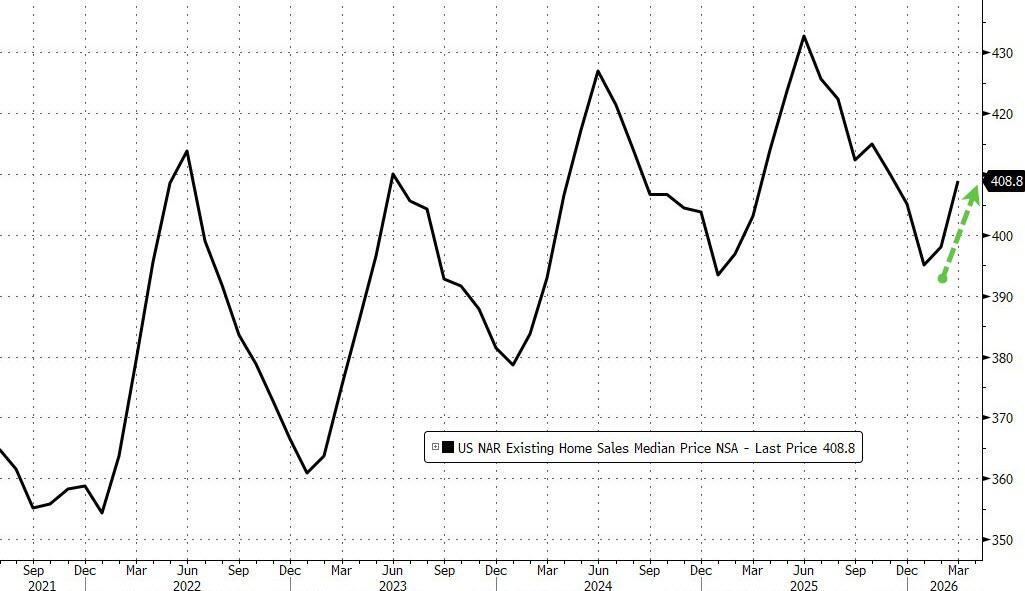
Source: Bloomberg
Pushing Existing (Used) House prices back above New House Prices…
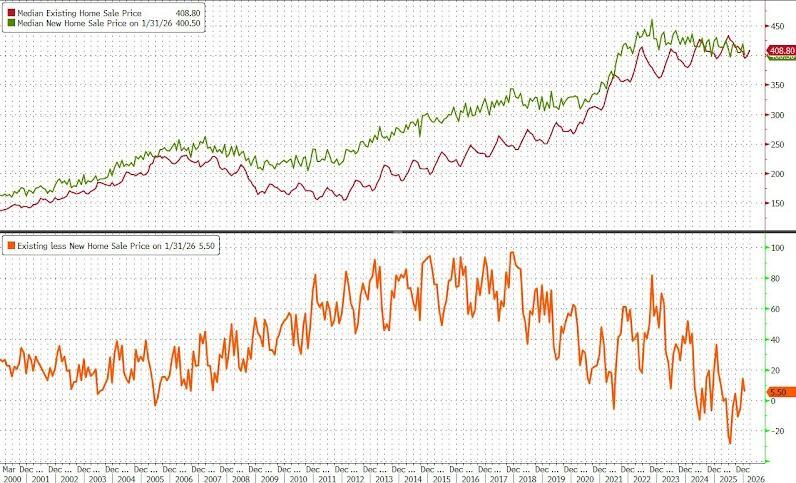
The inventory of previously owned homes edged up to a four-month high but remains historically depressed.
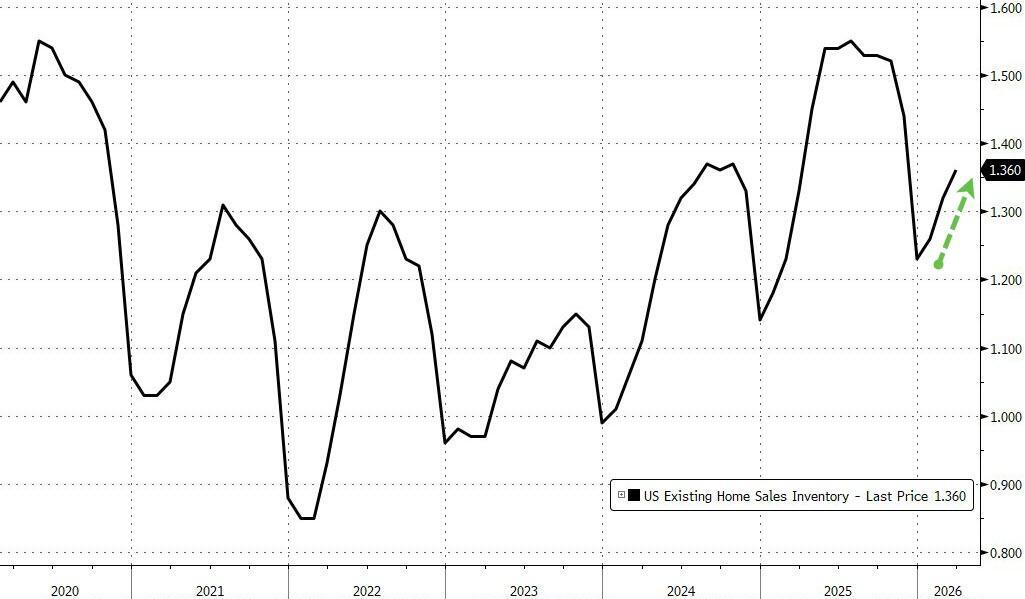
Source: Bloomberg
Contract signings declined across all regions, according to the NAR.
Sales in the Northeast slid to the lowest on record in data going back to 1999, while those in the Midwest matched the weakest pace since 2011.
The NAR also slashed its 2026 existing-home sales forecast to 4%, from 14% previously.
“Mortgage rates have been rising, and that has led us to trim our home sales outlook for the year,” NAR Chief Economist Lawrence Yun said in a statement.
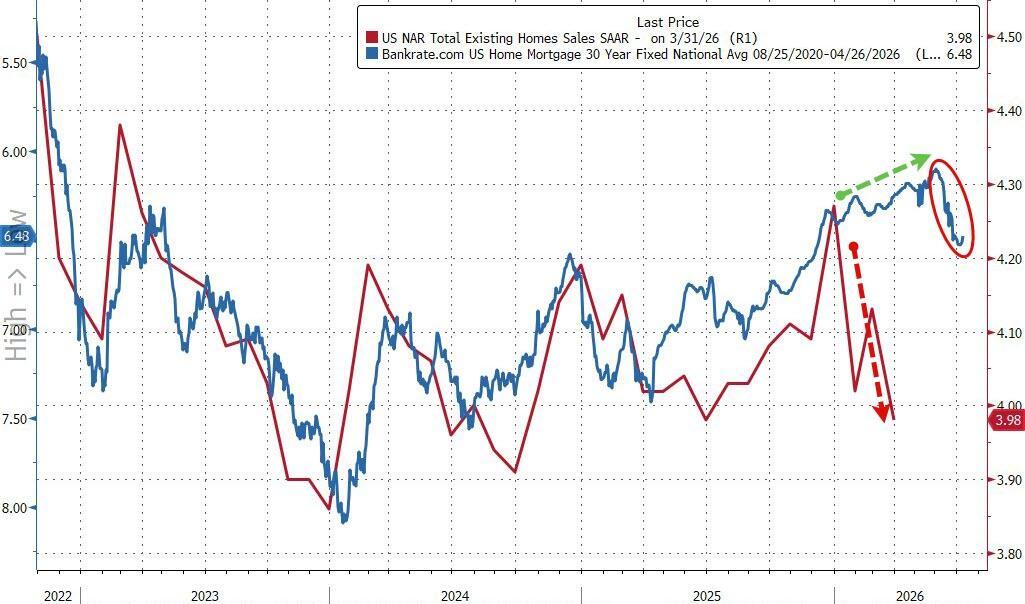
It appears home sales front-ran the rise in mortgage rates since the war began.
USA ECONOMIC REPORTS
A Perfect Storm: Wall Street Launches Private Credit CDS Ahead Of The Next Crisis, And Now The Fed And Treasury Are Getting Involved
The headline we are referencing comes from a ZeroHedge article published today (April 11, 2026), framing recent developments in the ~$3 trillion private credit market as ominous signs of an impending crisis.
zerohedge.com
What Actually HappenedWall Street (via S&P Dow Jones Indices, in collaboration with banks like JPMorgan Chase, Morgan Stanley, and others) is launching the S&P CDX Financials Index (also referred to as CDX Financials or FINDX). This is a new credit-default swap (CDS) benchmark that begins trading on Monday. It allows investors to hedge or bet against defaults in a basket of financial entities, including:
- Private credit/Business Development Company (BDC) managers such as Apollo, Ares, and Blackstone (which together make up roughly 12% of the index).
- Regional banks, insurers, REITs, and credit-card companies. reuters.com
This marks the first CDS product explicitly linked to private credit (via BDC exposure). CDS indexes have long existed for corporate credit, but this extends standardized, tradable protection (or short exposure) into the opaque private credit space. Trading in CDS indexes overall hit a record $38 trillion notional in 2025.
wsj.com
Separately but concurrently:
- The Federal Reserve is incorporating questions about U.S. banks’ exposures to private credit funds into its routine supervision. This includes lines of credit extended to the funds, custody arrangements, and potential spillovers if private credit portfolios deteriorate (e.g., amid rising redemptions and troubled loans). fortune.com
- The U.S. Treasury Department is engaging with insurance regulators (domestic and international) on private credit exposures in the insurance industry.
These regulatory moves follow reports of surging redemption requests at some private credit vehicles, redemption gates/caps at funds (e.g., Blackstone, Ares, Blue Owl), tighter bank lending standards to the sector, and concerns over valuations—particularly in software/SaaS-heavy portfolios potentially disrupted by AI.Context on Private CreditPrivate credit refers to non-bank lending (direct loans, mezzanine, distressed debt, etc.) to middle-market companies, often by funds managed by large alternative asset managers. It exploded post-2008 as banks pulled back due to regulation, filling a gap with floating-rate loans that offered higher yields.
- Size: Estimates range from $1.8T–$3T+ (including dry powder and various strategies). It has grown rapidly, with some funds offering quarterly redemptions while holding illiquid 3–7 year loans—a classic liquidity mismatch.
- Current stresses: Rising defaults (some reports cite 5–8% or higher potential in stressed scenarios, vs. historical ~2%), “shadow defaults” (amendments/extensions), payment-in-kind (PIK) toggles where interest is deferred, and markdown pressures. AI disruption to software business models is frequently cited as a flashpoint. Redemptions have spiked in places, leading to gates. npr.org
- Interconnections: Banks provide financing/lines of credit and custody services; insurers and pensions are major investors. Losses would primarily hit fund investors (not depositors directly), but knock-on effects could tighten credit conditions or pressure bank balance sheets indirectly.
CDS, Shorting, and Historical ParallelsCDS are essentially insurance against default: buyers pay a premium for protection; sellers collect premiums but pay out if a credit event occurs. Indexes make this tradable at a macro level, improving price discovery and hedging—but they also enable leveraged bets on stress.
- Bull case for the product: It provides a legitimate risk-management tool. Banks and investors with indirect exposure (via loans to funds or holdings) can hedge more cleanly. Private credit has lacked transparent pricing; this brings some public-market discipline. Proponents note lower embedded leverage in many private credit structures compared to 2008-era vehicles, and built-in gates limit “run” dynamics.
- Bear case / “perfect storm” narrative: Launching a short instrument right as stresses appear (redemptions, defaults, regulatory scrutiny) echoes the mid-2000s development of subprime CDS/CDOs. It could accelerate negative sentiment, widen spreads, or create feedback loops if protection buyers pile in. Opacity in private valuations + liquidity mismatches + growing interconnections = vulnerability. Some compare it to AIG’s CDS exposure in 2008, though the scale and structure differ (risk is more distributed across non-banks).
The timing is notable: the CDS index launches amid visible cracks, while the Fed and Treasury probe exposures. This isn’t unusual—regulators monitor fast-growing, less-transparent sectors—but it fuels the “they see trouble coming” narrative.Realistic AssessmentPrivate credit is under pressure and facing its first real stress test in a higher-rate, slower-growth (or AI-disrupted) environment. Redemption queues, valuation disputes, and sector-specific risks (e.g., software) are real. Contagion to banks/insurers is possible but appears contained so far; realized losses have been limited, and many structures are senior in the capital stack with covenants.However:
- It is not a direct repeat of 2008. Private credit loans sit mostly off bank balance sheets. Funding isn’t as runnable as repo or short-term wholesale debt was then. No massive taxpayer-backed guarantees are embedded the same way.
- CDS indexes are standard tools today (used across high-yield, investment-grade, etc.). Their existence signals maturity and tradability more than inevitable doom.
- Systemic risk would require a broader credit event (recession, widespread defaults, liquidity freeze) amplifying the mismatch. Current Fed/Treasury actions look like prudent monitoring + data-gathering, not emergency intervention. Fed Chair Powell and others have downplayed immediate systemic threats in recent comments.
Markets price in probabilities, not certainties. The new CDS will make stress more visible in real time via spreads—which could be healthy for discipline or could amplify volatility. Expect more headlines if redemption pressure builds or defaults accelerate.This is a sector worth watching closely for credit conditions and liquidity signals, but the “perfect storm” framing leans heavily sensational. Private credit has delivered floating yields in a tough environment; its risks were always higher than advertised “zero-loss” pitches suggested. The arrival of hedging tools and regulatory eyes is a feature of a large market maturing under strain, not necessarily the prelude to collapse.If you’re positioned in related assets (e.g., BDCs, alternative managers like BX, APO, ARES, or broader financials), the new index offers a potential new volatility gauge. Broader economy watchers should track default rates, redemption data, and any tightening in bank lending as leading indicators.
END
AI
Goldman: Stocks Face “Final Battle” As Hormuz Outcome Decides The Game
The headline you’re referencing comes from a ZeroHedge article summarizing a recent Goldman Sachs note on equity markets amid the ongoing US-Iran conflict and tensions over the Strait of Hormuz.
zerohedge.com
Context: The “Final Battle” FramingGoldman Sachs strategists (including mentions tied to Shreeti Kapa in recent commentary) describe the current market setup as a high-stakes “final battle” for stocks. The decisive factor is the outcome around the Strait of Hormuz — the narrow chokepoint through which roughly 20% of global oil supply (and significant LNG) normally flows.
- Bullish scenario (ceasefire holds, strait reopens quickly): Relief rally in equities. Energy costs stabilize or fall, supporting consumption and corporate margins. The AI/tech boom could continue to offset broader drags, keeping the S&P 500 resilient near current highs.
- Bearish/adverse scenario (prolonged disruption): Even another month of severely restricted flows (currently near standstill, well below 10% of normal volumes despite prior ceasefire attempts) would represent one of the largest oil supply shocks on record. Goldman has flagged:
- Brent crude averaging over $100/bbl through 2026 (with some scenarios pushing Q3/Q4 toward $115–$120).
- Potential shortages in petrochemical feedstocks (naphtha, LPG) hitting Asia hard.
- Downside risk to the S&P 500 toward ~5,400 in a stress case (roughly 19% lower from levels around the time of the note, implying a valuation compression to ~16x earnings as higher energy costs squeeze growth and margins). investing.com
This ties into broader Goldman oil research from analysts like Daan Struyven, who have repeatedly hiked forecasts due to the “largest oil supply shock ever” from Hormuz restrictions.
bloomberg.com
Current Situation (as of April 13, 2026)The strait remains highly disrupted:
- Shipping traffic is at a virtual standstill (e.g., only a handful of vessels per day vs. ~140 normally).
- A US-Iran ceasefire was announced earlier in April but has frayed or collapsed, with failed talks in Islamabad.
- President Trump has ordered a US naval blockade of ships crossing the strait (effective immediately per recent statements), aimed at preventing vessels from paying tolls/fees to Iran and reasserting control. Iran’s IRGC claims ongoing monitoring and control, warning of responses.
- Oil markets have seen volatility: sharp drops at times on hopes of de-escalation, but with persistent upside risks if the blockade or Iranian assertions prolong the shutdown.
This aligns with warnings from figures like Ray Dalio, who has called Hormuz control the “final battle” in a broader shifting world order, potentially echoing historical imperial setbacks (e.g., Suez).Market ImplicationsStocks have shown resilience so far (with some sharp rebounds on oil retreats), but Goldman highlights an unattractive risk-reward near highs until a durable resolution emerges. A quick fix could spark relief; prolonged pain risks stagflationary pressures (higher inflation from energy + slower growth).Broader context includes:
- Geopolitical spillover (US-China tensions, alliances shifting).
- Energy substitution challenges and strategic reserve draws offering only temporary buffers.
In short, the “game” for risk assets does hinge heavily on whether Hormuz flows normalize fast — or if we get the full supply shock Goldman models. Markets are pricing in uncertainty, with oil as the key swing variable.If you’re looking for specific Goldman note excerpts, oil price scenarios, or how this affects particular sectors (e.g., energy vs. tech), let me know for more details.
END
Half Of US Data Centers Scheduled To Start In 2026, Will Be Canceled Or Delayed
Sunday, Apr 12, 2026 – 10:38 PM
Just over two years ago, we first penned our views on “The Next AI Trade“, which looked beyond the hyperscalers and the data centers supporting the AI revolution, and instead focused on the energy and logistical needs that would be so very critical in allowing the US to dominate China in the existential race to first reach Artificial General Intelligence (which many have dubbed the next nuclear arms race due to its profound civilizational implications). It was here that we defined the “Power Up America” basket as the next AI trade.
Yet as one can see in the chart below, after outperforming the AI Data center and the TMT AI baskets in 2024 and much of 2025, the Power Up America trade has lagged and clearly underperformed, as some investors have started to express doubt that the US would ever be able to “grow” into its massive AI computing needs… with dire consequences for record AI capex budgets, something the market has yet to grasp.
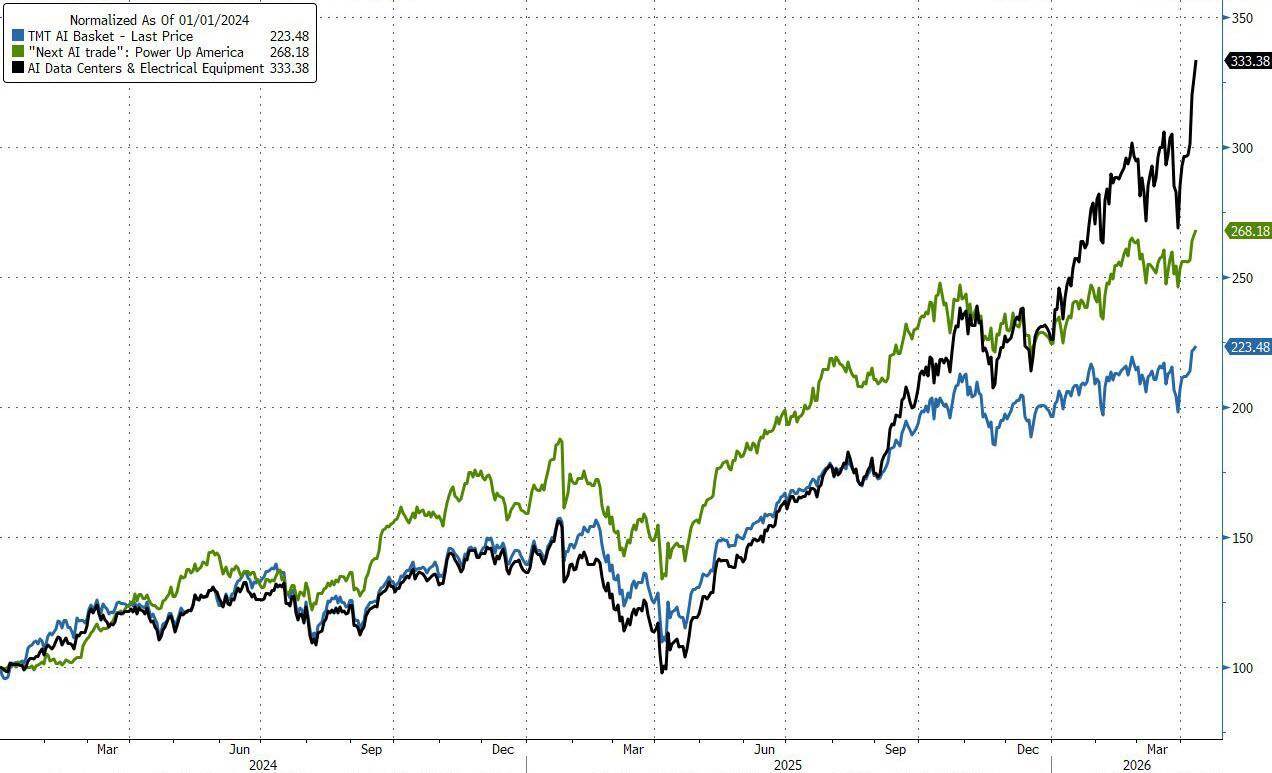
And unfortunately, with every passing day, the outlook for the US AI revolution looks increasingly more dim.
That’s because, as Canaccord Genuity analyst George Gianarikas writes, “the American data center boom is hitting a formidable wall of logistical friction.” He is referring to the latest outlook by Sightline Climate, which is also reinforced by recent articles from Bloomberg and others, and reveals a sobering reality for 2026: nearly half of the nation’s planned 16-gigawatt capacity faces cancellation or delay, with only 5 gigawatts currently under construction.
This inertia stems from a volatile mix of local permitting hurdles, community resistance, and a desperate reliance on overextended global supply chains for critical components like transformers and helium.
That’s right: half.
That’s right: despite $700BN+ of expected 2026 hyperscaler capex, nearly half of the data centers scheduled to begin operations in the US
in 2026 “will either face delays or outright cancellations.” The data, which comes from Sightline Climate’s 2026 Data Center Outlook, suggests that just 30% – 50% of the ~16 GW of planned US capacity for the year will face risks, with only ~5 GW currently under construction!
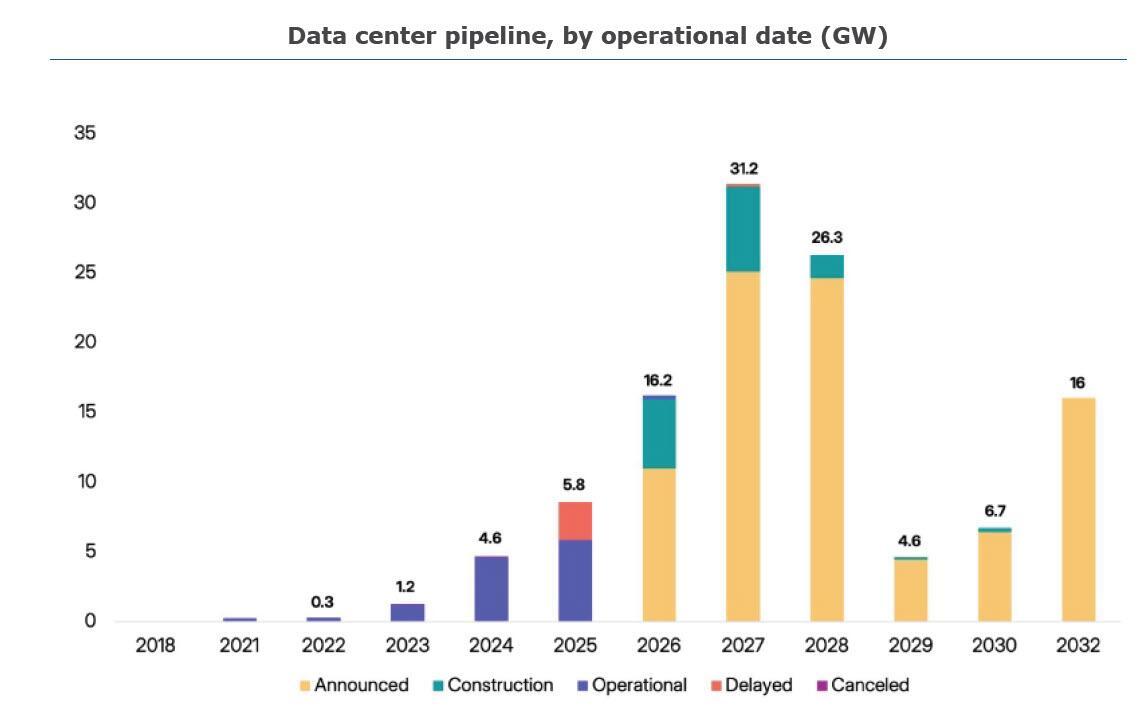
And the horizon only grows darker in the coming years. By 2027, the gap between ambition and reality widens further, as a mere fraction of the announced 21.5 gigawatts has actually broken ground. Worse, according to Futurism, data centers slated to open in 2027 are progressing far more slowly than anticipated. “Only about 6.3 gigawatts worth of computing infrastructure are actually under construction, compared to 21.5 announced gigawatts.”
And then visibility drops to virtually nothing beyond 2028 as uncertainty increases materially in the outer years. According to the article, “things get even dodgier in the coming years, with the vast majority of data centers planned for launch between 2028 and 2032 having yet to even break ground. There are a further 37 gigawatts of planned infrastructure which haven’t even received a firm completion date, only 4.5 [gigawatts] of which have actually begun work.”
This trend suggests an increasingly uncertain future for the industry, where power constraints and grid instability cast long shadows over projects slated through 2032.
But while one can pretend the future is irrelevant, the same limitations are visible in the here and now: according to the SightLine report, “at least 16GW of data center capacity is slated to come online this year across 140 projects. 53% will be grid connected, 3% will be powered solely by on-site power, and 25% have not disclosed their powering strategies. We expect 30-50% of these projects to be delayed. Only 5GW is currently in construction.”
And the punchline:
“We expect 30-50% of 2026 projects to be delayed, driven by power constraints (25% of projects have not disclosed powering strategies), increasingly effective community opposition, and potential grid equipment shortages. 11GW of 2026 capacity remains in the announced stage with no signs of construction, despite typical build times of 12 to 18 months. Itʼs still possible for this capacity to come online, but it would need to dramatically accelerate.”
Which brings us to the question we raised more than two years ago: how will the US modernize its ancient power grid and build out the huge energy supply needed to power up the AI revolution. Here, too, it appears there has been little progress:
“On-site and hybrid power punch above their weight when measured by capacity. Grid-connected projects still lead at 40% of total capacity, but on-site generation and hybrid approaches together account for close to half of announced capacity, far exceeding their share by project count. A small number of gigascale, grid independent campuses account for this capacity, including New Era Energy & Digitalʼs 7GW project in Lea County, Homer Cityʼs 4.5 GW coal-to-gas redevelopment in Pennsylvania, and Crusoeʼs 1.8GW natural gas and renewables project in Cheyenne, Wyoming. These projects are large enough to require their own generation plant, and have the capital to fund it. Waiting for the grid to supply this level of capacity could take a decade.”
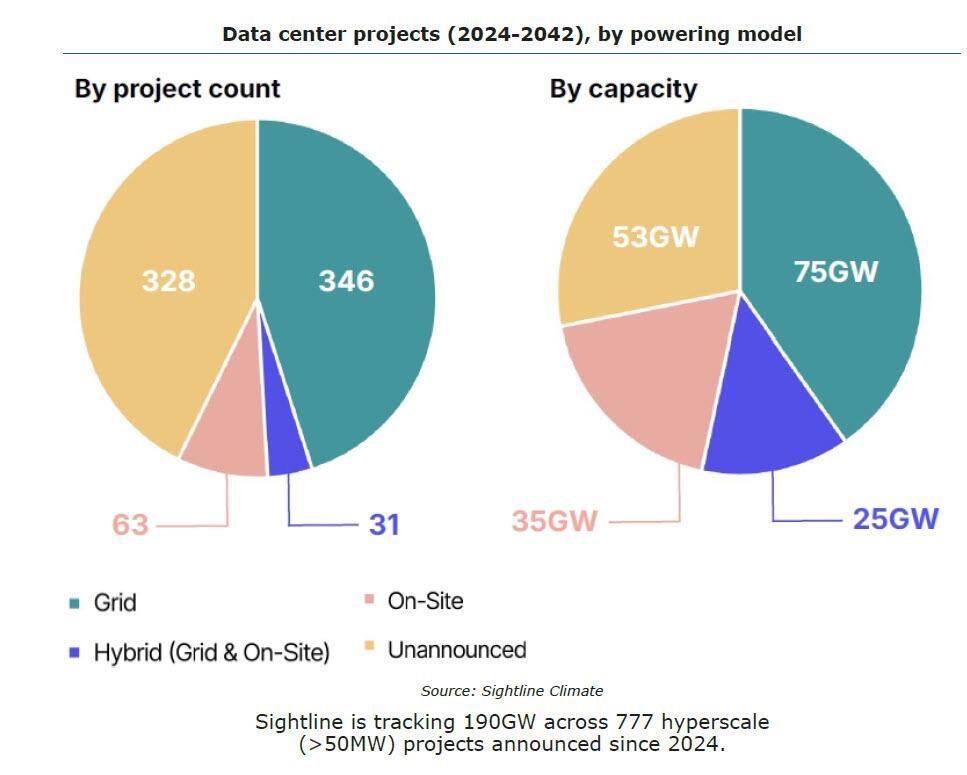
The problem, as Canaccord warns, is that “without a radical acceleration in domestic manufacturing and grid integration, the digital expansion of the late 2020s risks stalling into a series of unfulfilled promises.”
Others agree: in a note published over the weekend by Goldman Executive Direct Shreeti Kapa, she wrote that at a recent dinner with investors, the overwhelming consensus was that “there is simply not enough compute and every player is acutely compute constrained – bottlenecks from fabs to permitting for data-centers to power to memory to labor are real and are here to stay for some time to come. I wasn’t sure what to make of it – if its consensus is it peak, or is the imagination for scale of AI demand is so great among a very small sub-segment of investors & technologists here in the valley and the rest of the word is yet to catch-up?”
While imaginations may indeed by running wild, the hard limitations in the real world are indeed starting to catch up: we recently highlighted OpenAI’s decision to pause its UK Stargate project – a partnership with Nvidia and Nscale to deploy up to 31k GPUs – citing the UK’s prohibitive energy costs and regulatory hurdles. The project was to be based across several sites including Cobalt Park and a dedicated “AI Growth Zone”, enabling OpenAI’s models to provide local compute for critical public services and highly regulated industries including finance and national security.
- UK energy prices represent a key bottleneck to AI infrastructure development. According to the report, UK’s industrial prices “are among the highest in the world” and have been a key gating factor delaying companies from building AI infrastructure. According to a spokesperson from OpenAI, “we continue to explore Stargate U.K. and will move forward when the right conditions such as regulation and the cost of energy enable long-term infrastructure investment.”
- OpenAI and Nscale maintain plans to develop the project in the future. According to the OpenAI spokesperson, “We see huge potential for the U.K.’s AI future… London is home to our largest international research hub, and we support the Government’s ambition to be an AI leader. In the meantime, we are investing in talent and expanding our local presence, while also delivering on the commitments under our MOU with the government to adopt frontier AI in UK public services.”
Bloomberg also chimed in earlier this month, writing that “as the global AI race heats up, there is a huge rush to build data centers fast. There’s no lack of money chasing these projects, with tech giants Alphabet Inc., Amazon.com, Meta Platforms Inc. and Microsoft Corp. committed to spending more than $650 billion this year alone. Yet neither ambition nor capital is enough to materialize all the necessary components.”
Here Bloomberg again quotes the Sightline data, noting that “almost half of the US data centers planned for this year are expected to be delayed or canceled” and as one big reason for the delay Bloomberg cites the shortage of electrical equipment, such as transformers, switchgear and batteries: “They are needed not just for powering AI, but also for building out the grid that is seeing increased consumption from electric cars and heat pumps. US manufacturing capacity for these devices cannot keep up with demand, and the scarcity has caused data center builders to rely on imports.”
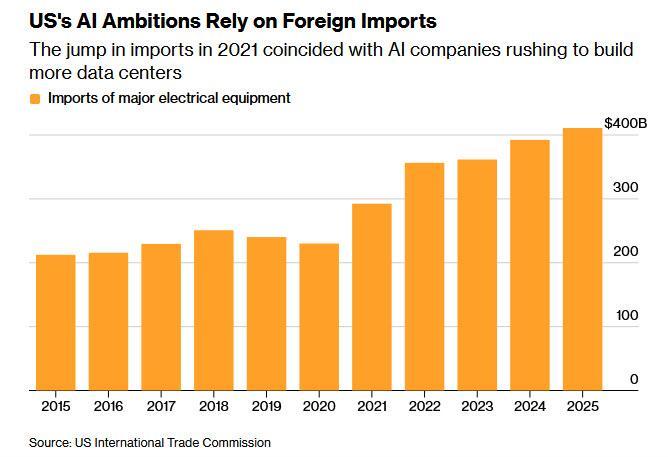
At its core, the problem is the lack of domestic manufacturing which makes sense for a country that has outsourced much of its industrial base to China in the past century, and despite loud promises of reshoring, there are few tangible results.
Indeed, while over the past 10 years, the US government has tried a series of policies to reshore manufacturing, they haven’t yet yielded a significant boost to domestic capacity, forcing businesses to look to China regardless of the tariffs or the alleged national security risk. As a result, the US now finds itself in an absurd Catch 22: the US needs crucial parts from China to dominate it in the AI race, while China needs advanced chips from American companies to stay in the race.
The biggest bottlenecks, understandably, have been observed in the power space – the same space we aggressively pitched two years ago as enabling the AI revolution, hoping that whoever was in charge of the US would take America’s chronic energy deficiency seriously. It appears we may have been overly optimistic. One thing is clear: data centers have rapidly grown in size and now consume more electricity than their predecessors a decade ago. That demands bigger transformers, which safely pull electricity from the high-voltage grid to feed to tiny computer chips. Without the right transformers, there’s no way to make the data center work.
Before 2020, these high-power transformers typically arrived 24 to 30 months after an order was placed. Those timelines were “totally manageable in the old world” when data centers didn’t need such large transformers or at such short timelines, says Philippe Piron, chief executive officer of GE Vernova’s electrification division. But AI companies “want something typically in less than 18 months.”
The spike in demand from data centers and grid expansion have pushed up prices and extended delivery times to as much as five years. That is why some, like Crusoe, have even resorted to refurbishing old transformers from shuttered power plants as a stopgap measure.
Meanwhile, a far greater looming problem is where will the US source the dozens of Gigawatts needed to power up the AI revolution. So far Trump’s promises of a nuclear renaissance have remained just that, with virtually no new nuclear power plants breaking ground, while the push for small modular reactors – a ray of hope in an otherwise dreary landscape – is still years away from practical results, let alone scale.
Oh, and there is the question of who pays for all this: by now everyone knows about the hundreds of billions in capex the hyperscalers will spend over the next few years.
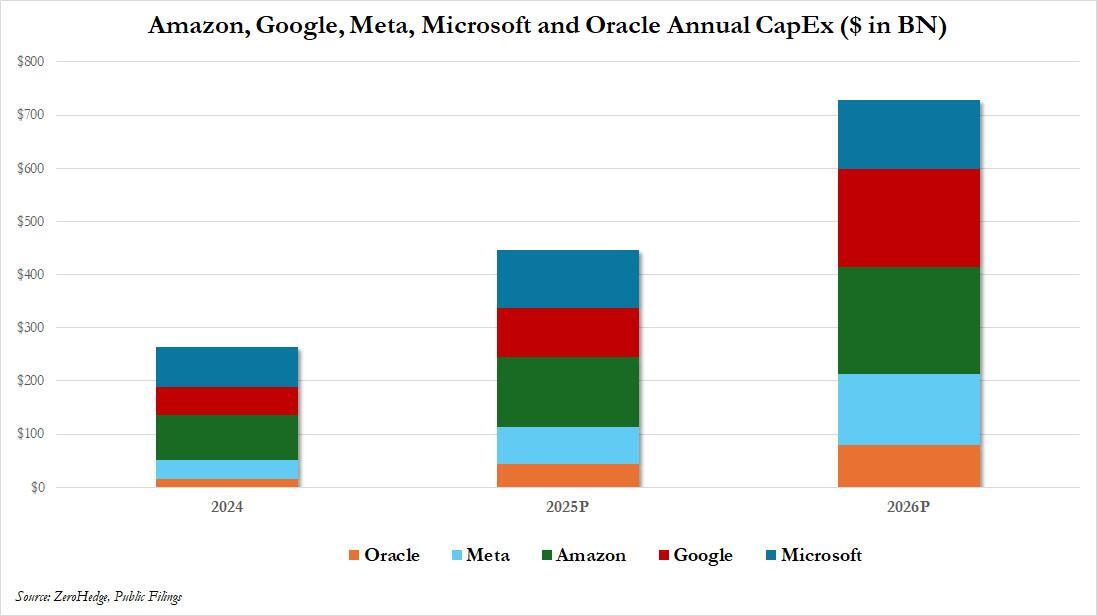
What fewer people know is that this money won’t be enough. According to an analysis by JPMorgan, it will take no less than $5 trillion to fund the AI cycle, and even with the massive capex – and debt outlays – the US government will still be on the hook for over a trillion to close the funding gap.
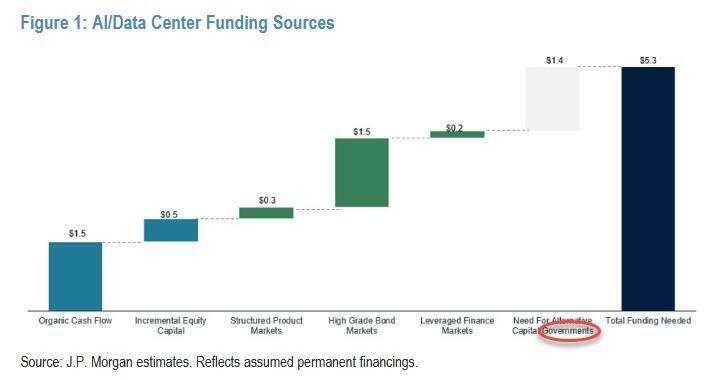
It’s not just power: as Canaccord writes, beyond the power-related technicalities “lies a fraught sociopolitical reality”.
Consider the following: The Maine House of Representatives approved a moratorium on large-scale data centers until 2027. This pause allows a newly formed coordination council to weigh innovation against environmental and resource stewardship. The House passed the bill 82-62, advancing it to the Senate. The goal of the bill, according to state representatives, is not to fight innovation, but as a pause for planning to improve stewardship of the state’s resources and limit financial and environmental impacts on the state’s citizens. In addition to the moratorium, “the bill also creates the Maine Data Center Coordination Council, and instructs the council to provide strategic input, facilitate planning considerations and evaluate policy tools to address data center opportunities.”
Simultaneously, OpenAI faces mounting scrutiny as Florida’s Attorney General launched an investigation into the company following the release of safety-critical chat logs. And then there was last week’s firebomb attack on Sam Altman’s home: while the police are still investigating, and there are many reasons why someone may want to express their “displeasure” with the man behind ChatGPT, the reality is that, as we warned last August, “between exploding electricity bills and lack of jobs for grads, a new luddite revolution is coming – they will be burning down data centers within a year.”
between exploding electricity bills and lack of jobs for grads, a new luddite revolution is coming – they will be burning down data centers within a year— zerohedge (@zerohedge) August 25, 2025
Sure enough, these institutional shifts arrive as a recent Quinnipiac University poll – which looked at AI use and its impacts on daily life, education and healthcare – confirmed the public is growing increasingly wary of AI’s deepening integration into healthcare, education, and daily life. Here are some of the findings showing just how rapidly public sentiment has turned against AI:
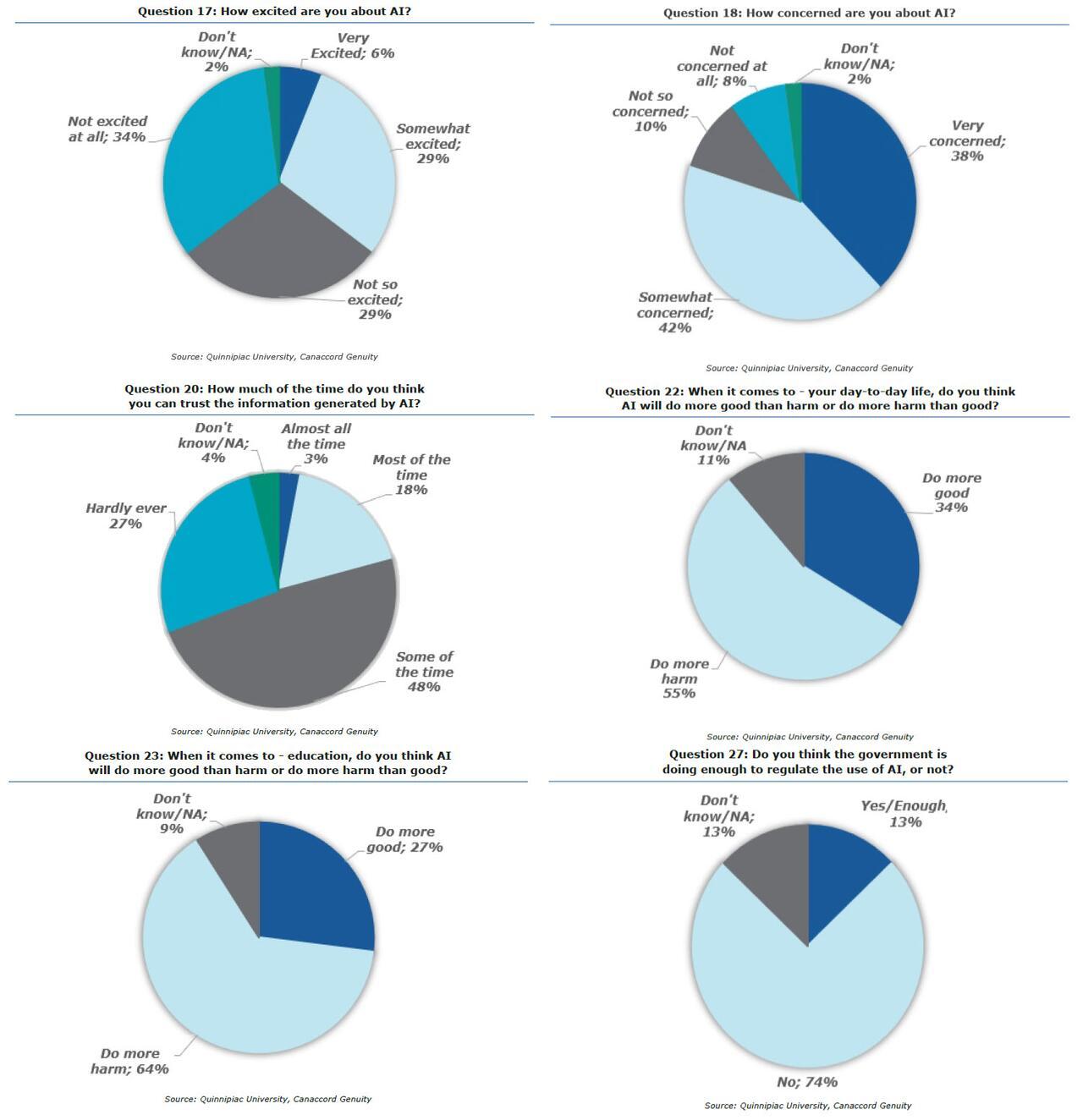
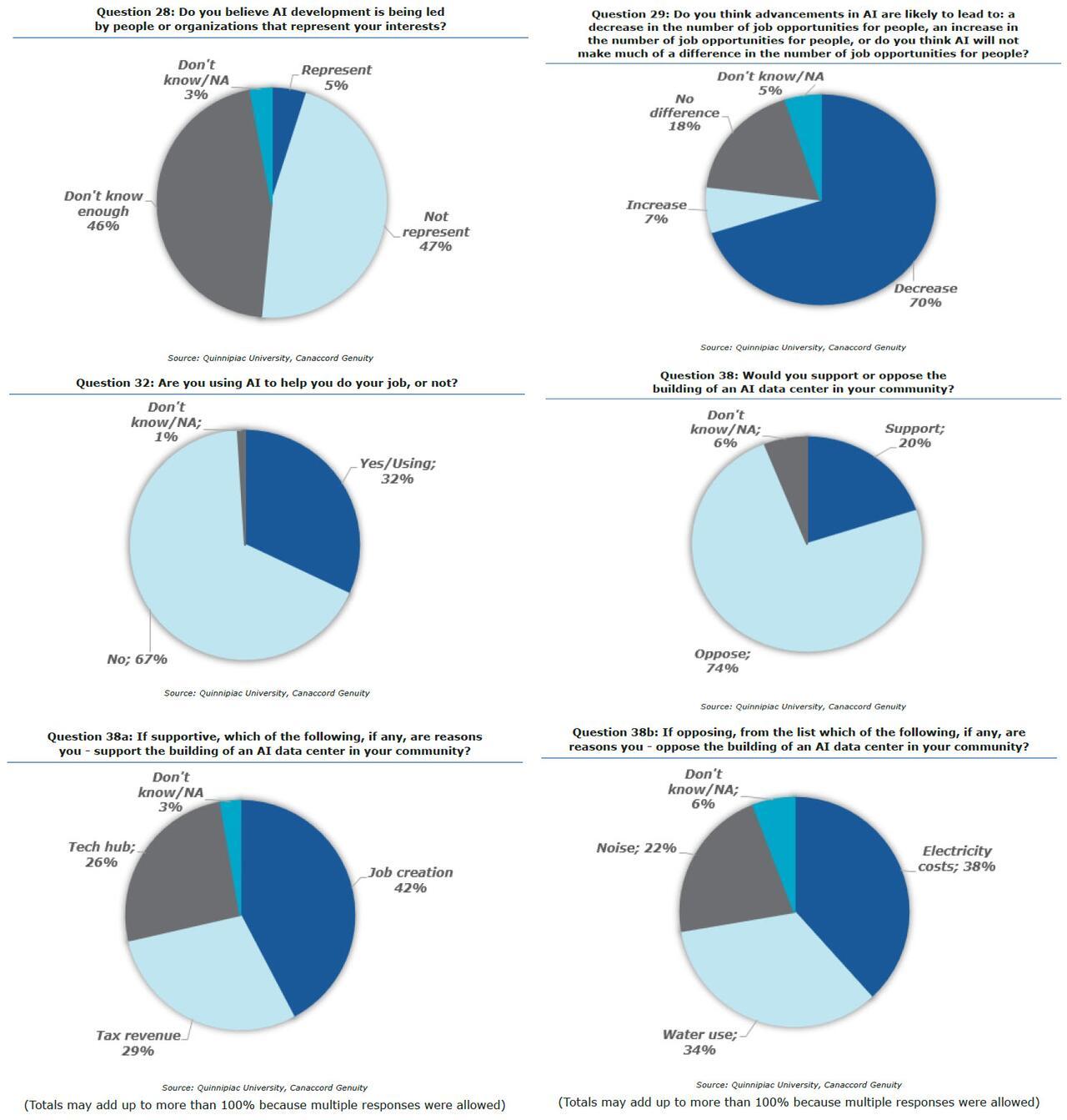
The bottom line is that the time for talk has long passed, and yet for all the posturing, the US government continues to act as if a victory against China in the AI race is a given. It is anything but, especially with America’s own society rapidly turning against the next industrial revolution.
As Canaccord concludes, “Not only are the energy constraints mounting, but so are the sociopolitical ones. Something’s got to give.“
VICTOR DAVIS HANSON
KING NEWS
SWAMP STORIES FOR YOU TONIGHT
Buried For 7 Years: Declassified Transcripts Blow Up Trump Impeachment Story
Monday, Apr 13, 2026 – 12:40 PM
In a long-awaited release that sent ripples through Washington on Monday, the House Permanent Select Committee on Intelligence (HPSCI) has declassified closed-door 2019 transcripts from briefings with then-Intelligence Community Inspector General (ICIG) Michael Atkinson. The documents, withheld from the public for over seven years, reveal critical details about the anonymous “whistleblower” whose complaint about President Trump’s phone call with Ukrainian President Volodymyr Zelensky triggered Trump’s first impeachment – details that directly contradict the narrative of a neutral, non-partisan civil servant acting in good faith.
The revelations come via investigative reporter Catherine Herridge, who broke the story on X with direct screenshots from the transcripts and statements from key officials involved in the declassification.
What the Transcripts Reveal
According to the newly public records:
- The whistleblower was a registered Democrat who disclosed having a “prior professional relationship with one of the Democratic Presidential candidates” for the 2020 election (widely understood in context to reference then-former Vice President Joe Biden, given the whistleblower’s known Ukraine policy background).
- Despite this, ICIG Atkinson told Congress in a 2019 briefing: “I did not find the complainant (whistleblower) was biased.” He relied almost exclusively on the whistleblower’s own self-disclosure.
- The whistleblower had met with staff from the House Permanent Select Committee on Intelligence (HPSCI) – then chaired by Rep. Adam Schiff (D-CA) – before filing the official complaint with the ICIG on August 12, 2019.
- Timeline: Trump’s July 25, 2019, phone call with Ukrainian President Volodymyr Zelenskyy occurred just 18 days before the complaint was filed. During that window, the whistleblower had undisclosed contacts with Schiff’s committee.
- On the official “urgent concern” disclosure form, the whistleblower did not check the box acknowledging contact with congressional intelligence committees. When pressed by then-Rep. John Ratcliffe (R-TX, now CIA Director), Atkinson confirmed: “The whistleblower did not disclose to you that he or she had contact with HPSCI?” Atkinson replied: “The answer to that is yes. The answer to that is yes.”
These details are laid out verbatim in the declassified pages Herridge posted, complete with highlighted exchanges from the October 2019 closed-door session.
The 2019 Backdrop – and Why It Was Hidden
The complaint alleged that Trump pressured Zelenskyy during the July 25 call to investigate the Bidens in exchange for military aid – a claim that became the cornerstone of the House Democrats’ impeachment inquiry launched in September 2019. Trump was impeached by the House in December 2019 on charges of abuse of power and obstruction of Congress, only to be acquitted by the Senate in February 2020.
At the time, the whistleblower was portrayed across much of the mainstream media and by Democratic leaders as an impartial career intelligence official. The new transcripts show that key questions about political affiliation, potential conflicts of interest, and coordination with Congress were raised behind closed doors – but never fully disclosed to the public.
House Intelligence Committee Chairman Rep. Rick Crawford (R-AR) stated upon the release:
“There have been many questions and concerns about these Atkinson transcripts, which have been withheld from the American public for far too long. I hope that the release of these transcripts allows the American people to make their own determinations about their content. Thank you to Director Gabbard and her team for moving these so quickly through the declassification process.”
The process began with a HPSCI vote in late March 2026 to unseal the transcripts, followed by rapid declassification under Director of National Intelligence Tulsi Gabbard.
In short, we now have official, on-the-record confirmation of long-standing Republican concerns that the impeachment process was politicized from the outset. They show an ICIG who accepted the whistleblower’s self-assessment of impartiality at face value, even after learning of partisan ties and unreported congressional contacts – facts that were blacked out or minimized in earlier public handling of the case.
GREG HUNTER….
SEE YOU ON TUESDAY