
THIS IS OPTIONS EXPIRY WEEK: TODAY ENDS COMEX EXPIRY AND FRIDAY OTC/LONDON OPTIONS
EXCHANGE: COMEX
EXCHANGE: COMEX
CONTRACT: APRIL 2026 COMEX 100 GOLD FUTURES
SETTLEMENT: 4,675.400000000 USD
INTENT DATE: 04/27/2026 DELIVERY DATE: 04/29/2026
FIRM ORG FIRM NAME ISSUED STOPPED
099 H DEUTSCHE BANK AG 10
363 H WELLS FARGO SECURITI 6
523 C INTERACTIVE BROKERS 3
661 C JP MORGAN SECURITIES 24 11
686 C STONEX FINANCIAL INC 1
690 C ABN AMRO CLR USA LLC 1
TOTAL: 28 28
MON
GOLD: NUMBER OF NOTICES FILED FOR APRIL/2026: 28 CONTRACTs NOTICES FOR 2800 OZ or 0.077TONNES
total notices so far: 22,309 contracts FOR 2,230,900 OZ OR 69.390 TONNES
SILVER NOTICES: 1 NOTICE(S) FILED FOR 5,000 OZ /
total number of notices filed so far this month : 3309 CONTRACTS (NOTICES) for 16.545 million oz
SILVER//OUTLINE
INITIAL STANDING FOR JANUARY: 22.915 MILLION OZ FOLLOWED BY TODAY’S 1.185 MILLION OZ QUEUE JUMP//NEW NORMAL STANDING ADVANCES TO 49.445 MILLION OZ// TO WHICH WE ADD OUR FIRST EXCHANGE FOR RISK FOR .100 MILLION OZ//NEW STANDING ADVANCES TO 49.545 MILLION OZ!!
INTIAL STANDING FOR FEBRUARY/SILVER: 13.505 MILLION OZ FOLLOWED BY TODAY’S HUGE 0.005 MILLION OZ QUEUE JUMP / : NEW STANDING FOR SILVER AT THE COMEX ADVANCES TO 25.180 MILLION OZ. BUT WE MUST ADD OUR FIRST EXCHANGE FOR RISK OF 25 CONTRACTS FOR .125 MILLION OZ AND THEN OUR SECOND EXCHANGE FOR RISK OF .0600 MILLION OZ TO OUR THIRD HUGE 2.825 MILLION OZ EXCHANGE FOR RISK!!
INITIAL STANDING FOR MARCH: A SURPRISINGLY LOW 31.076 MILLION OZ/ FOLLOWED BY A STRONG QUEUE JUMP OF 42 CONTRACTS OR 0.210 MILLION OZ/NEW STANDING REDUCES TO 46.060 MILLION OZ
INITIAL STANDING FOR APRIL: 7.120 MILLION OZ FOLLOWED BY TODAY’S 3 CONTRACT EXCHANGE FOR PHYSICAL TRANSFER TO LONDON WHERE 15,000 OZ WILL TAKE DELIVERY OVER ON THEIR SIDE OF THE POND. NEW STANDING FOR SILVER AT THE COMEX THUS REDUCES SLIGHTLY TO 16.560 MILLION OZ PLUS WE MUST ADD OUR 4TH EXCHANGE FOR RISK ISSUANCE OF 17 CONTRACTS OR 0.085 MILLION OZ. THESE WILL BE ADDED TO OUR OTHER THREE ISSUANCES //NEW TOTAL EXCHANGE FOR RISK//1.165 MILLION OZ// NEW TOTAL SILVER STANDING 17.725 MILLION OZ//
SUMMARY OF OUR APRIL 2026 COMEX CONTRACT MONTH:
JULY: 50.925 MILLION OZ (QUITE SMALL)
AUGUST: 59.455 MILLION OZ (QUITE SMALL)
SEPT. 50.510 MILLION OZ.(QUITE SMALL)
OCT; 82.020 MILLION OZ (WILL BE STRONG THIS MONTH)/ OCC WANTS TO REIN IN THESE ISSUANCES!
NOVEMBER: 36.425 MILLION OZ
DEC: 45.765 MILLION OZ
JANUARY 2026: 134.270 MILLION OZ (WILL BE A VERY STRONG MONTH FOR EXCHANGE FOR PHYSICAL!)
FEB : 82.130 MILLION OZ
MARCH: 56.075 MILLION OZ
APRIL; 40.59 MILLION OZ..WILL BE SMALL THIS MONTH.
AND JULY: 46.720 MILLION OZ//
AUGUST: 4.70 MILLION OZ INITIAL STANDING PLUS TODAY;S 5,000 OZ QUEUE JUMP //NEW STANDING ADVANCES TO 10.960 MILLION OZ
SEPTEMBER: 68.040 MILLION OZ NORMAL DELIVERY(INCLUDES ALL QUEUE JUMPING AND EXCHANGE FOR PHYSICAL TRANSFERS) PLUS 3.0 MILLION OZ EX FOR RISK = 71.040 MILLION OZ. (THIS IS THE FIRST AND ONLY ISSUANCE OF EXCHANGE FOR RISK FOR SILVER SINCE MAY.)
OCTOBER: 39.565 MILLION OZ OF NORMAL DELIVERY INCLUDES ALL QUEUE JUMPING
PLUS
2.110 MILLION OZ EXCHANGE FOR RISK//TOTAL OZ STANDING IN OCT ADVAN
NOVEMBER: INITIAL STANDING AT 11.575 MILLION OZ FOLLOWED BY TODAY’S 195,000 OZ QUEUE JUMP WHICH FOLLOWS ALL OTHER QUEUE JUMPS OF 9.155 MILLION OZ//STANDING ADVANCES TO 19.670 MILLION OZ/
DECEMBER: INITIAL AMOUNT STANDING FOR DELIVERY: 49.33 MILLION OZ// FOLLOWED BY ANOTHER STRONG 835,000OZ QUEUE JUMP+ DEC. FIRST EXCHANGE FOR RISK 0F .850 MILLION OZ + LAST WEEK.S 495,000 OZ EXCHANGE FOR RISK AND THEN A 3RD ISSUANCE IF 1.00MILLION OZ THEN FINALLY DEC 249ISSUANCE OF 1.35 MILLION OZ EXCHANGE FOR RISK//NEW TOTAL EX FOR RIS IS 3.685 MILLION OZ // STANDING ADVANCES TO 68.415 MILLION OZ//
JANUARY: INITIAL STANDING 22.915 MILLION OZ FOLLOWED BY TODAY’S 1.185 MILLION OZ QUEUE JUMP//NORMAL STANDING ADVANCES TO 49.445 MILLION OZ// TO WHICH WE ADD OUR FIRST EXCHANGE FOR RISK OF 0.100 MILLLION OZ//NEW STANDING ADVANCES TO 49.545 MILLION OZ
FEB: 13.399 MILLION OZ IS OUR INITIAL STANDING FOR SILVER! TO WHICH WE ADD OUR NEXT QUEUE JUMP FOR 5,000 OZ AND THEN ADD OUR 3 EXCHANGE FOR RISK FOR 3.010 MILLION OZ STANDING ADVANCES TO 28.190 MILLION OZ!!
MARCH: INITIAL AMOUNT OF SILVER STANDING IS 31.076 MILLION OZ FOLLOWED BY A FINAL 0.210 MILLION OZ QUEUE JUMP //NEW TOTAL STANDING ADVANCES TO 46.060 MILLION OZ
APRIL 2026: INITITAL AMOUNT OF SILVER STANDING 7.120 MILLION OZ FOLLOWED BY TODAY’S 15,000 OZ EXCHANGE FOR PHYSICAL JUMP//NEW STANDING REDUCES TO 16.560MILLION OZ PLUS 1.165 MILLION OZ EXCHANGE FOR RISK.NEW TOTALS 17.725 MILLION OZ
1.MAY SUMMARY FOR MAY TONNES WHICH STOOD FOR DELIVERY:
4. AUGUST: 60.547 TONNES OF INITIAL GOLD FIRST DAY NOTICE FOLLOWED BY THE NET MONTH’S QUEUE JUMP OF 47.2312 TONNES TO WHICH WE ADD THE FOLLOWING EXCHANGE FOR RISK ISSUANCE RECEIVED FOR THE MONTH: 5.4432 TONNES EX FOR RISK/AUG 7 , AUG 11: 2.413 TONNES EX FOR RISK AND AUG. 12 OF 2.
5.SEPT: INITIAL 8.093 TONNES OF GOLD PLUS TODAY’S QUEUE JUMP OF 0.4883 TONNES PLUS 2.2827 TONNES OF EXCHANGE FOR RISK TODAY//NEW TOTAL EX. FOR RISK/MONTH = 22.923//NEW TOTAL STANDING FOR GOLD SEPT ADVANCES TO = 48.801 TONNES!!
6.OCTOBER: 90.012 TONNES OF INITIAL GOLD STANDING WITH TODAY’S TINY 0.00311 TONNES QUEUE JUMP WHICH FOLLOWS ALL OTHER QUEUE JUMPS DURING OCT OF 76.1656 TONNES
THEN WE MUST ADD OUR 14.553 TONNES OF OUR ISSUANCE OF EXCHANGE FOR RISK/6 OCCASIONS//NEW TOTAL OF GOLD STANDING ADVANCES TO 197.5141 TONNES OF GOLD.
7.NOVEMBER BEGINS WITH 15.651 TONNES INITIALLY STANDING FOR DELIVERY FOLLOWED BY TODAY’S QUEUE JUMP OF 2.323 TONNES FOLLOWED BY ALL PREVIOUS QUEUE JUMPS IN OF OF 21.3775 TONNES TO WHICH WE ADD OUR TWO EXCHANGE FOR RISK ISSUANCE OF 4.5596 TONNES//NEW STANDING ADVANCES TO 43.9716 TONNES OF GOLD.
8. DECEMBER BEGINS WITH INITIAL STANDING OF 83.813 TONNES OF GOLD FOLLOWED BY TODAY’S 0.0TONNE QUEUE JUMP WHICH FOLLOWS ALL OTHER QUEUE JUMPS OF: 37.163 TONNES//NEW STANDING ADVANCES TO 115.390 TONNES TO WHICH WE ADD OUR 4 EXCHANGE FOR RISK FOR DECEMBER OF 6.587 TONNES/NEW STANDING ADVANCES TO 121.977 TONNES
9. JANUARY: INITITAL STANDING: 13.785 TONNES TO WHICH WE ADD OUR FIRST EXCHANGE FOR PHYSICAL TRANSFER OF 0.08709 TONNES WHICH FOLLOWS ALL OTHER QUEUE JUMPS OF 30.7117TONNES //NEW TOTAL QUEUE JUMPS 30.7117//NORMAL DELIVERY OF GOLD ADVANCES TO 36.8958 TONNES TO WHICH WE ADD OUR SIX EXCHANGE FOR RISK OF 22.315 TONNES//NEW STANDING ADVANCES TO 59.2108 TONNES.
FEB; INITIAL AMOUNT OF GOLD STANDING FOR DELIVERY: 93.567 TONNES OF GOLD TO WHICH WE ADD OUR NEXT 0.0248 TONNES 0.1555 TONNES QUEUE JUMP TO 41.2082 TONNES/ NEW NET QUEUE JUMP INCREASES TO 41.233 TONNES// AND THEN WE ADD OUR SIX EXCHANGE FOR RISK: 10,080 CONTRACTS OR 31.251 TONNES//NEW STANDING REDUCES TO 157.878 TONNES
MARCH:: INITIAL AMOUNT OF GOLD STANDING FOR DELIVERY: 8.099 TONNES TO WHICH WE ADD TODAY’S FAIR 4600 OZ QUEUE JUMP (0.2320 TONNES) AND THEN WE ADD OUR THREE EXCHANGE FOR RISK OF 22.3818 TONNES //NEW STANDING ADVANCES TO 67.6648 TONNES/
APRIL: INITIAL AMOUNT OF GOLD STANDING FOR DELIVERY: 52.600 TONNES FOLLOWED BY OUR 278 CONTRACT QUEUE JUMP FOR 27800 OZ/ (0.8646 TONNES)/NEW STANDING ADVANCES TO 70.286 TONNES TO WHICH WE ADD OUR FIRST EXCHANGE FOR RISK OF 71 CONTRACTS FOR 74,100 OZ OR 2.304 TONNES.
MARCH:: SMALL INITIAL STANDING FOR GOLD FOR MARCH AT 8.099 TONNES TO WHICH WE ADD TODAY’S FAIR 46 CONTRACT QUEUE JUMP OF 4400 OZ OR 0.2320 TONNESAND THEN WE ADD BY OUR THREE EXCHANGE FOR RISK: 22.3818///NEW STANDING ADVANCES TO 67.6648 TONNES OF GOLD./
APRIL: INITIAL STANDING FOR GOLD; 52.600 TONNES FOLLOWED BY TODAY’S 27,800 OZ QUEUE JUMP(0.8646 TONNES) //NEW STANDING ADVANCES TO 70.286TONNES TO WHICH WE ADD OUR FIRST EXCHANGE FOR RISK FOR 741 CONTRACTS/74100 OZ OR 2.304 TONNES//NEW STANDING ADVANCES TO 72.590 TONNES
STANDING FOR THE LAST 4 MONTHS JANUARY TO APRIL:
FINAL STANDING FOR GOLD, JANUARY CONTRACT AT 59.2108 TONNES OF GOLD
FEBRUARY: INITIAL STANDING FOR GOLD: 157.878 TONNES!! WHICH INCLUDES ALL QUEUE JUMPING, THREE EXCHANGE FOR PHYSICAL TRANSFERS TO LONDON AND OUR SIX ISSUANCES EXCHANGE FOR RISK!!
MARCH: INITIAL STANDING AT 8.099 TONNES TO WHICH WE ADD OUR FINAL DAY: 0.2320 TONNES QUEUE JUMP AND THEN ADD +22.3818 TONNES EXCHANGE FOR RISK//NEW STANDING ADVANCES TO 67.6648 TONNES
APRIL: INITIAL STANDING 52.600 TONNES PLUS 27,800 OZ QUEUE JUMP (0.8648TONNES): NEW STANDING ADVANCES TO 70.286 TONNES PLUS OUR FIRST EXCHANGE FOR RISK FOR 74,100 OZ OR 2.304 TONNES/NEW STANDING: 72.590 TONNES
JAN. 2025: 257.919 TONNES (ISSUANCE WILL BE PRETTY GOOD THIS MONTH BUT MUCH LOWER THAN LAST MONTH)
FEB: 207.21 TONNES//EX FOR PHYSICAL ISSUANCE (WILL BE A FAIR SIZED ISSUANCE THIS MONTH)
MARCH 130.84 TONNES//QUITE SMALL THIS MONTH.
APRIL; 208.57 TONNES. STRONG THIS MONTH
MAY: 113.499 TONNES OF GOLD EFP ISSUANCE//QUITE SMALL THIS MONTH
JUNE: 97.79 TONNES OF GOLD EFP ISSUANCE/EXTREMELY SMALL
JULY : 150.877 TONNES// QUITE SMALL
AUGUST: 175.86 TONNES A LOT LARGER THIS MONTH.
SEPT. 116.13 TONNES VERY SMALL
OCT. 252.72 TONNES//CERTAINLY MUCH LARGER THIS MONTH/VERY STRONG
NOV: 124.74 TONNES
DEC: 190.04 TONNES//GOOD SIZED THIS MONTH FINAL.
TOTAL EXCHANGE FOR PHYSICAL ISSUED FOR YEAR 2025: 2,026.20 TONNES (LOWER THAN LAST YR 2,569.00 TONNES
JANUARY: 209.08 TONNES ( (WILL BE A STRONG MONTH FOR EXCHANGE FOR PHYSICAL)
FEB. 176.35 TONNES (WHICH IS A FAIR ISSUANCE)
MARCH: 214.67 TONNES//WILL BE STRONG ISSUANCE THIS MONTH
APRIL; 75.701 TONNES// WILL BE VERY SMALL THIS MONTH
HERE IS A BRIEF SYNOPSIS OF HOW THE CROOKS FLEECE UNSUSPECTING LONG
YOU WILL ALSO NOTICE THAT THE COMEX OPEN INTEREST STARTS TO RISE BUT SO IS THE OPEN INTEREST OF SPREADERS. THE OPEN INTEREST IN WILL CONTINUE TO RISE UNTIL ONE WEEK BEFORE FIRST DAY NOTICE OF AN UPCOMING ACTIVE DELIVERY MONTH (OCT), AND THAT IS WHEN THE CROOKS SELL THEIR SPREAD POSITIONS BUT NOT AT THE SAME TIME OF THE DAY. THEY WILL USE THE SELL SIDE OF THE EQUATION TO CREATE THE CASCADE (ALONG WITH THEIR COLLUSIVE FRIENDS) AND THEN COVER ON THE BUY SIDE OF THE SPREAD SITUATION AT THE END OF THE DAY. THEY DO THIS TO AVOID POSIT
WHAT IS ALARMING TO ME, ACCORDING TO OUR LONDON EXPERT ANDREW MAGUIRE IS THAT THESE EFP’S ARE BEING TRANSFERRED TO WHAT ARE CALLED SERIAL FORWARD CONTRACT OBLIGATIONS AND THESE CONTRACTS ARE LESS THAN 14 DAYS. ANYTHING GREATER THAN 14 DAYS, THESE MUST BE RECORDED AND SENT TO THE COMPTROLLER, GREAT BRITAIN TO MONITOR RISK TO THE BANKING SYSTEM. IF THIS IS INDEED TRUE, THEN THIS IS A MASSIVE CONSPIRACY TO DEFRAUD AS WE NOW WITNESS A MONSTROUS TOTAL EFP’S ISSUANCE AS IT HEADS INTO THE STRATOSPHERE.
The crooks also use the spread in the TAS account (trade at settlement). They buy the spot TAS (e.g. June) and sell the future TAS two months out (e.g. August). Then they unload the front month (i.e. unload the buy side first so the price of gold/silver falls. This occurs in the middle of the front delivery month cycle. They unload the sell side of the equation, two months down the road. The crooks violate position limits as the OCC refuse to hear our complaints.
First, here is an outline of what will be discussed tonight:
SILVER:
1.TODAY WE HAD THE OPEN INTEREST AT THE COMEX IN SILVER FELL BY A MEGA HUGE 6005 CONTRACTS TO AN OI OF 104,688, A NEW ALL TIME LOW WITH AN EXCEPTIONALLY HIGH PRICE FOR SILVER (APRIL 28)
EFP ISSUANCE 640 CONTRACTS
OUR CUSTOMARY MIGRATION OF COMEX LONGS CONTINUE TO MORPH INTO LONDON FORWARDS AS OUR BANKERS USED THEIR EMERGENCY PROCEDURE TO ISSUE:
MAY 640 CONTRACTS and 0 ALL OTHER MONTHS: ZERO. TOTAL EFP ISSUANCE: 0 CONTRACTS. EFP’S GIVE OUR COMEX LONGS A FIAT BONUS PLUS A DELIVERABLE PRODUCT OVER IN LONDON. IF WE TAKE THE COMEX OI LOSS OF 6005 CONTRACTS AND ADD TO THE 640 E.FP. ISSUED
WE OBTAIN A MEGA STRONG SIZED LOSS OF 5365 OI OPEN INTEREST CONTRACTS FROM OUR TWO EXCHANGES WITH OUR LOSS OF $1.39
THUS IN OUNCES, THE LOSS ON THE TWO EXCHANGES TOTALS 25.280 MILLION PAPER OZ
OCCURRED WITH OUR LOSS IN PRICE.OF $1.39
2.ASIAN AFFAIRS APRIL 28 /2025
SHANGHAI CLOSED DOWN 7.71 PTS OR 0.19%
HANG SENG CLOSED DOWN 229.15 PTS OR 0.88%
Nikkei CLOSED DOWN 637.36 PTS OR 1.05%
//Australia’s all ordinaries CLOSED UP 0.22%
//Chinese yuan (ONSHORE) CLOSED DOWN 6.8340
/ OFFSHORE CLOSED DOWN AT 6.8378 Oil UP TO 98.53 dollars per barrel for WTI and BRENT UP TO 111.00 Stocks in Europe OPENED ALL GREEN
ONSHORE USA/ YUAN TRADING 6.8340 (DOWN) OFFSHORE YUAN TRADING DOWN TO 6.8378 ONSHORE YUAN TRADING ABOVE OFF SHORE AND DOWN ON THE DOLLAR// / AND THUS WEAKER/OFF SHORE YUAN TRADING DOWN AGAINST US DOLLAR/ AND THUS WEAKER
XXXXXXXXXXXXXXXXXXXXXXXXXXXXXXXXXXXXX
XXXXXXXXXXXXXXXXXXXXXXXXXXXXXXXXXXXXX
1. COMEX DATA//AMOUNTS STANDING//VOLUME OF TRADING/INVENTORY MOVEMENTS
THE TOTAL COMEX GOLD OPEN INTEREST ROSE BY A SMALL 871 CONTRACTS UP TO AN OI OF 366,322 CONTRACTS (OI) , HAVING ADVANCED FROM OUR NEW LOW OI SET THIS MONTH AND SURPASSING THE PREVIOUS ALL TIME LOW IN OI OF 354,581 SET APRIL6/2026. PREVIOUS TO THAT THE ALL TIME LOW IN OI WAS 390,000 SET IN THE YEAR 2001 WHEN GOLD WAS TRADING $260.00. THE CME SHOULD BE PROUD OF THEMSELVES AS MANY HAVE ABANDONED THIS CROOKED ARENA!!THUS OUR NEW ALL TIME LOW OF COMEX OI HAS NOW BEEN SET AT 354,581 WITH GOLD AT AN EXTREMELY HIGH $4,700.00 WHICH MAKES ABSOLUTELY NO SENSE!!!
WE HAD ZERO T.A.S. LIQUIDATION DURING MONDAY’S TRADING. IT SEEMS THAT SOME OF THE SPECULATORS CONTINUED AGAIN TO GO MASSIVELY ON THE LONG SIDE BUT ALSO SOME SPECULATORS GOING TO THE SHORT SIDE WITH THE BANKERS NOW TAKING THE LONG SIDE,AND CENTRAL BANKS SUPPLYING THE NECESSARY PAPER, AS WELL AS COVERING THEIR SHORTFALL. THERE ARE ALSO SOME SPECULATORS WHO CONTINUALLY GO TO THE SHORT SIDE AND AND OF COURSE THEY WILL BE ANNHILATED ON CENTRAL BANK COMMAND!!
CENTRAL BANKS ALSO TENDERED THEIR NEW LONG CONTRACTS AT THE END OF THE DAY FOR PHYSICAL GOLD. YOU CAN VISUALIZE THIS WITH THE MASSIVE AMOUNT OF GOLD STANDING AT THE COMEX FOR THIS APRIL CONTRACT MONTH!!
THE FAIR SIZED GAIN ON OUR TWO EXCHANGES OCCURRED DESPITE OUR LOSS IN PRICE IN GOLD. WE ARE NOW IN THE LAST DAYS OF THE MONTH AND THUS OUR TWO SPREADERS ARE IN FULL FORCE DURING OPTIONS EXPIRY MONTH: THE COMEX OPTIONS EXPIRY CONCLUDES TODAY AND LONDON/OTC EXPIRES THIS FRIDAY.
WE THUS HAD A FAIR GAIN IN OI ON BOTH OF OUR EXCHANGES, THE COMEX AND LONDON’S EXCHANGE FOR PHYSICAL EQUATING TO 1475 CONTRACTS (OR 4.587 TONNES) WITH OUR LOSS IN PRICE, AS WE WERE INFORMED OF A SMALL 604 CONTRACT EXCHANGE FOR PHYSICAL ISSUANCE..
THEN WE WERE NOTIFIED TODAY OF A 741 CONTRACT EXCHANGE FOR RISK ISSUANCE IN GOLD CONTRACTS FOR 74,100 OZ OR 2.304 TONNES OF GOLD.
HISTORY OF EXCHANGE FOR RISK ISSUANCE THIS YEAR: FEBRUARY THROUGH APRIL
FEBRUARY:
DURING THE MIDDLE OF THE FEBRUARY CONTRACT MONTH, WE HAD TWO IDENTICAL MONSTER 3,000 CONTRACT ISSUED FOR THE SAME 9.33 TONNES OF GOLD, AND THESE WERE THE HIGHEST EVER IN TONNAGE EVER ISSUED BY THE COMEX. ALTOGETHER THE TOTAL ISSUANCE FOR FEB TOTALLED SIX.(31.251 TONNES).
MARCH:
THURSDAY MARCH 17 WE RECEIVED ITS INITIAL 2000 CONTRACT EXCHANGE FOR RISK ISSUANCE FOR 6.22 TONNES. LAST FRIDAY: 0 ISSUANCE OF EXCHANGE FOR RISK. BUT ON MONDAY MARCH 23 WE RECEIVED NOTICE OF OUR SECOND EXCHANGE FOR RISK ISSUANCE FOR 2,200 CONTRACTS (220,000 OZ OR 6.843 TONNES) AND NOW FRIDAY WITH A MONSTER 2996 CONTRACTS FOR 9.3138 TONNES. THESE THREE ISSUANCES WILL NOW BE ADDED TO THE REGULAR AMOUNT OF GOLD STANDING, I.E. 22.3818 TONNES TO OUR NORMAL GOLD STANDING TO GIVE US WHAT WILL STAND FOR PHYSICAL GOLD FOR MARCH!
APRIL;: 1 EXCHANGE FOR RISK FOR FAR I.E. 741 CONTRACTS FOR 74100 OZ OR 2.314 TONNES
XXXXXXXXXXXXXXXXXXXXXXXXXXXXXXXXX
A LITTLE HISTORY OF EXCHANGE FOR RISK DECEMBER THROUGH TO APRIL:
IN DECEMBER WE HAVE RECORDED 5 ISSUANCES OF EXCHANGE FOR RISK/4 FOR DEC AND THE LAST ONE ON DEC 31 FOR JANUARY. WE NOW HAVE 3 CHOICES FOR THE RECIPIENT OF THIS ISSUANCE AND IT MUST BE A CENTRAL BANK. YOU WILL RECALL THAT THE BUYER ASSUMES THE RISK OF THAT DELIVERY. (THUS TOTAL EXCHANGE FOR RISK FOR THE MONTH OF DECEMBER IS 6.56 TONNES/4 OCCASIONS.
MONTH OF JANUARY/EXCHANGE FOR RISK
IN JANUARY THEY HAVE 6 TOTAL ISSUANCE : 3.446 TONNES EARLY, THEN JAN 9 ISSUANCE OF 9,331 TONNES AND THEN JAN 16: 0.1996 TONNES JAN 26: 1.499 TONNES, JAN 27: 3.160 AND FINALLY JAN 29: 4.659 TONNES TONNES//TOTAL EXCHANGE FOR RISK JANUARY 22.315 TONNES WHICH WAS ADDED TO OUR NORMAL DELVERIES.
AND FEBRUARY:
FEB EXCHANGE FOR RISK: NOW 6 ISSUANCES: 10,080 CONTRACTS FOR 1,008,000 OZ OR 31.251 TONNES!
HERE ARE THE CHOICES FOR THE RECIPIENT OF THOSE ISSUANCES:
1 THE CENTRAL BANK OF ENGLAND. BUT THEY RECEIVED CLEARANCE THAT THEIR GOLD IS BACK SO IT IS NOT LIKELY THAT THEY WOULD LIKE TO ADD TO THEIR RESERVES.
2. THE CENTRAL BANK OF THE USA: THE FED. LOGICAL CHOICE AS THEY CLAMOUR TRYING TO REDUCE THEIR 106+ TONNES OF SHORTAGE. HOWEVER THEY SEEM NOT TO BE IN A HURRY TO COVER THEIR HUGE SHORTFALL
3. THE CENTRAL BANK OF CHINA AS THEY BATTLE WITS WITH THE USA.
TOTAL EXCHANGE FOR RISK FOR DECEMBER IS 6.56 TONNES AND THIS WAS ADDED TO OUR NORMAL DELIVERY TOTALS..
THE JANUARY ISSUANCE OF 17.656 TONNES WAS ADDED TO OUR DAILY DELIVERY TOTALS!!
FEBRUARY ISSUANCES 6 FOR; 31.251 TONNES !! AND THIS WAS ADDED TO OUR DELIVERY TOTALS FOR THIS MONTH.
MARCH: CME ANNOUNCES ITS FIRST EXCHANGE FOR RISK FOR 2000 CONTRACTS FOR 200,000 OZ OR 6.22 TONNES OF GOLD DURING THE FIRST WEEK OF MARCH, AND THEN MONDAY, MARCH 22, WE RECEIVED ITS SECOND NOTICE ISSUANCE OF 2200 CONTRACTS OR 220000 OZ (6.843 TONNES). THEN FINALLY WE RECEIVED NOTICE OF OUR THIRD EXCHANGE FOR RISK OF 2996 CONTRACTS OR 9.3188 TONNES. TOGETHER ALL 3 ISSUANCES TOTAL 22.3818 TONNES WHICH WILL BE ADDED TO OUR NORMAL DELIVERY SCHEDULE.
APRIL: 1 EXCHANGE FOR RISK SO FAR FOR 74100 OZ OR 2.304 TONNES.
DETAILS ON OUR NEW APRIL COMEX CONTRACT MONTH//
IN TOTAL WE HAD A GOOD SIZED GAIN ON OUR TWO EXCHANGES OF 4721 CONTRACTS DESPITE OUR LOSS IN PRICE ($41.10). HOWEVER, OUR FRIENDLY PHYSICAL LONDON BOYS HAD ANOTHER FIELD DAY AGAIN THROUGHOUT THIS WEEK AS THEY WERE READY FOR THE FRBNY.S CONTINUED ORCHESTRATED ATTACKS VERY EARLY IN THE COMEX SESSIONS AS THEY TRIED TO ABSORB EVERYTHING IN SIGHT FROM THEIR DAILY ATTACKS. LONDONERS EXERCISED THEIR BOUGHT CONTRACTS FOR PHYSICAL GOLD VIA THE EXCHANGE FOR PHYSICAL ROUTE AND THANKED THE FRBNY AND OUR SHORT SPECULATORS FOR THE THOUGHTFULNESS.
LONDON ANNOUNCED EARLY IN THE YEAR (AND SCARCITY CONTINUES TO THIS DAY) THAT THEY WERE OUT OF GOLD. WRONGLY IT WAS ATTRIBUTED TO THEIR SHIPPING PHYSICAL GOLD TO COMEX FOR STORAGE DUE TO TRUMP’S INITIATION OF TARIFFS. THE TRUTH OF THE MATTER IS THAT THIS GOLD LEFT LONDON TO OTHER CENTRAL BANKS, AND COMEX BANKS HAVE BEEN PAPERING THEIR LOSSES (DERIVATIVE) WITH KILOBAR ENTRIES. BOTH COMEX AND LBMA ARE WITNESSING MASSIVE AMOUNTS OF GOLD LEAVING THEIR VAULTS.
THE LIQUIDATION OF T.A.S. CONTRACTS THROUGHOUT THE MONTHS OF JUNE THROUGH APRIL/ CONTINUES TO DISTORT OPEN INTEREST NUMBERS GREATLY ALTHOUGH THE T.A.S. ISSUANCES IN GOLD HAVE GENERALLY BEEN ON THE LOW SIDE COMPARED TO SILVER WHICH HAVE BEEN HUGE. TODAY’S NUMBER HOWEVER IS A FAIR SIZED T.A.S ISSUANCE CONTRACTS .THE CME NOTIFIES US THAT THEY HAVE ISSUED 1127 T.A.S CONTRACTS. THESE ARE GENERALLY USED FOR RAID PURPOSES TO STOP GOLD’S RISE AND TO TEMPER HUGE LOSSES IN OTC DERIVATIVE BETS AND IT IS NOW IN FULL FORCE DURING THIS WEEK DURING LONDON COMEX AND LBMA/OTC OPTION EXPIRY WEEK!! (INITIAL MAY CONTRACT MONTH)
IT SURE LOOKS LIKE THE BIS HAS SOMEHOW LOOKED THE OTHER WAY WITH ITS GOLD SWAPS WITH THE FRBNY AS THIS ENTITY FOR THE FED REFUSES THE BIS MARCHING ORDERS TO COVER AND THAT MAY EXPLAIN THE STRONG NUMBER OF T.A.S. ISSUANCES IN DECEMBER , JANUARY AND THROUGHOUT FEBRUARY TO GO ALONG WITH OUR HUGE NUMBER OF EXCHANGE FOR RISK ISSUED DURING THESE MONTHS INCLUDING FEBRUARY’S 6 EXCHANGE FOR RISK WHICH ALSO INCLUDED TWO MONSTER 9.3312 TONNE ISSUANCE (FEB 10 AND FEB 12). TOTAL EXCHANGE FOR RISK/FEB EQUALS 31.251 TONNES!! AND MARCH’S THREE ISSUANCES FOR 22.3818 TONNES! OTHER CENTRAL BANKS ARE PAYING ATTENTION AS THEY TAKE DELIVERY OF HUGE AMOUNTS OF PHYSICAL GOLD.
FOR MARCH WE HAVE 3 EXCHANGE FOR RISK ISSUANCES SO FAR FOR 7196 CONTRACTS OR 719,600 OZ/22.3818 TONNES.. AS DELIVERIES OF GOLD THESE PAST SEVERAL MONTHS HAVE BEEN HUGE!!
APRIL: 1 SO FAR HAVE BEEN ISSUED FOR 74,100 OZ OR 2.304 TONNES.
HERE IS A SUMMARY OF GOLD STANDING FOR DELIVERY ON OUR LAST 12 MONTHS:
- FOR APRIL AT 209 TONNES
2. AND THIS CONTINUED INTO MAY WITH FINAL STANDING AT 90.23 TONNES.
3. JUNE WHICH IS A HUGE DELIVERY MONTH , FINAL STANDING WAS RECORDED AT A STRONG 93.085 TONNES. //(TOTAL NET QUEUE JUMPING FOR THE JUNE MONTH: 31.027 TONNES.)
4. IN JULY WE HAD HUGE DELIVERY NOTICES ESPECIALLY FOR A NON ACTIVE DELIVERY MONTH WITH INITIAL STANDING AT 17.947 TONNES PLUS MANY QUEUE JUMPS + 3.75 TONNES EX FOR RISK = 41.106 TONNES OF GOLD // FINAL TOTAL TONNES STANDING JULY: 41.106 TONNES
5. FOR THE MONTH OF AUGUST:
INITIAL AMOUNT OF GOLD STANDING FOR AUGUST: 60.547 TONNES PLUS THE MONTHS HUGE QUEUE JUMPS OF 47.2312 TONNES +44.696 TONNES EX FOR RISK (7 ISSUANCES) //NEW STANDING 152.208 TONNES WHICH IS MONSTROUS!!!
6. FINAL AMOUNT OF GOLD STANDING FOR SEPT; INITIAL STANDING; 2,602 CONTRACTS OR 260,200 OZ FOR 8.093 TONNES OF GOLD FOLLOWED BY TODAY’S 0.4883 TONNES QUEUE JUMP TO GO ALONG WITH TODAY’S 1.244 TONNES OF EXCHANGE FOR RISK ISSUANCE TODAY AND // TOTAL EXCHANGE FOR RISK ISSUANCE SEPT: 22.923 TONNES//NEW TOTALS STANDING ADVANCES TO 48.801 TONNES OF GOLD!!!
7. OCTOBER:
OCTOBER: INITIAL STANDING FOR GOLD: 90.164 TONNES TO WHICH WE ADD OUR LATEST OCT 30 QUEUE JUMP OF 0.00311 TONNES WHICH FOLLOWS OCT 29 QUEUE JUMP OF .4096 WHICH FOLLOWS; OCT 28 QUEUE JUMP OF .5069 TONNES WHICH FOLLOWS OCT 27 OF 0.3048 TONNES WHICH FOLLOWS: OCT 24 OF 0.8615 TONNES, FOLLOWING OCT 23 QUEUE JUMP OF 1.695 TONNES OCT 22 JUMP OF 8.622 TONNES WHICH FOLLOWS OCT 21: 3.8600 TONNES TO OCT 20 QUEUE JUMP OF 7.695 TONNE
SUMMARY FOR OCTOBER STANDING:
NOVEMBER WHERE INITIAL AMOUNT OF GOLD STANDING IS REGISTERED AT 15.651 TONNES OF GOLD FOLLOWED BY TODAY’S QUEUE JUMP OF 2 TONNES AND FOLLOWED BY ALL OTHER NOV QUEUE JUMPS OF 21.3775 TONNES TO WHICH WE ADD OUR TWO EXCHANGE FOR RISK ISSUANCE FOR 4.5596 TONNES.
/STANDING ADVANCES TO 43.9716 TONNES OF GOLD.
XXXXXXXXXXXXXXXXXXXXXXXXXXXXXXXXXXXXXXXXXXXXXXXXXXXXXXXXXXXXXXXXXXXXXXX
DECEMBER: INITIAL AMOUNT OF GOLD STANDING FOR DELIVERY IN THIS ACTIVE MONTH IS 83.813 TONNES FOLLOWED BY TODAY’S 0.XXXX TONNES QUEUE JUMP. THIS FOLLOWS ALL OTHER QUEUE JUMPING: 37.163 TONNES//NEW STANDING ADVANCES TO 115.390 TONNES TO WHICH WE ADD OUR FOUR EXCHANGE FOR RISK ISSUANCE OF 6.559 TONNES//NEW STANDING THUS INCREASES TO 121.977 TONNES
JANUARY: INITITAL STANDING: 13.785 TONNES TO WHICH WE ADD OUR QUEUE JUMP OF 0.000 TONNES WHICH FOLLOWS ALL OTHER QUEUE JUMPS OF 30.7117TONNES //NEW TOTAL QUEUE JUMPS 30.7117//NORMAL DELIVERY OF GOLD ADVANCES TO 36.8958 TONNES TO WHICH WE ADD OUR SIX EXCHANGE FOR RISK OF 22.315 TONNES//NEW STANDING ADVANCES TO 59.2108 TONNES.
FEBRUARY: . FEBRUARY: INITIAL STANDING: 93.566 TONNES TO WHICH WE ADD OUR NEXT QUEUE JUMP OF 0.0248 TONNES WHICH MUST BE ADDED ALL OTHER QUEUE JUMPS OF 41.2087 TONNES QUEUE JUMP//TOTAL QUEUE JUMP FOR FEB::ADVANCES TO 41.233 TONNES///STANDING ADVANCES TO 126.628 TONNES TO WHICH WE ADD OUR SIX EXCHANGE FOR RISK OF 31.251 TONNES/NEW STANDING RISES TO 157.879 TONNES
MARCH: INITIAL STANDING FOR GOLD: 8.099 TONNES TO WHICH WE ADD OUR NEXT QUEUE JUMP OF 0.2320 TONNES AND THEN WE ADD OUR THREE EXCHANGE FOR RISK OF 22.3818 TONNES////NEW STANDING FOR GOLD ADVANCES TO: 67.6648TONNES WHICH IS ABSOLUTELY HUGE FOR A NON ACTIVE DELIVERY MONTH!!
AND NOW APRIL 2026: INITIAL STANDING FOR GOLD: 52.20 TONNES FOLLOWED BY TODAY’S SMALL 500 OZ (0.2574 TONNES) QUEUE JUMP TO WHICH WE ADD OUR FIRST EXCHANGE FOR PHYSICAL ISSUANCE OF 74,100 OZ OR 2.304 TONNES//. THUS NEW STANDING FOR GOLD AT THE COMEX ADVANCES TO 72.590TONNES.
HERE ARE THE AMOUNTS THAT STOOD FOR DELIVERY IN THE PRECEDING 48 MONTHS 2021-2024
DEC 2021: 112.217 TONNES
NOV. 8.074 TONNES
OCT. 57.707 TONNES
SEPT: 11.9160 TONNES
AUGUST: 80.489 TONNES
JULY 7.2814 TONNES
JUNE: 72.289 TONNES
MAY 5.77 TONNES
APRIL 95.331 TONNES
MARCH 30.205 TONNES
FEB ’21. 113.424 TONNES
JAN ’21: 6.500 TONNES.
TOTAL YEAR 2021 (JAN- DEC): 601.213 TONNES
YEAR 2022: STANDING FOR GOLD/COMEX
JANUARY 2022 17.79 TONNES
FEB 2022: 59.023 TONNES
MARCH: 36.678 TONNES
APRIL: 85.340 TONNES FINAL.
MAY: 20.11 TONNES FINAL
JUNE: 74.933 TONNES FINAL
JULY 29.987 TONNES FINAL
AUGUST:104.979 TONNES//FINAL
SEPT. 38.1158 TONNES
OCT: 77.390 TONNES/ FINAL
NOV 27.110 TONNES/FINAL
Dec. 64.000 tonnes
(TOTAL YEAR 656.076 TONNES)
JAN/2023: 20.559 tonnes
FEB 2023: 47.744 tonnes
MAR: 19.0637 TONNES
APRIL: 75.676 tonnes
MAY: 19.094 TONNES + 1.244 tonnes of exchange for risk = 20.338
JUNE: 64.354 TONNES
JULY: 10.2861 TONNES
AUGUST: 38.855 TONNES(INCLUDING .6842 EXCHANGE FOR RISK)
SEPT: 15.281 TONNES FINAL
OCT. 35.869 TONNES + 1.665 EXCHANGE FOR RISK =37.0355 tonnes
NOV: 18.7122 TONNES + 16.2505 EX. FOR RISK = 34.9627 TONNES
DEC. 47.073 + 4.634 TONNES OF EXCHANGE FOR RISK = 51.707 TONNES
TOTAL 2023 YEAR : 436.546 TONNES
2024/STANDING FOR GOLD/COMEX
JAN ’24. 22.706 TONNES
FEB. ’24: 66.276 TONNES (INCLUDES 1.723 TONNES EX. FOR RISK)
MARCH: 18.8398 TONNES + 1.1695 EX FOR RISK = 20.093 TONNES
APRIL: 2024: 53.673TONNES FINAL
MAY/ 2024 8.5536 TONNES + 3.3716 TONNES EX FOR RISK/= 11.9325
JUNE; 95.578 TONNES. + 1.045 TONNES EXCHANGE FOR RISK =96.623 THIS IS THE HIGHEST RECORDED GOLD STANDING SINCE AUGUST 2022
JULY: 11.692 TONNES
AUGUST 69.602 TONNES//FINAL STANDING
SEPT. 13.164 TONNES.
OCT 39.474 TONNES + + 20.917 TONNES EXCHANGE FOR RISK =60.391 TONNES
NOV . 11.265 TONNES +4.665 TONNES EXCHANGE FOR RISK/TUESDAY + 3.11 TONNES OF EX. FOR RISK/PRIOR = 19.0425 TONNES
DEC: 80.4230 TONNES PLUS DEC MONTH EXCHANGE FOR RISK TOTAL 14.6836 TONNES EQUALS 95.1066 TONNES
total year 2024: 540.30 tonnes
COMEX GOLD TRADING BEGINNING APRIL,. CONTRACT;
THE SPECS/HFT WERE SUCCESSFUL IN LOWERING GOLD’S PRICE( IT FELL BY $41.40)
WE HAD ZERO T.A.S. SPREADER LIQUIDATION // COMEX SESSION// WITH OUR LOSS IN PRICE , OUR LONG SPECULATORS REMAIN RELENTLESS POURING INTO THE COMEX STARTING TO BUILD ON ITS OI //
OTHER EASTERN CENTRAL BANKS TENDERED FOR PHYSICAL EVERY NIGHT WHICH ALSO EXPLAINS THE HUGE NUMBER OF TONNES OF GOLD THAT STOOD FOR GOLD DURING THESE PAST SEVERAL MONTHS
MONDAY NIGHT//TUESDAY MORNING
THE CROOKS COULD NOT STOP OTHER CENTRAL BANK LONGS, SEIZING THE MOMENT, THEY EXERCISED AGAIN FOR PHYSICAL IN A BIG WAY TENDERING FOR PHYSICAL MONDAY EVENING/TUESDAY MORNING AND THUS OUR HUGE NUMBER OF GOLD CONTRACTS STANDING FOR DELIVERY AT THE COMEX. CENTRAL BANKERS WAIT PATIENTLY FOR THE GOLD
NOW A LITTLE REVIEW OF GOLD STANDING THESE PAST 7 MONTHS:
STANDING FOR GOLD OCT THROUGH TIL APRIL
ANALYSIS// OCT DELIVERY MONTH GOING FROM FIRST DAY NOTICE// OCT COMEX CONTRACT TO FINALIZATION OCT 31
OCTOBER…
OCT AT 90.164 TONNES TO BE FOLLOWED BY ALL PREVIOUS QUEUE JUMPS OF 75.696 TONNES WHICH WE ADD OUR 14.553 TONNES EX FOR RISK/6 OCCASIONS:
/ TOTAL STANDING 197.551 TONNE/OCTOBER FINAL//ABSOLUTELY A MONSTER DELIVERY FOR A NORMALLY QUIET OCT MONTH
2. AND NOVEMBER:
NOVEMBER BEGINS WITH A HUGE 15.651 TONNES INITIALLY STANDING FOR DELIVERY FOLLOWED BY OUR TODAY’S QUEUE JUMP OF 2.323 TONNES WHICH FOLLOWED ALL OTHER NOVEMBER QUEUE JUMPS OF 21.3775 TONNES TO WHICH WE ADD OUR TWO ISSUANCES OF EXCHANGE FOR RISK OF 4.5596 TONNES..
NEW STANDING ADVANCES TO 43.9716 ONNES OF GOLD.
3. AND DECEMBER:
3. DECEMBER: INITIAL AMOUNT OF GOLD STANDING FOR DELIVERY: 83.813 TONNES FOLLOWED BY A 0 CONTRACT QUEUE JUMP FOR NIL OZ OR 0.000 TONNES WHICH FOLLOWS OTHER DEC QUEUE JUMPS OF: 0 TONNES///STANDING ADVANCES TO 115.390 TONNES TO WHICH WE ADD OUR FOUR EXCHANGE FOR RISK ISSUANCE OF 6.559TONNES/NEW STANDING ADVANCES TO 121.977 TONNES
4. JANUARY:
9. JANUARY: INITITAL STANDING: 13.785 TONNES TO WHICH WE ADD OUR QUEUE JUMP OF 0.000 TONNES WHICH FOLLOWS ALL OTHER QUEUE JUMPS OF 30.7117TONNES //NEW TOTAL QUEUE JUMPS 30.7117//NORMAL DELIVERY OF GOLD ADVANCES TO 36.8958 TONNES TO WHICH WE ADD OUR SIX EXCHANGE FOR RISK OF 22.315 TONNES//NEW STANDING ADVANCES TO 59.2108 TONNES.
10. FEBRUARY: INITIAL STANDING: 93.566 TONNES TO WHICH WE ADD OUR LATEST QUEUE JUMP OF 0.0298 TONNES TO WHICH THIS IS ADDED TO ALL OTHER QUEUE JUMPS OF 41.2082 / NEW QUEUE JUMP ADVANCES TO: 41.233 TONNES//STANDING ADVANCES TO: 126.628 TONNES TO WHICH WE ADD OUR SIX EXCHANGE FOR RISK OF 10,080 CONTRACTS FOR 1,008,000 OZ OR 31.251 TONNES/NEW STANDING ADVANCES TO 157.879 TONNES
MARCH: INITIAL STANDING: 8.099 TONNES TO WHICH WE ADD OUR NEXT QUEUE JUMP OF 0.2320 TO WHICH WE THEN ADD OUR THREE EXCHANGE FOR RISK FOR 22.3818 TONNES// GOLD STANDING ADVANCES TO: 67.6648 TONNES/
APRIL: INITIAL STANDING: A VERY STRONG 52.600 TONNES FOLLOWED BY TODAY’S SMALL 500 OZ QUEUE JUMP (2.4105TONNES) TO WHICH WE ADD OUR FIRST EXCHANGE FOR RISK OF 741 CONTRACTS//74,100 OZ OR 2.304 TONNES. THUS STANDING FOR GOLD AT THE COMEX ADVANCES TO 72.590 TONNES
ALL OF THIS WAS ACCOMPLISHED DESPITE OUR LOSS IN PRICE TO THE TUNE OF $41.10
WE HAD 3246 CONTRACTS REMOVED FROM THE COMEX TRADES TO OPEN INTEREST (CROOKS)//PRELIMINARY TO FINAL.
NET GAIN ON THE TWO EXCHANGES : 1475 CONTRACTS OR 147,500 OZ OR 4.587 TONNES
INITIAL GOLD COMEX
APRIL DELIVERY MONTH
APRIL28 2026
| Gold | Ounces |
| Withdrawals from Dealers Inventory in oz | nil |
| Withdrawals from Customer Inventory in oz | ENTRIES; 2 i) Brinks 16,879.275 oz (525 kilobars) ii) HSBC 12,063.755 oz total withdrawal: 28,943.034 oz 0.900 tonnes |
| Deposit to the Dealer Inventory in oz | 0 ENTRY |
| Deposits to the Customer Inventory, in oz | DEPOSITS/CUSTOMER 0 xxxxxxxxxxxxxxxxI |
| No of oz served (contracts) today | 28 CONTRACTS OR 2800 OZ 0.0871 TONNES OF GOLD |
| No of oz to be served (notices) | 288 Contracts 28800 OZ 0.8958TONNES |
| Total monthly oz gold served (contracts) so far this month | 22,309 notices 2,230,900 oz 69.390 TONNES |
| Total accumulative withdrawals of gold from the Dealers inventory this month | NIL oz |
| Total accumulative withdrawal of gold from the Customer inventory this month |
dealer deposits: 1
0 ENTRY
DEPOSITS/CUSTOMER
0 ENTRY
xxxxxxxxxxxxxxxxxx
comex withdrawals:
ENTRIES; 2
i) Brinks 16,879.275 oz (525 kilobars)
ii) HSBC 12,063.755 oz
total withdrawal: 28,943.034 oz
0.900 tonnes
they are draining the comex of gold
xxxxxxxxxxxxxxxxxxxxxxxxxxxxxxxxxxxxxxxxxx
ADJUSTMENTs
adjustments: / / 1
DEALER TO CUSTOMER ACCOUNT/// BRINKS:
a) Brinks 64,237.698
(1998 kilobars)
COMEX IS DRAINING GOLD
chaos inside the comex
THE FRONT MONTH OF APRIL OI STANDS AT 316 CONTRACTS HAVING A GAIN OF 253 CONTRACTS.
WE HAD 25 CONTRACTS SERVED UPON MONDAY SO WE GAINED A STRONG 278 CONTRACT QUEUE JUMP CONTRACTS. THUS 27,800OZ OF ADDITIONAL GOLD WILL STAND ON THIS SIDE OF THE BORDER AND THIS EQUATES TO 0.8646TONNES.(QUEUE JUMP)
MAY LOST 339 CONTRACTS TO AN OI OF 2978 AS MAY BECOMES THE FRONT MONTH.
JUNE IS A HUGE DELIVERY MONTH AND HERE THE OI LOST BY 1084 CONTRACTS UP TO AN OI OF 261,440
We had 28 contracts filed for today representing 2800oz
Today, 0 notice(s) were issued from J.P.Morgan dealer and 24 notices issued from their client or customer account. The total of all issuance by all participants equate to 0 contract(s) of which 0 notices were stopped (received) by j.P. Morgan dealer and 0 notice(s) was (were) stopped (received) by J.P.Morgan//customer account
To calculate the INITIAL total number of gold ounces standing for APRIL. /2026. contract month, we take the total number of notices filed so far for the month (22,309) to which we add the difference between the open interest for the front month of APRIL ( 316 CONTRACTS) minus the number of notices served upon today 28 x 100 oz per contract) equals 2,259,700 OZ OR (70.286 Tonnes of gold) Then we add our first exchange for risk of 741 contracts/74100 oz or 2.304 tonnes//new standing advances to 72.590 tonnes
THUS: INITIAL total number of gold ounces standing for APRIL. /2026. contract month, we take the total number of notices filed so far for the month (22,309) to which we add the difference between the open interest for the front month of APRIL (316 CONTRACTS) minus the number of notices served upon today 28 x 100 oz per contract) equals 2,259,700 OZ OR (70.286Tonnes of gold) to which we add our first exchange for risk of 741 contracts/74100oz or 2.304 tonnes//
new total of gold standing in APRIL is 72.590 TONNES//
TOTAL COMEX GOLD STANDING FOR APRIL 72.590 TONNES TONNES WHICH IS NOW HUGE FOR THIS NORMALLY VERY ACTIVE ACTIVE DELIVERY MONTH OF APRIL.
confirmed volume MONDAY confirmed 100,118
COMEX GOLD INVENTORIES/CLASSIFICATION
NEW PLEDGED GOLD:
241,794.285 oz NOW PLEDGED /HSBC 5.94 TONNES
204,937.290 OZ PLEDGED MANFRA 3.08 TONNES
83,657.582 PLEDGED JPMorgan no 1 1.690 tonnes
265,999.054, oz JPM No 2
1,152,376.639 oz pledged Brinks/
Manfra: 33,758.550 oz
Delaware: 193.721 oz
International Delaware:: 11,188.542 oz
total pledged gold: 1,923,030.696 oz 59.81 tonnes pledged gold lowers
total inventories in gold declining rapidly
total pledged gold: 1,923,030.696 tonnes oz 59.81 tonnes
TOTAL OF ALL GOLD ELIGIBLE AND REGISTERED GOLD 29,187,645.904 oz
TOTAL REGISTERED GOLD 15,604,254.174 OZ 485.35 onnes
TOTAL OF ALL ELIGIBLE GOLD 13,583,391.730 oz//eligible gold leaving hand over fist
REGISTERED GOLD THAT CAN BE SERVED UPON 13,681.224 oz ((REG GOLD- PLEDGED GOLD)=
425.54 Tonnes //
total inventories in gold declining rapidly
SILVER COMEX
APRIL DELIVERY MONTH
APRIL28
| Silver | Ounces |
| Withdrawals from Dealers Inventory | NIL oz |
| Withdrawals from Customer Inventory | 0 entries |
| Deposits to the Dealer Inventory | 0 entries xxxxxxxxxxxxxxxxxxxxxxxxxxxxxx |
| Deposits to the Customer Inventory | DEPOSIT ENTRIES/CUSTOMER ACCOUNT (0) entries oz |
| No of oz served today (contracts) | 1 CONTRACT(S) (5,000 OZ |
| No of oz to be served (notices) | 3Contracts (0.015 MILLION oz) |
| Total monthly oz silver served (contracts) | 3309 contracts 16.545 MILLION oz |
| Total accumulative withdrawal of silver from the Dealers inventory this month | NIL oz |
| Total accumulative withdrawal of silver from the Customer inventory this month |
DEPOSITS INTO DEALER ACCOUNTS
0 entries
DEPOSIT ENTRIES/CUSTOMER ACCOUNT
0) entries
xxxxxxxxxxxxxxxxxxxxxxxxx
withdrawals: customer side/eligible
0 entries
the comex is being drained of silver
the comex is being drained of silver
adjustments:2
dealer to customer acct
a) JPMorgan: 639,483.900 oz
dealer to customer:
b) Loomis 14,692.400 oz
total oz leaving the dealer to customer accts 684,791.500 oz
Monday volume: 72,805 oz
xxxxxxxxxxxxxx
TOTAL REGISTERED SILVER: 75.715 MILLION OZ//.TOTAL REG + ELIGIBLE. 315.181 Million oz
registered silver dropping in numbers
CALCULATIONS FOR THE NEW STANDING FOR SILVER FOR APRIL
silver open interest data:
FRONT MONTH OF APRIL /2026 OI: 4 OPEN INTEREST CONTRACTS FOR A LOSS OF 10 CONTRACTS. WE HAD 7 CONTRACTS SERVED ON MONDAY, SO WE LOST A SMALL 3 CONTRACTS OR 15,000 OZ UNDERWENT AN EXCHANGE FOR PHYSICAL TRANSFER JUMP TO LONDON. STANDING THUS REDUCES TO 16.560 MILLION OZ WHICH IS HUGE FOR THIS NORMALLY SMALL NON ACTIVE DELIVERY MONTH OF APRIL. BUT WE MUST ADD OUR 4TH EXCHANGE FOR RISK OF 17 CONTRACTS OR 85,000 OZ. NEW TOTAL EXCHANGE FOR RISK ON 4 OCCASIONS IS 233 CONTRACTS OR 1.165 MILLION OZ. THIS IS ADDED TO OUR OTHER THREE EXCHANGE FOR RISK ISSUED//TOTAL FOR THE 4 EX FOR RISK: 1.165 MILLION OZ. NEW TOTAL SILVER STANDING AT THE COMEX ADVANCES TO 17.725 MILLION OZ.
MAY SAW A LOSS OF 9072 CONTRACTS DOWNTO 17,676 CONTRACTS. MAY BECOMES THE NEW FRONT MONTH. WE HAVE 3 MORE READING DAYS BEFORE FIRST DAY NOTICE
JUNE SAW A GAIN OF 15 CONTRACTS UP TO 1266 OI CONTRACTS
TOTAL NUMBER OF NOTICES FILED FOR TODAY: 1 or 5,000 oz
CONFIRMED volume MONDAY; 72,805 strong
AND NOW APRIL. DELIVERIES:
To calculate the number of silver ounces that will stand for delivery in APRIL. we take the total number of notices filed for the month so far at 3309 X5,000 oz = 16.545 MILLION oz
to which we add the difference between the open interest for the front month of APRIL (4) AND the number of notices served upon today (1 )x (5000 oz)
Thus the standings for silver for the APRIL 2026 contract month: (3309 )Notices served so far) x 5000 oz + OI for the front month of APRIL (XX) minus number of notices served upon today (1)x 5000 oz equals silver standing for the APRIL..contract month equating to 16.560 MILLION OZ.+ 1.165 MILLIONEXCHANGE FOR RISK/3 OCCASIONS// WHICH MUST BE ADDED TO NORMAL DELIVERIES..NEW TOTALS 17.775 MILLION OZ
NEW STANDING: 17.640 MILLION OZ WHICH IS HUGE FOR A GENERALLY LOUSY DELIVERY MONTH OF APRIL.
We must also keep in mind that there is considerable silver standing in London coming from our longs
There are ONLY 75.715 million oz of registered silver
JPMorgan as a percentage of total silver: 142.322/315.181 million: 44.93
The record level of silver open interest is 234,787 contracts set on April 21./2017 with the price on that day at $18.42. The previous record was 224,540 contracts with the price at that time of $20.44.
BOTH GLD AND SLV ARE MASSIVE FRAUD
APRIL 28/2026/WITH GOLD DOWN $85.85 TODAY/HUGE CHANGES IN GOLD AT THE GLD:A WITHDRAWAL OF 2.285 TONNES OF GOLD FROM THE GLD// //:/INVENTORY RESTS AT 1044.337 TONNES
APRIL 27/2026/WITH GOLD DOWN $41.10 TODAY/NO CHANGES IN GOLD AT THE GLD: // //:/INVENTORY RESTS AT 1046.62 TONNES
APRIL 24/2026/WITH GOLD UP $13.95 TODAY/HUGE CHANGES IN GOLD AT THE GLD: A WITHDRAWAL OF 4.29 TONNES OF GOLD FROM THE GLD// //:/INVENTORY RESTS AT 1046.62 TONNES
APRIL 23/2026/WITH GOLD DOWN 28.35 TODAY/HUGE CHANGES IN GOLD AT THE GLD: A WITHDRAWAL OF 2.000 TONNES OF GOLD FROM THE GLD// //:/INVENTORY RESTS AT 1050.91 TONNES
APRIL 22/2026/WITH GOLD UP 26.40 TODAY/NO CHANGES IN GOLD AT THE GLD //:/INVENTORY RESTS AT 1052.91 TONNES
APRIL 21/2026/WITH GOLD DOWN 11.90TODAY/NO CHANGES IN GOLD AT THE GLD //:/INVENTORY RESTS AT 1052.91 TONNES
APRIL 17/2026/WITH GOLD UP $71.30 TODAY/HUGE CHANGES IN GOLD AT THE GLD A DEPOSIT 1.15 TONNES OF GOLD INTO THE GLD//:/INVENTORY RESTS AT 1052.91 TONNES
APRIL 16/2026/WITH GOLD DOWN $15.00 TODAY/HUGE CHANGES IN GOLD AT THE GLD A DEPOSIT 2.285 TONNES OF GOLD INTO THE GLD//:/INVENTORY RESTS AT 1051.783 TONNES
APRIL 15/2026/WITH GOLD DOWN $24.15 TODAY/HUGE CHANGES IN GOLD AT THE GLD A DEPOSIT 2.289 TONNES OF GOLD INTO THE GLD//:/INVENTORY RESTS AT 1049.478 TONNES
APRIL 14/2026/WITH GOLD UP $83.55 TODAY/HUGE CHANGES IN GOLD AT THE GLD A WITHDRAWAL OF 1.714 TONNES OF GOLD FROM THE GLD//:/INVENTORY RESTS AT 1047.192 TONNES
APRIL 13/2026/WITH GOLD DOWN $50.60 TODAY/HUGE CHANGES IN GOLD AT THE GLD A WITHDRAWAL OF 3.514 TONNES OF GOLD FROM THE GLD//:/INVENTORY RESTS AT 1048.906 TONNES
APRIL 13/2026/WITH GOLD DOWN $50.60 TODAY/HUGE CHANGES IN GOLD AT THE GLD A WITHDRAWAL OF 3.514 TONNES OF GOLD FROM THE GLD//:/INVENTORY RESTS AT 1048.906 TONNES
APRIL 10/2026/WITH GOLD DOWN $11.90 TODAY/SMALL CHANGES IN GOLD AT THE GLD A WITHDRAWAL OF 0.724 TONNES OF GOLD FROM THE GLD//:/INVENTORY RESTS AT 1052.42 TONNES
APRIL 9/2026/WITH GOLD UP $42.50 TODAY/HUGE CHANGES IN GOLD AT THE GLD A WITHDRAWAL OF 1.429 TONNES OF GOLD FROM THE GLD//:/INVENTORY RESTS AT 1052.990 TONNES
APRIL 8/2026/WITH GOLD UP $88.95 TODAY/NO CHANGES IN GOLD AT THE GLD A//:/INVENTORY RESTS AT 1054.419 TONNES
APRIL 7/2026/WITH GOLD UP $5.25 TODAY/HUGE CHANGES IN GOLD AT THE GLD A DEPOSIT OF 3.429 TONNES OF GOLD INTO THE GLD//:/INVENTORY RESTS AT 1054.419 TONNES
APRIL 6/2026/WITH GOLD UP $5.30 TODAY/NO CHANGES IN GOLD AT THE GLD:/INVENTORY RESTS AT 1050.99 TONNES
APRIL 2/2026/WITH GOLD DOWN $132.75 TODAY/HUGE CHANGES IN GOLD AT THE GLD:A DEPOSIT OF 3.714 TONNES OF GOLD INTO THE GLD/INVENTORY RESTS AT 1050.99 TONNES
APRIL 1/2026/WITH GOLD UP $134.70 TODAY/HUGE CHANGES IN GOLD AT THE GLD:A DEPOSIT OF 1.143 TONNES OF GOLD INTO THE GLD/INVENTORY RESTS AT 1047.276 TONNES
MAR 31/2026/WITH GOLD UP $119.65 TODAY/HUGE CHANGES IN GOLD AT THE GLD:A MASSIVE WITHDRAWAL OF 3.429 TONNES OF GOLD OUT OF THE GLD/INVENTORY RESTS AT 1046.133 TONNES
MAR 30/2026/WITH GOLD UP $33.45 TODAY/HUGE CHANGES IN GOLD AT THE GLD:A WITHDRAWAL OF 3.143 TONNES OF GOLD OUT OF THE GLD/INVENTORY RESTS AT 1049.562
MAR 27/2026/WITH GOLD UP $103.55 TODAY/SMALL CHANGES IN GOLD AT THE GLD:A DEPOSIT OF 0.285 TONNES OF GOLD INTO THE GLD/INVENTORY RESTS AT 1052.705
MAR 26/2026/WITH GOLD DOWN $213.05 TODAY/SMALL CHANGES IN GOLD AT THE GLD:A WITHDRAWAL OF 0.580 TONNES OF GOLD INTO THE GLD/INVENTORY RESTS AT 1052.42
MAR 25/2026/WITH GOLD UP $155.30 TODAY/SMALL CHANGES IN GOLD AT THE GLD:A DEPOSIT OF 0.300 TONNES OF GOLD INTO THE GLD/INVENTORY RESTS AT 1053.000
MAR 24/2026/WITH GOLD DOWN $7.25 TODAY/HUGE CHANGES IN GOLD AT THE GLD:A HUGE WITHDRAWAL OF 4.286 TONNES OF GOLD OUT OF THE GLD/INVENTORY RESTS AT 1052.705
MAR 23/2026/WITH GOLD DOWN $165.65 TODAY/HUGE CHANGES IN GOLD AT THE GLD:A HUGE WITHDRAWAL OF 5.149 TONNES OF GOLD OUT OF THE GLD/INVENTORY RESTS AT 1056.991
MAR 20/2026/WITH GOLD DOWN $39,55 TODAY/HUGE CHANGES IN GOLD AT THE GLD:A HUGE WITHDRAWAL OF 4.855 TONNES OF GOLD OUT OF THE GLD/INVENTORY RESTS AT 1062.135
MAR 19/2026/WITH GOLD DOWN $XXX TODAY/HUGE CHANGES IN GOLD AT THE GLD:A HUGE WITHDRAWAL OF 2.57 TONNES OF GOLD OUT OF THE GLD/INVENTORY RESTS AT 1066.99
MAR 18/2026/WITH GOLD DOWN $111.80 TODAY/HUGE CHANGES IN GOLD AT THE GLD:A HUGE WITHDRAWAL OF 1.144 TONNES OF GOLD OUT OF THE GLD// /// ///INVENTORY RESTS AT 1069.564 TONNES
MAR 17/2026/WITH GOLD UP $6.80 TODAY/HUGE CHANGES IN GOLD AT THE GLD:A HUGE WITHDRAWAL OF 0.857 TONNES OF GOLD OUT OF THE GLD// /// ///INVENTORY RESTS AT 1070.708 TONNES
MAR 16/2026/WITH GOLD DOWN $60.45 TODAY/HUGE CHANGES IN GOLD AT THE GLD:A HUGE WITHDRAWAL OF 4/327 TONNES OF GOLD OUT OF THE GLD// /// ///INVENTORY RESTS AT 1071/.565 TONNES
MAR 13/2026/WITH GOLD DOWN $61.40 TODAY/HUGE CHANGES IN GOLD AT THE GLD:A HUGE WITHDRAWAL OF 1.428 TONNES OF GOLD INTO THE GLD// /// ///INVENTORY RESTS AT 1075.852 TONNES
MAR 12/2026/WITH GOLD DOWN $49.25 TODAY/HUGE CHANGES IN GOLD AT THE GLD:A HUGE DEPOSIT OF 3.715 TONNES OF GOLD INTO THE GLD// /// ///INVENTORY RESTS AT 1077.28 TONNES
MAR 11/2026/WITH GOLD DOWN $70.55 TODAY/HUGE CHANGES IN GOLD AT THE GLD:A HUGE DEPOSIT OF 2.858 TONNES OF GOLD INTO THE GLD// /// ///INVENTORY RESTS AT 1073.565 TONNES
MAR 10/2026/WITH GOLD UP $137.75 TODAY/HUGE CHANGES IN GOLD AT THE GLD:ANOTHER MONSTER WITHDRAWAL OF 2.614 TONNES OF GOLD OUT OF THE GLD// /// ///INVENTORY RESTS AT 1070.707 TONNES
GLD INVENTORY: 1044.337 TONNES, TONIGHTS TOTAL GOLD INVENTORY
SILVER
APRIL 28 WITH SILVER DOWN $2.05: NO CHANGES IN SILVER INVENTORY AT THE SLV:/ // :INVENTORY RESTS AT 487.234MILLION OZ
APRIL 27 WITH SILVER DOWN $1.39: NO CHANGES IN SILVER INVENTORY AT THE SLV:/ // :INVENTORY RESTS AT 487.234MILLION OZ
APRIL 24 WITH SILVER UP 0.92: SMALL CHANGES IN SILVER INVENTORY AT THE SLV: A WITHDRAWAL OF 1.54 MILLION OZ OUT THE SLV// // :INVENTORY RESTS AT 487,23MILLION OZ
APRIL 23WITH SILVER DOWN $2.35: SMALL CHANGES IN SILVER INVENTORY AT THE SLV: A WITHDRAWAL OF 2.489 MILLION OZ OUT THE SLV// // :INVENTORY RESTS AT 488,773MILLION OZ
APRIL 22 WITH SILVER UP 1.43: SMALL CHANGES IN SILVER INVENTORY AT THE SLV: A DEPOSIT OF 0.352 MILLION OZ OUT THE SLV// // :INVENTORY RESTS AT 491.262MILLION OZ
aPRIL 21 WITH SILVER DOWN 3.71: SMALL CHANGES IN SILVER INVENTORY AT THE SLV: A DEPOSIT OF 0.352 MILLION OZ OUT THE SLV// // :INVENTORY RESTS AT 491.262 MILLION OZ
APRIL 17 WITH SILVER UP $3.09: SMALL CHANGES IN SILVER INVENTORY AT THE SLV: A DEPOSIT OF 0.453 MILLION OZ OUT THE SLV// // :INVENTORY RESTS AT 490.900 MILLION OZ
APRIL 16 WITH SILVER DOWN $1.00: SMALL CHANGES IN SILVER INVENTORY AT THE SLV: A WITHDRAWAL OF 1.132 MILLION OZ OUT THE SLV// // :INVENTORY RESTS AT 490.477 MILLION OZ
APRIL 15 WITH SILVER UP $0.01: SMALL CHANGES IN SILVER INVENTORY AT THE SLV: A DEPOSIT OF 0.588 MILLION OZ OUT THE SLV// // :INVENTORY RESTS AT 491.579 MILLION OZ
APRIL 14 WITH SILVER UP $3.99: SMALL CHANGES IN SILVER INVENTORY AT THE SLV: A WITHDRAWAL OF 0.633 MILLION OZ OUT THE SLV// // :INVENTORY RESTS AT 490.991 MILLION OZ
APRIL 13 WITH SILVER DOWN 0.79: SMALL CHANGES IN SILVER INVENTORY AT THE SLV: A WITHDRAWAL OF 0.589 MILLION OZ OUT THE SLV// // :INVENTORY RESTS AT 491.624 MILLION OZ
APRIL 10 WITH SILVER DOWN 0.16: SMALL CHANGES IN SILVER INVENTORY AT THE SLV: A WITHDRAWAL OF 0.724 MILLION OZ OUT THE SLV// // :INVENTORY RESTS AT 492.213 MILLION OZ
APRIL 9 WITH SILVER UP $0.91: HUGE CHANGES IN SILVER INVENTORY AT THE SLV: A DEPOSIT OF 2.173 MILLION OZ INTO THE SLV// // :INVENTORY RESTS AT 492.937 MILLION OZ
APRIL 8 WITH SILVER UP $3.50: NO CHANGES IN SILVER INVENTORY AT THE SLV // :INVENTORY RESTS AT 490.764 MILLION OZ
APRIL 7 WITH SILVER DOWN $0.89: NO CHANGES IN SILVER INVENTORY AT THE SLV // :INVENTORY RESTS AT 490.764 MILLION OZ
APRIL 6 WITH SILVER UP $0.41: TINY CHANGES IN SILVER INVENTORY AT THE SLV:A SMALL WITHDRAWAL OF 0.224 MILLION OZ OUT OF THE SLV // :INVENTORY RESTS AT 490.764 MILLION OZ
APRIL 2 WITH SILVER DOWN $3.57: TINY CHANGES IN SILVER INVENTORY AT THE SLV:A WITHDRAWAL OF 0.091 MILLION OZ OUT OF THE SLV // :INVENTORY RESTS AT 490.988 MILLION OZ
APRIL 1 WITH SILVER UP $1.38: HUGE CHANGES IN SILVER INVENTORY AT THE SLV:A MASSIVE AND WITHDRAWAL OF 0.453 MILLION OZ OUT OF THE SLV // :INVENTORY RESTS AT 491.079 MILLION OZ
MAR 31 WITH SILVER UP $4.22: HUGE CHANGES IN SILVER INVENTORY AT THE SLV:A MASSIVE AND FRAUDULENT WITHDRAWAL OF 3.893 MILLION OZ FROM THE SLV // :INVENTORY RESTS AT 491.532 MILLION OZ
MAR 30 WITH SILVER UP $0.74: NO CHANGES IN SILVER INVENTORY AT THE SLV: // :INVENTORY RESTS AT 495.425 MILLION OZ
MAR 27 WITH SILVER UP $1.91: HUGE CHANGES IN SILVER INVENTORY AT THE SLV: A HUGE WITHDRAWAL OF 3.351 MILLION OZ FROM THE SLV// :INVENTORY RESTS AT 495.425 MILLION OZ
MAR 26 WITH SILVER DOWN $4.75: NO CHANGES IN SILVER INVENTORY AT THE SLV// :INVENTORY RESTS AT 498.776 MILLION OZ
MAR 25 WITH SILVER UP $3.25: NO CHANGES IN SILVER INVENTORY AT THE SLV// :INVENTORY RESTS AT 498.776 MILLION OZ
MAR 24 WITH SILVER DOWN $0.15: HUGE CHANGES IN SILVER INVENTORY AT THE SLV// A MASSIVE AND FRAUDULENT DEPOSIT OF 10.505 MILLION OZ INTO THE SLV :INVENTORY RESTS AT 498.776 MILLION OZ
MAR 23 WITH SILVER UP $0.06: HUGE CHANGES IN SILVER INVENTORY AT THE SLV// NO CHANGE IN INVENTORY/.. ./ :INVENTORY RESTS AT 488.271 MILLION OZ
MAR 20 WITH SILVER DOWN $1.92: HUGE CHANGES IN SILVER INVENTORY AT THE SLV// A WITHDRAWAL OF 2.490 MILLION OZ FROM THE SLV/.. ./ :INVENTORY RESTS AT 488.271 MILLION OZ
MAR 19 WITH SILVER DOWN $6.22: HUGE CHANGES IN SILVER INVENTORY AT THE SLV// A WITHDRAWAL OF 2.9444 MILLION OZ FROM THE SLV/.. ./ :INVENTORY RESTS AT 490.761 MILLION OZ
MAR 18 WITH SILVER DOWN $2.36: HUGE CHANGES IN SILVER INVENTORY AT THE SLV// A DEPOSIT OF 1.087 MILLION OZ FROM THE SLV/.. ./ :INVENTORY RESTS AT 494.792 MILLION OZ.
MAR 17 WITH SILVER DOWN $0.89: HUGE CHANGES IN SILVER INVENTORY AT THE SLV// A WITHDRAWAL OF 3.351 MILLION OZ FROM THE SLV/.. ./ :INVENTORY RESTS AT 493.705 MILLION OZ.
MAR 16 WITH SILVER DOWN $0.57: HUGE CHANGES IN SILVER INVENTORY AT THE SLV// A WITHDRAWAL OF 2.536 MILLION OZ FROM THE SLV/.. ./ :INVENTORY RESTS AT 497.056 MILLION OZ.
MAR 13 WITH SILVER DOWN $3.83: NO CHANGES IN SILVER INVENTORY AT THE SLV// . ./ :INVENTORY RESTS AT 499.592
MAR 12 WITH SILVER DOWN $0.51 HUGE CHANGES IN SILVER INVENTORY AT THE SLV// ANOTHER MONSTER WITHDRAWAL OF 3.713 MILLION OZ OUT OF THE SLV. ./ :INVENTORY RESTS AT 499.592 MILLION OZ
MAR 11 WITH SILVER DOWN $3.96 HUGE CHANGES IN SILVER INVENTORY AT THE SLV// ANOTHER MONSTER WITHDRAWAL OF 1.812 MILLION OZ OUT OF THE SLV. ./ :INVENTORY RESTS AT 503.305 MILLION OZ
MAR 10 WITH SILVER UP $5. HUGE CHANGES IN SILVER INVENTORY AT THE SLV// A MONSTER WITHDRAWAL OF 1.63 MILLION OZ OUT OF THE SLV. ./ :INVENTORY RESTS AT 505.117 MILLION OZ
MAR 9 WITH SILVER DOWN $0.30 HUGE CHANGES IN SILVER INVENTORY AT THE SLV// A MONSTER WITHDRAWAL OF 1.54 MILLION OZ OUT OF THE SLV. ./ :INVENTORY RESTS AT 506.747 MILLION OZ
CLOSING INVENTORY 487.234 MILLION OZ OF SILVER
GOLD COMMENTARIES:
1.PETER SCHIFF
2. MATHEW PIEPENBERG/EGON VON GREYERZ
MATHEW PIEPENBURG…
JOHN RUBINO
ALASDAIR MACLEOD.
Impasse at Hormuz
The Strait’s closure cannot be quickly resolved. The damage to the world’s economy is immense, destroying fiat currencies. That’s why gold is the only pure safe haven.
| Alasdair MacleodApr 28∙Paid |
Introduction
Even America’s NATO partners openly admit that the conflict with Iran was ill-advised. And it is clear that the campaign has failed and a face-saving exit is being sought by the US: that’s why threats are followed by deadlines being extended. Don’t forget that this campaign was originally meant to be resolved over a weekend — and here we are in an uneasy truce two months on with the Hormuz Straits closed.
Iran knows it has control over the situation. It also has the conditional backing of China and Russia. This is why it is in no hurry to compromise. Stalemate.
The rest of the world will have to dig in, for Hormuz will be closed for the foreseeable future, which could be months. The best hope is that the US quietly backs down without appearing to, and that Israel doesn’t force Iran to retaliate. The situation remains extremely fragile.
Economic consequences
Not only are supplies of energy and essential commodities being withheld from global markets, but other exporting nations of these commodities are curbing their supplies to protect their own industries. China is a prime example likely to be followed by others. The X tweet below by Lucas Ekwueme shows how the combination of Gulf and Chinese export restrictions is intensifying the consequences of the blockade.

Secondary effects of the energy crises are hitting commodity markets. Sulphuric acid, whose global supplies are being more than halved, is essential for fertiliser production, leaching copper, nickel, and uranium from ore, and chemical manufacturing to mention a few. Soaring energy prices affect energy-intensive production of commodities such as aluminium. JPMorgan recently warned of a two million tonne aluminium deficit driving prices above the 2022 price spike.

Directly and indirectly, every commodity and every economy is affected. There is no doubt that higher commodity prices will lead to a vicious combination of economic slump and higher prices, forcing G7 central banks to expand credit without limit to pay for them. Virtually all G7 nations are in debt traps making the expansion of credit unfundable, other than through very short-term debt instruments.
This is the hyperinflation playbook — a collapsing economy with a collapsing currency. Essentially driven by political priorities, there is no escape. Reflecting their debt traps, the dollar, yen, sterling, and euro will see soaring bond yields, ameliorated only by desperate quantitative easing by central banks focusing on their employment mandates at the expense of their fiat currencies. The UK experienced these conditions in 1975-76, when long gilt yields rose to over 16%, and that was when government debt to GDP was only 40% compared with over 100% today.
The UK was saved by enforced budget discipline by the IMF as condition for a bailout loan and by the timely discovery of North Sea oil. No such salvation is available now. The chart below of the US long bond yield tells us that the combination of a debt trap and commodity-driven price inflation is clearly set to drive yields far higher:

It is close to breaking out on the upside with catastrophic consequences. And already being unprecedently expensive relative to bond yields, equity markets will crash. The chart below shows how exposed the S&P500 Index is to higher bond yields.

This chart captures the normally close negative correlation between the long bond yield and the S&P 500 index. When the bond yield rises, equities should decline and vice-versa. The valuation disparity today is over three times as great than during the dot-com bubble (both arrowed), which was an extreme in investor behaviour. Relative to bonds, equities are probably the most overvalued in history, leading other G7 equity markets into bubble territory in common.
Why are equities ignoring the certainty of a crash? The likely answer is that global equities are linked with the US stock market, where non-American investors hold over $22 trillion of equities. American equity values are driven by US investors who are notoriously oblivious of events outside the US. A problem in the Middle East? Who cares? It’s on the other side of the world.
This attitude is amplified by extreme bubble behaviour, such as during the dot-com era when any student of investor motivation would easily recognise excessive public greed and the abandonment of all caution. Market psychology today is no different.
Credit and gold
Current careless investor attitudes extend beyond financial markets, which are entirely credit obligations to physical gold, silver, and commodities, all without counterparty risk. Gold and silver as money have a remarkably stable long-term relationship with commodity values. It is credit, including fiat currencies whose unanchored values are declining, which is the problem. This is illustrated by how the fiat dollar it has declined measured in gold:

Few take this decline with the seriousness it merits. Since 1968, US$1,000 have lost $993 of purchasing power to date, and the pace of the dollar’s depreciation is visibly accelerating. It now faces what looks like its final test, a further collapse in its value sparked by the closure of Hormuz.
The sheer impossibility of the US Treasury and the Fed to prevent it should be obvious to anyone pausing to think. With a government debt to GDP of over 120% and an overriding political priority to accelerate credit expansion in a vain attempt to stave off an economic and financial crisis, the fiat dollar’s days are numbered.
It is time for everyone with financial wealth to wake up, get out of the various forms of credit, including fiat currencies, and move into real legal money without counterparty risk, which is gold. Fail to do so and you will be left with nothing.
3.CHRIS POWELL AND HIS GATA DISPATCHES:
ANDREW MAGUIRE LIVE FROM THE VAULT 269
5. COMMODITY REPORT//..
YOUR EARLY CURRENCY VALUES/GOLD AND SILVER PRICING/ASIAN AND EUROPEAN BOURSE MOVEMENTS/AND INTEREST RATE SETTINGS TUESDAY MORNING.7:30 AM
SHANGHAI CLOSED DOWN 7.71 PTS OR 0.19%
HANG SENG CLOSED DOWN 229.15 PTS OR 0.88%
Nikkei CLOSED DOWN 637.36 PTS OR 1.05%
//Australia’s all ordinaries CLOSED UP 0.22%
//Chinese yuan (ONSHORE) CLOSED DOWN 6.8340
/ OFFSHORE CLOSED DOWN AT 6.8378 Oil UP TO 98.53 dollars per barrel for WTI and BRENT UP TO 111.00 Stocks in Europe OPENED ALL GREEN
ONSHORE USA/ YUAN TRADING 6.8340 (DOWN) OFFSHORE YUAN TRADING DOWN TO 6.8378 ONSHORE YUAN TRADING ABOVE OFF SHORE AND DOWN ON THE DOLLAR// / AND THUS WEAKER/OFF SHORE YUAN TRADING DOWN AGAINST US DOLLAR/ AND THUS WEAKER
XXXXXXXXXXXXXXXXXXXXXXXXXXXXXXXXXXXXX
YOUR EARLY CURRENCY VALUES/GOLD AND SILVER PRICING/ASIAN AND EUROPEAN BOURSE MOVEMENTS/AND INTEREST RATE SETTINGS MONDAY MORNING.7:30 AM
ONSHORE YUAN: CLOSED DOWN AT 6.8340
OFFSHORE YUAN: DOWN TO 6.8378
1.HANG SANG CLOSED DOWN 229.15 PTS OR 0.88%
2. Nikkei closed DOWN 637.36 PTS OR 1.05%
WEST TEXAS INTERMEDIATE OIL UP TO 98.53
BRENT; 111.00
3. Europe stocks SO FAR: ALL GREEN
USA dollar INDEX DOWN TO 98.49/// EURO FALLS TO 1.1698 DOWN 23 BASIS PTS
3b Japan 10 YR bond yield:FALLS TO. +2.469 DOWN 1 FULL BASIS PTS/ VERY TROUBLESOME//Japan buying 100% of bond issuance)/Japanese YEN vs USA cross now at 159.52… JAPANESE YEN NOW FALLING AS WE HAVE NOW REACHED THE ENDING OF THE YEN CARRY TRADE AGAIN AND THE REPATRIATION OF YEN DENOMINATED BONDS TRADING IN THE USA/EUROPE. JAPAN 30 YR BOND YIELD: 3.643 DOWN 4 FULL BASIS PTS
3c Nikkei now ABOVE 17,000
3d USA/Yen rate now well ABOVE the important 120 barrier this morning
3e Gold DOWN /JAPANESE Yen UP CHINESE ONSHORE YUAN: 6.8340( DOWN AND OFFSHORE: DOWN AT 6.8378
3f Japan is to buy INFINITE TRILLION YEN worth of BONDS. Japan’s GDP equals 5 trillion USA
Japan to buy 100% of all new Japanese debt and NOW they will have OVER 50% of all Japanese debt.
3g Oil UP for WTI and BRENT UP this morning
3h European bond buying continues to push yields HIGHER on all fronts in the EMU. German 10yr bund YIELD UP TO +3.0620 Italian 10 Yr bond yield UP to 3.893// SPAIN 10 YR BOND YIELD UP TO 3.527%
3i Greek 10 year bond yield UP TO 3.829%
3j Gold at $4627.40 //Silver at: 73.47 1 am est) SILVER NEXT RESISTANCE LEVEL AT $100.00
3k USA vs Russian rouble;// Russian rouble DOWN 0 AND 29 100 roubles/75.16
3m oil (WTI) into the 98 dollar handle for WTI and 111 handle for Brent/
3n Higher foreign deposits moving out of China// huge risk of outflows and a currency depreciation. This can spell financial disaster for the rest of the world/
JAPAN ON JAN 29.2016 CONTINUES NIRP. THIS MORNING RAISES AMOUNT OF BONDS THAT THEY WILL PURCHASE UP TO .5% ON THE 10 YR BOND///YEN TRADES TO 159.52 10 YEAR YIELD AFTER FIRST BREAKING .54% LAST YEAR NOW EXCEEDS THAT LEVEL TO 2.464% DOWN 1 BASIS PTS STILL ON CENTRAL BANK (JAPAN) INTERVENTION//YEN CARRY TRADE NOW UNWINDING//YEN BOND TRADING OVERSEAS REPATRIATED.//JAPAN 30 YR: 3.643 DOWN 4 PTS..: USA/SF this 0.7843 as the Swiss Franc . Euro vs SF: 0.9234
USA 10 YR BOND YIELD: 4.359 UP 4 BASIS PTS…
USA 30 YR BOND YIELD: 4.960 UP 3 BASIS PTS/
USA 2 YR BOND YIELD: 3.822 UP 3 BASIS PTS
USA DOLLAR VS TURKISH LIRA: 45.05 UP 2 BASIS PTS/LIRA GETTING KILLED//IDIOTS FOR SELLING GOLD
10 YR UK BOND YIELD: 5.000 UP 5 PTS
30 YR UK BOND YIELD: 5.674 UP 3 BASIS PTS
10 YR CANADA BOND YIELD: 3.503 UP 4 BASIS PTS
5 YR CANADA BOND YIELD: 3.116 UP 3 BASIS PTS.
1a New York Opening report
Futures Tumble On AI Spending Fears As Brent Hits 2 Week High
Tuesday, Apr 28, 2026 – 08:34 AM
US equity futures are lower, dragged by tech, following a report that OpenAI missed revenue and user targets and there growing internal pushback against Sam Altman’s notorious aggressive spending (the company has $1.5 trillion in commitment it won’t be able to meet), which is hitting semiconductors and the broader supply chain. AS of 8:15am ET, S&P futures are down 0.7% and Nasdaq futures dropped 1.2% as concerns resurfaced over whether the vast amounts of investment in artificial intelligence will pay off. In pre market trading, Semis and Mag7 are under pressure. Defensives are leading Cyclicals ex-Energy. SoftBank, a key backer of ChatGPT’s owner, plunged 9.9% in Tokyo. US-based OpenAI partners including Oracle and CoreWeave fell in premarket trading. Nvidia was poised to drop 2.9% from a record high. Meanwhile, Brent rose above $111 a barrel, with the Strait of Hormuz still shut. Bond yields are 2-4bps higher as the yield curve flattens and USD appreciates, following the price of oil. Commodities continue to be led by Energy with WTI rising above $100/bbl after Trump signaled he was unlikely to accept Iran’s latest proposal to end the conflict which included a proposed a plan that would reopen the Strait of Hormuz while leaving questions about its nuclear program for later negotiations. There is material weakness in precious metals with silver’s underperformance possibly tied to Tech weakness. Today’s macro data focus is on weekly ADP, home price data, regional Fed activity indicators, and Consumer Confidence (though spending has de-coupled from sentiment). US economic data calendar slate includes weekly ADP employment change (8:15am), February FHFA house price index, S&P CS home prices (9am), April Richmond Fed manufacturing index and Conference Board consumer confidence (10am) and Dallas Fed services activity (10:30am)

In premarket trading, OpenAI partners such as CoreWeave (CRWV -7%) and Oracle (ORCL -7%) are falling after the Wall Street Journal reported that the AI startup recently failed to meet targets for sales and new users, reviving worries about spending ahead of tech earnings. Stocks linked to the buildout of AI infrastructure — from computing providers to the makers of semiconductors and power equipment used in data centers — are also down after the Wall Street Journal report on OpenAI.
- Magnificent Seven stocks are also mostly lower: Nvidia falls 2% on the OpenAI report (Apple +0.4%, Alphabet -0.1%, Amazon -0.9%, Meta Platforms -0.8%, Microsoft -1.2%, Tesla -1.2%)
- Celestica (CLS) falls 13% after the maker of electronic components reported first-quarter results that featured smaller upside to expectations than in recent quarters. While it raised its full-year forecast, analysts said the company had been facing high expectations.
- Dynatrace (DT) gains 4% on a report that Starboard Value LP took a stake and is pushing the company to better capitalize on the shift to artificial intelligence.
- Erasca (ERAS) slides 40% after the biotech said one patient withdrew from the trial after a severe treatment-related adverse event and later died, according to a filing.
- General Motors (GM) rises 4% after raising its profit outlook for the year by $500 million, saying its pickups and sport utility vehicles continue to sell even as gasoline prices soar due to the war in Iran.
- LendingClub (LC) rises 9% after the online lender’s first-quarter revenue and net interest income beat the average analyst estimate.
- Nucor (NUE) rises 2% after the steelmaker reported first-quarter earnings per share that beat the average analyst estimate as steel shipments were stronger than expected.
- Rambus (RMBS) plunges 17% after the semiconductor device manufacturer reported first-quarter results that were largely in line with expectations, which analysts said was a disappointment in the wake of recent strength in the stock.
- Sanmina (SANM) rises 7% after the electronics contract manufacturing services company’s second-quarter results beat expectations and it gave a full-year outlook that is seen as positive.
- Solaris Energy (SEI) rallies 5% after the firm’s first-quarter Ebitda beat the average analyst estimate.
- Spotify Technology falls 11% after reporting results that underwhelmed Wall Street, forecasting operating income in the current quarter that missed analysts’ estimates.
- UPS (UPS) falls 3% after the courier left financial guidance unchanged. Its profit beat expectations in the first quarter.
In other corporate news, Barclays traders struggled to capitalize on a volatile quarter with returns falling short of their US rivals. Eneos is said to be the last remaining bidder for some of Chevron’s Asian assets in a deal that might be valued at more than $2 billion. Google and the Department of Defense signed a deal allowing the Pentagon to use Google’s AI models on classified work, the Information reported.
Futures are sharply lower after closing at a new all time high yesterday. The market’s hottest theme took a knock from a report that OpenAI failed to meet internal targets, fueling internal concerns that it may struggle to support its spending on AI infrastructure, the WSJ reported. OpenAI partners including Oracle, CoreWeave and AMD fell in premarket trading, while SoftBank tumbled 10% in Japan. Resurgent optimism about AI had prompted the market’s charge as the rest of the market lagged due to rising oil prices. Wednesday’s earnings from four hyperscalers will offer the rally another test.
“The single most important line item isn’t revenue or margins; it’s capex,” said Amanda Lyons, IT-sector lead and head of research at Energy Group Capital. “Any hint of slowing spend would be taken negatively for the ecosystem, but a sharp step-up would likely raise questions around returns.”
The WSJ report is reviving worries about how fast companies can monetize their huge AI spending (while still investing enough to compete), leaving Alphabet, Amazon.com, Meta and Microsoft with a delicate message to convey tomorrow. For context, OpenAI revealed in March that it was generating $2 billion in revenue per month, while Bloomberg has reported that Anthropic is on track for annual revenue of almost $20 billion.
“The rising oil price is starting to feature in macro data,” said Anna Macdonald at Hargreaves Lansdown. “The longer the crisis rolls on, the more severe the impacts will be, and the more we expect it will dominate investor attention.”
The AI theme is playing out in other ways too. Battery maker CATL raised $5 billion after a Hong Kong share placement amid surging demand for data center energy storage. The shares have soared 139% since their debut. And Arizona’s data-center building boom is coming up against community opposition and dwindling water availability.
Ahead of this week’s policy meetings by the Federal Reserve, ECB and Bank of England, traders expect officials to keep rates on hold. The outlook gets cloudier for subsequent meetings, with everything hinging on the duration of the Middle East war. Money markets see the ECB and BOE hiking as soon as June, while odds are for the Fed to keep rates on hold for the rest of the year.
Brent advanced for a seventh straight day. The White House said President Donald Trump will address a proposal from Iran to resume oil flows through Hormuz “very soon.” The dollar rose alongside global bond yields. WTI rose above $100 as tankers laden with Iranian oil idle just shy of the US blockade line. There’s not much sign of progress toward ending the war, with Trump planning to address the matter “very soon.” The president has told his advisers he’s not satisfied with Iran’s latest suggestions, the NYT reported, citing people briefed on the discussions.
European stocks have swung to session lows, with Stoxx 600 down 0.6%. European stocks swing between gains and losses on a busy earnings day, with healthcare weighing after Novartis missed profit estimates and reported its first sales decline in almost two years. The energy subindex is the best-performing sector as Brent rose above $110 again. Here are the biggest movers Tuesday:
- SIG Group shares gain as much as 12%, the most since 2020, as the Swiss maker of carton packaging posted stronger-than-expected profits, putting it on track to recover from a challenging year
- BP shares rise as much as 3.3% after 1Q profit beat analyst estimates. Analysts at RBC Capital note outstanding downstream and trading results
- Nexans shares rise as much as 9.6% and on course to close at a new all-time high, after the cable and electrification specialist bolstered its position in the US through the acquisition of Republic Wire
- AAK gains as much as 8.6%, the most since July, after the Swedish maker of vegetable oils and fats reported earnings. DNB Carnegie says the print is “strong on all points” with volumes growing and “good” free cash flows
- Zealand Pharma gains as much as 7.2% after the Danish drug developer’s partner Boehringer Ingelheim said patients using its experimental obesity shot — called survodutide — experienced weight loss above 16% in a late-stage trial
- Nordic Semiconductor gains as much as 9.1% after the Norwegian chipmaker reported its latest earnings. Analyst sees a strong report from the company, with a broadening out of revenue trends and strong 2Q guidance
- Novartis shares fall as much as 5.1%, the most in more than a year, after the Swiss drugmaker reported weaker-than-expected core operating profit for the first quarter, as well as a drop in revenue
- Barclays declines as much as 4.3% after the British lender booked an extra £105m provision for missold car loans and announced an impairment of roughly £200m for a “single name” charge said to be tied to the UK property lender Market Financial Solutions
- Air Liquide fallsas much as 5.2% with analysts saying a miss in the French chemicals firm’s Large Industries division isappoints especially in light of hopes that the company could benefit from supply chain disruption in the Middle East
- Valmet shares fall as much as 9.1%, to the lowest in more than a year, after first-quarter orders and adjusted Ebita undershot expectations, and the Finnish machinery supplier announced plans for temporary layoffs to save costs
- Telenor shares fall as much as 10%, the most since 2020, after the telecom reduced Ebitda growth targets for its core Nordic markets and on the group level. The move comes less than three months since the guidance was first issued
- Sweco shares drop as much as 8.8%, hitting their lowest level since May 2024, after the architecture and engineering consultancy reported sales and earnings that fell short of consensus expectations
- Wartsila falls as much as 6.2%, the most since March 3, after the Finnish marine and energy industrial equipment maker reported its latest earnings. Analysts say the report, while a beat, is not necessarily reassuring
Earlier, Asian stocks traded lower but continued to hold near a February peak as traders awaited earnings from key companies in the global technology sector. The MSCI Asia Pacific Index fluctuated before falling as much as 0.4%, dragged by information technology firms. Financials were among the biggest boosts. Key gauges declined in Hong Kong, Australia and India while South Korean equities gained. The Topix gauge closed higher after Bank of Japan held interest rates as expected. Among the region’s tech firms that rely on outlays from the global hyperscalers, Advantest saw its stock slide Tuesday on a weak outlook and an indication of capacity constraints. Its fellow Japanese chip-equipment maker Tokyo Electron is among Asian firms reporting later this week, along with Chinese EV maker BYD.
Of the 150 S&P 500 companies to have reported so far this earnings season, 80% have beaten analysts’ forecasts, while 13% have missed. Earnings revisions for 2026, measured by Citigroup’s Earnings Revisions Index, have been improving since the start of the month. Companies have been holding or lifting guidance even as executives repeatedly flag an uncertain macroeconomic backdrop, according to JPMorgan strategists.
In FX, the Bloomberg Dollar Spot Index is up by 0.2% and reversing an earlier decline against the yen sparked by the Bank of Japan holding rates in a split decision.
In rates, bond markets are under pressure as oil prices rise, with Brent topping $111 to increase inflationary concerns. Treasury front-end yields are higher by 2bp-3bp, underperforming long end as Fed-dated swaps price in less easing; 10-year is 2bp higher near 4.36%, just off session high reached during London morning, outperforming German and UK counterparts by about 1bp-2bp. European bonds jolted by a jump in ECB CPI inflation expectations in March, though the initial drop on that has eased. German two-year yields up five basis points as traders increase ECB rate-hike bets and a similar move for two-year gilts, but declines have pared at the long-end in Europe and the UK. US session includes 7-year note auction at 1pm, the week’s third and final coupon auction following small tails for Monday’s 2- and 5-year note sales.
BlackRock Investment Institute said the war and elevated inflation will keep government bond yields higher for longer. But companies don’t seem to be feeling the hit yet. The fallout from the conflict, which broke out two-thirds of the way through the quarter, “has barely been visible,” says Bloomberg Opinion columnist John Authers, while current earnings forecasts look “very, very stretched.”
In commodities, June WTI crude futures are up almost 5%, rising above $101 and at session highs as blockades of the Strait of Hormuz curtail supply. Gold prices sinking, down by around $75 and testing $4,600/oz.
US economic data calendar slate includes weekly ADP employment change (8:15am), February FHFA house price index, S&P CS home prices (9am), April Richmond Fed manufacturing index and Conference Board consumer confidence (10am) and Dallas Fed services activity (10:30am)
Market Snapshot
- S&P 500 mini -0.7%
- Nasdaq 100 mini -1.2%
- Russell 2000 mini -0.6%
- Stoxx Europe 600 -0.5%
- 10-year Treasury yield +3 basis points at 4.37%
- VIX +0.2 points at 18.26
- Bloomberg Dollar Index +0.2% at 1198.04
- euro -0.2% at $1.1697
- WTI crude +4.8% at $101 barrel
Top Overnight News
- President Donald Trump signaled he was unlikely to accept Iran’s latest proposal to end the conflict after Tehran proposed a plan that would reopen the Strait of Hormuz while leaving questions about its nuclear program for later negotiations. CNN
- OpenAI recently missed its own targets for new users and revenue, stumbles that have raised concern among some company leaders about whether it will be able to support its massive spending on data centers. WSJ
- China’s top leadership on Tuesday pledged to take more “forceful” measures to strengthen energy security and shore up business confidence, as the country faces economic headwinds from the protracted US – Iran standoff in the ME. Nikkei
- The BoJ kept interest rates steady on Tuesday but three of its nine-member board proposed hiking borrowing costs, signaling policymakers’ concerns over inflationary pressures from the Middle East conflict. The central bank also sharply revised up its price forecasts and stressed vigilance to the risk of an inflation overshoot, signaling a strong chance of a rate hike in coming months. RTRS
- Investors are reverting to a pre-war playbook of betting Asian stocks will outpace US peers due to the region’s central role in the AI boom. The MSCI Asia Pacific Index’s 14% surge so far this month has outpaced the S&P 500’s 9.9% gain. BBG
- ECB survey reveals a spike in inflation expectations as consumers react to fallout from the Iran war. Additionally, the survey revealed a larger than expected tightening of credit standards due to higher perceived risks and lower risk tolerance. ECB
- Keir Starmer faces a high-stakes vote today on whether to begin an investigation into his assurances to Parliament that due process was followed in Peter Mandelson’s appointment as US ambassador. BBG
- Wall Street dealers’ Treasury holdings have jumped to the highest level since the global financial crisis as the Trump administration’s cut to regulation nudges banks back into the $31tn debt market. FT
- Foreign-based automakers have warned the Trump administration that they are looking at pulling their cheapest car models out of the U.S. market if the U.S.-Mexico-Canada Agreement isn’t renewed or is watered down, according to people familiar with the discussions. WSJ
- Thus far in 2026, there have been 25 IPOs greater than $25 million in value, totaling $14 billion in gross proceeds. This represents a nearly 80% increase in both the number and value of IPOs relative to this time last year. Roughly 40% of this year’s IPOs have been Industrials companies compared with the historical annual average of 10% since 1995. In contrast, there have been no IPOs YTD in the Information Technology sector despite the sector representing 25% of IPOs since 1995: GS
Iran News
- US President Trump has told advisers he is not satisfied with Iran’s latest proposal to reopen the Strait of Hormuz and end the war, NYT reported; a US official said that accepting it [the Iran proposal] could appear to deny Trump a victory. The proposal also called on the United States to end its naval blockade, but would have set aside questions about what to do with Iran’s nuclear program. A US official also said that accepting it [the Iran proposal] could appear to deny Trump a victory. US officials say Iran’s leadership has not authorised its negotiators to make concessions on the nuclear deal, frustrating any attempts to forge a compromise or peace agreement. At the heart of the debate over whether to accept the Iranian proposal were discussions in the Trump administration about the issue of economic leverage and what further American military operations would be needed to get Tehran to make significant concessions in negotiations. Some administration officials believe that continuing the blockade for two more months would cause significant long-term damage to Tehran’s energy industry. “Without a resumption of military action, there is little reason to think the Iranian position will shift.”.
- US President Trump is reportedly sceptical of Iran’s Strait of Hormuz proposal, WSJ reported citing sources; said White House will continue to negotiate with Iran; White House expected to provide its response and counterproposals in the coming days. President Trump and his national security team are sceptical of Iran’s offer to open the Strait of Hormuz in exchange for tabling discussions on its nuclear work, according to US officials. Trump discussed the offer with aides on Monday morning, expressing doubts about Iran’s good faith and its willingness to meet his key demand of ending nuclear enrichment and committing never to develop a nuclear weapon. The US plans to continue negotiations with Iran, with the White House expected to provide its response and counterproposals in the coming days. White House spokeswoman stated that the US will not negotiate through the press and that anything not announced by President Trump or the White House should be considered speculation.
- US and Iran are not as far apart as they seem, and that the first part of any potential agreement will focus on opening the Strait of Hormuz without restrictions or fees, CNN reported, citing sources. The US and Iran may not have met for a second round of talks in Pakistan, but the two sides are not as far apart as they seem, according to sources familiar with the mediation process. Intense diplomacy continues behind the scenes, the sources say, and ongoing talks are centred around a staged process in which the first part of a potential deal would focus on returning to the status quo before the war and reopening the Strait of Hormuz without restrictions or tolls. The issue of Iran’s nuclear program – which both the US and Israel cited as their casus belli – would be addressed later. US President Donald Trump has previously said that any deal would require Iran to forfeit its supply of near bomb-grade uranium and give up enrichment, demands Iran has steadfastly refused to accept. According to the sources, mediators are applying pressure on both sides to reach an agreement, with the next few days being especially crucial. Hanging over it all is the chance that the US may decide to disengage and return to war.
- Israeli PM Netanyahu reportedly told US President Trump the Israel-Lebanon ceasefire is fragile, N12 reported citing sources. Netanyahu told Trump that he believes that the strategy he has chosen is correct for now, but that it can only succeed if there is no compromise with the Iranians regarding the Strait of Hormuz. Israel and the US see eye to eye on the Iranian issue. n discussions in Israel, the Iranian difficulty in pumping oil from the wells is raised, which puts them in great distress.
- “Netanyahu informed his ministers that there is no more he can do in Lebanon and this is what Washington wants”, Al Jazeera reported citing an Israeli Radio source.
- Pakistan Defence Minister said “our earnest efforts to end the conflict, impacting the entire region and beyond, are ongoing, and we remain hopeful of achieving a positive outcome”, reported Anas Mallick.
- Iran’s Deputy Defence Minister Talaei-Nik said Tehran is ready to share its defensive weapons capabilities with members of Shanghai Cooperation Organisation.
- “Kuwaiti News Agency: The Gulf Cooperation Council holds an extraordinary summit in Jeddah”, Sky News Arabia reported.
- “Iran’s Foreign Minister is NOT returning to Pakistan following his Russia visit”, journalist Mallick reported; “team is currently in consultation mode and will return when there to Islamabad, soon, when they think there is headway in talks.”.
- reported of Israeli airstrikes in the south of Lebanon, Al Jazeera reported.
- US President Trump is unlikely to accept Iran’s plan, according to CNN citing sources; reopening the strait without resolving the nuclear issues could remove a key piece of US leverage.
- “Guided-missile destroyer USS Rafael Peralta (DDG 115) enforces the U.S. blockade of Iranian ports against M/T Stream after it attempted to sail to an Iranian port, April 26”, US CENTCOM said.
- US President Trump is unhappy with the Iranian proposal, according to a US official.
- Taiwanese Defense Ministry said that Taiwan has spotted two Chinese warships operating in waters near the Penghu Islands and has sent its own naval and air forces to keep watch.
- US Secretary of State Rubio said the ceasefire in Iran is unique because Israel is at war with Hezbollah, not Lebanon.
- US Secretary of State Rubio said the Iran offer is better than we thought. Indications that Iranian Supreme Leader Khamenei is alive. Direct communications with Iran are very rare and discreet. Level of sanctions and pressure on Iran is extraordinary. Hopes the rest of the world will sanction Iran.
A more detailed look at global markets courtesy of Newsquawk
Asia-Pac stocks traded broadly weaker, as risk sentiment weakened amid reports that US President Trump is unlikely to agree to Iran’s proposal. ASX 200 started the session on the backfoot, and held onto its earlier losses. Sectors were broadly in the red, as Utilities underperformed while Energy was supported by higher crude prices. Nikkei 225 opened flat but fell lower, a move which was later exacerbated after the hawkish hold by the BoJ. The Bank upgraded inflation outlook and downgraded growth, with FY27 growth only modestly cut. The index fell back towards the 60,000 handle. For single stock stories, DENSO reported earning in which all metrics rose annually, but the Co. cut its FY net and op. profit guidance while stating its withdrawal of the proposal of Rohn acquisition. KOSPI was the outperformer, with LG Electronics among those that lifted the index after reports that the Co.’s CEO is to meet Nvidia CEO Huang’s daughter to discuss strategic cooperation. Hang Seng and Shanghai Comp. followed the broadly negative bias. CATL’s HK shares were under pressure after the Co.’s announcement of a plan to raise over HKD 39bln in private share placement to step up expansion in its renewables business.
Top Asian News
- China State owned refiners have begun applying for government permits that would allow them to resume fuel exports in May, Bloomberg reported.
European bourses (STOXX 600 U/C) spent most of the European morning a touch lower after several geopolitical updates spurred energy benchmarks higher on the day. On the geopolitical front this morning, journalist Mallick said Iran’s Foreign Minister was not returning to Pakistan following his Russia visit – a post which soured the risk tone. European sectors opened mixed, and continue this way. Energy tops the pile amid BP’s (+3.3%) stellar Q1 results, while Healthcare sits at the bottom amid losses in the sector’s second-largest constituent Novartis (-2.6%), alongside Bayer (-2.7%). The former reported disappointing earnings, whilst the latter is hit on reports that the US Supreme Court is split over Bayer’s fight against Roundup lawsuits.
Top European News
- ECB Consumer Expectations Survey: 1yr CPI expectations 4% (exp. 2.8%, prev. 2.5%), 3yr CPI expectations 3.0% (exp. 2.6%, prev. 2.5%).
Trade/Tariffs
- Indonesia’s Economy Minister said they are going to cut the import duty for naphtha to 0%.
FX
- FX shows a risk-off bias with all G10 currencies lower against the Buck.
- DXY is back above its 100 & 200 DMAs around 98.50, after falling below those levels on Monday. The buck saw weakness after the BoJ announcement, where the vote split was more hawkish than expected at 6-3. However, following the meeting, the USD moved higher in tandem with crude benchmarks after news that Iran’s Foreign Minister was not returning to Pakistan following his visit to Russia.
- In addition to this, Ueda at the BoJ presser failed to support bets for a June hike, with the initial move seen on the 6-3 vote split paring to bring USD/JPY to above 159.50, to pre-announcement levels (ventured as low as 158.96). MUFG said the BoJ meeting was unlikely to trigger a sustained reversal of the bearish JPY trend that has been in place since the Middle East conflict started in late February
- Elsewhere, NOK fares the best against the USD amid firmer oil prices. NOK/SEK, +0.4%, continues to edge towards the 1.00 mark not seen since November 2024, with a session high of 99.63.
- GBP is one of the worst performers in the G10FX space, with UK Political developments in the spotlight ahead of a debate & vote on whether PM Starmer should be referred to the Privileges Committee (Full analysis on the headline feed at 09:05 BST) GBP/USD traders lower by 0.3% and breached the 1.35 mark, while EUR/GBP has been creeping higher throughout the session but remains flat on the day.
- Japanese Finance Minister Katayama said volatility in crude is affecting FX, ready to take decisive action; will closely coordinate with the US and will act when necessary; standing by around the clock.
Fixed Income
- Another bearish start for fixed income as energy climbs, and with some influence from a hawkish hold by the BoJ. (Details on geopols can be found in the commodities section below).
- Most recently, the ECB SCE saw an increase in inflation expectations for the next 12 months, and for three years ahead, both saw a significant increase to 4.0% (prev. 2.5%) and 3.0% (prev. 2.5%), respectively. By way of comparison, the March baseline HICP peak was 2.6% in 2026, the adverse 3.5% for the same period, while the severe peaked at 4.8% in 2027. As such, 12-month expectations are hotter than all but the severe scenario, a point that adds a measure of hawkishness ahead of Thursday’s ECB. Though this view is somewhat offset by the tightening of credit conditions and weaker loan demand evidenced in the BLS, a survey that was released alongside the CSE.
- Amidst all this, Bunds down to a 124.87 base with a downside of nearly 50 ticks. The low was printed just after the ECB SCE release.
- USTs down to a 110-26 base into a session that is likely to once again be dominated by geopolitics, earnings and looking ahead to the FOMC on Wednesday. We do get supply, 2yr FRN and a 7yr note offered, following a strong 2yr and mixed 5yr on Monday.
- JGBs gapped lower on the resumption after the BoJ announcement, before then filling the move in short order. To recap, the BoJ was a hawkish-hold with three dissenters in favour of a hike, citing price concerns. Forecasts showed an increased inflation view, while the growth view was cut. Thereafter, Ueda was non-committal regarding the timing of the next hike, and seemingly attempted to temper expectations around June, commentary that had little JGBs impact but spurred notable JPY moves.
- Gilts gapped lower by 21 ticks, acknowledging the above, and have since fallen another 29 to an 86.51 trough. If the move continues, we look to 86.00 before 85.91 from the last week of March. Gilts underperform marginally, awaiting the start of the debate and then vote on whether UK PM Starmer should be referred to the Privileges Committee or not; full primer available at 09:05BST.
Commodities
- Crude prices are once again on a stronger footing this morning, with a number of sentiment-hitting headlines helping to lift demand for energy. In brief, CNN reported that President Trump is not satisfied with the Iranian proposal, adding that he is unlikely to accept it. But the piece did suggest that the US and Iran are not as far apart as they seem. Thereafter, Pakistani journalist Mallick reported that Iran’s Foreign Minister would not return to Pakistan following his visit to Russia, adding that he would only head back to the region if his team thinks there is “headway in talks”. This helped to spur some strength in both WTI and Brent, by around a USD 1/bbl.
- As it stands, WTI holds at the upper end of a USD 96.24-99.66/bbl range, whilst Brent sits at the upper end of a USD 107.81-111.86/bbl range.
- Sticking with geopols, but over in Europe, Ukraine said that it had struck Russia’s Tuapse oil refinery. It is considered amongst the top 10 largest in the country, with a capacity of 240k BPD. Elsewhere, on the supply front, Bloomberg reported that Saudi Arabia may cut its June OSP to Asia, citing easing demand.
- Spot gold is lower this morning, by around a percent, and currently resides towards the lower end of a USD 4,614-4,701/oz range. Ultimately, spot gold has been pressured throughout the Iranian conflict, given the inflationary implications – a theme which appears to have played out today; the mild strength in USD this morning is also a factor.
- Base metals also hold a negative bias – likely hampered by the downbeat risk tone seen during overnight trade. 3M LME Copper trades within a USD 13,105.98-13,264/t range.
- Saudi Arabia reportedly may cut its official June crude selling prices to Asia as spot premiums eased and demand eased, Reuters reported.
- Eneos (5020 JT) is reportedly the final bidder for some of the Asian assets of Chevron (CVX).
- ADNOC has told some oil buyers to pick up Gulf supply outside the Strait of Hormuz, as producers look to diversify to other routes and bring their oil to the market, Bloomberg reported. ADNOC has told customers of the availability of cargoes for loading off Fujairah.
- ADNOC is planning to invest tens of billions of dollars to build a natural gas business in the US to diversify its commodity exposure and the XRG business.
- Ukrainian drones attack Russia’s Tuapse oil refinery, causing a fire, according to authorities.
- China allows the purchases of banned BHP (BHP AT) portside cargoes following a deal with the Co., according to sources.
- Venezuela is to raise crude shipments to 1.06mln bpd and fuel sales to 134k by year-end, PDVSA vice president said.
Central Banks
- BoJ Governor Ueda said there are possibilities of a rate hike if either upward risks to prices emerge or downside risks to the economy are limited. By June, probably no big upward pressure appears in consumer price data. It is possible to decide before confirming upward price pressure in price data. Communicating closely with government on monetary policy. When asked if a rate hike is not possible while the Strait of Hormuz is closed, the decision would depend on inflation risks and the economy beyond that. Not thinking there is a high likelihood of the current situation resembling the early 1970s. If the trend inflation overshoots by 2% by a big margin, then strong tightening could be required. In the process of adjusting rates towards neutral, all other conditions being equal. Japan’s exposure to private credit is not big; it requires caution, given transparency in the sector is low. Unless significant downside pressure to the economy, a rate hike is possible. Rate hike decision and QT adjustment will be separate. Inflation upward risk could be a reason for raising rates, but not the only reason. Can not say how many months it would take to gauge timing of next rate hike, will look to see if underlying inflation has a clear upward risks. Need to be mindful of further economic slowdown depending on supply shock levels; Japan economy has some degree of endurance.
- BoJ maintains its short-term interest rate at 0.75%, as expected; vote split 6-3 to hold (exp. near-unanimous); Nakagawa, Takata and Tamura voted to hike by 25bps to 1.0%.
- BoJ Outlook Report: Real GDP: Fiscal 2026 median forecast 0.5% (prev. 1.0%). Fiscal 2027 median forecast 0.7% (prev. 0.8%). Fiscal 2028 median forecast 0.8%. Core CPI. Fiscal 2026 median forecast 2.8% (prev. 1.9%). Fiscal 2027 median forecast 2.3% (prev. 2.0%). Fiscal 2028 median forecast 2.0%. Dissenters (voted for 25bps hike).
- BoJ’s Takata: price stability target had been more or less achieved and that risks to prices in Japan were already skewed to the upside due to the second-round effects of price rises stemming from overseas developments.
- BoJ’s Tamura: Considering that, with risks to prices becoming significantly skewed to the upside, the bank should set the policy interest rate as close to the neutral rate as possible.
- BoJ’s Nakagawa: Risks to prices skewed to the upside under accommodative financial conditions. Monetary policy Will scrutinise timing, pace of policy adjustment with a close eye on economic and price impact from the Middle East developments.
- Japanese Economy Minister Kiuchi will attend the BoJ policy meeting, hopes the BoJ communicates and coordinate policy closely with the government and work towards sustainably achieving a 2% inflation target.
- ECB BLS: Banks tightened credit standards across all loan categories, driven by higher perceived risks and lower risk tolerance. Banks tightened credit standards across all loan categories, driven by higher perceived risks and lower risk tolerance. Banks expect to also tighten credit standards in the second quarter, influenced by geopolitical tensions, energy developments, and higher funding costs. Loan demand from firms and households expected to decrease, resulting from reduced financing for fixed investments, lower consumer confidence, and decreased spending on durables. Nearly half of euro area banks use securitisation to grant new loans, manage credit risk and enhance liquidity and funding, relying on non-bank financial entities to purchase securitised loans.
- PBoC guided banks to increase lending in April, according to sources.
Geopolitics
- Ukrainian drones attack Russia’s Tuapse oil refinery, causing a fire, according to authorities.
US Event Calendar
- 9:00 am: United States Feb FHFA House Price Index MoM, est. 0.1%, prior 0.1%
- 10:00 am: United States Apr Richmond Fed Manufact. Index, est. 0.7, prior 0
- 10:00 am: United States Apr Conf. Board Consumer Confidence, est. 89, prior 91.8
DB’s Jim Reid concludes the overnight wrap
Today marks 2 months since the strikes on Iran began and with that, we reach an uneasy lull in the newsflow. The Wall Street Journal have reported overnight that Trump and his officials are sceptical of Iran’s offer (that we mentioned yesterday) to reopen the Strait of Hormuz while leaving nuclear negotiations for later. The WSJ report suggested that the White House is likely to offer Tehran a counterproposal in the coming days. Earlier yesterday, White House Press Secretary Leavitt said that Trump had discussed Iran’s proposal with his national security officials on Monday morning and maintained “red lines” on any deal to end the war. With no sense of resolution and the Strait of Hormuz remaining essentially closed, this has brought Brent crude prices to their highest level in three weeks, inching +1.00% higher to $109.31/bbl overnight after a +2.75% rise yesterday.
Overnight, the Bank of Japan (BOJ) decided to maintain its policy rate at 0.75%, in a split vote of 6-3, marking the largest division under Kazuo Ueda’s leadership. The BoJ have unsurprisingly increased their inflation forecast and cut growth and on balance the statement leans slightly hawkish albeit with the press conference still to come. The yen has appreciated by +0.28%, gaining strength shortly after the announcement, with 2yr JGB yields climbing a couple of basis points at the same time.
Following the BOJ’s announcement, the Nikkei (-1.01%) is retreating from its record high. In other parts of Asia, markets are mixed. The Hang Seng index is falling by -0.67% and the S&P/ASX down -0.55%. Mainland Chinese markets are broadly flat. However, the KOSPI keeps on going and is up +1.01% as I type. US equity futures are fairly flat.
Ahead of the Asia session, markets had been mostly subdued given the lack of peace talks between the US and Iran, though US equities again outperformed, with the S&P 500 (+0.12%) eking out a new record high. Indeed, with the Strait of Hormuz still blocked and the conflict now two months in as of today, it’s clear that investors are pricing in some probability of an extended stagflationary shock. There wasn’t much news to drive that, but in many respects that was precisely the problem, because markets have been latching on to any signs of peace talks, and the absence of that is raising fears they’re not going to happen. We did have the Axios report late on Sunday night US time (mentioned yesterday) suggesting that Iran had offered the US a new proposal to reopen the Strait of Hormuz. As a result, oil prices probably didn’t rise as much as they would have done to start the week without this news. But with no immediate progress, oil prices still moved higher through the day and by the close, Brent crude (+2.75%) was back up to $108.23/bbl, which is its highest closing level since the two-week ceasefire was announced in early April. Moreover, that increase was clear across the oil futures curve, with 6-month Brent futures (+1.79%) up to $88.01/bbl. So it’s clear that market expectations for lower oil prices ahead are also fading.
Given Brent has been back above $100/bbl for nearly a week now, it was clear that wider inflation concerns were rising back up the agenda. In fact, yesterday saw the 1yr US inflation swap (+7.1bps) hit 3.45%, its highest level since August. So that’s led to growing doubt about whether the Fed can cut rates this year, with the probability of a rate cut by December down from 46% on Friday (boosted by the DoJ/Fed news late in the session) to just 35% by the close. And in turn, that meant US Treasuries sold off across the curve, with the 2yr yield (+1.9bps) up to 3.80%, whilst the 10yr yield (+3.9bps) rose to 4.34%.
Yesterday marked another day of US equities shaking off more sombre global market sentiment, with the S&P 500 (+0.12%) and the NASDAQ (+0.20%) reaching new record highs. The Mag-7 (+0.64%) outperformed ahead of the results from Alphabet, Microsoft, Amazon and Meta tomorrow. But it was Nvidia (+4.00%) that led the Mag-7 gains, reaching a new record market capitalization of $5.26trn. Its market cap has risen by $1.25trn over the past four weeks. Despite that Nvidia advance, the Philly semiconductor index (-1.00%) fell after a record run of 18 consecutive gains, during which the index had risen +47.2%.
The market mood had been more cautious in Europe, as the STOXX 600 (-0.30%) fell for the 5th time in the last 6 sessions, taking the index to its lowest since the two-week ceasefire announcement. The FTSE 100 (-0.56%) led the European decline.
For European bonds it was a similar story as well, with UK gilts once again leading the underperformance. So 10yr gilt yields (+6.1bps) were up to 4.97%, and the 30yr yield (+7.7bps) hit a 7-month high of 5.66%. In part, that was driven by headlines that UK MPs were set to vote on whether PM Keir Starmer should be referred to the Privileges Committee, about whether he misled MPs on the vetting process to appoint Peter Mandelson as US Ambassador. That committee is the group of MPs that investigated former PM Boris Johnson over the partygate scandal, and although Labour have a majority in the House of Commons to prevent an inquiry, it leaves them in a tricky political spot and keeps the topic in the headlines. Moreover, there’s more happening at the Foreign Affairs Committee of MPs today, as Starmer’s former chief of staff Morgan McSweeney is set to appear at 11am London time on the Mandelson appointment.
Elsewhere in Europe, Bloomberg reported that the German finance ministry was preparing options to deal with the economic impact of the Iran war, including another suspension of the debt brake. However, as our economists write in their latest note on Germany’s reforms (link here), which kick off tomorrow, they think that for the debt brake to be suspended, the German economy would need to enter recessionary territory, which isn’t the case for now. Meanwhile, German bunds outperformed yesterday, consistent with the broader risk-off tone in markets. So the 10yr bund yield was “only” up +3.9bps to 3.03%, whereas those on 10yr OATs (+4.9bps) and BTPs (+5.2bps) both saw a larger increase.
Looking at the day ahead, US data releases include the Conference Board’s consumer confidence for April, and the FHFA’s house price index for February. From central banks, we’ll get the ECB’s Consumer Expectations Survey for March. Finally, earnings releases include Visa, Coca-Cola and Starbucks.
1 b European opening report
1 c) Asian opening report
JPY outperforms after BoJ’s hawkish 6-3 hold, Crude +1.5% amid geopolitical updates – Newsquawk EU Market Open

Tuesday, Apr 28, 2026 – 02:20 AM
- US President Trump is reportedly not satisfied with and is unlikely to accept the Iranian proposal; CNN reports that the US and Iran are not as far apart as they seem.
- BoJ maintained its policy rate as expected, though subject to a hawkish 6-3 vote split, dissenters highlighted upside risks to inflation.
- APAC pressured after the reporting around Trump, Nikkei 225 underperformed after the BoJ’s hawkish-hold.
- DXY initially contained but then ticked higher, JPY benefited from the BoJ; JGBs gapped lower, but the move retraced, USTs rangebound.
- Crude supported by the reporting from the Situation Room, metals hit by the risk tone, hawkish action, and USD gains.
- Looking ahead, highlights include Spanish Retail Sales (Mar), Italian PPI (Mar), US ADP Weekly Employment Change, US House Price Index (Feb), US CB Consumer Confidence (Apr), US Richmond Fed Index (Apr), US Dallas Fed Index (Apr), NBH Policy Announcement (Apr), Speakers include BoJ Governor Ueda and ECB President Lagarde, Supply from the Netherlands, UK and US.
- Earnings from RobinHood, Bloom Energy, Visa, Booking.com, NXP Semiconductor, UPS, Coca-Cola, Spotify, General Motors, Centene, Airbus, Air Liquide, BP & Barclays.
- Click for the Newsquawk Week Ahead.
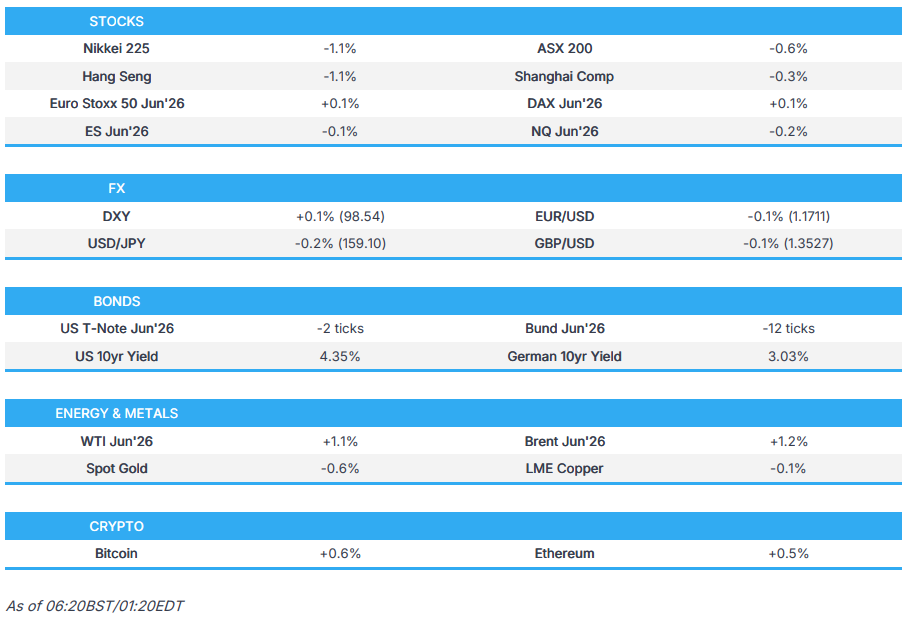
Newsquawk in 3 steps:
1. Subscribe to the free premarket movers reports
2. Listen to this report in the market open podcast (available on Apple and Spotify)
3. Trial Newsquawk’s premium real-time audio news squawk box for 7 days
IRAN CONFLICT
- US President Trump is seen as unlikely to accept Iran’s proposal, CNN sources said, as reopening the Strait without addressing nuclear issues would strip the US of a key source of leverage.
- US President Trump told his advisers the he is not satisfied with Iran’s latest proposal to reopen the Strait of Hormuz and end the war, NYT reported. Furthermore, a US official said that accepting the proposal could appear to deny Trump a victory. To add, the report went on the say that some administration officials believe that continuing the blockade for two more months would cause significant long-term damage to Tehran’s energy industry.
- US President Trump is reportedly sceptical of Iran’s Strait of Hormuz proposal in exchange for tabling discussions on its nuclear work, WSJ reported citing sources. The source went on to say that the White House will continue to negotiate with Iran and is expected to provide its response and counterproposals in the coming days.
- US and Iran are not as far apart as they seem, and that the first part of any potential agreement will focus on opening the Strait of Hormuz without restrictions or fees, CNN reported citing sources. Mediators are applying pressure on both sides to reach an agreement, with the next few days being especially crucial.
- White House Press Secretary Leavitt said Iran’s proposal is being discussed but would not say if the US is considering Iran’s proposal. She added that we will hear from Trump soon about Iran.
- US Secretary of State Rubio said the Iran offer is better than we thought. He added that the level of sanctions and pressure on Iran is extraordinary and expressed hopes that the rest of the world will sanction Iran.
- Al Araby highlighted reports from Israel’s Channel 12, citing a security source, stating that we are approaching decisive days regarding the future of negotiations with Iran.
- Iranian Foreign Minister Araghchi commented on his meeting with Russian President Putin, noting cooperation between the two countries and highlighting numerous areas for potential collaboration.
- Iran Foreign Ministry spokesman said US must be held accountable in regards to the seizure of oil ships.
- US CENTCOM said the guided-missile destroyer USS Rafael Peralta enforced the U.S. blockade of Iranian ports against M/T Stream after it attempted to sail to an Iranian port on April 26th.
- Ship tracking data showed that an ADNOC LNG tanker crossed the Strait of Hormuz for first time since Iran war.
- US Treasury Secretary Bessent warned businesses that are working with Iranian airlines risks sanctions, WSJ reported. This comes as an attempt by the Treasury to impose maximum pressure on Iran.
BOJ
- BoJ maintained its short-term interest rate at 0.75%, as expected; vote split 6-3 to hold (exp. near-unanimous); Nakagawa, Takata and Tamura voted to hike by 25bps to 1.00%, highlighting upside risks to inflation.
- Outlook report: FY26 and 27 Core CPI median forecast rose to 2.8% (prev. 1.9%) and 2.3% (prev. 2.0%) respectively, while real GDP median forecast was cut to 0.5% (prev. 1.0%) and 0.7% (prev. 0.8%) respectively.
- Commentary: Inflation expectations likely to continue increasing moderately, risks to economic outlook skewed to the downside while risks to inflation are skewed to the upside.
US TRADE
EQUITIES
- US stocks ultimately ended Monday’s session flat as uncertainty around US-Iran developments persisted. Geopols remained the key driver, with Iran stating that its military should have control over the Strait of Hormuz, while also proposing to reopen the Strait if the US lifts its naval blockade. Sector performance was mixed. Communication Services outperformed, supported by strong Verizon earnings, while Tech saw mixed moves after Microsoft announced it will no longer pay a revenue share to OpenAI but later said Accenture signed a firm-wide Copilot licence.
- SPX +0.12% at 7,174, NDX +0.01% at 27,306, DJI -0.11% at 49,175, RUT +0.13% at 2,791.
TARIFFS/TRADE
- Foreign automakers have reportedly warned the Trump administration that they are mulling pulling their cheapest car models out of the US market if the USMCA isn’t renewed or is watered down, WSJ reported citing sources.
- US Treasury Secretary Bessent discussed risks from overcapacity production with the EU.
CENTRAL BANKS
- White House Press Secretary Leavitt said US President Trump will be satisfied once Warsh is confirmed as Fed Chair.
NOTABLE HEADLINES
- US President Trump called on Republicans in the House to support DHS budget blue print and asked for final bill on his desk by 1st June.
- House GOP leaders would like to vote on the DHS funding bill on Thursday before House leaves for recess, Politico’s Hill reports citing sources. House republicans are still discussing whether they can modify the Senate bill.
APAC TRADE
EQUITIES
- Asia-Pac stocks traded broadly weaker, as risk sentiment weakened amid reports that US President Trump is unlikely to agree to Iran’s proposal.
- ASX 200 started the session on the backfoot, and held onto its earlier losses. Sectors were broadly in the red, as Utilities underperformed while Energy was supported by higher crude prices.
- Nikkei 225 opened flat but fell lower, a move which was later exacerbated after the hawkish hold by the BoJ. The Bank upgraded inflation outlook and downgraded growth, with FY27 growth only modestly cut. The index fell back towards the 60,000 handle. For single stock stories, DENSO reported earning in which all metrics rose annually, but the Co. cut its FY net and op. profit guidance while stating its withdrawal of the proposal of Rohn acquisition.
- KOSPI was the outperformer, with LG Electronics among those that lifted the index after reports that the Co.’s CEO is to meet Nvidia CEO Huang’s daughter to discuss strategic cooperation.
- Hang Seng and Shanghai Comp. followed the broadly negative bias. CATL’s HK shares were under pressure after the Co.’s announcement of a plan to raise over HKD 39bln in private share placement to step up expansion in its renewables business.
- US equity futures initially got a lift at the start of futures trade but came off best levels to around the unchanged mark.
- European equity futures are indicative of a relatively contained open, with the Euro Stoxx 50 future +0.1% after cash closed -0.3% on Monday.
FX
- DXY traded flat, consolidating after Monday’s selloff in which the basket fell back below 98.50. The index bounced off its 98.43 low following comments by US officials stating that US President Trump is unhappy with the Iranian proposal, as nuclear talks have seemingly been pushed aside.
- EUR/USD oscillated in a tight 1.1708-1.1727 range as markets await a busy central bank docket.
- GBP/USD grinded lower as the greenback firmed but has since rebounded. UK politics have been front and centre in recent sessions, with the latest update in Monday’s session stating that UK PM Starmer will be subject to a vote on whether he should be referred to the Privileges Committee, a headline in which pressure was seen in GBP/USD. Cable traded in a narrow 1.3525-1.3541 range.
- USD/JPY rotated in a 159.31-159.57 range heading into the BoJ rate decision. Initial two-way price action was seen on the announcement after the Bank held rates unchanged at 0.75%, as expected, but the Yen later strengthened as the vote split came out more hawkishly than expected (6-3 vs near-unanimous). All dissenting members cited upward risks to prices. In terms of the outlook report, the core CPI forecasts remain above the BoJ’s 2% target throughout the horizon forecast, whilst growth forecasts were downgraded.
- Antipodeans lacked direction, with a lack of catalysts to drive the Aussie or Kiwi.
FIXED INCOME
- UST Futures oscillated in a narrow 5 tick range, after benchmarks were pressured in Monday’s session as energy prices rose. Despite US officials highlighting US President Trump’s disappointment with Iran’s proposal, USTs remained unfazed.
- Bund Futures were softer and extended beyond Monday’s 125.21 trough. Newsflow to drive German debt was light, with price action continuing to be energy-dependent.
- JGB Futures found comfort as 10yr JGB yields found resistance at 2.48%. Japanese debt gapped lower on the return from the lunch break as markets had to re-price the hawkish hold by the BoJ. However, the gap failed to hold and was immediately filled.
- US sells USD 70bln of 5yr notes; Tail 0.5bps.
- US sells USD 69bln of 2-year notes; Tail 0.1bps.
COMMODITIES
- Crude futures traded on a firmer footing following reports coming out of the Situation Room meeting. The meeting was called upon following Iran’s 3-stage peace proposal announced on Monday. US officials told Reuters that US President Trump was unhappy with Iran’s proposal, with more recent reporting by CNN confirming his disappointment. CNN’s sources report also added that Trump is unlikely to accept Iran’s plan, which lifted WTI and Brent futures to session highs of USD 79.41/bbl and USD 109.25/bbl respectively. Since then, crude futures ticked higher slightly before paring back slightly.
- Precious Metals came under pressure after the CNN report, as spot gold slipped to USD 4667/oz from a peak of USD 4701/oz amid the firmer dollar, driven by geopolitics.
- 3M LME Copper initially traded either side of USD 13.25k/t before slipping below USD 13.2k/t amid the softening in the global risk tone.
- ADNOC is planning to invest tens of billions of dollars to build a natural gas business in the US to diversify its commodity exposure and the XRG business.
- Venezuela is to raise crude shipments to 1.06mln bpd and fuel sales to 134k by year-end.
- China allows the purchases of banned BHP (BHP AT) portside cargoes following a deal with the Co., according to sources
CRYPTO
- Bitcoin fell below the USD 77k handle.
NOTABLE ASIA-PAC HEADLINES
- Japanese Finance Minister Katayama said volatility in crude is affecting FX, ready to take decisive action. They will closely coordinate with the US and will act when necessary. On the economy, she said that it is recovering modestly with momentum for wage hikes continuing but caution is warranted for outlook.
DATA RECAP
- Japanese Unemployment Rate (Mar) 2.7% vs. Exp. 2.6% (Prev. 2.6%, Low. 2.6%, High. 2.7%).
- Japanese Jobs/applications ratio (Mar) 1.18 vs. Exp. 1.18 (Prev. 1.19, Low. 1.18, High. 1.20).
GEOPOLITICS
RUSSIA-UKRAINE
- Ukrainian drones attack Russia’s Tuapse oil refinery, causing a fire, according to authorities.
OTHER
- Taiwanese Defense Ministry said that Taiwan has spotted two Chinese warships operating in waters near the Penghu Islands and has sent its own naval and air forces to keep watch.
EU/UK
NOTABLE HEADLINES
- The Guardian reported that Rachel Reeves is considering imposing a one-year rent freeze on private sector homes amid growing alarm in government about the impact of the Iran war on voters’ budgets.
- Heathrow’s plans for a third runway is facing growing political uncertainty if Chancellor Reeves is removed after the May elections, FT reported citing sources.
- German Finance Minister Klingbeil wants to make smokers pay even more, according to Bild. The tobacco tax is to be increased in two stages.
DATA RECAP
- UK BRC Shop Price Inflation (Apr) 1.0% vs. Exp. 1.5% (Prev. 1.2%).
- Citi/YouGov Poll: 1-year inflation expectations 5% (prev. 5.4% M/M), 5-10-year 4.2% (prev. 4.5% M/M).
2.a NORTH KOREA/SOUTH KOREA/JAPAN
JAPAN
rare split in vote: dissenters want an immediate 1% rise in rates.
(zerohedge)
BOJ Keeps Rates On Hold In Rare 6-3 Vote Split As It Warns Of Looming Stagflation
Tuesday, Apr 28, 2026 – 11:25 AM
In the first G5 central bank announcement of the week, overnight the Bank of Japan held its benchmark interest rate in a 6-3 vote, despite forecasting a sharp rise in inflation as the war in the Middle East sends commodity prices higher and clouds the global economic outlook while testing Japan’s given its exposure to rising energy prices.

While the decision on Tuesday to keep rates at about 0.75% was in line with market expectations, it came via a rare six-to-three vote split of the Monetary Policy Committee, the biggest divergence of opinion under governor Kazuo Ueda, and since the launch of the bank’s negative interest rate policy in 2016.
The three dissenters called for an immediate rate increase to 1%, reflecting fears that the BoJ is at risk of falling even further behind the curve by postponing rate increases as it seeks to “normalise” monetary policy at a time when Japan’s inflation is dangerously overheating due to sharp wage increases in recent years.
After the BOJ announcement, traders were convinced that rates will rise after the next meeting in June.
Speaking at a press conference later on Tuesday that was widely interpreted as hawkish, Ueda said the central bank would make appropriate decisions “so that we do not fall behind the curve”, yet even now he refused to outline a formal timeframe for the BoJ to decide whether conditions were right to raise rates.
“Given the high level of uncertainty around the conflict in the Middle East, the likelihood of achieving our forecasts has declined,” said Ueda.
He added that the central bank “wants to spend a little more time scrutinizing how the Middle East conflict affects the economy and prices, and whether the risk to growth and inflation could change”.
While two of the three dissenters, Naoki Tamura and Hajime Takata, are known hawks who have voted against the governor at previous meetings, analysts noted the addition of the more dovish Junko Nakagawa.
“Three dissenting votes is not a huge surprise, but Nakagawa being one of them is,” said JPMorgan senior Japan economist Benjamin Shatil. “The Board is sending a clear signal that it is ready for a June rate hike. Whether global conditions have settled sufficiently and tacit government approval is in place by then is another question.”
In the BoJ’s stagflationary outlook statement, the bank warned that Japan’s economic growth was likely to slow in the current fiscal year; at the same time it also significantly raised its inflation forecast over the same period.
The committee said core CPI was expected to reach 2.8% for the current fiscal year ending in March 2027, up sharply from its previous forecast of 1.9% issued just three months ago.
“The rise in crude oil prices reflecting the impact of the situation in the Middle East is expected to push down corporate profits and households’ real income,” the BoJ said.
The statement added that the risks to economic activity were “skewed to the downside and risks to prices are skewed to the upside”. In other words, a classical staglationary setup.
Japan is particularly vulnerable to energy shocks from the crisis in the Gulf. The country is heavily reliant on imported energy, and sources more than 90% of its crude from the Middle East.
The BoJ was the first of five major central banks making rate decisions this week, with the Fed, the European Central Bank, the Bank of England and Bank of Canada all expected to follow its lead and keep rates on hold as they asses the war-related risk of prolonged inflation.
Marcel Thieliant, head of Asia-Pacific at Capital Economics, underlined the BoJ’s upward revision of inflation forecasts, including that inflation will average 2.2% in fiscal 2028.
“Barring a renewed escalation in the Middle East, the bank will probably lift its policy rate again at its next meeting in June,” he wrote in a note to clients.
Goldman’s Akira Otani said that July is still his base-case scenario for the next rate hike. “However, uncertainty over the timing of the rate hike is high. While it could come earlier than July depending on inflationary pressures, we would expect it to be pushed back from July to H2 if the Japanese economy were to fall into a recession through factors like a deterioration in the terms of trade.“
“Even if tensions in the Middle East were to stabilize, we believe a July rate hike is more likely than a June one. Uncertainty over crude oil production and transportation in the Middle East will remain high for the time being and the impact remains uncertain even in a de-escalation scenario. Under such circumstances, and with no signs of groundwork being laid with the government for a rate hike, data and information showing the Japanese economy is unlikely to suffer a significant negative impact and is likely to achieve moderate growth will become more important, in our view. Therefore, while the possibility of a June rate hike cannot be ruled out, we see no need to change our base-case scenario of a July rate hike.”
The BoJ’s hawkish statement pushed the yen higher against the US dollar, before the Japanese currency weakened back to around ¥159.62, and was lower on the day. The widely watched Nikkei 225 Average, which surged to an all-time high of 60,537 points on Monday, shed 1%, while the Topix, which has a heavier weighting of banks and financial companies, was up 1%.
NORTH AND SOUTH KOREA
3. CHINA/
4 EUROPEAN AND SCANDINAVIAN COMMENTARIES PLUS NATO
NATO/EUROPE
NATO Minus US: European Militaries Won’t Add Up To Deter Russia
Tuesday, Apr 28, 2026 – 03:30 AM
Authored by John Haughey via The Epoch Times (emphasis ours),
The North Atlantic Treaty Organization’s European nations would need to bolster standing militaries by at least 300,000 troops and significantly boost defense spending beyond 3.5 percent of gross domestic product – at least 250 billion euros – while reviving and integrating their industrial base to defend themselves against Russia without the United States.

And they’d need to do that fast, according to a 2025 joint analysis by European think tanks Bruegel and the Kiel Institute for World Economy.
They warn that even with 80,000 American soldiers and airmen stationed on 30 bases on the continent—and the United States’ capacity to rapidly deploy forces—Moscow will test NATO’s resolve “within three to 10 years.”
The once-inconceivable prospect of the United States withdrawing from NATO is now a possibility. President Donald Trump—never a fan of the 32-nation coalition the Pentagon has spearheaded since 1949—has called for a “very serious examining” of the alliance, after its members failed to respond to his appeal to assist in the Iran war or join the U.S. Navy’s Arabian Sea blockade of Iranian shipping.
Trump has vowed Europeans could face a “reckoning” without American leadership and support. Such a departure would require unlikely congressional approval, but the president’s statements are sparking discussion on both sides of the Atlantic about a restructuring of the alliance that would require Europeans to shoulder more of NATO’s burden.
As widely reported, European allies are actively discussing and preparing for a “NATO minus U.S.” scenario. The idea originated in response to Trump’s demand for Europeans to bulk up support for Ukraine in fighting off Russia’s invasion, his threats to seize Greenland from Denmark, and his characterization of member states as “cowards” unlikely to uphold NATO’s commitments.
While Americans have questioned NATO’s post-Cold War resolve since former President Barack Obama’s administration, Europeans in turn have questioned Trump’s reliability in meeting treaty obligations.
In response to Trump’s demand that NATO allies commit 5 percent of GDP to defense, members agreed during the alliance’s 2025 summit to commit 3.5 percent to their militaries—roughly matching the percent of GDP the U.S. spends on its armed forces—and 1.5 percent for infrastructure improvements, such as cybersecurity, crisis response, and adapting roads, rail lines, bridges, and ports to military needs.

Muscle and Money
The Bruegel/Kiel Institute analysis documents Europe’s armies have a combined force of about 1.5 million troops. In order to withstand a hypothetical Russian invasion, a European-only force would need 300,000 more infantry soldiers, or roughly 50 more brigades, than it had in 2025. It would need a minimum of 1,400 tanks, 2,000 infantry fighting vehicles, and 700 artillery pieces with more than 1 million 155 mm shells—the minimum for three months of combat, the Bruegel/Kiel Institute analysis states.
That boost in manpower and armaments would exceed the current French, German, Italian, and British forces combined.
And that’s just ground forces.
To match Russian war-footing military production—even with Ukraine attrition—a Europe-only military would need collective arms procurement, common armaments, unified logistics, and integrated military units. Such an army would need to replace stationed U.S. forces and rotational deployments within the 65-mile Suwalki Corridor between Poland and Lithuania, while also establishing bases in Moldova and Romania.
These are but a few of the challenges a “NATO minus the U.S.” would face, military analysts and international relations scholars told The Epoch Times. And as Europeans by necessity assumed a more robust posture on the continent, American forces would need to compensate for the loss of specialties and skills brought by their European allies.

“Non-U.S. NATO forces are well-trained and have some highly competent defense manufacturing industries,” said University of Miami professor of politics June Teufel Dreyer, a senior Foreign Policy Research Institute fellow and former U.S.–China Economic and Security Review commissioner.
European giants such as Thales and Leonardo would “surely be attracted by the idea of more indigenous investment,” Dreyer said. But, she added, European defense contractors “also know the funds they need aren’t guaranteed” without orders from the U.S. military to, for instance, annually build 2,000 “long-range loitering munitions”—drones—to match Russia’s numbers.
“The French and the Germans build highly thought of diesel-electric submarines; Sweden produces great fighter planes,” Dreyer said.
But from a nuclear deterrent perspective, a U.S. departure from NATO is problematic. Dreyer pointed to British Prime Minister Keir Starmer’s June 2025 announcement that Britain would buy at least 12 U.S.-made F-35s to “enhance the interoperability of NATO defense” in its nuclear posture, since these jets would be the UK’s only nuclear deterrent beyond its submarine force. The stealth fighter is the first to carry both conventional and nuclear weapons.
U.S. and European allies’ coordination in defense procurement and production “saves money and the R&D costs for the most advanced weapons,” she said, noting while the projected cost for the sixth-generation F-47 is $4.4 billion, but it is a shared NATO expense.

Specialties and Skills
If NATO ties are severed, the United States will no longer benefit from what retired Navy captain and Epoch Times contributor Carl Schuster calls “amazing capabilities that may prove essential in any conflict.” Those capabilities include aircraft and ship design, special ops, and regional know-how such as mountain operations capabilities and Arctic warfare expertise.
However, many European military assets are aging, and it was only after Russia’s invasion of Ukraine—and Trump’s threats to pull the United States from the alliance—that leaders showed urgency to address the deficiencies, Schuster said.
He expressed doubts about Spain—which has refused to let the United States use bases on its mainland to attack Iran—and Turkey.
“Spain has rejected any idea of its ground and air forces being committed to combat outside Spanish territory,“ he said. ”So their contribution to NATO defense is more statistical than real.”
Turkey has the alliance’s largest ground force, yet its “willingness to contribute to the defense of Greece, Bulgaria, and Eastern Europe” may be questionable, he said.
Middle East Forum Director Gregg Roman also questioned Turkey’s NATO commitment, in a September 2025 column in The Epoch Times, calling for “an urgent compartmentalization assessment” after Turkey made overtures to China and Iran during the Shanghai Cooperation Organization (SCO) summit.
“Six months later,” he said in April, “that assessment is non-optional. You know, thinking about everything [NATO] is trying to put together—joint air missile defense planning—with an ally like Turkey that is functionally aligned with Iran and the [SCO] bloc that we’re opposing, they can’t be trusted.“
Read the rest here…
END
HUNGARY
Orbán Vs Magyar: Did The EU Get Played?
Tuesday, Apr 28, 2026 – 02:00 AM
Authored by Arthur Schaper via American Greatness,
Viktor Orbán, the valiant populist, the restorer of the Christian faith in Hungary, the welcome thorn in the side of the EU establishment, and the strong ally of President Trump since his first bid for office, has lost his own re-election bid. I had a feeling it would come to this.
Sixteen years of uninterrupted administration as a strong force for conservative, right-wing nationalist populism have come to an end, at least with Orbán as the head of it.
Sometimes, voters have a strange fatigue when it comes to governments. Fourteen years of a “conservative” UK government ushered in the Labour Party in 2024. However, fatigue doesn’t explain Orbán’s crushing loss.

What set that off?
Corruption charges and the argument that his administration had looked the other way when sex abuse scandals broke out at a local school.
Economics reared its ugly head, as well, since the EU was cutting off its funding. Orbán’s supposed lack of judicial reforms, as well as his uniform check on EU policy, frustrated Brussels.
Orbán faced a crisis election, and inviting US VP JD Vance to campaign on his behalf didn’t help.
Why would Hungarian voters care what a foreign politician thinks? This desperate move only exacerbated how out of touch the Orbán government had become. Critics also saw him as too close to Russian “president” Vladimir Putin and unhelpful in resolving the Russo-Ukrainian war. The EU had been waiting for this opportunity: an unpopular Orbán facing electoral collapse.
They were salivating for a post-Orbán Hungary, one that would stop its Christian restorationism, welcome more LGBT promotion, tolerate more spending, and open its borders.
Would the Orbán replacement accomplish their scheme?
His challenger, Péter Magyar, was trained and prepped as an Orbán acolyte.
In 2024, he broke from his party, but not over core policy. Magyar (whose name means “Hungarian,” for what it’s worth) campaigned to end corruption and restore good government in Hungary. He campaigned to the right of Orbán, calling for an end to importing cheap labor into the country. He campaigned on cracking down harder on immigration—illegal and mass—than the incumbent.
His message, if anyone was listening, wasn’t pro-EU. He was still asking the question: “What about us Hungarians?”
Supporters of the cultural restoration Right thought that Orbán was not getting the job done. Was he failing?
April 12, 2026, Magyar’s Tisza Party swept the elections: supermajority status, up to 140 out of 199 seats. Orbán won 56 seats, and another far-right party won the rest.
Sure, EU progressive elites celebrate Orbán’s loss, as did Barack Obama and George Soros. They view the downfall of Orbán as a harbinger for the end of Republican hegemony in Washington later this year.
Yet look again at the results of the Hungarian parliamentary elections. I mentioned three parties that won seats: three right-wing parties. Not one left-wing or centrist element came to power or won seats. A minimum threshold of five percent in the election results is required for a party to place. The left was shut out of the Hungarian Parliament.
The Right Wing won Hungary. Orbán may have lost his premiership, but Orbánism is standing strong.
This election focused on personalities, not principles.
Magyar is just as socially conservative as Orbán. He has already pledged to end the foreign permit workers. He wants to give Hungarians in other countries a chance to come back to their own country and thrive again. That’s about as “Hungary First” as it gets!
Magyar has already stated that he will not support fast-tracking Ukraine’s membership into the EU. Huge move for ending the Russo-Ukrainian war!
He announced a diversification plan for energy. Instead of relying predominantly on Russia, he wants to draw oil from the South and the West, as well. This sounds like real economic freedom for Hungary. National populism is great, but it must face economic realities. Too many right-wing populist governments are shoveling out money to voters for school supplies, raising families, and pensions. Where is the money supposed to come from? More taxes?! From whom?
Right-wing socialism is still . . . socialism, and Orbán had a problem here.
Eventually, the government runs out of others’ money, or inflation bites whatever purchasing power the government intended for the people. Inflation and tariff pressures weighed down Orbán’s reelection chances.
Orbán’s Hungary was still not the perfect social conservative paradise for other reasons. Prostitution is still legal. Abortion is also still legal. While countries need to encourage their native populations to bear children, that vision will collapse in the face of easy sex and no responsibility. Cultural norms need reinforcement, with no tolerance for deviance.
Orbán and his party imposed vaccine passports and health mandates during COVID. How is this good for the working public? Where is the freedom? Too much state-sponsored anything is bad for a country.
Even now, Hungarians cannot own a gun without passing strict government demands. Czechia made self-defense a right, and in Switzerland everyone owns a gun (though it’s registered with the state).
Throughout his tenure, Orbán strengthened ties with China, joining the deceptive Belt and Road initiative. He even allowed Chinese police to operate in his country! American citizens voiced righteous outrage when the local press exposed former New York City mayor Eric Adams for allowing a CCP-run police station in the Big Apple. Yet no one on the Right complained about Orbán allowing CCP Hungary? That’s wrong.
There’s room for improvement, and Magyar has the opportunity to exceed Orbán’s victories while correcting his mistakes.
He is already doubling down on stopping mass migration!
He is committed to putting all Hungarians first, and he is fighting for the rights of ethnic Hungarians in other countries.
Magyar must revive and restore Hungary’s economy. One can hope he will place his country in a better position to profit without dependence and root out undue Chinese influence.
In a media masterstroke, he appeared on state television to discuss his plans for the country. Without missing a beat, he dressed down the reporter interviewing him, castigating the news organization for not allowing him on their program over the last year and a half. He then scolded them for lying about him and his family.
Then came the coup de grace: he announced his government plan to cut their funding and shut them down. Hungary needs honest independent media, he said, not government-funded agitprop that would inspire envy in Joseph Goebbels or North Korea.
He is not hostile to Putin, but he will not engage him aggressively either: sounds a lot like Trump!
He will not participate in the EU migration pact. He is keeping up the border fences, but he has also pledged to find a way for the EU to release the funds that the country needs, too.
He is making inroads with his Slavic neighbors, including the more populist, nationalist leaders in Slovakia and Czechia.
Magyar reminds me of Florida Governor Ron DeSantis. He isn’t just talking the national populist talk. He is walking the walk, and he is sprinting ahead with major reforms.
Orbán was T-800. Magyar may well be T-1000, and the EU Left is going to find that he will be worse for their globalist, leftist, secularist agenda.
END
FRANCE
12-Year-Old French Girl Collapses After Judge Releases Men Arrested For Gang Raping Her In Airbnb
Tuesday, Apr 28, 2026 – 05:00 AM
Two young men, both adults, suspected of gang rape in an Airbnb in the France’s Décines-Charpieu (Rhône), have been released from custody, shocking the family of one of the victims.

The victim’s lawyer, David Metaxas, spoke on behalf of the victim’s relatives, who told LyonMag that the judge’s decision was “incomprehensible.” Not only have both men been released to roam freely in the streets, but the judge did not even issue a restriction on contact with the victim, which means the two men could approach her once again.
Last week, the two men, aged 20 and 21, were arrested for the rape involving the 12-year-old, as well as a 16-year-old girl who had allegedly led the younger victim to the apartment. After reportedly exchanging messages with the two young men via Snapchat, the teen encouraged her younger friend to come with her to the Airbnb. Alcohol and drugs were allegedly consumed, with an excessive amount of hard liquor given to the 12-year-old.
Falling unconscious, the younger victim recounted waking up “lying on a bed covered in blood,” before realizing what had happened, recounts Lyon Mag. It was when she turned her phone back on that her mother was able to geolocate her, allowing the police to intervene. She is said to have run away from her home in Givors before the incident.
However, now the perpetrators are free. The family of the 12-year-old says her safety and innocence were tossed aside from the get-go, with police allegedly not even asking her to file a complaint initially.
“They were very poorly received, as if they were a nuisance,” said David Metaxas, the lawyer representing the 12-year-old. He pointed to a total lack of support and guidance, adding the very obvious and visible signs of rape suffered by the young girl.
“It is unacceptable that the form to file a complaint was not given to them by the police. It must be remembered that they were dealing with a young girl who had been deflowered, anally and orally penetrated, and who had wounds all over her body.”
Unfortunately, the 16-year-old girl and the accused men all stated that the girl was consenting. “Everyone agrees that she was consenting, or even that she was provoking, even though she is 12 years old and was completely drunk to the point of losing consciousness,” he said, adding that at the hearing, the girl was in an advanced state of shock.
“The lack of coercive measures concerning the suspects […] is incomprehensible,” stated Metaxas, the lawyer representing the 12-year-old, as quoted by LyonMag. He added that the court has failed to demand any judicial supervision or even a restraining order on the alleged perpetrators.
“They can, if they wish, contact and visit the young girl whenever they want,” he warns. “Therefore, there is total incomprehension, not to mention anger, on the part of the family.”
As for the young victim, she allegedly collapsed in the lawyer’s office upon hearing of the decision and was taken to the hospital. “She is in a state of total shock. She couldn’t utter a single word in my office. The justice system needs to take charge of this case very quickly,” he stated.
Metaxas insists he will not let the matter be and will be asking the public prosecutor that “a specialized service be put in charge of the investigation with the implementation of coercive measures to ensure the safety of this minor.”
The two men are still under investigation.
end
GERMANY ISRAEL
KORYBKO
Israel Just Became Germany’s Largest Arms Partner
Tuesday, Apr 28, 2026 – 07:20 AM
The Stockholm International Peace Research Institute (SIPRI), which is regarded as the top authority on the international arms trade, released its latest report about related trends from 2021-2025 last month.

The top takeaway is that “Europe was the region with the largest share of total global arms imports (33 per cent) for the first time since the 1960s”, but there are three other relatively more minor details therein that most observers missed but which are also important to be aware of. They are as follows:
1. South Korea Edged Out The US As Poland’s Top Arms Supplier
Last year’s report covering the years 2020-2024 noted that Poland imported 42% of its arms from South Korea during that period and 45% from the US, yet the last report shows that it imported 47% from South Korea and 44% from the US. This respectively amounted to 46% of South Korean arms exports from 2020-2024 and 58% from 2021-2025. In total, South Korea exported 2.2% of the world’s arms during the first period and 3% during the second, thus showing the global importance of sales to Poland.
Why this matters is that it represents the first time to the best of the author’s knowledge that a NATO member is now supplied more by an Asian country than a fellow Western one. Poland’s enormous military build-up, which has resulted in it now fielding NATO’s third-largest army, is also a boon for the South Korean arms industry. With Poland increasingly demonstrating the quality of these wares to its allies during NATO drills, it’s possible that other members of the bloc might soon follow its lead.
2. Kazakhstan’s Is Gradually Replacing Russian Arms With Western Ones
During the period 2020-2024, Kazakhstan imported 6.4% of its arms from Spain and 1.5% from Turkiye as its second- and third-largest arms suppliers, with Russia far ahead of them with 88% of its supplies. During the latest period from 2021-2025, imports from Spain increased to 7.9% while France replaced Turkiye as Kazakhstan’s third-largest supplier at 3.6%, with Russia’s share slightly decreasing to 83%. The decrease in Russia’s supplies was therefore roughly replaced by the increase in Western supplies.
Why this matters is that it contextualizes Kazakhstan’s decision last December to produce NATO-standard shells, the potential consequences of which were analyzed here as possibly placing it on an irreversible collision course with Russia. The “Trump Route for International Peace and Prosperity” across the South Caucasus could also facilitate the flow of more Western arms by reducing transport costs. It’s therefore expected that Kazakhstan will continue to gradually replace its Russian arms with Western ones.
3. Israel Became Germany’s Largest Arms Partner Due To A Mega Arms Deal
Israel’s delivery of the Arrow 3 missile defense system to Germany last year, which was its largest export deal ever at $4.6 billion, led to its share of Germany’s arms imports jumping from 13% during the period 2020-2024 to 55% during the period 2021-2025. At the same time, Israel remained Germany’s third-largest arms client at 10% of its exports from 2021-2025 compared to 11% of them from 2020-2024, with the slight 1% decrease likely being due to three-month-long curb on arms exports to it last year.
Why this matters is because Israel’s new role as Germany’s largest arms supplier might worsen its ties with Russia, especially if exports evolve from defensive systems like the Arrow 3 to offensive ones like the $7 billion deal for 500 rocket launchers and thousands of missiles that they’re now negotiating. Moreover, West Asian geopolitics might radically change after the end of the Third Gulf War, so Russia might not be able to reciprocally sell similar systems to Iran. Israel would then gain an edge over Russia.
What these three trends have in common is their adverse impact on Russian national security. The Kremlin likely assumed that Poland and Germany would continue militarizing, even competing to lead Russia’s containment, but South Korea and Israel’s new respective roles as their top suppliers probably came as a surprise. What it might not have anticipated at all, however, was the West gradually making gains in the Kazakh arms market. Russia will have to deal with these latent threats somehow or another.
5. RUSSIAN AND MIDDLE EASTERN AFFAIRS
ISRAEL/USA VS IRAN
Bessent: IRGC Leaders ‘Trapped’ Like ‘Drowning Rats’ By US Blockade, Will Soon Face Uprising Over Coming ‘Gasoline Shortages Next’
Monday, Apr 27, 2026 – 08:35 PM
Summary
- Bessent describes IRGC leaders as now “trapped like drowning rats” amid the enduring US naval blockade of Iranian ports, which will soon result in gasoline shortages, anger & uprising
- Putin tells FM Araghchi that he’s been in contact with the new Supreme Leader, and says Iran fighting for ‘sovereignty’
- After a weekend of stalemate malaise, Iran reportedly offers new proposal for opening ship traffic, while postponing the thorny nuclear issue; Rubio says ‘will not tolerate’ Iran control of strait
- Trump says peace could come via telephone rather than face-to-face meetings, also warning Iranian oil infrastructure could explode from within unless flow resumes; Tehran later says Trump has requested new talks
- Iranian FM has been sending written messages to US via Pakistani intermediaries
- Israel strikes deep into Lebanon in Beqaa Valley for first time of 3-week ceasefire.
https://embed.polymarket.com/market?market=us-x-iran-permanent-peace-deal-by-june-30-2026-837&height=300US x Iran permanent peace deal by June 30, 2026?
Yes 42% · No 59%
View full market & trade on Polymarket
* * *
Bessent: ‘Rats’ Trapped by US Blockade
In the early evening of Monday, well after markets closed, Treasury Secretary Scott Bessent issued the following on X (below), describing IRGC leaders as now “trapped like drowning rats” amid the enduring US naval blockade of Iranian ports, which will soon result in gasoline shortages and anger – and potential protests leading to uprising (according to US desires and aims). Also here is where things stand on the stalled negotiations, and an early hint of the potential White House reaction, per WSJ:
Iran has presented regional mediators with a new offer to stop its attacks on ships in the Strait of Hormuz in exchange for a full end to the war, including the U.S.’s lifting of its naval blockade of Iranian ports and the postponement of nuclear negotiations, according to officials familiar with the matter.
The proposal, presented by Iranian Foreign Minister Abbas Araghchi during his tour of the region and Pakistan over the weekend, is designed to break the deadlock in the conflict and set talks back in motion, the people said. President Trump and his national-security team are skeptical of Iran’s offer, U.S. officials said. Trump previously said negotiations could happen over the phone instead of in person.
And: “Trump held discussions with aides Monday morning about the offer. While he didn’t reject it outright, officials said Trump sounded notes about Iran not dealing in good faith or being willing to meet his key demand: ending nuclear enrichment and vowing never to make a nuclear weapon.”
Meanwhile…
Rubio: ‘Will Not Tolerate’ Iran Control of Strait
The latest via WSJ on what Iran is proposing, centered on immediately lifting the US naval blockade on Iranian ports:
Iran has presented regional mediators with a new offer to stop its attacks in the Strait of Hormuz in exchange for a full end to the war and a lifting of the U.S. blockade of Iranian ports, according to officials familiar with the matter. The proposal, presented by Iranian Foreign Minister Abbas Araghchi during his tour of the region and Pakistan over the weekend, is designed to break the deadlock in the conflict and set talks back in motion, the people said. It would see discussions about Iran’s nuclear program shelved. Washington hasn’t responded to the proposal, one of the people said. Iran’s mission to the United Nations didn’t respond to a request for comment.
But US Secretary of State Marco Rubio has told Fox News on Monday that the US will not tolerate Iran controlling or establishing a toll system in the Strait of Hormuz. Rubio further asserted that the strait would remain open either through international pressure or a coalition-led effort.
Iranian Foreign Minister told Russia’s President Putin that US ‘destructive habits’, ‘unreasonable demands’ and frequent changes in positions are slowing diplomatic progress
Just days ago Iran began declaring that the first toll passage funds had been successfully transferred to the Central Bank of Iran, after Trump stated the US won’t allow a toll system. Rubio further said the US will not normalize the Iranians being essentially a gatekeeper, with countries seeking permission from Iran.
ISRAEL /USA/IRAN
Trump unhappy Iranian proposal does not address nuclear program, US official says
Iranian sources earlier on Monday said the proposal would set aside discussion of Iran’s nuclear program until the war has ended and disputes over shipping from the Gulf are resolved.

US President Donald Trump against the backdrop of the NATO flag, April 24, 2026; illustrative.(photo credit: CHIP SOMODEVILLA/GETTY IMAGES)ByREUTERSAPRIL 28, 2026 03:55
A US official said on Monday that President Donald Trump is unhappy with an Iranian proposal because it did not address Iran’s nuclear program.
“He doesn’t love the proposal,” the US official said, referring to Trump.
Earlier in the day, Trump discussed the proposal with his top national security aides. The US-Iran conflict remains in a stalemate, with energy supplies from the region reduced.

Dispute over nuclear issues
Iranian sources earlier on Monday said the proposal would set aside discussion of Iran’s nuclear program until the war has ended and disputes over shipping from the Gulf are resolved. Washington has said nuclear issues must be dealt with from the outset.
Work to bridge gaps between the US and Iran has not halted, sources from mediator Pakistan have said.
But hopes of reviving peace efforts have receded since Trump announced this weekend he had scrapped a visit by his special envoy Steve Witkoff and son-in-law Jared Kushner to Islamabad, the Pakistani capital.
END
ISRAEL/IRAN/USA
Iran Believes It Can Outlast US Based On ‘Munitions, Markets, & Midterms’; Trump ‘Not Open’ To Tehran’s Latest Proposal As ‘Tank Tops’ Loom
Tuesday, Apr 28, 2026 – 08:55 AM
Summary
- Trump doesn’t appear open to Iran’s proposal which hinges on US naval blockade ending & nuclear issue being pushed to future negotiations (CNN).
- First crude-laden Japanese tanker from Saudi port exits Hormuz Strait successfully without Iranian interference.
- Iranian analyst describes that Tehran believes it can outlast Trump & the standoff with US in Hormuz, citing “munitions, markets, and the midterms.”
https://embed.polymarket.com/market?market=will-donald-trump-announce-that-the-united-states-blockade-of-the-strait-of-hormuz-has-been-lifted-by-may-31-2026-313-388&height=300Will Donald Trump announce that the United States blockade of the Strait of Hormuz has been lifted by May 31, 2026?
Yes 66% · No 34%
View full market & trade on Polymarket
* * *
Oil Rises to 3-week High as Trump Doesn’t Appear Open To Iran Proposal
Reporting from Monday evening and overnight says President Trump doesn’t appear open to Iran’s latest proposal to end the war, which hinges on the US naval blockade being lifted but pushes the nuclear issue off to later negotiations. As a result, oil prices have continued to rise, climbing above $110 a barrel Tuesday morning – a first in three weeks, amid concerns of a prolonged strait closure. As for the latest tankers to actually make it through, CBS describes:
Four civilian ships appeared to leave the Persian Gulf through the Strait of Hormuz on Tuesday without Iranian interference, including a Japanese oil tanker carrying some two million barrels of crude from Saudi Arabia.
The Panama-flagged crude oil tanker Idemitsu Maru called at Saudi Arabia’s Juamyah industrial port in early March, according to open source data from the MarineTraffic ship tracking website. For the past week it had remained anchored off the coast of Abu Dhabi in the Persian Gulf, until late Monday, when it sailed toward Iran’s Larak island in the Strait of Hormuz.
On Tuesday morning, tracking data showed the vessel passing south of Iran’s Larak island, which analysts say the regime had used as a “toll booth” to collect fees from some ships before military authorities declared the strait entirely closed again last week.
The White House has insisted that there would be no scheme for Iran collecting tolls as part of any future deal, but the Iranians appear to be forcing the issue, and have said the funds will help with the country’s reconstruction after the devastation wrought by US-Israeli bombing raids.

Three M’s
Independent news organization Drop Site says that Iran is now setting its own terms for ending the war as President Trump’s narrative on negotiations flails. One Iranian analyst has said that Tehran believes it has the three M’s on its side: “munitions, markets, and the midterms.”
The report cites Hassan Ahmadian, a well-known Iranian analyst and associate professor at the University of Tehran, who explains: “The Iranians are saying time is working in our favor for the three Ms: munitions, markets, and the midterms. These three Ms help Iran in its position and weaken US positions.”
“Obviously in the U.S., they want something to say, ‘We squeezed Iran and we got this.’ My perception is that the Iranians are keen to deny the United States that – they wouldn’t give what Trump wants as a victory,” he added.
A separate Iranian official, privy to negotiations and so remaining anonymous, stated: “We’re currently moving forward with our own design, and we feel continuing negotiations doesn’t make sense until the U.S. government lifts the maritime blockade.”
“The scope of the conflict has expanded, and naturally the issue is no longer purely nuclear,” the official added. Indeed, the latest proposal for ceasefire out of Tehran focuses on the US Navy ending its blockade, and leaves the nuclear issue for future consideration, given it has proven an impasse in the prior Islamabad talks.
But Washington as been asserting its own leverage:
‘Tank Tops’ Loom
President Trump explained – in his own inimitable manner – what we described last week: time is running out for Tehran… as oil blockade stalls the flow state of Iran’s economy permanently…
Trump told Fox News on Sunday that the US blockade on traffic to and from Iranian ports is putting major pressure on the country’s export infrastructure:
“When you have, you know, lines of vast amounts of oil pouring through your system, if for any reason that line is closed because you can’t continue to put it into containers or ships, which has happened to them — they have no ships because of the blockade — what happens is that line explodes from within, both mechanically and in the earth.”
“It’s something that happens where it just explodes. And they say they only have about three days left before that happens. And when it explodes, you can never, regardless, you can never rebuild it the way it was.”
As Hugh Hendry noted, time is running out for Iran:
“Iran’s oil system is not built to pause. It’s built to flow. It’s a flow system.
Oil cannot simply sit in the ground while strategists argue over maps and how much uranium dust to give over. It has to move. Iran and its system has to move continuously from the rock underground to the tanker in the harbor to the Chinese buyer in Asia.
Pause long enough, and the whole machine breaks.
Interrupt that flow. And the problem isn’t just lost revenues of like forty, fifty, sixty billion dollars. It’s the least of your concerns. The problem is physical and is irreversible.
Because when you suddenly shut the well, remember there’s no physical storage. They pump, they load, they ship.
If they can’t load, if they can’t ship, they can’t pump. And when you suddenly shut the wells, the pressure underground drops fucking fast.
Do you know what happens?
The heavy, sticky crap in the oil, it gums up, gums up in the tiny holes within the rocks and becomes like glue. It traps the oil. It makes it really fucking hard to extract. And once that damage is done, it’s permanent. You lose a big chunk of the oil.
The more Iran is actively either through theater or through bluff, the more that it sits in a standoff, the more it is actively destroying the one thing that it actually depends upon.
That’s the trap. And you’re not reading in in the press, but you’re damn well reading it on your screens.
Because this is where the gap between the narrative of the media and the price stops being subtle and irrelevant, and it’s why stock markets have priced something entirely differently.
The Iranian system, the adversary, cannot afford to stay disrupted without hurting itself. That’s what’s in the equity market’s price.”
We covered the timeline for ‘tank tops’ here in detail – less than 15 days before shut-ins begin.
Tehran Won’t Talk Without JD Vance Present
The failed second round of Pakistan talks, which fell apart before they even began, was supposed to see Vice President JD Vance heading up the US side. This was reportedly something the Iranian side desired to see, and is likely still what its negotiating team would rather be dealing with. On the other hand, per Drop Site, “Iran has total disdain for Trump’s Special Envoy Steve Witkoff and views him as both oblivious of diplomatic processes and totally ignorant of technical issues.”
This is because “Kushner is viewed by Iran as Israel’s man at the table.” This has led to the following view and alleged conclusion: “Iran, the senior official said, does not see any reason to deal with these two without a figure like Vice President JD Vance present.”
Bombs have grown quiet across the Gulf amid the extended ceasefire, with the exception that fighting in southern Lebanon still rages, despite the US-mediated ‘Lebanon ceasefire’:
Last week as an avalanche of headlines said that a second round of talks were imminent, and after the Iranian foreign minister had already landed in Islamabad for bilateral discussions with Pakistani mediators, there were premature reports that Vance was en route to Islamabad. The mainstream media claimed that it was Iran essentially begging Washington for negotiations. “But Vance, it turned out, was not on a plane, and Iran continued to deny it had any intention of meeting with U.S. officials in Pakistan,” Drop Site underscores.
END
ISRAEL IRAN/USA /THIS AFTERNOON
Iran To Send Revised Proposal To US In ‘Days’ As ‘Tank Tops’ Loom, Trump Claims Iran “Informed Us They Are In State Of Collapse”
Tuesday, Apr 28, 2026 – 11:10 AM
Summary
- Trump TS claim: Tehran has informed Washington they are in a “state of collapse” and that the Iranians want the US to “open the Hormuz Strait” – as ‘tank tops’ loom.
- Trump doesn’t appear open to Iran’s proposal which hinges on US naval blockade ending & nuclear issue being pushed to future negotiations (CNN). Tehran working on revised plan to be sent in ‘few days’.
- First crude-laden Japanese tanker from Saudi port exits Hormuz Strait successfully without Iranian interference.
- Iranian analyst describes that Tehran believes it can outlast Trump & the standoff with US in Hormuz, citing “munitions, markets, and the midterms.”
https://embed.polymarket.com/market?market=will-donald-trump-announce-that-the-united-states-blockade-of-the-strait-of-hormuz-has-been-lifted-by-may-31-2026-313-388&height=300Will Donald Trump announce that the United States blockade of the Strait of Hormuz has been lifted by May 31, 2026?
Yes 66% · No 34%
View full market & trade on Polymarket
* * *
Revised Plan Coming in ‘Next Few Days’
So at least there is some back-and-forth. Trump is said to have rejected an initial proposal from Iran, which centered on the US opening up the strait, but pushes the nuclear issue to future talks – and only after an end to the war. Tehran is reportedly revising, and is expected to submit a revised draft deal in the coming days. CNN has the latest in the following:
Mediators in Pakistan expect to receive a revised proposal from Iran in the next few days to end the war, after US President Donald Trump indicated that he would not accept an earlier version, sources close to the mediation process told CNN. The sources say Iranian Foreign Minister Abbas Aragchi was due back in Tehran today after a visit to Russia, adding that he is expected to consult with regime leaders. That process is slow, the sources say, because of the difficulty in communicating with Supreme Leader Mojtaba Khamenei, whose location is being kept secret.
Currently there’s much speculation and armchair quarterbacking regarding ‘hardliners’ vs ‘moderates’ in Iran and who is actually in charge, amid reports the IRGC doesn’t want engagement with untrustworthy Washington at all. Meanwhile there’s no question Iran is using the extended ceasefire interim to rearm and regroup militarily.
Trump claims Iranians in ‘State of Collapse’
Literally one minute before market-open, and President Trump issues the following big claim: he says that Tehran has informed Washington they are in a “state of collapse” and that the Iranians want the US to “open the Hormuz Strait”. Of course, even if it were true, why would the Iranians admit such a thing to their enemy during a state of war?
There have been some signs of political fracture – especially tensions between IRGC and civilian leadership – but so far the evidence has been anecdotal at best. Currently the internal Iranian government debate seems to be on whether to talk to the US or not – but again, amid the fog of war… all Western MSM can do is speculate, aside from the rare Iranian ‘anonymous’ source that might whisper in a reporter’s ear.
ISRAEL TBN
RUSSIA VS UKRAINE UPDATES
6.GLOBAL ISSUES, COVID ISSUES, VACCINE INJURIES/HEALTH ISSUES
JUST THE BEGINNING.
he will eventually be given immunity and then he will tell all against Fauci!
(zerohedge)
Top Fauci Advisor David Morens Charged In COVID Records Cover-Up: DOJ
Tuesday, Apr 28, 2026 – 12:00 PM
With Pam Bondi out (related?), the U.S. Department of Justice announced today that it has indicted Dr. David M. Morens, a longtime senior advisor to former National Institute of Allergy and Infectious Diseases Director Dr. Anthony Fauci. The 78-year-old Morens faces charges including conspiracy against the United States, destruction, alteration, or falsification of records in federal investigations, concealment, removal, or mutilation of records, and aiding and abetting.

According to the indictment, Morens allegedly used his personal Gmail account to evade Freedom of Information Act requests and worked with others to conceal communications related to COVID-19 research grants during the pandemic.
Morens served as Senior Scientific Advisor in NIAID’s Office of the Director from 2006 through 2022 – advising senior leadership, including Fauci, on policy matters, infectious disease issues, and aspects of COVID-19 origins research. He also gathered information from grantees and the scientific community and helped prepare briefings for Fauci to use with the White House, Congress, and the public.
The Congressional Investigation
The indictment follows years of scrutiny by Congress. In June 2023, the House Select Subcommittee on the Coronavirus Pandemic began obtaining emails showing that Morens had been using his personal Gmail account for official government business specifically to avoid FOIA disclosures. Over the following months the subcommittee issued document requests and subpoenas, conducted transcribed interviews with Morens in December 2023 and January 2024, and ultimately obtained tens of thousands of additional pages from his personal email account in late April 2024.
As Paul Thacker of the DisInformation Chronicle noted in 2024, the subcommittee released a detailed staff memo and more than 150 pages of emails on May 22, 2024, documenting what it described as serious questions about potential wrongdoing and illegal activity by Morens. The emails included discussions of deleting records and routing sensitive communications through personal accounts.
Sen. Ron Johnson had raised similar concerns even earlier. In November 2023 he wrote to HHS Secretary Xavier Becerra and Inspector General Christi Grimm, stating that Morens’ actions may have directly obstructed congressional oversight efforts related to NIAID activities during the pandemic.

More than two years ago, my PSI staff discovered and made public emails in which Dr. David Morens bragged to colleagues about his efforts to avoid transparency by destroying federal records and using his personal email to communicate on “sensitive issues.” Today,
announced that Dr. Morens has been arrested and charged with conspiracy and destruction of federal records. I applaud OIG’s new leadership for taking this much needed step forward to hold Dr. Morens accountable.
Key Emails
Two emails in particular have drawn significant attention. In a February 24, 2021 message to Peter Daszak of EcoHealth Alliance and Gerald Keusch, Morens wrote that he had learned from an NIH FOIA official “how to make emails disappear after I am FOIA’d but before the search starts, so I think we are all safe. Plus, I deleted most of those earlier emails after sending them to Gmail.”
In an April 21, 2021 email to Daszak, Morens added: “PS, I forgot to say there is no worry about FOIAs. I can either send stuff to Tony on his private gmail, or hand it to him at work or at his house. He is too smart to let colleagues send him stuff that could cause trouble.” (“Tony” refers to Anthony Fauci.)
These messages, along with others detailing coordination with EcoHealth Alliance after its NIH grant was terminated, formed a central part of the congressional record.
‘Tie Your Shoe’
On May 22, 2024, Morens appeared for a public hearing before the Select Subcommittee on the Coronavirus Pandemic. He faced questions from both Republican and Democratic members about the emails, his relationship with Daszak, and his role in efforts to restore EcoHealth’s terminated grant and shape public messaging around COVID-19 origins.
During the hearing, Morens was confronted with evidence that he:
- Edited compliance letters and press releases for EcoHealth Alliance
- Wrote to the EcoHealth board on Daszak’s behalf when the latter feared being fired
- Used personal email to route information to Fauci while attempting to avoid FOIA
- Discussed methods for deleting or hiding emails after FOIA requests had been filed
As Paul Thacker writes:
Reading back to Morens passages from his own emails and prior congressional testimony, Chairman Brad Wenstrup forced Morens to confirm that he had conspired with EcoHealth Alliance’s Peter Daszak to restore Daszak’s NIH grant. Morens admitted that he edited a compliance letter Daszak sent to the NIH, edited an EcoHealth Alliance press release after NIH terminated Daszak’s grant, and “put in a word” to the EcoHealth Alliance board when Daszak was worried about being fired.
Ranking Member Raul Ruiz berated Morens at several points, saying his actions were a “stain on the legacy” of the NIH and his colleagues. After Wenstrup banged down his gavel to end the hearing, Morens remained seated and was approached by his lawyer, white collar crime attorney Timothy Belevetz.
Leaning into his client’s ear, Belevetz whispered, “Before you get up, tie your shoe.”
Today’s DOJ Indictment
The indictment alleges that after NIH terminated EcoHealth Alliance’s grant Understanding the Risk of Bat Coronavirus Emergence — which included a subaward to the Wuhan Institute of Virology — Morens and unnamed co-conspirators conspired to help restore the grant and counter the lab-leak narrative. The charges further claim that Morens used his personal Gmail account to hide these communications from public view and that he received illegal gratuities, including wine delivered to his home, in connection with official acts favorable to EcoHealth.
Maximum penalties if convicted:
- Conspiracy against the United States: up to 5 years in prison
- Destruction, alteration, or falsification of records in federal investigations: up to 20 years per count
- Concealment, removal, or mutilation of records: up to 3 years per count
An indictment is not a finding of guilt. All defendants are presumed innocent until proven guilty in a court of law.
Timeline of Key Events
- 2020–2021: Key emails written regarding FOIA avoidance, back-channel communications, and coordination with EcoHealth Alliance
- June 2023: House Select Subcommittee begins obtaining Morens’ personal emails
- October 2023: Morens subpoenaed for documents
- November 2023: Sen. Ron Johnson raises concerns with HHS leadership about potential obstruction of oversight
- December 2023 and January 2024: Morens gives transcribed interviews to the subcommittee
- April 2024: Additional subpoena issued; Morens produces roughly 30,000 pages of emails
- May 22, 2024: Public hearing held and staff memo plus 155 pages of emails released
- June 3, 2024: Dr. Anthony Fauci testifies before the subcommittee
- April 28, 2026: Department of Justice indicts David Morens
Broader Context: The Offshoring of Risky U.S. Research
In 2014, the Obama administration imposed a pause on federal funding for certain gain-of-function research on pathogens such as influenza, SARS, and MERS viruses, citing serious biosafety concerns following several laboratory incidents. The moratorium was lifted in 2017, but by then much of the work had effectively moved overseas. EcoHealth Alliance, led by Peter Daszak, continued receiving millions in NIH grants for bat coronavirus research – with a significant portion funneled through subawards to the Wuhan Institute of Virology (WIV) in Wuhan, China.
Related:
- CIA Met With Ralph Baric In 2015 To Discuss “Coronavirus Evolution And Possible Human Adaptation”: Emails
- Is This The Man Who Created COVID-19 In Fauci’s US Lab?
At the same time, University of North Carolina virologist Ralph Baric – one of the world’s leading experts on coronaviruses – had been collaborating closely with WIV scientists, including Shi Zhengli, in work described in a 2018 DEFUSE funding proposal (that was rejected by DARPA) to create an aerosolized bat covid that could infect humans. Baric’s lab created “humanized mice” expressing the human ACE2 receptor and engineered chimeric viruses to study how bat coronaviruses could jump to humans. Much of this high-risk work, which had previously been conducted on U.S. soil, was effectively transferred to the WIV – located in the very city where COVID-19 first emerged.
Details of the DEFUSE project were first leaked by Major Joseph Murphy, an employee of US military research agency DARPA, in the summer of 2021 and further details of earlier drafts have come to light this month thanks to public record requests from U.S. Right to Know (USRTK).
In DEFUSE, Baric proposed to create a virus that was, to most intents and purposes, SARS-CoV-2. The proposal included inserting a furin cleavage site into a coronavirus spike protein, an order for the restrictive enzyme BsmBI, the search for a binding domain that would infect ACE2 human receptors and a requirement for a viral genome around 25% different to SARS.
One down (until Boasberg knights him), many to go.
GLOBAL ISSUES
MARK CRISPIN MILLER
NEWSWIZE
MICHAEL EVERY/OR OR PICTON/GIFFIN OR RABOBANK EXECUTIVE/COMMENTARY ON WORLDLY AFFAIRS
Collateral Damage
\
Tuesday, Apr 28, 2026 – 10:15 AM
By Molly Schwartz, Cross-ASset Macro Strategist at Rabobank
Negotiations between the US and Iran are going nowhere. In fact, they’re not really even happening at all. Over the weekend, Axios reported that Iran gave the US a proposal to reopen the Strait — not to end the war. The proposal includes extending the ceasefire and an assertion that any conversations about Iran’s nuclear program are off the table until the Strait is open and the US blockade is lifted. The US has not indicated whether it will accept or reject the proposal at the time of writing.
Assuming the US does agree to extend its indefinite ceasefire, a flimsy ceasefire extension, even if agreed to by both parties, holds little water. Remember, keeping the Strait open was a condition of the current ceasefire as agreed to on April 8, and we can all see how well that held up. Just take a look at the prices at the pump.
While conversations between the US and Iran stall, Iran is making friends elsewhere. Iranian Foreign Minister Araghchi met with Putin yesterday, as Bloomberg reported that Araghchi told Putin he is “committed to strengthening the country’s partnership with Russia” and that “the Iranian people are able to ‘resist US aggression and will be able to overcome it.’”
As Iran and Russia are making nice, the US and Germany are not. During a visit to a school in western Germany, German Chancellor Friedrich Merz said that the Trump Administration was being “humiliated” by Iran: “The Iranians are clearly stronger than expected and the Americans clearly have no truly convincing strategy in the negotiations either. A whole nation is being humiliated by the Iranian leadership.” Trump has not commented on Merz’ claims at the time of writing.
The longer the Strait remains closed, the longer the European economy, and energy complex, is squeezed. Germany has rejected Trump’s calls to join the war under NATO, despite German leaders softly echoing support of US military efforts. Europe has drafted a plan to re-open the Strait after the war has ended, that is not enough to appease Trump, who has made his demands for NATO participation in the Iran war clear. But the question remains just how much collateral damage Europe is willing to be subject to in the pursuit of keeping its hands clean.
Europe’s reliance on energy from the Middle East and direct flows through the Strait of Hormuz suggest that they are in for more pain than the US under a prolonged closure. At the same time, they don’t have a fanatic obduracy to tolerate it like the Iran (or rather, the IRGC at the expense of the Iranian people). If negotiations fail to result in a somewhat peaceful re-opening of the Strait and conclusion of the US naval blockade, Europe may have no choice but to get involved.
It’s probable that the Trump Administration is aware of this. Trump has lambasted European leaders for refusing to support the US and in some cases, outright refusing to cooperate. If the US keeps the Strait closed and inflicts enough second-hand damage on Europe, Trump may be able to achieve the NATO military “cooperation” he has been asking for.
Crude oil futures have continued to grind higher, trading up to highs of $109/bbl yesterday. Futures prices have started to converge with the physical market, which is currently pricing crude at $113/bbl, narrowing the spread from highs of $35.9 earlier this month to only $4, which would be more consistent with levels seen pre-war.
Meanwhile, the Fed drama saga continues. The path to Warsh’s confirmation as Fed chair seems to have cleared as the US Department of Justice (DOJ) has dropped its criminal probe into Powell with regard to the Federal Reserve’s renovation budget. However, whether Powell will stay on the Board is not yet certain. While Powell’s term as Chair ends in May, he is allowed to stay on the Board of Governors until January 2028.
Despite it being a highly popular question from reporters during the Fed decision press conference, Powell had been tight lipped about his plans for a while, until confirming more recently that he would stay on the Board until the DOJ investigation levied against him was concluded.
However, while the DOJ has dismissed the case, that doesn’t mean that Powell’s troubles are over. Rather, this means that the case has now landed on the desk of the Fed’s Office of Inspector General (OIG), though according to the Fed’s own article about the renovation, the OIG has had full access to all financial records and information throughout the duration of the project.
Given the dropped charges against Powell, that has opened up Senator Thom Tillis to vote to officially confirm Warsh as Fed Chair. Whether or not the Fed meeting tomorrow will be Powell’s last is still TBD. Read more from our Fed whisperer, Philip Marey, here.
A little farther north, Canadian Prime Minister, Mark Carney, announced the creation of a Canadian sovereign wealth fund, called the “Canada Strong Fund.” The fund is designed to further lower barriers to business and investment in Canada—something the Carney has spoken about extensively as a part of his mission—by “investing in strategic Canadian projects and companies.”
A more financially-savvy Canadian government does not come without drawbacks. Carney has recently come under scrutiny by some after his ethics disclosure, which has led some to question the dissonance in Carney’s insistence that Canada needs to diversify away from the US, while he himself is heavily invested there.
7.OIL AND NATURAL GAS COMMENTARIES
First Loaded LNG Tanker Clears Hormuz; First Crude Supertanker Attempts Exit
Tuesday, Apr 28, 2026 – 07:45 AM
While all the attention has been focused on President Trump’s national security team reviewing an Iranian peace deal that would end the two-month war and reopen the Hormuz chokepoint, while deferring nuclear negotiations to a later date, new vessel-tracking data show that the first loaded LNG tanker has exited the critical waterway since the conflict began, while the first loaded crude supertanker is also attempting to exit.
“The first LNG shipment since the war in Iran began two months ago appears to have slipped through Hormuz,” Bloomberg’s Stephen Stapczynski wrote in an overnight post on X.
Stapczynski also noted that the Mubaraz LNG tanker was loaded at ADNOC’s Das Island facility in Abu Dhabi in early March and turned off its transponder around March 31, only reappearing west of India on Monday.
The latest ship-tracking data from Bloomberg shows that Mubaraz is approaching the southern tip of Sri Lanka, with the vessel signaling China as its port of call.

A separate report from Bloomberg’s Weilun Soon identified yet another tanker, this time a Japan-linked supertanker loaded with crude, attempting to become the first crude-laden vessel to exit Hormuz since the war began.
The Idemitsu Maru, operated by the tanker unit of Japan’s Idemitsu Kosan, left its holding position near Abu Dhabi late Monday and appears to be exiting the Hormuz chokepoint early Tuesday, according to Bloomberg ship-tracking data.

Both transits are significant. Taken together, they may indicate that a U.S.-Iran framework to end the war and reopen the critical waterway is nearing execution, or that countries such as China and Japan are beginning to see a pathway toward de-escalation.
The latest Polymarket odds of Hormuz traffic returning to normal by May 15 stand at around 15%.https://embed.polymarket.com/market?market=strait-of-hormuz-traffic-returns-to-normal-by-may-15&height=300Strait of Hormuz traffic returns to normal by May 15?
Yes 14% · No 86%
View full market & trade on Polymarket
Latest Hormuz flows via UBS:
Oil & gas tankers passing through Hormuz

Oil & gas tankers exiting Hormuz

All great news.
END
First Of Many? UAE Exits OPEC As Iran Chaos Triggers Nationalistic Realignment Among Producers
Tuesday, Apr 28, 2026 – 08:40 AM
Just days after the UAE publicly signaled liquidity concerns by requesting swap lines from the Federal Reserve to ease pressures on the country’s banks, major Gulf oil producer, the UAE, has decided to exit the oil cartel – an unexpected development that crossed Bloomberg headlines on Tuesday morning around 0822 ET.
The official website of the Emirates News Agency (WAM) broke the story, stating that the UAE has decided to exit OPEC and OPEC+ as of May 1, in line with the country’s long-term strategic and economic plan.

The move would represent a major rupture within OPEC, with direct implications for the remaining 11 members: Saudi Arabia, Iran, Iraq, Kuwait, Venezuela, Nigeria, Libya, Algeria, Congo, Equatorial Guinea, and Gabon.
WAM said the decision reflects the “evolution of sector policies to enhance flexibility in responding to market dynamics, while continuing to contribute to market stability in a thoughtful and responsible manner.”
OPEC was founded in Baghdad in September 1960 by Iran, Iraq, Kuwait, Saudi Arabia, and Venezuela. Its original purpose was to give oil-producing states more control over pricing and production after Western oil majors dominated global crude markets.
Important to note: UAE ranks among the top producers in OPEC (~4.05 million bpd), making it a major player with growing capacity ambitions (targeting 5 million bpd by 2027).

WTI futures fell on the news but have since rebounded.

UAE credit risk has soared since the start of the war…

UBS analyst Matthew Cowley responded to the developing, telling clients: “This would weaken OPEC’s ability to defend price floors, especially during economic slowdowns.”
UAE’s full statement:
Abu Dhabi, April 28 / WAM / The United Arab Emirates announced today its decision to withdraw from the Organization of the Petroleum Exporting Countries (OPEC) and OPEC+, effective May 1, 2026.
This decision is in line with the UAE’s long-term strategic and economic vision and the development of its energy sector, including accelerating investment in domestic energy production, and reinforces its commitment to its role as a responsible and reliable producer that looks to the future of global energy markets.
This decision came after a thorough review of the UAE’s production policy and its current and future capacity, and in view of what the national interest requires and the state’s commitment to contribute effectively to meeting the urgent needs of the market, while geopolitical fluctuations continue in the near term through the disturbances in the Arabian Gulf and the Strait of Hormuz, which affect supply dynamics, as the basic trends indicate continued growth in global energy demand in the medium and long term.
The stability of the global energy system depends on the availability of flexible, reliable and affordable supplies, and the UAE has invested to meet the changing demands efficiently and responsibly, prioritizing supply stability, cost, and sustainability.
This decision comes after decades of constructive cooperation, as the UAE joined OPEC in 1967 through the Emirate of Abu Dhabi, and its membership continued after the establishment of the United Arab Emirates in 1971. During this period, the country played an active role in supporting the stability of the global oil market and promoting dialogue between producing countries.
The decision affirms the evolution of sector policies to enhance flexibility in responding to market dynamics, while continuing to contribute to market stability in a thoughtful and responsible manner.
The UAE is a reliable, cost-competitive, and low-carbon-intensity oil producer globally, contributing to global growth and emissions reduction.
After leaving OPEC, the UAE will continue its responsible role by gradually and thoughtfully increasing production, in line with demand and market conditions.
With a large and competitive resource base, the UAE will continue to work with partners to develop resources, supporting economic growth and diversification.
It is worth noting that this decision does not change the UAE’s commitment to the stability of global markets or its approach based on cooperation with producers and consumers, but rather enhances its ability to respond to changing market demands.
The UAE affirms its appreciation for the efforts of both OPEC and the OPEC+ alliance, as the country’s presence in the organization has made significant contributions and even greater sacrifices for the benefit of all. However, it is now time to focus efforts on what the UAE’s national interest requires, its commitment to its investment and importing partners, and the needs of the market, and this is what it will focus on in the future.
The UAE also affirms its continued commitment to responsible production policies and a focus on market stability, taking into account global supply and demand.
The state will continue to invest across the energy sector value chain, including oil and gas, renewable energy and low-carbon solutions, to support resilience and long-term transformation of the energy system.
The UAE values more than five decades of cooperation with partners, while continuing its active
Abu Dhabi’s departure weakens OPEC’s cohesion, and the oil cartel’s fate now remains uncertain.
end
important!!
US Energy Chief Says Hormuz Can Reopen Without Clearing All Mines, Warns Iran Shut-ins Could Be Devastating
Tuesday, Apr 28, 2026 – 11:05 AM
US Energy Secretary Chris Wright said that not all mines placed by Iran in the Strait of Hormuz need to removed for ships to resume transiting the vital passageway: “You just need a pathway for ships to be moved in and out,” Wright said in an interview on the sidelines of the Three Seas Summit and Business Forum in Dubrovnik. “I think that can happen quickly” he added suggesting that a restart can happen far sooner than the full demining timeline. Fully clearing the strait of mines could take six months, a Pentagon official said during a classified Congressional briefing last week, the Washington Post reported.
Iran has said it laid mines along the most frequently used routes of the narrow waterway, which has been effectively closed since February 28, and through which roughly one-fifth of the world’s oil and gas transited before the US and Israel launched a war on the Islamic Republic.
Understandably, shipping companies have been highly reluctant to attempt to navigate Hormuz, fearing seizure, mines, and a lack of other safety guarantees.
The longer the Strait of Hormuz is shut the longer a historic energy disruption will continue. In the US, a surge in pump prices comes months before President Donald Trump’s Republican party faces midterm elections.
Wright also said the US plans to announce “historic” pipeline agreements that will lead to increases in the amount of US oil and natural gas Europe imports as part of the Trump “Peace Pipeline Agenda.”
Last but not least, the US energy secretary repeated verbatim what we said over the weekend, when we pointed out that a prolonged shut in would be devastating to Iran’s oil reservoirs as over half of them are low pressure “putting them at risk for permanent loss after shut-ins, via near-wellbore water emulsions, clay swelling, and water blockages.”
Fast forward to this morning, when Wright told Bloomberg TV that “Iran does not have a lot of oil storage capacity and its old reservoirs are not suitable if the country decides to shut down production.” That’s because “they’ve got old reservoirs that are low pressure, which means it’s much more destructive if they have to shut in their production.”
With Iran having about 10-15 days before hitting tank tops (depending on how many tankers they use for storage), we’ll find out in a few weeks if he is right.
8. EMERGING MARKETS//AUSTRALIA NEW ZEALAND ISSUES
CANADA
YOUR EARLY CURRENCY/GOLD AND SILVER PRICING/ASIAN CLOSING MARKETS AND EUROPEAN BOURSE OPENING AND CLOSING/ INTEREST RATE SETTINGS TUESDAY MORNING 6;30AM//OPENING AND CLOSING
OPENING LEVELS OF CURRENCIES// AND CLOSING ASIAN STOCK MARKET AND OPENING EUROPEAN STOCKS:6 AM EST
EURO VS USA DOLLAR: 1.1698 DOWN 0.0023
USA/ YEN 159.52 UP .156 NOW TARGETS INTEREST RATE AT 1.75% AS IT WILL BUY UNLIMITED BONDS TO GETS TO THAT LEVEL…//YEN STILL FALLS//END OF YEN CARRY TRADE BEGINS AGAIN DEC 2024/Bank of Japan raises rates by .25% TO 1.75 ..TAKAICHI NEW PM AS YIELDS RISE//JAPAN DEEPLY IN TROUBLE WITH RISING RATES AND A FALLING YEN!!
GBP/USA 1.3507 DOWN 0.0031 OR 31 BASIS PTS
USA/CAN DOLLAR: 1.3644 UP 0.0022 CDN DOLLAR UP 22 BASIS PTS//
Last night Shanghai COMPOSITE CLOSED DOWN 7.71 PTS OR 0.19%
Hang Seng CLOSED DOWN 229.15 PTS OR 0.88%
AUSTRALIA CLOSED UP 0.22%
// EUROPEAN BOURSE: ALL GREEN
Trading from Europe and ASIA
I) EUROPEAN BOURSES: ALL GREEN
2/ CHINESE BOURSES / :Hang SENG CLOSED DOWN 229.15 PTS OR 0.88%
/SHANGHAI CLOSED DOWN 7.71 PTS OR 0.19%
AUSTRALIA BOURSE CLOSED DOWN 0.17%
(Nikkei (Japan) CLOSED UP 637.36 PTS OR 1.05%
INDIA’S SENSEX IN THE GREEN
Gold very early morning trading: $4627.60
silver:$73.47
USA DOLLAR VS TRY (TURKISH LIRA): 45.05 PLUS 2 BASIS PTS AND NOW WE SEE THEIR STUPIDITY OF SELLING SOME OF THEIR GOLD.
USA DOLLAR VS RUSSIAN ROUBLE: 75.15 ROUBLE// DOWN 0 ROUBLE AND 29 BASIS PTS
UK 10 YR BOND YIELD: 5.000 UP 4 BASIS PTS
UK 30 YR BOND YIELD: 5.674 UP 5 BASIS PTS
CDN 10 YR BOND YIELD: 3.503 UP 4 BASIS PTS
CDN 5 YR BOND YIELD; 3.116 UP 3 BASIS PTS
USA dollar index early TUESDAY MORNING: 98.49 UP 17 BASIS POINTS FROM MONDAY’s CLOSE
TUESDAY MORNING NUMBERS ENDS
And now your closing TUESDAY NUMBERS 10.00 AM
Portuguese 10 year bond yield: 3.478% UP 3 in basis point(s) yield
JAPANESE BOND 10 yr YIELD: +2.465% DOWN 1 FULL POINTS BASIS POINTS /JAPAN losing control of its yield curve/
JAPAN 30 YR: 3.656 UP 2 BASIS PTS//
SPANISH 10 YR BOND YIELD: 3.552 UP 2 in basis points yield
ITALY 10 YR BOND: 3.894 UP 4 points in basis points yield ./ THE ECB IS QE’ ING ITALIAN BONDS (
GERMAN 10 YR BOND YIELD: 3.0625 UP 3 BASIS PTS
IMPORTANT CURRENCY CLOSES : MID DAY TUESDAY
Closing currency crosses for day /USA DOLLAR INDEX/USA 10 YR BOND YIELD/10:00 AM
Euro/USA 1.1701 DOWN 0.0021 OR 21 basis points
USA/Japan: 159.52 UP 0.158 OR YEN IS DOWN 16 BASIS PTS// HIGHLY INFLATIONARY TO JAPAN
Great Britain 10 YR RATE 5.000 UP 3 BASIS POINTS //
GREAT BRITAIN 30 YR BOND; 5.687 UP 2 BASIS POINTS.
Canadian dollar DOWN 47 BASIS pts to 1.3669
xxxxxxxxxxxxxxxxxxxxxxxxxxxxxxxxxxxxxxxxxxxxxxxxxxxxxxxxxxxxxxxxxxxxxxxxxxxxxxxx
The USA/Yuan CNY DOWN 6.8383 ON SHORE ..
THE USA/YUAN OFFSHORE// CNH DOWN TO 6.8381
TURKISH LIRA: 45.05 EXTREMELY DANGEROUS LEVEL/DEATH WATCH/HYPERINFLATION TO BEGIN.//
Your closing 10 yr US bond yield UP 2 in basis points from MONDAY at 4.357.% //trading well ABOVE the resistance level of 2.27-2.32%)
USA 30 yr bond yield 4.960 UP 2 basis points /10:00 AM
USA 2 YR BOND YIELD: 3.840 UP 4 BASIS PTS.
GOLD AT 10;00 AM 4577.80
SILVER AT 10;00: 72.70
Your 11:00 AM bourses for Europe and the Dow along with the USA dollar index closing and interest rates TUESDAY CLOSING TIME 10:00 AM//
London: CLOSED UP 11.70 PTS OR 0.11%
GERMAN DAX: CLOSED DOWN 65.27 PTS OR 0.27%
FRANCE: CLOSED DOWN 37.83 PTS OR 0.40%
Spain IBEX CLOSED UP 82.00 PTS OR 0.46%
Italian MIB: CLOSED UP 366.33 PTS OR 0.77%
WTI Oil price 99.60 10.00 EST/
Brent Oil: 110.76 10:00 EST
USA /RUSSIAN ROUBLE /// AT: 75.16 ROUBLE DOWN 0 AND 29 / 100
CDN 10 YEAR RATE: 3.526 UP 2 BASIS PTS.
CDN 5 YEAR RATE: 3.145 UP 3 BASIS PTS
CLOSING NUMBERS: 4 PM
Euro vs USA 1.1709 DOWN 0.0014 OR 14 BASIS POINTS//
British Pound: 1.3514 DOWN 0.0023 OR 23 basis pts/
BRITISH 10 YR GILT BOND YIELD: 5.01 UP 6 FULL BASIS PTS//
BRITISH 30 YR BOND YIELD: 5.689 UP 2 IN BASIS PTS.
JAPAN 10 YR YIELD: 2.469 UP 0 FULL BASIS PTS (DANGEROUS TO THEIR ECONOMY
JAPANESE 30 YR BOND: 3.643 DOWN 4 PTS AND STILL VERY DANGEROUS TO THEIR ECONOMY
USA dollar vs Japanese Yen: 159.64 UP 0.282 OR YEN DOWN 28 BASIS PTS EXTREMELY DANGEROUS/YEN FALLING DEEPLY IN VALUE
USA dollar vs Canadian dollar: 1.3684 UP 0.0062 PTS// CDN DOLLAR DOWN 62 BASIS PTS
West Texas intermediate oil: 99.96
Brent OIL: 111.06
USA 10 yr bond yield UP 1 BASIS pts to 4.350
USA 30 yr bond yield: UP 0 PTS to 4.942%
USA 2 YR BOND 3.844 UP 4 PTS
CDN 10 YR RATE 3.518 UP 1 BASIS PTS
CDN 5 YEAR RATE: 3.143 UP 3 BASIS PTS
USA dollar index: 98.49 UP 17 BASIS POINTS
USA DOLLAR VS TURKISH LIRA: 45.04 GETTING QUITE CLOSE TO BLOWING UP/IDIOTS SOLD GOLD
USA DOLLAR VS RUSSIA//// ROUBLE: 75.16 DOWN 0 AND 29/100 roubles //
GOLD $4596.25 3:30 PM)
SILVER: 73.11 3;30 PM)
DOW JONES INDUSTRIAL AVERAGE: DOWN 31.64 UP .0.064%
NASDAQ 100 DOWN 276.67 PTS OR 1.01%
VOLATILITY INDEX 18..02 DOWN 0.00 PTS OR 0.06%
GLD: $ 421.91 DOWN 7.98 PTS OR 1.86%
SLV/ $66.20 PTS DOWN 2.13 OR OR 3.12%
TORONTO STOCK INDEX// TSX INDEX: CLOSED DOWN 233.85 PTS OR 0.69%
end
TRADING today ZEROHEDGE 4 PM: HEADLINE NEWS/TRADING
Oil Up, Everything Else Down As Horde Of Headlines Hammers Narratives
WRAP UP
Tech underperforms on concerns over AI data centre spend – Newsquawk US Market Wrap
Tuesday, Apr 28, 2026 – 04:00 PM
- SNAPSHOT: Equities down, Treasuries down, Crude up, Dollar up, Gold down
- REAR VIEW: Trump admin unlikely to accept Iran’s latest plan; UAE to quit OPEC & OPEC+ from May 1st; Trump said Iran informed them they are in a “State of Collapse”; Iran reportedly to send revised plan in the coming days; BoJ holds, as expected, but with 6-3 hawkish vote split & Ueda refusing to give future rate path guidance; Open AI reportedly misses revenue & user targets; US Consumer Confidence unexpectedly improves; US ADP weekly employment little changed; Average US 7yr note auction; SPOT sinks on revenue miss.
- COMING UP: Data: Australian Inflation (Mar), Spanish HICP (Apr), German State/Nationwide HICP (Apr), EZ Economic Sentiment (Apr), US Durable Goods (Mar), US Housing Starts (Feb/Mar), Wholesale Inventories (Mar). Events: Fed Policy Announcement (Apr), BoC Policy Announcement (Apr), BCB Policy Announcement (Apr). Speakers: RBNZ Governor Bremen; BoC’s Macklem; Fed Chair Powell. Supply: Italy, Germany. Earnings: Microsoft, Amazon.com, Meta, Alphabet, Google, Ford, Qualcomm, Carvana, SoFi, Humana, Novartis, Mercedes-Benz, Adidas, Porsche AG.
More Newsquawk in 2 steps:
- 1. Subscribe to the free premarket movers reports
- 2. Trial Newsquawk’s premium real-time audio news squawk box for 7 days
MARKET WRAP
US indices were lower as risk tone soured, with Technology the clear sectoral laggard as AI-infrastructure exposed names were hit hard after WSJ reported that OpenAI missed targets, which stoked data centre spending concerns. Overall, sectors closed mixed, with Energy the clear gainer, followed by Consumer Staples, as the former was supported by strength in crude benchmarks, given that the lack of progress between the US and Iran outweighed the UAE exiting OPEC and OPEC+. In addition, benchmarks saw further pressure as Trump said Iran has informed them they are in a “State of Collapse”, and want them to “Open the Hormuz Strait”, ASAP. The Dollar Index was firmer, with CHF, CAD, and NZD underperforming with AUD and EUR the relative outperformers, albeit still lower against the Greenback. The Yen ended the day lower, but only told half the story, as it initially gained as the BoJ kept policy rate unchanged, as expected, but in a 6-3 hawkish vote split, and then the Yen retreated as Ueda was non-committal regarding the timing of the next hike. Precious metals were lower, and Treasuries sold off across the curve, with front-end underperformance as yields rose on the back of firmer oil prices. Ahead, the calendar for the rest of the week is packed with risk events, as Wednesday’s highlights include FOMC, the following Chair Powell’s presser, and 4 of the Mag-7 reporting (AMZN, META, GOOGL, MSFT).
US
CONSUMER CONFIDENCE: Consumer Confidence rose to 92.8 from 92.2 despite expectations for a decline to 89.5. The increase was supported by the Expectations Index rising 1.2 points to 72.2 and consumers’ perceptions of the labour market, both current and expected, as well as income expectations being slightly more optimistic in April, said Chief Economist Peterson at the Conference Board. The Present Situation Index fell 0.3 points to 123.8 amid net views of current business conditions dropping 1.8 ppts to +4.1%. The report noted that the two-week ceasefire announcement and a rebound in stock market indices within the survey-sample period (April 1–22) likely helped ease concerns about financial indicators somewhat in April after spiking in March. Still, consumers remained wary. This likely contributed towards the downticks in Consumers’ average and median 12-month inflation expectations, but which continued to be elevated. The percentage of consumers saying interest rates over the next 12 months will be higher on net rose to nearly 50%.
FIXED INCOME
T-NOTE FUTURES (M6) SETTLED 5+ TICKS LOWER AT 110-27+
Treasuries sold off across the curve on Tuesday, with front-end underperformance as yields rose on the back of firmer oil prices. At settlement, 2-year +4.5bps at 3.844%, 3-year +4.2bps at 3.867%, 5-year +3.3bps at 3.981%, 7-year +2.2bps at 4.156%, 10-year +1.2bps at 4.352%, 20-year +0.4bps at 4.931%, 30-year -0.1bps at 4.944%.
THE DAY: T-notes came under pressure throughout the session, particularly at the front-end, as crude prices rallied on reports that President Trump is unlikely to agree to Iran’s latest proposal, reigniting inflation concerns. The sell-off moderated later in the session as oil came off highs following reports the UAE is set to quit OPEC, while Trump also suggested Iran wants the US to reopen the Strait of Hormuz as soon as possible.
Geopolitics remained the primary driver, with fluctuations in crude dictating intraday price action. There was also some spillover pressure from Europe, with Bunds weighed on after reports that Germany plans to boost 2027 borrowing by EUR 98bln versus 2026.
On the data front, consumer confidence declined but by less than expected, while 12-month inflation expectations eased slightly but remained elevated. ADP employment was largely unchanged at 39k, although the report noted a downward revision to hiring momentum into early April. Data once again took a back seat to geopolitical developments and energy-driven inflation dynamics.
Elsewhere, the BoJ left rates unchanged as expected, although a hawkish vote split was offset by Governor Ueda’s non-committal stance on the timing of future tightening.
On the supply front, the 7-year auction was broadly in line with recent averages and had little impact on price action.
SUPPLY
Notes
- US sold USD 30bln of 2-year FRNs; High discount margin 0.103% (prev. 0.12%, six-auction average 0.14%)
- Overall, an in-line 7-year auction. The US Treasury sold USD 44bln of notes at a high yield of 4.175%, below the prior 4.255% but above the six-auction average of 3.927%, tailing the when issued (4.170%) by 0.5bps. This was an improvement from the prior 0.8bps tail but slightly softer than the 0.4bps six-auction average. The bid-to-cover rose to 2.51x from 2.43x and above the 2.47x average, suggesting solid overall demand. The breakdown showed a recovery in direct demand to 30.01% from 25.0%, above the 27.2% average, indicating real money participation improved. Indirect demand fell to 58.35% from 62.6% and below the 61.3% average, while dealers were left with 11.64% of the auction, broadly in line with both the prior and the 11.6% average. Overall, the auction was well absorbed and broadly in line with recent averages, with stronger direct demand offsetting softer indirect participation.
Bills
- US sold 6-wk bills at high-rate 3.590%, B/C 3.14x
- US to sell USD 69bln 17-week bills on 29th April; USD 80bln of 4-week and USD 75bln of 8-week bills on 30th April; to settle 5th May
STIRS/OPERATIONS
- NY Fed RRP op demand at 0.64bln (prev. 0.36bln) across 6 counterparties (prev. 5) on April 28th
- SOFR at 3.66% (prev. 3.66%), volumes at USD 3.058tln (prev. USD 3.047tln) on April 27th
- EFFR at 3.64% (prev. 3.64%), volumes at USD 85bln (prev. USD 97bln) on April 27th
- US Treasury Buyback [Liquidity Support, 20-30year, max purchase USD 2bln]: Accepted 2bln of 35.562bln offers; accepted 6 issues of 35 eligible
CRUDE
WTI (M6) SETTLES USD 3.56 HIGHER AT 99.93; BRENT (M6) SETTLES USD 3.03 HIGHER AT 111.26/BBL
The crude complex was firmer, as the lack of progress between US-Iran, outweighed the UAE exiting OPEC and OPEC+. On the former, overnight, CNN reported that Trump is not satisfied with the Iranian proposal, adding that he is unlikely to accept it, although the article suggested that the US and Iran are not as far apart as they seem. Following this, risk tone soured, and benchmarks saw strength on reports that Iran’s foreign minister is not returning to Pakistan following his visit to Russia. As alluded to above, benchmarks saw pressure on two headlines heading into US equity cash open, with the first being UAE announcing it will quit OPEC and OPEC+, as of the 1st of May, and is to bring additional production to the market, and also as Trump said “Iran has just informed us that they are in a “State of Collapse”, they want us to “Open the Hormuz Strait”, as soon as possible”. Thereafter, which sent WTI and Brent to US session lows, they edged higher into settlement, albeit settling well off highs as traders await private inventory metrics after-hours. For the record, WTI traded between USD 96.24-101.85/bbl and Brent USD 107.81-112.70/bbl.
EQUITIES
CLOSES: SPX -0.49% at 7,139, NDX -1.01% at 27,029, DJI -0.05% at 49,142, RUT -1.15% at 2,756
SECTORS: Technology -1.29%, Materials -1.07%, Industrials -0.88%, Consumer Discretionary -0.68%, Communication Services -0.23%, Utilities +0.13%, Financials +0.14%, Health +0.24%, Consumer Staples +0.99%, Real Estate +1.02%, Energy +1.65%.
EUROPEAN CLOSES: Euro Stoxx 50 -0.46% at 5,835, Dax 40 -0.18% at 24,040, FTSE 100 +0.11% at 10,333, CAC 40 -0.46% at 8,104, FTSE MIB +0.77% at 48,040, IBEX 35 +0.46% at 17,775, PSI +0.95% at 9,265, SMI -0.13% at 13,148, AEX -0.78% at 1,001
STOCK SPECIFICS:
- OpenAI misses targets, stoking data centre spending concerns. Full Newsquawk analysis piece available here.
- Starboard delivers letter to Dynatrace (DT) and looks forward to continuing constructive engagement with management and board.
- Nvidia (NVDA) launches the Nemotron 3 Nano Omni model, unifying vision, audio and language for up to 9 times more efficient AI agents
- Amazon (AMZN) AWS CEO says co. is working hard to add more capacity for OpenAI; AI chip, power, capacity demand is outpacing supply.
- Ecolab (ECL) expect all margin expansion to improve in H2 of this year as pricing accelerates. Expects EPS to strengthen in Q3 and Q4.
EARNINGS:
- American Tower (AMT): Adj. EBITDA and revenue topped Wall St. expectations.
- Centene (CNC): Top and bottom-line surpassed expectations alongside lifting FY guidance.
- Coca-Cola (KO): Quarterly report impresses.
- Corning (GLW): Next quarterly revenue guidance disappointed.
- General Motors (GM): Metrics topped, lifted FY EBIT view with midpoint of profit outlook also impressing.
- Nucor (NUE): EPS and revenue topped.
- Sherwin-Williams (SHW): EPS and revenue beat
- Spotify (SPOT): Revenue light.
- UPS (UPS): Q1 metric topped and reaffirmed FY outlook, but shares fell in the aftermath as profit fell ~28% Y/Y.
FX
DXY was marginally firmer as high-beta FX took a step back amid the continued rise in energy prices. Geopolitical updates pointed towards US President Trump being unlikely to accept the latest Iran plan, given its delay on nuclear issues. CNN reports that Iran is expected to submit a revised peace proposal soon in the next few days to end the war. Elsewhere, Fed speakers remain in blackout ahead of the FOMC meeting on Wednesday. The Conference Board’s Consumer Confidence reading rose in April, with consumers’ outlook for their income prospects becoming slightly more optimistic and their views on the labour market showing moderate improvement. The Fed are expected to hold rates at tomorrow’s meeting (click here for full preview) with volatility after the close expected given 4 of the Mag7 (MSFT, AMZN, META, GOOGL) are to report earnings. DXY hit highs of 98.87 before retreating to ~98.64.
G10FX performance vs USD saw CHF, CAD and NZD underperform. AUD, EUR, and JPY saw relative outperformance, trading flat/slightly weaker at pixel time. Newsflow in the space was centred around the JPY following the BoJ maintaining its short-term interest rate at 0.75% as expected. The decision was met with 3 hawkish dissenters calling for a 25bps hike, citing upward risks to prices, up from 1 seen at the last meeting (Bloomberg sources last week pointed towards “some” dissenting). A stronger day for JPY, limited by Governor Ueda expressing uncertainty over the Middle East and continuing to abstain from giving guidance for a hike at the June meeting. USD/JPY hit lows of 158.96 in the aftermath of the decision, before trimming shortly after to around 159.60.
USD/CAD erased Monday’s losses, trading around the 1.3692 highs. On Wednesday, the BoC is expected to keep rates at 2.25%, giving time to further assess the economic impacts from the Middle-East conflict. The MPR will likely incorporate upside revisions to inflation forecasts and downward revisions to growth. Click here for the BoC Preview.
USA DATA RELEASES
Conference Board Confidence Unexpectedly Jumps To Highest In 2026
by Tyler Durden
Tuesday, Apr 28, 2026 – 10:11 AM
Despite war (and rising gas prices) now fully embedded in respondents’ minds, it is perhaps surprising that The Conference Board’s Consumer Confidence rose considerably more than expected to 92.8 in April (89.0 exp) from an upwardly revised 92.2.
Present Situation dipped very modestly from 124.1 to 123.8 (120.1 exp) while Expectations rose from 71.0 to 72.2 (69.2 exp)

Source: Bloomberg
That is the highest headline print in 2026.
“Consumer appraisals of current and expected business conditions declined moderately compared to last month,” said Dana M Peterson, Chief Economist, The Conference Board.
“This was offset by modest improvements in consumers’ perceptions of the labor market, both current and expected, as well as income expectations, which were slightly more optimistic in April.”
While the overall trend is still lower, The Board’s indicator signaled a pick up in the labor market…

Source: Bloomberg
A two-week ceasefire and a rebound in stock market indices within the survey-sample period (April 1–22) likely helped ease concerns about financial indicators somewhat in April after spiking in March.
Still, consumers remained wary.
Consumers’ average and median 12-month inflation expectations ticked downward but continued to be elevated. The percentage of consumers saying interest rates over the next 12 months will be higher on net rose to nearly 50%. Expectations for higher stock prices a year from now ticked up.

Among demographic groups, confidence continued to trend downward on a six-month moving average basis for consumers aged 35 and up while younger consumers were a tad more confident in April. Respondents under 35 remained the most optimistic and those 55 and over the least.
On a six-month moving average basis, confidence improved among Millennials and Gen Z but declined among older generations. By income, confidence on a six-month moving average basis varied, but most income groups expressed less optimism.
By political affiliation, Republicans remained the most optimistic, while confidence fell for Independents and improved slightly for Democrats.
USA ECONOMIC REPORTS
40,000 U.S. Retail Stores Could Close By 2030
Tuesday, Apr 28, 2026 – 06:55 AM
UBS consumer analyst Michael Lasser told clients that a further rise in e-commerce penetration, from about 22% today to as high as 27%, could force the closure of 40,000 U.S. retail stores by 2030.

The warning comes as more than 10,000 stores have closed since late 2023, and shows how the shift to e-commerce is pressuring brick-and-mortar retail footprints nationwide.

Lasser’s forecast is that e-commerce penetration rates in the U.S. will top 27% by the end of the decade, up from the current 22%.

Many of the projected closures will be across clothing, consumer electronics, home furnishings, office supplies, and sporting goods.

The advent of the internet and e-commerce has certainly put pressure on retail stores over the last two decades.

Also, the analysts point out the population winter that Elon Musk has warned about. The lack of a robust new consumer segment will put pressure on the consumer economy in the decades ahead.

However, stores will continue to play a central role in retail ecosystems.

Big-box retailers have accounted for much of the growth in retail footprint.

The forecasted loss of 40,000 retail stores by the end of the decade would have a meaningful impact on the labor market and commercial real estate. Also, this is yet more evidence that the death of mom-and-pop retailing will accelerate.
Professional subscribers can read the full U.S. Retail note at our new Marketdesk.ai portal.
END
US Farmers Are Facing Two Historic Catastrophes At The Same Time In 2026
Tuesday, Apr 28, 2026 – 03:00 PM
Authored by Michael Snyder via End Of The American Dream,
This is the worst of times for U.S. farmers. Coming into 2026, we were already in the midst of the worst farming crisis in at least 50 years. Now the war in the Middle East has caused fertilizer prices to go absolutely haywire, and a historic drought has created nightmare conditions for farmers from coast to coast. What we are witnessing is truly unprecedented. One recent survey discovered that 70 percent of U.S. farmers won’t be able to afford all of the fertilizer that they need this year. When have we ever seen that happen before? And some farmers are telling us that they may not plant anything at all this year due to extreme drought. If the information in this article shocks you, that is good, because we all need a major league wake up call right now.
The Strait of Hormuz is the most important chokepoint on the entire planet, and as I write this article there are hundreds of commercial vessels on both sides of the Strait that are unable to travel through it…
Hundreds of commercial tankers are stranded on both sides of the Strait of Hormuz after Iran shut the critical chokepoint on April 18, halting traffic and leaving crews trapped amid reports of gunfire and “traumatic experiences” on board.
The Strait of Hormuz is considered an international waterway under international law, through which ships have the right of transit passage, according to the United Nations Convention on the Law of the Sea (UNCLOS).
Approximately one-third of all globally-traded nitrogen fertilizer normally travels through the Strait of Hormuz, and nations all over the globe use natural gas that is exported through the Strait of Hormuz to make their own nitrogen fertilizer.
So the fact that the Strait of Hormuz is closed is a really big deal, because without sufficient quantities of nitrogen fertilizer we do not have any hope of feeding the entire planet…
The connection is simple, agricultural fact, not speculation: reduced fertilizer application directly translates to plummeting crop yields. Modern industrial agriculture is utterly dependent on synthetic nitrogen, a product of the Haber-Bosch process which itself requires immense amounts of natural gas [3]. With the Strait of Hormuz closed and LNG infrastructure attacked, the feedstock for this process is becoming scarce and prohibitively expensive. As one analysis starkly put it, half the world’s nitrogen supply is now compromised, threatening global agriculture [4]. This isn’t a theory; it’s chemistry and logistics.
The coming scarcity will not manifest as a gradual, manageable price increase. It will be a sudden, severe shortage hitting supermarket shelves. The system has no slack. As farmers face soaring costs for diesel and natural gas, many are reducing planting or cutting back on fertilizer application, which threatens global grain yields [5]. The recent failure of a critical Australian ammonia plant, exacerbating the global crisis, is just one more domino falling [6]. We are witnessing a cascading failure.
This crisis exposes the fatal fragility of our centralized, just-in-time food system, built for corporate efficiency but not for human resilience. It is a house of cards. As noted in studies of agricultural systems, when trade collapses and scarcity of inputs occurs, yields fall drastically [7]. Our entire civilization is balanced on this vulnerable, centralized point of failure. The system is designed to move commodities for profit, not to ensure communities are fed. When the just-in-time model fails, it fails completely, leaving nothing in the pipeline.
Since the war with Iran began, fertilizer prices have been going parabolic.
I shared a chart that proves this last week, and I am going to share it again today…

Needless to say, rising fertilizer costs are going to get passed along to consumers.
That means that all of us are going to be paying significantly higher prices at the grocery store in the months ahead…
Americans worried about grocery prices may soon feel the consequences of an unexpected problem on U.S. farms caused by the war in Iran – rising fertilizer prices are creating a potential ripple effect that could reach grocery stores.
Why? The American Farm Bureau Federation cited the virtual closing of the Strait of Hormuz as the main reason fertilizer prices are increasing . Roughly one-third of global seaborne fertilizer trade passes through the strait, according to the United Nations.
At least 70% of farmers say they can’t afford all the fertilizer they need because of higher costs tied to the Iran war − a challenge that could lower crop yields, which, if widespread enough, could push food prices upward.
Unfortunately, U.S. farmers are facing another enormous crisis in addition to absurdly high fertilizer prices.
I have written quite a bit about the horrendous drought that is currently plaguing much of the nation.
If you can believe it, over 61 percent of the U.S. is currently experiencing at least some level of drought…
With drought stretching from coast to coast, water restrictions are already in effect in many states even before the thirsty summer season begins. Indeed, more than 61% of the nation is now in a drought, the highest percentage in nearly four years, according to the most recent U.S. Drought Monitor.
In all, 45 of 50 states are enduring drought, with only Alaska, North Dakota, Michigan, Connecticut and Rhode Island completely drought-free.
We are only in late April.
So what will conditions be like once we reach July and August?
In Colorado, the entire state is currently experiencing at least some level of drought, and this is “pummeling Colorado farmers”…
This year’s record-warm, dry spring is pummeling Colorado farmers amid multiple threats, disrupting the state’s $9 billion agricultural sector and jeopardizing even signature crops such as Pueblo green chiles, Olathe sweet corn and Palisade peaches.
Water scarcity, due to exceptionally low mountain snow and soil-drying heat, looms foremost.
To say that farmers in Colorado desperately need rain would be a massive understatement.
One farmer that was recently interviewed by a local news outlet openly admitted that if it doesn’t start raining soon he isn’t going to plant anything at all this year…
“If we don’t get moisture, I’m not going to plant,” said chile grower Praxie Vigil, who runs Vigil Farms along the Bessemer Ditch, a 43-mile irrigation canal that once nourished crops across 20,000 acres east of Pueblo. He was planning to decide this weekend.
“It’s not looking good for any of us. Usually, I just plant and hope for the best. But this year, I’m not going to. This is bad. I can barely water 20 acres,” said Vigil, who works a side job as a pipe-welder to make ends meet.
Farmers all over America are facing some very difficult choices in 2026.
Of course the same thing could be said about farmers all over the world.
Global weather patterns have been going absolutely nuts, and now the worst fertilizer crisis in history is upon us.
At this moment we are still eating food that was grown last year.
But six to nine months from now, a global food shock is going to hit us like a freight train.
We should certainly hope for the best, but it would also be wise to prepare for the worst.
VICTOR DAVIS HANSON
A MUST READ….
Victor Davis Hanson | How Iran’s Regime Committed Suicide
- Signal Contributor
- April 28, 2026
- 3:34 am
Add as a preferred source on Google

How does the supposedly most fearsome regime in the violent Middle East now find itself on the verge of an utter economic and military collapse?
Iran’s half-century-long deadly terrorist reputation peaked with the Oct. 7, 2023, massacre in Israel that it helped fund and coordinate.
Iran’s terrorist ambitions of running the Middle East had accelerated after witnessing Joe Biden’s cognitive decline and his administration’s distancing itself from Israel. Biden’s humiliation by a series of Chinese slights and the Russian invasion of Ukraine further eroded American deterrence. European appeasement was another force multiplier of Iranian hubris.
The theocracy apparently assumed that its supposed “ring of fire” terrorist proxies — in Syria, Iraq, Lebanon, Gaza and Yemen — could lethally squeeze Israel, now reeling from the greatest single-day loss of Jewish life since the Holocaust.
The theocrats further conjectured that, like most incumbent presidents, Biden would be reelected and continue to revive the disastrous Obama-era appeasement.
Once Biden had begged Iran to reenter the Iran deal, lifted sanctions, sent cash, and removed terrorist designations from some of its proxies, the Khamenei regime, now flush with new oil revenues, logically stepped up its nuclear enrichment.
Tehran was assured that not even Israel would dare strike its nuclear labyrinth, given its reputedly state-of-the-art Chinese and Russian air defenses — and its own retaliatory armada of thousands of ballistic missiles and drones, augmented by perhaps 200,000 short-range rockets of its Arab terrorist clients.
But Iran sorely miscalculated.
The cognitively challenged Biden reelection candidacy imploded, replaced by the anemic Kamala Harris nomination—and with it, the Democrats lost power.
Worse, the supposedly politically dead and buried Donald Trump pulled off the most amazing political return in modern American history.
Benjamin Netanyahu survived the political implosions following Oct. 7 and now had a supportive American presidency.
A cleverer Iran would have stopped the bombast, downplayed its terrorist connections, and returned to its trademark delay-delay-delay style of negotiations — in hopes that the Europeans, the terrified Gulf monarchies, the anti-Israel Democrats, and the paleo-Right would combine to prevent Trump from doing what seven prior presidents had claimed was essential but had never dared to do.
But instead, Iran kept bragging about its air defenses and its vast missile fleet and egged on its expendable Arab surrogates.
It had no inkling that October 7 had reminded Israel that it could never trust its Islamic enemies and that its extinction, not mere defeat, was the aim of the Iranian nexus.
In truth, Iran’s ferocious reputation was never based on any actual success on the battlefield.
Its forte had always been enlisting Arabs and other Middle Easterners to kill Israelis, Americans, and other Westerners in Europe, Syria, Lebanon, Iraq, and Afghanistan.
When Israel preempted this and destroyed the Iranian air defenses during the 12-Day War in 2025, and the Americans pounded its multi-billion-dollar nuclear facility, the world saw for the first time how hollow the theocracy had always been.
Even its patrons, Russia and China, privately despised Iran and considered it only a useful anti-American and anti-Western tool.
But once Russia got mired in Ukraine and lost Syria, it was forced to cut Iran loose.
The Chinese — who have turned a million Muslim Uyghurs into indentured serfs — saw Iran merely as a cut-rate gas station.
As long as it was free to buy sanctioned Iranian oil on the sly, China sold Iran almost every weapons system Tehran wanted.
But again, the Chinese connection was predicated only on Iranian utility — which has now mostly evaporated.
The Gulf sheikdoms loathed and feared Iran but were too close to the monster to dare poke it. And so they appeased and bribed Iran and hoped their money, oil and the U.S. military would deter the mullahs.
That strategy, too, has imploded, Iran having blasted the Gulf with more missiles (5,000) than it had sent (500) even against the hated Zionist entity.
Europe for decades appeased Iran to buy its oil, to keep the Strait of Hormuz open, and to protect itself from Iranian-funded terrorists. Now that the U.S. has defanged Iran, Europe is likely to pile on.
Iran has no government. Freelancing apparatchiks from the military, the Islamic Revolutionary Guard Corps, the government, and the theocracy fear being dubbed soft by their competitors, but all of these fear a popular uprising and an overdue noose strung over the collective neck of the regime even more.
They have no idea what Trump will do. Their signature methods of delaying and bartering won’t work with him, especially when time is no longer on Iran’s side, and they have no military left.
The bankrupt regime is bleeding over $400 million a day in revenue. It faces a loss of half a trillion dollars from its half-century-long investment in a vast and now obliterated military-nuclear-industrial complex and arsenal.
In sum, Iran can no longer credibly bluff, threaten, or delay. Not even the American Left and the European appeasers can save it.
Its 47-year façade is in ruins.
Victor Davis Hanson is the Martin and Illie Anderson Senior Fellow in Residence in Classics and Military History at the Hoover Institution, Stanford University, a professor of Classics Emeritus at California State University, Fresno, and a nationally syndicated columnist for Tribune Media Services.
KING NEWS
SWAMP STORIES FOR YOU TONIGHT
CALIFORNIA
“Racial-Profiling” Or Race-Baiting? Tom Steyer’s Illiterate Take On English Proficiency
Monday, Apr 27, 2026 – 10:35 PM
If you go to NASCAR to watch the cars crash, the Democratic gubernatorial race in California has been a thrilling pile-up.

The recent debate saw all the Democratic candidates play the race card over a curious issue. When asked if they supported the move to rescind at least 17,000 commercial driver’s licenses to illegal aliens, every single Democrat declared the policy racist. The candidates also pledged to support truckers who cannot speak or read English.
When Sheriff Chad Bianco, a Republican candidate, said that being able to read English (and particularly English signs) should be mandatory, Porter lectured the Hispanic sheriff on racism, saying that his support for English proficiency by truckers disqualified him from being governor of California.
Not to be outdone, Democratic candidate Tom Steyer declared that requiring truck drivers to be able to read English is “racial profiling.”
Steyer, a billionaire, has been funding his own campaign with almost $120 million and has tried to capture the far-left supporters of Swalwell. In so doing, he has increasingly looked like Howard Hughes with better-trimmed nails.
Steyer grabbed Swalwell’s platform of pledging to arrest ICE officers and take punitive measures against them. He cannot fulfill that pledge, and the Ninth Circuit recently shot down the flagrantly unconstitutional California law seeking to dictate the conduct or appearances of federal officers. The law was supported by Gov. Gavin Newsom and all of the Democratic candidates.
Steyer’s claim that English proficiency rules are “racial profiling” is more Looney Tunes than law.
Racial profiling occurs when a person’s racial appearance alone is grounds for reasonable suspicion for a stop or search. English proficiency requirements are race-neutral conditions to ensure basic safety in the operation of large trucks. We have seen several fatal cases involving undocumented persons who could not read or speak English proficiently.
Even the use of apparent race or ethnicity is allowed when part of a totality of circumstances or observations by law enforcement. Last year, the Supreme Court stayed a racial profiling case from California on that ground, in favor of law enforcement, in a 6-3 decision in Noem v. Vasquez-Perdomo.
If requiring English proficiency is racial profiling, a wide array of jobs in the United States are the products of racism, including airplane pilots, air traffic controllers, U.S. military, astronauts, mechanics, and baseball umpires. Even the European Space Agency has required English proficiency.
By Steyer’s standard, he may also be the product of a racial profiling system. In order to appear on the ballot, Steyer certified that he is a U.S. citizen. To be a U.S. citizen, you must be proficient in English. Thus, a candidate must certify that he is both a citizen and English-proficient. He can then go on a stage and call such requirements racial profiling without any basis in the law.
Ironically, Steyer made much of his money managing Farallon Capital Management, which profited from owning private prisons and, in the case of Corrections Corporation of America (CCA), actually runs one of the largest ICE facilities. Now called CoreCivic, the company requires not only U.S. citizenship but also English proficiency.
As with the pledges to arrest ICE officers and dictate how they conduct their operations, the racial profiling claim is knowingly misleading and unfounded. It is designed to pander to the far left by suggesting that requiring basic English skills of large-truck operators is somehow unlawful or unconstitutional.
The only thing that Steyer proved, again, is that there are sadly few requirements to run for governor of California beyond a large fortune and little shame.
Jonathan Turley is a law professor and the best-selling author of “Rage and the Republic: The Unfinished Story of the American Revolution.”
END
THIS SHOULD BE FUN!
‘Quality Learing Center’ And 20 Other Somali-Linked Businesses Raided By FBI, Homeland Security In Minnesota
Tuesday, Apr 28, 2026 – 09:50 AM
Federal agents from the FBI and Homeland Security Investigations (HSI) executed court-authorized search warrants at more than 20 locations across the Minneapolis area early Tuesday morning, targeting businesses primarily linked to the Somali-American community as part of an ongoing criminal fraud investigation.

Fox News congressional correspondent Bill Melugin reported that the Department of Justice confirmed the operation to the network, stating it involves “court-authorized law enforcement activity as part of an ongoing fraud investigation.” A separate DHS statement emphasized that HSI, working with federal, state, and local partners, carried out the warrants “relating to the rampant fraud of U.S. taxpayers dollars.” Sources indicated approximately 22 warrants were served, explicitly tied to fraud schemes rather than immigration enforcement.
One prominent target was the Quality Learning Center (aka “Quality Learing Center”) on Nicollet Avenue. The site, which previously operated as Salama Child Care Center, received roughly $1.9 million in Minnesota Child Care Assistance Program funds in fiscal year 2025 alone. It gained national attention in late December 2025 after independent journalist Nick Shirley released a video showing the center appearing largely empty during business hours, with a prominently misspelled sign. Shirley alleged widespread “ghost” operations billing government programs for nonexistent services and children.
The center voluntarily surrendered its state license in early January amid heightened scrutiny. It had a prior federal footprint: in May 2015, the same location was raided by the FBI and Minnesota DHS over allegations of billing state programs for non-existent children, leading to license revocation actions for safety violations.

A Pattern of Massive Fraud
Today’s raids continue a months-long federal surge into Minnesota’s social-services programs, which have been plagued by some of the largest fraud cases in recent U.S. history. The most notorious remains Feeding Our Future, a nonprofit that prosecutors say orchestrated a $250+ million scheme to steal federal child nutrition funds during the COVID-19 pandemic through fake meal sites, inflated attendance rosters, and money laundering. Dozens of defendants—predominantly Somali-American—have been charged, with multiple convictions and sentencings continuing into 2026.
Other active investigations include:
- Autism and early intervention (EIDBI) services fraud
- Housing Stabilization Services
- Integrated Community Supports
- Medicaid personal-care assistance schemes
- SNAP benefit trafficking (including “Operation Cold SNAP” raids in April 2026)
In January, Federal authorities reported issuing over 1,750 subpoenas, executing more than 130 search warrants, and interviewing over 1,000 witnesses across these cases.
FBI Director Kash Patel publicly described the Minnesota situation as “the tip of a very large iceberg,” prompting a surge of bureau resources to the state. DHS has conducted hundreds of door-to-door inspections under initiatives such as Operation Twin Shield.
Political and Community Context
Minnesota Governor Tim Walz and Attorney General Keith Ellison have faced sharp criticism from congressional Republicans and House Oversight committees for what critics call inadequate oversight of high-risk providers and slow state-level responses. State officials have countered that many centers serve legitimate low-income families (including large Somali-American populations) and that enforcement actions predate viral videos.
Rep. Ilhan Omar, whose district encompasses much of the affected Minneapolis area, has condemned the fraud as “reprehensible” while warning against broad stigmatization of the Somali community.

Her office has distanced itself from charged individuals, though some Republican lawmakers have pointed to past legislative efforts (such as expansions of child nutrition programs) and constituent ties as areas of scrutiny. No charges have been filed against Omar or her immediate family in these matters.
Somali community leaders have expressed concerns about economic fallout and reputational harm to legitimate businesses, while federal prosecutors stress that the investigations target criminal conduct and protect funds intended for vulnerable populations.
As of early Tuesday, no arrests or specific new charges from today’s warrants have been publicly detailed. More information is expected from the U.S. Attorney’s Office for the District of Minnesota, the FBI’s Minneapolis Field Office, and DHS.
END
Comey Indicted As Trump DOJ Takes Second Bite At The Apple
Tuesday, Apr 28, 2026 – 02:40 PM
The U.S. Department of Justice has secured a new federal indictment against former FBI Director James Comey, marking the second criminal case brought against him by the Trump administration in under a year. The charges center on a controversial May 2025 Instagram post in which Comey shared a photograph of seashells arranged on a beach to form the numbers “86 47.”

According to CNN, citing multiple sources familiar with the matter (who ran to CNN to leak the news), the indictment was returned by a grand jury in the Eastern District of Virginia. It comes after the Justice Department’s first case against Comey-filed in September 2025 and charging him with making false statements and obstructing a congressional proceeding related to his 2020 Senate testimony-was dismissed late last year. A federal judge ruled that the interim U.S. Attorney who brought those charges had been improperly appointed without Senate confirmation.
So – the guy acts as Obama and Hillary Clinton’s hatchet man to frame Trump and they’re going after the seashell thing… right.
The Seashell Post at the Center of the New Case
The new indictment revives scrutiny of a social media post that ignited intense backlash last spring. On May 15, 2025, Comey posted a photo on Instagram showing seashells lined up to spell “86 47,” captioned simply: “Cool shell formation on my beach walk.”

The numbers quickly drew sharp criticism from Trump allies. “86” is longstanding slang-commonly used in restaurants to mean “get rid of,” “remove,” or “toss out”-while “47” is widely understood as shorthand for President Donald Trump, the 47th president. Homeland Security Secretary Kristi Noem at the time called the post a call for Trump’s assassination and announced a Secret Service investigation. Director of National Intelligence Tulsi Gabbard publicly suggested Comey should be “put behind bars.”
Comey deleted the post the same day and issued an apology on social media, writing that he had assumed the shells represented “a political message” but “didn’t realize some folks associate those numbers with violence.” He added: “It never occurred to me but I oppose violence of any kind so I took the post down.” He later told interviewers that he and his wife had simply noticed the formation during a beach walk in North Carolina and saw it as a quirky, possibly restaurant-themed joke.
The Secret Service interviewed Comey for several hours in Washington, D.C.-an uncommon step for what many legal observers described as a non-specific social media image.
Political and Legal Context
The indictment represents a renewed push by Acting Attorney General Todd Blanche and the Trump Justice Department to pursue cases against high-profile political opponents. Comey has been a frequent target of President Trump since his firing in May 2017 amid the Russia investigation. Trump has repeatedly accused Comey of helping to “weaponize” the justice system against him and has publicly called for his prosecution.
Legal experts have long expressed skepticism that charges tied to the seashell post would survive constitutional scrutiny. First Amendment protections for political speech are broad, and courts have set a high bar for prosecuting ambiguous or hyperbolic statements as true threats or incitement (see Brandenburg v. Ohio and subsequent true-threat cases). Many analysts viewed the original May 2025 controversy as protected edgy commentary rather than a direct call to violence-especially given Comey’s immediate deletion and clarification.
The first indictment’s dismissal on procedural grounds had already drawn accusations of sloppy or overly aggressive prosecution from critics. Today’s development suggests the administration is undeterred and willing to test the legal waters again with a different set of charges.
GREG HUNTER….


