
GOLD $4627.00 3:30 PM)
EXCHANGE: COMEX
EXCHANGE: COMEX
CONTRACT: MAY 2026 COMEX 100 GOLD FUTURES
SETTLEMENT: 4,614.700000000 USD
INTENT DATE: 04/30/2026 DELIVERY DATE: 05/04/2026
FIRM ORG FIRM NAME ISSUED STOPPED
099 H DEUTSCHE BANK AG 216
118 C MACQUARIE FUTURES US 45
132 C SG AMERICAS 12
363 H WELLS FARGO SECURITI 341
661 C JP MORGAN SECURITIES 667 113
686 C STONEX FINANCIAL INC 35
737 C ADVANTAGE FUTURES 1
TOTAL: 715 715
MONTH TO DATE
GOLD: NUMBER OF NOTICES FILED FOR MAY/2026: 715 CONTRACTs NOTICES FOR 71500 OZ or 2.223 TONNES
total notices so far: 3191 contracts FOR 319,100 OZ OR 9.925 TONNES
SILVER NOTICES: 48 NOTICE(S) FILED FOR 0.240 MILLION OZ /
total number of notices filed so far this month : 4628 CONTRACTS (NOTICES) for 23.140 million oz
SILVER//OUTLINE
INITIAL STANDING FOR JANUARY: 22.915 MILLION OZ FOLLOWED BY TODAY’S 1.185 MILLION OZ QUEUE JUMP//NEW NORMAL STANDING ADVANCES TO 49.445 MILLION OZ// TO WHICH WE ADD OUR FIRST EXCHANGE FOR RISK FOR .100 MILLION OZ//NEW STANDING ADVANCES TO 49.545 MILLION OZ!!
INTIAL STANDING FOR FEBRUARY/SILVER: 13.505 MILLION OZ FOLLOWED BY TODAY’S HUGE 0.005 MILLION OZ QUEUE JUMP / : NEW STANDING FOR SILVER AT THE COMEX ADVANCES TO 25.180 MILLION OZ. BUT WE MUST ADD OUR FIRST EXCHANGE FOR RISK OF 25 CONTRACTS FOR .125 MILLION OZ AND THEN OUR SECOND EXCHANGE FOR RISK OF .0600 MILLION OZ TO OUR THIRD HUGE 2.825 MILLION OZ EXCHANGE FOR RISK!!
INITIAL STANDING FOR MARCH: A SURPRISINGLY LOW 31.076 MILLION OZ/ FOLLOWED BY A TINY QUEUE JUMP OF 1 CONTRACTS OR 0.005 MILLION OZ/NEW STANDING ADVANCES TO 46.060 MILLION OZ
INITIAL STANDING FOR APRIL: 7.120 MILLION OZ FOLLOWED BY TODAY’S 1 CONTRACT QUEUE JUMP WHERE 5,000 OZ WILL TAKE DELIVERY OVER ON THIS SIDE OF THE POND. NEW STANDING FOR SILVER AT THE COMEX THUS ADVANCES SLIGHTLY TO 16.565 MILLION OZ PLUS WE MUST ADD OUR 4TH EXCHANGE FOR RISK ISSUANCE OF 17 CONTRACTS OR 0.085 MILLION OZ. THESE WILL BE ADDED TO OUR OTHER 3 ISSUANCES //NEW TOTAL EXCHANGE FOR RISK//1.165 MILLION OZ// NEW TOTAL SILVER STANDING 17.730 MILLION OZ//
INITIAL STANDING FOR MAY: 31.495 MILLION OZ FOLLOWED BY OUR FIRST EXCHANGE FOR PHYSICAL TRANSFER TO LONDON OF 143 CONTRACTS OR 715,000 OZ//NEW STANDING IS REDUCED TO 30.750 MILLION OZ/.//
SUMMARY OF OUR MAY 2026 COMEX CONTRACT MONTH:
JULY: 50.925 MILLION OZ (QUITE SMALL)
AUGUST: 59.455 MILLION OZ (QUITE SMALL)
SEPT. 50.510 MILLION OZ.(QUITE SMALL)
OCT; 82.020 MILLION OZ (WILL BE STRONG THIS MONTH)/ OCC WANTS TO REIN IN THESE ISSUANCES!
NOVEMBER: 36.425 MILLION OZ
DEC: 45.765 MILLION OZ
JANUARY 2026: 134.270 MILLION OZ (WILL BE A VERY STRONG MONTH FOR EXCHANGE FOR PHYSICAL!)
FEB : 82.130 MILLION OZ
MARCH: 56.075 MILLION OZ
APRIL; 44.44 MILLION OZ//FINAL.. SMALL THIS MONTH.
MAY 2.375 MILLION OZ
AND JULY: 46.720 MILLION OZ//
AUGUST: 4.70 MILLION OZ INITIAL STANDING PLUS TODAY;S 5,000 OZ QUEUE JUMP //NEW STANDING ADVANCES TO 10.960 MILLION OZ
SEPTEMBER: 68.040 MILLION OZ NORMAL DELIVERY(INCLUDES ALL QUEUE JUMPING AND EXCHANGE FOR PHYSICAL TRANSFERS) PLUS 3.0 MILLION OZ EX FOR RISK = 71.040 MILLION OZ. (THIS IS THE FIRST AND ONLY ISSUANCE OF EXCHANGE FOR RISK FOR SILVER SINCE MAY.)
OCTOBER: 39.565 MILLION OZ OF NORMAL DELIVERY INCLUDES ALL QUEUE JUMPING
PLUS
2.110 MILLION OZ EXCHANGE FOR RISK//TOTAL OZ STANDING IN OCT ADVAN
NOVEMBER: INITIAL STANDING AT 11.575 MILLION OZ FOLLOWED BY TODAY’S 195,000 OZ QUEUE JUMP WHICH FOLLOWS ALL OTHER QUEUE JUMPS OF 9.155 MILLION OZ//STANDING ADVANCES TO 19.670 MILLION OZ/
DECEMBER: INITIAL AMOUNT STANDING FOR DELIVERY: 49.33 MILLION OZ// FOLLOWED BY ANOTHER STRONG 835,000OZ QUEUE JUMP+ DEC. FIRST EXCHANGE FOR RISK 0F .850 MILLION OZ + LAST WEEK.S 495,000 OZ EXCHANGE FOR RISK AND THEN A 3RD ISSUANCE IF 1.00MILLION OZ THEN FINALLY DEC 249ISSUANCE OF 1.35 MILLION OZ EXCHANGE FOR RISK//NEW TOTAL EX FOR RIS IS 3.685 MILLION OZ // STANDING ADVANCES TO 68.415 MILLION OZ//
JANUARY: INITIAL STANDING 22.915 MILLION OZ FOLLOWED BY TODAY’S 1.185 MILLION OZ QUEUE JUMP//NORMAL STANDING ADVANCES TO 49.445 MILLION OZ// TO WHICH WE ADD OUR FIRST EXCHANGE FOR RISK OF 0.100 MILLLION OZ//NEW STANDING ADVANCES TO 49.545 MILLION OZ
FEB: 13.399 MILLION OZ IS OUR INITIAL STANDING FOR SILVER! TO WHICH WE ADD OUR NEXT QUEUE JUMP FOR 5,000 OZ AND THEN ADD OUR 3 EXCHANGE FOR RISK FOR 3.010 MILLION OZ STANDING ADVANCES TO 28.190 MILLION OZ!!
MARCH: INITIAL AMOUNT OF SILVER STANDING IS 31.076 MILLION OZ FOLLOWED BY A FINAL 0.210 MILLION OZ QUEUE JUMP //NEW TOTAL STANDING ADVANCES TO 46.060 MILLION OZ
APRIL 2026: INITITAL AMOUNT OF SILVER STANDING 7.120 MILLION OZ FOLLOWED BY TODAY’S 5,000 OZ QUUE JUMP //NEW STANDING ADVANCES TO 16.565MILLION OZ PLUS 1.165 MILLION OZ EXCHANGE FOR RISK.NEW TOTALS 17.730 MILLION OZ
MAY: INITIAL AMOUNT OF SILVER WILLING TO STAND; 31.495 MILLION OZ/ TO WHICH WE SUBTRACT 715,000 OZ (AN EXCHANGE FOR PHYSICAL TRANSFER TO LONDON) NEW STANDING IS NOW REDUCED TO 30.780 MILLION OZ..
1.MAY SUMMARY FOR MAY TONNES WHICH STOOD FOR DELIVERY:
4. AUGUST: 60.547 TONNES OF INITIAL GOLD FIRST DAY NOTICE FOLLOWED BY THE NET MONTH’S QUEUE JUMP OF 47.2312 TONNES TO WHICH WE ADD THE FOLLOWING EXCHANGE FOR RISK ISSUANCE RECEIVED FOR THE MONTH: 5.4432 TONNES EX FOR RISK/AUG 7 , AUG 11: 2.413 TONNES EX FOR RISK AND AUG. 12 OF 2.
5.SEPT: INITIAL 8.093 TONNES OF GOLD PLUS TODAY’S QUEUE JUMP OF 0.4883 TONNES PLUS 2.2827 TONNES OF EXCHANGE FOR RISK TODAY//NEW TOTAL EX. FOR RISK/MONTH = 22.923//NEW TOTAL STANDING FOR GOLD SEPT ADVANCES TO = 48.801 TONNES!!
6.OCTOBER: 90.012 TONNES OF INITIAL GOLD STANDING WITH TODAY’S TINY 0.00311 TONNES QUEUE JUMP WHICH FOLLOWS ALL OTHER QUEUE JUMPS DURING OCT OF 76.1656 TONNES
THEN WE MUST ADD OUR 14.553 TONNES OF OUR ISSUANCE OF EXCHANGE FOR RISK/6 OCCASIONS//NEW TOTAL OF GOLD STANDING ADVANCES TO 197.5141 TONNES OF GOLD.
7.NOVEMBER BEGINS WITH 15.651 TONNES INITIALLY STANDING FOR DELIVERY FOLLOWED BY TODAY’S QUEUE JUMP OF 2.323 TONNES FOLLOWED BY ALL PREVIOUS QUEUE JUMPS IN OF OF 21.3775 TONNES TO WHICH WE ADD OUR TWO EXCHANGE FOR RISK ISSUANCE OF 4.5596 TONNES//NEW STANDING ADVANCES TO 43.9716 TONNES OF GOLD.
8. DECEMBER BEGINS WITH INITIAL STANDING OF 83.813 TONNES OF GOLD FOLLOWED BY TODAY’S 0.0TONNE QUEUE JUMP WHICH FOLLOWS ALL OTHER QUEUE JUMPS OF: 37.163 TONNES//NEW STANDING ADVANCES TO 115.390 TONNES TO WHICH WE ADD OUR 4 EXCHANGE FOR RISK FOR DECEMBER OF 6.587 TONNES/NEW STANDING ADVANCES TO 121.977 TONNES
9. JANUARY: INITITAL STANDING: 13.785 TONNES TO WHICH WE ADD OUR FIRST EXCHANGE FOR PHYSICAL TRANSFER OF 0.08709 TONNES WHICH FOLLOWS ALL OTHER QUEUE JUMPS OF 30.7117TONNES //NEW TOTAL QUEUE JUMPS 30.7117//NORMAL DELIVERY OF GOLD ADVANCES TO 36.8958 TONNES TO WHICH WE ADD OUR SIX EXCHANGE FOR RISK OF 22.315 TONNES//NEW STANDING ADVANCES TO 59.2108 TONNES.
FEB; INITIAL AMOUNT OF GOLD STANDING FOR DELIVERY: 93.567 TONNES OF GOLD TO WHICH WE ADD OUR NEXT 0.0248 TONNES 0.1555 TONNES QUEUE JUMP TO 41.2082 TONNES/ NEW NET QUEUE JUMP INCREASES TO 41.233 TONNES// AND THEN WE ADD OUR SIX EXCHANGE FOR RISK: 10,080 CONTRACTS OR 31.251 TONNES//NEW STANDING REDUCES TO 157.878 TONNES
MARCH:: INITIAL AMOUNT OF GOLD STANDING FOR DELIVERY: 8.099 TONNES TO WHICH WE ADD TODAY’S FAIR 4600 OZ QUEUE JUMP (0.2320 TONNES) AND THEN WE ADD OUR THREE EXCHANGE FOR RISK OF 22.3818 TONNES //NEW STANDING ADVANCES TO 67.6648 TONNES/
APRIL: INITIAL AMOUNT OF GOLD STANDING FOR DELIVERY: 52.600 TONNES FOLLOWED BY OUR 278 CONTRACT QUEUE JUMP FOR 27800 OZ/ (0.8646 TONNES)/NEW STANDING ADVANCES TO 70.286 TONNES TO WHICH WE ADD OUR 2ND EXCHANGE FOR RISK OF 1498 CONTRACTS FOR 149800 OZ OR 4.659 TONNES. THE NEW TOTAL EXCHANGE FOR RISK FOR THE MONTH OF APRIL IS 2239 CONTRACTS OR 223900 OZ OR 6.964 TONNES AND THIS WILL BE ADDED TO OUR NORMAL DELIVERY TOTALS (70.762 TONNES) TO GIVE US WHAT WILL STAND IN APRIL (77.726 TONNES)
MAY: INITIAL AMOUNT OF GOLD WILLING TO STAND: 12.24 TONNES OF GOLD TO WHICH WE SUBTRACT OUR FIRST EXCHANGE FOR PHYSICAL TRANSFER TO LONDON OF 15 CONTRACTS OR 1500 OZ (0466 TONNES)/STANDING IS NOW REDUCED TO 12.199 TONNES OF GOLD.
STANDING FOR THE LAST 5 MONTHS JANUARY TO MAY:
FINAL STANDING FOR GOLD, JANUARY CONTRACT AT 59.2108 TONNES OF GOLD
FEBRUARY: INITIAL STANDING FOR GOLD: 157.878 TONNES!! WHICH INCLUDES ALL QUEUE JUMPING, THREE EXCHANGE FOR PHYSICAL TRANSFERS TO LONDON AND OUR SIX ISSUANCES EXCHANGE FOR RISK!!
MARCH: INITIAL STANDING AT 8.099 TONNES TO WHICH WE ADD OUR FINAL DAY: 0.2320 TONNES QUEUE JUMP AND THEN ADD +22.3818 TONNES EXCHANGE FOR RISK//NEW STANDING ADVANCES TO 67.6648 TONNES
APRIL: INITIAL STANDING 52.600 TONNES PLUS 27,800 OZ QUEUE JUMP (0.8648TONNES): NEW STANDING ADVANCES TO 70.286 TONNES PLUS OUR TWO EXCHANGE FOR RISK FOR 223,900 OZ OR 6.964 TONNES/NEW STANDING: 77.726 TONNES
MAY: INITIAL AMOUNT OF GOLD WILLING TO STAND; 12.24 TONNES AND THIS IS REDUCED BY OUR FIRST EXCHANGE FOR PHYSICAL TRANSFER TO LONDON OF 15 CONTRACTS/0.0466 TONNES//NEW STANDING IS NOW REDUCED TO 12.199 TONNES
JAN. 2025: 257.919 TONNES (ISSUANCE WILL BE PRETTY GOOD THIS MONTH BUT MUCH LOWER THAN LAST MONTH)
FEB: 207.21 TONNES//EX FOR PHYSICAL ISSUANCE (WILL BE A FAIR SIZED ISSUANCE THIS MONTH)
MARCH 130.84 TONNES//QUITE SMALL THIS MONTH.
APRIL; 208.57 TONNES. STRONG THIS MONTH
MAY: 113.499 TONNES OF GOLD EFP ISSUANCE//QUITE SMALL THIS MONTH
JUNE: 97.79 TONNES OF GOLD EFP ISSUANCE/EXTREMELY SMALL
JULY : 150.877 TONNES// QUITE SMALL
AUGUST: 175.86 TONNES A LOT LARGER THIS MONTH.
SEPT. 116.13 TONNES VERY SMALL
OCT. 252.72 TONNES//CERTAINLY MUCH LARGER THIS MONTH/VERY STRONG
NOV: 124.74 TONNES
DEC: 190.04 TONNES//GOOD SIZED THIS MONTH FINAL.
TOTAL EXCHANGE FOR PHYSICAL ISSUED FOR YEAR 2025: 2,026.20 TONNES (LOWER THAN LAST YR 2,569.00 TONNES
JANUARY: 209.08 TONNES ( (WILL BE A STRONG MONTH FOR EXCHANGE FOR PHYSICAL)
FEB. 176.35 TONNES (WHICH IS A FAIR ISSUANCE)
MARCH: 214.67 TONNES//WILL BE STRONG ISSUANCE THIS MONTH
APRIL; 88 TONNES// WILL BE VERY SMALL THIS MONTH
MAY 9.816 TONNES
HERE IS A BRIEF SYNOPSIS OF HOW THE CROOKS FLEECE UNSUSPECTING LONG
YOU WILL ALSO NOTICE THAT THE COMEX OPEN INTEREST STARTS TO RISE BUT SO IS THE OPEN INTEREST OF SPREADERS. THE OPEN INTEREST IN WILL CONTINUE TO RISE UNTIL ONE WEEK BEFORE FIRST DAY NOTICE OF AN UPCOMING ACTIVE DELIVERY MONTH (OCT), AND THAT IS WHEN THE CROOKS SELL THEIR SPREAD POSITIONS BUT NOT AT THE SAME TIME OF THE DAY. THEY WILL USE THE SELL SIDE OF THE EQUATION TO CREATE THE CASCADE (ALONG WITH THEIR COLLUSIVE FRIENDS) AND THEN COVER ON THE BUY SIDE OF THE SPREAD SITUATION AT THE END OF THE DAY. THEY DO THIS TO AVOID POSIT
WHAT IS ALARMING TO ME, ACCORDING TO OUR LONDON EXPERT ANDREW MAGUIRE IS THAT THESE EFP’S ARE BEING TRANSFERRED TO WHAT ARE CALLED SERIAL FORWARD CONTRACT OBLIGATIONS AND THESE CONTRACTS ARE LESS THAN 14 DAYS. ANYTHING GREATER THAN 14 DAYS, THESE MUST BE RECORDED AND SENT TO THE COMPTROLLER, GREAT BRITAIN TO MONITOR RISK TO THE BANKING SYSTEM. IF THIS IS INDEED TRUE, THEN THIS IS A MASSIVE CONSPIRACY TO DEFRAUD AS WE NOW WITNESS A MONSTROUS TOTAL EFP’S ISSUANCE AS IT HEADS INTO THE STRATOSPHERE.
The crooks also use the spread in the TAS account (trade at settlement). They buy the spot TAS (e.g. June) and sell the future TAS two months out (e.g. August). Then they unload the front month (i.e. unload the buy side first so the price of gold/silver falls. This occurs in the middle of the front delivery month cycle. They unload the sell side of the equation, two months down the road. The crooks violate position limits as the OCC refuse to hear our complaints.
First, here is an outline of what will be discussed tonight:
SILVER:
1.TODAY WE HAD THE OPEN INTEREST AT THE COMEX IN SILVER FELL BY A MEGA HUGE 3169 CONTRACTS TO AN OI OF 95,802, A NEW ALL TIME LOW WITH AN EXCEPTIONALLY HIGH PRICE FOR SILVER (MAY 1))
EFP ISSUANCE 475 CONTRACTS
OUR CUSTOMARY MIGRATION OF COMEX LONGS CONTINUE TO MORPH INTO LONDON FORWARDS AS OUR BANKERS USED THEIR EMERGENCY PROCEDURE TO ISSUE:
JULY 475 CONTRACTS and 0 ALL OTHER MONTHS: ZERO. TOTAL EFP ISSUANCE: 0 CONTRACTS. EFP’S GIVE OUR COMEX LONGS A FIAT BONUS PLUS A DELIVERABLE PRODUCT OVER IN LONDON. IF WE TAKE THE COMEX OI LOSS OF 3169 CONTRACTS AND ADD TO THE 475 E.FP. ISSUED
WE OBTAIN A MEGA STRONG SIZED LOSS OF 2694 OI OPEN INTEREST CONTRACTS FROM OUR TWO EXCHANGES DESPITE OUR GAIN OF $2.03
THUS IN OUNCES, THE LOSS ON THE TWO EXCHANGES TOTALS 13.470 MILLION PAPER OZ
OCCURRED WITH OUR GAIN IN PRICE.OF $2.03
2.ASIAN AFFAIRS MAY 1 /2025
SHANGHAI CLOSED
HANG SENG CLOSED
Nikkei CLOSED UP 159.08 PTS OR 0.27%
//Australia’s all ordinaries CLOSED DOWN 0.75%
//Chinese yuan (ONSHORE) CLOSED
/ OFFSHORE CLOSED DOWN AT 6.8339 Oil UP TO 106.02 dollars per barrel for WTI and BRENT UP TO 111.76 Stocks in Europe OPENED ALL MOSTLY GREEN
ONSHORE USA/ YUAN TRADING XXXX (XX) OFFSHORE YUAN TRADING DOWN TO 6.8339 ONSHORE YUAN TRADING ABOVE OFF SHORE AND DOWN ON THE DOLLAR// / AND THUS XXXX/OFF SHORE YUAN TRADING DOWN AGAINST US DOLLAR/ AND THUS WEAKER
XXXXXXXXXXXXXXXXXXXXXXXXXXXXXXXXXXXXX
XXXXXXXXXXXXXXXXXXXXXXXXXXXXXXXXXXXXX
1. COMEX DATA//AMOUNTS STANDING//VOLUME OF TRADING/INVENTORY MOVEMENTS
THE TOTAL COMEX GOLD OPEN INTEREST FELL BY A SMALL 284 CONTRACTS DOWN TO AN OI OF 367,046 CONTRACTS (OI) , HAVING ADVANCED FROM OUR NEW LOW OI SET THIS MONTH AND SURPASSING THE PREVIOUS ALL TIME LOW IN OI OF 354,581 SET APRIL6/2026. PREVIOUS TO THAT THE ALL TIME LOW IN OI WAS 390,000 SET IN THE YEAR 2001 WHEN GOLD WAS TRADING $260.00. THE CME SHOULD BE PROUD OF THEMSELVES AS MANY HAVE ABANDONED THIS CROOKED ARENA!!THUS OUR NEW ALL TIME LOW OF COMEX OI HAS NOW BEEN SET AT 354,581 WITH GOLD AT AN EXTREMELY HIGH $4,700.00 WHICH MAKES ABSOLUTELY NO SENSE!!!
WE HAD SOME T.A.S. LIQUIDATION DURING THURSDAY’S TRADING ALONG WITH MONTHLY SPREADER LIQUIDATION FINALIZATION. IT SEEMS THAT SOME OF THE SPECULATORS CONTINUED AGAIN TO GO MASSIVELY ON THE LONG SIDE BUT ALSO SOME SPECULATORS GOING TO THE SHORT SIDE WITH THE BANKERS NOW TAKING THE LONG SIDE,AND CENTRAL BANKS SUPPLYING THE NECESSARY PAPER, AS WELL AS COVERING THEIR SHORTFALL. THERE ARE ALSO SOME SPECULATORS WHO CONTINUALLY GO TO THE SHORT SIDE AND AND OF COURSE THEY WILL BE ANNHILATED ON CENTRAL BANK COMMAND!!
CENTRAL BANKS ALSO TENDERED THEIR NEW LONG CONTRACTS AT THE END OF THE DAY FOR PHYSICAL GOLD. YOU CAN VISUALIZE THIS WITH THE MASSIVE AMOUNT OF GOLD STANDING AT THE COMEX FOR THIS APRIL CONTRACT MONTH!!
THE STRONG SIZED GAIN ON OUR TWO EXCHANGES OCCURRED WITH OUR GAIN IN PRICE IN GOLD (UP $19.80).
WE THUS HAD A FAIR GAIN IN OI ON BOTH OF OUR EXCHANGES, THE COMEX AND LONDON’S EXCHANGE FOR PHYSICAL EQUATING TO 2872 CONTRACTS (OR 23.153 TONNES) WITH OUR GAIN IN PRICE, AS WE WERE INFORMED OF A STRONG CONTRACT EXCHANGE FOR PHYSICAL ISSUANCE.EQUATING TO 3156 CONTRACTS.
THEN WE WERE NOTIFIED TODAY OF A ZERO EXCHANGE FOR RISK ISSUANCE IN GOLD CONTRACTS TOTALLING 0 CONTRACTS FOR 0 OZ OR 0 TONNES OF GOLD.
HISTORY OF EXCHANGE FOR RISK ISSUANCE THIS YEAR: FEBRUARY THROUGH MAY
FEBRUARY:
DURING THE MIDDLE OF THE FEBRUARY CONTRACT MONTH, WE HAD TWO IDENTICAL MONSTER 3,000 CONTRACT ISSUED FOR THE SAME 9.33 TONNES OF GOLD, AND THESE WERE THE HIGHEST EVER IN TONNAGE EVER ISSUED BY THE COMEX. ALTOGETHER THE TOTAL ISSUANCE FOR FEB TOTALLED SIX.(31.251 TONNES).
MARCH:
THURSDAY MARCH 17 WE RECEIVED ITS INITIAL 2000 CONTRACT EXCHANGE FOR RISK ISSUANCE FOR 6.22 TONNES. LAST FRIDAY: 0 ISSUANCE OF EXCHANGE FOR RISK. BUT ON MONDAY MARCH 23 WE RECEIVED NOTICE OF OUR SECOND EXCHANGE FOR RISK ISSUANCE FOR 2,200 CONTRACTS (220,000 OZ OR 6.843 TONNES) AND NOW FRIDAY WITH A MONSTER 2996 CONTRACTS FOR 9.3138 TONNES. THESE THREE ISSUANCES WILL NOW BE ADDED TO THE REGULAR AMOUNT OF GOLD STANDING, I.E. 22.3818 TONNES TO OUR NORMAL GOLD STANDING TO GIVE US WHAT WILL STAND FOR PHYSICAL GOLD FOR MARCH!
APRIL;: 2 EXCHANGE FOR RISK SO FAR, I.E. 2239 CONTRACTS FOR 223,900 OZ OR 6.964 TONNES AND THIS TOTAL TONNES WILL BE ADDED TO OUR NORMAL DELIVERY TO GIVE US WHAT WILL STAND IN APRIL
XXXXXXXXXXXXXXXXXXXXXXXXXXXXXXXXX
A LITTLE HISTORY OF EXCHANGE FOR RISK DECEMBER THROUGH TO MAY:
IN DECEMBER WE HAVE RECORDED 5 ISSUANCES OF EXCHANGE FOR RISK/4 FOR DEC AND THE LAST ONE ON DEC 31 FOR JANUARY. WE NOW HAVE 3 CHOICES FOR THE RECIPIENT OF THIS ISSUANCE AND IT MUST BE A CENTRAL BANK. YOU WILL RECALL THAT THE BUYER ASSUMES THE RISK OF THAT DELIVERY. (THUS TOTAL EXCHANGE FOR RISK FOR THE MONTH OF DECEMBER IS 6.56 TONNES/4 OCCASIONS.
MONTH OF JANUARY/EXCHANGE FOR RISK
IN JANUARY THEY HAVE 6 TOTAL ISSUANCE : 3.446 TONNES EARLY, THEN JAN 9 ISSUANCE OF 9,331 TONNES AND THEN JAN 16: 0.1996 TONNES JAN 26: 1.499 TONNES, JAN 27: 3.160 AND FINALLY JAN 29: 4.659 TONNES TONNES//TOTAL EXCHANGE FOR RISK JANUARY 22.315 TONNES WHICH WAS ADDED TO OUR NORMAL DELVERIES.
AND FEBRUARY:
FEB EXCHANGE FOR RISK: NOW 6 ISSUANCES: 10,080 CONTRACTS FOR 1,008,000 OZ OR 31.251 TONNES!
HERE ARE THE CHOICES FOR THE RECIPIENT OF THOSE ISSUANCES:
1 THE CENTRAL BANK OF ENGLAND. BUT THEY RECEIVED CLEARANCE THAT THEIR GOLD IS BACK SO IT IS NOT LIKELY THAT THEY WOULD LIKE TO ADD TO THEIR RESERVES.
2. THE CENTRAL BANK OF THE USA: THE FED. LOGICAL CHOICE AS THEY CLAMOUR TRYING TO REDUCE THEIR 106+ TONNES OF SHORTAGE. HOWEVER THEY SEEM NOT TO BE IN A HURRY TO COVER THEIR HUGE SHORTFALL
3. THE CENTRAL BANK OF CHINA AS THEY BATTLE WITS WITH THE USA.
TOTAL EXCHANGE FOR RISK FOR DECEMBER IS 6.56 TONNES AND THIS WAS ADDED TO OUR NORMAL DELIVERY TOTALS..
THE JANUARY ISSUANCE OF 17.656 TONNES WAS ADDED TO OUR DAILY DELIVERY TOTALS!!
FEBRUARY ISSUANCES 6 FOR; 31.251 TONNES !! AND THIS WAS ADDED TO OUR DELIVERY TOTALS FOR THIS MONTH.
MARCH: CME ANNOUNCES ITS FIRST EXCHANGE FOR RISK FOR 2000 CONTRACTS FOR 200,000 OZ OR 6.22 TONNES OF GOLD DURING THE FIRST WEEK OF MARCH, AND THEN MONDAY, MARCH 22, WE RECEIVED ITS SECOND NOTICE ISSUANCE OF 2200 CONTRACTS OR 220000 OZ (6.843 TONNES). THEN FINALLY WE RECEIVED NOTICE OF OUR THIRD EXCHANGE FOR RISK OF 2996 CONTRACTS OR 9.3188 TONNES. TOGETHER ALL 3 ISSUANCES TOTAL 22.3818 TONNES WHICH WILL BE ADDED TO OUR NORMAL DELIVERY SCHEDULE.
APRIL: 2 EXCHANGE FOR RISK SO FAR FOR 223,900 OZ OR 6.964 TONNES. AND THIS TOTAL WILL BE ADDED TO OUR NORMAL DELIVERY TO GIVE US WHAT WILL STAND FOR APRIL!!
MAY: 0 ISSUED SO FAR!
DETAILS ON OUR NEW MAY COMEX CONTRACT MONTH//
IN TOTAL WE HAD A FAIR SIZED GAIN ON OUR TWO EXCHANGES OF 2872 CONTRACTS WITH OUR GAIN IN PRICE ($19.80). HOWEVER, OUR FRIENDLY PHYSICAL LONDON BOYS HAD ANOTHER FIELD DAY AGAIN THROUGHOUT THIS WEEK AS THEY WERE READY FOR THE FRBNY.S CONTINUED ORCHESTRATED ATTACKS VERY EARLY IN THE COMEX SESSIONS AS THEY TRIED TO ABSORB EVERYTHING IN SIGHT FROM THEIR DAILY ATTACKS. LONDONERS EXERCISED THEIR BOUGHT CONTRACTS FOR PHYSICAL GOLD VIA THE EXCHANGE FOR PHYSICAL ROUTE AND THANKED THE FRBNY AND OUR SHORT SPECULATORS FOR THE THOUGHTFULNESS.
LONDON ANNOUNCED EARLY IN THE YEAR (AND SCARCITY CONTINUES TO THIS DAY) THAT THEY WERE OUT OF GOLD. WRONGLY IT WAS ATTRIBUTED TO THEIR SHIPPING PHYSICAL GOLD TO COMEX FOR STORAGE DUE TO TRUMP’S INITIATION OF TARIFFS. THE TRUTH OF THE MATTER IS THAT THIS GOLD LEFT LONDON TO OTHER CENTRAL BANKS, AND COMEX BANKS HAVE BEEN PAPERING THEIR LOSSES (DERIVATIVE) WITH KILOBAR ENTRIES. BOTH COMEX AND LBMA ARE WITNESSING MASSIVE AMOUNTS OF GOLD LEAVING THEIR VAULTS.
THE LIQUIDATION OF T.A.S. CONTRACTS THROUGHOUT THE MONTHS OF JUNE THROUGH MAY/ CONTINUES TO DISTORT OPEN INTEREST NUMBERS GREATLY ALTHOUGH THE T.A.S. ISSUANCES IN GOLD HAVE GENERALLY BEEN ON THE LOW SIDE COMPARED TO SILVER WHICH HAVE BEEN HUGE. TODAY’S NUMBER HOWEVER IS A FAIR SIZED T.A.S ISSUANCE CONTRACTS .THE CME NOTIFIES US THAT THEY HAVE ISSUED 1624 T.A.S CONTRACTS. THESE ARE GENERALLY USED FOR RAID PURPOSES TO STOP GOLD’S RISE AND TO TEMPER HUGE LOSSES IN OTC DERIVATIVE BETS AND IT IS NOW IN FULL FORCE DURING THIS WEEK DURING LONDON COMEX AND LBMA/OTC OPTION EXPIRY WEEK!! (INITIAL MAY CONTRACT MONTH)
IT SURE LOOKS LIKE THE BIS HAS SOMEHOW LOOKED THE OTHER WAY WITH ITS GOLD SWAPS WITH THE FRBNY AS THIS ENTITY FOR THE FED REFUSES THE BIS MARCHING ORDERS TO COVER AND THAT MAY EXPLAIN THE STRONG NUMBER OF T.A.S. ISSUANCES IN DECEMBER , JANUARY AND THROUGHOUT FEBRUARY TO GO ALONG WITH OUR HUGE NUMBER OF EXCHANGE FOR RISK ISSUED DURING THESE MONTHS INCLUDING FEBRUARY’S 6 EXCHANGE FOR RISK WHICH ALSO INCLUDED TWO MONSTER 9.3312 TONNE ISSUANCE (FEB 10 AND FEB 12). TOTAL EXCHANGE FOR RISK/FEB EQUALS 31.251 TONNES!! AND MARCH’S THREE ISSUANCES FOR 22.3818 TONNES! OTHER CENTRAL BANKS ARE PAYING ATTENTION AS THEY TAKE DELIVERY OF HUGE AMOUNTS OF PHYSICAL GOLD. APRIL HAD 2 EXCHANGE FOR RISK ISSUANCES FOR 6.694 TONNES.
HERE IS A SUMMARY OF GOLD STANDING FOR DELIVERY ON OUR LAST 12 MONTHS:
- FOR APRIL AT 209 TONNES
2. AND THIS CONTINUED INTO MAY WITH FINAL STANDING AT 90.23 TONNES.
3. JUNE WHICH IS A HUGE DELIVERY MONTH , FINAL STANDING WAS RECORDED AT A STRONG 93.085 TONNES. //(TOTAL NET QUEUE JUMPING FOR THE JUNE MONTH: 31.027 TONNES.)
4. IN JULY WE HAD HUGE DELIVERY NOTICES ESPECIALLY FOR A NON ACTIVE DELIVERY MONTH WITH INITIAL STANDING AT 17.947 TONNES PLUS MANY QUEUE JUMPS + 3.75 TONNES EX FOR RISK = 41.106 TONNES OF GOLD // FINAL TOTAL TONNES STANDING JULY: 41.106 TONNES
5. FOR THE MONTH OF AUGUST:
INITIAL AMOUNT OF GOLD STANDING FOR AUGUST: 60.547 TONNES PLUS THE MONTHS HUGE QUEUE JUMPS OF 47.2312 TONNES +44.696 TONNES EX FOR RISK (7 ISSUANCES) //NEW STANDING 152.208 TONNES WHICH IS MONSTROUS!!!
6. FINAL AMOUNT OF GOLD STANDING FOR SEPT; INITIAL STANDING; 2,602 CONTRACTS OR 260,200 OZ FOR 8.093 TONNES OF GOLD FOLLOWED BY TODAY’S 0.4883 TONNES QUEUE JUMP TO GO ALONG WITH TODAY’S 1.244 TONNES OF EXCHANGE FOR RISK ISSUANCE TODAY AND // TOTAL EXCHANGE FOR RISK ISSUANCE SEPT: 22.923 TONNES//NEW TOTALS STANDING ADVANCES TO 48.801 TONNES OF GOLD!!!
7. OCTOBER:
OCTOBER: INITIAL STANDING FOR GOLD: 90.164 TONNES TO WHICH WE ADD OUR LATEST OCT 30 QUEUE JUMP OF 0.00311 TONNES WHICH FOLLOWS OCT 29 QUEUE JUMP OF .4096 WHICH FOLLOWS; OCT 28 QUEUE JUMP OF .5069 TONNES WHICH FOLLOWS OCT 27 OF 0.3048 TONNES WHICH FOLLOWS: OCT 24 OF 0.8615 TONNES, FOLLOWING OCT 23 QUEUE JUMP OF 1.695 TONNES OCT 22 JUMP OF 8.622 TONNES WHICH FOLLOWS OCT 21: 3.8600 TONNES TO OCT 20 QUEUE JUMP OF 7.695 TONNE
SUMMARY FOR OCTOBER STANDING:
NOVEMBER WHERE INITIAL AMOUNT OF GOLD STANDING IS REGISTERED AT 15.651 TONNES OF GOLD FOLLOWED BY TODAY’S QUEUE JUMP OF 2 TONNES AND FOLLOWED BY ALL OTHER NOV QUEUE JUMPS OF 21.3775 TONNES TO WHICH WE ADD OUR TWO EXCHANGE FOR RISK ISSUANCE FOR 4.5596 TONNES.
/STANDING ADVANCES TO 43.9716 TONNES OF GOLD.
DECEMBER: INITIAL AMOUNT OF GOLD STANDING FOR DELIVERY IN THIS ACTIVE MONTH IS 83.813 TONNES FOLLOWED BY TODAY’S 0.XXXX TONNES QUEUE JUMP. THIS FOLLOWS ALL OTHER QUEUE JUMPING: 37.163 TONNES//NEW STANDING ADVANCES TO 115.390 TONNES TO WHICH WE ADD OUR FOUR EXCHANGE FOR RISK ISSUANCE OF 6.559 TONNES//NEW STANDING THUS INCREASES TO 121.977 TONNES
JANUARY: INITITAL STANDING: 13.785 TONNES TO WHICH WE ADD OUR QUEUE JUMP OF 0.000 TONNES WHICH FOLLOWS ALL OTHER QUEUE JUMPS OF 30.7117TONNES //NEW TOTAL QUEUE JUMPS 30.7117//NORMAL DELIVERY OF GOLD ADVANCES TO 36.8958 TONNES TO WHICH WE ADD OUR SIX EXCHANGE FOR RISK OF 22.315 TONNES//NEW STANDING ADVANCES TO 59.2108 TONNES.
FEBRUARY: . FEBRUARY: INITIAL STANDING: 93.566 TONNES TO WHICH WE ADD OUR NEXT QUEUE JUMP OF 0.0248 TONNES WHICH MUST BE ADDED ALL OTHER QUEUE JUMPS OF 41.2087 TONNES QUEUE JUMP//TOTAL QUEUE JUMP FOR FEB::ADVANCES TO 41.233 TONNES///STANDING ADVANCES TO 126.628 TONNES TO WHICH WE ADD OUR SIX EXCHANGE FOR RISK OF 31.251 TONNES/NEW STANDING RISES TO 157.879 TONNES
MARCH: INITIAL STANDING FOR GOLD: 8.099 TONNES TO WHICH WE ADD OUR NEXT QUEUE JUMP OF 0.2320 TONNES AND THEN WE ADD OUR THREE EXCHANGE FOR RISK OF 22.3818 TONNES////NEW STANDING FOR GOLD ADVANCES TO: 67.6648TONNES WHICH IS ABSOLUTELY HUGE FOR A NON ACTIVE DELIVERY MONTH!!
APRIL 2026: INITIAL STANDING FOR GOLD: 52.20 TONNES FOLLOWED BY TODAY’S SMALL 500 OZ QUEUE JUMP/ TO WHICH WE ADD OUR TWO EXCHANGE FOR RISK ISSUANCES TOTALLING 223,900 OZ OR 6.964 TONNES//STANDING ADVANCES TO 77.726 TONNES WHICH IS ABSOLUTELY HUGE
MAY: INITIAL AMOUNT OF GOLD WILLING TO STAND: 12.24 TONNES OF GOLD TO WHICH WE SUBTRACT OUR FIRST EXCHANGE FOR RISK TRANSFER TO LONDON OF 1500 OZ (.04366 TONNES)//NEW TOTALS STANDING FOR GOLD IS THUS 12.199 TONNESS
HERE ARE THE AMOUNTS THAT STOOD FOR DELIVERY IN THE PRECEDING 48 MONTHS 2021-2024
DEC 2021: 112.217 TONNES
NOV. 8.074 TONNES
OCT. 57.707 TONNES
SEPT: 11.9160 TONNES
AUGUST: 80.489 TONNES
JULY 7.2814 TONNES
JUNE: 72.289 TONNES
MAY 5.77 TONNES
APRIL 95.331 TONNES
MARCH 30.205 TONNES
FEB ’21. 113.424 TONNES
JAN ’21: 6.500 TONNES.
TOTAL YEAR 2021 (JAN- DEC): 601.213 TONNES
YEAR 2022: STANDING FOR GOLD/COMEX
JANUARY 2022 17.79 TONNES
FEB 2022: 59.023 TONNES
MARCH: 36.678 TONNES
APRIL: 85.340 TONNES FINAL.
MAY: 20.11 TONNES FINAL
JUNE: 74.933 TONNES FINAL
JULY 29.987 TONNES FINAL
AUGUST:104.979 TONNES//FINAL
SEPT. 38.1158 TONNES
OCT: 77.390 TONNES/ FINAL
NOV 27.110 TONNES/FINAL
Dec. 64.000 tonnes
(TOTAL YEAR 656.076 TONNES)
JAN/2023: 20.559 tonnes
FEB 2023: 47.744 tonnes
MAR: 19.0637 TONNES
APRIL: 75.676 tonnes
MAY: 19.094 TONNES + 1.244 tonnes of exchange for risk = 20.338
JUNE: 64.354 TONNES
JULY: 10.2861 TONNES
AUGUST: 38.855 TONNES(INCLUDING .6842 EXCHANGE FOR RISK)
SEPT: 15.281 TONNES FINAL
OCT. 35.869 TONNES + 1.665 EXCHANGE FOR RISK =37.0355 tonnes
NOV: 18.7122 TONNES + 16.2505 EX. FOR RISK = 34.9627 TONNES
DEC. 47.073 + 4.634 TONNES OF EXCHANGE FOR RISK = 51.707 TONNES
TOTAL 2023 YEAR : 436.546 TONNES
2024/STANDING FOR GOLD/COMEX
JAN ’24. 22.706 TONNES
FEB. ’24: 66.276 TONNES (INCLUDES 1.723 TONNES EX. FOR RISK)
MARCH: 18.8398 TONNES + 1.1695 EX FOR RISK = 20.093 TONNES
APRIL: 2024: 53.673TONNES FINAL
MAY/ 2024 8.5536 TONNES + 3.3716 TONNES EX FOR RISK/= 11.9325
JUNE; 95.578 TONNES. + 1.045 TONNES EXCHANGE FOR RISK =96.623 THIS IS THE HIGHEST RECORDED GOLD STANDING SINCE AUGUST 2022
JULY: 11.692 TONNES
AUGUST 69.602 TONNES//FINAL STANDING
SEPT. 13.164 TONNES.
OCT 39.474 TONNES + + 20.917 TONNES EXCHANGE FOR RISK =60.391 TONNES
NOV . 11.265 TONNES +4.665 TONNES EXCHANGE FOR RISK/TUESDAY + 3.11 TONNES OF EX. FOR RISK/PRIOR = 19.0425 TONNES
DEC: 80.4230 TONNES PLUS DEC MONTH EXCHANGE FOR RISK TOTAL 14.6836 TONNES EQUALS 95.1066 TONNES
total year 2024: 540.30 tonnes
COMEX GOLD TRADING BEGINNING MAY,. CONTRACT;
THE SPECS/HFT WERE UNSUCCESSFUL IN LOWERING GOLD’S PRICE( IT ROSE BY $19.80)
WE HAD CONSIDERABLE T.A.S. SPREADER LIQUIDATION AND FINALIZATION OF SPREADER LIQUIDATION // COMEX SESSION// WITH OUR GAIN IN PRICE , OUR LONG SPECULATORS REMAIN RELENTLESS POURING INTO THE COMEX STARTING TO BUILD ON ITS OI //
OTHER EASTERN CENTRAL BANKS TENDERED FOR PHYSICAL EVERY NIGHT WHICH ALSO EXPLAINS THE HUGE NUMBER OF TONNES OF GOLD THAT STOOD FOR GOLD DURING THESE PAST SEVERAL MONTHS
THURSDAY NIGHT//FRIDAY MORNING
THE CROOKS COULD NOT STOP OTHER CENTRAL BANK LONGS, SEIZING THE MOMENT, THEY EXERCISED AGAIN FOR PHYSICAL IN A BIG WAY TENDERING FOR PHYSICAL THURSDAY EVENING/FRIDAY MORNING AND THUS OUR HUGE NUMBER OF GOLD CONTRACTS STANDING FOR DELIVERY AT THE COMEX. CENTRAL BANKERS WAIT PATIENTLY FOR THE GOLD
ALL OF THIS WAS ACCOMPLISHED DESPITE OUR GAIN IN PRICE TO THE TUNE OF $19.80
WE HAD 4550 CONTRACTS REMOVED FROM THE COMEX TRADES TO OPEN INTEREST (CROOKS)//PRELIMINARY TO FINAL.
NET GAIN ON THE TWO EXCHANGES : 2872 CONTRACTS OR 287,200 OZ OR 8.993 TONNES
INITIAL GOLD COMEX
MAY DELIVERY MONTH
MAY 1 2026
APRIL30 2026
| Gold | Ounces |
| Withdrawals from Dealers Inventory in oz | nil |
| Withdrawals from Customer Inventory in oz | ENTRIES; 0 |
| Deposit to the Dealer Inventory in oz | 0 ENTRY |
| Deposits to the Customer Inventory, in oz | DEPOSITS/CUSTOMER 1 ENTRY i) Into Brinks: 32.15 oz (one kilobar) total deposit 32.15 oz xxxxxxxxxxxxxxxxI |
| No of oz served (contracts) today | 715 CONTRACTS OR 71,500 OZ 2.223 TONNES OF GOLD |
| No of oz to be served (notices) | 731 Contracts 73,100 OZ 2.404TONNES |
| Total monthly oz gold served (contracts) so far this month | 3191 notices 319,100 oz 9.925 TONNES |
| Total accumulative withdrawals of gold from the Dealers inventory this month | NIL oz |
| Total accumulative withdrawal of gold from the Customer inventory this month |
dealer deposits: 1
0 ENTRY
DEPOSITS/CUSTOMER
1 ENTRY
1 ENTRY
i) Into Brinks: 32.15 oz (one kilobar)
total deposit 32.15 oz
xxxxxxxxxxxxxxxxxx
comex withdrawals:
ENTRIES; 0
xxxx
adjustments: 1 CUSTOMER TO DEALER
a) Brinks
96.453 oz (3 kilobars)
COMEX IS DRAINING GOLD
chaos inside the comex
THE FRONT MONTH OF MAY OI STANDS AT 1446 CONTRACTS HAVING A LOSS OF 2491 CONTRACTS.
WE HAD 2476 CONTRACTS SERVED ON THURSDAY SO WE LOST 15 CONTRACTS AS 1500 OZ ENTERTAINED AN EXCHANGE FOR PHYSICAL TRANSFER JUMP TO LONDON WHERE THESE BOYS DECIDED TO TAKE DELIVERY OVER ON THEIR SIDE ON THE POND.
.
JUNE IS A HUGE DELIVERY MONTH AND HERE THE OI GAINED BY 405 CONTRACTS DOWN TO AN OI OF 260,064
JULY LOST 1 CONTRACTS DOWN TO AN OI OF 865.
We had 715 contracts filed for today representing 71,500oz
Today, 0 notice(s) were issued from J.P.Morgan dealer and 667 notices issued from their client or customer account. The total of all issuance by all participants equate to 3191 contract(s) of which 0 notices were stopped (received) by j.P. Morgan dealer and 113 notice(s) was (were) stopped (received) by J.P.Morgan//customer account
To calculate the INITIAL total number of gold ounces standing for MAY. /2026. contract month, we take the total number of notices filed so far for the month (3,191) to which we add the difference between the open interest for the front month of MAY (1446 CONTRACTS) minus the number of notices served upon today 715 x 100 oz per contract) equals 392,200 OZ OR (12.199 Tonnes of gold)
THUS: INITIAL total number of gold ounces standing for MAY. /2026. contract month, we take the total number of notices filed so far for the month (3,191) to which we add the difference between the open interest for the front month of MAY(1446 CONTRACTS) minus the number of notices served upon today 715 x 100 oz per contract) equals 392,200 OZ OR (12.199Tonnes of gold)
new total of gold standing in MAY REDUCES TO 12.199 TONNES//
TOTAL COMEX GOLD STANDING FOR MAY 12.199 TONNES TONNES WHICH IS NOW STRONG FOR THIS NORMALLY NON ACTIVE DELIVERY MONTH OF MAY.
confirmed volume THURSDAY confirmed 132,102 really awful!! many have left the arena
COMEX GOLD INVENTORIES/CLASSIFICATION
NEW PLEDGED GOLD:
241,794.285 oz NOW PLEDGED /HSBC 5.94 TONNES
204,937.290 OZ PLEDGED MANFRA 3.08 TONNES
83,657.582 PLEDGED JPMorgan no 1 1.690 tonnes
265,999.054, oz JPM No 2
1,152,376.639 oz pledged Brinks/
Manfra: 33,758.550 oz
Delaware: 193.721 oz
International Delaware:: 11,188.542 oz
the number provided do not match from yesterday!!!
total pledged gold: 1,960,783.258 oz 60.99 tonnes pledged gold lowers
total inventories in gold declining rapidly
total pledged gold: 1,960,783.258 tonnes oz 60.99 tonnes
TOTAL OF ALL GOLD ELIGIBLE AND REGISTERED GOLD 29,321,970.417oz
TOTAL REGISTERED GOLD 15,765,413.052 OZ 490.370 onnes
TOTAL OF ALL ELIGIBLE GOLD 13,556,557.365 oz//eligible gold leaving hand over fist
REGISTERED GOLD THAT CAN BE SERVED UPON 13,804,630 oz ((REG GOLD- PLEDGED GOLD)=
429.381 Tonnes //
total inventories in gold declining rapidly
SILVER COMEX
MAY DELIVERY MONTH
MAY 1
| Silver | Ounces |
| Withdrawals from Dealers Inventory | NIL oz |
| Withdrawals from Customer Inventory | 1 entries i) Out of Loomis: 100,032.00000 oz ?? total withdrawal: 100,032.000 oz |
| Deposits to the Dealer Inventory | 0 entries xxxxxxxxxxxxxxxxxxxxxxxxxxxxxx |
| Deposits to the Customer Inventory | DEPOSIT ENTRIES/CUSTOMER ACCOUNT 0 ENTRY |
| No of oz served today (contracts) | 48 CONTRACT(S) (0.240 MILLION OZ |
| No of oz to be served (notices) | 1528Contracts (7.64 MILLION oz) |
| Total monthly oz silver served (contracts) | 4628 contracts 23.140 MILLION oz |
| Total accumulative withdrawal of silver from the Dealers inventory this month | NIL oz |
| Total accumulative withdrawal of silver from the Customer inventory this month |
DEPOSITS INTO DEALER ACCOUNTS
0 entries
DEPOSIT ENTRIES/CUSTOMER ACCOUNT
0 ENTRY
xxxxxxxxxxxxxxxxxxxxxxxxx
withdrawals: customer side/eligible
1 entry
i) Out of Loomis: 100,032.00000 oz ??
total withdrawal: 100,032.000 oz
the comex is being drained of silver
adjustments:0
Wednesday volume: 35,210 oz// AWFUL
xxxxxxxxxxxxxx
TOTAL REGISTERED SILVER: 80.834 MILLION OZ//.TOTAL REG + ELIGIBLE. 314.527 Million oz
registered silver dropping in numbers
CALCULATIONS FOR THE NEW STANDING FOR SILVER FOR MAY
silver open interest data:
FRONT MONTH OF MAY /2026 OI: 1576 OPEN INTEREST CONTRACTS FOR A LOSS OF 4723 CONTRACTS. WE HAD 4580 CONTRACTS SERVED UPON ON THURSDAY SO WE LOST 143 CONTRACTS THROUGH AN EXCHANGE FOR PHYSICAL TRANSFER WHERE THESE BOYS DECIDED TO TAKE DELIVERY OVER IN LONDON.
JUNE SAW A GAIN OF 100 CONTRACTS UP TO 1539 OI CONTRACTS
JULY SAW A GAIN OF 1307 CONTRACTS UP TO 72,418 CONTRACTS
TOTAL NUMBER OF NOTICES FILED FOR TODAY: 48 or 240,000 oz
CONFIRMED volume THURSDAY; 50,189 fair
AND NOW MAY. DELIVERIES:
To calculate the number of silver ounces that will stand for delivery in MAY. we take the total number of notices filed for the month so far at 4628 X5,000 oz = 23.140 MILLION oz
to which we add the difference between the open interest for the front month of MAY (1576) AND the number of notices served upon today (48 )x (5000 oz)
Thus the standings for silver for the MAY 2026 contract month: (4628 )Notices served so far) x 5000 oz + OI for the front month of MAY (1576) minus number of notices served upon today (48)x 5000 oz equals silver standing for the APRIL..contract month equating to 30.780 MILLION OZ.+
NEW STANDING REDUCES T0: 30.780 MILLION OZ WHICH IS PRETTY GOOD FOR THIS ACTIVE DELIVERY MONTH OF MAY.
We must also keep in mind that there is considerable silver standing in London coming from our longs
There are ONLY 80.834 million oz of registered silver
JPMorgan as a percentage of total silver: 141.719/314.527 million: 45.05
The record level of silver open interest is 234,787 contracts set on April 21./2017 with the price on that day at $18.42. The previous record was 224,540 contracts with the price at that time of $20.44.
BOTH GLD AND SLV ARE MASSIVE FRAUD
MAY /2026/WITH GOLD UP $13.45 TODAY/HUGE CHANGES IN GOLD AT THE GLD:A WITHDRAWAL OF 3.427 TONNES OF GOLD FROM THE GLD// //:/INVENTORY RESTS AT 1035.768 TONNES
APRIL 30/2026/WITH GOLD UP $19.80 TODAY/HUGE CHANGES IN GOLD AT THE GLD:A WITHDRAWAL OF 5.142 TONNES OF GOLD FROM THE GLD// //:/INVENTORY RESTS AT 1039.195 TONNES
APRIL 29/2026/WITH GOLD DOWN $45.70 TODAY/NO CHANGES IN GOLD AT THE GLD:A WITHDRAWAL OF 2.285 TONNES OF GOLD FROM THE GLD// //:/INVENTORY RESTS AT 1044.337 TONNES
APRIL 28/2026/WITH GOLD DOWN $85.85 TODAY/HUGE CHANGES IN GOLD AT THE GLD:A WITHDRAWAL OF 2.285 TONNES OF GOLD FROM THE GLD// //:/INVENTORY RESTS AT 1044.337 TONNES
APRIL 27/2026/WITH GOLD DOWN $41.10 TODAY/NO CHANGES IN GOLD AT THE GLD: // //:/INVENTORY RESTS AT 1046.62 TONNES
APRIL 24/2026/WITH GOLD UP $13.95 TODAY/HUGE CHANGES IN GOLD AT THE GLD: A WITHDRAWAL OF 4.29 TONNES OF GOLD FROM THE GLD// //:/INVENTORY RESTS AT 1046.62 TONNES
APRIL 23/2026/WITH GOLD DOWN 28.35 TODAY/HUGE CHANGES IN GOLD AT THE GLD: A WITHDRAWAL OF 2.000 TONNES OF GOLD FROM THE GLD// //:/INVENTORY RESTS AT 1050.91 TONNES
APRIL 22/2026/WITH GOLD UP 26.40 TODAY/NO CHANGES IN GOLD AT THE GLD //:/INVENTORY RESTS AT 1052.91 TONNES
APRIL 21/2026/WITH GOLD DOWN 11.90TODAY/NO CHANGES IN GOLD AT THE GLD //:/INVENTORY RESTS AT 1052.91 TONNES
APRIL 17/2026/WITH GOLD UP $71.30 TODAY/HUGE CHANGES IN GOLD AT THE GLD A DEPOSIT 1.15 TONNES OF GOLD INTO THE GLD//:/INVENTORY RESTS AT 1052.91 TONNES
APRIL 16/2026/WITH GOLD DOWN $15.00 TODAY/HUGE CHANGES IN GOLD AT THE GLD A DEPOSIT 2.285 TONNES OF GOLD INTO THE GLD//:/INVENTORY RESTS AT 1051.783 TONNES
APRIL 15/2026/WITH GOLD DOWN $24.15 TODAY/HUGE CHANGES IN GOLD AT THE GLD A DEPOSIT 2.289 TONNES OF GOLD INTO THE GLD//:/INVENTORY RESTS AT 1049.478 TONNES
APRIL 14/2026/WITH GOLD UP $83.55 TODAY/HUGE CHANGES IN GOLD AT THE GLD A WITHDRAWAL OF 1.714 TONNES OF GOLD FROM THE GLD//:/INVENTORY RESTS AT 1047.192 TONNES
APRIL 13/2026/WITH GOLD DOWN $50.60 TODAY/HUGE CHANGES IN GOLD AT THE GLD A WITHDRAWAL OF 3.514 TONNES OF GOLD FROM THE GLD//:/INVENTORY RESTS AT 1048.906 TONNES
APRIL 13/2026/WITH GOLD DOWN $50.60 TODAY/HUGE CHANGES IN GOLD AT THE GLD A WITHDRAWAL OF 3.514 TONNES OF GOLD FROM THE GLD//:/INVENTORY RESTS AT 1048.906 TONNES
APRIL 10/2026/WITH GOLD DOWN $11.90 TODAY/SMALL CHANGES IN GOLD AT THE GLD A WITHDRAWAL OF 0.724 TONNES OF GOLD FROM THE GLD//:/INVENTORY RESTS AT 1052.42 TONNES
APRIL 9/2026/WITH GOLD UP $42.50 TODAY/HUGE CHANGES IN GOLD AT THE GLD A WITHDRAWAL OF 1.429 TONNES OF GOLD FROM THE GLD//:/INVENTORY RESTS AT 1052.990 TONNES
APRIL 8/2026/WITH GOLD UP $88.95 TODAY/NO CHANGES IN GOLD AT THE GLD A//:/INVENTORY RESTS AT 1054.419 TONNES
APRIL 7/2026/WITH GOLD UP $5.25 TODAY/HUGE CHANGES IN GOLD AT THE GLD A DEPOSIT OF 3.429 TONNES OF GOLD INTO THE GLD//:/INVENTORY RESTS AT 1054.419 TONNES
APRIL 6/2026/WITH GOLD UP $5.30 TODAY/NO CHANGES IN GOLD AT THE GLD:/INVENTORY RESTS AT 1050.99 TONNES
APRIL 2/2026/WITH GOLD DOWN $132.75 TODAY/HUGE CHANGES IN GOLD AT THE GLD:A DEPOSIT OF 3.714 TONNES OF GOLD INTO THE GLD/INVENTORY RESTS AT 1050.99 TONNES
APRIL 1/2026/WITH GOLD UP $134.70 TODAY/HUGE CHANGES IN GOLD AT THE GLD:A DEPOSIT OF 1.143 TONNES OF GOLD INTO THE GLD/INVENTORY RESTS AT 1047.276 TONNES
MAR 31/2026/WITH GOLD UP $119.65 TODAY/HUGE CHANGES IN GOLD AT THE GLD:A MASSIVE WITHDRAWAL OF 3.429 TONNES OF GOLD OUT OF THE GLD/INVENTORY RESTS AT 1046.133 TONNES
MAR 30/2026/WITH GOLD UP $33.45 TODAY/HUGE CHANGES IN GOLD AT THE GLD:A WITHDRAWAL OF 3.143 TONNES OF GOLD OUT OF THE GLD/INVENTORY RESTS AT 1049.562
MAR 27/2026/WITH GOLD UP $103.55 TODAY/SMALL CHANGES IN GOLD AT THE GLD:A DEPOSIT OF 0.285 TONNES OF GOLD INTO THE GLD/INVENTORY RESTS AT 1052.705
MAR 26/2026/WITH GOLD DOWN $213.05 TODAY/SMALL CHANGES IN GOLD AT THE GLD:A WITHDRAWAL OF 0.580 TONNES OF GOLD INTO THE GLD/INVENTORY RESTS AT 1052.42
MAR 25/2026/WITH GOLD UP $155.30 TODAY/SMALL CHANGES IN GOLD AT THE GLD:A DEPOSIT OF 0.300 TONNES OF GOLD INTO THE GLD/INVENTORY RESTS AT 1053.000
MAR 24/2026/WITH GOLD DOWN $7.25 TODAY/HUGE CHANGES IN GOLD AT THE GLD:A HUGE WITHDRAWAL OF 4.286 TONNES OF GOLD OUT OF THE GLD/INVENTORY RESTS AT 1052.705
MAR 23/2026/WITH GOLD DOWN $165.65 TODAY/HUGE CHANGES IN GOLD AT THE GLD:A HUGE WITHDRAWAL OF 5.149 TONNES OF GOLD OUT OF THE GLD/INVENTORY RESTS AT 1056.991
MAR 20/2026/WITH GOLD DOWN $39,55 TODAY/HUGE CHANGES IN GOLD AT THE GLD:A HUGE WITHDRAWAL OF 4.855 TONNES OF GOLD OUT OF THE GLD/INVENTORY RESTS AT 1062.135
MAR 19/2026/WITH GOLD DOWN $XXX TODAY/HUGE CHANGES IN GOLD AT THE GLD:A HUGE WITHDRAWAL OF 2.57 TONNES OF GOLD OUT OF THE GLD/INVENTORY RESTS AT 1066.99
MAR 18/2026/WITH GOLD DOWN $111.80 TODAY/HUGE CHANGES IN GOLD AT THE GLD:A HUGE WITHDRAWAL OF 1.144 TONNES OF GOLD OUT OF THE GLD// /// ///INVENTORY RESTS AT 1069.564 TONNES
MAR 17/2026/WITH GOLD UP $6.80 TODAY/HUGE CHANGES IN GOLD AT THE GLD:A HUGE WITHDRAWAL OF 0.857 TONNES OF GOLD OUT OF THE GLD// /// ///INVENTORY RESTS AT 1070.708 TONNES
MAR 16/2026/WITH GOLD DOWN $60.45 TODAY/HUGE CHANGES IN GOLD AT THE GLD:A HUGE WITHDRAWAL OF 4/327 TONNES OF GOLD OUT OF THE GLD// /// ///INVENTORY RESTS AT 1071/.565 TONNES
MAR 13/2026/WITH GOLD DOWN $61.40 TODAY/HUGE CHANGES IN GOLD AT THE GLD:A HUGE WITHDRAWAL OF 1.428 TONNES OF GOLD INTO THE GLD// /// ///INVENTORY RESTS AT 1075.852 TONNES
MAR 12/2026/WITH GOLD DOWN $49.25 TODAY/HUGE CHANGES IN GOLD AT THE GLD:A HUGE DEPOSIT OF 3.715 TONNES OF GOLD INTO THE GLD// /// ///INVENTORY RESTS AT 1077.28 TONNES
MAR 11/2026/WITH GOLD DOWN $70.55 TODAY/HUGE CHANGES IN GOLD AT THE GLD:A HUGE DEPOSIT OF 2.858 TONNES OF GOLD INTO THE GLD// /// ///INVENTORY RESTS AT 1073.565 TONNES
MAR 10/2026/WITH GOLD UP $137.75 TODAY/HUGE CHANGES IN GOLD AT THE GLD:ANOTHER MONSTER WITHDRAWAL OF 2.614 TONNES OF GOLD OUT OF THE GLD// /// ///INVENTORY RESTS AT 1070.707 TONNES
GLD INVENTORY: 1035.768 TONNES, TONIGHTS TOTAL GOLD INVENTORY
SILVER
MAY 1 WITH SILVER UP $2.38: HUGE CHANGES IN SILVER INVENTORY AT THE SLV: A WITHDRAWAL OF 0.905 MILLION OZ FROM THE SLV/ // :INVENTORY RESTS AT 484.338 MILLION OZ
APRIL 30 WITH SILVER UP $2.03: HUGE CHANGES IN SILVER INVENTORY AT THE SLV: A WITHDRAWAL OF 1.991 MILLION OZ FROM THE SLV/ // :INVENTORY RESTS AT 485.243MILLION OZ
APRIL 29 WITH SILVER DOWN $1.95: NO CHANGES IN SILVER INVENTORY AT THE SLV:/ // :INVENTORY RESTS AT 487.234MILLION OZ
APRIL 28 WITH SILVER DOWN $2.05: NO CHANGES IN SILVER INVENTORY AT THE SLV:/ // :INVENTORY RESTS AT 487.234MILLION OZ
APRIL 27 WITH SILVER DOWN $1.39: NO CHANGES IN SILVER INVENTORY AT THE SLV:/ // :INVENTORY RESTS AT 487.234MILLION OZ
APRIL 24 WITH SILVER UP 0.92: SMALL CHANGES IN SILVER INVENTORY AT THE SLV: A WITHDRAWAL OF 1.54 MILLION OZ OUT THE SLV// // :INVENTORY RESTS AT 487,23MILLION OZ
APRIL 23WITH SILVER DOWN $2.35: SMALL CHANGES IN SILVER INVENTORY AT THE SLV: A WITHDRAWAL OF 2.489 MILLION OZ OUT THE SLV// // :INVENTORY RESTS AT 488,773MILLION OZ
APRIL 22 WITH SILVER UP 1.43: SMALL CHANGES IN SILVER INVENTORY AT THE SLV: A DEPOSIT OF 0.352 MILLION OZ OUT THE SLV// // :INVENTORY RESTS AT 491.262MILLION OZ
aPRIL 21 WITH SILVER DOWN 3.71: SMALL CHANGES IN SILVER INVENTORY AT THE SLV: A DEPOSIT OF 0.352 MILLION OZ OUT THE SLV// // :INVENTORY RESTS AT 491.262 MILLION OZ
APRIL 17 WITH SILVER UP $3.09: SMALL CHANGES IN SILVER INVENTORY AT THE SLV: A DEPOSIT OF 0.453 MILLION OZ OUT THE SLV// // :INVENTORY RESTS AT 490.900 MILLION OZ
APRIL 16 WITH SILVER DOWN $1.00: SMALL CHANGES IN SILVER INVENTORY AT THE SLV: A WITHDRAWAL OF 1.132 MILLION OZ OUT THE SLV// // :INVENTORY RESTS AT 490.477 MILLION OZ
APRIL 15 WITH SILVER UP $0.01: SMALL CHANGES IN SILVER INVENTORY AT THE SLV: A DEPOSIT OF 0.588 MILLION OZ OUT THE SLV// // :INVENTORY RESTS AT 491.579 MILLION OZ
APRIL 14 WITH SILVER UP $3.99: SMALL CHANGES IN SILVER INVENTORY AT THE SLV: A WITHDRAWAL OF 0.633 MILLION OZ OUT THE SLV// // :INVENTORY RESTS AT 490.991 MILLION OZ
APRIL 13 WITH SILVER DOWN 0.79: SMALL CHANGES IN SILVER INVENTORY AT THE SLV: A WITHDRAWAL OF 0.589 MILLION OZ OUT THE SLV// // :INVENTORY RESTS AT 491.624 MILLION OZ
APRIL 10 WITH SILVER DOWN 0.16: SMALL CHANGES IN SILVER INVENTORY AT THE SLV: A WITHDRAWAL OF 0.724 MILLION OZ OUT THE SLV// // :INVENTORY RESTS AT 492.213 MILLION OZ
APRIL 9 WITH SILVER UP $0.91: HUGE CHANGES IN SILVER INVENTORY AT THE SLV: A DEPOSIT OF 2.173 MILLION OZ INTO THE SLV// // :INVENTORY RESTS AT 492.937 MILLION OZ
APRIL 8 WITH SILVER UP $3.50: NO CHANGES IN SILVER INVENTORY AT THE SLV // :INVENTORY RESTS AT 490.764 MILLION OZ
APRIL 7 WITH SILVER DOWN $0.89: NO CHANGES IN SILVER INVENTORY AT THE SLV // :INVENTORY RESTS AT 490.764 MILLION OZ
APRIL 6 WITH SILVER UP $0.41: TINY CHANGES IN SILVER INVENTORY AT THE SLV:A SMALL WITHDRAWAL OF 0.224 MILLION OZ OUT OF THE SLV // :INVENTORY RESTS AT 490.764 MILLION OZ
APRIL 2 WITH SILVER DOWN $3.57: TINY CHANGES IN SILVER INVENTORY AT THE SLV:A WITHDRAWAL OF 0.091 MILLION OZ OUT OF THE SLV // :INVENTORY RESTS AT 490.988 MILLION OZ
APRIL 1 WITH SILVER UP $1.38: HUGE CHANGES IN SILVER INVENTORY AT THE SLV:A MASSIVE AND WITHDRAWAL OF 0.453 MILLION OZ OUT OF THE SLV // :INVENTORY RESTS AT 491.079 MILLION OZ
MAR 31 WITH SILVER UP $4.22: HUGE CHANGES IN SILVER INVENTORY AT THE SLV:A MASSIVE AND FRAUDULENT WITHDRAWAL OF 3.893 MILLION OZ FROM THE SLV // :INVENTORY RESTS AT 491.532 MILLION OZ
MAR 30 WITH SILVER UP $0.74: NO CHANGES IN SILVER INVENTORY AT THE SLV: // :INVENTORY RESTS AT 495.425 MILLION OZ
MAR 27 WITH SILVER UP $1.91: HUGE CHANGES IN SILVER INVENTORY AT THE SLV: A HUGE WITHDRAWAL OF 3.351 MILLION OZ FROM THE SLV// :INVENTORY RESTS AT 495.425 MILLION OZ
MAR 26 WITH SILVER DOWN $4.75: NO CHANGES IN SILVER INVENTORY AT THE SLV// :INVENTORY RESTS AT 498.776 MILLION OZ
MAR 25 WITH SILVER UP $3.25: NO CHANGES IN SILVER INVENTORY AT THE SLV// :INVENTORY RESTS AT 498.776 MILLION OZ
MAR 24 WITH SILVER DOWN $0.15: HUGE CHANGES IN SILVER INVENTORY AT THE SLV// A MASSIVE AND FRAUDULENT DEPOSIT OF 10.505 MILLION OZ INTO THE SLV :INVENTORY RESTS AT 498.776 MILLION OZ
MAR 23 WITH SILVER UP $0.06: HUGE CHANGES IN SILVER INVENTORY AT THE SLV// NO CHANGE IN INVENTORY/.. ./ :INVENTORY RESTS AT 488.271 MILLION OZ
MAR 20 WITH SILVER DOWN $1.92: HUGE CHANGES IN SILVER INVENTORY AT THE SLV// A WITHDRAWAL OF 2.490 MILLION OZ FROM THE SLV/.. ./ :INVENTORY RESTS AT 488.271 MILLION OZ
MAR 19 WITH SILVER DOWN $6.22: HUGE CHANGES IN SILVER INVENTORY AT THE SLV// A WITHDRAWAL OF 2.9444 MILLION OZ FROM THE SLV/.. ./ :INVENTORY RESTS AT 490.761 MILLION OZ
MAR 18 WITH SILVER DOWN $2.36: HUGE CHANGES IN SILVER INVENTORY AT THE SLV// A DEPOSIT OF 1.087 MILLION OZ FROM THE SLV/.. ./ :INVENTORY RESTS AT 494.792 MILLION OZ.
MAR 17 WITH SILVER DOWN $0.89: HUGE CHANGES IN SILVER INVENTORY AT THE SLV// A WITHDRAWAL OF 3.351 MILLION OZ FROM THE SLV/.. ./ :INVENTORY RESTS AT 493.705 MILLION OZ.
MAR 16 WITH SILVER DOWN $0.57: HUGE CHANGES IN SILVER INVENTORY AT THE SLV// A WITHDRAWAL OF 2.536 MILLION OZ FROM THE SLV/.. ./ :INVENTORY RESTS AT 497.056 MILLION OZ.
MAR 13 WITH SILVER DOWN $3.83: NO CHANGES IN SILVER INVENTORY AT THE SLV// . ./ :INVENTORY RESTS AT 499.592
MAR 12 WITH SILVER DOWN $0.51 HUGE CHANGES IN SILVER INVENTORY AT THE SLV// ANOTHER MONSTER WITHDRAWAL OF 3.713 MILLION OZ OUT OF THE SLV. ./ :INVENTORY RESTS AT 499.592 MILLION OZ
MAR 11 WITH SILVER DOWN $3.96 HUGE CHANGES IN SILVER INVENTORY AT THE SLV// ANOTHER MONSTER WITHDRAWAL OF 1.812 MILLION OZ OUT OF THE SLV. ./ :INVENTORY RESTS AT 503.305 MILLION OZ
MAR 10 WITH SILVER UP $5. HUGE CHANGES IN SILVER INVENTORY AT THE SLV// A MONSTER WITHDRAWAL OF 1.63 MILLION OZ OUT OF THE SLV. ./ :INVENTORY RESTS AT 505.117 MILLION OZ
MAR 9 WITH SILVER DOWN $0.30 HUGE CHANGES IN SILVER INVENTORY AT THE SLV// A MONSTER WITHDRAWAL OF 1.54 MILLION OZ OUT OF THE SLV. ./ :INVENTORY RESTS AT 506.747 MILLION OZ
CLOSING INVENTORY 484.338 MILLION OZ OF SILVER
GOLD COMMENTARIES:
1.PETER SCHIFF
2. MATHEW PIEPENBERG/EGON VON GREYERZ
MATHEW PIEPENBURG…
OPEC Just Signaled A Historic Gold Tailwind
Friday, May 01, 2026 – 02:45 PM
Authored by Matthew Piepenburg via VonGreyerz.gold,
The United Arab Emirates’ headline departure from OPEC this week has now made the case for precious metals almost too obvious. In fact, the critical USD-Petrodollar-Gold triangle just sent us one of the most important gold signals in over 50 years.
And for anyone paying attention, this should come as no surprise.
Warnings from 2022
From day one of the 2022 U.S. sanctions against Russia, we argued in “How the West was Lost” that this event marked the greatest macro-economic watershed to hit the world since Nixon decoupled the dollar from gold in 1971.
As of this week, the ripple effects of that warning just grew to wave height.
Back in 2022, we warned that trust in a now weaponized world reserve currency would fall, creating a scenario in which the BRICs+ nations would slowly de-dollarize, thereby weakening the hegemony of the USD in general and the USA in particular.
In the years that immediately followed, de-dollarization became an undeniable current, the momentum of which we have written and spoken with both consistency and conviction ever since.
Petrodollar Significance
We further warned that there would be gradual, then inevitable, threats to the Petrodollar, an essential pillar of the USD’s hegemony.
After all, forcing the world to buy oil in USDs (and oil producers to use their oil revenues to buy USTs) is indeed an “exorbitant privilege.”
The 1974 Petrodollar effectively created a global sponge for otherwise over-produced/printed Greenbacks, which explains why the U.S. could so easily export its inflation to the rest of the world with impunity for decades.
But if that “sponge” ever weakened, so too would dollar supremacy.
One simply cannot overstate enough how essential the Petrodollar is/was to the USD as a currency and to the USA as a financial hegemon.
This is why we have been tracking the Petrodollar’s post-2022 cracks here, here, here, here, here and, well… here.
In short: The Petrodollar matters; it really matters.
Petrodollar Cracks
Once the USA weaponized its already over-indebted and increasingly debased Greenback in 2022, we argued that even its oil “allies” at OPEC would eventually rethink their 1974 agreement to sell oil only in dollars.
As China openly sought a non-dollar oil solution, it was only a matter of time and circumstance before the OPEC nations would move away from the dollar and look east toward the yuan.
And as of this week, it is now apparent that each of these warnings is slowly coming to fruition.
Petrodollar Uh-Oh Moment: What Happened?
The UAE, one of America’s biggest allies, just ended its OPEC membership while simultaneously announcing to the U.S. Treasury Department that it may begin to sell its oil in other currencies.
Why?
There are many answers, but they all boil down to an increasing distrust of the USD and a decreasing respect for U.S. global hegemony/policy.
When Kissinger made the 1974 Petrodollar deal with the Saudis, for example, it was effectively a handshake deal made at knifepoint—i.e., a coerced arrangement in which the U.S. promised military protection to the OPEC members in exchange for their forced sale of oil in Greenbacks.
Fast forward some 50 years later, however, and that overly-indebted USD and increasingly impotent UST are not nearly as attractive/strong as they were in the early 1970’s.
Furthermore, the “threat of the Soviet” in 1974 is not the same in 2026 as it was in 1974.
Nations like the UAE and Saudi Arabia are no longer worried about a red star over Riyadh or Abu Dhabi, but they are certainly aware of the U.S. missiles crisscrossing their current skies in what, at least to many and for now, feels like an absolute military fiasco led by an increasingly desperate U.S.
The OPEC nations see a rich oil market in China and debt-soaked bully in an America who already has its own oil.
The UAE (already tilting into the BRICs coalition since 2024 and selling oil to India in rupees rather than dollars) is now the first nation to openly reveal that it is tired of being the dog wagged by a Petrodollar tail.
Meanwhile, even Saudi Arabia has been flirting with China for years, considering oil sales in yuan rather than dollars.
The Petrodollar: What Its Cracks Mean for the Greenback
All of this is a direct threat to an America which always assumed the world would follow its orders to buy oil in dollars and hoard USTs like dutiful serfs.
But China is no longer a serf, and has sold 48% of its USTs while looking for non-dollar oil.
As I argued earlier this year from Vancouver, John Connally’s infamous (and arrogant) declaration to the world in the 1970’s that it was “our dollar but your problem” would turn out to be an historically embarrassing and short-sighted homage to hubris before the fall.
Today, Uncle Sam’s dollar is his dollar and his problem” for the simple reason that after 50+ years of deficit spending, inflation, exporting, and oil-driven wars of “freedom and democracy,” the world no longer trusts or wants that dollar.
The Petrodollar: What Its Cracks Mean for Gold
In fact, ever since 2014, when U.S. money printing became addictive rather than “temporary,” nations slowly lost faith in Uncle Sam’s “exorbitant privilege.” They began net-buying gold (blue line) and net dumping USTs (red line) that very same year:

By 2022, of course, the net-stacking of gold by global central banks went from incremental to exponential.
Between then and now, central bank gold stacking has increased by 5X, acting as an open middle finger to the USD and UST.
Furthermore, ever since the USA weaponized the dollar in 2022, the BIS has made gold a tier-one asset, a nd even the TBTF commercial banks like UBS, Goldman Sachs, and JP Morgan (once intentionally complicit in downplaying gold) are now structurally bullish on the “pet rock.”

In short, the combined forces of 1) a debased and weaponized dollar, 2) a negative real-yielding UST, 3) undeniable de-dollarization trends, 4) unsustainable U.S. public debt levels, 5) a disastrous war in Iran, and 6) a now openly failing Petrodollar make it obvious (rather than debatable) that demand for, and trust in, the USD is tanking.
This slow, but oh-so predictable devolution from U.S. superpower and super-currency to a debt-desperate, debased fall is as old and familiar as history itself, a cycle I explained years ago.
Without a powerful Petrodollar to absorb its inflated and over-expanded Greenback, America’s economic and currency fall will only accelerate going forward.
As the world (and that includes a crumbling OPEC) increasingly turns its back on USDs and USTs, American bond yields and U.S. debt levels will rise as USD purchasing power falls, creating the perfect setup for more mouse-clicked trillions and a stagflation backdrop of historic proportions.
The inevitable monetary and fiscal “accommodation” (i.e., money printing) to “support” a tanking Main Street economy and entirely Fed-centralized S&P will only accelerate the debasement of an already openly debased USD.
This dollar expansion/debasement will act as a massive tailwind to gold in the years to come.
As we’ve argued for years, the inevitable decline in paper currencies fully explains the rise in physical gold, which, not so coincidentally, saw more than 50 all-time highs in 2025, for the simple reason that paper currencies were falling with equal panache.
Toward this end, the bull market in gold has only just begun.
Gold’s staying power and secular direction North (despite recent forced sell-offs) is effectively guaranteed for the simple reason that the fate of a paper currency system, debased in a backdrop of a decaying credit cycle, is now equally (and historically) unavoidable.
What we are seeing in the crumbling OPEC membership is a slow shift from dollar-backed oil to nations who will be net-settling more of their regional currency oil trades in gold, whose market cap is only a tiny fraction of the global oil market.

Slowly, gold will not only store value better than a distrusted and debased USD, but t will rise in prominence (and price) in the global oil trade.
After all, oil net-settled in gold is far less volatile than dollar-settled oil.

If we can see this, so can the oil nations of the OPEC cartel. Their move away from the dollar will be slow but brutal to a USD whose supremacy has been slowly declining for years.
After decades of hegemony, the USD is losing trust not only among American Main Streets, central banks, commercial banks, and oil nations, but also among all of us who understand the history of currency debasement, the math of gold, the theft of inflation, and the dishonesty of policymakers
In short: What we saw this week with the UAE’s infamous OPEC exit is just further confirmation of the dollar’s gradual end-game and the first innings of gold (and silver’s) winning game.
ALASDAIR MACLEOD
Comex silver grinds to a halt
With open interest down to multidecade lows, trading in silver is the risk no one is prepared to take. Market-makers make wide prices and speculators are not prepared to play.
| Alasdair MacleodMay 1∙Paid |
Open interest in both gold and silver Comex contracts is extremely low, as we explain in this report. And it should be borne in mind that current levels of open interest represent very oversold markets ripe for a bear squeeze.
Silver paper declines
With its enormous volatility, Comex silver is an excellent counter for a market maker to trade. But they are trying to close it down. The reason is simple. Even with less than 100,000 contracts open interest, the short side is an unacceptable risk. One can understand management oversight in the swaps and bullion banks telling their trading desks to get out of silver because despite the trading opportunities, mark-to-market losses are simply unacceptable.
This has driven open interest to lows not seen for over 15 years. The current decline in open interest started when silver rose above $40 as the chart below shows, confirming that traders were running scared of accommodating long speculators even then. The expiry of the May contract this week has seen open interest plummeting to 95,802 contracts this morning on preliminary estimates as the spreads to roll over into the July contract are deliberately made too costly.

However, within the confines of ultralow open interest there has been reasonable trading volume on Comex:

Gold’s position is similar
Open interest in gold is also at multiyear lows confirming deeply oversold conditions:

But unlike silver, where speculators seem to be dealing more with each other than the swaps, gold’s turnover is abysmal reflecting close to zero interest:

In European trade this morning, gold was $4590, down $120 from last Friday’s close, and silver at $73.45 was down $2.20 on the same timescale. With holidays in European financial markets today and in London on Monday, trading next week is likely to be quiet as well.
In other markets, the WTI oil price rose to $105 from $95 during the week, remaining well below transaction levels in Asia. Clearly, pricing is dominated by US paper markets such as Comex which are divorced from developments in Asia. US supply is freely available, and that’s what paper prices appear to reflect. One is tempted to speculate that the US Government is keen to keep prices and derivatives such as gas (petrol) suppressed ahead of the driving season and with an eye to the mid-terms. But at these price levels US supplies are bound to suffer heavy drawdowns of already depleted strategic reserves.
Why the indifference in gold
US-centric pricing is also a credible explanation for gold’s performance; the story goes like this.
Other things being equal, higher oil prices mean higher inflation which in turn means higher interest rates. This imposes a cost penalty on being long of gold. Therefore, anticipation of these events makes the dollar attractive relative to gold. We have seen this relationship between oil and gold play out consistently over the Hormuz crisis and is the best explanation of why gold didn’t rise as a safe-haven hedge when political risk increased with the bombing of Iran.
The Asian view is very different. They ignore the interest rate argument adopted by Western paper markets because they see the risk to fiat currencies’ purchasing power. In their view, all paper currencies will be worth less in future and should be sold for real money, starting with the dollar.
In short, paper traders in New York and London are blind to the risk to the value of paper currencies. Their view is the risk is to assets, such as bonds and by extension equities. This is why they sell them for cash in the currencies in which they account.
The difference in approach is why gold and silver migrate from West to East. As oil prices soar, open interest in Comex gold and silver futures declines. And stands-for-delivery continue apace. For investors this can be very frustrating, because even though they may accept the argument that it is currencies in decline rather than gold and silver rising, no one likes to see precious metal prices decline.
Patience is the watchword. Bear in mind that both metals are deeply oversold, setting the stage for a massive bear squeeze which will probably come out of nowhere.
JESSE COLUMBO
3.CHRIS POWELL AND HIS GATA DISPATCHES:
4.ANDREW MAGUIRE LIVE FROM THE VAULT 270 and 269
LONDON PAUL//MUST VIEW
5. COMMODITY REPORT//..MINING AGNICO EAGLE EARNINGS
AGNICO EAGLE REPORTS FIRST QUARTER 2026 RESULTS, INCLUDING RECORD QUARTERLY OPERATING MARGINS AND ADJUSTED NET INCOME
April 30, 2026
Stock Symbol: AEM (NYSE and TSX)
(All amounts expressed in U.S. dollars unless otherwise noted)
Garic Moran on X: “$AEM Agnico Eagle beats consensus slightly; slightly means Free Cash Flow b/wc of $1.6B vs $.7B last year. They see no reason to change cost guidance due to energy price increases; indeed, 54% of their diesel is hedged. Even without the hedges a 10% increase in diesel would” / X
TORONTO, April 30, 2026 /CNW/ – Agnico Eagle Mines Limited (NYSE: AEM) (TSX: AEM) (“Agnico Eagle” or the “Company”) today reported financial and operating results for the first quarter of 2026.
“We delivered a solid start to 2026, achieving record operating margins while production and costs tracked well to plan. With gold production expected to be weighted to a stronger second half of the year, we are managing cost volatility through disciplined execution and asset optimization, supported by our regional operating model. This positions us well to deliver on our full year guidance,” said Ammar Al-Joundi, Agnico Eagle’s President and Chief Executive Officer. “We are excited by the strong progress across our industry leading growth pipeline and are beginning to look beyond the 20–30% production growth already expected over the next decade, with our recently announced proposed acquisitions in Finland marking a milestone in our next phase of long-term growth. At the same time, we remain committed to returning value to shareholders, through our dividend and the expansion of our share repurchase program.”
First quarter 2026 highlights:
- Solid quarterly performance, in line with plan – Payable gold production1 was 825,109 ounces, representing approximately 24% of the mid-point of the full year production guidance, at production costs per ounce of $1,158, total cash costs per ounce2 of $1,093 and all-in sustaining costs (“AISC”) per ounce2 of $1,483. The solid operating performance was led by Detour Lake, Canadian Malartic and Fosterville
- Record quarterly operating margins and adjusted net income – Solid production, combined with higher realized gold prices of $4,861 per ounce in the first quarter, resulted in record operating margins and adjusted net income. The Company reported quarterly net income of $1,695 million or $3.39 per share and record adjusted net income3 of $1,706 million or $3.41 per share. The Company generated cash provided by operating activities of $1,346 million or $2.69 per share and free cash flow3 of $732 million or $1.46 per share, which included the impact of a $1.3 billion payment for the remaining cash tax liability related to the 2025 taxation year. Total cash taxes paid in the first quarter were $1.8 billion, approximately 50% of the expected cash taxes for 2026
- Financial strength continues to grow through robust cash generation – The Company increased its cash balance by $246 million to $3,112 million as at March 31, 2026, resulting in a net cash4 position of $2,915 million with total debt outstanding of $197 million as at March 31, 2026. Reflecting this strong financial profile, Fitch Ratings upgraded the Company’s long-term issuer default rating from BBB+ to A‑ in April 2026
- Annual gold production and cost guidance reiterated – Full year expected payable gold production in 2026 remains unchanged at 3.3 to 3.5 million ounces, with production now weighted approximately 48% to the first half of the year and 52% to the second half. Full year total cash costs per ounce and AISC per ounce in 2026 remain unchanged at $1,020 to $1,120 and $1,400 to $1,550, respectively. While the Company is subject to cost uncertainty, including fuel price volatility as a result of ongoing geopolitical events, the Company’s regional operating strategy, focused on local procurement and resilient supply chains, is expected to mitigate potential cost impacts. Further details are set out in the 2026 Guidance Summary section below
- Continued commitment to shareholder returns and expected renewal and increase of NCIB – The Company returned a total of $375 million to shareholders during the first quarter of 2026, including the declaration of a quarterly dividend of $0.45 per share and the repurchase of 721,211 common shares under its normal course issuer bid (“NCIB”). Share repurchases were completed at an average price of $207.68 per share for total consideration of $150 million. As previously disclosed, the Company intends to seek approval from the TSX to renew the NCIB for another year on substantially the same terms, with an increase to its internal limit on purchases of common shares to $2 billion. Additional details will be provided at the time of the renewal
- 2025 Sustainability Report published – The Company released its 17th annual Sustainability Report on April 30, 2026, demonstrating its commitment to operating in a safe, sustainable and environmentally responsible manner
- Update on key value drivers and pipeline projects in the first quarter of 2026
-
- Canadian Malartic – Production from the East Gouldie ramp commenced in March 2026. The development and construction activities continued to progress on schedule, with the main ramp and shaft #1 reaching a depth of 1,151 metres and 1,514 metres, respectively. Construction of the first loading station is on schedule for first production through shaft #1 in the second quarter of 2027. Exploration drilling continued to yield positive results in multiple areas of the Odyssey mine, including 6.7 grams per tonne (“g/t”) gold over 36.0 metres at 1,089 metres depth in the upper eastern portion of the East Gouldie deposit and 9.0 g/t gold over 53.5 metres (core length) at 1,067 metres depth in the internal zones of the Odyssey deposit
- Detour Lake – Development activities for the underground project continued, with the exploration ramp reaching a depth of 147 metres and overburden removal commencing for the conveyor‑ramp portal. High-intensity drilling from surface near the exploration ramp was initiated, with a highlight intercept of 8.9 g/t gold over 14.1 metres at 187 metres depth. Drilling into the West Extension zone had highlights of 10.7 g/t gold over 10.1 metres at 497 metres depth, approximately 1.5 kilometres west of the resource-pit outline, and 10.0 g/t gold over 3.1 metres at 922 metres depth, approximately 2.5 kilometres west of the resource-pit outline
- Upper Beaver – Development of the exploration ramp and shaft continued to advance ahead of schedule, reaching depths of 108 metres and 382 metres, respectively. During the quarter, the Company initiated a high‑intensity drilling program targeting a portion of the Upper Beaver deposit between approximately 500 and 600 metres depth, characterized by intrusion‑suite host rocks, to complement the bulk sample planned at the 760 level
- Hope Bay – Project activities focused on site preparedness for a potential redevelopment, including the addition of a new third wing to the camp, substantial completion of the internal technical evaluation, including advancement of detailed engineering to approximately 55%, and planning for the 2026 sealift season. A construction decision at Hope Bay is expected in May 2026
- San Nicolás – Minas de San Nicolás, which has the potential for base metal production in Mexico, continued to advance engineering and execution strategy, targeting completion of 50% of the engineering by mid-year 2026. Drilling activities progressed with a focus on condemnation drilling and geological evaluation in proximity to the projected mine area
- Proposed consolidation of Finland’s Central Lapland Greenstone Belt (“CLGB”) in three separate transactions – On April 20, 2026, the Company announced a comprehensive consolidation of properties in the CLGB of Northern Finland through the proposed acquisitions of Rupert Resources Ltd. (“Rupert”) and Aurion Resources Ltd. (“Aurion”) and the acquisition of the 70% interest in Fingold Ventures Ltd. held by B2Gold Corp (“B2Gold”). The Company expects the Rupert and Aurion transactions to be completed late in the second quarter of 2026. The transaction with B2Gold was completed in April 2026
- Through these transactions, the Company expects to build another multi-asset, multi-decade regional platform within its portfolio, create significant value at the Ikkari gold project by leveraging over 20 years of regional experience and unlock multi-layered exploration potential across the consolidated 2,492 km2 land package
- It establishes a pathway to transform its Finland platform into an approximately 500,000‑ounce‑per‑year gold production hub within the next decade, and contribute beyond the 20-30% Company‑wide production growth over that period
- The Company will evaluate opportunities to reduce dilution associated with the Rupert transaction, including potentially returning the proceeds of portfolio investment sales to shareholders through share repurchases under the NCIB
| ______________________________________ |
First Quarter 2026 Production and Costs
| Production and Cost Results Summary | ||||
| Three Months EndedMarch 31, | ||||
| 2026 | 2025* | |||
| Gold production** (ounces) | 825,109 | 873,794 | ||
| Gold sales (ounces)*** | 829,651 | 842,965 | ||
| Production costs per ounce | $ 1,158 | $ 879 | ||
| Total cash costs per ounce | $ 1,093 | $ 895 | ||
| AISC per ounce | $ 1,483 | $ 1,175 | ||
| * | Total cash costs per ounce and AISC per ounce for the three months ended March 31, 2025 have been restated using the Company’s revised composition for periods commencing on or after January 1, 2026. Using the Company’s composition of this measure for periods ending on or prior to December 31, 2025, total cash costs per ounce were $903 for the consolidated Company and AISC per ounce was $1,183 for the consolidated Company. |
| ** | Gold production for the three months ended March 31, 2026 excludes payable gold production at La India and Creston Mascota of 418 and 76 ounces, respectively, which were produced from residual leaching. Gold production for the three months ended March 31, 2025 excludes payable gold production at La India and Creston Mascota of 1,811 ounces and 25 ounces, respectively, which were producing from residual leaching. |
| *** | Payable metals sold at Canadian Malartic, Detour Lake and Macassa exclude the in-kind royalties of 5.0%, 2.0% and 1.5%, respectively, paid in respect of gold production at such mines. For the three months ended March 31, 2025, payable metals sold excludes 2,500 payable gold ounces sold at La India. |
Gold Production
Gold production decreased in the first quarter of 2026 when compared to the prior-year period primarily due to lower production at Macassa and Meadowbank (lower grades), partially offset by higher production at Detour Lake (higher grades and recoveries).
Production Costs per Ounce
Production costs per ounce increased in the first quarter of 2026 when compared to the prior-year period primarily due to higher royalty costs resulting from higher gold prices, lower gold production and the impact of a stronger Canadian dollar relative to the U.S. dollar between periods.
Total Cash Costs per Ounce
Total cash costs per ounce increased in the first quarter of 2026 when compared to the prior-year period primarily due to the reasons described above for the increase in production costs per ounce.
AISC per Ounce
AISC per ounce increased in the first quarter of 2026 when compared to the prior-year period due to the reasons described above for the increase in total cash costs per ounce, higher sustaining capital expenditures, primarily at Macassa and Fosterville, higher non-cash reclamation related costs and higher general and administrative expenses.
Refer to the Company’s Management Discussion & Analysis for the first quarter of 2026 (the “MD&A”) under the caption “Financial and Operating Results” for additional variance analysis on gold production, production costs, minesite costs per tonne and total cash costs per ounce compared to the prior-year period.
First Quarter 2026 Financial Results
| Financial Results Summary | ||||
| Three Months EndedMarch 31, | ||||
| 2026 | 2025 | |||
| Realized gold price (per ounce)5 | $ 4,861 | $ 2,891 | ||
| Net income (millions) | $ 1,695 | $ 815 | ||
| Adjusted net income (millions) | $ 1,706 | $ 770 | ||
| EBITDA (millions)6 | $ 2,996 | $ 1,634 | ||
| Adjusted EBITDA (millions)6 | $ 3,011 | $ 1,590 | ||
| Cash provided by operating activities (millions) | $ 1,346 | $ 1,044 | ||
| Cash provided by operating activities before changes in non-cash components of working capital (millions)6 | $ 2,231 | $ 1,209 | ||
| Capital expenditures* (millions)6 | $ 574 | $ 419 | ||
| Free cash flow (millions) | $ 732 | $ 594 | ||
| Free cash flow before changes in non-cash components of working capital (millions)6 | $ 1,618 | $ 759 | ||
| Net income per share (basic) | $ 3.39 | $ 1.62 | ||
| Adjusted net income per share (basic) | $ 3.41 | $ 1.53 | ||
| Cash provided by operating activities per share (basic) | $ 2.69 | $ 2.08 | ||
| Cash provided by operating activities before changes in non-cash components of working capital per share (basic) | $ 4.46 | $ 2.41 | ||
| Free cash flow per share (basic) | $ 1.46 | $ 1.18 | ||
| Free cash flow before changes in non-cash components of working capital per share (basic) | $ 3.23 | $ 1.51 | ||
| *Includes capitalized exploration |
Net Income
Net income increased in the first quarter of 2026 when compared to the prior-year period primarily due to record operating margins resulting from higher realized gold prices, partially offset by lower gold sales and higher income and mining taxes.
Net income in the first quarter of 2026 of $1,695 million ($3.39 per share) includes the following items (net of tax): reclamation adjustments of $9 million ($0.02 per share), net gains on derivative financial instruments of $7 million ($0.01 per share), net asset disposal losses of $7 million ($0.01 per share), foreign currency translation losses on deferred tax liabilities of $5 million ($0.01 per share) and other adjustments totaling $3 million ($0.01 per share). Excluding these items results in adjusted net income of $1,706 million or $3.41 per share for the first quarter of 2026.
Adjusted EBITDA
Adjusted EBITDA increased in the first quarter of 2026 when compared to the prior-year period primarily due to higher revenues from mining operations (higher realized gold prices partially offset by lower gold sales), partially offset by higher production costs (higher royalty costs), higher general and administrative expenses and the impact of a stronger Canadian dollar relative to the U.S. dollar between periods.
Cash Provided by Operating Activities
Cash provided by operating activities and cash provided by operating activities before changes in non-cash components of working capital both increased in the first quarter of 2026 when compared to the prior-year period primarily due to higher operating margins, partially offset by lower gold sales and higher income and mining taxes. Cash provided by operating activities was reduced by unfavourable changes in non-cash working capital balances primarily due to approximately $1.3 billion in cash taxes paid in the quarter relating to the 2025 taxation year. Total cash taxes paid in the first quarter of 2026 were $1.8 billion, representing approximately 50% of the expected cash taxes for 2026.
Free Cash Flow
Free cash flow and free cash flow before changes in non-cash components of working capital both increased in the first quarter of 2026 when compared to the prior-year period primarily due to the reasons described above related to cash provided by operating activities, partially offset by higher development capital expenditures related to Odyssey, Hope Bay and Detour Lake underground pipeline projects.
Capital Expenditures
The table below sets out a summary of capital expenditures, in each case broken down between sustaining capital expenditures and development capital expenditures by mine, and capitalized exploration in the first quarter of 2026.
| Summary of Capital Expenditures | |||
| (thousands) | Three Months Ended | ||
| Mar 31, 2026 | |||
| Capital Expenditures* | Capitalized Exploration | ||
| Sustaining Capital Expenditures** | |||
| LaRonde | $ 15,661 | $ 1,232 | |
| Canadian Malartic | 22,761 | 987 | |
| Goldex | 10,105 | 200 | |
| Quebec | 48,527 | 2,419 | |
| Detour Lake | 42,531 | — | |
| Macassa | 19,545 | 827 | |
| Ontario | 62,076 | 827 | |
| Meliadine | 16,310 | 1,425 | |
| Meadowbank | 23,155 | — | |
| Nunavut | 39,465 | 1,425 | |
| Fosterville | 22,540 | 496 | |
| Australia | 22,540 | 496 | |
| Kittila | 13,167 | 982 | |
| Finland | 13,167 | 982 | |
| Pinos Altos | 8,756 | 211 | |
| Mexico | 8,756 | 211 | |
| Other | 2,061 | (973) | |
| Total Sustaining Capital Expenditures | $ 196,592 | $ 5,387 | |
| Development Capital Expenditures** | |||
| LaRonde | $ 20,397 | $ — | |
| Canadian Malartic | 85,092 | 7,519 | |
| Goldex | 6,080 | 1,997 | |
| Quebec | 111,569 | 9,516 | |
| Detour Lake | 73,444 | 6,621 | |
| Detour Lake underground | 4,266 | 12,274 | |
| Macassa | 24,510 | 8,819 | |
| Upper Beaver | 7,316 | 16,595 | |
| Ontario | 109,536 | 44,309 | |
| Meliadine | 18,374 | 4,181 | |
| Meadowbank | 9,174 | 22 | |
| Hope Bay | 31,764 | 13,834 | |
| Nunavut | 59,312 | 18,037 | |
| Fosterville | 4,314 | 3,477 | |
| Australia | 4,314 | 3,477 | |
| Kittila | 946 | 2,600 | |
| Finland | 946 | 2,600 | |
| Pinos Altos | 1,821 | 11 | |
| San Nicolás (50%) | 1,326 | 1,391 | |
| Mexico | 3,147 | 1,402 | |
| Other | 3,466 | — | |
| Total Development Capital Expenditures | $ 292,290 | $ 79,341 | |
| Total Capital Expenditures | $ 488,882 | $ 84,728 | |
| * | Excludes capitalized exploration |
| ** | Sustaining capital expenditures and development capital expenditure are non-GAAP measures that are not standardized measures under IFRS Accounting Standards. For a description of the composition and usefulness of these non-GAAP measures and a reconciliation to the most comparable measure prepared in accordance with IFRS Accounting Standards, see “Note Regarding Certain Measures of Performance” below. |
2026 Guidance Reiterated
In the first three months of 2026, the Company achieved approximately 24% of the mid-point of its full year gold production guidance, while achieving total cash costs per ounce and AISC per ounce within the guidance range. Based on these results, the Company is reiterating its guidance for the full year 2026. Full year expected payable gold production in 2026 at 3.3 to 3.5 million ounces is now weighted approximately 48% to the first half of the year and 52% to the second half.
A summary of the Company’s guidance is set out below.
| 2026 Guidance Summary | |||||
| ($ millions, unless otherwise stated) | |||||
| 2026 | 2026 | ||||
| Guidance Range | Mid-Point | ||||
| Gold production (thousands of ounces) | 3,300 | 3,500 | 3,400 | ||
| Total cash costs per ounce7 | $ 1,020 | $ 1,120 | $ 1,070 | ||
| AISC per ounce7 | $ 1,400 | $ 1,550 | $ 1,475 | ||
| Capital expenditures7 (excluding capitalized exploration) | $ 2,175 | $ 2,395 | $ 2,285 | ||
| Capitalized exploration | $ 290 | $ 330 | $ 310 | ||
| Capital expenditures (including capitalized exploration) | $ 2,465 | $ 2,725 | $ 2,595 | ||
| Exploration and corporate development* | $ 275 | $ 305 | $ 290 | ||
| Depreciation and amortization expense | $ 1,550 | $ 1,750 | $ 1,650 | ||
| General and administrative expense** | $ 230 | $ 260 | $ 245 | ||
| Other costs*** | $ 75 | $ 95 | $ 85 | ||
| NTI Payment8 | $ 185 | $ 195 | $ 190 | ||
| Cash taxes | $ 3,400 | $ 3,600 | $ 3,500 | ||
| Effective tax rate (%) | 34 % | 36 % | 35 % | ||
| * | 2026 Guidance includes $185 million to $205 million related to exploration and $90 million to $100 million related to corporate development |
| ** | 2026 Guidance includes share-based compensation, expected to be between $65 million and $75 million. General and administrative expense is expected to fluctuate based on changes in the Company’s share price, which affect the costs related to stock-based compensation. |
| *** | 2026 Guidance includes $35 million to $45 million related to site maintenance costs primarily at Hope Bay and Northern Territory in Australia and $40 million to $50 million related to remediation expenses and other miscellaneous costs |
| _____________________________ |
Cash Taxes
The Company’s effective tax rate continues to be expected to be approximately 34% to 36% for the full year of 2026. Total cash taxes paid in the first quarter of 2026 were $1.8 billion, which included a $1.3 billion payment for the remaining cash tax liability for 2025. This represents approximately 50% of total cash taxes expected for 2026. The remaining cash taxes in 2026 are expected to be paid in quarterly installments ranging between $525 million and $575 million.
Cost Considerations Related to Current Market Uncertainty
While the ongoing conflict in the Middle East introduces uncertainty related to fuel price volatility and the global supply chain, the Company currently anticipates that volatility of fuel and commodity prices and currency exchange rates will be captured within the total cash costs per ounce and AISC per ounce guidance ranges of $1,020 to $1,120 and $1,400 to $1,550, respectively. Supported by the Company’s regional operating strategy, with a focus on local procurement and resilient supply chains, the Company does not currently anticipate any significant risk of disruption to fuel, consumables or parts supplies across its operations. While higher transportation and freight costs are expected to persist amid ongoing uncertainty, the Company continues to actively monitor the situation for any potential impacts.
The Company’s full year 2026 cost guidance is based on an assumed diesel benchmark price of $0.78 per litre (excluding transportation and taxes). Including the diesel purchased for the Company’s Nunavut operations that was delivered as part of the 2025 sealift, approximately 54% of the Company’s total estimated diesel exposure for 2026 is hedged at an average benchmark price of $0.71 per litre (excluding transportation and taxes), which is expected to reduce the Company’s exposure to diesel price volatility for the balance of 2026.
Diesel represents approximately 10% of the Company’s operating costs, comprising approximately 7% related to direct consumption for mobile equipment and on-site power generation, and approximately 3% related to transportation and freight. With respect to direct diesel consumption, the Company estimates that a 10% change in diesel prices would impact total cash costs per ounce by approximately $4 on a net basis after hedges (approximately $8 excluding the impact of diesel hedges) for the full year 2026. For indirect diesel exposure related to transportation, a 10% change in diesel prices is estimated to impact total cash costs per ounce by approximately $2 net of the fuel sealift to Nunavut.
Currency Hedges
The Company’s full year 2026 cost guidance is based on assumed exchange rates of 1.36 C$/US$, 1.18 US$/EUR, 1.40 A$/US$ and 17.50 MXN/US$.
Based on its C$/US$ assumption for 2026 cost estimates, the Company has hedged approximately 42% of its estimated remaining Canadian dollar exposure for 2026 at an average floor price providing protection in respect of exchange rate movements below 1.38 C$/US$, while allowing for participation in respect of exchange rate movements up to an average of 1.42 C$/US$.
The Company will continue to monitor market conditions and anticipates continuing to opportunistically add to its operating currency and diesel hedges to strategically support its key input costs for 2026.
Tariffs
The international trade disputes set in motion in February 2025 by US tariffs, retaliatory tariffs and other actions remain fluid. The Company continues to believe that its revenue structure will be largely unaffected by the tariffs as its gold production is mostly refined in Canada, Australia or Europe. The Company continues to monitor its exposure to the tariffs and trade disputes and its alternatives to inputs sourced from suppliers that are or may become subject to the tariffs or other trade disputes. The cost guidance provided in this news release does not include any potential impact from such tariffs or trade disputes.
Balance Sheet Strength Supported by Strong Net Cash Position; Continued Commitment to Shareholder Returns
Cash and cash equivalents increased by $246 million from the prior quarter, primarily due to cash provided by operating activities resulting from record operating margins (higher realized gold prices partially offset by higher royalty costs). The increase was partially offset by unfavourable changes in non-cash components of working capital (including an approximately $1.3 billion payment of cash taxes related to the 2025 taxation year), $614 million of capital expenditures including working capital adjustments and $375 million returned to shareholders during the quarter through dividends and share repurchases under the NCIB.
As at March 31, 2026, the Company’s total long-term debt was $197 million, consistent with the prior quarter. No amounts were outstanding under the Company’s unsecured revolving bank credit facility as at March 31, 2026 and available liquidity under the facility remained at approximately $2 billion, not including the uncommitted $1 billion accordion feature.
Net cash increased to $2,915 million in the first quarter of 2026 compared to the prior quarter balance of $2,670 million due to the increase in cash and cash equivalents of $246 million. See “Note Regarding Certain Measures of Performance” below for the calculation of net cash.
On April 29, 2026, Fitch Ratings upgraded the Company’s investment grade credit rating to A- with a Stable Outlook, reflecting the Company’s strong operating profile, favorable low cost position and sustained commitment to a strengthening balance sheet. The Company strives to maintain a strong financial position and an investment grade balance sheet.
Shareholder Returns
The Company remains committed to delivering strong returns to shareholders in 2026 through a combination of the dividend and share repurchases under the NCIB, with a target to return approximately 40% of annual free cash flow to shareholders, assuming current gold prices and subject to operational needs.
The Company will evaluate opportunities to reduce the dilution associated with the Rupert transaction, including potentially returning the proceeds of portfolio investment sales to shareholders through share repurchases under the NCIB.
Normal Course Issuer Bid
In the first quarter of 2026, the Company repurchased 721,211 common shares under the NCIB at an average price of $207.68 per share for aggregate purchases of $150 million.
The Company believes that its NCIB is a flexible and effective complementary tool that, together with the quarterly dividend, is part of the Company’s overall capital allocation program and generates value for shareholders. Under the NCIB, the Company may purchase a maximum of 5% of the issued and outstanding common shares, subject to maximum authorized purchases of $1 billion. Purchases under the NCIB may continue for up to one year from its commencement on May 4, 2025.
The Company intends to seek approval from the TSX to renew the NCIB for another year in May 2026 on substantially the same terms; but intends to increase its internal limit on purchases of common shares to $2 billion. Additional details will be provided at the time of the renewal.
Dividend Record and Payment Dates for the Second Quarter of 2026
The Company’s Board of Directors has declared a quarterly cash dividend of $0.45 per common share, payable on June 15, 2026 to shareholders of record as of June 1, 2026. Agnico Eagle has declared a cash dividend every year since 1983.
Expected Dividend Record and Payment Dates for the 2026 Fiscal Year
| Record Date | Payment Date |
| March 2, 2026* | March 16, 2026* |
| June 1, 2026** | June 15, 2026** |
| September 1, 2026 | September 15, 2026 |
| December 1, 2026 | December 15, 2026 |
| * Paid ** Declared |
FERTILIZER
Tune In To Tonight’s Fertilizer Debate: How Bad Will It Get?
Friday, May 01, 2026 – 01:00 PM
As we covered earlier this week, Goldman Sachs analysts now say the fertilizer disruption is larger than expected, with nitrogen markets taking the brunt. Urea prices have risen 50% to 70% since the conflict began. Goldman’s Duffy Fischer wrote that “nitrogen fertilizer is the most impacted chemical chain,” adding that the scale of disruption is “greater than we originally expected.”
And signs of improvement have yet to reveal themselves…

As the U.S.–Iran conflict enters its seventh week, ZeroHedge, in partnership with the Macro Dirt Podcast, will host a debate tonight focused on the implications for agriculture, inflation, and global supply chains.
The discussion features former Bridgewater head of commodities Alex Campbell, Brent Johnson of Santiago Capital, and is hosted by Tony Greer and Jared Dillian.
Johnson appeared with Marc Faber and Adam Taggart on an Iran-focused ZeroHedge debate earlier this month and announced that his fund was loading up on fertilizer producers, arguing that even if Hormuz were to open today, he believes the supply shock has yet to be felt and will be severe.
And, of course… Hormuz remains closed.
The hike in prices is already flowing through to earnings. U.S. producers CF Industries and Nutrien are positioned to benefit, supported by relatively stable domestic natural gas costs. Goldman estimates that every $50-per-ton increase in urea prices adds roughly $800 million in annualized EBITDA for CF. Since late February, U.S. Gulf urea prices have climbed about $234 per ton.
Pressure is also building in phosphate markets. U.S. prices, which initially lagged, are now up roughly 23% since the start of the conflict. At the same time, sulfur prices have reached record highs, forcing production curtailments and tightening supply further as input costs rise.
Potash remains less affected for now. Supply routes through the Red Sea have stayed open, and North American supply remains ample, limiting near-term upside.
Join us tonight to see how you should be positioning your portfolio to be better prepared for the coming inflationary shock.
7pm ET here on the ZeroHedge homepage, X feed, and YouTube channel.
END
YOUR EARLY CURRENCY VALUES/GOLD AND SILVER PRICING/ASIAN AND EUROPEAN BOURSE MOVEMENTS/AND INTEREST RATE SETTINGS FRIDAY MORNING.7:30 AM
SHANGHAI CLOSED
HANG SENG CLOSED
Nikkei CLOSED UP 159.08 PTS OR 0.27%
//Australia’s all ordinaries CLOSED DOWN 0.75%
//Chinese yuan (ONSHORE) CLOSED
/ OFFSHORE CLOSED DOWN AT 6.8339 Oil UP TO 106.02 dollars per barrel for WTI and BRENT UP TO 111.76 Stocks in Europe OPENED ALL MOSTLY GREEN
ONSHORE USA/ YUAN TRADING XXXX (XX) OFFSHORE YUAN TRADING DOWN TO 6.8339 ONSHORE YUAN TRADING ABOVE OFF SHORE AND DOWN ON THE DOLLAR// / AND THUS XXXX/OFF SHORE YUAN TRADING DOWN AGAINST US DOLLAR/ AND THUS WEAKER
XXXXXXXXXXXXXXXXXXXXXXXXXXXXXXXXXXXXX
YOUR EARLY CURRENCY VALUES/GOLD AND SILVER PRICING/ASIAN AND EUROPEAN BOURSE MOVEMENTS/AND INTEREST RATE SETTINGS THURSDAY MORNING.7:30 AM
ONSHORE YUAN: CLOSED XXX
OFFSHORE YUAN: DOWN TO 6.8339
1.HANG SANG CLOSED
2. Nikkei closed UP 159.08 PTS OR 0.27%
WEST TEXAS INTERMEDIATE OIL UP TO 106.02
BRENT; 111.76
3. Europe stocks SO FAR: ALL MOSTLY GREEN
USA dollar INDEX UP TO 97.95/// EURO RISES TO 1.1738 UP 79 BASIS PTS
3b Japan 10 YR bond yield:FALLS TO. +2.498 DOWN 2 FULL BASIS PTS/ VERY TROUBLESOME//Japan buying 100% of bond issuance)/Japanese YEN vs USA cross now at 156.56… JAPANESE YEN NOW FALLING AS WE HAVE NOW REACHED THE ENDING OF THE YEN CARRY TRADE AGAIN AND THE REPATRIATION OF YEN DENOMINATED BONDS TRADING IN THE USA/EUROPE. JAPAN 30 YR BOND YIELD: 3.729 DOWN 1 FULL BASIS PTS
3c Nikkei now ABOVE 17,000
3d USA/Yen rate now well ABOVE the important 120 barrier this morning
3e Gold DOWN /JAPANESE Yen UP CHINESE ONSHORE YUAN: XX( XX AND OFFSHORE: DOWN AT 6.8339
3f Japan is to buy INFINITE TRILLION YEN worth of BONDS. Japan’s GDP equals 5 trillion USA
Japan to buy 100% of all new Japanese debt and NOW they will have OVER 50% of all Japanese debt.
3g Oil UP for WTI and BRENT DOWN this morning
3h European bond buying continues to push yields LOWER on all fronts in the EMU. German 10yr bund YIELD DOWN TO +3.0342 Italian 10 Yr bond yield DOWN to 3.865// SPAIN 10 YR BOND YIELD DOWN TO 3.486%
3i Greek 10 year bond yield UP TO 3.809%
3j Gold at $4572.40 //Silver at: 73.27 1 am est) SILVER NEXT RESISTANCE LEVEL AT $100.00
3k USA vs Russian rouble;// Russian rouble DOWN 0 AND 2/ 100 roubles/74.99
3m oil (WTI) into the 106 dollar handle for WTI and 111 handle for Brent/
3n Higher foreign deposits moving out of China// huge risk of outflows and a currency depreciation. This can spell financial disaster for the rest of the world/
JAPAN ON JAN 29.2016 CONTINUES NIRP. THIS MORNING RAISES AMOUNT OF BONDS THAT THEY WILL PURCHASE UP TO .5% ON THE 10 YR BOND///YEN TRADES TO 156/56 // 10 YEAR YIELD AFTER FIRST BREAKING .54% LAST YEAR NOW EXCEEDS THAT LEVEL TO 2.498% DOWN 2 BASIS PTS STILL ON CENTRAL BANK (JAPAN) INTERVENTION//YEN CARRY TRADE NOW UNWINDING//YEN BOND TRADING OVERSEAS REPATRIATED.//JAPAN 30 YR: 3.729 DOWN 1 PTS..: USA/SF this 0.7813 as the Swiss Franc . Euro vs SF: 0.9192
USA 10 YR BOND YIELD: 4.387 DOWN 1 BASIS PTS…
USA 30 YR BOND YIELD: 4.980 DOWN 1 BASIS PTS/
USA 2 YR BOND YIELD: 3.888 DOWN 0 BASIS PTS
USA DOLLAR VS TURKISH LIRA: 45.18 DOWN 1 BASIS PTS/LIRA GETTING KILLED//IDIOTS FOR SELLING GOLD
10 YR UK BOND YIELD: 5.039 UP 2 PTS
30 YR UK BOND YIELD: 5.711 UP 2 BASIS PTS
10 YR CANADA BOND YIELD: 3.543 DOWN 7 BASIS PTS
5 YR CANADA BOND YIELD: 3.190 DOWN 7 BASIS PTS.
1a New York Opening report
Futures Rise, Oil Slides On Iran Ceasefire Optimism After Best Month For Stocks Since 2020
Friday, May 01, 2026 – 08:41 AM
US equity futures are higher, set for a new all time high, as the rally that’s pushed Wall Street to record highs on strong megacap tech earnings continues, after the S&P posted its best monthly increase since November 2020. As of 8:00am ET, S&P futures are up 0.3% (spiking moments ago on a report that Iran submitted its latest response to US amendments on the ceasefire agreement), while Nasdaq futures are modestly in the red and the Russell underperforms. Pre-market, AAPL is up 3% on healthy guidance and earnings beat even as it warned that memory-chip costs will increase and that shortages of Mac computers will persist for “several months.” NVDA and MSFT are 40bp higher, while AMZN is down 60bp. Headlines since yesterday’s close have been largely quiet, especially given the market holidays across most European and Asian markets. Bond yields dropped 1-2bp, and oil slipped after news that Iran had delivered its response to the latest US ceasefire amendment via Pakistani sources; the news pushed Brent down by about $1 to $110 and WTI dropped to session lows around $103; precious metals and aluminum are lower. The dollar was little changed having wrapped up its worst month since June, after a second intervention to by the BOJ/MOF in Japan pushed the yen sharply higher (although it has again given up most of its gains). Gold traded around $4,600 an ounce. Today’s economic data calendar slate includes April manufacturing PMI (9:45am) and ISM manufacturing (10am). Fed speaker slate includes Miran at 8am

In premarket trading, Mag 7 stocks are mixed: Apple is up 3.8% after giving a surprisingly strong revenue forecast for the third quarter, even as it warned that memory-chip costs will increase and that shortages of Mac computers will persist for “several months” (Nvidia +0.4%, Microsoft +0.4%, Meta +0.3%, Tesla -0.2%, Alphabet -0.2%, Amazon -0.7%).
- Amgen (AMGN) is down 1.6% after the drugmaker reported underwhelming sales of some of its newer products for the first quarter, with Baird calling the results a “mixed bag.”
- Cohu (COHU) falls 1.1% after the semiconductor manufacturing company reported adjusted earnings per share that missed the average analyst estimate. However, analysts remain positive on its long-term growth prospects.
- Moderna Inc. (MRNA) jumps 6.7% after first-quarter sales beat expectations, as the struggling vaccine maker that’s faced resistance from the Trump administration has found new growth outside the US.
- Roblox (RBLX) tumbles 24% after the video-game company reported daily active users for the first quarter that missed the average analyst estimate. The company also lowered its forecast for full-year bookings, a key measure of sales, after implementing safety features restricting how kids, who make up a majority of its audience, can use the platform.
- Sandisk (SNDK) is down 6.2% after the computer hardware and storage company reported third-quarter results that were much stronger than expected and gave an outlook that was well above the consensus. Despite the upside in the report and forecast, analysts said the report may not have been strong enough to meet high investor expectations.
- Summit Therapeutics (SMMT) is down 21% after the biotech firm said it plans to continue the study of its experimental cancer drug, following a review by an independent committee. Barclays analysts say the optics of the new guidance pressured shares.
- Sunbelt Rentals (SUNB) is down 2.6% after JPMorgan cut the recommendation on the equipment rental company to underweight from neutral, citing an “increase in industry-wide freight rates and fuel costs and the expected outperformance of Specialty (which is lower margin vs. General Tool).”
- Twilio Inc. (TWLO) jumps 18% after the software company reported revenue for the first quarter that beat the average analyst estimate. The company also raised its revenue growth forecast for the year.
- Veeva Systems (VEEV) rises 9.7% as the cloud-based software company is set to replace Coterra Energy in the S&P 500.
- Zeta Global (ZETA) is up 6.5% after the software company reported first-quarter results that beat expectations and raised its full-year forecast. Analysts are especially positive on the company’s Athena AI operating system.
In other corporate news, Tesla generated more than half a billion dollars in revenue last year from selling products to two of Elon Musk’s other companies, the carmaker disclosed in an amended annual filing. Western Digital shares fell in extended trading despite reporting better than expected results across key metrics. Expectations were high, with shares up more than 60% in April. Novo Nordisk’s obesity shot Wegovy helped people with alcoholism reduce their drinking in a controlled study of patients who sought help with their addiction.
Stocks are set to start the month of May in the green after closing a volatile April at record highs, with the S&P 500 logging its strongest monthly gain since 2020. Apple, the fifth Mag 7 megacap to report in two days, delivered a surprisingly strong revenue forecast for its third quarter, even as it warned that memory-chip costs will increase and that shortages of Mac computers will persist for “several months.”
Apple aside, it’s all about AI: according to Bloomberg, S&P 500 margin expansion is being entirely driven by AI stocks, and without those companies, margins would have contracted. And AI stocks are cheap relative to history alongside much stronger fundamentals, with AI stocks expected to deliver 33.7% EPS growth from 2Q to 4Q 2026 — roughly 2.5x that of non-AI peers, writes Bloomberg analyst Nathaniel T Welnhofer.
Alphabet’s 10% gain on Thursday added $421 billion to its market value, the second-biggest one-day jump in market cap add for any stock ever. OpenAI CFO Sarah Friar, rebutting concerns about missing internal targets, said the company is meeting objectives and sees “a vertical wall of demand” for its products. Elsewhere in AI, debt investors are showing signs of fatigue after $300 billion of deals that have spanned every corner of the credit market, with bankers having to work harder to sell deals by offering more incentives and higher compensation.
“The latest US earnings season has been robust, which has helped prevent global markets from suffering big losses despite the impact of the Iran conflict,” said Russ Mould, investment director at AJ Bell.
Meanwhile, Goldman traders note that May is likely to see moderate tailwinds from corporate buybacks, while systematic strategies are more likely to become sellers of global stocks after a heavy re-leveraging. S&P Dow Jones Indices has launched a consultation that could eventually speed up the entry of mega cap companies seeking to IPO into its indexes, including the S&P 500.
Fitch Ratings warned the US’s credit grade faces challenges due to a widening deficit that leaves its debt burden “far above” other nations that share its AA score.
Oil held its second weekly gain as US President Donald Trump said he was sticking with a naval blockade of Iranian ports, elevating concerns the vital Strait of Hormuz would not reopen anytime soon. Brent for July rose above $111 a barrel, while West Texas Intermediate was above $105 — up 12% this week.
“Oil prices remaining above $110 per barrel though are a reminder of the stakes for the global economy and the fact that there looks no path to the Strait of Hormuz reopening in the near term,” AJ Bell’s Mould said.
Most European markets are closed for a public holiday; UK stocks dropped in thin holiday trading, led lower by NatWest on disappointing earnings and AstraZeneca on a regulatory setback. Meanwhile, water utilities fell after Citi downgraded United Utilities and Severn Trent on “limited absolute valuation upside.” Diageo rose on tariff relief hopes. The FTSE 100 fell 0.5%, while Denmark’s OMX Copenhagen 25 Index was little changed, amid holidays for many other European markets. Here are the key stock movements this morning
- Diageo gained 1.6% after US President Donald Trump said he would be removing some Scotch tariffs following a visit from King Charles III.
- NatWest dropped as much as 4.2%, hitting a one-month low, as analysts looked past forecast-beating results to note that the UK lender’s adjusted profit had undershot expectations, while the improved income target had already been anticipated. Net interest income came in slightly below expectations.
- AstraZeneca slipped as much as 2.2% after the US Food and Drug Administration’s Oncology Drugs Advisory Committee voted against the drugmaker’s breast cancer medicine, known as camizestrant. Morgan Stanley noted the vote creates a “regulatory overhang and a dent to investor sentiment,” though the commercial impact is “relatively modest.”
- UK water utility stocks slide following a steep rally on Thursday as Citi downgrades United Utilities and Severn Trent due to “limited absolute valuation upside” on a 12-month view.
Asian stocks rose, poised to cap a fourth-straight weekly gain, buoyed by tech earnings as traders awaited more catalysts. The MSCI Asia Pacific Index was up about 0.3% Friday, with key gauges in Japan, Australia and New Zealand closing in the green. All of the region’s other key markets were closed for holidays. The regional benchmark was on track for a weekly advance of 0.7%. Japan’s tech-heavy Nikkei 225 tracked gains in US peers after results from major tech firms. Chip-equipment Tokyo Electron was among the biggest boosts to the regional gauge after a better-than-expected forecast. Next week’s highlights include rate decisions in Australia and Malaysia. Companies including HSBC, Toyota, Nintendo and Westpac will report results.
In FX, USD/JPY is little changed near 156.50 although that underplays another volatile session. The pair rose in Asia but fell abruptly during European morning hours, shedding ~150 pips in just a few minutes before recovering after a 2nd Japanese FX intervention. The swings are not as large as those observed on Thursday where Japan likely spent around $34.5 billion Thursday to prop up the yen, according to a Bloomberg analysis of central bank accounts.
In rates, treasuries are steady over Asia, early London session with yields trading marginally cheaper on the day, as oil is set to hold a second weekly gain after President Trump said he was sticking with Iran naval blockade. US yields dropped by 1-2bps across the curve following news that Iran delivered its latest response to US amendments on the agreement to end the war through Pakistani mediators. US 10-year yields trade around 4.36%. IG dollar issuance slate empty so far. Gilts fall, with declines more pronounced at the short-end. UK two-year yields rise 3 bps to 4.48%. Twelve names priced $38.3 billion Thursday, paying about 4.5 basis points in new issue concessions on deals that were 3.7 times oversubscribed. Weekly volumes past $62 billion so far exceed dealer forecasts of near $50 billion. Friday is expected to be quiet.
In commodities, oil remains key driver for Treasuries price action. July Brent traded near $112 a barrel, heading for a weekly gain of more than 6%, while West Texas Intermediate was near $106 — up more than 12% for the period. Precious metals fall. Bitcoin rises 1%.
US economic data calendar slate includes April manufacturing PMI (9:45am) and ISM manufacturing (10am). Fed speaker slate includes Miran at 8am.
Market Snapshot
- S&P 500 mini +0.2%
- Nasdaq 100 mini -0.1%
- Russell 2000 mini -0.1%
- Stoxx Europe 600 -0.2%
- FTSE 100 -0.7%
- 10-year Treasury yield +1 basis point at 4.38%
- VIX +0.2 points at 17.1
- Bloomberg Dollar Index little changed at 1192.06
- euro little changed at $1.1738
- WTI crude +0.6% at $105.75/barrel
Top Overnight News
- Iran delivered its latest response to US amendments on the agreement to end the war through Pakistani mediators: Al Jazeera
- Weeks of conflict have aggravated Iran’s dire economic problems, risking calamity after the war, but the Islamic Republic looks able to survive a standoff in the Gulf for now, despite a U.S. blockade that has cut off energy exports. With major fighting paused by an April 8 truce, Iran is locked in a stalemate with the U.S. and Israel, with talks for a lasting ceasefire stalled while Tehran keeps the Strait of Hormuz shut and Washington blockades Iranian Gulf ports. RTRS
- A U.S.-Iran ceasefire that began in early April has “terminated” hostilities between the two sides for the purposes of an approaching congressional war powers deadline, a senior official of President Donald Trump’s administration said on Thursday. RTRS
- The US credit rating is under pressure from a widening deficit, with debt “far above” other AA peers, Fitch warned. It expects further fiscal deterioration, driven by tax cuts. BBG
- Huawei is set to capture the largest share of China’s AI chip market this year, with sales jumping by at least 60 per cent amid strong demand from Chinese companies seeking domestic alternatives to Nvidia. FT
- OpenAI CFO Sarah Friar said the company sees a “vertical wall of demand,” after a WSJ report about missed internal goals weighed on AI-linked stocks earlier this week. She said growth may be constrained by limited computing capacity. BBG
- A growing camp of hard-liners believe Iran has to take the military initiative and start a shooting war again to send oil prices soaring higher and increase the pressure on Trump. They argue that the blockade goes beyond the sanctions Iran has faced down in the past and amounts to an act of war that must have a military response. WSJ
- S&P Dow Jones Indices LLC has launched a consultation that could speed up the entry of mega cap companies into its indexes, including the S&P 500. The proposed rule change would shorten the time a company needs to be public before being eligible to six months versus the current minimum of 12 months. If approved, the changes would apply to indexes including the S&P 500, S&P MidCap 400 and S&P SmallCap 600, with any changes to be adopted prior to the market open on June 8. BBG
- Chevron and Exxon beat estimates, offsetting supply and production losses from the Iran war. Shares of both firms rose premarket (CVX+1%, XOM +60 bps). BBG
- Anthropic is racing to close another fundraising round, asking investors to submit applications within the next 48 hours as the company looks to take in ~$50B at a valuation of ~$900B+ (Anthropic closed its last round in Feb at a ~$380B valuation). Tech Crunch
- US President Trump has signed the DHS funding bill.
Iran News
- US President Trump is expected to make a decision on the path forward [on Iran] in the coming days, NBC reported citing a US official.
- US President Trump said would not have approved enriched Uranium for Iran; needs guarantees Iran will not have a nuclear weapon ever. Hormuz blockade is 100% effective.
- A senior Trump administration official said that for War Power Resolution purposes, hostilities that began on February 28th have been terminated.
- Iranian Judiciary head said Iran does not accept negotiation based on imposition; adds Iran has never left the negotiating table, Iranian press reported.
- Iranian National Security Commission member Rezei said “we are currently in the second phase of the war with the enemy..the naval blockade is a continuation of the war.. we are not in a ceasefire situation now”, Mehr reported. Full post:”Iran cannot be besieged; We have different ways to export and import In a conversation with Mehr, Ebrahim Rezaei said: “The enemy has turned to our naval blockade after failing in the military war and direct confrontation, and we are currently in the second phase of the war with the enemy.” In other words, the naval blockade is a continuation of the war that the Americans have started against us. So, we are not in a ceasefire situation now. A member of the National Security Commission of the Majlis, stating that the Americans do not have the operational capacity to blockade Iran by sea, said: “Our only access route for transit is not through the Persian Gulf and the Strait of Hormuz.”.
- US CENTCOM Commander Cooper briefed President Trump for 45 minutes on new operational plans for potential strikes against Iran, Axios’ Ravid reported citing sources.
- Iranian Foreign Ministry Spokesperson said that it is not responsible to expect a quick conclusion of the negotiations and that the other party has not used the opportunity provided by Iran’s proposal, must be ready for any eventuality. The US and Israeli regime are famous for breaking their promises and the biggest guarantee for not repeating the war is the power of Iran.
- Drone attack hits Iranian Kurdish opposition camp east of Iraq’s Erbil, according to Reuters, citing security sources. via vv.
- The defense sound heard over Tehran is related to countering micro-birds and reconnaissance drones, via Tasnim.
- Air defence sounds are being heard in some areas of Tehran but reasons are unclear, Mehr News reported.
A more detailed look at global markets courtesy of Newqsuawk
Asia-Pac stocks traded with decent gains, helped by the positivity seen stateside. The majority of markets are closed today for Labour Day. ASX 200 rebounded after 8 straight days of losses. Miners led gains while Energy underperformed following Thursday’s drop in oil prices. ANZ reported cash profit that beat estimates; however shares have slipped lower after it raised its coverage ratio by 4bps due to the heightened geopolitical risk. Nikkei 225 posted decent gains, despite the sudden JPY strength amid intervention talk. Tokyo Electron benefited following its positive Q4 results, in which net profit beat estimates.
Top Asian News
- Japan’s Top Diplomat Mimura said will not comment on FX.
Eurozone cash and derivatives are closed today in observance of Labour Day. FTSE 100 (-0.6%) is lower this morning, dragged lower by the likes of NatWest (-4.2%), AstraZeneca (-2%) and pressure across the mining names. Delving into the UK bank in a bit more detail, the Co. reported strong headline metrics and lifted its income guidance for the year, whilst reaffirming other components. Despite the upbeat Q1, shares find themselves in the red; some will point towards the 1.4% decline in interest income. As for AstraZeneca, shares have dropped after the US FDA voted against the co’s breast cancer drug.
Top European News
- UK M4 Money Supply MoM (Mar) M/M 0.8% vs. Exp. 0.5% (Prev. 0.6%).
- UK Net Lending to Individuals MoM (Mar) M/M 8B vs. Exp. 5.9B (Prev. 6.8B).
- UK BoE Consumer Credit (Mar) 1.895B (Prev. 1.935B).
- UK Mortgage Approvals (Mar) 63.53K vs. Exp. 60K (Prev. 62.58K).
- UK Mortgage Lending (Mar) 6.15B (Prev. 4.84B).
- UK S&P Global Manufacturing PMI Final (Apr) 53.7 vs. Exp. 53.6 (Prev. 51.0).
- UK Nationwide Housing Prices YoY (Apr) Y/Y 3.0% (Prev. 2.2%).
- UK Nationwide Housing Prices MoM (Apr) M/M 0.4% vs. Exp. -0.3% (Prev. 0.9%).
Trade/Tariffs
- Japanese PM Takaichi said she will be visiting Vietnam and Australia. “Moreover, through these visits to both countries, taking into account the current situation in the Middle East, I will confirm cooperation on strengthening supply chain resilience, including stable energy supply and critical minerals within the Asian region. I believe such initiatives are also important for procuring critical supplies such as crude oil and petroleum products in Japan.”.
- USTR Greer said he suggested a US-China Board of Trade in his meeting with Chinese VP He Lifeng.
- USTR Greer said the US will extend preferential treatment to other UK goods.
FX
- USD/JPY took another leg lower this morning, surpassing Thursday’s low of 155.55 to mark a session trough of 155.48.
- Thursday saw strong verbal intervention from Japanese Finance Minister Katayama, then later comments from top FX official Mimura, which pushed the pair lower in excess of 2%. Later in the session on Thursday, Nikkei sources said a Japanese government official confirmed the intervention to Nikkei, but we are still awaiting official confirmation, with Mimura declining to comment on intervention speculation, and figures showing potential FX intervention due late May. Some desks noted the remarks/potential intervention on Thursday may have had a follow-through to the downside in Brent prices as Mimura’s “looking at markets on all fronts” could have been viewed as having cross-asset implications. However, there was no move in the Brent Jul’26 contract this morning.
- Though it is impossible to say whether intervention occurred in this morning’s 150pip+ move, 7:45 am BST (3:45 pm JST) marks the low-liquidity period and the final hour of the Tokyo trading session, a European holiday, and also month-end. Factors which provide a relatively low liquidity environment, which boost the effectiveness of intervention.
- In terms of the move this morning, USD/JPY fell 156 pips from 157.05 to a low of 155.48, half of the move has now been pared as participants continue to price the still low real rates in Japan, and the potential for energy prices to remain high, which MUFG says will see USD/JPY rebound quickly.
- DXY was resilient to JPY moves, with the index falling briefly below the 98.00 mark, then paring most of the move. DXY will likely attempt to return to 100 and 200 DMAs either side of 98.50, which it has mostly respected throughout the week.
- BoJ data for April 30th shows FX intervention of some JPY 5.4tln.
Fixed Income
- Fixed benchmarks are flat amid mass market closures with liquidity thin and the docket sparse.
- USTs in a narrow 110-17+ to 110-22+ range, awaiting Final Manufacturing PMI and then the ISM Manufacturing figure thereafter. Today’s docket also has Fed’s Miran; reminder, as Powell has indicated he will remain at the Fed once he is no longer Chair, Miran will likely vacate his spot for Warsh.
- Gilts gapped lower by 15 ticks and then slipped to an 86.36 low, though comfortably above Thursday’s 85.90 contract base. No move to the Final Manufacturing PMI, which unsurprisingly points to marked price pressures and frontloading of purchase activity.
- Ahead, BoE Chief Economist Pill is due; Pill was the sole hawkish dissenter in April, and sees the risk of second round effects as being to the upside vs the three scenarios, calling for a “prompt but modest hike” to “help mitigate upside risks to price stability”.
- Japan sold JPY 250bln 10-year I/L JGBs: b/c 3.40x, Yield at the Lowest Accepted Price 0.578%.
- Australia sold AUD 1.0bln 4.50% 2033 bond: b/c 3.56x, average yield 4.8608%.
Commodities
- In geopolitics, the Trump administration is framing hostilities with Iran as “terminated” under the War Powers Resolution due to a ceasefire, allowing it to bypass the 60-day congressional approval requirement despite ongoing tensions and historically weak enforcement of the law. Trump’s stance remains inconsistent—he alternates between suggesting a deal with Iran may or may not be necessary while firmly maintaining that Iran must never acquire nuclear weapons—and he has indicated that Iran’s military capabilities are significantly degraded, though the ceasefire’s durability is uncertain. Meanwhile, CENTCOM has already presented detailed strike options, with a decision on next steps expected within days. Diplomatically, talks are stalled: Iran signals slow progress, internal disagreements are emerging within its leadership over negotiation strategy, and external actors like Israel anticipate a collapse in talks, potentially triggering escalation, including possible strikes on Iranian energy infrastructure. Iran, for its part, is preparing for “any eventuality,” adopting a defiant posture, reinforcing defences, and continuing limited military responses.
- Crude prices remain elevated with WTI Jun between USD 104.13-106.65/bbl and Brent July towards the middle of a USD 110.33-112.45/bbl range at the time of writing. Price action this morning has been fairly muted amid broad market closures in APAC and Europe, due to the Labour Day holiday. Unlike Thursday, oil was unreactive this morning to JPY strength. (See FX for details)
- Spot gold and silver are softer as higher crude prices keep the precious metals space pressured, with little action seen from a slide in the DXY amid a sudden surge in the JPY around 0745BST. Spot gold resides within yesterday’s USD 4,539-4,647.05/oz.
- Base metals are mixed with 3M LME copper flat within a narrow USD 13,008.53-13,121.88/t range amid little impetus as Chinese markets were closed overnight and a large part of Europe is away.
- US President Trump’s mineral reserve reportedly plans to purchase rare earths from China.
- White House said presidential permit authorizes bridger pipeline expansion to construct, connect, operate, and maintain pipeline facilities at boundary at Phillips County, Montana, between US and Canada. Permitee granted permission to transport between the United States and Canada crude oil and petroleum products.
US Event Calendar
- 9:45 am: United States Apr F S&P Global US Manufacturing PMI, est. 54, prior 54
- 10:00 am: United States Apr ISM Manufacturing, est. 53.2, prior 52.7
- 10:00 am: United States Apr ISM Prices Paid, est. 80.3, prior 78.3
DB’s Jim Reid concludes the overnight wrap
It should be quiet today, with many countries around the world on holiday, particularly in Europe. The UK is off on Monday so it should be a couple of days of low volume even as the war uncertainty drags on.
As it’s the start of the month, Henry will shortly release our regular performance review for April. It was another eventful month, as mounting fears about stagflation pushed many government bond yields to multi-year highs. However, equities had a much stronger time after their March slump, with the S&P 500 (+10.5% in total return terms) posting its best monthly performance since November 2020 when the vaccine news was released, ending the month at a new record high. And most notably, the Philly Semiconductor index (+38.4% total return) had its best month since February 2000, the month before the dot com bubble began to burst. For all the negativity around Europe of late, the Stoxx 600 (+5.6%) managed its best month since January 2025 while the MSCI EM index (+14.7%) had its best month since November 2022. Oil had a U-shaped performance, ending not far from where it started, but with Brent crude up over 25% from the mid-month lows. So a fascinating month. See the full review in your inboxes shortly.
Oil prices have continued to creep higher overnight, with no sign that the US and Iran are moving closer to a deal. Given the month-end, there’s been a contract roll, but if we stick with the July 2026 contract for consistency, Brent crude is up +1.07% this morning to $111.58/bbl. Moreover, Trump showed no sign of backing down, saying “Their economy is crashing, the blockade is incredible”, and “we’ll see how long they hold out.” Meanwhile, there’s been no sign of comprise from the Iranian side, with new Supreme Leader Mojtaba Khamenei issuing a statement that Iran would maintain its missile and nuclear capabilities and suggesting that Iran would implement “new legal frameworks” over the Strait of Hormuz.
This morning in Asia, the yen has weakened -0.36%, after surging +2.44% against the US Dollar yesterday. There was no official word on whether an intervention had taken place, but Nikkei reported later in the day that the Japanese government and the Bank of Japan conducted a yen-buying operation. And Bloomberg also reported overnight that an intervention had taken place. Those moves accelerated after Japan’s currency chief Atsushi Mimura said he was giving a “final warning” before taking action on FX. So if there was intervention, that final warning didn’t last very long. In turn, that pushed the yen to 156.59 per dollar by the close, strengthening from its level of 160.41 on Wednesday, when it hit its weakest closing level since July 2024.
Otherwise overnight, the risk-on tone has generally continued as May begins, although many indices are closed for a holiday. However, those that are open have generally risen, with the Nikkei (+0.60%) and Australia’s S&P/ASX 200 (+0.98%) both higher this morning, whilst futures on the S&P 500 (+0.23%) are pointing to further gains as well.
Markets also ended April on a stronger note yesterday, as a sharp intraday pullback for oil helped to ease fears about stagflation. In fact, Brent crude fell from an intraday high for this conflict of $126.41/bbl, all the way down to $114.01/bbl by the close. These moves may have been distorted by the impending end-of-month benchmark shift, but even for WTI we saw prices rise to a post-ceasefire high of $110.93/bbl intra-day before easing to $105.07/bbl by the close (-1.69% on the day). So relative to 24 hours ago, concerns about inflation have eased considerably, with markets pricing in a slightly more dovish path for central banks as well.
Those oil moves came as central banks sounded less hawkish in their decisions than many feared yesterday, which led to a decent sovereign bond rally on both sides of the Atlantic. For instance, the ECB held rates as expected, keeping their deposit rate at 2%. President Lagarde did give several hints towards a June hike, saying “directionally, I know where we are heading” and acknowledging that rate hikes had been discussed yesterday. But she also offered some dovish counterarguments and didn’t paint a June hike as a fully done deal. This led markets to dial back their expectations for imminent tightening, with the number of hikes priced by year-end falling -10.6bps to 73bps. Our European economists’ main takeaway is that the data and events now need to disprove the case for a hike in June, but they see this leading to a “measured” tightening cycle rather than a “forceful or persistent” one.
That backdrop meant that European bond yields fell back from their recent highs. So 10yr bund yields (-7.3bps) fell to 3.03%, down from their post-2011 high on Wednesday, and yields on 10yr OATs (-8.4bps) and BTPs (-9.8bps) also fell back. Moreover, that was particularly clear at the front end, with 2yr yields seeing even sharper declines in Germany (-10.0bps), France (-9.3bps) and Italy (-11.7bps). Otherwise, European equities made a decent recovery too, with the STOXX 600 (+1.38%) recovering after four consecutive declines.
For the Bank of England, it was a similar story yesterday, as they also held rates at 3.75% as expected, but didn’t sound in a rush to hike rates. The decision was an 8-1 vote, with chief economist Huw Pill dissenting for a 25bp rate hike. But otherwise, Governor Bailey said that they weren’t “giving some slightly clandestine message that interest rates are going to go up”. So yields fell back after the decision, with the 2yr gilt yield (-10.5bps) coming down to 4.45%, whilst the 10yr gilt yield (-5.9bps) fell back to 5.01%. And as with the ECB, given markets had already priced material tightening for the rest of year, the reaction went in a more dovish direction, with the probability of a hike at the next meeting in June falling from 85% to 61%. So there was some contrast with the Fed’s announcement on Wednesday, which had been more hawkish than expected as three regional presidents dissented against the easing bias. Obviously the unfolding oil narrative of the day helped cement the moves as well.
This backdrop also meant equities put in a decent performance on both sides of the Atlantic. So the S&P 500 (+1.02%) rebounded after the last two days of losses, albeit with some weakness among tech stocks, with the Mag-7 (-0.41%) slipping as losses for Meta (-8.55%) and Microsoft (-3.93%) outweighed Alphabet’s (+9.96%) rally after their results the previous evening. After the close, we also had Apple’s results, whose shares rose around +2% after-hours after projecting stronger-than-expected sales growth for the current quarter (+14-17% vs +9% expected).
That equity recovery was supported by the latest batch of US data, which added to the theme of economic resiliency. For example, the weekly initial jobless claims fell to their lowest level since 1969, coming in at just 189k in the week ending April 25 (vs. 212k expected). Separately, we also had the Q1 GDP print, which came in at an annualised rate of +2.0% (vs. +2.3% expected). But the so-called “core GDP” measure of real final sales to private domestic purchasers was slightly stronger at +2.5%.
Otherwise, we also had the PCE inflation data for March, which showed headline PCE at a monthly pace of +0.7%, with the year-on-year print moving up to +3.5%. The print was as expected, but significantly, it means that PCE inflation has now been above the Fed’s 2% target for five full years, which is something I looked at in my chart of the day yesterday (link here). Many thought we were in a permanent period of lower inflation back in the 2010s, but the last five years have seen US inflation consistently above target. As I show in the note, regimes have tended to last for long periods of time. Are we in the early stages of an above-target regime now? Or will we ultimately trend back to target in a reasonable period? My bias is for the former.
However yesterday was a day of relief and Treasury yields also fell back, with the 2yr yield (-7.8bps) falling to 3.87%, whilst the 10yr yield (-5.9bps) fell to 4.37%. In large part that was helped by easing concerns around inflation as oil prices fell back. But we also saw Fed pricing shift in a slightly dovish direction as well, with futures for the December meeting going from 3bps of hikes on Wednesday to 3bps of cuts by yesterday’s close.
Looking at the day ahead, data releases include the ISM manufacturing for April, along with UK mortgage approvals for March. Otherwise, central bank speakers include the BoE’s Pill. Finally, earnings releases include Exxon Mobil and Chevron.
1 b European opening report
1 c Asian opening report
DXY rebounds, US equity futures helped by strong AAPL results; Europe set to be quiet amid Labour Day – Newsquawk EU Market Open

Friday, May 01, 2026 – 02:19 AM
- US President Trump said Iran is dying to make a deal and stated that Iran cannot be nuclear-armed. He added that he doesn’t know if the ceasefire with Iran needs to be broken, but “we may do”.
- The US may allow Israel to target Iran’s energy facilities if negotiations fail, according to Channel 12 cited by Al Arabiya.
- Apple (AAPL) Q2 2026 (USD): EPS 2.01 (exp. 1.95), Revenue 111.2bln (exp. 109.45bln). Raised its dividend by 4% to USD 0.27/shr. Apple provided Q3 revenue growth guidance that beat estimates (+14-17% vs exp. +9%). Shares +2.4% after-market.
- Japan’s Top FX Diplomat Mimura will not comment on intervention speculation and reiterated being in close contact and shares understanding with the US.
- Looking ahead, highlights include Global Manufacturing Final PMIs (Apr), US ISM Manufacturing (Apr), Speakers include BoE’s Pill, Earnings from Chevron, Colgate, Exxon, Moderna, Estee Lauder & NatWest.
- Holiday: Labour Day (Eurozone cash and derivatives closed).
SNAPSHOT
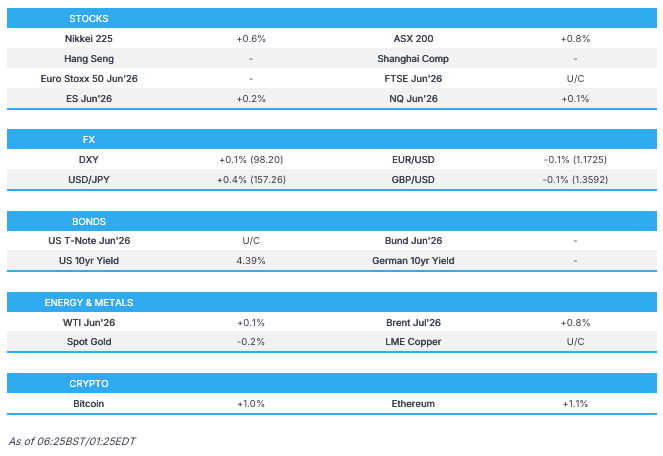
Newsquawk in 3 steps:
1. Subscribe to the free premarket movers reports
2. Listen to this report in the market open podcast (available on Apple and Spotify)
3. Trial Newsquawk’s premium real-time audio news squawk box for 7 days
IRAN CONFLICT
- US President Trump said Iran is dying to make a deal and stated that Iran cannot be nuclear-armed. He added that he doesn’t know if the ceasefire with Iran needs to be broken, but “we may do”. Furthermore, he commented that Iran’s drone and missile factories are significantly down and that Iran is in very bad shape. On a deal, he said he doesn’t know if we need a deal with Iran but later backtracked and said a deal might be needed. Later, he stated that he would not have approved enriched Uranium for Iran and needs guarantees that Iran will not have a nuclear weapon ever.
- US President Trump is expected to make a decision on the path forward [on Iran] in the coming days, according to NBC citing a US official.
- US CENTCOM Commander Cooper briefed President Trump for 45 minutes on new operational plans for potential strikes against Iran, Axios’ Ravid reported citing sources.
- Two Pakistani officials in Islamabad, with direct knowledge of the talks between the US and Iran told MS NOW they expect a revised Iranian proposal to end the war by the end of the week.
- Iran President Pezeshkian and Ghalibaf, are dissatisfied with the way Foreign Minister Araghchi is advancing diplomacy, especially the nuclear negotiations, and are calling for his dismissal, according to Iran International citing sources.
- Iranian Foreign Ministry Spokesperson said that it is not responsible to expect a quick conclusion of the negotiations and that the other party has not used the opportunity provided by Iran’s proposal. Iran must be ready for any eventuality.
- Israel prepares to announce the failure of negotiations with Iran, via Channel 12 cited by Al Arabiya, with Iran International stating that Israeli officials consider the collapse of negotiations between Washington and Tehran likely as early as next week.
- The US may allow Israel to target Iran’s energy facilities if negotiations fail, according to Channel 12 cited by Al Arabiya.
- Air defence sounds were heard in some areas of Tehran, due to countering micro-birds and reconnaissance drones, according to Tasnim.
- UAE bans travel by citizens to Iran, Lebanon, and Iraq.
US TRADE
EQUITIES
- US stocks rallied as markets leaned risk-on despite ongoing geopolitical uncertainty around US/Iran developments. Sentiment was boosted by strong earnings. Alphabet and Amazon impressed with robust growth and strong cloud demand, while Qualcomm reversed earlier losses on upbeat commentary about China phone shipments. However, mega-cap tech saw some divergence, with Microsoft and Meta pressured by concerns over elevated AI-related capex. Elsewhere, cyclicals and defensives broadly gained, with Communication Services leading sectors while Technology lagged.
- Apple (AAPL) Q2 2026 (USD): EPS 2.01 (exp. 1.95), Revenue 111.2bln (exp. 109.45bln). Raised its dividend by 4% to USD 0.27/shr. Beat revenue metrics except for iPhone net sales. Authorised additional program to repurchase up to USD 100bln. In the earning call, CFO guided Q3 revenue growth between 14-17% Y/Y, gross margin between 47.5-48.5% and stated that AAPL will no longer targeting a net cash neutral position.
- SPX +1.02% at 2,709, NDX +0.98% at 27,452, DJI +1.62% at 49,652, RUT +2.21% at 2,800.
TARIFFS/TRADE
- US President Trump said the US will be removing the tariffs and restrictions on Whiskey having to do with Scotland’s ability work with the Commonwealth of Kentucky on whisky and bourbon, and in honour of the King and Queen in the UK.
- USTR Greer said he suggested a US-China Board of Trade in his meeting with Chinese VP He Lifeng.
- USTR Greer said the US will extend preferential treatment to other UK goods.
NOTABLE HEADLINES
- Fitch said large US deficits to keep debt above “AA” peers and cuts 2026 US tariff revenue estimate by USD 150bln.
DATA RECAP
- Atlanta Fed GDPNow (Q2 initial): 3.7%.
APAC TRADE
EQUITIES
- Asia-Pac stocks traded with decent gains, helped by the positivity seen stateside. The majority of markets are closed today for Labour Day.
- ASX 200 rebounded after 8 straight days of losses. Miners led gains while Energy underperformed following Thursday’s drop in oil prices. ANZ reported cash profit that beat estimates; however shares have slipped lower after it raised its coverage ratio by 4bps due to the heightened geopolitical risk.
- Nikkei 225 posted decent gains, despite the sudden JPY strength amid intervention talk. Tokyo Electron benefited following its positive Q4 results, in which net profit beat estimates.
- US equity futures traded with modest gains. The start of futures trade started positively after Apple provided Q3 revenue growth guidance that beat estimates (+14-17% vs exp. +9%). AAPL +2.5% overnight.
- European equity futures are closed today for Labour Day.
FX
- DXY took to breather following Thursday’s selloff. To recap, the index weakened by a near 1%, primarily driven by surging JPY and the risk-on sentiment across equities. Currently, DXY trades in a 98.13-98.18 range.
- EUR/USD traded around the unchanged mark and oscillated in a tight 1.1724-1.1736 range. The ECB kept rates unchanged at 2.0% and stuck to its data-dependent and meeting-by-meeting guidance. Following the meeting, ECB sources via Reuters noted that policymakers see a June hike as very likely with further reporting by Bloomberg stated that officials see a June hike if energy prices do not ease first.
- GBP/USD rotated in a 1.3599-1.3609 band, consolidating after the hawkish tilt by the BoE, as Pill voted for a 25bp hike. EUR/GBP has extended to a trough of 0.8618 thus far, just shy of the YTD lows of 0.8612.
- USD/JPY climbed back above the 157.00 handle, following Thursday’s 2.4% selloff. The selloff came amid jawboning and the confirmation of intervention by Japanese officials. Top FX Diplomat Mimura spoke again, however, refused to comment on intervention speculation. A Mizuho analyst highlighted that despite the recent JPY strength, the currency is likely to remain weak as long as tensions in the Middle East persist. On the data front, Tokyo CPI printed cooler-than-expected, with core CPI falling to 1.5% Y/Y (exp. 1.8%, prev. 1.7%). USD/JPY steadily moved higher to a peak of 157.31; final manufacturing PMI failed to spur a reaction.
- Antipodeans traded with mild losses. Aussie/Dollar was little moved after manufacturing PMI printed at 51.3 (prev. 51.0).
FIXED INCOME
- UST Futures traded in a 110-17+ to 110-22+ range, primarily driven by the downside in JGBs. ISM Manufacturing PMI is expected later, with the headline figure expected at 53.1 (prev. 52.7).
- JGB Futures started the Asia-Pac session on the backfoot, initially reversing the majority of Thursday’s pre-cash gains before rebounding as the session progressed. The selloff came following Japan’s weekly investment flows, in which foreigners sold a net JPY 786.9bln in long-term bonds. This seemingly overlooked the cooler-than-expected Tokyo CPI, as 10yr JGBs fell to a low of 129.30 low.
- Bund Futures are closed due to Labour Day holiday.
- Japan sells JPY 250bln 10-year I/L JGBs: b/c 3.40x, Yield at the Lowest Accepted Price 0.578%.
- Australia sells AUD 1.0bln 4.50% 2033 bond: b/c 3.56x, average yield 4.8608%.
COMMODITIES
- Crude futures rotated in a c. USD 1.40/bbl range amid light newsflow. The latest update came from the Iranian Foreign Ministry Spokesperson, stating that it is not responsible to expect a quick conclusion of the negotiations and that the other party has not used the opportunity provided by Iran’s proposal. Markets will be awaiting Trump’s decision on the path forward on Iran. Reports in recent sessions have pointed to a plan that includes a short and powerful strike, potentially targeting infrastructure.
- Precious Metals initially started the Asia-Pac session on the front foot but pared back slightly as trade progressed. Spot gold oscillated in a USD 4609-4636/oz range, silver in a USD 73.56-74.43/oz band.
- 3M LME Copper surged higher at the open and peaked at USD 13.12k/t as the red metal played catch up to the risk-on sentiment seen stateside. Gains pared back slightly throughout the Asia-Pac session and neared USD 13.06k/t.
- US President Trump’s mineral reserve reportedly plans to purchase rare earths from China.
CRYPTO
- Bitcoin bounced back above the USD 77k handle.
NOTABLE ASIA-PAC HEADLINES
- Japan’s Top FX Diplomat Mimura will not comment on intervention speculation and reiterated being in close contact and shares understanding with the US.
DATA RECAP
- Japanese Tokyo Core CPI YoY (Apr) Y/Y 1.5% vs. Exp. 1.8% (Prev. 1.7%).
- Japanese Tokyo CPI Ex Food and Energy YoY (Apr) Y/Y 1.9% vs. Exp. 2.3% (Prev. 2.3%).
- Japanese Tokyo CPI YoY (Apr) Y/Y 1.5% vs. Exp. 1.6% (Prev. 1.4%).
- Japanese S&P Global Manufacturing PMI Final (Apr) 55.1 vs. Exp. 54.9 (Prev. 51.6).
- Australian S&P Global Manufacturing PMI Final (Apr) 51.3 (Prev. 49.8).
- South Korean Balance of Trade (Apr) 23.77B vs Exp. 23.77B (Prev. 25.74B).
- South Korean Imports YoY (Apr) Y/Y 16.7% vs Exp. 13.1% (Prev. 13.2%).
- South Korean Exports YoY (Apr) Y/Y 48.0% vs Exp. 44.9% (Prev. 48.3%).
GEOPOLITICS
RUSSIA-UKRAINE
- Ukrainian forces have reportedly launched another attack on Russia’s Tuapse oil refinery causing a fire, according to the Kyiv Independent.
- Local governor said port infrastructure in Ukraine’s Odesa region was damaged and wounded two people.
OTHER
- China’s Foreign Minister said the Taiwan issue is the biggest risk in US relations and urged US Secretary of State Rubio to maintain the stability of bilateral relations.
2.a NORTH KOREA/SOUTH KOREA/JAPAN
JAPAN
NORTH AND SOUTH KOREA
3. CHINA/
CHINA/
China Reopens Fuel Export Spigot, Offering Relief To Asian Buyers
Friday, May 01, 2026 – 03:30 AM
Beijing is reversing its curbs on refined fuel exports after halting shipments in the opening days of the U.S.-Iran conflict. This move suggests that Chinese domestic inventories are now at comfortable levels, allowing state refiners to reopen the export spigot, even as much of Asia remains gripped by a fuel shock caused by disrupted Gulf energy flows through the Hormuz chokepoint.
There was chatter earlier this week that China’s state-owned refiners were applying for government permits to resume fuel exports in May. These include China Petrochemical (Sinopec Group) and China National Petroleum Corporation.

By late in the week, Bloomberg reported that state-owned refiners had received government approval to export 500,000 tons of fuel next month.
People familiar with the upcoming shipments said the one-off quota would allow gasoline, diesel, and jet fuel to be sent to neighboring Asian countries, providing relief amid a worsening fuel crunch.
They said these shipments will be loaded onto tankers and are likely destined for Vietnam, Laos, and other nearby nations.
China’s U-turn on export curbs comes weeks after the International Monetary Fund, World Bank, and International Energy Agency urged countries to avoid panic hoarding of energy supplies, as JPMorgan analysts warned that Asia would face the most immediate impact from the Gulf energy shock.
4 EUROPEAN AND SCANDINAVIAN COMMENTARIES PLUS NATO
UK
“We Shouldn’t Have To Live Like This”: UK Terror Level Raised To ‘Severe’ After Stabbing Attacks
Friday, May 01, 2026 – 04:15 AM
Britain’s terrorism threat level was raised from “substantial” to “severe” on Thursday afternoon after a 45-year-old British national, reportedly born in Somalia, stabbed two Jewish men in North London. The elevation in the terrorism threat level suggests another terror attack is highly likely within the next six months, as Britain’s experiment with mass migration is backfiring.
The suspect is 45-year-old Essa Suleiman from south-east London, the BBC understands. He came to the UK from Somalia in the early 1990s –BBC News
Shabana Mahmood, the Home Secretary, described Wednesday’s attack as terrorism. “Today, the national threat level has increased to ‘severe,’ which means a terrorist attack is considered highly likely.”
“I know this will be a source of concern to many, particularly amongst our Jewish community, who have suffered so much,” Mahmood said.
The Joint Terrorism Analysis Center’s decision to raise the national terror threat level comes in the wake of a Somalia-born man stabbing two Jewish men and follows a series of attacks in Jewish neighborhoods in recent weeks.

For context, “severe” is the second-highest of five threat levels, below “critical,” which means another attack is likely in the coming months, if not sooner. The last time the level was raised to “severe” was in November 2021.
Mahmood added: “The government has today announced a significant increase in investment to protect our Jewish communities, with record funding for policing and security at synagogues, schools and community centers. And we will do everything in our power to rid society of the evil of antisemitism. The stabbing in north London follows a spate of attacks in Jewish neighborhoods in recent weeks.
Alex Armstrong of GB News recently described the devastating impact that decades of the mass-migration experiment have had on the UK.
Also…
Suicidal empathy has very real consequences; in other words, the death of Europe.
END
UK
British Police Raid Islamic Group Accused Of Sex Trafficking And Slavery
Friday, May 01, 2026 – 05:45 AM
At least nine members of a Cheshire Islamic group have been arrested in a raid of 500 British police officers as part of an investigation into sexual offenses, slavery and forced marriage.
Officers received reports of human trafficking, rape, and other crimes involving members of a group known as the Ahmadi Religion of Peace and Light, based in Crewe. Seven men and three women were taken into custody, according to a statement from the Cheshire Police, who said the investigation was initiated because of allegations made by a woman who was previously part of the group in 2023.

Chief Superintendent Gareth Wrigley, of Cheshire Constabulary, said:
“Today’s operation is the outcome of a detailed and robust investigation into reports of serious sexual offenses, forced marriage and modern slavery involving members of a religious group called Ahmadi Religion of Peace and Light in Crewe.
While those arrested are members of the group, I want to make clear that this is not an investigation into the religion, this is an investigation into the serious allegations which have been reported to us…”
The AROPL’s is a religious movement founded in 2015 by Abdullah Hashem Aba Al-Sadiq (Egyptian-American raised Sunni Muslim). It draws heavily from Shia Islamic traditions. The group self-identifies with Islamic roots, uses Islamic terminology (referring to their leader as the Qaim/Mahdi appointed in relation to Prophet Muhammad), and maintains many Islamic practices.
British authorities in the UK have been quick to disconnect the sect from the wider Islamic migrant community. The reasons for this are obvious – The British government is under considerable pressure to stop hiding migrant crime and Islamic crime, but their political agendas are deeply intertwined with third-world immigration. Islamic groups consistently deny that the actions of grooming gangs have any connection to Muslim culture.
Islamic fundamentalism justifies the abuse and exploitation of “non-believers”, using the “Doctrine of Abrogation” and a series of passages from the Quran specifically allowing for the humiliation or enslavement of foreigners and non-believers as a means to force them into religious submission. The Islamic slave trade operated throughout Africa and the Middle East until it was disrupted by the British Empire from 1833 to 1937.
The surprising level of transparency of the latest raid may be part of a British government effort to clean up their image after it was revealed in 2025 that pro-multicultural authorities had spent the past decade covering up numerous reports of Islamic “grooming gangs” kidnapping and assaulting young British girls. The government had been aware of this criminal activity as early as 2015 and did nothing.
It should be noted that many British activists have been threatened by law enforcement, attacked by the establishment media and even jailed over the years simply for exposing this ongoing problem common among third world migrants. The grooming gangs were ignored because their activities were inconvenient to the liberal open borders narrative dominating social politics in Europe since 2014.
Today, however, polling shows that both the left wing Labour Party and the Conservatives Party (which is also left wing) are facing political obliteration in the next general election (held in 2029) due to their mishandling of the immigration problem as well as the UK economy. Unless they offer substantial changes to their policies, they stand to be swept out of Parliament.
The multiculturalists may very well be removed from government regardless.
END
GERMANY
Trump Threatens To Pull Some US Troops Out Of Germany While Lambasting ‘Ineffective’ Merz
Friday, May 01, 2026 – 02:45 AM
German Chancellor Friedrich Merz has been a bit on the defensive since his earlier in the week swipe at President Trump over launching the war against Iran. The German leader had told students in a talk that the US is being “humiliated” by Iranian leaders. He had also asserted, “If I had known that it would continue like this for five or six weeks and get progressively worse, I would have told him even more emphatically.”
As we covered earlier Thursday, Merz has tried to soften the spat, after Trump responded on Truth Social earlier, “From my perspective, my personal relationship with the US President remains good,” he told reporters. “I simply had doubts from the start about what was begun with the war in Iran. That is why I have made that clear.”
But that hasn’t quieted Trump, who again hit back again in a fresh Thursday morning Truth Social post, which emphasized that the German Chancellor should focus more on problems like the Russia-Ukraine war, where “he has been totally ineffective” – Trump said.

The US President once again reiterated that Germany is “broken” – and that this especially true on immigration and energy. He also reiterated that his Operation Epic Fury is making “the World, including German, a safer place!”
However, Merz earlier sought to place some of Germany’s economic woes precisely on the war raging in the Middle East, and ongoing Strait of Hormuz closure. His initial April 29 remarks had included the following: “In Germany and Europe we are suffering from the consequences, such as the closure of the Strait of Hormuz,” he had said.
Wednesday night saw Trump issue a new, important threat, which he has been teasing as a possibility for day:
“The United States is studying and reviewing the possible reduction of Troops in Germany, with a determination to be made over the next short period of time,” Trump wrote on Truth Social.

Responsible Statecraft’s Trita Parsi is also a deep Iran war critic, but says that EU leaders are full of hypocrisy on the Iran issue, and that it needs to be called out. Parsi writes:
Merz isn’t wrong in saying he’s “disillusioned” with the US & Israel over Iran because they “claimed at the beginning that they could solve this problem within days. Now I must recognize: It is not solved.” But he is in no position to complain. He applauded the war and as a result, owns the outcome. This is typical of some EU leaders who support and help facilitate the US’s worst instincts, and then pretend they are innocent when the foreign policy adventure predictably goes wrong.
The comments underscore several European leaders’ reassessment of their relations with Trump. A tendency to smooth ties by currying favor has given way to a more sober perspective of a U.S. president who has repeatedly called into question NATO, bolstered European far-right forces and threatened to seize Greenland, a territory of Denmark.
Meanwhile Merz holds a presser in military fatigues, hilariously enough…
Regardless, the fresh critique by a leading EU head of state is certainly going to add fuel to the fire of Trump’s ratcheting anti-EU and anti-NATO rhetoric, given their absence in helping the US get the Strait of Hormuz back open and the return to normal functioning of global energy transit once again.
end
EU/HUNGARY/PATRIOTS GROUP
witch hunt continues!!
EU Parliament Pushes Funding Cuts To Orbán-Founded Patriots Group As Witch-Hunt Continues
Friday, May 01, 2026 – 06:30 AM
The European Parliament will vote today on suspending EU funding for the right-wing Patriots for Europe faction, founded by outgoing Hungarian Prime Minister Viktor Orbán.

At stake is the alleged mismanagement of €4.3 million of EU funds by Philip Claeys, the former secretary general of the far-right Identity and Democracy (ID) group, who now holds the same post for the Patriots for Europe grouping.
One vocal critic of the lack of action by Brussels in the case, according to Euractiv, has been Nick Aiossa, director of Transparency International.
To remind readers, Soros-backed Transparency International has long attacked Hungary for various alleged violations. Last February, it notoriously ranked the CEE country at the same level as Burkina Faso and South Africa in its 2024 corruption index.
“Considering the seriousness and scale of the irregularities identified, and given that the expenditures in question were authorised and validated under the authority of Mr Claeys, the initiation of a complementary investigation by OLAF appears both necessary and proportionate,” Transparency International stated.
The funds are implicated in various accusations of misuse, including “fictitious service contracts, improper procurement procedures and donations to non-parliamentary groups with ties to far-right figureheads, such as France’s Marine Le Pen,” notes Euractiv.
Le Pen was a major target of Brussels as well, with her rising popularity seen as a threat ahead of critical presidential elections in France next year. Her party, National Rally, also joined the Patriots for Europe group. She was, however, banned from running for office in France after being convicted for misappropriating over €4 million in European Parliament funds, a charge she continues to deny and blames on a witch hunt against anti-migration, conservative voices.
Le Pen has appealed the ruling.
Transparency International’s Aiossa has called for Claeys to be stripped of his power as well. Claeys has denied any wrongdoing, telling Le Monde, “All payments made in the last five years have been duly invoiced, justified and controlled.”
This vote today is critical, as it will allow Brussels to continue going after Orbán by cutting funds for the group his Fidesz party belongs to and which still holds close to 12 percent of the seats in the 2024–2029 European Parliament. It is well known that the outgoing Hungarian leader, highly unpopular among Brussels elites for his sovereignty-focused, nationalist movement, is planning to renew and rebuild his brand inside his country, in Europe, and beyond.
Curbing any resurgence of Orbán will be a high priority for the EU leadership. On the other hand, they are also wrangling with getting funding as soon as possible to Hungary’s new leader, and their darling, Péter Magyar. However, this time, unlike when the right-wing conservatives were ousted from Poland, Brussels is playing hardball, insisting that certain hurdles be overcome before money is released.
Numerous mechanisms were used over the years to go after Orbán’s successive governments, with billions in EU funds ultimately frozen, specifically, €10 billion in post-Covid recovery funds and some €7 billion in cohesion funds.
Hungary has, in fact, already met 17 out of 27 conditions demanded by Brussels, for the former, but now, Magyar has only until August to deliver on judicial independence, anti-corruption safeguards and other reforms, notes Euractiv.
5. RUSSIAN AND MIDDLE EASTERN AFFAIRS
ISRAEL /USA/IRAN/THURSDAY NIGHT
Trump Says Gas Prices Will Drop “Like a Rock” Once Conflict Ends, As Senator Breaks With GOP Leadership On War Powers
Thursday, Apr 30, 2026 – 06:30 PM
Summary
- Trump: “The [price of] gasoline and the oil will go down rapidly once the war’s over.” GOP Sen. Collins switches vote on war powers.
- Bessent on X: “Amid the impact of Economic Fury, Iran’s currency has hit an all-time low. The Iranian people deserve a new era, which the corrupt and shambolic Iranian regime cannot provide.” Signals hope for uprising, regime change.
- Israeli Defense Minister Katz: “soon we will need to act again in Iran to ensure that the regime cannot threaten Israel for years to come.” Oil spikes on this and new reports of Israeli defense build-up at ports, air hubs.
- Not giving up nuclear program: Iran will “guard” its “advanced technologies” like it does its own borders, Mojtaba Khamenei said in a written speech read aloud by state TV. It will “secure the Persian Gulf region and dismantle the hostile enemy’s exploitation of this waterway.”
- US military teases cutting-edge, not yet tested in battle, hypersonic missiles for Mideast region as CENTCOM head set to brief Trump on further military options at White House.
https://embed.polymarket.com/market?market=us-x-iran-permanent-peace-deal-by-june-30-2026-837&height=300US x Iran permanent peace deal by June 30, 2026?
Yes 34% · No 67%
View full market & trade on Polymarket
* * *
Trump’s ‘Assurances’ To Americans as GOP Members Start to Scramble
The Iran war and Hormuz closure remains a game of geopolitical chicken, where each side believes it can inflict more pain on the other while being the one to outlast. But Iran, while being subject to a years long sanctions regimen and recent large-scale US-Israeli bombing campaign, does not operation on 4-year and 2-year election cycles. With next fall’s midterms staring Congressional Republicans in the face, there this increasingly uncomfortable trend: The average price of one gallon (3.8 litres) of gasoline in the United States has reached $4.30, according to the American Automobile Association (AAA), up from less than $3 before the February 28 start of the US-Israel war on Iran.
President Trump addressed this in fielding questions in the Oval Office on Thursday,telling reporters that gas prices would “drop like a rock” as soon as the Iran war ended.
“The [price of] gasoline and the oil will go down rapidly once the war’s over,” he stated confidently – “like a rock,” he added.
However, the war is about to hit 60-days on Friday and America’s overall strategy and timeline remains anything but clear. Instead, Trump is insisting the Iranians have “nothing” in terms of a military, and yet the crisis in global energy remains, and Operation Epic Fury is still on, the extended uneasy ceasefire notwithstanding…
Meanwhile, an interesting argument (below) from Hegseth this week, as Congress is supposed to vote on a formal war authorization once any foreign conflict hits the 60-day mark, per US law.
And the first Republican Senator has ‘switched’ and broken ranks with GOP leaders on Trump’s Iran war and Congressional authorization:
Centrist Sen. Susan Collins (R-Maine) on Thursday broke ranks with Republican leaders and most GOP colleagues by voting for a war powers resolution sponsored by Sen. Adam Schiff (D-Calif.) to halt military actions against Iran, the first Republican senator to change her position on curtailing President Trump’s military authority.
Rand was over there getting lonely defending the Constitution, but the longer the Iran conflict persists – and Americans feel it at the pump – the more Republican members will likely peel off:
Collins joined Sen. Rand Paul (R-Ky.) in voting to advance a resolution to withdraw U.S. military forces from the conflict with Iran unless Congress votes to authorize the use of force.
She and Paul voted with most Democrats for a motion to discharge the resolution from the Senate Foreign Relations Committee, but it still failed by a vote of 47 to 50.
It marked the sixth time that Senate Republicans have defeated a resolution under the 1973 War Powers Act to halt further military operations against Iran.
Bessent Gloats Over Iran’s Collapsing Currency, Signals Hope For Uprising
Amid chatter that Israel could be preparing for renewed attacks on Iran, and as Trump is said to be mulling more limited strikes – but while at the same time the USS Gerald R Ford is returning to the United States after a record deployment – Iran is signaling it is ready for a long war and can endure the US naval blockade for a long time to come. However, there are also unconfirmed reports out of Pakistan that another draft peace proposal could be presented by Tehran as soon as this weekend. Iranian President Masoud Pezeshkian has newly said Thursday the blockade is effectively an “extension of military operations” by Washington, despite the extended ceasefire declared by Trump.
Also on Thursday, US Treasury Secretary Scott Bessent signaled that the US administration gameplan seems to be to drive Iran into economic ruin, in hopes of triggering some kind of uprising toward regime change. But this was the exact same ‘prediction’ and gameplan in the opening days of the war – which never materialized. One the one hand his below message on X seems to gloat over imposing widescale misery over the bombed-out country, while on the other claiming to help and support the Iranian people, saying they “deserve a new era”.
As we reported earlier, Iran’s currency on Wednesday collapsed to a record low, plunging to 1.8 million rial per dollar amid the prolonged US-Israel war and uneasy ceasefire, also as surging global energy prices hit the economy. The rial began sliding sharply two days prior to this after weeks of artificial stability. In the early phase of the war that kicked off on February 28, the currency held steady due to a near-total halt in imports and limited market activity.
“We think the price was worth it” vibes…
Oil Spikes on Israeli Defense Chief’s Threats of New Strikes
Israel Defense Minister Katz has said in a Thursday briefing: “It is possible that soon we will need to act again in Iran to ensure that the regime cannot threaten Israel for years to come,” according to a local reporter.
According to more, he said that while Israel supports the United States’ diplomatic efforts with Iran, it may “soon be required to act again” to remove the “existential threats” posed by the Islamic Republic.
“Iran has suffered extremely severe blows over the past year, blows that have set it back years in all areas,” Katz continued at a military ceremony. “US President Trump, in coordination with Prime Minister Benjamin Netanyahu, is leading the effort to complete the campaign’s objectives in a way that ensures Iran will not return to being a threat to the existence of Israel, to the United States, and to the free world for generations to come,” he added. “We support this effort and provide the necessary backing, but we may soon be required to act again to ensure the objectives are achieved.” Oil prices shooting back up on the headline, and as Israeli media reports on a new military build-up and US defense aid at the country’s ports…

The below is via AP on a “new plan” being mulled by Trump:
Under the plan, the United States would continue its blockade on Iranian ports, while coordinating with allies to impose higher costs on Iran’s attempts to subvert the free flow of energy, according to a senior administration official. Trump is weighing multiple diplomatic and policy options to push Iran to end its chokehold on the waterway, said the official, who spoke on condition of anonymity because they were not authorized to comment publicly.
Khamenei: Protect Nuclear Program, Gulf Region Will Have Future Without America
Ayatollah Mojtaba Khamenei has never released video or voice messages, and he’s still not been seen or even photographed since the war’s start, and is believed to be severely injured and recovering. State TV on Thursday read aloud his written speech, which struck a defiant tone, declaring that the only place Americans belonged in the Persian Gulf is “at the bottom of its waters” and that a “new chapter” was being written for the whole region. State media cited security as the reason for having to read aloud his statement.
Khamenei says Iran will closely guard and protect its nuclear and missile capabilities, a clear and direct rejection of President Trump’s demand to hand over enriched uranium as the basis for a deal. Iranians will cling to the country’s nuclear and missile capabilities “as their national capital and will guard them like water, land and air borders,” Khamenei said.
END
/IRAN//FRIDAY MORNING
Nearly 70% Inflation, Mass Layoffs, And A Strangled Economy: Iran’s Brutal Test Of Endurance
by Tyler Durden
Friday, May 01, 2026 – 07:50 AM
Iran’s economy is undergoing one of the most brutal stress tests in its modern history. Official annual inflation has surged to 50% according to central bank figures released shortly after the ceasefire, while the year-on-year rate reached as high as 67% through mid-April, according to the Wall Street Journal. The rial has crashed to a record low of 1.8 million to the dollar, roughly two million workers have lost their jobs, and the US naval blockade of the Strait of Hormuz continues to throttle the country’s oil exports and critical imports. Reconstruction costs from bombed infrastructure are estimated near $270 billion – alarmingly close to the country’s entire annual GDP of roughly $341 billion last year. What was already a sanctions-battered, mismanaged economy now confronts a grinding “no war, no peace” stalemate. Tehran is wagering that it can hunker down and endure a protracted war – allowing it to outlast American pressure. The early data and on-the-ground reality suggest that wager is being tested to its limits.

The human impact is immediate and visible in everyday Tehran life. A 56-year-old housewife described to Najmeh Bozorgmehr of the Financial Times how a simple block of cheese rose from 5.2 million rials to 6.7 million rials (about $5.09) in a single week. Comparable jumps have struck rice, eggs, chicken, red meat, and other staples. A popular Peugeot 207 has climbed from 18 billion rials to 25 billion since the conflict began, while officials are preparing to authorize a 40 percent increase in government-mandated cement prices.
The cost of living has soared, with the annual inflation rate reaching 67% in the month through mid-April from the same period a year earlier, according to Iran’s central bank. The subsidized price of red meat, which was mostly imported through sea routes, has gone up to the equivalent of around $3.60 a pound, beyond the reach of most in a country where the minimum wage is around $130 a month. -WSJ
Business consultant Siamak Ghassemi publicly advised Iranians that anything short of a near-doubling of wages would fail to offset the cost-of-living explosion. One small petrochemical-dependent factory outside the capital has already dismissed nearly a third of its workforce. A clothing business owner reported recent costs running 150 percent above sales, bluntly concluding, “This is not sustainable.”

Macro indicators reveal the depth of the damage. The Journal’s reporting, informed by Iranian officials and international analysts, estimates around one million direct job losses and another million indirect – equivalent to roughly 8 percent of the pre-war employed population of 25 million. War-related unemployment benefit applications have already reached 191,000. Steel output has dropped by up to 30 percent, while damaged petrochemical, gas, and steel complexes – major employers – grapple with raw-material shortages and physical destruction. Oil exports, which averaged 1.85 million barrels per day as recently as March, have been reduced to a near standstill, with shipping analysts at Kpler finding no confirmed evidence of cargoes successfully breaching the US blockade to reach buyers in China or elsewhere.
At the strategic core of the crisis lies the Strait of Hormuz. Iran initially tried to use the waterway as leverage by disrupting traffic; the US responded with a naval blockade that has effectively severed the Islamic Republic’s economic lifeline. Before the war, the strait carried the vast majority of Iran’s oil revenue and imports ranging from food and medicine to industrial components. In response, Tehran has activated emergency bypass routes: rail and road connections through Turkey, Armenia, and Azerbaijan, Caspian Sea ports supplied by Russia, Kazakhstan, and Turkmenistan, and new transit corridors via Pakistan. It has drawn heavily on strategic food reserves, raised the minimum wage, increased government salaries, issued monthly food coupons worth around $7 per person, and appealed to citizens to conserve energy and reduce driving.

Yet these measures are widely viewed as temporary holding operations rather than solutions. Virginia Tech economist Djavad Salehi-Isfahani told the Journal that Iranian leaders recognize ending the war is merely the prelude to an even harder challenge: managing a disillusioned and impoverished population without the rapid return of oil income. Middle East Institute fellow Alex Vatanka points out that while the regime can still portray endurance as a badge of national pride, prolonged revenue collapse increases the risk of renewed street mobilization. Vienna-based economist Mahdi Ghodsi offered a stark assessment: “Living is not affordable anymore. Iran is at its weakest point.”
One medium-sized steel entrepreneur told FT that his firm has so far avoided layoffs by shifting entirely to overland routes, but he expressed deep concern about how long this uncertain limbo can continue. Pre-war protests, already triggered by economic distress and crushed with lethal force earlier this year, provide a sobering precedent. The regime retains a formidable toolkit – subsidies, repression, parallel trade networks, and a narrative of resistance – but whether these tools can withstand another year of 50-percent-plus inflation, double-digit unemployment, and eroding living standards is the central question. This is not a sudden collapse, but a brutal, extended test of endurance whose outcome will shape not only Iran’s economy but the broader regional balance of power.
ISRAEL/IRAN/USA/FRIDAY MORNING
Trump Argues War ‘Terminated’ Before 60-Day Congressional Approval Deadline, As Iran Submits Latest Proposal To Pakistan Mediators
Friday, May 01, 2026 – 08:58 AM
Summary
- White House officials argue the current absence of fighting between Iranian & US forces means the 60-day timeline for Congressional approval (or US forces must leave) doesn’t apply due to the ceasefire.
- Iran submitted its latest revised proposal to Pakistan mediators as of Thursday night. It is a response to the latest US amendments to end the war, per Axios. Nuclear issue not included: a non-starter, and focus is on ending the war.
- Iran economically squeezed, signs of divided response among leadership, but surviving: “Weeks of conflict have aggravated Iran’s dire economic problems, risking calamity after the war, but the Islamic Republic looks able to survive a standoff in the Gulf for now.” (Rtrs)
- Alternative routes emerge: “Iran cannot be besieged; We have different ways to export and import,” Iranian official says.
https://embed.polymarket.com/market?market=us-x-iran-permanent-peace-deal-by-june-30-2026-837&height=300US x Iran permanent peace deal by June 30, 2026?
Yes 37% · No 64%
View full market & trade on Polymarket
* * *
War Powers: 60 Days
There’s common agreement that today: Friday, May 1st, constitutes the 60-day mark on Operation Epic Fury. But President Trump and his administration are trying to sidestep the 1973 law which requires a president to withdraw troops within 60 days of notifying Congress of their deployment unless lawmakers formally authorize the military action as a declaration of war. Of course, thus far there’s been no Congressional authorization, amid some six failed attempts to push through War Powers resolutions.
The administration is now arguing that the extended ceasefire itself, reached three weeks ago and then recently unilaterally extended by Trump, buys more time and allows the White House to avoid Congressional approval. Admin officials argue the absence in exchanges of fire between Iranian and US forces means the 60-day timeline doesn’t apply.
“For War Powers Resolution purposes, the hostilities that began on Saturday, February 28, have terminated,” a Trump official has been cited broadly in US media as saying. The same perspective had first been put forward by Pentagon chief Pete Hegseth during his hearing before the House Armed Services Committee on Thursday:
Answering questions from senators on Thursday, Hegseth said: “We are in a ceasefire right now, which our understanding means the 60-day clock pauses or stops in a ceasefire.”
The questioner, Democratic Senator Tim Kaine, responded: “I do not believe the statute would support that. I think the 60 days runs maybe tomorrow, and it’s going to pose a really important legal question for the administration there.”
The debate over mainstream airwaves is also about to grow fiercer as the war slides with no clear articulated grand US strategy…
Talks Back at Square One
Iran has reportedly submitted its latest revised proposal to Pakistan mediators as of Thursday night. It is a response to the latest US amendments to end the war, per Axios. So the conflict is two-months deep, talks are completely stalled, global energy transit through the Hormuz Strait is at a bare trickle to non-existent as the US naval blockade is enforced and while international vessels are still under looming threat of attack by Iran, and there’s still no sign of an offramp coming anytime soon.
To review, and as we wrote previously, next fall’s midterms staring Congressional Republicans in the face, there this increasingly uncomfortable trend: “The average price of one gallon (3.8 litres) of gasoline in the United States has reached $4.30, according to the American Automobile Association (AAA), up from less than $3 before the February 28 start of the US-Israel war on Iran.” President Trump’s response to this in fielding questions in the Oval Office on Thursday was to tell reporters that gas prices would “drop like a rock” as soon as the Iran war ended. He said: “The [price of] gasoline and the oil will go down rapidly once the war’s over,” and at one point emphasized prices would go down “like a rock.”
Important development via Al Jazeera confirming that nuclear issue is a non-starter for Iran:
Proposals resurface: Tehran presented a new proposal to the Pakistani mediator yesterday, a diplomatic source told me. He added that nuclear negotiations will not succeed under these circumstances and that the focus will likely shift to ending the war.
Fresh activity on X:

Iran Squeezed But Surviving
We’ve been reporting on the collapsing Iranian rial and US officials’ hopes that the engineered crisis and economic warfare would force Iranians into the streets to overthrow their own government – which is a plan that already failed to produce enough momentum previously, and even under heavy US-Israeli bombs.
Reuters on Friday describes, “Weeks of conflict have aggravated Iran’s dire economic problems, risking calamity after the war, but the Islamic Republic looks able to survive a standoff in the Gulf for now, despite a U.S. blockade that has cut off energy exports.” It’s an enduring stalemate, with the Iran war and Hormuz closure now being a game of geopolitical chicken, where each side believes it can inflict more pain on the other while being the one to outlast.
There’s been talk of Pakistan having opened up its border, as well as increased use of Caspian trade routes – especially for vital goods like food, medicines, and factory or other parts. But WSJ freshly explains that “Alternative trade routes won’t be sufficient. Iran has been working to send some of its oil by rail to China and to import foodstuff by road from the Caucasus and Pakistan. Only 40% of Iran’s trade can be redirected away from blockaded ports, the Iranian Shipping Association said Thursday via the Fars news agency, which is affiliated with Iran’s security services.”
END
ISRAEL/IRAN/USA/FRIDAY AFTERNOON
Bessent Unloads On Iran Leadership ‘Rats,’ Lists 5 Pressure Points As US Blockade Means Clock Is Ticking
Friday, May 01, 2026 – 12:25 PM
Summary
- US Treasury goes after Hormuz payment fees, sanctioning three Iranian foreign currency exchange houses. Bessent issues pressure points against Iranian ‘rats’.
- White House officials argue the current absence of fighting between Iranian & US forces means the 60-day timeline for Congressional approval (or US forces must leave) doesn’t apply due to the ceasefire.
- Trump on Friday rejects Iran’s latest revised proposal to Pakistan mediators. Nuclear issue not included: a non-starter, and focus is on ending the war. Israeli officials balk.
- Iran economically squeezed, signs of divided response among leadership, but surviving: “Weeks of conflict have aggravated Iran’s dire economic problems, risking calamity after the war, but the Islamic Republic looks able to survive a standoff in the Gulf for now.” (Rtrs)
- Alternative routes emerge: “Iran cannot be besieged; We have different ways to export and import,” Iranian official says.
https://embed.polymarket.com/market?market=us-x-iran-permanent-peace-deal-by-june-30-2026-837&height=300US x Iran permanent peace deal by June 30, 2026?
Yes 37% · No 64%
View full market & trade on Polymarket
* * *
Trump Rejects Latest Iran Proposal
In fresh Friday words to reporters, President Trump says he is not satisfied with the latest proposal from Iran. He further stated that these negotiations “are not getting there right now.” His main points via Newsquawk:
- Iran wants a deal, but i am not satisfied.
- Iran has no military left.
- Talks with Iran are by phone.
- Made strides in talks with Iran.
- Not sure we are going to get to a deal.
- Not happy with Italy or Spain on Iran.
- Iran leaders do not get along with each other.
Bessent Lists 5 Pressures Iranian ‘Rats’ Facing
US Treasury Secretary Bessent takes to X on Friday to again call Iranian leaders “rats” – which won’t bode well for restarting stalled negotiations. He’s busy boasting on the economic damage unleashed by the ongoing US naval blockade, writing: “It is very difficult for rats in a sewer pipe to know what’s going on in the outside world. Some color for the Iranian Leadership as they literally sit in the dark.” He then lists out the following:
1. The United States has complete control of the Strait of Hormuz.
2. There is a hard currency, i.e. U.S. dollar, shortage.
3. Food and gasoline rationing are in place.
4. The entire international community has turned against you.
5. The BLOCKADE will continue, until there is pre-February 27 Freedom of Navigation.
He also shared a WSJ article proclaiming that the Iranians have ‘failed’ to roll back the US military blockade, and that supposedly the clock is ticking on the government’s ability to rule…
Israel To Renew Bombing if Nuclear Issue Not Dealt With
The Netanyahu government is signaling that it will restart the bombing campaign if the nuclear issue is not resolved. It should also not be forgotten that ‘denuclearizing’ Iran by force has been a multi-decade priority of Prime Minister Netanyahu and the hardliners of Israel. These are the latest warnings out of the Israeli military establishment on Friday:
An Israeli military official says that if Iran’s stockpile of more than 400 kilograms of uranium enriched to 60% is not removed from the Islamic Republic, the entire latest war will be considered “one big failure.”
Israeli officials have said that this stockpile is sufficient for 11 nuclear bombs.
And the Times of Israel underscores further, “The senior officer says that if, as part of negotiations between the United States and Iran, no agreement is reached to remove the uranium stockpile and halt enrichment in the country, the achievements in the 40 days of fighting will have been for nothing.” So this means that “If the nuclear objective is not achieved, then everything we did in Iran will be one big failure. The evil Iranian regime can pounce on the nuclear program,” the official emphasized. And then the threat…
The officer adds that “if the uranium is removed from Iran through diplomatic means, we have done our part.” However, if that does not happen, Israel would need to launch another operation in Iran to achieve the objective, they say.
Already Israel has demonstrated its immense influence over the decision to go to war in the first place.
US Treasury Hits Back Against Hormuz Tolls
The OFAC notice on Hormuz payment sanctions: Today, the U.S. Department of the Treasury’s Office of Foreign Assets Control (OFAC) is designating three Iranian foreign currency exchange houses and their associated front companies as part of Economic Fury and Treasury’s ongoing efforts to disrupt the Iranian regime’s financial lifelines that sustain its war effort. Collectively, Iranian exchange houses facilitate billions of dollars in foreign currency transactions each year. Because Iran primarily settles its oil sales in Chinese yuan, these exchange houses play a critical role in converting oil revenues into currencies that are more readily useable by the Iranian military and its partners and proxies.
“Iran is the head of the snake for global terrorism, and under President Trump’s leadership, Treasury is moving aggressively, through Economic Fury, to sever the Iranian military’s financial lifelines,” said Secretary of the Treasury Scott Bessent. “We will relentlessly target the regime’s ability to generate, move, and repatriate funds, and pursue anyone enabling Tehran’s attempts to evade sanctions.”
War Powers: 60 Days
There’s common agreement that today: Friday, May 1st, constitutes the 60-day mark on Operation Epic Fury. But President Trump and his administration are trying to sidestep the 1973 law which requires a president to withdraw troops within 60 days of notifying Congress of their deployment unless lawmakers formally authorize the military action as a declaration of war. Of course, thus far there’s been no Congressional authorization, amid some six failed attempts to push through War Powers resolutions.
The administration is now arguing that the extended ceasefire itself, reached three weeks ago and then recently unilaterally extended by Trump, buys more time and allows the White House to avoid Congressional approval. Admin officials argue the absence in exchanges of fire between Iranian and US forces means the 60-day timeline doesn’t apply.
“For War Powers Resolution purposes, the hostilities that began on Saturday, February 28, have terminated,” a Trump official has been cited broadly in US media as saying. The same perspective had first been put forward by Pentagon chief Pete Hegseth during his hearing before the House Armed Services Committee on Thursday:
Answering questions from senators on Thursday, Hegseth said: “We are in a ceasefire right now, which our understanding means the 60-day clock pauses or stops in a ceasefire.”
The questioner, Democratic Senator Tim Kaine, responded: “I do not believe the statute would support that. I think the 60 days runs maybe tomorrow, and it’s going to pose a really important legal question for the administration there.”
END
Trump Issues Letter Rejecting Congressional Oversight For War, Citing Ceasefire Has ‘Terminated’ Hostilities
Friday, May 01, 2026 – 02:55 PM
Summary
- Trump submits letter to Congress at 60-day mark: ceasefire ‘terminated’ hostilities & so doesn’t need authorization, he argues.
- US Treasury goes after Hormuz payment fees, sanctioning three Iranian foreign currency exchange houses. Bessent issues pressure points against Iranian ‘rats’.
- Trump on Friday rejects Iran’s latest revised proposal to Pakistan mediators. Nuclear issue not included: a non-starter, and focus is on ending the war. Israeli officials balk.
- Iran economically squeezed, signs of divided response among leadership, but surviving: “Weeks of conflict have aggravated Iran’s dire economic problems, risking calamity after the war, but the Islamic Republic looks able to survive a standoff in the Gulf for now.” (Rtrs)
- Alternative routes emerge: “Iran cannot be besieged; We have different ways to export and import,” Iranian official says.
https://embed.polymarket.com/market?market=us-x-iran-permanent-peace-deal-by-june-30-2026-837&height=300US x Iran permanent peace deal by June 30, 2026?
Yes 37% · No 64%
View full market & trade on Polymarket
* * *
Trump Letter: Doesn’t Need Congressional Approval As Ceasefire Has ‘Terminated’ Conflict
In an acknowledgement that his anti-Iran Operation Epic Fury has indeed hit 60 days, President Trump has issued a formal letter to Congress which argues he does not need their authorization for war. He is arguing the current ceasefire has in effect ‘terminated’ the conflict. Below are his main points via NBC [emphasis by ZH]:
- “On April 7, 2026, I ordered a two-week ceasefire. The ceasefire has since been extended. There has been no exchange of fire between the United States Forces and Iran since April 7, 2026. The hostilities that began on February 28, 2026, have terminated,” Trump wrote in the letters, one of which went to the House and one of which went to the Senate.
- “Despite the success of United States operations against the Iranian regime and continued efforts to secure a lasting peace, the threat posed by Iran to the United States and our Armed Forces remains significant,” the president added in the letter, promising to keep congressional leaders updated on further developments in Iran.
- “I have and will continue to direct United States Armed Forces consistent with my responsibilities and pursuant to my constitutional authority to conduct United States foreign relations and as Commander in Chief and Chief Executive,” the president wrote in his letter.
Trump Rejects Latest Iran Proposal
In fresh Friday words to reporters, President Trump says he is not satisfied with the latest proposal from Iran. He further stated that these negotiations “are not getting there right now.” His main points via Newsquawk:
- Iran wants a deal, but i am not satisfied.
- Iran has no military left.
- Talks with Iran are by phone.
- Made strides in talks with Iran.
- Not sure we are going to get to a deal.
- Not happy with Italy or Spain on Iran.
- Iran leaders do not get along with each other.
ISRAEL TBN
END
Live Updates: IDF shifts focus to Iranian nuclear threat as Trump briefed on CENTCOM plan to renew Iran strikes
Khamenei vows to protect nuclear program • Two injured, car destroyed by Hezbollah drone attack • Trump ‘not satisfied’ with Iran’s latest offer

US President Donald Trump salutes during the annual White House Correspondents’ Association dinner in Washington, DC, US, April 25, 2026.(photo credit: REUTERS/JONATHAN ERNST)
May 1, 8:00 PM
IDF shifts focus to Iranian nuclear threat as ballistic missiles, regime change fall by the wayside
All IDF officers are careful to state that the military never promised regime change, and at most the opportunity to improve conditions for such a change.

A billboard with Iranian centrifuges illustrations and portraits of nuclear scientists killed in Israeli strikes is displayed on a street in Tehran, Iran August 29, 2025(photo credit: MAJID ASGARIPOUR/WANA (WEST ASIA NEWS AGENCY) VIA REUTERS)ByYONAH JEREMY BOBMAY 1, 2026 17:00
As a series of complex post-Iran war dilemmas are set into place, the IDF has shifted to focus almost all of its Iran-related attention to the nuclear issue, with the ballistic missiles and regime change questions mostly falling by the wayside.
In briefings, the IDF is spending significant time emphasizing the continued danger of the 60% enriched uranium which the Islamic regime might access under the rubble of its Isfahan and other facilities.
Discussing that issue, the IDF is making it clear that it would be ready to return to a full-fledged war to prevent Iran from using the uranium to move toward a nuclear weapon.
Yet in the same briefings, the ballistic missile threat which Iran wields, has used with lethal effect against the Jewish state four times since 2024, and for which ostensibly Israel went to war with Iran on February 28, is getting much less attention.
It is unclear if the downplaying of the threat relates to the messaging of the US, the greater relative danger posed by a nuclear weapon, the success of the current war in setting the threat back multiple years, or the post war fog surrounding how many missiles remain and how quickly Iran might rebuild the threat.

IDF never promised regime change
Of course, the IDF is still carefully following the ballistic missile threat.
However, the impression given in briefings is that the nuclear issue – which many had said was set back by years after the June 2025 operation – is far and above the focus for analyzing post-war moves.
Likewise, regime change has mostly disappeared from IDF briefings.
All IDF officers are careful to state that the military never promised regime change, and at most the opportunity to improve conditions for such a change.
On Friday, the IDF went so far as to admit that some of the attacks on low level Basij militias and checkpoints in Iran, may have been a waste of resources, since they did not change the situation on the ground.
Defending the attacks on the Basij and checkpoints in Iran, the IDF did not so much emphasize positive impact from these attacks as it noted that even during such attacks, it continued to strike other aspects of military threats which Iran presented to Israel.
Putting together the mosaic of targets in Iran the IDF said was like playing a complex symphony.
In terms of achievements in Iran, the IDF said that part of the success came from January 16, 2024 and March 7, 2024 decisions within the IDF to establish the now humongous Iran-focused air force unit.

According to the IDF, this sub-unit within the air force has effectively become the military “Iran Command.”
Discussing other moves which the air force may make in the future, the air force said that it may establish a set full-time division devoted to the IDF Central Command for fighting Palestinian terror in the West Bank.
Since summer 2023, the IDF started to use the air force continuously more aggressively against West Bank Palestinian terror – something it had not done for years since the end of the Second Intifada in 2005.
On Thursday, the IDF Central Command announced that it was establishing a larger and more systematic targeting center for aerial and other heavy firepower, similar to what exists for the IDF Northern and Southern Commands.
END
HEZBOLLAH
Hezbollah’s Cheap Fiber Optic Drones A Growing, Deadly Problem For Israeli Troop Convoys
Thursday, Apr 30, 2026 – 09:00 PM
Hezbollah attacked the Israeli army with a fiber-optic drone in the Galilee on Thursday, injuring at least a dozen soldiers and destroying a military vehicle.
Israeli Army Radio reported that 12 soldiers were injured when the drone struck a military position in the Shomera settlement. Two soldiers were “moderately” injured while 10 sustained minor wounds, Army Radio added, also revealing that other soldiers may be transferred to the hospital later for anxiety and ringing in the ears.

The drone directly struck an Israeli army vehicle in Shomera. Israel’s Channel 15 reported that it was likely a fiber-optic guided FPV drone.
A picture released by Hebrew media showed the military vehicle engulfed in flames. The vehicle was near the artillery launcher (howitzer), which the Lebanese resistance said it was targeting.
“In defense of Lebanon and its people, and in response to the Israeli enemy’s violation of the ceasefire and attacks targeting villages and the demolition of homes in southern Lebanon, the fighters of the Islamic Resistance targeted, at 8:45 am on Thursday, April 30, 2026, a 155 mm self-propelled artillery piece south of the town of Yaroun using an attack drone, achieving a confirmed hit,” Hezbollah said in a statement on Thursday morning.
Secondary explosions were seen in video footage on social media, as a result of the ammunition that was present at the Israeli site.
“Hezbollah successfully carried out a precise strike on an artillery battery inside Israeli territory, causing significant damage. Twelve soldiers were injured, two of them moderately. Hezbollah directed an explosive drone at a vehicle known as an ‘Alpha,’ which carries the artillery shells for the battery. The impact triggered secondary explosions that intensified the damage to the unit. A fire broke out at the site, which firefighting teams later brought under control. Soldiers from the Hasmonean Brigade assisted in treating and evacuating the wounded,” Maariv newspaper reported.
Palestinian analyst and expert on Israeli affairs, Azzam Abu al-Adas, said “the range of fiber-optic cables can reach up to 70 kilometers, which is a challenge that was not anticipated. The ability of the drone to remain airborne for several minutes, along with its capacity for evasive and flexible maneuvering, has made it a weapon more dangerous than the Kornet – even against military and logistical targets deep inside the Galilee.”
This marks the first time this type of drone has reached the western Galilee. Prior to the ceasefire, Hezbollah FPV drones targeted Kiryat Shmona and other areas in the upper Galilee.
The Hezbollah operation coincided with a report by Israel’s Channel 12, which said Israeli Prime Minister Benjamin Netanyahu has asked US President Donald Trump to limit direct talks with Lebanon to a two-to-three-week window ending in mid-May.
The report says Israel has conveyed to the US that if talks fail to produce results, it will seek approval to move forward with the original plan of expanded attacks against Hezbollah across Lebanon.
Direct talks were launched by Beirut at Washington’s request. The Lebanese government refused Iran’s efforts to include it in the truce between Washington and Tehran. While Iranian pressure resulted in an end to strikes on the capital, Israel has continued brutal attacks on the south – coinciding with a ground invasion and occupation of scores of villages with the aim of creating a ‘buffer zone.’
Israeli forces are launching airstrikes and carrying out assassinations while demolishing villages on a daily basis. As a result, Hezbollah has expanded operations against troops inside Lebanon and army positions across the border.
At least 16 Israeli soldiers have been killed by Hezbollah resistance fighters in south Lebanon since early March 2026. This week, one Israeli defense contractor was killed by a Hezbollah drone as he was destroying civilian homes in south Lebanon.
Hebrew media has expressed shock over the accuracy of Hezbollah’s FPV drones, labeling them a major challenge to troops.
At the start of the ground operation, the Israeli army failed to achieve the stated goal of occupying Lebanese territory up to the Litani River. Israeli forces were unable to fully capture the strategic and symbolic city of Bint Jbeil, which remains inhabited by resistance fighters despite efforts to besiege the city and carry out a scorched-earth policy.
A poll published by Israel’s Broadcasting Corporation (KAN) this week found that a majority of Israelis believe that Tel Aviv has failed to secure victory on any front since October 2023.
END
RUSSIA // INDIA
Top Russian & Indian Think Tanks Devised A Plan For Rebalancing Economic Relations
Friday, May 01, 2026 – 02:00 AM
Authored by Andrew Korbybko via Substack,
Sanctions, bureaucracy, and logistics are the primary obstacles to “diversifying economic ties and correcting the existing imbalance”, but these can be surmounted through SMEs playing a greater role, more localization and procedure simplifications, and optimizing their trade corridors.

The Russian International Affairs Council (RIAC) and Gateway House, which are among their country’s top think tanks, published a joint report in late March about moving “Toward More Balanced Russia–India Economic Relations” for the second Russia-India International Conference. It’s over 40 pages long so this piece will highlight the top takeaways and then briefly analyze them. The report began by acknowledging the challenges posed by US sanctions for reaching their goal of $100 billion in bilateral trade by 2030.
The solution that was presented, especially for the oil and financial industries, is having Indian SMEs play a much greater role due to their much less exposure (if any at all) to the US’ secondary sanctions. China’s “tea pot” model of small refineries is mentioned as an example for India’s oil industry to follow. The authors also proposed bilateral cooperation in building similar such facilities in Afghanistan, Bangladesh, Kenya, Myanmar, and Sri Lanka, for example. India would thus help Russia meet their smaller demand.
Their suggestion for expanding critical minerals cooperation is for their state-owned companies to form joint R&D initiatives to strengthen their technological self-sufficiency. As for doing the same in the broad health-related field (biotech, pharmaceuticals, etc.), it’s recommended that Indian manufacturers localize production, IP rights, etc., in Russia to better overcome bureaucratic hurdles. Russian research capabilities could also pair with Indian manufacturing capacity to expand market share in third countries.
The bureaucratic hurdles mentioned above also impede cooperation on food and textile industries, but simplifying procedures could help, especially through the creation of unified digital platforms. More industrial cooperation is possible, especially in the automotive, aviation, and railway industries, but localization is likely the prerequisite. Improving logistics across the North-South Transport Corridor and the Vladivostok-Chennai Maritime Corridor can reduce costs and thus raise incentives for scaling trade.
More technological cooperation is difficult for the multiple reasons that were enumerated in the report, not least of which is global competition, so this might prove disappointing in the future. Each’s SMEs might have better chances, but overall, this might not expand associated cooperation all that much. What’s much more promising is labor cooperation, which is already a work in progress that readers can learn more about here, basically amounting to Russia replacing Central Asian labor with Indian.
To review, sanctions, bureaucracy, and logistics are the primary obstacles to “diversifying economic ties and correcting the existing imbalance”, but these can be surmounted through SMEs playing a greater role, more localization and procedure simplifications, and optimizing their trade corridors. Although the prospects for more technological cooperation are dim, efforts nevertheless shouldn’t be abandoned due to the strategic importance of this industry, especially its AI component.
The authors conclude that Russia and India’s $100 billion trade goal by 2030 is realistic, but this requires urgently implementing the aforementioned proposals to increase 2025’s estimated $60 billion in trade by another $40 billion in the next four years, which will be very difficult to achieve and then maintain. The Third Gulf War has caused radical changes to the global energy market, Eurasian logistics, and the financial industry, however, so it’s premature to predict the odds of success till the dust finally settles.
END
6.GLOBAL ISSUES, COVID ISSUES, VACCINE INJURIES/HEALTH ISSUES
GLOBAL ISSUES
MARK CRISPIN MILLER
US: rockers Mikey “Bug” Cox & Chuck Varga battling cancer; PGA champ James Hardie has lymphoma; UK: TV star Tracy Shaw has breast cancer; radio star Bob Harris’s cancer has spread
UK: football manager Chris Hughton recovering from prostate cancer; NI: singer Nico Gravity pleads for funds to treat “heart, kidney complications”; CH: actress Kristal Tin has 2nd cancer; & more
| Mark Crispin MillerApr 30 |
Celebs
UNITED STATES
Coal Chamber drummer Mikey “Bug” Cox reveals his cancer battle, auctioning off drum set
April 24, 2026

As Coal Chamber prepare to take the stage at Sick New World this weekend, drummer Mikey Cox [48] has shared he has spent the past year battling Stage 3 cancer and is now cancer-free. Cox revealed he was diagnosed on April 1, 2025, calling the experience “dark” and life-altering, not just for himself but for everyone around him. Despite grueling treatments – including radiation, chemotherapy, and surgery – he remained determined to keep moving forward. Now in recovery, he’s channeling that experience into something positive. Cox has partnered with Fxck Cancer to auction off a one-of-a-kind custom drum kit, with proceeds going toward cancer support, awareness, and research.
News from Underground by Mark Crispin Miller is a reader-supported publication. To receive new posts and support my work, consider becoming a free or paid subscriber.
Founding GWAR Member Chuck Varga (The Sexecutioner) Battling Cancer, Band Launches Blood Donation Campaign
April 23, 2026

GWAR have revealed that founding member Chuck Varga [67], aka The Sexecutioner, is battling cancer, and the band has launched a blood donation campaign in his honor. Varga was a member of GWAR from 1986 to 1997 (occasionally making special appearances in the years that followed). He provided vocals, created special effects, sculpted set pieces and costumes, and illustrated band artwork while appearing on GWAR’s first five albums, including 1990’s seminal Scumdogs of the Universe. He left GWAR in 1997 to pursue a career in theater, film, and television in New York City.
Three-Time PGA Tour Winner Details Recent Cancer Diagnosis
April 25, 2026

After the PGA Tour Champions’ James Hardie Pro Football Hall of Fame Invitational, the first week of March, Scott McCarron had a scratchy throat. So he looked inside his mouth with a flashlight to see what it was. The three-time PGA Tour winner found a little white spot about the size of an eraser and decided to call his doctor. He went in the next day to get it checked out, and his doctor would send him to an ear, nose and throat specialist, where McCarron, 60, underwent a biopsy. “[The doctor] called me and said, ‘You have cancer,’” McCarron told the PGA Tour Champions this week. “So, at that point, he didn’t know exactly what kind. And then on Tuesday, he said it was B-cell lymphoma and kind of a fast-acting, so he wanted me to come home immediately, get me with the oncologist.” A few days later, he was diagnosed with a stage two form of the cancer, and went through roughly two weeks of blood work, PET scans and an abundance of doctors’ appointments. “When you look at someone like myself who stays in shape, eats right, gets sleep, but does everything you’re supposed to be doing, doesn’t drink too much and all of a sudden gets a diagnosis of cancer, it’s kind of shocking,” he said. “So, you start thinking, ‘How? Why me?’ Those types of things, and then, then trying to put a team together to find out, ‘How can we beat this? Is it curable?’ This week, he began chemotherapy, doing six-hour treatments. And he felt good enough to play this week’s Mitsubishi Electric Classic (he’s T65 after the opening round). “I’m looking forward to being a little distracted on the golf course and thinking about golf instead of thinking about [the cancer],” McCarron said.
Researcher’s note – The PGA Tour is strongly encouraging its players and caddies to get COVID-19 vaccines [sic], sending a memo Monday that outlined how it will eventually stop on-site testing while also attempting to debunk some of the myths associated with the shots. In the memo obtained by ESPN, the tour said while it will not mandate vaccination [sic], it will require those who do not get the shots to still be tested each week for COVID-19 within 72 hours of arrival on-site and at their own expense. Those who test positive for COVID-19 will be required to withdraw and be subject to contact tracing and quarantine procedures. Included was a set of talking points to assure players that the vaccines [sic] are safe: https://www.espn.com/golf/story/_/id/31290355/pga-tour-sends-memo-encouraging-covid-19-vaccination-players-caddies
UNITED KINGDOM
Coronation Street legend Tracy Shaw reveals she’s been diagnosed with breast cancer
April 24, 2026

Coronation Street legend Tracy Shaw has revealed she’s been diagnosed with breast cancer. The actress, who is best known for playing Maxine Peacock in the soap, took to Instagram tonight to share the news and told fans she is due to start five months of chemotherapy before potentially having surgery. Tracy, 52, wrote alongside a video: “My diagnosis of breast cancer. So the journey begins ….. Love to everyone who is also going through this journey, looking forward to hearing from you all, especially you amazing survivors.” The actress explained she was due to have surgery in two weeks but doctors at the Royal Berkshire Hospital told her she needs to undergo chemo after tests revealed she has HER2 in her cells. HER2 is a protein that promotes cancer cell growth and is found in more aggressive types of the disease. She said after the course of chemo she hopes to have surgery to remove lumps and lymph glands so more tests can be done, which could lead to further surgery before radiotherapy.
BBC Radio 2’s Bob Harris reveals his cancer has spread in heartbreaking update
April 23, 2026

BBC Radio 2’s Bob Harris has revealed to fans that his cancer has now spread from his prostate to his upper spine as he shares the “frightening news” with his followers. The radio star, 80, was initially diagnosed with prostate cancer in 2007 and had managed the disease since then, but earlier this month was hospitalised after severe back pain. The star, better known as “Whispering Bob”, has now shared an update on social media with fans, revealing that he had been through a “testing time”. “I’m sorry it’s been so long since I last posted but the past few weeks have proved to be an extremely testing time. When I posted last time from hospital, we were trying to find the reason for the excruciating pain I was feeling in my back,” he began in a post on Instagram, accompanied with an image of himself walking with a stick. “Several scans later, we discovered that my prostate cancer has got into my upper spine…really frightening news. So, I immediately began a course of radiotherapy – two weeks in hospital in total – to bring things back under control.”
Former Premier League manager Chris Hughton opens up on recovery after prostate cancer diagnosis
April 24, 2026

Former Brighton and Newcastle manager Chris Hughton has revealed he was diagnosed with prostate cancer last year and underwent surgery in May. The 67-year-old has shared details of his recovery, stating he is now “in a really good place.” Hughton, who played for Tottenham, West Ham, Brentford, and the Republic of Ireland, and managed Birmingham, Norwich, Nottingham Forest, and Ghana, opted for prostate removal after medical advice. He told the Daily Mail: “I had very good advice and all the treatment options were given to me, and I decided to have my prostate removed. He spent 14 years at Tottenham as part of the backroom staff between 1993 and 2007 before opting to take the step into management.
NIGERIA
Ailing singer Nico Gravity seeks financial support amid heart, kidney complications
April 24, 2026

Nigerian musician Nico Gravity [48] has appealed to the public for financial support as he deals with serious health challenges, including heart issues and complications affecting his kidneys. The singer, known for his track “Finish Timaya,” revealed that he has been undergoing treatment for the past two months but is struggling to cover the cost of further medical care. In a video shared on his Facebook page on Thursday, Gravity described his condition and the urgency of his situation. He explained that results from earlier tests indicated serious kidney problems, which he said were linked to high blood pressure that has also affected his heart. Nico Gravity’s fellow dancehall Ajegunle music star, Innocent Michael Onyebuchi, aka Daddy Fresh [55], has been battling with kidney failure, liver issues, neuropathy, partial stroke, vision loss and prostate problems since 2023.
CHINA
Second cancer shock for Hong Kong actress Kristal Tin. How does disease strike?
April 20, 2026

Hong Kong artiste Kristal Tin Yui-lee has revealed on social media that cancer cells were found in her lymph nodes, more than a year after being diagnosed with early-stage lung cancer, drawing renewed attention to the disease. A former leading actress at TVB after starting her career at the now defunct ATV, the 48-year-old has shifted her focus in recent years to screenplays and online media. She won the best lead actress award in 2024 for her role as a wife in Big Divorce Day, a theatre production looking at a failing marriage from the perspectives of both spouses. Tin revealed that she had a persistent low fever at the end of last year and suspected it was a bacterial infection. She said she underwent a lymph node biopsy after Chinese New Year, which confirmed cancer cells in her body.
AUSTRALIA
AFL star’s wife Lynette Bolton shares emotional update on breast cancer battle: ‘Yep I have cancer’
April 21, 2026

Lynette Bolton, the wife of former high-profile AFL player Jude Bolton, has shared a raw post about the emotional toll of her battle with breast cancer. Bolton, 44, took to Instagram with a powerful post to talk about the moment she shaved her head as she battles the highly aggressive triple negative breast cancer she was diagnosed with last year. The mother of two daughters, who has been documenting her battle with the disease, shared an update with her followers yesterday in which she laid bare her sorrow over losing her hair. “I’ve only cried a handful of times during this whole cancer s–tshow,” she started the post. “I remember bawling my eyes out when I woke up in recovery after getting my port [and] when I tried cold capping.” It is just one of the many updates she has shared with her followers since announcing in December 2025 she had been diagnosed with breast cancer the previous month.
NEW ZEALAND
Kiwi actor after terminal brain cancer diagnosis
April 25, 2026

Kate Prior and Byron Coll shared posts online earlier this month revealing that the past five months were “the hardest” they’d ever been through together following Prior’s terminal Stage 4 brain cancer diagnosis in November 2025. Prior, 44, who is known for the award-winning short film Eleven which screened at festivals in Europe and Australia, and as a documentary producer, podcast creator and writer, explained she had felt unwell for about six weeks. Following a migraine that had lasted about four weeks, she collapsed at home on November 15 and was rushed to hospital. A late-night CT scan made it clear there was a serious tumour, and Prior underwent surgery that doctors later said she may not have survived without. “If Byron and I hadn’t gone to hospital when we did, the surgeon who saved my life told me plainly that I would have had three more weeks to live,” she said. It was diagnosed as stage four terminal brain cancer and while much of the tumour was removed, Prior has been forced to stop doing the creative work she loved in the following months as she underwent chemotherapy and radiotherapy. The couple said their shared love for theatre and creative storytelling has helped them navigate the diagnosis, and find solace following “the hardest news of my life”.
‘Miracle’ survival for driver who crashed into singer Hollie Smith’s home
April 25, 2026

Tauranga – Singer Hollie Smith says she had a “strange awakening” after a thunderous crash outside her Tauranga home revealed a driver’s “miracle” survival, and the sad demise of her lemon tree. Smith said she was semi-awake when she heard a massive bang outside her Tauranga home shortly after 7am on Anzac Day. A car had left the road at speed on a slight bend and crashed straight through her fence, leaving a fence post impaled through the front windscreen. “No one harmed. Just my favourite lemon tree & a couple others, my fence and my bank account, which already had red numbers in it,” she wrote online.
NEWSWIZE
DR PAUL ALEXANDER.
MICHAEL EVERY/OR OR PICTON/GIFFIN OR RABOBANK EXECUTIVE/COMMENTARY ON WORLDLY AFFAIRS
Final Warnings
Friday, May 01, 2026 – 10:10 AM
By Elwin de Groot, head of macro strategy at Rabobank
Some headlines write themselves. Tokyo has already delivered one – and likely acted on it. Tehran may be waiting for its turn. The bond market, meanwhile, could have issued another warning to the Fed. As for the long-held consensus that 2026 would bring smooth disinflation, gentle policy easing, and AI-driven multiple expansion, that narrative has been under strain for some time. Yesterday’s European inflation – and to a lesser extent growth – data did little to support it. Both US and Eurozone Q1 GDP undershot expectations even as inflation pressures persist. To be sure, central banks held their fire, but no one can say they haven’t been warned.
Start with the yen, because that’s where yesterday’s most audible bang came from. After Finance Minister Katayama and top FX diplomat Mimura took turns at the microphone delivering what Mimura himself called Japan’s “final evacuation warning” to markets, USD/JPY collapsed from above 160 to under 156 – the largest one-day move in the dollar against the yen since December 2022.

The MOF, predictably, won’t confirm. But when a currency moves three big figures in a few hours with no other catalyst, traders who’ve sat through previous interventions tend to recognize the fingerprints. While writing this Daily, the USD/JPY pair is coming down sharply again.

The bigger issue, however, is whether intervention can do more than briefly stabilize markets. Japan faces structural pressures: it is a major energy importer amid elevated oil prices, and its central bank is cautiously pursuing policy normalisation after years of ultra-loose settings. Recent spikes in government bond yields – touching multi-decade highs – highlight the risks. Authorities can resist market forces for a time, but they cannot fundamentally change them.
Speaking of which: oil. Brent traded above $125 yesterday in early European trading on yet more reporting that Washington is preparing for an extended blockade of Iran’s ports and may be considering renewed military action, before being abruptly knocked lower in heavy volume – possibly, some sources suggested, by official Japanese selling alongside the yen operation. So have we arrived at the point where finance ministries are actively managing crude on the side?
What is more interesting is that they smashed oil (-$6 in seconds) first
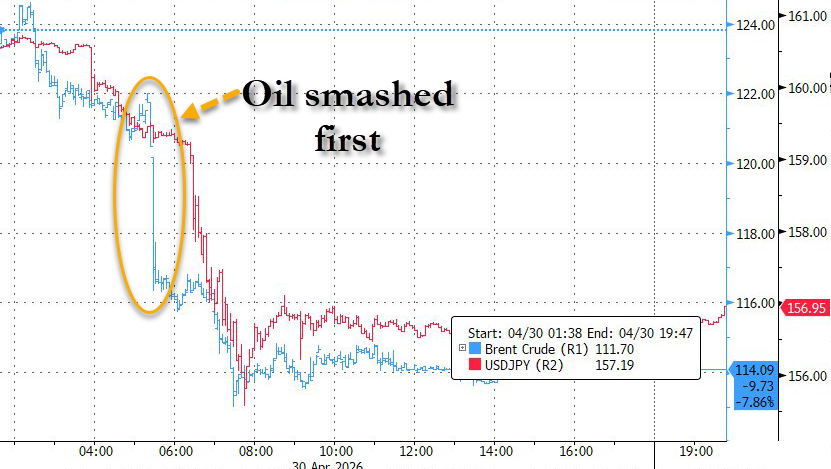
So Treasury agreed to BOJ intervention if they also slammed oil
In any case, oil appears to be holding on to its decline despite rising geopolitical tensions. The UAE has urged its citizens in Iran, Lebanon, and Iraq to leave “immediately,” citing deteriorating regional conditions. At the same time, sources suggest the US is completing final pre-strike preparations, including intelligence gathering on Iranian oil infrastructure. In response, Iran is reportedly planning a “dual response”: missile strikes on Gulf energy assets and US-linked bases, alongside a potential closure of the Strait of Hormuz using mines and missiles. Senior US military officials have briefed President Trump on updated options for possible action against Iran. In short, multiple warnings have been issued, and the situation remains highly fluid – meaning the landscape could shift markedly over the coming days. Warnings are out.
In the Eurozone, April’s flash HICP rose to 3.0% y/y – the highest since September 2023 – driven largely by a 10.9% surge in energy prices, with inflation accelerating across Germany, France, Spain, and Italy. While the headline print was slightly below our forecast, this mainly reflected easing in core inflation, particularly services, which slowed from 3.2% to 3.0% y/y. This distinction is important. The headline signals renewed pressure, but core dynamics suggest inflation has not yet broadened into a wage‑price spiral that would warrant aggressive monetary tightening beyond limited “warning shots.” We expect Eurozone inflation to average around 3.1% in 2026, easing to 2.5% in 2027. While still above pre-war expectations – by roughly 1.7 percentage points cumulatively – this profile does not justify tightening policy into a slowing growth backdrop.
Indeed, Eurozone GDP data sharpened the inflation–growth trade-off. Q1 growth came in at just 0.1% q/q, below the 0.2%–0.3% consensus. France stagnated, Italy slowed, Germany surprised modestly to the upside at 0.3%, and Spain remained the standout at 0.6%. Importantly, most of the quarter predates the peak of the Iran-related energy shock, meaning the weakness reflects an economy already losing momentum rather than the direct impact of recent geopolitical developments (see our more in-depth take here). This suggests Q2 is likely to be similarly weak – or weaker in underlying terms – and implies that the ECB’s prior growth projections were already too optimistic before the latest shock. Our forecasts see Eurozone growth slowing from 1.5% in 2025 to 0.6% this year, followed by a modest recovery to 0.9% in 2027.
Against this backdrop, the ECB left rates unchanged at 2%, as widely expected. The decision itself was uneventful; the message was not. The Governing Council acknowledged that “upside risks to inflation and downside risks to growth have intensified,” with President Lagarde describing the outcome as “an informed decision on the basis of yet-insufficient information.” That phrasing suggests the decision was finely balanced, with some policymakers inclined to move – a message that also came through via ‘sources’ shortly after the press conference had ended.
Our ECB watcher Bas van Geffen characterises this as a “June or never” moment – and the uncertainty embedded in that phrase is key. Hawks still have a window to push for tightening, but it is narrowing. Earlier in the month, markets had priced in multiple hikes, driven by inflation concerns, yet that urgency has since faded. Financial conditions have remained orderly: spreads are contained, equities resilient, and no disorderly market reaction has emerged to compel ECB action. In that environment, the burden of proof shifts to those advocating a hike.
Our base case remains a 25bp increase in June, taking the deposit rate to 2.25%. June offers fresh staff projections and another month of data, making it the natural decision point. However, if the ECB does not act then, the case for tightening weakens materially. By July, energy pass-through should be near its peak, and evidence of second-round effects – if present – should be clearer. Absent such evidence, the argument for higher rates loses traction. A key condition for a June pause, however, would be a meaningful easing in energy prices, implying improvement in Middle East tensions – something not evident at present. The ECB, for its part, cannot be accused of failing to signal these risks.
Across the Channel, the Bank of England struck an “Alert but careful” tone, also holding rates steady. Governor Bailey described the stance as an “active hold,” balancing persistent inflation risks against growing concerns over employment and activity. While the BoE reiterated that it stands “ready to act as necessary,” both the minutes and Bailey’s remarks suggested reluctance to move prematurely. An overload of scenarios and caveats provided limited forward guidance. That said, we expect more Monetary Policy Committee members to lean toward tightening in June. Ultimately, how far that shift goes will depend heavily on developments around the Strait of Hormuz and the extent to which higher energy costs feed through into broader inflation.
7. OIL AND NATURAL GAS COMMENTARIES
CALIFORNIA
8. EMERGING MARKETS//AUSTRALIA NEW ZEALAND ISSUES
CANADA
I THINK I AM GOING TO HAVE TROUBLE AS I TELL THE TRUTH:
Canada’s Culture Minister: Regulating Online Content A Duty Of Federal Government
Friday, May 01, 2026 – 05:00 AM
Authored by Olivia Gomm via The Epoch Times (emphasis ours),
Culture Minister Marc Miller says the federal government has the role of regulating content on the internet and that Canada is years behind other countries when it comes to regulating “online harms.”

Miller told reporters on Parliament Hill April 29 that when it comes to the regulation of online content and social media, that role is “assumed by the federal government, whether we’re talking about moratoriums or the proper regulation of egregious online harms.”
“That’s stuff that we’re, frankly, a couple years behind in regulating, as we see other jurisdictions like Australia, like Britain, like France taking action,” Miller said, as was first covered by Blacklock’s Reporter. “We need to take action as well.”
Asked to comment on when the government plans on tabling a new online harms bill, Miller said “we’re working on it” and declined to share a timeline.
Miller told reporters earlier this month that a new online harms legislation is in the works and the government is “seriously” thinking about adding a social media ban for children to the bill, but did not provide a status or timeline for the introduction of the legislation then either.
The upcoming legislation will be the government’s third attempt to legislate on “online harms,” following previous proposals in 2021 and 2024, neither of which passed before Parliament was dissolved. Conservatives and civil liberties advocates had criticized both bills as posing a risk to freedom of expression.
In March, the federal government reconvened the same group of experts first formed in 2022 that made recommendations to the government on how to address online content deemed to be harmful, which led to Bill C-63.
The department of industry said in a recent report to the Senate social affairs committee that Ottawa is examining a “future online safety regime” meant to reduce content deemed as being harmful, such as hateful content and cyberbullying on large platforms.
“To advise on this proposal, the government has recently reconvened the Expert Advisory Group on Online Safety whose members previously contributed to the development of online harms legislation, to engage on new and emerging issues related to online harms,” the department said.
“Any future legislative proposal would be subject to parliamentary scrutiny, and details will be made public at the appropriate time.”
In 2021, Bill C-36 proposed a regulatory framework for harmful online content, but faced criticism from the opposition over its scope, including concerns about definitions of harmful speech and the extent of proposed oversight powers.
In 2024, Bill C-63 placed a stronger focus on protecting children and addressing specific categories of harmful content, and proposed the creation of new regulatory bodies such as a digital safety commissioner and ombudsperson. It also included amendments to the Criminal Code and human rights law, with stricter penalties for certain hate-related offences.
After pushback on the 2024 bill, the government said it was open to splitting the bill in two to facilitate the passage of measures protecting children, but the bill lapsed after Parliament was prorogued in January of last year.
Justice Minister Sean Fraser said last November that new legislation regulating online content would be different from the government’s previous proposals. Meanwhile, former Heritage Minister Steven Guilbeault said a few months earlier that upcoming online harms legislation would be similar to the versions tabled in 2024 and 2021.
The Liberals’ election platform last spring promised to “introduce legislation to protect children from horrific crimes including online sexploitation and extortion and give law enforcement and prosecutors the tools to stop these crimes and bring perpetrators to justice.”
The Liberals also pledged to “make it a criminal offence to distribute non-consensual sexual deepfakes” and to “increase penalties for the distribution of intimate images without consent.”
Jennifer Cowan, Noé Charter, and Paul Rowan Brian contributed to this report.
YOUR EARLY CURRENCY/GOLD AND SILVER PRICING/ASIAN CLOSING MARKETS AND EUROPEAN BOURSE OPENING AND CLOSING/ INTEREST RATE SETTINGS FRIDAY MORNING 6;30AM//OPENING AND CLOSING
OPENING LEVELS OF CURRENCIES// AND CLOSING ASIAN STOCK MARKET AND OPENING EUROPEAN STOCKS:6 AM EST
EURO VS USA DOLLAR: 1.1738 UP 0.0019
USA/ YEN 156.56 DOWN 0.419 NOW TARGETS INTEREST RATE AT 1.75% AS IT WILL BUY UNLIMITED BONDS TO GETS TO THAT LEVEL…//YEN STILL FALLS//END OF YEN CARRY TRADE BEGINS AGAIN DEC 2024/Bank of Japan raises rates by .25% TO 1.75 ..TAKAICHI NEW PM AS YIELDS RISE//JAPAN DEEPLY IN TROUBLE WITH RISING RATES AND A FALLING YEN!!
GBP/USA 1.3602 UP 0.0001 OR 1 BASIS PTS
USA/CAN DOLLAR: 1.3574 DOWN 0.0006 CDN DOLLAR UP 6 BASIS PTS//
Last night Shanghai COMPOSITE CLOSED MAY DAY HOLIDAY
Hang Seng CLOSED MAY DAY HOLIDAY
AUSTRALIA CLOSED DOWN 0.75%
// EUROPEAN BOURSE: MOSTLY ALL GREEN
Trading from Europe and ASIA
I) EUROPEAN BOURSES:MOSTLY ALL GREEN
2/ CHINESE BOURSES / :Hang SENG CLOSED
/SHANGHAI CLOSED
AUSTRALIA BOURSE CLOSED DOWN 0.75%
(Nikkei (Japan) CLOSED UP 159.08 PTS OR 0.27%
INDIA’S SENSEX IN THE RED
Gold very early morning trading: $4566.80
silver:$73.08
USA DOLLAR VS TRY (TURKISH LIRA): 45.18 MINUS 1 BASIS PTS AND NOW WE SEE THEIR STUPIDITY OF SELLING SOME OF THEIR GOLD.
USA DOLLAR VS RUSSIAN ROUBLE: 74.99 ROUBLE// DOWN 0 ROUBLE AND 2 BASIS PTS
UK 10 YR BOND YIELD: 5.039 UP 2 BASIS PTS
UK 30 YR BOND YIELD: 5.711 UP 1 BASIS PTS
CDN 10 YR BOND YIELD: 3.543 DOWN 7 BASIS PTS
CDN 5 YR BOND YIELD; 3.190 DOWN 7 BASIS PTS
USA dollar index early FRIDAY MORNING: 97.95 UP 3 BASIS POINTS FROM THURSDAY’s CLOSE
FRIDAY MORNING NUMBERS ENDS
And now your closing FRIDAY NUMBERS 10.00 AM
Portuguese 10 year bond yield: 3.455% DOWN 2 in basis point(s) yield
JAPANESE BOND 10 yr YIELD: +2.498% DOWN 2 FULL POINTS BASIS POINTS /JAPAN losing control of its yield curve/
JAPAN 30 YR: 3.722 DOWN 2 BASIS PTS//
SPANISH 10 YR BOND YIELD: 3.486 DOWN 1 in basis points yield
ITALY 10 YR BOND: 3.865 DOWN 0 points in basis points yield ./ THE ECB IS QE’ ING ITALIAN BONDS (
GERMAN 10 YR BOND YIELD: 3.0342 UP 1 BASIS PTS
IMPORTANT CURRENCY CLOSES : MID DAY FRIDAY
Closing currency crosses for day /USA DOLLAR INDEX/USA 10 YR BOND YIELD/10:00 AM
Euro/USA 1.1753 UP 0.0025 OR 25 basis points
USA/Japan: 156.62 DOWN 0.372 OR YEN IS UP 37 BASIS PTS// HIGHLY INFLATIONARY TO JAPAN
Great Britain 10 YR RATE 5.0100 DOWN 1 BASIS POINTS //
GREAT BRITAIN 30 YR BOND; 5.682 DOWN 2 BASIS POINTS.
Canadian dollar UP 26 BASIS pts to 1.3554
xxxxxxxxxxxxxxxxxxxxxxxxxxxxxxxxxxxxxxxxxxxxxxxxxxxxxxxxxxxxxxxxxxxxxxxxxxxxxxxx
The USA/Yuan CNY XXXX ON SHORE ..
THE USA/YUAN OFFSHORE// CNH UP TO 6.8293
TURKISH LIRA: 45.19 EXTREMELY DANGEROUS LEVEL/DEATH WATCH/HYPERINFLATION TO BEGIN.//
Your closing 10 yr US bond yield DOWN 0 in basis points from THURSDAY at 4.391.% //trading well ABOVE the resistance level of 2.27-2.32%)
USA 30 yr bond yield 4.980 DOWN 1 basis points /10:00 AM
USA 2 YR BOND YIELD: 3.8989 UP 1 BASIS PTS.
GOLD AT 10;00 AM 4592.00
SILVER AT 10;00: 74.90
Your 11:00 AM bourses for Europe and the Dow along with the USA dollar index closing and interest rates THURSDAY CLOSING TIME 10:00 AM//
London: CLOSED DOWN 14.89 PTS OR 0.14%
GERMAN DAX: CLOSED MAY DAY
FRANCE: CLOSED UP 39.03 PTS OR 0.65%
Spain IBEX CLOSED MAY DAY
Italian MIB: CLOSED MAY DAY
WTI Oil price 102.85 10.00 EST/
Brent Oil: 109.28 10:00 EST
USA /RUSSIAN ROUBLE /// AT: 75.07 ROUBLE UP 0 AND 1 / 100
CDN 10 YEAR RATE: 3.561 UP 2 BASIS PTS.
CDN 5 YEAR RATE: 3.212 UP 2 BASIS PTS
CLOSING NUMBERS: 4 PM
Euro vs USA 1.1724 DOWN 0.0004 OR 4 BASIS POINTS//
British Pound: 1.3582 DOWN 0.0020 OR 20 basis pts/
BRITISH 10 YR GILT BOND YIELD: 4.973 DOWN 5 FULL BASIS PTS//
BRITISH 30 YR BOND YIELD: 5.621 DOWN 10 IN BASIS PTS.
JAPAN 10 YR YIELD: 2.502 DOWN 2 FULL BASIS PTS (DANGEROUS TO THEIR ECONOMY
JAPANESE 30 YR BOND: 3.717 DOWN 1 PTS AND STILL VERY DANGEROUS TO THEIR ECONOMY
USA dollar vs Japanese Yen: 157.02 UP 0.026 OR YEN DOWN 3 BASIS PTS EXTREMELY DANGEROUS/YEN FALLING DEEPLY IN VALUE
USA dollar vs Canadian dollar: 1.3582 UP 0.0007 PTS// CDN DOLLAR DOWN 7 BASIS PTS
West Texas intermediate oil: 101.98
Brent OIL: 108.24
USA 10 yr bond yield DOWN 1 BASIS pts to 4.377
USA 30 yr bond yield: DOWN 2 PTS to 4.965%
USA 2 YR BOND 3.886 DOWN 0 PTS
CDN 10 YR RATE 3.526 DOWN 2 BASIS PTS
CDN 5 YEAR RATE: 3.177 DOWN 2 BASIS PTS
USA dollar index: 98.03 UP 12 BASIS POINTS
USA DOLLAR VS TURKISH LIRA: 45.17 GETTING QUITE CLOSE TO BLOWING UP/IDIOTS SOLD GOLD
USA DOLLAR VS RUSSIA//// ROUBLE: 75.00 DOWN 0 AND 5/100 roubles //
GOLD $4627.00 3:30 PM)
SILVER: 75.85 3;30 PM)
DOW JONES INDUSTRIAL AVERAGE: DOWN 153.27 OR 0.31%
NASDAQ 100 UP 258.24 PTS OR 0.94%
VOLATILITY INDEX 16.70 DOWN 0.19 PTS OR 1.12%
GLD: $ 423.24 DOWN 0.42 PTS OR 0.10%
SLV/ $68.31 PTS UP 1.64 OR OR 2.47%
TORONTO STOCK INDEX// TSX INDEX: CLOSED DOWN 31.21 PTS OR 0.092%
end
TRADING today ZEROHEDGE 4 PM: HEADLINE NEWS/TRADING
Stocks Hit 4th All-Time High Of Past 5 With Many More Stocks Falling Than Rising
XXX
WRAP UP:
Stocks gain and oil drops as Iran sends latest peace proposal – Newsquawk US Market Wrap
Friday, May 01, 2026 – 04:04 PM
- SNAPSHOT: Equities up, Treasuries flatten, Crude down, Dollar up, Gold flat
- REAR VIEW: Trump not satisfied with the latest proposal from Iran; Trump said EU is not complying with trade deal and he will increase tariffs to 25% next week on EU cars and truck imports into the US; US ISM Mfg. PMI misses & prices jump; BoJ data confirms FX intervention; AAPL beats, rev. guide topped; Memory names beat; Fed’s Logan, Hammack, and Kashkari explain dissent on easing language bias in statement.
- COMING UP: Holiday: UK May Bank Holiday, Japan’s Greenery Day. Data: Turkish Inflation (Apr), Global Manufacturing PMI (Apr), US Factory Orders (Mar). Speakers: Fed’s Williams; BoC’s Macklem and Rogers; ECB’s Cipollone, de Guindos. Supply: US Treasury Financing Estimates. Earnings: Palantir, ONSemi, Pinterest, Norwegian Cruise Line, Tyson Foods.
- WEEK AHEAD: Highlights include US NFP, ISM Services PMI, RBA, Canadian jobs and OPEC+. Click here for the full report.
- WEEKLY US EARNINGS ESTIMATES: Earnings continue with AMD, PLTR, ARM the highlights. Click here for the full report.
More Newsquawk in 2 steps:
- 1. Subscribe to the free premarket movers reports
- 2. Trial Newsquawk’s premium real-time audio news squawk box for 7 day
MARKET WRAP
US indices closed firmer as post-Mag7 earnings persisted into the end of the week. The latest report from Apple (+X%) showed another earnings beat, driven by strong iPhone and services sales, better-than-expected China revenue, alongside upbeat revenue guidance. Tech/AI-related names drove the move today as breadth remained poor. Memory names largely moved higher after strong earnings from Sandisk and Western Digital. Energy was the worst performer on the day, as lower crude prices weighed, a function of reports that Iran sent the US a new peace proposal on Thursday. That said, Axios noted via sources that the focus in the latest plan will likely be on ending the war (not nuclear). Additionally, Trump said he is not satisfied with the latest proposal from Iran. These updates provided a floor for crude prices, which ultimately settled in the red as de-risking after two strong weeks of gains took place ahead of a weekend involving high uncertainty. On trade, Trump threatened the EU with 25% tariffs on its trucks & cars imports (prev. 15%), claiming non-compliance with the agreed-upon trade deal. Both this update and Trump’s dissatisfaction with the latest Iran proposal sparked pressure in equities, but proved unsustainable. US yields pared the initial movement tracking crude prices lower. The 2yr remained firmer on the session, perhaps helped by Fed’s Logan, Hammack, and Kashkari citing high uncertainty, upside risks to inflation, and the need for new guidance amid the changed environment behind their dissent on easing bias language in Wednesday’s FOMC statement. The Dollar was boosted by increased geopolitical uncertainty and Trump’s tariff threat, as well as the slight rebound against the JPY after Thursday’s JPY intervention. Gold finished the session flat and lower on the week, while silver extended higher on Friday, paring earlier weakness seen in the week.
US
ISM Manufacturing PMI was unchanged at 52.7, albeit beneath the expected 53.2. Prices paid surged to a 4-year high of 84.6 from 78.3, and much above the forecast of 80.7. New orders rose to 54.1 from 53.5, while employment fell further beneath 50 to 46.4 from 48.7. Production and backlog of orders fell, with both still in expansionary territory, while supplier deliveries and inventories rose. Oxford Economics writes that ISM Mfg. index is still resilient to any negative sentiment surrounding the Middle East war. OxEco adds that new orders, combined with low customer inventories, are reasons for optimism, but history suggests geopolitical events are corrosive on production, as firms turn more hesitant on their expansion plans. Looking at prices, pressures are becoming more evident, and the AI buildout is driving shortages in memory components and semiconductors, and the passthrough of energy cost increases to consumer prices will play out in the next months, OxEco argued.
Fed’s Logan (2026 Voter, Hawk, Statement Dissenter) said the Fed should avoid giving guidance that implies easing at this stage, stressing that the next rate move could be either a cut or a hike, given the high degree of uncertainty in the economic outlook. She noted that the labour market has remained stable but expressed growing concern about the Fed’s ability to return inflation to its 2% target, highlighting that the path for inflation remains uncertain.
Fed’s Kashkari (2026 Voter, Hawk, Statement Dissenter) said he pushed for the Fed to signal potential rate hike risks in its outlook, warning that a closure of the Strait of Hormuz could force the Fed to raise rates. He noted that before the conflict, he had expected inflation to decline sufficiently to justify another rate cut this year, and argued that conditions had not changed enough by March to alter the policy statement. However, he cautioned that a sufficiently large price shock could unanchor inflation expectations, which in turn might require a series of rate hikes to maintain the Fed’s credibility in defending its 2% inflation target.
Fed’s Hammack (2026 Voter, Hawk, Statement Dissenter) said she opposed retaining an easing bias in the FOMC statement, arguing it is no longer appropriate given the current outlook. She pointed to broad-based inflation pressures, with energy playing a key role in driving prices higher, and highlighted upside risks to inflation alongside downside risks to the labour market. Hammack noted that while the economy has remained resilient so far in 2026, uncertainty has increased, and the policy path has become less clear. She added that the job market remains near full employment and emphasised that a wide range of views is a cornerstone of the Fed’s decision-making process.
FIXED INCOME
T-NOTE FUTURES (M6) SETTLED 1+ TICK HIGHER AT 110-20+
Treasuries were little changed on the session, with the curve slightly flattening as front-end yields marginally underperformed. At settlement, 2-year +2.1bps at 3.888%, 3-year +1.9bps at 3.910%, 5-year +1.5bps at 4.021%, 7-year +1.1bps at 4.198%, 10-year +0.4bps at 4.378%, 20-year -0.2bps at 4.956%, 30-year -0.1bps at 4.965%.
THE DAY: T-notes largely meandered overnight before catching a bid in the US morning on reports that Iran had sent a revised proposal via Pakistan to the US. The headlines weighed on crude prices, lifting Treasuries to session highs. However, the move reversed as subsequent reports suggested nuclear issues would not be addressed in the proposal, instead focusing on ending the war, which saw oil rebound and Treasuries pare gains. Late trade saw further downside in T-notes after President Trump said he is not satisfied with Iran’s proposal, reigniting upside in crude and pushing Treasuries back lower. Geopolitics and oil once again dictated price action, with intraday swings in crude driving moves across the curve. Fed speak resumed, with Logan, Hammack and Kashkari outlining their dissent to the FOMC statement, where all favoured removal of the easing bias, although the majority opted to retain it. On the data front, ISM Manufacturing PMI was unchanged despite expectations for a rise. Employment deteriorated further, while prices paid surged to 84.6 from 78.3, above expectations, and new orders improved. Elsewhere, trade developments saw President Trump announce an increase in tariffs on EU cars and trucks to 25% from 15%, citing a lack of compliance with the trade agreement. Overall, Treasuries were range bound but tilted weaker into the close, with geopolitics and oil continuing to dominate direction, while data and Fed speak had limited lasting impact.
SUPPLY
Bills
- US to sell USD 77bln 26-week bills and USD 89bln of 13-week bills on May 4th, and USD 75bln of 6-week bills on May 5th; all to settle on May 7th
STIRS/OPERATIONS
- Fed Pricing: June -0.4bps (prev. +0.8bps), July -1.2bps (prev. -1.2bps), Sept -2.3bps (prev. -2.3bps), Dec +0.7bps (prev. -0.8bps)
- NY Fed RRP op demand at 0.607bln (prev. 8.261bln) across 5 counterparties (prev. 12)
- SOFR at 3.66% (prev. 3.63%), volumes at USD 3.275tln (prev. USD 2.964tln) on April 30th
- EFFR at 3.64% (prev. 3.64%), volumes at USD 90bln (prev. USD 87bln) on April 30th
CRUDE
WTI (M6) SETTLED USD 3.13 LOWER AT 101.94/BBL; BRENT (N6) SETTLED USD 2.23 LOWER AT 108.17/BBL
The crude complex ended the day with losses, as Tehran submitting a new proposal weighed. Prior to this, WTI and Brent hit peaks of USD 106.65/bbl and 112.45, respectively, as oil prices were elevated heading into a weekend of geopolitical risk. Following this, risk tone improved, and benchmarks fell as Axios’ Ravid said Iran delivered on Thursday to the US through the Pakistani mediators its response to the latest US amendments on the agreement to end the war. However, sources “added nuclear negotiations will not succeed under these circumstances, and the focus will likely be on ending the war.” Nonetheless, Pakistani officials also said Iran’s latest response to the US terms for a peace deal was delivered to the US officials, and crude continued to slip. In the following reports, Tehran could see talks restarting if the US lifts its blockade of Iranian ports and Iran fully reopens the Strait of Hormuz, but the source added that Iran remains deeply distrustful of the US. Further still, Trump was on the wires and said he is not satisfied with the latest proposal from Iran, the Iran negotiations are not getting there right now, and said they are asking for things he cannot agree with. Into the weekend, focus will be on any progress or escalation regarding US/Iran. For the record, the weekly Baker Hughes rig count saw oil fall 1 to 408, natgas rise 1 to 130, leaving the total up 3 to 547.
EQUITIES
CLOSES: SPX +0.29% at 7,230, NDX +0.94% at 27,710, DJI -0.31% at 49,499, RUT +0.46% at 2,813
SECTORS: Energy -1.31%, Industrials -0.93%, Utilities -0.69%, Health -0.52%, Financials -0.37%, Materials -0.32%, Real Estate -0.25%, Consumer Staples -0.09%, Communication Services -0.02%, Consumer Discretionary +0.51%, Technology +1.41%.
STOCK SPECIFICS:
- Apple (AAPL): Reported an earnings and revenue beat, driven by strong iPhone and services sales, better-than-expected China revenue, upbeat revenue guidance, and signs that the company is managing through higher memory costs and supply constraints.
- Roblox (RBLX): Q1 rev. & user numbers missed.
- Reddit (RDDT): Adj. EPS & rev. beat; Q2 guidance topped.
- Atlassian (TEAM): Q3 earnings beat.
- Western Digital (WDC), Sandisk (SNDK): Beat on earnings, revenue and guidance.
- Twilio (TWLO): Earnings beat and lifted FY guidance.
- Atlassian (TEAM): Q3 earnings beat.
- Estee Lauder (EL): EPS, rev. and guidance topped.
- Chevron (CVX), Exxon Mobil (XOM): Earnings beat.
- Ares (ARES) CEO says demand has remained consistent despite recent market noise, seeing investors lean in; continue to exceed fundraising targets in most of our flagship fundraisers. CFO says not seeing any credit deterioration broadly within software, only one software company is on nonaccrual.
- US President Trump says looking for a bailout for Spirit Airlines (FLYYQ), gave them a final proposal and announcement later today.
FX
The dollar erased early-session losses from lower crude prices, as US President Trump threatened the EU with 25% tariffs on their trucks and cars (prev. 15%), claiming they’re not complying with the previously agreed trade deal. Helping the rebound into the green, Trump also expressed that he is not satisfied with the latest proposal from Iran. Despite crude prices getting lower, the dollar was generally firmer, perhaps amid the 2yr yield reversing initial downside. Possibly behind the move was the collection of all the Fed dissents on the easing bias language within the statement. Logan, Hammack, and Kashkari, all 2026 voters, cited increased uncertainty, upside risks to inflation, and inappropriate language given the changed outlook. Separately, US ISM Manufacturing PMI missed on the headline, and of concern, prices paid rose to its highest level in four years, while employment hit a YTD low. DXY hit lows of 97.72 before reversing to ~98.18
A slight rebound in the USD/JPY helped the overall dollar index, rising to ~157.04 at the time of writing. New WTD lows of 155.49 were seen as speculation on FX intervention continued. BoJ data for April 30th showed FX intervention of some JPY 5.4tln. ING writes that unless Washington gets involved, “we think there will be good demand for USD/JPY near 155, given high energy prices, hesitant BoJ tightening, and a Fed being blown off its easy course”.
USA DATA RELEASES
Manufacturing ISM Misses As Prices Surge Most Since April 2022, Employment Slides To Worst Print Of 2026
Friday, May 01, 2026 – 10:22 AM
Amid the fog of war and fading ‘hard’ data, the final April S&P Global Manufacturing PMI printed 54.5, a small gain from the flash 54.0 print, and higher than the 52.3 February final print, although it came with a warning from Chris Williamson, Chief Business Economist at S&P Global Market Intelligence:
“The surge in manufacturing activity in April is not the cause for cheer that at first glance it suggests. A key driving force behind the upturn is the need for companies to get ahead of further feared price rises and supply shortages, providing a short-term boost that could fade in the coming months as headwinds to the economy continue to build… employment has fallen as firms grow increasingly worried over the need to reduce cost overheads amid an environment of rising raw material prices, while selling prices have jumped higher as producers seek to protect their margins.
There was some good news: “More encouragingly, business expectations for output in the year ahead have improved, partly reflecting hopes that the US will be less affected by the war than previously feared, and less than other economies, as well as reduced concerns over the impact of tariffs given the recent Supreme Court ruling. However, some of these improved expectations of future production gains reflected a reaction to better than anticipated order book inflows in April, which may prove to be a chimera as the stock building boost fades.”
Shortly after, the ISM Manufacturing PMI published its April number which remained unchanged at 52.7, matching the highest since August 2022, and missing estimates of an increase to 53.2

However, a look under the hood reveals that like last month, there was continued deterioration in the core components: Under the hood, Prices Paid continued to rise dramatically while New Orders and Employment dipped again – another indication that stagflation remains the biggest risk for the economy.
- New Orders 54.1, missing expectations of 54.5
- Prices Paid 84.6, higher than expectations of 80.3
- Employment 46.4, missing expectations of48.8
As shown below, the New Orders Index expanded for the fourth straight month after four straight readings in contraction, registering 54.1 percent, up 0.6 percentage point compared to March’s figure of 53.5 percent. The April reading of the Production Index (53.4 percent) is 1.7 percentage points lower than March’s reading of 55.1 percent. The Prices Index remained in expansion (or ‘increasing’ territory), registering 84.6 percent, a 6.3-percentage point jump from March’s reading of 78.3 percent. In the last three months, the Prices Index has increased 25.6 percentage points to reach its highest level since April 2022 (84.6 percent). The Backlog of Orders Index registered 51.4 percent, down 3 percentage points compared to the 54.4 percent recorded in March. The Employment Index registered 46.4 percent, down 2.3 percentage points from March’s figure of 48.7 percent.

Some more details:
“In April, U.S. manufacturing activity remained in expansion territory, growing at the same pace as the month before. Of the five subindexes that make up the PMI®, the New Orders and Supplier Deliveries indexes indicated faster growth compared to the previous month, the Production Index grew at a slower rate, and the Employment and Inventories indexes remained in contraction.
“Two of four demand indicators (the New Orders and Backlog of Orders indexes) remain in expansion, although the Backlog of Orders Index dropped 3 percentage points compared to March. The New Export Orders Index remained in contraction with a 2-percentage point decrease, and the Customers’ Inventories Index remains in ‘too low’ territory, contracting at a slightly faster rate. A ‘too low’ status for the Customers’ Inventories Index is usually considered positive for future production.
“Regarding output, the Production Index is in expansion for the sixth month in a row (although it lost ground compared to March), and the Employment Index decreased by 2.3 percentage points and remains in contraction. Among panelists, 60 percent indicated that managing head counts remains the norm at their companies as opposed to hiring, and of those managing head counts, 34 percent are using layoffs and 43 percent using attrition or not backfilling positions.
“Finally, inputs (defined as supplier deliveries, inventories, prices, and imports) had another month of mixed results. The Supplier Deliveries Index indicated increasingly slowing deliveries, the Inventories Index contracted at a slower rate, and the Prices Index vaulted again — up another 6.3 percentage points to 84.6 percent, from 78.3 percent in March, and the highest reading from April 2022, when it was also at 84.6 percent. The Imports Index lost 2.3 percentage points for a reading of 50.3 percent, compared to 52.6 percent in March.
“Looking at the manufacturing economy, 19 percent of the sector’s gross domestic product (GDP) contracted in April, compared to 16 percent in March, and the percentage of manufacturing GDP in strong contraction (defined as a composite PMI® of 45 percent or lower) decreased to 2 percent, compared to 4 percent in March. The share of sector GDP with a PMI® at or below 45 percent is a good metric to gauge overall manufacturing weakness. Of the six largest manufacturing industries, four (Transportation Equipment; Machinery; Computer & Electronic Products; and Chemical Products) expanded in April,” says Spence.
According to the report, “In April, U.S. manufacturing activity remained in expansion territory, growing at the same pace as the month before. Of the five subindexes that make up the PMI, the New Orders and Supplier Deliveries indexes indicated faster growth compared to the previous month, the Production Index grew at a slower rate, and the Employment and Inventories indexes remained in contraction.”
Yet for all the rhetoric, what matters is that prices continued to rise, surging to 84.6, the highest since April 2022 and approaching their 2021 record high, while employment shrank further into contraction, down to 46.4, the lowest print of 2026.

Furthermore, as expected the Iran war remains: “In this second month of the Iran War (at the time of data collection), 31 percent of the comments were positive and 69 percent negative, with a positive to negative sentiment ratio of 1 to 2.2. Among comments, the war was mentioned in 47 percent and tariffs in 18 percent. As was the case last month, some panelists referenced both topics within a single comment or in mixed sentiment.”
Obviously, if the war persists and price pressures and supply delays accelerate, demand, employment and production capabilities will inevitably start to be even more adversely affected until the broader economy finally cracks.
USA ECONOMIC REPORTS
Trump Escalates Tariffs On EU Vehicles To 25%, Accusing Bloc Of Trade Deal Violations
Friday, May 01, 2026 – 12:00 PM
President Donald Trump announced Friday that the United States will raise tariffs on cars and trucks imported from the European Union to 25% starting next week, citing the EU’s failure to comply with a 2025 bilateral trade framework.

“I am pleased to announce that, based on the fact the European Union is not complying with our fully agreed to Trade Deal, next week I will be increasing Tariffs charged to the European Union for Cars and Trucks coming into the United States. The Tariff will be increased to 25%. It is fully understood and agreed that, if they produce Cars and Trucks in U.S.A. Plants, there will be NO TARIFF.”
Trump highlighted over $100 billion in ongoing U.S. auto manufacturing investments – a record, he said – and praised American workers staffing new plants set to open soon.

This sent Emini S&P futures cascading lower:

The move reverses a temporary reduction under the July 2025 U.S.-EU Framework Agreement on Reciprocal, Fair, and Balanced Trade. That deal, reached after Trump initially imposed broad 25% Section 232 national-security tariffs on automobiles and parts in March 2025, lowered the rate on most EU vehicles and parts to 15% (retroactive to August 1, 2025) in exchange for EU commitments. These included cutting tariffs on U.S. industrial and agricultural goods, purchasing hundreds of billions in American energy, and increasing investment in the U.S.
EU implementation has lagged. The European Parliament conditionally approved enabling legislation in late March 2026 with multiple “safeguard” clauses – including a “sunrise” provision tying EU concessions to verified U.S. compliance, a suspension mechanism for new U.S. tariffs, and a sunset date in 2028. Tensions have simmered over non-tariff issues as well. In April 2026, U.S. automakers (GM, Ford, and Stellantis) warned that proposed EU safety and emissions standards could effectively block large U.S.-built pickup trucks and vans from the European market, a step they called inconsistent with the deal’s spirit of mutual recognition.
Ferrari also RACE‘d lower on the news, one day after Vanguard added to their position.

The original 2025 auto tariffs were justified on national-security grounds and aimed at spurring domestic production; the administration has repeatedly offered exemptions or lower rates to allies that negotiate deals or shift manufacturing stateside. Trump’s post explicitly ties the new 25% levy to onshoring: EU brands that build in the United States face zero additional tariff.
The announcement comes amid broader Trump administration tariff actions that have reshaped global auto supply chains since January of last year. European manufacturers such as BMW, Mercedes-Benz, Volkswagen, and Stellantis have already faced pressure from the earlier duties, prompting some to accelerate U.S. investment plans or adjust pricing. Industry analysts warn that a return to 25% could raise costs for consumers, disrupt transatlantic supply chains, and invite EU retaliation.
Developing…
END
VICTOR DAVIS HANSON
KING NEWS
| The King Report May 1, 2026 – Issue 7733 | Independent View of the News |
| Iran’s New leader Pledges to Guard Nuclear and Missile Tech – BBG 7:49 ET Mojtaba Khamenei vowed not to give up the country’s nuclear of missile technology and to keep control of the Strait of Hormuz. The US and Iran show little sign of breaking an impasse… Q1 GDP 2.0%, 2.2% exp; Consumption 1.6%, 1.4% exp; GDP Price Index 3.6%, 3.8% exp; Core PCE Price Index 4.3% q/q; 4.1% exp; Q1 Employment Cost Index 0.9%, 0.8% exp The disappointing Q1 Consumption of 1.6% was mitigated by the surge in AI spending. Business outlays for equipment and structures soared 10.4%. Mar Personal Income 0.6% m/m, 0.3% exp; Spending 0.9% as expected; PCE Price Index 0.7% m/m & 3.5% y/y; March Core PCE Price Index 0.3% m/m & 3.2% y/y as expected Initial Jobless Claims 189k, 213k exp; Continuing Claims 1.785m, 1.815m exp Apr Chicago PMI 49.2, 54.9 expected; Mar LEI -06%, -0.2% expected Near 3:56 ET, Japan allegedly intervened in the yen and moved it from a daily low of 160.41/$ to 155.57/$ at 7:43 ET. The apparent intervention fomented ESM, USM, and precious metal buying. In early NYSE trading on Thursday, the NY Fang+ Index declined sharply on Meta (-10.3% at low), MSFT (-5.7% at low), and Nvidia (-5.0% at low). But the Nasdaq 100 rallied moderately on Qualcomm (+21.07% at high) and Google (+8.1% at peak). Qualcomm soared on this WSJ tout: Qualcomm Finally Goes Full Throttle on AI Chips (“Heard of the Street” column) Chief executive Cristiano Amon outlined a much more expansive vision, including central processing units and custom-designed chips for large AI computing deployments… he didn’t give more details… The DJIA and the DJTA rallied sharply on April performance gaming and relative valuation. Bonds fell modestly. Precious metals rallied sharply. Oil and gasoline declined modestly. ESMs opened moderately lower on Wednesday night, but immediately spiked to strong gains. After hitting 7201.50 at 20:55 ET, ESMs sank to a daily low of 7133.75 (-34.25) at 2:10 ET. Traders then bought ESMS for the expected April performance gaming. ESMs intractably marched to 7211.50 (+43.50) at 8:21 ET after effectively double topping at 7207.75 at 9:06 ET, a professional dump began. ESMs fell to 7157.25 at 10:16 ET but then commenced a rally, propelled by April performance gaming, that took ESMs to a daily high of 7251.75 at 15:59 ET. Positive aspects of previous session Robust manipulation to game April reporting pushed the S&P, Nasdaq, and the Nas 100 to record highs Japan is presumed to have intervened in the yen. USMs were +11/32 at the NYSE close. Negative aspects of previous session The NY Fang+ Index declined modestly. Ambiguous aspects of previous session May Gasoline rallied 3.04 cents; May WTI Oil fell $1.30 First Hour/Last Hour NYSE Action [S&P 500 Index]: 1st Hour: Down; Last Hour: Up Pivot Point for S&P 500 Index [above/below indicates daily trend to day traders]: 7185.00 Previous session (S&P 500 Index) High/Low: 7219.83; 7126.15 @charliebilello: Jerome Powell held 63 press conference as Fed chairman and over that time there wasn’t a single question about the 40% money supply spike in 2020-21 or $18 trillion increase in the national debt during his tenure as the root causes of inflation. That’s either unbelievable incompetence on the part of the most renowned financial journalists in the business or questioning/dissent is not allowed. https://x.com/charliebilello/status/2049845442842603574 @judyshel: Where in the 1913 Federal Reserve Act, the 1977 Federal Reserve Reform Act, or the 1978 Humphrey-Hawkins legislation is there any reference to “central bank independence”…? It doesn’t exist. Don’t blame me for saying that; blame legislators for not including it in their legislative language if it is so important and in keeping with the constitutional directive to Congress to “regulate the money.” Indeed, the Humphrey-Hawkins Act calls for “improved coordination among the President, the Congress, and the Board of Governors of the Federal Reserve System.” By the way, the Fed says it is independent government agency but nevertheless accountable to Congress since the Fed chair testifies before Congress twice a year. But Powell was due to present that monetary report in mid-February…and has refused to do so in a fit of pique, despite entreaties from Capitol Hill. So much for honoring even the ritual of supposed accountability let alone rule of law. Apple reported Q3 EPS 2.01, 1.96 exp; Revenue $111.184B, $109.662B exp; an added $100B share buyback. APPL rallied to 275.00 at 16:32 ET but sank to 268.01 at 16:30 ET because the real expectations were much higher than what Street shills professed. APPL jumped to a daily high of 276.00 (+4.65) at 15:50 ET on expectations of good results. It sank to 270.34 (-1.01) at 15:57 ET on inside information. Fed Balance Sheet: -$7.469B on -$12.216B MBS and +$5.058B T-Bills; Reserves: +$16.774B Today – Traders will play for the Friday and Start-of-the-Month Rallies. Equity euphoria is at record levels and record breadth on stupendous and reckless retail trading. ‘They’ are now ignoring bad Iran news plus 4-year highs in oil/gasoline with already advancing inflation rates. Expected Economic April S&P Global US Mfg. 54; April ISM Mfg. 53.2, Prices Paid 80, New Orders 54.7, Employment 49; April Wards Total Vehicles 16.0m ESMs are +18.25; NGMs are +48.50; USMs are +1/32; and gas & oil are up smartly at 21:42 ET. S&P Index 50-day MA: 6815; 100-day MA: 6855; 150-day MA: 6816; 200-day MA: 6724 DJIA 50-day MA: 47,858;100-day MA: 48,396; 150-day MA: 47,884; 200-day MA: 47,182 (Green is positive slope; Red is negative slope) S&P 500 Index (7209.01 close) – BBG trading model Trender and MACD for key time frames Monthly: Trender and MACD are positive – a close below 6035.78 triggers a sell signal Weekly: Trender and MACD are positive – a close below 6500.00 triggers a sell signal Daily: Trender and MACD are positive – a close below 7061.78 triggers a sell signal Hourly: Trender and MACD are positive – a close below 7178.82 triggers a sell signal Justice Dept says it will enforce SCOTUS ruling in every state with racially gerrymandered districts – The commitment comes as 45 redistricting disputes remain unresolved in federal and state courts, casting a cloud of legal uncertainty over the fight for control of the U.S. House of Representatives this November… https://justthenews.com/government/federal-agencies/justice-dept-says-it-will-enforce-scotus-ruling-every-state-racially Trump: Titular House Dem Leader Hakeem Jeffries just called the Supreme Court of the United States an illegitimate Court! This is a Low IQ individual, who should not be allowed to talk that way about one of the Greatest Institutions anywhere in the World. He should withdraw the statement, IMMEDIATELY!… @JonathanTurley: Minority Leader Hakeem Jeffries just called the Supreme Court “illegitimate.” That follows Democratic politicians and pundits calling for the packing of the Supreme Court. Nothing says Happy 250th Anniversary like tearing down the core institutions of the Republic. Trump: Anybody running for President or Vice President should be forced to take a Cognitive Examination prior to entering the Race! By doing so, we wouldn’t be surprised at people like Barack “Hussein” Obama, or Sleepy Joe Biden, getting “ELECTED.” Our Country would be a much better place! I took the Exam three times during my (“THREE!”) Terms as President, and ACED IT ALL THREE TIMES — An Achievement that, even on a single Exam, according to the Doctors, has rarely been done before!… | |
SWAMP STORIES FOR YOU TONIGHT
GREG HUNTER…


