
GOLD: NUMBER OF NOTICES FILED FOR MAY/2026: 137 CONTRACTs NOTICES FOR 13,700 OZ or 0.4261 TONNES
total notices so far: 3463 contracts FOR 346,300 OZ OR 10.7713 TONNES
SILVER NOTICES: 69 NOTICE(S) FILED FOR 0.345 MILLION OZ /
total number of notices filed so far this month : 4998 CONTRACTS (NOTICES) for 24.990 million oz
SILVER//OUTLINE
INITIAL STANDING FOR JANUARY: 22.915 MILLION OZ FOLLOWED BY TODAY’S 1.185 MILLION OZ QUEUE JUMP//NEW NORMAL STANDING ADVANCES TO 49.445 MILLION OZ// TO WHICH WE ADD OUR FIRST EXCHANGE FOR RISK FOR .100 MILLION OZ//NEW STANDING ADVANCES TO 49.545 MILLION OZ!!
INTIAL STANDING FOR FEBRUARY/SILVER: 13.505 MILLION OZ FOLLOWED BY TODAY’S HUGE 0.005 MILLION OZ QUEUE JUMP / : NEW STANDING FOR SILVER AT THE COMEX ADVANCES TO 25.180 MILLION OZ. BUT WE MUST ADD OUR FIRST EXCHANGE FOR RISK OF 25 CONTRACTS FOR .125 MILLION OZ AND THEN OUR SECOND EXCHANGE FOR RISK OF .0600 MILLION OZ TO OUR THIRD HUGE 2.825 MILLION OZ EXCHANGE FOR RISK!!
INITIAL STANDING FOR MARCH: A SURPRISINGLY LOW 31.076 MILLION OZ/ FOLLOWED BY A TINY QUEUE JUMP OF 1 CONTRACTS OR 0.005 MILLION OZ/NEW STANDING ADVANCES TO 46.060 MILLION OZ
INITIAL STANDING FOR APRIL: 7.120 MILLION OZ FOLLOWED BY TODAY’S 1 CONTRACT QUEUE JUMP WHERE 5,000 OZ WILL TAKE DELIVERY OVER ON THIS SIDE OF THE POND. NEW STANDING FOR SILVER AT THE COMEX THUS ADVANCES SLIGHTLY TO 16.565 MILLION OZ PLUS WE MUST ADD OUR 4TH EXCHANGE FOR RISK ISSUANCE OF 17 CONTRACTS OR 0.085 MILLION OZ. THESE WILL BE ADDED TO OUR OTHER 3 ISSUANCES //NEW TOTAL EXCHANGE FOR RISK//1.165 MILLION OZ// NEW TOTAL SILVER STANDING 17.730 MILLION OZ//
INITIAL STANDING FOR MAY: 31.495 MILLION OZ FOLLOWED BY OUR NEXT QUEUE JUMP OF 22 CONTRACTS FOR 110,000 OZ/NEW STANDING ADVANCES TO 30.540 MILLION OZ/.//
SUMMARY OF OUR MAY 2026 COMEX CONTRACT MONTH:
JULY: 50.925 MILLION OZ (QUITE SMALL)
AUGUST: 59.455 MILLION OZ (QUITE SMALL)
SEPT. 50.510 MILLION OZ.(QUITE SMALL)
OCT; 82.020 MILLION OZ (WILL BE STRONG THIS MONTH)/ OCC WANTS TO REIN IN THESE ISSUANCES!
NOVEMBER: 36.425 MILLION OZ
DEC: 45.765 MILLION OZ
JANUARY 2026: 134.270 MILLION OZ (WILL BE A VERY STRONG MONTH FOR EXCHANGE FOR PHYSICAL!)
FEB : 82.130 MILLION OZ
MARCH: 56.075 MILLION OZ
APRIL; 44.44 MILLION OZ//FINAL.. SMALL THIS MONTH.
MAY 8.705 MILLION OZ
AND JULY: 46.720 MILLION OZ//
AUGUST: 4.70 MILLION OZ INITIAL STANDING PLUS TODAY;S 5,000 OZ QUEUE JUMP //NEW STANDING ADVANCES TO 10.960 MILLION OZ
SEPTEMBER: 68.040 MILLION OZ NORMAL DELIVERY(INCLUDES ALL QUEUE JUMPING AND EXCHANGE FOR PHYSICAL TRANSFERS) PLUS 3.0 MILLION OZ EX FOR RISK = 71.040 MILLION OZ. (THIS IS THE FIRST AND ONLY ISSUANCE OF EXCHANGE FOR RISK FOR SILVER SINCE MAY.)
OCTOBER: 39.565 MILLION OZ OF NORMAL DELIVERY INCLUDES ALL QUEUE JUMPING
PLUS
2.110 MILLION OZ EXCHANGE FOR RISK//TOTAL OZ STANDING IN OCT ADVAN
NOVEMBER: INITIAL STANDING AT 11.575 MILLION OZ FOLLOWED BY TODAY’S 195,000 OZ QUEUE JUMP WHICH FOLLOWS ALL OTHER QUEUE JUMPS OF 9.155 MILLION OZ//STANDING ADVANCES TO 19.670 MILLION OZ/
DECEMBER: INITIAL AMOUNT STANDING FOR DELIVERY: 49.33 MILLION OZ// FOLLOWED BY ANOTHER STRONG 835,000OZ QUEUE JUMP+ DEC. FIRST EXCHANGE FOR RISK 0F .850 MILLION OZ + LAST WEEK.S 495,000 OZ EXCHANGE FOR RISK AND THEN A 3RD ISSUANCE IF 1.00MILLION OZ THEN FINALLY DEC 249ISSUANCE OF 1.35 MILLION OZ EXCHANGE FOR RISK//NEW TOTAL EX FOR RIS IS 3.685 MILLION OZ // STANDING ADVANCES TO 68.415 MILLION OZ//
JANUARY: INITIAL STANDING 22.915 MILLION OZ FOLLOWED BY TODAY’S 1.185 MILLION OZ QUEUE JUMP//NORMAL STANDING ADVANCES TO 49.445 MILLION OZ// TO WHICH WE ADD OUR FIRST EXCHANGE FOR RISK OF 0.100 MILLLION OZ//NEW STANDING ADVANCES TO 49.545 MILLION OZ
FEB: 13.399 MILLION OZ IS OUR INITIAL STANDING FOR SILVER! TO WHICH WE ADD OUR NEXT QUEUE JUMP FOR 5,000 OZ AND THEN ADD OUR 3 EXCHANGE FOR RISK FOR 3.010 MILLION OZ STANDING ADVANCES TO 28.190 MILLION OZ!!
MARCH: INITIAL AMOUNT OF SILVER STANDING IS 31.076 MILLION OZ FOLLOWED BY A FINAL 0.210 MILLION OZ QUEUE JUMP //NEW TOTAL STANDING ADVANCES TO 46.060 MILLION OZ
APRIL 2026: INITITAL AMOUNT OF SILVER STANDING 7.120 MILLION OZ FOLLOWED BY TODAY’S 5,000 OZ QUUE JUMP //NEW STANDING ADVANCES TO 16.565MILLION OZ PLUS 1.165 MILLION OZ EXCHANGE FOR RISK.NEW TOTALS 17.730 MILLION OZ
MAY: INITIAL AMOUNT OF SILVER WILLING TO STAND; 31.495 MILLION OZ/ TO WHICH WE ADD OUR NEXT QUEUE JUMP OF 22 CONTRACTS/110,000 OZ//NEW STANDING ADVANCES TO 30.540 MILLION OZ//
1.MAY SUMMARY FOR MAY TONNES WHICH STOOD FOR DELIVERY:
4. AUGUST: 60.547 TONNES OF INITIAL GOLD FIRST DAY NOTICE FOLLOWED BY THE NET MONTH’S QUEUE JUMP OF 47.2312 TONNES TO WHICH WE ADD THE FOLLOWING EXCHANGE FOR RISK ISSUANCE RECEIVED FOR THE MONTH: 5.4432 TONNES EX FOR RISK/AUG 7 , AUG 11: 2.413 TONNES EX FOR RISK AND AUG. 12 OF 2.
5.SEPT: INITIAL 8.093 TONNES OF GOLD PLUS TODAY’S QUEUE JUMP OF 0.4883 TONNES PLUS 2.2827 TONNES OF EXCHANGE FOR RISK TODAY//NEW TOTAL EX. FOR RISK/MONTH = 22.923//NEW TOTAL STANDING FOR GOLD SEPT ADVANCES TO = 48.801 TONNES!!
6.OCTOBER: 90.012 TONNES OF INITIAL GOLD STANDING WITH TODAY’S TINY 0.00311 TONNES QUEUE JUMP WHICH FOLLOWS ALL OTHER QUEUE JUMPS DURING OCT OF 76.1656 TONNES
THEN WE MUST ADD OUR 14.553 TONNES OF OUR ISSUANCE OF EXCHANGE FOR RISK/6 OCCASIONS//NEW TOTAL OF GOLD STANDING ADVANCES TO 197.5141 TONNES OF GOLD.
7.NOVEMBER BEGINS WITH 15.651 TONNES INITIALLY STANDING FOR DELIVERY FOLLOWED BY TODAY’S QUEUE JUMP OF 2.323 TONNES FOLLOWED BY ALL PREVIOUS QUEUE JUMPS IN OF OF 21.3775 TONNES TO WHICH WE ADD OUR TWO EXCHANGE FOR RISK ISSUANCE OF 4.5596 TONNES//NEW STANDING ADVANCES TO 43.9716 TONNES OF GOLD.
8. DECEMBER BEGINS WITH INITIAL STANDING OF 83.813 TONNES OF GOLD FOLLOWED BY TODAY’S 0.0TONNE QUEUE JUMP WHICH FOLLOWS ALL OTHER QUEUE JUMPS OF: 37.163 TONNES//NEW STANDING ADVANCES TO 115.390 TONNES TO WHICH WE ADD OUR 4 EXCHANGE FOR RISK FOR DECEMBER OF 6.587 TONNES/NEW STANDING ADVANCES TO 121.977 TONNES
9. JANUARY: INITITAL STANDING: 13.785 TONNES TO WHICH WE ADD OUR FIRST EXCHANGE FOR PHYSICAL TRANSFER OF 0.08709 TONNES WHICH FOLLOWS ALL OTHER QUEUE JUMPS OF 30.7117TONNES //NEW TOTAL QUEUE JUMPS 30.7117//NORMAL DELIVERY OF GOLD ADVANCES TO 36.8958 TONNES TO WHICH WE ADD OUR SIX EXCHANGE FOR RISK OF 22.315 TONNES//NEW STANDING ADVANCES TO 59.2108 TONNES.
FEB; INITIAL AMOUNT OF GOLD STANDING FOR DELIVERY: 93.567 TONNES OF GOLD TO WHICH WE ADD OUR NEXT 0.0248 TONNES 0.1555 TONNES QUEUE JUMP TO 41.2082 TONNES/ NEW NET QUEUE JUMP INCREASES TO 41.233 TONNES// AND THEN WE ADD OUR SIX EXCHANGE FOR RISK: 10,080 CONTRACTS OR 31.251 TONNES//NEW STANDING REDUCES TO 157.878 TONNES
MARCH:: INITIAL AMOUNT OF GOLD STANDING FOR DELIVERY: 8.099 TONNES TO WHICH WE ADD TODAY’S FAIR 4600 OZ QUEUE JUMP (0.2320 TONNES) AND THEN WE ADD OUR THREE EXCHANGE FOR RISK OF 22.3818 TONNES //NEW STANDING ADVANCES TO 67.6648 TONNES/
APRIL: INITIAL AMOUNT OF GOLD STANDING FOR DELIVERY: 52.600 TONNES FOLLOWED BY OUR 278 CONTRACT QUEUE JUMP FOR 27800 OZ/ (0.8646 TONNES)/NEW STANDING ADVANCES TO 70.286 TONNES TO WHICH WE ADD OUR 2ND EXCHANGE FOR RISK OF 1498 CONTRACTS FOR 149800 OZ OR 4.659 TONNES. THE NEW TOTAL EXCHANGE FOR RISK FOR THE MONTH OF APRIL IS 2239 CONTRACTS OR 223900 OZ OR 6.964 TONNES AND THIS WILL BE ADDED TO OUR NORMAL DELIVERY TOTALS (70.762 TONNES) TO GIVE US WHAT WILL STAND IN APRIL (77.726 TONNES)
MAY: INITIAL AMOUNT OF GOLD WILLING TO STAND: 12.24 TONNES OF GOLD TO WHICH WE ADD OUR NEXT QUEUE JUMP OF 118 CONTRACTS OR 11800 OZ (.3670 TONNES)/STANDING NOW ADVANCES TO 13.399 TONNES OF GOLD.
STANDING FOR THE LAST 5 MONTHS JANUARY TO MAY:
FINAL STANDING FOR GOLD, JANUARY CONTRACT AT 59.2108 TONNES OF GOLD
FEBRUARY: INITIAL STANDING FOR GOLD: 157.878 TONNES!! WHICH INCLUDES ALL QUEUE JUMPING, THREE EXCHANGE FOR PHYSICAL TRANSFERS TO LONDON AND OUR SIX ISSUANCES EXCHANGE FOR RISK!!
MARCH: INITIAL STANDING AT 8.099 TONNES TO WHICH WE ADD OUR FINAL DAY: 0.2320 TONNES QUEUE JUMP AND THEN ADD +22.3818 TONNES EXCHANGE FOR RISK//NEW STANDING ADVANCES TO 67.6648 TONNES
APRIL: INITIAL STANDING 52.600 TONNES PLUS 27,800 OZ QUEUE JUMP (0.8648TONNES): NEW STANDING ADVANCES TO 70.286 TONNES PLUS OUR TWO EXCHANGE FOR RISK FOR 223,900 OZ OR 6.964 TONNES/NEW STANDING: 77.726 TONNES
MAY: INITIAL AMOUNT OF GOLD WILLING TO STAND; 12.24 TONNES TO WHICH WE ADD OUR NEXT QUEUE JUMP OF 118 CONTRACTS/11800 OZ// 0.3670 TONNES//NEW STANDING IS NOW ADVANCES TO 13.399 TONNES
JAN. 2025: 257.919 TONNES (ISSUANCE WILL BE PRETTY GOOD THIS MONTH BUT MUCH LOWER THAN LAST MONTH)
FEB: 207.21 TONNES//EX FOR PHYSICAL ISSUANCE (WILL BE A FAIR SIZED ISSUANCE THIS MONTH)
MARCH 130.84 TONNES//QUITE SMALL THIS MONTH.
APRIL; 208.57 TONNES. STRONG THIS MONTH
MAY: 113.499 TONNES OF GOLD EFP ISSUANCE//QUITE SMALL THIS MONTH
JUNE: 97.79 TONNES OF GOLD EFP ISSUANCE/EXTREMELY SMALL
JULY : 150.877 TONNES// QUITE SMALL
AUGUST: 175.86 TONNES A LOT LARGER THIS MONTH.
SEPT. 116.13 TONNES VERY SMALL
OCT. 252.72 TONNES//CERTAINLY MUCH LARGER THIS MONTH/VERY STRONG
NOV: 124.74 TONNES
DEC: 190.04 TONNES//GOOD SIZED THIS MONTH FINAL.
TOTAL EXCHANGE FOR PHYSICAL ISSUED FOR YEAR 2025: 2,026.20 TONNES (LOWER THAN LAST YR 2,569.00 TONNES
JANUARY: 209.08 TONNES ( (WILL BE A STRONG MONTH FOR EXCHANGE FOR PHYSICAL)
FEB. 176.35 TONNES (WHICH IS A FAIR ISSUANCE)
MARCH: 214.67 TONNES//WILL BE STRONG ISSUANCE THIS MONTH
APRIL; 88 TONNES// WILL BE VERY SMALL THIS MONTH
MAY 23.235 TONNES
HERE IS A BRIEF SYNOPSIS OF HOW THE CROOKS FLEECE UNSUSPECTING LONG
YOU WILL ALSO NOTICE THAT THE COMEX OPEN INTEREST STARTS TO RISE BUT SO IS THE OPEN INTEREST OF SPREADERS. THE OPEN INTEREST IN WILL CONTINUE TO RISE UNTIL ONE WEEK BEFORE FIRST DAY NOTICE OF AN UPCOMING ACTIVE DELIVERY MONTH (OCT), AND THAT IS WHEN THE CROOKS SELL THEIR SPREAD POSITIONS BUT NOT AT THE SAME TIME OF THE DAY. THEY WILL USE THE SELL SIDE OF THE EQUATION TO CREATE THE CASCADE (ALONG WITH THEIR COLLUSIVE FRIENDS) AND THEN COVER ON THE BUY SIDE OF THE SPREAD SITUATION AT THE END OF THE DAY. THEY DO THIS TO AVOID POSIT
WHAT IS ALARMING TO ME, ACCORDING TO OUR LONDON EXPERT ANDREW MAGUIRE IS THAT THESE EFP’S ARE BEING TRANSFERRED TO WHAT ARE CALLED SERIAL FORWARD CONTRACT OBLIGATIONS AND THESE CONTRACTS ARE LESS THAN 14 DAYS. ANYTHING GREATER THAN 14 DAYS, THESE MUST BE RECORDED AND SENT TO THE COMPTROLLER, GREAT BRITAIN TO MONITOR RISK TO THE BANKING SYSTEM. IF THIS IS INDEED TRUE, THEN THIS IS A MASSIVE CONSPIRACY TO DEFRAUD AS WE NOW WITNESS A MONSTROUS TOTAL EFP’S ISSUANCE AS IT HEADS INTO THE STRATOSPHERE.
The crooks also use the spread in the TAS account (trade at settlement). They buy the spot TAS (e.g. June) and sell the future TAS two months out (e.g. August). Then they unload the front month (i.e. unload the buy side first so the price of gold/silver falls. This occurs in the middle of the front delivery month cycle. They unload the sell side of the equation, two months down the road. The crooks violate position limits as the OCC refuse to hear our complaints.
First, here is an outline of what will be discussed tonight:
SILVER:
1.TODAY WE HAD THE OPEN INTEREST AT THE COMEX IN SILVER ROSE BY A MEGA HUGE 2104 CONTRACTS TO AN OI OF 99,036 ADVANCING A BIT FROM ITS ALL TIME LOW SET MAY 1.
EFP ISSUANCE 600 CONTRACTS
OUR CUSTOMARY MIGRATION OF COMEX LONGS CONTINUE TO MORPH INTO LONDON FORWARDS AS OUR BANKERS USED THEIR EMERGENCY PROCEDURE TO ISSUE:
JULY 600 CONTRACTS and 0 ALL OTHER MONTHS: ZERO. TOTAL EFP ISSUANCE: 0 CONTRACTS. EFP’S GIVE OUR COMEX LONGS A FIAT BONUS PLUS A DELIVERABLE PRODUCT OVER IN LONDON. IF WE TAKE THE COMEX OI GAIN OF 2104 CONTRACTS AND ADD TO THE 600 E.FP. ISSUED
WE OBTAIN A MEGA HUGE SIZED GAIN OF 2704 OI OPEN INTEREST CONTRACTS FROM OUR TWO EXCHANGES WITH OUR GAIN OF $3.75
THUS IN OUNCES, THE GAIN ON THE TWO EXCHANGES TOTALS 13.752 MILLION PAPER OZ
OCCURRED WITH OUR GAIN IN PRICE.OF $3.75
2.ASIAN AFFAIRS MAY 7 /2025
SHANGHAI CLOSED UP 19.92 PTS OR 0.48%
HANG SENG CLOSED UP 412.50 PTS OR 1.51%
Nikkei CLOSED UP 3,449.38 PTS OR 5.80%
//Australia’s all ordinaries CLOSED DOWN 0.10%
//Chinese yuan (ONSHORE) CLOSED UP TO 6.8019
/ OFFSHORE CLOSED UP AT 6.7991 Oil DOWN TO 93.13 dollars per barrel for WTI and BRENT DOWN TO 99.13 Stocks in Europe OPENED ALL MOSTLY RED
ONSHORE USA/ YUAN TRADING UP (6.8019) OFFSHORE YUAN TRADING UP TO 6.7991 ONSHORE YUAN TRADING BELOW OFF SHORE AND UP ON THE DOLLAR// / AND THUS STRONGER/OFF SHORE YUAN TRADING UP AGAINST US DOLLAR/ AND THUS STRONGER
1. COMEX DATA//AMOUNTS STANDING//VOLUME OF TRADING/INVENTORY MOVEMENTS
LET US BEGIN:
THE TOTAL COMEX GOLD OPEN INTEREST ROSE BY A STRONG 3771 CONTRACTS DOWN TO AN OI OF 371,703 CONTRACTS (OI) , HAVING ADVANCED FROM OUR NEW LOW OI SET LATE LAST MONTH AND SURPASSING THE PREVIOUS ALL TIME LOW IN OI OF 354,581 SET APRIL6/2026. PREVIOUS TO THAT THE ALL TIME LOW IN OI WAS 390,000 SET IN THE YEAR 2001 WHEN GOLD WAS TRADING $260.00. THE CME SHOULD BE PROUD OF THEMSELVES AS MANY HAVE ABANDONED THIS CROOKED ARENA!!THUS OUR NEW ALL TIME LOW OF COMEX OI HAS NOW BEEN SET AT 354,581 WITH GOLD AT AN EXTREMELY HIGH $4,700.00 WHICH MAKES ABSOLUTELY NO SENSE!!!
WE HAD ZERO T.A.S. LIQUIDATION DURING WEDNESDAY’S TRADING. IT SEEMS THAT SOME OF THE SPECULATORS CONTINUED AGAIN TO GO MASSIVELY ON THE LONG SIDE BUT ALSO SOME SPECULATORS STILL GOING TO THE SHORT SIDE WITH THE BANKERS NOW TAKING THE LONG SIDE,AND CENTRAL BANKS SUPPLYING THE NECESSARY PAPER, AS WELL AS COVERING THEIR SHORTFALL. THERE ARE ALSO SOME SPECULATORS WHO CONTINUALLY GO TO THE SHORT SIDE AND AND OF COURSE THEY WILL BE ANNHILATED ON CENTRAL BANK COMMAND!!
CENTRAL BANKS ALSO TENDERED THEIR NEW LONG CONTRACTS AT THE END OF THE DAY FOR PHYSICAL GOLD. YOU CAN VISUALIZE THIS WITH THE MASSIVE AMOUNT OF GOLD STANDING AT THE COMEX FOR THIS APRIL CONTRACT MONTH!!
THE STRONG SIZED GAIN ON OUR TWO EXCHANGES OCCURRED WITH OUR GAIN IN PRICE IN GOLD (UP $124.70).
WE THUS HAD A STRONG GAIN IN OI ON BOTH OF OUR EXCHANGES, THE COMEX AND LONDON’S EXCHANGE FOR PHYSICAL EQUATING TO 6046 CONTRACTS (OR 18.80 TONNES) WITH OUR GAIN IN PRICE, AS WE WERE INFORMED OF A FAIR CONTRACT EXCHANGE FOR PHYSICAL ISSUANCE.EQUATING TO 2275 CONTRACTS.
THEN WE WERE NOTIFIED TODAY OF ZERO CONTRACTS FOR RISK ISSUANCE IN GOLD TOTALLING 0 CONTRACTS FOR 0 OZ OR 0 TONNES OF GOLD. WE HAD OUR FIRST ISSUANCE FOR EXCHANGE FOR RISK YESTERDAY MAY 7. THIS GOLD WILL BE ADDED TO OUR NORMAL MAY DELIVERIES TO GIVE US OUR FINAL AMOUNT OF GOLD WILLING TO STAND AT THE COMEX..
HISTORY OF EXCHANGE FOR RISK ISSUANCE THIS YEAR: FEBRUARY THROUGH MAY
FEBRUARY:
DURING THE MIDDLE OF THE FEBRUARY CONTRACT MONTH, WE HAD TWO IDENTICAL MONSTER 3,000 CONTRACT ISSUED FOR THE SAME 9.33 TONNES OF GOLD, AND THESE WERE THE HIGHEST EVER IN TONNAGE EVER ISSUED BY THE COMEX. ALTOGETHER THE TOTAL ISSUANCE FOR FEB TOTALLED SIX.(31.251 TONNES).
MARCH:
THURSDAY MARCH 17 WE RECEIVED ITS INITIAL 2000 CONTRACT EXCHANGE FOR RISK ISSUANCE FOR 6.22 TONNES. LAST FRIDAY: 0 ISSUANCE OF EXCHANGE FOR RISK. BUT ON MONDAY MARCH 23 WE RECEIVED NOTICE OF OUR SECOND EXCHANGE FOR RISK ISSUANCE FOR 2,200 CONTRACTS (220,000 OZ OR 6.843 TONNES) AND NOW FRIDAY WITH A MONSTER 2996 CONTRACTS FOR 9.3138 TONNES. THESE THREE ISSUANCES WILL NOW BE ADDED TO THE REGULAR AMOUNT OF GOLD STANDING, I.E. 22.3818 TONNES TO OUR NORMAL GOLD STANDING TO GIVE US WHAT WILL STAND FOR PHYSICAL GOLD FOR MARCH!
APRIL;: 2 EXCHANGE FOR RISK SO FAR, I.E. 2239 CONTRACTS FOR 223,900 OZ OR 6.964 TONNES AND THIS TOTAL TONNES WILL BE ADDED TO OUR NORMAL DELIVERY TO GIVE US WHAT WILL STAND IN APRIL
MAY: ONE ISSUANCE SO FAR FOR 109 CONTRACTS OR 10,900 OZ OR 0.3390 TONNES.
XXXXXXXXXXXXXXXXXXXXXXXXXXXXXXXXX
A LITTLE HISTORY OF EXCHANGE FOR RISK DECEMBER THROUGH TO MAY:
IN DECEMBER WE HAVE RECORDED 5 ISSUANCES OF EXCHANGE FOR RISK/4 FOR DEC AND THE LAST ONE ON DEC 31 FOR JANUARY. WE NOW HAVE 3 CHOICES FOR THE RECIPIENT OF THIS ISSUANCE AND IT MUST BE A CENTRAL BANK. YOU WILL RECALL THAT THE BUYER ASSUMES THE RISK OF THAT DELIVERY. (THUS TOTAL EXCHANGE FOR RISK FOR THE MONTH OF DECEMBER IS 6.56 TONNES/4 OCCASIONS.
MONTH OF JANUARY/EXCHANGE FOR RISK
IN JANUARY THEY HAVE 6 TOTAL ISSUANCE : 3.446 TONNES EARLY, THEN JAN 9 ISSUANCE OF 9,331 TONNES AND THEN JAN 16: 0.1996 TONNES JAN 26: 1.499 TONNES, JAN 27: 3.160 AND FINALLY JAN 29: 4.659 TONNES TONNES//TOTAL EXCHANGE FOR RISK JANUARY 22.315 TONNES WHICH WAS ADDED TO OUR NORMAL DELVERIES.
AND FEBRUARY:
FEB EXCHANGE FOR RISK: NOW 6 ISSUANCES: 10,080 CONTRACTS FOR 1,008,000 OZ OR 31.251 TONNES!
HERE ARE THE CHOICES FOR THE RECIPIENT OF THOSE ISSUANCES:
1 THE CENTRAL BANK OF ENGLAND. BUT THEY RECEIVED CLEARANCE THAT THEIR GOLD IS BACK SO IT IS NOT LIKELY THAT THEY WOULD LIKE TO ADD TO THEIR RESERVES.
2. THE CENTRAL BANK OF THE USA: THE FED. LOGICAL CHOICE AS THEY CLAMOUR TRYING TO REDUCE THEIR 106+ TONNES OF SHORTAGE. HOWEVER THEY SEEM NOT TO BE IN A HURRY TO COVER THEIR HUGE SHORTFALL
3. THE CENTRAL BANK OF CHINA AS THEY BATTLE WITS WITH THE USA.
TOTAL EXCHANGE FOR RISK FOR DECEMBER IS 6.56 TONNES AND THIS WAS ADDED TO OUR NORMAL DELIVERY TOTALS..
THE JANUARY ISSUANCE OF 17.656 TONNES WAS ADDED TO OUR DAILY DELIVERY TOTALS!!
FEBRUARY ISSUANCES 6 FOR; 31.251 TONNES !! AND THIS WAS ADDED TO OUR DELIVERY TOTALS FOR THIS MONTH.
MARCH: CME ANNOUNCES ITS FIRST EXCHANGE FOR RISK FOR 2000 CONTRACTS FOR 200,000 OZ OR 6.22 TONNES OF GOLD DURING THE FIRST WEEK OF MARCH, AND THEN MONDAY, MARCH 22, WE RECEIVED ITS SECOND NOTICE ISSUANCE OF 2200 CONTRACTS OR 220000 OZ (6.843 TONNES). THEN FINALLY WE RECEIVED NOTICE OF OUR THIRD EXCHANGE FOR RISK OF 2996 CONTRACTS OR 9.3188 TONNES. TOGETHER ALL 3 ISSUANCES TOTAL 22.3818 TONNES WHICH WILL BE ADDED TO OUR NORMAL DELIVERY SCHEDULE.
APRIL: 2 EXCHANGE FOR RISK SO FAR FOR 223,900 OZ OR 6.964 TONNES. AND THIS TOTAL WILL BE ADDED TO OUR NORMAL DELIVERY TO GIVE US WHAT WILL STAND FOR APRIL!!
MAY: ONE ISSUANCE SO FAR FOR 109 CONTRACTS, 10900 OZ OR 0.3390 TONNES OF GOLD. THIS TOTAL WILL BE ADDED TO OUR NORMAL DELIVERIES IN MAY TO GIVE US WHAT WILL STAND IN MAY.
DETAILS ON OUR NEW MAY COMEX CONTRACT MONTH//
IN TOTAL WE HAD A STRONG SIZED GAIN ON OUR TWO EXCHANGES OF 6046 CONTRACTS WITH OUR GAIN IN PRICE ($124.70). HOWEVER, OUR FRIENDLY PHYSICAL LONDON BOYS HAD ANOTHER FIELD DAY AGAIN THROUGHOUT THIS WEEK AS THEY WERE READY FOR THE FRBNY.S CONTINUED ORCHESTRATED ATTACKS VERY EARLY IN THE COMEX SESSIONS AS THEY TRIED TO ABSORB EVERYTHING IN SIGHT FROM THEIR DAILY ATTACKS. LONDONERS EXERCISED THEIR BOUGHT CONTRACTS FOR PHYSICAL GOLD VIA THE EXCHANGE FOR PHYSICAL ROUTE AND THANKED THE FRBNY AND OUR SHORT SPECULATORS FOR THE THOUGHTFULNESS.
LONDON ANNOUNCED EARLY IN THE YEAR (AND SCARCITY CONTINUES TO THIS DAY) THAT THEY WERE OUT OF GOLD. WRONGLY IT WAS ATTRIBUTED TO THEIR SHIPPING PHYSICAL GOLD TO COMEX FOR STORAGE DUE TO TRUMP’S INITIATION OF TARIFFS. THE TRUTH OF THE MATTER IS THAT THIS GOLD LEFT LONDON TO OTHER CENTRAL BANKS, AND COMEX BANKS HAVE BEEN PAPERING THEIR LOSSES (DERIVATIVE) WITH KILOBAR ENTRIES. BOTH COMEX AND LBMA ARE WITNESSING MASSIVE AMOUNTS OF GOLD LEAVING THEIR VAULTS.
THE LIQUIDATION OF T.A.S. CONTRACTS THROUGHOUT THE MONTHS OF JUNE THROUGH MAY/ CONTINUES TO DISTORT OPEN INTEREST NUMBERS GREATLY ALTHOUGH THE T.A.S. ISSUANCES IN GOLD HAVE GENERALLY BEEN ON THE LOW SIDE COMPARED TO SILVER WHICH HAVE BEEN HUGE. TODAY’S NUMBER HOWEVER IS A STRONGER SIZED T.A.S ISSUANCE CONTRACTS .THE CME NOTIFIES US THAT THEY HAVE ISSUED 2788 T.A.S CONTRACTS. THESE ARE GENERALLY USED FOR RAID PURPOSES TO STOP GOLD’S RISE AND TO TEMPER HUGE LOSSES IN OTC DERIVATIVE BETS AND IT IS NOW IN FULL FORCE DURING LAST WEEK DURING LONDON COMEX AND LBMA/OTC OPTION EXPIRY WEEK!! (INITIAL MAY CONTRACT MONTH)
IT SURE LOOKS LIKE THE BIS HAS SOMEHOW LOOKED THE OTHER WAY WITH ITS GOLD SWAPS WITH THE FRBNY AS THIS ENTITY FOR THE FED REFUSES THE BIS MARCHING ORDERS TO COVER AND THAT MAY EXPLAIN THE STRONG NUMBER OF T.A.S. ISSUANCES IN DECEMBER , JANUARY AND THROUGHOUT FEBRUARY TO GO ALONG WITH OUR HUGE NUMBER OF EXCHANGE FOR RISK ISSUED DURING THESE MONTHS INCLUDING FEBRUARY’S 6 EXCHANGE FOR RISK WHICH ALSO INCLUDED TWO MONSTER 9.3312 TONNE ISSUANCE (FEB 10 AND FEB 12). TOTAL EXCHANGE FOR RISK/FEB EQUALS 31.251 TONNES!! AND MARCH’S THREE ISSUANCES FOR 22.3818 TONNES! OTHER CENTRAL BANKS ARE PAYING ATTENTION AS THEY TAKE DELIVERY OF HUGE AMOUNTS OF PHYSICAL GOLD. APRIL HAD 2 EXCHANGE FOR RISK ISSUANCES FOR 6.694 TONNES. AND NOW MAY WITH ITS FIRST ISSUANCE FOR 0.3390 TONNES ISSUED YESTERDAY MAY 6.
HERE IS A SUMMARY OF GOLD STANDING FOR DELIVERY ON OUR LAST 12 MONTHS:
1.APRIL AT 209 TONNES
2. AND THIS CONTINUED INTO MAY WITH FINAL STANDING AT 90.23 TONNES.
3. JUNE WHICH IS A HUGE DELIVERY MONTH , FINAL STANDING WAS RECORDED AT A STRONG 93.085 TONNES. //(TOTAL NET QUEUE JUMPING FOR THE JUNE MONTH: 31.027 TONNES.)
4. IN JULY WE HAD HUGE DELIVERY NOTICES ESPECIALLY FOR A NON ACTIVE DELIVERY MONTH WITH INITIAL STANDING AT 17.947 TONNES PLUS MANY QUEUE JUMPS + 3.75 TONNES EX FOR RISK = 41.106 TONNES OF GOLD // FINAL TOTAL TONNES STANDING JULY: 41.106 TONNES
5. FOR THE MONTH OF AUGUST:
INITIAL AMOUNT OF GOLD STANDING FOR AUGUST: 60.547 TONNES PLUS THE MONTHS HUGE QUEUE JUMPS OF 47.2312 TONNES +44.696 TONNES EX FOR RISK (7 ISSUANCES) //NEW STANDING 152.208 TONNES WHICH IS MONSTROUS!!!
6. FINAL AMOUNT OF GOLD STANDING FOR SEPT; INITIAL STANDING; 2,602 CONTRACTS OR 260,200 OZ FOR 8.093 TONNES OF GOLD FOLLOWED BY TODAY’S 0.4883 TONNES QUEUE JUMP TO GO ALONG WITH TODAY’S 1.244 TONNES OF EXCHANGE FOR RISK ISSUANCE TODAY AND // TOTAL EXCHANGE FOR RISK ISSUANCE SEPT: 22.923 TONNES//NEW TOTALS STANDING ADVANCES TO 48.801 TONNES OF GOLD!!!
7. OCTOBER:
OCTOBER: INITIAL STANDING FOR GOLD: 90.164 TONNES TO WHICH WE ADD OUR LATEST OCT 30 QUEUE JUMP OF 0.00311 TONNES WHICH FOLLOWS OCT 29 QUEUE JUMP OF .4096 WHICH FOLLOWS; OCT 28 QUEUE JUMP OF .5069 TONNES WHICH FOLLOWS OCT 27 OF 0.3048 TONNES WHICH FOLLOWS: OCT 24 OF 0.8615 TONNES, FOLLOWING OCT 23 QUEUE JUMP OF 1.695 TONNES OCT 22 JUMP OF 8.622 TONNES WHICH FOLLOWS OCT 21: 3.8600 TONNES TO OCT 20 QUEUE JUMP OF 7.695 TONNE
SUMMARY FOR OCTOBER STANDING:
NOVEMBER WHERE INITIAL AMOUNT OF GOLD STANDING IS REGISTERED AT 15.651 TONNES OF GOLD FOLLOWED BY TODAY’S QUEUE JUMP OF 2 TONNES AND FOLLOWED BY ALL OTHER NOV QUEUE JUMPS OF 21.3775 TONNES TO WHICH WE ADD OUR TWO EXCHANGE FOR RISK ISSUANCE FOR 4.5596 TONNES.
/STANDING ADVANCES TO 43.9716 TONNES OF GOLD.
DECEMBER: INITIAL AMOUNT OF GOLD STANDING FOR DELIVERY IN THIS ACTIVE MONTH IS 83.813 TONNES FOLLOWED BY TODAY’S 0.05 TONNES QUEUE JUMP. THIS FOLLOWS ALL OTHER QUEUE JUMPING: 37.163 TONNES//NEW STANDING ADVANCES TO 115.390 TONNES TO WHICH WE ADD OUR FOUR EXCHANGE FOR RISK ISSUANCE OF 6.559 TONNES//NEW STANDING THUS INCREASES TO 121.977 TONNES
JANUARY: INITITAL STANDING: 13.785 TONNES TO WHICH WE ADD OUR QUEUE JUMP OF 0.000 TONNES WHICH FOLLOWS ALL OTHER QUEUE JUMPS OF 30.7117TONNES //NEW TOTAL QUEUE JUMPS 30.7117//NORMAL DELIVERY OF GOLD ADVANCES TO 36.8958 TONNES TO WHICH WE ADD OUR SIX EXCHANGE FOR RISK OF 22.315 TONNES//NEW STANDING ADVANCES TO 59.2108 TONNES.
FEBRUARY: . FEBRUARY: INITIAL STANDING: 93.566 TONNES TO WHICH WE ADD OUR NEXT QUEUE JUMP OF 0.0248 TONNES WHICH MUST BE ADDED ALL OTHER QUEUE JUMPS OF 41.2087 TONNES QUEUE JUMP//TOTAL QUEUE JUMP FOR FEB::ADVANCES TO 41.233 TONNES///STANDING ADVANCES TO 126.628 TONNES TO WHICH WE ADD OUR SIX EXCHANGE FOR RISK OF 31.251 TONNES/NEW STANDING RISES TO 157.879 TONNES
MARCH: INITIAL STANDING FOR GOLD: 8.099 TONNES TO WHICH WE ADD OUR NEXT QUEUE JUMP OF 0.2320 TONNES AND THEN WE ADD OUR THREE EXCHANGE FOR RISK OF 22.3818 TONNES////NEW STANDING FOR GOLD ADVANCES TO: 67.6648TONNES WHICH IS ABSOLUTELY HUGE FOR A NON ACTIVE DELIVERY MONTH!!
APRIL 2026: INITIAL STANDING FOR GOLD: 52.20 TONNES FOLLOWED BY TODAY’S SMALL 500 OZ QUEUE JUMP/ TO WHICH WE ADD OUR TWO EXCHANGE FOR RISK ISSUANCES TOTALLING 223,900 OZ OR 6.964 TONNES//STANDING ADVANCES TO 77.726 TONNES WHICH IS ABSOLUTELY HUGE
MAY: INITIAL AMOUNT OF GOLD WILLING TO STAND: 12.24 TONNES OF GOLD TO WHICH WE ADD OUR NEXT QUEUE JUMP OF 11,800 OZ (.3670 TONNES) TO WHICH WE ADD OUR FIRST EXCHANGE FOR RISK ISSUANCE FOR 10,900 OZ OR 0.3390 TONNES////NEW TOTALS STANDING FOR GOLD ADVANCES TO 13.399 TONNESS
HERE ARE THE AMOUNTS THAT STOOD FOR DELIVERY IN THE PRECEDING 48 MONTHS 2021-2024
DEC 2021: 112.217 TONNES
NOV. 8.074 TONNES
OCT. 57.707 TONNES
SEPT: 11.9160 TONNES
AUGUST: 80.489 TONNES
JULY 7.2814 TONNES
JUNE: 72.289 TONNES
MAY 5.77 TONNES
APRIL 95.331 TONNES
MARCH 30.205 TONNES
FEB ’21. 113.424 TONNES
JAN ’21: 6.500 TONNES.
TOTAL YEAR 2021 (JAN- DEC): 601.213 TONNES
YEAR 2022: STANDING FOR GOLD/COMEX
JANUARY 2022 17.79 TONNES
FEB 2022: 59.023 TONNES
MARCH: 36.678 TONNES
APRIL: 85.340 TONNES FINAL.
MAY: 20.11 TONNES FINAL
JUNE: 74.933 TONNES FINAL
JULY 29.987 TONNES FINAL
AUGUST:104.979 TONNES//FINAL
SEPT. 38.1158 TONNES
OCT: 77.390 TONNES/ FINAL
NOV 27.110 TONNES/FINAL
Dec. 64.000 tonnes
(TOTAL YEAR 656.076 TONNES)
JAN/2023: 20.559 tonnes
FEB 2023: 47.744 tonnes
MAR: 19.0637 TONNES
APRIL: 75.676 tonnes
MAY: 19.094 TONNES + 1.244 tonnes of exchange for risk = 20.338
JUNE: 64.354 TONNES
JULY: 10.2861 TONNES
AUGUST: 38.855 TONNES(INCLUDING .6842 EXCHANGE FOR RISK)
SEPT: 15.281 TONNES FINAL
OCT. 35.869 TONNES + 1.665 EXCHANGE FOR RISK =37.0355 tonnes
NOV: 18.7122 TONNES + 16.2505 EX. FOR RISK = 34.9627 TONNES
DEC. 47.073 + 4.634 TONNES OF EXCHANGE FOR RISK = 51.707 TONNES
TOTAL 2023 YEAR : 436.546 TONNES
2024/STANDING FOR GOLD/COMEX
JAN ’24. 22.706 TONNES
FEB. ’24: 66.276 TONNES (INCLUDES 1.723 TONNES EX. FOR RISK)
MARCH: 18.8398 TONNES + 1.1695 EX FOR RISK = 20.093 TONNES
APRIL: 2024: 53.673TONNES FINAL
MAY/ 2024 8.5536 TONNES + 3.3716 TONNES EX FOR RISK/= 11.9325
JUNE; 95.578 TONNES. + 1.045 TONNES EXCHANGE FOR RISK =96.623 THIS IS THE HIGHEST RECORDED GOLD STANDING SINCE AUGUST 2022
JULY: 11.692 TONNES
AUGUST 69.602 TONNES//FINAL STANDING
SEPT. 13.164 TONNES.
OCT 39.474 TONNES + + 20.917 TONNES EXCHANGE FOR RISK =60.391 TONNES
NOV . 11.265 TONNES +4.665 TONNES EXCHANGE FOR RISK/TUESDAY + 3.11 TONNES OF EX. FOR RISK/PRIOR = 19.0425 TONNES
DEC: 80.4230 TONNES PLUS DEC MONTH EXCHANGE FOR RISK TOTAL 14.6836 TONNES EQUALS 95.1066 TONNES
total year 2024: 540.30 tonnes
COMEX GOLD TRADING BEGINNING MAY,. CONTRACT;
THE SPECS/HFT WERE UNSUCCESSFUL IN LOWERING GOLD’S PRICE( IT ROSE BY $124.70)
WE HAD ZERO T.A.S. SPREADER LIQUIDATION // COMEX SESSION// WITH OUR GAIN IN PRICE , OUR LONG SPECULATORS REMAIN RELENTLESS POURING INTO THE COMEX STARTING TO BUILD ON ITS OI //
OTHER EASTERN CENTRAL BANKS TENDERED FOR PHYSICAL EVERY NIGHT WHICH ALSO EXPLAINS THE HUGE NUMBER OF TONNES OF GOLD THAT STOOD FOR GOLD DURING THESE PAST SEVERAL MONTHS
WEDNESDAY NIGHT//THURSDAY MORNING
THE CROOKS COULD NOT STOP OTHER CENTRAL BANK LONGS, SEIZING THE MOMENT, THEY EXERCISED AGAIN FOR PHYSICAL IN A BIG WAY TENDERING FOR PHYSICAL WEDNESDAY EVENING/THURSDAY MORNING AND THUS OUR HUGE NUMBER OF GOLD CONTRACTS STANDING FOR DELIVERY AT THE COMEX. CENTRAL BANKERS WAIT PATIENTLY FOR THE GOLD
ALL OF THIS WAS ACCOMPLISHED DESPITE OUR GAIN IN PRICE TO THE TUNE OF $124.70
WE HAD 3975 CONTRACTS REMOVED FROM THE COMEX TRADES TO OPEN INTEREST (CROOKS)//PRELIMINARY TO FINAL.
NET GAIN ON THE TWO EXCHANGES : 6046 CONTRACTS OR 604,600 OZ OR 18.80 TONNES
INITIAL GOLD COMEX
MAY DELIVERY MONTH
MAY 7 2026
| Gold | Ounces |
| Withdrawals from Dealers Inventory in oz | nil |
| Withdrawals from Customer Inventory in oz | ENTRIES; 1 i) BRINKS 32.151 oz (1 kilobar) total withdrawal: 32.151 oz or .0009 tonnes |
| Deposit to the Dealer Inventory in oz | 0 ENTRY |
| Deposits to the Customer Inventory, in oz | DEPOSITS/CUSTOMER 0 ENTRY xxxxxxxxxxxxxxxx |
| No of oz served (contracts) today | 137 CONTRACTS OR 13700 OZ 0.4261 TONNES OF GOLD |
| No of oz to be served (notices) | 736 Contracts 73,600 OZ 2.289TONNES |
| Total monthly oz gold served (contracts) so far this month | 3463 notices 346,300 oz 10.7713 TONNES |
| Total accumulative withdrawals of gold from the Dealers inventory this month | NIL oz |
| Total accumulative withdrawal of gold from the Customer inventory this month |
dealer deposits: 0
0 ENTRY
DEPOSITS/CUSTOMER
0 ENTRY
xxxxxxxxxxxxxxxxxx
comex withdrawals:
ENTRIES; 1
ENTRIES; 1
i) BRINKS 32.151 oz
(1 kilobar)
total withdrawal: 32.151 oz or 0009 tonnes
xxxx
adjustments: 0
COMEX IS DRAINING GOLD
chaos inside the comex
THE FRONT MONTH OF MAY OI STANDS AT 873 CONTRACTS HAVING A LOSS OF 15 CONTRACTS.
WE HAD 133 CONTRACT SERVED ON WEDNESDAY SO WE GAINED ANOTHER STRONG 118 CONTRACTS OR 11800 OZ (0.3270 TONNES) UNDEREWENT A QUEUE JUMP TO TAKE DELIVERY OVER ON THIS SIDE OF THE POND.
.
JUNE IS A HUGE DELIVERY MONTH AND HERE THE OI LOST BY 2979 CONTRACTS DOWN TO AN OI OF 253,356
JULY GAINED 82CONTRACTS UP TO AN OI OF 1081.
We had 137 contracts filed for today representing 13,700oz
Today, 0 notice(s) were issued from J.P.Morgan dealer and 0 notices issued from their client or customer account. The total of all issuance by all participants equate to 137 contract(s) of which 0 notices were stopped (received) by j.P. Morgan dealer and 41 notice(s) was (were) stopped (received) by J.P.Morgan//customer account
To calculate the INITIAL total number of gold ounces standing for MAY. /2026. contract month, we take the total number of notices filed so far for the month (3,463) to which we add the difference between the open interest for the front month of MAY (873 CONTRACTS) minus the number of notices served upon today 137 x 100 oz per contract) equals 419,900 OZ OR (13.060 Tonnes of gold) to which we add our first exchange for risk issuance for 10,900 oz or 0.3390 tonnes//new standing for gold/May again advances to 13.399 tonnes.
THUS: INITIAL total number of gold ounces standing for MAY. /2026. contract month, we take the total number of notices filed so far for the month (3,463) to which we add the difference between the open interest for the front month of MAY(873 CONTRACTS) minus the number of notices served upon today 137 x 100 oz per contract) equals 419,900 OZ OR (13.060 Tonnes of gold) plus we must add our first exchange for risk issuance of 10,900 oz or 0.3390 tonnes/new standing advances to 13.399 tonness
new total of gold standing in MAY ADVANCES TO 13.399 TONNES//
TOTAL COMEX GOLD STANDING FOR MAY 13.399 TONNES TONNES WHICH IS NOW STRONG FOR THIS NORMALLY NON ACTIVE DELIVERY MONTH OF MAY.
confirmed volume WEDNESDAY confirmed 186,921 poor many have left the arena
COMEX GOLD INVENTORIES/CLASSIFICATION
NEW PLEDGED GOLD:
241,794.285 oz NOW PLEDGED /HSBC 5.94 TONNES
204,937.290 OZ PLEDGED MANFRA 3.08 TONNES
83,657.582 PLEDGED JPMorgan no 1 1.690 tonnes
265,999.054, oz JPM No 2
1,152,376.639 oz pledged Brinks/
Manfra: 33,758.550 oz
Delaware: 193.721 oz
International Delaware:: 11,188.542 oz
the number provided do not match from yesterday!!!
total pledged gold: 1,964,079.919 oz 61.091 tonnes pledged gold lowers
total inventories in gold declining rapidly
total pledged gold: 1,964,079.919 tonnes oz 61.091 tonnes
TOTAL OF ALL GOLD ELIGIBLE AND REGISTERED GOLD 29,127,882.874oz
TOTAL REGISTERED GOLD 15,827,899.555 OZ 492.314 tonnes
TOTAL OF ALL ELIGIBLE GOLD 13,3040.982.720 oz//eligible gold leaving hand over fist
REGISTERED GOLD THAT CAN BE SERVED UPON 13,863,800 oz ((REG GOLD- PLEDGED GOLD)=
431.22 Tonnes //
total inventories in gold declining rapidly
SILVER COMEX
MAY DELIVERY MONTH
MAY 7
| Silver | Ounces |
| Withdrawals from Dealers Inventory | NIL oz |
| Withdrawals from Customer Inventory | 0 entries |
| Deposits to the Dealer Inventory | 0 entries xxxxxxxxxxxxxxxxxxxxxxxxxxxxxx |
| Deposits to the Customer Inventory | DEPOSIT ENTRIES/CUSTOMER ACCOUNT 0 ENTRIES |
| No of oz served today (contracts) | 69 CONTRACT(S) (0.345 MILLION OZ |
| No of oz to be served (notices) | 1110Contracts (5.550 MILLION oz) |
| Total monthly oz silver served (contracts) | 4998 contracts 24.990 MILLION oz |
| Total accumulative withdrawal of silver from the Dealers inventory this month | NIL oz |
| Total accumulative withdrawal of silver from the Customer inventory this month |
DEPOSITS INTO DEALER ACCOUNTS
0 entries
DEPOSIT ENTRIES/CUSTOMER ACCOUNT
0 ENTRIES
xxxxxxxxxxxxxxxxxxxxxxxxx
withdrawals: customer side/eligible
0 entries
the comex is being drained of silver
adjustments:1
a) Manfra: dealer to customer; 296,986.874 oz
WEDNESDAY volume: 59,420 oz// AWFUL
xxxxxxxxxxxxxx
TOTAL REGISTERED SILVER: 79.838 MILLION OZ//.TOTAL REG + ELIGIBLE. 312.752 Million oz
registered silver dropping in numbers
CALCULATIONS FOR THE NEW STANDING FOR SILVER FOR MAY
silver open interest data:
FRONT MONTH OF MAY /2026 OI: 1179 OPEN INTEREST CONTRACTS FOR A LOSS OF 123 CONTRACTS. WE HAD 145 CONTRACTS SERVED UPON ON WEDNESDAY SO WE GAINED 22 CONTRACTS OR 110,000 OZ WHERE THESE BOYS WILL TRY THEIR LUCK TRYING TO TAKE SILVER DELIVERY OVER AT THE COMEX RATHER THAN TROTTING OVER TO LONDON.
JUNE SAW A GAIN OF 287 CONTRACTS UP TO 2458 OI CONTRACTS
JULY SAW A GAIN OF 1835 CONTRACTS UP TO 74,373 CONTRACTS
TOTAL NUMBER OF NOTICES FILED FOR TODAY: 69 or 345,000 oz
CONFIRMED volume WEDNESDAY; 59,420 poor
AND NOW MAY. DELIVERIES:
To calculate the number of silver ounces that will stand for delivery in MAY. we take the total number of notices filed for the month so far at 4998 X5,000 oz = 24.998 MILLION oz
to which we add the difference between the open interest for the front month of MAY (1179) AND the number of notices served upon today (69 )x (5000 oz)
Thus the standings for silver for the MAY 2026 contract month: (4998 )Notices served so far) x 5000 oz + OI for the front month of MAY (1179) minus number of notices served upon today (69)x 5000 oz equals silver standing for the MAY..contract month equating to 30.540 MILLION OZ.+
NEW STANDING ADVANCES T0: 30.540 MILLION OZ WHICH IS STILL PRETTY GOOD FOR THIS ACTIVE DELIVERY MONTH OF MAY.
We must also keep in mind that there is considerable silver standing in London coming from our longs
There are ONLY 79.838 million oz of registered silver
JPMorgan as a percentage of total silver: 140.287/312.752 million: 44.83
The record level of silver open interest is 234,787 contracts set on April 21./2017 with the price on that day at $18.42. The previous record was 224,540 contracts with the price at that time of $20.44.
BOTH GLD AND SLV ARE MASSIVE FRAUD
MAY 7 /2026/WITH GOLD UP $15.50 TODAY/HUGE CHANGES IN GOLD AT THE GLD:A WITHDRAWAL OF 0.853 TONNES OF GOLD FROM THE GLD// //:/INVENTORY RESTS AT 1033.197TONNES
MAY 6 /2026/WITH GOLD UP $124.70 TODAY/HUGE CHANGES IN GOLD AT THE GLD:A WITHDRAWAL OF 1.718 TONNES OF GOLD FROM THE GLD// //:/INVENTORY RESTS AT 1034.05TONNES
MAY 5 /2026/WITH GOLD UP $33.75 TODAY/NO CHANGES IN GOLD AT THE GLD:// //:/INVENTORY RESTS AT 1035.768 TONNES
MAY 4 /2026/WITH GOLD DOWN $106.65 TODAY/NO CHANGES IN GOLD AT THE GLD:// //:/INVENTORY RESTS AT 1035.768 TONNES
MAY 1 /2026/WITH GOLD UP $13.45 TODAY/HUGE CHANGES IN GOLD AT THE GLD:A WITHDRAWAL OF 3.427 TONNES OF GOLD FROM THE GLD// //:/INVENTORY RESTS AT 1035.768 TONNES
APRIL 30/2026/WITH GOLD UP $19.80 TODAY/HUGE CHANGES IN GOLD AT THE GLD:A WITHDRAWAL OF 5.142 TONNES OF GOLD FROM THE GLD// //:/INVENTORY RESTS AT 1039.195 TONNES
APRIL 29/2026/WITH GOLD DOWN $45.70 TODAY/NO CHANGES IN GOLD AT THE GLD:A WITHDRAWAL OF 2.285 TONNES OF GOLD FROM THE GLD// //:/INVENTORY RESTS AT 1044.337 TONNES
APRIL 28/2026/WITH GOLD DOWN $85.85 TODAY/HUGE CHANGES IN GOLD AT THE GLD:A WITHDRAWAL OF 2.285 TONNES OF GOLD FROM THE GLD// //:/INVENTORY RESTS AT 1044.337 TONNES
APRIL 27/2026/WITH GOLD DOWN $41.10 TODAY/NO CHANGES IN GOLD AT THE GLD: // //:/INVENTORY RESTS AT 1046.62 TONNES
APRIL 24/2026/WITH GOLD UP $13.95 TODAY/HUGE CHANGES IN GOLD AT THE GLD: A WITHDRAWAL OF 4.29 TONNES OF GOLD FROM THE GLD// //:/INVENTORY RESTS AT 1046.62 TONNES
APRIL 23/2026/WITH GOLD DOWN 28.35 TODAY/HUGE CHANGES IN GOLD AT THE GLD: A WITHDRAWAL OF 2.000 TONNES OF GOLD FROM THE GLD// //:/INVENTORY RESTS AT 1050.91 TONNES
APRIL 22/2026/WITH GOLD UP 26.40 TODAY/NO CHANGES IN GOLD AT THE GLD //:/INVENTORY RESTS AT 1052.91 TONNES
APRIL 21/2026/WITH GOLD DOWN 11.90TODAY/NO CHANGES IN GOLD AT THE GLD //:/INVENTORY RESTS AT 1052.91 TONNES
APRIL 17/2026/WITH GOLD UP $71.30 TODAY/HUGE CHANGES IN GOLD AT THE GLD A DEPOSIT 1.15 TONNES OF GOLD INTO THE GLD//:/INVENTORY RESTS AT 1052.91 TONNES
APRIL 16/2026/WITH GOLD DOWN $15.00 TODAY/HUGE CHANGES IN GOLD AT THE GLD A DEPOSIT 2.285 TONNES OF GOLD INTO THE GLD//:/INVENTORY RESTS AT 1051.783 TONNES
APRIL 15/2026/WITH GOLD DOWN $24.15 TODAY/HUGE CHANGES IN GOLD AT THE GLD A DEPOSIT 2.289 TONNES OF GOLD INTO THE GLD//:/INVENTORY RESTS AT 1049.478 TONNES
APRIL 14/2026/WITH GOLD UP $83.55 TODAY/HUGE CHANGES IN GOLD AT THE GLD A WITHDRAWAL OF 1.714 TONNES OF GOLD FROM THE GLD//:/INVENTORY RESTS AT 1047.192 TONNES
APRIL 13/2026/WITH GOLD DOWN $50.60 TODAY/HUGE CHANGES IN GOLD AT THE GLD A WITHDRAWAL OF 3.514 TONNES OF GOLD FROM THE GLD//:/INVENTORY RESTS AT 1048.906 TONNES
APRIL 13/2026/WITH GOLD DOWN $50.60 TODAY/HUGE CHANGES IN GOLD AT THE GLD A WITHDRAWAL OF 3.514 TONNES OF GOLD FROM THE GLD//:/INVENTORY RESTS AT 1048.906 TONNES
APRIL 10/2026/WITH GOLD DOWN $11.90 TODAY/SMALL CHANGES IN GOLD AT THE GLD A WITHDRAWAL OF 0.724 TONNES OF GOLD FROM THE GLD//:/INVENTORY RESTS AT 1052.42 TONNES
APRIL 9/2026/WITH GOLD UP $42.50 TODAY/HUGE CHANGES IN GOLD AT THE GLD A WITHDRAWAL OF 1.429 TONNES OF GOLD FROM THE GLD//:/INVENTORY RESTS AT 1052.990 TONNES
APRIL 8/2026/WITH GOLD UP $88.95 TODAY/NO CHANGES IN GOLD AT THE GLD A//:/INVENTORY RESTS AT 1054.419 TONNES
APRIL 7/2026/WITH GOLD UP $5.25 TODAY/HUGE CHANGES IN GOLD AT THE GLD A DEPOSIT OF 3.429 TONNES OF GOLD INTO THE GLD//:/INVENTORY RESTS AT 1054.419 TONNES
APRIL 6/2026/WITH GOLD UP $5.30 TODAY/NO CHANGES IN GOLD AT THE GLD:/INVENTORY RESTS AT 1050.99 TONNES
APRIL 2/2026/WITH GOLD DOWN $132.75 TODAY/HUGE CHANGES IN GOLD AT THE GLD:A DEPOSIT OF 3.714 TONNES OF GOLD INTO THE GLD/INVENTORY RESTS AT 1050.99 TONNES
APRIL 1/2026/WITH GOLD UP $134.70 TODAY/HUGE CHANGES IN GOLD AT THE GLD:A DEPOSIT OF 1.143 TONNES OF GOLD INTO THE GLD/INVENTORY RESTS AT 1047.276 TONNES
MAR 31/2026/WITH GOLD UP $119.65 TODAY/HUGE CHANGES IN GOLD AT THE GLD:A MASSIVE WITHDRAWAL OF 3.429 TONNES OF GOLD OUT OF THE GLD/INVENTORY RESTS AT 1046.133 TONNES
MAR 30/2026/WITH GOLD UP $33.45 TODAY/HUGE CHANGES IN GOLD AT THE GLD:A WITHDRAWAL OF 3.143 TONNES OF GOLD OUT OF THE GLD/INVENTORY RESTS AT 1049.562
MAR 27/2026/WITH GOLD UP $103.55 TODAY/SMALL CHANGES IN GOLD AT THE GLD:A DEPOSIT OF 0.285 TONNES OF GOLD INTO THE GLD/INVENTORY RESTS AT 1052.705
MAR 26/2026/WITH GOLD DOWN $213.05 TODAY/SMALL CHANGES IN GOLD AT THE GLD:A WITHDRAWAL OF 0.580 TONNES OF GOLD INTO THE GLD/INVENTORY RESTS AT 1052.42
MAR 25/2026/WITH GOLD UP $155.30 TODAY/SMALL CHANGES IN GOLD AT THE GLD:A DEPOSIT OF 0.300 TONNES OF GOLD INTO THE GLD/INVENTORY RESTS AT 1053.000
MAR 24/2026/WITH GOLD DOWN $7.25 TODAY/HUGE CHANGES IN GOLD AT THE GLD:A HUGE WITHDRAWAL OF 4.286 TONNES OF GOLD OUT OF THE GLD/INVENTORY RESTS AT 1052.705
MAR 23/2026/WITH GOLD DOWN $165.65 TODAY/HUGE CHANGES IN GOLD AT THE GLD:A HUGE WITHDRAWAL OF 5.149 TONNES OF GOLD OUT OF THE GLD/INVENTORY RESTS AT 1056.991
MAR 20/2026/WITH GOLD DOWN $39,55 TODAY/HUGE CHANGES IN GOLD AT THE GLD:A HUGE WITHDRAWAL OF 4.855 TONNES OF GOLD OUT OF THE GLD/INVENTORY RESTS AT 1062.135
MAR 19/2026/WITH GOLD DOWN $XXX TODAY/HUGE CHANGES IN GOLD AT THE GLD:A HUGE WITHDRAWAL OF 2.57 TONNES OF GOLD OUT OF THE GLD/INVENTORY RESTS AT 1066.99
MAR 18/2026/WITH GOLD DOWN $111.80 TODAY/HUGE CHANGES IN GOLD AT THE GLD:A HUGE WITHDRAWAL OF 1.144 TONNES OF GOLD OUT OF THE GLD// /// ///INVENTORY RESTS AT 1069.564 TONNES
MAR 17/2026/WITH GOLD UP $6.80 TODAY/HUGE CHANGES IN GOLD AT THE GLD:A HUGE WITHDRAWAL OF 0.857 TONNES OF GOLD OUT OF THE GLD// /// ///INVENTORY RESTS AT 1070.708 TONNES
GLD INVENTORY: 1033.197 TONNES, TONIGHTS TOTAL GOLD INVENTORY
SILVER
MAY 7 WITH SILVER UP $2.26: NO CHANGES IN SILVER INVENTORY AT THE SLV: / // :INVENTORY RESTS AT 484.130 MILLION OZ
MAY 6 WITH SILVER UP $3.75: HUGE CHANGES IN SILVER INVENTORY AT THE SLV: A DEPOSIT OF 0.724 MILLION OZ INTO THE SLV/ // :INVENTORY RESTS AT 484.130 MILLION OZ
MAY 5 WITH SILVER UP $0.21: HUGE CHANGES IN SILVER INVENTORY AT THE SLV: A WITHDRAWAL OF 0.734 MILLION OZ FROM THE SLV/ // :INVENTORY RESTS AT 483.604 MILLION OZ
MAY 4 WITH SILVER DOWN $3.05: HUGE CHANGES IN SILVER INVENTORY AT THE SLV: A WITHDRAWAL OF 0.734 MILLION OZ FROM THE SLV/ // :INVENTORY RESTS AT 483.604 MILLION OZ
MAY 1 WITH SILVER UP $2.38: HUGE CHANGES IN SILVER INVENTORY AT THE SLV: A WITHDRAWAL OF 0.905 MILLION OZ FROM THE SLV/ // :INVENTORY RESTS AT 484.338 MILLION OZ
APRIL 30 WITH SILVER UP $2.03: HUGE CHANGES IN SILVER INVENTORY AT THE SLV: A WITHDRAWAL OF 1.991 MILLION OZ FROM THE SLV/ // :INVENTORY RESTS AT 485.243MILLION OZ
APRIL 29 WITH SILVER DOWN $1.95: NO CHANGES IN SILVER INVENTORY AT THE SLV:/ // :INVENTORY RESTS AT 487.234MILLION OZ
APRIL 28 WITH SILVER DOWN $2.05: NO CHANGES IN SILVER INVENTORY AT THE SLV:/ // :INVENTORY RESTS AT 487.234MILLION OZ
APRIL 27 WITH SILVER DOWN $1.39: NO CHANGES IN SILVER INVENTORY AT THE SLV:/ // :INVENTORY RESTS AT 487.234MILLION OZ
APRIL 24 WITH SILVER UP 0.92: SMALL CHANGES IN SILVER INVENTORY AT THE SLV: A WITHDRAWAL OF 1.54 MILLION OZ OUT THE SLV// // :INVENTORY RESTS AT 487,23MILLION OZ
APRIL 23WITH SILVER DOWN $2.35: SMALL CHANGES IN SILVER INVENTORY AT THE SLV: A WITHDRAWAL OF 2.489 MILLION OZ OUT THE SLV// // :INVENTORY RESTS AT 488,773MILLION OZ
APRIL 22 WITH SILVER UP 1.43: SMALL CHANGES IN SILVER INVENTORY AT THE SLV: A DEPOSIT OF 0.352 MILLION OZ OUT THE SLV// // :INVENTORY RESTS AT 491.262MILLION OZ
aPRIL 21 WITH SILVER DOWN 3.71: SMALL CHANGES IN SILVER INVENTORY AT THE SLV: A DEPOSIT OF 0.352 MILLION OZ OUT THE SLV// // :INVENTORY RESTS AT 491.262 MILLION OZ
APRIL 17 WITH SILVER UP $3.09: SMALL CHANGES IN SILVER INVENTORY AT THE SLV: A DEPOSIT OF 0.453 MILLION OZ OUT THE SLV// // :INVENTORY RESTS AT 490.900 MILLION OZ
APRIL 16 WITH SILVER DOWN $1.00: SMALL CHANGES IN SILVER INVENTORY AT THE SLV: A WITHDRAWAL OF 1.132 MILLION OZ OUT THE SLV// // :INVENTORY RESTS AT 490.477 MILLION OZ
APRIL 15 WITH SILVER UP $0.01: SMALL CHANGES IN SILVER INVENTORY AT THE SLV: A DEPOSIT OF 0.588 MILLION OZ OUT THE SLV// // :INVENTORY RESTS AT 491.579 MILLION OZ
APRIL 14 WITH SILVER UP $3.99: SMALL CHANGES IN SILVER INVENTORY AT THE SLV: A WITHDRAWAL OF 0.633 MILLION OZ OUT THE SLV// // :INVENTORY RESTS AT 490.991 MILLION OZ
APRIL 13 WITH SILVER DOWN 0.79: SMALL CHANGES IN SILVER INVENTORY AT THE SLV: A WITHDRAWAL OF 0.589 MILLION OZ OUT THE SLV// // :INVENTORY RESTS AT 491.624 MILLION OZ
APRIL 10 WITH SILVER DOWN 0.16: SMALL CHANGES IN SILVER INVENTORY AT THE SLV: A WITHDRAWAL OF 0.724 MILLION OZ OUT THE SLV// // :INVENTORY RESTS AT 492.213 MILLION OZ
APRIL 9 WITH SILVER UP $0.91: HUGE CHANGES IN SILVER INVENTORY AT THE SLV: A DEPOSIT OF 2.173 MILLION OZ INTO THE SLV// // :INVENTORY RESTS AT 492.937 MILLION OZ
APRIL 8 WITH SILVER UP $3.50: NO CHANGES IN SILVER INVENTORY AT THE SLV // :INVENTORY RESTS AT 490.764 MILLION OZ
APRIL 7 WITH SILVER DOWN $0.89: NO CHANGES IN SILVER INVENTORY AT THE SLV // :INVENTORY RESTS AT 490.764 MILLION OZ
APRIL 6 WITH SILVER UP $0.41: TINY CHANGES IN SILVER INVENTORY AT THE SLV:A SMALL WITHDRAWAL OF 0.224 MILLION OZ OUT OF THE SLV // :INVENTORY RESTS AT 490.764 MILLION OZ
APRIL 2 WITH SILVER DOWN $3.57: TINY CHANGES IN SILVER INVENTORY AT THE SLV:A WITHDRAWAL OF 0.091 MILLION OZ OUT OF THE SLV // :INVENTORY RESTS AT 490.988 MILLION OZ
APRIL 1 WITH SILVER UP $1.38: HUGE CHANGES IN SILVER INVENTORY AT THE SLV:A MASSIVE AND WITHDRAWAL OF 0.453 MILLION OZ OUT OF THE SLV // :INVENTORY RESTS AT 491.079 MILLION OZ
MAR 31 WITH SILVER UP $4.22: HUGE CHANGES IN SILVER INVENTORY AT THE SLV:A MASSIVE AND FRAUDULENT WITHDRAWAL OF 3.893 MILLION OZ FROM THE SLV // :INVENTORY RESTS AT 491.532 MILLION OZ
MAR 30 WITH SILVER UP $0.74: NO CHANGES IN SILVER INVENTORY AT THE SLV: // :INVENTORY RESTS AT 495.425 MILLION OZ
MAR 27 WITH SILVER UP $1.91: HUGE CHANGES IN SILVER INVENTORY AT THE SLV: A HUGE WITHDRAWAL OF 3.351 MILLION OZ FROM THE SLV// :INVENTORY RESTS AT 495.425 MILLION OZ
MAR 26 WITH SILVER DOWN $4.75: NO CHANGES IN SILVER INVENTORY AT THE SLV// :INVENTORY RESTS AT 498.776 MILLION OZ
MAR 25 WITH SILVER UP $3.25: NO CHANGES IN SILVER INVENTORY AT THE SLV// :INVENTORY RESTS AT 498.776 MILLION OZ
MAR 24 WITH SILVER DOWN $0.15: HUGE CHANGES IN SILVER INVENTORY AT THE SLV// A MASSIVE AND FRAUDULENT DEPOSIT OF 10.505 MILLION OZ INTO THE SLV :INVENTORY RESTS AT 498.776 MILLION OZ
MAR 23 WITH SILVER UP $0.06: HUGE CHANGES IN SILVER INVENTORY AT THE SLV// NO CHANGE IN INVENTORY/.. ./ :INVENTORY RESTS AT 488.271 MILLION OZ
MAR 20 WITH SILVER DOWN $1.92: HUGE CHANGES IN SILVER INVENTORY AT THE SLV// A WITHDRAWAL OF 2.490 MILLION OZ FROM THE SLV/.. ./ :INVENTORY RESTS AT 488.271 MILLION OZ
MAR 19 WITH SILVER DOWN $6.22: HUGE CHANGES IN SILVER INVENTORY AT THE SLV// A WITHDRAWAL OF 2.9444 MILLION OZ FROM THE SLV/.. ./ :INVENTORY RESTS AT 490.761 MILLION OZ
MAR 18 WITH SILVER DOWN $2.36: HUGE CHANGES IN SILVER INVENTORY AT THE SLV// A DEPOSIT OF 1.087 MILLION OZ FROM THE SLV/.. ./ :INVENTORY RESTS AT 494.792 MILLION OZ.
MAR 17 WITH SILVER DOWN $0.89: HUGE CHANGES IN SILVER INVENTORY AT THE SLV// A WITHDRAWAL OF 3.351 MILLION OZ FROM THE SLV/.. ./ :INVENTORY RESTS AT 493.705 MILLION OZ.
CLOSING INVENTORY 484.130 MILLION OZ OF SILVER
GOLD COMMENTARIES:
1.PETER SCHIFF
2. MATHEW PIEPENBERG/EGON VON GREYERZ
ALASDAIR MACLEOD
JESSE COLUMBO\
JOHN RUBINO
3.CHRIS POWELL AND HIS GATA DISPATCHES:
4.ANDREW MAGUIRE LIVE FROM THE VAULT 270 and 269
LONDON PAUL//MUST VIEW
5. COMMODITY REPORT/JET FUEL
UK Jet Fuel Rationing Risks Emerge As Goldman Warns Of “Extreme Physical Tightness”
Thursday, May 07, 2026 – 05:45 AM
Brent crude futures briefly tumbled below $100 a barrel on Wednesday morning after an Axios report indicated the Trump administration and Tehran were working toward a one-page memorandum of understanding to end the war and reopen the Strait of Hormuz.
Still, any near-term peace deal would not immediately normalize the badly fractured global energy supply chains. Crude products markets remain physically tight, and the damage from months of disrupted tanker flows will take time to unwind. Some countries may already be entering a critical point, with jet fuel and diesel inventories at risk of being drawn down to dangerously low levels in the months ahead.
Goldman analysts, led by Michele Della Vigna, warned about diesel and jet fuel availability in Europe ahead of the summer months, noting that “extreme physical tightness in summer/early autumn” is a scenario they are forecasting.

“We believe jet fuel prices in Europe will need to remain elevated to redirect cargoes from other regions, covering 50% of the shortfall in disrupted volumes from the Middle East through Hormuz and from Asian exporters no longer exporting to Europe,” Della Vigna told clients.
Della Vigna, the head of EMEA natural resources research at Goldman, pointed out that “some countries (the UK in particular) could end up with extremely low inventories, and it’s possible that rationing measures would be put in place to slow inventory draw.”
Readers have been well informed about the looming jet fuel crisis set to hit Europe this summer (read here & here & here & here), as well as JPMorgan’s March take on how the energy crisis is spreading across regions (read here).
As we detailed on Tuesday, President Trump’s push to reopen the Hormuz chokepoint at the start of the week likely reflects the beginning of a one-month countdown to accelerated energy chaos if the critical waterway is not reopened. The risk is no longer confined to crude markets. Prolonged disruption through Hormuz is spreading into refined-product supply chains, with Europe’s jet fuel and diesel inventories facing the brunt of physical tightness heading into summer and early autumn.
Della Vigna estimated that Europe faces a gross jet fuel loss of about 500,000 barrels a day from Gulf-area exporters and Asian tankers transiting Hormuz, and assumes that half of that shortfall can be offset by redirected U.S. and West African energy flows, leaving a net loss of approximately 250,000 barrels a day. For diesel, he assumes the full 220,000 barrels-a-day loss is absorbed by European stocks.
Exhibit 3: We estimate a gross jet fuel loss of c.500 kb/d from Middle East Gulf and Asian exporters and we show the sensitivity to different % of exports subtitutions coming from other regions

He singled out the UK as having the highest-risk jet fuel market because it is Europe’s largest net importer of jet fuel, at about 195,000 barrels a day, and lacks proper reserves. He warned that UK commercial stocks could fall below 10 days of cover by midsummer, raising the risk of rationing, which in turn would impact commercial flights.
Della Vigna continued:
Under our commodities teams’ base case (Gulf normalization in June), we see European jet fuel inventories – on commercial stocks alone, excluding government emergency reserves – falling to the IEA’s critical 23-day shortage threshold by end-May and breaching it in June, slightly more aggressive than the IEA’s own assessment as we account for the disruption of Asian-origin cargoes transiting the Strait.
Under an adverse scenario (normalization delayed to July), stocks could be depleted entirely by year-end (Exhibit 1). Diesel faces a more gradual erosion given lower ME import dependence.
At the country level, the UK appears most at risk of rationing (Exhibit 4), with commercial stocks falling below 10 days of cover by mid-summer given high starting import dependence and no government reserves. Net exporters such as the Netherlands and Greece are more insulated but would still be affected through higher prices.
Exhibit 1: Jet Fuel is the tightest oil product market

Exhibit 4: For jet fuel, the UK is most at risk with low inventories and high reliance on imports

To offset losses, Europe has drawn in more jet fuel and barrels from Nigeria’s Dangote refinery, but Della Vigna said prices will need to remain elevated to redirect even more tankers to the energy-stricken continent.
Bloomberg’s Javier Blas notes, “US refiners are going gangbusters trying to solve the global jet-fuel shortage (and to cash in record high margins).”
On the topic of airlines, he said carriers on the continent have already slashed summer capacity by low single digits, while Middle East schedules have been reduced by high double digits through late June.
Exhibit 8: Low single-digit capacity cuts on EU short-haul post conflict

Exhibit 9: Similar cuts on Transatlantic capacity

It’s clear Europe has a jet fuel problem. And this won’t be solved by Brussels’ weird obsession with ‘green’ energy.
YOUR EARLY CURRENCY VALUES/GOLD AND SILVER PRICING/ASIAN AND EUROPEAN BOURSE MOVEMENTS/AND INTEREST RATE SETTINGS THURSDAY MORNING.7:30 AM
SHANGHAI CLOSED UP 19.92 PTS OR 0.48%
HANG SENG CLOSED UP 412.50 PTS OR 1.51%
Nikkei CLOSED UP 3,449.38 PTS OR 5.80%
//Australia’s all ordinaries CLOSED DOWN 0.10%
//Chinese yuan (ONSHORE) CLOSED UP TO 6.8019
/ OFFSHORE CLOSED UP AT 6.7991 Oil DOWN TO 93.13 dollars per barrel for WTI and BRENT DOWN TO 99.13 Stocks in Europe OPENED ALL MOSTLY RED
ONSHORE USA/ YUAN TRADING UP (6.8019) OFFSHORE YUAN TRADING UP TO 6.7991 ONSHORE YUAN TRADING BELOW OFF SHORE AND UP ON THE DOLLAR// / AND THUS STRONGER/OFF SHORE YUAN TRADING UP AGAINST US DOLLAR/ AND THUS STRONGER
XXXXXXXXXXXXXXXXXXXXXXXXXXXXXXXXXXXXX
YOUR EARLY CURRENCY VALUES/GOLD AND SILVER PRICING/ASIAN AND EUROPEAN BOURSE MOVEMENTS/AND INTEREST RATE SETTINGS THURSDAY MORNING.7:30 AM
ONSHORE YUAN: CLOSED UP 6.8019
OFFSHORE YUAN: UP TO 6.7991
1.HANG SANG CLOSED UP 412.50 PTS OR 1.57%
2. Nikkei closed
WEST TEXAS INTERMEDIATE OIL DOWN TO 93.22
BRENT; 99.13
3. Europe stocks SO FAR: ALL MOSTLY RED
USA dollar INDEX DOWN TO 97,70/// EURO RISES TO 1.1772 UP 23 BASIS PTS
3b Japan 10 YR bond yield:FALLS TO. +2.486 DOWN 2 FULL BASIS PTS/ VERY TROUBLESOME//Japan buying 100% of bond issuance)/Japanese YEN vs USA cross now at 156.37… JAPANESE YEN NOW FALLING AS WE HAVE NOW REACHED THE ENDING OF THE YEN CARRY TRADE AGAIN AND THE REPATRIATION OF YEN DENOMINATED BONDS TRADING IN THE USA/EUROPE. JAPAN 30 YR BOND YIELD: 3.738 UP 2 FULL BASIS PTS
3c Nikkei now ABOVE 17,000
3d USA/Yen rate now well ABOVE the important 120 barrier this morning
3e Gold UP /JAPANESE Yen UP CHINESE ONSHORE YUAN: UP( 6.8019 AND OFFSHORE: UP AT 6.7991
3f Japan is to buy INFINITE TRILLION YEN worth of BONDS. Japan’s GDP equals 5 trillion USA
Japan to buy 100% of all new Japanese debt and NOW they will have OVER 50% of all Japanese debt.
3g Oil DOWN for WTI and BRENT DOWN this morning
3h European bond buying continues to push yields LOWER on all fronts in the EMU. German 10yr bund YIELD DOWN TO +2.9890 Italian 10 Yr bond yield DOWN to 3.736// SPAIN 10 YR BOND YIELD DOWN TO 3.413%
3i Greek 10 year bond yield DOWN TO 3.670%
3j Gold at $4734.20 //Silver at: 80.41 1 am est) SILVER NEXT RESISTANCE LEVEL AT $100.00
3k USA vs Russian rouble;// Russian rouble UP 0 AND 3/ 100 roubles/75.17
3m oil (WTI) into the 93 dollar handle for WTI and 99 handle for Brent/
3n Higher foreign deposits moving out of China// huge risk of outflows and a currency depreciation. This can spell financial disaster for the rest of the world/
JAPAN ON JAN 29.2016 CONTINUES NIRP. THIS MORNING RAISES AMOUNT OF BONDS THAT THEY WILL PURCHASE UP TO .5% ON THE 10 YR BOND///YEN TRADES TO 156.32 // 10 YEAR YIELD AFTER FIRST BREAKING .54% LAST YEAR NOW EXCEEDS THAT LEVEL TO 2.488% DOWN 2 BASIS PTS STILL ON CENTRAL BANK (JAPAN) INTERVENTION//YEN CARRY TRADE NOW UNWINDING//YEN BOND TRADING OVERSEAS REPATRIATED.//JAPAN 30 YR: 3.738 UP 2 PTS..: USA/SF this 0.7774 as the Swiss Franc . Euro vs SF: 0.9157
USA 10 YR BOND YIELD: 4.335 DOWN 2 BASIS PTS…
USA 30 YR BOND YIELD: 4.927 DOWN 2 BASIS PTS/
USA 2 YR BOND YIELD: 3.843 DOWN 2 BASIS PTS
USA DOLLAR VS TURKISH LIRA: 45.25 UP 2 BASIS PTS/LIRA GETTING KILLED//IDIOTS FOR SELLING GOLD
10 YR UK BOND YIELD: 4.9320 DOWN 2 PTS
30 YR UK BOND YIELD: 5.620 DOWN 2 BASIS PTS
10 YR CANADA BOND YIELD: 3.497 DOWN 2 BASIS PTS
5 YR CANADA BOND YIELD: 3.152 DOWN 1 BASIS PTS.
1a New York Opening report
“Semi-Irrational Chase” Sends Futures To Another Record High, Oil Drops On Iran Optimism
by Tyler Durden
Thursday, May 07, 2026 – 08:27 AM
The global market meltup is rolling on. US stock futures inch higher, but are off session highs, with oil falling for a third straight day as traders waited for updates on a potential US-Iran peace deal that would reopen oil flows through the Strait of Hormuz. As of 8:00am ET, S&P and Nasdaq futures were 0.1% higher, after the benchmarks notched back-to-back record highs. In premarket trading, most Mag 7 stocks were higher although Arm Holdings dropped 8% after the chip company reported weak fourth-quarter royalty revenue, hurt by sluggishness in the smartphone industry; the company warned about weaker demand for lower-end phones due to higher memory cost. Whirlpool plunged 18% after the household appliance manufacturer cut its revenue forecast for the full year, missing the average analyst estimate. Overseas indexes are also rising, bolstered by stocks tied to artificial intelligence. Japan’s Nikkei 225 was a particular standout, climbing 5.6% after an 18% rally in Softbank shares. Brent traded near $99 a barrel, extending a 12% slump in the two prior sessions on mounting confidence that an agreement in the Middle East is within reach. The dollar headed for its worst week in a month. Global bonds continued their advance as inflationary pressures receded. Today’s US economic data calendar slate includes 1Q preliminary nonfarm productivity and jobless claims (8:30am), March construction spending (10am), April New York Fed 1-year inflation expectations (11am) and March consumer credit (3pm). Fed speaker slate includes Hammack (10am, 2:05pm), Daly (12:30pm), Kashkari (1pm) and Williams (3:30pm)

In premarket trading, Mag 7 stocks are mostly higher (Tesla +1.7%, Alphabet +1.1%, Nvidia +0.1%, Microsoft +0.7%, Amazon +0.3, Meta Platforms +0.02%, Apple -0.1%).
- Albemarle (ALB) climbs 6% after the chemical producer reported net sales for the first quarter that beat the average analyst estimate.
- Arm Holdings ADRs (ARM) drop 8% after the chip company reported weak fourth-quarter royalty revenue, hurt by sluggishness in the smartphone industry. Daiwa’s analyst notes that there was weaker demand for lower-end phones due to higher memory cost.
- Celsius Holdings (CELH) rises 4% after the energy drink maker’s first quarter adjusted Ebitda and revenue beat consensus estimate.
- Coherent (COHR) drops 3% as analysts note that the optical communications company’s gross margins underwhelmed.
- DoorDash (DASH) jumps 10% after the delivery firm gave a forecast for order value in the current period that topped analyst estimates, signaling healthy consumer demand for its services in the US and international markets.
- Fluence Energy (FLNC) jumps 31% after the company reported a narrower-than-estimated second-quarter adjusted Ebitda loss. Additionally, Fluence maintained its 2026 total revenue forecast, which has a midpoint above the average analyst estimate.
- Fortinet (FTNT) gains 15% after the cybersecurity company forecast earnings that beat the average analyst estimate. The company also boosted its full-year revenue outlook. Analysts note particular strength at its hardware business.
- Fastly (FSLY) slumps 25% after the software company reported first-quarter earnings, a report that wasn’t strong enough to extend a rally that has lifted shares nearly 300% off a February low.
- McDonald’s (MCD) gains 3% after the fast-food chain said bigger orders bolstered results in the US in the first quarter.
- Sezzle (SEZL) climbs 15% after the financial technology company raised its total revenue growth forecast for the full year.
- Shake Shack (SHAK) falls 18% after the burger chain reported revenue for the first quarter that missed the average analyst estimate.
- Warby Parker (WRBY) gains 7% after the the eyeglass company reported net revenue for the first quarter that beat the average analyst estimate.
- Whirlpool (WHR) is down 18% after the household appliance manufacturer cut its revenue forecast for the full year, missing the average analyst estimate.
- Zoetis (ZTS) falls 10% after the animal health firm cut its adjusted earnings per share guidance for the full year.
Elsewhere in AI, Anthropic signed an agreement with Elon Musk’s SpaceX to access computing resources from a large SpaceX data center. Anthropic’s CEO said his company is “working as quickly as possible” to secure more computing resources after experiencing “80x growth” in annualized revenue and usage in 1Q.
An ongoing slide in oil prices is helping to lift investors’ mood, with Brent crude futures trading below $100 a barrel this morning. The U.S. and Iran are getting closer to restarting talks to end the war and reopen the Strait of Hormuz, with discussions possibly resuming as early as next week in Islamabad. While the US is waiting on Iran to respond to its proposal which sent stocks surging yesterday, and it’s unclear whether they’ll accept. But stocks have largely focused on a solid earnings season and the tech trade anyway. The inverse relationship between stocks and oil prices is “long gone,” wrote Bloomberg Opinion columnist John Authers. The resumption of shipments through Hormuz would also reduce risks around the economic impact of the war. US Treasury yields are retreating for a third straight session alongside the dollar, which is now trading lower than when the war began.
“Even though there is not yet a final peace agreement, markets are clearly pricing in a meaningful step forward toward a resolution,” said Francisco Simón, head of investment strategy at Santander Asset Management. “The key point is that this reduces the probability of the most negative scenarios, particularly those involving a more prolonged shock to global growth.”
That said, there are clear signs of mania: the SOX chip index is now up more than 60% this year – a parabolic move that suggests “we are in semi-irrational chase mode,” Goldman Delta-One head Richard Privorotsky warns. Meanwhile, in a sign the entire market has become one giant gamma squeeze, the S&P traded a record $2.6 trillion notional of calls yesterday..

… with almost 60% of every SPX option yesterday traded a call.

There are a few signs of the rally broadening out, with the S&P 500 equal-weight index closing at a record for the first time since late February. But there’s really just one trade in town, with the SOX hitting new records almost daily. “Until supply normalizes, the market can continue to justify increasingly large numbers across the ecosystem, although the obvious risks are building,” Goldman partner Privorotsky wrote in a note.
The global chip euphoria helped South Korea’s stock market to overtake Canada’s, and is boosting niche firms around the world, with Sweden’s Silex Microsystems having the strongest first day of trading for a sizable European IPO in almost five years. Still, there may be a limit — after more than doubling in value this year, ARM shares fell after it warned of sluggishness in the smartphone industry.
In eco data, planned job cuts continued to mount in the tech sector last month, even as overall private-sector layoff announcements receded, according to Challenger data. And consumer sentiment remains closely watched. Costco’s April comparable sales rose 11.6%, aided by 3.2% gas-price inflation. Whirlpool cut its revenue forecast, noting North American industry demand reached recession-level lows.
The Trump administration has begun paying out refunds for the $166 billion in global tariffs that the US Supreme Court declared unlawful earlier this year. The FCC said that an inquiry the commission launched into the rising cost of watching sports on TV may not lead to any regulatory action. In hedge funds, SPX Capital is undergoing a major restructuring, with senior partners departing and a rethink of operations that will include shutting its London office. Point72 is creating a new fundamental stock-picking unit led by Hong Kong-based star portfolio manager James Lau.
With earnings season gradually drawing to a close, of the 411 S&P 500 companies to have reported so far this earnings season, 84% have beaten analysts’ forecasts, while 11% have missed
In Europe, the Stoxx 600 is down 0.2% after erasing an earlier gain.Uutilities and food beverage shares led declines while luxury, travel and leisure stocks are among the best performers. Here are the biggest movers Thursday:
- Luxury stocks are among Europe’s best performers on Thursday, with strong Chinese consumer data adding to hopes for a turnaround that’s already been fueled by optimism about a peace deal in the Iran war
- Stora Enso gains as much as 5.4%, the most in a month, following a first-quarter Ebit beat from the paper, packaging and forestry company
- Tenaris falls as much as 7.1%, the most since July last year, after the Italian pipeline and steel-pipe manufacturer reported its latest earnings
- Maersk falls as much as 5.3%, the most since March, after the Danish shipping giant reported its latest earnings and reaffirmed its full-year guidance, with the latter being a small negative for analysts as consensus already sits at the upper end of the guided range
- Orsted shares drop 2.4% after the Danish wind farm operator reported 1Q Ebitda that beat the average analyst estimate, while after-tax profit missed. Analysts at Jefferies and JP Morgan point to rising interest rates and higher-than-expected taxes for the miss
- Siemens Healthineers drops as much as 5.7%, the most in six months, after the German medical equipment maker cut its comparable sales forecast for the full year and lowered the upper end of the guidance range for adjusted EPS
- GN Store Nord shares fall as much as 8.7%, the most in three months, after the Danish communication solutions company reported what Jefferies described as a “weakish” quarter
- Vestas shares see choppy trading as the Danish wind-turbine maker reported first-quarter EBIT before special items that beat the average analyst estimate, though Morgan Stanley flagged weakness in services
Earlier, Asian stocks rose to a record high, supported by a catchup rally in Japanese shares and optimism that the US and Iran are nearing a deal to end their war. The MSCI Asia Pacific Index climbed as much as 2.3% after gaining 2.4% in the previous session. TSMC, SoftBank Group and SK Hynix provided the biggest boost to the advance. Japan led gains in the region as trading resumed after a long holiday. Shares in Taiwan and Hong Kong also outperformed. Tech shares continued to draw investor interest, with the MSCI Asia Pacific Information Technology Index gaining as much as 3.4% to a record.
In FX, the Bloomberg Dollar Spot Index falls 0.1%. The Norwegian krone outperforms, rising 0.9% against the greenback after the Norges Bank hiked interest rates. Most economists had them on hold. The Riksbank did stand pat.
In rates, treasuries hold small gains into early US session, supported by lower oil prices and European bond rally. Brent crude oil holds below $100 a barrel, extending Wednesday’s nearly 8% slump, as investors weigh latest attempts by US and Iran to reach a peace agreement. US yields are 2bp-3bp richer on the day with curve spreads narrowly mixed; 10-year, lower by 2bp near 4.33%, slightly outperforms German and UK counterparts. European government bonds also edge up. Gilts are also in focus with UK local elections underway. US session includes weekly jobless claims and several Fed speakers. IG dollar issuance slate includes a couple of deals. Three names priced $14.5 billion Wednesday, led by Eli Lilly’s $9b eight-part offering. On average, issuers paid negative concessions on deals that were 3.7 times oversubscribed.
In commodities, brent crude futures fall another 2% to around $99 a barrel as the US waits on Iran to respond to its proposal to reopen the Strait of Hormuz and end the war. Precious metals gain with spot silver up 4%. Bitcoin falls.
Today’s US economic data calendar slate includes 1Q preliminary nonfarm productivity and jobless claims (8:30am), March construction spending (10am), April New York Fed 1-year inflation expectations (11am) and March consumer credit (3pm). Fed speaker slate includes Hammack (10am, 2:05pm), Daly (12:30pm), Kashkari (1pm) and Williams (3:30pm)
Market snapshot
- S&P 500 mini +0.1%
- Nasdaq 100 mini +0.1%
- Russell 2000 mini +0.1%
- Stoxx Europe 600 -0.2%,
- DAX little changed,
- CAC 40 little changed
- 10-year Treasury yield -2 basis points at 4.33%
- VIX +0.1 points at 17.48
- Bloomberg Dollar Index -0.1% at 1187.37,
- euro +0.2% at $1.1768
- WTI crude -2.6% at $92.6/barrel
Top Overnight News
- The U.S.-Iran war had created a “new wake-up call” for global trade, Maersk CEO Vincent Clerc told CNBC on Thursday, warning that the impact could worsen in the coming months. “And there is so much we can do on reducing costs, but there is a lot we need to do on passing on these costs to customers, because it’s such a massive cost increase that we can’t shoulder it.” CNBC
- Privately, President Trump’s advisers are increasingly worried that Republicans will pay a political price for the rising fuel costs, according to people familiar with the matter. Many of those advisers are eager to end the war in hopes that prices will begin moderating before November’s midterm elections. WSJ
- Hungry to sell, UAE slips hidden oil tankers through Strait of Hormuz: RTRS
- The jet fuel shock triggered by the Iran war has been a bigger crisis for the global airline industry than the Covid-19 pandemic, according to one of Asia’s biggest carriers AirAsia. FT
- Japan probably spent around $30 billion since its currency intervention on April 30, according to a Bloomberg analysis. Their top FX official Atsushi Mimura signaled authorities are prepared to respond on all fronts to speculative moves. BBG
- Chinese households increased their pace of spending over the recent Labor Day extended holiday weekend, with a 14.3% jump in consumer sales from the same holiday last year. The increase is seen as an encouraging sign for the world’s second-largest economy, but household spending over holidays can be volatile, and big-ticket purchases remain subdued. BBG
- China asked its biggest banks to pause new yuan loans to five US-sanctioned refiners tied to Iranian oil, people familiar said. BBG
- The US and China are considering launching official discussions on AI when US President Trump visits China next week. With the proposed recurring conversations, risks from unexpected AI model behaviour, autonomous military systems, and attacks by non-state actors using open source tools will be addressed: WSJ
- Norway’s central bank unexpectedly hiked rates (from 4% to 4.25% – the Street was expecting rates to stay unchanged) due to upward inflation pressures. BBG
- BOE officials are privately concerned UK economic data may be sending false signals, complicating rate-setting, people familiar said. BBG
- Federal Reserve officials said on Wednesday the ongoing U.S.-backed war with Iran is raising the risk of a sustained inflation shock, with continued high oil prices and developing concerns about problems with global supply chains. BBG
Iran News
- Al Arabiya reported that “the coming hours will witness a breakthrough for the situation of the ships stuck in the strait”, spurring pressure in the crude complex.
- Iran is expected to provide its reply to the US proposal for ending the war to mediators on Thursday, according to CNN, citing a regional source.
- US President Trump could turn to military action without an agreement with Iran ahead of the China trip, according to Axios, citing US officials.
- Iran is expected to provide its reply to mediators on Thursday, CNN reported citing a regional source.
- “Arabic sources: Reaching understandings regarding easing the siege in exchange for the gradual opening of the Strait of Hormuz “, Al Arabiya reported; “The coming hours will witness a breakthrough for the situation of the ships stuck in the strait”.
- Pakistani Foreign Ministry spokesperson said, “We do not talk about war and instead talk about dialogue and diplomacy. However, if any aggression similar to what we saw last year, we will respond; Pakistan will respond just as it did”, Mallick posted.
- Pakistani Foreign Ministry Spokesperson said “We have not yet received a response from Iran regarding the US amendments”, Al Jazeera reported.
- “Pakistani source to Al Arabiya said Iran may hand over its response to the US proposal to the Pakistani mediator today”, Al Arabiya. “No arrangements for any direct meetings between the Iranians and the Americans so far.”. “Contacts with the Iranians are ongoing and there are no obstacles hindering continued”. “Discussions are ongoing regarding the status of the Strait of Hormuz, and reaching understandings is still possible”.
- Pakistani Foreign Ministry said “We expect an urgent agreement between Iran and the United States”, Al Araby reported.
- “Israel was informed that Iran has agreed to transfer its stockpile of 60% enriched uranium to a third country that remains unknown”, Sky News Arabia reported citing Israeli Channel 12.
- Pakistani Foreign Ministry spokesperson, on US-Iran agreement, said “we would expect an agreement sooner rather than later”, Pakistani journalist Mallick posted. “We will welcome any settlement wherever that takes place, if it takes place in Islamabad, it would be an honour and privilege.”.
- The proposed agreement between the US and Iran may limit the IDF’s action in Lebanon, Israeli press reported citing an Israeli official.
- US President Trump, on Iran, said it will all work out very quickly.
- IDF said it has intercepted suspicious aerial target launched from Lebanon towards Israel following sirens that sounded in Manara, Margaliot and Kiryat Shmona.
- Lebanon’s PM Salam said it is not seeking normalisation with Israel and it is too early to discuss any possible meeting with Israeli PM Netanyahu.
- Iran has issued a message to commercial vessels in the Strait of Hormuz, saying Iran’s port is fully prepared to provide general maritime services and support to the vessels, IRNA reported.
- US President Trump could turn to military action without an Iran agreement ahead of the China trip, Axios reported citing US officials.
- US President Trump’s reversal on his plan to help ships go through the Strait of Hormuz came after Saudi Arabia suspended the US’s ability to use its bases and airspace to carry out Project Freedom, NBC reported citing US officials.
- IRGC Navy Political Affairs Official said we will impose our control over the Strait of Hormuz, and any attack will be met with a plan beyond the enemy’s calculations, Al Jazeera reported.
A more detailed look at global markets courtesy of Newsquawk
Asia-Pac stocks traded broadly in the green, as a continuation of gains seen stateside as hopes of an end of the US-Iran conflict spurred risk-on flows. ASX 200 continued its rebound and is set for 2 consecutive days of gains. Miners were the biggest gainers while Energy names slumped. Shares of Tabcorp have nose-dived after the Co. stated that AUSTRAC has commenced an enforcement investigation with serious concerns over money laundering and terrorism financing risks. Nikkei 225 returned from its holiday with the need to catch up to the gains seen in equities while it was closed. As a result, the Nikkei surged to new ATHs and extended above the 63,000 handle, driven by tech majors SoftBank and Ibiden. KOSPI underperformed its APAC peers, as it consolidated following its surge beyond the 7,000 handle. SK Securities raised its PT for Samsung Electronics and SK Hynix to a price that is 88% and 87% higher, respectively, than their current price, reaffirming the tech strength. Shanghai Comp. and Hang Seng gained despite a lack of single-stock news. Continuing on the chip theme, Montage has overtaken CATL as the most expensive dual-listed stock in Hong Kong relative to its mainland shares
Top Asian News
- Philippine’s Economic Minister said controlling inflation, even if it will cost growth, is not necessarily bad.
- China’s top diplomat Wang Yi met with a delegation led by Steve Daines on Thursday, Xinhua reported.
- South Korea’s government is to invest KRW 30bln in a project aimed at establishing an AI data platform for autonomous vessels, Yonhap reported.
- Indonesia’s Planning Minister said the 2027 government working plan is set with GDP growth target in a range of 5.9-7.5%.
- Hong Kong Financial Secretary Chan announces plans to promote the use of the CNY in commodity pricing.
- China rural banks have reportedly cut its deposit rates, with further cuts expected.
- Japan’s Top FX Diplomat Mimura does not comment on FX intervention but said FX is being closely watched and are in daily contact with US authorities. IMF’s classification of free floating regime does not restrict frequency of intervention. Will not comment on FX levels. Too early to comment on US Treasury Secretary Bessent’s upcoming visit.
- US Treasury Bessent is to meet with Japanese PM Takaichi, Finance Minister Katayama and BoJ Governor Ueda for 3 days, starting Monday 11th, to discuss the weak yen, Nikkei reported.
European bourses are broadly modestly firmer, attempting to build on the hefty gains seen in the prior session. Geopolitics remains the key focus this morning, with Iran expected to provide its reply to the US proposal for ending the war to mediators on Thursday, CNN reported. Sentiment in early morning trade was lifted after Al Arabiya reported that “the coming hours will witness a breakthrough for the situation of the ships stuck in the strait”. European sectors are mixed. Travel & Leisure takes the top spot, joined closely by Consumer Products and then Autos. Sectors which have broadly benefited from the risk-tone and/or lower energy prices. Elsewhere, Utilities is found right at the foot of the pile, joined closely by Telecoms. In terms of key movers: Henkel (+3.9%, sales topped exp.), Rheinmetall (-3.1%, missed on Q1 EPS, but reaffirmed outlook), Telecom Italia (+3.2%, revenue +1.4% amidst strong Brazil growth), Shell (-1.7%, EPS and Rev. topped expectations whilst announcing a USD 3bln buyback), Flutter (-3.6%, cut guidance despite reporting higher Q1 revenue).
Top European News
- A Cyprian official said EU countries and lawmakers have reached a provisional deal to delay the implementation of watered-down AI rules.
- Palliser Capital has reportedly begun building a stake in FTSE-100 firm Autotrader Group (AUTO LN) and pushing for it to set out plans to return up to GBP 700mln to shareholders alongside full-year results this month, Sky News reported.
- Maersk (MAERSKB DC) CEO said if the Middle East situation becomes more peaceful, will then assess whether Red Sea transit can resume.
- Maersk (MAERSKB DC) Q1 2026 (USD): Revenue 12.97bln (prev. 13.32bln Y/Y), EBITDA 1.75bln (prev. 2.71bln Y/Y), PBT 292mln (prev. 1.43bln Y/Y); maintains FY outlook. The Middle East conflict had limited impact on the quarter’s realised financial results.
- Shell (SHEL LN) Q1 2026 (USD): EPS 1.22 (exp. 1.06), Adj. EBITDA 17.7bln (exp. 15.1bln); announces a USD 3bln share buyback and a 5% quarterly dividend increase. Other Metrics. Adj. Earnings 6.915bln (prev. 3.256bln Y/Y),. CFFO 6.062bln (prev. 9.438bln Y/Y). Cash capex 4.202bln (prev. 6.015bln Y/Y). Free cash flow 2.9bln (prev. 4.2bln Y/Y). Net debt 52.6bln (prev. 45.7bln Y/Y). Gearing 23%, dividend +5% to 0.3906. Capex guide USD 24-26bln FY. Comments. Q2 2026 outlook reflects lower expected volumes and a weaker margin environment. Q2 2026 production outlook reflects higher planned maintenance across the portfolio. Q2 2026 production and liquefaction outlook reflects the impact of Middle East conflict including Qatar and higher planned maintenance across the portfolio.
- EU Transport Commissioner said airlines must continue to reimburse passengers for flight cancellations caused by high energy prices, the FT reported.
FX
- DXY is on a softer footing amid renewed downside in crude prices following headlines in Arabian press that a breakthrough may be reached between the US and Iran in the coming hours regarding the Strait of Hormuz. Further, Israeli press suggested Iran has agreed to transfer its 60% HEU to a third unknown country. That being said, it’s worth noting that none of the reports thus far have come from Iranian outlets. DXY resides in a 97.856-98.058 range, still within yesterday’s 97.625-98.342 parameter.
- G10 price action has largely been dictated by the Iranian war optimism. EUR/USD is back over 1.1750 in a 1.1741-1.1775 range and still within yesterday’s parameter.
- GBP/USD rose back above the 1.3600 mark but remains within Wednesday’s parameter, although traders also eye UK local elections. A full preview can be found on the headline feed, but in brief, a worse-than-expected outcome for the Labour Party could see renewed pressure on PM Starmer.
- USD/JPY is softer but only marginally, and within a narrow 156.02-156.53 range. Japanese participants returned overnight from Golden Week. Japan’s Chief FX Diplomat Mimura made comments earlier in the APAC session but refused to comment on FX intervention, and reiterated that FX is being closely watched. USD/JPY did see some fleeting pressure as Mimura spoke. Further on the FX front, US Treasury Secretary Bessent is to meet with Japanese PM Takaichi, Finance Minister Katayama and BoJ Governor Ueda for 3 days, starting Monday 11th, to discuss the weak yen.
- Antipodeans are firmer amid their high-beta properties coupled with upside across base and precious metals, albeit both the AUD/USD and NZD/USD pairs reside within the upper end of yesterday’s range.
Central Banks
- Fed’s Goolsbee (2027 voter) said he is open to new ways of thinking about inflation. Overhauling the Fed’s inflation framework is ‘not an easy space’. Kevin Warsh has some fresh ideas worth thinking about. Fed should incorporate all the data it can, but he doesn’t think there is a silver bullet for the inflation problem. He would be on the lookout for ‘underheating’ demand if low consumer confidence translates into falling consumer spending. US might be approaching an era of labour scarcity due to a combination of population aging and limited immigration.
- BoJ data up to April 30th shows Japan spent around JPY 4.68tln to support the JPY.
- BoJ Minutes from the March 18th-19th meeting stated that many members shared the view that it was appropriate to maintain the policy rate at 0.75%.
- ECB’s Villeroy said they must be data dependent.
- ECB’s Nagel said likely to raise interest rates unless the outlook improves markedly.
- ECB’s Kocher said ECB is to consider hikes in the next months if there is no improvement; ECB is in data-dependent meeting-by-meeting mode.
- BoE officials are privately concerned that UK economic data may be sending false signals that complicate the job of setting interest rates, according to Bloomberg citing sources.
- RBNZ Governor Breman said higher near term inflation and weaker growth is somewhat expected, still expect growth this year.
- PBoC injected CNY 27bln via 7-day reverse repos with the rate maintained at 1.40%.
- PBoC set USD/CNY mid-point at 6.8487 vs exp. 6.8087 (prev. 6.8562).
- BoC Governor Macklem said inflation forecasts in the July monetary policy report will not change much after including the government fiscal update.
- BoC Governor Macklem said if oil prices keep rising and stay elevated “there may be a need for consecutive increases in the policy rate”. If the United States imposes significant new trade restrictions on Canada, we may need to cut the policy rate further to support economic growth. Alternatively, if oil prices continue to increase, and particularly if they remain elevated, the risk that higher energy prices become ongoing generalized inflation increases. If this starts to happen, there may be a need for consecutive increases in the policy rate.
- Norges Bank hikes rates by 25bps to 4.25% (prev. 4.00%); “The Committee judges that a higher policy rate is needed to return inflation to target within a reasonable time horizon”.
- Riksbank maintains its Policy Rate at 1.75% as expected, “there is scope to wait until there is a clearer picture”, “current level of the policy rate gives a good initial position to adjust monetary policy if required to safeguard the inflation target”.
Fixed Income
- A modestly firmer session for fixed benchmarks, driven higher by a pullback in energy this morning on a handful of constructive geopolitical updates ahead of the expected Iranian response, via Pakistan, to the US proposal.
- Updates that lifted the benchmarks from near-enough unchanged this morning to gains of a handful of ticks in USTs, but pertinently to a new WTD high of 111-01+. Bunds were similarly bid at the time, got to 126.12, also a new WTD peak, posting gains of 42 ticks at the time.
- Since, the benchmarks have pulled back modestly from the above peaks but remain in the green by a few ticks into an afternoon that is likely to be dominated once again by geopolitical updates, but the docket is also packed with data and Fed speak.
- For Gilts, they gapped higher by 31 ticks to a 87.70 session high, driven by the above geopolitical move being in full swing at the time. Gilts have also waned from best and currently hold onto gains of c. 10 ticks. Voting in the UK’s local elections is now underway, polls close at 22:00BST. Thereafter, a drip feed of results will occur throughout the night and well into Friday, the results of which could spark the formal start of a leadership challenge against PM Starmer, in the days and weeks ahead.
- Saudi Arabia’s PIF is offering three-, seven- & 30yr USD benchmarks bonds, Bloomberg reported citing sources; IPTs are USTs +130-170bps.
- Australia sold AUD 150mln 0.25% 2032 I/L bonds: b/c 3.97x, average yield 2.172%.
Commodities
- Renewed downside was seen in crude prices following headlines in Arab press that a breakthrough may be reached between US and Iran in the coming hours regarding the Strait of Hormuz. Further, Israeli press suggested Iran has agreed to transfer its 60% HEU to a third unknown country. That being said, it’s worth noting that none of the reports thus far have come from Iranian outlets.
- Regarding the state of talks, US President Trump is optimistic about a framework, and Iran is expected to respond to the US proposal via mediators on Thursday. Axios reported Trump could still turn to military action without an agreement before his China trip. Iran is expected to provide its reply to the US proposal for ending the war to mediators on Thursday, CNN reported, citing a regional source. WSJ editorial said, from its discussions with senior officials, current US red lines in the talks include Iran confirming it does not seek nuclear weapons; the dismantlement of Fordow, Natanz and Isfahan; a ban on underground nuclear work; and on-demand inspections with penalties for violations.
- WTI and Brent futures have been trading off the hopes of oil flowing through the Strait once again. Brent July resides towards the bottom end of a USD 97.44-102.55/bbl range; WTI June sits towards the bottom of a 91.92-96.48/bbl range at the time of writing. Dutch TTF this morning dropped to EUR 42/MWh on the report from near EUR 45/MWH before stabilising around EUR 43.50/MWh.
- Spot gold topped Wednesday’s USD 4,723/oz high to reach a current peak of USD 4,753.43/oz, amid the aforementioned pullback in energy. Spot gold sees its 100 DMA at USD 4,774.67/oz.
- Base metals are mostly firmer as the pullback in crude prices bodes well for risk sentiment and broader global economic growth. That being said, 3M LME copper is flat within a USD 13,331.58-13,448.83/t range as it takes a breather from yesterday’s gains.
- Chinese Gold Reserves at 74.64mln troy oz at end-April (prev. 74.38mln in March); extends gold buying streak to 18 months.
- German government has rejected a return to nuclear power.
- A drone crashed into an oil storage facility in a Latvian town close to the Russian border, according to LSM.
- LME’s CEO said it is ready to expand its suite of approved warehouses in Hong Kong.
- Australia set domestic gas reservation scheme at 20%.
- HKEX CEO said the LME warehouses approved in Hong Kong are close to full capacity.
- China has reportedly asked banks to pause new loans to US-sanctioned refiners, Bloomberg reported citing sources.
- The Trump administration is studying using oil under land at US military bases and other DoW sites to help refill the emergency reserves, Bloomberg reported citing sources.
- North Korea said it will not join the nuclear non-proliferation treaty, according to KCNA.
Trade/Tariffs
- A South Korean official said the country’s first US investment under trade deal is to be announced after law takes effect in June.
- European Parliament’s Top Negotiator said that good progress has been made in the EU-US talks though issues remain unsolved and that we will continue advancing progress and ensure stronger protections for citizens and businesses.
Geopolitics
- Romanian Defence Ministry said a drone briefly breached Romanian airspace during a Russian attack on Ukraine.
- A drone crashed into an oil storage facility in a Latvian town close to the Russian border, according to LSM.
- Ukrainian President Zelensky said Russia has ignored our ceasefire proposal.
- Russian Foreign Ministry spokesperson said that Russia is ready to negotiate about Ukraine and emphasises that Moscow has never refused called and talks that have real results.
- Russia has decided to use its veto against the US-Gulf draft resolution on Hormuz; Russia rejects the chapter VII wording of the draft resolution on Hormuz, via Al Hadath.
US Event Calendar
- 8:30 am: United States May 2 Initial Jobless Claims, est. 205k, prior 189k
- 8:30 am: United States Apr 25 Continuing Claims, est. 1799.7k, prior 1785k
- 10:00 am: United States Mar Construction Spending MoM, est. 0.2%
- 10:00 am: United States Fed’s Hammack Appears on WOSU Public Radio
- 11:00 am: United States NY Fed Releases Survey of Consumer Expectations
- 12:30 pm: United States Fed’s Daly on Bloomberg Television
- 1:00 pm: United States Fed’s Kashkari Participates in Fireside Chat
- 2:05 pm: United States Fed’s Hammack Speaks in Fireside Chat
- 3:30 pm: United States Fed’s Williams in Moderated Discussion
DB’s Jim Reid concludes the overnight wrap
I wake up this morning to be told by my new WHOOP that after two weeks of sleep and activity data it can now reveal I’m only 43.2 years old in WHOOP years, nearly 9 years younger than my biological age. However just as I was about to crack open a bottle of morning champagne, alongside a bacon sandwich to celebrate, it told me that current data momentum suggests I’m ageing 1.6 times quicker than the average. So by the end of next week I could be in my 70s! Sounds like a recipe to be up all night tonight worried.
The time to be up all night and worried about the war in Iran might be past its peak after the news flow of the last 24 hours with no substantial push back to the optimistic Axios story that broke yesterday mid-morning London time. Oil is consolidating this morning after a big slump yesterday, which left Brent crude -7.83% lower on the day at $101.27/bbl. So that led to a huge bond rally as investors priced out the chance of rate hikes, with European front-end yields seeing double digit declines. Moreover, continued momentum from the AI trade helped propel risk assets to new highs as well, with the S&P 500 (+1.46%) at another record. So it was a strong session all round as stagflationary fears eased.
In Asia we’re also largely higher, boosted by a surging Nikkei (+5.68%) which is catching up after three days of holiday. Elsewhere the CSI (+0.20%) and the Shanghai Composite (+0.25%) are trading slightly higher, while the Hang Seng (+1.56%) is performing significantly better due to gains in technology shares. In contrast, the KOSPI (+0.11%) is underperforming relative to its regional peers after reaching a series of highs driven by gains in chipmakers. It’s up over +75% YTD. Elsewhere, S&P ASX 200 (+0.80%) is brushing off data that showed Australia logging an unexpected trade deficit in March. US and Europe equity futures are fairly flat, pausing for breath after yesterday’s surges.
The main driver of the moves over the last 24 hours was that Axios report that the US and Iran were close to agreeing a one-page memo that would end the war and set a framework for more detailed nuclear negotiations. Its provision would reportedly include a moratorium on nuclear enrichment for Iran, whilst the US would lift its sanctions and release billions in frozen Iranian funds in return, as well as both sides lifting restrictions around the Strait of Hormuz. And whilst the report left plenty of questions, a more positive tone continued during the day with Trump saying he thought the war “had a very good chance of ending” by next week and telling Fox News that he was “cautiously optimistic” about the proposal. He didn’t look to dispute the Axios report which was notable. Meanwhile, Iran’s ISNA said that Iran was looking at the US proposal, with Bloomberg reporting that Iran is expected to send a response via Pakistan in the next two days.
That backdrop triggered a steep fall in oil prices, with Brent crude down -7.28% to $101.87/bbl, while WTI fell -7.03% to $95.08/bbl. Indeed, Brent even fell beneath $97/bbl at one point, which was its lowest intra-day level in over two weeks, though it then rebounded a bit as Trump threatened to restart bombing unless Iran “agrees to give what has been agreed to”. Still, the overarching theme was one of rising optimism and oil markets priced easing risks of persistent disruption, as 6-month Brent futures (-6.02%) saw their biggest decline since March to $85.12/bbl.
With fears of a stagflationary shock easing again, multiple equity indices like the S&P 500 (+1.46%), Nasdaq (+2.02%) and the Mag 7 (+2.00%) roared to new highs. Within the rally, chipmakers continued to outperform, driven by strong earnings from AMD (+18.61%) after it reported strong demand for AI agents. So this powered the Philly semiconductor index up +4.48%, extending its YTD gain to 62%. The positive mood was also visible in other risk assets, with US HY credit spreads tightening by 4bp to their narrowest level in three months.
Bonds also saw strong gains, with 10yr Treasury yields falling -7.6bps to 4.35%, while 2yr yields fell -7.7bps to 3.87%. That rally came as investors priced out the chances of the Fed having to hike rates over the next year, with only 5bps of hikes now being priced by next March, down from 14bps the day before. While oil drove the rally in Treasuries, we also saw the latest quarterly refunding announcement confirm that the US Treasury expects to keep bond auction sizes unchanged “for at least the next several quarters”. Elsewhere, anticipation of the conflict easing led the dollar (-0.43%) to fall to its lowest level since the strikes against Iran began, while gold (+2.95) had its best day since March.
Over in Europe, markets saw an even stronger rally, given the continent’s greater exposure to the energy shock. That included significant advances for the STOXX 600 (+2.22%), FTSE 100 (+2.15%), DAX (+2.12%) and the CAC 40 (+2.94%). Moreover, bonds extended their gains as investors dialled back the prospect of imminent rate hikes. Indeed, the chance of an ECB rate hike by the June meeting fell beneath 80% by the close, its lowest in a couple of weeks. So that helped bonds extend their gains, with yields on 10yr bunds (-6.2bps), OATs (-8.8bps) and BTPs (-11.6bps) all falling. The rally was even stronger at the front-end, with 2yr bund yields falling -10.7bps. The mood in Europe was also aided by slightly better news from the PMI data, with the final Euro Area composite PMI revised up to 48.8 (vs. flash 48.6).
Staying with Europe, a key event today will be the UK’s local elections, although we won’t start to get the results until tomorrow morning. This will be important for markets because the governing Labour Party are expected to do badly, which has raised speculation that there might be a challenge against PM Keir Starmer. And in turn, the expectation is that a new Labour leader would face pressure to ease the fiscal rules and hence raise gilt issuance. That uncertainty has weighed on gilts, and the 2yr yield had risen by 100bps since the end of February, though it fell -13.8bps yesterday given the oil decline.
Finally, there wasn’t much data in the US, but we did get the ADP’s latest report of private payrolls for April, which came in a bit shy of expectations at 109k (vs 120k expected) ahead of the more important payrolls print tomorrow. That said, there was still a notable acceleration relative to prior months, and it was the strongest monthly print since January 2025.
To the day ahead now, in addition to the UK local elections we’ll receive US Q1 nonfarm productivity, March construction spending and the NY Fed inflation expectations for April. Then in Europe, we’ll get the UK April construction PMI, Germany April Construction PMI, France March trade balance and Eurozone March retail sales. Central Bank events include the Riksbank decision and Norges Bank decision, whilst speakers include the Fed’s Hammack and Williams, along with the ECB’s Kocher, Villeroy, Guindos, Lane and Schnabel. Earnings include McDonald’s, Gilead and McKesson
1b European opening report
Crude slips amid reports of a potential Strait of Hormuz breakthrough, US equity futures modestly firmer – US Market Open

Thursday, May 07, 2026 – 06:07 AM
- Al Arabiya reported that “the coming hours will witness a breakthrough for the situation of the ships stuck in the strait”, spurring pressure in the crude complex.
- Iran is expected to provide its reply to the US proposal for ending the war to mediators on Thursday, according to CNN, citing a regional source.
- US President Trump could turn to military action without an agreement with Iran ahead of the China trip, according to Axios, citing US officials.
- European and US equity futures are modestly firmer; ARM -6.5% post-earnings.
- DXY downbeat as positive geopolitical headlines pressure crude; Antipodeans lead whilst the JPY lags vs peers.
- Fixed benchmark made new WTD highs amidst geopolitical optimism, but now off best levels.
- Looking ahead, highlights include US Challenger Job Layoffs (Apr), US Jobless Claims (May 2), Atlanta Fed GDP, CNB/Banxico Policy Announcement (May), CBR Minutes (May), UK Local Elections. Speakers include ECBʼs Elderson, Schnabel, Lane, BoEʼs Mann, Taylor, Fedʼs Hammack, Williams, Kashkari. Earnings from CoreWeave, IREN, Coinbase, Cloudflare, DraftKings, ACM Research, Datadog, McDonald’s.
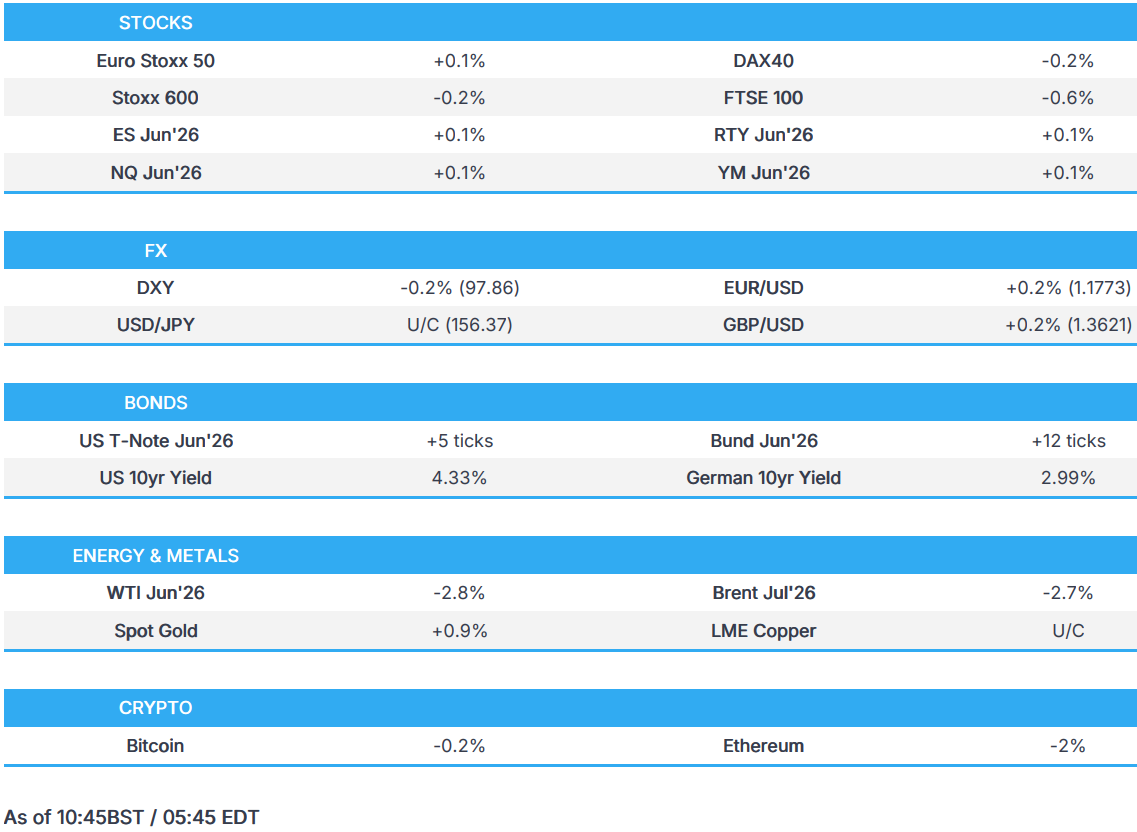
Newsquawk in 3 steps:
1. Subscribe to the free premarket movers reports
2. Listen to this report in the market open podcast (available on Apple and Spotify)
3. Trial Newsquawk’s premium real-time audio news squawk box for 7 days
IRANIAN CONFLICT
- Iran is expected to provide its reply to mediators on Thursday, CNN reported citing a regional source.
- “Arabic sources: Reaching understandings regarding easing the siege in exchange for the gradual opening of the Strait of Hormuz “, Al Arabiya reported; “The coming hours will witness a breakthrough for the situation of the ships stuck in the strait”.
- Pakistani Foreign Ministry spokesperson said, “We do not talk about war and instead talk about dialogue and diplomacy. However, if any aggression similar to what we saw last year, we will respond; Pakistan will respond just as it did”, Mallick posted.
- Pakistani Foreign Ministry Spokesperson said “We have not yet received a response from Iran regarding the US amendments”, Al Jazeera reported.
- “Pakistani source to Al Arabiya said Iran may hand over its response to the US proposal to the Pakistani mediator today”, Al Arabiya. “No arrangements for any direct meetings between the Iranians and the Americans so far.”. “Contacts with the Iranians are ongoing and there are no obstacles hindering continued”. “Discussions are ongoing regarding the status of the Strait of Hormuz, and reaching understandings is still possible”.
- Pakistani Foreign Ministry said “We expect an urgent agreement between Iran and the United States”, Al Araby reported.
- “Israel was informed that Iran has agreed to transfer its stockpile of 60% enriched uranium to a third country that remains unknown”, Sky News Arabia reported citing Israeli Channel 12.
- Pakistani Foreign Ministry spokesperson, on US-Iran agreement, said “we would expect an agreement sooner rather than later”, Pakistani journalist Mallick posted. “We will welcome any settlement wherever that takes place, if it takes place in Islamabad, it would be an honour and privilege.”.
- The proposed agreement between the US and Iran may limit the IDF’s action in Lebanon, Israeli press reported citing an Israeli official.
- US President Trump, on Iran, said it will all work out very quickly.
- IDF said it has intercepted suspicious aerial target launched from Lebanon towards Israel following sirens that sounded in Manara, Margaliot and Kiryat Shmona.
- Lebanon’s PM Salam said it is not seeking normalisation with Israel and it is too early to discuss any possible meeting with Israeli PM Netanyahu.
- Iran has issued a message to commercial vessels in the Strait of Hormuz, saying Iran’s port is fully prepared to provide general maritime services and support to the vessels, IRNA reported.
- US President Trump could turn to military action without an Iran agreement ahead of the China trip, Axios reported citing US officials.
- US President Trump’s reversal on his plan to help ships go through the Strait of Hormuz came after Saudi Arabia suspended the US’s ability to use its bases and airspace to carry out Project Freedom, NBC reported citing US officials.
- IRGC Navy Political Affairs Official said we will impose our control over the Strait of Hormuz, and any attack will be met with a plan beyond the enemy’s calculations, Al Jazeera reported.
EUROPEAN TRADE
EQUITIES
- European bourses are broadly modestly firmer, attempting to build on the hefty gains seen in the prior session. Geopolitics remains the key focus this morning, with Iran expected to provide its reply to the US proposal for ending the war to mediators on Thursday, CNN reported. Sentiment in early morning trade was lifted after Al Arabiya reported that “the coming hours will witness a breakthrough for the situation of the ships stuck in the strait”.
- European sectors are mixed. Travel & Leisure takes the top spot, joined closely by Consumer Products and then Autos. Sectors which have broadly benefited from the risk-tone and/or lower energy prices. Elsewhere, Utilities is found right at the foot of the pile, joined closely by Telecoms.
- In terms of key movers: Henkel (+3.9%, sales topped exp.), Rheinmetall (-3.1%, missed on Q1 EPS, but reaffirmed outlook), Telecom Italia (+3.2%, revenue +1.4% amidst strong Brazil growth), Shell (-1.7%, EPS and Rev. topped expectations whilst announcing a USD 3bln buyback), Flutter (-3.6%, cut guidance despite reporting higher Q1 revenue).
- US equity futures are all trading modestly firmer this morning, with gains of circa. 0.1%. As for pre-market movers: Arm (-5.2%, weaker-than-expected royalty revenue and rising operating expenses offset enthusiasm for its AI server opportunities). Snap (-9.8%, issued cautious guidance, the end of its Perplexity partnership, and uncertainty from Middle East headwinds).
- Click for the sessions European pre-market equity newsflow
- Click for the additional news
FX
- DXY is on a softer footing amid renewed downside in crude prices following headlines in Arabian press that a breakthrough may be reached between the US and Iran in the coming hours regarding the Strait of Hormuz. Further, Israeli press suggested Iran has agreed to transfer its 60% HEU to a third unknown country. That being said, it’s worth noting that none of the reports thus far have come from Iranian outlets. DXY resides in a 97.856-98.058 range, still within yesterday’s 97.625-98.342 parameter.
- G10 price action has largely been dictated by the Iranian war optimism. EUR/USD is back over 1.1750 in a 1.1741-1.1775 range and still within yesterday’s parameter.
- GBP/USD rose back above the 1.3600 mark but remains within Wednesday’s parameter, although traders also eye UK local elections. A full preview can be found on the headline feed, but in brief, a worse-than-expected outcome for the Labour Party could see renewed pressure on PM Starmer.
- USD/JPY is softer but only marginally, and within a narrow 156.02-156.53 range. Japanese participants returned overnight from Golden Week. Japan’s Chief FX Diplomat Mimura made comments earlier in the APAC session but refused to comment on FX intervention, and reiterated that FX is being closely watched. USD/JPY did see some fleeting pressure as Mimura spoke. Further on the FX front, US Treasury Secretary Bessent is to meet with Japanese PM Takaichi, Finance Minister Katayama and BoJ Governor Ueda for 3 days, starting Monday 11th, to discuss the weak yen.
- Antipodeans are firmer amid their high-beta properties coupled with upside across base and precious metals, albeit both the AUD/USD and NZD/USD pairs reside within the upper end of yesterday’s range.
FIXED INCOME
- A modestly firmer session for fixed benchmarks, driven higher by a pullback in energy this morning on a handful of constructive geopolitical updates ahead of the expected Iranian response, via Pakistan, to the US proposal.
- Updates that lifted the benchmarks from near-enough unchanged this morning to gains of a handful of ticks in USTs, but pertinently to a new WTD high of 111-01+. Bunds were similarly bid at the time, got to 126.12, also a new WTD peak, posting gains of 42 ticks at the time.
- Since, the benchmarks have pulled back modestly from the above peaks but remain in the green by a few ticks into an afternoon that is likely to be dominated once again by geopolitical updates, but the docket is also packed with data and Fed speak.
- For Gilts, they gapped higher by 31 ticks to a 87.70 session high, driven by the above geopolitical move being in full swing at the time. Gilts have also waned from best and currently hold onto gains of c. 10 ticks. Voting in the UK’s local elections is now underway, polls close at 22:00BST. Thereafter, a drip feed of results will occur throughout the night and well into Friday, the results of which could spark the formal start of a leadership challenge against PM Starmer, in the days and weeks ahead.
- Saudi Arabia’s PIF is offering three-, seven- & 30yr USD benchmarks bonds, Bloomberg reported citing sources; IPTs are USTs +130-170bps.
- Australia sold AUD 150mln 0.25% 2032 I/L bonds: b/c 3.97x, average yield 2.172%.
COMMODITIES
- Renewed downside was seen in crude prices following headlines in Arab press that a breakthrough may be reached between US and Iran in the coming hours regarding the Strait of Hormuz. Further, Israeli press suggested Iran has agreed to transfer its 60% HEU to a third unknown country. That being said, it’s worth noting that none of the reports thus far have come from Iranian outlets.
- Regarding the state of talks, US President Trump is optimistic about a framework, and Iran is expected to respond to the US proposal via mediators on Thursday. Axios reported Trump could still turn to military action without an agreement before his China trip. Iran is expected to provide its reply to the US proposal for ending the war to mediators on Thursday, CNN reported, citing a regional source. WSJ editorial said, from its discussions with senior officials, current US red lines in the talks include Iran confirming it does not seek nuclear weapons; the dismantlement of Fordow, Natanz and Isfahan; a ban on underground nuclear work; and on-demand inspections with penalties for violations.
- WTI and Brent futures have been trading off the hopes of oil flowing through the Strait once again. Brent July resides towards the bottom end of a USD 97.44-102.55/bbl range; WTI June sits towards the bottom of a 91.92-96.48/bbl range at the time of writing. Dutch TTF this morning dropped to EUR 42/MWh on the report from near EUR 45/MWH before stabilising around EUR 43.50/MWh.
- Spot gold topped Wednesday’s USD 4,723/oz high to reach a current peak of USD 4,753.43/oz, amid the aforementioned pullback in energy. Spot gold sees its 100 DMA at USD 4,774.67/oz.
- Base metals are mostly firmer as the pullback in crude prices bodes well for risk sentiment and broader global economic growth. That being said, 3M LME copper is flat within a USD 13,331.58-13,448.83/t range as it takes a breather from yesterday’s gains.
- Chinese Gold Reserves at 74.64mln troy oz at end-April (prev. 74.38mln in March); extends gold buying streak to 18 months.
- German government has rejected a return to nuclear power.
- A drone crashed into an oil storage facility in a Latvian town close to the Russian border, according to LSM.
- LME’s CEO said it is ready to expand its suite of approved warehouses in Hong Kong.
- Australia set domestic gas reservation scheme at 20%.
- HKEX CEO said the LME warehouses approved in Hong Kong are close to full capacity.
- China has reportedly asked banks to pause new loans to US-sanctioned refiners, Bloomberg reported citing sources.
- The Trump administration is studying using oil under land at US military bases and other DoW sites to help refill the emergency reserves, Bloomberg reported citing sources.
- North Korea said it will not join the nuclear non-proliferation treaty, according to KCNA.
TRADE/TARIFFS
- A South Korean official said the country’s first US investment under trade deal is to be announced after law takes effect in June.
- European Parliament’s Top Negotiator said that good progress has been made in the EU-US talks though issues remain unsolved and that we will continue advancing progress and ensure stronger protections for citizens and businesses.
NOTABLE EUROPEAN HEADLINES
- A Cyprian official said EU countries and lawmakers have reached a provisional deal to delay the implementation of watered-down AI rules.
NOTABLE EUROPEAN DATA RECAP
- EU Retail Sales MoM (Mar) M/M -0.1% vs. Exp. -0.4% (Prev. -0.2%, Low. -1%, High. 0.3%).
- EU Retail Sales YoY (Mar) Y/Y 1.2% vs. Exp. 1% (Prev. 1.7%, Low. 0.2%, High. 1.5%).
- EU HCOB Construction PMI (Apr) 41.7 (Prev. 44.6).
- UK S&P Global Construction PMI (Apr) 39.7 vs. Exp. 46.2 (Prev. 45.6).
- Norwegian Norges Bank Interest Rate Decision 4.25% vs. Exp. 4.25% (Prev. 4%, Low. 4%, High. 4.25%).
- Swedish Riksbank Rate Decision 1.75% vs. Exp. 1.75% (Prev. 1.75%, Low. 1.75%, High. 1.75%).
- French HCOB Construction PMI (Apr) 38.1 (Prev. 38.4).
- French Balance of Trade (Mar) -6.9B vs. Exp. -5.6B (Prev. -5.8B).
- French Current Account (Mar) -8.20B (Prev. -1.8B).
- French Exports (Mar) 52.5B (Prev. 52B).
- French Imports (Mar) 59.3B (Prev. 57.8B).
- Italian HCOB Construction PMI (Apr) 44.8 (Prev. 46.8).
- German HCOB Construction PMI (Apr) 42.1 (Prev. 48.0).
- German Factory Orders MoM (Mar) M/M 5.0% vs. Exp. 1.1% (Prev. 0.9%, Low. -1.5%, High. 5%).
NOTABLE EUROPEAN EQUITY HEADLINES
- Palliser Capital has reportedly begun building a stake in FTSE-100 firm Autotrader Group (AUTO LN) and pushing for it to set out plans to return up to GBP 700mln to shareholders alongside full-year results this month, Sky News reported.
- Maersk (MAERSKB DC) CEO said if the Middle East situation becomes more peaceful, will then assess whether Red Sea transit can resume.
- Maersk (MAERSKB DC) Q1 2026 (USD): Revenue 12.97bln (prev. 13.32bln Y/Y), EBITDA 1.75bln (prev. 2.71bln Y/Y), PBT 292mln (prev. 1.43bln Y/Y); maintains FY outlook. The Middle East conflict had limited impact on the quarter’s realised financial results.
- Shell (SHEL LN) Q1 2026 (USD): EPS 1.22 (exp. 1.06), Adj. EBITDA 17.7bln (exp. 15.1bln); announces a USD 3bln share buyback and a 5% quarterly dividend increase. Other Metrics. Adj. Earnings 6.915bln (prev. 3.256bln Y/Y),. CFFO 6.062bln (prev. 9.438bln Y/Y). Cash capex 4.202bln (prev. 6.015bln Y/Y). Free cash flow 2.9bln (prev. 4.2bln Y/Y). Net debt 52.6bln (prev. 45.7bln Y/Y). Gearing 23%, dividend +5% to 0.3906. Capex guide USD 24-26bln FY. Comments. Q2 2026 outlook reflects lower expected volumes and a weaker margin environment. Q2 2026 production outlook reflects higher planned maintenance across the portfolio. Q2 2026 production and liquefaction outlook reflects the impact of Middle East conflict including Qatar and higher planned maintenance across the portfolio.
- EU Transport Commissioner said airlines must continue to reimburse passengers for flight cancellations caused by high energy prices, the FT reported.
CENTRAL BANKS
- Fed’s Goolsbee (2027 voter) said he is open to new ways of thinking about inflation. Overhauling the Fed’s inflation framework is ‘not an easy space’. Kevin Warsh has some fresh ideas worth thinking about. Fed should incorporate all the data it can, but he doesn’t think there is a silver bullet for the inflation problem. He would be on the lookout for ‘underheating’ demand if low consumer confidence translates into falling consumer spending. US might be approaching an era of labour scarcity due to a combination of population aging and limited immigration.
- BoJ data up to April 30th shows Japan spent around JPY 4.68tln to support the JPY.
- BoJ Minutes from the March 18th-19th meeting stated that many members shared the view that it was appropriate to maintain the policy rate at 0.75%.
- ECB’s Villeroy said they must be data dependent.
- ECB’s Nagel said likely to raise interest rates unless the outlook improves markedly.
- ECB’s Kocher said ECB is to consider hikes in the next months if there is no improvement; ECB is in data-dependent meeting-by-meeting mode.
- BoE officials are privately concerned that UK economic data may be sending false signals that complicate the job of setting interest rates, according to Bloomberg citing sources.
- RBNZ Governor Breman said higher near term inflation and weaker growth is somewhat expected, still expect growth this year.
- PBoC injected CNY 27bln via 7-day reverse repos with the rate maintained at 1.40%.
- PBoC set USD/CNY mid-point at 6.8487 vs exp. 6.8087 (prev. 6.8562).
- BoC Governor Macklem said inflation forecasts in the July monetary policy report will not change much after including the government fiscal update.
- BoC Governor Macklem said if oil prices keep rising and stay elevated “there may be a need for consecutive increases in the policy rate”. If the United States imposes significant new trade restrictions on Canada, we may need to cut the policy rate further to support economic growth. Alternatively, if oil prices continue to increase, and particularly if they remain elevated, the risk that higher energy prices become ongoing generalized inflation increases. If this starts to happen, there may be a need for consecutive increases in the policy rate.
- Norges Bank hikes rates by 25bps to 4.25% (prev. 4.00%); “The Committee judges that a higher policy rate is needed to return inflation to target within a reasonable time horizon”.
- Riksbank maintains its Policy Rate at 1.75% as expected, “there is scope to wait until there is a clearer picture”, “current level of the policy rate gives a good initial position to adjust monetary policy if required to safeguard the inflation target”.
NOTABLE US HEADLINES
- US Challenger Job Cuts (Apr) 83.387K (Prev. 60.62K)
- The US and China are considering launching official discussions on AI when US President Trump visits China next week, WSJ reported citing sources. With the proposed recurring conversations, risks from unexpected AI model behaviour, autonomous military systems, and attacks by non-state actors using open source tools will be addressed.
GEOPOLITICS
RUSSIA-UKRAINE
- Romanian Defence Ministry said a drone briefly breached Romanian airspace during a Russian attack on Ukraine.
- A drone crashed into an oil storage facility in a Latvian town close to the Russian border, according to LSM.
- Ukrainian President Zelensky said Russia has ignored our ceasefire proposal.
- Russian Foreign Ministry spokesperson said that Russia is ready to negotiate about Ukraine and emphasises that Moscow has never refused called and talks that have real results.
- Russia has decided to use its veto against the US-Gulf draft resolution on Hormuz; Russia rejects the chapter VII wording of the draft resolution on Hormuz, via Al Hadath.
CRYPTO
- Bitcoin is a little weaker this morning and trades around USD 81k, whilst Ethereum is extending losses down to USD 2.33k.
APAC TRADE
- Asia-Pac stocks traded broadly in the green, as a continuation of gains seen stateside as hopes of an end of the US-Iran conflict spurred risk-on flows.
- ASX 200 continued its rebound and is set for 2 consecutive days of gains. Miners were the biggest gainers while Energy names slumped. Shares of Tabcorp have nose-dived after the Co. stated that AUSTRAC has commenced an enforcement investigation with serious concerns over money laundering and terrorism financing risks.
- Nikkei 225 returned from its holiday with the need to catch up to the gains seen in equities while it was closed. As a result, the Nikkei surged to new ATHs and extended above the 63,000 handle, driven by tech majors SoftBank and Ibiden.
- KOSPI underperformed its APAC peers, as it consolidated following its surge beyond the 7,000 handle. SK Securities raised its PT for Samsung Electronics and SK Hynix to a price that is 88% and 87% higher, respectively, than their current price, reaffirming the tech strength.
- Shanghai Comp. and Hang Seng gained despite a lack of single-stock news. Continuing on the chip theme, Montage has overtaken CATL as the most expensive dual-listed stock in Hong Kong relative to its mainland shares.
NOTABLE ASIA-PAC HEADLINES
- Philippine’s Economic Minister said controlling inflation, even if it will cost growth, is not necessarily bad.
- China’s top diplomat Wang Yi met with a delegation led by Steve Daines on Thursday, Xinhua reported.
- South Korea’s government is to invest KRW 30bln in a project aimed at establishing an AI data platform for autonomous vessels, Yonhap reported.
- Indonesia’s Planning Minister said the 2027 government working plan is set with GDP growth target in a range of 5.9-7.5%.
- Hong Kong Financial Secretary Chan announces plans to promote the use of the CNY in commodity pricing.
- China rural banks have reportedly cut its deposit rates, with further cuts expected.
- Japan’s Top FX Diplomat Mimura does not comment on FX intervention but said FX is being closely watched and are in daily contact with US authorities. IMF’s classification of free floating regime does not restrict frequency of intervention. Will not comment on FX levels. Too early to comment on US Treasury Secretary Bessent’s upcoming visit.
- US Treasury Bessent is to meet with Japanese PM Takaichi, Finance Minister Katayama and BoJ Governor Ueda for 3 days, starting Monday 11th, to discuss the weak yen, Nikkei reported.
NOTABLE APAC DATA RECAP
- Chinese Foreign Exchange Reserves (Apr) 3.411T (Prev. 3.342T).
- Australian Exports MoM (Mar) M/M -2.7% (Prev. 4.9%).
- Australian Balance of Trade (Mar) -1.841B vs. Exp. 4.45B (Prev. 5.686B).
- Australian Imports MoM (Mar) M/M 14.1% (Prev. -3.2%).
- Japanese Monetary Base YoY Y/Y -11.3% vs. Exp. -10.5% (Prev. -11.6%).
NOTABLE GLOBAL EQUITY HEADLINES
- New Zealand’s Defence Minister said they are in talks with Australia and the UK to replace its Navy frigates.
1 c Asian opening report
2.a NORTH KOREA/SOUTH KOREA/JAPAN
JAPAN
HUMOUROUS, SAD AND TRUE;
Japan to Be Culturally Enriched With 300,000 Bangladeshi Migrants

by Armageddon Safari
Thursday, May 07, 2026 – 8:40
Originally published via Armageddon Safari:
Citing the “attractiveness” of Japan for Bangladeshi migrants, the Japanese authorities have announced a grand plan to culturally enrich the lamentably homogenous homeland with a third of a million Bangladeshis, with much more ambitious proposals in the pipeline.
Via Bangladesh Sangbad Sangstha (emphasis added):
“The government has intensified preparations to send huge numbers of skilled manpower to Japan under the Specified Skilled Worker (SSW) category, as Japan faces an ongoing shortage of qualified manpower.
The Japanese government has set a target to recruit [820,000] foreign workers across 16 sectors under the SSW category by March 2029.
Experts and officials believe that if Bangladesh prepares effectively, it can supply up to 40 percent of this demand that is more than 300,000 workers.
Previously, Bangladesh had the capacity to send workers in only six of these categories. Now, the government is working to develop skilled manpower for all 16 categories.
Professor Dr. Md. Jahangir Alam, Chairman of the Japanese Studies Department at Dhaka University described Japan as an attractive destination for Bangladeshi workers*.
He said with proper focus on skill development, Bangladesh can meet a substantial portion of Japan’s labour demand, boosting foreign currency earnings.”
*Obviously Japan is going to be “an attractive destination for Bangladeshi workers,” as it houses millions and millions of unraped exotic Orientals to pillage.
They’re going to have a field day.
Related: Afghan Migrant Sexually Assaults Incapacitated German Teen on Subway Platform ‘for Hours’
Exclusive video of the enriching future that Japanese women have to look forward to
Luckily for the ladies of Japan, they can now take advantage of a hot new product called VenusGuard that mutilates the genitals of would-be rapists, exclusively intended for self-defense purposes and in no way designed by its Western feminist architects to be weaponized against the (white) men who have brutally oppressed them for centuries under The Patriarchy™.
VenusGuard product demo
—————————————–
[If you appreciate Armageddon Prose, please consider a $5/month or $50/year Substack subscription or a one-time digital “coffee” donation. For alternative means of patronage, email benbartee@protonmail.com.]
——————————————
Anyway, immigration figures for 2025 recently dropped in March, revealing that the foreign population in Japan spiked 9.5 percent in a single year — the highest year-to-year increase on record.
Via The Mainichi (emphasis added):
“The number of foreign nationals residing in Japan hit a record 4.13 million in 2025, topping 4 million for the first time, aided by a rise in permanent residents and foreign workers, government data showed Friday.
According to the Immigration Services Agency, 4,125,395 foreign nationals were residing in Japan at the end of 2025, up 9.5 percent from the previous year, hitting a record high for the fourth consecutive year.”
Benjamin Bartee, author of Broken English Teacher: Notes From Exile (now available in paperback), is an independent Bangkok-based American journalist with opposable thumbs.
NORTH AND SOUTH KOREA
3. CHINA/
CHINA/USA
i guess complying to Trump’s demands!!
(zerohedge)
Beijing Flip-Flops, Asks Banks To Pause Loans To Sanctioned Refiners Days After Ordering Them To Ignore Sanctions
Thursday, May 07, 2026 – 11:40 AM
Over the weekend, we reported that in what some called a “watershed moment”, Beijing ordered Chinese companies not to comply with US sanctions on five domestic refiners linked to the Iranian oil trade, deploying for the first time a blocking measure introduced in 2021 that was aimed at protecting its firms from foreign laws it deemed unjustified. Of note, China’s refiners – including Hengli Petrochemical (Dalian) Refinery which was sanctioned last month and several other privately-owned processors – had been facing asset freezes and transaction bans. Hengli was the most ambitious target to date in China’s refining sector, and underscores US eagerness to push Iran to the negotiating table at all costs, even just weeks before an expected and long-awaited meeting between Trump and his counterpart Xi Jinping.
Well, maybe not. In an apparent reversal of its blocking measure orders, overnight Bloomberg reported that China’s financial regulator advised the country’s largest banks to temporarily suspend new loans to five refiners recently sanctioned by the US over their ties to Iranian oil.
The National Financial Regulatory Administration asked banks to review their exposure and business dealings with firms including the abovementioned Hengli Petrochemical (Dalian) Refinery, one of China’s largest private refiners, while awaiting further guidance. For now, banks have been guided not to extend new yuan-denominated credit, though they have also been told not to call in existing loans, Bloomberg’s sources said.
The verbal directive, which came before China entered a long holiday weekend on May 1 and ahead of the upcoming Trump-Xi summit contrasts with a May 2 notice from China’s Ministry of Commerce, which instructed companies to disregard US sanctions. That was the first time China had deployed a blocking measure introduced in 2021 aimed at protecting its firms from foreign laws it deemed unjustified.
While China has often railed against unilateral sanctions, it has in past instances also quietly allowed its largest companies to comply with them, in order to avoid blowback on its own economy. Its largest state banks have a history of complying with US sanctions against Iran, North Korea, and even top officials in Hong Kong to avoid losing access to the US dollar clearing system. In earlier episodes, Beijing sought to shield its systemically important lenders by channeling Iran-related transactions through China National Petroleum Corp’s subsidiary Bank of Kunlun Co., which is currently sanctioned.
As Bloomberg notes, the moves highlight the balancing act Beijing faces as it tries to project defiance toward the Trump administration while shielding its largest state-owned banks from US secondary sanctions. Tensions are escalating between the superpowers just weeks before a long-awaited meeting between President Donald Trump and his counterpart Xi Jinping in Beijing on May 14–15.
Meanwhile, the White House has been ratcheting up efforts to cut off Iranian oil shipments to starve the Tehran regime for which oil remains the most vital financial lifeline. Late last month, the Treasury Department’s Office of Foreign Assets Control blacklisted Hengli, targeting a significant and well-connected player in the country’s vast crude-processing industry. The US also warned banks they are at risk of secondary sanctions if they support Chinese private refiners that buy Iranian oil.
Treasury Secretary Scott Bessent said the US sent letters to two Chinese banks warning them of the risk of secondary sanctions if they are found to be supporting transactions tied to Iran. Bessent didn’t identify the banks.
Separately, but perhaps linked to this, China’s independent refiners have slowed purchases of Iranian crude as they seek to manage a government push to make fuel at any cost to ensure energy security while they face collapsing profit margins.
There are about 16 million barrels on ships anchored in the Yellow Sea off the Chinese coast, almost 40% higher than the level prior to a US blockade of Iran’s ports in mid-April, according to data from Kpler. Already razor-thin teapot margins plunged to record negative levels after the cordon began, while Iran’s oil prices have climbed since the war started, compounding the economic stress on independent refiners.

While the cost of Iranian crude is now fetching a slight premium to ICE Brent, compared with discounts prior to the war, China’s domestic fuel policy is also crimping refiners’ profits. Price hikes are often softened to help shield consumers, preventing processors from fully passing on rising costs. Above all, Chna’s “energy security” is the dominant theme, even if it means an entire industry has to suffer huge losses.
The smaller processors, known as teapots, have little choice but to keep making fuels such as diesel and gasoline. They have been told by Beijing to keep output at 2025 levels, even if they incur losses, or face cuts to their oil import quotas. Refining rates in Shandong province ramped up over April to the highest level in almost two years, even as processing margins sunk deeply into the red.

Chinese purchases of Iranian oil are expected to be above 1.4 million barrels a day this year, down from a March peak of 1.8 million barrels a day, according to Emma Li, lead China market analyst at Vortexa Ltd. “China’s demand for high-risk crude is unlikely to weaken materially,” she said.
“I would not be surprised if the teapots are prioritizing politics over economics with an eye to their long-term survival,” said Erica Downs, a senior research scholar at Columbia University’s Center on Global Energy Policy. “They may be calculating that if they do their part to help China weather the energy crisis, then maybe they will build up some goodwill in Beijing.”
China’s teapots have a checkered history with government authorities. They have resisted efforts by Beijing to consolidate the industry in the past, but proved crucial for China’s fuel security in the 2000s. Iran also relies heavily on the smaller refiners, which buy most of the OPEC producer’s crude.
“In China, during special times like this, it becomes a political mission for private refiners to help secure fuel supplies,” said Liao Na, the founder of GL Consulting, which provides research on the Chinese refining industry.
4 EUROPEAN AND SCANDINAVIAN COMMENTARIES PLUS NATO
GERMANY
Americans Will Foot The Bill For Germany’s New Drug Price Controls
Thursday, May 07, 2026 – 05:00 AM
Authored by Drew Johnson via PJMedia.com,
Germany just found a new way to lower its own healthcare costs: make Americans pay more.

In late April, German policymakers proposed changes that cap spending growth, restrict care, and force drugmakers to provide steep discounts.
These changes are supposed to save Germany money. But drugmakers still need to recoup the high costs of research and development. When a country like Germany suppresses the prices it pays for innovative medicines, those costs don’t disappear — they simply shift elsewhere.
And because many other wealthy countries use similar price controls, that cost burden is increasingly falling on the United States.
The global imbalance is already stark.
American patients generate roughly three-quarters of global pharmaceutical profits despite accounting for just a quarter of global GDP. In effect, the United States is underwriting much of the world’s drug innovation while patients abroad pay far less for the same treatments.
President Trump has spent months trying to end this freeloading by pressing other countries to pay fair value for new treatments — and he shouldn’t let Germany get away with refusing to cooperate.
Foreign mooching off American medical innovation is a real and longstanding problem. Wealthy governments around the world — and especially in Europe — set drug prices by decree, effectively refusing to pay manufacturers fair value for treatments they spend years, sometimes decades, developing.
As a result, drugmakers disproportionately rely on revenue from the United States to sustain research and development. While patients abroad often pay cut-rate prices, Americans pay far more for the same meds. That imbalance is fundamentally unfair.
Of course, America can’t simply stop paying for innovation. If U.S. leaders copied other countries’ price-control tactics — as Democrats have often suggested — companies would struggle to earn returns on new research, and global development of life-saving new drugs would grind to a halt.
That leaves only one viable solution: force other countries to start paying their fair share for innovation.
President Trump has made progress on this front by pressuring wealthy allies directly. In April, for instance, he convinced the United Kingdom to increase its spending on new medicines. The deal proved that a firm U.S. stance could yield meaningful results.
But Germany is now testing America’s resolve. Germany already spends far less than the United States on medicines, even when factoring in its smaller population and economy. Its new plan will deepen that divide by imposing strict limits on health spending growth and taking money directly from manufacturers to fund drug coverage.
Soon, Germany will pay even less than it already does for innovative medicines. The result will be higher costs concentrated in the U.S. market — or reduced investment in new cures. Either way, American patients will bear the burden.
And if Washington fails to respond, its broader effort to end foreign free-riding will lose credibility. Other countries will assume that they can continue to free-ride without facing consequences.
The United States needs to make a stand.
Fortunately, the Trump administration has real negotiating leverage. As the recent deal with the UK shows, U.S. trade officials have plenty of tools to obtain cooperation from foreign governments. They should use these tools to ensure fair pricing, knock down barriers to market access, and make clear that continued freeloading will come with consequences. This can and should start with a Section 301 investigation of other countries’ drug-pricing policies. Such a move would expose unfair practices and empower U.S. officials to impose trade penalties, forcing allies like Germany to pay fair value for innovative medicines.
Ultimately, policymakers should ensure that all of America’s allies pay their fair share. President Trump ended a different form of international leeching last year when he convinced NATO members to spend a greater percentage of their GDP on defense. If U.S. negotiators can secure similar spending targets for innovative medicines, they can end free-riding for good — and allow drugmakers to lower prices at home without hurting innovation.
American patients shouldn’t have to subsidize the world’s medicine cabinet. The policies of countries like Germany have inflated U.S. drug costs for too long.
By standing up to Germany now, President Trump can reaffirm that the United States no longer tolerates foreign freeloading on American medicines, while helping to reduce costs for American patients and preserving the breakthroughs they depend on.
END
AUSTRIA/VIENNA
Half Of Vienna Secondary School Students Are Now Muslim As Cultural Tensions Grow In Classrooms
Thursday, May 07, 2026 – 06:30 AM
Authored by Thomas Brooke via Remix news,
Almost half of students in Vienna’s public middle schools are now Muslim, according to new figures from the Vienna Education Directorate, marking the latest sign of a rapid demographic and cultural shift inside the Austrian capital’s classrooms.

The data, cited by Heute, shows that Muslim students account for 49.4 percent of children in Vienna’s public middle schools — just short of an absolute majority. Across the city’s public compulsory schools more broadly, including elementary, middle, special needs, and polytechnic schools, Muslim students now make up 42 percent, up from 41.2 percent in the previous school year.
Catholic students, once the dominant group in the city, now account for just 16.7 percent of children in the public schools included in the figures. Orthodox students make up 14.2 percent, while children with no religious affiliation account for 23.2 percent.
The figures also reveal a stark divide between Vienna’s public and private schools.
In private schools, Catholics remain the largest group at 45.39 percent, followed by students with no religious affiliation at 25.1 percent and Orthodox students at 10.6 percent. Muslim children account for just 7.6 percent of students in Vienna’s private schools.
Taken together, across both public and private schools, Muslim students now form the largest single group at 38.3 percent. Even when Catholic and Orthodox children are combined, they reach only around 33.6 percent.
The numbers reveal how the city’s public schools are becoming the front line of a much broader cultural transformation. Earlier this year, Remix News reported that more than half of first-grade students in Vienna were listed as Muslim for the first time, while separate reporting from Profil described one secondary school where a Christian boy was allegedly the only Christian in his first-grade class.
At that school, 230 of the 390 students were Muslim, while 99 percent of the students had an immigration background. Only five children in the entire school were reported to have no migrant background. The Christian boy was reportedly mocked by classmates and called a “pig,” while teachers described classrooms marked by language barriers, social problems, and growing religious pressure.
The school was said to include students speaking 32 different languages, with Turkish, Arabic, and Chechen among the most common home languages. One teacher said that the problems were so extensive that every class could use its own social worker.
Concerns over integration have also spilled into the school canteen. In October 2025, the Austrian Farmers’ Association warned that pork dishes such as schnitzel, ham noodles, and roast pork had become rare or had disappeared entirely from some Viennese school menus. The association said some schools now offered only vegetarian meals or meat dishes without pork, citing a mother who said her daughter could choose only between vegetarian food and “pork-free” food.
“No one has to eat pork, but it must be offered. Pork is part of our culinary culture,” said Corinna Weisl, director of the Farmers’ Association.
The group’s president, Georg Strasser, said preserving choice was the key issue, arguing that “diversity on the plate means freedom of choice for everyone.”
For some parents, however, the question is whether public schools can still deliver basic education. In February, Remix News reported the case of a Vienna mother who withdrew her daughter from a public primary school in Rudolfsheim-Fünfhaus after two years, saying only four children in the class spoke German fluently.
The mother, identified as Sabine G., said teachers spent much of the day translating instructions and managing basic communication rather than teaching. By the end of the first school year, she said her daughter still could not recite the alphabet, while several classmates had to repeat the grade.
She also said her daughter had begun refusing pork after being told it was “unclean” and had started rejecting certain summer clothing.
“I felt my child was being strongly influenced,” she said.
Teachers’ representatives have voiced similar concerns. In November last year, Thomas Krebs of the Christian Trade Unionists Group warned that some students and parents were increasingly unwilling to learn German or accept local values. He said female teachers had faced disrespect, insults, and even physical assaults from male students and parents, and claimed that religious rules were often being placed above Austria’s national curriculum.
“Our educational principles are often rejected. For example, religious content is prioritized over the content of the curriculum prescribed by Austrian law,” Krebs said. He called for mandatory German-language instruction and compulsory integration programs outside school.
The cultural tensions have also reached school leadership. In December, Christian Klar, headmaster of the Franz Jonas European School in Vienna-Floridsdorf, used his book “How Do We Save Our Children’s Future?” to warn of what he called a growing “clash of cultures and religions” in the classroom.
Klar cited the case of a gay teacher at a public elementary school whose sexuality prompted a Muslim father to demand his removal. The school refused to dismiss or transfer the teacher, but allowed the father’s son to change classes. Klar called the decision “de-escalating” but questioned what precedent it set.
“When is it time to say ‘Stop!’? I think we should have done that a long time ago!” he said.
The school figures reflect wider demographic changes across Vienna. In January, Statistics Austria data showed that 40.5 percent of babies born in the capital did not have Austrian citizenship, double the share recorded two decades earlier. In districts such as Favoriten, Ottakring, and Rudolfsheim-Fünfhaus, the figure has passed 50 percent.
At the same time, more than 44 percent of Vienna’s roughly 16,700 first-graders reportedly lacked sufficient German to follow lessons. In the 2018/2019 school year, the share was 30 percent. Officials have noted that around 60 percent of those children were born in Austria, intensifying concerns that poor German language skills are being passed on inside migrant communities rather than solved by birth and schooling in the country.
END
UK
Will Today’s British ‘Midterms’ Spark ‘Starmageddon’ For The Labour Party?
Thursday, May 07, 2026 – 07:20 AM
All eyes on UK local elections (Britain’s ‘Midterms’) today.
As JPMorgan’s Market Intel desk noted this morning, while the seats up do not influence national policy, Brits have historically used local and regional elections to punish the party in power in Westminster.
Reform UK is expected to come out as the main beneficiary of the elections, with Labour the biggest loser.
The key risk is that Labour’s poor performance causes MPs to push Starmer out in an attempt to improve the party’s standing ahead of 2029 elections.
This could come in the form of a formal leadership challenge or a ministerial resignation that triggers others to follow suit (for the former, Rayner seen as the most likely candidate for now, while Andy Burnham could make another attempt to enter parliament in the summer).

Gilts are especially sensitive to political developments (muscle memory from LDI crisis and the 2024 Autumn Budget) and renewed fiscal concerns could drive further underperformance – risk premia has been building as 30Y yields surged to their highest level since 1998 on Tues, underperforming EA rates by ~35bps since the war.

While risks are skewed bearish for GBP and rates, our economist emphasizes changes to fiscal strategy are not a foregone conclusion.

With the market impact out of the way, LibertyNation.com’s Mark Angelides explains below, such small-scale ballots were traditionally focused on garbage collections and potholes, but with the growing disaffection in politics – aimed squarely at the ruling Labour Party and the Conservative Party – politicos and pundits are treating them as a midterm equivalent. And with potentially the biggest defeat for any establishment party ever as the most likely outcome, UK politics may never be the same again.
End of the Line?
Before getting to the almost certain defeat of Sir Keir Starmer’s ruling Labour Party, it’s worth sparing a thought for His Majesty’s loyal opposition, the Conservative Party.
The party of Margaret Thatcher and Winston Churchill, rightly regarded as the most successful political outfit of all time, is on the cusp of no longer being a national party. But how could such a reversal of fortunes happen in a contest that is not even a general election?
As well as in local council elections in large parts of England today, voters are also casting ballots in the devolved parliaments of Scotland and Wales: Holyrood, the Scottish body, and the Welsh Senedd elections. The Labour Party is in the unenviable position of having to defend the lion’s share while contending with historic deficits in overall approval. But the rise of the Reform Party and the reinvigorated Green Party is at the root of the anticipated toppling of the UK’s two great parties.
Reform UK – An Unstoppable Force?
Labour won the general election in a landslide back in 2024, and it has all been downhill since then. Nibbling away at the edges of its supposed “red wall” support in the north of the country is the Reform Party, whose leader, Nigel Farage, made his own parliamentary breakthrough in ’24. Notably, in every single poll for the last 12 months, Reform has placed first – not bad for a new party. And while it was initially thought it was only the Conservatives who were bleeding members, support, and treasure to Reform, the surveys show a clear decline for Labour, too.
Indeed, if a general election were held today, a polling aggregate suggests Reform would be the largest party in Parliament with around 250 seats (out of 650). Second place would go to Conservatives with just 128, and Labour a distant third on only 78 (a loss of 334 seats). This is the backdrop as the two parties that have exchanged power for the last 100 years head into today’s elections – a midterm referendum by another name would smell as sour. But that is the big picture; the local contests are set to be even more damning.
The projections are enough to create panic across Westminster.
Local Elections Matter
Of the almost 5,000 local seats up for grabs, Labour is defending 2,557; polling suggests it will lose between 50% and 75% today.
The Conservatives are defending more than 1,300 and will be lucky to save even a third of that number.
Different parts of the country hold local elections in different years, so Reform currently has zero seats to defend. However, if last year’s elections are any indication, it is likely to score big – with an estimated 1,300 pick-ups. This will mean that not only does it win more seats than any other party, but also more votes.
[ZH: DailySceptic’s Mark Littlewood notes that the scale of the apocalypse facing Labour is almost unimaginable. Last year the party lost two thirds of the seats it was defending and it may fare even worse this time. In absolute rather than relative terms, the position is bleaker still. In 2025, it had fewer than 300 councillors up for re-election as the areas voting were largely the Tory shires. This time, over 2,000 seats start in the Labour column and it could be reduced to 600 or even fewer. Swathes of the party’s campaigning infrastructure will be overwhelmed as a turquoise tsunami engulfs the Red Wall. Outside London it may struggle to maintain majority control in any area at all with ‘all out’ elections – although it has sufficiently impregnable majorities to remain in power in a good number of places which elect in ‘thirds’.]
But that’s not the end of the bad news for the big two.
The Green Party has been on the eco-fringes of UK politics for several decades. With a core message on tree-hugging and environmental issues, it failed to make a significant breakthrough. Until now. Headed by new leader Zack Polanski, the party has shifted its focus from the environment to Gaza and has been courting the “independent Palestine” vote among the Muslim voting blocs.
One might assume this was a recipe for electoral disaster, and yet, with sizable, concentrated Muslim enclaves across the country, it is a formula for a certain amount of success.
The Muslim vote has been reliably Labour since it became a bloc. So, while Reform has been taking Labour votes in the traditional working-class heartlands from the right, the Greens are now encroaching on its territory from the left. The Greens are projected to win almost 700 seats in today’s contests.
What does this mean for Starmer?
Parliament on Maneuvers
Sir Keir is arguably the least popular prime minister since records began. His downfall from winning a huge majority in 2024 to being on the outs in 2026 is nothing short of a lesson in failure.
And his own party would have already moved to oust and replace him if it were not for today’s elections.

Unlike Americans, who vote for a president, Brits don’t vote for a prime minister but for a party – meaning that the current leading party can have an internal election to jettison an unpopular leader while still remaining the party of government.
So why haven’t they?
The simple answer is that no one wants to be the leader of a party that oversees a crushing local election result. In normal times, that leader must resign, step aside, or be removed by a party vote. Starmer is holding on only because they want him to shoulder the blame for the anticipated losses. And when the dust settles, the smart money says he will be shuffled off to “gardening duty,” while the Labour hopefuls pitch their dreams and schemes.
[ZH: Goldman Sachs base case is that a poor Labour result will not lead to an immediate leadership challenge for a two main reasons:
1) The three most likely leadership contenders (Burnham, Rayner, Streeting) all have recent / current issues limiting their prospects, and
2) A Labour leadership challenge requires at least 20% of the party (81 MPs) to publicly support a new leader – creating a much higher bar relative to the recent Conservative challenges we have seen (requiring just 50 anonymous MPs).
That said, this view is low conviction, acknowledging the massive uncertainty both of the result as well as implications, and therefore they can easily see a scenario where in aftermath the situation snowballs towards a leadership challenge.
We also acknowledge that were Andy Burham a current sitting MP, the situation would likely be much more perilous for Starmer.]
By this time tomorrow, when the ballots are counted, the results declared, and the crying jags finished, the prime minister will effectively be a dead man walking, and the Conservative Party will be a shadow of its former self in constituencies across the country, and maybe even nonexistent in certain parts of the UK.
Who said the pothole and garbage collection elections weren’t worth watching?
5.RUSSIA AND THE MIDDLE EAST
ISRAEL AND USA VS IRAN/WEDNESDAY NIGHT
Iran Oil Official In Surprise Admission: ‘Fate Of Our Refineries Now At Risk’ As US Blockade Begins To Bite
Wednesday, May 06, 2026 – 04:45 PM
Summary
- Iran oil sector official admits “serious threat” – telling NYT: “export of our oil and energy and the fate of our refineries is now at risk.”
- US Navy jet fires on Iran-flagged tanker trying to reach Iranian waters & port.
- Axios reports that the White House is nearing a preliminary deal with Iran to end the war, as Trump post appears to offer olive branch. Other reports say just hammering out at ‘framework’ for ‘monthlong’ talks.
- White House says it expects a response to the latest offer within 48 hours.
- Iran’s initial response via media & national security spox: US demands are unrealistic & do not reflect reality, & Axios report based on too much ‘speculation’.
- A key caveat of the US offered deal is that Iran would commit to a moratorium on uranium enrichment, & Washington wants a 20-year ban on this; Iran & China FMs coordinate messaging in Beijing, denying Iran’s intent to build nuclear bomb.
https://embed.polymarket.com/market?market=us-x-iran-permanent-peace-deal-by-june-30-2026-837&height=300US x Iran permanent peace deal by June 30, 2026?
Yes 44% · No 56%
View full market & trade on Polymarket
* * *
Surprisingly Frank Admission Out of Iran’s Oil Sector
An Iranian energy official just conceded something in a surprise admission that the US naval blockade has begun to bite the Islamic Republic’s oil industry. According to new reporting in the NY Times:
The blockade has halted Iran’s oil exports, choking off crucial revenues, and the country risks running out of places to store its oil. It is also affecting the import of other goods, forcing Iran to seek alternative routes through neighboring countries and its smaller ports on the Caspian Sea. And the economic pain inside Iran, already dire before the war, is becoming much worse.
“The sea blockade is a much more serious threat than even war, and the current stalemate must be broken because the export of our oil and energy and the fate of our refineries is now at risk,” said Hamid Hosseini, an expert on Iran’s oil sector who serves on the energy committee of Iran’s Chamber of Commerce, in an interview from Tehran.
This as Kpler has stated based on its data that since the US blockade took effect on April 13, no Iranian oil-laden tankers have been able to exit the strait.
“The bottom line is that Iran could run out of storage space in about 25 to 30 days if the blockade is not lifted, according to Homayoun Falakshahi, Kpler’s head of oil analysis,” continues the Wednesday report. “Other experts have given different estimates ranging from a few weeks to a month or more.” Last month we offered the following, saying a likely 15 days – probably followed with a few weeks left on the clock before the Iranians run out of storage space…
As for the current Trump blockade strategy, another analyst told the Times, “The blockade really is about putting a financial deadline on the Islamic Republic’s head.”
US Jet Fires On Iranian Tanker Trying To Pass
So much for that ceasefire and alleged ‘pause’ in US naval blockade actions, as things just took another escalatory turn. In this case, a rare live fire incident unfolded Wednesday in Gulf waters as a US jet launched from the Lincoln carrier fired on and possibly disabled an Iranian-flagged tanker, per the officials US Central Command statement:
U.S. forces operating in the Gulf of Oman enforced blockade measures by disabling an Iranian-flagged unladen oil tanker attempting to sail toward an Iranian port at 9 a.m. ET, May 6.
U.S. Central Command (CENTCOM) forces observed M/T Hasna as it transited international waters enroute to an Iranian port on the Gulf of Oman. American forces issued multiple warnings and informed the Iranian-flagged vessel it was in violation of the U.S. blockade.
After Hasna’s crew failed to comply with repeated warnings, U.S. forces disabled the tanker’s rudder by firing several rounds from the 20mm cannon gun of a U.S. Navy F/A-18 Super Hornet launched from USS Abraham Lincoln (CVN 72). Hasna is no longer transiting to Iran.
The Pentagon/CENTCOM statement then emphasized, “The U.S. blockade against ships attempting to enter or depart Iranian ports remains in full effect. CENTCOM forces continue to act deliberately and professionally to ensure compliance.” Tehran’s response to this will be interesting, and follows prior alleged attacks this week on the UAE.

‘Framework’ Being Hammered Out for ‘Monthlong Period of Talks’
Iran’s Foreign Ministry has said that Iran’s response to the United States has not yet been presented to mediator Pakistan, as the WSJ reports that the US and Iranian sides are currently trying to hammer out a one-page memorandum of understanding which features 14-points. This would “lay out a framework” – the report says, for a “monthlong period of talks to end the war.”
Given that agreement cannot even be found on the ‘framework’ for future talks, it seems the process is not very advanced at all – but is perhaps still back at square one, with headlines in the US way out front, and likely overly optimistic.
CNN citing the White House: “The White House received positive feedback from Pakistani mediators on Tuesday that the Iranians were progressing toward a compromise.” And more from WSJ:
Iran’s mission to the UN said that “the only viable solution in the Strait of Hormuz is clear: a permanent end to the war, the lifting of the maritime blockade, and the restoration of normal passage.”
END
ISRAEL/USA/IRAN THURSDAY MORNING
Oil Slides On Reports Of ‘Breakthrough’ Coming For Stuck Ships In Hormuz, As US Awaits Tehran’s Response To Fresh Proposal
Thursday, May 07, 2026 – 09:10 AM
Summary
- Sentiment in early morning trade was lifted after Al Arabiya reported that “the coming hours will witness a breakthrough for the situation of the ships stuck in the strait”.
- Pakistani sources said Trump has demanded Iran’s “immediate response” to Washington’s peace proposal.
- White House on Wednesday had said it expects a response to the latest offer within 48 hours.
- French nuclear-powered carrier steams through Suez Canal in support mission as Europe seeks diplomatic influence over Hormuz outcome.
- First Chinese tanker reportedly attacked: shipping industry source told Caixin that this was the first time a Chinese tanker was hit in the three-month-long war, calling it “psychologically very hard to accept.”
https://embed.polymarket.com/market?market=strait-of-hormuz-traffic-returns-to-normal-by-end-of-may&height=300Strait of Hormuz traffic returns to normal by end of May?
Yes 36% · No 65%
View full market & trade on Polymarket
* * *
Oil Slides on Reports of ‘Breakthrough’ Coming for Stuck Ships
A very optimistic but unconfirmed early Thursday report: Sentiment in early morning trade was lifted after Al Arabiya reported that “the coming hours will witness a breakthrough for the situation of the ships stuck in the strait”.
“The American naval blockade in the Strait of Hormuz is likely to be lifted after Washington and Tehran reportedly reached an agreement in this regard,” the Saudi media report says. “The agreement between both the sides on lifting the naval blockade was reached upon on Thursday (may 7) after US agreed for a gradual reopening of the Strait of Hormuz.”
Oil has been sliding through the morning…

And here’s a huge but from Politico:
President Donald Trump’s constant belittling of Iranian leaders is alarming some Arab and U.S. officials familiar with the Middle East who worry that such insults could prove a major obstacle to truly ending a war that has strained the world economy. At the core of their concern is whether Trump is willing to show Tehran’s Islamist leaders enough respect to let them claim some level of victory, even if they agree to U.S. demands that leave them militarily weaker.
“He badly wants this to end,” a senior Gulf Arab official familiar with the peace talks said of Trump. “But the Iranians are so far refusing to give him what he needs to save face and leave. And he does not seem to understand that they need to save face, too.”
French Nuclear-Powered Carrier to Enter Red Sea, Gulf of Aden
France and Britain could be poised to very belatedly join the US military in Middle East regional waters, according to movements of warships as well as fresh statements. Egypt and France on Wednesday oversaw the transit of the French aircraft carrier Charles de Gaulle through the Suez Canal as part of a southbound convoy, the Suez Canal Authority announced.
The French Ministry of the Armed Forces has announced the nuclear-powered carrier is deploying to the Red Sea and Gulf of Aden as part of a multinational effort to restore navigation through the Strait of Hormuz, according to a fresh statement. So it’s clear the convoy will remain largely in a background support role when compared to the US naval blockade in the Gulf of Oman region. Paris and London have also made clear their ships would only directly join Persian Gulf operations only once the war ended.
On a technical level, the White House has just this week sought to pronounce that Operation Epic Fury has ended, and Project Freedom has begun. It’s unclear whether the European allies buy this designation, however. Marcon has sought to make clear that France is not a party to the conflict, but Europe is seeking a diplomatic voice at the table after spending the last two months largely on the sidelines.
Two Key Gulf Allies Reportedly Suspended Base, Airspace Access For US
President Trump abruptly halted plans to support commercial shipping through the Strait of Hormuz after Saudi Arabia suspended US military access to its bases and airspace for the operation, two US officials told NBC. Kuwait is reported to have imposed similar restrictions in wake of being on the receiving end of Iranian missiles.
According to the officials, Trump caught Gulf allies off guard when he announced Project Freedom on Truth Social, triggering anger in Riyadh. Saudi Arabia is said to have responded by informing Washington that US forces would not be permitted to operate aircraft from Prince Sultan Air Base southeast of Riyadh or transit Saudi airspace in support of the mission. Other Gulf allies were also reportedly surprised by the development, with Drop Site News also reporting Kuwait has made a similar move to cut or restrict base access.
But here is how Trump framed the pause at the time in a Truth Social post: “Based on the request of Pakistan and other Countries, the tremendous Military Success that we have had during the Campaign against the Country of Iran and, additionally”… and he also said it was necessary “to see whether or not the Agreement can be finalized and signed.“ By the following day it became clear that the two sides were no closer to getting to the negotiating table, much less actually inking an agreement to end the war.
The White House is meanwhile denying the main content of the NBC report, with one official insisting that “regional allies were briefed in advance.”
First Chinese Tanker Attacked Near Hormuz As Beijing Urges Waterway Reopened
There have certainly been escalating tensions in the Strait of Hormuz this week amid a wave of Iranian attacks on commercial ships after a U.S. military effort to escort merchant vessels through the maritime chokepoint. By midweek, tensions had simmered, and Iran is still reviewing a 14-point U.S. proposal to end the war, with Tehran expected to send its response to Pakistani mediators later today.
President Trump said talks with Iran have been “very good” and suggested a deal remains possible. Iran’s Foreign Ministry confirmed the U.S. proposal is still under review. But when chaos erupted on the world’s most critical waterway at the beginning of the week, a new report said that a large refined-products tanker owned by a Chinese shipowner was attacked off the UAE’s Al Jeer port on Monday, according to Reuters.
Beijing-based business media outlet Caixin reported that the vessel’s deck erupted in flames after the attack. The outlet noted the vessel was marked “CHINA OWNER & CREW.” A shipping industry source told Caixin that this was the first time a Chinese tanker was hit in the three-month-long war, calling it “psychologically very hard to accept.”

Shortly after the Chinese tanker was attacked, it became clear why, two days later on Wednesday, China’s Foreign Minister Wang Yi called for the swift reopening of the Hormuz chokepoint. “The international community shares a common concern for the restoration of normal and safe passage of the strait,” Foreign Minister Wang Yi told Iran’s Abbas Araghchi, according to an official Chinese statement. “China hopes that the parties concerned will respond to the strong appeal of the international community as soon as possible.”
China’s urgency to resolve the highly disrupted Hormuz chokepoint comes just over a week before President Trump flies to Beijing to meet with President Xi Jinping. The big question is whether China will cooperate with the U.S. to end the conflict and reopen the Strait, as much of the tanker flow through this critical waterway is destined for Asia, and the disruption has led to fuel shortages and soaring prices of crude oil and related products in the region.
“China likes to present itself as a great stabilizing force in the world, but imagine if they had a genuine diplomatic achievement, such as brokering the opening of the Strait of Hormuz, as proof of that,” Richard McGregor, senior fellow at the Lowy Institute, told Bloomberg. He noted that some in Beijing would advocate for using the moment to “squeeze some concessions out of the US” on issues such as Taiwan. The first Chinese tanker attacked in the U.S.-Iran conflict, as well as the upcoming Trump-Xi summit, might be the catalysts for the international community to pressure Iran into a peace deal with the U.S. Meanwhile, a French aircraft carrier is transiting through the southern part of the Suez Canal and into the Red Sea, preparing to restore Hormuz tanker flows.
More Regional Developments
via Newsquawk
- Al Arabiya reported that “the coming hours will witness a breakthrough for the situation of the ships stuck in the strait”, spurring pressure in the crude complex.
- Iran is expected to provide its reply to the US proposal for ending the war to mediators on Thursday, according to CNN, citing a regional source.
- US President Trump could turn to military action without an agreement with Iran ahead of the China trip, according to Axios, citing US officials.
- Iran is expected to provide its reply to mediators on Thursday, CNN reported citing a regional source.
- “Arabic sources: Reaching understandings regarding easing the siege in exchange for the gradual opening of the Strait of Hormuz “, Al Arabiya reported; “The coming hours will witness a breakthrough for the situation of the ships stuck in the strait”.
- Pakistani Foreign Ministry spokesperson said, “We do not talk about war and instead talk about dialogue and diplomacy. However, if any aggression similar to what we saw last year, we will respond; Pakistan will respond just as it did”, Mallick posted.
- Pakistani Foreign Ministry Spokesperson said “We have not yet received a response from Iran regarding the US amendments”, Al Jazeera reported.
- “Pakistani source to Al Arabiya said Iran may hand over its response to the US proposal to the Pakistani mediator today”, Al Arabiya.
- “No arrangements for any direct meetings between the Iranians and the Americans so far.”.
- “Contacts with the Iranians are ongoing and there are no obstacles hindering continued”.
- “Discussions are ongoing regarding the status of the Strait of Hormuz, and reaching understandings is still possible”.
- Pakistani Foreign Ministry said “We expect an urgent agreement between Iran and the United States”, Al Araby reported.
- “Israel was informed that Iran has agreed to transfer its stockpile of 60% enriched uranium to a third country that remains unknown”, Sky News Arabia reported citing Israeli Channel 12.
- Pakistani Foreign Ministry spokesperson, on US-Iran agreement, said “we would expect an agreement sooner rather than later”, Pakistani journalist Mallick posted.
- “We will welcome any settlement wherever that takes place, if it takes place in Islamabad, it would be an honour and privilege.”.
- The proposed agreement between the US and Iran may limit the IDF’s action in Lebanon, Israeli press reported citing an Israeli official.
- US President Trump, on Iran, said it will all work out very quickly.
- IDF said it has intercepted suspicious aerial target launched from Lebanon towards Israel following sirens that sounded in Manara, Margaliot and Kiryat Shmona.
- Lebanon’s PM Salam said it is not seeking normalisation with Israel and it is too early to discuss any possible meeting with Israeli PM Netanyahu.
- Iran has issued a message to commercial vessels in the Strait of Hormuz, saying Iran’s port is fully prepared to provide general maritime services and support to the vessels, IRNA reported.
- US President Trump could turn to military action without an Iran agreement ahead of the China trip, Axios reported citing US officials.
- US President Trump’s reversal on his plan to help ships go through the Strait of Hormuz came after Saudi Arabia suspended the US’s ability to use its bases and airspace to carry out Project Freedom, NBC reported citing US officials.
- IRGC Navy Political Affairs Official said we will impose our control over the Strait of Hormuz, and any attack will be met with a plan beyond the enemy’s calculations, Al Jazeera reported.
ISRAEL AND USA VS IRAN//THURSDAY MORNING
First Chinese Tanker Attacked Near Hormuz As Beijing Urges Waterway Reopened
Thursday, May 07, 2026 – 06:55 AM
There have certainly been escalating tensions in the Strait of Hormuz this week amid a wave of Iranian attacks on commercial ships after a U.S. military effort to escort merchant vessels through the maritime chokepoint.
By midweek, tensions had simmered, and Iran is still reviewing a 14-point U.S. proposal to end the war, with Tehran expected to send its response to Pakistani mediators later today.
President Trump said talks with Iran have been “very good” and suggested a deal remains possible. Iran’s Foreign Ministry confirmed the U.S. proposal is still under review.
But when chaos erupted on the world’s most critical waterway at the beginning of the week, a new report said that a large refined-products tanker owned by a Chinese shipowner was attacked off the UAE’s Al Jeer port on Monday, according to Reuters.
Beijing-based business media outlet Caixin reported that the vessel’s deck erupted in flames after the attack. The outlet noted the vessel was marked “CHINA OWNER & CREW.”
A shipping industry source told Caixin that this was the first time a Chinese tanker was hit in the three-month-long war, calling it “psychologically very hard to accept.”
Shortly after the Chinese tanker was attacked, it became clear why, two days later on Wednesday, China’s Foreign Minister Wang Yi called for the swift reopening of the Hormuz chokepoint.
“The international community shares a common concern for the restoration of normal and safe passage of the strait,” Foreign Minister Wang Yi told Iran’s Abbas Araghchi, according to an official Chinese statement. “China hopes that the parties concerned will respond to the strong appeal of the international community as soon as possible.”
China’s urgency to resolve the highly disrupted Hormuz chokepoint comes just over a week before President Trump flies to Beijing to meet with President Xi Jinping.
The big question is whether China will cooperate with the U.S. to end the conflict and reopen the Strait, as much of the tanker flow through this critical waterway is destined for Asia, and the disruption has led to fuel shortages and soaring prices of crude oil and related products in the region.
“China likes to present itself as a great stabilizing force in the world, but imagine if they had a genuine diplomatic achievement, such as brokering the opening of the Strait of Hormuz, as proof of that,” Richard McGregor, senior fellow at the Lowy Institute, told Bloomberg. He noted that some in Beijing would advocate for using the moment to “squeeze some concessions out of the US” on issues such as Taiwan.
The first Chinese tanker attacked in the U.S.-Iran conflict, as well as the upcoming Trump-Xi summit, might be the catalysts for the international community to pressure Iran into a peace deal with the U.S.
Meanwhile, a French aircraft carrier is transiting through the southern part of the Suez Canal and into the Red Sea, preparing to restore Hormuz tanker flows.
END
THURSDAY MORNING; THE REAL TRUTH BEHIND THE SUSPENSION OF TRUMP’S FREEDOM PROJECT DECLARATION
Trump Paused Project Freedom After Gulf Allies Reportedly Suspended Base, Airspace Access
Thursday, May 07, 2026 – 08:20 AM
It’s no secret that America’s Gulf allies bore the brunt of Iran’s military retaliation in the wake of Operation Epic Fury. Now there are reports of Washington being brushed back when it comes to ongoing base access in the region.
President Trump abruptly halted plans to support commercial shipping through the Strait of Hormuz after Saudi Arabia suspended US military access to its bases and airspace for the operation, two US officials told NBC. Kuwait is reported to have imposed similar restrictions in wake of being on the receiving end of Iranian missiles.

According to the officials, Trump caught Gulf allies off guard when he announced Project Freedom on Truth Social, triggering anger in Riyadh. Saudi Arabia is said to have responded by informing Washington that US forces would not be permitted to operate aircraft from Prince Sultan Air Base southeast of Riyadh or transit Saudi airspace in support of the mission.
Other Gulf allies were also reportedly surprised by the development, with Drop Site News also reporting Kuwait has made a similar move to cut or restrict base access. According to more details from the NBC report:
In response, the Kingdom informed the U.S. it would not allow the U.S. military to fly aircraft from Prince Sultan Airbase southeast of Riyadh or fly through Saudi airspace to support the effort, the officials said.
A call between Trump and Saudi Crown Prince Mohammed bin Salman did not resolve the issue, the two U.S. officials said, forcing the president to pause Project Freedom in order to restore U.S. military access to the critical airspace.
But here is how Trump framed the pause at the time in a Truth Social post: “Based on the request of Pakistan and other Countries, the tremendous Military Success that we have had during the Campaign against the Country of Iran and, additionally”… and he also said it was necessary “to see whether or not the Agreement can be finalized and signed.“
By the following day it became clear that the two sides were no closer to getting to the negotiating table, much less actually inking an agreement to end the war.
The White House is meanwhile denying the main content of the NBC report, with one official insisting that “regional allies were briefed in advance.”
Washington seemed genuinely shocked and surprised at the level of retaliation Iran unleashed on the region. Tehran has said it went after American bases in the Gulf, and as punishment for the countries hosting them. The response involved weeks of literally hundreds if not thousands of missiles and drones being launched. These hit oil, gas, and energy infrastructure – as well as radar, airbases, and military outposts.
Follow-up reports have said that well over a dozen US regional bases were decimated and made uninhabitable – something which the Pentagon has sought to downplay or else keep totally under wraps.
END
ISRAEL/IRAN/USA/THURSDAY AFTERNOON
Oil Rises After Iran Reiterates Nuclear Enrichment Red Line: “No Uranium Has Left The Country”
Thursday, May 07, 2026 – 12:15 PM
Summary
- Iran national security commission ‘red line’: No uranium has left the country; The right to enrich uranium, the complete lifting of sanctions, and the release of the country’s assets are non-negotiable red lines.
- Sentiment in early morning trade was lifted after Al Arabiya reported that “the coming hours will witness a breakthrough for the situation of the ships stuck in the strait”.
- Pakistani sources said Trump has demanded Iran’s “immediate response” to Washington’s peace proposal.
- White House on Wednesday had said it expects a response to the latest offer within 48 hours.
- French nuclear-powered carrier steams through Suez Canal in support mission as Europe seeks diplomatic influence over Hormuz outcome.
- First Chinese tanker reportedly attacked: shipping industry source told Caixin that this was the first time a Chinese tanker was hit in the three-month-long war, calling it “psychologically very hard to accept.”
https://embed.polymarket.com/market?market=strait-of-hormuz-traffic-returns-to-normal-by-end-of-may&height=300Strait of Hormuz traffic returns to normal by end of May?
Yes 36% · No 65%
View full market & trade on Polymarket
* * *
Iran Reiterates Uranium ‘Red Line’ – Pushes Oil Up
While this is nothing ‘new’ – the timing is key, given the US is still awaiting Tehran’s response to the latest peace deal proposal, at a moment reports say the President Trump wants to wrap this up.
Iran Secretary of the National Security Commission of the Parliament told Nour News: No uranium has left the country; The right to enrich uranium, the complete lifting of sanctions, and the release of the country’s assets are non-negotiable red lines. Further he said that “Trump’s claim about the withdrawal of 400 kilograms of uranium from Iran is a “political bluff and a pure lie.” No uranium has left the country.”
The return of such firm rhetoric, and the likelihood that this signals a rejection of current Washington demands, sent oil climbing back up…

Oil Slides on Reports of ‘Breakthrough’ Coming for Stuck Ships
A very optimistic but unconfirmed early Thursday report: Sentiment in early morning trade was lifted after Al Arabiya reported that “the coming hours will witness a breakthrough for the situation of the ships stuck in the strait”.
“The American naval blockade in the Strait of Hormuz is likely to be lifted after Washington and Tehran reportedly reached an agreement in this regard,” the Saudi media report says. “The agreement between both the sides on lifting the naval blockade was reached upon on Thursday (may 7) after US agreed for a gradual reopening of the Strait of Hormuz.”
Oil has been sliding through the morning…
And here’s a huge but from Politico:
President Donald Trump’s constant belittling of Iranian leaders is alarming some Arab and U.S. officials familiar with the Middle East who worry that such insults could prove a major obstacle to truly ending a war that has strained the world economy. At the core of their concern is whether Trump is willing to show Tehran’s Islamist leaders enough respect to let them claim some level of victory, even if they agree to U.S. demands that leave them militarily weaker.
“He badly wants this to end,” a senior Gulf Arab official familiar with the peace talks said of Trump. “But the Iranians are so far refusing to give him what he needs to save face and leave. And he does not seem to understand that they need to save face, too.”
French Nuclear-Powered Carrier to Enter Red Sea, Gulf of Aden
France and Britain could be poised to very belatedly join the US military in Middle East regional waters, according to movements of warships as well as fresh statements. Egypt and France on Wednesday oversaw the transit of the French aircraft carrier Charles de Gaulle through the Suez Canal as part of a southbound convoy, the Suez Canal Authority announced.
The French Ministry of the Armed Forces has announced the nuclear-powered carrier is deploying to the Red Sea and Gulf of Aden as part of a multinational effort to restore navigation through the Strait of Hormuz, according to a fresh statement. So it’s clear the convoy will remain largely in a background support role when compared to the US naval blockade in the Gulf of Oman region. Paris and London have also made clear their ships would only directly join Persian Gulf operations only once the war ended.
On a technical level, the White House has just this week sought to pronounce that Operation Epic Fury has ended, and Project Freedom has begun. It’s unclear whether the European allies buy this designation, however. Marcon has sought to make clear that France is not a party to the conflict, but Europe is seeking a diplomatic voice at the table after spending the last two months largely on the sidelines.
Two Key Gulf Allies Reportedly Suspended Base, Airspace Access For US
President Trump abruptly halted plans to support commercial shipping through the Strait of Hormuz after Saudi Arabia suspended US military access to its bases and airspace for the operation, two US officials told NBC. Kuwait is reported to have imposed similar restrictions in wake of being on the receiving end of Iranian missiles.
According to the officials, Trump caught Gulf allies off guard when he announced Project Freedom on Truth Social, triggering anger in Riyadh. Saudi Arabia is said to have responded by informing Washington that US forces would not be permitted to operate aircraft from Prince Sultan Air Base southeast of Riyadh or transit Saudi airspace in support of the mission. Other Gulf allies were also reportedly surprised by the development, with Drop Site News also reporting Kuwait has made a similar move to cut or restrict base access.
But here is how Trump framed the pause at the time in a Truth Social post: “Based on the request of Pakistan and other Countries, the tremendous Military Success that we have had during the Campaign against the Country of Iran and, additionally”… and he also said it was necessary “to see whether or not the Agreement can be finalized and signed.“ By the following day it became clear that the two sides were no closer to getting to the negotiating table, much less actually inking an agreement to end the war.
The White House is meanwhile denying the main content of the NBC report, with one official insisting that “regional allies were briefed in advance.”
END
LATE THIS AFTERNOON;
Trump Mulls Restart Of ‘Project Freedom’ As Gulf States Lift Military Curbs, Iran Reiterates Nuclear Enrichment Red Line
by Tyler Durden
Thursday, May 07, 2026 – 01:40 PM
Summary
- The Trump admin mulls restarting operation to guide ships through the Strait of Hormuz with naval and air support as early as this week after Saudi Arabia and Kuwait lifted restrictions on US access to their bases and airspaces
- Iran national security commission ‘red line’: No uranium has left the country; The right to enrich uranium, the complete lifting of sanctions, and the release of the country’s assets are non-negotiable red lines.
- Sentiment in early morning trade was lifted after Al Arabiya reported that “the coming hours will witness a breakthrough for the situation of the ships stuck in the strait”.
- Pakistani sources said Trump has demanded Iran’s “immediate response” to Washington’s peace proposal.
- White House on Wednesday had said it expects a response to the latest offer within 48 hours.
- French nuclear-powered carrier steams through Suez Canal in support mission as Europe seeks diplomatic influence over Hormuz outcome.
- First Chinese tanker reportedly attacked: shipping industry source told Caixin that this was the first time a Chinese tanker was hit in the three-month-long war, calling it “psychologically very hard to accept.”
https://embed.polymarket.com/market?market=strait-of-hormuz-traffic-returns-to-normal-by-end-of-may&height=300Strait of Hormuz traffic returns to normal by end of May?
Yes 36% · No 65%
View full market & trade on Polymarket
* * *
Trump Reportedly Mulling ‘Project Freedom’ Restart After Gulf States Lift Curbs On Military Access
The S&P 500 fell to session lows as oil spiked after the Wall Street Journal reported that the US is looking to restart Project Freedom as early as this week and that Saudi Arabia and Kuwait have lifted curbs on airspace access.

Saudi Arabia and Kuwait have lifted restrictions on the U.S. military’s use of their bases and airspace imposed after the start of the American operation to reopen the Strait of Hormuz, according to U.S. and Saudi officials, easing a hurdle that had tripped up President Trump’s effort to move ships through the vital waterway.
The Trump administration is now looking to restart the operation to guide commercial ships with naval and air support that it had paused after 36 hours this week, U.S. officials said.
It isn’t clear when that could happen though Pentagon officials gave a timeline of as early as this week.
The U.S. operation to force open the strait relied on an enormous fleet of aircraft to protect commercial ships from Iranian missiles and drones, making Saudi and Kuwaiti bases and airspace critical to its execution.
The kneejerk reaction was higher oil prices…

…and the odds of a peace deal by the end of next week lower…

Trump had suspended the effort, called Project Freedom, on Tuesday evening, after a phone call with the kingdom’s Crown Prince Mohammed bin Salman in which the de facto Saudi leader conveyed his concerns and advised the president of the decision about base and airspace restrictions, the Saudi officials said. The president tried to get the Gulf leader to back down, they said.
Iran Reiterates Uranium ‘Red Line’ – Pushes Oil Up
While this is nothing ‘new’ – the timing is key, given the US is still awaiting Tehran’s response to the latest peace deal proposal, at a moment reports say the President Trump wants to wrap this up.
Iran Secretary of the National Security Commission of the Parliament told Nour News: No uranium has left the country; The right to enrich uranium, the complete lifting of sanctions, and the release of the country’s assets are non-negotiable red lines. Further he said that “Trump’s claim about the withdrawal of 400 kilograms of uranium from Iran is a “political bluff and a pure lie.” No uranium has left the country.”
The return of such firm rhetoric, and the likelihood that this signals a rejection of current Washington demands, sent oil climbing back up…
END
EARLY THURSDAY EVENING:
Iranian Media Reports Pier Struck Near Bandar Abbas After Mystery Explosions, Drone Activity
Explosions, Possible Hostile Action Reported on Coast
During the night hours in Iran, state media has been issuing contradictory reports of mystery explosions along the Hormuz corridor. It’s as yet unclear what’s happening, but reports say a pier was struck near Bandar Abbas, with other southern areas witnessing possible drone activity, and return anti-air fire. There’s little that’s confirmable at this early point. Via DropSite:
- Iran’s IRGC-linked Tasnim News Agency reports that some Iranian sources are alleging “hostile action” by the UAE at Bahman Qeshm Dock near Bandar Abbas, though no official confirmation has been issued.
- Some reports claimed air defenses responded to two drones after multiple explosions were heard in the Bandar Abbas area.
- Other sources alleged the UAE, described by Tasnim as acting “as a tool of the Zionist regime,” was behind the incident at the dock.
- Tasnim emphasized the claims remain unconfirmed
- Iran’s Mehr says air defenses shot down two ‘hostile’ drones over Bandar Abbas and Qeshm.
BREAKING: Iranian State Media Reports Commercial Pier Struck Near Bandar Abbas Iranian IRGC-affiliated outlet Fars News Agency reported Thursday that parts of the Bahman Qeshm pier, a commercial and passenger port on the eastern side of Qeshm Island at the entrance to the Strait of Hormuz, were struck during what it described as exchanges of fire between Iranian forces and “the enemy.” IRIB also reported sounds of explosions in the area. Further details were not immediately available. Since seizing control of maritime traffic in the Strait of Hormuz, Iran has mandated that vessels transit through a specific corridor located between Qeshm Island and Larak Island.
·
Trump Reportedly Mulling ‘Project Freedom’ Restart After Gulf States Lift Curbs On Military Access
The S&P 500 fell to session lows as oil spiked after the Wall Street Journal reported that the US is looking to restart Project Freedom as early as this week and that Saudi Arabia and Kuwait have lifted curbs on airspace access.
Saudi Arabia and Kuwait have lifted restrictions on the U.S. military’s use of their bases and airspace imposed after the start of the American operation to reopen the Strait of Hormuz, according to U.S. and Saudi officials, easing a hurdle that had tripped up President Trump’s effort to move ships through the vital waterway.
The Trump administration is now looking to restart the operation to guide commercial ships with naval and air support that it had paused after 36 hours this week, U.S. officials said.
It isn’t clear when that could happen though Pentagon officials gave a timeline of as early as this week.
The U.S. operation to force open the strait relied on an enormous fleet of aircraft to protect commercial ships from Iranian missiles and drones, making Saudi and Kuwaiti bases and airspace critical to its execution.
The kneejerk reaction was higher oil prices…
…and the odds of a peace deal by the end of next week lower…
ISRAEL TBN
HEZBOLLAH/ISRAEL
Israel Attacks Beirut For First Time In Nearly A Month: Assassination Raid
Wednesday, May 06, 2026 – 08:05 PM
The Lebanon ceasefire seems definitively off, as the capital of Beirut has come under heavy attack on Wednesday, with Israeli officials describing the military action as a targeted assassination of a top Hezbollah commander.
“Israeli forces have targeted Beirut’s southern suburbs for the second time today, causing a loud explosion and extensive damage,” Al Jazeera reports. “The Israeli army confirmed the attack and said that it was targeting a commander of Hezbollah’s Radwan Force.”

This marks the first day in nearly a month that Israeli jets have bombed Beirut, given the relative period of calm during a US-mediated ceasefire.
“The IDF has just struck in Beirut the commander of the Radwan Force in the Hezbollah terror organization to eliminate him,” an Israeli statement has confirmed.
Defense Minister Israel Katz says that Radwan Force operatives “were responsible for firing [rockets] at Israeli communities and harming IDF soldiers.”
“No terrorist has immunity, Israel’s long arm will reach every enemy and murderer. We promised to bring security to the residents of the north. This is how we act, and this is how we will continue to act,” the statement added.
Prime Minister Benjamin Netanyahu has also confirmed that he ordered the military to carry out the killing. Al Jazeera provides some further details as follows:
Israeli warplanes targeted an apartment with three missiles in the vicinity of Haret Hreik in the southern suburbs of Beirut, NNA reported.
Jets were also reportedly flying at a very low altitude over the Bekaa Valley.
This strongly suggests Lebanon is on the brink of once again entering full-fledged fighting between Israel and Hezbollah. Already a conflict has been raging in the far south, but now Israeli forces seem to be expanding to a total aerial operation once again.
The conflict goes back to the wake of Oct.7, 2023 and Gaza war. But Hezbollah’s entry was also renewed following Trump’s Operation Epic Fury. Hezbollah had successively joined the fight both related to the Palestinian and the Iranians.
If Israel returns to unleashing a series of massive bombing waves on the capital Beirut, which many ordinary Lebanese have chaffed at – it could have serious repercussions for the ultra-fragile Iran ceasefire across the Gulf.
END
SAUDIA ARABIA/USA/IRAN
Saudi Arabia denied US access to airspace, pressured Trump to pause Project Freedom – report
During the US’s Operation Epic Fury against Iran and before the ongoing temporary US-Iran ceasefire, Saudi Arabia allowed the US to fly aircraft from the Prince Sultan Airbase.

US PRESIDENT Donald Trump meets with Saudi Crown Prince MBS in the White House’s Oval Office, Nov. 18.(photo credit: REUTERS/Evelyn Hockstein/File Photo)ByGOLDIE KATZMAY 7, 2026 04:49
US President Donald Trump’s decision to pause a US operation to guide ships through the Strait of Hormuz came as a result of pressure from Saudi Arabia, according to an NBC News report citing two US officials.
According to the officials, the US’s allies among the Gulf states were surprised by Trump’s Sunday announcement of Project Freedom, which was launched on Monday.
Saudi Arabian leadership informed the US that it would not allow US military aircraft to fly from the Saudi Prince Sultan Airbase or through Saudi airspace to carry out the effort to escort stranded vessels out of the strait, the report continued.
Trump attempted to resolve the issue with a call to Saudi Crown Prince Mohammed bin Salman to no avail, the officials stated. Trump was then forced to halt the effort in order to regain US military access to the strategically critical airspace.
During the US’s Operation Epic Fury against Iran and before the ongoing temporary US-Iran ceasefire, Saudi Arabia allowed the US to fly aircraft from the Prince Sultan Airbase, at which the US military maintains fighter aircraft and air defenses.

One US official emphasized the importance of Saudi cooperation on operations in the area, telling NBC that due to the geography of the region, in some cases, utilizing an ally’s airspace is the only option.
Military aircraft were used to provide a defensive umbrella to ships attempting to leave the Strait of Hormuz under Project Freedom, something that could not be achieved without the necessary airspace permissions.
Regional allies regularly in touch with US officials
A Saudi source told NBC that the crown prince and other Saudi officials “have been in touch regularly” with Trump, US Vice President JD Vance, US Central Command (CENTCOM), and US Secretary of State Marco Rubio.
As for the surprise of Project Freedom, the Saudi source stated that “the problem with that premise is that things are happening quickly in real time.”
He added that while Saudi Arabia may not have supported the efforts in Hormuz, it is “very supportive of the diplomatic efforts” being made by Pakistan to help the US and Iran reach a deal to end the war.
In a statement regarding Gulf allies being caught off guard by the announcement of Project Freedom, a White House official stated that “regional allies were notified in advance.”
A Middle Eastern diplomat, however, said that the US did not try to coordinate on the operation with Oman until after the announcement. “The US made an announcement and then coordinated with us,” he said, noting that Omani officials “were not upset or angry.”
END
ISRAEL/IRAN USA/THURSDAY MORNING
Live Updates: Tehran expected to respond to US proposal today, IDF strikes Hezbollah in Beirut
Saudi Arabia pressured Trump to pause Project Freedom in Hormuz • Four soldiers injured in Lebanon • IDF targets Hezbollah Radwan commander in Beirut • Trump: Iran will surrender uranium

An Israeli soldier gestures to a tank to move forward as the tank goes onto a truck to move away from the site, on the Israeli side of the border with Lebanon, May 3, 2026.(photo credit: REUTERS/SHIR TOREM)
Iran expected to respond to US proposal Thursday – report
Iran is expected to submit its response to mediators regarding the US proposal to end the war Today (Thursday), according to a regional source cited in a CNN report.
The source stated that both sides are making progress toward reaching an agreement to conclude the conflict.
END
IDF strikes Hezbollah weapons production site, 20 targets in Lebanon
https://player.jpost.com/public/player.html?player=jpost&media=4047849&url=https://www.jpost.com/An IDF strike on a Hezbollah weapons-production site and a military facility in the Nabatieh area of southern Lebanon, May 7, 2026. (IDF Spokesperson’s Unit)
The IDF struck a Hezbollah weapons-production site and several military-use structures in the Nabatieh area of southern Lebanon, the military said Thursday.
Moreover, the IDF also struck overnight approximately 20 Hezbollah infrastructure sites across southern Lebanon. The targets included weapons storage facilities, a UAV launch position, buildings used to launch drones at IDF troops, and a terrorist cell that was transferring weapons by truck.
IDF: Over 220 Hezbollah terrorists who posed a threat killed since ceasefire deal
The IDF has killed over 220 Hezbollah terrorists and commanders since the ceasefire in Lebanon took effect, the military said, adding that the targets had posed a threat to Israeli civilians and IDF troops in southern Lebanon.
Over the past week alone, over 85 Hezbollah terrorists were killed in joint operations by the Israel Air Force and ground forces, according to the IDF. Among those killed were Ahmad Ghaleb Balout, the commander of Hezbollah’s elite Radwan Force; Muhammad Ali Bazzi, who had led the intelligence department of Hezbollah’s Nasser Unit in recent years; and Hussein Hassan Roumani, who was responsible for Hezbollah air defense.
The IDF said the commanders had worked to advance and carry out attacks against Israeli civilians and troops. Over the past week, the military has also struck more than 180 Hezbollah military sites across southern Lebanon, including command centers, weapons storage facilities, and rocket launchers ready to fire.
END
IDF confirms death of Hezbollah Radwan Force commander in Beirut strike
The IDF killed Ahmad Ghaleb Balout, the commander of Hezbollah’s elite Radwan Force, in a precision strike in Beirut’s Dahiyeh neighborhood on Wednesday, the military confirmed Thursday.
Balout had served for years in senior roles in the Radwan Force, including as the unit’s operations commander. According to the IDF, he directed dozens of attacks against Israeli troops in southern Lebanon during the war, including anti-tank missile fire and explosive-device attacks.
The military said Balout was also working to rebuild the Radwan Force’s capabilities, including Hezbollah’s long-planned “Conquer the Galilee” invasion plan. The IDF said it would continue acting against threats to Israeli civilians and troops, as well as efforts by the Radwan Force to restore its strength.
IRAN/PRISONERS
Executed Iranian prisoners detail abuse, torture ahead of their killing to ‘Post’
Yaghoub Karimpour, 43, and Nasser Bakerzadeh, 26, were hanged on Saturday, and Mehrab Abdollahzadeh, 28, was executed on Sunday in Orumiyeh Central Prison.

Prisoners Nasser Bakerzadeh, a Kurdish Sunni, and Yaghoub Karimpour, an Azerbaijani Turkic Yarsan citizen.(photo credit: Courtesy)ByDANIELLE GREYMAN-KENNARDMAY 6, 2026 21:23Updated: MAY 6, 2026 22:34
The Islamic regime tortured and mistreated prisoners ahead of their execution on Saturday, according to letters and recorded phone calls shared with The Jerusalem Post by the Kurdistan Human Rights Network (KHRN) on Wednesday.
Yaghoub Karimpour, 43, and Nasser Bakerzadeh, 26, were hanged on Saturday, and Mehrab Abdollahzadeh, 28, was executed on Sunday in Orumiyeh Central Prison. All three men were able to speak with the KHRN before their executions.
None of the men’s loved ones were informed of the execution, despite Iranian law guaranteeing families a final visit, the organization noted, and the men had not known about their execution when KHRN Rebin Rahmani spoke with them the Saturday before they were killed.
The Islamic regime tortured Yaghoub Karimpour, a disabled Azerbaijani Turkic citizen accused of sharing intelligence with Mossad, before his execution, according to a letter penned by Karimpour in January and shared with the Post.

Iran’s judiciary sentenced Karimpour to death, alleging he passed sensitive information to a Mossad officer. Both the Hengaw Organization for Human Rights and KHRN state that he confessed to the charges after being subjected to physical and psychological pressure.
Iranian prisoners detail torture before execution
He eventually confessed after agents threatened to increase the torture against his wife; he wrote that he could hear her crying during his interrogation. “Many things were dictated to me, and I wrote untruths involuntarily and out of helplessness so that the torture and harassment of my wife would not continue,” he stated.
For two months after his arrest on June 16, 2025, he said he was held in a “dark detention center of the Intelligence Ministry,” before being transferred to Orumiyeh Central Prison.
From his cell, Karimpour wrote to KHRN, sharing that he had been subjected to severe physical and psychological torture for approximately two months before eventually confessing to the crime of “Corruption on Earth” by Judge Sajjad Dousti.
A law graduate, Karimpour detailed how multiple rights were violated; failure to inform him of his right to a lawyer; preventing the presence of a lawyer (even a court-appointed one); blindfolded interrogations; death threats from the investigator; failure to provide evidence for the charges; the court’s disregard for claims of torture; holding the trial in absentia via video recording in under 15 minutes; and changing the indictment on the day of the trial to a capital offence.
In the letters, he denied ever possessing state secrets and claimed he was denied legal representation until his case was referred to Branch One of the Islamic Revolutionary Court in Orumiyeh in mid-October, 2025. He appealed the sentence unsuccessfully in November.
“I have never held a position anywhere, nor have I frequented or entered government, military, or institutional centers. Naturally, I had no access to ordinary, confidential, or top-secret data, and I have not sent any information to any place or person; so how can they accuse me of espionage? [Ministry of] Intelligence agents want to blame their own faults and shortcomings on ordinary people; because if they were not at fault, so many commanders, scientists, and ordinary people would not have been killed in the 12-day war,” he wrote.
Karimpour shared that during his detention, he was denied access to medication he needed to manage his multiple physical disabilities, disabilities the regime was aware of as he received state funding prior to his detention. He stressed that the medication was denied as a means to pressure him into confessing. Karimpour’s health conditions were tied to a spinal surgery and a lung surgery he underwent, in addition to chronic mental health issues. He survived in prison with the support of his fellow prisoners, according to the KHRN.
“I suffer from a severe physical disability; my entire spine has been plated, I suffer from severe shortness of breath due to surgery on my right lung, my limbs, namely my arms and legs, are incapacitated, and I suffer from a severe neurological and mental illness, and I have fear, panic, and phobia of narrow, dark, and enclosed spaces. Also, due to my skeletal deformity, severe pressure is placed on my heart,” he detailed.
“Nervous attacks exacerbate my shortness of breath and increase my heart rate. I have medical records for each of my conditions and am under treatment. Despite my specific physical and mental status, I was treated like an ordinary person and subjected to various forms of torture, duress, and coercive suggestion to extract false statements dictated by the interrogator.”
Nasser Bakerzadeh was also accused of spying for Israel, though his death sentence for “spreading corruption on earth through intelligence cooperation or espionage in favor of the Zionist regime,” was twice overturned, according to an audio recording and documents he successfully sent to KHRN.
In a call with the KHRN, Bakerzadeh recounted how he was abducted by plain-clothed IRGC agents in 2023.
“About four or five months before I was actually arrested, in the summer of 2023, some men came to my shop in plain clothes. When I asked who they were, they didn’t answer. They were armed and told me that if I didn’t come with them, they would take me by force,” he said. “I was scared, so I closed up my shop and went with them. I got into a Persian car, and a motorcycle followed behind us. I didn’t even consider for a second that they might be from the IRGC Intelligence Organization; I had no idea who they were.”
The men blindfolded him and transported him to a private room where they laughed at how terrified he became, thinking he had been kidnapped and was being held for ransom. It was here they began questioning him about someone called ‘Hashem’ he worked with in the tourism industry.
“Since I hadn’t done anything wrong, I spoke freely. I told them everything: in the winter of 2020, Hashem had messaged me saying he worked for a tourism company and wanted to collaborate on tourism projects. I agreed, and we ended up working together on several tourism-related jobs. That’s all it was, tourism. We never even took a photo near a military site. We were doing tourism research,” he swore, adding that he had even got permission from the IRGC before taking the photos of tourism sites.
The court ruling noted that “from the outset of the case, the defendant stated that when an individual described as a Mossad officer was in contact with him, he refrained from providing any information about military installations and, from the very beginning, reported the matter to the relevant authorities by calling police lines 113 or 110, but those authorities took no action. He also stated that once he realized the foreign individual was requesting information beyond tourism matters, he severed contact with that person.”
The Supreme Court further stated that the prosecution had failed to prove the suspected Mossad agent was in fact connected to Israel.
He said that the IRGC had even failed to provide evidence to suggest that Hashem had connections with Israel, to the confusion of the Supreme Court, which is why his sentence had originally been reduced to 10 years.
“When I was first arrested, the charge was ‘acting against national security,’ and there was no mention of Israel at all. Within two or three hours, that changed to “espionage for Israel.” They took the opportunity and completely reframed the charges against me,” Bakerzadeh claimed.
Fearing being sent to prison, Bakerzadeh agreed to help the IRGC locate Hashem, but they continued to harass him, showing up to his store and taking phones belonging to his customers. This behavior made him doubtful that the abductors were truly agents of the IRGC, and so he traveled to Iraqi Kurdistan for 20 days to reflect on the situation.
“Every day I would call the man and say, ‘If you’re really from the IRGC Intelligence Organization, come meet me and bring my phones back.’ My plan wasn’t to flee. I went to Bashur only to figure out who these people actually were,” he told the KHRN. “If they were from the IRGC Intelligence Organization, I would go back and answer their questions. I hadn’t done anything wrong. And if they weren’t, and they turned out to be just robbers, I would report them to the security forces.”
Returning to Iran less than three weeks after he left, Bakerzadeh and his father began demanding the agent return the stolen phones, and went to file a complaint with the IRGC after they were flooded with excuses on why he couldn’t meet with them. After filing a complaint to the IRGC, the agent responded by seeking a warrant for his arrest, accusing him of being a spy.
After his arrest on January 2, 2024, he recounted how he was held in solitary confinement in an IRGC Intelligence unit for three months, during which he “was subjected to the most severe psychological torture.”
“They left me alone in that cell for twenty days at a time. I had lost my mind,” he said before ending the call.
Unlike Karimpour and Bakerzadeh, Mehrab Abdollahzadeh was not accused of spying for Israel. The regime executed him for his alleged role in the killing of security officer Abbas Fatemiyeh during the 2022 Women, Life, Freedom protests, a charge he denied during calls with the KHRN.
“I am completely innocent, but they want to make me a scapegoat,” he swore.
Abdollahzadeh said a month after the protests broke out in response to the regime’s murder of 22-year-old Mahsa Amini, IRGC agents showed up at his store and demanded he spy on his community on their behalf.
After he refused the IRGC’s demands, using the reasoning that he had no prominent role in the community, he said the agents began torturing him.
“They then subjected me to both physical and psychological torture. They tied me to a chair and beat me for a week. When they realized I was innocent and couldn’t give them what they wanted, they switched to psychological torture. It got so bad that I started hitting my head against the wall, splitting it open in 20 to 30 places. I had lost my mind. They also gave me hallucinogenic substances to try to make me work for them,” he told the KHRN. “After 30 to 40 days, they interrogated me again and showed me a video of a Basij member being killed. They told me they knew I wasn’t in the video and that I hadn’t done it.”
He claimed that the IRGC promised to release him if he gave information on the attacks against Basij members, information that he didn’t have. After the IRGC agents abducted his girlfriend and began threatening to take his family, he said he agreed to sign a confession saying he had assaulted members of the security forces.
He recounted how the regime left him in a room of about two to three square metres for 15 days after signing the confession and how he was only moved after a doctor visited him and confirmed he had “lost his mind.” From there, he said he spent another 20 days in solitary confinement before finally being sent to a normal prison cell.
“Once I was in prison, news about my situation started to appear in the media. But my family asked the media to stop, because they didn’t know any better; they believed the legal process would take care of things,” he recounted. “They thought the state wouldn’t convict someone for no reason. We believed that confessions made under torture would not be accepted in court and that a judge wouldn’t hand down a sentence without proper grounds. So, we hired a lawyer, and my trial took place seven to eight months later.”
Tried across three sessions and allowed to speak for less than five minutes total, he was sentenced to death on September 19, 2024. His lawyers appealed the sentence once he was informed in October, but on 18 December 2025, the sentence execution judge informed him that Branch Nine of the Supreme Court had upheld his death sentence. In mid-February 2026, the Supreme Court also rejected his application for a retrial.
Abdollahzadeh said the IRGC had threatened those aware of his innocence into staying quiet and that even the family of the killed Basij member did not believe he was guilty.
“Every judge tells me to get the plaintiff’s consent. But the IRGC will not allow it. They openly want to make me the scapegoat,” he said. “They openly threaten my family. We have hired two lawyers, both of whom have written defenses and traveled to Tehran, but no one is willing to listen, and no one is hearing our voice. All they want is to make me the scapegoat.”
Abdollahzadeh was reluctant to speak with the KHRN, concluding his call by swearing his innocence and saying it was his “last resort” to “go public” with what had happened.
All the men’s families were denied a final visit and are still being denied access to the bodies when they approached authorities at Orumiyeh Central Prison, and have been banned from having any religious ceremonies to memorialize them.
KHRN’s Rahmani, visibly depressed by the news of the execution, told the Post that the regime had begun executing prisoners involved in any security case as an “act of revenge” against Israel and the United States.
“The regime wants to spread fear and intimidation among people, so telling the people,” he said, adding that such actions were to scare Iranians away from protesting the regime or connecting with Israel.
END
RUSSIA VS UKRAINE
Russia Calls On Foreign Embassies To Evacuate Diplomats From Ukrainian Capital
Wednesday, May 06, 2026 – 11:00 PM
Russia is warning that the Ukrainian capital could face unprecedented aerial bombing, and is taking the somewhat unprecedented step of issuing evacuation orders for bystanders in Kiev.
Russia’s Foreign Ministry said Wednesday it warned foreign diplomatic missions to evacuate staff from the Ukrainian capital ahead of a potential large-scale strike if Ukraine attempts to disrupt Russia’s May 9 Victory Day commemorations.

Spokeswoman Maria Zakharova, speaking in a video posted on Telegram, called on diplomats to take seriously a Defense Ministry warning issued Monday about retaliation in response to any Ukrainian attack linked to the commemorations and the Red Square parade.
“The Russian Ministry of Foreign Affairs strongly urges the authorities of your country…to treat this statement with the utmost responsibility and ensure the timely evacuation from the city of Kyiv of the personnel of diplomatic and other representations in connection with the inevitability of a retaliatory strike on Kyiv by Russia’s Armed Forces,” Zakharova said.
Zakharova charged that Ukrainian President Volodymyr Zelensky recently made “aggressive and threatening statements” about disrupting the commemorations during Monday remarks at a European Political Community meeting in Armenia.
“Several EU countries were present,” she said. “None of them reprimanded the ringleader of the Kyiv regime.”
Here’s what Zelensky had said:
“It will be the first time in many, many years they cannot afford military equipment and they fear drones may buzz over Red Square. This is telling.”
Last year similar back-and-forth threats and rhetoric surrounded the lead-up to Russia’s V-day celebrations, but little in the way of direct threats or hostile drone activity over Moscow materialized at the time.
At the moment, the warring countries have presented competing dates for ceasefire. Putin wants it to correspond with the major Russian holiday: May 8-9, while Zelensky had last week offered May 5-6, which has already come and gone.
Both sides have meanwhile continued attacking the other’s vital energy sites,and in some cases this has left significant casualties and destruction.
END
Medvedev: Russia Must Instill ‘Animal Fear’ In EU Warmongers As Goodwill Measures Futile
Thursday, May 07, 2026 – 04:15 AM
Head of the Russian Security Council and former president, Dmitry Medvedev, has penned an article ahead of the 81st anniversary of Soviet victory over Nazi Germany, or Russia’s V-Day, lambasting Europe’s new path of reckless militarization. As widely featured in state media, he argued that the “animal fear” of unacceptable losses will prevent Germany and the wider “United Europe” from launching another attack against Russia.
He wrote, “It is no secret that an attempt is being made to impose on us the doctrine of ‘peace through strength’. Our response then can only be ‘the security of Russia through the animal fear of Europe.’“

He stressed that “neither persuasion, nor demonstration of good intentions, nor goodwill and unilateral confidence-building steps should be our tools to prevent a big massacre.”
“Only the formation of an understanding among Germany and the United Europe supporting it of the inevitability of their receiving unacceptable damage in the event of the implementation of the Barbarossa 2.0 plan,” Medvedev concluded.
RT reviews and pinpoints why Medvedev is taking direct aim at Berlin in his written piece:
German Chancellor Friedrich Merz openly vowed to turn the German military into the “strongest conventional army in Europe” in a speech just days after the world marked the 80th anniversary of the fall of the Third Reich last May.
Last month, the German Defense Ministry unveiled a plan to reach this goal and field 460,000 combat-ready personnel by 2039, the 100th anniversary of Adolf Hitler’s invasion of Poland. German and other EU officials repeatedly cited 2029 as the first stage deadline to be “war-ready” for a potential conflict with Russia.
It is true that even after 4+ years of grinding war in eastern Europe, the Western powers have yet to intervene directly by sending their own forces, and after losses on both the Ukrainian and Russian sides have probably been in the hundreds of thousands.
The conflict is largely stalemated, with Russian forces in the east having had a very slow but steady, piecemeal momentum over the past year.
However, Ukraine’s drone strikes deep inside Russia have been devastating of late, inflicting serious damage on Russian oil refineries – in some cases hitting key sites multiple times, with Russia’s anti-air defenses appearing powerless to stop these attack waves.
The Moscow region itself has been coming under repeat drone attack. While these operations have little or no impact on the frontline situation in the Donbass, Kiev hopes to inflict serious costs on the Russian government and population, the latter which is surely growing tired and weary of the war.
But Medvedev’s point is also that if broader conflict with Europe opens one day, the European powers won’t be able to find an offramp before absorbing immense losses – no matter their efforts to revamp and expand their respective defense industries.
6.GLOBAL ISSUES, COVID ISSUES, VACCINE INJURIES/HEALTH ISSUES
GLOBAL ISSUES
MARK CRISPIN MILLER
DR PAUL ALEXANDER
MICHAEL EVERY/OR OR PICTON/GIFFIN OR RABOBANK EXECUTIVE/COMMENTARY ON WORLDLY AFFAIRS
Saudi Arabia Vs UAE
Thursday, May 07, 2026 – 10:55 AM
By Benjamin Picton, Senior Market Strategist at Rabobank
The Little Red Hen
Markets are bulled-up this morning on prospects for peace in the Iran war. The S&P500 and NASDAQ closed at fresh all-time highs and Brent crude prices closed 7.8% lower at $101.27/bbl. While some analysts are understandably wary of another Axios report touting progress in Middle East relations (and therefore lower oil prices!), markets are clearly not in a mood to look a gift horse in the mouth.
Iranian foreign ministry spokesman Ismail Baghieri told news sources that Iran is reviewing a 14-point American memo that outlines terms for peace. Axios reports that those terms include Iran giving up the nuclear fuel that it has enriched to near-weapons-grade (though, there is no detail on who they would give it up to), an Iranian commitment to never seek a nuclear weapon, moratoriums on Iranian nuclear enrichment, Iranian agreement to enhanced UN-led nuclear inspections, and a framework to gradually restore navigation through Hormuz and lift US sanctions.
The IRGC Navy announced via X that safe transit through Hormuz would be ensured. This comes just 24 hours after Donald Trump paused Operation Freedom, an initiative to free commercial ships trapped in the Persian Gulf that triggered exchanges of fire between Iran and the US and its allies – most notably the UAE. In a curious case of timing, Iran officially launched a new government agency called the ‘Persian Gulf Strait Authority’, which perhaps raises the probability that transit through Hormuz will not look as it did prior to the war, and that the Iranian tollbooth could be a concession made by the American side to get a deal done.

This has far-reaching implications for the post-war order. At face value, acceding to Iran operating Hormuz as a tollbooth looks like an American strategic defeat since it leaves the GCC and ‘the West’ in a worse position than prior to the war with respect to energy and other commodity flows. It also sets an uncomfortable precedent whereby other countries might get the idea that freedom of navigation through natural maritime chokepoints is no longer sacrosanct, and certainly no longer underwritten by US naval power for free. Regular readers will recall that an Indonesian minister recently did a bit of kite flying on the idea of tolling the Strait of Malacca, which would have sent a chill up the spine of most of East Asia and Oceania and drew quick (but polite) denunciations across the region.
On the plus side for the Americans, leaving Hormuz in nominal Iranian control would only increase the incentive for the GCC to build the infrastructure to send oil West to Israeli ports or Southeast into the Gulf of Oman. It seems awfully coincidental that the UAE announced that it would be leaving OPEC immediately after the US agreed to provide it with dollar swaplines, which are usually reserved for European allies. It seems to be the case that the UAE has answered the call to partner with the US and Israel because the latter two provided it with support versus Iran where others didn’t. This could mean that the UAE supports US ambitions after the war ends by pumping more crude than would have been the case had it remained in OPEC, but the question of where that oil flows and whether it remains part of a mostly fungible world market now looms.
This may rub Saudi Arabia the wrong way given that the Kingdom vies with the UAE for influence in the region and the two have been at odds recently in Yemen. Media reports that Trump’s decision to pause Operation Freedom came after Saudi Arabia suspended permission for the US military to use its bases and airspace to support it. Was this decision by Saudi Arabia informed by deepening US ties with the UAE?
There is also the question of how Europe fits in with a post-war order. France is now moving the Charles de Gaulle aircraft carrier and its escorts towards the Middle East to support a Franco-British led mission to support freedom of movement through Hormuz. British PM Starmer, meanwhile, is in campaign mode for today’s round of UK local government elections, making the pitch that he kept Britain out of the war while his opponents from the Conservative Party and Reform were of a mind to support the Americans.
This reminds me of the story of the little red hen:
US: “Who will help me to ensure that Iran never acquires a nuclear weapon?”
“Not I!” said France. “Not I!” said Britain. “Not I!” said South Korea. “Not I!” said Australia.
US: “Fine. Then I will do it myself.”US: “Who will help me to re-open the Strait of Hormuz?”
“Not I!” said France. “Not I!” said Britain. “Not I!” said South Korea. “Not I!” said Australia.
US: “Fine. Then I will do it myself.”US: “Who will help me to consume the cheap energy from Venezuela, the US homeland, and the UAE?”
“I will!” said France. “I will!” said Britain. “I will!” said South Korea. “I will!” said Australia.
US: …you get the picture.
The point here is that the US is now in the business of securing physical supply chains and membership of the supply chain club brings not only privileges, but also responsibilities. Namely: the responsibility to meaningfully contribute to the attainment of common geopolitical goals. It doesn’t bear reminding that the US has been critical of NATO and the EU, and the latest US national security strategy openly questions whether political and demographic changes might mean that Western countries won’t be US allies at all in a few years’ time. One need only look at the political preferences of Gen Zs in those countries to understand the concern.
There are diverging reactions to this across the rest of the West. Canada under Mark Carney and – to a certain extent – France under Emmanuel Macron have taken up the mantle of official leaders of the opposition to Trumpism and the breaking of the liberal world order to remake the global settlement in a way that allows the US to respond to Chinese production and supply chain dominance. Israel, the UAE and Argentina are “all the way with Donald J”, Japan and Australia (who has just announced an 82% tariff against Chinese steel) are increasingly leaning that way as defense and economic ties deepen and geographical realities overrule the luxury of preference.
Which way various countries choose to jump will inform market access, investment decisions, supply chain access, cost of credit and all sorts of other important variables in the future. Choose wisely, dear reader.
END
7. OIL AND NATURAL GAS COMMENTARIES
ROBERT H…
What if we are looking at the wrong data ???
In North America we are told not to worry. However, can one be happy about this?
An analyst at oil trader Gunvor warns of “huge pain” and says: “We do not have months… It goes beyond gasoline at the pumps to industry shutting down and you enter recession. The tipping point is clearly June. This is the point at which something has to give.”
What perhaps is a more intuitive question about the global economy is not just how many days of crude exists before the curtain fall but how much refined fuel is in storage. Because one doubts that it is more than 1/2 of crude supply. Just a guess but what if this is correct?
We know that the last ships carrying crude reached their destinations lat last month (April). This implies that no new shipments are on the water. Even if things get settled tomorrow, shipments of crude cannot return to normal because of damage to refineries and oil storage facilities. A ship needs time from loading to reach a destination. It is why already news is wider spread that the UK is headed for shortages especially in jet fuel. When the refineries in the Gulf get damaged clearly supply must give. And there is required time from a crude delivery for it to be processed and delivered to an end user. And that time can be 120 days or more. One things no wants to discuss is how far down can a refinery be scaled before a shutdown? One does imagine that many refineries are in this position to save crude as a safety net. Something a prudent party might do. The result is lower output which means less at the pump.
If assumptions are correct then the length of required to restart the supply chain is already TOO LATE! We will see the consequences likely by early June if not sooner.
We already need to understand that gas prices will rise and real shortages like in NO FUEL are coming to certain countries. As fuel prices rise in North America demand will lessen as the consumer is stretched already. Thus price will lower demand and supply will be constrained by a lower demand as new equilibrium is established.The bigger problems is in nations without domestic production. They already are in recession even though no one wants to call it. However, it will not be long before a global recession is in full swing. You can see this in vehicle manufacturers offering 0% financing and $7500 cash-backs. This only happens when demand falls off and the need to move product to offset piling up inventory before disaster strikes.
Without much press, various Asian countries like Japan have been scouring the globe for crude choosing not to rely on the Gulf shipments. They may have been the smartest ones in a race for alternative supply. And yes, many oil Traders have been shunned by direct nation state purchasing nation to nation. The big winners are countries who ship via the Black Sea and from the Arctic and even the US.
And the biggest geopolitical loser from this so far is India who is now shunned by the BRICS and a number of Gulf States. Apparently their ambitions of shipping goods through Iran into Eurasia are a dream now. Even Brazil is on their case. China will score one now over them on rail that India coveted as a new trade route. And it may lead to a future rift in strategic arms sales from Russia in the future. One thing is clear they are not buying more French planes. While Pakistan enjoys its new found attention for a period amongst the shifting sands of the Middle East.
Crazy times are coming.
END
UAE Slips Hidden Oil Tankers Through Straits Of Hormuz
Thursday, May 07, 2026 – 10:10 AM
While conventional wisdom, especially after Trump’s counter-blockade of Iran’s blockade, that the Strait of Hormuz is completely blocked, the reality is that the UAE is now running loaded crude tankers through the Iranian-controlled Strait of Hormuz with transponders switched off – just like sanctioned Iranian ghost fleets in the pre-war period – just to pry loose a fraction of the oil bottled up in the Gulf.
According to shipping data, industry sources, and satellite tracking, Emirati state-owned energy giant ADNOC and willing Asian buyers have moved at least 6 million barrels of Upper Zakum and Das crude out of the Gulf in April alone via four tankers. While that’s a drop in the bucket compared to pre-war exports, it proves participants are willing to roll the dice with Iranian drones and speedboats to unlock trapped supply.
At the same time, other Gulf heavyweights Iraq, Kuwait, and Qatar have largely thrown in the towel. Saudi Arabia is rerouting via the Red Sea where possible. Only the UAE is playing an occasional round of Russian roulette through the world’s most critical oil chokepoint.
Dark Fleet Playbook Comes to Abu Dhabi
Emirati tankers are sailing with AIS trackers deliberately shut off, the same tactic Tehran has used for years to evade U.S. sanctions. One VLCC, the Hafeet (managed by ADNOC’s own logistics arm), loaded 2 million barrels of Upper Zakum on April 7, slipped through the strait by April 15, then did a ship-to-ship transfer to the Olympic Luck outside, which delivered it to Malaysia’s Pengerang refinery (a Petronas-Aramco JV).

Another, the Aliakmon I, carried 2 million barrels of Das crude out on April 27 and dumped it into Oman’s Ras Markaz storage. Two Suezmax tankers headed straight to South Korean refiners.

One Upper Zakum parcel fetched a record $20 premium over official selling prices which explains why UAE sellers are willing to risk it all just to get it to a desperate buyer.
ADNOC has already slashed exports by over 1 million bpd since the Iran war kicked off February 28, down sharply from 3.1 million bpd last year. Most of its remaining volumes move via the safer Fujairah pipeline route, but the Gulf-side crude is now trapped.
Meanwhile, between the combined Iranian and US blockades on Iranian barrels, roughly one-fifth of global oil and gas supply has been disrupted. Brent and WTI have responded accordingly, trading well north of $100.
Still, the dangers aren’t theoretical. On Monday, the UAE accused Iran of drone-attacking the empty ADNOC tanker Barakah in the strait. Yet the loaded runs continue.
ADNOC is already notifying customers it plans to keep loading Das and Upper Zakum from inside the Gulf in May, with ship-to-ship transfers outside at Fujairah or Oman’s Sohar. Talks with Asian refiners are ongoing.
Not that this needs to be repeated, as we have been doing every day for the past 2+ months, but this episode again exposes the fragility of global physical energy flows. A fifth of supply can be choked off by regional war, yet the system is so tight that buyers in Southeast Asia and Korea are still lining up for whatever dribbles through, even if there is a clear risk it could end up as a flaming fireball somewhere in the Persian Gulf. This, as inventories are draining at a record pace among buyers of oil, storage is filling to the brim at the sellers, prices are bid and the risk premium is only getting fatter.
Meanwhile, the rest of the Gulf sits on barrels it can’t (or won’t) move without bribes to Tehran, massive discounts or outright halts. Worse, this isn’t a temporary disruption: It’s the new normal until someone blinks or the conflict dramatically escalates to de-escalate. With Hormuz still largely blocked, every barrel that makes it out is a reminder of just how thin the ice under the global oil complex really is.
END
The Complicated Reality Behind High Gas Prices
Thursday, May 07, 2026 – 03:25 PM
Authored by Petr Svab via The Epoch Times,
Average gas prices in the United States have gone up by almost 40 percent since March 1.

The reason appears straightforward: Iran has blocked the Strait of Hormuz in response to the U.S. military operation that decapitated its regime and degraded its military. Hundreds of tankers trapped behind the strait cannot deliver their oil, depriving the world of 7 percent to 10 percent of its supply.
Although that explains drastic price increases and even shortages in Europe and Asia, the United States gets almost no oil through the strait. In theory, the country should be energy-independent, as it is a net petroleum exporter.
But in reality, the United States is highly intertwined with the global oil market, and there is little chance it could disentangle itself from it, according to experts who spoke to The Epoch Times.
“Oil is a fungible commodity that can be shipped anywhere in the world, and that is why everyone is impacted by the events,” said Patrick De Haan, petroleum analyst with gas price tracker GasBuddy.

Countries facing shortages are willing to pay top dollar for U.S. oil.
“There’s huge demand to export the product,“ said Paul Sankey, an oil market analyst and president of Sankey Research.
”So that draws the prices up.”
If the U.S. government were to impose limits on oil exports, it would likely cause more problems than it would solve, the experts said.
Light Sweet Versus Heavy Sour
Not all crude oil is made the same. The oil produced in the United States through fracking is called “light sweet.” It is the easiest to refine and contains few impurities such as sulphur.
Much of Middle Eastern oil is categorized as “medium.” It is still fairly easy to process, but it is thicker and contains more sulphur. Canada largely produces “heavy sour” oil. It is even thicker and more sulphurous. Venezuela, despite its gigantic reserves, produces mostly very heavy, sour oil that few refineries can process.
U.S. refineries are generally geared toward heavier oil.

An aerial view shows the Chevron El Segundo refinery, one of California’s largest petroleum processing facilities, in Manhattan Beach, Calif., on April 8, 2026. Average gas prices in the United States have gone up by almost 40 percent since March 1 amid the war in Iran. Mario Tama/Getty Images
“Most of our refineries were built at least half a century ago now,“ said David Blackmon, an energy policy analyst and adviser. ”They were set up to refine heavier grades of crude oil coming in from the Middle East and Mexico, the big producing countries at that time, because we were heavily dependent on foreign oil during those days.”
Refineries have been adjusting to processing lighter grades, Sankey noted.
But switching from one grade to another remains difficult, said Keming Ma, former process engineer at a major refinery in Asia. It is easier to change the oil than the refinery.
“They blend the oil with a different grade to accommodate the refinery,” he said.
In fact, refineries have an incentive to maintain their setup for heavier oil, according to Robert Dauffenbach, an energy expert and professor emeritus at the University of Oklahoma’s Price College of Business.
“These companies have invested billions of dollars into being able to take advantage of the price spread between heavier sour crude, which, quite frankly, can’t be run at every single refinery, so it tends to be cheaper,” he said.
And so the United States exports about 5 million barrels of largely light oil daily, while importing more than 6 million barrels of largely heavy oil.
“We’re kind of maxed out on the amount of light, sweet crude we can run out of refineries,” Dauffenbach said.
And there is another reason why heavier oil is desirable.
Refineries separate crude oil through distillation into fractions, from the lightest such as methane and propane, through petrol (gasoline), and then into heavier oils such as kerosene, diesel, and heating oil until only asphalt is left. The lighter the crude, the less of the heavier fractions it yields.

An aerial photo shows the Nave Photon crude oil tanker carrying Venezuelan oil docked in Freeport, Texas, on Jan. 16, 2026. Venezuela’s crude is largely heavy and sour—thicker and more sulphurous—making it difficult for most refineries to process. Mark Felix/AFP via Getty Images
“We import heavy sour … because we need it for our refineries to make heavier products like diesel and jet fuel,” said Tracy Shuchart, a senior economist at NinjaTrader Group.
Export Ban Repercussions
“[Limiting exports] would likely push prices down here temporarily, but it would negatively impact many of our major allies that are now relying on us,” De Haan said.
The United States produces about 13 million barrels of crude per day, but its refineries, now running virtually at maximum capacity, guzzle about 16 million barrels per day, Dauffenbach said. The refineries produce more than Americans consume.
“America is a big winner from the exports,“ Sankey said.
”So you’d be shooting yourself in the foot if you banned exports.”
A ban would also throw a wrench into the supply chain.
“Our domestic storage would fill up with this light grade of crude coming out of the shale place, and we’d have to stop importing that heavier crude that we need to manufacture diesel,” Blackmon said.

A farmer prepares a blend of minerals, biologicals, and fertilizers to be sprayed onto fields during seeding in Hickory, N.C., on April 10, 2026. Experts say demand for fuels such as diesel and jet fuel is one reason U.S. refineries favor heavier crude. Grant Baldwin/AFP via Getty Images
It is the heavier fractions “that are very highly desirable right now,” De Haan said.
“Right now, the price of diesel is up even more significantly than gasoline,“ he said. ”So if anything, refiners would like more heavy oil right now.”
An export ban would also have a chilling effect on the industry.
“You’re going to disincentivize more export infrastructure,” Sankey said.
There is not much risk that exports would dent domestic supply too much, he added.
“There’s a limit on how much we can export as well,“ he said. ”So that’s probably not going to be a huge pull above a certain level of exports, which will be the capacity maximization of the existing export infrastructure.”
The Trump administration has already made clear that an export ban is not on the table.

Fuel prices are displayed at a truck stop in Belvidere, Ill., on April 6, 2026. With diesel prices rising faster than gasoline, refiners are turning to import heavier crude needed to produce diesel, experts said. Scott Olson/Getty Images
What Is Next?
The most obvious way out of the current conundrum is to open the Strait of Hormuz. Yet it is not clear how and when that will happen.
Iran does not have the capacity to block the strait outright. Yet it can still issue a credible threat to attack passing vessels. In response, insurance companies are not willing to insure ships, hence shipping companies are not willing to risk passage.
The Trump administration is trying to negotiate a deal with Iran amid a rolling ceasefire. Meanwhile, the Islamic Revolutionary Guard Corps, a part of Iran’s military that answers to the clerical regime leadership, continues to threaten the crucial shipping lane.
The uncertainty leaves traders scrambling for clues about where oil prices are heading.

Boats navigate the sea in the Strait of Hormuz near Qeshm Island, Iran, on April 28, 2026. The Trump administration is trying to negotiate a deal with Iran amid a rolling ceasefire, but it rejected Iran’s last offer and continues to blockade Iran’s ports. Asghar Besharati/Getty Images
“The market is trying to figure this out,” Dauffenbach said.
It seems, though, that the general tendency is for prices to rise.
“It’s pretty clear in my mind that oil prices are going to continue to slowly rise until there’s a resolution here,” De Haan said.
“That’s what we’re starting to see again. The ceasefire and the peace talks only temporarily pushed the oil prices lower.”
The initial price shock was not as drastic as some expected, in part because of the supply chain lag.
“Going into this conflict, we had some cushions against the supply shock,” Blackmon said.
“We had [about] 400 million barrels of oil already in tankers on the water that provided a cushion. That’s about four days of global supply.”
In addition, the United States, Japan, and China have substantial oil reserves.
“But those are now being depleted on a daily basis,“ he said. ”And, last I saw, about two-thirds of that cushion on the water has been delivered now.”
Still, the United States is much better off than many other countries, particularly in Asia and Europe.

Cars queue at an entry gate to the PCK Schwedt refinery in Schwedt, Germany, on April 30, 2026. Fuel prices in Germany have surged to more than $9 per gallon amid a global energy crisis tied to the Iran conflict. Tobias Schwarz/AFP via Getty Images
Americans experienced “a sticker shock” when gasoline went from $3 to $4, but “the gasoline price is already low here in global terms,” Sankey said, noting that in Germany, gas is now more than $9 per gallon.
The United States benefits not only from domestic supply, but also from substantial imports from Canada.
“About 95 percent of what we consume is here in North America,” Blackmon said.
“We get a little from Mexico, but their industry has really gone downhill in recent years. And then we get some from Venezuela, and some from Brazil and Guyana.”
Canadian oil is generally cheaper “because it has limited means to flow out to the global marketplace,” De Haan said, although he noted that Canada recently opened a pipeline to the West Coast, which will allow it to access other markets in the future.
Thus, Americans are seeing higher prices, but at least no shortages.
“We’re insulated from the big supply shock, because we have such a high degree of energy security,” Blackmon said.
Policy Fixes
Even without export restrictions, the U.S. federal government has some policy options for easing the situation. One thing it has already done is suspend the Jones Act, which states that only American-made and American-flagged ships with American crews can run between American ports. This restriction has previously increased shipping costs between American ports.
Although helpful, it does not move the price much, Dauffenbach said.
“Now they’re getting to the point where there’s not much difference between Jones Act and internationally flagged [ships] because there’s a lack of ships right now,” he said.

A pumpjack stands idle in the Huntington Beach oil field, with port cranes visible in the distance, in Huntington Beach, Calif., on April 23, 2026. America benefits not only from domestic supply, but also from substantial imports from Canada. Mario Tama/Getty Images
The government could call a gas tax holiday.
“It would bring prices down immediately by 18.4 cents a gallon,” he said.
Individual states could also roll back their gas taxes. Georgia has already done so, he noted.

Customers fill up with gas in Los Angeles on March 11, 2026. Despite higher prices, Americans have not faced shortages because of the country’s “high degree of energy security,” analyst David Blackmon said. John Fredricks/The Epoch Times
The federal government could allow year-round sales of E15, a fuel containing more ethanol.
“Ethanol is cheaper than gasoline right now, so that would help bring down prices a little bit,” he said.
For now, Americans are stuck paying more, as demand remains steady.
“It’s very difficult for demand to dissipate in the United States, unless things get really out of control, just because everybody has to drive everywhere here,” Shuchart said.
END
8. EMERGING MARKETS//AUSTRALIA NEW ZEALAND ISSUES
CANADA/
Canadian Prime Minister Is Playing A Very Dangerous Game
Wednesday, May 06, 2026 – 08:55 PM
Authored by ‘Sundance’ via The Last Refuge blog,
Anyone who has ever dealt with a toxic narcissist understands the psychology behind their manipulative language, words and intents.
What Canadian Prime Minister Mark Carney is doing here is very dangerous, particularly for the Canadian people.

After a year of increased provocative language intended to confront President Trump for U.S. nationalist policy changes on economics, trade and security, Prime Minister Carney travelled to Europe where he again delivered strong remarks saying that Europe is now the center of the “rules based international order,” the western government control mechanisms that have maintained economic and security relationships for the past one-hundred years.
Essentially, Carney, after saying the USA was no longer a reliable or obedient partner, emphasized the opposition to state nationalism must come from a collective decision to retain the old geopolitical structures. President Trump must be opposed, and Europe -according to Carney- represents the assembly that will not permit state government nationalism (sovereignty) to replace their long-constructed globalist systems.
Earlier this week, Prime Minister Carney faced questions about those remarks. I don’t want to influence the audience, but with the context in mind, watch and listen closely to his response.
[NOTE: The question comes from the Toronto Star, the only ‘conservative’ media outlet permitted under the rules of the Canadian regime to ask questions. All other outlets who might challenge the government viewpoints are strictly controlled and not permitted audience.]
Notice how Carney divides the world of opposition to President Trump, indicating the 5-Eyes nations of Canada, Great Britain, Australia, New Zealand are in opposition to Trump and in alignment with the old control mechanisms.
Adding to this grouping, Carney pulls in the entire European continent and boldly proclaims his position as lead diplomat and representative for their effort against the USA.
This is a very dangerous game that Prime Minister Carney is choosing to play here.
This is the behavior of a person who is toxically narcissistic and prepared to claim victim status as soon as his target hits back. Carney has carefully and purposefully deceived his domestic audience, and things are about to get very ugly.
I must say something of a personal frustration….
In the bigger picture, expanding on the ancillary aspects that pertain to the geopolitical landscape that surrounds us, Carney is able to push this line this far because we have internal friction driven by people like Tucker Carlson, Candace Owens and other short-sighted “influencers, who do not recognize the scale of the moment.
President Trump is standing up to a globalist system that weakened the United States over several generations.
The same voices who understand how toxic the United Nations, NATO, USAID and other international influences are to what remains of U.S. sovereignty, are the same voices attempting to divide Trump’s base of support while our President battles multinational influence operations; all because they have the same traits as Mark Carney underpinning their psychology.
You either affix your bayonet against these forces, or in our lifetime there will be nothing left to fight over.
END
YOUR EARLY CURRENCY/GOLD AND SILVER PRICING/ASIAN CLOSING MARKETS AND EUROPEAN BOURSE OPENING AND CLOSING/ INTEREST RATE SETTINGS THURSDAY MORNING 6;30AM//OPENING AND CLOSING
OPENING LEVELS OF CURRENCIES// AND CLOSING ASIAN STOCK MARKET AND OPENING EUROPEAN STOCKS:6 AM EST
EURO VS USA DOLLAR: 1.1740 UP 0.0026
USA/ YEN 156.37 DOWN 0.147 NOW TARGETS INTEREST RATE AT 1.75% AS IT WILL BUY UNLIMITED BONDS TO GETS TO THAT LEVEL…//YEN STILL FALLS//END OF YEN CARRY TRADE BEGINS AGAIN DEC 2024/Bank of Japan raises rates by .25% TO 1.75 ..TAKAICHI NEW PM AS YIELDS RISE//JAPAN DEEPLY IN TROUBLE WITH RISING RATES AND A FALLING YEN!!
GBP/USA 1.3626 UP 0.0023 OR 23 BASIS PTS
USA/CAN DOLLAR: 1.3626 DOWN 0.0012 CDN DOLLAR UP 12 BASIS PTS//
Last night Shanghai COMPOSITE CLOSED UP 19.92 PTS OR 0.48%
Hang Seng CLOSED UP 412.50 PTS OR 1.57%
AUSTRALIA CLOSED DOWN 0.10%
// EUROPEAN BOURSE: ALL MOSTLY RED
Trading from Europe and ASIA
I) EUROPEAN BOURSES: ALL MOSTLY RED
2/ CHINESE BOURSES / :Hang SENG CLOSED UP 412.50 PTS OR 1.51%
/SHANGHAI CLOSED UP 19.92 PTS OR 0.48%
AUSTRALIA BOURSE CLOSED DOWN 0.10%
(Nikkei (Japan) CLOSED UP 3,449.38 PTS OR 5.80%
INDIA’S SENSEX IN THE GREEN
Gold very early morning trading: $4737.40
silver:$80.44
USA DOLLAR VS TRY (TURKISH LIRA): 45.26 PLUS 2 BASIS PTS AND NOW WE SEE THEIR STUPIDITY OF SELLING SOME OF THEIR GOLD.
USA DOLLAR VS RUSSIAN ROUBLE: 75.17 ROUBLE// UP 0 ROUBLE AND 3 BASIS PTS
UK 10 YR BOND YIELD: 4.9320 DOWN 2 BASIS PTS
UK 30 YR BOND YIELD: 5.6240 DOWN 2 BASIS PTS
CDN 10 YR BOND YIELD: 3.497 DOWN 2 BASIS PTS
CDN 5 YR BOND YIELD; 3.152 DOWN 2 BASIS PTS
USA dollar index early THURSDAY MORNING: 97.76 DOWN 12 BASIS POINTS FROM WEDNESDAY’s CLOSE
THURSDAY MORNING NUMBERS ENDS
And now your closing THURSDAY NUMBERS 10.00 AM
Portuguese 10 year bond yield: 3.338% DOWN 4 in basis point(s) yield
JAPANESE BOND 10 yr YIELD: +2.489% DOWN 1 FULL POINTS BASIS POINTS /JAPAN losing control of its yield curve/
JAPAN 30 YR: 3.739 UP 2 BASIS PTS//
SPANISH 10 YR BOND YIELD: 3.396 DOWN 3 in basis points yield
ITALY 10 YR BOND: 3.711 DOWN 4 points in basis points yield ./ THE ECB IS QE’ ING ITALIAN BONDS (
GERMAN 10 YR BOND YIELD: 2.9741 DOWN 2 BASIS PTS
IMPORTANT CURRENCY CLOSES : MID DAY THURSDAY
Closing currency crosses for day /USA DOLLAR INDEX/USA 10 YR BOND YIELD/10:00 AM
Euro/USA 1.1740 UP 0.0026 OR 26 basis points
USA/Japan: 156.23 DOWN 0.163 OR YEN IS UP 16 BASIS PTS// HIGHLY INFLATIONARY TO JAPAN
Great Britain 10 YR RATE 4.909 DOWN 3 BASIS POINTS //
GREAT BRITAIN 30 YR BOND; 5.6000DOWN 3 BASIS POINTS.
Canadian dollar UP 3 BASIS pts to 1.3634
xxxxxxxxxxxxxxxxxxxxxxxxxxxxxxxxxxxxxxxxxxxxxxxxxxxxxxxxxxxxxxxxxxxxxxxxxxxxxxxx
The USA/Yuan CNY UP TO 6.8019// ON SHORE ..
THE USA/YUAN OFFSHORE// CNH UP TO 6.7967
TURKISH LIRA: 45.25 EXTREMELY DANGEROUS LEVEL/DEATH WATCH/HYPERINFLATION TO BEGIN.//
Your closing 10 yr US bond yield DOWN 2 in basis points from WEDNESDAY at 4.332.% //trading well ABOVE the resistance level of 2.27-2.32%)
USA 30 yr bond yield 4.928 DOWN 2 basis points /10:00 AM
USA 2 YR BOND YIELD: 3.838 DOWN 3 BASIS PTS.
GOLD AT 10;00 AM 4756.00
SILVER AT 10;00: 81.24
Your 11:00 AM bourses for Europe and the Dow along with the USA dollar index closing and interest rates THURSDAY CLOSING TIME 10:00 AM//
London: CLOSED DOWN 161.71 PTS OR 1.55%
GERMAN DAX: CLOSED DOWN 255.08 OR 1.02%
FRANCE: CLOSED DOWN 94.34 PTS PTS OR 1,17%
Spain IBEX CLOSED DOWN 43.50 PTS OR 0.24%
Italian MIB: CLOSED DOWN 405.94 PTS OR 0.82%
WTI Oil price 91.28 10.00 EST/
Brent Oil: 97.36 10:00 EST
USA /RUSSIAN ROUBLE /// AT: 74.73 ROUBLE UP 0 AND 1 / 100
CDN 10 YEAR RATE: 3.486 DOWN 3 BASIS PTS.
CDN 5 YEAR RATE: 3.128 DOWN 3 BASIS PTS
CLOSING NUMBERS: 4 PM
Euro vs USA 1.1742 DOWN 0.0007 OR 7 BASIS POINTS//
British Pound: 1.3572 DOWN 0.0019 OR 19 basis pts/
BRITISH 10 YR GILT BOND YIELD: 4.9620 UP 2 FULL BASIS PTS//
BRITISH 30 YR BOND YIELD: 5.655 UP 3 IN BASIS PTS.
JAPAN 10 YR YIELD: 2.481 DOWN 2 FULL BASIS PTS (DANGEROUS TO THEIR ECONOMY
JAPANESE 30 YR BOND: 3.722 UP 1 PTS AND STILL VERY DANGEROUS TO THEIR ECONOMY
USA dollar vs Japanese Yen: 156.80 UP 0.278 OR YEN DOWN 28 BASIS PTS EXTREMELY DANGEROUS/YEN FALLING DEEPLY IN VALUE
USA dollar vs Canadian dollar: 1.3639 UP 0.0002 PTS// CDN DOLLAR DOWN 2 BASIS PTS
West Texas intermediate oil: 95.61
Brent OIL: 102.23
USA 10 yr bond yield UP 4 BASIS pts to 4.398
USA 30 yr bond yield: UP 4 PTS to 4.978%
USA 2 YR BOND 3.924 UP 6 PTS
CDN 10 YR RATE 3.552 UP 4 BASIS PTS
CDN 5 YEAR RATE: 3.203 UP 5 BASIS PTS
USA dollar index: 98.04 UP 6 BASIS POINTS
USA DOLLAR VS TURKISH LIRA: 45.25 GETTING QUITE CLOSE TO BLOWING UP/IDIOTS SOLD GOLD
USA DOLLAR VS RUSSIA//// ROUBLE: 74.43 UP 0 AND 42/100 roubles //
GOLD $4700.00 3:30 PM)
SILVER: 78.71 3;30 PM)
DOW JONES INDUSTRIAL AVERAGE: DOWN 313.62 OR 0.63%
NASDAQ 100 DOWN 35.22 PTS OR 0.12%
VOLATILITY INDEX 17.15 DOWN 0.24 PTS OR .12%
GLD: $ 431.70 UP .74 PTS OR 0.17%
SLV/ $71.61PTS UP 1.48 OR OR 2.10%
TORONTO STOCK INDEX// TSX INDEX: CLOSED DOWN 135.38 PTS OR 0.40%
end
TRADING today ZEROHEDGE 4 PM: HEADLINE NEWS/TRADING
Iran’s Yellow-Cake Red-Line Ruins Black Gold-Driven Green Day Hopes For Stocks
WRAP UP:
Markets swing from geopolitical optimism to pessimism – Newsquawk US Market Wrap
Thursday, May 07, 2026 – 04:21 PM
- SNAPSHOT: Equities down, Treasuries down, Crude settled lower, Dollar up, Gold up
- REAR VIEW: Explosions heard in Iran; Some Iran sources say UAE behind attacks; Some sources say US filed at Iran oil tanker; US official rejects reports that the US looking to restart Project Freedom to unblock Strait of Hormuz; US intelligence says Iran can outlast Trump’s Hormuz blockade for months; Arabic sources reportedly say a breakthrough regarding the Strait of Hormuz is coming in ‘next hours’; US Challenger job cuts accelerate in April; Norges Bank hikes as expected; OpenAI’s AI chip deal with AVGO reportedly hits financing snag.
- COMING UP: Data: Japanese Services PMI Final (Apr), German Balance of Trade (Mar), German Industrial Production (Mar), Brazilian Inflation (Apr), Canadian Jobs Report (Apr), US Jobs Report (Apr), University of Michigan Survey Prelim. (May)
Speakers: ECB President Lagarde, de Guindos, Cipollone, Schnabel; BoE’s Breeden, Bailey; Fed’s Cook, Waller, Bowman
Supply: Australia. Earnings: Commerzbank, Wendy’s
More Newsquawk in 2 steps:
- 1. Subscribe to the free premarket movers reports
- 2. Trial Newsquawk’s premium real-time audio news squawk box for 7 days
MARKET WRAP
Stocks ended lower while crude futures rose as markets swung from early optimism on Hormuz negotiations to renewed pessimism on escalating geopolitical risks. Early trade saw crude prices pressured after reports suggested the US and Iran were nearing an agreement on reopening the Strait of Hormuz, with some reports indicating a breakthrough could come within hours. Reports also noted Iran may hand over its response to the latest US proposal later in the session.
However, sentiment deteriorated through the day after Iran’s Foreign Minister said Tehran was still reviewing the proposal, while Senior Military Officer Rezaei said Iran would not accept an “unrealistic” US plan regarding Hormuz. Crude prices then reversed higher after the WSJ reported Saudi Arabia and Kuwait had lifted restrictions on the US using regional bases and airspace for “Project Freedom”, potentially opening up the bases used as targets for Iran. In post-settlement trade, reports of explosions in Iran further lifted geopolitical tensions, with some sources pointing to IRGC naval warning shots at ships, while others suggested a UAE strike on the Bahman pier in Qeshm. Israel reportedly said it was not involved, however.
The reversal higher in crude weighed on risk sentiment, seeing equities close lower across the board while Treasuries sold off with the curve bear flattening as front-end yields led the move amid renewed inflation concerns.
In FX, the Yen lagged as higher US yields pressured the currency, while the Dollar and CAD outperformed in the risk-off environment as crude prices rose. Gold prices firmed amid the geopolitical uncertainty.
Sector performance was mostly weaker, although Technology outperformed with software names supported after a strong Datadog (DDOG) earnings report, while Microsoft (MSFT) also saw gains. Energy lagged despite the turnaround in crude.
US
NY FED SCE: In the April NY Fed Survey of Consumer Expectations, short-term inflation expectations rose in the short-term but remain unchanged in the medium and long-term horizons. Showing this, 1yr printed 3.6% (prev. 3.4%), with 3yr and 5yr at 3.1% and 3.0%, respectively. Median year-ahead gas price growth expectations tumbled sharply by 4.3ppts to 5.1% from a spike in March. Looking at pay, one-year-ahead earnings growth expectations rose to 2.7% from 2.4%, but mean unemployment expectations also rose to 43.9% from 43.5%, which is the highest reading of the series since April 2025. Moreover, perceptions about credit access vs. a year ago and expectations for future credit availability both deteriorated, while the average perceived probability of missing a minimum debt payment over the next three months decreased to 11.4% (prev. 10.5%), the lowest reading in more than two years.
JOBLESS CLAIMS: Initial Jobless Claims rose to 200k from the prior multi-decade low of 190k, in line with the 199k forecast. The four-week average fell to 203.25k from 207.75k. Unadjusted claims totalled 181k, little changed from the prior week, while seasonal factors had expected an 8.7k decline. The largest increases in claims were in Michigan (1,815) and California (2,523), while the largest declines were in Rhode Island (-1,815) and Arizona (-736). For the preceding week, Continued Claims fell to 1.766mln from 1.78mln, below the 1.8mln forecast. On initial claims, Pantheon said the rise back to 200k “suggests that part of the drop to a multi-year low of 190k in the previous week was noise, although the big picture remains that initial claims are very subdued, with the trend grinding even lower over the past few months”.
UNIT LABOR COSTS/PRODUCTIVITY: Unit labour costs rose 2.3% in Q1, easing from 4.4% previously. The increase reflected a 3.1% rise in hourly compensation and a 0.8% increase in productivity. Nonfarm productivity rose 0.8%, below expectations for 1.0%, after a previous 1.8%. Output rose 1.5%, while hours worked increased 0.7%. Pantheon Macroeconomics said the productivity growth reading was underwhelming, but the numbers are volatile each quarter and the trend still looks solid. The firm added that solid productivity growth is restraining unit labour cost growth, providing encouragement that underlying inflation will eventually fall back to the Fed’s 2% target once the shock from tariffs and higher energy prices has worked through the economy.
FIXED INCOME
T-NOTE FUTURES (M6) SETTLE TICKS HIGHER AT 9 TICKS LOWER AT 110-16+
T-notes saw two-way trade as oil prices swung to a fluid geopolitical situation, but ultimately settled lower. At settlement, 2-year +4.7bps at 3.917%, 3-year +5.1bps at 3.944%, 5-year +4.4bps at 4.043%, 7-year +4.2bps at 4.216%, 10-year +4.2bps at 4.394%, 20-year +3.7bps at 4.963%, 30-year +3.7bps at 4.975%.
THE DAY: T-notes saw two-way trade as oil prices swung on fluid geopolitical developments, although Treasuries ultimately settled lower.
T-notes were bid through the European morning as crude prices declined on reports the US and Iran were nearing an agreement on reopening the Strait of Hormuz, with some reports suggesting a breakthrough could come within hours. Meanwhile, reports also noted Iran may hand over its response to the latest US proposal later in the day.
However, sentiment reversed as optimism faded. Iran’s Foreign Minister said Tehran was still reviewing the proposal and would not accept an “unrealistic” US plan regarding Hormuz. Crude prices extended gains through the US session after the WSJ reported Saudi Arabia and Kuwait had lifted restrictions on the US using bases and airspace for “Project Freedom”, potentially allowing the US to resume operations around the Strait. The development heightened geopolitical risks further by potentially bringing additional Gulf infrastructure into Iranian crosshairs. However, Al Jazeera later denied the reports.
As oil prices rebounded, Treasuries reversed lower, with the curve bear flattening as front-end yields led the move amid renewed inflation concerns.
Data and Fed speak once again took a back seat. Challenger layoffs accelerated in April ahead of Friday’s NFP report, while the Revelio Labs payroll estimate showed job growth accelerating to 66k. Initial jobless claims rose back to 200k from the prior week’s multi-decade low of 190k, although they remain consistent with a still-resilient labour market. Unit labour costs cooled to 2.3% from 4.4%, while productivity growth slowed to 0.8% from 1.8%. Elsewhere, NY Fed inflation expectations rose on the 1-year horizon to 3.6% from 3.4%, while the 3- and 5-year measures were unchanged.
Fed commentary saw Collins say she would have sided with the recent statement dissenters, while Hammack argued policy should be neutral amid uncertainty. Kashkari reiterated inflation remains too high.
SUPPLY
Notes
US to sell USD 58bln of 3-year notes on 11th May, USD 42bln of 10-year notes on 12th May and USD 25bln of 30-year bonds on 13th May
Bills
- US to sell USD 77bln of 26-week bills and USD 89bln of 13-week bills on May 11th, to sell USD 80bln of 6-week bills and USD 50bln of 52-week bills on May 12th; all to settle May 14th
- US sold 4-week bills at a high rate of 3.610%, B/C 2.59x; sold 8-week bills at high rate of 3.595%, B/C 2.91x
STIRS/OPERATIONS
- Fed Pricing: Dec +5.6bps (prev. +2.8bps)
- EFFR at 3.64% (prev. 3.64%), volumes at USD 118bln (prev. USD 113bln) on May 6th
- SOFR at 3.61% (prev. 3.62%), volumes at USD 3.129tln (prev. USD 3.148tln) on May 6th
- NY Fed RRP op demand at 0.77bln (prev. 1.63bln) across 6 counterparties (prev. 7) on May 7th
CRUDE
WTI (M6) SETTLED USD 0.28 LOWER AT USD 94.81/BBL; BRENT (N6) SETTLED USD 1.21 LOWER AT USD 100.06/BBL
The crude complex was choppy, but ultimately settled lower as mixed Middle East reporting saw two-way trade. In the European morning benchmarks saw losses, to hit initial intra-day lows, on two positive US/Iran reports: 1) Pakistani Foreign Ministry spokesperson, on US-Iran agreement, said “we would expect an agreement sooner rather than later”, and 2) Arabic sources: Reaching understandings regarding easing the siege in exchange for the gradual opening of the Strait of Hormuz”, and “coming hours will witness a breakthrough for the situation of the ships stuck in the strait”. Initial positive rhetoric, which saw WTI and Brent continue to edge lower to troughs of USD 89.85/bbl and 96.03/bbl, respectively, was offset by later reports that were not quite as supportive. Iran, once again, will not bow to US/Trump pressure, it seems, which got even further legs as the Washington Post wrote that US intelligence said Iran can outlast Trump’s Hormuz blockade for months, and a confidential US intelligence assessment added Iran could withstand a US naval blockade of the Strait of Hormuz for 90–120 days, and possibly longer. Moreover, Tasnim sources said Araghchi returned from China and did not go to Islamabad on the way back, which he was reportedly scheduled to do, while a Iran foreign ministry spokesman said it is reviewing the messages with the mediation of the Pakistani side and has not yet reached a conclusion. Accelerating the rebound, WSJ reported that Saudi Arabia and Kuwait lifted restrictions on US military access to bases and airspace, with the US looking to restart Project Freedom to unblock the Strait of Hormuz. This sent WTI into the green; however, a US official told Al Jazeera that the WSJ report is incorrect, resulting in the rally taking a break into settlement. Meanwhile, Iran’s Foreign Minister Araghchi criticised the unilateral and provocative resolution submitted by the US and the Gulf on the situation in the Strait of Hormuz. As such, participants await Iran’s response to dictate the next direction of trade.
EQUITIES
CLOSES: SPX -0.38% at 7,337, NDX -0.12% at 28,564, DJI -0.63% at 49,602, RUT -1.63% at 2,840
SECTORS: Materials -1.83%, Energy -1.78%, Industrials -1.62%, Utilities -1.34%, Real Estate -0.96%, Financials -0.57%, Health -0.48%, Consumer Discretionary -0.21%, Consumer Staples -0.14%, Communication Services +0.08%, Technology +0.08%.
EUROPEAN CLOSES: Euro Stoxx 50 -0.99% at 5,967, Dax 40 -0.99% at 24,672, FTSE 100 -1.55% at 10,277, CAC 40 -1.17% at 8,202, FTSE MIB -0.82% at 49,291, IBEX 35 -0.29% at 18,052, PSI -1.43% at 9,134, SMI -1.11% at 13,135, AEX -1.17% at 1,019
STOCK SPECIFICS:
- Albemarle (ALB): Top & bottom-line surpassed exp.
- Arm (ARM): Q numbers beat w/ firm guidance, but concerns over AI chip supply offset enthusiasm for AI server opportunities.
- Datadog (DDOG): Stellar Q results w/ better than exp. next Q & FY outlook; Software names, such as Snowflake (SNOW), MongoDB (MDB), AppLovin (APP) surged.
- Doordash (DASH): Profit beat & sees order growth
- Fortinet (FTNT): EPS & rev. beat w/ strong next Q & FY guidance.
- Howmet Aerospace (HWM): Q1 numbers topped w/ stellar guidance
- McDonald’s (MCD): EPS & rev. beat although comp. sales were light
- Nutrien (NTR): EPS & rev. fell short
- Oracle (ORCL): Upgraded at Arete to ‘Buy’ from ‘Neutral’
- Snap (SNAP): Issued cautious guidance, the end of its Perplexity partnership & uncertainty from Middle East headwinds.
- Whirlpool (WHR): Surprise loss per shr., rev. missed & cut FY outlook
- The Trump administration plans to invite CEOs from Nvidia (NVDA), Apple (AAPL), Exxon (XOM), Boeing (BA), and other big companies to accompany the president on his trip to China next week, via Semafor citing sources
- SoftBank (SFTBY) in talks with Nvidia (NVDA) to build made-in-Japan AI servers, according to Nikkei.
- Bearcave negative on Kinsale (KNSL).
- OpenAI’s AI chip deal with Broadcom (AVGO) hits USD 18bln financing snag, via The Information.
FX
The dollar was slightly firmer as mixed developments regarding the Middle-East conflict saw oil prices settle little changed. Early USD weakness on lower oil prices amid optimism over a breakthrough on Hormuz was swiftly undone after the Washington Post reported that a US intelligence assessment said Iran could withstand a US naval blockade of the Strait of Hormuz for 90–120 days, and possibly longer, according to WaPo citing sources. Further upside was seen on WSJ reports that the US is looking to restart Project Freedom to unblock the Strait of Hormuz, and explosions are being heard in parts of Iran. Later, a US official rejected the WSJ report. Elsewhere, US initial claims were little changed W/W, while Challenger Job Cuts accelerated in April as technology companies continued to announce large-scale cuts and are leading all industries in layoff announcements. Friday will be centred on NFP as well as a potential response from Iran. We are also awaiting confirmation on the reason behind several explosives heard, with sources suggesting the UAE targeted an Iranian pier. Others suggest there was an attack by the US military on an Iranian oil tanker in Hormuz.
EUR, CAD, and NZD were little changed against USD on Thursday, while JPY underperformed. On EUR, the main news came late in the day, after US President Trump said a promise was made that the EU would deliver their side of the deal, and cut its tariffs to zero; however, the EU has until July 4th, or tariffs would immediately jump to higher levels. EUR/USD saw short-lived upside on the news.
JPY was weaker as oil prices climbed off lows, leaving USD/JPY firmer at 157.72 from earlier 156.02 lows.
USA DATA RELEASE
Jobless Claims & JOLTs Confirm ‘Higher Hire, No Fire’ Economy
Thursday, May 07, 2026 – 08:35 AM
With JOLTs data showing record hiring (and ADP signaling acceleration in job additions), today we get some signal on firings as the number of Americans filing for unemployment benefits for the first time was at 200k last week (below the 205k exp) and continuing to languish near multi-decade lows (near 1967 lows!!)…

Source: Bloomberg
Non-seasonally adjusted across all the states saw a 299k drop in claims led by Rhode Island and Arizona (California and Michigan saw the biggest increases)…

Continuing jobless claims also fell, now at 1.766 million Americans receiving unemployment benefits (better than the expected 1.8 million expected) and at its lowest since Jan 2024…

Source: Bloomberg
Finally, we note that Challenger, Gray, & Christmas pointed out that in April, Artificial Intelligence (AI) led all reasons for job cuts for the second month in a row, with 21,490 announced during the month, 26% of total cuts. This reason has been cited for 49,135 cuts this year, and it is the third-leading cause of layoff plans.
AI accounts for roughly 16% of all 2026 job cut plans, up from 13% through March.
“Technology companies continue to announce large-scale cuts and are leading all industries in layoff announcements,” said Andy Challenger, the company’s chief revenue officer.
“Regardless of whether individual jobs are being replaced by AI, the money for those roles is.”
Overall, Challenger, Gray, & Christmas says U.S.-based employers announced 83,387 job cuts in April, down 21% from the 105,441 cuts announced during the same month last year.
Another alternative labor market data source, Revelio Labs, shows a sizable rise in jobs this month – best since March 2025 (all adding up to a solid print for tomorrow)…

Led by a big uptick in Services jobs…

Taking all of that into account, it appears we have morphed into a ‘higher hire, no fire’ economy (but tomorrow’s payrolls print could throw shade on that idea).
END
GOOD FOR OUR PRECIOUS METALS!1
Inflation Expectations Jump To 3 Year High As Financial Pessimism Surges: NY Fed Survey
Thursday, May 07, 2026 – 12:44 PM
Ahead of tomorrow’s jobs report which is expected to show a substantial slowdown from last month’s 178K surge, moments ago we got another reminder that the stagflationary iceberg remains front and center ahead of the US, after the NY Fed’s latest monthly survey of consumer expectations reported that Inflation expectations at the one-year horizon rose again to 3.64% in April from the previous month’s 3.42%, the highest since September 2023. Inflation expectations were unchanged at 3.15% for the three-year-ahead horizon and also unchanged at 3.01% at the five-year-ahead horizon in April.

The jump in year-ahead expectations took place even though 1 year gas inflation expectations tumbled sharply in April to 5.11% from 9.42% in April, which had been the highest reading since March 2022.

Other commodity price change expectations also rose, but to a more limited degree: food prices are now expected to rise 5.2%, down from 6%; medical costs to rise 9.6%, also a bit lower than the 9.7% in March; the price of a college education to rise 8.8% (down from 9%); and rent prices should drop from 7.1% to 6.0%.

Turning to the labor market, sentiment has continued to deteriorate fast with respondents saying that the mean probability the US unemployment rate will be higher next year rose another 0.4% (after the 3.6% jump a month ago) to 43.9%; highest reading since April 2025

On the other end, median one-year-ahead earnings growth expectations rose by 0.3% to 2.7% in March, tied for the highest since April 2025.

More bad news: the mean perceived probability of losing one’s job in the next 12 months increased again, this time by 0.2% to 14.6%, tied with the series’ 12-month trailing average of 14.6%. The mean probability of leaving one’s job voluntarily, or the expected quit rate, in the next 12 months declined by 0.1% to 18.2%.

A silver lining: the mean perceived probability of finding a job if one’s current job was increased modestly by 0.1% to 46.0%, while remaining below its 12-month trailing average of 47.5%. The increase was broad-based across age, education, and income groups.

Perceptions about households’ current financial situations also deteriorated compared to a year ago, with a larger share of households reporting a worse financial situation and a smaller share reporting a better financial situation. Year-ahead expectations about households’ financial situations also worsened, with the share of households expecting a worse financial situation at its highest level since April 2025, and a smaller share of households expecting a better financial situation in one year from now.

Perceptions of credit access compared to a year ago also deteriorated, with a higher share of households reporting it is harder to get credit and a smaller share of households reporting it is easier to get credit. Expectations for future credit availability deteriorated, with the net share of respondents expecting it will be harder to obtain credit in the year ahead increasing.

There was a glimmer of good news when it comes to household debt: the average perceived probability of missing a minimum debt payment over the next three months decreased by 0.9% to 11.4% the lowest reading in more than two years and below the 12-month trailing average of 13.2%.

But the most concerning data was that expectations for household income dropped again, for a 5th straight months, sliding to just 2.8%, the lowest since Oct 2025…

… while spending growth expectations jumped to 5.4% – after all those inflation-adjusted prices aren’t going down without a recession – the highest since July 2023.

And some more Household Finance observations:
- The median expectation regarding a year-ahead change in taxes at current income level increased by 0.3 percentage point to 3.4%.
- Median year-ahead expected growth in government debt increased by 0.2 percentage point to 10.0%, its highest reading since June 2023.
- The mean perceived probability that the average interest rate on saving accounts will be higher in 12 months increased to 26.7%, its highest reading since November 2024.
- The mean perceived probability that U.S. stock prices will be higher 12 months from now increased by 2.1 percentage points to 38.4%
More in the full report from the NY Fed.
USA ECONOMIC REPORTS
GUNLACH (BOND KING) AND PRIVATE CREDIT;
THIS IS A BIG DEAL!!
Gundlach Warns “Bagholders” Will “Lose Money” In Private Credit As BDCs Slash Asset Values, JPM Faces $500MM Loss In Biggest “Hung” Deal This Year
Wednesday, May 06, 2026 – 10:10 PM
Add another vocal warning to the chorus singing about the dangers of private credit.
DoubleLine CEO Jeffrey Gundlach, who has been especially critical of private credit for the past year warning last November that the space “has the same trappings as subprime mortgage repackaging had back in 2006,” raised fresh concerns about financial advisers and other principals who ushered retail investors into private credit and other so-called semi-liquid funds, suggesting they’ve been motivated by high fees as much as by their clients’ interests.

“It’s clear that prospectuses talked about the gating mechanism, but I have a feeling that the financial intermediaries, not all of them of course, but enough of them, didn’t explain,” he said Wednesday on a panel at the Milken Institute Global Conference in Beverly Hills.
The products have been “kept opaque and not granularly described,” he said according to Bloomberg. “That’s why everybody wants their money back: They’re starting to realize they might be the bag-holder.”
Gundlach took issue with private credit firms calling their funds “semi-liquid” in nature. “Semi-liquid is kind of a diabolical name,” Gundlach said. “Half the time it’s liquid. It’s liquid when you don’t want your money, and it’s illiquid when you do want your money.” A little bit like “half cash, half stock“, in the parlance of our times.
As documented extensively, private credit firms have been slammed with a wave of redemption requests, a jolt to an industry that had viewed retail investors as a new source of capital to complement institutions; instead it is scrambling to gate them as they seek their money back as cracks have emerged in the private credit architecture. At Milken and elsewhere, asset managers are now questioning the wisdom – or at least, the marketing message – of selling illiquid investments to the masses.

Gundlach also compared today’s private credit market to the boom-and-bust cycles in the dot-com era and in mortgage-backed securities and other derivatives. Risky credit might be able to hide in the private market, he said, noting that the quality in the high-yield public market is much better than it was before the global financial crisis.
“This is gonna be an interesting period because the data points aren’t as frequent as they were with the dot-coms and the mortgage market,” Gundlach said. “I don’t know what systemic means, but people are going to lose money here.”
They certainly are, and today the firm at the epicenter of the private credit crisis, Blue Owl, reminded us of that when two of its private credit funds bought back $85 million of shares as volatility in technology markets and a selloff in publicly traded loans brought down their value.
The firm cut the value of its $14.1 billion technology-focused business development fund by about 5% to $16.49 a share in the three months ended March 31, according to a filing Wednesday. The value of its $15.3 billion Blue Owl Capital Corporation, fell almost 3% to $14.41 a share.
Ever a cheerful cheerleader for his struggling product, Blue Owl co-president Craig Packer said underlying credit trends remained sound for both funds. “We continue to see solid credit performance across our portfolio of durable, mission-critical businesses with many already taking steps to adapt to the evolving AI environment,” Packer said in a statement, referring to Blue Owl Technology Finance Corp.
Blue Owl noted that share buybacks had helped boost the net asset value of the funds in the quarter. At the same time, the firm which has been facing a liquidity crunch, cut the dividend at the bigger fund to 31 cents a share from 37 cents, citing an “extended period” of declining rates and lower risk premiums. The total dividend for the technology fund was flat at 40 cents.
Blue Owl, which earlier this year precipitated the crisis in the $1.8 trillion private credit market and gated redemptions at two other private credit funds when faced with an unprecedented $5.6 billion in withdrawal requests sending shares to a record low last month, on Wednesday said it had reduced the leverage at its biggest publicly traded fund, giving it flexibility to act fast when buying opportunities come up in an improving market for lenders.
Blue Owl wasn’t the only one to suffer from mismarked loans. A private credit fund overseen by Apollo Global reported a quarterly loss, citing declining valuations amid market volatility and weakness in some specific deals.
MidCap Financial Investment Corp., a business development company focused on direct lending, reported a net loss per share of 30 cents, compared to a 32 cent gain for the same period a year ago, it said in a statement. Net asset value per share fell to $13.82 compared to $14.18 at the end of December, missing analyst expectations.
BDC earnings are drawing sharper scrutiny as managers grapple with exposure to software companies confronting the disruptive potential of AI. Oaktree Capital Management said this week that it cut the value of one of its private credit funds by almost 4% as the firm marked down its software assets, while Sixth Street Specialty Lending reduced its dividend and reported a decline in net asset value per share.
“Our net loss for the quarter was driven by a combination of unrealized valuation adjustments reflecting broader credit spread widening, as well as credit weakness in certain positions,” MFIC Chief Executive Officer Tanner Powell said in a statement.
Loans marked as non-accrual – typically meaning the borrower missed debt payments – climbed to about $167 million on an amortized cost basis, from $48.5 million in the same period a year ago, according to a presentation. The firm said that its software portfolio had a fair value of $327 million, accounting for about 11% of its total holdings. MidCap is “highly selective” on those investments, avoiding categories where workflows are easily automated, it said.
Meanwhile, in a sign even more pain is yet to come for the sector, Bloomberg reported that a group of banks led by JPMorgan is expected to shoulder paper losses of more than $500 million on a debt deal for software firm Qualtrics Internationa. The banks are preparing to use their own balance sheets to fund $5.3 billion of debt for Qualtrics’ acquisition of Press Ganey Forsta. That would make it the biggest “hung” deal in the leveraged finance market this year.
According to Bloomberg, the lenders decided not to launch a formal offering after pausing early discussions on the deal in March, when investors in the leveraged loan and junk-bond markets balked because of Qualtrics’ exposure to the software rout. Back then, the roughly $1.5 billion Qualtrics loan due in 2030 had fallen to about 86 cents on the dollar, down from near par levels just one month earlier. At those levels, investors would find it more attractive to buy existing debt rather than participate in a new issuance, which would also sharply push up borrowing costs for the company.
The financing effort, led by JPMorgan, was tied to Qualtrics’ $6.75 billion acquisition of Press Ganey Forsta, with the package expected to include a $3.3 billion leveraged loan and another $2 billion across junk bonds or private credit.
Qualtrics, which makes online survey tools, has emerged as one of the highest-profile examples of the pain plaguing software firms at the heart of the private credit crisis, as investors reassess business models across the industry given the rapid advances in artificial intelligence.
The reason why JPMorgan capitulated on laucnhing a formal offering is because the existing term loan is currently trading at about 84 cents on the dollar, creating a hurdle too big to overcome when pricing any new deal.
Banks typically provide bridge financing commitments to support acquisitions with the intention to sell the debt on to institutional investors as part of a syndication process, and earn a fee for doing so. They try to offload the borrowings quickly – before the transaction closes – because getting stuck with the debt on their balance sheets means they can’t commit that capacity to new deals.
In the case of Qualtrics, the company imploded much faster than anyone had expected, stiffing the bank syndicate with massive paper losses.
Qualtrics’ acquisition of Press Ganey, an online survey and data analytics business, is expected to close as soon as this month. Banks are discussing a number of potential structural changes with PE sponsor Silver Lake to make the deal more palatable to investors, and plan to bring the debt offering to the market at a later date, arguably in hopes that the current market euphoria lasts long enough to find a new, naive batch of buyers who would be willing to take on the banks’ balance sheet risk. Should that happen, it’s possible that some of the paper losses banks will have to book when funding the Qualtrics deal will be reversed once they bring the transaction back to market.
Qualtrics is the biggest deal to have run into trouble this year. In February, a Deutsche Bank-led group was unable to sell about $1.2 billion of loans supporting an acquisition by Thoma Bravo-backed Conga Corp., another software business. More recently, banks led by UBS financed the tie-up of two logistics firms after pausing early talks to offload a $765 million loan to investors.
And as more and more firms reveal just how badly they mismarked their books over the years in hopes of attracting retail investors with mark-to-model gains which have in retrospect turned out to be fictitious, some are taking proactive steps to restore confidence in the space. Apollo is one of them: the alternative asset manager plans to offer investors daily valuations for its private-credit funds by the end of September, a move that could help ease worries about the health of an opaque world of lending.
The private-market giant disclosed its plans Wednesday during a call with analysts after reporting its first-quarter results.
“This is the beginning of standardization across this marketplace,” Chief Executive Marc Rowan said on the call reported by the WSJ.
Since most private investment funds provide valuations of their assets to investors on a quarterly basis, the investing public has to wait at least three months to get an updated sense of how the portfolio is performing. The marks (or valuations) are used to calculate fees and give investors a sense of their unrealized returns. Unlike with stocks or public debt, investors don’t have real-time updates on how their investments are faring.
Rowan said the firm would observe other trades, comparable assets and market trends to produce a price for assets. Then again, if all Apollo does is merely spew out what some excel model thinks the loan book is worth daily instead of every three months, nothing at all will change unless the actual marking process is also fixed.
END
Whirlpool Crashes After Iran Shock Sparks “Recession-Level” Appliance Slump
Thursday, May 07, 2026 – 07:45 AM
Whirlpool shares crashed as much as 20% in premarket trading after the appliance maker slashed its full-year outlook and posted weaker-than-expected first-quarter results. Management directly blamed the three-month war in the Middle East for triggering a collapse in U.S. appliance demand.
Whirlpool began the earnings release with this statement: “War in Iran resulted in a recession-level industry decline in the U.S. as consumer confidence collapsed in late February and March.”
For the first quarter, the maker of refrigerators, freezers, dishwashers, ovens, ranges, cooktops, microwaves, and range hoods missed Bloomberg Consensus estimates across key metrics, underscoring a sharp deterioration in demand and profitability.

Net sales in the quarter came in at $3.27 billion, below the $3.42 billion estimate. North America sales were soft at $2.24 billion, missing expectations of $2.4 billion, while Latin America sales were weak at $774 million, missing estimates of $785.5 million.
The company posted an ongoing loss of 56 cents per share, compared with earnings per share of $1.70 a year earlier. This result was far below analyst expectations of a loss of 36 cents per share.
EBIT, or earnings before interest and taxes, plunged 79% year over year to $44 million, missing the $110.8 million consensus estimate.
Snapshot of 1Q Earnings (courtsey of BBG):
Net sales $3.27 billion, estimate $3.42 billion
- MDA North Amer. Net Sales $2.24 billion, estimate $2.4 billion
- MDA Latin America Net Sales $774.0 million, estimate $785.5 million
Ongoing loss/share 56c vs. EPS $1.70 y/y, estimate EPS 36c
Ongoing EBIT $44 million, -79% y/y, estimate $110.8 million
Snapshot of 2026 forecast (courtsey of BBG):
Sees revenue $15.0 billion, saw $15.3 billion to $15.6 billion, estimate $15.21 billion (Bloomberg Consensus)
Sees ongoing EPS $3.00 to $3.50, saw about $7, estimate $4.84
Sees cash from operating activities about $700 million, saw about $850 million, estimate $763.9 million
Still sees adjusted tax rate about 25%
Shares crashed as much as 20% in premarket trading after first-quarter sales showed weaker demand, mounting margin pressure, and a decline in North American appliance demand. If these losses persist through the cash session, it would be the steepest intraday decline since the October 19, 1987, crash of 21%.

Year to date, shares are already down 24% as of Wednesday’s close. The stock is now trading at 2011 levels.

Is management conveniently blaming the U.S.-Iran war? The largest trend impacting home appliance sales has been a frozen housing market over the past several years
Celente: Buffett Warns Dollar to “HELL”– Scariest Times Coming

by ITM Trading
Wednesday, May 06, 2026 – 15:39
Buffett just said the quiet part out loud: the dollar isn’t immortal. In a system drowning in debt, propped up by endless printing and geopolitical overreach, faith—not fundamentals—is doing the heavy lifting. Gerald Celente isn’t surprised. He’s been ringing this bell for decades.
From oil shocks to currency decay, the pattern is familiar: empire overstretches, currency follows. Meanwhile, Wall Street levitates while Main Street suffocates—a classic late-cycle tell. Call it inflation, stagflation, or Celente’s “dragflation,” but the direction is clear. When confidence cracks, currencies don’t gently decline—they break. And this time, the world is already looking for the exit.
END
VICTOR DAVIS HANSON
KING NEWS
| The King Report May 7, 2026 Issue 7737 | Independent View of the News |
| Axios: U.S. and Iran closing in on one-page memo to end war, officials say The White House believes it’s getting close to an agreement with Iran on a one-page memorandum of understanding to end the war and set a framework for more detailed nuclear negotiations… The U.S. expects Iranian responses on several key points in the next 48 hours. Nothing has been agreed yet, but the sources said this was the closest the parties had been to an agreement since the war began. Among other provisions, the deal would involve Iran committing to a moratorium on nuclear enrichment, the U.S. agreeing to lift its sanctions and release billions in frozen Iranian funds, and both sides lifting restrictions around transit through the Strait of Hormuz… In its current form, the MOU would declare an end to the war in the region and the start of a 30-day period of negotiations on a detailed agreement to open the strait, limit Iran’s nuclear program and lift U.S. sanctions… https://www.axios.com/2026/05/06/iran-us-deal-one-page-memo What? Trump is halting the Iran War to “set a framework for more detailed nuclear negotiations?” What happened to Trump’s boast that “Iran has agreed to everything” but “I’m not ready to accept a deal?” How many times has Trump claimed that Iran has agreed to NOT having nuclear weapons? @CaitlinDoornbos: I have now confirmed this myself through a Pakistani source familiar with mediation efforts. My source said there are multiple versions of the document, and that the details are still being worked out on which variant will be acceptable to both US and Iran. Months ago, reporters stated that Trump wants to end the Iran War before his May 14-15 summit with Xi. So, like when Trump pined for the Nobel Peace Prize and foolishly aborted the 21-day War with Iran last June, DJT is shelving the Iran War to bask in the glory of a heralded meeting with Xi. Israeli officials claim that they are blindsided by Trump asserting that a deal with Iran is at hand. Israel in recent days has announced that they are ready to strike Iran again. With more evidence that their Rope-a-Dopey Trump strategy is bearing fruit, Iran’s initial response to Trump’s TACO Grande is to denounce the proposal as unrealistic and not reflective of reality. Tasnim: Despite claims by US media that Iran and the US are close to a final one-page agreement to end the war, Iran has not yet given an official response to the Americans’ final text, which contains some unacceptable clauses. With Iran debunking that ‘peace is at hand’ and Israel expressing outrage, Trump TACOed the TACO. Trump tells The Post it’s ‘too soon’ to prep for Iran peace signing after reports that a deal is near “I think we’ll do it — it’s too far,” he added. “No, it’s too much.” Moments earlier, Trump had posted on Truth Social that “[a]ssuming Iran agrees to give what has been agreed to, which is, perhaps, a big assumption, the already legendary Epic Fury will be at an end, and the highly effective Blockade will allow the Hormuz Strait to be OPEN TO ALL, including Iran. If they don’t agree, the bombing starts, and it will be, sadly, at a much higher level and intensity than it was before.” https://nypost.com/2026/05/06/us-news/trump-tells-post-too-soon-to-prep-for-iran-peace-signing-after-reports-deal-near/ @Osint613: Trump, when asked how the U.S. will obtain Iran’s uranium: “We’re gonna get it.” https://x.com/Osint613/status/2052084800052203531 Trump on Iran nuclear talks: “If they don’t agree, they’ll end up agreeing SHORTLY thereafter. So that’s the way it is.” Trump praised the U.S. Navy blockade, calling it “a wall of steel,” and said Iran is unable to move anything through. “Nobody goes through. The Iranians are not getting anything through one way or the other.” (Lather, Rinse, Repeat!) https://x.com/Osint613/status/2052072165449625977 Trump says Iran wants to make a deal – Reuters “We’re doing very well in Iran. It’s going very smoothly, and we’ll see what happens. They want to make a deal, they want to negotiate,” Trump said at an event at the White House… http://reut.rs/4ngXuF1 China calls for Strait of Hormuz to reopen in meeting with Iran https://trib.al/ZALWOyb Stocks and bonds rallied sharply on the umpteenth ‘peace with Iran is at hand’ report. Fangs and AI-related stocks soared again as the AI Bubble inflates to historic and gravely dangerous thresholds. June Gold rallied as much as $166.10 while oil and gasoline declined sharply. ESMs open modestly higher on Tuesday night but jumped to 2732.00 at 18:49 ET on Trump’s Tuesday night Taco. After profit taking pushed ESM’s down to 7299.25 at 20:48 ET, ESMs rebounded modestly. They traded sideways until exploding higher at 4:44 ET on the Axios report about the US Iran peace deal being at hand. After hitting 7366.25 at 7:07 ET, ESMs sank to 7326.50 at 8:14 ET. When the New York Stock Exchange opened, aggressive buying appeared. ESMs ran to a daily high of 7375.00 at 11:05 ET. Iran’s Major General Rezaei: US seeking showy action on reopening Strait of Hormuz. Iran won’t allow this. This is a battlefield. Must confront US and reap our gains from this war. ESMs then rolled over on the above headlines and fell to 7354.50 at 12:58 ET. But the AI Bubble has fomented historic bullishness – and Trump crowed about an Iran deal: “Very good talks over the last 24hrs, very possible we will make a deal.” He reiterated that Iran “wants to make a deal very badly.” Trump to Fox News: Iran has one week to sign a deal. https://x.com/Osint613/status/2052102239494246534 @Osint613: Reporter: You are facing an opponent in Iran that has refused to submit. Trump: Why do you say they refuse to submit? You don’t know that. Reporter: They fired at U.S. ships a few days ago. Trump: A few days ago is a long time ago. They want to make a deal badly. https://x.com/Osint613/status/2052102628931244402 Trump on Wednesday afternoon: “Iran cannot have a nuclear weapon. And they won’t and they’ve agreed to that among other things…” https://x.com/nicksortor/status/2052103934689370588 So, traders aggressively bought stuff; ESMs jumped to a daily high of 7395.75 (+108.50) at 15:54 ET. It would be better for equity bulls if Trump does NOT make a deal with Iran and just keeps stating or leaking that an Iran deal is nigh. The Nasdaq 100 is up 25.25% (5721.72 high) since the March 30 low (4568.23) on the AI Bubble. The SOX (Semis) Index is +62.01% (11477.385) since the March 30 low (7084.13) on the AI Bubble. @zerohedge: “If we look at the top 10 performing NDX stocks in 1999, they were up an average of 559%. The top 10 in the year leading up to 3/24/00 were up an average of 622%. The top 10 NDX names over the last year are up an average of 784%, beating both the dot-com periods” – BTIG Jonathan Krinsky: @ThierryBorgeat: Alphabet GOOGL trades at 133x free cash flow. For context: its pre-COVID multiple was ~20x. And free cash flow hasn’t grown since 2021… Google Cloud’s capital spending now exceeds the revenue it generates. $175–185B in CapEx planned for 2026. Google Cloud generated $ 59B in revenue in 2025… https://x.com/ThierryBorgeat/status/2052039540987068661 @unusual_whales: Nearly $920 million in crude oil shorts were placed at 3:40 AM ET, about 70 minutes before Axios reported the U.S. and Iran were nearing a “14-point” deal to end the war. Oil then plunged more than 12%, with the position gaining an estimated $125 million. @NewsPolitics: This could either be a war that frees Iran from tyranny or the biggest grift in history using inside information. @connellmcshane: Trump adds an event to his schedule and you’re thinking…this must be important…maybe the war really is over. Moments later, the headline emerges: UFC FIGHTERS JOIN TRUMP AT WHITE HOUSE. @TrumpWarRoom:“June 14th—we’re having a BIG fight. It’s never going to happen again, never happened before, and it’s all of the best fighters.” – POTUS on America 250 UFC Event at the White House https://x.com/TrumpWarRoom/status/2052100305777508860 @bennyjohnson: President Trump: The UFC 250 fight at The White House will be “the greatest show on Earth” and everyone’s invited. It’s free. https://x.com/bennyjohnson/status/2052100030450807008 Positive aspects of previous session Fangs and AI-related issues soared. The S&P, Nas 100, and Nasdaq hit all-time highs. USMs rallied as much as 1 5/32 (6:53 ET). Oil and gasoline declined sharply on another Iran-US deal is nigh report. Negative aspects of previous session The AI Bubble continues to recklessly inflate, aided & abetted by Team Trump. Precious metals rallied sharply. Ambiguous aspects of previous session What can we believe about the US-Iran negotiations? First Hour/Last Hour NYSE Action [S&P 500 Index]: 1st Hour: Up; Last Hour: Up Pivot Point for S&P 500 Index [above/below indicates daily trend to day traders]: 7342.14 Previous session (S&P 500 Index) High/Low: 7369.22; 7294.14 @jhaboush: Senior US officials to WSJ Editorial Board on Iran deal demands: • 20-year enrichment ban • Hand over all enriched material • Attestation it doesn’t seek nuclear weapon • Dismantle Fordow, Natanz, Isfahan • Ban on underground nuclear work • On-demand inspections/penalties for violations @ ElliotKaufman6: Missiles + proxies are to be handled concurrently in regional discussions… Today – The historic AI Bubble is driving the US equity market higher and luring a record amount of retail investors/traders into the mania. This, of course, will not end well. Nevertheless, it is too early to ‘pick a top.’ Traders have been conditioned to buy dips for years; and now they have an administration that overtly promotes stock speculation “like nothing ever seen before.” No POTUS has ever shilled for, or based his efficacy on, the stock market like Trump. DJT and his minions are doing everything possible to boost stocks. At some point, ‘they’ will lose control and the stuff will hit the fan. But that cannot be predicted. One must wait and watch. ESMs are -3.75, NQMs are -51.75; USMs are +5/32; oil and gasoline are up modestly at 21:17 ET. Expected Economic Data: Q1 Nonfarm Productivity 0.6%; Unit Labor Costs 2.5%; Initial Jobless Claims 205k, Continuing Claims 1.8m; March Construction spending 0.2%m/m; New York Fed 1-year Inflation Expectations for April 3.5%; March consumer credit $13.25B; Minn Fed Pres Kashkari 13 ET, Cleveland Fed Pres Hammack 14:05 ET, New York Fed Pres Williams 15:30 ET S&P Index 50-day MA: 6846; 100-day MA: 6871; 150-day MA: 6833; 200-day MA: 6743 DJIA 50-day MA: 47,871;100-day MA: 48,459; 150-day MA: 47,969; 200-day MA: 47,283 (Green is positive slope; Red is negative slope) S&P 500 Index (7259.22 close) – BBG trading model Trender and MACD for key time frames Monthly: Trender and MACD are positive – a close below 6035.78 triggers a sell signal Weekly: Trender and MACD are positive – a close below 6391.57 triggers a sell signal Daily: Trender and MACD are positive – a close below 7177.46 triggers a sell signal Hourly: Trender and MACD are positive – a close below 7323.53 triggers a sell signal @bennyjohnson: BLOODBATH IN INDIANA – Weak Republican Indiana State Senators who refused to redistrict are dropping like flies. Trump-endorsed candidates winning in LANDSLIDES The scorecard: SD 19 – WIN SD 39 – WIN SD 1 – WIN SD 6 – WIN SD 41 – WIN SD 11 – WIN SD 21 – WIN SD 23 – TOSSUP @FinalTelegraph: The Indiana GOP Establishment just learned a terminal lesson in political Darwinism: adapt or face extinction. For decades, these “managed opposition” RINOs prioritized the polite applause of the donor class over the raw exercise of power. In December, they committed the ultimate act of strategic sabotage—killing a 9-0 redistricting map to protect the very Democrats who are currently gerrymandering us into oblivion elsewhere. They didn’t “vote their conscience”; they voted for their own irrelevance. Last night, the bill came due. The ousting of Travis Holdman and the Pence-backed Jim Buck isn’t just a primary win; it’s a surgical extraction of the rot. While the Left plays for total hegemony, these Hoosier cowards wept—literally, in Greg Walker’s case—at the “horror” of a Republican super-majority. Tears don’t hold majorities; steel does. Trump doesn’t just endorse; he terraforms the political landscape. The message to the remaining holdouts is chillingly clear: The era of the “principled loser” is dead. We are no longer interested in a GOP that acts as a controlled heat-sink for conservative energy. We want the 9-0. We want total victory. Indiana was the warning shot. To the 21 who betrayed the base: look at your colleagues today and realize you are next. The bloodbath has only just begun. Indiana Primaries Should Be a Wakeup Call for Senate RINOs: Pass The SAVE Act https://thefederalist.com/2026/05/06/indiana-primaries-should-be-a-wakeup-call-for-senate-rinos-pass-the-save-act/ WSJ: Justice Alito’s Intriguing Footnote (on SCOTUS decision to ban racial Cong. Districts) He hints at a delay in releasing the Louisiana v. Callais decision. (prevent redistricting before election) Which gets us to that footnote, in which Justice Alito writes, “That constitutional question was argued and conferenced nearly seven months ago.” He’s calling unusual attention to the fact that the Justices privately discussed and decided the constitutional issue in Louisiana v. Callais shortly after they heard the oral argument on Oct. 15, 2025…Or did Justice Elena Kagan slow-roll her furious dissent?.. https://www.wsj.com/opinion/louisiana-v-callais-samuel-alito-ketanji-brown-jackson-supreme-court-66708f73?st=6T4wMa @BreitbartNews: Rep. Pramila Jayapal (D-WA) announces she has been working with foreign countries to supply oil to Cuba, in defiance of President Trump. She says Trump’s economic sanctions against the Communist regime are equivalent to illegally bombing the nation’s infrastructure. (Multiple crimes here?) https://x.com/BreitbartNews/status/2052062111296070002 Trump: “Jonathan Karl, of ABC Fake News, made a statement that I called him early in the morning, the day after the assassination attempt, to ask whether or not HE was OK. No, this was a hit on ME, not HIM, and I didn’t make such a call, why would I do that? He called me, but I didn’t take his call — He just confirmed that to me when he called again. I would say that’s very dishonest reporting. He’s trying to make himself look important but, I’m not surprised, because it comes from ABC Fake News! President” @BillMelugin: @FoxNews is on scene in Portsmouth, VA where the FBI is raiding the office of Virginia Senate President Pro Tempore L Louise Lucas, a Democrat and close ally of VA Governor Spanberger. Fed law enforcement sources tell FOX this is in connection to a major corruption probe, and the FBI is serving multiple search warrants, approved by a federal judge, at her office and a next door cannabis dispensary. More to come with correspondent @AlexHoganTV, who reports that Lucas just showed up on scene as the FBI searches her office. (Reportedly the investigation began under Biden) Female judge from hell (Texas) sanctioned after she let four PEDOPHILES off probation early and behaved very rudely in court https://www.dailymail.com/news/article-15796231/texas-harris-county-judge-melissa-morris-public-sanction.html Federal judge releases Jeffrey Epstein’s alleged 2019 suicide note In the note, Epstein wrote, “They investigated me for month — found nothing!!!” and “It is a treat to be able to choose one’s time to say goodbye.”… https://justthenews.com/nation/crime/federal-judge-releases-jeffrey-epsteins-suicide-note-written-his-2019-death Trump fires back at claims of ballroom ‘cost overruns’: Price is ‘something less than $400M’ Trump pushes back on ‘cost overrun’ as GOP tucks $1 billion for White House security into reconciliation bill – “The original price was 200 Million Dollars, the double sized, highest quality completed project will be something less than 400 Million Dollars. It will be magnificent, safe, and secure!… https://www.foxnews.com/politics/trump-fires-back-claims-ballroom-cost-overruns-price-something-less-400m And Trump had the gall to bash Powell for cost overruns! | |
SWAMP STORIES FOR YOU TONIGHT
Moore: Time For Jerome Powell To Go Home
Thursday, May 07, 2026 – 02:45 PM
Authored by Stephen Moore via RealClearPolitics.com,
The man just won’t leave the stage.
Fed Chairman Jerome Powell announced last week that he’s going to remain on the Federal Reserve Board until 2028 even as he by law surrenders his chairmanship. The announcement came even after President Donald Trump agreed to drop his unwise lawsuit against Powell for funding a $2 billion new Taj Mahal building down the street from the White House.

Powell will be the first Fed chair to stay on the Fed’s Board of Directors in 50 years. This isn’t the way it’s done. It’s bad form.
Only once did he come within spitting distance of his inflation target. February 2021 was the only month in his whole tenure when inflation hit the range of 1.8% to 2.2%. He’s retiring with a batting average of .011.
Powell, in my opinion as a close Fed watcher, was one of Trump’s worst appointments, as his record proves. Trump agrees with me.
Two-thirds of the time, inflation was well above the target. Would you keep someone with that lousy record in your starting lineup?
He almost rammed the economy into recession with inexcusably high rates in 2018, and then during COVID-19’s aftermath he flooded the economy with cheap money.
The inflation rate skyrocketed to 9% — its highest level since the late 1970s. We’re all still paying high grocery prices because of that monetary blunder. The Fed promised “transitory” inflation, but it was very high for two years.
He’s used interest rate policy seemingly as a weapon to bludgeon his enemy Trump.
He slammed Trump’s tariffs publicly but refused to acknowledge the disinflationary effects of Trump’s tax cuts, energy policies and deregulation. He rarely, if ever, spoke out in opposition to the Biden post-COVID-19 $4 trillion debt-financed spending spree.
He finally relented in lowering rates in 2024, but that timing was suspicious coming a few months before the presidential election.
Was he pushing his thumb on the scale to help former Vice President Kamala Harris win the election? You decide.
Powell never learned the supply-side truism that faster growth doesn’t cause inflation, it cures it. When the Fed gets that truism wrong, bad things follow. The Trump tax cuts and “drill, baby, drill” polices expanded economic output. More production means lower, not higher, prices. So why was he squeezing the money supply?
Powell has been emboldened and knighted by the media because of his public spats with Trump. He says he wants to be independent of politics, but no one has played their political cards against Trump more expertly and covertly than Powell.
His announcement to stay on the board can only be explained as pure political retaliation against Trump. It puts Kevin Warsh, Trump’s nominee to replace Powell, in an awkward position as he tries to drive the Fed back in the stable dollar direction. To stay and sit on the bench pouting is what sore losers do.
A CEO doesn’t stick around after they’ve been tossed out as chairman of the board — unless the successor pleads with them to stay. Warsh isn’t doing that. He has Powell’s mess to clean up.
Incidentally, with the news this weeks that the publicly traded debt now exceeds the annual GDP of the nation, perhaps Warsh should, in his inaugural address as Fed chairman, pledge to recommend that Congress live within its means, and that as a first step, he will cut the Fed budget and bureaucratic bloat by 10% to 15%.
What a great way to set a good example for the rest of Washington. We don’t need 300 Ph.D. economists at the Fed to screw things up.
Jerome can and should go home and write his memoir about how he attempted to undermine Trump every step of the way. It’s bound to be a bestseller.
END
I hope that the Supreme Court accepts the case:
DOJ To Ask Supreme Court To Intervene In E. Jean Carroll’s Lawsuit Against Trump
Thursday, May 07, 2026 – 01:15 PM
Authored by Matthew Vadum via The Epoch Times,
The U.S. Department of Justice (DOJ) said it will ask the U.S. Supreme Court to allow it to intervene in President Donald Trump’s appeal of the $83.3 million jury award E. Jean Carroll won against him in a defamation lawsuit.

The DOJ will ask the Supreme Court to substitute the United States for Trump in the lawsuit, arguing that in 2019, during his first term as president, when Trump denied Carroll’s sexual assault claims against him, he was acting as an employee of the government.
Assistant U.S. Attorney General Brett Shumate said in a filing with the U.S. Court of Appeals for the Second Circuit on May 5 that the DOJ will invoke the federal Westfall Act in a bid to substitute the federal government for Trump as the defendant in the lawsuit. The appeals court previously denied the request to replace Trump as the defendant.
The DOJ argues that Trump is immune from suit because he was acting within the scope of his presidential duties and speaking on matters of public concern when he made the statements about Carroll that led to the $83.3 million verdict.
A federal jury ordered Trump to pay those damages over the statements in which he denied the sexual assault allegations and accused Carroll of lying.
The Westfall Act shields federal employees from common law tort lawsuits arising from their government employment.
Common law refers to the body of law developed over centuries by court rulings, as opposed to statutes passed by legislatures. A tort is a wrongful act or infringement of a right that gives rise to civil liability.
If a federal employee is sued in his individual capacity for a tort that occurred while he was acting within the scope of his employment for the government, the act states that “the United States shall be substituted as the party defendant,” and the court will dismiss the employee from the lawsuit.
Carroll, an author, testified during a 2023 trial that Trump attacked her around 1996 in a dressing room in a department store near Trump Tower in New York City. Trump denied the allegations.
In its May 2023 verdict, a federal jury held Trump liable both for sexually abusing Carroll and defaming her when he made statements in October 2022 denying her allegations. The jury awarded Carroll $5 million in damages.
The Second Circuit upheld both the $5 million verdict and the $83.3 million verdict on appeal.
Shumate urged the Second Circuit to stay the award, noting that the DOJ intends to file a petition with the Supreme Court challenging the circuit’s denial of a request to substitute the government as defendant in the lawsuit.
The Epoch Times reached out to Carroll’s attorney, Roberta A. Kaplan, for comment. No reply was received by publication time.
Separately, on May 5, Trump asked the Second Circuit to stay the award to give him time to prepare an appeal to the Supreme Court over the circuit court’s rulings.
Trump previously filed a petition with the Supreme Court in November 2025 to challenge the $5 million verdict. It is unclear when the high court will act on it.
GREG HUNTER….


