GOLD CLOSED CLOSED DOWN $52.45 TO $4131.65
SILVER CLOSED DOWN $3.67 TO $61.98
WE HAVE NOW ENTERED OPTIONS EXPIRY WEEK: COMEX OP EX EXPIRES ON THIS THURSDAY. LONDON/OTIC LBMA OPTIONS EXPIRY ON FIRST DAY NOTICE THIS COMING TUESDAY.
ACCESS MARKET
GOLD $4120.50 3:30 PM)
SILVER: 61.66 3;30 PM)
Bitcoin morning price:$62,316 DOWN 2029 DOLLARS (MANY SWITCHING TO PHYSICAL GOLD)
Bitcoin: afternoon price: $62,317 DOWN 2030 DOLLARS
Platinum price closing DOWN $2.00 TO $1666.50
Palladium price; DOWN $24.00 TO $1240.50
JUNE 23
EXCHANGE: COMEX
CONTRACT: JUNE 2026 COMEX 100 GOLD FUTURES
SETTLEMENT: 4,181.900000000 USD
INTENT DATE: 06/22/2026 DELIVERY DATE: 06/24/2026
FIRM ORG FIRM NAME ISSUED STOPPED
092 C DEUTSCHE BANK 200
099 H DEUTSCHE BANK AG 94
152 C DORMAN TRADING, LLC 1
357 C WEDBUSH SECURITIES 1
363 H WELLS FARGO SECURITI 35
435 H SCOTIA CAPITAL (USA) 734
661 C JP MORGAN SECURITIES 315
732 C RBC CAP MARKETS 506
737 C ADVANTAGE FUTURES 19
905 C ADM 1
991 H CME 6
TOTAL: 956 956
MONTH TO DATE: 38,174
GOLD: NUMBER OF NOTICES FILED FOR JUNE/2026: 956 CONTRACTs NOTICES FOR 95,600 OZ or 2.97356 TONNES
total notices so far: 38,154 contracts FOR 3,815,400 OZ OR 115 TONNES
SILVER NOTICES: 14 NOTICE(S) FILED FOR 70,000 OZ /
total number of notices filed so far this month : 2423 CONTRACTS (NOTICES) for 12.115 million oz
SILVER//OUTLINE
INITIAL STANDING FOR JANUARY: 22.915 MILLION OZ FOLLOWED BY TODAY’S 1.185 MILLION OZ QUEUE JUMP//NEW NORMAL STANDING ADVANCES TO 49.445 MILLION OZ// TO WHICH WE ADD OUR FIRST EXCHANGE FOR RISK FOR .100 MILLION OZ//NEW STANDING ADVANCES TO 49.545 MILLION OZ!!
INTIAL STANDING FOR FEBRUARY/SILVER: 13.505 MILLION OZ FOLLOWED BY TODAY’S HUGE 0.005 MILLION OZ QUEUE JUMP / : NEW STANDING FOR SILVER AT THE COMEX ADVANCES TO 25.180 MILLION OZ. BUT WE MUST ADD OUR FIRST EXCHANGE FOR RISK OF 25 CONTRACTS FOR .125 MILLION OZ AND THEN OUR SECOND EXCHANGE FOR RISK OF .0600 MILLION OZ TO OUR THIRD HUGE 2.825 MILLION OZ EXCHANGE FOR RISK!!
INITIAL STANDING FOR MARCH: A SURPRISINGLY LOW 31.076 MILLION OZ/ FOLLOWED BY A TINY QUEUE JUMP OF XX CONTRACTS OR XXX OZ/NEW STANDING ADVANCES TO 46.060 MILLION OZ
INITIAL STANDING FOR APRIL: 7.120 MILLION OZ FOLLOWED BY TODAY’S 1 CONTRACT QUEUE JUMP WHERE 5,000 OZ WILL TAKE DELIVERY OVER ON THIS SIDE OF THE POND. NEW STANDING FOR SILVER AT THE COMEX THUS ADVANCES SLIGHTLY TO 16.565 MILLION OZ PLUS WE MUST ADD OUR 4TH EXCHANGE FOR RISK ISSUANCE OF 17 CONTRACTS OR 0.085 MILLION OZ. THESE WILL BE ADDED TO OUR OTHER 3 ISSUANCES //NEW TOTAL EXCHANGE FOR RISK//1.165 MILLION OZ// NEW TOTAL SILVER STANDING 17.730 MILLION OZ//
INITIAL STANDING FOR MAY: 31.495 MILLION OZ FOLLOWED BY ANOTHER 3 CONTRACT EXCHANGE FOR PHYSICAL JUMP TO LONDON FOR 0.015 MILLION OZ// AND THEN TO BOOT WE HAD OUR FIRST EXCHANGE FOR RISK ISSUANCE FOR 51 CONTRACTS OR 255,000 OZ MAY 21./STANDING BEFORE EXCHANGE FOR RISK: 32.070 MILLION OZ/NEW STANDING THUS REDUCES TO 32.325 MILLION OZ/.//(32.070 MILLION OZ NORMAL STANDING PLUS .255 MILLION OZ EXCHANGE FOR RISK = 32.325 MILLION OZ)
JUNE INITIAL STANDING FOR SILVER:10.935 MILLION OZ TO WHICH WE ADD OUR NEXT QUEUE JUMP OF 70,000 OZ//NEW STANDING ADVANCES TO 12.135 MILLION OZ//
SUMMARY OF OUR JUNE 2026 COMEX CONTRACT MONTH:
JULY: 50.925 MILLION OZ (QUITE SMALL)
AUGUST: 59.455 MILLION OZ (QUITE SMALL)
SEPT. 50.510 MILLION OZ.(QUITE SMALL)
OCT; 82.020 MILLION OZ (WILL BE STRONG THIS MONTH)/ OCC WANTS TO REIN IN THESE ISSUANCES!
NOVEMBER: 36.425 MILLION OZ
DEC: 45.765 MILLION OZ
JANUARY 2026: 134.270 MILLION OZ (WILL BE A VERY STRONG MONTH FOR EXCHANGE FOR PHYSICAL!)
FEB : 82.130 MILLION OZ
MARCH: 56.075 MILLION OZ
APRIL; 44.44 MILLION OZ//FINAL.. SMALL THIS MONTH.
MAY 59.79 MILLION OZ
JUNE. 49.390 MILION OZ
AND JULY: 46.720 MILLION OZ//
AUGUST: 4.70 MILLION OZ INITIAL STANDING PLUS TODAY;S 5,000 OZ QUEUE JUMP //NEW STANDING ADVANCES TO 10.960 MILLION OZ
SEPTEMBER: 68.040 MILLION OZ NORMAL DELIVERY(INCLUDES ALL QUEUE JUMPING AND EXCHANGE FOR PHYSICAL TRANSFERS) PLUS 3.0 MILLION OZ EX FOR RISK = 71.040 MILLION OZ. (THIS IS THE FIRST AND ONLY ISSUANCE OF EXCHANGE FOR RISK FOR SILVER SINCE MAY.)
OCTOBER: 39.565 MILLION OZ OF NORMAL DELIVERY INCLUDES ALL QUEUE JUMPING
PLUS
2.110 MILLION OZ EXCHANGE FOR RISK//TOTAL OZ STANDING IN OCT ADVAN
NOVEMBER: INITIAL STANDING AT 11.575 MILLION OZ FOLLOWED BY TODAY’S 195,000 OZ QUEUE JUMP WHICH FOLLOWS ALL OTHER QUEUE JUMPS OF 9.155 MILLION OZ//STANDING ADVANCES TO 19.670 MILLION OZ/
DECEMBER: INITIAL AMOUNT STANDING FOR DELIVERY: 49.33 MILLION OZ// FOLLOWED BY ANOTHER STRONG 835,000OZ QUEUE JUMP+ DEC. FIRST EXCHANGE FOR RISK 0F .850 MILLION OZ + LAST WEEK.S 495,000 OZ EXCHANGE FOR RISK AND THEN A 3RD ISSUANCE IF 1.00MILLION OZ THEN FINALLY DEC 249ISSUANCE OF 1.35 MILLION OZ EXCHANGE FOR RISK//NEW TOTAL EX FOR RIS IS 3.685 MILLION OZ // STANDING ADVANCES TO 68.415 MILLION OZ//
JANUARY: INITIAL STANDING 22.915 MILLION OZ FOLLOWED BY TODAY’S 1.185 MILLION OZ QUEUE JUMP//NORMAL STANDING ADVANCES TO 49.445 MILLION OZ// TO WHICH WE ADD OUR FIRST EXCHANGE FOR RISK OF 0.100 MILLLION OZ//NEW STANDING ADVANCES TO 49.545 MILLION OZ
FEB: 13.399 MILLION OZ IS OUR INITIAL STANDING FOR SILVER! TO WHICH WE ADD OUR NEXT QUEUE JUMP FOR 5,000 OZ AND THEN ADD OUR 3 EXCHANGE FOR RISK FOR 3.010 MILLION OZ STANDING ADVANCES TO 28.190 MILLION OZ!!
MARCH: INITIAL AMOUNT OF SILVER STANDING IS 31.076 MILLION OZ FOLLOWED BY A FINAL 0.210 MILLION OZ QUEUE JUMP //NEW TOTAL STANDING ADVANCES TO 46.060 MILLION OZ
APRIL 2026: INITITAL AMOUNT OF SILVER STANDING 7.120 MILLION OZ FOLLOWED BY TODAY’S 5,000 OZ QUUE JUMP //NEW STANDING ADVANCES TO 16.565MILLION OZ PLUS 1.165 MILLION OZ EXCHANGE FOR RISK.NEW TOTALS 17.730 MILLION OZ
MAY: INITIAL AMOUNT OF SILVER WILLING TO STAND; 31.495 MILLION OZ/ TO WHICH WE ADD OUR NEXT EXCHANGE FOR PHYSICAL JUMP OF 15,000 OZ//NEW STANDING REDUCES TO 32.070 MILLION OZ//(FOLLOWING MANY EXCHANGE FOR PHYSICAL TRANSFERS TO LONDON DURING THIS MAY DELIVERY MONTH). THERE SEEMS TO BE A SCARCITY OF SILVER OVER AT THE COMEX). THEN WE ADD OUR FIRST EXCHANGE FOR RISK OF 51 CONTRACTS FOR 255,000 OZ//STANDING ADVANCES TO 32.325 MILLION OZ//
JUNE: INITIAL AMOUNT OF SILVER WILLING TO STAND: 10.935 MILLION OZ PLUS OUR NEXT QUEUE JUMP OF 70,000 OZ//NEW STANDING ADVANCES TO 12.135 MILLION OZ
GOLD//OUTLINE
1.MAY SUMMARY FOR MAY TONNES WHICH STOOD FOR DELIVERY:
4. AUGUST: 60.547 TONNES OF INITIAL GOLD FIRST DAY NOTICE FOLLOWED BY THE NET MONTH’S QUEUE JUMP OF 47.2312 TONNES TO WHICH WE ADD THE FOLLOWING EXCHANGE FOR RISK ISSUANCE RECEIVED FOR THE MONTH: 5.4432 TONNES EX FOR RISK/AUG 7 , AUG 11: 2.413 TONNES EX FOR RISK AND AUG. 12 OF 2.
5.SEPT: INITIAL 8.093 TONNES OF GOLD PLUS TODAY’S QUEUE JUMP OF 0.4883 TONNES PLUS 2.2827 TONNES OF EXCHANGE FOR RISK TODAY//NEW TOTAL EX. FOR RISK/MONTH = 22.923//NEW TOTAL STANDING FOR GOLD SEPT ADVANCES TO = 48.801 TONNES!!
6.OCTOBER: 90.012 TONNES OF INITIAL GOLD STANDING WITH TODAY’S TINY 0.00311 TONNES QUEUE JUMP WHICH FOLLOWS ALL OTHER QUEUE JUMPS DURING OCT OF 76.1656 TONNES
THEN WE MUST ADD OUR 14.553 TONNES OF OUR ISSUANCE OF EXCHANGE FOR RISK/6 OCCASIONS//NEW TOTAL OF GOLD STANDING ADVANCES TO 197.5141 TONNES OF GOLD.
7.NOVEMBER BEGINS WITH 15.651 TONNES INITIALLY STANDING FOR DELIVERY FOLLOWED BY TODAY’S QUEUE JUMP OF 2.323 TONNES FOLLOWED BY ALL PREVIOUS QUEUE JUMPS IN OF OF 21.3775 TONNES TO WHICH WE ADD OUR TWO EXCHANGE FOR RISK ISSUANCE OF 4.5596 TONNES//NEW STANDING ADVANCES TO 43.9716 TONNES OF GOLD.
8. DECEMBER BEGINS WITH INITIAL STANDING OF 83.813 TONNES OF GOLD FOLLOWED BY TODAY’S 0.0TONNE QUEUE JUMP WHICH FOLLOWS ALL OTHER QUEUE JUMPS OF: 37.163 TONNES//NEW STANDING ADVANCES TO 115.390 TONNES TO WHICH WE ADD OUR 4 EXCHANGE FOR RISK FOR DECEMBER OF 6.587 TONNES/NEW STANDING ADVANCES TO 121.977 TONNES
9. JANUARY: INITITAL STANDING: 13.785 TONNES TO WHICH WE ADD OUR FIRST EXCHANGE FOR PHYSICAL TRANSFER OF 0.08709 TONNES WHICH FOLLOWS ALL OTHER QUEUE JUMPS OF 30.7117TONNES //NEW TOTAL QUEUE JUMPS 30.7117//NORMAL DELIVERY OF GOLD ADVANCES TO 36.8958 TONNES TO WHICH WE ADD OUR SIX EXCHANGE FOR RISK OF 22.315 TONNES//NEW STANDING ADVANCES TO 59.2108 TONNES.
FEB; INITIAL AMOUNT OF GOLD STANDING FOR DELIVERY: 93.567 TONNES OF GOLD TO WHICH WE ADD OUR NEXT 0.0248 TONNES 0.1555 TONNES QUEUE JUMP TO 41.2082 TONNES/ NEW NET QUEUE JUMP INCREASES TO 41.233 TONNES// AND THEN WE ADD OUR SIX EXCHANGE FOR RISK: 10,080 CONTRACTS OR 31.251 TONNES//NEW STANDING REDUCES TO 157.878 TONNES
MARCH:: INITIAL AMOUNT OF GOLD STANDING FOR DELIVERY: 8.099 TONNES TO WHICH WE ADD TODAY’S FAIR 4600 OZ QUEUE JUMP (0.2320 TONNES) AND THEN WE ADD OUR THREE EXCHANGE FOR RISK OF 22.3818 TONNES //NEW STANDING ADVANCES TO 67.6648 TONNES/
APRIL: INITIAL AMOUNT OF GOLD STANDING FOR DELIVERY: 52.600 TONNES FOLLOWED BY OUR 345 CONTRACT QUEUE JUMP FOR 34,500 OZ/ (1.073 TONNES)/NEW STANDING ADVANCES TO 70.286 TONNES TO WHICH WE ADD OUR 2ND EXCHANGE FOR RISK OF 1498 CONTRACTS FOR 149800 OZ OR 4.659 TONNES. THE NEW TOTAL EXCHANGE FOR RISK FOR THE MONTH OF APRIL IS 2239 CONTRACTS OR 223900 OZ OR 6.964 TONNES AND THIS WILL BE ADDED TO OUR NORMAL DELIVERY TOTALS (70.762 TONNES) TO GIVE US WHAT WILL STAND IN APRIL (77.726 TONNES)
MAY: INITIAL AMOUNT OF GOLD WILLING TO STAND: 12.24 TONNES OF GOLD TO WHICH WE ADD OUR NEXT QUEUE JUMP OF 345 CONTRACTS OR 34500 OZ (1.073 TONNES) TO WHICH WE ADD OUR FIVE EXCHANGE FOR RISK ISSUANCES FOR 24.635 TONNES/STANDING NOW ADVANCES TO 51.554 TONNES OF GOLD.
JUNE; INITIAL AMOUNT OF GOLD WILLING TO STAND; 64.496 TONNES.(CME CORRECTED) TO WHICH WE ADD OUR NEXT 2.9548 TONNES OF A QUEUE JUMP/NEW STANDING ADVANCES TO 118.799 TONNES
STANDING FOR THE LAST 5 MONTHS JANUARY TO MAY:
FINAL STANDING FOR GOLD, JANUARY CONTRACT AT 59.2108 TONNES OF GOLD
FEBRUARY: INITIAL STANDING FOR GOLD: 157.878 TONNES!! WHICH INCLUDES ALL QUEUE JUMPING, THREE EXCHANGE FOR PHYSICAL TRANSFERS TO LONDON AND OUR SIX ISSUANCES EXCHANGE FOR RISK!!
MARCH: INITIAL STANDING AT 8.099 TONNES TO WHICH WE ADD OUR FINAL DAY: 0.2320 TONNES QUEUE JUMP AND THEN ADD +22.3818 TONNES EXCHANGE FOR RISK//NEW STANDING ADVANCES TO 67.6648 TONNES
APRIL: INITIAL STANDING 52.600 TONNES PLUS 27,800 OZ QUEUE JUMP (0.8648TONNES): NEW STANDING ADVANCES TO 70.286 TONNES PLUS OUR TWO EXCHANGE FOR RISK FOR 223,900 OZ OR 6.964 TONNES/NEW STANDING: 77.726 TONNES
MAY: INITIAL AMOUNT OF GOLD WILLING TO STAND; 12.24 TONNES TO WHICH WE ADD OUR NEXT QUEUE JUMP FOR 345 CONTRACTS/34,500 OZ// 1.073 TONNES/ THEN WE MUST ADD OUR EXCHANGE FOR RISK ISSUANCE: TOTAL EXCHANGE FOR RISK MAY// 5 OCCASIONS: 24.635 TONNES///NEW STANDING NOW ADVANCES TO 51.554 TONNES
JUNE: INITIAL AMOUNT OF GOLD WILLING TO STAND: 64.496 TONNES TO WHICH WE ADD OUR NEXT QUEUE JUMP OF 2.9548 TONNES//NEW STANDING ADVANCES TO 118.799 TONNES
JAN. 2025: 257.919 TONNES (ISSUANCE WILL BE PRETTY GOOD THIS MONTH BUT MUCH LOWER THAN LAST MONTH)
FEB: 207.21 TONNES//EX FOR PHYSICAL ISSUANCE (WILL BE A FAIR SIZED ISSUANCE THIS MONTH)
MARCH 130.84 TONNES//QUITE SMALL THIS MONTH.
APRIL; 208.57 TONNES. STRONG THIS MONTH
MAY: 113.499 TONNES OF GOLD EFP ISSUANCE//QUITE SMALL THIS MONTH
JUNE: 97.79 TONNES OF GOLD EFP ISSUANCE/EXTREMELY SMALL
JULY : 150.877 TONNES// QUITE SMALL
AUGUST: 175.86 TONNES A LOT LARGER THIS MONTH.
SEPT. 116.13 TONNES VERY SMALL
OCT. 252.72 TONNES//CERTAINLY MUCH LARGER THIS MONTH/VERY STRONG
NOV: 124.74 TONNES
DEC: 190.04 TONNES//GOOD SIZED THIS MONTH FINAL.
TOTAL EXCHANGE FOR PHYSICAL ISSUED FOR YEAR 2025: 2,026.20 TONNES (LOWER THAN LAST YR 2,569.00 TONNES
JANUARY: 209.08 TONNES ( (WILL BE A STRONG MONTH FOR EXCHANGE FOR PHYSICAL)
FEB. 176.35 TONNES (WHICH IS A FAIR ISSUANCE)
MARCH: 214.67 TONNES//WILL BE STRONG ISSUANCE THIS MONTH
APRIL; 88.00 TONNES// WILL BE VERY SMALL THIS MONTH
MAY 118.430 TONNES
JUNE: 102.992 TONNES
HERE IS A BRIEF SYNOPSIS OF HOW THE CROOKS FLEECE UNSUSPECTING LONGS
YOU WILL ALSO NOTICE THAT THE COMEX OPEN INTEREST STARTS TO RISE BUT SO IS THE OPEN INTEREST OF SPREADERS. THE OPEN INTEREST IN WILL CONTINUE TO RISE UNTIL ONE WEEK BEFORE FIRST DAY NOTICE OF AN UPCOMING ACTIVE DELIVERY MONTH (OCT), AND THAT IS WHEN THE CROOKS SELL THEIR SPREAD POSITIONS BUT NOT AT THE SAME TIME OF THE DAY. THEY WILL USE THE SELL SIDE OF THE EQUATION TO CREATE THE CASCADE (ALONG WITH THEIR COLLUSIVE FRIENDS) AND THEN COVER ON THE BUY SIDE OF THE SPREAD SITUATION AT THE END OF THE DAY. THEY DO THIS TO AVOID POSIT
WHAT IS ALARMING TO ME, ACCORDING TO OUR LONDON EXPERT ANDREW MAGUIRE IS THAT THESE EFP’S ARE BEING TRANSFERRED TO WHAT ARE CALLED SERIAL FORWARD CONTRACT OBLIGATIONS AND THESE CONTRACTS ARE LESS THAN 14 DAYS. ANYTHING GREATER THAN 14 DAYS, THESE MUST BE RECORDED AND SENT TO THE COMPTROLLER, GREAT BRITAIN TO MONITOR RISK TO THE BANKING SYSTEM. IF THIS IS INDEED TRUE, THEN THIS IS A MASSIVE CONSPIRACY TO DEFRAUD AS WE NOW WITNESS A MONSTROUS TOTAL EFP’S ISSUANCE AS IT HEADS INTO THE STRATOSPHERE.
The crooks also use the spread in the TAS account (trade at settlement). They buy the spot TAS (e.g. June) and sell the future TAS two months out (e.g. August). Then they unload the front month (i.e. unload the buy side first so the price of gold/silver falls. This occurs in the middle of the front delivery month cycle. They unload the sell side of the equation, two months down the road. The crooks violate position limits as the OCC refuse to hear our complaints.
First, here is an outline of what will be discussed tonight:
SILVER:
1.TODAY WE HAD THE OPEN INTEREST AT THE COMEX IN SILVER FELL BY A SMALL 278 CONTRACTS TO AN OI OF 108,758.
EFP ISSUANCE 2015 CONTRACTS
OUR CUSTOMARY MIGRATION OF COMEX LONGS CONTINUE TO MORPH INTO LONDON FORWARDS AS OUR BANKERS USED THEIR EMERGENCY PROCEDURE TO ISSUE:
JULY 2015 CONTRACTS and 0 ALL OTHER MONTHS: ZERO. TOTAL EFP ISSUANCE: 0 CONTRACTS. EFP’S GIVE OUR COMEX LONGS A FIAT BONUS PLUS A DELIVERABLE PRODUCT OVER IN LONDON. IF WE TAKE THE COMEX OI LOSS OF 134 CONTRACTS AND ADD TO THE 2015 E.FP. ISSUED
WE OBTAIN A HUGE GAIN OF 1880 OI OPEN INTEREST CONTRACTS FROM OUR TWO EXCHANGES WITH OUR GAIN OF $1.11
THUS IN OUNCES, THE GAIN ON THE TWO EXCHANGES TOTALS 9.440 MILLION PAPER OZ
OCCURRED WITH OUR GAIN IN PRICE.OF $1.11
2.ASIAN AFFAIRS JUNE 23 /2025
SHANGHAI CLOSED DOWN 58.84 PTS OR 1.37%
HANG SENG CLOSED DOWN 432/24 PTS OR 1.82%
Nikkei CLOSED DOWN 2505.96 PTS OR 3.46%
//Australia’s all ordinaries CLOSED DOWN 0.92%
//Chinese yuan (ONSHORE) CLOSED DOWN TO 6.7850
/ OFFSHORE CLOSED DOWN AT 6.7883 Oil DOWN TO 73.79 dollars per barrel for WTI and BRENT UP TO 77.86 Stocks in Europe OPENED ALL MOSTLY RED
ONSHORE USA/ YUAN// WITH YUAN TRADING DOWN (6.7850) OFFSHORE YUAN TRADING DOWN TO 6.7883 ONSHORE YUAN TRADING ABOVE LEVEL OF OFF SHORE AND DOWN ON THE DOLLAR// / AND THUS WEAKER/OFF SHORE YUAN TRADING DOWN AGAINST US DOLLAR/ AND THUS WEAKER
1. COMEX DATA//AMOUNTS STANDING//VOLUME OF TRADING/INVENTORY MOVEMENTS
LET US BEGIN:
THE TOTAL COMEX GOLD OPEN INTEREST ROSE BY A STRONG 7408 CONTRACTS TO 350,660 WELL ABOVE ITS NEW LOW OF 326,052 OI SET JUNE 3, CLOSE TO THE PREVIOUS ALL TIME LOW OF 345,705 SET (MAY 28) AND CLOSE TO THE PREVIOUS ALL TIME LOW IN OI OF 353,490 SET MAY 27.. PREVIOUS TO THAT THE ALL TIME LOW IN OI WAS 390,000 SET IN THE YEAR 2001 WHEN GOLD WAS TRADING $260.00. THE CME SHOULD BE PROUD OF THEMSELVES AS MANY HAVE ABANDONED THIS CROOKED ARENA!!THUS OUR NEW ALL TIME LOW OF COMEX OI HAS NOW BEEN SET AT 326,052 //JUNE 3 2026 WITH GOLD AT AN EXTREMELY HIGH $4,450.00 WHICH MAKES ABSOLUTELY NO SENSE!!!
WE HAD NO T.A.S. LIQUIDATION DURING MONDAY’S COMEX TRADING JUNE 22!!. IT SEEMS THAT MANY OF THE SPECULATORS HAVE NOW CONTINUED AGAIN TO GO MASSIVELY ON THE LONG SIDE BUT WITH THE BANKERS NOW PROVIDING THE PAPER,AND CENTRAL BANKS DOING THEIR QUEUE JUMPING IN AN INCREASING MANNER
CENTRAL BANKS TENDERED THEIR NEW LONG CONTRACTS AT THE END OF THE DAY FOR PHYSICAL GOLD. YOU CAN VISUALIZE THIS WITH THE STRONG AMOUNT OF GOLD STANDING AT THE COMEX FOR THIS JUNE CONTRACT MONTH!!
THE STRONG SIZED GAIN ON OUR TWO EXCHANGES (9628 CONTRACTS) OCCURRED WITH OUR GAIN IN PRICE IN GOLD (DOWN $36.85)
WE THUS HAD A STRONG SIZED GAIN IN OI ON BOTH OF OUR EXCHANGES, THE COMEX AND LONDON’S EXCHANGE FOR PHYSICAL EQUATING TO 9628 CONTRACTS (OR 29.940 TONNES) WITH OUR GAIN IN PRICE, AS WE WERE INFORMED OF A FAIR CONTRACT EXCHANGE FOR PHYSICAL ISSUANCE, EQUATING TO 2220 CONTRACTS.
THEN WE WERE NOTIFIED TODAY OF A 0 CONTRACT FOR RISK ISSUANCE IN GOLD CONTRACTS FOR 0 OZ OR 0 TONNES OF GOLD. ON FRIDAY, BY FAR WE HAD THE HIGHEST EVER EXCHANGE FOR RISK EVER ISSUED AT ONE TIME BEATING THE PREVIOUS SINGLE HIGHEST ISSUE BY ONE TONNE. THUS MAY 22 RECORDS THE HIGHEST EVER EXCHANGE FOR RISK AT 12.4416 TONNES. WE HAD OUR FIRST ISSUANCE FOR EXCHANGE FOR RISK IN THE MONTH OF MAY ON MAY 7, THEN OUR 2ND ISSUANCE FOR OUR MAY GOLD MONTH ON MAY 12. THE THIRD ON MAY 18 , THEN MAY 21 OUR 4TH ISSUANCE AND THEN FINALLY FRIDAY, OUR 5TH ISSUANCE. THIS GOLD WILL BE ADDED TO OUR NORMAL MAY DELIVERIES TO GIVE US OUR FINAL AMOUNT OF GOLD WILLING TO STAND AT THE COMEX..
HISTORY OF EXCHANGE FOR RISK ISSUANCE THIS YEAR: FEBRUARY THROUGH JUNE
FEBRUARY:
DURING THE MIDDLE OF THE FEBRUARY CONTRACT MONTH, WE HAD TWO IDENTICAL MONSTER 3,000 CONTRACT ISSUED FOR THE SAME 9.33 TONNES OF GOLD, AND THESE WERE THE HIGHEST EVER IN TONNAGE EVER ISSUED BY THE COMEX. ALTOGETHER THE TOTAL ISSUANCE FOR FEB TOTALLED SIX.(31.251 TONNES).
MARCH:
THURSDAY MARCH 17 WE RECEIVED ITS INITIAL 2000 CONTRACT EXCHANGE FOR RISK ISSUANCE FOR 6.22 TONNES. LAST FRIDAY: 0 ISSUANCE OF EXCHANGE FOR RISK. BUT ON MONDAY MARCH 23 WE RECEIVED NOTICE OF OUR SECOND EXCHANGE FOR RISK ISSUANCE FOR 2,200 CONTRACTS (220,000 OZ OR 6.843 TONNES) AND NOW FRIDAY WITH A MONSTER 2996 CONTRACTS FOR 9.3138 TONNES. THESE THREE ISSUANCES WILL NOW BE ADDED TO THE REGULAR AMOUNT OF GOLD STANDING, I.E. 22.3818 TONNES TO OUR NORMAL GOLD STANDING TO GIVE US WHAT WILL STAND FOR PHYSICAL GOLD FOR MARCH!
APRIL;: 2 EXCHANGE FOR RISK SO FAR, I.E. 2239 CONTRACTS FOR 223,900 OZ OR 6.964 TONNES AND THIS TOTAL TONNES WILL BE ADDED TO OUR NORMAL DELIVERY TO GIVE US WHAT WILL STAND IN APRIL
MAY: FIVE ISSUANCES SO FAR FOR 7920 CONTRACTS OR 792,000 OZ OR 24.635 TONNES.
JUNE: 0 SO FAR!!
XXXXXXXXXXXXXXXXXXXXXXXXXXXXXXXXX
A LITTLE HISTORY OF EXCHANGE FOR RISK DECEMBER THROUGH TO JUNE:
IN DECEMBER WE HAVE RECORDED 5 ISSUANCES OF EXCHANGE FOR RISK/4 FOR DEC AND THE LAST ONE ON DEC 31 FOR JANUARY. WE NOW HAVE 3 CHOICES FOR THE RECIPIENT OF THIS ISSUANCE AND IT MUST BE A CENTRAL BANK. YOU WILL RECALL THAT THE BUYER ASSUMES THE RISK OF THAT DELIVERY. (THUS TOTAL EXCHANGE FOR RISK FOR THE MONTH OF DECEMBER IS 6.56 TONNES/4 OCCASIONS.
MONTH OF JANUARY/EXCHANGE FOR RISK
IN JANUARY THEY HAVE 6 TOTAL ISSUANCE : 3.446 TONNES EARLY, THEN JAN 9 ISSUANCE OF 9,331 TONNES AND THEN JAN 16: 0.1996 TONNES JAN 26: 1.499 TONNES, JAN 27: 3.160 AND FINALLY JAN 29: 4.659 TONNES TONNES//TOTAL EXCHANGE FOR RISK JANUARY 22.315 TONNES WHICH WAS ADDED TO OUR NORMAL DELVERIES.
AND FEBRUARY:
FEB EXCHANGE FOR RISK: NOW 6 ISSUANCES: 10,080 CONTRACTS FOR 1,008,000 OZ OR 31.251 TONNES!
HERE ARE THE CHOICES FOR THE RECIPIENT OF THOSE ISSUANCES:
1 THE CENTRAL BANK OF ENGLAND. BUT THEY RECEIVED CLEARANCE THAT THEIR GOLD IS BACK SO IT IS NOT LIKELY THAT THEY WOULD LIKE TO ADD TO THEIR RESERVES.
2. THE CENTRAL BANK OF THE USA: THE FED. LOGICAL CHOICE AS THEY CLAMOUR TRYING TO REDUCE THEIR 146+ TONNES OF SHORTAGE. HOWEVER THEY SEEM NOT TO BE IN A HURRY TO COVER THEIR HUGE SHORTFALL
3. THE CENTRAL BANK OF CHINA AS THEY BATTLE WITS WITH THE USA.
TOTAL EXCHANGE FOR RISK FOR DECEMBER IS 6.56 TONNES AND THIS WAS ADDED TO OUR NORMAL DELIVERY TOTALS..
THE JANUARY ISSUANCE OF 17.656 TONNES WAS ADDED TO OUR DAILY DELIVERY TOTALS!!
FEBRUARY ISSUANCES 6 FOR; 31.251 TONNES !! AND THIS WAS ADDED TO OUR DELIVERY TOTALS FOR THIS MONTH.
MARCH: CME ANNOUNCES ITS FIRST EXCHANGE FOR RISK FOR 2000 CONTRACTS FOR 200,000 OZ OR 6.22 TONNES OF GOLD DURING THE FIRST WEEK OF MARCH, AND THEN MONDAY, MARCH 22, WE RECEIVED ITS SECOND NOTICE ISSUANCE OF 2200 CONTRACTS OR 220000 OZ (6.843 TONNES). THEN FINALLY WE RECEIVED NOTICE OF OUR THIRD EXCHANGE FOR RISK OF 2996 CONTRACTS OR 9.3188 TONNES. TOGETHER ALL 3 ISSUANCES TOTAL 22.3818 TONNES WHICH WILL BE ADDED TO OUR NORMAL DELIVERY SCHEDULE.
APRIL: 2 EXCHANGE FOR RISK SO FAR FOR 223,900 OZ OR 6.964 TONNES. AND THIS TOTAL WILL BE ADDED TO OUR NORMAL DELIVERY TO GIVE US WHAT WILL STAND FOR APRIL!!
MAY: FIVE ISSUANCES SO FAR FOR 7920 CONTRACTS, 792,000 OZ OR 24.635 TONNES OF GOLD. THIS TOTAL WILL BE ADDED TO OUR NORMAL DELIVERIES IN MAY TO GIVE US WHAT WILL STAND IN MAY.
JUNE: ZERO SO FAR
DETAILS ON OUR NEW JUNE COMEX CONTRACT MONTH//
IN TOTAL WE HAD A STRONG GAIN ON OUR TWO EXCHANGES OF 9628 CONTRACTS WITH OUR GAIN IN PRICE ($36.85). HOWEVER, OUR FRIENDLY PHYSICAL LONDON BOYS HAD ANOTHER FIELD DAY AGAIN THROUGHOUT THIS WEEK AS THEY WERE READY FOR THE FRBNY.S CONTINUED ORCHESTRATED ATTACKS VERY EARLY IN THE COMEX SESSIONS AS THEY TRIED TO ABSORB EVERYTHING IN SIGHT FROM THEIR DAILY ATTACKS. LONDONERS EXERCISED THEIR BOUGHT CONTRACTS FOR PHYSICAL GOLD VIA THE EXCHANGE FOR PHYSICAL ROUTE AND THANKED THE FRBNY AND OUR SHORT SPECULATORS FOR THEIR THOUGHTFULNESS.
LONDON ANNOUNCED EARLY IN THE YEAR (AND SCARCITY CONTINUES TO THIS DAY) THAT THEY WERE OUT OF GOLD. WRONGLY IT WAS ATTRIBUTED TO THEIR SHIPPING PHYSICAL GOLD TO COMEX FOR STORAGE DUE TO TRUMP’S INITIATION OF TARIFFS. THE TRUTH OF THE MATTER IS THAT THIS GOLD LEFT LONDON TO OTHER CENTRAL BANKS, AND COMEX BANKS HAVE BEEN PAPERING THEIR LOSSES (DERIVATIVE) WITH KILOBAR ENTRIES. BOTH COMEX AND LBMA ARE WITNESSING MASSIVE AMOUNTS OF GOLD LEAVING THEIR VAULTS.
THE LIQUIDATION OF T.A.S. CONTRACTS THROUGHOUT THE MONTHS OF JUNE/ CONTINUES TO DISTORT OPEN INTEREST NUMBERS GREATLY ALTHOUGH THE T.A.S. ISSUANCES IN GOLD HAVE GENERALLY BEEN ON THE LOW SIDE COMPARED TO SILVER WHICH HAVE BEEN HUGE. TODAY’S NUMBER HOWEVER IS A SMALL SIZED T.A.S ISSUANCE CONTRACTS .THE CME NOTIFIES US THAT THEY HAVE ISSUED 889 T.A.S CONTRACTS. THESE ARE GENERALLY USED FOR RAID PURPOSES TO STOP GOLD’S RISE AND TO TEMPER HUGE LOSSES IN OTC DERIVATIVE BETS
IT SURE LOOKS LIKE THE BIS HAS SOMEHOW LOOKED THE OTHER WAY WITH ITS GOLD SWAPS WITH THE FRBNY AS THIS ENTITY FOR THE FED REFUSES THE BIS MARCHING ORDERS TO COVER AND THAT MAY EXPLAIN THE STRONG NUMBER OF T.A.S. ISSUANCES IN DECEMBER , JANUARY AND THROUGHOUT FEBRUARY TO GO ALONG WITH OUR HUGE NUMBER OF EXCHANGE FOR RISK ISSUED DURING THESE MONTHS INCLUDING FEBRUARY’S 6 EXCHANGE FOR RISK WHICH ALSO INCLUDED TWO MONSTER 9.3312 TONNE ISSUANCE (FEB 10 AND FEB 12). TOTAL EXCHANGE FOR RISK/FEB EQUALS 31.251 TONNES!! AND MARCH’S THREE ISSUANCES FOR 22.3818 TONNES! OTHER CENTRAL BANKS ARE PAYING ATTENTION AS THEY TAKE DELIVERY OF HUGE AMOUNTS OF PHYSICAL GOLD. APRIL HAD 2 EXCHANGE FOR RISK ISSUANCES FOR 6.694 TONNES. AND NOW MAY WITH ITS 5TH ISSUANCE FOR 12.4436 TONNES///TOTAL EXCHANGE FOR RISK FOR MAY: 24.635 TONNES ISSUED MAY 6 ,MAY 12, MAY 18 MAY 21 AND NOW MAY 22..
JUNE: ZERO SO FAR.
WE MUST ALSO REMEMBER THAT THE FRBNY IS SHORT 146+ TONNES OF GOLD, THIS COMMENCED ON JAN 2 2023 AS THEY REFUSE TO COVER DESPITE THE BIS’S PLEA TO DO SO. WE WILL KNOW IN JUNE WHETHER THEY COVERED ANY OF THEIR SHORTFALL.
HERE IS A SUMMARY OF GOLD STANDING FOR DELIVERY ON OUR LAST 12 MONTHS:
1.APRIL AT 209 TONNES
2. AND THIS CONTINUED INTO MAY WITH FINAL STANDING AT 90.23 TONNES.
3. JUNE WHICH IS A HUGE DELIVERY MONTH , FINAL STANDING WAS RECORDED AT A STRONG 93.085 TONNES. //(TOTAL NET QUEUE JUMPING FOR THE JUNE MONTH: 31.027 TONNES.)
4. IN JULY WE HAD HUGE DELIVERY NOTICES ESPECIALLY FOR A NON ACTIVE DELIVERY MONTH WITH INITIAL STANDING AT 17.947 TONNES PLUS MANY QUEUE JUMPS + 3.75 TONNES EX FOR RISK = 41.106 TONNES OF GOLD // FINAL TOTAL TONNES STANDING JULY: 41.106 TONNES
5. FOR THE MONTH OF AUGUST:
INITIAL AMOUNT OF GOLD STANDING FOR AUGUST: 60.547 TONNES PLUS THE MONTHS HUGE QUEUE JUMPS OF 47.2312 TONNES +44.696 TONNES EX FOR RISK (7 ISSUANCES) //NEW STANDING 152.208 TONNES WHICH IS MONSTROUS!!!
6. FINAL AMOUNT OF GOLD STANDING FOR SEPT; INITIAL STANDING; 2,602 CONTRACTS OR 260,200 OZ FOR 8.093 TONNES OF GOLD FOLLOWED BY TODAY’S 0.4883 TONNES QUEUE JUMP TO GO ALONG WITH TODAY’S 1.244 TONNES OF EXCHANGE FOR RISK ISSUANCE TODAY AND // TOTAL EXCHANGE FOR RISK ISSUANCE SEPT: 22.923 TONNES//NEW TOTALS STANDING ADVANCES TO 48.801 TONNES OF GOLD!!!
7. OCTOBER:
OCTOBER: INITIAL STANDING FOR GOLD: 90.164 TONNES TO WHICH WE ADD OUR LATEST OCT 30 QUEUE JUMP OF 0.00311 TONNES WHICH FOLLOWS OCT 29 QUEUE JUMP OF .4096 WHICH FOLLOWS; OCT 28 QUEUE JUMP OF .5069 TONNES WHICH FOLLOWS OCT 27 OF 0.3048 TONNES WHICH FOLLOWS: OCT 24 OF 0.8615 TONNES, FOLLOWING OCT 23 QUEUE JUMP OF 1.695 TONNES OCT 22 JUMP OF 8.622 TONNES WHICH FOLLOWS OCT 21: 3.8600 TONNES TO OCT 20 QUEUE JUMP OF 7.695 TONNE
SUMMARY FOR OCTOBER STANDING:
NOVEMBER WHERE INITIAL AMOUNT OF GOLD STANDING IS REGISTERED AT 15.651 TONNES OF GOLD FOLLOWED BY TODAY’S QUEUE JUMP OF 2 TONNES AND FOLLOWED BY ALL OTHER NOV QUEUE JUMPS OF 21.3775 TONNES TO WHICH WE ADD OUR TWO EXCHANGE FOR RISK ISSUANCE FOR 4.5596 TONNES.
/STANDING ADVANCES TO 43.9716 TONNES OF GOLD.
DECEMBER: INITIAL AMOUNT OF GOLD STANDING FOR DELIVERY IN THIS ACTIVE MONTH IS 83.813 TONNES FOLLOWED BY TODAY’S 0.05 TONNES QUEUE JUMP. THIS FOLLOWS ALL OTHER QUEUE JUMPING: 37.163 TONNES//NEW STANDING ADVANCES TO 115.390 TONNES TO WHICH WE ADD OUR FOUR EXCHANGE FOR RISK ISSUANCE OF 6.559 TONNES//NEW STANDING THUS INCREASES TO 121.977 TONNES
JANUARY: INITITAL STANDING: 13.785 TONNES TO WHICH WE ADD OUR QUEUE JUMP OF 0.000 TONNES WHICH FOLLOWS ALL OTHER QUEUE JUMPS OF 30.7117TONNES //NEW TOTAL QUEUE JUMPS 30.7117//NORMAL DELIVERY OF GOLD ADVANCES TO 36.8958 TONNES TO WHICH WE ADD OUR SIX EXCHANGE FOR RISK OF 22.315 TONNES//NEW STANDING ADVANCES TO 59.2108 TONNES.
FEBRUARY: . FEBRUARY: INITIAL STANDING: 93.566 TONNES TO WHICH WE ADD OUR NEXT QUEUE JUMP OF 0.0248 TONNES WHICH MUST BE ADDED ALL OTHER QUEUE JUMPS OF 41.2087 TONNES QUEUE JUMP//TOTAL QUEUE JUMP FOR FEB::ADVANCES TO 41.233 TONNES///STANDING ADVANCES TO 126.628 TONNES TO WHICH WE ADD OUR SIX EXCHANGE FOR RISK OF 31.251 TONNES/NEW STANDING RISES TO 157.879 TONNES
MARCH: INITIAL STANDING FOR GOLD: 8.099 TONNES TO WHICH WE ADD OUR NEXT QUEUE JUMP OF 0.2320 TONNES AND THEN WE ADD OUR THREE EXCHANGE FOR RISK OF 22.3818 TONNES////NEW STANDING FOR GOLD ADVANCES TO: 67.6648TONNES WHICH IS ABSOLUTELY HUGE FOR A NON ACTIVE DELIVERY MONTH!!
APRIL 2026: INITIAL STANDING FOR GOLD: 52.20 TONNES FOLLOWED BY TODAY’S SMALL 500 OZ QUEUE JUMP/ TO WHICH WE ADD OUR TWO EXCHANGE FOR RISK ISSUANCES TOTALLING 223,900 OZ OR 6.964 TONNES//STANDING ADVANCES TO 77.726 TONNES WHICH IS ABSOLUTELY HUGE
MAY: INITIAL AMOUNT OF GOLD WILLING TO STAND: 12.24 TONNES OF GOLD TO WHICH WE ADD OUR NEXT HUGE QUEUE JUMP OF 34,500 OZ (1.073 TONNES) TO WHICH WE ADD OUR FIVE EXCHANGE FOR RISK ISSUANCE FOR 792,000 OZ OR 24.635 TONNES////NEW TOTALS STANDING FOR GOLD ADVANCES TO 51.554 TONNESS
JUNE: INITIAL AMOUNT OF GOLD WILLING TO STAND: 64.496 TONNES TO WHICH WE ADD OUR NEXT QUEUE JUMP OF 2.9548 TONNES//NEW STANDING ADVANCES TO 118.799 TONNES// TOTAL QUEUE JUMPING FOR THE MONTH; 54.1708 TONNES OR AVERAGING 3.419 TONNES PER DAY IN JUNE.
HERE ARE THE AMOUNTS THAT STOOD FOR DELIVERY IN THE PRECEDING 48 MONTHS 2021-2024
DEC 2021: 112.217 TONNES
NOV. 8.074 TONNES
OCT. 57.707 TONNES
SEPT: 11.9160 TONNES
AUGUST: 80.489 TONNES
JULY 7.2814 TONNES
JUNE: 72.289 TONNES
MAY 5.77 TONNES
APRIL 95.331 TONNES
MARCH 30.205 TONNES
FEB ’21. 113.424 TONNES
JAN ’21: 6.500 TONNES.
TOTAL YEAR 2021 (JAN- DEC): 601.213 TONNES
YEAR 2022: STANDING FOR GOLD/COMEX
JANUARY 2022 17.79 TONNES
FEB 2022: 59.023 TONNES
MARCH: 36.678 TONNES
APRIL: 85.340 TONNES FINAL.
MAY: 20.11 TONNES FINAL
JUNE: 74.933 TONNES FINAL
JULY 29.987 TONNES FINAL
AUGUST:104.979 TONNES//FINAL
SEPT. 38.1158 TONNES
OCT: 77.390 TONNES/ FINAL
NOV 27.110 TONNES/FINAL
Dec. 64.000 tonnes
(TOTAL YEAR 656.076 TONNES)
JAN/2023: 20.559 tonnes
FEB 2023: 47.744 tonnes
MAR: 19.0637 TONNES
APRIL: 75.676 tonnes
MAY: 19.094 TONNES + 1.244 tonnes of exchange for risk = 20.338
JUNE: 64.354 TONNES
JULY: 10.2861 TONNES
AUGUST: 38.855 TONNES(INCLUDING .6842 EXCHANGE FOR RISK)
SEPT: 15.281 TONNES FINAL
OCT. 35.869 TONNES + 1.665 EXCHANGE FOR RISK =37.0355 tonnes
NOV: 18.7122 TONNES + 16.2505 EX. FOR RISK = 34.9627 TONNES
DEC. 47.073 + 4.634 TONNES OF EXCHANGE FOR RISK = 51.707 TONNES
TOTAL 2023 YEAR : 436.546 TONNES
2024/STANDING FOR GOLD/COMEX
JAN ’24. 22.706 TONNES
FEB. ’24: 66.276 TONNES (INCLUDES 1.723 TONNES EX. FOR RISK)
MARCH: 18.8398 TONNES + 1.1695 EX FOR RISK = 20.093 TONNES
APRIL: 2024: 53.673TONNES FINAL
MAY/ 2024 8.5536 TONNES + 3.3716 TONNES EX FOR RISK/= 11.9325
JUNE; 95.578 TONNES. + 1.045 TONNES EXCHANGE FOR RISK =96.623 THIS IS THE HIGHEST RECORDED GOLD STANDING SINCE AUGUST 2022
JULY: 11.692 TONNES
AUGUST 69.602 TONNES//FINAL STANDING
SEPT. 13.164 TONNES.
OCT 39.474 TONNES + + 20.917 TONNES EXCHANGE FOR RISK =60.391 TONNES
NOV . 11.265 TONNES +4.665 TONNES EXCHANGE FOR RISK/TUESDAY + 3.11 TONNES OF EX. FOR RISK/PRIOR = 19.0425 TONNES
DEC: 80.4230 TONNES PLUS DEC MONTH EXCHANGE FOR RISK TOTAL 14.6836 TONNES EQUALS 95.1066 TONNES
total year 2024: 540.30 tonnes
COMEX GOLD TRADING BEGINNING JUNE,. CONTRACT;
THE SPECS/HFT WERE SUCCESSFUL IN LOWERING GOLD’S PRICE( IT FELL BY $135.40)
WE HAD NO T.A.S. SPREADER LIQUIDATION MONDAY // COMEX SESSION// WITH OUR GAIN IN PRICE , OUR SPECULATORS WENT TO THE SHORT SIDE LED BY THE NOSE BY OUR HIGH FREQUENCY MOMENTUM PLAYERS WITH CENTRAL BANKERS TAKING THE LONG SIDE. THE SPECS WILL BE ANNIHILATED.
OTHER EASTERN CENTRAL BANKS TENDERED FOR PHYSICAL EVERY NIGHT WHICH ALSO EXPLAINS THE HUGE NUMBER OF TONNES OF GOLD THAT STOOD FOR GOLD DURING THESE PAST SEVERAL MONTHS
MONDAY NIGHT//TUESDAY MORNING
THE CROOKS COULD NOT STOP OTHER CENTRAL BANK LONGS, SEIZING THE MOMENT, THEY EXERCISED AGAIN FOR PHYSICAL IN A BIG WAY TENDERING FOR PHYSICAL MONDAY EVENING //TUESDAY MORNING AND THUS OUR HUGE NUMBER OF GOLD CONTRACTS STANDING FOR DELIVERY AT THE COMEX. CENTRAL BANKERS WAIT PATIENTLY FOR THE GOLD
ALL OF THIS WAS ACCOMPLISHED WITH OUR GAIN IN PRICE TO THE TUNE OF $36.85
WE HAD 107 CONTRACTS REMOVED FROM THE COMEX TRADES TO OPEN INTEREST (CROOKS)//PRELIMINARY TO FINAL.
NET GAIN ON THE TWO EXCHANGES: 9628 CONTRACTS OR 962,800 OZ (29.940 TONNES)
JUNE DELIVERY MONTH
JUNE 23
| Gold | Ounces |
| Withdrawals from Dealers Inventory in oz | nil |
| Withdrawals from Customer Inventory in oz | 1 ENTRIES i) Out of JPMorgan: 106,902.075 oz (3325 kilobars) total withdrawal 106,902.075 oz 3.325 tonnes |
| Deposit to the Dealer Inventory in oz | 0 ENTRY |
| Deposits to the Customer Inventory, in oz | DEPOSITS/CUSTOMER//gold ENTRIES: 1 i) Into Delaware: 1209.173 oz total deposit: 1209.173 oz xxxxxxxxxxxxxxxx |
| No of oz served (contracts) today | 956 CONTRACTS OR 95,600 OZ 2.97386 TONNES OF GOLD |
| No of oz to be served (notices) | 20 Contracts 2000 OZ 0.06222 TONNES |
| Total monthly oz gold served (contracts) so far this month | 38,124 notices 3,721,800 oz 118.7390 TONNES |
| Total accumulative withdrawals of gold from the Dealers inventory this month | NIL oz |
| Total accumulative withdrawal of gold from the Customer inventory this month |
dealer deposits: 0
0 ENTRY
DEPOSITS/CUSTOMER
ENTRIES: 1
i) Into Delaware: 1209.173 oz
total deposit: 1209.173 oz
xxxxxxxxxxxxxxxxxx
comex withdrawal
1 ENTRIES
i) Out of JPMorgan: 106,902.075 oz
(3325 kilobars)
total withdrawal 106,902.075 oz
3,325 tonnes
adjustments: 0//
COMEX IS DRAINING GOLD
chaos inside the comex
THE FRONT MONTH OF JUNE OI STANDS AT 976 CONTRACTS HAVING A GAIN OF 322 CONTRACTS.
WE HAD 628 CONTRACTS SERVED ON MONDAY, SO WE GAINED 950 CONTRACTS OR 95,000 OZ. (2.9548 TONNES) EXERCISED A QUEUE JUMP WHERE THEY WILL TAKE PHYSICAL GOLD ON THIS SIDE OF THE POND. THIS IS NO DOUBT CENTRAL BANKS STANDING FOR PHYSICAL GOLD.
JULY GAINED 1252 CONTRACTS UP TO 7002 CONTRACTS.
AUGUST GAINED 4420 CONTRACTS TO AN OI OF 269,074
.
We had 956 contracts filed for today representing 95,600oz
Today, 0 notice(s) were issued from J.P.Morgan dealer and 0 notices issued from their client or customer account. The total of all issuance by all participants equate to 956 contract(s) of which 0 notices were stopped (received) by j.P. Morgan dealer and 315 notice(s) was (were) stopped (received) by J.P.Morgan//customer account
To calculate the INITIAL total number of gold ounces standing for JUNE. /2026. contract month, we take the total number of notices filed so far for the month (38,174) to which we add the difference between the open interest for the front month of JUNE(976 CONTRACTS) minus the number of notices served upon today 956 x 100 oz per contract) equals 3,819,400 OZ OR (118.799 Tonnes of gold)
THUS: INITIAL total number of gold ounces standing for JUNE. /2026. contract month, we take the total number of notices filed so far for the month (38,174) to which we add the difference between the open interest for the front month of JUNE( XXX CONTRACTS) minus the number of notices served upon today 956 x 100 oz per contract) equals 3,819,400 OZ OR (118.799Tonnes of gold)
new total of gold standing in JUNE becomes 118.799 TONNES//
TOTAL COMEX GOLD STANDING FOR JUNE 118.799 TONNES TONNES WHICH IS NOW REALLY HUGE FOR THIS ACTIVE DELIVERY MONTH OF JUNE.
confirmed volume MONDAY confirmed 198,220// poor// many have left the arena
COMEX GOLD INVENTORIES/CLASSIFICATION
NEW PLEDGED GOLD:
241,794.285 oz NOW PLEDGED /HSBC 5.94 TONNES
204,937.290 OZ PLEDGED MANFRA 3.08 TONNES
83,657.582 PLEDGED JPMorgan no 1 1.690 tonnes
265,999.054, oz JPM No 2
1,152,376.639 oz pledged Brinks/
Manfra: 33,758.550 oz
Delaware: 193.721 oz
International Delaware:: 11,188.542 oz
total pledged gold: 1,693,905.420 oz 52.687 tonnes pledged gold lowers
total inventories in gold declining rapidly
total pledged gold: 1,693.905.420 tonnes oz 52.687 tonnes
TOTAL OF ALL GOLD ELIGIBLE AND REGISTERED GOLD 27,882,226.857 oz
TOTAL REGISTERED GOLD 14,985,376.491 tonnes (466.108 tonnes)
TOTAL OF ALL ELIGIBLE GOLD 12,897,250.366 oz//eligible gold leaving hand over fist
REGISTERED GOLD THAT CAN BE SERVED UPON 13,290,262oz ((REG GOLD- PLEDGED GOLD)=
413.382 Tonnes //
total inventories in gold declining rapidly
SILVER COMEX
JUNE DELIVERY MONTH
JUNE 23
| Silver | Ounces |
| Withdrawals from Dealers Inventory | NIL oz |
| Withdrawals from Customer Inventory | 0 entries |
| Deposits to the Dealer Inventory | 0 entries |
| Deposits to the Customer Inventory | DEPOSIT ENTRIES/CUSTOMER ACCOUNT TWO ENTRIES i) Into Asahi 297,117.700 oz ii) Into CNT 599,473.810 oz total deposit: 896,591.510 oz ONE ENTRY i)Into Asahi: 602,315,390 oz total deposit: 602,315.330 oz |
| No of oz served today (contracts) | 14 CONTRACT(S) (70,000 OZ) |
| No of oz to be served (notices) | 4 Contract (20,000 oz) |
| Total monthly oz silver served (contracts) | 2423 contracts 12.115 MILLION oz |
| Total accumulative withdrawal of silver from the Dealers inventory this month | NIL oz |
| Total accumulative withdrawal of silver from the Customer inventory this month |
DEPOSITS INTO DEALER ACCOUNTS
0 ENTRIES
DEPOSIT ENTRIES/CUSTOMER ACCOUNT
ENTRY:2
TWO ENTRIES
TWO ENTRIES
i) Into Asahi 297,117.700 oz
ii) Into CNT 599,473.810 oz
total deposit: 896,591.510 oz
i)Into Asahi: 602,315,390 oz
total deposit: 602,315.330 o
total deposit 605,069.076 oz
xxxxxxxxxxxxxxxxxxxxxxxxx
withdrawals: customer side/eligible
0 entries
adjustments 1
dealer to customer:
Brinks 33.157.800 oz
xxxxxxxxxxxxxx
TOTAL REGISTERED SILVER: 86.213 MILLION OZ//.TOTAL REG + ELIGIBLE. 322,822 Million oz
registered silver dropping in numbers
CALCULATIONS FOR THE NEW STANDING FOR SILVER FOR JUNE
silver open interest data:
FRONT MONTH OF JUNE /2026 OI: 18 OPEN INTEREST CONTRACTS FOR A GAIN OF 12 CONTRACTS.
WE HAD 2 NOTICES SERVED ON MONDAY SO WE GAINED 14 CONTRACTS OR AN ADDITIONAL 70,000 OZ WILL STAND AS A QUEUE JUMP AT THE SILVER COMEX.
JULY SAW A LOSS OF 6095 CONTRACTS DOWN TO 33.165 CONTRACTS.
AUGUST SAW A GAIN 0F 230 CONTRACTS UP TO 1212…
TOTAL NUMBER OF NOTICES FILED FOR TODAY: 14 or 70,000 OZ oz
CONFIRMED volume MONDAY; 93,353// EXCELLENT
XXX
AND NOW JUNE. DELIVERIES:
To calculate the number of silver ounces that will stand for delivery in JUNE. we take the total number of notices filed for the month so far at 2423 X5,000 oz = 12.114 MILLION oz
to which we add the difference between the open interest for the front month of JUNE(18) AND the number of notices served upon today (14 )x (5000 oz)
Thus the standings for silver for the JUNE 2026 contract month: (2423 )Notices served so far) x 5000 oz + OI for the front month of JUNE ( 18) minus number of notices served upon today (14)x 5000 oz equals silver standing for the JUNE..contract month equating to 12.135 MILLION OZ.+
We must also keep in mind that there is considerable silver standing in London coming from our longs
There are ONLY 86.213 million oz of registered silver
JPMorgan as a percentage of total silver: 138.479/322.82 million: 42.72%
The record level of silver open interest is 234,787 contracts set on April 21./2017 with the price on that day at $18.42.
The previous record was 224,540 contracts with the price at that time of $20.44.
BOTH GLD AND SLV ARE MASSIVE FRAUD
JUNE 23 /2026/WITH GOLD DOWN $52;75 /HUGE CHANGES IN GOLD AT THE GLD: A DEPOSIT OF 1.71 TONNES OF GOLD INTO THE GLD/./ //// ./ //:/INVENTORY RESTS AT 1022.20 TONNES
JUNE 19 /2026/WITH GOLD UP $36.85 /HUGE CHANGES IN GOLD AT THE GLD: A DEPOSIT OF 7.421 TONNES OF GOLD INTO THE GLD/./ //// ./ //:/INVENTORY RESTS AT 1020.49 TONNES
JUNE 18 /2026/WITH GOLD DOWN $135.20 TODAY/HUGE CHANGES IN GOLD AT THE GLD: A DEPOSIT OF 0.856 TONNES OF GOLD INTO THE GLD/./ //// ./ //:/INVENTORY RESTS AT 1013.069 TONNES
JUNE 17 /2026/WITH GOLD UP $20.80 TODAY/HUGE CHANGES IN GOLD AT THE GLD: A WITHDRAWAL OF 1.427 TONNES OF GOLD FROM THE GLD/./ //// ./ //:/INVENTORY RESTS AT 1012.213 TONNES
JUNE 16 /2026/WITH GOLD UP $4.45 TODAY/NO CHANGES IN GOLD AT THE GLD: //// ./ //:/INVENTORY RESTS AT 1013.640 TONNES
JUNE 15 /2026/WITH GOLD UP $111.10 TODAY/NO CHANGES IN GOLD AT THE GLD: //// ./ //:/INVENTORY RESTS AT 1013.640 TONNES
JUNE 12 /2026/WITH GOLD UP $123.30 TODAY/NO CHANGES IN GOLD AT THE GLD: //// ./ //:/INVENTORY RESTS AT 1013.640 TONNES
JUNE 11 /2026/WITH GOLD DOWN $15.15 TODAY/HUGE CHANGES IN GOLD AT THE GLD: A WITHDRAWAL OF 2.855 TONNES OF GOLD FROM THE GLD//// ./ //:/INVENTORY RESTS AT 1013.640 TONNES
JUNE 10 /2026/WITH GOLD DOWN $153.05 TODAY/HUGE CHANGES IN GOLD AT THE GLD: A WITHDRAWAL OF 3.426 TONNES OF GOLD FROM THE GLD//// ./ //:/INVENTORY RESTS AT 1016.495 TONNES
JUNE 9 /2026/WITH GOLD DOWN $75.60 TODAY/NO CHANGES IN GOLD AT THE GLD:// ./ //:/INVENTORY RESTS AT 1019.921 TONNES
JUNE 8 /2026/WITH GOLD DOWN $3.05 TODAY/HUGE CHANGES IN GOLD AT THE GLD:A MASSIVE WITHDRAWAL OF 6.936 TONNES OF GOLD FROM THE GLD// ./ //:/INVENTORY RESTS AT 1019.921 TONNES
JUNE 5 /2026/WITH GOLD DOWN $134;85 TODAY/NO CHANGES IN GOLD AT THE GLD: ./ //:/INVENTORY RESTS AT 1026.857 TONNES
JUNE 4 /2026/WITH GOLD UP $39.25 TODAY/HUGE CHANGES IN GOLD AT THE GLD:A WITHDRAWAL OF 1.143 TONNES OF GOLD FROM THE GLD// ./ //:/INVENTORY RESTS AT 1026.857 TONNES
JUNE 3 /2026/WITH GOLD DOWN $51.80 TODAY/HUGE CHANGES IN GOLD AT THE GLD:A WITHDRAWAL OF 0.856 TONNES OF GOLD FROM THE GLD// ./ //:/INVENTORY RESTS AT 1028.000 TONNES
JUNE 2 /2026/WITH GOLD UP $7.45 TODAY/HUGE CHANGES IN GOLD AT THE GLD:A WITHDRAWAL OF 3.712 TONNES OF GOLD FROM THE GLD// ./ //:/INVENTORY RESTS AT 1028.856 TONNES
JUNE 1 /2026/WITH GOLD DOWN $79.30 TODAY/NO CHANGES IN GOLD AT THE GLD: ./ //:/INVENTORY RESTS AT 1032.568 TONNES
MAY 29 /2026/WITH GOLD UP $59.20 TODAY/HUGE CHANGES IN GOLD AT THE GLD: A WITHDRAWAL OF 2.285 TONNES OF GOLD FROM THE GLD ./ //:/INVENTORY RESTS AT 1032.568 TONNES
MAY 28 /2026/WITH GOLD UP $52.00 TODAY/NO CHANGES IN GOLD AT THE GLD: ./ //:/INVENTORY RESTS AT 1034.853 TONNES
MAY 27 /2026/WITH GOLD DOWN $51.00 TODAY/NO CHANGES IN GOLD AT THE GLD: ./ //:/INVENTORY RESTS AT 1034.853 TONNES
MAY 26 /2026/WITH GOLD DOWN $25.45 TODAY/HUGE CHANGES IN GOLD AT THE GLD:A WITHDRAWAL OF 1.9988 TONNES OUT OF THE GLD ./ //:/INVENTORY RESTS AT 1034.853 TONNES
MAY 22 /2026/WITH GOLD DOWN $13.45 TODAY/NO CHANGES IN GOLD AT THE GLD: ./ //:/INVENTORY RESTS AT 1036.851 TONNES
MAY 21 /2026/WITH GOLD UP $7.60 TODAY/NO CHANGES IN GOLD AT THE GLD: ./ //:/INVENTORY RESTS AT 1036.851 TONNES
GLD INVENTORY: 1022.20 TONNES, TONIGHTS TOTAL GOLD INVENTORY
SILVER
JUNE 123 WITH SILVER DOWN $3.67: : HUGE CHANGES IN INVENTORY AT THJE SLV A DEPOSIT OF 2.714 MILLION OZ INTO THE SLV/./ // :INVENTORY RESTS AT 483.016 MILLION OZ
JUNE 19 WITH SILVER UP $1.11: : NO CHANGES IN INVENTORY AT THJE SLV/./ // :INVENTORY RESTS AT 480.302 MILLION OZ
JUNE 18 WITH SILVER DOWN $4.80: SMALL CHANGES IN SILVER INVENTORY AT THE SLV: HUGE CHANGES IN INVENTORY A WITHDRAWAL OF 1.086 MILLION OZ FROM THE SLV././ // :INVENTORY RESTS AT 480.302 MILLION OZ
JUNE 17 WITH SILVER UP $0.79: SMALL CHANGES IN SILVER INVENTORY AT THE SLV: NO CHANGE IN INVENTORY AT THE SLV /./ // :INVENTORY RESTS AT 481.388 MILLION OZ
JUNE 16 WITH SILVER DOWN $0.13: SMALL CHANGES IN SILVER INVENTORY AT THE SLV: A DEPOSIT OF 0.362 MILLION OZ INTO THE SLV /./ // :INVENTORY RESTS AT 481.388 MILLION OZ
JUNE 15 WITH SILVER UP $3.25: HUGE CHANGES IN SILVER INVENTORY AT THE SLV: A WITHDRAWAL OF 1.357 MILLION OZ OUT THE SLV /./ // :INVENTORY RESTS AT 481.026 MILLION OZ
JUNE 12 WITH SILVER UP $3.34: HUGE CHANGES IN SILVER INVENTORY AT THE SLV: A WITHDRAWAL OF 0.769 MILLION OZ OUT THE SLV /./ // :INVENTORY RESTS AT 482.383 MILLION OZ
JUNE 11 WITH SILVER DOWN $0.12: SMALL CHANGES IN SILVER INVENTORY AT THE SLV: A WITHDRAWAL OF 0.226 MILLION OZ OUT THE SLV /./ // :INVENTORY RESTS AT 483.152 MILLION OZ
JUNE 10 WITH SILVER DOWN $0.50: HUGE CHANGES IN SILVER INVENTORY AT THE SLV: A WITHDRAWAL OF 0.909 MILLION OZ OUT THE SLV /./ // :INVENTORY RESTS AT 483.378 MILLION OZ
JUNE 9 WITH SILVER DOWN $3.35: HUGE CHANGES IN SILVER INVENTORY AT THE SLV: A DEPOSIT OF 1.407 MILLION OZ INTO INTO THE SLV /./ // :INVENTORY RESTS AT 484.287 MILLION OZ
JUNE 8 WITH SILVER DOWN $0.52: HUGE CHANGES IN SILVER INVENTORY AT THE SLV: A WITHDRAWAL OF 543,000 OZ FROM THE SLV /./ // :INVENTORY RESTS AT 482.880 MILLION OZ
JUNE 5 WITH SILVER DOWN $4.86: NO CHANGES IN SILVER INVENTORY AT THE SLV /./ // :INVENTORY RESTS AT 483.423 MILLION OZ
JUNE 4 WITH SILVER UP $0.52: HUGE CHANGES IN SILVER INVENTORY AT THE SLV >> A WITHDRAWAL OF 1.432 MILLION OZ FROM THE SLV/./ // :INVENTORY RESTS AT 483.423 MILLION OZ
JUNE 3 WITH SILVER DOWN $2.55: NO CHANGES IN SILVER INVENTORY AT THE SLV >> /./ // :INVENTORY RESTS AT 483.423 MILLION OZ
JUNE 2 WITH SILVER UP $0.25: HUGE CHANGES IN SILVER INVENTORY AT THE SLV >> A WITHDRAWAL OF 1.2222 MILLION OZ FROM THE SLV/./ // :INVENTORY RESTS AT 484.855 MILLION OZ
JUNE 1 WITH SILVER DOWN $0.52: HUGE CHANGES IN SILVER INVENTORY AT THE SLVA WITHDRAWAL OF 1.9 MILLION OZ FORM THE SLV/./ // :INVENTORY RESTS AT 486.077 MILLION OZ
MAY 29 WITH SILVER DOWN $0.03: NO CHANGES IN SILVER INVENTORY AT THE SLV/ // :INVENTORY RESTS AT 487.977 MILLION OZ
MAY 28 WITH SILVER UP $1.02: NO CHANGES IN SILVER INVENTORY AT THE SLV/ // :INVENTORY RESTS AT 487.977 MILLION OZ
MAY 27 WITH SILVER DOWN $1.61: HUGE CHANGES IN SILVER INVENTORY AT THE SLV: A WITHDRAWAL OF 1.176 MILLION OZ OUT OF THE SLV/ // :INVENTORY RESTS AT 487.977 MILLION OZ
MAY 26 WITH SILVER DOWN $0.14: HUGE CHANGES IN SILVER INVENTORY AT THE SLV: A DEPOSIT OF 1.131 OF 0.315 MILLION OZ INTO THE SLV/ // :INVENTORY RESTS AT 489.153 MILLION OZ
MAY 22 WITH SILVER DOWN $0.26: SMALL CHANGES IN SILVER INVENTORY AT THE SLV: A WITHDRAWAL OF 0.315 MILLION OZ FROM THE SLV/ // :INVENTORY RESTS AT 488.022 MILLION OZ
MAY 21 WITH SILVER UP $0.64: NO CHANGES IN SILVER INVENTORY AT THE SLV:/ // :INVENTORY RESTS AT 488.338 MILLION OZ
CLOSING INVENTORY 480.302 MILLION OZ OF SILVER
GOLD COMMENTARIES:
1.PETER SCHIFF
2. MATHEW PIEPENBERG/EGON VON GREYERZ
ALASDAIR MACLEOD.
The Burnham shoe-in
Andy Burnham is obviously a smart political operator, having engineered his prime ministership without even being challenged. But will he succeed where Starmer failed?
| Alasdair MacleodJun 23∙Paid |  |


Inevitably, unless it is for pure pursuit of power, people seek high office “to make a difference”. Either way, it involves increased government spending. For Burnham, it’s been such a rush that initially he favoured one thing, such as refusing to be constrained by bond markets, before retracting his opinion when someone pointed out to him the dangers. Instead, he now says that he will be bound by current treasury fiscal rules.
In an attempt to bolster his economic credibility, he has appointed three eminent economists as advisers: Andy Haldane, Richard Hughes, and Lord O’Neill. Haldane is sound, Hughes is anodyne, and O’Neill is an ex-Goldman Sachs macroeconomist with Keynesian leanings. Their advice is likely to be inconsistent, and if I was Haldane, I would distance myself from this circus act.
The chart below sums up Burnham’s problem. He will have great difficulty funding an O’Neill stimulus.

According to an article in today’s Daily Telegraph by Adam Smith (yes, that is his name and as a Tory MP he was a former Chief Secretary to the Treasury) O’Neill is pushing the line that “Britain needs to be much bolder to invest”. Put another way, O’Neill is displaying his Keynesian statist credentials. And as a fellow Mancunian with an impeccable macroeconomic pedigree, there can be no doubt that this is the line Burnham is inclined to take.
This brings us back to the observation that as prime minister he will want to make a difference, which for statists is always more spending, taxing those with wealth to give, and the suppression of free markets.
The international threat
While the UK media is totally absorbed by the leadership crisis, a greater threat to Burnham’s plans whatever they may be comes from abroad. Pretty much all G7 nations face similar problems centred on intractable government deficits and excessive debt-to-GDPs. A crisis in anyone of them, odds-on being Japan, will have a major impact on UK bond markets. Sanae Takaichi, the prime minister, is following O’Neill’s spending policies with a fiscal supplementary budget. It will be interesting to see how that turns out, but so far it is fuelling a developing bond and currency crisis that is likely to lead to Japan’s institutions withdrawing from international capital markets with knock-on consequences for the other G7s including the UK.
It would be a mistake to dismiss the fragility of all G7 economies, made particularly more so by the needless war against Iran. For the avoidance of doubt, Iran won hands down and has the upper hand in negotiations. Israel is panicking and disruptive, while the US electorate, believing Trumpian propaganda, is yet to take the consequences seriously. But you don’t need to have an enormous brain to understand that G7 economies will slump and budget deficits soar. In addition to all G7 currencies being expanded by the increasing disparity between government revenue and welfare obligations, the temptation to follow the O’Neill/Takaichi Keynesian remedy of supporting bankrupted zombies without limit will prove irresistible.
The additional credit in the form of base money will be printed, undermining their purchasing powers. The comparison with the October-1973 oil crisis is stark in its message for today.

Of course, Burnham will be able to blame his woes on “events”. But the greatest failure of the British economy in recent history will be on his watch.
END
3. CHRIS POWELL AND HIS GATA DISPATCHES
Help us in the struggle for free and transparent markets in the monetary metals
Submitted by admin on Mon, 2026-06-22 12:18 Section: Daily Dispatches
12:19p ET Monday, June 22, 2026
Dear Friend of GATA and Gold (and Silver):
The last year has been dramatic for the monetary metals. Sharp increases in price, indicative of short squeezes, have been offset by counterintuitive downward smashes even as a major war has broken out while another has intensified. News reports and analysis have emphasized the role of some central banks as major longs in the gold and silver markets but not the continuing role of other central banks on the short side in defense of their currencies and particularly the U.S. dollar.
The Gold Anti-Trust Action Committee long has focused on the monetary metals markets — not just the public activity but also the surreptitious activity, which is usually more influential. We have alerted investors, elected officials, financial journalists, and even central banks themselves to many things they would not have known otherwise. By exposing the government-engineered short position in gold and celebrating the virtues of the monetary metals, including their protection of individual liberty, GATA has spurred demand for the metals and the shares of gold and silver mining companies.
…
We sometimes have been able to break through the blackout that many mainstream financial news organizations have imposed on the gold and silver manipulation issue, as we broke through a few weeks ago with this report in Canada’s Financial Post:
We have detailed and publicized the monthly interventions against gold undertaken by the Bank for International Settlements on behalf of their central bank members, interventions that seem to correlate with smashes in the gold price:
We have spread the word at financial conferences around the world —
— and through many programs on YouTube, like this one:
We have maintained and updated our master compendium of the documentation that confirms gold price suppression policy, a compendium that is the only such work in the world:
And with daily dispatches we have kept our supporters informed about important developments in gold and silver:
If you’re not already on our dispatch list, please subscribe. It’s free:
But the struggle for free and transparent markets in the monetary metals and for limited and accountable government everywhere is not yet won, even as it can be won if enough people around the world support the cause. We need your help to continue. We get no support from the World Gold Council, which has a huge budget financed by large mining companies and which should be doing the work we have been doing but is too timid to challenge the enemies of free and transparent markets and sometimes seems aligned with them.
We’re still up against enormous undemocratic financial and political power. So please consider supporting GATA financially:
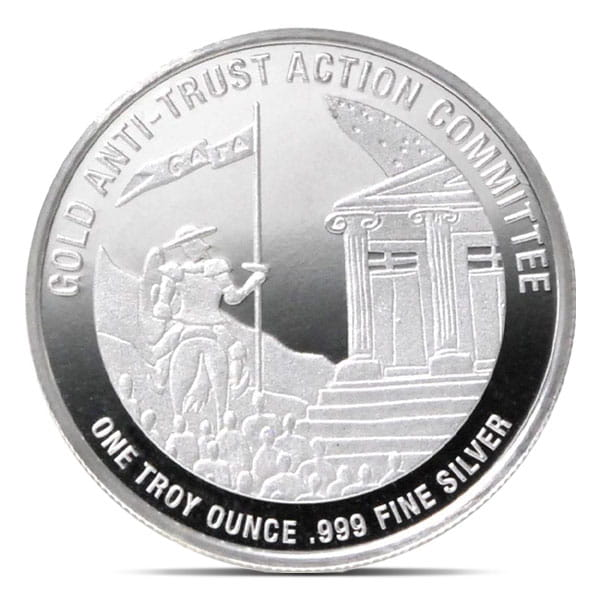
Donations of $500 or more will entitle the donor to a beautiful 1-ounce silver round commemorating GATA’s work:
https://www.gata.org/sites/default/files/GATA-silver-round-front.png
We very much need your help now.
With good wishes.
CHRIS POWELL, Secretary/Treasurer
Gold Anti-Trust Action Committee Inc.
CPowell@GATA.org
END
4. ANDREW MAGUIRE/LIVE FROM THE VAULT; 277
LAST WEEK 276
5. COMMODITY REPORT//GOLD/ZERO HEDGE
China Gold Imports Soar To Two Year High, As Hong Kong Gold Bar Imports Surge Ahead Of Clearing System Launch
Monday, Jun 22, 2026 – 06:50 PM
China’s monthly gold imports reached their highest in more than two years in May, showing the world’s biggest buyer’s appetite for bullion remained resilient as prices remained under pressure; the number prompted some to scratch their heads as to where all this gold is going in light of tepid official central bank purchases, coupled with the lowest gold withdrawals from the Shanghai Gold Exchange since the covid outbreak.
As Bloomberg reports, imports were around 163 tons last month, the highest since March 2024, according to customs data released on Saturday. Volumes for the first five months of 2026 were about 692 tons, up by about 76% from a year earlier.

Chinese demand for physical bullion bars, as well as metal linked to gold accumulation plans (low-barrier products that allow investors to buy gold incrementally), have been among the main drivers of the surge, said Song Jiangzhen, a researcher at the Guangzhou Southern Gold Market Academy.
China also started implementing a new import licensing regime for gold from June 1, with certain banks facing fewer restrictions. But the change may have prompted some banks to use up their existing quotas before the new system began, Song said.
Curiously, in its latest official monthly update, China’s central banb, the People’s Bank of China (PBoC) only increased its gold reserves by nearly 10 tonnes last month, its 19th consecutive month of bullion purchases. The State Administration of Foreign Exchange (SAFE) announced on Sunday that China’s official gold reserves rose by 320,000 troy ounces or 9.95 tonnes in May to a total of 74.96 million troy ounces or 2331.52 tonnes.
China’s total foreign exchange reserves rose to $3.4422 trillion at the end of May, increasing by $31.7 billion or 0.93% from April. This is the highest level for China’s FX reserves since November 2015; they have remained above $3.3 trillion for the past 10 months.
SAFE attributed the growth of reserves to a number of factors, including a firmer US Dollar Index and rising global asset prices, adding that China’s sound economic momentum has underpinned the stability of its reserves.
Experts have noted that China’s rising foreign exchange reserves are closely linked to the country’s export performance. China’s total foreign trade in the first four months of 2026 rose to $2.39 trillion, an increase of 14.9% year-on-year, with exports rising by 11.3% percent to $1.37 trillion and imports rising 20% percent to $1.01 trillion, according to the latest data from China’s General Administration of Customs
According to the latest central bank gold purchase tracker from Goldman, of the 59 tonnes of gold purchased by central bank in April, China’s PBOC was estimated to have bought 24 tonnes of gold, or well below the recent pace of imports which are about 5x greater. While the pace of central bank gold purchases has moderated to ~50 tonnes/month on a 3-month (seasonally adjusted) and 12-month moving average basis, Goldman views the ongoing diversification trend as structural.

Goldman remains bullish on gold, with continued central bank diversification the main structural driver of the bank’s constructive base case for gold prices, contributing 9% to its forecast for appreciation by Dec26. As we highlighted last week, a recent World Gold Council survey supports Goldman’s optimistic view: a record 45% of the 76 central banks surveyed between February and May expect to increase their own gold reserves over the next 12 months, while ~90% expect global reserves to rise with the remainder expecting broadly stable holdings. As a result, Goldman assumes continued central bank accumulation of 50t/month in 2026 and 40t/month in 2027.

Meanwhile, as Kitco notes, China’s domestic gold market has shown definite signs of cooling in recent weeks.
“Amid heightened market uncertainty, gold ETFs have seen an overall reduction in assets under management, with several funds experiencing significant net outflows,” noted a report from Gelonghui Finance. “As of June 3, 14 gold ETFs recorded combined net outflows exceeding RMB 10 billion [$1.48 billion] over the past month.”
“The previously widely accepted investment view of ‘buying on dips amid falling gold prices’ has started to face divergence under current volatile market conditions,” they added.
Gold prices have retreated by about a quarter from the record highs reached in January, weighed down by EM selling (most notably Turkey in the early days of the Iran war), and global inflation fears amid the war in the Middle East which have pushed the US dollar sharply higher. While strong buying from Chinese consumers was a key catalyst for the January frenzy, domestic demand has since moderated, but without a major slump.
Adding to the mathematical mystery, the latest numbers from the Shanghai Gold Exchange (SGE) showed that gold withdrawals in May totaled only 63.5 tonnes – the lowest level since February of 2020 during the first wave of the COVID-19 outbreak, and around half of what they were in March of this year. Industry professionals told Gelonghui Finance that “while short-term gold price volatility may persist, the core rationale supporting gold’s strategic allocation value remains intact over the medium to long term.”
In other words, there appears to be a gap between near record imports, tepid official central bank demand, and muted gold withdrawals from the SGE.
This is not a new development: as we documented previously, China is well known for indicating just modest central bank purchases, even as total Chinese purchases of gold on the London OTC market are orders of magnitude higher.
Separately, Bloomberg also reported that at least four of the 11 banks participating in Hong Kong’s new gold clearing system are importing large bullion bars in preparation for the mechanism’s planned launch in July.
Traders are receiving orders from some of the clearing banks to move 400-ounce gold bars into the city, Bloomberg reported citing people familiar with the matter. The bars meet the London Good Delivery industry standard.
The 400-ounce bars are typically traded by banks and sovereign entities in London, the world’s largest bullion trading hub, but are less common in the Asian market, which is dominated by much smaller kilobars. The banks need to build up inventories to allow for physical delivery when clearing begins next month.

By launching its gold clearing system, Hong Kong is securing first-mover advantage in a push to become Asia’s preeminent hub for bullion trading. Last week, Singapore announced its own plans to launch a clearing mechanism by the end of the year.
Both cities are aiming to capitalize on strong demand in Asia, where many investors remain bullish about the long-term prospects for the precious metal as an alternative store of wealth despite the recent drop in price as the war in the Middle East fanned concerns around inflation and higher interest rates.
In an emailed response to questions, a spokesperson for the government agency behind the system, known as the Financial Services and the Treasury Bureau, said the clearing company had been “working closely with the market to formulate the framework and rules of the clearing system” and that preparatory work had entered its final stage.

Eleven banks are on the board of the Hong Kong Precious Metals Central Clearing Company. Some of these lenders will become clearing banks from the launch, whereas others will take longer to build up their bullion capacity. While Hong Kong plans to start by using the London Good Delivery standard, its future plans are still to be decided, the people said.
In Singapore, the clearing system will be aligned with the London Good Delivery framework for large bars, as well as delivery and settlement standards for kilobars adopted by major exchanges in Chicago and Shanghai.
END
COMMODITY: RARE EARTHS
MP Materials’ Lawsuit Against USA Rare Earth Highlights Battle For America’s Future In Minerals
Tuesday, Jun 23, 2026 – 12:30 PM
USA Rare Earth has dismissed a lawsuit filed by MP Materials, calling the claims “completely without merit” and arguing the case is an attempt to slow its growth. The company said it will deny all allegations that it improperly obtained confidential information from a former MP employee, according to Bloomberg.
The dispute underscores intensifying competition in the U.S. rare-earth sector, where both companies are racing to build domestic mining, processing, and magnet-production capabilities. USA Rare Earth said MP is trying to impede its progress as it develops the Round Top deposit in Texas and a magnet facility in Oklahoma.
Bloomberg writes that MP sued last month, alleging a coordinated effort by USA Rare Earth to recruit MP employees and misuse proprietary information. The lawsuit also questioned the viability of USA Rare Earth’s projects. MP declined to comment on the latest filing.

The clash comes as billions of dollars flow into the U.S. rare-earth industry amid efforts to reduce reliance on China, which continues to dominate global supply chains for the critical minerals.
Rare earth minerals have become increasingly important to the United States because they are essential components in advanced technologies, including electric vehicles, semiconductors, robotics, aerospace systems, and military equipment. Materials such as neodymium, praseodymium, dysprosium, and terbium are critical for manufacturing high-performance magnets used in everything from fighter jets and missile guidance systems to wind turbines and data centers.
The strategic importance of rare earths has grown as the U.S. seeks to reduce its dependence on China, which currently dominates global rare earth mining, processing, and magnet production. Supply chain disruptions and export restrictions have heightened concerns among policymakers and industry leaders, prompting significant investments in domestic mining, processing, and manufacturing capabilities. Companies such as MP Materials and USA Rare Earth are at the forefront of efforts to establish a secure and resilient American rare earth supply chain.
Under the Trump administration, rare earth minerals have become a central component of broader efforts to strengthen U.S. energy security, industrial competitiveness, and national defense. Recent policy initiatives and government support have accelerated domestic rare earth development, reflecting a growing consensus that securing access to these critical minerals is essential for maintaining America’s technological leadership and reducing strategic vulnerabilities.
END
YOUR EARLY CURRENCY VALUES/GOLD AND SILVER PRICING/ASIAN AND EUROPEAN BOURSE MOVEMENTS/AND INTEREST RATE SETTINGS TUESDAY MORNING.7:30 AM
SHANGHAI CLOSED DOWN 56.84 PTS OR 1.37%
HANG SENG CLOSED DOWN 432/24 PTS OR 1.82%
Nikkei CLOSED DOWN 2505.96 PTS OR 3.46%
//Australia’s all ordinaries CLOSED DOWN 0.92%
//Chinese yuan (ONSHORE) CLOSED DOWN TO 6.7850
/ OFFSHORE CLOSED DOWN AT 6.7883 Oil DOWN TO 73.79 dollars per barrel for WTI and BRENT UP TO 77.86 Stocks in Europe OPENED ALL MOSTLY RED
ONSHORE USA/ YUAN// WITH YUAN TRADING DOWN (6.7850) OFFSHORE YUAN TRADING DOWN TO 6.7883 ONSHORE YUAN TRADING ABOVE LEVEL OF OFF SHORE AND DOWN ON THE DOLLAR// / AND THUS WEAKER/OFF SHORE YUAN TRADING DOWN AGAINST US DOLLAR/ AND THUS WEAKER
XXXXXXXXXXXXXXXXXXXXXXXXXXXXXXXXXXXXX
YOUR EARLY CURRENCY VALUES/GOLD AND SILVER PRICING/ASIAN AND EUROPEAN BOURSE MOVEMENTS/AND INTEREST RATE SETTINGS TUESDAY MORNING.7:30 AM
ONSHORE YUAN: CLOSED DOWN AT 6.7850
OFFSHORE YUAN: DOWN TO 6.7883
1.HANG SANG CLOSED DOWN 432.24 PTS OR 1.82%
2. Nikkei closed DOWN 2505.96 PTS OR 3.46%
WEST TEXAS INTERMEDIATE OIL DOWN TO 73.79
BRENT; 77.86
3. Europe stocks SO FAR: ALL RED
USA dollar INDEX UP TO 100.98/// EURO FALLS TO 1.13999 DOWN 27 BASIS PTS
3b Japan 10 YR bond yield:RISES TO. +2.684 UP 1/10 FULL BASIS PTS/ VERY TROUBLESOME//Japan buying 100% of bond issuance)/Japanese YEN vs USA CROSS NOW AT 161.47… JAPANESE YEN NOW FALLING AS WE HAVE NOW REACHED THE ENDING OF THE YEN CARRY TRADE AGAIN AND THE REPATRIATION OF YEN DENOMINATED BONDS TRADING IN THE USA/EUROPE. JAPAN 30 YR BOND YIELD: 3.849 DOWN 2 FULL BASIS PTS
3c Nikkei now ABOVE 17,000
3d USA/Yen rate now well ABOVE the important 120 barrier this morning
3e Gold DOWN /JAPANESE Yen UP CHINESE ONSHORE YUAN: DOWN( 6.7850) AND OFFSHORE: DOWN AT 6.7883
3f Japan is to buy INFINITE TRILLION YEN worth of BONDS. Japan’s GDP equals 5 trillion USA
Japan to buy 100% of all new Japanese debt and NOW they will have OVER 50% of all Japanese debt.
3g Oil DOWN for WTI and BRENT DOWN this morning
3h European bond buying continues to push yields LOWER on all fronts in the EMU. German 10yr bund YIELD UP TO +2.9643// Italian 10 Yr bond yield DOWN to 3.637// SPAIN 10 YR BOND YIELD DOWN TO 3.384%
3i Greek 10 year bond yield DOWN TO 3.584%
3j Gold at $4118 //Silver at: 62.08 1 am est) SILVER NEXT RESISTANCE LEVEL AT $100.00
3k USA vs Russian rouble;// Russian rouble DOWN 0 AND 42/ 100 roubles/74.66
3m oil (WTI) into the 73 dollar handle for WTI and 77 handle for Brent/
3n Higher foreign deposits moving out of China// huge risk of outflows and a currency depreciation. This can spell financial disaster for the rest of the world/
JAPAN ON JAN 29.2016 CONTINUES NIRP. THIS MORNING RAISES AMOUNT OF BONDS THAT THEY WILL PURCHASE UP TO .5% ON THE 10 YR BOND///YEN TRADES TO 161.728 // 10 YEAR YIELD AFTER FIRST BREAKING .54% LAST YEAR NOW EXCEEDS THAT LEVEL TO 2.684% UP 1/10 BASIS PTS STILL ON CENTRAL BANK (JAPAN) INTERVENTION//YEN CARRY TRADE NOW UNWINDING//YEN BOND TRADING OVERSEAS REPATRIATED.//JAPAN 30 YR: 3.849 DOWN 2 PTS..: USA/SF this 0.8100 as the Swiss Franc . Euro vs SF: 0.9235
USA 10 YR BOND YIELD: 4.487 DOWN 2 BASIS PTS…
USA 30 YR BOND YIELD: 4.940 DOWN 1 BASIS PTS/
USA 2 YR BOND YIELD: 4.196 DOWN 3 BASIS PTS
USA DOLLAR VS TURKISH LIRA: 46.48 UP 2 BASIS PTS/LIRA GETTING KILLED//IDIOTS FOR SELLING GOLD AND USA DOLLAR RESERVES.
10 YR UK BOND YIELD: 4.7738 DOWN 6 PTS
30 YR UK BOND YIELD: 5.475 DOWN 6 BASIS PTS
10 YR CANADA BOND YIELD: 3.438 DOWN 3 BASIS PTS
5 YR CANADA BOND YIELD: 3.055 DOWN 3 BASIS PTS.
Futures Slide As Tech Tumbles, Korea Crashes
Tuesday, Jun 23, 2026 – 07:59 AM
US equity futures are sharply lower as a Semis/South Korea-induced selloff has spread globally slamming tech stocks and pushing SpaceX 3% lower and below its first day of trading price of $150. Nasdaq stocks lead sentiment and early trading lower with AI cost concerns back in focus, as Bloomberg notes that traders are pointing to a South Korean media report we first highlighted at 8pm last night, saying SK Hynix is slowing expansion of AI memory chip production and shifting emphasis to commodity DRAM. As of 8:00am S&P futures were -1.3%, and Nasdaq futures tumbled 2.7%, both near session lows. In premarket trading, Intel and Micron led a broader decline among chipmakers while SpaceX fell 4.3%, below its $150 initial trade price. Chinese equities in Hong Kong entered a bear market. Mag7s are dragging the indices lower with MSFT / telecom the safety valve. In Seoul, chip giants SK Hynix Inc. and Samsung Electronics Co. slumped more than 10%. According to JPM, today’s sell-off “may reflect anxiety into MU’s print on Weds as well as the levered ETF mkt structure.” Bonds are operating as a safety haven as the yield curve bull steepens, and USD is bid. Commodities are seeing further declines in Energy as US / Iran discussions continue and precious metals are getting hit due to USD (gold) and AI / Tech (silver). Ags are mixed. Today’s macro data focus is on Flash PMIs, ADP’s weekly employment print, and regional Fed activity indicators.

In premarket trading, chipmakers, memory stocks and other AI-related firms slide during the broader selloff. Decliners include Micron (MU -7%), Intel (INTC -6%), AMD (AMD -6%) and CoreWeave (CRWV -5%).
- Nvidia leads most of the Magnificent Seven group lower (Nvidia -2%, Tesla -2%, Meta -0.6%, Microsoft +1%, Apple -0.3%, Amazon -0.6%, Alphabet -2%,)
- Avis Budget (CAR) climbs 4% as the rental car company entered into a settlement agreement with Pentwater Capital Management and affiliated persons to resolve a lawsuit seeking recovery of short-swing profits, the company said in a filing.
- Best Buy (BBY) falls 3% after the company said Matt Bilunas will step down as CFO and depart the retailer at the end of July after 20 years, including seven years as CFO.
- Edgewell Personal Care (EPC) rises 9% after people familiar with the matter said the maker of Schick razors has rejected an unsolicited takeover offer from private equity firm Yellow Wood Partners.
- IBM (IBM) gains 4% as JPMorgan upgrades to overweight and as the company announced it has joined the OpenAI Daybreak Cyber Partner Program.
- Primoris Services (PRIM) sinks 35% after the infrastructure construction company cut its adjusted earnings guidance for the full year.
In other corporate news, Oracle reduced its workforce by 21,000 employees in the past 12 months, a wider scale than previously known, including those whose jobs were eliminated by the use of AI. SoftBank’s founder said there’s little merit to building data centers in space, while acknowledging that AI competition is intensifying.
In an ugly session that started with a rout in South Korea, the Kospi finished down 10% while Nasdaq 100 contracts lose 2.5% and are struggling to find a floor. European stocks are not immune with the Stoxx 600 down 1%. Other assets have been caught up in the equity selloff with spot silver down over 4% and Bitcoin dropping 3%. Memory stocks, many of which are riding triple-digit gains this year, recorded some of the steepest losses. SpaceX was poised to fall below its first-day opening price of $150.
In Seoul, chip giants SK Hynix Inc. and Samsung Electronics Co. slumped more than 10%. Intel Corp. and Micron Technology Inc. led a broader decline among chipmakers in US premarket trading, while SpaceX fell 4.3%. Chinese equities in Hong Kong entered a bear market.
BofA equity derivative strategists said the Nasdaq 100’s heavy concentration in technology stocks has fueled its outperformance versus the S&P 500 in both returns and volatility. That’s pushed the Nasdaq’s Bubble Risk Indicator (BRI) closer to a key level which often signals elevated near-term tail risks. Meanwhile, already jittery tech sentiment and volatility could turn on a dime after Micron’s earnings tomorrow. The chipmaker has been the largest contributor to S&P 500 gains this year, while technology stocks make up each of the index’s 10 biggest drivers of returns.
“Some of the recent performance in stocks has been highly speculative, fueled by a passion from retail investors for short-term gains,” Mark Dowding, chief investment officer for fixed income at RBC BlueBay Asset Management, told Bloomberg TV. “We may not like it this morning, but actually it’s healthy behavior.
The market selloff “is largely a blip, but it is tapping a real and more fundamental anxiety,” said Amanda Lyons, head of research at Energy Group Capital. “The blip part: it is a single piece of local trade press, landing into a jumpy tape and a day before a nervous Micron print, on a trade that is about as crowded and as priced-for-perfection as anything in the market.
One regular buyer of stocks, the corporates themselves, are exiting for the time being. Goldman’s Vani Ranganath estimates approximately 65% of companies have entered their blackout window ahead of 2Q results.
For the AI trade, attention is now shifting to Micron’s quarterly results on Wednesday after the stock rallied more than 300% since January.
“The real test is Micron,” said Amanda Lyons, head of research at Energy Group Capital. “I would watch the rate of change in pricing and any change to capex or bit-supply guidance far more closely than the headline beat or miss.”
Fed’s Goolsbee said he remains concerned about inflation and questioned whether all the factors driving prices up are temporary. US Trade Representative Jamieson Greer kicked off talks with Indian officials this week as both sides stepped up efforts to resolve the remaining differences holding up an interim trade agreement.
In other assets, currency traders are on high alert for intervention after further weakness in the yen. Gold slides, with Deutsche Bank following Goldman in cutting price forecasts for the metal.
European equities fell sharply at the open on Tuesday: the Stoxx 600 falls 1.1% to 632.10, with mining and technology shares leading declines while health care and food beverage stocks are the biggest outperformers. Here are the biggest movers Tuesday:
- Porsche shares rise as much as 1.8%, erasing early declines after the German luxury carmaker confirmed its forecast for the 2026 financial year
- Basic resources stocks are falling the most in the Stoxx Europe 600, with the sector index down as much as 4.6%, as metals fell across the board on inflationary concerns and progress of peace talks
- Hermes shares fall as much as 2.9%, extending its drop to 11% over the past three sessions, after HSBC downgraded its rating on the Birkin bag maker to hold from buy
- Epiroc drops as much as 5.6%, the most in three months, as UBS downgrades the Swedish mining-equipment maker to sell from neutral and says its valuation “has gone too far”
- Signify plunges as much as 18% after the Dutch lighting manufacturer announced new medium-term targets and an updated dividend policy that analysts say would mean big cuts to shareholder payouts
- Telecom Plus shares plunge as much as 33%, sending shares to their lowest level since 2012. The company’s new five-year plan will see it invest with the ambition of improving growth and the quality of earning
- Dometic declines as much as 11%, the most since March, with Danske Bank cautioning its upcoming 2Q report will be held back by tough US markets for its RV and marine divisions
Earlier in the session, Asian stocks fell reversing the previous session’s gains as a selloff in technology shares weighed on regional markets. The MSCI Asia Pacific Index dropped as much as 3.6%, with SK Hynix and Samsung Electronics among the biggest drags. Most of the region’s major markets were in the red, led by declines in South Korea, Japan and China. A sub-gauge of information technology shares slid as much as 6.1%, after rallying 2.3% on Monday. South Korean stocks tumbled 10% from a record high as investors dumped chip heavyweights on concerns that the rally has become overstretched, prompting the local exchange to briefly halt program selling. Japanese equities slipped as some AI-related stocks fell following a selloff in US tech megacaps.
“I think our Asian markets are tracking a rotation already underway in the US rather than a fresh risk-off move,” said Billy Leung, an investment strategist at Global X Management. “Hyperscalers have been leading the pullback on AI capex concerns and negative cash flow concerns.”
In FX, the Bloomberg Dollar Spot Index gains 0.2% although the yen takes top place among the G-10 currencies, climbing a few pips against the greenback. The Aussie dollar is the weakest, falling 0.7%.
In rates, treasuries are richer across the curve with gains led by front-end and belly, as oil steadies and stock futures slump after a selloff in Korean chipmakers stoked concerns about the artificial intelligence trade. US yields richer by as much as 4bp across front-end and belly with 2s10s and 5s30s spreads steeper by 1bp and 3bp on the day; 10-year is around 4.48%, 3bp richer on the day with bunds and gilts in the sector outperforming by around 1bp: German and UK 10-year yields falling 3 basis points each. SpaceX shares fell to the lowest level since their first day of trading ahead of a potential jumbo investment-grade bond sale that could be announced Tuesday. Focal points of US session also include June preliminary PMIs and a 2-year note auction. This week’s Treasury auctions begin at 1pm New York time with $69 billion 2-year note sale, to be followed by 5- and 7-year notes Wednesday and Thursday; WI 2-year yield near 4.20% is ~13bp cheaper than the May auction, which stopped on the screws.
In commodities, Brent crude futures fall 1% to around $77 a barrel. Other assets have been caught up in the equity selloff with spot silver down over 4% and Bitcoin dropping 3%.
Today’s US economic data calendar includes weekly ADP employment change (8:15am), June Philadelphia Fed non-manufacturing activity (8:30am), June preliminary S&P Global US manufacturing and services PMIs (9:45am) and Richmond Fed manufacturing and business conditions indexes (10am). Fed speaker slate empty for the session.
Market Snapshot

Top Overnight News
- Korea’s KOSPI plummeted 9.99%, its steepest drop in more than three months, on Tuesday as overseas investors sold chipmakers following regulatory signals that the sector’s rally had gotten overheated. RTRS
- South Korea’s retail investors are ploughing profits from a world-beating stock market into an overheated property sector, confounding government efforts to cool real estate demand. FT
- Iran said $12 billion of its frozen funds were set to be released as part of ongoing talks with the US, with the two sides broadly signaling progress in negotiations to formally end their war. BBG
- The Trump administration and Qatar have warned the EU that it faces a gas supply crunch that would force up prices unless Brussels rewrites planned rules on methane emissions. BBG
- The yen erased losses after Japanese Finance Minister Satsuki Katayama said she spoke with Scott Bessent and that they agreed that “bold action” may be needed. Traders are on high alert for intervention. BBG
- Euro-area business activity shrank less than anticipated in June. S&P Global’s Composite PMI rose to 49.5 from 48.5, topping estimates but remaining below the 50 mark that indicates growth. BBG
- The UK’s economy contracted for a second consecutive month, with its PMI slipping to a 14-month low. BBG
- The Fed’s Austan Goolsbee told American Public Media’s Marketplace he remains concerned about inflation and questioned whether price pressures will persist after temporary shocks have dissipated. BBG
- TSLA logged a more than twofold jump in European monthly sales in May as Elon Musk’s electric-vehicle maker continues to rebuild strength in a region where Chinese rivals are gaining ground. WSJ
- US Senate passes bipartisan affordable housing bill.
Iran War Latest
- Iran’s Foreign Ministry Spokesperson Baghaei said “if the other party does not fulfill its obligations, we should not be expected to unilaterally fulfill our obligations”, Iran International reported.
- Iran’s Foreign Ministry Spokesperson said defensive capabilities and missiles will never be a topic of discussion. US commitment regarding Lebanon is completely clear.
- Iran’s Foreign Ministry Spokesperson said quadrilateral talks were stopped early in Switzerland due to the witnessing of US threats. Thereafter, exchanges were via a mediator, Mehr reported.
- Iran’s Foreign Ministry Spokesperson said Iran has no plans to let IAEA inspectors visit nuclear sites targeted in the conflict.
- Iranian President, ahead of trip to Pakistan, said Iran is seeking the full implementation of the clauses that have been signed within the framework of international law, Nour News reported.
- Iranian Parliament Speaker Ghalibaf said the Strait of Hormuz will be administered by Iran according to international law.
- Iranian President Pezeshkian said in phone call to Turkish President Erdogan on Monday that Iran is ready to pursue diplomacy as per international law.
- Iran Central Bank Governor said Tehran is not obliged to purchase US agricultural goods under current agreements, and states that remaining frozen assets can be used to buy non-sanctioned goods beyond essential items, according to Tasnim.
- “Iranian Foreign Minister Abbas Araghchi will visit Baghdad next Sunday”, Al Mayadeen reported citing sources; The meeting will include a briefing on the progress of the talks in Switzerland and the preparations.
- Iranian Foreign Ministry said “America has issued the necessary license for the sale of Iranian oil and petrochemical products”, Al Jazeera reported.
- Iranian Ambassador to the UN said any further attacks on Lebanon would be a red line.
- Iranian Ambassador to the UN said Hormuz talks will be held with Oman.
- Iranian Ambassador to the UN said there has been good progress in negotiations with the US.
- “Sources indicate that the Iranian Foreign Minister [Araghchi] will hold separate talks with Pakistani officials”, Al Hadath reported.
- Oman’s Foreign Minister said Iranian negotiators reaffirmed their commitment to international law and to ensuring safe, toll-free passage through the Strait of Hormuz.
- Oman’s Foreign Minister meets with Iranian Parliamentary Speaker Ghalibaf, with the officials discussing regional stability and Strait of Hormuz.
- Shipping data cited by Al-Arabia showed at least 20 ships have crossed the Strait of Hormuz in the past 24 hours.
- One person reportedly killed by Israeli gunfire in a southern Lebanese town, according to Lebanese Civil Defense and a security source – timing unclear.
- Senior US official tells Al Jazeera that talks between Lebanon and Israel will continue to advance comprehensive peace and a security agreement between the two countries.
- Israeli National Security Minister Ben-Gvir said Israel must act alone against Iran’s nuclear program and must maintain military freedom in Lebanon, hopes withdrawal from southern Lebanon will not happen and will do everything to convince PM Netanyahu.
- Israel military shells and fires at Khan Yunis in Gaza, according to Fars News Agency.
- Israel’s PM, Defence Minister and Military Chief said Israeli military will continue to act to neutralise threats to soldiers and citizens, demolish terrorist infrastructure, and maintain security zone in southern Lebanon, according to a joint statement. Israel’s leadership reaffirms that the security of Israeli citizens and IDF troops will remain its overriding priority, with no room for compromise.
- Israeli forces reportedly violate Syrian territory, conducting house searches in southern outskirts of Quneitra governorate.
- US-Iran technical talks in Burgenstock had a “breakthrough”, talks proceed seemingly in a positive direction, Journalist Mallick reported.
- US President Trump, on Israel and Lebanon, said “we’ll take a look at it”; said he gets problems solved fast, including with Israeli PM Netanyahu.
- US President Trump said if Iran doesn’t stick to agreement, he will do what he has to do. As long as Iran respects us, we are not going to have any trouble. Could restart the blockade quickly if needed.
A more detailed look at global markets courtesy of Newsquawk
APAC stocks were subdued with initial choppy price action following the mixed performance stateside, where participants reflected on the progress in US-Iran talks, but communication stocks and the Nasdaq Comp underperformed. KOSPI, -6.9%, led the sell off, moving to a test of 8.5k to the downside. ASX 200 traded little changed for most of the session amid a lack of major fresh catalysts overnight and as the strength in financials and defensives offset the losses in the tech and commodity-related sectors. Nikkei 225 swung between gains and losses with the index briefly climbing to a fresh record high before reversing course, and is on track to snap its 8-day win streak. Hang Seng and Shanghai Comp conformed to the lacklustre mood in the region and the absence of any major fresh catalysts, with the Hong Kong benchmark pressured by losses in miners, and digital platforms stocks amid a rotation out of hyperscalers into semiconductors.
Top Asian News
- China’s MOFCOM announces measures to stimulate the auto after-sales market; to support the integration and upgrading of the car rental industry.
- Japanese Chief Cabinet Secretary Kihara said will take appropriate action against FX moves if needed.
- Canada awarded Australia a USD 1.75bln contract for its over-the-horizon radar system, boosting Arctic early warning capabilities, and which marks Australia’s largest ever defence export.
- Japanese S&P Global Composite PMI Flash (Jun) 52.50.
- Japanese S&P Global Manufacturing PMI Flash (Jun) 54.9 vs. Exp. 54.5 (Prev. 54.5).
- Australian S&P Global Manufacturing PMI Flash (Jun) 51.2 (Prev. 50.7).
- Blackstone (BX) President and COO Gray told Nikkei that the firm plans to invest USD 30bln in Japanese data center development over the next three to five years.
Large losses in Kospi (-9.9%) crept through to Europe (STOXX 600 -1%) with EU tech leading the losses. No specific headline driver for overnight losses in a typical non-conflict risk-off move (stocks/oil down, fixed/havens bid). As you would expect, South Korean heavyweights Samsung and SK Hynix (which account for over 50% of the index) led the declines, both falling 12%. Some analysts point out the mechanical rebalancing from leveraged ETFs exacerbated losses with a large share of the vehicle used to gain Kospi exposure coming as leveraged ETFs. Others point out positioning into Micron earnings due after the close on Wednesday. Given the above, Tech is the worst sectoral performer (bar Basic Resources), the sector posting losses in excess of 3%. The highest weighted chip constituents ASML -5% (Highest weighted in Europe+Tech Sector), Prosus -2.1% and STMicroelectronics -7.3%. For Basic resources, the sector has been dragged lower by declines in metals (Gold -2.5%, Silver -5.5%).
Top European News
- German Chancellor Merz outlines his support for a capital-based pension system, saying it “strengthens the system”.
- German Chancellor Merz confirms plan to push forward with all pension reform proposals.
- Britain’s biggest business lobby group, CBI, said UK firms are not seeking another Brexit referendum and have little interest in rejoining a customs union with the EU, according to FT.
- UK’s Burnham will seek to soothe markets as he marches on number 10 and will use a speech next week to pledge to grow the economy and commit to Labour’s fiscal rules, according to The Times. Burnham is considering Miliband, Streeting and Mahmood for Chancellor.
FX
- G10s are entirely lower against the Buck (bar JPY), as USD attracts haven demand in a textbook risk-off market move (stocks/oil down, fixed/havens bid), signalling the market is gradually moving away from geopolitical trade. As you would expect, Antipodeans underperforms, Aussie fares the worst as metals suffer from the strong Buck, while JPY is the only currency stronger vs the USD after a sharp 30pip move lower as it sits towards 2024 highs.
- DXY firmer by 0.2% as it attracts haven demand amid tech weakness in Kospi/NQ (see equities at 09:25 BST for analysis). In terms of domestic newsflow, Fed’s Goolsbee said services inflation was “a little disturbing”. The data docket is light but begins to pick up today (ADP weekly + PMIs due) heading into Thursday’s GDP revisions and PCE data. DXY surpassed Friday’s high of 101.12, now looks to the May peak just below 102.
- JPY continues to whipsaw around multi-year lows against the Buck, with USD/JPY towards 161.50-162. Japanese officials continue attempts to bolster the Yen, but continue unsuccessful with the Greenback bid. Overnight, Japanese Finance Minister Katayama confirmed she spoke with US Treasury Secretary Bessent on Monday. Elsewhere, APAC trade saw stronger flash PMI data and mixed results of the latest 5yr JGB auction.
- GBP is weaker and tracks the firmer Buck with participants awaiting further updates from a likely incoming Burnham premiership. Despite Gilts continuing to outperform peers on optimistic Burnham reporting (Streeting added to Chancellor candidates/Burnham said to announce commitment to Fiscal rules), Miliband still in the picture for Chancellor is viewed by Sterling traders as an unwelcome option. As such, GBP awaits further press reporting and tracks the Buck with Cable remaining at 1.32, EUR/GBP unchanged. ING this morning writes “Regardless of politics, we keep favouring higher EUR/GBP on the back of a dovish view (no hikes) on the Bank of England”. EZ/UK PMIs were mixed (see fixed income for analysis), EUR saw fleeting strength on the French figure, which indicated a cooling of cost pressures; a move which proved fleeting as the German services and composite metric cooled (Some respondents’ answers did not eclipse the signing of the US-Iran MoU).
Fixed Income
- A firmer start for fixed income as the complex benefits from the softer energy environment, though the influence of this has diminished amid recent updates from Iran, and the weak risk tone as the KOSPI closed lower by 9.9% and has weighed on European price action, with the European Tech sector lower by over 3%.
- USTs firmer by seven ticks in 109-06+ to 109-14+ confines, towards but just off highs as the mentioned energy move off lows has seemingly formed a ceiling in fixed or now at least. Ahead, we have the region’s Flash PMIs before 2yr supply. A tap that should benefit from a number of factors.
- Bunds firmer by just over 10 ticks and are just under that from the 126.74 high. Initially moving on the above, in-line with peers and with no real reaction to the latest pension reform commentary.
- The main updates, aside from the APAC moves, today have been Flash PMIs for June. Firstly, France’s figures sparked some modest EGB pressure as the components all came in firmer than expected. Internal commentary pointed to a possible peak in price pressures. Thereafter, Germany was below consensus but caveated by the majority of responses coming in before the MoU signing. Nonetheless, encouragingly, the series showed that inflationary pressures had started to ease off.
- Finally, the EZ figure was mixed and again most responses came before the MoU. But, it already showed that lower energy prices were filtering through to businesses with inputs cost rates and selling price inflation moving lower in June. Again, pointing to a potential price spike peak.
- Overall, the data chimes with those who believe that expectations for further ECB tightening are overdone. A point arguably added to by the pertinent commentary from President Lagarde on Monday. As such, upcoming hard and survey data will be scoured for confirmation that prices may have peaked which, alongside the stagnation in activity, may well see a dovish repricing in the period ahead.
- Gilts echoed the above, higher by 35 ticks at best and to a new WTD high of 89.19. Today’s strength also comes from reporting that Burnham will next week give a speech outlining his commitment to the fiscal rules; however, The Times briefing notes that Miliband remains in consideration to be Chancellor, a point that potentially caps any further upside.
- PMIs for the region were weak, though price commentary was also welcome and chimes with the view that the BoE is on hold for the foreseeable.
- The Netherlands sold EUR 1.98bln vs exp. EUR 1.5-2bln 3.50% 2056 DSL Bond: avg. yield 3.52% (prev. 3.51%).
- Japan sold JPY 1.9tln 5yr JGBs; b/c 3.11x (prev. 3.22x), average yield 1.905% (prev. 2.024%).
- Germany sells EUR 3.807bln vs exp. EUR 5bln 2.50% 2028 Schatz: b/c 1.90x (prev. 1.58x), average yield 2.57% (prev. 2.59%), retention 23.86% (prev. 22.80%)
Commodities
- Geopolitical newsflow remains focused on the US-Iran talks, and the sometimes mixed commentary filtering out from the respective officials. As it stands, there does not appear to be any cause for concern, with President Trump and VP Vance both sounding positive about the initial talks; the Iranian side also said good progress has been made. However, looking between the lines reveals some contradictory remarks. On Monday, VP Vance said that Iran would allow the IAEA to inspect nuclear facilities. However, Iran’s Foreign Ministry Spokesperson stated that there are no plans to let inspectors visit nuclear sites targeted in the conflict; the nuance of “sites targeted in the conflict”, potentially offers some hints to the inner workings of the proceedings between the US and Iran. Do note that the Iranian President is visiting Pakistan today.
- The biggest risk to the talks is Israeli actions in Lebanon. Several high-ranking Israeli officials have suggested that Israel will continue its military operations in Lebanon. Comments which come ahead of the US-mediated Lebanon-Israel talks, which are set to begin today. A confab which spans over a couple of days, and focuses on finalising “pilot zones” within southern Lebanon and long-lasting peace.
- Crude benchmarks traded sideways for much of the APAC session, before then moving to lows heading into the European cash open. Since, WTI and Brent have bounced a touch off lows, to currently trade towards the mid-point of the days range. In more detail, WTI Aug’26 (-0.5%) sits within a USD 72.48-74.45/bbl range and Brent Aug’26 (-0.6%) holds within a 76.43-78.23/bbl range.
- Spot gold (-2%) extends lower amidst the continued hawkish mood in markets, which have kept the USD elevated. For gold specifically, a number of sell-side banks have cut their price forecasts for spot gold. On Monday, Goldman Sachs cut their year-end target to USD 4,900/oz (prev. USD 5,200/oz). Its model focused on the Fed, whereby every 50bps worth of easing adds c. USD 120/oz of support to spot gold. Most recently, Deutsche Bank cut its gold forecast by 22%. Today, the yellow metal holds at the bottom end of a USD 4,091 to 4,198/oz range; it may find support at a recent low of USD 4,023/oz, if the pressure continues.
- Base metals follow the downbeat risk tone seen across broader markets. 3M LME copper is lower by c. 1.8% and holds within a USD 13,396.35-13,671/t range.
- Rabobank lowers its Q3 Brent price forecast to USD 79/bbl (from USD 103/bbl), and Q4 to USD 78/bbl (from USD 93/bbl); sees Brent averaging USD 74.50/bbl in 2027, and USD 71/bbl in 2028.
- US Department of Agriculture reported a new case of screwworm in a Texas goat, taking total number of domestic detections to 16 cases.
Central Banks
- Fed’s Goolsbee (2027 voter) said inflation is well above target and going the wrong way, adds need evidence this inflation is temporary and services inflation is a little disturbing. said:. We haven’t had stagflation shock, and the job market has been stable. Fed Chair Warsh’s approach is let’s have less speculation about rates, less forward guidance, while Goolsbee said he is pretty sympathetic to that approach.
- ECB’s Kazimir said they are data-dependent, but the direction for policy is clear.
- ECB’s Lane said that inflation risks being above 2% for some time; increase in energy prices is expected to keep inflation well above target into H1’27. Remains attentive to both sides of the outlook. Energy shock is feeding through to broader inflation. labour market resilience, solid household balance sheets and public investment should support activity.
- ECB’s Escriva said service-sector inflation is showing very strong persistence.
Geopolitics
- Russia and Ukraine may swap Prisoners of War soon, TASS reported.
- Ukraine’s capital Kyiv issues an air raid alerts and authorities ask people to seek shelter.
- North Korea leader Kim Jong-un said North Korea will further assert its status and role as a nuclear power, adds will accelerate broader plans, enhance nuclear arms technology and develop water deterrence capabilities. accused US and South Korea carrying out the most dangerous provocations through nuclear war machinery. To accelerate building of 10,000-ton strategic guided missile cruiser.
- China’s Beihai Maritime Safety Administration announced that parts of the Beibu Gulf will be closed to navigation due to military training from 11:00-12:00 Beijing time on June 23rd.
US Event Calendar
- 9:45 am: Jun P S&P Global US Manufacturing PMI, est. 54.6, prior 55.1
- 9:45 am: Jun P S&P Global US Services PMI, est. 51.1, prior 50.7
- 9:45 am: Jun P S&P Global US Composite PMI, est. 52.1, prior 51.5
- 10:00 am: Jun Richmond Fed Manufact. Index, est. 8, prior 13
DB’s Jim Reid concludes the overnight wrap
When I started in financial markets in 1995, Alan Greenspan was a towering presence and arguably the first Fed Chair to become a global rockstar. At that point, he was eight years into what would become a 19-year tenure as Chair of the Federal Reserve. However, my own memories pale in comparison to those of my colleague Peter Hooper. Peter joined the Fed in 1973, later moving to DB in 1999, and worked closely with Greenspan for over 50 years.
Peter has written a thoughtful remembrance following Greenspan’s passing yesterday at the age of 100. Drawing on first-hand experience as a colleague at the Federal Reserve and later recruiting him to be an adviser at Deutsche Bank, Peter highlights Greenspan’s intense curiosity, instinct for data and markets, and ability to identify structural shifts such as the 1990s productivity boom. In many ways, Greenspan was ahead of the data—something Kevin Warsh is attempting to emulate today—so there are clear parallels between the eras. It is a personal and insightful tribute from someone who had a ringside seat throughout Greenspan’s remarkable career, and it is well worth reading in full on the DB Research Institute site.
Moving onto the remembering another landmark in history, 10 years ago today, those of us on this island marched to the polls to decide whether we wanted to stay in the EU or not. Ironically, I had a long weekend planned in the French Alps and left for the airport immediately after voting and arrived to a fierce thunderstorm in the mountains and news that the UK had voted to leave. It all felt fairly biblical and instead of enjoying a break I spent all night and the next 3 days glued to my work laptop.
To mark the anniversary Sanjay and Shreyas have published a piece entitled “Brexit 10 years on: What’s worked, what hasn’t, what’s next?” See it here ahead of our first in-person Deutsche Bank Research Institute event on Thursday reviewing the topic and all things UK related given the huge events of recent days. We may still be able to squeeze you in.
The irony around the anniversary is that the shadow of Brexit partly claimed another UK Prime Minister yesterday with Keir Starmer resigning and heralding in what will be the 7th Prime Minister in that subsequent decade. The only viable candidate now seems to be Andy Burnham, who won last week’s by-election in Makerfield, after rival challenger Wes Streeting endorsed him yesterday to be leader. So, although nominations for the Labour leadership are set to open on July 9, currently it looks highly likely that Andy Burnham is the only candidate who would get more than 20% of MPs backing him to stand, meaning that a formal contest would be avoided. That’s reminiscent of when Labour last changed leaders in government back in 2007, when Chancellor Gordon Brown took over from Tony Blair without a contest. Under this timetable, Burnham could become the PM as soon as mid-July.
Against this backdrop, UK assets responded relatively positively, as it looks like a period of extended uncertainty and a potential summer leadership contest have been removed. Speculation that Streeting may get the job of Chancellor was seen as a positive as well given his more moderate tendencies. The pound sterling was the strongest performing G10 currency on the day, up +0.14% against the US Dollar, whilst yields on 2yr (-4.5bps) and 10yr (-3.4bps) gilts moved in line with their European counterparts inspite of the political upheaval. Moreover, the FTSE 100 was up +0.72%, again similar to the STOXX 600’s +0.58% advance.
Another G7 country in the news is Japan and this morning the currency is fairly flat after seeing a strong spike yesterday afternoon London time after it got within a whisker of hitting 40-year lows. It hit 161.93 versus a low of 161.96 in July 2024. Beyond that you have to go back to December 1986 to see weaker levels. There was speculation over imminent BoJ intervention with JNN reporting an online emergency meeting between Finance Minster Katayama and US Treasury Secretary Bessent yesterday. This meeting has been confirmed by Katayama this morning, who stated that the US and Japan are aligned on FX policy. This morning it’s hovering remarkably quietly at 161.60 given all the noise.
Less quiet are Asian equities which are falling on tech weakness. The KOSPI (-6.41%) is leading the declines, followed by the Nikkei (-1.66%), Hang Seng (-1.16%), Shanghai Composite (-0.37%) and S&P/ASX 200 (-0.26%). S&P 500 (-0.66%) and NASDAQ 100 (-1.19%) futures are also weak with the tech sell-off dominating.
Early morning data showed that Japan’s private sector activity expanded at its fastest pace in three months in June, driven by strong manufacturing output and a return to growth in the services sector, although firms faced the sharpest rise in input costs in nearly four years. The S&P Global flash Japan manufacturing PMI rose to 54.9 in June while the services PMI climbed to 51.8 from 50.0, indicating a renewed expansion in business activity after stagnating in May. As a result, the flash composite PMI, advanced to 52.5 from 51.1, marking the strongest pace of overall private-sector growth since March.
This all follows mixed markets yesterday, as tech worries overpowered investor optimism about progress in the US-Iran negotiations over the weekend. So that meant the S&P 500 slipped -0.37%, with the Nasdaq (-1.32%) and Magnificent 7 (-2.17%) posting even steeper losses, dragged down by declines by Alphabet (-4.99%) and Amazon (-4.75%).
Those equity losses were compounded by the latest rise in Treasury yields yesterday, as investors continued to price in a more hawkish Fed. Indeed, yesterday saw markets price in a 98% chance of a rate hike by the September meeting (up from 93% on Friday), and the 2yr yield (+4.8bps) closed at a 16-month high of 4.23%. Meanwhile, the 10yr yield was up +5.5bps to 4.51%, and significantly, the 10yr real yield (+8.0bps) hit a one-year high of 2.26%. That rise in real yields was something Henry looked at in a note yesterday (link here), exploring why markets haven’t rallied as much as might have been expected given the US-Iran deal and the slump in oil prices in the last two weeks.
Speaking of the Iran war, there were fresh signs of progress in the negotiations, with Vice President JD Vance saying that the weekend talks were “very, very good”. That follows comments from the Iranian side, who had previously said in the small hours of Monday that there’d been major progress to end the war in Lebanon. Moreover, the US issued a 60-day sanctions waiver to allow Iran to sell its oil on the international market, which was seen as one of Tehran’s demands for implementing last week’s interim deal. So that backdrop saw oil prices come down, with Brent crude (-3.31%) closing at a 3-month low of $77.90/bbl, whilst WTI (-2.32%) also fell to $74.82/bbl.
Turning back to Europe, ahead of this morning’s flash PMIs, ECB President Lagarde said yesterday that she saw no more need for the ECB to have a “forceful response” to the Iran War. In comments to lawmakers, Lagarde said she saw inflation returning to target over the medium term, saying that the ECB saw “no evidence yet of de-anchoring of inflation expectations or second-round effects” that warrants a “more forceful policy response at this stage.” This contrasted with some of the more hawkish messaging from the ECB last week, which saw markets dial up their conviction of further tightening this year.
Those comments supported a rally in European government bonds, with yields on 10yr bunds (-3.4bps), OATs (-3.4bps) and BTPs (-4.3bps) all coming down. And there were larger declines at the front-end, with the 2yr German yield down -4.4bps as investors dialled back the likelihood of aggressive ECB rate cuts this year. Indeed, markets were pricing 32bps of ECB hikes by the December meeting at the close, down -4.5bps on the previous day. Otherwise, equities also rose, with the STOXX 600 (+0.58%) making a fresh gain, while the DAX (+0.62%) also rose. The CAC (-0.25%) struggled again and has been struggling this year largely due to its outsized luxury stocks weighting.
To the day ahead now, we’ll get June flash PMIs for the US, UK, Eurozone, Germany, and France. We’ll also see US June Philadelphia Fed non-manufacturing activity, Richmond Fed manufacturing index, business conditions, France June business confidence and May retail sales. Earnings include FedEx and Carnival
1b) European opening report
USD attracts haven demand after hefty KOSPI losses; NQ -2.5% – Newsquawk US Market Open

Tuesday, Jun 23, 2026 – 06:08 AM
- Tech rout leads stocks lower; KOSPI declined c. 10%, which has weighed on the NQ -2.3%.
- Focus remains on the US-Iran situation; Brent Aug’26 -0.4%. The Lebanon-Israel situation appears to be flaring up, with recent fatalities reported in Lebanon by Israeli gunfire.
- USD attracts haven demand as tech sells off; Antipodeans underperform, GBP awaiting further Burnham/Chancellor updates.
- Fixed benefits from modest energy downside and traditional haven allure; PMI commentary points to a possible peak in price pressures.
- Looking ahead, highlights include Global Flash PMIs (Jun), US ADP Employment Change Weekly, Richmond Fed Index (Jun), BCB Minutes (Jun), NBH Policy Announcement, Speakers including ECB’s Elderson & Vujcic, BoE’s Taylor & Dhingra, Supply from the US, Earnings from FedEx. Note, Iranian President Pezeshkian is in Pakistan.
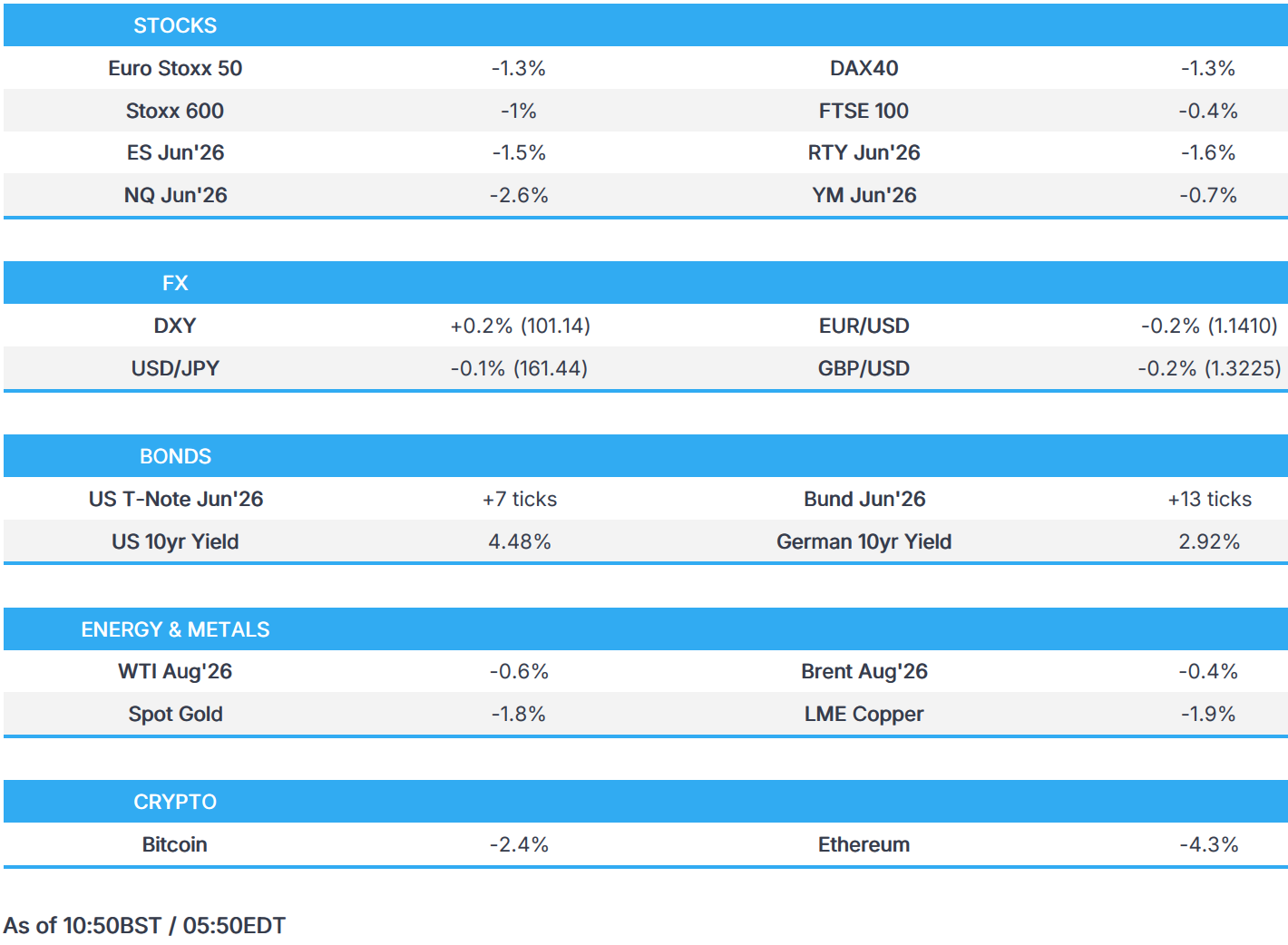
Newsquawk in 3 steps:
1. Subscribe to the free premarket movers reports
2. Listen to this report in the market open podcast (available on Apple and Spotify)
3. Trial Newsquawk’s premium real-time audio news squawk box for 7 days
IRAN CONFLICT
Iranian Commentary:
- Iran’s Foreign Ministry Spokesperson Baghaei said “if the other party does not fulfill its obligations, we should not be expected to unilaterally fulfill our obligations”, Iran International reported.
- Iran’s Foreign Ministry Spokesperson said defensive capabilities and missiles will never be a topic of discussion. US commitment regarding Lebanon is completely clear.
- Iran’s Foreign Ministry Spokesperson said quadrilateral talks were stopped early in Switzerland due to the witnessing of US threats. Thereafter, exchanges were via a mediator, Mehr reported.
- Iran’s Foreign Ministry Spokesperson said Iran has no plans to let IAEA inspectors visit nuclear sites targeted in the conflict.
- Iranian President, ahead of trip to Pakistan, said Iran is seeking the full implementation of the clauses that have been signed within the framework of international law, Nour News reported.
- Iranian Parliament Speaker Ghalibaf said the Strait of Hormuz will be administered by Iran according to international law.
- Iranian President Pezeshkian said in phone call to Turkish President Erdogan on Monday that Iran is ready to pursue diplomacy as per international law.
- Iran Central Bank Governor said Tehran is not obliged to purchase US agricultural goods under current agreements, and states that remaining frozen assets can be used to buy non-sanctioned goods beyond essential items, according to Tasnim.
- “Iranian Foreign Minister Abbas Araghchi will visit Baghdad next Sunday”, Al Mayadeen reported citing sources; The meeting will include a briefing on the progress of the talks in Switzerland and the preparations.
- Iranian Foreign Ministry said “America has issued the necessary license for the sale of Iranian oil and petrochemical products”, Al Jazeera reported.
- Iranian Ambassador to the UN said any further attacks on Lebanon would be a red line.
- Iranian Ambassador to the UN said Hormuz talks will be held with Oman.
- Iranian Ambassador to the UN said there has been good progress in negotiations with the US.
- “Sources indicate that the Iranian Foreign Minister [Araghchi] will hold separate talks with Pakistani officials”, Al Hadath reported.
- Oman’s Foreign Minister said Iranian negotiators reaffirmed their commitment to international law and to ensuring safe, toll-free passage through the Strait of Hormuz.
- Oman’s Foreign Minister meets with Iranian Parliamentary Speaker Ghalibaf, with the officials discussing regional stability and Strait of Hormuz.
- Shipping data cited by Al-Arabia showed at least 20 ships have crossed the Strait of Hormuz in the past 24 hours.
Lebanon/Israel:
- One person reportedly killed by Israeli gunfire in a southern Lebanese town, according to Lebanese Civil Defense and a security source – timing unclear.
- Senior US official tells Al Jazeera that talks between Lebanon and Israel will continue to advance comprehensive peace and a security agreement between the two countries.
- Israeli National Security Minister Ben-Gvir said Israel must act alone against Iran’s nuclear program and must maintain military freedom in Lebanon, hopes withdrawal from southern Lebanon will not happen and will do everything to convince PM Netanyahu.
- Israel military shells and fires at Khan Yunis in Gaza, according to Fars News Agency.
- Israel’s PM, Defence Minister and Military Chief said Israeli military will continue to act to neutralise threats to soldiers and citizens, demolish terrorist infrastructure, and maintain security zone in southern Lebanon, according to a joint statement. Israel’s leadership reaffirms that the security of Israeli citizens and IDF troops will remain its overriding priority, with no room for compromise.
- Israeli forces reportedly violate Syrian territory, conducting house searches in southern outskirts of Quneitra governorate.
US-Iran deal:
- US-Iran technical talks in Burgenstock had a “breakthrough”, talks proceed seemingly in a positive direction, Journalist Mallick reported.
US Commentary:
- US President Trump, on Israel and Lebanon, said “we’ll take a look at it”; said he gets problems solved fast, including with Israeli PM Netanyahu.
- US President Trump said if Iran doesn’t stick to agreement, he will do what he has to do. As long as Iran respects us, we are not going to have any trouble. Could restart the blockade quickly if needed.
EUROPEAN TRADE
EQUITIES
- Large losses in Kospi (-9.9%) crept through to Europe (STOXX 600 -1%) with EU tech leading the losses. No specific headline driver for overnight losses in a typical non-conflict risk-off move (stocks/oil down, fixed/havens bid). As you would expect, South Korean heavyweights Samsung and SK Hynix (which account for over 50% of the index) led the declines, both falling 12%. Some analysts point out the mechanical rebalancing from leveraged ETFs exacerbated losses with a large share of the vehicle used to gain Kospi exposure coming as leveraged ETFs. Others point out positioning into Micron earnings due after the close on Wednesday.
- Given the above, Tech is the worst sectoral performer (bar Basic Resources), the sector posting losses in excess of 3%. The highest weighted chip constituents ASML -5% (Highest weighted in Europe+Tech Sector), Prosus -2.1% and STMicroelectronics -7.3%. For Basic resources, the sector has been dragged lower by declines in metals (Gold -2.5%, Silver -5.5%).
- US equity futures are also downbeat and conforming to losses seen across the pond. NQ leads declines given tech losses, ES and RTY post similar losses, faring better than the tech heavy index.
- Click for the sessions European pre-market equity newsflow
- Click for the additional news
FX
- G10s are entirely lower against the Buck (bar JPY), as USD attracts haven demand in a textbook risk-off market move (stocks/oil down, fixed/havens bid), signalling the market is gradually moving away from geopolitical trade. As you would expect, Antipodeans underperforms, Aussie fares the worst as metals suffer from the strong Buck, while JPY is the only currency stronger vs the USD after a sharp 30pip move lower as it sits towards 2024 highs.
- DXY firmer by 0.2% as it attracts haven demand amid tech weakness in Kospi/NQ (see equities at 09:25 BST for analysis). In terms of domestic newsflow, Fed’s Goolsbee said services inflation was “a little disturbing”. The data docket is light but begins to pick up today (ADP weekly + PMIs due) heading into Thursday’s GDP revisions and PCE data. DXY surpassed Friday’s high of 101.12, now looks to the May peak just below 102.
- JPY continues to whipsaw around multi-year lows against the Buck, with USD/JPY towards 161.50-162. Japanese officials continue attempts to bolster the Yen, but continue unsuccessful with the Greenback bid. Overnight, Japanese Finance Minister Katayama confirmed she spoke with US Treasury Secretary Bessent on Monday. Elsewhere, APAC trade saw stronger flash PMI data and mixed results of the latest 5yr JGB auction.
- GBP is weaker and tracks the firmer Buck with participants awaiting further updates from a likely incoming Burnham premiership. Despite Gilts continuing to outperform peers on optimistic Burnham reporting (Streeting added to Chancellor candidates/Burnham said to announce commitment to Fiscal rules), Miliband still in the picture for Chancellor is viewed by Sterling traders as an unwelcome option. As such, GBP awaits further press reporting and tracks the Buck with Cable remaining at 1.32, EUR/GBP unchanged. ING this morning writes “Regardless of politics, we keep favouring higher EUR/GBP on the back of a dovish view (no hikes) on the Bank of England”. EZ/UK PMIs were mixed (see fixed income for analysis), EUR saw fleeting strength on the French figure, which indicated a cooling of cost pressures; a move which proved fleeting as the German services and composite metric cooled (Some respondents’ answers did not eclipse the signing of the US-Iran MoU).
FIXED INCOME
- A firmer start for fixed income as the complex benefits from the softer energy environment, though the influence of this has diminished amid recent updates from Iran, and the weak risk tone as the KOSPI closed lower by 9.9% and has weighed on European price action, with the European Tech sector lower by over 3%.
- USTs firmer by seven ticks in 109-06+ to 109-14+ confines, towards but just off highs as the mentioned energy move off lows has seemingly formed a ceiling in fixed or now at least. Ahead, we have the region’s Flash PMIs before 2yr supply. A tap that should benefit from a number of factors.
- Bunds firmer by just over 10 ticks and are just under that from the 126.74 high. Initially moving on the above, in-line with peers and with no real reaction to the latest pension reform commentary.
- The main updates, aside from the APAC moves, today have been Flash PMIs for June. Firstly, France’s figures sparked some modest EGB pressure as the components all came in firmer than expected. Internal commentary pointed to a possible peak in price pressures. Thereafter, Germany was below consensus but caveated by the majority of responses coming in before the MoU signing. Nonetheless, encouragingly, the series showed that inflationary pressures had started to ease off.
- Finally, the EZ figure was mixed and again most responses came before the MoU. But, it already showed that lower energy prices were filtering through to businesses with inputs cost rates and selling price inflation moving lower in June. Again, pointing to a potential price spike peak.
- Overall, the data chimes with those who believe that expectations for further ECB tightening are overdone. A point arguably added to by the pertinent commentary from President Lagarde on Monday. As such, upcoming hard and survey data will be scoured for confirmation that prices may have peaked which, alongside the stagnation in activity, may well see a dovish repricing in the period ahead.
- Gilts echoed the above, higher by 35 ticks at best and to a new WTD high of 89.19. Today’s strength also comes from reporting that Burnham will next week give a speech outlining his commitment to the fiscal rules; however, The Times briefing notes that Miliband remains in consideration to be Chancellor, a point that potentially caps any further upside.
- PMIs for the region were weak, though price commentary was also welcome and chimes with the view that the BoE is on hold for the foreseeable.
- The Netherlands sold EUR 1.98bln vs exp. EUR 1.5-2bln 3.50% 2056 DSL Bond: avg. yield 3.52% (prev. 3.51%).
- Japan sold JPY 1.9tln 5yr JGBs; b/c 3.11x (prev. 3.22x), average yield 1.905% (prev. 2.024%).
- Germany sells EUR 3.807bln vs exp. EUR 5bln 2.50% 2028 Schatz: b/c 1.90x (prev. 1.58x), average yield 2.57% (prev. 2.59%), retention 23.86% (prev. 22.80%)
COMMODITIES
- Geopolitical newsflow remains focused on the US-Iran talks, and the sometimes mixed commentary filtering out from the respective officials. As it stands, there does not appear to be any cause for concern, with President Trump and VP Vance both sounding positive about the initial talks; the Iranian side also said good progress has been made. However, looking between the lines reveals some contradictory remarks. On Monday, VP Vance said that Iran would allow the IAEA to inspect nuclear facilities. However, Iran’s Foreign Ministry Spokesperson stated that there are no plans to let inspectors visit nuclear sites targeted in the conflict; the nuance of “sites targeted in the conflict”, potentially offers some hints to the inner workings of the proceedings between the US and Iran. Do note that the Iranian President is visiting Pakistan today.
- The biggest risk to the talks is Israeli actions in Lebanon. Several high-ranking Israeli officials have suggested that Israel will continue its military operations in Lebanon. Comments which come ahead of the US-mediated Lebanon-Israel talks, which are set to begin today. A confab which spans over a couple of days, and focuses on finalising “pilot zones” within southern Lebanon and long-lasting peace.
- Crude benchmarks traded sideways for much of the APAC session, before then moving to lows heading into the European cash open. Since, WTI and Brent have bounced a touch off lows, to currently trade towards the mid-point of the days range. In more detail, WTI Aug’26 (-0.5%) sits within a USD 72.48-74.45/bbl range and Brent Aug’26 (-0.6%) holds within a 76.43-78.23/bbl range.
- Spot gold (-2%) extends lower amidst the continued hawkish mood in markets, which have kept the USD elevated. For gold specifically, a number of sell-side banks have cut their price forecasts for spot gold. On Monday, Goldman Sachs cut their year-end target to USD 4,900/oz (prev. USD 5,200/oz). Its model focused on the Fed, whereby every 50bps worth of easing adds c. USD 120/oz of support to spot gold. Most recently, Deutsche Bank cut its gold forecast by 22%. Today, the yellow metal holds at the bottom end of a USD 4,091 to 4,198/oz range; it may find support at a recent low of USD 4,023/oz, if the pressure continues.
- Base metals follow the downbeat risk tone seen across broader markets. 3M LME copper is lower by c. 1.8% and holds within a USD 13,396.35-13,671/t range.
- Rabobank lowers its Q3 Brent price forecast to USD 79/bbl (from USD 103/bbl), and Q4 to USD 78/bbl (from USD 93/bbl); sees Brent averaging USD 74.50/bbl in 2027, and USD 71/bbl in 2028.
- US Department of Agriculture reported a new case of screwworm in a Texas goat, taking total number of domestic detections to 16 cases.
- US strategic oil reserves fall by 9.1mln barrels to 331.2mln barrels and are at the lowest levels since 1983.
NOTABLE EUROPEAN HEADLINES
- German Chancellor Merz outlines his support for a capital-based pension system, saying it “strengthens the system”.
- German Chancellor Merz confirms plan to push forward with all pension reform proposals.
- Britain’s biggest business lobby group, CBI, said UK firms are not seeking another Brexit referendum and have little interest in rejoining a customs union with the EU, according to FT.
- UK’s Burnham will seek to soothe markets as he marches on number 10 and will use a speech next week to pledge to grow the economy and commit to Labour’s fiscal rules, according to The Times. Burnham is considering Miliband, Streeting and Mahmood for Chancellor.
NOTABLE EUROPEAN DATA RECAP
- UK S&P Global Composite PMI Flash (Jun) 49.4 vs. Exp. 50.6 (Prev. 49.7).
- UK S&P Global Services PMI Flash (Jun) 48.7 vs. Exp. 50 (Prev. 49.3, Low. 49.0, High. 51.5).
- UK S&P Global Manufacturing PMI Flash (Jun) 53.1 vs. Exp. 53.6 (Prev. 53.9, Low. 52.0, High. 54.5).
- UK grocery inflation was 3% (prev. 3.1%) in the four weeks to June 14th.
- EU S&P Global Services PMI Flash (Jun) 48.9 vs. Exp. 48.1 (Prev. 47.7).
- EU S&P Global Manufacturing PMI Flash (Jun) 51.3 vs. Exp. 51.2 (Prev. 51.6).
- German S&P Global Manufacturing PMI Flash (Jun) 50.0 vs. Exp. 50 (Prev. 50.1).
- German S&P Global Services PMI Flash (Jun) 46.8 vs. Exp. 48.7 (Prev. 48.1).
- French S&P Global Manufacturing PMI Flash (Jun) 50.7 vs. Exp. 50.4 (Prev. 49.7).
- French S&P Global Services PMI Flash (Jun) 47.4 vs. Exp. 45.9 (Prev. 44.3).
- French S&P Global Composite PMI Flash (Jun) 47.6 vs exp. 46.0 (prev. 44.9).
- French Business Climate Indicator (Jun) 94 (Prev. 94).
- French Business Confidence (Jun) 100 (Prev. 102).
CENTRAL BANKS
- Fed’s Goolsbee (2027 voter) said inflation is well above target and going the wrong way, adds need evidence this inflation is temporary and services inflation is a little disturbing. said:. We haven’t had stagflation shock, and the job market has been stable. Fed Chair Warsh’s approach is let’s have less speculation about rates, less forward guidance, while Goolsbee said he is pretty sympathetic to that approach.
- ECB’s Kazimir said they are data-dependent, but the direction for policy is clear.
- ECB’s Lane said that inflation risks being above 2% for some time; increase in energy prices is expected to keep inflation well above target into H1’27. Remains attentive to both sides of the outlook. Energy shock is feeding through to broader inflation. labour market resilience, solid household balance sheets and public investment should support activity.
- ECB’s Escriva said service-sector inflation is showing very strong persistence.
NOTABLE US HEADLINES
- US President Trump posted that they are preparing lawsuits against ABC for false reporting, citing the description of vandalism that took place at the Reflecting Pool in Washington, D.C. Full post: “In describing the Vandalism that took place at the Reflecting Pool in Washington, D.C., ABC FAKE NEWS, one of the worst in the business, even paying me $16,000,000 for past bad and inaccurate reporting, failed to report that their close “friends,” Dumocrats Obama and Biden, spent over 100 Million Dollars on the Reflecting Pool, and it never worked. In fact, it was rarely open do to leaks and “stench.” They wanted to spend 300 to 400 Million Dollars, but just let it ROT. I spent approximately 16 Million Dollars, and it came out great, except for the Vandalism, which we are now fixing. It was also a much bigger job than originally envisioned, including the outer areas and sidewalks. We are preparing lawsuits against ABC for false reporting. I like their money, which will be given to the U.S. Treasury! Thank you for your attention to this matter. President DJT”.
- US Senate passes bipartisan affordable housing bill.
GEOPOLITICS
RUSSIA-UKRAINE
- Russia and Ukraine may swap Prisoners of War soon, TASS reported.
- Ukraine’s capital Kyiv issues an air raid alerts and authorities ask people to seek shelter.
OTHERS
- North Korea leader Kim Jong-un said North Korea will further assert its status and role as a nuclear power, adds will accelerate broader plans, enhance nuclear arms technology and develop water deterrence capabilities. accused US and South Korea carrying out the most dangerous provocations through nuclear war machinery. To accelerate building of 10,000-ton strategic guided missile cruiser.
- China’s Beihai Maritime Safety Administration announced that parts of the Beibu Gulf will be closed to navigation due to military training from 11:00-12:00 Beijing time on June 23rd.
CRYPTO
- Bitcoin is on the backfoot this morning, following the downbeat sentiment seen across global markets; BTC holds around USD 62k.
APAC TRADE
- APAC stocks were subdued with initial choppy price action following the mixed performance stateside, where participants reflected on the progress in US-Iran talks, but communication stocks and the Nasdaq Comp underperformed. KOSPI, -6.9%, led the sell off, moving to a test of 8.5k to the downside.
- ASX 200 traded little changed for most of the session amid a lack of major fresh catalysts overnight and as the strength in financials and defensives offset the losses in the tech and commodity-related sectors.
- Nikkei 225 swung between gains and losses with the index briefly climbing to a fresh record high before reversing course, and is on track to snap its 8-day win streak.
- Hang Seng and Shanghai Comp conformed to the lacklustre mood in the region and the absence of any major fresh catalysts, with the Hong Kong benchmark pressured by losses in miners, and digital platforms stocks amid a rotation out of hyperscalers into semiconductors.
NOTABLE ASIA-PAC HEADLINES
- China’s MOFCOM announces measures to stimulate the auto after-sales market; to support the integration and upgrading of the car rental industry.
- Japanese Chief Cabinet Secretary Kihara said will take appropriate action against FX moves if needed.
- Canada awarded Australia a USD 1.75bln contract for its over-the-horizon radar system, boosting Arctic early warning capabilities, and which marks Australia’s largest ever defence export.
- Japanese S&P Global Composite PMI Flash (Jun) 52.50.
- Japanese S&P Global Manufacturing PMI Flash (Jun) 54.9 vs. Exp. 54.5 (Prev. 54.5).
- Australian S&P Global Manufacturing PMI Flash (Jun) 51.2 (Prev. 50.7).
- Blackstone (BX) President and COO Gray told Nikkei that the firm plans to invest USD 30bln in Japanese data center development over the next three to five years.
NOTABLE APAC DATA RECAP
- Japanese BoJ Core CPI (May) 2.7% (Prev. 2.8%).
- Japanese S&P Global Services PMI Flash (Jun) 51.8.
- Indian HSBC Services PMI Flash (Jun) 57.3 (Prev. 59.8).
- Indian HSBC Composite PMI Flash (Jun) 57.4 (Prev. 59.3).
- Indian HSBC Manufacturing PMI Flash (Jun) 54.5 (Prev. 55.0).
- Australian S&P Global Services PMI Flash (Jun) 49.9 (Prev. 48.7).
- Australian S&P Global Composite PMI Flash (Jun) 49.8 (Prev. 48.7).
1c Asian opening report
Europe primed for a lower open with Kospi -5%; Antipodeans lag in quiet newsflow – Newsquawk EU Market Open
Tuesday, Jun 23, 2026 – 02:10 AM
- Mixed US handover continued into APAC before performance deteriorated, KOSPI -5% as the regions chip/tech momentum unwinds.
- European futures point to a lower open, Euro Stoxx 50 -0.9%.
- Crude relatively contained after Monday’s pressure. US President Trump said they are negotiating with Iran and will see how it goes.
- DXY firmer to the modest detriment of peers, Antipodeans lagged given the broader risk tone.
- Fixed benchmarks extended marginally on Monday’s advance, though action was choppy and rangebound.
- Looking ahead, highlights include Global Flash PMIs (Jun), US ADP Employment Change Weekly, Richmond Fed Index (Jun), BCB Minutes (Jun), NBH Policy Announcement, Speakers including ECB’s Lane, Elderson & Vujcic, BoE’s Taylor & Dhingra, Supply from Netherlands, Germany & US, Earnings from FedEx. Note, Iranian President Pezeshkian is in Pakistan.
- Click for the Newsquawk Week Ahead.
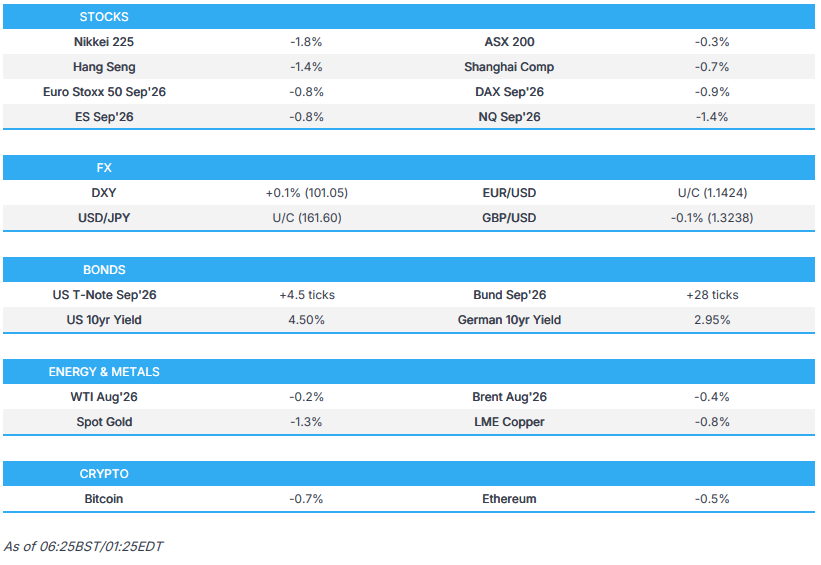
Newsquawk in 3 steps:
1. Subscribe to the free premarket movers reports
2. Listen to this report in the market open podcast (available on Apple and Spotify)
3. Trial Newsquawk’s premium real-time audio news squawk box for 7 d
IRAN CONFLICT
- US President Trump said they are doing very well on the Hormuz Strait and it is totally open, with a lot of oil pouring out of the Hormuz Strait. Trump stated that they are negotiating with Iran and will see how it goes, while he added that Iran’s frozen funds will be used to buy US agriculture. Trump stated if Iran doesn’t stick to the agreement, he will do what he has to do, and as long as Iran respects us, we are not going to have any trouble, while he added the blockade could be restarted quickly if needed. Trump also said regarding Israel and Lebanon that “we’ll take a look at it” and that he gets problems solved fast, including with Israeli PM Netanyahu.
- US President Trump said “Everybody is fully aware that Iran will agree to have Major Weapons Inspections in order to ensure “Nuclear Honesty” long into the future”.
- US VP Vance said he feels great about the progress they made, and they have set up a mechanism to make sure Hormuz stays open, while he added that they continue to make progress on technical talks and that Iranians are allowing inspectors in for the first time in a while. Furthermore, Vance said they will have to keep working on talks, and that Iranian money won’t be unfrozen without progress.
- Oman’s Foreign Minister met with Iranian Parliamentary Speaker Ghalibaf to discuss regional stability and the Strait of Hormuz, while Oman’s Foreign Minister said Iranian negotiators reaffirmed their commitment to international law and to ensuring safe, toll-free passage through the Strait of Hormuz, with the talks said to be constructive.
- Iran’s top negotiator Ghalibaf told state TV that the signing for the release of USD 12bln in frozen Iranian assets has been finalised during talks in Switzerland, and they have agreed to have a communication line regarding ship passage in the Strait of Hormuz to avoid conflict. Ghalibaf also commented that the Strait of Hormuz will be administered by Iran in accordance with international law.
- Iranian President Pezeshkian said in a phone call to Turkish President Erdogan on Monday that Iran is ready to pursue diplomacy as per international law.
- Iranian Foreign Ministry Spokesman Baghaei said Iran’s interaction with the IAEA will continue as usual. Baghaei added that Tehran did not negotiate on the nuclear file during the 18-hour talks and did not accept any new commitments.
- US VP Vance’s claim about the return of IAEA inspectors to the country is false, and there was no talk of the presence of inspectors in the country in the Swiss negotiations, according to Fars citing a source.
- Paris will obstruct the lifting of sanctions on Iran if it conflicts with its “security interests” and will demand sufficient guarantees for international oversight of Iran’s nuclear programme before lifting sanctions, according to Al Hadath citing a source in the French Foreign Ministry.
- Israel’s PM, Defence Minister and Military Chief said the Israeli military will continue to act to neutralise threats to soldiers and citizens, demolish terrorist infrastructure, and maintain the security zone in southern Lebanon, while Israel’s leadership reaffirmed that the security of Israeli citizens and IDF troops will remain its overriding priority, with no room for compromise, according to a joint statement.
- Israeli National Security Minister Ben-Gvir said Israel must act alone against Iran’s nuclear program and must maintain military freedom in Lebanon, while he hopes the withdrawal from southern Lebanon will not happen and will do everything to convince PM Netanyahu.
- Israel received a message from America stating, “The green light is over”, according to Israeli Channel 13.
- Israeli official told Channel 12 that they will withdraw from the proposed pilot zone in southern Lebanon, and Israel will present Lebanon with maps of the experimental zone during Washington talks on Tuesday.
- There will be no Israeli withdrawal from Lebanon except through negotiations in Washington, given that the mechanisms for implementing the ceasefire agreement will only be discussed in Washington, according to military sources cited by Al Jadeed.
- Lebanese delegation will push on Tuesday for concrete Israeli steps regarding de-escalation and withdrawals, while Israel will insist on long-term security guarantees and the issue of Hezbollah’s weapons as a fundamental element in any future arrangement.
- Israeli forces reportedly violated Syrian territory and conducted house searches in the southern outskirts of the Quneitra governorate.
US TRADE
EQUITIES
- US stocks were mixed on Monday, with the Nasdaq and S&P 500 closing lower while the Russell 2000 rallied and the Dow finished with slight gains. Sector performance was similarly mixed, with Real Estate, Energy and Health Care outperforming, while Communication Services and Consumer Discretionary were the clear laggards. A key driver of the weakness in the Nasdaq and S&P 500 was pressure in Alphabet (GOOGL), after DeepMind Vice President John Jumper departed the company to join Anthropic. Energy prices ultimately settled lower after initially gapping higher at the reopen. Iran announced it had closed the Strait of Hormuz following alleged ceasefire violations, but the move quickly reversed as signs of progress in negotiations emerged. Iranian officials later said significant progress had been made in talks in Switzerland, while Qatar and Pakistan both praised the constructive atmosphere surrounding discussions between the US and Iran. Additional downside pressure came after US VP Vance stated that the Strait remained open and said Iran had agreed to allow IAEA inspectors back into the country, although Iranian media disputed those claims about the inspectors. Crude prices also came under pressure after the US suspended sanctions on Iranian energy production, delivery and sales for 60 days, helping benchmarks fall to session lows before some profit-taking emerged into the settlement.
- SPX -0.34% at 7,475, NDX -0.19% at 30,347, DJI +0.29% at 51,713, RUT +0.78% AT 3,003.
- Click here for a detailed summary.
NOTABLE HEADLINES
- Fed’s Goolsbee (2027 voter) said inflation is well above target and going the wrong way, while he added services inflation is a little disturbing and needs evidence that this inflation is temporary. Goolsbee also stated that they haven’t had a stagflation shock, and the job market has been stable, as well as noted that Fed Chair Warsh’s approach is to let’s have less speculation about rates, less forward guidance, and Goolsbee is pretty sympathetic to that approach.
- US President Trump signed Executive Orders on quantum innovation and to accelerate efforts to protect government systems from related cyber threats.
- US President Trump is expected to meet with top executives from the largest US defence contractors on Wednesday, according to CBS citing sources.
- US Senate voted 85-5 to pass the bipartisan affordable housing bill, which now heads to the House.
- US Department of Agriculture reported a new case of screwworm in a Texas goat, taking the total number of domestic detections to 16 cases.
APAC TRADE
EQUITIES
- APAC stocks were subdued with initial choppy price action following the mixed performance stateside, where participants reflected on the progress in US-Iran talks, but communication stocks and the Nasdaq Comp underperformed. KOSPI, -6.9%, led the sell off, moving to a test of 8.5k to the downside.
- ASX 200 traded little changed for most of the session amid a lack of major fresh catalysts overnight and as the strength in financials and defensives offset the losses in the tech and commodity-related sectors.
- Nikkei 225 swung between gains and losses with the index briefly climbing to a fresh record high before reversing course, and is on track to snap its 8-day win streak.
- Hang Seng and Shanghai Comp conformed to the lacklustre mood in the region and the absence of any major fresh catalysts, with the Hong Kong benchmark pressured by losses in miners, and digital platforms stocks amid a rotation out of hyperscalers into semiconductors.
- US equity futures retreated after the mixed Wall St lead and as overnight sentiment gradually deteriorated.
- European equity futures indicate a lower cash market open with Euro Stoxx 50 futures down 0.9% after the cash market closed with gains of 0.3% on Monday.
FX
- DXY lingered around the 101.00 level and took a breather after beginning the week mostly firmer against G10 peers amid recent gains in yields and despite lower oil prices. There were also some comments from Fed’s Goolsbee (2027 voter), who said that inflation is well above target and going the wrong way, as well as noted that services inflation is a little disturbing and they need evidence that this inflation is temporary, while the data calendar has been light but begins to pick up today heading closer to Thursday’s GDP revisions and PCE data.
- EUR/USD was stuck near the prior day’s trough after giving up ground to the firmer buck, and with the single currency not helped by somewhat dovish comments from ECB President Lagarde, who stated there is no evidence yet of de-anchoring of inflation expectations or second-round effects that would warrant a more forceful policy response.
- GBP/USD traded sideways after ultimately gaining yesterday as UK assets were bid following Wes Streeting’s backing of Andy Burnham to replace PM Starmer, who announced his resignation, while the endorsement significantly reduces the odds of a leadership contest and also potentially sets Streeting up to be Chancellor, an outcome which would be much more welcome than other options, such as Miliband.
- USD/JPY struggled for direction after recent fluctuations and a sharp pullback from near the 162.00 territory, which was attributed to reports that Japanese Finance Minister Katayama and US Treasury Secretary Bessent held talks and likely discussed the foreign exchange market.
- Antipodeans underperformed amid the negative risk tone and recent declines in commodity prices.
- PBoC set USD/CNY mid-point at 6.8171 vs exp. 6.7762 (prev. 6.8150).
FIXED INCOME
- 10yr UST futures mildly rebounded but with trade kept within tight parameters after recent choppy price action as participants reflect on lower oil prices and hawkish Fed pricing.
- Bund futures slightly extended on yesterday’s resurgence with upside facilitated by recent declines in energy prices and somewhat dovish comments from ECB’s Lagarde, although further upside was limited ahead of incoming German supply, including today’s EUR 5bln Schatz issuance.
- 10yr JGB futures nursed some of the recent losses but with the recovery contained following stronger flash PMI data from Japan and mixed results of the latest 5yr JGB auction.
COMMODITIES
- Crude futures were constrained following the prior day’s selling pressure, which was spurred by progress in US-Iran talks and with the US issuing a licence authorising Iranian oil sales, while the US side stated that Tehran are allowing nuclear inspectors in, although Iran’s Foreign Ministry spokesman said they did not negotiate on the nuclear file during the 18-hour talks and did not accept any new commitments.
- US strategic oil reserves fell by about 9.1mln barrels last week to 331.2mln barrels, the lowest level since 1983.
- US will reportedly release 500k bbl. of crude oil from the SPR to Vitol.
- Spot gold retreated after failing to sustain the USD 4,200/oz level, and as money markets price in higher rates.
- Copper futures declined with demand sapped amid the downbeat risk tone across the Asia-Pac region.
CRYPTO
- Bitcoin traded indecisively with prices oscillating through the USD 64,000 level.
NOTABLE ASIA-PAC HEADLINES
- Japanese Finance Minister Katayama confirmed she spoke with US Treasury Secretary Bessent on Monday as a follow-up to the G7 summit and said that Japan and the US have an existing agreement on taking decisive steps, which is unchanged. Katayama also said they discussed global financial markets and impacts from the Iran conflict, as well as had good discussions regarding global economic matters and reaffirmed coordination with Bessent.
GEOPOLITICS
RUSSIA-UKRAINE
- Ukraine’s capital Kyiv issued air raid alerts, and authorities asked people to seek shelter.
- Ukraine and Japan are set to launch a joint reconstruction fund with support from Hitachi (6501 JT) and Toshiba, with details expected at this week’s Ukraine Recovery Conference, while the initiative is reportedly backed by aid and long-term financing from JICA and other institutions, according to Nikkei.
OTHER
- North Korean leader Kim Jong-un said North Korea will further assert its status and role as a nuclear power, while they will accelerate broader plans, enhance nuclear arms technology and develop water deterrence capabilities.
EU/UK
NOTABLE HEADLINES
- UK’s Andy Burnham will seek to soothe markets as he marches on number 10 and will use a speech next week to pledge to grow the economy and commit to Labour’s fiscal rules, while he is reportedly considering Miliband, Streeting and Mahmood for Chancellor, according to The Times.
- Britain’s biggest business lobby group, CBI, said UK firms are not seeking another Brexit referendum and have little interest in rejoining a customs union with the EU, according to FT.
- EU’s move to delay next month’s summit with Britain has frustrated officials in London, as Brussels waits for pro-European Andy Burnham to enter Downing Street before reshaping post-Brexit ties, according to FT.
2.NORTH AND SOUTH KOREA AND JAPAN
SOUTH KOREA
Korea Crashed: Goldman Explains What Happened And Why It Matters
South Korea’s KOSPI index experienced a sharp ~10% drop (closing down nearly 10%, around 8,204) on or around June 23, 2026, triggering a circuit breaker halt.
x.com
This was one of the market’s largest single-day declines in recent years. Heavily weighted semiconductor giants Samsung Electronics and SK Hynix (together driving roughly half the index’s weight) fell 11-12% each and accounted for the bulk of the selloff.
x.com
What Happened (Immediate Triggers)
- Profit-taking after an extreme rally: The KOSPI had roughly doubled (+100%) year-to-date in 2026, fueled almost entirely by an AI-driven memory chip supercycle. Samsung and SK Hynix had surged on massive earnings growth expectations (Goldman had forecasted 300% earnings growth for Korea). goldmansachs.com
- Concentration risk and leverage unwind: The rally was extremely narrow (tech/semiconductors). High retail investor leverage in Korea amplified the downside as margin calls and forced liquidations kicked in.
- Global tech pullback spillover: Weakness in U.S. semis/Nasdaq (e.g., reactions to Fed signals, rate concerns, or Broadcom-like forecasts) hit Korean chip stocks hard.
- Foreign selling + other flows: Foreign investors had been net sellers for months (tens of billions outflows earlier in the year). A stronger dollar or shifting risk sentiment added pressure. cnbc.com
Despite the crash, the index remained strongly positive YTD.Goldman Sachs’ View (Context and Outlook)Goldman has been among the most bullish voices on Korea throughout 2026:
- They repeatedly raised targets (e.g., to 9,000, then 12,000), citing a “supercycle” in memory chips (HBM for AI) driven by supply shortages + explosive hyperscaler/AI demand. bloomberg.com
- They viewed valuations as attractive (low single-digit forward P/Es despite growth) and saw Korea as their highest-conviction equity market in Asia. goldmansachs.com
- Even after the drop, the narrative from Goldman and similar firms is that this is likely a tactical correction (profit-taking + flows) rather than a fundamental end to the AI/memory boom. They continue to highlight durable earnings power from the chip cycle. cnbc.com
The ZeroHedge piece (which matches your query title) frames it as another volatile swing in a K-shaped market: semis booming while the broader economy faces headwinds (demographics, household debt, sluggish domestic demand). It highlights flow exhaustion and leverage as key vulnerabilities beyond pure fundamentals.
@zerohedgeWhy It Matters
- Concentration risk example: Korea illustrates how narrow, momentum-driven rallies (here, two companies dominating on AI hype) can produce extreme volatility. A similar dynamic has played out in the U.S. “Magnificent 7”/tech.
- Broader AI/semiconductor implications: Korea is a bellwether for the global AI hardware theme. A sharp reversal could signal doubts about the duration/strength of the memory supercycle.
- Retail and systemic effects in Korea: High leverage among domestic investors raises risks of forced selling spirals and potential policy responses.
- Global market signal: Sharp drops in correlated assets (Korean chips, Nasdaq semis) can amplify risk-off moves elsewhere, though Korea has shown resilience and quick recoveries in 2026.
Bottom line: This looks like a painful but typical pullback in a high-beta, concentrated bull market rather than the start of a structural bear market. Goldman and other bulls still see substantial upside if the AI demand/supply imbalance persists, but volatility is likely to remain high. Corrections test conviction—watch upcoming earnings from Samsung/SK Hynix and global AI capex trends for the next leg.
END
SOUTH KOREA..
Here Is The Korean Article That Sent Memory Stocks Tumbling And Sparked A Global Selloff
Tuesday, Jun 23, 2026 – 09:40 AM
Early last night, just around the time Korean stocks opened at a new all time high, we highlighted an article in Korea’s Chosun Biz, which eventually became the catalyst for the sharp repricing lower of memory stocks – and since memory stocks account for about 60% of the Kospi, sparked the 10% crash in the South Korean market which culminated with a mandatory halt of trading – and sparked a risk off wave around the globe.
As both CNBC and Bloomberg write this morning, “traders are pointing to a South Korean media report saying SK Hynix is slowing expansion of AI memory chip production and shifting emphasis to commodity DRAM.”
What exactly is the article saying? The punchline was the following:
“An official familiar with SK Hynix stated, ‘SK Hynix management cannot help but be mindful that their competitor (Samsung Electronics) is already generating massive profits from general-purpose DRAM rather than HBM.'” The official explained, “Since production forecasts for Nvidia’s next-generation chip ‘Rubin,’ which will be equipped with HBM4, are also trending downward, there is no reason to accelerate the transition to HBM.”
The slowdown in HBM4 (or high bandwidth memory) rollout which is critical for high end AI racks, was – naturally – spun as a positive event and was justified as SK Hynix moving back to DDR memory production, which somehow is now higher margin, but the bottom line is simple: supply for high end HBM is slowing which in turn has prompted questions whether this is due to a cartel-like attempt to control pricing (probably not very smart to admit this), or more likely, in response to problems with the rollout of high end Nvidia systems, and especially the Vera Rubin racks which as we reported a month ago are emerging as extremely expensive, primarily because of the surge in memory prices which are crushing hyperscaler margins.


Here is the full Chosun article:
SK Hynix Adjusts HBM4 Production Speed… Seeking Additional Revenue by Increasing General-Purpose DRAM Amid Supply Shortages
- General Purpose DRAM Surpasses HBM in Operating Profit Margin… “90% Possible”
- “SK Hynix Needs Only to Defend HBM Market Share”
- Opportunity for Samsung Electronics to Increase HBM Market Share
SK Hynix is shifting its focus to the general-purpose DRAM market while adjusting the pace of mass production expansion for 6th generation High Bandwidth Memory (HBM4). The explanation is that, having already solidified an overwhelming advantage with HBM sales accounting for over 40% of total revenue, the company is adjusting its resource allocation to secure additional profits in the general-purpose DRAM market, where supply shortages are severe, rather than engaging in excessive competition for capacity expansion.
According to industry sources on the 23rd, SK Hynix is reportedly delaying the conversion of some 5th-generation HBM (HBM3E) production lines, which were originally scheduled to transition to HBM4. The company plans to secure additional profits by increasing its responsiveness to the general-purpose DRAM market, which currently records higher operating profit margins than HBM. The industry view is that this decision is based on the judgment that there is no need to rush the transition to HBM4 and HBM4E (7th-generation HBM), given that the company has already secured a solid position in the HBM market.
Behind this strategic shift lies the reversal in profitability between general-purpose DRAM and HBM. As of the first quarter of this year, the price per gigabit (Gb) of general-purpose DRAM still lags behind that of HBM, but the gap in operating profit margins is estimated to have already widened to more than 15 percentage points (P). Daishin Securities projected that the operating profit margin for general-purpose DRAM could reach a theoretical peak of 90% within the year.
“An official familiar with SK Hynix stated, ‘SK Hynix management cannot help but be mindful that their competitor (Samsung Electronics) is already generating massive profits from general-purpose DRAM rather than HBM.'” The official explained, “Since production forecasts for Nvidia’s next-generation chip ‘Rubin,’ which will be equipped with HBM4, are also trending downward, there is no reason to accelerate the transition to HBM.”
The perspective of overseas investment banks (IBs) also supports this trend. Goldman Sachs assessed that it would be sufficient for SK Hynix to maintain a dominant position of over 50% in HBM3 (4th generation HBM) and HBM3E (5th generation HBM) until at least 2026. Morgan Stanley identified the overall memory price cycle, rather than the defense of HBM market share, as the key driver of SK Hynix’s value, and raised its earnings forecast by 56–63% based on the projection that the average selling price of DRAM will rise by 62% by 2026.
In fact, SK Hynix announced in its first-quarter earnings report that the average selling price (ASP) of DRAM had risen to the mid-60% range and presented a plan to focus on meeting demand for high-density server modules and mobile products. The signing of a three-year DDR5 supply contract with Microsoft (MS) is also interpreted as a move to secure long-term earnings visibility in general-purpose DRAM.
On the other hand, as SK Hynix moves to control HBM4 production volume, the possibility of its competitor Samsung Electronics rising in market share is also increasing. According to Counterpoint Research, SK Hynix’s HBM market share stood at 57% in the fourth quarter of last year, but there is talk of a potential gradual contraction; furthermore, it is observed that if Samsung Electronics succeeds in mass-producing HBM4 in the second half of this year, SK Hynix’s share could drop to the 50–60% range.
JAPAN
3 CHINA
CHINA/USA
.4. EUROPEAN AND SCANDINAVIAN COMMENTARIES PLUS NATO
GERMANY
KORYBKO….
AfD Co-Leader Demands Ukraine Pay Reparations To Germany
Tuesday, Jun 23, 2026 – 03:30 AM
Europeans and especially Germans have borne enormous costs to perpetuate the Ukrainian Conflict while receiving absolutely nothing of tangible benefit in return.

AfD co-leader Alice Weidel responded to Chancellor Friedrich Merz’s proposal to grant Ukraine associate membership in the EU, which was analyzed here and here, by declaring that “We need to know how this state-terrorist act against the most important infrastructure we had, namely the Nord Stream pipelines, came about and what role Ukraine played in it. The flow of payments should actually be moving in the opposite direction.”
She then added that, “Ukraine must pay reparations to the Federal Republic of Germany, because we have suffered enormous damage – and so has Europe as a whole – from the loss of cheap Russian fossil fuels.” Weidel made a solid point about the economic damage that the Ukrainian Conflict has caused to Europe, even independently of the Nord Stream terrorist attack, which she implied was committed by Ukraine like Berlin suggested but which the famous Seymer Hersh cited sources to blame on the US.
To elaborate a bit more on the background of Berlin’s innuendo, it sought the extradition from Poland last year of a Ukrainian suspect but was rebuffed by the judge for the reasons explained here, which lent credence in a lot of the public’s mind to the claim of Ukrainian culpability. Nevertheless, that narrative was already counteracted here, here, and here over the years long before the extradition request was made and rejected, but Weidel, many Germans, and a lot of folks across the West in fact still believe it.
In any case, having clarified the context of her implied accusation against Ukraine and circling back to her reparations demand, the EU spent hundreds of billions of dollars on aid for Ukraine and its refugees. When calculating the higher cost of fuel since then, including that which it still purchases from Russia, the total credibly approaches $1 trillion and might even surpass it by some estimates.
The most that the EU might receive in exchange is arms and reconstruction contracts for only a handful of companies.
That nowhere near justifies the enormous costs that the EU has paid to perpetuate the NATO-Russian proxy war in Ukraine, which highlights the ideological motives behind this policy. The liberal-globalists that rule the bloc are hellbent on inflicting a strategic defeat on Russia through NATO-backed Ukraine, to which end no cost is too high to pay, especially since it’s average Europeans and not them that are paying it.
This cynical policy is already backfiring in Germany by turbocharging the AfD’s rise.
It’s now the most popular party in the country by far and its appeal continues to grow since it’s one of the few forces apart from the Sahra Wagenknecht Alliance that’s speaking truth to power about this conflict and its crushing economic consequences for Europeans. Germany in particular has been hit exceptionally hard with growth crawling to a halt and many suspecting that the bloc’s largest economy is actually already in a recession that might soon be confirmed and then spread throughout the EU.
Weidel knows very well that Ukraine will never pay reparations to Germany and that even the hypothetical cession of its key industries to her country wouldn’t come anywhere near compensating the costs that Germans have already paid. Her rhetoric was thus meant to draw attention to these same costs. The more that Germans dwell upon them and realize that their country received nothing of tangible benefit in return, the more likely they are to support the AfD in a bid to bring about real change.
END
UK
Starmer’s Gone, But UK’s Right May Have Little To Cheer About
Tuesday, Jun 23, 2026 – 02:00 AM
Authored by Remix News via Modernity News,
The deeply unpopular British Prime Minister, Keir Starmer, announced his resignation on Monday morning, but despite his upcoming departure, the right may have little to cheer about.

During a speech outside Downing Street, Starmer announced he was stepping down after holding office since July 7, 2024. In that election, his Labour Party won 412 seats, securing a comfortable majority and decimating the Tories, who had governed Britain since 2010.
Starmer revealed on the morning of Monday, June 22, that he had already spoken with King Charles III to inform him of his decision. The Labour Party’s National Executive Committee will now develop a timetable for the election of a new leader, who will also become Prime Minister. He stressed that this process should be completed by the end of the summer holidays. Until then, Starmer will remain at the helm of the British government.
According to Reuters, the main favorite to replace Starmer is the former Mayor of Greater Manchester, Andy Burnham, who won a seat in the House of Commons during the Makerfield constituency by-election in northwest England on June 18, defeating Nigel Farage’s party.
The right now has a challenger
Burnham may pose a grave challenge to Restore Britain and Reform UK, the two main right-wing parties running against the British left.
Under Starmer, multiple polls predicted a strong majority for Reform UK, with some even forecasting a blowout election victory.
However, the rise of Restore Britain had already siphoned off a number of voters from Reform UK, narrowing Farage’s lead.
Now, with Starmer gone, some polls show Reform UK barely leading Labour in a general election. A new poll from Politico shows Farage winning 27 percent of the vote versus 20 percent for Labour under Starmer’s current numbers – but when tested against Burnham, Labour’s chances receive a significant boost. Some within Labour even describe Burnham as a “Reform Slayer,” as he polls better against Farage than anyone else in the party.
Nevertheless, the Politico article also describes an uphill battle for Burnham, given how far Labour has fallen out of favour with British voters during Starmer’s rule. Notably, Burnham is described as more left-wing than Starmer, who is categorized as a “centrist.”
Although the Tories are still seen as a formidable election force, they have long since discarded any semblance of right-wing politics. Nevertheless, they are also siphoning voters away from both Restore Britain and Reform UK, retaining voters who might lean personally to the right but still vote Conservative out of habit.
The combined effect of vote-splitting on the right and Burnham leading Labour could deliver a shock upset in favor of Labour, ending Farage’s dream of winning the office of prime minister.
British commentators point out that Starmer’s position has been weakening for months. More than 100 Labour MPs – around a quarter of the parliamentary party in the House of Commons – had publicly stated they wanted the prime minister to resign or set a timetable for his departure.
Labour Party members pointed to a total loss of trust in the head of government and his leadership abilities. The government had recently been rocked by a number of high-profile resignations, including Health Secretary Wes Streeting and Defence Secretary John Healey.
Polling also showed that Labour members overwhelmingly wanted Burnham, nicknamed the “King of the North” after winning three consecutive mayoral terms. He is currently Labour’s most popular politician. His recent victory in the Makerfield seat also bodes poorly for Reform UK and Restore Britain; the constituency is predominantly white and working-class, representing the exact demographic that these two right-wing parties are seeking to win over from Labour.
END
UK/RUSSIA/UKRAINE
sheer madness!
Sheer Madness: UK Tests Long-Range Missile For Ukraine To Bomb Moscow
Tuesday, Jun 23, 2026 – 07:45 AM
Ukraine is making it clear they are seeking to “bring the war to Russia” – and this is what’s behind the recent series of massive Ukrainian drone strikes on Moscow, which has wreaked havoc particularly on energy refineries, and air travel for the region. That Ukraine desperately wants to gain back what leverage they are able to is fully understandable, however, that NATO is backing such actions against a nuclear-armed superpower constitutes madness.
Aside from covert targeting assistance, the UK is taking things in a more overt direction, having reportedly just tested missiles with a range of 300 miles which is intended to be sent to Ukraine’s military.

The British missile platform has the capability of delivering 500-pound warhead to Moscow.
The Telegraph offers some further details regarding context to the major Ukraine support program in the following:
The Ministry of Defence (MoD) challenged firms to build long-range strike weapons that can fly at more than 370mph, cost about £400,000 each and can be built at a pace of 20 a month.
Some 27 bids from industry were made with Dragon’s Den-style pitches held last February, before six UK companies were awarded contracts worth around £5m each to design prototypes for testing in just seven months.
By last December, only three suppliers remained: MBDA UK, which makes the Storm Shadow stealth missile, MGI Engineering, a UK small or medium-sized enterprise (SME) with a background in Formula 1 technology, and Rotron Aerospace, another UK SME with a history of working with the MoD.
And the publication confirms that “New systems that can attack targets more than 300 miles away have been tested at a range in the Hebrides, with further trials taking place in the UK over the coming months.”
For missiles of this range and power, this is a relatively cheap price tag, and can apparently be rapid-produced at that.
UK Armed Forces Minister Louise Sandher-Jones has said the new missiles are intended to “complement” the Storm Shadow cruise missiles London sends to Ukraine.
“The UK stands shoulder-to-shoulder with Ukraine, and we will continue to provide the support it needs to defend itself against Russian aggression,” she stated. “Project Brakestop shows what happens when we combine that commitment with the talent and ingenuity of British industry.”
Ukraine has in tandem all along been advancing its domestic-developed long-range drones:

The open and brazen admission that these future systems could soon be use to directly target the Russian capital would be an insane escalation by NATO. Once NATO and Western systems begin blowing up buildings in Moscow, suddenly direct Russian military retaliatory action against Europe gets much closer to becoming a reality. Again, this is sheer madness and lunacy by some of Europe’s most hawkish leaders.
5. RUSSIAN AND MIDDLE EASTERN AFFAIRS//
ISRAEL/USA VS IRAN//TUESDAY
not a chance of happening
Iran Says US To Unfreeze $12BN, Insists It Alone Will Decide How Funds Used, Contradicting Vance
Tuesday, Jun 23, 2026 – 07:20 AM
Among the biggest latest developments in the immediate wake of the Switzerland meeting is that Iranian Parliament Speaker Mohammad Bagher Ghalibaf has announced an agreement has been reached for the United States to release $12 billion in frozen Iranian assets.
It also comes after the US Treasury Department announced temporary sanctions relief, namely freeing up Iranian oil and petrochemical sales until August 1st. Concerning the frozen asset partial release, Tehran is now emphasizing that it alone will decide how the funds will be used.
But this may be another area where the headlines and declarations are too far out front, given Washington has sought to impose some caveats which likely remain unacceptable to the Iranians side. For example Vice President JD Vance made clear his stance Monday that Iranian assets had not yet been unfrozen as part of the deal, describing that if there were, they must be limited in use and implementation – to purchase US agricultural goods. He has emphasized – perhaps wishing to address American domestic criticisms – that the funds would not be used to support terrorism.

Ali Bahreini, the Iranian ambassador to the United Nations, has already firmly rejected the soybean plan, saying at a UN press briefing, “Iran is the only country who will decide what to do with its assets, which are going to be defrozen.”
In total a whopping $50 billion could eventually be released under the MoU framework – something which will drive Republican hawsk mad. Al Jazeera reports Tuesday, citing the Iranian side:
A spokesperson said the agreement would allow Iran access to previously frozen assets, although the US says restrictions would remain in place under the arrangement.
According to sources familiar with the negotiations, two separate tranches of $6bn were originally agreed in Doha, with the final signing ceremony intended to take place in Switzerland. The Iranian spokesperson now says that process has been completed.
Under the reported framework, an initial $12bn in Iranian funds would be released. During the 60-day negotiation period, a further $12bn could be unlocked. If the parties ultimately reach a final agreement, the value of sanctions relief and released funds could reportedly rise to as much as $50bn.
Another point of disagreement remains the entry of IAEA nuclear inspectors into the Islamic Republic. Vance had hailed Tehran already agreed to this, while Iran’s leaders are in effect saying not so fast. It’s but one of several major contradictions in public rhetoric coming from either side in the wake of the top-level round one meeting in Switzerland.
Something interesting – which Washington may or may not be on board with – is that Tehran is now signaling openness to Russia hosting its enriched nuclear material.
Al Arabiya reports that Iran’s aforementioned UN ambassador says “transferring enriched uranium to Russia is under consideration.“ This could indeed be enough to satisfy President Trump, considering it would be a ‘lesser evil’ option if indeed the Iranians are actually ready for such a plan (which Moscow has offered several times to facilitate over the past year).
Lebanon is another issue which could threaten to unravel all the progress made thus far, but reports cite a ‘cautious calm’ across the south, but with some limited, sporadic exchanges of fire.
One correspondent on the ground reports, “Here in Tyre, people driving across the city this morning are picking up bits of rubble, starting to clear things out and searching for what they can salvage among their destroyed homes and businesses. That is what people are using this moment of calm for.”
However, there’s been reports of at least two new Lebanese deaths. In one instance Lebanese national media indicated “A young man was killed and two others were injured” when Israeli soldiers “opened machine gun fire in their direction while they were standing near an excavator which was clearing a road” in a locality near the town of Nabatieh – per the National News Agency. Hezbollah is saying Tuesday that this violates the ceasefire agreement.
The situation on Monday was such that the Iranian delegation almost quit the Sunday-Monday talks completely, Iran’s top negotiator has explained:
* * *
Below are some latest developments on the US-Iran peace front via Middle East Eye:
- Iranian Parliament Speaker Mohammad Bagher Ghalibaf said an agreement had been reached to release $12bn in frozen Iranian assets.
- The US Treasury Department announced temporary sanctions relief allowing Iranian oil and petrochemical sales until 1 August.
- Washington said the measures follow Iran’s commitment to permit international nuclear inspections after intensive talks in Switzerland.
- President Donald Trump said released Iranian funds would be used to purchase food and agricultural products from US farmers.
- Iran’s Central Bank rejected Trump’s comments, saying Tehran is under no obligation to spend released funds on American goods.
- Iranian officials said technical negotiations with the United States have concluded and the process is entering a new phase.
- President Masoud Pezeshkian said the effectiveness of future talks depends on all sides fully implementing their commitments.
- A US official said Centcom has launched a monitoring mechanism in Lebanon to provide American officials with assessments of fighting on the ground.
- Israeli officials reiterated that military operations in Lebanon would continue despite ongoing diplomatic progress between Washington and Tehran.
- Markets and regional observers continued to focus on sanctions implementation, Hormuz shipping activity and the durability of the broader agreement.
ISRAEL/USA VS IRAN//TUESDAY
Trump Insists Iran Caved On Nuclear Inspections, As Tehran Touts US To Unfreeze $12BN
Tuesday, Jun 23, 2026 – 07:35 AM
Summary
- Conflicting Claims Remain: Washington and Tehran continue to dispute whether Iran agreed to extensive IAEA nuclear inspections and the terms of sanctions relief.
- $12 Billion Asset Release: Iran says $12 billion in frozen assets will be released initially, with total relief potentially reaching $50 billion if a final deal is reached.
- Battle Over Fund Control: The US says released funds would be restricted to humanitarian purchases, while Iran insists it will decide how to use its own money.
- Oil Relief and Hormuz: Temporary sanctions relief for Iranian oil exports has begun, and both sides say the Strait of Hormuz remains open to shipping.
- Fragile Progress & a Russian Role? Iran is considering sending enriched uranium to Russia, but regional tensions and unresolved issues still threaten the talks.
* * *
Trump Insists Iran Agreed to ‘Highest Level’ of Nuclear Inspections
With a number of issues still up in the air, amid claims and counter-claims coming after Switzerland – from nuclear inspectors accessing Iran to how Tehran is able to use its soon to be unfrozen funds – President Trump heightens the drama by issuing a Tuesday morning Truth Social message regarding the negotiations
Trump insists that Iran has agreed to the “highest level” of nuclear inspections, calling it a guarantee of “Nuclear Honesty” and stressing that there would have been “no further negotiations” without such a commitment. He also says the US will allow the Strait of Hormuz to remain “OPEN” and is not pursuing a naval blockade, though military assets remain in place if conditions change.
According to Trump, any sanctions relief or released Iranian funds will be held in US-controlled escrow and can only be used to purchase food and medical supplies from the United States, including “Corn, Wheat, and Soybeans from our great American Farmers.”
Trump now characterizes the situation in Iran as a “humanitarian crisis” and concluded that “Talks are going well!!”.
Iran Touts $12BN in Frozen Assets to Be Released, Will Use How it Pleases
Among the biggest latest developments in the immediate wake of the Switzerland meeting is that Iranian Parliament Speaker Mohammad Bagher Ghalibaf has announced an agreement has been reached for the United States to release $12 billion in frozen Iranian assets.
It also comes after the US Treasury Department announced temporary sanctions relief, namely freeing up Iranian oil and petrochemical sales until August 1st. Concerning the frozen asset partial release, Tehran is now emphasizing that it alone will decide how the funds will be used.
But this may be another area where the headlines and declarations are too far out front, given Washington has sought to impose some caveats which likely remain unacceptable to the Iranians side. For example Vice President JD Vance made clear his stance Monday that Iranian assets had not yet been unfrozen as part of the deal, describing that if there were, they must be limited in use and implementation – to purchase US agricultural goods. He has emphasized – perhaps wishing to address American domestic criticisms – that the funds would not be used to support terrorism.
Ali Bahreini, the Iranian ambassador to the United Nations, has already firmly rejected the soybean plan, saying at a UN press briefing, “Iran is the only country who will decide what to do with its assets, which are going to be defrozen.”
In total a whopping $50 billion could eventually be released under the MoU framework – something which will drive Republican hawsk mad. Al Jazeera reports Tuesday, citing the Iranian side:
A spokesperson said the agreement would allow Iran access to previously frozen assets, although the US says restrictions would remain in place under the arrangement.
According to sources familiar with the negotiations, two separate tranches of $6bn were originally agreed in Doha, with the final signing ceremony intended to take place in Switzerland. The Iranian spokesperson now says that process has been completed.
Under the reported framework, an initial $12bn in Iranian funds would be released. During the 60-day negotiation period, a further $12bn could be unlocked. If the parties ultimately reach a final agreement, the value of sanctions relief and released funds could reportedly rise to as much as $50bn.
Official Contradiction: Vance Had Hailed Iran Will Allow IAEA Access to Nuclear Sites
Another point of disagreement remains the entry of IAEA nuclear inspectors into the Islamic Republic. Vance had hailed Tehran already agreed to this, while Iran’s leaders are in effect saying not so fast. It’s but one of several major contradictions in public rhetoric coming from either side in the wake of the top-level round one meeting in Switzerland.
Something interesting – which Washington may or may not be on board with – is that Tehran is now signaling openness to Russia hosting its enriched nuclear material.
Russia to Host Enriched Uranium?
Al Arabiya reports that Iran’s aforementioned UN ambassador says “transferring enriched uranium to Russia is under consideration.“ This could indeed be enough to satisfy President Trump, considering it would be a ‘lesser evil’ option if indeed the Iranians are actually ready for such a plan (which Moscow has offered several times to facilitate over the past year).
Lebanon is another issue which could threaten to unravel all the progress made thus far, but reports cite a ‘cautious calm’ across the south, but with some limited, sporadic exchanges of fire.
One correspondent on the ground reports, “Here in Tyre, people driving across the city this morning are picking up bits of rubble, starting to clear things out and searching for what they can salvage among their destroyed homes and businesses. That is what people are using this moment of calm for.”
However, there’s been reports of at least two new Lebanese deaths. In one instance Lebanese national media indicated “A young man was killed and two others were injured” when Israeli soldiers “opened machine gun fire in their direction while they were standing near an excavator which was clearing a road” in a locality near the town of Nabatieh – per the National News Agency. Hezbollah is saying Tuesday that this violates the ceasefire agreement.
The situation on Monday was such that the Iranian delegation almost quit the Sunday-Monday talks completely, Iran’s top negotiator has explained:
More Latest Developments
Below are some latest developments on the US-Iran peace front via Middle East Eye:
- Iranian Parliament Speaker Mohammad Bagher Ghalibaf said an agreement had been reached to release $12bn in frozen Iranian assets.
- The US Treasury Department announced temporary sanctions relief allowing Iranian oil and petrochemical sales until 1 August.
- Washington said the measures follow Iran’s commitment to permit international nuclear inspections after intensive talks in Switzerland.
- President Donald Trump said released Iranian funds would be used to purchase food and agricultural products from US farmers.
- Iran’s Central Bank rejected Trump’s comments, saying Tehran is under no obligation to spend released funds on American goods.
- Iranian officials said technical negotiations with the United States have concluded and the process is entering a new phase.
- President Masoud Pezeshkian said the effectiveness of future talks depends on all sides fully implementing their commitments.
- A US official said Centcom has launched a monitoring mechanism in Lebanon to provide American officials with assessments of fighting on the ground.
- Israeli officials reiterated that military operations in Lebanon would continue despite ongoing diplomatic progress between Washington and Tehran.
- Markets and regional observers continued to focus on sanctions implementation, Hormuz shipping activity and the durability of the broader agreement.
And via Newsquawk summary:
- Iran’s Foreign Ministry Spokesperson Baghaei said “if the other party does not fulfill its obligations, we should not be expected to unilaterally fulfill our obligations”, Iran International reported.
- Iran’s Foreign Ministry Spokesperson said defensive capabilities and missiles will never be a topic of discussion. US commitment regarding Lebanon is completely clear.
- Iran’s Foreign Ministry Spokesperson said quadrilateral talks were stopped early in Switzerland due to the witnessing of US threats. Thereafter, exchanges were via a mediator, Mehr reported.
- Iran’s Foreign Ministry Spokesperson said Iran has no plans to let IAEA inspectors visit nuclear sites targeted in the conflict.
- Iranian President, ahead of trip to Pakistan, said Iran is seeking the full implementation of the clauses that have been signed within the framework of international law, Nour News reported.
- Iranian Parliament Speaker Ghalibaf said the Strait of Hormuz will be administered by Iran according to international law.
- Iranian President Pezeshkian said in phone call to Turkish President Erdogan on Monday that Iran is ready to pursue diplomacy as per international law.
- Iran Central Bank Governor said Tehran is not obliged to purchase US agricultural goods under current agreements, and states that remaining frozen assets can be used to buy non-sanctioned goods beyond essential items, according to Tasnim.
- “Iranian Foreign Minister Abbas Araghchi will visit Baghdad next Sunday”, Al Mayadeen reported citing sources; The meeting will include a briefing on the progress of the talks in Switzerland and the preparations.
- Iranian Foreign Ministry said “America has issued the necessary license for the sale of Iranian oil and petrochemical products”, Al Jazeera reported.
- Iranian Ambassador to the UN said any further attacks on Lebanon would be a red line.
- Iranian Ambassador to the UN said Hormuz talks will be held with Oman.
- Iranian Ambassador to the UN said there has been good progress in negotiations with the US.
- “Sources indicate that the Iranian Foreign Minister [Araghchi] will hold separate talks with Pakistani officials”, Al Hadath reported.
- Oman’s Foreign Minister said Iranian negotiators reaffirmed their commitment to international law and to ensuring safe, toll-free passage through the Strait of Hormuz.
- Oman’s Foreign Minister meets with Iranian Parliamentary Speaker Ghalibaf, with the officials discussing regional stability and Strait of Hormuz.
- Shipping data cited by Al-Arabia showed at least 20 ships have crossed the Strait of Hormuz in the past 24 hours.
- One person reportedly killed by Israeli gunfire in a southern Lebanese town, according to Lebanese Civil Defense and a security source – timing unclear.
- Senior US official tells Al Jazeera that talks between Lebanon and Israel will continue to advance comprehensive peace and a security agreement between the two countries.
- Israeli National Security Minister Ben-Gvir said Israel must act alone against Iran’s nuclear program and must maintain military freedom in Lebanon, hopes withdrawal from southern Lebanon will not happen and will do everything to convince PM Netanyahu.
- Israel military shells and fires at Khan Yunis in Gaza, according to Fars News Agency.
- Israel’s PM, Defence Minister and Military Chief said Israeli military will continue to act to neutralise threats to soldiers and citizens, demolish terrorist infrastructure, and maintain security zone in southern Lebanon, according to a joint statement. Israel’s leadership reaffirms that the security of Israeli citizens and IDF troops will remain its overriding priority, with no room for compromise.
- Israeli forces reportedly violate Syrian territory, conducting house searches in southern outskirts of Quneitra governorate.
- US-Iran technical talks in Burgenstock had a “breakthrough”, talks proceed seemingly in a positive direction, Journalist Mallick reported.
- US President Trump, on Israel and Lebanon, said “we’ll take a look at it”; said he gets problems solved fast, including with Israeli PM Netanyahu.
- US President Trump said if Iran doesn’t stick to agreement, he will do what he has to do. As long as Iran respects us, we are not going to have any trouble. Could restart the blockade quickly if needed.
ISRAEL TBN…
END
ISRAEL/IRAN
OPINION..
SPECIAL THANKS TO DANIELLE PETERS (MY DAUGHTER) WHO PROVIDED THIS FOR US:
The U.S.-Iran Deal: Glass Half-Full?
GUEST POST: The silver lining of a bad deal and why Israel must capitalize on the New Middle East.
Eli Herakovitz/Jan 22//Guest post
The imminent nuclear agreement between the United States and Iran is, by almost any objective Israeli metric, a deeply flawed piece of diplomacy. To many in Jerusalem, it feels like history repeating itself—a short sighted concession that offers Tehran sanctions relief without permanently dismantling its nuclear ambitions.
Yet, beneath the justified apprehension lies an unexpected, golden opportunity. For years, Israel’s geopolitical posture has been tightly bound to Washington’s regional policy, a dynamic that has occasionally made us look less like an independent superpower and more like a sponsored state caught in a tight American embrace.
This new deal, as flawed as it is, offers Israel a strategic reset: a chance to break free from Trump’s “bear hug” and chart a fiercely independent, proactive path forward.
If we look past the current frustration, the broader strategic landscape reveals that Iran and its proxies are operating from a position of systemic, long-term weakness. Israel is not entering this new era on its heels; we are entering it from a position of unprecedented tactical advantage.
The Illusion of Iranian Strength
While critics fear the deal will revitalize Iran, a closer look at Tehran’s internal ledger suggests otherwise. The Iranian economy is fundamentally broken, suffocating under spiraling hyperinflation and structural rot. The regime faces an estimated $300 billion bill just to rebuild and reinvest in basic infrastructure. A temporary influx of cash from a diplomatic deal cannot cure a terminal systemic illness.
Furthermore, Tehran is sitting on a domestic powder keg. The timeline between mass anti-regime protests in Iran has shrunk dramatically—from once every five years to once every two. The societal friction is intensifying, and it is a mathematical certainty that the Iranian public will take to the streets again soon. The regime will be forced to look inward, consumed by its own survival, leaving them far less bandwidth to project power abroad.
Even their most potent geopolitical leverage has been spent. For decades, Iran used the threat of shutting down the Strait of Hormuz as a diplomatic sword of Damocles. But the Strait is a one-bullet gun, and Iran has already pulled the trigger. By weaponizing this vital maritime artery, Tehran forced the global community to adapt. The world now understands the mechanics of this choke point and is actively accelerating alternatives—from new pipelines to entirely bypassing the route. The process of rendering the Strait of Hormuz economically irrelevant has already begun. Iran’s ultimate bargaining chip is losing its value by the day.
A Cleared Horizon
Closer to home, Israel’s security environment has fundamentally shifted. The terror threats posed on our borders have been severely degraded, if not entirely diminished. The rings of fire once meant to hem Israel in are fractured. While groups like Hezbollah or Hamas will inevitably try to rearm and reconstitute themselves, it will take them years to do so. Crucially, the paradigm has changed: Israel’s intelligence apparatus now maintains an unblinking eye on these borders, with a level of surveillance and operational readiness far superior to anything we possessed in the past.
This operational breathing room gives Israel the luxury of time and focus. We are no longer putting out fires on our borders; we can now build the architecture of the future.
Low Hanging Fruit: The Price of American Compliance
If the Trump administration is determined to push this deal through, Israel should not merely protest from the sidelines. Despite operational setbacks, the regime’s goals remain unchanged: retaining power at any cost, advancing its nuclear capabilities, funding terror proxies, and targeting Israel. Jerusalem therefore must demand immediate, tangible concessions from Washington as the price of our compliance. We should press the U.S. to use its remaining leverage to secure low-hanging diplomatic fruit that fundamentally alters our strategic depth.
What does that look like?
- A Security Treaty via Syria: Establishing a long-term security framework regarding Syria to permanently limit Iranian entrenchment on our northern border.
- Expanding the Abraham Accords: Advancing Washington’s facilitation of historic breakthrough normalization agreements with major Muslim-majority nations like Kuwait or Indonesia.
- Kickstarting IMEC: Enlisting U.S. momentum behind the India-Middle East-Europe Economic Corridor (IMEC). By establishing Israel as the central logistical bridge between East and West, we can cement our status as an indispensable global hub.
A Coalition Forged by a Common Enemy
Beyond Washington, Iran’s indiscriminate aggression has inadvertently achieved the unimaginable: drawing its victims together into a unified front. The recent war shattered a long-held illusion among our neighbors—including Saudi Arabia, which has suffered direct, costly missile strikes, and the UAE—that they could safely navigate Tehran’s crosshairs through quiet diplomacy or tactical hedging. Facing a shared threat and a shifting American security guarantee, these nations are being driven directly into Israel’s orbit.
This common vulnerability transforms former adversaries and cautious neighbors into natural allies, opening the door for a permanent air defense and maritime partnership anchored by Israeli technology. By lashing out across the board, Iran has rewritten the regional playbook, forcing an unprecedented coalition born entirely from a common enemy.
A Strategic Reset with Washington
This shifting regional dynamic highlights a deeper, more uncomfortable truth: it may not be so bad for Israel to be temporarily shunned by the Trump administration right now. The relationship has become a bit too “sticky” and over reliant on the U.S. To frame it in classic pop-culture terms, both sides could desperately use a Ross and Rachel style ‘we’re on a break’ moment. Like the famous TV couple, this isn’t a permanent breakup, but a hazy pause where they leave the terms vague, misinterpret each other’s next moves, and endlessly litigate the fine print while letting growing animus among U.S. citizens and internal political tensions wind down.
Stepping out of the suffocating American “bear hug” forces a healthy recalculation of the future, giving Israel the space to transition into a self-reliant regional anchor that benefits both parties in the long term.
The Way Forward
This is a moment for cautious optimism, not despair. A bad deal with Iran is a challenge, but it is also the catalyst Israel needs to shed the role of a reactive client state.
With our borders temporarily quieted, our intelligence superior, and Iran facing catastrophic internal decay, the geopolitical board is ours to play. By taking the initiative, requesting high value diplomatic compensation from the U.S., and expanding our economic and strategic footprints across the globe, Israel can turn a bad Western diplomatic maneuver into a historic Israeli victory. The horizon is wide open—it is time to step through.
Eli Herskowitz is an Israel-based writer who serves as the Director of Communications for Israel’s Ministry of Communications. He previously held roles in the Prime Minister’s Office, Knesset, and the British Embassy.
END
IRAN/USA
“This May Be Iran’s First Misstep – And Proof Leverage Isn’t Total”
Tuesday, Jun 23, 2026 – 10:25 AM
Brent and WTI futures extended declines on Tuesday morning as momentum continued toward an end to the US-Iran conflict. The latest signs of de-escalation include a U.S. waiver allowing some crude and fuel sales from Iran, while Tehran said $12 billion in frozen funds had been released as part of ongoing talks with U.S. negotiators.
Both sides have signaled progress so far this week, further eroding the war premium in crude markets as traders begin to price in the flood of Iranian barrels hitting global markets, normalization of the Hormuz chokepoint, and a broader easing of geopolitical risk across the Persian Gulf.
Brent fell to $77 a barrel after sliding 3.3% on Monday, while WTI traded around $73 a barrel.

On the Hormuz front, ship traffic continued to normalize as an increasing number of tankers and cargo ships broadcast their transponders on the critical waterway, signaling growing confidence among owners, traders, and insurers after last week’s U.S.-Iran interim deal.

Maritime intelligence firm Windward posted part of a briefing on X early Tuesday, stating: “25 transits on June 22, including French- and Qatari-linked LNG carriers moving openly with AIS active. Iranian exports hit a two-month high of 6.79M barrels.”
Continued:
- Iran reinstated PGSA toll and clearance requirements on June 21, attempting to re-close the Strait of Hormuz.
- Despite the announcement, 25 AIS-visible transits were recorded on June 22, including French- and Qatari-linked LNG carriers.
- Kharg Island resumed multi-berth crude loading, with Iranian exports reaching 6.79 million barrels during the week ending June 21, the highest level in nearly two months.
- A cluster of 17 tankers, including 10 OFAC-sanctioned vessels, was observed operating in the southeastern Hormuz corridor.
- Fujairah and Khor Fakkan remained heavily congested as operators continued waiting for clarity on transit conditions.
- Windward identified an extensive sanctions-evasion network linked to 38 vessels expelled from the Cameroon registry.
Eurasia Group senior analyst Gregory Brew commented on Windward’s report, indicating, “This may be Iran’s first misstep—and proof that its leverage isn’t total. Iran announced the strait was closed, but it didn’t *close* the strait. Without the credible threat of force, Iran’s sway over the waterway has limits.”
To note, Brew is Eurasia Group’s Iran and energy analyst, and if his assumption is correct, Tehran’s massive leverage tool over global energy markets by closing Hormuz may be eroding.
ISRAEL/HEZBOLLAH/LEBANON
Israel Sets 3 Key ‘Conditions’ For Ending Occupation Of South Lebanon
Tuesday, Jun 23, 2026 – 08:05 AM
Israel has set several “conditions” for the withdrawal of its occupation forces from Lebanon, Hebrew newspaper Israel Hayom reported this week – after Tel Aviv was forced to stop bombing the country due to the US–Iran agreement.
“Israel has three minimum conditions for withdrawing its forces from southern Lebanon: the withdrawal of all Hezbollah terrorists north of the Litani River; the dismantling of Hezbollah … infrastructure south of the Litani; and full Israeli freedom of action to remove threats,” the report said.

At the same time, Israel will continue to insist on maintaining a “defensive strip” in the country, senior officials told the outlet.
The Israel Hayom report claims that occupation forces have surrounded a fortified underground complex at Ali al-Taher Hill, located east of Nabatieh and north of the Litani River.
Ali al-Taher Hill is a highly strategic location overlooking the city of Nabatieh. Israel has been attempting to capture the area, but has faced fierce resistance and has been engaged in heavy battles over the area for several weeks.
Israel Hayom and other Hebrew reports say the area holds an important command center for Hezbollah operations.
The report claimed resistance fighters are besieged there and that “Israel’s security establishment do not know how long the trapped terrorists will be able to hold out underground, but what is clear is that the military is preventing them from coming out.”
The Israeli army “does not intend to withdraw from the site until those terrorists are eliminated or surrender, followed by the destruction of the underground infrastructure.”
Unofficial reports and observers on social media say that the complex in question may be Hezbollah’s famous Imad-4 facility, which serves as a key command and weapons storage site.
Israel Hayom claims troops “are now positioned at all the entrances to the concrete, fortified command post,” adding that “dozens of terrorists underground are under growing distress, and it is no coincidence that they are activating Iran, which is demanding that the US force Israel into a ceasefire in Washington.”
The report comes after a brutal Israeli escalation in Lebanon over the weekend, which killed at least 100 people. Major clashes between Israeli troops and Hezbollah resistance fighters also raged throughout the weekend before a cessation of hostilities was imposed on Tel Aviv by Tehran’s pressure on Washington.
Five Israeli occupation soldiers, including a battalion chief, were killed by the Shia resistance fighters between Thursday and Saturday – including four who burned to death in their tank.
Hezbollah has denied Israeli claims that its fighters are besieged, saying such reports were designed to boost the morale of Israeli forces after their failure to advance in the area.
Israeli officials continue to publicly reject withdrawal and are vowing that Tel Aviv’s forces will remain in the so-called ‘security zone’ in south Lebanon. “We don’t have territorial ambitions in Lebanon, but we will not withdraw from the security zone and expose our citizens to Hezbollah’s attacks and possible invasion,” says Israeli Foreign Minister Gideon Saar.
His comments coincided with a CNN report saying Israel was considering “symbolic” withdrawals from “minor areas” in south Lebanon.
Israeli Finance Minister Bezalel Smotrich had said a day earlier that Tel Aviv will maintain an occupation in Lebanon for years. “We are there until Hezbollah disarms, and I think also beyond that, because we need defendable borders,” he said in an interview.
Asked if the military would stay “for years” in Lebanon, Smotrich said, “Yes, and I say this as someone who is currently holding negotiations over the management of the defense budget for the next decade.”
He stressed that “until Hezbollah disarms, we aren’t moving a millimeter,” adding that Israel’s prime minister and war minister support this stance.
END
ISRAEL SOMALIALAND
Israeli Troops Deployed To Somaliland In Covert Mission
Monday, Jun 22, 2026 – 11:25 PM
Israel secretly deployed a small contingent of forces to Somaliland earlier this year following its recognition of the breakaway territory, a senior Somali government official revealed to Middle East Eye (MEE) on Monday.
“According to our intelligence reports, the Israeli military selected Israeli soldiers of African heritage, especially Ethiopians, so as not to draw attention to themselves and to blend in more easily with the local community,” the senior Somali official stated.

The Somali official said that Israel had deployed a group of 50 soldiers to Somaliland shortly after the recognition and the resumption of the war on Iran in late February.
On June 17, Israeli Defense Minister Israel Katz admitted to years of clandestine, “under the radar” security operations with Somaliland.
During a high-level meeting in Tel Aviv with Somaliland’s visiting president, Israeli officials confirmed that Israel is now directly involved in training the breakaway region’s military and police.
“For many years, we cooperated under the radar in a series of operations that will remain classified. Now we are determined to bring our security cooperation to new heights, for the benefit of both peoples and for the benefit of stability in the region,” Katz said.
In early June, CNN reported that the breakaway republic of Somaliland had provided Israel with an additional military position on the Horn of Africa, allowing Israeli aircraft to “potentially stop” long-range flights to Iran.
Israel’s Channel 12 reported on 2 May that a senior official in Somaliland said the territory is ready to cooperate with Israel to confront what it described as the “threat” from the Yemeni Armed Forces (YAF) to the highly strategic Bab al-Mandab Strait.
The official said that any “disruption of maritime security” would push Somaliland to expand its relations with Israel, including to the level of a security alliance.
The official also noted that Somaliland currently cooperates with partners such as the US and the UAE, which maintain a presence in the territory’s Berbera Port, and said a similar partnership would be possible with Israel.
The UAE operates the Berbera Port, using it as a logistics hub to transfer arms and mercenaries to the Rapid Support Forces (RSF), which is responsible for committing alleged genocide against non-Arab tribes in Sudan.
Somaliland declared its independence from Somalia in 1991, and in December 2025, Israel became the first and only UN member state to recognize it as an independent and sovereign state. Israel later appointed Michael Lotem as its first ambassador to Hargeisa in April, drawing worldwide condemnation.
END
HEZBOLLAH
RUSSIA VS UKRAINE
Half Of Crimea Goes Dark After Ukrainian Strike Hits Thermal Power Plant
Tuesday, Jun 23, 2026 – 06:55 AM
Yet more drone attacks sent by Ukraine’s military has crippled much of the infrastructure of the Crimean peninsula. Reuters is confirming significant power outages, while some regional reports say as much as half of all Crimea is without power Tuesday.
One of the regional publications specified that “Yevpatoria, Saki, Krasnoperekopsk, Dzhankoy, and surrounding areas were left without electricity, reports the Ukrainian service of Radio Svoboda.”
“Preliminary, electricity supply is planned to be restored within 24 hours” – after several facilities in Crimea suffered direct hits by inbound drones. Fires have been witnessed at at railway and military facilities. Importantly, a large fire is being reported at a thermal power plant in Kerch, which left the greatest impact in terms of the widespread regional blackout:
Telegram channel “Crimean Wind” has written, “The CHP plant fire in Kerch is confirmed; the fire spread to a reservoir. The monitoring group, relying on satellite imagery, records a smoke plume about 47 kilometers long.”
According to more: “A strike on an oil depot, a TPP-Terminal, port infrastructure, and facilities in the area of Henichesk and the Arabat Spit is also reported.”
It was only two days ago, on June 21, that an oil depot in the Crimean city of Kerch was attacked, it is reportedly still burning, with reports of fires at the sprawling terminal complex’s Kavkaz port.
Life for millions in Crimea is already seriously strained, after those prior Sunday attacks resulted in the most severe fuel restrictions imposed on the population since the war began over four years ago.
Crimean Governor Sergey Aksyonov had previously confirmed the fuel crisis for the whole region, saying, “Today, June 21, starting from 09:00 am, fuel sales at Crimean petrol stations have been suspended” – though he added that fuel would only be sold to state enterprises.
He made clear in a Telegram post that starting Sunday morning local time gas stations across the peninsula would stop selling fuel to individuals and businesses. All cash, card and fuel coupons were immediately halted.
Relentless, nightly drone attacks making life harder on common Russians – in tandem to the Ukrainian population also having suffered immensely under Russia’s bombs and drones…
Ukraine’s President Zelensky boasted of the weekend attacks, stating on social media that “Facilities on both sides of the Crimean Bridge were hit: maritime logistics used to transport oil in the Krasnodar region and an oil depot in temporarily occupied Kerch.”
BBC had separately earlier reported that Kiev “hit a logistics facility for oil transportation in Russia’s Krasnodar region, which lies adjacent to Crimea across the Kerch Strait. Local authorities said one person had been killed on a passenger ferry.”
6/.GLOBAL ISSUES, COVID ISSUES, VACCINE INJURIES/HEALTH ISSUES
Dr. Zakaria MD on X: “

SHOCKING DISCOVERY THEY BURIED: Hydroxychloroquine doesn’t just fight viruses — it turns viruses into precision-guided cancer killers. It allows viruses to attack cancer cells while leaving healthy cells completely untouched. This comes straight from Dr. Richard Urso https://t.co/NPSVGUxY8I” /
FYI
https://x.com/ZakariaMDv3/status/2068791691298095323
GLOBAL ISSUES
MARK CRISPIN MILLER
DR PAUL ALEXANDER/
RABOBANK/MICHAEL EVERY/OR OR PICTON/GIFFIN OR RABOBANK EXECUTIVE/COMMENTARY ON WORLDLY AFFAIRS
There’s A Shakespearean Tone To Current Developments
Tuesday, Jun 23, 2026 – 11:55 AM
By Michael Every of Rabobank
Burnham would come to high Done-inane
There’s a Shakespearean tone to current developments: tragically, not one of his comedies.
The US has introduced a temporary waiver (until August 21) for Iranian oil sales that undoes 40 years of sanctions. Iran can sell what it likes to who it likes, including the US, and receive US dollars. Two months isn’t enough time to sell much, but if the White House wants to show Iran it’s serious about offering new opportunities that’s been achieved. Equally, Iran says an agreement has been reached to release $12bn in frozen funds, but disputes Trump’s claim it will buy food exclusively from the US with it.
More importantly, VP Vance said Iran has agreed to nuclear inspections from the IAEA, a huge concession. However, Iran responded that’s not the case and it didn’t negotiate nuclear matters so far in Switzerland.
On Hormuz, the Iranian view remains it will manage the strait and charge for passage within months: Trump’s is the polar opposite. That’s as transits seem to be running at around a quarter to a third of normal levels, at best. Indeed, the squeeze in bunker fuel is still evident in rising ocean carrier freight rates.
On Lebanon, a new deconfliction mechanism is floated that excludes Israel, as PM Netanyahu, Defence Minister Katz, and IDF head Zamir reiterated a pledge to “continue to act decisively” and hold their security zone there, including the 1km-long, 25-metre deep underground Hezbollah missile and drone base in Ali Taher ridge, evidence of how much Iran has ploughed into its proxy. Separately, the Israeli and Lebanese governments will meet in Washington to discuss normalization and elusive Hezbollah disarmament; and in the background, Syria has signaled that, after Trump’s suggestion, it will only engage Hezbollah if Lebanon requests it.
The Saudi paper Asharq Al-Awsat reports Hamas held a top-secret meeting with French officials to discuss a possible return to ‘1967 borders’, which they’ve floated before as a temporary truce, that could unlock Trump’s Board of Peace and ‘Gaza-Lago’ redevelopment plans.
Yet the Jerusalem Post reports new Mossad boss Gofman is taking the agency “by storm” and is ramping up plans to topple the Islamic regime. So, what’s it to be in the Middle East, beyond the current calm?
“Something wicked this way comes“
UK PM Starmer resigned, as former Mayor of Manchester Andy Burnham sealed his doom by coming to high Done-inane, swearing in as an MP in Westminster after not being one a week ago. The UK press is abuzz with discussions of who will be in his cabinet, like what’s-his-face and that-one-from-a-few-years-ago. There’s a natural market focus on who’ll be the Thane of Cawdor Chancellor: Burnham needs to reassure Gilts that fiscal rules will be adhered to and his leftwing backbenchers that he’s offering something new enough that his popularity won’t follow the same rapid downwards trajectory as that of Starmer, Sunak, Truss, Johnson, and May.
One immediate impact is that the July EU-UK summit has been postponed: nobody knows what Burnham’s view re: the EU will be, but he has previously backed rejoining.
“If you can look into the seeds of time; And say which grain will grow and which will not.”
In Asia, India launched three warships as a show of force to China in the Indian Ocean, as the US Department of War renamed its Indo-Pacific Command back to the Pacific Command, signalling a de-prioritisation of the area matching Europe re: NATO and the Middle East re: Iran and Israel. In East Asia, where the US is outsourcing its Taiwan-focused efforts to Japan and the Philippines, China says it warned off multiple Japanese ‘provocations’ during its recent aircraft carrier drills.
“Is this a dagger which I see before me?”
In related geoeconomics, China announced it’s targeting US rare earths firms in response to a Pentagon list of Chinese firms: this is largely a symbolic move, but it still underlines the tensions in this area. So does the Nikkei reporting that ‘China minerals control threatens EU rearmament, as bloc seeks new sources’: as we have long warned, even if you can afford a dagger, you can’t make it without rare earths, and Europe still hasn’t secured enough supply. More positively, the aluminium squeeze caused by the closure of Hormuz is being ameliorated by Chinese supply and dark transits from the Middle East.
“If it were done when ’tis done, then ’twere well; It were done quickly.”
In politics, besides Starmerama, another political scandal in Spain, and gridlock in choosing a new PM in Romania, the US Supreme Court looks set for three key rulings ahead:
Trump v. Slaughter reviews the long-standing precedent that restricts a president from firing heads of independent federal agencies (like the FTC) without “good cause”. A ruling for Trump could alter the structure of the US government, allowing presidents to dismiss leaders of independent regulatory and financial institutions at will – including members of the Fed.
Trump vs. Barbara addresses the constitutionality of an executive order restricting birthright citizenship, denying automatic citizenship to children born on US soil if their parents are not US citizens or lawful permanent residents.
Watson v. Republican National Committee revolves around the constitutionality of state laws that allow mail-in ballots to be received and counted after Election Day, as long as they were officially cast or postmarked by that day. Naturally, this would shake up the mid-term, and all subsequent, US elections.
“Two truths are told; As happy prologues to the swelling act; Of th’imperial theme”
Meanwhile in markets, China introduced technical changes to bridge the gap between onshore CNY and offshore CNH in authorising six state-owned banks to conduct CNH transactions in the Shanghai Free Trade Zone as a ‘sand box’ as the PBoC expanded cross-border e-CNY agreements with 26 financial institutions. This isn’t China floating its currency; neither does this work around China’s ever-larger net trade surpluses, where earning CNH is very hard for most counterparties, limits the ability to internationalise CNH via the ‘USD’ method. Yet it speaks to a potential parallel CNH internationalisation where domestic liquidity backs that required offshore while retaining capital controls. With the US is moving ahead with plans for US dollar stablecoins, which have some similar aims, international payment systems, commodity supply chains, defence tech, and AI are going to become a stacked, contested space. Watch it; and what happens in the Middle East, Europe, and Asia. Over time, the FX market will grasp what it means.
“Out, damned spot! Out, I say!”
Markets are going for the easy option on all of the above news for now: Brent oil was at $78 at time of writing; bond yields were lower; and SpaceX looked like it was testing re-entry, having fallen around $600bn from its recent post-IPO peak.
“Methought I heard a voice cry, ‘Sleep no more! Macbeth does murder sleep’.” That’s how I feel.
END
7. OIL AND NATURAL GAS//ENERGY COMMENTARIES
Iran Oil Exports Through Hormuz Hit Wartime High
Monday, Jun 22, 2026 – 09:20 PM
While other countries line up on either side of Hormuz, hoping for clarity whether they actually can cross this time, Iran isn’t wasting any time moving its oil out of the Gulf via the Strait of Hormuz after the US lifted the naval blockade outside the chokepoint and the U.S. and Iran discuss a framework on a lasting peace deal.
Even as Western shippers and insurers remain wary of the conflicting signals about how open the Strait of Hormuz really is – after all it was opened once before just to close hours later and remain shut for over a month – Iran is rushing to evacuate barrels it wasn’t able to push past the U.S. blockade over the past two months.
At least three supertankers, carrying a total of 6 million barrels of Iranian crude, moved to transit the Strait of Hormuz early on Monday, in open AIS navigation showing Singaporean waters as a destination, vessel-tracking data compiled by Bloomberg showed.

That’s the most Iranian crude openly making its way out the key Iranian oil port at Kharg Island and into the Strait of Hormuz in a day since the war began on February 28, according to Bloomberg.
The three tankers seen entering the Strait of Hormuz outbound on Monday were signaling destinations offshore Singapore, a known ship-to-ship (STS) transfer area for Iranian crude before loading on the tankers mostly bound for China’s independent refiners, the so-called teapots.
The surge in Iranian shipments out of the Gulf and into waters near the Malacca and Singapore Straits would give Iran a lifeline to boost its exports that had suffered from the US blockade in the past few weeks.
END
Ras Laffan Explosion Threatens To Slow Qatar LNG Ramp, Goldman Says
Tuesday, Jun 23, 2026 – 02:45 PM
A powerful explosion tore through Qatar’s key natural gas plant late Sunday, killing at least 13 people and injuring 66 others. While the incident does not appear to have directly impaired LNG export capacity, it has certaintly raised the risk that Qatar may slow the restart of operations as a precaution.

The timing could not be worse. The blast at Qatar’s giant Ras Laffan energy complex comes just a week or so after the US-Iran interim peace deal was signed and days after the Strait of Hormuz was reopened.

Latest maritime ship tracking data shows a notable uptick in transits of tankers and cargo vessels on the critical waterway.

Goldman Sachs energy expert Samantha Dart penned a note on Monday detailing how the explosion at Qatar’s Barzan gas plant in Ras Laffan does not appear to have directly affected the country’s LNG export capacity, but it has raised questions over whether Qatar Energy may slow the restart of export trains as a precaution, potentially tightening Europe’s winter gas balance.

Dart said the blast likely adds a one-month delay in the full ramp-up of Qatari LNG exports, relative to a base case of exports reaching 83% of capacity by the end of July, would reduce northwest Europe’s end-October storage level by about 4 percentage points to 70%, compared with a 74% base case.

Dart’s four takeaways:
1. While yesterday’s accident at Barzan, a Qatari natural gas supply facility that services domestic gas users, does not appear to have directly impacted the country’s LNG export capacity, it has raised questions as to whether the pace of restart at Qatari LNG export trains might slow as a precautionary measure.
2. We estimate that a one-month delay in the full ramp of Qatari LNG exports (to 83% of capacity, net of the 13 mtpa under long-term damage) relative to our end-Jul26 base case would lower the NW Europe end-Oct26 gas storage fill by 4pp to 70% full (vs our 74% base case).
3. We believe such a scenario would lend only very limited (if any) incremental support to European gas prices vs our 41 EUR/MW 2H2026 forecast. This is because our implied end-Mar27 storage estimate, which would move to 28% (vs our 32% base case) under an average winter, would still be high enough to withstand a 1-2 standard-deviation colder-than-average winter
4. A scenario of a two-month delay for the ramp in Qatari LNG exports, however, to end-Sep26, would be more worrisome for winter gas availability. In this scenario, we would expect end-Mar27 storage fill 8pp lower vs our 32% base case, suggesting a risk of stock-out under a two-standard deviation colder-than-average winter. This increased risk of a NW Europe gas inventory stock-out would, in turn, likely support 4Q26 TTF closer to 50 EUR/MWh than to our 40 EUR/MWh forecast to reflect a higher probability that the market might need to rally towards 65 EUR/MWh ($22/mmBtu) to disincentivize Asia LNG demand
Any delay in Qatar’s LNG ramp-up would complicate the early stages of Hormuz normalization after being shuttered for several months due to the US-Iran conflict and would impact global gas markets, particularly the hardest-hit in Europe, where storage remains very sensitive to the pace of Qatari export recovery.
Professional subscribers can read much more on energy and the Hormuz chokepoint at our Marketdesk.ai portal.
OIL/JET FUEL
US Airlines Set To Pocket $40 Billion As Jet Fuel Prices Crash
Tuesday, Jun 23, 2026 – 09:30 AM
By Alex Kimani of OilPrice.com
US airlines stand to save billions in dollars on jet fuel costs after the US-Iran peace deal sent oil prices sharply lower.
Brent crude was trading around $78 per barrel, the lowest price since the start of the war, after Washington and Tehran agreed to a ceasefire and committed to 60 days of negotiations, while jet fuel spot prices fell to $2.85 a gallon, down sharply from $4.88.
The dip in fuel costs could slash the U.S. airline industry’s annual fuel bill by more than $40 billion, easing the pressure on carriers who were facing margin pressures and a painful earnings squeeze.
The International Air Transport Association (IATA) previously warned that exploding fuel costs would halve global airline net profits in 2026 to $23 billion.
However, unlike previous oil price downcycles, airlines are unlikely to pass on these cost savings to passengers in the form of lower air fares.

According to Raymond James, average domestic airfares booked one week prior to travel were up 9% week-over-week and 34.1% from a year earlier as of June 8. In previous fuel cycles, dropping oil prices usually triggered capacity expansion that pushed fares lower; however, the current market is operating under different dynamics. First off, jet fuel prices rose three times faster than ticket prices between January and May, slapping carriers with $100 billion in extra fuel costs after oil prices spiked amid the Iran war. This implies that airlines are likely to use this windfall to stabilize their balance sheets.
Second, tight airport capacity, aircraft delivery delays and weaker low-cost carriers are likely to limit a broader domestic fare war.
Global aircraft backlogs are currently at record highs, with deliveries lagging roughly 30% behind peak levels. Domestic airline capacity in the United States has largely stagnated, with current projections that airline seats will grow just 0.4%Y/Y in the third quarter, down from expectations of 4.6% growth before the war.
8. EMERGING MARKETS//AUSTRALIA NEW ZEALAND ISSUES
CANADA/MONTREAL
Canadian PM Carney ‘horrified’ by Montreal shooting near Jewish sites
Quebec Province Premier Christine Fréchette condemned the attack as an act that has “no place” in Canadian society and stated that she was “deeply shaken” by the shooting.

Montreal Police officers stand at the entrance to a building after a fatal shooting in which a police officer was killed in the Cote-des-Neiges neighbourhood, Montreal police say, in Montreal, Quebec, Canada, June 22, 2026.(photo credit: REUTERS/Peter McCabe)ByGOLDIE KATZJUNE 23, 2026 01:40
Canadian Prime Minister Mark Carney stated that he was “horrified” to learn of a shooting attack in a heavily Jewish neighborhood in Montreal, Quebec, on Monday in which at least two people, including a police officer, were killed.
“My thoughts are with the victims, their loved ones, the first responders, and the entire community of Côte‑des‑Neiges,” Carney said in a post on X/Twitter.
Quebec Province Premier Christine Fréchette similarly shared that she was “deeply shaken” by the attack and that the government of Quebec “is offering its full cooperation to the authorities involved and will remain present to support the victims, their loved ones, and the community.”
Fréchette condemned the attack as an act that has “no place” in Canadian society.
“I would like to thank the police officers, first responders, and all those working on the ground,” she stated, adding that an investigation into the incident is still ongoing.
In a press briefing later on Monday, Fréchette announced that the Quebec flag will be flown at half-mast in the aftermath of the shooting. She also stated that the province will dispatch psychological support teams to any individual affected by the attack who needs them.
Minister of Diaspora Affairs decries rise in antisemitic violence in Canada
Minister of Diaspora Affairs Amichai Chikli stated in a post on X/Twitter that he is closely monitoring the situation and that his ministry is in ongoing contact with community leaders and relevant authorities in Montreal.
“The Ministry of Diaspora Affairs and Combating Antisemitism stands ready to assist, support, and stand alongside the community during this difficult time,” he continued.
While the motivation behind the attack has not yet been confirmed by Canadian authorities, Chikli decried the rise in antisemitic violence against Canada’s Jewish communities over the past two years.
“As we have warned time and again, it is only a matter of time before there will be loss of innocent lives,” Chikli stated, urging local authorities to “stop with the condemnations and committees, and start with the action.”
Israel’s consulate in Montreal also extended its thoughts and prayers to all impacted by the shooting in a post on X/Twitter.
“We offer our most sincere condolences to the victims, their families, and all those affected by this tragedy,” the consulate said in a statement released on social media.
The consulate also expressed appreciation for the swift responses of Montreal Police (SPVM) and local law enforcement agencies
END
CANADA
ROBERT H….
Canada’s May inflation accelerates to 3.2%, outpacing expectations
Not a surprise. Real growth in Canada is flat as GDP is fueled by debt spending.
What people fail to realize is that debt accumulation can lead to the illusion of prosperity but rarely does it produce wealth. With debt spending at every level of government one should expect that that at some point a reality call will occur. As it is there is a capital outflow out from Canada much higher than inbound capital.
The value of the Canadian dollar is likely to continue a steady erosion in value against other currencies over the next 5-7 years. Sadly when this occurs it is a tax on al citizens because everything becomes more expensive and value of labor buys less.
One can look to England and what is happening there who further down the road of debt spending.
U.S./GOLD AND SILVER PRICING/ASIAN CLOSING MARKETS AND EUROPEAN BOURSE OPENING AND CLOSING/ INTEREST RATE SETTINGS TUESDAY MORNING 6;30AM//OPENING AND CLOSING
OPENING LEVELS OF CURRENCIES// AND CLOSING ASIAN STOCK MARKET AND OPENING EUROPEAN STOCKS:6 AM EST
EURO VS USA DOLLAR: 1.13999 DOWN 0.0027
USA/ YEN 161.47 DOWN 0.101 NOW TARGETS INTEREST RATE AT 1.75% AS IT WILL BUY UNLIMITED BONDS TO GETS TO THAT LEVEL…//YEN STILL FALLS//END OF YEN CARRY TRADE BEGINS AGAIN DEC 2024/Bank of Japan raises rates by .25% TO 1.75 ..TAKAICHI NEW PM AS YIELDS RISE//JAPAN DEEPLY IN TROUBLE WITH RISING RATES AND A FALLING YEN!!
GBP/USA 1.3221 DOWN 0.0024 OR 24 BASIS PTS
USA/CAN DOLLAR: 1.4188 UP 0.0029 //CDN DOLLAR DOWN 29 BASIS PTS//
Last night Shanghai COMPOSITE CLOSED DOWN 56.84 PTS OR 1.37%
Hang Seng CLOSED DOWN 432.24 PTS OR 1.82%
AUSTRALIA CLOSED DOWN 0.92%
// EUROPEAN BOURSE: ALL RED
Trading from Europe and ASIA
I) EUROPEAN BOURSES: ALL RED
2/ CHINESE BOURSES / :Hang SENG CLOSED DOWN 432.24 PTS OR 1.82%
/SHANGHAI CLOSED DOWN 56.84 PTS OR 1.37%
AUSTRALIA BOURSE CLOSED DOWN 0.92%
(Nikkei (Japan) CLOSED DOWN 2505.96 PTS OR 3.46%
INDIA’S SENSEX IN THE RED
Gold very early morning trading: $4125.20
silver:$62.10
USA DOLLAR VS TRY (TURKISH LIRA): 46.48 PLUS 2 BASIS PTS AND NOW WE SEE THEIR STUPIDITY OF SELLING SOME OF THEIR GOLD AND ALL OF THEIR USA DOLLAR RESERVES. THE COUNTRY IS IN BIG FINANCIAL TROUBLE
USA DOLLAR VS RUSSIAN ROUBLE: 74.66 ROUBLE// DOWN 0 ROUBLE AND 42 BASIS PTS. WOULD YOU BELIEVE THAT THE RUSSIAN ROUBLE AND THE ISRAEL SHEKEL ARE THE STRONGEST CURRENCIES BESIDES THE DOLLAR .
UK 10 YR BOND YIELD: 4.7738 DOWN 6 BASIS PTS
UK 30 YR BOND YIELD: 5.4750 DOWN 6 BASIS PTS
CDN 10 YR BOND YIELD: 3.438 DOWN 3 BASIS PTS
CDN 5 YR BOND YIELD; 3.055 DOWN 3 BASIS PTS
USA dollar index early TUESDAY MORNING: 100.71 UP 9 BASIS POINTS FROM MONDAY’s CLOSE
TUESDAY MORNING NUMBERS ENDS
And now your closing TUESDAY NUMBERS 10.00 AM
Portuguese 10 year bond yield: 3.273% DOWN 6 in basis point(s) yield
JAPANESE BOND 10 yr YIELD: +2.690% UP 1 FULL POINTS BASIS POINTS /JAPAN losing control of its yield curve/
JAPAN 30 YR: 3.856 UP 0 BASIS PTS//
SPANISH 10 YR BOND YIELD: 3.376 DOWN 5 in basis points yield
ITALY 10 YR BOND: 3.633 DOWN 4 points in basis points yield ./ THE ECB IS QE’ ING ITALIAN BONDS (
GERMAN 10 YR BOND YIELD: 2.9076 DOWN 6 BASIS PTS
IMPORTANT CURRENCY CLOSES : MID DAY TUESDAY
Closing currency crosses for day /USA DOLLAR INDEX/USA 10 YR BOND YIELD/10:00 AM
Euro/USA 1.1345 DOWN 0.0032 OR 32 basis points
USA/Japan: 161.51 DOWN 0.064 OR YEN IS UP 7 BASIS PTS// HIGHLY INFLATIONARY TO JAPAN
Great Britain 10 YR RATE 4.7580 DOWN 5 BASIS POINTS //
GREAT BRITAIN 30 YR BOND; 5.453 DOWN 5 BASIS POINTS.
Canadian dollar UP 15 BASIS pts to 1.4170
xxxxxxxxxxxxxxxxxxxxxxxxxxxxxxxxxxxxxxxxxxxxxxxxxxxxxxxxxxxxxxxxxxxxxxxxxxxxxxxx
The USA/Yuan CNY 6.7867 ON SHORE ..DOWN
THE USA/YUAN OFFSHORE// CNH DOWN TO 6.7938
TURKISH LIRA: 46.48 PLUS 2 EXTREMELY DANGEROUS LEVEL/DEATH WATCH/HYPERINFLATION TO BEGIN.//
Your closing 10 yr US bond yield DOWN 1 in basis points from MONDAY at 4.487% //trading well ABOVE the resistance level of 2.27-2.32%)
USA 30 yr bond yield 4.935 DOWN 2 basis points /10:00 AM
USA 2 YR BOND YIELD: 4.188 DOWN 4 BASIS PTS.
GOLD AT 10;00 AM 4139.00
SILVER AT 10;00: 62.36
Your 11:00 AM bourses for Europe and the Dow along with the USA dollar index closing and interest rates TUESDAY CLOSING TIME 10:00 AM///
London: CLOSED UP 16.26 PTS OR 0.16%
GERMAN DAX: CLOSED DOWN 207.10 OR 0.82%
FRANCE: CLOSED UP 37.17 PTS PTS PTS OR 0.44%
Spain IBEX CLOSED DOWN 23.10 PTS OR 0.12 %
Italian MIB: CLOSED DOWN 655.24 PTS OR 1.24%
WTI Oil price 73.20 10.00 EST/
Brent Oil: 77.12 10:00 EST
USA /RUSSIAN ROUBLE /// AT: 74.68 ROUBLE DOWN 0 AND 44 / 100
CDN 10 YEAR RATE: 3.427 DOWN 4 BASIS PTS.
CDN 5 YEAR RATE: 3.047 DOWN 4 BASIS PTS
CLOSING NUMBERS: 4 PM//
Euro vs USA 1.1381 DOWN 0.0045 OR 45 BASIS POINTS//
British Pound: 1.3195 DOWN 0.0051 OR 51 basis pts/
BRITISH 10 YR GILT BOND YIELD: 4.7560 DOWN 6 FULL BASIS PTS//
BRITISH 30 YR BOND YIELD: 5.4530 DOWN 6 IN BASIS PTS.
JAPAN 10 YR YIELD: 2.673 DOWN 1 FULL BASIS PTS (DANGEROUS TO THEIR ECONOMY
JAPANESE 30 YR BOND: 3.836 DOWN 2 PTS AND STILL VERY DANGEROUS TO THEIR ECONOMY
USA dollar vs Japanese Yen: 161.55 DOWN 0.018 OR YEN UP 2 BASIS PTS//GETTING CLOSER TO 160.00
USA dollar vs Canadian dollar: 1.4210 UP 0.0051 PTS// CDN DOLLAR DOWN 51 BASIS PTS
West Texas intermediate oil: 73.28
Brent OIL: 77.18
USA 10 yr bond yield DOWN 4 BASIS pts to 4.459
USA 30 yr bond yield: DOWN 1 PTS to 4.942%
USA 2 YR BOND 4.196 DOWN 3 PTS
CDN 10 YR RATE 3.441 UP 1 BASIS PTS
CDN 5 YEAR RATE: 3.061 DOWN 3 BASIS PTS
USA dollar index: 101.14 UP 35 BASIS POINTS
USA DOLLAR VS TURKISH LIRA: 46.47 GETTING QUITE CLOSE TO BLOWING UP/IDIOTS SOLD GOLD
USA DOLLAR VS RUSSIA//// ROUBLE: 74.63 DOWN 0 AND 39/100 roubles //
GOLD $4120.50 3:30 PM)
SILVER: 61.66 3;30 PM)
DOW JONES INDUSTRIAL AVERAGE: DOWN 47.28 OR 0.091%
NASDAQ 100 DOWN 999.81 PTS OR 3.21%
VOLATILITY INDEX 19.,52 UP 2.24 PTS OR 12.96%
GLD: $ 377.30 DOWN 7.29+ PTS OR .190%
SLV/ $55.73 PTS DOWN 3.18 OR OR 5.40%
TORONTO STOCK INDEX// TSX INDEX: CLOSED DOWN 74.80 PTS 0.21%
end
TRADING today ZEROHEDGE 4 PM: HEADLINE NEWS/TRADING
US Tech Trounced, Bonds Bid As A Korean Butterfly Flaps Its Wings…
WRAP UP;
OPENING LEVELS OF CURRENCIES// AND CLOSING ASIAN STOCK MARKET AND OPENING EUROPEAN STOCKS:6 AM EST
EURO VS USA DOLLAR: 1.13999 DOWN 0.0027
USA/ YEN 161.47 DOWN 0.101 NOW TARGETS INTEREST RATE AT 1.75% AS IT WILL BUY UNLIMITED BONDS TO GETS TO THAT LEVEL…//YEN STILL FALLS//END OF YEN CARRY TRADE BEGINS AGAIN DEC 2024/Bank of Japan raises rates by .25% TO 1.75 ..TAKAICHI NEW PM AS YIELDS RISE//JAPAN DEEPLY IN TROUBLE WITH RISING RATES AND A FALLING YEN!!
GBP/USA 1.3221 DOWN 0.0024 OR 24 BASIS PTS
USA/CAN DOLLAR: 1.4188 UP 0.0029 //CDN DOLLAR DOWN 29 BASIS PTS//
Last night Shanghai COMPOSITE CLOSED DOWN 56.84 PTS OR 1.37%
Hang Seng CLOSED DOWN 432.24 PTS OR 1.82%
AUSTRALIA CLOSED DOWN 0.92%
// EUROPEAN BOURSE: ALL RED
Trading from Europe and ASIA
I) EUROPEAN BOURSES: ALL RED
2/ CHINESE BOURSES / :Hang SENG CLOSED DOWN 432.24 PTS OR 1.82%
/SHANGHAI CLOSED DOWN 56.84 PTS OR 1.37%
AUSTRALIA BOURSE CLOSED DOWN 0.92%
(Nikkei (Japan) CLOSED DOWN 2505.96 PTS OR 3.46%
INDIA’S SENSEX IN THE RED
Gold very early morning trading: $4125.20
silver:$62.10
USA DOLLAR VS TRY (TURKISH LIRA): 46.48 PLUS 2 BASIS PTS AND NOW WE SEE THEIR STUPIDITY OF SELLING SOME OF THEIR GOLD AND ALL OF THEIR USA DOLLAR RESERVES. THE COUNTRY IS IN BIG FINANCIAL TROUBLE
USA DOLLAR VS RUSSIAN ROUBLE: 74.66 ROUBLE// DOWN 0 ROUBLE AND 42 BASIS PTS. WOULD YOU BELIEVE THAT THE RUSSIAN ROUBLE AND THE ISRAEL SHEKEL ARE THE STRONGEST CURRENCIES BESIDES THE DOLLAR .
UK 10 YR BOND YIELD: 4.7738 DOWN 6 BASIS PTS
UK 30 YR BOND YIELD: 5.4750 DOWN 6 BASIS PTS
CDN 10 YR BOND YIELD: 3.438 DOWN 3 BASIS PTS
CDN 5 YR BOND YIELD; 3.055 DOWN 3 BASIS PTS
USA dollar index early TUESDAY MORNING: 100.71 UP 9 BASIS POINTS FROM MONDAY’s CLOSE
TUESDAY MORNING NUMBERS ENDS
And now your closing TUESDAY NUMBERS 10.00 AM
Portuguese 10 year bond yield: 3.273% DOWN 6 in basis point(s) yield
JAPANESE BOND 10 yr YIELD: +2.690% UP 1 FULL POINTS BASIS POINTS /JAPAN losing control of its yield curve/
JAPAN 30 YR: 3.856 UP 0 BASIS PTS//
SPANISH 10 YR BOND YIELD: 3.376 DOWN 5 in basis points yield
ITALY 10 YR BOND: 3.633 DOWN 4 points in basis points yield ./ THE ECB IS QE’ ING ITALIAN BONDS (
GERMAN 10 YR BOND YIELD: 2.9076 DOWN 6 BASIS PTS
IMPORTANT CURRENCY CLOSES : MID DAY TUESDAY
Closing currency crosses for day /USA DOLLAR INDEX/USA 10 YR BOND YIELD/10:00 AM
Euro/USA 1.1345 DOWN 0.0032 OR 32 basis points
USA/Japan: 161.51 DOWN 0.064 OR YEN IS UP 7 BASIS PTS// HIGHLY INFLATIONARY TO JAPAN
Great Britain 10 YR RATE 4.7580 DOWN 5 BASIS POINTS //
GREAT BRITAIN 30 YR BOND; 5.453 DOWN 5 BASIS POINTS.
Canadian dollar UP 15 BASIS pts to 1.4170
xxxxxxxxxxxxxxxxxxxxxxxxxxxxxxxxxxxxxxxxxxxxxxxxxxxxxxxxxxxxxxxxxxxxxxxxxxxxxxxx
The USA/Yuan CNY 6.7867 ON SHORE ..DOWN
THE USA/YUAN OFFSHORE// CNH DOWN TO 6.7938
TURKISH LIRA: 46.48 PLUS 2 EXTREMELY DANGEROUS LEVEL/DEATH WATCH/HYPERINFLATION TO BEGIN.//
Your closing 10 yr US bond yield DOWN 1 in basis points from MONDAY at 4.487% //trading well ABOVE the resistance level of 2.27-2.32%)
USA 30 yr bond yield 4.935 DOWN 2 basis points /10:00 AM
USA 2 YR BOND YIELD: 4.188 DOWN 4 BASIS PTS.
GOLD AT 10;00 AM 4139.00
SILVER AT 10;00: 62.36
Your 11:00 AM bourses for Europe and the Dow along with the USA dollar index closing and interest rates TUESDAY CLOSING TIME 10:00 AM///
London: CLOSED UP 16.26 PTS OR 0.16%
GERMAN DAX: CLOSED DOWN 207.10 OR 0.82%
FRANCE: CLOSED UP 37.17 PTS PTS PTS OR 0.44%
Spain IBEX CLOSED DOWN 23.10 PTS OR 0.12 %
Italian MIB: CLOSED DOWN 655.24 PTS OR 1.24%
WTI Oil price 73.20 10.00 EST/
Brent Oil: 77.12 10:00 EST
USA /RUSSIAN ROUBLE /// AT: 74.68 ROUBLE DOWN 0 AND 44 / 100
CDN 10 YEAR RATE: 3.427 DOWN 4 BASIS PTS.
CDN 5 YEAR RATE: 3.047 DOWN 4 BASIS PTS
CLOSING NUMBERS: 4 PM//
Euro vs USA 1.1381 DOWN 0.0045 OR 45 BASIS POINTS//
British Pound: 1.3195 DOWN 0.0051 OR 51 basis pts/
BRITISH 10 YR GILT BOND YIELD: 4.7560 DOWN 6 FULL BASIS PTS//
BRITISH 30 YR BOND YIELD: 5.4530 DOWN 6 IN BASIS PTS.
JAPAN 10 YR YIELD: 2.673 DOWN 1 FULL BASIS PTS (DANGEROUS TO THEIR ECONOMY
JAPANESE 30 YR BOND: 3.836 DOWN 2 PTS AND STILL VERY DANGEROUS TO THEIR ECONOMY
USA dollar vs Japanese Yen: 161.55 DOWN 0.018 OR YEN UP 2 BASIS PTS//GETTING CLOSER TO 160.00
USA dollar vs Canadian dollar: 1.4210 UP 0.0051 PTS// CDN DOLLAR DOWN 51 BASIS PTS
West Texas intermediate oil: 73.28
Brent OIL: 77.18
USA 10 yr bond yield DOWN 4 BASIS pts to 4.459
USA 30 yr bond yield: DOWN 1 PTS to 4.942%
USA 2 YR BOND 4.196 DOWN 3 PTS
CDN 10 YR RATE 3.441 UP 1 BASIS PTS
CDN 5 YEAR RATE: 3.061 DOWN 3 BASIS PTS
USA dollar index: 101.14 UP 35 BASIS POINTS
USA DOLLAR VS TURKISH LIRA: 46.47 GETTING QUITE CLOSE TO BLOWING UP/IDIOTS SOLD GOLD
USA DOLLAR VS RUSSIA//// ROUBLE: 74.63 DOWN 0 AND 39/100 roubles //
GOLD $4120.50 3:30 PM)
SILVER: 61.66 3;30 PM)
DOW JONES INDUSTRIAL AVERAGE: DOWN 47.28 OR 0.091%
NASDAQ 100 DOWN 999.81 PTS OR 3.21%
VOLATILITY INDEX 19.,52 UP 2.24 PTS OR 12.96%
GLD: $ 377.30 DOWN 7.29+ PTS OR .190%
SLV/ $55.73 PTS DOWN 3.18 OR OR 5.40%
TORONTO STOCK INDEX// TSX INDEX: CLOSED DOWN 74.80 PTS 0.21%
end
TRADING today ZEROHEDGE 4 PM: HEADLINE NEWS/TRADING
US Tech Trounced, Bonds Bid As A Korean Butterfly Flaps Its Wings…
WRAP UP;
Stocks slide as chip rout drags indices lower – Newsquawk US Market Wrap
Tuesday, Jun 23, 2026 – 04:11 PM
- SNAPSHOT: Equities down, Treasuries up, Crude down, Dollar up, Gold down
- REAR VIEW: US Flash PMIs beat, Fed surveys mixed; Trump praises IBM; Israel’s PM, Defence Minister and Military Chief says Israeli military will maintain security zone in southern Lebanon; Strong US 2yr note auction; Mixed European PMIs; Fed’s Goolsbee says services inflation is a little disturbing; Russian says considering a complete ban on diesel exports; Italian PM is reportedly considering calling an Italian election as soon as April 2027; SPCX upsizes high-grade bond sale after strong demand
- COMING UP: Holiday: Canada Provincial Holiday (Quebec). Data: Australian Inflation (May), German Ifo (Jun). Events: Riksbank Minutes (Jun), BoJ SOO (Jun), BoC Minutes (Jun); Fed Bank Stress Test Report. Speakers: RBA’s Hauser; BoE’s Breeden, Dhingra; BoC’s Rogers; ECB’s Cipollone. Supply: UK, Italy, Germany, US. Earnings: Micron.
More Newsquawk in 2 steps:
- 1. Subscribe to the free premarket movers reports
- 2. Trial Newsquawk’s premium real-time audio news squawk box for 7 days
MARKET WRAP
It was a risk-off session on Tuesday with US indices lower across the board. The Nasdaq was the clear laggard while the Dow Jones outperformed, reflecting continued pressure on Technology and AI-related names. Gains in IBM buoyed the Dow after receiving an upgrade at JPM and positive commentary from US President Trump on quantum computing and IBM stock.
The primary driver of the weakness was another round of selling in semiconductor and memory stocks, with both the Semiconductor ETF and Memory ETF posting notable losses as some of 2026’s best-performing trades continued to unwind. The weakness followed a sharp decline in South Korean equities overnight, where both SK Hynix and Samsung came under heavy pressure, contributing to a more cautious tone across the global technology sector. While there was no obvious headline catalyst, the move may reflect profit-taking and positioning adjustments following the sector’s powerful rally earlier this year, particularly after last week’s hawkish FOMC decision pushed Treasury yields higher.
Although the major indices closed lower, sector performance was more mixed. Technology fell by over 3%, while Industrials and Materials also lagged. In contrast, the traditional defensive sectors outperformed, with Consumer Staples, Real Estate, Health Care and Utilities all finishing in positive territory.
Crude prices extended their recent decline, with WTI briefly falling below USD 73.00/bbl and Brent dropping beneath USD 77.00/bbl. The continued weakness reflects easing geopolitical concerns following the US-Iran agreement and growing expectations that energy supplies will normalise as the Strait of Hormuz reopens.
Treasuries recovered some of Monday’s losses, with lower oil prices helping ease inflation concerns. The move was likely aided by some flight-to-quality demand as equities weakened, although yields remain elevated relative to levels seen prior to last week’s hawkish FOMC decision.
In FX, traditional havens outperformed, with the Dollar and Yen leading the G10 space. USD/JPY saw a sharp move lower during the European morning in the absence of any clear headline catalyst, although Citi’s FX desk estimated around USD 500mln traded during the move.
US data was mixed. The weekly ADP employment measure rose from the prior week, while the S&P Global Flash PMI surveys beat expectations. However, the regional Fed surveys were softer, providing a more mixed picture of underlying activity.
Elsewhere, the Treasury sold USD 69bln of 2-year notes, with the auction stopping through for the first time since January 2026. The recent rise in front-end yields following the hawkish Fed decision appeared to support demand, resulting in a strong overall auction.
Gold and Silver prices were lower as the Dollar rallied, which also pressured Bitcoin in the risk-off trade
US
FLASH PMIs: S&P Global Flash PMIs for June were stronger than expected, with many of the figures hitting multi-month or year-highs. Manufacturing PMI rose to 55.7 (exp. 54.7, prev. 55.1), a 49-month high. Services lifted to 51.3 (exp. 51, prev. 50.7), 4-month peak, leaving the Composite jumping to 52.2 from 51.5. Mfg. output jumped to a 59-month high of 57.7 from May’s 56.6. The survey signalled that current output levels are consistent with the economy struggling to grow much faster than a 1% annualised rate in Q2. Most worrying was the further fall in employment, notably in the manufacturing sector. However, the report adds, while still running at one of the highest rates seen over the past four years, input cost inflation has shown signs of cooling in June, thanks in part to the lower energy prices seen at the tail end of the survey data collection period. Note, the data was collected between 11th and 22nd June.
RICHMOND FED MANUFACTURING SURVEY: Fifth District manufacturing activity was flat in June, with the composite manufacturing index falling to 4 from 13. The slowdown was driven by weaker shipments, which fell to 3 from 16, and new orders, which eased to 9 from 17, while employment slipped into contraction territory at -1 from 3. Elsewhere, local business conditions deteriorated to -3 from 5, capital expenditure plans weakened to -7 from 1, and equipment and software spending remained negative at -2 (prev. -1). Inventory measures improved, with both finished goods and raw materials inventories rising to 9 from 4 and 5, respectively. Wage growth remained elevated, albeit slightly softer, with the wages index at 23 (prev. 24), while firms reported a further deterioration in the availability of needed skills, with the index falling to -12 from -5. Price pressures picked up, with the average growth rate of prices paid rising to 6.99% from 5.96%, while prices received increased to 4.57% from 4.21%. Looking ahead, firms remained optimistic, with future shipments rising to 38 from 35 and the future local business conditions index improving to 23 from 17, although expectations for new orders eased to 32 from 36 and employment expectations declined to 16 from 23.
FIXED INCOME
T-NOTE FUTURES (U6) SETTLED 4+ TICKS HIGHER AT 109-12
T-notes recovered some of Monday’s losses as crude prices continued to slide while indices tumbled. At settlement, 2-year -3.6bps at 4.194%, 3-year -4.0bps at 4.212%, 5-year -2.5bps at 4.264%, 7-year -1.9bps at 4.373%, 10-year -1.6bps at 4.493%, 20-year -0.8bps at 4.957%, 30-year -0.3bps at 4.940%,
THE DAY: Treasury yields moved lower across the curve on Tuesday, reversing some of Monday’s increase as crude benchmarks extended their decline following the US-Iran memorandum of understanding. The move lower in yields likely reflected easing inflation concerns as energy prices continued to retreat, while some profit-taking may also have emerged after the sharp Treasury selloff following last week’s hawkish FOMC decision. There may have been some flight to quality supporting T-notes amid the downside in US equities, led by tech weakness.
Economic data was mixed. The weekly ADP employment change rose to 30.75k from 26.5k, while the S&P Global Flash PMI data was generally stronger than expected. Manufacturing rose to 55.7 from 55.1, above the 54.7 forecast, while Services increased to 51.3 from 50.7, also exceeding expectations. Elsewhere, the Philadelphia Fed Non-Manufacturing Business Outlook Survey and Richmond Fed Manufacturing Index both missed forecasts.
Fed commentary was limited. Goolsbee reiterated that inflation remains well above target and moving in the wrong direction, adding that he needs to see evidence that current inflation pressures are temporary. He described services inflation as somewhat concerning, while noting that the labour market remains stable and that the economy has not experienced a stagflationary shock. The comments reinforced the message from last week’s FOMC meeting that inflation remains a key concern for policymakers.
Elsewhere, reports highlighted strong demand for SpaceX’s (SPCX) bond offering. The company reportedly attracted close to USD 90bln of orders for its 5-, 7-, 10-, 20- and 30-year issuance, allowing it to increase the size of the deal from an initially proposed USD 20bln to USD 25bln. Meanwhile, the USD 69bln 2-year note auction was met with strong demand following the recent rise in front-end Treasury yields after the hawkish FOMC decision. The auction stopped through by 0.3bps, marking the first stop-through since January 2026. Despite the strong result, the auction generated little immediate reaction in Treasury futures.
SUPPLY
Notes
- US sold USD 69bln of 2-year notes; Stop through 0.3bps
- US to sell USD 70bln of 5-year notes on June 24th and USD 44bln of 7-year notes on June 25th; all to settle June 30th (as expected)US to sell USD 28bln 2year FRN on June 24th; to settle June 26th
Bills
- US to sell USD 70bln of 4-week bills and USD 75bln of 8-week bills on June 25th; to sell USD 69bln of 17-week bills on June 24th; to settle June 30th
- US sold 6-wk bills at high-rate 3.620%, B/C 2.91x
STIRS/OPERATIONS
- Fed Pricing: 37bps (prev. Dec 41bps).
- EFFR at 3.63% (prev. 3.63%), volumes at USD 115bln (prev. USD 115bln) on June 22nd.
- SOFR at 3.61% (prev. 3.62%), volumes at USD 3.073tln (prev. USD 3.148tln) on June 22nd.
- NY Fed RRP op demand at 6.48bln (prev. 3.92bln) across 10 counterparties (prev. 4) on June 23rd.
CRUDE
WTI (Q6) SETTLED USD 0.65 LOWER AT USD 73.21/BBL; BRENT (Q6) SETTLED USD 0.82 LOWER AT USD 77.08/BBL
The crude complex was choppy on Tuesday, to ultimately settle lower as US/Iran remained in focus, but absent of many market-moving headlines. Still, one of the areas of public disagreement is the nuclear inspections, as Iran’s Foreign Ministry Spokesperson remarked Iran has no plans to let IAEA inspectors visit nuclear sites targeted in the conflict, while Trump said Iran has fully and completely agreed to highest level nuclear inspections long into the future; the US President added if they did not agree to this, there would be no further negotiations. Further on the Middle East war, Israeli PM Netanyahu noted, “the battle with Iran and its proxies is not over yet”. One of the main oil moves on Tuesday, which sparked upside, was comments from Russian Deputy PM Novak, who said they have delayed maintenance activity of oil refineries, and that they are considering a complete ban on diesel exports from Russia. After-hours attention is on the weekly private inventory metrics.
EQUITIES
CLOSES: SPX -1.44% at 7,365, NDX -3.29% at 29,347, DJI -0.09% at 51,672, RUT -0.96% at 2,975
SECTORS: Technology -3.66%, Industrials -2.03%, Materials -1.60%, Consumer Discretionary -0.93%, Communication Services -0.33%, Financials +0.36%, Energy +0.68%, Utilities +0.83%, Real Estate +1.35%, Health +1.38%, Consumer Staples +1.78%.
EUROPEAN CLOSES: European Closes: Euro Stoxx 50 -1.25% at 6,232, Dax 40 -0.81% at 24,937, FTSE 100 -0.09% at 10,429, CAC 40 -0.71% at 8,341, FTSE MIB -1.46% at 52,024, IBEX 35 -0.34% at 19,477, PSI -0.34% at 9,137, SMI +0.45% at 13,911, AEX -1.60% at 1,066.
STOCK SPECIFICS:
- Qualcomm (QCOM) is in advanced discussions to acquire AI chip startup Modular for ~USD 4bln
- IBM (IBM) was upgraded at JPM to ‘Overweight’ from ‘Neutral’; also, Trump positively mentioned the CEO
- Accenture (ACN) is to boost share buyback by USD 2bln.
- Target (TGT) upgraded at Wolfe Research to ‘Outperform’ from ‘Peer Perform’.
- Apollo (APO) private credit fund caps redemptions at 5% after investors sought to withdraw c. 16.8%
- Nike (NKE) downgraded at Evercore ISI to ‘In Line’ from ‘Outperform’.
- Oracle (ORCL) total workforce declined 13% or c. 21k in FY26
- AMC Entertainment (AMC) to raise USD 200mln in common stock offering.
- Penguin Solutions (PENG) becomes an Nvidia (NVDA) AI factory specialised in partnering.
- Primoris Services (PRIM) cut FY26 EPS view.
- Varonis (VRNS) is said to weigh sale after takeover interest.
- Meta (META) CEO Zuckerberg reportedly directed Meta to create a prediction markets app, NYT reported.
- SPS Commerce (SPSC) reportedly exploring a sale, according to source reports.
- SpaceX (SPCX) set to raise USD 25bln from debut US high-grade bond sale, which implies it has been upsized from the initial USD 20bln. SpaceX drew USD 89bln peak demand for debut high-grade bond.
- Carnival (CCL) Q2 revenue missed expectations.
FX
The dollar was bid in today’s risk-off trade, which saw tech-heavy equity indices hit, with the Nasdaq-100 down over 3% and KOSPI down 10%. The move lower across equity markets had no one headline behind it, though excessive levels of leverage trading and the popularity of A-related instruments have seen volatile moves increase. Outside of the equities pressure, newsflow throughout the day sparked little reaction in currency pairs. US data was mixed, S&P Global Flash PMIs beat Services 51.3 (exp. 51, prev. 50.7) and Manufacturing 55.7 (exp. 54.7, prev. 55.1); meanwhile, Richmond Fed saw Manufacturing drop to 4 from 13 (exp. 9). DXY climbed to 101.42 with the 101.98 high seen in May 2025 coming into view.
In Europe, Flash PMIs were mixed. The French Composite was better-than-expected, supported by services and manufacturing. EZ svs and mfg beat. EUR saw strength on the firm French headline PMI figure, with commentary indicating a cooling of cost pressures. However, the move proved short-lived as later Germany’s readings missed, weighed down by a contraction in services. EUR/USD broke below the March 2026 low of 1.1411 to around 1.13780
Antipodes were the worst performers on Tuesday, given their high-beta nature in a risk-averse environment. Meanwhile, JPY saw relative outperformance, helped by a sharp move lower in USD/JPY in early London trade (absent a headline), with Citi’s FX desk estimating around ~USD 500mln traded at the time. The 30 pip move lower helped JPY’s status as the best performer, set to complete London trade essentially U/C against the Buck. USD/JPY now hovers around 161.57, still close to the 161.95 high made in 2024.
HUF was sold in response to the MNB keeping the door open to further interest rate cuts. The central bank cut rates by 25bps as expected to 6.00%. EUR/HUF was bid, hitting highs of 356.92 after the MNB said it “sees room for further interest rate cuts throughout the summer if favourable conditions persist”.
USA DATA RELEASES
US Manufacturing Hits 49-Month High As ‘Input Costs Show Signs Of Cooling’
Tuesday, Jun 23, 2026 – 09:56 AM
This morning we found out that Euro-area business activity shrank less than anticipated in June (Services up/beat, Manufacturing down/miss).
S&P Global’s Composite PMI rose to 49.5 from 48.5, topping estimates but remaining below the 50 mark that indicates growth.
“The eurozone economy is showing enough resilience to just about stay out of recession. “

However, the UK’s economy contracted for a second consecutive month (both Services and Manufacturing lower), with its PMI slipping to a 14-month low.
“A disappointing June ‘flash’ PMI indicates that the economy contracted for a second successive month, albeit at only a 0.1% rate and merely flat-lining over the second quarter as a whole.”

And despite the recent weakness in ‘hard’ data, expectations were for an incrementally positive rise in the US Composite PMI in preliminary June data (with Services up and Manufacturing down).
Forecasters under-estimated the US economic resilience with both Manufacturing (55.7 vs 54.6 exp vs 55.1 prior) and Services (51.3 vs 51.1 exp vs 50.3 prior) both rising and beating expectations.
Manufacturing is at a 49-month high and Services at a 4-month high with a positive trend over the past 3 months…

Source: Bloomberg
“Brighter news out of the Middle East has helped restore some confidence among US businesses in June”, said Chris Williamson, Chief Business Economist at S&P Global Market Intelligence, “though the overall rate of economic growth signalled by the flash PMI survey remains relatively sluggish compared to that seen earlier in the year in the lead up to the conflict.”
The survey signals that current output levels are consistent with the economy struggling to grow much faster than a 1% annualized rate in the second quarter.

The service sector continues to grow at an especially subdued pace, reflecting push-back from customers over high prices amid low levels of consumer confidence in particular.
While there is better news from the manufacturing sector, Williamson remains concerned that factory growth continues to be temporarily buoyed by inventory building amid supply fears.
Supply delays grew more widespread in June.
Williamson says that “most worrying was the further fall in employment, notably in the manufacturing sector.”
Factory job cuts are running at the highest since 2009 if the pandemic is excluded, reflecting concerns over the sustainability of the recent upturn in demand alongside worries over the escalating cost of raw materials.

However, while still running at one of the highest rates seen over the past four years, input cost inflation has shown sign of cooling in June thanks in part to the lower energy prices seen at the tail end of the survey data collection period.
USA ECONOMIC REPORTS
Apollo Gates Private Credit Investors For 2nd Quarter As 17% Rush To The Exits
Monday, Jun 22, 2026 – 11:09 PM
It would appear that the private credit crisis has not, in fact, been contained.
With the software bounce now dead and buried…
… amid growing fears that the next round of the SAASpocalypse will be far worse (just look at the spectacular implosion in Accenture stock), the private credit firms that had tons of Software exposure (“but muh cash flows”) are once again in the market’s crosshairs, and after first Cliffwater, then Blackrock gated investors as redemptions requests soared even more in Q2 compared to the already skyhigh levels in Q1, today it was the turn of Private Equity giant Apollo Global Management to join the club and again limiting withdrawal requests from its largest non-traded private credit fund for retail investors, as broader concerns about the asset class persist.
Apollo Debt Solutions, which has roughly $25 billion in assets, capped withdrawals at 5% of outstanding shares on Monday after investors asked to redeem 16.8%, according to a shareholder letter first seen by Bloomberg. Redemption requests in Q2 were more than 5% higher than the 11.2% investors wanted to pull in the first quarter when they were gated for the first time.
As shown in the chart below, for those hoping that Q2 redemption requests would moderate, well… the trend is not your friend.

The fund, taking rare delight in glorious irony, reported that it has generated an 8.1% total net return since it was launched, which however does not appear to have impressed its shareholders who instead want their money and are capped at 5% of it.
As we reported previously, private credit icon Cliffwater faced requests to pull 17% of shares from its flagship fund, while the world’s largest asset manager, BlackRock, received about 13% earlier this month. Both funds enforced a 5% cap for their BDCs.
Apollo President Jim Zelter predicted – correctly – in May that redemptions from BDCs will continue for the next two quarters following a turbulent first quarter for the sector, and that such requests could even increase. Spoiler alert: when software stock puke again, and when BDCs write down their SAAS loans form par to their fair value of plus or minus 0, not only will the requests increase, there may come a day when there is a literal run on the private credit bank, with crowds of people gathering across various lobbies on Park Avenue demanding their money (good luck folks).
END
SPECIAL THANKS TO G. FOR THIS;
Jeff Gundlach on Private Equity, Private Credit, ETC ETC “I’m getting that feeling that I had in 2005, 2006, where I feel like everybody’s lying about everything.” Must listen!!!
Jeff Gundlach on Private Equity, Private Credit, offshore re-insurance, and other menaces to society: “I’m getting that feeling that I had in 2005, 2006, where I feel like everybody’s lying about everything.” REDEMPTION SUSPENSIONS!?!?! THIS IS ONLY THE BEGINNING IT WILL BE WORSE THAN 2008!! Gijs
Oracle Cuts 21,000 Jobs As AI Adoption Deepens And Credit Risk Flashes GFC-Era Highs
Tuesday, Jun 23, 2026 – 08:30 AM
Oracle disclosed in a Form 10-K filing that it reduced its workforce by 21,000 employees over the past year as it automates white-collar jobs and frees up cash to splurge on AI infrastructure buildouts.
“Our periodic workforce restructurings and reorganizations can be disruptive,” Oracle said in the annual financial regulatory publsihed on Monday, adding, “We have an existing restructuring plan in place under which we have made, and will continue to make, adjustments to our workforce in response to management changes, product changes, performance issues, changes in strategies, acquisitions and other internal and external considerations.”
It noted, “We may initiate new restructuring plans in the future. In addition, the adoption and deployment of AI technologies across our operations have resulted, and may continue to result, in reductions to our workforce.”
The filing detailed how the tech giant ended its fiscal year with 141,000 full-time employees, down from 162,000 a year earlier. Costs associated with the workforce reduction totaled around $1.8 billion.

The labor cuts come as Oracle faces pressure amid its $55.7 billion capital expenditure spending spree in fiscal 2026, which is almost entirely tied to its AI cloud and data center buildout. That was up from $21.2 billion in fiscal 2025, meaning capex more than doubled year over year.
For fiscal 2027, Oracle is guiding even higher: about $70 billion in capex, plus another $20 billion to $25 billion of spending that it expects customers to repay. That implies up to $95 billion for AI and data-center capex in the current fiscal year.
Bloomberg was the first to report in March that Oracle planned to cut its workforce as it aggressively spent on AI data center buildouts.
Wall Street analysts forecast that the cloud unit’s data center spending will drive Oracle’s cash flow negative through the end of the decade, with a payoff not expected until 2030. In January, Oracle announced plans to raise $50 billion in debt and equity.

ORCL 5 Year CDS exploded to record highs …

ORCL 5 Year CDS vs. Oracle equity

The labor restructuring should come as no surprise, as we cited Barclays earlier this year, which proposed that the “next step” for Oracle to drive free cash flow would be to lay off between 20,000 and 30,000 employees.
Read:
- A Panicking Oracle Plans To Raise Up To $50 Billion, As Its Stock And Bonds Crater
- Oracle Firing Tens Of Thousands As CDS Explodes To Financial Crisis Record
- Oracle Prepares To Axe Thousands Of Jobs In New Layoff Round
Oracle has joined the growing party of tech giants, including Meta, Alphabet, Microsoft, Amazon, Xai, and others, that have outlined AI capex plans this year, collectively totaling $800 billion.

Last month, Meta axed some 8,000 jobs as the great “white-collar purge” continues across corporate America. AI has led to about 50,000 layoffs so far this year in the US, with IBM and Salesforce announcing large cuts.
Related:
Oracle appears to be using labor restructuring to start digging itself out of the considerable hole it has dug, with more layoffs likely this year.
Invermectin is the drug of choice for the screwworm:
Flesh-Eating Screwworm Cases Rise To 15 After New Detections In Texas: USDA
Monday, Jun 22, 2026 – 09:45 PM
Authored by Aldgra Fredly via The Epoch Times,
The U.S. Department of Agriculture (USDA) said on June 21 that three more cases of the flesh-eating New World screwworm have been detected in Texas, bringing the total in the United States to 15.

The latest cases involved a lamb in Crockett County and two calves in Edwards County, Texas. The USDA said in a post on X that it would immediately begin releasing sterile flies outside the affected areas in Crockett County following the new detection there.
According to the agency, the new cases in Edwards County were expected because they occurred within the current affected areas, where sterile flies were already being released.
“Because a fly’s life cycle is an average of 21 days, it takes multiple reproductive cycles for populations to die off following sterile fly releases,“ it stated.
”As such, we may continue to see cases occur in already affected zones—a sign that our surveillance is working.”
The USDA said it would continue carrying out “aggressive eradication efforts” alongside state partners, including deploying tens of millions of sterile flies each week in and around the infestation area.
On June 11, the Food and Drug Administration authorized the emergency use of generic nitenpyram for treating New World screwworm infestations in dogs and cats that weigh at least 2 pounds and are more than 3 weeks old. The drug is made by Felix Pharmaceuticals.
Acting FDA Commissioner Kyle Diamantas said in a June 11 statement that the agency has spent nearly a year preparing for the possible arrival of the screwworm in the country.
“As of today, under the Trump administration’s decisive leadership, the FDA has issued ten [emergency use authorizations] and three conditional approvals for drugs to combat this threat, and this count will continue to grow as we receive more animal drug submissions and unleash American regulatory speed,” Diamantas said.
New World screwworms are flesh-eating parasites that infect livestock, wildlife, and, in rarer cases, humans. Screwworm fly maggots burrow into the living tissue of animals, causing severe wounds that can be fatal.
According to the Centers for Disease Control and Prevention, at least seven people had died from screwworm infections in Central America and Mexico as of Jan. 20.
Texas Gov. Greg Abbott also deployed all available state resources earlier this month to eradicate screwworms after the first confirmed case in South Texas on June 3.
The screwworm fly was officially eradicated from the United States in 1966 through a strategy primarily involving the release of sterile males, which mated with females, resulting in infertile eggs.
END
Primoris Services Crashes Again As Guidance Cut And Mgmt Missteps Spook Wall Street
Tuesday, Jun 23, 2026 – 09:10 AM
Shares of Primoris Services crashed in premarket trading after the infrastructure contractor slashed its full-year earnings outlook (again) and announced the departure of its chief operating officer.
The specialty construction and infrastructure contractor, which builds, maintains, and engineers critical infrastructure for utilities, energy, renewables, pipelines, power generation, industrial, chemical, oil and gas, civil infrastructure, and data-center power projects, blamed the guidance cut on weakness in its renewables business, where full-year revenue is now expected to fall about 30% from 2025 levels.
Primoris lowered its adjusted earnings forecast to $2.05 to $2.60 a share, well below the prior $4.80 to $5 range and the $4.74 Bloomberg consensus estimate. Adjusted EBITDA is now expected to be $275 million to $325 million, down from a previous range of $480 million to $500 million.
“The Company is also anticipating lower revenue and gross profit for the full year 2026, primarily driven by lower expected revenue and gross profit in the Renewables business,”the company wrote in a press release. The warning comes as the Trump administration has focused on dialing back solar and wind projects in favor of reliable fossil-fuel power generation to shore up the fragile grid after an era of disastrous climate policies by the Biden-Harris regime.
Snapshot of full-year forecast (courtesy of Bloomberg):
- Sees adjusted EPS $2.05 to $2.60, saw $4.80 to $5, estimate $4.74 (Bloomberg Consensus)
- Sees adjusted Ebitda $275 million to $325 million, saw $480.0 million to $500.0 million, estimate $477.1 million
- Sees EPS $1.30 to $1.85, saw $4.05 to $4.25
Shares tumbled 34% in premarket trading, one month after plunging 50% on disappointing results and a guidance cut. As of Monday’s close, the stock was down 13% this year.
Institutional commentary:
1. Wolfe Research analyst Steve Fleishman commented on the dismal earnings: “Painful second guidance cut following several signs indicating another blow up. The good news, it’s still just the six solar projects. Credibility concerns remain, but the $2B of bookings highlight demand remains as strong as ever for E&Cs.”
2. KeyBanc analyst Sangita Jain noted, “We need to step away until a clear picture of the underlying renewables business emerges and steps to right the ship become evident.”
3. Guggenheim analyst Joseph Osha wrote, “We reiterate our Buy rating and support for PRIM’s stock following the relatively predictable cut to numbers yesterday. The company’s CEO and board have made a series of significant mistakes in our view, but those mistakes do not reduce the underlying value of PRIM’s businesses, especially those outside of the troubled renewable segment. Our price target continues to stand at $162.”
4. JPMorgan analyst Mark Strouse published his first take, indicating, “First Take: Digging a Hole; PRIM Significantly Lowers Guidance Again, More Leadership Changes.”
Strouse provided clients with an adjusted EBITDA midpoint guidance pathway that management has laid out to investors over the course of the year, showing a significant rerating lower as execution problems in the renewables segment worsened.

Analysts tracked by Bloomberg show 10 “Buy” ratings, 4 “Neutrals,” and 1 “Sell”, with a $140 average 12-month price target.

2025 and 2026 gains have been mostly wiped out.

Certaintly Primoris has evaporated all confidence from the market with a series of material downside surprises to guidance over the last several months
VICTOR DAVIS HANSON
KING NEWS
| The King Report June 23, 2026 Issue 7768 | Independent View of the News |
| August WTI crude sank from 77.69 (+$2.29) at 20:55 ET to 75.41 (-$0.44) at 22:08 ET because Qatar and Pakistan mediators said, “Encouraging progress has been made including the creation of a mechanism for further technical talks (this week). Ministry of Foreign Affairs – Pakistan @ForeignOfficePk: Joint Statement by the State of Qatar and the Islamic Republic of Pakistan Regarding the Conclusion of Lake Lucerne Summit, First High-Level Committee Meeting with Participation of the United States of America and the Islamic Republic of Iran https://x.com/ForeignOfficePk/status/2068863783637057739 Iranian FM Araghchi in a post said: Tireless Pakistani and Qatari mediation has delivered major progress to end Lebanon War. Oil and petrochem exports are waived, blockade lifted, some frozen assets released, and major reconstruction & development plan launched for Iran. ESMs rallied from a daily low of 7513.00 (-57.75) at 19:50 ET to 7557.25 (-13.50) at 21:05 ET. Stocks rallied early on Monday while oil and gasoline sank on positive news on the MOU talks. Axios’ @BarakRavid: Iran agreed to invite IAEA inspectors back to the country, VP Vance says Iran Cites “Major Progress’ After All-Night Talks with US – BBG 4:29 ET Ceasefire extension and Iran reopening the Strait of Hormuz… Plenty of obstacles remain, however, including Israel’s war in Lebanon against Hezbollah in Iran militant group… Iran Wire: Media outlets in Iran have reported that the delegation of the Islamic Republic of Iran, led by Mohammad Bagher Ghalibaf, Speaker of the Islamic Consultative Assembly (Parliament), left the venue of the negotiations in Switzerland today, Monday, June 22, after approximately 18 hours of talks and consultations… The negotiations were held in Bürgenstock, Switzerland, through the mediation of Qatar and Pakistan. The agenda for the parties included topics such as Iran’s nuclear file, sanctions, shipping security in the Strait of Hormuz, and, crucially, the ongoing developments in Lebanon. Islamic Republic officials have not yet commented on a potential timeline for the Iranian delegation’s return to the negotiating table or the continuation of the talks in the coming days. WaPo: Vance says talks with Iranian officials set ‘good foundation’ for a deal to end the war “The final deal is the house,” Vance told reporters after initial talks with Iran’s parliamentary speaker, Mohammad Bagher Qalibaf . “We set the foundation. We haven’t built the house, but we’ve laid a successful foundation to get to a good place for the American people.” Iran noted “major progress” to end the fighting in Lebanon and called that the first real test of the negotiations… In other developments, the U.S. Treasury issued a 60-day license waiving sanctions on Iranian oil as part of the interim agreement to end the war. The license authorizes the production, delivery and sale of Iranian oil. It will last through Aug. 21… The vice president suggested that the U.S. could agree to unfreeze Iranian assets for purchases of U.S. soy, corn and wheat… Vance and U.S. officials claimed progress on multiple fronts, including the establishment of “mechanisms” to ensure the Strait of Hormuz , a vital waterway for global energy shipments , remains open and that a ceasefire in the fighting between Israel and Iran-backed Hezbollah militants in southern Lebanon holds… “What we told the Iranians yesterday is when you guys engage in what us millennials might call trash talk, you can’t expect the President of the United States not to respond and not to correct the record,” Vance said… https://www.washingtonpost.com/world/2026/06/22/united-states-iran-war-nuclear-negotiations/4b4b4870-6df0-11f1-8730-e7fd0e2a6404_story.html VP Vance: “We do believe — of course it’s going to require a lot of hard work — that we can get to a place where Lebanon’s territorial integrity and sovereignty is protected, Israel’s security is protected. That’s going to require some coordination with the Lebanese armed forces, and also, it’s going to require the Iranians to rein in Hezbollah. That’s all the sort of things that we were talking about yesterday – and again, I think that we got much further compared to where we were just 24 hours ago.” https://x.com/Osint613/status/2069051477432115516 BBG’s @JavierBlas: US Treasury issues a general license waiving key Iran oil sanctions until August 21, 2026. On a quick read, it’s a rather wide ranging license, covering exports, shipping and ancillary services, and includes crude, refined products and petrochemicals. https://x.com/JavierBlas/status/2069054913078874114 It may only last 60 days (I doubt it; likely would become permanent), but the US Treasury’s waiver is effectively rolling back 40-year plus of American oil sanctions against Iran. Even US refiners are allowed to import Iranian oil and pay for it in greenback!!! @FoxNews: Vice President Vance pushes back on “misreporting” about Iranian assets potentially being unfrozen and says that if any of the regime’s money is freed up, it will go to help the American economy and make U.S. farmers richer: “We wanted to make sure that we set up a process where if- if we ever unfreeze Iranian assets, we can ensure that those- that that money, that Iranian money goes to help the people of Iran and not to fund terrorism.” “If there is any frozen Iranian assets that are unfrozen, then we have approval over that process… and then the money would actually go to buy American soy, American corn, and American wheat.” “If Iranian assets are ever unfrozen, they’re going to go to make American farmers richer and feed the Iranian people. That’s a very, very good and very classic Trump deal.” @NewSamawal: JD Vance wants you to believe Iran’s unblocked billions are earmarked for American wheat and Iowa soybeans — humanitarian relief for a suffering population. He’s insulting your intelligence. Money. Is. Fungible. The Islamic Republic said so publicly: unfreezing these funds doesn’t feed Iranians — it replaces the regime’s food subsidy budget, freeing the vast majority of those funds for the IRGC and Hezbollah… Axios’ @BarakRavid: Netanyahu: “My directive and that of the Minister of Defense to the IDF is clear and has not changed: Our soldiers in southern Lebanon have full freedom of action to thwart any direct or emerging threat to them or to the residents of the north. The IDF has no restrictions in this regard. I stand firm that we will remain in the security zone in southern Lebanon as long as necessary to protect the residents of the north and all citizens of the country.” Axios’@BarakRavid: State Department confirms: Rubio will travel to the United Arab Emirates, Kuwait, and Bahrain from June 23-25. The Secretary will discuss a range of regional priorities including the memorandum of understanding with Iran, efforts to secure full and free safe transit through the Strait of Hormuz, and the importance of peace and stability in the region. In Bahrain, the Secretary will also meet with the Gulf Cooperation Council to discuss shared priorities across the region. ESMs hit a daily low of 7513.00 (-57.25) at 19:52 ET. They did a 5-wave rally to a daily high of 7599.25 (+28.50) at 10:09 ET. ESMs fell to 7527.25 at 10:55 ET on reports of Iran officials debunking Vance. @JewishWarrior13: Iranian News Agency IRNA: Tehran DID NOT negotiate on the nuclear issue and did not commit to anything new on the subject during talks held yesterday in Switzerland @JewishWarrior13: Fars News Agency, citing informed sources: “The claim by the US Vice President Vance regarding the return of International Atomic Energy Agency (IAEA) inspectors to Iran is a LIE! During the talks… the issue of the presence of IAEA inspectors in Iran was NOT discussed at all. @ariel_oseran: Esmaeil Baqaei, Iran’s Foreign Ministry Spokesman: Iran’s interaction with the IAEA will continue as usual and in accordance with the Parliament laws and the decisions of the Supreme National Security Council. The Iranian delegation did not negotiate on the nuclear file during the 18-hour talks and did not accept any new commitments. The start of nuclear talks within the framework of the Islamabad MoU is subject to the implementation of Article 13 of the Memorandum of Understanding. The Telegraph: Iranian leader criticises his negotiators in ‘secret letters’ – Private correspondence says Tehran’s peace team overstepped Mojtaba Khamenei’s orders, hardline MP alleges.. Mahmoud Nabavian broke ranks at the weekend by revealing tensions about the regime’s negotiating stance, which has triggered a political storm in the Islamic Republic… He claimed the ayatollah had set 11 conditions to continue the negotiations, including lifting sanctions and releasing frozen assets, gaining compensation from the US, maintaining the right to uranium enrichment and exercising full sovereignty in the Strait of Hormuz... https://www.telegraph.co.uk/world-news/2026/06/22/iran-us-war-mojtaba-khamenei-mahmoud-nabavian-middle-east/ It is not true that Iran’s blocked funds will be used to buy US grain, and it is also not mentioned in any understanding: “What is the logic behind spending $12 billion on grain?” – Iran’s Tasnim news Senior advisor to Iran negotiation team, Seyed Mohammed Marandi @s_m_marandi on X: Iran is not planning to purchase US agricultural goods, and there were no discussions yesterday regarding IAEA inspectors coming to Iran. Ignore Western propaganda… Trump’s bombs murdered our children and our leader. Yet Vance and his press corps act surprised our negotiators aren’t friendly. Other bogeys for stocks: SpaceX hit 176.75 on the opening and then sank to 165.12 at 10:54 ET. The NY Fang+ Index was -2.8% at 12:40 ET. Netflix -6.3%, Google -6%, and Palantir -6% led the decline. Operators did the relative valuation rotation and bought DJTA stocks. Alphabet Shares Drop After Second AI Star (John Jumper) Departs for Rival (Anthropic) – BBG With oil and gasoline sinking on Monday, bond yields moved smartly higher, vexing equity bulls. The 2-year hit 4.234%, the highest yield since February 20, 2025 (4.271%). BBG’s @lisaabramowicz1: Oil prices are no longer the dominant factor driving US Treasury yields, with the correlation between the two breaking down. US 2-year yields have reached the highest levels since February 2025, even while crude continues to decline. (It’s the gov spending & debt, stupid!) https://x.com/lisaabramowicz1/status/2068984557156618662 After a rally to 7559.25 at 11:45 on the manipulation for the 1130 ET European Close, ESMs fell to 7532.25 at 12:03 ET. The equity decline halted on Trump verbal intervention. Trump on Truth Social: Everybody is fully aware that Iran will agree to have Major Weapons Inspections in order to ensure “Nuclear Honesty” long into the future… Jun 22, 2026, 11:58 AM Confused about contradictory remarks on the MOU mounted. So, ESMs went inert until they broke lower near 14:46 ET in concert with a rise to a new daily high 2-year note yield. ESMs fell to 7528.00 at 15:44 ET; the late manipulation forced them to 7545.25 at 15:50 ET. ESMs slid to7553.75 at 16:00 ET. The @WhiteHouse: SecretaryWright speaks on ships going through the Strait of Hormuz: “In terms of oil and oil products—about equal to where we were before the conflict.” (Why the barrage of Big Lies?) https://x.com/WhiteHouse/status/2068718553239265290 @GasBuddyGuy: U.S. SPR drops 9 million barrels to 331.2 million, 208.2mb of sour, 123.0mb of sweet crude, lowest level since July 1983. Positive aspects of previous session The SOX Index rallied sharply on conditioned bubble buying. The DJTA rallied smartly on the relative valuation rotation. Negative aspects of previous session Bonds yields move significantly higher, notably the 2-year note; USMs fell as much as 28/32. Fangs got hammered on SpaceX’s decline. Nasdaq and the Naz 100 declined smartly; the NY Fang+ Index declines sharply. The DJIA peaked at 10:10 ET; the SOX Index peaked at 10:18 ET; the S&P peaked at 10:09 ET. Ambiguous aspects of previous session Either Vance or Iranian officials are lying big-time about concessions made at the MOU talks. First Hour/Last Hour NYSE Action [S&P 500 Index]: 1st Hour: Down; Last Hour: Up Pivot Point for S&P 500 Index [above/below indicates daily trend to day traders]: 7487.68 Previous session (S&P 500 Index) High/Low: 7530.01 (10:09 ET); 7461.04 (10:55 ET) Trump is meeting with Pentagon leadership and defense contractors this week to push faster production of missiles and munitions after U.S. stockpiles were strained by the Iran conflict. The Pentagon has preliminary deals with Lockheed Martin, RTX, Boeing, L3Harris, Northrop Grumman, and Honeywell to ramp up Patriot interceptors and Tomahawk missiles, but much of the production expansion remains unfunded pending budget negotiations. – WSJ Some pundits claim that Trump knows the MOU is junk and he is allowing Iran to get two months of oil revenue so that global oil inventories can be replenished, the US can rearm, and Trump can assess if an Iran attack should occur before or after the Midterm Elections. @federalreserve: Federal Reserve notes with deep sadness the passing of Alan Greenspan (Age 100) https://www.federalreserve.gov/newsevents/pressreleases/other20260622a.htm Senate passes bipartisan housing bill The House passed similar bipartisan legislation in May but will still need to give final approval on the Senate version. The Senate bill passed in a massively bipartisan 85-5 split… The bill includes an effort to bar institutional investors from purchasing certain single-family homes, which is expected to help bring down the costs… https://justthenews.com/government/congress/senate-passes-bipartisan-housing-bill @JewishWarrior13: Israel Hayom: “Unequivocal intelligence documented instructions and conversations between Tehran and Beirut, where Revolutionary Guards officers are stationed, including orders to escalate fire against Israel. Those instructions came shortly after the US president signed the MOU in Paris, meaning after Iran received what it wanted, and the Strait of Hormuz was reopened. Substantive disagreements are roiling between the Vance group and the State Department under Rubio over the Lebanon issue. The State Department opposed the creation of the new mediation mechanism in Lebanon, arguing that it could undermine the direct talks between Israel and Lebanon. Michael Goodwin: Trump and Vance are rattled on Iran —and their attacks on Israel prove it Yet here is Vance acting as if Israel, our mighty and loyal ally, is a problem for the sin of defending itself against Hezbollah… He neglected to say that Hezbollah’s very existence and presence is a violation of Lebanon’s sovereignty… https://nypost.com/2026/06/20/opinion/vances-criticism-of-israel-makes-no-sense-as-us-israel-relationship-is-up-in-the-air/ WSJ Editorial Board: Iran and Trump Blame Israel First To protect his bad deal, Trump makes the Jewish state the scapegoat. @WSJopinion: Donald Trump and JD Vance echo the anti-Israel Left. The vice president seems to be trying to curry favor with Tucker Carlson for a presidential campaign, writes Allysia Finley WSJ: We Parsed Trump’s Shifting Rhetoric on the Iran War President initially said his goal was to dislodge the regime in Tehran, destroy its missile arsenal and curtail its nuclear program. Here’s how his views have changed. https://www.wsj.com/world/middle-east/we-parsed-trumps-shifting-rhetoric-on-the-iran-war-f8ea89c7?mod=hp_lead_pos3 Today – Until there is clarity on the MOU talks, do NOT play. Iranian officials and news agencies took turns contradicting VP Vance’s announcements of Iranian concessions. The contradictions are NOT minor points; they are major points: nuclear issues including inspections, Hormuz, frozen fund dispositions, and Hezbollah. Watch bonds and notes, particularly the US 2-year! It will be difficult for stocks to rally significantly if the 2-year note keeps plodding higher. Expected impact economic data: June S&P Global US Mfg. PMI 54.5, Services PMI 51, Composite PMI 52.8; June Richmond Fed Manufacturing Index 8 ESMs are -18.50; NQMs are -173.50; WTI is +$0.35; gasoline is +1.39¢; USMs are -2/32 at 20:25 ET S&P Index 50-day MA: 7329; 100-day MA: 7047; 150-day MA: 6979; 200-day MA: 6908 DJIA 50-day MA: 50,010;100-day MA: 49,016; 150-day MA: 48,734; 200-day MA: 48,185 (Green is positive slope; Red is negative slope) S&P 500 Index (7473.03 close) – BBG trading model Trender and MACD for key time frames Monthly: Trender and MACD are positive – a close below 6078.33 triggers a sell signal Weekly: Trender and MACD are positive – a close below 6861.16 triggers a sell signal Daily: Trender is positive; MACD is negative – a close below 7319.33 triggers a sell signal Hourly: Trender is positive; MACD is negative – a close below 7462.10 triggers a sell signal @EndWokeness: 40 people shot, 8 killed in Chicago over this Fathers Day/Juneteenth weekend Chicago Mayor: This is Nixon’s fault. https://x.com/EndWokeness/status/2069049087677095939 | |
SWAMP STORIES FOR YOU TONIGHT
Biden Judge Sparkle Sooknanan Blocks Trump Admin SAVE Act Database
Monday, Jun 22, 2026 – 07:40 PM
A Biden-appointed federal judge – who quit her previous job as partner at the Jones Day law firm because they did work for the 1st Trump administration – just ruled against the administration’s plan to create a database to verify citizenship to be able to vote in US elections.

Judge Sparkle Sooknanan ruled on Monday that officials across several government agencies “haphazardly combined and repurposed the private information of millions of Americans, including citizenship data that they knew to be unreliable,” in order to comply with the Trump administration’s attempts to implement election integrity measures.
A March executive order directed the Social Security Administration (SSA) to create a “State Citizenship List” derived from its data, naturalization records and the Systematic Alien Verification for Entitlements (SAVE) database, an existing database maintained by the Department of Homeland Security (DHS) that is used to determine eligibility for federal programs.
Since the EO, said Sooknanan, “states have partnered with the federal government to access the database and are actively removing United States citizens from voter rolls based on inaccurate information,” she wrote in her 75-page ruling.
“All in all, the federal government has knowingly trampled on the privacy rights of American citizens in a manner that threatens the sacred right to vote. This Court cannot stand idly by while that happens,” she continued.
According to Sooknanan – ruling in favor of the League of Women voters, efforts to establish the database were unlawful – and violated the Social Security Act, Privacy Act and Administrative Procedure Act.
Reacting to the ruling, far-left organization Democracy Now wrote “This protects millions from baseless investigations and unlawful voter roll purges – a critical win for voting rights.”
Meanwhile, DHS general counsel James Percival said on X: “t’s amazing how hard the Left will fight to stop us from solving problems they insist do not exist. Judge Sparkle Soknanan’s latest ruling preventing DHS from addressing alien voting is just the latest example.”
GREG HUNTER…