
GOLD CLOSED UP $49.10 TO $4081.90
SILVER CLOSED UP $0.86 TO $59.25
LONDON/OTIC LBMA OPTIONS EXPIRY ON FIRST DAY NOTICE THIS COMING TUESDAY.
ACCESS MARKET
GOLD $4067.10 3:30 PM)
SILVER: 58.97 3;30 PM)
Bitcoin morning price:$59,483 UP 269 DOLLARS (MANY SWITCHING TO PHYSICAL GOLD)
Bitcoin: afternoon price: $59,824 UP 610 DOLLARS
Platinum price closed UP 25.50 to $1634.50
Palladium price; UP $20.00 TO $1214.00
JUNE 26
EXCHANGE: COMEX
CONTRACT: JUNE 2026 COMEX 100 GOLD FUTURES
SETTLEMENT: 4,030.500000000 USD
INTENT DATE: 06/25/2026 DELIVERY DATE: 06/29/2026
FIRM ORG FIRM NAME ISSUED STOPPED
092 C DEUTSCHE BANK 142
099 H DEUTSCHE BANK AG 17
363 H WELLS FARGO SECURITI 84
624 H BOFA SECURITIES 1993
657 H MORGAN STANLEY 10
661 C JP MORGAN SECURITIES 1000 200
709 C BARCLAYS 873
732 C RBC CAP MARKETS 117
737 C ADVANTAGE FUTURES 4
TOTAL: 2,220 2,220
MONTH TO DATE: 40,834
GOLD: NUMBER OF NOTICES FILED FOR JUNE/2026: 2,220 CONTRACTs NOTICES FOR 222,000 OZ or 6.905 TONNES
total notices so far: 40,854 contracts FOR 4,085,400 OZ OR 127.010 TONNES
SILVER NOTICES: 118 NOTICE(S) FILED FOR 590,000 OZ /
total number of notices filed so far this month : 2592 CONTRACTS (NOTICES) for 12.960 million oz
SILVER//OUTLINE
INITIAL STANDING FOR JANUARY: 22.915 MILLION OZ FOLLOWED BY TODAY’S 1.185 MILLION OZ QUEUE JUMP//NEW NORMAL STANDING ADVANCES TO 49.445 MILLION OZ// TO WHICH WE ADD OUR FIRST EXCHANGE FOR RISK FOR .100 MILLION OZ//NEW STANDING ADVANCES TO 49.545 MILLION OZ!!
INTIAL STANDING FOR FEBRUARY/SILVER: 13.505 MILLION OZ FOLLOWED BY TODAY’S HUGE 0.005 MILLION OZ QUEUE JUMP / : NEW STANDING FOR SILVER AT THE COMEX ADVANCES TO 25.180 MILLION OZ. BUT WE MUST ADD OUR FIRST EXCHANGE FOR RISK OF 25 CONTRACTS FOR .125 MILLION OZ AND THEN OUR SECOND EXCHANGE FOR RISK OF .0600 MILLION OZ TO OUR THIRD HUGE 2.825 MILLION OZ EXCHANGE FOR RISK!!
INITIAL STANDING FOR MARCH: A SURPRISINGLY LOW 31.076 MILLION OZ/ FOLLOWED BY A TINY QUEUE JUMP OF XX CONTRACTS OR XXX OZ/NEW STANDING ADVANCES TO 46.060 MILLION OZ
INITIAL STANDING FOR APRIL: 7.120 MILLION OZ FOLLOWED BY TODAY’S 1 CONTRACT QUEUE JUMP WHERE 5,000 OZ WILL TAKE DELIVERY OVER ON THIS SIDE OF THE POND. NEW STANDING FOR SILVER AT THE COMEX THUS ADVANCES SLIGHTLY TO 16.565 MILLION OZ PLUS WE MUST ADD OUR 4TH EXCHANGE FOR RISK ISSUANCE OF 17 CONTRACTS OR 0.085 MILLION OZ. THESE WILL BE ADDED TO OUR OTHER 3 ISSUANCES //NEW TOTAL EXCHANGE FOR RISK//1.165 MILLION OZ// NEW TOTAL SILVER STANDING 17.730 MILLION OZ//
INITIAL STANDING FOR MAY: 31.495 MILLION OZ FOLLOWED BY ANOTHER 3 CONTRACT EXCHANGE FOR PHYSICAL JUMP TO LONDON FOR 0.015 MILLION OZ// AND THEN TO BOOT WE HAD OUR FIRST EXCHANGE FOR RISK ISSUANCE FOR 51 CONTRACTS OR 255,000 OZ MAY 21./STANDING BEFORE EXCHANGE FOR RISK: 32.070 MILLION OZ/NEW STANDING THUS REDUCES TO 32.325 MILLION OZ/.//(32.070 MILLION OZ NORMAL STANDING PLUS .255 MILLION OZ EXCHANGE FOR RISK = 32.325 MILLION OZ)
JUNE INITIAL STANDING FOR SILVER:10.935 MILLION OZ TO WHICH WE ADD OUR NEXT QUEUE JUMP OF 0 OZ//NEW STANDING ADVANCES TO 12.960 MILLION OZ// TO WHICH WE ADD OUR FIRST EXCHANGE FOR RISK OF 20 CONTRACTS FOR 100,000 OZ//NEW STANDING ADVANCES TO 23.060 MILLION OZ. IN EXCHANGE FOR RISK THE BUYER ASSUMES THE RISK AND ONLY A CENTRAL BANK WOULD TAKE THAT RISK. THE BUYER IS PROBABLY THE CENTRAL BANK OF INDIA.
SUMMARY OF OUR JUNE 2026 COMEX CONTRACT MONTH:
JULY: 50.925 MILLION OZ (QUITE SMALL)
AUGUST: 59.455 MILLION OZ (QUITE SMALL)
SEPT. 50.510 MILLION OZ.(QUITE SMALL)
OCT; 82.020 MILLION OZ (WILL BE STRONG THIS MONTH)/ OCC WANTS TO REIN IN THESE ISSUANCES!
NOVEMBER: 36.425 MILLION OZ
DEC: 45.765 MILLION OZ
JANUARY 2026: 134.270 MILLION OZ (WILL BE A VERY STRONG MONTH FOR EXCHANGE FOR PHYSICAL!)
FEB : 82.130 MILLION OZ
MARCH: 56.075 MILLION OZ
APRIL; 44.44 MILLION OZ//FINAL.. SMALL THIS MONTH.
MAY 59.79 MILLION OZ
JUNE. 61.065 MILION OZ
AND JULY: 46.720 MILLION OZ//
AUGUST: 4.70 MILLION OZ INITIAL STANDING PLUS TODAY;S 5,000 OZ QUEUE JUMP //NEW STANDING ADVANCES TO 10.960 MILLION OZ
SEPTEMBER: 68.040 MILLION OZ NORMAL DELIVERY(INCLUDES ALL QUEUE JUMPING AND EXCHANGE FOR PHYSICAL TRANSFERS) PLUS 3.0 MILLION OZ EX FOR RISK = 71.040 MILLION OZ. (THIS IS THE FIRST AND ONLY ISSUANCE OF EXCHANGE FOR RISK FOR SILVER SINCE MAY.)
OCTOBER: 39.565 MILLION OZ OF NORMAL DELIVERY INCLUDES ALL QUEUE JUMPING
PLUS
2.110 MILLION OZ EXCHANGE FOR RISK//TOTAL OZ STANDING IN OCT ADVAN
NOVEMBER: INITIAL STANDING AT 11.575 MILLION OZ FOLLOWED BY TODAY’S 195,000 OZ QUEUE JUMP WHICH FOLLOWS ALL OTHER QUEUE JUMPS OF 9.155 MILLION OZ//STANDING ADVANCES TO 19.670 MILLION OZ/
DECEMBER: INITIAL AMOUNT STANDING FOR DELIVERY: 49.33 MILLION OZ// FOLLOWED BY ANOTHER STRONG 835,000OZ QUEUE JUMP+ DEC. FIRST EXCHANGE FOR RISK 0F .850 MILLION OZ + LAST WEEK.S 495,000 OZ EXCHANGE FOR RISK AND THEN A 3RD ISSUANCE IF 1.00MILLION OZ THEN FINALLY DEC 249ISSUANCE OF 1.35 MILLION OZ EXCHANGE FOR RISK//NEW TOTAL EX FOR RIS IS 3.685 MILLION OZ // STANDING ADVANCES TO 68.415 MILLION OZ//
JANUARY: INITIAL STANDING 22.915 MILLION OZ FOLLOWED BY TODAY’S 1.185 MILLION OZ QUEUE JUMP//NORMAL STANDING ADVANCES TO 49.445 MILLION OZ// TO WHICH WE ADD OUR FIRST EXCHANGE FOR RISK OF 0.100 MILLLION OZ//NEW STANDING ADVANCES TO 49.545 MILLION OZ
FEB: 13.399 MILLION OZ IS OUR INITIAL STANDING FOR SILVER! TO WHICH WE ADD OUR NEXT QUEUE JUMP FOR 5,000 OZ AND THEN ADD OUR 3 EXCHANGE FOR RISK FOR 3.010 MILLION OZ STANDING ADVANCES TO 28.190 MILLION OZ!!
MARCH: INITIAL AMOUNT OF SILVER STANDING IS 31.076 MILLION OZ FOLLOWED BY A FINAL 0.210 MILLION OZ QUEUE JUMP //NEW TOTAL STANDING ADVANCES TO 46.060 MILLION OZ
APRIL 2026: INITITAL AMOUNT OF SILVER STANDING 7.120 MILLION OZ FOLLOWED BY TODAY’S 5,000 OZ QUUE JUMP //NEW STANDING ADVANCES TO 16.565MILLION OZ PLUS 1.165 MILLION OZ EXCHANGE FOR RISK.NEW TOTALS 17.730 MILLION OZ
MAY: INITIAL AMOUNT OF SILVER WILLING TO STAND; 31.495 MILLION OZ/ TO WHICH WE ADD OUR NEXT EXCHANGE FOR PHYSICAL JUMP OF 15,000 OZ//NEW STANDING REDUCES TO 32.070 MILLION OZ//(FOLLOWING MANY EXCHANGE FOR PHYSICAL TRANSFERS TO LONDON DURING THIS MAY DELIVERY MONTH). THERE SEEMS TO BE A SCARCITY OF SILVER OVER AT THE COMEX). THEN WE ADD OUR FIRST EXCHANGE FOR RISK OF 51 CONTRACTS FOR 255,000 OZ//STANDING ADVANCES TO 32.325 MILLION OZ//
JUNE: INITIAL AMOUNT OF SILVER WILLING TO STAND: 10.935 MILLION OZ PLUS OUR NEXT QUEUE JUMP OF 0 OZ//NEW STANDING ADVANCES TO 12.960 MILLION OZ TO WHICH WE ADD OUR FIRST EXCHANGE FOR RISK OF 20 CONTRACTS FOR 100,000 OZ//NEW STANDING ADVANCES TO 13.060 MILLION OZ
GOLD//OUTLINE
1.MAY SUMMARY FOR MAY TONNES WHICH STOOD FOR DELIVERY:
4. AUGUST: 60.547 TONNES OF INITIAL GOLD FIRST DAY NOTICE FOLLOWED BY THE NET MONTH’S QUEUE JUMP OF 47.2312 TONNES TO WHICH WE ADD THE FOLLOWING EXCHANGE FOR RISK ISSUANCE RECEIVED FOR THE MONTH: 5.4432 TONNES EX FOR RISK/AUG 7 , AUG 11: 2.413 TONNES EX FOR RISK AND AUG. 12 OF 2.
5.SEPT: INITIAL 8.093 TONNES OF GOLD PLUS TODAY’S QUEUE JUMP OF 0.4883 TONNES PLUS 2.2827 TONNES OF EXCHANGE FOR RISK TODAY//NEW TOTAL EX. FOR RISK/MONTH = 22.923//NEW TOTAL STANDING FOR GOLD SEPT ADVANCES TO = 48.801 TONNES!!
6.OCTOBER: 90.012 TONNES OF INITIAL GOLD STANDING WITH TODAY’S TINY 0.00311 TONNES QUEUE JUMP WHICH FOLLOWS ALL OTHER QUEUE JUMPS DURING OCT OF 76.1656 TONNES
THEN WE MUST ADD OUR 14.553 TONNES OF OUR ISSUANCE OF EXCHANGE FOR RISK/6 OCCASIONS//NEW TOTAL OF GOLD STANDING ADVANCES TO 197.5141 TONNES OF GOLD.
7.NOVEMBER BEGINS WITH 15.651 TONNES INITIALLY STANDING FOR DELIVERY FOLLOWED BY TODAY’S QUEUE JUMP OF 2.323 TONNES FOLLOWED BY ALL PREVIOUS QUEUE JUMPS IN OF OF 21.3775 TONNES TO WHICH WE ADD OUR TWO EXCHANGE FOR RISK ISSUANCE OF 4.5596 TONNES//NEW STANDING ADVANCES TO 43.9716 TONNES OF GOLD.
8. DECEMBER BEGINS WITH INITIAL STANDING OF 83.813 TONNES OF GOLD FOLLOWED BY TODAY’S 0.0TONNE QUEUE JUMP WHICH FOLLOWS ALL OTHER QUEUE JUMPS OF: 37.163 TONNES//NEW STANDING ADVANCES TO 115.390 TONNES TO WHICH WE ADD OUR 4 EXCHANGE FOR RISK FOR DECEMBER OF 6.587 TONNES/NEW STANDING ADVANCES TO 121.977 TONNES
9. JANUARY: INITITAL STANDING: 13.785 TONNES TO WHICH WE ADD OUR FIRST EXCHANGE FOR PHYSICAL TRANSFER OF 0.08709 TONNES WHICH FOLLOWS ALL OTHER QUEUE JUMPS OF 30.7117TONNES //NEW TOTAL QUEUE JUMPS 30.7117//NORMAL DELIVERY OF GOLD ADVANCES TO 36.8958 TONNES TO WHICH WE ADD OUR SIX EXCHANGE FOR RISK OF 22.315 TONNES//NEW STANDING ADVANCES TO 59.2108 TONNES.
FEB; INITIAL AMOUNT OF GOLD STANDING FOR DELIVERY: 93.567 TONNES OF GOLD TO WHICH WE ADD OUR NEXT 0.0248 TONNES 0.1555 TONNES QUEUE JUMP TO 41.2082 TONNES/ NEW NET QUEUE JUMP INCREASES TO 41.233 TONNES// AND THEN WE ADD OUR SIX EXCHANGE FOR RISK: 10,080 CONTRACTS OR 31.251 TONNES//NEW STANDING REDUCES TO 157.878 TONNES
MARCH:: INITIAL AMOUNT OF GOLD STANDING FOR DELIVERY: 8.099 TONNES TO WHICH WE ADD TODAY’S FAIR 4600 OZ QUEUE JUMP (0.2320 TONNES) AND THEN WE ADD OUR THREE EXCHANGE FOR RISK OF 22.3818 TONNES //NEW STANDING ADVANCES TO 67.6648 TONNES/
APRIL: INITIAL AMOUNT OF GOLD STANDING FOR DELIVERY: 52.600 TONNES FOLLOWED BY OUR 345 CONTRACT QUEUE JUMP FOR 34,500 OZ/ (1.073 TONNES)/NEW STANDING ADVANCES TO 70.286 TONNES TO WHICH WE ADD OUR 2ND EXCHANGE FOR RISK OF 1498 CONTRACTS FOR 149800 OZ OR 4.659 TONNES. THE NEW TOTAL EXCHANGE FOR RISK FOR THE MONTH OF APRIL IS 2239 CONTRACTS OR 223900 OZ OR 6.964 TONNES AND THIS WILL BE ADDED TO OUR NORMAL DELIVERY TOTALS (70.762 TONNES) TO GIVE US WHAT WILL STAND IN APRIL (77.726 TONNES)
MAY: INITIAL AMOUNT OF GOLD WILLING TO STAND: 12.24 TONNES OF GOLD TO WHICH WE ADD OUR NEXT QUEUE JUMP OF 345 CONTRACTS OR 34500 OZ (1.073 TONNES) TO WHICH WE ADD OUR FIVE EXCHANGE FOR RISK ISSUANCES FOR 24.635 TONNES/STANDING NOW ADVANCES TO 51.554 TONNES OF GOLD.
JUNE; INITIAL AMOUNT OF GOLD WILLING TO STAND; 64.496 TONNES.(CME CORRECTED) TO WHICH WE ADD OUR NEXT 6/926 TONNES OF A QUEUE JUMP/NEW STANDING ADVANCES TO 127.1104 TONNES
STANDING FOR THE LAST 5 MONTHS JANUARY TO MAY:
FINAL STANDING FOR GOLD, JANUARY CONTRACT AT 59.2108 TONNES OF GOLD
FEBRUARY: INITIAL STANDING FOR GOLD: 157.878 TONNES!! WHICH INCLUDES ALL QUEUE JUMPING, THREE EXCHANGE FOR PHYSICAL TRANSFERS TO LONDON AND OUR SIX ISSUANCES EXCHANGE FOR RISK!!
MARCH: INITIAL STANDING AT 8.099 TONNES TO WHICH WE ADD OUR FINAL DAY: 0.2320 TONNES QUEUE JUMP AND THEN ADD +22.3818 TONNES EXCHANGE FOR RISK//NEW STANDING ADVANCES TO 67.6648 TONNES
APRIL: INITIAL STANDING 52.600 TONNES PLUS 27,800 OZ QUEUE JUMP (0.8648TONNES): NEW STANDING ADVANCES TO 70.286 TONNES PLUS OUR TWO EXCHANGE FOR RISK FOR 223,900 OZ OR 6.964 TONNES/NEW STANDING: 77.726 TONNES
MAY: INITIAL AMOUNT OF GOLD WILLING TO STAND; 12.24 TONNES TO WHICH WE ADD OUR NEXT QUEUE JUMP FOR 345 CONTRACTS/34,500 OZ// 1.073 TONNES/ THEN WE MUST ADD OUR EXCHANGE FOR RISK ISSUANCE: TOTAL EXCHANGE FOR RISK MAY// 5 OCCASIONS: 24.635 TONNES///NEW STANDING NOW ADVANCES TO 51.554 TONNES
JUNE: INITIAL AMOUNT OF GOLD WILLING TO STAND: 64.496 TONNES TO WHICH WE ADD OUR NEXT QUEUE JUMP OF 6/926 TONNES//NEW STANDING ADVANCES TO 127/1104 TONNES
JAN. 2025: 257.919 TONNES (ISSUANCE WILL BE PRETTY GOOD THIS MONTH BUT MUCH LOWER THAN LAST MONTH)
FEB: 207.21 TONNES//EX FOR PHYSICAL ISSUANCE (WILL BE A FAIR SIZED ISSUANCE THIS MONTH)
MARCH 130.84 TONNES//QUITE SMALL THIS MONTH.
APRIL; 208.57 TONNES. STRONG THIS MONTH
MAY: 113.499 TONNES OF GOLD EFP ISSUANCE//QUITE SMALL THIS MONTH
JUNE: 97.79 TONNES OF GOLD EFP ISSUANCE/EXTREMELY SMALL
JULY : 150.877 TONNES// QUITE SMALL
AUGUST: 175.86 TONNES A LOT LARGER THIS MONTH.
SEPT. 116.13 TONNES VERY SMALL
OCT. 252.72 TONNES//CERTAINLY MUCH LARGER THIS MONTH/VERY STRONG
NOV: 124.74 TONNES
DEC: 190.04 TONNES//GOOD SIZED THIS MONTH FINAL.
TOTAL EXCHANGE FOR PHYSICAL ISSUED FOR YEAR 2025: 2,026.20 TONNES (LOWER THAN LAST YR 2,569.00 TONNES
JANUARY: 209.08 TONNES ( (WILL BE A STRONG MONTH FOR EXCHANGE FOR PHYSICAL)
FEB. 176.35 TONNES (WHICH IS A FAIR ISSUANCE)
MARCH: 214.67 TONNES//WILL BE STRONG ISSUANCE THIS MONTH
APRIL; 88.00 TONNES// WILL BE VERY SMALL THIS MONTH
MAY 118.430 TONNES
JUNE: 125/68 TONNES
HERE IS A BRIEF SYNOPSIS OF HOW THE CROOKS FLEECE UNSUSPECTING LONGS
YOU WILL ALSO NOTICE THAT THE COMEX OPEN INTEREST STARTS TO RISE BUT SO IS THE OPEN INTEREST OF SPREADERS. THE OPEN INTEREST IN WILL CONTINUE TO RISE UNTIL ONE WEEK BEFORE FIRST DAY NOTICE OF AN UPCOMING ACTIVE DELIVERY MONTH (OCT), AND THAT IS WHEN THE CROOKS SELL THEIR SPREAD POSITIONS BUT NOT AT THE SAME TIME OF THE DAY. THEY WILL USE THE SELL SIDE OF THE EQUATION TO CREATE THE CASCADE (ALONG WITH THEIR COLLUSIVE FRIENDS) AND THEN COVER ON THE BUY SIDE OF THE SPREAD SITUATION AT THE END OF THE DAY. THEY DO THIS TO AVOID POSIT
WHAT IS ALARMING TO ME, ACCORDING TO OUR LONDON EXPERT ANDREW MAGUIRE IS THAT THESE EFP’S ARE BEING TRANSFERRED TO WHAT ARE CALLED SERIAL FORWARD CONTRACT OBLIGATIONS AND THESE CONTRACTS ARE LESS THAN 14 DAYS. ANYTHING GREATER THAN 14 DAYS, THESE MUST BE RECORDED AND SENT TO THE COMPTROLLER, GREAT BRITAIN TO MONITOR RISK TO THE BANKING SYSTEM. IF THIS IS INDEED TRUE, THEN THIS IS A MASSIVE CONSPIRACY TO DEFRAUD AS WE NOW WITNESS A MONSTROUS TOTAL EFP’S ISSUANCE AS IT HEADS INTO THE STRATOSPHERE.
The crooks also use the spread in the TAS account (trade at settlement). They buy the spot TAS (e.g. June) and sell the future TAS two months out (e.g. August). Then they unload the front month (i.e. unload the buy side first so the price of gold/silver falls. This occurs in the middle of the front delivery month cycle. They unload the sell side of the equation, two months down the road. The crooks violate position limits as the OCC refuse to hear our complaints.
First, here is an outline of what will be discussed tonight:
SILVER:
1.TODAY WE HAD THE OPEN INTEREST AT THE COMEX IN SILVER FELL BY A HUGE 1170 CONTRACTS TO AN OI OF 103,803
EFP ISSUANCE 254 CONTRACTS
OUR CUSTOMARY MIGRATION OF COMEX LONGS CONTINUE TO MORPH INTO LONDON FORWARDS AS OUR BANKERS USED THEIR EMERGENCY PROCEDURE TO ISSUE:
JULY 254 CONTRACTS and 0 ALL OTHER MONTHS: ZERO. TOTAL EFP ISSUANCE: 0 CONTRACTS. EFP’S GIVE OUR COMEX LONGS A FIAT BONUS PLUS A DELIVERABLE PRODUCT OVER IN LONDON. IF WE TAKE THE COMEX OI LOSS OF 1170 CONTRACTS AND ADD TO THE 254 E.FP. ISSUED
WE OBTAIN A HUGE LOSS OF 816 OI OPEN INTEREST CONTRACTS FROM OUR TWO EXCHANGES DESPITE OUR GAIN OF $0.69
THUS IN OUNCES, THE LOSS ON THE TWO EXCHANGES TOTALS 4.580 MILLION PAPER OZ
OCCURRED DESPITE OUR GAIN IN PRICE.OF $0.69
2.ASIAN AFFAIRS JUNE 26 /2025
SHANGHAI CLOSED DOWN 93.02 PTS OR 2.26%
HANG SENG CLOSED DOWN 405.05 PTS OR 1.76%
Nikkei CLOSED DOWN 2958.34 PTS OR 4.09%
//Australia’s all ordinaries CLOSED UP 0.07%
//Chinese yuan (ONSHORE) CLOSED UP TO 6.7982
/ OFFSHORE CLOSED UP AT 6.8038 Oil UP TO 69.75 dollars per barrel for WTI and BRENT UP TO 72.83 Stocks in Europe OPENED ALL RED
ONSHORE USA/ YUAN// WITH YUAN TRADING UP (6.7982) OFFSHORE YUAN TRADING UP TO 6.8038 ONSHORE YUAN TRADING ABOVE LEVEL OF OFF SHORE AND UP ON THE DOLLAR// / AND THUS STRONGER/OFF SHORE YUAN TRADING UP AGAINST US DOLLAR/ AND THUS STRONGER
XXXXXXXXXXXXXXXXXXXXXXXXXXXXXXXXXXXXX
1. COMEX DATA//AMOUNTS STANDING//VOLUME OF TRADING/INVENTORY MOVEMENTS
LET US BEGIN:
THE TOTAL COMEX GOLD OPEN INTEREST ROSE BY A FAIR 2844 CONTRACTS TO 360,560 WELL ABOVE ITS NEW LOW OF 326,052 OI SET JUNE 3, CLOSE TO THE PREVIOUS ALL TIME LOW OF 345,705 SET (MAY 28) AND CLOSE TO THE PREVIOUS ALL TIME LOW IN OI OF 353,490 SET MAY 27.. PREVIOUS TO THAT THE ALL TIME LOW IN OI WAS 390,000 SET IN THE YEAR 2001 WHEN GOLD WAS TRADING $260.00. THE CME SHOULD BE PROUD OF THEMSELVES AS MANY HAVE ABANDONED THIS CROOKED ARENA!!THUS OUR NEW ALL TIME LOW OF COMEX OI HAS NOW BEEN SET AT 326,052 //JUNE 3 2026 WITH GOLD AT AN EXTREMELY HIGH $4,450.00 WHICH MAKES ABSOLUTELY NO SENSE!!!
WE HAD HUGE T.A.S. LIQUIDATION DURING WEDNESDAY’S MASSIVE COMEX TRADING//RAID JUNE 24!!. BUT ZERO LIQUIDATION ON THURSDAY. IT SEEMS THAT MANY OF THE SPECULATORS THAT HAVE NOW CONTINUED AGAIN TO GO MASSIVELY ON THE SHORT SIDE WITH BANKERS ON THE LONG SIDE WERE OBLITERATED WHEN THE LONGS TENDERED FOR DELIVERY:
CENTRAL BANKS TENDERED THEIR NEW LONG CONTRACTS AT THE END OF THE DAY FOR PHYSICAL GOLD. YOU CAN VISUALIZE THIS WITH THE STRONG AMOUNT OF GOLD STANDING AT THE COMEX FOR THIS JUNE CONTRACT MONTH!! AND THE HUGE MASSIVE QUEUE JUMP FOR TODAY. LAST NIGHT I SENT MANY OF YOU THE HUGE NUMBER OF NOTICES FILED FOR TODAY.
THE STRONG SIZED GAIN ON OUR TWO EXCHANGES (5004 CONTRACTS) OCCURRED WITH OUR GAIN IN PRICE IN GOLD (UP $42.70)
WE THUS HAD A STRONG SIZED GAIN IN OI ON BOTH OF OUR EXCHANGES, THE COMEX AND LONDON’S EXCHANGE FOR PHYSICAL EQUATING TO 5004 CONTRACTS (OR 15.56 TONNES) WITH OUR GAIN IN PRICE, AS WE WERE INFORMED OF A FAIR CONTRACT EXCHANGE FOR PHYSICAL ISSUANCE, EQUATING TO 2160 CONTRACTS.
THEN WE WERE NOTIFIED TODAY OF A 0 CONTRACT FOR RISK ISSUANCE IN GOLD CONTRACTS FOR 0 OZ OR 0 TONNES OF GOLD. ON FRIDAY, BY FAR WE HAD THE HIGHEST EVER EXCHANGE FOR RISK EVER ISSUED AT ONE TIME BEATING THE PREVIOUS SINGLE HIGHEST ISSUE BY ONE TONNE. THUS MAY 22 RECORDS THE HIGHEST EVER EXCHANGE FOR RISK AT 12.4416 TONNES. WE HAD OUR FIRST ISSUANCE FOR EXCHANGE FOR RISK IN THE MONTH OF MAY ON MAY 7, THEN OUR 2ND ISSUANCE FOR OUR MAY GOLD MONTH ON MAY 12. THE THIRD ON MAY 18 , THEN MAY 21 OUR 4TH ISSUANCE AND THEN FINALLY FRIDAY, OUR 5TH ISSUANCE. THIS GOLD WILL BE ADDED TO OUR NORMAL MAY DELIVERIES TO GIVE US OUR FINAL AMOUNT OF GOLD WILLING TO STAND AT THE COMEX..
HISTORY OF EXCHANGE FOR RISK ISSUANCE THIS YEAR: FEBRUARY THROUGH JUNE
FEBRUARY:
DURING THE MIDDLE OF THE FEBRUARY CONTRACT MONTH, WE HAD TWO IDENTICAL MONSTER 3,000 CONTRACT ISSUED FOR THE SAME 9.33 TONNES OF GOLD, AND THESE WERE THE HIGHEST EVER IN TONNAGE EVER ISSUED BY THE COMEX. ALTOGETHER THE TOTAL ISSUANCE FOR FEB TOTALLED SIX.(31.251 TONNES).
MARCH:
THURSDAY MARCH 17 WE RECEIVED ITS INITIAL 2000 CONTRACT EXCHANGE FOR RISK ISSUANCE FOR 6.22 TONNES. LAST FRIDAY: 0 ISSUANCE OF EXCHANGE FOR RISK. BUT ON MONDAY MARCH 23 WE RECEIVED NOTICE OF OUR SECOND EXCHANGE FOR RISK ISSUANCE FOR 2,200 CONTRACTS (220,000 OZ OR 6.843 TONNES) AND NOW FRIDAY WITH A MONSTER 2996 CONTRACTS FOR 9.3138 TONNES. THESE THREE ISSUANCES WILL NOW BE ADDED TO THE REGULAR AMOUNT OF GOLD STANDING, I.E. 22.3818 TONNES TO OUR NORMAL GOLD STANDING TO GIVE US WHAT WILL STAND FOR PHYSICAL GOLD FOR MARCH!
APRIL;: 2 EXCHANGE FOR RISK SO FAR, I.E. 2239 CONTRACTS FOR 223,900 OZ OR 6.964 TONNES AND THIS TOTAL TONNES WILL BE ADDED TO OUR NORMAL DELIVERY TO GIVE US WHAT WILL STAND IN APRIL
MAY: FIVE ISSUANCES SO FAR FOR 7920 CONTRACTS OR 792,000 OZ OR 24.635 TONNES.
JUNE: 0 SO FAR IN GOLD
XXXXXXXXXXXXXXXXXXXXXXXXXXXXXXXXX
A LITTLE HISTORY OF EXCHANGE FOR RISK DECEMBER THROUGH TO JUNE:
IN DECEMBER WE HAVE RECORDED 5 ISSUANCES OF EXCHANGE FOR RISK/4 FOR DEC AND THE LAST ONE ON DEC 31 FOR JANUARY. WE NOW HAVE 3 CHOICES FOR THE RECIPIENT OF THIS ISSUANCE AND IT MUST BE A CENTRAL BANK. YOU WILL RECALL THAT THE BUYER ASSUMES THE RISK OF THAT DELIVERY. (THUS TOTAL EXCHANGE FOR RISK FOR THE MONTH OF DECEMBER IS 6.56 TONNES/4 OCCASIONS.
MONTH OF JANUARY/EXCHANGE FOR RISK
IN JANUARY THEY HAVE 6 TOTAL ISSUANCE : 3.446 TONNES EARLY, THEN JAN 9 ISSUANCE OF 9,331 TONNES AND THEN JAN 16: 0.1996 TONNES JAN 26: 1.499 TONNES, JAN 27: 3.160 AND FINALLY JAN 29: 4.659 TONNES TONNES//TOTAL EXCHANGE FOR RISK JANUARY 22.315 TONNES WHICH WAS ADDED TO OUR NORMAL DELVERIES.
AND FEBRUARY:
FEB EXCHANGE FOR RISK: NOW 6 ISSUANCES: 10,080 CONTRACTS FOR 1,008,000 OZ OR 31.251 TONNES!
HERE ARE THE CHOICES FOR THE RECIPIENT OF THOSE ISSUANCES:
1 THE CENTRAL BANK OF ENGLAND. BUT THEY RECEIVED CLEARANCE THAT THEIR GOLD IS BACK SO IT IS NOT LIKELY THAT THEY WOULD LIKE TO ADD TO THEIR RESERVES.
2. THE CENTRAL BANK OF THE USA: THE FED. LOGICAL CHOICE AS THEY CLAMOUR TRYING TO REDUCE THEIR 146+ TONNES OF SHORTAGE. HOWEVER THEY SEEM NOT TO BE IN A HURRY TO COVER THEIR HUGE SHORTFALL
3. THE CENTRAL BANK OF CHINA AS THEY BATTLE WITS WITH THE USA.
TOTAL EXCHANGE FOR RISK FOR DECEMBER IS 6.56 TONNES AND THIS WAS ADDED TO OUR NORMAL DELIVERY TOTALS..
THE JANUARY ISSUANCE OF 17.656 TONNES WAS ADDED TO OUR DAILY DELIVERY TOTALS!!
FEBRUARY ISSUANCES 6 FOR; 31.251 TONNES !! AND THIS WAS ADDED TO OUR DELIVERY TOTALS FOR THIS MONTH.
MARCH: CME ANNOUNCES ITS FIRST EXCHANGE FOR RISK FOR 2000 CONTRACTS FOR 200,000 OZ OR 6.22 TONNES OF GOLD DURING THE FIRST WEEK OF MARCH, AND THEN MONDAY, MARCH 22, WE RECEIVED ITS SECOND NOTICE ISSUANCE OF 2200 CONTRACTS OR 220000 OZ (6.843 TONNES). THEN FINALLY WE RECEIVED NOTICE OF OUR THIRD EXCHANGE FOR RISK OF 2996 CONTRACTS OR 9.3188 TONNES. TOGETHER ALL 3 ISSUANCES TOTAL 22.3818 TONNES WHICH WILL BE ADDED TO OUR NORMAL DELIVERY SCHEDULE.
APRIL: 2 EXCHANGE FOR RISK SO FAR FOR 223,900 OZ OR 6.964 TONNES. AND THIS TOTAL WILL BE ADDED TO OUR NORMAL DELIVERY TO GIVE US WHAT WILL STAND FOR APRIL!!
MAY: FIVE ISSUANCES SO FAR FOR 7920 CONTRACTS, 792,000 OZ OR 24.635 TONNES OF GOLD. THIS TOTAL WILL BE ADDED TO OUR NORMAL DELIVERIES IN MAY TO GIVE US WHAT WILL STAND IN MAY.
JUNE: ZERO SO FAR
DETAILS ON OUR NEW JUNE COMEX CONTRACT MONTH//
IN TOTAL WE HAD A STRONG GAIN ON OUR TWO EXCHANGES OF 5004 CONTRACTS WITH OUR GAIN IN PRICE ($42.70). HOWEVER, OUR FRIENDLY PHYSICAL LONDON BOYS HAD ANOTHER FIELD DAY AGAIN THROUGHOUT THIS WEEK AS THEY WERE READY FOR THE FRBNY.S CONTINUED ORCHESTRATED ATTACKS VERY EARLY IN THE COMEX SESSIONS AS THEY TRIED TO ABSORB EVERYTHING IN SIGHT FROM THEIR DAILY ATTACKS. LONDONERS EXERCISED THEIR BOUGHT CONTRACTS FOR PHYSICAL GOLD VIA THE EXCHANGE FOR PHYSICAL ROUTE AND THANKED THE FRBNY AND OUR SHORT SPECULATORS FOR THEIR THOUGHTFULNESS.
LONDON ANNOUNCED EARLY IN THE YEAR (AND SCARCITY CONTINUES TO THIS DAY) THAT THEY WERE OUT OF GOLD. WRONGLY IT WAS ATTRIBUTED TO THEIR SHIPPING PHYSICAL GOLD TO COMEX FOR STORAGE DUE TO TRUMP’S INITIATION OF TARIFFS. THE TRUTH OF THE MATTER IS THAT THIS GOLD LEFT LONDON TO OTHER CENTRAL BANKS, AND COMEX BANKS HAVE BEEN PAPERING THEIR LOSSES (DERIVATIVE) WITH KILOBAR ENTRIES. BOTH COMEX AND LBMA ARE WITNESSING MASSIVE AMOUNTS OF GOLD LEAVING THEIR VAULTS.
THE LIQUIDATION OF T.A.S. CONTRACTS THROUGHOUT THE MONTHS OF JUNE/ CONTINUES TO DISTORT OPEN INTEREST NUMBERS GREATLY ALTHOUGH THE T.A.S. ISSUANCES IN GOLD HAVE GENERALLY BEEN ON THE LOW SIDE COMPARED TO SILVER WHICH HAVE BEEN HUGE. TODAY’S NUMBER HOWEVER IS A STRONGER SIZED T.A.S ISSUANCE CONTRACTS .THE CME NOTIFIES US THAT THEY HAVE ISSUED 1208 T.A.S CONTRACTS. THESE ARE GENERALLY USED FOR RAID PURPOSES TO STOP GOLD’S RISE AND TO TEMPER HUGE LOSSES IN OTC DERIVATIVE BETS
IT SURE LOOKS LIKE THE BIS HAS SOMEHOW LOOKED THE OTHER WAY WITH ITS GOLD SWAPS WITH THE FRBNY AS THIS ENTITY FOR THE FED REFUSES THE BIS MARCHING ORDERS TO COVER AND THAT MAY EXPLAIN THE STRONG NUMBER OF T.A.S. ISSUANCES IN DECEMBER , JANUARY AND THROUGHOUT FEBRUARY TO GO ALONG WITH OUR HUGE NUMBER OF EXCHANGE FOR RISK ISSUED DURING THESE MONTHS INCLUDING FEBRUARY’S 6 EXCHANGE FOR RISK WHICH ALSO INCLUDED TWO MONSTER 9.3312 TONNE ISSUANCE (FEB 10 AND FEB 12). TOTAL EXCHANGE FOR RISK/FEB EQUALS 31.251 TONNES!! AND MARCH’S THREE ISSUANCES FOR 22.3818 TONNES! OTHER CENTRAL BANKS ARE PAYING ATTENTION AS THEY TAKE DELIVERY OF HUGE AMOUNTS OF PHYSICAL GOLD. APRIL HAD 2 EXCHANGE FOR RISK ISSUANCES FOR 6.694 TONNES. AND NOW MAY WITH ITS 5TH ISSUANCE FOR 12.4436 TONNES///TOTAL EXCHANGE FOR RISK FOR MAY: 24.635 TONNES ISSUED MAY 6 ,MAY 12, MAY 18 MAY 21 AND NOW MAY 22..
JUNE: ZERO SO FAR.
WE MUST ALSO REMEMBER THAT THE FRBNY IS SHORT 146+ TONNES OF GOLD, THIS COMMENCED ON JAN 2 2023 AS THEY REFUSE TO COVER DESPITE THE BIS’S PLEA TO DO SO. WE WILL KNOW IN JUNE WHETHER THEY COVERED ANY OF THEIR SHORTFALL.
HERE IS A SUMMARY OF GOLD STANDING FOR DELIVERY ON OUR LAST 12 MONTHS:
1.APRIL AT 209 TONNES
2. AND THIS CONTINUED INTO MAY WITH FINAL STANDING AT 90.23 TONNES.
3. JUNE WHICH IS A HUGE DELIVERY MONTH , FINAL STANDING WAS RECORDED AT A STRONG 93.085 TONNES. //(TOTAL NET QUEUE JUMPING FOR THE JUNE MONTH: 31.027 TONNES.)
4. IN JULY WE HAD HUGE DELIVERY NOTICES ESPECIALLY FOR A NON ACTIVE DELIVERY MONTH WITH INITIAL STANDING AT 17.947 TONNES PLUS MANY QUEUE JUMPS + 3.75 TONNES EX FOR RISK = 41.106 TONNES OF GOLD // FINAL TOTAL TONNES STANDING JULY: 41.106 TONNES
5. FOR THE MONTH OF AUGUST:
INITIAL AMOUNT OF GOLD STANDING FOR AUGUST: 60.547 TONNES PLUS THE MONTHS HUGE QUEUE JUMPS OF 47.2312 TONNES +44.696 TONNES EX FOR RISK (7 ISSUANCES) //NEW STANDING 152.208 TONNES WHICH IS MONSTROUS!!!
6. FINAL AMOUNT OF GOLD STANDING FOR SEPT; INITIAL STANDING; 2,602 CONTRACTS OR 260,200 OZ FOR 8.093 TONNES OF GOLD FOLLOWED BY TODAY’S 0.4883 TONNES QUEUE JUMP TO GO ALONG WITH TODAY’S 1.244 TONNES OF EXCHANGE FOR RISK ISSUANCE TODAY AND // TOTAL EXCHANGE FOR RISK ISSUANCE SEPT: 22.923 TONNES//NEW TOTALS STANDING ADVANCES TO 48.801 TONNES OF GOLD!!!
7. OCTOBER:
OCTOBER: INITIAL STANDING FOR GOLD: 90.164 TONNES TO WHICH WE ADD OUR LATEST OCT 30 QUEUE JUMP OF 0.00311 TONNES WHICH FOLLOWS OCT 29 QUEUE JUMP OF .4096 WHICH FOLLOWS; OCT 28 QUEUE JUMP OF .5069 TONNES WHICH FOLLOWS OCT 27 OF 0.3048 TONNES WHICH FOLLOWS: OCT 24 OF 0.8615 TONNES, FOLLOWING OCT 23 QUEUE JUMP OF 1.695 TONNES OCT 22 JUMP OF 8.622 TONNES WHICH FOLLOWS OCT 21: 3.8600 TONNES TO OCT 20 QUEUE JUMP OF 7.695 TONNE
SUMMARY FOR OCTOBER STANDING:
NOVEMBER WHERE INITIAL AMOUNT OF GOLD STANDING IS REGISTERED AT 15.651 TONNES OF GOLD FOLLOWED BY TODAY’S QUEUE JUMP OF 2 TONNES AND FOLLOWED BY ALL OTHER NOV QUEUE JUMPS OF 21.3775 TONNES TO WHICH WE ADD OUR TWO EXCHANGE FOR RISK ISSUANCE FOR 4.5596 TONNES.
/STANDING ADVANCES TO 43.9716 TONNES OF GOLD.
DECEMBER: INITIAL AMOUNT OF GOLD STANDING FOR DELIVERY IN THIS ACTIVE MONTH IS 83.813 TONNES FOLLOWED BY TODAY’S 0.05 TONNES QUEUE JUMP. THIS FOLLOWS ALL OTHER QUEUE JUMPING: 37.163 TONNES//NEW STANDING ADVANCES TO 115.390 TONNES TO WHICH WE ADD OUR FOUR EXCHANGE FOR RISK ISSUANCE OF 6.559 TONNES//NEW STANDING THUS INCREASES TO 121.977 TONNES
JANUARY: INITITAL STANDING: 13.785 TONNES TO WHICH WE ADD OUR QUEUE JUMP OF 0.000 TONNES WHICH FOLLOWS ALL OTHER QUEUE JUMPS OF 30.7117TONNES //NEW TOTAL QUEUE JUMPS 30.7117//NORMAL DELIVERY OF GOLD ADVANCES TO 36.8958 TONNES TO WHICH WE ADD OUR SIX EXCHANGE FOR RISK OF 22.315 TONNES//NEW STANDING ADVANCES TO 59.2108 TONNES.
FEBRUARY: . FEBRUARY: INITIAL STANDING: 93.566 TONNES TO WHICH WE ADD OUR NEXT QUEUE JUMP OF 0.0248 TONNES WHICH MUST BE ADDED ALL OTHER QUEUE JUMPS OF 41.2087 TONNES QUEUE JUMP//TOTAL QUEUE JUMP FOR FEB::ADVANCES TO 41.233 TONNES///STANDING ADVANCES TO 126.628 TONNES TO WHICH WE ADD OUR SIX EXCHANGE FOR RISK OF 31.251 TONNES/NEW STANDING RISES TO 157.879 TONNES
MARCH: INITIAL STANDING FOR GOLD: 8.099 TONNES TO WHICH WE ADD OUR NEXT QUEUE JUMP OF 0.2320 TONNES AND THEN WE ADD OUR THREE EXCHANGE FOR RISK OF 22.3818 TONNES////NEW STANDING FOR GOLD ADVANCES TO: 67.6648TONNES WHICH IS ABSOLUTELY HUGE FOR A NON ACTIVE DELIVERY MONTH!!
APRIL 2026: INITIAL STANDING FOR GOLD: 52.20 TONNES FOLLOWED BY TODAY’S SMALL 500 OZ QUEUE JUMP/ TO WHICH WE ADD OUR TWO EXCHANGE FOR RISK ISSUANCES TOTALLING 223,900 OZ OR 6.964 TONNES//STANDING ADVANCES TO 77.726 TONNES WHICH IS ABSOLUTELY HUGE
MAY: INITIAL AMOUNT OF GOLD WILLING TO STAND: 12.24 TONNES OF GOLD TO WHICH WE ADD OUR NEXT HUGE QUEUE JUMP OF 34,500 OZ (1.073 TONNES) TO WHICH WE ADD OUR FIVE EXCHANGE FOR RISK ISSUANCE FOR 792,000 OZ OR 24.635 TONNES////NEW TOTALS STANDING FOR GOLD ADVANCES TO 51.554 TONNESS
JUNE: INITIAL AMOUNT OF GOLD WILLING TO STAND: 64.496 TONNES TO WHICH WE ADD OUR NEXT QUEUE JUMP OF 6.926 TONNES//NEW STANDING ADVANCES TO 127.1104 TONNES// TOTAL QUEUE JUMPING FOR THE MONTH; 62.4217 TONNES OR AVERAGING 3.285 TONNES PER DAY IN JUNE.
HERE ARE THE AMOUNTS THAT STOOD FOR DELIVERY IN THE PRECEDING 48 MONTHS 2021-2024
DEC 2021: 112.217 TONNES
NOV. 8.074 TONNES
OCT. 57.707 TONNES
SEPT: 11.9160 TONNES
AUGUST: 80.489 TONNES
JULY 7.2814 TONNES
JUNE: 72.289 TONNES
MAY 5.77 TONNES
APRIL 95.331 TONNES
MARCH 30.205 TONNES
FEB ’21. 113.424 TONNES
JAN ’21: 6.500 TONNES.
TOTAL YEAR 2021 (JAN- DEC): 601.213 TONNES
YEAR 2022: STANDING FOR GOLD/COMEX
JANUARY 2022 17.79 TONNES
FEB 2022: 59.023 TONNES
MARCH: 36.678 TONNES
APRIL: 85.340 TONNES FINAL.
MAY: 20.11 TONNES FINAL
JUNE: 74.933 TONNES FINAL
JULY 29.987 TONNES FINAL
AUGUST:104.979 TONNES//FINAL
SEPT. 38.1158 TONNES
OCT: 77.390 TONNES/ FINAL
NOV 27.110 TONNES/FINAL
Dec. 64.000 tonnes
(TOTAL YEAR 656.076 TONNES)
JAN/2023: 20.559 tonnes
FEB 2023: 47.744 tonnes
MAR: 19.0637 TONNES
APRIL: 75.676 tonnes
MAY: 19.094 TONNES + 1.244 tonnes of exchange for risk = 20.338
JUNE: 64.354 TONNES
JULY: 10.2861 TONNES
AUGUST: 38.855 TONNES(INCLUDING .6842 EXCHANGE FOR RISK)
SEPT: 15.281 TONNES FINAL
OCT. 35.869 TONNES + 1.665 EXCHANGE FOR RISK =37.0355 tonnes
NOV: 18.7122 TONNES + 16.2505 EX. FOR RISK = 34.9627 TONNES
DEC. 47.073 + 4.634 TONNES OF EXCHANGE FOR RISK = 51.707 TONNES
TOTAL 2023 YEAR : 436.546 TONNES
2024/STANDING FOR GOLD/COMEX
JAN ’24. 22.706 TONNES
FEB. ’24: 66.276 TONNES (INCLUDES 1.723 TONNES EX. FOR RISK)
MARCH: 18.8398 TONNES + 1.1695 EX FOR RISK = 20.093 TONNES
APRIL: 2024: 53.673TONNES FINAL
MAY/ 2024 8.5536 TONNES + 3.3716 TONNES EX FOR RISK/= 11.9325
JUNE; 95.578 TONNES. + 1.045 TONNES EXCHANGE FOR RISK =96.623 THIS IS THE HIGHEST RECORDED GOLD STANDING SINCE AUGUST 2022
JULY: 11.692 TONNES
AUGUST 69.602 TONNES//FINAL STANDING
SEPT. 13.164 TONNES.
OCT 39.474 TONNES + + 20.917 TONNES EXCHANGE FOR RISK =60.391 TONNES
NOV . 11.265 TONNES +4.665 TONNES EXCHANGE FOR RISK/TUESDAY + 3.11 TONNES OF EX. FOR RISK/PRIOR = 19.0425 TONNES
DEC: 80.4230 TONNES PLUS DEC MONTH EXCHANGE FOR RISK TOTAL 14.6836 TONNES EQUALS 95.1066 TONNES
total year 2024: 540.30 tonnes
COMEX GOLD TRADING BEGINNING JUNE,. CONTRACT;
THE SPECS/HFT WERE UNSUCCESSFUL IN LOWERING GOLD’S PRICE( IT ROSE BY $42.70)
WE HAD HUGE T.A.S. SPREADER LIQUIDATION THURSDAY // COMEX SESSION// WITH OUR GAIN IN PRICE , OUR SPECULATORS STILL WENT MASSIVELY TO THE SHORT SIDE LED BY THE NOSE BY OUR HIGH FREQUENCY MOMENTUM PLAYERS WITH CENTRAL BANKERS TAKING THE LONG SIDE. THE SPECS WERE ANNIHILATED ON THURSDAY AND THEY WILL AGAIN BE WHACKED ON FRIDAY.
OTHER EASTERN CENTRAL BANKS TENDERED FOR PHYSICAL EVERY NIGHT WHICH ALSO EXPLAINS THE HUGE NUMBER OF TONNES OF GOLD THAT STOOD FOR GOLD DURING THESE PAST SEVERAL MONTHS
THURSDAY NIGHT//FRIDAY MORNING
THE CROOKS COULD NOT STOP OTHER CENTRAL BANK LONGS, SEIZING THE MOMENT, THEY EXERCISED AGAIN FOR PHYSICAL IN A BIG WAY TENDERING FOR PHYSICAL THURSDAY EVENING //FRIDAY MORNING AND THUS OUR HUGE NUMBER OF GOLD CONTRACTS STANDING FOR DELIVERY AT THE COMEX. CENTRAL BANKERS WAIT PATIENTLY FOR THE GOLD
ALL OF THIS WAS ACCOMPLISHED WITH OUR GAIN IN PRICE TO THE TUNE OF $42.70
WE HAD 459 CONTRACTS REMOVED THE COMEX TRADES TO OPEN INTEREST (CROOKS)//PRELIMINARY TO FINAL.
NET GAIN ON THE TWO EXCHANGES: 5004 CONTRACTS OR 500, 400 OZ (15.56 TONNES)
JUNE DELIVERY MONTH
JUNE 26
| Gold | Ounces |
| Withdrawals from Dealers Inventory in oz | nil |
| Withdrawals from Customer Inventory in oz | 2 ENTRIES i) Out of JPMorgan: 96,442.359 oz ii) Out of Manfra: 35,754.697 os total withdrawal 132,496.556 oz 4.12 tonnes |
| Deposit to the Dealer Inventory in oz | 0 ENTRY |
| Deposits to the Customer Inventory, in oz | DEPOSITS/CUSTOMER//gold ENTRIES: 0 xxxxxxxxxxxxxxxx |
| No of oz served (contracts) today | 2220 CONTRACTS OR 222,000 OZ 6.905 TONNES OF GOLD |
| No of oz to be served (notices) | 12 Contracts 1200 OZ 0.0373 TONNES |
| Total monthly oz gold served (contracts) so far this month | 40,834 notices 4,083,400 OZ 127.01 TONNES |
| Total accumulative withdrawals of gold from the Dealers inventory this month | NIL oz |
| Total accumulative withdrawal of gold from the Customer inventory this month |
dealer deposits: 0
0 ENTRY
DEPOSITS/CUSTOMER
ENTRIES: 0
xxxxxxxxxxxxxxxxxx
comex withdrawal
2 ENTRIES
i) Out of JPMorgan: 96,442.359 oz
ii) Out of Manfra: 35,754.697 os
total withdrawal 132,496.556 oz
4.12 tonnes
adjustments: 2// dealer to customer account
a)Asahi: 49,219.118 oz
b) HSBC 105,393.389 oz
total oz leaving dealer to customer: 154,603.517 oz or 4.80 tonnes
COMEX IS DRAINING GOLD
chaos inside the comex
THE FRONT MONTH OF JUNE OI STANDS AT 2233 CONTRACTS HAVING A GAIN OF 1965 CONTRACTS.
WE HAD 262 CONTRACTS SERVED ON THURSDAY, SO WE GAINED A HUMONGOUS 2227 CONTRACTS OR 222,700 OZ. (6.926 TONNES) EXERCISED A QUEUE JUMP WHERE THEY WILL TAKE PHYSICAL GOLD ON THIS SIDE OF THE POND. THIS IS NO DOUBT CENTRAL BANKS STANDING FOR PHYSICAL GOLD.
JULY GAINED 214 CONTRACTS UP TO 7686 CONTRACTS.
AUGUST LOST 1586 CONTRACTS TO AN OI OF 271,983
.
We had 2220 contracts filed for today representing 222,000oz
Today, 0 notice(s) were issued from J.P.Morgan dealer and 1000 notices issued from their client or customer account. The total of all issuance by all participants equate to 22200 contract(s) of which 0 notices were stopped (received) by j.P. Morgan dealer and 100 notice(s) was (were) stopped (received) by J.P.Morgan//customer account
To calculate the INITIAL total number of gold ounces standing for JUNE. /2026. contract month, we take the total number of notices filed so far for the month (40,854) to which we add the difference between the open interest for the front month of JUNE (2233 CONTRACTS) minus the number of notices served upon today 2,220 x 100 oz per contract) equals 4,086,600 OZ OR (120.125 Tonnes of gold)
THUS: INITIAL total number of gold ounces standing for JUNE. /2026. contract month, we take the total number of notices filed so far for the month (40,834) to which we add the difference between the open interest for the front month of JUNE( 2233 CONTRACTS) minus the number of notices served upon today 22,200 x 100 oz per contract) equals 4,086,600 OZ OR (127.1104 Tonnes of gold)
new total of gold standing in JUNE becomes 127.1104 TONNES//
TOTAL COMEX GOLD STANDING FOR JUNE 127.1104 TONNES TONNES WHICH IS NOW REALLY HUGE FOR THIS ACTIVE DELIVERY MONTH OF JUNE.
confirmed volume THURSDAY confirmed 172,699/ poor// many have left the arena
COMEX GOLD INVENTORIES/CLASSIFICATION
NEW PLEDGED GOLD:
241,794.285 oz NOW PLEDGED /HSBC 5.94 TONNES
204,937.290 OZ PLEDGED MANFRA 3.08 TONNES
83,657.582 PLEDGED JPMorgan no 1 1.690 tonnes
265,999.054, oz JPM No 2
1,152,376.639 oz pledged Brinks/
Manfra: 33,758.550 oz
Delaware: 193.721 oz
International Delaware:: 11,188.542 oz
total pledged gold: 1,708,373.370 oz 53.137 tonnes pledged gold lowers
total inventories in gold declining rapidly
total pledged gold: 1,708,373.370 tonnes oz 53.137 tonnes
TOTAL OF ALL GOLD ELIGIBLE AND REGISTERED GOLD 27,677,372.805 oz
TOTAL REGISTERED GOLD 14,783,609.646 tonnes (459.832tonnes)
TOTAL OF ALL ELIGIBLE GOLD 12,893,763.159 oz//eligible gold leaving hand over fist
REGISTERED GOLD THAT CAN BE SERVED UPON 13,075,256oz ((REG GOLD- PLEDGED GOLD)=
406.649 Tonnes //
total inventories in gold declining rapidly
SILVER COMEX
JUNE DELIVERY MONTH
JUNE 26
| Silver | Ounces |
| Withdrawals from Dealers Inventory | NIL oz |
| Withdrawals from Customer Inventory | 1 entries i) Out of Delaware 2972.810 oz total withdrawal: 2972.810 oz |
| Deposits to the Dealer Inventory | 0 entries |
| Deposits to the Customer Inventory | 1 entries 1 entries i) Into Delaware 1067.147 oz total deposit 1067.147 oz |
| No of oz served today (contracts) | 118 CONTRACT(S) (590,000 OZ) |
| No of oz to be served (notices) | 0 Contracts (0, oz) |
| Total monthly oz silver served (contracts) | 2592 contracts 12.960 MILLION oz |
| Total accumulative withdrawal of silver from the Dealers inventory this month | NIL oz |
| Total accumulative withdrawal of silver from the Customer inventory this month |
DEPOSITS INTO DEALER ACCOUNTS
0 ENTRIES
DEPOSIT ENTRIES/CUSTOMER ACCOUNT
ENTRY:1
1 entries
i) Into Delaware 1067.147 oz
total deposit 1067.147 oz
xxxxxxxxxxxxxxxxxxxxxxxxx
withdrawals: customer side/eligible
1 entries
) Out of Delaware 2972.810 oz
total withdrawal: 2972.810 oz
adjustments 1
dealer to customer:
delaware 70,323.224 oz
xxxxxxxxxxxxxx
TOTAL REGISTERED SILVER: 87.126 MILLION OZ//.TOTAL REG + ELIGIBLE. 323,393 Million oz
registered silver dropping in numbers
CALCULATIONS FOR THE NEW STANDING FOR SILVER FOR JUNE
silver open interest data:
FRONT MONTH OF JUNE /2026 OI: 118 OPEN INTEREST CONTRACTS FOR A GAIN OF 49 CONTRACTS.
WE HAD 50 NOTICE(S) SERVED ON THURSDAY SO WE GAINED 99 CONTRACTS OR AN ADDITIONAL 495,000 OZ WILL STAND AS A QUEUE JUMP AT THE SILVER COMEX.
JULY SAW A LOSS OF 8,432 CONTRACTS DOWN TO 14,657 CONTRACTS. JULY BECOMES THE FRONT MONTH. WE HAVE 2 MOR READING DAYS BEFORE FIRST DAY NOTICE. WE SHOULD HAVE AROUND 30 MILLION OZ STANDING FOR SILVER AT THE COMEX..
AUGUST SAW A GAIN 0F 84 CONTRACTS UP TO 1519…
TOTAL NUMBER OF NOTICES FILED FOR TODAY: 118 or 590,000 OZ oz
CONFIRMED volume THURSDAY; 122,595// enormous//spec shorts caught
XXX
AND NOW JUNE. DELIVERIES:
To calculate the number of silver ounces that will stand for delivery in JUNE. we take the total number of notices filed for the month so far at 2592 X5,000 oz = 12.960 MILLION oz
to which we add the difference between the open interest for the front month of JUNE(118) AND the number of notices served upon today (118 )x (5000 oz)
Thus the standings for silver for the JUNE 2026 contract month: (2592 )Notices served so far) x 5000 oz + OI for the front month of JUNE ( 118) minus number of notices served upon today (118)x 5000 oz equals silver standing for the JUNE..contract month equating to 12.960 MILLION OZ.+ to which we add our first exchange for risk of 20 contracts for 100,000 oz//standing thus increases to 13.060 MILLION OZ!!
We must also keep in mind that there is considerable silver standing in London coming from our longs
There are ONLY 87.126 million oz of registered silver
JPMorgan as a percentage of total silver: 138.479/323.393 million: 42.67%
The record level of silver open interest is 234,787 contracts set on April 21./2017 with the price on that day at $18.42.
The previous record was 224,540 contracts with the price at that time of $20.44.
BOTH GLD AND SLV ARE MASSIVE FRAUD
JUNE 26 /2026/WITH GOLD UP $49.10 /HUGE CHANGES IN GOLD AT THE GLD: A MASSIVE WITHDRAWAL OF 4.287 TONNES OF GOLD FROM THE GLD // ./ //:/INVENTORY RESTS AT 1013.350 TONNES
JUNE 25 /2026/WITH GOLD UP $42.70 /NO CHANGES IN GOLD AT THE GLD: // ./ //:/INVENTORY RESTS AT 1017.637 TONNES
JUNE 24 /2026/WITH GOLD DOWN $141.55 /HUGE CHANGES IN GOLD AT THE GLD: A WITHDRAWAL OF 4.563 TONNES OF GOLD OUT OF THE GLD/./ //// ./ //:/INVENTORY RESTS AT 1017.637 TONNES
JUNE 19 /2026/WITH GOLD UP $36.85 /HUGE CHANGES IN GOLD AT THE GLD: A DEPOSIT OF 7.421 TONNES OF GOLD INTO THE GLD/./ //// ./ //:/INVENTORY RESTS AT 1020.49 TONNES
JUNE 18 /2026/WITH GOLD DOWN $135.20 TODAY/HUGE CHANGES IN GOLD AT THE GLD: A DEPOSIT OF 0.856 TONNES OF GOLD INTO THE GLD/./ //// ./ //:/INVENTORY RESTS AT 1013.069 TONNES
JUNE 17 /2026/WITH GOLD UP $20.80 TODAY/HUGE CHANGES IN GOLD AT THE GLD: A WITHDRAWAL OF 1.427 TONNES OF GOLD FROM THE GLD/./ //// ./ //:/INVENTORY RESTS AT 1012.213 TONNES
JUNE 16 /2026/WITH GOLD UP $4.45 TODAY/NO CHANGES IN GOLD AT THE GLD: //// ./ //:/INVENTORY RESTS AT 1013.640 TONNES
JUNE 15 /2026/WITH GOLD UP $111.10 TODAY/NO CHANGES IN GOLD AT THE GLD: //// ./ //:/INVENTORY RESTS AT 1013.640 TONNES
JUNE 12 /2026/WITH GOLD UP $123.30 TODAY/NO CHANGES IN GOLD AT THE GLD: //// ./ //:/INVENTORY RESTS AT 1013.640 TONNES
JUNE 11 /2026/WITH GOLD DOWN $15.15 TODAY/HUGE CHANGES IN GOLD AT THE GLD: A WITHDRAWAL OF 2.855 TONNES OF GOLD FROM THE GLD//// ./ //:/INVENTORY RESTS AT 1013.640 TONNES
JUNE 10 /2026/WITH GOLD DOWN $153.05 TODAY/HUGE CHANGES IN GOLD AT THE GLD: A WITHDRAWAL OF 3.426 TONNES OF GOLD FROM THE GLD//// ./ //:/INVENTORY RESTS AT 1016.495 TONNES
JUNE 9 /2026/WITH GOLD DOWN $75.60 TODAY/NO CHANGES IN GOLD AT THE GLD:// ./ //:/INVENTORY RESTS AT 1019.921 TONNES
JUNE 8 /2026/WITH GOLD DOWN $3.05 TODAY/HUGE CHANGES IN GOLD AT THE GLD:A MASSIVE WITHDRAWAL OF 6.936 TONNES OF GOLD FROM THE GLD// ./ //:/INVENTORY RESTS AT 1019.921 TONNES
JUNE 5 /2026/WITH GOLD DOWN $134;85 TODAY/NO CHANGES IN GOLD AT THE GLD: ./ //:/INVENTORY RESTS AT 1026.857 TONNES
JUNE 4 /2026/WITH GOLD UP $39.25 TODAY/HUGE CHANGES IN GOLD AT THE GLD:A WITHDRAWAL OF 1.143 TONNES OF GOLD FROM THE GLD// ./ //:/INVENTORY RESTS AT 1026.857 TONNES
JUNE 3 /2026/WITH GOLD DOWN $51.80 TODAY/HUGE CHANGES IN GOLD AT THE GLD:A WITHDRAWAL OF 0.856 TONNES OF GOLD FROM THE GLD// ./ //:/INVENTORY RESTS AT 1028.000 TONNES
JUNE 2 /2026/WITH GOLD UP $7.45 TODAY/HUGE CHANGES IN GOLD AT THE GLD:A WITHDRAWAL OF 3.712 TONNES OF GOLD FROM THE GLD// ./ //:/INVENTORY RESTS AT 1028.856 TONNES
JUNE 1 /2026/WITH GOLD DOWN $79.30 TODAY/NO CHANGES IN GOLD AT THE GLD: ./ //:/INVENTORY RESTS AT 1032.568 TONNES
MAY 29 /2026/WITH GOLD UP $59.20 TODAY/HUGE CHANGES IN GOLD AT THE GLD: A WITHDRAWAL OF 2.285 TONNES OF GOLD FROM THE GLD ./ //:/INVENTORY RESTS AT 1032.568 TONNES
MAY 28 /2026/WITH GOLD UP $52.00 TODAY/NO CHANGES IN GOLD AT THE GLD: ./ //:/INVENTORY RESTS AT 1034.853 TONNES
MAY 27 /2026/WITH GOLD DOWN $51.00 TODAY/NO CHANGES IN GOLD AT THE GLD: ./ //:/INVENTORY RESTS AT 1034.853 TONNES
MAY 26 /2026/WITH GOLD DOWN $25.45 TODAY/HUGE CHANGES IN GOLD AT THE GLD:A WITHDRAWAL OF 1.9988 TONNES OUT OF THE GLD ./ //:/INVENTORY RESTS AT 1034.853 TONNES
MAY 22 /2026/WITH GOLD DOWN $13.45 TODAY/NO CHANGES IN GOLD AT THE GLD: ./ //:/INVENTORY RESTS AT 1036.851 TONNES
MAY 21 /2026/WITH GOLD UP $7.60 TODAY/NO CHANGES IN GOLD AT THE GLD: ./ //:/INVENTORY RESTS AT 1036.851 TONNES
GLD INVENTORY: 1013.350 TONNES, TONIGHTS TOTAL GOLD INVENTORY
SILVER
JUNE 26 WITH SILVER UP $0.86: : HUGE CHANGES IN INVENTORY AT THJE SLV A DEPOSIT OF 2.352 MILLION OZ INTO THE SLV/./ // :INVENTORY RESTS AT 481.976 MILLION OZ
JUNE 25 WITH SILVER UP $0.69: : SMALL CHANGES IN INVENTORY AT THJE SLV A WITHDRAWAL OF 769,000 OUT OF THE SLV/./ // :INVENTORY RESTS AT 479.624 MILLION OZ
JUNE 24 WITH SILVER DOWN $4.18: : SMALL CHANGES IN INVENTORY AT THJE SLV A DEPOSIT OF 93,000 MILLION OZ INTO THE SLV/./ // :INVENTORY RESTS AT 480.393 MILLION OZ
JUNE 19 WITH SILVER UP $1.11: : NO CHANGES IN INVENTORY AT THJE SLV/./ // :INVENTORY RESTS AT 480.302 MILLION OZ
JUNE 18 WITH SILVER DOWN $4.80: SMALL CHANGES IN SILVER INVENTORY AT THE SLV: HUGE CHANGES IN INVENTORY A WITHDRAWAL OF 1.086 MILLION OZ FROM THE SLV././ // :INVENTORY RESTS AT 480.302 MILLION OZ
JUNE 17 WITH SILVER UP $0.79: SMALL CHANGES IN SILVER INVENTORY AT THE SLV: NO CHANGE IN INVENTORY AT THE SLV /./ // :INVENTORY RESTS AT 481.388 MILLION OZ
JUNE 16 WITH SILVER DOWN $0.13: SMALL CHANGES IN SILVER INVENTORY AT THE SLV: A DEPOSIT OF 0.362 MILLION OZ INTO THE SLV /./ // :INVENTORY RESTS AT 481.388 MILLION OZ
JUNE 15 WITH SILVER UP $3.25: HUGE CHANGES IN SILVER INVENTORY AT THE SLV: A WITHDRAWAL OF 1.357 MILLION OZ OUT THE SLV /./ // :INVENTORY RESTS AT 481.026 MILLION OZ
JUNE 12 WITH SILVER UP $3.34: HUGE CHANGES IN SILVER INVENTORY AT THE SLV: A WITHDRAWAL OF 0.769 MILLION OZ OUT THE SLV /./ // :INVENTORY RESTS AT 482.383 MILLION OZ
JUNE 11 WITH SILVER DOWN $0.12: SMALL CHANGES IN SILVER INVENTORY AT THE SLV: A WITHDRAWAL OF 0.226 MILLION OZ OUT THE SLV /./ // :INVENTORY RESTS AT 483.152 MILLION OZ
JUNE 10 WITH SILVER DOWN $0.50: HUGE CHANGES IN SILVER INVENTORY AT THE SLV: A WITHDRAWAL OF 0.909 MILLION OZ OUT THE SLV /./ // :INVENTORY RESTS AT 483.378 MILLION OZ
JUNE 9 WITH SILVER DOWN $3.35: HUGE CHANGES IN SILVER INVENTORY AT THE SLV: A DEPOSIT OF 1.407 MILLION OZ INTO INTO THE SLV /./ // :INVENTORY RESTS AT 484.287 MILLION OZ
JUNE 8 WITH SILVER DOWN $0.52: HUGE CHANGES IN SILVER INVENTORY AT THE SLV: A WITHDRAWAL OF 543,000 OZ FROM THE SLV /./ // :INVENTORY RESTS AT 482.880 MILLION OZ
JUNE 5 WITH SILVER DOWN $4.86: NO CHANGES IN SILVER INVENTORY AT THE SLV /./ // :INVENTORY RESTS AT 483.423 MILLION OZ
JUNE 4 WITH SILVER UP $0.52: HUGE CHANGES IN SILVER INVENTORY AT THE SLV >> A WITHDRAWAL OF 1.432 MILLION OZ FROM THE SLV/./ // :INVENTORY RESTS AT 483.423 MILLION OZ
JUNE 3 WITH SILVER DOWN $2.55: NO CHANGES IN SILVER INVENTORY AT THE SLV >> /./ // :INVENTORY RESTS AT 483.423 MILLION OZ
JUNE 2 WITH SILVER UP $0.25: HUGE CHANGES IN SILVER INVENTORY AT THE SLV >> A WITHDRAWAL OF 1.2222 MILLION OZ FROM THE SLV/./ // :INVENTORY RESTS AT 484.855 MILLION OZ
JUNE 1 WITH SILVER DOWN $0.52: HUGE CHANGES IN SILVER INVENTORY AT THE SLVA WITHDRAWAL OF 1.9 MILLION OZ FORM THE SLV/./ // :INVENTORY RESTS AT 486.077 MILLION OZ
MAY 29 WITH SILVER DOWN $0.03: NO CHANGES IN SILVER INVENTORY AT THE SLV/ // :INVENTORY RESTS AT 487.977 MILLION OZ
MAY 28 WITH SILVER UP $1.02: NO CHANGES IN SILVER INVENTORY AT THE SLV/ // :INVENTORY RESTS AT 487.977 MILLION OZ
MAY 27 WITH SILVER DOWN $1.61: HUGE CHANGES IN SILVER INVENTORY AT THE SLV: A WITHDRAWAL OF 1.176 MILLION OZ OUT OF THE SLV/ // :INVENTORY RESTS AT 487.977 MILLION OZ
MAY 26 WITH SILVER DOWN $0.14: HUGE CHANGES IN SILVER INVENTORY AT THE SLV: A DEPOSIT OF 1.131 OF 0.315 MILLION OZ INTO THE SLV/ // :INVENTORY RESTS AT 489.153 MILLION OZ
MAY 22 WITH SILVER DOWN $0.26: SMALL CHANGES IN SILVER INVENTORY AT THE SLV: A WITHDRAWAL OF 0.315 MILLION OZ FROM THE SLV/ // :INVENTORY RESTS AT 488.022 MILLION OZ
MAY 21 WITH SILVER UP $0.64: NO CHANGES IN SILVER INVENTORY AT THE SLV:/ // :INVENTORY RESTS AT 488.338 MILLION OZ
CLOSING INVENTORY 481.976 MILLION OZ OF SILVER
GOLD COMMENTARIES:
1.PETER SCHIFF
2. MATHEW PIEPENBERG/EGON VON GREYERZ
ALASDAIR MACLEOD.\
Last growl of the PM bear?
We are into contract expiry on Comex again. Silver’s active July contract settles on Monday. Option expiry was yesterday. Are we now about to see gold and silver prices recover?
| Alasdair MacleodJun 26∙Paid |  |


It has been a long slog lower with silver more than halving from the 29th of January spike and gold losing over $1,500. It should be the paper markets’ get-out-of-jail card, and they have certainly managed to reduce their liabilities. The cost has been enabling China to pick up large quantities of physical gold — 692 tonnes — and ridding herself of about $26bn up to May this year so far. And she has accumulated 1,626 tonnes of silver in Q1 2026, increasing to an estimated 2,000-2,500 tonnes to date.
In effect, the cost of Western book-squaring has been a loss of large quantities of bullion. And now China’s major banks are giving notice to their trading customers to close their speculative positions in gold and silver — more on this below.

In this wrap-up week for July contracts on Comex, gold declined to $4,050 this morning in European trade, down $160 from last week’s close, having traded as low as $3,960 yesterday. Silver at $58.30 was down $6.40 over the same time scale. Since 1st January, silver is down 18% and gold is down by 6.5%.
The influence of contract expiry in silver is illustrated by the surge in volume on Comex:

In the last week, open interest has contracted by 4,882 contracts representing 24,410,000 ounces. It marks a long period of declining open interest to the lowest levels for more than two decades:

For establishment market makers and bullion bank traders, it has been a remarkable record of risk containment. From July 2025, these actors in the swap category have managed to reduce their net shorts from 82,217 contracts to 25,706 contracts currently. But the swaps are still short of an average of $784bn at current valuations. Their only redemption has been producer hedging increasing their shorts by 16,000 contracts in the last year.
The story in gold is similar. The next chart of gold’s open interest on Comex makes this point:

In summary, both gold and silver for deferred settlement are as oversold as it gets. It is the point at which investors bent on accumulating wealth measured in their fiat currencies have been selling out, while the establishment is buying — in the case of market makers seeing which way the winds are blowing and trying to contain their prospective losses.
Asians, led by China’s government, see things differently. They don’t want our paper, whether that be a market promise to deliver or fiat currencies as liabilities of G7 central banks. Some 448 tonnes of gold and 5,928 tonnes of silver have been stood for delivery on Comex this year so far, despite the discouragement of falling prices. They understand that real money has no counterparty risk, and that is gold. Fluctuations in paper values are irrelevant. Customs returns tell us that China encashed paper dollars for 692 tonnes of gold by end-May and presumably continued to do so in June.
China realises that she must bring gold trading for her yuan closer to home and beyond the control of the US and other G7 governments. It would be naïve of us to think that China won’t apply similar methods, but from her actions it is clear that she intends to use gold to secure the value of her own currency by turning it into a gold substitute. She can do that at a time of her choosing, but when she does the entire fiat currency system will be exposed as a sham and face collapse.
It appears that the word is out to China’s large banks. China Construction Bank is closing its customer trading facilities for gold and silver on the Shanghai Gold Exchange from July 24th and ICBC made a similar announcement for the same date: “It would close agency personal auction trading through mobile banking, online banking. After the closure the closing selling and delivery operations of customers holding positions will be restricted.”
Coupled with Chinese banks reducing transaction fees to 0.2% on their customers’ gold accumulation accounts, these moves are clearly aimed at reducing speculation and encouraging accumulation. The common date of 24th July suggests an event is in the wings. What that will be we can only guess.
Timing is of the essence. If she acts too soon China will be blamed for creating all our woes. She might decide to wait until it is obvious that she acts to protect herself from the collapse in our fiat currencies, which are entirely our responsibility. It seems unlikely that 24th July will see the yuan fixed to gold. Could it be a revelation of how many tonnes China has actually accumulated off-balance-sheet over the last 40 years, as a first step to a yuan gold standard?
Whatever it is, the message from China’s establishment banks to its customers is: Don’t be short!
3. CHRIS POWELL AND HIS GATA DISPATCHES
ANDREW MAGUIRE MENTIONED IN THIS VIDEO….
Mining entrepreneur Sprott surveys the damage and the anomalous fundamentals
Submitted by admin on Thu, 2026-06-25 23:48 Section: Daily Dispatches
11:48p ET Thursday, June 25, 2025
Dear Friend of GATA and Gold (and Silver):
In a discussion this week with the TF Metals Report’s Craig Hemke for the Sprott Money channel at YouTube, mining entrepreneur Eric Sprott surveyed the recent smashes in the gold and silver markets, indications of and potential mechanisms for market manipulation, the migration of gold and silver from the West to Asia, the spectacular indebtedness of the U.S. government, the likely overvaluation of enterprises involved with artificial intelligence, and the anomaly of falling gold and silver prices amid fundamentals that seem overwhelmingly favorable for the monetary metals.
Sprott still thinks those fundamentals will prevail even as the recent volatility has been distressing.
The discussion is 45 minutes long and can be viewed here:
CHRIS POWELL, Secretary/Treasurer
Gold Anti-Trust Action Committee Inc.
CPowell@GATA.org
4. ANDREW MAGUIRE/LIVE FROM THE VAULT; 277
Maguire and Hemke say gold ‘correction’ is over and expect revaluation
Submitted by admin on Mon, 2026-06-22 11:56 Section: Daily Dispatches
11:56a ET Monday, June 22, 2025
Dear Friend of GATA and Gold:
London metals trader Andrew Maguire and the TF Metals Report’s Craig Hemke, in conversation on this week’s edition of Kinesis Money’s “Live from the Vault” program, agree that gold’s “correction” is over and speculate how a U.S. Treasury revaluation of the monetary metal to a much higher price may come about soon.
The program is 57 minutes long and can be viewed at YouTube here:
CHRIS POWELL, Secretary/Treasurer
Gold Anti-Trust Action Committee Inc.
CPowell@GATA.org
5. COMMODITY REPORT//BITCOIN
YOUR EARLY CURRENCY VALUES/GOLD AND SILVER PRICING/ASIAN AND EUROPEAN BOURSE MOVEMENTS/AND INTEREST RATE SETTINGS FRIDAY MORNING.7:30 AM
SHANGHAI CLOSED DOWN 93.02 PTS OR 2.26%
HANG SENG CLOSED DOWN 405.05 PTS OR 1.76%
Nikkei CLOSED DOWN 2958.34 PTS OR 4.09%
//Australia’s all ordinaries CLOSED UP 0.07%
//Chinese yuan (ONSHORE) CLOSED UP TO 6.7982
/ OFFSHORE CLOSED UP AT 6.8038 Oil UP TO 69.75 dollars per barrel for WTI and BRENT UP TO 72.83 Stocks in Europe OPENED ALL RED
ONSHORE USA/ YUAN// WITH YUAN TRADING UP (6.7982) OFFSHORE YUAN TRADING UP TO 6.8038 ONSHORE YUAN TRADING ABOVE LEVEL OF OFF SHORE AND UP ON THE DOLLAR// / AND THUS STRONGER/OFF SHORE YUAN TRADING UP AGAINST US DOLLAR/ AND THUS STRONGER
XXXXXXXXXXXXXXXXXXXXXXXXXXXXXXXXXXXXX
YOUR EARLY CURRENCY VALUES/GOLD AND SILVER PRICING/ASIAN AND EUROPEAN BOURSE MOVEMENTS/AND INTEREST RATE SETTINGS FRIDAY MORNING.7:30 AM
ONSHORE YUAN: CLOSED UP AT 6.7982
OFFSHORE YUAN: UP TO 6.8038
1.HANG SANG CLOSED DOWN 405.05 PTS OR 1.76%
2. Nikkei closed DOWN 2959.34 PTS OR 4.09%
WEST TEXAS INTERMEDIATE OIL UP TO 69.78
BRENT; 72.83
3. Europe stocks SO FAR: ALL RED
USA dollar INDEX DOWN TO 101.00/// EURO RISES TO 1.1404 UP 42 BASIS PTS
3b Japan 10 YR bond yield:FALLS TO. +2.600 DOWN 3 FULL BASIS PTS/ VERY TROUBLESOME//Japan buying 100% of bond issuance)/Japanese YEN vs USA CROSS NOW AT 161.63… JAPANESE YEN NOW FALLING AS WE HAVE NOW REACHED THE ENDING OF THE YEN CARRY TRADE AGAIN AND THE REPATRIATION OF YEN DENOMINATED BONDS TRADING IN THE USA/EUROPE. JAPAN 30 YR BOND YIELD: 3.800 DOWN 4 FULL BASIS PTS
3c Nikkei now ABOVE 17,000
3d USA/Yen rate now well ABOVE the important 120 barrier this morning
3e Gold UP /JAPANESE Yen UP CHINESE ONSHORE YUAN: UP( 6.7982) AND OFFSHORE: UP AT 6.8038
3f Japan is to buy INFINITE TRILLION YEN worth of BONDS. Japan’s GDP equals 5 trillion USA
Japan to buy 100% of all new Japanese debt and NOW they will have OVER 50% of all Japanese debt.
3g Oil UP for WTI and BRENT UP this morning
3h European bond buying continues to push yields LOWER on all fronts in the EMU. German 10yr bund YIELD DOWN TO +2.8468/ Italian 10 Yr bond yield DOWN to 3.592/ SPAIN 10 YR BOND YIELD DOWN TO 3.338%
3i Greek 10 year bond yield UP TO 3.531%
3j Gold at $4052.65 //Silver at: 58.36 1 am est) SILVER NEXT RESISTANCE LEVEL AT $100.00
3k USA vs Russian rouble;// Russian rouble DOWN 1 AND 76/ 100 roubles/77.61
3m oil (WTI) into the 69 dollar handle for WTI and 72 handle for Brent/
3n Higher foreign deposits moving out of China// huge risk of outflows and a currency depreciation. This can spell financial disaster for the rest of the world/
JAPAN ON JAN 29.2016 CONTINUES NIRP. THIS MORNING RAISES AMOUNT OF BONDS THAT THEY WILL PURCHASE UP TO .5% ON THE 10 YR BOND///YEN TRADES TO 161.63 // 10 YEAR YIELD AFTER FIRST BREAKING .54% LAST YEAR NOW EXCEEDS THAT LEVEL TO 2.600% DOWN 3 BASIS PTS STILL ON CENTRAL BANK (JAPAN) INTERVENTION//YEN CARRY TRADE NOW UNWINDING//YEN BOND TRADING OVERSEAS REPATRIATED.//JAPAN 30 YR: 3.800 DOWN 3 PTS..: USA/SF this 0.8084 as the Swiss Franc . Euro vs SF: 0.9219
USA 10 YR BOND YIELD: 4.371 DOWN 2 BASIS PTS…
USA 30 YR BOND YIELD: 4.858 DOWN 0 BASIS PTS/
USA 2 YR BOND YIELD: 4.088 DOWN 3 BASIS PTS
USA DOLLAR VS TURKISH LIRA: 46.63 UP 11 BASIS PTS/LIRA GETTING KILLED//IDIOTS FOR SELLING GOLD AND USA DOLLAR RESERVES.
10 YR UK BOND YIELD: 4.7050 UP 1 PTS
30 YR UK BOND YIELD: 5.419 UP 2 BASIS PTS
10 YR CANADA BOND YIELD: 3.385 UP 1 BASIS PTS
5 YR CANADA BOND YIELD: 3.013 UP 1 BASIS PTS.
Futures Drop, Chips Resume Slide As OpenAI IPO Delay Dents Sentiment
Friday, Jun 26, 2026 – 08:31 AM
Futures point to a lower start for cash trading on the last day of the week, as tech stocks dragged global indexes lower following renewed selling in chipmakers, while a report that OpenAI could postpone plans to go public also weighed on sentiment. The volatility reflects a valuation test, profit‑taking and flow-driven positioning, according to Christian Stocker, equity strategist at UniCredit, who suggests it’s a “temporary correction within a still-intact long-term AI growth trend.” As of 8:00am ET, Nasdaq 100 futures slid 1.1%, while those on the S&P 500 fell 0.4%. In premarket trading, semiconductor names, including Micron and optical stocks were broadly lower following news of OpenAI’s IPO delay; the “chip paying” hyperscalers showing moderate gains as the equilibrium seems to shift away from chip stocks. A selloff in Korean chip giants Samsung Electronics and SK Hynix triggered a second trading suspension in Seoul within days. Oil resumed its slide, failing to lift stocks but offering a fillip to bonds. Bond yields declined further led by the front-end of the curve: 2y is down 3.5bp; USD is lower. Oil fell -2.74 this morning to $69.18. US economic data calendar includes May goods trade balance, retail and wholesale inventories (8:30am), June final University of Michigan sentiment (10am) and Kansas City Fed services activity (11am). Fed speaker slate includes Minneapolis Fed’s Kashkari at 11:30am

In premarket trading, Mag 7 are mixed: Microsoft is the is a top gainer as investors rotate into software stocks from hardwar (Microsoft +0.8%, Apple +0.5%, Amazon unchanged, Meta Platforms +0.3%, Alphabet -0.7%, Nvidia -1%, Tesla -1.1%).
- Semiconductor stocks are broadly lower amid investor concerns over the staying power of chip demand given price increases seen across Apple and Xbox products. A potential delay to OpenAI’s IPO, as reported by the New York Times, also dampened risk sentiment.
- ON Semiconductor (ON) slides 14% after the chipmaker agreed to an all-stock deal to buy Synaptics. Analysts worry that buying a business that’s exposed to smart devices and the consumer market may distract a push to supply for AI data centers. Synaptics (SYNA) is up 4.2%.
- Rocket Lab (RKLB) gains about 1% after the space firm said NASA selected it to provide three Electron launches for two missions, PolSIR and TSIS-2, from early 2027.
- Tango Therapeutics (TNGX) climbs 5% after Jefferies upgraded the drug developer to buy citing durability of its experimental therapy to treat pancreatic cancer.
- Wise (WSE) climbs 5% after the financial technology firm announced it will begin a new buyback program and reported results for the full year which analysts say were in line with expectations.
In other corporate news, EV maker Polestar will exit the US after the Commerce Department banned the company due to a rule prohibiting Chinese software in cars, according to the WSJ. And Volkswagen is looking to cut tens of thousands of additional jobs and may shutter factories in a push to be more competitive, Manager Magazin reported.
Markets are capping a volatile week in which shifting sentiment around the once-relentless tech trade whipsawed stocks, with traders parsing everything from spending plans to corporate earnings. Investors pulled money from US equities for the first time in three months, with record withdrawals from tech.
Friday’s bout of weakness came as price increases in products from Apple Inc. and Microsoft Corp. triggered fears about the staying power of chip demand. A New York Times report that OpenAI could delay its initial public offering until 2027 also brought into focus how volatility could affect the sector. In Japan, OpenAI backer SoftBank Group Corp. tumbled following the NYT report, sending the Nikkei 225 down 4.2%. The tech sector led declines in Europe as well, with the Stoxx 600 on course for its worst performance since the middle of May.
“Technology remains a crowded trade, positioning is relatively tight, and that makes the sector more sensitive to negative news flow or sharp moves in individual names,” said Francisco Simon, European head of strategy at Santander Asset Management.
AI valuations relative to the rest of the S&P 500 have fallen to their lowest levels since the Iran war, with AI stocks now trading at just a 15% P/E premium to ex-AI stocks, notes Bloomberg. The case for the AI trade remains intact, but the risk of getting it wrong has risen considerably with leverage, crowding and dispersion in focus.

Investors say the roller-coaster week shows that while the case for the AI-trade is still strong, the days of everything going up in a straight line appear to be over. While there hasn’t been panic selling, the cracks are real, and extreme investor positioning means the easy days could be a thing of the past.
The most sensible strategy “is to maintain well-diversified portfolios across geographies, styles, sizes, companies, and sectors,” said David Manso, chief investment officer at CaixaBank AM. “In a couple of weeks, the earnings season will kick off, and leading indicators are pointing in the right direction. We expect corporate results to become a positive catalyst.”
Also in AI, the Pentagon has revised its doctrine on how the US military picks its targets in battle, opening the way for AI to make critical wartime decisions in the future.
In politics, New York City’s Rent Guidelines Board voted to freeze some apartment rents, handing Mayor Mamdani a major political victory. Commerce Secretary Lutnick intervened to delay the opening of a new bridge between the US and Canada and is pressing to renegotiate the deal for a larger share of toll revenue.
The Stoxx 600 is down by 0.6%, with energy and technology equities leading declines, while food beverage and personal care drug stocks are the biggest outperformers. Here are the biggest movers Friday:
- Wise shares climb as much as 8.2% after the financial technology firm announced it will begin a new buyback program and reported results for the full year which analysts say were in line with expectations
- Pandora shares rise as much as 5.1% after BofA upgraded the stock to buy from underperform, saying it has a “clear catalyst path ahead as main pressures subside and LFL [like-for-like sales] stabilizes”
- Barratt Redrow and Bellway climb after Berenberg upgrades both stocks to buy, saying depressed valuations, strong balance sheets and attractive capital returns create selective opportunities in UK housebuilders despite a downbeat market outlook
- Koninklijke KPN shares rise as much as 2.5% after the Dutch telecoms firm was upgraded at Citi, as analysts said there is an opportunity for investors to increase their holding in a “quality stock” following a recent pullback
- Technology shares declined in Europe, following Asia peers lower, after Apple slumped Thursday following price increases on its products. A report that OpenAI may delay its IPO also weighed on sentiment
- Zalando shares fall as much as 11% after the German Financial Supervisory Authority BaFin opened a probe into the online fashion retailer’s 2025 report over suspected violations of accounting rules
- Accor shares drop as much as 2.8%, pulling back from an all-time high after the hotelier was downgraded at Jefferies. Analysts believe any potential recovery in the Middle East is already priced in
- INWIT shares slip as much as 2.1% after a downgrade to neutral from buy at Goldman Sachs, which sees “heightened operating and structural uncertainty” for the Italian telecoms company’s investment case
Asian stocks resumed their decline after a brief reprieve the prior day, as concerns about the sustainability of recent tech gains weighed on sentiment. Trading in Asian stocks has remained volatile, with investors torn between whether the rally in technology shares is stretched or backed by confidence in continued AI-driven growth. In the end, tech stocks dragged Asia lower, with the Kospi falling 5.8% and the Nikkei 225 dropping 4.2%. The MSCI Asia Pacific Index dropped as much as 3.6%, with Samsung Electronics, SK Hynix and TSMC weighing most on the gauge. South Korea, Japan and Taiwan led declines. For the week, the index has fallen more than 4%, on track for its worst showing since early March. The selloff comes after Apple said it raised prices to offset cost hikes caused by an unprecedented shortage of memory chips, dragging supplier shares across the region lower. For some, it underscored just how vulnerable the chip rally — which has lifted benchmarks to repeated highs — has become.
“After recent performance, it’s not difficult to expect some consolidation,” said Kieran Calder, head of Asia equity research at Union Bancaire Privee. Apple price hikes highlighted “memory shortage impact on consumer electronics prices and part of the inflation narrative.”
In FX, the Bloomberg Dollar Spot Index down by 0.1% and the euro back to testing $1.14, while sterling has climbed back above $1.32. The Norwegian krone is underperforming among major currencies on the slide in oil prices.
In rates, a falling oil price is lifting short-end bonds across Europe and the US, with a pullback in bets on central bank rate hikes. US two-year yields falling by four basis points and outperforming moves in the same direction in Europe and the UK.
treasury futures hold gains led by front-end tenors, extending Thursday’s yield-curve steepening move, as oil prices resume their slide toward pre-war levels and short-term rate products price in less Fed tightening in the coming months. 2-year yields are lower by 3bp-4bp, long-end tenors by less than 1bp, steepening 2s10s curve by 1.5bp, 5s30s by 3bp; 10-year, down 2bp near 4.375%, outperforms bunds and gilts in the sector by around 1bp. IG dollar issuance slate empty so far. At least two borrowers stood down Thursday as three priced a combined $5.4 billion, paying about 5bps in new issue concessions on deals that were 3 times oversubscribed.
In commodities, Brent is sliding by nearly 4% and below $73/barrel and WTI futures are sinking toward $69/barrel and headed for biggest weekly drop in a month after transits through the Strait of Hormuz accelerated; Gold little changed but holding above $4,000/oz.
US economic data calendar includes May advance goods trade balance, May retail and wholesale inventories (8:30am), June final University of Michigan sentiment (10am) and Kansas City Fed services activity (11am). Fed speaker slate includes Minneapolis Fed’s Kashkari at 11:30am
Market Snapshot

Top Overnight News
- Iranian Deputy Foreign Minister said the safe passage through the Strait of Hormuz without consideration of Iran’s sovereignty is not guaranteed. This follows an Iranian strike on a Singapore-flagged cargo ship after failing to follow the set route: RTRS
- Traffic through Strait of Hormuz slows after attack on ship: RTRS
- US Chip Stocks Decline on Worries Over Memory Prices, OpenAI IPO: BBG
- US President Trump said we have a new market coming up called Iran and added that Iran wants to make a deal with us very badly and thinks they will make a deal.
- Venezuela Seeks Survivors as Quakes Death Toll Hits 235; Quake Crisis to Test Legitimacy of Rodriguez Regime: BBG
- OpenAI Leans Toward Holding Up I.P.O. Until Next Year: NYT
- SpaceX Plans New Starlink Mobile Service for US Consumers: FT
- US President Trump’s administration asked OpenAI to restrict the launch of its next model, GPT-5.6, to only a small set of government-approved partners before a wider release due to security concerns: Axios.
- Russian hawks urge Putin to escalate war, drop US talks as Ukraine strikes deep: RTRS
- Volkswagen weighs up to 100,000 job cuts and four plant closures in overhaul: RTRS
- On immigration, Supreme Court accedes to Trump’s restrictive agenda: RTRS
- Wall Street Realizes It Needs More Than Money to Counter Mamdani: WSJ
- Representatives Gottheimer (D) and Moolenaar (R) are reportedly introducing legislation that would allow US cloud companies to report suspected foreign misuse of advanced AI computing: Axios
- Novak Djokovic Joins General Atlantic in His Wall Street Debut: BBG
- BofA’s weekly flow report notes USD 25.5bln out of cash, USD 5.0bln out of stocks, USD 16.6bln into bonds, USD 0.5bln out of gold. Bull & Bear Indicator fell to 9.1 (prev. 9.2)
A more detailed look at global markets courtesy of Newsquawk
APAC stocks were pressured following the choppy performance stateside, where markets were indecisive amid two-way trade in tech, a recent data deluge and a rebound in oil. The overnight deterioration in risk sentiment coincided with renewed selling in tech after Apple raised prices of some products by nearly 20% and with OpenAI leaning towards delaying its IPO until next year. ASX 200 was rangebound with the index cushioned as the underperformance in tech, telecoms and healthcare was partially offset by resilience in some defensive stocks. Nikkei 225 suffered heavy losses as tech stocks dominated the list of worst performers, with SoftBank down by a double-digit percentage owing to its large exposure to AI and semiconductors. KOSPI remained volatile with the slump triggering a sidecar and eventual circuit breaker alongside notable declines in both Samsung Electronics and SK Hynix. Hang Seng and Shanghai Comp conformed to the sell-off across the region amid the tech rout
Top Asian News
- China sharpened tools for retaliating against foreign sanctions with Beijing preparing a new law that would add to its ability to punish foreign companies and individuals deemed to harm Chinese interests, according to WSJ.
- PBoC has requested that some commercial banks increase lending in June amid ongoing weak credit demand, according to reports.
European bourses (STOXX 600 -0.9%) are entirely in the red in the last session of the week, driven by another day of losses in South Korea (SK Hynix -8.4%, Samsung -5.3%). Some analysts are citing Apple’s price hikes on products due to memory chip shortages as a catalyst for the recent sell-off, raising concerns that rising component costs could curb demand for devices. An analyst at Javelin Wealth Management also said the recent gains for chipmakers could come at the expense of product manufacturers. The losses in South Korean giants have weighed on European chip names (Infineon -3.1%, ASML -1.0%) and indices composed of technology companies (DAX 40 -0.8%, AEX -0.6%). European sectors highlight a negative bias. Optimised Personal Care (+0.8%), Food, Beverages & Tobacco (+0.6%) and Utilities top the sector pile. Energy (-1.5%) is the underperformer again, with Technology (-1.4%) and Financial Services (-1.1%) also lagging.
Top European News
- The Times’ Swinford reported that it is likely to be a two-horse race between Ed Miliband and Shabana Mahmood for chancellor, with allies of Streeting say they do not think he will get the job.
FX
- USD finds itself under modest pressure. DXY at a 101.18 base, but well clear of the 100.76 WTD low, with the index set to see the week out around the middle of its range. In brief, a tale of two halves for the index which began the week on the front foot before reversing after Thursday’s data deluge and continuing to slip since.
- EUR outperforms as a result of the continued USD pressure. No real move to the ECB CES, which showed a moderation in the 12-month price view and an uptick in the growth view. The growth revision is not enough to provide comfortable space for further tightening, and equally the price moderation is not sufficient to take another move off the table. Nonetheless, the price moderation does add to the post-PMI & Lagarde dovish tilt we have seen in recent days.
- In more detail, EUR/USD has breached 1.14 to the upside. Picking up gradually across the morning, as the US data on Thursday has and continues to permit an unwinding of some of the yield differential moves we have seen in recent days, with the Fed more-hawkish and ECB mixed but net less-hawkish, particularly from Lagarde as referenced. However, while it has hit a 1.1407 peak, EUR remains in the red on the week and continuing the near unbroken downward trend of the last seven weeks.
- Elsewhere, G10s generally are slightly firmer against the USD. With GBP the next-best behind EUR, comfortably above 1.3200 and flat/firmer WTD, but again, still towards post June policy announcement lows, as BoE expectations coalesce around the on hold for the foreseeable narrative, despite the hawkish dissenters.
- CAD, JPY and CHF all faring around equally. Of those, USD/JPY participants remain on watch for potential intervention risk, particularly as Japanese authorities tend to target Friday’s and go with the market move rather than fighting it. USD/JPY just above a 161.53 base, and while the JPY is firmer today the bearish trend remains near-enough unbroken at a weekly level over the last month and a half.
- Today is spot month/quarter-end. As a reminder, Barclays model was neutral overall for the USD against all majors, formed of a moderate USD buying signal on the month-end, but countered by a strong USD sell signal for quarter-end
Commodities
- The US-Iran situation remains complex. It was reported that the IRGC attacked a Singapore-flagged cargo ship, after it attempted to traverse through the Strait through a route not designated by the Iranians. This led the UN to pause its evacuation plans for ships around the Strait. Despite the attack, Bloomberg data continues to indicate that ships continue to traverse through the Hormuz, highlighting that traffic continues to flow in “both directions”.
- On the Lebanon front. The US-mediated Lebanon-Israel talks were expected to conclude on Wednesday, but were then extended into today. Israeli sources have suggested that there has been some progress, but no deal has been reached thus far. The negotiations focus on the withdrawal of Israeli troops from southern Lebanon; there may be a chance that Israel will only withdraw from areas where operations have already been concluded, and continue such action in other parts of the region. Therefore, the risk is that Iran is not satisfied by the outcome of the talks, and potentially restart closures of the Strait.
- Crude benchmarks are in the red, with WTI (-3.5%) and Brent (-3.4%) holding at the bottom end of their respective USD 68.98-71.86/bbl and USD 72.14-75.13/bbl ranges. Despite the flare-up on the Strait in the prior session and the continued lack of progress between Lebanon and Israel, crude prices continue to slip. It is the case that as long as ships continue to traverse the Strait, other friction points can be ignored… at least in the short term.
- Spot gold (+0.2%) is ever so slightly firmer this morning, but continues to remain near recent troughs. Today, the yellow-metal holds just above the USD 4k/oz mark, and within a USD 3,982-4,039/oz range. Elsewhere, base metals are broadly slightly lower this morning, with 3M LME copper currently off by c. 0.6%. It currently holds around USD 13.25k/t and within a USD 13,088.3-13,281/t range.
- Saudi Aramco reopened the Ras Tanura oil loading operations after a prolonged halt, with two supertankers loading oil at Ras Tanura on Friday, while another is awaiting loading, according to shipping data.
- Several Japanese-related vessels passed through the Strait of Hormuz as part of IMO evacuation plans, which have since been suspended following the attack on a cargo ship, according to Mainichi.
- China’s MOFCOM released a list of non-state Chinese companies eligible for oil imports.
- Kazakhstan cut the gas production at the Karachaganak gas field after Ukraine drone attacks on Russia’s Orenburg gas processing plant. Raw gas from the field is usually delivered to the Orenburg plant.
- Kazakhstan Energy Minister said we may consider fuel exports to Russia if there is an official request.
- Russia is considering a short-term ban on diesel exports for a few months, TASS reported.
Central Banks
- Fed’s Goolsbee (2027 voter) said it is difficult to determine whether inflation pressures are persistent or temporary, while noting inflation is moving in the wrong direction, and some of that is being driven by one-off factors. He added that inflation remains more concerning on the services side and that spending based on expected future gains makes him concerned about potential inflationary pressures. Goolsbee also said there are some signs of improvement in services inflation, but it remains well above where it needs to be, as well as stated that core inflation it is still too high and trending in the wrong direction, while services-driven core CPI is more concerning than inflation driven by goods or oil-related items. Furthermore, he stated that wages are not a particularly good leading indicator for inflation and that inflation could rise before wages do, adding that inflation needs to be monitored closely.
Geopolitics
- US President Trump said they have a new market coming up called Iran, and that Iran wants to make a deal with them very badly, while he thinks that they will make a deal and stated the Strait is open.
- Iranian Deputy Foreign Minister said safe passage through the Strait of Hormuz without consideration of Iran’s sovereignty is not guaranteed and that any framework for passage through Hormuz must be in coordination with Iran, otherwise it will be suspended from the designated route.
- N12’s Segal posted after a conversation with a source on the Iranian issue, “His opinion on the agreement and the situation is much less negative than what has been written anywhere else, including here.”
- Iran’s Khatam al-Anbiya Central Headquarters declared that if the US is unable to contain and control the Zionist regime, Iran will not tolerate any threat against itself and considers it its right to respond to these dangerous actions.
- Israeli Embassy in Washington said due to extension in the discussions, negotiations between Israel and Lebanon mediated by the US will continue on Friday for a fourth day, according to a Kan reporter.
- Israeli Energy Minister said the withdrawal from southern Lebanon is not under consideration and would be rejected even if requested by US President Trump, while he stated that Israel does not plan to occupy all of Lebanon, but intends to establish full security control over the entire Gaza Strip.
- Israeli PM Netanyahu said that we will remain in the security zone in southern Lebanon as long as necessary and have ordered the army to have complete freedom of action to counter any threat against our forces or residents of the North.
- UN said the Lebanon ceasefire is largely holding, though Israeli military operations inside Lebanon continue. It was separately reported that Israel’s military conducted airstrikes on Beit Yahun, Lebanon, while Israeli tank movements were reported in Wadi Saluqi and Bint Jbeil, Lebanon.
- IAEA chief Grossi said it’s undeniable we have an agreement that IAEA will have access to Iran for inspection, while added that they hope to resume their work in Iran soon.
- GCC Secretary General said the proposed USD 300bln for the reconstruction of Iran has not been presented to us officially or unofficially, and it has not been discussed with the US, Sky News Arabia reported.
- Russia claimed to have shut down 660 Ukrainian drones overnight, Moscow’s mayor reported that 47 drones were intercepted that were heading to the capital.
- North Korean leader Kim oversaw the testing of key weapons, according to KCNA.
US Event Calendar
- 8:30 am: May P Wholesale Inventories MoM, est. 0.4%, prior 0.6%
- 10:00 am: Jun F U. of Mich. Sentiment, est. 50, prior 48.9
- 11:30 am: Fed’s Kashkari at Aspen Ideas Panel
DB’s Jim Reid concludes the overnight wrap
I can pretty much guarantee the imminent end of the extreme record-breaking heatwave currently engulfing most of Europe, and a very low chance it will ever return. Last night my wife spent a small fortune ordering industrial fans for everyone’s bedrooms. So stand by for the next ice-age.
There seems to be a mini ice-age in Asia this morning with tech again selling off. The KOSPI is slumping -8.01% as I type with the Nikkei -4.54% lower. SoftBank is around -14% lower after the NYT suggested that OpenAI may delay its IPO until 2027. This follows a sharp decline for the Magnificent 7 (-2.54%) yesterday. The tech mega cap index moved deeper into correction territory after the news that Apple (-6.12%) would be raising the price of its Macs and iPads. That came in response to demand surges for memory and storage, but the news played into broader concerns that AI data centres were generating inflationary pressures. Marion and Camilla in my team wrote an excellent piece last week looking at the recent parabolic increase in memory prices, and its potential macro impact. Apple’s announcement yesterday emphasizes some of these themes. See it on the Deutsche Bank Research Institute site here.
Elsewhere in Asia the Shanghai Comp is -2.14% lower with the Hang Seng -1.87%. S&P 500 (-0.71%), NASDAQ (-1.45%) and European Stoxx (-0.79%) futures are also notably lower. In terms of data, headline and core core Tokyo CPI were both a tenth higher than expected at 1.7% and 1.9% respectively.
Ahead of that, markets had actually generally put in a decent performance yesterday amid encouraging US data even as oil prices rebounded from 3-month lows to post their biggest rise in three weeks. Most notably, the PCE inflation data for May (the Fed’s target measure) came in on the softer side, which pushed back a bit against the building narrative towards Fed rate hikes in recent weeks. Indeed, headline PCE was only up +0.4% on the month (vs. +0.5% expected), whilst core PCE was at a softer +0.3% on the month as expected.
That PCE release helped markets to dial back expectations of Fed rate hikes. For instance, the amount of hikes priced by December fell to 34bps by the close, down -1.5bps on the day. So there was growing speculation again that the Fed might not need to hike at all this year, even as Fed officials remain cautious on the inflation outlook. Chicago Fed President Goolsbee said that core inflation is “still well too high and it’s trending the wrong way”, while New York Fed President Williams called inflation “unquestionably elevated”. Nonetheless, front-end Treasury yields declined, with the 2yr yield (-2.4bps) down to 4.12%, its lowest since last week’s Fed meeting, while the 10yr yield (+0.1bps) was little changed at 4.39%. They are down another -3.3bps and -2.2bps respectively this morning.
Whilst the PCE release was the main focus, several other US releases added to the optimism around the economy. For example, the weekly initial jobless claims fell to 215k over the week ending June 20 (vs. 225k expected), so the labour market still appeared in decent shape. Meanwhile, the third estimate of Q1 GDP was also revised up half a point to an annualised rate of +2.1%, suggesting things were on a stronger footing than thought earlier this year.
That backdrop of strong data and more dovish Fed pricing meant most US stocks advanced even with some tech wobbles. However, the S&P 500 (-0.01%) ended up narrowly posting a fourth consecutive loss, as the tech sell-off we mentioned at the top dragged. It wasn’t all bad news for tech as the Philly Semiconductor index rose +3.59%, with Micron surging +15.7% after Wednesday night’s results. And more broadly, both the equal-weighted S&P (+0.67%) and the small-cap Russell 2000 (+0.71%) had solid days.
The market mood was also partially disrupted by news that a cargo ship was hit by unknown projectile in the Strait of Hormuz, which also followed reports of some ships turning around while attempting to cross the strait. So that led to some renewed uncertainty over the normalization of shipping, after the number of vessels going through the strait had risen in recent days. Oil prices moved higher following the incident. Brent crude rose +2.06% to $75.26/bbl, despite have traded as low as $72.06/bbl earlier in the session, which was below its $72.48/bbl level on February 27, the day before the US and Israel began strikes on Iran. This morning Brent is back down -1.95% to $73.79 as I type.
Over in Europe, investors continued to price out the chance of further ECB rate hikes. In fact, the number of hikes priced by the December meeting fell to just 26bps by the close, down -3.2bps on the day. So that helped to push the STOXX 600 (+0.80%) to a record high by the close, alongside gains for the DAX (+1.03%), the CAC 40 (+0.55%) and the FTSE 100 (+0.65%). A large amount of that will likely reverse at the open this morning with the overnight sell-off. Meanwhile for sovereign bonds, the 10yr bund yield (-0.8bps) hit a 3-month low of 2.85%, alongside a marginal rise for yields on 10yr OATs (+0.4bps) and BTPs (+0.1bps).
Looking at the day ahead now, US data releases include the advance goods trade balance for May, and the University of Michigan’s final consumer sentiment index for June. We’ll also get the ECB’s Consumer Expectations Survey for May and hear from the Fed’s Kashkari and the ECB’s Vujcic.
1 b European opening report
US equity futures lower; Brent continues to slide with focus on ships traversing the Strait – Newsquawk US Market Open

Friday, Jun 26, 2026 – 06:08 AM
- Iranian Deputy Foreign Minister said the safe passage through the Strait of Hormuz without consideration of Iran’s sovereignty is not guaranteed. This follows an Iranian strike on a Singapore-flagged cargo ship after failing to follow the set route.
- US President Trump said we have a new market coming up called Iran and added that Iran wants to make a deal with us very badly and thinks they will make a deal.
- US equity futures are softer, with the NQ underperforming after further tech selloff in South Korea.
- DXY continues to pull back but remains firmly above the 100.00 handle; G10s are broadly firmer with the EUR outperforming.
- Fixed income benchmarks are off best levels as the haven bid returns to bonds.
- Energy benchmarks continue to fall despite the recent strike on the Singapore cargo ship.
- Looking ahead, highlights include US Goods Trade Balance Advance (May), Wholesale Inventories (May), UoM Sentiment Final (Jun), Speakers including Kashkari, ECB’s Vujcic, RBNZ’s Bremen and Norges Bank’s Bache.
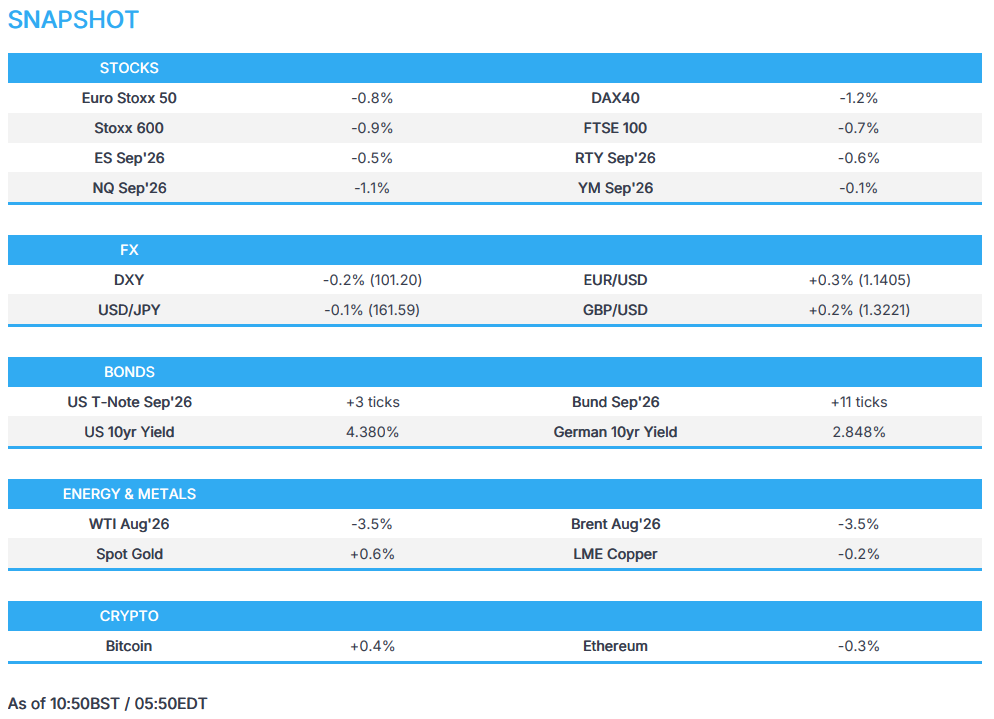
1. Subscribe to the free premarket movers reports
2. Listen to this report in the market open podcast (available on Apple and Spotify)
3. Trial Newsquawk’s premium real-time audio news squawk box for 7 days
EUROPEAN TRADE
EQUITIES
- European bourses (STOXX 600 -0.9%) are entirely in the red in the last session of the week, driven by another day of losses in South Korea (SK Hynix -8.4%, Samsung -5.3%). Some analysts are citing Apple’s price hikes on products due to memory chip shortages as a catalyst for the recent sell-off, raising concerns that rising component costs could curb demand for devices. An analyst at Javelin Wealth Management also said the recent gains for chipmakers could come at the expense of product manufacturers. The losses in South Korean giants have weighed on European chip names (Infineon -3.1%, ASML -1.0%) and indices composed of technology companies (DAX 40 -0.8%, AEX -0.6%).
- European sectors highlight a negative bias. Optimised Personal Care (+0.8%), Food, Beverages & Tobacco (+0.6%) and Utilities top the sector pile. Energy (-1.5%) is the underperformer again, with Technology (-1.4%) and Financial Services (-1.1%) also lagging.
- US equity futures are mixed, with the NQ (-0.9%) holding onto Thursday’s sell-off, though off its worst levels. After-hours, ON Semi (-10% pre-market) announced the acquisition of Synaptics (+7.6% pre-market), totalling c. USD 7bln.
- Click for the sessions European pre-market equity newsflow
- Click for the additional news
FX
- USD finds itself under modest pressure. DXY at a 101.18 base, but well clear of the 100.76 WTD low, with the index set to see the week out around the middle of its range. In brief, a tale of two halves for the index which began the week on the front foot before reversing after Thursday’s data deluge and continuing to slip since.
- EUR outperforms as a result of the continued USD pressure. No real move to the ECB CES, which showed a moderation in the 12-month price view and an uptick in the growth view. The growth revision is not enough to provide comfortable space for further tightening, and equally the price moderation is not sufficient to take another move off the table. Nonetheless, the price moderation does add to the post-PMI & Lagarde dovish tilt we have seen in recent days.
- In more detail, EUR/USD has breached 1.14 to the upside. Picking up gradually across the morning, as the US data on Thursday has and continues to permit an unwinding of some of the yield differential moves we have seen in recent days, with the Fed more-hawkish and ECB mixed but net less-hawkish, particularly from Lagarde as referenced. However, while it has hit a 1.1407 peak, EUR remains in the red on the week and continuing the near unbroken downward trend of the last seven weeks.
- Elsewhere, G10s generally are slightly firmer against the USD. With GBP the next-best behind EUR, comfortably above 1.3200 and flat/firmer WTD, but again, still towards post June policy announcement lows, as BoE expectations coalesce around the on hold for the foreseeable narrative, despite the hawkish dissenters.
- CAD, JPY and CHF all faring around equally. Of those, USD/JPY participants remain on watch for potential intervention risk, particularly as Japanese authorities tend to target Friday’s and go with the market move rather than fighting it. USD/JPY just above a 161.53 base, and while the JPY is firmer today the bearish trend remains near-enough unbroken at a weekly level over the last month and a half.
- Today is spot month/quarter-end. As a reminder, Barclays model was neutral overall for the USD against all majors, formed of a moderate USD buying signal on the month-end, but countered by a strong USD sell signal for quarter-end.
FIXED INCOME
- Global fixed benchmarks are firmer across the board as government debt returns as a place of safety, with tech stocks weighing on the broader equity space. Energy prices also continue to fall, which further drives the fixed-income space higher.
- Bunds (+12 ticks) have extended on Thursday’s high to make a new WTD high, currently trading at the upper end of the 127.25-127.64 range. The ECB released its May Consumer Expectations Survey, in which it showed consumers expect inflation to fall to 3.5% next year, down from April’s 4% figure. This comes as a surprise, as the survey was conducted before the signing of the US-Iran MoU. Despite this, the German benchmark was unreactive. In terms of market pricing, the ECB is still expected to hike once more by year-end, with only a 12% chance of two more hikes.
- USTs (+4 ticks) are bid, trading towards the upper end of their 110-00+ to 110-09+ band, with the 10yr yield touching 4.37%. The MOVE index has completely reversed the wartime bid seen at the start of the Iran war, and with BofA’s weekly flow report showing USD 16.6bln of flows into bonds, it potentially shows a renewed demand for debt. Looking ahead, a lack of tier 1 data, with final University of Michigan figures ahead, while Fed’s Kashkari is also expected to be on the wires.
- Gilts (U/C) remain on high alert for any updates on who the newly-appointed MP (and expected PM) Burnham will choose for Chancellor, with Reeves not expected to stay in the role. More recently, The Times’s Swinford reported that it will more likely be a two-horse race between Ed Miliband and Shabana Mahmood, with people close to Streeting stating that they do not think he will get the job. The fact that Miliband is still in the running could put a ceiling on gilts.
- Italy sells EUR 7bln vs exp. EUR 5.5-7bln 3.15% 2031, 3.80% 2036 and 3.45% 2036 BTP & EUR 2.0bln vs exp. EUR 1.5-2bln 1.645% 2036 CCTeu.
COMMODITIES
- The US-Iran situation remains complex. It was reported that the IRGC attacked a Singapore-flagged cargo ship, after it attempted to traverse through the Strait through a route not designated by the Iranians. This led the UN to pause its evacuation plans for ships around the Strait. Despite the attack, Bloomberg data continues to indicate that ships continue to traverse through the Hormuz, highlighting that traffic continues to flow in “both directions”.
- On the Lebanon front. The US-mediated Lebanon-Israel talks were expected to conclude on Wednesday, but were then extended into today. Israeli sources have suggested that there has been some progress, but no deal has been reached thus far. The negotiations focus on the withdrawal of Israeli troops from southern Lebanon; there may be a chance that Israel will only withdraw from areas where operations have already been concluded, and continue such action in other parts of the region. Therefore, the risk is that Iran is not satisfied by the outcome of the talks, and potentially restart closures of the Strait.
- Crude benchmarks are in the red, with WTI (-3.5%) and Brent (-3.4%) holding at the bottom end of their respective USD 68.98-71.86/bbl and USD 72.14-75.13/bbl ranges. Despite the flare-up on the Strait in the prior session and the continued lack of progress between Lebanon and Israel, crude prices continue to slip. It is the case that as long as ships continue to traverse the Strait, other friction points can be ignored… at least in the short term.
- Spot gold (+0.2%) is ever so slightly firmer this morning, but continues to remain near recent troughs. Today, the yellow-metal holds just above the USD 4k/oz mark, and within a USD 3,982-4,039/oz range. Elsewhere, base metals are broadly slightly lower this morning, with 3M LME copper currently off by c. 0.6%. It currently holds around USD 13.25k/t and within a USD 13,088.3-13,281/t range.
- Saudi Aramco reopened the Ras Tanura oil loading operations after a prolonged halt, with two supertankers loading oil at Ras Tanura on Friday, while another is awaiting loading, according to shipping data.
- Several Japanese-related vessels passed through the Strait of Hormuz as part of IMO evacuation plans, which have since been suspended following the attack on a cargo ship, according to Mainichi.
- China’s MOFCOM released a list of non-state Chinese companies eligible for oil imports.
- Kazakhstan cut the gas production at the Karachaganak gas field after Ukraine drone attacks on Russia’s Orenburg gas processing plant. Raw gas from the field is usually delivered to the Orenburg plant.
- Kazakhstan Energy Minister said we may consider fuel exports to Russia if there is an official request.
- Russia is considering a short-term ban on diesel exports for a few months, TASS reported.
TRADE/TARIFFS
- US Commerce Department banned sales of Geely (175 HK)-owned Chinese luxury EV Polestar, from 2027 onwards.
NOTABLE EUROPEAN HEADLINES
- The Times’ Swinford reported that it is likely to be a two-horse race between Ed Miliband and Shabana Mahmood for chancellor, with allies of Streeting say they do not think he will get the job.
NOTABLE EUROPEAN DATA RECAP
- ECB Consumer Expectations Survey (May): 1-year inflation expectation 3.5% (prev. 4.0%), 3-year inflation expectation 2.9% (prev. 2.9%), 5-year inflation expectation 2.4% (prev. 2.4%), 1-year Economic growth expectations -1.7% (prev. -2.2%).
- Italian Consumer Confidence (Jun) 92.4 (Prev. 93.4).
- Swedish PPI MoM (May) M/M 1.3% (Prev. 1.1%).
- Swedish Consumer Confidence (Jun) 93.6 (Prev. 92.4).
CENTRAL BANKS
- Fed’s Goolsbee (2027 voter) said it is difficult to determine whether inflation pressures are persistent or temporary, while noting inflation is moving in the wrong direction, and some of that is being driven by one-off factors. He added that inflation remains more concerning on the services side and that spending based on expected future gains makes him concerned about potential inflationary pressures. Goolsbee also said there are some signs of improvement in services inflation, but it remains well above where it needs to be, as well as stated that core inflation it is still too high and trending in the wrong direction, while services-driven core CPI is more concerning than inflation driven by goods or oil-related items. Furthermore, he stated that wages are not a particularly good leading indicator for inflation and that inflation could rise before wages do, adding that inflation needs to be monitored closely.
NOTABLE US HEADLINES
- US President Trump’s administration asked OpenAI to restrict the launch of its next model, GPT-5.6, to only a small set of government-approved partners before a wider release due to security concerns, according to a source cited by Axios.
- Representatives Gottheimer (D) and Moolenaar (R) are reportedly introducing legislation that would allow US cloud companies to report suspected foreign misuse of advanced AI computing, Axios reported.
- BofA’s weekly flow report notes USD 25.5bln out of cash, USD 5.0bln out of stocks, USD 16.6bln into bonds, USD 0.5bln out of gold. Bull & Bear Indicator fell to 9.1 (prev. 9.2)
GEOPOLITICS
MIDDLE EAST
- US President Trump said they have a new market coming up called Iran, and that Iran wants to make a deal with them very badly, while he thinks that they will make a deal and stated the Strait is open.
- Iranian Deputy Foreign Minister said safe passage through the Strait of Hormuz without consideration of Iran’s sovereignty is not guaranteed and that any framework for passage through Hormuz must be in coordination with Iran, otherwise it will be suspended from the designated route.
- N12’s Segal posted after a conversation with a source on the Iranian issue, “His opinion on the agreement and the situation is much less negative than what has been written anywhere else, including here.”
- Iran’s Khatam al-Anbiya Central Headquarters declared that if the US is unable to contain and control the Zionist regime, Iran will not tolerate any threat against itself and considers it its right to respond to these dangerous actions.
- Israeli Embassy in Washington said due to extension in the discussions, negotiations between Israel and Lebanon mediated by the US will continue on Friday for a fourth day, according to a Kan reporter.
- Israeli Energy Minister said the withdrawal from southern Lebanon is not under consideration and would be rejected even if requested by US President Trump, while he stated that Israel does not plan to occupy all of Lebanon, but intends to establish full security control over the entire Gaza Strip.
- Israeli PM Netanyahu said that we will remain in the security zone in southern Lebanon as long as necessary and have ordered the army to have complete freedom of action to counter any threat against our forces or residents of the North.
- UN said the Lebanon ceasefire is largely holding, though Israeli military operations inside Lebanon continue. It was separately reported that Israel’s military conducted airstrikes on Beit Yahun, Lebanon, while Israeli tank movements were reported in Wadi Saluqi and Bint Jbeil, Lebanon.
- IAEA chief Grossi said it’s undeniable we have an agreement that IAEA will have access to Iran for inspection, while added that they hope to resume their work in Iran soon.
- GCC Secretary General said the proposed USD 300bln for the reconstruction of Iran has not been presented to us officially or unofficially, and it has not been discussed with the US, Sky News Arabia reported.
RUSSIA-UKRAINE
- Russia claimed to have shut down 660 Ukrainian drones overnight, Moscow’s mayor reported that 47 drones were intercepted that were heading to the capital.
OTHER
- North Korean leader Kim oversaw the testing of key weapons, according to KCNA.
CRYPTO
- Bitcoin has returned to the USD 60k handle, rebounding from 3 straight days of selling. There was minimal reaction after Strategy’s CEO reaffirmed the Co.’s focus on the crypto coin.
APAC TRADE
- APAC stocks were pressured following the choppy performance stateside, where markets were indecisive amid two-way trade in tech, a recent data deluge and a rebound in oil. The overnight deterioration in risk sentiment coincided with renewed selling in tech after Apple raised prices of some products by nearly 20% and with OpenAI leaning towards delaying its IPO until next year.
- ASX 200 was rangebound with the index cushioned as the underperformance in tech, telecoms and healthcare was partially offset by resilience in some defensive stocks.
- Nikkei 225 suffered heavy losses as tech stocks dominated the list of worst performers, with SoftBank down by a double-digit percentage owing to its large exposure to AI and semiconductors.
- KOSPI remained volatile with the slump triggering a sidecar and eventual circuit breaker alongside notable declines in both Samsung Electronics and SK Hynix.
- Hang Seng and Shanghai Comp conformed to the sell-off across the region amid the tech rout.
NOTABLE ASIA-PAC HEADLINES
- China sharpened tools for retaliating against foreign sanctions with Beijing preparing a new law that would add to its ability to punish foreign companies and individuals deemed to harm Chinese interests, according to WSJ.
- PBoC has requested that some commercial banks increase lending in June amid ongoing weak credit demand, according to reports.
NOTABLE APAC DATA RECAP
- Japanese Tokyo CPI YY (Jun) 1.7% vs. Exp. 1.7% (Prev. 1.4%).
- Japanese Tokyo CPI Ex. Fresh Food YY (Jun) 1.6% vs. Exp. 1.6% (Prev. 1.3%).
- Japanese Tokyo CPI Ex Food and Energy YY (Jun) 1.9% vs. Exp. 1.8% (Prev. 1.6%).
- END
1c Asian report
Crude benchmarks continue to slip despite halts to the Hormuz evacuation plan; European equities are set to open lower – Newsquawk EU Market Open
Friday, Jun 26, 2026 – 02:00 AM
- Iran attacked a Singapore-flagged cargo ship on Thursday in the Strait of Hormuz, WSJ reported, citing sources. Separately, the UN shipping agency temporarily paused its evacuation plan for stranded ships and seafarers out of Hormuz after the attack.
- Iran’s PGSA said vessels outside PGSA-set routes will not be guaranteed safe passage.
- APAC stocks were broadly on the backfoot, with hefty declines in the tech-heavy KOSPI; European equity futures are indicative of a weak open.
- DXY trades with incremental losses; USD/JPY continues to hold around the 160.60 level.
- Looking ahead, highlights include Swedish PPI (May), US Goods Trade Balance Advance (May), Wholesale Inventories (May), UoM Sentiment Final (Jun), ECB CES (May), Speakers including Kashkari, ECB’s Nagel & Vujcic, RBNZ’s Bremen, Norges Bank’s Bache, and Supply from Italy.
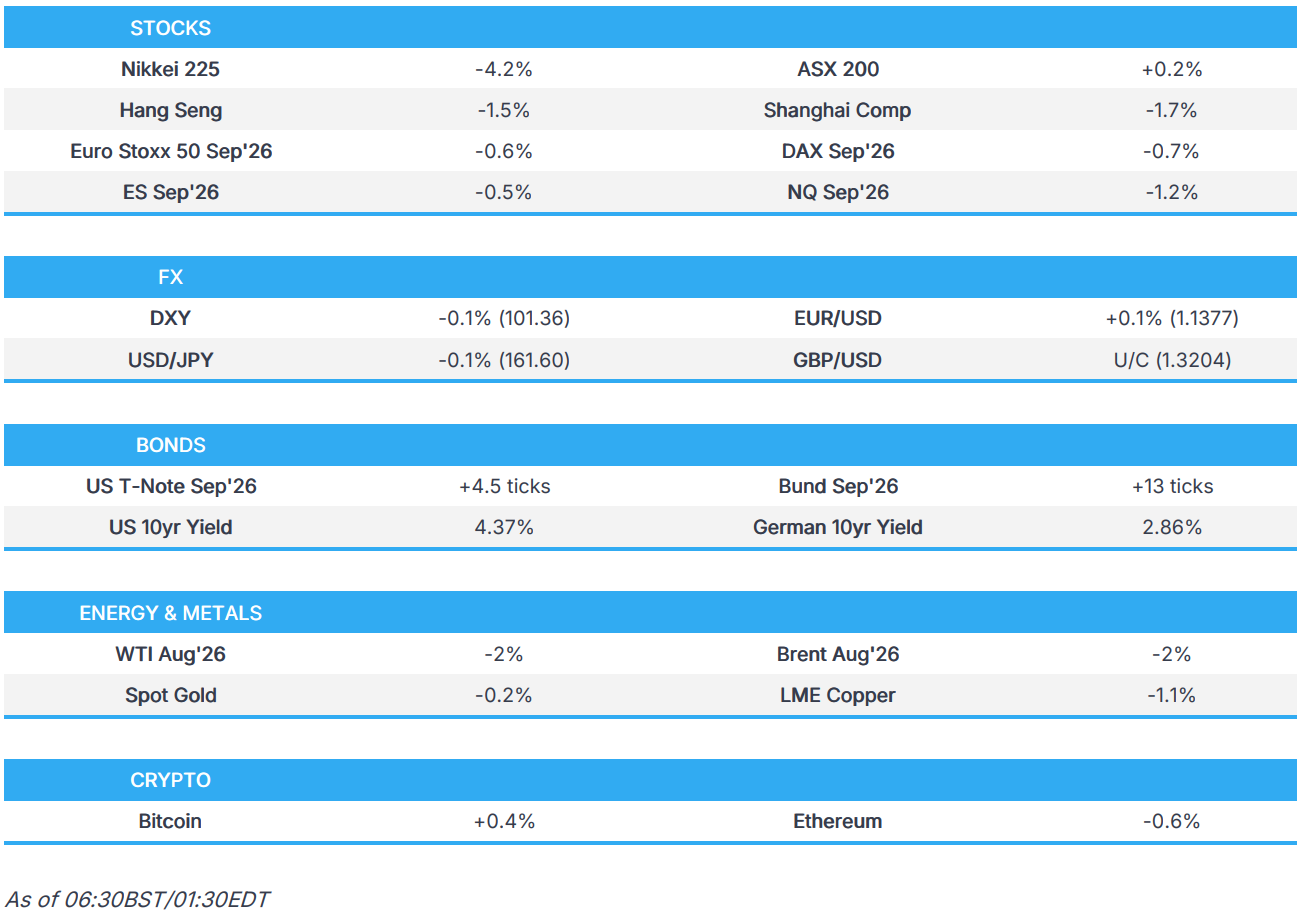
Newsquawk in 3 steps:
1. Subscribe to the free premarket movers reports
2. Listen to this report in the market open podcast (available on Apple and Spotify)
3. Trial Newsquawk’s premium real-time audio news squawk box for 7 days
IRAN CONFLICT
- US President Trump said they have a new market coming up called Iran, and that Iran wants to make a deal with them very badly, while he thinks that they will make a deal and stated the Strait is open.
- Iran attacked a Singapore-flagged cargo ship on Thursday in the Strait of Hormuz, according to the WSJ citing US officials. It was separately reported that the UN shipping agency temporarily paused its evacuation plan for stranded ships and seafarers out of Hormuz after the attack. The vessel did not transit under the UN agency’s evacuation framework, while the evacuation plan will remain paused until further clarity is obtained.
- Iran’s PGSA said vessels outside PGSA-set routes will not be guaranteed safe passage and that consequences arising from passage through unauthorised routes shall be the responsibility of the owner, operator, and vessel commander, while vessels using unauthorised routes will not be covered by insurance on related liabilities.
- IAEA chief Grossi said it’s undeniable they have an agreement that the IAEA will have access to Iran for inspection, while he added that they hope to resume their work in Iran soon.
- Saudi Arabia’s Foreign Minister held two separate meetings with Qatari and Omani counterparts to discuss the results of the undertaking between the US and Iran regarding regional security and stability, according to IRNA.
- Israeli Embassy in Washington said due to extension in the discussions, negotiations between Israel and Lebanon mediated by the US will continue on Friday for a fourth day, according to a Kan reporter.
- Israeli Energy Minister said the withdrawal from southern Lebanon is not under consideration and would be rejected even if requested by US President Trump, while he stated that Israel does not plan to occupy all of Lebanon, but intends to establish full security control over the entire Gaza Strip.
- US Secretary of State Rubio’s pressure on Israel and Lebanon was said to have led to an agreement on a “declaration of intent”, according to Al Hadath.
- Israel and Lebanon are discussing a partial withdrawal of the IDF from southern Lebanon, despite the public statements, according to Kann News citing sources, while there are difficulties and the atmosphere is tense, but progress has been made.
- UN said the Lebanon ceasefire is largely holding, though Israeli military operations inside Lebanon continue. It was separately reported that Israel’s military conducted airstrikes on Beit Yahun, Lebanon, while Israeli tank movements were reported in Wadi Saluqi and Bint Jbeil, Lebanon.
US TRADE
EQUITIES
- US stocks finished a volatile session mixed as optimism surrounding memory names improved following a strong Micron earnings report, while amplified concerns over hyperscalers’ spending limited further upside, and weighed on such names. Despite the incoming Apple price hikes being expected following CEO Cook’s recent touting, the announced price increases for MacBook and iPad saw the stock down 6.1%. Mag-7 underperformed the market as debt and equity issuance continued to act as a headwind on the space; meanwhile, the equal-weighted S&P 500 RSP outperformed the market-cap weighted counterpart, rising 0.6%. Participants also digested a US data dump which included a mixed PCE report, personal income & spending beat, initial claims fell W/W, continued claims rose W/W, and Q1 GDP growth revised above expectations.
- SPX -0.01% at 7,358, NDX +0.75% at 29,440, DJI +0.14% at 51,926, RUT +0.71% at 3,008.
- Click here for a detailed summary.
TARIFFS/TRADE
- Bangladesh’s PM said in a meeting with Chinese President Xi that they need China’s support in implementing their major signature projects and upgradation and modernisation of existing industrial units, while the PM also urged for a reduction in the trade gap.
- US Commerce Department banned sales of Geely (175 HK)-owned Chinese luxury EV Polestar, from 2027 onwards.
NOTABLE HEADLINES
- Fed’s Williams (voter) pushed back hitting the 2% inflation target from 2027 to 2028 and reiterated that monetary policy is ‘well positioned’ for the current economy, while he expects inflation to moderate to 3.5% this year. Williams said if Middle East war disruptions are resolved soon, it will lower inflation pressure, and he expects inflation pressures to moderate.
- Fed’s Goolsbee (2027 voter) said it is difficult to determine whether inflation pressures are persistent or temporary, while noting inflation is moving in the wrong direction, and some of that is being driven by one-off factors. He added that inflation remains more concerning on the services side and that spending based on expected future gains makes him concerned about potential inflationary pressures. Goolsbee also said there are some signs of improvement in services inflation, but it remains well above where it needs to be, as well as stated that core inflation it is still too high and trending in the wrong direction, while services-driven core CPI is more concerning than inflation driven by goods or oil-related items. Furthermore, he stated that wages are not a particularly good leading indicator for inflation and that inflation could rise before wages do, adding that inflation needs to be monitored closely.
- US President Trump signed an agriculture-related executive order to strengthen US food supply security.
- US President Trump’s administration asked OpenAI to restrict the launch of its next model, GPT-5.6, to only a small set of government-approved partners before a wider release due to security concerns, according to a source cited by Axios.
- US House Speaker Johnson said he’s sending the bipartisan housing bill to the White House, following his meeting with President Trump.
APAC TRADE
EQUITIES
- APAC stocks were pressured following the choppy performance stateside, where markets were indecisive amid two-way trade in tech, a recent data deluge and a rebound in oil. The overnight deterioration in risk sentiment coincided with renewed selling in tech after Apple raised prices of some products by nearly 20% and with OpenAI leaning towards delaying its IPO until next year.
- ASX 200 was rangebound with the index cushioned as the underperformance in tech, telecoms and healthcare was partially offset by resilience in some defensive stocks.
- Nikkei 225 suffered heavy losses as tech stocks dominated the list of worst performers, with SoftBank down by a double-digit percentage owing to its large exposure to AI and semiconductors.
- KOSPI remained volatile with the slump triggering a sidecar and eventual circuit breaker alongside notable declines in both Samsung Electronics and SK Hynix.
- Hang Seng and Shanghai Comp conformed to the sell-off across the region amid the tech rout.
- US equity futures retreated as the sentiment in Asia further deteriorated amid a tech sell-off.
- European equity futures indicate a lower cash market open with Euro Stoxx 50 futures down 1.0% after the cash market finished with gains of 0.9% on Thursday.
FX
- DXY traded rangebound amid the negative mood in Asia and decline in oil prices, with the greenback also contained after yesterday’s choppy performance in which it marginally weakened against peers following a data deluge; that included softer-than-expected headline PCE M/M. Nonetheless, the data was ultimately mixed as Q1 GDP was revised higher and above expectations, personal income and spending topped forecasts, initial jobless claims fell W/W, but continued claims rose, and durable goods declined, albeit not as much as expected. There were also recent comments from Fed’s Goolsbee, who continued to stress that core inflation is too high, trending the wrong way, and that services inflation is a little more disturbing.
- EUR/USD was indecisive after recent fluctuations and with few fresh catalysts for the single currency.
- GBP/USD lacked firm conviction after recent mild swings, but attempts to reclaim the 1.3200 status, while pertinent newsflow for the UK remained quiet.
- USD/JPY remained confined to within relatively tight parameters after pulling back from resistance just shy of the 162.00 level, and as the latest Tokyo CPI data mostly matched estimates.
- Antipodeans mildly underperformed amid the risk-off mood and declines in commodity prices.
- PBoC set USD/CNY mid-point at 6.8166 vs exp. 6.8015 (prev. 6.8209).
- Mexican Interest Rate Decision 6.50% vs. Exp. 6.50% (Prev. 6.50%); vote was unanimous. The Governing Board estimates that it will be appropriate to maintain the reference rate at its current level,. It judged that the monetary policy stance is well-suited to face the challenges posed by the macroeconomic environment, including those associated with the international context.
FIXED INCOME
- 10yr UST futures eked mild gains overnight above the 110.00 level after climbing in the aftermath of the US data deluge, with the cooler-than-expected PCE M/M for May the highlight.
- Bund futures edged higher after the prior day’s indecision and amid a flight to quality.
- 10yr JGB futures clawed back opening losses with upside seen as risk sentiment deteriorated.
COMMODITIES
- Crude futures pulled back overnight after rebounding yesterday alongside reports that Iran attacked a Singapore-flagged cargo ship in the Strait of Hormuz, which prompted the UN shipping agency to temporarily pause its evacuation plan for stranded ships. Nonetheless, reports overnight suggested increased transit through the strait with several Japanese-related vessels said to have passed through the waterway as part of the now suspended IMO evacuation plan. Moreover, South Korea’s Oceans Ministry announced eight more South Korean vessels had exited the Strait of Hormuz, and Saudi Aramco also resumed oil loadings at Ras Tanura.
- Saudi Aramco reopened the Ras Tanura oil loading operations after a prolonged halt, with two supertankers loading oil at Ras Tanura on Friday, while another is awaiting loading, according to shipping data.
- Several Japanese-related vessels passed through the Strait of Hormuz as part of IMO evacuation plans, which have since been suspended following the attack on a cargo ship, according to Mainichi.
- South Korea’s Oceans Ministry said eight more South Korean vessels exited the Strait of Hormuz, while South Korean President Lee said three more ships are to leave the Strait of Hormuz over the weekend.
- Spot gold traded indecisively on both sides of the USD 4,000/oz level with the precious metal on course for its fourth consecutive weekly loss.
- Copper futures retreated amid the negative risk appetite as tech selling resumed in Asia.
CRYPTO
- Bitcoin was choppy and rebounded from an early dip with prices reapproaching the USD 60,000 level.
- Binance is to stop providing services to EU clients after failing to obtain a licence, according to FT.
NOTABLE ASIA-PAC HEADLINES
- Samsung Group is said to invest around USD 647bln for 10 years in South Korea, while Samsung Electronics (005930 KS) may invest KRW 300bln in new semiconductor fabs in South Korea.
DATA RECAP
- Japanese Tokyo CPI YY (Jun) 1.7% vs. Exp. 1.7% (Prev. 1.4%)
- Japanese Tokyo CPI Ex. Fresh Food YY (Jun) 1.6% vs. Exp. 1.6% (Prev. 1.3%)
- Japanese Tokyo CPI Ex Food and Energy YY (Jun) 1.9% vs. Exp. 1.8% (Prev. 1.6%)
GEOPOLITICS
RUSSIA-UKRAINE
- Ukrainian President Zelensky approved a 40-day campaign to “influence” Russia to end the war.
- Power cuts were reported in Russian-held Kherson region, whilst Sevastopol restricted power following drone attacks.
- EU leaders agreed to extend Russian sanctions for 12 months.
OTHER
- North Korean leader Kim oversaw the testing of key weapons, according to KCNA.
- South Korea plans a rapid expansion of drone and anti-drone forces, while it plans to train 500k drone operators.
NORTH AND SOUTH KOREA AND JAPAN
SOUTH KOREA
JAPAN
3 CHINA
HONG KONG VS MAINLAND CHINA
China’s Crackdown Threatens Hong Kong’s IPO Boom And Offshore Wealth
Thursday, Jun 25, 2026 – 09:20 PM
China’s latest push to choke off capital flight is starting to hit Hong Kong right where it hurts, according to a new feature from Bloomberg.
For years, the city has served as the main offshore escape valve for mainland wealth — the place where Chinese founders, executives and wealthy families parked money, opened private bank accounts, bought property and set up family offices. Now Beijing is tightening that channel, raising questions about whether Hong Kong can remain Asia’s go-to offshore wealth hub.
Bloomberg writes that the latest measures include roughly $330 million in penalties against three brokerages widely used by Chinese investors to access offshore markets, along with tighter scrutiny of banks, trust structures and wealthy individuals moving money abroad. Advisers in Hong Kong say clients quickly began asking whether their accounts could be affected and whether more restrictions are coming. As one lawyer put it, Beijing isn’t slamming the door shut all at once — “they are installing a doorframe.”
That matters because Hong Kong has become deeply dependent on mainland money. Chinese households and companies moved a record $807 billion out of the country last year, and a large share of it landed in Hong Kong, helping the city overtake Switzerland as the world’s biggest offshore wealth hub. That money has supported luxury spending, real estate, stock trading and Hong Kong’s IPO rebound.

Now the mechanics of moving that money are getting harder. Bankers say mainland clients are facing tougher onboarding standards, including declarations that their wealth was sourced outside China. Private banks are fielding more questions from nervous clients, and some ultra-wealthy Chinese are already looking beyond Hong Kong to Europe, Switzerland and the US. The goal doesn’t seem to be stopping every dollar from leaving China, but making sure Beijing has more visibility and leverage over where it goes.
Beijing is also targeting the offshore structures Chinese founders have long used to turn mainland business success into foreign wealth. For years, the playbook was simple: build a company in China, wrap it in an offshore structure, list it abroad or in Hong Kong, collect dividends, then move that money into overseas property, trusts or family offices. China is now squeezing that route too, restricting red-chip IPO structures and tightening rules around whether Hong Kong listing proceeds can remain offshore.
The result is pressure on one of Hong Kong’s most lucrative ecosystems all at once: wealth management, offshore structuring, IPO underwriting and luxury spending tied to mainland fortunes. If rich Chinese can’t move money into the city as easily, Hong Kong doesn’t just lose deposits — it loses deal flow, brokerage activity, family office growth and some of the conspicuous consumption that has powered its rebound. As one Hong Kong lawyer put it, “The family office figures are looking great, but the doors are shutting.”

What’s driving this is straightforward: China needs control, and it needs revenue. The property downturn has hammered local finances, land-sale income has dried up, and Beijing has become more aggressive about tracking taxable wealth that has slipped offshore. It may not want to end offshore investing altogether, but it clearly wants tighter oversight, tighter rules and a bigger claim on the money once it leaves.
For Hong Kong, that creates a real tension. The city still wants to market itself as the natural offshore home for Chinese capital and the financial bridge between China and the rest of the world. But the more Beijing clamps down, the harder it becomes for Hong Kong to play that role with the same freedom it once did — making it look less like a safe haven and more like an extension of the same system wealthy Chinese were trying to hedge against in the first place.
end
4. EUROPEAN AND SCANDINAVIAN COMMENTARIES PLUS NATO
EUROPE
ROBERT H…..
So much for transparent politics
The European Commission led by Ursula von der Leyen, finds itself once again embroiled in a scandal that lays bare its deeply entrenched culture of opaque, backchannel governance. The EU Ombudsman is investigating a clandestine group chat that included von der Leyen, Vladimir Zelensky, German Chancellor Friedrich Merz, French President Emmanuel Macron, Italian Prime Minister Giorgia Meloni, and outgoing UK Prime Minister Keir Starmer. Dubbed the ‘Washington Group’, it was reportedly established to coordinate a shadow diplomatic response to perceived erratic moves by Donald Trump regarding the Ukraine conflict. Rather than operating through established institutional channels, these leaders exchanged sensitive strategic communiqués in their private chat room, bypassing formal diplomatic protocols, parliamentary oversight, and the basic tenets of public accountability. When the Dutch outlet Follow the Money (FTM) submitted a freedom-of-information request for these messages, the Commission categorically refused disclosure, arguing that releasing the texts could jeopardize EU relations with third countries. Let it sink in: high-stakes geopolitical decision-making is being treated as a private affair reserved for an unelected elite. The European Ombudsman, Teresa Anjinho, has now opened an inquiry to scrutinize whether this refusal breaches EU transparency rules, demanding a meeting with Commission representatives by mid-July. Von der Leyen’s Commission has previously been reprimanded by the EU’s General Court for mishandling requests for her text exchanges with Pfizer’s CEO during pandemic vaccine negotiations, and just this month, the Ombudsman condemned the unlawful deletion of a Macron-sent message concerning a trade deal with South America’s Mercosur bloc, suggesting a systemic predilection for conducting critical statecraft in the shadows. These recurring episodes are not an exception but the modus operandi of an executive that treats transparency as an inconvenience and formal record-keeping as optional. What we see is not just opacity, but a deliberate architecture of backroom elite governance: high-stakes decisions about war, trade, and global strategy are brokered by insiders who bypass both national and EU parliaments.
END
GERMANY
VOLKSWAGEN:
Volkswagen CEO Plans 100,000 Job Cuts In Generational Overhaul
Friday, Jun 26, 2026 – 12:00 PM
German business news outlet Manager Magazin reports that Volkswagen CEO Oliver Blume is eyeing a major restructuring that could eliminate as many as 100,000 jobs. The latest VW earnings show just why: Europe’s largest automaker remains bloated in a world of weak demand, a softening Chinese market, rising Chinese competition in Europe, and low margins.
“Volkswagen CEO Oliver Blume is getting serious. He plans to drastically intensify job cuts, actually phase out production at four German plants, and spin off the VW brand into a new company. Volkswagen is to become a new company,” Manager Magazin wrote in the report.
If fully implemented, the 100,000-job reduction would eliminate about 15% of Volkswagen’s current global workforce of 650,000. Bloomberg data shows VW went on a hiring spree between 2008 and 2020.

Now, it appears a generational high has been reached in VW’s workforce, as a shift toward efficiency, automation, and AI could soon result in massive job losses. We’re sure lefty unions will be furious.
Manager Magazin also noted that Blume plans 11 billion euros in cost cuts by 2030, which could include spinning off component operations and the core VW brand.
The restructuring plan will be presented to the supervisory board next month and is expected to face intense resistance from labor unions and Lower Saxony lawmakers, who hold significant influence over the company’s governance.
The urgency behind a restructuring stems from deteriorating earnings: its first-quarter revenue fell 2.5% to 75.7 billion euros, while operating profit dropped 14.3% to 2.46 billion euros, and the operating margin slipped to 3.3% from 3.7%. Earnings after tax fell 28.4% to 1.56 billion euros, while vehicle sales fell 6.9%, and deliveries were down 4%.
A Volkswagen spokesperson told the Hamburg-based outlet that the struggling car company “must undergo profound change.” The executive board “has been working intensively over the past few months on a future-oriented plan to realign the company.”
Shares in Germany slipped 34 basis points following the report and remain down 25% on the year. The stock is trading at 2010 levels…

The implosion of VW tells you all you need to know about Europe’s crumbling industrial base at a time when war is still raging, and in fact accelerating, in Ukraine. Time to convert unused civilian vehicle production lines into interceptor missile production.
UK\
TOTALLY INEPT!!
Police Took 8 Minutes To Locate Henry Nowak’s Fatal Stab Wound… Then Performed CPR Directly Over It
Friday, Jun 26, 2026 – 03:30 AM
Authored by Steve Watson via Modernity News,
The case of 18-year-old white British student Henry Nowak has delivered yet another layer of disturbing detail.

Officers from Hampshire and Isle of Wight Constabulary arrived at the Southampton scene roughly five to ten minutes after he was stabbed five times with a ceremonial knife. Henry remained conscious and spoke loudly at first. He told them he had been stabbed and could not breathe. They chose instead to believe the man who had just knifed him.
New evidence released this week shows it took those officers a full eight minutes to discover the fatal wound. During that time they lifted Henry, striking his head against a wall, and later began CPR. A female officer started compressions. According to the transcript and reports, officers performed chest compressions over his clothing and directly onto the area of the stab wound.
Bodycam footage shows officers dragging Henry across gravel, turning him, and forcefully pulling his arms behind his back to apply handcuffs. He lost consciousness within about three minutes of that restraint and was pronounced dead at 00:37 on 4 December 2025 after 51 minutes of resuscitation efforts.
A paediatric critical care specialist with battlefield medicine experience, Dr Krzysztof Magier, reviewed the footage and post-mortem report. He concluded there is a high probability that the police actions contributed to Henry’s death.
The main source of bleeding was damage to the subclavian vein. Venous bleeding under low pressure often forms a natural clot that can slow or stop on its own. Forcefully twisting the arms behind the back and handcuffing likely stretched the vein, tore the forming clot, and triggered sudden massive internal haemorrhage.
Dr Magier stated: “I am convinced that if Henry had arrived there alive, the doctors would not have let him die.” He added that paramedics arriving first could have given Henry a roughly 50% chance of survival through fluids, tranexamic acid to stabilise the clot, and other interventions. Southampton University Hospital, a major trauma centre, was only two to three minutes away by ambulance.
Serving and former Hampshire officers have now admitted that mandatory “Inclusion Matters” DEI training played a direct role in how they processed the incident. They described sessions that drummed in “white privilege” and “unconscious bias.”
One officer said: “we had it drummed into us about our white privilege and unconscious bias.” The outsourced trainer was described as “deeply hateful of white people and our culture.” Officers feared career damage if they pushed back.
This ideological environment framed the white teenager as the likely aggressor and gave credence to the attacker’s fabricated claim of racial abuse.
Vickrum Digwa, from a Sikh background, lied to police and his family reinforced the narrative on the 999 call, downplaying any knife involvement. Officers initially accepted the story. One was heard telling Henry: “Don’t think you have mate.”
An ex-police officer appearing on BBC Newsnight called the response “unfathomable.” Basic procedure requires immediate medical assessment and priority for anyone reporting a stab wound and breathing difficulty – not restraint and dismissal. The BBC presenter appeared visibly surprised at the unsparing assessment.
Judge William Mousley KC noted the attending officer’s “genuine shock” upon realising CPR was being given over a serious chest wound and suggested it showed officers “doing his best in a very difficult situation.” The judge also observed that “sometimes, someone arrested and handcuffed will feign injury.”
Dr Magier directly challenged that leniency: “I fear that the Judge and pathologist were too lenient towards the police.”
A full jury inquest opens at Winchester Coroner’s Court on 20 September 2027. It will examine whether any act or omission by police caused or contributed to the death.
The release of bodycam footage earlier this month triggered protests and disorder in Southampton. Henry’s father, Mark Nowak, stated: “My son was dragged across gravel, handcuffed and called racist as he lay dying. Being read his rights was the last thing he heard.”
Vickrum Digwa was jailed for life with a minimum of 21 years. His sentence has been referred to the Court of Appeal as potentially unduly lenient. Prior warnings about Digwa – including 2022 reports of him firing an illegal air pistol in his garden – were reportedly not acted upon effectively by police.
The pattern fits a broader picture of institutional capture. Training that elevates identity politics over impartial procedure produces exactly this outcome: a dying white teenager treated as a threat while his attacker’s narrative receives deference.
Critics from across the spectrum have highlighted the double standard compared with other high-profile custody deaths that triggered institutional upheaval and global campaigns.
Henry’s family has asked that his death not be used to sow further division. The facts, however, speak for themselves. When police training and culture elevate racial grievance narratives above the immediate duty to preserve life, the result is not justice – it is preventable tragedy.
Your support is crucial in helping us defeat mass censorship. Please consider donating via Locals or check out our unique merch. Follow us on X @ModernityNews
END
ITALY/USA/NATO
WILL TRUMP NOW ABANDON NATO?
(zerohedge)
Rome Rebukes Rutte: Italy Rejects Claim US Flew Iran War Missions From Its Bases
Friday, Jun 26, 2026 – 02:45 AM
It’s no longer just a Trump-Meloni spat on the level of public rhetoric, but Italy is newly making clear that it is imposing real policy and limitations on the US, now clarifying that it had formally denied US use of its bases to strike Iran for past and future potential missions.
This has been a long time in coming, as Italy already clearly restricted at least some US use of its bases within the past months related to the Iran war, but now it is official.
On Thursday Italian Minister of Foreign Affairs Antonio Tajani reportedly told his Iranian counterpart by phone he firmly rejects NATO Secretary-General Mark Rutte’s recent claims that US forces used Italian military bases in operations against Iran.
Tajani has insisted that Italian bases were never used for any kind of offensive strikes on the Islamic Republic. According to US military publication Stripes, “The Iranian foreign minister thanked Italy for the clarification and said a clear, formal denial was necessary.”

Italy of course remains a member of NATO, and so the fact that Rome was responding to recent remark’s of the organization’s leader is glaring, and reveals a serious inter-NATO rift.
The NATO chief had been interviewed on Fox earlier this week, wherein he claimed that some 500 American military flights had taken off from bases in Italy in support of Operation Epic Fury. Italy’s foreign ministry is firmly rejecting the claim.
In addition, the Italian Defense Ministry came out and said that Rutte “has nothing to do with Operation Epic Fury” – which might explain whey he’s making “completely misleading” remarks.
“Italy only authorizes flights that are provided for by the treaties and totally exclude kinetic activities,” said that Italian defense ministry statement.
It seems Italy is trying to appease both the Iranian and US sides at once, by trying to shroud its role in ambiguity and abstract definitions of terms:
In a post analyzing how Italy’s bases were used to support the war, the site ItaMilRadar said this week that Navy MQ-4C Triton surveillance drones from Sigonella “conducted extensive intelligence and reconnaissance missions over the Persian Gulf area” before the Triton operations appeared to shift to Jordan in April. Navy P-8 Poseidon patrol aircraft operated from the base before and during the war, and several deployed to Djibouti to support U.S. naval forces in the Indian Ocean, according to the site.
Back in late March, as US-Israeli bombs were still being unleashed on Iran, a statement from PM Meloni’s office had also alluded to matters of procedure, stating that Italy is “acting in full compliance with existing international agreements” – while underscoring that each request must be “carefully examined on a case-by-case basis, as has always been the case in the past.”
Italian Defense Minister Guido Crosetto had also at the time confirmed that “some US bombers” were denied landing at Sigonella – one of seven US navy bases in Italy. The complaint is that the US didn’t follow required permission protocol, and requested landing only while in the air and already en route to Sicily.
But the truth also is that American hegemonic action in the Middle East, and the Iran conflict in particular, remains deeply unpopular among the Italian population, which has long had a strongly anti-war bent especially among the youth.
The Guardian previously wrote, “The unpopularity of Trump in Italy has also started to erode the popularity of Meloni, who is ideologically in tune with the US president and has established good working relations with him.” However, she’s lately sought to distance her government from the war, having told parliament earlier this month there’s a growing dangerous trend of interventions “outside the scope of international law.”
5. RUSSIAN AND MIDDLE EASTERN AFFAIRS//
ISRAEL USA/IRAN FRIDAY MORNING
IAEA Chief Confirms Nuclear Inspectors Returning To Iran, No Timeline Given
Friday, Jun 26, 2026 – 08:05 AM
For the first time since the US-Iran MoU was signed earlier this month, the International Atomic Energy Agency (IAEA) announced it will have access to Iran for official inspections of the country’s nuclear facilities.
However, a precise timeline for when the inspections are expected to commence was not given. “There is an agreement and to comply with that agreement, the IAEA will have to have access and inspect,” UN nuclear watchdog chief Rafael Grossi said at a news conference in Japan. “We hope to be there soon.”
“The inspections will indeed take place,” he emphasized to reporters. “We will be working on the modalities – dates, procedures, places – very soon.”

The agreement signed last week said “explicitly” that the dilution of Iran’s highly enriched uranium would be carried out under IAEA supervision, he added.
But importantly, Tehran has in the last days made its position clear that it will keep key sites off-limits until a final deal with Washington is reached and sanctions are lifted.
US chief negotiator in Switzerland, JD Vance, came away insisting that the IAEA will soon return – which Iranian officials have contradicted.
Grossi had further stated in his Friday remarks that the Iranians’ pledge to not pursue a nuclear weapon would need “very strong” verification.
But he also conceded that thus far the UN agency itself had “barely initiated” talks with Iran on the heels of the formalized MoU agreement with the United States.
“I think the objective of this agreement is to ensure that there is no development of nuclear weapons in Iran. The government of Iran has declared quite clearly that this is not their intention,” Grossi continued.
“But of course intentions are not enough. We have to have a very strong verification system in place… as soon as is practicable,” he added.
The US administration has so far said that it is not prepared to budge on this issue of thorough inspections. Ironically the 2015 JCPOA under Obama, which Trump has frequently lambasted, included just such an inspection regimen.
It remains to be seen whether the US can get a better inspection deal in place, or whether any new scenario will fall short of the prior JCPOA. Tehran sees itself in a strong position, and won’t so easily accept demands which it deems as giving too much to the US and Israel.
END
ISRAEL USA/IRAN/FRIDAY AFTERNOON
Trump Says Iran Violated Ceasefire With Hormuz Drone Attack On Cargo Ship
Friday, Jun 26, 2026 – 12:05 PM
Update (11:55am ET): While today’s announcement by Dubai that the UAE was under missile attack proved to be a false alarm, the US ceasefire it nonetheless becoming increasingly unstable. Following yesterday’s attack by Iran drones on a cargo ship next to Oman, we were wondering how long until Trump responds (and how), and he did just that moments ago when he posted on Truth Social that Iran shoting “at least four One Way Attack Drones at Ships transversing the Strait of Hormuz” is “a foolish violation of our Ceasefire Agreement.”

However, Trump’s post follows earlier reports that the US and Iran had set up a deconfliction hotline involving precisely such events in the Gulf, so we doubt that there will be much if any follow through from this latest round of jawboning, especially now that Trump is set on maintaining the flow of oil through Hormuz as much as possible, which has allowed oil to tumble to pre-war levels.
* * *
With each week and month that passes since the start of Trump’s Operation Epic Fury, more and more reports have come out revealing the massive extent of damage to US military facilities in the Mideast region based on Iran’s retaliation across the region.
This is often based on fresh satellite imaging and analysis, despite US government pressure for these research entities to refrain from publishing such data, and to censor open source photographs. After a series of deep investigative reports, it has been proven time and again that the Pentagon and Washington officials have been downplaying and covering up the real extent of devastation caused by Iranian missiles and drones.
More fresh reporting in the Wall Street Journal once again adds confirmation to this, referencing satellite imagery which shows far more serious damage at a key naval base in Bahrain than the US has publicly acknowledged.

The damage is said to be bad enough that the Pentagon is mulling shrinking its troop presence there and elsewhere in the Gulf, including a potential reduced troop footprint in Kuwait and Saudi Arabia. Iran is hailing this reported pullback as a significant strategic victory produced by its retaliation.
Unnamed officials were cited in the report as saying American forces could retreat as far westward as Israel, after some bases essentially became unusable or uninhabitable altogether.
Concerning the Bahrain base details, WSJ writes:
The U.S. Navy base in Bahrain was repeatedly targeted between late February and June. Strikes that got through caused extensive damage, according to a Wall Street Journal analysis of satellite imagery, social-media footage and interviews with current and former servicemembers—damage that the Pentagon hasn’t publicly acknowledged. Hit hard were the command headquarters and at least a dozen other buildings, along with two satellite communications terminals.
The military said no one was killed at the base, known as Naval Support Activity Bahrain, and that the strikes didn’t significantly impact operations. The U.S. evacuated most personnel but has kept a small staff on the ground.
Notably in Bahrain the headquarters building for the US Navy in the Middle East was struck and seriously damaged, along with sensitive communications centers being destroyed.
But here is a key, somewhat unexpected line in the Journal report: “The extensive damage done to America’s sole naval base in the Middle East – along with hits to at least 20 U.S. sites across the region, including military installations and diplomatic facilities – has the U.S. re-evaluating its entire footprint in the region, according to U.S. officials familiar with the deliberations.
This means that damaged structures and bases may not be rebuilt at all, and the sites may just be abandoned as future key US military hubs, WSJ says.
The draw-down of expensive Pentagon comms centers could include from Bahrain: “The military is now considering revamping the base in Bahrain, reducing the U.S. presence in Kuwait and Saudi Arabia and moving some bases or base functions west, farther from the reach of Iranian missiles and drones, according to the officials familiar with the deliberations,” WSJ writes.
Reconstruction costs would be staggering, per the same report:
The Center for Strategic and International Studies estimated in a report published Tuesday that the total cost of the war was about $40 billion. That estimate included their calculus of $2.2 billion to $5.1 billion in damage to U.S. bases, based on structures that CSIS identified as damaged.
The Journal used satellite images and social-media footage to identify which buildings on the Bahrain base were damaged. To estimate what it would cost to construct buildings of the same types today, the Journal reviewed a publicly available Defense Department cost model as well as procurement reports. The estimates only cover construction, and don’t include other costs that could factor into the total if the buildings were to be rebuilt, such as debris removal and reinforcement.
“The estimated construction costs at NSA Bahrain totaled about $400 million,” it continues. But ultimately a draw-back from these locations would be based on the proven reality that Iran can easily hit them at any time.
Some further implications to all this are that in any future flare-up or even return to all-out war between the US and Iran, American forces would find themselves executing a conflict much further away from the theatre itself. For example, dozens of major Air Force refueling tankers have already had to be relocated far away from the Gulf, to places like Tel Aviv. Many were destroyed in the opening weeks of the war while parked at Gulf airfields, clearly over-exposed as it seems Iran knew exactly where to target.
Back in late March, US officials admitted to the NY Times that Iran’s significantly retaliation damaging US bases was “a war that is much harder to prosecute.”
ISRAEL TBN
IRAN ET ALL..
ROBERT H…
Ever hear of tank bottom
he Islamic Revolutionary Guard Corps (IRGC) in Iran has publicly announced the following:
“Warships are approaching Hormuz, and we will deal with them decisively.” “If America starts a ground war, we will deploy one million of our troops.”
If the delay to return to normal shipping takes much longer then tank bottom will be a reality
HEZBOLLAH VS ISRAEL/LEBANON
Israel-Lebanon talks continue under US mediation despite deadlock over Hezbollah disarmament
The Israeli Embassy in the United States confirmed the extension of the talks, which entered their fourth day. The negotiating teams will return to the table at the US State Department in the morning

IDF troops operate in the Wadi Saluki area of southern Lebanon.(photo credit: IDF SPOKESPERSON UNIT)ByIDAN KWELLERJUNE 26, 2026 08:38
The negotiations between Israel and Lebanon were extended beyond what had been planned and will continue in Washington on Friday.
The decision was taken after 11 straight hours of talks, in an effort to reach an “in-principle commitment” to a security arrangement.
The Israeli Embassy in the United States confirmed the extension of the talks, which entered their fourth day. The negotiating teams will return to the table at the US State Department in the morning.
The talks, held under American mediation, are focused on Hezbollah’s future and the new security mechanisms in southern Lebanon.
One of the main ideas being discussed is the establishment of “pilot areas.” Under this framework, security responsibility would be transferred to the Lebanese Army in specific areas after Lebanese soldiers are screened and vetted in the United States to rule out ties to the organization.

The discussions are taking place against the backdrop of significant gaps between the sides. Lebanon is insisting on drawing up a timetable for an Israeli withdrawal from the areas the IDF currently holds. Israel, for its part, is demanding that any arrangement include the disarmament of Hezbollah, and is refusing to withdraw until that condition is met.
Israel denies withdrawing from Lebanon buffer zone
On Thursday, a State Department official claimed that Israel had already begun withdrawing from part of the buffer zone as a “goodwill gesture,” but an Israeli security source denied the report.
Defense Minister Israel Katz made clear this week that “even if there is an American demand, we will not withdraw from Lebanon,” and that Israel will keep forces in place to monitor implementation on the ground.
The fact that the talks stretched for more than 11 hours in a single day suggests American pressure to achieve a breakthrough, but the atmosphere within the Israeli delegation is marked by concern.
Earlier this week, Israel’s ambassador to the United States, Yechiel Leiter, said the contacts were a “train wreck.” Leiter criticized the influence of Tehran and the parallel talks Washington is holding with the Iranians, and stressed that dismantling Hezbollah must remain the basis for the talks.
In parallel with the diplomatic track, the United States is putting together a monitoring mechanism through US Central Command. The mechanism is intended to give Washington a real-time picture from the ground in order to prevent escalation.
As part of those efforts, US Central Command chief Adm. Brad Cooper is expected to arrive in Israel to meet with IDF Chief of Staff Lt. Gen. Eyal Zamir and Defense Minister Katz.
END
SYRIA/USA ISIS
US Forces Kill Senior ISIS Leader In Syria, After Large-Scale Troop Withdrawal
Friday, Jun 26, 2026 – 05:45 AM
The US military is still conducting attacks inside Syria, at a moment its close regional ally Israel is gobbling up territory in the south, and Golan region, with IDF ground forces holding territory within dozens of miles of Damascus.
“A senior Islamic State leader was killed by an airstrike last week, Central Command announced on Wednesday, as the region grapples with a fraught security landscape amid U.S. base closures in Syria and the escape of ISIS personnel from detainment,” Defense News writes based on a fresh Wednesday Pentagon statement.

Hussein Al-Alawi has been identified as the target killed in northwestern Syria in the special forces operation.
“The attack is part of our continued efforts to disrupt terrorist activities and to target those who seek to plan attacks on the United States of America and its interests both domestically and internationally,” CENTCOM stressed in its statement.
“The continued collaboration with the regional partners in the fight against the group,” added the statement.
“CENTCOM and its partners remain committed to defeating the last remnants of ISIS and to guaranteeing its demise,” stated Admiral Brad Cooper, US Central Command commander.
The over decade-long proxy war to oust Assad, which heavily involved the CIA and Gulf states, as well as Israel, has long been discussed as part of the ‘pipeline wars’ theme, and has for years been an open secret.
President Trump, who helped put new Syrian self-declared President Sharaa in power, and vouched for him when they first met in Saudi Arabia, is expected to attend the G7 summit.
But despite Damascus under Sharaa now being a willing puppet of Washington, economic relief for the war-ravaged Syrian population has remained illusory, as one Middle East outlet previously underscored:
Because Syria had been under crushing sanctions since the start of the 14-year war that began in 2011, many expected the economic situation to improve after Sharaa toppled former Syrian president Bashar al-Assad’s government and western nations began easing sanctions.
However, “attracting foreign investment and restoring normal banking ties have proven slower and more difficult than many officials had hoped,” Reuters noted. More than 90 percent of Syrians live below the poverty line and have suffered from major increases in the price of fuel, electricity, and food in recent months.
All the while, looming large in the background is the fact that the Syrian government is now full of Sunni extremists, who have repeatedly targeted Alawites, Druze, and Christians for being “unbelievers”.
Thousands have died at the hands of ISIS-style Syrian government-linked military members, who have sought to cleanse the country of its ancient Christian and Alawite communities.
Israeli officials have of late lumped Turkey and Syria into an ‘axis’ which threatens Israel and its interests in the region. Also, Washington has been putting pressure on Damascus to move against Hezbollah, and yet the reality remains that Syria’s defenses have been largely obliterated – ironically enough through Israeli strikes in the wake of Assad’s exit.
END
LEBANON AND ISRAEL
‘Historic’ Ceasefire Deal Reached By Israel & Lebanon, But Fine Print Confirms Fragile Reality
Friday, Jun 26, 2026 – 03:00 PM
Israeli Prime Minister Benjamin Netanyahu has hailed the new agreement signed between Israel and Lebanon, hosted in Washington on Friday, as a major blow to Iran. He has said Israeli forces will remain in southern Lebanon so long as Hezbollah does not disarm:
“I want to announce a great achievement for the State of Israel. The most important thing is that, first of all, Israel remains in the security zone in southern Lebanon. This is a great achievement, and we will maintain it as long as Hezbollah does not disarm, as long as there is a danger to the State of Israel.”
Mideast regional media is also calling the ‘trilateral framework agreement’ (given it was also signed by the US) as likely the most significant agreement between the two enemy countries in decades.
Secretary of State Marco Rubio stated at the signing ceremony that it was aimed at achieving “lasting peace and security”. The US top diplomat proclaimed, “Today is a good day in that we are happy to announce a framework agreement between the sovereign government of Lebanon and, of course, the government of Israel, with a mediation and support of the United States of America that begins to put in place a framework for lasting peace and security.”

He added: “And that’s what these two nations deserve.” Following on this, the State Department also said officially, “The two sides agreed with the guidance of the United States to swiftly advance the creation of pilot zones in which the Lebanese Armed Forces will take exclusive control of the territory to the exclusion of all non-state actors.”
Ultimately, it shows a serious effort by the Trump administration to scramble behind the scenes and ensure events in Lebanon can’t derail the fragile peace and ceasefire achieved with the MoU signing between the US and Iran earlier this month.
Iran has insisted that a broader peace deal bring Lebanon into it, after small Mediterranean country suffered relentless aerial attacks by Israel, which is seeking to eradicate Hezbollah while occupying more territory in the south.
But the hard reality is that without Hezbollah going along with this, it only remains symbolic. In the below is seen the crucial fine print:
The agreement, which came as a result of talks mediated by the United States, calls for the implementation of a ceasefire between the two nations.
That ceasefire is contingent on a complete cessation of fire by the paramilitary group Hezbollah and the evacuation of all Hezbollah operatives from the South Litani Sector, an area in southern Lebanon.
Hezbollah was not a party to Friday’s agreement. It is not clear whether the group will abide by any ceasefire.
As for some of the key details, the Israel Defense Forces (IDF) will hand over control of two areas within its six-mile southern Lebanon buffer zone to Lebanese forces. Al Jazeera says this is a prelude to a full Israeli withdrawal later on.
Having already cleared Hezbollah infrastructure from these sectors, Israeli forces are prepared to step back. The prior clearance operations included leveling entire border villages – a move Israel defended by claiming Hezbollah used the civilian infrastructure as staging grounds for attacks.
Prior agreements have come and gone though – given things usually devolve into sporadic exchange of fire to start, and then move to intensified conflict. But the Trump admin has high hopes that this one will stick, truly earning the ‘historic’ label that many officials are currently attaching to it.
END
RUSSIA VS UKRAINE
Russia Says It Downed Almost 700 Ukrainian Drones In Massive Overnight Barrage As Fuel Shortages Worsen
Friday, Jun 26, 2026 – 07:45 AM
Russia’s Defense Ministry claimed Friday morning that the military intercepted at least 660 Ukrainian drones across the country and Crimea, in what shaped up to be one of the most massive overnight aerial assaults since the 2022 invasion began. Drones being sent across the border in the hundreds has become a nightly, highly escalatory affair of late.
Anti-air defenses in the capital region were busy, with Moscow Mayor Sergei Sobyanin confirming that at least 47 inbound drones were downed starting around 2:30am local time. Sobyanin reported no casualties or structural damage, stating only that emergency services were working at the sites of fallen debris. This month has already witnessed several instances of major airport closures among the capital’s four commercial hubs.
If Russia did indeed down around 660 drones, this means there there was possibly over a thousand initially launched, given the intercept rate is typically less than the amount of UAV’s which make it through. This has been the pattern from both sides of the border.

Drone injures and strikes were reported outside the capital region though. For example in the Tula region, over 110 miles to the south of Moscow, Governor Dmitry Milyayev announced that a woman was wounded during the strike.
He also described that an “industrial facility” was struck in the town of Novomoskovsk. Some unverified reports quickly identified the target as the massive Azot chemical plant. Social media videos point to a drone strike.
Ukraine is intent on making life inside Russia as painful as possible, in order to put pressure on the Kremlin to end the war. According to fresh reporting:
A fast-growing number of regional officials and gas station chains across Russia are restricting gasoline and diesel sales as Ukrainian drone attacks on oil refineries and supply networks take a mounting toll on supplies.
Fuel rationing measures were in place in at least 56 Russian regions as of Thursday, according to open-source data analyzed by The Moscow Times.
In dozens more regions, residents are complaining about fast-rising gasoline prices, closed filling stations and miles-long lines, while some local authorities and major retailers remain hesitant to enact rationing.
“In some districts of our republic, there is no fuel at gas stations right now, so people go to [the capital] Kyzyl to refuel,” said a resident of Tyva, a southern Siberian republic roughly the size of Tunisia.
Ukraine’s asymmetric warfare against Russia’s much-larger and better armed military machine is in a significantly better position than the status of a year or so ago. Russian forces still have the upper-hand on the front line in the east, but the pain clearly being inflicted on Russia’s economy can’t be ignored at this point.
In the meantime, Ukrainian President Volodymyr Zelensky had announced Thursday a 40-day “influence operation” engineered by Ukraine’s SBU security service designed to “compel” Russia to end the war.
The sheer volume of Friday’s overnight attack underscores that Zelensky and Ukraine’s military feel they have some rare momentum going and so must capitalize on it. Many regions of Russia seem powerless to stop the inbound drone waves, given conventional air defenses are set up to defend primarily against larger, faster-moving projectiles like missiles or jets.
END
RUSSIA/UKRAINE/USA
KORYBOKO….
Trump to reimpose oil sanctions against Russia. Trump reverses his previous stand on Russia. Is he going meshuga?
(zerohedge)
Is Trump 2.0’s ‘Escalation’ Strategy Against Russia Starting To Take Shape?
Thursday, Jun 25, 2026 – 09:45 PM
The US is preparing to radically intensify the Ukrainian Conflict over the coming year…

Trump’s decision to sign the “G7 leaders’ joint statement on geopolitical issues” calling for more arms to Ukraine and sanctions on Russia signaled that he’ll now “escalate to de-escalate” (E2DE) through a “war of attrition” waged by Ukraine. The EU will back this campaign to the hilt and Trump 2.0 will seek to obtain control over Russia’s natural resources companies as its top goal via the coercive selling of shares under pain of continued NATO-backed Ukrainian strikes against associated infrastructure if Putin refuses.
The contours of his administration’s E2DE strategy are now starting to take shape. Nearly two weeks before he signed the abovementioned joint statement, the House passed a bill that would “provid[e] more than $1 billion in security and reconstruction aid. It would make another $8 billion available for Ukraine’s defense through loans.” On the sidelines of the G7 Summit, Trump then said that he’ll soon reimpose oil sanctions against Russia, which would disrupt Putin’s Sino-Indo balancing act.
Around the same time, “A group of US senators has introduced legislation that would amend existing law to allow Ukraine to use assets confiscated from the Central Bank of Russia and other Russian sovereign assets to purchase military equipment.” All of this coincided with reports that the Senate also introduced language into the 2027 National Defense Authorization Act (NDAA) calling for continued intelligence support to Ukraine across all of next year to aid its quest to reconquer its lost land (and possibly more).
To top it all off, Zelensky then expressed confidence shortly thereafter that Trump will follow through on his explicitly conveyed interest in allowing US companies to manufacture air defense missiles (and likely also other arms) in Ukraine, thus tremendously raising the stakes if Russia strikes these facilities. Of course, it’ll take time for the US to replenish its own missile stockpile after the Third Gulf War, but the writing is on the wall and it reads that Trump 2.0 is preparing to radically intensify the Ukrainian Conflict.
Specifically, its E2DE strategy is expected to closely follow what the Wall Street Journal outlined last fall and which was analyzed here at the time, namely helping Ukraine surpass Russia’s drone capabilities, more secondary sanctions, and provoking unrest inside of Russia. To that end, the House and Senate initiatives will bolster Ukraine’s strike capabilities (including long-range missile ones), while Trump’s sanctions threat will deal with the second part. This combination might lead to unrest inside of Russia.
To be clear, that final phase is unlikely to materialize since the diverse Russian people remain united due to keenly understanding the existential stakes of this conflict as regards its grand strategic goal of “Balkanizing” their civilization-state, plus they’re not prone to protest much either. Nevertheless, the US is still preparing to try anyhow, hoping to at least generate enough disapproval of the status quo that the ruling United Russia party is forced to enter into a coalition after September’s next Duma elections.
Looking forward, the groundwork is rapidly being established for Trump 2.0 to make next year all about Russia, and the Democrats’ possible recapture of Congress or at least one of its chambers after November’s midterms could facilitate this. If Russia doesn’t achieve its goals before that happens or cut a reasonably fair deal by that time, then there’ll be no realistic chance of any such deal till 2029 at the earliest, thus meaning that only victory or defeat would be possible before that date. The clock is ticking.
END
RUSSIA/UKRAINE/NATO
KORYBKO…
What’s The Likelihood Of A NATO-Russian Clash Around 2030?
Friday, Jun 26, 2026 – 06:30 AM
If Russia continues fighting this “war of attrition” for years to come instead of decisively ending it soon, then it’ll be more vulnerable than ever to the “cordon sanitaire’s” invasion threats around 2030, thus compelling it to either capitulate or resort to nuclear weapons in self-defense.

RT drew attention to Deputy Foreign Minister Alexander Grushko’s recent assessment that “we proceed from the premise that [NATO is] really preparing for a military clash with Russia somewhere around 2030.” This followed the National Defense Strategy declaring that “European NATO dwarfs Russia in economic scale, population, and, thus, latent military power”, but these resources must be properly managed in order to unleash their full potential. The US seeks to fulfill this management role for the EU.
Accordingly, it was concluded that “The EU Poses A Much More Credible Threat To Russia Than The Inverse”, which preceded former President and incumbent Deputy Chair of the Security Council Dmitry Medvedev warning about the 1941-like threat posed by Germany’s remilitarization. Earlier this month, former top Russian spy Andrey Bezrukov raised awareness of the “new war” that he believes that Russia is in and which might last decades, one primary goal thereof being to neutralize its nuclear capabilities.
Grushko’s assessment coincided with the start of Trump 2.0’s “war of attrition” against Russia, so taken in sequence, it’s arguably the case that the US hopes to atrophy Russia through Ukraine prior to the EU becoming powerful enough to threaten a then-weakened Russia with invasion. The “cordon sanitaire” that formed around Russia over the past year largely due to Trump 2.0’s Neo-Reagan Doctrine could also lead to Turkiye and/or Japan threatening the same in order to obtain maximum concessions from Russia
This US-organized geostrategic construct was built in the Arctic-Baltic through UK-led efforts, Central Europe through Polish-led efforts, along Russia’s entire southern periphery through Turkish-led efforts, and in Northeast Asia through Japanese-led efforts. If Russia’s nuclear capabilities are neutralized or severely degraded by that time, then it might be coerced into selling controlling stakes in its state natural resource companies to the West for pennies on the dollar, which is Trump 2.0’s grand strategic goal.
Given this goal and the modus operandi of first trying to achieve it through the incipient “war of attrition” against Russia before threatening the use of force by around 2030 if that fails, Russia’s urgent interests are as follows. It must swiftly end the Ukrainian Conflict on as many of its terms as possible in order to then focus on preparing for potentially impending clashes with the US-led “cordon sanitaire”. Remaining embroiled in the “war of attrition” will sap its strength and make it relatively weaker by then.
Between now and then, Russia must also employ creative means for breaking this “cordon sanitaire” or at the very least preventing it from extending to Kazakhstan, which could potentially involve prioritized intelligence operations against shadow NATO member Azerbaijan or even another special operation. In parallel, it might also leverage its influence with North Korea to embolden Kim Jong Un to carry out more missile and possibly nuclear tests, hoping to abruptly shift the US’ focus from Europe to the Asia-Pacific.
If Russia continues fighting this “war of attrition” for years to come instead of decisively ending it soon, then it’ll be more vulnerable to the “cordon sanitaire’s” invasion threats around 2030, thus compelling it to either capitulate or resort to nuclear weapons in self-defense. Neither scenario is favorable, but both would be due to Russia failing to restore deterrence by then. It’s therefore imperative to immediately restore deterrence, swiftly win the Ukrainian Conflict, and then break this new “cordon sanitaire”.
6/.GLOBAL ISSUES, COVID ISSUES, VACCINE INJURIES/HEALTH ISSUES
GLOBAL ISSUES
MARK CRISPIN MILLER
DR PAUL ALEXANDER
RABOBANK/MICHAEL EVERY/OR OR PICTON/GIFFIN OR RABOBANK EXECUTIVE/COMMENTARY ON WORLDLY AFFAIRS
How Resilient?
Friday, Jun 26, 2026 – 11:00 AM
By Bas van Geffen, senior macro strategist at Rabobank
A cargo ship was hit by an unknown object near the coast of Oman yesterday. The vessel took some damage, but the company reported that “crew, vessel, and cargo are all safe.”
The ship has since left the strait, and tankers continue to transit. Still, these attacks force a rethink about the safety of the Strait of Hormuz, just as shipping from the Gulf region was starting to pick up again. The International Maritime Organization temporarily halted its evacuation plan for ships leaving the Gulf, and several tankers changed course – possibly after instructions from Iran.

US officials stated the ship had been struck by an Iranian drone. And one of these officials said the hit was likely deliberate: the drone had manoeuvred to the side of the ship before it attacked. Plus, the incident happened just hours after the IRGC had warned ships to only use the routes that Iran had approved. Vessels that do not are “not covered by the safe passage guarantee.”
That could of course be coincidence. However, if Iran was indeed behind the attack, the IRGC warning was perhaps not out of concerns that there might still be mines in those shipping lanes, but because there aren’t. That is, perhaps, ships were exiting at a faster rate than Iran had foreseen, as it tries to retain as much leverage as possible during the talks with the US. Or maybe Iran was unhappy that Oman cooperated with the US and the UN, by allowing vessels to transit through its side of the strait.
The attacks are the latest in a series of tests whether the memorandum of understanding will be upheld by both sides. The Israeli incursion into Lebanon is another. Iran has said that Israel must leave Lebanon today, but Prime Minister Netanyahu has no intention to withdraw.
However, energy markets seem to believe the deal will hold. At $73.8 for a barrel of Brent, crude prices are still towards the lower end of this week’s trading range, despite the latest incident in Hormuz.
Indeed, as fragile as the deal may be, both Iran and the US have a motive to stick to it – even though US officials blamed Iran for the incident, they also immediately downplayed the incident. The MOU allows Iran to sell oil and Iran may be able to get some resources back into the hurting economy. Meanwhile, President Trump admitted that US “economic catastrophe” loomed within four to six weeks, if the MOU had not been signed and the stalemate had continued.
So, earlier this week, we updated our scenarios. We now expect talks to continue – possibly for longer than the 60 days that were originally agreed to in the MOU. However, ultimately the set of outcomes is limited to Iran or the US getting the better deal, or new tensions if neither side is willing to accept defeat. We assume the latter outcome as our base case failing a shift in Iranian deliverables on tolls, uranium, and Hezbollah. However, it is a close call and the timing is near-impossible to predict.
Whilst not of “catastrophic” proportions yet, the Iran war is clearly starting to show in US economic data. US PCE inflation rose to 4.1% in May, in line with expectations. Underlying inflation has been accelerating since late last year, and that trend was kept intact.
Core inflation came in at 3.4%, which is the fastest pace in 2.5 years’ time. In the Powell-era, this used to be the Fed’s favourite inflation indicator. Warsh’s favourite metric gives the Fed a little more respite, perhaps. The trimmed-mean PCE inflation rate, ticked up to 2.4%, a level it has been hovering around since the turn of the year. But the key driver behind accelerating core inflation were services prices, notably in financial services, insurance, and transportation services. Pressure from tariff hikes has continued to build gradually as well. So, overall, stickiness seems to have broadened somewhat.
Despite these higher prices, US consumers continue to spend. Real personal spending increased by 0.3% m/m, which was a little better than expected – however that does come on the back of a slight downward revision of the April data.
Another potential risk to consumer spending is the shifting sentiment about AI and tech stocks. Fresh doubts about the AI rally left the Kospi index 7% lower on the week, after a rollercoaster ride that triggered circuit breakers on the way down. The mood soured on Tuesday and Wednesday. Then, Micron’s bumper earnings report reassured investors somewhat. But tech stocks are leading the decline again today.
The Korean index indicates growing caution about AI and tech. That is not limited to the Korean index, but global markets are still more composed. European equities are broadly opening in the red – albeit much less dramatically than the Kospi’s 5.8% loss on the day, or the 4.2% decline in the Japanese Nikkei.
These doubts about the sector are despite –or because of?- European plans to become digitally sovereign. Earlier this month, the European Commission adopted a “tech sovereignty package.” And the EU joined the US’ Pax Silica this week, which excludes China from supply chains for AI-capable semiconductors.
The agreement is a non-binding declaration of intent. Nonetheless, it will certainly anger China. The declaration follows on earlier discussions on trade imbalances, which the EU now sees as a more urgent problem. The Commission is looking to implement a law that requires EU companies to diversify their supply chains, which is mainly aimed at de-risking from China – even though Brussels did not name the country specifically. Beijing has already said it would retaliate.
And blocking China from AI supply chains is insufficient. If the European Commission is serious about tech sovereignty, then it must also be prepared to pick a fight with the US over its role in European technology – or at least accept that subsequent steps towards autonomy could lead to retaliatory measures from Washington.
More pressing, perhaps, are the trade tensions surrounding the renewal of the USMCA, the free-trade agreement between the US, Mexico and Canada. Although the agreement does not expire on 1 July, it does face its first mandatory six-year joint review. The FT reports that the car industry could derail the agreement – or may at least put a strain on negotiations.
The US has effectively banned Chinese cars, and the US automobile industry will pressure President Trump to uphold that ban. However, Canada and particularly Mexico have embraced Chinese cars. The Canadian minister of Industry has recently met with Chinese carmakers to explore investments in Canadian production capacity. That may be incompatible with US policy, and review of the USMCA. At the same time, any new trade deal may become a bit less attractive to Canada if Chinese investments make the Canadian auto industry less dependent on the traditional North American supply chain.
7. OIL AND NATURAL GAS//ENERGY COMMENTARIES
climate policies killing the EU
Qatar & The US Warn EU Of Gas Crunch Over Methane Regulation
Friday, Jun 26, 2026 – 05:00 AM
Authored by Irina Slav via OilPrice.com,
- Major LNG suppliers say the EU’s methane regulations are too burdensome to comply with and could lead to reduced gas supplies.
- The U.S. and Qatar contend that tracking methane emissions across complex gas supply chains is technically difficult or impossible.
- With nearly 60% of its LNG imports coming from the U.S., the EU risks straining relations with key suppliers as it pursues stricter climate policies.
The United States and Qatar have once again warned the European Union against doubling down on climate policies seeking to penalize the LNG industry, saying that if it continues on this course, the EU will face a gas crunch and higher prices.
“There is no viable path to compliance with the regulation”, the top energy officials of the U.S. and Qatar, Chris Wright and Saad al-Kaabi, wrote in a letter quoted by the Financial Times.
“Because legal compliance remains paramount, exporters and importers alike are unwilling to enter into contractual agreements that knowingly violate EU law,” the U.S. energy secretary and the Qatari energy minister also wrote. “Significant supply and price impacts are a certainty.”
The letter comes ahead of a meeting on Friday when the energy ministers of EU member states will discuss the policies of the bloc. It was also signed by two other large gas suppliers to the European Union, Algeria and Nigeria, the FT also reported.

The so-called methane regulation, adopted by the European Union two years ago, aimed at reducing not only the bloc’s own emissions of the greenhouse gas that constitutes almost 100% of natural gas but also forcing countries outside the EU that do business with the bloc to cut their emissions as well, notably gas suppliers.
The regulation, starting this year, extends to all energy suppliers to the EU, and these suppliers were anything but happy about it.
Both the United States and Qatar have already repeatedly warned the EU that they are unwilling to do business with it under the methane regulation that requires gas producers to track their methane emissions from the wellhead to the liquefaction plant and the LNG carrier after that, report them, and take pains to reduce these emissions, or face financial penalties.
Qatar was blunt about it, saying last year that if the EU was so concerned about methane emissions, they should look for some other source of LNG because Qatar would stop selling to the bloc. Secretary Wright also said last year that the methane regulation was impossible to implement and described it as “a critical non-tariff trade barrier that imposes an undue burden on U.S. exporters and our trade relationship.”
In response, Brussels caved partially, saying it will not enforce the penalties stipulated in the regulation until 2030. LNG exporters are still not happy with this option, insisting on what would effectively be the cancellation of the regulation—and they are not alone because there are EU member states that are not really eager to pay the additional cost of low-methane LNG, which would be inevitable, as pointed out by Wright and al-Kaabi.
Not only are higher gas prices for European buyers inevitable, but Secretary Wright was not exaggerating when he said the regulation would be impossible to enforce in the U.S. shale gas patch. The reason is quite simple: U.S. natural gas is produced by multiple companies that then feed their output into a complex gas network that takes the gas to the liquefaction facilities on the Gulf Coast. Tracking every molecule to ensure it was produced and shipped with as few methane emissions as possible is quite literally, physically impossible.
According to energy consultancy Rystad Energy, however, there is no problem with the EU methane regulation, because there are three times as much compliant natural gas available in the world as the EU imports, it said in a study commissioned by climate outlet the Environmental Defense Fund, as cited by the FT. One wonders, however, if that is indeed the case, why would both Qatar and the United States, which together account for a pretty solid portion of global LNG output, claim compliance is impossible, meaning there is not enough compliant gas in the world.
The EU, for all its power posturing, is not in a position of strength. Bloomberg’s Javier Blas reported in a recent column that the bloc buys some 59% of its LNG from the United States, with the figure going all the way to 64% in April. As a result, Blas wrote, some in Brussels are starting to worry that the EU has become too dependent on a single supplier of a vital commodity—and it does not exactly have many alternatives should anything strain relations, such as, perhaps, an ill-conceived methane regulation.
Yet it appears the purpose of the methane regulation is not necessarily to make sure the gas that Europeans buy is “clean”. The purpose, as described by the FT and attributed to proponents such as the Environmental Defense Fund, is to reduce gas consumption, apparently by making the conditions for purchasing that gas unpalatable. For those proponents, reducing gas consumption would improve the EU’s energy security. European industrial energy consumers beg to differ. Who will prevail should become clear pretty soon.
END
Tanker Rates Nearly Halve As Hormuz Shipping Normalizes
Friday, Jun 26, 2026 – 03:40 PM
The recent spike in the cost to hire a supertanker carrying 2 million barrels of crude from Saudi Arabia to China is now being sharply reversed, as more shippers send vessels through the Strait of Hormuz and normalization trends continue to improve.
Bloomberg reports that tanker rates for the Saudi Arabia-to-China route tumbled to about $287K on Friday, down 44% from more than $514K on Tuesday. That data came from the Baltic Exchange.

Rates remain elevated and still highly profitable for owners, but the sharp drop late in the week suggests the market is beginning to normalize after an interim U.S.-Iran peace deal reduced the war risk premium around the Hormuz chokepoint. Early movers certainly capitalized on lofty rates last week.
According to Bloomberg data, 48 vessels have transited the narrow waterway on Friday, though that does not include ships that switched off their transponders.

By the end of the week, Brent crude fell below $72 per barrel, while WTI traded around $69, hovering near pre-war levels.

A late Thursday note from Arrow Shipping & Energy said that 75 million barrels of crude have flowed out of the Persian Gulf via tankers since the U.S. and Iran signed an interim peace deal. Persian Gulf exports are now at about 75% of pre-war levels, according to Bloomberg estimates.
Related:
Tanker loadings are now resuming at Saudi Arabia’s Ras Tanura terminal, yet another sign exports from allied Gulf countries are ramping up.
“Crude remains under significant pressure as the bearish narrative continues to center on improving flows through the Strait of Hormuz,” said Rebecca Babin, senior energy trader at CIBC Private Wealth Group. “While transit numbers appear somewhat lower following yesterday’s attack on a vessel, traffic has not stopped entirely.”
HSBC analyst Kim Fustier said the reopening of the Hormuz waterway has created a “near-term supply overhang; Gulf exports rebound faster than the market can absorb them.”
Fustier noted, “China remains key swing buyer,” but said the “next inflection point when backlog of stranded vessels runs out and SPR releases end in July,” may shift Brent back towards $80/bbl.
8. EMERGING MARKETS//AUSTRALIA NEW ZEALAND ISSUES
CANADA/USA
CARNEY: A BIT MESHUGA?????
Mark Carney Seeks “New World Order” That Excludes The US
Thursday, Jun 25, 2026 – 08:30 PM
It’s rare to hear the phrase “new world order” spoken publicly in the post-pandemic world where globalists ultimately failed to implement their spectacular covid coup. In 2020, they were everywhere in the media bragging about the takeover; reveling in the vast geopolitical and economic changes that would come with their “4th Industrial Revolution”. Today, there’s barely a whisper of these concepts beyond closed doors.
High-level globalist and Canadian Prime Minister Mark Carney, however, didn’t get the memo. His policy initiatives in the great white north are perhaps even more authoritarian than Justin Trudeau’s and more insidious. Canada is on the fast track to becoming a woke Orwellian nightmare state, and this is putting the country in the direct path of conflict with the US.
Carney has continued his efforts to pivot away from the United States and align with Europe. In statements made over the past two weeks, Carney argued that middle-power countries shouldn’t compete for favor with America.

Carney asserts that Canada and the European Union have a combined population that is more than twice that of the United States, a similarly sized economy and a collective defense budget that is twice that of China’s. He also said smaller nations can multiply their strength by partnering with “like-minded allies” (i.e. far-left globalist governments).
The Prime Minister claims that Canada and Europe as a “force for good” that upholds values like human rights, dignity, and pluralism. As opposed to the US? Carney has been explicit in his antagonism for US meritocracy, nationalism and conservative ideals. It’s the primary reason why the Trump Administration has targeted Canada with tariffs. Canada’s woke authoritarianism is becoming a serious problem for greater North America.
Why give economic advantage to a foreign government that wants to destroy everything you stand for?
In response, Carney is seeking to join forces with the European Union with a vision for a “new world order” that excludes the US entirely.
“The new world order will be built starting with Europe…Canada is the most European of non-European countries. We are transforming our cooperation with Europe.”
This rhetoric helps to explain why Canadian representatives have been oddly absent from recent trade negotiations and why Canada is not the only nation in the G7 that is experiencing a recession. Some Canadians are beginning to wonder if Carney is deliberately trying to sabotage any potential agreement that would end trade disputes with the US? The answer seems to be “yes”, he is undermining negotiations by simply not showing up.
The idea that Canada and Europe will be able to form a counter-economy to the US ignores the fact that the US makes up 30% of global consumer spending. No other nation comes close. Even with the struggles of inflation, US consumer markets are a clear driver of trade around the world and there is no replacement.
The idea of a joint Canada/EU alternative also ignores the fact that these countries are largely socialist, which means their populations are crushed by high taxes, overwhelming bureaucracy and regulations that kill small businesses. Even if these countries work together, they will never have the business momentum required to drive growth. They are a lost cause that will sink further and further into full blown communist as a way to compensate.
Donald Trump’s trade and tariff negotiations have sought to correct the unfair imbalances created by NAFTA under Bill Clinton and George H.W. Bush. This agreement created the primary nexus point for the globalization of the US economy and it was the final nail in the coffin for US manufacturing. Both Canada and Mexico were heavily enriched by the trade boost and cross border investments tripled while production jobs flowed out of the US.
The end goal of globalization is clear by the trade agreements that globalists create: The goal is artificial international wealth redistribution by forcing top tier economies to give up their advantages to smaller economies. In other words, wealthy countries are being incrementally degraded to make them equal with the lowest common denominator.
The more the US seeks to emulate European models, the more the economy declines. The same will happen to Canada. The country does have the means to be far more independent and self reliant, but that would require a dramatic change in national leadership (a conservative and pro-business regime). It doesn’t look like this will happen anytime soon, and so, Canada faces a long and arduous path to financial oblivion.
END
U.S./GOLD AND SILVER PRICING/ASIAN CLOSING MARKETS AND EUROPEAN BOURSE OPENING AND CLOSING/ INTEREST RATE SETTINGS FRIDAY MORNING 6;30AM//OPENING AND CLOSING
OPENING LEVELS OF CURRENCIES// AND CLOSING ASIAN STOCK MARKET AND OPENING EUROPEAN STOCKS:6 AM EST
EURO VS USA DOLLAR: 1.1404 UP 0.0042
USA/ YEN 161.63 DOWN 0.183 NOW TARGETS INTEREST RATE AT 1.75% AS IT WILL BUY UNLIMITED BONDS TO GETS TO THAT LEVEL…//YEN STILL FALLS//END OF YEN CARRY TRADE BEGINS AGAIN DEC 2024/Bank of Japan raises rates by .25% TO 1.75 ..TAKAICHI NEW PM AS YIELDS RISE//JAPAN DEEPLY IN TROUBLE WITH RISING RATES AND A FALLING YEN!!
GBP/USA 1.3219 UP 0.0031 OR 31 BASIS PTS
USA/CAN DOLLAR: 1.4183 DOWN 0.0017 //CDN DOLLAR UP 17 BASIS PTS//
Last night Shanghai COMPOSITE CLOSED DOWN 93.02 PTS OR 2.26%
Hang Seng CLOSED DOWN 405.05 PTS OR 1.76%
AUSTRALIA CLOSED UP 0.07%
// EUROPEAN BOURSE: ALL RED
Trading from Europe and ASIA
I) EUROPEAN BOURSES: ALL RED
2/ CHINESE BOURSES / :Hang SENG CLOSED DOWN 405.05 PTS OR 1.76%
/SHANGHAI CLOSED DOWN 93.02 PTS OR 2.26%
AUSTRALIA BOURSE CLOSED UP 0.07%
(Nikkei (Japan) CLOSED DOWN 2958.34 PTS OR 1.76%
INDIA’S SENSEX IN THE GREEN
Gold very early morning trading: $4052.65
silver:$58.36
USA DOLLAR VS TRY (TURKISH LIRA): 46.63 PLUS 13 BASIS PTS AND NOW WE SEE THEIR STUPIDITY OF SELLING SOME OF THEIR GOLD AND ALL OF THEIR USA DOLLAR RESERVES. THE COUNTRY IS IN BIG FINANCIAL TROUBLE
USA DOLLAR VS RUSSIAN ROUBLE: 75.17 ROUBLE// DOWN 0 ROUBLE AND 28 BASIS PTS. WOULD YOU BELIEVE THAT THE RUSSIAN ROUBLE AND THE ISRAEL SHEKEL ARE THE STRONGEST CURRENCIES BESIDES THE DOLLAR .
UK 10 YR BOND YIELD: 4.7050 UP 1 BASIS PTS
UK 30 YR BOND YIELD: 5.419 UP 2 BASIS PTS
CDN 10 YR BOND YIELD: 3.385 UP 0 BASIS PTS
CDN 5 YR BOND YIELD; 3.0130 DOWN 1 BASIS PTS
USA dollar index early FRIDAY MORNING: 101.00 DOWN 20 BASIS POINTS FROM THURSDAY’s CLOSE
FRIDAY MORNING NUMBERS ENDS
And now your closing FRIDAY NUMBERS 10.00 AM
Portuguese 10 year bond yield: 3.241% UP 1 in basis point(s) yield
JAPANESE BOND 10 yr YIELD: +2.600% DOWN 3 FULL POINTS BASIS POINTS /JAPAN losing control of its yield curve/
JAPAN 30 YR: 3.8000 DOWN 3 BASIS PTS//
SPANISH 10 YR BOND YIELD: 3.342 UP 1 in basis points yield
ITALY 10 YR BOND: 3.5940 UP 1 points in basis points yield ./ THE ECB IS QE’ ING ITALIAN BONDS (
GERMAN 10 YR BOND YIELD: 2.8535 DOWN 0 BASIS PTS
IMPORTANT CURRENCY CLOSES : MID DAY FRIDAY
Closing currency crosses for day /USA DOLLAR INDEX/USA 10 YR BOND YIELD/10:00 AM
Euro/USA 1.1420 UP 0.0059 OR 59 basis points
USA/Japan: 161.61 DOWN 0.197 OR YEN IS UP 20 BASIS PTS// HIGHLY INFLATIONARY TO JAPAN
Great Britain 10 YR RATE 4.7445 UP 5 BASIS POINTS //
GREAT BRITAIN 30 YR BOND; 5.405 UP 2 BASIS POINTS.
Canadian dollar UP 24 BASIS pts to 1.4176
xxxxxxxxxxxxxxxxxxxxxxxxxxxxxxxxxxxxxxxxxxxxxxxxxxxxxxxxxxxxxxxxxxxxxxxxxxxxxxxx
The USA/Yuan CNY 6.7982 ON SHORE ..UP
THE USA/YUAN OFFSHORE// CNH UP TO 6.8033
TURKISH LIRA: 46.63 PLUS 11 EXTREMELY DANGEROUS LEVEL/DEATH WATCH/HYPERINFLATION TO BEGIN.//
Your closing 10 yr US bond yield DOWN 1 in basis points from THURSDAY at 4.378% //trading well ABOVE the resistance level of 2.27-2.32%)
USA 30 yr bond yield 4.8740 UP 3 basis points /10:00 AM
USA 2 YR BOND YIELD: 4.086 DOWN 4 BASIS PTS.
GOLD AT 10;00 AM 4088,00
SILVER AT 10;00: 59.21
Your 11:00 AM bourses for Europe and the Dow along with the USA dollar index closing and interest rates FRIDAY CLOSING TIME 10:00 AM///
London: CLOSED DOWN 21.87 PTS OR 0.21%
GERMAN DAX: CLOSED DOWN 523.61 OR 1.29%
FRANCE: DOWN 46.74 PTS OR 0.55
Spain IBEX CLOSED DOWN 88.30 PTS OR 0.45 %
Italian MIB: CLOSED DOWN 517.56 PTS OR 1.00%
WTI Oil price 69.18 10.00 EST/
Brent Oil: 71.98 10:00 EST
USA /RUSSIAN ROUBLE /// AT: 78.92 ROUBLE DOWN 3 AND 07 / 100
CDN 10 YEAR RATE: 3.405 UP 2 BASIS PTS.
CDN 5 YEAR RATE: 3.033 UP 1 BASIS PTS
CLOSING NUMBERS: 4 PM//
Euro vs USA 1.1382 UP 0.0020 OR 20 BASIS POINTS//
British Pound: 1.3196 up 0.0009 OR 9 basis pts/
BRITISH 10 YR GILT BOND YIELD: 4.7395 UP 3 FULL BASIS PTS//
BRITISH 30 YR BOND YIELD: 5.457 UP 3 IN BASIS PTS.
JAPAN 10 YR YIELD: 2.613 DOWN 2 FULL BASIS PTS (DANGEROUS TO THEIR ECONOMY
JAPANESE 30 YR BOND: 3.806 DOWN 3 PTS AND STILL VERY DANGEROUS TO THEIR ECONOMY
USA dollar vs Japanese Yen: 161.75 DOWN 0.054 OR YEN UP 5 BASIS PTS//GETTING FURTHER AWAY FROM 160.00/DANGEROUS
USA dollar vs Canadian dollar: 1.4190 DOWN 0.0011 PTS// CDN DOLLAR UP 11 BASIS PTS
West Texas intermediate oil: 69.28
Brent OIL: 72.02
USA 10 yr bond yield DOWN 2 BASIS pts to 4.373
USA 30 yr bond yield: UP 1 PTS to 4.866%
USA 2 YR BOND 4.090 DOWN 3 PTS
CDN 10 YR RATE 3.393 UP 1 BASIS PTS
CDN 5 YEAR RATE: 3.021 UP 0 BASIS PTS
USA dollar index: 101.13 DOWN 6 BASIS POINTS
USA DOLLAR VS TURKISH LIRA: 46.63 GETTING QUITE CLOSE TO BLOWING UP/IDIOTS SOLD GOLD
USA DOLLAR VS RUSSIA//// ROUBLE: 79.225 DOWN 3 AND 37/100 roubles //
GOLD $4067.10 3:30 PM)
SILVER: 58.97 3;30 PM)
DOW JONES INDUSTRIAL AVERAGE: DOWN 46.67 OR 0.09%
NASDAQ 100 DOWN 322.08 PTS OR 1.09%
VOLATILITY INDEX 18.49 UP 0.40 PTS OR 2.12%
GLD: $ 373.70 UP 4.24 PTS OR 1.15%
SLV/ $53.30 PTS UP 0.93 OR OR 1.79%
TORONTO STOCK INDEX// TSX INDEX: CLOSED UP 54.29 PTS 0.16%
end
TRADING today ZEROHEDGE 4 PM: HEADLINE NEWS/TRADING
Mega-Cap Tech Sees Worst Week Since Liberation Day; Gold ‘Death Crossed’ As Oil & Yields Tumble
WRAP UP;
Tech rout continues into quarter/month end – Newsquawk US Market Wrap
Friday, Jun 26, 2026 – 04:06 PM
- SNAPSHOT: Equities mixed, Treasuries up, Crude down, Dollar down, Gold up
- REAR VIEW: Trump said Iran’s shooting at ship on Thursday is a foolish violation of the ceasefire agreement; UAE sends false missile warning alert; Trump remarked any country that imposes a Digital Services Tax will be hit with 100% tariffs; Oman reportedly warned European allies that they may need to pay ship fees to go through the Hormuz; Fed’s Kashkhari sees one rate hike in 2026, hold through 2027; Mixed UoM final revisions; OpenAI reportedly leaning towards delaying its IPO until 2027; US, Israel, and Lebanon sign trilateral framework agreement
- COMING UP: Data:Japanese Retail Sales (May), Spanish Inflation Prelim. (Jun). Speakers: BoE’s Pill; ECB’s Lagarde.
- WEEK IN FOCUS: US NFP, US ISM Mfg PMI, EZ Flash CPI, and Swiss CPI. Click here for the full report.
- WEEKLY US EARNINGS ESTIMATES: NKE the highlight as turnaround remains in focus. Click here for the full report.
More Newsquawk in 2 steps:
- 1. Subscribe to the free premarket movers reports
- 2. Trial Newsquawk’s premium real-time audio news squawk box for 7 days
FX
DXY was a touch weaker on Friday, though it closed higher on the week as risk-taking took a step back across global equities. Currency-specific newsflow was light with the final revisions to the UoM June report sending mixed signals; sentiment and expectations revised higher while conditions revised down. Adding pressure to the dollar today was the decline in US yields, particularly on the short-end amid the relentless drop in oil prices, as markets keep their optimistic view of a smooth return to pre-war oil flows in the Strait of Hormuz. From the Fed, 2026 voter Kashkari confirmed his dot plot on rates, seeing one hike in 2026, then holding through 2027; he remains concerned about inflation.
EUR, GBP, and CAD saw modest strength against the greenback; meanwhile, Antipodes traded with marginal weakness. USD/JPY traded within another tight range; the currency pair remains around 161.75, near the closely watched 161.95 resistance level. Overnight, Tokyo CPI, which is seen as a forward looking indicator for the nationwide reading, matched expectations for the core and headline Y/Y.
EUR/USD saw a slight bounce to end the week, yet ultimately traded lower from last Friday. Today, Trump threatened countries, particularly EU states, with 100% tariffs if they impose a Digital Services Tax on US companies; EUR/USD was weighed by the Truth Social post. At BofA, they expect the ECB to deliver its next hike in September 2026 (prev. saw July).
CRUDE
WTI (Q6) SETTLED USD 2.69 LOWER AT USD 69.23/BBL; BRENT (Q6) SETTLED USD 3.27 LOWER AT USD 71.99/BBL
The crude complex saw losses on Friday, despite the overall tone of chatter seemingly more negative. Disparity over the openness of the Strait of Hormuz remains, as Iranian Deputy Foreign Minister said safe passage through the Strait of Hormuz without consideration of Iran’s sovereignty is not guaranteed; following this, US President Trump noted Iran shot at least four one way attack drones at ships transversing the Strait, and noted it is a foolish violation of their ceasefire agreement. Further on the Strait, Oman reportedly warned European allies that they may need to pay ship fees to go through the Strait.
Regarding Israel and Lebanon, there were reports of shelling in the latter, and Israel reportedly dropped flyers on a southern Lebanon town, ordering people to leave; which is the first such order since the ceasefire. However later in the session US, Israel, and Lebanon signed a trilateral framework agreement.
After the US cash open, some mild strength was seen after reports that the UAE issued missile alerts, though this faded soon after, given another phone alert suggested that the situation is safe.
For the record, weekly Baker Hughes rig count saw oil jump 7 to 573, nat gas lift 3 to 125, leaving the total up 10 at 573.
EQUITIES
CLOSES: SPX -0.05% at 7,353, NDX -1.09% at 29,118, DJI -0.09% at 51,881, RUT +0.07% at 3,010
SECTORS: Industrials -1.54%, Technology -1.05%, Communication Services -0.56%, Energy -0.41%, Materials -0.28%, Financials +0.37%, Utilities +0.84%, Consumer Staples +0.96%, Real Estate +1.42%, Consumer Discretionary +1.55%, Health +3.1%.
EUROPEAN CLOSES: Euro Stoxx 50 -0.66% at 6,226, Dax 40 -1.25% at 24,682, FTSE 100 -0.21% at 10,508, CAC 40 -0.55% at 8,385, FTSE MIB -1.00% at 51,265, IBEX 35 -0.45% at 19,425, PSI -0.23% at 9,136, SMI -0.42% at 14,173, AEX -0.65% at 1,061
STOCK SPECIFICS:
ON Semi (ON) announced an all-stock deal to acquire Synaptics (SYNA) for c. $7bln. OpenAI reportedly leaning towards delaying its IPO until 2027; OpenAI does not have IPO timeline yet, and has not begun “testing-waters meetings” with investors, CNBC reports citing sources. Nike (NKE) was downgraded at KeyBanc. American Tower (AMT) was upgraded at RBC. Incyte (INCY) announced positive EU regulatory opinion for opzelura skin disease treatment. Qualcomm (QCOM) plans new chip architecture for phones, Semafor reports. Apple’s (AAPL) Vision Pro and Smart glasses chief to leave for OpenAI.
MARKET WRAP
Note: Volatility seen into the close amid month/quarter end.
Stocks were mixed to end the week, with the Nasdaq 100 underperforming once again. The latest jitters were sparked following reports that OpenAI is leaning towards delaying its IPO until 2027 with CEO Altman insisting on a USD 1tln valuation for the IPO. Adding the most pressure to the NDX included Broadcom (AVGO -3%), Nvidia (-0.7%), Micron (MU), and Qualcomm (QCOM.). Apple saw a bounce after seeing the biggest selloff in over a year, with the latest news being the Vision Pro and Smart glasses chief is to leave for OpenAI.
In FX, dollar strength took a pause, amid lower US yields as the continued drop in oil prices weighed. EUR/USD gains were limited by Trump threatening countries, particularly European, with 100% tariffs if they impose a Digital Services Tax on US companies. Precious metals benefited from the drop in US yields, allowing spot gold to hit highs of 4097.
At the Fed, Kashkari, a 2026 voter concerned on inflation as is in fitting with the broader committee, confirmed his view on rates, seeing one rate hike in 2026, then holding through 2027.
Oil prices continued their march lower with WTI settling below USD 70/bbl for the first time since the war began. The narrative driving price action remains the view that oil flows will return to pre-war levels undisturbed. A trilateral US-Israel-Lebanon agreement was announced, though Hezbollah reportedly rejected it. Meanwhile, the UAE sent a false missile alert; oil prices briefly spiked before paring as the alert was downplayed.
US data included upward revisions to UoM Sentiment and expectations while current conditions were revised lower; meanwhile, the US international trade deficit rose in May, notably above expectations as imports grew and exports declined.
US
ADVANCE GOODS TRADE BALANCE: The international trade deficit rose to USD 105.8bln (prev. 83bln) in May, bigger than the USD 88.5bln expected. Exports declined to USD 207.7bln (prev. 219.5bln) while imports grew to USD 313.4bln (prev. 302.5bln). Wholesale inventories rose 0.3% M/M to USD 944bln while retail inventories jumped 0.6% M/M to USD 832.2bln. Oxford Economics notes that the data points to net trade imposing a larger drag on Q2 GDP growth. However, “strong business investment figures and an offsetting boost from inventory accumulation means GDP should remain above 2% in the quarter”.
MICHIGAN: University of Michigan’s final metrics for June was mixed, as sentiment was revised higher to 49.5 from the prelim 48.9, with expectations for it to be left unrevised. Expectations were also revised up to 50.7 from 49.3 (exp. 49.3), while conditions were revised down to 47.7 from 48.4 (exp. 48.4). Looking at the closely watched inflation expectations, 1yr ticked down to 3.3% (exp. & prev. 3.4%), with 5yr unchanged at 4.6%, as forecasted.
FED’s KASHKARI (2026 voter): Concerned about inflation, especially in services; seeing some signs of life in the labour market. He adds that the inflation move up is not just about oil and the Middle East, and is not seeing the all-clear sign in the Middle East. The Minneapolis Fed President sees rates on hold in 2027, and has 1 rate hike pencilled in for 2026, which is the same as the median SEP in the latest FOMC’s dot plot. Going to have to see how no forward guidance works, Kashkari noted. Lastly, he noted that the labour market is not causing inflation right now, but rather is being driven by supply issues, including the AI buildout, and that “AI is probably pushing up market interest rates”.
FIXED INCOME
T-NOTE FUTURES (U6) SETTLED 5+ TICKS HIGHER AT 110-08+
Treasuries settled with slight gains on Friday, albeit trading within tight parameters amid a lack of tier 1 US data and Fed speak.
THE DAY: Treasuries saw choppy trade to end the week amid a lack of catalysts driving the space. Energy prices and geopolitics had little influence, likewise with Fed’s Kashkari, who is seemingly pretty neutral within the Committee. Highlighting this, he sees rates on hold in 2027, and has 1 rate hike pencilled in for 2026, which is the same as the median SEP in the latest FOMC’s dot plot; he echoed the known theme re. concerns on inflation, and added he is going to have to see how no forward guidance works. On the data footing, advanced goods trade balance was a deeper deficit than expected, while final UoM for June was mixed; sentiment and expectations were revised up, while conditions was revised lower. 1yr ticked down to 3.3% (exp. & prev. 3.4%), with 5yr unchanged at 4.6%, as forecasted.
Amongst all this, it is quarter and month-end, and BofA on Wednesday said pension fund quarter-end rebalancing for June is expected to drive material outflows from equities into fixed income as the S&P 500’s quarterly gain of approximately 14.8% outperformed 10yr+ Treasuries (around 0.4%) and corporates (around 1.0%), despite a marginal month-to-date tilt favouring equities.
Next week, US payrolls report will be the headline driver next week, set to be released on Thursday due to the shortened Thanksgiving week.
STIRS/OPERATIONS
Fed Pricing: 30bps of hikes by year-end (prev. Dec 33bps) EFFR at 3.63% (prev. 3.63%), volumes at USD 120bln (prev. USD 113bln) on June 25th. SOFR at 3.64% (prev. 3.62%), volumes at USD 3.145tln (prev. USD 3.116tln) on June 25th. NY Fed RRP op demand at 6.43bln (prev. 5.7bln) across 8 counterparties (prev. 6) on June 26th.
USA DATA RELEASES
UMich Sentiment Rebounds From 46-Year Record Low In June, Inflation Fears Fade Further
Friday, Jun 26, 2026 – 10:08 AM
Having rebounded from record (46 year) lows in preliminary June data, University of Michigan’s final June Sentiment survey was expected to show further improvement as gas prices have fallen since the US-Iran ‘peace’ MoU signing.
And it did with the headline index rising from 48.9 flash and 44.8 prior to 49.5 (but that was below the 50.0 expectation)…
Both Current Conditions and the Expectations Index also rebounded with the former outperforming…

Consumer sentiment confirmed its early-month reading, rising about 10% above May as gas prices moderated.
“Increases were seen across income, wealth, and political affiliation,” Joanne Hsu, director of the survey, said in a statement.
Expected business conditions over the next five years surged 16% as consumers’ worries over long-term consequences of the Iran conflict appear to be easing.
“Still, sentiment remains in unfavorable territory at 13% below the February 2026 reading prior to the start of the Iran conflict, and nearly 20% less than a year ago.”
Year-ahead inflation expectations inched down from 4.8% in May to a still-elevated 4.6% this month.
The current reading substantially exceeds the 3.4% reading seen in February before the Iran conflict began, along with all 2024 readings.
Long-run inflation expectations fell back from 3.9% last month to 3.3% in June, remaining a bit higher than the 2.8% to 3.2% range seen in 2024.

A gauge of consumers’ perceptions of their personal finances also improved from May, though remained close to the lowest since 2009.
Even so, US household demand has proved resilient.
However, “the cost of living remains at the forefront of consumers’ minds,” Hsu concludes.
“Over half of consumers spontaneously mentioned that high prices are weighing down their personal finances.”
USA ECONOMIC REPORTS
HUGE!! SUCCESSFUL TEST
Hegseth Hails First Test Of America’s ‘Golden Dome’ Missile Defense Shield
Thursday, Jun 25, 2026 – 05:00 PM
Authored by Tom Ozimek via The Epoch Times,
The Pentagon has carried out the first milestone test of the Golden Dome for America missile defense program, and Secretary of War Pete Hegseth announced on June 23 that an autonomous targeting system and directed-energy technology successfully intercepted a series of simulated incoming threats.

Declaring the test a “full mission success,” Hegseth said in a statement on social media that the system detected, tracked, targeted, and destroyed multiple drone and cruise missile threats, marking a watershed moment for President Donald Trump’s signature homeland missile defense shield.
“President Trump is making President [Ronald] Reagan’s Strategic Defense Initiative (SDI) vision a reality,” Hegseth said. “With Golden Dome, the War Department will defend our homeland more powerfully than ever before. Golden Dome is real, powerful, and on track.”
Hegseth said the demonstration showcased next-generation military technologies and represented a major step toward building what the administration has described as a multilayered shield against ballistic missiles, cruise missiles, hypersonic weapons, and drones.
“Golden Dome is the decisive response to a new era of threats,” Gen. Mike Guetlein, director of the Golden Dome for America program, said in an April update on the system.
“We are moving with purpose and urgency to forge a shield that is layered, integrated, and automated.”
The test comes about a month after Trump announced that the Department of War had selected a final architecture for the Golden Dome.
“It should be fully operational before the end of my term,” Trump said on May 20 at the White House, describing the $175 billion program as a “state-of-the-art” system that includes space-based sensors and interceptors.
“Once fully constructed, the Golden Dome will be capable of intercepting missiles even if they are launched from other sides of the world, and even if they’re launched from space. And we will have the best system ever built.”
Speaking alongside Trump during the Oval Office announcement in May, Hegseth said that there were a number of parallels between the Golden Dome system and the Strategic Defense Initiative put forward by President Ronald Reagan in the 1980s, sometimes referred to as “Star Wars.”
“President Reagan, 40 years ago, cast the vision for it. The technology wasn’t there. Now it is, and you’re following through,” Hegseth told Trump.
During his first week back in office for a second term, Trump signed an executive order directing the Pentagon to develop a comprehensive missile defense plan, initially under the moniker “Iron Dome for America.”
Trump’s order called for expanded use of space-based sensors and interceptors while also directing the Pentagon to develop and deploy nonkinetic technologies such as directed-energy systems, including lasers.
“The threat of attack by ballistic, hypersonic, and cruise missiles, and other advanced aerial attacks, remains the most catastrophic threat facing the United States,” Trump wrote in the order, lauding the Reagan-era vision for a nationwide missile defense shield and the technological advances it brought about—while noting that Reagan’s program “was canceled before its goal could be realized.”
The June 23 test appeared to demonstrate some of the capabilities outlined in Trump’s order. Hegseth highlighted the use of directed-energy technology and an autonomous targeting system known as the dynamic defense autonomous defeat system to eliminate “a multitude of incoming threats.”
“This test was executed on schedule—and dynamically defeated every threat,” he said.
Trump has said Canada is interested in taking part in the Golden Dome initiative as part of broader efforts to bolster North American missile defenses.
“Canada wants to be a part of it,” Trump said during the May announcement. “We’ll work with them on pricing.”
END
THE RACE IS ON!!
Trump’s War Economy Accelerates As Lockheed Wins $35 Billion Deal To Quadruple Missile-Interceptor Output
Thursday, Jun 25, 2026 – 11:00 PM
President Trump’s war economy continues to gain steam as weapons production is kicked into high gear and stockpiling becomes a top priority for the Department of War.
The latest evidence: Lockheed Martin has won a DoW contract worth up to $35 billion to quadruple production of THAAD missile-defense interceptors, according to Bloomberg.
The seven-year agreement follows a January framework deal between Lockheed and DoW to boost interceptor output over the next few years. It also comes as the White House moves to mobilize the defense industrial base, with Trump invoking the Defense Production Act to reduce manufacturing bottlenecks.

On Wednesday afternoon, NATO Secretary General Mark Rutte told reporters after a meeting with Trump that the goal of increasing munitions production “is important because we have to replenish our stockpiles and make sure we are totally ready for whatever might emerge.”
The urgency behind the upcoming replenishment cycle comes after four years of war in Ukraine and the recent U.S.-Iran war drained key weapons stockpiles.
Trump also met with defense-industry executives on Wednesday as the administration seeks to accelerate production of other key air-defense weapons.
Defense Secretary Pete Hegseth told lawmakers in mid-May that because of Trump’s “smart business deals” have sent an unmistakable demand signal to defense-industrial partners: build more, build faster, and prepare for sustained procurement.
Hegseth’s recent comments about America’s industrial base roaring back to life should come as no surprise to readers, as we’ve outlined:
- War Economy Returns: From Trucks To Tanks, Pentagon Looks To Automakers To Rebuild America’s Arsenal
- Race To Refill U.S. Weapons Stockpiles Will Supercharge War Economy
- “Answering The Call”: Ford Motor Eyes WWII-Style Production Push For Trump’s War Economy
DoW recently published a map of America’s expanding defense industrial base, centered mostly in the South and Rust Belt.

Last week, Nancy Lazar, Piper Sandler’s chief global economist and head of the firm’s economics research team, told clients she was bullish on goods-producing jobs, including construction workers building out the next wave of data centers.
We would add that surging production of missiles, interceptors, drones, tanks, planes, and bombs could further accelerate that shift, moving the labor market away from two decades of low-productivity service-sector jobs and back toward higher-paying industrial work tied to national security, reshoring, and Trump’s war economy.
END
A HUGE STORY!!!
Damage To Key US Bases In Gulf So Extensive The Pentagon May Not Rebuild Them
Friday, Jun 26, 2026 – 06:55 AM
With each week and month that passes since the start of Trump’s Operation Epic Fury, more and more reports have come out revealing the massive extent of damage to US military facilities in the Mideast region based on Iran’s retaliation across the region.
This is often based on fresh satellite imaging and analysis, despite US government pressure for these research entities to refrain from publishing such data, and to censor open source photographs. After a series of deep investigative reports, it has been proven time and again that the Pentagon and Washington officials have been downplaying and covering up the real extent of devastation caused by Iranian missiles and drones.
More fresh reporting in the Wall Street Journal once again adds confirmation to this, referencing satellite imagery which shows far more serious damage at a key naval base in Bahrain than the US has publicly acknowledged.
The damage is said to be bad enough that the Pentagon is mulling shrinking its troop presence there and elsewhere in the Gulf, including a potential reduced troop footprint in Kuwait and Saudi Arabia. Iran is hailing this reported pullback as a significant strategic victory produced by its retaliation.
Unnamed officials were cited in the report as saying American forces could retreat as far westward as Israel, after some bases essentially became unusable or uninhabitable altogether.
Concerning the Bahrain base details, WSJ writes:
The U.S. Navy base in Bahrain was repeatedly targeted between late February and June. Strikes that got through caused extensive damage, according to a Wall Street Journal analysis of satellite imagery, social-media footage and interviews with current and former servicemembers—damage that the Pentagon hasn’t publicly acknowledged. Hit hard were the command headquarters and at least a dozen other buildings, along with two satellite communications terminals.
The military said no one was killed at the base, known as Naval Support Activity Bahrain, and that the strikes didn’t significantly impact operations. The U.S. evacuated most personnel but has kept a small staff on the ground.
Notably in Bahrain the headquarters building for the US Navy in the Middle East was struck and seriously damaged, along with sensitive communications centers being destroyed.
But here is a key, somewhat unexpected line in the Journal report: “The extensive damage done to America’s sole naval base in the Middle East – along with hits to at least 20 U.S. sites across the region, including military installations and diplomatic facilities – has the U.S. re-evaluating its entire footprint in the region, according to U.S. officials familiar with the deliberations.
This means that damaged structures and bases may not be rebuilt at all, and the sites may just be abandoned as future key US military hubs, WSJ says.
The draw-down of expensive Pentagon comms centers could include from Bahrain: “The military is now considering revamping the base in Bahrain, reducing the U.S. presence in Kuwait and Saudi Arabia and moving some bases or base functions west, farther from the reach of Iranian missiles and drones, according to the officials familiar with the deliberations,” WSJ writes.
Reconstruction costs would be staggering, per the same report:
The Center for Strategic and International Studies estimated in a report published Tuesday that the total cost of the war was about $40 billion. That estimate included their calculus of $2.2 billion to $5.1 billion in damage to U.S. bases, based on structures that CSIS identified as damaged.
The Journal used satellite images and social-media footage to identify which buildings on the Bahrain base were damaged. To estimate what it would cost to construct buildings of the same types today, the Journal reviewed a publicly available Defense Department cost model as well as procurement reports. The estimates only cover construction, and don’t include other costs that could factor into the total if the buildings were to be rebuilt, such as debris removal and reinforcement.
“The estimated construction costs at NSA Bahrain totaled about $400 million,” it continues. But ultimately a draw-back from these locations would be based on the proven reality that Iran can easily hit them at any time.
Some further implications to all this are that in any future flare-up or even return to all-out war between the US and Iran, American forces would find themselves executing a conflict much further away from the theatre itself. For example, dozens of major Air Force refueling tankers have already had to be relocated far away from the Gulf, to places like Tel Aviv. Many were destroyed in the opening weeks of the war while parked at Gulf airfields, clearly over-exposed as it seems Iran knew exactly where to target.
Back in late March, US officials admitted to the NY Times that Iran’s significantly retaliation damaging US bases was “a war that is much harder to prosecute.”
END
How Hakeem Jeffries Is In Big Trouble Politically After The Primaries
Thursday, Jun 25, 2026 – 06:50 PM
Tuesday night in New York City was no routine Democratic primary. Instead, it turned into a referendum on the Democratic Party itself, and the party lost.

Three socialist-backed candidates, backed by New York City Mayor Zohran Mamdani, won their races. The Democratic establishment got slaughtered, and the man left holding the wreckage is House Minority Leader Rep. Hakeem Jeffries (D-NY).
Every candidate Jeffries backed went down. That alone would be a bad night. What made it worse was the scene at the victory party for socialist-backed winner Claire Valdez, where the crowd erupted in boos when Jeffries’s image appeared on screen, then broke into a chant: “You’re next,” a clear sign that his leadership position won’t protect him from being a target of the Democratic Socialists of America Party.
The Republican National Congressional Committee read the room and sent Jeffries flowers and a condolence card. “Three losses in one night is tough,” NRCC spokesman Mike Marinella said. “We wanted so-called ‘Leader’ Jeffries to know our thoughts are with him, his candidates, and whatever remains of his influence in the Democrat Party.” When the opposition party is sending you sympathy arrangements, you’ve had a historically bad evening.
The casualties weren’t minor figures. Rep. Adriano Espaillat (D-N.Y.), a long-term incumbent who chaired the Congressional Hispanic Caucus, lost his seat. So did Rep. Dan Goldman (D-N.Y.), who built his national profile as lead counsel for House Democrats during Donald Trump’s first impeachment. Goldman is no moderate, and was arguably a hero of the left for years, yet voters in his own district just showed him the door because Mamdani wanted someone else.
What Tuesday revealed is something the Democratic establishment has been reluctant to admit: its own primary voters have turned against it. These aren’t Republicans crossing over to cause chaos. These are Democrat voters who want to torch the house from the inside, and are using the Democratic Party infrastructure to do it.
Former DNC chairman Jaime Harrison saw it clearly enough to say something about it. “I say this with no ill will or animosity: if you hate the Democratic Party, then please don’t run for our nomination,” Harrison wrote on X Tuesday night. “Don’t use our resources. Don’t rely on our volunteers. Don’t use our infrastructure. Don’t ask Democrats to invest their time, money, and energy in your campaign. Focus on building the party you actually support. Political parties aren’t perfect, but they’re built by millions of people who knock doors, make calls, organize meetings, and fight for the values they believe in. If you don’t believe in the party, then don’t ask its members to carry you across the finish line.”
Harrison is right about what’s happening, even if his party built the conditions that made it inevitable. The Democratic Socialists of America have figured out a remarkably efficient strategy of running as insurgent candidates in Democratic Party primaries. They’re parasites running on a host they intend to replace. And right now, they’ve got Jeffries in their crosshairs.
Jeffries survived Tuesday’s primaries because nobody ran against him. But the DSA has now demonstrated it can knock off a caucus chairman and a nationally known impeachment lawyer in a single night. An emboldened socialist movement likely won’t let Jeffries coast through the next cycle without a primary challenge. The “You’re next” chant wasn’t an empty slogan, but a promise.
The broader implications extend well past New York. Socialist candidates winning primaries in deep blue districts may feel like a local story, but the pull it exerts on the national party is real. Every time the Democrats lurch further left to appease their activist base, they surrender more ground with the centrist voters they need to appeal to nationally to win elections. The American electorate outside deep blue cities like New York City is not particularly receptive to socialism, and Republicans will spend the next two years making sure voters in swing districts understand exactly what the Democratic Party now stands for.
Jeffries entered Tuesday as the leader of House Democrats and the presumptive future Speaker. He exited it as a man his own base wants to bury. That’s a hard thing to recover from, and the people who want him gone are just getting started.
END
EXXON VS CUBA
Exxon Wins Big As Supreme Court Revives Cuba Seizure Case
Thursday, Jun 25, 2026 – 10:10 PM
The Supreme Court ruled Tuesday that Exxon Mobil can move forward with its lawsuit against Cuban state-owned oil companies over assets seized after Fidel Castro came to power, reopening a dispute tied to Cuba’s 1960 nationalizations, according to CNN.
The 6-3 decision comes as President Donald Trump has taken a more aggressive stance toward Havana.
Justice Brett Kavanaugh wrote for the majority, with the Court’s liberal justices dissenting.
CNN writes that the ruling is part of a broader wave of legal and political pressure on Cuba. In May, the Trump administration indicted former Cuban leader Raúl Castro over his alleged role in the 1996 shootdown of two civilian aircraft that killed four people, including three Americans. Trump has also floated military action, saying in March he might have the “honor of taking Cuba.”

Exxon’s case centers on property seized in 1960 and a 1996 law that allows US nationals to sue over confiscated Cuban assets in American courts. Before the revolution, Standard Oil—later Exxon Mobil—operated a refinery, product terminals and 117 service stations in Cuba, all of which were nationalized by Castro’s government.
A US commission in 1969 valued Standard Oil’s losses at nearly $72 million. With interest and Exxon’s request for treble damages, the total exposure could reach into the hundreds of millions.
The legal fight turned on whether the 1996 Cuba law overrides another federal statute that generally shields foreign governments from lawsuits in US courts. Exxon argued Congress created a clear exception for claims involving seized Cuban property, while the Cuban companies said sovereign immunity should still apply.
The Trump administration backed Exxon, telling the Court that “The United States has compelling foreign-policy interests in ensuring that US nationals whose assets were illegally expropriated by Fidel Castro’s communist regime receive recompense and in preventing the Cuban government from further benefiting from its wrongdoing.”
Lower courts were divided, and the DC Circuit had previously ruled against Exxon. The Supreme Court’s decision now clears the way for the lawsuit to proceed.
END
NEW YORK/RENT CONTROLS
never works
Mamdani’s Rent-Freeze Approved By NYC Guidelines Board
Friday, Jun 26, 2026 – 09:00 AM
The New York City Rent Guidelines Board voted 7–1 to freeze rents on about 1 million rent-stabilized apartments for up to two years, giving tenants a win on a central campaign promise from Mayor Zohran Mamdani while revealing tensions over the board’s independence.

The board set the annual increase at zero percent for both one-year and two-year leases starting in October. The affected apartments house roughly 2.5 million residents. The board’s 2025 study found the average monthly rent in regulated units was $1,599 last year, far below the $3,950 that listings agency StreetEasy said was the median for new market-rate leases citywide.
As Kimberley Hayek reports for The Epoch Times, the decision comes after the board’s usual review of wages, inflation, maintenance costs, taxes, and landlord incomes. Tenants at public hearings called for a freeze or outright reduction, citing stagnant pay and higher living costs. Landlord representatives argued that a zero percent increase would hurt building upkeep and mortgage payments. Some owners have offset losses by raising rents on unregulated apartments, the board was told.
Mamdani, who took office in January, appointed six of the nine board members. Hours ahead of the vote, landlord representative Christina Smyth, appointed by the prior mayor, resigned. She said the panel had been rebuilt to produce this outcome.
“This rebuilt board was required to deliver a rent freeze,” Smyth said. “Everything since has been theater.”
Board Chair Chantella Mitchell, a Mamdani appointee, maintained that the board and its staff served with full independence and integrity. The other landlord representative, Maksim Wynn, also a Mamdani appointee, drew boos from tenant advocates at the Manhattan proceedings but voted for the freeze. The crowd erupted with cheers and whistles when the outcome was announced.
Ann Korchak, board president of Small Property Owners of New York, called the vote a farce.
“Defunding rent-stabilized housing when the [Rent Guidelines Board’s] own data showed a 5.3 percent increase in operational costs and expenses is setting up already financially distressed small owners for failure, which plays into Mamdani’s sinister plan to illegally take private property and convert it into socialized housing,” she told The Epoch Times in an emailed statement.
Mamdani called the vote a breakthrough.
“This is a historic victory for New York City tenants,” he said in a statement. “This is the relief that working people across our city deserve.”
The action marks the first major delivery on Mamdani’s housing agenda. The democratic socialist mayor campaigned explicitly on freezing rents for regulated apartments and holds sole authority to appoint the Rent Guidelines Board’s members. In May, Mamdani unveiled a broader “Block by Block” housing plan that calls for building 200,000 new units over 10 years while preserving another 200,000 through subsidies or other measures, including potential property interventions.
Previous rent freezes under former Mayor Bill de Blasio covered only one-year leases. Thursday’s vote applies to both lease terms and follows weeks of hearings and a rally outside El Museo Del Barrio that drew hundreds of tenants.
The board’s action applies only to rent-stabilized units, primarily in pre-1974 buildings or those that received certain tax benefits. Market-rate apartments remain unaffected.
Mamdani, whose campaign promised to pursue affordability, moved into the mayor’s official residence after his election. Before that, he lived in a rent-regulated one-bedroom apartment in Queens.
VICTOR DAVIS HANSON
KING NEWS
| The King Report June 26, 2026 Issue 7771 | Independent View of the News |
| The AI Bubble and government boosted US Q1 GDP and offset a stunning shortfall in Consumption. Q1 GDP 2.1%, 1.6% exp; Consumption 0.5%, 1.4% exp; GDP Price Index 3.6%, 3.55 exp; Core PCE Price Index 4.4% as expected. Gross Private Investment contributed 1.35 points to GDP with Nonresidential adding 1.42 on the dubious Intellectual Property adding .74 on Software adding .52!. Government added .74 (Federal .57, Nondef .49); Personal Consumption .37; Net Exports of Goods & Services -.37. Table 1.5.2. Contributions to Percent Change in Real Gross Domestic Product, Expanded Detail https://apps.bea.gov/iTable/?reqid=19&step=2&isuri=1&categories=survey&_gl=1*978dn3*_ga*MTUxMzAzOTA3OS4xNzgyNDAwMTIz*_ga_J4698JNNFT*czE3ODI0MDAxMjIkbzEkZzEkdDE3ODI0MDAxNTQkajI4JGwwJGgw#eyJhcHBpZCI6MTksInN0ZXBzIjpbMSwyLDNdLCJkYXRhIjpbWyJjYXRlZ29yaWVzIiwiU3VydmV5Il0sWyJOSVBBX1RhYmxlX0xpc3QiLCIzMiJdXX0= May Personal Income 0.7%m, 0.4% exp; Spending 0.7%, 0.6% exp; PCE Price Index 0.4% m/m & 4.1% y/y; 0.5% m/m & 4.1% y/y exp; Core PCE Price Index 0.3% m/m & 3.4% y/y as expected. Initial jobless Claims 215k, 225k exp; Continuing Claims 1.821m, 1.802m expected May Durable Goods -4.5%, -5.0% exp; Ex-trans 1.3%, 0.6% exp; Nondef Ex-Air 1.6%, 0.6% exp; Shipments 0.3%, 0.5% expected. May Chicago Fed National Activity Index -0.10, +0.15 expected. Apple is hiking the prices (double digits) of MacBooks and iPads due to the memory chip shortage Beginning immediately, the price increases affect the Neo, its entry level MacBook that’s now priced at $699 (up from $599), its cheapest iPad, which costs $449 up from $349, and the iPad Mini, which is getting a $100 increase to $599. Other increases include the Apple TV ($199 from $129), the Apple Vision Pro headset ($3,699, a $200 increase) and the HomePod speaker ($349, up from $299)… https://www.msn.com/en-us/lifestyle/shopping/apple-is-hiking-the-prices-of-macbooks-and-ipads-due-to-the-memory-chip-shortage/ar-AA26wpLY @StockMKTNewz: MICROSOFT IS RAISING PRICES FOR MANY OF ITS XBOX CONSOLES Starting August 1: – Xbox Series S 512GB: up $100 to ~$500 – Xbox Series S 1TB: up $150 – Xbox Series X entry level: now starts at ~$750 – Xbox Series X 2TB model: discontinued entirely Microsoft on why: “Console storage and memory prices have increased by more than 2.5x and we expect another doubling by the fall of 2027.” Apparently, Apple and Microsoft’s inflation expectations are NOT “well grounded.” Iran proposes charging service fees in Strait of Hormuz with Gulf neighbors – WSJ 10: 44 ET Iran estimates $40 billion a year in revenue from Hormuz – WSJ 10:45 ET Iran pitched plan to charge in straight as far as Beijing – WSJ 10:46 ET Iran looked to models in waterways around world – WSJ 10:46 ET Tehran pitching idea to the Middle East and Beijing – WSJ 10:47 ET Any service fees levied by Iran would need OK by IMO – WSJ 10:51 ET Gasoline rallied robustly despite Trump’s tantrum and threat to investigate big oil on gasoline prices. WTI oil rallied modestly. Trump on Truth Social: The big oil companies are not dropping their price at the pump commensurate with the sharply lower prices they are paying for oil. Those prices are dropping like a rock. In other words, customers are being gouged. I have instructed the DOJ to immediately start looking into this. Gasoline prices better start going down a lot faster. Micron hit a daily high of 1255.00 (+206.49, +19.7%) at 9:35 ET. Wise guys laid in wait and unloaded on the patsies, great and small, the manically bought MU near the NYSE opening. MU sank to 1136.31 by 9:55 ET. The Nasdaq 100 traded with MU, except the index peaked on the NYSE opening. ESUs, which traded sharply higher on Wednesday night due to Micron’s great results, hit a daily high of 7496.00 (+67.75) at 8:28 ET, two minutes before the official release of GDP. ESUs then rolled over and then began a tumble at 9:31 ET. ESUs plunged to a daily low of 7390.50 (-37.50) at 9:58 ET. Traders conditioned, over many, many years, to buy opening declines on the NYSE feverishly bought. ESUs bounced to 7475.75 at 10:52 ET. Alas, sellers reappeared; ESUs sank to 7414.75 at 11:15 ET. ESUs then vacillated in a wide range, on disconcerting Iran news that shows Iran is testing Trump, and Chicago Fed President Goolsbee’s hawkish remarks. WSJ: Iran attacks cargo ship, testing Trump’s deal to reopen Strait Iran’s Islamic Revolutionary Guard Corps attacked a Singapore-flagged cargo ship Thursday in the Strait of Hormuz, according to two senior U.S. officials, testing the deal signed last week by the U.S. and Iran to end the fighting and reopen the vital shipping lane… (No reported casualties) The White House didn’t immediately respond to a request for comment on the attack or its bearing on the deal… https://www.msn.com/en-us/news/world/iran-attacks-cargo-ship-testing-trump-s-deal-to-reopen-strait/ar-AA26xkhl?ocid=BingNewsSerp Official Iran site @PGSA_IRAN: PGSA, in response to repeated inquiries, announces: Any passage through routes outside the framework designated by PGSA will not be covered by safe passage guarantees and will not be entitled to insurance coverage or related liabilities. The consequences arising from passage through unauthorized routes shall be the responsibility of the owner, operator, and vessel commander. @maxmeizlish: Straight from the source, Iran will not follow through on its commitment to “make arrangements using its best efforts for the safe passage of commercial vessels” through the Strait of Hormuz pursuant to Point 5 of the MOU. https://x.com/maxmeizlish/status/2070216886680207679/photo/1 @c14israel: Iran: Israel will Leave Lebanon Today or Flee Tomorrow As sensitive talks in Washington examine a security pilot that would transfer territory to the Lebanese Army, Quds Force commander Esmail Qaani is desperately trying to take credit for the move on behalf of the Shiite axis. Qaani issued a sharp threat, warning that failure to withdraw immediately would end with the IDF fleeing in humiliation… https://www.c14news.com/article/1470559 @N12News: Iranian television, via a source close to the negotiating team: Iran will not settle for less than a permanent ceasefire and a full Israeli withdrawal from Lebanon @DBalazada: Hormuz and Bab el-Mandeb – The IRGC’s New Doomsday Weapon • According to my sources, the IRGC is preparing for the collapse of the negotiations by turning the Strait of Hormuz and Bab el-Mandeb into Iran’s most powerful economic weapon. • A new axis is taking shape: Russia – Iran – Yemen. • Russia provides the funding, Kamaluddin Nabizada runs the financial network, Esmail Qaani and the Quds Force manage the operational side, and the Houthis receive money, weapons and resources to threaten global shipping. • According to my sources, this is how the IRGC intends to maintain pressure on global trade even without direct military confrontation. Bottom line: According to my sources, if the negotiations collapse, the next battlefield will not begin in Tehran or Washington – it will begin in the Strait of Hormuz and Bab el-Mandeb. Fed’s Goolsbee: Core inflation is still well too high, and is trending the wrong way. In a world where future productivity gains from AI are factored into stock values, and people start spending on that basis, that can overheat. Spending now, counting on future gains, makes me nervous about potential inflationary pressure. ESUs fell to 7409.50 at 15:48 ET but the illegal late manipulation forced them to 7451.75 at 16:01 ET. @GuyAz: Preparations are underway for the signing ceremony of the Israel-Lebanon understandings, which include a partial withdrawal of IDF forces under the pilot framework being negotiated in Washington. The signing is expected at approximately 11PM Israel time/4PM Washington, following the conclusion of the talks. @N12News: Italian Prime Minister Meloni: “We agreed with French President Macron on the establishment of a coalition that will support Lebanon following the end of the UNIFIL mission.” (United Nations Interim Force in Lebanon) The Yen/Dollar hits its weakest level (161.95/$) since 1986. This is going to cause a problem. Positive aspects of previous session The DJTA rallied 323.43; the Nas 100 rallied 0.75%. Negative aspects of previous session The NY Fang+ Index declined 0.84%. The S&P peaked seconds after the NYSE opening. Gasoline rallied 4.34% despite Trump’s threats to big oil. The Fed increasingly fears inflation – and recent data supports that concern! Ambiguous aspects of previous session Either US or Iranian officials are lying big-time about concessions made at the MOU talks. First Hour/Last Hour NYSE Action [S&P 500 Index]: 1st Hour: Down; Last Hour: Down Pivot Point for S&P 500 Index [above/below indicates daily trend to day traders]: 7379.08 Previous session (S&P 500 Index) High/Low: 7419.08 (9:30 ET); 7323.50 (9:59 ET) WSJ op-ed: How Iran Plans to Consolidate Its Victory Trump took bold actions other presidents never dared, only to end up where they were all along. Wars are judged by how they end, not by successes along the way. President Trump has done more to cripple Iran’s nuclear apparatus than his predecessors, but that may not matter. The memorandum of understanding sets the stage for an eventual nuclear revival, since what’s been blown up can be rebuilt as long as enough oil flows, the regime’s illicit dual-use import network remains operational, and U.S. and Israeli intelligence fails against Iranian vigilance. This war’s apparent denouement—fear of damage to energy infrastructure in the Arab Gulf states, declining global oil reserves and, most consequentially, Washington’s refusal to take and hold the Strait of Hormuz—will militate against the rebirth of Mr. Trump’s belligerency later… https://www.wsj.com/opinion/how-iran-plans-to-consolidate-its-victory-f993941a @IsraelIDFend: Trump family & Hezbollah ties & policy. Tiffany Trump married Michael Boulos in 2022. His father, Massad Boulos (Lebanese Christian from Kfaraakka), has deep political ties in Lebanon: • Past associations with the Free Patriotic Movement (FPM), a Christian party that allied with Hezbollah. • His father-in-law funded the FPM. • Described Hezbollah-backed presidential candidate Suleiman Frangieh as a “friend.” • Acquainted with multiple Christian factions, including those aligned with Hezbollah’s political wing. Massad Boulos is now a senior Trump adviser on Arab/Middle East affairs. Right now, Trump is publicly urging Israel to ceasefire with Hezbollah and pressuring Netanyahu to stand down on strikes. Now everything is making sense on why Trump is bullying Bibi and demanding he not end Hezbollah. Iranian dissidents warn Trump of handing regime a ‘victory it could never win on the battlefield’ in peace talks https://trib.al/voHoYTy Newsweek: Who Is Massad Boulos? Trump’s New Arab and Middle Eastern Senior Adviser It was previously reported that Boulos unsuccessfully ran for a parliamentary seat in Lebanon in 2009 and is known to have close ties across Lebanon’s Christian political class as his father-in-law was a key funder of the Free Patriotic Movement, a Christian party aligned with Hezbollah. However, in October, Boulos told Newsweek he is “not affiliated with any party in Lebanon,” but is “acquainted with most Lebanese Christian leaders,” one of whom is a presidential candidate endorsed by Hezbollah. He also disputed previous reporting by Saudi English-language newspaper Arab News and the Associated Press that he ran for parliament in Lebanon In the June interview with AP, Boulos described himself as a “friend” of Lebanese politician Suleiman Frangieh, leader of the Marada Movement. Hezbollah backs Frangieh’s bid to become Lebanon’s next president. In 2023, Hezbollah leader Hassan Nasrallah endorsed Frangieh’s candidacy. Nasrallah was killed by an Israeli airstrike on Beirut in late September. Boulos is also the father of Michael Boulos, who married Tiffany Trump in 2022. https://www.newsweek.com/who-massad-boulos-trumps-new-arab-middle-eastern-senior-advisor-1993807 Fed Balance Sheet: -$779m; Reserves -$82.028B Today – Gasoline prices are threatening to break higher. July Gasoline hit 363.85 on May 18 and fell to 284.18 on June 16. It hit a low of 284.90 yesterday but bounced to 303.93. The US stock market continue to be AI and trading sardines with a president shilling stocks and Fed that has signaled it will get tough on inflation. And it’s summer! This is a very, very dangerous concoction! The usual suspects will play for the Friday Rally. Will organic sellers, particularly those that are rebalancing portfolios for the end of Q2 – or wise guys front running the expected sell of stocks while buying bonds, hinder the rally? Exp. economic data: Advanced Good Trade Balance -$85.0B, Imports 2.1% m/m, Exports 2.1%; May Retail Inventories 0.5% m/m, Wholesale inventory 0.4%; June UM Sentiment 50, Current Conditions 48.8, Expectations 49.5, 1-yr inflation 4.6%, 5–10-year inflation 3.3%; Minn Fed Pres Kashkari 11:30 ET ESUs are +4.50; NQUs are +12.50; WTI is -$0.35; gasoline is -2.20¢; USUs are -4/32 at 20:13 ET S&P Index 50-day MA: 7357; 100-day MA: 7059; 150-day MA: 6992; 200-day MA: 6921 DJIA 50-day MA: 50,1226;100-day MA: 49,100; 150-day MA: 48,829; 200-day MA: 48,280 (Green is positive slope; Red is negative slope) S&P 500 Index (7357.49 close) – BBG trading model Trender and MACD for key time frames Monthly: Trender and MACD are positive – a close below 6078.33 triggers a sell signal Weekly: Trender and MACD are positive – a close below 6861.16 triggers a sell signal Daily: Trender is positive; MACD is negative – a close below 7319.33 triggers a sell signal Hourly: Trender and MACD are negative – a close above 7398.73 triggers a sell signal @TheSCIF: Over 4 MILLION voter registration violations In multiple Illinois elections. Over a 4-year period, Illinois lost 150,000 people in population but gained 650,000 voters on the rolls, with ghost votes cast in people’s names for elections they never voted in. Over 2.5 million people had votes cast before their registration date, with more than 230,000 registrations with illegal or illogical registration dates. More than 300,000 votes from the 2020 election were missing or deleted from the official voter data before the end of the required 22-month federal retention period. @ABC: The Supreme Court has ruled that the Trump administration can cancel the temporary protected status for thousands of Haitians and Syrians… (6-3 vote of course) FL Gov @RonDeSantis: Correct decision. But note that 3 liberal justices ruled that “temporary” protective status is essentially “permanent” status. @ClaremontInst: The Supreme Court announces a huge immigration win in Mullin v. Al Otro Lado. In the 6-3 decision, the SCOTUS overturned the extremely left Ninth Circuit Court, saying that immigrants have not arrived in the United States when they are in Mexico. As Justice Alito writes, the question was “straightforward.” Adding that “No one would say that a person ‘arrives in’ a place…before the person enters that place.” Justice Thomas: “Aliens have no equal protection rights against the Federal Government.” Alito gets snippy with Sotomayor after she delivers rare rebuke in SCOTUS asylum case, warning: ‘More people will die’ https://trib.al/CeuedlF @bhweingarten: That SCOTUS had to rule that (i) “temporary” means “temporary” and (ii) “arrives in the United States” means “arrives in the United States” is kind of remarkable. Dems justices are now Humpty Dumpty: “When I use a word, it means just what I choose it to mean—neither more nor less.” (Now do ‘what is a woman!’) @AmySwearer: We have Wolford! Alito opinion. 6-3. Wolford wins. “Hawaii’s law….violates the Second and Fourteenth Amendments.” (Concealed carry on private property case) @PinoAmericano: The Supreme Court slapped down a Hawaiian law that infringed on the Second Amendment. Justice Jackson, in her dissent, started quoting Hawaiian law from when it was a separate Kingdom. LOL “Since its time as a sovereign kingdom, Hawaii has never permitted the widespread carrying of firearms in its territory. In 1833, King Kamehameha III of the Kingdom of Hawaii prohibited the possession of “dangerous weapon[s].” @AmySwearer: (SCOTUS Justice) Alito verbally murders the entire Supreme Court of Hawaii: “The Second Amendment has the same meaning in all parts of the United States. It cannot give way to “the spirit of Aloha” in Hawaii any more than it can yield to the spirit of the Big Apple or the Windy City.” | |
SWAMP STORIES FOR YOU TONIGHT
Federal Judge Blocks Trump Admin’s Mail-In Voting Restrictions, National Voter Database For Midterms
Thursday, Jun 25, 2026 – 05:20 PM
A federal judge in Boston has blocked key parts of President Donald Trump’s March executive order that sought to impose new limits on mail-in voting and create a nationwide list of eligible voters using federal citizenship data. The ruling, issued June 25 by Obama-appointed U.S. District Judge Indira Talwani, prevents the administration from enforcing the directives for the November midterms in the two dozen Democratic-led states and jurisdictions that challenged the order.

Talwani found that no federal law authorizes the government to build the type of voter database outlined in the order or to use the threat of criminal prosecution to pressure state and local election officials into using it. The March order directed the Department of Homeland Security and Social Security Administration to compile a national list of potentially eligible voters based on citizenship information and share it with states. It also called for new design standards for mail ballot envelopes and directed the U.S. Postal Service to create its own list of voters eligible to receive mail ballots.
The judge wrote that there was no US law that authorized the federal government to create the type of voter databases Trump had called for and to use the threat of criminal prosecution to “intimidate” state and local officials into using those lists. -Bloomberg
The decision – which came one day after Postmaster General David Steiner told lawmakers that the USPS will no longer deliver mail-in ballots in states that refuse to provide voter data – adds to the legal obstacles facing the administration’s election-related initiatives as officials race to implement changes before the midterms. Challengers argued the order represented an improper federal intrusion into state-run elections and risked disrupting preparations and disenfranchising eligible voters. The administration has maintained that the steps are needed to strengthen election integrity and address concerns about fraud.
The U.S. Postal Service has been developing a proposed rule, required under the same March executive order, that would condition delivery of mail ballots on states providing lists of eligible absentee voters to the federal government. Steiner described the measure as a way to ensure ballots reach only eligible voters. Democratic lawmakers criticized the proposal as an overreach into state election authority. The rule is undergoing public comment and faces its own legal challenges.
Trump, meanwhile, has also pushed Republican lawmakers to pass legislation containing proof-of-citizenship and other voting restrictions, including the SAVE Act. During a fiery June 24 meeting with Senate Republicans, he declined to sign a bipartisan housing bill until Congress advances the voting measures. The closed-door session highlighted tensions within the party, though Republican leaders emphasized the need for unity ahead of the midterms. Trump and his allies argue that stronger verification requirements are essential to maintain public confidence in elections.
The order comes one day after another Obama-appointed federal judge in Boston blocked key portions of President Donald Trump’s executive order overhauling federal election procedures, ruling that the president exceeded his constitutional authority by attempting to impose new voting requirements without congressional approval.
U.S. District Judge Denise Casper concluded that the Constitution gives primary authority over elections to the states and Congress, not the executive branch. The ruling makes permanent a preliminary injunction Casper issued last year in a lawsuit filed by Democratic attorneys general from 19 states.
GREG HUNTER….INTERVIEWING KAREN KINGSTON
New Flu Shots Increase Chances of Sickness & Death – Karen Kingston
By Greg Hunter On June 26, 2026 In Market Analysis, Political Analysis6 Comments
By Greg Hunter’s USAWatchdog.com
Karen Kingston was one of the very first to warn people about the dangers of the CV19 bioweapon vaccines. Kingston is a biotech analyst, former Pfizer employee, and is warning that “Government Agencies are Bringing the Flu Back with a Vengeance.” This means new flu shots are already being developed. Kingston is back sounding the alarm for anyone thinking about getting one of the new flu shots. Kingston has done a deep dive using Big Pharma data on these new injections s. If you take one of them, it appears you are more at risk of getting sick or dying than just getting the actual flu. Kingston says, “This was not a placebo-controlled trial. It was the Moderna mRNA flu vaccine versus these “enhanced” trivalent and quadrivalent injections made by GSK (GlaxoSmithKline) and Sanofi. In both groups, there was a .3% rate of death. That is extremely high considering the fact that the CDC’s mortality rate in these two age groups is .015% in ages 50 to 64, and it’s .05% in adults 65 and older. The net reported deaths in this 6-month study was . . . 199 deaths. I think that would be a lot. If 199 people died in your community or at a mega church, and that 199 people died in six months, I think people would be alarmed. One third of these people died in the first 90 days after getting these flu injections.”
Kingston recently wrote a story with a headline that read, “Despite Over 100 Deaths in Moderna’s mRNA Flu Trial – Committee Recommends that the FDA Move Forward with Approval.” Kingston says, “The safety and efficacy standards have been thrown out the window. It is very obvious. . .. They are violating their own rules, and this is all about getting these products to market. . .. Moderna is actually going to turn your cells into a virus producing factory.”
Kingston goes on to say, “I would stay away from all these new flu shots. . .. Based on Moderna’s FDA filing alone, the reported incidence of death in adults 50 and older is significantly higher. On average, in both groups, it is more than 10 times higher than the mortality rate of just getting the flu. On top of that, these injections are not going to expose you to just one flu strain, you are going to be exposed to three or four flu strains. HHS Secretary Kennedy is on record saying when you get these flu shots or flu vaccines, they make you more susceptible to respiratory infections, and respiratory infections are reported as possible adverse events in the Moderna document.”
In closing, Kingston contends the FDA and CDC have no idea if these new flu injections will be safe or even work properly. They are literally saying they won’t know until after millions are injected with these shots. Then, and only then, will they will find out if the shots are actually safe and effective. Kingston says, “Based on the data I reviewed, I would never take one of the mRNA shots or any of these flu shots. . .. They are conducting an illegal human experiment. . .. People who get these shots will be participating in what I believe is dangerous human experimentation and unlawful human experimentation.”
There is much more in the 53-minute interview.
For The Wellness Company’s new “Ivermectin 18 mg Compounded Capsules, click here. Don’t forget you get 15% off and free shipping if you use the promo code USAWATCHDOG.
You can also call The Wellness Company at (800) 758-1584 and talk to a real human.
To help Karen Kingston to keep informing the public of dangerous injections, click here.
Join Greg Hunter of USAWatchdog as he goes one-on-one with renowned biotech analyst Karen Kingston as she uncovers the truth about the new flu shots and warns they may be far worse than just catching the flu for 6.25.26.
After the Interview:
There is some free information on Kingston’s Substack.
To support Kingston financially, you can become a subscriber to her Substack by clicking here.
If you want to donate to Kingston electronically so she can continue informing the public, please click here.
Donate to Kingston by snail mail below:
Karen Kingston
1700 Aviara Parkway #130063
Carlsbad, CA 92013


