JUNE 25//RAID OVER (COMEX OPTIONS EXPIRED TODAY AT 1:30 PM//GOLD CLOSED UP $42.70 TO $4032.80 WITH SILVER UP $0.69 TO $58.39//PLATINUM WAS UP $41.00 TO $1608.50 WITH PALLADIUM UP $45.00 TO $1194.00//COMMODITY REPORT TONIGHT ON BITCOIN //GOLD AND SILVER COMMENTARY TONIGHT COURTESY OF ANDREW MAGUIRE WHO INTERVIEWS CRAIG HEMKE//REPORTS TONIGHT FROM CHINA AND FROM EUROPE ITSELF, SPAIN AND FRANCE//HUGE UPDATES ON THE ISRAEL/USA VS IRAN CONFLICT: ISRAEL TBN TWO REPORTS LAST NIGHT AND THIS MORNING// MAJOR UPDATES ON HEZBOLLAH VS ISRAEL//RUSSIA VS UKRAINE//HEALTH ISSUES BROUGHT TO OUR ATTENTION//GLOBAL ISSUES/ AND RABOBANK WITH THEIR REPORT ON THE LAST 24 HOURS//OIL ISSUES DISCUSSED//USA DATA RELEASES/USA ECONOMIC REPORTS//KING NEWS//SWAMP STORIES FOR YOU TONIGHT//
092 C DEUTSCHE BANK 254 099 H DEUTSCHE BANK AG 25 363 H WELLS FARGO SECURITI 9 661 C JP MORGAN SECURITIES 216 686 C STONEX FINANCIAL INC 1 732 C RBC CAP MARKETS 1 737 C ADVANTAGE FUTURES 6 905 C ADM 7 991 H CME 5
TOTAL: 262 262 MONTH TO DATE: 38,614
JPMORGAN STOPPED: 216/262
GOLD: NUMBER OF NOTICES FILED FOR JUNE/2026: 262 CONTRACTs NOTICES FOR 26,200 OZ or 0.81473 TONNES
total notices so far: 38,614 contracts FOR 3,861,400 OZ OR 120.1-5 TONNES
JUNE 25
XXXXXXXXXXXXXXXXXX
SILVER NOTICES: 50 NOTICE(S) FILED FOR 250,000 OZ /
total number of notices filed so far this month : 2474 CONTRACTS (NOTICES) for 12.370 million oz
Click here if you wish to send a donation. I sincerely appreciate it as this site takes a lot of preparation
BOTH GLD AND SLV ARE FRAUDULENT VEHICLES//THEY ARE NOW RAIDING GLD AND SLV FOR PHYSICAL
THE CROOKS ARE STEALING GOLD AND SILVER FROM THE GLD/SLV AND REPLACING THE PHYSICAL WITH PAPER DOLLARS.
WITH GOLD UP $42.70 INVESTORS SWITCHING TO SPROTT PHYSICAL (PHYS) INSTEAD OF THE FRAUDULENT GLD/// NO CHANGES IN GOLD INVENTORY AT THE GLD:
INVENTORY RESTS AT 1017.637 TONNES
SLV/
WITH NO SILVER AROUND AND SILVER UP $.69 AT THE SLV: HUGE CHANGES IN SILVER INVENTORY AT THE SLV: SMALL CHANGES IN SILV INVENTORY: A WITHDRAWAL OF 769,000 OZ OUT OF THE SLV /// : INVENTORY RESTS AT THE SLV AT 480.393 MILLION OZ//
CLOSING INVENTORY RESTS AT:
CLOSING INVENTORY: 479.624 MILLION
SILVER//OUTLINE
SILVER COMEX OI FELL BY A MEGA MEGA HUGE SIZED 3911 CONTRACTS TO AN OI OF 105,033 STILL A LOT HIGHER FROM ITS NEW RECORD LOW OF 95,999 SET MAY 1/2026. THE RECORD HIGH OI FOR SILVER IS 244,710, SET FEB 25/2020, AND THIS MEGA HUGE LOSS IN COMEX OI WAS ACCOMPLISHED WITH OUR HUGE LOSS OF $4.18 IN SILVER PRICING AT THE COMEX WITH RESPECT TO TUESDAY’S TRADING. ON THE FIRST OF MAY, WE REACHED OUR RECORD LOW OI OF 95,999 SURPASSING EVERY DAY NEW OI LOWS SET DURING THE LAST WEEK OF APRIL 2026.
NOW ON A NET BASIS OUR SPECULATORS HAVE REVERTED BACK TO GOING SHORT. THE FRBNY ON A NET BASIS IS PROVIDING THE NECESSARY PAPER TO OUR LONG BANKERS AND THEN TENDER FOR PHYSICAL AT 4 PM EACH NIGHT. BECAUSE OF THE HUGE SHORTFALL IN PHYSICAL SILVER IN LONDON THERE IS A LOTTERY TO SEE WHO GETS ANY OF THE PHYSICAL SILVER AVAILABLE THAT WHICH THEY ARE OBLIGATED TO DELIVER. THEY WAIT PATIENTLY FOR THEIR PHYSICAL METAL AND IF NOBODY GETS ANY THEY THEN COME BACK THE NEXT DAY AND SO ON. THIS IS IN LONDON, THE HOME OF PHYSICAL SILVER!! THE FACT THAT WE ARE WITNESSING MANY EXCHANGE FOR PHYSICAL TRANSFERS TO LONDON HIGHLIGHTS THE FACT THAT THE COMEX IS OUT OF SILVER AS WELL.
WE ARE NOW MOVING TO A MUCH LOWER BASE IN SILVER PRICING BREAKING MAJOR SUPPORT LEVEL OF $70.00. SHORTLY WE WILL REVERT BACK TO NUMBERS GREATER THAN 70 DOLLARS PER OZ.
WE HAVE A HUGE LOSS OF 4285 TOTAL CONTRACTS ON OUR TWO EXCHANGES AS THE CME NOTIFIED US OF A SMALL SIZED SIZED 201 CONTRACT EXCHANGE FOR PHYSICAL ISSUANCE , WE HAD HUGE LIQUIDATION OF T.A.S. CONTRACTS IN COMEX TRADING WITH RESPECT TO WEDNESDAY TRADING// WE HAD A HUMONGOUS SIZED 1806 CONTRACT T.A.S. ISSUANCE!! / THEY DESPERATELY AGAIN TODAY TRYING TO CONTAIN SILVER’S PRICE RISE FOR THE PAST SEVERAL WEEKS (WHERE RAIDS ARE CALLED UPON AGAIN AND AGAIN TRYING TO STOP THE RISE IN SILVER’S PRICE TO ABOVE $100.00 AND TO QUELL ADDITIONAL DERIVATIVE LOSSES TO OUR BANKERS’ MASSIVE TOTALS). THEY SUCCEEDED ON WEDNESDAY WITH SILVER’S FALL IN PRICE
THE PRICE STILL FINISHED BELOW THE MAGIC NUMBER OF $70.00 SILVER SPOT PRICE BUT STILL BELOW THE $100.00 MARK CLOSING AT $57.80 DOWN $4.18. WE ARE NOW WITNESSING HAVING MANY HUGE T.A.S ISSUANCES // TODAY’S WAS A HUMONGOUS SIZED 1806 T.A.S. CONTRACTS !!. THE CROOKS ARE BECOMING MORE DESPERATE TO STOP SILVER BREAKING ABOVE THE 100.00 DOLLAR MARK!! AND NOW THE HUGE SUPPORT LEVEL OF 70 DOLLARS HAS BEEN BROKEN// //.MAMMOTH SIZE T.A.S ISSUANCES ARE BECOMING THE NORM AT THE COMEX NOW!!
THERE IS NO NEXT LINE IN THE SAND ONCE THE 100.00 DOLLAR SILVER IS PIERCED AGAIN. WE HAD A SMALL SIZED 201 CONTRACT EXCHANGE FOR PHYSICAL ISSUANCE ACCOMPANIED BY OUR HUMONGOUS SIZED 1806 CONTRACT T.A.S ISSUANCE WHICH WILL BE USED IN FUTURE TRADING//AS THEY PLAY AN INTEGRAL PART IN OUR COMEX TRADING TRYING TO CONTAIN ANY SILVER PRICE RISE.
IN ESSENCE WE HAD A MEGA HUGE SIZED LOSS OF 3,710 CONTRACTS ON OUR TWO EXCHANGES WITH OUR LOSS IN PRICE OF $4.18. WE HAD HUGE GOVERNMENT (FRBY) COMEX CONTRACTS TRADING ALL WEEK AND A MAJOR PORTION WILL BE REMOVED BY DAYS END. (I RECORD THIS FOR YOU ON A DAILY BASIS). THE STICKY SPECULATOR LONGS STILL REMAIN STOIC
CRAIG HEMKE HAS POINTED OUT THAT THE CROOKS USE THE MID MONTH FOR MANIPULATION AS THEY SELL THEIR BUY SIDE OF THE CALENDAR SPREAD FIRST AND THEN KEEP THE SELL SIDE TO LIQUIDATE AT A LATER DATE.
THUS WE HAVE TWO VEHICLES THE CROOKS USE FOR MANIPULATION AND BOTH ARE SPREADERS: 1) AT MONTH’S END/SPREADERS COMEX AND 2/ TAS SPREADERS, THROUGHOUT MONTH. TOTAL TAS ISSUED ON WEDNESDAY NIGHT/THURSDAY MORNING: A HUMONGOUS SIZED 1806 CONTRACTS. DESPITE MANY COMPLAINTS THAT THESE CROOKS HAVE VIOLATED POSITION LIMITS DUE TO THE FACT THAT THE TAS ISSUED HAVE A VALUE OF ZERO (AS TO POSITION LIMITS FOR OUR CROOKED FRBNY BANKERS).
THE PROBLEM OF COURSE IS THAT THE CROOKS DO NOT LIQUIDATE THE TAS AS ONE UNIT, BUT SELL THE SHORT SIDE FIRST AND THEN LIQUIDATE THE LONG SIDE TWO MONTHS HENCE. IT IS OBVIOUS MANIPULATION TO THE HIGHEST DEGREE BUT IT NATURALLY FELL ON DEAF EARS WITH OUR REGULATORS (OCC) WHEN THEY RECEIVED OUR COMPLAINTS. IT NOW SEEMS THAT THE OCC HAS NOW ORDERED THE BANKS TO REDUCE ITS NEW LEVEL OF 1.1 TRILLION DOLLARS IN GOLD/SILVER DERIVATIVES.
THUS:
INITIAL STANDING FOR JANUARY: 22.915 MILLION OZ FOLLOWED BY TODAY’S 1.185 MILLION OZ QUEUE JUMP//NEW NORMAL STANDING ADVANCES TO 49.445 MILLION OZ// TO WHICH WE ADD OUR FIRST EXCHANGE FOR RISK FOR .100 MILLION OZ//NEW STANDING ADVANCES TO 49.545 MILLION OZ!!
INTIAL STANDING FOR FEBRUARY/SILVER: 13.505 MILLION OZ FOLLOWED BY TODAY’S HUGE 0.005 MILLION OZ QUEUE JUMP / : NEW STANDING FOR SILVER AT THE COMEX ADVANCES TO 25.180 MILLION OZ. BUT WE MUST ADD OUR FIRST EXCHANGE FOR RISK OF 25 CONTRACTS FOR .125 MILLION OZ AND THEN OUR SECOND EXCHANGE FOR RISK OF .0600 MILLION OZ TO OUR THIRD HUGE 2.825 MILLION OZ EXCHANGE FOR RISK!!
INITIAL STANDING FOR MARCH: A SURPRISINGLY LOW 31.076 MILLION OZ/ FOLLOWED BY A TINY QUEUE JUMP OF XX CONTRACTS OR XXX OZ/NEW STANDING ADVANCES TO 46.060 MILLION OZ
INITIAL STANDING FOR APRIL: 7.120 MILLION OZ FOLLOWED BY TODAY’S 1 CONTRACT QUEUE JUMP WHERE 5,000 OZ WILL TAKE DELIVERY OVER ON THIS SIDE OF THE POND. NEW STANDING FOR SILVER AT THE COMEX THUS ADVANCES SLIGHTLY TO 16.565 MILLION OZ PLUS WE MUST ADD OUR 4TH EXCHANGE FOR RISK ISSUANCE OF 17 CONTRACTS OR 0.085 MILLION OZ. THESE WILL BE ADDED TO OUR OTHER 3 ISSUANCES //NEW TOTAL EXCHANGE FOR RISK//1.165 MILLION OZ// NEW TOTAL SILVER STANDING 17.730 MILLION OZ//
INITIAL STANDING FOR MAY: 31.495 MILLION OZ FOLLOWED BY ANOTHER 3 CONTRACT EXCHANGE FOR PHYSICAL JUMP TO LONDON FOR 0.015 MILLION OZ// AND THEN TO BOOT WE HAD OUR FIRST EXCHANGE FOR RISK ISSUANCE FOR 51 CONTRACTS OR 255,000 OZ MAY 21./STANDING BEFORE EXCHANGE FOR RISK: 32.070 MILLION OZ/NEW STANDING THUS REDUCES TO 32.325 MILLION OZ/.//(32.070 MILLION OZ NORMAL STANDING PLUS .255 MILLION OZ EXCHANGE FOR RISK = 32.325 MILLION OZ)
JUNE INITIAL STANDING FOR SILVER:10.935 MILLION OZ TO WHICH WE ADD OUR NEXT QUEUE JUMP OF 285,000 OZ//NEW STANDING ADVANCES TO 12.465 MILLION OZ//
SUMMARY OF OUR JUNE 2026 COMEX CONTRACT MONTH:
WE HAD:
/ HUGE COMEX LOSS+// SMALL SIZED EFP ISSUANCE CONTRACTS AT 201 CONTRACTS (/ VI) A HUGE NUMBER OF T.A.S. CONTRACT ISSUANCE 1806 CONTRACTS
xx I AM NOW RECORDING THE DIFFERENTIAL IN OI FROM PRELIMINARY TO FINAL: ADDED 575 SILVER CONTRACT//
HISTORICAL ACCUMULATION OF EXCHANGE FOR PHYSICALS JUNE.. ACCUMULATION
TOTAL CONTRACTS for 18 DAY(S), total 11,959 contracts: OR 59.795 MILLION OZ (664 CONTRACTS PER DAY)
TOTAL EFP’S FOR THE MONTH SO FAR: 59.795 MILLION OZ
LAST 24 MONTHS TOTAL EFP CONTRACTS ISSUED IN MILLIONS OF OZ:
MAY 137.83 MILLION
JUNE 149.91 MILLION OZ
JULY 129.445 MILLION OZ
AUGUST: MILLION OZ 140.120
SEPT. 28.230 MILLION OZ//
OCT: 94.595 MILLION OZ
NOV: 131.925 MILLION OZ
DEC: 100.615 MILLION OZ
YEAR 2022:
JAN 2022-DEC 2022
JAN 2022// 90.460 MILLION OZ
FEB 2022: 72.39 MILLION OZ//
MARCH 2022: 207.140 MILLION OZ//A NEW RECORD FOR EFP ISSUANCE
APRIL: 114.52 MILLION OZ FINAL//LOW ISSUANCE
MAY: 105.635 MILLION OZ//
JUNE: 94.470 MILLION OZ
JULY : 87.110 MILLION OZ
AUGUST: 65.025 MILLION OZ
SEPT. 74.025 MILLION OZ///FINAL
OCT. 29.017 MILLION OZ FINAL
NOV: 134.290 MILLION OZ//FINAL
DEC, 61.395 MILLION OZ FINAL
TOTALS YR 2022: 1135.767 MILLION OZ (1.1356 BILLION OZ)
JAN 2023/// 53.070 MILLION OZ //FINAL
FEB: 2023: 100.105 MILLION OZ/FINAL//MUCH STRONGER ISSUANCE VS THE LATTER TWO MONTHS.
MARCH 2023: 112.58 MILLION OZ//FINAL//STRONG ISSUANCE
APRIL 111.035 MILLION OZ(SLIGHTLY GREATER THAN THAN LAST MONTH)
MAY 66.120 MILLION OZ/INITIAL (MUCH SMALLER THIS MONTH)
JUNE: 110.395 MILLION OZ//MUCH LARGER THAN LAST MONTH
JULY 85.745 MILLION OZ (SMALLER THAN LAST MONTH)
AUGUST: 171.43 MILLION OZ (THIS MONTH IS GOING TO BE HUGE //2ND HIGHEST ON RECORD
SEPT: 72.705 MILLION OZ (SMALLER THIS MONTH)
OCT: 97.455 MILLION OZ
NOV. 50.050 MILLION OZ
DEC. 66.140 MILLION OZ//
TOTAL 2023: 1,104.10 MILLION OZ/
JAN ’24 : 78.655 MILLION OZ//
FEB /2024 : 66.135 MILLION OZ./FINAL
MARCH: 143.750 MILLION OZ// 4TH HIGHEST ON RECORD.
APRIL: 161.770 MILLION OZ (THIS MONTH WILL BE A WHOPPER OF ISSUANCE OF EFPS//3RD HIGHEST EVER RECORDED FOR A MONTH)
MAY: 135.995 MILLION OZ //WILL BE A STRONG MONTH FOR EXCHANGE FOR PHYSICAL ISSUANCE
JUNE 110.575 MILLION OZ ( WILL BE ANOTHER STRONG MONTH ISSUANCE)
JULY: 108.870 MILLION OZ (WILL BE A STRONG ISSUANCE MONTH/ A TOUCH OVER 100 MILLION OZ/)
AUGUST; 99.740 MILLION OZ//THIS MONTH WILL BE STRONG FOR ISSUANCE BUT LESS THAN JULY.
SEPT: 112.415 MILLION OZ//WILL BE A HUGE MONTH FOR EXCHANGE FOR PHYSICAL ISSUANCE
OCT; 97.485 MILLION OZ (WILL BE SMALLER ISSUANCE THIS MONTH )
NOV. 115.970 MILLION OZ ( HUGE THIS MONTH)
DEC: 132.54 MILLION OZ (THIS MONTH WILL BE A HUMDINGER FOR ISSUANCE BUT ISSUANCE SLOWED DRAMATICALLY THESE PAST FIVE DAYS/// WILL NOT EXCEED MARCH 2022 RECORD OF 209 MILLION OZ
YEAR 2024 TOTAL: 1363.84 MILLION OR 1.363 BILLION OZ
JANUARY 2025: 67.230 MILLION OZ///(THIS MONTH’S ISSUANCE OF EXCHANGE FOR PHYSICAL WILL BE SMALL)
FEB. 58.260 MILLION OZ//EXCHANGE FOR PHYSICAL ISSUANCE/FINAL
MARCH: 67.020 MILLION OZ///QUITE SMALL AND BECOMING SMALLER EACH AND EVERY MONTH.
APRIL: 100.895 MILLION OZ///AVERAGE SIZE ISSUANCE
MAY: 28.975 MILLION OZ (ISSUANCE WILL BE QUITE SMALL THIS MONTH)
JUNE: 81.065 MILLION OZ
JULY: 50.925 MILLION OZ (QUITE SMALL)
AUGUST: 59.455 MILLION OZ (QUITE SMALL)
SEPT. 50.510 MILLION OZ.(QUITE SMALL)
OCT; 82.020 MILLION OZ (WILL BE STRONG THIS MONTH)/ OCC WANTS TO REIN IN THESE ISSUANCES!
NOVEMBER: 36.425 MILLION OZ
DEC: 45.765 MILLION OZ
JANUARY 2026: 134.270 MILLION OZ (WILL BE A VERY STRONG MONTH FOR EXCHANGE FOR PHYSICAL!)
FEB : 82.130 MILLION OZ
MARCH: 56.075 MILLION OZ
APRIL; 44.44 MILLION OZ//FINAL.. SMALL THIS MONTH.
MAY 59.79 MILLION OZ
JUNE. 59.795 MILION OZ
RESULT: WE HAD A HUGE DECREASE IN COMEX OI SILVER COMEX CONTRACTS OF 3911 CONTRACTS WITH OUR HUGE LOSS IN PRICE OF $4.18 IN SILVER PRICING AT THE COMEX// WEDNESDAY,. THE CME NOTIFIED US THAT WE HAD A SMALL SIZED CONTRACT EFP ISSUANCE OF 201 CONTRACTS ISSUED FOR JULY, AND 0 CONTRACTS ISSUED FOR ALL OTHER MONTHS).
INITIAL STANDING: 10.935 MILLION OZ PLUS 285,000 OZ QUEUE JUMP//NEW STANDING ADVANCES TO 12.465 MILLION OZ
LAST 14 MONTHS OF SILVER DELIVERIES
WE FINISHED APRIL WITH A STRONG SILVER OZ STANDING OF 16.050 MILLION OZ NORMAL DELIVERY , PLUS OUR 4.00 MILLION EX FOR RISK
FINAL STANDING APRIL: 19.965 MILLION OZ
AND MAY:
NEW STANDING FOR MAY FINISHES AT: 75.615 MILLION OZ. (INCLUDES 5,000 OZ EFP TRANSFER TO LONDON + 12.93 MILLION OZ EXCHANGE FOR RISK ISSUANCE/PRIOR.//NEW TOTAL STANDING 88.540 MILLION OZ
AND JUNE: FINAL 16.995 MILLION OZ
AND JULY: 46.720 MILLION OZ//
AUGUST: 4.70 MILLION OZ INITIAL STANDING PLUS TODAY;S 5,000 OZ QUEUE JUMP //NEW STANDING ADVANCES TO 10.960 MILLION OZ
SEPTEMBER: 68.040 MILLION OZ NORMAL DELIVERY(INCLUDES ALL QUEUE JUMPING AND EXCHANGE FOR PHYSICAL TRANSFERS) PLUS 3.0 MILLION OZ EX FOR RISK = 71.040 MILLION OZ. (THIS IS THE FIRST AND ONLY ISSUANCE OF EXCHANGE FOR RISK FOR SILVER SINCE MAY.)
OCTOBER: 39.565 MILLION OZ OF NORMAL DELIVERY INCLUDES ALL QUEUE JUMPING
PLUS
2.110 MILLION OZ EXCHANGE FOR RISK//TOTAL OZ STANDING IN OCT ADVAN
NOVEMBER: INITIAL STANDING AT 11.575 MILLION OZ FOLLOWED BY TODAY’S 195,000 OZ QUEUE JUMP WHICH FOLLOWS ALL OTHER QUEUE JUMPS OF 9.155 MILLION OZ//STANDING ADVANCES TO 19.670 MILLION OZ/
DECEMBER: INITIAL AMOUNT STANDING FOR DELIVERY: 49.33 MILLION OZ// FOLLOWED BY ANOTHER STRONG 835,000OZ QUEUE JUMP+ DEC. FIRST EXCHANGE FOR RISK 0F .850 MILLION OZ + LAST WEEK.S 495,000 OZ EXCHANGE FOR RISK AND THEN A 3RD ISSUANCE IF 1.00MILLION OZ THEN FINALLY DEC 249ISSUANCE OF 1.35 MILLION OZ EXCHANGE FOR RISK//NEW TOTAL EX FOR RIS IS 3.685 MILLION OZ // STANDING ADVANCES TO 68.415 MILLION OZ//
JANUARY: INITIAL STANDING 22.915 MILLION OZ FOLLOWED BY TODAY’S 1.185 MILLION OZ QUEUE JUMP//NORMAL STANDING ADVANCES TO 49.445 MILLION OZ// TO WHICH WE ADD OUR FIRST EXCHANGE FOR RISK OF 0.100 MILLLION OZ//NEW STANDING ADVANCES TO 49.545 MILLION OZ
FEB: 13.399 MILLION OZ IS OUR INITIAL STANDING FOR SILVER! TO WHICH WE ADD OUR NEXT QUEUE JUMP FOR 5,000 OZ AND THEN ADD OUR 3 EXCHANGE FOR RISK FOR 3.010 MILLION OZ STANDING ADVANCES TO 28.190 MILLION OZ!!
MARCH: INITIAL AMOUNT OF SILVER STANDING IS 31.076 MILLION OZ FOLLOWED BY A FINAL 0.210 MILLION OZ QUEUE JUMP //NEW TOTAL STANDING ADVANCES TO 46.060 MILLION OZ
APRIL 2026: INITITAL AMOUNT OF SILVER STANDING 7.120 MILLION OZ FOLLOWED BY TODAY’S 5,000 OZ QUUE JUMP //NEW STANDING ADVANCES TO 16.565MILLION OZ PLUS 1.165 MILLION OZ EXCHANGE FOR RISK.NEW TOTALS 17.730 MILLION OZ
MAY: INITIAL AMOUNT OF SILVER WILLING TO STAND; 31.495 MILLION OZ/ TO WHICH WE ADD OUR NEXT EXCHANGE FOR PHYSICAL JUMP OF 15,000 OZ//NEW STANDING REDUCES TO 32.070 MILLION OZ//(FOLLOWING MANY EXCHANGE FOR PHYSICAL TRANSFERS TO LONDON DURING THIS MAY DELIVERY MONTH). THERE SEEMS TO BE A SCARCITY OF SILVER OVER AT THE COMEX). THEN WE ADD OUR FIRST EXCHANGE FOR RISK OF 51 CONTRACTS FOR 255,000 OZ//STANDING ADVANCES TO 32.325 MILLION OZ//
JUNE: INITIAL AMOUNT OF SILVER WILLING TO STAND: 10.935 MILLION OZ PLUS OUR NEXT QUEUE JUMP OF 285,000 OZ//NEW STANDING ADVANCES TO 12.465 MILLION OZ
THE NEW TAS ISSUANCE FOR TODAY (1806) WILL BE PUT INTO “THE BANK” TO BE COLLUSIVELY USED NO DOUBT WITH FUTURE TRADING LIKE TODAY.
WE HAD 50 NOTICE(S) FILED TODAY FOR 250,000 OZ
THE SILVER COMEX IS NOW BEING ATTACKED FOR METAL BY BANKERS
GOLD//OUTLINE
IN GOLD, THE COMEX OPEN INTEREST ROSE BY A STRONG SIZED 5549 OI CONTRACTS UP TO 357,716 OI AND THIS OI STILL SURPASSES BY A CONSIDERABLE MARGIN THE ALL TIME LOW AT 326,052 SET JUNE3/2026 AND THIS OI IS MUCH FURTHER FROM THE RECORD HIGH (SET JAN 24/2020) AT 799,105 AND PREVIOUS TO THAT: (SET JAN 6/2020) AT 797,110. WE HAVE NOW ADVANCED PAST THE PREVIOUS ALL TIME LOWS OF 357,136 SET APRIL 2/.2026AND 354,581 SET AT THE END OF APRIL 2026. WE ARE STILL QUITE A WAY FROM OUR TWO DECADES OLD: 390,000 CONTRACTS LOW SET IN THE YEAR OF 2001 WITH TRADING FOR GOLD AT $260.00. THUS DURING EARLY APRIL WE HAD AN ALL TIME LOW OI IN COMEX (354,531) BUT WITH AN EXTREMELY HIGH PRICE OF GOLD. IN MAY: RECORD LOW OI OF 326,052 WITH A GOLD PRICE OF $4,460 THE SHORT RATS ARE ABANDONING THE COMEX SHIP, NOBODY WANT TO PLAY IN THIS CROOKED CASINO!! (AND THIS CORRELATES WITH SILVER’S LOW OI OF 109,146 CONTRACTS WITH A MUCH HIGHER SILVER PRICE BASE//$65.00)
THE DIFFERENTIAL FROM PRELIMINARY OI TO FINAL OI IN GOLD TODAY: ADDED A HUGE 1063 CONTRACTS //.
WE HAD A VERY STRONG GAIN IN COMEX OI (5549 CONTRACTS) . THIS GAIN IN OI OCCURRED DESPITE OUR LOSS IN PRICE OF $141.55 //,WEDNESDAY
DAY///.
LAST 13 MONTHS OF GOLD DELIVERIES: (MAY 2025 THROUGH TO /MAY 2026)
1.MAY SUMMARY FOR MAY TONNES WHICH STOOD FOR DELIVERY:
FINAL STANDING FOR MAY: 70.174 TONNES OF GOLD TO WHICH WE ADD 1. MONDAY’S (MAY 19) 6.221 TONNES EXCHANGE FOR RISK , 2. THEN WE ADD: 1.35 TONNES TO LAST WEEK”S. THEN WE ADD 3. 1.55 TONNES TO EQUAL 9.591 TONNES// NEW EXCHANGE FOR RISK = 9.591 TONNES WHICH MUST BE ADDED TO OUR NORMAL DELIVERY SCHEDULE OF 80.644 TONNES. THUS STANDING FOR MAY INCREASES TO 90.235 TONNES OF GOLD
2 JUNE CONTRACT MONTH: 93.085 TONNES OF GOLD (WHICH INCLUDES ALL QUEUE JUMPING AND 0 EX FOR RISK)
3.JULY INITIIAL STANDING FIRST DAY NOTICE: 17.847 TONNES. PLUS TODAY’S 0 TONNES QUEUE JUMP + 1.555 TONNES EX FOR RISK + 2.195 TONNES EX FOR RISK TODAY = 41.106 TONNES STANDING
4. AUGUST: 60.547 TONNES OF INITIAL GOLD FIRST DAY NOTICE FOLLOWED BY THE NET MONTH’S QUEUE JUMP OF 47.2312 TONNES TO WHICH WE ADD THE FOLLOWING EXCHANGE FOR RISK ISSUANCE RECEIVED FOR THE MONTH: 5.4432 TONNES EX FOR RISK/AUG 7 , AUG 11: 2.413 TONNES EX FOR RISK AND AUG. 12 OF 2.
5.SEPT: INITIAL 8.093 TONNES OF GOLD PLUS TODAY’S QUEUE JUMP OF 0.4883 TONNES PLUS 2.2827 TONNES OF EXCHANGE FOR RISK TODAY//NEW TOTAL EX. FOR RISK/MONTH = 22.923//NEW TOTAL STANDING FOR GOLD SEPT ADVANCES TO = 48.801 TONNES!!
6.OCTOBER: 90.012 TONNES OF INITIAL GOLD STANDING WITH TODAY’S TINY 0.00311 TONNES QUEUE JUMP WHICH FOLLOWS ALL OTHER QUEUE JUMPS DURING OCT OF 76.1656 TONNES
THEN WE MUST ADD OUR 14.553 TONNES OF OUR ISSUANCE OF EXCHANGE FOR RISK/6 OCCASIONS//NEW TOTAL OF GOLD STANDING ADVANCES TO 197.5141 TONNES OF GOLD.
7.NOVEMBER BEGINS WITH 15.651 TONNES INITIALLY STANDING FOR DELIVERY FOLLOWED BY TODAY’S QUEUE JUMP OF 2.323 TONNES FOLLOWED BY ALL PREVIOUS QUEUE JUMPS IN OF OF 21.3775 TONNES TO WHICH WE ADD OUR TWO EXCHANGE FOR RISK ISSUANCE OF 4.5596 TONNES//NEW STANDING ADVANCES TO 43.9716 TONNES OF GOLD.
8. DECEMBER BEGINS WITH INITIAL STANDING OF 83.813 TONNES OF GOLD FOLLOWED BY TODAY’S 0.0TONNE QUEUE JUMP WHICH FOLLOWS ALL OTHER QUEUE JUMPS OF: 37.163 TONNES//NEW STANDING ADVANCES TO 115.390 TONNES TO WHICH WE ADD OUR 4 EXCHANGE FOR RISK FOR DECEMBER OF 6.587 TONNES/NEW STANDING ADVANCES TO 121.977 TONNES
9. JANUARY: INITITAL STANDING: 13.785 TONNES TO WHICH WE ADD OUR FIRST EXCHANGE FOR PHYSICAL TRANSFER OF 0.08709 TONNES WHICH FOLLOWS ALL OTHER QUEUE JUMPS OF 30.7117TONNES //NEW TOTAL QUEUE JUMPS 30.7117//NORMAL DELIVERY OF GOLD ADVANCES TO 36.8958 TONNES TO WHICH WE ADD OUR SIX EXCHANGE FOR RISK OF 22.315 TONNES//NEW STANDING ADVANCES TO 59.2108 TONNES.
FEB; INITIAL AMOUNT OF GOLD STANDING FOR DELIVERY: 93.567 TONNES OF GOLD TO WHICH WE ADD OUR NEXT 0.0248 TONNES 0.1555 TONNES QUEUE JUMP TO 41.2082 TONNES/ NEW NET QUEUE JUMP INCREASES TO 41.233 TONNES// AND THEN WE ADD OUR SIX EXCHANGE FOR RISK: 10,080 CONTRACTS OR 31.251 TONNES//NEW STANDING REDUCES TO 157.878 TONNES
MARCH:: INITIAL AMOUNT OF GOLD STANDING FOR DELIVERY: 8.099 TONNES TO WHICH WE ADD TODAY’S FAIR 4600 OZ QUEUE JUMP (0.2320 TONNES) AND THEN WE ADD OUR THREE EXCHANGE FOR RISK OF 22.3818 TONNES //NEW STANDING ADVANCES TO 67.6648 TONNES/
APRIL: INITIAL AMOUNT OF GOLD STANDING FOR DELIVERY: 52.600 TONNES FOLLOWED BY OUR 345 CONTRACT QUEUE JUMP FOR 34,500 OZ/ (1.073 TONNES)/NEW STANDING ADVANCES TO 70.286 TONNES TO WHICH WE ADD OUR 2ND EXCHANGE FOR RISK OF 1498 CONTRACTS FOR 149800 OZ OR 4.659 TONNES. THE NEW TOTAL EXCHANGE FOR RISK FOR THE MONTH OF APRIL IS 2239 CONTRACTS OR 223900 OZ OR 6.964 TONNES AND THIS WILL BE ADDED TO OUR NORMAL DELIVERY TOTALS (70.762 TONNES) TO GIVE US WHAT WILL STAND IN APRIL (77.726 TONNES)
MAY: INITIAL AMOUNT OF GOLD WILLING TO STAND: 12.24 TONNES OF GOLD TO WHICH WE ADD OUR NEXT QUEUE JUMP OF 345 CONTRACTS OR 34500 OZ (1.073 TONNES) TO WHICH WE ADD OUR FIVE EXCHANGE FOR RISK ISSUANCES FOR 24.635 TONNES/STANDING NOW ADVANCES TO 51.554 TONNES OF GOLD.
JUNE; INITIAL AMOUNT OF GOLD WILLING TO STAND; 64.496 TONNES.(CME CORRECTED) TO WHICH WE ADD OUR NEXT 0.7931 TONNES OF A QUEUE JUMP/NEW STANDING ADVANCES TO 120.125 TONNES
E.F.P. ISSUANCE/FOR OPENING JUNE. GOLD CONTRACT
THE CME RELEASED THE DATA FOR EFP ISSUANCE AND IT TOTALED A STRONG SIZED 4145 CONTRACTS:
The NEW COMEX OI FOR THE GOLD COMPLEX RESTS AT 357,716 SURPASSING THE PREVIOUS ALL TIME LOW OF 326,052 SET JUNE 3 AND RISING FROM OUR PREVIOUS RECORD LOW//MAY 28.2026 WE HAVE THUS RECORD LOW COMEX OI WITH A HIGH PRICE OF GOLD
SILVER ALSO HAS AN ULTRA SMALL SIZED AND EXTREMELY LOW COMEX OI OF 105,033 CONTRACTS// STILL ABOVE FROM PREVIOUS ALL TIME LOWS SET DURING THE MONTH OF APRIL AND MAY FIRST.
IN ESSENCE WE HAVE A STRONG GAIN IN TOTAL CONTRACTS IN COMEX GOLD ON THE TWO EXCHANGES OF 9694 CONTRACTS WITH 5549 CONTRACTS INCREASED AT THE COMEX// AND A STRONG SIZED 4159 EXCHANGE FOR PHYSICAL OI CONTRACT ISSUANCE WHICH NAVIGATED OVER TO LONDON.
THUS TOTAL OI GAIN ON THE TWO EXCHANGES OF 9654 CONTRACTS.. WE HAD THE FOLLOWING TAS CONTRACTS INITIATED (ISSUED): A LITTLE STRONGER SIZED AND CRIMINAL 1208 CONTRACTS AND THESE ISSUANCES ARE GENERALLY USED TO INITIATE A RAID WHEN CALLED UPON LIKE THIS WEEK’S OPTION EXPIRY WEEK.
GOLD PRICE ON WEDNESDAY FELL BY $141.55
CALCULATIONS ON GAIN/LOSS ON OUR TWO EXCHANGES
WE HAD A STRONG SIZED ISSUANCE IN EXCHANGE FOR PHYSICALS CONTRACT (4145 ) ACCOMPANYING THE STRONG GAIN IN COMEX OI OF 5549 CONTRACTS/TOTAL GAIN FOR OUR THE TWO EXCHANGES 9694 CONTRACTS!! DESPITE THE LOSS IN PRICE.
WE HAVE 1) NOW REVERTED TO OUR FORMAT OF BANKER (FRBNY) GOING ON THE LONG SIDE AND HUGE NUMBERS OF NEWBIE SPECULATORS GOING TO THE SHORT SIDE LED BY THE NOSE BY OUR HIGH FREQUENCY TRADERS.. IT WAS OUR SHORT SPECULATORS THAT WILL BE BRUTALIZED WHEN OUR CENTRAL BANKS TENDER FOR PHYSICAL GOLD WITH THEIR NEWLY BOUGHT GOLD FROM THE SPECS. THE SPECS WILL BE SCRAMBLING LOOKING FOR PHYSICAL GOLD TO DELIVER TO OUR LONG CENTRAL BANKS.
STANDING FOR THE LAST 5 MONTHS JANUARY TO MAY:
FINAL STANDING FOR GOLD, JANUARY CONTRACT AT 59.2108 TONNES OF GOLD
FEBRUARY: INITIAL STANDING FOR GOLD: 157.878 TONNES!! WHICH INCLUDES ALL QUEUE JUMPING, THREE EXCHANGE FOR PHYSICAL TRANSFERS TO LONDON AND OUR SIX ISSUANCES EXCHANGE FOR RISK!!
MARCH: INITIAL STANDING AT 8.099 TONNES TO WHICH WE ADD OUR FINAL DAY: 0.2320 TONNES QUEUE JUMP AND THEN ADD +22.3818 TONNES EXCHANGE FOR RISK//NEW STANDING ADVANCES TO 67.6648 TONNES
APRIL: INITIAL STANDING 52.600 TONNES PLUS 27,800 OZ QUEUE JUMP (0.8648TONNES): NEW STANDING ADVANCES TO 70.286 TONNES PLUS OUR TWO EXCHANGE FOR RISK FOR 223,900 OZ OR 6.964 TONNES/NEW STANDING: 77.726 TONNES
MAY: INITIAL AMOUNT OF GOLD WILLING TO STAND; 12.24 TONNES TO WHICH WE ADD OUR NEXT QUEUE JUMP FOR 345 CONTRACTS/34,500 OZ// 1.073 TONNES/ THEN WE MUST ADD OUR EXCHANGE FOR RISK ISSUANCE: TOTAL EXCHANGE FOR RISK MAY// 5 OCCASIONS: 24.635 TONNES///NEW STANDING NOW ADVANCES TO 51.554 TONNES
JUNE: INITIAL AMOUNT OF GOLD WILLING TO STAND: 64.496 TONNES TO WHICH WE ADD OUR NEXT QUEUE JUMP OF 0.7931 TONNES//NEW STANDING ADVANCES TO 120.125 TONNES
3) HUGE T.A.S. LIQUIDATION IN THE COMEX SESSION AND SOME GOVT LIQUIDATION // WITH A STRONG LOSS OF EQUITY SHARES/JUNE24 HAVING 1)A $141.55 COMEX PRICE LOSS AND WE HAD 2) SPEC PILING HUGELY ON THE SHORT SIDE// +3. EASTERN CENTRAL BANKERS ALSO PILING INTO THE LONG SIDE. WE HAD A STRONG GAIN OF 8298 CONTRACTS ON OUR TWO EXCHANGES AND AS WELL A STRONG AMOUNT OF GOLD WILL STAND FOR DELIVERY IN JUNE. (120.125 TONNES). THE SHORT SPECS CONTINUED TO PILE INTO THE SHORT SIDE.//, CENTRAL BANKERS THE LONG SIDE AND THEY THEN TENDERED FOR PHYSICAL WITH THEIR PURCHASES OF CONTRACTS../ ALSO, 3)STICKY GOLD’S LONGS WERE REWARDED WEDNESDAY EVENING AS THEY EXERCISED EFP’S FROM LONDON TO TAKE DELIVERY OF BADLY NEEDED PHYSICAL
4)A STRONG SIZED COMEX OI GAIN 5) V) STRONG SIZED ISSUANCE OF EXCHANGE FOR PHYSICAL GOLD(4145) AND 6. A FAIR T.A.S. ISSUANCE (1208) FOR RAID PURPOSES.!!!
ACCUMULATION OF EFP’S GOLD AT J.P. MORGAN’S HOUSE OF BRIBES: (EXCHANGE FOR PHYSICAL) FOR THE MONTH OF APRIL :
TOTAL EFP CONTRACTS ISSUED: 38,247 CONTRACTS OR 3,824,700 OZ OR 118.96 TONNES IN 18 TRADING DAY(S) AND THUS AVERAGING: 2124 EFP CONTRACTS PER TRADING DAY
TO GIVE YOU AN IDEA AS TO THE SIZE OF THESE EFP TRANSFERS : THIS MONTH IN18 TRADING DAY(S) IN TONNES: 118.96 TONNES
TOTAL ANNUAL GOLD PRODUCTION, 2025, THROUGHOUT THE WORLD EX CHINA EX RUSSIA: 3555 TONNES
THUS EFP TRANSFERS REPRESENTS 118.96 TONNES DIVIDED BY 3550 x 100% TONNES = 3.35% OF GLOBAL ANNUAL PRODUCTION
SEPT 142.12 TONNES FINAL ISSUANCE ( LOW ISSUANCE)_
OCT: 141.13 TONNES FINAL ISSUANCE (LOW ISSUANCE)
NOV: 312.46 TONNES FINAL ISSUANCE//NEW RECORD!! (INCREASING DRAMATICALLY)//SIGN OF REAL STRESS//SURPASSING THE MARCH 2021 RECORD OF 276.50 TONNES OF EFP
DEC. 175.62 TONNES//FINAL ISSUANCE//
TOTALS: 2,578.08 TONNES/2021
JAN:2023 247.25 TONNES //FINAL
FEB: 196.04 TONNES//FINAL
MARCH/2022: 409.30 TONNES //FINAL( THIS IS NOW A RECORD EFP ISSUANCE FOR MARCH AND FOR ANY MONTH.
APRIL: 169.55 TONNES (FINAL VERY LOW ISSUANCE MONTH)
MAY: 247.44 TONNES FINAL//
JUNE: 238.13 TONNES FINAL
JULY: 378.43 TONNES FINAL/SECOND HIGHEST ON RECORD
AUGUST: 180.81 TONNES FINAL
SEPT. 193.16 TONNES FINAL
OCT: 177.57 TONNES FINAL ( MUCH SMALLER THAN LAST MONTH)
NOV. 223.98 TONNES//FINAL ( MUCH LARGER THAN PREVIOUS MONTHS//comex running out of physical)
DEC: 185.59 tonnes // FINAL
TOTAL: 2,847,25 TONNES/2022
JAN 2024: 228.49 TONNES FINAL//HUGE AMOUNT OF EFP’S ISSUED THIS MONTH!!
FEB: 151.61 TONNES/FINAL
MARCH: 280.09 TONNES/INITIAL (ANOTHER STRONG MONTH FOR EFP ISSUANCE)
APRIL: 197.42 TONNES
MAY: 236.67 TONNES (A VERY STRONG ISSUANCE FOR THIS MONTH)
JUNE: 172.667 TONNES (WEAKER ISSUANCE THIS MONTH)
JULY: 151.69 TONNES (WEAKER THAN LAST MONTH)
AUGUST: 195.28 TONNES (A STRONGER MONTH)//FINAL
SEPT: 254.709 TONNES (WILL BE LARGER THAN LAST MONTH AND A STRONG MONTH)
OCT. 248.09 TONNES. LIKE SILVER, THIS MONTH IS GOING TO BE A STRONG E.F.P. ISSUANCE.
NOV. 239.16 TONNES//WILL BE STRONG THIS MONTH,
DEC. 213.704 TONNES. A STRONG MONTH//
TOTAL FOR YEAR 2023: 2,569.57 TONNES
2025: AND NOW 2026
JAN. 2025: 257.919 TONNES (ISSUANCE WILL BE PRETTY GOOD THIS MONTH BUT MUCH LOWER THAN LAST MONTH)
FEB: 207.21 TONNES//EX FOR PHYSICAL ISSUANCE (WILL BE A FAIR SIZED ISSUANCE THIS MONTH)
MARCH 130.84 TONNES//QUITE SMALL THIS MONTH.
APRIL; 208.57 TONNES. STRONG THIS MONTH
MAY: 113.499 TONNES OF GOLD EFP ISSUANCE//QUITE SMALL THIS MONTH
JUNE: 97.79 TONNES OF GOLD EFP ISSUANCE/EXTREMELY SMALL
JULY : 150.877 TONNES// QUITE SMALL
AUGUST: 175.86 TONNES A LOT LARGER THIS MONTH.
SEPT. 116.13 TONNES VERY SMALL
OCT. 252.72 TONNES//CERTAINLY MUCH LARGER THIS MONTH/VERY STRONG
NOV: 124.74 TONNES
DEC: 190.04 TONNES//GOOD SIZED THIS MONTH FINAL.
TOTAL EXCHANGE FOR PHYSICAL ISSUED FOR YEAR 2025: 2,026.20 TONNES (LOWER THAN LAST YR 2,569.00 TONNES
JANUARY: 209.08 TONNES ( (WILL BE A STRONG MONTH FOR EXCHANGE FOR PHYSICAL)
FEB. 176.35 TONNES (WHICH IS A FAIR ISSUANCE)
MARCH: 214.67 TONNES//WILL BE STRONG ISSUANCE THIS MONTH
APRIL; 88.00 TONNES// WILL BE VERY SMALL THIS MONTH
MAY 118.430 TONNES
JUNE: 118.96 TONNES
SPREADERS:
HERE IS A BRIEF SYNOPSIS OF HOW THE CROOKS FLEECE UNSUSPECTING LONGS
YOU WILL ALSO NOTICE THAT THE COMEX OPEN INTEREST STARTS TO RISE BUT SO IS THE OPEN INTEREST OF SPREADERS. THE OPEN INTEREST IN WILL CONTINUE TO RISE UNTIL ONE WEEK BEFORE FIRST DAY NOTICE OF AN UPCOMING ACTIVE DELIVERY MONTH (OCT), AND THAT IS WHEN THE CROOKS SELL THEIR SPREAD POSITIONS BUT NOT AT THE SAME TIME OF THE DAY. THEY WILL USE THE SELL SIDE OF THE EQUATION TO CREATE THE CASCADE (ALONG WITH THEIR COLLUSIVE FRIENDS) AND THEN COVER ON THE BUY SIDE OF THE SPREAD SITUATION AT THE END OF THE DAY. THEY DO THIS TO AVOID POSIT
WHAT IS ALARMING TO ME, ACCORDING TO OUR LONDON EXPERT ANDREW MAGUIRE IS THAT THESE EFP’S ARE BEING TRANSFERRED TO WHAT ARE CALLED SERIAL FORWARD CONTRACT OBLIGATIONS AND THESE CONTRACTS ARE LESS THAN 14 DAYS. ANYTHING GREATER THAN 14 DAYS, THESE MUST BE RECORDED AND SENT TO THE COMPTROLLER, GREAT BRITAIN TO MONITOR RISK TO THE BANKING SYSTEM. IF THIS IS INDEED TRUE, THEN THIS IS A MASSIVE CONSPIRACY TO DEFRAUD AS WE NOW WITNESS A MONSTROUS TOTAL EFP’S ISSUANCE AS IT HEADS INTO THE STRATOSPHERE.
The crooks also use the spread in the TAS account (trade at settlement). They buy the spot TAS (e.g. June) and sell the future TAS two months out (e.g. August). Then they unload the front month (i.e. unload the buy side first so the price of gold/silver falls. This occurs in the middle of the front delivery month cycle. They unload the sell side of the equation, two months down the road. The crooks violate position limits as the OCC refuse to hear our complaints.
First, here is an outline of what will be discussed tonight:
SILVER:
1.TODAY WE HAD THE OPEN INTEREST AT THE COMEX IN SILVER FELL BY A MEGA HUGE 3911 CONTRACTS TO AN OI OF 105,033
EFP ISSUANCE 201 CONTRACTS
OUR CUSTOMARY MIGRATION OF COMEX LONGS CONTINUE TO MORPH INTO LONDON FORWARDS AS OUR BANKERS USED THEIR EMERGENCY PROCEDURE TO ISSUE:
JULY 201 CONTRACTS and 0 ALL OTHER MONTHS: ZERO. TOTAL EFP ISSUANCE: 0 CONTRACTS. EFP’S GIVE OUR COMEX LONGS A FIAT BONUS PLUS A DELIVERABLE PRODUCT OVER IN LONDON. IF WE TAKE THE COMEX OI LOSS OF 3911 CONTRACTS AND ADD TO THE 201 E.FP. ISSUED
WE OBTAIN A HUGE LOSS OF3710 OI OPEN INTEREST CONTRACTS FROM OUR TWO EXCHANGES DESPITE OUR LOSS OF $4.18
THUS IN OUNCES, THE LOSS ON THE TWO EXCHANGES TOTALS 18.55 MILLION PAPER OZ
OCCURRED WITH OUR LOSS IN PRICE.OF $4.18
2.ASIAN AFFAIRS JUNE 25 /2025
SHANGHAI CLOSED UP 9.47 PTS OR 0.23%
HANG SENG CLOSED DOWN 335.27 PTS OR 1.43%
Nikkei CLOSED UP 3244.03 PTS OR 4.69%
//Australia’s all ordinaries CLOSED DOWN 0.43%
//Chinese yuan (ONSHORE) CLOSED UP TO 6.7982
/ OFFSHORE CLOSED UP AT 6.8033 Oil DOWN TO 69.56 dollars per barrel for WTI and BRENT DOWN TO 72.73 Stocks in Europe OPENED ALL RED
ONSHORE USA/ YUAN// WITH YUAN TRADING UP (6.7982) OFFSHORE YUAN TRADING UP TO 6.8033 ONSHORE YUAN TRADING ABOVE LEVEL OF OFF SHORE AND UP ON THE DOLLAR// / AND THUS STRONGER/OFF SHORE YUAN TRADING UP AGAINST US DOLLAR/ AND THUS STRONGER
XXXXXXXXXXXXXXXXXXXXXXXXXXXXXXXXXXXXX
1. COMEX DATA//AMOUNTS STANDING//VOLUME OF TRADING/INVENTORY MOVEMENTS
GOLD
LET US BEGIN:
THE TOTAL COMEX GOLD OPEN INTEREST ROSE BY A STRONG 5549 CONTRACTS TO 357,716 WELL ABOVE ITS NEW LOW OF 326,052 OI SET JUNE 3, CLOSE TO THE PREVIOUS ALL TIME LOW OF 345,705 SET (MAY 28) AND CLOSE TO THE PREVIOUS ALL TIME LOW IN OI OF 353,490 SET MAY 27.. PREVIOUS TO THAT THE ALL TIME LOW IN OI WAS 390,000 SET IN THE YEAR 2001 WHEN GOLD WAS TRADING $260.00. THE CME SHOULD BE PROUD OF THEMSELVES AS MANY HAVE ABANDONED THIS CROOKED ARENA!!THUS OUR NEW ALL TIME LOW OF COMEX OI HAS NOW BEEN SET AT 326,052 //JUNE 3 2026 WITH GOLD AT AN EXTREMELY HIGH $4,450.00 WHICH MAKES ABSOLUTELY NO SENSE!!!
WE HAD HUGE T.A.S. LIQUIDATION DURING WEDNESDAY’S MASSIVE COMEX TRADING//RAID JUNE 24!!. IT SEEMS THAT MANY OF THE SPECULATORS HAVE NOW CONTINUED AGAIN TO GO MASSIVELY ON THE SHORT SIDE BUT WITH THE BANKERS NOW PROVIDING THE PAPER,AND CENTRAL BANKS GOING LONG AND DOING THEIR QUEUE JUMPING IN AN INCREASING MANNER
CENTRAL BANKS TENDERED THEIR NEW LONG CONTRACTS AT THE END OF THE DAY FOR PHYSICAL GOLD. YOU CAN VISUALIZE THIS WITH THE STRONG AMOUNT OF GOLD STANDING AT THE COMEX FOR THIS JUNE CONTRACT MONTH!!
THE STRONG SIZED GAIN ON OUR TWO EXCHANGES (8298 CONTRACTS) OCCURRED WITH OUR LOSS IN PRICE IN GOLD (DOWN $141.55)
WE THUS HAD A STRONG SIZED GAIN IN OI ON BOTH OF OUR EXCHANGES, THE COMEX AND LONDON’S EXCHANGE FOR PHYSICAL EQUATING TO 9694 CONTRACTS (OR 30.652 TONNES) DESPITE OUR LOSS IN PRICE, AS WE WERE INFORMED OF A HUGE CONTRACT EXCHANGE FOR PHYSICAL ISSUANCE, EQUATING TO 4145 CONTRACTS.
THEN WE WERE NOTIFIED TODAY OF A 0 CONTRACT FOR RISK ISSUANCE IN GOLD CONTRACTS FOR 0 OZ OR 0 TONNES OF GOLD. ON FRIDAY, BY FAR WE HAD THE HIGHEST EVER EXCHANGE FOR RISK EVER ISSUED AT ONE TIME BEATING THE PREVIOUS SINGLE HIGHEST ISSUE BY ONE TONNE. THUS MAY 22 RECORDS THE HIGHEST EVER EXCHANGE FOR RISK AT 12.4416 TONNES. WE HAD OUR FIRST ISSUANCE FOR EXCHANGE FOR RISK IN THE MONTH OF MAY ON MAY 7, THEN OUR 2ND ISSUANCE FOR OUR MAY GOLD MONTH ON MAY 12. THE THIRD ON MAY 18 , THEN MAY 21 OUR 4TH ISSUANCE AND THEN FINALLY FRIDAY, OUR 5TH ISSUANCE. THIS GOLD WILL BE ADDED TO OUR NORMAL MAY DELIVERIES TO GIVE US OUR FINAL AMOUNT OF GOLD WILLING TO STAND AT THE COMEX..
HISTORY OF EXCHANGE FOR RISK ISSUANCE THIS YEAR: FEBRUARY THROUGH JUNE
FEBRUARY:
DURING THE MIDDLE OF THE FEBRUARY CONTRACT MONTH, WE HAD TWO IDENTICAL MONSTER 3,000 CONTRACT ISSUED FOR THE SAME 9.33 TONNES OF GOLD, AND THESE WERE THE HIGHEST EVER IN TONNAGE EVER ISSUED BY THE COMEX. ALTOGETHER THE TOTAL ISSUANCE FOR FEB TOTALLED SIX.(31.251 TONNES).
MARCH:
THURSDAY MARCH 17 WE RECEIVED ITS INITIAL 2000 CONTRACT EXCHANGE FOR RISK ISSUANCE FOR 6.22 TONNES. LAST FRIDAY: 0 ISSUANCE OF EXCHANGE FOR RISK. BUT ON MONDAY MARCH 23 WE RECEIVED NOTICE OF OUR SECOND EXCHANGE FOR RISK ISSUANCE FOR 2,200 CONTRACTS (220,000 OZ OR 6.843 TONNES) AND NOW FRIDAY WITH A MONSTER 2996 CONTRACTS FOR 9.3138 TONNES. THESE THREE ISSUANCES WILL NOW BE ADDED TO THE REGULAR AMOUNT OF GOLD STANDING, I.E. 22.3818 TONNES TO OUR NORMAL GOLD STANDING TO GIVE US WHAT WILL STAND FOR PHYSICAL GOLD FOR MARCH!
APRIL;: 2 EXCHANGE FOR RISK SO FAR, I.E. 2239 CONTRACTS FOR 223,900 OZ OR 6.964 TONNES AND THIS TOTAL TONNES WILL BE ADDED TO OUR NORMAL DELIVERY TO GIVE US WHAT WILL STAND IN APRIL
MAY: FIVE ISSUANCES SO FAR FOR 7920 CONTRACTS OR 792,000 OZ OR 24.635 TONNES.
JUNE: 0 SO FAR!!
XXXXXXXXXXXXXXXXXXXXXXXXXXXXXXXXX
A LITTLE HISTORY OF EXCHANGE FOR RISK DECEMBER THROUGH TO JUNE:
IN DECEMBER WE HAVE RECORDED 5 ISSUANCES OF EXCHANGE FOR RISK/4 FOR DEC AND THE LAST ONE ON DEC 31 FOR JANUARY. WE NOW HAVE 3 CHOICES FOR THE RECIPIENT OF THIS ISSUANCE AND IT MUST BE A CENTRAL BANK. YOU WILL RECALL THAT THE BUYER ASSUMES THE RISK OF THAT DELIVERY. (THUS TOTAL EXCHANGE FOR RISK FOR THE MONTH OF DECEMBER IS 6.56 TONNES/4 OCCASIONS.
MONTH OF JANUARY/EXCHANGE FOR RISK
IN JANUARY THEY HAVE 6 TOTAL ISSUANCE : 3.446 TONNES EARLY, THEN JAN 9 ISSUANCE OF 9,331 TONNES AND THEN JAN 16: 0.1996 TONNES JAN 26: 1.499 TONNES, JAN 27: 3.160 AND FINALLY JAN 29: 4.659 TONNES TONNES//TOTAL EXCHANGE FOR RISK JANUARY 22.315 TONNES WHICH WAS ADDED TO OUR NORMAL DELVERIES.
AND FEBRUARY:
FEB EXCHANGE FOR RISK: NOW 6 ISSUANCES: 10,080 CONTRACTS FOR 1,008,000 OZ OR 31.251 TONNES!
HERE ARE THE CHOICES FOR THE RECIPIENT OF THOSE ISSUANCES:
1 THE CENTRAL BANK OF ENGLAND. BUT THEY RECEIVED CLEARANCE THAT THEIR GOLD IS BACK SO IT IS NOT LIKELY THAT THEY WOULD LIKE TO ADD TO THEIR RESERVES.
2. THE CENTRAL BANK OF THE USA: THE FED. LOGICAL CHOICE AS THEY CLAMOUR TRYING TO REDUCE THEIR 146+ TONNES OF SHORTAGE. HOWEVER THEY SEEM NOT TO BE IN A HURRY TO COVER THEIR HUGE SHORTFALL
3. THE CENTRAL BANK OF CHINA AS THEY BATTLE WITS WITH THE USA.
TOTAL EXCHANGE FOR RISK FOR DECEMBER IS 6.56 TONNES AND THIS WAS ADDED TO OUR NORMAL DELIVERY TOTALS..
THE JANUARY ISSUANCE OF 17.656 TONNES WAS ADDED TO OUR DAILY DELIVERY TOTALS!!
FEBRUARY ISSUANCES 6 FOR; 31.251 TONNES !! AND THIS WAS ADDED TO OUR DELIVERY TOTALS FOR THIS MONTH.
MARCH: CME ANNOUNCES ITS FIRST EXCHANGE FOR RISK FOR 2000 CONTRACTS FOR 200,000 OZ OR 6.22 TONNES OF GOLD DURING THE FIRST WEEK OF MARCH, AND THEN MONDAY, MARCH 22, WE RECEIVED ITS SECOND NOTICE ISSUANCE OF 2200 CONTRACTS OR 220000 OZ (6.843 TONNES). THEN FINALLY WE RECEIVED NOTICE OF OUR THIRD EXCHANGE FOR RISK OF 2996 CONTRACTS OR 9.3188 TONNES. TOGETHER ALL 3 ISSUANCES TOTAL 22.3818 TONNES WHICH WILL BE ADDED TO OUR NORMAL DELIVERY SCHEDULE.
APRIL: 2 EXCHANGE FOR RISK SO FAR FOR 223,900 OZ OR 6.964 TONNES. AND THIS TOTAL WILL BE ADDED TO OUR NORMAL DELIVERY TO GIVE US WHAT WILL STAND FOR APRIL!!
MAY: FIVE ISSUANCES SO FAR FOR 7920 CONTRACTS, 792,000 OZ OR 24.635 TONNES OF GOLD. THIS TOTAL WILL BE ADDED TO OUR NORMAL DELIVERIES IN MAY TO GIVE US WHAT WILL STAND IN MAY.
JUNE: ZERO SO FAR
DETAILS ON OUR NEW JUNE COMEX CONTRACT MONTH//
IN TOTAL WE HAD A STRONG GAIN ON OUR TWO EXCHANGES OF 9654 CONTRACTS DESPITE OUR LOSS IN PRICE($141.55). HOWEVER, OUR FRIENDLY PHYSICAL LONDON BOYS HAD ANOTHER FIELD DAY AGAIN THROUGHOUT THIS WEEK AS THEY WERE READY FOR THE FRBNY.S CONTINUED ORCHESTRATED ATTACKS VERY EARLY IN THE COMEX SESSIONS AS THEY TRIED TO ABSORB EVERYTHING IN SIGHT FROM THEIR DAILY ATTACKS. LONDONERS EXERCISED THEIR BOUGHT CONTRACTS FOR PHYSICAL GOLD VIA THE EXCHANGE FOR PHYSICAL ROUTE AND THANKED THE FRBNY AND OUR SHORT SPECULATORS FOR THEIR THOUGHTFULNESS.
LONDON ANNOUNCED EARLY IN THE YEAR (AND SCARCITY CONTINUES TO THIS DAY) THAT THEY WERE OUT OF GOLD. WRONGLY IT WAS ATTRIBUTED TO THEIR SHIPPING PHYSICAL GOLD TO COMEX FOR STORAGE DUE TO TRUMP’S INITIATION OF TARIFFS. THE TRUTH OF THE MATTER IS THAT THIS GOLD LEFT LONDON TO OTHER CENTRAL BANKS, AND COMEX BANKS HAVE BEEN PAPERING THEIR LOSSES (DERIVATIVE) WITH KILOBAR ENTRIES. BOTH COMEX AND LBMA ARE WITNESSING MASSIVE AMOUNTS OF GOLD LEAVING THEIR VAULTS.
THE LIQUIDATION OF T.A.S. CONTRACTS THROUGHOUT THE MONTHS OF JUNE/ CONTINUES TO DISTORT OPEN INTEREST NUMBERS GREATLY ALTHOUGH THE T.A.S. ISSUANCES IN GOLD HAVE GENERALLY BEEN ON THE LOW SIDE COMPARED TO SILVER WHICH HAVE BEEN HUGE. TODAY’S NUMBER HOWEVER IS A STRONGER SIZED T.A.S ISSUANCE CONTRACTS .THE CME NOTIFIES US THAT THEY HAVE ISSUED 1208 T.A.S CONTRACTS. THESE ARE GENERALLY USED FOR RAID PURPOSES TO STOP GOLD’S RISE AND TO TEMPER HUGE LOSSES IN OTC DERIVATIVE BETS
IT SURE LOOKS LIKE THE BIS HAS SOMEHOW LOOKED THE OTHER WAY WITH ITS GOLD SWAPS WITH THE FRBNY AS THIS ENTITY FOR THE FED REFUSES THE BIS MARCHING ORDERS TO COVER AND THAT MAY EXPLAIN THE STRONG NUMBER OF T.A.S. ISSUANCES IN DECEMBER , JANUARY AND THROUGHOUT FEBRUARY TO GO ALONG WITH OUR HUGE NUMBER OF EXCHANGE FOR RISK ISSUED DURING THESE MONTHS INCLUDING FEBRUARY’S 6 EXCHANGE FOR RISK WHICH ALSO INCLUDED TWO MONSTER 9.3312 TONNE ISSUANCE (FEB 10 AND FEB 12). TOTAL EXCHANGE FOR RISK/FEB EQUALS 31.251 TONNES!! AND MARCH’S THREE ISSUANCES FOR 22.3818 TONNES! OTHER CENTRAL BANKS ARE PAYING ATTENTION AS THEY TAKE DELIVERY OF HUGE AMOUNTS OF PHYSICAL GOLD. APRIL HAD 2 EXCHANGE FOR RISK ISSUANCES FOR 6.694 TONNES. AND NOW MAY WITH ITS 5TH ISSUANCE FOR 12.4436 TONNES///TOTAL EXCHANGE FOR RISK FOR MAY: 24.635 TONNES ISSUED MAY 6 ,MAY 12, MAY 18 MAY 21 AND NOW MAY 22..
JUNE: ZERO SO FAR.
WE MUST ALSO REMEMBER THAT THE FRBNY IS SHORT 146+ TONNES OF GOLD, THIS COMMENCED ON JAN 2 2023 AS THEY REFUSE TO COVER DESPITE THE BIS’S PLEA TO DO SO. WE WILL KNOW IN JUNE WHETHER THEY COVERED ANY OF THEIR SHORTFALL.
HERE IS A SUMMARY OF GOLD STANDING FOR DELIVERY ON OUR LAST 12 MONTHS:
1.APRIL AT 209 TONNES
2. AND THIS CONTINUED INTO MAY WITH FINAL STANDING AT 90.23 TONNES.
3. JUNE WHICH IS A HUGE DELIVERY MONTH , FINAL STANDING WAS RECORDED AT A STRONG 93.085 TONNES. //(TOTAL NET QUEUE JUMPING FOR THE JUNE MONTH: 31.027 TONNES.)
4. IN JULY WE HAD HUGE DELIVERY NOTICES ESPECIALLY FOR A NON ACTIVE DELIVERY MONTH WITH INITIAL STANDING AT 17.947 TONNES PLUS MANY QUEUE JUMPS + 3.75 TONNES EX FOR RISK = 41.106 TONNES OF GOLD // FINAL TOTAL TONNES STANDING JULY: 41.106 TONNES
5. FOR THE MONTH OF AUGUST:
INITIAL AMOUNT OF GOLD STANDING FOR AUGUST: 60.547 TONNES PLUS THE MONTHS HUGE QUEUE JUMPS OF 47.2312 TONNES +44.696 TONNES EX FOR RISK (7 ISSUANCES) //NEW STANDING 152.208 TONNES WHICH IS MONSTROUS!!!
6. FINAL AMOUNT OF GOLD STANDING FOR SEPT; INITIAL STANDING; 2,602 CONTRACTS OR 260,200 OZ FOR 8.093 TONNES OF GOLD FOLLOWED BY TODAY’S 0.4883 TONNES QUEUE JUMP TO GO ALONG WITH TODAY’S 1.244 TONNES OF EXCHANGE FOR RISK ISSUANCE TODAY AND // TOTAL EXCHANGE FOR RISK ISSUANCE SEPT: 22.923 TONNES//NEW TOTALS STANDING ADVANCES TO 48.801 TONNES OF GOLD!!!
7. OCTOBER:
OCTOBER: INITIAL STANDING FOR GOLD: 90.164 TONNES TO WHICH WE ADD OUR LATEST OCT 30 QUEUE JUMP OF 0.00311 TONNES WHICH FOLLOWS OCT 29 QUEUE JUMP OF .4096 WHICH FOLLOWS; OCT 28 QUEUE JUMP OF .5069 TONNES WHICH FOLLOWS OCT 27 OF 0.3048 TONNES WHICH FOLLOWS: OCT 24 OF 0.8615 TONNES, FOLLOWING OCT 23 QUEUE JUMP OF 1.695 TONNES OCT 22 JUMP OF 8.622 TONNES WHICH FOLLOWS OCT 21: 3.8600 TONNES TO OCT 20 QUEUE JUMP OF 7.695 TONNE
SUMMARY FOR OCTOBER STANDING:
NOVEMBER WHERE INITIAL AMOUNT OF GOLD STANDING IS REGISTERED AT 15.651 TONNES OF GOLD FOLLOWED BY TODAY’S QUEUE JUMP OF 2 TONNES AND FOLLOWED BY ALL OTHER NOV QUEUE JUMPS OF 21.3775 TONNES TO WHICH WE ADD OUR TWO EXCHANGE FOR RISK ISSUANCE FOR 4.5596 TONNES.
/STANDING ADVANCES TO 43.9716 TONNES OF GOLD.
DECEMBER: INITIAL AMOUNT OF GOLD STANDING FOR DELIVERY IN THIS ACTIVE MONTH IS 83.813 TONNES FOLLOWED BY TODAY’S 0.05 TONNES QUEUE JUMP. THIS FOLLOWS ALL OTHER QUEUE JUMPING: 37.163 TONNES//NEW STANDING ADVANCES TO 115.390 TONNES TO WHICH WE ADD OUR FOUR EXCHANGE FOR RISK ISSUANCE OF 6.559 TONNES//NEW STANDING THUS INCREASES TO 121.977 TONNES
JANUARY: INITITAL STANDING: 13.785 TONNES TO WHICH WE ADD OUR QUEUE JUMP OF 0.000 TONNES WHICH FOLLOWS ALL OTHER QUEUE JUMPS OF 30.7117TONNES //NEW TOTAL QUEUE JUMPS 30.7117//NORMAL DELIVERY OF GOLD ADVANCES TO 36.8958 TONNES TO WHICH WE ADD OUR SIX EXCHANGE FOR RISK OF 22.315 TONNES//NEW STANDING ADVANCES TO 59.2108 TONNES.
FEBRUARY: . FEBRUARY: INITIAL STANDING: 93.566 TONNES TO WHICH WE ADD OUR NEXT QUEUE JUMP OF 0.0248 TONNES WHICH MUST BE ADDED ALL OTHER QUEUE JUMPS OF 41.2087 TONNES QUEUE JUMP//TOTAL QUEUE JUMP FOR FEB::ADVANCES TO 41.233 TONNES///STANDING ADVANCES TO 126.628 TONNES TO WHICH WE ADD OUR SIX EXCHANGE FOR RISK OF 31.251 TONNES/NEW STANDING RISES TO 157.879 TONNES
MARCH: INITIAL STANDING FOR GOLD: 8.099 TONNES TO WHICH WE ADD OUR NEXT QUEUE JUMP OF 0.2320 TONNES AND THEN WE ADD OUR THREE EXCHANGE FOR RISK OF 22.3818 TONNES////NEW STANDING FOR GOLD ADVANCES TO: 67.6648TONNES WHICH IS ABSOLUTELY HUGE FOR A NON ACTIVE DELIVERY MONTH!!
APRIL 2026: INITIAL STANDING FOR GOLD: 52.20 TONNES FOLLOWED BY TODAY’S SMALL 500 OZ QUEUE JUMP/ TO WHICH WE ADD OUR TWO EXCHANGE FOR RISK ISSUANCES TOTALLING 223,900 OZ OR 6.964 TONNES//STANDING ADVANCES TO 77.726 TONNES WHICH IS ABSOLUTELY HUGE
MAY: INITIAL AMOUNT OF GOLD WILLING TO STAND: 12.24 TONNES OF GOLD TO WHICH WE ADD OUR NEXT HUGE QUEUE JUMP OF 34,500 OZ (1.073 TONNES) TO WHICH WE ADD OUR FIVE EXCHANGE FOR RISK ISSUANCE FOR 792,000 OZ OR 24.635 TONNES////NEW TOTALS STANDING FOR GOLD ADVANCES TO 51.554 TONNESS
JUNE: INITIAL AMOUNT OF GOLD WILLING TO STAND: 64.496 TONNES TO WHICH WE ADD OUR NEXT QUEUE JUMP OF 0.7931 TONNES//NEW STANDING ADVANCES TO 120.125 TONNES// TOTAL QUEUE JUMPING FOR THE MONTH; 55.4957 TONNES OR AVERAGING 3.0831 TONNES PER DAY IN JUNE.
HERE ARE THE AMOUNTS THAT STOOD FOR DELIVERY IN THE PRECEDING 48 MONTHS 2021-2024
DEC 2021: 112.217 TONNES
NOV. 8.074 TONNES
OCT. 57.707 TONNES
SEPT: 11.9160 TONNES
AUGUST: 80.489 TONNES
JULY 7.2814 TONNES
JUNE: 72.289 TONNES
MAY 5.77 TONNES
APRIL 95.331 TONNES
MARCH 30.205 TONNES
FEB ’21. 113.424 TONNES
JAN ’21: 6.500 TONNES.
TOTAL YEAR 2021 (JAN- DEC): 601.213 TONNES
YEAR 2022: STANDING FOR GOLD/COMEX
JANUARY 2022 17.79 TONNES
FEB 2022: 59.023 TONNES
MARCH: 36.678 TONNES
APRIL: 85.340 TONNES FINAL.
MAY: 20.11 TONNES FINAL
JUNE: 74.933 TONNES FINAL
JULY 29.987 TONNES FINAL
AUGUST:104.979 TONNES//FINAL
SEPT. 38.1158 TONNES
OCT: 77.390 TONNES/ FINAL
NOV 27.110 TONNES/FINAL
Dec. 64.000 tonnes
(TOTAL YEAR 656.076 TONNES)
2023:STANDING FOR GOLD/COMEX
JAN/2023: 20.559 tonnes
FEB 2023: 47.744 tonnes
MAR: 19.0637 TONNES
APRIL: 75.676 tonnes
MAY: 19.094 TONNES + 1.244 tonnes of exchange for risk = 20.338
JUNE: 64.354 TONNES
JULY: 10.2861 TONNES
AUGUST: 38.855 TONNES(INCLUDING .6842 EXCHANGE FOR RISK)
SEPT: 15.281 TONNES FINAL
OCT. 35.869 TONNES + 1.665 EXCHANGE FOR RISK =37.0355 tonnes
DEC. 47.073 + 4.634 TONNES OF EXCHANGE FOR RISK = 51.707 TONNES
TOTAL 2023 YEAR : 436.546 TONNES
2024/STANDING FOR GOLD/COMEX
JAN ’24. 22.706 TONNES
FEB. ’24: 66.276TONNES (INCLUDES 1.723 TONNES EX. FOR RISK)
MARCH: 18.8398 TONNES + 1.1695 EX FOR RISK = 20.093 TONNES
APRIL: 2024: 53.673TONNES FINAL
MAY/ 2024 8.5536 TONNES + 3.3716 TONNES EX FOR RISK/= 11.9325
JUNE; 95.578 TONNES. + 1.045 TONNES EXCHANGE FOR RISK =96.623 THIS IS THE HIGHEST RECORDED GOLD STANDING SINCE AUGUST 2022
JULY: 11.692 TONNES
AUGUST 69.602 TONNES//FINAL STANDING
SEPT. 13.164 TONNES.
OCT 39.474 TONNES + + 20.917 TONNES EXCHANGE FOR RISK =60.391 TONNES
NOV . 11.265 TONNES +4.665 TONNES EXCHANGE FOR RISK/TUESDAY + 3.11 TONNES OF EX. FOR RISK/PRIOR = 19.0425 TONNES
DEC: 80.4230 TONNES PLUS DEC MONTH EXCHANGE FOR RISK TOTAL 14.6836 TONNES EQUALS 95.1066 TONNES
total year 2024: 540.30 tonnes
COMEX GOLD TRADING BEGINNING JUNE,. CONTRACT;
THE SPECS/HFT WERE SUCCESSFUL IN LOWERING GOLD’S PRICE( IT FELL BY $141.55)
WE HAD HUGE T.A.S. SPREADER LIQUIDATION WEDNESDAY // COMEX SESSION// WITH OUR LOSS IN PRICE , OUR SPECULATORS WENT MASSIVELY TO THE SHORT SIDE LED BY THE NOSE BY OUR HIGH FREQUENCY MOMENTUM PLAYERS WITH CENTRAL BANKERS TAKING THE LONG SIDE. THE SPECS WILL BE ANNIHILATED ONCE OPTIONS EXPIRY ENDS.
OTHER EASTERN CENTRAL BANKS TENDERED FOR PHYSICAL EVERY NIGHT WHICH ALSO EXPLAINS THE HUGE NUMBER OF TONNES OF GOLD THAT STOOD FOR GOLD DURING THESE PAST SEVERAL MONTHS
WEDNESDAY NIGHT//THURSDAY MORNING
THE CROOKS COULD NOT STOP OTHER CENTRAL BANK LONGS, SEIZING THE MOMENT, THEY EXERCISED AGAIN FOR PHYSICAL IN A BIG WAY TENDERING FOR PHYSICAL WEDNESDAY EVENING //THURSDAY MORNING AND THUS OUR HUGE NUMBER OF GOLD CONTRACTS STANDING FOR DELIVERY AT THE COMEX. CENTRAL BANKERS WAIT PATIENTLY FOR THE GOLD
ALL OF THIS WAS ACCOMPLISHED WITH OUR LOSS IN PRICE TO THE TUNE OF $141.55
WE HAD 1063 CONTRACTS ADDED THE COMEX TRADES TO OPEN INTEREST (CROOKS)//PRELIMINARY TO FINAL.
NET GAIN ON THE TWO EXCHANGES: 9694 CONTRACTS OR 965,400 OZ (30.652 TONNES)
Total monthly oz gold served (contracts) so far this month
38,614 notices 3,861,400 OZ
120.105 TONNES
Total accumulative withdrawals of gold from the Dealers inventory this month
NIL oz
Total accumulative withdrawal of gold from the Customer inventory this month
dealer deposits: 0
0 ENTRY
DEPOSITS/CUSTOMER
ENTRIES: 0
xxxxxxxxxxxxxxxxxx
comex withdrawal
1 ENTRIES
i) Out of Manfra 32.15 oz one kilobar
total withdrawal 32.15 oz
adjustments: 1// dealer to customer account
a) Brinks 67,131.288 oz (2088 kilobars)
COMEX IS DRAINING GOLD
chaos inside the comex
THE FRONT MONTH OF JUNE OI STANDS AT 268 CONTRACTS HAVING A GAIN OF 77 CONTRACTS.
WE HAD 178 CONTRACTS SERVED ON WEDNESDAY, SO WE GAINED A STRONG 255 CONTRACTS OR 25,500 OZ. (0.7931 TONNES) EXERCISED A QUEUE JUMP WHERE THEY WILL TAKE PHYSICAL GOLD ON THIS SIDE OF THE POND. THIS IS NO DOUBT CENTRAL BANKS STANDING FOR PHYSICAL GOLD.
JULY GAINED 284 CONTRACTS UP TO 7472 CONTRACTS.
AUGUST GAINED 3328 CONTRACTS TO AN OI OF 273,569
.
We had 262 contracts filed for today representing 26,200oz
Today, 0 notice(s) were issued from J.P.Morgan dealer and 0 notices issued from their client or customer account. The total of all issuance by all participants equate to 262 contract(s) of which 0 notices were stopped (received) by j.P. Morgan dealer and 216 notice(s) was (were) stopped (received) by J.P.Morgan//customer account
To calculate the INITIAL total number of gold ounces standing for JUNE. /2026. contract month, we take the total number of notices filed so far for the month (38,614) to which we add the difference between the open interest for the front month of JUNE(268 CONTRACTS) minus the number of notices served upon today 262 x 100 oz per contract) equals 3,862,000 OZ OR (120.125 Tonnes of gold)
THUS: INITIAL total number of gold ounces standing for JUNE. /2026. contract month, we take the total number of notices filed so far for the month (38,614) to which we add the difference between the open interest for the front month of JUNE( 268 CONTRACTS) minus the number of notices served upon today 262 x 100 oz per contract) equals 3,862,000 OZ OR (120.125Tonnes of gold)
new total of gold standing in JUNE becomes 120.125 TONNES//
TOTAL COMEX GOLD STANDING FOR JUNE 120.125 TONNES TONNES WHICH IS NOW REALLY HUGE FOR THIS ACTIVE DELIVERY MONTH OF JUNE.
confirmed volume TUESDAY confirmed 313,396/ fair// many have left the arena
COMEX GOLD INVENTORIES/CLASSIFICATION
NEW PLEDGED GOLD:
241,794.285 oz NOW PLEDGED /HSBC 5.94 TONNES
204,937.290 OZ PLEDGED MANFRA 3.08 TONNES
83,657.582 PLEDGED JPMorgan no 1 1.690 tonnes
265,999.054, oz JPM No 2
1,152,376.639 oz pledged Brinks/
Manfra: 33,758.550 oz
Delaware: 193.721 oz
International Delaware:: 11,188.542 oz
total pledged gold: 1,708,373.370 oz 53.137 tonnes pledged gold lowers
total inventories in gold declining rapidly
total pledged gold: 1,708,373.370 tonnes oz 53.137 tonnes
TOTAL OF ALL GOLD ELIGIBLE AND REGISTERED GOLD 27,809,869.130 oz
TOTAL REGISTERED GOLD 14,938,213.153 tonnes (464.641tonnes)
TOTAL OF ALL ELIGIBLE GOLD 12,871,650.208 oz//eligible gold leaving hand over fist
REGISTERED GOLD THAT CAN BE SERVED UPON 13,229,840oz ((REG GOLD- PLEDGED GOLD)=
411.503 Tonnes //
total inventories in gold declining rapidly
SILVER COMEX
JUNE DELIVERY MONTH
JUNE 25
Silver
Ounces
Withdrawals from Dealers Inventory
NIL oz
Withdrawals from Customer Inventory
0 entries
Deposits to the Dealer Inventory
0 entries
Deposits to the Customer Inventory
1 entries
i) Into Asahi 602,815.3000 oz
total deposit 602,815.300 oz
No of oz served today (contracts)
50 CONTRACT(S) (260,000 OZ)
No of oz to be served (notices)
19 Contract (95,000 oz)
Total monthly oz silver served (contracts)
2474 contracts 12.370 MILLION oz
Total accumulative withdrawal of silver from the Dealers inventory this month
NIL oz
Total accumulative withdrawal of silver from the Customer inventory this month
DEPOSITS INTO DEALER ACCOUNTS
0 ENTRIES
DEPOSIT ENTRIES/CUSTOMER ACCOUNT
ENTRY:1
1 entries
i) Into Asahi 602,815.3000 oz
total deposit 602,815.300 oz
xxxxxxxxxxxxxxxxxxxxxxxxx
withdrawals: customer side/eligible
0 entries
adjustments 5
first three; dealer to customer
dealer to customer:
Brinks 201,246.130 oz
Asahi: 648,988.600 oz
Stonex: 331,202.580 oz
next two: customer to dealer
Loomis: 928,3202.331 oz
Manfra: 66,214.180 oz
xxxxxxxxxxxxxx
TOTAL REGISTERED SILVER: 87.056 MILLION OZ//.TOTAL REG + ELIGIBLE. 323,394 Million oz
registered silver dropping in numbers
CALCULATIONS FOR THE NEW STANDING FOR SILVER FOR JUNE
silver open interest data:
FRONT MONTH OF JUNE /2026 OI: 69 OPEN INTEREST CONTRACTS FOR A GAIN OF 56 CONTRACTS.
WE HAD 1 NOTICE(S) SERVED ON WEDNESDAY SO WE GAINED 57 CONTRACTS OR AN ADDITIONAL 285,000 OZ WILL STAND AS A QUEUE JUMP AT THE SILVER COMEX.
JULY SAW A LOSS OF 6,052 CONTRACTS DOWN TO 23,089 CONTRACTS.
AUGUST SAW A GAIN 0F 97 CONTRACTS UP TO 1435…
TOTAL NUMBER OF NOTICES FILED FOR TODAY: 50 or 250,000 OZ oz
To calculate the number of silver ounces that will stand for delivery in JUNE. we take the total number of notices filed for the month so far at 2474 X5,000 oz = 12.370 MILLION oz
to which we add the difference between the open interest for the front month of JUNE(69) AND the number of notices served upon today (50 )x (5000 oz)
Thus the standings for silver for the JUNE 2026 contract month: (2474 )Notices served so far) x 5000 oz + OI for the front month of JUNE ( 69) minus number of notices served upon today (50)x 5000 oz equals silver standing for the JUNE..contract month equating to 12.465 MILLION OZ.+
We must also keep in mind that there is considerable silver standing in London coming from our longs
There are ONLY 87.056 million oz of registered silver
JPMorgan as a percentage of total silver: 138.479/323.344 million: 42.67%
The record level of silver open interest is 234,787 contracts set on April 21./2017 with the price on that day at $18.42.
The previous record was 224,540 contracts with the price at that time of $20.44.
BOTH GLD AND SLV ARE MASSIVE FRAUD
JUNE 25 /2026/WITH GOLD UP $42.70 /NO CHANGES IN GOLD AT THE GLD: // ./ //:/INVENTORY RESTS AT 1017.637 TONNES
JUNE 24 /2026/WITH GOLD DOWN $141.55 /HUGE CHANGES IN GOLD AT THE GLD: A WITHDRAWAL OF 4.563 TONNES OF GOLD OUT OF THE GLD/./ //// ./ //:/INVENTORY RESTS AT 1017.637 TONNES
JUNE 19 /2026/WITH GOLD UP $36.85 /HUGE CHANGES IN GOLD AT THE GLD: A DEPOSIT OF 7.421 TONNES OF GOLD INTO THE GLD/./ //// ./ //:/INVENTORY RESTS AT 1020.49 TONNES
JUNE 18 /2026/WITH GOLD DOWN $135.20 TODAY/HUGE CHANGES IN GOLD AT THE GLD: A DEPOSIT OF 0.856 TONNES OF GOLD INTO THE GLD/./ //// ./ //:/INVENTORY RESTS AT 1013.069 TONNES
JUNE 17 /2026/WITH GOLD UP $20.80 TODAY/HUGE CHANGES IN GOLD AT THE GLD: A WITHDRAWAL OF 1.427 TONNES OF GOLD FROM THE GLD/./ //// ./ //:/INVENTORY RESTS AT 1012.213 TONNES
JUNE 16 /2026/WITH GOLD UP $4.45 TODAY/NO CHANGES IN GOLD AT THE GLD: //// ./ //:/INVENTORY RESTS AT 1013.640 TONNES
JUNE 15 /2026/WITH GOLD UP $111.10 TODAY/NO CHANGES IN GOLD AT THE GLD: //// ./ //:/INVENTORY RESTS AT 1013.640 TONNES
JUNE 12 /2026/WITH GOLD UP $123.30 TODAY/NO CHANGES IN GOLD AT THE GLD: //// ./ //:/INVENTORY RESTS AT 1013.640 TONNES
JUNE 11 /2026/WITH GOLD DOWN $15.15 TODAY/HUGE CHANGES IN GOLD AT THE GLD: A WITHDRAWAL OF 2.855 TONNES OF GOLD FROM THE GLD//// ./ //:/INVENTORY RESTS AT 1013.640 TONNES
JUNE 10 /2026/WITH GOLD DOWN $153.05 TODAY/HUGE CHANGES IN GOLD AT THE GLD: A WITHDRAWAL OF 3.426 TONNES OF GOLD FROM THE GLD//// ./ //:/INVENTORY RESTS AT 1016.495 TONNES
JUNE 9 /2026/WITH GOLD DOWN $75.60 TODAY/NO CHANGES IN GOLD AT THE GLD:// ./ //:/INVENTORY RESTS AT 1019.921 TONNES
JUNE 8 /2026/WITH GOLD DOWN $3.05 TODAY/HUGE CHANGES IN GOLD AT THE GLD:A MASSIVE WITHDRAWAL OF 6.936 TONNES OF GOLD FROM THE GLD// ./ //:/INVENTORY RESTS AT 1019.921 TONNES
JUNE 5 /2026/WITH GOLD DOWN $134;85 TODAY/NO CHANGES IN GOLD AT THE GLD: ./ //:/INVENTORY RESTS AT 1026.857 TONNES
JUNE 4 /2026/WITH GOLD UP $39.25 TODAY/HUGE CHANGES IN GOLD AT THE GLD:A WITHDRAWAL OF 1.143 TONNES OF GOLD FROM THE GLD// ./ //:/INVENTORY RESTS AT 1026.857 TONNES
JUNE 3 /2026/WITH GOLD DOWN $51.80 TODAY/HUGE CHANGES IN GOLD AT THE GLD:A WITHDRAWAL OF 0.856 TONNES OF GOLD FROM THE GLD// ./ //:/INVENTORY RESTS AT 1028.000 TONNES
JUNE 2 /2026/WITH GOLD UP $7.45 TODAY/HUGE CHANGES IN GOLD AT THE GLD:A WITHDRAWAL OF 3.712 TONNES OF GOLD FROM THE GLD// ./ //:/INVENTORY RESTS AT 1028.856 TONNES
JUNE 1 /2026/WITH GOLD DOWN $79.30 TODAY/NO CHANGES IN GOLD AT THE GLD: ./ //:/INVENTORY RESTS AT 1032.568 TONNES
MAY 29 /2026/WITH GOLD UP $59.20 TODAY/HUGE CHANGES IN GOLD AT THE GLD: A WITHDRAWAL OF 2.285 TONNES OF GOLD FROM THE GLD ./ //:/INVENTORY RESTS AT 1032.568 TONNES
MAY 28 /2026/WITH GOLD UP $52.00 TODAY/NO CHANGES IN GOLD AT THE GLD: ./ //:/INVENTORY RESTS AT 1034.853 TONNES
MAY 27 /2026/WITH GOLD DOWN $51.00 TODAY/NO CHANGES IN GOLD AT THE GLD: ./ //:/INVENTORY RESTS AT 1034.853 TONNES
MAY 26 /2026/WITH GOLD DOWN $25.45 TODAY/HUGE CHANGES IN GOLD AT THE GLD:A WITHDRAWAL OF 1.9988 TONNES OUT OF THE GLD ./ //:/INVENTORY RESTS AT 1034.853 TONNES
MAY 22 /2026/WITH GOLD DOWN $13.45 TODAY/NO CHANGES IN GOLD AT THE GLD: ./ //:/INVENTORY RESTS AT 1036.851 TONNES
MAY 21 /2026/WITH GOLD UP $7.60 TODAY/NO CHANGES IN GOLD AT THE GLD: ./ //:/INVENTORY RESTS AT 1036.851 TONNES
GLD INVENTORY: 1017.637 TONNES, TONIGHTS TOTAL GOLD INVENTORY
SILVER
JUNE 25 WITH SILVER UP $0.69: : SMALL CHANGES IN INVENTORY AT THJE SLV A WITHDRAWAL OF 769,000 OUT OF THE SLV/./ // :INVENTORY RESTS AT 479.624 MILLION OZ
JUNE 24 WITH SILVER DOWN $4.18: : SMALL CHANGES IN INVENTORY AT THJE SLV A DEPOSIT OF 93,000 MILLION OZ INTO THE SLV/./ // :INVENTORY RESTS AT 480.393 MILLION OZ
JUNE 19 WITH SILVER UP $1.11: : NO CHANGES IN INVENTORY AT THJE SLV/./ // :INVENTORY RESTS AT 480.302 MILLION OZ
JUNE 18 WITH SILVER DOWN $4.80: SMALL CHANGES IN SILVER INVENTORY AT THE SLV: HUGE CHANGES IN INVENTORY A WITHDRAWAL OF 1.086 MILLION OZ FROM THE SLV././ // :INVENTORY RESTS AT 480.302 MILLION OZ
JUNE 17 WITH SILVER UP $0.79: SMALL CHANGES IN SILVER INVENTORY AT THE SLV: NO CHANGE IN INVENTORY AT THE SLV /./ // :INVENTORY RESTS AT 481.388 MILLION OZ
JUNE 16 WITH SILVER DOWN $0.13: SMALL CHANGES IN SILVER INVENTORY AT THE SLV: A DEPOSIT OF 0.362 MILLION OZ INTO THE SLV /./ // :INVENTORY RESTS AT 481.388 MILLION OZ
JUNE 15 WITH SILVER UP $3.25: HUGE CHANGES IN SILVER INVENTORY AT THE SLV: A WITHDRAWAL OF 1.357 MILLION OZ OUT THE SLV /./ // :INVENTORY RESTS AT 481.026 MILLION OZ
JUNE 12 WITH SILVER UP $3.34: HUGE CHANGES IN SILVER INVENTORY AT THE SLV: A WITHDRAWAL OF 0.769 MILLION OZ OUT THE SLV /./ // :INVENTORY RESTS AT 482.383 MILLION OZ
JUNE 11 WITH SILVER DOWN $0.12: SMALL CHANGES IN SILVER INVENTORY AT THE SLV: A WITHDRAWAL OF 0.226 MILLION OZ OUT THE SLV /./ // :INVENTORY RESTS AT 483.152 MILLION OZ
JUNE 10 WITH SILVER DOWN $0.50: HUGE CHANGES IN SILVER INVENTORY AT THE SLV: A WITHDRAWAL OF 0.909 MILLION OZ OUT THE SLV /./ // :INVENTORY RESTS AT 483.378 MILLION OZ
JUNE 9 WITH SILVER DOWN $3.35: HUGE CHANGES IN SILVER INVENTORY AT THE SLV: A DEPOSIT OF 1.407 MILLION OZ INTO INTO THE SLV /./ // :INVENTORY RESTS AT 484.287 MILLION OZ
JUNE 8 WITH SILVER DOWN $0.52: HUGE CHANGES IN SILVER INVENTORY AT THE SLV: A WITHDRAWAL OF 543,000 OZ FROM THE SLV /./ // :INVENTORY RESTS AT 482.880 MILLION OZ
JUNE 5 WITH SILVER DOWN $4.86: NO CHANGES IN SILVER INVENTORY AT THE SLV /./ // :INVENTORY RESTS AT 483.423 MILLION OZ
JUNE 4 WITH SILVER UP $0.52: HUGE CHANGES IN SILVER INVENTORY AT THE SLV >> A WITHDRAWAL OF 1.432 MILLION OZ FROM THE SLV/./ // :INVENTORY RESTS AT 483.423 MILLION OZ
JUNE 3 WITH SILVER DOWN $2.55: NO CHANGES IN SILVER INVENTORY AT THE SLV >> /./ // :INVENTORY RESTS AT 483.423 MILLION OZ
JUNE 2 WITH SILVER UP $0.25: HUGE CHANGES IN SILVER INVENTORY AT THE SLV >> A WITHDRAWAL OF 1.2222 MILLION OZ FROM THE SLV/./ // :INVENTORY RESTS AT 484.855 MILLION OZ
JUNE 1 WITH SILVER DOWN $0.52: HUGE CHANGES IN SILVER INVENTORY AT THE SLVA WITHDRAWAL OF 1.9 MILLION OZ FORM THE SLV/./ // :INVENTORY RESTS AT 486.077 MILLION OZ
MAY 29 WITH SILVER DOWN $0.03: NO CHANGES IN SILVER INVENTORY AT THE SLV/ // :INVENTORY RESTS AT 487.977 MILLION OZ
MAY 28 WITH SILVER UP $1.02: NO CHANGES IN SILVER INVENTORY AT THE SLV/ // :INVENTORY RESTS AT 487.977 MILLION OZ
MAY 27 WITH SILVER DOWN $1.61: HUGE CHANGES IN SILVER INVENTORY AT THE SLV: A WITHDRAWAL OF 1.176 MILLION OZ OUT OF THE SLV/ // :INVENTORY RESTS AT 487.977 MILLION OZ
MAY 26 WITH SILVER DOWN $0.14: HUGE CHANGES IN SILVER INVENTORY AT THE SLV: A DEPOSIT OF 1.131 OF 0.315 MILLION OZ INTO THE SLV/ // :INVENTORY RESTS AT 489.153 MILLION OZ
MAY 22 WITH SILVER DOWN $0.26: SMALL CHANGES IN SILVER INVENTORY AT THE SLV: A WITHDRAWAL OF 0.315 MILLION OZ FROM THE SLV/ // :INVENTORY RESTS AT 488.022 MILLION OZ
MAY 21 WITH SILVER UP $0.64: NO CHANGES IN SILVER INVENTORY AT THE SLV:/ // :INVENTORY RESTS AT 488.338 MILLION OZ
CLOSING INVENTORY 479.624 MILLION OZ OF SILVER
GOLD COMMENTARIES:
1.PETER SCHIFF
2. MATHEW PIEPENBERG/EGON VON GREYERZ
ALASDAIR MACLEOD.
3. CHRIS POWELL AND HIS GATA DISPATCHES
4. ANDREW MAGUIRE/LIVE FROM THE VAULT; 277
Maguire and Hemke say gold ‘correction’ is over and expect revaluation
Submitted by admin on Mon, 2026-06-22 11:56 Section: Daily Dispatches
11:56a ET Monday, June 22, 2025
Dear Friend of GATA and Gold:
London metals trader Andrew Maguire and the TF Metals Report’s Craig Hemke, in conversation on this week’s edition of Kinesis Money’s “Live from the Vault” program, agree that gold’s “correction” is over and speculate how a U.S. Treasury revaluation of the monetary metal to a much higher price may come about soon.
The program is 57 minutes long and can be viewed at YouTube here:
CHRIS POWELL, Secretary/Treasurer Gold Anti-Trust Action Committee Inc. CPowell@GATA.org
Moments after the cash market opened, bitcoin plunged almost $3,000 in a matter of seconds to $58,000, on no news, sending the price to the lowest level since Sept 2024.
This was a strange move for bitcoin because while stocks do tend to move rapidly at cash open as that’s when options restart trading (as we have noted, in recent months most investors are trading almost exclusively in options and avoiding the underlying securities completely), bitcoin trades within its own ecosystem that is open 24/7 and is – or rather should be – far less reliant on key stock market time triggers.
Instead, the trigger for the drop was not bitcoin but rather its biggest treasury sponsor, Strategy, which plunged as much as 8% in what now appears to be a coordinated effort to send MSTR stock sharply lower using puts (hence the move at exactly 9:30am when option trading started), which in turn has led to lower prices on its various tranches of perpetual preferred stocks, and ultimately, lead to more bitcoin selling on fears Michael Saylor will have to sell even more bitcoin.
However, today it’s not just MSTR that is depressing bitcoin: the largest cryptocurrency is facing a massive options expiry that risks putting more pressure on a market already struggling with fading institutional demand and macroeconomic headwinds.
According to Bloomberg, about $10 billion of notional value in Bitcoin options is set to expire on Deribit, the largest crypto options venue, at 4 p.m. Friday in Singapore. Because most of those options are bullish bets and Bitcoin has been falling, there’s potential for traders to turn defensive or outright bearish.
“This is a book that has been positioned for higher prices over the medium term, now being marked against a spot that has slipped,” said Jean-David Pequignot, chief commercial officer at Deribit. “The consensus long-call positioning has drifted offside.”
After dipping as low as $58K, the lowest level in almost 2 years, bitcoin was trading below its 200-week moving average, a technical level that can signal a prolonged bear market.
The Bitcoin options expiring on Deribit represent about 37% of open interest, with the ratio of puts to calls at 0.83, according to Pequignot, indicating more bets are on Bitcoin appreciating.
The bulk of call open interest is now out of the money, meaning the contracts have no intrinsic value at current prices. Puts, by contrast, are clustered around $60,000 to $65,000 and $70,000 to $75,000, and mostly in the money.
Of course, just because there is a big expiry doesn’t mean more selling is guaranteed: “expiry mechanics clear positioning; they do not set direction,” said Adam Haeems, head of asset management at Tesseract Group. But the key issue is still a call-skewed market falling into thin quarter-end and summer liquidity, he said.
“Thin books plus a concentrated expiry mean Friday’s move likely overshoots in whichever direction flow tips first, then mean-reverts once dealer hedging unwinds,” Haeems said. If dealers finds themselves in a sharp negative gamma position, then any subsequent moves in bitcoin will be significantly amplified.
Any sharp move around expiry may say more about positioning than a lasting shift in trend. Haeems said the more important test will come in the first full week of July, after the quarterly book has cleared and leverage has been reduced.
Meanwhile, the flow picture continues to deteriorate as US-listed Bitcoin funds posted almost $3 billion of net outflows in June so far, and that ignores the relentless pressure on Michael Saylor’s Strategy and its various tranches preferred securities.
Griffin Ardern, co-founder of Primal Fund, said option traders’ longer-dated bearish bias toward Bitcoin has intensified, while hawkish Federal Reserve commentary and elevated Treasury yields suggest investors are pricing in tighter liquidity.
“Under conditions of contracting liquidity, BTC typically does not fare so well,” he said.
END
YOUR EARLY CURRENCY VALUES/GOLD AND SILVER PRICING/ASIAN AND EUROPEAN BOURSE MOVEMENTS/AND INTEREST RATE SETTINGS THURSDAY MORNING.7:30 AM
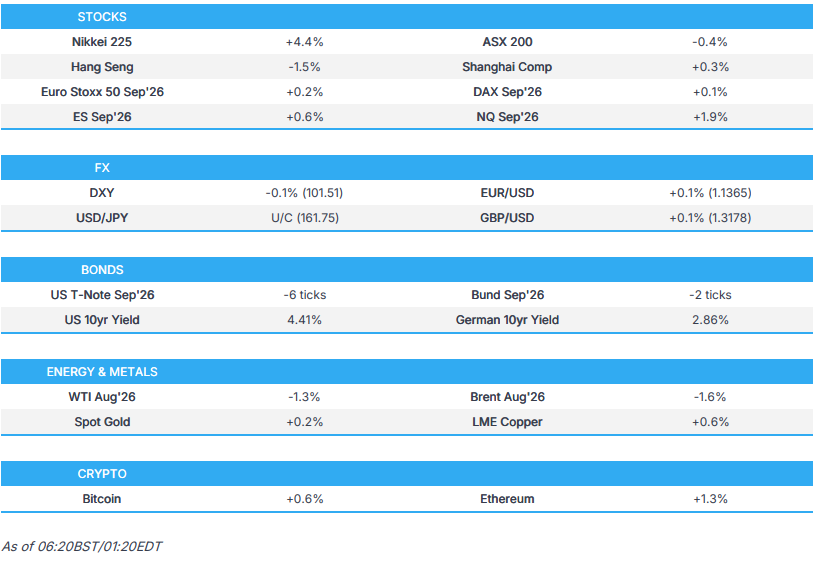
SHANGHAI CLOSED UP 9.47 PTS OR 0.23%
HANG SENG CLOSED DOWN 335.27 PTS OR 1.43%
Nikkei CLOSED UP 3244.03 PTS OR 4.69%
//Australia’s all ordinaries CLOSED DOWN 0.43%
//Chinese yuan (ONSHORE) CLOSED UP TO 6.7982
/ OFFSHORE CLOSED UP AT 6.8033 Oil DOWN TO 69.56 dollars per barrel for WTI and BRENT DOWN TO 72.73 Stocks in Europe OPENED ALL RED
ONSHORE USA/ YUAN// WITH YUAN TRADING UP (6.7982) OFFSHORE YUAN TRADING UP TO 6.8033 ONSHORE YUAN TRADING ABOVE LEVEL OF OFF SHORE AND UP ON THE DOLLAR// / AND THUS STRONGER/OFF SHORE YUAN TRADING UP AGAINST US DOLLAR/ AND THUS STRONGER
XXXXXXXXXXXXXXXXXXXXXXXXXXXXXXXXXXXXX
YOUR EARLY CURRENCY VALUES/GOLD AND SILVER PRICING/ASIAN AND EUROPEAN BOURSE MOVEMENTS/AND INTEREST RATE SETTINGS THURSDAY MORNING.7:30 AM
ONSHORE YUAN: CLOSED UP AT 6.7982
OFFSHORE YUAN: UP TO 6.8033
1.HANG SANG CLOSED DOWN 335.27 PTS OR 1.43%
2. Nikkei closed UP 3244.03 PTS OR 4.69%
WEST TEXAS INTERMEDIATE OIL DOWN TO 69.56
BRENT; 72.76
3. Europe stocks SO FAR: ALL GREEN
USA dollar INDEX DOWN TO 101.37/// EURO RISES TO 1.1355 UP 2 BASIS PTS
3b Japan 10 YR bond yield:RISES TO. +2.627 DOWN 4 FULL BASIS PTS/ VERY TROUBLESOME//Japan buying 100% of bond issuance)/Japanese YEN vs USA CROSS NOW AT 161.82… JAPANESE YEN NOW FALLING AS WE HAVE NOW REACHED THE ENDING OF THE YEN CARRY TRADE AGAIN AND THE REPATRIATION OF YEN DENOMINATED BONDS TRADING IN THE USA/EUROPE. JAPAN 30 YR BOND YIELD: 3.824 DOWN 4 FULL BASIS PTS
3c Nikkei now ABOVE 17,000
3d USA/Yen rate now well ABOVE the important 120 barrier this morning
3e Gold DOWN /JAPANESE Yen DOWN CHINESE ONSHORE YUAN: UP( 6.7982) AND OFFSHORE: UP AT 6.8033
3f Japan is to buy INFINITE TRILLION YEN worth of BONDS. Japan’s GDP equals 5 trillion USA
Japan to buy 100% of all new Japanese debt and NOW they will have OVER 50% of all Japanese debt.
3g Oil DOWN for WTI and BRENT DOWN this morning
3h European bond buying continues to push yields LOWER on all fronts in the EMU. German 10yr bund YIELD DOWN TO +2.8601/ Italian 10 Yr bond yield DOWN to 3.589/ SPAIN 10 YR BOND YIELD DOWN TO 3.350%
3i Greek 10 year bond yield DOWN TO 3.529%
3j Gold at $3988.00 //Silver at: 57.45 1 am est) SILVER NEXT RESISTANCE LEVEL AT $100.00
3k USA vs Russian rouble;// Russian rouble DOWN 0 AND 28/ 100 roubles/75,17
3m oil (WTI) into the 69 dollar handle for WTI and 72 handle for Brent/
3n Higher foreign deposits moving out of China// huge risk of outflows and a currency depreciation. This can spell financial disaster for the rest of the world/
JAPAN ON JAN 29.2016 CONTINUES NIRP. THIS MORNING RAISES AMOUNT OF BONDS THAT THEY WILL PURCHASE UP TO .5% ON THE 10 YR BOND///YEN TRADES TO 161.82 // 10 YEAR YIELD AFTER FIRST BREAKING .54% LAST YEAR NOW EXCEEDS THAT LEVEL TO 2.627% DOWN 4 BASIS PTS STILL ON CENTRAL BANK (JAPAN) INTERVENTION//YEN CARRY TRADE NOW UNWINDING//YEN BOND TRADING OVERSEAS REPATRIATED.//JAPAN 30 YR: 3.827 DOWN 4 PTS..: USA/SF this 0.8119 as the Swiss Franc . Euro vs SF: 0.9219
USA 10 YR BOND YIELD: 4.409 DOWN 1 BASIS PTS…
USA 30 YR BOND YIELD: 4.860 DOWN 1 BASIS PTS/
USA 2 YR BOND YIELD: 4.150 UP 1 BASIS PTS
USA DOLLAR VS TURKISH LIRA: 46.52 UP 2 BASIS PTS/LIRA GETTING KILLED//IDIOTS FOR SELLING GOLD AND USA DOLLAR RESERVES.
10 YR UK BOND YIELD: 4.6909 UP 1 PTS
30 YR UK BOND YIELD: 5.386 UP 1 BASIS PTS
10 YR CANADA BOND YIELD: 3.370 UP 1 BASIS PTS
5 YR CANADA BOND YIELD: 3.000 UP 1 BASIS PTS.
1a New York Opening report
1 b European opening report
Micron soars 18% after stellar earnings, boosting global sentiment; crude benchmarks continue to pull back – Newsquawk US Market Open
Thursday, Jun 25, 2026 – 06:09 AM
Conflicting reports on whether Israeli forces have pulled away from southern Lebanon, with Israeli and Lebanese sources denying earlier comments by a US State Department official stating Israel has pulled back.
A senior Iraqi Oil Ministry official said the nation will consider all available options if its OPEC quota is not significantly increased and has considered the idea of leaving OPEC.
Micron surges over 16% pre-market after it beat expectations and issued stronger guidance, benefiting from surging AI-driven demand, rising memory prices and long-term customer agreements, NQ +2.1%.
DXY consolidates just shy of YTD highs; G10s mixed with cable outperforming.
Fixed income benchmarks trade mixed ahead of a busy US data docket.
Energy prices continue to fall while spot gold holds below USD 4k/oz.
Looking ahead, highlights include US PCE (May), GDP Final (Q1), Jobless Claims (Jun/20), Durable Goods (May), Chicago Fed Labour Market Indicator (Jun), Atlanta Fed GDP (Q2), Banxico Policy Announcement, Speakers including ECB’s Lane & Cipollone, Fed’s Bowman, Williams & Goolsbee, Supply from the US.
2. Listen to this report in the market open podcast (available on Apple and Spotify)
3. Trial Newsquawk’s premium real-time audio news squawk box for 7 days
EUROPEAN TRADE
EQUITIES
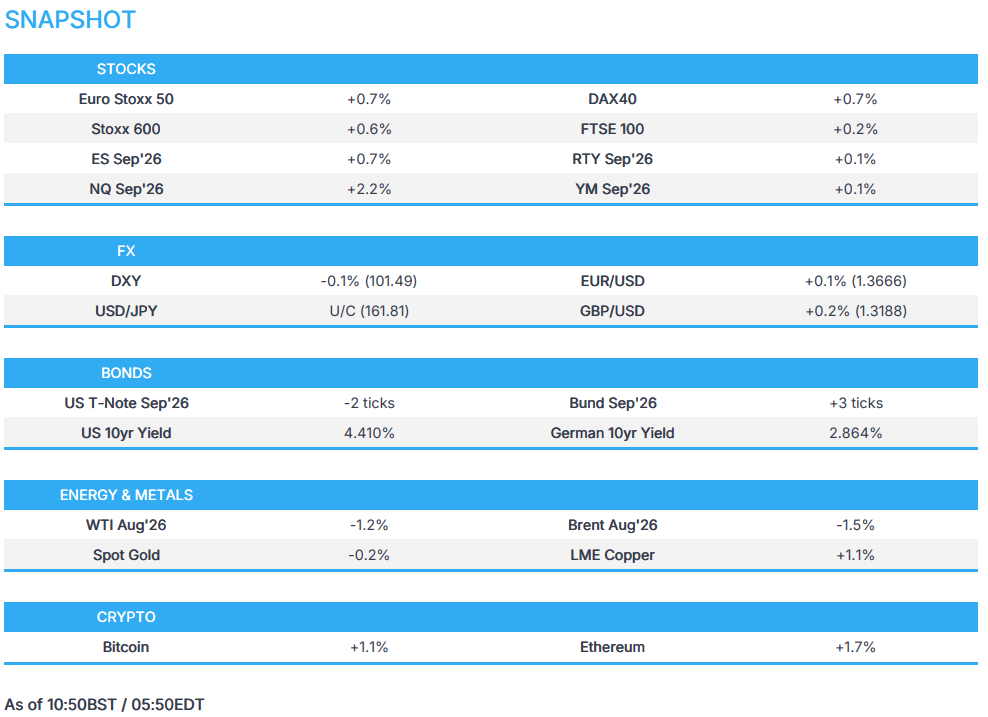
European bourses (STOXX 600 +0.6%) begin Thursday’s trade with broad gains, with tech-heavy indices leading following positive Micron earnings (AEX +0.8%, DAX 40 +0.6%). As the Iran conflict fades, with energy prices now reversing the wartime gains, equities in Europe can begin to catch up to their peers in the US and Asia. Investors are also seeing Europe as a safer place to place money due to its lack of tech giants, protecting themselves from any AI-related selloff.
European sectors highlight the positive bias. Technology (+2.6%), unsurprisingly, is the clear outperformer. Utilities (+1.5%) and Financial Services (+0.8%) complete the top 3 sectors. To the downside is Media (-0.9%), Food, Beverages & Tobacco (-0.4%) and Chemicals (-0.3%).
US equity futures are gaining across the board, with clear outperformance in the NQ (+2%) following earnings by Micron and an update from Qualcomm. For Micron (+16.4% pre-market), its Q3 adj. EPS and revenue beat estimates while its Q4 guidance also beat consensus. In terms of commentary, they said that tight conditions are expected to persist beyond FY27, and it has no line of sight on when supply can catch up with demand. For Qualcomm (+12% pre-market), the Co. raised its FY29 non-handset revenue target to USD 40bln, while announcing a strategic relationship with Hugging Face to advance open, developer-driven AI from devices to cloud infrastructure.
G10s are mixed but mostly stronger against the Buck with breadth narrow as the Buck rally loses steam and fails to provide a bias to peers.
USD benefitted this week from the risk-on mood into Micron earnings, which were released after US markets closed on Wednesday. Given the stellar report from the memory maker, risk-on trade has resumed, with equities (specifically tech–heavy indices) bid. DXY a touch lower on the day given the risk tone, trades at the lower end of its 101.44-101.66 range; now looking to PCE.
Antipodeans lacklustre against the Buck despite the heightened sentiment. Aussie digested better-than-expected headline employment change, which failed to spark a meaningful reaction following on from the mixed inflation report in the prior session, with much of the change driven by temporary activity. AUD/USD +0.1% found buyers below 0.69, AUD/NZD +0.1% lifted from just below the 1.22 mark.
USD/JPY continues to lack a bias as it hovers around levels not seen since July 2024. BoJ’s Tamura spoke overnight, sticking to the hawkish bias, advocating for tightening “once every few months” to a terminal of 2%. Despite the remarks initially helping the Yen, the move failed to stick, with the pair flat and approaching 162 to the upside.
GBP remains focused on the Fiscal/Chancellor situation. Current Chancellor Reeves on the wires this morning, not providing too much new but seemingly teeing herself up to keep the role at no. 11. Prior to this, The Times reported that Miliband has been developing key economic policies for the new government, with particular reference to fiscal implications, a point potentially unwelcome by UK investors given his track record as Energy Secretary. GBP has not taken the skew from Gilts which underperform peers today amid the continued Miliband reporting, GBP/USD +0.1% after bouncing off 1.3150.
FIXED INCOME
Global fixed benchmarks are softer across the board, albeit only modestly. This does come after the benchmarks surged in Wednesday’s session, causing yields to break key markers, as energy prices continued to fall.
USTs (-3 ticks) have pulled back from Wednesday’s and Today’s peak of 110-01, with 10yr yields slipping below the support level of 4.422%. Despite the positive 2-year auction on Tuesday, it failed to feed through to the 5-year tap. A busy data docket is ahead, with Core PCE Price Index (the Fed’s preferred inflation gauge) expected to hold steady at 3.3% Y/Y. Final Q1 GDP is also expected to remain unchanged at 1.6%. Initial jobless claims, durable goods orders, Atlanta Fed GDP and a 7-year auction are also on the docket.
Bunds (+3 ticks) and Gilts (-9 ticks) are also softer, but off worst levels. For German debt, its Q3 issuance plan was left unchanged, looking to raise EUR 138bln in the quarter. Bunds were unreactive following the announcement. ECB’s Schnabel was on the wires this morning, reiterating her stance that the ECB will need to raise rates further to bring back inflation to 2%, while stating that although the short-term situation looks better than expected, the ceasefire is no reason for policymakers to let their guard down. For Gilts, although they were unreactive, the Guardian reported that some senior officials are pushing incoming-PM Burnham to issue GBP 20bln of “war bonds” to pay for higher defence spending. We are now attentive to specifics around the duration and magnitude of any theoretical issuance.
JGBs (+5 ticks) consolidated, with a poor 20-year auction capping the upside. The b/c ratio dropped to 2.97, below the prior 4.01x and 12-month average. No significant move seen to hawkish BoJ speak overnight.
German Q3 debt issuance plan unchanged, as expected: to raise EUR 138bln in Q3, set to issue EUR 512bln in 2026.
UK sells GBP 1.5bln 0.50% 2029 Gilt via tender: b/c 3.61x (prev. 3.86x), average yield 4.062% (prev. 3.841%).
Japan sells JPY 530.4bln 20-year JGBs; b/c 2.97x (prev. 4.01), average yield 3.542% (prev. 3.711%)
COMMODITIES
Attention today has been on a recent route dispute on the Strait of Hormuz. The IRGC rejected a newly formed shipping lane, which traverses towards Omani waters, with the Group stating that it only accepts passage through it own routes. The IRGC warned that any attempts to pass through the Strait, outside of their own route, will be dealt with accordingly.
Focus also on the Lebanon situation. Initially a US official stated that Israel had pulled back from parts of its buffer zone in Lebanon, which was then pushed back by Lebanese sources; it was then later confirmed by the Israelis that it had not received any instructions to pull back. This spurred some mild strength in the crude complex at the time.
WTI and Brent are once again on a weak footing this morning, trading lower by c. 1.2% and 1.3% respectively. Markets continue to cheer the reopening of the Strait, with dozens of ships continuing to pass through daily. It is unclear how long this exuberance will last, given the risks surrounding the new Strait route and conflicting remarks and the volatile Lebanon-Israel situation.
Also interesting was comments made by a senior Iraqi Oil Ministry official, who said the nation will consider all available options if its OPEC quota is not significantly increased and have considered the idea of leaving OPEC
Spot gold trades shy of the USD 4k/oz mark, and holds within a USD 3,962-4,018/oz range, which is towards the bottom end of Wednesday’s trading bands. Analysts highlight several factors for the recent move lower in gold, which includes: 1) loss of safe-haven appeal, 2) stronger USD, 3) hawkish shift at the Fed, spurred following Warsh’s debut. On the latter point, Warsh ultimately highlighted the importance of price stability, which helped to push back on traders eyeing a debasement trade.
Elsewhere, for the yellow metal, Bloomberg reported that major Chinese banks are reportedly shutting services supporting retail precious metals trading after gold and silver volatility. Elsewhere, 3M LME copper is firmer this morning, and trades within a USD 13,056.5-13,242.13/t range.
US President Trump said he spoke with oil companies and that oil companies are not reducing gas prices enough, adding they will be in trouble if they are gouging.
Saudi Arabia is reportedly set to restart Ras Tanura (550k BPD) oil exports as Gulf flows rise.
Senior Iraqi Oil Ministry official said the nation will consider all available options if its OPEC quota is not significantly increased and have considered the idea of leaving OPEC. The current plan is to remain and gain higher quota.
Iraqi Government spokesperson said the nation is working to restore full oil export capacity and aims to raise production to 7mln BPD over the coming years.
China is reportedly raising its refined fuel export allowance for July, according to reports.
Early reports suggest oil export and production were unaffected by the Venezuela earthquakes, according to Bloomberg’s Blas.
Chevron (CVX) CFO said gas prices will normalise, following pressure from President Trump on big oil companies, CNBC reported.
Major Chinese banks are reportedly shutting services supporting retail precious-metals trading after gold and silver volatility, Bloomberg reported.
TRADE/TARIFFS
The EU has given the US trade deal final approval, according to Bloomberg.
UK Government announced new steel trade measures, effective July 1st. It will reduce the overall quota volumes by 51% and that any imports above would have a 50% tariff.
NOTABLE EUROPEAN HEADLINES
UK Chancellor Reeves reiterated her backing for MP Andy Burnham, and stated that it is clear he is committed to the fiscal rules. On borrowing more for defence spending, she said the DIP will involve more money. Will not maintain current level of economic growth due to Middle-East conflict and decisions to be make on Jackdaw and Rosebank soon.
Two of the UK’s largest trade unions are increasing pressure on Andy Burnham not to pick Ed Miliband as the Chancellor, arguing that his North Sea oil policy has damaged jobs in the sector, according to FT.
German Deputy Defence Minister Schmid said they are well underway on reaching the 3.5% defence spend target and that different options to be discussed on the subject of the Eurofighter.
NOTABLE EUROPEAN DATA RECAP
German GfK Consumer Confidence (Jul) -29.2 vs. Exp. -28 (Prev. -29.8).
Spanish GDP Growth Rate QoQ Final (Q1) Q/Q 0.6% vs. Exp. 0.6% (Prev. 0.8%).
French Consumer Confidence (Jun) 84 vs. Exp. 84 (Prev. 82).
CENTRAL BANKS
ECB’s Schnabel said the short term situation now looks better than had been expected but the ceasefire is no reason for policymakers to let their guard down. We will need to raise interest rates further in order to bring inflation back to the two percent target over the medium term.
BoJ Board Member Tamura said it is important to push the BoJ’s policy rate closer to neutral to avoid being forced to hike rates sharply later, and his view is for the BoJ to raise its policy rate once every few months towards a neutral level of around 2%. Tamura also stated that if upside price risks become more likely to materialise, the BoJ should not hesitate to speed up rate hikes or raise rates by a larger amount, while he voted against the decision to pause tapering from next fiscal year, as the BoJ should normalise the balance of its bond holdings as soon as possible.
NOTABLE US HEADLINES
Fed said 32 large banks are well positioned to weather a severe recession and continue lending under the latest stress test, while the banks tested absorbed more than USD 700bln in hypothetical losses and saw capital decline only 1.6%, to remain above minimum requirements. Furthermore, the Fed reaffirmed its plan to maintain capital levels steady as it adjusts the testing process and will set new stress capital buffers following the 2027 test.
Acting US AG Blanche has told several GOP senators he is willing to take formal action to kill the USD 1.8bln “anti-weaponization fund”, Punchbowl reported citing sources.
GEOPOLITICS
MIDDLE EAST
US President Trump reiterated that Iran will never have a nuclear weapon, while he adds that we will have peace in the Middle East. Trump separately commented that it is unacceptable to have fees on the Strait of Hormuz and they are doing great in negotiations with Iran, while he added that the Iran war powers vote is meaningless.
US Secretary of State Rubio said we hope to reach a final agreement with Iran, but not at any price, and are now entering a new phase that hopefully leads to peace. Will not accept that Hormuz belongs to any nation-state. US President Trump has been fundamentally clear about the tolling issue. It can be a toll or a fee, but it is all semantics.
US Senate Republicans defeated a war powers resolution regarding Iran in a 50-47 vote, to appease President Trump following a heated lunch meeting, according to NYT
A US State Department official said Israel has pulled back from part of its buffer zone in southern Lebanon as an act of good faith. However, this was later refuted, with a Lebanese military source telling Al-Araby that the Israeli army has not withdrawn from any point in the areas it occupies in southern Lebanon. This was also denied by a senior Israel official.
“Lebanese media outlets are reporting that an Israeli drone attacked the village of Tabit, in the Nabatia region in southern Lebanon”, via Kan’s Kais.
Five South Korean ships were said to have exited the Strait of Hormuz, although the time frame is uncertain.
RUSSIA-UKRAINE
Ukraine President Zelensky confirmed its military hit an oil depot in Russia’s Krasnodar region and two oil refineries in the Ufa region.
CRYPTO
Bitcoin has rebounded modestly after bottoming at a new YTD low at USD 59.01k in Wednesday’s lesson, currently trading at the upper end of a narrow USD 60.58k-61.87k range.
APAC TRADE
APAC stocks traded mixed, albeit with a mostly positive bias and with the KOSPI leading the gains as tech and Nasdaq futures rebounded from the prior day’s lows following strong earnings from Micron.
ASX 200 was dragged lower by weakness in mining, materials, resources and energy stocks, while better-than-expected headline Australian jobs data failed to inspire and was mostly driven by part-time jobs.
Nikkei 225 rallied back above the 72,000 level amid a resurgence in tech and lower oil prices, while markets were unfazed by comments from BoJ hawk Tamura, who called for hiking rates every few months.
KOSPI outperformed amid a rally in Samsung Electronics and SK Hynix, with the latter sitting on double-digit percentage gains amid its US IPO plans.
Hang Seng and Shanghai Comp were mixed in the absence of any major fresh drivers and with the Hong Kong benchmark dragged lower by losses in miners and further weakness in hyperscalers, including Alibaba, after Anthropic accused the Co. of illicitly accessing AI models in a letter to US officials.
NOTABLE ASIA-PAC HEADLINES
USGS reported a magnitude 7.1 earthquake struck off the coast of Venezuela and that a second 7.5 magnitude earthquake hit the same area, while it warned of a potential massive catastrophe from the Venezuela quake, and estimated the quake death toll could exceed 1000, according to NYT.
Earthquake reportedly hit Japan off the Iwate prefecture with a preliminary magnitude of 6.9, while NHK said Japan quake shaking intensity was 6+ on a scale of 7, while no tsunami warning was issued.- Japan’s LDP is facing internal friction, with lawmaker Obuchi reportedly offering to resign if consumption tax is cut to 0%, NTV reported.
NOTABLE APAC DATA RECAP
Australian Employment Change (May) 40.3K vs. Exp. 30.3K (Prev. -18.6K).
Australian Unemployment Rate (May) 4.4% vs. Exp. 4.4% (Prev. 4.5%).
Australian Full Time Employment Chg (May) 5.2K (Prev. -10.7K).
Australian Participation Rate (May) 66.7% vs. Exp. 66.8% (Prev. 66.7%).
1 c) Asian opening report
Micron surges after Q3 earnings+guidance beat; NQ and European futures benefit – Newsquawk EU Market Open
Thursday, Jun 25, 2026 – 01:59 AM
US stocks finished mixed. APAC trade was similar, but with KOSPI, +5.9%, leading and NQ, +1.9%, outperforming after strong Micron results, +18%.
Micron beat expectations and issued stronger guidance, benefiting from surging AI-driven demand, rising memory prices and long-term customer agreements.
DXY under modest pressure, peers generally contained. Brief JPY support seen on hawkish comments from BoJ’s Tamura.
Fixed contained, USTs unaffected by a weak 5yr sale, JGBs capped by the 20yr tap.
Brent wiped out all upside from the US-Iran conflict. Precious metals choppy, base peers followed the risk tone higher.
Looking ahead, highlights include German GfK Consumer Confidence (Jul), French Consumer Confidence (Jul), Spanish GDP Final (Q1), US PCE (May), GDP Final (Q1), Jobless Claims (Jun/20), Durable Goods (May), Chicago Fed Labour Market Indicator (Jun), Atlanta Fed GDP (Q2), Banxico Policy Announcement, German Finance Agency Issuance Outlook (Q3), Speakers including ECB’s Lane & Cipollone, Fed’s Bowman, Williams & Goolsbee, Supply from the UK & US.
2. Listen to this report in the market open podcast (available on Apple and Spotify)
3. Trial Newsquawk’s premium real-time audio news squawk box for 7 days
IRAN CONFLICT
US President Trump reiterated that Iran will never have a nuclear weapon, while he adds that we will have peace in the Middle East. Trump separately commented that it is unacceptable to have fees on the Strait of Hormuz and they are doing great in negotiations with Iran, while he added that the Iran war powers vote is meaningless.
US President Trump said Iran is making big concessions and it’s going very well, while he also said that Iran is agreeing to everything he wants, and that they have to.
US President Trump and Senator Cassidy of Louisiana clashed sharply over the administration’s war in Iran during a closed-door meeting at the Capitol on Wednesday, according to CNN, citing sources. It was separately reported that Trump said he had a great meeting with lawmakers.
US Senate Republicans defeated a war powers resolution regarding Iran in a 50-47 vote, to appease President Trump following a heated lunch meeting, according to NYT
US Secretary of State Rubio said the Hormuz Strait should be open and free and that the technical group on Iran will be back later this month. He added the US will help Lebanon “take control” of territory to act against Hezbollah.
A source told Al-Mayadeen that the withdrawal schedule for the occupation army will be in accordance with the arrangements put in place to monitor the ceasefire and implement the first clause of the MoU.
Iranian Foreign Ministry spokesperson said contradictory US statements on the MoU to end the war will not help in reducing Iranians’ mistrust. The spokesperson also said NATO and its member states, including Italy and Romania, must be held accountable for any complicity in the crimes committed by the US and Israel against Iran
IRGC Navy said safe passage through the Strait of Hormuz is only possible through routes announced by Iran and ship transits require coordination with Iran.
Israeli Broadcasting Authority cited sources stating that negotiations between Israel and Lebanon took place at the Pentagon, and they were discussing the start of the withdrawal from southern Lebanon, while a partial Israeli withdrawal from some areas is expected, but not a complete withdrawal from southern Lebanon.
The first day of negotiations between Israel and Lebanon in Washington on Tuesday ended without any progress and in some respects saw a setback, according to Axios citing sources. One source said parts of the talks were “ugly”, while Israel acknowledged disagreements but maintained the atmosphere was “pleasant.”
US TRADE
EQUITIES
US stocks finished mixed as most sectors gained, with breadth strong, although continued tech weakness weighed on indices, resulting in the SPX and NDX closing in the red, looking to Micron. Major stock updates included Cerebras (CBRS) sinking 19% on expected declines in gross margins, Alphabet (GOOG) to replace Verizon in the Dow Jones, and OpenAI and Broadcom (AVGO) unveiling an LLM-optimised intelligence processor. A combination of tech risk off, lower energy prices, and quarter-end rebalancing saw T-Notes rally across the curve with the US 10yr yield down to 4.406%, while an unexpected decline in New Home Sales and a weaker US 5yr note auction sparked little reaction in the space.
SPX -0.10% at 7,358, NDX -0.43% at 29,220, DJI +0.35% at 51,854, RUT +0.37% at 2,987.
Micron Technology (MU): Micron shares rose almost 18% in extended US trading after the memory maker beat expectations and issued stronger guidance, benefiting from surging AI-driven demand, rising memory prices and long-term customer agreements. It reported Q3 adj. EPS of 25.11 (exp. 20.57), Q3 revenue of USD 41.456bln (exp. 35.56bln), adj. gross margin 84.9% (exp. 81.9%) and vs prev. 39.0% Y/Y as revenue more than quadrupled from USD 9.3bln amid surging AI-driven memory demand and tight supply. Micron ended the quarter with USD 30.2bln of cash, marketable investments and restricted cash. CEO said customers recognise memory and storage shortages will take considerable time to improve, with Micron expecting industry supply to improve gradually in 2028; added that tight conditions are expected to persist beyond FY27 and it has no line of sight on when supply can catch up with demand. Micron said it has signed 16 long-term customer agreements with data centre operators and automakers, representing expected financial commitments of USD 22bln, and declared a 0.15 dividend payable in July. Sees Q4 adj. EPS 31.00 (exp. 25.50), and sees Q4 revenue USD 50.0bln (exp. 42.915bln), sees Q4 capex of USD 10bln. Micron expects operating expenses to increase by approximately USD 1bln in FY27, and sees FY27 capex of USD 27bln.
Fed said 32 large banks are well positioned to weather a severe recession and continue lending under the latest stress test, while the banks tested absorbed more than USD 700bln in hypothetical losses and saw capital decline only 1.6%, to remain above minimum requirements. Furthermore, the Fed reaffirmed its plan to maintain capital levels steady as it adjusts the testing process and will set new stress capital buffers following the 2027 test.
NY Fed’s Money Markets Director Marchioni downplayed the new FOMC language regarding an ample reserves system, stating the new FOMC language is not a policy change and the Fed retains flexibility on reserve management.
US President Trump said we need a low interest rate, while Trump spoke with oil companies on Wednesday and said oil companies are not reducing gas prices enough, as well as warned they will be in trouble if they are gouging.
US President Trump’s administration sent Congress a USD 87.6bln supplemental budget request.
APAC TRADE
EQUITIES
APAC stocks traded mixed, albeit with a mostly positive bias and with the KOSPI leading the gains as tech and Nasdaq futures rebounded from the prior day’s lows following strong earnings from Micron.
ASX 200 was dragged lower by weakness in mining, materials, resources and energy stocks, while better-than-expected headline Australian jobs data failed to inspire and was mostly driven by part-time jobs.
Nikkei 225 rallied back above the 72,000 level amid a resurgence in tech and lower oil prices, while markets were unfazed by comments from BoJ hawk Tamura, who called for hiking rates every few months.
KOSPI outperformed amid a rally in Samsung Electronics and SK Hynix, with the latter sitting on double-digit percentage gains amid its US IPO plans.
Hang Seng and Shanghai Comp were mixed in the absence of any major fresh drivers and with the Hong Kong benchmark dragged lower by losses in miners and further weakness in hyperscalers, including Alibaba, after Anthropic accused the Co. of illicitly accessing AI models in a letter to US officials.
US equity futures rebounded with Nasdaq futures leading the upside following a blowout report from Micron.
European equity futures indicate a slightly positive cash market open with Euro Stoxx 50 futures up 0.1% after the cash market closed with losses of 0.3% on Wednesday.
FX
DXY slightly eased back after gaining yesterday alongside equity volatility, with price action contained amid light geopolitical developments and ahead of incoming data, including final Q1 GDP and the Fed’s preferred inflation gauge.
EUR/USD got some slight reprieve after steadily retreating to a one-year low beneath the 1.1400 handle.
GBP/USD nursed some of its losses after declining to sub-1.3200 territory, but with the rebound contained amid quiet pertinent newsflow and a lack of data for the UK.
USD/JPY lingered at the 161.00 territory, with only brief headwinds seen following hawkish comments from BoJ’s Tamura, who called for further hikes, and said he opposed pausing tapering at last week’s BoJ meeting.
Antipodeans remained lacklustre following recent declines in commodities and amid the mixed risk appetite, while better-than-expected headline employment change for Australia failed to spur any meaningful reaction.
PBoC set USD/CNY mid-point at 6.8209 vs exp. 6.8048 (prev. 6.8195).
BoC Minutes showed members agreed monetary policy will need to remain nimble. Members agreed that if inflation data showed pressures spreading, it would signal that tighter policy is warranted, while also noting that the economic situation presents a dilemma for monetary policy. The summary added that unfavourable USMCA negotiations could have broader effects on jobs and investment in Canada.
FIXED INCOME
10yr UST futures took a breather after climbing yesterday alongside a slide in oil prices and as equities dipped, which spurred haven demand flows, while T-notes were unfazed by a weaker 5yr note auction and further incoming supply.
Bund futures paused overnight and held on to recent spoils after advancing above the 127.00 level, while participants look ahead to approaching data, including German GfK consumer confidence.
10yr JGB futures were choppy at the open, but eventually edged higher, despite comments from BoJ hawk Tamura, who said it is important to push the BoJ’s policy rate closer to neutral to avoid being forced to hike rates sharply later, and that he voted against the BoJ’s decision to pause tapering from next fiscal year, as they should normalise the balance of its bond holdings as soon as possible. Furthermore, upside was capped following the latest 20yr JGB auction, which resulted in a lower bid-to-cover and higher accepted prices.
COMMODITIES
Crude futures remained pressured with WTI back below USD 70/bbl and with Brent wiping out all Iran war gains as Strait of Hormuz traffic continues to pick up with US Energy Secretary Wright noting that roughly 72 ships have exited the waterway over 24 hours, amounting to 20mln barrels of oil, but suggested the normalisation of oil flows was delayed due to Iranian mines in the strait, while it was also reported that five South Korean ships exited the waterway.
US Energy Secretary Wright said roughly 72 ships exited the Strait of Hormuz in the last 24 hours, amounting to 20mln barrels of oil, while he stated that a return to normal oil flows is being delayed by Iranian mines in the Strait and that Iran will not have the ability to block the waterway going forward. Wright also commented that the US will ensure oil flows continue even without a deal with Iran and said normal conditions could return within a few weeks. Furthermore, he said Venezuela’s oil exports could reach 2mln BPD during this administration, and that the SPR could reach 500mln barrels with creative refill measures.
Five South Korean ships were said to have exited the Strait of Hormuz.
Iran has exported 40mln barrels of crude oil since June 15th, according to TankerTrackers data.
Iraq ordered a halt to production at the West Qurna 2 oilfield with a capacity of 480k BPD, while Iraq’s PM said Iraq wants OPEC to raise its oil output in line with production capacity and population.
Russia is expected to ship a record 2.7-2.8mln BPD of crude from its western ports this month, according to three trade and port sources.
Spot gold was choppy around the USD 4,000/oz level following recent dollar strength and rate hike expectations.
Copper futures gradually rebounded from the prior day’s trough alongside the mostly positive risk tone.
CRYPTO
Bitcoin retreated beneath the USD 61,000 level then proceeded sideways for most of the session.
NOTABLE ASIA-PAC HEADLINES
BoJ Board Member Tamura said it is important to push the BoJ’s policy rate closer to neutral to avoid being forced to hike rates sharply later, and his view is for the BoJ to raise its policy rate once every few months towards a neutral level of around 2%. Tamura also stated that if upside price risks become more likely to materialise, the BoJ should not hesitate to speed up rate hikes or raise rates by a larger amount, while he voted against the decision to pause tapering from next fiscal year, as the BoJ should normalise the balance of its bond holdings as soon as possible.
Japan’s government will call for appropriate monetary policy to support private demand in its economic blueprint, according to a draft cited by Reuters.
DATA RECAP
Australian Employment Change (May) 40.3K vs. Exp. 30.3K (Prev. -18.6K)
Australian Full Time Employment Chg (May) 5.2K (Prev. -10.7K)
Australian Unemployment Rate (May) 4.4% vs. Exp. 4.4% (Prev. 4.5%)
Australian Participation Rate (May) 66.7% vs. Exp. 66.8% (Prev. 66.7%)
GEOPOLITICS
OTHER
US State Department said it is concerned by reports that Chinese Coast Guard vessels operating in waters east of Taiwan harassed commercial ships.
GLOBAL
USGS reported a magnitude 7.1 earthquake struck off the coast of Venezuela and that a second 7.5 magnitude earthquake hit the same area, while it warned of a potential massive catastrophe from the Venezuela quake, and estimated the quake death toll could exceed 1000, according to NYT.
EU/UK
NOTABLE HEADLINES
Two of the UK’s largest trade unions are increasing pressure on Andy Burnham not to pick Ed Miliband as the Chancellor, arguing that his North Sea oil policy has damaged jobs in the sector, according to FT.
.NORTH AND SOUTH KOREA AND JAPAN
SOUTH KOREA
JAPAN
3 CHINA
Margins too low for our Chinese teapots to import oil: so we are 9 yr lows in oil imports
(zerohedge)
China’s Refiners Slash Runs To Lowest Since 2017, As Asia Refiners Slow Purchases Of Mid-East Oil
Fast forward to today when the previously discussed dynamics have gotten progressively worse, and this morning Bloomnberg writes that China’s independent oil refiners have slashed operating rates to a nine-year lo.
Run rates at so-called teapots fell to 50.5% in the week to June 21, dropping below pandemic-era lows to the weakest since 2017, according to consultant JLC. High feedstock costs, weak domestic fuel demand, and curbs on product exports have squeezed processors’ margins, prompting them to scale back.
As we noted previously, China – the world’s largest oil importer – sharply reduced crude imports after the conflict erupted in late February as prices initially spiked, sending oil imports to a 9 year low, a key reason why oil prices did not spike even higher in the past few months.
As Bloomberg notes, the nation’s sustained slowdown in flows has brought into focus a nationwide shift away from fossil fuels that’s been driven by greater electrification.
The teapots’ downturn in run rates comes as Iran is now seeking to revive crude exports under a temporary US sanctions waiver. Still, the weak refining economics could limit any near-term rebound in their purchases.
“Teapots are not short of feedstocks, with private-sector commercial inventories in Shandong still above 2025 highs,” said Emma Li, lead China market analyst at Vortexa Ltd., referring to the coastal province where many teapots are located.
Teapot run rates slid further in the second half of June, which means July “could represent a trough before utilization begins to recover,” she said.
In a separate report, Bloomberg also notes that Asian refiners have slowed purchases of Middle Eastern crude after a buying spree over the past three weeks, with oil majors and traders stepping in to take some of the surplus barrels.
Purchases from Abu Dhabi National Oil Co (ADNOC) eased after three rounds of tenders, with a fourth that closes this week set to show a similar pattern, Bloomberg reported citing traders familiar with the matter. More barrels were snapped up by majors and trading houses including Shell and Mercuria.
Adnoc sold around 60 million barrels that will load over June to August across its first three tenders, most of which will flow to Asia. The offers are for grades that are loaded within the Persian Gulf, although buyers will be able to take cargoes via a ship-to-ship transfer outside of the Strait of Hormuz.
Some of the barrels being sold in the latest Adnoc tender are expected to flow toward Europe, said energy traders. That would follow a recent trend, which saw a wave of Middle Eastern oil heading in that direction as China stepped back.
Most refiners have already completed their orders for this month and next, and available crude would need to be significantly discounted to prompt any more buying, traders said. Adnoc has also asked customers with long-term contracts to immediately resume loading supplies, crimping spot demand.
Iraq and Kuwait have also been ramping up output as producers position for a reopening of Hormuz, with talks over a lasting agreement to end the Iran war showing some progress. That’s led to prices for Middle Eastern oil tumbling, with the forward curve of two of the region’s main benchmark grades — Dubai and Murban — now in a bearish contango structure.
A temporary US waiver allowing purchases of Iranian oil has added to swelling supply options, although complications surrounding the financing and insurance of cargoes remain and could be too risky for some refiners. Still, as we reported earlier this week, “Iran Oil Exports Through Hormuz Hit Wartime High,”
Some in the market are assessing whether storing crude could be an option for the impending wave of supply. Traders said freight costs remain too expensive for floating storage to be effective…
… but countries with sites on land should be able to easily accommodate surplus barrels.
END
CHINA/USA
National Insecurity: America’s Continuing Reliance On Critical Chinese Materials
At the onset of the COVID-19 pandemic in 2020 – with face masks, gloves, and other basic protections in high demand – Chinese leaders threatened to plunge America into the “mighty sea of coronavirus” by withholding essential medical supplies in retaliation for measures such as the U.S. travel ban on visitors from China.
The threat, issued through a Chinese Communist Party organ, brought into stark relief China’s strategy to subdue would-be foes by rendering them reliant on its exports for life’s necessities – prompting a pledge from U.S. policymakers to address supply chain issues that made the country vulnerable to a hostile power.
Six years later, despite a raft of initiatives – including tariffs, made-in-America requirements, and the makings of a responsive U.S. industrial policy embraced by the Biden and Trump administrations – America’s effort to reduce dependence on China in pivotal sectors has been slow and faces a slew of challenges.
Headlines heralding the decline in U.S. imports from China to levels not seen since the depths of the pandemic mask the fact that America’s chief rival continues to control chokepoints in supply chains that provide urgent military assets, key technologies, and important medicines.
The Chinese government recently demonstrated its ability to weaponize criticalsectors when it responded to U.S. tariffs by restricting exports of rare earth materials and magnets that are critical to American defense systems and weapons. War-gamershaveindicated that the control over those supply chains may become paramount should China invade Taiwan or engage in other hostilities that might draw an American military response. Some estimates have indicated that such a struggle could wipe out 10% of global GDP – albeit damaging China and the U.S. alike.
Some experts say the major stumbling block is the private sector, which remains at odds with policymakers in tilting away from China, and has long relished its large market and cheap labor pool. Isaac Stone Fish, the CEO of Strategy Risks, a China-focused business risk analysis firm, told RealClearInvestigations that “Despite all the tough talk,” and economic and geopolitical tensions, his firm’s analysis shows that dozens of major U.S. companies have increased their engagement with China during 2026.
To treat supply chain threats as an economic problem and leave it to be addressed by free enterprise – rather than as a national security challenge requiring whole-of-society mobilization – is a fatal error, according to Leland Miller, a U.S.-China Economic and Security Review Commission member.
“[A]s long as you allow market dynamics to dictate what the U.S. is doing…you’re going to lose,” Miller said.
China’s Commanding Position
The Trump and Biden administrations have both highlighted the significance of the supply chain challenge to our national security, economic security, and public health. These include China’s commanding positions in:
Global rare earth materials, where China controls more than 60% of production and nearly 90% of refining capacity, giving it a chokehold on inputs vital to the manufacturing of everything from automobiles and medical equipment to defense products and spacecrafts;
Components or materials key to U.S. military hardware, ranging from U.S. aircraft carriers to missile defense systems and tanks, which are produced in or sourced from China;
Foundational semiconductors, used in practically all applications that include advanced chips from vehicles to medical devices and military systems, where China is the global production leader;
Printed circuit board fabrication, a core component in modern electronics, from telecommunications satellites to ventilators and smartphones, where Chinese firms control more than two-thirds of the global market;
Medicine, a field in which China controls approximately 90% of the global supply of key starting materials in active pharmaceutical ingredients in generic drugs, with over 60% of U.S. drugs containing key inputs from China and India.
To attain these positions, the U.S.-China Economic and Security Review Commission wrote in its 2025 annual report, “China has deliberately pursued a strategy of expanding production and deepening global dependence on Chinese exports while reducing its own reliance on imports. This strategy builds on decades of industrial policy that led to a concentration of supply chains in China and undercut competitors by flooding global markets with subsidized, underpriced goods.”
China’s tactics in pursuit of this strategy have ranged from government subsidies and currency manipulation to intellectual property theft and industrial espionage, forced labor, and product “dumping at artificially low prices – and, as it has increasingly been met with resistance, export controls.”
Tariffs and Stockpiles
The tariff regime, enacted during the first Trump administration and mostly continued under the Biden administration, is one key tactic the U.S. government has used to counter China’s playbook. Other policies have included directly stockpiling critical resources; securing strategic sectors through fostering international alliances and public-private partnerships; permitting reform; trade enforcement actions; incentives for re-shoring; and export controls.
“This is a whole-of-government effort across key industry sectors including critical minerals, pharmaceuticals, semiconductors, autos, steel, aluminum, and copper,” White House spokesman Kush Desai told RCI. “Hundreds of billions of dollars in private investment commitments across these sectors reflects how the administration’s long-term agenda continues to bear fruit.”
Still, experts remain concerned that the U.S. is ill-equipped to solve the complex problem.
Ideally, experts say, the U.S. government would comprehensively map the supply chain risks and work with all relevant stakeholders to mitigate them. The Trump administration has focused in particular on rare earth minerals and artificial intelligence technologies. Similarly, the Biden administration laid out a number of areas of concern from batteries to biotech as detailed in its Quadrennial Supply Chain Review. And, to varying degrees, both administrations attempted to coordinate their risk-mitigation efforts with foreign governments and the private sector.
Yet experts lamented that the government lacks the information necessary to comprehensively identify and attack supply chain vulnerabilities – rendering policies to date “ad hoc,” according to Meg Reiss, a former national security staffer on Capitol Hill and founder of SolidIntel, which uses AI to identify supply chain risks.
Leland Miller, who was appointed to the USCC by Republican House Speaker Mike Johnson, told RCI that the U.S. still has to do a lot of foundational work to to “map the [various] supply chains” and to identify “the vulnerabilities.”
Miller pins the slow progress to the lack of data from an often resistant private sector.
USCC Vice Chair Mike Kukien, an appointee of Senate Democratic Leader Chuck Schumer, concurred, asserting that “anytime Congress has attempted to wade into this space of…pulling information out of the supply chain, the first people to come and bang on your door and say, ‘Don’t do it,’ is industry.”
Pushback From Business
Companies argue that identifying areas where they are reliant on China and transitioning operations elsewhere would threaten their business models. They also claim it is costly and onerous to collect information on the multiple tiers of suppliers on whom they rely, and in some cases, they lack the wherewithal to do so. For its part, China has sought to impose costs – including ending market access – on companies that cooperate with supply chain transparency efforts.
Miles Yu, who served as principal China policy planner on strategy at the State Department during the first Trump administration, identified “Wall Street and Silicon Valley globalists” as influential opponents of Washington’s efforts to combat China’s supply chain chokepoints more broadly.
The task is further complicated by China’s efforts to avoid Trump’s tariffs by routing their products through more U.S.-friendly countries as a workaround.
“China’s ability to sort of hide its hand from a manufacturing perspective, unless there’s a real attempt to do country of origin work, is pretty strong,” Joshua Hodges, a former senior director at the National Security Council, told RCI. “And you’re seeing that in the defense industrial complex. You’re seeing it in cell phones. You’re seeing it really in any place where there are parts of a supply chain that have become commodities.”
Miles Yu concurs. “[T]oo many opportunistic allies and partners in EU and Asia [are] not in sync with Washington,” as well, making grappling with the global nature of the problem even harder, he said.
On the U.S. side, basic problems of coordination within the government threaten even the most comprehensive effort to take on the supply chain challenge. The National Defense Authorization Act is perhaps the seminal bill aligning the executive and legislative branches on China policy. Reiss notes that “the way…the legislative cycle works,” when it comes to mitigating supply chain risk, “everything’s based on NDAA timing.”
Should one NDAA cycle pass in which vulnerabilities go unaddressed, then remedies will not be included for the next “year and a half for beginning implementation, much less being fully implemented. So the timelines start becoming significant if we don’t have movement.”
Bright Spots
Despite their bearish conclusions, experts did note some bright spots. Stone Fish called tariffs “the biggest forcing mechanism yet – high enough costs might finally do what politics couldn’t. But China controls critical minerals that American factories can’t do without, so escalation cuts both ways.”
Miller noted that tariffs may be an effective defensive tool for protecting industries under attack from a China that often floods the market with goods to undercut foreign competitors. Tariffs, he says, should be used to ringfence critical sectors as their participants shift to alternative suppliers and rebuild their domestic production capacities. “But you can’t just throw around a tariff wall and expect industry to miraculously develop domestically as a result of that,” he says.
Miles Yu has a more sanguine view. He said that in the areas of defense, automobiles, and telecommunications services, the U.S. has been making progress on mitigating supply chain risk from China. And he believes that prohibitive tariffs on Chinese steel and aluminum, automobiles, including electronic vehicles, green products, and “enhanced SEC scrutiny” on publicly traded Chinese companies in the U.S. have borne fruit. Conversely, he argued that pharma and bio product restrictions remain wanting.
While concerned about the lack of strategic coherence in America’s risk mitigation efforts to date, Reiss hopes that efforts from the Defense Department reflect increasing strategic discipline. She cites, for example, initiatives out of the Office of Strategic Capital – which has backed domestic processing of rare earth minerals – as positives.
In the long term, Miller says, the U.S. only has to modify, not reinvent, the supply chain. “It’s not that we have to go back and figure out where every single input to every single supply chain is,” he says. “We have to make sure that enough of it comes from outside of China… so that China doesn’t have a stranglehold over any particular supply chain no matter what happens.”
In the interim, in the wake of the May 2026 summit between President Trump and Chinese leader Xi Jinping, the American side touted China’s stated commitment to “address U.S. concerns regarding supply chain shortages related to rare earths and other critical minerals,” as well as “prohibitions or restrictions on the sale of rare earth production and processing equipment and technologies.”
Still, the conflict between the two nations continues. Earlier this month, the Department of War added nearly two dozen Chinese companies to its blacklist. In apparent response, Chinese authorities imposed trade restrictions on dozens of U.S. defense companies, including barring exports to two American rare earth producers.
.4. EUROPEAN AND SCANDINAVIAN COMMENTARIES PLUS NATO
EU
European Rearmament Efforts Snuffed By Chinese Control Of Critical Materials
Thursday, Jun 25, 2026 – 05:45 AM
Yesterday we reported that, in a tit-for-tat move, China announced it is targeting US rare earths firms in response to a Pentagon list of Chinese firms: this, as Rabobank noted, is largely a symbolic move, but it still underlines the tensions in this area. So does the Nikkei reporting that ‘China minerals control threatens EU rearmament, as bloc seeks new sources’: because, as Rabo’s Michael Every notes, even if you can afford a dagger, you can’t make it without rare earths, and Europe still hasn’t secured enough supply.
Taking a closer look at the report, Nikkei writes that the European Union’s aggressive plans to boost defense capabilities are hampered by China’s export controls and sales restrictions on critical raw materials, with the bloc’s leaders now calling on countries to accelerate the diversification of their supply chains.
The European Commission last week said that it will propose a new law that will require companies in the bloc to expand their suppliers to address economic imbalances, although it did not name China.
Russia’s war in Ukraine and growing uncertainty over Washington’s security guarantees have pushed governments in Europe to increase military spending and production. But for 17 of the 34 materials classified as critical by the EU, China accounts for at least 70% of global mining or refining, a report published by Teer in May shows. Eight of those 34 materials are subject to Chinese export controls.
“China is in the process of pulling the rug out from under Europe’s rearmament efforts,” said Joris Teer, a policy analyst at the EU Institute for Security Studies (EUISS), the bloc’s agency for foreign, security and defense policy analysis.
“By just deploying this weapon, China has already increased its leverage, signaling both its capacity and willingness to squeeze supply at any moment of its choosing,” Teer wrote.
Escalating geopolitical developments and intensifying global competition for critical raw materials underline the growing need to strengthen Europe’s supply chains, said the Aerospace, Security and Defence Industries Association of Europe. The organization represents over 4,000 companies including the U.K.’s BAE Systems, France’s Thales and Germany’s Rheinmetall.
European defense manufacturers are pursuing several strategies including vertical integration, recycling, diversification and stockpiling. Rheinmetall told Nikkei Asia it had “no dependencies” and was “well prepared with regard to critical minerals.”
“Rheinmetall has stored key raw materials, enough to last for several years,” a spokesperson said. “We have implemented IT systems that enable us to centrally monitor and control raw material consumption across the group with precision.”
But analysts warn that stockpiling alone will not be enough.
“Stockpiling is an important buffer against immediate disruptions, but on its own it is unlikely to reduce structural damage over the long term,” said Maria Shagina, senior fellow at the International Institute for Strategic Studies. She said it would take years for alternative sources to replace either the volumes or the range of critical minerals that Beijing controls.
In 2024, the EU introduced the European Critical Raw Materials Act, aimed at rebuilding domestic supply chains for such minerals. It sets 2030 targets for domestic extraction, processing and recycling, while capping reliance on any single third-country supplier at 65%. A 3 billion-euro ($3.5 billion) fund was launched last year to accelerate strategic projects.
But the European Court of Auditors notes that the 2030 targets are nonbinding and that the bloc remains far from achieving them. Industry groups say policy inconsistencies could slow progress further.
The Cobalt Institute, representing an industry vital to jet engines, advanced batteries and defense alloys, said proposed EU rules involving chemicals risk hollowing out the sector.
“Europe is one foot in, one foot out,” said Michael Blakeney, head of government and public affairs at the London-based institute. “It is saying all the right things, but what it is doing is incoherent.”
Europe’s efforts coincide with an aggressive approach by the U.S. to secure critical mineral supply chains.
“The U.S. is deploying more capital, taking larger financial risks and in some cases acquiring equity stakes to secure and build capacity,” Shagina said. “By contrast, Europe has generally been more cautious … leaving [it] at a relative disadvantage in competing for critical minerals.”
In April, the EU signed an agreement with the U.S. to coordinate critical mineral supplies. Following initial resistance over fears it could dilute the bloc’s strategic autonomy, member states authorized the commission earlier in June to sign up to the U.S.-led Pax Silica initiative, which coordinates investment and export-control policies.
Teer urged the European bloc to use ongoing U.S.-EU-Japan negotiations as the “nucleus” of a wider coalition to make non-Chinese critical mineral production financially viable, backed by state support, price floors and procurement rules.
“Particularly important are raw material producers, or deposit holders, like Malaysia, the Democratic Republic of Congo, Brazil and Indonesia, as well as countries with vast skilled-workforce potential like India,” he wrote in the paper.
To deter further Chinese restrictions, he said the EU also should activate its anti-coercion instrument, which allows it to impose tariffs and restrictions as a response to economic coercion by countries outside of the bloc.
A European Commission spokesperson said the bloc had “long recognized the risks linked to the EU’s dependencies on critical raw materials.”
“The objective is clear: Anticipate disruptions early and reduce the EU’s vulnerabilities as we scale up our industrial and defense capacities,” the spokesperson said.
END
SPAIN
So, How’s Spain’s Mass Migrant Amnesty Working Out?
That’s the number that made headlines in April when Spanish Prime Minister Pedro Sánchez’s Socialist government approved plans to grant legal status to 500,000 illegal migrants.
But a leaked police report warned that the true number could be much higher, estimating that between 750,000 and 1 million illegal migrants living in Spain could apply for amnesty, in addition to 250,000 to 350,000 asylum seekers.
The report described the amnesty plan’s “very intense media impact, especially in Latin America” and warned of a “highly relevant pull factor,” which we will return to in a moment.
The conservative Popular Party (PP) also disputed the government’s estimates, saying the true number could be double and calling the plan an “outrage.” Sánchez, whom The Economist has called the leader of Europe’s anti-Trump resistance, anticipating such criticism, wrote in a New York Times op-ed in January that “MAGA-style leaders may say that our country can’t handle taking in so many migrants — that this is a suicidal move, the desperate act of a collapsing country.”
Well, the numbers are starting to come in and, just as Joe Biden’s weak border enforcement in the U.S. created a “pull factor” that led to average monthly border crossings of over 100,000, Sánchez’s policies are having a similar magnet effect, far exceeding his government’s estimates.
Even though the asylum application window remains open until June 30, 900,000 applications have already been submitted, a record number for Spain. The European Conservative reports that “approximately 350,000 additional applications have been submitted since the start of June, a surge that has caught authorities off guard.” The publication notes that these numbers are much higher than the last time mass amnesty was tried in Spain, in 2005 under the Socialist government of José Luis Rodríguez Zapatero, who these days spends his time in court as the subject of a graft probe. Zapatero’s program granted 576,000 residence permits from 691,000 applications received.
Sánchez, of course, looks at every new immigrant as a potential future voter who won’t care about the mind-boggling corruption within his Spanish Socialist Workers’ Party (PSOE). As increasing numbers of Spaniards take to the streets to demand the prime minister’s resignation, Muslim migrants are among his most loyal supporters. In the video below, we meet a Muslim store owner a minute in, with a poster of Sánchez on his shop wall, who says Muslims are “100%” going to vote for the prime minister if they become citizens. Why? Because he “stands with Iran and Palestine.” Indeed he does.
You’d be hard-pressed to find a poster of Santiago Abascal, the leader of the rising populist/conservative Vox party, in any Muslim-owned shops in Spain. Abascal, who has said that it is “inhumane to tell all of Africa and all of America that they can fit into Spain,”warned in April that mass amnesty will increase crime in the streets of Spain and accelerate the country’s housing and public healthcare crises.
And it’s not just Spanish politicians who are criticizing Sánchez’s policies.
Italian Prime Minister Giorgia Meloni told Sánchez in a closed-door meeting in Brussels last week that his amnesty plan negatively affects all EU countries. It was at that EU leaders’ meeting in Brussels that Sánchez opposed, along with French President Emmanuel Macron, plans for offshore migrant deportation hubs. Politico reports:
The disagreement comes days after the EU approved legislation allowing members to establish deportation hubs in third countries as part of a push to ensure failed asylum-seekers leave the bloc. While it’s still unclear how many capitals could take advantage of the rule change, 19 of the EU 27 signed up to a joint Danish-Italian letter, first reported by POLITICO, calling for swift action on deportations.
“Countries are now working … to implement the new possibilities, including hubs in third countries. We will personally lead the way to make sure our visions are brought to life,” the letter circulated Friday morning reads.
Spain opposes EU plans for offshore deportation hubs, arguing they raise legal and humanitarian concerns, while other countries including Italy and Denmark view the hubs as a key tool to deter irregular migration and speed up removals.
What Sánchez calls a humanitarian immigration policy, an increasing number of European politicians, including Abascal and Meloni, see as an invitation to invasion.
Watch the video below and decide for yourself:
FRANCE
REMIX
this is the mess that France is in!!
Afghan Asylum Seeker Sentenced For Raping Goats And 6-Month-Old Lamb
A 19-year-old Afghan man, Massoud S., was tried Monday at the Aix-en-Provence court for sexual assault against six goats, one of which died, and a 6-month-old lamb at an educational farm. He has been convicted and sentenced to 30 months in prison and a ban from French territory.
Afghan migrant Massoud S. was initially charged with “serious abuse or act of cruelty against a domestic, tame, or captive animal.” He continued to deny the rapes in this case despite DNA evidence and being caught redhanded raping a goat. He even told a court psychologist that anyone who did rape the animals only did it to “not rape a woman” since “a goat could not identify him afterward.”
The sexual assaults occurred between February and April and on top of the DNA evidence, his phone location also had him pinged to the crime scene.
“I don’t know how to explain it,” he told the magistrates regarding the ample evidence against him.
Massoud S. reportedly repeatedly raped the animals, which all belonged to an animal shelter and educational farm “Un moment” in Les Pennes-Mirabeau, near Marseille.
Cassandra Sortino, the owner of the establishment, remains deeply traumatized by the mass rape of her animals by the Afghan man.
“We set up this association to do good, and the animals were in danger in our own structure. We cannot explain it morally,” she testified. “We feel like we failed.”
According to Swiss outlet 20 Minutes, “Representing herself without a lawyer, she searched in vain for an answer to her central question: why?”
The incident began in February when she noticed that there were ligature marks on some of the animals’ legs. A veterinarian discovered injuries to the animals’ genitals and traces of blood.
This was enough evidence for Sortino to install a surveillance camera, where she saw a man sneaking into her property and raping animals. She remained in contact with police, and in April, the Afghan man was finally arrested. At the moment he was apprehended, police discovered the man in the middle of the act of raping the goat, wearing latex gloves, and with his pants down.
Massoud S. claimed that he was in the barn because he missed his train on the night he was arrested to Marseille, where he lives in an asylum seeker center in the city’s 3rd arrondissement.
Massoud S. required a translator during his trial but said he felt “full of shame” when describing his strict religious upbringing. He arrived in France in November 2025 and claims he lost his family during a bombing raid in his home country.
A psychiatrist reported the man suffers from no mental disorders, however, he reportedly said while talking about the rapes: “We make a big deal out of it when they’re just animals,”
“I’m a normal person,” he said when confronted with these statements in court.
He has been sentenced to 30 months in prison for charges reclassified as “abuse leading to death.” He is also banned from French territory and must register into a database for sexual offenders.
Sortino is not done with the Afghan and plans to appeal the sentence.
The man, who is from a refugee shelter in the nearby town of Anhofen, was arrested after he was caught on surveillance video.
The man broke into the horse farm at 6:45 p.m. while the family was having dinner. They heard the dog barking and then looked on surveillance monitors, where they saw the man in the stable with his pants down on top of one of the animals.
The boyfriend then ran to the stables to chase down the man, but he had already fled the scene. He continued his pursuit of the suspect though and eventually caught him. Police arrived and placed the man under arrest.
In 2023, a 27-year-old suspect was arrested after he was caught on a surveillance camera raping a pony at a stable south of Hamburg. The 18-year-old pony, which is named “Carrie,” was abused by the man at 1 a.m., with footage showing the man calmly walking onto the property and starting to attack the defenseless animal.
Steffi B. released the footage to German newspaper Bild, which posted stills of the perpetrator on its web publication.
The attack happened in Birkenmoor, which is in Harburg, just a few kilometers from the Hamburg city center.
Even the petting zoo at the park has not been safe. In 2017, a Syrian migrant raped a pony there in front of children.
“My babysitter was out with our son in Görlitzer Park. They witnessed the man sexually assault the pony,” one woman told Berliner Morgenpost at the time. The babysitter took a photo of the man as he raped the pony and provided it to police. The migrant was banned from the petting zoo in response, but it is unclear if he was ever charged by police.
French Navy Boards 5th Russian ‘Shadow Fleet’ Vessel Off Europe Since September
by Tyler Durden
Thursday, Jun 25, 2026 – 12:20 PM
French President Emmanuel Macron has announced yet another highly provocative naval seizure of a Russian so-called shadow fleet vessel.
“On Tuesday, the French navy boarded the oil tanker Deliver as it was passing off the coast of Sicily in breach of maritime law,” Macron wrote in a post on X, revealing the prior interdiction that took place earlier in the week.
Reports say it flew a Cameroonian flag and was sailing from Russia’s Baltic port of Primorsk, whereupon it was boarded by French forces over a falsified registration, according to the French maritime prefecture.
France’s navy escorted then the tanker to an anchorage location, where it was subject to deeper inspections my maritime authorities.
It marks no less than the fifth such boarding of a ‘shadow fleet’ vessel suspected of transiting sanctioned Russian goods or energy off a European coastline since September.
“We will not allow the ‘shadow fleet’ to circumvent sanctions and finance Russia’s war effort,” Macron said.
The apparent legal justification France’s navy has relied on for such actions is the practice of “flag-hopping” – which involves a crew repeatedly changing displayed flags, along with often invalid registrations to thwart international tracking monitors.
The last several seized tankers were also flying flags of African nations, and these interdictions have stretched back through last year.
France’s military released footage of the boarding of the ‘Delivery’…
In some instances, Russia has been sending military escorts – which of course has seen French and European militaries hold off executing any action.
As a result of this latest intercept, it’s likely Russia’s navy will increase its military escorts, which has been more common in northern European waters, given the proximity to Russia.
END
5. RUSSIAN AND MIDDLE EASTERN AFFAIRS//
ISRAEL USA/IRAN/THURSDAY MORNING
Cargo Vessel Comes Under Apparent Iranian Attack Near Oman, Crude Jumps, After IRGC Warned It Controls Hormuz Strait
Thursday, Jun 25, 2026 – 11:30 AM
Summary:
Iran tightens control over Hormuz: The IRGC says ships must obtain authorization to transit the strait or face enforcement action.
Shipping disruptions emerge after increased flows: A tanker near Oman was reportedly attacked, and several vessels turned back after Iranian warnings, sending oil prices higher.
Tehran seeks billions in transit fees: Iran wants to impose Hormuz passage charges that it says could generate up to $40 billion annually.
Rubio rejects the plan: The U.S. says Gulf states offer “zero support” for Iranian tolls and warns they would undermine freedom of navigation.
Tanker Attacked Off Oman Amid US-Iran Divergence Over Terms of Hormuz Reopening, Crude Jumps
A tanker appears to have come under (likely) Iranian attack close to the coast of Oman on Thursday. It seems that Iran is seeking to impose control, and its red lines as its military issues the following message: “Coordination with the IRGC Navy for passage through the Strait of Hormuz via Channel 16 is mandatory, and violator vessels will be dealt with.”
Crude jumps, also as Bloomberg reports that already “At least three ships, including two oil supertankers, appeared to turn around while attempting to cross the Strait of Hormuz using a route that hugs Oman’s coastline.”
Bloomberg continues: “It wasn’t immediately clear why the vessels turned around, but two maritime intelligence companies published broadcasts that purported to be from the Iranian navy instructing ships not to cross. Not all ships have turned around and some continued along the Oman route, according to tracking data compiled by Bloomberg.”
This comes after there’s been some optimism this week after the signing of the US-Iran MoU, as tanker traffic has clearly picked up. However, Tehran’s Persian Gulf Strait Authority has been insistent that transit can’t happen without express permission, and as Tehran seems to impose steep tolls under its protocol.
* * *
Iran Seeking Beijing Approval for Toll Scheme
Despite Rubio’s warning while meeting with GCC allies in Bahrain, Iran is planning to move forward on charging hefty fees for vessels wishing to transit the Strait of Hormuz under its protocol, which is to be enforced by the IRGC. What’s more is that it’s seeking Beijing’s approval and help.
Iran’s chief negotiator and Parliament Speaker, Mohammad Bagher Ghalibaf, asserted during a prior visit to Oman this week: “Everyone needs to know that management of the strait will never return to the way it was before.”
Iran is pushing to make billions of dollars from the Strait of Hormuz as the regime positions itself to manage the global oil artery it severed at the start of the war.
The Islamic Republic estimates that charging for security, safety and environmental services in the strait would bring in $40 billion a year in revenue for states involved, according to officials familiar with the matter. The idea, if implemented, would bring Tehran cash flow and control that it didn’t command before the war.
The regime is looking to models around the world, including the Dardanelles, the officials said, where Turkey charges ships a tax known as the gold franc for passage to and from the Aegean Sea through the international waterway.
Rubio has just complained that such a scheme would unleash “chaos” and would spread “like a contagion” to other global shipping chokepoints. He has asserted that Washington sees this as a red line and won’t allow the precedent to be established.
On the China angle, crucially, “To get buy-in, Tehran is pitching the idea to the wider Middle East and as far afield as Beijing, according to Iranian officials. It wants its Persian Gulf neighbors to be part of the agreement and share the revenue,” sources said.
Iran clearly feels itself in control of negotiations, and so is flexing its maximal demands, as it knows that Trump came to the table to avoid serious rupture in global oil as US strategic reserves have dwindled and Americans would revolve against his little “excursion” in Iran.
Tehran senses weakness? A softening in tone from the Trump administration:
Rubio from Bahrain: ‘Zero’ Gulf Support from Gulf States for Tolls, Fees
Secretary of State Marco Rubio has made some fresh Thursday remarks in Manama, Bahrain after his meeting with Gulf Cooperation Council (GCC) foreign ministers. “We had a very productive meeting,” he acknowledged.
The US top diplomat emphasized that “zero support” from Gulf countries for tolls or fees on the Strait of Hormuz, in contradiction to Iran’s official stance (and possibly in coordination with Oman, which has provoked US wrath).
Oman has remained ambiguous on the issue in its latest statements, no doubt not wishing to not further inflame Washington sentiment against the longtime southern Arab Gulf ally.
Oman, via its state news agency, has reaffirmed that it is ready to help restore maritime security and that it backs the MoU signed between the US and Tehran, also in accord with decisions made at the high-level Vance meeting in Switzerland at the start of the week. Rubio’s main argument seemed to be the very bad precedent that a toll system extracted by Iran (and the IRGC) would set, warning that Iranian tolls on ships through Hormuz would only spread to other waterways, risking “total chaos”.
“International waterways do not belong to any nation state. This is a foundational principle in the world today, without which the world would be in total chaos,” he said at the GCC meeting. He added:
“If in fact we accepted that you can charge money to use an international waterway because it happens to be near your territorial space, well then this will spread throughout the world like a contagion.”
He stressed the the Trump administration is committed to a peace deal, but not “at any price”. He explained: “While we want a deal, we don’t want a deal at any price. We want a deal that’s good, we want a deal that’s real, we want a deal that’s verifiable, and we want a deal that’s adhered to.”
“We want to ensure… that there is no part of this deal that’s undertaken that in any way undermines the security, the stability, or the prosperity of any of our partners in the Gulf region,” he said.
Rubio’s Gulf tour has included the UAE, Kuwait and Bahrain, where he’s given assurances that any broader US-Iran peace deal would not abandon Gulf allies’ interests. Another notable statement from Rubio is his statement that a reconstruction fund for Iran was not discussed with Gulf countries. But this also remains high at the top of Tehran’s wish list.
IRGC: Noncompliant Ships ‘Will Be Dealt With’
As for the latest from Iran, the country’s elite Revolutionary Guard Corps (IRGC) has warned against any crossings of the Strait of Hormuz without authorization, threatening that ships not complying “will be dealt with” as it criticized a new route through the waterway established under the auspices of Gulf countries and with UN coordination.
“The only authorized route for passage through the Strait of Hormuz is the route announced by the Islamic Republic of Iran,” the IRGC said Thursday.
So clearly despite the MoU framework still holding and producing a temporary peace, which has even seen more ships flowing through the waterway, major contradictory issues remain.
The US will not accept that Hormuz belongs to any nation state, Rubio said while meeting with Bahraini leaders in Manama. He also said that the US wants a deal that doesn’t undermine security and prosperity for itself nor its allies.
Bahrain’s Foreign Minister Abdullatif bin Rashid Al Zayani welcomed Oman’s announcement of a corridor for the safe passage of vessels through the Strait of Hormuz, as he chaired a GCC meeting during Rubio’s visit to the country.
A Lebanese military source told Al Jazeera that Israeli forces remain deployed in all the areas they recently occupied, making the statement after the Reuters news agency cited a US State Department official stating that Israel had withdrawn from parts of the area.
There were reports of a drone strike in the front-line village of Kfar Tibnit on the outskirts of the city of Nabatieh in southern Lebanon, according to our correspondents on the ground.
Some 57 ships carrying an estimated 1,100 seafarers have transited the Strait of Hormuz since June 23 under a UN evacuation plan launched this week, data from the UN’s shipping agency showed.
ISRAEL USA VS IRAN/ THURSDAY
Cargo Vessel Comes Under Apparent Iranian Attack Near Oman, Crude Jumps, After IRGC Warned It Controls Hormuz Strait
Thursday, Jun 25, 2026 – 11:30 AM
Summary:
Iran tightens control over Hormuz: The IRGC says ships must obtain authorization to transit the strait or face enforcement action.
Shipping disruptions emerge after increased flows: A tanker near Oman was reportedly attacked, and several vessels turned back after Iranian warnings, sending oil prices higher.
Tehran seeks billions in transit fees: Iran wants to impose Hormuz passage charges that it says could generate up to $40 billion annually.
Rubio rejects the plan: The U.S. says Gulf states offer “zero support” for Iranian tolls and warns they would undermine freedom of navigation.
Tanker Attacked Off Oman Amid US-Iran Divergence Over Terms of Hormuz Reopening, Crude Jumps
A tanker appears to have come under (likely) Iranian attack close to the coast of Oman on Thursday. It seems that Iran is seeking to impose control, and its red lines as its military issues the following message: “Coordination with the IRGC Navy for passage through the Strait of Hormuz via Channel 16 is mandatory, and violator vessels will be dealt with.”
Crude jumps, also as Bloomberg reports that already “At least three ships, including two oil supertankers, appeared to turn around while attempting to cross the Strait of Hormuz using a route that hugs Oman’s coastline.”
Bloomberg continues: “It wasn’t immediately clear why the vessels turned around, but two maritime intelligence companies published broadcasts that purported to be from the Iranian navy instructing ships not to cross. Not all ships have turned around and some continued along the Oman route, according to tracking data compiled by Bloomberg.”
This comes after there’s been some optimism this week after the signing of the US-Iran MoU, as tanker traffic has clearly picked up. However, Tehran’s Persian Gulf Strait Authority has been insistent that transit can’t happen without express permission, and as Tehran seems to impose steep tolls under its protocol.
* * *
Iran Seeking Beijing Approval for Toll Scheme
Despite Rubio’s warning while meeting with GCC allies in Bahrain, Iran is planning to move forward on charging hefty fees for vessels wishing to transit the Strait of Hormuz under its protocol, which is to be enforced by the IRGC. What’s more is that it’s seeking Beijing’s approval and help.
Iran’s chief negotiator and Parliament Speaker, Mohammad Bagher Ghalibaf, asserted during a prior visit to Oman this week: “Everyone needs to know that management of the strait will never return to the way it was before.”
Iran is pushing to make billions of dollars from the Strait of Hormuz as the regime positions itself to manage the global oil artery it severed at the start of the war.
The Islamic Republic estimates that charging for security, safety and environmental services in the strait would bring in $40 billion a year in revenue for states involved, according to officials familiar with the matter. The idea, if implemented, would bring Tehran cash flow and control that it didn’t command before the war.
The regime is looking to models around the world, including the Dardanelles, the officials said, where Turkey charges ships a tax known as the gold franc for passage to and from the Aegean Sea through the international waterway.
Rubio has just complained that such a scheme would unleash “chaos” and would spread “like a contagion” to other global shipping chokepoints. He has asserted that Washington sees this as a red line and won’t allow the precedent to be established.
On the China angle, crucially, “To get buy-in, Tehran is pitching the idea to the wider Middle East and as far afield as Beijing, according to Iranian officials. It wants its Persian Gulf neighbors to be part of the agreement and share the revenue,” sources said.
Iran clearly feels itself in control of negotiations, and so is flexing its maximal demands, as it knows that Trump came to the table to avoid serious rupture in global oil as US strategic reserves have dwindled and Americans would revolve against his little “excursion” in Iran.
Tehran senses weakness? A softening in tone from the Trump administration:
Rubio from Bahrain: ‘Zero’ Gulf Support from Gulf States for Tolls, Fees
Secretary of State Marco Rubio has made some fresh Thursday remarks in Manama, Bahrain after his meeting with Gulf Cooperation Council (GCC) foreign ministers. “We had a very productive meeting,” he acknowledged.
The US top diplomat emphasized that “zero support” from Gulf countries for tolls or fees on the Strait of Hormuz, in contradiction to Iran’s official stance (and possibly in coordination with Oman, which has provoked US wrath).
Oman has remained ambiguous on the issue in its latest statements, no doubt not wishing to not further inflame Washington sentiment against the longtime southern Arab Gulf ally.
Oman, via its state news agency, has reaffirmed that it is ready to help restore maritime security and that it backs the MoU signed between the US and Tehran, also in accord with decisions made at the high-level Vance meeting in Switzerland at the start of the week. Rubio’s main argument seemed to be the very bad precedent that a toll system extracted by Iran (and the IRGC) would set, warning that Iranian tolls on ships through Hormuz would only spread to other waterways, risking “total chaos”.
“International waterways do not belong to any nation state. This is a foundational principle in the world today, without which the world would be in total chaos,” he said at the GCC meeting. He added:
“If in fact we accepted that you can charge money to use an international waterway because it happens to be near your territorial space, well then this will spread throughout the world like a contagion.”
He stressed the the Trump administration is committed to a peace deal, but not “at any price”. He explained: “While we want a deal, we don’t want a deal at any price. We want a deal that’s good, we want a deal that’s real, we want a deal that’s verifiable, and we want a deal that’s adhered to.”
“We want to ensure… that there is no part of this deal that’s undertaken that in any way undermines the security, the stability, or the prosperity of any of our partners in the Gulf region,” he said.
Rubio’s Gulf tour has included the UAE, Kuwait and Bahrain, where he’s given assurances that any broader US-Iran peace deal would not abandon Gulf allies’ interests. Another notable statement from Rubio is his statement that a reconstruction fund for Iran was not discussed with Gulf countries. But this also remains high at the top of Tehran’s wish list.
IRGC: Noncompliant Ships ‘Will Be Dealt With’
As for the latest from Iran, the country’s elite Revolutionary Guard Corps (IRGC) has warned against any crossings of the Strait of Hormuz without authorization, threatening that ships not complying “will be dealt with” as it criticized a new route through the waterway established under the auspices of Gulf countries and with UN coordination.
“The only authorized route for passage through the Strait of Hormuz is the route announced by the Islamic Republic of Iran,” the IRGC said Thursday.
So clearly despite the MoU framework still holding and producing a temporary peace, which has even seen more ships flowing through the waterway, major contradictory issues remain.
The US will not accept that Hormuz belongs to any nation state, Rubio said while meeting with Bahraini leaders in Manama. He also said that the US wants a deal that doesn’t undermine security and prosperity for itself nor its allies.
Bahrain’s Foreign Minister Abdullatif bin Rashid Al Zayani welcomed Oman’s announcement of a corridor for the safe passage of vessels through the Strait of Hormuz, as he chaired a GCC meeting during Rubio’s visit to the country.
A Lebanese military source told Al Jazeera that Israeli forces remain deployed in all the areas they recently occupied, making the statement after the Reuters news agency cited a US State Department official stating that Israel had withdrawn from parts of the area.
There were reports of a drone strike in the front-line village of Kfar Tibnit on the outskirts of the city of Nabatieh in southern Lebanon, according to our correspondents on the ground.
Some 57 ships carrying an estimated 1,100 seafarers have transited the Strait of Hormuz since June 23 under a UN evacuation plan launched this week, data from the UN’s shipping agency showed.
ISRAEL TBN
end
ISRAEL/HEZBOLLAH/IRAN
Netanyahu says Israel will be first to solve global explosive drone problem
Netanyahu concluded by vowing that as long as he is the Prime Minister of Israel, he will not allow Iran to develop nuclear weapons and will maintain the security of northern Israel.
Israeli prime minister Benjamin Netanyahu at the Muni Expo 2026 conference in Tel Aviv, on June 24, 2026.(photo credit: Avshalom Sassoni/Flash90)ByGOLDIE KATZJUNE 24, 2026 22:51
Prime Minister Benjamin Netanyahu asserted that Israel will be the first country in the world to solve the global issue of explosive drones during a speech at the Federation of Local Authorities in Israel Conference on Wednesday.
Touting Israel’s military success thus far against Lebanese terrorist group Hezbollah, which often launches explosive drones towards Israeli territory and IDF troops operating in southern Lebanon, Netanyahu stated that Israeli efforts against the terrorist group have been “unbelievable.”
“Today, there is a security zone there that prevents Hezbollah and its remnants from invading the Galilee, because that was the plan. We are destroying all of this underground infrastructure,” Netanyahu stated.
Israeli progress against hostile actors comes despite global pressure to stand down
He continued to describe that much of Israel’s progress against hostile actors in the region has come despite global pressure to halt military operations.
“If we had followed the suggestion to stop at Rafah, we would have gotten nada, zero, nothing. That is not who we are.”
The IDF appoints Col. Ayub Kayuf as the new commander of the Golani Brigade in a ceremony conducted at Beufort Fortress, Lebanon. June 3, 2026. (credit: IDF SPOKESPERSON UNIT)
Netanyahu continued to describe that Israel has accomplished “what no one believed we would do,” especially regarding operations against Iran.
“I have dedicated most of my adult life to preventing Iran from acquiring nuclear weapons,” Netanyahu said. “They told us: ‘A military operation in Iran? You are forbidden from doing that.’ ‘Eliminating the leadership of Iran? No, no, not that,’ so I did not listen to them.”
Israel has no choice but to fight, Netanyahu says
Netanyahu asserted that Israel has no choice but to fight, even if it means losing global support.
He claimed that prior to launching Operation Roaring Lion against Iran, he informed US President Donald Trump of his plans but did not ask for permission.
Netanyahu stated that he told Trump, “We are going into Iran, because I am not waiting for these oppressors who declare openly that they want to destroy us… I will not let that happen.”
Netanyahu acknowledged that while there is more to be done in Lebanon against Hezbollah, in Gaza against Hamas, and against the threat posed by Iran, progress has been made.
“When you are tested on the ground, just as our commanders are tested on the ground, then the only thing that speaks is the result. And the result is monumental,” he continued.
Netanyahu concluded by vowing that as long as he is the prime minister of Israel, he will not allow Iran to develop nuclear weapons and will ensure the security of northern Israel by maintaining a security zone to protect against Hezbollah.
IRAN/USA// FROZEN MONEY
Bessent Insists US Treasury Will Oversee Unfrozen Iranian Funds: Food & Medicine Only
Wednesday, Jun 24, 2026 – 08:00 PM
There remains a major divergence in how Iran and the United States are interpreting the results of the MoU signing in the wake of the historic Switzerland peace talks, as lower-level teams remain in place to hammer out the technical details of the agreement.
The divergence/contradiction continues to be seen in not only the latest statements from President Trump himself, but also from the US Treasury:
US Treasury Secretary Scott Bessent has insisted that a large portion of unfrozen Iranian assets would go towards purchasing US food and medicine, despite claims from Iranian officials that they have made no such commitment.
“Any money that the Iranians get is going to be used, first, for the benefit of the Iranian people,” Bessent told CNBC.
It must be remembered that the “Iranian people” that Washington claims to look out for were subject to many weeks of heavy US-Israeli bombing raids, in which men, women, schoolgirls, and children were killed in mass casualty events.
Likely the funds will be distributed through Qatar – and Bessent also emphasized in the CNBC remarks that “A very large percentage of it will go to buy US foodstuffs and medicine.”
He said further, “So we will be recycling the money back into US products.“
On Monday, President Trump said that “If the sanctions go out, money is going to be put into this country,” Trump said. “All that money is coming back in the form of purchases of food, which they desperately need… The money that we lift is going to go to our farmers, largely to our farmers.”
But once again this is a situation where Iran’s public-facing rhetoric obviously doesn’t match up. Nothing regarding the Iranian position has changed:
But the Iranians deny that’s part of the deal. A spokesperson for the Iranian Foreign Ministry, Esmail Baghaei, said any agricultural purchases would be based on “prices and quality,’’ not terms dictated by Washington.
“It is interesting that the philosophy and goal of the war, which was the destruction of the Iranian civilization and the collapse of Iran, has become enriching American farmers,” Baghaei said.
Iran’s ambassador in Geneva, Ali Bahreini, rejected Vance’s contention that the U.S. and Qatar would dictate how Iran uses unfrozen funds. “Iran is the only country who decides what to do with those assets,” he told reporters.
As a reminder, in total a whopping $50 billion could eventually be released under the MoU framework – something which will drive Republican hawks mad. Al Jazeera reported Tuesday, citing the Iranian side:
A spokesperson said the agreement would allow Iran access to previously frozen assets, although the US says restrictions would remain in place under the arrangement.
According to sources familiar with the negotiations, two separate tranches of $6bn were originally agreed in Doha, with the final signing ceremony intended to take place in Switzerland. The Iranian spokesperson now says that process has been completed.
Under the reported framework, an initial $12bn in Iranian funds would be released. During the 60-day negotiation period, a further $12bn could be unlocked. If the parties ultimately reach a final agreement, the value of sanctions relief and released funds could reportedly rise to as much as $50bn.
Another point of disagreement remains the entry of IAEA nuclear inspectors into the Islamic Republic. Vance had hailed Tehran already agreed to this, while Iran’s leaders are in effect saying not so fast.
It’s but one of several major contradictions in public rhetoric coming from either side in the wake of the top-level round one meeting in Switzerland.
END
ISRAEL/IRAN
Mossad rehearsed 2018 Iran nuclear archives raid in Africa, former chief Yossi Cohen reveals
The operation changed the course of history as it was the impetus for US President Donald Trump to pull out of the 2015 Iran nuclear deal shortly after the operation’s results were revealed.
Former Head of the Mossad Yossi Cohen attends a Menorah lighting ceremony on the sixth night of the Jewish holiday of Hanukkah, at the great synagogue in Tel Aviv, December 30, 2024.(photo credit: AVSHALOM SASSONI/FLASH90)ByYONAH JEREMY BOBJUNE 25, 2026 09:40Updated: JUNE 25, 2026 13:14
Former Mossad chief Yossi Cohen has revealed for the first time that Africa was the geographic area where spies from his agency carried out their “dress rehearsal” for the now famous operation in which they broke into Iran’s secret nuclear archives in January 2018.
The operation changed the course of history as it was the impetus for then-first-term US President Donald Trump to pull out of the 2015 Iran nuclear deal shortly after the operation’s results were revealed in Spring 2018.
In turn, Trump pulling out of the deal and the failure of the parties involved to reach a new deal are viewed by most as leading to the two wars with Iran in June 2025 and early 2026, and eventually to the new deal between second-term Trump and Iran just signed on June 17.
In the 2023 book “Target Tehran,” a vast majority of the details are revealed regarding the Mossad operation, with Cohen himself adding some new details in his 2025 book, “The Sword of Freedom,” but one of the most critical details had still been left out until now: where the dress rehearsal took place.
While seemingly one of many small details, this one was actually crucial.
Prime Minister Benjamin Netanyahu exposes files that prove Iran’s nuclear program in a press conference at the Kirya government headquarters in Tel Aviv, on April 30, 2018 (credit: Miriam Alster/Flash90)
The ability of dozens of Mossad agents to breach the highly protected Iranian nuclear archives facility without setting off any alarms or alerting Iranian authorities for the 6 hours and 29 minutes they were there and about two hours afterward, made it possible for them to seize whole bookshelves of the original nuclear documents and for every single member of the team to escape unharmed.
This was only possible because they were able to practice on a full life-sized model of the Iranian nuclear archive facility, including huge heavy steel safes which required flamethrowers reaching 3600 degrees to cut through them.
Despite numerous requests by The Jerusalem Post over the years, the identity of the geographic area was always kept under wraps due to various security and diplomatic concerns.
It is unclear what changed that allowed Cohen to disclose this detail now, but part of the change could relate to the intense beating that Iranian security and terror entities took during the recent war.
The report was also carried by Maghreb Online.
Interestingly, Morocco joined the Abraham Accords during Cohen’s term as Mossad chief, and there could have been overlap between the dress rehearsal and during the time that he was negotiating secretly with them about normalization, though the Post has no evidence that Morocco was the country where the dress rehearsal took place, and Israel has quiet relations with many countries viewed as off the radar.
In his interview, Cohen explained that such a large rehearsal in Israel of such a specific site could have drawn too much attention.
Morocco also has very close military relations with Israel and has publicly undertaken joint military drills as well as sent officers to the Jewish state earlier this week to work on developments for an International Stabilization Force in Gaza.
END
HEZBOLLAH/ISRAEL
ISRAEL TIMES….
Israeli, Lebanese officials deny US claim that IDF withdrew from parts of Lebanon
Israeli official says partial pullback discussed in DC but no deal reached; Lebanese official: Recent days ‘show the opposite of a pullback’; IDF strike in south Lebanon said to kill 2
A Lebanese woman removes broken metal railing from her damaged house following Israeli military strikes, in the southern Lebanese village of Srifa on June 24, 2026. (Photo by Fadel ITANI / AFP) /
Senior Israeli and Lebanese officials denied on Thursday that there had been any withdrawal of Israeli troops from areas of IDF-held southern Lebanon, after a US official reportedly claimed that the IDF pulled some of its troops back in a good-faith gesture toward Lebanon’s government amid ongoing talks between the two countries.
Israeli and Lebanese officials have been meeting this week in Washington to discuss, among other things, a proposal for the IDF to withdraw from “pilot zones” and transfer control of them to the Lebanese military in order to prevent Hezbollah from returning to the areas.
However, sources told The Times of Israel that the current round of talks in Washington has been the least productive to date, with both Israeli and Lebanese officials voicing frustration over the US decision to make a ceasefire in Lebanon part of the memorandum of understanding it inked last week with Iran. Despite the displeasure, US Secretary of State Marco Rubio said Thursday that Israel and Lebanon are close to making a “commitment of intent,” without elaborating.Keep Watching
Meanwhile, Reuters cited an unnamed State Department official who claimed that “Israel has already taken a concrete step by pulling back from a part of its buffer zone. This is a significant demonstration of good faith toward Lebanon’s legitimate government.”
The official said the pilot zone process is aimed at ensuring the complete and verifiable destruction of Hezbollah’s weapons and infrastructure and the dismantlement of non-state armed groups.
“The (Lebanese Armed Forces) should now move in and verifiably clear out terrorist weapons and infrastructure. This model will be repeated across south Lebanon, enabling the safe return of displaced families, reconstruction of the south, and the restoration of full Lebanese sovereignty,” the official added.
Diplomats take part in direct Israel-Lebanon talks hosted at the US State Department in Washington on June 23, 2026. (Courtesy Israeli Embassy)
The State Department did not respond to repeated requests to clarify whether the quotes reported in Reuters represented official administration policy.
Israeli security and military officials swiftly denied the US official’s claim, and said that the IDF has yet to be instructed by political leaders to withdraw, according to the officials.
The IDF’s potential withdrawal from areas of southern Lebanon has been discussed during the direct negotiations between Israel and Lebanon, but no agreement has been reached yet, the officials said.
Asked about the State Department official’s comments, a senior Lebanese military official said developments on the ground in recent days “show the opposite of a pullback.”
The Lebanese official said Israeli forces had been enforcing their buffer zone against anyone approaching it, including Lebanese army troops.
Israel also carried out a strike in south Lebanon Thursday, reportedly killing two people in a vehicle traveling between the towns of Zawtar al-Sharqiya and Mayfadoun, near — but not inside — Israel’s buffer zone.
An Israeli soldier is seen in an underground Hezbollah drone facility in Majdal Zoun, southern Lebanon, on June 18, 2026. (Emanuel Fabian/Times of Israel)
The IDF did not issue any comment on the strike.
While Beirut is pushing for a phased withdrawal of IDF troops negotiated directly between the countries, Iran insists that the terms of the MOU require the immediate withdrawal of all Israeli forces, with an Islamic Revolutionary Guard Corps leader saying Thursday that Israel must withdraw now or be “forced to flee in defeat.”
IDF postpones Hezbollah demolitions
Meanwhile, The Times of Israel learned Thursday that the IDF has postponed the demolition of several Hezbollah terror infrastructures in southern Lebanon during the current ceasefire with the terror group, including a major tunnel holding a drone facility in the southern Lebanon village of Majdal Zoun that reporters visited last week.
Similarly, other Hezbollah infrastructures near Beaufort Castle, which were captured by the IDF in early June, have not yet been demolished.
Also, amid the ceasefire, the IDF halted efforts to capture a “strategic” underground Hezbollah facility beneath the Ali Taher ridge near Nabatieh.
A barber gives a haircut to a client at his saloon, damaged during Israeli military strikes, in the southern Lebanese village of Srifa on June 24, 2026. (Photo by FADEL itani / AFP) /
According to the military, the Ali Taher tunnels are the “nerve center” of Hezbollah’s Badr regional division. The IDF said last week that at least 30 Hezbollah operatives remained holed up underground in the area, and fighting had taken place above and below ground.
On Saturday when the IDF was instructed by Israeli leaders to halt its fire in Lebanon, the military froze its activity in the Ali Taher area and has not attempted to enter the fortified tunnels.
In the past two days, still,the IDF has carried out strikes on several Hezbollah operatives identified above ground in the Ali Taher area, saying they posed a threat to troops.
The instruction to halt fire in Lebanon came under heavy US pressure, as Washington holds talks with Iran on a final deal to end the war, after reaching an initial memorandum of understanding that required the US “and its allies” to halt all military activity on all fronts, explicitly including Lebanon. That deal was reached against Israel’s wishes, and Jerusalem has vowed to remain in the security zone it has captured in southern Lebanon.
RUSSIAN VS UKRAINE
EU Commissioner Claims That Ukraine Is Gaining The Upper Hand On The Battlefield, In the Air, And At Sea
Ukraine is gaining the upper hand on the battlefield, in the air and at sea, while Ukrainian drones have stopped Russia’s ground advance and are causing serious disruptions to Russian logistics, EU Commissioner for Defense and Space Policy Andrius Kubilius said on Tuesday in Brussels.
In his speech launching the European defense and security summit, the commissioner pointed out that Ukrainian drones can paralyze the supply of the Russian army up to 300 kilometers from the front lines.
According to the EU commissioner, Ukraine is no longer just a beneficiary of international subsidies, but also contributes to the protection of other countries.
Kubilius said that Russian President Vladimir Putin is reacting to Ukrainian successes with increasingly desperate attacks. He cited last week’s attack on the Kyiv monastery as an example, which he called an attack on culture, religion and civilization.
According to the commissioner, Russia continues to pose a threat to Europe’s security, and Moscow may be able to test NATO’s Article 5, which establishes collective defense. At the same time, he emphasized that Ukraine’s successes do not mean the end of the war, nor do they mean that Russia is weak.
As he said, Russia is still able to produce weapons and drones in large quantities, so Europe must prepare to strengthen its own defense capabilities.
According to Kubilius, the United States is increasingly encouraging Europe to take greater responsibility for its own security. He emphasized: “Europe must be prepared for the fact that some capabilities of the American forces may be regrouped in other regions, so European defense capacities must be urgently strengthened.”
Kubilius warned that without replenishing American strategic capabilities, Europe’s defenses and deterrent power could be weakened.
“If European countries do not fill these gaps in ability, it could be an open invitation for Russia to test the West’s resolve,” he said.
He added that the necessary resources for this can be available primarily at the national level. He reminded that based on their commitments to NATO, the member states can spend a total of around €7 trillion for defense purposes over the next ten years.
At the same time, the Commissioner stressed the need for these resources to be utilized in a coordinated manner and within a European framework.
He also emphasized that the EU should integrate Ukraine within the framework of a future defense union.
“It would be difficult to understand if we Europeans did not see it as a vital interest to integrate Ukraine’s military power into the European defence system,” he said.
He also noted that the European Commission is expected to present the first proposals for the further integration of the European defense market as early as next week, which include a detailed analysis and ideas for further steps.
Kubilius added that even this year they will propose amendments to defense procurement rules and other market regulations.
There Are No Cases Of Autism In The Unvaccinated Amish Community.
You won't find Kids with ADD, Autoimmune Disease, PANDAS, PANS or Epilepsy.
There is no Cancer, Diabetes or Asthma.
The US government has studied the Amish for decades but has never released its findings to the… pic.twitter.com/WyOvcaAcBG
— Valerie Anne Smith (@ValerieAnne1970) June 24, 2026
GLOBAL ISSUES
VERY TROUBLING!!
Troubling Pattern Of Left-Wing Revolutionaries Targeting “Capitalists” Raises Alarm Over Youth Radicalization
Wednesday, Jun 24, 2026 – 11:15 PM
A troubling pattern appears to be emerging.
In a recent foiled terror plot targeting UFC Freedom 250 at the White House, authorities said the suspect of an underground network, led by an illegal alien ringleader, planned to use suicide drones and a sniper team against “capitalist elites.” Separately, Rebel News described the Montreal shooter earlier this week as an “antisemitic Communist.”
While the cases appear separate, both point to a broader concern: revolutionary and radical-left rhetoric is increasingly bleeding into real-world violence, with younger and younger extremists resorting to violence targeting wealthy individuals or even right-leaning political figures.
Earlier this week, Rebel News released the full 104-page manifesto of the “antisemitic Communist” shooter, who was killed after shooting and killing a Montreal police officer in a Jewish neighborhood, killing a local suit seller, and leaving behind a manifesto railing against capitalism and law enforcement, among other things.
“Be unflinching, go forth, and KILL THEM ALL!” Seth Hatfield, the shooter, wrote in the manifesto.
Rebel News pointed out, “He was an antisemitic Communist.”
Why is that important? Just days earlier, news broke in the US that Abraham Hermosillo Alvarez, an illegal alien, was the ringleader of a foiled terror attack targeting “billionaires” and “capitalist elites” at UFC Freedom 250 at the White House.
Both incidents, whether an actual attack or a plot, appear anti-government, anti-elite, anti-capitalist, and revolutionary in nature. None other than Hasan Piker, a prominent figure around the Democratic Socialists of America, has echoed revolutionary rhetoric to millions of his online followers: kill capitalists.
“Yeah, kill them! Kill those motherfuckers and murder those motherfuckers in the streets. Let the streets soak in their fucking red capitalist blood, dude.“
The radical pattern of behavior emanating from the left appears to be fostered in the far-left NGO sphere, with possible linkages abroad, as we have detailed in Cuba, China, and Europe.
These revolutionary movements seek to destroy the West from within, throw wrenches into the capitalist machine, and, more importantly, as we have seen play out time and again, resort to violence.
The FBI failed to address the rise of the revolutionary left, the NGO sphere, and foreign connections because, under the Biden-Harris administration, the agency was preoccupied with investigating white Catholic families.
Democrats are facing a watershed moment as parts of the party descend on a new political framework: anti-capitalist, anti-West, and anti-America.
Even the globalist at The Atlantic had to admit…
In low-turnout elections, far-left DSA-aligned candidates are gaining power city by city, raising the risk that the Democratic Party has been hijacked.
In just a few decades, the “old-school Democratic Party” has partially shifted from a party rooted in working-class economics, labor, and Main Street concerns …
… into one increasingly shaped by anti-capitalist rhetoric, pro-globalist, pro-illegal-alien, Islamists, and a growing revolutionary socialist-Marxist presence.
Charlie Puth has made the difficult decision to cancel one of his tour stops. The singer-songwriter took to Instagram Stories on Saturday, June 6, to share the news with fans, revealing that his scheduled performance in Orlando, Florida, that same day would no longer go ahead as planned. “I am so devastated to do this, but I have to cancel tonight’s show,” Puth, 34, wrote. “I’ve been sick for the last few days and am now being instructed to rest or else risk canceling more dates on this tour.” “Performing for you all each night means everything to me, and you all deserve the best,” he continued. “I’m heartbroken, but I physically am unable to perform. Without a voice, I can’t give you guys the show you all deserve. I’m so sorry, this was not an easy decision to make but I hope to see you all soon when I am well again.”
Country star Radney Foster has been forced to reschedule a string of shows after being hospitalized. On Wednesday, the 66-year-old singer’s team took to social media to give fans an update on his health. “We’re sorry to announce that the Radney Foster/Kelly Willis shows this weekend are being rescheduled,” the statement reads on Foster’s official Instagram account. “Radney is recovering from a serious infection that required hospitalization. While he is improving and has been released from the ICU, his doctors have advised him to take time away from the road to focus on his health.”
Last month, the “Total Eclipse of the Heart” crooner, 75, was placed in a medically induced coma after being rushed to the hospital. Days earlier, a statement was released sharing that Tyler had “been admitted to hospital in Faro, Portugal, where she has a home, for emergency intestinal surgery.” According to The Sun, in April, Tyler began to experience “intense abdominal pain shortly after arriving in Portugal, where she has a second home, following inconclusive tests in London.” She was rushed to the hospital with a serious tear in her bowel and had to undergo emergency surgery. The following month, Tyler was placed in an induced coma due to complications from the surgery. Portuguese media claimed Tyler went into cardiac arrest when doctors first attempted to bring her out of the coma several weeks ago. All of the performer’s planned concerts until the end of August have been canceled. Tyler is best known for her song “Total Eclipse of the Heart,” along with other top ten hits like “It’s a Heartache” and “Holding Out For A Hero.”
Researcher’s note – In this March 2021 interview, Tyler looks forward to the COVID “vaccines”: “I see many silver linings in this quarantine,” she said. “When people get vaccinated, they will be so happy just to live a normal life again. I don’t think anybody is going to take anything for granted anymore. We still need to be really careful.”https://www.digitaljournal.com/article/chatting-with-bonnie-tyler-the-first-lady-of-pop-rock/
COUNCILLOR Janice Boylan has confirmed she is taking a break from public life after being diagnosed with Bell’s palsy. The Sinn Fein Cllr shared the news of her healthdiagnosis over the weekend, revealing it followed days of battling agonising ear pain. The North Inner City Cllr announced she is taking two weeks off to recover from the neurologicaldisorder, which can cause temporary paralysis of the muscles in the side of the face. She took to social media to reveal the shock diagnosis, which is, in most cases, temporary. Speaking about her struggle with Bell’s palsy, she said: “I’ve been in A&E for the whole day today. I have been diagnosed with Bell’s palsy.” Boylan said it has affected one side of her face, leaving her unable to smile or close one of her eyes. She continued: “I got headaches. I had headaches for five days. I then got severe ear pain…on the back of the bone going up into my face and a tingling sensation.” Cllr Boylan shared her experience with the neurologicaldisorder, aiming to raise awareness of the condition, which often occurs as a result of stress. “The thing that causes it is stress and sometimes the virus that causes cold sores can cause it as well.”
A major setback for the Red Devils. Jeremy Doku has suffered a relapse of a respiratory infection and will definitely miss tomorrow’s match against Iran. “We are letting him rest and working towards match three,” said Vincent Mannaert. A bolt from the blue for the Red Devils, just before the group training session in Los Angeles. The winger had been struggling with breathing issues for the past few weeks. Doku had traveled from Belgium with a severe cold but seemed to be on the mend—as evidenced by his promising second-half performance against Egypt. However, news arrived on Saturday evening that Doku had suffered a relapse. After a rough night in Los Angeles, it was decided in consultation with the medical staff to sideline the winger for the Devils’ second match and start a course of antibiotics.
Rwandan musician Kevin Kade [25] will miss the upcoming MTN Iwacu Muzika Festival after being hospitalized in the United States for a health condition, his management said Monday. In a statement shared on his Instagram page, YEEBAA Music Inc. said the singer remains under medical care at a hospital in Arizona, where doctors have advised him to suspend performances. Kevin Kade’s executive producer, Serge Muhizi, said the artiste travelled to the United States three weeks ago for work when the illnessreturned. He said the team decided to keep him there so he could receive proper medical care before returning home. The health concerns first surfaced in April after the singer travelled to Kampala, Uganda, for a performance, according to the management. On returning to Rwanda, he went to Rwanda Military Hospital, Muhabura wing, after feeling unwell. Kevin Kade’s management said he is suffering from a lung condition that causes fluid to collect in thelungs.
RABOBANK/MICHAEL EVERY/OR OR PICTON/GIFFIN OR RABOBANK EXECUTIVE/COMMENTARY ON WORLDLY AFFAIRS
A River In Egypt
Thursday, Jun 25, 2026 – 12:40 PM
By Molly Schwartz, cross-asset strategist at Rabobank
A river in Egypt
Scott Bessent took to CNBC’s Squawk Box yesterday to opine on the situation with Iran. Bessent echoed Trump’s comments that any released Iranian assets are to remain under US Treasury oversight and are restricted to use for food and medicine. However, money is fungible, and any released cash that is used to help civilians may mean more cash from other places that can be used to support the IRGC’s interests
Bessent’s comments also called attention to another philosophical outlook on the war and the Administration’s initially stated— though seemingly not truly intended—goal of regime change. This is where the waters gets murky, and where we can climb into our Felucca and begin our journey along a river in Egypt, drifting, perhaps, into a bit of strategic “denial” about what regime change actually means. If, hypothetically of course, Operation Epic Fury succeeded in asserting regime change in Iran, where does the US go from here? If the new Ayatollah says he is willing to table plans of further enriching uranium and wants to align itself with US interests, should the US just keep firing missiles? Do you keep Iranian assets under lock and key, even if the regime has shown you that it has changed?
Bessent said himself, “we didn’t have a regime change, but we have changed the regime.” If that is the genuine perspective of the Trump Administration, then the deal may not be as bad for the US as many perceive it to be. As our Global Strategist, Michael Every, has noted on multiple occasions, show of strength means everything in the arena of Middle Eastern geopolitics. There is a possibility that the current hardliners in the IRGC aren’t actually so hardline anymore, but are only presenting as such. Note that this is not a new base case for our outlook by any means (you can read more about our Hormuz outlook here), but food for thought.
If the regime truly has changed, this also could have big implications for USD dominance. Bessent noted that a born-again Venezuela is shifting back towards USD invoicing, and that post-deal Iran is likely to do so as well.
Brent crude oil fell below $75/bbl for the first time since the war in Iran began, sending US Treasury markets into a tailspin. US 2-year yields dropped almost 6bp to 4.21, while the 10-year sunk almost 10bp—the largest one-day downward move since October 2025. With “peace in the Middle East,” the case for hikes is losing water by the day, with the market now pricing in 27bp worth of hikes by October, and only 40bp worth of hikes at the peak—a significant downgrade from Monday, when two full hikes had been priced in by the April 2027 FOMC decision.
Such a dramatic move in rates would normally suggest a weaker dollar, but USD was actually the best-performing G10 currency on a one-day view and the best month-to-date. The DXY index continued its climb from last week’s FOMC meeting to 101.6—the highest level since May 2025. Meanwhile, EUR/USD broke below crucial support at 1.14, fueling additional EUR selling, with the pair trading at 1.1356 at the time of writing. While the following appears to be more of an instance of correlation rather than causation, it is also important to note that yesterday’s move coincided with comments from Bessent—perhaps another slow turn of the Felucca—that USD can remain strong even when interest rates are being cut.
While USD is soaring, JPY is plummeting. USD/JPY spent the day yesterday approaching the July 3, 2024 high of 162, with the 14D RSI at 71.83 suggesting that USD/JPY is overbought. According to Bloomberg, Bessent and Japanese Finance Minister Katayama spoke over the phone, with Katayama telling reporters that “she and Bessent agreed to take ‘bold’ steps on currencies if needed,” and said the nations are increasingly “aligned” on foreign-exchange policy.
The Bank of Canada released its Summary of Deliberations from the June 10 decision, written on papyrus. Recent Canadian economic data suggest that the Canadian economy has slipped into a technical recession, with two consecutive quarters of negative quarterly growth. The Governing Council piled into a felucca of their own, racing up de Nile, justifying that higher-frequency data suggest a “resumption of growth in the second quarter,” and that while the Canadian economy is weak, it is “not clearly in a recession.”
Several vessels have already navigated the Strait of Hormuz utilizing a fresh evacuation framework established by the United Nations’ shipping agency, an official confirmed on Wednesday. More via newswires:
US Energy Secretary Wright says roughly 72 ships have exited Strait of Hormuz in last 24 hours.
“Ships have already begun to pass under the plan,”stated a spokesperson for the UN’s International Maritime Organization (IMO), though they opted not to disclose specific details regarding the transiting vessels.
According to the latest LSEG ship-tracking data Wednesday, at least two dry bulk carriers and one cargo vessel successfully crossed the strait under the new program within a 12-hour window.
An additional analysis of ship movements by Reuters, utilizing data from LSEG and MarineTraffic, indicated that at least 35 other commercial vessels – primarily dry bulk, cargo, and container ships – are gearing up to make the passage.
On Tuesday, the IMO noted that the framework is designed to clear the way for hundreds of vessels and roughly 11,000 seafarers who have been stranded in the Gulf to finally sail through Hormuz.
“This large-scale operation will be carried out in close cooperation with Iran, Oman, all other coastal States in the region, the United States and the maritime industry,” IMO secretary-general Arsenio Dominguez stated Tuesday.
“We have secured the necessary safety guarantees and have thoroughly verified the conditions for safe navigation to support these operations,” he described
Notably, by and large captains and crew members have all along not abandoned their tens of millions or hundreds of millions in precious commodities/cargo – especially after already enduring the blockade for this long.
Oil tanker rates have soared since the U.S. and Iran announced the memorandum of understanding as oil importers scramble to charter vessels to pick up Persian Gulf cargoes in the hope these can transit the tentatively reopening Strait of Hormuz.
One tanker has been provisionally booked to ship crude from the Persian Gulf to India at a rate that’s nine times the benchmark for the route, shipbrokers told Bloomberg on Wednesday.
South Korea’s Sinokor shipping group, which before the war went on a buying and chartering spree to control about 120 very large crude carriers (VLCCs), will provide one of these supertankers for the shipment of a cargo of up to 2 million barrels from the Persian Gulf to India. The rate at which the tanker has been provisionally booked is 897% of the MEG-India benchmark route, or nine times higher than the normal freight cost, shipbrokers told Bloomberg.
The IMO additionally said in a note on the scheme issued Wednesday, “Vessels should wait for instructions before proceeding,”
“Crowding the waiting area will only result in the need to pause further notifications for the safety of navigation,“ it said.
END
INDIA/RUSSIA
India’s Imports Of Russian Oil Set For New Record High
Thursday, Jun 25, 2026 – 04:15 AM
India is set to import a record-high volume of Russian crude in June as the Hormuz crisis and the U.S. waivers on Russia’s barrels have pushed the world’s third-largest crude importer to gorge on Moscow’s oil again, OilPrice reported.
India has imported 2.6 million barrels per day (bpd) of Russian crude oil so far in June, according to preliminary vessel-tracking data from commodity analytics firm Kpler cited by Indian media.
So far this month, Russian crude has accounted for as much as 53.5% of all Indian oil imports, per the data.
India’s full-month imports of Russian crude are set for a record-high of 2.35 million bpd in June for any month ever, Kpler has estimated. This would exceed the previous record of 2.2 million bpd from May 2023.
Going forward, Russian crude will remain a key source of supply for India even if the U.S. does not extend the waiver for Russian crude already loaded on tankers, analysts say. Which is odd because when viewed from the other side, the picture is a mirror image: as shown in the chart below, Russian crude oil exports to India have reportedly plunged to just 555kb/d in the last week, the lowest volume in 4 years.
In other words, there is a disconnect in the data.
In any case, last week, as it announced the memorandum of understanding with Iran, the U.S. quietly let the waiver on Russian oil sales expire without renewing it.
“India’s imports remained strong through June, supported by continued discounts and steady refinery demand,” Sumit Ritolia, manager, modelling and refining at Kpler, told Financial Express.
“Regardless of whether the US waiver is extended, we expect India’s imports of Russian crude to remain robust, even if not at record-high levels.”
India turned en masse to Russian oil in 2022, when the U.S. and the EU imposed sanctions on Moscow due to the invasion of Ukraine. Four years later, India is a major buyer of Russia’s crude, and Russia is India’s single-largest oil supplier.
As supply from the Middle East crashes, India is also buying growing volumes of crude from West African producers Nigeria and Angola, as well as from South American producers Brazil and Venezuela.
END
IRAQ/OPEC
Another OPEC Exit? Iraq Warns It Could Abandon Oil Cartel If Quota Hike Rejected
Thursday, Jun 25, 2026 – 07:45 AM
Iraq is sending a warning shot to OPEC: raise Baghdad’s oil production quota to better reflect its capacity and fiscal needs, or risk yet another defection from the oil-producing cartel.
“The ministry currently has no intention of withdrawing from OPEC, and we remain committed to operating within the organization’s framework and mechanisms,” Oil Ministry spokesman Salim Al-Rikabi told Bloomberg via a text message.
Al-Rikabi warned, “Of course, taking into consideration that the Ministry is moving forward with increasing its production to align with its capabilities and needs, the organization should raise Iraq’s production level. Otherwise, a decision will have to be made regarding whether to remain in or withdraw from OPEC.”
Iraq’s threat to leave OPEC comes two months after the UAE formally left the oil cartel, which now comprises 11 members, including Algeria, Congo, Equatorial Guinea, Gabon, Iran, Iraq, Kuwait, Libya, Nigeria, Saudi Arabia, and Venezuela.
The UAE ranks among the top producers in OPEC (4.05 million bpd) and left the group due to its growing capacity ambitions (targeting 5 million bpd by 2027).
On a normal, pre-disruption OPEC basis, Iraq and the UAE were huge:
A possible exodus of Iraq, on top of the UAE’s recent exit, would only further weaken OPEC’s ability to defend price floors, especially during periods of glut.
However, a separate Bloombreg report said Iraq walked back its threat to leave…
“The reports suggesting that Iraq is considering ending its membership in OPEC do not reflect the official position of the Iraqi Government. Neither the Prime Minister nor the Government of Iraq has proposed withdrawing from the Organization,” the Oil Ministry said in a statement.
end
STRAIT OF HORMUZ
Rubio In Gulf Says ‘Zero Support’ For Hormuz Tolls, As IRGC Warns Ships Not Complying ‘Will Be Dealt With’
Thursday, Jun 25, 2026 – 08:35 AM
Secretary of State Marco Rubio has made some fresh Thursday remarks in Manama, Bahrain after his meeting with Gulf Cooperation Council (GCC) foreign ministers. “We had a very productive meeting,” he acknowledged.
The US top diplomat emphasized that “zero support” from Gulf countries for tolls or fees on the Strait of Hormuz, in contradiction to Iran’s official stance (and possibly in coordination with Oman, which has provoked US wrath).
Oman has remained ambiguous on the issue in its latest statements, no doubt not wishing to not further inflame Washington sentiment against the longtime southern Arab Gulf ally.
Oman, via its state news agency, has reaffirmed that it is ready to help restore maritime security and that it backs the MoU signed between the US and Tehran, also in accord with decisions made at the high-level Vance meeting in Switzerland at the start of the week.
Rubio’s main argument seemed to be the very bad precedent that a toll system extracted by Iran (and the IRGC) would set, warning that Iranian tolls on ships through Hormuz would only spread to other waterways, risking “total chaos”.
“International waterways do not belong to any nation state. This is a foundational principle in the world today, without which the world would be in total chaos,” he said at the GCC meeting. He added:
“If in fact we accepted that you can charge money to use an international waterway because it happens to be near your territorial space, well then this will spread throughout the world like a contagion.”
He stressed the the Trump administration is committed to a peace deal, but not “at any price”. He explained: “While we want a deal, we don’t want a deal at any price. We want a deal that’s good, we want a deal that’s real, we want a deal that’s verifiable, and we want a deal that’s adhered to.”
“We want to ensure… that there is no part of this deal that’s undertaken that in any way undermines the security, the stability, or the prosperity of any of our partners in the Gulf region,” he said.
Rubio’s Gulf tour has included the UAE, Kuwait and Bahrain, where he’s given assurances that any broader US-Iran peace deal would not abandon Gulf allies’ interests.
Another notable statement from Rubio is his statement that a reconstruction fund for Iran was not discussed with Gulf countries. But this also remains high at the top of Tehran’s wish list.
As for the latest from Iran, the country’s elite Revolutionary Guard Corps (IRGC) has warned against any crossings of the Strait of Hormuz without authorization, threatening that ships not complying “will be dealt with” as it criticized a new route through the waterway established under the auspices of Gulf countries and with UN coordination.
“The only authorized route for passage through the Strait of Hormuz is the route announced by the Islamic Republic of Iran,” the IRGC said Thursday.
So clearly despite the MoU framework still holding and producing a temporary peace, which has even seen more ships flowing through the waterway, major contradictory issues remain.
The US will not accept that Hormuz belongs to any nation state, Rubio said while meeting with Bahraini leaders in Manama. He also said that the US wants a deal that doesn’t undermine security and prosperity for itself nor its allies.
Bahrain’s Foreign Minister Abdullatif bin Rashid Al Zayani welcomed Oman’s announcement of a corridor for the safe passage of vessels through the Strait of Hormuz, as he chaired a GCC meeting during Rubio’s visit to the country.
A Lebanese military source told Al Jazeera that Israeli forces remain deployed in all the areas they recently occupied, making the statement after the Reuters news agency cited a US State Department official stating that Israel had withdrawn from parts of the area.
There were reports of a drone strike in the front-line village of Kfar Tibnit on the outskirts of the city of Nabatieh in southern Lebanon, according to our correspondents on the ground.
Some 57 ships carrying an estimated 1,100 seafarers have transited the Strait of Hormuz since June 23 under a UN evacuation plan launched this week, data from the UN’s shipping agency showed.
8. EMERGING MARKETS//AUSTRALIA NEW ZEALAND ISSUES
Venezuela and Japan
Never happened before 3 earthquakes at once across the globe: 2 in Venezuela and 1 in Japan
(zerohedge)
“Heavy Casualties” After Massive Twin Quakes Rock Venezuela, Topple Buildings; “International Response May Be Needed”
Wednesday, Jun 24, 2026 – 08:24 PM
Twin earthquakes rocked Venezuela on Wednesday evening, collapsing entire apartment buildings across Caracas and leaving behind scenes of widespread devastation.
The USGS said the first quake registered a magnitude of 7.1, with an epicenter near Morón, about 104 miles west of Caracas, at a depth of 8 miles. One minute later, a similarly massive magnitude 7.5 quake struck nearby, roughly 10 miles southwest of Morón, at a depth of 6 miles. Remarkably, the dual quake was followed almost immediately across the world by a 6.9 magnitude temblor in northern Japan, which rattled buildings in Tokyo.
USGS issued a red-alert mass-casualty warning due to the combination of shallow depth, heavy population exposure, vulnerable buildings, and estimated losses large enough to require an international response.
“Red alert for shaking-related fatalities and economic losses. High casualties and extensive damage are probable and the disaster is likely widespread. Past red alerts have required a national or international response,” USGS said, adding, “Estimated economic losses are 2-20% GDP of Venezuela.”
In the Palos Grandes neighborhood in eastern Caracas, residents tried frantically to rescue people trapped under the debris of collapsed buildings, Bloomberg reports. Terrified families remained in the streets as the capital was hit by aftershocks. Venezuelan migrants in Colombia and elsewhere sought to reach relatives, but cellphone coverage was down in swathes of the country.
The early footage emerging from the devastation is dramatic:
Interior Minister Diosdado Cabello said in a national address that some houses and buildings have collapsed. He warned residents to stay outside due to the risk from aftershocks. Cabello said that states including Trujillo, Yaracuy, Carabobo, Miranda, Aragua and La Guaira were also affected.
Authorities haven’t yet published estimates of the number of dead or injured. There were no official reports of damage to the nation’s oil infrastructure. Yet footage shows damage to one of Venezuela’s key petrochemical plants.
The closest historical comparison to the twin quakes this evening likely dates back to the March 26, 1812, Caracas earthquake sequence, which was described as twin destructive shocks within 30 minutes. That quake led to an estimated death toll of 15,000 to 20,000, while a USGS historical summary says it may have claimed about 30,000 lives.
There were no immediate reports of damage to Venezuela’s oil facilities, according to people familiar with the situation. The country’s refining hub in Paraguaná, 225 kilometers (140 miles) west of the epicenter, continued operations as usual. Work at the port of Jose complex and at the Puerto La Cruz refinery was unaffected.
The disaster will further strain the nation’s crisis-hit economy. The country is reeling from one of the world’s fastest inflation rates and rolling power outages. As such, the quake could open a window for President Trump to offer emergency aid and logistical support, potentially creating the first step toward a broader US-backed reconstruction effort in Venezuela.
*Developing…
END
VENEZUELA
Venezuelan Quake Disaster: 45,000 People Reported Missing On Independent Monitoring Platform
Thursday, Jun 25, 2026 – 03:31 PM
Summary
45,000 Reported Missing On Independent Monitoring Platform
US Phase One Of Humanitarian Response Begins
Buildings collapsed in several districts of Caracas
Venezuela declared a state of emergency after the earthquakes
Secretary of State Marco Rubio Deploys First Responders
Trump Says “U.S.A. stands ready, willing, and able to help”
USGS Says Quakes May Prompt “International Response”
USGS Fears Death Toll Ranging Between 10k – 100k
Spanish-language news outlet UHN Plus reports:
Independent monitoring platforms and missing persons search pages unofficially estimate between 39,000 and 40,000 reports of people unaccounted for following the devastating earthquake in Venezuela.
Earlier, Secretary of State Marco Rubio provided reporters with an update on America’s efforts to help Venezuelans after two massive earthquakes rocked the Caracas metro area and likely left thousands dead.
“We’re already deploying search and rescue teams from Fairfax County, Virginia, and Los Angeles. There will be some others we’ll add. That’s their most immediate need right now, is search and rescue efforts- they have much of collapsed buildings. And so they’ll need a lot of help in terms of digging through that,” Rubio said.
He added, “We’ve already stood up our disaster response teams at the Department of State and our humanitarian efforts. It’s something we did very well in Jamaica, after that storm, and it’s something we’re really prepared to do now.”
Any U.S. government-led humanitarian response would likely include naval medical support, potentially involving hospital ships such as the USNS Comfort (T-AH-20) and USNS Mercy (T-AH-19). However, there is no official update on whether either vessel is currently ready for rapid deployment.
According to USNI News, US Navy deployments in the Caribbean Sea include:
A single ship from the Iwo Jima Amphibious Ready Group is operating in the Caribbean Sea after a 10-month deployment. USS Fort Lauderdale (LPD-28) remains in the region after USS Iwo Jima (LHD-7) and the 22nd Marine Expeditionary Unit returned in early June from deployment. The 24th MEU replaced the 22nd MEU as the “immediate crisis response force” and will be spread throughout the region instead of deploying with an Amphibious Ready Group, USNI News reported. Littoral Combat Ship USS Billings (LCS-15) is also operating in the Caribbean Sea. Billings is based at Naval Station Mayport, Fla.
Deployment Map:
Rubio’s earlier statement that U.S. search-and-rescue teams are already deploying suggests the Trump administration is entering the first phase of a broader humanitarian mission.
Given the sheer scale of the disaster, larger U.S. assets – potentially including naval medical support, airlift capacity, and logistics units – may soon be headed to the Latin American country.
Chevron said its oil operations in Venezuela remain operational as of Thursday morning and all employees are accounted for after twin quakes overnight.
“As a longtime employer and partner in Venezuela, we stand in solidarity with the country and its people during this difficult time,” the oil/gas giant said in a statement Thursday, quoted by Bloomberg.
“We remain committed to supporting our employees and the communities surrounding our facilities and ensuring the continued safe operation of our assets.”
The outlet noted:
Venezuela’s key refining hub near the quake’s epicenter in Paraguaná and the Jose export terminal in Anzoátegui are operating normally, according to a person with knowledge of the situation. There has been no impact on oil processing or loadings, the person said.
Trump Says US “Ready To Help”
The twin quakes that rocked the Caracas metro area overnight may result in a death toll ranging between 10,000 and 100,000, according to U.S. Geological Survey estimates.
USGS said, “Past red alerts have required a national or international response,” adding, “Estimated economic losses are 2-20% of Venezuela’s GDP.”
Even before the quakes, Venezuela was already economically devastated under the socialist Maduro regime. The sheer magnitude of the disaster will likely prompt an international response led by Washington.
“The U.S.A. stands ready, willing, and able to help! I have instructed all agencies of our government to get ready to move quickly,” President Trump wrote on Truth Social.
The president added, “We will be there for our new and great friends. Early reports are not good!!!”
U.S. Secretary of State Marco Rubio wrote on X, “America stands with the Venezuelan people during this difficult time, and at the direction of President Trump, the State Department is immediately deploying search-and-rescue teams, medical resources, and humanitarian assistance to Venezuela.”
Acting President Delcy Rodriguez declared a state of emergency shortly after the quakes. She said that Simón Bolívar International Airport in Caracas was closed on Thursday due to damage.
Rodriguez said the number of deaths so far totals 164 people and that around 1,000 people were injured.
• At least 164 people have died and 971 were injured after two powerful earthquakes struck Venezuela on Wednesday evening, according to Acting President Delcy Rodriguez on Thursday
• The earthquakes measured 7.2 and 7.5 magnitude and struck less than a minute apart on Wednesday evening, with the epicenter in Yaracuy state west of Caracas
• Around 30 aftershocks have been recorded following the two strongest quakes, with 20 aftershocks recorded as of Wednesday evening
• The earthquakes toppled buildings, knocked down power lines, and devastated Caracas’s main airport
Emergency Response
• Venezuela declared a state of emergency after the earthquakes
• US Secretary of State Marco Rubio said the United States is immediately deploying search and rescue teams, medical resources, and humanitarian assistance to Venezuela
• Acting President Delcy Rodríguez spoke with US Secretary of State Marco Rubio by phone after the earthquakes
Debt Restructuring Plans
• Venezuela is set to reveal a $240 billion debt pile, much higher than previously estimated market figures of $150 billion to $200 billion, as the country embarks on the biggest sovereign restructuring in history, according to unidentified people familiar with the country’s plans
• The Rodríguez administration is seeking a restructuring agreement with creditors before the end of the year and has retained Centerview Partners bne
Political Developments
• The Inter-American Development Bank recognized Venezuela’s Economy Vice President Calixto Ortega Sanchez as the new governor representing the country to the bank on Wednesday Bloomberg First Word 6/24
• Acting President Delcy Rodríguez said Venezuela was looking to strengthen cooperation with Colombia’s incoming administration
• Delcy Rodríguez has been crisscrossing Venezuela for months in what she describes as a pilgrimage, attempting to shed the baggage of a deeply unpopular government and position herself as its standard-bearer since Nicolás Maduro’s ouster
“Heavy Casualties” After Massive Twin Quakes Rock Venezuela, Topple Buildings; “International Response May Be Needed”
Twin earthquakes rocked Venezuela on Wednesday evening, collapsing entire apartment buildings across Caracas and leaving behind scenes of widespread devastation.
The USGS said the first quake registered a magnitude of 7.1, with an epicenter near Morón, about 104 miles west of Caracas, at a depth of 8 miles. One minute later, a similarly massive magnitude 7.5 quake struck nearby, roughly 10 miles southwest of Morón, at a depth of 6 miles. Remarkably, the dual quake was followed almost immediately across the world by a 6.9 magnitude temblor in northern Japan, which rattled buildings in Tokyo.
USGS issued a red-alert mass-casualty warning due to the combination of shallow depth, heavy population exposure, vulnerable buildings, and estimated losses large enough to require an international response.
“Red alert for shaking-related fatalities and economic losses. High casualties and extensive damage are probable and the disaster is likely widespread. Past red alerts have required a national or international response,” USGS said, adding, “Estimated economic losses are 2-20% GDP of Venezuela.”
In the Palos Grandes neighborhood in eastern Caracas, residents tried frantically to rescue people trapped under the debris of collapsed buildings, Bloomberg reports. Terrified families remained in the streets as the capital was hit by aftershocks. Venezuelan migrants in Colombia and elsewhere sought to reach relatives, but cellphone coverage was down in swathes of the country.
The early footage emerging from the devastation is dramatic:
Interior Minister Diosdado Cabello said in a national address that some houses and buildings have collapsed. He warned residents to stay outside due to the risk from aftershocks. Cabello said that states including Trujillo, Yaracuy, Carabobo, Miranda, Aragua and La Guaira were also affected.
Authorities haven’t yet published estimates of the number of dead or injured. There were no official reports of damage to the nation’s oil infrastructure. Yet footage shows damage to one of Venezuela’s key petrochemical plants.
The closest historical comparison to the twin quakes this evening likely dates back to the March 26, 1812, Caracas earthquake sequence, which was described as twin destructive shocks within 30 minutes. That quake led to an estimated death toll of 15,000 to 20,000, while a USGS historical summary says it may have claimed about 30,000 lives.
There were no immediate reports of damage to Venezuela’s oil facilities, according to people familiar with the situation. The country’s refining hub in Paraguaná, 225 kilometers (140 miles) west of the epicenter, continued operations as usual. Work at the port of Jose complex and at the Puerto La Cruz refinery was unaffected.
The disaster will further strain the nation’s crisis-hit economy. The country is reeling from one of the world’s fastest inflation rates and rolling power outages. As such, the quake could open a window for President Trump to offer emergency aid and logistical support, potentially creating the first step toward a broader US-backed reconstruction effort in Venezuela.
*Developing…
U.S./GOLD AND SILVER PRICING/ASIAN CLOSING MARKETS AND EUROPEAN BOURSE OPENING AND CLOSING/ INTEREST RATE SETTINGS THURSDAY MORNING 6;30AM//OPENING AND CLOSING
OPENING LEVELS OF CURRENCIES// AND CLOSING ASIAN STOCK MARKET AND OPENING EUROPEAN STOCKS:6 AM EST
EURO VS USA DOLLAR: 1.1355 UP 0.0002
USA/ YEN 161.82 UP 0.052 NOW TARGETS INTEREST RATE AT 1.75% AS IT WILL BUY UNLIMITED BONDS TO GETS TO THAT LEVEL…//YEN STILL FALLS//END OF YEN CARRY TRADE BEGINS AGAIN DEC 2024/Bank of Japan raises rates by .25% TO 1.75 ..TAKAICHI NEW PM AS YIELDS RISE//JAPAN DEEPLY IN TROUBLE WITH RISING RATES AND A FALLING YEN!!
GBP/USA 1.3173 UP 0.0052 OR 52 BASIS PTS
USA/CAN DOLLAR: 1.4234 DOWN 0.0001 //CDN DOLLAR UP 1 BASIS PTS//
Last night Shanghai COMPOSITE CLOSED UP 9.47 PTS OR 0.23%
Hang Seng CLOSED DOWN 335.27 PTS OR 1.43%
AUSTRALIA CLOSED DOWN 0.43%
// EUROPEAN BOURSE: ALL GREEN
Trading from Europe and ASIA
I) EUROPEAN BOURSES: ALL GREEN
2/ CHINESE BOURSES / :Hang SENG CLOSED DOWN 335.27 PTS OR 1.43%
/SHANGHAI CLOSED UP 9.47 PTS OR 0.23%
AUSTRALIA BOURSE CLOSED DOWN 0.43%
(Nikkei (Japan) CLOSED UP 3244.03 PTS OR 4.69%
INDIA’S SENSEX IN THE GREEN
Gold very early morning trading: $3984.00
silver:$57.35
USA DOLLAR VS TRY (TURKISH LIRA): 46.52 PLUS 2 BASIS PTS AND NOW WE SEE THEIR STUPIDITY OF SELLING SOME OF THEIR GOLD AND ALL OF THEIR USA DOLLAR RESERVES. THE COUNTRY IS IN BIG FINANCIAL TROUBLE
USA DOLLAR VS RUSSIAN ROUBLE: 75.17 ROUBLE// DOWN 0 ROUBLE AND 28 BASIS PTS. WOULD YOU BELIEVE THAT THE RUSSIAN ROUBLE AND THE ISRAEL SHEKEL ARE THE STRONGEST CURRENCIES BESIDES THE DOLLAR .
UK 10 YR BOND YIELD: 4.6908 DOWN 1 BASIS PTS
UK 30 YR BOND YIELD: 5.3860 UP 1 BASIS PTS
CDN 10 YR BOND YIELD: 3.370 UP 1 BASIS PTS
CDN 5 YR BOND YIELD; 3.0000 UP 1 BASIS PTS
USA dollar index early THURSDAY MORNING: 101.42 UP 9 BASIS POINTS FROM WEDNESDAY’s CLOSE
THURSDAY MORNING NUMBERS ENDS
And now your closing THURSDAY NUMBERS 10.00 AM
Portuguese 10 year bond yield: 3.234% DOWN 1 in basis point(s) yield
JAPANESE BOND 10 yr YIELD: +2.629% DOWN 4 FULL POINTS BASIS POINTS /JAPAN losing control of its yield curve/
JAPAN 30 YR: 3.832 DOWN 4 BASIS PTS//
SPANISH 10 YR BOND YIELD: 3.332 DOWN 2 in basis points yield
ITALY 10 YR BOND: 3.585 DOWN 6 points in basis points yield ./ THE ECB IS QE’ ING ITALIAN BONDS (
GERMAN 10 YR BOND YIELD: 2.8553 DOWN 2 BASIS PTS
IMPORTANT CURRENCY CLOSES : MID DAY THURSDAY
Closing currency crosses for day /USA DOLLAR INDEX/USA 10 YR BOND YIELD/10:00 AM
Euro/USA 1.1363 UP 0.0009 OR 9 basis points
USA/Japan: 161.79 UP 0.022 OR YEN IS DOWN 2 BASIS PTS// HIGHLY INFLATIONARY TO JAPAN
Great Britain 10 YR RATE 4.6921 UP 1 BASIS POINTS //
GREAT BRITAIN 30 YR BOND; 5.388 DOWN 0 BASIS POINTS.
Two-way tech trade on stellar MU report while AAPL price hike weighed – Newsquawk US Market Wrap
Thursday, Jun 25, 2026 – 04:14 PM
SNAPSHOT: Equities mixed, Treasuries up, Crude up, Dollar down, Gold up
REAR VIEW: MU earnings smash expectations; Mixed May PCE reading, cool headline M/M, headline & core Y/Y hot; Q1 GDP Final beats; US initial jobless claims fall, continued claims rise; US Durable Goods decline less than expected; AAPL announces Mac & iPad price hikes amid memory price surge; US banks announce dividend raises and share buybacks after the Fed’s stress tests; Average 7yr US auction.
COMING UP: Data: Japanese Tokyo CPI (Jun), Swedish PPI (May), US Goods Trade Balance Advance (May), Wholesale Inventories (May), UoM Sentiment Final (Jun). Events: ECB CES (May). Speakers: Fed’s Williams, Kashkari; ECB’s Nagel, Vujcic; RBNZ’s Bremen; Norges Bank’s Bache. Supply: Italy.
2. Trial Newsquawk’s premium real-time audio news squawk box for 7 days
MARKET WRAP
Stocks were volatile on Thursday, as optimism surrounding memory names improved following a strong Micron earnings report, while amplified concerns over hyperscalers’ spend limited further upside, and weighed on such names. Micron beat on the rev. & EPS with Q4 guidance notably above expectations. Despite the incoming Apple price hikes being expected following CEO Cook’s recent touting, the announced price increases for MacBook and iPad saw the stock down 6.1%. Mag-7 underperformed the market as debt and equity issuance continues to act as a headwind on the space; meanwhile, the equal-weighted S&P 500 RSP outperformed the market-cap weighted counterpart, rising 0.6%.
A US data dump saw a mixed PCE report, personal income & spending beat, initial claims fell W/W, continued claims rose W/W, and Q1 GDP growth revised above expectations. The reaction ultimately came from the headline PCE M/M reading, which was slightly soft, sparking a rally in Treasuries, and as such, dollar weakness, which became broad. That said, yearly gauges came in slightly hotter-than-expected, with Fed’s Goolsbee remaining concerned over inflation, noting core inflation remains well too high and is trending the wrong way. In later remarks, Fed’s Williams pushed back hitting 2% inflation target from 2027 to 2028, and reiterated monetary policy ‘well positioned’ for current economy.
In the US afternoon, the US 7yr note auction met fairly average results, with better direct demand as seen in the 5yr on Wednesday. Given the drop in yields and USD, precious metals saw a slight bounce after the recent selloff, with spot gold back above USD 4,000/oz at USD 4,033/oz.
In energy, crude prices rallied despite initial losses with prices largely unreactive to newsflow. A few interesting developments occurred with the WSJ reporting that Iran attacked a cargo ship in the Strait of Hormuz, which resulted in the UN Shipping agency’s Hormuz evacuation plan pausing until further clarity is obtained. Iran’s PGSA responded that vessels outside of set routes will not be guaranteed safe passage. Reporting on Israel-Lebanon talks is mixed but skews towards little or no progress being made thus far.
US
PCE (MAY): Headline PCE in May rose 0.4% M/M in May, the same pace as April, but short of the expected 0.5%, with Y/Y rising 4.1%, above the expected 4% and previous 3.8%. Core PCE rose 0.3% M/M as expected (prev. 0.2%), while the Y/Y metrics were also hotter than Wall St. consensus at 3.4% (exp. 3.3%, prev. 3.3%). Personal spending printed 0.7% (exp. 0.6%, prev. 0.4%), as did personal income, above the forecasted 0.4% and prior 0.0%, although Oxford Economics notes the latter was mostly due to one-off farm assistance payments and other transfers from government. As we know, especially following the hawkish Fed meeting last week under Chair Warsh’s first Chairmanship, the inflation side of the mandate is the clear focus for the Committee and returning it to target. As such, while the M/M metrics were more encouraging, the Y/Y figures printed fresh highs, although desks expect this to be the peak. Gas prices have declined ~10% in June so far, which will see inflation fall again, easing pressure on consumers. As Oxford Economics writes, attention at the Fed will be focused on whether underlying inflation is proving to be stubborn, and adds that core PCE inflation edging up Y/Y is partly a services story, with another strong contribution from rising portfolio management prices. Oxford continues that the bigger problem is in core goods, which is being lifted by the AI buildout and energy price passthrough, although the latter is less of a concern given global oil prices are falling back. OxEco still expect core inflation to fall back below 3% next year, as some of that goods inflation fades, housing disinflation continues, and wage growth remains benign.
Q1 GDP FINAL: Q1 GDP growth was revised up to 2.1% above the expected and prior 1.6%. Real Consumer spending was unexpectedly revised down to 0.5% from the expected and prior 1.4%. The Core PCE deflator rose 0.3% as expected, the GDP Price Index was unrevised at 3.6% (exp. 3.5%), and the PCE price Index was revised up to 4.6% (exp. & prev. 4.5%). Final Sales printed 1.9%, above the expected 1.5%, showing acceleration from Q4 25’s 0.3%. Pantheon Macroeconomic writes that the upward revision to Q1 GDP growth was almost entirely driven by the net trade drag being revised smaller. Taking into account the downward revisions to household spending growth and that in April, the firm now thinks consumption likely increased by about 2% in Q2, down from our previous 2.5% estimate. It adds that the data looks consistent with GDP growing at a 2.0-to-2.5% pace in Q3.
JOBLESS CLAIMS: Initial jobless claims (w/e June 20th) fell to 215k from 227k, beneath the expected 225k, and outside the bottom end of the forecast range; left the 4-wk average ticking higher to 224.25k from 223.5k. The unadjusted metrics totalled 207,133, -6.1% W/W, with the seasonal factors expecting a decrease of 1,592 (or -0.7%) W/W. Looking at the state breakdown, Connecticut (+1,625), Oregon (+2,280, and New Jersey (+3,758) saw the greatest gains, with Ohio (-1,492), Texas (-1,794), Illinois (-2,599), Pennsylvania (-3,379), and Minnesota (-4,954) noticing the biggest declines. Continued claims rose to 1.821mln from 1.8mln, and above the consensus of 1.8mln. Overall, the latest week’s jobless claims data continue to paint a picture of a labour market that has improved but isn’t overheating or a source of inflationary pressures.
DURABLE GOODS: Durable Goods for May tumbled 4.5%, albeit not as deep as the anticipated -4.7%, and reversed some of April’s surge. Ex-transport rose 1.3% (exp. 0.5%, prev. 1.1%), while ex-defense nose-dived 4.6% (prev. 8.1%). A large decline in the volatile transportation orders dragged the headline lower, but the more important signal was a strong rebound in nondefense capital goods orders ex-aircraft, which reinforces Oxford Economics confidence in another solid quarter of business equipment investment despite geopolitical and energy headwinds. OxEco notes their tracker suggests business equipment investment will rise by close to 14% annualized in Q2, and that structural tailwinds underpinning investment remain intact and should support continued growth throughout 2026.
FED
WILLIAMS (voter): The NY Fed President pushes back hitting 2% inflation target from 2027 to 2028, which is reflected in the median projection in the latest Fed SEPs, although it is worth noting the SEPs are something that Warsh doesn’t like. Williams expects inflation to moderate to 3.5% this year, and if the Middle East war disruptions are resolved soon, it will lower inflation pressure. He did add he expects inflation pressures to moderate, and it is ‘imperative’ the Fed get inflation back to the 2% target, but notes the Middle East war continues to contibute risks and uncertainties. Added that standing repo operations key tool to cap interest rate pressure, and that the Fed will adjust reserve management buying as needed. Reiterated monetary policy ‘well positioned’ for current economy, and he sees US growing at 2.25% and unemployment down to 4% in 2028. “In coming quarters, however, I expect inflation readings to edge down” for several reasons: First, tariff effects “appear to have mostly played out.” Second, a base case is that Hormuz related supply disruptions “are resolved relatively soon. “Third, housing inflation should continue to slow. Fourth, there’s no evidence of labor-market driven price pressures.
FIXED INCOME
T-NOTE FUTURES (U6) SETTLED 3 TICKS HIGHER AT 110-03
T-Notes saw slight gains on Thursday, and moved higher post the US data dump, with the cooler-than-expected PCE M/M for May the highlight.
THE DAY: Treasuries traded within very tight ranges through the European morning, around a couple of ticks, before rising to intra-day highs following the deluge of US data, with most attention on PCE. Overall, the data was pretty mixed, as Q1 GDP final and personal spending beating estimates; however, it seemed to be brushed aside by the cooler-than-expected headline PCE M/M at 0.4% (exp. 0.5%), which saw some unwinding of the Fed rate hike bets, albeit now little changed D/D come settlement. Looking at the rest of PCE, core PCE M/M was in line, but Y/Y for both metrics was hotter than anticipated, whereby Fed’s Goolsbee said core inflation still well too high, and trending wrong way. Goolsbee reiterated that they need to keep watching inflation, and it that side of the mandate that is clearly the problem. Chicago Fed President did add that the PCE report wasn’t all negative, and saw a little bit of improvement on services. Goolsbee added it is hard to get throughline on inflation, how persistent or temporary, and that inflation is going the wrong way, some of that driven by one-and-done; inflation a little more disturbing on services side. In the US afternoon, following the data, T-Notes saw two-range trade to print a fresh daily high of 110-09, before coming off those levels into settlement, although still remaining well in the days tight ranges. One of the potential catalysts was the US 7yr (more below), but it garnered little reaction, in what was a pretty average auction.
In supply, the US 7yr note auction was average, as it came in on-the-screws, against the previous 0.1bps stop-through and the six-auction average of a 0.2bps tail. Bid-to-cover was in line with recent averages at 2.50x (prev. 2.52x, avg. 2.49x). In terms of the breakdown, dealers took 12.8% (prev. 10.4%, avg. 10.9%), and alike to the 5yr auction on Wednesday, directs took a chunky 29.7% (prev. 11.2%, avg. 24.3%), and indirects took a much smaller than last time out 57.6% (prev. 78.4%, avg. 64.8%). Note, following the US selling 44bln of 7yr notes, little move was seen in Treasuries.
SUPPLY:
US sold USD 44bln of 7yr notes; on-the-screws
Bills:
US sold 4-wk bills at high-rate 3.610%, B/C 2.74x; sold 8-wk bills at high-rate 3.660%, B/C 2.79x
US to sell USD 92bln of 13-wk bills and USD 79bln of 26-wk bills on June 29th, to sell USD 80bln of 6-wk bills on June 20th; all to settle on July 2nd
STIRS/OPERATIONS
Fed Pricing: 33bps of hikes by year-end (prev. Dec 34bps)
EFFR at 3.63% (prev. 3.63%), volumes at USD 113bln (prev. USD 109bln) on June 24th.
SOFR at 3.62% (prev. 3.62%), volumes at USD 3.116tln (prev. USD 3.105tln) on June 24th.
NY Fed RRP op demand at 5.7bln (prev. 4.53bln) across 6 counterparties (prev. 7) on June 25th.
CRUDE
WTI (Q6) SETTLED USD 1.58 HIGHER AT 71.92/BBL; BRENT (Q6) SETTLED USD 1.52 HIGHER AT 75.26/BBL
The crude complex saw strength on Thursday, albeit in pretty thin geopolitical newsflow, as participants await any further Middle East rhetoric. While benchmarks started the European morning on the backfoot, to see WTI and Brent hit troughs of USD 68.90/bbl and 72.06, respectively, they ground higher through the duration of the US session, albeit on no clear headline catalyst. Despite saying that, and no move seen on it, WSJ reported that Iran’s IRGC attacked a Singapore-flagged cargo ship on Thursday in the Strait of Hormuz. Following the attack, but prior to the WSJ report, the UN shipping agency said it had paused the evacuation plan for stranded ships and seafarers out of Hormuz after the ship attack, and the UN’s Hormuz evacuation plan will be paused until further clarity is obtained.
Moreover, the Lebanon situation continues to remain up in the air, with Al Arabiya recently reporting that the meeting between Lebanon and Israel reached a dead end due to the issue of withdrawal from the south of Lebanon. Prior to this, a US official suggested that Israel would begin withdrawing from buffer zones in southern Lebanon, but this was then refuted by both Lebanon and Israel. Iran’s Quds Force Chief warned that if Israel does not withdraw by today, then by tomorrow it will be “forced to flee”. For now, it remains a domestic issue, though with a risk that Iran once again closes the Strait, blaming the US/Israel for breaking the ceasefire. As is known, the long-term danger is that ships become worried about transiting the Strait once again, and therefore, oil flows may begin waning.
On the supply footing, Saudi Arabia is reportedly set to restart Ras Tanura (550k BPD) oil exports as Gulf flows rise. Operations at Venezuela’s El Palito refinery (130k BPD) are partially shutdown due to a power outage related to the earthquakes. Finally, Russia’s Norsi oil refinery (290-320k BPD) reportedly halted operations due to a Ukrainian drone attack.
In the energy space, there was little move to US data, namely PCE (May), as risk events await.
EQUITIES
CLOSES: SPX -0.01% at 7,358, NDX +0.75% at 29,440, DJI +0.14% at 51,926, RUT +0.71% at 3,008
SECTORS: Consumer Discretionary -1.77%, Consumer Staples -1.08%, Communication Services -1.02%, Financials -0.47%, Technology -0.09%, Real Estate +0.13%, Utilities +0.63%, Energy +0.98%, Materials +1.39%, Health +1.53%, Industrials +2.18%.
EUROPEAN CLOSES: Euro Stoxx 50 +0.93% at 6,272, Dax 40 +1.05% at 25,001, FTSE 100 +0.65% at 10,530, CAC 40 +0.55% at 8,432, FTSE MIB +0.28% at 51,783, IBEX 35 +0.64% at 19,514, PSI +1.12% at 9,157, SMI +0.94% at 14,250, AEX +0.22% at 1,068
TD Cowen analyst says SpaceX (SPCX) could acquire T-Mobile (TMUS) to accelerate its wireless ambitions if it can’t secure a network-sharing deal.
Bumble (BMBL) is reportedly exploring a sale, according to reports.
Microsoft (MSFT) to update Xbox console prices worldwide, effective August 1st; 1TB variant raised by USD 150 and 512GB by USD 100
Following Fed bank stress tests:
JPMorgan (JPM): New share buyback prog. of $50bln & lifted Q div. to $1.65/shr (prev. 1.50)
Goldman Sachs (GS): Will raise common div. to $5.00/shr (prev. 4.50)
Morgan Stanley (MS): Will lift Q common div. to $1.15/shr (prev. 1.00) & reauthorised a share buyback of up to $20bln
Citi (C): Will raise Q div. 12% to $0.67/shr
Wells Fargo (WFC): Expects to raise common div. 11% to $0.50/shr & has the capacity to continue share repurchases
State Street (STT): Intends to lift common div. 10% to $0.92/shr
Bank of New York Mellon (BNY): Intends to raise Q common div. 19% to $0.63/shr & remains authorised to repurchase common shares under its existing prog.
US Bancorp (USB): Plans to raise Q common div. 3.8% to $0.54/shr
FX
USD was sold against peers following a softer-than-expected headline PCE M/M reading at 0.4% (exp. 0.5%). The report prompted a rally in Treasuries, leaving lower yields putting pressure on the dollar rally, seeing the DXY erase initial gains, trading lower to 101.44 from an earlier 101.746 high. That said, yearly headline and core printed above expectations, with Fed’s Goolsbee continuing to stress that core inflation is still well too high, trending the wrong way, and with services inflation a little more disturbing. Other US data included Q1 GDP growth being revised up above expectations, personal income and spending topping forecasts, initial jobless claims falling W/W, continued claims rising W/W and durable goods declining, albeit not as much as expected.
G10 FX was largely in the green with strength led in CHF, GBP and CAD. AUD was helped by a stronger-than-expected May employment change reading, +40.3k (exp. 30.3k). The highest reading since December allowed the u/e rate to trickle down to 4.4% from 4.5%. Meanwhile, JPY was sluggish against USD, once again seeing sharp resistance at the 161.95 high made in 2024. USD/JPY session high matched the 161.95 level before retreating to 161.80
GBP/USD saw some relief from the June lows, trading around the 1.32 mark. Focus remains on the political landscape, and while briefings from the incoming Burnham’s team stick to the fiscal rules, the retention of Miliband as one of the three candidates for Chancellor is likely to cap further strength. BofA now expects the BoE to hold rates in 2026, with one 25bps cut to 3.5% in November 2027 (prev. saw two 2026 hikes and three 2027 cuts), as it slashes its inflation forecasts for 2026 & 27 as well as raising its growth outlook.
MXN was pretty unmoved on the latest Banxico confab, whereby they held rates at 6.50%, as expected, in a unanimous decision. Headline inflation forecasts were revised downwards for Q2 ’26 due to lower levels of non-core inflation anticipated for that perio, although core inflation forecasts were adjusted slightly upwards between Q2-Q4 ’26. Nonetheless, the Governing Board estimates that it will be appropriate to maintain the reference rate at its current level, and judges that the monetary policy stance is well-suited to face the challenges posed by the macroeconomic environment, including those associated with the international context.
USA DATA RELEASES
the USA is not doing so good as continuing jobless claims at 3 month highs
(zerohedge)
Continuing Jobless Claims At 3-Month-Highs, Initial Claims Tumble Back To 2021 Levels
Thursday, Jun 25, 2026 – 08:55 AM
The number of Americans filing for unemployment benefits for the first time fell last week to 215k (after hitting four month highs last week), well below the 225k expectations and back to the same levels it was at in 2021…
New Jersey and Oregon saw the biggest WoW rise in initial jobless claims while Minnesota and Pennsylvania saw the biggest decline…
At the same time, continuing jobless claims picked up to 1.821 million Americans – the highest in 3 months…
The bottom line is that initial claims remain low by historical standards and continue to run below year-ago levels, reinforcing the more hawkish ‘labor market is resilient’ framework introduced last week.
end
CORE PCE HUGELY UP//SIGNALS INFLATION
(zerohedge)
Services Costs Drag Fed’s Favorite Inflation Signal To 3-Year Highs, Savings Rate Holds Near Lows
Thursday, Jun 25, 2026 – 08:45 AM
After accelerating in March and April, The Fed’s favorite inflation indicator – Core PCE (a measure of price changes in consumer goods and services that excludes volatile food and energy costs) – was expected to rise once again in May.
And it did with the crucial inflation signal up 0.3% MoM (as expected) and up 3.4% YoY (as expected) and at the highest level since Nov 2023…
Services costs picked up again with Durable goods flat and non-durable goods inflation decelerating…
The headline PCE jumped 0.4% MoM (slightly less than the 0.5% exp) and up 4.1% YoY (as expected) – highest since April 2023…
The impact of the war is evident in crude prices and the PCE’s energy index, but arguably, this is as bad as it gets in terms of inflation…
But PCE signals that the soaring cost of semiconductors (the software and accessories component receives about 30 times the weight in PCE as it does in CPI) – has stalled…
Higher prices were met with higher spending (+0.7% MoM notional) and higher income growth (+0.7% MoM)…
While Spending has been accelerating, income growth HAD been slowing but accelerated markedly last month…
…with both private sector and government workers seeing wage growth acceleration…
Spending continues to run well ahead of inflation (real personal spending up 2.1% YoY)…
Despite an upward revision to the personal savings rate every month of 2026, May was 3.0%, still lowest since 2022
With the savings rate barely above record lows, it seems that Americans are digging into their savings to keep up with inflation. No wonder sentiment is so low…
Howver, as Goldman’s Rich Privorotsky notes, the challenge is that most inflation data now feels inherently backward looking, predating the collapse in oil back toward pre-conflict levels.
Given Warsh’s new mantra of no forward guidance we probably should have more volatility around these releases than we have seen historically.
USA ECONOMIC REPORTS
National Insecurity: America’s Continuing Reliance On Critical Chinese Materials
At the onset of the COVID-19 pandemic in 2020 – with face masks, gloves, and other basic protections in high demand – Chinese leaders threatened to plunge America into the “mighty sea of coronavirus” by withholding essential medical supplies in retaliation for measures such as the U.S. travel ban on visitors from China.
The threat, issued through a Chinese Communist Party organ, brought into stark relief China’s strategy to subdue would-be foes by rendering them reliant on its exports for life’s necessities – prompting a pledge from U.S. policymakers to address supply chain issues that made the country vulnerable to a hostile power.
Six years later, despite a raft of initiatives – including tariffs, made-in-America requirements, and the makings of a responsive U.S. industrial policy embraced by the Biden and Trump administrations – America’s effort to reduce dependence on China in pivotal sectors has been slow and faces a slew of challenges.
Headlines heralding the decline in U.S. imports from China to levels not seen since the depths of the pandemic mask the fact that America’s chief rival continues to control chokepoints in supply chains that provide urgent military assets, key technologies, and important medicines.
The Chinese government recently demonstrated its ability to weaponize criticalsectors when it responded to U.S. tariffs by restricting exports of rare earth materials and magnets that are critical to American defense systems and weapons. War-gamershaveindicated that the control over those supply chains may become paramount should China invade Taiwan or engage in other hostilities that might draw an American military response. Some estimates have indicated that such a struggle could wipe out 10% of global GDP – albeit damaging China and the U.S. alike.
Some experts say the major stumbling block is the private sector, which remains at odds with policymakers in tilting away from China, and has long relished its large market and cheap labor pool. Isaac Stone Fish, the CEO of Strategy Risks, a China-focused business risk analysis firm, told RealClearInvestigations that “Despite all the tough talk,” and economic and geopolitical tensions, his firm’s analysis shows that dozens of major U.S. companies have increased their engagement with China during 2026.
To treat supply chain threats as an economic problem and leave it to be addressed by free enterprise – rather than as a national security challenge requiring whole-of-society mobilization – is a fatal error, according to Leland Miller, a U.S.-China Economic and Security Review Commission member.
“[A]s long as you allow market dynamics to dictate what the U.S. is doing…you’re going to lose,” Miller said.
China’s Commanding Position
The Trump and Biden administrations have both highlighted the significance of the supply chain challenge to our national security, economic security, and public health. These include China’s commanding positions in:
Global rare earth materials, where China controls more than 60% of production and nearly 90% of refining capacity, giving it a chokehold on inputs vital to the manufacturing of everything from automobiles and medical equipment to defense products and spacecrafts;
Components or materials key to U.S. military hardware, ranging from U.S. aircraft carriers to missile defense systems and tanks, which are produced in or sourced from China;
Foundational semiconductors, used in practically all applications that include advanced chips from vehicles to medical devices and military systems, where China is the global production leader;
Printed circuit board fabrication, a core component in modern electronics, from telecommunications satellites to ventilators and smartphones, where Chinese firms control more than two-thirds of the global market;
Medicine, a field in which China controls approximately 90% of the global supply of key starting materials in active pharmaceutical ingredients in generic drugs, with over 60% of U.S. drugs containing key inputs from China and India.
To attain these positions, the U.S.-China Economic and Security Review Commission wrote in its 2025 annual report, “China has deliberately pursued a strategy of expanding production and deepening global dependence on Chinese exports while reducing its own reliance on imports. This strategy builds on decades of industrial policy that led to a concentration of supply chains in China and undercut competitors by flooding global markets with subsidized, underpriced goods.”
China’s tactics in pursuit of this strategy have ranged from government subsidies and currency manipulation to intellectual property theft and industrial espionage, forced labor, and product “dumping at artificially low prices – and, as it has increasingly been met with resistance, export controls.”
Tariffs and Stockpiles
The tariff regime, enacted during the first Trump administration and mostly continued under the Biden administration, is one key tactic the U.S. government has used to counter China’s playbook. Other policies have included directly stockpiling critical resources; securing strategic sectors through fostering international alliances and public-private partnerships; permitting reform; trade enforcement actions; incentives for re-shoring; and export controls.
“This is a whole-of-government effort across key industry sectors including critical minerals, pharmaceuticals, semiconductors, autos, steel, aluminum, and copper,” White House spokesman Kush Desai told RCI. “Hundreds of billions of dollars in private investment commitments across these sectors reflects how the administration’s long-term agenda continues to bear fruit.”
Still, experts remain concerned that the U.S. is ill-equipped to solve the complex problem.
Ideally, experts say, the U.S. government would comprehensively map the supply chain risks and work with all relevant stakeholders to mitigate them. The Trump administration has focused in particular on rare earth minerals and artificial intelligence technologies. Similarly, the Biden administration laid out a number of areas of concern from batteries to biotech as detailed in its Quadrennial Supply Chain Review. And, to varying degrees, both administrations attempted to coordinate their risk-mitigation efforts with foreign governments and the private sector.
Yet experts lamented that the government lacks the information necessary to comprehensively identify and attack supply chain vulnerabilities – rendering policies to date “ad hoc,” according to Meg Reiss, a former national security staffer on Capitol Hill and founder of SolidIntel, which uses AI to identify supply chain risks.
Leland Miller, who was appointed to the USCC by Republican House Speaker Mike Johnson, told RCI that the U.S. still has to do a lot of foundational work to to “map the [various] supply chains” and to identify “the vulnerabilities.”
Miller pins the slow progress to the lack of data from an often resistant private sector.
USCC Vice Chair Mike Kukien, an appointee of Senate Democratic Leader Chuck Schumer, concurred, asserting that “anytime Congress has attempted to wade into this space of…pulling information out of the supply chain, the first people to come and bang on your door and say, ‘Don’t do it,’ is industry.”
Pushback From Business
Companies argue that identifying areas where they are reliant on China and transitioning operations elsewhere would threaten their business models. They also claim it is costly and onerous to collect information on the multiple tiers of suppliers on whom they rely, and in some cases, they lack the wherewithal to do so. For its part, China has sought to impose costs – including ending market access – on companies that cooperate with supply chain transparency efforts.
Miles Yu, who served as principal China policy planner on strategy at the State Department during the first Trump administration, identified “Wall Street and Silicon Valley globalists” as influential opponents of Washington’s efforts to combat China’s supply chain chokepoints more broadly.
The task is further complicated by China’s efforts to avoid Trump’s tariffs by routing their products through more U.S.-friendly countries as a workaround.
“China’s ability to sort of hide its hand from a manufacturing perspective, unless there’s a real attempt to do country of origin work, is pretty strong,” Joshua Hodges, a former senior director at the National Security Council, told RCI. “And you’re seeing that in the defense industrial complex. You’re seeing it in cell phones. You’re seeing it really in any place where there are parts of a supply chain that have become commodities.”
Miles Yu concurs. “[T]oo many opportunistic allies and partners in EU and Asia [are] not in sync with Washington,” as well, making grappling with the global nature of the problem even harder, he said.
On the U.S. side, basic problems of coordination within the government threaten even the most comprehensive effort to take on the supply chain challenge. The National Defense Authorization Act is perhaps the seminal bill aligning the executive and legislative branches on China policy. Reiss notes that “the way…the legislative cycle works,” when it comes to mitigating supply chain risk, “everything’s based on NDAA timing.”
Should one NDAA cycle pass in which vulnerabilities go unaddressed, then remedies will not be included for the next “year and a half for beginning implementation, much less being fully implemented. So the timelines start becoming significant if we don’t have movement.”
Bright Spots
Despite their bearish conclusions, experts did note some bright spots. Stone Fish called tariffs “the biggest forcing mechanism yet – high enough costs might finally do what politics couldn’t. But China controls critical minerals that American factories can’t do without, so escalation cuts both ways.”
Miller noted that tariffs may be an effective defensive tool for protecting industries under attack from a China that often floods the market with goods to undercut foreign competitors. Tariffs, he says, should be used to ringfence critical sectors as their participants shift to alternative suppliers and rebuild their domestic production capacities. “But you can’t just throw around a tariff wall and expect industry to miraculously develop domestically as a result of that,” he says.
Miles Yu has a more sanguine view. He said that in the areas of defense, automobiles, and telecommunications services, the U.S. has been making progress on mitigating supply chain risk from China. And he believes that prohibitive tariffs on Chinese steel and aluminum, automobiles, including electronic vehicles, green products, and “enhanced SEC scrutiny” on publicly traded Chinese companies in the U.S. have borne fruit. Conversely, he argued that pharma and bio product restrictions remain wanting.
While concerned about the lack of strategic coherence in America’s risk mitigation efforts to date, Reiss hopes that efforts from the Defense Department reflect increasing strategic discipline. She cites, for example, initiatives out of the Office of Strategic Capital – which has backed domestic processing of rare earth minerals – as positives.
In the long term, Miller says, the U.S. only has to modify, not reinvent, the supply chain. “It’s not that we have to go back and figure out where every single input to every single supply chain is,” he says. “We have to make sure that enough of it comes from outside of China… so that China doesn’t have a stranglehold over any particular supply chain no matter what happens.”
In the interim, in the wake of the May 2026 summit between President Trump and Chinese leader Xi Jinping, the American side touted China’s stated commitment to “address U.S. concerns regarding supply chain shortages related to rare earths and other critical minerals,” as well as “prohibitions or restrictions on the sale of rare earth production and processing equipment and technologies.”
Still, the conflict between the two nations continues. Earlier this month, the Department of War added nearly two dozen Chinese companies to its blacklist. In apparent response, Chinese authorities imposed trade restrictions on dozens of U.S. defense companies, including barring exports to two American rare earth producers.
end
opinion//Citadel securities:
The Iran MoU Looks Like ‘An Expensive Exit Ramp’: Citadel Securities
The headline refers to a June 2026 note by Nohshad Shah (Head of EMEA Fixed Income Sales at Citadel Securities), titled something like “Regime Change… but Not in Iran.” It critiques the US-Iran Memorandum of Understanding (MoU) signed around June 18, 2026, as a costly, limited de-escalation rather than a decisive resolution. citadelsecurities.com +1Background on the MoUThis interim framework agreement (sometimes called the Islamabad MoU) was signed by President Trump, Iranian President Masoud Pezeshkian, and Pakistan’s prime minister as a mediator. It followed a period of conflict involving the US, Iran, Israel, and proxies (including in Lebanon), during which Iran disrupted the Strait of Hormuz. npr.org +1Key reported elements include:
A 60-day ceasefire/negotiating window (extendable).
Phased reopening of the Strait of Hormuz (critical for global oil transit).
Waivers/sanctions relief for Iranian oil exports.
Framework for nuclear talks, including commitments on enriched uranium and no nuclear weapons.
Potential broader sanctions relief, access to frozen assets, and a $300+ billion international reconstruction/economic development plan (US contribution not mandatory). nytimes.com +1
It aims to de-escalate, restore energy flows, and buy time for a fuller deal, but leaves many core issues unresolved.Citadel Securities’ View: “An Expensive Exit Ramp”Shah describes it as providing short-term relief (ceasefire, oil flow resumption, sanctions easing) but falling short on strategic goals. It does not achieve:
Full nuclear disarmament or robust verification.
Regime change in Iran.
Comprehensive curbs on missiles, drones, or proxy forces (e.g., Hezbollah).
Permanent removal of Iran’s leverage over the Strait of Hormuz. citadelsecurities.com
Key criticisms from the note:
High costs for limited gains: The US spent ~$29 billion+ on military efforts and depleted munitions, while Iran used low-cost asymmetric tactics (drones, disruptions) to impose real economic pressure. This demonstrated how weaker actors can leverage chokepoints.
Persistent risks: Even with reopening, a “strategic risk premium” remains around energy, shipping, and asymmetric warfare. Implementation details (e.g., any Iranian/Omani administrative role or fees on Hormuz) could make access politically contingent.
Nuclear and political uncertainty: The interim deal may face congressional review; a durable agreement is not guaranteed.
Broader lessons: It reinforces that global chokepoints and unmanned/low-cost systems can drive inflation and market volatility, forcing expensive defenses from stronger powers. citadelsecurities.com
On oil markets, Shah sees two-sided risks: potential glut from resumed supply vs. tight inventories, summer demand, and restocking needs (with gasoline prices still elevated).
citadelsecurities.com
Market and Political Context
Markets: The deal contributed to de-escalation rallies (lower oil volatility, relief in equities/fixed income), but Citadel highlights that it doesn’t eliminate geopolitical tail risks or fully resolve inflation pressures from the conflict.
Politics: Critics (including some hawks) see it as pragmatic but insufficient; Trump framed it as a “win” for ending hostilities and reopening trade without endless war. Some reports suggest it could be temporary (e.g., tied to midterms). x.com
Iran’s position: It gains breathing room, economic relief, and time to potentially rebuild capabilities.
In short, Citadel views the MoU as a pragmatic but expensive off-ramp that restores a fragile status quo rather than delivering transformative security outcomes. It prioritizes near-term stability and energy flows over maximalist goals, at the cost of leaving Iran’s disruptive potential intact. This aligns with analyses noting the deal’s performance-based nature and unresolved tensions. For traders/macro observers, it implies ongoing vigilance on energy risk premiums and asymmetric threats.
end
Trump Requests $88 Billion Supplemental Funding Package Focused On Iran War Funds, Farm Aid, And Ebola Response
Thursday, Jun 25, 2026 – 09:00 AM
President Donald Trump formally asked Congress on Wednesday for $87.6 billion in supplemental appropriations – your tax dollars (for our American readers) – to cover urgent needs stemming from the U.S. military campaign against Iran, provide economic relief to American farmers, and respond to the Ebola outbreak in Central Africa.
The request, sent in a letter to House Speaker Mike Johnson, comes as the administration seeks to replenish military stocks and address operational expenses from Operation Epic Fury, the joint U.S.-Israeli military effort launched on February 28, 2026.
Breakdown of the Funding Request
According to the White House letter and reporting from multiple outlets, the package allocates funds across several priorities:
Department of War (Pentagon): $67.146 billion – the largest share. This includes approximately $21 billion for munitions to rebuild stockpiles, substantial funding for operations and readiness, $2.4 billion for drones, $5.1 billion for cybersecurity and autonomy, fuel costs, and $12.1 billion for classified programs.
American Farmers (USDA): $11.1 billion – $10 billion in temporary economic assistance for row and specialty crops in 2026, plus $1.1 billion to help Florida agricultural producers recover from winter storm damage.
Ebola Outbreak Response: $1.4 billion – focused on detection, contact tracing, surveillance, humanitarian assistance in the Democratic Republic of Congo, Uganda, and Kenya, plus medical evacuation and departure support for U.S. citizens.
Infrastructure and Other: $500 million for restoration and capital projects in Washington, D.C.; $1 billion toward modernizing Penn Station in New York City; plus smaller amounts for the Department of Energy and other items.
The administration described most of the request as addressing “urgent needs related to Operation Epic Fury” while also tackling other critical domestic and international priorities.
Background: Operation Epic Fury
Operation Epic Fury – the Israeli-US (Master-Blaster) war on Iran which has split the Republican party in exchange for no obvious benefit to Americans who are on the hook for tens of billions of dollars – saw four months of intense fighting from late February to early May 2026. The goal was to destroy Iran’s ballistic missile capabilities, missile and drone production facilities, navy, air defenses, and efforts to develop or acquire nuclear weapons and related technology.
Diplomatic efforts continue, including a June 2026 memorandum of understanding signed in Islamabad aimed at formally ending the conflict within a 60-day window, though disputes remain over issues such as IAEA access to damaged nuclear sites.
The Trump administration has characterized the campaign as a decisive success achieved through “peace through strength,” while critics have raised questions about costs, civilian casualties in some strikes, and broader strategic outcomes.
Political Reactions and Congressional Outlook
The supplemental faces a challenging path in Congress. It requires bipartisan support to advance in the Senate, where 60 votes are typically needed to overcome procedural hurdles.
Democrats have largely opposed funding what many describe as an unnecessary or illegal war and are expected to resist the package.
Republicans show divisions: Many support replenishing military capabilities and providing farm aid, but some express skepticism about the war’s handling and costs. Farm-state lawmakers are already signaling they may seek to increase the agricultural assistance beyond the proposed $11.1 billion.
House Republican leaders have indicated they will review the details carefully, citing Congress’s constitutional role in funding national defense. The request arrives amid broader debates over the administration’s push for a significantly larger Pentagon budget.
The package also includes regulatory updates favored by some farm-state Republicans, such as measures related to hemp-derived products and year-round sales of E15 ethanol-blended fuel. These provisions aim to support agricultural interests but have drawn opposition from other sectors.
Bundling military, humanitarian, agricultural, and infrastructure spending in one supplemental is a common legislative tactic but often draws criticism for obscuring priorities or adding unrelated items.
What Happens Next?
Congressional appropriators will now examine the request. Passage is far from guaranteed given partisan divides over the Iran conflict and competing budget priorities. The administration has urged swift action, emphasizing the need to restore military readiness and address other urgent matters.
This supplemental represents one of the largest emergency funding requests in recent years, reflecting both the scale of the military operation against Iran and the administration’s efforts to address domestic economic pressures on farmers and global health risks.
END
Apple, Microsoft Tumble On Abrupt Price Hikes Amid Chip-Crunch Contagion; Wall Street Responds
Thursday, Jun 25, 2026 – 02:50 PM
Summary:
Memory Chip Crunch Crisis May Unleash Flood Of Consumer Device Companies Hiking Prices
Microsoft Hikes Prices on Xbox
Apple Hikes Prices on Macs and iPads
Wall Street Responds To Apple Hikes
Apple shares were down 5.5% in late-afternoon trading, on track for their largest intraday decline in 15 months, as the stock tumbled into correction territory. Shares are now down about 14% from their early June peak near $317.
Investors appear spooked by Apple’s rare overnight price hike, which boosted Mac computers by 15% to 20% and iPad prices by 15% to 25%.
An Apple spokesperson said that “the rapid expansion of AI data centers has created an extraordinary surge in demand for memory and storage” and that the company has “never seen a component price increase this much, this quickly.”
JP Morgan equity research analyst Samik Chatterjee offered clients three takeaways from Apple’s price hikes:
1. Higher-than-expected magnitude of price increases on announced SKUs could drive pressure on volume expectations for Macs and iPads, which have been able to deliver robust share gains recently with Apple delaying price increases relative to competition.
2. The magnitude of the price increases announced leads us to believe that our earlier expectations for a mid-single-digit increase in iPhone pricing in conjunction with an announced launch in September is likely to be too optimistic, although we still expect Apple to use additional levers to limit the magnitude of price increases on iPhones with greater volume and installed base implications relative to the price increase announced today
3. The company continues to balance market share, revenue growth, and profitability objectives, which should reassure investors around the resilience of earnings growth drivers.
Price Hikes:
Wedbush analyst Dan Ives noted, “While Apple is well known for using its huge memory and storage purchases as leverage to secure low prices, the current memory price increases have forced Apple’s hand to raise prices, but we believe the company is in a strong position to increase prices without sacrificing hardware performance and risking increasing customer churn given the company’s increasing focus on the higher-end consumer.”
UBS analyst David Vogt also responded to the price hikes, telling clients that while no new iPhone price adjustments were announced on Thursday, there is reason to believe that “iPhone price increases are likely in the fall.”
Vogt explained:
We expect iPhone price increases in the fall but likely flows in FY27 ests In conjunction with the expected launch of new iPhones in the fall, we expect Apple to lift effective prices anywhere from $50 to $100 along with possibly changing specs to offset the share rise in DRAM and NAND. For a typical $1,000 iPhone, memory was around $50 to $60 or a mid-single digit % of the BOM before the sharp rise in memory prices. With normalized/blended iPhone gross margins in the low 40s% range prior to recent memory dynamics, memory related BOM depending on the nature of LTAs could now be ~20% implying a broad based price increase approaching $100 could be an offset, hence we forecast ‘Product’ gross margin stability in FY27 in the 37-38% range.
Beyond Apple’s price hikes on Thursday, Microsoft also raised prices on Xbox consoles, suggesting the memory-chip squeeze can not be contained by big tech consumer device companies. MSFT shares were down around 2.4% in late afternoon trading.
We expect more device makers heavily exposed to memory chip price volatility to adjust prices in the coming weeks and months, especially given the chip crunch will persist through year’s end.
Apple Price Shock: Macs And iPads Jump $200 Or More As Memory Crisis Worsens
Readers were warned as early as late January to front-run the coming memory shortage by purchasing their favorite electronics, whether PCs, laptops, TVs, smartphones, or anything else dependent on high-end memory chips, as unprecedented data-center demand was already beginning to emerge.
Fast forward nearly five months, and just two weeks after Apple CEO Tim Cook warned that “price increases are unavoidable” for laptops and other devices, a Wall Street Journal report has confirmed that those hikes have now been passed along, potentially delivering sticker shock to customers.
Here’s what happened earlier: The Apple Online Store briefly went down, and when it came back online, prices for Mac computers jumped 15% to 20%, while iPad prices increased 15% to 25%.
The company briefly took down its Apple Online Store early this morning as it typically does when announcing new products. When it came back online, the price tags for Mac computers rose roughly 15% to 20% and iPad prices rose 15% to 25%. Among the price increases, the base MacBook Air rose $200 to $1,299; the base MacBook Pro increased $300 to $1,999; the entry-level MacBook Neo increased $100 to $699. The iPad Air increased $150 to $749 and the iPad Pro increased $200 to $1,199. -WSJ
However, iPhone prices remained unchanged, but the company told the outlet in a statement that additional price hikes could be on the way.
“We have now reached a point where we need to begin raising prices,” Apple said in the statement. “We have never seen a component price increase this much, this quickly.”
An Apple spokesperson placed the blame on the “rapid expansion of AI data centers, which has created an extraordinary surge in demand for memory and storage,” and this is why component prices surged.
Earlier this month, Cook told WSJ that price increases had become “unavoidable” because of higher component costs, adding, “There’s less supply at a time when consumers want devices, and the memory guys are passing along huge price increases.”
Apple has historically revealed price hikes with new launches of iPhones, iPads, and other devices, making this overnight price hike extraordinarily rare.
The high-end chip market is dominated by US-based Micron and South Korea’s SK Hynix and Samsung, which have all seen massive demand for high-bandwidth memory from AI “hyperscalers” such as Google, Meta, and Amazon.
Apple’s price hikes come hours after Micron delivered blowout quarterly earnings, touting gross profit margins that topped 80%. Shares soared nearly 18% in premarket trading.
Micron executives told investors that “tight conditions” will persist beyond 2027 and that only suggests further price hikes are coming not just for Apple but also for other major big tech firms that sell devices.
Micron Chief Business Officer Sumit Sadana said in a WSJ interview last night that “a couple of the customers who were being very aggressive with pricing at that time were not constructive,” without naming Apple…
Sadana noted, “A lot of the industry investments got shut down in 2023 because of really poor pricing and really poor margins.”
A recent Morgan Stanley note found that memory prices have climbed sixfold over the past year, with new manufacturing capacity likely to take years to build and ramp up.
The iPhone price hike may be unavoidable: JPMorgan analysts estimate DRAM and NAND could jump from roughly 10% to 15% of an iPhone’s total component cost today to more than 45% by 2027.
Memory price spikes are already showing up in the Producer Price Index for semiconductor and other electronic component manufacturing.
… and at what point does President Trump start raging at memory prices, just as his administration has successfully sent oil prices crashing by entering a diplomatic phase with Tehran to secure a permanent peace deal?
END
HUMOUR
Trump Cuts Off NATO’s Mark Rutte In Oval Office After Sitting Out Iran War
Thursday, Jun 25, 2026 – 02:20 PM
As expected, President Trump took the opportunity to chastise NATO for its lack of participation in the Iran war while hosting the alliance’s Secretary General Mark Rutte at the White House.
“We didn’t need help on this at all. We demolished them in literally the first week,” Trump said of Iran before reporters, while seated across from Rutte. That’s when the president said, “But it would have been nice if they would have said, ‘We’d like to help.’ We didn’t even need it, but it would have been nice if they said that.”
Throughout the conflict Trump has openly mused about pulling the United States out of the military alliance – or also at least withholding significant defense funding, and suggested in the Wednesday meeting that he’d be discussing the issue with Rutte behind closed doors.
“We’re going to be discussing what took place, and we’ll see what happens,” he said.
Despite general negativity heaped on NATO’s lax response to the Hormuz crisis and Iran campaign, Trump still offered a little praise of Rutte – who has long been generally supportive of the Trump White House.
Rutte in turn hailed Trump as “the leader of the free world” and stressed “I really want to make clear how important it is what you are doing on Iran.”
“This is, first of all, about the nuclear capability Iran was basically getting its hands on – and it would have been a threat to the region. It would’ve been a threat to the whole world. This is a country that is exporting chaos, is exporting terrorism,” Rutte described, without providing evidence of these series of claims.
Rutte tried a bit of flattery, which didn’t exactly calm Trump’s verbal attacks on NATO:
“I know there have been isolated cases about which you are really disappointed, but generally speaking your European allies have been there,” Rutte said.
Trump appeared unconvinced, at times interrupting Rutte to disagree with him, though he praised his leadership.
“You really have done a good job, and I think if anybody else were in that position, we wouldn’t even be meeting today, to be honest with you, because we were let down,” Trump said.
“I know there have been debates about whether your allies in Europe were with you enough. I just want to say one thing,” Rutte said.
“They weren’t,” Trump interjected with a two-word comeback.
“Let me say one thing,” Rutte pleaded. “I know you think that [and] your irritation about that, but when you look at the numbers, 4,000- 5,000 US planes [took] off from bases in Europe in the six weeks this war took place.”
With props in hand, Rutte unveiled what he’s calling the “Trump trillion”…
In a couple weeks, July 7, is when the big annual NATO summit is slated to begin in Ankara, Turkey. The timing of Turkey hosting the gathering is interesting, given the country has been opposed to the US attacks on Iran, and has become a top regional enemy of Israel, with the two sides having issued heated and threated rhetoric for months.
Turkey is another US ally which is not going to lift a finger to assist the US in the Gulf area, but in terms of the pending peace deal with Tehran, and the prior signing of the Memorandum of Understanding (MoU), there is broad support.
KING NEWS
The King Report June 25, 2026 Issue 7770
Independent View of the News
Netanyahu: I didn’t seek Trump’s okay to attack Iran Israeli Prime Minister Benjamin Netanyahu said on Wednesday that he notified United States President Donald Trump that he would attack Iran but claimed that he did not ask for Trump’s permission. During his press conference, the Israeli prime minister reiterated that Iran acquiring a nuclear weapon would be an “existential threat” to Israel and that his country’s forces will “prevent” it… https://breakingthenews.net/Article/Netanyahu:-I-didn%27t-ask-Trump%27s-permission-to-attack-Iran/66567365
Written in Blood: Israel Stops Asking for Permission In the post-October 7th world, Israel will no longer subordinate its security needs to shaky international understandings or abandoned agreements crafted over its head… https://www.c14news.com/article/1470118
Prime Minister of Israel @IsraeliPM: Excerpt from Prime Minister Benjamin Netanyahu remarks, today, at the Federation of Local Authorities in Israel Conference… 13:48 ET June 24, 2026 We carried out operations, mostly with the Mossad, inside Iran, all kinds of operations, but they told us: ‘A military operation in Iran? You are forbidden from doing that.’ ‘Eliminating the leadership of Iran? No, no, not that.’ So I did not listen to them, and I led Operation Rising Lion… I also told President Trump, well, two presidents, Biden first of all, when they told me ‘Do not enter Rafah.’ Do you know why they said ‘Do not enter Rafah’? Because the President of the United States said he would halt the weapons supply. I said I respect him very much, and he even came here at the beginning of the war, but we have no choice, we will enter – and if we must, we will fight with our fingernails. Because there are moments when you must know how to tell even the President of the United States what we stand for. When I came to President Trump before Operation Rising Lion, I told him: ‘We are going into Iran, because I am not waiting for these oppressors who declare openly that they want to destroy us, and you too, by the way, I told him, but us first. I will not let that happen. Therefore, we are taking action.’ I didn’t ask for permission; I simply informed him of our plan. To my joy, he also joined toward the end with a very important action… But they said ‘it’s impossible.’ Don’t do it. Don’t get entangled, because Iran will come and destroy our cities and our citizens, and thousands, if not tens of thousands, will die. So the very same people who told us don’t enter Gaza, don’t enter Rafah, don’t enter Lebanon, don’t enter Syria, don’t enter Iran, Master of the Universe, don’t destroy their leadership… Today, they come and tell us, ‘But you didn’t finish the job.’ They, who wanted zero, come and tell us, ‘You didn’t achieve 100%, only 80-90%.’… As long as I am Prime Minister, we will maintain the security zone in southern Lebanon. https://x.com/IsraeliPM/status/2069840011655020655
Israeli Defense Minister Israel Katz: “Even if there will be an American demand, we will not withdraw from southern Lebanon…”
May New Home sales declined -7.3% m/m to 580,000 from 626k; 640k was expected. May Permits are 1.41m, down a tad from 1.413m in April; 1.418m was expected.
Trump: Today’s Housing News Conference and Signing is hereby cancelled until such time as we pass the desperately needed SAVE AMERICA ACT, which I consider to be a National Emergency… The Elizabeth “Pocahontas” Warren centric housing bill, which is of minor importance compared to lower interest rates, and even FISA, pales in comparison to passing THE SAVE AMERICA ACT. That is what Americans, both Dumocrats, Republicans, and everyone else, care about. Get the bad Republicans to approve it or, better yet, Terminate the Filibuster and approve it, AND EVERYTHING ELSE REPUBLICANS HAVE EVER DREAMED OF. The Dumocrats will do it in hour one, 100%. Republicans will feel very stupid if they don’t do it first. I’ll be watching with tears in my eyes!!!… MY REAL POLL NUMBERS ARE THE HIGHEST THEY HAVE EVER BEEN. THANK YOU!!!
Axios’@BarakRavid: The first day of the round of talks between Israel and Lebanon in Washington ended yesterday without any progress and in a certain sense there was even a retreat, according to two sources briefed on the negotiations… the talks got “ugly“. Israeli officials confirm that there were disagreements but claim that the atmosphere was “pleasant” Representatives of the IDF and the Lebanese Army presented conflicting and tough positions regarding the scope of the Israeli withdrawal and the areas where the withdrawal will begin… I get the impression that the first day of the talks was so unproductive that the U.S. mediators decided to start over today, hoping to soften the positions of the parties.
In early trading on Wednesday, oil, gasoline, precious metals, and Bitcoin declined sharply. Bonds rallied sharply; USUs rallied as much as 1 8/32. Bessent said the US wanted a strong dollar and praised Warsh for talking tough on inflation and jettisoning Fed forward guidance.
Stocks were mixed in the first hour of trading. The DJIA was +220 by 10:23 ET. The DJTA was +164 points. The Nasdaq 100 was down modestly. The New York Fang+ Index was up modestly. Trading was listless as people were looking for direction on Iran and the slew of economic data on Thursday.
But aggressive buying appeared after the first hour of NYSE trading, particularly in DJIA stocks. The DJIA was +522 and change by noon ET. HD +5.21%, Sherwin Williams +3.74%, MMM +3.68%, Amazon +3.27%, Honeywell +2.3&%, Boing +2.04% near noon ET
ESUs opened modestly higher on Tuesday night but quickly fell to a session low of 7420.25 (-17.25) at 19:03 ET. ESUs then jumped to 7459.75 at 20:09 ET. After an ABC decline to 742675 at 23:04 ET, ESUs rallied back to the session high but settled into a 20-handle trading range.
The range expanded by four handles to the upside after 7:53 ET. ESUs then oscillated frenetically, with buyers and sellers clashing before the NYSE opening. Conditioned (to buy the opening) traders produced a spike to a daily high of 7472.25 at 9:52 ET. Sellers quickly appeared and knocked ESUs down to 7436.50 at 10:20 ET. Aggressive buying returned; ESUs spiked to a double top of 7496.50 at 10:58 ET and the 11:30 ET European close. ESUs then rolled over. A waterfall decline began at 12:31 ET.
ESUs sank to 7407.75 at 13:33 ET. After a rally to 7443.00 at 13:17 ET, ESUs fell to a new daily low of 7404.25 at 15:10 ET. The illegal but encouraged late manipulation pushed ESUs to 7454.75 at 16:02 ET.
Hertz Shares Plunge 41% in Record On-Day Drop – BBG
Hertz Stock Sinks on Preliminary Ebitda Miss ($50m-$80m, $93.6m exp), Share Sale ($100m) – BBG
Positive aspects of previous session Bonds rallied sharply. The DJIA rallied moderately. The illegal late ESU manipulation occurred. Oil and gasoline declined sharply.
Negative aspects of previous session Tech stocks led the decline. Severe defensive asset allocation appeared: bonds up, stocks and commodities down!
Ambiguous aspects of previous session Either US or Iranian officials are lying big-time about concessions made at the MOU talks. Google will replace Verizon in the DJIA
First Hour/Last Hour NYSE Action [S&P 500 Index]: 1st Hour:Up; Last Hour: Up
Pivot Point for S&P 500 Index [above/below indicates daily trend to day traders]: 7379.08 Previous session (S&P 500 Index) High/Low: 7428.06 (11:30 ET); 7336.82 (14:09 ET)
NY Post: Republican poll: “After hearing details of the memorandum of understanding signed by President Trump last week, just 32% deem it a ‘good deal’ while 44% pan it as a ‘bad deal,’ with another 15% saying it’s ‘neither.”
Dems rattled after progressive wave sweeps New York primaries – Fox News
Far-left surge: Mamdani-backed candidates oust Dem establishment incumbents Republicans say every House Democrat will now ‘answer to the radicals calling the shots’ The mayor’s most shocking victory came in New York’s 13th Congressional District, where Mamdani-backed candidate Darializa Avila Chevalier, a 32-year-old community organizer and democratic socialist, narrowly topped incumbent Democrat Adriano Espaillat, the 71-year-old Congressional Hispanic Caucus chair and the first Dominican American elected to the U.S. House… https://www.foxnews.com/politics/far-left-surge-mamdani-backed-candidates-oust-democratic-establishment
Dems have been the party of socialism/communism since FDR’s “New Deal.” It worsened with LBJ’s “Great Society” socialism. And the socialism/communism infection has worsened since then. Plus, too many immigrants are flocking toe US Big Blue Cities for the freebies, not the jobs.
After the close, Micron reported Q3 Adj EPS 25.11, 20.49 exp; revenue $41.46B, $35.688B exp. MU sees Q4 EPS $30.00-$32.00, $24.80 exp; Adj Rev $49B-$51B, $43.24B consensus. MU soared as much as 15.7% in after-hour trading.
Qatari PM: Regional states negotiating a new security agreement with Iran, shifting away from a U.S.-only protection framework. – FT (If true, it reveals what Arab states think about the MOU!)
i24 News’ @ariel_oseran: Saudi Arabia is reportedly preparing to hold a reconciliation summit between Iran and Gulf Arab states in the wake of Iranian attacks on its neighbors, according to AFP citing a diplomat familiar with the preparations. According to this source, the summit aimed at restoring relations between the Gulf states, Iran, and possibly other neighboring countries in the region, is due to take place in Riyadh, while no date has been set. The diplomat added that the summit would be separate from the negotiations currently underway between the U.S. and Iran. (Does this kill the Abraham Accords?)
Ex-US Sec of State: @mikepompeo: The license for the Iranian regime to sell oil doesn’t seem to fit with POTUS’s promise that the proceeds of any relief will go to the USA via agriculture purchases. Allowing money from China (which will be the primary crude purchaser) to go straight to designated terrorists the IRGC (which controls vast swaths of Iranian oil industry) would increase the risk that Iran will rebuild its military capabilities, fund terrorism, and cement its hegemony of Hormuz…
@hahussain: The GCC is now split into two: One allied with America and consisting of the countries that Secretary of State Rubio visited, namely the United Arab Emirates, Kuwait and Bahrain, and another GCC allied with Iran and composed of Saudi Arabia, Qatar or Oman, which Rubio didn’t visit.
France 24: Rubio assures Gulf allies US will protect interest in Iran peace deal
Trump Says Justice Department Looking into Gasoline Prices – BBG 17:41 ET … They aren’t falling fast enough Trump complained at big Oil companies are not dropping their price at the pumps commensurate with the sharply lower prices they’re paying for oil…
Today – Traders frantically bought NQUs and ESUs after MU’s great results. They intend to dump into reckless buyers of AI-related stocks and trading sardines.
Until there is clarity on the MOU talks, do NOT play. Trump/Vance/Rubio and Iranian officials issued contradicting remarks again. Rubio contradicted Vance on Lebanon/Hezbollah/Iran.
Furthermore, it appears Gulf States, which reportedly had urged Trump to finish off the IRGC regime, are now trying to make amends with Iran. This is a devastating development for Team Trump and the US.
Seasoned traders and operators might be dumping stocks, particularly the over-owned stocks and trading sardines, because Street shamans forecast huge stock selling, and bond buying, to rebalance portfolios for the end of Q2 on Tuesday. This is why bonds have been rallying on the front running.
Expected impact economic data: Q1 GDP 1.6%, Consumption 1.4%, GDP Price Index 3.5, Core PCE Price Index 4.4%; May Personal Income 0.4%, Spending 0.6%, PCE Price Index 0.5% m/m & 4.1% y/y, Core PCE Price Index 0.3% m/m & 3.4% y/y; Initial jobless Claims 225k, Continuing Claims 1.802; May Durable Goods -5.0%, Ex-trans 0.6%, Nondef Ex-Air 0.6%, Shipments 0.5%; May Chicago Fed National Activity Index 0.12; June KC Fed Mfg. Activity 6; Fed Gov Bowman 8:45; NY Fed Pres Williams 15:40
ESUs are +42.50; NQUs are +582.00; WTI is -$0.325; gasoline is -0.85¢; USUs are +1/32 at 20:13 ET
S&P Index 50-day MA: 7349; 100-day MA: 7055; 150-day MA: 6987; 200-day MA: 6916 DJIA 50-day MA: 50,158;100-day MA: 49,070; 150-day MA: 48,793; 200-day MA: 48,248 (Green is positive slope; Red is negative slope)
S&P 500 Index (7358.22 close) – BBG trading model Trender and MACD for key time frames Monthly: Trender and MACD are positive – a close below 6078.33 triggers a sell signal Weekly: Trender and MACD are positive – a close below 6861.16 triggers a sell signal Daily: Trender is positive; MACD is negative – a close below 7319.33 triggers a sell signal Hourly: Trender and MACD are negative – a close above 7404.50 triggers a sell signal
SWAMP STORIES FOR YOU TONIGHT
DOJ Announces 455 Defendants Charged in $6.5 Billion Health Care Fraud Crackdown
The Justice Department (DOJ) announced Tuesday that federal authorities have charged 455 defendants in a nationwide health care fraud operation involving an estimated $6.5 billion in false claims against government-funded health care programs.
The cases are part of the department’s annual National Health Care Fraud Takedown, which targeted alleged schemes involving Medicare, Medicaid and other taxpayer-funded health care programs.
Acting Attorney General Todd Blanche said during a news conference at Justice Department headquarters that the operation uncovered the second-largest dollar amount ever charged in a single health care fraud enforcement action.
Federal officials alleged that defendants participated in a range of schemes, including fraudulent billing practices, kickback arrangements and the provision of unnecessary medical services in an effort to improperly obtain government health care funds.
The operation involved cooperation among multiple federal agencies, U.S. territories and 45 states.
Health and Human Services Secretary Robert F. Kennedy Jr. said the administration intends to aggressively pursue individuals accused of abusing public health care programs.
“If you exploit patients for profit, if you steal Medicaid or Medicare dollars, if you treat taxpayer dollars as your personal bank account, we will investigate you. We will build the case, and we will bring you to justice,” Kennedy said.
Kennedy also noted that participating jurisdictions included 18 states led by Democratic governors.
Among the cases highlighted by federal officials was an alleged fraudulent EKG testing scheme connected to the death of University of Mobile basketball player Kaiden Francis.
According to officials, Francis’ EKG was allegedly reviewed incorrectly. Authorities said the test was examined in 11 seconds despite indications that his heart was significantly enlarged.
Francis later collapsed during a team workout in 2024.
His mother, speaking at the event, condemned the physician involved in the case.
“The doctor is as bad as any greedy criminal who is killing people in the streets. I hope he rots in jail so no one else is hurt, but my son will never come back to me. That’s the real human cost that we were speaking of on the stage,” she said.
A spokesperson for the University of Mobile said Francis had undergone multiple medical evaluations, including heart and lung screenings, before his death, and that “none of these tests indicated health concerns.”
Federal officials described the takedown as one of the largest coordinated anti-fraud operations in the nation, emphasizing what they said is the administration’s commitment to protecting taxpayer dollars and rooting out abuse within government-funded health care programs.
END
JUDGE IS A NUT JOB!!
Obama-Appointed Federal Judge Blocks Trump’s EO Requiring Proof Of Citizenship To Vote
A federal judge on Wednesday permanently blocked key portions of President Donald Trump’s executive order overhauling federal election procedures, ruling that the president exceeded his constitutional authority by attempting to impose new voting requirements without congressional approval.
U.S. District Judge Denise Casper, an appointee of former President Barack Obama, concluded that the Constitution gives primary authority over elections to the states and Congress, not the executive branch.
The ruling makes permanent a preliminary injunction Casper issued last year in a lawsuit filed by Democratic attorneys general from 19 states.
“While the Constitution vests the President with ‘executive Power’ and commands him to ‘take Care that the Laws be faithfully executed,’ it does not grant the President any specific powers over elections,” Casper wrote.
“As a result, the President ‘plays no direct role in the process of appointing electors,’ nor does he have authority to control the state officials who do,” she added.
Trump’s executive order sought to require documentary proof of U.S. citizenship to register to vote, prohibit states from counting mail ballots received after Election Day even if postmarked on time, and withhold certain federal funds from states that declined to comply.
Casper ruled that the administration lacked the authority to impose those changes through executive action.
In her 59-page opinion, the judge also rejected the administration’s justification for the order, writing that the Justice Department failed to establish the widespread election problems it cited in defending the policy.
“There is no evidence in this record of widespread ‘illegal voting, discrimination, fraud, and other forms of malfeasance and error’ within American elections, which the Executive Order purports to safeguard against,” Casper wrote.
The judge also concluded that the order would have disenfranchised thousands of voters.
The decision is another legal setback for the administration’s efforts to repair federal election procedures. Courts have repeatedly blocked or limited several election-related initiatives advanced during Trump’s second term.
Additional lawsuits are challenging a separate executive order aimed at creating a nationwide voter database and tightening mail voting requirements. Earlier this week, another federal judge blocked the administration’s attempt to use an immigration database to verify voter rolls, while courts have also rejected Justice Department efforts to obtain state voter registration records.
Despite the court rulings, Trump has continued urging Congress to enact proof-of-citizenship requirements through legislation.
The Republican-backed SAVE America Act passed the House but remains stalled in the Senate.
Trump renewed that effort Wednesday, saying he would withhold his signature from a bipartisan housing bill until Congress approves voter citizenship verification requirements.
ROBERT H…
Eric Daugherty on X: “
HUGE NEWS: The US Postmaster General has just told Congress that the Post Office WILL NOT deliver mail-in ballots in the 2026 midterms to states who refuse to comply with President Trump’s election integrity executive order This order makes sure mail-in recipients are https://t.co/TC0ezihX3e” / X
nteresting
🚨 HUGE NEWS: The US Postmaster General has just told Congress that the Post Office WILL NOT deliver mail-in ballots in the 2026 midterms to states who refuse to comply with President Trump's election integrity executive order