EXCHANGE: COMEX
CONTRACT: JULY 2026 COMEX 100 GOLD FUTURES
SETTLEMENT: 4,068.300000000 USD
INTENT DATE: 07/01/2026 DELIVERY DATE: 07/06/2026
FIRM ORG FIRM NAME ISSUED STOPPED
092 C DEUTSCHE BANK 100
099 H DEUTSCHE BANK AG 36
363 H WELLS FARGO SECURITI 517
555 C BNP PARIBAS SEC CORP 488
661 C JP MORGAN SECURITIES 108
686 C STONEX FINANCIAL INC 21
709 C BARCLAYS 1
732 C RBC CAP MARKETS 23
737 C ADVANTAGE FUTURES 16
905 C ADM 2
TOTAL: 656 656
MONTH
GOLD: NUMBER OF NOTICES FILED FOR JULY/2026: 656 CONTRACTs NOTICES FOR 65,600 OZ or 2.0404 TONNES
total notices so far: 8536 contracts FOR 853,600 OZ OR 26.5505 TONNES
SILVER NOTICES: 100 NOTICE(S) FILED FOR 0.500 MILLION OZ /
total number of notices filed so far this month : 5176 CONTRACTS (NOTICES) for 25.880 million oz
GLD AND SILV
GLD
INITIAL STANDING FOR JANUARY: 22.915 MILLION OZ FOLLOWED BY TODAY’S 1.185 MILLION OZ QUEUE JUMP//NEW NORMAL STANDING ADVANCES TO 49.445 MILLION OZ// TO WHICH WE ADD OUR FIRST EXCHANGE FOR RISK FOR .100 MILLION OZ//NEW STANDING ADVANCES TO 49.545 MILLION OZ!!
INTIAL STANDING FOR FEBRUARY/SILVER: 13.505 MILLION OZ FOLLOWED BY TODAY’S HUGE 0.005 MILLION OZ QUEUE JUMP / : NEW STANDING FOR SILVER AT THE COMEX ADVANCES TO 25.180 MILLION OZ. BUT WE MUST ADD OUR FIRST EXCHANGE FOR RISK OF 25 CONTRACTS FOR .125 MILLION OZ AND THEN OUR SECOND EXCHANGE FOR RISK OF .0600 MILLION OZ TO OUR THIRD HUGE 2.825 MILLION OZ EXCHANGE FOR RISK!!
INITIAL STANDING FOR MARCH: A SURPRISINGLY LOW 31.076 MILLION OZ/ FOLLOWED BY A TINY QUEUE JUMP OF XX CONTRACTS OR XXX OZ/NEW STANDING ADVANCES TO 46.060 MILLION OZ
INITIAL STANDING FOR APRIL: 7.120 MILLION OZ FOLLOWED BY TODAY’S 1 CONTRACT QUEUE JUMP WHERE 5,000 OZ WILL TAKE DELIVERY OVER ON THIS SIDE OF THE POND. NEW STANDING FOR SILVER AT THE COMEX THUS ADVANCES SLIGHTLY TO 16.565 MILLION OZ PLUS WE MUST ADD OUR 4TH EXCHANGE FOR RISK ISSUANCE OF 17 CONTRACTS OR 0.085 MILLION OZ. THESE WILL BE ADDED TO OUR OTHER 3 ISSUANCES //NEW TOTAL EXCHANGE FOR RISK//1.165 MILLION OZ// NEW TOTAL SILVER STANDING 17.730 MILLION OZ//
INITIAL STANDING FOR MAY: 31.495 MILLION OZ FOLLOWED BY ANOTHER 3 CONTRACT EXCHANGE FOR PHYSICAL JUMP TO LONDON FOR 0.015 MILLION OZ// AND THEN TO BOOT WE HAD OUR FIRST EXCHANGE FOR RISK ISSUANCE FOR 51 CONTRACTS OR 255,000 OZ MAY 21./STANDING BEFORE EXCHANGE FOR RISK: 32.070 MILLION OZ/NEW STANDING THUS REDUCES TO 32.325 MILLION OZ/.//(32.070 MILLION OZ NORMAL STANDING PLUS .255 MILLION OZ EXCHANGE FOR RISK = 32.325 MILLION OZ)
JUNE INITIAL STANDING FOR SILVER:10.935 MILLION OZ TO WHICH WE ADD OUR NEXT QUEUE JUMP OF 10,000 OZ//NEW STANDING ADVANCES TO 12.970 MILLION OZ// TO WHICH WE ADD OUR FIRST EXCHANGE FOR RISK OF 20 CONTRACTS FOR 100,000 OZ//NEW STANDING ADVANCES TO 13.070 MILLION OZ. (IN EXCHANGE FOR RISK THE BUYER ASSUMES THE RISK AND ONLY A CENTRAL BANK WOULD TAKE THAT RISK. THE BUYER IS PROBABLY THE CENTRAL BANK OF INDIA.)
JULY INITIAL STANDING: 37.110 MILLION OZ FOLLOWED BY A SMALL 13 CONTRACT EXCHANGE FOR PHYSICAL ISSUANCE OR 0.054 MILLION OZ WHERE DELIVERY WILL OCCUR IN LONDON. THUS STANDING REDUCES TO 35.475 MILLION OZ//
SUMMARY OF OUR JUNE 2026 COMEX CONTRACT MONTH:
JULY: 50.925 MILLION OZ (QUITE SMALL)
AUGUST: 59.455 MILLION OZ (QUITE SMALL)
SEPT. 50.510 MILLION OZ.(QUITE SMALL)
OCT; 82.020 MILLION OZ (WILL BE STRONG THIS MONTH)/ OCC WANTS TO REIN IN THESE ISSUANCES!
NOVEMBER: 36.425 MILLION OZ
DEC: 45.765 MILLION OZ
JANUARY 2026: 134.270 MILLION OZ (WILL BE A VERY STRONG MONTH FOR EXCHANGE FOR PHYSICAL!)
FEB : 82.130 MILLION OZ
MARCH: 56.075 MILLION OZ
APRIL; 44.44 MILLION OZ//FINAL.. SMALL THIS MONTH.
MAY 59.79 MILLION OZ
JUNE. 64.065 MILLION OZ//FINAL AND FAIR SIZED THIS MONTH.
JULY: 8.775 MILLION OZ
AND JULY: 46.720 MILLION OZ//
AUGUST: 4.70 MILLION OZ INITIAL STANDING PLUS TODAY;S 5,000 OZ QUEUE JUMP //NEW STANDING ADVANCES TO 10.960 MILLION OZ
SEPTEMBER: 68.040 MILLION OZ NORMAL DELIVERY(INCLUDES ALL QUEUE JUMPING AND EXCHANGE FOR PHYSICAL TRANSFERS) PLUS 3.0 MILLION OZ EX FOR RISK = 71.040 MILLION OZ. (THIS IS THE FIRST AND ONLY ISSUANCE OF EXCHANGE FOR RISK FOR SILVER SINCE MAY.)
OCTOBER: 39.565 MILLION OZ OF NORMAL DELIVERY INCLUDES ALL QUEUE JUMPING
PLUS
2.110 MILLION OZ EXCHANGE FOR RISK//TOTAL OZ STANDING IN OCT ADVAN
NOVEMBER: INITIAL STANDING AT 11.575 MILLION OZ FOLLOWED BY TODAY’S 195,000 OZ QUEUE JUMP WHICH FOLLOWS ALL OTHER QUEUE JUMPS OF 9.155 MILLION OZ//STANDING ADVANCES TO 19.670 MILLION OZ/
DECEMBER: INITIAL AMOUNT STANDING FOR DELIVERY: 49.33 MILLION OZ// FOLLOWED BY ANOTHER STRONG 835,000OZ QUEUE JUMP+ DEC. FIRST EXCHANGE FOR RISK 0F .850 MILLION OZ + LAST WEEK.S 495,000 OZ EXCHANGE FOR RISK AND THEN A 3RD ISSUANCE IF 1.00MILLION OZ THEN FINALLY DEC 249ISSUANCE OF 1.35 MILLION OZ EXCHANGE FOR RISK//NEW TOTAL EX FOR RIS IS 3.685 MILLION OZ // STANDING ADVANCES TO 68.415 MILLION OZ//
JANUARY: INITIAL STANDING 22.915 MILLION OZ FOLLOWED BY TODAY’S 1.185 MILLION OZ QUEUE JUMP//NORMAL STANDING ADVANCES TO 49.445 MILLION OZ// TO WHICH WE ADD OUR FIRST EXCHANGE FOR RISK OF 0.100 MILLLION OZ//NEW STANDING ADVANCES TO 49.545 MILLION OZ
FEB: 13.399 MILLION OZ IS OUR INITIAL STANDING FOR SILVER! TO WHICH WE ADD OUR NEXT QUEUE JUMP FOR 5,000 OZ AND THEN ADD OUR 3 EXCHANGE FOR RISK FOR 3.010 MILLION OZ STANDING ADVANCES TO 28.190 MILLION OZ!!
MARCH: INITIAL AMOUNT OF SILVER STANDING IS 31.076 MILLION OZ FOLLOWED BY A FINAL 0.210 MILLION OZ QUEUE JUMP //NEW TOTAL STANDING ADVANCES TO 46.060 MILLION OZ
APRIL 2026: INITITAL AMOUNT OF SILVER STANDING 7.120 MILLION OZ FOLLOWED BY TODAY’S 5,000 OZ QUUE JUMP //NEW STANDING ADVANCES TO 16.565MILLION OZ PLUS 1.165 MILLION OZ EXCHANGE FOR RISK.NEW TOTALS 17.730 MILLION OZ
MAY: INITIAL AMOUNT OF SILVER WILLING TO STAND; 31.495 MILLION OZ/ TO WHICH WE ADD OUR NEXT EXCHANGE FOR PHYSICAL JUMP OF 15,000 OZ//NEW STANDING REDUCES TO 32.070 MILLION OZ//(FOLLOWING MANY EXCHANGE FOR PHYSICAL TRANSFERS TO LONDON DURING THIS MAY DELIVERY MONTH). THERE SEEMS TO BE A SCARCITY OF SILVER OVER AT THE COMEX). THEN WE ADD OUR FIRST EXCHANGE FOR RISK OF 51 CONTRACTS FOR 255,000 OZ//STANDING ADVANCES TO 32.325 MILLION OZ//
JUNE: INITIAL AMOUNT OF SILVER WILLING TO STAND: 10.935 MILLION OZ PLUS OUR NEXT QUEUE JUMP OF 10,000 OZ//NEW STANDING ADVANCES TO 12.960 MILLION OZ TO WHICH WE ADD OUR FIRST EXCHANGE FOR RISK OF 20 CONTRACTS FOR 100,000 OZ//NEW STANDING ADVANCES TO 13.070 MILLION OZ
JULY : INITIAL STANDING: 37.110 MILLION OZ FOLLOWED BY TODAY’S SMALL 0.065 MILLION OZ EXCHANGE FOR PHYSICAL TRANSFER TO LONDON//STANDING THUS REDUCES TO 35.475 MILLION OZ//
GOLD//OUTLINE
1.MAY SUMMARY FOR MAY TONNES WHICH STOOD FOR DELIVERY:
4. AUGUST: 60.547 TONNES OF INITIAL GOLD FIRST DAY NOTICE FOLLOWED BY THE NET MONTH’S QUEUE JUMP OF 47.2312 TONNES TO WHICH WE ADD THE FOLLOWING EXCHANGE FOR RISK ISSUANCE RECEIVED FOR THE MONTH: 5.4432 TONNES EX FOR RISK/AUG 7 , AUG 11: 2.413 TONNES EX FOR RISK AND AUG. 12 OF 2.
5.SEPT: INITIAL 8.093 TONNES OF GOLD PLUS TODAY’S QUEUE JUMP OF 0.4883 TONNES PLUS 2.2827 TONNES OF EXCHANGE FOR RISK TODAY//NEW TOTAL EX. FOR RISK/MONTH = 22.923//NEW TOTAL STANDING FOR GOLD SEPT ADVANCES TO = 48.801 TONNES!!
6.OCTOBER: 90.012 TONNES OF INITIAL GOLD STANDING WITH TODAY’S TINY 0.00311 TONNES QUEUE JUMP WHICH FOLLOWS ALL OTHER QUEUE JUMPS DURING OCT OF 76.1656 TONNES
THEN WE MUST ADD OUR 14.553 TONNES OF OUR ISSUANCE OF EXCHANGE FOR RISK/6 OCCASIONS//NEW TOTAL OF GOLD STANDING ADVANCES TO 197.5141 TONNES OF GOLD.
7.NOVEMBER BEGINS WITH 15.651 TONNES INITIALLY STANDING FOR DELIVERY FOLLOWED BY TODAY’S QUEUE JUMP OF 2.323 TONNES FOLLOWED BY ALL PREVIOUS QUEUE JUMPS IN OF OF 21.3775 TONNES TO WHICH WE ADD OUR TWO EXCHANGE FOR RISK ISSUANCE OF 4.5596 TONNES//NEW STANDING ADVANCES TO 43.9716 TONNES OF GOLD.
8. DECEMBER BEGINS WITH INITIAL STANDING OF 83.813 TONNES OF GOLD FOLLOWED BY TODAY’S 0.0TONNE QUEUE JUMP WHICH FOLLOWS ALL OTHER QUEUE JUMPS OF: 37.163 TONNES//NEW STANDING ADVANCES TO 115.390 TONNES TO WHICH WE ADD OUR 4 EXCHANGE FOR RISK FOR DECEMBER OF 6.587 TONNES/NEW STANDING ADVANCES TO 121.977 TONNES
9. JANUARY: INITITAL STANDING: 13.785 TONNES TO WHICH WE ADD OUR FIRST EXCHANGE FOR PHYSICAL TRANSFER OF 0.08709 TONNES WHICH FOLLOWS ALL OTHER QUEUE JUMPS OF 30.7117TONNES //NEW TOTAL QUEUE JUMPS 30.7117//NORMAL DELIVERY OF GOLD ADVANCES TO 36.8958 TONNES TO WHICH WE ADD OUR SIX EXCHANGE FOR RISK OF 22.315 TONNES//NEW STANDING ADVANCES TO 59.2108 TONNES.
FEB; INITIAL AMOUNT OF GOLD STANDING FOR DELIVERY: 93.567 TONNES OF GOLD TO WHICH WE ADD OUR NEXT 0.0248 TONNES 0.1555 TONNES QUEUE JUMP TO 41.2082 TONNES/ NEW NET QUEUE JUMP INCREASES TO 41.233 TONNES// AND THEN WE ADD OUR SIX EXCHANGE FOR RISK: 10,080 CONTRACTS OR 31.251 TONNES//NEW STANDING REDUCES TO 157.878 TONNES
MARCH:: INITIAL AMOUNT OF GOLD STANDING FOR DELIVERY: 8.099 TONNES TO WHICH WE ADD TODAY’S FAIR 4600 OZ QUEUE JUMP (0.2320 TONNES) AND THEN WE ADD OUR THREE EXCHANGE FOR RISK OF 22.3818 TONNES //NEW STANDING ADVANCES TO 67.6648 TONNES/
APRIL: INITIAL AMOUNT OF GOLD STANDING FOR DELIVERY: 52.600 TONNES FOLLOWED BY OUR 345 CONTRACT QUEUE JUMP FOR 34,500 OZ/ (1.073 TONNES)/NEW STANDING ADVANCES TO 70.286 TONNES TO WHICH WE ADD OUR 2ND EXCHANGE FOR RISK OF 1498 CONTRACTS FOR 149800 OZ OR 4.659 TONNES. THE NEW TOTAL EXCHANGE FOR RISK FOR THE MONTH OF APRIL IS 2239 CONTRACTS OR 223900 OZ OR 6.964 TONNES AND THIS WILL BE ADDED TO OUR NORMAL DELIVERY TOTALS (70.762 TONNES) TO GIVE US WHAT WILL STAND IN APRIL (77.726 TONNES)
MAY: INITIAL AMOUNT OF GOLD WILLING TO STAND: 12.24 TONNES OF GOLD TO WHICH WE ADD OUR NEXT QUEUE JUMP OF 345 CONTRACTS OR 34500 OZ (1.073 TONNES) TO WHICH WE ADD OUR FIVE EXCHANGE FOR RISK ISSUANCES FOR 24.635 TONNES/STANDING NOW ADVANCES TO 51.554 TONNES OF GOLD.
JUNE; INITIAL AMOUNT OF GOLD WILLING TO STAND; 64.496 TONNES.(CME CORRECTED) TO WHICH WE ADD OUR NEXT EXCHANGE FOR PHYSICAL TRANSFER OF 0.0186 TONNES/NEW STANDING REDUCES TO 127.03 TONNES
JULY: INITIAL AMOUNT OF GOLD WILLING TO STAND: 23.306 TONNES TO WHICH WE ADD OUR FIRST QUEUE JUMP OF 2.0596 TONNES//NEW STANDING ADVANCES TO 26.650 TONNES
STANDING FOR THE LAST 5 MONTHS JANUARY TO MAY:
FINAL STANDING FOR GOLD, JANUARY CONTRACT AT 59.2108 TONNES OF GOLD
FEBRUARY: INITIAL STANDING FOR GOLD: 157.878 TONNES!! WHICH INCLUDES ALL QUEUE JUMPING, THREE EXCHANGE FOR PHYSICAL TRANSFERS TO LONDON AND OUR SIX ISSUANCES EXCHANGE FOR RISK!!
MARCH: INITIAL STANDING AT 8.099 TONNES TO WHICH WE ADD OUR FINAL DAY: 0.2320 TONNES QUEUE JUMP AND THEN ADD +22.3818 TONNES EXCHANGE FOR RISK//NEW STANDING ADVANCES TO 67.6648 TONNES
APRIL: INITIAL STANDING 52.600 TONNES PLUS 27,800 OZ QUEUE JUMP (0.8648TONNES): NEW STANDING ADVANCES TO 70.286 TONNES PLUS OUR TWO EXCHANGE FOR RISK FOR 223,900 OZ OR 6.964 TONNES/NEW STANDING: 77.726 TONNES
MAY: INITIAL AMOUNT OF GOLD WILLING TO STAND; 12.24 TONNES TO WHICH WE ADD OUR NEXT QUEUE JUMP FOR 345 CONTRACTS/34,500 OZ// 1.073 TONNES/ THEN WE MUST ADD OUR EXCHANGE FOR RISK ISSUANCE: TOTAL EXCHANGE FOR RISK MAY// 5 OCCASIONS: 24.635 TONNES///NEW STANDING NOW ADVANCES TO 51.554 TONNES
JUNE: INITIAL AMOUNT OF GOLD WILLING TO STAND: 64.496 TONNES TO WHICH WE ADD OUR NEXT EXCHANGE FOR PHYSICAL TRANSFER JUMP OF 0.0186 TONNES//NEW STANDING REDUCES TO 127.03 TONNES//FINAL
JULY: INITIAL AMOUNT OF GOLD WILLING TO STAND: 23.306 TONNES OF GOLD TO WHICH WE ADD OUR FIRST QUEUE JUMP OF 2.0596 TONNES//NEW STANDING FOR GOLD ADVANCES TO 26.650 TONNES.
JAN. 2025: 257.919 TONNES (ISSUANCE WILL BE PRETTY GOOD THIS MONTH BUT MUCH LOWER THAN LAST MONTH)
FEB: 207.21 TONNES//EX FOR PHYSICAL ISSUANCE (WILL BE A FAIR SIZED ISSUANCE THIS MONTH)
MARCH 130.84 TONNES//QUITE SMALL THIS MONTH.
APRIL; 208.57 TONNES. STRONG THIS MONTH
MAY: 113.499 TONNES OF GOLD EFP ISSUANCE//QUITE SMALL THIS MONTH
JUNE: 97.79 TONNES OF GOLD EFP ISSUANCE/EXTREMELY SMALL
JULY : 150.877 TONNES// QUITE SMALL
AUGUST: 175.86 TONNES A LOT LARGER THIS MONTH.
SEPT. 116.13 TONNES VERY SMALL
OCT. 252.72 TONNES//CERTAINLY MUCH LARGER THIS MONTH/VERY STRONG
NOV: 124.74 TONNES
DEC: 190.04 TONNES//GOOD SIZED THIS MONTH FINAL.
TOTAL EXCHANGE FOR PHYSICAL ISSUED FOR YEAR 2025: 2,026.20 TONNES (LOWER THAN LAST YR 2,569.00 TONNES
JANUARY: 209.08 TONNES ( (WILL BE A STRONG MONTH FOR EXCHANGE FOR PHYSICAL)
FEB. 176.35 TONNES (WHICH IS A FAIR ISSUANCE)
MARCH: 214.67 TONNES//WILL BE STRONG ISSUANCE THIS MONTH
APRIL; 88.00 TONNES// WILL BE VERY SMALL THIS MONTH
MAY 118.430 TONNES
JUNE: 142.053 TONNES
JULY: 15.300 TONNES
HERE IS A BRIEF SYNOPSIS OF HOW THE CROOKS FLEECE UNSUSPECTING LONGS
YOU WILL ALSO NOTICE THAT THE COMEX OPEN INTEREST STARTS TO RISE BUT SO IS THE OPEN INTEREST OF SPREADERS. THE OPEN INTEREST IN WILL CONTINUE TO RISE UNTIL ONE WEEK BEFORE FIRST DAY NOTICE OF AN UPCOMING ACTIVE DELIVERY MONTH (OCT), AND THAT IS WHEN THE CROOKS SELL THEIR SPREAD POSITIONS BUT NOT AT THE SAME TIME OF THE DAY. THEY WILL USE THE SELL SIDE OF THE EQUATION TO CREATE THE CASCADE (ALONG WITH THEIR COLLUSIVE FRIENDS) AND THEN COVER ON THE BUY SIDE OF THE SPREAD SITUATION AT THE END OF THE DAY. THEY DO THIS TO AVOID POSIT
WHAT IS ALARMING TO ME, ACCORDING TO OUR LONDON EXPERT ANDREW MAGUIRE IS THAT THESE EFP’S ARE BEING TRANSFERRED TO WHAT ARE CALLED SERIAL FORWARD CONTRACT OBLIGATIONS AND THESE CONTRACTS ARE LESS THAN 14 DAYS. ANYTHING GREATER THAN 14 DAYS, THESE MUST BE RECORDED AND SENT TO THE COMPTROLLER, GREAT BRITAIN TO MONITOR RISK TO THE BANKING SYSTEM. IF THIS IS INDEED TRUE, THEN THIS IS A MASSIVE CONSPIRACY TO DEFRAUD AS WE NOW WITNESS A MONSTROUS TOTAL EFP’S ISSUANCE AS IT HEADS INTO THE STRATOSPHERE.
The crooks also use the spread in the TAS account (trade at settlement). They buy the spot TAS (e.g. June) and sell the future TAS two months out (e.g. August). Then they unload the front month (i.e. unload the buy side first so the price of gold/silver falls. This occurs in the middle of the front delivery month cycle. They unload the sell side of the equation, two months down the road. The crooks violate position limits as the OCC refuse to hear our complaints.
First, here is an outline of what will be discussed tonight:
SILVER:
1.TODAY WE HAD THE OPEN INTEREST AT THE COMEX IN SILVER FELL BY A MEGA MEGA HUGE 3226 CONTRACTS TO AN OI OF 105,734
EFP ISSUANCE 1065 CONTRACTS
OUR CUSTOMARY MIGRATION OF COMEX LONGS CONTINUE TO MORPH INTO LONDON FORWARDS AS OUR BANKERS USED THEIR EMERGENCY PROCEDURE TO ISSUE:
SEPT 1065 CONTRACTS and 0 ALL OTHER MONTHS: ZERO. TOTAL EFP ISSUANCE: 0 CONTRACTS. EFP’S GIVE OUR COMEX LONGS A FIAT BONUS PLUS A DELIVERABLE PRODUCT OVER IN LONDON. IF WE TAKE THE COMEX OI LOSS OF 3,485 CONTRACTS AND ADD TO THE 1065 E.FP. ISSUED
WE OBTAIN A HUGE LOSS OF 2161 OI OPEN INTEREST CONTRACTS FROM OUR TWO EXCHANGES DESPITE OUR GAIN OF $0.48
THUS IN OUNCES, THE LOSS ON THE TWO EXCHANGES TOTALS 10.805 MILLION PAPER OZ
OCCURRED WITH OUR GAIN IN PRICE.OF $0.48
2.ASIAN AFFAIRS JULY 2 /2025
SHANGHAI CLOSED DOWN 83.56 PTS OR 2.03%
HANG SENG CLOSED UP 174.01 PTS OR 0.71%
Nikkei CLOSED DOWN 1643.96 PTS OR 2,13%
//Australia’s all ordinaries CLOSED UP 0.76%
//Chinese yuan (ONSHORE) CLOSED UP TO 6.7891
/ OFFSHORE CLOSED UP AT 6.7935 Oil DOWN TO 67.63 dollars per barrel for WTI and BRENT DOWN TO 70.49 Stocks in Europe OPENED ALL GREEN
ONSHORE USA/ YUAN// WITH YUAN TRADING UP (6.7891) OFFSHORE YUAN TRADING UP TO 6.7935 ONSHORE YUAN TRADING ABOVE LEVEL OF OFF SHORE AND DOWN ON THE DOLLAR// / AND THUS STRONGER/OFF SHORE YUAN TRADING UP AGAINST US DOLLAR/ AND THUS STRONGER
XXXXXXXXXXXXXXXXXXXXXXXXXXXXXXXXXXXXX
1. COMEX DATA//AMOUNTS STANDING//VOLUME OF TRADING/INVENTORY MOVEMENTS
LET US BEGIN:
THE TOTAL COMEX GOLD OPEN INTEREST FELL BY A FAIR 2456 CONTRACTS TO 367,083 STILL WELL ABOVE ITS NEW LOW OF 326,052 OI SET JUNE 3, CLOSE TO THE PREVIOUS ALL TIME LOW OF 345,705 SET (MAY 28) AND CLOSE TO THE PREVIOUS ALL TIME LOW IN OI OF 353,490 SET MAY 27.. PREVIOUS TO THAT THE ALL TIME LOW IN OI WAS 390,000 SET IN THE YEAR 2001 WHEN GOLD WAS TRADING $260.00. THE CME SHOULD BE PROUD OF THEMSELVES AS MANY HAVE ABANDONED THIS CROOKED ARENA!!THUS OUR NEW ALL TIME LOW OF COMEX OI HAS NOW BEEN SET AT 326,052 //JUNE 3 2026 WITH GOLD AT AN EXTREMELY HIGH $4,450.00 WHICH MAKES ABSOLUTELY NO SENSE!!!
WE HAD HUGE T.A.S. LIQUIDATION DURING WEDNESDAY’S MASSIVE COMEX TRADING// ATTEMPTED RAID JUNE 30 IT SEEMS THAT MANY OF THE SPECULATORS THAT HAVE NOW CONTINUED AGAIN TO GO MASSIVELY ON THE SHORT SIDE WITH BANKERS ON THE LONG SIDE WILL BE OBLITERATED TODAY WHEN THE LONGS TENDERED FOR DELIVERY:
CENTRAL BANKS TENDERED THEIR NEW LONG CONTRACTS AT THE END OF THE DAY FOR PHYSICAL GOLD. YOU CAN VISUALIZE THIS WITH THE STRONG AMOUNT OF GOLD STANDING AT THE COMEX FOR THIS JULY CONTRACT MONTH!!
THE FAIR SIZED GAIN ON OUR TWO EXCHANGES (1733 CONTRACTS) OCCURRED WITH OUR GAIN IN PRICE IN GOLD (UP $41.95)
WE THUS HAD A FAIR SIZED GAIN IN OI ON BOTH OF OUR EXCHANGES, THE COMEX AND LONDON’S EXCHANGE FOR PHYSICAL EQUATING TO 1773 CONTRACTS (OR 5.3903 TONNES) WITH OUR STRONG GAIN IN PRICE, AS WE WERE INFORMED OF A HUGE CONTRACT EXCHANGE FOR PHYSICAL ISSUANCE, EQUATING TO 4,189 CONTRACTS.
THEN WE WERE NOTIFIED TODAY OF A 0 CONTRACT FOR RISK ISSUANCE IN GOLD CONTRACTS FOR 0 OZ OR 0 TONNES OF GOLD. ON FRIDAY, BY FAR WE HAD THE HIGHEST EVER EXCHANGE FOR RISK EVER ISSUED AT ONE TIME BEATING THE PREVIOUS SINGLE HIGHEST ISSUE BY ONE TONNE. THUS MAY 22 RECORDS THE HIGHEST EVER EXCHANGE FOR RISK AT 12.4416 TONNES. WE HAD OUR FIRST ISSUANCE FOR EXCHANGE FOR RISK IN THE MONTH OF MAY ON MAY 7, THEN OUR 2ND ISSUANCE FOR OUR MAY GOLD MONTH ON MAY 12. THE THIRD ON MAY 18 , THEN MAY 21 OUR 4TH ISSUANCE AND THEN FINALLY FRIDAY, OUR 5TH ISSUANCE. THIS GOLD WILL BE ADDED TO OUR NORMAL MAY DELIVERIES TO GIVE US OUR FINAL AMOUNT OF GOLD WILLING TO STAND AT THE COMEX..
HISTORY OF EXCHANGE FOR RISK ISSUANCE THIS YEAR: FEBRUARY THROUGH JUNE
FEBRUARY:
DURING THE MIDDLE OF THE FEBRUARY CONTRACT MONTH, WE HAD TWO IDENTICAL MONSTER 3,000 CONTRACT ISSUED FOR THE SAME 9.33 TONNES OF GOLD, AND THESE WERE THE HIGHEST EVER IN TONNAGE EVER ISSUED BY THE COMEX. ALTOGETHER THE TOTAL ISSUANCE FOR FEB TOTALLED SIX.(31.251 TONNES).
MARCH:
THURSDAY MARCH 17 WE RECEIVED ITS INITIAL 2000 CONTRACT EXCHANGE FOR RISK ISSUANCE FOR 6.22 TONNES. LAST FRIDAY: 0 ISSUANCE OF EXCHANGE FOR RISK. BUT ON MONDAY MARCH 23 WE RECEIVED NOTICE OF OUR SECOND EXCHANGE FOR RISK ISSUANCE FOR 2,200 CONTRACTS (220,000 OZ OR 6.843 TONNES) AND NOW FRIDAY WITH A MONSTER 2996 CONTRACTS FOR 9.3138 TONNES. THESE THREE ISSUANCES WILL NOW BE ADDED TO THE REGULAR AMOUNT OF GOLD STANDING, I.E. 22.3818 TONNES TO OUR NORMAL GOLD STANDING TO GIVE US WHAT WILL STAND FOR PHYSICAL GOLD FOR MARCH!
APRIL;: 2 EXCHANGE FOR RISK SO FAR, I.E. 2239 CONTRACTS FOR 223,900 OZ OR 6.964 TONNES AND THIS TOTAL TONNES WILL BE ADDED TO OUR NORMAL DELIVERY TO GIVE US WHAT WILL STAND IN APRIL
MAY: FIVE ISSUANCES SO FAR FOR 7920 CONTRACTS OR 792,000 OZ OR 24.635 TONNES.
JUNE: 0 IN GOLD. THUS FOR THE ENTIRE MONTH IN GOLD ZERO NOTICES WERE FILED.
JULY 0
XXXXXXXXXXXXXXXXXXXXXXXXXXXXXXXXX
A LITTLE HISTORY OF EXCHANGE FOR RISK DECEMBER THROUGH TO JUNE:
IN DECEMBER WE HAVE RECORDED 5 ISSUANCES OF EXCHANGE FOR RISK/4 FOR DEC AND THE LAST ONE ON DEC 31 FOR JANUARY. WE NOW HAVE 3 CHOICES FOR THE RECIPIENT OF THIS ISSUANCE AND IT MUST BE A CENTRAL BANK. YOU WILL RECALL THAT THE BUYER ASSUMES THE RISK OF THAT DELIVERY. (THUS TOTAL EXCHANGE FOR RISK FOR THE MONTH OF DECEMBER IS 6.56 TONNES/4 OCCASIONS.
MONTH OF JANUARY/EXCHANGE FOR RISK
IN JANUARY THEY HAVE 6 TOTAL ISSUANCE : 3.446 TONNES EARLY, THEN JAN 9 ISSUANCE OF 9,331 TONNES AND THEN JAN 16: 0.1996 TONNES JAN 26: 1.499 TONNES, JAN 27: 3.160 AND FINALLY JAN 29: 4.659 TONNES TONNES//TOTAL EXCHANGE FOR RISK JANUARY 22.315 TONNES WHICH WAS ADDED TO OUR NORMAL DELVERIES.
AND FEBRUARY:
FEB EXCHANGE FOR RISK: NOW 6 ISSUANCES: 10,080 CONTRACTS FOR 1,008,000 OZ OR 31.251 TONNES!
HERE ARE THE CHOICES FOR THE RECIPIENT OF THOSE ISSUANCES:
1 THE CENTRAL BANK OF ENGLAND. BUT THEY RECEIVED CLEARANCE THAT THEIR GOLD IS BACK SO IT IS NOT LIKELY THAT THEY WOULD LIKE TO ADD TO THEIR RESERVES.
2. THE CENTRAL BANK OF THE USA: THE FED. LOGICAL CHOICE AS THEY CLAMOUR TRYING TO REDUCE THEIR 146+ TONNES OF SHORTAGE. HOWEVER THEY SEEM NOT TO BE IN A HURRY TO COVER THEIR HUGE SHORTFALL
3. THE CENTRAL BANK OF CHINA AS THEY BATTLE WITS WITH THE USA.
TOTAL EXCHANGE FOR RISK FOR DECEMBER IS 6.56 TONNES AND THIS WAS ADDED TO OUR NORMAL DELIVERY TOTALS..
THE JANUARY ISSUANCE OF 17.656 TONNES WAS ADDED TO OUR DAILY DELIVERY TOTALS!!
FEBRUARY ISSUANCES 6 FOR; 31.251 TONNES !! AND THIS WAS ADDED TO OUR DELIVERY TOTALS FOR THIS MONTH.
MARCH: CME ANNOUNCES ITS FIRST EXCHANGE FOR RISK FOR 2000 CONTRACTS FOR 200,000 OZ OR 6.22 TONNES OF GOLD DURING THE FIRST WEEK OF MARCH, AND THEN MONDAY, MARCH 22, WE RECEIVED ITS SECOND NOTICE ISSUANCE OF 2200 CONTRACTS OR 220000 OZ (6.843 TONNES). THEN FINALLY WE RECEIVED NOTICE OF OUR THIRD EXCHANGE FOR RISK OF 2996 CONTRACTS OR 9.3188 TONNES. TOGETHER ALL 3 ISSUANCES TOTAL 22.3818 TONNES WHICH WILL BE ADDED TO OUR NORMAL DELIVERY SCHEDULE.
APRIL: 2 EXCHANGE FOR RISK SO FAR FOR 223,900 OZ OR 6.964 TONNES. AND THIS TOTAL WILL BE ADDED TO OUR NORMAL DELIVERY TO GIVE US WHAT WILL STAND FOR APRIL!!
MAY: FIVE ISSUANCES SO FAR FOR 7920 CONTRACTS, 792,000 OZ OR 24.635 TONNES OF GOLD. THIS TOTAL WILL BE ADDED TO OUR NORMAL DELIVERIES IN MAY TO GIVE US WHAT WILL STAND IN MAY.
JUNE: ZERO
JULY 0
DETAILS ON OUR NEW JUNE COMEX CONTRACT MONTH//
IN TOTAL WE HAD A FAIR GAIN ON OUR TWO EXCHANGES OF 1733 CONTRACTS WITH OUR GAIN IN PRICE ($41.95). HOWEVER, OUR FRIENDLY PHYSICAL LONDON BOYS HAD ANOTHER FIELD DAY AGAIN THROUGHOUT THIS WEEK AS THEY WERE READY FOR THE FRBNY.S CONTINUED ORCHESTRATED ATTACKS VERY EARLY IN THE COMEX SESSIONS AS THEY TRIED TO ABSORB EVERYTHING IN SIGHT FROM THEIR DAILY ATTACKS. LONDONERS EXERCISED THEIR BOUGHT CONTRACTS FOR PHYSICAL GOLD VIA THE EXCHANGE FOR PHYSICAL ROUTE AND THANKED THE FRBNY AND OUR SHORT SPECULATORS FOR THEIR THOUGHTFULNESS.
LONDON ANNOUNCED EARLY IN THE YEAR (AND SCARCITY CONTINUES TO THIS DAY) THAT THEY WERE OUT OF GOLD. WRONGLY IT WAS ATTRIBUTED TO THEIR SHIPPING PHYSICAL GOLD TO COMEX FOR STORAGE DUE TO TRUMP’S INITIATION OF TARIFFS. THE TRUTH OF THE MATTER IS THAT THIS GOLD LEFT LONDON TO OTHER CENTRAL BANKS, AND COMEX BANKS HAVE BEEN PAPERING THEIR LOSSES (DERIVATIVE) WITH KILOBAR ENTRIES. BOTH COMEX AND LBMA ARE WITNESSING MASSIVE AMOUNTS OF GOLD LEAVING THEIR VAULTS.
THE LIQUIDATION OF T.A.S. CONTRACTS THROUGHOUT THE MONTHS OF JUNE/JULY CONTINUES TO DISTORT OPEN INTEREST NUMBERS GREATLY ALTHOUGH THE T.A.S. ISSUANCES IN GOLD HAVE GENERALLY BEEN ON THE LOW SIDE COMPARED TO SILVER WHICH HAVE BEEN HUGE. TODAY’S NUMBER HOWEVER IS A MUCH STRONGER SIZED T.A.S ISSUANCE CONTRACTS .THE CME NOTIFIES US THAT THEY HAVE ISSUED 1643 T.A.S CONTRACTS. THESE ARE GENERALLY USED FOR RAID PURPOSES TO STOP GOLD’S RISE AND TO TEMPER HUGE LOSSES IN OTC DERIVATIVE BETS
IT SURE LOOKS LIKE THE BIS HAS SOMEHOW LOOKED THE OTHER WAY WITH ITS GOLD SWAPS WITH THE FRBNY AS THIS ENTITY FOR THE FED REFUSES THE BIS MARCHING ORDERS TO COVER AND THAT MAY EXPLAIN THE STRONG NUMBER OF T.A.S. ISSUANCES IN DECEMBER , JANUARY AND THROUGHOUT FEBRUARY TO GO ALONG WITH OUR HUGE NUMBER OF EXCHANGE FOR RISK ISSUED DURING THESE MONTHS INCLUDING FEBRUARY’S 6 EXCHANGE FOR RISK WHICH ALSO INCLUDED TWO MONSTER 9.3312 TONNE ISSUANCE (FEB 10 AND FEB 12). TOTAL EXCHANGE FOR RISK/FEB EQUALS 31.251 TONNES!! AND MARCH’S THREE ISSUANCES FOR 22.3818 TONNES! OTHER CENTRAL BANKS ARE PAYING ATTENTION AS THEY TAKE DELIVERY OF HUGE AMOUNTS OF PHYSICAL GOLD. APRIL HAD 2 EXCHANGE FOR RISK ISSUANCES FOR 6.694 TONNES. AND NOW MAY WITH ITS 5TH ISSUANCE FOR 12.4436 TONNES///TOTAL EXCHANGE FOR RISK FOR MAY: 24.635 TONNES ISSUED MAY 6 ,MAY 12, MAY 18 MAY 21 AND NOW MAY 22..
JUNE: ZERO FOR THE MONTH
JULY: ZERO SO FAR
WE MUST ALSO REMEMBER THAT THE FRBNY IS SHORT 146+ TONNES OF GOLD, THIS COMMENCED ON JAN 2 2023 AS THEY REFUSE TO COVER DESPITE THE BIS’S PLEA TO DO SO.
HERE IS A SUMMARY OF GOLD STANDING FOR DELIVERY ON OUR LAST 12 MONTHS:
1.APRIL AT 209 TONNES
2. AND THIS CONTINUED INTO MAY WITH FINAL STANDING AT 90.23 TONNES.
3. JUNE WHICH IS A HUGE DELIVERY MONTH , FINAL STANDING WAS RECORDED AT A STRONG 93.085 TONNES. //(TOTAL NET QUEUE JUMPING FOR THE JUNE MONTH: 31.027 TONNES.)
4. IN JULY WE HAD HUGE DELIVERY NOTICES ESPECIALLY FOR A NON ACTIVE DELIVERY MONTH WITH INITIAL STANDING AT 17.947 TONNES PLUS MANY QUEUE JUMPS + 3.75 TONNES EX FOR RISK = 41.106 TONNES OF GOLD // FINAL TOTAL TONNES STANDING JULY: 41.106 TONNES
5. FOR THE MONTH OF AUGUST:
INITIAL AMOUNT OF GOLD STANDING FOR AUGUST: 60.547 TONNES PLUS THE MONTHS HUGE QUEUE JUMPS OF 47.2312 TONNES +44.696 TONNES EX FOR RISK (7 ISSUANCES) //NEW STANDING 152.208 TONNES WHICH IS MONSTROUS!!!
6. FINAL AMOUNT OF GOLD STANDING FOR SEPT; INITIAL STANDING; 2,602 CONTRACTS OR 260,200 OZ FOR 8.093 TONNES OF GOLD FOLLOWED BY TODAY’S 0.4883 TONNES QUEUE JUMP TO GO ALONG WITH TODAY’S 1.244 TONNES OF EXCHANGE FOR RISK ISSUANCE TODAY AND // TOTAL EXCHANGE FOR RISK ISSUANCE SEPT: 22.923 TONNES//NEW TOTALS STANDING ADVANCES TO 48.801 TONNES OF GOLD!!!
7. OCTOBER:
OCTOBER: INITIAL STANDING FOR GOLD: 90.164 TONNES TO WHICH WE ADD OUR LATEST OCT 30 QUEUE JUMP OF 0.00311 TONNES WHICH FOLLOWS OCT 29 QUEUE JUMP OF .4096 WHICH FOLLOWS; OCT 28 QUEUE JUMP OF .5069 TONNES WHICH FOLLOWS OCT 27 OF 0.3048 TONNES WHICH FOLLOWS: OCT 24 OF 0.8615 TONNES, FOLLOWING OCT 23 QUEUE JUMP OF 1.695 TONNES OCT 22 JUMP OF 8.622 TONNES WHICH FOLLOWS OCT 21: 3.8600 TONNES TO OCT 20 QUEUE JUMP OF 7.695 TONNE
SUMMARY FOR OCTOBER STANDING:
NOVEMBER WHERE INITIAL AMOUNT OF GOLD STANDING IS REGISTERED AT 15.651 TONNES OF GOLD FOLLOWED BY TODAY’S QUEUE JUMP OF 2 TONNES AND FOLLOWED BY ALL OTHER NOV QUEUE JUMPS OF 21.3775 TONNES TO WHICH WE ADD OUR TWO EXCHANGE FOR RISK ISSUANCE FOR 4.5596 TONNES.
/STANDING ADVANCES TO 43.9716 TONNES OF GOLD.
DECEMBER: INITIAL AMOUNT OF GOLD STANDING FOR DELIVERY IN THIS ACTIVE MONTH IS 83.813 TONNES FOLLOWED BY TODAY’S 0.05 TONNES QUEUE JUMP. THIS FOLLOWS ALL OTHER QUEUE JUMPING: 37.163 TONNES//NEW STANDING ADVANCES TO 115.390 TONNES TO WHICH WE ADD OUR FOUR EXCHANGE FOR RISK ISSUANCE OF 6.559 TONNES//NEW STANDING THUS INCREASES TO 121.977 TONNES
JANUARY: INITITAL STANDING: 13.785 TONNES TO WHICH WE ADD OUR QUEUE JUMP OF 0.000 TONNES WHICH FOLLOWS ALL OTHER QUEUE JUMPS OF 30.7117TONNES //NEW TOTAL QUEUE JUMPS 30.7117//NORMAL DELIVERY OF GOLD ADVANCES TO 36.8958 TONNES TO WHICH WE ADD OUR SIX EXCHANGE FOR RISK OF 22.315 TONNES//NEW STANDING ADVANCES TO 59.2108 TONNES.
FEBRUARY: . FEBRUARY: INITIAL STANDING: 93.566 TONNES TO WHICH WE ADD OUR NEXT QUEUE JUMP OF 0.0248 TONNES WHICH MUST BE ADDED ALL OTHER QUEUE JUMPS OF 41.2087 TONNES QUEUE JUMP//TOTAL QUEUE JUMP FOR FEB::ADVANCES TO 41.233 TONNES///STANDING ADVANCES TO 126.628 TONNES TO WHICH WE ADD OUR SIX EXCHANGE FOR RISK OF 31.251 TONNES/NEW STANDING RISES TO 157.879 TONNES
MARCH: INITIAL STANDING FOR GOLD: 8.099 TONNES TO WHICH WE ADD OUR NEXT QUEUE JUMP OF 0.2320 TONNES AND THEN WE ADD OUR THREE EXCHANGE FOR RISK OF 22.3818 TONNES////NEW STANDING FOR GOLD ADVANCES TO: 67.6648TONNES WHICH IS ABSOLUTELY HUGE FOR A NON ACTIVE DELIVERY MONTH!!
APRIL 2026: INITIAL STANDING FOR GOLD: 52.20 TONNES FOLLOWED BY TODAY’S SMALL 500 OZ QUEUE JUMP/ TO WHICH WE ADD OUR TWO EXCHANGE FOR RISK ISSUANCES TOTALLING 223,900 OZ OR 6.964 TONNES//STANDING ADVANCES TO 77.726 TONNES WHICH IS ABSOLUTELY HUGE
MAY: INITIAL AMOUNT OF GOLD WILLING TO STAND: 12.24 TONNES OF GOLD TO WHICH WE ADD OUR NEXT HUGE QUEUE JUMP OF 34,500 OZ (1.073 TONNES) TO WHICH WE ADD OUR FIVE EXCHANGE FOR RISK ISSUANCE FOR 792,000 OZ OR 24.635 TONNES////NEW TOTALS STANDING FOR GOLD ADVANCES TO 51.554 TONNESS
JUNE: INITIAL AMOUNT OF GOLD WILLING TO STAND: 64.496 TONNES TO WHICH WE SUBTRACT AN EXCHANGE FOR PHYSICAL TRANSFER TO LONDON OF 0.0186 TONNES//NEW STANDING REDUCES TO 127.03 TONNES// TOTAL QUEUE JUMPING FOR THE MONTH FINALIZES AT 62.4217 TONNES OR AVERAGING 3.285 TONNES PER DAY IN JUNE.
JULY: INITIAL AMOUNT OF GOLD WILLING TO STAND: 749,300 OZ OR 23.306 TONNES OF GOLD TO WHICH WE ADD OUR NEXT QUEUE JUMP OF 2.0596 TONNES//NEW STANDING ADVANCES TO 26.650 TONNES
HERE ARE THE AMOUNTS THAT STOOD FOR DELIVERY IN THE PRECEDING 48 MONTHS 2021-2024
DEC 2021: 112.217 TONNES
NOV. 8.074 TONNES
OCT. 57.707 TONNES
SEPT: 11.9160 TONNES
AUGUST: 80.489 TONNES
JULY 7.2814 TONNES
JUNE: 72.289 TONNES
MAY 5.77 TONNES
APRIL 95.331 TONNES
MARCH 30.205 TONNES
FEB ’21. 113.424 TONNES
JAN ’21: 6.500 TONNES.
TOTAL YEAR 2021 (JAN- DEC): 601.213 TONNES
YEAR 2022: STANDING FOR GOLD/COMEX
JANUARY 2022 17.79 TONNES
FEB 2022: 59.023 TONNES
MARCH: 36.678 TONNES
APRIL: 85.340 TONNES FINAL.
MAY: 20.11 TONNES FINAL
JUNE: 74.933 TONNES FINAL
JULY 29.987 TONNES FINAL
AUGUST:104.979 TONNES//FINAL
SEPT. 38.1158 TONNES
OCT: 77.390 TONNES/ FINAL
NOV 27.110 TONNES/FINAL
Dec. 64.000 tonnes
(TOTAL YEAR 656.076 TONNES)
JAN/2023: 20.559 tonnes
FEB 2023: 47.744 tonnes
MAR: 19.0637 TONNES
APRIL: 75.676 tonnes
MAY: 19.094 TONNES + 1.244 tonnes of exchange for risk = 20.338
JUNE: 64.354 TONNES
JULY: 10.2861 TONNES
AUGUST: 38.855 TONNES(INCLUDING .6842 EXCHANGE FOR RISK)
SEPT: 15.281 TONNES FINAL
OCT. 35.869 TONNES + 1.665 EXCHANGE FOR RISK =37.0355 tonnes
NOV: 18.7122 TONNES + 16.2505 EX. FOR RISK = 34.9627 TONNES
DEC. 47.073 + 4.634 TONNES OF EXCHANGE FOR RISK = 51.707 TONNES
TOTAL 2023 YEAR : 436.546 TONNES
2024/STANDING FOR GOLD/COMEX
JAN ’24. 22.706 TONNES
FEB. ’24: 66.276 TONNES (INCLUDES 1.723 TONNES EX. FOR RISK)
MARCH: 18.8398 TONNES + 1.1695 EX FOR RISK = 20.093 TONNES
APRIL: 2024: 53.673TONNES FINAL
MAY/ 2024 8.5536 TONNES + 3.3716 TONNES EX FOR RISK/= 11.9325
JUNE; 95.578 TONNES. + 1.045 TONNES EXCHANGE FOR RISK =96.623 THIS IS THE HIGHEST RECORDED GOLD STANDING SINCE AUGUST 2022
JULY: 11.692 TONNES
AUGUST 69.602 TONNES//FINAL STANDING
SEPT. 13.164 TONNES.
OCT 39.474 TONNES + + 20.917 TONNES EXCHANGE FOR RISK =60.391 TONNES
NOV . 11.265 TONNES +4.665 TONNES EXCHANGE FOR RISK/TUESDAY + 3.11 TONNES OF EX. FOR RISK/PRIOR = 19.0425 TONNES
DEC: 80.4230 TONNES PLUS DEC MONTH EXCHANGE FOR RISK TOTAL 14.6836 TONNES EQUALS 95.1066 TONNES
total year 2024: 540.30 tonnes
COMEX GOLD TRADING BEGINNING JULY,. CONTRACT;
THE SPECS/HFT WERE UNSUCCESSFUL IN LOWERING GOLD’S PRICE( IT ROSE BY $41.95)
WE HAD HUGE T.A.S. SPREADER LIQUIDATION WEDNESDAY // COMEX SESSION// DESPITE OUR SMALL GAIN IN PRICE , OUR SPECULATORS STILL WENT MASSIVELY TO THE SHORT SIDE LED BY THE NOSE BY OUR HIGH FREQUENCY MOMENTUM PLAYERS WITH CENTRAL BANKERS TAKING THE LONG SIDE. THE SPECS WERE ANNIHILATED ON THURSDAY AND FRIDAY.
OTHER EASTERN CENTRAL BANKS TENDERED FOR PHYSICAL EVERY NIGHT WHICH ALSO EXPLAINS THE HUGE NUMBER OF TONNES OF GOLD THAT STOOD FOR GOLD DURING THESE PAST SEVERAL MONTHS
WEDNESDAY NIGHT//THURSDAY MORNING
THE CROOKS COULD NOT STOP OTHER CENTRAL BANK LONGS, SEIZING THE MOMENT, THEY EXERCISED AGAIN FOR PHYSICAL IN A BIG WAY TENDERING FOR PHYSICAL WEDNESDAY EVENING //THURSDAY MORNING AND THUS OUR HUGE NUMBER OF GOLD CONTRACTS STANDING FOR DELIVERY AT THE COMEX. CENTRAL BANKERS WAIT PATIENTLY FOR THE GOLD
ALL OF THIS WAS ACCOMPLISHED WITH OUR GAIN IN PRICE TO THE TUNE OF $41.95
WE HAD 291 CONTRACTS ADDED AT THE COMEX TRADES TO OPEN INTEREST (CROOKS)//PRELIMINARY TO FINAL.
NET GAIN ON THE TWO EXCHANGES: 1733 CONTRACTS OR 173,300 OZ (5.3903 TONNES)
JULY DELIVERY MONTH
JULY 2
| Gold | Ounces |
| Withdrawals from Dealers Inventory in oz | nil |
| Withdrawals from Customer Inventory in oz | 2 ENTRIES i) Out of Asahi: 100,998.442 oz ii) HSBC 32,151.000 oz (1000 kilobars) total withdrawal: 133,149.442 oz or 4.1415 tonnes |
| Deposit to the Dealer Inventory in oz | |
| Deposits to the Customer Inventory, in oz | DEPOSITS/CUSTOMER//gold ENTRIES: 1 i) Into Manfra: 34,281.742 oz total deposit: 34,281.742 oz xxxxxxxxxxxxxxxx |
| No of oz served (contracts) today | 656 CONTRACTS OR 65,600 OZ 2.0404 TONNES OF GOLD |
| No of oz to be served (notices) | 32 Contracts 3200 OZ 0.099 TONNES |
| Total monthly oz gold served (contracts) so far this month | 8536 notices 853,600 OZ 26.5505 TONNES |
| Total accumulative withdrawals of gold from the Dealers inventory this month | NIL oz |
| Total accumulative withdrawal of gold from the Customer inventory this month |
dealer deposits: 1
0 ENTRY
DEPOSITS/CUSTOMER
ENTRIES: 1
i) Into Manfra: 34,281.742 oz
total deposit: 34,281.742 oz
xxxxxxxxxxxxxxxxxx
comex withdrawal
2 ENTRIES
i) Out of Asahi: 100,998.442 oz
ii) HSBC 32,151.000 oz
(1000 kilobars)
total withdrawal: 133,149.442 oz or 4.1415 tonnes
adjustments: 0//
COMEX IS DRAINING GOLD
chaos inside the comex
THE FRONT MONTH OF JULY OI STANDS AT 688 CONTRACTS HAVING A LOSS OF 1510 CONTRACTS. WE HAD 2172 NOTICES FILED ON WEDNESDAY SO WE GAINED 662 CONTRACTS OR 66,200 OZ(2.0596 TONNES). WE THUS HAD A STRONG QUEUE JUMP WHERE A CENTRAL BANK WILL TAKE IMMEDIATE DELIVERY OF GOLD ON A T PLUS ONE BASIS
AUGUST LOST 680 CONTRACTS TO AN OI OF 274,334
SEPTEMBER GAINED 353 CONTRACTS UP TO AN OI OF 1606.
.
We had 656 contracts filed for today representing 65,600 oz
Today, 0 notice(s) were issued from J.P.Morgan dealer and 0 notices issued from their client or customer account. The total of all issuance by all participants equate to 656 contract(s) of which 0 notices were stopped (received) by j.P. Morgan dealer and 108 notice(s) was (were) stopped (received) by J.P.Morgan//customer account
To calculate the INITIAL total number of gold ounces standing for JULY. /2026. contract month, we take the total number of notices filed so far for the month (8536) to which we add the difference between the open interest for the front month of JULY (688 CONTRACTS) minus the number of notices served upon today 656 x 100 oz per contract) equals 856,000 OZ OR (26.650 Tonnes of gold)
THUS: INITIAL total number of gold ounces standing for JULY. /2026. contract month, we take the total number of notices filed so far for the month (8536) to which we add the difference between the open interest for the front month of JULY( 688 CONTRACTS) minus the number of notices served upon today 656 x 100 oz per contract) equals 856,800 OZ OR (26.650 Tonnes of gold)
new total of gold standing in JULY becomes 26.650 TONNES//
TOTAL COMEX GOLD STANDING FOR JULY 26.650TONNES TONNES WHICH IS NOW REALLY HUGE FOR THIS NON ACTIVE DELIVERY MONTH OF JULY.
confirmed volume THURSDAY confirmed 167,595/ FAIR// many have left the arena
COMEX GOLD INVENTORIES/CLASSIFICATION
NEW PLEDGED GOLD:
241,794.285 oz NOW PLEDGED /HSBC 5.94 TONNES
204,937.290 OZ PLEDGED MANFRA 3.08 TONNES
83,657.582 PLEDGED JPMorgan no 1 1.690 tonnes
265,999.054, oz JPM No 2
1,152,376.639 oz pledged Brinks/
Manfra: 33,758.550 oz
Delaware: 193.721 oz
International Delaware:: 11,188.542 oz
total pledged gold: 1,882,101.381 oz 58.541 tonnes pledged gold lowers
total inventories in gold declining rapidly
total pledged gold: 1,882,101.381 tonnes oz 58.541 tonnes
TOTAL OF ALL GOLD ELIGIBLE AND REGISTERED GOLD 27,460,952.557 oz
TOTAL REGISTERED GOLD 14,826,009.194 tonnes (461.15tonnes)
TOTAL OF ALL ELIGIBLE GOLD 12,634,943.363 oz//eligible gold leaving hand over fist
REGISTERED GOLD THAT CAN BE SERVED UPON 12,943,908 oz ((REG GOLD- PLEDGED GOLD)=
402.609 Tonnes //
total inventories in gold declining rapidly
SILVER COMEX
JULY DELIVERY MONTH
JULY 2
| Silver | Ounces |
| Withdrawals from Dealers Inventory | NIL oz |
| Withdrawals from Customer Inventory | 0 entries |
| Deposits to the Dealer Inventory | 0 entries |
| Deposits to the Customer Inventory | 2 entries i) Into Loomis: 600,875.730 oz ii) Into Manfra: 23,867.675 oz total deposit: 624,744.365 oz |
| No of oz served today (contracts) | 100 CONTRACT(S) ( 0.500 MILLION OZ) |
| No of oz to be served (notices) | 1919 Contracts (9.595 MILLION oz) |
| Total monthly oz silver served (contracts) | 5176 contracts 25.880 MILLION oz |
| Total accumulative withdrawal of silver from the Dealers inventory this month | NIL oz |
| Total accumulative withdrawal of silver from the Customer inventory this month |
DEPOSITS INTO DEALER ACCOUNTS
0 entries
DEPOSIT ENTRIES/CUSTOMER ACCOUNT
ENTRY:2
2 entries
i) Into Loomis: 600,875.730 oz
ii) Into Manfra: 23,867.675 oz
total deposit: 624,744.365 oz
xxxxxxxxxxxxxxxxxxxxxxxxx
withdrawals: customer side/eligible
0 entries
adjustments 1; DEALER ACCT TO CUSTOMER ACCT
a) Asahi: 133,753,200 oz
xxxxxxxxxxxxxx
TOTAL REGISTERED SILVER: 92.876 MILLION OZ//.TOTAL REG + ELIGIBLE. 323.161 Million oz
registered silver dropping in numbers
CALCULATIONS FOR THE NEW STANDING FOR SILVER FOR JUNE
silver open interest data:
FRONT MONTH OF JULY /2026 OI: 2019 OPEN INTEREST CONTRACTS FOR A LOSS OF 5087 CONTRACTS. WE HAD 5074 CONTRACTS SERVED ON WEDNESDAY SO WE LOST 13 CONTRACTS OR A HUGE 0.065 MILLION OZ UNDERWENT AN EXCHANGE FOR PHYSICAL TRANSFER TO LONDON WHERE THEY WILL TAKE DELIVERY OVER ON THAT SIDE OF THE POND.
AUGUST SAW A LOSS OF 61 CONTRACTS UP TO 1948…
SEPTEMBER SAW A GAIN OF 784 CONTRACTS UP TO AN OI OF 82,163 CONTRACTS
TOTAL NUMBER OF NOTICES FILED FOR TODAY: 100 or 0.500 MILLION oz
CONFIRMED volume THURSDAY; 53,357// poor//
XXX
AND NOW JULY. DELIVERIES:
To calculate the number of silver ounces that will stand for delivery in JULY. we take the total number of notices filed for the month so far at 5176 X5,000 oz = 25.880 MILLION oz
to which we add the difference between the open interest for the front month of JULY(2019) AND the number of notices served upon today (100 )x (5000 oz)
Thus the standings for silver for the JULY 2026 contract month: (5176 )Notices served so far) x 5000 oz + OI for the front month of JULY ( 2019) minus number of notices served upon today (100)x 5000 oz equals silver standing for the JULY..contract month equating to 35.475 MILLION OZ. (still a very strong delivery month)
We must also keep in mind that there is considerable silver standing in London coming from our longs
There are ONLY 92.976 million oz of registered silver
JPMorgan as a percentage of total silver: 137.898/323.161 million: 42.71%
The record level of silver open interest is 234,787 contracts set on April 21./2017 with the price on that day at $18.42.
The previous record was 224,540 contracts with the price at that time of $20.44.
BOTH GLD AND SLV ARE MASSIVE FRAUD
JULY 2 /2026/WITH GOLD UP $44,05 /NO CHANGES IN GOLD AT THE GLD: ./ //:/INVENTORY RESTS AT 1005.077 TONNES
JULY 1 /2026/WITH GOLD UP $42.95 /NO CHANGES IN GOLD AT THE GLD: ./ //:/INVENTORY RESTS AT 1005.077 TONNES
JUNE 30 /2026/WITH GOLD UP $2.85 /NO CHANGES IN GOLD AT THE GLD: ./ //:/INVENTORY RESTS AT 1005.077 TONNES
JUNE 29 /2026/WITH GOLD DOWN $58.30 /HUGE CHANGES IN GOLD AT THE GLD: A MASSIVE WITHDRAWAL OF 8.223 TONNES OF GOLD FROM THE GLD // ./ //:/INVENTORY RESTS AT 1005.077 TONNES
JUNE 26 /2026/WITH GOLD UP $49.10 /HUGE CHANGES IN GOLD AT THE GLD: A MASSIVE WITHDRAWAL OF 4.287 TONNES OF GOLD FROM THE GLD // ./ //:/INVENTORY RESTS AT 1013.350 TONNES
JUNE 25 /2026/WITH GOLD UP $42.70 /NO CHANGES IN GOLD AT THE GLD: // ./ //:/INVENTORY RESTS AT 1017.637 TONNES
JUNE 24 /2026/WITH GOLD DOWN $141.55 /HUGE CHANGES IN GOLD AT THE GLD: A WITHDRAWAL OF 4.563 TONNES OF GOLD OUT OF THE GLD/./ //// ./ //:/INVENTORY RESTS AT 1017.637 TONNES
JUNE 19 /2026/WITH GOLD UP $36.85 /HUGE CHANGES IN GOLD AT THE GLD: A DEPOSIT OF 7.421 TONNES OF GOLD INTO THE GLD/./ //// ./ //:/INVENTORY RESTS AT 1020.49 TONNES
JUNE 18 /2026/WITH GOLD DOWN $135.20 TODAY/HUGE CHANGES IN GOLD AT THE GLD: A DEPOSIT OF 0.856 TONNES OF GOLD INTO THE GLD/./ //// ./ //:/INVENTORY RESTS AT 1013.069 TONNES
JUNE 17 /2026/WITH GOLD UP $20.80 TODAY/HUGE CHANGES IN GOLD AT THE GLD: A WITHDRAWAL OF 1.427 TONNES OF GOLD FROM THE GLD/./ //// ./ //:/INVENTORY RESTS AT 1012.213 TONNES
JUNE 16 /2026/WITH GOLD UP $4.45 TODAY/NO CHANGES IN GOLD AT THE GLD: //// ./ //:/INVENTORY RESTS AT 1013.640 TONNES
JUNE 15 /2026/WITH GOLD UP $111.10 TODAY/NO CHANGES IN GOLD AT THE GLD: //// ./ //:/INVENTORY RESTS AT 1013.640 TONNES
JUNE 12 /2026/WITH GOLD UP $123.30 TODAY/NO CHANGES IN GOLD AT THE GLD: //// ./ //:/INVENTORY RESTS AT 1013.640 TONNES
JUNE 11 /2026/WITH GOLD DOWN $15.15 TODAY/HUGE CHANGES IN GOLD AT THE GLD: A WITHDRAWAL OF 2.855 TONNES OF GOLD FROM THE GLD//// ./ //:/INVENTORY RESTS AT 1013.640 TONNES
JUNE 10 /2026/WITH GOLD DOWN $153.05 TODAY/HUGE CHANGES IN GOLD AT THE GLD: A WITHDRAWAL OF 3.426 TONNES OF GOLD FROM THE GLD//// ./ //:/INVENTORY RESTS AT 1016.495 TONNES
JUNE 9 /2026/WITH GOLD DOWN $75.60 TODAY/NO CHANGES IN GOLD AT THE GLD:// ./ //:/INVENTORY RESTS AT 1019.921 TONNES
JUNE 8 /2026/WITH GOLD DOWN $3.05 TODAY/HUGE CHANGES IN GOLD AT THE GLD:A MASSIVE WITHDRAWAL OF 6.936 TONNES OF GOLD FROM THE GLD// ./ //:/INVENTORY RESTS AT 1019.921 TONNES
JUNE 5 /2026/WITH GOLD DOWN $134;85 TODAY/NO CHANGES IN GOLD AT THE GLD: ./ //:/INVENTORY RESTS AT 1026.857 TONNES
JUNE 4 /2026/WITH GOLD UP $39.25 TODAY/HUGE CHANGES IN GOLD AT THE GLD:A WITHDRAWAL OF 1.143 TONNES OF GOLD FROM THE GLD// ./ //:/INVENTORY RESTS AT 1026.857 TONNES
JUNE 3 /2026/WITH GOLD DOWN $51.80 TODAY/HUGE CHANGES IN GOLD AT THE GLD:A WITHDRAWAL OF 0.856 TONNES OF GOLD FROM THE GLD// ./ //:/INVENTORY RESTS AT 1028.000 TONNES
JUNE 2 /2026/WITH GOLD UP $7.45 TODAY/HUGE CHANGES IN GOLD AT THE GLD:A WITHDRAWAL OF 3.712 TONNES OF GOLD FROM THE GLD// ./ //:/INVENTORY RESTS AT 1028.856 TONNES
JUNE 1 /2026/WITH GOLD DOWN $79.30 TODAY/NO CHANGES IN GOLD AT THE GLD: ./ //:/INVENTORY RESTS AT 1032.568 TONNES
MAY 29 /2026/WITH GOLD UP $59.20 TODAY/HUGE CHANGES IN GOLD AT THE GLD: A WITHDRAWAL OF 2.285 TONNES OF GOLD FROM THE GLD ./ //:/INVENTORY RESTS AT 1032.568 TONNES
MAY 28 /2026/WITH GOLD UP $52.00 TODAY/NO CHANGES IN GOLD AT THE GLD: ./ //:/INVENTORY RESTS AT 1034.853 TONNES
MAY 27 /2026/WITH GOLD DOWN $51.00 TODAY/NO CHANGES IN GOLD AT THE GLD: ./ //:/INVENTORY RESTS AT 1034.853 TONNES
MAY 26 /2026/WITH GOLD DOWN $25.45 TODAY/HUGE CHANGES IN GOLD AT THE GLD:A WITHDRAWAL OF 1.9988 TONNES OUT OF THE GLD ./ //:/INVENTORY RESTS AT 1034.853 TONNES
MAY 22 /2026/WITH GOLD DOWN $13.45 TODAY/NO CHANGES IN GOLD AT THE GLD: ./ //:/INVENTORY RESTS AT 1036.851 TONNES
MAY 21 /2026/WITH GOLD UP $7.60 TODAY/NO CHANGES IN GOLD AT THE GLD: ./ //:/INVENTORY RESTS AT 1036.851 TONNES
GLD INVENTORY: 1005.077 TONNES, TONIGHTS TOTAL GOLD INVENTORY
SILVER
JULY 2 WITH SILVER UP $0.58: : NO CHANGES IN INVENTORY AT THE SLV// :INVENTORY RESTS AT 479.360 MILLION OZ
JULY 1 WITH SILVER UP $0.48: : SMALL CHANGES IN INVENTORY AT THE SLV A DEPOSIT OF 0.233 MILLION OZ OUT OF THE SLV/./ // :INVENTORY RESTS AT 479.360 MILLION OZ
JUNE 30 WITH SILVER UP $1.35: : HUGE CHANGES IN INVENTORY AT THE SLV A WITHDRAWAL OF 1.447 MILLION OZ OUT OF THE SLV/./ // :INVENTORY RESTS AT 479.127 MILLION OZ
JUNE 29 WITH SILVER DOWN $1.08: : HUGE CHANGES IN INVENTORY AT THJE SLV A WITHDRAWAL OF 1.402 MILLION OZ OUT OF THE SLV/./ // :INVENTORY RESTS AT 480.574 MILLION OZ
JUNE 26 WITH SILVER UP $0.86: : HUGE CHANGES IN INVENTORY AT THJE SLV A DEPOSIT OF 2.352 MILLION OZ INTO THE SLV/./ // :INVENTORY RESTS AT 481.976 MILLION OZ
JUNE 25 WITH SILVER UP $0.69: : SMALL CHANGES IN INVENTORY AT THJE SLV A WITHDRAWAL OF 769,000 OUT OF THE SLV/./ // :INVENTORY RESTS AT 479.624 MILLION OZ
JUNE 24 WITH SILVER DOWN $4.18: : SMALL CHANGES IN INVENTORY AT THJE SLV A DEPOSIT OF 93,000 MILLION OZ INTO THE SLV/./ // :INVENTORY RESTS AT 480.393 MILLION OZ
JUNE 19 WITH SILVER UP $1.11: : NO CHANGES IN INVENTORY AT THJE SLV/./ // :INVENTORY RESTS AT 480.302 MILLION OZ
JUNE 18 WITH SILVER DOWN $4.80: SMALL CHANGES IN SILVER INVENTORY AT THE SLV: HUGE CHANGES IN INVENTORY A WITHDRAWAL OF 1.086 MILLION OZ FROM THE SLV././ // :INVENTORY RESTS AT 480.302 MILLION OZ
JUNE 17 WITH SILVER UP $0.79: SMALL CHANGES IN SILVER INVENTORY AT THE SLV: NO CHANGE IN INVENTORY AT THE SLV /./ // :INVENTORY RESTS AT 481.388 MILLION OZ
JUNE 16 WITH SILVER DOWN $0.13: SMALL CHANGES IN SILVER INVENTORY AT THE SLV: A DEPOSIT OF 0.362 MILLION OZ INTO THE SLV /./ // :INVENTORY RESTS AT 481.388 MILLION OZ
JUNE 15 WITH SILVER UP $3.25: HUGE CHANGES IN SILVER INVENTORY AT THE SLV: A WITHDRAWAL OF 1.357 MILLION OZ OUT THE SLV /./ // :INVENTORY RESTS AT 481.026 MILLION OZ
JUNE 12 WITH SILVER UP $3.34: HUGE CHANGES IN SILVER INVENTORY AT THE SLV: A WITHDRAWAL OF 0.769 MILLION OZ OUT THE SLV /./ // :INVENTORY RESTS AT 482.383 MILLION OZ
JUNE 11 WITH SILVER DOWN $0.12: SMALL CHANGES IN SILVER INVENTORY AT THE SLV: A WITHDRAWAL OF 0.226 MILLION OZ OUT THE SLV /./ // :INVENTORY RESTS AT 483.152 MILLION OZ
JUNE 10 WITH SILVER DOWN $0.50: HUGE CHANGES IN SILVER INVENTORY AT THE SLV: A WITHDRAWAL OF 0.909 MILLION OZ OUT THE SLV /./ // :INVENTORY RESTS AT 483.378 MILLION OZ
JUNE 9 WITH SILVER DOWN $3.35: HUGE CHANGES IN SILVER INVENTORY AT THE SLV: A DEPOSIT OF 1.407 MILLION OZ INTO INTO THE SLV /./ // :INVENTORY RESTS AT 484.287 MILLION OZ
JUNE 8 WITH SILVER DOWN $0.52: HUGE CHANGES IN SILVER INVENTORY AT THE SLV: A WITHDRAWAL OF 543,000 OZ FROM THE SLV /./ // :INVENTORY RESTS AT 482.880 MILLION OZ
JUNE 5 WITH SILVER DOWN $4.86: NO CHANGES IN SILVER INVENTORY AT THE SLV /./ // :INVENTORY RESTS AT 483.423 MILLION OZ
JUNE 4 WITH SILVER UP $0.52: HUGE CHANGES IN SILVER INVENTORY AT THE SLV >> A WITHDRAWAL OF 1.432 MILLION OZ FROM THE SLV/./ // :INVENTORY RESTS AT 483.423 MILLION OZ
JUNE 3 WITH SILVER DOWN $2.55: NO CHANGES IN SILVER INVENTORY AT THE SLV >> /./ // :INVENTORY RESTS AT 483.423 MILLION OZ
JUNE 2 WITH SILVER UP $0.25: HUGE CHANGES IN SILVER INVENTORY AT THE SLV >> A WITHDRAWAL OF 1.2222 MILLION OZ FROM THE SLV/./ // :INVENTORY RESTS AT 484.855 MILLION OZ
JUNE 1 WITH SILVER DOWN $0.52: HUGE CHANGES IN SILVER INVENTORY AT THE SLVA WITHDRAWAL OF 1.9 MILLION OZ FORM THE SLV/./ // :INVENTORY RESTS AT 486.077 MILLION OZ
MAY 29 WITH SILVER DOWN $0.03: NO CHANGES IN SILVER INVENTORY AT THE SLV/ // :INVENTORY RESTS AT 487.977 MILLION OZ
MAY 28 WITH SILVER UP $1.02: NO CHANGES IN SILVER INVENTORY AT THE SLV/ // :INVENTORY RESTS AT 487.977 MILLION OZ
MAY 27 WITH SILVER DOWN $1.61: HUGE CHANGES IN SILVER INVENTORY AT THE SLV: A WITHDRAWAL OF 1.176 MILLION OZ OUT OF THE SLV/ // :INVENTORY RESTS AT 487.977 MILLION OZ
MAY 26 WITH SILVER DOWN $0.14: HUGE CHANGES IN SILVER INVENTORY AT THE SLV: A DEPOSIT OF 1.131 OF 0.315 MILLION OZ INTO THE SLV/ // :INVENTORY RESTS AT 489.153 MILLION OZ
MAY 22 WITH SILVER DOWN $0.26: SMALL CHANGES IN SILVER INVENTORY AT THE SLV: A WITHDRAWAL OF 0.315 MILLION OZ FROM THE SLV/ // :INVENTORY RESTS AT 488.022 MILLION OZ
MAY 21 WITH SILVER UP $0.64: NO CHANGES IN SILVER INVENTORY AT THE SLV:/ // :INVENTORY RESTS AT 488.338 MILLION OZ
CLOSING INVENTORY 479.360 MILLION OZ OF SILVER
GOLD COMMENTARIES:
1.PETER SCHIFF
2. MATHEW PIEPENBERG/EGON VON GREYERZ
ALASDAIR MACLEOD.\
3. CHRIS POWELL AND HIS GATA DISPATCHES
4. ANDREW MAGUIRE/LIVE FROM THE VAULT; 279 AND 278
MUST VIEW
Maguire and Hemke say gold ‘correction’ is over and expect revaluation
Submitted by admin on Mon, 2026-06-22 11:56 Section: Daily Dispatches
11:56a ET Monday, June 22, 2025
Dear Friend of GATA and Gold:
London metals trader Andrew Maguire and the TF Metals Report’s Craig Hemke, in conversation on this week’s edition of Kinesis Money’s “Live from the Vault” program, agree that gold’s “correction” is over and speculate how a U.S. Treasury revaluation of the monetary metal to a much higher price may come about soon.
The program is 57 minutes long and can be viewed at YouTube here:
CHRIS POWELL, Secretary/Treasurer
Gold Anti-Trust Action Committee Inc.
CPowell@GATA.org
5. COMMODITY REPORT//COPPER
Copper Demand Surges, But Supply Deficit Is Hard To Solve, Expert Says
Wednesday, Jul 01, 2026 – 05:50 PM
Authored by Mary Prenon via The Epoch Times,
The ongoing artificial intelligence (AI) boom underscores a harder-to-resolve supply issue for copper, according to veteran natural resource investor Rick Rule.

Speaking recently with Siyamak Khorrami, host of EpochTV’s “Market Insider,” Rule said the increasingly energy-intensive lives people around the world are living have pushed up demand for copper. With companies and countries investing heavily in AI, future demand for the red metal will be “staggering,” he said.
At the same time, the world, especially the United States, doesn’t have enough copper development projects “in the pipeline,” Rule said, making a copper shortage and higher prices inevitable.
Growing Supply Deficit
According to the International Copper Study Group, global refined copper consumption rose to 28.2 million metric tons in 2025 from 25.8 million metric tons in 2022, while production increased to 28.6 million metric tons from 25.2 million metric tons over the same period. This represents a supply surplus of 400,000 metric tons.
However, given the essential role copper plays in electrification, digitalization, and technologies such as AI, data centers, electric vehicles, and defense, a January S&P Global study predicts that demand for the metal will rise to 42 million metric tons by 2040. The study also estimates that, without “meaningful supply expansion,” there could be a copper shortfall of about 10 million metric tons by then.
Copper prices have risen significantly. Copper futures on the New York Mercantile Exchange settled at $6.20 per pound on June 28, nearly doubling from their post-pandemic low of $3.23 per pound, reached on July 11, 2022.

The situation is more challenging for the United States. The country is a net copper importer, producing less than half of the refined copper it consumes. According to the United States Geological Survey, a scientific agency under the Department of the Interior, America produced 850,000 metric tons of refined copper in 2025 while consuming 2.2 million metric tons, resulting in a deficit of more than 1 million metric tons.
The United States is expected to remain a net importer of copper through 2040, with imported refined copper projected to account for about 70 percent of consumption, according to a June 23 SEC filing citing Wood Mackenzie data.
In November 2025, the Department of the Interior added copper to the U.S. Geological Survey’s critical minerals list.
Underinvestment
“In copper, we have been systemically underinvested in exploration, in construction, in development, and we’ve been doing so for 30 years,” Rule told Khorrami.
“This is a capital-intensive, long-term business. There is nothing we can do right now—nothing, not one thing—that will prevent a supply shortage within five years.”

Source: U.S. Geological Survey, Mineral Commodity Summaries 2025—Copper
Rule said developing a new copper mine is a very long process, taking about 10 years to explore and find a mine, three years to drill, three more years “in a good country” to secure a permit and funding, and two years to build—about 18 years in total.
“The difficulty is that people weren’t doing enough of this 18 years ago,” he said.
Wood Mackenzie estimated in a 2021 analysis that the world copper industry had committed around $120 billion in capital spending to maintain production at the time, offsetting the impact of grade decline and depletion.
“Nonetheless, without additional substantial investment, production will decline from 2024 onwards. Coupled with demand growth, this decline in output will lead to a theoretical shortfall of around [16 million metric tons] by 2040,” the analysis states. To close the copper supply shortfall, the analysis said, the industry would need about $325 billion in additional investment.
“The industry is looking right down the barrel at an incredible capital spend to merely maintain current production levels, never mind increase it to meet the demands of rural electrification in the third world, data centers, electric vehicles, the electrification of everything,” Rule said.
“If you believe the numbers that people like Google and Amazon are putting out in terms of their data center demands, we will need to produce more copper between 2026 and 2050—24 short years—than has been mined in the history of mankind,” he said.
Rule said the industry has entered a copper construction cycle.
“For a long time, when copper was languishing at $3 a pound, the industry didn’t make enough money to build new mines; $6 a pound is not a bad incentive price.”
Permitting Hurdles
However, he said there are currently few construction-ready projects due to decades of underinvestment in mineral exploration. In the United States, he added, the permitting process is a major hurdle for these projects to move forward.
For example, Rule said the Resolution Copper project, jointly owned by Australian mining giants Rio Tinto and BHP and located in Arizona, is a high-quality copper deposit and well-located, but has been waiting more than a decade for a permit.
According to Rio Tinto’s website, if developed, the Resolution Copper project could be one of the largest copper mines in the United States, having the potential to supply up to one-quarter of the U.S. copper demand.
After decades of exploration, the Resolution deposit was officially discovered in 1995, according to the Department of Agriculture. It started the permitting process in 2013 and released its independent Final Environmental Impact Statement in 2019, entering a new phase of public consultation, according to a Rio Tinto press release. The company said in a March release that it had completed a key land exchange advancing the project toward development.
“All of this points to the fact that we’re going to have to get used to higher copper prices,” Rule said.
END
SILVER/MEL FISHER ATOCHA
(I HAVE MYSELF A 8 REAL SILVER PIECE FROM THE ATOCHA/DATED 1622)
Treasure Hunters Recover $100K Silver Bar From Legendary 1622 Shipwreck
by Tyler Durden
Thursday, Jul 02, 2026 – 05:45 AMTreasure hunters searching the waters off the Florida Keys have uncovered a 22-pound silver bar believed to have come from the wreck of the Spanish galleon Nuestra Señora de Atocha, according to a new report from SlashGear.
The artifact, estimated to be worth about $100,000, is the first silver bar recovered from the legendary wreck site in nearly three decades. It was discovered by divers working with Mel Fisher’s Shipwreck Expeditions during a routine recovery mission.
The Atocha was part of a Spanish treasure fleet that was destroyed by a powerful hurricane in September 1622 while returning to Europe. Loaded with silver, gold, and other valuables collected from Spain’s colonies in the Americas, the ship went down in relatively shallow water, taking nearly its entire crew with it and scattering its cargo across the ocean floor.
The report says that the wreck remained one of history’s great lost treasures until famed salvager Mel Fisher finally located its main debris field in 1985 after a 16-year search. That breakthrough yielded hundreds of millions of dollars in treasure, but archaeologists and recovery teams have continued to uncover new artifacts from the sprawling debris field ever since.

Experts believe the site is still far from exhausted. Mel Fisher’s organization estimates that more than $120 million worth of silver, copper ingots, bronze cannons, and other cargo may still remain buried beneath the seabed, waiting to be uncovered by future expeditions.
The latest recovery also serves as a reminder that some of history’s greatest discoveries don’t happen all at once. Centuries of shifting sand, storms, and changing ocean currents continue to expose artifacts that were hidden for generations, giving modern explorers fresh opportunities to recover pieces of one of the world’s most famous shipwrecks.
While the silver bar’s estimated value is impressive on its own, discoveries like this are about more than money. Each recovered artifact helps historians better understand the scale of Spain’s colonial trade network, the enormous wealth transported across the Atlantic, and the risks that came with moving treasure by sea during the Age of Exploration.
END
YOUR EARLY CURRENCY VALUES/GOLD AND SILVER PRICING/ASIAN AND EUROPEAN BOURSE MOVEMENTS/AND INTEREST RATE SETTINGS THURSDAY MORNING.7:30 AM
SHANGHAI CLOSED DOWN 83.56 PTS OR 2.03%
HANG SENG CLOSED UP 174.01 PTS OR 0.71%
Nikkei CLOSED DOWN 1643.96 PTS OR 2,13%
//Australia’s all ordinaries CLOSED UP 0.76%
//Chinese yuan (ONSHORE) CLOSED UP TO 6.7891
/ OFFSHORE CLOSED UP AT 6.7935 Oil DOWN TO 67.63 dollars per barrel for WTI and BRENT DOWN TO 70.49 Stocks in Europe OPENED ALL GREEN
ONSHORE USA/ YUAN// WITH YUAN TRADING UP (6.7891) OFFSHORE YUAN TRADING UP TO 6.7935 ONSHORE YUAN TRADING ABOVE LEVEL OF OFF SHORE AND DOWN ON THE DOLLAR// / AND THUS STRONGER/OFF SHORE YUAN TRADING UP AGAINST US DOLLAR/ AND THUS STRONGER
XXXXXXXXXXXXXXXXXXXXXXXXXXXXXXXXXXXXX
YOUR EARLY CURRENCY VALUES/GOLD AND SILVER PRICING/ASIAN AND EUROPEAN BOURSE MOVEMENTS/AND INTEREST RATE SETTINGS THURSDAY MORNING.7:30 AM
ONSHORE YUAN: CLOSED UP AT 6.7891
OFFSHORE YUAN: UP TO 6.7935
1.HANG SANG CLOSED UP 174.01 PTS OR 0.71%
2. Nikkei closed DOWN 1643.96 PTS OR 2.73%
WEST TEXAS INTERMEDIATE OIL DOWN TO 67.63
BRENT; 70.49
3. Europe stocks SO FAR: ALL GREEN
USA dollar INDEX UP TO 100.82/// EURO RISES TO 1.1410 UP 33 BASIS PTS
3b Japan 10 YR bond yield:RISES TO. +2.772 UP 7 FULL BASIS PTS/ VERY TROUBLESOME//Japan buying 100% of bond issuance)/Japanese YEN vs USA CROSS NOW AT 161,35… JAPANESE YEN NOW FALLING AS WE HAVE NOW REACHED THE ENDING OF THE YEN CARRY TRADE AGAIN AND THE REPATRIATION OF YEN DENOMINATED BONDS TRADING IN THE USA/EUROPE. JAPAN 30 YR BOND YIELD: 4.034 UP 7 FULL BASIS PTS
3c Nikkei now ABOVE 17,000
3d USA/Yen rate now well ABOVE the important 120 barrier this morning
3e Gold UP /JAPANESE Yen UP CHINESE ONSHORE YUAN: UP( 6.7891) AND OFFSHORE: UP AT 6.7935
3f Japan is to buy INFINITE TRILLION YEN worth of BONDS. Japan’s GDP equals 5 trillion USA
Japan to buy 100% of all new Japanese debt and NOW they will have OVER 50% of all Japanese debt.
3g Oil DOWN for WTI and BRENT DOWN this morning
3h European bond buying continues to push yields HIGHER on all fronts in the EU German 10yr bund YIELD UP TO +2.9668/ Italian 10 Yr bond yield UP to 3.727/ SPAIN 10 YR BOND YIELD UP TO 3.418%
3i Greek 10 year bond yield UP TO 3.610%
3j Gold at $4063.80 //Silver at: 59.66 1 am est) SILVER NEXT RESISTANCE LEVEL AT $100.00
3k USA vs Russian rouble;// Russian rouble DOWN 0 AND 51/ 100 roubles/78.01
3m oil (WTI) into the 67 dollar handle for WTI and 70 handle for Brent/
3n Higher foreign deposits moving out of China// huge risk of outflows and a currency depreciation. This can spell financial disaster for the rest of the world/
JAPAN ON JAN 29.2016 CONTINUES NIRP. THIS MORNING RAISES AMOUNT OF BONDS THAT THEY WILL PURCHASE UP TO .5% ON THE 10 YR BOND///YEN TRADES TO 161.35 // 10 YEAR YIELD AFTER FIRST BREAKING .54% LAST YEAR NOW EXCEEDS THAT LEVEL TO 2.772% UP 7 BASIS PTS STILL ON CENTRAL BANK (JAPAN) INTERVENTION//YEN CARRY TRADE NOW UNWINDING//YEN BOND TRADING OVERSEAS REPATRIATED.//JAPAN 30 YR: 4.034 UP 7 PTS..: USA/SF this 0.8057 as the Swiss Franc . Euro vs SF: 0.9182
USA 10 YR BOND YIELD: 4.493 UP 2 BASIS PTS…
USA 30 YR BOND YIELD: 4.9133 UP 2 BASIS PTS/
USA 2 YR BOND YIELD: 4.170 UP 1 BASIS PTS
USA DOLLAR VS TURKISH LIRA: 46.70 UP 2 BASIS PTS/LIRA GETTING KILLED//IDIOTS FOR SELLING GOLD AND USA DOLLAR RESERVES.
10 YR UK BOND YIELD: 4.8133 UP 1 PTS
30 YR UK BOND YIELD: 5.544 UP 1 BASIS PTS
10 YR CANADA BOND YIELD: 3.448 UP 7 BASIS PTS
5 YR CANADA BOND YIELD: 3.071 UP 6 BASIS PTS.
1b European opening report
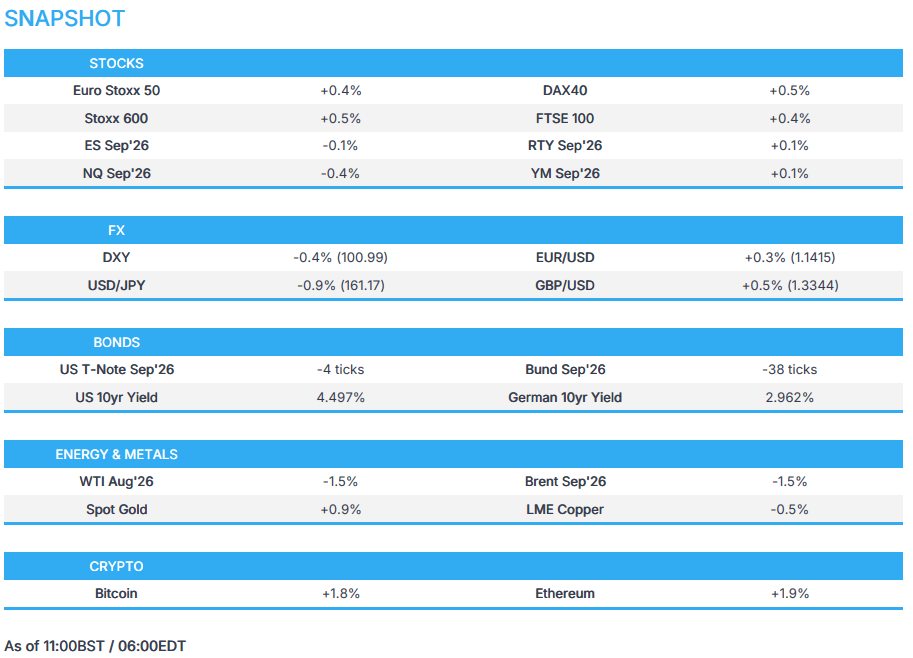
DXY slips below 101.00, weighed on by possible JPY intervention; US jobs report awaits – Newsquawk US Market Open

Thursday, Jul 02, 2026 – 06:37 AM
- Qatar and Pakistan mediators concluded separate meetings with US and Iranian negotiators in Doha, highlighting positive progress on issues related to the Islamabad MoU.
- US equity futures trade mixed, with the NQ weighed by tech selling in South Korean stocks.
- DXY slips below the 101.00 handle, as the JPY strengthens on possible intervention.
- Fixed income benchmarks trade on the softer side heading into the US jobs report; NFP expected at 110K.
- Crude benchmarks continue to trade lower, Brent -1.5%.
- Looking ahead, highlights include US Jobs Report (Jun), Initial Jobless Claims, Speakers including ECB’s Cipollone, BoE’s Mann and Fed’s Daly.
Newsquawk in 3 steps:
1. Subscribe to the free premarket movers reports
2. Listen to this report in the market open podcast (available on Apple and Spotify)
3. Trial Newsquawk’s premium real-time audio news squawk box for 7 days
EUROPEAN TRADE
EQUITIES
- European bourses (STOXX 600 +0.5%) initially started Thursday’s trade on a softer footing but have climbed off their lows, with all indices in the green, outside of the AEX (-0.3%). Sentiment overnight was on the softer side, following another tech selloff in South Korean stocks (Samsung -9.1%, SK Hynix -14.6%) after Meta plans to sell excess AI compute to build a cloud business, raising questions over excess in AI capacity. However, with Europe lacking the big AI giants, this seems to support the Euro area.
- European sectors point to a positive bias. Optimised Personal Care (+2.1%) tops the sector pile, followed by Food, Beverages & Tobacco (+2.0%) and Health Care (+1.5%). As expected, Technology (-1.9%) is the clear sector laggard and the only sector in the red.
- US equity futures are softer across the board, with the NQ lagging as it gets weighed on by the tech selloff in Asia. Losses have extended into chip names (NVDA -0.8% / AMD -1.3%) and memory (SanDisk -3%, Micron -1.7%).
- Click for the sessions European pre-market equity newsflow
- Click for the additional news
FX
- DXY trades lower this morning, and trades at the bottom end of a 100.95 to 101.43 range. Pressure which comes after the lack of hawkish remarks from Fed Chair Warsh at Wednesday’s policy panel, and with the move further exacerbated by a hefty move in the JPY this morning.
- On that front, this morning saw large and immediate selling pressure in USD/JPY, where the pair fell from 162.20 to a trough of 161.12. The pair then pared back about a third of that move, stabilising around 161.80, before then taking another beating towards the session low of 160.89 – now trading at levels not seen since 18 June.
- Given the sheer size of the move lower, it does appear to be the case that this is potentially intervention, rather than a rate check. Details of whether they enacted a form of intervention will be released in the monthly release, which is released on the last business day of every month.
- The move comes after Reuters reported that Japan would abandon its habit of warning the markets of intervention. The aim of this is to squeeze speculators and increase the cost of betting against the JPY.
- The potential intervention comes ahead of today’s NFP report; a USD positive report could see some of the “potential intervention” move be pared back. To preview the report in brief, US non-farm payrolls for June are expected to print 110K (prev. 172K), with the unemployment rate seen unchanged at 4.3%.
- Other G10s are stronger against the USD this morning. JPY unsurprisingly outperforms, followed by the GBP and CHF. For the latter, Switzerland reported in-line/cooler-than-expected inflation metrics, which broadly play in favour of keeping rates on hold for the foreseeable future.
FIXED INCOME
- Global fixed income benchmarks trade on a softer footing ahead of the US payrolls data while Germany announces a new set of reforms.
- USTs (-3 ticks) are lower by a handful of ticks, trading just shy of Wednesday’s low of 109-12+. Looking ahead to the June jobs report; NFP expected at 110K (prev. 172K), unemployment to hold steady at 4.3%, average hourly earnings Y/Y expected at 3.5% (prev. 3.4%). In terms of technical levels, downside levels include 109-16 (prior week’s low), 108-27 (key support level) and 108-10 (worst low seen due to Iran conflict). 110-00+ is the key level to the upside.
- Bunds (-38 ticks), unlike USTs, have extended on Wednesday’s trough, currently trading at the lower end of its 126.78-127.06 range. German Chancellor Merz’s coalition unveiled a package of reforms earlier, which included EUR 10bln in annual tax relief for lower-income earners, changes to the pension system and building more affordable housing. The overall aim is to restore competitiveness in Europe’s biggest economy. Although the move lower in German debt has not been excessive, it could be a potential reason for the downside in German debt, as it brings growth back into the economy.
- OATs (-34 ticks) follow their German counterpart. In the upcoming months, French debt will be more in focus as the Presidential elections near. Political uncertainty continues to remain. More recently, the Green Party announced that it would put forward a motion of no confidence over the government’s handling of the recent heat wave. However, this attempt to bring down PM Lecornuʼs government is likely to fail without the support of other opposition parties. The preference for German debt over OATs is clearly shown in the spread, currently trading at 75bps, up from the 58bps seen at the start of June.
- The UK sells GBP 3.25bln 4.625% 2037 Green Gilt: b/c 3.31x (prev. 3.63x), average yield 4.934% (prev. 4.975%), tail 0.2bps (prev. 0.2bps).
- France sells EUR 14.0bln vs exp. EUR 12.5-14bln 1.25% 2036, 3.70% 2036, 4.50% 2041 and 4.10% 2046 OAT.
- Spain sells EUR 5.958bln vs exp. EUR 5-6bln 2.60% 2031, 3.25% 2034 and 3.40% 2036 Bono and EUR 0.695bln vs exp. EUR 0.25-0.75bln 1.15% 2036 I/L Bono.
- Japan sells JPY 1.96tln 10yr JGBs, b/c 3.13x (prev. 3.53x), average yield 2.729% (prev. 2.649%).
COMMODITIES
- Crude benchmarks are on the backfoot, after mediators suggested positive progress was made in the US-Iran indirect conversation. Conversely, gas benchmarks continue to rise with Dutch TTF above EUR 44/MWh as the European forecast points to renewed heat.
- Brent down to a USD 70.38/bbl base, though it has reverted back towards the USD 71.00/bbl but remains in the red. The mentioned base is the lowest print since the end of February, when USD 70.20/bbl printed for the September contract. ,
- For today, US NFP will dominate the macro narrative, with a full Newsquawk preview available. Specifically for energy, we await any further update from the US-Iran talks, and while the mediator-led exchange has now concluded, we could still see updates as the parties agreed to continue talks over the “coming period”.
- Spot gold at a USD 4080/oz peak. In a recovery from the move below USD 4k/oz seen in the last two sessions. Upside today is a function of a weaker USD and relatively steady UST action. As above, impetus will come from the US NFP report.
- Base peers are under pressure, despite the constructive European risk tone and the mentioned USD pressure. As the complex follows the downbeat performance seen in mainland China overnight, and despite Hong Kong seeing strength on its holiday return.
- US President Trump posted that oil prices are plummeting fast and gas prices at the pump are dropping too, but not as fast as they should be, while he announced the Freedom Fuel Network will be lowering gas prices at 25 “FREEDOM FUEL” stations across the Greater Philadelphia Area.
- Venezuela’s oil production was expected to recover to 1.1mln-1.2mln BPD by the end of Q2 2026 as the US expands export authorisations, allowing more companies to transport and market Venezuelan crude
- Saudi Aramco has reportedly increased its exports from the Ras Tanura port and have shifted to spot sales, according to sources.
- Hengli Petrochemical has reportedly cancelled its recent purchases of West African and Middle East oil purchases and also cut refinery operations, according to Reuters sources.
- Dubai spot crude’s discount to swaps widened to more than USD 4.00/bbl, the largest gap since May 2020, according to Refinitiv data.
- UBS cuts its end-2026 gold forecast to USD 5k/oz, due to elevated interest rates.
TRADE/TARIFFS
- China’s MOFCOM said China and the EU agreed to up to two annual ministerial trade talks and have invited EU’s Trade Commissioner Sefcovic to visit in the Fall.
NOTABLE EUROPEAN HEADLINES
- Germany’s ruling coalition unveiled a package of reforms, including EUR 10bln in annual tax relief for lower-income earners, changes to the pension system and building more affordable housing.
- Germany’s VDMA reported May industrial orders -1% Y/Y, driven by weak domestic demand and a general decline across the EZ.
NOTABLE EUROPEAN DATA RECAP
- Swiss Inflation Rate YoY (Jun) Y/Y 0.5% vs. Exp. 0.5% (Prev. 0.6%, Low. 0.3%, High. 0.6%).
- Swiss Inflation Rate MoM (Jun) M/M 0% vs. Exp. 0.1% (Prev. 0.2%).
NOTABLE US HEADLINES
- The Trump administration is reportedly ready to launch “Trump Accounts” next week, but not allow firms to host children’s savings accounts on their own systems, Semafor reported citing sources.
- OpenAI has discussed giving a 5% to the US government as the AI startup seeks to clear political obstacles by securing financial buy-in from the Trump administration, according to FT.
GEOPOLITICS
MIDDLE EAST
- US official said the US is hopeful that Iran will come to the table to negotiate seriously, but is prepared to walk away if they do not, according to a New York Post reporter on X
- US has informed Iran that changing the status quo around the Strait of Hormuz would be a violation of the current understanding and would be unacceptable, according to Al Arabiya sources.
- Iran said it will respond to US interventions in the Strait of Hormuz, Fars reported.
- Qatar’s Foreign Ministry said Qatar and Pakistan mediators concluded separate meetings with US and Iranian negotiators in Doha, while it added that positive progress was made on issues related to the Islamabad MoU. It also stated that the parties agreed to continue discussion over the coming period, with the next meeting to be scheduled at the earliest possible time following the funeral processions of the former Iranian supreme leader.
- Iranian Parliament Speaker Ghalibaf said the claim that inspectors of the IAEA have access to the sites that were bombed is false, while he added that under no circumstances will access be granted to sites that were bombed and damaged.
- Iran’s Deputy Foreign Minister Gharibabadi said Doha talks focused on US violations of the MoU and frozen assets. Gharibabadi separately commented that the Strait of Hormuz is defined under Iran’s command, not CENTCOM, as well as stated that regional security is ensured by the end of interference and the departure of the US from the region, respect for the sovereignty of countries and acceptance of new geopolitical realities, not under the military umbrella of the US.
- Senior source told Al-Hadath that Iran is allowed to purchase American agricultural products using a portion of its frozen funds, but noted that no cash payments are to be dispersed to Iran
- Lebanon’s PM said negotiations with Israel lack a deal framework, and the government seeks a timeline for Israel’s withdrawal and insists on exclusive state control of weapons
- Israeli drones struck Al-Dir in southern Lebanon and Israeli shelling was also reported on the outskirts of Quneitra in Syria, while Israeli forces conducted night raids in Jenin and Ramallah, in the West Bank.
RUSSIA-UKRAINE
- Russian Armed Forces said it hit a Kyiv plant that produces control systems for specific missiles, RIA reported.
- Russian Defence Ministry said it shot down 327 Ukrainian drones overnight.
- Air defence systems were reportedly repelling a Russian drone attack on Kyiv, while it was separately reported that multiple explosions were heard in Ukraine’s capital which was under ballistic missile attack.
- Ukrainian military said it has struck the Kstovo oil refinery in Russia.
OTHER
- China warned two Japanese Coast Guard survey vessels to stop conducting maritime surveys in the disputed East China Sea, prompting Japan to lodge a formal diplomatic protest.
CRYPTO
- Bitcoin extends further above USD 60k and briefly extended above USD 61k, currently trading at the top end of its USD 59.52k-61.12k range.
APAC TRADE
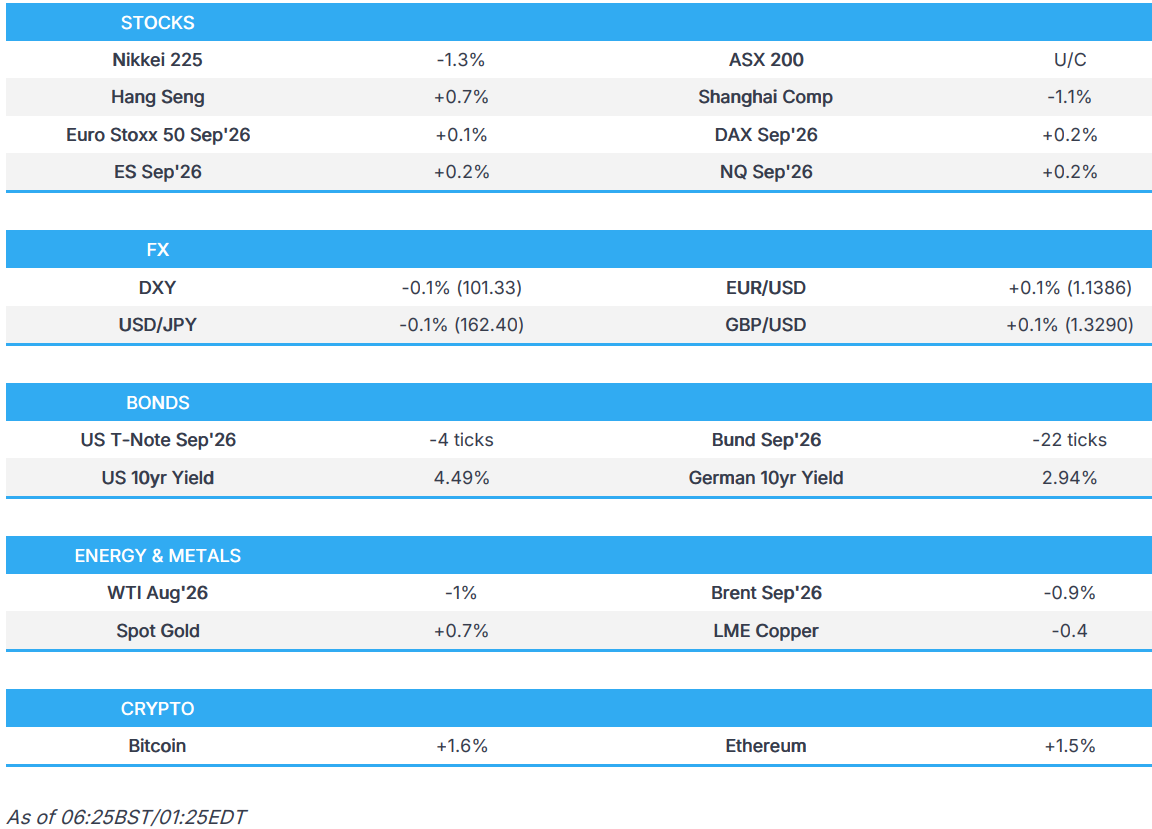
- APAC stocks were mixed but with the major indices predominantly in the red following the tech-related losses on Wall St, while participants also brace for the incoming Non-Farm Payrolls report in a holiday-shortened trading week stateside.
- ASX 200 was rangebound as strength in the top-weighted financial sector was offset by losses in the utilities, tech, energy and consumer sectors, while sentiment was also not helped by weak Australian trade data.
- Nikkei 225 retreated at the open amid tech selling and recent upside in yields, although the index then staged a partial rebound, before selling resumed later in the session.
- KOSPI slumped amid the pressure in memory chip stocks, and triggered a sidecar in early trade.
- Hang Seng and Shanghai Comp traded mixed with the mainland conforming to the broad risk-off mood, while the Hong Kong benchmark bucked the trend amid strength in local tech, biopharmaceutical and auto names on return from the holiday closure.
NOTABLE ASIA-PAC HEADLINES
- Japan’s Government Panellist Nagahama said that the BoJ should raise rates once every six months; this would not hurt domestic investment.
NOTABLE APAC DATA RECAP
- Australian Trade Balance (May) -3.0B vs. Exp. 2.3B (Prev. 1.8B).
- Australian Exports MM (May) -6.9% (Prev. 7.2%).
- Australian Imports MoM (May) M/M 2.6% (Prev. 0.8%).
- South Korean Inflation Rate YoY (Jun) Y/Y 3.2% vs. Exp. 3.2% (Prev. 3.1%).
- South Korean Inflation Rate MoM (Jun) M/M 0.1% vs. Exp. 0.1% (Prev. 0.5%).
1c) Asian opening report
EU equities futures point to a slightly firmer open; DXY muted ahead of the US jobs report – Newsquawk EU Market Open
Thursday, Jul 02, 2026 – 01:59 AM
- US and Iran talks in Doha focused on management of the Strait of Hormuz and the terms of a 60-day MoU aimed at a comprehensive nuclear deal, Axios reported.
- Qatari and Pakistani mediators suggested that positive progress was made, and stated that both parties agreed to continue discussion over the coming period; Brent -0.9%.
- USTR said the US had not agreed to renew the USMCA in its current form and would continue engaging with Canada and Mexico to address shortcomings in the agreement and bilateral trade deficits.
- APAC stocks were mixed; European equity futures are indicative of a slightly firmer open.
- DXY is a little lower, with price action tentative ahead of today’s NFP report.
- Looking ahead, highlights include Swiss Inflation (Jun), EU Unemployment Rate (May), US Jobs Report (Jun), Initial Jobless Claims, Speakers including ECB’s Elderson & Cipollone, BoE’s Mann, Fed’s Daly, Supply from Spain, France & UK.
Newsquawk in 3 steps:
1. Subscribe to the free premarket movers reports
2. Listen to this report in the market open podcast (available on Apple and Spotify)
3. Trial Newsquawk’s premium real-time audio news squawk box for 7 days
IRAN CONFLICT
- US and Iranian negotiators resumed talks in Doha focused on management of the Strait of Hormuz and the terms of a 60-day MoU aimed at a comprehensive nuclear deal, according to Axios’s Barak Ravid. While a temporary one-week de-escalation agreement remained in place, US officials warned the administration remained prepared to respond militarily to any further Iranian aggression, noting that President Trump had previously requested briefings on military options.
- US official said the US is hopeful that Iran will come to the table to negotiate seriously, but is prepared to walk away if they do not, according to a New York Post reporter on X
- Qatar’s Foreign Ministry said Qatar and Pakistan mediators concluded separate meetings with US and Iranian negotiators in Doha, while it added that positive progress was made on issues related to the Islamabad MoU. It also stated that the parties agreed to continue discussion over the coming period, with the next meeting to be scheduled at the earliest possible time following the funeral processions of the former Iranian supreme leader.
- Iranian Parliament Speaker Ghalibaf said the claim that inspectors of the IAEA have access to the sites that were bombed is false, while he added that under no circumstances will access be granted to sites that were bombed and damaged.
- Iran’s Deputy Foreign Minister Gharibabadi said Doha talks focused on US violations of the MoU and frozen assets. Gharibabadi separately commented that the Strait of Hormuz is defined under Iran’s command, not CENTCOM, as well as stated that regional security is ensured by the end of interference and the departure of the US from the region, respect for the sovereignty of countries and acceptance of new geopolitical realities, not under the military umbrella of the US.
- Iran’s Deputy Foreign Minister Gharibabadi said a communication channel would be established to report and discuss breaches of the Iran-US MoU, while he added that Pakistan and Qatar had pushed for a temporary understanding before delegations returned to Tehran and Washington. Furthermore, he said it was decided in the meeting with Qatar that part of Iran’s USD 6bln in frozen funds would be used to purchase goods based on Iran’s needs, according to IRNA.
- Senior source told Al-Hadath that Iran is allowed to purchase American agricultural products using a portion of its frozen funds, but noted that no cash payments are to be dispersed to Iran
- Iran requested that the memorandum of understanding be implemented in “time phases”, according to Al Hadath. It was separately reported that Iran requested implementation of five points of the MoU before moving to other issues, and it was prepared to reaffirm its commitment to the Nuclear Non-Proliferation Treaty, while Pakistan and Qatar pushed for a temporary understanding before delegations returned to Tehran and Washington, according to a high-ranking source cited by Al Arabiya.
- The option of US military action against Iran would return to the table if talks fail, while there were recent discussions held between the US and Israel on the issue, according to Iran International, citing a source.
- Germany announced the possibility of withdrawing from participating in minesweeping in the Strait of Hormuz.
- Iraqi security sources said that an explosive-laden drone hit an Iranian Kurdish opposition group camp east of Iraq’s Erbil.
- Lebanon’s PM said negotiations with Israel lack a deal framework, and the government seeks a timeline for Israel’s withdrawal and insists on exclusive state control of weapons
- Israeli drones struck Al-Dir in southern Lebanon and Israeli shelling was also reported on the outskirts of Quneitra in Syria, while Israeli forces conducted night raids in Jenin and Ramallah, in the West Bank.
US TRADE
EQUITIES
- US stocks were mixed with a clear divergence seen, and the major indices finished mostly lower, with the tech-heavy Nasdaq 100 the laggard amid broad-based weakness in semiconductor names, although the Mag-7 names notably firmed, with Meta (META +8.8%) the notable outperformer, buoyed by a Bloomberg report that the Co. plans to build a Cloud business to sell excess AI compute capacity. As such, Communications sat atop the sectoral breakdown, with Technology and Utilities at the bottom, while participants also digested data ahead of the key NFP report. Elsewhere, little came out of the US/Iran technical talks, and the crude complex settled in the red as participants awaited further developments in the Middle East.
- SPX -0.22% at 7,483, NDX -1.54% at 29,809, DJI -0.03% at 52,310, RUT -0.39% at 3,013.
- Click here for a detailed summary.
TARIFFS/TRADE
- USTR said the US had not agreed to renew the USMCA in its current form and would continue engaging with Canada and Mexico to address shortcomings in the agreement and bilateral trade deficits, while the agreement remains in force pending resolution of those issues or its termination.
- US official said President Trump decided not to renew the USMCA and instead intended to pursue separate 10-year trade agreements with Canada and Mexico, according to Fox Business’s Lawrence.
- Mexican Economy Minister Ebrard said USTR Greer had proposed annual reviews of the USMCA over the next 10 years and that the two sides would meet again on July 20th, while he proposed to the US to reduce Section 232 on steel and aluminium and coordinate at a regional level.
- Apple (AAPL) is reportedly in talks with the Trump admin on chip purchases and in discussions to purchase memory chips from Chinese companies, according to Bloomberg.
NOTABLE HEADLINES
- Fed Chair Warsh was said to pick a Bessent staffer to serve as an adviser.
- White House speeds up plans for AI model standards, with guidance to be announced as early as next week, following government intervention on Anthropic and OpenAI rollouts, according to FT
APAC TRADE
EQUITIES
- APAC stocks were mixed but with the major indices predominantly in the red following the tech-related losses on Wall St, while participants also brace for the incoming Non-Farm Payrolls report in a holiday-shortened trading week stateside.
- ASX 200 was rangebound as strength in the top-weighted financial sector was offset by losses in the utilities, tech, energy and consumer sectors, while sentiment was also not helped by weak Australian trade data.
- Nikkei 225 retreated at the open amid tech selling and recent upside in yields, although the index then staged a partial rebound, before selling resumed later in the session.
- KOSPI slumped amid the pressure in memory chip stocks, and triggered a sidecar in early trade.
- Hang Seng and Shanghai Comp traded mixed with the mainland conforming to the broad risk-off mood, while the Hong Kong benchmark bucked the trend amid strength in local tech, biopharmaceutical and auto names on return from the holiday closure.
- US equity futures lacked firm conviction following the mostly negative Wall St performance and as the attention turns to the looming US jobs report.
- European equity futures indicate a slightly positive cash market open with Euro Stoxx 50 futures up 0.1% after the cash market closed with losses of 0.7% on Wednesday.
FX
- DXY took a breather after mildly gaining yesterday amid the mostly subdued risk appetite and data deluge, while there were slight headwinds seen after Fed Chair Warsh spoke at Sintra, as the overall tone failed to prove as hawkish as expected after his inaugural FOMC presser. Furthermore, trade-related uncertainty lingered with the US not agreeing to renew the USMCA in its current form, but would continue engaging with Canada and Mexico to address shortcomings, while the attention turns to the looming NFP report.
- EUR/USD nursed some of the prior day’s losses after gradually softening in the aftermath of the EZ HICP report, which came in below expectations and cooled from the prior on all gauges. There was also a slew of ECB commentary in which Demarco and Stournaras seemed fine with where policy stands for the time being, while ECB’s Wunsch argued they would need stronger second-round effects to justify further tightening and Lagarde stated that risks to the economy were more balanced than a few weeks earlier.
- GBP/USD eked out slight gains and moved closer to retest the USD 1.3300 level, after gradually shrugging off comments from BoE Governor Bailey, who noted that the softening economy and labour market were the reasons not to raise rates.
- USD/JPY remained confined to the 162.00 handle amid ongoing intervention risk and a lack of tier-1 data.
- Antipodeans was contained amid the mostly subdued risk sentiment and after weak Australian trade data, which showed a contraction in exports and a surprise trade deficit.
FIXED INCOME
- 10yr UST futures lacked conviction after the prior day’s choppy performance and steepening, as Fed Chair Warsh stuck to the script and offered few fresh hawkish surprises, while participants await US jobs data.
- Bund futures remained subdued after recent oscillations through the 127.00 level and slew ECB rhetoric, with many suggesting a lack of urgency to adjust rates this month.
- 10yr JGB futures lingered at a three-week low amid recent upside in yields and intervention risks, while pressure was seen after a mostly weaker-than-previous 10yr JGB auction.
COMMODITIES
- Crude futures trickled lower following US-Iran indirect talks in Doha, with Qatar’s Foreign Ministry noting that mediators concluded separate meetings with US and Iranian negotiators, and that positive progress was made on issues related to the Islamabad MoU.
- US President Trump posted that oil prices are plummeting fast and gas prices at the pump are dropping too, but not as fast as they should be, while he announced the Freedom Fuel Network will be lowering gas prices at 25 “FREEDOM FUEL” stations across the Greater Philadelphia Area.
- Venezuela’s oil production was expected to recover to 1.1mln-1.2mln BPD by the end of Q2 2026 as the US expands export authorisations, allowing more companies to transport and market Venezuelan crude
- Spot gold edged mild gains after a recent return above the USD 4,000/oz level, while a recent OMFIF survey found that central banks saw gold at USD 5,000-6,000/oz in 12 months.
- Copper futures traded rangebound with demand dampened by the subdued risk appetite in Asia.
CRYPTO
- Bitcoin climbed higher overnight but met some resistance at the USD 61,000 level.
NOTABLE ASIA-PAC HEADLINES
- RBNZ named Angus McGregor as Assistant Governor for Financial Stability.
DATA RECAP
- Australian Trade Balance (May) -3.0B vs. Exp. 2.3B (Prev. 1.8B)
- Australian Exports MM (May) -6.9% (Prev. 7.2%)
- Australian Imports MoM (May) M/M 2.6% (Prev. 0.8%)
GEOPOLITICS
RUSSIA-UKRAINE
- Ukrainian President Zelensky said Russia was preparing a new large-scale air strike against Ukraine.
- Air defence systems were reportedly repelling a Russian drone attack on Kyiv, while it was separately reported that multiple explosions were heard in Ukraine’s capital which was under ballistic missile attack.
- Polish military announced that it scrambled fighter jets amid Russia’s attack on Ukraine, but later stated that no airspace violation was recorded.
OTHER
- US President Trump said the Spanish are not very good members of NATO and that Spain will learn, while he also commented that Cuba is coming their way.
- Top US diplomat in Taiwan said the US and Taiwan can anchor democratic drone production, and strengthen the collective deterrence, while the official said nothing will deter conflict more effectively than turning Taiwan into a hornet’s nest of air surface and subsurface drones.
EU/UK
NOTABLE HEADLINES
- ECB’s Stournaras said maybe it’s good to stay where they are for some time and doesn’t think anything will happen in July.
NORTH AND SOUTH KOREA AND JAPAN
SOUTH KOREA
KKR And SK Launch South Korea’s Largest Renewable Energy Platform
Thursday, Jul 02, 2026 – 05:00 AM
By Tsvetana Paraskova of OilPrice.com
Global investment firm KKR and South Korea’s industrial conglomerate SK Inc are launching the single biggest renewable energy platform in South Korea to help meet growing power demand from AI and chip manufacturing.

KKR and SK Inc are creating the platform, valued at about $1.3 billion, or 2 trillion South Korean won, to combine 1.7 gigawatts (GW) of clean energy capacity in operation and a pipeline of projects in development that would boost the platform’s total capacity to 10 GW, the investment firm said in a statement.
The renewable electricity will help meet South Korea’s surging clean-power demand from AI data centers and semiconductor manufacturing, according to the global investor.
The 10 GW capacity targeted by the platform would be capable of simultaneously and continuously powering 100 large-scale, 100MW-class data centers, KKR said.
“At this scale, the Platform is well positioned to become a reliable, large-scale source of clean power for Korea’s most demanding industrial users, from AI data centers to global semiconductor production lines, and more,” the global investment firm said.
KKR will have management control of the platform in its initial phase, while SK will participate as an equity investor and retain the flexibility to pursue control rights through future discussions.
“Korea is one of Asia’s most attractive renewable energy markets, underpinned by strong corporate demand for clean power from the semiconductor, data center, and manufacturing sectors,” said Keith Kim, Partner at KKR.
“Together, we are establishing a leading, scaled renewable energy platform that can supply reliable clean power to Korea’s most demanding industrial users.”
In April, while South Korea was scrambling for oil supply not passing through the Strait of Hormuz, the Korean Ministry of Climate, Energy, and Environment said the country would target to generate at least 20% of its power supply from renewables by 2030, up from about 11% now.
“We will swiftly implement the energy transition plan to make sure that South Korea remains resilient to external shocks, such as the ongoing conflict in the Middle East,” Climate Minister Kim Sung-whan said in April.
END
SOUTH KOREA
WON AGAINST THE DOLLAR
What’s Behind The Plunging Won And Sudden Liquidity Collapse In Korean Markets
Thursday, Jul 02, 2026 – 12:41 AM
South Korea’s won weakened for a fourth day as overseas investors accelerated their relentless sales of local stocks.

In response, USD/KRW rose 0.1% to 1,552.60, extending its four-day gain to 1.2% (i.e. KRW drop).

According to Barclays, pressure from both resident outflows and more recently in the case of Korea, heavy foreign outflows, could pose further headwinds even as exports performance remains robust and domestic equities extend their bubble.
Let’s take a closer look at what’s driving the key moves in Korea.
Why was USDKRW higher?
Other than stronger USD, Goldman has been highlighting that rebalancing related equity outflow has been the dominating factor. Equity outflow from Jun 22nd till month-end amounted to US$18bn, bringing total Jun equity outflow to US$30bn. This follows the US$27bn outflow observed in May. As of today, Samsung and Hynix are 32% and 30% of MSCI Korea respectively, which are 7% and 5% above the 25% single stock limit. A combined 12% rebalancing effort would lead to another US$24bn outflow with US$200bn AUM (passive and active) estimated tracking MSCI Korea.

Additionally, other portfolio concentration limits such as UCITS and HF internal concentration limit rule are also likely to be driving the rebalancing related outflows. In terms of timing, some fast money rebalancing is relatively real time, while many real money and passive investors may rebalance at quarter-ends which led to more concentrated outflows.
FX hedging need by foreign investors drove RHS USDKRW demand. Goldman estimates average foreigners’ FX hedging ratio for Korean equities to be 10-15%, and the hedging mainly happens in offshore NDF market. As of March-end, foreigners’ exposure to Korean equities was US$1tn. Due to the 68% expansion in market cap in KOSPI in Q2, the associated FX hedging need rose by an estimate of US$68-US$102bn (US$1000*68%* 10-15%) during the quarter. This has led to sharp increase in RHS NDF hedging demand, some of which concentrated at quarter end as well.

Other than above-mentioned hedging dynamics, FX hedging demand by USD-denominated total return swaps with leveraged equity underlying provided to offshore clients by local security houses via intermediaries also likely added to FX hedging demand in NDF market, especially as equity marketcap expanded quickly in Q2.
Why did liquidity tighten?
- Sharp rise in borrowing by securities firm was likely the main driver behind tighter onshore liquidity. Surge in onshore retail margin trading and leveraged single-stock ETFs caused sharp rise in funding needs of local securities firms. In particular, with leveraged ETF, the need to post futures margin for hedging positions for securities firms drove the borrowing demand.

- Local news reported securities firms’ commercial paper and short-term bonds issuances exceeded KRW100tn each month and accounted for 80% of short-term bond issuance in recent months.

- Decline of collateral value for securities firms facing offshore counterparties worsens the liquidity situation. When local securities firms face offshore intermediaries on total return swaps, they not only have rising needs to post margins from underlying stock advance, but also from declining collateral value as KRW FX depreciated and KTB sold off. These dynamics further increased securities firms’ margin requirement in KRW terms, which in turn added to their local borrowing demand. Similar situation happened in late 2022 with KRW and KTB sold off sharply at the same time during BOK hiking cycle. Looking forward, local news reports Samsung securities plans KRW600tn short-term issuance in Jul, indicating such liquidity tightness is unlikely to ease.
- Forthcoming BOK hike (starting in Jul per GIR base case) likely also added to the expectation of higher funding costs ahead.
- Goldman has observed widening of spread between NDF curve offshore and onshore FX swap. This could be a result of unwinding onshore-offshore arbitrage positions as RHS hedging demand caused sharp surge in NDF points.

Looking ahead, if Korean equity continues to charge higher in a volatile fashion, combined with likely BOK hikes, Goldman thinks such liquidity environment is likely to stay or tighten further. Thus NDF points are likely to stay elevated and the bank prefers pay on dip. In a strong USD environment, KRW FX pressure is unlikely to ease from external forces, which does not help NDF points to fall either. On the other hand, if Korean equities fall meaningfully, NDF points may retrace, as smaller notional exposure to Korean equities by foreigners (either direct or leveraged) would reduce the associated FX hedging.
On FX spot, it is much harder to see sustained equity inflow in the short term: If Samsung/Hynix continue to lead KOSPI higher, equity rebalancing related outflow would further dominate; if equities fall, broad-based outflow is likely to follow which is likely to offset the positive FX impact from unwind of RHS hedging. Only when equities fall substantially so that Samsung & Hynix’s market cap fall under the concentration limits, a recovery from there may attract inflows.
Thus equity outflow may continue to weigh on KRW in the near future.
As market unwinds debasement trades and USD remains resilient, Goldman expects USDKRW may further rise gradually, with authorities’ various smoothing efforts help to limit the speed of KRW depreciation. Although Korean exporter USD selling is expected to rise as export grows organically and domestic capex expands, given current exporter conversion is already relatively high, Goldman expects large and volatile equity related flows to remain dominant for USDKRW path ahead.
END
JAPAN
Yen Surges As Jittery Traders Expect Imminent Intervention After Japan Reveals New Strategy To Wipe Out Shorts
Thursday, Jul 02, 2026 – 10:30 AM
After plunging to a fresh 40 year low overnight, the yen strengthened sharply against the dollar amid rising speculation that the currency’s continued weakness may prompt a fresh round of intervention by Japan. The yen then surged again after the June US jobs report showed a much weaker picture than expected.
But let’s focus on the first, more unexplained move, which took place just after 2:30am ET, when the Yen rose as much as 1% against the greenback, the most since Japan intervened on April 30. The currency later trimmed the advance, before surging again after the jobs report. Earlier in the week, the yen touched its weakest versus the dollar since 1986.

Traders were already on edge ahead of both the jobs report and the Friday holiday in the US, which creates thin trading conditions that would likely amplify the impact of any yen intervention.
“Liquidity is expected to decline during the afternoon session in New York on July 3, when US markets will effectively be closed for the Independence Day holiday,” said Masayuki Nakajima, senior currency strategist at Mizuho Bank in London. “If major US economic releases, such as the employment report, were to come in weaker than expected and trigger broad dollar selling, intervention could become tactically more effective.”
Talking to Bloomberg, Neil Jones, a managing director of FX trading at TJM FX in London, recommended buying bearish dollar-yen options. The strategy assumes “a no-warning scenario this time,” he said. While it’s difficult to time any potential intervention, he’s increasingly convinced that it will ultimately happen.
Meanwhile, South Korean Second Vice Finance Minister Huh Chang said Thursday that the government is closely exchanging information with the US and Japan regarding the forex market.
Reuters earlier reported that Japanese officials may abandon telegraphing their intentions to the market, which would be unlike the case with the intervention that happened on April 30 following ample warnings. Such a new tactic could be effective in wiping out speculative bets against the currency, according to the report.
The shift reflects a more aggressive approach by the MOF, which is using silence as a policy tool to keep traders guessing. That raises the risk of a surprise intervention driven by an accumulation of speculative short-yen bets rather than by the currency crossing a publicly understood threshold, the sources said.
The MOF’s approach and the Bank of Japan’s continued hawkish rhetoric signal a coordinated effort to keep yen bears at bay, two other sources said.
Of course, leaking this trial balloon effectively eliminates the surprise aspect, although it does force speculative shorts to cover ahead of what may come next.
In an interview with Bloomberg on Wednesday, Japan’s top currency official, Atsushi Mimura, refrained from spelling out the finance ministry’s standard currency stance, including its readiness at any time to take “bold action”, meaning intervention.
The challenge for traders is that Mimura’s silence may on the one hand be an attempt to retain a degree of surprise, but it could also suggests that authorities may be willing to let the currency fall further before acting. Many traders had expected that the BOJ would have intervened as soon as the USDJPY hit 161. Instead the pair rose just shy of 163 before there was a notable move lower.
Intervention “has always carried an element of surprise,” said Rodrigo Catril, a strategist at National Australia Bank. “The MOF is seemingly trying a new tactic of reverse psychology, but in practice there isn’t a great deal of difference between what they have been doing in the past.”
Meanwhile, Bloomberg reports that options traders are ramping up hedges against sharp yen swings, with a gauge of one-month dollar-yen butterfly spreads at an elevated level, suggesting that concerns about possible market intervention are increasing.
Japan spent a record ¥11.73 trillion ($72.2 billion) in the month through May 27 to prop up the yen, according to Finance Ministry figures. The ministry first stepped into the market on April 30, according to people familiar with the matter, when Japan’s currency was approaching the 161 threshold. The yen initially strengthened, moving to around 155 per dollar, but then steadily and fully retraced those gains even after the Bank of Japan raised its benchmark interest rate to the highest in 31 years on June 16.
In a note from Goldman FX traders this morning, the bank mused whether the sharp move lower was a “rate check/intervention.” It laid out four points from the GS FICC & Equities desk:
- Volume was small. The spike in EBS volumes was “only” ~$1.5bn over the window — trivial versus prior confirmed interventions.
- Looks like a stop-run, not official flow. It coincided with a move back through 162, and there appeared to be a LHS TWAP flow already in the market beforehand — the desk’s read is this may have simply triggered stop-losses into an air pocket.
- Range too shallow. Today’s spot range was well under previous intervention days, and spot rebounded rather than seeing repeated waves of selling volume pushing lower — atypical of real intervention.
- The one caveat. There are reports that MoF is changing its intervention practice — less telegraphed, more of a “targeted campaign to squeeze speculators.”
Separately, the bank also echoed the Reuters report noting that “Japanese officials warning us we won’t get a warning by delivering a warning.” The desk says this actually increases their comfort running a ratio USDJPY short vs. dollar length elsewhere into today’s NFP, especially after the sizeable XXXJPY rally into month-end (they were correct).
Goldman’s bottom line: they’d normally chalk this up to a panicky market with spot near the highs (based mainly on the light EBS volume), but point 4 raises the risk that we’re in a different intervention regime and can’t fully dismiss it.
“The prospect of surprise intervention should make speculators think twice before adding to bearish yen positions,” said Carol Kong, a strategist at Commonwealth Bank of Australia. “However, US yields remain the dominant driver of USD/JPY. If tonight’s US payrolls report surprises to the upside again, the pair could still push to fresh highs despite the risk of intervention.”
The payrolls report surprised to the downside instead, and USDJPY was last trading just under 161, a two-week low.
END
Japan Takes Next Step In $2.3 Trillion Plan With Domestic AI Model And 10M Robots
Thursday, Jul 02, 2026 – 07:00 AM
The Japanese government has unveiled plans to create a domestically developed artificial intelligence model and put roughly 10 million AI-equipped robots into operation across 18 sectors by 2040 – building on a 14-year growth strategy announced last month, which targets ¥370 trillion ($2.3 trillion) in combined public and private investment across 17 priority areas, including physical AI, semiconductors, quantum technology, and nuclear fusion. Kawasaki Kaleido
The initiative will receive up to 1 trillion yen (approximately $6.1 billion) in government funding over the next five years. Crucially, the funding is tied to annual milestone reviews – making the trillion-yen figure a ceiling rather than a guarantee, with Tokyo retaining the ability to pull back if early targets are missed.
The AI model will be developed by Noetra, a consortium formally commissioned by Japan’s Ministry of Economy, Trade and Industry (METI) and its innovation agency NEDO. Noetra is majority-owned by SoftBank, NEC, Sony Group, and Honda, with Fujitsu and Rakuten reportedly weighing whether to join. The consortium is also working alongside AIST, Japan’s national research laboratory. Noetra’s investor base is expected to grow to 44 participating companies spanning automotive, electronics, manufacturing, finance, and logistics. The technical goal is a multimodal foundation model capable of processing language, images, video, and sensor data simultaneously – giving robots the ability to interpret a physical environment and act within it, rather than simply executing pre-programmed instructions.
The effort reflects a broader global push by countries to build “sovereign AI” capabilities and reduce reliance on dominant U.S. and Chinese technologies.
A key focus of the strategy is physical AI – the application of artificial intelligence in real-world environments rather than just on screens. This includes self-driving vehicles, factory automation, and humanoid robots designed for practical tasks.
On Tuesday, the government released an updated national AI robotics strategy. Industry Minister Ryosei Akazawa said the plan aims to “vigorously promote social implementation across a total of 18 fields,” including newly added sectors such as restaurants, food manufacturing, and medicine.
“We will build and grow data infrastructure for physical AI and robots that capitalize on Japan’s strengths,” Akazawa told reporters.
Those strengths are considerable. Japan is home to some of the world’s leading industrial robotics manufacturers – including FANUC, Yaskawa Electric, and Kawasaki Heavy Industries – and produces roughly half of all industrial robots globally by volume, according to the International Federation of Robotics. The country already deploys more robots per manufacturing worker than any other nation, making it the natural proving ground for physical AI at industrial scale.
The push comes as Japan grapples with a rapidly aging and shrinking population. More than 29% of the Japanese population is now aged 65 or older – the highest proportion of any country in the world – and the working-age population has been in decline since 1995. Policymakers see advanced robotics as a critical tool to fill widening labor gaps across industries rather than a supplement to an adequate workforce.
Can they make it happen?
Japan has announced a $2.3 trillion startup tech strategy just after South Korea’s $1.3 trillion pledge
The numbers are just as ridiculous as what they promised Trump for US investment in 2025— zerohedge (@zerohedge) July 1, 2026
 FANUC factory floor
3 CHINA
4. EUROPEAN AND SCANDINAVIAN COMMENTARIES PLUS NATO
FRANCE/PARIS
IDIOT!!
Paris Deputy Mayor Blames US Air Conditioning For French Heat Wave
Thursday, Jul 02, 2026 – 04:15 AM
The peasantry is not allowed to have creature comforts, otherwise, they might start thinking like free men. So, let them eat cake (and fight each other over the last few box fans).
As we covered last week, over 1.2 million tourists have traveled to each US city hosting a World Cup game, and the resulting culture shock has gone viral across social media. Notably, European visitors have been surprised by American infrastructure, hospitality and, strangely, air conditioning.
Apparently, European media and governments have spent an inordinate amount of time and energy conditioning their populations with propaganda about the US being a dangerous cesspool of “racism” and violence. Instead, Europeans found freedom…and luxurious, cold air.
In response, EU citizens have been traveling back across the and asking their political leaders why, in the midst of a deadly summer heat wave, air conditioners are not more common. Only 19% of the population has air conditioning in their homes, compared to 90% in the US. Instead of offering a rational explanation, these governments have moved to restrict or outright ban air conditioners while blaming the US for their problems.
Paris Deputy Mayor Audrey Pulvar, a radical leftist who has in the past defended mass immigration and dismissed the reality of migrant crime, took to social media to attack the US as the “source” of the ongoing French heat wave. She wrote on Instagram:
“Dear American journalists and social media ‘influencers’: for days, some of you have been criticizing and making fun of Paris because the city does not have A/C in every room. OMG, this is so rich!”
“As the second-largest emitter of greenhouse gas emissions in the world, you bear a significant amount of responsibility for global warming and the consequences we, in France, are experiencing. Your cities ‘90% air-conditioned’ are not unrelated to this. In Paris, we take responsibility.”
“If every American city made the same ecological transition efforts as Paris and many European cities, believe me, the whole world would be better off. So please, enough with the lecture. Just start doing your part. Best regards…”
I reality, the European political class is not angry over American jokes online; they’re angry over the legitimate concerns of citizens asking why the government is constantly propagandizing against (and legislating against) central air? French officials don’t care what Americans have to say about France, they care about what the French people say about France because it makes the government look bad.
The conflict might sound bizarre to the average American, but many Europeans have been taught to view air conditioning as a bourgeois luxury for selfish people. The fact that Europe suffers more deaths every year from heat than the US has gun related deaths doesn’t seem to be a concern for green politicians.

Pulvar thinks she has a slam-dunk argument by playing the carbon card, but she is, of course, very wrong. Carbon emissions have nothing to do with global temperatures. There is no such thing as man-made global warming. The European people are suffering for nothing.
Climate alarmists and climate scientists pull their temperature data from the 1880s onward, which is an incredibly narrow window of time in the Earth’s climate history. The fact that this problem is never addressed showcases the reality that climate science is politically motivated rather than fact based.

When we look at the temperature record going back hundreds of millions of years, it becomes obvious that the Earth has been much hotter in the past compared to today. In fact, we just exited an disastrous ice age and temps are near historic lows. When these stats are compared to global atmospheric carbon content over the same period of time, the basis for today’s carbon emissions theory is completely debunked.

There is no correlation or causation relationship between carbon emissions and climate change. Meaning, there is no evidence whatsoever that human industry and the emissions it produces has any affect on temperatures, and this includes air conditioners. Man-made climate change is a lie.
The question is, why are they lying? Europe is a perfect example of green socialism in action, as numerous countries enter steep industrial decline. Climate change is used as an excuse to whittle away individual freedoms, property rights, and access to basic amenities. They are training the population to live without.
Leftist governments also use climate change as an excuse for their mass immigration agenda, claiming that global warming is the cause, rather then the fact that they are luring in migrants with taxpayers funded subsidies and free handouts. In short, the climate lie is about tearing down the western world.
If Europeans stop believing the lie, then the agenda goes out the window. The demand for air conditioning is viewed as a symbol of the citizenry no longer believing.
END
SPAIN
The Collapse Of Schengen… Over 1 Million Illegal Migrants Apply For Spanish Citizenship
Thursday, Jul 02, 2026 – 03:30 AM
When the socialist-communist government of Pedro Sánchez first announced he was going to begin the mass legalization of migrants in his country, his government claimed this would amount to 500,000 people. Now, twice as many people are being legalized than first claimed, and importantly for the rest of Europe, those migrants now have the right to freely move through the Schengen zone.

Due to his mass amnesty, The New York Times has now labeled Spain a “beacon of the global left.”
Watch: Migrants Are Literally Clambering Up Embassy Walls In Spain
After socialist PM’s 500,000 legal status giveaway
In April, the socialist-communist government in Madrid first issue the decree, giving illegal migrants three months to submit their application.
According to the New York Times, more than 1 million applications had already been submitted by illegal immigrants.
Vox party leader Santiago Abascal has accused Prime Minister Pedro Sánchez of taking the long-term move of naturalizing millions of foreigners to give himself and left-wing parties an electoral advantage in upcoming elections.

SPAIN IN CHAOS: Thousands Of Migrants Swarm Consulates After Mass Amnesty
Sanchez fast-tracks residency, jobs and benefits for hundreds of thousands with zero
“Pedro Sánchez is willing to rob us of the next general elections by manipulating the census and handing out Spanish nationality,” wrote Abascal. “And it is necessary for us to mobilize to prevent him, after everything he has stolen, from also stealing the elections from us.”
Across Europe, conservative and right-wing politicians are reacting with shock to the huge legalization numbers Spain is now reporting.
“The decision to legalize them means that they will be able to move and settle freely in any place in Europe. Left-wing governments are bringing about the collapse of the Schengen Area and mocking the safety of Europeans. Not only does Spain, under the Migration Pact and in full accordance with the law, have the power to offload illegal immigrants to other countries, but it is also legalizing their stay,” wrote Polish MEP Anna Bry?ka.
Sánchez has also been accused of passing the law with no democratic legitimacy. He announced that the Council of Ministers approved the decree initiating the implementation of this decision into the state legal order. Notably, this mass legalization was never formally voted in by parliament. Instead, Sánchez forced through an emergency decree.
The politician marketed the decree by talking about people who are in Spain in an “irregular situation” and noted that “again, I feel proud to be Spanish.”
Calls to the European Commission demanding the immediate removal of Spain from the Schengen Area have been met with silence. Illegal arrivals enter Europe through this country every day.
As predicted and warned by both the Spanish opposition and many other political and media outlets, it turns out that there are many more newcomers willing to legalize their stay than the Spanish authorities announced.
The program on legalization of status stems from a citizens’ initiative from 2024, which was supported by over 700,000 people. The measure was also supported by hundreds of organizations that describe themselves as humanitarian, along with business groups and the Catholic Church. To count on approval of the application, the newcomer must have been in Spain for at least five months and have no criminal record.
END
5. RUSSIAN AND MIDDLE EASTERN AFFAIRS//
ISRAEL USA/IRAN WEDNESDAY EVENING
Vance Warns ‘US Has Options’ As Iran Rejects Direct Doha Talks – Trump Insists Diplomacy Is ‘Very Good’
Wednesday, Jul 01, 2026 – 01:15 PM
Update(1315): The American side is keeping up the illusion of progress on Iran talks, even as Tehran has once again on Wednesday confirmed no direct meeting has taken in place in Doha – nor are there plans for direct dialogue, its deputy FM has said. President Trump has simultaneously hailed “very good” talks on Iran in Doha – apparently just referencing envoys Witkoff and Kushner merely dialoguing with third country intermediaries.
On the same day, Vice President JD Vance played a little ‘bad cop’ – warning that if Iran fails to acquiesce and destabilizes the region that the US could respond, escalating in several ways. “If Iran attempts to rebuild its nuclear program, threaten its neighbors and support terrorism, President Trump has options to deal with it,” Vance said, without specifying further. Earlier the WSJ stated that Trump had been briefed on several military options – including ‘all-out war’; however, the US president is said to want to give diplomacy more time.
Vance additionally stated that the US “dropped bombs on Iran because it fired on ships, and we used leverage to ensure safe passage through the Strait of Hormuz” – and suggested this could be done again. He also mentioned that current indirect Doha talks are “to discuss the details and flow of maritime traffic.” According to more:
Addressing troops at a naval air base in Virginia, US Vice President JD Vance says Iran’s nuclear program has been set back decades thanks to American military strikes against it.
“If you look at what our own intelligence says about their nuclear program, they are further away from developing a nuclear bomb than they have ever been since basically the last 20 or 30 years,” Vance says, stopping short of US President Donald Trump’s claim that Iran’s nuclear program has been “totally obliterated.”
“What the president asks you to accomplish is to destroy the defense industrial base of that country, so that if they ever decided to rebuild their military, or if they ever decided to rebuild that nuclear program, they would be harmless to do it. You did that exactly as well,” Vance tells the US troops.
Iran has meanwhile consistently denied that it is pursuing nuclear weapons, but very likely many IRGC hardliners are calling for just that.
On the Hormuz front, the US believes it is regaining leverage:
- US SEES 10 MILLION BARRELS VIA HORMUZ SAPPING IRAN OIL LEVERAGE
- VANCE: WE’VE HAD FREE COMMERCIAL TRANSIT FOR LAST THREE DAYS
- VANCE: WE CAN’T DROP BOMBS FOR SAKE OF DROPPING BOMBS
- VANCE: IF IRAN TRIES TO REBUILD NUCLEAR PROGRAM, US HAS OPTIONS
* * *
President Trump started this week by claiming that Iran had “requested” direct talks in Qatar, but as of yet the ground reality in Doha is that Iranian officials have refused, leaving US representatives Steve Witkoff and Jared Kushner to just bide their time and deal with Qatari and Pakistani intermediaries.
In this context of Tehran putting direct contacts on hold, Trump has reportedly been briefed on options for a possible return to broader war with Iran, but has for now opted to continue diplomatic negotiations, according to a report by the Wall Street Journal citing admin officials.

The late Monday report described that discussions on “all-out war” planning involved War Secretary Pete Hegseth and Joint Chiefs Chairman Gen. Dan Caine, with the focus of the briefing described as assessing whether the United States should abandon talks with Tehran and resume full-scale military strikes. The Journal characterized, citing the officials, the latter option as—
…a move some of them describe as “finishing the job.” While not making a final decision, Trump has told aides he believes another round of full-scale attacks could derail diplomacy and hurt Washington’s chances of ultimately dismantling Iran’s nuclear program.
While Trump is said to be leaning toward diplomacy, the report suggests he had not made a final decision yet, as new large-scale strikes would certainly destroy already fragile negotiations.
The WSJ further specified the president has told advisers he is ready to allow nuclear negotiations with Tehran to extend beyond an August 18 deadline, giving breathing room and flexibility for talks to produce real results.
It should be noted that the Pentagon and US intelligence community routinely present ‘options’ for the Commander-in-Chief:
Pentagon briefings on a president’s military options in a conflict aren’t unusual, with Trump routinely holding formal and impromptu meetings on Iran. But the latest discussions suggest he is looking for ways to break the deadlock with Tehran and hasn’t yet ruled out a return to fighting. Resuming the conflict, some officials acknowledge, would be a tacit admission that the much-touted Iran deal failed.
Central sticking points remain the initial release of $6 billion in Iranian frozen assets, and the question of tolls or fees for Hormuz Strait passage. The US side has yet to see enough good behavior from Iran to release the funds – but perhaps the administration is more worried about domestic criticism from the hawks. Neither side has found agreement for moving forward.
In the meantime so-called hardliners within Iran are putting pressure on their negotiators to make Washington ‘pay’ if it won’t honor its agreements outlined in the MoU. As geopolitical blog Moon of Alabama has laid out:
The U.S. is obviously not willing to fulfill the conditions set out in its Memorandum of Understanding with Iran. It will need more pressure from Iran to make the U.S. agree to its demands.
The current team of Iranian leaders who had negotiated and signed the MoU are President Masoud Pezeshkian -a good heart surgeon but unexperienced politician-, Speaker of the Parliament Mohammad Bagher Ghalibaf -a former IRGC leader and professional politician-, and Foreign Minister Abbas Araghchi -a longtime professional diplomat.
All three are now under critique for multiple breaches of the MoU by the U.S. and the perceived lack of Iranian responses to those.
Some 68 members of 88 men strong Assembly of Experts have published (in Farsi, in in English) a strong admonishing advice to the negotiators to stick to the ten points the Supreme Leader of Iran had defined.
The Assembly of Experts is the elected board of senior Islamic jurists which can elect and disposes of the Supreme Leader. It is residing in Qom. Its assembly building had been destroyed in one of the U.S. attacks on Iran.
The Assembly’s statement from just days stated in part, “In accordance with the commitment of the respected officials to the leadership and the people, it is expected that any breach of the agreement and violation of the clauses of the memorandum of understanding will be responded to immediately.”
The Iranian Foreign Minister’s own rhetoric has grown more pointed and heated at this point:
So far, the White House has tended to ignore such strong rhetoric coming from Araghchi – again, likely not willing to damage negotiations all based on some social media tit-for-tat exchanges.
But all of this without doubt demonstrates that Tehran won’t so easily bend, and the two sides could be headed toward more direct clashes as absolutist demands and interpretations keep being presented.
ISRAEL/USA/IRAN/THURSDAY MORNING
Buried On The 4th Of July: Mediators Pledge Quiet Between US, Iran To Allow For Ayatollah Khamenei’s Funeral
Thursday, Jul 02, 2026 – 09:40 AM
President Trump by mid-week told reporters that the “denuclearization of Iran is moving along well” and that “very good meetings” are being held in Doha – even though no direct talks have taken place, but only an exchange of messages via mediators. On Wednesday US officials told regional media that no frozen Iranian funds have been released, nor will they be until Iran complies to what’s been laid out in the MoU. And so each side continues accusing the other of refusal to conform with agreed-upon terms.
Regardless, the Qatari Ministry of Foreign Affairs as well as Pakistan’s foreign ministry also previously released positive assessments of where things stand: “Qatar and Pakistan mediators concluded separate meetings with the US and Iranian negotiators in Doha today, with positive progress made on issues related to the Islamabad Memorandum of Understanding, building on the outcomes of the Lake Lucerne Summit,” they said in a joint statement on social media.
Apparently things are going to be ‘quiet’ heading into the weekend, to allow time for the mass funeral events of slain Ayatollah Ali Khamenei. Crucially the Qatar-Pakistan statement indicated, “The parties agreed to continue discussions over the coming period, with the next meeting to be scheduled at the earliest possible time following the funeral processions of the former Iranian Supreme Leader.” Other sources say a diplomatic ‘pause’ is on for the moment, as is presumably military action.

It just so happens that Khamenei, who was targeted and killed at the very opening of Trump’s ‘Operation Epic Fury’ in coordination with Israel, will finally be buried on the 4th of July (or at least that’s when the days-long funeral ceremony will start). On the other side of the globe, Americans will at the same time be celebrating the 250th anniversary of the founding of the United States, ironically enough in terms of timing.
Iran’s chief negotiator Mohammad Bagher Ghalibaf has meanwhile on Thursday called for a massive turnout at the late Supreme Leader’s funeral. He said “the nation’s call for vengeance must ring in the ears of the whole world.” Iran “is preparing to experience one of the most significant moments in its history,” Ghalibaf emphasized.
“I invite all the Iranian people … to write a glorious page in the history of Islamic Iran through your presence” at the funeral ceremonies starting Saturday, Ghalibaf continued. According to commentary from the NY Times:
The emblem of the funeral, shared by the official planning body, is Mr. Khamenei’s closed fist alongside a slogan: “We must rise.”
The ceremonies will also be an opportunity for the government to demonstrate Iran’s regional influence and transnational religious ties, with plans for large-scale mourning events in Iraq, which also has a large population of Shiite Muslims and is home to Shiite militias backed by Iran.
Officials cited in CBS have said they expect the ceremonies to draw between 15 and 20 million mourners, which would put it at the largest state funeral in the Islamic Republic’s history. The government hopes to unify and rally the populace around the burial of a ‘martyr’ – at a moment American and Israeli officials have held out hope for a crumbling and fragmentation of support for Tehran leadership.
Iranian President Masoud Pezeshkian has also urged Iranians to turn out en masse: “Your widespread presence will be a decisive response to the logic of terrorism, violence, and bullying, and a clear message to the world that the Iranian nation stands united and in solidarity in defending its independence and dignity,” he said in a statement Thursday. Authorities have declared an official holiday running for three days starting Saturday.
Khamenei’s son and successor, the current Ayatollah Mojtaba – said to have been severely wounded and recovering after a US-Israeli airstrike in the opening days of the war – has still not been seen or directly heard from in public. Whether or not he’ll attend public funeral events for his father this weekend remains a huge question mark – one which will be closely watched by foreign intelligence agencies.
Technically, while the funeral events will start Saturday, Khamenei’s body won’t be buried until Monday following a casket procession through Tehran’s most important streets.
The NY Times further has this interesting commentary revealing how unusual it is for Iran to have delayed a state funeral this long:
It is highly unusual in Muslim culture for burial to be delayed for so long after death. That in itself was an indicator of the extraordinary circumstances that Iran faced after Mr. Khamenei’s death, amid weeks of heavy bombardment. Officials have denied rumors that Mr. Khamenei’s body was temporarily buried and have said that it was kept in accordance with religious requirements.
Now, Iran’s government is seeking to present the funeral as a moment of national unity and shared grief, a display of bureaucratic competence and a show of resistance against an outside enemy. The emblem of the funeral, shared by the official planning body, is Mr. Khamenei’s closed fist alongside a slogan: “We must rise.“
The ceremonies will also be an opportunity for the government to demonstrate Iran’s regional influence and transnational religious ties, with plans for large-scale mourning events in Iraq, which also has a large population of Shiite Muslims and is home to Shiite militias backed by Iran.
Government representatives from some 30 countries are expected to be in attendance. Most important among these will be Pakistan’s Prime Minister Shehbaz Sharif. “The Prime Minister, Muhammad Shehbaz Sharif, will go to Iran and Turkey from 3-5 July … he will go to Iran first for (the) supreme leader’s funeral,” foreign ministry spokesman Tahir Andrabi told reporters. One the one hand this could be awkward from Washington’s point of view, but Pakistan has also been a key top mediator in peace talks alongside Qatar.
Among other notable attendees will be senior Chinese parliamentary official He Wei – who is the vice chairman the Standing Committee of the National’s People Congress, which is the country’s top lawmaking body. India’s deputy foreign minister Shri Pabitra and the state governor of Bihar, Syed Ata Hasnain, will also attend, the Indian foreign ministry has indicated.
Iranian officials are strongly warning Israel not to commit any military aggression amid the proceedings, and have also called on Washington to ‘muzzle’ the Israelis.
END
Europe Capitulates, Sees Iranian Hormuz Fee Collection As ‘Inevitable’
by Tyler Durden
Thursday, Jul 02, 2026 – 11:40 AM
Europe capitulates at a moment Washington and Tehran (and possibly Oman) continue to be directly at odds over how future shipping traffic through the Strait of Hormuz energy chokepoint will be administered.
Bloomberg reports Thursday, “Some leading European powers now accept that ships transiting the vital Strait of Hormuz will have to pay fees to Iran and Oman, according to people familiar with the matter.”
“The prospect of some sort of service fee in the aftermath of the US and Israeli war with the Islamic Republic was described as a given by two of the people, who asked not to be identified discussing private deliberations,” the report adds.

At the moment there’s an uneasy pause in purported ‘positive’ indirect negotiations in Qatar, as Iran prepares for a multi-day funeral for the slain Ayatollah Ali Khamenei this weekend – which as it so happens will kick off on July 4th.
A fresh Qatar-Pakistan statement has indicated, “The parties agreed to continue discussions over the coming period, with the next meeting to be scheduled at the earliest possible time following the funeral processions of the former Iranian Supreme Leader.” Other sources say a diplomatic ‘pause’ is on for the moment, as is presumably military action.
Maritime Executive comments that “While a relative calm prevails, shipping is using both the Omani/IMO channel to the south, and a loosely-defined channel through Iranian waters to the north, with inbound and outbound shipping using the same channel, at a rate of about 60 transits a day. The volume of traffic is difficult to judge accurately, given that some ships are still traveling without switching on their AIS systems.”
Still, more ships are making it through compared to before the start of Operation Epic Fury and the height of the US-Israel bombing campaign and Iranian retaliation, by all regional accounts. But last month proved this could shift at any moment, given the several tit-for-tat strikes between Iran and US forces, focused on the Hormuz and coastal Iran region.
And now Europe is admitting it will be ‘inevitable’ that ‘some fees’ will be collected under the Iran-Oman scheme for passage, Bloomberg confirms.
Oman’s official position remains that it will not allow ‘tolls’ – instead it has opted for ambiguous language of necessary environmental and navigational administrative fees.
So Iran will still tout ‘tolls’ (at perhaps $2 million per ship) – as Europe seems eager to play along – the Omani/Gulf position seems open to simply calling it something else, or a quibbling over definitions, clearly loose definitions.
It must be remembered that the pre-war situation was one of no fees at all for vessels passing via legally recognized international waters.
Now, the NY Times admits where things are headed: “Iran and U.S.-allied Oman are moving forward with plans to collect payment for ships transiting the Strait of Hormuz, despite public American objections, according to an Iranian official and four diplomats with knowledge of the matter.”
The NYT fresh reporting says that “If enacted, the plans would be a significant change from the prewar status in the strategic waterway, underscoring how the American-Israeli decision to attack Iran on Feb. 28 has changed the Middle East in far-reaching and unanticipated ways.”
Iranian leaders have made clear their position that a lasting result of Operation Epic Fury will be that strait passage will never remain the same. Europe is fast capitulating, and will likely call it some kind of necessary ‘environmentally safe’ passage scheme – as Iran is due to collect untold millions or even billions over time.
The question remains whether Washington will also eventually quietly accede for the sake of peace. For now the two sides are holding to rival absolutist demands, and the alternative will be a return to a fire-fight.
ISRAEL TBN
HEZBOLLAH
IRAN
Araghchi threatens to ‘school’ Israel if US unsuccessful in ‘muzzling its pets in Tel Aviv’
Araghchi’s threat was made in response to Defense Minister Israel Katz stating that Iranian Supreme Leader Mojtaba Khamenei has been “marked for death.”

Iran’s Foreign Minister Abbas Araghchi attends a press conference at the Iranian embassy on May 15, 2026 in New Delhi, India.(photo credit: Elke Scholiers/Getty Images)ByGOLDIE KATZJULY 1, 2026 23:30Updated: JULY 1, 2026 23:31
Iranian Foreign Minister Abbas Araghchi threatened to “school” Israel if the US does not fulfill its commitment to “muzzling its pets in Tel Aviv” under the recently signed US-Iran Memorandum of Understanding in a post on X/Twitter on Wednesday.
Araghchi’s threat was made in response to Defense Minister Israel Katz stating that Iranian Supreme Leader Mojtaba Khamenei has been “marked for death.”
Katz made the statement during a closed military briefing on Monday. Israel has no plans to strike Khamenei, as doing so would significantly damage the MoU and ongoing US-Iran negotiations.
During the briefing, Katz also reaffirmed that Israel “will not allow Iran to develop nuclear weapons.”
Araghchi asserted that “the terms of the Islamabad MoU are crystal clear and public for all to see,” claiming that US President Donald Trump committed to “muzzling” Israel under the MoU.
“If they ignore their master, Iran will school them,” Aragchi said, seemingly in reference to Israel abiding by the terms of the MoU.
He continued to warn that any threats against Iranian leadership will trigger an “immediate, powerful response.”
First term of US-Iran MoU requires termination of military operation
The first term of the 14-point MoU detailed that as of the signing of the agreement, all allies of the US and Iran must terminate all military operations related to the US’s Operation Epic Fury, Israel’s Operation Roaring Lion, and strikes carried out by Iran and Iran’s proxy terror groups.
The first point also prohibited any involved parties from initiating “any war or any military operation against each other” and required all to “refrain from the threat or use of force against each other.”
END
USA/IRAN// OIL
Vance Explains How US Will Use Iran MoU To Replenish Global Oil Supply
Thursday, Jul 02, 2026 – 01:40 PM
Authored by Dave DeCamp via AntiWar.com,
Vice President JD Vance said in an interview on “The Michael Knowles Show” published Tuesday that the US would use the Memorandum of Understanding with Iran to “refill” global oil supplies and stockpiles and to prepare for more potential military action against the Islamic Republic.
“I think what the president has told us to do is use this MoU to sort of refill the world’s oil economy, to refill some stocks, and then to see where the hand is,” the vice president said.
“And … if the Iranians are willing to make the commitments that we would like them to make and are willing to back those up with verifiable milestones, then we are going to change our relationship with Iran. And if they don’t do that, then nothing has really changed except for what we’ve already accomplished from the military campaign, which is a lot. So, we kind of have two options here. We have the option of pursuing a long-term deal with the Iranians, but that requires a significant change in their behavior. We have the option of banking our wins and then, of course, doing things on top of that if the president feels that we have to. And I think both of those options are very much in play,” he added.
Summarizing the position, Knowles said, “So then the message if you’re an Iranian, the message you’re getting from the US is not, okay, we’ve settled this, you get to keep the Strait of Hormuz and we’ll try to play nice. Now, the message is we’re going to serve our self-interest by replenishing the oil coffers and get back to us in 60 days, you might have some fire and brimstone coming back down.”
Vance didn’t dispute Knowles’ characterization and said, “And if you actually behave, you won’t, right?”
Trita Parsi, the executive vice president of the Quincy Institute for Responsible Statecraft, said in a post on X that Vance’s comments heightened suspicion in Iran that the war will restart despite the MoU. He made the comments in a post discussing the view in Iranian political circles that Israel may launch an attack before Israeli elections are held in October.
“Will Israel restart the war with Iran before the October elections? This is the consensus view emerging within Iran’s internal national security debate over the past week,” Parsi said.
“Several factors are driving Tehran to this conclusion. Beyond its deep—and not entirely unwarranted—suspicion of President Donald Trump’s intentions, heightened by Vice President JD Vance’s recent remark that Trump wants to use the MOU to replenish global oil reserves and then ‘see where the hand is,’ two developments stand out: the recent Israeli-Lebanese agreement and its impact on Hezbollah’s military posture over the coming months,” he added.
Full interview:
ISRAEL/USA/USA BASES
CENTCOM considers relocating US bases from Gulf States to Negev after painful Iran strikes – report
One option is to establish a new base in the Negev big enough to hold the American army’s forces, or to expand one of the Negev’s air force bases and allocate an American compound there.

A U.S. Air Force B-52 Stratofortress bomber arrives at Al Udeid Air Base, Qatar April 9, 2016.(photo credit: REUTERS/US Air Force/Tech. Sgt. Terrica Y. Jones)What shocking move is CENTCOM considering?➤Where could the US establish a new base?➤How much damage did Iran inflict?➤What massive cost did USAF presence cause?➤

ByHADAR KATSMANJULY 2, 2026 13:01Updated: JULY 2, 2026 13:47
The United States Central Command (CENTCOM) is considering moving its military bases’ operational systems in Bahrain, Kuwait, and Saudi Arabia to Israel in order to increase their distance from further Iranian missile and drone attacks, The Wall Street Journal reported last Thursday.
The US Navy may revamp its base in Bahrain, which has suffered severe damage since late February up until the recent US-Iran ceasefire. Bahrain has been home to the US Navy’s central forces in the Middle East for over 50 years.
One option is to establish a new base in the Negev big enough to hold the American army’s forces, or to expand one of the Negev’s air force bases and allocate an American compound there.
The US Department of Defense and the US Army also plan to renew their supply contracts with the Ministry of Defense and the IDF until 2030, and possibly further.
This idea for relocation follows Iran’s extensive damage to at least 20 US sites across the Middle East since the onset of the war, especially NSA Bahrain.

The US Army is hoping for less vulnerability in Gulf countries
It would take an estimated $400 million to rebuild what Iran destroyed at NSA Bahrain, excluding costs of debris removal, the rebuilding of two AN/GSC-52B satellite communication terminals and a communications management facility, and other relevant costs.
It is possible that destroyed structures will not be revamped, and command and control nodes may have to be moved underground.
Back in May, Iranian Supreme Leader Mojtaba Khamenei stated the US military is not well enough protected in the Middle East.
“America will no longer have a safe haven for mischief and the establishment of military bases in the region,” Khamenei posted on his Twitter/X account.
The Pentagon has yet to publicly acknowledge the extent of the damage that Iran inflicted on their naval base in Bahrain. Capt. Tim Hawkins, a US Central Command spokesman, said that the US military struck Iran harder than Iran hit it.
“Centcom rightfully prioritized the protection of people over buildings, and our strategy of protecting people worked,” Hawkins told The Wall Street Journal. “Iran shot more than 8,000 missiles and drones, and only two hits resulted in US fatalities.”
The extensive damage “has the US re-evaluating its entire footprint in the region,” US officials told The Wall Street Journal.
Retired Navy V.-Adm. Kevin Donegan, a US Navy Commander in the Middle East, expects the US does not want to completely remove its presence in Bahrain, given their strong alliance.
Some of Israel’s security officials approve the establishment of American bases in Israel. “A permanent American presence in Israel will require an air defense envelope, and beyond that, it will strengthen the long-term relationship between the militaries and the administrations on the strategic level,” a security source told Walla.
No final decisions have been announced by the US yet.
Moving forces further west offers US more access to future of Middle East
A long-term American presence in Israel gives the US better access to the US Civil-Military Coordination Center (CMCC) at Kiryat Gat, and it can better monitor the ongoing operations in Gaza and the Middle East region.
Meanwhile, in his next visit to Israel later this week, CENTCOM Commander Adm. Brad Cooper plans to negotiate the Lebanon ceasefire terms and further define the withdrawal lines of the IDF from southern Lebanon.
The Lebanese government and Hezbollah want withdrawals that are less modest than those the IDF is offering.
USAF presence in Israel has made things harder for Israel
Israel has already made room for America since the onset of the 2026 Iran war. Ben-Gurion Airport hosted USAF refueling aircraft over the course of the war, which interfered with the flexibility of Israel’s airspace and airport operations.
Not all officials received US military presence in Israel with open arms. Civil Aviation Authority head Shmuel Zakai once called Ben-Gurion a “US military base,” given its constant presence of American planes.
US Air Force presence has also caused the Israel Airports Authority (IAA) to lose NIS 700 million, said National Security Council director Shmuel Ben-Ezra.
In response to the constraints on airport capacity, Maariv said USAF aircraft will be relocated from Ben-Gurion to Israel Air Force bases. Those IAF bases’ troops will move to other bases around Israel.
END
RUSSIA/UKRAINE//NIGHT OF HELL
THIS WAR MUST STOP: TOO MANY DEATHS
Ukrainian Capital Suffers ‘Night Of Hell’ In 11-Hour Russian Assault That Kills At Least 20
Thursday, Jul 02, 2026 – 08:40 AM
Just hours after Ukrainian President Volodymyr Zelensky warned of an impending “massive” escalation by Moscow, the skies over the Ukrainian capital erupted in a flurry of inbound drone and missile activity.
At least 20 people were killed and several dozen injured in the overnight multi-wave Russian missile and drone assault that overwhelmed Kiev’s air defense umbrella. The sheer scale of the bombardment indicates a significant ramping up of Moscow’s retaliation strategy, after Russian territory has in turn suffered many weeks – even months – of significant drone attacks particularly targeting oil refineries and energy infrastructure.
The capital’s Mayor Vitali Klitschko confirmed that six floors of an apartment building had partially collapsed after a direct hit from a Russian projectile. “Kyiv is under attack from ballistic missiles and UAVs,” Klitschko wrote on Telegram in the night hours.

Officials also noted that at least two children were among the injured and three dozen locations across the city had been damaged in the attacks, according to AFP. Klitschko also said it marked the “most massive” attack night on the capital to date. BBC explains:
Although previous attacks have killed more people, this latest barrage deployed the largest number of weapons on the capital and hit locations over a very wide area of Kyiv.
Several neighbourhoods were evacuated as strikes rocked buildings throughout the city, hours after Ukrainian President Volodymyr Zelensky warned Russia was preparing an attack.
The Ukrainian Air Force released a fiery Telegram statement in the wake of the assault: “We express our condolences to all the victims, families who lost their relatives and loved ones in this terrible terrorist attack. We will take revenge!” the statement said.
Residents says that such attacks are becoming more intense, cover a wider area of the capital region, and last longer. “The attack on Kyiv lasted more than 11 hours and came in several waves starting with a drone strike on Kyiv’s historic quarter, setting off a fire in a hotel in the city center,” BBC additionally reports.
NBC separately details:
Damage was recorded in 30 locations across the city, mainly residential buildings and civilian infrastructure, said Tymur Tkachenko, head of the Kyiv City Military Administration. Interior Minister Ihor Klymenko said 20 residential buildings were damaged across the city. The Emergency Service says it deployed nearly 500 personnel and 100 units of specialized vehicles, including a helicopter, to deal with the aftermath of the attack.
Foreign Minister Andrii Sybiha called on Ukraine’s allies to strengthen the country’s air defenses following what he described as a “night of horror” in Kyiv, urging partners not to delay decisions on supplying air defense systems and missiles. Writing on X, Sybiha said the death toll after the attack may rise as the rescue teams continued their work.
As for numbers of projectiles, Ukraine’s air force tallied that Russia launched 74 missiles and 496 drones during the attack. This is an immense amount to be concentrated on the capital alone. The military claimed its air defense units downed most of those, but still 25 ballistic missiles and 12 drones struck 33 locations – per the statement.
Neighboring Poland indicated that the attack was so large that it briefly scrambled fighter jets on Thursday as a preventive measure to monitor any potential air space violations for inbound missiles, drones, or interceptors. It said the warplanes returned to base once it became clear there were no violations.
END
RUSSIA VS UKRAINE/INDIA/GASOLINE
HUGE GAS SHORTAGES IN RUSSIA AS THEY IMPORT GASOLINE FROM INDIA, THE SAME COUNTRY THEY EXPORT MASSIVE AMTS OF CRUDE OIL TO;
Russia Buying Gasoline From India To Tackle Shortages
Thursday, Jul 02, 2026 – 02:45 AM
Russia, whose refining capacity has come under significant strain in recent months, has started seaborne imports of gasoline from India (the same country it exports millions of barrels of oil to), Reuters reported citing industry sources, in an effort to mitigate fuel shortages triggered by Ukrainian attacks on its energy infrastructure.
Fuel shortages are being felt across Russia’s 11 time zones with rationing, long queues at filling stations and a record gasoline price increase, as a result of relentless Ukraine strikes on the country’s refineries.

On Tuesday, the Kremlin said that Russia was in contact with other countries and discussing imports of fuel at acceptable prices.
An industry source said at least 60,000 metric tons of gasoline have been dispatched from India to Russia. Another source said that two tankers, with parcels of 30,000 to 40,000 tons each, have been sent. A third source said that in total, Russia plans to import 400,000 tons of gasoline from various countries each month, including from neighboring Belarus, which has already been exporting fuel to Russia.
Gasoline consumption in Russia is at least 110,000 tons per day in summer, when demand for fuel is high.
It was not immediately clear which Indian refiner will be supplying gasoline to Russia.
President Vladimir Putin acknowledged on Sunday at a meeting with government ministers and other officials that Ukrainian drone strikes on oil refineries had triggered fuel shortages in some regions, but said that Russia was dealing with them.
Elsewhere, Belarus almost tripled gasoline rail supplies to Russia to more than 70,000 tons in the first half of June versus the first half of May, according to Reuters calculations and sources.
Russia’s parliament approved amendments to its tax code last week aimed at tackling the fuel shortages due to Ukrainian drone attacks, while also offering subsidies on fuel imports, pegged to Indian delivery costs and prices.
If Russia is the world’s gas station, then India is rapidly emerging as the world’s refiner: in what is emerging as a giant processing round trip, India’s crude oil imports from Russia surged to a record high in June, ship tracking data from LSEG and Kpler showed, as refiners snapped up Russian barrels to mitigate the impact of the Strait of Hormuz closure on other sources of supply.
Russian oil accounted for more than half of India’s overall imports in June, up from 36.5% in May, the Kpler data showed.
And now India is selling back the refined product back to Russia.
India, the world’s third-largest oil importer, received about 2.70 million barrels per day of oil from Russia in June, preliminary data from Kpler and LSEG showed.
END
RUSSIA/UKRAINE/USA/IRAN
ALASTAIR CROOK…
Alastair Crooke: Russia Hearing The European Clamor For War, Announces It’s Ready
Thursday, Jul 02, 2026 – 02:00 AM
The de-escalation framework that unfolded in the US-Iran Lucerne talks largely stayed true to the original Iranian 10-point plan. Meanwhile, President Trump and Vice-President Vance deliberately muddy the waters, claiming that Iran has already agreed to IAEA inspections of Iran’s nuclear facilities (a claim repeatedly denied by Iran): Vance announced that the IAEA could have begun inspections this week. No – – the “Framework” only refers to the possible IAEA supervision of the dilution to the 60% enriched stockpile subject to a final agreement with the US having been reached.
Trump, writing on social media, later falsely asserted: “Iran has fully and completely agreed to highest level Nuclear inspections long into the future.” In fact, the IAEA are only inspecting the joint Iran-Russia power station in Bushier at Russia’s request, because Russia wants to ensure compliance on its involvement. In other words, it is a Russian request to satisfy its own IAEA compliance commitment.
Trump then warned Iran that he may have to “finish the job [militarily]” — (if he doesn’t get a very good deal) — which, he says, would take “ about a week,” and adds that Iran will be required to use any unfrozen Iranian funds to be held in ESCROW accounts (accounts controlled by the US) to buy “corn and soybeans for their people, because right now their people are very hungry — and they’re buying exclusively from us.”
So, it’s pretty clear what’s ahead — Trump is reverting to his New York real-estate mode of negotiations. In the Art of the Deal, his 1987 book, ghost written by Tony Schwartz, the text advises the use of “extreme and unpredictable demands to create anxiety and force concessions from rivals.”
Thus, we are back to the General Kellogg playbook — Kellogg advised Trump that the only thing that works with Putin or the Iranians is pressure — and then still more pressure.

Familiar Trumpian tactics. Show a little initial flexibility to tease out adversaries in order to pull them into negotiations; subsequent false claims of Iranian concessions and extreme demands are then used to increase pressure on Iran (whilst Trump appears tough to the angry neocon constituency and to his “base” back home).
This style of pressure may work for New York real-estate deals, but will be ineffective with both Iran and Russia.
Such threats will be counterproductive with Iran, and place the US on a collision course. “The Islamabad understanding was not the result of pressure and coercion, but rather the result of the resistance and authority of the Iranian nation,” Mr Qalibaf, the chief Iranian negotiator, retorted.
In practical terms, as Will Schryver, a shrewd observer of the US military, notes, Iran has pressure points “more numerous and capable than the US can bring to bear on the battlefield” —
“In my view, [Schryver says], a powerful US military presence in the Persian Gulf region has become utterly untenable. They’re just trying to save face now. I do not believe, [he concludes] the US military can mount even a 72-hour high-intensity operation at this point in time.”
“But I think they’ll try. Probably just Trump bluff, but it would not surprise me if they try to play one last card to gain the upper hand.” (Maybe after the midterms, and with the US having rebuilt somewhat its munitions shortfall).
To which Iran likely will respond by closing the Strait of Hormuz again, and attacking, pari passu, regional (Gulf) infrastructure. Trump will be gaming the economy who first plays “Chicken.” A further military venture likely will only further erode American military standing.
Quite possibly, however, Trump may be prepared to cut his losses in Iran — the war anyway is a liability to his Midterm electoral calculus — by circling back to Ukraine and Russia. The Kiev Independent released a report yesterday, quoting a “senior Ukrainian official saying that Trump had privately given Zelensky the greenlight to act ‘more boldly’ against Russia.”
Here we go again, roundabout time — “Trump says he doesn’t really believe Putin will do anything without pressure,” the Ukrainian official added.
Simplicius speculates:
Trump has clearly been frustrated by his inability to settle any of the conflicts he had promised easily. And recently, on the heels of the Iranian memorandum saga, he even admitted that he would now be “turning his attention” back to Ukraine.
As such, it’s plausible that Trump would have given secret encouragement to the Europeans to ‘shape the battlefield’ in order to ‘soften’ Russia up ahead of whatever next Trump might have planned.
If this is true (and it probably is), the Europeans are playing with matches and risk lighting a conflagration. The E3 leaders, Starmer, Merz and Macron, met on 7 June with Zelensky to promise both unwavering support and — in the context of pledging further pressure on Russia —
…underlining the urgent need to scale up the production of interceptors; deep strike capabilities and anti-ballistic missile co-development — and further to support the future sustainability of the Ukrainian Armed Forces.
In short, the Europeans intend to ratchet up deep strikes into Moscow and St Petersburg, which will likely kill and unsettle their inhabitants.
The E3 carefully planned how to stage-manage the upcoming G7 summit, the EU summit, with Zelensky showcased at both events, promising to increase the pressure on “President Putin to agree to an immediate and complete ceasefire, taking the current contact line for its start-point.” European leaders also pledged to co-ordinate ahead of the NATO summit in Ankara (7-8 July) to achieve increased pledges of military support for Ukraine.
The E3 states are explicitly gearing up with new missiles to strike deeper, and more destructively, into Russia. The British government, for example, has announced that —
…the UK project to develop low-cost advanced long-range strike weapons for Ukraine has reached a significant milestone, with three British-designed systems successfully flight tested. The ground-launched strike weapons reportedly are capable of hitting targets more than 500km distant, at a speed of 600 km/h – whilst carrying a 225 kg warhead.
According to the Financial Times, Trump was “hugely impressed and enthusiastic” with Ukraine’s recent campaign of long-range strikes on targets deep inside Russia at last week’s G7 summit. At the summit, Trump also agreed to increase sanctions on Russian energy.
It is clear that the E3 had been plotting a major psy-op to convince Trump that Ukraine was not on the back-foot against Russia (as Trump may have been briefed); but rather had regained the front foot, and that the US should support the European agenda to force a Russian capitulation agenda (ceasefire, borders unchanged, reparations paid by Russia and war-crimes trials for Russian officials indicted with crimes, etc).
These developments have brought two major developments out of Russia…
Firstly, senior Kremlin aides, notably Yuri Ushakov, Putin’s spokesman, have been saying over the past three days the “spirt” of the Anchorage summit, and its concomitant understandings, “have effectively collapsed” — “The US abandoned them.” Moscow no longer expects those commitments to be honoured and is focused solely on securing its own “victory” through military means.
Foreign Minister Lavrov went further, describing the Alaska meeting as an American “ploy” designed to buy time for Ukraine to rebuild and rearm its military — essentially likening them to the Minsk Accords that similarly were mounted as a deceit.
Deputy Foreign Minister Sergei Ryabkov said:
We also see Washington’s line moving closer to the most rabid anti-Russian policies pursued by the US’s closest European allies – namely, the UK and France.
This represents a huge strategic shift. Russia no longer seeks a relationship with Washington, though contact with DC will continue.
The second development stems from President Putin’s address at the St George’s Hall to military cadets on June 23. Putin, in summary, told the young officers that the West manufactures a Russia threat, then accuses Russia of creating that very threat. This, said Putin, is a historically repeated pattern going back to 1941.
Putin implied that a threshold had now been crossed: He stated that whilst, until recently, NATO countries had limited themselves to supporting the Kiev regime to wage war on Russia, the West today is openly talking about preparing for a war against Russia, and is building up their military offensive budgets. German Chancellor Mertz has been quite vocal in this regard, Putin said.
Russia’s response, he said, is focused on modernizing its nuclear triad and its Army, and strengthening the combat capability of the Aerospace Forces and the Navy. The explicit mention of the nuclear triad in direct proximity to the discussion of Western preparation for war against Russia was certainly a pointed message to Trump and the Europeans.
Russia has heard the European clamor for war. It has now made the strategic decision in response to prepare for war in Europe.
END
6/.GLOBAL ISSUES, COVID ISSUES, VACCINE INJURIES/HEALTH ISSUES
GLOBAL ISSUES
MARK CRISPIN MILLER
Forwarded this email? Subscribe here for moreIn memory of those who “died suddenly” in the United States and worldwide, June 22-29, 2026Tiktoker Zack Apella; TV producer Kyra Samson (28, C); volleyballer Kari Pekar (33, C); pro wrestler Joe Doering (44, C); opera director Erie Mills; journos Allen Matthews, Om Malik; & moreMark Crispin MillerJul 1     READ IN APP READ IN APP If you like “News from Underground” (or hate it, but get something out of it), please read this post.A survey of the likely global toll of COVID “vaccination,” based on the reports collected by our worldwide team of researchers this past week.To help support our work, consider subscribing or making a donation.UNITED STATES (108)Kenyan TikToker Zack Apella Dies After Cardiac Arrest in the USJune 29, 2026 If you like “News from Underground” (or hate it, but get something out of it), please read this post.A survey of the likely global toll of COVID “vaccination,” based on the reports collected by our worldwide team of researchers this past week.To help support our work, consider subscribing or making a donation.UNITED STATES (108)Kenyan TikToker Zack Apella Dies After Cardiac Arrest in the USJune 29, 2026 Kenyan TikTok personality Zack Apella has died in the United States after suffering a cardiac arrest, despite efforts by his family and doctors to save his life. His brother, Solo, described the family’s final hours with Zack as deeply painful. Speaking while travelling from Philadelphia [where Apella lived], he said they spent the evening and much of the night with medical staff exploring every possible treatment, but his condition did not improve. The news of Apella’s death has prompted an outpouring of tributes from Kenyans in the United States and at home. Many social media users said they had seen him active on TikTok only days earlier, while others reflected on the suddenness of his death.No age reported.Andy Cohen honors ‘WWHL’ producer Kyra Samson after brain cancer deathJune 26, 2026 Kenyan TikTok personality Zack Apella has died in the United States after suffering a cardiac arrest, despite efforts by his family and doctors to save his life. His brother, Solo, described the family’s final hours with Zack as deeply painful. Speaking while travelling from Philadelphia [where Apella lived], he said they spent the evening and much of the night with medical staff exploring every possible treatment, but his condition did not improve. The news of Apella’s death has prompted an outpouring of tributes from Kenyans in the United States and at home. Many social media users said they had seen him active on TikTok only days earlier, while others reflected on the suddenness of his death.No age reported.Andy Cohen honors ‘WWHL’ producer Kyra Samson after brain cancer deathJune 26, 2026 Emotions ran high Thursday, June 25, on “Watch What Happens Live” as host Andy Cohen paid tribute to producer Kyra Samson, who died after battling an aggressive form of brain cancer. “I have some devastating news,” he told viewers, announcing that Samson had died Tuesday, June 23, at age 28, after four years on staff. Samson was diagnosed at 27 with glioblastoma, an aggressive type of brain cancer. The Glioblastoma Foundation says the current standard of care, like surgery, chemotherapy and radiation, remains largely ineffective and that median survival is about 15 months after diagnosis.Former Iowa volleyball player Kari Pekar dies after cancer battleJune 25, 2026 Emotions ran high Thursday, June 25, on “Watch What Happens Live” as host Andy Cohen paid tribute to producer Kyra Samson, who died after battling an aggressive form of brain cancer. “I have some devastating news,” he told viewers, announcing that Samson had died Tuesday, June 23, at age 28, after four years on staff. Samson was diagnosed at 27 with glioblastoma, an aggressive type of brain cancer. The Glioblastoma Foundation says the current standard of care, like surgery, chemotherapy and radiation, remains largely ineffective and that median survival is about 15 months after diagnosis.Former Iowa volleyball player Kari Pekar dies after cancer battleJune 25, 2026 IOWA CITY, Iowa – Former University of Iowa volleyball player Kari (Mueller) Pekar [33] passed away on June 10 after her battle with cancer, according to the University of Iowa Athletics Department. The Iowa City native graduated from the University of Iowa in 2015 with a degree in health and human physiology. Following her volleyball career, the program said she earned her nursing degree from Kirkwood Community College in 2018 and married former Iowa Hawkeye football tight end Peter Pekar in 2022.Researcher’s note – CMS Issues Broad COVID-19 Vaccine [sic] Requirements for Healthcare Employers: https://www.littler.com/news-analysis/asap/cms-issues-broad-covid-19-vaccine-requirements-healthcare-employersJoe Doering, Wrestling Star, Dead At 44June 26, 2026 IOWA CITY, Iowa – Former University of Iowa volleyball player Kari (Mueller) Pekar [33] passed away on June 10 after her battle with cancer, according to the University of Iowa Athletics Department. The Iowa City native graduated from the University of Iowa in 2015 with a degree in health and human physiology. Following her volleyball career, the program said she earned her nursing degree from Kirkwood Community College in 2018 and married former Iowa Hawkeye football tight end Peter Pekar in 2022.Researcher’s note – CMS Issues Broad COVID-19 Vaccine [sic] Requirements for Healthcare Employers: https://www.littler.com/news-analysis/asap/cms-issues-broad-covid-19-vaccine-requirements-healthcare-employersJoe Doering, Wrestling Star, Dead At 44June 26, 2026 Wrestling star Joe Doering has died at just 44 years old, it was announced Friday. Doering — who competed for several promotions, including Total Nonstop Action Wrestling — battled brain cancer for more than a decade. He was first diagnosed with a brain tumor in 2016 and underwent surgery to have the mass removed. Unfortunately, the cancer returned in 2022, and he had another procedure. Doering was diagnosed with a third brain tumor late last year and entered hospice care earlier this month.Livermore Valley Opera artistic director Erie Mills diesJune 26, 2026 Wrestling star Joe Doering has died at just 44 years old, it was announced Friday. Doering — who competed for several promotions, including Total Nonstop Action Wrestling — battled brain cancer for more than a decade. He was first diagnosed with a brain tumor in 2016 and underwent surgery to have the mass removed. Unfortunately, the cancer returned in 2022, and he had another procedure. Doering was diagnosed with a third brain tumor late last year and entered hospice care earlier this month.Livermore Valley Opera artistic director Erie Mills diesJune 26, 2026 Livermore, California – Erie Mills, longtime artistic director of Livermore Valley Opera, died this week after a short illness. She was 73. Known as a company visionary, the coloratura soprano also received international acclaim with a vocal career spanning over 25 years. Prior to her death June 23, Mills planned and artistically prepared LVO for its 35th season.Researcher’s note – The Livermore Valley Opera (which performs at the Bankhead Theater) no longer requires staff, musicians, or audience members to show proof of COVID-19 vaccination [sic]. The organization previously had a strict vaccine [sic] mandate in place for all indoor performances, but this requirement has since been dropped. https://livermorearts.org/2021/09/01/news-release-ticket-holders-are-required-to-show-proof-of-vaccination/No cause of death reported.Update to our May 27 report:Reported on June 15:Peter A. McCullough, MD, MPH: Death of Kyle Busch: “Nothing to See Here”June 15, 2026 Livermore, California – Erie Mills, longtime artistic director of Livermore Valley Opera, died this week after a short illness. She was 73. Known as a company visionary, the coloratura soprano also received international acclaim with a vocal career spanning over 25 years. Prior to her death June 23, Mills planned and artistically prepared LVO for its 35th season.Researcher’s note – The Livermore Valley Opera (which performs at the Bankhead Theater) no longer requires staff, musicians, or audience members to show proof of COVID-19 vaccination [sic]. The organization previously had a strict vaccine [sic] mandate in place for all indoor performances, but this requirement has since been dropped. https://livermorearts.org/2021/09/01/news-release-ticket-holders-are-required-to-show-proof-of-vaccination/No cause of death reported.Update to our May 27 report:Reported on June 15:Peter A. McCullough, MD, MPH: Death of Kyle Busch: “Nothing to See Here”June 15, 2026 Kyle Busch was a two-time Cup champion and fierce competitor holding NASCAR’s all-time record of 234 national series victories. While the mainstream media brushed his unexpected death off to “pneumonia and sepsis” I wondered why there was no mention of the causative organism, use of ECMO, and how unusual it was for a 41-year-old man to die of an illness where the average age is 77 years and after 4-6 days in the hospital ICU. I was relieved to get a call from NewsMax.The Death of Kyle Busch: A Case Study in Abject Medical Reporting: “Died of pneumonia” – that’s what the public was told. A 41-year-old elite athlete, wealthy, with access to top-tier medical care, dead within 24 hours of hospital admission. Coughing up blood. Hemorrhaging on a bathroom floor. And the media simply nodded along. Rob Finnerty’s interview with Dr. Peter McCullough on NewsMax cuts through the polite fiction that has become standard operating procedure in medical journalism. The transcript reveals something far more troubling than a tragic death: it exposes a media apparatus that has abandoned its public health obligations entirely.Kyle Busch was not a sedentary, chronically ill man. He was a NASCAR champion – a sport demanding extreme cardiovascular endurance, heat tolerance, and reaction speeds that degrade rapidly without elite fitness. He raced a truck event at Watkins Glen while symptomatic, meaning he was functional enough to compete. Eleven days later, he was dead. McCullough, a cardiologist with four decades of clinical experience, states it plainly: “I’ve never had a man in his young 40s die in 24 hours of a hemorrhagic pneumonia.” This is not a marginal observation. It is a statistical near-impossibility in the absence of some underlying pathology. The hospital reportedly never identified the causative organism. No test results for SARS-CoV-2, influenza, RSV, pneumococcus, hantavirus—presumably all tests were negative. The body was cremated before any meaningful investigation could occur – including the autopsy checklist McCullough and Hulscher published in their case report, which specifically tests for vaccine-derived spike protein and mRNA persistence in tissue. Busch’s vaccination status remains publicly unconfirmed, but McCullough’s point is procedural, not speculative: NASCAR, like virtually all major sports organizations during the mandate era, required COVID vaccination [sic – see below].Finnerty asks the essential question: “Why are the mainstream medical community, why are they so hesitant to even mention maybe, hey, COVID and those vaccines?” McCullough’s answer is damning: because asking that question “takes us all the way back to the Wuhan Institute of Virology, where there was so much fraud and deception.” The entire edifice – gain-of-function research, emergency use authorization without long-term safety data, suppression of adverse event reporting, the 5–15 year FDA regulatory window of concern for novel genetic products – becomes unstable the moment anyone looks closely at a single anomalous death. The media’s obligation is not to adjudicate causation. It is to ask the questions. When a 41-year-old athlete dies in a manner that a veteran cardiologist calls unprecedented in his career, the failure to investigate is not neutrality – it is complicity in a cover-up by omission.Millions of Americans received these products. The FDA’s own CBER guidance acknowledges a 5–15 year window of concern. The CDC has now acknowledged that claims of no vaccine-autism link are not evidence-based. The ground is shifting beneath the institutional narrative. If the media cannot ask hard questions about the death of a famous, healthy 41-year-old, what questions will they ask about the deaths of ordinary Americans who never made the evening news?Researcher’s note – NASCAR didn’t mandate “vaccination” for drivers, even though they may have for attendees. Drivers were encouraged to be “vax’d” and subject to different quarantine rules that made things more difficult for the unvax’d, and sometimes unvax’d drivers missed races, but it’s not correct that it was required. Kyle Busch was a two-time Cup champion and fierce competitor holding NASCAR’s all-time record of 234 national series victories. While the mainstream media brushed his unexpected death off to “pneumonia and sepsis” I wondered why there was no mention of the causative organism, use of ECMO, and how unusual it was for a 41-year-old man to die of an illness where the average age is 77 years and after 4-6 days in the hospital ICU. I was relieved to get a call from NewsMax.The Death of Kyle Busch: A Case Study in Abject Medical Reporting: “Died of pneumonia” – that’s what the public was told. A 41-year-old elite athlete, wealthy, with access to top-tier medical care, dead within 24 hours of hospital admission. Coughing up blood. Hemorrhaging on a bathroom floor. And the media simply nodded along. Rob Finnerty’s interview with Dr. Peter McCullough on NewsMax cuts through the polite fiction that has become standard operating procedure in medical journalism. The transcript reveals something far more troubling than a tragic death: it exposes a media apparatus that has abandoned its public health obligations entirely.Kyle Busch was not a sedentary, chronically ill man. He was a NASCAR champion – a sport demanding extreme cardiovascular endurance, heat tolerance, and reaction speeds that degrade rapidly without elite fitness. He raced a truck event at Watkins Glen while symptomatic, meaning he was functional enough to compete. Eleven days later, he was dead. McCullough, a cardiologist with four decades of clinical experience, states it plainly: “I’ve never had a man in his young 40s die in 24 hours of a hemorrhagic pneumonia.” This is not a marginal observation. It is a statistical near-impossibility in the absence of some underlying pathology. The hospital reportedly never identified the causative organism. No test results for SARS-CoV-2, influenza, RSV, pneumococcus, hantavirus—presumably all tests were negative. The body was cremated before any meaningful investigation could occur – including the autopsy checklist McCullough and Hulscher published in their case report, which specifically tests for vaccine-derived spike protein and mRNA persistence in tissue. Busch’s vaccination status remains publicly unconfirmed, but McCullough’s point is procedural, not speculative: NASCAR, like virtually all major sports organizations during the mandate era, required COVID vaccination [sic – see below].Finnerty asks the essential question: “Why are the mainstream medical community, why are they so hesitant to even mention maybe, hey, COVID and those vaccines?” McCullough’s answer is damning: because asking that question “takes us all the way back to the Wuhan Institute of Virology, where there was so much fraud and deception.” The entire edifice – gain-of-function research, emergency use authorization without long-term safety data, suppression of adverse event reporting, the 5–15 year FDA regulatory window of concern for novel genetic products – becomes unstable the moment anyone looks closely at a single anomalous death. The media’s obligation is not to adjudicate causation. It is to ask the questions. When a 41-year-old athlete dies in a manner that a veteran cardiologist calls unprecedented in his career, the failure to investigate is not neutrality – it is complicity in a cover-up by omission.Millions of Americans received these products. The FDA’s own CBER guidance acknowledges a 5–15 year window of concern. The CDC has now acknowledged that claims of no vaccine-autism link are not evidence-based. The ground is shifting beneath the institutional narrative. If the media cannot ask hard questions about the death of a famous, healthy 41-year-old, what questions will they ask about the deaths of ordinary Americans who never made the evening news?Researcher’s note – NASCAR didn’t mandate “vaccination” for drivers, even though they may have for attendees. Drivers were encouraged to be “vax’d” and subject to different quarantine rules that made things more difficult for the unvax’d, and sometimes unvax’d drivers missed races, but it’s not correct that it was required. Bob Pockrass@bobpockrassNASCAR policy for close contact and not vaccinated is quarantine at least 7 days and then can come back if negative test and no symptoms. If vaccinated, no quarantine but must get tested 3-5 days after exposure. Same as CDC guidelines.9:23 PM · Aug 19, 202136 Replies · 53 Reposts · 604 LikesTwo journalists “died suddenly”:Allen Matthews, 63June 22, 2026 Bob Pockrass@bobpockrassNASCAR policy for close contact and not vaccinated is quarantine at least 7 days and then can come back if negative test and no symptoms. If vaccinated, no quarantine but must get tested 3-5 days after exposure. Same as CDC guidelines.9:23 PM · Aug 19, 202136 Replies · 53 Reposts · 604 LikesTwo journalists “died suddenly”:Allen Matthews, 63June 22, 2026 Whether it was dispatching reporters with lightning speed to a raging disaster or chuckling over a quirky feature story he was editing, Allen Matthews cherished newspapering to the core of his soul. He wrote and edited at The San Francisco Chronicle for 26 years, and after leaving the paper in 2016 he continued his craft and retained a fierce passion for journalism for the rest of his life. Matthews died May 18 in his sleep of cardiac arrest at his home in San Leandro [CA] after a long illness. He was 63.Researcher’s note – Matthews worked at the SF Examiner from 2021 – 2023. While Matthews didn’t write about COVID “vaccines,” the Examiner was strongly in favor of “vaccination” and the official narrative: LinkNo cause of death reported.Om Malik, technology analyst and journalist, dies at 60June 25, 2026Stanford, CA – Om Malik, one of the Internet’s earliest technology journalists and analysts who dedicated much of his adult life to the craft, died this week after a prolonged heart condition, according to a statement from his family. Malik was 60 years old at the time of his passing, and he died while surrounded by family and friends at Stanford Hospital, the statement said.No cause of death reported.Beloved musician dies suddenly at home as wife pays heartbreaking tributeJune 29, 2026 Whether it was dispatching reporters with lightning speed to a raging disaster or chuckling over a quirky feature story he was editing, Allen Matthews cherished newspapering to the core of his soul. He wrote and edited at The San Francisco Chronicle for 26 years, and after leaving the paper in 2016 he continued his craft and retained a fierce passion for journalism for the rest of his life. Matthews died May 18 in his sleep of cardiac arrest at his home in San Leandro [CA] after a long illness. He was 63.Researcher’s note – Matthews worked at the SF Examiner from 2021 – 2023. While Matthews didn’t write about COVID “vaccines,” the Examiner was strongly in favor of “vaccination” and the official narrative: LinkNo cause of death reported.Om Malik, technology analyst and journalist, dies at 60June 25, 2026Stanford, CA – Om Malik, one of the Internet’s earliest technology journalists and analysts who dedicated much of his adult life to the craft, died this week after a prolonged heart condition, according to a statement from his family. Malik was 60 years old at the time of his passing, and he died while surrounded by family and friends at Stanford Hospital, the statement said.No cause of death reported.Beloved musician dies suddenly at home as wife pays heartbreaking tributeJune 29, 2026 Beloved musician Oisín Daly [aka “DJ Oceanman”] sadly died suddenly at the age of 38 on Friday, June 12. His devastated wife Vanessa shared the news that he had died in his sleep shortly after returning from a Canadian holiday with his family. His family also paid tribute in a touching obituary, which read: “It is with profound sadness that we announce the unexpected passing of Oisín Daly on June 12, 2026, at his home in Savannah, Georgia.”No cause of death reported.Two chefs “died suddenly”:Famed master sushi chef behind iconic dish that transformed LA dining dies suddenlyJune 26, 2026 Beloved musician Oisín Daly [aka “DJ Oceanman”] sadly died suddenly at the age of 38 on Friday, June 12. His devastated wife Vanessa shared the news that he had died in his sleep shortly after returning from a Canadian holiday with his family. His family also paid tribute in a touching obituary, which read: “It is with profound sadness that we announce the unexpected passing of Oisín Daly on June 12, 2026, at his home in Savannah, Georgia.”No cause of death reported.Two chefs “died suddenly”:Famed master sushi chef behind iconic dish that transformed LA dining dies suddenlyJune 26, 2026 Master sushi chef Katsuya Uechi, the culinary force who reshaped Los Angeles’ sushi scene and introduced the now-ubiquitous spicy tuna crispy rice, has died unexpectedly at 67. His restaurant group confirmed the news in an Instagram post Thursday night but did not disclose a cause of death.</e Master sushi chef Katsuya Uechi, the culinary force who reshaped Los Angeles’ sushi scene and introduced the now-ubiquitous spicy tuna crispy rice, has died unexpectedly at 67. His restaurant group confirmed the news in an Instagram post Thursday night but did not disclose a cause of death.</e |
DR PAUL ALEXANDER
US military helicopter goes down in Arabian sea, one crew missing, let us hope and pray he/she is found quickly; Three members of a four-person MH-60S Sea Hawk helicopter crew were rescued at sea
after an “emergency water landing” in the Arabian Sea early Wednesday morning, according to U.S. Naval Forces Central Command’; let us pray this Iran war ends now! that POTUS Trump ends this…
| Dr. Paul AlexanderJul 1 |  |
RABOBANK/MICHAEL EVERY/OR OR PICTON/GIFFIN OR RABOBANK EXECUTIVE/COMMENTARY ON WORLDLY AFFAIRS
Sin(a)tra
Thursday, Jul 02, 2026 – 01:20 PM
By Michael Every of Rabobank
Sin(a)tra
Let’s be Frank: the central banker pow-wow at Sintra had a touch of Sinatra. Fed Chair Warsh belted out “I’ll do it MYYYYYY way,” and everyone else chimed in that they’d had a few regrets about how they’ve run monetary policy and were coincidentally now mentioning them.
Markets swooned when Warsh stated the case for Fed independence and that anyone expecting tolerance for inflation above 2% “would be disappointed.”
Yet he also sang with an AI autotune. While the current “AI shock” is driving a boom in capex, i.e., the inflation he said he will fight, this will eventually expand the supply side through higher productivity, a shift with “huge implications for monetary policy.” In other words, “we’ve all looked around, and we’ve seen that prices are too high,” but he can fight it by saying it will eventually become deflation. (That would logically hold true for tariffs; and wars in the Middle East – if you win them.)
Warsh really will do things his way. He said central banking needs structural adaptation and must move away from forward guidance towards “framework guidance,” with “contemporaneous real-time” big data/AI monitoring to capture what’s going on –not backwards-looking, inaccurate analogue surveys the equivalent of vinyl– within 9–12 months. This will also include new measures of inflation: are they going to be lower or higher than the current ones based on the heuristic in how they have always been changed so far?
He also wants central bankers to go on tour less. He rejected heavy reliance on “conventional wisdom” or detailed predictive guidance, i.e., a data calendar filled with central bankers talking.
This implies the Wall Street-analyst Brat Pack may soon be out of the picture. What’s a generation of macro-commentary scribblers pushing “X said Y”, or “Survey X was up Z vs consensus of Y, and we guess next month will be A” going to do with nothing to report on? Indeed, if we have omerta and a (transparent?) set of accurate real-time economic indicators, what role is there for macrostrategy? More chatter to fill the space? A meta-approach, i.e., seeing differences between a Kalecki or Minsky view of political economy vs. the neoclassical, as such fundamental questions re-emerge; or, given other economies won’t have the same data quality or timeliness, linking up with what’s going on abroad?
It may also imply that Wall Street itself will not be a Warsh fan. He is no fan of QE and the Fed’s large balance sheet: what if we see deregulation aimed at incentivizing banks to lend into productive capital like factories or infrastructure rather than holding financial assets?
Warsh is perhaps already getting others to do it his way. The ECB’s Lagarde spoke of going “back to basics,” abandoning heavy reliance on unconventional tools and complex forward guidance in favour of simpler frameworks. The BoE’s Bailey voiced regret over past forward guidance practices and aligned with the broader retreat from detailed predictive signalling. The BoC’s Macklem didn’t push back either, and multiple reports note a widespread “open-mindedness” among Sintra attendees on AI and productivity too.
Let me say this not in a shy way, things are changing far more than a “Warsh wants inflation back below 2%” headline captures.
Meanwhile, the brief US Operation Freedom to get Hormuz oil flowing before the US-Iran MoU was reportedly shot down by Saudi Arabia: Riyadh refused to allow the US to use its bases or airspace, to which the US threatened to not shoot down incoming drones or missiles – and is reportedly considering moving bases elsewhere in the region – like Israel(?) Which Iran is again threatening today in tit-for-tat rhetoric.
We had more ‘positive’ talks in Qatar. Both sides reportedly still want the ‘peacefire’ to hold for now, as we expected, as the US tries to convince Iran to look at the ‘bigger picture’ and not insist on control of Hormuz or tolls. However, the US also said Iran will not get any frozen assets until it fulfils the MoU, which Iran puts the other way round, as Tehran claims it will use that cash in Qatar to buy “required goods” while the US says it will be held in escrow and used to buy US products. Meanwhile, VP Vance made clear the MoU is an opportunity to refuel, then see if more war is required (our base case), as Lebanon and Syria, a former Iranian proxy now flipped, joined a CENTCOM-led Middle East security dialogue for first time, and Iraq’s PM gave pro-Iranian militias a 30 September deadline to disarm.
Ukraine will allow weapons exports for first time since start of the war; Germany charged a Ukrainian suspect in the Nord Stream sabotage case; Russia and Crimea are grappling with fuel shortages and blackouts as Zelenskyy warned of further massive Russian strikes planned for Ukraine; the US NATO envoy has warned some allies are ‘lagging’ on their spending; the UK’s defence black hole just tripled to £15bn; Germany is proposing to make US weapons; and US defence startups are raiding the auto and fracking sectors for parts to speed weapons output.
In frenetic geoeconomics, the US opted not to renew the USMCA, so it rolls annually towards a 10-year death unless reworked into Fortress Americas; Canada joined Europe – its song contest that is, alongside Australia; Politico says ‘Europe wants to save its industry. It still can’t agree how’, as the EU imposed a €3 fee on small packages from abroad and reduced steel quotas while raising tariffs; the Supreme Court ruling on independent agencies and regulators is reportedly seeing Europe think again about the €1.7 trillion data deal it signed with the US; the White House is accelerating its plans for AI model standards; the US nuclear power regulator is proposing changing rules that protect people from radiation, as Brussels will bend its budget rules to allow countries to borrow more for EVs, bike lanes, and train stations; and the EU-Mercosur trade deal is sparking a quota tug-of-war as LatAm countries can’t agree on how to divide it up.
In equally frenetic politics, democratic socialists continue to win US electoral primaries, seeing Trump warn about the return of communism: while hyperbole to European ears, that’s easily matched by many statements made by new figures on the US far left (and right). It also underlines that there’s no longer a US Overton Window – indeed, following the Supreme Court ruling on birthright citizenship, the Trump plan B is reportedly ‘No expectant moms at the border’; November’s midterms could be wild, and November 2028’s election’s far more so – and Europe and Australia are far from immune.
As such, central banks need to get things right – or talk about ‘revolution’ may not be hyperbole. As the tears subside, there isn’t a lot to find amusing in all this; or bemusing – we are being told by the Establishment that things need to, and will be, done differently ahead, like it or not. And that includes central banking and how one analyses what they are doing and why.
Let the record show I took the blows in trying to flag this well in advance, and I did it my way.
7. OIL AND NATURAL GAS//ENERGY COMMENTARIES
Iran Runs Into Big Problem: No Buyers For Its Oil, As Full Tankers Pile Up Off China
Thursday, Jul 02, 2026 – 03:40 PM
Iran was euphoric when as part of the Trump MOU, it got permission to flood the world with its oil after Trump effectively eliminate sanctions that had been in place for 40 years. However, it has quickly run into another, potentially far bigger problem: as the armada of Iranian oil tankers exits the Persian Gulf, it is now struggling to find buyers before the expiry of a 60-day window granted by Washington,
According to Vortexa data and Bloomberg calculations, there are more than 58 million barrels of Iranian crude and condensate was on-the-water as of July 1, yet more than 90% has no clear destination. The vessels are either indicating “for orders” or Singapore as their next port of call, a sign they may conduct ship-to-ship transfers in the Malacca Strait.
A failure to quickly sell the crude will not only deprive Tehran of much-needed revenue, but more importantly, will weaken its hand in the ongoing negotiations with Washington. The Islamic Republic has until mid-August to find buyers after the US lifted sanctions on the oil in the middle of June and ended a blockade of Iranian ports, part of an interim peace deal.
And here is the culprit : demand from Chinese independent refiners – Iran’s main customers prior to the conflict – has been muted as the sector’s run rates crash to a nine-year low. China’s state-owned refiners have also stayed on the sidelines, citing concerns over the ability of banks to finance any deals.
Translation: as we suspected a month ago, China’s economy is in far worse shape than telegraphed, and as a result it does not need Iranian oil (what oil it does need it just sources from its massive strategic reserves).
In Early June we said that confirming our recent reporting on China’s oil demand collapse, crude oil imports to China in May fell to their lowest since October 2017 because of the price spike resulting from the Persian Gulf tanker traffic disruption, plunging refinery margins (due to price ceilings imposed by Beijing), of a slowing economy and the rapid slowdown in the economy.
The May total stood at 33 million barrels, or 7.8 million barrels daily, Bloomberg reported, citing Chinese customs data. This is roughly a 30% drop vs the average daily import rate of 11.6 million barrels last year. As previously noted, refinery run rates are down as well, as are fuel exports, with Beijing careful to make sure there is enough diesel and gasoline for the domestic market. All this is happening as the latest batch of Chinese data was “shockingly bad“, promptly fears of a China hard landing.

Most of Iran’s oil is in and around the Persian Gulf, in the Indian Ocean or the Malacca Strait near Singapore. However, with Indian imports largely coming from Russia, that only leaves China as the biggest export target. Alas, suddenly China does not want Iranian oil, not because it disapproves of the Iranian regime, but simply because its economic slowdown means far less oil is needed!
Iran said on Wednesday that it had shipped more than 40 million barrels of oil since the US lifted its naval blockade to signal strength. However, half of this shipment, or more than 20 million barrels of Iranian crude, has been idling in Asian waters for seven days or longer, up almost 18% from a week earlier, according to Kpler Ltd. The reason is the same: China does not need the oil.

Estimates for the overall volume of the country’s oil on water – either in transit or stationary – have ranged from 58 million to 68 million barrels since the US sanctions waiver kicked in last week.
A week ago, Bloomberg reported that sellers including middlemen and representatives from the National Iranian Oil Co. made contact with refiners in India, Japan, South Korea and elsewhere even before the license was officially granted, traders involved in the discussions told Bloomberg. That urgency has since increased, they said, however so far there is little favorable response.
Tehran faces a number of obstacles in trying to sell the oil. European Union and UK restrictions are still in place, complicating insurance, while some ports may be hesitant to accept the dark-fleet vessels that Tehran uses to carry its crude. There’s also a chance the barrels could get stranded mid-deal if President Donald Trump decided to end the window early.
Buyers remain wary that Washington could reimpose sanctions if negotiations collapse, US Treasury Secretary Scott Bessent told Fox News on Tuesday. “No one other than China, who was already buying it when it was sanctioned, has bought it, so it’s still trading at a discount.”
The other major barrier to Iran offloading the crude is a lack of demand in major Asian markets, where there’s been little interest despite Tehran’s efforts to court buyers. As we have extensively reported, the region is well-supplied, both with non-Iranian Persian Gulf oil that can now transit the Strait of Hormuz and crude from farther afield that was bought during the war.
China’s imports of Iranian crude – which have never been subject to US sanctions as Beijing simply ignores them – more than halved in June to about 654,000 barrels a day from a month earlier, according to Kpler. Still, at least one tanker has discharged a cargo of the oil in China over the past week, according to Kpler and Vortexa.
Indian Oil Minister Hardeep Puri met his Iranian counterpart in New Delhi last week, but stopped short of committing to imports. The country’s state-run processors are avoiding the Iranian oil for now, because they’ve already secured Russian crude supplies through at least the end of August. They are also still seeking clarity from Washington over US-denominated payments, they added.
India would consider resuming purchases once payment channels are clarified, while a complete withdrawal of sanctions could enable refiners to buy from Iran over the longer term, the people said.
Still, Asian interest in Iranian oil could quickly emerge if the price is right. Refiners that have already secured crude supplies can resell some oil to free up some space, should the shipments be highly discounted, and there’s also the option of raising operating rates if raw material costs are cheap.
END
8. EMERGING MARKETS//AUSTRALIA NEW ZEALAND ISSUE
U.S./GOLD AND SILVER PRICING/ASIAN CLOSING MARKETS AND EUROPEAN BOURSE OPENING AND CLOSING/ INTEREST RATE SETTINGS THURSDAY MORNING 6;30AM//OPENING AND CLOSING
OPENING LEVELS OF CURRENCIES// AND CLOSING ASIAN STOCK MARKET AND OPENING EUROPEAN STOCKS:6 AM EST
EURO VS USA DOLLAR: 1.1410 UP 0.0033
USA/ YEN 161.35 DOWN 1,201 NOW TARGETS INTEREST RATE AT 1.75% AS IT WILL BUY UNLIMITED BONDS TO GETS TO THAT LEVEL…//YEN STILL FALLS//END OF YEN CARRY TRADE BEGINS AGAIN DEC 2024/Bank of Japan raises rates by .25% TO 1.75 ..TAKAICHI NEW PM AS YIELDS RISE//JAPAN DEEPLY IN TROUBLE WITH RISING RATES AND A FALLING YEN!!
GBP/USA 1.3332 UP 0.0054 OR 54 BASIS PTS
USA/CAN DOLLAR: 1.4207 DOWN 0.0035 //CDN DOLLAR UP 35 BASIS PTS//
Last night Shanghai COMPOSITE CLOSED DOWN 83.56 PTS OR 2.03%
Hang Seng CLOSED UP 174.01 PTS OR 0.71%
AUSTRALIA CLOSED UP 0.76%
// EUROPEAN BOURSE: ALL GREEN
Trading from Europe and ASIA
I) EUROPEAN BOURSES: ALL GREEN
2/ CHINESE BOURSES / :Hang SENG CLOSED UP 174.01 PTS OR 0.71%
/SHANGHAI CLOSED DOWN 83.56 PTS OR 2.03%
AUSTRALIA BOURSE CLOSED UP 0.76%
(Nikkei (Japan) CLOSED DOWN 1643.96 PTS OR 2,73%
INDIA’S SENSEX IN THE GREEN
Gold very early morning trading: $4063.80
silver:$59.66
USA DOLLAR VS TRY (TURKISH LIRA): 46.70 PLUS 2 BASIS PTS AND NOW WE SEE THEIR STUPIDITY OF SELLING SOME OF THEIR GOLD AND ALL OF THEIR USA DOLLAR RESERVES. THE COUNTRY IS IN BIG FINANCIAL TROUBLE
USA DOLLAR VS RUSSIAN ROUBLE: 78.01 ROUBLE// DOWN 0 ROUBLE AND 51 BASIS PTS. WOULD YOU BELIEVE THAT THE RUSSIAN ROUBLE AND THE ISRAEL SHEKEL ARE THE STRONGEST CURRENCIES BESIDES THE DOLLAR .
UK 10 YR BOND YIELD: 4.8133 DOWN 1 BASIS PTS
UK 30 YR BOND YIELD: 5.5441 UP 0 BASIS PTS
CDN 10 YR BOND YIELD: 3.448 UP 7 BASIS PTS
CDN 5 YR BOND YIELD; 3.071 UP 6 BASIS PTS
USA dollar index early THURSDAY MORNING: 100.82 DOWN 34 BASIS POINTS FROM WEDNESDAY’s CLOSE
THURSDAY MORNING NUMBERS ENDS
And now your closing THURSDAY NUMBERS 10.00 AM
Portuguese 10 year bond yield: 3.302% UP 3 in basis point(s) yield
JAPANESE BOND 10 yr YIELD: +2.772% UP 7 FULL POINTS BASIS POINTS /JAPAN losing control of its yield curve/
JAPAN 30 YR: 4.034 UP 7 BASIS PTS//
SPANISH 10 YR BOND YIELD: 3.402 UP 3 in basis points yield
ITALY 10 YR BOND: 3.7305 UP 4 points in basis points yield ./ THE ECB IS QE’ ING ITALIAN BONDS (
GERMAN 10 YR BOND YIELD: 2.9592 UP 4 BASIS PTS
IMPORTANT CURRENCY CLOSES : MID DAY WEDNESDAY
Closing currency crosses for day /USA DOLLAR INDEX/USA 10 YR BOND YIELD/10:00 AM
Euro/USA 1.1453 DOWN 0.0076 OR 76 basis points
USA/Japan: 160.87 DOWN 0.161 OR YEN IS UP 16 BASIS PTS// HIGHLY INFLATIONARY TO JAPAN
Great Britain 10 YR RATE 4.7862 DOWN 3 BASIS POINTS //
GREAT BRITAIN 30 YR BOND; 5.537 UP 0 BASIS POINTS.
Canadian dollar UP 42 BASIS pts to 1.4176
xxxxxxxxxxxxxxxxxxxxxxxxxxxxxxxxxxxxxxxxxxxxxxxxxxxxxxxxxxxxxxxxxxxxxxxxxxxxxxxx
The USA/Yuan CNY 6.7881 ON SHORE ..UP
THE USA/YUAN OFFSHORE// CNH DOWN TO 6.7899
TURKISH LIRA: 46.70 PLUS 3 EXTREMELY DANGEROUS LEVEL/DEATH WATCH/HYPERINFLATION TO BEGIN.//
Your closing 10 yr US bond yield UP 1 in basis points from WEDNESDAY at 4.478% //trading well ABOVE the resistance level of 2.27-2.32%)
USA 30 yr bond yield 4.980 UP 1 basis points /10:00 AM
USA 2 YR BOND YIELD: 4.133 DOWN 3 BASIS PTS.
GOLD AT 10;00 AM 4027.00
SILVER AT 10;00: 61.60
Your 11:00 AM bourses for Europe and the Dow along with the USA dollar index closing and interest rates THURSDAY CLOSING TIME 10:00 AM///
London: CLOSED UP 185.70 PTS OR 1.77%
GERMAN DAX: CLOSED UP 506.12 OR 2.20%
FRANCE: UP 138.64 OR 1.46
Spain IBEX CLOSED UP 287.70 PTS OR 1.48 %
Italian MIB: CLOSED UP 799.00 PTS OR 1.58%
WTI Oil price 67.81 10.00 EST/
Brent Oil: 70.73 10:00 EST
USA /RUSSIAN ROUBLE /// AT: 77.82 ROUBLE DOWN 0 AND 32 / 100
CDN 10 YEAR RATE: 3.454 UP 7 BASIS PTS.
CDN 5 YEAR RATE: 3.071 UP 6 BASIS PTS
CLOSING NUMBERS: 4 PM//
Euro vs USA 1.1429 UP 0.0052 OR 52 BASIS POINTS//
British Pound: 1.3343 UP 0.0065 OR 65 basis pts/
BRITISH 10 YR GILT BOND YIELD: 4.7919 UP 2 FULL BASIS PTS//
BRITISH 30 YR BOND YIELD: 5.531 UP 2 IN BASIS PTS.
JAPAN 10 YR YIELD: 2.782 UP 8 FULL BASIS PTS (DANGEROUS TO THEIR ECONOMY
JAPANESE 30 YR BOND: 4.035 UP 7 PTS AND STILL VERY DANGEROUS TO THEIR ECONOMY
USA dollar vs Japanese Yen: 161.09 DOWN 1.451 OR YEN UP 145 BASIS PTS//GETTING FURTHER AWAY FROM 160.00/DANGEROUS
USA dollar vs Canadian dollar: 1.4183 DOWN 0.0036 PTS// CDN DOLLAR UP 36 BASIS PTS
West Texas intermediate oil: 68.45
Brent OIL: 71,56
USA 10 yr bond yield UP 0 BASIS pts to 4.476
USA 30 yr bond yield: UP 2 PTS to 4.985%
USA 2 YR BOND 4.137 DOWN 3 PTS
CDN 10 YR RATE 3.464 UP 8 BASIS PTS
CDN 5 YEAR RATE: 3.075 UP 6 BASIS PTS
USA dollar index: 101.20 UP 2 BASIS POINTS
USA DOLLAR VS TURKISH LIRA: 46.70 GETTING QUITE CLOSE TO BLOWING UP/IDIOTS SOLD GOLD
USA DOLLAR VS RUSSIA//// ROUBLE: 77.95 DOWN 0 AND 6/100 roubles //
GOLD $4109.00 3:30 PM)
SILVER: 60.37 3;30 PM)
DOW JONES INDUSTRIAL AVERAGE: UP 561.58 OR 1.077%
NASDAQ 100 DOWN 479.92 PTS OR 1.41%
VOLATILITY INDEX 16.46 DOW 0.13 PTS OR 0.78%
GLD: $ 378.13 =UP 7.53 PTS OR 2.03%
SLV/ $55.02 PTS UP 1.44 OR OR 2.63%
TORONTO STOCK INDEX// TSX INDEX: CLOSED UP 24.27 PTS OR 0.07%
end
TRADING today ZEROHEDGE 4 PM: HEADLINE NEWS/TRADING
H2’26 Starts With Momo Meltdown But Bonds, Bitcoin, & Bullion Bid On Weak Jobs
WRAP UP;
XXX
US stocks were mixed amid continued tech selling, while front-end yields declined after NFP miss – Newsquawk Daily Asia-Pac Market Open
Thursday, Jul 02, 2026 – 06:10 PM
- US stocks were mixed, with the Dow the only major index to finish in positive territory, while the Nasdaq closed lower and the S&P 500 was flat. Although the softer-than-expected June nonfarm payrolls report saw traders pare Fed rate hike expectations, helping support broader risk sentiment, renewed weakness in large-cap technology stocks outweighed the macro tailwind for NDX. Market breadth was notably more constructive than the headline indices suggested. The majority of sectors finished higher, led by the traditional defensive sectors of Health Care, Consumer Staples and Utilities, while the heavyweight Technology, Consumer Discretionary and Communication Services sectors were the clear laggards. There was no obvious catalyst behind the renewed selling in technology shares, although the move may have reflected a continuation of Wednesday’s weakness following the Meta disruption. Meta (META) reversed its previous session’s gains, however, with lows seen after CEO Zuckerberg said AI agent development had not accelerated in the way the company had expected. Meanwhile, memory stocks remained under pressure, with the DRAM ETF falling 7.7%, while the Semiconductor ETF (SOXX) declined 5.6%. Those declines more than offset Apple’s (AAPL) roughly 5% gain on the session for the Nasdaq 100. Elsewhere, Tesla (TSLA -7.5%) shares plummeted despite stronger-than-expected delivery numbers. It is also possible that some profit-taking and position squaring took place ahead of the long Independence Day weekend, with US markets closed on Friday. The macro focus remained firmly on the June employment report. Nonfarm payrolls increased by just 57k, below the 110k consensus, while prior months were revised lower. The softer labour market data prompted markets to pare Fed rate hike expectations, with money markets pushing back the first fully priced 25bp hike to December from October. The repricing weighed on the Dollar and front-end Treasury yields while providing support for precious metals.
- USD was broadly sold on a softer-than-expected NFP print, with suspected JPY intervention exacerbating the move from a DXY perspective. Payroll growth was 57k in June, shy of the expected 110k, with the net two-month revisions at -74k. The unemployment rate unexpectedly ticked lower to 4.2% from 4.3%, but was accompanied by a drop in the participation rate to 61.5% from 61.8%. USD immediately weakened on the report, with the DXY hitting lows of 100.56. Some of the moves were pared, likely given that it is one data point in a new Fed Chair environment, where Warsh pays attention to trends, which for now, show an improving labour backdrop since March. In other news, claims were little changed W/W, geopolitical developments have been light, and equities continued to see increased volatility as semiconductors/memory names continued to face pressure. US markets will be shut on Friday due to Independence Day, and as such, trading conditions are set to be thinner.
- Looking ahead, highlights include Australian, Japanese & Indian Final Services & Composite PMIs, Chinese RatingDog Services & Composite PMIs, Supply from Australia.
More Newsquawk in 2 steps:
1. Subscribe to the free premarket movers reports
2. Trial Newsquawk’s premium real-time audio news squawk box for 7 days
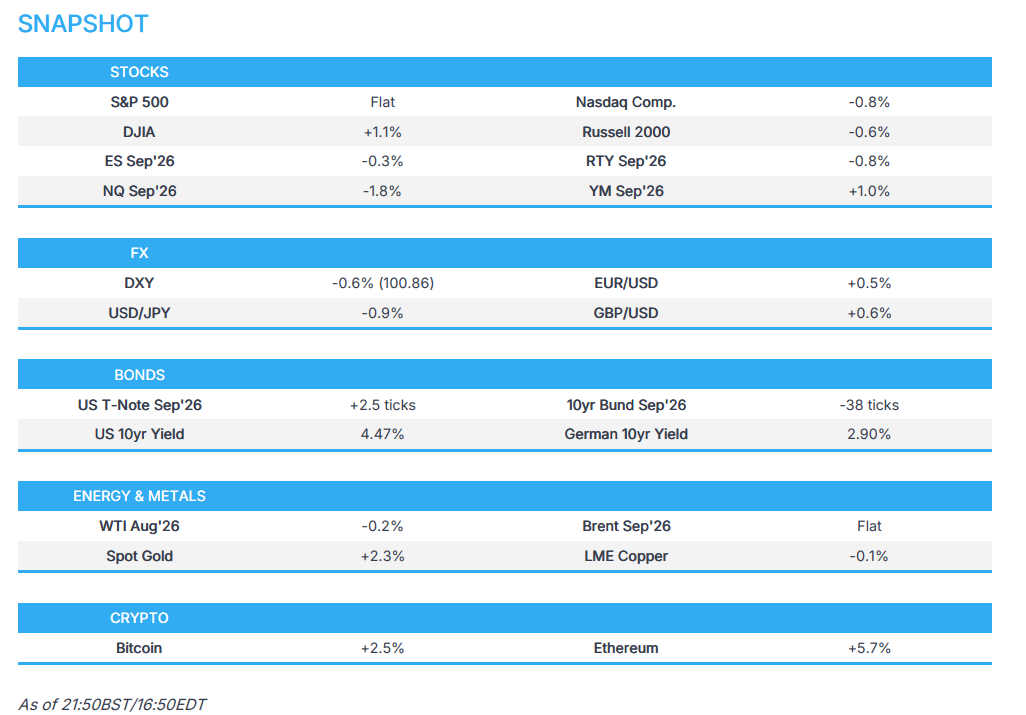
LOOKING AHEAD
- Highlights include Australian, Japanese & Indian Final Services & Composite PMIs, Chinese RatingDog Services & Composite PMIs, Supply from Australia.
- Click for the Newsquawk Week Ahead.
IRAN CONFLICT
- US and Oman were exploring ways to overcome Iran’s insistence on charging tolls for vessels transiting the Strait of Hormuz, according to the Wall Street Journal. Chief-level indirect talks reportedly included a US commitment to unfreeze part of the USD 100bln in Iranian funds held overseas, while negotiators were also considering an alternative Omani proposal under which maritime services would be funded through voluntary contributions, although Gulf officials reportedly doubted the plan would work because Iran lacked sufficient equipment to manage the waterway effectively. Furthermore, US negotiators received the proposal but intended to raise concerns with Oman, while a source said it could still be viewed as a toll system benefiting Iran.
- US Security Council Representative said the US would not accept the imposition of any fees for transit through the Strait of Hormuz.
- Key European nations had accepted that fees for transit through the Strait of Hormuz were inevitable, and some Gulf officials were also said to privately share that view, according to Bloomberg sources.
- US officials believed that Israel might have been plotting to kill Iran’s top negotiators while Washington was engaged with Tehran in delicate talks this spring to reach an interim peace deal, according to current and former US officials cited by NYT.
- Iranian Foreign Ministry spokesman Baghaei said a security meeting with regional countries was an attempt to mask what he described as the US’s destructive policy towards peace.
- Iran’s army spokesman said negotiations were a form of war and that Iran was ready to engage upon command, according to ISNA.
- Iran’s Director of the Sonar Institute for Strategic Studies said a new round of indirect talks had begun in Doha through a Qatari intermediary, while he said the negotiations were focused on a small number of fundamental issues and warned that a failure to reach an agreement on those points would prevent talks from continuing. He also stated that recent clashes between Iran and the US had followed Washington’s attempts to establish new waterways outside Iran’s control, which Tehran viewed as an attempt to circumvent it, adding that those developments had led to the targeting of a ship and the subsequent US response.
- Lebanese President Aoun said Lebanon would not give up an inch of its territory to Israel.
- Israel Defense Forces confirmed continued operations within the security zone in southern Lebanon, while the Israeli army said the Givati Brigade had completed its combat mission in southern Lebanon, according to Al Jazeera.
US TRADE
- US stocks were mixed, with the Dow the only major index to finish in positive territory, while the Nasdaq closed lower and the S&P 500 was flat. Although the softer-than-expected June nonfarm payrolls report saw traders pare Fed rate hike expectations, helping support broader risk sentiment, renewed weakness in large-cap technology stocks outweighed the macro tailwind for NDX. Market breadth was notably more constructive than the headline indices suggested. The majority of sectors finished higher, led by the traditional defensive sectors of Health Care, Consumer Staples and Utilities, while the heavyweight Technology, Consumer Discretionary and Communication Services sectors were the clear laggards. There was no obvious catalyst behind the renewed selling in technology shares, although the move may have reflected a continuation of Wednesday’s weakness following the Meta disruption. Meta (META) reversed its previous session’s gains, however, with lows seen after CEO Zuckerberg said AI agent development had not accelerated in the way the company had expected. Meanwhile, memory stocks remained under pressure, with the DRAM ETF falling 7.7%, while the Semiconductor ETF (SOXX) declined 5.6%. Those declines more than offset Apple’s (AAPL) roughly 5% gain on the session for the Nasdaq 100. Elsewhere, Tesla (TSLA -7.5%) shares plummeted despite stronger-than-expected delivery numbers. It is also possible that some profit-taking and position squaring took place ahead of the long Independence Day weekend, with US markets closed on Friday. The macro focus remained firmly on the June employment report. Nonfarm payrolls increased by just 57k, below the 110k consensus, while prior months were revised lower. The softer labour market data prompted markets to pare Fed rate hike expectations, with money markets pushing back the first fully priced 25bp hike to December from October. The repricing weighed on the Dollar and front-end Treasury yields while providing support for precious metals.
- SPX -0.01% at 7,483, NDX -1.61% at 29,329, DJI +1.14% at 52,904, RUT -0.55% at 2,996.
- Click here for a detailed summary.
TARIFFS/TRADE
- China’s Ministry of Commerce said China and the EU had agreed to hold up to two ministerial-level trade meetings each year and had invited EU Trade Commissioner Sefcovic to visit China in the autumn.
- European Free Trade Association member states said they had completed negotiations on a comprehensive free trade agreement with Vietnam.
- India and Japan signed an agreement on geology and mineral exploration, including critical minerals, and also agreed to sign a cooperation agreement covering the battery sector, according to a joint statement.
NOTABLE HEADLINES
- Fed’s Daly (2027 voter) said the surge in AI investment had raised questions over whether it would prove inflationary. She added that acting too quickly could prematurely restrain the economy, while acting too slowly could prove harmful for households.
DATA RECAP
- US Nonfarm Payrolls (Jun) +57K vs. Exp. +110K (Prev. +172K, Rev. +129K); two-month net revisions -74K (Prev. +93K)
- US Unemployment Rate (Jun) 4.2% vs. Exp. 4.3% (Prev. 4.3%)
- US Average Hourly Earnings (Jun) M/M 0.3% vs. Exp. 0.3% (Prev. 0.3%)
- US Average Hourly Earnings (Jun) Y/Y 3.5% vs. Exp. 3.5% (Prev. 3.4%)
- US Initial Jobless Claims (Week Ended Jun. 27) 215K vs. Exp. 220K (Prev. 215K)
- US Continuing Jobless Claims (Week Ended Jun. 20) 1.814M
FX
- USD was broadly sold on a softer-than-expected NFP print, with suspected JPY intervention exacerbating the move from a DXY perspective. Payroll growth was 57k in June, shy of the expected 110k, with the net two-month revisions at -74k. The unemployment rate unexpectedly ticked lower to 4.2% from 4.3%, but was accompanied by a drop in the participation rate to 61.5% from 61.8%. USD immediately weakened on the report, with the DXY hitting lows of 100.56. Some of the moves were pared, likely given that it is one data point in a new Fed Chair environment, where Warsh pays attention to trends, which for now, show an improving labour backdrop since March. In other news, claims were little changed W/W, geopolitical developments have been light, and equities continued to see increased volatility as semiconductors/memory names continued to face pressure. US markets will be shut on Friday due to Independence Day, and as such, trading conditions are set to be thinner.
- EUR benefited from the dollar weakness and with very little fresh catalysts for the single currency, while ECB Lagarde said she was confident the ECB had made the right decision by raising interest rates in June, and stated that second-round inflation effects had not materialised.
- GBP gained for the sixth consecutive day and edges closer to testing the 200 DMA of 1.34., while updates included remarks from the likely next UK PM, Andy Burnham, who said he will stick to the Labour manifesto on tax and has not made up his mind on who his chancellor will be.
- JPY led the broad G10 strength against the dollar, outperforming on potential JPY intervention in European trade. The sharp downside and its magnitude would suggest intervention over a rate check, with the focus turning towards remarks from Japanese officials for any confirmation.
- Swiss CPI (Jun) M/M 0.0% vs. Exp. 0.1% (Prev. 0.2%)
- Swiss CPI (Jun) Y/Y 0.5% vs. Exp. 0.5% (Prev. 0.6%)
FIXED INCOME
- T-notes settled little changed, and the yield curve steepened as the soft NFP data prompted markets to pare rate hike bets.
COMMODITIES
- Oil prices were slightly firmer and traded within thin ranges amid a lack of geopolitically important headlines.
- Saudi Arabia was shipping its highest volume of crude through the Strait of Hormuz since the US-Iran truce reopened the waterway, with four Bahri supertankers carrying around 8mln barrels having exited the Gulf, signalling stronger exports.
- Saudi crude and products exports averaged around 5.8 mb/d, rather than the 6.3 mb/d reported by some, according to Kpler, citing sources familiar with the matter, while the higher figure includes volumes from previously stranded cargoes.
- Daily traffic through the Strait of Hormuz appeared to have stabilised at between 30 and 60 crossings over the past seven days, averaging around 40 vessels per day so far this week, according to ship-tracking company Kpler.
- Kuwait’s crude oil production rose to as much as 1.9mln BPD during the final 10 days of June, with average production at 1.65mln BPD vs. 578k BPD in May.
- Russia plans to load up to 3mln BPD through its western ports in July, according to sources, after exports from those ports hit a record 3mln BPD in June.
- India reportedly planned to expand its crude oil reserves to hedge against the risk of sharp oil price spikes.
- Baker Hughes Rig Count: Oil +5 to 445, Gas +1 to 126, Total +7 to 580.
ASIA-PAC
NOTABLE HEADLINES
- Anthropic was reportedly in talks with Samsung (005930 SK) to manufacture a custom AI chip, according to The Information. The report stated that Anthropic had begun early-stage work on its own AI chip and was seeking greater control over the computing infrastructure behind its AI models, following a similar strategy pursued by OpenAI.
EU/UK
NOTABLE HEADLINES
- UK MP Burnham said he will stick to the Labour manifesto on tax and has not made up his mind on who his chancellor will be, while he stated he is not undisciplined when it comes to public finances and will take responsibility to fully fund the defence spending plan. Furthermore, Burnham ruled out ‘crude’ short-term welfare cuts and said that education reforms and more council houses will eventually bring down the number of jobless youngsters, but also commented that there is ‘room for movement on tax’ in Labour’s manifesto.
- BoE’s Mann said she remained confident that if incoming data, particularly inflation expectations, proved unfavourable to the underlying inflation process, an activist policy move could bring inflation expectations and outcomes back towards the 2% target. She added that wage negotiations and one-year-ahead inflation expectations during the second half of the year would be particularly important for her future policy decisions. Mann also stated that the loosening in financial conditions since June would be an important factor in determining her vote at the next policy meeting.
- ECB President Lagarde said she was confident the ECB had made the right decision by raising interest rates in June, adding that second-round inflation effects had not materialised.
DATA RECAP
- EU Unemployment Rate (May) 6.2% vs. Exp. 6.3% (Prev. 6.3%)
USA DATA RELEASES//JOB REPORT
GENERALLY FOLLOWING JOBS LOSSES RE NIKE ETC
US Adds Only 57K Jobs, Missing Estimates, As Unemployment Rate Slides On Plunge In Workers
Thursday, Jul 02, 2026 – 09:04 AM
In our jobs preview post we quoted Goldman Delta One head, Rich Privorotsky, who said that “equities marginally want something weaker than consensus: with no forward guidance, hot NFP means hikes in play, which is unfriendly for pockets of equity risk.” Well, they got it because moments ago the BLS reported that in June the US added just 57K workers, half the 113K expected, and the worst monthly print since the big February drop.

Except for an outlier 25K forecast from Citi, the jobs print was below all forecasts, a 2 sigma miss to estimates.

And yes, negative revisions are back:
- April jobs revised down by 31,000, from +179,000 to +148,000
- May jobs revised down by 43,000, from +172,000 to +129,000.
With these revisions, employment in April and May combined is 74,000 lower than previously reported as Trump once again goes back to using the Biden playbook.
Remarkably, while the number of payrolls rose by 57K, the number of actually employed people plunged by 507K to 162.264MM, which means the staggering gap between workers and payrolls is once again blowing out.

Just as ominously, the labor force participation rate plunged from 61.8% to 61.5%…

… driven by a massive 720K drop in the civilian labor force, which dropped to 169.358K from over 170 million…

… and which pushed the unemployment rate lower to 4.2% from 4.3%.

By race, the unemployment rate saw a modest increase in Latino unemployment rate. Among the major worker groups, the unemployment rates showed little or no change in June for adult men (3.9%), adult women (3.7%), teenagers (14.6%), and people who are White (3.6%), Black (6.6%), Asian (3.9%), or Hispanic (5.2%), although those have increase for 3 months in a row now.

Looking at wages, there were no surprises here, with a 0.3% increase in average hourly earnings, as expected, resulting in a 3.5% increase in annual hourly earnings, also as expected.

Broken down:
- Average hourly earnings for all employees on private nonfarm payrolls rose by 13 cents, or 0.3 percent, to $37.64. Over the year, average hourly earnings have increased by 3.5 percent. In June, average hourly earnings of private-sector production and nonsupervisory employees rose by 7 cents, or 0.2 percent, to $32.38.
- The average workweek for all employees on private nonfarm payrolls was unchanged at 34.3 hours in June. In manufacturing, the average workweek edged down to 40.3 hours, and overtime edged up to 3.2 hours. The average workweek for production and nonsupervisory employees on private nonfarm payrolls declined by 0.1 hour to 33.7 hours.
Some more details from the jobs report:
- The number of long-term unemployed (those jobless for 27 weeks or more) changed little at 1.9 million in June but is up by 286,000 over the year. The long-term unemployed accounted for 27.3 percent of all unemployed people in June.
- The labor force participation rate decreased by 0.3 percentage point to 61.5 percent in June, and the employment-population ratio edged down by 0.2 percentage point to 59.0 percent. Both measures changed little over the year after accounting for annual population control adjustments.
- The number of people employed part time for economic reasons changed little at 4.7 million in June. These individuals would have preferred full-time employment but were working part time because their hours had been reduced or they were unable to find full-time jobs.
- In June, the number of people not in the labor force who currently want a job changed little at 6.0 million. These individuals were not counted as unemployed because they were not actively looking for work during the 4 weeks preceding the survey or were unavailable to take a job.
- Among those not in the labor force who wanted a job, the number of people marginally attached to the labor force changed little at 1.8 million in June. These individuals wanted and were available for work and had looked for a job sometime in the prior 12 months but had not looked for work in the 4 weeks preceding the survey. The number of discouraged workers, a subset of the marginally attached who believed that no jobs were available for them, was essentially unchanged in June at 477,000.
Taking a look at the composition of jobs,
- Employment in professional and business services continued to trend up in June (+36,000). The industry has added 172,000 jobs since a recent low in October 2025.
- Social assistance added 25,000 jobs in June, primarily in individual and family services (+17,000). Over the prior 12 months, social assistance had added an average of 16,000 jobs per month.
- In June, employment in health care continued its upward trend (+22,000) but at a slower pace than the average monthly gain over the prior 12 months (+38,000). In June, hospitals added 9,000 jobs.
- Leisure and hospitality employment declined by 61,000 in June, reflecting weaker than usual seasonal hiring. Thus far in 2026, employment in the industry has shown little net change.
- Employment showed little or no change over the month in other major industries, including mining, quarrying, and oil and gas extraction; construction; manufacturing; wholesale trade; retail trade; transportation and warehousing; information; financial activities; other services; and government.
And visually:

Last but not least, the most damning aspect of the jobs report was once again below the surface, where we find that that while part-time jobs dropped by 53K in June to 28.626MM, the number of full-time workers collapsed by a whopping 514K, confirming once again that the composition of the US labor market remains terrible.

This means that the number of full-time jobs is now at levels last seen in 2024.

The market reaction: in response to the weaker than expected number, odds of a rate hike tumbled although with no forward guidance from the Fed, it is unclear how Warsh will interpret the data.
END
Initial Jobless Claims Continue To Signal No Labor Market Stress
Thursday, Jul 02, 2026 – 08:53 AM
The number of Americans filing for unemployment benefits for the first time dipped last week to 215k (218k exp), continuing to show labor market resilience in the face of slumping sentiment.

…basically unchanged in five years.
Continuing claims ticked higher but remains well off cycle highs from last fall…

So once again, claims data shows no signs of the pain that sentiment surveys suggest…

…even though payrolls data suggests deterioration.
END
Core Durable Goods Orders Soar Most In 4 Years
Thursday, Jul 02, 2026 – 10:24 AM
US durable goods orders plummeted 4.5% MoM in May (as expected), dragging orders down 4.3% YoY – the worst annual decline since Nov 2024…

Source: Bloomberg
However, ex-transports, orders rose 1.4% MoM – up for the 14th straight month – with orders soaring over 10% YoY, the strongest annual surge since May 2022…

Adding more confusion, US factory orders fell 1.3% MoM in May (better than the 2.0% MoM decline expected) but dramatically divergent from the 4.8% MoM surge in April (revised down from +5.3%).

…but factory orders ex-transports rose 1.9% MoM – the seventh straight month of gains – with core orders up 9.5% YoY, the best since Sept 2022…

So, take your pick.
USA ECONOMIC REPORTS
the 5 justices got it wrong!
(zerohedge)
Supreme Court Justice Thomas Says Birthright Citizenship Ruling ‘Devalues’ US Citizenship
Wednesday, Jul 01, 2026 – 11:30 PM
Authored by Jack Phillips via The Epoch Times,
Supreme Court Justice Clarence Thomas issued a lengthy dissent criticizing the high court’s majority ruling against President Donald Trump’s executive order restricting birthright citizenship, saying the decision would effectively devalue American citizenship as it was understood by those who created the Constitution’s 14th Amendment. Supreme Court Associate Justice Clarence Thomas poses for an official portrait at the East Conference Room of the Supreme Court building in Washington on Oct. 7, 2022. Alex Wong/Getty Images
Thomas said the majority is attempting to repurpose the 14th Amendment “to protect its own set of preferred rights that the Reconstruction Congress never contemplated and that cannot find support in its text,” referring to the post-Civil War era of the mid-to-late 19th century.
Further, he argued that the June 30 ruling denigrates the idea of U.S. citizenship, saying that it has been used by “foreign birth tourists and illegal aliens.”
“I am not sure that today’s opinion will stand the test of time,” Thomas wrote. “The Citizenship Clause ‘added greatly to the dignity and glory of American citizenship.’ Today’s opinion devalues that citizenship.“
The order issued by Trump aimed to exclude children of illegal immigrants and temporary visitors from gaining automatic birthright citizenship. In 1898, the high court delivered the landmark birthright citizenship ruling in United States v. Wong Kim Ark, which effectively stated that any child born in the United States to immigrants is granted citizenship regardless of the nationality of the child’s parents.
In addition to Thomas, Justices Samuel Alito and Neil Gorsuch dissented and indicated that they would allow Trump’s executive order to stand. Justice Brett Kavanaugh partially concurred with the majority in saying that he thinks the Trump administration’s executive order does violate a federal statute but that the constitutionality of birthright citizenship is an open question and that the executive order doesn’t violate the 14th Amendment.
“The Court today takes the extraordinary step of holding facially unconstitutional the President’s Order excluding from citizenship the children of foreign temporary visitors and illegal aliens,” Thomas said in the 91-page dissent, which is significantly longer than the majority’s opinion.
Thomas indicated that he sided with the Trump administration’s arguments that the 14th Amendment, ratified three years after the end of the Civil War in 1868, was intended to give citizenship to black people who were freed from slavery rather than automatically giving it to the children of immigrants.
“In doing so, the Court adds to the sad history of the Fourteenth Amendment, which was designed and understood to secure equal rights for the freed blacks but has instead been repurposed for political projects that the Reconstruction Congress did not support,” he said.
Chief Justice John Roberts wrote the majority opinion and was joined by Justices Sonia Sotomayor, Elena Kagan, Amy Coney Barrett, and Ketanji Brown Jackson.
“Citizenship, then and now, was the right to have rights – to freely participate in our political community. The Framers of the Fourteenth Amendment extended that promise to ‘every free-born person in this land,'” Roberts wrote, citing congressional debate over the 14th Amendment. “We keep that promise today.”
Multiple lower courts have blocked the executive order, signed by Trump early in his presidential term last year, and it has not taken effect anywhere in the United States. The high court ruled on the president’s appeal of a lower-court ruling from New Hampshire that struck down the birthright citizenship restrictions.
Birthright citizenship was the first Trump administration immigration-related issue to reach the Supreme Court for a final ruling. Since he took office, Trump has rolled out policies designed to deport large numbers of illegal immigrants, namely those with criminal records.
He has also canceled temporary protected status for hundreds of thousands of people living in the United States, bolstered U.S. border security, initiated policies encouraging illegal aliens to self-deport, and issued other rules.
In response to the June 30 ruling, Trump said, “[The ruling is] too bad for our Country, but we can easily make it up in Congress through Legislation.”
“Congress should start TODAY to work on ending expensive and unfair to our Country, Birthright Citizenship,” he wrote on Truth Social. “They will have my Complete and Total Support!”
In a previous post, he argued that “dumb judges and justices” allow wealthy women from China and elsewhere to come to the United States with the sole purpose of giving birth so that their children will be American citizens. He noted that few other countries have such a policy.
The American Civil Liberties Union (ACLU) hailed the majority opinion, saying that the “decision reaffirms a fundamental American promise – if you are born here, you are a citizen.”
“A president cannot change the Constitution by executive fiat,” ACLU National Legal Director Cecillia Wang said in a statement. “Our brave clients and our legal team stand with millions of people around our country who spoke up for one of our most cherished rights. The Constitution’s guarantee of birthright citizenship stands strong.”
END
BLUE OWL
GATES AGAIN
Blue Owl Gates Investors Again After Top BDCs Hit With Massive 38%, 19% Redemption Requests
Thursday, Jul 02, 2026 – 02:20 PM
After a catastrophic Q1 for private credit BDCs, Q2 is proceeding just as many had expected: just as bad.
After alternative asset manager titans such as Apollo, Blackrock, Blackstone and Cliffwater all gated their investors for a second straight quarter following a surge in redemption requests that easily surpassed what took place in Q1, earlier today we learned that the ground zero of the private credit implosion – Blue Owl Capital – was also slammed with redemption requests in the second quarter. Sure enough, it also gated its investors.
As Bloomberg reports, for the second straight quarter, two Blue Owl Capital private credit funds were hit with the industry’s largest redemption requests, forcing the manager to again cap withdrawals.
Investors in the roughly $34 billion Blue Owl Credit Income Corp., one of the largest in the industry, asked to pull 18.8% of shares, or $3.6 billion in the second quarter, according to an investor letter Thursday. That’s down fractionally less than the $4.2 billion requested in the prior period from the fund known as OCIC.
The smaller Blue Owl Technology Income Corp. saw shareholders request 38.1%, or $1.1 billion, compared with $1.2 billion in the first quarter.
The good news: the total redemptions were modestly below last quarter’s record; the bad news: the redemptions persisted almost entirely despite the market staging a historic, remarkable rebound and as fears about software disruption supposedly eased. Turns out they did not.

Blue Owl, which as we have thoroughly documents, has been at the heart of the storm roiling the $1.8 trillion private credit market due to its massive exposure to software-linked loans, joins industry peers including Apollo, Ares, BlackRock and Blackstone in imposing a 5% redemption limit as investors accelerate out of the funds.
Blue Owl told investors it was “encouraged to see OCIC’s modestly lower quarter-over-quarter tender requests broadly across channels and geographies.” Let’s see what the company will tell investors next quarter if we see a powerful drawdown in stocks which sparks a new selling panic across the private credit space.
According to Bloomberg, the firm said it has satisfied more than 43% of the original demand from shareholders with repeat withdrawal requests. It said second quarter requests were largely from those investors, and included “limited new participation.”
Realizing the existential threat they were in, Blue Owl executives – who in a bizarre act of “diversification” decided to buy a stake in the Cleveland Cavaliers – stepped up efforts to engage with clients over the past three months, flying around the world on a roadshow trying to educate investors, according to a person with knowledge of the matter. They emphasized the message that private credit is a performing asset and that their funds had delivered positive returns, the person said, requesting anonymity to discuss private meetings.
In the shareholder letter Thursday, the firm highlighted that about 90% of investors remain in the larger fund, which has posted approximately $1.2 billion of inflows this year.
“OCIC does not need to sell a single private loan to satisfy the tender offer,” Craig Packer, Blue Owl’s co-president, and Logan Nicholson, OCIC president, said in the letter to shareholders.
And in case that investors decided they don’t want to be in the fund much longer, the firm said that both Blue Owl funds have “ample dry powder” to capitalize on better lending conditions in the market, with wider spreads and improved protections.
OCIC and OTIC had $11.6 billion and $1.3 billion in liquidity respectively, including cash and available borrowings assets as of May 31, according to the letters. OTIC oversees about $5 billion in assets.
KING NEWS
| The King Report July 2, 2026 Issue 7775 | Independent View of the News |
| @charliebilello: Semiconductor stocks were up 237% over the last 14 months, surpassing the 234% surge during the peak of the dot-com bubble. The AI mania has taken semis to a place only seen once before. History doesn’t repeat, but extremes tend to rhyme. https://x.com/charliebilello/status/2072337746798981517 After the determined manipulation on Monday and Tuesday to boost Q2, traders dumped AI related stocks on Wednesday morning. The SOX Index was down sharply; however, Fangs rallied on Meta, which soared over 11% on this: Meta is planning a cloud business to sell AI computing power – BBG Microsoft to slash thousands of jobs as AI spending concerns fuel third major layoff round in a year: report https://trib.al/HW3Xlgc Bonds fell despite soft ADP Employment Change and a lower S&P US manufacturing PMI. Gasoline rallied 3.63 cents. WTI Oil fell over a dollar. Precious metals rose smartly; general trading was listless. June ADP Employment Change 98k, 120k exp. June S&P Global US Mfg. 53.9, 55.7 exp. June ISM Manufacturing 53.3, 53,8 exp, Prices Paid 73, 77.8 exp, New Orders 56, 57 exp, Employment 49.7, 48.8 expected May Construction Spending 0.1% m/m, 0.2% expected June OMDIA Total Vehicle Sales 16.1m; 16.1m expected GM reports 4.2% decline in Q2 U.S. sales as EV demand falls https://www.cnbc.com/2026/07/01/q2-auto-sales-gm-stellantis-toyota-hyundai.html ESUs opened modestly lower on Monday night but quickly rallied to a tiny gain. They then fell back into a trading range until breaking lower after 21:00 ET. An ABC decline took ESUs to 7510.50 at 3:16 ET. After a rally to 7539.75 at 7:04 ET, ESUs sank to a daily low of 7505.75 at 9:34 ET. Of course, as we all would expect, traders conditioned to buy opening dips manically bought ESUS. They soared to a daily high of 7578.50 by the 11:30 ET European close. After a dip to 7567.50 at 11:36 ET, ESUs plodded to a minor new high of 7579.00 (+30.75) at 12:24 ET. ESUs sank on: Iran’s Deputy Foreign Minister Says Talks in Qatar Ended: IRNA – BBG 12:58 ET VP Vance: “President Trump’s directives are clear. The talks are going well, and we will give we will give negotiation every chance to succeed.” Trump said there have been “very good meetings” in Doha. “As far as things are going the denuclearization of Iran is moving along well. We hit them very hard but we’re getting along very well.” Despite Trump proclaiming “we’re getting along very well” and anonymous US officials averring the talks in Doha have been positive, Iran refuses to have direct talks with Team Trump. @JimHansonDC: JD Vance makes the obvious & logical point that President Trump “is using the MOU to refill the world’s oil economy and refill some stocks…” https://x.com/JimHansonDC/status/2072371310114836766 ESUs did a 5-wave decline, with modest 2 & 4 wave counter-rallies, and sank to 7529.00 at 16:04 ET. Micron plunged 10.57%. The stock shiller-in-chief tried to halt the morning drop to NO avail. Trump: BIG NEWS! Micron, a truly GREAT American Company, and one of the “HOTTEST” anywhere in the World, has announced a HISTORIC $250 MILLION Investment in TRUMP ACCOUNTS. This incredible gesture, made by Micron’s fantastic CEO, Sanjay Mehrotra, will make many children extremely happy some day in the not-too-distant future. This is the BIGGEST CORPORATE Investment of its kind and will help jumpstart the American Dream for these fabulous children as we celebrate America’s 250th Anniversary! This MASSIVE Investment will help MILLIONS of American children and families get a strong start in life and give them REAL Financial Security. Micron is investing directly in the American Worker and Family! This is exactly what the fabulously successful TRUMP ACCOUNTS were created to do — Give every American Child a headstart, and a real chance to succeed. My Policies are WORKING and working “BIG.” Our Country is doing far better than any country, anywhere in the World, and Companies like Micron are proving it every single day. THIS IS THE GOLDEN AGE OF AMERICA… Jul 01, 2026, 11:19 AM @zerohedge: “Market volumes are explosive, but liquidity remains terrible. S&P E-mini top-of-book liquidity collapsed 33% month-over-month in June – dropping from $12mm to just $8mm – even as US equity markets posted their highest average daily volume of 2026 at 23.3B shares” – Goldman Positive aspects of previous session There was modest valuation rotation into DJIA and DJTA stocks; out of AI-related stocks. The yen/dollar stabilized. The DJTA rallied 209.97 points; the NY Fang+ Index closed +1.16%. USUs bounced modestly off its 50-day moving average. Negative aspects of previous session AI Bubble stocks got hammered, the SOX Index closed -6.27%. Bonds continue to leak oil. Precious metals and gasoline rallied smartly. All major equity indices declined except for the DJTA and the NY Fang+ Index Ambiguous aspects of previous session How long can Trump pump up the AI Bubble? First Hour/Last Hour NYSE Action [S&P 500 Index]: 1st Hour: Up; Last Hour: Down Pivot Point for S&P 500 Index [above/below indicates daily trend to day traders]: 7584.89 Previous session (S&P 500 Index) High/Low: 7521.81 (12:23 ET); 7449.63 (9:35 ET) Many Democratic Socialist leaders are self-professed communists, DSA caucus statements show https://justthenews.com/politics-policy/elections/many-democratic-socialist-leaders-are-self-professed-communists-caucus One-third of Dems say they want far-left democratic socialists in office: shock poll https://trib.al/tIrlxqZ Colorado socialist Melat Kiros refused to call firebombing of Jewish rally antisemitic, blasted Israel as apartheid https://trib.al/xXCfxVe USA Today’s @joeygarrison: Trump: “On July 4, its going to be approximately 107 degrees outside, and I’m going to go, and I’m going to make a really long speech, just to show that I can do anything.” Today – With the US markets closed on Friday for the 4th of July, which is on Saturday, absenteeism should be high and should increase after traders adjust their positions to the June Employment Report. Equity futures are weak on Wednesday night because the KOSPI (South Korea) was -6.56% at 20:20 ET. NQUs were -141.75 at 20:02 ET. Yep, traders eagerly bought the dip! ESUs are -10.50, NQUs are -52.00; WTI is -$0.75 & gasoline is -1.32¢; and USUs are -4/32 at 20:28. Expected Impact Economic Data: June NFP 115k, Mfg. 3k, Earnings 0.3% m/m & 3.5% y/y, Workweek 34.3, Unemployment Rate 4.3%, Labor Force Participation Rate 61.8%, Underemployment Rate 6.2%; Jobless Claims 218k, Continuing Claims 1.82m; May factory Orders -2.0%, Ex-Trans 1.0%, Durable Goods -4.5%, ex-Trans 1.3%, Nondef Ex-Air 1.6%, Shipments 0.3%; SF Fed President Daly 7:45 ET S&P Index 50-day MA: 7386; 100-day MA: 7081; 150-day MA: 7014; 200-day MA: 6939 DJIA 50-day MA: 50,481;100-day MA: 49,216; 150-day MA: 48,992; 200-day MA: 48,408 (Green is positive slope; Red is negative slope) S&P 500 Index (7483.23 close) – BBG trading model Trender and MACD for key time frames Monthly: Trender and MACD are positive – a close below 6248.85 triggers a sell signal Weekly: Trender and MACD are positive – a close below 6861.16 triggers a sell signal Daily: Trender is positive; MACD is negative – a close below 7319.33 triggers a sell signal Hourly: Trender and MACD are positive – a close below 7481.50 triggers a sell signal BBG @business: Democratic Socialist Melat Kiros ousted 15-term incumbent Representative Diana DeGette in Colorado’s first congressional district, DDHQ projected, the latest evidence of a growing divide over the direction of the Democratic Party (Leftists/commies are taking over the Dem Party) Yes, Virginia, this is a consequence of importing Dem voters and the K-shaped economy. @bennyjohnson: Amy Coney Barrett was sold to us as a rock-solid constitutionalist — handpicked by Trump, backed by the Federalist Society, and confirmed with our hopes riding high. She looked us in the eye during her hearings and promised fidelity to the law, not politics or personal agendas. Now she’s stabbing the base in the back, siding with Roberts and liberals to protect birthright citizenship schemes, mail-in voting loopholes, and other pillars of the swamp agenda that conservatives fought to dismantle. The very people who fought to get her on the Court are now openly calling for her resignation — because this isn’t judicial independence, it’s betrayal. @C_3C_3: Justice Roberts… Protected birthright citizenship. Saved unconstitutional Obamacare. Protected Dobbs leaker Sheldon Snook. Appointed Boasberg to preside over the FISA Court. Protected fake Ukraine impeachment whistleblower Eric Ciamarella. Roberts runs the judicial coup. Roberts and Barrett have adopted children from foreign countries. Barrett has two children from Haiti; Roberts has two adopted children from Ireland, though some allege that is bogus. The more important question about the Times’s report still stands: Why was a report digging into the details of the adoptions of Barrett’s children fair game in 2020 when the Times said that publishing such a report on John Roberts’s children would have been wrong in 2005?… https://www.yahoo.com/news/york-times-digs-adoptions-amy-154928157.html Did Chief Justice John Roberts Skirt Laws When Adopting His Children? When Roberts was nominated for the Supreme Court by George W. Bush in 2005, press reports said Roberts and his wife had adopted two children, both from Latin America. A report in Time, however, listed the children’s place of birth as a different country… Ireland has some of the strictest laws in the world on adoption. Most relevant is that ordinarily only residents of the country (and those who have resided in the country for at least a year) can adopt Irish children. Roberts’ wife Jane’s is the daughter of Irish immigrants and feels a strong connection to those roots. But neither she nor Roberts had lived in the country for a year prior to initiating adoption procedures… That the Chief Justice of the United States Supreme Court would have skirted strict laws during the adoption of his two infant children would open him up to questions about the ability to effectively execute the duties of his office. But they would also thereby open him up to potential extortion and/or blackmail, a sentiment that is consistent with recent allegations… In 2012 Roberts was set to strike down the Affordable Care Act (Obamacare) but at the last moment changed his mind. (Reportedly after Obama called Roberts to the WH!) His last-minute decision to cast a deciding vote with the liberal Justices ensured the controversial law was upheld… https://itnshow.com/2021/02/28/did-chief-justice-john-roberts-skirt-laws-when-adopting-his-children/ @zarathustra5150: footnote from Clarence Thomas, quoting Thomas Aquinas from Summa Theologica: “Foreigners were not at once admitted to citizenship” because “if foreigners were allowed to meddle with the affairs of a nation as soon as they settled down in its midst, many dangers might occur, since the foreigners not yet having the common good firmly at heart might attempt something hurtful to the people” https://x.com/zarathustra5150/status/2072126350761070773 “A strict observance of the written laws is doubtless one of the high duties of a good citizen, but it is not the highest. The laws of necessity, of self-preservation, of saving our country when in danger, are of higher obligation. To lose our country by a scrupulous adherence to written law, would be to lose the law itself, with life, liberty, property and all those who are enjoying them with us; thus, absurdly sacrificing the end to the means.” – Thomas Jefferson @CWBChicago: Three Venezuelan gang members kidnapped a man from a Chicago park, beat him to death, then called his mom to let her know where to find his body, federal officials said today. One of them was AWOL from electronic monitoring at the time of the murder. https://x.com/CWBChicago/status/2072389271898509551 “The greatness of America lies not in being more enlightened than any other nation, but rather in her ability to repair her faults.” — Alexis de Tocqueville, Democracy in America, 1835 “Freedom is not a gift that lasts long in the hands of cowards.” — Theodore Roosevelt We hope you and yours have a safe and happy 4th of July Weekend. | |
SWAMP STORIES FOR YOU TONIGHT
Vegas Cops Disrupt Alleged Casino Terror Plot By Trans Gunman As Pattern Of Left-Wing Violence Raises Alarms
Thursday, Jul 02, 2026 – 11:00 AM
The nihilistic accelerationism spreading through the revolutionary left is becoming an increasingly visible security threat, as years of radical rhetoric and political demonization by Democrats and their aligned, billionaire-funded NGOs bleed into real-world violence.
The pattern is becoming increasingly troubling and harder to ignore: left-wing extremists are taking their grievances into an active phase, targeting wealthy individuals, capitalism, law enforcement, and right-leaning political figures.
What was once overlooked because the Biden-Harris FBI was too focused on White Catholics is now manifesting in assassination plots, terroristic threats, and planned terror attacks.
The latest incident comes after Las Vegas-area police arrested a 36-year-old transgender suspect who allegedly planned either a mass shooting or a “suicide by cop” incident at a casino, after officers found a large cache of weapons in a stolen vehicle and later at the suspect’s home, according to The New York Post.
More color from Las Vegas Police:
The investigation began after Henderson Police received a 911 call reporting a domestic dispute involving a stolen vehicle that was believed to contain numerous firearms. The caller also reported alarming statements indicating the suspect intended to commit “suicide by cop” and carry out a mass shooting.
Using vehicle tracking information, Henderson Police officers quickly located the vehicle at Sunset Station. Through calm communication, tactical decision-making, and exceptional restraint, officers safely took the suspect into custody without injury to the public.
What police found:
• 22 firearms from the stolen vehicle, including multiple handguns, rifles, a fully automatic firearm, suppressors, and hundreds of rounds of ammunition.
• 30 additional firearms from the suspect’s residence, including automatic weapons, AR-style rifles equipped with grenade launchers, suppressors, and thousands of rounds of ammunition.
Authorities said Howlett, a man pretending to be a woman, made violent threats in the past, including a 2024 call in which the suspect allegedly warned of a mass shooting unless federal agents arrested him.
Internet sleuths uncover…
Howlett faces charges including making terroristic threats, assault with a deadly weapon, auto theft, and gun theft. A judge set bail at $500,000.
The Vegas incident follows two separate cases involving left-wing revolutionaries targeting “capitalists” and raises concerns that over a decade or more of the Democratic Party pushing radical rhetoric against Republicans might have unleashed a dangerous wave of revolutionaries.
Meanwhile, Wisconsin Democratic staffer Teha Delaruelle appeared to have called on supporters to “kill your local Republican.”
Related:
END
Judge Blocks USPS Ballot Rule Tied To Trump’s Election Integrity Order
Thursday, Jul 02, 2026 – 02:00 PM
Authored by Tom Ozimek via The Epoch Times,
A federal judge on Wednesday blocked the U.S. Postal Service from implementing a Trump administration proposal to boost election integrity by enhancing ballot tracking and verification, finding it conflicted with a 2021 settlement requiring the agency to prioritize the timely delivery of election mail.

U.S. District Judge Emmet Sullivan ruled on July 1 that USPS could not move forward with the proposed rule, which would have required states using the mail for federal absentee and mail-in voting to adopt standardized ballot envelopes with trackable barcodes and provide USPS with voter participation lists to make ballot verification easier. Ballot mailings that failed to comply would have been rejected.
One day after the proposed rule was published in early June, the National Association for the Advancement of Colored People (NAACP) returned to court in a long-running lawsuit originally filed during the 2020 election, asking Sullivan to enforce a 2021 settlement that requires USPS to prioritize the monitoring and timely delivery of election mail through the 2028 election cycle.
The proposed rule stems from President Donald Trump’s March executive order directing USPS to develop new standards for handling federal ballot mail as part of a broader thrust to bolster election integrity.
The Justice Department, which represented USPS in the case, did not respond to a request for comment before publication.
Rule Boosts Election Integrity, DOJ Says
In opposing the NAACP’s motion, the Department of Justice (DOJ) argued in a court brief that the proposed rule was designed to improve—not hinder—the handling of election mail.
Attorneys representing the Trump administration wrote that requiring standardized Election Mail logos and Intelligent Mail barcodes would make ballots easier to identify throughout the postal network. They argued this would allow USPS to better monitor the movement of mail-in ballots and help implement the “extraordinary measures” USPS has traditionally used to expedite election mail before federal elections.
“Such requirements promote the ’monitoring and timely delivery of Election Mail’; they do not frustrate it,” they wrote in the brief. “And while the Postal Service has proposed requiring state and local election officials to identify the names and addresses of the persons to whom they send ballots and to provide the barcodes for the ballot envelopes, requiring this information—which officials already, by definition, have—would not compromise the lawful delivery of any mail.”
The administration stated in the proposal that the new rule would strengthen election integrity by creating a uniform ballot-tracking system while leaving decisions about voter eligibility entirely to the states.
Election officials—not USPS—would determine who is eligible to vote by mail and would submit lists of voters receiving mail ballots, together with unique barcode information, through a federal portal. The Postal Service would use that information only to verify ballot mailings and improve tracking, not to decide who could vote.
“State and local election officials would maintain full control over who they send ballots to,” government attorneys said in the brief.
“There are no plausible concerns, certainly at this stage, that the Proposed Rule would negatively impact USPS’s ability to timely and reliably deliver Election Mail. Rather, this provision would, again, assist USPS in better being able to track (and thus deliver) such important mail.”
Plaintiffs Claim ‘Confusion and Uncertainty’
The NAACP argued in its motion that the new requirements would violate the 2021 settlement and could prevent eligible voters from receiving mail ballots.
“Implementation of the Proposed Rule would threaten to prevent millions of eligible voters from receiving mail-in ballots to which they are entitled,” attorneys representing the plaintiffs wrote.
They also argued that, even while the rule remains in proposed form, it already caused confusion within USPS, and among election officials and voters, about what procedures will be in place for mail-in ballots in the November 2026 election cycle.
“The pendency of the Proposed Rule … creates confusion and uncertainty,” they wrote. “USPS, for example, cannot conduct internal or external trainings to plan for a rule that is not yet finalized. Nor can it provide answers or guidance to election officials and voters to mitigate confusion or uncertainty.”
The case traces back to August 2020, when the NAACP sued USPS over operational changes introduced around that time that plaintiffs said caused widespread mail delays during the COVID-19 pandemic and threatened the timely delivery of absentee ballots.
The parties settled the case in December 2021. Under the agreement, USPS committed through 2028 to issue nationwide election-mail guidance, organize regular “outreach meetings” with the NAACP before federal elections, provide performance reports, and make good-faith efforts to prioritize the monitoring and timely delivery of election mail.
Trump’s March executive order directed USPS to develop new standards to strengthen election security, prompting USPS to publish the proposed rule, which the NAACP challenged.
The judge sided with the plaintiffs, concluding that the proposed procedures conflicted with USPS’s commitment to prioritize the timely delivery of election mail.
Allison Zieve, director of Public Citizen Litigation Group, which represented the NAACP in the case, praised the ruling.
“The court today correctly recognized that USPS’s plan to create roadblocks to mail-in voting was inconsistent with its commitment to timely deliver election mail,” she said in a statement. “USPS’s plan was unwise, unlawful, and a threat to the millions of voters who rely on mailed ballots to participate in our democracy.”
END
GREG HUNTER..