
EXCHANGE
EXCHANGE: COMEX
CONTRACT: JULY 2026 COMEX 100 GOLD FUTURES
SETTLEMENT: 4,145.300000000 USD
INTENT DATE: 07/07/2026 DELIVERY DATE: 07/09/2026
FIRM ORG FIRM NAME ISSUED STOPPED
092 C DEUTSCHE BANK 40
099 H DEUTSCHE BANK AG 2
363 H WELLS FARGO SECURITI 26
661 C JP MORGAN SECURITIES 12
TOTAL: 40 40
MONTH TO DATE: 9,262
GOLD: NUMBER OF NOTICES FILED FOR JULY/2026: 40 CONTRACTs NOTICES FOR 4000 OZ or 0.1244 TONNES
total notices so far: 9262 contracts FOR 926,200 OZ OR 28.880 TONNES
SILVER NOTICES: 99 NOTICE(S) FILED FOR 0.495 MILLION OZ /
total number of notices filed so far this month : 5558 CONTRACTS (NOTICES) for 28.880 million oz
GLD AND SLV
GLD
INITIAL STANDING FOR JANUARY: 22.915 MILLION OZ FOLLOWED BY TODAY’S 1.185 MILLION OZ QUEUE JUMP//NEW NORMAL STANDING ADVANCES TO 49.445 MILLION OZ// TO WHICH WE ADD OUR FIRST EXCHANGE FOR RISK FOR .100 MILLION OZ//NEW STANDING ADVANCES TO 49.545 MILLION OZ!!
INTIAL STANDING FOR FEBRUARY/SILVER: 13.505 MILLION OZ FOLLOWED BY TODAY’S HUGE 0.005 MILLION OZ QUEUE JUMP / : NEW STANDING FOR SILVER AT THE COMEX ADVANCES TO 25.180 MILLION OZ. BUT WE MUST ADD OUR FIRST EXCHANGE FOR RISK OF 25 CONTRACTS FOR .125 MILLION OZ AND THEN OUR SECOND EXCHANGE FOR RISK OF .0600 MILLION OZ TO OUR THIRD HUGE 2.825 MILLION OZ EXCHANGE FOR RISK!!
INITIAL STANDING FOR MARCH: A SURPRISINGLY LOW 31.076 MILLION OZ/ FOLLOWED BY A TINY QUEUE JUMP OF XX CONTRACTS OR XXX OZ/NEW STANDING ADVANCES TO 46.060 MILLION OZ
INITIAL STANDING FOR APRIL: 7.120 MILLION OZ FOLLOWED BY TODAY’S 1 CONTRACT QUEUE JUMP WHERE 5,000 OZ WILL TAKE DELIVERY OVER ON THIS SIDE OF THE POND. NEW STANDING FOR SILVER AT THE COMEX THUS ADVANCES SLIGHTLY TO 16.565 MILLION OZ PLUS WE MUST ADD OUR 4TH EXCHANGE FOR RISK ISSUANCE OF 17 CONTRACTS OR 0.085 MILLION OZ. THESE WILL BE ADDED TO OUR OTHER 3 ISSUANCES //NEW TOTAL EXCHANGE FOR RISK//1.165 MILLION OZ// NEW TOTAL SILVER STANDING 17.730 MILLION OZ//
INITIAL STANDING FOR MAY: 31.495 MILLION OZ FOLLOWED BY ANOTHER 3 CONTRACT EXCHANGE FOR PHYSICAL JUMP TO LONDON FOR 0.015 MILLION OZ// AND THEN TO BOOT WE HAD OUR FIRST EXCHANGE FOR RISK ISSUANCE FOR 51 CONTRACTS OR 255,000 OZ MAY 21./STANDING BEFORE EXCHANGE FOR RISK: 32.070 MILLION OZ/NEW STANDING THUS REDUCES TO 32.325 MILLION OZ/.//(32.070 MILLION OZ NORMAL STANDING PLUS .255 MILLION OZ EXCHANGE FOR RISK = 32.325 MILLION OZ)
JUNE INITIAL STANDING FOR SILVER:10.935 MILLION OZ TO WHICH WE ADD OUR NEXT QUEUE JUMP OF 10,000 OZ//NEW STANDING ADVANCES TO 12.970 MILLION OZ// TO WHICH WE ADD OUR FIRST EXCHANGE FOR RISK OF 20 CONTRACTS FOR 100,000 OZ//NEW STANDING ADVANCES TO 13.070 MILLION OZ. (IN EXCHANGE FOR RISK THE BUYER ASSUMES THE RISK AND ONLY A CENTRAL BANK WOULD TAKE THAT RISK. THE BUYER IS PROBABLY THE CENTRAL BANK OF INDIA.)
JULY INITIAL STANDING: 37.110 MILLION OZ FOLLOWED BY A SMALL 40 CONTRACT QUEUE JUMPT OR 0.240 MILLION OZ WHERE DELIVERY WILL OCCUR ON THIS SIDE OF THE POND. THUS STANDING ADVANCES TO 35.790 MILLION OZ//
SUMMARY OF OUR JUNE 2026 COMEX CONTRACT MONTH:
JULY: 50.925 MILLION OZ (QUITE SMALL)
AUGUST: 59.455 MILLION OZ (QUITE SMALL)
SEPT. 50.510 MILLION OZ.(QUITE SMALL)
OCT; 82.020 MILLION OZ (WILL BE STRONG THIS MONTH)/ OCC WANTS TO REIN IN THESE ISSUANCES!
NOVEMBER: 36.425 MILLION OZ
DEC: 45.765 MILLION OZ
JANUARY 2026: 134.270 MILLION OZ (WILL BE A VERY STRONG MONTH FOR EXCHANGE FOR PHYSICAL!)
FEB : 82.130 MILLION OZ
MARCH: 56.075 MILLION OZ
APRIL; 44.44 MILLION OZ//FINAL.. SMALL THIS MONTH.
MAY 59.79 MILLION OZ
JUNE. 64.065 MILLION OZ//FINAL AND FAIR SIZED THIS MONTH.
JULY: 11.585 MILLION OZ
AND JULY: 46.720 MILLION OZ//
AUGUST: 4.70 MILLION OZ INITIAL STANDING PLUS TODAY;S 5,000 OZ QUEUE JUMP //NEW STANDING ADVANCES TO 10.960 MILLION OZ
SEPTEMBER: 68.040 MILLION OZ NORMAL DELIVERY(INCLUDES ALL QUEUE JUMPING AND EXCHANGE FOR PHYSICAL TRANSFERS) PLUS 3.0 MILLION OZ EX FOR RISK = 71.040 MILLION OZ. (THIS IS THE FIRST AND ONLY ISSUANCE OF EXCHANGE FOR RISK FOR SILVER SINCE MAY.)
OCTOBER: 39.565 MILLION OZ OF NORMAL DELIVERY INCLUDES ALL QUEUE JUMPING
PLUS
2.110 MILLION OZ EXCHANGE FOR RISK//TOTAL OZ STANDING IN OCT ADVAN
NOVEMBER: INITIAL STANDING AT 11.575 MILLION OZ FOLLOWED BY TODAY’S 195,000 OZ QUEUE JUMP WHICH FOLLOWS ALL OTHER QUEUE JUMPS OF 9.155 MILLION OZ//STANDING ADVANCES TO 19.670 MILLION OZ/
DECEMBER: INITIAL AMOUNT STANDING FOR DELIVERY: 49.33 MILLION OZ// FOLLOWED BY ANOTHER STRONG 835,000OZ QUEUE JUMP+ DEC. FIRST EXCHANGE FOR RISK 0F .850 MILLION OZ + LAST WEEK.S 495,000 OZ EXCHANGE FOR RISK AND THEN A 3RD ISSUANCE IF 1.00MILLION OZ THEN FINALLY DEC 249ISSUANCE OF 1.35 MILLION OZ EXCHANGE FOR RISK//NEW TOTAL EX FOR RIS IS 3.685 MILLION OZ // STANDING ADVANCES TO 68.415 MILLION OZ//
JANUARY: INITIAL STANDING 22.915 MILLION OZ FOLLOWED BY TODAY’S 1.185 MILLION OZ QUEUE JUMP//NORMAL STANDING ADVANCES TO 49.445 MILLION OZ// TO WHICH WE ADD OUR FIRST EXCHANGE FOR RISK OF 0.100 MILLLION OZ//NEW STANDING ADVANCES TO 49.545 MILLION OZ
FEB: 13.399 MILLION OZ IS OUR INITIAL STANDING FOR SILVER! TO WHICH WE ADD OUR NEXT QUEUE JUMP FOR 5,000 OZ AND THEN ADD OUR 3 EXCHANGE FOR RISK FOR 3.010 MILLION OZ STANDING ADVANCES TO 28.190 MILLION OZ!!
MARCH: INITIAL AMOUNT OF SILVER STANDING IS 31.076 MILLION OZ FOLLOWED BY A FINAL 0.210 MILLION OZ QUEUE JUMP //NEW TOTAL STANDING ADVANCES TO 46.060 MILLION OZ
APRIL 2026: INITITAL AMOUNT OF SILVER STANDING 7.120 MILLION OZ FOLLOWED BY TODAY’S 5,000 OZ QUUE JUMP //NEW STANDING ADVANCES TO 16.565MILLION OZ PLUS 1.165 MILLION OZ EXCHANGE FOR RISK.NEW TOTALS 17.730 MILLION OZ
MAY: INITIAL AMOUNT OF SILVER WILLING TO STAND; 31.495 MILLION OZ/ TO WHICH WE ADD OUR NEXT EXCHANGE FOR PHYSICAL JUMP OF 15,000 OZ//NEW STANDING REDUCES TO 32.070 MILLION OZ//(FOLLOWING MANY EXCHANGE FOR PHYSICAL TRANSFERS TO LONDON DURING THIS MAY DELIVERY MONTH). THERE SEEMS TO BE A SCARCITY OF SILVER OVER AT THE COMEX). THEN WE ADD OUR FIRST EXCHANGE FOR RISK OF 51 CONTRACTS FOR 255,000 OZ//STANDING ADVANCES TO 32.325 MILLION OZ//
JUNE: INITIAL AMOUNT OF SILVER WILLING TO STAND: 10.935 MILLION OZ PLUS OUR NEXT QUEUE JUMP OF 10,000 OZ//NEW STANDING ADVANCES TO 12.960 MILLION OZ TO WHICH WE ADD OUR FIRST EXCHANGE FOR RISK OF 20 CONTRACTS FOR 100,000 OZ//NEW STANDING ADVANCES TO 13.070 MILLION OZ
JULY : INITIAL STANDING: 37.110 MILLION OZ FOLLOWED BY TODAY’S SMALL 0.240 MILLION OF QUEUE JUMP//STANDING THUS ADVANCES TO 35.790 MILLION OZ//
GOLD//OUTLINE
1.MAY SUMMARY FOR MAY TONNES WHICH STOOD FOR DELIVERY:
4. AUGUST: 60.547 TONNES OF INITIAL GOLD FIRST DAY NOTICE FOLLOWED BY THE NET MONTH’S QUEUE JUMP OF 47.2312 TONNES TO WHICH WE ADD THE FOLLOWING EXCHANGE FOR RISK ISSUANCE RECEIVED FOR THE MONTH: 5.4432 TONNES EX FOR RISK/AUG 7 , AUG 11: 2.413 TONNES EX FOR RISK AND AUG. 12 OF 2.
5.SEPT: INITIAL 8.093 TONNES OF GOLD PLUS TODAY’S QUEUE JUMP OF 0.4883 TONNES PLUS 2.2827 TONNES OF EXCHANGE FOR RISK TODAY//NEW TOTAL EX. FOR RISK/MONTH = 22.923//NEW TOTAL STANDING FOR GOLD SEPT ADVANCES TO = 48.801 TONNES!!
6.OCTOBER: 90.012 TONNES OF INITIAL GOLD STANDING WITH TODAY’S TINY 0.00311 TONNES QUEUE JUMP WHICH FOLLOWS ALL OTHER QUEUE JUMPS DURING OCT OF 76.1656 TONNES
THEN WE MUST ADD OUR 14.553 TONNES OF OUR ISSUANCE OF EXCHANGE FOR RISK/6 OCCASIONS//NEW TOTAL OF GOLD STANDING ADVANCES TO 197.5141 TONNES OF GOLD.
7.NOVEMBER BEGINS WITH 15.651 TONNES INITIALLY STANDING FOR DELIVERY FOLLOWED BY TODAY’S QUEUE JUMP OF 2.323 TONNES FOLLOWED BY ALL PREVIOUS QUEUE JUMPS IN OF OF 21.3775 TONNES TO WHICH WE ADD OUR TWO EXCHANGE FOR RISK ISSUANCE OF 4.5596 TONNES//NEW STANDING ADVANCES TO 43.9716 TONNES OF GOLD.
8. DECEMBER BEGINS WITH INITIAL STANDING OF 83.813 TONNES OF GOLD FOLLOWED BY TODAY’S 0.0TONNE QUEUE JUMP WHICH FOLLOWS ALL OTHER QUEUE JUMPS OF: 37.163 TONNES//NEW STANDING ADVANCES TO 115.390 TONNES TO WHICH WE ADD OUR 4 EXCHANGE FOR RISK FOR DECEMBER OF 6.587 TONNES/NEW STANDING ADVANCES TO 121.977 TONNES
9. JANUARY: INITITAL STANDING: 13.785 TONNES TO WHICH WE ADD OUR FIRST EXCHANGE FOR PHYSICAL TRANSFER OF 0.08709 TONNES WHICH FOLLOWS ALL OTHER QUEUE JUMPS OF 30.7117TONNES //NEW TOTAL QUEUE JUMPS 30.7117//NORMAL DELIVERY OF GOLD ADVANCES TO 36.8958 TONNES TO WHICH WE ADD OUR SIX EXCHANGE FOR RISK OF 22.315 TONNES//NEW STANDING ADVANCES TO 59.2108 TONNES.
FEB; INITIAL AMOUNT OF GOLD STANDING FOR DELIVERY: 93.567 TONNES OF GOLD TO WHICH WE ADD OUR NEXT 0.0248 TONNES 0.1555 TONNES QUEUE JUMP TO 41.2082 TONNES/ NEW NET QUEUE JUMP INCREASES TO 41.233 TONNES// AND THEN WE ADD OUR SIX EXCHANGE FOR RISK: 10,080 CONTRACTS OR 31.251 TONNES//NEW STANDING REDUCES TO 157.878 TONNES
MARCH:: INITIAL AMOUNT OF GOLD STANDING FOR DELIVERY: 8.099 TONNES TO WHICH WE ADD TODAY’S FAIR 4600 OZ QUEUE JUMP (0.2320 TONNES) AND THEN WE ADD OUR THREE EXCHANGE FOR RISK OF 22.3818 TONNES //NEW STANDING ADVANCES TO 67.6648 TONNES/
APRIL: INITIAL AMOUNT OF GOLD STANDING FOR DELIVERY: 52.600 TONNES FOLLOWED BY OUR 345 CONTRACT QUEUE JUMP FOR 34,500 OZ/ (1.073 TONNES)/NEW STANDING ADVANCES TO 70.286 TONNES TO WHICH WE ADD OUR 2ND EXCHANGE FOR RISK OF 1498 CONTRACTS FOR 149800 OZ OR 4.659 TONNES. THE NEW TOTAL EXCHANGE FOR RISK FOR THE MONTH OF APRIL IS 2239 CONTRACTS OR 223900 OZ OR 6.964 TONNES AND THIS WILL BE ADDED TO OUR NORMAL DELIVERY TOTALS (70.762 TONNES) TO GIVE US WHAT WILL STAND IN APRIL (77.726 TONNES)
MAY: INITIAL AMOUNT OF GOLD WILLING TO STAND: 12.24 TONNES OF GOLD TO WHICH WE ADD OUR NEXT QUEUE JUMP OF 345 CONTRACTS OR 34500 OZ (1.073 TONNES) TO WHICH WE ADD OUR FIVE EXCHANGE FOR RISK ISSUANCES FOR 24.635 TONNES/STANDING NOW ADVANCES TO 51.554 TONNES OF GOLD.
JUNE; INITIAL AMOUNT OF GOLD WILLING TO STAND; 64.496 TONNES.(CME CORRECTED) TO WHICH WE ADD OUR NEXT EXCHANGE FOR PHYSICAL TRANSFER OF 0.0186 TONNES/NEW STANDING REDUCES TO 127.03 TONNES
JULY: INITIAL AMOUNT OF GOLD WILLING TO STAND: 23.306 TONNES TO WHICH WE ADD OUR NEXT QUEUE JUMP OF 0.1330 TONNES//NEW STANDING ADVANCES TO 28.898 TONNES
STANDING FOR THE LAST 5 MONTHS JANUARY TO MAY:
FINAL STANDING FOR GOLD, JANUARY CONTRACT AT 59.2108 TONNES OF GOLD
FEBRUARY: INITIAL STANDING FOR GOLD: 157.878 TONNES!! WHICH INCLUDES ALL QUEUE JUMPING, THREE EXCHANGE FOR PHYSICAL TRANSFERS TO LONDON AND OUR SIX ISSUANCES EXCHANGE FOR RISK!!
MARCH: INITIAL STANDING AT 8.099 TONNES TO WHICH WE ADD OUR FINAL DAY: 0.2320 TONNES QUEUE JUMP AND THEN ADD +22.3818 TONNES EXCHANGE FOR RISK//NEW STANDING ADVANCES TO 67.6648 TONNES
APRIL: INITIAL STANDING 52.600 TONNES PLUS 27,800 OZ QUEUE JUMP (0.8648TONNES): NEW STANDING ADVANCES TO 70.286 TONNES PLUS OUR TWO EXCHANGE FOR RISK FOR 223,900 OZ OR 6.964 TONNES/NEW STANDING: 77.726 TONNES
MAY: INITIAL AMOUNT OF GOLD WILLING TO STAND; 12.24 TONNES TO WHICH WE ADD OUR NEXT QUEUE JUMP FOR 345 CONTRACTS/34,500 OZ// 1.073 TONNES/ THEN WE MUST ADD OUR EXCHANGE FOR RISK ISSUANCE: TOTAL EXCHANGE FOR RISK MAY// 5 OCCASIONS: 24.635 TONNES///NEW STANDING NOW ADVANCES TO 51.554 TONNES
JUNE: INITIAL AMOUNT OF GOLD WILLING TO STAND: 64.496 TONNES TO WHICH WE ADD OUR NEXT EXCHANGE FOR PHYSICAL TRANSFER JUMP OF 0.0186 TONNES//NEW STANDING REDUCES TO 127.03 TONNES//FINAL
JULY: INITIAL AMOUNT OF GOLD WILLING TO STAND: 23.306 TONNES OF GOLD TO WHICH WE ADD OUR NEXT QUEUE JUMP OF 0.1330 TONNES//NEW STANDING FOR GOLD ADVANCES TO 28.898 TONNES.
JAN. 2025: 257.919 TONNES (ISSUANCE WILL BE PRETTY GOOD THIS MONTH BUT MUCH LOWER THAN LAST MONTH)
FEB: 207.21 TONNES//EX FOR PHYSICAL ISSUANCE (WILL BE A FAIR SIZED ISSUANCE THIS MONTH)
MARCH 130.84 TONNES//QUITE SMALL THIS MONTH.
APRIL; 208.57 TONNES. STRONG THIS MONTH
MAY: 113.499 TONNES OF GOLD EFP ISSUANCE//QUITE SMALL THIS MONTH
JUNE: 97.79 TONNES OF GOLD EFP ISSUANCE/EXTREMELY SMALL
JULY : 150.877 TONNES// QUITE SMALL
AUGUST: 175.86 TONNES A LOT LARGER THIS MONTH.
SEPT. 116.13 TONNES VERY SMALL
OCT. 252.72 TONNES//CERTAINLY MUCH LARGER THIS MONTH/VERY STRONG
NOV: 124.74 TONNES
DEC: 190.04 TONNES//GOOD SIZED THIS MONTH FINAL.
TOTAL EXCHANGE FOR PHYSICAL ISSUED FOR YEAR 2025: 2,026.20 TONNES (LOWER THAN LAST YR 2,569.00 TONNES
JANUARY: 209.08 TONNES ( (WILL BE A STRONG MONTH FOR EXCHANGE FOR PHYSICAL)
FEB. 176.35 TONNES (WHICH IS A FAIR ISSUANCE)
MARCH: 214.67 TONNES//WILL BE STRONG ISSUANCE THIS MONTH
APRIL; 88.00 TONNES// WILL BE VERY SMALL THIS MONTH
MAY 118.430 TONNES
JUNE: 142.053 TONNES
JULY: 32.388 TONNES
HERE IS A BRIEF SYNOPSIS OF HOW THE CROOKS FLEECE UNSUSPECTING LONGS
YOU WILL ALSO NOTICE THAT THE COMEX OPEN INTEREST STARTS TO RISE BUT SO IS THE OPEN INTEREST OF SPREADERS. THE OPEN INTEREST IN WILL CONTINUE TO RISE UNTIL ONE WEEK BEFORE FIRST DAY NOTICE OF AN UPCOMING ACTIVE DELIVERY MONTH (OCT), AND THAT IS WHEN THE CROOKS SELL THEIR SPREAD POSITIONS BUT NOT AT THE SAME TIME OF THE DAY. THEY WILL USE THE SELL SIDE OF THE EQUATION TO CREATE THE CASCADE (ALONG WITH THEIR COLLUSIVE FRIENDS) AND THEN COVER ON THE BUY SIDE OF THE SPREAD SITUATION AT THE END OF THE DAY. THEY DO THIS TO AVOID POSIT
WHAT IS ALARMING TO ME, ACCORDING TO OUR LONDON EXPERT ANDREW MAGUIRE IS THAT THESE EFP’S ARE BEING TRANSFERRED TO WHAT ARE CALLED SERIAL FORWARD CONTRACT OBLIGATIONS AND THESE CONTRACTS ARE LESS THAN 14 DAYS. ANYTHING GREATER THAN 14 DAYS, THESE MUST BE RECORDED AND SENT TO THE COMPTROLLER, GREAT BRITAIN TO MONITOR RISK TO THE BANKING SYSTEM. IF THIS IS INDEED TRUE, THEN THIS IS A MASSIVE CONSPIRACY TO DEFRAUD AS WE NOW WITNESS A MONSTROUS TOTAL EFP’S ISSUANCE AS IT HEADS INTO THE STRATOSPHERE.
The crooks also use the spread in the TAS account (trade at settlement). They buy the spot TAS (e.g. June) and sell the future TAS two months out (e.g. August). Then they unload the front month (i.e. unload the buy side first so the price of gold/silver falls. This occurs in the middle of the front delivery month cycle. They unload the sell side of the equation, two months down the road. The crooks violate position limits as the OCC refuse to hear our complaints.
First, here is an outline of what will be discussed tonight:
SILVER:
1.TODAY WE HAD THE OPEN INTEREST AT THE COMEX IN SILVER FELL BY A GOOD SIZED 361 CONTRACTS TO AN OI OF 104,859
EFP ISSUANCE 200 CONTRACTS
OUR CUSTOMARY MIGRATION OF COMEX LONGS CONTINUE TO MORPH INTO LONDON FORWARDS AS OUR BANKERS USED THEIR EMERGENCY PROCEDURE TO ISSUE:
SEPT 200 CONTRACTS and 0 ALL OTHER MONTHS: ZERO. TOTAL EFP ISSUANCE: 0 CONTRACTS. EFP’S GIVE OUR COMEX LONGS A FIAT BONUS PLUS A DELIVERABLE PRODUCT OVER IN LONDON. IF WE TAKE THE COMEX OI LOSS OF 361 CONTRACTS AND ADD TO THE 200 E.FP. ISSUED
WE OBTAIN A FAIR LOSS OF 161 OI OPEN INTEREST CONTRACTS FROM OUR TWO EXCHANGES DESPITE OUR GAIN OF $1.36
THUS IN OUNCES, THE LOSS ON THE TWO EXCHANGES TOTALS 0.805 MILLION PAPER OZ
OCCURRED WITH OUR LOSS IN PRICE.OF $1.36
2.ASIAN AFFAIRS JULY 8 /2025
SHANGHAI CLOSED DOWN 19.36 PTS OR 0.49%
HANG SENG CLOSED UP 702.57 PTS OR 2.99%
Nikkei CLOSED DOWN 1264.96 PTS OR 1,85%
//Australia’s all ordinaries CLOSED DOWN 1.46%
//Chinese yuan (ONSHORE) CLOSED DOWN TO 6.7999
/ OFFSHORE CLOSED DOWN AT 6.8054 Oil UP TO 74.63 dollars per barrel for WTI and BRENT UP TO 78.70 Stocks in Europe OPENED ALL RED
ONSHORE USA/ YUAN// WITH YUAN TRADING DOWN (6.7999) OFFSHORE YUAN TRADING DOWN TO 6.8054 ONSHORE YUAN TRADING ABOVE LEVEL OF OFF SHORE AND DOWN ON THE DOLLAR// / AND THUS WEAKER/OFF SHORE YUAN TRADING DOWN AGAINST US DOLLAR/ AND THUS WEAKER
XXXXXXXXXXXXXXXXXXXXXXXXXXXXXXXXXXXXX
1. COMEX DATA//AMOUNTS STANDING//VOLUME OF TRADING/INVENTORY MOVEMENTS
LET US BEGIN:
THE TOTAL COMEX GOLD OPEN INTEREST FELL BY A SMALL 192 CONTRACTS TO 371,776 STILL WELL ABOVE ITS NEW LOW OF 326,052 OI SET JUNE 3, CLOSE TO THE PREVIOUS ALL TIME LOW OF 345,705 SET (MAY 28) AND CLOSE TO THE PREVIOUS ALL TIME LOW IN OI OF 353,490 SET MAY 27.. PREVIOUS TO THAT THE ALL TIME LOW IN OI WAS 390,000 SET IN THE YEAR 2001 WHEN GOLD WAS TRADING $260.00. THE CME SHOULD BE PROUD OF THEMSELVES AS MANY HAVE ABANDONED THIS CROOKED ARENA!!THUS OUR NEW ALL TIME LOW OF COMEX OI HAS NOW BEEN SET AT 326,052 //JUNE 3 2026 WITH GOLD AT AN EXTREMELY HIGH $4,450.00 WHICH MAKES ABSOLUTELY NO SENSE!!!
WE HAD HUGE T.A.S. LIQUIDATION DURING TUESDAY’S MASSIVE COMEX TRADING// RAID. IT SEEMS THAT MANY OF THE SPECULATORS THAT HAVE NOW CONTINUED AGAIN TO GO MASSIVELY ON THE SHORT SIDE WITH BANKERS ON THE LONG SIDE WILL BE OBLITERATED TODAY WHEN THE LONGS TENDERED FOR DELIVERY:
CENTRAL BANKS TENDERED THEIR NEW LONG CONTRACTS AT THE END OF THE DAY FOR PHYSICAL GOLD. YOU CAN VISUALIZE THIS WITH THE STRONG AMOUNT OF GOLD STANDING AT THE COMEX FOR THIS JULY CONTRACT MONTH!!
THE FAIR SIZED GAIN ON OUR TWO EXCHANGES (7314 CONTRACTS) OCCURRED DESPITE OUR LOSS IN PRICE IN GOLD (DOWN $28.05)
WE THUS HAD A FAIR SIZED LOSS IN OI ON BOTH OF OUR EXCHANGES, THE COMEX AND LONDON’S EXCHANGE FOR PHYSICAL EQUATING TO 918 CONTRACTS (OR 2.855 TONNES) DESPITE OUR STRONG LOSS IN PRICE, AS WE WERE INFORMED OF A FAIR CONTRACT EXCHANGE FOR PHYSICAL ISSUANCE, EQUATING TO 1110 CONTRACTS.
THEN WE WERE NOTIFIED TODAY OF A 0 CONTRACT FOR RISK ISSUANCE IN GOLD CONTRACTS FOR 0 OZ OR 0 TONNES OF GOLD. ON FRIDAY, BY FAR WE HAD THE HIGHEST EVER EXCHANGE FOR RISK EVER ISSUED AT ONE TIME BEATING THE PREVIOUS SINGLE HIGHEST ISSUE BY ONE TONNE. THUS MAY 22 RECORDS THE HIGHEST EVER EXCHANGE FOR RISK AT 12.4416 TONNES. WE HAD OUR FIRST ISSUANCE FOR EXCHANGE FOR RISK IN THE MONTH OF MAY ON MAY 7, THEN OUR 2ND ISSUANCE FOR OUR MAY GOLD MONTH ON MAY 12. THE THIRD ON MAY 18 , THEN MAY 21 OUR 4TH ISSUANCE AND THEN FINALLY FRIDAY, OUR 5TH ISSUANCE. THIS GOLD WILL BE ADDED TO OUR NORMAL MAY DELIVERIES TO GIVE US OUR FINAL AMOUNT OF GOLD WILLING TO STAND AT THE COMEX..
HISTORY OF EXCHANGE FOR RISK ISSUANCE THIS YEAR: FEBRUARY THROUGH JUNE
FEBRUARY:
DURING THE MIDDLE OF THE FEBRUARY CONTRACT MONTH, WE HAD TWO IDENTICAL MONSTER 3,000 CONTRACT ISSUED FOR THE SAME 9.33 TONNES OF GOLD, AND THESE WERE THE HIGHEST EVER IN TONNAGE EVER ISSUED BY THE COMEX. ALTOGETHER THE TOTAL ISSUANCE FOR FEB TOTALLED SIX.(31.251 TONNES).
MARCH:
THURSDAY MARCH 17 WE RECEIVED ITS INITIAL 2000 CONTRACT EXCHANGE FOR RISK ISSUANCE FOR 6.22 TONNES. LAST FRIDAY: 0 ISSUANCE OF EXCHANGE FOR RISK. BUT ON MONDAY MARCH 23 WE RECEIVED NOTICE OF OUR SECOND EXCHANGE FOR RISK ISSUANCE FOR 2,200 CONTRACTS (220,000 OZ OR 6.843 TONNES) AND NOW FRIDAY WITH A MONSTER 2996 CONTRACTS FOR 9.3138 TONNES. THESE THREE ISSUANCES WILL NOW BE ADDED TO THE REGULAR AMOUNT OF GOLD STANDING, I.E. 22.3818 TONNES TO OUR NORMAL GOLD STANDING TO GIVE US WHAT WILL STAND FOR PHYSICAL GOLD FOR MARCH!
APRIL;: 2 EXCHANGE FOR RISK SO FAR, I.E. 2239 CONTRACTS FOR 223,900 OZ OR 6.964 TONNES AND THIS TOTAL TONNES WILL BE ADDED TO OUR NORMAL DELIVERY TO GIVE US WHAT WILL STAND IN APRIL
MAY: FIVE ISSUANCES SO FAR FOR 7920 CONTRACTS OR 792,000 OZ OR 24.635 TONNES.
JUNE: 0 IN GOLD. THUS FOR THE ENTIRE MONTH IN GOLD ZERO NOTICES WERE FILED.
JULY 0
XXXXXXXXXXXXXXXXXXXXXXXXXXXXXXXXX
A LITTLE HISTORY OF EXCHANGE FOR RISK DECEMBER THROUGH TO JUNE:
IN DECEMBER WE HAVE RECORDED 5 ISSUANCES OF EXCHANGE FOR RISK/4 FOR DEC AND THE LAST ONE ON DEC 31 FOR JANUARY. WE NOW HAVE 3 CHOICES FOR THE RECIPIENT OF THIS ISSUANCE AND IT MUST BE A CENTRAL BANK. YOU WILL RECALL THAT THE BUYER ASSUMES THE RISK OF THAT DELIVERY. (THUS TOTAL EXCHANGE FOR RISK FOR THE MONTH OF DECEMBER IS 6.56 TONNES/4 OCCASIONS.
MONTH OF JANUARY/EXCHANGE FOR RISK
IN JANUARY THEY HAVE 6 TOTAL ISSUANCE : 3.446 TONNES EARLY, THEN JAN 9 ISSUANCE OF 9,331 TONNES AND THEN JAN 16: 0.1996 TONNES JAN 26: 1.499 TONNES, JAN 27: 3.160 AND FINALLY JAN 29: 4.659 TONNES TONNES//TOTAL EXCHANGE FOR RISK JANUARY 22.315 TONNES WHICH WAS ADDED TO OUR NORMAL DELVERIES.
AND FEBRUARY:
FEB EXCHANGE FOR RISK: NOW 6 ISSUANCES: 10,080 CONTRACTS FOR 1,008,000 OZ OR 31.251 TONNES!
HERE ARE THE CHOICES FOR THE RECIPIENT OF THOSE ISSUANCES:
1 THE CENTRAL BANK OF ENGLAND. BUT THEY RECEIVED CLEARANCE THAT THEIR GOLD IS BACK SO IT IS NOT LIKELY THAT THEY WOULD LIKE TO ADD TO THEIR RESERVES.
2. THE CENTRAL BANK OF THE USA: THE FED. LOGICAL CHOICE AS THEY CLAMOUR TRYING TO REDUCE THEIR 146+ TONNES OF SHORTAGE. HOWEVER THEY SEEM NOT TO BE IN A HURRY TO COVER THEIR HUGE SHORTFALL
3. THE CENTRAL BANK OF CHINA AS THEY BATTLE WITS WITH THE USA.
TOTAL EXCHANGE FOR RISK FOR DECEMBER IS 6.56 TONNES AND THIS WAS ADDED TO OUR NORMAL DELIVERY TOTALS..
THE JANUARY ISSUANCE OF 17.656 TONNES WAS ADDED TO OUR DAILY DELIVERY TOTALS!!
FEBRUARY ISSUANCES 6 FOR; 31.251 TONNES !! AND THIS WAS ADDED TO OUR DELIVERY TOTALS FOR THIS MONTH.
MARCH: CME ANNOUNCES ITS FIRST EXCHANGE FOR RISK FOR 2000 CONTRACTS FOR 200,000 OZ OR 6.22 TONNES OF GOLD DURING THE FIRST WEEK OF MARCH, AND THEN MONDAY, MARCH 22, WE RECEIVED ITS SECOND NOTICE ISSUANCE OF 2200 CONTRACTS OR 220000 OZ (6.843 TONNES). THEN FINALLY WE RECEIVED NOTICE OF OUR THIRD EXCHANGE FOR RISK OF 2996 CONTRACTS OR 9.3188 TONNES. TOGETHER ALL 3 ISSUANCES TOTAL 22.3818 TONNES WHICH WILL BE ADDED TO OUR NORMAL DELIVERY SCHEDULE.
APRIL: 2 EXCHANGE FOR RISK SO FAR FOR 223,900 OZ OR 6.964 TONNES. AND THIS TOTAL WILL BE ADDED TO OUR NORMAL DELIVERY TO GIVE US WHAT WILL STAND FOR APRIL!!
MAY: FIVE ISSUANCES SO FAR FOR 7920 CONTRACTS, 792,000 OZ OR 24.635 TONNES OF GOLD. THIS TOTAL WILL BE ADDED TO OUR NORMAL DELIVERIES IN MAY TO GIVE US WHAT WILL STAND IN MAY.
JUNE: ZERO
JULY 0
DETAILS ON OUR NEW JULY COMEX CONTRACT MONTH//
IN TOTAL WE HAD A FAIR GAIN ON OUR TWO EXCHANGES OF 918 CONTRACTS DESPITE OUR LOSS IN PRICE ($28.05). HOWEVER, OUR FRIENDLY PHYSICAL LONDON BOYS HAD ANOTHER FIELD DAY AGAIN THROUGHOUT THIS WEEK AS THEY WERE READY FOR THE FRBNY.S CONTINUED ORCHESTRATED ATTACKS VERY EARLY IN THE COMEX SESSIONS AS THEY TRIED TO ABSORB EVERYTHING IN SIGHT FROM THEIR DAILY ATTACKS. LONDONERS EXERCISED THEIR BOUGHT CONTRACTS FOR PHYSICAL GOLD VIA THE EXCHANGE FOR PHYSICAL ROUTE AND THANKED THE FRBNY AND OUR SHORT SPECULATORS FOR THEIR THOUGHTFULNESS.
LONDON ANNOUNCED EARLY IN THE YEAR (AND SCARCITY CONTINUES TO THIS DAY) THAT THEY WERE OUT OF GOLD. WRONGLY IT WAS ATTRIBUTED TO THEIR SHIPPING PHYSICAL GOLD TO COMEX FOR STORAGE DUE TO TRUMP’S INITIATION OF TARIFFS. THE TRUTH OF THE MATTER IS THAT THIS GOLD LEFT LONDON TO OTHER CENTRAL BANKS, AND COMEX BANKS HAVE BEEN PAPERING THEIR LOSSES (DERIVATIVE) WITH KILOBAR ENTRIES. BOTH COMEX AND LBMA ARE WITNESSING MASSIVE AMOUNTS OF GOLD LEAVING THEIR VAULTS.
THE LIQUIDATION OF T.A.S. CONTRACTS THROUGHOUT THE MONTHS OF JUNE/JULY CONTINUES TO DISTORT OPEN INTEREST NUMBERS GREATLY ALTHOUGH THE T.A.S. ISSUANCES IN GOLD HAVE GENERALLY BEEN ON THE LOW SIDE COMPARED TO SILVER WHICH HAVE BEEN HUGE. TODAY’S NUMBER HOWEVER IS A LITTLE SSMALLER SIZED T.A.S ISSUANCE CONTRACTS .THE CME NOTIFIES US THAT THEY HAVE ISSUED A FAIR 1523 T.A.S CONTRACTS. THESE ARE GENERALLY USED FOR RAID PURPOSES TO STOP GOLD’S RISE AND TO TEMPER HUGE LOSSES IN OTC DERIVATIVE BETS
IT SURE LOOKS LIKE THE BIS HAS SOMEHOW LOOKED THE OTHER WAY WITH ITS GOLD SWAPS WITH THE FRBNY AS THIS ENTITY FOR THE FED REFUSES THE BIS MARCHING ORDERS TO COVER AND THAT MAY EXPLAIN THE STRONG NUMBER OF T.A.S. ISSUANCES IN DECEMBER , JANUARY AND THROUGHOUT FEBRUARY TO GO ALONG WITH OUR HUGE NUMBER OF EXCHANGE FOR RISK ISSUED DURING THESE MONTHS INCLUDING FEBRUARY’S 6 EXCHANGE FOR RISK WHICH ALSO INCLUDED TWO MONSTER 9.3312 TONNE ISSUANCE (FEB 10 AND FEB 12). TOTAL EXCHANGE FOR RISK/FEB EQUALS 31.251 TONNES!! AND MARCH’S THREE ISSUANCES FOR 22.3818 TONNES! OTHER CENTRAL BANKS ARE PAYING ATTENTION AS THEY TAKE DELIVERY OF HUGE AMOUNTS OF PHYSICAL GOLD. APRIL HAD 2 EXCHANGE FOR RISK ISSUANCES FOR 6.694 TONNES. AND NOW MAY WITH ITS 5TH ISSUANCE FOR 12.4436 TONNES///TOTAL EXCHANGE FOR RISK FOR MAY: 24.635 TONNES ISSUED MAY 6 ,MAY 12, MAY 18 MAY 21 AND NOW MAY 22..
JUNE: ZERO FOR THE MONTH
JULY: ZERO SO FAR
WE MUST ALSO REMEMBER THAT THE FRBNY IS SHORT 146+ TONNES OF GOLD, THIS COMMENCED ON JAN 2 2023 AS THEY REFUSE TO COVER DESPITE THE BIS’S PLEA TO DO SO.
HERE IS A SUMMARY OF GOLD STANDING FOR DELIVERY ON OUR LAST 12 MONTHS:
1.APRIL AT 209 TONNES
2. AND THIS CONTINUED INTO MAY WITH FINAL STANDING AT 90.23 TONNES.
3. JUNE WHICH IS A HUGE DELIVERY MONTH , FINAL STANDING WAS RECORDED AT A STRONG 93.085 TONNES. //(TOTAL NET QUEUE JUMPING FOR THE JUNE MONTH: 31.027 TONNES.)
4. IN JULY WE HAD HUGE DELIVERY NOTICES ESPECIALLY FOR A NON ACTIVE DELIVERY MONTH WITH INITIAL STANDING AT 17.947 TONNES PLUS MANY QUEUE JUMPS + 3.75 TONNES EX FOR RISK = 41.106 TONNES OF GOLD // FINAL TOTAL TONNES STANDING JULY: 41.106 TONNES
5. FOR THE MONTH OF AUGUST:
INITIAL AMOUNT OF GOLD STANDING FOR AUGUST: 60.547 TONNES PLUS THE MONTHS HUGE QUEUE JUMPS OF 47.2312 TONNES +44.696 TONNES EX FOR RISK (7 ISSUANCES) //NEW STANDING 152.208 TONNES WHICH IS MONSTROUS!!!
6. FINAL AMOUNT OF GOLD STANDING FOR SEPT; INITIAL STANDING; 2,602 CONTRACTS OR 260,200 OZ FOR 8.093 TONNES OF GOLD FOLLOWED BY TODAY’S 0.4883 TONNES QUEUE JUMP TO GO ALONG WITH TODAY’S 1.244 TONNES OF EXCHANGE FOR RISK ISSUANCE TODAY AND // TOTAL EXCHANGE FOR RISK ISSUANCE SEPT: 22.923 TONNES//NEW TOTALS STANDING ADVANCES TO 48.801 TONNES OF GOLD!!!
7. OCTOBER:
OCTOBER: INITIAL STANDING FOR GOLD: 90.164 TONNES TO WHICH WE ADD OUR LATEST OCT 30 QUEUE JUMP OF 0.00311 TONNES WHICH FOLLOWS OCT 29 QUEUE JUMP OF .4096 WHICH FOLLOWS; OCT 28 QUEUE JUMP OF .5069 TONNES WHICH FOLLOWS OCT 27 OF 0.3048 TONNES WHICH FOLLOWS: OCT 24 OF 0.8615 TONNES, FOLLOWING OCT 23 QUEUE JUMP OF 1.695 TONNES OCT 22 JUMP OF 8.622 TONNES WHICH FOLLOWS OCT 21: 3.8600 TONNES TO OCT 20 QUEUE JUMP OF 7.695 TONNE
SUMMARY FOR OCTOBER STANDING:
NOVEMBER WHERE INITIAL AMOUNT OF GOLD STANDING IS REGISTERED AT 15.651 TONNES OF GOLD FOLLOWED BY TODAY’S QUEUE JUMP OF 2 TONNES AND FOLLOWED BY ALL OTHER NOV QUEUE JUMPS OF 21.3775 TONNES TO WHICH WE ADD OUR TWO EXCHANGE FOR RISK ISSUANCE FOR 4.5596 TONNES.
/STANDING ADVANCES TO 43.9716 TONNES OF GOLD.
DECEMBER: INITIAL AMOUNT OF GOLD STANDING FOR DELIVERY IN THIS ACTIVE MONTH IS 83.813 TONNES FOLLOWED BY TODAY’S 0.05 TONNES QUEUE JUMP. THIS FOLLOWS ALL OTHER QUEUE JUMPING: 37.163 TONNES//NEW STANDING ADVANCES TO 115.390 TONNES TO WHICH WE ADD OUR FOUR EXCHANGE FOR RISK ISSUANCE OF 6.559 TONNES//NEW STANDING THUS INCREASES TO 121.977 TONNES
JANUARY: INITITAL STANDING: 13.785 TONNES TO WHICH WE ADD OUR QUEUE JUMP OF 0.000 TONNES WHICH FOLLOWS ALL OTHER QUEUE JUMPS OF 30.7117TONNES //NEW TOTAL QUEUE JUMPS 30.7117//NORMAL DELIVERY OF GOLD ADVANCES TO 36.8958 TONNES TO WHICH WE ADD OUR SIX EXCHANGE FOR RISK OF 22.315 TONNES//NEW STANDING ADVANCES TO 59.2108 TONNES.
FEBRUARY: . FEBRUARY: INITIAL STANDING: 93.566 TONNES TO WHICH WE ADD OUR NEXT QUEUE JUMP OF 0.0248 TONNES WHICH MUST BE ADDED ALL OTHER QUEUE JUMPS OF 41.2087 TONNES QUEUE JUMP//TOTAL QUEUE JUMP FOR FEB::ADVANCES TO 41.233 TONNES///STANDING ADVANCES TO 126.628 TONNES TO WHICH WE ADD OUR SIX EXCHANGE FOR RISK OF 31.251 TONNES/NEW STANDING RISES TO 157.879 TONNES
MARCH: INITIAL STANDING FOR GOLD: 8.099 TONNES TO WHICH WE ADD OUR NEXT QUEUE JUMP OF 0.2320 TONNES AND THEN WE ADD OUR THREE EXCHANGE FOR RISK OF 22.3818 TONNES////NEW STANDING FOR GOLD ADVANCES TO: 67.6648TONNES WHICH IS ABSOLUTELY HUGE FOR A NON ACTIVE DELIVERY MONTH!!
APRIL 2026: INITIAL STANDING FOR GOLD: 52.20 TONNES FOLLOWED BY TODAY’S SMALL 500 OZ QUEUE JUMP/ TO WHICH WE ADD OUR TWO EXCHANGE FOR RISK ISSUANCES TOTALLING 223,900 OZ OR 6.964 TONNES//STANDING ADVANCES TO 77.726 TONNES WHICH IS ABSOLUTELY HUGE
MAY: INITIAL AMOUNT OF GOLD WILLING TO STAND: 12.24 TONNES OF GOLD TO WHICH WE ADD OUR NEXT HUGE QUEUE JUMP OF 34,500 OZ (1.073 TONNES) TO WHICH WE ADD OUR FIVE EXCHANGE FOR RISK ISSUANCE FOR 792,000 OZ OR 24.635 TONNES////NEW TOTALS STANDING FOR GOLD ADVANCES TO 51.554 TONNESS
JUNE: INITIAL AMOUNT OF GOLD WILLING TO STAND: 64.496 TONNES TO WHICH WE SUBTRACT AN EXCHANGE FOR PHYSICAL TRANSFER TO LONDON OF 0.0186 TONNES//NEW STANDING REDUCES TO 127.03 TONNES// TOTAL QUEUE JUMPING FOR THE MONTH FINALIZES AT 62.4217 TONNES OR AVERAGING 3.285 TONNES PER DAY IN JUNE.
JULY: INITIAL AMOUNT OF GOLD WILLING TO STAND: 749,300 OZ OR 23.306 TONNES OF GOLD TO WHICH WE ADD OUR NEXT QUEUE JUMP OF 0.1330 TONNES//NEW STANDING ADVANCES TO 28.765 TONNES
HERE ARE THE AMOUNTS THAT STOOD FOR DELIVERY IN THE PRECEDING 48 MONTHS 2021-2024
DEC 2021: 112.217 TONNES
NOV. 8.074 TONNES
OCT. 57.707 TONNES
SEPT: 11.9160 TONNES
AUGUST: 80.489 TONNES
JULY 7.2814 TONNES
JUNE: 72.289 TONNES
MAY 5.77 TONNES
APRIL 95.331 TONNES
MARCH 30.205 TONNES
FEB ’21. 113.424 TONNES
JAN ’21: 6.500 TONNES.
TOTAL YEAR 2021 (JAN- DEC): 601.213 TONNES
YEAR 2022: STANDING FOR GOLD/COMEX
JANUARY 2022 17.79 TONNES
FEB 2022: 59.023 TONNES
MARCH: 36.678 TONNES
APRIL: 85.340 TONNES FINAL.
MAY: 20.11 TONNES FINAL
JUNE: 74.933 TONNES FINAL
JULY 29.987 TONNES FINAL
AUGUST:104.979 TONNES//FINAL
SEPT. 38.1158 TONNES
OCT: 77.390 TONNES/ FINAL
NOV 27.110 TONNES/FINAL
Dec. 64.000 tonnes
(TOTAL YEAR 656.076 TONNES)
JAN/2023: 20.559 tonnes
FEB 2023: 47.744 tonnes
MAR: 19.0637 TONNES
APRIL: 75.676 tonnes
MAY: 19.094 TONNES + 1.244 tonnes of exchange for risk = 20.338
JUNE: 64.354 TONNES
JULY: 10.2861 TONNES
AUGUST: 38.855 TONNES(INCLUDING .6842 EXCHANGE FOR RISK)
SEPT: 15.281 TONNES FINAL
OCT. 35.869 TONNES + 1.665 EXCHANGE FOR RISK =37.0355 tonnes
NOV: 18.7122 TONNES + 16.2505 EX. FOR RISK = 34.9627 TONNES
DEC. 47.073 + 4.634 TONNES OF EXCHANGE FOR RISK = 51.707 TONNES
TOTAL 2023 YEAR : 436.546 TONNES
2024/STANDING FOR GOLD/COMEX
JAN ’24. 22.706 TONNES
FEB. ’24: 66.276 TONNES (INCLUDES 1.723 TONNES EX. FOR RISK)
MARCH: 18.8398 TONNES + 1.1695 EX FOR RISK = 20.093 TONNES
APRIL: 2024: 53.673TONNES FINAL
MAY/ 2024 8.5536 TONNES + 3.3716 TONNES EX FOR RISK/= 11.9325
JUNE; 95.578 TONNES. + 1.045 TONNES EXCHANGE FOR RISK =96.623 THIS IS THE HIGHEST RECORDED GOLD STANDING SINCE AUGUST 2022
JULY: 11.692 TONNES
AUGUST 69.602 TONNES//FINAL STANDING
SEPT. 13.164 TONNES.
OCT 39.474 TONNES + + 20.917 TONNES EXCHANGE FOR RISK =60.391 TONNES
NOV . 11.265 TONNES +4.665 TONNES EXCHANGE FOR RISK/TUESDAY + 3.11 TONNES OF EX. FOR RISK/PRIOR = 19.0425 TONNES
DEC: 80.4230 TONNES PLUS DEC MONTH EXCHANGE FOR RISK TOTAL 14.6836 TONNES EQUALS 95.1066 TONNES
total year 2024: 540.30 tonnes
COMEX GOLD TRADING BEGINNING JULY,. CONTRACT;
THE SPECS/HFT WERE SUCCESSFUL IN LOWERING GOLD’S PRICE( IT FELL BY $28.05)
WE HAD HUGE T.A.S. SPREADER LIQUIDATION TUESDAY // COMEX SESSION// DESPITE OUR STRONG LOSS IN PRICE , OUR SPECULATORS STILL WENT MASSIVELY TO THE SHORT SIDE LED BY THE NOSE BY OUR HIGH FREQUENCY MOMENTUM PLAYERS WITH CENTRAL BANKERS TAKING THE LONG SIDE.
OTHER EASTERN CENTRAL BANKS TENDERED FOR PHYSICAL EVERY NIGHT WHICH ALSO EXPLAINS THE HUGE NUMBER OF TONNES OF GOLD THAT STOOD FOR GOLD DURING THESE PAST SEVERAL MONTHS
TUESDAY NIGHT//WEDNESDAY MORNING
THE CROOKS COULD NOT STOP OTHER CENTRAL BANK LONGS, SEIZING THE MOMENT, THEY EXERCISED AGAIN FOR PHYSICAL IN A BIG WAY TENDERING FOR PHYSICAL TUESDAY EVENING //WEDNESDAY MORNING AND THUS OUR HUGE NUMBER OF GOLD CONTRACTS STANDING FOR DELIVERY AT THE COMEX. CENTRAL BANKERS WAIT PATIENTLY FOR THE GOLD
ALL OF THIS WAS ACCOMPLISHED WITH OUR LOSS IN PRICE TO THE TUNE OF $28.05
WE HAD 404 CONTRACTS REMOVED AT THE COMEX TRADES TO OPEN INTEREST (CROOKS)//PRELIMINARY TO FINAL.
NET GAIN ON THE TWO EXCHANGES: 918 CONTRACTS OR 91800 OZ (2.855TONNES)
JULY DELIVERY MONTH
JULY 8
| Gold | Ounces |
| Withdrawals from Dealers Inventory in oz | nil |
| Withdrawals from Customer Inventory in oz | 2 ENTRIES i) Out of Manfra 192.906 oz (6 kilobars) ii) Out of Brinks 66,906.231 oz total withdrawal: 67,099.137oz or 2.089 tonnes |
| Deposit to the Dealer Inventory in oz | |
| Deposits to the Customer Inventory, in oz | DEPOSITS/CUSTOMER//gold ENTRIES: 1 i) Into Manfra 34,281.742 oz total deposit: 34,281.742 oz xxxxxxxxxxxxxxxx |
| No of oz served (contracts) today | 40 CONTRACTS OR 4000 OZ 0.1244 TONNES OF GOLD |
| No of oz to be served (notices) | 29 Contracts 2900 OZ 0.0902 TONNES |
| Total monthly oz gold served (contracts) so far this month | 9262 notices 926,200 OZ 28.880 TONNES |
| Total accumulative withdrawals of gold from the Dealers inventory this month | NIL oz |
| Total accumulative withdrawal of gold from the Customer inventory this month |
dealer deposits: X
0 ENTRY
DEPOSITS/CUSTOMER
ENTRIES: 0
xxxxxxxxxxxxxxxxxx
comex withdrawal
2 ENTRIES
i) Out of Manfra 192.906 oz (6 kilobars)
ii) Out of Brinks 66,906.231 oz
total withdrawal: 67,099.137oz or 2.089 tonnes
adjustments: 0//
COMEX IS DRAINING GOLD
chaos inside the comex
THE FRONT MONTH OF JULY OI STANDS AT 69 CONTRACTS HAVING A LOSS OF 642 CONTRACTS. WE HAD A GAIN IN OZ STANDING OF 42 CONTRACTS FOR 4,275 OZ OR 0.1330 TONNES, ANOTHER QUEUE JUMP AS CENTRAL BANKS CONTINUE TO TAKE PHYSICAL GOLD OUT OF THE COMEX!!
AUGUST LOST 4951 CONTRACTS TO AN OI OF 269,101
SEPTEMBER LOST 18 CONTRACTS DOWN TO AN OI OF 1867.
.
We had 40 contracts filed for today representing 4000 oz
Today, 0 notice(s) were issued from J.P.Morgan dealer and 0 notices issued from their client or customer account. The total of all issuance by all participants equate to 40 contract(s) of which 0 notices were stopped (received) by j.P. Morgan dealer and 12 notice(s) was (were) stopped (received) by J.P.Morgan//customer account
To calculate the INITIAL total number of gold ounces standing for JULY. /2026. contract month, we take the total number of notices filed so far for the month (9,262) to which we add the difference between the open interest for the front month of JULY (69 CONTRACTS) minus the number of notices served upon today 40 x 100 oz per contract) equals 929,100 OZ OR (28.898 Tonnes of gold)
THUS: INITIAL total number of gold ounces standing for JULY. /2026. contract month, we take the total number of notices filed so far for the month (9262) to which we add the difference between the open interest for the front month of JULY( 69 CONTRACTS) minus the number of notices served upon today 40 x 100 oz per contract) equals 929,100 OZ OR (28.898 Tonnes of gold)
new total of gold standing in JULY becomes 28.898 TONNES//
TOTAL COMEX GOLD STANDING FOR JULY 28.898TONNES TONNES WHICH IS NOW REALLY HUGE FOR THIS NON ACTIVE DELIVERY MONTH OF JULY.
confirmed volume TUESDAY confirmed 131,313/ FAIR// many have left the arena
COMEX GOLD INVENTORIES/CLASSIFICATION
NEW PLEDGED GOLD:
241,794.285 oz NOW PLEDGED /HSBC 5.94 TONNES
204,937.290 OZ PLEDGED MANFRA 3.08 TONNES
83,657.582 PLEDGED JPMorgan no 1 1.690 tonnes
265,999.054, oz JPM No 2
1,152,376.639 oz pledged Brinks/
Manfra: 33,758.550 oz
Delaware: 193.721 oz
International Delaware:: 11,188.542 oz
total pledged gold: 1,840,407.826 oz 57.244 tonnes pledged gold lowers
total inventories in gold declining rapidly
total pledged gold: 1,840,407.826 tonnes oz 57.244 tonnes
TOTAL OF ALL GOLD ELIGIBLE AND REGISTERED GOLD 27,115,622.740 oz
TOTAL REGISTERED GOLD 14,820,993.638 tonnes (460.995tonnes)
TOTAL OF ALL ELIGIBLE GOLD 12,294,629.402 oz//eligible gold leaving hand over fist
REGISTERED GOLD THAT CAN BE SERVED UPON 12,980,586 oz ((REG GOLD- PLEDGED GOLD)=
403.75 Tonnes //
total inventories in gold declining rapidly
SILVER COMEX
JULY DELIVERY MONTH
JULY 8
| Silver | Ounces |
| Withdrawals from Dealers Inventory | NIL oz |
| Withdrawals from Customer Inventory | 2 entries i) Out of CNT 2959.09 oz ii) Out of Delaware 9941.5000 oz total withdrawal: 12,900.600 oz |
| Deposits to the Dealer Inventory | 1 entries i) Into Dealer Asahi: 236,796.600 oz total deposit: 236,796.600 oz |
| Deposits to the Customer Inventory | ENTRY:0 |
| No of oz served today (contracts) | 99 CONTRACT(S) ( 0.495 MILLION OZ) |
| No of oz to be served (notices) | 1600 Contracts (8.000 MILLION oz) |
| Total monthly oz silver served (contracts) | 5558 contracts 27.790 MILLION oz |
| Total accumulative withdrawal of silver from the Dealers inventory this month | NIL oz |
| Total accumulative withdrawal of silver from the Customer inventory this month |
DEPOSITS INTO DEALER ACCOUNTS
1 entries
i) Into Dealer Asahi:
236,796.600 oz
total deposit: 236,796.600 oz
DEPOSIT ENTRIES/CUSTOMER ACCOUNT
ENTRY:3
i) Into Asahi: 1789,773.700 oz
ii) Brinks 32,995.900 oz
iii) Loomis: 602,950.100 oz
total deposit: 2,714,720.700 oz
xxxxxxxxxxxxxxxxxxxxxxxxx
withdrawals: customer side/eligible
2 entries
i) Out of CNT 2959.09 oz
ii) Out of Delaware 9941.5000 oz
total withdrawal: 12,900.600 oz
adjustments :
customer to dealer Brinks
261,195.800 oz
xxxxxxxxxxxxxx
TOTAL REGISTERED SILVER: 93.503 MILLION OZ//.TOTAL REG + ELIGIBLE. 326.240 Million oz
registered silver dropping in numbers
CALCULATIONS FOR THE NEW STANDING FOR SILVER FOR JUNE
silver open interest data:
FRONT MONTH OF JULY /2026 OI: 1699 OPEN INTEREST CONTRACTS FOR A LOSS OF 233 CONTRACTS.
WE HAD 273 NOTICES FILED YESTERDAY SO WE GAINED 40 CONTRACTS OR A QUEUE JUMP OF 240,000 OX
AUGUST SAW A GAIN OF 1 CONTRACTS UP TO 1963…
SEPTEMBER SAW A LOSS OF 617 CONTRACTS DOWN TO AN OI OF 81,263 CONTRACTS
TOTAL NUMBER OF NOTICES FILED FOR TODAY: 99 or 0.495 MILLION oz
CONFIRMED volume TUESDAY; 32,137// poor//
XXX
AND NOW JULY. DELIVERIES:
To calculate the number of silver ounces that will stand for delivery in JULY. we take the total number of notices filed for the month so far at 5558 X5,000 oz = 27.790 MILLION oz. We now take the total number of oz standing today and subtract the total standing yesterday and we have a gain of 40 contracts for 240,000 oz and this represents a queue jump where they will take delivery over on this side of the pond.
YESTERDAY: 35.550 MILLION OZ//
Thus the standings for silver for the JULY 2026 contract month: (5558 )Notices served so far) x 5000 oz + OI for the front month of JULY ( XXX) minus number of notices served upon today (99)x 5000 oz equals silver standing for the JULY..contract month equating to 35.790 MILLION OZ. (still a very strong delivery month)
We must also keep in mind that there is considerable silver standing in London coming from our longs
There are ONLY 93.503 million oz of registered silver
JPMorgan as a percentage of total silver: 137.898/326.240million: 42.02%
The record level of silver open interest is 234,787 contracts set on April 21./2017 with the price on that day at $18.42.
The previous record was 224,540 contracts with the price at that time of $20.44.
BOTH GLD AND SLV ARE MASSIVE FRAUD
JULY 8/2026/WITH GOLD DOWN $73.30 /NO CHANGES IN GOLD AT THE GLD //:/INVENTORY RESTS AT 1002.79 TONNES
JULY 7/2026/WITH GOLD DOWN $28.05 /HUGE CHANGES IN GOLD AT THE GLD:A DEPOSIT OF 1.42 TONNES OUT INTO THE GLD/ ./ //:/INVENTORY RESTS AT 1002.79 TONNES
JULY 6 /2026/WITH GOLD DOWN $19.55 /HUGE CHANGES IN GOLD AT THE GLD:A WITHDRAWAL OF 3.954 TONNES OUT OF THE GLD/ ./ //:/INVENTORY RESTS AT 1001.366 TONNES
JULY 3 /2026/WITH GOLD UP $62.95 /NO CHANGES IN GOLD AT THE GLD: ./ //:/INVENTORY RESTS AT 1005.077 TONNES
JULY 2 /2026/WITH GOLD UP $44,05 /NO CHANGES IN GOLD AT THE GLD: ./ //:/INVENTORY RESTS AT 1005.077 TONNES
JULY 1 /2026/WITH GOLD UP $42.95 /NO CHANGES IN GOLD AT THE GLD: ./ //:/INVENTORY RESTS AT 1005.077 TONNES
JUNE 30 /2026/WITH GOLD UP $2.85 /NO CHANGES IN GOLD AT THE GLD: ./ //:/INVENTORY RESTS AT 1005.077 TONNES
JUNE 29 /2026/WITH GOLD DOWN $58.30 /HUGE CHANGES IN GOLD AT THE GLD: A MASSIVE WITHDRAWAL OF 8.223 TONNES OF GOLD FROM THE GLD // ./ //:/INVENTORY RESTS AT 1005.077 TONNES
JUNE 26 /2026/WITH GOLD UP $49.10 /HUGE CHANGES IN GOLD AT THE GLD: A MASSIVE WITHDRAWAL OF 4.287 TONNES OF GOLD FROM THE GLD // ./ //:/INVENTORY RESTS AT 1013.350 TONNES
JUNE 25 /2026/WITH GOLD UP $42.70 /NO CHANGES IN GOLD AT THE GLD: // ./ //:/INVENTORY RESTS AT 1017.637 TONNES
JUNE 24 /2026/WITH GOLD DOWN $141.55 /HUGE CHANGES IN GOLD AT THE GLD: A WITHDRAWAL OF 4.563 TONNES OF GOLD OUT OF THE GLD/./ //// ./ //:/INVENTORY RESTS AT 1017.637 TONNES
JUNE 19 /2026/WITH GOLD UP $36.85 /HUGE CHANGES IN GOLD AT THE GLD: A DEPOSIT OF 7.421 TONNES OF GOLD INTO THE GLD/./ //// ./ //:/INVENTORY RESTS AT 1020.49 TONNES
JUNE 18 /2026/WITH GOLD DOWN $135.20 TODAY/HUGE CHANGES IN GOLD AT THE GLD: A DEPOSIT OF 0.856 TONNES OF GOLD INTO THE GLD/./ //// ./ //:/INVENTORY RESTS AT 1013.069 TONNES
JUNE 17 /2026/WITH GOLD UP $20.80 TODAY/HUGE CHANGES IN GOLD AT THE GLD: A WITHDRAWAL OF 1.427 TONNES OF GOLD FROM THE GLD/./ //// ./ //:/INVENTORY RESTS AT 1012.213 TONNES
JUNE 16 /2026/WITH GOLD UP $4.45 TODAY/NO CHANGES IN GOLD AT THE GLD: //// ./ //:/INVENTORY RESTS AT 1013.640 TONNES
JUNE 15 /2026/WITH GOLD UP $111.10 TODAY/NO CHANGES IN GOLD AT THE GLD: //// ./ //:/INVENTORY RESTS AT 1013.640 TONNES
JUNE 12 /2026/WITH GOLD UP $123.30 TODAY/NO CHANGES IN GOLD AT THE GLD: //// ./ //:/INVENTORY RESTS AT 1013.640 TONNES
JUNE 11 /2026/WITH GOLD DOWN $15.15 TODAY/HUGE CHANGES IN GOLD AT THE GLD: A WITHDRAWAL OF 2.855 TONNES OF GOLD FROM THE GLD//// ./ //:/INVENTORY RESTS AT 1013.640 TONNES
JUNE 10 /2026/WITH GOLD DOWN $153.05 TODAY/HUGE CHANGES IN GOLD AT THE GLD: A WITHDRAWAL OF 3.426 TONNES OF GOLD FROM THE GLD//// ./ //:/INVENTORY RESTS AT 1016.495 TONNES
JUNE 9 /2026/WITH GOLD DOWN $75.60 TODAY/NO CHANGES IN GOLD AT THE GLD:// ./ //:/INVENTORY RESTS AT 1019.921 TONNES
JUNE 8 /2026/WITH GOLD DOWN $3.05 TODAY/HUGE CHANGES IN GOLD AT THE GLD:A MASSIVE WITHDRAWAL OF 6.936 TONNES OF GOLD FROM THE GLD// ./ //:/INVENTORY RESTS AT 1019.921 TONNES
JUNE 5 /2026/WITH GOLD DOWN $134;85 TODAY/NO CHANGES IN GOLD AT THE GLD: ./ //:/INVENTORY RESTS AT 1026.857 TONNES
GLD INVENTORY: 1002.79 TONNES, TONIGHTS TOTAL GOLD INVENTORY
SILVER
JULY 8 WITH SILVER DOWN $2.70: :HUGE CHANGES IN INVENTORY AT THE SLV A DEPOSIT OF 0.497 MILLION OZ INTO THE SLV/ :INVENTORY RESTS AT 479.531 MILLION OZ
JULY 7 WITH SILVER DOWN $1.36: :HUGE CHANGES IN INVENTORY AT THE SLV A WITHDRAWAL OF 1.266 MILLION OZ OUT OF THE SLV/ :INVENTORY RESTS AT 479.034 MILLION OZ
JULY 6 WITH SILVER DOWN $0.51: :HUGE CHANGES IN INVENTORY AT THE SLV A DEPOSIT OF 940,000 OZ INTO THE SLV/ :INVENTORY RESTS AT 480.300 MILLION OZ
JULY 3 WITH SILVER UP $1.81: :SMALL CHANGES IN INVENTORY AT THE SLV A DEPOSIT OF 940,000 OZ INTO THE SLV.// :INVENTORY RESTS AT 479.360 MILLION OZ
JULY 2 WITH SILVER UP $0.58: : NO CHANGES IN INVENTORY AT THE SLV// :INVENTORY RESTS AT 479.360 MILLION OZ
JULY 1 WITH SILVER UP $0.48: : SMALL CHANGES IN INVENTORY AT THE SLV A DEPOSIT OF 0.233 MILLION OZ OUT OF THE SLV/./ // :INVENTORY RESTS AT 479.360 MILLION OZ
JUNE 30 WITH SILVER UP $1.35: : HUGE CHANGES IN INVENTORY AT THE SLV A WITHDRAWAL OF 1.447 MILLION OZ OUT OF THE SLV/./ // :INVENTORY RESTS AT 479.127 MILLION OZ
JUNE 29 WITH SILVER DOWN $1.08: : HUGE CHANGES IN INVENTORY AT THJE SLV A WITHDRAWAL OF 1.402 MILLION OZ OUT OF THE SLV/./ // :INVENTORY RESTS AT 480.574 MILLION OZ
JUNE 26 WITH SILVER UP $0.86: : HUGE CHANGES IN INVENTORY AT THJE SLV A DEPOSIT OF 2.352 MILLION OZ INTO THE SLV/./ // :INVENTORY RESTS AT 481.976 MILLION OZ
JUNE 25 WITH SILVER UP $0.69: : SMALL CHANGES IN INVENTORY AT THJE SLV A WITHDRAWAL OF 769,000 OUT OF THE SLV/./ // :INVENTORY RESTS AT 479.624 MILLION OZ
JUNE 24 WITH SILVER DOWN $4.18: : SMALL CHANGES IN INVENTORY AT THJE SLV A DEPOSIT OF 93,000 MILLION OZ INTO THE SLV/./ // :INVENTORY RESTS AT 480.393 MILLION OZ
JUNE 19 WITH SILVER UP $1.11: : NO CHANGES IN INVENTORY AT THJE SLV/./ // :INVENTORY RESTS AT 480.302 MILLION OZ
JUNE 18 WITH SILVER DOWN $4.80: SMALL CHANGES IN SILVER INVENTORY AT THE SLV: HUGE CHANGES IN INVENTORY A WITHDRAWAL OF 1.086 MILLION OZ FROM THE SLV././ // :INVENTORY RESTS AT 480.302 MILLION OZ
JUNE 17 WITH SILVER UP $0.79: SMALL CHANGES IN SILVER INVENTORY AT THE SLV: NO CHANGE IN INVENTORY AT THE SLV /./ // :INVENTORY RESTS AT 481.388 MILLION OZ
JUNE 16 WITH SILVER DOWN $0.13: SMALL CHANGES IN SILVER INVENTORY AT THE SLV: A DEPOSIT OF 0.362 MILLION OZ INTO THE SLV /./ // :INVENTORY RESTS AT 481.388 MILLION OZ
JUNE 15 WITH SILVER UP $3.25: HUGE CHANGES IN SILVER INVENTORY AT THE SLV: A WITHDRAWAL OF 1.357 MILLION OZ OUT THE SLV /./ // :INVENTORY RESTS AT 481.026 MILLION OZ
JUNE 12 WITH SILVER UP $3.34: HUGE CHANGES IN SILVER INVENTORY AT THE SLV: A WITHDRAWAL OF 0.769 MILLION OZ OUT THE SLV /./ // :INVENTORY RESTS AT 482.383 MILLION OZ
JUNE 11 WITH SILVER DOWN $0.12: SMALL CHANGES IN SILVER INVENTORY AT THE SLV: A WITHDRAWAL OF 0.226 MILLION OZ OUT THE SLV /./ // :INVENTORY RESTS AT 483.152 MILLION OZ
JUNE 10 WITH SILVER DOWN $0.50: HUGE CHANGES IN SILVER INVENTORY AT THE SLV: A WITHDRAWAL OF 0.909 MILLION OZ OUT THE SLV /./ // :INVENTORY RESTS AT 483.378 MILLION OZ
JUNE 9 WITH SILVER DOWN $3.35: HUGE CHANGES IN SILVER INVENTORY AT THE SLV: A DEPOSIT OF 1.407 MILLION OZ INTO INTO THE SLV /./ // :INVENTORY RESTS AT 484.287 MILLION OZ
JUNE 8 WITH SILVER DOWN $0.52: HUGE CHANGES IN SILVER INVENTORY AT THE SLV: A WITHDRAWAL OF 543,000 OZ FROM THE SLV /./ // :INVENTORY RESTS AT 482.880 MILLION OZ
JUNE 5 WITH SILVER DOWN $4.86: NO CHANGES IN SILVER INVENTORY AT THE SLV /./ // :INVENTORY RESTS AT 483.423 MILLION OZ
JUNE 4 WITH SILVER UP $0.52: HUGE CHANGES IN SILVER INVENTORY AT THE SLV >> A WITHDRAWAL OF 1.432 MILLION OZ FROM THE SLV/./ // :INVENTORY RESTS AT 483.423 MILLION OZ
JUNE 3 WITH SILVER DOWN $2.55: NO CHANGES IN SILVER INVENTORY AT THE SLV >> /./ // :INVENTORY RESTS AT 483.423 MILLION OZ
JUNE 2 WITH SILVER UP $0.25: HUGE CHANGES IN SILVER INVENTORY AT THE SLV >> A WITHDRAWAL OF 1.2222 MILLION OZ FROM THE SLV/./ // :INVENTORY RESTS AT 484.855 MILLION OZ
JUNE 1 WITH SILVER DOWN $0.52: HUGE CHANGES IN SILVER INVENTORY AT THE SLVA WITHDRAWAL OF 1.9 MILLION OZ FORM THE SLV/./ // :INVENTORY RESTS AT 486.077 MILLION OZ
MAY 29 WITH SILVER DOWN $0.03: NO CHANGES IN SILVER INVENTORY AT THE SLV/ // :INVENTORY RESTS AT 487.977 MILLION OZ
MAY 28 WITH SILVER UP $1.02: NO CHANGES IN SILVER INVENTORY AT THE SLV/ // :INVENTORY RESTS AT 487.977 MILLION OZ
MAY 27 WITH SILVER DOWN $1.61: HUGE CHANGES IN SILVER INVENTORY AT THE SLV: A WITHDRAWAL OF 1.176 MILLION OZ OUT OF THE SLV/ // :INVENTORY RESTS AT 487.977 MILLION OZ
MAY 26 WITH SILVER DOWN $0.14: HUGE CHANGES IN SILVER INVENTORY AT THE SLV: A DEPOSIT OF 1.131 OF 0.315 MILLION OZ INTO THE SLV/ // :INVENTORY RESTS AT 489.153 MILLION OZ
MAY 22 WITH SILVER DOWN $0.26: SMALL CHANGES IN SILVER INVENTORY AT THE SLV: A WITHDRAWAL OF 0.315 MILLION OZ FROM THE SLV/ // :INVENTORY RESTS AT 488.022 MILLION OZ
MAY 21 WITH SILVER UP $0.64: NO CHANGES IN SILVER INVENTORY AT THE SLV:/ // :INVENTORY RESTS AT 488.338 MILLION OZ
CLOSING INVENTORY 479.531 MILLION OZ OF SILVER
GOLD COMMENTARIES:
1.PETER SCHIFF
2. MATHEW PIEPENBERG/EGON VON GREYERZ
ALASDAIR MACLEOD.\
Driving Russia to war
The UK, Germany, and France are escalating the war against Russia. Poking the bear will not end well. How will Russia respond? Will it be military, or can it be financial?


Ahead of the NATO meeting in Ankara this week, Ukraine stepped up its attacks on Russia, and economists have been disparaging its war economy. But as the chart of the rouble rate in US dollars indicates, the currency has been remarkably stable. However, Russia’s is a war economy, and 10-year bond yields have risen to 16.7%. And Russia’s debt to GDP is only 18%. Russia’s economy is probably more robust than those of her European enemies, whose threats verge on hysteria.
The UK, France, and Germany are increasingly belligerent. For the moment, they are funnelling arms, intelligence, and military assistance through Ukraine. Ukraine is deploying drones into Moscow, St Petersburg, and targeting oil refineries presumably in an attempt to turn the Russian public against their leadership.
Outside Russia, it is impossible to assess the degree to which this is working. What we do know is that some senior figures are getting edgy with Putin’s patient approach and the likelihood of attacks against weapon production facilities outside Ukraine appears to be increasing. From Russia’s point of view, surely it is alarming to see European NATO members gearing up their defence capabilities. For now, stocks of ordinance are badly depleted by support for Ukraine so far, and American supplies have been compromised by the war against Iran.
These are factors supporting more aggressive Russian strikes even beyond Ukrainian borders. But any such action creates consequences, even extending to nuclear escalation given that both the UK and France are nuclear powers. The more intelligent approach is to find a way for the Europeans to defeat themselves, because then Russia will not be blamed.
An obvious weapon is energy costs, which is already being deployed by Iran through its control of Hormuz. If the Houthis can also be persuaded to close off the Bab-el-Mandeb strait to all shipping as well while Russia reduces her flows to India and Japan, it could be an effective weapon particularly given the depletion of US strategic oil reserves and an impending diesel shortage. Such a move should accelerate the rise in energy prices, bring forward a G7 government funding crisis, and undermine the purchasing powers of their currencies.
By her actions, China is already taking this threat seriously, so it could be argued that Russia needs to do nothing more than she is already. Furthermore, China has moved her plans forward to protect her own currency by restoring a link with gold as I have detailed in recent articles. Russia’s plans to protect the rouble have been a neglected topic. But putting the rouble onto a gold standard has merits beyond merely protecting it’s purchasing power.
To understand why, bear in mind that interest rates in Russia would drop from their current 14.25% benchmark rate to less than 5% over a relatively short period of time on a non-inflationary basis. The reason is that when the rouble becomes a credible gold substitute, gold lease rates in London and New York typically at 1% offers an arbitrage opportunity for banks wanting gold-backed roubles. It would become non-inflationary because the rouble would reflect the purchasing power of gold instead of questionable faith in the Russian government.
Sergei Glazyev, a senior economic adviser to the Russian government, wrote an article in Vedomosti, the Moscow business paper on 27 December 2022, recommending a return to a gold standard for the rouble, so the logic is understood in Putin’s circles. And as the costs of the war in Ukraine increasingly affect the Russian economy, a move to far lower interest rates by introducing a gold standard is eminently desirable.
The reaction to such a move in Europe and the US would almost certainly be dismissive initially. But it would lead to two developments. The global south would want roubles in lieu of buying gold, selling dollars to acquire them. And the focus would then turn to China’s gold policy. As analysts begin to understand the implications of the two Asian hegemons returning to gold standards and the physical market being set in yuan in Hong Kong, the decline of the dollar-based fiat currency system is bound to accelerate under deteriorating economic conditions brought forward by the disastrous war against Iran.
The consequences for Russia’s European protagonists would be disastrous. Sterling and euro bond yields will soar anyway as the Hormuz crisis hits home. Already, the British can’t work out how to finance the defence spending required, refusing to compromise on welfare spending. The 1973-1975 oil crisis beckons again, when the UK’s inflation soared to 25% and long-dated gilt yields to 17%. Britain was bailed out by the IMF and importantly, the timely discovery of North Sea oil in the Forties field. No such rescue is available this time.
In those days, G7 government debt to GDP was in the order of 40%. Today, the UK’s is close to 100%, France 120%, and Germany 65%. A financial crisis will effectively rule out the necessary expenditure on defence to wage war on Russia. And if Russia and China go onto gold standards, they will be the nails in the coffins of Russia’s European protagonists.
3. CHRIS POWELL AND HIS GATA DISPATCHES
4. ANDREW MAGUIRE/LIVE FROM THE VAULT; 279 AND 278
China Pulls Gold Revaluation Trigger

by Kinesis Money
Thursday, Jul 02, 2026 – 11:19
In this week’s Live from the Vault, Andrew Maguire reveals how China is clearing the path to take control of global gold price setting, as the PBOC drains Western gold reserves and builds the infrastructure to challenge London and New York’s pricing grip.
With central banks racing to repatriate their gold, June imports into China set to break all records, the London whistleblower outlines why he believes a US Treasury gold revaluation is no longer a distant possibility – but an approaching reality.
MUST VIEW
China takes control of gold pricing this month, Maguire tells LFTV
Submitted by admin on Thu, 2026-07-02 14:59 Section: Daily Dispatches
3:02p ET Thursday, July 2, 2025
Dear Friend of GATA and Gold:
London metals trader Andrew Maguire today tells Kinesis Money’s “Live from the Vault” program that “central bank gold wars have spilled into the daylight” and events in China suggest that an upheaval in the gold market is targeted for July 24.
“The Fed’s 60-year gold short is running out of road,” with central bank repatriations of gold putting impossible pressure on the Fed, since adequate real metal isn’t available, Maguire says.
The recent pounding of derivative gold prices in London and New York by the Fed was meant to produce the “death cross” on gold charts, Maguire says, but has been construed by central banks not as a sell signal but as a buy signal.
China, Maguire says, has been taking three to five tonnes of metal out of London and New York every day and now has the infrastructure in place to take control of gold pricing away from London and New York. As a result, he adds, the Chinese yuan, heavily anchored by gold, will challenge the dollar as a reserve currency.
Maguire and Hemke say gold ‘correction’ is over and expect revaluation
Submitted by admin on Mon, 2026-06-22 11:56 Section: Daily Dispatches
11:56a ET Monday, June 22, 2025
Dear Friend of GATA and Gold:
London metals trader Andrew Maguire and the TF Metals Report’s Craig Hemke, in conversation on this week’s edition of Kinesis Money’s “Live from the Vault” program, agree that gold’s “correction” is over and speculate how a U.S. Treasury revaluation of the monetary metal to a much higher price may come about soon.
The program is 57 minutes long and can be viewed at YouTube here:
CHRIS POWELL, Secretary/Treasurer
Gold Anti-Trust Action Committee Inc.
CPowell@GATA.org
END
5. COMMODITY REPORT//BITCOIN
US Bitcoin Reserve Stalls As Treasury And Commerce Vie For Control: Report
Wednesday, Jul 08, 2026 – 06:30 AM
Authored by Micah Zimmerman via BitcoinMagazine.com,
Sixteen months after President Donald Trump ordered his administration to build a federal bitcoin reserve, the White House says it is still working out how the fund should be structured, and a dispute between two departments has slowed the effort, according to recent reporting from Bloomberg.

Trump signed an executive order in March 2025 to create what he called a Strategic Bitcoin Reserve, along with a separate U.S. Digital Asset Stockpile for other cryptocurrencies.
The order directed the Treasury and Commerce departments to develop budget-neutral methods for acquiring bitcoin, ones that would not draw on taxpayer money.
The reserve was to be funded in large part with bitcoin the government already holds through criminal and civil forfeitures.
Strategic Bitcoin Reserve obstacles
According to Bloomberg, the plan has run into two obstacles. Treasury and Commerce are each making a case to run the reserve, and questions have arisen over whether Treasury has the legal authority to manage the holdings.
People familiar with the matter, who were not authorized to speak in public, said housing the reserve inside the Commerce Department is one option under review.
The Justice Department said its Office of Legal Counsel “is working closely with both the Treasury and Commerce departments to determine legally available options to accomplish the president’s policy.”
A further concern is whether the government can hold bitcoin for an indefinite period, as the order intended, given the currency’s price swings.
“President Trump campaigned on a vision of cementing America as the global capital of cryptocurrency and other cutting-edge technologies,” White House spokesperson Liz Huston said in a statement. “To deliver on the president’s vision, the Trump administration continues to evaluate the best structure for a Strategic Bitcoin Reserve and U.S. Digital Asset Stockpile.”
The administration’s chief crypto adviser, Patrick Witt, said in April that he expected a major announcement within weeks. That announcement has not come.
Officials have said a presidential order alone cannot complete the project. The order does not carry the force of law, and Congress has not passed legislation to authorize the reserve.
Yesterday, while speaking on the newly introduced Trump Accounts, President Trump said bitcoin could eventually be added to the accounts, saying “something could happen” when asked about the asset. Trump also said he’s “a big fan of crypto.”
New Bitcoin legislation introduced
A bill from Sen. Cynthia Lummis, R-Wyo., and Rep. Nick Begich, R-Alaska, would codify the order and set a target of acquiring 1 million bitcoin over five years through budget-neutral strategies. No such measure has advanced. If Republicans lose their House majority in this year’s midterm elections, the prospect of passage could dim.
The government’s bitcoin position ranks among the largest in the world. Estimates put it above 300,000 coins, worth more than $20 billion at current prices, according to Arkham Intelligence. The White House has said premature sales of seized bitcoin cost taxpayers about $17 billion over the years, and that a single reserve holding the asset for the long term would give the country a strategic advantage.
Timing has also worked against the plan as an investment. Bitcoin reached a record in October, a rally the administration tied in part to enthusiasm about Trump, then fell close to 50% from that peak. When Trump first called for the reserve, bitcoin traded near $93,000; it now sits above $64,000, a drop of about a third.
While the structure remains unresolved, Trump has built a personal bitcoin position of more than $50 million, according to his recent financial disclosure.
The reserve, described by the administration as strategic, differs from a conventional strategic reserve because it is meant to be held for the long term rather than tapped during market emergencies.
END
COMMODITY: GOLD//THE JULY 24 INITIATION IN SHANGHAI/HONG KONG AND SINGAPORE
Hong Kong Just Launched a Gold System That Could REPRICE Gold

by ITM Trading
Tuesday, Jul 07, 2026 – 17:03
Hong Kong’s exchange launched a gold clearing and settlement system built to break the paper monopoly New York and London have milked for years. It runs on its own blockchain. It settles in physical metal. And here’s the part that should keep a few Western desks awake: it’s sanction-exempt. The same weapon Washington used to cut Russia out of Swift doesn’t reach it.
Banks have been fined for spoofing gold and silver in the dead of night. They still do it. Taylor Kenney explains why that game may finally be running out of room.
If real metal has to clear when contracts expire, what happens to a price that’s been suppressed by paper for a generation?
About ITM Trading: ITM Trading has spent nearly 30 years helping clients prepare for monetary resets, inflation, and systemic risk using physical gold and silver. We focus on education, historical context, and strategies designed to protect wealth when trust in the system breaks down.
Contributor posts published on Zero Hedge do not necessarily represent the views and opinions of Zero Hedge, and are not selected, edited or screened by Zero Hedge editors.
END
YOUR EARLY CURRENCY VALUES/GOLD AND SILVER PRICING/ASIAN AND EUROPEAN BOURSE MOVEMENTS/AND INTEREST RATE SETTINGS WEDNESDAY MORNING.7:30 AM
SHANGHAI CLOSED DOWN 19.36 PTS OR 0.49%
HANG SENG CLOSED UP 702.57 PTS OR 2.99%
Nikkei CLOSED DOWN 1264.96 PTS OR 1,85%
//Australia’s all ordinaries CLOSED DOWN 1.46%
//Chinese yuan (ONSHORE) CLOSED DOWN TO 6.7999
/ OFFSHORE CLOSED DOWN AT 6.8054 Oil UP TO 74.63 dollars per barrel for WTI and BRENT UP TO 78.70 Stocks in Europe OPENED ALL RED
ONSHORE USA/ YUAN// WITH YUAN TRADING DOWN (6.7999) OFFSHORE YUAN TRADING DOWN TO 6.8054 ONSHORE YUAN TRADING ABOVE LEVEL OF OFF SHORE AND DOWN ON THE DOLLAR// / AND THUS WEAKER/OFF SHORE YUAN TRADING DOWN AGAINST US DOLLAR/ AND THUS WEAKER
XXXXXXXXXXXXXXXXXXXXXXXXXXXXXXXXXXXXX
ONSHORE YUAN: CLOSED DOWN AT 6.7999
OFFSHORE YUAN: DOWN TO 6.8054
1.HANG SANG CLOSED UP 702.57 PTS OR 2.99%
2. Nikkei closed DOWN 1264.96 PTS OR 1.85%
WEST TEXAS INTERMEDIATE OIL UP TO 74.63
BRENT; 78.70
3. Europe stocks SO FAR: ALL RED
USA dollar INDEX UP TO 100.94/// EURO FALLS TO 1.1407 DOWN 7 BASIS PTS
3b Japan 10 YR bond yield:RISES TO. +2.882 UP 4 FULL BASIS PTS/ VERY TROUBLESOME//Japan buying 100% of bond issuance)/Japanese YEN vs USA CROSS NOW AT 162.54… JAPANESE YEN NOW FALLING AS WE HAVE NOW REACHED THE ENDING OF THE YEN CARRY TRADE AGAIN AND THE REPATRIATION OF YEN DENOMINATED BONDS TRADING IN THE USA/EUROPE. JAPAN 30 YR BOND YIELD: 4.018 DOWN 4 FULL BASIS PTS
3c Nikkei now ABOVE 17,000
3d USA/Yen rate now well ABOVE the important 120 barrier this morning
3e Gold DOWN /JAPANESE Yen DOWN CHINESE ONSHORE YUAN: DOWN( 6.7999) AND OFFSHORE: DOWN AT 6.8054
3f Japan is to buy INFINITE TRILLION YEN worth of BONDS. Japan’s GDP equals 5 trillion USA
Japan to buy 100% of all new Japanese debt and NOW they will have OVER 50% of all Japanese debt.
3g Oil UP for WTI and BRENT UP this morning
3h European bond buying continues to push yields HIGHER on all fronts in the EU German 10yr bund YIELD UP TO +3.0684/ Italian 10 Yr bond yield UP to 3.901/ SPAIN 10 YR BOND YIELD UP TO 3.568%
3i Greek 10 year bond yield UP TO 3.762%
3j Gold at $4055.00 //Silver at: 58.34 1 am est) SILVER NEXT RESISTANCE LEVEL AT $100.00
3k USA vs Russian rouble;// Russian rouble DOWN 0 AND 34/ 100 roubles/76.79
3m oil (WTI) into the 74 dollar handle for WTI and 78 handle for Brent/
3n Higher foreign deposits moving out of China// huge risk of outflows and a currency depreciation. This can spell financial disaster for the rest of the world/
JAPAN ON JAN 29.2016 CONTINUES NIRP. THIS MORNING RAISES AMOUNT OF BONDS THAT THEY WILL PURCHASE UP TO .5% ON THE 10 YR BOND///YEN TRADES TO 162.34 // 10 YEAR YIELD AFTER FIRST BREAKING .54% LAST YEAR NOW EXCEEDS THAT LEVEL TO 2.884% UP 4 BASIS PTS STILL ON CENTRAL BANK (JAPAN) INTERVENTION//YEN CARRY TRADE NOW UNWINDING//YEN BOND TRADING OVERSEAS REPATRIATED.//JAPAN 30 YR: 4.018 DOWN 4 PTS..: USA/SF this 0.8078 as the Swiss Franc . Euro vs SF: 0.9215
USA 10 YR BOND YIELD: 4.580 UP 5 BASIS PTS…
USA 30 YR BOND YIELD: 5.074 UP 3 BASIS PTS/
USA 2 YR BOND YIELD: 4.216 UP 5 BASIS PTS
USA DOLLAR VS TURKISH LIRA: 46.86 UP 2 BASIS PTS/LIRA GETTING KILLED//IDIOTS FOR SELLING GOLD AND USA DOLLAR RESERVES.
10 YR UK BOND YIELD: 4.9510 UP 10 PTS
30 YR UK BOND YIELD: 5.629 UP 9 BASIS PTS
10 YR CANADA BOND YIELD: 3.494 UP 8 BASIS PTS
5 YR CANADA BOND YIELD: 3.103 UP 8 BASIS PTS.
Futures Slide, Oil Jumps After Trump Declares Iran Ceasefire Over
Wednesday, Jul 08, 2026 – 08:32 AM
Markets are on the backfoot this morning with equity futures and macro credit under pressure, bond yields spiking, the USD higher, and oil jumping after President Trump thrust geopolitical risks back into focus by declaring the ceasefire between the US and Iran to be over calling it “a waste of time” after the US launched strikes against Iran in response to attacks on ships transiting the Strait of Hormuz. As of 8:00am, S&P 500 futures slid 0.7% and Nasdaq futures slumped 1% dragged lower by memory and chip stocks after the latest kinetic volley. The latter takes place in the context of mixed tech trade in Asia with the Hang Seng Tech Index up 5%, whilst the South Korean Kospi lost 5.4%. Pre-market semis and Mag7 are being sold as Energy and Staples are the two best sectors; everything else is flat to down. The drawdown in momentum and the broader AI infrastructure trade (~85% correlation between these two cohorts) remains heavily in focus, with the GS High Beta Momentum basket (GSPRHIMO) now surpassing -20% over the past 5 days. This morning, global price action is pointing towards “more of the same” with the primary Momentum tone-setters (Hynix -6% in Korea, SNDK -6%, MU -5%) lower across the board. Brent crude advanced 5% to around $78 a barrel while WTI breached $75/bbl (+6%) before declining as the Energy complex leads commodities higher. Precious metals are getting hit with mixed bids to Ags and Base metals. Treasury yields are up around 2-3bps across the curve (10Y yield rising to 4.56%) with the market needing to digest a $39bln 10 year note auction ahead of the FOMC minutes. USD is higher. Higher energy prices feed into inflation expectations and Fed minutes this afternoon take on added significance in the tighter-lipped Warsh era. Gold fell and the dollar wavered.

In premarket trading, all Mag 7 stocks are lower (Meta -1.8%, Nvidia -1.6%, Microsoft -1.4%, Amazon -1.7%, Tesla -1.6%, Alphabet -1.3%, Apple -0.4%).
- Chipmakers and other AI-linked names are set for more declines on Wednesday as traders continue to rotate out of the sector.
- Energy stocks rally, while airlines and cruise lines slide, after Trump said a tentative ceasefire with Iran is “over,” raising the prospect of an end to peace negotiations and a potential renewal of fighting between the two countries. Chevron (CVX) climbs 2%, while Exxon (XOM) gains 2%.
- Alibaba ADRs (BABA) surge 8% after investors turned optimistic on its earnings and shifted capital into major Chinese internet companies.
- Bath & Body Works (BBWI) falls 4% after Goldman Sachs analyst Kate McShane cut her recommendation on candle and soap retailer to sell. Sentiment on the company is “trending below historical levels,” including Reddit trends and with younger consumers, Goldman’s analyst writes.
- Beazer Homes USA (BZH) climbs 12% after Dream Finders Homes said it has submitted a revised all-cash proposal to acquire the company.
- FuelCell Energy (FCEL) falls 21% after the company priced its upsized underwritten public offering of 10.7 million shares of its common stock.
- MasTec (MTZ) inches 2% higher after the construction company entered into a pact to buy Electrical Specialists for about $1.65 billion, consisting of about $475 million in MasTec stock and about $1.175 billion in cash.
- Navitas (NVTS) is down 7% after Wolfspeed filed a patent infringement lawsuit against the company in the US District Court for the District of Delaware, alleging that a broad range of Navitas products infringes multiple Wolfspeed patents.
- Universal Health Services (UHS) slips 2% after Barclays downgraded the hospital operator to equal-weight, saying the fundamental and regulatory backdrop is turning more negative.
Overnight sentiment was hammered when a retaliation by the US on Iranian targets overnight was followed up by remarks just after 4am ET from US President Trump that the ceasefire with Iran is over, saying that “as far as I’m concerned it’s just a waste of time.” The dollar and yields spiked, while WTI crude jumped back above $75 a barrel, Trump’s comments, made on day two of the NATO summit in Turkey, followed the US revocation yesterday of a waiver allowing sales of Iranian oil and subsequent strikes against more than 80 targets. Trump meets Ukraine’s Zelenskyy later. A handful of oil carriers appeared to transit through the Strait of Hormuz early Wednesday, even after a spate of strikes on ships rattled owners and prompted at least one supertanker to turn around midway through its crossing.
Trump’s declaration “marks the most serious rupture yet in an agreement that has been fraying for weeks,” said Violeta Todorova, senior research analyst at Leverage Shares. “Markets had been treating the June memorandum of understanding as a durable de-escalation. That complacency now looks fragile.”
Trump overnight also slammed Spain for not contributing enough to NATO and threatened to cut off all trade with the country.
That said, JPM tried to calm nerves with comments this morning, writing that the situation has not materially changed with neither US / Iran showing a desire for an extended conflict. On the US side, Trump had argued that the ceasefire paused the 60-day limit before he is required to get Congressional approval to extent military hostilities. He was facing resistance to secure additional funding for the war and next year’s military budget during the ceasefire, so another spike to fuel prices adds to that political headwind. On the Iran side, they want legal control of SoH but likely want higher oil prices to pressure Trump and to maintain revenue given the lack of demand for their unsanctioned oil.
“My first read is that investors will not immediately price this as a full return to war, but they also cannot go back to the clean ‘peace dividend’ trade,” said Charu Chanana, chief investment strategist at Saxo Markets. “The bigger point is that any path from ceasefire to durable peace now looks much longer and much more fragile.”
Today’s 2 p.m. ET release of the Fed’s June meeting minutes takes on added significance after Warsh shortened the policy statement and declined to contribute to rate forecasts. Bloomberg Economics’ Andrew Sacher expects the account to reinforce the committee’s focus on above-target inflation and its preference to preserve the option of further tightening. The options market is signaling that investors may be overestimating how much the Fed will raise rates this year. Since Warsh said last week that inflation risks have eased, flows in options linked to the Secured Overnight Financing Rate have tilted toward positions that would benefit if the swaps market pares back expectations for further rate hikes.

Elsewhere, China lifted refined fuel export restrictions for the rest of July and allowed a private refiner to resume shipments after a four-month halt. In New Zealand, the RBNZ raised rates by 25bps (expected) with guidance still leading toward hikes, though with a softened tone. Looking ahead, we will receive wholesale inventories for May and the June FOMC meeting minutes.
In Europe sentiment was hammered with the Stoxx 600 down 1.9% and all sectors ex-energy lower. Energy is the only rising sector, while autos and construction fall the most. Here are some of the biggest movers on Wednesday:
- Jet2 shares surge as much as 17%. Analysts see strong booking momentum amid ebbing geopolitical risks and lower jet fuel prices.
- TGS shares rise as much as 9.6% after the Norwegian geophysical consulting and services firm reported better-than-expected 2Q results.
- Repsol shares gain as much as 4.8% after the Spanish oil company reported a stronger refining margin in 2Q.
- Hikma Pharmaceuticals shares rise as much as 6% after a Betaville report regarding possible takeover interest in the UK pharmaceutical company.
- Kuros Biosciences gains as much as 12% after Berenberg initiated coverage on the stock with a buy recommendation, saying the Swiss company’s growth is “poised to reach an inflection point.”
- Lufthansa drops as much as 6.4% after Citi downgraded the stock to sell from neutral, saying the valuation seems “less compelling” following the recent rally.
- Man Group shares drop as much as 3.4% after UBS downgraded the investment management firm on valuation grounds following strong gains.
- Rio Tinto falls as much as 3.6% in London to its lowest since March after Morgan Stanley cut the stock to underweight from equal-weight, saying the miner’s valuation is stretched given weaker iron ore fundamentals and limited copper exposure.
- Castellum shares drop as much as 4.9% after UBS downgraded the Swedish property firm to neutral from buy, saying “much of the near-term value creation is now reflected in the share price.”
- Vistry shares fall as much as 12% after the homebuilder warned of first-half losses.
- Boku shares plunge by a record 35%, slumping to their lowest level since 2022, after the payments company warned its results for 2026 will be below market expectations.
- Belimo shares fall as much as 7.4% after the Swiss maker of heating, ventilation and air conditioning equipment was cut to sell at Van Lanschot Kempen, which sees a potential increase to guidance as already priced in.
Asian equities fell further after the US President Donald Trump declared the ceasefire between his country and Iran over, escalating geopolitical tensions in the Middle East. The MSCI Asia Pacific Index fell as much as 1%, after swinging between a loss of 1% and gain of 0.4%. Indian stocks reacted adversely to Trump’s comments, with the benchmark Nifty 50 gauge dropping over 2% and a gauge of volatility spiking 30%. Stocks also extended their decline in Indonesia, which relies heavily on oil imports, while futures on Japanese stocks fell 1.3%. The fresh bout of weakness follows a selloff in technology stocks in South Korea, where Samsung Electronics and SK Hynix were among the major drags. South Korea’s benchmark Kospi fell 5.4%, taking its drop from last month’s all-time high to about 20%. Shares also fell in Japan and Australia, while those in Hong Kong and Singapore advanced. Bucking the trend, a key gauge of Chinese shares listed in Hong Kong climbed 4% earlier in the day, as the AI rotation trade gathered pace in Asia. Investors are pulling money from the chipmakers that powered this year’s rally and hunting for cheaper ways to play the technology boom. Elsewhere, Indonesian equities fell after S&P Dow Jones Indices signaled the country could eventually lose its emerging-market status if concerns over its stock market persist. New Zealand stocks fell as the central bank raised its key interest rate for the first time in three years.
In FX, the Bloomberg Dollar Spot Index is up 0.1%. However, performance versus peers is mixed with Kiwi dollar near the top of the leaderboard after a hawkish hike from the RBNZ
In rates, treasuries extended their late-Tuesday selloff as oil prices mounted sharply after US President Donald Trump said the tentative ceasefire with Iran is over. 2-year yields topped 4.20%, approaching this year’s high, while 10-year exceeded 4.58%, cheapest since May 22. US front-end and belly yields are 2bp-3bp higher on the day, flattening 5s30s spread by around 1bp. 10-year, higher by 2bp, trails steeper increases for German and UK counterparts as they catch up with Tuesday’s US yield surge that occurred after European markets had closed. European bonds tumbled as traders added to wagers that central banks will have little choice but to raise interest rates this year. The yield on 10-year gilts jumped 10 basis points to 4.95%, the highest level in nearly a month. This week’s Treasury auctions continue with $39 billion 10-year reopening at 1pm New York time and conclude with $22 billion 30-year reopening Thursday. Demand was strong for Tuesday’s 3-year new issue, which stopped through by 0.6bp and had a record low dealer allotment. WI 10-year yield near 4.575% is ~4bp cheaper than the June auction, which stopped through slightly in a solid result. Focal points of US session include a 10-year reopening auction and publication of minutes of June FOMC meeting. IG dollar issuance slate includes a KfW $6 billion 2-part offering. Amazon’s $25b offering headlined a six-issuer US investment-grade new issue session Tuesday. Issuers paid about 10bps in new issue concessions on deals that were 2.8 times oversubscribed.
In commodities, Brent crude futures are higher by 6.7% and just above the $79/bbl mark as tensions in the Middle East ratchet higher. Oil extended its gains on renewed US-Iran tensions, raising the prospect of a fresh round of conflict in one of the world’s most important energy-producing regions. This came after the US military launched fresh air strikes in Iran and revoked a waiver that allowed it to sell oil globally. Precious metals are on the back foot with spot gold and silver down 1.2% and 2.5% respectively. Bitcoin has slipped over 3%.
US economic data calendar includes May wholesale inventories (10am) and consumer credit (3pm). Fed calendar empty for the session apart from FOMC minutes release at 2pm
Market Snapshot

Top Overnight News
- US President Donald Trump said a tentative ceasefire with Iran has ended, raising the prospect of an end to peace negotiations and a potential renewal of fighting between the two countries. “For me, I think it’s over. As far as I’m concerned it’s just a waste of time.” BBG
- President Trump slammed Spain for not contributing enough to NATO or spending enough on defense. “Spain is a terrible partner in NATO. They don’t participate. They don’t pay. I don’t want anything to do with Spain. Cut off all trade with Spain,” Trump said at a press conference in Ankara, Turkey. CNBC
- South Korean stocks have entered a technical bear market as investors raise concerns about the long-term prospects of the AI chipmakers that have driven a world-beating rally. The Kospi index is down more than 20 per cent from its record high in June after slipping more than 5 per cent on Wednesday. FT
- China has lifted refined fuel export restrictions for the rest of July and allowed a private refiner to resume shipments after a four-month halt, trade sources said on Wednesday, as the world’s biggest refiner returns towards normal after disruptions from the Iran war. BBG
- The AI rotation trade is gathering pace in Asia as investors pull money from chipmakers and hunt for cheaper ways to play the technology boom. Investors are rotating into one of Asia’s most unloved markets, with Alibaba Group Holding Ltd. and Tencent Holdings Ltd. rising after the Kospi Index was pushed to a technical bear market. BBG
- The Reserve Bank of New Zealand raised interest rates Wednesday in what appeared to be a tentative move by policy makers to combat nagging inflation pressures. The official cash rate was raised by 25 basis points to 2.5%. WSJ
- OpenAI said its new AI model GPT-5.6 will be made available to the public tomorrow. The White House lifted restrictions on the model after government-approved entities were given a preview. Axios
- Nvidia’s stock is the cheapest it’s been since before the AI boom, after losing roughly $1 trillion in market value in under two months. BBG
- Wildcatters are racing to secure oil deals in Venezuela, moving faster than Big Oil despite earthquake damage and political uncertainty. Whether the country’s vast reserves can overcome the current challenges remains an open question. BBG
- South Korea’s Foreign Ministry said they have signed an MoU with the US and Japan on cooperation to deploy small modular reactors: RTRS.
- The sell off in the Goldman High Beta Momentum (GSPRHIMO) has now surpassed 20% over 5 days, exceeding short term expectations for a summer slump in the factor. This magnitude of sell off at such velocity has not been seen since 2020 when the stay-at-home vs go outside narrative shifted meaningfully towards reopening. It is notable that the current drawdown does not have the same strength of catalyst. Fingers have pointed towards SK Hynix raising and META cloud business.
Iran War
- Trump stated he “thinks” the ceasefire with Iran is “over”: Trump said the Iran ceasefire is over “I think”; as far as I am concerned, it is a waste of time dealing with Iran. On the MoU, “think it is over”. Adds, “I do not want to deal with Iran”, they are a “bunch of liars”.
- US President Trump said (on Iran) he will allow US negotiators to continue to talk if they want. But, “I think this is a waste of time”.
- US CENTOM announced that it completed a new round of offensive strikes, hitting over 80 targets with precision munitions. CENTCOM added that forces remain postured and prepared to hold Iran accountable when the agreement is not adhered to or obeyed.
- Several explosions have been heard in Bushehr, Iran, according to Mehr news; Mehr’s journalist on Kharg Island denies reported of an attack on Kharg, despite some reported of an incident being published.
- In response, Iran’s IRGC said they hit 85 important US military installations in Port Salman, Bahrain’s 5th Maritime Zone and Kuwait’s Ali Salem Air Base.
A more detailed look at global markets courtesy of Newqsuawk
Asia-Pac stocks traded mixed, with Chinese indices the only region in the green amid multiple IPOs and strength in China’s tech space. Sentiment from the US session carried over in the Asia-Pac session, as energy prices surged amid the re-escalation of US-Iran tensions. ASX 200 continued to be weighed on by metals, with the Metals & Mining sector the worst performer, with Materials followed. Energy topped the sector pile Nikkei 225 started on the softer side, briefly returned to the unchanged mark before returning to the downside. KOSPI traded choppy, as the initial weakness briefly reversed to print modest gains. However, weakness returned as the session continued, resulting in the Korea Exchange activating the sidecar on the KOSPI and KOSDAQ. As a result, the KOSPI extended its losses from June peak to 20%, indicating a bear market. Shanghai Comp. and Hang Seng. were the only indices printing gains, with outperformance in the Hang Seng following strength in tech names. The strength can be attributed to two reports: 1) From Reuters, DeepSeek developing its own chip to power AI systems, and 2) from the Information, Zhiphu considering designing its own AI chip.
Top Asian News
- China’s MIIT has issued a risk warning regarding the potential security backdoors in the AI programming tool Claude Code.
- South Korean Government said companies with consolidated assets of over KRW 10tln will be required to disclose information on their ESG performance and risks, starting 2028.
- South Korean Finance Minister said they are to watch risk factors around stock market volatility, will enhance FX monitoring system to respond to night-time volatility.
- Japan is considering a change to monetary policy wording in the Honebuto, Asahi reported.
European bourses (STOXX 600 -1.8%) began the session lower amid renewed US-Iran developments which spurred energy benchmarks higher. The move then extended after US President Trump suggested that he thinks the ceasefire with Iran is “over”.
European sectors in Europe are entirely negative (excl. Energy +2%) as they react to elevated energy prices.
Top European News
- US President Trump said he is not happy with NATO when it comes to Greenland. Spain is a wasted cause, they do not want to do trade. Cutting off all trade with Spain and all visits. “Do not want to do any more trade with them (Spain)”. Treasury Secretary Bessent has been told to cut off all trade with Spain. US is paying too much into NATO. UK and Italy were both terrible in not allowing the US to use military bases. Greenland is not important to Denmark.
FX
- G10s are mostly lower against the Buck excl. commodity exporters CAD and NOK, which are resilient vs. the USD.
- USD rose throughout the morning in reaction to energy strength alongside sour equity sentiment after US President Trump said he thought the Iran ceasefire was over. To briefly summarise developments, yesterday the US Treasury revoked the June 21st Iran-related waiver, General License X, which had allowed Iran to produce, deliver and sell its oil; and US President Trump’s remarks this morning accelerated the move higher in USD/oil with “Iran ceasefire is over “I think” the kicker.
- Kiwi was the clear outperformer post RBNZ, but reversed gains against the Buck after the aforementioned Trump remarks. To briefly recap, the RBNZ hiked rates by 25bps in a unanimous decision, signalling further hikes to bring inflation to the 2% target mid-point; this saw some participants unwind bets for a hold. AUD/NZD appears the preferred vehicle to express the in-line/hawkish decision, now the Buck has picked up.
- JPY continues to underperform amid carry/Terms of Trade implications. USD/JPY remains on a 162.00 handle and has essentially pared that downside seen on potential intervention fears last week having risen throughout the London morning. Reporting overnight via Asahi and Nikkei noted that the Japanese government may tweak a reference to monetary policy in its annual policy agenda to avoid the appearance that it is putting pressure on the BoJ.
Fixed Income
- Fixed income started on the backfoot, as benchmarks gradually moved lower as energy continued to move higher overnight given the US revoked Iran’s oil waiver and then conducted strikes on 80 Iranian targets in retaliation to Iran targeting various cargo vessels on Tuesday.
- The early morning saw modest additional pressure, with Bunds and USTs lower by roughly 40 and five ticks, respectively, at first. The scheduled docket ahead featured supply and a few data points, but we were primarily awaiting comments from the US and/or Iran after the overnight action.
- US President Trump then spoke in Ankara, in a relatively short but packed interview where he said the ceasefire with Iran is over “I think” and specifically on the MoU said, “think it is over”. An update that sparked a marked and continuing move higher in energy, with crude firmer by over 6% and Dutch TTF by over 5%. As such, yields across the curve have jumped, benefiting the short-end most, and curves are bear-flattening globally, though with the US belly faring almost the same as the short-end.
- USTs down to a 108-29 base, lower by 13 ticks. We now look to the US 10yr note auction after Tuesday’s 3yr, and thereafter Fed Minutes for June, which will be scoured for further insight into how the first meeting led by Warsh went and how any discussions/disagreements among the board were presented; with particular reference to any mention around Warsh’s view on forward guidance.
- Bunds went down to around 125.30 following the above energy action and Trump language, lower by over 80 ticks. Energy-related action aside, the main focus point was a dismal first tap of a 2036 Bund, drawing a b/c of just 1.03x. Results of this sent Bunds lower by nearly 10 ticks, to a 125.23 base.
- Gilts opened lower by 57 ticks, acknowledging the US waiver removal yesterday and the tit-for-tat strikes overnight. Thereafter, as Trump spoke, further downside was seen, sending Gilts lower by 130 ticks in total to an 87.16 base. As usual, Gilts underperform amid periods of pronounced energy upside given the sensitivity of the UK market to global benchmarks.
- Germany sold EUR 3.902bln vs exp. EUR 6bln 3.00% 2036 Bund: b/c 1.03x, average yield 3.09%, retention 35%.
- UK sold GBP 1.5bln 0.125% 2028 Treasury Gilts via Tender: b/c 4.97x (prev. 4.28x), average yield 3.989% (prev. 4.219%), tail (prev. 0.3bps).
- Jefferies (JEF) to sell EUR-denominated 7yr noted; guidance seen +175bps to MS.
- Spain has reportedly proposed the EU issue an annual EUR 850bln in bonds to save countries billions of euros in interest costs, POLITICO reported.
- Australia sold AUD 900mln 4.25% 2036 AGBs: b/c 4.55x (prev. 3.86x), average yield 4.8745% (prev. 4.9735%).
Commodities
- Following Iran’s decision to hit Saudi and Qatari tankers, the US struck various sites in Iran. As a result, Iran then hit regional partners, including Bahrain and Kuwait.
- US President Trump, who was speaking at the NATO Summit in Ankara, berated the Iranian regime. He stated that it is a waste of time dealing with Iran, and ultimately stated that he thinks the ceasefire and MoU is “over”. The mention of he “thinks”, gives the US a little bit of optionality on whether the deal is actually over; he stated that he will allow US negotiators to continue to talk. Nonetheless, the risks of a wider escalation remain; markets now await clarification on whether the MoU has officially ended, the Iranian response and also how Qatari/Pakistani mediators react to the comments made by Trump.
- WTI and Brent started the European session with gains in excess of 2%, but surged higher following the Trump comments; currently +5.6%. WTI Aug’26 holds at the top end of a USD 71.75-75.30/bbl range, whilst Brent Sept’26 sits near peaks of USD 75.44-79.26/bbl range. The latter remains well below the levels seen following the initial signing of the Islamabad MoU (USD 85/bbl), which signals some hopes that a) the Strait will remain open, b) the current MoU holds. On this theme, markets remain in backwardation, with front-month Brent prices still higher than second-month; should this flip, it would indicate that traders expect another large-scale supply glut.
- Spot gold (-1.2%) trades lower this morning, and at the bottom end of a USD 4,050-4,133/oz range. Much of the pressure came following the Trump comments, given the USD strength and the inflationary implications of the ceasefire being over. Base metals are broadly lower, given the risk-tone; 3M LME Copper trades at USD 13,190-13,396/t range.
- Kuwait’s Ministry of Electricity said power lines were damaged by shrapnel in recent attacks.
- European Commission, on the ETS revision, said they are still considering how and whether to add international carbon credits. Revision will include permanent domestic carbon removal. Will propose further investment.
- Russia’s Gazprom said Ukraine attacked facilities of gas exports to Turkey; supplies not affected.
- China reportedly lifts restrictions on refined fuel exports for the rest of July, according to sources.
- China purchases at least 5 more US soybean cargoes, Bloomberg reported.
- Japan aluminium premiums for Jul-Sep shipment set at USD 395/t, +12-13% Q/Q.
- US Private Inventory Data (bbls): Crude -0.399mln (exp. -1.5mln), Distillates -1.801mln (exp. +1mln), Gasoline -2.929mln (exp. -1.55mln), Cushing -0.069mln.
Trade/Tariffs
- Spanish PM Spokesperson said the trade comments from US President Trump are business as usual.
- USTR Greer said Canada and Mexico have not lived up to everything.
Geopolitics: Iran Commentary
- Iranian Parliament Speaker Ghalibaf said the US has violated major parts of the MoU, citing US attacks on southern Iran, reinstating oil sanctions and threats of further strikes as MoU violations.
- Iran’s Foreign Ministry states that the US activity overnight has “rendered important and fundamental parts of the Memorandum of Understanding on the End of the War ineffective”.
- Iranian President Pezeshkian said the US, whether as World Cup host or in its foreign policy, manipulates the rules and resorts to deception, and that Iran rejects such tactics.
- Iran’s top joint miliary command said Iran will give a crushing response to America’s aggression and terrorist action, and under no circumstances will they allow them to interfere in the affairs of the Strait of Hormuz and its management.
- Advisor to Iran’s Supreme Leader said US President Trump intends to attack again and we are fully prepared.
- Iran’s Foreign Ministry condemns the US Treasury’s move to revoke the temporary suspension of sanctions on Iranian oil sales, will take any measure it deems necessary to safeguard its interests and national security. Iran holds the US government responsible for the consequences of the breach of the Memorandum of Understanding.
Overnight Attacks
- Several explosions have been heard in Bushehr, Iran, according to Mehr news; Mehr’s journalist on Kharg Island denies reported of an attack on Kharg, despite some reported of an incident being published. Elsewhere, sirens were reported in Bahrain once again.
- Renewed explosions sounds heard around Iran’s Qeshm and Sirik, Mehr reported.
- Iran’s army said it targeted the Sheikh Isa Base in Bahrain and warns of more attacks if the US repeats strikes on Iran, Mehr reported.
- Iran’s IRGC said that, in response to the US aggression, they hit 85 important US military installations in Port Salman, Bahrain’s 5th Maritime Zone and Kuwait’s Ali Salem Air Base.
- Iran’s IRGC said they downed a US Mq9 drone in the south of Iran, Press TV reported.
- Iran fires several anti-ship missiles and drones towards US Navy warships in the Sea of Oman, Fars reported citing the Middle East Spectator.
- A US official said the strike on Iran was a punitive action, not a proportional response, and that the operation will not end in the short term, CNN reported.
US Commentary
- US President Trump said the Iran ceasefire is over “I think”; as far as I am concerned, it is a waste of time dealing with Iran. On the MoU, “think it is over”. Adds, “I do not want to deal with Iran”, they are a “bunch of liars”.
- US President Trump said (on Iran) he will allow US negotiators to continue to talk if they want. But, “I think this is a waste of time”.
- US President Trump said have had some great meetings; attacked very powerfully against Iran last night. Have wasted a lot of time with Iran. Iran does not know what it is doing. Iran shot rockets at the ships, which is why the US shot back. Iran is a “dirty” player, “are scum”.
- US President Trump approved the Iran strike plan and ordered it while in Turkey, a US official tells Axios’ Ravid; the official said it is still unclear how long the strikes are going to continue.
- US Secretary of Defence Hegseth has cancelled his visit to Israel, N12/Ynet report.
Others
- Turkish President Erdogan said Europe must take more responsibility when it comes to NATO.
- US President Trump said China is attempting to takeover the Panama Canal, will not let this happen. China has been treating the US right. Big fan of Chinese President Xi.
- Ukrainian Armed Forces said Kyiv is under missile attack.
- Israeli fighter jets carried out attacks in Barachit and Beit Yahoun in southern Lebanon.
- A Pakistani Boeing (BA) plane flying to Karachi has crashed, with sources stating the plane was mistakenly targeted by the US, IRIB reported.
- Chevron’s (CVX) Yasa Polaris oil tanker, used for CPC shipments, was attacked by drones off Russia’s Black Sea coast, according to sources.
- Russia’s Gazprom said Ukraine attacked facilities of gas exports to Turkey; supplies not affected.
- Ukraine’s Military said it struck two oil refineries, six tankers, bridges and the Borisoglebsk airfield; AIF-NK oil refinery in Nizhny Kamsk was also damaged.
US Event Calendar
- 7:00 am: United States Jul 3 MBA Mortgage Applications, prior 0%
- 10:00 am: United States May F Wholesale Inventories MoM, est. 0.3%, prior 0.3%
- 2:00 pm: United States FOMC Meeting Minutes
DB’s Jim Reid concludes the overnight wrap
Asian equity markets are largely lower this morning as investors digest a significant escalation in US-Iran tensions overnight. American forces launched strikes against more than 80 targets in Iran, including air defence systems, command-and-control networks, coastal radar installations, and anti-ship missile capabilities, in response to recent attacks on commercial shipping in the Strait of Hormuz. The strikes were accompanied by the US Treasury’s decision to revoke a waiver that had allowed new Iranian oil sales, a move that threatens to undermine the fragile US-Iran interim peace agreement reached last month.
The developments have reignited concerns about energy supplies and geopolitical risk, helping Brent crude rise more than 2% and trade near $76/bbl this morning after rising more than 5% yesterday, driven by the fresh attacks on ships in the Strait of Hormuz, with Monday seeing the most incidents since the US-Iran interim agreement came into effect on June 17. Iran has condemned both measures as violations of the agreement and vowed a response, raising concerns that the fragile peace process reached last month could unravel before negotiations on a permanent settlement are completed. While US officials have stressed that talks towards a longer-term accord continue, the latest escalation represents the most serious test yet for the ceasefire.
Against this backdrop, risk sentiment across Asia is weak but not as much as you may have imagined given the attacks. S&P, Nasdaq and Stoxx futures are all pretty much flat with the rest of Asia down or up depending on which side of the tech stack they sit on.
The KOSPI losses have accelerated as I’m typing, currently down -5.57% in what seem very fast markets with the Nikkei -0.96%, and the S&P/ASX 200 down -0.49%. In contrast, mainland Chinese equities are firmer ahead of tomorrow’s June inflation report, with the CSI 300 (+0.61%) and Shanghai Composite (+0.52%) moderately higher, whilst the Hang Seng (+2.38%) is outperforming as technology stocks there recover. However, they are just reopening after their lunchtime break as I type so given the vol elsewhere this could change by the time you read.
Ahead of the overnight moves, markets struggled to gain traction yesterday, as the jump in oil prices revived familiar fears about stagflation. That led to clear pain for US Treasuries. For instance, the 10yr yield was up +8.2bps on the day to 4.55%, whilst the 30yr yield (+7.13bps) closed above 5% for the first time in nearly a month, at 5.06%. And on top of the oil moves, those trends got a fresh push from the NY Fed’s latest Survey of Consumer Expectations. It showed 1yr inflation expectations up to 3.7%, the highest since September 2023, whilst 3yr expectations were up to 3.3%, the highest since June 2022. So that leant in a hawkish direction and meant investors dialled up their expectations for Fed rate hikes, with the amount priced by the December meeting up +5.1bps on the day to 34bps.
As all that was happening, there wasn’t much respite for equities either, as chipmakers saw a renewed slump that took the Philly semiconductor index (-4.65%) to its lowest in nearly a month. Indeed, the index is now -15.95% beneath its highs in mid-June, after just posting its best quarter ever in Q2. To be fair it wasn’t all bad news, and US equities saw a rotation into defensive sectors. Energy (+3.02%), healthcare (+1.55%), consumer staples (+0.99%) and utilities (+0.91%) all had a strong performance. Moreover, a majority of the S&P 500’s constituents were still higher, with 283 companies rising on the day. But the chip declines still dragged on the overall performance, with the S&P 500 ultimately down -0.45%.
Over in Europe, political developments were in focus yesterday in both France and the UK. In France, Marine Le Pen said she’d be a candidate in the 2027 French presidential election, after appeal judges shortened a ban on her running for office. The first round isn’t happening until April 18, with the run-off then two weeks later on May 2, but today’s news means that the outlines of the campaign are coming into view.
Meanwhile in the UK, Reform UK leader Nigel Farage resigned as an MP, forcing a by-election that Farage himself is going to stand in. His resignation follows questions around a £5m gift from a Reform UK donor, which had triggered a parliamentary standards probe. Moreover, last weekend the Sunday Times reported that he hadn’t declared benefits from a long-time ally, George Cottrell. So with Farage under growing scrutiny, calling a by-election was seen as a way for him to regain momentum, particularly after Reform UK underperformed polls in the recent Makerfield by-election won by Andy Burnham. However, all the main political parties have said they won’t stand a candidate, effectively calling it a political charade. So it’ll be interesting to see if it backfires. Tomorrow will also see nominations open for the Labour leadership contest that will decide the next PM, although former Greater Manchester Mayor Andy Burnham remains the only declared candidate.
Amidst all the political developments, there wasn’t too much of a market reaction in Europe, with bond yields moving higher across the board because of the oil price rise. So yields on 10yr bunds (+4.6bps), OATs (+5.6bps) and BTPs (+5.8bps) all moved higher on the day, with the STOXX 600 (-0.65%) also falling back as well.
The NATO leaders’ summit will continue for a second day today, with President Trump saying yesterday that the US “could remove all our soldiers out of Europe” and reiterated his desire for Greenland to be under US control. Otherwise, there were multiple reports of defence industry deals that had been agreed, with Bloomberg reporting that was over $50bn.
Shifting back to Asia to close, and the Reserve Bank of New Zealand (RBNZ) has implemented its first key interest rate hike in three years, raising the official cash rate to 2.50% from 2.25%. This move, which was expected, signals the central bank’s intention to transition to a less stimulatory monetary setting in an effort to curb inflationary pressures. The decision follows a split vote at the bank’s previous meeting in May, where Governor Anna Breman had used her casting vote to maintain the cash rate. Following the decision, the New Zealand dollar strengthened by +0.42% to just above 57 cents against the US dollar, with the yield on the policy-sensitive two-year notes increasing by +4.5bps, now trading at 3.37%, amidst reinforced expectations for additional rate hikes this year.
Looking at the day ahead, the highlights will include the minutes of the FOMC’s June meeting, along with remarks from the ECB’s Kocher, Moulin, Nagel and Dolenc. Otherwise there isn’t much data, although we’ll get Sweden’s CPI for June, France’s current account balance for May, and US consumer credit for May.
1 b European Opening Report
Risk-off trade as Trump casts doubts over US-Iran ceasefire – Newsquawk EU Market Open

Wednesday, Jul 08, 2026 – 06:57 AM
- US President Trump said the Iran ceasefire is over, “I think”, lifting Brent above USD 79/bbl, weighing on equities and fixed income.
- However, Trump did add he will allow US negotiators to continue talking with Iran, but said, “I think this is a waste of time”
- Euro Stoxx 50 -2.2%, ES -1.0%, NQ -1.4% given the above. Mixed APAC trade, but China was in the green after updates relating to DeepSeek and Zhiphu.
- Apple signed an agreement with Broadcom, to design and produce custom silicon components and wireless technologies, deal expected to exceed USD 30bln.
- NZD outperforms after the RBNZ hiked and signalled further increases “appear likely”. Elsewhere, CAD bid on energy moves while JPY slips as a result of its import dependence and yield moves.
- Looking ahead, US Atlanta Fed GDP (Q2), NBP Policy Announcement (Jul), NBH Minutes (Jun), Fed Minutes (Jun), NATO Ankara Summit, Speakers include US President Trump, Supply from the US.
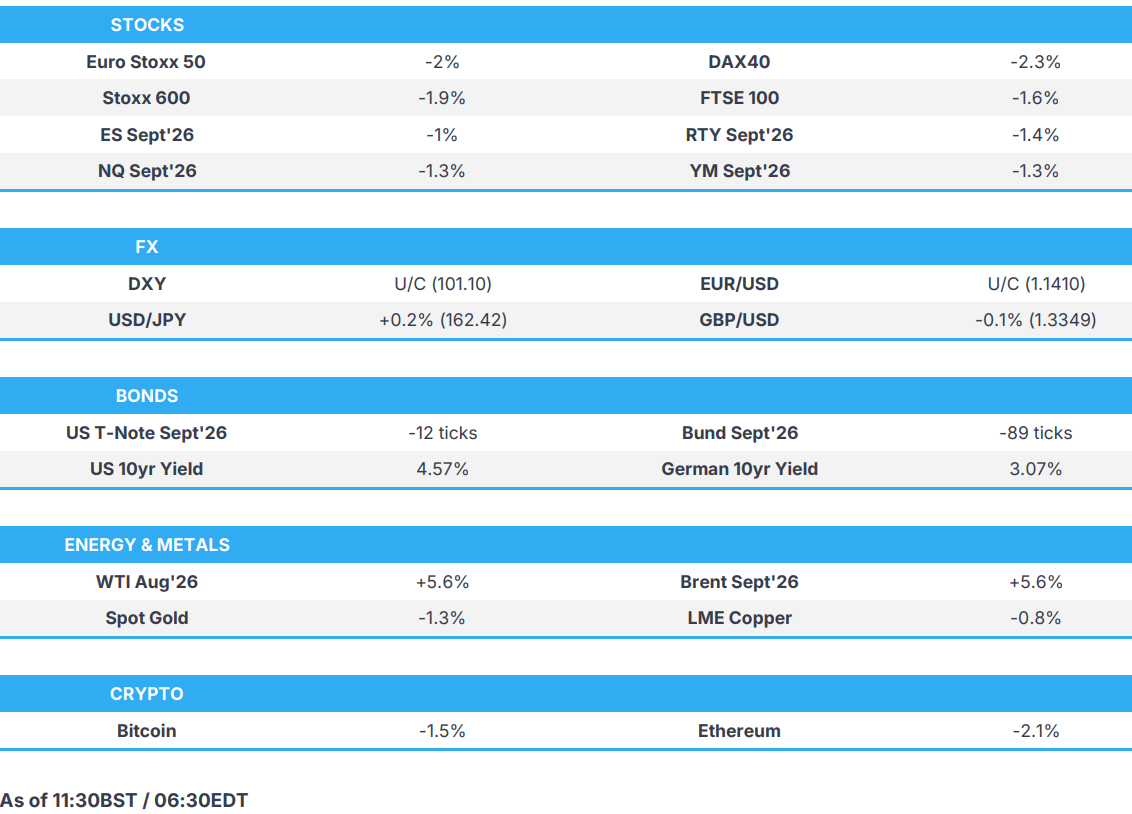
Newsquawk in 3 steps:
1. Subscribe to the free premarket movers reports
2. Listen to this report in the market open podcast (available on Apple and Spotify)
3. Trial Newsquawk’s premium real-time audio news squawk box for 7 days
IRAN CONFLICT
Overnight:
- US CENTOM announced that it completed a new round of offensive strikes, hitting over 80 targets with precision munitions. CENTCOM added that forces remain postured and prepared to hold Iran accountable when the agreement is not adhered to or obeyed.
- Several explosions have been heard in Bushehr, Iran, according to Mehr news; Mehr’s journalist on Kharg Island denies reported of an attack on Kharg, despite some reported of an incident being published.
- In response, Iran’s IRGC said they hit 85 important US military installations in Port Salman, Bahrain’s 5th Maritime Zone and Kuwait’s Ali Salem Air Base.
Trump stated he “thinks” the ceasefire with Iran is “over”:
- US President Trump said the Iran ceasefire is over “I think”; as far as I am concerned, it is a waste of time dealing with Iran. On the MoU, “think it is over”. Adds, “I do not want to deal with Iran”, they are a “bunch of liars”.
- US President Trump said (on Iran) he will allow US negotiators to continue to talk if they want. But, “I think this is a waste of time”.
Full updates can be found in the geopolitical section at the bottom of the sheet.
EUROPEAN TRADE
EQUITIES
- European bourses (STOXX 600 -1.8%) began the session lower amid renewed US-Iran developments which spurred energy benchmarks higher. The move then extended after US President Trump suggested that he thinks the ceasefire with Iran is “over”.
- European sectors in Europe are entirely negative (excl. Energy +2%) as they react to elevated energy prices.
- Stateside, US equity futures are hit this morning in reaction to the above geopolitical updates. RTY (-1.4%) underperforms as yields move higher, NQ (-1.3%) also affected but to a lesser extent as tech recently underperformed.
- Click for the sessions European pre-market equity newsflow
- Click for the additional news
FX
- G10s are mostly lower against the Buck excl. commodity exporters CAD and NOK, which are resilient vs. the USD.
- USD rose throughout the morning in reaction to energy strength alongside sour equity sentiment after US President Trump said he thought the Iran ceasefire was over. To briefly summarise developments, yesterday the US Treasury revoked the June 21st Iran-related waiver, General License X, which had allowed Iran to produce, deliver and sell its oil; and US President Trump’s remarks this morning accelerated the move higher in USD/oil with “Iran ceasefire is over “I think” the kicker.
- Kiwi was the clear outperformer post RBNZ, but reversed gains against the Buck after the aforementioned Trump remarks. To briefly recap, the RBNZ hiked rates by 25bps in a unanimous decision, signalling further hikes to bring inflation to the 2% target mid-point; this saw some participants unwind bets for a hold. AUD/NZD appears the preferred vehicle to express the in-line/hawkish decision, now the Buck has picked up.
- JPY continues to underperform amid carry/Terms of Trade implications. USD/JPY remains on a 162.00 handle and has essentially pared that downside seen on potential intervention fears last week having risen throughout the London morning. Reporting overnight via Asahi and Nikkei noted that the Japanese government may tweak a reference to monetary policy in its annual policy agenda to avoid the appearance that it is putting pressure on the BoJ.
FIXED INCOME
- Fixed income started on the backfoot, as benchmarks gradually moved lower as energy continued to move higher overnight given the US revoked Iran’s oil waiver and then conducted strikes on 80 Iranian targets in retaliation to Iran targeting various cargo vessels on Tuesday.
- The early morning saw modest additional pressure, with Bunds and USTs lower by roughly 40 and five ticks, respectively, at first. The scheduled docket ahead featured supply and a few data points, but we were primarily awaiting comments from the US and/or Iran after the overnight action.
- US President Trump then spoke in Ankara, in a relatively short but packed interview where he said the ceasefire with Iran is over “I think” and specifically on the MoU said, “think it is over”. An update that sparked a marked and continuing move higher in energy, with crude firmer by over 6% and Dutch TTF by over 5%. As such, yields across the curve have jumped, benefiting the short-end most, and curves are bear-flattening globally, though with the US belly faring almost the same as the short-end.
- USTs down to a 108-29 base, lower by 13 ticks. We now look to the US 10yr note auction after Tuesday’s 3yr, and thereafter Fed Minutes for June, which will be scoured for further insight into how the first meeting led by Warsh went and how any discussions/disagreements among the board were presented; with particular reference to any mention around Warsh’s view on forward guidance.
- Bunds went down to around 125.30 following the above energy action and Trump language, lower by over 80 ticks. Energy-related action aside, the main focus point was a dismal first tap of a 2036 Bund, drawing a b/c of just 1.03x. Results of this sent Bunds lower by nearly 10 ticks, to a 125.23 base.
- Gilts opened lower by 57 ticks, acknowledging the US waiver removal yesterday and the tit-for-tat strikes overnight. Thereafter, as Trump spoke, further downside was seen, sending Gilts lower by 130 ticks in total to an 87.16 base. As usual, Gilts underperform amid periods of pronounced energy upside given the sensitivity of the UK market to global benchmarks.
- Germany sold EUR 3.902bln vs exp. EUR 6bln 3.00% 2036 Bund: b/c 1.03x, average yield 3.09%, retention 35%.
- UK sold GBP 1.5bln 0.125% 2028 Treasury Gilts via Tender: b/c 4.97x (prev. 4.28x), average yield 3.989% (prev. 4.219%), tail (prev. 0.3bps).
- Jefferies (JEF) to sell EUR-denominated 7yr noted; guidance seen +175bps to MS.
- Spain has reportedly proposed the EU issue an annual EUR 850bln in bonds to save countries billions of euros in interest costs, POLITICO reported.
- Australia sold AUD 900mln 4.25% 2036 AGBs: b/c 4.55x (prev. 3.86x), average yield 4.8745% (prev. 4.9735%).
COMMODITIES
- Following Iran’s decision to hit Saudi and Qatari tankers, the US struck various sites in Iran. As a result, Iran then hit regional partners, including Bahrain and Kuwait.
- US President Trump, who was speaking at the NATO Summit in Ankara, berated the Iranian regime. He stated that it is a waste of time dealing with Iran, and ultimately stated that he thinks the ceasefire and MoU is “over”. The mention of he “thinks”, gives the US a little bit of optionality on whether the deal is actually over; he stated that he will allow US negotiators to continue to talk. Nonetheless, the risks of a wider escalation remain; markets now await clarification on whether the MoU has officially ended, the Iranian response and also how Qatari/Pakistani mediators react to the comments made by Trump.
- WTI and Brent started the European session with gains in excess of 2%, but surged higher following the Trump comments; currently +5.6%. WTI Aug’26 holds at the top end of a USD 71.75-75.30/bbl range, whilst Brent Sept’26 sits near peaks of USD 75.44-79.26/bbl range. The latter remains well below the levels seen following the initial signing of the Islamabad MoU (USD 85/bbl), which signals some hopes that a) the Strait will remain open, b) the current MoU holds. On this theme, markets remain in backwardation, with front-month Brent prices still higher than second-month; should this flip, it would indicate that traders expect another large-scale supply glut.
- Spot gold (-1.2%) trades lower this morning, and at the bottom end of a USD 4,050-4,133/oz range. Much of the pressure came following the Trump comments, given the USD strength and the inflationary implications of the ceasefire being over. Base metals are broadly lower, given the risk-tone; 3M LME Copper trades at USD 13,190-13,396/t range.
- Kuwait’s Ministry of Electricity said power lines were damaged by shrapnel in recent attacks.
- European Commission, on the ETS revision, said they are still considering how and whether to add international carbon credits. Revision will include permanent domestic carbon removal. Will propose further investment.
- Russia’s Gazprom said Ukraine attacked facilities of gas exports to Turkey; supplies not affected.
- China reportedly lifts restrictions on refined fuel exports for the rest of July, according to sources.
- China purchases at least 5 more US soybean cargoes, Bloomberg reported.
- Japan aluminium premiums for Jul-Sep shipment set at USD 395/t, +12-13% Q/Q.
- US Private Inventory Data (bbls): Crude -0.399mln (exp. -1.5mln), Distillates -1.801mln (exp. +1mln), Gasoline -2.929mln (exp. -1.55mln), Cushing -0.069mln.
TRADE/TARIFFS
- Spanish PM Spokesperson said the trade comments from US President Trump are business as usual.
- USTR Greer said Canada and Mexico have not lived up to everything.
NOTABLE EUROPEAN HEADLINES
- US President Trump said he is not happy with NATO when it comes to Greenland. Spain is a wasted cause, they do not want to do trade. Cutting off all trade with Spain and all visits. “Do not want to do any more trade with them (Spain)”. Treasury Secretary Bessent has been told to cut off all trade with Spain. US is paying too much into NATO. UK and Italy were both terrible in not allowing the US to use military bases. Greenland is not important to Denmark.
NOTABLE EUROPEAN DATA RECAP
- Swedish CPIF MoM Prel (Jun) M/M 0.3% (Prev. 0.9%).
- Swedish CPIF YoY Prel (Jun) Y/Y 1.3% vs exp. 1.2% (Prev. 1.5%).
- Swedish Inflation Rate MoM Prel (Jun) M/M 0.4% (Prev. 1%).
- Swedish Inflation Rate YoY Prel (Jun) Y/Y 0.7% (Prev. 0.8%).
- Swedish GDP MoM (May) M/M 0.9% (Prev. 0.5%).
CENTRAL BANKS
- The RBNZ hikes the OCR by 25bps to 2.50%, as expected; some further reduction in monetary stimulus is likely to be required to return inflation to the 2% target mid-point.
- RBNZ’s Breman said inflation may have already peaked; seeing the economy rebounding now as oil prices fall. We are gradually moving rates towards neutral. Neutral rate is uncertain, with the range of 2.5-3.5%. Bringing inflation back down is needed to bring back demand. Felt it was needed that uncertainty has increased on rate timing.
- Westpac retains call for RBNZ OCR hike in September.
- BoJ’s Asada said a rate hike could slow the economy.
- RBA Assistant Governor Hunter said the Board will act as needed to ensure inflation returns to target and the labour market to sustainable full employment.
- PBoC set USD/CNY mid-point at 6.8077 vs exp. 6.8018 (prev. 6.8054).
NOTABLE US HEADLINES
- South Korea’s Foreign Ministry said they have signed an MoU with the US and Japan on cooperation to deploy small modular reactors.
CRYPTO
- Bitcoin is on the backfoot this morning, following the negative risk-tone; currently holding around the USD 62k mark.
GEOPOLITICS
IRAN COMMENTARY:
- Iranian Parliament Speaker Ghalibaf said the US has violated major parts of the MoU, citing US attacks on southern Iran, reinstating oil sanctions and threats of further strikes as MoU violations.
- Iran’s Foreign Ministry states that the US activity overnight has “rendered important and fundamental parts of the Memorandum of Understanding on the End of the War ineffective”.
- Iranian President Pezeshkian said the US, whether as World Cup host or in its foreign policy, manipulates the rules and resorts to deception, and that Iran rejects such tactics.
- Iran’s top joint miliary command said Iran will give a crushing response to America’s aggression and terrorist action, and under no circumstances will they allow them to interfere in the affairs of the Strait of Hormuz and its management.
- Advisor to Iran’s Supreme Leader said US President Trump intends to attack again and we are fully prepared.
- Iran’s Foreign Ministry condemns the US Treasury’s move to revoke the temporary suspension of sanctions on Iranian oil sales, will take any measure it deems necessary to safeguard its interests and national security. Iran holds the US government responsible for the consequences of the breach of the Memorandum of Understanding.
OVERNIGHT ATTACKS:
- Several explosions have been heard in Bushehr, Iran, according to Mehr news; Mehr’s journalist on Kharg Island denies reported of an attack on Kharg, despite some reported of an incident being published. Elsewhere, sirens were reported in Bahrain once again.
- Renewed explosions sounds heard around Iran’s Qeshm and Sirik, Mehr reported.
- Iran’s army said it targeted the Sheikh Isa Base in Bahrain and warns of more attacks if the US repeats strikes on Iran, Mehr reported.
- Iran’s IRGC said that, in response to the US aggression, they hit 85 important US military installations in Port Salman, Bahrain’s 5th Maritime Zone and Kuwait’s Ali Salem Air Base.
- Iran’s IRGC said they downed a US Mq9 drone in the south of Iran, Press TV reported.
- Iran fires several anti-ship missiles and drones towards US Navy warships in the Sea of Oman, Fars reported citing the Middle East Spectator.
- A US official said the strike on Iran was a punitive action, not a proportional response, and that the operation will not end in the short term, CNN reported.
US COMMENTARY
- US President Trump said the Iran ceasefire is over “I think”; as far as I am concerned, it is a waste of time dealing with Iran. On the MoU, “think it is over”. Adds, “I do not want to deal with Iran”, they are a “bunch of liars”.
- US President Trump said (on Iran) he will allow US negotiators to continue to talk if they want. But, “I think this is a waste of time”.
- US President Trump said have had some great meetings; attacked very powerfully against Iran last night. Have wasted a lot of time with Iran. Iran does not know what it is doing. Iran shot rockets at the ships, which is why the US shot back. Iran is a “dirty” player, “are scum”.
- US President Trump approved the Iran strike plan and ordered it while in Turkey, a US official tells Axios’ Ravid; the official said it is still unclear how long the strikes are going to continue.
- US Secretary of Defence Hegseth has cancelled his visit to Israel, N12/Ynet report.
OTHERS
- Turkish President Erdogan said Europe must take more responsibility when it comes to NATO.
- US President Trump said China is attempting to takeover the Panama Canal, will not let this happen. China has been treating the US right. Big fan of Chinese President Xi.
- Ukrainian Armed Forces said Kyiv is under missile attack.
- Israeli fighter jets carried out attacks in Barachit and Beit Yahoun in southern Lebanon.
- A Pakistani Boeing (BA) plane flying to Karachi has crashed, with sources stating the plane was mistakenly targeted by the US, IRIB reported.
- Chevron’s (CVX) Yasa Polaris oil tanker, used for CPC shipments, was attacked by drones off Russia’s Black Sea coast, according to sources.
- Russia’s Gazprom said Ukraine attacked facilities of gas exports to Turkey; supplies not affected.
- Ukraine’s Military said it struck two oil refineries, six tankers, bridges and the Borisoglebsk airfield; AIF-NK oil refinery in Nizhny Kamsk was also damaged.
APAC TRADE
- Asia-Pac stocks traded mixed, with Chinese indices the only region in the green amid multiple IPOs and strength in China’s tech space. Sentiment from the US session carried over in the Asia-Pac session, as energy prices surged amid the re-escalation of US-Iran tensions.
- ASX 200 continued to be weighed on by metals, with the Metals & Mining sector the worst performer, with Materials followed. Energy topped the sector pile
- Nikkei 225 started on the softer side, briefly returned to the unchanged mark before returning to the downside.
- KOSPI traded choppy, as the initial weakness briefly reversed to print modest gains. However, weakness returned as the session continued, resulting in the Korea Exchange activating the sidecar on the KOSPI and KOSDAQ. As a result, the KOSPI extended its losses from June peak to 20%, indicating a bear market.
- Shanghai Comp. and Hang Seng. were the only indices printing gains, with outperformance in the Hang Seng following strength in tech names. The strength can be attributed to two reports: 1) From Reuters, DeepSeek developing its own chip to power AI systems, and 2) from the Information, Zhiphu considering designing its own AI chip.
NOTABLE ASIA-PAC HEADLINES
- China’s MIIT has issued a risk warning regarding the potential security backdoors in the AI programming tool Claude Code.
- South Korean Government said companies with consolidated assets of over KRW 10tln will be required to disclose information on their ESG performance and risks, starting 2028.
- South Korean Finance Minister said they are to watch risk factors around stock market volatility, will enhance FX monitoring system to respond to night-time volatility.
- Japan is considering a change to monetary policy wording in the Honebuto, Asahi reported.
NOTABLE APAC DATA RECAP
- Japanese Eco Watchers Survey Current (Jun) 44.0 vs. Exp. 44.6 (Prev. 43.6).
- Japanese Eco Watchers Survey Outlook (Jun) 45.7 (Prev. 40.7).
- Japanese Bank Lending YoY (Jun) Y/Y 5.7% vs. Exp. 5.8% (Prev. 5.7%).
- Japanese Current Account (May) 3.968B vs. Exp. 4121B (Prev. 3907B).
- Australian Private House Approvals MoM Final (May) M/M 2.8% vs. Exp. 2.8% (Prev. -1%).
- Australian Building Permits YoY Final (May) Y/Y 5.3% vs. Exp. 5.3% (Prev. 10.2%).
- Australian Building Permits MoM Final (May) M/M -1.1% vs. Exp. -1.1% (Prev. -3.4%).
1 c) Asian opening report
Europe primed for lower open as energy rises on US revoking Iran oil waiver – Newsquawk EU Market Open
Wednesday, Jul 08, 2026 – 02:15 AM
- Mixed APAC trade, China in the green amid multiple IPOs and tech strength locally. US and European futures contained.
- DXY is range-bound despite the renewed Middle East clashes. Yields consolidate after the energy-driven lift on Tuesday, following the revocation of the Iranian waiver and tit-for-tat strikes.
- US Treasury revoked the June 21st Iran-related waiver, General License X, which had allowed Iran to produce, deliver and sell its oil
- Brent remains above USD 76/bbl, firmer by c. 3.5%, driven higher by the above points. Though, interestingly, the US strikes did not spur any further upside.
- RBNZ hiked by 25bps in-line with consensus, assessed the current OCR remains accommodative, and further increases “appear likely”.
- Looking ahead, highlights include Swedish Inflation Prelim. (Jun), US Atlanta Fed GDP (Q2), NBP Policy Announcement (Jul), NBH Minutes (Jun), Fed Minutes (Jun), NATO Ankara Summit, Speakers include US President Trump, Supply from the UK, Germany and the US.
- Click for the Newsquawk Week Ahead.
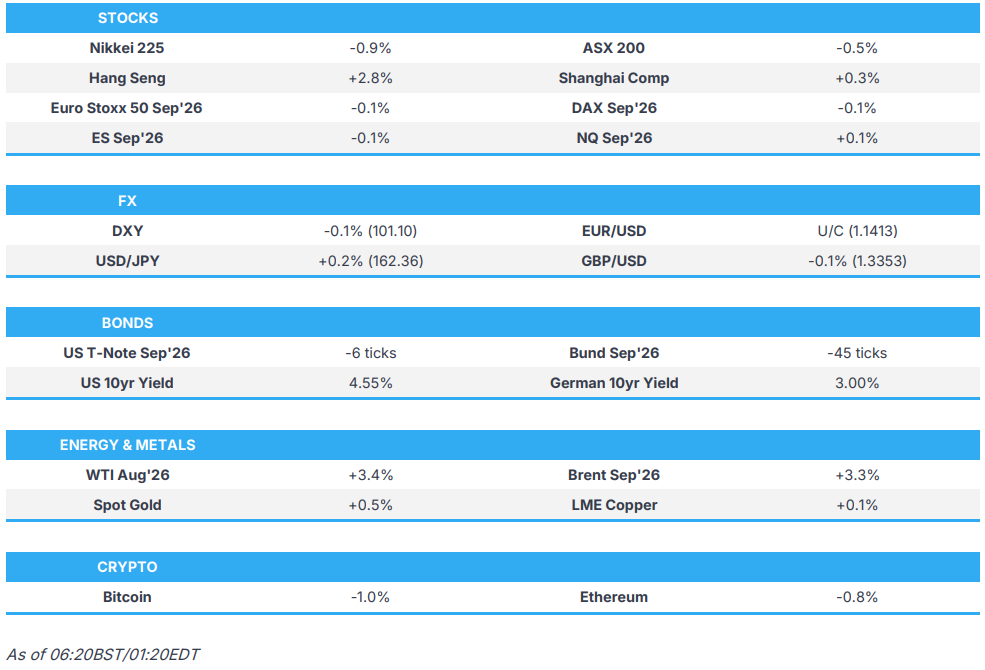
Newsquawk in 3 steps:
1. Subscribe to the free premarket movers reports
2. Listen to this report in the market open podcast (available on Apple and Spotify)
3. Trial Newsquawk’s premium real-time audio news squawk box for 7 days
IRAN CONFLICT
- US CENTOM announced that it completed a new round of offensive strikes, hitting over 80 targets with precision munitions. CENTCOM added that forces remain postured and prepared to hold Iran accountable when the agreement is not adhered to or obeyed.
- Earlier, US CENTOM announced that forces have begun launching a series of powerful strikes in response to Iranian attacks on three commercial vessels transiting through the Strait of Hormuz. Iran’s demonstrated aggression was unwarranted, dangerous and a clear violation of the ceasefire. Axios’ Ravid reported that the strikes targeted Iranian air defence systems, coastal surveillance systems, surface air missiles, anti-ship cruise missile sites, drone launch sites and port facilities.
- There were reports of explosions throughout the south of Iran, including Sirik, Qeshm and Bandar Abbas. There were also reports of explosions on Kharg Island.
- In response, Iran’s IRGC said they hit 85 important US military installations in Port Salman, Bahrain’s 5th Maritime Zone and Kuwait’s Ali Salem Air Base.
- A US official said the Iranian military launched drones at Bahrain, Axios’ Ravid reported. This came following sirens and explosions in Bahrain.
- Iran fired several anti-ship missiles and drones towards US Navy warships in the Sea of Oman, Fars reported citing the Middle East Spectator.
- US President Trump approved the Iran strike plan and ordered it while in Turkey, a US official told Axios’ Ravid. The official added that it is still unclear how long the strikes are going to continue.
- A US official said the strike on Iran was a punitive action, not a proportional response, and that the operation will not end in the short term, CNN reported.
- A US official said negotiators continue to work in good faith towards a final agreement but Iran’s actions in the Strait were wholly unacceptable to the US and will be met with consequences.
- US Treasury revoked June 21st Iran-related waiver; Revokes General License X, effective July 7th, 2026, which previously authorized the production, delivery, and sale of Iranian-origin crude oil and petrochemical products from Iran.
- Iranian Parliament Speaker Ghalibaf said the US has violated major parts of the MoU, citing US attacks on southern Iran, reinstating oil sanctions and threats of further strikes as MoU violations. The US also violated Iranian adjustments in the Strait of Hormuz and continued Israeli aggression on Lebanon.
- Iran’s top joint miliary command said Iran will give a crushing response to America’s aggression and terrorist action, and under no circumstances will they allow them to interfere in the affairs of the Strait of Hormuz and its management. The US army targeted parts of southern Iran in blatant aggression. The force also reiterated that the only safe route for the passage and traffic of commercial ships and tankers is the route that Iran has determined.
- Iran’s Foreign Ministry condemned the US Treasury’s move to revoke the temporary suspension of sanctions on Iranian oil sales. The Ministry said that we will take any measure it deems necessary to safeguard its interests and national security and that Iran holds the US government responsible for the consequences of the breach of the Memorandum of Understanding.
- Iran’s Foreign Ministry Spokesperson said Qatar’s accusations against Iran regarding attack on a vessel linked to the Country in the Strait of Hormuz are perplexing and inconsistent with the principle of good neighbours, adding that Iran is diligently fulfilling its commitments under the MoU to take measures to manage the Strait of Hormuz and urged countries and shipping companies to refrain from any actions that contradict the MoU.
- US official said the US military also shot down multiple drones launched by Iran today and the attacks are a direct violation of the MoU.
- There were reports of widespread power outages in cities in Kuwait and Bahrain. Later, Bahrain Electricity and Water Authority said power has been fully restored after a limited outage in several areas.
- Israeli PM Netanyahu said he and US President Trump see “eye to eye” on the big things related to the handling of Tehran, despite the occasional disagreements.
- US War Secretary Hegseth is reportedly planning to make a visit to Israel on Wednesday, CNN reported citing sources.
- Israeli fighter jets carried out attacks in Barachit and Beit Yahoun in southern Lebanon.
US TRADE
EQUITIES
- US stocks were sold on Tuesday, with the Nasdaq the clear underperformer as Technology led the downside, particularly across semiconductor and memory names. The primary catalyst was Samsung’s preliminary Q2 earnings, which disappointed lofty investor expectations and prompted a reassessment of valuations following the recent rally in the memory sector. Industrials also lagged, with sharp weakness in GE Vernova (GEV) weighing on the AI theme given its exposure to supplying power infrastructure for energy-intensive data centres. Energy was the clear outperforming sector as crude prices moved higher on renewed geopolitical tensions. Iran attacked commercial vessels from Qatar and Saudi Arabia in the Strait of Hormuz, before the US later responded by revoking Iran’s General License X, which had allowed the country to produce, deliver and sell energy products.
- SPX -0.48% at 7,501, NDX -1.77% at 29,173, DJI -0.25% at 52,925, RUT -0.91% at 2,982.
TARIFFS/TRADE
- USTR Greer said Canada and Mexico have not lived up to everything.
CENTRAL BANKS
- The RBNZ hiked the OCR by 25bps to 2.50%, as expected, and stated that some further reduction in monetary stimulus is likely to be required to return inflation to the 2% target mid-point. The decision to hike was unanimous. The Committee assessed that the current level of the OCR remains accommodative but while further OCR increases appear likely at upcoming meetings, their timing is highly uncertain.
- RBNZ’s Breman said in the post-policy press conference that we are gradually moving rates towards neutral, however the neutral rate is uncertain, with the neutral figure lying in a range of 2.5-3.5%. She reiterated that they felt it was needed to stress that uncertainty has increased on rate timing.RBA Assistant Governor Hunter said the Board will act as needed to ensure inflation returns to target and the labour market to sustainable full employment. There are few signs of a marked slowdown in activity.BoJ’s Asada said a rate hike could slow the economy.
NOTABLE HEADLINES
- Microsoft (MSFT) replaces OpenAI and Anthropic with it’s own AI in some apps.
- Atlanta Fed GDPnow Model (Q2): 1.4% (prev. 1.2%).
APAC TRADE
EQUITIES
- Asia-Pac stocks traded mixed, with Chinese indices the only region in the green amid multiple IPOs and strength in China’s tech space. Sentiment from the US session carried over in the Asia-Pac session, as energy prices surged amid the re-escalation of US-Iran tensions.
- ASX 200 continued to be weighed on by metals, with the Metals & Mining sector the worst performer, with Materials followed. Energy topped the sector pile
- Nikkei 225 started on the softer side, briefly returned to the unchanged mark before returning to the downside.
- KOSPI traded choppy, as the initial weakness briefly reversed to print modest gains. However, weakness returned as the session continued, resulting in the Korea Exchange activating the sidecar on the KOSPI and KOSDAQ. As a result, the KOSPI extended its losses from June peak to 20%, indicating a bear market.
- Shanghai Comp. and Hang Seng. were the only indices printing gains, with outperformance in the Hang Seng following strength in tech names. The strength can be attributed to two reports: 1) From Reuters, DeepSeek developing its own chip to power AI systems, and 2) from the Information, Zhiphu considering designing its own AI chip.
- US equity futures started futures trade on the backfoot but pared slightly and currently trades flat.
- European equity futures are indicative of a muted open with the Euro Stoxx 50 future U/C after cash closed -1.2% on Tuesday.
FX
- DXY traded in a narrow 101.07-101.22 range despite the renewed aggression between the US and Iran, primarily as a result of IRGC strikes on 3 commercial ships in the Strait of Hormuz. Looking ahead, focus will be on the FOMC minutes from the June meeting.
- EUR and GBP rotated in tight ranges, with EUR/USD briefly slipping below the 1.1400 handle while GBP/USD traded either side of the 1.3350 mark. Not much on the docket in either region. ECB minutes are expected on Thursday, while final German and French inflation figures are to be released on Friday.
- USD/JPY regained the 162.00 handle during Tuesday’s session and has continued to extend higher on Wednesday, topping at 162.46. An interesting report by Asahi and Nikkei, stating that the Japanese government may tweak a reference to monetary policy in its annual policy agenda to avoid the appearance that it is putting pressure on the BoJ.
- NZD/USD was the G10 outperformer, after the RBNZ hiked rates by 25bps, unanimously, and signalled further hikes to bring inflation to the 2% target mid-point.
FIXED INCOME
- UST Futures oscillated in a narrow 109-02+ to 109-06+ range, as energy prices consolidated after crude futures surged over 5% in Tuesday’s trade following the revocation of Iran’s oil waiver and US threats, which then resulted in tit-for-tat strikes between the US and Iran.
- Bund Futures, in tandem with USTs, traded in a tight 17-tick range. This comes ahead of a 10-year Bund auction, in which Germany is to sell EUR 6bln 3.00% 2036 Bunds. With the recent rise in yields, this could bring in extra demand for German debt, as seen with the US 3yr auction on Tuesday.
- JGB Futures also traded on a slightly softer footing but in narrow ranges. Japanese yields have reached highs not seen since the 1990s, with a slight inversion at the long-end of the curve.
- US sells USD 58bln of 3-year notes; stop-through 0.6bps.
- Australia sells AUD 900mln 4.25% 2036 AGBs: b/c 4.55x (prev. 3.86x), average yield 4.8745% (prev. 4.9735%).
COMMODITIES
- Crude futures held onto its post-settlement gains, as Brent traded either side of USD 76/bbl. Post-settlement, the US Treasury revoked Iran’s rights to sell its oil, while a US official stated that Iran’s actions in the Strait will be met with consequences. This lifted the energy complex higher and later, US CENTCOM announced that forces began launching strikes, with explosions heard in Sirik, Qeshm and Bandar Abbas, targeting Iranian weapon launch sites, air defences and more. However, this did not result in any further upside in crude futures as participants telegraphed the US response. Iran released a statement, saying it will take any measure to safeguard its interests and national security, with Iran’s IRGC claiming to have hit 85 US military installations in Kuwait and Bahrain.
- Precious Metals traded rangebound, with spot gold finding support at the USD 4100/oz handle, despite the renewed US-Iran strikes. Analysts think the yellow metal could test below USD 4k/oz. However, supporting the metal is continued central bank buying, with the PBoC having bought 480k troy ounces of gold in June, its biggest purchase since October 2023.
- 3M LME Copper opened lower, below the USD 13.3k/t mark, but reversed just shy of the unchanged mark amid positiveness in Chinese markets.
- US Private Inventory Data (bbls): Crude -0.399mln (exp. -1.5mln), Distillates -1.801mln (exp. +1mln), Gasoline -2.929mln (exp. -1.55mln), Cushing -0.069mln.
- EIA STEO: 2026 World Oil Demand at 102.8mln BPD (prev. 102.9mln BPD); 2027 World Oil Demand at 104.8mln BPD (prev. 105.3mln BPD).
- Discounts for Russian Urals crude raise to USD 10/bbl vs. Brent in India amid weaker demand.
- Japan aluminium premiums for Jul-Sep shipment set at USD 395/t, +12-13% Q/Q.
CRYPTO
- Bitcoin extended lower, back below USD 63k, amid the lack of desire to hold risky assets
NOTABLE ASIA-PAC HEADLINES
- Japan is considering a change to monetary policy wording in the Honebuto, Asahi reported.
DATA RECAP
- Japanese Bank Lending YoY (Jun) Y/Y 5.7% vs. Exp. 5.8% (Prev. 5.7%).
- Japanese Current Account (May) 3.968B vs. Exp. 4121B (Prev. 3907B).
- Australian Building Permits YoY Final (May) Y/Y 5.3% vs. Exp. 5.3% (Prev. 10.2%).
- Australian Building Permits MoM Final (May) M/M -1.1% vs. Exp. -1.1% (Prev. -3.4%).
GEOPOLITICS
RUSSIA-UKRAINE
- Russian officials have stated that military operations in Ukraine will cease the day after the withdrawal of the Armed Forces of Ukraine from Russian territory, RIA reported.
- Explosions heard in Ukraine’s Kyiv, AFP reported, which was later confirmed by the Ukrainian Armed Forces.
OTHER
- US President Trump is expected to remove Syrian Terrorism Designation, Semafor reported.
EU/UK
NOTABLE HEADLINES
- The UK Conservative Party and Labour Party have both announced that they will not stand a candidate in the Clacton by-election.
end
NORTH AND SOUTH KOREA AND JAPAN
SOUTH KOREA
JAPAN
Japan’s Keynesian Mirage: How Debt, Inflation, & A Collapsing Yen Expose A Failed Model
Tuesday, Jul 07, 2026 – 06:25 PM
Japan’s yen crisis exposes the long‑running failure of the Keynesian strategy that has dominated the country’s economic policy: chronic deficits, exploding public debt, and engineered inflation are now eroding Japan’s purchasing power, competitiveness, and monetary stability.

For decades, many mainstream analysts pointed to Japan as proof that a rich, “monetarily sovereign” country could keep an extremely high public debt without relevant consequences. The argument was simple: as long as the state can issue its currency, it can always print whatever is needed to cover deficits, refinance debt, and support public spending.
In reality, that has meant public debt soaring to around 250% of GDP, one of the highest levels in the developed world, while repeatedly increasing government expenditure and leaving large, persistent deficits. Even the IMF notes that, even after several years of moderate growth, prudence is “key to keep debt‑to‑GDP on a firmly downward path,” admitting that the current level is a structural vulnerability.
Japan’s apparent stability depended on a crucial external factor, the country’s enormous exporting capacity.
As a leading exporter of cars, technology, and capital goods, the country attracted a continuous inflow of US dollars and foreign capital that supported a stable currency and kept inflation low, despite fiscal excess. That protective layer is eroding fast. Headline inflation has edged up from 1.4% in April 2026 to 1.5% in May, while core inflation has held at 1.4%, still below the Bank of Japan’s 2% target but clearly positive after three decades of near‑zero price growth.
A key factor of the Japanese model was its export engine and the “golden goose” of capital inflows.
These two factors allowed the country to live with large debt and deficits without immediately triggering high inflation. However, that mirage is vanishing as external performance falters and inflation, though moderate, bites into real incomes.
Keynesianism did not spur growth or improve Japanese citizens’ lives. It just bloated an unsustainable government machine.
Recent data show that price increases are now broad‑based, not confined to a few categories. In May 2026, overall CPI inflation was 1.5% year-on-year. However, food prices rose 3.5% year-on-year, which is a heavy burden for households. Goods inflation stood at 2.0%, while services inflation was around 1.0%.
Underlying inflationary pressures, particularly in services and wage‑sensitive sectors, are now embedded in the system rather than an isolated energy shock. Meanwhile, real net wages are stagnant or declining. Japanese citizens face an affordability crisis.
The authorities, obsessed for years with the ludicrous “risk of deflation,” consciously tried to push inflation above zero, aiming to erode the real value of the public‑debt stock. They have achieved modest inflation, but at the cost of real wage erosion. Despite headline gains in nominal pay, inflation‑adjusted wages have fallen for four consecutive fiscal years, with a 0.5% decline in real wages in fiscal 2025 alone. Citizens are poorer, while the government is bigger, even as headline macro indicators show stability.
The most visible symptom of this model’s exhaustion is the yen. Despite repeated interventions by the Bank of Japan and a shift towards higher policy rates—the BOJ’s benchmark is now at its highest point since the mid‑1990s—the currency has slid to levels not seen in almost forty years. Each attempt to defend the yen produces a brief rebound, but the broader trend reflects markets’ concern about Japan’s long‑term fiscal and monetary sustainability.
Japan is not going bankrupt in strict terms; it is demolishing its currency, which is equivalent to an implicit default.
No one wants Japan to fail, but the model has delivered nothing in the past decade. The IMF talks about solid output growth, robust domestic demand, and low unemployment. However, domestic demand and GDP are disguised by constantly rising government spending, while low unemployment is a consequence of challenging demographic conditions. Japan’s population is aging and shrinking, and Keynesianism has made it harder for families to grow and have children.
If GDP and domestic demand were really strong, the country would have a strong currency. Instead, the yen weakness reveals investors’ skepticism regarding a model that combines very high debt, structurally positive inflation, and decades of real wage stagnation.
Japan has avoided a formal sovereign default and sudden stop in financing not because the Keynesian model is sound, but because the country still attracts a “gigantic” inflow of foreign capital and investment. Those inflows supply dollars, support asset prices, and help keep the system running despite its internal contradictions. A Bank Of Japan obsessed with raising asset prices by increasing ownership of ETFs shows it is more interested in headline figures than citizens’ cost of living.
On the surface, the wage picture in early 2026 looks encouraging. Average cash earnings grew 3.5% year‑on‑year in April 2026, marking the 52nd consecutive month of nominal wage gains and the fastest pace since late 2024. Base pay was up 3.4%, and nominal wages rose across sectors—from manufacturing and construction to information and communications and finance. Government data show that in March, nominal wages increased about 2.7%, while the consumer inflation rate used to calculate real wages stood at 1.6%, allowing real wages to rise roughly 1% in that month. However, these monthly improvements sit atop a longer‑term pattern where inflation has outpaced wage growth. Over fiscal 2025, real wages fell 0.5% and the small bounce may be short-lived as estimates show another negative real wage year for 2026. Japan’s real wages have stagnated for nearly 30 years since peaking in 1997. The inflation that policymakers wanted to generate is ultimately eroding the living standards of the citizens whose demand is supposed to sustain growth.
Against this backdrop, calls to raise taxes further to stabilize the public accounts risk pushing the system into another vicious circle. Higher taxation would likely weaken investment and capital inflows, undermine competitiveness, and intensify pressure on households. Immigration, often proposed as a demographic fix, may raise aggregate GDP but also increase fiscal strain when public finances are already deeply imbalanced, as seen in other advanced economies.
Japan’s situation is not a sudden accident; it is the culmination of policies that have been failing for decades. The country’s wealth, export capacity, and capital inflows allowed it to live with large imbalances for a long time. The difference today is that the traditional strengths have weakened, and the latest data make the structural problems clearer.
Japan shows the structural failure of a policy approach that “always seeks to expand public imbalances at the expense of citizens.” The Keynesian experiment in Japan aimed to prove that government is a key engine of growth but instead produced long‑term stagnation, high debt, and an erosion of real incomes. The yen’s weakness is simply the symptom of a larger disease: statism. And some want to repeat it in your country.
END
ROBERT H…
Japan’s Debt Dilemma: The Coming Treasury Dump That Could Shatter the West – NaturalNews.com
This has been a rumor for several days.
As it seems that they will tokenize the currency.
Japan was always the Canary in the coal mine of yesterday’s financial structure. It would not surprise that they chart a new course. This is what a number of nations are doing to survive. The conflict with Iran has wide implications to a world dependent on energy to have a modern day life. Japan will do what it needs to do to survive and prosper.
People forget that tariffs often kill trade when trade becomes a cost that profit cannot cover. No one can afford such a deal.
The other day speaking with a senior party in a multi billion US Corporation i was told that the 15% they are paying for Canadian goods for automation does nothing but hurt their bottom line. Does anyone listen to that side of the tale? Tarriffs may benefit the State but at the expense of industry, American industry.
The private family interests of Administration related parties commingled with the public purse for finance acts as a beacon for other nations to use their clout to further interests of their industrial champions in a race for global markets. This is an entirely new game when old morals mean nothing. Because when you blur the lines of politics with the public purse and self serving of family wealth there is NO national interest as it became private. This makes the State a tool of governing government officials.
3 CHINA
4. EUROPEAN AND SCANDINAVIAN COMMENTARIES PLUS NATO
EU
Watch: MEP Forces EU To Address Wave Of Savage Migrant Attacks Throughout Europe
Wednesday, Jul 08, 2026 – 03:30 AM
Authored by Steve Watson via Modernity News,
In a decisive move highlighting the growing crisis of migrant violence across Europe, Sweden Democrats MEP Charlie Weimers has successfully pushed the European Parliament to debate recent fatal attacks on native Europeans, and their direct implications for public security on the streets.

Weimers’ intervention comes in the immediate wake of the savage beating death of 32-year-old Swedish father Christian Zedig, ensuring the tragedy cannot be swept aside as just another “isolated incident” by those invested in open borders policies.
Weimers delivered a stark address to the chamber, laying bare the human cost:
“In recent days, Europe has once again been reminded of the very real threats to public security on our streets. In Copenhagen, Swedish police officer Christian Zedig, a 32-year-old father of two, was brutally beaten to death at a world cup fan zone,” Weimers urged.
He continued, “He was off duty, simply watching a match with friends, when he tried to calm a situation, he was attacked and stomped to death. In Milan Italy, a Gambian migrant stabbed an innocent man 20 times. He said it was for fun, and that he would do it again when he gets out. These are not isolated incidents, they are part of a broader pattern that is undermining the safety of ordinary Europeans.”
His words cut through the usual parliamentary fog, naming the pattern that too many officials prefer to obscure. The debate, later today will addresses the urgent need to confront how unchecked migration is eroding safety in European cities and public spaces.
Weimers expressed astonishment that Swedish Social Democrats voted against even holding the discussion, posting the voting record as evidence. This reluctance speaks volumes about priorities: shielding failed migration policies over acknowledging the suffering of ordinary citizens and their families.
The Zedig family’s nightmare began at a seemingly ordinary World Cup fan zone in Copenhagen’s Islands Brygge area. Christian had traveled with friends to watch Norway face Ivory Coast before Sweden’s own match. Wearing his national team shirt, he was enjoying the atmosphere when violence erupted.
A group of seven or eight young African men, according to eyewitnesses speaking to Danish media, arrived not to watch football but to provoke. They taunted supporters, threw beer and objects after Norway’s late winning goal by Erling Haaland, then rushed a table of Scandinavian fans.
Zedig was punched in the head, collapsed immediately, and was then repeatedly stomped by multiple attackers while lying defenseless on the ground. The assailants fled the scene. Despite medical efforts, Zedig succumbed to his catastrophic injuries, leaving behind a devastated wife and two young daughters who will grow up without their father. Swedish police confirmed the death of their colleague, with local officers holding a memorial gathering.

Father Of Two BRUTALLY Beaten To DEATH By African Mob At World Cup Fan Zone
Off-duty cop intervened to stop a brawl only to be stomped to death, leaving wife and
His sister’s emotional tribute captured the family’s anguish: “My beautiful and thoroughly good-hearted brother. How will we make it without you with us? Who gave them the right to take you away from us? The grief is never-ending.” Friends and colleagues described him as a dedicated officer and family man, making the senseless loss even more painful.
The main suspect, identified as an African migrant with a history of prior assaults and criminal convictions, eventually turned himself in to Danish police after authorities publicly released his photograph. He was arrested and remanded in custody for up to 26 days. While the formal charge had not yet been upgraded to murder at the time of initial proceedings, the facts of the mob attack speak for themselves.
This horror is the latest in a string of incidents that Weimers and like-minded MEPs have been warning about for years.
Media handling of the tragedy has only added fuel to public anger. Danish broadcaster TV2 aired live footage of a minute of silence held for Zedig before the later Norway-Brazil match at the same fan zone. The clip reportedly captured migrants ignoring the tribute or even laughing.
When the segment re-aired in a news broadcast, those seconds were conveniently edited out, shielding viewers from the disrespect.
Weimers has consistently exposed the consequences of mass immigration and demographic shifts. In March, alongside other lawmakers, he helped spotlight the spread of no-go zones tied to rapid Islamization and uncontrolled inflows.
European Lawmakers Warn Of ‘No-go Zones’ Tied To Mass Immigration And Islamization
“A wake-up call on the failures of uncontrolled immigration”
A New Direction report analyzed high-crime neighborhoods across Europe, ranking areas like Franc Moisin in France and Rosengård in Malmö by metrics of violence, parallel societies, unemployment, school failure, and emergency service breakdowns. These zones show strong correlations with high shares of foreign-born and Muslim populations, where state authority recedes and other rules prevail.
French MEP Marion Maréchal emphasized the data: France alone has hundreds of sensitive urban areas disproportionately linked to these dynamics. The report serves as a documented indictment of policies that have allowed parallel societies to flourish.
At a Warsaw conference around the same time, experts warned bluntly that Europeans are committing demographic suicide. Low native birth rates combined with high migration from younger, culturally distant populations create unsustainable pressures.

‘Europeans Are Committing Demographic Suicide’
EU politicians and researchers gather in Warsaw to discuss solutions for Europe’s immigration crisis
Outdated tools like the Geneva Convention were called “sacred cows” in need of reform, with calls to renationalize asylum and migration policy to restore national control. Speakers contrasted thriving, cohesive Polish cities with decaying Western European examples overwhelmed by crime and social breakdown.
Despite institutional resistance, conservative and sovereignist forces have scored tangible victories. The European Parliament backed major updates to the Returns Regulation, a breakthrough expanding deportation powers, mutual recognition of orders across member states, longer detention periods, extended entry bans, and possibilities for return hubs outside EU territory.

MAJOR VICTORY: European Parliament Backs Remigration Efforts
The era of deportations has begun
Weimers described stricter return rules as one of the Sweden Democrats’ biggest negotiating successes, declaring “the era of deportations has begun.”
Italian PM Giorgia Meloni welcomed the changes as validation of her government’s approach. Other leaders from the right celebrated the shift toward enforcement and national sovereignty over Brussels dictates.
Leftist reactions included chants of “shame” met with counter-chants of “send them back,” followed by complaints about conservatives celebrating the win with a rooftop gathering – moments of dark comedy amid the stakes.
This Is The Funniest Thing Ever…
EU Karen demands to speak to the manager about deportation celebration
These advances prove that persistent advocacy can shift policy, even if implementation lags and globalist pushback – from the UN and others – continues. Yet incidents like Zedig’s murder demonstrate why speed matters. Return rates remain abysmal under old rules, allowing repeat offenders and unintegrated migrants to remain threats.
Zedig’s death is tragically familiar. From stabbings to grooming scandals, rioting, and everyday street violence, the data on overrepresentation in crime statistics across Western Europe is inescapable for those willing to examine it. Fan zones, once symbols of shared celebration, now risk becoming flashpoints due to imported rivalries and lack of respect for host societies.
Weimers’ Rule 164 initiative forces the Parliament to address implications head-on: rising insecurity, strained police resources, cultural fragmentation, and the demographic trajectory that amplifies risks. Ignoring it invites more tragedy and deeper societal division.
Europe stands at a crossroads. Decades of elite-driven mass immigration without regard for compatibility, numbers, or enforcement have produced predictable results: overburdened welfare systems, no-go areas, terror threats, and innocent victims. Families torn apart, communities on edge, and taxpayers funding the consequences.
The successes on remigration tools offer hope, but only if national governments wield them aggressively. Weimers and allies are dragging the conversation toward reality – prioritizing citizens’ safety, cultural cohesion, and sovereignty. The votes against even debating the matter reveals who still clings to denial.
As the Parliament convenes, the message is clear: enough is enough. Europeans deserve leaders who secure borders, enforce returns, and put their own people first. The era of looking the other way must end.
Your support is crucial in helping us defeat mass censorship. Please consider donating via Locals or check out our unique merch. Follow us on X @ModernityNews.
END
NATO/EUROPE
Rutte Touts ‘Literally Billions’ Invested To Drastically Ramp Up NATO’s Drone Capabilities
Wednesday, Jul 08, 2026 – 02:45 AM
NATO leadership has this week made clear where it plans to invest a bulk of defense and tech-related funds in the coming years, while making express reference to lessons learned from the Russia-Ukraine battlefield.
The alliance’s Secretary General Mark Rutte said Tuesday that drone warfare is the next great expanse in NATO capabilities. He touted that member states are unveiling “major new projects” worth “literally billions of dollars” at the Ankara summit. “These are billions that are invested in our security, boosting our economies and supporting hundreds of thousands of new jobs,” Rutte stated. “It’s money well spent.”

He unveiled that among the projects include the NATO future procurement of five “high-end, high-altitude and long-endurance uncrewed aircraft” from Northrop Grumman.
Defense News reviews:
Built by Northrop Grumman, the MQ-4C Triton is a high-altitude, long-endurance UAV specifically designed for maritime surveillance over vast stretches of sea.
According to Rutte, the aircraft will help NATO detect threats early, protect sea lines of communication, and support operations in demanding regions, such as the High North. “These aircraft can fly for long periods at high altitude and cover large areas, including over open water, more efficiently than most other aircraft can,” he said at the event, organized to coincide with the NATO summit this week.
Rutte stressed that intelligence, surveillance and reconnaissance (ISR) is a vital capability for the alliance, as it provides the situational awareness needed to make the right decisions and stay ahead of threats. “Today, allies are taking a concrete step to strengthen this capability,” he added.
An additional project area outlined by Rutte involves 40 billion dollars’ worth of investment in “counter-drone capabilities over the next five years,” the alliance additionally said in a statement.
Another drone-focused initiative is a goal for allies to “train five times as many drone operators by the end of 2027.” This is where the Ukraine experience seems to have deeply informed NATO doctrine and direction.
“Drones have fundamentally altered the character of modern warfare and become a decisive factor on the battlefield,” the alliance said in its statement. “These initiatives will be essential to increase both Alliance readiness and resilience.”
Western backers of the Zelensky government have of late been hailing the effectiveness of Ukraine forces’ long-range drone strikes, which have often devastated major Russian refineries and energy infrastructure.
At the same time NATO officials are seeking to make a positive impression on President Trump, after he’s long demanded the alliance collectively raise the bar much higher on defense investment and spending. All of this could kick the can further in terms of needless escalation with Russia – especially the ongoing support to Ukraine’s long-range drones and missiles, which are being sent deeper and deeper into Russian territory.
END
NATO //USA
NATO Chief Backs Renewed US Strikes On Iran As ‘Absolutely Necessary’
Wednesday, Jul 08, 2026 – 08:25 AM
Even if most individual NATO members are still reluctant to jump on board Trump’s Iran war, NATO Secretary-General Mark Rutte is busy praising American military action there amid the annual summit in Ankara.
Rutte has freshly described the overnight fresh US military strikes on Iran in response to Tehran attacking multiple international shipping vessels “absolutely necessary”. Rutte voiced agreement with Trump that Iran’s actions violated the MoU ceasefire agreement with the US, which required a response.

“When you have a ceasefire and Iran is basically violating the ceasefire, I think it is totally crucial that the US forcefully react,” Rutte told reporters.
The new US actions resulted in a swift Iranian response, in the form of Iranian drones and missiles on Kuwait and Bahrain, which the latter country decried as a “dangerous escalation”.
“The era of bullying and extortion is over,” Iran’s Parliament Speaker Mohammad Bagher Qalibaf wrote on X. “It leads nowhere. We don’t fold.”
As we reported earlier, President Trump has called the Iranians “scum” and declared the ceasefire “over”: “To me, I think it’s over. I don’t want to deal with them anymore; they’re scum,” Trump told reporters.
All this naturally brings up the question of ‘what’s next?’
Certainly the Iranians seem in the mood for a fight, and Washington feels it can’t let attacks on international shipping slide – so all for this could portend a return to all-out war.
It’s been 129 days since the start of Operation Epic Fury – a conflict which US officials had promised would be ‘fast’ – and the public has been ‘assured’ it is not a quagmire. Yet here we are.
As for Rutte, it’s unclear what his strategy for Iran, if any, might be. He’s clearly trying to keep Trump happy, playing Trump whisperer in Turkey, vis-a-vis the NATO alliance and its continued funding. Here was some Trump commentary on NATO ‘unity’ in Ankara:
“Spain is a terrible partner in NATO. They don’t participate. They don’t pay. I don’t want anything to do with Spain. Cut off all trade with Spain, please, including visits,” he said at a press conference in Ankara with NATO Secretary General Mark Rutte.
Trump also reignited inter-alliance tensions when he resurfaced his desire to take control of Greenland, a territory of NATO member Denmark.
The NATO chief has also newly stated could be no doubt over the “complete commitment of the United States to NATO” – which he claimed also defends the United States and is thus invaluable.

“But there’s also the expectation that the Europeans and the Canadians will equalize their spending with the United States, which I think is completely fair,” he added.
“The good news is that this is the big win today. It’s the loss for Putin, it is a win for President Trump that the Europeans and the Canadians are doing exactly that,” Rutte said.
EU/UKRAINE
KORYBKO
What Future Awaits Ukrainian Military-Aged Male Refugees In The EU?
Wednesday, Jul 08, 2026 – 02:00 AM
Recent moves at the European and national levels bode ill for them…

The European Commission proposed to exclude new military-aged Ukrainian men from the bloc’s special refugee protection scheme per Ukraine’s request to help replenish its lost forces. For background, new Ukrainian Defense Minister Mikhail Fedorov shockingly revealed in January that 200,000 men have already deserted thus far and ten times more (2 million) are actively dodging the draft. Moreover, adult men comprise 26% of the 4.3 million Ukrainians in the EU for another one million potential conscripts.
The forcible conscription policy known as “busification”, which refers to capturing military-aged men off the street and throwing them into minibuses that then take them straight to local training centers and finally the frontlines, is wildly unpopular and increasingly being resisted by the population. It’s therefore much easier for the EU to deport ineligible military-aged men that flee to the bloc going forward, but the ideal solution from Ukraine’s perspective is for all those that are already there to be deported as well.
Denmark is planning to do precisely that. According to RT, “The Danish authorities want to amend a special law passed in 2022 to make Ukrainian men aged 23 to 60 ineligible for temporary residence permits unless they have been granted an exemption from military service. Ukrainian men under 23 would only be granted residence permits until they reach draft age.” Less than 50,000 Ukrainians have residence permits under this law, and maybe one-quarter are adult males, but it would still be symbolic.
Other countries could potentially follow Denmark’s lead on the basis that they too, as explained by the Danish Immigration Minister, “never intended for our residence rules to be used to avoid mobilization into the Ukrainian Armed Forces. Doing so undermines Ukraine’s war effort and weakens the country’s ability to defend itself against Russian attacks.” Amidst the spiraling Polish-Ukrainian dispute over Zelensky’s state glorification of the Volhynia Genocide’s OUN-UPA culprits, all eyes are on Warsaw.
The ruling liberal coalition, like the conservative government that it replaced in late 2023, appears to be in favor of retaining special privileges for adult Ukrainian males for alleged economic reasons. Be that as it may, the conservatives have recently soured on Ukraine and its refugees, nowadays signaling that they might be open to deporting some of them. While that would help Ukraine against Russia like Poland has always sought to do, it would also be doing Zelensky’s bidding, so they might reconsider their support.
Likewise, the Ukrainophilic liberal coalition might sacrifice the alleged economic benefits that Poland receives from adult Ukrainian male refugees by deporting them, albeit with the purpose of pleasing Zelensky and perhaps as an “olive branch” amidst the conservative president’s feud with him. It’s too early to tell what this group’s future in Poland might be, but the scenario of at least some of them being deported can’t be ruled out, which could help the liberals ahead of fall 2027’s next Sejm elections.
As Ukraine continues to lose ground along the front, which the dramatic visuals from its recent spree of strikes against Russia is aimed in part at distracting the global public from, Kiev is expected to ramp up its pressure campaign against the EU – and particularly Poland – to obtain more meat for the grinder.
Trump’s plans of “escalating to de-escalate” with Russia through an intense “war of attrition” require the replenishment of Ukraine’s forces, so if “busification” doesn’t suffice, then this is the only fallback plan.
Views expressed in this article are opinions of the author and do not necessarily reflect the views of ZeroHedge.
END
EUROPE/.MIDDLE EAST/RUSSIA/UKRAINE
How Interceptor Missiles Work: The Technology Behind Stopping Missiles In Mid-Air
Tuesday, Jul 07, 2026 – 10:35 PM
Authored by Kaif Shaikh via Interesting Engineering,
Intercepting a missile sounds straightforward. Launch another missile at it before it reaches its target. In reality, it is one of the most technically demanding challenges of defense.

Unlike offensive missiles, interceptor missiles must detect, track, calculate, and collide with a target that may be traveling several times the speed of sound, often within a matter of minutes. Some even destroy their targets without carrying an explosive warhead, relying instead on the sheer force of impact. Here’s how interceptor missiles work.
It Starts With Detection
An interceptor missile is only as effective as the network supporting it. Long before an interceptor launches, satellites equipped with infrared sensors detect the intense heat generated by a missile launch. Ground- and sea-based radars then begin tracking the missile’s trajectory, calculating where it is likely to travel and, more importantly, where it can be intercepted.
This information is continuously shared across a command-and-control network that decides whether an engagement is necessary, selects the most suitable interceptor, and determines the optimal launch time.
Predicting Where A Missile Will Be
One of the biggest misconceptions is that interceptor missiles simply “chase” incoming threats. Instead, fire-control computers predict the future position of the target based on its speed, altitude, direction, and expected flight path. The interceptor is launched toward that predicted intercept point rather than directly at the missile’s current location.
As both missiles continue moving, onboard guidance systems receive updated tracking data and constantly adjust the interceptor’s course until it reaches the target. The entire process, from detection to interception, may take only a few minutes for short-range ballistic missiles.
Three Opportunities To Intercept
Ballistic missiles travel through three distinct flight phases, each offering different interception opportunities. The boost phase begins immediately after launch while the rocket motors are still burning. During this stage, the missile is highly visible due to its intense infrared signature, but interception is extremely difficult because defensive systems must already be positioned near the launch site.
The midcourse phase is the longest portion of flight, when the warhead travels through space after booster separation. Systems such as the Aegis Ballistic Missile Defense using SM-3 interceptors and the U.S. Ground-based Midcourse Defense are designed to engage threats during this stage.
Finally comes the terminal phase, when the warhead re-enters the atmosphere and descends toward its target. Systems such as THAAD and Patriot PAC-3 operate in this phase, providing the final opportunity to stop an incoming missile before impact.
Hit-To-Kill Versus Explosive Interception
Not every interceptor destroys its target in the same way. Many older interceptor missiles use blast-fragmentation warheads, detonating near the incoming missile and destroying it with high-speed metal fragments.
Modern systems increasingly rely on hit-to-kill technology. Rather than exploding nearby, these interceptors collide directly with the incoming missile at extremely high speed. The enormous kinetic energy generated by the impact is sufficient to destroy or disable the target without carrying a large explosive payload. Systems including THAAD, SM-3, and Patriot PAC-3 employ hit-to-kill interception for many ballistic missile defense missions.
Why Is Interception So Difficult?
Intercepting a missile is often compared to “hitting a bullet with another bullet,” but the reality is even more challenging. Incoming ballistic missiles can travel at several kilometers per second, leaving defenders with only a narrow engagement window. Modern missiles may also deploy decoys, maneuver during flight, or fly at lower altitudes to complicate tracking.
Weather, electronic warfare, radar coverage, and terrain can further reduce the time available to detect and engage a threat. For this reason, countries increasingly rely on layered missile defense, where multiple interceptor systems operate at different ranges and altitudes. If one layer fails, another still has an opportunity to intercept the incoming missile.
Examples Of Interceptor Missiles
Different interceptor missiles are optimized for different threats. The Patriot PAC-3 focuses on defending military bases and cities against ballistic missiles, cruise missiles, and aircraft during the terminal phase.
THAAD (Terminal High Altitude Area Defense) intercepts short- and intermediate-range ballistic missiles at much higher altitudes, including outside Earth’s atmosphere. The naval SM-3 interceptor protects ships and allied territories by engaging ballistic missiles during their midcourse phase, while SM-6 provides additional terminal defense against aircraft, cruise missiles, and some ballistic threats.
Other countries operate systems such as Israel’s Arrow-3, David’s Sling, and Iron Dome, each designed for different ranges and threat types.
The Future Of Missile Interception
As hypersonic glide vehicles and maneuverable ballistic missiles become more common, traditional interception methods are becoming increasingly challenging. Future systems are expected to combine more capable sensors, artificial intelligence-assisted tracking, and new interceptors, such as the Glide Phase Interceptor (GPI), currently under development, to engage hypersonic threats before they begin their final descent.
While no missile defense system offers perfect protection, modern layered architectures have significantly improved the ability to detect, track, and intercept increasingly sophisticated threats. Success ultimately depends not on a single interceptor missile but on the seamless integration of satellites, radars, command networks, and multiple defensive layers that work together within seconds.
END
SPAIN
Spain: 70% Of Tested ‘Unaccompanied Minor’ Immigrants Are Actually Adults
Wednesday, Jul 08, 2026 – 05:00 AM
The Spanish city of Madrid has delivered a stark confirmation of long-standing suspicions about unaccompanied foreign immigrants claiming to be minors. When this group undergoes rigorous medical age verification, 70 percent turn out to be adults over 18.

This is not a handful of isolated incidents but a systemic pattern that has become the norm in Spain’s capital. The findings, detailed in official data and reported by Spanish outlet El Debate, underscore a growing “farce” in the handling of unaccompanied minor claims across the country.
In 2024, authorities in the Madrid region opened 848 age-determination proceedings for individuals claiming to be unaccompanied foreign minors — a sharp increase from 482 the previous year. More than half of these cases were archived because the claimants abandoned the process before completing the key medical test, which is a wrist X-ray for bone age assessment.
Of the 378 individuals who underwent the test, only 112 were confirmed as minors, while 266 were determined to be adults — approximately 70 percent.
The number of detected frauds tripled compared to the prior year. Since 2018, Madrid has handled more than 11,000 unaccompanied foreign minors in its protection system. In 2024 alone, 2,442 new young people entered the system. The regional government has already filed 29 police complaints after its own checks revealed adults improperly placed in minor-protection facilities.
Nationally, the Fiscalía General del Estado reported 7,562 pre-procedural age-determination cases in 2024. Of these, 2,457 concluded the individuals were adults, while many others either abandoned proceedings or received the benefit of the doubt.
Real benefits for fraud
As Remix News has reported in the past, claiming minor status grants significant advantages under Spanish and EU rules, including placement in specialized protection centers with housing, education, healthcare, and legal safeguards.
There is also significantly greater difficulty in deportation; and, in many cases, pathways to family reunification or residence permits unavailable to adults. Many claimants disappear from centers once age verification begins, avoiding confirmation of their true age.
Similar fraud seen across Europe
This Madrid revelation is far from unique. Remix News has extensively covered parallel cases of age fraud by migrants claiming unaccompanied minor status throughout Europe, often involving the same nationalities, notably Algerians, Moroccans, Tunisians, and Afghans.
France has seen some of the starkest figures. In the Marne department, bone analyses of 240 individuals claiming to be unaccompanied minors found that 80 percent (192 people) were actually adults.
French MP Charles de Courson highlighted the financial burden in a parliamentary speech, “Eighty percent of unaccompanied migrants in France’s northeast Marne department who declared themselves thus are not minors, with the cost of caring for these 160 false minors costing €5,000 per month, which equals for €60,000 per year for each one.”
A separate 2019 experiment by the Paris prosecutor’s office examined 154 formally identified “minors” and found 91.6 percent (141) were adults via medical exams. Prosecutors noted that adults were systematically exploiting the protective regime established for minors under a 1945 law.
Belgium reported comparable results. A study of data from Justice Minister Koen Geens showed that of 4,563 migrants declaring themselves minors, authorities doubted 2,546 claims. Age tests on a sample revealed that 73.7 percent were over 18. Flemish MP Tom Van Grieken stated bluntly: “Asylum seekers guilty of age fraud should be denied the right to asylum.”
Sweden recorded an even higher rate: health authorities found 84 percent of tested “child migrants” were actually 18 or older. In Germany, forensic examinations in Münster showed around 40 percent of examined “unaccompanied minor refugees” were demonstrably adults, with many sharing suspicious January 1 birthdates — a common indicator of fabricated identities.
Remix News has also documented specific incidents in Spain itself that align with this pattern. In one Madrid case reported in October 2025, a Moroccan man accused of raping a 14-year-old girl claimed to be 17; age verification determined he was likely 23, with 14 prior convictions, leading to his case being transferred to adult court.
A European Parliament fact-finding mission to Spain’s Canary Islands similarly found that roughly half of unaccompanied minors there were actually adults, highlighting failures in age assessment amid high illegal arrivals.
An issue across Europe
Across Europe, the incentive structure remains largely unchanged, with minor status providing immediate protection and resources while adult status often leads to faster removal proceedings. Medical tests, such as bone density, dental, or wrist X-rays, are imperfect but consistently reveal high fraud rates when applied. Some countries are reacting with stricter testing, but often left-wing parties want to ban such tests altogether.
The Madrid Fiscalía’s 2024 data adds Spain to the growing list of European jurisdictions where official statistics confirm that the “unaccompanied minor” category is being heavily exploited. With over 11,000 cases handled in Madrid alone since 2018 and frauds tripling in a single year, the scale suggests the problem is not anecdotal but structural.
As European governments grapple with migration pressures, these consistent findings from across Europe show a reality that is not going away. Without adequate and robust testing age verification and meaningful consequences for fraud, the EU system will continue to reward deception from Europe’s rapidly growing illegal migrant population.
END
SPAIN//USA
Trump Tells Bessent To Halt US Trade With Spain, Calls Madrid A “Wasted Cause”
Wednesday, Jul 08, 2026 – 07:45 AM
During a NATO summit in Ankara, President Trump instructed Treasury Secretary Scott Bessent to cut off trade with Spain over defense spending.
“I didn’t speak to Spain. Spain is a wasted cause. We don’t want to do any trade business with Spain anymore,” Trump told reporters.
“By the way, I’d like you to cut it off,” the president said, turning to Bessent, who replied: “Yes, sir.”
Trump then added, “Take it immediately. Don’t even talk to them. They’re hopeless. They’re bad people … They make so much money with us, and we’re going to make sure they make a lot less.”
Trump told NATO Secretary General Mark Rutte that Spain “doesn’t agree to anything, and you shouldn’t carry them.”
Rutte later tried to ease tensions by saying that Madrid “made a huge step last year” by raising its spending to 2%, although he added that “there are still issues we have to solve”.
Important to note: Spanish Prime Minister Pedro Sánchez is a socialist and has been sharply critical of Trump’s foreign policy, including denying US military access to Spanish bases during the US-Iran campaign.
Spain is also the world’s largest olive oil exporter.
How Treasury Secretary Scott Bessent will follow through on Trump’s order to halt trade with Spain remains unclear.
However, if trade restrictions materialize, US olive oil importers may have to rethink their supply chains and look more aggressively to Italy, Tunisia, Portugal, and Greece as alternatives to Spanish suppliers.
END
5. RUSSIAN AND MIDDLE EASTERN AFFAIRS//
ISRAEL USA/IRAN WEDNESDAY
New Strikes On Iran Significantly Stronger Than Earlier Attacks, As IRGC Targets US Navy Warships
Tuesday, Jul 07, 2026 – 09:10 PM
Summary:
- US strikes on Iran announced, as ‘heavy costs’ for earlier targeting of multiple commercial vessels
- Oil rises as Treasury revokes June 21 Iran oil waiver
- Hormuz Threat Level Raised To “Severe”
- Three maritime incidents reported on Hormuz in last 24 hours
- Another unidentified vessel hit by a Drone
- IRGC forces hit a Saudi Tanker
- IRGC forces hit a Qatari LNG tanker
* * *
‘Four to Five Times Larger’ Than Earlier Strikes
US officials are vowing bigger, more sustained and prolonged strikes against Iran tonight, according to the latest being reported in CNN and Axios:
The U.S. has launched a significantly expanded wave of airstrikes on Iran that is four to five times larger than the strikes carried out 10 days ago, a U.S. official told Axios. The official said the operation is expected to continue for hours.
Iran state media is meanwhile reporting on an initial retaliation by its forces (though not initially confirmed in other international sources):
Iran fires several anti-ship missiles and drones towards US Navy warships in the Sea of Oman, Fars reports
More from state media on what could be mounting civilian casualties:
The state broadcaster reports that “most of the attacks” by the US in southern Iran have “targeted civilian areas”. This comes as the US claims its military hit Iranian missile and defence systems in its latest attacks.
Iran’s president is hastily traveling back to the Islamic Republic, cutting short funeral observances for Khamenei among Shia communities in Iraq:
Iranian President Masoud Pezeshkian has left the Iraqi city of Najaf to return to Tehran, according to the IRIB broadcaster, following the US’s latest strikes.
Pezeshkian had been in Iraq to attend funeral rites for Khamenei, whose body had arrived in Najaf on Tuesday night. According to Press TV, Pezeshkian had also planned to hold high-level talks with Iraqi government officials.
US Launches New Iran Strikes, In First Since Ayatollah’s Funeral
The US military has announced it has commenced fresh strikes against Iran in the wake of projectiles striking multiple international tankers in the Strait of Hormuz earlier on Tuesday. US Central Command (CENTCOM) in a public X post says its “forces have begun launching a series of powerful strikes against Iran to impose heavy costs for targeting and attacking commercial shipping crewed by innocent civilians in an international waterway.”
“The U.S. strikes are in response to Iranian attacks on three commercial vessels that were transiting the Strait of Hormuz. Iran’s demonstrated aggression was unwarranted, dangerous, and a clear violation of the ceasefire,” it added. These will mark the first US strikes against the Islamic Republic since last Friday’s start of week-long funeral ceremonies for the slain Ayatollah Ali Khamenei. Trump had indicated a pause in both strikes and diplomacy was on in order for the burial to take place. The new US military escalation began around or just after midnight Tehran time.
Just before the start of the fresh Pentagon action, Mohsen Rezaei, adviser to Iran’s Supreme Leader Mojtaba Khamenei, said on Iranian state TV that American attempts to forge an alternative route in the Strait of Hormuz will lead to the failure of negotiations between the two states.
”It is quite clear that the United States will lead the negotiations with Iran to failure,” Rezaei said. He also demanded the “the withdrawal of the United States from the region” – which can ensure lasting peace, he asserted. And now there could be a return to full war in Lebanon as well. Per breaking newswires:
- Israeli fighter jets carried out attacks in Barachit and Beit Yahoun in southern Lebanon
- US Strikes Targeted Air Defense Systems, Drone Sites: Axios
- Several explosions have been heard near Sirik and Qeshm in southern Iran, according to Iran’s Fars news agency: Al Jazeera
As expected, Tehran has condemned the new attacks as a severe US violation of the MoU. Early reports suggest bombing raids on strategically situated small Iranian islands just off the Strait of Hormuz:
According to state TV, six explosions have been heard on the island of Qeshm which is the largest island in the vicinity of the Strait of Hormuz, with very geostrategic significance when it comes to Iran’s control and authority over the Strait of Hormuz.
The state TV also says that at least seven explosions have been heard in the areas close to Sirik Port which is very important because it oversees the Strait of Hormuz, another strategic point from which Iran imposes its control and authority over the Strait of Hormuz.
Treasury Revokes Iran Oil Waiver
In a surprise move on Tuesday, the Trump admin revoked a license allowing Iran to sell oil on the open market, eliminating the primary economic benefit for Tehran as part of the interim peace deal/MOU with the US and threatening to unravel the agreement after days of skirmishes in the Strait of Hormuz.
The Treasury Department said the June 21 license granted to Iran after several months of war would no longer apply, an announcement that came hours after the Islamic Revolutionary Guard Corps fired missiles and drones at ships crossing the Strait of Hormuz. The Treasury allowed for a grace period until July 17 for transactions already authorized under the license.
The price of oil rose sharply after the news, even as President Trump has boasted that his efforts to wind down the war with Iran have lowered the price of gas and other products. The price of a barrel of Brent Crude oil was almost $76.00 after the announcement, up about 5% on Monday’s closing price.

As the WSJ notes, since signing the MOU with Iran last month, which reopened the strait and ended the U.S. blockade on Iran, the US said it would only provide Tehran with financial incentives for abiding by the agreement. Allowing Iran to sell oil and to repatriate dollar-denominated revenue into the Iranian banking system was the most important incentive in convincing Tehran to enter a 60-day diplomatic process aimed at ultimately dismantling its nuclear program.
The waiver was supposed to be in place for two months and could then have been extended. However, a US official told the WSJ that Iran’s actions in the strait were considered unacceptable and deserved a stern response. The U.S. would continue to negotiate with Iran toward a final agreement, the official said and Bloomberg added that “US official says negotiators continue to work in good faith towards a final and Iran’s actions in the Strait were wholly unacceptable to the US and will be met with consequences.” An initial salvo perhaps, preparing for more direct action to come?
According to the Journal, US officials were surprised by Iran’s attacks on commercial ships amid ongoing negotiations and the funeral of the former supreme leader, Ayatollah Ali Khamenei. The Trump administration has sought to set up a backchannel between the U.S. military and the IRGC, a powerful military and political force in Iran, but the IRGC has been slow to engage.
The US has continued to coordinate with commercial vessels transiting the Strait of Hormuz using a route that it cleared near the coast of Oman. Over the weekend, the IRGC warned ships that it was prepared to target them if they used the route promoted by the US and Oman. Early Tuesday, Iran fired antiship cruise missiles and one-way attack drones at vessels seeking to cross the southern route. Three ships were struck, including an LNG tanker, and the US downed some of drones.
Meanwhile, American warships remain on standby to restart the blockade of Iranian ports should Trump choose to reimpose it.
In summary, the two most critical elements of the interim deal are now under threat: the oil sanctions relief and safe passage for vessels through the Strait of Hormuz. In effect, the entire ceasefire is now in question.
Other critical elements of the interim deal included the lifting of the US blockade on Iranian ports and commerce, as well as an agreement by Tehran to maintain “the status quo” on its nuclear program and for the U.S. to do likewise on sanctions against Iran. Tehran was also negotiating for the release of some of its frozen funds trapped by U.S. sanctions.
Perhaps worst of all, people close to the talks say there has been no substantive progress made yet by the U.S. and Iranian teams on a final nuclear agreement, with technical talks on the issue barely commencing.
Nate Swanson, former National Security Council director for Iran and currently at the Atlantic Council, said the Treasury Department’s action establishes a direct link between the reopening of the strait and the oil sanctions waiver. For the interim deal to be stabilized, Washington and Tehran would have to work through issues left open by the interim deal, he said.
“Iran wants money and the U.S. wants the free flow of energy. The MoU is too volatile to survive without some follow-on deal as neither side is getting what they want with the current status quo,” he said.
One wonders if the decision means Washington has reverted to in effect giving the US Navy carte blanche to seize Iranian tankers, also as the Gulf region awaits likely American retaliation for the earlier Tuesday Iranian attacks (see below) on several international vessels in the Strait of Hormuz.
As a reminder, exactly a week ago we wrote the following: “Iran was euphoric when as part of the Trump MOU, it got permission to flood the world with its oil after Trump effectively eliminate sanctions that had been in place for multiple decades. However, it has quickly run into another, potentially far bigger problem: as the armada of Iranian oil tankers exits the Persian Gulf, it is now struggling to find buyers before the expiry of a 60-day window granted by Washington.”
END
ISRAEL/USA/IRAN
‘To me, it’s over’: Trump says US ‘wasted time’ negotiating with Iran following overnight strikes
“When you have a ceasefire and Iran is basically violating the ceasefire, I think it is totally crucial that the US forcefully react,” said NATO Secretary General Mark Rutte.

US President Donald Trump and NATO Secretary General Mark Rutte hold a bilateral meeting on the sidelines of the NATO leaders summit at the Bestepe Presidential Compound in Ankara, Turkey, July 8, 2026.(photo credit: JONATHAN ERNST/REUTERS)ByJONAH DAVIDOVJULY 8, 2026 08:41Updated: JULY 8, 2026 12:15
US President Donald Trump said Wednesday that he felt that the Memorandum of Understanding (MoU) with Iran was nullified following overnight strikes between the US and Iran in the Strait of Hormuz.
“To me, I think it’s over,” he said at the NATO summit in Ankara, Turkey, in comments to the press.
“I don’t want to deal with them [Iran] anymore. They’re scum. They’re sick people.”
“I’m with you [on Iran],” responded NATO Secretary General Mark Rutte.
Earlier, Rutte had insisted the US strikes were “absolutely necessary,” noting that Iran had violated the ceasefire, which was signed three weeks ago.
“When you have a ceasefire and Iran is basically violating the ceasefire, I think it is totally crucial that the US forcefully react,” Rutte told reporters.

US-IRGC trade strikes once again, MoU collapsing
On Tuesday night, US forces began “a series of powerful strikes against Iran to impose heavy costs for targeting and attacking commercial shipping crewed by innocent civilians in an international waterway,” according to US Central Command (CENTCOM).
In response, Iran’s Revolutionary Guards (IRGC) confirmed it targeted US military sites in Bahrain and Kuwait in response to the US strikes in southern Iran that targeted air defense systems, coastal surveillance, and missile and drone launch sites.
When asked about the strikes, Dutch Prime Minister Rob Jetten stressed the importance of showing Iran that breaches of the “fragile” ceasefire in the Middle East will not be accepted.
“At the same time, you must apply maximum diplomatic pressure to make sure talks continue, and a solution is reached,” he said.
Breaches of ceasefire must be met with force until diplomatic pressures prevail
Senior diplomatic advisor to the president of the UAE, Dr. Anwar Gargash, said in a statement on X/Twitter that he believed Iran was unable to commit to peace.
“The Iranian attacks on Qatari and Saudi commercial tankers in the Strait of Hormuz, and the repeated aggression against the two sisterly nations of Bahrain and Kuwait, are a clear indication that Tehran is still unable to commit to the requirements of de-escalation and turning the page on war,” he wrote.
“The Arab Gulf states cannot remain a target for Iran’s hesitation between the logic of escalation and the path of rationality, stability, and peace.”
Kuwait’s Ministry of Foreign Affairs released a statement on X, condemning Iran’s actions with its “strongest denunciation of the repeated heinous Iranian aggressions against the State of Kuwait.”
The ministry affirmed that “continuation of these brazen aggressions, at a time when regional and international efforts aimed at de-escalation are underway, constitutes a systematic undermining of efforts to reduce tensions and strikes at the supporting international will for this path.”
It also emphasized that Kuwait maintains the right to take all necessary measures to preserve its sovereignty and security.
Oman also condemned attacks on Kuwait, calling for restraint and diplomacy to contain the escalation and promote peace, according to Iran International, an independent news agency.
Reuters and Esther Davis contributed to this report.
END
IRAN/USA
Trump Says US-Iran Ceasefire Is Over, Will ‘Give A Little Warning: Going To Hit Them Hard Tonight’
Wednesday, Jul 08, 2026 – 09:30 AM
Update(0930ET): After earlier saying from the NATO summit in Ankara that the Iran ceasefire is “over” – and amid fears of renewal of full-scale war given that Tehran has launched drone and missile attacks on nearby American allies Kuwait and Bahrain once again, President Trump said on Wednesday that he would “probably hit Iran tonight”.
He issued the major threat and warning during a press conference at the NTO summit: “I’ll give a little warning: We’re going to hit them hard tonight,” he told reporters just before his meeting with Ukrainian President Volodymyr Zelensky.
He later lambasted Iran for “killing soldiers, killing people for 47 years,” and that because of that, the US has “a score to settle.”
“We may just do it without a deal,” he also added. He also sought to once again explain his view that it’s not about regime change, but about the nuclear issue.
Geopolitical news source DropSite is pushing back against some of Trump’s newest claims that Iranians security services gunned down “54,000 protesters” during the January economic protests, commenting:
Trump today claimed Iran’s revolutionary regime killed 54,000 protesters at the start of the year, inflating the 40,000 figure he repeated through much of the US-Israeli war to justify and build support for U.S. action. There is no evidence for either figure.
HRANA, which has received U.S. funding, documented about 7,000 deaths, including many Iranian security and police. Iran puts the death toll just above 3,100 and says rioters killed civilians during protests that were overtaken by Israel- and U.S.-backed armed elements. Scores of videos from the January 2026 riots show armed men destroying mosques and government buildings and carrying out vigilante killings of security personnel.
Meanwhile, it’s not a war, Trump has repeated… but what’s next and what is the ultimate endgame here? Is there a coherent strategy yet? Trump also on Wednesday, while speaking alongside Zelensky and fielding questions, floated that “if we have to we will take out higher level targets” – and that “we may take over Kharg Island”. He again admitted the Iran deal may not stick, after the US “knocked out 28 boats last night”. He further warned that US forces will probably take out more boats tonight.
- TRUMP, ON ATTACKS TONIGHT: NOT A THING IRAN CAN DO ABOUT IT
- TRUMP:WOULD HATE TO STRIKE DESALINATION PLANTS, BUT MAY HAVE TO
- TRUMP: WE MAY PUT DOWN THE BLOCKADE ON IRAN
- TRUMP: BLOCKADE WOULD ONLY APPLY TO IRAN
* * *
Brent crude futures jumped more than 6% in London after President Trump told reporters at a press conference in Ankara that the tentative ceasefire with Iran is over.
“To me, I think it’s over. I don’t want to deal with them anymore; they’re scum,” Trump told reporters.
END
Iran Threatens To Reclose Strait, As US Military ‘Ready’ to Restart Blockade: ‘Trump Will Certainly Lose’
Wednesday, Jul 08, 2026 – 11:12 AM
Summary
- Iran threatens to reclose the Strait of Hormuz and suspended final talks with the US.
- The US earlier revoked an Iranian oil waiver & now signals readiness to restore a maritime blockade.
- Trump said the ceasefire is over and warned of fresh US strikes on Iran, probably “tonight”.
- Oil jumps above $80 as fears of renewed conflict & return to Hormuz Strait closure intensifies.
* * *
Trump Live Remarks from NATO Summit as Iran Crisis Spirals
Iran Threatens To Reclose Strait, as US Military ‘Ready’ to Restart Blockade
Iran has once again threatened to close the Strait of Hormuz, according to state broadcaster Press TV on Wednesday, citing an Iranian official. Iran is of course planning strait only under its own arrangements, or a protocol involving collection of fees and utilizing a designated route close to its coast, “as per the Islamabad Memorandum of Understanding (MoU).”
The Iranian official further warned the military stands ready to “strike at least twice the number of targets hit” in response to any strikes by the United States. “The developments of the past 48 hours show Iran won’t back down from managing the Hormuz,” the source noted.
- “The U.S. military stands ready to restart the blockade of ships to and from Iranian ports if ordered to do so, a U.S. official tells Fox News”, Fox’s Friden reports.
- “Iran suspends talks on a final settlement with the United States”, TASS reports citing an Iranian source.
“Any threat will receive a powerful response,” the official was quoted in Press TV as saying, and warned further that the Islamic Republic’s armed forces do “not distinguish between the United States and its partners in the region.” The official warned Trump that the US “will gain nothing” from making such threats.
“He (Trump) will certainly lose both the Strait of Hormuz and the negotiations over a final agreement,” said the source. “The choice is now his.” Meanwhile…
OIL EXTENDS GAINS, BRENT CRUDE RISES ABOVE $80 A BARREL
And WTI…

Trump: “Probably Hit Iran Tonight”
After earlier saying from the NATO summit in Ankara that the Iran ceasefire is “over” – and amid fears of renewal of full-scale war given that Tehran has launched drone and missile attacks on nearby American allies Kuwait and Bahrain once again, President Trump said on Wednesday that he would “probably hit Iran tonight”.
He issued the major threat and warning during a press conference at the NATO summit: “I’ll give a little warning: We’re going to hit them hard tonight,” he told reporters just before his meeting with Ukrainian President Volodymyr Zelensky. He later lambasted Iran for “killing soldiers, killing people for 47 years,” and that because of that, the US has “a score to settle.” He added: “We may just do it without a deal.” He also sought to once again explain his view that it’s not about regime change, but about the nuclear issue.
Geopolitical news source DropSite is pushing back against some of Trump’s newest claims, particularly that Iranians security services gunned down “54,000 protesters” during the January economic protests, commenting:
Trump today claimed Iran’s revolutionary regime killed 54,000 protesters at the start of the year, inflating the 40,000 figure he repeated through much of the US-Israeli war to justify and build support for U.S. action. There is no evidence for either figure.
HRANA, which has received U.S. funding, documented about 7,000 deaths, including many Iranian security and police. Iran puts the death toll just above 3,100 and says rioters killed civilians during protests that were overtaken by Israel- and U.S.-backed armed elements. Scores of videos from the January 2026 riots show armed men destroying mosques and government buildings and carrying out vigilante killings of security personnel.
Meanwhile, it’s not a war, Trump has repeated… but what’s next and what is the ultimate endgame here? Is there a coherent strategy yet? Trump further on Wednesday, while speaking alongside Zelensky and fielding questions, floated that “if we have to we will take out higher level targets” – and that “we may take over Kharg Island”. He again admitted the Iran deal may not stick, after the US “knocked out 28 boats last night”. He further warned that US forces will probably take out more boats tonight.
- TRUMP, ON ATTACKS TONIGHT: NOT A THING IRAN CAN DO ABOUT IT
- TRUMP:WOULD HATE TO STRIKE DESALINATION PLANTS, BUT MAY HAVE TO
- TRUMP: WE MAY PUT DOWN THE BLOCKADE ON IRAN
- TRUMP: BLOCKADE WOULD ONLY APPLY TO IRAN
ISRAEL TBN
END
TURKEY/USA/ISRAEL
BAD MOVE:
Trump Signals Willingness To Sell Turkey F-35 Jets Despite Loud Netanyahu Protests
Wednesday, Jul 08, 2026 – 04:15 AM
Israel and Turkey are in a bit of a tug-of-war with President Trump and potential major arms deals hanging in the balance. Israeli Prime Minister Benjamin Netanyahu had vehemently complained to Trump in a Friday call about Turkish President Recep Tayyip Erdoğan’s escalating anti-Israel rhetoric, officials cited in Axios said.
Netanyahu specifically pressed Trump block sales of weapons systems to Turkey, especially those that would help Turkey modernize its air force. Of central issue remains potential F-35 transfer, which if carried through would outrage Israeli leaders. Turkey was blocked from the program in 2019 after the NATO member state went through with acquiring Russia’s S-400 air defense system on fears that the US advanced fighter jets classified systems could be compromised.

Also central to current negotiations with Washington is a $700 million deal for new engines for Turkey’s fighter jets. Turkey’s welcome ceremony for Trump and his entourage was expectedly lavish, complete with honor guards and military bands, and even cannons firing.
Erdogan has said that Trump is adding “might and strength” to the summit. Trump has in turn said of the Turkish president, “We are great friends” – and extolled the beauty of Turkey’s modernized infrastructure. Turkey is a country to be “reckoned” with, Trump said soon after touching down, “and the nice part is that because of the relationship that we have, it’s all gone very well.”
Most importantly, Trump, signaled his intent to sell Turkey F-35 fighter jets, per CNN:
US President Donald Trump said he would soon decide whether to sell Turkey F-35 fighter jets despite a Congressional ban as he praised the country as more loyal than other recipients of the plane.
“We have a better relationship with Turkey, and Turkey has been in many ways much more loyal than other countries that we think would be loyal,” Trump said, arguing many believe the country should be able to purchase the F-35s, despite its purchase of a Russian air defense system.
Trump said the sales are “something certainly we consider.”
“It’s a great plane, it’s the best, currently the best plane by far, and certainly something we will consider,” he said.
This is after prior reporting indicated that “US officials told CNN earlier that Trump is expected to signal this week that he is willing to sell the country F-35s, reversing a ban he put in place during his first term that has since been ratified into law.” Erdogan has newly stated that Turkey has been promised five F-35 jets.
However, getting around the congressional ban remains to be seen. But Trump said enough in Ankara on Tuesday to put the Israelis on edge.
Netanyahu told Fox News on Monday that “Turkey is a great country, but it’s governed by a man who calls openly for the annihilation of Israel” – in reference to Erdogan. “He occupies half of Cyprus, a NATO country. He’s threatening Greece, another NATO country, and he talks openly about conquering Jerusalem.”
The Israeli leader also said that giving Ankara F-35s or fighter jet engines would “upset the power balance in the Middle East, which is ultimately guaranteed by Israeli air superiority and also by, I think, by America’s posture in the Middle East.”
Turkey is also seen as supportive of the new Sharaa government in Damascus, at a moment Israeli forces are occupying portions of southern Syria. The two rival powers have nearly directly clashed at times over their competing Syria policies.
END
ISRAEL/IRAN/USA
Iran ‘definitely’ has chemical weapons despite nuclear setbacks, Netanyahu warns
He also said that Iran had lost its capability to produce nuclear weapons during Operation Roaring Lion, adding that the US and Israeli strikes had ‘pushed it back considerably.’

Prime Minister Benjamin Netanyahu attends a memorial ceremony for Theodor Herzl at Mount Herzl in Jerusalem, July 5, 2026(photo credit: ALEX KOLOMOISKY/POOL)ByTZVI JASPERJULY 8, 2026 09:50Updated: JULY 8, 2026 11:28
Iran possesses chemical weapons, Prime Minister Benjamin Netanyahu claimed during an interview on Newsmax’s The Record With Greta Van Susteran on Tuesday.
“They definitely have chemical weapons,” he said. “That I can tell you. And that is another threat that they pose.”
He also said that Iran had lost its capability to produce nuclear weapons during Operation Roaring Lion.
“We destroyed a lot of their infrastructure, a lot of their centrifuges, a lot of the associated factories and facilities that they use for manufacturing nuclear weapons, and we knocked out 20 of their top nuclear scientists – 20 of their top nuclear scientists,” he explained. “So we pushed it back considerably.”
However, he also warned against complacency towards the regime.

“It doesn’t mean that they’re left to their own devices; they’ll go back to it. It’s like, you know, when you excise a piece of cancer, a lump of cancer from your body, you know, it may come back. But you know one thing: if you wouldn’t do it, you could die.”
US was threatened by Iranian missiles, Netanyahu says
The United States, Netanyahu said, had been threatened by Iran as well, which is why US President Donald Trump chose to join the war.
“America was threatened with a very great danger. Because if this regime that chants death to America, death to Trump, will destroy America and so on, if you give that regime the ability to have ballistic missiles that could reach the United States ultimately, and they could arm it with nuclear weapons, then every single American would be in danger,” he said.
“That’s why President Trump decided to do this. He does what he thinks is good for the United States. And in this case, I would say it was essential for the security of the United States.”
The Iranian government was also oppressive to its own people, Netanyahu said.
“Understand, this is a regime that has, you know, there are about 90 million people in Iran, and the vast majority, like 80%, hate this regime,” he said. “They basically consider it theological thugs who took over the country and, you know, hold them at gunpoint. In fact, they shoot them. They murdered and maimed over 40,000 Iranians who are praying for their liberty.”
Iran weakened by US, Israeli strikes
Overall, Netanyahu said, the Iranian regime had been heavily weakened by the US and Israeli strikes, with much of their infrastructure destroyed.
“Iran is tottering. The IRGC, the revolutionary guards that basically control Iran, they lost a lot of their money machines. That is, the various industries they used to milk for funds and give them money.
“The Iranian people are in abject poverty,” he added. “And the dictators and their goons who tyrannize them, they live like kings. By the way, the same is in Gaza, the same with Hezbollah, with their proxies, the same thing, you know. They take care of themselves, and they care nothing for the people. So I don’t think this will last. I think eventually the people will throw them out. We’ll have to give them a little assistance.”
END
IRAN/KUWAIT/BAHRAIN
Iran targets 85 US military sites in Bahrain, Kuwait following Strait of Hormuz strikes
A US official told Reuters that the strikes targeted Iranian air defense systems, coastal surveillance, surface-to-air missiles, anti-ship cruise missiles, and drone launch sites.

Smoke and flames rise after an explosion in Bandar Abbas, Hormozgan Province, Iran, in this screengrab obtained from a social media video released on July 8, 2026.(photo credit: Social Media/ via REUTERS)ByESTHER DAVISJULY 8, 2026 00:20Updated: JULY 8, 2026 11:38
Two Iranian military bases were struck by the US on Wednesday morning, Iran’s semi-official Fars News Agency cited an official Iranian source as saying.
Earlier, US Central Command (CENTCOM) confirmed that the United States had struck southern Iran on Qeshm Island, in Bandar Abbas, and in Sirik overnight.
Iranian state media reported several injuries after US forces began launching what CENTCOM described as “a series of powerful strikes against Iran to impose heavy costs for targeting and attacking commercial shipping crewed by innocent civilians in an international waterway.”
Later, Iran’s Revolutionary Guards claimed they targeted 85 US military sites in Bahrain and Kuwait, “in response to US ceasefire violations,” shortly after Kuwait’s military reported sirens due to hostile missile and drone attacks.
Fars reported 10 explosions in Sirik and four in Mesen on Qeshm Island.
Fars also cited an Iranian military spokesperson, who announced that Iran would retaliate against the origin point of any strikes made against it.
“All of the American bases in the region are legitimate targets for our military drones,” the army source stated.
One US official told Reuters that the strikes targeted Iranian air defense systems, coastal surveillance, surface-to-air missiles, anti-ship cruise missiles, and drone launch sites.
The strikes on Wednesday were four or five times bigger in scope and power than the strikes 10 days ago, another US official told Axios.

US revokes license authorizing Iranian oil sales
The Iranian Foreign Ministry condemned a US Treasury move to revoke the temporary suspension of sanctions on Iranian oil sales, saying that Iran “holds the United States responsible for violating the memorandum of understanding, and will take any measures we deem necessary to safeguard our interests and national security.”
Iran’s foreign ministry added that “The US has repeatedly violated the terms of the memorandum of understanding over the past 20 days, either directly or through the actions of the Zionist entity against Lebanon.”
On Tuesday, the US revoked a general license that authorized the sale of Iranian oil, as a US official warned that Iran’s actions in the Strait of Hormuz were “wholly unacceptable.”
A source with knowledge of the attacks told The Jerusalem Post that Iran was responsible for launching at least five drones and missiles at three ships in the strait over the past day.
The US move came after three tankers reported being struck by unknown projectiles in and near the Strait of Hormuz in recent days, the British navy-affiliated agency UKMTO said in a report.
There was no immediate comment from Tehran or any claim of responsibility.
Reuters and Amichai Stein contributed to this report.
END
ISRAEL/USA/IRAN//WEDNESDAY MID MORNING
“They’re Scum”: Trump Says US-Iran Ceasefire Is Over, Sending Oil Higher
Wednesday, Jul 08, 2026 – 07:05 AM
Brent crude futures jumped more than 6% in London after President Trump told reporters at a press conference in Ankara that the tentative ceasefire with Iran is over.
“To me, I think it’s over. I don’t want to deal with them anymore; they’re scum,” Trump told reporters.
Trump’s remarks came after Iran launched missiles and kamikaze drones at several merchant vessels in the Hormuz chokepoint on Tuesday. This was countered by overnight US strikes, as fears of conflict erupting once more are on the rise.
However, Trump stopped short of saying the U.S. would restart the war and said he would let talks continue if the parties were willing.
In European trade, front-month Brent crude futures jumped 6% to $78.63 a barrel, while West Texas Intermediate rose 6.2% to $74.85 a barrel. Natural gas prices rose as well, with the benchmark Dutch TTF contract up 4.8% to 49.04 euros per megawatt-hour.

Hours before the strikes, the US Treasury revoked a sanctions waiver that had allowed Tehran to sell oil, reversing a key element of the interim deal.
Trump also told reporters that he would continue to let his negotiators talk to Tehran, though he thought “they’re wasting their time.”
On Tuesday afternoon, the Joint Maritime Information Center upgraded the Hormuz risk rating to “Severe” after three tankers were targeted by Iran. This renewed uncertainty in the critical waterway will only pressure the normalization of vessel flows.


“Every renewed attack on commercial shipping further erodes confidence in the Strait’s reopening, making each future recovery more fragile than the last,” said Michelle Brouhard, head of policy and geopolitical risk at Kpler. “If every reopening is assumed to be temporary, freight rates remain elevated, insurance costs remain high and fewer vessels are willing to re-enter the Gulf.”
Dominic Ellis, UBS equity analyst covering oil and gas, wrote in a note:
The US carried out a new round of strikes against Iran in response to recent Iranian attacks on commercial vessels in the Strait of Hormuz. Iran in turn launched missile and drone attacks on US assets in Kuwait and Bahrain. While this latest escalation does not mean an end to the diplomatic progress made in recent weeks, it underscores the challenges of diplomacy when both sides believe they have the upper hand.
Markets were too quick to buy into the de-escalation narrative in my view, and while there has been evidence of progress and of a rebound in vessel flows via the Strait of Hormuz, the latest developments may lead to more realistic expectations on the return to normalcy and a slightly higher range for oil in the near term.
The likelihood of a spike above $100/b remains low, however, even in the event of further tit-for-tat strikes in the Middle East, given the surprise sustained drop in Chinese crude imports.
Latest Bloomberg data tracking ships transiting the Hormuz chokepoint with transponders on remain elevated, but the number of vessels making the East-West route has fallen dramatically, while West-East remains steady.

Also, note that the oil market’s forward curve has shifted into backwardation. This occurs when near-term futures trade at a premium to longer-dated contracts. The shift shows traders are once again willing to pay up for immediate crude supplies.
end
IRAN/USA/ISRAEL
Iran Threatens To Choke Off Hormuz Again As US Readies Blockade; Trump Says Tehran Wants To Assassinate Him
Wednesday, Jul 08, 2026 – 01:05 PM
Summary
- Trump tells NATO summit that Iran wants to assassinate him: “on every single one of their list.”
- Iran threatens to reclose the Strait of Hormuz and suspended final talks with the US.
- The US earlier revoked an Iranian oil waiver & now signals readiness to restore a maritime blockade.
- Trump said the ceasefire is over and warned of fresh US strikes on Iran, probably “tonight”.
- Oil jumps above $80 as fears of renewed conflict & return to Hormuz Strait closure intensifies.
* * *
Trump Tells NATO Summit Iranians Want To Assassinate Him
President Trump while giving a closing address at the end of the NATO summit in Ankara repeatedly claimed that Iran was plotting to assassinate him, saying he was “on every single one of their list.” He claimed: “They want to take out the US Leader. I’m on every single one of their list. So far, I’ve had a bit of luck, but maybe it won’t last. They’re evil and sick people, and we must get rid of this cancer.”
He suggested that it’s time to “finish the job” and yet at other times while fielding questions from reporters shied away from laying out anything that sounds like regime change. Instead he opted to again talk about how the US can never allow Iran to have a nuclear weapon. He again stressed that “lunatics” can never have a nuclear weapon.
On the claimed assassination plot, it’s unclear whether he has something specific in mind, in terms of a recent statement from the Iranian government. He could be referencing media reports from earlier this week quoting mourners and speakers at Khamenei’s funeral. For example the following was in a Tuesday Reuters report:
As they passed under a bridge, mourners hurled stones at a billboard hung from above showing U.S. President Donald Trump with a bullet aimed at his head.
“The U.S. killed our father,” it read. “We won’t let you go!”
As demonstrators set fire to U.S. and British flags, women in black chadors held aloft red placards with the English words “KILL TRUMP” in black letters.
Others held aloft posters with the faces of Trump, Vice President JD Vance, Defense Secretary Pete Hegseth or Israeli Prime Minister Benjamin Netanyahu, each depicted in the crosshairs of a gunsight, with the words “There will be blood”.
Ahead of more potential renewed strikes on Iran tonight, CENTCOM is saying its forces are at the ready:
Iran Threatens To Reclose Strait, as US Military ‘Ready’ to Restart Blockade
Iran has once again threatened to close the Strait of Hormuz, according to state broadcaster Press TV on Wednesday, citing an Iranian official. Iran is of course planning strait only under its own arrangements, or a protocol involving collection of fees and utilizing a designated route close to its coast, “as per the Islamabad Memorandum of Understanding (MoU).”
The Iranian official further warned the military stands ready to “strike at least twice the number of targets hit” in response to any strikes by the United States. “The developments of the past 48 hours show Iran won’t back down from managing the Hormuz,” the source noted.
- “The U.S. military stands ready to restart the blockade of ships to and from Iranian ports if ordered to do so, a U.S. official tells Fox News”, Fox’s Friden reports.
- “Iran suspends talks on a final settlement with the United States”, TASS reports citing an Iranian source.
“Any threat will receive a powerful response,” the official was quoted in Press TV as saying, and warned further that the Islamic Republic’s armed forces do “not distinguish between the United States and its partners in the region.” The official warned Trump that the US “will gain nothing” from making such threats.
“He (Trump) will certainly lose both the Strait of Hormuz and the negotiations over a final agreement,” said the source. “The choice is now his.” Meanwhile…
END
IRAN/ISRAEL/USA AT CLOSING TIME:
Trump’s Threatened US Strike Wave On Iran Commences, Explosions Heard Along Coast
Wednesday, Jul 08, 2026 – 04:05 PM
Summary
- Wednesday night US attack wave commences along Iran’s coast.
- Trump tells NATO summit that Iran wants to assassinate him: “on every single one of their list.”
- Iran threatens to reclose the Strait of Hormuz and suspended final talks with the US.
- The US earlier revoked an Iranian oil waiver & now signals readiness to restore a maritime blockade.
- Trump said the ceasefire is over and warned of fresh US strikes on Iran, probably “tonight”.
- Oil jumps above $80 as fears of renewed conflict & return to Hormuz Strait closure intensifies.
* * *
Another US Strike Wave On Iran Commences: Reports
After 11pm Tehran time, there are fresh reports of explosions across multiple locations along Iran’s cast come across the newswires:
- Explosions heard in Bandar Abbas and Sirik in the south of the country
- Explosions heard in several areas of Hormozgan, Al Jazeera reports;
- Air defenses activated on Sirik Island
- Explosions reported in Bandar Abbas, Iran, Jerusalem post reports
This has come within hours of Iran having announced the suspension of talks on a final settlement with the United States. Also, President Trump earlier during the NATO summit warned that more US strikes would be forthcoming tonight – it appears he’s making good on this threat. “I’ll give a little warning: We’re going to hit them hard tonight,” he told reporters just before his meeting with Ukrainian President Volodymyr Zelensky.
Like last night, Iran’s military is expected to respond, after the following warning: Iran’s Deputy Foreign Minister says recent actions by US won’t stay without response, IRIB reports.
Trump Tells NATO Summit Iranians Want To Assassinate Him
President Trump while giving a closing address at the end of the NATO summit in Ankara repeatedly claimed that Iran was plotting to assassinate him, saying he was “on every single one of their list.” He claimed: “They want to take out the US Leader. I’m on every single one of their list. So far, I’ve had a bit of luck, but maybe it won’t last. They’re evil and sick people, and we must get rid of this cancer.”
He suggested that it’s time to “finish the job” and yet at other times while fielding questions from reporters shied away from laying out anything that sounds like regime change. Instead he opted to again talk about how the US can never allow Iran to have a nuclear weapon. He again stressed that “lunatics” can never have a nuclear weapon.
On the claimed assassination plot, it’s unclear whether he has something specific in mind, in terms of a recent statement from the Iranian government. He could be referencing media reports from earlier this week quoting mourners and speakers at Khamenei’s funeral. For example the following was in a Tuesday Reuters report:
As they passed under a bridge, mourners hurled stones at a billboard hung from above showing U.S. President Donald Trump with a bullet aimed at his head.
“The U.S. killed our father,” it read. “We won’t let you go!”
As demonstrators set fire to U.S. and British flags, women in black chadors held aloft red placards with the English words “KILL TRUMP” in black letters.
Others held aloft posters with the faces of Trump, Vice President JD Vance, Defense Secretary Pete Hegseth or Israeli Prime Minister Benjamin Netanyahu, each depicted in the crosshairs of a gunsight, with the words “There will be blood”.
Ahead of more potential renewed strikes on Iran tonight, CENTCOM is saying its forces are at the ready:
END
IRAN//ROBERT H…..
Iran has announced the Islamabad Agreement and Memorandum of Understanding (MOU) is now officially “dead,” following Trump’s earlier declaration ending the MOU, per Tasnim news in Iran.
Iran also says it now has “a clearer mandate to confront the Americans, the Israelis, and their proxies in the region and the world.”
Seems the US blockade will be full on and assassinations of Iran Generals and others more than likely.
With a world with a low inventory of crude and natural gas where this now goes is anyone’s guess. What is clear is that fuel shortages of all manner will grow quickly throughout the world. One expect inflation to rise as increased fuel costs and shortages bear down on economies everywhere.
How this will affect countries like Russia and China in their stance with America remains to be seen. Just like the changing face of the Middle East which is altering quickly.
Pictures abound of destroyed US facilities in the region. One might be bold enough to call this what it is a war. A war undeclared that will have far reaching consequences. The question is where is the OFF RAMP?
RUSSIA VS UKRAINE
Trump tripling down as he ok’s patriot missile production in Ukraine
(zerohedge)
Trump Greenlights Patriot Missile Production In Ukraine, Praises Deep Strikes Into Russia
Wednesday, Jul 08, 2026 – 11:05 AM
President Trump just prior to entering the Oval Office vowed to quickly achieve peace in the Russia-Ukraine war, which is currently in its fifth year. The MAGA base got energized by Trump’s earlier repeat statements that he’d bring peace to major global flashpoints and hotspots, but instead of anti-interventionism he started a new war of choice in the Middle East, and is now tripling down on military support to Kiev.
While in Turkey for the annual NATO summit, President Trump commented on the issue of Ukrainian drone strikes deep into Russian territory on its oil refineries and defense manufacturing facilities, which has unleashed a fuel crisis in various parts of Russia and especially Crimea.
“It’s an escalation but it’s also an escalation that can help lead to an end [of the war],” the US President told the NATO summit.

After heaping lavish praise on Ukraine forces for supposedly turning the tide of battle and momentum in Kiev’s favor, Trump also said, “We have a lot of pressure on President Putin. I don’t think he likes what’s going on.“ He added: “But I talked to President Putin a lot. He wants to end the war.”
The Wall Street Journal comments in the wake of Trump’s remarks:
President Trump said he supported Ukraine striking targets deep inside Russian territory, calling it an escalation that could help end the war.
…In a marked contrast to past meetings between the two leaders, Trump opened his press conference with President Volodymyr Zelensky by offering warm words and fresh promises of military cooperation with Ukraine, providing a major boon for Kyiv and its supporters in Europe. Trump praised Ukraine’s bravery, signaled he would consider granting Kyiv a license to produce U.S. Patriot missile interceptors and said he would consider travel to Kyiv at the right time in peace talks.
On this, Trump said Washington would give Ukraine “the right to make Patriots” – after Zelensky has for at least six months been relentless in requesting this, framing it as urgent and for the protection of cities and civilians.
“We’ll show them how to do it,” Trump stated, describing the system as “very complex” – though he also said the Ukrainians would “figure out the complexity quickly.”
Trump continued by saying that American defense firms are already building “four plants” and claimed that “all of our companies will be able to do this in two to three months.”
However, there have notoriously been immense backlogs when it comes to Patriot production, and there’s said to be great global demand among US allies, especially given depletions which have come as a result of the Iran war.
It’s hard to know of this is just more bluster – and what will actually materialize as far as this promises – but Moscow will only see this as another US step up the escalation ladder. Earlier this week, Kremlin spokesman Dmitri Peskov said the Ukraine conflict is no longer just a “special military operation” but a real war, because Kiev is backed by Berlin, Paris, The Hague, Oslo, and Washington – complete with Western weapons, satellites, and infrastructure helping direct strikes.
“In these conditions, we must be clear-eyed: the Kiev regime is capable of anything,” Peskov said in an interview.
6/.GLOBAL ISSUES, COVID ISSUES, VACCINE INJURIES/HEALTH ISSUES
IVERMECTIN and FENBENDAZOLE SUCCESS STORIES: Parkinson’s Disease Cured in 4 Months & BOMBSHELL RESEARCH: Ivermectin May Cure Parkinson’s Disease, Mood Disorders and Attention Deficit Disorder ️THE MASSIVE 40% OFF JULY 4th SITEWIDE HAS BEEN EXTENDED!

READ IN APP
The following consolidates several previously written articles on Parkinson’s Disease, and the possible strategies for attenuation of symptoms and a possible complete remission of this debilitating condition.In this Substack’s ongoing anecdotal repurposed compound crowdsourcing series comes another absolutely incredible healing experience.The first success story further corroborates this Substack’s recent article on Ivermectin curing various neurological conditions…NEW ARTICLE: IVERMECTIN and FENBENDAZOLE Testimonial – 78 year old Nebraska PARKINSON’S DISEASE patient of 8 years, cured after 4 months!My best Parkinson’s Disease & Ivermectin testimonial yet!77 year old Nebraska Parkinson’s Disease patient of 8 yearsWe started in March 2025Ivermectin 1mg/kg/day increasing to 1.5mg/kg/dayFenbendazole 888mg/dayFrom patient’s daughter: “He has been on the protocol you gave him for four months”“Today he went to the neurologist…and unbelievably the doctor told my dad that he is questioning if my dad even has Parkinson’s anymore…he told my dad he looks healthier than he’s ever looked!” “He doesn’t shuffle or slump over like he used to and his shakes are minimal!!! My dad was just speechless!”I run the world’s largest Ivermectin Cancer Clinic.But I have dozens of Neurology patients as well.Alzheimer’sParkinson’sMultiple SclerosisIvermectin and Fenbendazole and making major inroads into Neurology as well.
GLOBAL ISSUES
MARK CRISPIN MILLER
In memory of those who “died suddenly” in the United States and worldwide, June 29 – July 6, 2026
Singers Lauren Bennett (36), Victor Willis (Village People); footballer LeRoy Irvin (C); bassist David James Sirmon; rockers Rexx Arkana (57, C), Shaun Glass; film producer Moritz Borman; & more
| Mark Crispin MillerJul 8 |  |
A survey of the likely global toll of COVID “vaccination,” based on the reports collected by our worldwide team of researchers this past week.
To help support our work, consider subscribing or making a donation.
UNITED STATES (102)
‘Party Rock Anthem’ Singer Dead at 36
July 6, 2026

Lauren Bennett, the singer featured on LMFAO’s No. 1 hit “Party Rock Anthem,” has died at 37 [sic; later corrected to 36]. Members of Bennett’s former band, G.R.L., released a statement on the band’s official Instagram page on Monday announcing her death. The English-born singer began her career at just 18 with Paradiso Girls in 2007. She later joined G.R.L. and released songs such as “Ugly Heart” and “Lighthouse.” Throughout her time with those bands, the singer—whose cause of death has not been disclosed—maintained a successful solo career, including her biggest career feat on LMFAO’s “Party Rock Anthem.”
Researcher’s note – Bennett had moved to Los Angeles when she was 17, although she reportedly died in May in her homeown in England. She may have moved there just before she died.
Victor Willis from Village People dies at 74, short illness
July 1, 2026

Victor Willis, the original lead singer of Village People (known from YMCA and In The Navy) has died after a short, serious illness. Willis was the Police officer and the Marine in the group. He was 74.
No cause of death reported.
Rams Legend Passes Away At 68 Amid Cancer Battle
July 2, 2026

Former Los Angeles Rams cornerback LeRoy Irvin died at the age of 68, according to former Rams teammate and Pro Football Hall of Famer Eric Dickerson. While Dickerson himself did not reveal the cause of death, nor has official confirmation been made, journalist Eric Geller, who worked alongside Irvin in the media space, revealed that Irvin had been battling throat cancer.
Dave Sirmon, Bass Player for Mark Chesnutt, Passes Away Unexpectedly
July 6, 2026

Some sad news to share from the country music world. David James Sirmon [55], bass player for Mark Chesnutt, died unexpectedly over the weekend. According to multiple social media posts, Sirmon died in his sleep on Sunday, July 5, while on the tour bus. Sirmon officially joined Mark Chesnutt’s band as their bass player in April 2024. He was also a recording engineer, stage manager, and owned his own internet radio station (Music Holler Radio).
No cause of death reported.
Rexx Arkana (FGFC820, Bruderschaft) dies at 57 after cancer battle
July 5, 2026

Rexx Arkana, the musician best known for his work in the aggrotech and electro-industrial scenes through projects including FGFC820, Bruderschaft, Coldkill, and others, has died following a battle with cancer. He was 57. His wife, Delaney, confirmed that Arkana passed away peacefully on July 3, surrounded by loved ones. Arkana had previously overcome thyroid cancer in 2015 and remained cancer-free for a decade. In the summer of 2025, he was diagnosed with a second, unidentified cancer that had already reached Stage 4 by the time it was discovered. He underwent treatment with a team of specialists, including physicians at Memorial Sloan Kettering Cancer Center. Just days before his passing, Arkana shared what would become his final public message, revealing he was leaving the hospital to receive hospice care at home. “Can barely talk or write, so I will be brief. I will be leaving the hospital to spend my remaining days in hospice care at home. Thank you for all the love over the years. Good bye.”
Shaun Glass, former Soil guitarist and Broken Hope member, dies
July 1, 2026

Shaun Glass [57], the longtime guitarist known for his work with Soil, Broken Hope, Repentance, Sindrome, and several other metal projects, has died. According to multiple posts from friends and colleagues, Glass reportedly suffered a stroke. Soil confirmed the news on social media, reflecting on Glass’ early role in the band despite their separation following his departure in 2007.
90s Country Rock Legend Dead at 71
June 30, 2026

Scud Mountain Boys announced some terrible news. Joe Pernice, the frontman of the alternative country band, announced on Instagram last week that his dear friend and the lead guitarist of Scud Mountain Boys, Bruce Tull, passed away at the age of 71, on June 22. In a statement released to Stereogum on Tuesday, it was revealed that Tull died after a brief illness at his home in Tulsa. “I can’t believe I’m writing this sad news,” Pernice started off his message. “Our brother in Scud Mountain Boys and friend of nearly 40 years Bruce K. Tull left this world this morning.”
No cause of death reported.
Taylor Swift’s favorite teacher dies after cancer battle on same day as singer’s wedding to Travis Kelce
July 5, 2026

Taylor Swift’s former teacher died on the same day as her wedding to Travis Kelce in New York City. Kirk Schwabe – who taught Swift criminal justice at Hendersonville High School in Nashville and later worked as her security guard – died amid his battle with metastatic kidney cancer on Friday at age 69, his family told The Telegraph. Schwabe’s daughter Sarah Gordon revealed on Thursday that her dad had been moved to hospice care after his health had “declined rapidly.” Schwabe was a police officer in Chicago before he became a criminal justice educator and taught Swift from 2004 to 2006, while the “Opalite” singer was in her mid-teens.
Moritz Borman Dies: Producer On Several Oliver Stone Pics, ‘Terminator’ & ‘The Crow’ Sequels And More Was 71
July 2, 2026

Moritz Borman, a veteran producer whose credits include several Oliver Stone movies along with Terminator 3: Rise of the Machines, Terminator Salvation, The Crow: Salvation and others, died July 1 in Munich, where his upcoming film was being shot. He was 71. Eric Kopeloff and Philip Schulz-Deyle, his longtime producing partners who were working with Borman on John Lee Hancock’s untitled Monsanto movie for Netflix, said he died of apparent natural causes.
No cause of death reported.
Adult star Dale Savage dies from a stroke at 62
July 6, 2026

Tributes are pouring in for Dale Savage. The 62-year-old adult model passed away after a sudden stroke on June 19. Photographer Anthony Duran, a partner in Ducato Studios, announced Savage’s death on social media on July 3. Savage was a fireman before joining the adult entertainment industry at 50 years old. After filming content for about a decade, he decided to retire and live a quiet life in Colorado. Lane Rogers, Seth Peterson, Colton Ford, and other notable models have also passed away in recent months.
Keith Mitchell, All-American and Pro Bowler linebacker, dead at 51
July 2, 2026

Former Texas A&M All-American and Saints Pro Bowl linebacker Keith Mitchell, who was part of the school’s “Wrecking Crew” defense in the 1990s, has died, his college and family confirmed to KBTX on Thursday. He was 51. Details surrounding the cause of his death haven’t been provided yet, but his family told KBTX that it was “sudden and unexpected.”
Charlotte Flair’s Biggest Fan Sadly Passes Away
July 5, 2026

There is some unfortunate news about WWE star Charlotte Flair’s huge fan Scarlett Guillen. The eight-year-old recently passed after a long battle with DMG. She quickly became a devoted fan, and meeting Flair became one of her biggest dreams. Scarlett was diagnosed with Diffuse Midline Glioma (DMG), a rare and aggressive form of brain cancer that affects the brainstem, in January 2024.
Sioux Falls City Councilor Loses Battle with Cancer
July 6, 2026
SIOUX FALLS, S.D. – Sioux Falls City Council member David Barranco has died at the age of 53. In a news release from the City of Sioux Falls, Barranco’s family announced that he passed away peacefully Monday morning, July 6, surrounded by family after a courageous battle with cancer. Barranco was elected in 2022 to represent the City Council’s southeast district.
Former State Senator Jim Tracy Passed Away Friday Afternoon
July 3, 2026
SHELBYVILLE, TN – Tributes are pouring in from across the state following the Friday afternoon passing of former Tennessee State Senator Jim Tracy. The 69-year-old leader died after battling an aggressive form of cancer.
Lexington mourns after Mayor Frank Friedman dies unexpectedly at 60
July 3, 2026
DR PAUL ALEXANDER
RABOBANK/MICHAEL EVERY/OR OR PICTON/GIFFIN OR RABOBANK EXECUTIVE/COMMENTARY ON WORLDLY AFFAIRS
The Plumbing For Vast Defense Spending Needs To Be Set Up
Wednesday, Jul 08, 2026 – 10:05 AM
By Michael Every of Rabobank
In response to Iranian strikes on ships using the Omani route in Hormuz, the US has struck Iranian air defense, missile, and drone sites in the Strait and suspended its oil sanctions waiver. These are clear breaches of the MoU, and we will now see if Iran escalates –it says it will take “decisive” action– with the risk of war if the US is also prepared to go that route. We suspect the US will try to step back for now. Even so, it should be clear why our base case is that more war is likely after the midterms. Obviously, oil prices are up today on this news; but crack spreads are already so wide that hardly matters.
Elsewhere in the Middle East, Secretary of War Hegseth is to visit Israel today as PM Netanyahu reiterates that he and Trump align on ”the big things” over Iran; bomb attacks rocked Damascus as France’s Macron visited; Lebanon’s president is to get his first White House visit; and the FT reports Saudi Arabia is blocking private sector payments to Dubai – a sign of rising tensions between those two GCC economies.
At the Ankara NATO summit, Trump struck a friendlier tone towards Turkey than many in Europe, removed sanctions over its purchase of the S-400 Russian antiaircraft system, and saying he’ll “certainly consider” selling them F-35s – setting off alarms in Jerusalem and Athens.
The summit has already seen Secretary General Rutte say, “Admit it – Trump was right.” Yes, Trump just reiterated he could pull all his troops out of Europe (no: Congress wouldn’t allow it) and still wants to control Greenland, which implies fission. But NATO announced joint economic projects to counter Russia and China, ranging from critical minerals to drones to missile shields, aimed at building up a joint military-industrial base: that implies fusion. So does South Korea and NATO agreeing to open procurement talks as President Lee Jae Myung calls for a higher-level defence partnership, something Japan is also pushing for; and as Japan, South Korea, and the US announced cooperation over a new US breakthrough in small modular nuclear reactors. If we count Australia in too at some point, that all seems like a potential building ‘bloc’.
That still comes at a very high price. Ankara has already seen $50bn in defense deals, but that’s a tiny fraction of what’s needed to rearm. Indeed, as European and Canadian defence spending growth is expected to slow this year, and the UK’s new plan falls far short of what’s required, there’s chatter of a ‘World Bank for Defence’, as the UK Chancellor also calls for rival international defense schemes to merge. In short, the plumbing for vast spending needs to be set up.
In that light, yesterday saw the BOE float easing bank capital rules despite what Bloomberg calls “mounting risks,” following new Fed Chair Warsh’s stance: will the BOE also encourage lending into the physical economy, i.e., the military-industrial complex, rather than just holding financial assets; and could it follow a potential US lead on a new inflation measure, as our US strategist plots here? Moreover, the BOE’s new crypto framework regulates GBP stablecoins but allows foreign ones, i.e., USD, to operate under US legislation, opening the door to their adoption.
Not in the same arena (yet), the RBNZ today hiked rates 25bps to 2.50%, as both we and the market had expected. The Bank said that more tightening is needed to bring inflation sustainably back to the 2% midpoint of its target, and RaboResearch maintains a forecast of two more 25bp rate hikes in 2026, with an additional 25bp hike in Q1 next year to bring the OCR to 3.25%.
Meanwhile, German business leaders warned Chancellor Merz that far more is needed to prevent the country experiencing a ‘lost decade’; Airbus is to make its first foray into engine manufacturing with a hydrogen project; and EU border chaos has prompted a delay to a planned pre-authorized travel system.
In the Americas, the White House is pressuring retailers over beef prices; and Canada told the UAE it’s not ready for a planned C$70bn of FDI as it doesn’t have any projects on hand(!)
In Asia, a Chinese policy advisor stated that China has the potential to become the world’s largest consumer market by 2041 – as data show its housing market has reversed 20-years of price gains (not always a bad thing in terms of consumer spending power), and a report has it that hundreds of millions of workers are now in the gig economy. That would imply China’s huge trade surplus will be very hard to eliminate, as a trade war with Europe looms alongside tariffs from the US and an emerging bloc-based NATO architecture.
Indeed, as the IMF appoints former BOE advisor Tenreyro as its next chief economist, the old establishment is on the back foot. See the op-ed today in the New York Times from Mohamed El-Erian arguing ‘America was being played. The Bessent Doctrine says those days are over’, which says economic statecraft has taken over and the global leaders of tomorrow need to learn that “considerations of national security, domestic politics, and geopolitics no longer play second fiddle to traditional business interests in determining corporate and economic outcomes. Those business interests are now being sidelined.” This will be a shock to anyone who didn’t read Grand Macro Strategy in November 2024, which made the same arguments and showed how it would happen.
Contrast that with the argument made by Adam Tooze in the Financial Times that the USD is no longer a global reserve FX but just a “profit dollar” backed by rising asset prices. There’s a vast realpolitik difference between financialisation and production but arguing one shouldn’t hold dollars because US assets appreciate is rather odd absent a counterargument for Hamiltonian neomercantilism which many, if not all, critics of the US also reject as the solution.
But back to “domestic politics.” The US Democratic Party candidate for a Maine Senate seat is being pressured to step down over a serious criminal allegation, opening a tug-of-war not just for that seat but within the Democrats between the mainstream and populist wing. That’s after President Trump used an Independence Day speech to rail against “communism.”
In France, Le Pen was given the legal all clear to run for president in 2027, while wearing a police ankle tag. Does this open the door to populists winning or is this an Establishment tactic to put forward a hobbled Le Pen rather than her nimbler (and more popular) deputy Bardella?
Reform UK leader Farage resigned his parliamentary seat over allegations he should have reported a large personal gift and possible party financial support before becoming an MP. He wants to fight a “two-fingers up to the Establishment” by-election, which Labour and the Tories will not contest. One view is Farage is now a farce, as when he wins the pointless by-election the parliamentary investigation into the gifts will just continue. Yet if it concludes there was wrongdoing, he faces suspension from Parliament for 30 days… and another by-election. Another view is Farage is a force and White Van Man will see the Establishment as the farce, just as happened with Trump. Mirroring that episode, the Guardian are pushing a criminal component to the gifts: but Channel 4 interviews of ‘pub-ulists’ in Farage’s seat of Clacton, even with leading questions, saw that as a stitch-up.
Indeed, the Establishment can lose: Prince Harry and other claimants could face a £50m(!) legal bill after losing a phone-hacking court case. Expect a slew of new streaming specials on how to make cupcakes soon?
It’s not only the IMF, central banks, and NATO, who need to get baking, perhaps.
7. OIL AND NATURAL GAS//ENERGY COMMENTARIES
WTI Extends Gains As Crude Exports Slide, SPR Drain Continues, ‘Tank Bottoms’ Hit
Wednesday, Jul 08, 2026 – 10:39 AM
Oil prices spiked overnight to three-week-highs after President Trump said that he thought the Iran cease-fire was “over” amid a volatile 24 hours in the Persian Gulf region.
The Trump admin launched a series of strikes on Iran and revoked a waiver that had allowed Iran to sell oil in retaliation for attacks on tankers this week in the Strait of Hormuz.
Daniela Hathorn, an analyst at Capital.com, a broker, said that investors had viewed the cease-fire as “fragile but ultimately durable,” until Mr. Trump’s comments called that into question.
“Any suggestion that negotiations have collapsed raises the risk of renewed supply interruptions or tighter sanctions,” Ms. Hathorn said in a statement.
Overnight saw across the board inventory draws reported by API (but admittedly the draws were on the smaller side).
API
- Crude -399k
- Cushing -100k
- Gasoline -2.92mm
- Distillates -1.80mm
DOE
- Crude +2.998mm (-1.4mm exp) – biggest build since April 3rd
- Cushing -52k
- Gasoline -1.904mm
- Distillates -4.98mm – biggest draw since Jan 26th
While the decline in crude stocks was expected to slow, the 3mm barrel build is entirely unexpected. Product stocks are seeing big draws with distillates dominating the flows (amid record crack spreads)…

Source: Bloomberg
Stocks at the critical Cushing hub are stuck at ‘tank bottoms’…

The Strategic Petroleum Reserve continues to see sizable draws…

…drooping the total SPR level to fresh post-1983 lows…

US crude production pushed back up to record highs…

US crude exports, which have been running hot since April, have tumbled back to ‘normal’ levels…

But product exports exploded to a new record high…

WTI front-month futures were hovering around three-week highs around $74.50 ahead of the official data (back above its 50DMA), and extending gains after…

While the physical crude market remains reasonably supplied, refined products continue to tighten.
Crack spreads remain elevated (potentially providing more crude demand pull from refiners), and ongoing strikes on Russian refining infrastructure are keeping product markets tight.

And that’s why pump prices are not falling in line with crude…

…as President Trump demands!!
END
RUSSIA/DIESEL//
RUSSIA BANS DIESEL
Russia Bans Diesel Exports, Assuring Even Higher Prices
Wednesday, Jul 08, 2026 – 01:10 PM
As was widely speculated in recent days, Russia banned exports of diesel in order to avoid domestic shortages after a flurry of attacks by Ukrainian drones on the nation’s refineries.
“Today we introduced ban on exports of diesel,” Deputy Prime Minister Alexander Novak said at the government’s meeting with President Vladimir Putin.
The decision will further squeeze global fuel markets, which are already under pressure due to the supply disruption caused by the Iran war. Russia’s decision means that the recent surge in the diesel margins to record highs, which have completely disconnected with oil prices, are set to rise even more.

Last year, Russia accounted for about 11% of global supplies of diesel, according to data compiled by Bloomberg from analytics firm Vortexa.
The logical corollary is what the DOE reported earlier today, namely that US product exports – which include diesel and other refined products – surged to a record high.

Exports of the fuel were previously banned only for traders and other sellers in Russia that don’t make their own fuel.
The diesel ban comes on top of existing restrictions on most shipments of gasoline and jet fuel. Russia has been struggling to ensure domestic oil-product supplies and to contain prices at the pump after drone attacks damaged several refineries.
Ukraine’s intensified strikes pushed Russia’s crude-processing rates to multi-year lows. Many regions have been forced to impose some degree of fuel rationing because of the disruptions.
Even before the ban, Russia’s diesel and gasoil exports were dropping significantly. During the first three weeks of June, its exports of diesel and gasoil averaged about 490,000 barrels a day, only slightly more than half of what the nation shipped to foreign markets in 2025, according to data compiled by Bloomberg from Vortexa.
END
IRAN OIL
63 Million Barrels Of Iranian Oil Stuck At Sea After US Pulls Iran Sanction Waiver
Wednesday, Jul 08, 2026 – 11:45 AM
Tehran’s oil export troubled just got worse.
One week after we reported that Iran was already struggling to sell its crude to buyers in Asia (including China, which appears to now prefer UAE exports instead), overnight the US rescinded the sanctions waiver that allowed Tehran to sell its oil without penalties, making sales of Iranian crude to international buyers even more challenging.
The Iranian attacks on three commercial vessels in the Strait of Hormuz on Tuesday prompted immediate US reaction with the USmilitary striking multiple targets in Iran and the Treasury canceling the waiver on Iran’s oil sales that was supposed to be in place until August 21.
Iran’s oil sales could be constrained again even before they resume, OilPrice reports. Since the memorandum of understanding was signed in mid-June, Iran has rushed to load cargoes from its key export sites at Kharg Island, and move its tankers out of the Gulf as soon as possible, after weeks of virtually no exports because of the U.S. blockade that began in mid-April.
The surge in Iranian shipments out of the Gulf and into waters near the Malacca and Singapore Straits gave Iran a lifeline to boost its exports that had suffered from the U.S. blockade.
China has remained Iran’s key customer as other buyers are reluctant to commit to purchases. But in recent weeks, we learned that even Chinese purchases of Iran oil have slowed dramatically, and now that the US has ended the waiver and sanctions are in place again, buyers in India that were considering potential purchases have likely backed out.
Additionally, one could go so far as to argue Iranian oil in tankers is once again subject to US seizure.
Iran is thus left with millions of barrels of crude oil on tankers moving or idling in a large area from the Persian Gulf to the Strait of Malacca. Most of the laden tankers do not broadcast destination or broadcast they are for orders, according to vessel-tracking data compiled by Bloomberg.
Currently, as many as 63 million barrels of Iranian oil are either in transit or idling in tankers, per Bloomberg’s estimates based on data from Vortexa, which also notes that oil on floating storage in the Gulf has more than doubled in the past week to over 41 million barrels.

“Iran managed to ship out 60 million barrels of crude oil since the US Navy blockade paused in mid-June 2026,” TankerTrackers.com said late on Tuesday, after the U.S.-Iran tensions escalated again.
“If the blockade were to resume now due to escalating tensions, Iran would be stuck with ~50 million barrels of crude oil and refined products.”
END
8. EMERGING MARKETS//AUSTRALIA NEW ZEALAND ISSUE
U.S./GOLD AND SILVER PRICING/ASIAN CLOSING MARKETS AND EUROPEAN BOURSE OPENING AND CLOSING/ INTEREST RATE SETTINGS WEDNESDAY MORNING 6;30AM//OPENING AND CLOSING
OPENING LEVELS OF CURRENCIES// AND CLOSING ASIAN STOCK MARKET AND OPENING EUROPEAN STOCKS:6 AM EST
EURO VS USA DOLLAR: 1.1407 UP 0.0007
USA/ YEN 162.54 UP 0.141 NOW TARGETS INTEREST RATE AT 1.75% AS IT WILL BUY UNLIMITED BONDS TO GETS TO THAT LEVEL…//YEN STILL FALLS//END OF YEN CARRY TRADE BEGINS AGAIN DEC 2024/Bank of Japan raises rates by .25% TO 1.75 ..TAKAICHI NEW PM AS YIELDS RISE//JAPAN DEEPLY IN TROUBLE WITH RISING RATES AND A FALLING YEN!!
GBP/USA 1.3338 DOWN 0.0008 OR 8 BASIS PTS
USA/CAN DOLLAR: 1.4164 DOWN 0.0040 //CDN DOLLAR UP 40 BASIS PTS//
Last night Shanghai COMPOSITE CLOSED DOWN 19.36 PTS OR 0.49%
Hang Seng CLOSED UP 702.57 PTS OR 2.99%
AUSTRALIA CLOSED DOWN 1.46%
// EUROPEAN BOURSE: ALL RED
Trading from Europe and ASIA
I) EUROPEAN BOURSES: ALL RED
2/ CHINESE BOURSES / :Hang SENG CLOSED UP 702.57 PTS OR 2.99%
/SHANGHAI CLOSED DOWN 19.36 PTS OR 0.49%
AUSTRALIA BOURSE CLOSED DOWN 1.46%
(Nikkei (Japan) CLOSED DOWN 1264.96 PTS OR 1.85%
INDIA’S SENSEX IN THE RED
Gold very early morning trading: $4055.00
silver:$58.34
USA DOLLAR VS TRY (TURKISH LIRA): 46.86 PLUS 2 BASIS PTS AND NOW WE SEE THEIR STUPIDITY OF SELLING SOME OF THEIR GOLD AND ALL OF THEIR USA DOLLAR RESERVES. THE COUNTRY IS IN BIG FINANCIAL TROUBLE
USA DOLLAR VS RUSSIAN ROUBLE: 76.79 ROUBLE// DOWN 0 ROUBLE AND 34 BASIS PTS. WOULD YOU BELIEVE THAT THE RUSSIAN ROUBLE AND THE ISRAEL SHEKEL ARE THE STRONGEST CURRENCIES BESIDES THE DOLLAR .
UK 10 YR BOND YIELD: 4.9510 UP 10 BASIS PTS
UK 30 YR BOND YIELD: 5.679 UP 9 BASIS PTS
CDN 10 YR BOND YIELD: 3.494 UP 8 BASIS PTS
CDN 5 YR BOND YIELD; 3.103 UP 8 BASIS PTS
USA dollar index early WEDNESDAY MORNING: 100.94 UP 16 BASIS POINTS FROM TUESDAY’s CLOSE
WEDNESDAY MORNING NUMBERS ENDS
And now your closing WEDNESDAY NUMBERS 10.00 AM
Portuguese 10 year bond yield: 3.446% UP 11 in basis point(s) yield
JAPANESE BOND 10 yr YIELD: +2.864% UP 3 FULL POINTS BASIS POINTS /JAPAN losing control of its yield curve/
JAPAN 30 YR: 4.003 DOWN 6 BASIS PTS//
SPANISH 10 YR BOND YIELD: 3.548 UP 8 in basis points yield
ITALY 10 YR BOND: 3.869 UP 9 points in basis points yield ./
GERMAN 10 YR BOND YIELD: 3.0576 UP 7 BASIS PTS
IMPORTANT CURRENCY CLOSES : MID DAY WEDNESDAY
Closing currency crosses for day /USA DOLLAR INDEX/USA 10 YR BOND YIELD/10:00 AM
Euro/USA 1.1406 UP 0.0005 OR 5 basis points
USA/Japan: 162.50 UP 0.093 OR YEN IS DOWN 9 BASIS PTS// HIGHLY INFLATIONARY TO JAPAN
Great Britain 10 YR RATE 4.9162 UP 8 BASIS POINTS //
GREAT BRITAIN 30 YR BOND; 5.642 UP 8 BASIS POINTS.
Canadian dollar UP 20 BASIS pts to 1.4178
xxxxxxxxxxxxxxxxxxxxxxxxxxxxxxxxxxxxxxxxxxxxxxxxxxxxxxxxxxxxxxxxxxxxxxxxxxxxxxxx
The USA/Yuan CNY 6.8006 ON SHORE ..DOWN
THE USA/YUAN OFFSHORE// CNH DOWN TO 6.8063
TURKISH LIRA: 46.86 PLUS 2 EXTREMELY DANGEROUS LEVEL/DEATH WATCH/HYPERINFLATION TO BEGIN.//
Your closing 10 yr US bond yield UP 4 in basis points from TUESDAY at 4.569% //trading well ABOVE the resistance level of 2.27-2.32%)
USA 30 yr bond yield 5.0664 UP 2 basis points /10:00 AM
USA 2 YR BOND YIELD: 4.193 UP 6 BASIS PTS.
GOLD AT 10;00 AM 4083.25
SILVER AT 10;00: 58.90
Your 11:00 AM bourses for Europe and the Dow along with the USA dollar index closing and interest rates WEDNESDAY
DAY CLOSING TIME 10:00 AM///
London: CLOSED DOWN 176.98 PTS OR 1.66%
GERMAN DAX: CLOSED DOWN 567.80 OR 2.23%
FRANCE: DOWN 183.58 OR 2.18
Spain IBEX CLOSED DOWN 535.90 PTS OR 2.73 %
Italian MIB: CLOSED DOWN 638.19 PTS OR 1.12%
WTI Oil price 73.36 10.00 EST/
Brent Oil: 77,24 10:00 EST
USA /RUSSIAN ROUBLE /// AT: 76.56 ROUBLE DOWN 0 AND 4 / 100
CDN 10 YEAR RATE: 3.538 UP 4 BASIS PTS.
CDN 5 YEAR RATE: 3.142 UP 4 BASIS PTS
CLOSING NUMBERS: 4 PM//
Euro vs USA 1.1428 UP 0.0027 OR 27 BASIS POINTS//
British Pound: 1.3403 UP 0.0058 OR 58 basis pts/
BRITISH 10 YR GILT BOND YIELD: 4.9619 UP 11 FULL BASIS PTS//
BRITISH 30 YR BOND YIELD: 5.640 UP 3 IN BASIS PTS.
JAPAN 10 YR YIELD: 2.875 UP 3 FULL BASIS PTS (DANGEROUS TO THEIR ECONOMY
JAPANESE 30 YR BOND: 4.008 DOWN 5 PTS AND STILL VERY DANGEROUS TO THEIR ECONOMY
USA dollar vs Japanese Yen: 162.44 UP 0.079 OR YEN DOWN 8 BASIS PTS//GETTING FURTHER AWAY FROM 160.00/DANGEROUS
USA dollar vs Canadian dollar: 1.4161 DOWN 0.0043 PTS// CDN DOLLAR UP 43 BASIS PTS
West Texas intermediate oil: 73.60
Brent OIL: 78.24
USA 10 yr bond yield UP 4 BASIS pts to 4.567
USA 30 yr bond yield: UP 2 PTS to 5.066%
USA 2 YR BOND 4.202 UP 3 PTS
CDN 10 YR RATE 3.564 UP 7 BASIS PTS
CDN 5 YEAR RATE: 3.177 UP 7 BASIS PTS
USA dollar index: 100.74 DOWN 4 BASIS POINTS
USA DOLLAR VS TURKISH LIRA: 46.84 UP 1 BASIS PTS GETTING QUITE CLOSE TO BLOWING UP/IDIOTS SOLD GOLD
USA DOLLAR VS RUSSIA//// ROUBLE: 76.80 DOWN 0 AND 35/100 roubles //
GOLD $4088.00 3:30 PM)
SILVER: 58.57 3;30 PM)
DOW JONES INDUSTRIAL AVERAGE: DOWN 592.43 POINTS OR 1.12%
NASDAQ 100 UP 79.54 PTS OR 0.27%
VOLATILITY INDEX 16.85 UP 0.72 PTS OR 4.46%
GLD: $ 374.45 DOWN 3.04 PTS OR 0.81%
SLV/ $52.83 PTS DOWN 1.63 OR 2.99%
TORONTO STOCK INDEX// TSX INDEX: CLOSED DOWN 377.57 PTS OR 1.09%
end
TRADING today ZEROHEDGE 4 PM: HEADLINE NEWS/TRADING
‘Momo ‘Meh’ As Mideast Melee Spikes Oil, Bitcoin Bad But Big-Tech & Bonds Bounce
WRAP UP;
Stocks mixed and oil bid on escalating US/Iran tensions – US Market Wrap
Wednesday, Jul 08, 2026 – 04:12 PM
- SNAPSHOT: Equities mixed, Treasuries down, Crude up, Dollar down, Gold down
- REAR VIEW: US-Iran tensions build amid renewed strikes between both sides; Trump thinks Iran ceasefire is over, believes dealing with Iran is a waste of time; Trump says might hit Iran tonight; Trump says will allow US negotiators to continue to talk if they want; Iran reportedly suspends talks on a final settlement with the US; Trump says cutting of all trade with Spain and all visits; Strong US 10yr note auction; Minutes repeat hawkish statement; RBNZ hikes rates as expected; AAPL announced plans to spend over $30B in a chip-supply deal with AVGO; China reportedly plans to allow some of their biggest AI companies to purchase a “small” number of NVDA H200 chips.
- COMING UP: Data: Chinese Inflation (Jun), PPI (Jun), German Trade Balance (May), US Initial Jobless Claims (Jul/04), Existing Home Sales (Jun). Events: ECB Minutes (Jun), Banxico Minutes (Jun). Speakers: Fed’s Williams, Logan; BoE’s Breeden. Supply: Japan, US. Earnings: PepsiCo.
More Newsquawk in 2 steps:
- 1. Subscribe to the free premarket movers reports
- 2. Trial Newsquawk’s premium real-time audio news squawk box for 7 days
MARKET WRAP
Stocks ultimately closed mixed on Wednesday, with the Nasdaq in the green while the S&P 500 finished marginally lower. The Dow and Russell 2000 were the clear laggards. Sector performance was predominantly weaker, although Technology and Energy closed in positive territory, while Materials underperformed amid broad weakness in metal prices.
Technology was supported by gains in Broadcom (AVGO) after the company signed a deal worth more than USD 30bln to develop and supply chips for Apple (AAPL), helping underpin the Nasdaq despite broader market weakness.
The primary driver throughout the session was the renewed escalation in Middle East tensions. Overnight, the US struck targets in southern Iran, prompting Tehran to retaliate with attacks on US military sites in the Gulf. Later in the day, President Trump said he believed the ceasefire was over, further lifting geopolitical risk sentiment. Also, in late trade, explosions were heard across southern Iran.
The renewed tensions pushed crude prices higher, reigniting inflation concerns and weighing on Treasuries, while also limiting demand for precious metals as higher Treasury yields offset the typical safe-haven bid. Despite the geopolitical backdrop, the Dollar failed to benefit, with the New Zealand Dollar leading G10 gains following the RBNZ’s hawkish rate hike overnight, while the Japanese Yen underperformed.
Elsewhere, the June FOMC Minutes generated little market reaction but reinforced the hawkish tone delivered at last month’s meeting, highlighting the broad range of views among policymakers on the appropriate future path for interest rates. The USD 39bln 10-year Treasury auction was also met with strong demand but had little impact on broader price action, with markets remaining focused on developments in the Middle East.
US
FOMC MINUTES: The FOMC Minutes largely echoed the hawkish June press conference and showed the committee was divided about the outlook for rates, similar to what the dot plots suggested. A few said that there was a case for hiking rates but ultimately supported maintaining rates in June. Meanwhile, most pointed to a scenario of stable labour conditions and elevated inflation, where the Fed would need to tighten policy. Meanwhile, those who felt inflationary pressures would dissipate and return to 2%, almost all said it would be appropriate to maintain or eventually lower rates. Regarding the level of restrictiveness, several said they did not see it as restrictive, while a few others said they saw it as slightly restrictive. Regarding the statement changes, a majority saw advantages of shortening the statement, and some welcomed the opportunity to review communication tools and practices. Most preferred not to repeat the easing bias within the statement. Summarising the Minutes, WSJ’s Timiraos says, “The June FOMC minutes are interesting: they frame the committee’s divide as a split over the outlook, not necessarily over tactics”. For a full review, please click here.
FIXED INCOME
T-NOTE FUTURES (U6) SETTLED 10+ TICKS LOWER AT 109-00
T-notes lower across the curve as oil prices rise on rising US/Iran tensions. At settlement, 2-year +1.4bps at 4.201%, 3-year +2.5bps at 4.238%, 5-year +2.1bps at 4.306%, 7-year +1.9bps at 4.430%, 10-year +1.0bps at 4.561%, 20-year +1.1bps at 5.072%, 30-year +0.5bps at 5.062%.
THE DAY: Treasuries were weaker across the curve on Wednesday as renewed geopolitical tensions reignited inflation concerns. Overnight, the US struck targets in southern Iran, while Tehran responded with attacks on US military sites in the Gulf. Later in the session, President Trump said he believed the ceasefire was over. The renewed escalation lifted crude prices further, extending gains seen after this week’s attacks in the Strait of Hormuz and the US decision to revoke Iran’s licence to produce, deliver and sell energy products.
Aside from geopolitics, focus also fell on the June FOMC Minutes, which largely reinforced the hawkish message from the meeting. A few participants noted there was a case for raising the target range at the June meeting but ultimately supported leaving rates unchanged. The discussion around the policy outlook remained divided, with many participants judging that the appropriate policy rate over time would be within or slightly below the current target range, while many others viewed it as appropriate to move above the current range, broadly reflecting the dispersion seen in the June dot plot. On communications, a majority saw advantages in shortening the FOMC statement, while most participants preferred not to reintroduce the easing bias into future statements.
Meanwhile, the USD 39bln 10-year note auction was met with strong demand, stopping through by 0.6bps, the largest stop-through since January. Exceptionally strong indirect demand more than offset another decline in direct participation, highlighting robust foreign appetite for benchmark Treasury exposure at current yield levels.
Attention now turns to Thursday’s USD 22bln 30-year bond auction, although geopolitical developments and their implications for the inflation outlook are likely to remain the primary driver of Treasury price action.
SUPPLY
Notes
- US sold USD 39bln of 10-year notes; stop-through 0.6bps
- US Treasury to sell USD 22bln of 30-year bonds on July 9th; all to settle July 15th
Bills
- US sold 17-wk bills at high-rate 3.790%, B/C 3.41x
- US to sell USD 100bln of 4-week bills (prev. 85bln) and USD 95bln of 8-week bills (prev. 85bln) on July 9th.
STIRS / OPERATIONS
- Fed Pricing: Dec 36bps (prev. 32bps)
- EFFR at 3.63% (prev. 3.63%), volumes at USD 117bln (prev. USD 117bln) on July 7th
- SOFR at 3.62% (prev. 3.63%), volumes at USD 3.154tln (prev. USD 3.212tln) on July 7th
- NY Fed RRP op demand at 3.35bln (prev. 4.48bln) across 8 counterparties (prev. 14) on July 8th
CRUDE
WTI (Q6) SETTLED USD 3.08 HIGHER AT USD 73.52/BBL; BRENT (U6) SETTLED USD 3.86 HIGHER AT USD 78.02/BBL
The crude complex saw notable gains on Wednesday, amid a clear souring of relations between Iran and US. The relationship started to deteriorate at the start of the week after the Iran attacks on vessels in the Strait of Hormuz, and US President upped his rhetoric on Iran today, sparking significant risk-off trade and upside in the energy complex, following US attacks overnight; Trump said the Iran ceasefire is over “I think” and as far as he is concerned, it is a waste of time dealing with Iran. Moreover, no reason was given, but US War Secretary Hegseth cancelled his visit to Israel. Trump spoke numerous times throughout the day, with prices extending as the US President said the US will probably hit Iran again tonight; it may be a big attack, and may take over Kharg Island, while threatening they may put the blockade back. While plenty of punchy comments came from the US, reports suggested that Iran would close the Strait of Hormuz and strike twice as many targets in response to any US attack, which once again exaggerated the known moves. As such, all attention will be on this evening and what happens, given the numerous threats. According to TASS, citing an Iranian source, “Iran suspends talks on a final settlement with the United States”.
In the weekly EIA metrics, crude saw a surprise build, distillates an unexpected draw, and a larger-than-forecasted draw in gasoline. Overall, crude production was up 50k W/W at 13.86mln.
WTI traded between USD 71.75-76.08/bbl and Brent USD 75.44-80.59/bbl.
EQUITIES
CLOSES: SPX -0.28% at 7,483, NDX +0.27% at 29,253, DJI -1.09% at 52,353, RUT -0.88% at 2,956
SECTORS: Materials -2.49%, Financials -1.91%, Real Estate -1.62%, Consumer Discretionary -1.60%, Communication Services -1.41%, Health -1.32%, Industrials -1.08%, Utilities -0.73%, Consumer Staples -0.44%, Energy +1.41%, Technology +1.44%.
EUROPEAN CLOSES: Euro Stoxx 50 -1.79% at 6,207, Dax 40 -2.35% at 24,866, FTSE 100 -1.66% at 10,489, CAC 40 -2.18% at 8,253, FTSE MIB -1.22% at 51,817, IBEX 35 -3.01% at 19,049, PSI -1.77% at 9,085, SMI -1.30% at 14,174, AEX -0.26% at 1,076.
STOCK SPECIFICS:
- Apple (AAPL) announced plans to spend over USD 30bln in a chip-supply deal with Broadcom (AVGO).
- ExxonMobil (XOM) expects higher liquids prices to lift earnings by USD 3.5-3.9bln Q/Q.
- Penguin Solutions (PENG): EPS, revenue and guidance beat.
- FuelCell (FCEL) announced a USD 200mln common stock offering.
- Rivian Automotive (RIVN) 75mln share secondary priced at USD 15.50; note, closed Tuesday at USD 16.49/shr.
- Kura Sushi (KRUS) cut FY26 revenue outlook.
- Dollar Tree (DLTR) was upgraded at Raymond James and Goldman Sachs.
- Alcoa (AA) was downgraded at Morgan Stanley to ‘Equal Weight’ from ‘Overweight’.
- Bath & Body Works (BBWI) was downgraded at Goldman Sachs to ‘Sell’ from ‘Neutral’.
- China reportedly plans to allow some of its biggest AI companies to purchase a “small” number of Nvidia (NVDA) H200 chips, The Information reports, citing sources. Names include: Alibaba (BABA), ByteDance, and DeepSeek.
- Hunterbrook Media short Bloom Energy (BE), and long NioCorp (NB). Bloom Energy says its reviewing Hunterbrook short report, will “correct the record”
- Meta (META) said it will build a 1-GW USD 9.17bln data centre in Alberta, Canada.
- Michael Burry says he bought shares of Draftkings (DKNG) and Flutter (FLTR).
FX
The dollar was modestly offered against major peers as the FX markets’ risk appetite prevailed despite the rise in oil prices, global yields, and weakness across equities. Geopolitics has returned as a key risk for markets, with the latest strikes between the US and Iran, remarks from Trump, and the revocation of the Iranian oil sanctions waiver showcasing rapidly increasing tensions in the region. As it stands, strikes are seemingly set to continue, as suggested by both sides, and talks are to be brushed aside. Trump believes it’s a”waste of time dealing with Iran”, while TASS reported that “Iran suspends talks on a final settlement with the United States”. That said, Trump continues to demonstrate an unpredictable nature, later in the session saying he doesn’t think war with Iran will start again, which may provide a ceiling to any upside in the buck. On the macro picture, the FOMC Minutes provided very marginal weakness for the dollar, containing few extra details from what was provided in the hawkish June statement, Warsh press conference, and dot plot. WSJ’s Nick Timiraos highlights that the minutes frame the committee’s divide as a split over the outlook, not necessarily over tactics.
NZD led strength against the USD following the RBNZ decision to hike the OCR by 25bps to 2.5%. Whilst the decision was expected, the accompanying statement provided hawkish elements. The central bank said further OCR increases appear likely at upcoming meetings, albeit their timing is highly uncertain, and the committee assesses that the current OCR level remains accommodative. RBNZ Governor Breman estimates the neutral rate range at 2.5-3.5%, suggestive of further room for tightening to bring inflation to the 2% target midpoint. NZD/USD hit highs of 0.5720 before trimming to 0.5710.
JPY underperformed amid US yields tracking oil prices higher, which in turn weighed on the attractiveness of the carry trade. USD/JPY hit a peak of 162.71.
CHF also lagged as US yields rose, seeing similar performance to the buck and the Yen. The currency was little phased by commentary from SNB Chair Schlegel, who reiterated a readiness to intervene in the FX market if necessary, and that the bar for negative interest rates is high, but if needed, they would do so.
USA DATA RELEASES//
Consumer Credit Unexpectedly Shrinks For The First Time Since 2024 As Credit Card Rates Jump
Wednesday, Jul 08, 2026 – 03:44 PM
After two consecutive outsized jumps in consumer credit in the months of March and April, when gas prices surged and inflation resumed its track higher, lifting most prices as a result of the war in Iran, moments ago the Fed published its latest consumer credit (G.19) report for the month of May and it was a doozy: instead of the expected $17.5BN increase, in May total consumer credit unexpectedly shrank for the first time since November 2024.

The move was driven by a notable slowdown in nonrevolving credit, coupled with the biggest drop in revolving (credit card) debt since late 2024.

Specifically, car and student loans (collectively non-revolving credit), rose by a modest $5.1 billion.

It was unclear what was behind the muted rise: recall that for the first quarter of 2026, student loans surged by $28 billion while auto loans posted a $2.4 billion decline, perhaps due to the very high interest rates on the debt (we will get an update for Q2 next month).
What is interesting, is that while auto loans have barely budged since late 2023, staying around 1.55 trillion for nearly three years, student loans have resumed their ascent, and after a modest decline in late 2023, student loans are once again at all time highs just shy of $1.9 trillion.

At the same time, revolving credit, which mostly means credit card debt, unexpectedly sharnk by a notable $5.3 billion, following two months of $10BN+ increases.

It will be interesting to see if the paydown of credit card debt reflect in weaker retail sales for the month of June, which we will know when the report comes out in one week’s time.
Finally for those keeping tabs, after a modest decline in the previous two quarter, the average interest rate on credit card accounts assessed interest rose to 22.15%…

… a level last seen three years ago, when the Fed rates was almost 2% higher, which confirms our long-running observation that credit card rates go up but they never go down.

One final observation: after a period of about 6 years when the average amount financed by auto loans was around $25,000 (from 2008 to 2014), this amount has grown dramatically, and in Q1 2026 it hit a new record high of $42,500, the highest on record. Just in case there was confusion what is behind the relentless increase in car prices…

USA ECONOMIC REPORT
The Push For A Robotic Workforce: Chris Murphy Introduces Bill For Massive Minimum Wage Hike
Tuesday, Jul 07, 2026 – 08:05 PM
Authored by Jonathan Turley via jonathanturley.org,
Sen. Chris Murphy has finally found a constituency that truly gets him. Robots and automated systems around the country likely whirled and beeped with approval as he introduced the Senate version of the Living Wage for All Act. At a time when workers are being replaced at record numbers due to the cheaper labor of automated systems and AI programs, Murphy moved to price out millions of more workers by increasing their costs.

The bill would increase the federal minimum wage from $7.25 to $25 per hour – a 245 percent increase – over 12 years. The far-left senator is following the lead of states like California, where Democrats dramatically cut jobs through such wage increases.
Murphy went on NBC to insist that he is “not a democratic socialist” but then attacked capitalism:
“[T]he Democratic Party has been historically way too timid in taking on corporate power. I think we have to understand that people do not believe that this version of capitalism has worked. And frankly, it hasn’t worked. … This version of capitalism isn’t working. Now, I make the argument in the book that we should embrace, you know, what I call a common good capitalism.”
He then added:
“And by the way, we can afford it. It’s not like we can’t pay a $25 minimum wage; we just choose not to because we’ve become okay with dozens and dozens of people in this country making hundreds of billions of dollars.”
It is not clear who the “we” is. While securing a law degree, Murphy has never run a business and has spent his life as a politician, spending other people’s money.
I previously wrote about wage hikes and the predictable loss of jobs that followed.
Democratic politicians from New York to California are pushing for a $30 minimum hourly wage for workers. Newsom, Los Angeles Mayor Karen Bass, and Democratic legislators in California herald their mandatory increases as providing a “living wage” for workers. In Los Angeles, a law requires hourly wages in the hotel and airport industries to rise by $2.50 each year until they reach $30 in 2028.
There is no question that workers are struggling with the high cost of living in California. But blindly raising taxes and minimum wages will exacerbate these problems, not eliminate them.
A recent report by researchers at the University of California-Santa Cruz found evidence of precisely what many economists had warned about in the state’s mandatory wage floors. Stephen Owen, an economics lecturer, explained that they found “a plethora of negative outcomes, such as higher menu prices for consumers, reductions in employee working hours, widespread elimination of overtime, and loss of benefits for employees.”
In other words, faced with mandated higher labor costs, businesses shrank their labor forces and raised their prices.
None of this is a surprise. Yet even amid such findings, Democrats are doubling down. They believe that because they claim to be the champions of the working class, it does not matter how many people they put out of work.
It is not just workers feeling the brunt of such economically ill-considered measures. In California, a two-person meal can run about $30 due to higher labor costs being passed on to consumers. It is only a matter of time before robots replace these workers.
What is ironic is that the Democrats are hitting the most vulnerable members of the labor force with these minimum wage increases. In my book, “Rage and the Republic,” I discussed not only the economic changes unfolding due to AI and robotics but also the expected political miscalculations that are most likely to fuel job losses and wasteful spending. This is one of them.
As discussed in the book, certain industries are already likely to convert to automation due to increasing labor costs:
“For any wealth-maximizing, rational actor in the marketplace, the choice is obvious and inescapable. There is little reason for a restaurant to employ workers to make Happy Meals when they can be done by robotics without healthcare, wage issues, or scheduling conflicts. The very premise of McDonald’s is to produce the same meals in the exactly the same way from restaurant to restaurant. That is precisely what robotics do. They will make fries in exactly the same fashion over and over again without variation.”
Faced with this threat to the labor force, Murphy and others are moving to do the one thing to accelerate and expand the job losses by increasing the cost of human labor.
Ironically, giving the advantage to the robotic workforce could still work in favor of the growing socialist movement in the party. With more workers out of jobs, more will look to the government for support and a guaranteed income. That will further increase the role of the state. Of course, to expand what Zohran Mamdani called “the warmth of collectivism,” millions of human workers will have to be put out in the cold as an overpriced labor force. Citizens will then become what I have called a “kept population,” which could have a disastrous impact on the role of citizens in our unique Republic.
What is clear is that Murphy will prove to be the greatest friend a robot has ever had in Congress.
END
Prospective Homebuyers Face Another Year Without Affordability Relief
Wednesday, Jul 08, 2026 – 06:55 AM
Goldman economist Ronnie Walker has some bad news for prospective homebuyers: while the housing market appears soft but broadly stabilizing, affordability pressures are unlikely to abate anytime soon.
Walker expects mortgage rates to remain elevated through next year, while national home prices are still forecasted to rise modestly. That means buyers waiting for a price correction or lower rates may be disappointed, as the market remains locked in an ultra-low-turnover environment where high borrowing costs, limited affordability, and sticky prices keep many folks on the sidelines.
“We expect housing demand to remain tepid,” Walker wrote in the note. He pointed out that the 30-year fixed mortgage rate is likely to fall marginally to 6.43% by year’s end and hover around 6.3% for 2027.
Here’s more context from Walker about the US housing market and his mid-year outlook into next year:
Residential investment faltered in the first half of the year on the back of particularly poor weather and a sharp rebound in mortgage rates: after declining 8% annualized in Q1, residential fixed investment fell 5% annualized in Q2, we estimate. In this Analyst, we review our key forecasts for the housing market for the rest of the year.

No Keys for Golden Handcuffs
The outlook for the economy’s most interest rate sensitive sector is largely a function of the outlook for mortgage rates. Exhibit 2 shows that mortgage rates rebounded in March in response to the Iran War, higher oil prices, and the prospect of Fed hikes. Our strategists expect mortgage rates to remain elevated for the foreseeable future, remaining around current levels (6.43%) through yearend before moderating slightly next year (6.3%), reflecting our dovish forecast for the Fed.

Sustained higher mortgage rates will continue to have their most pronounced impact on housing turnover. The left panel of Exhibit 3 shows that almost 80% of mortgage borrowers have interest rates below current market rates, and almost 60% have rates more than 2pp below market rates. The combination of mortgage borrowers refinancing at low rates en masse in 2020 and 2021 and the high current level of mortgage rates has created a significant financial cost to moving, as buying a new home would require homebuyers to prepay their current mortgage and take out a new mortgage at a significantly higher rate. As a result of this “lock-in” effect, we expect existing home sales to total just 4.2mn in 2026, 22% below 2019 levels but a touch above the pace of the last two years. Next year, we expect existing home sales to edge up to roughly 4.3mn, reflecting both modestly lower mortgage rates and the natural decay of the lock-in effect that comes from, for example, borrowers paying down their mortgage.
While a modest rebound in the pace of existing home sales would boost the gross supply of available homes, it would have limited implications for net housing supply and the longstanding—but moderating, as discussed below—nationwide housing shortage, as households are often simply switching between housing units and no housing units are created or destroyed. Still, turnover has meaningful implications for GDP, as more existing home sales boost residential fixed investment via brokers’ commissions (which hold a 15% weight in RFI).

Single-family Homebuilding: Slightly Less Support From the Shortage
The longstanding housing shortage has kept single-family homebuilding extremely resistant to higher interest rates. The elevated pace of homebuilding in recent years has improved supply-demand balances, albeit they remain at levels that are still historically tight (Exhibit 4).

That improvement, along with the corresponding compression of margins for homebuilders back to pre-pandemic levels (Exhibit 5), has contributed to a moderate slowdown in single-family housing starts. Single-family starts have declined by 2% so far this year compared to last year but because of the still-tight housing market have averaged 4% above 2019 levels despite 3pp higher mortgage rates today. Looking ahead, we expect single-family housing starts to total 0.92mn this year (vs. 0.94mn in 2025) and to end the year around a 0.93mn annualized pace. This view is similar to the signal from equity analyst expectations, a proxy for corporate guidance, for units delivered by homebuilders this year.

We expect housing demand to remain tepid. On the positive side, domestic demographic trends remain supportive and survey-based measures of purchase intentions (such as the measure from Conference Board that asks respondents whether they plan on purchasing a home within six months) have improved over the last year.
But on the negative side, income growth is poor and reduced immigration will continue to weigh on household formation. Exhibit 6 shows our model of household formation that combines projections of headship rates (the share of people who are heads of a household) by age group with Census projections of population growth by age group that we have then adjusted for reduced immigration. This approach yields an estimated rate of household formation of about 1.0mn per year for the next few years, below the recent trend.

The combination of still-elevated supply growth and slightly weaker demand should continue to push the homeowner vacancy rate higher, we estimate from 1.1% in 2026Q1 to 1.2% in 2026Q4 and 1.3% in 2027. Against the backdrop of an easing housing market, we expect national home prices to rise just 0.8% December-over-December this year and 2.3% next year.
What impact has the slowdown in immigration since 2025 had on housing supply, housing demand, and their balance
Combining our state-level estimates of unauthorized immigration based on court case data with state-level housing outcomes, we find that the states that experienced greater slowdowns in unauthorized immigration between 2024 and 2025 have had both weaker home sales and homebuilding (Exhibit 7, top panels). We also find that home price growth has been weaker in states with a greater immigration slowdown (bottom panel), suggesting a slightly greater hit to demand than supply. However, the relationship with home prices has only borderline statistical significance, and we did not find a meaningful relationship between slowdowns in immigration and changes in vacancy rates.

Separately, a Federal Reserve Bank of Dallas report adds another pressure point for many Americans already priced out of the housing market. The report suggests that the Biden-Harris regime’s open-border policies helped fuel a surge in illegal aliens, creating a housing-demand shock that contributed to faster home-price and rent growth nationwide.
Taken together, the message for prospective homebuyers is not encouraging. Goldman sees the housing market as soft but broadly stabilizing, yet mortgage rates and home prices are expected to remain elevated into next year. Meanwhile, the Dallas Fed’s findings suggest immigration-driven demand may have worsened affordability pressures.
All in, 2027 is shaping up to be another year in which affordability concerns keep millions of would-be buyers on the sidelines, delaying or denying participation in the American dream of homeownership.
END
Higher Electricity Rates In Blue States Linked To Renewable Energy Policies
Wednesday, Jul 08, 2026 – 08:45 AM
Authored by AG News Staff via American Greatness,
A new analysis by Always On Energy Research and the Institute for Energy Research concludes that renewable energy mandates and net-zero policies have contributed to higher electricity prices in states that adopted them, while states with fewer climate-related mandates generally have lower electricity costs.

The analysis examined electricity pricing data from the U.S. Energy Information Administration and found that most states with electricity rates above the national average voted for the Democratic presidential nominee in the 2020 and 2024 elections.
According to the report, 86 percent of states with above-average electricity prices supported the Democratic nominee in both elections. By comparison, 80 percent of the 10 states with the lowest electricity prices voted for the Republican nominee.
Researchers said the study focused on identifying policy differences between states with higher and lower electricity rates.
Last year, the organizations highlighted California, New York, Florida, Kentucky and Louisiana as examples of how renewable portfolio standards, net-zero targets, net-metering programs and other climate-related policies may affect electricity prices.
The groups have now expanded the project, releasing detailed profiles of the original 13 colonies on the Fourth of July. Additional state profiles are expected to be published in phases.
“We wanted to have a one-stop shop where people could kind of get a feel for what’s the energy mix in their state, what policies are being implemented, and what’s the impact of those policies on what they’re paying at the plug,” Isaac Orr, vice president of research for Always On Energy Research, told Just the News.
The report evaluates whether states require utilities to obtain a minimum share of electricity from renewable sources, have utility net-zero commitments, offer net-metering programs for rooftop solar customers, impose carbon-pricing or cap-and-trade systems, restrict natural gas infrastructure or have policies related to electricity demand from data centers.
“The map shows these kinds of subtle distinctions in the price of electricity for each of these states, and we wanted to be able to demonstrate why that is from a policy perspective,” Orr said.
The researchers noted that political affiliation alone does not explain electricity prices. Oregon and Washington, both Democratic-leaning states, have relatively low electricity costs because of their extensive hydroelectric generation.
According to the report, utilities may benefit financially from net-zero commitments because they can earn greater returns by investing in new infrastructure.
The organizations said they hope the project will serve as a resource for voters and policymakers evaluating the impact of state energy policies.
Alex Stevens, manager of policy and communications for the Institute for Energy Research, said the report has generated significant interest, including discussions with state officials and testimony before the Maryland Legislature on the relationship between energy policies and electricity prices.
Tom Pyle, president of the Institute for Energy Research, cited federal data showing electricity prices increased 27 percent between January 2021 and January 2025, followed by an additional 11 percent increase from January through September 2025.
Under the Federal Power Act, states have primary authority over electricity generation portfolios, retail pricing and resource planning.
“Americans deserve transparent information on how state decisions directly affect their wallet,” Pyle said. “The bottom line is that the decisions that states make, good or bad, have consequences for American families and businesses when it comes to electricity affordability.”
KING NEWS
| The King Report July 8, 2026 Issue 7778 | Independent View of the News |
| Treasury Has an Internal Report Warning About the Dangers of an AI Bubble Publicly, the Trump administration is bullish about AI. Privately, some of its analysts are weighing AI against the dotcom bust. https://www.notus.org/economy/treasury-internal-report-warning-dangers-ai-bubble Axios: Iran resumes attacks in Strait of Hormuz, U.S. says Iran’s military fired at least two missiles at commercial ships transiting the Strait of Hormuz on Monday night, two U.S. officials tell Axios… https://www.axios.com/2026/07/07/iran-resumes-hormuz-attacks-us-officials On Tuesday, Iran reportedly attacked four commercial ships (1 Saudi, 1 Qatar) in the Strait of Hormuz. NBC reported that US shot down numerous Iranian drones. Iran Foreign Minister Abbas Araghchi rejected the July 11 Islamabad talks because Trump threatened to “finish the job” and destroy Iran infrastructure “in a small part of an afternoon.” Iran FM: Talks on final deal with US will not begin unless threats end “Paragraph 13 of the MoU is clear: Negotiations on a final deal will not commence if threats continue. Honor your signature.”… “We’re either going to make a deal or we’re going to finish the job. Okay, and it won’t be tough to finish the job. I’d rather make a deal because I don’t want to affect 91 million people,” Trump told reporters at the White House… https://www.tehrantimes.com/news/527956/Iran-FM-Talks-on-final-deal-with-US-will-not-begin-unless-threats AI bubble stocks got eviscerated early on Tuesday. The SOX Index was -6.5% at 10:41 ET. The usual suspects then aggressively bought. The SOX Index rallied 439 handles by 13:08 ET. @Barchart: Semiconductor Stocks have fallen below their 50-day moving average for the first time since April (But someone rescued them within two minutes of the breach!) https://x.com/Barchart/status/2074540930489602521 ESUs opened modestly higher on Monday night but rolled over within an hour and commenced an ABC decline, with elongated A and B waves and steep C-wave drop, that took ESUs to a daily low of 7529.50 (-62.00) at 10:41 ET. Years of conditioning induced traders to aggressively buy the decline. Also, traders and investors (great and small) believe that the Fed Put has been replaced by the Trump Put and Trump Boost. ‘They’ believe that stocks have NO downside risk because DJT will intervene. BBG’s @EricBalchunas: …the US stock market has arguably become too big and too imp to fail.. It’s basically America’s retirement fund now and poss even the savior of social security which is expected to run out of money in less than 10yrs… Curr 55% of ppl own stocks… And w/ Trump Accounts bringing in 28 million add’l americans into stock ownership the vast majority of ppl (incl Top 1% (who own HALF of stock mkt), middle class and lower income) will have financial interest in the health of stock mkt and they’re all voters = the political pressure to keep stocks out of a prolonged bear market is going to be very powerful. As such I think there’s good chance the Fed will buy equity ETFs in the next major downturn to support market and it will be common practice going fwd. China and Japan already do this. They may even target certain sectors or Capex cos with the purchases… This is just one byproduct of the ‘Nothing Stops This Train’ monetary supply explosion and debt extravaganza sweeping the world but esp in US which at this point feels irreversible… https://x.com/EricBalchunas/status/2074510947289358577 The SOX Index did a slow rollover after its 13:08ET. They broke lower at 14:26 ET. ESUs acted similarly. Someone knew something! Trading on inside info is becoming disgustingly commonplace. Treasury Revokes June 21 Iranian Oil Waver (Allowed oil sales under the MOU) – BBG 14:53 ET ESUs hit an afternoon low of 7537.00 at 15:17 ET. The late manipulation forced them to 7576.75 at 15:55 ET. Late liquidation appeared; ESUs slid to 7548.00 at 16:00 ET. USUs -1 point; gold -51.60; WTI Oil +$3.62; and gasoline -0.5 cents near 17:00 ET. @GlobalMktObserv: Most US tech stocks are already in a BEAR MARKET: 59% of S&P 500 technology stocks are now trading at least 20% below their 252-day highs, the highest share since April, according to Turning Point Market Research. This matches a similar surge seen in February-March 2025, before the entire market corrected. Interestingly, the S&P 500 Information Technology index has declined -8.4% since early June. In other words, just a few mega-cap winners are holding the tech sector from a bear market. Breadth is deteriorating rapidly beneath the surface. Is the market heading for a correction? https://x.com/GlobalMktObserv/status/2074484833296720088 US Leveraged ETF assets are up to a record ~$218 billion, up more than +350% since June 2020. This has been led by technology ETFs, up +136%, and semiconductor funds, up +175%, over the same period. https://x.com/GlobalMktObserv/status/2074492929893110092 @zerohedge: S. Korea’s Deputy PM Koo Yun-Cheol said at the National Assembly’s Planning and Finance Committee plenary meeting that he is discussing supplementary measures in response to concerns that single-stock leveraged ETFs are amplifying stock-market volatility. NY Fed: June Survey: Inflation Expectations Up at Short- and Medium-Term Horizons; Gas Price Growth Expectations Fall Median inflation expectations at the one-year ahead horizon increased by 0.2 percentage point (ppt) to 3.7 percent in June, the highest level since September 2023, and by 0.2 ppt to 3.3 percent at the three-year-ahead horizon, the highest level since June 2022. They were unchanged at 3.0 percent at the five-year-ahead horizon. Gas price growth expectations declined by 3.5 ppts to 1.5 percent, the lowest level…since August 2022. The mean perceived probability of losing one’s job in the next twelve months decreased by 1.0 ppt to 14.1 percent, and the mean perceived probability of finding a job if one’s current job was lost increased by 1.2 ppt to 44.9 percent. Perceptions about households’ current financial situations compared to a year ago improved, with a smaller share of households reporting a worse financial situation and a larger share reporting a better financial situation; however, expectations for future credit availability deteriorated slightly, with a larger share of respondents expecting that it will be harder to obtain credit in the year ahead. https://www.newyorkfed.org/microeconomics/sce#/inflexp-1 Positive aspects of previous session The US Treasury is concerned about the AI bubble. The NY Fang+ Index rose 9.30 points on a relative valuation rotation out of semis. Negative aspects of previous session USUs declined sharply; gasoline rallied smartly; the SOX Index sank. Ambiguous aspects of previous session What does the Fed think about Trump pumping up a bubbling stock market? First Hour/Last Hour NYSE Action [S&P 500 Index]: 1st Hour: Down Last Hour: Up Pivot Point for S&P 500 Index [above/below indicates daily trend to day traders]: 7529.90 Previous session (S&P 500 Index) High/Low: 7536.06 (9:32 ET); 7478.63 (10:41 ET) @CBSNews: France’s President Emmanuel Macron is safe after two bombs exploded outside the hotel where he spent the night in Damascus, Syria on Tuesday, the French presidential palace said. Video shows one of the blasts and smoke rising from the hotel afterward. Macron had left the hotel when the blasts took place, and he was with Syrian President Ahmed al-Sharaa in his presidential palace. Syrian state TV said 18 people were wounded, including four police officers. https://cbsnews.com/news/emmanuel- Midtown (NYC) building evacuated over collapse fears is riddled with prior ‘safety’ issues: records The city Department of Buildings slapped seven violations on the 38-story commercial building at 235 E. 42nd St. near Second Avenue between July and December 2025, resulting in a total of more than $32,000 in fines, agency records show… https://trib.al/9A52uoV Tuesday’s King Report: The SOX Index hit its Monday high at 10:17 ET. It then fell from 13252.547 to 12898.344 at 13:42 ET… This implies that traders great and small got too jiggy on AI stocks, and some astute operators unloaded into the early buying. The action yesterday suggests weakness today. Stocks should retrench after wise guys played the Monday Rally and the Trump Account touts yesterday. @CENTCOM: U.S. Central Command forces have begun launching a series of powerful strikes against Iran to impose heavy costs for targeting and attacking commercial shipping crewed by innocent civilians in an international waterway. The U.S. strikes are in response to Iranian attacks on three commercial vessels that were transiting the Strait of Hormuz. Iran’s demonstrated aggression was unwarranted, dangerous, and a clear violation of the ceasefire. 5:15 PM · Jul 7, 2026 @N12News: Reports in Iran: Explosions were heard in the area of the port city Sirik. Axios’ @BarakRavid: A senior American official told me that the targets that were attacked included Iranian air defense systems, coastal surveillance systems, ground-to-air missiles, launch sites for anti-ship cruise missiles, drone launch sites, and Iranian port facilities. The senior American official told me that the US Army’s attacks in Iran tonight were four or five times more extensive and more powerful than the recent attacks carried out about 10 days ago. @emilykschrader: And now IDF strikes on Hezbollah/IRGC in Nabatieh in Lebanon https://x.com/emilykschrader/status/2074630552741679141 DTC/NSCC Market Disruption Event June 29 The Market Disruption Event was caused by the submission of erroneous trades by a participant firm, which resulted in a significantly large net debit settlement balance. DTC and NSCC requested and received multiple extensions from the Federal Reserve to extend settlement, which allowed DTC and NSCC to attempt to implement multiple adjustments and solutions. Ultimately, DTC and NSCC were unable to reverse the erroneous transactions before the close of the Federal Reserve’s National Settlement Service (NSS) at 8:30 p.m., leaving no other option but to roll over settlement activity… https://www.reddit.com/r/Superstonk/comments/1up1nyg/dtcnscc_market_disruption_event_june_29/ Today – Equity traders are underreacting to the renewed hostilities from Iran and the US – because most everyone expects Trump to intervene and/or stand down ASAP – to keep stocks percolating. NQUs hit -125.50 at 19:59 ET; ESUs were -18.00. Traders eagerly bought the decline. ESUs are +8.75, NQUs are +133.50; WTI is +$1.70 & gasoline is +5.53¢; and USUs are -8/32 at 20:46. The unsettling equity dynamics: The Fed is looking for an excuse to hike rates due to stubborn inflation and possibly the equity bubble; Treasury apparatchiks are increasingly concerned about the AI bubble; Team Trump wants to inflate the bubble until the November Elections. The masses see no downside risk. Expected Impact Economic Data: May Wholesale Inventories 0.3% m/m Wholesale ales 0.8%; June 17th FOMC Meeting Minutes 14:00 ET; May Consumer Credit $17.5B S&P Index 50-day MA: 7411; 100-day MA: 7098; 150-day MA: 7029; 200-day MA: 6952 DJIA 50-day MA: 50,6299;100-day MA: 49,301; 150-day MA: 49,111; 200-day MA: 48,514 (Green is positive slope; Red is negative slope) S&P 500 Index (7503.85 close) – BBG trading model Trender and MACD for key time frames Monthly: Trender and MACD are positive – a close below 6248.85 triggers a sell signal Weekly: Trender and MACD are positive – a close below 6861.16 triggers a sell signal Daily: Trender and MACD are positive – a close below 7398.77 triggers a sell signal Hourly: Trender and MACD are negative – a close above 7528.80 triggers a buy signal Trump’s Iran grudge hangs over NATO summit Trump wouldn’t rule out pulling more U.S. troops out of Europe, he said Tuesday at the top of his meeting with Turkish President Recep Tayyip Erdoğan in Ankara. “We are going to see,” Trump said, again calling himself “very disappointed” with NATO over the Iran war. He claimed he might have skipped the leaders summit had it not been held in Turkey. “We weren’t treated well [by NATO] on Iran. … I didn’t even want their help but before I asked they said they wouldn’t be there,” Trump said, adding that the U.S. has spent hundreds of billions of dollars protecting Europe… https://www.axios.com/2026/07/07/trump-nato-iran-war-grudge President Trump at NATO Summit: “Europe’s a very different place than it was 20 years ago…they’d better be careful with immigration and energy. If they’re not careful with those two things you’re not going to have a Europe anymore.” https://x.com/cspan/status/2074482277854138682 DJT: “We’ve invested trillions of dollars in NATO. Why? To protect European countries and others… You would think that they’d be very willing to do something to help us, and they really weren’t… I’ve long said that we help them, but I’m not sure that they’d be there for us — and Italy turned us down, and Germany turned us down, and France turned us down. And that’s okay, but why are we spending hundreds of billions of dollars and they’re not there for us? We’ve always been there for them.” https://x.com/RapidResponse47/status/2074479022914842673 @disclosetv: Trump praises Turkey, calling them “a great ally,” that has helped U.S. to try and “end the war with Iran, or whatever you call it, it’s not even a war, it’s a military operation. It’s a denuclearization.” https://x.com/disclosetv/status/2074482475187777659 @FoxNews: President Trump praises Turkey as a “great ally,” suggesting his influence stopped the nation from entering a wider Middle East conflict with Israel. “They could have gotten into the fight, they’re a very powerful military nation. They didn’t do that.” “Maybe they didn’t do that because of me. But they could have gotten into the fight on the other side.” https://x.com/FoxNews/status/2074482221692391750 @RapidResponse47: @POTUS on Turkey: “We’re going to be taking the sanctions off… It’s time to do that.” https://x.com/RapidResponse47/status/2074481984689078362 @business: President Donald Trump gave another strong indication that he may soon try to reverse a ban on Turkey buying F-35 fighter jets from the US GOP Sen. Lindsey Graham to i24NEWS: “We will oppose the F-35 deal.” Comparison of Germany and Turkiye Military Strengths (2026) https://www.globalfirepower.com/countries-comparison-detail.php?country1=germany&country2=turkey#google_vignette @JewishWarrior13: Trump: “We have an excellent relationship with the President of Syria. He’s done an amazing job. I approved of him together with Erdogan, and he’s done a great job; he’s connected the entire country.” CNN’s @ScottJenningsKY: I spoke to my old friend Mitch McConnell this morning, the senior Senator from Kentucky. He’s still recovering in the hospital. We talked for just shy of 20 minutes … about IRAN, UKRAINE, the unfolding situation in MAINE, my visit to the TR Presidential Library, and even a little bit of Senate history. I told him we want to see him back at work as soon as possible. @alweaver22: McConnell talked to Thune and Barrasso — yesterday and today, respectively. Per a Thune spox: “Leader Thune spoke with Sen. McConnell yesterday by phone. They had a lengthy and substantive conversation that covered a variety of topics, including national security.” @KylieJaneKremer: Fascinating. Mitch McConnell is apparently well enough to spend 20 minutes discussing global geopolitics, but somehow not well enough to record a 30-second video reassuring the people of Kentucky, and the world, that he’s okay. Also, his office of roughly 40 staff members still can’t provide a meaningful update? Nothing about why Elaine Chao traveled to China to meet with senior CCP officials just three days after he was hospitalized? And we’re all just supposed to accept this at face value? None of this inspires confidence. If anything, this post raises more questions than it answers. @Cheering4Change: This could just be a coincidence, but not long after the announcement that Senate Majority Leader John Thune had spoken with Mitch McConnell, the U.S. Secret Service arrived at GW Hospital. https://x.com/Cheering4Change/status/2074559609650528558 This story just keeps getting more bizarre… so just coincidentally less than 48 hours after Elaine Chao, McConnell’s wife, returned to DC after her trip to China do these statements come out. If he is conscious, have him resign. | |
SWAMP STORIES FOR YOU TONIGHT
Condomnation: WaPo Hits Platner With Fresh ‘Sneaky Stealthing’ Accusation
Tuesday, Jul 07, 2026 – 10:01 PM
Update: Just when you thought the media couldn’t try harder to force Graham Platner out of the race for Senator from Maine, WaPo is out with a new one: that ‘sneaky’ oysterman was secretly shucking his condoms off during sex – or so an ex-girlfriend told the deep state’s favorite paper of record.

“He would pull condoms off,” claims Lyndsey Fifield, who says she dated Platner from 2013-2015 in Washington DC – and previously accused him of physical abuse. “He would do it in a sneaky way. He wouldn’t tell me.”
And just like how the NY Times withheld key details until the dam broke thanks to Politico (read below), WaPo knew about this accusation since June 20.
Fifield initially told The Post about the alleged condom removal during a June 20 interview that was off the record. She said she decided to speak publicly about it Tuesday in part because, she said, she wanted to show that Racicot was not alone in experiencing issues with Platner involving sexual consent. -WaPo
In other words, this was ‘off the record’ until she ‘decided to speak publicly about it Tuesday’ in order to support a fellow accuser. WaPo then writes:
“Removing a condom during sex without consent, known as “stealthing,” is classified as a form of sexual assault in several countries, including Britain, Canada and parts of Australia. In the United States, Maine, California and Washington state have laws that address the nonconsensual removal of condoms during sex.”
…
She estimated that Platner removed condoms without her consent at least six times when they had sex at both of their residences in D.C. during their two-year, on-and-off relationship. She said she told him that she was upset about it but that he would make light of the situation.
So – he stealthed Fifield an alleged six times – and she continued letting him inside of her vagina after said stealthing was an established maneuver, your honor.
“I confronted him both during and after [sex] because he knew that I was not on birth control and how dangerous that was,” she told the Post, which waited until now to tell the world. “He would act like cute about it, like ‘Oh sneaky me.’“
Sneaky indeud. But not sneaky enough to save his 2026 run for Senate a decade later, it would seem.
Platner’s campaign has denied Fifield’s allegation, calling her claim “categorically false and politically motivated.”
Now it’s over…
* * * BEFORE YOU GO – If you want amazing meat, pick up some of this BMS 7+ Wagyu from veteran-owned KC Cattle Co. Salt & pepper, pan sear / oven finish, and it needs nothing else. NO stringy meat, each bite is seriously packed with flavor, and the fat just melts as you chew. This happened not 6 days ago at house Durden. And yes the dogs got some too.
Earlier: Graham Platner’s Senate campaign is imploding after Politico published a detailed account on Monday from Jenny Racicot, a 41-year-old Democrat from Maine, who accuses the progressive darling of rape. Donors are heading for the exits, Democrats are withdrawing endorsements, and calling for Platner to drop out.
But there’s another scandal hiding in plain sight, and it involves the New York Times, which published an exposé last month featuring three women who dated Platner, who had each accused him of domestic abuse.
Racicot also appeared in the New York Times‘ story on Platner last month. The paper interviewed her and spoke with another anonymous woman as well. Yet when the Times published its June report, it omitted the sexual assault allegations from Racicot and the anonymous Democratic woman who had dated Platner. Instead, the story centered on another accuser, Lyndsey Fifield, a Republican operative whose partisan resume became a central focus of the article.
“After the story went up, I began to ask them… wait, where are the stories from the other women? Where are their accusations of sexual assault? Why am I the focus? Why are there 11 paragraphs dedicated to detailing my work history (more than has been published about Graham’s by far)?” Fifield asked after the story was published.
According to Fifield, reporters contacted her in early April and pressured her past her initial refusal. They told her there were other women and they needed to “band together.” They also promised to protect her. She eventually relented. “I bucked all advice from my friends (and resisted my conservative bias) and decided to fully trust the Times journalists,” she wrote on X, turning down other outlets and sitting quiet through weeks of delays.
Then she handed them everything a reporter could want: five friends who could corroborate her story, former roommates who watched Platner stalk her row house from five doors away, screenshots, landlord emails documenting the lease she broke to escape him, and time-stamped diary entries. Reporters called just the two friends who could confirm the relationship timeline rather than the abuse, and told her they saw no need to contact the ex-fiance she confided in during pre-marital counseling since the diary covered it.
The published story claimed nobody could corroborate her account. “Why does it say ‘nobody could corroborate’ when I offered them sources that COULD corroborate?” Fifield asked. Friends had confirmed to the Times that she disclosed the abuse years before Platner announced a run for anything. That corroboration never made print.
Three women who had never met, Fifield, Racicot, and the third anonymous accuser, described the same cycle of intimate partner violence, coercive control, and love-bombing. The Times had all of it but gave readers mostly a deep dive on the Republican woman’s employment record instead. “It dawned on me that this really was a set up all along,” Fifield wrote. “The journalists I trusted who convinced me to share a story I never wanted to tell methodically delayed and twisted this into a gift to the Platner campaign. Violating the trust of his victims. Shattering the trust I placed in them with the most vulnerable story of my life.”
Politico’s Adam Wren appeared on MSNOW’s “Morning Joe” to walk Mika Brzezinski through the vetting of Racicot’s story. Brzezinski noted the absence of any police report and asked, “Given the very high standards Politico has before they write something like this and publish it, what aspects of this story brought it to the level of publishable?” Wren explained how Racicot “had confided into a number of people, including her therapist, in almost real time.” The corroboration consisted of “email exchanges between she and her therapist” and conversations with people she confided in during the months that followed.
When Brzezinski pressed Wren on what tied Platner to the act itself, he cited an Instagram message Racicot sent the next day, as well as messages to others afterward. Therapist emails and secondhand descriptions of unrecovered messages cleared Politico’s bar, but eyewitness roommates, screenshots, landlord emails, timestamped diaries, and friends confirming contemporaneous disclosures fell short at the New York Times, which lied to America by claiming nobody could corroborate Fifield’s story, and completely omitting Racicot’s claims of sexual assault.
Platner’s campaign will likely die in the coming days, but the New York Times’ credibility went first.
GREG HUNTER..INTERVIEWING BILL HOLTER
China Wants to Revalue Gold and Silver – Bill Holter
By Greg Hunter On July 7, 2026 In Media3 Comments
By Greg Hunter’s USAWatchdog.com
Financial writer and precious metals expert Bill Holter (aka Mr. Gold) has contended for years paper contracts for gold and silver at COMEX and the LBMA, along with ETF (Exchange Traded Funds) precious metal funds GLD and XLV, created false demand to keep the price for both metals suppressed. On July 24, China is going to try to change that false paper demand into real physical demand for precious metals. China is going to stop all paper contracts for the metals. Is China wanting the price of gold and silver to go higher? Mr. Gold says, “Basically, yes. . .. China made an announcement, and I think there are four or five banks that have contacted customers to tell them the paper market is basically going to cease to exist in China on July 24. What they are trying to do is change the Chinese market into a 100% physical market. . .. China wants the paper markets of the West to basically close. They want real physical cash and carry pricing. . .. The reset that is coming is power is going to shift from West to East. Power is going to shift from fiat money to hard money. The old saying of ‘he who has the gold makes the rules’ is exactly what is in play here.”
Holter estimates China has around 40,000 tons of gold. America officially has 8,300 tons of the yellow metal. Mr. Gold explains, “With this thing in China and them cutting the paper markets off, it is going to do the opposite the ETFs did in the West. Now, you are going to have people who want to buy gold, or thought they owned gold through the paper contracts, they are going to buy the physical metal. This is going to turn that paper demand . . . into physical demand. The physical demand is the bottom line. That is what will break the paper shorts.”
What will be happening to the price of gold and silver? Mr. Gold says, “I think they will be going higher . . . Look at the open interest on gold and silver, they have collapsed. Many of the players and traders have just left. . .. It shows a lack of interest or desire to play that game because more and more people understand that it is a fake paper game. . .. I can say with certainty we will have a derivatives meltdown. Without credit, the real economy does not run. You can’t get a loaf of bread to the store without credit. Once credit stops, we will have a derivative meltdown. . .. without credit, the real economy does not run. . .. You are going to have a domino type of effect. You are going to have a problem getting food. You are going to have a problem getting gas. You are going to have a problem dialing 911. You are going to have to be prepared to go on your own for two weeks, two months or 6 months. This will be a world-wide event. This is not only US centric. . .. The dollar is the world reserve currency. If you collapse the dollar, what does that do to other central banks? You have to make a plan.”
Join Greg Hunter of USAWatchdog as he goes one-on-one with financial writer and precious metals expert Bill Holter/Mr. Gold as China stops paper trading of gold and silver for 7.7.26.
For The Wellness Company “Parasite Cleanse” with Ivermectin and Mebendazole, click here, or call 800-758-1584. Don’t forget $90 off (15%) and free shipping with promo code USAWATCHDOG
After the Interview:
https://usawatchdog.com/china-wants-to-revalue-gold-and-silver-bill-holter/
Bill Holter’s website BillHolter.com keeps growing. There are lots of new free articles.
If you need to contact Bill Holter/Mr. Gold, his email is bholter@proton.me


