
GOLD CLOSED UP $63.95 TO $4062.95
SILVER CLOSED UP $1.18 TO $58.81
GOLD $4052.00 3:30 PM)
SILVER: 58.73 3;30 PM)
JULY 14
EXCHANGE: COMEX
CONTRACT: JULY 2026 COMEX 100 GOLD FUTURES
SETTLEMENT: 3,997.000000000 USD
INTENT DATE: 07/13/2026 DELIVERY DATE: 07/15/2026
FIRM ORG FIRM NAME ISSUED STOPPED
092 C DEUTSCHE BANK 245
099 H DEUTSCHE BANK AG 196
118 C MACQUARIE FUTURES US 271
357 C WEDBUSH SECURITIES 1
363 H WELLS FARGO SECURITI 6
555 C BNP PARIBAS SEC CORP 198
661 C JP MORGAN SECURITIES 10
732 C RBC CAP MARKETS 2
905 C ADM 27
TOTAL: 478 478
MO
GOLD: NUMBER OF NOTICES FILED FOR JULY/2026: 478 CONTRACTs NOTICES FOR 47,800 OZ or 1.4867 TONNES
total notices so far: 10,253 contracts FOR 1,025,300 OZ OR 31.891 TONNES
SILVER NOTICES: 141 NOTICE(S) FILED FOR 0.705 MILLION OZ /
total number of notices filed so far this month : 6089 CONTRACTS (NOTICES) for 30.445 million oz
GLD AND SLV
GLD
INITIAL STANDING FOR JANUARY: 22.915 MILLION OZ FOLLOWED BY TODAY’S 1.185 MILLION OZ QUEUE JUMP//NEW NORMAL STANDING ADVANCES TO 49.445 MILLION OZ// TO WHICH WE ADD OUR FIRST EXCHANGE FOR RISK FOR .100 MILLION OZ//NEW STANDING ADVANCES TO 49.545 MILLION OZ!!
INTIAL STANDING FOR FEBRUARY/SILVER: 13.505 MILLION OZ FOLLOWED BY TODAY’S HUGE 0.005 MILLION OZ QUEUE JUMP / : NEW STANDING FOR SILVER AT THE COMEX ADVANCES TO 25.180 MILLION OZ. BUT WE MUST ADD OUR FIRST EXCHANGE FOR RISK OF 25 CONTRACTS FOR .125 MILLION OZ AND THEN OUR SECOND EXCHANGE FOR RISK OF .0600 MILLION OZ TO OUR THIRD HUGE 2.825 MILLION OZ EXCHANGE FOR RISK!!
INITIAL STANDING FOR MARCH: A SURPRISINGLY LOW 31.076 MILLION OZ/ FOLLOWED BY A TINY QUEUE JUMP OF XX CONTRACTS OR XXX OZ/NEW STANDING ADVANCES TO 46.060 MILLION OZ
INITIAL STANDING FOR APRIL: 7.120 MILLION OZ FOLLOWED BY TODAY’S 1 CONTRACT QUEUE JUMP WHERE 5,000 OZ WILL TAKE DELIVERY OVER ON THIS SIDE OF THE POND. NEW STANDING FOR SILVER AT THE COMEX THUS ADVANCES SLIGHTLY TO 16.565 MILLION OZ PLUS WE MUST ADD OUR 4TH EXCHANGE FOR RISK ISSUANCE OF 17 CONTRACTS OR 0.085 MILLION OZ. THESE WILL BE ADDED TO OUR OTHER 3 ISSUANCES //NEW TOTAL EXCHANGE FOR RISK//1.165 MILLION OZ// NEW TOTAL SILVER STANDING 17.730 MILLION OZ//
INITIAL STANDING FOR MAY: 31.495 MILLION OZ FOLLOWED BY ANOTHER 3 CONTRACT EXCHANGE FOR PHYSICAL JUMP TO LONDON FOR 0.015 MILLION OZ// AND THEN TO BOOT WE HAD OUR FIRST EXCHANGE FOR RISK ISSUANCE FOR 51 CONTRACTS OR 255,000 OZ MAY 21./STANDING BEFORE EXCHANGE FOR RISK: 32.070 MILLION OZ/NEW STANDING THUS REDUCES TO 32.325 MILLION OZ/.//(32.070 MILLION OZ NORMAL STANDING PLUS .255 MILLION OZ EXCHANGE FOR RISK = 32.325 MILLION OZ)
JUNE INITIAL STANDING FOR SILVER:10.935 MILLION OZ TO WHICH WE ADD OUR NEXT QUEUE JUMP OF 10,000 OZ//NEW STANDING ADVANCES TO 12.970 MILLION OZ// TO WHICH WE ADD OUR FIRST EXCHANGE FOR RISK OF 20 CONTRACTS FOR 100,000 OZ//NEW STANDING ADVANCES TO 13.070 MILLION OZ. (IN EXCHANGE FOR RISK THE BUYER ASSUMES THE RISK AND ONLY A CENTRAL BANK WOULD TAKE THAT RISK. THE BUYER IS PROBABLY THE CENTRAL BANK OF INDIA.)
JULY INITIAL STANDING: 37.110 MILLION OZ FOLLOWED BY A STRONG 508 CONTRACT QUEUE JUMP OR 2.540 MILLION OZ WHERE DELIVERY WILL OCCUR ON THIS SIDE OF THE POND//STANDING ADVANCES TO 39.015 MILLION OZ///
SUMMARY OF OUR JULY 2026 COMEX CONTRACT MONTH:
JULY: 50.925 MILLION OZ (QUITE SMALL)
AUGUST: 59.455 MILLION OZ (QUITE SMALL)
SEPT. 50.510 MILLION OZ.(QUITE SMALL)
OCT; 82.020 MILLION OZ (WILL BE STRONG THIS MONTH)/ OCC WANTS TO REIN IN THESE ISSUANCES!
NOVEMBER: 36.425 MILLION OZ
DEC: 45.765 MILLION OZ
JANUARY 2026: 134.270 MILLION OZ (WILL BE A VERY STRONG MONTH FOR EXCHANGE FOR PHYSICAL!)
FEB : 82.130 MILLION OZ
MARCH: 56.075 MILLION OZ
APRIL; 44.44 MILLION OZ//FINAL.. SMALL THIS MONTH.
MAY 59.79 MILLION OZ
JUNE. 64.065 MILLION OZ//FINAL AND FAIR SIZED THIS MONTH.
JULY: 20.750 MILLION OZ
AND JULY: 46.720 MILLION OZ//
AUGUST: 4.70 MILLION OZ INITIAL STANDING PLUS TODAY;S 5,000 OZ QUEUE JUMP //NEW STANDING ADVANCES TO 10.960 MILLION OZ
SEPTEMBER: 68.040 MILLION OZ NORMAL DELIVERY(INCLUDES ALL QUEUE JUMPING AND EXCHANGE FOR PHYSICAL TRANSFERS) PLUS 3.0 MILLION OZ EX FOR RISK = 71.040 MILLION OZ. (THIS IS THE FIRST AND ONLY ISSUANCE OF EXCHANGE FOR RISK FOR SILVER SINCE MAY.)
OCTOBER: 39.565 MILLION OZ OF NORMAL DELIVERY INCLUDES ALL QUEUE JUMPING
PLUS
2.110 MILLION OZ EXCHANGE FOR RISK//TOTAL OZ STANDING IN OCT ADVAN
NOVEMBER: INITIAL STANDING AT 11.575 MILLION OZ FOLLOWED BY TODAY’S 195,000 OZ QUEUE JUMP WHICH FOLLOWS ALL OTHER QUEUE JUMPS OF 9.155 MILLION OZ//STANDING ADVANCES TO 19.670 MILLION OZ/
DECEMBER: INITIAL AMOUNT STANDING FOR DELIVERY: 49.33 MILLION OZ// FOLLOWED BY ANOTHER STRONG 835,000OZ QUEUE JUMP+ DEC. FIRST EXCHANGE FOR RISK 0F .850 MILLION OZ + LAST WEEK.S 495,000 OZ EXCHANGE FOR RISK AND THEN A 3RD ISSUANCE IF 1.00MILLION OZ THEN FINALLY DEC 249ISSUANCE OF 1.35 MILLION OZ EXCHANGE FOR RISK//NEW TOTAL EX FOR RIS IS 3.685 MILLION OZ // STANDING ADVANCES TO 68.415 MILLION OZ//
JANUARY: INITIAL STANDING 22.915 MILLION OZ FOLLOWED BY TODAY’S 1.185 MILLION OZ QUEUE JUMP//NORMAL STANDING ADVANCES TO 49.445 MILLION OZ// TO WHICH WE ADD OUR FIRST EXCHANGE FOR RISK OF 0.100 MILLLION OZ//NEW STANDING ADVANCES TO 49.545 MILLION OZ
FEB: 13.399 MILLION OZ IS OUR INITIAL STANDING FOR SILVER! TO WHICH WE ADD OUR NEXT QUEUE JUMP FOR 5,000 OZ AND THEN ADD OUR 3 EXCHANGE FOR RISK FOR 3.010 MILLION OZ STANDING ADVANCES TO 28.190 MILLION OZ!!
MARCH: INITIAL AMOUNT OF SILVER STANDING IS 31.076 MILLION OZ FOLLOWED BY A FINAL 0.210 MILLION OZ QUEUE JUMP //NEW TOTAL STANDING ADVANCES TO 46.060 MILLION OZ
APRIL 2026: INITITAL AMOUNT OF SILVER STANDING 7.120 MILLION OZ FOLLOWED BY TODAY’S 5,000 OZ QUUE JUMP //NEW STANDING ADVANCES TO 16.565MILLION OZ PLUS 1.165 MILLION OZ EXCHANGE FOR RISK.NEW TOTALS 17.730 MILLION OZ
MAY: INITIAL AMOUNT OF SILVER WILLING TO STAND; 31.495 MILLION OZ/ TO WHICH WE ADD OUR NEXT EXCHANGE FOR PHYSICAL JUMP OF 15,000 OZ//NEW STANDING REDUCES TO 32.070 MILLION OZ//(FOLLOWING MANY EXCHANGE FOR PHYSICAL TRANSFERS TO LONDON DURING THIS MAY DELIVERY MONTH). THERE SEEMS TO BE A SCARCITY OF SILVER OVER AT THE COMEX). THEN WE ADD OUR FIRST EXCHANGE FOR RISK OF 51 CONTRACTS FOR 255,000 OZ//STANDING ADVANCES TO 32.325 MILLION OZ//
JUNE: INITIAL AMOUNT OF SILVER WILLING TO STAND: 10.935 MILLION OZ PLUS OUR NEXT QUEUE JUMP OF 10,000 OZ//NEW STANDING ADVANCES TO 12.960 MILLION OZ TO WHICH WE ADD OUR FIRST EXCHANGE FOR RISK OF 20 CONTRACTS FOR 100,000 OZ//NEW STANDING ADVANCES TO 13.070 MILLION OZ
JULY : INITIAL STANDING: 37.110 MILLION OZ FOLLOWED BY TODAY’S STRONG 2.540 MILLION QUEUE JUMP //STANDING THUS ADVANCES TO 39.015 MILLION OZ//
GOLD//OUTLINE
1.MAY SUMMARY FOR MAY TONNES WHICH STOOD FOR DELIVERY:
4. AUGUST: 60.547 TONNES OF INITIAL GOLD FIRST DAY NOTICE FOLLOWED BY THE NET MONTH’S QUEUE JUMP OF 47.2312 TONNES TO WHICH WE ADD THE FOLLOWING EXCHANGE FOR RISK ISSUANCE RECEIVED FOR THE MONTH: 5.4432 TONNES EX FOR RISK/AUG 7 , AUG 11: 2.413 TONNES EX FOR RISK AND AUG. 12 OF 2.
5.SEPT: INITIAL 8.093 TONNES OF GOLD PLUS TODAY’S QUEUE JUMP OF 0.4883 TONNES PLUS 2.2827 TONNES OF EXCHANGE FOR RISK TODAY//NEW TOTAL EX. FOR RISK/MONTH = 22.923//NEW TOTAL STANDING FOR GOLD SEPT ADVANCES TO = 48.801 TONNES!!
6.OCTOBER: 90.012 TONNES OF INITIAL GOLD STANDING WITH TODAY’S TINY 0.00311 TONNES QUEUE JUMP WHICH FOLLOWS ALL OTHER QUEUE JUMPS DURING OCT OF 76.1656 TONNES
THEN WE MUST ADD OUR 14.553 TONNES OF OUR ISSUANCE OF EXCHANGE FOR RISK/6 OCCASIONS//NEW TOTAL OF GOLD STANDING ADVANCES TO 197.5141 TONNES OF GOLD.
7.NOVEMBER BEGINS WITH 15.651 TONNES INITIALLY STANDING FOR DELIVERY FOLLOWED BY TODAY’S QUEUE JUMP OF 2.323 TONNES FOLLOWED BY ALL PREVIOUS QUEUE JUMPS IN OF OF 21.3775 TONNES TO WHICH WE ADD OUR TWO EXCHANGE FOR RISK ISSUANCE OF 4.5596 TONNES//NEW STANDING ADVANCES TO 43.9716 TONNES OF GOLD.
8. DECEMBER BEGINS WITH INITIAL STANDING OF 83.813 TONNES OF GOLD FOLLOWED BY TODAY’S 0.0TONNE QUEUE JUMP WHICH FOLLOWS ALL OTHER QUEUE JUMPS OF: 37.163 TONNES//NEW STANDING ADVANCES TO 115.390 TONNES TO WHICH WE ADD OUR 4 EXCHANGE FOR RISK FOR DECEMBER OF 6.587 TONNES/NEW STANDING ADVANCES TO 121.977 TONNES
9. JANUARY: INITITAL STANDING: 13.785 TONNES TO WHICH WE ADD OUR FIRST EXCHANGE FOR PHYSICAL TRANSFER OF 0.08709 TONNES WHICH FOLLOWS ALL OTHER QUEUE JUMPS OF 30.7117TONNES //NEW TOTAL QUEUE JUMPS 30.7117//NORMAL DELIVERY OF GOLD ADVANCES TO 36.8958 TONNES TO WHICH WE ADD OUR SIX EXCHANGE FOR RISK OF 22.315 TONNES//NEW STANDING ADVANCES TO 59.2108 TONNES.
FEB; INITIAL AMOUNT OF GOLD STANDING FOR DELIVERY: 93.567 TONNES OF GOLD TO WHICH WE ADD OUR NEXT 0.0248 TONNES 0.1555 TONNES QUEUE JUMP TO 41.2082 TONNES/ NEW NET QUEUE JUMP INCREASES TO 41.233 TONNES// AND THEN WE ADD OUR SIX EXCHANGE FOR RISK: 10,080 CONTRACTS OR 31.251 TONNES//NEW STANDING REDUCES TO 157.878 TONNES
MARCH:: INITIAL AMOUNT OF GOLD STANDING FOR DELIVERY: 8.099 TONNES TO WHICH WE ADD TODAY’S FAIR 4600 OZ QUEUE JUMP (0.2320 TONNES) AND THEN WE ADD OUR THREE EXCHANGE FOR RISK OF 22.3818 TONNES //NEW STANDING ADVANCES TO 67.6648 TONNES/
APRIL: INITIAL AMOUNT OF GOLD STANDING FOR DELIVERY: 52.600 TONNES FOLLOWED BY OUR 345 CONTRACT QUEUE JUMP FOR 34,500 OZ/ (1.073 TONNES)/NEW STANDING ADVANCES TO 70.286 TONNES TO WHICH WE ADD OUR 2ND EXCHANGE FOR RISK OF 1498 CONTRACTS FOR 149800 OZ OR 4.659 TONNES. THE NEW TOTAL EXCHANGE FOR RISK FOR THE MONTH OF APRIL IS 2239 CONTRACTS OR 223900 OZ OR 6.964 TONNES AND THIS WILL BE ADDED TO OUR NORMAL DELIVERY TOTALS (70.762 TONNES) TO GIVE US WHAT WILL STAND IN APRIL (77.726 TONNES)
MAY: INITIAL AMOUNT OF GOLD WILLING TO STAND: 12.24 TONNES OF GOLD TO WHICH WE ADD OUR NEXT QUEUE JUMP OF 345 CONTRACTS OR 34500 OZ (1.073 TONNES) TO WHICH WE ADD OUR FIVE EXCHANGE FOR RISK ISSUANCES FOR 24.635 TONNES/STANDING NOW ADVANCES TO 51.554 TONNES OF GOLD.
JUNE; INITIAL AMOUNT OF GOLD WILLING TO STAND; 64.496 TONNES.(CME CORRECTED) TO WHICH WE ADD OUR NEXT EXCHANGE FOR PHYSICAL TRANSFER OF 0.0186 TONNES/NEW STANDING REDUCES TO 127.03 TONNES
JULY: INITIAL AMOUNT OF GOLD WILLING TO STAND: 23.306 TONNES TO WHICH WE ADD OUR NEXT QUEUE JUMP OF 1.764 TONNES//NEW STANDING ADVANCES TO 31.953 TONNES
STANDING FOR THE LAST 5 MONTHS JANUARY TO MAY:
FINAL STANDING FOR GOLD, JANUARY CONTRACT AT 59.2108 TONNES OF GOLD
FEBRUARY: INITIAL STANDING FOR GOLD: 157.878 TONNES!! WHICH INCLUDES ALL QUEUE JUMPING, THREE EXCHANGE FOR PHYSICAL TRANSFERS TO LONDON AND OUR SIX ISSUANCES EXCHANGE FOR RISK!!
MARCH: INITIAL STANDING AT 8.099 TONNES TO WHICH WE ADD OUR FINAL DAY: 0.2320 TONNES QUEUE JUMP AND THEN ADD +22.3818 TONNES EXCHANGE FOR RISK//NEW STANDING ADVANCES TO 67.6648 TONNES
APRIL: INITIAL STANDING 52.600 TONNES PLUS 27,800 OZ QUEUE JUMP (0.8648TONNES): NEW STANDING ADVANCES TO 70.286 TONNES PLUS OUR TWO EXCHANGE FOR RISK FOR 223,900 OZ OR 6.964 TONNES/NEW STANDING: 77.726 TONNES
MAY: INITIAL AMOUNT OF GOLD WILLING TO STAND; 12.24 TONNES TO WHICH WE ADD OUR NEXT QUEUE JUMP FOR 345 CONTRACTS/34,500 OZ// 1.073 TONNES/ THEN WE MUST ADD OUR EXCHANGE FOR RISK ISSUANCE: TOTAL EXCHANGE FOR RISK MAY// 5 OCCASIONS: 24.635 TONNES///NEW STANDING NOW ADVANCES TO 51.554 TONNES
JUNE: INITIAL AMOUNT OF GOLD WILLING TO STAND: 64.496 TONNES TO WHICH WE ADD OUR NEXT EXCHANGE FOR PHYSICAL TRANSFER JUMP OF 0.0186 TONNES//NEW STANDING REDUCES TO 127.03 TONNES//FINAL
JULY: INITIAL AMOUNT OF GOLD WILLING TO STAND: 23.306 TONNES OF GOLD TO WHICH WE ADD OUR NEXT QUEUE JUMP OF 1.764 TONNES//NEW STANDING FOR GOLD ADVANCES TO 31.015 TONNES.
JAN. 2025: 257.919 TONNES (ISSUANCE WILL BE PRETTY GOOD THIS MONTH BUT MUCH LOWER THAN LAST MONTH)
FEB: 207.21 TONNES//EX FOR PHYSICAL ISSUANCE (WILL BE A FAIR SIZED ISSUANCE THIS MONTH)
MARCH 130.84 TONNES//QUITE SMALL THIS MONTH.
APRIL; 208.57 TONNES. STRONG THIS MONTH
MAY: 113.499 TONNES OF GOLD EFP ISSUANCE//QUITE SMALL THIS MONTH
JUNE: 97.79 TONNES OF GOLD EFP ISSUANCE/EXTREMELY SMALL
JULY : 150.877 TONNES// QUITE SMALL
AUGUST: 175.86 TONNES A LOT LARGER THIS MONTH.
SEPT. 116.13 TONNES VERY SMALL
OCT. 252.72 TONNES//CERTAINLY MUCH LARGER THIS MONTH/VERY STRONG
NOV: 124.74 TONNES
DEC: 190.04 TONNES//GOOD SIZED THIS MONTH FINAL.
TOTAL EXCHANGE FOR PHYSICAL ISSUED FOR YEAR 2025: 2,026.20 TONNES (LOWER THAN LAST YR 2,569.00 TONNES
JANUARY: 209.08 TONNES ( (WILL BE A STRONG MONTH FOR EXCHANGE FOR PHYSICAL)
FEB. 176.35 TONNES (WHICH IS A FAIR ISSUANCE)
MARCH: 214.67 TONNES//WILL BE STRONG ISSUANCE THIS MONTH
APRIL; 88.00 TONNES// WILL BE VERY SMALL THIS MONTH
MAY 118.430 TONNES
JUNE: 142.053 TONNES
JULY: 47.586 TONNES
HERE IS A BRIEF SYNOPSIS OF HOW THE CROOKS FLEECE UNSUSPECTING LONGS
YOU WILL ALSO NOTICE THAT THE COMEX OPEN INTEREST STARTS TO RISE BUT SO IS THE OPEN INTEREST OF SPREADERS. THE OPEN INTEREST IN WILL CONTINUE TO RISE UNTIL ONE WEEK BEFORE FIRST DAY NOTICE OF AN UPCOMING ACTIVE DELIVERY MONTH (OCT), AND THAT IS WHEN THE CROOKS SELL THEIR SPREAD POSITIONS BUT NOT AT THE SAME TIME OF THE DAY. THEY WILL USE THE SELL SIDE OF THE EQUATION TO CREATE THE CASCADE (ALONG WITH THEIR COLLUSIVE FRIENDS) AND THEN COVER ON THE BUY SIDE OF THE SPREAD SITUATION AT THE END OF THE DAY. THEY DO THIS TO AVOID POSIT
WHAT IS ALARMING TO ME, ACCORDING TO OUR LONDON EXPERT ANDREW MAGUIRE IS THAT THESE EFP’S ARE BEING TRANSFERRED TO WHAT ARE CALLED SERIAL FORWARD CONTRACT OBLIGATIONS AND THESE CONTRACTS ARE LESS THAN 14 DAYS. ANYTHING GREATER THAN 14 DAYS, THESE MUST BE RECORDED AND SENT TO THE COMPTROLLER, GREAT BRITAIN TO MONITOR RISK TO THE BANKING SYSTEM. IF THIS IS INDEED TRUE, THEN THIS IS A MASSIVE CONSPIRACY TO DEFRAUD AS WE NOW WITNESS A MONSTROUS TOTAL EFP’S ISSUANCE AS IT HEADS INTO THE STRATOSPHERE.
The crooks also use the spread in the TAS account (trade at settlement). They buy the spot TAS (e.g. June) and sell the future TAS two months out (e.g. August). Then they unload the front month (i.e. unload the buy side first so the price of gold/silver falls. This occurs in the middle of the front delivery month cycle. They unload the sell side of the equation, two months down the road. The crooks violate position limits as the OCC refuse to hear our complaints.
First, here is an outline of what will be discussed tonight:
SILVER:
1.TODAY WE HAD THE OPEN INTEREST AT THE COMEX IN SILVER ROSE BY A FAIR SIZED 185 CONTRACTS TO AN OI OF 105,087
EFP ISSUANCE 63 CONTRACTS
OUR CUSTOMARY MIGRATION OF COMEX LONGS CONTINUE TO MORPH INTO LONDON FORWARDS AS OUR BANKERS USED THEIR EMERGENCY PROCEDURE TO ISSUE:
SEPT 63 CONTRACTS and 0 ALL OTHER MONTHS: ZERO. TOTAL EFP ISSUANCE: 0 CONTRACTS. EFP’S GIVE OUR COMEX LONGS A FIAT BONUS PLUS A DELIVERABLE PRODUCT OVER IN LONDON. IF WE TAKE THE COMEX OI GAIN OF 185 CONTRACTS AND ADD TO THE 63 E.FP. ISSUED
WE OBTAIN A FAIR GAIN OF 248 OI OPEN INTEREST CONTRACTS FROM OUR TWO EXCHANGES DESPITE OUR LOSS OF $2.07
THUS IN OUNCES, THE GAIN ON THE TWO EXCHANGES TOTALS 1.24 MILLION PAPER OZ
OCCURRED DESPITE OUR LOSS IN PRICE.OF $2.07
2.ASIAN AFFAIRS JULY 14 /2025
SHANGHAI CLOSED UP 53.33 PTS OR 1.36%
HANG SENG CLOSED UP 150.00 PTS OR 0.62%
Nikkei CLOSED UP 507.27 PTS OR 0.75%
//Australia’s all ordinaries CLOSED DOWN 0.10%
//Chinese yuan (ONSHORE) CLOSED DOWN TO 6.7802
/ OFFSHORE CLOSED DOWN AT 6.7820 Oil UP TO 80.07 dollars per barrel for WTI and BRENT UP TO 85.38 Stocks in Europe OPENED ALL RED
ONSHORE USA/ YUAN// WITH YUAN TRADING DOWN (6.7804) OFFSHORE YUAN TRADING DOWN TO 6.7820 ONSHORE YUAN TRADING ABOVE LEVEL OF OFF SHORE AND DOWN ON THE DOLLAR// / AND THUS WEAKER/OFF SHORE YUAN TRADING DOWN AGAINST US DOLLAR/ AND THUS WEAKER
XXXXXXXXXXXXXXXXXXXXXXXXXXXXXXXXXXXXX
1. COMEX DATA//AMOUNTS STANDING//VOLUME OF TRADING/INVENTORY MOVEMENTS
LET US BEGIN:
THE TOTAL COMEX GOLD OPEN INTEREST ROSE BY A FAIR 2124 CONTRACTS TO 379,756 STILL WELL ABOVE ITS NEW LOW OF 326,052 OI SET JUNE 3, CLOSE TO THE PREVIOUS ALL TIME LOW OF 345,705 SET (MAY 28) AND CLOSE TO THE PREVIOUS ALL TIME LOW IN OI OF 353,490 SET MAY 27.. PREVIOUS TO THAT THE ALL TIME LOW IN OI WAS 390,000 SET IN THE YEAR 2001 WHEN GOLD WAS TRADING $260.00. THE CME SHOULD BE PROUD OF THEMSELVES AS MANY HAVE ABANDONED THIS CROOKED ARENA!!THUS OUR NEW ALL TIME LOW OF COMEX OI HAS NOW BEEN SET AT 326,052 //JUNE 3 2026 WITH GOLD AT AN EXTREMELY HIGH $4,450.00 WHICH MAKES ABSOLUTELY NO SENSE!!!
WE HAD HUGE T.A.S. LIQUIDATION DURING MONDAY’S COMEX TRADING//RAID. IT SEEMS THAT MANY OF THE SPECULATORS THAT HAVE NOW CONTINUED AGAIN TO GO MASSIVELY ON THE SHORT SIDE WITH BANKERS ON THE LONG SIDE WILL BE OBLITERATED TODAY WHEN THE LONGS TENDERED FOR DELIVERY:
CENTRAL BANKS TENDERED THEIR NEW LONG CONTRACTS AT THE END OF THE DAY FOR PHYSICAL GOLD. YOU CAN VISUALIZE THIS WITH THE STRONG AMOUNT OF GOLD STANDING AT THE COMEX FOR THIS JULY CONTRACT MONTH!!
THE FAIR SIZED GAIN ON OUR TWO EXCHANGES (3,860 CONTRACTS) OCCURRED DESPITE OUR LOSS IN PRICE IN GOLD (DOWN $105.20)
WE THUS HAD A FAIR SIZED GAIN IN OI ON BOTH OF OUR EXCHANGES, THE COMEX AND LONDON’S EXCHANGE FOR PHYSICAL EQUATING TO 3860 CONTRACTS (OR 12.00 TONNES) DESPITE OUR LOSS IN PRICE, AS WE WERE INFORMED OF A FAIR CONTRACT EXCHANGE FOR PHYSICAL ISSUANCE, EQUATING TO 1736 CONTRACTS.
THEN WE WERE NOTIFIED TODAY OF A 0 CONTRACT FOR RISK ISSUANCE IN GOLD CONTRACTS FOR 0 OZ OR 0 TONNES OF GOLD. ON FRIDAY, BY FAR WE HAD THE HIGHEST EVER EXCHANGE FOR RISK EVER ISSUED AT ONE TIME BEATING THE PREVIOUS SINGLE HIGHEST ISSUE BY ONE TONNE. THUS MAY 22 RECORDS THE HIGHEST EVER EXCHANGE FOR RISK AT 12.4416 TONNES. WE HAD OUR FIRST ISSUANCE FOR EXCHANGE FOR RISK IN THE MONTH OF MAY ON MAY 7, THEN OUR 2ND ISSUANCE FOR OUR MAY GOLD MONTH ON MAY 12. THE THIRD ON MAY 18 , THEN MAY 21 OUR 4TH ISSUANCE AND THEN FINALLY FRIDAY, OUR 5TH ISSUANCE. THIS GOLD WILL BE ADDED TO OUR NORMAL MAY DELIVERIES TO GIVE US OUR FINAL AMOUNT OF GOLD WILLING TO STAND AT THE COMEX..
HISTORY OF EXCHANGE FOR RISK ISSUANCE THIS YEAR: FEBRUARY THROUGH JUNE AND JULY
FEBRUARY:
DURING THE MIDDLE OF THE FEBRUARY CONTRACT MONTH, WE HAD TWO IDENTICAL MONSTER 3,000 CONTRACT ISSUED FOR THE SAME 9.33 TONNES OF GOLD, AND THESE WERE THE HIGHEST EVER IN TONNAGE EVER ISSUED BY THE COMEX. ALTOGETHER THE TOTAL ISSUANCE FOR FEB TOTALLED SIX.(31.251 TONNES).
MARCH:
THURSDAY MARCH 17 WE RECEIVED ITS INITIAL 2000 CONTRACT EXCHANGE FOR RISK ISSUANCE FOR 6.22 TONNES. LAST FRIDAY: 0 ISSUANCE OF EXCHANGE FOR RISK. BUT ON MONDAY MARCH 23 WE RECEIVED NOTICE OF OUR SECOND EXCHANGE FOR RISK ISSUANCE FOR 2,200 CONTRACTS (220,000 OZ OR 6.843 TONNES) AND NOW FRIDAY WITH A MONSTER 2996 CONTRACTS FOR 9.3138 TONNES. THESE THREE ISSUANCES WILL NOW BE ADDED TO THE REGULAR AMOUNT OF GOLD STANDING, I.E. 22.3818 TONNES TO OUR NORMAL GOLD STANDING TO GIVE US WHAT WILL STAND FOR PHYSICAL GOLD FOR MARCH!
APRIL;: 2 EXCHANGE FOR RISK SO FAR, I.E. 2239 CONTRACTS FOR 223,900 OZ OR 6.964 TONNES AND THIS TOTAL TONNES WILL BE ADDED TO OUR NORMAL DELIVERY TO GIVE US WHAT WILL STAND IN APRIL
MAY: FIVE ISSUANCES SO FAR FOR 7920 CONTRACTS OR 792,000 OZ OR 24.635 TONNES.
JUNE: 0 IN GOLD. THUS FOR THE ENTIRE MONTH IN GOLD ZERO NOTICES WERE FILED.
JULY 0
XXXXXXXXXXXXXXXXXXXXXXXXXXXXXXXXX
A LITTLE HISTORY OF EXCHANGE FOR RISK DECEMBER THROUGH TO JUNE/JULY:
IN DECEMBER WE HAVE RECORDED 5 ISSUANCES OF EXCHANGE FOR RISK/4 FOR DEC AND THE LAST ONE ON DEC 31 FOR JANUARY. WE NOW HAVE 3 CHOICES FOR THE RECIPIENT OF THIS ISSUANCE AND IT MUST BE A CENTRAL BANK. YOU WILL RECALL THAT THE BUYER ASSUMES THE RISK OF THAT DELIVERY. (THUS TOTAL EXCHANGE FOR RISK FOR THE MONTH OF DECEMBER IS 6.56 TONNES/4 OCCASIONS.
MONTH OF JANUARY/EXCHANGE FOR RISK
IN JANUARY THEY HAVE 6 TOTAL ISSUANCE : 3.446 TONNES EARLY, THEN JAN 9 ISSUANCE OF 9,331 TONNES AND THEN JAN 16: 0.1996 TONNES JAN 26: 1.499 TONNES, JAN 27: 3.160 AND FINALLY JAN 29: 4.659 TONNES TONNES//TOTAL EXCHANGE FOR RISK JANUARY 22.315 TONNES WHICH WAS ADDED TO OUR NORMAL DELVERIES.
AND FEBRUARY:
FEB EXCHANGE FOR RISK: NOW 6 ISSUANCES: 10,080 CONTRACTS FOR 1,008,000 OZ OR 31.251 TONNES!
HERE ARE THE CHOICES FOR THE RECIPIENT OF THOSE ISSUANCES:
1 THE CENTRAL BANK OF ENGLAND. BUT THEY RECEIVED CLEARANCE THAT THEIR GOLD IS BACK SO IT IS NOT LIKELY THAT THEY WOULD LIKE TO ADD TO THEIR RESERVES.
2. THE CENTRAL BANK OF THE USA: THE FED. LOGICAL CHOICE AS THEY CLAMOUR TRYING TO REDUCE THEIR 146+ TONNES OF SHORTAGE. HOWEVER THEY SEEM NOT TO BE IN A HURRY TO COVER THEIR HUGE SHORTFALL
3. THE CENTRAL BANK OF CHINA AS THEY BATTLE WITS WITH THE USA.
TOTAL EXCHANGE FOR RISK FOR DECEMBER IS 6.56 TONNES AND THIS WAS ADDED TO OUR NORMAL DELIVERY TOTALS..
THE JANUARY ISSUANCE OF 17.656 TONNES WAS ADDED TO OUR DAILY DELIVERY TOTALS!!
FEBRUARY ISSUANCES 6 FOR; 31.251 TONNES !! AND THIS WAS ADDED TO OUR DELIVERY TOTALS FOR THIS MONTH.
MARCH: CME ANNOUNCES ITS FIRST EXCHANGE FOR RISK FOR 2000 CONTRACTS FOR 200,000 OZ OR 6.22 TONNES OF GOLD DURING THE FIRST WEEK OF MARCH, AND THEN MONDAY, MARCH 22, WE RECEIVED ITS SECOND NOTICE ISSUANCE OF 2200 CONTRACTS OR 220000 OZ (6.843 TONNES). THEN FINALLY WE RECEIVED NOTICE OF OUR THIRD EXCHANGE FOR RISK OF 2996 CONTRACTS OR 9.3188 TONNES. TOGETHER ALL 3 ISSUANCES TOTAL 22.3818 TONNES WHICH WILL BE ADDED TO OUR NORMAL DELIVERY SCHEDULE.
APRIL: 2 EXCHANGE FOR RISK SO FAR FOR 223,900 OZ OR 6.964 TONNES. AND THIS TOTAL WILL BE ADDED TO OUR NORMAL DELIVERY TO GIVE US WHAT WILL STAND FOR APRIL!!
MAY: FIVE ISSUANCES SO FAR FOR 7920 CONTRACTS, 792,000 OZ OR 24.635 TONNES OF GOLD. THIS TOTAL WILL BE ADDED TO OUR NORMAL DELIVERIES IN MAY TO GIVE US WHAT WILL STAND IN MAY.
JUNE: ZERO
JULY 0
DETAILS ON OUR NEW JULY COMEX CONTRACT MONTH//
IN TOTAL WE HAD A FAIR GAIN ON OUR TWO EXCHANGES OF 3860 CONTRACTS DESPITE OUR LOSS IN PRICE ($105.50). HOWEVER, OUR FRIENDLY PHYSICAL LONDON BOYS HAD ANOTHER FIELD DAY AGAIN THROUGHOUT THIS WEEK AS THEY WERE READY FOR THE FRBNY.S CONTINUED ORCHESTRATED ATTACKS VERY EARLY IN THE COMEX SESSIONS AS THEY TRIED TO ABSORB EVERYTHING IN SIGHT FROM THEIR DAILY ATTACKS. LONDONERS EXERCISED THEIR BOUGHT CONTRACTS FOR PHYSICAL GOLD VIA THE EXCHANGE FOR PHYSICAL ROUTE AND THANKED THE FRBNY AND OUR SHORT SPECULATORS FOR THEIR THOUGHTFULNESS.
LONDON ANNOUNCED EARLY IN THE YEAR (AND SCARCITY CONTINUES TO THIS DAY) THAT THEY WERE OUT OF GOLD. WRONGLY IT WAS ATTRIBUTED TO THEIR SHIPPING PHYSICAL GOLD TO COMEX FOR STORAGE DUE TO TRUMP’S INITIATION OF TARIFFS. THE TRUTH OF THE MATTER IS THAT THIS GOLD LEFT LONDON TO OTHER CENTRAL BANKS, AND COMEX BANKS HAVE BEEN PAPERING THEIR LOSSES (DERIVATIVE) WITH KILOBAR ENTRIES. BOTH COMEX AND LBMA ARE WITNESSING MASSIVE AMOUNTS OF GOLD LEAVING THEIR VAULTS.
THE LIQUIDATION OF T.A.S. CONTRACTS THROUGHOUT THE MONTHS OF JUNE/JULY CONTINUES TO DISTORT OPEN INTEREST NUMBERS GREATLY ALTHOUGH THE T.A.S. ISSUANCES IN GOLD HAVE GENERALLY BEEN ON THE LOW SIDE COMPARED TO SILVER WHICH HAVE BEEN HUGE. TODAY’S NUMBER HOWEVER IS A MEGA MEGA HUGE SIZED T.A.S ISSUANCE CONTRACTS .THE CME NOTIFIES US THAT THEY HAVE ISSUED THIS MONSTER 12,635 T.A.S CONTRACTS. THESE ARE GENERALLY USED FOR RAID PURPOSES TO STOP GOLD’S RISE AND TO TEMPER HUGE LOSSES IN OTC DERIVATIVE BETS AND IF HISTORY SERVES US WELL, EXPECT 1 MORE OF THESE ISSUANCES ON CONSECUTIVE DAYS WHICH COMMENCED LAST THURSDAY AND THESE ISSUANCES WILL END THIS COMING WEDNESDAY
IT SURE LOOKS LIKE THE BIS HAS SOMEHOW LOOKED THE OTHER WAY WITH ITS GOLD SWAPS WITH THE FRBNY AS THIS ENTITY FOR THE FED REFUSES THE BIS MARCHING ORDERS TO COVER AND THAT MAY EXPLAIN THE STRONG NUMBER OF T.A.S. ISSUANCES IN DECEMBER , JANUARY AND THROUGHOUT FEBRUARY TO GO ALONG WITH OUR HUGE NUMBER OF EXCHANGE FOR RISK ISSUED DURING THESE MONTHS INCLUDING FEBRUARY’S 6 EXCHANGE FOR RISK WHICH ALSO INCLUDED TWO MONSTER 9.3312 TONNE ISSUANCE (FEB 10 AND FEB 12). TOTAL EXCHANGE FOR RISK/FEB EQUALS 31.251 TONNES!! AND MARCH’S THREE ISSUANCES FOR 22.3818 TONNES! OTHER CENTRAL BANKS ARE PAYING ATTENTION AS THEY TAKE DELIVERY OF HUGE AMOUNTS OF PHYSICAL GOLD. APRIL HAD 2 EXCHANGE FOR RISK ISSUANCES FOR 6.694 TONNES. AND NOW MAY WITH ITS 5TH ISSUANCE FOR 12.4436 TONNES///TOTAL EXCHANGE FOR RISK FOR MAY: 24.635 TONNES ISSUED MAY 6 ,MAY 12, MAY 18 MAY 21 AND NOW MAY 22..
JUNE: ZERO FOR THE MONTH
JULY: ZERO SO FAR
WE MUST ALSO REMEMBER THAT THE FRBNY IS SHORT 146+ TONNES OF GOLD, THIS COMMENCED ON JAN 2 2023 AS THEY REFUSE TO COVER DESPITE THE BIS’S PLEA TO DO SO.
HERE IS A SUMMARY OF GOLD STANDING FOR DELIVERY ON OUR LAST 12 MONTHS:
1.APRIL AT 209 TONNES
2. AND THIS CONTINUED INTO MAY WITH FINAL STANDING AT 90.23 TONNES.
3. JUNE WHICH IS A HUGE DELIVERY MONTH , FINAL STANDING WAS RECORDED AT A STRONG 93.085 TONNES. //(TOTAL NET QUEUE JUMPING FOR THE JUNE MONTH: 31.027 TONNES.)
4. IN JULY WE HAD HUGE DELIVERY NOTICES ESPECIALLY FOR A NON ACTIVE DELIVERY MONTH WITH INITIAL STANDING AT 17.947 TONNES PLUS MANY QUEUE JUMPS + 3.75 TONNES EX FOR RISK = 41.106 TONNES OF GOLD // FINAL TOTAL TONNES STANDING JULY: 41.106 TONNES
5. FOR THE MONTH OF AUGUST:
INITIAL AMOUNT OF GOLD STANDING FOR AUGUST: 60.547 TONNES PLUS THE MONTHS HUGE QUEUE JUMPS OF 47.2312 TONNES +44.696 TONNES EX FOR RISK (7 ISSUANCES) //NEW STANDING 152.208 TONNES WHICH IS MONSTROUS!!!
6. FINAL AMOUNT OF GOLD STANDING FOR SEPT; INITIAL STANDING; 2,602 CONTRACTS OR 260,200 OZ FOR 8.093 TONNES OF GOLD FOLLOWED BY TODAY’S 0.4883 TONNES QUEUE JUMP TO GO ALONG WITH TODAY’S 1.244 TONNES OF EXCHANGE FOR RISK ISSUANCE TODAY AND // TOTAL EXCHANGE FOR RISK ISSUANCE SEPT: 22.923 TONNES//NEW TOTALS STANDING ADVANCES TO 48.801 TONNES OF GOLD!!!
7. OCTOBER:
OCTOBER: INITIAL STANDING FOR GOLD: 90.164 TONNES TO WHICH WE ADD OUR LATEST OCT 30 QUEUE JUMP OF 0.00311 TONNES WHICH FOLLOWS OCT 29 QUEUE JUMP OF .4096 WHICH FOLLOWS; OCT 28 QUEUE JUMP OF .5069 TONNES WHICH FOLLOWS OCT 27 OF 0.3048 TONNES WHICH FOLLOWS: OCT 24 OF 0.8615 TONNES, FOLLOWING OCT 23 QUEUE JUMP OF 1.695 TONNES OCT 22 JUMP OF 8.622 TONNES WHICH FOLLOWS OCT 21: 3.8600 TONNES TO OCT 20 QUEUE JUMP OF 7.695 TONNE
SUMMARY FOR OCTOBER STANDING:
NOVEMBER WHERE INITIAL AMOUNT OF GOLD STANDING IS REGISTERED AT 15.651 TONNES OF GOLD FOLLOWED BY TODAY’S QUEUE JUMP OF 2 TONNES AND FOLLOWED BY ALL OTHER NOV QUEUE JUMPS OF 21.3775 TONNES TO WHICH WE ADD OUR TWO EXCHANGE FOR RISK ISSUANCE FOR 4.5596 TONNES.
/STANDING ADVANCES TO 43.9716 TONNES OF GOLD.
DECEMBER: INITIAL AMOUNT OF GOLD STANDING FOR DELIVERY IN THIS ACTIVE MONTH IS 83.813 TONNES FOLLOWED BY TODAY’S 0.05 TONNES QUEUE JUMP. THIS FOLLOWS ALL OTHER QUEUE JUMPING: 37.163 TONNES//NEW STANDING ADVANCES TO 115.390 TONNES TO WHICH WE ADD OUR FOUR EXCHANGE FOR RISK ISSUANCE OF 6.559 TONNES//NEW STANDING THUS INCREASES TO 121.977 TONNES
JANUARY: INITITAL STANDING: 13.785 TONNES TO WHICH WE ADD OUR QUEUE JUMP OF 0.000 TONNES WHICH FOLLOWS ALL OTHER QUEUE JUMPS OF 30.7117TONNES //NEW TOTAL QUEUE JUMPS 30.7117//NORMAL DELIVERY OF GOLD ADVANCES TO 36.8958 TONNES TO WHICH WE ADD OUR SIX EXCHANGE FOR RISK OF 22.315 TONNES//NEW STANDING ADVANCES TO 59.2108 TONNES.
FEBRUARY: . FEBRUARY: INITIAL STANDING: 93.566 TONNES TO WHICH WE ADD OUR NEXT QUEUE JUMP OF 0.0248 TONNES WHICH MUST BE ADDED ALL OTHER QUEUE JUMPS OF 41.2087 TONNES QUEUE JUMP//TOTAL QUEUE JUMP FOR FEB::ADVANCES TO 41.233 TONNES///STANDING ADVANCES TO 126.628 TONNES TO WHICH WE ADD OUR SIX EXCHANGE FOR RISK OF 31.251 TONNES/NEW STANDING RISES TO 157.879 TONNES
MARCH: INITIAL STANDING FOR GOLD: 8.099 TONNES TO WHICH WE ADD OUR NEXT QUEUE JUMP OF 0.2320 TONNES AND THEN WE ADD OUR THREE EXCHANGE FOR RISK OF 22.3818 TONNES////NEW STANDING FOR GOLD ADVANCES TO: 67.6648TONNES WHICH IS ABSOLUTELY HUGE FOR A NON ACTIVE DELIVERY MONTH!!
APRIL 2026: INITIAL STANDING FOR GOLD: 52.20 TONNES FOLLOWED BY TODAY’S SMALL 500 OZ QUEUE JUMP/ TO WHICH WE ADD OUR TWO EXCHANGE FOR RISK ISSUANCES TOTALLING 223,900 OZ OR 6.964 TONNES//STANDING ADVANCES TO 77.726 TONNES WHICH IS ABSOLUTELY HUGE
MAY: INITIAL AMOUNT OF GOLD WILLING TO STAND: 12.24 TONNES OF GOLD TO WHICH WE ADD OUR NEXT HUGE QUEUE JUMP OF 34,500 OZ (1.073 TONNES) TO WHICH WE ADD OUR FIVE EXCHANGE FOR RISK ISSUANCE FOR 792,000 OZ OR 24.635 TONNES////NEW TOTALS STANDING FOR GOLD ADVANCES TO 51.554 TONNESS
JUNE: INITIAL AMOUNT OF GOLD WILLING TO STAND: 64.496 TONNES TO WHICH WE SUBTRACT AN EXCHANGE FOR PHYSICAL TRANSFER TO LONDON OF 0.0186 TONNES//NEW STANDING REDUCES TO 127.03 TONNES// TOTAL QUEUE JUMPING FOR THE MONTH FINALIZES AT 62.4217 TONNES OR AVERAGING 3.285 TONNES PER DAY IN JUNE.
JULY: INITIAL AMOUNT OF GOLD WILLING TO STAND: 749,300 OZ OR 23.306 TONNES OF GOLD TO WHICH WE ADD OUR NEXT QUEUE JUMP OF 0.6352 TONNES//NEW STANDING ADVANCES TO 30.4167 TONNES
HERE ARE THE AMOUNTS THAT STOOD FOR DELIVERY IN THE PRECEDING 48 MONTHS 2021-2024
DEC 2021: 112.217 TONNES
NOV. 8.074 TONNES
OCT. 57.707 TONNES
SEPT: 11.9160 TONNES
AUGUST: 80.489 TONNES
JULY 7.2814 TONNES
JUNE: 72.289 TONNES
MAY 5.77 TONNES
APRIL 95.331 TONNES
MARCH 30.205 TONNES
FEB ’21. 113.424 TONNES
JAN ’21: 6.500 TONNES.
TOTAL YEAR 2021 (JAN- DEC): 601.213 TONNES
YEAR 2022: STANDING FOR GOLD/COMEX
JANUARY 2022 17.79 TONNES
FEB 2022: 59.023 TONNES
MARCH: 36.678 TONNES
APRIL: 85.340 TONNES FINAL.
MAY: 20.11 TONNES FINAL
JUNE: 74.933 TONNES FINAL
JULY 29.987 TONNES FINAL
AUGUST:104.979 TONNES//FINAL
SEPT. 38.1158 TONNES
OCT: 77.390 TONNES/ FINAL
NOV 27.110 TONNES/FINAL
Dec. 64.000 tonnes
(TOTAL YEAR 656.076 TONNES)
JAN/2023: 20.559 tonnes
FEB 2023: 47.744 tonnes
MAR: 19.0637 TONNES
APRIL: 75.676 tonnes
MAY: 19.094 TONNES + 1.244 tonnes of exchange for risk = 20.338
JUNE: 64.354 TONNES
JULY: 10.2861 TONNES
AUGUST: 38.855 TONNES(INCLUDING .6842 EXCHANGE FOR RISK)
SEPT: 15.281 TONNES FINAL
OCT. 35.869 TONNES + 1.665 EXCHANGE FOR RISK =37.0355 tonnes
NOV: 18.7122 TONNES + 16.2505 EX. FOR RISK = 34.9627 TONNES
DEC. 47.073 + 4.634 TONNES OF EXCHANGE FOR RISK = 51.707 TONNES
TOTAL 2023 YEAR : 436.546 TONNES
2024/STANDING FOR GOLD/COMEX
JAN ’24. 22.706 TONNES
FEB. ’24: 66.276 TONNES (INCLUDES 1.723 TONNES EX. FOR RISK)
MARCH: 18.8398 TONNES + 1.1695 EX FOR RISK = 20.093 TONNES
APRIL: 2024: 53.673TONNES FINAL
MAY/ 2024 8.5536 TONNES + 3.3716 TONNES EX FOR RISK/= 11.9325
JUNE; 95.578 TONNES. + 1.045 TONNES EXCHANGE FOR RISK =96.623 THIS IS THE HIGHEST RECORDED GOLD STANDING SINCE AUGUST 2022
JULY: 11.692 TONNES
AUGUST 69.602 TONNES//FINAL STANDING
SEPT. 13.164 TONNES.
OCT 39.474 TONNES + + 20.917 TONNES EXCHANGE FOR RISK =60.391 TONNES
NOV . 11.265 TONNES +4.665 TONNES EXCHANGE FOR RISK/TUESDAY + 3.11 TONNES OF EX. FOR RISK/PRIOR = 19.0425 TONNES
DEC: 80.4230 TONNES PLUS DEC MONTH EXCHANGE FOR RISK TOTAL 14.6836 TONNES EQUALS 95.1066 TONNES
total year 2024: 540.30 tonnes
COMEX GOLD TRADING BEGINNING JULY,. CONTRACT;
THE SPECS/HFT WERE SUCCESSFUL IN LOWERING GOLD’S PRICE( IT FELL BY $105.50)
WE HAD HUGE T.A.S. SPREADER LIQUIDATION MONDAY // COMEX SESSION// WITH OUR STRONG LOSS IN PRICE , OUR SPECULATORS STILL WENT MASSIVELY TO THE SHORT SIDE LED BY THE NOSE BY OUR HIGH FREQUENCY MOMENTUM PLAYERS WITH CENTRAL BANKERS TAKING THE LONG SIDE.
OTHER EASTERN CENTRAL BANKS TENDERED FOR PHYSICAL EVERY NIGHT WHICH ALSO EXPLAINS THE HUGE NUMBER OF TONNES OF GOLD THAT STOOD FOR GOLD DURING THESE PAST SEVERAL MONTHS
MONDAY NIGHT//TUESDAY MORNING
THE CROOKS COULD NOT STOP OTHER CENTRAL BANK LONGS, SEIZING THE MOMENT, THEY EXERCISED AGAIN FOR PHYSICAL IN A BIG WAY TENDERING FOR PHYSICAL MONDAY EVENING //TUESDAY MORNING AND THUS OUR HUGE NUMBER OF GOLD CONTRACTS STANDING FOR DELIVERY AT THE COMEX. CENTRAL BANKERS WAIT PATIENTLY FOR THE GOLD
ALL OF THIS WAS ACCOMPLISHED WITH OUR LOSS IN PRICE TO THE TUNE OF $105.20
WE HAD 142 CONTRACTS ADDED TO OI AT THE COMEX TRADES TO OPEN INTEREST (CROOKS)//PRELIMINARY TO FINAL.
NET GAIN ON THE TWO EXCHANGES: 3860 CONTRACTS OR 386,000 OZ (12.00 TONNES)
JULY DELIVERY MONTH
JULY 14
| Gold | Ounces |
| Withdrawals from Dealers Inventory in oz | nil |
| Withdrawals from Customer Inventory in oz | 0 ENTRIES |
| Deposit to the Dealer Inventory in oz | 0 ENTRY |
| Deposits to the Customer Inventory, in oz | DEPOSITS/CUSTOMER//gold ENTRIES: 0 xxxxxxxxxxxxxxxx |
| No of oz served (contracts) today | 478 CONTRACTS OR 47800 OZ 1.4867 TONNES OF GOLD |
| No of oz to be served (notices) | 20 Contracts 2000 OZ 0.0622 TONNES |
| Total monthly oz gold served (contracts) so far this month | 10,253 notices 1,025,300 OZ 31.891 TONNES |
| Total accumulative withdrawals of gold from the Dealers inventory this month | NIL oz |
| Total accumulative withdrawal of gold from the Customer inventory this month |
dealer deposits: 0
0 ENTRY
DEPOSITS/CUSTOMER
ENTRIES: 0
xxxxxxxxxxxxxxxxxx
comex withdrawal
0 ENTRIES
adjustments: 0//
COMEX IS DRAINING GOLD
chaos inside the comex
THE FRONT MONTH OF JULY OI STANDS AT 1855 CONTRACTS HAVING A GAIN OF 258 CONTRACTS. WE HAD A GAIN IN OZ STANDING OF 548 CONTRACTS FOR 54,800 OZ OR 1.764 TONNES, ANOTHER QUEUE JUMP AS CENTRAL BANKS CONTINUE TO TAKE PHYSICAL GOLD OUT OF THE COMEX!!
AUGUST LOST 10,120 CONTRACTS TO AN OI OF 237,453
SEPTEMBER LOST 365 CONTRACTS DOWN TO AN OI OF 1532.
.
We had 478 contracts filed for today representing 47,800 oz
Today, 0 notice(s) were issued from J.P.Morgan dealer and 10 notices issued from their client or customer account. The total of all issuance by all participants equate to 478 contract(s) of which 0 notices were stopped (received) by j.P. Morgan dealer and 0 notice(s) was (were) stopped (received) by J.P.Morgan//customer account
To calculate the INITIAL total number of gold ounces standing for JULY. /2026. contract month, we take the total number of notices filed so far for the month (10,253) to which we add the difference between the open interest for the front month of JULY (498 CONTRACTS) minus the number of notices served upon today 478 x 100 oz per contract) equals 1,027,300 OZ OR (31.953 Tonnes of gold)
THUS: INITIAL total number of gold ounces standing for JULY. /2026. contract month, we take the total number of notices filed so far for the month (10,253) to which we add the difference between the open interest for the front month of JULY( 498) contracts minus the number of notices served upon today 478 x 100 oz per contract) equals 1,027,300 OZ OR (31.953 Tonnes of gold)
Yesterday’s standing: 30.4167 tonnes//today: 31.953 tonnes// (queue jump = 1.764 tonnes
new total of gold standing in JULY becomes 31/953 TONNES//
TOTAL COMEX GOLD STANDING FOR JULY 31.953TONNES TONNES WHICH IS NOW REALLY HUGE FOR THIS NON ACTIVE DELIVERY MONTH OF JULY.
confirmed volume MONDAY confirmed 204,285/ FAIR// many have left the arena
COMEX GOLD INVENTORIES/CLASSIFICATION
NEW PLEDGED GOLD:
241,794.285 oz NOW PLEDGED /HSBC 5.94 TONNES
204,937.290 OZ PLEDGED MANFRA 3.08 TONNES
83,657.582 PLEDGED JPMorgan no 1 1.690 tonnes
265,999.054, oz JPM No 2
1,152,376.639 oz pledged Brinks/
Manfra: 33,758.550 oz
Delaware: 193.721 oz
International Delaware:: 11,188.542 oz
total pledged gold: 1,857,755.696 oz 57.78 tonnes pledged gold lowers
total inventories in gold declining rapidly
total pledged gold: 1,857,755.696 tonnes oz 57.78 tonnes
TOTAL OF ALL GOLD ELIGIBLE AND REGISTERED GOLD 27,102,993.599oz
TOTAL REGISTERED GOLD 14,760,603.861 tonnes (459.116tonnes)
TOTAL OF ALL ELIGIBLE GOLD 12,342,289.738 oz//eligible gold leaving hand over fist
REGISTERED GOLD THAT CAN BE SERVED UPON 12,902,848 oz ((REG GOLD- PLEDGED GOLD)=
401.33 Tonnes //
total inventories in gold declining rapidly
SILVER COMEX
JULY DELIVERY MONTH
JULY 14
| Silver | Ounces |
| Withdrawals from Dealers Inventory | NIL oz |
| Withdrawals from Customer Inventory | 1 entries i) Out of Asahi 551.640.500 OZ total withdrawal: 551,640.500 oz |
| Deposits to the Dealer Inventory | ENTRY:1 i) Into Asahi: 210,376.140 oz total deposit 210,376.140 oz |
| Deposits to the Customer Inventory | ENTRY:1 i) Into CNT 599,709.790 oz total deposit: 599,709.790 oz |
| No of oz served today (contracts) | 141 CONTRACT(S) ( 0.675 MILLION OZ) |
| No of oz to be served (notices) | 1714 Contracts (8.570 MILLION oz) |
| Total monthly oz silver served (contracts) | 6089 contracts 30.445 MILLION oz |
| Total accumulative withdrawal of silver from the Dealers inventory this month | NIL oz |
| Total accumulative withdrawal of silver from the Customer inventory this month |
DEPOSITS INTO DEALER ACCOUNTS
ENTRY:1
i) Into Asahi: 210,376.140 oz
total deposit 210,376.140 oz
DEPOSIT ENTRIES/CUSTOMER ACCOUNT
ENTRY:1
i) Into CNT 599,709.790 oz
total deposit: 599,709.790 oz
xxxxxxxxxxxxxxxxxxxxxxxxx
withdrawals: customer side/eligible
1 entries
i) Out of Asahi 551.640.500 OZ
total withdrawal: 551,640.500 oz
adjustments :0
xxxxxxxxxxxxxx
TOTAL REGISTERED SILVER: 95.114 MILLION OZ//.TOTAL REG + ELIGIBLE. 328.048 Million oz
registered silver dropping in numbers
CALCULATIONS FOR THE NEW STANDING FOR SILVER FOR JULY
silver open interest data:
FRONT MONTH OF JULY /2026 OI: 1855 OPEN INTEREST CONTRACTS FOR A GAIN OF 258 CONTRACTS.
STANDING FOR SILVER TODAY IS REPRESENTED BY 39.015 MILLION OZ. YESTERDAY’S STANDING: 36.475 MILLION OZ. THUS WE GAINED 508 CONTRACTS OR AN ADDITIONAL 2.54 MILLION OZ WILL STAND ON THIS SIDE OF THE POND.
AUGUST SAW A GAIN OF 3 CONTRACTS UP TO 2080…
SEPTEMBER SAW A LOSS OF 638 CONTRACTS DOWN TO AN OI OF 80,672 CONTRACTS
TOTAL NUMBER OF NOTICES FILED FOR TODAY: 141 or 0.705 MILLION oz
CONFIRMED volume MONDAY; 41,525// extremely poor//
XXX
AND NOW JULY. DELIVERIES:
To calculate the number of silver ounces that will stand for delivery in JULY. we take the total number of notices filed for the month so far at 6089 X5,000 oz = 30.445 MILLION oz.
We now take the total number of oz standing today and subtract the total standing yesterday and we have a GAIN of 508 contracts for 2.540 MILLION oz and this represents a queue jump where these guys will take delivery on this side of the pond.
YESTERDAY: 36.475 MILLION OZ//STOOD FOR DELIVERY// TODAY 39.015 MILLION OZ//que jump is thus: 2.54 MILLION oz
Thus the standings for silver for the JULY 2026 contract month: (6089 )Notices served so far) x 5000 oz + OI for the front month of JULY ( 1855) minus number of notices served upon today (141)x 5000 oz equals silver standing for the JULY..contract month equating to 39.015 MILLION OZ. ( a very strong delivery month)
We must also keep in mind that there is considerable silver standing in London coming from our longs
There are ONLY 95.114 million oz of registered silver
JPMorgan as a percentage of total silver: 137.898/328.048million: 42.11%
The record level of silver open interest is 234,787 contracts set on April 21./2017 with the price on that day at $18.42.
The previous record was 224,540 contracts with the price at that time of $20.44.
BOTH GLD AND SLV ARE MASSIVE FRAUD
JULY 14/2026/WITH GOLD UP $63.45 /NO CHANGES IN GOLD AT THE GLD : / //:/INVENTORY RESTS AT 1002.510 TONNES
JULY 13/2026/WITH GOLD DOWN $105.20 /HUGE CHANGES IN GOLD AT THE GLD : A WITHDRAWAL 0F 3.108 TONNES OF GOLD OUT OF THE GLD/ //:/INVENTORY RESTS AT 1002.510 TONNES
JULY 10/2026/WITH GOLD DOWN $27.25 /HUGE CHANGES IN GOLD AT THE GLD : A DEPOSIT 0F 3.138TONNES OF GOLD INTO THE GLD/ //:/INVENTORY RESTS AT 1005.618 TONNES
JULY 9/2026/WITH GOLD UP $58.60 /SMALL CHANGES IN GOLD AT THE GLD : A WITHDRAWAL OF 0.28 TONNES OF GOLD FROM THE GLD/ //:/INVENTORY RESTS AT 1002.510 TONNES
JULY 8/2026/WITH GOLD DOWN $73.30 /NO CHANGES IN GOLD AT THE GLD //:/INVENTORY RESTS AT 1002.79 TONNES
JULY 7/2026/WITH GOLD DOWN $28.05 /HUGE CHANGES IN GOLD AT THE GLD:A DEPOSIT OF 1.42 TONNES OUT INTO THE GLD/ ./ //:/INVENTORY RESTS AT 1002.79 TONNES
JULY 6 /2026/WITH GOLD DOWN $19.55 /HUGE CHANGES IN GOLD AT THE GLD:A WITHDRAWAL OF 3.954 TONNES OUT OF THE GLD/ ./ //:/INVENTORY RESTS AT 1001.366 TONNES
JULY 3 /2026/WITH GOLD UP $62.95 /NO CHANGES IN GOLD AT THE GLD: ./ //:/INVENTORY RESTS AT 1005.077 TONNES
JULY 2 /2026/WITH GOLD UP $44,05 /NO CHANGES IN GOLD AT THE GLD: ./ //:/INVENTORY RESTS AT 1005.077 TONNES
JULY 1 /2026/WITH GOLD UP $42.95 /NO CHANGES IN GOLD AT THE GLD: ./ //:/INVENTORY RESTS AT 1005.077 TONNES
JUNE 30 /2026/WITH GOLD UP $2.85 /NO CHANGES IN GOLD AT THE GLD: ./ //:/INVENTORY RESTS AT 1005.077 TONNES
JUNE 29 /2026/WITH GOLD DOWN $58.30 /HUGE CHANGES IN GOLD AT THE GLD: A MASSIVE WITHDRAWAL OF 8.223 TONNES OF GOLD FROM THE GLD // ./ //:/INVENTORY RESTS AT 1005.077 TONNES
JUNE 26 /2026/WITH GOLD UP $49.10 /HUGE CHANGES IN GOLD AT THE GLD: A MASSIVE WITHDRAWAL OF 4.287 TONNES OF GOLD FROM THE GLD // ./ //:/INVENTORY RESTS AT 1013.350 TONNES
JUNE 25 /2026/WITH GOLD UP $42.70 /NO CHANGES IN GOLD AT THE GLD: // ./ //:/INVENTORY RESTS AT 1017.637 TONNES
JUNE 24 /2026/WITH GOLD DOWN $141.55 /HUGE CHANGES IN GOLD AT THE GLD: A WITHDRAWAL OF 4.563 TONNES OF GOLD OUT OF THE GLD/./ //// ./ //:/INVENTORY RESTS AT 1017.637 TONNES
JUNE 19 /2026/WITH GOLD UP $36.85 /HUGE CHANGES IN GOLD AT THE GLD: A DEPOSIT OF 7.421 TONNES OF GOLD INTO THE GLD/./ //// ./ //:/INVENTORY RESTS AT 1020.49 TONNES
JUNE 18 /2026/WITH GOLD DOWN $135.20 TODAY/HUGE CHANGES IN GOLD AT THE GLD: A DEPOSIT OF 0.856 TONNES OF GOLD INTO THE GLD/./ //// ./ //:/INVENTORY RESTS AT 1013.069 TONNES
JUNE 17 /2026/WITH GOLD UP $20.80 TODAY/HUGE CHANGES IN GOLD AT THE GLD: A WITHDRAWAL OF 1.427 TONNES OF GOLD FROM THE GLD/./ //// ./ //:/INVENTORY RESTS AT 1012.213 TONNES
JUNE 16 /2026/WITH GOLD UP $4.45 TODAY/NO CHANGES IN GOLD AT THE GLD: //// ./ //:/INVENTORY RESTS AT 1013.640 TONNES
JUNE 15 /2026/WITH GOLD UP $111.10 TODAY/NO CHANGES IN GOLD AT THE GLD: //// ./ //:/INVENTORY RESTS AT 1013.640 TONNES
JUNE 12 /2026/WITH GOLD UP $123.30 TODAY/NO CHANGES IN GOLD AT THE GLD: //// ./ //:/INVENTORY RESTS AT 1013.640 TONNES
JUNE 11 /2026/WITH GOLD DOWN $15.15 TODAY/HUGE CHANGES IN GOLD AT THE GLD: A WITHDRAWAL OF 2.855 TONNES OF GOLD FROM THE GLD//// ./ //:/INVENTORY RESTS AT 1013.640 TONNES
JUNE 10 /2026/WITH GOLD DOWN $153.05 TODAY/HUGE CHANGES IN GOLD AT THE GLD: A WITHDRAWAL OF 3.426 TONNES OF GOLD FROM THE GLD//// ./ //:/INVENTORY RESTS AT 1016.495 TONNES
JUNE 9 /2026/WITH GOLD DOWN $75.60 TODAY/NO CHANGES IN GOLD AT THE GLD:// ./ //:/INVENTORY RESTS AT 1019.921 TONNES
JUNE 8 /2026/WITH GOLD DOWN $3.05 TODAY/HUGE CHANGES IN GOLD AT THE GLD:A MASSIVE WITHDRAWAL OF 6.936 TONNES OF GOLD FROM THE GLD// ./ //:/INVENTORY RESTS AT 1019.921 TONNES
JUNE 5 /2026/WITH GOLD DOWN $134;85 TODAY/NO CHANGES IN GOLD AT THE GLD: ./ //:/INVENTORY RESTS AT 1026.857 TONNES
GLD INVENTORY: 1002.51 TONNES, TONIGHTS TOTAL GOLD INVENTORY
SILVER
JULY 14 WITH SILVER UP $1.18: :HUGE CHANGES IN INVENTORY AT THE SLV/ A WITHDRAWAL OF 543,000 OZ FROM THE SLV// :INVENTORY RESTS AT 477,587 MILLION OZ
JULY 13 WITH SILVER DOWN $2.07: :NO CHANGES IN INVENTORY AT THE SLV/ :INVENTORY RESTS AT 478.130 MILLION OZ
JULY 10 WITH SILVER DOWN $0.67: :SMALL CHANGES IN INVENTORY AT THE SLV A WITHDRAWAL OF 0.904 MILLION OZ INTO THE SLV/ :INVENTORY RESTS AT 478.130 MILLION OZ
JULY 9 WITH SILVER UP $2.64: :SMALL CHANGES IN INVENTORY AT THE SLV A WITHDRAWAL OF 0.497 MILLION OZ INTO THE SLV/ :INVENTORY RESTS AT 479.531 MILLION OZ
JULY 8 WITH SILVER DOWN $2.70: :HUGE CHANGES IN INVENTORY AT THE SLV A DEPOSIT OF 0.497 MILLION OZ INTO THE SLV/ :INVENTORY RESTS AT 479.531 MILLION OZ
JULY 7 WITH SILVER DOWN $1.36: :HUGE CHANGES IN INVENTORY AT THE SLV A WITHDRAWAL OF 1.266 MILLION OZ OUT OF THE SLV/ :INVENTORY RESTS AT 479.034 MILLION OZ
JULY 6 WITH SILVER DOWN $0.51: :HUGE CHANGES IN INVENTORY AT THE SLV A DEPOSIT OF 940,000 OZ INTO THE SLV/ :INVENTORY RESTS AT 480.300 MILLION OZ
JULY 3 WITH SILVER UP $1.81: :SMALL CHANGES IN INVENTORY AT THE SLV A DEPOSIT OF 940,000 OZ INTO THE SLV.// :INVENTORY RESTS AT 479.360 MILLION OZ
JULY 2 WITH SILVER UP $0.58: : NO CHANGES IN INVENTORY AT THE SLV// :INVENTORY RESTS AT 479.360 MILLION OZ
JULY 1 WITH SILVER UP $0.48: : SMALL CHANGES IN INVENTORY AT THE SLV A DEPOSIT OF 0.233 MILLION OZ OUT OF THE SLV/./ // :INVENTORY RESTS AT 479.360 MILLION OZ
JUNE 30 WITH SILVER UP $1.35: : HUGE CHANGES IN INVENTORY AT THE SLV A WITHDRAWAL OF 1.447 MILLION OZ OUT OF THE SLV/./ // :INVENTORY RESTS AT 479.127 MILLION OZ
JUNE 29 WITH SILVER DOWN $1.08: : HUGE CHANGES IN INVENTORY AT THJE SLV A WITHDRAWAL OF 1.402 MILLION OZ OUT OF THE SLV/./ // :INVENTORY RESTS AT 480.574 MILLION OZ
JUNE 26 WITH SILVER UP $0.86: : HUGE CHANGES IN INVENTORY AT THJE SLV A DEPOSIT OF 2.352 MILLION OZ INTO THE SLV/./ // :INVENTORY RESTS AT 481.976 MILLION OZ
JUNE 25 WITH SILVER UP $0.69: : SMALL CHANGES IN INVENTORY AT THJE SLV A WITHDRAWAL OF 769,000 OUT OF THE SLV/./ // :INVENTORY RESTS AT 479.624 MILLION OZ
JUNE 24 WITH SILVER DOWN $4.18: : SMALL CHANGES IN INVENTORY AT THJE SLV A DEPOSIT OF 93,000 MILLION OZ INTO THE SLV/./ // :INVENTORY RESTS AT 480.393 MILLION OZ
JUNE 19 WITH SILVER UP $1.11: : NO CHANGES IN INVENTORY AT THJE SLV/./ // :INVENTORY RESTS AT 480.302 MILLION OZ
JUNE 18 WITH SILVER DOWN $4.80: SMALL CHANGES IN SILVER INVENTORY AT THE SLV: HUGE CHANGES IN INVENTORY A WITHDRAWAL OF 1.086 MILLION OZ FROM THE SLV././ // :INVENTORY RESTS AT 480.302 MILLION OZ
JUNE 17 WITH SILVER UP $0.79: SMALL CHANGES IN SILVER INVENTORY AT THE SLV: NO CHANGE IN INVENTORY AT THE SLV /./ // :INVENTORY RESTS AT 481.388 MILLION OZ
JUNE 16 WITH SILVER DOWN $0.13: SMALL CHANGES IN SILVER INVENTORY AT THE SLV: A DEPOSIT OF 0.362 MILLION OZ INTO THE SLV /./ // :INVENTORY RESTS AT 481.388 MILLION OZ
JUNE 15 WITH SILVER UP $3.25: HUGE CHANGES IN SILVER INVENTORY AT THE SLV: A WITHDRAWAL OF 1.357 MILLION OZ OUT THE SLV /./ // :INVENTORY RESTS AT 481.026 MILLION OZ
JUNE 12 WITH SILVER UP $3.34: HUGE CHANGES IN SILVER INVENTORY AT THE SLV: A WITHDRAWAL OF 0.769 MILLION OZ OUT THE SLV /./ // :INVENTORY RESTS AT 482.383 MILLION OZ
JUNE 11 WITH SILVER DOWN $0.12: SMALL CHANGES IN SILVER INVENTORY AT THE SLV: A WITHDRAWAL OF 0.226 MILLION OZ OUT THE SLV /./ // :INVENTORY RESTS AT 483.152 MILLION OZ
JUNE 10 WITH SILVER DOWN $0.50: HUGE CHANGES IN SILVER INVENTORY AT THE SLV: A WITHDRAWAL OF 0.909 MILLION OZ OUT THE SLV /./ // :INVENTORY RESTS AT 483.378 MILLION OZ
JUNE 9 WITH SILVER DOWN $3.35: HUGE CHANGES IN SILVER INVENTORY AT THE SLV: A DEPOSIT OF 1.407 MILLION OZ INTO INTO THE SLV /./ // :INVENTORY RESTS AT 484.287 MILLION OZ
JUNE 8 WITH SILVER DOWN $0.52: HUGE CHANGES IN SILVER INVENTORY AT THE SLV: A WITHDRAWAL OF 543,000 OZ FROM THE SLV /./ // :INVENTORY RESTS AT 482.880 MILLION OZ
JUNE 5 WITH SILVER DOWN $4.86: NO CHANGES IN SILVER INVENTORY AT THE SLV /./ // :INVENTORY RESTS AT 483.423 MILLION OZ
JUNE 4 WITH SILVER UP $0.52: HUGE CHANGES IN SILVER INVENTORY AT THE SLV >> A WITHDRAWAL OF 1.432 MILLION OZ FROM THE SLV/./ // :INVENTORY RESTS AT 483.423 MILLION OZ
JUNE 3 WITH SILVER DOWN $2.55: NO CHANGES IN SILVER INVENTORY AT THE SLV >> /./ // :INVENTORY RESTS AT 483.423 MILLION OZ
JUNE 2 WITH SILVER UP $0.25: HUGE CHANGES IN SILVER INVENTORY AT THE SLV >> A WITHDRAWAL OF 1.2222 MILLION OZ FROM THE SLV/./ // :INVENTORY RESTS AT 484.855 MILLION OZ
JUNE 1 WITH SILVER DOWN $0.52: HUGE CHANGES IN SILVER INVENTORY AT THE SLVA WITHDRAWAL OF 1.9 MILLION OZ FORM THE SLV/./ // :INVENTORY RESTS AT 486.077 MILLION OZ
MAY 29 WITH SILVER DOWN $0.03: NO CHANGES IN SILVER INVENTORY AT THE SLV/ // :INVENTORY RESTS AT 487.977 MILLION OZ
MAY 28 WITH SILVER UP $1.02: NO CHANGES IN SILVER INVENTORY AT THE SLV/ // :INVENTORY RESTS AT 487.977 MILLION OZ
MAY 27 WITH SILVER DOWN $1.61: HUGE CHANGES IN SILVER INVENTORY AT THE SLV: A WITHDRAWAL OF 1.176 MILLION OZ OUT OF THE SLV/ // :INVENTORY RESTS AT 487.977 MILLION OZ
MAY 26 WITH SILVER DOWN $0.14: HUGE CHANGES IN SILVER INVENTORY AT THE SLV: A DEPOSIT OF 1.131 OF 0.315 MILLION OZ INTO THE SLV/ // :INVENTORY RESTS AT 489.153 MILLION OZ
MAY 22 WITH SILVER DOWN $0.26: SMALL CHANGES IN SILVER INVENTORY AT THE SLV: A WITHDRAWAL OF 0.315 MILLION OZ FROM THE SLV/ // :INVENTORY RESTS AT 488.022 MILLION OZ
MAY 21 WITH SILVER UP $0.64: NO CHANGES IN SILVER INVENTORY AT THE SLV:/ // :INVENTORY RESTS AT 488.338 MILLION OZ
CLOSING INVENTORY 477.587 MILLION OZ OF SILVER
GOLD COMMENTARIES:
1.PETER SCHIFF
2. MATHEW PIEPENBERG/EGON VON GREYERZ
ALASDAIR MACLEOD.\
3. CHRIS POWELL AND HIS GATA DISPATCHES
4. ANDREW MAGUIRE/LIVE FROM THE VAULT; 279 AND 278
China Pulls Gold Revaluation Trigger

by Kinesis Money
Thursday, Jul 02, 2026 – 11:19
In this week’s Live from the Vault, Andrew Maguire reveals how China is clearing the path to take control of global gold price setting, as the PBOC drains Western gold reserves and builds the infrastructure to challenge London and New York’s pricing grip.
With central banks racing to repatriate their gold, June imports into China set to break all records, the London whistleblower outlines why he believes a US Treasury gold revaluation is no longer a distant possibility – but an approaching reality.
MUST VIEW
China takes control of gold pricing this month, Maguire tells LFTV
Submitted by admin on Thu, 2026-07-02 14:59 Section: Daily Dispatches
3:02p ET Thursday, July 2, 2025
Dear Friend of GATA and Gold:
London metals trader Andrew Maguire today tells Kinesis Money’s “Live from the Vault” program that “central bank gold wars have spilled into the daylight” and events in China suggest that an upheaval in the gold market is targeted for July 24.
“The Fed’s 60-year gold short is running out of road,” with central bank repatriations of gold putting impossible pressure on the Fed, since adequate real metal isn’t available, Maguire says.
The recent pounding of derivative gold prices in London and New York by the Fed was meant to produce the “death cross” on gold charts, Maguire says, but has been construed by central banks not as a sell signal but as a buy signal.
China, Maguire says, has been taking three to five tonnes of metal out of London and New York every day and now has the infrastructure in place to take control of gold pricing away from London and New York. As a result, he adds, the Chinese yuan, heavily anchored by gold, will challenge the dollar as a reserve currency.
END
5. COMMODITY REPORT/HELIUM…
China’s Helium Export Ban Raises New Risks For Global Supply Chains
Tuesday, Jul 14, 2026 – 01:05 PM
Authored by Michael Zhuang via The Epoch Times,
China has imposed a temporary ban on helium exports, adding fresh uncertainty to global supplies of a gas essential to semiconductor manufacturing, aerospace, medical equipment, and other high-tech industries. The first pilot helium production facility in Europe, located in Saint-Parize-le-Châtel, France, on Sept. 11, 2024. FREDERIC MOREAU/Hans Lucas via AFP/Getty Images
The July 10 announcement by China’s Ministry of Commerce and General Administration of Customs comes as Beijing faces mounting pressure on its own helium supplies following disruptions to imports from Qatar and Russia.
Analysts who spoke to The Epoch Times say the move appears primarily aimed at safeguarding China’s domestic supply rather than directly targeting the United States. However, since Chinese companies have increasingly served as intermediaries for Russian helium exports, the restriction could further disrupt global supply chains, particularly in Europe.
Beijing Announces Temporary Export Ban
The Chinese regime said the export restriction was imposed under the country’s Foreign Trade Law. It took effect immediately. The regime did not specify how long the temporary measure would remain in place.
Helium is a colorless, odorless, non-toxic inert gas extracted as a byproduct of natural gas processing. Since it cannot be manufactured or replenished, it is considered a strategic resource.
The gas plays a critical role in semiconductor production, where it is used for wafer cooling, plasma etching, chemical vapor deposition, atomic layer deposition, photolithography support, and leak detection. It is also widely used in medical imaging, aerospace, scientific research, and advanced manufacturing.
Despite expanding domestic production, China still relies heavily on imported helium.
According to industry data from China Fortune Securities, approximately 84 percent of China’s helium supply is dependent on foreign imports, with natural gas producers Qatar and Russia accounting together for nearly half of global helium production. The United States is the world’s largest helium producer, producing more than 40 percent of global production.
China sources roughly 46 percent of its helium imports from Qatar and about 35 percent from Russia. But these import channels have come under increasing pressure this year.
According to a report on Chinese news portal Sina, maritime routes carrying Qatari helium through the Persian Gulf were disrupted amid the Iran war. In April, Russia announced temporary export controls on helium through the end of 2027, reducing export quotas to Asia to roughly 40 percent of 2025 levels. The China Liquefied Natural Gas Association estimated that those developments have created a helium supply shortfall exceeding 60 percent for China.
Cheng Cheng-ping, a professor of finance at Taiwan’s National Yunlin University of Science and Technology, told The Epoch Times that Beijing’s decision appears to be driven largely by domestic supply concerns rather than geopolitical retaliation.
“The timing suggests this is primarily an act of self-preservation,” he said. “It is different from previous export controls on rare earths, which were more directly aimed at the United States.”
Beijing has been working to expand China’s domestic semiconductor industry while reducing reliance on advanced chips restricted by U.S. export controls.
“China is engaged in intense competition with the United States in high-end industries but remains behind technologically,” Cheng said. “Restricting exports allows it to retain more resources to support its own advanced manufacturing.”
Shen Ming-shih, a research fellow at Taiwan’s Institute for National Defense and Security Research, told The Epoch Times that several factors likely influenced the decision, but domestic industrial demand appears to be the primary consideration.
“The Chinese Communist Party (CCP) can still import helium from Russia for now,” Shen said. “But if Russian supplies tighten further through 2027 while imports from other sources remain constrained, China’s own helium resources will become increasingly scarce.”
China’s Role as a Russian Helium Middleman
While the export restrictions may help preserve domestic supplies, they could also tighten international markets because Chinese companies have become important intermediaries in the global helium trade.
According to a June report by U.K.-based industry intelligence firm Gasworld, Western sanctions have largely prevented Russia from exporting helium directly to Europe. Instead, Chinese companies have been importing Russian helium at relatively low prices – often in volumes exceeding China’s own domestic consumption – and re-exporting part of those shipments to overseas markets, including Europe.
Russian helium exports to China averaged 38 million cubic feet per month in 2025, a 60 percent increase from the previous year, according to the report. Shipments reached 71 million cubic feet in December alone.
China’s export ban could further tighten global helium supplies because of the country’s growing role as a redistribution hub for Russian helium.
Cheng said the United States is unlikely to be significantly affected because of its own supplies.
According to the U.S. Geological Survey, the United States accounted for 44 percent of global helium production in 2024, followed by Qatar at 34 percent, Russia at 9 percent, and Algeria at 6 percent.
“The impact will be much greater for Europe and other countries that previously relied on Russian or Qatari helium but increasingly obtained those supplies through China,” Cheng said.
With Russian exports constrained by sanctions and Middle Eastern supplies facing periodic disruptions, China has gained considerable leverage as an intermediary, he said.
“By restricting exports now, China is increasing risks across the global supply chain,” Cheng said.
He added that Beijing has previously leveraged its position in global supply chains to exert pressure on agricultural imports from Australia, Brazil, and Taiwan.
“Now, helium has become another example,” Cheng said. “China is only an intermediary, but it is using that position as a tool to influence markets and supply chains. Companies trading with authoritarian regimes need to factor these risks into their supply-chain planning.”
Shen said the ultimate impact of the export restrictions will depend on how heavily individual countries rely on Chinese helium exports and whether they can secure alternative suppliers.
European countries may experience greater short-term disruptions, he said, but the move could also encourage importers to diversify their sources and reduce dependence on China.
Tang Bing, Luo Ya, and Reuters contributed to this report
END.
YOUR EARLY CURRENCY VALUES/GOLD AND SILVER PRICING/ASIAN AND EUROPEAN BOURSE MOVEMENTS/AND INTEREST RATE SETTINGS TUESDAY MORNING.7:30 AM
SHANGHAI CLOSED UP 53.33 PTS OR 1.36%
HANG SENG CLOSED UP 150.00 PTS OR 0.62%
Nikkei CLOSED UP 507.27 PTS OR 0.75%
//Australia’s all ordinaries CLOSED DOWN 0.10%
//Chinese yuan (ONSHORE) CLOSED DOWN TO 6.7802
/ OFFSHORE CLOSED DOWN AT 6.7820 Oil UP TO 80.07 dollars per barrel for WTI and BRENT UP TO 85.38 Stocks in Europe OPENED ALL RED
ONSHORE USA/ YUAN// WITH YUAN TRADING DOWN (6.7804) OFFSHORE YUAN TRADING DOWN TO 6.7820 ONSHORE YUAN TRADING ABOVE LEVEL OF OFF SHORE AND DOWN ON THE DOLLAR// / AND THUS WEAKER/OFF SHORE YUAN TRADING DOWN AGAINST US DOLLAR/ AND THUS WEAKER
XXXXXXXXXXXXXXXXXXXXXXXXXXXXXXXXXXXXX
ONSHORE YUAN: CLOSED DOWN AT 6.7804
OFFSHORE YUAN: DOWN TO 6.7820
1.HANG SANG CLOSED UP 150.00 PTS OR 0.62%
2. Nikkei closed UP 507.27 PTS OR 0.75%
WEST TEXAS INTERMEDIATE OIL UP TO 80.07
BRENT; 85.38
3. Europe stocks SO FAR: ALL RED
USA dollar INDEX DOWN TO 101.03/// EURO RISES TO 1.1386 UP 3 BASIS PTS
3b Japan 10 YR bond yield:FALLS TO. +2.703 DOWN 8 FULL BASIS PTS/ VERY TROUBLESOME//Japan buying 100% of bond issuance)/Japanese YEN vs USA CROSS NOW AT 162.07… JAPANESE YEN NOW FALLING AS WE HAVE NOW REACHED THE ENDING OF THE YEN CARRY TRADE AGAIN AND THE REPATRIATION OF YEN DENOMINATED BONDS TRADING IN THE USA/EUROPE. JAPAN 30 YR BOND YIELD: 3.809 DOWN 11 FULL BASIS PTS
3c Nikkei now ABOVE 17,000
3d USA/Yen rate now well ABOVE the important 120 barrier this morning
3e Gold UP /JAPANESE Yen UP CHINESE ONSHORE YUAN: DOWN( 6.7804) AND OFFSHORE: DOWN AT 6.7820
3f Japan is to buy INFINITE TRILLION YEN worth of BONDS. Japan’s GDP equals 5 trillion USA. CENTRAL BANK OF JAPAN WILL NO LONGER DO QE.
Japan to buy 100% of all new Japanese debt and NOW they will have OVER 50% of all Japanese debt. GOVERMENT ASKED JAPAN PENSION FUNDS AND INSURANCE FUNDS TO BUY MORE JAPANESE BONDS AND REPATRIATE ALL FOREIGN BONDS.
3g Oil UP for WTI and BRENT UP this morning
3h European bond buying continues to push yields HIGHER on all fronts in the EU German 10yr bund YIELD UP TO +3.1058/ Italian 10 Yr bond yield UP to 3.930/ SPAIN 10 YR BOND YIELD UP TO 3.602%
3i Greek 10 year bond yield UP TO 3.809%
3j Gold at $4026.00 //Silver at: 58.03 1 am est) SILVER NEXT RESISTANCE LEVEL AT $100.00
3k USA vs Russian rouble;// Russian rouble DOWN 0 AND 24/ 100 roubles/76.86
3m oil (WTI) into the 80 dollar handle for WTI and 85 handle for Brent/
3n Higher foreign deposits moving out of China// huge risk of outflows and a currency depreciation. This can spell financial disaster for the rest of the world/
JAPAN ON JAN 29.2016 CONTINUES NIRP. THIS MORNING RAISES AMOUNT OF BONDS THAT THEY WILL PURCHASE UP TO .5% ON THE 10 YR BOND///YEN TRADES TO 162.07 // 10 YEAR YIELD AFTER FIRST BREAKING .54% LAST YEAR NOW EXCEEDS THAT LEVEL TO 2.703% DOWN 8 BASIS PTS STILL ON CENTRAL BANK (JAPAN) INTERVENTION//YEN CARRY TRADE NOW UNWINDING//YEN BOND TRADING OVERSEAS TO BE REPATRIATED.//JAPAN 30 YR: 3.735 DOWN 16 PTS..: USA/SF this 0.8147 as the Swiss Franc . Euro vs SF: 0.9277
USA 10 YR BOND YIELD: 4.630 UP 2 BASIS PTS…
USA 30 YR BOND YIELD: 5.106 UP 1 BASIS PTS/
USA 2 YR BOND YIELD: 4.290 UP 5 BASIS PTS
USA DOLLAR VS TURKISH LIRA: 47.04 UP 4 BASIS PTS/LIRA GETTING KILLED//IDIOTS FOR SELLING GOLD AND USA DOLLAR RESERVES.
10 YR UK BOND YIELD: 5.0032 UP 6 PTS
30 YR UK BOND YIELD: 5.706 UP 4 BASIS PTS
10 YR CANADA BOND YIELD: 3.565 UP 5 BASIS PTS
5 YR CANADA BOND YIELD: 3.190 UP 6 BASIS PTS.
Futures Mixed Ahead Of CPI And Warsh Testimony, As IBM Sinks, Bank Earnings Fizzle
Tuesday, Jul 14, 2026 – 08:24 AM
US stocks are struggling for direction as traders waited to buy the dip on a busy day that kicked off with Wall Street earnings whichwith JPM, BofA, Goldman, Citi and Wells all reporting. Kevin Warsh’s testimony before Congress and CPI data are due later. As of 8:00am ET, S&P 500 futures fell 0.2% with Nasdaq 100 contracts up 0.6%, set for a rebound from the selloff in AI-linked names yesterday and defying declines elsewhere. In premarket trading, IBM crashed 20% – the most since 1987 – after unexpectedly preannouncing a big revenue miss; elsewhere, semiconductors are leading after Korea’s Kospi staged a powerful rebound from session lows while SK Hynix saw a 10% swing in Korea trading; Mag7 is mixed, and the AI theme is bid. WTI crude traded around $80/bbl and Brent above $86/bbl (both off session highs) as the ceasefire / MoU appear to be voided with both sides claiming control of the SoH. Both Disc and Staples are lower, perhaps reflecting some consumer fears. Energy / Mats are bid on the Middle East, Fins are bid into earnings, Industrials are higher with the AI theme with HC mixed. Higher oil prices lifted odds of a July US rate hike in place, with swap markets signaling a nearly 40% chance of a hike when the Fed meets later this month. The yield on two-year UK gilts touched the highest level since May. Treasuries edged higher and the dollar fell. Traders will closely watch the CPI data, especially after the Fed’s Waller, a former dove, said Monday that a hike is on the table if inflation stays hot and as bond market volatility saw a double-digit jump. The recent fall in gasoline prices likely helped drag down the CPI print, which may notch its first monthly decline since the onset of the pandemic in 2020. The macro focus is on CPI plus the consumer / GDP read-through from GSIBs. The data calendar includes weekly ADP employment change (8:15am), June CPI (8:30am) and May TIC flows (4pm), Fed calendar includes Warsh’s testimony on its Semi-Annual Monetary Policy Report before the House Financial Services at 10am. Also scheduled to speak are Governor Barr (12:40pm), Chicago Fed’s Goolsbee (1pm) and Governors Cook (1:30pm) and Bowman (2:55pm).

In premarket trading, Mag 7 stocks are mixed: Apple is down 0.7% after being cut to underweight at KeyBanc, which expects weaker device demand and service revenue growth in the US (Nvidia +1.2%, Tesla +0.3%, Amazon -0.4%, Alphabet -0.5%, Microsoft -2.8%, Meta Platforms -1.1%).
- IBM (IBM) sinks 19% after reporting preliminary quarterly sales results that missed analysts estimates, with Chief Executive Officer Arvind Krishna saying customers were holding back spending.
- Software and IT/professional services stocks are broadly lower after IBM’s preliminary revenue for the second quarter fell short of the consensus estimate. Microsoft falls 2.8%, Intuit drops 5% and Adobe declines 4.8%
- CoStar Group (CSGP) falls 5% after the real estate analytics firm named Robin Rossmann as the company’s next CFO. Rossmann will succeed Christian Lown, who is stepping down to pursue an opportunity outside the company’s industry.
- Goldman Sachs Group (GS) climbs 1.3% after posting $7.42 billion for a quarter with record-breaking stock-trading results, driven by financing and taking profit in arranging bets.
- JPMorgan (JPM) falls 2% after the lender said it sees full year adjusted expenses at about $107.5 billion, previously seeing about $105 billion.
- O-I Glass (OI) slips 3% after BofA cut its rating to underperform from buy, saying relative upside for the shares may lag due to volume weakness in glass packaging.
- Trex (TREX) climbs 3% after the decking manufacturer’s second-quarter net sales forecast beat the average analyst estimate.
In other AI related developments Nvidia and Mitsubishi Heavy Industries are looking to tie up on AI data center technologies, Nikkei reported, and Samsung is said to be in early discussions for a potential US share sale. Memory and chip stocks remain the core equity theme after investors poured $21 billion into ETFs last week, according to JPMorgan. In other corporate news, Brown-Forman President/CEO Lawson Whiting is set to step down once a successor is named. BP said it expects to write down another $1 billion from energy transition assets in the second quarter, as the British major continues the painstaking work of re-orientating itself toward its core oil and gas business. Apple falls in premarket trading after being cut to underweight from sector weight at KeyBanc, which expects weaker device demand and service revenue growth in the US.
Today’s event-filled calendar began with a mixed reaction to Goldman Sachs, JPMorgan, Bank of America, Wells Fargo and Citigroup, as the banks were already priced to perfection, and despite blowout earnings, their stocks mostly dipped in premarket trading. June CPI data is expected to show some relief after inflation accelerated rapidly from March through May. Federal Reserve Chair Warsh is scheduled to testify before House members hours later.
“Geopolitics on the margin is a negative, but the oil price has not spiked dramatically,” said Richard Flax, chief investment officer at Moneyfarm. “I expect Warsh will give a sort of data-driven speech rather than say too much about forward guidance. For us, it’s more about the inflation data.”
Warsh would probably prefer not to present this week’s Humphrey-Hawkins testimony, but “Congress isn’t inclined to let Warsh off the hook,” writes Bloomberg Senior US Economist Andrew Sacher, who outlines what to expect from Warsh’s appearances.
In an escalation of the standoff between the US and Iran over the Strait of Hormuz, President Donald Trump reinstated the blockade of Iranian ships transiting the waterway and demanded a 20% reimbursement for all other cargo. US forces also completed another round of strikes against the Islamic Republic.
“We know the market can sustain far higher oil prices and US stocks keep rising,” said Alpesh Patel, managing partner at RootBridge Capital. “The only thing that matters is any indication rates are going to rise.”
Global investors buying stocks aggressively should consider reducing exposure with investor sentiment getting extremely bullish, according to the latest BofA Global Fund Manager Survey, with positioning on US equities now at its highest level since December 2024 at a net 24% overweight, cash levels “uber-low” at 3.6%, and BofA’s Bull & Bear Indicator now at the extreme bull reading of 9.

Overnight, China exports climbed 27% from a year earlier, exporting a record $412 billion worth of goods in June, blowing past all forecasts and turbocharged by a global investment supercycle in AI.
In a sign of confidence that the artificial-intelligence buildout will keep on fueling demand for chips, people familiar said Samsung Electronics is exploring a potential offering of ADR, similar to SK Hynix, in hopes of top ticking the memory bubble. Semiconductor stocks bounced in early US trading after Monday’s rout. “This suggests that the Nasdaq could break its short-term negative correlation with the oil price, and rise alongside energy prices if this continues,” wrote Kathleen Brooks, research director at XTB.
In Europe, the Stoxx 600 slid 0.4%, having dodged the weakness in tech stocks on Monday, is falling 0.6% with a drag from the media, travel and consumer sectors. Ericsson AB’s shares fell as much as 10% after warning that margins in its main networks business will come under pressure. Here are the biggest movers Tuesday:
- Mycronic shares gain as much as 14% to hit a record high as earnings from the Swedish electronics equipment group beat forecasts. DNB described the report as “impressive”
- BP shares surged as much as 3.3% to touch a one-month high as Jefferies noted that the oil major’s net debt estimates for the second quarter had undershot expectations
- Allegro climbs as much as 6.5% to highest since 2022 after the Polish e-commerce company reported strong preliminary 1H results and indicated it may raise its full-year outlook
- Salzgitter shares rise as much as 7.4% as Jefferies upgrades its rating on the steel producer to buy from hold, citing benefits from EU steel quotas
- Hapag-Lloyd shares rise as much as 8.2% in Frankfurt after the German container shipper boosted its Ebitda forecast for the year
- Genus shares rise as much as 14%, the most in about six months, after the animal genetics specialist said it now sees full-year profit ahead of market expectations
- Ericsson shares fall as much as 10% after the Swedish mobile networks and technology group said margins for its key Networks division will come under pressure in the second half of 2026, overshadowing otherwise in-line figures
- IntegraFin shares fall as much as 5.4%, the most in nearly two months, as the investment platform sees third-quarter flows come in slightly below some analysts’ expectations
- Norske Skog falls as much as 18%, the most since February 2025, after the Norwegian paper and forestry firm reported its latest earnings, which included misses on total operating income and Ebitda
- Norion Bank falls as much as 13%, the most since February, after the Swedish banking group reported weak second-quarter earnings. SB1 Markets points to an underlying miss in net interest income and higher costs
Asian stocks reversed earlier losses as South Korean memory chipmakers rebounded in late trading. The MSCI Asia Pacific Index gained 0.4% after falling as much as 1.6% earlier in the session. Samsung was the biggest boost to the index amid news the company was in early discussion for a potential share sale in the US. SK Hynix also erased an early plunge, helping to lift the Kospi gauge. The movements in Korea’s memory chip stocks underscore the extreme volatility gripping some of the world’s biggest beneficiaries of the artificial intelligence boom. Japan’s Topix rose as investors looked for opportunities in non-tech sectors that have lagged the broader market. Taiwan’s Taiex index dropped 1.4% to its lowest in more than two weeks.
The “recent volatility indicates you are starting to build two camps — one remains very optimistic, whereas you have a growing group that question the sustainability,” said Mattias Martinsson, chief investment officer at Tundra Fonder AB. “That creates a tug of war, from day to day, which has very little to do with geopolitical events. For today the optimists have the upper hand.”
In rates, treasuries are little changed after retreating from session highs reached as oil extended its climb, with investors awaiting testimony by Fed Chair Kevin Warsh and June CPI report. US 10-year yield near 4.62% outperforms bunds and gilts in the sector by 2bp and 4bp following retreat from 4.634%, highest since May 20; curve spreads are also little changed. 2- and 5-year tenors reached new YTD yield highs. Around 11bp of Fed tightening is priced in for the July policy meeting following Monday’s increase on hawkish comments from Fed Governor Christopher Waller. Money markets see at least one Bank of England and one European Central Bank rate hike this year, while leaning strongly toward a second in December. IG dollar issuance slate empty so far. Monday saw a combined $6.7 billion priced as issuers paid about 2.7 basis points in new issue concessions on deals that were 5.5 times covered.
In FX, the Bloomberg Dollar Spot Index is down by 0.2% and moves across currency markets remain relatively muted.
In commodities, Brent extended its gain to $86/barrel on the new US blockade of Hormuz is driving more rate-hike bets from traders and rippling across the short-end of European bond markets. WTI crude oil futures are up about 3%, off session highs reached as the truce between the US and Iran collapsed following fresh attacks on shipping in the Strait of Hormuz. Gold is gaining to move back above $4,000/oz.
The US economic data calendar includes weekly ADP employment change (8:15am), June CPI (8:30am) and May TIC flows (4pm), Fed calendar includes Warsh’s testimony on its Semi-Annual Monetary Policy Report before the House Financial Services at 10am. Also scheduled to speak are Governor Barr (12:40pm), Chicago Fed’s Goolsbee (1pm) and Governors Cook (1:30pm) and Bowman (2:55pm)
Market Snapshot

Top Overnight News
- President Donald Trump formally notified lawmakers this weekend that the nation is once again at war with Iran, giving his administration another 60-day clock to use the military in the region without congressional approval. Politico
- Brent topped $86 as Donald Trump said he would reinstate a blockade of Iranian ships transiting the Strait of Hormuz at 4 p.m. ET today. BBG
- For decades, OPEC influenced the market by how much oil it produced. But China, the largest importer, is demonstrating its remarkable power over prices. Typically the world’s largest oil importer, China slashed purchases this spring, reducing demand so much that it prevented oil prices from soaring even higher earlier in the war. WSJ
- Trump plans to back a Russia sanctions bill championed by late Senator Lindsey Graham, a person familiar said. His support would be a major win for Ukraine’s push to punish buyers of Moscow oil and gas. BBG
- China’s exports surged in June, buoyed by orders for chips to fuel the global AI boom and automobiles, deepening producers’ reliance on overseas buyers as policymakers in the world’s No. 2 economy continue to grapple with how to boost demand at home. The stronger-than-expected trade performance keeps China on track to post a surplus topping $1 trillion for a second straight year, with factories sustaining sales despite slowing growth in major economies and trade frictions with Washington. RTRS
- Japanese policymakers on Tuesday flagged the possibility of changes to the asset allocation of the nation’s giant state pension funds, though they offered no clues on the timing or scale of any shift. RTRS
- Over the past year, the Trump administration has made deals to acquire equity stakes in more than two dozen firms, an unusual practice that extended the government’s influence over industries including semis, nuclear energy, minerals, and quantum computers and steel. AI execs are increasingly wondering if they will be next. NYT
- Gov. Kathy Hochul is banning large data-center construction for up to a year, making New York the latest state to confront the rollout of sites powering the artificial-intelligence boom. The move responds to concerns over power costs, water supplies and community impacts as states consider limits on AI infrastructure’s effects on electricity grids and utility bills. WSJ
- As Warsh prepares to face Congress, traders now see a US rate hike later this month as a coin toss. Money-market pricing suggests traders boosted their wagers for a July increase to almost 50% after yesterday’s strikes on Iran. BBG
- US House will vote today on merging the SAVE America Act with a national security and State Department funding bill: Fox
- Trump said they’re looking into whether Cuba is storing Iranian drones, while he added that they will take care of it if Cuba has Iranian drones.
- CPI Preview: Goldaman expects a 0.17% increase in June core CPI (vs. +0.3% consensus), corresponding to a year-over-year rate of +2.76% (vs. +2.9% consensus). The bank expects a 0.11% decline in headline CPI (vs. -0.1% consensus), reflecting lower energy prices. The forecast is consistent with a 0.24% increase in core PCE in June, reflecting another large increase in its financial services component.
A more detailed look at global markets courtesy of Newsquawk
APAC stocks were mostly in the red following the weak lead from the US, where risk sentiment was weighed on by tech selling and geopolitical escalation, while US-Iran strikes persisted for the third consecutive night and Trump announced to reinstate the naval blockade on Iran, as well as touted a 20% Hormuz shipping fee. ASX 200 was dragged lower by weakness in tech, industrials, consumer staples and financials, but with the downside stemmed by resilience in energy and utilities, while there was also an improvement in Westpac Consumer Sentiment. Nikkei 225 initially dropped below the 67,000 level amid tech weakness and higher oil prices, but then gradually nursed its losses and returned to flat territory as domestic yields softened. Hang Seng and Shanghai Comp conformed to the tech-related weakness and ultimately failed to benefit from the better-than-expected Chinese trade data.
Top Asian News
- Japanese Finance Minister Katayama suggested it is time to consider including JGBs in NISAs, and stated that if the environment surrounding asset management changes sharply, a change to GPIF’s portfolio could be examined, while she hopes to quickly establish details on steps to make Japanese government bonds more attractive.
European bourses (STOXX 600 -0.6%) are lower across the board after Monday’s choppy trade. Escalating US-Iran tensions return as a headwind for Europe, with energy prices rising, weighing on many of the continent’s biggest industries (airlines, luxury). European sectors highlight the negative bias. Basic Resources (+1.3%) and Energy (+1.2%) are printing decent gains, while Utilities (+0.3%) and Chemicals (+0.2%) also trade in the green. To the downside is Travel & Leisure (-2.1%), Media (-2.0%), and Consumer Products & Services (-1.9%).
Top European News
- EU Commission approved EUR 659mln German State aid for four new semiconductor facilities.
- German Wholesale Prices MoM (Jun) M/M -0.7% vs. Exp. 0.2% (Prev. -0.6%).
- UK BRC Retail Sales Monitor YoY (Jun) Y/Y 1.7% vs. Exp. 2.9% (Prev. 3.4%).
FX
- G10s are mostly firmer as markets are reluctant to buy Dollars into US CPI, after it gained on Monday. Kiwi is the clear outperformer; energy exporters CAD and NOK also perform well.
- Geopolitics remain constructive for USD with Brent over USD 85/bbl, in addition to this, hawkish Fed speak from Waller saw markets assign a 50% probability of a Fed hike this month. (“Fed would need to consider a rate hike in the near term if core inflation is hot this week”). Despite these factors, the Buck is negative on the day as it stabilises below Monday’s 101.32 peak ahead of a packed session which is slated to see US CPI, and Warsh’s testimony to the US house which potentially sees a text release at 13:30 BST. The level to watch if momentum continues today is the 21DMA @ 101.00, should CPI come in hot, Monday’s 101.32 peak will be in focus, thereafter is July 2nd’s 101.43 high.
- Kiwi is the best performer once again as markets add to RBNZ tightening bets, interest rate futures now implying 58bps by year-end – around 5bps added vs. the end of Monday’s London session. Upside which comes after hawkish remarks from RBNZ’s Conway and a strong quarterly NZIER Business Confidence.
Fixed Income
- US and Iran continued to strike each other for a third night, after President Trump warned that they would hit Iran “very hard”. POTUS also announced a naval blockade on all Iranian ports, which is set to begin at 21:00 BST / 16:00 EDT.
- Crude benchmarks were firmer throughout the APAC session, though price action was more-or-less sideways. Into the European morning, the bias turned a bit more bullish after the UKMTO reported another incident on a tanker near Oman. This comes after two Emirati tankers were struck overnight. It is clear that the IRGC will not accept any transits through undesignated paths through the Strait of Hormuz; as such, traffic through the Hormuz is waning. Marine Traffic data has shown that only two tankers completed passages through the Hormuz in the 24 hours up to 07:25 BST today; this compares to c. 28 ships/day following the US-Iran MoU signing.
- As it becomes apparent that ships are no longer going through the Hormuz (and added risk of the blockade and/or nuclear attacks), the crude complex has moved higher. Brent Sep’26 (+3.7%) sits at the upper end of a USD 83.68-87.38/bbl range.
- Spot gold is a little firmer this morning, and trades within a narrow USD 3,983-4,034/oz range; currently holding just above the USD 4k/oz mark. The yellow metal appears to be taking a breather following a couple of sessions in the red, which was spurred by recent geopolitical escalations and a hawkish Fed speak via Waller. Elsewhere, base metals hold a positive bias following stronger-than-expected Chinese data overnight. In brief, Exports and Imports both rose from the prior, and by more than the consensus. 3M LME Copper holds within a USD 13,461-13,624/t range.
- Germany sells EUR 4.222bln vs exp. EUR 6.0bln 2.70% 2028 Schatz: b/c 1.13x, average yield 2.77%, retention 29.63%.
- Japan sells JPY 530.9bln 20-year JGBs; b/c 4.52x (prev. 2.97), average yield 3.626% (prev. 3.542%), Tail in price 0.00 (prev. 0.24).
- The Netherlands sells EUR 3.27bln vs exp. EUR 2.5-3.5bln 2.50% Jan 2031 DSL: Average yield 2.911% (prev. 2.795%).
- Australia sells AUD 400mln 5.00% June 2036 bonds b/c 4.1, avg yield 4.908%.
Commodities
- A bearish start for benchmarks as the complex reacts to the overnight energy move.
- Action that was sufficient to push Bunds below the 125.00 handle and to a 124.82 base, lower by just over 40 ticks on the day. Since, no real reaction to the morning’s updates, including a UKMTO tanker report in Oman, despite modest energy upside at the time.
- For Germany, June’s WPI was dictated by energy, with the Y/Y moderating from the prior but at an elevated level as mineral oil products were just under 22% higher vs June 2025. However, the same component was down 6.8% M/M, leading to a -0.7% headline M/M print (exp. 0.5%, prev. -0.6%). No move to the series.
- Gilts opened lower by a handful of ticks before extending below the 87.00 handle, and then moving sharply lower to an 86.42 base, catching up to the above and continuing the pattern of greater magnitudes of action vs peers on energy-related moves. Pressure may also be a function of pricing into the Burnham coronation on Friday, as he will become UK PM from the point Starmer formally hands over. On that, Rathbones has reduced its Gilts holding in order to protect against “fiscal irresponsibility” ahead of Burnham and the Chancellor decision. Note, likely outgoing Chancellor Reeves speaks at Mansion House this evening.
- USTs also lower, down to a 108-17 trough given the energy move, which has seen a modest extension on the pressure after Fed’s Waller on Monday evening said another hot core inflation read would mean the Fed needs to consider a near-term hike. CPI today is seen at -0.1% M/M (prev. 0.5%), while the now even more pertinent core is seen at 0.2% M/M (prev. 0.2%). Following Waller and the recent energy moves, pricing for July has moved in favour of a hike, with around a 60% chance of a 25bps move currently implied. We now look to testimony from Chair Warsh, which is scheduled for after CPI; note, a text release alongside CPI is possible.
- BP (BP/ LN) says upstream production is expected to be between 2,170-2,220mboepd (prev. 2,339mboepd Q/Q), due to seasonal maintenance predominantly in the Gulf of America and the effects of disruption in the Middle East.
- Pakistan LNG is reportedly seeking an additional LNG cargo for July as US-Iran hostilities in the Strait of Hormuz constrain supplies from Qatar, according to Bloomberg.
- Turkey’s energy minister said Iraq requested retaining oil export capacity of 750K BPD through the Kirkuk-Ceyhan pipeline for 12 months under an agreement.
- Iran’s Oil Minister Paknejad said Iran’s oil exports continue as usual despite the US removal of oil waivers.
- Freeport-McMoRan (FCX) Indonesia unit is targeting 2026 copper production of 0.8bln pounds.
Central Banks
- RBNZ Chief Economist Conway said the Middle East conflict complicates monetary policy like all supply shocks, while he added that understanding how firms respond to cost shocks is crucial in maintaining low and stable inflation. Furthermore, he said that despite easing prices, the effects of the shock are expected to continue impacting the economy for some time, and that a further reduction in monetary stimulus is likely to be required.
- BoE Governor Bailey said that the core banking system in the UK is resilient and that debt levels are not stretched. He stated that renewed hostilities in the Gulf underline continuing instability. The UK’s position is supported by its fiscal framework as well as monetary policy.
Geopolitics: Iran
- US President Trump reiterated that Iran has no air force, no navy and no military, while he said they will hit Iran very hard on Monday night and on Tuesday. Trump said they had a deal yesterday and that Iran breaks deals, as well as commented that the MoU was built to test Iran and that Iran didn’t honour it. Trump also stated that they will hit ‘Pickaxe Mountain’ pretty soon and have their eyes on the site all the time, which is a good potential target
- US Central Command announced that it conducted and completed a third consecutive night of strikes against Iran, with US strikes reported in Bushehr, Bandar Abbas and Bandar Kangan, while explosions were also reported in Iran’s Qeshm Island and Kish Island. More recently, there have been reports of explosions have been heard near Bandar Abbas, Bushehr and Choghadak.
- Details of US President Trump’s proposed Strait of Hormuz toll plan are still being finalised, according to Semafor, saying Trump is ‘very serious about the tolls.
- Iran’s armed forces have begun targeting US naval vessels in the Strait of Hormuz with cruise missiles, Al Mayadeen reported.
- Iranian Army Spokesperson said the Strait of Hormuz will not be open with US aggressions and war, SNN reported.
- IRGC said it targeted weapons warehouses, satellite communications centres, and US forces’ housing building at Bahrain’s Juffair base. Iran’s army also targeted US military facilities and equipment in Kuwait with drones, as well as targeted a ‘hostile’ US vessel with cruise missiles, while it was separately reported that a US military base in Jordan was hit by a missile attack and that a missile attack hit an Iranian Kurdish opposition group site east of Iraq’s Erbil.
- UKMTO received a report that a tanker was hit by an unknown projectile 40NM northeast of Qalhat, Oman. UKMTO reports of an incident 13NM southeast of Lima, Oman, the tanker was reportedly hit by a missile transiting outbound on the southern route
- The UAE Defence Ministry reported that two national tankers were targeted by Iranian cruise missiles in the southern Strait of Hormuz, with the incident occurring in Omani territorial waters, although the fires on both tankers were brought under control, and it reserved the right to respond to the escalation.
- ADNOC confirmed tankers “Al Bahyah” and “Mombasa B” were hit in the Strait of Hormuz.
- Oman’s Foreign Minister said complex talks are under way to make a long-term arrangement to guarantee freedom of navigation through the Strait of Hormuz.
Geopolitics: Ukraine
- Russian ballistic missiles targeted Ukraine’s capital of Kyiv, with sirens and explosions heard across the Ukrainian capital, according to FT.
- Russian forces conducted group strikes at night, damaging military industry and enterprises involved in missile production in Kyiv, while it damaged infrastructure facilities in Odessa, used to store Ukrainian armed forces’ fuel and lubricants.
- Ukraine Navy spokesperson said Russia struck a civilian vessel near Ukraine’s Black Sea port of Odesa. Additionally, Ukraine said it struck two Russian oil refineries in the Bashkortostan and Krasnodar regions.
US Event Calendar
- 6:00 am: Jun NFIB Small Business Optimism, est. 95.7, prior 95.3
- 8:30 am: Jun CPI MoM, est. -0.11%, prior 0.5%
- 8:30 am: Jun Core CPI MoM, est. 0.2%, prior 0.2%
- 8:30 am: Jun CPI YoY, est. 3.8%, prior 4.2%
- 8:30 am: Jun Core CPI YoY, est. 2.8%, prior 2.9%
- 4:00 pm: May Total Net TIC Flows, prior 26.1b
- 4:00 pm: May Net Long-term TIC Flows, prior 103.1b
Central Bank Speakers
- 10:00 am: Fed Chair Warsh Testifies at House Financial Services Cmte.
- 12:40 pm: Fed’s Barr Speaks on Artificial Intelligence
- 1:00 pm: Fed’s Goolsbee in Fireside Chat
- 1:30 pm: Fed’s Cook Speaks at Conference on Financial Inclusion
- 2:55 pm: Fed’s Bowman Speaks at Conference on FInancial Inclusion
DB’s Jim Reid concludes the overnight wrap
The most striking financial market takeaway is the extraordinary shift in Japan’s relative affordability over the past decade and a half. When we launched the series in 2012, Japan was one of the most expensive countries in the world, while the US sat towards the cheaper end of the spectrum. Today, that picture has completely reversed. Tokyo is now the cheapest city in the world in which to buy an iPhone, you can almost get two dates there for the price of one in London, enjoy three meals out for the cost of one in Zurich or New York, and buy property at a fraction of the prices seen in New York, Hong Kong and London. With Japan’s PPP-implied price level falling from 125 in 2012 to just 60 today, the report poses an intriguing question: if reading the 2012 edition would have encouraged you to buy America, should reading the 2026 edition make you take a fresh look at Japan? Tens of thousands of data points have been analysed to compare relative prices across 69 cities that matter to global financial markets. Click here to see where your city ranks on everything from everyday prices to overall quality of life and click now to get ahead of the 45,000 readers who might already be planning next year’s bargain holiday. Tokyo, perhaps?
Staying in Asia, markets are again weak this morning on the back of the escalating tensions in the Middle East and the softening sentiment towards the AI trade. Oil is up just under another couple of percentage points this morning having been up around 9% yesterday. More on that below. The KOSPI (-0.02%) has actually fought all the way back to flat after being down -5% an hour ago when I started work on this. It might still be an hour until you read this so you may want to check yourselves. Elsewhere, the Nikkei (-0.25%) has been much less volatile but has also been recovering while I type. The Hang Seng (-0.47%), the CSI 300 (-0.39%), and the Shanghai Composite (-0.66%) are also lower. S&P 500 (-0.09%) and NASDAQ 100 futures (flat) have also been recovering as the overnight session has progressed but with Stoxx (-0.6%) futures still lower.
Today we have a huge day with US CPI, Warsh’s testimony to the House and the unofficial start of Q2 US earnings season with 5 big banks reporting.
Ahead of this and all the overnight moves, the big story yesterday was the latest jump in oil prices, which revived fears around stagflation, and hit bonds and equities on both sides of the Atlantic. That followed further strikes between the US and Iran over the weekend, which meant Brent crude (+9.59%) saw its sharpest rise since March 2020, reaching a 4-week high of $83.30/bbl by the close. Moreover, yesterday saw a fresh escalation in the rhetoric, with Trump saying that “We’re taking over the Strait”, before announcing that the US was reinstating an “Iranian blockade”, which Trump said was “so named because it is only stopping Iran’s ships or customers from entering or leaving. All other countries will have fair and open use of the Strait.” He also said that the US would “be reimbursed, at the rate of 20% on all cargo shipped, for any and all costs necessary to do the job of providing safety and security to this very volatile section of the World.” I asked AI how much that could raise if you assumed pre-war volumes. It came back with a figure of around $400-500m a day based on $2-2.5bn of daily cargo passing through the Strait.
President Trump has a habit of starting with an extreme negotiating position so no doubt this would come down if it was ever implemented, but the very spectre of tolls will make markets and customers nervous. US Central Command said that it will resume the Iran blockade at 4pm NY time today, so that still leaves a bit of time for a possible climbdown. Yesterday’s mood out of the Middle East also wasn’t helped by escalation between Saudi Arabia and the Houthi rebels, with the latter targeting a Saudi airport after the Saudi-backed Yemen government carried out strikes against Sanaa airport.
The escalation over Hormuz saw inflation concerns creep back into play yesterday, with investors pricing in more rate hikes from central banks. For instance, pricing of a Fed hike in just a couple of weeks’ time jumped from 34% to 43% yesterday and the amount of hikes priced by the December meeting was up +5.4bps on the day to 43bps. The Fed repricing was also supported by some hawkish comments from Governor Waller, who kept the door open to an imminent hike, saying that “If we get another hot reading on core inflation this week, then the FOMC will need to consider tightening monetary policy in the near term”. Similarly for the ECB, the number of hikes priced by December was up +10.5bps on the day to 44bps, so it was clear that higher oil prices were shifting market pricing in a hawkish direction.
This backdrop also had a clear effect on sovereign bond yields, which continued to move higher on both sides of the Atlantic. So for US Treasuries, the 2yr yield (+7.6bps) closed at a 16-month high of 4.28%. And notably, the 2yr real yield (+2.2bps) closed at 2.23%, which was its highest closing level in almost two years. Meanwhile the 10yr yield (+6.3bps) was also up to 4.62%, marking its highest level in nearly two months, and the 10yr real yield (+3.6bps) closed at 2.34%, its highest since 2023. And over in Europe, yields on 10yr bunds (+4.3bps), OATs (+5.5bps) and BTPs (+7.0bps) all moved higher as well.
Looking forward, the question of Fed rate hikes will be in focus today, as we’ll get the US CPI print for June at 13:30 London time. This is a significant one, because market pricing for the next Fed meeting is still in the balance, so any surprises could easily push that in either direction. In terms of what to look out for, the recent decline in gas prices means our US economists expect headline CPI to come in negative for June, with a monthly price decline of -0.16%. So if realised, that would take the year-on-year rate down to +3.8%. But core CPI is expected to still be more resilient at a monthly +0.23%, with the year-on-year rate at +2.8%.
Whilst the CPI print will be the initial focus, attention will then shortly turn over to Fed Chair Warsh, who’s testifying before the House Financial Services Committee at 15:00 London time. That’s part of the regular semi-annual testimony from the Fed Chair, with the Senate Banking Committee hearing taking place tomorrow as well. But our US economists expect him to remain reticent about providing guidance for any upcoming policy action and remember that Warsh was the one official who didn’t submit a dot in the most recent dot plot.
Whilst sovereign bonds were struggling, it was also a rough day for equities as the rise in oil prices coincided with a fresh slump for chip stocks. The Philly semiconductor index (-4.78%) fell back sharply, with the NASDAQ (-1.55%) also pulling back. And in turn, that slump for tech stocks dragged on the S&P 500 (-0.79%), with the index posting a sizeable decline despite most of its constituents rising on the day. Meanwhile in Europe, equities put in a relatively better performance, given the region’s comparatively smaller concentration of chip stocks and as European markets closed before the full rise in oil prices, with the STOXX 600 only down -0.01%.
Finally, China’s latest trade data surprised to the upside overnight, with both exports and imports growing significantly faster than expected in June. Strong global demand for AI-related products and technology goods helped offset increasing geopolitical pressures. Exports rose 27.0% year-on-year, surpassing expectations of 19.0% and accelerating from May’s 19.4% growth. Imports increased 36.0%, well above the forecast of 26.1% and stronger than the previous month’s 27.4% rise. As a result, China’s trade surplus widened to $125.62 billion in June from $105.43 billion in May, exceeding market expectations of $120.10 billion.
Looking at the day ahead, and the main data highlight will be the US CPI print for June. Otherwise, Fed Chair Warsh will be speaking before the House Financial Services committee, and we’ll also hear from the Fed’s Barr, Goolsbee, Cook and Bowman, along with BoE Governor Bailey. Finally, today’s earnings releases include JPMorgan, Citigroup, Goldman Sachs, and Bank of America.
1b) European opening report
NQ rebounds despite energy adding to recent gains; US CPI and Warsh testimony due – Newsquawk US Market Open

Tuesday, Jul 14, 2026 – 06:16 AM
- The US continued to launch strikes for a third night, after President Trump stated that he would hit Iran “very hard” on Monday and Tuesday. Separately, Trump threatened to hit Iran’s “Pickaxe Mountain”, an underground nuclear facility; Brent Sep’26 +4.0%.
- US equity futures are mixed, with the NQ outperforming as it recovers from Monday’s selloff; US banking names kick of earnings.
- DXY tentative heading into CPI and Fed Chair Warsh’s testimony; Kiwi outperforms after further hawkish RBNZ rhetoric.
- Fixed income benchmarks are softer amid energy moves and continued post-Waller hawkishness.
- Crude benchmarks grind higher on continued US-Iran updates while spot gold finds support above USD 4k/oz.
- Looking ahead, highlights include US CPI (Jun), Fed Discount Rate Minutes (Jul), ECB President Lagarde-US Treasury Secretary Bessent meeting, Speakers include Fed Chair Warsh, Goolsbee, Barr, Cook and Bowman, BoE Governor Bailey, Earnings from Citi, Goldman Sachs, JPMorgan, Bank of America and Wells Fargo.
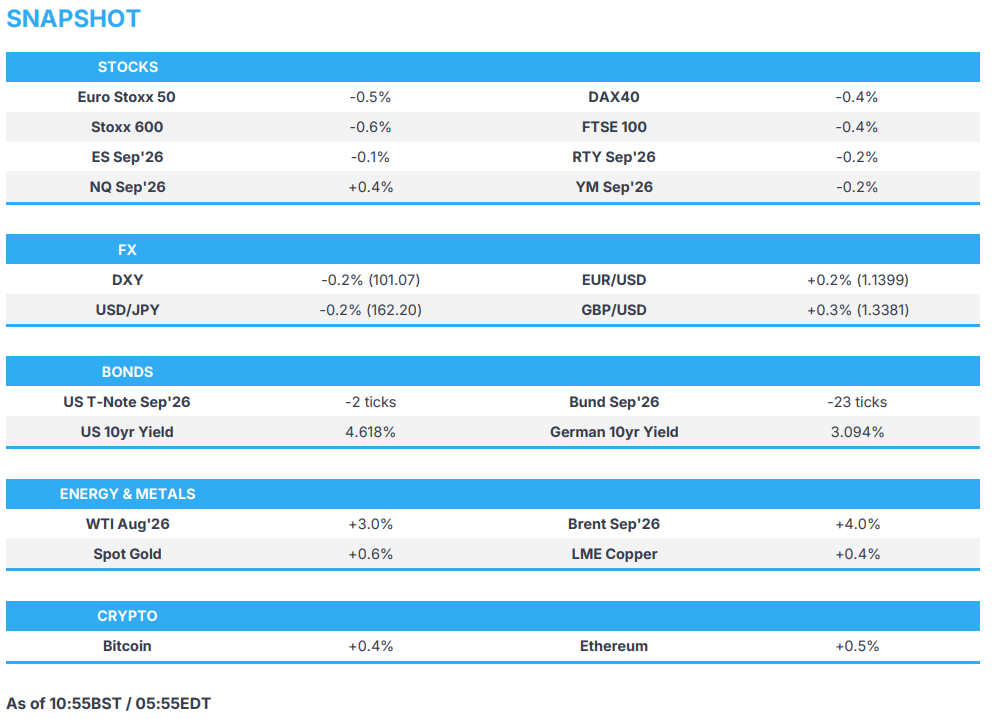
Newsquawk in 3 steps:
1. Subscribe to the free premarket movers reports
2. Listen to this report in the market open podcast (available on Apple and Spotify)
3. Trial Newsquawk’s premium real-time audio news squawk box for 7 days
EUROPEAN TRADE
EQUITIES
- European bourses (STOXX 600 -0.6%) are lower across the board after Monday’s choppy trade. Escalating US-Iran tensions return as a headwind for Europe, with energy prices rising, weighing on many of the continent’s biggest industries (airlines, luxury).
- European sectors highlight the negative bias. Basic Resources (+1.3%) and Energy (+1.2%) are printing decent gains, while Utilities (+0.3%) and Chemicals (+0.2%) also trade in the green. To the downside is Travel & Leisure (-2.1%), Media (-2.0%), and Consumer Products & Services (-1.9%).
- US equity futures are mixed, with the NQ (+0.4%) outperforming as chip names rebound from Monday’s rout. Banks will kick off the US earnings season, with JPM, BAC, GS, WFC and C all due.
- Click for the sessions European pre-market equity newsflow
- Click for the additional news
FX
- G10s are mostly firmer as markets are reluctant to buy Dollars into US CPI, after it gained on Monday. Kiwi is the clear outperformer; energy exporters CAD and NOK also perform well.
- Geopolitics remain constructive for USD with Brent over USD 85/bbl, in addition to this, hawkish Fed speak from Waller saw markets assign a 50% probability of a Fed hike this month. (“Fed would need to consider a rate hike in the near term if core inflation is hot this week”). Despite these factors, the Buck is negative on the day as it stabilises below Monday’s 101.32 peak ahead of a packed session which is slated to see US CPI, and Warsh’s testimony to the US house which potentially sees a text release at 13:30 BST. The level to watch if momentum continues today is the 21DMA @ 101.00, should CPI come in hot, Monday’s 101.32 peak will be in focus, thereafter is July 2nd’s 101.43 high.
- Kiwi is the best performer once again as markets add to RBNZ tightening bets, interest rate futures now implying 58bps by year-end – around 5bps added vs. the end of Monday’s London session. Upside which comes after hawkish remarks from RBNZ’s Conway and a strong quarterly NZIER Business Confidence.
FIXED INCOME
- US and Iran continued to strike each other for a third night, after President Trump warned that they would hit Iran “very hard”. POTUS also announced a naval blockade on all Iranian ports, which is set to begin at 21:00 BST / 16:00 EDT.
- Crude benchmarks were firmer throughout the APAC session, though price action was more-or-less sideways. Into the European morning, the bias turned a bit more bullish after the UKMTO reported another incident on a tanker near Oman. This comes after two Emirati tankers were struck overnight. It is clear that the IRGC will not accept any transits through undesignated paths through the Strait of Hormuz; as such, traffic through the Hormuz is waning. Marine Traffic data has shown that only two tankers completed passages through the Hormuz in the 24 hours up to 07:25 BST today; this compares to c. 28 ships/day following the US-Iran MoU signing.
- As it becomes apparent that ships are no longer going through the Hormuz (and added risk of the blockade and/or nuclear attacks), the crude complex has moved higher. Brent Sep’26 (+3.7%) sits at the upper end of a USD 83.68-87.38/bbl range.
- Spot gold is a little firmer this morning, and trades within a narrow USD 3,983-4,034/oz range; currently holding just above the USD 4k/oz mark. The yellow metal appears to be taking a breather following a couple of sessions in the red, which was spurred by recent geopolitical escalations and a hawkish Fed speak via Waller. Elsewhere, base metals hold a positive bias following stronger-than-expected Chinese data overnight. In brief, Exports and Imports both rose from the prior, and by more than the consensus. 3M LME Copper holds within a USD 13,461-13,624/t range.
- Germany sells EUR 4.222bln vs exp. EUR 6.0bln 2.70% 2028 Schatz: b/c 1.13x, average yield 2.77%, retention 29.63%.
- Japan sells JPY 530.9bln 20-year JGBs; b/c 4.52x (prev. 2.97), average yield 3.626% (prev. 3.542%), Tail in price 0.00 (prev. 0.24).
- The Netherlands sells EUR 3.27bln vs exp. EUR 2.5-3.5bln 2.50% Jan 2031 DSL: Average yield 2.911% (prev. 2.795%).
- Australia sells AUD 400mln 5.00% June 2036 bonds b/c 4.1, avg yield 4.908%.
COMMODITIES
- A bearish start for benchmarks as the complex reacts to the overnight energy move.
- Action that was sufficient to push Bunds below the 125.00 handle and to a 124.82 base, lower by just over 40 ticks on the day. Since, no real reaction to the morning’s updates, including a UKMTO tanker report in Oman, despite modest energy upside at the time.
- For Germany, June’s WPI was dictated by energy, with the Y/Y moderating from the prior but at an elevated level as mineral oil products were just under 22% higher vs June 2025. However, the same component was down 6.8% M/M, leading to a -0.7% headline M/M print (exp. 0.5%, prev. -0.6%). No move to the series.
- Gilts opened lower by a handful of ticks before extending below the 87.00 handle, and then moving sharply lower to an 86.42 base, catching up to the above and continuing the pattern of greater magnitudes of action vs peers on energy-related moves. Pressure may also be a function of pricing into the Burnham coronation on Friday, as he will become UK PM from the point Starmer formally hands over. On that, Rathbones has reduced its Gilts holding in order to protect against “fiscal irresponsibility” ahead of Burnham and the Chancellor decision. Note, likely outgoing Chancellor Reeves speaks at Mansion House this evening.
- USTs also lower, down to a 108-17 trough given the energy move, which has seen a modest extension on the pressure after Fed’s Waller on Monday evening said another hot core inflation read would mean the Fed needs to consider a near-term hike. CPI today is seen at -0.1% M/M (prev. 0.5%), while the now even more pertinent core is seen at 0.2% M/M (prev. 0.2%). Following Waller and the recent energy moves, pricing for July has moved in favour of a hike, with around a 60% chance of a 25bps move currently implied. We now look to testimony from Chair Warsh, which is scheduled for after CPI; note, a text release alongside CPI is possible.
- BP (BP/ LN) says upstream production is expected to be between 2,170-2,220mboepd (prev. 2,339mboepd Q/Q), due to seasonal maintenance predominantly in the Gulf of America and the effects of disruption in the Middle East.
- Pakistan LNG is reportedly seeking an additional LNG cargo for July as US-Iran hostilities in the Strait of Hormuz constrain supplies from Qatar, according to Bloomberg.
- Turkey’s energy minister said Iraq requested retaining oil export capacity of 750K BPD through the Kirkuk-Ceyhan pipeline for 12 months under an agreement.
- Iran’s Oil Minister Paknejad said Iran’s oil exports continue as usual despite the US removal of oil waivers.
- Freeport-McMoRan (FCX) Indonesia unit is targeting 2026 copper production of 0.8bln pounds.
NOTABLE EUROPEAN HEADLINES
- EU Commission approved EUR 659mln German State aid for four new semiconductor facilities.
NOTABLE EUROPEAN DATA RECAP
- German Wholesale Prices MoM (Jun) M/M -0.7% vs. Exp. 0.2% (Prev. -0.6%).
- UK BRC Retail Sales Monitor YoY (Jun) Y/Y 1.7% vs. Exp. 2.9% (Prev. 3.4%).
CENTRAL BANKS
- RBNZ Chief Economist Conway said the Middle East conflict complicates monetary policy like all supply shocks, while he added that understanding how firms respond to cost shocks is crucial in maintaining low and stable inflation. Furthermore, he said that despite easing prices, the effects of the shock are expected to continue impacting the economy for some time, and that a further reduction in monetary stimulus is likely to be required.
- BoE Governor Bailey said that the core banking system in the UK is resilient and that debt levels are not stretched. He stated that renewed hostilities in the Gulf underline continuing instability. The UK’s position is supported by its fiscal framework as well as monetary policy.
NOTABLE US HEADLINES
- US House will vote today on merging the SAVE America Act with a national security and State Department funding bill, Fox reported.
- NY has become the first US state to halt construction of large new data centres, imposing a one-year moratorium on 14th July, Reuters reported. The move responds to concerns over power costs, water supplies and community impacts as states consider limits on AI infrastructure’s effects on electricity grids and utility bills.
GEOPOLITICS
MIDDLE EAST
- US President Trump reiterated that Iran has no air force, no navy and no military, while he said they will hit Iran very hard on Monday night and on Tuesday. Trump said they had a deal yesterday and that Iran breaks deals, as well as commented that the MoU was built to test Iran and that Iran didn’t honour it. Trump also stated that they will hit ‘Pickaxe Mountain’ pretty soon and have their eyes on the site all the time, which is a good potential target
- US Central Command announced that it conducted and completed a third consecutive night of strikes against Iran, with US strikes reported in Bushehr, Bandar Abbas and Bandar Kangan, while explosions were also reported in Iran’s Qeshm Island and Kish Island. More recently, there have been reports of explosions have been heard near Bandar Abbas, Bushehr and Choghadak.
- Details of US President Trump’s proposed Strait of Hormuz toll plan are still being finalised, according to Semafor, saying Trump is ‘very serious about the tolls.
- Iran’s armed forces have begun targeting US naval vessels in the Strait of Hormuz with cruise missiles, Al Mayadeen reported.
- Iranian Army Spokesperson said the Strait of Hormuz will not be open with US aggressions and war, SNN reported.
- IRGC said it targeted weapons warehouses, satellite communications centres, and US forces’ housing building at Bahrain’s Juffair base. Iran’s army also targeted US military facilities and equipment in Kuwait with drones, as well as targeted a ‘hostile’ US vessel with cruise missiles, while it was separately reported that a US military base in Jordan was hit by a missile attack and that a missile attack hit an Iranian Kurdish opposition group site east of Iraq’s Erbil.
- UKMTO received a report that a tanker was hit by an unknown projectile 40NM northeast of Qalhat, Oman. UKMTO reports of an incident 13NM southeast of Lima, Oman, the tanker was reportedly hit by a missile transiting outbound on the southern route
- The UAE Defence Ministry reported that two national tankers were targeted by Iranian cruise missiles in the southern Strait of Hormuz, with the incident occurring in Omani territorial waters, although the fires on both tankers were brought under control, and it reserved the right to respond to the escalation.
- ADNOC confirmed tankers “Al Bahyah” and “Mombasa B” were hit in the Strait of Hormuz.
- Oman’s Foreign Minister said complex talks are under way to make a long-term arrangement to guarantee freedom of navigation through the Strait of Hormuz.
RUSSIA-UKRAINE
- Russian ballistic missiles targeted Ukraine’s capital of Kyiv, with sirens and explosions heard across the Ukrainian capital, according to FT.
- Russian forces conducted group strikes at night, damaging military industry and enterprises involved in missile production in Kyiv, while it damaged infrastructure facilities in Odessa, used to store Ukrainian armed forces’ fuel and lubricants.
- Ukraine Navy spokesperson said Russia struck a civilian vessel near Ukraine’s Black Sea port of Odesa. Additionally, Ukraine said it struck two Russian oil refineries in the Bashkortostan and Krasnodar regions.
OTHER
- US President Trump said they’re looking into whether Cuba is storing Iranian drones, while he added that they will take care of it if Cuba has Iranian drones.
CRYPTO
- Bitcoin rebounded slightly but remains below the USD 63k mark. Ethereum held below USD 1.8k.
APAC TRADE
- APAC stocks were mostly in the red following the weak lead from the US, where risk sentiment was weighed on by tech selling and geopolitical escalation, while US-Iran strikes persisted for the third consecutive night and Trump announced to reinstate the naval blockade on Iran, as well as touted a 20% Hormuz shipping fee.
- ASX 200 was dragged lower by weakness in tech, industrials, consumer staples and financials, but with the downside stemmed by resilience in energy and utilities, while there was also an improvement in Westpac Consumer Sentiment.
- Nikkei 225 initially dropped below the 67,000 level amid tech weakness and higher oil prices, but then gradually nursed its losses and returned to flat territory as domestic yields softened.
- Hang Seng and Shanghai Comp conformed to the tech-related weakness and ultimately failed to benefit from the better-than-expected Chinese trade data.
NOTABLE ASIA-PAC HEADLINES
- Japanese Finance Minister Katayama suggested it is time to consider including JGBs in NISAs, and stated that if the environment surrounding asset management changes sharply, a change to GPIF’s portfolio could be examined, while she hopes to quickly establish details on steps to make Japanese government bonds more attractive.
NOTABLE APAC DATA RECAP
- Chinese Balance of Trade (Jun) 125.8B vs. Exp. 121B (Prev. 105.43B).
- Chinese Exports YY (Jun) 27% vs. Exp. 18.2% (Prev. 19.4%).
- Chinese Imports YY (Jun) 36% vs. Exp. 24% (Prev. 27.4%).
- Singaporean GDP Growth Rate QQ (Q2 A) 1.1% vs. Exp. 1.1% (Prev. 1.0%).
- Singaporean GDP Growth Rate YY (Q2 A) 5.7% vs. Exp. 5.3% (Prev. 6.0%).
- Australian Westpac Consumer Confidence Index (Jul) 83.9 (Prev. 80.6).
- Australian NAB Business Confidence (Jun) -5 (Prev. -14).
- New Zealand NZIER Business Confidence (Q2) 8% (Prev. -4%).
1 c) Asian opening report…
Europe primed for a weaker open as energy benchmarks rally – Newsquawk EU Market Open
Tuesday, Jul 14, 2026 – 02:19 AM
- The US continued to launch strikes for a third night, after President Trump stated that he would hit Iran “very hard” on Monday and Tuesday. Separately, Trump threatened to hit Iran’s “Pickaxe Mountain”, an underground nuclear facility; Brent Aug’26 +1.9%.
- US President Trump also announced a naval blockade, which is set to begin at 21:00 BST / 16:00 EDT.
- APAC stocks were mostly in the red given the geopolitical environment and tech sell-off; European equity futures are indicative of a weaker open.
- DXY takes a breather; Kiwi outperforms following regional data and hawkish comments from RBNZ’s Conway.
- USTs and Bunds remain pressured amidst the elevated energy prices and after Fed’s Waller delivered hawkish remarks.
- Looking ahead, Highlights include German Wholesale Prices (Jun), Chinese M2 Money Supply (Jun), US NFIB Business Optimism Index (Jun), US CPI (Jun), Fed Discount Rate Minutes (Jul), ECB President Lagarde-US Treasury Secretary Bessent meeting.
- Speakers including Fed Chair Warsh, Goolsbee, Barr, Cook & Bowman, BoE Governor Bailey, Supply from the Netherlands & Germany.
- Earnings from Citi, Goldman Sachs, JPMorgan, Bank of America, Wells Fargo.
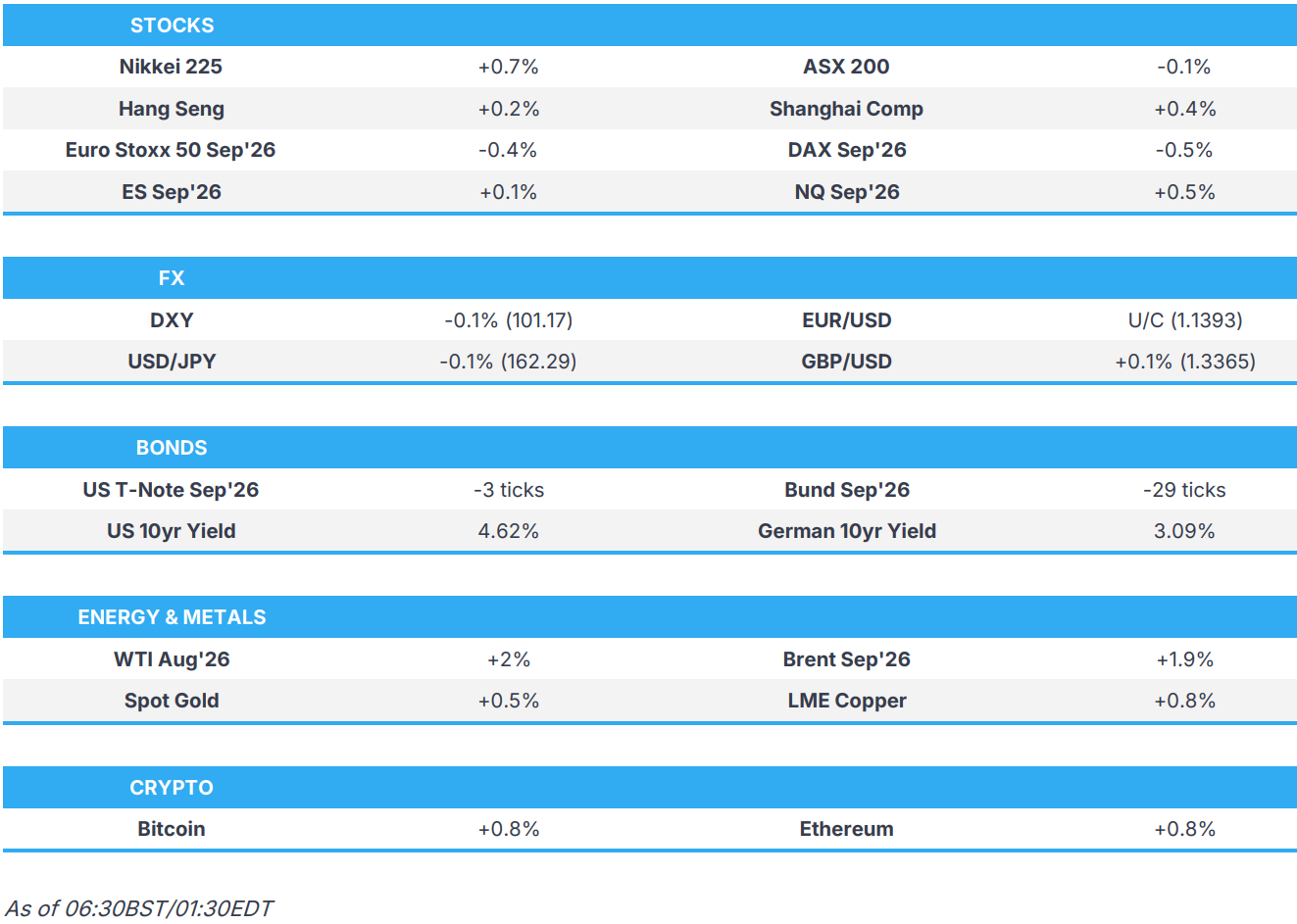
Newsquawk in 3 steps:
1. Subscribe to the free premarket movers reports
2. Listen to this report in the market open podcast (available on Apple and Spotify)
3. Trial Newsquawk’s premium real-time audio news squawk box for 7 days
IRAN CONFLICT
- US President Trump reiterated that Iran has no air force, no navy and no military, while he said they will hit Iran very hard on Monday night and on Tuesday. Trump said they had a deal yesterday and that Iran breaks deals, as well as commented that the MoU was built to test Iran and that Iran didn’t honour it. Trump also stated that they will hit ‘Pickaxe Mountain’ pretty soon and have their eyes on the site all the time, which is a good potential target
- US President Trump said he thinks the Iran war is going well and fast, as well as noted that they had a deal 2 days ago, but Iran turned around, while he added that they were attacking Iran on Monday night and taking out all their capabilities.
- US Central Command announced that it conducted and completed a third consecutive night of strikes against Iran, with US strikes reported in Bushehr, Bandar Abbas and Bandar Kangan, while explosions were also reported in Iran’s Qeshm Island and Kish Island.
- US military has plans for several days of additional strikes in the Hormuz area and on Iran’s southern coastline aimed at degrading the IRGC’s ability to attack ships, according to Axios citing a US defence official, while it was reported that the US hasn’t discussed the issue of possible tolls for securing the Strait of Hormuz with its allies in the region.
- US Navy-led JMIC said the US military will begin enforcement of a naval blockade of all Iranian ports and Iranian coastal areas at 20:00 GMT on 14th July, which will apply to all vessel traffic, regardless of the flag. It added that the blockade encompasses the entirety of the Iranian coastline, including but not limited to Iranian ports and oil terminals, although it will not impede neutral transit passage through the Strait of Hormuz to or from a non-Iranian destination.
- IRGC said it targeted weapons warehouses, satellite communications centre, and US forces’ housing building at Bahrain’s Juffair base. Iran’s army also targeted US military facilities and equipment in Kuwait with drones, as well as targeted a ‘hostile’ US vessel with cruise missiles, while it was separately reported that a US military base in Jordan was hit by a missile attack and that a missile attack hit an Iranian Kurdish opposition group site east of Iraq’s Erbil.
- Iran’s Foreign Minister said whoever provides secure and safe passage of commercial vessels through Hormuz should be compensated, while he added that Iran has always been the Guardian of the Strait and will remain so forever. Furthermore, he said 20% is too much and that they will be fair.
- UKMTO received a report that a tanker was hit by an unknown projectile 40NM northeast of Qalhat, Oman, while the UAE Defence Ministry reported that two national tankers were targeted by Iranian cruise missiles in the southern Strait of Hormuz, with the incident occurring in Omani territorial waters, although the fires on both tankers were brought under control, and it reserved the right to respond to the escalation.
- Saudi Arabia conducted an assault on Yemen, while Houthis confirmed they targeted Saudi Arabia’s Abha airport with ballistic missiles and warned airlines against flying over Saudi airspace.Furthermore, Houthi political bureau member Ali al-Bukhaiti said the group would target the “vital infrastructure” of Saudi Arabia in retaliation for the attack on Sanaa Airport.
- Sources reported that a Yemeni missile hit King Khalid Air Base near the Saudi city of Abha, and there were reports of an attack on Abha International Airport in southern Saudi Arabia. It was also reported that at least six missiles had been fired from Yemen towards Saudi Abha Airport, while the Saudi-led coalition said it dealt with ballistic missiles launched by Houthis towards the southern region, and sources reported the sound of an explosion in Jeddah.
US TRADE
EQUITIES
- US stocks were pressured with the Nasdaq the clear underperformer as Technology led the broader market lower, while the weakness in Tech was driven by sharp losses in memory names (DRAM -c. 9%) and semiconductor stocks (SOXX -5%) amid concerns surrounding SK Hynix’s upcoming earnings, with the stock also giving back some of Friday’s gains following its US listing. Broader risk sentiment was also weighed down by ongoing geopolitical tensions between the US and Iran after further military strikes over the weekend. President Trump announced that the US would reinstate the blockade on Iran and assume control of the Strait of Hormuz, adding that the US would impose a 20% charge on cargo vessels transiting the Strait in exchange for safe passage.
- SPX -0.78% at 7,517, NDX -1.88% at 29,264, DJI -0.26% at 52,499, RUT -0.78% at 2,955.
- Click here for a detailed summary.
NOTABLE HEADLINES
- Fed’s Waller (voter) said that if there was another hot reading on core inflation this week, the Fed would need to consider a rate hike in the near term, while he would need to see several months of lower core inflation to feel inflation was moving in the right direction, and expressed concern about the elevated pace of core inflation. Waller said there was still a credible case for inflation to fall back to the 2% target without higher rates, but noted there was an equally plausible case that tighter policy would be needed. Waller stated he remained committed to returning inflation to the 2% target while also avoiding over-tightening policy and risking recession, while he expects a deceleration in headline inflation beginning with this week’s inflation data, but said his focus would remain on core inflation. Furthermore, he had been sceptical of the Fed’s dot plot for a long time and would remove the long-run estimates, not extend projections beyond 18 months and would release the dots a day after the meeting.
- US President Trump said he will be making a speech to the nation on Thursday evening at 21:00EDT/02:00BST. It was separately reported that Trump’s Thursday speech is slated to address newly declassified intelligence reports that the White House asserts reveal plans by foreign nations to interfere in the 2020 election.
- US House budget committee will mark up a budget resolution on Wednesday, according to Punchbowl’s Sherman.
APAC TRADE
EQUITIES
- APAC stocks were mostly in the red following the weak lead from the US, where risk sentiment was weighed on by tech selling and geopolitical escalation, while US-Iran strikes persisted for the third consecutive night and Trump announced to reinstate the naval blockade on Iran, as well as touted a 20% Hormuz shipping fee.
- ASX 200 was dragged lower by weakness in tech, industrials, consumer staples and financials, but with the downside stemmed by resilience in energy and utilities, while there was also an improvement in Westpac Consumer Sentiment.
- Nikkei 225 initially dropped below the 67,000 level amid tech weakness and higher oil prices, but then gradually nursed its losses and returned to flat territory as domestic yields softened.
- Hang Seng and Shanghai Comp conformed to the tech-related weakness and ultimately failed to benefit from the better-than-expected Chinese trade data.
- US equity futures were choppy amid cautiousness as US-Iran strikes continued and with participants awaiting the start of earnings season.
- European equity futures indicate a lower cash market open with Euro Stoxx 50 futures down 0.6% after the cash market closed flat on Monday.
FX
- DXY took a breather after gaining yesterday alongside the broad-based risk-off sentiment and hawkish comments from Fed’s Waller. He stated that if there is another hot reading on core inflation this week, the Fed will need to consider a rate hike in the near term, and that they would need to see several months of lower core inflation to feel inflation is moving in the right direction. Furthermore, price action is contained overnight as participants await US CPI data and Fed Chair Warsh’s testimony to Congress.
- EUR/USD attempted to recoup some lost ground, although the rebound was limited with the single currency lingering beneath the 1.1400 handle amid the lack of pertinent FX-specific drivers.
- GBP/USD bounced off the prior day’s lows but lacked meaningful conviction after sliding from resistance at the 1.3400 level, while focus in the UK is on politics, with Andy Burnham to be crowned the leader of the ruling Labour party on Friday after winning 349 nominations out of 403 MPs, making it mathematically impossible for any rival to launch a challenge.
- USD/JPY slightly pulled back after advancing yesterday in tandem with rising US yields and oil prices.
- Antipodeans clawed back some of their recent losses with NZD the outperformer after the improvement in quarterly NZIER Business Confidence, while RBNZ Chief Economist Conway noted that a further reduction in monetary stimulus is likely to be required.
- PBoC set USD/CNY mid-point at 6.7990 vs exp. 6.7927 (prev. 6.7972)
FIXED INCOME
- 10yr UST futures were subdued after retreating yesterday amid rising oil prices and hawkish comments from Fed’s Waller, while participants await US CPI data and Fed Chair Warsh’s testimony.
- Bund futures remained pressured as higher energy prices stoked inflationary concerns, while demand was not helped by incoming data and looming supply, including a EUR 6bln Schatz issuance today, followed by EUR 3bln of Bunds tomorrow.
- 10yr JGB futures rebounded from the prior day’s trough with the recovery facilitated by comments from Japan’s Finance Minister Katayama, who said it is time to consider including JGBs in NISA and that if the environment surrounding asset management changes sharply, a change to GPIF’s portfolio could be examined. Furthermore, she hopes to quickly establish details on steps to make JGBs more attractive, while support was also seen following a stronger 20yr auction, which resulted in a zero tail.
COMMODITIES
- Crude futures extended on gains after rallying yesterday by more than 9% owing to the US-Iran geopolitical escalation, with the US military conducting a third consecutive night of strikes against Iran. Furthermore, Trump announced to reinstate the blockade against Iran, touted a 20% Hormuz shipping fee and said they would hit Iran very hard on Monday night and Tuesday. Elsewhere, recent strikes between Saudi Arabia and Yemen also highlighted the risks of the conflict broadening across the region.
- US Strategic Petroleum Reserve crude oil stocks fell by about 3mln bbls to 316.5mln bbls last week, which was the lowest since 1983.
- Spot gold nursed some losses after briefly slipping beneath the USD 4,000/oz level amid recent dollar strength, upside in yields and higher oil prices.
- Copper futures steadily gained amid stronger-than-expected Chinese trade data.
CRYPTO
- Bitcoin marginally gained in choppy trade above the USD 62,000 level.
NOTABLE ASIA-PAC HEADLINES
- Japanese Finance Minister Katayama suggested it is time to consider including JGBs in NISAs, and stated that if the environment surrounding asset management changes sharply, a change to GPIF’s portfolio could be examined, while she hopes to quickly establish details on steps to make Japanese government bonds more attractive.
- RBNZ Chief Economist Conway said the Middle East conflict complicates monetary policy like all supply shocks, while he added that understanding how firms respond to cost shocks is crucial in maintaining low and stable inflation. Furthermore, he said that despite easing prices, the effects of the shock are expected to continue impacting the economy for some time, and that a further reduction in monetary stimulus is likely to be required.
- China Customs Vice Minister said this year’s increase in China’s trade has been strong and the momentum is stable.
DATA RECAP
- Chinese Balance of Trade (Jun) 125.8B vs. Exp. 121B (Prev. 105.43B)
- Chinese Exports YY (Jun) 27% vs. Exp. 18.2% (Prev. 19.4%)
- Chinese Imports YY (Jun) 36% vs. Exp. 24% (Prev. 27.4%)
- Chinese Balance of Trade (CNY)(Jun) 859B vs. Exp. 820B (Prev. 724B)
- Chinese Exports YY (CNY)(Jun) 20.8% (Prev. 13.8%)
- Chinese Imports YY (CNY)(Jun) 29.4% (Prev. 21.5%)
- Singaporean GDP Growth Rate QQ (Q2 A) 1.1% vs. Exp. 1.1% (Prev. 1.0%)
- Singaporean GDP Growth Rate YY (Q2 A) 5.7% vs. Exp. 5.3% (Prev. 6.0%)
- Australian Westpac Consumer Confidence Index (Jul) 83.9 (Prev. 80.6)
- Australian NAB Business Confidence (Jun) -5 (Prev. -14)
- Australian NAB Business Conditions (Jun) 3 (Prev. 3)
- New Zealand NZIER Business Confidence (Q2) 8% (Prev. -4%)
GEOPOLITICS
RUSSIA-UKRAINE
- Russian ballistic missiles targeted Ukraine’s capital of Kyiv, with sirens and explosions heard across the Ukrainian capital, according to FT.
- Ukrainian President Zelensky noted an urgent need for defence systems, while he is requesting 100 Patriot interceptors per month and a total of 300 by winter to deter further Russian aggression.
- US President Trump will support the Russia sanctions bill, while it was separately reported that Senate Majority Leader Thune expressed hope for progress on the Russia sanctions bill.
OTHER
- US President Trump said they’re looking into whether Cuba is storing Iranian drones, while he added that they will take care of it if Cuba has Iranian drones.
EU/UK
NOTABLE HEADLINES
- UK’s Burnham will be crowned Labour leader on Friday as he won 349 nominations from MPs out of 403, which makes it mathematically impossible for any rival to launch a challenge.
DATA RECAP
- UK BRC Retail Sales Monitor YoY (Jun) Y/Y 1.7% vs. Exp. 2.9% (Prev. 3.4%)
end
NORTH AND SOUTH KOREA AND JAPAN
SOUTH KOREA
JAPAN
3 CHINA
4. EUROPEAN AND SCANDINAVIAN COMMENTARIES PLUS NATO
EUROPE/HEAT WAVE
10,000 Excess Deaths During June European Heatwave, Official Data Show
Tuesday, Jul 14, 2026 – 02:00 AM
Authored by Guy Birchall via The Epoch Times,
More than 10,000 excess deaths were reported across Europe during the recent heatwave that baked the west of the continent in late June, official data showed on June 13. A man cools himself during a heatwave in Chamonix, France, on June 25, 2026. Reuters/Pierre Albouy
More than 9,000 of those who passed away were aged 65 and above, according to European Monitoring of Excess Mortality for Public Health Action (EuroMOMO), a continent-wide mortality monitoring network backed by the World Health Organization (WHO) and the European Centre for Disease Prevention and Control.
The data, pooled from national mortality statistics in 27 European countries, included excess deaths from all causes, not just heat-related ones, during the week of June 22 to 28, when the heatwave peaked in France, Spain, the UK, and other countries.
Though the deaths cannot be attributed exclusively to the soaring temperatures, scientists have said there were no other known major factors, such as disease outbreaks, that would likely have contributed to the mortality spike during that week.
Extreme heat can kill by causing heat stroke or aggravating cardiovascular and respiratory diseases, with older people among the most vulnerable, according to the WHO.
“To have this kind of excess at this time of year is unusual. It’s really high,” Lasse Vestergaard, chief physician at Denmark’s Statens Serum Institut, which hosts EuroMOMO, said. “It is difficult to explain this high excess mortality by anything but the extreme heat.”
The combined mortality for the same 27 nations over the previous eight weeks averaged around 500 deaths per week below typical levels; however, EuroMOMO data is subject to revision, either up or down, as more data flow in over the coming weeks.
EuroMOMO does not publish excess deaths per individual country, but it noted that France and Belgium both logged “very high excess” mortality in the last week of June. Spain, Switzerland, and the Netherlands noted “moderate excess,” England, Wales, Italy, and Germany registered a “low excess” of deaths, and the remaining 17 showed normal levels.
The heatwave at the end of June disrupted power supplies, shut schools, and smashed temperature records in France, Spain, and the UK.
Belgium’s excess mortality was the highest during any heatwave in records going back to 2000, according to the country’s public health institute Sciensano.
“Our latest analysis shows that 1,747 more people died than expected during this heatwave, corresponding to an excess mortality of 48 percent,” Sciensano said in a July 10 LinkedIn post. “The deadliest days, 27 and 28 June, recorded mortality levels comparable to those observed during the peak of the first COVID-19 wave in April 2020.”
During the heatwave, France experienced its hottest ever national average days on June 24 and June 25, with both days recording an average temperature of 30 degrees Celsius (86 degrees Fahrenheit) over 24 hours, surpassing the previous record set on June 23 of 29.8 degrees Celcisus (85.6 degrees Fahrenheit), according to French weather agency Meteo-France.
That average is calculated using figures from 30 weather stations evenly distributed across the country.
According to Meteo-France, the highest temperature recorded in France was 46 degrees Celsius (about 114.8 degrees Fahrenheit) at Verargues on June 19, 2019.
In another scientific study from the UK – by Imperial College London, the UK Met Office, and the London School of Hygiene & Tropical Medicine – it was estimated that some 2,700 people died from heat-related causes in England and Wales alone, amid the May and June heatwaves.
A 2007 study by the French Academy of Sciences on the 2003 European heatwave found that more than 70,000 excess deaths occurred across 16 countries that year.
American political scientist Roger Pielke Jr. has said that the increase in deaths in Europe in previous years is attributable to the lack of air conditioning across the continent.
“The math is simple,” Pielke Jr., who has previously worked at the U.S. National Center for Atmospheric Research and the University of Colorado, Boulder, wrote in a June 25 post on Substack, discussing the deaths in the European heatwave of 2022.
“Today’s heat deaths reflect today’s level of AC coverage. Raise the coverage, and a share of those deaths are eliminated – in proportion to how protective AC is and how many more households gain it.”
Pilke stated that if Europe had American levels of air conditioning penetration during that period, deaths would have been reduced by as much as 26,000. A Dash Q400-MR Fireguard aircraft of the civil security drops retardant mixed with water during a demonstration of firefighting capacity by the Gironde’s Fire and Rescue Departmental Service in Saint-Aubin-de-Medoc, France, on July 3, 2026. Christophe Archambault/AFP via Getty Images
END
GERMANY
this is a first!!
German Parliament Moves To Criminalize Denying Israel’s “Right To Exist”
Tuesday, Jul 14, 2026 – 02:45 AM
Various European initiatives and policies which criminalize “holocaust denial” have for years dominated headlines and driven immense controversy over freedom of speech and public debate.
But Germany is now taking it a big step further, with the Bundesrat, Germany’s upper house of parliament, having just approved a bill that would criminalize publicly denying Israel’s “right to exist” or calling for its abolition.

If passed into law, a conviction would bring up to five years in prison, according to the proposed legal change. The legislation will now move to the lower house.
If ultimately approved, it would make Germany the first country in Europe to punish speech denying Israel’s “right to exist”.
Critics of such efforts to crack down on pro-Palestinian activism and protests have pointed out that the question of any nation’s “right” to “exist” is a highly philosophical and theoretical one, which makes it strange that any government would codify the statement into law, elevating it to a kind of of dogma.
The legal proposal would greatly expand Germany’s existing Section 130 of the criminal code – which is what authorities currently use to prosecute Holocaust denial.
However, dissenters within the German government have warned the proposed expansion would be a violation of the German constitution, as it would establish a “special right against a specific opinion” in breach of Article 5. Here’s what the constitution’s “freedom of expression” clause says:
Every person shall have the right freely to express and disseminate his opinions in speech, writing and pictures and to inform himself without hindrance from generally accessible sources. Freedom of the press and freedom of reporting by means of broadcasts and films shall be guaranteed. There shall be no censorship.
The Bundestag’s research service has warned in a report on violation of individual rights: “Both the rejection of the right of the State of Israel to exist and the call for the elimination of the state are likely to constitute subjective value judgments.”
Recently Tucker Carlson unpacked the difficulty inherent in the whole notion of a country having a “right to exist” in a testy exchange with a reporter. Carlson has also frequently pointed out that the phrase is a bizarre and uncommon formulation, given that not even Americans in all of history have spoken in terms of a nation-state or government ‘existing’ as a ‘right’…
More recently, Amnesty International has publicly come out in opposition to the German measure, stating, “The protection of Jewish life is of particular importance – but this initiative massively endangers freedom of expression.”
In the United States, the Israel-Gaza conflict has increasingly split the Democratic Party, amid growing midterm related turmoil. But there’s been an increasing debate raging on the Right as well, as younger generations of conservatives show much more willingness to criticize Israel and push against taxpayer funding for the Israeli government and military to the tune of billions.
END
FRANCE
France Cuts 6.4 GW Of Nuclear Power As Heatwave Grips The Country
Tuesday, Jul 14, 2026 – 03:30 AM
By Michael Kern of OilPrice.com,
France’s nuclear power generation was slashed by 6.4 gigawatts (GW) on Monday amid a prolonged and intense heatwave that hiked river temperatures and limited the ability of the power plants to use the water to cool reactors.

As many as eight reactors in France, which is Europe’s leader in nuclear power generation, were forced to curtail power output, according to data from the plants’ operator EDF and grid operator RTE cited by Reuters.
The 6.4 GW of curtailed power output was equivalent to 14% of France’s overall power demand as of Monday morning.
The reactors where output has been limited include Saint Alban 1 and 2, reactors 3, 4, and 5 at Bugey, Golfech 2, and Blayais 1 and 3.
The Golfech 2 and Bugey 3 reactors were taken fully offline, while the other six were operating at reduced rates as of Monday morning.
This is not the first time France has had to curb output at reactors and limit the nuclear power production, due to high summer temperatures.
France’s nuclear power generation accounts for around 70% of its electricity mix, and when its reactors are fully operational, it is a net exporter of electricity to other European countries.
Despite the curbs of nuclear generation during the current heatwave, data from RTE suggests that France would remain a net exporter with over 10 GW of power exported to France’s neighboring countries on Monday.
The hydropower generation would also be a concern amid the heatwave that has lasted a least a week and is expected to continue at least until Wednesday this week.
With temperatures topping 40 degrees Celsius (104 F) for days, red alerts have been issued throughout France amid the heatwave, and thousands of people have died of heat-related conditions since late June, when the record-breaking extreme summer temperatures started to disrupt life. Even the most famous and prestigious cycling event, the Tour de France, held a shortened stage on Sunday for the first time ever, due to the extreme heat.
END
ENGLAND
you have to be kidding? they want to do this?
The UK Government Lobbied For Putting Migrants And Trans People On Banknotes
Tuesday, Jul 14, 2026 – 07:45 AM
Authored by Steve Watson via Modernity News,
The UK’s own Cabinet Office pushed hard to overhaul banknotes by elevating LGBT+ and ethnic minority figures, claiming historic greats like Winston Churchill gave an “incomplete picture” of British identity. This push came just before the Bank of England decided to ditch those same towering historical figures for images of hedgehogs and foxes.

This latest revelation exposes the ideological machinery at work inside Whitehall. While the public recoiled at the idea of swapping national heroes for animals, government officials were actively lobbying for even more radical identity-driven changes.
In a letter to the Bank of England’s chief cashier last summer, officials from the Office for Equality and Opportunity – part of the Cabinet Office and led by Bridget Phillipson – argued that current historical figures reflected “limited dimensions of British identity.” They called for “greater representation of women, disabled people, ethnic minority communities and LGBT+ individuals” to “send a strong signal of progress and recognition.”
The whole saga is particularly ridiculous because the core argument for axing Churchill and other giants was that they were supposedly too “ideologically divisive” for modern Britain.
Yet officials simultaneously pushed to install figures selected explicitly through the lens of identity politics and group representation – an approach guaranteed to be far more polarizing in practice.
It reveals the selective outrage: traditional British heroes are labeled divisive for their achievements, while injecting contemporary activism onto the currency is framed as unifying “progress.”
The intervention has sparked accusations that Labour elements conspired to sideline Britain’s most celebrated figures.
Shadow minister Alex Burghart slammed the move: “Labour tried to deny any involvement in the cancellation of Winston Churchill and other British heroes. But government officials have been caught red-handed conspiring with the Bank of England to remove them from our banknotes.”
He added that banknotes “should feature the greatest Britons – the historic figures that unite our country. They shouldn’t be chosen on the basis of Labour’s equality laws.”
This diversity drive unfolded alongside the Bank of England’s decision to replace Churchill on the £5 note, Jane Austen on the £10, J.M.W. Turner on the £20, and Alan Turing on the £50 with images of British animals, plants, and landscapes. The Bank cited a public consultation where a majority favored nature themes, partly for security reasons on new polymer notes.
Critics have pointed out the irony, noting Alan Turing – a gay war hero – was already featured, yet the push continued for broader “under-represented” groups. Suggestions reportedly included figures tied to events like the Empire Windrush.
This fits a longer pattern of institutional discomfort with Britain’s historic icons. Our earlier coverage highlighted the absurdity of trading Churchill for hedgehogs and the broader erosion of national symbols.
A Serious Country Does Not Swap Its Greatest Leader On Banknotes For Little Animals
Bank of England axes Churchill after researchers brand him ‘elitist and divisive’
A serious nation honors the leaders who defended its freedom and shaped its character – not because they tick modern demographic boxes, but because their achievements built the country whose currency circulates today.
Swapping out the likes of Churchill for foxes and badgers, while civil servants agitate for identity politics on money, signals a profound loss of confidence. Britain’s history is not a problem to be diluted. It is the foundation worth preserving.
Your support is crucial in helping us defeat mass censorship. Please consider donating via Locals or check out our unique merch. Follow us on X @ModernityNews.
END
THIS WILL BE BIG BROTHER WATCHING YOU!!
DR LACALLLE….
The Digital Euro: Control & The End Of Financial Privacy
Tuesday, Jul 14, 2026 – 06:30 AM
European Union lawmakers in Strasbourg have now agreed on their position regarding the digital euro, approving it in a vote on the 8th of July 2026. With this position, the European Parliament can start talks with national governments on the details of the design and functioning of the digital euro.

The ECB argues that the digital euro is required to preserve the benefits of cash in a digital age and protect Europe’s monetary sovereignty, while offering a fast, secure, widely accepted public means of payment. However, it is not a neutral or purely technological upgrade to Europe’s payments infrastructure. It is a political and technological project that may embed surveillance, monetary control, and fiscal dominance into the very structure of the currency.
EU lawmakers are now debating the regulation that will define the legal status, privacy framework, and holding limits of the digital euro, with the ECB openly lobbying for strong legislation to support what it calls a collective step forward for Europe. This means the most significant features, including programmability, limits, data access, and the role of commercial banks, will be decided in Brussels and Strasbourg rather than by markets or citizen demand.
The ECB sells the digital euro on four main promises: more efficient payments, greater monetary sovereignty, financial inclusion, and higher privacy than current private electronic payment systems. Not one of those claims holds up once you look at them, even briefly.
Let us go one by one.
Efficiency and universal acceptance. Europe already has instant payments, multiple card schemes, and a dense network of private providers that allow fast, cheap, electronic transactions across the euro area and internationally. There is no evidence that adding a centralized, programmable central bank account for every citizen solves a problem that existing infrastructure cannot address through open competition, decentralized independent options, and innovation.
Monetary sovereignty and autonomy. The ECB claims that a digital euro is essential to maintain the autonomy of the monetary system and reduce dependence on non‑European providers. This makes little sense at a time when the euro’s role as the second world reserve currency is widely accepted, demand for euro assets is strong, and there are already various private and independent projects that successfully compete with non‑European providers. A currency’s role as a reserve asset and the success of domestic payment systems versus international alternatives are achieved not through imposition but through the confidence and demand of citizens and businesses.
If the European Central Bank truly wanted to preserve the purchasing power and credibility of the euro, it would not need legal privileges or a mandated digital form to remain globally relevant. Resorting to a central bank digital currency (CBDC) is an admission of weakness, not of strength.
Financial inclusion. Retail CBDCs are presented as free, basic‑use tools for the unbanked. However, in Europe, financial exclusion is driven more by regulation, taxation, and economic stagnation than by a lack of digital payment options. Imposing a centralised, identity‑linked wallet does nothing to tackle those structural barriers. Moreover, financial inclusion does not require a digital ID and a centralized central bank account; it requires more competition and decentralized private options.
More private than commercial solutions. The ECB promises a high level of privacy, with allegedly anonymous data despite a required digital ID and offline payments that are supposed to be close to cash. However, the architecture of a programmable, centrally controlled CBDC, governed by a central bank that openly incorporates political objectives into its policy toolkit, means that every transaction is, by design, potentially subject to surveillance and even sanctions.
If the main objectives were efficiency, competition, and technological progress, regulators would strengthen independent, decentralized solutions, independent payment providers, and open standards rather than concentrate the entire monetary transmission mechanism inside a single public institution. If the ECB believes all Europeans should be able to choose the digital euro, it only needs to issue it widely and let citizens decide, instead of forcing it.
Monetary sovereignty is not achieved by coercion but by freedom and rising demand. The euro is not at risk of losing its status as a reserve currency unless the objective is to destroy the purchasing power of money and force people to use it regardless.
The excuse used by the ECB and defenders of the digital euro, pointing to the “lost opportunity” of billions of euros invested in the United States instead of the European Union, makes no sense. European investors choose to invest globally, and if all funds do not remain in the European Union, it is a consequence of stagnation, excessive regulation, and a lack of opportunities. Furthermore, the ECB cannot expect to sustain a world reserve currency if most of the money it issues is destined to be used only domestically. That, in itself, undermines reserve‑currency status.
The risk of using monetary policy to inflate government spending even more than today becomes central. Monetary policy will not restrain government excess; it will enable it even more than it does now, with deposit savers and prudent investors as the main losers.
A central bank digital currency is not just electronic money. The main difference between today’s electronic money and a central bank digital euro is not digitization but control.
Under the current system, deposits sit at commercial banks, which act as intermediaries, absorb risk, and preserve a degree of separation between monetary authorities and individual transactions, even within regulatory and legal limits. With a retail CBDC, your main account will effectively sit at the central bank. That opens three dangerous channels of power.
Central banks will obtain direct, real‑time access to almost all transactions, eliminating the remaining financial privacy that cash and bank intermediation still provide. When every payment is registered in a central system, authorities can monitor patterns, flag undesirable behaviour, and build profiles far beyond legitimate law‑enforcement needs.
Programmability is a key concern in the architecture. CBDCs can be designed as programmable money, allowing authorities to increase or reduce balances, restrict where and on what funds can be spent, and impose expiry dates or penalties for behaviour deemed harmful, from “excessive” fuel consumption to politically unpopular spending.
This is not speculation. The ECB itself emphasises programmability as a way to make monetary policy transmission more fluid, which means faster inflation creation and quicker elimination of liquidity when central planners decide they may have overstimulated the economy. With the elimination of commercial‑bank and credit‑demand backstops, central banks can inject liquidity directly into retail accounts, completely merging monetary and fiscal policy. This removes the limits that bank lending and market discipline impose on government deficits, turning the currency into a tool of fast and largely unchecked budget financing.
In such a framework, a digital euro does not strengthen the currency; it tries to impose it. That is why the ECB insists that authorities must enforce its use through regulation, tax mandates, and legal‑tender rules.
European commercial banks are rightly alarmed by the prospect of a risk‑free digital euro account at the ECB competing with deposits, which would effectively turn banks into even more dependent subsidiaries of the central bank.
Lawmakers and supervisors already discuss individual holding caps of around 3,000 euros per person to limit the outflow from bank balance sheets, but this number is political, not economic, and can be revised at will. Even with caps, the presence of a central‑bank‑imposed alternative to deposits will weaken funding stability, raise funding costs, and push banks further into a marginal role in credit creation.
This has significant consequences.
The clearest is the crowding out of private credit. As deposits flow to the central bank and regulation favours this form of state money, banks’ ability to lend to families and businesses declines, while the safest and cheapest option remains financing governments. That accelerates the already clear bias toward public‑sector expansion at the expense of the productive private economy.
Today, inflationary episodes are at least filtered through bank risk appetite and credit demand. A digital euro allows the central bank to expand or contract the money supply directly in household and corporate wallets, eliminating essential limits and turning the currency into a pure instrument of political priorities, climate agendas, industrial policy, or social engineering. On top of that, the very programming architecture creates a perverse incentive that penalizes prudent deposit saving and conservative investment.
A complete misunderstanding of money has damaged the entire mechanism. It treats deposit savings as “unused money” when, in reality, all deposits are invested, and it sees foreign investment of euro funds as a negative rather than recognising that global, open, and free deployment of the currency is precisely what underpins its reserve status.
Formal independence and privacy laws are weak safeguards when the institution has already bowed repeatedly to political pressure to finance expanding states and tolerate persistent inflation. A CBDC amplifies this problem by adding the risk of social control to macro‑level monetary manipulation.
The result is a currency that is easier to use, harder to escape, and more vulnerable to discretionary political control.
If European policymakers genuinely wanted a stronger, trusted euro, their project would be completely different. They would promote decentralized and competitive payment systems, allowing independent providers, banks, and fintechs to innovate without being subordinated to a centralized, politically designed CBDC. They would focus on restoring the euro’s function as a store of value by ending the monetization of persistent fiscal deficits, rather than embedding those deficits into a programmable currency. And they would protect cash and private electronic money as essential tools of financial privacy and individual freedom, not as inconvenient relics to be eliminated.
The announced contracts with large technology firms and an aggressive legislative agenda suggest the true objective is to build the infrastructure for future social control, political engineering, and direct fiscal monetization. Surveillance disguised as money.
END
SWEDEN/ERICSSON/TELECOM GIANT..
Ericsson Tumbles On Margin Headwinds Sparked By Memory Chip Inflation
Tuesday, Jul 14, 2026 – 07:20 AM
Ericsson shares in Stockholm plunged the most in 18 months after the Swedish telecom equipment giant warned that soaring component costs will pressure margins in its core networks business this quarter.
The stock fell as much as 10% in Stockholm after outgoing CEO Börje Ekholm warned about higher input costs, partly driven by AI-fueled demand for memory chips. Citi analysts said the top concern is the margin impact extending into 2027.

“The big challenge in our view is the building component cost pressure and, not so much the near-term impact, but more the pressure to come in 2027,” Citi analyst Andrew Gardiner wrote.
Second-quarter adjusted earnings before interest, taxes and amortization tumbled 7% to 6.88 billion kronor, slightly above the Bloomberg Consensus estimate of 6.82 billion kronor. Ericsson has been slashing costs as soft carrier spending weighs on the telecom-equipment industry. It eliminated about 5,000 jobs in 2025 and targets similar headcount reductions this year.
BNP Paribas analysts highlighted the “cost pressure building” for Ericsson:
What happened?
The Ericsson call has now finished, and the stock is down c7%. The main focus on the call was on rollout costs, semis cost inflation, and IPR.
BNPP View:
1. Network‑rollout cost drag: Ericsson highlighted that the first few quarters of a network‑rollout cycle are financially the most demanding. The company expects a ramp‑drag in the next few quarters as the mix shifts toward large‑scale rollout projects (we presume India/Japan), which depresses margins before economies of scale and higher volumes kick in. Ericsson said the contracts are accretive over the longer term, even though the short‑term impact on gross margin will be negative. We interpret this that the ~100bp weaker margin in GM in Q3 26 is likely to see continued mix effect drag for a few more qtrs.
2. Memory‑cost inflation and limited pass‑through: Ericsson confirmed that semiconductor price inflation remains an increasing issue. Input‑costs rose in Q2, and the financial impact will increase over the coming quarters, prompting Ericsson to pursue product substitution, targeted cost‑reduction programmes, and longer‑term structural actions such as price adjustments on new tenders and renegotiations with existing customers. Because most contracts are long‑term, they lack automatic price‑pass‑through clauses, i.e. Ericsson company cannot fully offset the higher component costs automatically. Pass‑through will be gradual and is subject to negotiation on a case‑by‑case basis. This is a weaker level of pricing power than we had appreciated and suggests that Ericsson might not be able to fully pass on cost inflation this time.
3. IPR one‑off impact: Ericsson will not have a major one‑off impact from the new IPR settlement. Instead, the agreement is reflected in a higher IPR ARR of SEK13.5bn (was SEK13.0bn). Ericsson said impact of the agreement is marginal in Q3 26 (we presume SEK500m divided by 4).
In a separate note, Barclays analyst Simon Coles told clients that while Ericsson posted “another quarter of resilient margins,” the company is warning that headwinds are mounting in the second half of the year.
Ericsson is guiding down its networks gross margin:
- Sees Networks adj. gross margin 48% to 50%, Bloomberg Consensus estimate 49.5%
Ericsson did not directly blame soaring memory chip prices for margin compression in its earnings release or during the earnings call with analysts.
However, Deutsche Bank analyst Janardan Menon pressed management on an earnings call about rising random-access memory prices and the competitive advantage enjoyed by Chinese telecom giants, which can source these chips at lower prices.
CEO Ekholm responded: “And there may be, as you say, a little bit lower cost inflation in the Chinese ecosystem. And as you know, we cannot rely on that ecosystem to export to a number of countries we’re in. That forces us to look at the product design in a different way.”
END
5. RUSSIAN AND MIDDLE EASTERN AFFAIRS//
ISRAEL USA/IRAN MONDAY NIGHT
War Returns: Pentagon Initiates 3rd Consecutive Night Of Iran Strikes As IRGC Targets More Vessels In Hormuz
Monday, Jul 13, 2026 – 06:30 PM
Summary
- Trump warns will hit Iran ‘hard’ tonight or tomorrow; Pentagon confirms 3rd night of strikes has begun
- Reports of Houthi missiles launched on Saudi Arabia: oil extends gains near month-highs.
- Trump says US blockade of Iran ports ‘reinstated’: states that US to be reimbursed at rate of 20% of cargo shipped for vessels wishing to transit. CENTCOM affirms with closure message.
- Strikes escalated over weekend: US hit over 140 Iranian military targets; Iran attacks US-linked facilities across the Gulf.
- Shipping tensions boil: Iran claims the strait is closed, but commercial vessels continue transiting under US protection.
- Oil prices climb: on rising risk to global shipping & energy markets, as diplomacy clearly unraveling.
Pentagon Announced 3rd Night of Major Strikes
In case anyone had doubts that the region has witnessed a return to full-scale US-Iran war, CENTCOM has announced that it has begun launching the third consecutive night of strikes on Iran in the overnight hours (local):

This as President Trump has claimed Monday that the US had a “deal with [Iran] two days ago” but that Tehran wanted “to negotiate it further”. However when asked by a reporter whether he thinks a negotiated settlement is no longer possible Trump responded: “I never reached that conclusion.”
He explained his beleif that the “most effective” way to put pressure on Iran is va a combination of a blockade and “hitting them”. Earlier he and the Pentagon announced that a full blockade of Iranian ports is back on.
New deaths the the Strait of Hormuz being reported:
Fresh Trump statement, oil extends gains
The US is going to hit Iran hard on Monday night and Tuesday, Trump has previewed in remarks to conservative radio host Hugh Hewitt.
When asked about the MoU, Trump said it was a “test” for Iran, which “they did not honor”. The remarks came just as reports emerged of more IRGC attacks on vessels seeking to transit the Strait of Hormuz.
OIL PRICES EXTEND GAINS IN POST SETTLEMENT TRADE, RISES 10%
There’s a rich irony in terms of the day this will be implemented, an anniversary of sorts:
The US has said it will reimpose its naval blockade of Iran on Tuesday, on what would have been the 11th anniversary of the signing of the Joint Comprehensive Plan of Action (JCPOA).
The landmark nuclear was finalised in Vienna on July 14, 2015 after being agreed by Iran, Britain, China, France, Germany, Russia and the United States.
The negative return to full war headlines have come one after another on Monday
- IRAN’S TASNIM SAYS SEVERAL ‘VIOLATING’ VESSELS WERE TARGETED IN THE STRAIT OF HORMUZ
- TRUMP SAYS US WILL HIT IRAN ‘HARD’ TONIGHT AND TOMORROW
- TRUMP: IRAN MOU WAS BUILT TO TEST
- TRUMP NOTIFIES CONGRESS OF NEW WAR AGAINST IRAN: POLITICO
- TRUMP ON IRAN: WE HAD A DEAL YESTERDAY, THEY BREAK DEALS
- Iranian state media cites the army stating that it targeted US military facilities and equipment in Kuwait with drones, while it also targeted a ‘hostile’ US vessel with cruise missiles
Oil Surges To Month-Highs on Yemen Missile Attack on Saudi Arabia
Reports are emerging out of Saudi Arabia of inbound ballistic missile attacks on its air bases and/or an international airport. With Houthi potential involvement unfolding, there are fears that this war is now rapidly expanding. Oil is reacting to what is both the complete unraveling of the MoU and new signs of the Houthis joining the war on Iran’s side:
- US blockade encompasses entirety of Iranian coastline: RTRS
- Saudi defenses dealing with Houthi missile attack: Alekhbariya
- Tasnim reports of an attack on Abha International Airport in Saudi Arabia
- Yemeni war media identifies the coordinates of important airports and ports in Saudi Arabia that will likely be targeted by Houthi attacks, reports Tasnim
- Explosions heard on Iran’s Larak Island in Hormuz Strait: Tasnim
- Several violating ships were targeted in the Strait of Hormuz, reports Tasnim
WTI climbs to near $78 around one month highs…

CENTCOM statement affirming Trump’s blockade announcement:
At the Commander in Chief’s direction, U.S. Central Command (CENTCOM) forces will resume blockading maritime traffic entering and exiting Iranian ports on July 14 at 4 p.m. ET.
CENTCOM forces will enforce the blockade against vessels transiting to or from Iranian ports and coastal areas. The U.S. military continues to support traffic flow through regional waters for all vessels not violating the blockade.
The resumption of the U.S. blockade against Iran follows the initial implementation from April 13 to June 18. CENTCOM forces redirected more than 140 compliant vessels, disabled nine non-compliant ships, and allowed over 50 commercial vessels supporting humanitarian aid to pass through the blockade during the two-month period.
All mariners are advised to monitor Notice to Mariners broadcasts and contact U.S. naval forces on bridge-to-bridge channel 16 when operating in the Gulf of Oman and Strait of Hormuz approaches.
Iran Foreign Minister response:
Trump: Blockade Reinstated, US To Be ‘Reimbursed’ on 20% of Cargo
A stunning new Trump statement via Truth Social, proposing that the United States will collect an astounding rate of 20% of cargo shipped for vessels wishing to transit the Strait of Hormuz. He has declared the US military is “reinstating the Iranian blockade” due to the IRGC continuing to try and enforce Iran’s own protocol. This could of course amount to a US ‘fee’ of tens of millions of dollars for each vessel, significantly more than what Iran was seeking to impose. Iran’s retaliation continues? New reports of major incident in Saudi Arabia:
Oil extends gains, rise 7% to session highs:


Oil jumps this morning on the bellow succession of headlines…
- IRAN’S REVOLUTIONARY GUARDS SPOKESPERSON: WE CONTINUE TO ASSERT OUR AUTHORITY AND CONTROL OVER THE STRAIT OF HORMUZ
- TRUMP: REINSTATING THE IRANIAN BLOCKADE
- TRUMP: US WILL BE REIMBURSED 20% ON CARGO FROM HORMUZ

Trump: US to Take Over Strait & Get Paid For It
President Trump in surprising commentary issued to “Fox & Friends” has said the United States will probably take over the Strait of Hormuz and should be reimbursed for controlling it. His words have raised eyebrows given Washington’s stance has been that no one can collect tolls for transit through the vital international waterway. He said once the US gains control of it, following a weekend bombing campaign on Iranian coastal sites, “we’ll probably run it” and “we should be reimbursed for that.”
“We’re going to keep the strait, and we’ll probably run it. We’ll become the guardian of the strait. Maybe we’ll call it the guardian angel of the strait. And we should be reimbursed for that,” he says in the Fox phone interview.
Again, US officials have throughout Operation Epic Fury voiced that it is an illegal outrage for Iran to suggest it would charge fees, but now…
ISRAEL/USA/IRAN/TUESDAY
One killed as Iran strikes UAE, UK tankers in Strait of Hormuz, targets US base in Jordan
The UAE Defense Ministry said the country retained its full right to respond and take all necessary measures to protect its sovereignty and security.
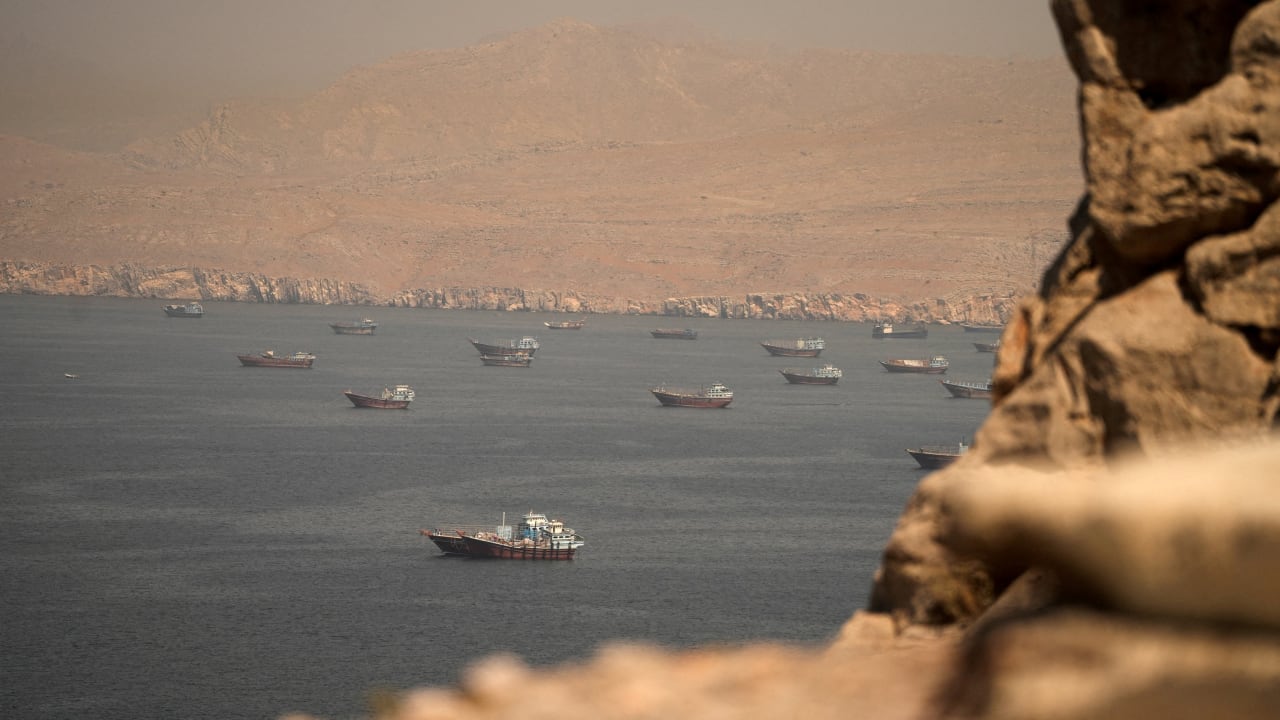
Vessels at the Strait of Hormuz, as seen from Musandam, Oman, June 18, 2026(photo credit: REUTERS/STRINGER)ByARIELLA ROITMAN, ESTHER DAVISJULY 14, 2026 01:46Updated: JULY 14, 2026 07:55
Two national tankers were targeted by two Iranian cruise missiles in the southern lane of the Strait of Hormuz in Omani territorial waters, killing one Indian crew member and wounding eight others, including four seriously, the UAE‘s Defense Ministry said early on Tuesday.
Six of the wounded were Indian nationals, and two were Ukrainian nationals, the ministry said.
The UAE’s Defense Ministry said two tankers, the Mombasa and Al Bahiyah, were damaged after fires broke out on board. The fires were brought under control on both ships, the ministry added.
It also condemned the attack as a serious breach of international law and said the UAE retained its full right to respond and take all necessary measures to protect its sovereignty and security, adding that it is on “high alert and fully prepared to deal with any threats.”

UKMTO reports struck tankers
In a separate incident, the United Kingdom Maritime Trade Operations agency (UKMTO) said in a post on X/Twitter that it received a report of an incident northeast of Qalhat, in Oman.
A tanker was struck by an “unknown projectile,” according to UKMTO, which added that no crew members were injured in the incident.
US President Donald Trump said on Monday that the US was reinstating its blockade of Iranian shipping in the Gulf and would ensure the strait remains open.
“We’re going to keep the strait, and we’ll probably run it. We’ll become the guardian of the strait. Maybe we’ll call it the guardian angel of the strait. And we should be reimbursed for that,” Trump said.
Iran’s top joint military command said the US had no role in determining the future of the waterway and would not be allowed to intervene.
Iran’s Revolutionary Guards say two supertankers hit, disabled in Strait of Hormuz, local media reports
Iran’s Islamic Revolutionary Guard Corps (IRGC) on Tuesday took responsibility for striking the two “offending supertankers” that were hit and disabled in the Strait of Hormuz after the ships ignored warnings, turned off navigation systems and attempted to pass through “a mined route,” Iranian media reported citing a statement from the Guards.
The Guards, in its statement to Iranian media, said the US was “inciting vessels to use an illegal route” and that cooperation with the “aggressor enemy” would result in damage, delays in reopening the strait and a global energy crisis.
Iran claims damage in Bahrain, Kuwait
Additionally, Bahrain’s interior ministry reported that sirens sounded in Bahrain on Tuesday morning. The media adviser to Bahrain’s King said that “Bahraini air defenses have intercepted and destroyed Iranian aerial attacks.”
The Patriot radar, the US Navy’s Fifth Fleet air-control radar, and the C-RAM (Counter-Rocket, Artillery, and Mortar) early-warning radar system were destroyed in the strikes, the IRGC claimed.
Iranian state media also reported on Tuesday that Iranian drones had struck critical infrastructure at US military bases in Kuwait.
CENTCOM Spokesman Captain Tim Hawkins said the Iranian claims, which alleged having damaged communication systems and ammunition depots, were “lies.”
IRGC strikes US air base in Jordan
The IRGC confirmed it targeted a US air base in Jordan with ballistic missiles on Tuesday in a statement published by Fars News, calling on the Jordanian people to dismantle American bases in their country.
“You know very well that not only do we not have any enmity with your country, but we also love you, the noble people, who understand the pain and oppression of the Palestinian people more than any other nation,” the statement said.
Reuters contributed to this report.
END
ISRAEL/IRAN/USA/TUESDAY MID MORNING
Iran Launches ‘Brazen’ Attacks On More Tankers In Hormuz, Killing Sailors, After Araghchi Mocked Trump’s Toll Plan
Tuesday, Jul 14, 2026 – 09:05 AM
The battle for Hormuz has ramped up after the United States has undertaken three consecutive nights of major bombing raids against Iranian targets.
All the while President Trump is said to be “very serious” about his plan to impose a 20% toll on cargo transiting through the Strait of Hormuz, a Semafor report says, citing a White House official who says the president has desired such a plan for months. Both warring sides are insisting that it is their side alone which will be ‘guardian’ over the strait.

Iran’s foreign minister Abbas Araghchi took some jabs at the proposed US plan soon after Trump unveiled it on Truth Social.
“POTUS is absolutely right. Whoever provides secure and safe passage of commercial vessels through the Strait of Hormuz should be compensated for this service,” Araghchi wrote on X. “20% is of course too much. We will be fair,” he added.
Below: ongoing reports that the Houthis are entering the war after Monday missile attacks on the kingdom:
The same day, a clip of Secretary of State Marco Rubio from late June insisting that “no country” can extract tolls went viral. “That’s the law. It’s an international waterway. No country is allowed to charge tolls or fees on an international waterway,” Rubio said.
“That’s existing international law. That’s the way it is in international waterways all over the world and that’s the way we’ll expect it’ll be here.” He added: “I think all the countries in this region would agree.”
Meanwhile Iranian sources continue to warn the West, also with dramatic images of tankers exploding:
German shipping company Hapag-Lloyd says also agrees that charging fees for what is in reality international waters and thus under the control of no single nation “would be fundamentally wrong”.
Even amid a relentless bombing campaign, Iranian forces have not shown signs of backing off their enforcement of their navigation protocol.
The Islamic Revolutionary Guard Corps has on Tuesday newly “targeted and disabled” two supertankers for switching off navigation systems which involved “ignoring warnings and endangering navigation,” according to Tasnim.
Al Jazeera reports early Tuesday, “It’s been an active night and morning for air defense systems in several countries in this region because of missiles and projectiles fired from Iran.”
“This has affected the ship traffic passing through the Strait of Hormuz. Yesterday, we saw the lowest number of ships passing in five weeks,” it continues, adding: “There were only six ships. The day before that, there were 14.”
At least three tankers have been struck overnight into Tuesday, with among them:
The tanker Stolt Magnesium has caught fire after the “explosion of an unidentified external device” as it was sailing in the Arabian Sea off Oman, its manager, Stolt Tankers, says.
The incident occurred at 12:40am (20:40 GMT on Monday) and caused a fire in the vessel’s engine room, the company said in a statement.
The UAE and Gulf allies have strongly condemned the ‘brazen’ attacks on international shipping.

There are growing deaths among seafarers in what’s obviously the world’s most dangerous and volatile energy transit water way. India has formally summoned Iran’s deputy ambassador after an Indian sailor was killed.
According to the UAE defense ministry, the casualty occurred when two Iranian cruise missiles targeted two UAE vessels in the crucial shipping lane, leaving one Indian national dead and eight others wounded.
More latest developments
via Newsquawk…
- US President Trump reiterated that Iran has no air force, no navy and no military, while he said they will hit Iran very hard on Monday night and on Tuesday. Trump said they had a deal yesterday and that Iran breaks deals, as well as commented that the MoU was built to test Iran and that Iran didn’t honour it. Trump also stated that they will hit ‘Pickaxe Mountain’ pretty soon and have their eyes on the site all the time, which is a good potential target
- US Central Command announced that it conducted and completed a third consecutive night of strikes against Iran, with US strikes reported in Bushehr, Bandar Abbas and Bandar Kangan, while explosions were also reported in Iran’s Qeshm Island and Kish Island. More recently, there have been reports of explosions have been heard near Bandar Abbas, Bushehr and Choghadak.
- Details of US President Trump’s proposed Strait of Hormuz toll plan are still being finalised, according to Semafor, saying Trump is ‘very serious about the tolls.
- Iran’s armed forces have begun targeting US naval vessels in the Strait of Hormuz with cruise missiles, Al Mayadeen reported.
- Iranian Army Spokesperson said the Strait of Hormuz will not be open with US aggressions and war, SNN reported.
- IRGC said it targeted weapons warehouses, satellite communications centres, and US forces’ housing building at Bahrain’s Juffair base. Iran’s army also targeted US military facilities and equipment in Kuwait with drones, as well as targeted a ‘hostile’ US vessel with cruise missiles, while it was separately reported that a US military base in Jordan was hit by a missile attack and that a missile attack hit an Iranian Kurdish opposition group site east of Iraq’s Erbil.
- UKMTO received a report that a tanker was hit by an unknown projectile 40NM northeast of Qalhat, Oman. UKMTO reports of an incident 13NM southeast of Lima, Oman, the tanker was reportedly hit by a missile transiting outbound on the southern route
- The UAE Defence Ministry reported that two national tankers were targeted by Iranian cruise missiles in the southern Strait of Hormuz, with the incident occurring in Omani territorial waters, although the fires on both tankers were brought under control, and it reserved the right to respond to the escalation.
- ADNOC confirmed tankers “Al Bahyah” and “Mombasa B” were hit in the Strait of Hormuz.
- Oman’s Foreign Minister said complex talks are under way to make a long-term arrangement to guarantee freedom of navigation through the Strait of Hormuz.
- END
END
ISRAEL/IRAN/USA LATE TUESDAY
IRGC Vows ‘Not A Drop Of Oil & Gas Will Be Exported’ From Region Amid Sustained Cross-Gulf Fighting
Tuesday, Jul 14, 2026 – 03:15 PM
Summary:
- Iran-US fighting is sustained but in tit-for-tat pace, with new reported strikes across the Gulf.
- Trump declares FULL blockade on Iranian ports, while IRGC asserts ‘wartime control’ of Hormuz.
- Trump drops 20% transit fee plan; oil prices ease.
- Multiple tanker attacks over past day again disrupt shipping & cause casualties.
- Regional conflict expands with reported Houthi missiles on Saudi Arabia.
* * *
IRGC: Iran to ‘Control Entire Strait in Wartime’
Amid ongoing cross-Gulf attacks today between Iranian and US forces, the IRGC says they targeted enemy weapons and parts storages in Bahrain and Kuwait. This after the US appeared to attack some critical Iranian infrastructure on coastal islands.
The IRGC has issued a fresh statement via state media on Tuesday, saying that “as long as the US evil stays in the region, not a drop of oil and gas will be exported from the region.” It said further, per the press release:
- US aggression will have no result other than delaying the opening of the Strait of Hormuz.
- Targeted drone ramp in Kuwait’s Ali Al Salem air base; today’s attacks in response to US attacks on Iran.
ABC is meanwhile reporting during the mid-afternoon (US time) that American airstrikes on Iran have been underway for the last couple of course. And yet still, Iran’s IRIB has said that the Islamic Republic “must control the entire Hormuz Strait in wartime”. The region is being plunged back into full-fledged war, also as fighting between the Saudis and Houthis in Yemen appears to be breaking out.
Morning warnings from Tehran late Tuesday: Iran’s deputy foreign minister says if the US thinks its military attacks and blockade will force them to request negotiations, it’s making a mistake
END
ISRAEL/USA/IRAN…
Trump Backs Off 20% Fee Plan For Hormuz, Asserts ‘FULL Blockade’ Only On Iranian Ports
Tuesday, Jul 14, 2026 – 11:20 AM
Update(12:00ET): It’s the return of another TACO Tuesday as President Trump in a lengthy Truth Social missive appears to have reversed his plan to collect a 20% of cargo fee for international vessels wishing to transit the Strait of Hormuz.
“Oil is flowing like never before,” he began (except it’s not…), before writing, “Based on highly productive conversations with Middle East leadership, I have decided to replace the 20% United States Reimbursement Fee with Trade and Investment Deals that the various Gulf States will be making into the United States. Those Investments will be MASSIVE but, at the same time, extraordinarily good for them, and their future.” He echoed the same in follow-up with reporters at the White House:
So Gulf allies, and likely officials within his own cabinet, have talked Trump out of the 20% collection scheme idea, which would have likely in the end just shifted leverage back over to Iran, given its own much cheaper passage protocol scheme.
US OIL PARES GAINS, WTI TRADES NEAR $78/BBL

Oil prices decline on the stated reversal in plans:

…amid emerging reports of fresh Iranian attacks on Kuwait:
* * *
The battle for Hormuz has ramped up after the United States has undertaken three consecutive nights of major bombing raids against Iranian targets.
All the while President Trump is said to be “very serious” about his plan to impose a 20% toll on cargo transiting through the Strait of Hormuz, a Semafor report says, citing a White House official who says the president has desired such a plan for months. Both warring sides are insisting that it is their side alone which will be ‘guardian’ over the strait.
Iran’s foreign minister Abbas Araghchi took some jabs at the proposed US plan soon after Trump unveiled it on Truth Social.
“POTUS is absolutely right. Whoever provides secure and safe passage of commercial vessels through the Strait of Hormuz should be compensated for this service,” Araghchi wrote on X. “20% is of course too much. We will be fair,” he added.
Below: ongoing reports that the Houthis are entering the war after Monday missile attacks on the kingdom:
The same day, a clip of Secretary of State Marco Rubio from late June insisting that “no country” can extract tolls went viral. “That’s the law. It’s an international waterway. No country is allowed to charge tolls or fees on an international waterway,” Rubio said.
“That’s existing international law. That’s the way it is in international waterways all over the world and that’s the way we’ll expect it’ll be here.” He added: “I think all the countries in this region would agree.”
Meanwhile Iranian sources continue to warn the West, also with dramatic images of tankers exploding:
German shipping company Hapag-Lloyd says also agrees that charging fees for what is in reality international waters and thus under the control of no single nation “would be fundamentally wrong”.
Even amid a relentless bombing campaign, Iranian forces have not shown signs of backing off their enforcement of their navigation protocol.
The Islamic Revolutionary Guard Corps has on Tuesday newly “targeted and disabled” two supertankers for switching off navigation systems which involved “ignoring warnings and endangering navigation,” according to Tasnim.
Al Jazeera reports early Tuesday, “It’s been an active night and morning for air defense systems in several countries in this region because of missiles and projectiles fired from Iran.”
“This has affected the ship traffic passing through the Strait of Hormuz. Yesterday, we saw the lowest number of ships passing in five weeks,” it continues, adding: “There were only six ships. The day before that, there were 14.”
At least three tankers have been struck overnight into Tuesday, with among them:
The tanker Stolt Magnesium has caught fire after the “explosion of an unidentified external device” as it was sailing in the Arabian Sea off Oman, its manager, Stolt Tankers, says.
The incident occurred at 12:40am (20:40 GMT on Monday) and caused a fire in the vessel’s engine room, the company said in a statement.
The UAE and Gulf allies have strongly condemned the ‘brazen’ attacks on international shipping.
There are growing deaths among seafarers in what’s obviously the world’s most dangerous and volatile energy transit water way. India has formally summoned Iran’s deputy ambassador after an Indian sailor was killed.
According to the UAE defense ministry, the casualty occurred when two Iranian cruise missiles targeted two UAE vessels in the crucial shipping lane, leaving one Indian national dead and eight others wounded.
More latest developments
via Newsquawk…
- US President Trump reiterated that Iran has no air force, no navy and no military, while he said they will hit Iran very hard on Monday night and on Tuesday. Trump said they had a deal yesterday and that Iran breaks deals, as well as commented that the MoU was built to test Iran and that Iran didn’t honour it. Trump also stated that they will hit ‘Pickaxe Mountain’ pretty soon and have their eyes on the site all the time, which is a good potential target
- US Central Command announced that it conducted and completed a third consecutive night of strikes against Iran, with US strikes reported in Bushehr, Bandar Abbas and Bandar Kangan, while explosions were also reported in Iran’s Qeshm Island and Kish Island. More recently, there have been reports of explosions have been heard near Bandar Abbas, Bushehr and Choghadak.
- Details of US President Trump’s proposed Strait of Hormuz toll plan are still being finalised, according to Semafor, saying Trump is ‘very serious about the tolls.
- Iran’s armed forces have begun targeting US naval vessels in the Strait of Hormuz with cruise missiles, Al Mayadeen reported.
- Iranian Army Spokesperson said the Strait of Hormuz will not be open with US aggressions and war, SNN reported.
- IRGC said it targeted weapons warehouses, satellite communications centres, and US forces’ housing building at Bahrain’s Juffair base. Iran’s army also targeted US military facilities and equipment in Kuwait with drones, as well as targeted a ‘hostile’ US vessel with cruise missiles, while it was separately reported that a US military base in Jordan was hit by a missile attack and that a missile attack hit an Iranian Kurdish opposition group site east of Iraq’s Erbil.
- UKMTO received a report that a tanker was hit by an unknown projectile 40NM northeast of Qalhat, Oman. UKMTO reports of an incident 13NM southeast of Lima, Oman, the tanker was reportedly hit by a missile transiting outbound on the southern route
- The UAE Defence Ministry reported that two national tankers were targeted by Iranian cruise missiles in the southern Strait of Hormuz, with the incident occurring in Omani territorial waters, although the fires on both tankers were brought under control, and it reserved the right to respond to the escalation.
- ADNOC confirmed tankers “Al Bahyah” and “Mombasa B” were hit in the Strait of Hormuz.
- Oman’s Foreign Minister said complex talks are under way to make a long-term arrangement to guarantee freedom of navigation through the Strait of Hormuz.
ISRAEL TBN
END
IRAN//GULFSTATES
Iran strikes tankers in Strait of Hormuz following US attacks, sirens sound in Bahrain
The UAE Defense Ministry said the country retained its full right to respond and take all necessary measures to protect its sovereignty and security.
Vessels at the Strait of Hormuz, as seen from Musandam, Oman, June 18, 2026(photo credit: REUTERS/STRINGER)ByJERUSALEM POST STAFFJULY 14, 2026 01:46Updated: JULY 14, 2026 04:37
Two national tankers were targeted by two Iranian cruise missiles in the southern lane of the Strait of Hormuz in Omani territorial waters, killing one Indian crew member and wounding eight others, including four seriously, the UAE‘s Defense Ministry said early on Tuesday.
Six of the wounded were Indian nationals, and two were Ukrainian nationals, the ministry said.
Bahrain’s interior ministry also reported that sirens sounded in Bahrain on Tuesday morning. The media adviser to Bahrain’s King said that “Bahraini air defenses have intercepted and destroyed Iranian aerial attacks.”
The UAE’s Defense Ministry said two tankers, the Mombasa and Al Bahiyah, were damaged after fires broke out on board. The fires were brought under control on both ships, the ministry added.
It also condemned the attack as a serious breach of international law and said the UAE retained its full right to respond and take all necessary measures to protect its sovereignty and security, adding that it is on “high alert and fully prepared to deal with any threats.”

UKMTO reported tankers attacked after Trump reinstated blockade
In a separate incident, the United Kingdom Maritime Trade Operations agency (UKMTO) said in a post on X/Twitter that it received a report of an incident northeast of Qalhat, in Oman.
A tanker was struck by an “unknown projectile,” according to UKMTO, which added that no crew members were injured in the incident.
US President Donald Trump said on Monday that the US was reinstating its blockade of Iranian shipping in the Gulf and would ensure the strait remains open.
“We’re going to keep the strait, and we’ll probably run it. We’ll become the guardian of the strait. Maybe we’ll call it the guardian angel of the strait. And we should be reimbursed for that,” Trump said.
Iran’s top joint military command said the US had no role in determining the future of the waterway and would not be allowed to intervene.
Iran’s Revolutionary Guards say two supertankers hit, disabled in Strait of Hormuz, local media reports
Iran’s Revolutionary Guards on Tuesday said two “offending supertankers” have been hit and disabled in the Strait of Hormuz after the ships ignored warnings, turned off navigation systems and attempted to pass through “a mined route,” Iranian media reported citing a statement from the Guards.
The Guards, in its statement to Iranian media, said the US was “inciting vessels to use an illegal route” and that cooperation with the “aggressor enemy” would result in damage, delays in reopening the strait and a global energy crisis.
Reuters contributed to this report.
END
SAUDI ARABIA/TAIWAN//DRONES
Saudi Arabia Turns Taiwan Into Drone Export Leader As Iran War Reshapes Warfare
Monday, Jul 13, 2026 – 11:00 PM
New data show that Saudi Arabia purchased a record $47.2 million worth of small drones from Taiwan last month, underscoring how governments are beginning to rapidly procure suicide drones.
Bloomberg was the first to cite new data from Taiwan’s Ministry of Finance showing that drone exports surged in June, driven by a record order from Saudi Arabia. The timing suggests Riyadh absorbed many hard lessons during the US-Iran conflict and is moving quickly to build stockpiles of one-way attack and interceptor drones.

The exported drones weighed roughly 7 to 15 kilograms – or up to 30 pounds – and in a recent report by Piper Sandler analyst Clarke Jeffries, these drones are considered Group 1 and Group 2.

Jeffries laid out three key insights about the rapidly changing defense landscape:

He also listed ways to profit from the drone industry as the wave of orders begins:

Read:
It’s not only one-way attack and interceptor drones that will be produced en masse globally, but also counter-AUS technology to defend high-value assets such as refineries, ports, data centers, and power grid infrastructure
.Related:
In the mergers and acquisitions space, DZYNE Technologies – a maker of drones, loitering munition-type systems, and counter-drone technology – was recently sold by its investors to Nasdaq-listed defense and industrial technology firm Ondas Holdings for a handsome profit.
To begin the week, Bloomberg reported that drone company Helsing completed a $18 billion financing round from investors, including Goldman Sachs.
Refer to our note above on how to profit from the asymmetric warfare boom, as this theme will continue.
END
HEZBOLLAH
HAMAS
RUSSIA VS UKRAINE
Graham’s Final Mission? Trump Backs Hard-Hitting Russia Sanctions Package
Tuesday, Jul 14, 2026 – 11:25 AM
Apparently the late Senator Lindsey Graham’s hawkish neocon legacy will continue to reverberate from beyond the grave. The 71-year old lawmaker died Saturday night “from a brief and sudden illness” – immediately after returning from Ukraine where he had toured drone and weapons factories.
President Trump is expected to support the passage of a new bipartisan Russia sanctions package that was long spearheaded by Graham, according to CNN citing a White House official.

The South Carolina senator spent years trying to finally advance it across the finish line, but the Trump administration entered the White House loudly pushing diplomacy with Moscow and the idea that a swift end to the over four-year long war could be achieved by Trump’s direct mediation and negotiating prowess. The policy reached an apex with the Trumpm-Putin Alaska summit, but failed to take off from there.
Instead, the world is currently witnessing the war’s biggest escalatory phase in years, especially given the nightly major Ukrainian drone strikes on Russian energy sites and infrastructure. Russia’s aerial bombardment of Ukrainian cities, including on the capital, has in turn stepped up.
The sanctions legislation would be America’s toughest anti-Moscow move yet, greatly expanding on the original Sanctioning Russia Act:
Rather than requiring a presidential determination that Moscow had rejected peace efforts or violated a peace agreement, many sanctions would automatically take effect within 30 days of enactment.
The revised legislation would substantially broaden sanctions beyond Russian officials and financial institutions to include investment, sovereign debt, shipping, energy exports, uranium imports, financial messaging services, and other sectors of Russia’s economy.
The legislation would also authorize the president to impose steep tariffs on imports from countries that continue purchasing Russian oil, natural gas, and uranium.
Pro-Ukraine hawks are salivating, with Sen. Jeanne Shaheen (D-N.H.), the ranking member of the Senate Foreign Relations Committee, having announced that passing the bill would serve as a “fitting memorial” to Graham and everything he represented.
“There can be no more fitting memorial to Lindsey, his legacy, or the causes he fought for, than to pass this legislation and realize his long-held dream of an independent and secure Ukraine,” she said.
Senate Majority Leader John Thune (R-S.D.) agreed. He told reporters Monday that passing the legislation “would be a great legacy, great tribute to Lindsey.”
GOP Rep. Mike Turner of Ohio said Sunday on Face the Nation, “This bill would be an important symbolism to say, ‘We’re going to be with Ukraine.’ And I certainly hope the Senate moves it this week.” Yet such a passage is only going to more deeply embed the United States in a lose-lose proxy war with Moscow which could soon spiral dangerously into a WW3-style nuclear armed confrontation.
6/.GLOBAL ISSUES, COVID ISSUES, VACCINE INJURIES/HEALTH ISSUES
no wonder: they are deadly!!
Germany Stops Recommending COVID-19 Vaccination For Most People Under 75
Tuesday, Jul 14, 2026 – 05:00 AM
Authored by Zachary Stieber via The Epoch Times,
Germany has updated its COVID-19 vaccination recommendations, advising most people under 75 not to receive a COVID-19 vaccine. A health worker at a mobile COVID-19 vaccination station in a shopping mall fills a syringe with the Pfizer-BioNTech vaccine in Ludwigsburg, Germany, on Nov. 11, 2021. Thomas Kienzle/AFP via Getty Images
Germany’s Standing Committee on Vaccination, which offers vaccine recommendations for the country, on July 9 said in a 33-page document that its stance on COVID-19 vaccination was changing “to reflect the current epidemiological situation and the population’s immune status.”
The committee, known as STIKO, added: “A large proportion of the adult population now has hybrid immunity, characterised by exposure to a variety of antigenic contacts, and is therefore sufficiently well protected against severe cases of COVID-19.
“This also applies to healthy pregnant women. Consequently, the recommendation to achieve baseline immunity for the adult population (including pregnant women without underlying conditions or pregnancy-related complications) is no longer applicable. In [the] future, the standard vaccination recommendation will apply to those ≥ 75 years of age.”
STIKO’s recommendations are advisory, but form the basis of guidance adopted by states and the Federal Joint Committee’s vaccination directives. STIKO comprises members from the Robert Koch Institut, with members representing specialties such as pediatrics and virology.
In January, STIKO’s updated immunization schedule advised people aged 60 and older to receive a COVID-19 vaccine annually, and people aged 18-59 who had not received a shot in the past to receive one, including women of childbearing age and pregnant women, and people who had not achieved at least three antigenic contacts for baseline immunity, or a combination of at least three prior shots and COVID-19 infections.
STIKO also recommended COVID-19 vaccination for people aged 6 months and older with specific conditions that the committee said increased their risk of serious illness, such as chronic liver disease and obesity, as well as family members and close contacts of people in whom COVID-19 vaccination was not likely to produce a protective immune response.
In the United States, the Centers for Disease Control and Prevention in January rolled back COVID-19 vaccine recommendations, but a federal court blocked the update. An appeal is ongoing.
Four categories of changes precipitated the updated advice, STIKO said on July 9, including that much of the adult population has hybrid immunity.
STIKO also found that severe cases of COVID-19 during pregnancy have become “very rare”; that COVID-19 case numbers, hospitalizations, and deaths have been steadily declining; that deaths are happening mostly among people aged at least 75 years; and that a seasonal pattern of COVID-19 has become established, with cases peaking in the late summer and early fall.
While removing the general recommendation for most of the population under 75 years of age, STIKO is still recommending vaccination for people at increased risk due to underlying illnesses, including pregnant women.
END
GLOBAL ISSUES
ROBERT H….
IVERMECTIN and FENBENDAZOLE SUCCESS STORIES: Arthritis Cases Successfully Cured
⚡️THE MASSIVE 40% OFF JULY 4th SITEWIDE SALE HAS BEEN EXTENDED!⚡️
Jul 13, 2026
The following sextet of arthritis remission cases have been compiled from this Substack’s ongoing anecdotal repurposed compound series.
The first success story was originally published on September 2nd, 2023:
This article was inspired by a Subscriber’s recent comment in the article entitled, REPOST: Ivermectin May Defeat Cancer and Other Common Chronic Diseases of Aging, where he shared his positive and most surprising “side effect:”
As per my above reply, we know that Ivermectin may in fact attenuate arthritis, and even fully cure it. The conclusion of the first cited study Evaluation of therapeutic potential of ivermectin against complete Freund’s adjuvant-induced arthritis in rats: Involvement of inflammatory mediators:
Ivermectin has significant antiarthritic properties and can be a novel treatment agent for the management of rheumatoid arthritis patients suffering from strongyloidiasis.
In the second cited study, the most important sentence actually touches upon some of the admitted DEATHVAX™ adverse events:
Some antiparasitics have also been used to boost immunity in a number of human diseases including leprosy, Hodgkin’s disease, rheumatoid arthritis, and in adjuvanted therapy of colorectal cancer.
Given that even prior to the slow kill bioweapon rollout too many Americans were already exposed to dangerous environmental toxins, pre-Modified mRNA deleterious vaccines, processed foods, sodas, sedentary lifestyles, and so on and so forth, we know that the average person was existing in a hyper-inflammatory state. Said hyper-inflammatory conditions promote all kinds of diseases, not limited to cancer.
Introducing a genetically modifying DEATHVAX™ to the average inflamed person was a guaranteed bio-disaster, with elevated preexisting inflammation becoming a VAIDS baseline of hyper-inflammation, as the “vaccine” spike protein (SP 2) ravaged the entire body, and kicked off a plethora of diseases, including turbo cancers.
As the body that was contaminated into transforming itself into a spike protein factory commences to attack itself, the immune system rapidly degrades, and as the p53 protein responsible for cancer suppression is decimated by SP 2 all while ACE2 receptors are attacked and fibrils clump together to promote prion-based diseases (brain damage, premature early onset dementia and Alzheimer’s are also exacerbated by a hyper-inflammatory state), the “vaccinated” subject is reduced to a metabolic disaster zone.
IverX: Pharmaceutical Grade Pure Ivermectin
·
November 8, 2024

Ivermectin is perhaps the single best treatment not just for PSYOP-19, but for the spike protein damage that is induced by the slow kill bioweapon injections.
Etc. & etc.
Which brings us to a deeper exploration behind the biological theories of Ivermectin and Hydroxychloroquine’s anti-inflammatory properties in arthritis treatment.
Ivermectin’s and Hydroxychloroquine’s traditional roles as antiparasitic and antimalarial agents have now extended to the treatment of inflammatory conditions such as arthritis. The underlying anti-inflammatory mechanisms of these agents, with a particular focus on IL-6 modulation, may just prove yet again that the real reason BigPharma and their DoD, Pentagon, UN, WHO, Gates “nonprofits” et al. went after these miracle drugs was because they cure a wide gamut of diseases, and not just PSYOP-19.
Ivermectin’s Mechanisms of Anti-Inflammatory Action
Key Pathways
- Inhibition of Nuclear Factor-kB (NF-kB): Can inhibit the NF-kB pathway, a central regulator of inflammation.
- Modulation of Toll-like Receptors (TLRs): Can dampen inflammation by interacting with Toll-like receptors.
- Inhibition of Protein Kinases: Ivermectin interferes with various protein kinasesthat play various roles in inflammatory signalling pathways, thus contributing to its anti-inflammatory properties.
- Glycine and Glutamate-Gated Chloride Channels: Affects chloride channels thus regulating immune cell function.
- Endosomal pH Alteration: By modifying endosomal pH, Ivermectin can impact antigen presentation and immune responses, as yet another anti-inflammatory mechanism.
Interleukin-6 (IL-6) Modulation
A crucial aspect of Ivermectin’s anti-inflammatory mechanism is its ability to down-regulate IL-6 levels, possibly extending its influence on NF-kB pathways and Toll-like receptors.
Hydroxychloroquine’s Mechanisms of Anti-Inflammatory Action
Key Pathways
- Inhibition of Antigen Processing: Disrupts antigen processing within immune cells.
- Immune Modulation: Modulates immune cell function and cytokine production.
- Impairment of Leukocyte Chemotaxis and Phagocytosis: Interference with these processes contributes to the reduction of inflammation.
- Inhibition of Toll-like Receptors (TLRs): Similar to the action of Ivermectin,Hydroxychloroquine affects TLRs, thus regulating immune and inflammatory responses.
- Endosomal pH Alteration: This action impacts antigen presentation and immune cell activation, adjusting the anti-inflammatory response.
Shared Mechanisms: A Comparative discussion
IL-6 Modulation
Both, Ivermectin and Hydroxychloroquine, have shown the ability to modulate IL-6 levels. This mechanism holds significant implications for addressing inflammatory conditions such as arthritis.
Endosomal pH Alteration
Both substances have the ability to alter endosomal pH, thus affecting antigen presentation and impacting IL-6.
Toll-like Receptors (TLRs)
Both, Ivermectin and Hydroxychloroquine, influence Toll-like receptors and various cellular signalling pathways, affecting the release of cytokines and contributing to their anti-inflammatory actions.
In summary, Ivermectin and Hydroxychloroquine have shown efficacy in treating inflammatory conditions such as arthritis. Their shared and unique mechanisms, particularly their ability to modulate IL-6 levels, warrant further investigation.
As the anti-inflammatory effects of these substances are further elucidated, the potential for innovative therapies that target IL-6 and their related pathways can be unlocked.
Since we now know that Ivermectin and Hydroxychloroquine have similar anti-arthritic and anti-inflammatory mechanisms, it would follow that either of these miraculous drugs would confer great healing benefits.
The added bonus of Ivermectin administration for arthritis would be its potential role in both preventing and treating (turbo) cancers, and the many other VAIDS-induced adverse events.
The second success story was originally published on December 5th, 2023:
By now we have heard far too many of these death’s doorstep stories that ended in democidal tragedy, and likewise we have heard many accounts of Ivermectin rapidly saving the lives of those that seemed destined for certain death.

The third success story was originally published on January 18th, 2024:
Readers of this Substack know that Ivermectin may treat arthritis and general inflammation, and today we have yet another encouraging experience:

It sure seems like the arthritis was cured, and the fact that this person is now completely pain-free further reinforces this.
The fourth success story was originally published on March 11th, 2024:
Our next story comes from a 77 year old woman that emailed yours truly after taking a chance on Fenbendazole and Ivermectin for her crippling arthritis. After getting three doses of the “vaccines” her mild arthritis flared up to the point that she could barely move.
I wanted to thank you from the bottom of my heart!
I could barely get up after sitting in a chair and every time I had to move I was dreading it.
After three weeks (2SG: of taking Fenbendazole and Ivermectin) I’m completely pain free and back to taking long walks in the park and back at the gym feeling better than ever.
Thank you for giving me back my life!
Giving back lives is one of the best ways to defeat this malevolent Great Reset globalist system.
The fifth success story was originally published on August 26th, 2024:
We know that Ivermectin is a powerful anti-inflammatory, and can treat arthritis as per various research studies (e.g. Evaluation of therapeutic potential of ivermectin against complete Freund’s adjuvant-induced arthritis in rats: Involvement of inflammatory mediators), so it comes as little surprise to read the following comment:

It makes logical sense that the dangers of “vaccine” shedding would be attenuated with Ivermectin. Also, despite the recent inane fear-mongering disinformation campaigns, Ivermectin certainly does not impact fertility in any way; in fact, it more than likely actually improves birth rates.
The sixth success story was originally published on May 25th, 2026:
For many years this Substack has been writing about Ivermectin’s ability to improve and even cure various forms of arthritis; for example:
Ivermectin & Fenbendazole Subscribe Success Stories: Arthritis Cured, Verrucous & Stage 4 Prostate Cancer Protocol
·
January 18, 2024

In this Substack’s ongoing anecdotal repurposed drug case study series come two more compelling success stories, and a detailed prostate cancer protocol.
MARK CRISPIN MILLER
DR PAUL ALEXANDER.
RABOBANK/MICHAEL EVERY/OR OR PICTON/GIFFIN OR RABOBANK EXECUTIVE/COMMENTARY ON WORLDLY AFFAIRS
Comfortably Bomb
Monday, Jul 13, 2026 – 10:00 PM
By Michael Every of Rabobank
Hormuz update: Comfortably Bomb
Summary
- The US-Iran MoU appears to have collapsed sooner than we had thought.
- With both sides striking the other, US efforts will turn to ensuring energy can flow through Hormuz ‘the hard way’ via escorting ships through it.
- For now, markets are saying the US can ‘comfortably bomb’ and ‘there is no pain’ even if the ‘MoU are receding’, mostly due to finite SPR drains and low Chinese oil imports.
- That gives the US a window for action: if it can keep enough oil flowing through Hormuz, which is our base case, it underlines military action can move markets in a desired direction; if it fails, we face a far larger energy crisis with far less in the tank as mitigants – or a geostrategic reckoning.
We argued the June 17 US-Iran memorandum of understanding temporarily suited both sides but would last, at best, until the US midterm elections and would ultimately collapse due to its inherent contradictions over tolls, sanctions, Lebanon, and uranium. At time of writing on 13 July, the US and Iran have separately declared the “ceasefire” and “diplomacy” as over. Both were striking the other, albeit not yet all-out as at the start of the war. Typically, the IRGC has declared that the Strait of Hormuz is now closed – and the US that it is still very much open for business.
There is no pain
Regardless, the market response has been constrained. At Asian market open on Monday, Brent was only up around 4% to $79, for example (Figure 1). In short, markets continue to treat a new active conflict around the Strait of Hormuz as containable.

That’s the case for several reasons. First, inventory draws have eased immediate pressure. Second, China is keeping its oil imports subdued. Third, some energy workarounds have emerged. Lastly, there has been some demand destruction.
This is not a sustainable long-term dynamic, but for a few weeks, or months at most, the market may continue to say “there is no pain” in spot oil prices even if wide crack spreads were already telling another story on refined products before this latest fighting started.
The key question is if this is a temporary or a longer-term geopolitical issue: arguably it’s both. However, the US may be gambling it can resolve the Hormuz situation to the energy market’s satisfaction before things become critical.
MoU are receding
The Hormuz disagreement stems from the MoU’s Article 5, which stated:
“Upon the signing of this MoU, Iran will make arrangements using its best efforts for the safe passage of commercial vessels, with no charge for 60 days only, from the Persian Gulf to the Sea of Oman, and vice versa. The traffic of commercial vessels will immediately start, and considering the need for removing the technical and military obstacles, and de-mining by Iran, will be instated within 30 days. Iran will conduct dialogue with the Sultanate of Oman, to define the future administration and maritime services in the Strait of Hormuz, in discussions with other Persian Gulf Littoral States, in line with applicable international law and the sovereign rights of coastal states of the Strait of Hormuz.”
Iran took this to mean it controlled all of Hormuz, including outside its own territorial waters, and could toll maritime traffic there.
The US took it to mean that Iran couldn’t and set up an alternative toll-free route via Omani waters. Iran has since attacked ships using this alternative route. That was the proximate trigger for the latest rounds of US strikes on Iranian facilities on islands within Hormuz and along its coastline aimed at degrading Tehran’s ability to project control over the waterway; and of Iranian counterstrikes.
The MoU therefore collapsed over the easiest of its contradictions to resolve, tolls, which could have been relabelled as ‘fees’. That presents a daunting challenge for market optimism as it implies US-Iran tensions are here to stay on multiple fronts.
However, it also focuses the immediate problem –and US and Iranian attention– on physical control of Hormuz.
A distant ship smoke on the horizon
The message from US CENTCOM is clear: “The Strait of Hormuz is open to all vessels seeking to lawfully transit the international waterway. US forces are positioned and prepared to ensure that freedom of navigation remains available despite unwarranted Iranian aggression, harassment, threats, and arbitrary declarations. Iran does not control the strait. Traffic is flowing.” In pledging this, the US aims to ensure that Hormuz doesn’t bother markets the way that it did earlier in the war. That implies:
1. Taking out Iranian facilities in and along Hormuz so the threat to the southern Omani channel is diminished.
2. Providing defensive cover for ships passing through from drones, missiles, small boats, and mines, etc.
3. Shielding GCC allies, particularly their energy and critical infrastructure, but where stocks of missile interceptors are reportedly low. Very notably, Iran has so far not struck at these key GCC facilities again in recent attacks. That could suggest Tehran realises there are limits to what it can do to its neighbours if it also wants to offer alternative regional leadership ahead.
These US tasks, mirroring the late-80’s Operation Earnest Will in the Iran-Iraq War’s Tanker phase, may require help from the GCC and NATO. While US allies have been reticent to (publicly) act in this regard until now –and the Saudis blocked Operation Project Freedom with the same goal– that dynamic may change with the recent narrow avoidance of an energy crisis and the narrative that Iran alone is now blocking Hormuz.
Moreover, it has been revealed that the US continued with a covert version of Project Freedom anyway without Saudi assistance.
You are only coming through in waves
It’s credible to assume US (and GCC/coalition) naval escorts with air cover could move substantial energy volumes through Hormuz via Omani waters even under duress. Recent operational data suggest the US military directly escorted tankers carrying significant amounts of oil successfully through the Strait. The US claims this was as high as 7 million barrels per day. Sustained throughput of meaningful amounts of oil and products via these military escorts appears theoretically feasible, albeit at higher costs from insurance premia and longer transit times. That turns a serious supply shock into a manageable disruption.
At the same time, it’s realistic to expect that on top of a cancelled Iranian oil sanctions waiver, the US could reimpose its blockade on Iranian oil to increase economic pressure on it.
We can also expect more efforts to build alternative supply chains and pipelines that avoid Hormuz as possible around it. None of them are a short-term palliative to match the Saudi East West pipeline to Yanbu, but in the longer run they will reduce Iran’s leverage even further.
Your lips move but I can’t hear what you’re saying
President Trump has called the Iranians “liars” and “scum” and Iran has stated it wants “revenge” and to kill him. Both sides have made their red lines explicit and have shown they are prepared to enforce them kinetically. The most positive near-term path is continued tit-for-tat pressure, punctuated by attempts at limited talks that produce little beyond contradictory statements.
Markets pricing for a resolution of this crisis from a diplomatic perspective or a ‘TACO’ are likely wrong. However, US hard power could also achieve the same benign outcome.
I can’t explain, you would not understand
Markets and analysts are rightly confused by all the contradictory signals being seen around this crisis: declining inventories, wide crack spreads, the renewed cut-off of Iranian oil, intensifying military action and perhaps more later – yet energy prices have not blown out. It perhaps helps to underline who has been winning and losing and who could emerge as the final victor and how.
This is not how I(ran) am
Iran was heavily beaten militarily while exposing key US defensive weaknesses; then it was handed a win in peace negotiations due to energy market pressure on Trump; now, with oil prices contained, it has overplayed its weak hand and is under a new phase of US pressure:
- Iran could potentially lose effective control of Hormuz.
- Iran gets no sanctions relief as well as no oil sales if the US blockades it.
- Iran gets no assets unfrozen nor a $300bn in FDI for an economy shattered by the recent war.
- In Lebanon, peace progress has been on Israeli and Lebanese not Iranian/Hezbollah terms;
- Iran’s proxy in Syria has been lost and is working on a pipeline to help Iraq avoid Hormuz; Iraq’s pro-Iranian militias are being constrained by the government; the Houthis remain quiet; and Hamas has agreed to cede power in Gaza, if not disarm.
- Iran’s highly enriched uranium will clearly not be discussed, with reports Tehran is trying to rebuild its nuclear facilities. The US will have to address this too, but that perhaps via the air rather than boots on the ground, as in 2025.
- None of that means the US is aiming at regime change even if Israel says it is. Yet, Tehran could find itself regionally shrunken, economically ‘caged’, and geopolitically ignored.
But that’s only if the US wins the Battle of Hormuz. As repeatedly stressed, a US defeat or retreat would flip the script. That’s why we have continuously argued the US will use kinetic force (and, if absolutely necessary, radical economic statecraft in the energy sector, i.e., NAFTA > NAPHTHA)
I have become Comfortably Bomb
Markets can therefore enjoy a form of geopolitical anaesthesia: “geopolitical risk equals higher energy prices” is not firing fully because so much oil has been injected into our global system.
The US SPR cushion could last a few more months at current rates of depletion; so could Japan’s SPR; and China has kept its oil import volumes subdued and has vast reserves. Indeed, there’s little logic –beyond a statecraft escalation vs the US– for China to restart buying oil aggressively while the US undertakes military action to try to free up Hormuz which, ordinarily, would suit China. (The only caveat being that Iran has promised a ‘friends and family’ discount to Chinese ships on its proposed tolls.)
As such, the market seems to be telling the US to ‘comfortably bomb’ – but only on the unspoken assumption that its attempts to keep Hormuz open work. That is our geopolitical base case given the historical track record and the overall stakes.
However, if it fails, and/or if Iran steps up its attacks against GCC energy and infrastructure regardless of the regional bridges (and refineries and desalination plants, etc) that it burns, then we would face a serious global energy crisis, and with much less left in the tank as potential mitigants.
At the least, the US –with midterms looming– would again have to pause until after them; and at the most, we could see the return of narratives heard a few months ago and still echoing in places – that the US is unable to use its military power to achieve its strategic goals, with enormous geopolitical and geoeconomic consequences.
The full implications of that thought should be enough to leave any strategist comfortably numb.
END
Whose-muz?
Tuesday, Jul 14, 2026 – 01:45 PM
By Michael Every of Rabobank
Whose-muz?
Oil leaped 9%, the largest move since 2020. Today, it’s up another 2.5% to $85 at time of writing. It’s a good job we also have the Cleveland Fed’s trimmed-mean inflation measure out as well, right? Obviously, oil was driven by developments in Hormuz – or rather Whose-muz? There, besides reimposing the naval blockade of Iran, President Trump stated those using the waterway will now pay 20% of the value of cargo as compensation to the US, the strait’s new guardian. While the proposed Iranian toll the US rejected was $2m per tanker, or $1 per barrel of oil and $22 per tonne of LNG, Bloomberg estimates Trump fees at $30m per supertanker, the equivalent of $8 on oil and $177 on LNG. Naturally, the UN shipping agency is opposed to any fees for any strait and wants details on that Trump tariff – as if that will stop it.

More bluntly, Iran responded with missile attacks on tankers, with two from the UAE hit, as well as more strikes against the GCC and US military bases, the latter so far avoiding both energy and critical infrastructure. As we noted in ‘Comfortably Bomb’ yesterday, Iran can’t destroy such facilities and build bridges to the GCC if it sees itself defeating the US and gaining regional leadership. By contrast, the US is again in ‘take it down’ mode: Trump is reportedly weighing taking out Iran’s Pickaxe Mountain nuclear site, requiring a phenomenal explosion to neutralise.
Keeping out of the fight so far is Israel: the 2026 headline there from the New York Times is Mossad trying to recruit former Iranian President Ahmadinejad as an agent, and potential front man, in a failed plan for regime change. However, the Yemeni government, OK’d by the Saudis after Trump approval, bombed a runway in Houthi-occupied Sanaa to try to prevent an Iranian plane landing; now the Houthis are firing at the Saudis again for the first time in years, potentially endangering vital east-west oil flows via Yanbu on the Red Sea.
The realpolitik take is more evidence of a new (old) Mahan world disorder where countries use force to impose or restrict maritime trade flows: first Iran, now the US; the devastating Ukrainian attacks on Russian ships in the Sea of Azov is another concurrent example; and note the Hong Kong press asks, ‘Will Manila and Hanoi’s maritime deal challenge Beijing in the South China Sea?’
It’s also the US underlining that it’s fighting for a region, and world economy, that benefits from an open Hormuz but will no longer do it for free. Indeed, there’s a US message to the GCC and NATO/Europe/US allies – help us win this fight rather than saying ‘Not our war’ again. Don’t be surprised if anyone who aids the US now gets the 20% tariff lifted – which still implies it will have to be imposed on others to create that incentive.
If you think that’s cynical, in some see this as the US keeping Hormuz closed so it benefits as an LNG exporter. Indeed, as Dubai plans a new east-coast port for oil, LNG giant Qatar looks badly placed, Doha now looking at a project with the US (which likely won’t pay a penny?) for an Iraq-Syria pipeline. Even outside energy, the Asian press note the US has emerged as the helium winner amid the Iran war and China’s restrictions on exports of that key gas needed for chipmaking, with Taiwan, Japan, and South Korea turning to America for flows.
Which model?
Obviously not recalling all the reports on how Germany was artificially competitive within the Eurozone because of the low FX rate it was allowed to join at, Chancellor Merz just called for a dialogue with China on its monetary and FX policy, saying that the EU could not win, no matter how innovative or good the bloc may be, against a competitor that artificially manipulates its currency. He argued that CNY is 20-30% undervalued and needs to be allowed to float more freely so that it can appreciate to a fairer level. In this, listening to Europe in 2026 is like listening to the US in 2016.
To be clear, there is no world in which China will allow, or Europe is in any way able to impose, a new Plaza Accord on China: it is not going to happen. End of discussion. China could decide it wants to see CNY appreciate for its own reasons, such as to shift towards consumption as a growth driver, which is different. However, that’s a strategic theme echoed for decades by (mostly Western) economists, who are constantly surprised when it doesn’t happen and China’s trade surplus grows, and ever higher up the value-added ladder.
Yet the surging Chinese trade surplus with the EU, which is now larger than with the US and is close to doubling since 2020, must be addressed by October (by magic; or Chinese pledges of purchases of EU soybeans; or of Airbus aircraft when Beijing is also winking at Boeing?) or Europe says it will be forced to follow the US high tariff path after many years of patronising eyerolling at how disruptive such atavistic tactics are. China trade data today saw its imports up 36% y-o-y vs. 26.1% expected and exports up 27% vs. 19%: we will have to wait for the breakdown of the EU numbers, but they are unlikely to show what Brussels wants to see.
The larger point here is one repeatedly underlined in this Daily for many years: the problem is not one of FX levels, per se. Rather, it is of economic statecraft (a neomercantilist model) vs. neoclassical/neoliberal economic policy (a ‘free trade’ Merkelcantilist model), between which there is only one realpolitik winner: the former. If you dispute that fact, look at any pertinent production data, especially on the military side, or ask yourself which of the two is better placed to ride out an energy crisis. The logical trajectory on that basis is therefore to either assume the macroeconomic and market dynamic wherein:
- (i) the latter model adapts to the former by mirroring it, as we specifically projected in the case of the US vis-à-vis China in 2017 – and here we are in 2026; or
- (ii) the latter model doesn’t change, so continues to see ever-wider trade deficits, deindustrialisation, political polarisation, lack of strategic autonomy, and “slow agony,” as Draghi put it. And that’s before we get the fast-forward pain of who controls Hormuz.
Anyway, while we wait for Warsh’s take on the above, the Fed’s Waller has just warned of sticky inflation suggesting more rate hikes might be needed, as has the RBNZ’s Conway. Yet that all depends in large part on who wins the current battle in the Middle East, and how quickly – which is a reflection of the effectiveness of a given political-economy model.
Whocouldanooed?
END
7. OIL AND NATURAL GAS//ENERGY COMMENTARIES
UAE
UAE plans to build new ports, oil hubs in Gulf of Oman to bypass Strait of Hormuz closure – report
According to a report by FT, the new port would be built in the city of Fujairah, which already has a harbor but lacks the necessary infrastructure to serve as a major export hub.

STRAIT OF HORMUZ, OMAN/IRAN — JUNE 16, 2026: 01 — Maps4media-processed Sentinel-2 satellite imagery shows a broad overview of the Strait of Hormuz, including the Musandam Peninsula, nearby islands, coastal shallows, and the narrow maritime corridor linking the Persian Gulf with the Gulf of Oman.(photo credit: Satellite image (c) 2026 Maps4media)Why is UAE building a new oil hub?➤Where will the new port be built?➤Who recommended bypassing the Strait of Hormuz?➤What is Saudi Arabia pushing for?➤

JULY 13, 2026 19:08
The United Arab Emirates is planning to build a new port and container terminal on the opposite side of the Strait of Hormuz, in a push to bypass the Iranian closure of the waterway, the Financial Times reported on Monday.
According to the report, the new port would be built in the city of Fujairah on the Gulf of Oman, which already has an existing harbor, but it lacks the necessary infrastructure to serve as a major export hub for the UAE.
The initiative will be led by DP World, the UAE’s main port authority, and will also aim to reduce Dubai’s dependence on its flagship Jebel Ali hub in the Persian Gulf.
According to the UAE’s Arabian Business, the Emirates also plans to improve infrastructure at other ports in the Gulf of Oman, with the main plans centered on Dibba, Khor Fakkan, and the already mentioned Fujairah.
The push comes as conflict between the US, Israel, and Iran has complicated navigation in the Strait, with attacks against ships, marine mines, and fighting in the area stopping the transit in the waterway almost completely.

Replacing Strait of Hormuz with Mediterranean route
The Emirati decision to bypass the strait was also recommended by Prime Minister Benjamin Netanyahu at the beginning of the war with Iran, when he told Newsmax that the only long-term solution to the crisis in the Strait was to build pipelines to carry the Gulf state’s oil and gas to the Mediterranean.
“Long-term solutions include rerouting energy pipelines westward, across Saudi Arabia to the Red Sea and Mediterranean, bypassing Iran’s geographic choke point,” Netanyahu explained in an interview with conservative US media outlet Newsmax.
The project, which could be part of the India-Middle East-Europe Corridor (IMEC) initiative, would transform Haifa into a key oil and gas exportation hub.
IMEC, unveiled by former US president Joe Biden during the G20 Summit in New Delhi in September 2023, was conceived as a transformative infrastructure and trade project to link India with Europe through the Persian Gulf and the Eastern Mediterranean.
But even if there is political capital in Israel for the project to take place, sources told The Jerusalem Post last week that Saudi Arabia was pushing to take Israel out of the IMEC initiative.
One of the leading options under discussion would redirect the railway through Syria, creating a land bridge from the Gulf to the Mediterranean without passing through Israeli territory, they said.
At the same time, reports from Iran point out that the ruling elite is showing growing concern over the rapid progress of IMEC, according to sources familiar with the matter.
War didn’t give IMEC momentum
Samantha Sutton, a fellow at the Atlantic Council and former Director at the US National Security Council, told the Post last week that the current crisis in the Strait of Hormuz is not pushing the Gulf States towards Israel’s inclusion in the initiative, with her saying that a peace agreement with the Palestinians and normalization plans would be actually useful.
END
VENEZUELA/OIL
Venezuela’s Oil Revival Faces A Critical Services Bottleneck
Tuesday, Jul 14, 2026 – 03:45 PM
Authored by Rystad Energy via OilPrice.com,
- Venezuela could increase crude production by about 194,000 bpd by late 2028, with most growth coming from existing producing fields rather than new discoveries.
- International oil companies led by Chevron are expected to deliver nearly two-thirds of the forecast production increase through brownfield investments.
- The biggest obstacles are operational, including drilling rigs, diluent supplies, infrastructure upgrades, and a competitive fiscal regime capable of attracting long-term investment.
Venezuela’s upstream industry has entered a new phase. Following sweeping hydrocarbon reforms and broader geopolitical developments in early 2026, the conversation has shifted from whether the country can reopen its oil sector to whether it can successfully execute a meaningful production recovery. The country’s resource potential has never been in doubt. The greater challenge now lies in converting policy momentum into sustained operational growth.

Rystad Energy estimates Venezuela’s crude production could increase by approximately 17%, or around 194,000 barrels per day (bpd), between the fourth quarter of 2025 and the fourth quarter of 2028. Importantly, this growth is expected to come primarily from existing producing assets rather than large-scale new discoveries, highlighting that operational execution, not resource availability, will determine the pace of recovery.
Near-term production growth will be dominated by heavier crude grades. Around three-quarters of Venezuela’s output through 2028 is expected to come from heavy, extra-heavy crude and bitumen, with the Orinoco Oil Belt accounting for roughly 60% of total production. This makes access to diluents, workover activity, infill drilling, and mature field management considerably more important than reserve additions over the next several years.

Venezuela upstream figure 1
International operators are driving the recovery
International oil companies (IOCs) are expected to contribute nearly two-thirds of Venezuela’s forecast production increase through 2028. Chevron remains the largest contributor, followed by Repsol, Eni, Maha Energy and Maurel & Prom. Most of this growth is expected to come from expanding production at existing joint ventures, reflecting renewed investment following regulatory changes and sanctions relief rather than greenfield developments.
Chevron continues to occupy a particularly strategic position. Recent portfolio adjustments have strengthened its exposure to the Orinoco Oil Belt, while future production growth is expected to rely on brownfield optimization, infill drilling and the phased development of Ayacucho 8. Beyond Chevron, companies such as Eni and Repsol continue to play a dual role in both Venezuela’s crude and natural gas sectors through assets including the Cardón IV block and the giant Perla gas field.
However, international participation remains highly selective. Companies continue to balance the opportunity presented by Venezuela’s vast resource base against fiscal uncertainty, operational complexity and long-term investment risk.
Execution, not geology, remains the key constraint
While policy reforms have improved the investment outlook, they do not eliminate the operational bottlenecks that have constrained production for years.
Sustained production growth will require continuous access to diluents, higher drilling activity, extensive workover campaigns, improved infrastructure and significantly greater rig availability. These operational requirements represent the critical link between resource potential and realized production.
Fiscal competitiveness also remains an important consideration. International operators have indicated that future capital commitments will depend on further improvements to Venezuela’s fiscal framework, particularly around royalty rates and taxation. Lower project breakeven costs through more competitive fiscal terms could materially improve investment economics and encourage broader participation across the sector.
Oilfield services could become the industry’s defining bottleneck
Perhaps the greatest challenge facing Venezuela’s recovery lies beyond the upstream operators themselves. The Venezuelan Oil Ministry has identified a requirement for 93 active drilling rigs by 2028, a significant increase from current activity levels. Achieving this target would require a phased expansion involving reactivating domestic rigs, refurbishing idle equipment, and eventually importing additional rigs from international markets.
This creates substantial opportunities for drilling contractors and oilfield service providers but also highlights the scale of the execution challenge. Companies must balance equipment mobilization costs, contract duration requirements, and country risk before committing capital.
Local contractors have begun reactivating existing fleets, while international service providers remain more cautious, waiting for greater evidence that recent policy reforms will translate into a stable, commercially attractive operating environment. As a result, rebuilding operational capacity may ultimately prove just as important as attracting upstream investment.

Venezuela upstream figure 2
The next phase depends on implementation
The 2026 Hydrocarbons Law represents one of the most significant structural reforms to Venezuela’s upstream sector in decades. By expanding opportunities for private participation and introducing greater fiscal flexibility, the legislation has created a more attractive framework for future investment.
Yet legislation alone cannot restore production. The speed of implementation, the stability of fiscal policy, continued sanctions relief, and the industry’s ability to rebuild operational capacity will ultimately determine whether Venezuela can translate ambition into sustained output growth.
For investors and operators alike, the opportunity is considerable. But the country’s upstream revival will depend less on the size of its resource base than on its ability to consistently execute across drilling, infrastructure, services, and investment policy. That execution gap, not geology, is likely to define Venezuela’s production trajectory over the remainder of the decade.
END
8. EMERGING MARKETS//AUSTRALIA NEW ZEALAND ISSUES
U.S./GOLD AND SILVER PRICING/ASIAN CLOSING MARKETS AND EUROPEAN BOURSE OPENING AND CLOSING/ INTEREST RATE SETTINGS TUESDAY MORNING 6;30AM//OPENING AND CLOSING
OPENING LEVELS OF CURRENCIES// AND CLOSING ASIAN STOCK MARKET AND OPENING EUROPEAN STOCKS:6 AM EST
EURO VS USA DOLLAR: 1.1386 UP 0.0003
USA/ YEN 162.35 DOWN 0.068 NOW TARGETS INTEREST RATE AT 1.75% AS IT WILL BUY UNLIMITED BONDS TO GETS TO THAT LEVEL…//YEN STILL FALLS//END OF YEN CARRY TRADE BEGINS AGAIN DEC 2024/Bank of Japan raises rates by .25% TO 1.75 ..TAKAICHI NEW PM AS YIELDS RISE//JAPAN DEEPLY IN TROUBLE WITH RISING RATES AND A FALLING YEN!! BANK OF JAPAN WILL NO LONGER DO QE. URGES PENSION AND INSUANCE FUNDS TO BUY JAPANESE BONDS
GBP/USA 1.3352 UP 0.0002 OR 2 BASIS PTS
USA/CAN DOLLAR: 1.4127 DOWN 0.0022 //CDN DOLLAR UP 22 BASIS PTS//
Last night Shanghai COMPOSITE CLOSED UP 53.33 PTS OR 1.36%
Hang Seng CLOSED UP 150.00 PTS OR 0.62%
AUSTRALIA CLOSED DOWN 0.10%
// EUROPEAN BOURSE: ALL RED
Trading from Europe and ASIA
I) EUROPEAN BOURSES: ALL RED
2/ CHINESE BOURSES / :Hang SENG CLOSED UP 150.00 PTS OR 0.62%
/SHANGHAI CLOSED UP 53.33 PTS OR 1.36%
AUSTRALIA BOURSE CLOSED UP 0.10%
(Nikkei (Japan) CLOSED UP 507.27 PTS OR 0.75%
INDIA’S SENSEX IN THE RED
Gold very early morning trading: $4026.35
silver:$58.11
USA DOLLAR VS TRY (TURKISH LIRA): 47.04 PLUS 4 BASIS PTS AND NOW WE SEE THEIR STUPIDITY OF SELLING SOME OF THEIR GOLD AND ALL OF THEIR USA DOLLAR RESERVES. THE COUNTRY IS IN BIG FINANCIAL TROUBLE
USA DOLLAR VS RUSSIAN ROUBLE: 76.86 ROUBLE// DOWN 0 ROUBLE AND 24 BASIS PTS. WOULD YOU BELIEVE THAT THE RUSSIAN ROUBLE AND THE ISRAEL SHEKEL ARE THE STRONGEST CURRENCIES BESIDES THE DOLLAR .
UK 10 YR BOND YIELD: 5.032 UP 7 BASIS PTS
UK 30 YR BOND YIELD: 5.706 UP 6 BASIS PTS
CDN 10 YR BOND YIELD: 3.565 UP 5 BASIS PTS
CDN 5 YR BOND YIELD; 3.190 UP 6 BASIS PTS
USA dollar index early TUESDAY MORNING: 101.03 UP 6 BASIS POINTS FROM MONDAY’s CLOSE
TUESDAY MORNING NUMBERS ENDS
And now your closing TUESDAY NUMBERS 10.00 AM
Portuguese 10 year bond yield: 3.475% UP 3 in basis point(s) yield
JAPANESE BOND 10 yr YIELD: +2.668% DOWN 11 FULL POINTS BASIS POINTS /JAPAN losing control of its yield curve/
JAPAN 30 YR: 3.747 DOWN 17 BASIS PTS//
SPANISH 10 YR BOND YIELD: 3.575 UP 2 in basis points yield
ITALY 10 YR BOND: 3.903 UP 6 points in basis points yield ./
GERMAN 10 YR BOND YIELD: 3.0863 UP 3 BASIS PTS
IMPORTANT CURRENCY CLOSES : MID DAY TUESDAY
Closing currency crosses for day /USA DOLLAR INDEX/USA 10 YR BOND YIELD/10:00 AM
Euro/USA 1.1450 UP 0.0064 OR 64 basis points
USA/Japan: 161.89 DOWN 0.529 OR YEN IS UP 53 BASIS PTS// HIGHLY INFLATIONARY TO JAPAN
Great Britain 10 YR RATE 4.9890 UP 5 BASIS POINTS //
GREAT BRITAIN 30 YR BOND; 5.6925 UP 5 BASIS POINTS.
Canadian dollar UP 84 BASIS pts to 1.4064
xxxxxxxxxxxxxxxxxxxxxxxxxxxxxxxxxxxxxxxxxxxxxxxxxxxxxxxxxxxxxxxxxxxxxxxxxxxxxxxx
The USA/Yuan CNY 6.7801 ON SHORE ..DOWN
THE USA/YUAN OFFSHORE// CNH UP TO 6.7722
TURKISH LIRA: 47.03 PLUS 3 EXTREMELY DANGEROUS LEVEL/DEATH WATCH/HYPERINFLATION TO BEGIN.//
Your closing 10 yr US bond yield DOWN 4 in basis points from MONDAY at 4.574% //trading well ABOVE the resistance level of 2.27-2.32%)
USA 30 yr bond yield 5.088 DOWN 1 basis points /10:00 AM
USA 2 YR BOND YIELD: 4.191 DOWN 3 BASIS PTS.
GOLD AT 10;00 AM 4078.10
SILVER AT 10;00: 59.08
Your 11:00 AM bourses for Europe and the Dow along with the USA dollar index closing and interest rates TUESDAY
DAY CLOSING TIME 10:00 AM///
London: CLOSED UP 31.10 PTS OR 0.30%
GERMAN DAX: CLOSED UP 32.78 PTS OR 0.13%
FRANCE: UP 2.20 OR 0.03 PTS
Spain IBEX CLOSED DOWN 20.80 PTS OR 0.11 %
Italian MIB: CLOSED UP 53.15 PTS OR 0.15%
WTI Oil price 80.73 10.00 EST/
Brent Oil: 86.73 10:00 EST
USA /RUSSIAN ROUBLE /// AT: 78.09 ROUBLE DOWN 1 AND 47 / 100
CDN 10 YEAR RATE: 3.556 DOWN 1 BASIS PTS.
CDN 5 YEAR RATE: 3.174 DOWN 2 BASIS PTS
CLOSING NUMBERS: 4 PM//
Euro vs USA 1.1424 UP 0.0041 OR 41 BASIS POINTS//
British Pound: 1.3385 UP 0.0035 OR 35 basis pts/
BRITISH 10 YR GILT BOND YIELD: 4.9747 UP 0 FULL BASIS PTS//
BRITISH 30 YR BOND YIELD: 5.674 DOWN 1 IN BASIS PTS.
JAPAN 10 YR YIELD: 2.691 DOWN 9 FULL BASIS PTS (DANGEROUS TO THEIR ECONOMY
JAPANESE 30 YR BOND: 3.730 DOWN 7 PTS AND STILL VERY DANGEROUS TO THEIR ECONOMY
USA dollar vs Japanese Yen: 162.17 DOWN 0.251 OR YEN UP 25 BASIS PTS//GETTING FURTHER AWAY FROM 160.00/DANGEROUS
USA dollar vs Canadian dollar: 1.4066 DOWN 0.0082 PTS// CDN DOLLAR UP 82 BASIS PTS
West Texas intermediate oil: 79.65
Brent OIL: 85.09
USA 10 yr bond yield DOWN 4 BASIS pts to 4.5573
USA 30 yr bond yield: DOWN 2 PTS to 5.082%
USA 2 YR BOND 4.185 DOWN 8 PTS
CDN 10 YR RATE 3.567 UP 0 BASIS PTS
CDN 5 YEAR RATE: 3.184 DOWN 1/2 BASIS PTS
USA dollar index: 100.70 DOWN 6 BASIS POINTS
USA DOLLAR VS TURKISH LIRA: 47.03 UP 2 BASIS PTS GETTING QUITE CLOSE TO BLOWING UP/IDIOTS SOLD GOLD
USA DOLLAR VS RUSSIA//// ROUBLE: 77.94 DOWN 1 AND 34/100 roubles //
GOLD $4052.00 3:30 PM)
SILVER: 58.73 3;30 PM)
DOW JONES INDUSTRIAL AVERAGE: UP 10.02 POINTS OR 0.019%
NASDAQ 100 UP 322.18 PTS OR 1.10%
VOLATILITY INDEX 16.40 DOWN 0.76 PTS OR 4.40%
GLD: $ 372.09 UP 4.96 PTS OR 1.35%
SLV/ $53.17 PTS UP 1.01 OR 1.94%
TORONTO STOCK INDEX// TSX INDEX: CLOSED UP 80.95 PTS OR 0.23%
end
TRADING today ZEROHEDGE 4 PM: HEADLINE NEWS/TRADING
‘Big-Banks Good, Breadth Bad, Big-Blue Ugly; Bitcoin, Bullion, & Bonds Bid On Benign-Flation
WRAP UP;
USA DATA RELEASES/
US Consumer Prices Plunge Most Since COVID In June
Tuesday, Jul 14, 2026 – 08:40 AM
With oil prices having tumbled (before this latest resurgence) but semiconductor prices soaring still, expectations were for a small 0.1% MoM decline in CPI but in fact it printed dramatically cooler, dropping 0.4% MoM – the biggest monthly decline since COVID (April 2020), dragging the YoY CPI change down to +3.5% YoY…

Source: Bloomberg
Energy dominated the decline while Core Services rose very modestly…

Energy’s decline was the largest since Aug 2022…

Oil’s tumble (as we predicted) helped a lot…

Core CPI was unchanged (also below expectations), slowing the annual pace of inflation to +2.5% YoY…

If JPMorgan traders are right, this should mean a 1-1.5% gain in stocks…

So will Fed Governor Waller walk back his hawkishly panicky remarks yesterday?
USA ECONOMIC REPORTS
South Carolina’s Governor Appoints Lindsey Graham’s Sister To Fill His Senate Seat
Monday, Jul 13, 2026 – 07:30 PM
Update (1900ET): Gov. Henry McMaster (R-S.C.) appointed Darline Graham Nordone, the late senator’s younger sister, to take his place in the Senate until the election in November.
“Lindsey has always been there for me, and now I will be there for him,” Nordone told reporters at a press conference with McMaster on Monday afternoon.
“It is such a privilege to get to finish some of his important work, and I promise to work hard over the next several months to support the president and carry forward the efforts of my brother on behalf of the citizens of South Carolina and the United States.”
“To Lindsey, I miss you more than I can even put into words,” she added. “But I’m going to do this. I got it.”

As Chris Queen reports for PJMedia.com, Nordone’s name came up when President Donald Trump suggested that McMaster nominate her in a post on Truth Social: “I recommended, to Governor Henry McMaster, Lindsey Graham’s wonderful sister, Darline, to serve as interim Senator from the Great State of South Carolina. This would be a fabulous tribute to Lindsey, who loved her dearly! President DONALD J. TRUMP”
CNN reports:
Under state law, McMaster can appoint a temporary replacement to fill Graham’s vacant seat. But because Graham was up for reelection this year, his death will kick off a sprint primary election to replace him on the November ballot.
Ahead of the press conference, Senate Majority Leader John Thune told CNN’s Dana Bash that he spoke Sunday with both Nordone and McMaster.
“I’ll let the governor make an announcement about that, but that certainly in my view makes a lot of sense,” Thune said. “In many respects, it would be a way of extending Lindsey’s legacy here and certainly something that, if that’s what they decide to end up doing, I think there’d be a lot of support for it.”
NewsNation reports that Nordone hasn’t spoken publicly since her brother’s death until the press conference, noting, “Graham Nordone declined interview requests following the news of her brother’s death, saying it was ‘still too raw’ to come out and say anything yet.”
My friend and colleague Sarah Anderson wrote on Sunday night about the wonderful relationship Graham and Nordone have had with each other over the years:
After graduating high school, Graham’s college years were wrought with tragedy. When he was just 20 years old, his mother died from Hodgkin’s lymphoma. He was the one who had to break the news to his little sister.
A little over a year later, his father died in his sleep after having a heart attack. Darline, who discovered their father dead, was only 13 years old at the time. Graham rushed home from school to comfort his sister. “Lindsey wrapped his arms around me and promised me he would always be there for me and always take care of me,” she once said in an interview.
He didn’t have to do it. What young man, at the age of 21 or 22, with his whole life ahead, wants to put everything on hold and help raise a young girl and take over a family business? But that’s exactly what he did. He came from college every single weekend to spend time with his sister and manage the bar.
Like many others, I had my doubts about appointing Nordone, but as the day has drawn on, I realized that she’s a perfect caretaker for the seat since she’ll fulfill her brother’s vision. Then November’s election can take care of itself. Knowing how red South Carolina is, I have no reason to worry whether this seat will stay in safe hands.
* * *
While plenty of jaws are still agape following Saturday night’s shockingly sudden death of Republican South Carolina Sen. Lindsey Graham, scheming over his vacant seat is already well underway. With Graham having been a chief champion of the West’s proxy war against Russia in Ukraine, and a zealous collaborator with Israel in promoting American warfare against Iran, it’s not just South Carolinians who are concerned about their representation in Washington.
There are two separate tracks in this succession drama. First, under South Carolina law, Republican South Carolina Gov. Henry McMaster must appoint someone to represent the state for the balance of Graham’s fifth term, which runs through January 3.
Separately, South Carolina Republicans must choose a new nominee for November’s general election. Candidates can officially file starting July 21, with the window shutting on July 28. Then, a special primary election will be held on Tuesday, Aug. 11. If no candidate scores not just a plurality but a majority of the votes, the top two vote-getters would advance to a runoff election on Aug. 25. Before Graham’s death, the Cook Political Report rated the Palmetto State “safe” for continued GOP control. It’s doubtful that status will change no matter whom Republicans pick to go up against Democrat pediatrician Annie Andrews in November. In his 2020 re-election, Graham coasted to a 10-point win over his Democratic opponent.
McMaster doesn’t have a firm deadline for naming a temporary replacement, but choosing someone quickly gives him a potent opportunity to give someone a leg up in the primary race for the term that starts in January. As an alternative, he could go in the opposite direction and appoint a “caretaker” who has no ambition to hold the seat after the end of the year. McMaster, who is term-limited and will stop being governor in January, could conceivably appoint himself the interim senator, which would have Lt Gov Pamela Evette ascend to the governor’s desk.
With Graham’s body still cooling, the man he trounced in the June primary — businessman Mark Lynch — wasted no time in announcing he will be a candidate in the special primary. On Sunday evening, Lynch committed $5 million to “finish the race we started.” Amusingly, earlier in the day, Lynch had said, “today is not a day for politics.”
President Trump, whose endorsement is still powerful within the GOP despite his own crumbling popularity, declined on Sunday to tell NBC News whom he prefers for the seat. “I have somebody that I think would be great, but I don’t want to say it now because it’s just, you know, it’s too soon with Lindsey,” Trump said. “I don’t want to even talk about anybody, but I do have somebody that I think is really good.”
Israeli Prime Minister Benjamin Netanyahu and Ukrainian Prime Minister Volodymyr Zelensky are certainly among those most sorry to learn that Graham suddenly died. Graham was easily one of the most hawkish figures in Washington, and was constantly working with both foreign leaders to help keep US money and weapons flowing in their direction. In that light, they may have hoped that former South Carolina governor and former UN ambassador Nikki Haley would pursue the seat. However, a spokesman told Politico’s Alec Hernandez that Haley “has no plans to run for office at this time.”
Other potential opponents for Lynch include:
- Rep. Nancy Mace. She’s poised to hand over her House seat in January, having foregone reelection for a failed bid for governor this year. She is actively considering a run for Graham’s seat, according to Politico and The New York Times. Their reporting is reinforced by Mace’s posting of a clip from Godfather III, in which Michael Corleone says the classic line, “Just when I thought I was out, they pull me back in.”
- Rep. Russell Fry. The 41-year-old Trump ally currently represents South Carolina’s solidly-Republican 7th Congressional District. In un-Lindsey Graham fashion, Fry was one of a few dozen Republicans who voted in 2023 to direct President Biden to pull troops out of Syria within 180 days.
- Rep. Ralph Norman. At 73 years old, the hard-right Norman is two years older than the dead Graham and would test America’s growing fatigue with Congress being a gerontocracy. Norman reportedly called Trump on Sunday to discuss a potential endorsement. Trump was said to have replied, “Give me a week.” Norman’s expected to make some kind of announcement about his intentions on Tuesday, and South Carolina outlet FITS News says he’s running.
- Rep. Joe Wilson. Famed for yelling “you lie!” at President Obama during an address to Congress in 2009, Wilson’s name has been circulating. However, on Sunday night he signaled that he wouldn’t be running. “I was grateful to speak with President Trump today reminiscing about our mutual friend, Senator Lindsey Graham,” Wilson tweeted. “I assured him my goal is to remain in the House to keep his two-vote majority for the American people!!!”
- Lt Gov Pamela Evette. She tried for the governor nomination this year, but lost to Alan Wilson, son of firebrand Rep. Joe Wilson. In an odd move, Trump endorsed both of them for the GOP nomination.
There could be a crowded field, which would elevate the chances that a runoff would be needed. Within about 30 hours of each other, America saw two Grahams exit their Senate races in a bad way — Lindsey Graham via heart failure, and Maine Democratic hopeful Graham Platner via being on the wrong end of a sex-assault accusation. Between the South Carolina special primary election and Maine Democrats picking a new candidate at a rushed convention this month, the entertainment is stacking up for political junkies in the dog days of summer 2026.
END
Believe All Women – Unless They’re Inconvenient
Monday, Jul 13, 2026 – 04:20 PM
Authored by Frank Salvato via The American Spectator,
The political Left has spent years promoting the slogan “Believe All Women,” using it as a powerful weapon against conservatives, especially during critical events like the Brett Kavanaugh confirmation hearings. But this mantra has never been about seeking justice or protecting victims; instead, it serves as a cynical tool for gaining power – a way to undermine opponents while conveniently overlooking the serial abusers, gropers, and predators within their own ranks.

When the alleged victims are conservative women, or when the accused belong to the “right” political party, the Left’s proclaimed solidarity vanishes, replaced by silence, excuses, and even cover-ups. This hypocrisy is a fundamental aspect of a movement that prioritizes tribal loyalty over truth, power over principles, and narrative over the genuine suffering of women.
True protection for women requires consistency, evidence, and fairness – not selective blindness from those on the Left.
Take Joe Biden, the dilapidated standard-bearer of the Democrat Party. Tara Reade, a former Senate staffer, came forward with detailed allegations that Biden sexually assaulted her in 1993 by pinning her against a wall and digitally penetrating her. There was corroboration for her claims, including a friend she confided in at the time and a 1993 call to Larry King’s show in which her mother referenced the incident.
However, the mainstream media, which claims to support the #BelieveWomen and the #MeToo movements, downplayed the story, questioned Reade’s credibility, and defended Biden. The New York Times and the Washington Post published skeptical investigations that minimized Biden’s pattern of “inappropriate touching” with multiple women. When Biden denied the allegations, the Left largely shrugged it off and continued to support him.
In contrast, any conservative accusation is met with immediate, intense scrutiny. Reade’s claims posed a threat to the favorable image of their presidential candidate, so the media largely ignored them. Women only seem to matter when their stories align with the cause.
Andrew Cuomo, the former governor of New York who was once celebrated as “America’s Governor” during the COVID-19 pandemic, faced credible allegations of sexual harassment from multiple women, including former staff members. These women described a troubling pattern of unwanted advances, groping, and a hostile work environment. Cuomo resigned amid the scandal; however, many Democrats rallied to his defense, with some downplaying the allegations as mere political attacks.
The media, which called for resignations in response to lesser offenses by conservatives, treated Cuomo’s downfall as a reluctant necessity rather than a justified outrage. Where were the #BelieveAllWomen and #MeToo movements during this situation? Nowhere – because Cuomo was a powerful Democrat.
Al Franken, a comedian who later became a Senator, faced accusations from multiple women regarding inappropriate touching and forced kisses during his career in entertainment and politics. Photos surfaced of him mock-groping a sleeping colleague. Although Franken resigned from his position, many prominent voices on the Left, including some feminists, expressed regret over the loss of what they considered a “good man” and questioned whether the response was proportional. The urgency for judgment, typically directed at Republicans, was replaced by concerns about due process – only when it was convenient for their side.
Keith Ellison, a Congressman from Minnesota and former deputy chair of the Democrat National Committee, faced serious domestic abuse allegations from his ex-girlfriend, Karen Monahan. Her son claimed to have witnessed a video showing Ellison dragging her off a bed by her feet while shouting obscenities and making threats. Medical records and text messages supported aspects of her claims of abuse. Ellison denied all the allegations, and many on the left largely ignored the situation. As a rising star in progressive circles, his actions went overlooked.
There was no sustained outrage or calls for investigation from the usual advocates. In contrast, conservative women making similar allegations would likely have faced heavy scrutiny. Monahan, Ellison’s alleged victim, faded into the background.
Eric Swalwell, the California Democrat, continues to face mounting scandals. Multiple women, including a former staffer, have accused him of sexual misconduct, ranging from sending naked, unsolicited messages to rape while the women were intoxicated or incapacitated. One woman provided a detailed account of being assaulted in a hotel room, which is corroborated by texts and eyewitnesses. Although Swalwell has denied these allegations, the consistent pattern raises serious concerns about entitlement.
Despite this troubling situation, the partisan machinery that typically amplifies accusations against conservatives has reacted sluggishly. Swalwell remains prominent in Leftist and Democrat circles, and his ambitions have only recently faced setbacks.
Even Graham Platner, the Democrat Senate nominee in Maine challenging Susan Collins, exposes the farce. Platner enjoyed robust support from the progressive apparatus, including Bernie Sanders allies, as a populist veteran and oysterman – until Jenny Racicot, a Maine woman from the Left who had dated him, came forward with a rape allegation. She detailed how in 2021, an intoxicated Platner entered her home uninvited, ignored her repeated objections, and forced himself on her despite her clear refusal. Only after this credible accusation from within their own camp – reported by outlets like Politico – did the Democrat establishment and mainstream media, including the New York Times, finally cease their backing, with calls for him to withdraw flooding in.
Prior controversies, including other troubling claims about their relationship, hadn’t stopped them. But a Democrat woman’s direct rape accusation? That finally pierced the protective bubble. The selective timing reveals everything: their #BelieveAllWomen and #MeToo piety is reserved for enemies, not inconvenient allies.
Conservative women, such as those who were criticized during the #MeToo movement or attacked for supporting America First policies, find little support from the Left. The Kavanaugh hearings demonstrated the strategy: use unproven allegations against those who threaten the agenda, and then discard principles when they implicate allies. The media-Democrat complex doesn’t genuinely “believe all women”; rather, it selectively supports women at the right time for political gain; for the political “kill shot.” Victims who do not fit this narrative – whether they are Republican, conservative, or simply inconvenient – are often dismissed as liars, opportunists, or fabricators; dragged through the mud into the public square.
This hypocrisy undermines trust in institutions – especially the media – and the experiences of genuine victims. Real abuse exists and deserves serious investigation with due process, rather than being used for partisan gain.
The Left’s #BelieveAllWomen and #MeToo movements were never based on principles; instead, they served as a performative tactic to consolidate power. They overlook crimes against conservative women because acknowledging those victims would expose the underlying hypocrisy. This mandate only applies when it supports the Marxist, identity-focused agenda that reduces women to mere props in a cultural battle.
True protection for women requires consistency, evidence, and fairness – not selective blindness from those on the Left who preach empathy while practicing ruthless expediency.
Their silence regarding their own predators speaks volumes: power always trumps principle.
Frank Salvato is a 30-year independent journalist focused on constitutionalism and threats to the free West.
end
JPMORGAN
JPMorgan Drops Despite Highest Quarterly Profit In HIstory, As Traders Focus On Negatives
Tuesday, Jul 14, 2026 – 07:36 AM
Q2 earnings season is officially off.
Moments ago, JPMorgan became the first mega bank to report Q2 earnings (technically Wells beat it by a few second but nobody really cares about that particular bank), firing the starting pistol on the second quarter earnings season. The Q2 results were solid (Net Interest Income and FICC miss but more than offset by blowout Equity Sales and Trading and Investment Banking revenue) , but as we note in out bank earnings preview last night, perfection (and beyond) was already largely priced into the stock which has become a true hedge fund hotel, and as a result the stock is modestly in premarket trading.
Here is a snapshot of what the company reported for Q2:
- EPS $7.70, beating est. of $5.58, and up $2.46 YoY
- Revenue:
- Adjusted revenue $58.02 billion, smashing est $51.39 billion, and up $12.3 billion YoY
- Managed net interest income $25.62 billion, missing est, $25.64 billion
- Total Commercial and Investment Bank revenue $24.85BN, up $5.32BN YoY
- FICC sales & trading revenue $6.05 billion, missing est. $6.29 billion with weakness in commodities
- Equities sales & trading revenue $6.03 billion, smashing est. $3.98 billion
- Investment banking revenue $3.90 billion, smashing est. $3.06 billion
- Advisory revenue $1.01 billion, missing est. $1.07 billion
- Equity underwriting rev. $829 million, beating est. $621.3 million
- Debt underwriting rev. $1.44 billion, beating est. $1.17 billion

Let’s take a closer look at JPM’s Q2 earnings.
First, the good news: JPM reported its highest quarterly profit ever as stock traders blew past analysts’ estimates and a long-held Visa stake paid off to the tune of $4.6 billion. Indeed, a notable one-off item that contributed to the firm’s success this quarter was JPMorgan’ $4.6 billion net gain related to the sale of Visa shares. The bank said this in its earnings supplement: “The net gain was “related to Visa Class C common stock held at fair value and received by the Firm in an exchange offer following the acceptance by Visa Inc. on May 11, 2026 of the Firm’s tender of its 18.6 million shares of Visa Class B-2 common stock.”

More good news: equity trading was stellar, with Q2 equities revenue rising 86% from a year earlier to $6.03 billion, anmd more than $2 billion higher than expected; In fact, it beat even the highest estimate among analysts surveyed by Bloomberg and brought total trading revenue to $12.1 billion, more than the previous all-time high set in the first three months of this year.
There was bad news: FICC revenue of $6.05 billion missed estimates of $6.29 billion with weakness in commodities Additionally, while Investment Banking beat, advisory revenue of $1.01 billion missed estimates of $1.07 billion. And while managed net interest income increased by more than 9% from a year prior to $25.62 billion from $23.31 billion last year, it was a slight miss to the $25.64 billion estimate.
There was some more bad news, this time on the expense side: Q2 expenses were $27.3 billion, more than expected. The firm also updated its full-year cost guidance to about $107.5 billion, beyond the increase Dimon telegraphed at an industry conference in May.
Investment banking was in focus in the wake of SpaceX’s record initial public offering in June. JPMorgan pulled in $3.28 billion in investment-banking fees in the second quarter, beating estimates and up 30% from a year earlier “driven by higher fees across all products, with particularly strong performance in equity underwriting fees.”

The bank’s provision for credit losses – how much JPMorgan expects to lose from uncollectible loans – was $2.52 billion for the period, significantly less than the $3.09 billion that analysts had expected. Of this, net charge-offs were $2.37 billion, also below the estimate $2.62 billion.
Even as almost every business exceeded expectations, CEO Jamie Dimon was cautious about prospects for the future.
“Several risks are shifting below the surface like tectonic plates, including geopolitical tensions and wars, sticky inflation, large global fiscal deficits and elevated asset prices,” Dimon said in the statement. “We cannot predict how these forces will ultimately play out. They may remain manageable, but they could also cause meaningful disruptions when they shift or collide.”
Jamie Dimon also pointed out that card annual fees jumped by more than 30%, “reflecting healthy retention levels after recent product refreshes as well as demand for our premium products.”
Looking ahead, the firm expects full-year net interest income to now be about $105.5 billion, after previously anticipating it would be around $103 billion. For the quarter, it came in at $25.5 billion. That, however, comes along with the increase in full year expenses to $107.5BN. In a presentation Tuesday, the firm said the increase is “primarily due to higher volume- and revenue-related expenses driven by the activity levels and associated revenue outperformance.” For the quarter, expenses were $27.3 billion, more than expected.
The bank also said it expects the full-year net charge-off rate in its credit-card business to come in at around 3.2%, lower than the 3.4% guidance it provided in April.

The report comes as Jamie Dimon is finally preparing his sucession: last month, the bank named Troy Rohrbaugh and Doug Petno co-presidents of the firm, the latest twist in the race to succeed Dimon, 70, when he eventually steps down. The bank said longtime executive Marianne Lake would retire as part of the changes, with Rohrbaugh replacing her atop the company’s sprawling consumer arm and Petno gaining sole control of the commercial and investment bank.
Looking back, today’s report isn’t helping the priced to perfection stock, which has been a laggard year-to-date on a total-return basis — up only about 5% including dividends through yesterday. Morgan Stanley, Goldman Sachs and Citigroup all delivered more than 20% including payouts, and Bank of America has returned more than 9% by that measure. Wells Fargo is the standout loser, down almost 5% this year even after counting dividends.
Shares of JPMorgan, up 3.8% this year through Monday, fell 2.6% in early New York trading.

Full Q2 invest presentation below (pdf link)
END
IBM
SaaSpocalypse Is Back: IBM Crashes Most Since 1987 As Customers Abruptly “Shift CapEx Spending”
Tuesday, Jul 14, 2026 – 07:35 AM
IBM shares plunged almost 20% in premarket trading, putting the stock on track for its worst intra-day collapse since Oct. 19, 1987.

Worse than the Dot Com crash…

The catalyst for the selloff was IBM CEO Arvind Krishna’s letter to investors outlining preliminary second-quarter results.
Here is what’s key:
- IBM CEO: DID NOT ANTICIPATE MAGNITUDE OF CAPEX REPRIORITIZATION
Traders were likely caught off guard by a 7% decline in infrastructure revenue, raising new concerns about demand across one of IBM’s key business segments.
Here are the preliminary 2Q results:
- Revenue of $17.2 billion, up 1 percent
- Software revenue up 5 percent
- Consulting revenue flat, up 1 percent at constant currency
- Infrastructure revenue down 7 percent
Krishna detailed in the letter to investors that customers unexpectedly redirected their June technology budgets toward servers, storage and memory to secure scarce equipment before anticipated price increases.
In return, that left less money and management attention available for IBM’s z17 mainframes and related transaction-processing software. Deals IBM expected to close during the quarter were delayed or pushed into later periods, rather than necessarily canceled outright.
Here are Bloomberg headlines:
- IBM CEO: SAW CLIENTS SHIFT QUARTERLY CAPEX SPEND IN JUNE
- IBM CEO: THIS DYNAMIC IMPACTED CLIENT BUYING PATTERNS
Signaling a return to the SaaSpocalypse (client spend shifting from commoditized software to constrained hardware), Krishna wrote:
When we discussed our expectations with you in April, we noted that we would be wrapping on the launch of z17 in the second quarter.
Given this was the strongest start to a mainframe program in our history, we expected Infrastructure revenue to decline low-single digits for the year, beginning this quarter.
What played out was worse than our expectations, driven by a shortfall in our Z performance and the associated software stack, primarily in Transaction Processing.
In the last few weeks of June, we saw clients shift their quarterly capex spend toward servers, storage, and memory purchases to secure supply-constrained infrastructure ahead of expected price increases.
This dynamic impacted client buying patterns. While we anticipated some supply chain related impact in our expectations, we did not anticipate the magnitude of the capex reprioritization.
In addition, clients were distracted with rapidly-evolving, industry-wide cybersecurity concerns in the quarter.
Krishna also admitted: “We did not adapt and move quickly enough,” with large deals failing to close on expected timelines.”
The key question is whether IBM is emerging as an early warning sign that the AI boom is beginning to crack, with a potential “token revolt” taking shape as customers push back against surging AI costs.
END
Warsh Tells Congress Fed Has “No Tolerance For Elevated Inflation”: Watch His Testimony Live
Tuesday, Jul 14, 2026 – 09:45 AM
Fed Chair Warsh (voter) will deliver his first semi-annual testimony as Fed Chair to the House. Warsh’ text was e released at 08:30EDT (link here) and he is scheduled to begin his testimony at 10:00EDT.
In his prepared remarks, Warsh said policymakers at the central bank have no tolerance for high inflation, reiterating a vow to tame price growth that has been elevated for five years.
“The members of our committee have no tolerance for persistently elevated inflation,” Warsh said Tuesday in testimony he’s scheduled to deliver before lawmakers at 10 a.m. “And we share a resolute commitment to restoring price stability.”
The new Fed chairman has emphasized policymakers’ commitment to tackling inflation since he took office in May, and said the number one objective is to get monetary policy right: “If we get policy right — and we will — the inflation surge of the last five years will be a thing of the past,” Warsh said.
As Bloombgerg notes, Warsh’s remarks before the panel come amid warnings from several other Fed policymakers that higher interest rates may be needed to curb inflation, especially in the context of soaring memory prices.
Warsh was upbeat on the overall economy, describing the labor market as broadly stable with few signs of layoffs and solid nominal wage growth. The Fed chief was more circumspect on the artificial intelligence boom, which he said is driving a surge in business investment but also posing uncertainties for the economy.
“We don’t know the extent to which the economy will benefit from the AI build-out. Yet it seems inevitable that what is now called “AI investment” will soon be called just “investment.” Even so, new opportunities for the economy introduce new challenges for policymakers. We at the Fed are monitoring the implications for inflation and the labor market.” Warsh said.
“New opportunities for the economy introduce new challenges for policymakers. We at the Fed are monitoring the implications for inflation and the labor market.”
Minutes of the Federal Open Market Committee’s June 16-17 meeting reflected growing concern among policymakers over inflation just as worries over the labor market slightly receded. New rate projections released alongside that decision showed nine officials foresaw at least one quarter-point hike this year, with six anticipating at least two. Another nine expected no move or a cut. Warsh, who has been critical of so-called forward guidance that offers clues on the path for rates, declined to submit a forecast.
The testimony was prepared prior to the Bureau of Labor Statistics’ release of fresh inflation data that showed consumer prices declined in June for the first time in six years and a key gauge of underlying inflation was little changed. As noted earlier, headline CPI fell 0.4% from May, mostly reflecting a slump in energy prices amid a pause in the US and Iran war. However, a resumption of hostilities has since sent oil prices surging again with Brent crude topping $87 a barrel for the first time in a month and threatens to push inflation sharply higher again. Core CPI, which excludes volatile food and energy components, was flat. On a year-over-year basis, core prices increased by a slower-than-expected 2.6%.

The Fed has kept rates between 3.50-3.75% for four straight meetings, and Warshʼs term begins amid a backdrop of sticky inflation, potential tariff pass-throughs, and energy supply shocks, which have stoked fears of further policy tightening. The Fedʼs June meeting minutes released this week showed that some officials support resuming hikes ahead; while traders will look to Warshʼs remarks for any explicit thresholds that could trigger a rate rise, Warsh has notoriously leaned against any forms of forward guidance.
Speaking last week, Warsh reiterated the Fed will not provide it, describing it as an obstacle to healthy FOMC debate; he added that rates should be the primary monetary policy tool, and expressed hope that new tech can improve economic understanding within a period of 9-12 months.
Watch his testimony live at 10am ET
Warsh’s full prepared remarks are below:
Chairman Hill, Ranking Member Waters, and other members of the Committee—good morning.
It’s a privilege to join you. At my first appearance before this panel, I am particularly honored to represent my superb colleagues throughout the Federal Reserve System.
In submitting the Board’s Monetary Policy Report, I think of a long line of central bank chiefs who came before Congress in keeping with the Federal Reserve Act. I think also of earlier efforts, going back to the time of the Framers, to create a central bank that would endure and serve the nation’s founding principles.
One of the large figures in the Federal Reserve’s history is Alan Greenspan, who passed away last month after a century of life. By my count, my friend appeared before Congress more than two hundred times, displaying his agile mind and his distinctive way with words. We at the Fed recall the Chairman’s strong and steady hand in a period of rapid economic change. And we honor his memory.
As a country, we just marked our 250th year. And when Americans count our blessings, we can include an economy predicated on the brilliance of our constitutional design and system of ordered liberty—an economy without equal in all it’s done for human flourishing.
Some forms of Fed communications are discretionary, but not this one—and for good reason. It is a prudent and wisely conceived obligation, designed to keep the Fed accountable, responsible, and faithful to its congressional mandate of full employment and price stability. These obligations are of a piece with the Fed’s rightful independence in the conduct of monetary policy.
Today we are at a hinge point in history. It’s up to all of us to meet this moment. The task of this generation of policymakers—and of individuals throughout the private sector—is to ensure the American economy excels far into the future.
* * * *
The Fed’s number one objective is to get monetary policy right—or as near to it as we possibly can. That is our clear and constant aim, the star we steer by. And if we get policy right—and we will—the inflation surge of the last five years will be a thing of the past.
A month ago, I chaired my first meeting of the Federal Open Market Committee. My colleagues and I recognize that high inflation has been an undue burden on American households and businesses. While monthly price fluctuations are inevitable—especially in an unsettled world—underlying inflation over longer time horizons is determined largely by monetary policy.
The members of our Committee have no tolerance for persistently elevated inflation. And we share a resolute commitment to restoring price stability. This was the focus of our June meeting, at which we decided to hold the target range for the federal funds rate at 3-1/2 to 3-3/4 percent.
Naturally, our work at the Fed demands a proper reading on economic conditions. As you see in our Monetary Policy Report, economic activity is expanding at a solid pace, showing resilience in the face of recent developments. Household consumption growth is moderate. Manufacturing output has moved up steadily this year. The housing sector, however, gives a different picture and continues to lag.
The most striking feature of the economy right now is business investment. The rapid pace—which appears to be accelerating—reflects, in large part, the construction of data centers and the immense demand for the AI-related equipment and software that fill them. Investment in equipment overall increased about 8 percent for the year ending in the first quarter. Within that category, high-tech spending logged an especially impressive growth rate of nearly 25 percent on a four-quarter basis. We don’t know the extent to which the economy will benefit from the AI buildout. Yet it seems inevitable that what is now called “AI investment” will soon be called just “investment.” Even so, new opportunities for the economy introduce new challenges for policymakers. We at the Fed are monitoring the implications for inflation and the labor market.
That brings me to the supply side, where productivity growth has been strong, predating gains from AI adoption. America’s labor market appears broadly stable. Job creation has kept pace with the workforce. The unemployment rate is low and has changed little over the past year. We’re seeing relatively few layoffs, only slight variance in the rate of job vacancies, and solid growth in nominal wages.
* * * *
I came to my new position as a believer in the best traditions of the Federal Reserve. The performance of our nation’s central bank depends on a commitment to excellence, professionalism, and integrity. Humility about what we know—and the courage to revisit our prior views—are also hallmarks of a great institution like ours. All of these standards define the culture of the Fed, and it’s my responsibility to uphold them.
I am heartened by the welcome I’ve received and by the encouragement of my colleagues in considering how best to advance the conduct of policy. We have a duty to point the institution forward—to take a fresh look at current practices to make sure we are serving our objectives.
And we are going about it systematically. I have appointed a task force in each of five areas that are central to the broad conduct of monetary policy. We have engaged some of the very best minds, from inside and outside the economics profession. They are supported by specialists from the Fed’s expert staff. The task forces have been given a straightforward charge: Start with first principles, ask hard questions, examine current practices, consider alternatives, and, ultimately, propose next steps for policymaker consideration. The purpose here is to equip the Fed to make better decisions in monetary policy and to put these years of high inflation behind us.
The first task force will assess the form and function of Fed communications. It will ask: What is the efficacy, and what are the risks, of how we currently deliberate and convey our policy choices?
The second task force will review the Fed’s balance sheet policies, including the ample-reserves regime and the composition of asset holdings. It will ask: What are the advantages and disadvantages of that regime, and what are the alternatives?
The third task force will evaluate new data sources and consider methodological changes to improve the information upon which we rely. It will ask: How do we ensure that policymakers are receiving accurate, relevant, contemporaneous, actionable data on the state of our economy?
Our task force on productivity and jobs will survey the pace, reach, and impact of new general-purpose technologies. We’ve experienced technological advances all our lives. But given the scale of investment—and potential changes in the method and speed of innovation—we might be seeing changes of a different order. The task force will survey the landscape and ask: What do these changes mean for America’s productive capacity and for American workers? And what are the implications for the Fed in pursuit of our employment and inflation mandates?
Finally, the task force on inflation frameworks will examine the drivers of inflation and weigh a range of ideas for delivering price stability. This group will ask: Do our models and our thinking provide an empirically robust view of prices and outputs in our dynamic economy? Can we do better?
We are starting a new chapter at the Federal Reserve at a consequential time for our nation. It’s been a privilege to return to the Fed and to work again with so many talented and dedicated people I’m fortunate to call my colleagues.
I can report to you that we intend to be fit for purpose and focused on the future. We are the Federal Reserve, and we are as determined as ever to fulfill the mission that Congress has given us.
Thank you, and I welcome your questions.
KING NEWS
| The King Report July 14, 2026 Issue 7782 | Independent View of the News |
| Instead of going soft on Iran on Sunday night or Monday morning to boost stocks, Trump went counter to his normal tendency. @realDonaldTrump: The Hormuz Strait is OPEN, and will remain OPEN, with or without Iran. We are reinstating the THE IRANIAN BLOCKADE, so named because it is only stopping Iran’s ships or customers from entering or leaving. All other countries will have fair and open use of the Strait. The U.S.A. will be, from this point forward, known as “THE GUARDIAN OF THE HORMUZ STRAIT,” but as such, and as a matter of FAIRNESS, will be reimbursed, at the rate of 20% on all cargo shipped, for any and all costs necessary to do the job of providing safety and security to this very volatile section of the World. The process and formation will begin immediately… Jul 13, 2026, 10:16 AM BBG’s @JavierBlas: Marco Rubio (June 23): “No country is allowed to charge tolls or fees on an international waterway.” For the 1st time history, the US used 1-way sea drones to attack Iran assets n the Strait of Hormuz. @zerohedge: Kospi (South Korea): 3rd biggest one day drop since Lehman – KORU 3x levered Kospi ETF now down 65% from its June 1 all-time high; erased all gains since January. https://x.com/zerohedge/status/2076698932638343382 Despite a 8.95% Kospi tumble and Trump’s action against Iran, traders, as we noted in Monday’s missive, intended to play for the Monday and Earning Season Rallies. The main themes early on Monday: Oil, diesel, and gasoline soared; bonds declined moderately; the 2-year note hit 4.286% (17-month high); the 30-year hit 5.106%; the 1-year hit 4.622%; there was rotation out of Fangs and AI-related stocks and into DJTA stocks; and the DJIA declined slightly. The reluctance to sell was evidenced by the scoreboard at the 11:30 ET European close: DJIA -79 points; DJTA +102 points; USUs -11/32; Aug Gasoline +9.2 cents; Aug WTI Oil +$3.27; Naz 100 -322 points; NY Fang+ Index -0.17%; SOX Index -390 points; S&P 500 Index -27 points; and Diesel Oil +5.7% After the European close, US stocks declined moderately. However, a Noon Balloon developed. It was short lived. ESUs and stocks sank to new session lows because Fed Chair Waller spoke hawkishly. Monetary Policy at a Crossroads – Governor Christopher J. Waller Because core inflation is a good guide to future inflation, I am concerned that, if this upward trend continues, it will be hard to push inflation back toward the Committee’s 2 percent goal with monetary policy at its current setting. As I said in a May 22 speech, I am cognizant of the mistake we made in 2021 by not responding sooner to the high inflation we observed, and I am determined to avoid repeating it… Tomorrow’s inflation data will be one of several data releases I’ll be looking at to determine the appropriate path of policy. Now let me now turn to the economic outlook. Economic activity continues to be solid. While high energy prices were likely a drag on consumer spending in the second quarter, spending appears to have held up reasonably well. At the same time, businesses continued to make investments related to artificial intelligence (AI). Together, private domestic final purchases, a good indicator of the underlying momentum of real GDP, likely rose strongly… One curiosity of the June employment report was an unusually large drop in the prime-age labor force participation rate. While lower participation can be a sign of a weakening labor market, I don’t want to read too much into this one data point. First, the drop in the prime-age labor force was concentrated among 25- to 34-year-olds, and a very large monthly drop in that cohort could be noise… In sum, I believe employment is close to its maximum sustainable level, neither a source of concern for the strength of the six-year economic expansion nor a source of inflationary pressure. Unless I see evidence of a significantly weakening labor market, my focus will be on inflation. And no matter how you cut it, or what measure you want to use, inflation is up this year… Tomorrow we will receive consumer price index inflation for June—and producer prices the day after… I would be very pleased to see a lower reading on core inflation, but after its escalation over the first half of this year, I will need to see several months of lower readings to feel that inflation is moving in the right direction… and I would then continue to hold the policy rate at its current target range. If we get another hot reading on core inflation this week, then the FOMC will need to consider tightening monetary policy in the near term… https://www.federalreserve.gov/newsevents/speech/waller20260713a.htm Waller Says Fed May Need to Raise Rates to Tame Core Inflation – BBG 12:30 ET Gold Falls over 3% as Waller Says Near-Term Rate Hike Possible – BBG 12:40 ET In his Q&A, Waller said he wished that the Fed would NEVER have bought MBS, and ‘it’s going to take us another decade to get rid of MBS.’ @Hedgeye: U.S. home prices hit an all-time high (US Median Home Price $409k) https://x.com/Hedgeye/status/2076688449533358436 ESUs traded sharply lower early on Sunday and after a spike to the daily high of 7615.25 at 20:09 ET on buying for the Monday and Earnings Season Rallies, ESUs sank to 7566.50 at 1:28 ET. An ABC rally with a protracted A wave took ESUs to 7609.75 at 9:31 ET. A pro dump appeared 1 minute after the NYSE opening. ESUs gyrated wilding as conditioned buyers got long while pro kept dumping stuff. The wild gyration ended in waterfall decline after the European close. ESUs hit a daily low of 7560.00 at 12:33 ET. After a moderate rebound, ESUs traded sideways. Near 15:20 ET, ESUs broke lower; they hit a new daily low of 7551.00 at 15:38 ET. The desperately needed late manipulation forced ESUs to 7568.25 at 15:58 ET. @PeterSchiff: The yield on the 10-year Treasury is 4.6%. When it hits 5%, it will be the highest yield since July 2007. However, back then the U.S. national debt was barely $9 trillion. Now it’s nearing $40 trillion, more than 4X as high. Rising interest rates are a much bigger problem now. Trump announced on Truth Social that he will speak to the nation on Thursday at 9 pm ET. @alx: President Donald Trump’s planned ‘Speech to the Nation’ will reportedly reveal declassified intelligence reports detailing a foreign nation’s plans to interfere in the 2020 presidential election. Positive aspects of previous session The DJTA rallied on the relative valuation rotation. The DJUA rallied 7.75 points on nat gas. Negative aspects of previous session USUs declined as much as 19/32. The 2-year note hit 4.286% (17-month high); the 30-year hit 5.106%; the 10-year hit 4.622% The SOX Index sank as much as 5.23%; the Nas 100 declined as much as 2.12%. August ULSD (Ultra Low Sulphur Diesel) rallied as much as 7.8%. August WTI Oil settled +$6.73, +9.42%; Aug Gasoline rallied as much as 6%. Ambiguous aspects of previous session Has Trump changed his fundamental view on Iran and making a ‘great’ deal? First Hour/Last Hour NYSE Action [S&P 500 Index]: 1st Hour: Up; Last Hour: Down Pivot Point for S&P 500 Index [above/below indicates daily trend to day traders]: 7529.20 Previous session (S&P 500 Index) High/Low: 7565.37 (9:32 ET); 7506.41 (15:37 ET) @AnnCoulter: Trump swore he “would not sign” the housing bill. He let it pass anyway. Inside it: a Section 8 expansion — better zip codes for the next Michael Brown. Yours, for instance. Guess who’s made millions off Section 8 housing? Jared Kushner. After the NYSE close on Monday, Trump said, “We’re going to hit Iran hard tonight and tomorrow.” DJT also said the US will take out Pickaxe Mountain. @Tamir114: For the first time, President Trump is threatening to attack the nuclear facility at Mount Pikax. As we reported in Channel 14, this is a facility of such immense depth that no conventional bunker-buster is capable of striking it – including the GBU-57 bombs that effectively neutralized the facility in Fordow. The facility at Pikax is simply too deep. Fortunately, the Iranians have not yet managed to install centrifuges there, but the purpose of the facility is clear: to serve as an enrichment site impervious to any aerial strike. Therefore, this facility is of deep concern to Israel – and now, it turns out, to the U.S. as well… Using the new generation of B61 guided tactical nuclear bombs, which would not penetrate the underground space but would generate an artificial earthquake to collapse it. This is technically feasible, but the chances of the Americans using this option are nil – especially due to the fear that Putin is just looking for an excuse to break the taboo on the use of nuclear weapons in Ukraine. The second option is a ground operation. Reportedly, Turkey vetoed a Kurd-led invasion of Iran. Trump’s proposal to sell F-35 jets might be the inducement to Turkey could be to get Erdogan to go along with a Kurd invasion of Iran, per experts. @CENTCOM: At 4:45 p.m. ET today, U.S. Central Command began launching the third consecutive night of strikes against Iran, at the Commander in Chief’s direction. These strikes will continue imposing a heavy cost on Iranian forces and degrade their ability to attack innocent civilians and commercial shipping in the Strait of Hormuz. 5:08 PM · Jul 13, 2026 @Newsforce: Explosions have been reported in multiple locations across southern Iran, including Bushehr and Bandar Abbas, as well as on Kish Island in the Persian Gulf. Explosions have been reported in Bandar Kangan, southern Iran, following fresh U.S. airstrikes, while missile launches were also reported from Bahrain heading toward Iran. Trump notified Congress that the US is attacking Iran again. This starts a 60-day window for action without Congressional authorization. Axios: “Trump gave Saudi Crown Prince Mohammed Bin Salman (MBS) his support for a highly unusual military action against the Iran-backed Houthis in Yemen, according to two U.S. officials.” https://www.axios.com/2026/07/13/trump-bin-salman-houthis-yemen Today’s June CPI and tomorrow’s June PPI have taken on huge importance due to Waller’s comments. Furthermore, Fed Chair Warsh begins his 2-day semiannual Monetary Policy Report to Congress. If June CPI is worse than expected, there should be a downward reaction. However, traders fervently want to play for Turnaround Tuesday to the upside and Earnings Season Rally. ESUs are -22.00; NQUs are -137.25; USUs are -6/32; WTI Oil is +1.49; Gasoline is +2.61 at 20:07 ET. Expected Impact Economic Data: June CPI -0.1% m/m & 3.8% y/y, Core CPI 0.2% m/m & 2.9% y/y Expected impact earnings: BAC 1.13, JPM 5.72, WFC 1.71, FAST .33, C 2 .74 Fed Speakers: Chair Warsh 10 ET at House Financial Services Committee, Gov Barr on AI 12:40 ET, Chicago Pres Goolsbee 13:00 ET, Fed Gov Cook 13:30 ET Fed Gov Bowman 14:55 ET S&P Index 50-day MA: 7441; 100-day MA: 7124; 150-day MA: 7048; 200-day MA: 6969 DJIA 50-day MA: 50,971;100-day MA: 49,414; 150-day MA: 49,242; 200-day MA: 48,638 (Green is positive slope; Red is negative slope) S&P 500 Index (7515.82 close) – BBG trading model Trender and MACD for key time frames Monthly: Trender and MACD are positive – a close below 6248.85 triggers a sell signal Weekly: Trender and MACD are positive – a close below 6897.18 triggers a sell signal Daily: Trender and MACD are positive – a close below 7435.40 triggers a sell signal Hourly: Trender and MACD are negative – a close above 7543.70 triggers a sell signal Evidence mounts of noncitizens reaching voter rolls, casting ballots as DOJ speeds crackdown Trump DOJ has secured about two dozen noncitizen voting arrests, prosecutions or convictions in the last few months, with about another 90 more cases under investigation. https://justthenews.com/politics-policy/elections/evidence-mounts-noncitizens-reaching-voter-rolls-casting-ballots-doj Only the media and Dems can keep asserting that ‘there is no evidence of vote fraud’ in the US! Dems have employed vote fraud schemes for decades, like some big hedge funds have utilized trading on order flow and/or inside information. Trump says Graham’s sister (Darline Graham Nordone) should be appointed to his seat Under state law (SC), (Gov) McMaster can appoint a temporary replacement to fill Graham’s now-vacant seat. But because Graham was up for reelection this year, his death will kick off a sprint primary election to replace him on the November ballot. (Gov McMaster appointed Nordone to the seat.) https://www.cnn.com/2026/07/13/politics/darline-graham-nordone-south-carolina-trump @nexta_tv: According to Fox News, President Trump received a text message from Norwegian Prime Minister Jonas Gahr Støre urging him to “de-escalate” the rhetoric over Greenland. Fox News reports that Trump replied with a blunt one-liner: “Considering your country decided not to give me the Nobel Peace Prize for having stopped 8 wars plus, I no longer feel an obligation to think purely of peace.” https://x.com/nexta_tv/status/2076757135451402663 | |
SWAMP STORIES FOR YOU TONIGHT
GREG HUNTER…


