
GOLD CLOSED DOWN $15.05 TO $4047.90
SILVER CLOSED DOWN $1.52 TO $57.29
GOLD $4056.30 3:30 PM)
SILVER: 57.83 3;30 PM)
JULY 15
EXCHANGE: COMEX
CONTRACT: JULY 2026 COMEX 100 GOLD FUTURES
SETTLEMENT: 4,061.100000000 USD
INTENT DATE: 07/14/2026 DELIVERY DATE: 07/16/2026
FIRM ORG FIRM NAME ISSUED STOPPED
092 C DEUTSCHE BANK 220
118 C MACQUARIE FUTURES US 25
357 C WEDBUSH SECURITIES 1
363 H WELLS FARGO SECURITI 191
555 C BNP PARIBAS SEC CORP 28
624 H BOFA SECURITIES 984
686 H STONEX FINANCIAL INC 160
732 C RBC CAP MARKETS 475
905 C ADM 10
TOTAL: 1,047 1,047
MONTH TO DATE: 11,300
GOLD: NUMBER OF NOTICES FILED FOR JULY/2026: 1047 CONTRACTs NOTICES FOR 104,700 OZ or 3.2566 TONNES
total notices so far: 11,300 contracts FOR 1,130,000 OZ OR 35.147 TONNES
SILVER NOTICES: 81 NOTICE(S) FILED FOR 0.405 MILLION OZ /
total number of notices filed so far this month : 6170 CONTRACTS (NOTICES) for 30.850 million oz
GLD AND SLV
GLD
INITIAL STANDING FOR JANUARY: 22.915 MILLION OZ FOLLOWED BY TODAY’S 1.185 MILLION OZ QUEUE JUMP//NEW NORMAL STANDING ADVANCES TO 49.445 MILLION OZ// TO WHICH WE ADD OUR FIRST EXCHANGE FOR RISK FOR .100 MILLION OZ//NEW STANDING ADVANCES TO 49.545 MILLION OZ!!
INTIAL STANDING FOR FEBRUARY/SILVER: 13.505 MILLION OZ FOLLOWED BY TODAY’S HUGE 0.005 MILLION OZ QUEUE JUMP / : NEW STANDING FOR SILVER AT THE COMEX ADVANCES TO 25.180 MILLION OZ. BUT WE MUST ADD OUR FIRST EXCHANGE FOR RISK OF 25 CONTRACTS FOR .125 MILLION OZ AND THEN OUR SECOND EXCHANGE FOR RISK OF .0600 MILLION OZ TO OUR THIRD HUGE 2.825 MILLION OZ EXCHANGE FOR RISK!!
INITIAL STANDING FOR MARCH: A SURPRISINGLY LOW 31.076 MILLION OZ/ FOLLOWED BY A TINY QUEUE JUMP OF XX CONTRACTS OR XXX OZ/NEW STANDING ADVANCES TO 46.060 MILLION OZ
INITIAL STANDING FOR APRIL: 7.120 MILLION OZ FOLLOWED BY TODAY’S 1 CONTRACT QUEUE JUMP WHERE 5,000 OZ WILL TAKE DELIVERY OVER ON THIS SIDE OF THE POND. NEW STANDING FOR SILVER AT THE COMEX THUS ADVANCES SLIGHTLY TO 16.565 MILLION OZ PLUS WE MUST ADD OUR 4TH EXCHANGE FOR RISK ISSUANCE OF 17 CONTRACTS OR 0.085 MILLION OZ. THESE WILL BE ADDED TO OUR OTHER 3 ISSUANCES //NEW TOTAL EXCHANGE FOR RISK//1.165 MILLION OZ// NEW TOTAL SILVER STANDING 17.730 MILLION OZ//
INITIAL STANDING FOR MAY: 31.495 MILLION OZ FOLLOWED BY ANOTHER 3 CONTRACT EXCHANGE FOR PHYSICAL JUMP TO LONDON FOR 0.015 MILLION OZ// AND THEN TO BOOT WE HAD OUR FIRST EXCHANGE FOR RISK ISSUANCE FOR 51 CONTRACTS OR 255,000 OZ MAY 21./STANDING BEFORE EXCHANGE FOR RISK: 32.070 MILLION OZ/NEW STANDING THUS REDUCES TO 32.325 MILLION OZ/.//(32.070 MILLION OZ NORMAL STANDING PLUS .255 MILLION OZ EXCHANGE FOR RISK = 32.325 MILLION OZ)
JUNE INITIAL STANDING FOR SILVER:10.935 MILLION OZ TO WHICH WE ADD OUR NEXT QUEUE JUMP OF 10,000 OZ//NEW STANDING ADVANCES TO 12.970 MILLION OZ// TO WHICH WE ADD OUR FIRST EXCHANGE FOR RISK OF 20 CONTRACTS FOR 100,000 OZ//NEW STANDING ADVANCES TO 13.070 MILLION OZ. (IN EXCHANGE FOR RISK THE BUYER ASSUMES THE RISK AND ONLY A CENTRAL BANK WOULD TAKE THAT RISK. THE BUYER IS PROBABLY THE CENTRAL BANK OF INDIA.)
JULY INITIAL STANDING: 37.110 MILLION OZ FOLLOWED BY A STRONG 45 CONTRACT QUEUE JUMP OR 0.225 MILLION OZ WHERE DELIVERY WILL OCCUR ON THIS SIDE OF THE POND//STANDING ADVANCES TO 39.240 MILLION OZ///
SUMMARY OF OUR JULY 2026 COMEX CONTRACT MONTH:
JULY: 50.925 MILLION OZ (QUITE SMALL)
AUGUST: 59.455 MILLION OZ (QUITE SMALL)
SEPT. 50.510 MILLION OZ.(QUITE SMALL)
OCT; 82.020 MILLION OZ (WILL BE STRONG THIS MONTH)/ OCC WANTS TO REIN IN THESE ISSUANCES!
NOVEMBER: 36.425 MILLION OZ
DEC: 45.765 MILLION OZ
JANUARY 2026: 134.270 MILLION OZ (WILL BE A VERY STRONG MONTH FOR EXCHANGE FOR PHYSICAL!)
FEB : 82.130 MILLION OZ
MARCH: 56.075 MILLION OZ
APRIL; 44.44 MILLION OZ//FINAL.. SMALL THIS MONTH.
MAY 59.79 MILLION OZ
JUNE. 64.065 MILLION OZ//FINAL AND FAIR SIZED THIS MONTH.
JULY: 23.0000 MILLION OZ
AND JULY: 46.720 MILLION OZ//
AUGUST: 4.70 MILLION OZ INITIAL STANDING PLUS TODAY;S 5,000 OZ QUEUE JUMP //NEW STANDING ADVANCES TO 10.960 MILLION OZ
SEPTEMBER: 68.040 MILLION OZ NORMAL DELIVERY(INCLUDES ALL QUEUE JUMPING AND EXCHANGE FOR PHYSICAL TRANSFERS) PLUS 3.0 MILLION OZ EX FOR RISK = 71.040 MILLION OZ. (THIS IS THE FIRST AND ONLY ISSUANCE OF EXCHANGE FOR RISK FOR SILVER SINCE MAY.)
OCTOBER: 39.565 MILLION OZ OF NORMAL DELIVERY INCLUDES ALL QUEUE JUMPING
PLUS
2.110 MILLION OZ EXCHANGE FOR RISK//TOTAL OZ STANDING IN OCT ADVAN
NOVEMBER: INITIAL STANDING AT 11.575 MILLION OZ FOLLOWED BY TODAY’S 195,000 OZ QUEUE JUMP WHICH FOLLOWS ALL OTHER QUEUE JUMPS OF 9.155 MILLION OZ//STANDING ADVANCES TO 19.670 MILLION OZ/
DECEMBER: INITIAL AMOUNT STANDING FOR DELIVERY: 49.33 MILLION OZ// FOLLOWED BY ANOTHER STRONG 835,000OZ QUEUE JUMP+ DEC. FIRST EXCHANGE FOR RISK 0F .850 MILLION OZ + LAST WEEK.S 495,000 OZ EXCHANGE FOR RISK AND THEN A 3RD ISSUANCE IF 1.00MILLION OZ THEN FINALLY DEC 249ISSUANCE OF 1.35 MILLION OZ EXCHANGE FOR RISK//NEW TOTAL EX FOR RIS IS 3.685 MILLION OZ // STANDING ADVANCES TO 68.415 MILLION OZ//
JANUARY: INITIAL STANDING 22.915 MILLION OZ FOLLOWED BY TODAY’S 1.185 MILLION OZ QUEUE JUMP//NORMAL STANDING ADVANCES TO 49.445 MILLION OZ// TO WHICH WE ADD OUR FIRST EXCHANGE FOR RISK OF 0.100 MILLLION OZ//NEW STANDING ADVANCES TO 49.545 MILLION OZ
FEB: 13.399 MILLION OZ IS OUR INITIAL STANDING FOR SILVER! TO WHICH WE ADD OUR NEXT QUEUE JUMP FOR 5,000 OZ AND THEN ADD OUR 3 EXCHANGE FOR RISK FOR 3.010 MILLION OZ STANDING ADVANCES TO 28.190 MILLION OZ!!
MARCH: INITIAL AMOUNT OF SILVER STANDING IS 31.076 MILLION OZ FOLLOWED BY A FINAL 0.210 MILLION OZ QUEUE JUMP //NEW TOTAL STANDING ADVANCES TO 46.060 MILLION OZ
APRIL 2026: INITITAL AMOUNT OF SILVER STANDING 7.120 MILLION OZ FOLLOWED BY TODAY’S 5,000 OZ QUUE JUMP //NEW STANDING ADVANCES TO 16.565MILLION OZ PLUS 1.165 MILLION OZ EXCHANGE FOR RISK.NEW TOTALS 17.730 MILLION OZ
MAY: INITIAL AMOUNT OF SILVER WILLING TO STAND; 31.495 MILLION OZ/ TO WHICH WE ADD OUR NEXT EXCHANGE FOR PHYSICAL JUMP OF 15,000 OZ//NEW STANDING REDUCES TO 32.070 MILLION OZ//(FOLLOWING MANY EXCHANGE FOR PHYSICAL TRANSFERS TO LONDON DURING THIS MAY DELIVERY MONTH). THERE SEEMS TO BE A SCARCITY OF SILVER OVER AT THE COMEX). THEN WE ADD OUR FIRST EXCHANGE FOR RISK OF 51 CONTRACTS FOR 255,000 OZ//STANDING ADVANCES TO 32.325 MILLION OZ//
JUNE: INITIAL AMOUNT OF SILVER WILLING TO STAND: 10.935 MILLION OZ PLUS OUR NEXT QUEUE JUMP OF 10,000 OZ//NEW STANDING ADVANCES TO 12.960 MILLION OZ TO WHICH WE ADD OUR FIRST EXCHANGE FOR RISK OF 20 CONTRACTS FOR 100,000 OZ//NEW STANDING ADVANCES TO 13.070 MILLION OZ
JULY : INITIAL STANDING: 37.110 MILLION OZ FOLLOWED BY TODAY’S STRONG 0.225 MILLION QUEUE JUMP //STANDING THUS ADVANCES TO 39.240 MILLION OZ//
GOLD//OUTLINE
1.MAY SUMMARY FOR MAY TONNES WHICH STOOD FOR DELIVERY:
4. AUGUST: 60.547 TONNES OF INITIAL GOLD FIRST DAY NOTICE FOLLOWED BY THE NET MONTH’S QUEUE JUMP OF 47.2312 TONNES TO WHICH WE ADD THE FOLLOWING EXCHANGE FOR RISK ISSUANCE RECEIVED FOR THE MONTH: 5.4432 TONNES EX FOR RISK/AUG 7 , AUG 11: 2.413 TONNES EX FOR RISK AND AUG. 12 OF 2.
5.SEPT: INITIAL 8.093 TONNES OF GOLD PLUS TODAY’S QUEUE JUMP OF 0.4883 TONNES PLUS 2.2827 TONNES OF EXCHANGE FOR RISK TODAY//NEW TOTAL EX. FOR RISK/MONTH = 22.923//NEW TOTAL STANDING FOR GOLD SEPT ADVANCES TO = 48.801 TONNES!!
6.OCTOBER: 90.012 TONNES OF INITIAL GOLD STANDING WITH TODAY’S TINY 0.00311 TONNES QUEUE JUMP WHICH FOLLOWS ALL OTHER QUEUE JUMPS DURING OCT OF 76.1656 TONNES
THEN WE MUST ADD OUR 14.553 TONNES OF OUR ISSUANCE OF EXCHANGE FOR RISK/6 OCCASIONS//NEW TOTAL OF GOLD STANDING ADVANCES TO 197.5141 TONNES OF GOLD.
7.NOVEMBER BEGINS WITH 15.651 TONNES INITIALLY STANDING FOR DELIVERY FOLLOWED BY TODAY’S QUEUE JUMP OF 2.323 TONNES FOLLOWED BY ALL PREVIOUS QUEUE JUMPS IN OF OF 21.3775 TONNES TO WHICH WE ADD OUR TWO EXCHANGE FOR RISK ISSUANCE OF 4.5596 TONNES//NEW STANDING ADVANCES TO 43.9716 TONNES OF GOLD.
8. DECEMBER BEGINS WITH INITIAL STANDING OF 83.813 TONNES OF GOLD FOLLOWED BY TODAY’S 0.0TONNE QUEUE JUMP WHICH FOLLOWS ALL OTHER QUEUE JUMPS OF: 37.163 TONNES//NEW STANDING ADVANCES TO 115.390 TONNES TO WHICH WE ADD OUR 4 EXCHANGE FOR RISK FOR DECEMBER OF 6.587 TONNES/NEW STANDING ADVANCES TO 121.977 TONNES
9. JANUARY: INITITAL STANDING: 13.785 TONNES TO WHICH WE ADD OUR FIRST EXCHANGE FOR PHYSICAL TRANSFER OF 0.08709 TONNES WHICH FOLLOWS ALL OTHER QUEUE JUMPS OF 30.7117TONNES //NEW TOTAL QUEUE JUMPS 30.7117//NORMAL DELIVERY OF GOLD ADVANCES TO 36.8958 TONNES TO WHICH WE ADD OUR SIX EXCHANGE FOR RISK OF 22.315 TONNES//NEW STANDING ADVANCES TO 59.2108 TONNES.
FEB; INITIAL AMOUNT OF GOLD STANDING FOR DELIVERY: 93.567 TONNES OF GOLD TO WHICH WE ADD OUR NEXT 0.0248 TONNES 0.1555 TONNES QUEUE JUMP TO 41.2082 TONNES/ NEW NET QUEUE JUMP INCREASES TO 41.233 TONNES// AND THEN WE ADD OUR SIX EXCHANGE FOR RISK: 10,080 CONTRACTS OR 31.251 TONNES//NEW STANDING REDUCES TO 157.878 TONNES
MARCH:: INITIAL AMOUNT OF GOLD STANDING FOR DELIVERY: 8.099 TONNES TO WHICH WE ADD TODAY’S FAIR 4600 OZ QUEUE JUMP (0.2320 TONNES) AND THEN WE ADD OUR THREE EXCHANGE FOR RISK OF 22.3818 TONNES //NEW STANDING ADVANCES TO 67.6648 TONNES/
APRIL: INITIAL AMOUNT OF GOLD STANDING FOR DELIVERY: 52.600 TONNES FOLLOWED BY OUR 345 CONTRACT QUEUE JUMP FOR 34,500 OZ/ (1.073 TONNES)/NEW STANDING ADVANCES TO 70.286 TONNES TO WHICH WE ADD OUR 2ND EXCHANGE FOR RISK OF 1498 CONTRACTS FOR 149800 OZ OR 4.659 TONNES. THE NEW TOTAL EXCHANGE FOR RISK FOR THE MONTH OF APRIL IS 2239 CONTRACTS OR 223900 OZ OR 6.964 TONNES AND THIS WILL BE ADDED TO OUR NORMAL DELIVERY TOTALS (70.762 TONNES) TO GIVE US WHAT WILL STAND IN APRIL (77.726 TONNES)
MAY: INITIAL AMOUNT OF GOLD WILLING TO STAND: 12.24 TONNES OF GOLD TO WHICH WE ADD OUR NEXT QUEUE JUMP OF 345 CONTRACTS OR 34500 OZ (1.073 TONNES) TO WHICH WE ADD OUR FIVE EXCHANGE FOR RISK ISSUANCES FOR 24.635 TONNES/STANDING NOW ADVANCES TO 51.554 TONNES OF GOLD.
JUNE; INITIAL AMOUNT OF GOLD WILLING TO STAND; 64.496 TONNES.(CME CORRECTED) TO WHICH WE ADD OUR NEXT EXCHANGE FOR PHYSICAL TRANSFER OF 0.0186 TONNES/NEW STANDING REDUCES TO 127.03 TONNES
JULY: INITIAL AMOUNT OF GOLD WILLING TO STAND: 23.306 TONNES TO WHICH WE ADD OUR NEXT QUEUE JUMP OF 3.247 TONNES//NEW STANDING ADVANCES TO 35.200 TONNES
STANDING FOR THE LAST 7 MONTHS JANUARY TO JULY:
FINAL STANDING FOR GOLD, JANUARY CONTRACT AT 59.2108 TONNES OF GOLD
FEBRUARY: INITIAL STANDING FOR GOLD: 157.878 TONNES!! WHICH INCLUDES ALL QUEUE JUMPING, THREE EXCHANGE FOR PHYSICAL TRANSFERS TO LONDON AND OUR SIX ISSUANCES EXCHANGE FOR RISK!!
MARCH: INITIAL STANDING AT 8.099 TONNES TO WHICH WE ADD OUR FINAL DAY: 0.2320 TONNES QUEUE JUMP AND THEN ADD +22.3818 TONNES EXCHANGE FOR RISK//NEW STANDING ADVANCES TO 67.6648 TONNES
APRIL: INITIAL STANDING 52.600 TONNES PLUS 27,800 OZ QUEUE JUMP (0.8648TONNES): NEW STANDING ADVANCES TO 70.286 TONNES PLUS OUR TWO EXCHANGE FOR RISK FOR 223,900 OZ OR 6.964 TONNES/NEW FINAL STANDING: 77.726 TONNES
MAY: INITIAL AMOUNT OF GOLD WILLING TO STAND; 12.24 TONNES TO WHICH WE ADD OUR NEXT QUEUE JUMP FOR 345 CONTRACTS/34,500 OZ// 1.073 TONNES/ THEN WE MUST ADD OUR EXCHANGE FOR RISK ISSUANCE: TOTAL EXCHANGE FOR RISK MAY// 5 OCCASIONS: 24.635 TONNES///NEW FINAL STANDING NOW ADVANCES TO 51.554 TONNES
JUNE: INITIAL AMOUNT OF GOLD WILLING TO STAND: 64.496 TONNES TO WHICH WE ADD OUR NEXT EXCHANGE FOR PHYSICAL TRANSFER JUMP OF 0.0186 TONNES//NEW STANDING 127.03 TONNES//FINAL
JULY: INITIAL AMOUNT OF GOLD WILLING TO STAND: 23.306 TONNES OF GOLD TO WHICH WE ADD OUR NEXT QUEUE JUMP OF 3.247 TONNES//NEW STANDING FOR GOLD ADVANCES TO 35.200 TONNES.
JAN. 2025: 257.919 TONNES (ISSUANCE WILL BE PRETTY GOOD THIS MONTH BUT MUCH LOWER THAN LAST MONTH)
FEB: 207.21 TONNES//EX FOR PHYSICAL ISSUANCE (WILL BE A FAIR SIZED ISSUANCE THIS MONTH)
MARCH 130.84 TONNES//QUITE SMALL THIS MONTH.
APRIL; 208.57 TONNES. STRONG THIS MONTH
MAY: 113.499 TONNES OF GOLD EFP ISSUANCE//QUITE SMALL THIS MONTH
JUNE: 97.79 TONNES OF GOLD EFP ISSUANCE/EXTREMELY SMALL
JULY : 150.877 TONNES// QUITE SMALL
AUGUST: 175.86 TONNES A LOT LARGER THIS MONTH.
SEPT. 116.13 TONNES VERY SMALL
OCT. 252.72 TONNES//CERTAINLY MUCH LARGER THIS MONTH/VERY STRONG
NOV: 124.74 TONNES
DEC: 190.04 TONNES//GOOD SIZED THIS MONTH FINAL.
TOTAL EXCHANGE FOR PHYSICAL ISSUED FOR YEAR 2025: 2,026.20 TONNES (LOWER THAN LAST YR 2,569.00 TONNES
JANUARY: 209.08 TONNES ( (WILL BE A STRONG MONTH FOR EXCHANGE FOR PHYSICAL)
FEB. 176.35 TONNES (WHICH IS A FAIR ISSUANCE)
MARCH: 214.67 TONNES//WILL BE STRONG ISSUANCE THIS MONTH
APRIL; 88.00 TONNES// WILL BE VERY SMALL THIS MONTH
MAY 118.430 TONNES
JUNE: 142.053 TONNES
JULY: 60.793 TONNES
HERE IS A BRIEF SYNOPSIS OF HOW THE CROOKS FLEECE UNSUSPECTING LONGS
YOU WILL ALSO NOTICE THAT THE COMEX OPEN INTEREST STARTS TO RISE BUT SO IS THE OPEN INTEREST OF SPREADERS. THE OPEN INTEREST IN WILL CONTINUE TO RISE UNTIL ONE WEEK BEFORE FIRST DAY NOTICE OF AN UPCOMING ACTIVE DELIVERY MONTH (OCT), AND THAT IS WHEN THE CROOKS SELL THEIR SPREAD POSITIONS BUT NOT AT THE SAME TIME OF THE DAY. THEY WILL USE THE SELL SIDE OF THE EQUATION TO CREATE THE CASCADE (ALONG WITH THEIR COLLUSIVE FRIENDS) AND THEN COVER ON THE BUY SIDE OF THE SPREAD SITUATION AT THE END OF THE DAY. THEY DO THIS TO AVOID POSIT
WHAT IS ALARMING TO ME, ACCORDING TO OUR LONDON EXPERT ANDREW MAGUIRE IS THAT THESE EFP’S ARE BEING TRANSFERRED TO WHAT ARE CALLED SERIAL FORWARD CONTRACT OBLIGATIONS AND THESE CONTRACTS ARE LESS THAN 14 DAYS. ANYTHING GREATER THAN 14 DAYS, THESE MUST BE RECORDED AND SENT TO THE COMPTROLLER, GREAT BRITAIN TO MONITOR RISK TO THE BANKING SYSTEM. IF THIS IS INDEED TRUE, THEN THIS IS A MASSIVE CONSPIRACY TO DEFRAUD AS WE NOW WITNESS A MONSTROUS TOTAL EFP’S ISSUANCE AS IT HEADS INTO THE STRATOSPHERE.
The crooks also use the spread in the TAS account (trade at settlement). They buy the spot TAS (e.g. June) and sell the future TAS two months out (e.g. August). Then they unload the front month (i.e. unload the buy side first so the price of gold/silver falls. This occurs in the middle of the front delivery month cycle. They unload the sell side of the equation, two months down the road. The crooks violate position limits as the OCC refuse to hear our complaints.
First, here is an outline of what will be discussed tonight:
SILVER:
1.TODAY WE HAD THE OPEN INTEREST AT THE COMEX IN SILVER FELL BY A TINY SIZED 64 CONTRACTS TO AN OI OF 105,023
EFP ISSUANCE 450 CONTRACTS
OUR CUSTOMARY MIGRATION OF COMEX LONGS CONTINUE TO MORPH INTO LONDON FORWARDS AS OUR BANKERS USED THEIR EMERGENCY PROCEDURE TO ISSUE:
SEPT 450 CONTRACTS and 0 ALL OTHER MONTHS: ZERO. TOTAL EFP ISSUANCE: 0 CONTRACTS. EFP’S GIVE OUR COMEX LONGS A FIAT BONUS PLUS A DELIVERABLE PRODUCT OVER IN LONDON. IF WE TAKE THE COMEX OI LOSS OF 64 CONTRACTS AND ADD TO THE 450 E.FP. ISSUED
WE OBTAIN A FAIR GAIN OF 386 OI OPEN INTEREST CONTRACTS FROM OUR TWO EXCHANGES WITH OUR GAIN OF $1.16
THUS IN OUNCES, THE GAIN ON THE TWO EXCHANGES TOTALS 1.930 MILLION PAPER OZ
OCCURRED WITH OUR GAIN IN PRICE.OF $1.16
2.ASIAN AFFAIRS JULY 15 /2025
SHANGHAI CLOSED DOWN 11/55 PTS OR 0.29%
HANG SENG CLOSED UP 340.37 PTS OR 1.40%
Nikkei CLOSED UP 1011.50 PTS OR 1.49%
//Australia’s all ordinaries CLOSED DOWN 0.60%
//Chinese yuan (ONSHORE) CLOSED UP TO 6.7709
/ OFFSHORE CLOSED UP AT 6.7734 Oil DOWN TO 79.79 dollars per barrel for WTI and BRENT DOWN TO 84.68 Stocks in Europe OPENED ALL RED
ONSHORE USA/ YUAN// WITH YUAN TRADING UP (6.7708) OFFSHORE YUAN TRADING UP TO 6.7734 ONSHORE YUAN TRADING ABOVE LEVEL OF OFF SHORE AND UP ON THE DOLLAR// / AND THUS STRONGER/OFF SHORE YUAN TRADING UP AGAINST US DOLLAR/ AND THUS STRONGER
XXXXXXXXXXXXXXXXXXXXXXXXXXXXXXXXXXXXX
1. COMEX DATA//AMOUNTS STANDING//VOLUME OF TRADING/INVENTORY MOVEMENTS
LET US BEGIN:
THE TOTAL COMEX GOLD OPEN INTEREST ROSE BY A STRONG 3933 CONTRACTS TO 383,689 STILL WELL ABOVE ITS NEW LOW OF 326,052 OI SET JUNE 3, CLOSE TO THE PREVIOUS ALL TIME LOW OF 345,705 SET (MAY 28) AND CLOSE TO THE PREVIOUS ALL TIME LOW IN OI OF 353,490 SET MAY 27.. PREVIOUS TO THAT THE ALL TIME LOW IN OI WAS 390,000 SET IN THE YEAR 2001 WHEN GOLD WAS TRADING $260.00. THE CME SHOULD BE PROUD OF THEMSELVES AS MANY HAVE ABANDONED THIS CROOKED ARENA!!THUS OUR NEW ALL TIME LOW OF COMEX OI HAS NOW BEEN SET AT 326,052 //JUNE 3 2026 WITH GOLD AT AN EXTREMELY HIGH $4,450.00 WHICH MAKES ABSOLUTELY NO SENSE!!!
WE HAD SOME T.A.S. LIQUIDATION DURING TUESDAY’S COMEX TRADING. IT SEEMS THAT MANY OF THE SPECULATORS THAT HAVE NOW CONTINUED AGAIN TO GO MASSIVELY ON THE SHORT SIDE WITH BANKERS ON THE LONG SIDE WILL BE OBLITERATED TODAY WHEN THE LONGS TENDERED FOR DELIVERY:
CENTRAL BANKS TENDERED THEIR NEW LONG CONTRACTS AT THE END OF THE DAY FOR PHYSICAL GOLD. YOU CAN VISUALIZE THIS WITH THE STRONG AMOUNT OF GOLD STANDING AT THE COMEX FOR THIS JULY CONTRACT MONTH!!
THE STRONG SIZED GAIN ON OUR TWO EXCHANGES (5068 CONTRACTS) OCCURRED WITH OUR GAIN IN PRICE IN GOLD (UP $63.95)
WE THUS HAD A STRONG SIZED GAIN IN OI ON BOTH OF OUR EXCHANGES, THE COMEX AND LONDON’S EXCHANGE FOR PHYSICAL EQUATING TO 5068 CONTRACTS (OR 15.78 TONNES) WITH OUR GAIN IN PRICE, AS WE WERE INFORMED OF A FAIR CONTRACT EXCHANGE FOR PHYSICAL ISSUANCE, EQUATING TO 1135 CONTRACTS.
THEN WE WERE NOTIFIED TODAY OF A 0 CONTRACT FOR RISK ISSUANCE IN GOLD CONTRACTS FOR 0 OZ OR 0 TONNES OF GOLD. ON FRIDAY, BY FAR WE HAD THE HIGHEST EVER EXCHANGE FOR RISK EVER ISSUED AT ONE TIME BEATING THE PREVIOUS SINGLE HIGHEST ISSUE BY ONE TONNE. THUS MAY 22 RECORDS THE HIGHEST EVER EXCHANGE FOR RISK AT 12.4416 TONNES. WE HAD OUR FIRST ISSUANCE FOR EXCHANGE FOR RISK IN THE MONTH OF MAY ON MAY 7, THEN OUR 2ND ISSUANCE FOR OUR MAY GOLD MONTH ON MAY 12. THE THIRD ON MAY 18 , THEN MAY 21 OUR 4TH ISSUANCE AND THEN FINALLY FRIDAY, OUR 5TH ISSUANCE. THIS GOLD WILL BE ADDED TO OUR NORMAL MAY DELIVERIES TO GIVE US OUR FINAL AMOUNT OF GOLD WILLING TO STAND AT THE COMEX..
HISTORY OF EXCHANGE FOR RISK ISSUANCE THIS YEAR: FEBRUARY THROUGH JUNE AND JULY
FEBRUARY:
DURING THE MIDDLE OF THE FEBRUARY CONTRACT MONTH, WE HAD TWO IDENTICAL MONSTER 3,000 CONTRACT ISSUED FOR THE SAME 9.33 TONNES OF GOLD, AND THESE WERE THE HIGHEST EVER IN TONNAGE EVER ISSUED BY THE COMEX. ALTOGETHER THE TOTAL ISSUANCE FOR FEB TOTALLED SIX.(31.251 TONNES).
MARCH:
THURSDAY MARCH 17 WE RECEIVED ITS INITIAL 2000 CONTRACT EXCHANGE FOR RISK ISSUANCE FOR 6.22 TONNES. LAST FRIDAY: 0 ISSUANCE OF EXCHANGE FOR RISK. BUT ON MONDAY MARCH 23 WE RECEIVED NOTICE OF OUR SECOND EXCHANGE FOR RISK ISSUANCE FOR 2,200 CONTRACTS (220,000 OZ OR 6.843 TONNES) AND NOW FRIDAY WITH A MONSTER 2996 CONTRACTS FOR 9.3138 TONNES. THESE THREE ISSUANCES WILL NOW BE ADDED TO THE REGULAR AMOUNT OF GOLD STANDING, I.E. 22.3818 TONNES TO OUR NORMAL GOLD STANDING TO GIVE US WHAT WILL STAND FOR PHYSICAL GOLD FOR MARCH!
APRIL;: 2 EXCHANGE FOR RISK SO FAR, I.E. 2239 CONTRACTS FOR 223,900 OZ OR 6.964 TONNES AND THIS TOTAL TONNES WILL BE ADDED TO OUR NORMAL DELIVERY TO GIVE US WHAT WILL STAND IN APRIL
MAY: FIVE ISSUANCES SO FAR FOR 7920 CONTRACTS OR 792,000 OZ OR 24.635 TONNES.
JUNE: 0 IN GOLD. THUS FOR THE ENTIRE MONTH IN GOLD ZERO NOTICES WERE FILED.
JULY 0
XXXXXXXXXXXXXXXXXXXXXXXXXXXXXXXXX
A LITTLE HISTORY OF EXCHANGE FOR RISK DECEMBER THROUGH TO JUNE/JULY:
IN DECEMBER WE HAVE RECORDED 5 ISSUANCES OF EXCHANGE FOR RISK/4 FOR DEC AND THE LAST ONE ON DEC 31 FOR JANUARY. WE NOW HAVE 3 CHOICES FOR THE RECIPIENT OF THIS ISSUANCE AND IT MUST BE A CENTRAL BANK. YOU WILL RECALL THAT THE BUYER ASSUMES THE RISK OF THAT DELIVERY. (THUS TOTAL EXCHANGE FOR RISK FOR THE MONTH OF DECEMBER IS 6.56 TONNES/4 OCCASIONS.
MONTH OF JANUARY/EXCHANGE FOR RISK
IN JANUARY THEY HAVE 6 TOTAL ISSUANCE : 3.446 TONNES EARLY, THEN JAN 9 ISSUANCE OF 9,331 TONNES AND THEN JAN 16: 0.1996 TONNES JAN 26: 1.499 TONNES, JAN 27: 3.160 AND FINALLY JAN 29: 4.659 TONNES TONNES//TOTAL EXCHANGE FOR RISK JANUARY 22.315 TONNES WHICH WAS ADDED TO OUR NORMAL DELVERIES.
AND FEBRUARY:
FEB EXCHANGE FOR RISK: NOW 6 ISSUANCES: 10,080 CONTRACTS FOR 1,008,000 OZ OR 31.251 TONNES!
HERE ARE THE CHOICES FOR THE RECIPIENT OF THOSE ISSUANCES:
1 THE CENTRAL BANK OF ENGLAND. BUT THEY RECEIVED CLEARANCE THAT THEIR GOLD IS BACK SO IT IS NOT LIKELY THAT THEY WOULD LIKE TO ADD TO THEIR RESERVES.
2. THE CENTRAL BANK OF THE USA: THE FED. LOGICAL CHOICE AS THEY CLAMOUR TRYING TO REDUCE THEIR 146+ TONNES OF SHORTAGE. HOWEVER THEY SEEM NOT TO BE IN A HURRY TO COVER THEIR HUGE SHORTFALL
3. THE CENTRAL BANK OF CHINA AS THEY BATTLE WITS WITH THE USA.
TOTAL EXCHANGE FOR RISK FOR DECEMBER IS 6.56 TONNES AND THIS WAS ADDED TO OUR NORMAL DELIVERY TOTALS..
THE JANUARY ISSUANCE OF 17.656 TONNES WAS ADDED TO OUR DAILY DELIVERY TOTALS!!
FEBRUARY ISSUANCES 6 FOR; 31.251 TONNES !! AND THIS WAS ADDED TO OUR DELIVERY TOTALS FOR THIS MONTH.
MARCH: CME ANNOUNCES ITS FIRST EXCHANGE FOR RISK FOR 2000 CONTRACTS FOR 200,000 OZ OR 6.22 TONNES OF GOLD DURING THE FIRST WEEK OF MARCH, AND THEN MONDAY, MARCH 22, WE RECEIVED ITS SECOND NOTICE ISSUANCE OF 2200 CONTRACTS OR 220000 OZ (6.843 TONNES). THEN FINALLY WE RECEIVED NOTICE OF OUR THIRD EXCHANGE FOR RISK OF 2996 CONTRACTS OR 9.3188 TONNES. TOGETHER ALL 3 ISSUANCES TOTAL 22.3818 TONNES WHICH WILL BE ADDED TO OUR NORMAL DELIVERY SCHEDULE.
APRIL: 2 EXCHANGE FOR RISK SO FAR FOR 223,900 OZ OR 6.964 TONNES. AND THIS TOTAL WILL BE ADDED TO OUR NORMAL DELIVERY TO GIVE US WHAT WILL STAND FOR APRIL!!
MAY: FIVE ISSUANCES SO FAR FOR 7920 CONTRACTS, 792,000 OZ OR 24.635 TONNES OF GOLD. THIS TOTAL WILL BE ADDED TO OUR NORMAL DELIVERIES IN MAY TO GIVE US WHAT WILL STAND IN MAY.
JUNE: ZERO
JULY 0
DETAILS ON OUR NEW JULY COMEX CONTRACT MONTH//
IN TOTAL WE HAD A STRONG GAIN ON OUR TWO EXCHANGES OF 5068 CONTRACTS WITH OUR GAIN IN PRICE ($63.95). HOWEVER, OUR FRIENDLY PHYSICAL LONDON BOYS HAD ANOTHER FIELD DAY AGAIN THROUGHOUT THIS WEEK AS THEY WERE READY FOR THE FRBNY.S CONTINUED ORCHESTRATED ATTACKS VERY EARLY IN THE COMEX SESSIONS AS THEY TRIED TO ABSORB EVERYTHING IN SIGHT FROM THEIR DAILY ATTACKS. LONDONERS EXERCISED THEIR BOUGHT CONTRACTS FOR PHYSICAL GOLD VIA THE EXCHANGE FOR PHYSICAL ROUTE AND THANKED THE FRBNY AND OUR SHORT SPECULATORS FOR THEIR THOUGHTFULNESS.
LONDON ANNOUNCED EARLY IN THE YEAR (AND SCARCITY CONTINUES TO THIS DAY) THAT THEY WERE OUT OF GOLD. WRONGLY IT WAS ATTRIBUTED TO THEIR SHIPPING PHYSICAL GOLD TO COMEX FOR STORAGE DUE TO TRUMP’S INITIATION OF TARIFFS. THE TRUTH OF THE MATTER IS THAT THIS GOLD LEFT LONDON TO OTHER CENTRAL BANKS, AND COMEX BANKS HAVE BEEN PAPERING THEIR LOSSES (DERIVATIVE) WITH KILOBAR ENTRIES. BOTH COMEX AND LBMA ARE WITNESSING MASSIVE AMOUNTS OF GOLD LEAVING THEIR VAULTS.
THE LIQUIDATION OF T.A.S. CONTRACTS THROUGHOUT THE MONTHS OF JUNE/JULY CONTINUES TO DISTORT OPEN INTEREST NUMBERS GREATLY ALTHOUGH THE T.A.S. ISSUANCES IN GOLD HAVE GENERALLY BEEN ON THE LOW SIDE COMPARED TO SILVER WHICH HAVE BEEN HUGE. TODAY’S NUMBER HOWEVER IS ANOTHER MEGA MEGA HUGE SIZED T.A.S ISSUANCE CONTRACTS .THE CME NOTIFIES US THAT THEY HAVE ISSUED THIS MONSTER 8,986 T.A.S CONTRACTS. THESE ARE GENERALLY USED FOR RAID PURPOSES TO STOP GOLD’S RISE AND TO TEMPER HUGE LOSSES IN OTC DERIVATIVE BETS AND IF HISTORY SERVES US WELL, EXPECT 1 MORE OF THESE ISSUANCES ON CONSECUTIVE DAYS WHICH COMMENCED LAST THURSDAY AND THESE ISSUANCES WILL END TODAY, THE FINAL MEGA HUGE TAS ISSUANCES.
IT SURE LOOKS LIKE THE BIS HAS SOMEHOW LOOKED THE OTHER WAY WITH ITS GOLD SWAPS WITH THE FRBNY AS THIS ENTITY FOR THE FED REFUSES THE BIS MARCHING ORDERS TO COVER AND THAT MAY EXPLAIN THE STRONG NUMBER OF T.A.S. ISSUANCES IN DECEMBER , JANUARY AND THROUGHOUT FEBRUARY TO GO ALONG WITH OUR HUGE NUMBER OF EXCHANGE FOR RISK ISSUED DURING THESE MONTHS INCLUDING FEBRUARY’S 6 EXCHANGE FOR RISK WHICH ALSO INCLUDED TWO MONSTER 9.3312 TONNE ISSUANCE (FEB 10 AND FEB 12). TOTAL EXCHANGE FOR RISK/FEB EQUALS 31.251 TONNES!! AND MARCH’S THREE ISSUANCES FOR 22.3818 TONNES! OTHER CENTRAL BANKS ARE PAYING ATTENTION AS THEY TAKE DELIVERY OF HUGE AMOUNTS OF PHYSICAL GOLD. APRIL HAD 2 EXCHANGE FOR RISK ISSUANCES FOR 6.694 TONNES. AND NOW MAY WITH ITS 5TH ISSUANCE FOR 12.4436 TONNES///TOTAL EXCHANGE FOR RISK FOR MAY: 24.635 TONNES ISSUED MAY 6 ,MAY 12, MAY 18 MAY 21 AND NOW MAY 22..
JUNE: ZERO FOR THE MONTH
JULY: ZERO SO FAR
WE MUST ALSO REMEMBER THAT THE FRBNY IS SHORT 146+ TONNES OF GOLD, THIS COMMENCED ON JAN 2 2023 AS THEY REFUSE TO COVER DESPITE THE BIS’S PLEA TO DO SO.
HERE IS A SUMMARY OF GOLD STANDING FOR DELIVERY ON OUR LAST 12 MONTHS:
1.APRIL AT 209 TONNES
2. AND THIS CONTINUED INTO MAY WITH FINAL STANDING AT 90.23 TONNES.
3. JUNE WHICH IS A HUGE DELIVERY MONTH , FINAL STANDING WAS RECORDED AT A STRONG 93.085 TONNES. //(TOTAL NET QUEUE JUMPING FOR THE JUNE MONTH: 31.027 TONNES.)
4. IN JULY WE HAD HUGE DELIVERY NOTICES ESPECIALLY FOR A NON ACTIVE DELIVERY MONTH WITH INITIAL STANDING AT 17.947 TONNES PLUS MANY QUEUE JUMPS + 3.75 TONNES EX FOR RISK = 41.106 TONNES OF GOLD // FINAL TOTAL TONNES STANDING JULY: 41.106 TONNES
5. FOR THE MONTH OF AUGUST:
INITIAL AMOUNT OF GOLD STANDING FOR AUGUST: 60.547 TONNES PLUS THE MONTHS HUGE QUEUE JUMPS OF 47.2312 TONNES +44.696 TONNES EX FOR RISK (7 ISSUANCES) //NEW STANDING 152.208 TONNES WHICH IS MONSTROUS!!!
6. FINAL AMOUNT OF GOLD STANDING FOR SEPT; INITIAL STANDING; 2,602 CONTRACTS OR 260,200 OZ FOR 8.093 TONNES OF GOLD FOLLOWED BY TODAY’S 0.4883 TONNES QUEUE JUMP TO GO ALONG WITH TODAY’S 1.244 TONNES OF EXCHANGE FOR RISK ISSUANCE TODAY AND // TOTAL EXCHANGE FOR RISK ISSUANCE SEPT: 22.923 TONNES//NEW TOTALS STANDING ADVANCES TO 48.801 TONNES OF GOLD!!!
7. OCTOBER:
OCTOBER: INITIAL STANDING FOR GOLD: 90.164 TONNES TO WHICH WE ADD OUR LATEST OCT 30 QUEUE JUMP OF 0.00311 TONNES WHICH FOLLOWS OCT 29 QUEUE JUMP OF .4096 WHICH FOLLOWS; OCT 28 QUEUE JUMP OF .5069 TONNES WHICH FOLLOWS OCT 27 OF 0.3048 TONNES WHICH FOLLOWS: OCT 24 OF 0.8615 TONNES, FOLLOWING OCT 23 QUEUE JUMP OF 1.695 TONNES OCT 22 JUMP OF 8.622 TONNES WHICH FOLLOWS OCT 21: 3.8600 TONNES TO OCT 20 QUEUE JUMP OF 7.695 TONNE
SUMMARY FOR OCTOBER STANDING:
NOVEMBER WHERE INITIAL AMOUNT OF GOLD STANDING IS REGISTERED AT 15.651 TONNES OF GOLD FOLLOWED BY TODAY’S QUEUE JUMP OF 2 TONNES AND FOLLOWED BY ALL OTHER NOV QUEUE JUMPS OF 21.3775 TONNES TO WHICH WE ADD OUR TWO EXCHANGE FOR RISK ISSUANCE FOR 4.5596 TONNES.
/STANDING ADVANCES TO 43.9716 TONNES OF GOLD.
DECEMBER: INITIAL AMOUNT OF GOLD STANDING FOR DELIVERY IN THIS ACTIVE MONTH IS 83.813 TONNES FOLLOWED BY TODAY’S 0.05 TONNES QUEUE JUMP. THIS FOLLOWS ALL OTHER QUEUE JUMPING: 37.163 TONNES//NEW STANDING ADVANCES TO 115.390 TONNES TO WHICH WE ADD OUR FOUR EXCHANGE FOR RISK ISSUANCE OF 6.559 TONNES//NEW STANDING THUS INCREASES TO 121.977 TONNES
JANUARY: INITITAL STANDING: 13.785 TONNES TO WHICH WE ADD OUR QUEUE JUMP OF 0.000 TONNES WHICH FOLLOWS ALL OTHER QUEUE JUMPS OF 30.7117TONNES //NEW TOTAL QUEUE JUMPS 30.7117//NORMAL DELIVERY OF GOLD ADVANCES TO 36.8958 TONNES TO WHICH WE ADD OUR SIX EXCHANGE FOR RISK OF 22.315 TONNES//NEW STANDING ADVANCES TO 59.2108 TONNES.
FEBRUARY: . FEBRUARY: INITIAL STANDING: 93.566 TONNES TO WHICH WE ADD OUR NEXT QUEUE JUMP OF 0.0248 TONNES WHICH MUST BE ADDED ALL OTHER QUEUE JUMPS OF 41.2087 TONNES QUEUE JUMP//TOTAL QUEUE JUMP FOR FEB::ADVANCES TO 41.233 TONNES///STANDING ADVANCES TO 126.628 TONNES TO WHICH WE ADD OUR SIX EXCHANGE FOR RISK OF 31.251 TONNES/NEW STANDING FINALIZES AT 157.879 TONNES, ITS HIGHEST STANDING RECORDED IN OVER 4 YEARS.
MARCH: INITIAL STANDING FOR GOLD: 8.099 TONNES TO WHICH WE ADD OUR NEXT QUEUE JUMP OF 0.2320 TONNES AND THEN WE ADD OUR THREE EXCHANGE FOR RISK OF 22.3818 TONNES////NEW STANDING FOR GOLD ADVANCES TO: 67.6648TONNES WHICH IS ABSOLUTELY HUGE FOR A NON ACTIVE DELIVERY MONTH!!
APRIL 2026: INITIAL STANDING FOR GOLD: 52.20 TONNES FOLLOWED BY TODAY’S SMALL 500 OZ QUEUE JUMP/ TO WHICH WE ADD OUR TWO EXCHANGE FOR RISK ISSUANCES TOTALLING 223,900 OZ OR 6.964 TONNES//STANDING ADVANCES TO 77.726 TONNES WHICH IS ABSOLUTELY HUGE
MAY: INITIAL AMOUNT OF GOLD WILLING TO STAND: 12.24 TONNES OF GOLD TO WHICH WE ADD OUR NEXT HUGE QUEUE JUMP OF 34,500 OZ (1.073 TONNES) TO WHICH WE ADD OUR FIVE EXCHANGE FOR RISK ISSUANCE FOR 792,000 OZ OR 24.635 TONNES////NEW TOTALS STANDING FOR GOLD ADVANCES TO 51.554 TONNESS
JUNE: INITIAL AMOUNT OF GOLD WILLING TO STAND: 64.496 TONNES TO WHICH WE SUBTRACT AN EXCHANGE FOR PHYSICAL TRANSFER TO LONDON OF 0.0186 TONNES//NEW STANDING REDUCES TO 127.03 TONNES// TOTAL QUEUE JUMPING FOR THE MONTH FINALIZES AT 62.4217 TONNES OR AVERAGING 3.285 TONNES PER DAY IN JUNE.
JULY: INITIAL AMOUNT OF GOLD WILLING TO STAND: 749,300 OZ OR 23.306 TONNES OF GOLD TO WHICH WE ADD OUR NEXT QUEUE JUMP OF 3.247 TONNES//NEW STANDING ADVANCES TO 35.200 TONNES. TOTAL QUEUE JUMPING SO FAR: 11.894 TONNES OR 1.32 TONNES ON EACH TRADING DAY LEAVING COMEX FOR EASTERN SHORES.
HERE ARE THE AMOUNTS THAT STOOD FOR DELIVERY IN THE PRECEDING 48 MONTHS 2021-2024
DEC 2021: 112.217 TONNES
NOV. 8.074 TONNES
OCT. 57.707 TONNES
SEPT: 11.9160 TONNES
AUGUST: 80.489 TONNES
JULY 7.2814 TONNES
JUNE: 72.289 TONNES
MAY 5.77 TONNES
APRIL 95.331 TONNES
MARCH 30.205 TONNES
FEB ’21. 113.424 TONNES
JAN ’21: 6.500 TONNES.
TOTAL YEAR 2021 (JAN- DEC): 601.213 TONNES
YEAR 2022: STANDING FOR GOLD/COMEX
JANUARY 2022 17.79 TONNES
FEB 2022: 59.023 TONNES
MARCH: 36.678 TONNES
APRIL: 85.340 TONNES FINAL.
MAY: 20.11 TONNES FINAL
JUNE: 74.933 TONNES FINAL
JULY 29.987 TONNES FINAL
AUGUST:104.979 TONNES//FINAL
SEPT. 38.1158 TONNES
OCT: 77.390 TONNES/ FINAL
NOV 27.110 TONNES/FINAL
Dec. 64.000 tonnes
(TOTAL YEAR 656.076 TONNES)
JAN/2023: 20.559 tonnes
FEB 2023: 47.744 tonnes
MAR: 19.0637 TONNES
APRIL: 75.676 tonnes
MAY: 19.094 TONNES + 1.244 tonnes of exchange for risk = 20.338
JUNE: 64.354 TONNES
JULY: 10.2861 TONNES
AUGUST: 38.855 TONNES(INCLUDING .6842 EXCHANGE FOR RISK)
SEPT: 15.281 TONNES FINAL
OCT. 35.869 TONNES + 1.665 EXCHANGE FOR RISK =37.0355 tonnes
NOV: 18.7122 TONNES + 16.2505 EX. FOR RISK = 34.9627 TONNES
DEC. 47.073 + 4.634 TONNES OF EXCHANGE FOR RISK = 51.707 TONNES
TOTAL 2023 YEAR : 436.546 TONNES
2024/STANDING FOR GOLD/COMEX
JAN ’24. 22.706 TONNES
FEB. ’24: 66.276 TONNES (INCLUDES 1.723 TONNES EX. FOR RISK)
MARCH: 18.8398 TONNES + 1.1695 EX FOR RISK = 20.093 TONNES
APRIL: 2024: 53.673TONNES FINAL
MAY/ 2024 8.5536 TONNES + 3.3716 TONNES EX FOR RISK/= 11.9325
JUNE; 95.578 TONNES. + 1.045 TONNES EXCHANGE FOR RISK =96.623 THIS IS THE HIGHEST RECORDED GOLD STANDING SINCE AUGUST 2022
JULY: 11.692 TONNES
AUGUST 69.602 TONNES//FINAL STANDING
SEPT. 13.164 TONNES.
OCT 39.474 TONNES + + 20.917 TONNES EXCHANGE FOR RISK =60.391 TONNES
NOV . 11.265 TONNES +4.665 TONNES EXCHANGE FOR RISK/TUESDAY + 3.11 TONNES OF EX. FOR RISK/PRIOR = 19.0425 TONNES
DEC: 80.4230 TONNES PLUS DEC MONTH EXCHANGE FOR RISK TOTAL 14.6836 TONNES EQUALS 95.1066 TONNES
total year 2024: 540.30 tonnes
COMEX GOLD TRADING BEGINNING JULY,. CONTRACT;
THE SPECS/HFT WERE UNSUCCESSFUL IN LOWERING GOLD’S PRICE( IT ROSE BY $63.95)
WE HAD LITTLE T.A.S. SPREADER LIQUIDATION TUESDAY // COMEX SESSION// WITH OUR STRONG GAIN IN PRICE , OUR SPECULATORS STILL WENT MASSIVELY TO THE SHORT SIDE LED BY THE NOSE BY OUR HIGH FREQUENCY MOMENTUM PLAYERS WITH CENTRAL BANKERS TAKING THE LONG SIDE.
OTHER EASTERN CENTRAL BANKS TENDERED FOR PHYSICAL EVERY NIGHT WHICH ALSO EXPLAINS THE HUGE NUMBER OF TONNES OF GOLD THAT STOOD FOR GOLD DURING THESE PAST SEVERAL MONTHS
TUESDAY NIGHT//WEDNESDAY MORNING
THE CROOKS COULD NOT STOP OTHER CENTRAL BANK LONGS, SEIZING THE MOMENT, THEY EXERCISED AGAIN FOR PHYSICAL IN A BIG WAY TENDERING FOR PHYSICAL TUESDAY EVENING //WEDNESDAY MORNING AND THUS OUR HUGE NUMBER OF GOLD CONTRACTS STANDING FOR DELIVERY AT THE COMEX. CENTRAL BANKERS WAIT PATIENTLY FOR THE GOLD
ALL OF THIS WAS ACCOMPLISHED WITH OUR GAIN IN PRICE TO THE TUNE OF $63.95
WE HAD 309 CONTRACTS REMOVED FROM OI AT THE COMEX TRADES TO OPEN INTEREST (CROOKS)//PRELIMINARY TO FINAL.
NET GAIN ON THE TWO EXCHANGES: 5068 CONTRACTS OR 506800 OZ (15.76 TONNES)
JULY DELIVERY MONTH
JULY 15
| Gold | Ounces |
| Withdrawals from Dealers Inventory in oz | nil |
| Withdrawals from Customer Inventory in oz | 0 ENTRIES |
| Deposit to the Dealer Inventory in oz | 1 ENTRY i) Into Stonex: 16,008.436 ooz total deposit 16,008.436 oz |
| Deposits to the Customer Inventory, in oz | DEPOSITS/CUSTOMER//gold ENTRIES: 0 xxxxxxxxxxxxxxxx |
| No of oz served (contracts) today | 1078 CONTRACTS OR 104,700 OZ 3.2566 TONNES OF GOLD |
| No of oz to be served (notices) | 17 Contracts 1700 OZ 0.0528 TONNES |
| Total monthly oz gold served (contracts) so far this month | 11,300 notices 1,130,000 OZ 35.147 TONNES |
| Total accumulative withdrawals of gold from the Dealers inventory this month | NIL oz |
| Total accumulative withdrawal of gold from the Customer inventory this month |
dealer deposits: 1
1 ENTRY
i) Into Stonex: 16,008.436 ooz
total deposit 16,008.436 oz
DEPOSITS/CUSTOMER
ENTRIES: 0
xxxxxxxxxxxxxxxxxx
comex withdrawal
0 ENTRIES
adjustments: 0//
COMEX IS DRAINING GOLD
chaos inside the comex
THE FRONT MONTH OF JULY OI STANDS AT 1064 CONTRACTS HAVING A GAIN OF 345 CONTRACTS. WE HAD A GAIN IN OZ STANDING OF 1044 CONTRACTS FOR 104,400 OZ OR 3.247 TONNES, ANOTHER QUEUE JUMP AS CENTRAL BANKS CONTINUE TO TAKE PHYSICAL GOLD OUT OF THE COMEX!!
AUGUST LOST 4186 CONTRACTS TO AN OI OF 233,044
SEPTEMBER GAINED 12 CONTRACTS DOWN TO AN OI OF 1545.
.
We had 1047 contracts filed for today representing 104,700 oz
Today, 0 notice(s) were issued from J.P.Morgan dealer and 0 notices issued from their client or customer account. The total of all issuance by all participants equate to 1047 contract(s) of which 0 notices were stopped (received) by j.P. Morgan dealer and 0 notice(s) was (were) stopped (received) by J.P.Morgan//customer account
To calculate the INITIAL total number of gold ounces standing for JULY. /2026. contract month, we take the total number of notices filed so far for the month (11,300) to which we add the difference between the open interest for the front month of JULY (1064 CONTRACTS) minus the number of notices served upon today 1047 x 100 oz per contract) equals 1,131,700 OZ OR (35.200 Tonnes of gold)
THUS: INITIAL total number of gold ounces standing for JULY. /2026. contract month, we take the total number of notices filed so far for the month (11,300) to which we add the difference between the open interest for the front month of JULY( 1064) contracts minus the number of notices served upon today 1047 x 100 oz per contract) equals 1,131,700 OZ OR (35.200 Tonnes of gold)
Yesterday’s standing: 31.953 tonnes//today: 35.200 tonnes// (queue jump = 3.247 tonnes
new total of gold standing in JULY becomes 35.200 TONNES//
TOTAL COMEX GOLD STANDING FOR JULY 35.200TONNES TONNES WHICH IS NOW REALLY HUGE FOR THIS NON ACTIVE DELIVERY MONTH OF JULY. ALSO THIS MAKES NO SENSE THAT WE HAVE A MASSIVE DEMAND FROM A CENTRAL BANK AND WHILE THIS IS GOING ON THEY RAID?
confirmed volume TUESDAY confirmed 197,966/ FAIR// many have left the arena
COMEX GOLD INVENTORIES/CLASSIFICATION
NEW PLEDGED GOLD:
241,794.285 oz NOW PLEDGED /HSBC 5.94 TONNES
204,937.290 OZ PLEDGED MANFRA 3.08 TONNES
83,657.582 PLEDGED JPMorgan no 1 1.690 tonnes
265,999.054, oz JPM No 2
1,152,376.639 oz pledged Brinks/
Manfra: 33,758.550 oz
Delaware: 193.721 oz
International Delaware:: 11,188.542 oz
total pledged gold: 1,878,823.886 oz 58.439 tonnes pledged gold lowers
total inventories in gold declining rapidly
total pledged gold: 1,878,823.886tonnes oz 58.439 tonnes
TOTAL OF ALL GOLD ELIGIBLE AND REGISTERED GOLD 27,118,902/035oz
TOTAL REGISTERED GOLD 14,776,612.297 tonnes (459.61tonnes)
TOTAL OF ALL ELIGIBLE GOLD 12,342,289.738 oz//eligible gold leaving hand over fist
REGISTERED GOLD THAT CAN BE SERVED UPON 12,897,789 oz ((REG GOLD- PLEDGED GOLD)=
401.17 Tonnes //
total inventories in gold declining rapidly
SILVER COMEX
JULY DELIVERY MONTH
JULY 15
| Silver | Ounces |
| Withdrawals from Dealers Inventory | NIL oz |
| Withdrawals from Customer Inventory | 0 entries |
| Deposits to the Dealer Inventory | ENTRY:1 i) Into Asahi: 179,986.000 oz total deposit 179,986.000 oz |
| Deposits to the Customer Inventory | ENTRY: 3 i) Into Asahi: 597,767.900 oz ii) Into Delaware: 990.200 oz iii) Into Manfra; 20,337.880 oz total deposit: 619.095.980 oz |
| No of oz served today (contracts) | 81 CONTRACT(S) ( 0.405 MILLION OZ) |
| No of oz to be served (notices) | 1678 Contracts (8.390 MILLION oz) |
| Total monthly oz silver served (contracts) | 6170 contracts 30.850 MILLION oz |
| Total accumulative withdrawal of silver from the Dealers inventory this month | NIL oz |
| Total accumulative withdrawal of silver from the Customer inventory this month |
DEPOSITS INTO DEALER ACCOUNTS
ENTRY:1
i) Into Asahi: 179,986.000 oz
total deposit 179,986.000 oz
DEPOSIT ENTRIES/CUSTOMER ACCOUNT
ENTRY:3
ENTRY: 3
i) Into Asahi: 597,767.900 oz
ii) Into Delaware: 990.200 oz
iii) Into Manfra; 20,337.880 oz
total deposit: 619.095.980 oz
xxxxxxxxxxxxxxxxxxxxxxxxx
withdrawals: customer side/eligible
0 entries
adjustments :1 customer to dealer Brinks
i) 240,436.540 oz
xxxxxxxxxxxxxx
TOTAL REGISTERED SILVER: 95.534 MILLION OZ//.TOTAL REG + ELIGIBLE. 328.847 Million oz
registered silver dropping in numbers
CALCULATIONS FOR THE NEW STANDING FOR SILVER FOR JULY
silver open interest data:
FRONT MONTH OF JULY /2026 OI: 1759 OPEN INTEREST CONTRACTS FOR A LOSS OF 231 CONTRACTS.
STANDING FOR SILVER TODAY IS REPRESENTED BY 39.240 MILLION OZ. YESTERDAY’S STANDING: 39.015 MILLION OZ. THUS WE GAINED 45 CONTRACTS OR AN ADDITIONAL 0.225 MILLION OZ WILL STAND ON THIS SIDE OF THE POND.
AUGUST SAW A GAIN OF 17 CONTRACTS UP TO 2097…
SEPTEMBER SAW A GAIN OF 16 CONTRACTS UP TO AN OI OF 80,688 CONTRACTS
TOTAL NUMBER OF NOTICES FILED FOR TODAY: 81 or 0.405 MILLION oz
CONFIRMED volume TUESDAY; 46,319// extremely poor//
XXX
AND NOW JULY. DELIVERIES:
To calculate the number of silver ounces that will stand for delivery in JULY. we take the total number of notices filed for the month so far at 6170 X5,000 oz = 30.850 MILLION oz.
We now take the total number of oz standing today and subtract the total standing yesterday and we have a GAIN of 45 contracts for 0.225 MILLION oz and this represents a queue jump where these guys will take delivery on this side of the pond.
YESTERDAY: 39.015 MILLION OZ//STOOD FOR DELIVERY// TODAY 39.240 MILLION OZ//queue jump is thus: 0.225 MILLION oz
Thus the standings for silver for the JULY 2026 contract month: (6170 )Notices served so far) x 5000 oz + OI for the front month of JULY ( 1759) minus number of notices served upon today (81)x 5000 oz equals silver standing for the JULY..contract month equating to 39.240 MILLION OZ. ( a very strong delivery month)
We must also keep in mind that there is considerable silver standing in London coming from our longs
There are ONLY 95.584 million oz of registered silver
JPMorgan as a percentage of total silver: 137.898/328.847million: 41.97`%
The record level of silver open interest is 234,787 contracts set on April 21./2017 with the price on that day at $18.42.
The previous record was 224,540 contracts with the price at that time of $20.44.
BOTH GLD AND SLV ARE MASSIVE FRAUD
JULY 15/2026/WITH GOLD DOWN $15.05 /HUGE CHANGES IN GOLD AT THE GLD : A DEPOSIT OF 1.94 TONNES OF GOLD INTO THE GLD/ //:/INVENTORY RESTS AT 1004.45 TONNES
JULY 14/2026/WITH GOLD UP $63.45 /NO CHANGES IN GOLD AT THE GLD : / //:/INVENTORY RESTS AT 1002.510 TONNES
JULY 13/2026/WITH GOLD DOWN $105.20 /HUGE CHANGES IN GOLD AT THE GLD : A WITHDRAWAL 0F 3.108 TONNES OF GOLD OUT OF THE GLD/ //:/INVENTORY RESTS AT 1002.510 TONNES
JULY 10/2026/WITH GOLD DOWN $27.25 /HUGE CHANGES IN GOLD AT THE GLD : A DEPOSIT 0F 3.138TONNES OF GOLD INTO THE GLD/ //:/INVENTORY RESTS AT 1005.618 TONNES
JULY 9/2026/WITH GOLD UP $58.60 /SMALL CHANGES IN GOLD AT THE GLD : A WITHDRAWAL OF 0.28 TONNES OF GOLD FROM THE GLD/ //:/INVENTORY RESTS AT 1002.510 TONNES
JULY 8/2026/WITH GOLD DOWN $73.30 /NO CHANGES IN GOLD AT THE GLD //:/INVENTORY RESTS AT 1002.79 TONNES
JULY 7/2026/WITH GOLD DOWN $28.05 /HUGE CHANGES IN GOLD AT THE GLD:A DEPOSIT OF 1.42 TONNES OUT INTO THE GLD/ ./ //:/INVENTORY RESTS AT 1002.79 TONNES
JULY 6 /2026/WITH GOLD DOWN $19.55 /HUGE CHANGES IN GOLD AT THE GLD:A WITHDRAWAL OF 3.954 TONNES OUT OF THE GLD/ ./ //:/INVENTORY RESTS AT 1001.366 TONNES
JULY 3 /2026/WITH GOLD UP $62.95 /NO CHANGES IN GOLD AT THE GLD: ./ //:/INVENTORY RESTS AT 1005.077 TONNES
JULY 2 /2026/WITH GOLD UP $44,05 /NO CHANGES IN GOLD AT THE GLD: ./ //:/INVENTORY RESTS AT 1005.077 TONNES
JULY 1 /2026/WITH GOLD UP $42.95 /NO CHANGES IN GOLD AT THE GLD: ./ //:/INVENTORY RESTS AT 1005.077 TONNES
JUNE 30 /2026/WITH GOLD UP $2.85 /NO CHANGES IN GOLD AT THE GLD: ./ //:/INVENTORY RESTS AT 1005.077 TONNES
JUNE 29 /2026/WITH GOLD DOWN $58.30 /HUGE CHANGES IN GOLD AT THE GLD: A MASSIVE WITHDRAWAL OF 8.223 TONNES OF GOLD FROM THE GLD // ./ //:/INVENTORY RESTS AT 1005.077 TONNES
JUNE 26 /2026/WITH GOLD UP $49.10 /HUGE CHANGES IN GOLD AT THE GLD: A MASSIVE WITHDRAWAL OF 4.287 TONNES OF GOLD FROM THE GLD // ./ //:/INVENTORY RESTS AT 1013.350 TONNES
JUNE 25 /2026/WITH GOLD UP $42.70 /NO CHANGES IN GOLD AT THE GLD: // ./ //:/INVENTORY RESTS AT 1017.637 TONNES
JUNE 24 /2026/WITH GOLD DOWN $141.55 /HUGE CHANGES IN GOLD AT THE GLD: A WITHDRAWAL OF 4.563 TONNES OF GOLD OUT OF THE GLD/./ //// ./ //:/INVENTORY RESTS AT 1017.637 TONNES
JUNE 19 /2026/WITH GOLD UP $36.85 /HUGE CHANGES IN GOLD AT THE GLD: A DEPOSIT OF 7.421 TONNES OF GOLD INTO THE GLD/./ //// ./ //:/INVENTORY RESTS AT 1020.49 TONNES
JUNE 18 /2026/WITH GOLD DOWN $135.20 TODAY/HUGE CHANGES IN GOLD AT THE GLD: A DEPOSIT OF 0.856 TONNES OF GOLD INTO THE GLD/./ //// ./ //:/INVENTORY RESTS AT 1013.069 TONNES
JUNE 17 /2026/WITH GOLD UP $20.80 TODAY/HUGE CHANGES IN GOLD AT THE GLD: A WITHDRAWAL OF 1.427 TONNES OF GOLD FROM THE GLD/./ //// ./ //:/INVENTORY RESTS AT 1012.213 TONNES
JUNE 16 /2026/WITH GOLD UP $4.45 TODAY/NO CHANGES IN GOLD AT THE GLD: //// ./ //:/INVENTORY RESTS AT 1013.640 TONNES
JUNE 15 /2026/WITH GOLD UP $111.10 TODAY/NO CHANGES IN GOLD AT THE GLD: //// ./ //:/INVENTORY RESTS AT 1013.640 TONNES
JUNE 12 /2026/WITH GOLD UP $123.30 TODAY/NO CHANGES IN GOLD AT THE GLD: //// ./ //:/INVENTORY RESTS AT 1013.640 TONNES
JUNE 11 /2026/WITH GOLD DOWN $15.15 TODAY/HUGE CHANGES IN GOLD AT THE GLD: A WITHDRAWAL OF 2.855 TONNES OF GOLD FROM THE GLD//// ./ //:/INVENTORY RESTS AT 1013.640 TONNES
JUNE 10 /2026/WITH GOLD DOWN $153.05 TODAY/HUGE CHANGES IN GOLD AT THE GLD: A WITHDRAWAL OF 3.426 TONNES OF GOLD FROM THE GLD//// ./ //:/INVENTORY RESTS AT 1016.495 TONNES
JUNE 9 /2026/WITH GOLD DOWN $75.60 TODAY/NO CHANGES IN GOLD AT THE GLD:// ./ //:/INVENTORY RESTS AT 1019.921 TONNES
JUNE 8 /2026/WITH GOLD DOWN $3.05 TODAY/HUGE CHANGES IN GOLD AT THE GLD:A MASSIVE WITHDRAWAL OF 6.936 TONNES OF GOLD FROM THE GLD// ./ //:/INVENTORY RESTS AT 1019.921 TONNES
JUNE 5 /2026/WITH GOLD DOWN $134;85 TODAY/NO CHANGES IN GOLD AT THE GLD: ./ //:/INVENTORY RESTS AT 1026.857 TONNES
GLD INVENTORY: 1004.45 TONNES, TONIGHTS TOTAL GOLD INVENTORY
SILVER
JULY 15 WITH SILVER DOWN $1.52: :HUGE CHANGES IN INVENTORY AT THE SLV/ A DEPOSIT OF 3.30 MILLLION OZ OZ INTO THE SLV// :INVENTORY RESTS AT 480.887 MILLION OZ
JULY 14 WITH SILVER UP $1.18: :HUGE CHANGES IN INVENTORY AT THE SLV/ A WITHDRAWAL OF 543,000 OZ FROM THE SLV// :INVENTORY RESTS AT 477,587 MILLION OZ
JULY 13 WITH SILVER DOWN $2.07: :NO CHANGES IN INVENTORY AT THE SLV/ :INVENTORY RESTS AT 478.130 MILLION OZ
JULY 10 WITH SILVER DOWN $0.67: :SMALL CHANGES IN INVENTORY AT THE SLV A WITHDRAWAL OF 0.904 MILLION OZ INTO THE SLV/ :INVENTORY RESTS AT 478.130 MILLION OZ
JULY 9 WITH SILVER UP $2.64: :SMALL CHANGES IN INVENTORY AT THE SLV A WITHDRAWAL OF 0.497 MILLION OZ INTO THE SLV/ :INVENTORY RESTS AT 479.531 MILLION OZ
JULY 8 WITH SILVER DOWN $2.70: :HUGE CHANGES IN INVENTORY AT THE SLV A DEPOSIT OF 0.497 MILLION OZ INTO THE SLV/ :INVENTORY RESTS AT 479.531 MILLION OZ
JULY 7 WITH SILVER DOWN $1.36: :HUGE CHANGES IN INVENTORY AT THE SLV A WITHDRAWAL OF 1.266 MILLION OZ OUT OF THE SLV/ :INVENTORY RESTS AT 479.034 MILLION OZ
JULY 6 WITH SILVER DOWN $0.51: :HUGE CHANGES IN INVENTORY AT THE SLV A DEPOSIT OF 940,000 OZ INTO THE SLV/ :INVENTORY RESTS AT 480.300 MILLION OZ
JULY 3 WITH SILVER UP $1.81: :SMALL CHANGES IN INVENTORY AT THE SLV A DEPOSIT OF 940,000 OZ INTO THE SLV.// :INVENTORY RESTS AT 479.360 MILLION OZ
JULY 2 WITH SILVER UP $0.58: : NO CHANGES IN INVENTORY AT THE SLV// :INVENTORY RESTS AT 479.360 MILLION OZ
JULY 1 WITH SILVER UP $0.48: : SMALL CHANGES IN INVENTORY AT THE SLV A DEPOSIT OF 0.233 MILLION OZ OUT OF THE SLV/./ // :INVENTORY RESTS AT 479.360 MILLION OZ
JUNE 30 WITH SILVER UP $1.35: : HUGE CHANGES IN INVENTORY AT THE SLV A WITHDRAWAL OF 1.447 MILLION OZ OUT OF THE SLV/./ // :INVENTORY RESTS AT 479.127 MILLION OZ
JUNE 29 WITH SILVER DOWN $1.08: : HUGE CHANGES IN INVENTORY AT THJE SLV A WITHDRAWAL OF 1.402 MILLION OZ OUT OF THE SLV/./ // :INVENTORY RESTS AT 480.574 MILLION OZ
JUNE 26 WITH SILVER UP $0.86: : HUGE CHANGES IN INVENTORY AT THJE SLV A DEPOSIT OF 2.352 MILLION OZ INTO THE SLV/./ // :INVENTORY RESTS AT 481.976 MILLION OZ
JUNE 25 WITH SILVER UP $0.69: : SMALL CHANGES IN INVENTORY AT THJE SLV A WITHDRAWAL OF 769,000 OUT OF THE SLV/./ // :INVENTORY RESTS AT 479.624 MILLION OZ
JUNE 24 WITH SILVER DOWN $4.18: : SMALL CHANGES IN INVENTORY AT THJE SLV A DEPOSIT OF 93,000 MILLION OZ INTO THE SLV/./ // :INVENTORY RESTS AT 480.393 MILLION OZ
JUNE 19 WITH SILVER UP $1.11: : NO CHANGES IN INVENTORY AT THJE SLV/./ // :INVENTORY RESTS AT 480.302 MILLION OZ
JUNE 18 WITH SILVER DOWN $4.80: SMALL CHANGES IN SILVER INVENTORY AT THE SLV: HUGE CHANGES IN INVENTORY A WITHDRAWAL OF 1.086 MILLION OZ FROM THE SLV././ // :INVENTORY RESTS AT 480.302 MILLION OZ
JUNE 17 WITH SILVER UP $0.79: SMALL CHANGES IN SILVER INVENTORY AT THE SLV: NO CHANGE IN INVENTORY AT THE SLV /./ // :INVENTORY RESTS AT 481.388 MILLION OZ
JUNE 16 WITH SILVER DOWN $0.13: SMALL CHANGES IN SILVER INVENTORY AT THE SLV: A DEPOSIT OF 0.362 MILLION OZ INTO THE SLV /./ // :INVENTORY RESTS AT 481.388 MILLION OZ
JUNE 15 WITH SILVER UP $3.25: HUGE CHANGES IN SILVER INVENTORY AT THE SLV: A WITHDRAWAL OF 1.357 MILLION OZ OUT THE SLV /./ // :INVENTORY RESTS AT 481.026 MILLION OZ
JUNE 12 WITH SILVER UP $3.34: HUGE CHANGES IN SILVER INVENTORY AT THE SLV: A WITHDRAWAL OF 0.769 MILLION OZ OUT THE SLV /./ // :INVENTORY RESTS AT 482.383 MILLION OZ
JUNE 11 WITH SILVER DOWN $0.12: SMALL CHANGES IN SILVER INVENTORY AT THE SLV: A WITHDRAWAL OF 0.226 MILLION OZ OUT THE SLV /./ // :INVENTORY RESTS AT 483.152 MILLION OZ
JUNE 10 WITH SILVER DOWN $0.50: HUGE CHANGES IN SILVER INVENTORY AT THE SLV: A WITHDRAWAL OF 0.909 MILLION OZ OUT THE SLV /./ // :INVENTORY RESTS AT 483.378 MILLION OZ
JUNE 9 WITH SILVER DOWN $3.35: HUGE CHANGES IN SILVER INVENTORY AT THE SLV: A DEPOSIT OF 1.407 MILLION OZ INTO INTO THE SLV /./ // :INVENTORY RESTS AT 484.287 MILLION OZ
JUNE 8 WITH SILVER DOWN $0.52: HUGE CHANGES IN SILVER INVENTORY AT THE SLV: A WITHDRAWAL OF 543,000 OZ FROM THE SLV /./ // :INVENTORY RESTS AT 482.880 MILLION OZ
JUNE 5 WITH SILVER DOWN $4.86: NO CHANGES IN SILVER INVENTORY AT THE SLV /./ // :INVENTORY RESTS AT 483.423 MILLION OZ
JUNE 4 WITH SILVER UP $0.52: HUGE CHANGES IN SILVER INVENTORY AT THE SLV >> A WITHDRAWAL OF 1.432 MILLION OZ FROM THE SLV/./ // :INVENTORY RESTS AT 483.423 MILLION OZ
JUNE 3 WITH SILVER DOWN $2.55: NO CHANGES IN SILVER INVENTORY AT THE SLV >> /./ // :INVENTORY RESTS AT 483.423 MILLION OZ
JUNE 2 WITH SILVER UP $0.25: HUGE CHANGES IN SILVER INVENTORY AT THE SLV >> A WITHDRAWAL OF 1.2222 MILLION OZ FROM THE SLV/./ // :INVENTORY RESTS AT 484.855 MILLION OZ
JUNE 1 WITH SILVER DOWN $0.52: HUGE CHANGES IN SILVER INVENTORY AT THE SLVA WITHDRAWAL OF 1.9 MILLION OZ FORM THE SLV/./ // :INVENTORY RESTS AT 486.077 MILLION OZ
MAY 29 WITH SILVER DOWN $0.03: NO CHANGES IN SILVER INVENTORY AT THE SLV/ // :INVENTORY RESTS AT 487.977 MILLION OZ
MAY 28 WITH SILVER UP $1.02: NO CHANGES IN SILVER INVENTORY AT THE SLV/ // :INVENTORY RESTS AT 487.977 MILLION OZ
MAY 27 WITH SILVER DOWN $1.61: HUGE CHANGES IN SILVER INVENTORY AT THE SLV: A WITHDRAWAL OF 1.176 MILLION OZ OUT OF THE SLV/ // :INVENTORY RESTS AT 487.977 MILLION OZ
MAY 26 WITH SILVER DOWN $0.14: HUGE CHANGES IN SILVER INVENTORY AT THE SLV: A DEPOSIT OF 1.131 OF 0.315 MILLION OZ INTO THE SLV/ // :INVENTORY RESTS AT 489.153 MILLION OZ
MAY 22 WITH SILVER DOWN $0.26: SMALL CHANGES IN SILVER INVENTORY AT THE SLV: A WITHDRAWAL OF 0.315 MILLION OZ FROM THE SLV/ // :INVENTORY RESTS AT 488.022 MILLION OZ
MAY 21 WITH SILVER UP $0.64: NO CHANGES IN SILVER INVENTORY AT THE SLV:/ // :INVENTORY RESTS AT 488.338 MILLION OZ
CLOSING INVENTORY 480.877 MILLION OZ OF SILVER
GOLD COMMENTARIES:
1.PETER SCHIFF
Why Central Banks Love A Gold Sell-Off
Wednesday, Jul 15, 2026 – 09:20 AM
On July 7, Bloomberg published an article with the headline: “Gold’s Bull Market Has Ended and Now All Eyes Are on Bears,” explaining how many retail investors have headed for the exits.

That same day, the People’s Bank of China, the country’s central bank, reported its largest monthly gold purchase since 2023.
Of course, June marked its twentieth consecutive month of adding gold to its reserves. Central banks are relatively price insensitive. They buy gold as a long term hedge to preserve value, not to trade back for more paper.
But they aren’t stupid either, and this shows they are buying the dip.
Gold peaked at $5,589 per ounce on January 28 and trades around $4,000 today, roughly 28% below the high. The second quarter was gold’s worst since 2013. Investors have pulled about $18 billion out of gold ETFs since the peak, much of it late money that piled in during last year’s frenzy and bolted the moment momentum broke.
But the price is not the story. The story is what central banks are doing.
Central banks have been the dominant force in gold since 2022, when Russia invaded Ukraine, the US froze $300 billion of Russia’s central bank reserves, and every finance ministry on earth learned that dollar assets were not the safe havens they’d believed.
In 2024, central banks bought 1,090 tons of gold, close to an all-time record.
That massive demand made gold expensive. The price nearly doubled from its 2025 low, and central bank buying slowed to 863 tons. That was still higher than historical averages, but down 21% from the year before.
The slowdown was not fading interest; it was price discipline. Central banks are not traders chasing momentum. They are savers accumulating a reserve asset, and like any sensible saver, they buy less when the thing they are saving in gets expensive.
And they speed back up when it goes on sale. In the first quarter of this year central banks bought 244 tons, more than the previous quarter and above the five-year average. China alone has added about 40 tons in the first six months of 2026, compared to just 27 tons in all of 2025. The People’s Bank of China bought more gold last month, with the price down nearly 30% from its high, than in any single month of the entire run-up.
The reason is simple: nothing has changed about why they buy.
The World Gold Council, the industry group that tracks official gold demand, surveyed 76 central banks this year. Seventy-four percent said they expect the dollar’s share of global reserves to be lower five years from now.
These are the institutions that actually hold the world’s reserves, and they are telling you, on the record, that they plan to keep moving away from the dollar.
None of their reasons went away when the price fell. The US national debt keeps growing by trillions, Congress has no plan beyond borrowing more, and Washington keeps proving it will continue to weaponize the dollar.
A central bank holding dollars is holding the liability of a government that is both overextended and unpredictable. Gold sitting in its own vault carries neither risk.
That calculus was true at $5,589, and it is just as true at $4,000.
A trader who is down 28% has a problem if they are trying to quickly turn a profit, and accumulate more paper dollars.
But a saver who plans to accumulate gold for the next decade just got a better price. That is why the sell-off did not scare away the biggest buyers in the market.
It may be exactly what they were waiting for.
We made this argument to our subscribers of our investment research newsletter, Strategic Assets, in January.
With gold near its all-time high, we said that this was no longer the early stage of a bull market, that a major drawdown was a real possibility, and that it was time to take some profits.
In fact, subscribers who took action on our research locked in gains of more than 950% on a small silver producer and 540% on a gold and silver producer, both in under a year.
Now the sell-off has come for the miners too. Even solid, debt-free producers are trading as much as 50% below their highs from earlier this year.
But again, as nothing had changed about the long term gold thesis, little has changed about the profitability of these companies. They are still wildly profitable at $4,000 gold, which is far above projections they had planned for.
Some of these companies are still pulling gold out of the ground at a cost of just $1,000 an ounce, which is an amazing margin.
So we are starting to buy again.
It is the same discipline the central banks just demonstrated: slow down when the asset is expensive, step up when it gets cheap, and never confuse a price correction with a change in the story.
Nobody knows where gold trades next month. But the biggest buyers on earth just showed you what they do when gold gets cheaper. They buy more.
2. MATHEW PIEPENBERG/EGON VON GREYERZ
ALASDAIR MACLEOD.\
Major bond collapse ahead
Big changes are afoot. We are about to see financial violence on an unimaginable scale. China is selling dollars as quickly as possible. Exit credit into the safety of real money!
    |
This article is prompted by the recent rise in G7 bond yields. Some such as those of Japan, France, Germany, and the UK already moving above the three-years’ consolidation phase. Only the US, Canada, and Italy are yet to break out higher, but the US looks about to.

Introduction
Iran is playing America like an angler plays a big fish with light tackle — carefully and with skill. But the big fish is gradually being reeled in towards the net. Iran has America hooked, and as time goes on the closure of Hormuz, shortly to be followed by Bab al-Mandab if necessary, has it trapped. Every day that oil supplies are disrupted leads ever closer to a worldwide economic slump. The Fed and G7 central banks will then ensure the destruction of their currencies as they create unlimited credit in an attempt to support financial markets and their economies.
Our introductory chart shows the inevitable response in the Western world’s “risk-free” investment-marker: a yield which, responding to a substantial increase in the rate of decline of the dollar’s purchasing power, will simply soar. The equity bubble will burst, because the S&P 500 index is more overvalued than it has been in over 40 years, and probably for a century:

Note how this chart shows the normally close negative correlation between the long bond and the S&P. The bond yield is the first chart’s line inverted, except that it’s the long bond. The gap between the two (arrowed) is about three times as much as during the dot-com bubble, also arrowed.
Now imagine what happens to the S&P index as the bond yield soars into new multi-decade highs. Not only will foreign investors panic out of US debt, but they will try to rescue what they can of their current $22 trillion invested in a collapsing stock market.
The current complacency over the consequences for consumer prices of this ill-advised US war against Iran is simply staggering. G7 nations suffered a substantial increase in inflation in the OPEC crisis of 1973-74, a crisis in many respects similar in scale to that of today. But look at what happened to consumer inflation and bond yields, compared with the current situation:

At the time of the OPEC crisis, government debt to GDP was an arithmetical average of less than 23%. Today it is over 100%. The risk to investors of holding government debt has magnified accordingly. Yet none of the G7 nations can afford an escalation of borrowing costs from here, let alone as indicated by the first chart of the yield on the 10-year US treasury note.
We are on the cusp of that yield about to break out on the upside. China, which is quietly helping Iran in the background, has obviously made this assessment. It is dumping dollars as fast as possible by buying gold, silver, copper, and other needed commodities. At the same time, it has frozen exports of sulphuric acid and fertilisers, which would earn her dollars along with oil derivatives such as diesel and jet fuel. Despite this, the dollars are still rolling in.
Clearly, the consequences of a prolonged Hormuz closure and the response of the Fed and other G7 central banks will bring forward the collapse of the fiat currency system. China has prepared herself for the end of the dollar and G7 currencies by establishing an international gold exchange market for yuan in Hong Kong along with the mechanisms to put the yuan on a gold standard to secure its value as a global medium of exchange.
Investors in Western capital markets would do well to note and understand these developments. The only protection against catastrophic losses of wealth in our currencies are to get out of credit, including fiat currencies and into real money, which in everyone’s common law is gold and silver in a subsidiary role.
END
3. CHRIS POWELL AND HIS GATA DISPATCHES
4. ANDREW MAGUIRE/LIVE FROM THE VAULT; 279 AND 278
China Pulls Gold Revaluation Trigger

by Kinesis Money
Thursday, Jul 02, 2026 – 11:19
In this week’s Live from the Vault, Andrew Maguire reveals how China is clearing the path to take control of global gold price setting, as the PBOC drains Western gold reserves and builds the infrastructure to challenge London and New York’s pricing grip.
With central banks racing to repatriate their gold, June imports into China set to break all records, the London whistleblower outlines why he believes a US Treasury gold revaluation is no longer a distant possibility – but an approaching reality.
MUST VIEW
China takes control of gold pricing this month, Maguire tells LFTV
Submitted by admin on Thu, 2026-07-02 14:59 Section: Daily Dispatches
3:02p ET Thursday, July 2, 2025
Dear Friend of GATA and Gold:
London metals trader Andrew Maguire today tells Kinesis Money’s “Live from the Vault” program that “central bank gold wars have spilled into the daylight” and events in China suggest that an upheaval in the gold market is targeted for July 24.
“The Fed’s 60-year gold short is running out of road,” with central bank repatriations of gold putting impossible pressure on the Fed, since adequate real metal isn’t available, Maguire says.
The recent pounding of derivative gold prices in London and New York by the Fed was meant to produce the “death cross” on gold charts, Maguire says, but has been construed by central banks not as a sell signal but as a buy signal.
China, Maguire says, has been taking three to five tonnes of metal out of London and New York every day and now has the infrastructure in place to take control of gold pricing away from London and New York. As a result, he adds, the Chinese yuan, heavily anchored by gold, will challenge the dollar as a reserve currency.
END
5. COMMODITY REPORT/GOLD
..Fort Knox Standoff: Bessent Says All The Gold Is There, Says America ‘Used To Be Backed’ By It
Wednesday, Jul 15, 2026 – 10:50 AM
U.S. Treasury Secretary Scott Bessent has once again assured the public that America’s gold reserves remain fully intact, pushing back against years of speculation surrounding the legendary vaults at Fort Knox. In a Fox News interview with Jesse Watters that aired Monday night, Bessent reiterated his standing assurance that every ounce of the nation’s bullion is “present and accounted for” – while making no plans to visit the Kentucky depository himself.
“I am happy to say all gold is present and accounted for. The U.S. has the largest pile of gold in the world, over a trillion dollars, at current market value,” Bessent told Watters.
His comments come amid renewed calls from lawmakers and gold advocates for a comprehensive, independent audit – the first large-scale public verification since 1974.
But as ZH contributor Phoenix Capital Research notes, Bessent prefaced his comment with something even more interesting…
Treasury Secretary Scott Bessent appeared on Fox News business yesterday. During the conversation with Jesse Waters, he made several key statements.
One of them… “we [the $USD] used to be backed by silver, sometimes gold.”
And a few moments later regarding Fort Knox…
“all gold is present and account for… the U.S. has the largest pile of gold in the world, over a $1 trillion at current market value.”
Officially, the United States holds the world’s largest gold stockpile, valued at more than $1 trillion at current market prices. According to Treasury data, the Fort Knox depository alone contains 147,341,858.382 fine troy ounces of gold – roughly 56% of the federal government’s total reserves, and about 59% of the bullion held in the Mint’s deep storage. Additional holdings are stored at West Point, Denver, and the Federal Reserve Bank of New York.
Also officially, no gold has left Fort Knox in any significant documented capacity since 1974, aside from limited testing samples. Bessent has said he has no plans to travel to Kentucky himself, pointing instead to the Treasury’s annual internal verifications and offering to arrange a visit for any senator who asks.
The U.S. shifted to a pure fiat currency system in the 1970s, ending the requirement to back paper money with gold or silver.
Book Value vs. Market Reality
A major source of public confusion lies in how the gold is valued on the government’s books. Federal law still prices gold at the statutory rate of $42.2222 per fine troy ounce, frozen since 1973. At that rate, Fort Knox’s holdings carry a book value of approximately $6.2 billion.
At spot prices that have recently traded near $4,500 per ounce, however, the same gold is worth on the order of $660 billion on the open market. This massive gap between accounting value and real-world worth continues to fuel debate over transparency and potential revaluation.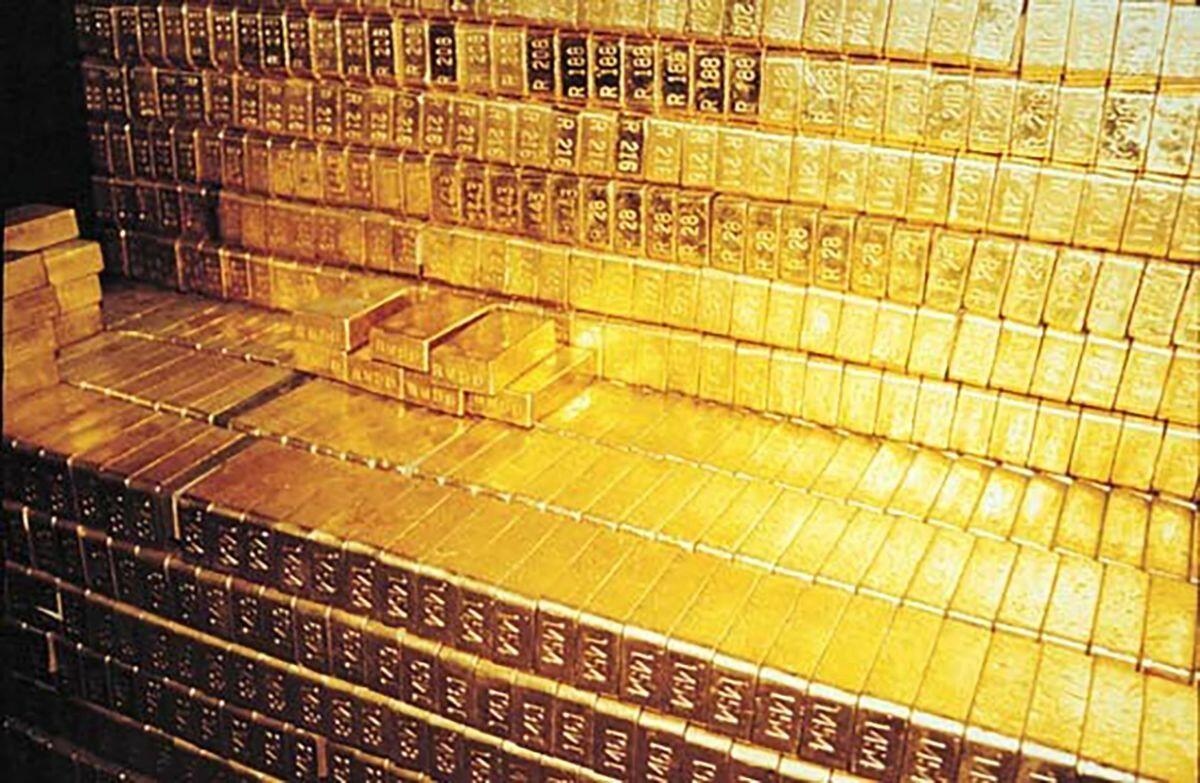 The National Gold Bullion Depository at Fort Knox
Bessent has repeatedly cited annual internal audits by the Treasury Department’s Office of the Inspector General as proof the reserves are secure. These reviews reconcile records and conduct limited sampling of vault compartments rather than physically weighing and assaying every single bar. That said, Bessent addressed the idea of revaluing the US’s gold last year while discussing sovereign wealth fund plans, stating it was “not what I had in mind.”
The last major public inspection took place in 1974, when a congressional delegation and journalists were allowed inside. A smaller visit occurred in 2017 involving then-Treasury Secretary Steven Mnuchin and Kentucky lawmakers.
That decades-long gap has prompted sharp criticism. Kentucky Republican Rep. Thomas Massie introduced the Gold Reserve Transparency Act, which would require the Government Accountability Office to conduct a full independent audit of all U.S. gold holdings and repeat the process every five years. The bill has not advanced.
President Trump has kept the question alive himself. Asked in a May interview what happened to the Fort Knox audit he and Elon Musk once championed, Trump said: “I do want to go to Fort Knox sometime. I want to see if the gold is there, which I’m sure it will be.”
Trump’s 250th Anniversary Coins Move Forward
Bessent’s remarks came in the same interview in which he showed off the Treasury’s commemorative currency plans for America’s 250th anniversary – and there are two distinct Trump coins in motion.
The first is a special 24-karat gold coin approved unanimously by the U.S. Commission of Fine Arts in March 2026, depicting Trump from the waist up with his fists on a desk. Authorized under the Treasury secretary’s statutory authority over gold coinage, it will be struck in an extremely limited run – reportedly just 47 pieces, each containing roughly $90,000 worth of gold – with no on-sale date yet set.
The second is a legal-tender $1 semiquincentennial coin bearing Trump’s likeness, intended for circulation. On July 15, Bessent posted an image of it on X and announced that minting is moving ahead:
“As America commemorates 250 years of independence, the U.S. Mint will begin striking this new $1 gold coin to honor the enduring legacy of liberty and a lasting symbol of patriotism. Featuring President Trump, it celebrates the strength of American values, and the promise of a nation dedicated to preserving freedom for all.”
Federal law generally bars living persons from appearing on U.S. currency, and critics note the 2020 law the Treasury cites for the $1 coin prohibits living-person portraits on a coin’s reverse. Bessent defended the plan to Watters directly: “As Treasury Secretary, I only have two mandates: The currency has to say, ‘In God We Trust,’ somewhere on it, and there cannot be an image of a living person,” he said, distinguishing paper money from coinage. “During that 150th, there was a Calvin Coolidge coin. So, we can put living people’s images on a coin.” The coins are expected in limited quantities later in 2026 or into 2027, with a court fight over the circulating design considered likely.
Massie Compares To Rome
On Tuesday, Rep. Massie drew a historical parallel on X between pending U.S. coinage reforms and the currency debasement practiced by Roman emperors. He pointed to legislation that would allow cheaper metal alloys for nickels while preserving size, weight, and vending-machine compatibility.

END
YOUR EARLY CURRENCY VALUES/GOLD AND SILVER PRICING/ASIAN AND EUROPEAN BOURSE MOVEMENTS/AND INTEREST RATE SETTINGS WEDNESDAY MORNING.7:30 AM
SHANGHAI CLOSED DOWN 11/55 PTS OR 0.29%
HANG SENG CLOSED UP 340.37 PTS OR 1.40%
Nikkei CLOSED UP 1011.50 PTS OR 1.49%
//Australia’s all ordinaries CLOSED DOWN 0.60%
//Chinese yuan (ONSHORE) CLOSED UP TO 6.7709
/ OFFSHORE CLOSED UP AT 6.7734 Oil DOWN TO 79.79 dollars per barrel for WTI and BRENT DOWN TO 84.68 Stocks in Europe OPENED ALL RED
ONSHORE USA/ YUAN// WITH YUAN TRADING UP (6.7708) OFFSHORE YUAN TRADING UP TO 6.7734 ONSHORE YUAN TRADING ABOVE LEVEL OF OFF SHORE AND UP ON THE DOLLAR// / AND THUS STRONGER/OFF SHORE YUAN TRADING UP AGAINST US DOLLAR/ AND THUS STRONGER
XXXXXXXXXXXXXXXXXXXXXXXXXXXXXXXXXXXXX
ONSHORE YUAN: CLOSED UP AT 6.7708
OFFSHORE YUAN: UP TO 6.7734
1.HANG SANG CLOSED UP 340.37 PTS OR 1.40%
2. Nikkei closed UP 1011.50 PTS OR 1.49%
WEST TEXAS INTERMEDIATE OIL UP TO 79.79
BRENT; 84.68
3. Europe stocks SO FAR: ALL RED
USA dollar INDEX UP TO 100.72/// EURO FALLS TO 1.1423 DOWN 9 BASIS PTS
3b Japan 10 YR bond yield:FALLS TO. +2.678 DOWN 3 FULL BASIS PTS/ VERY TROUBLESOME//Japan buying 100% of bond issuance)/Japanese YEN vs USA CROSS NOW AT 162.31… JAPANESE YEN NOW FALLING AS WE HAVE NOW REACHED THE ENDING OF THE YEN CARRY TRADE AGAIN AND THE REPATRIATION OF YEN DENOMINATED BONDS TRADING IN THE USA/EUROPE. JAPAN 30 YR BOND YIELD: 3.762 UP 3 FULL BASIS PTS
3c Nikkei now ABOVE 17,000
3d USA/Yen rate now well ABOVE the important 120 barrier this morning
3e Gold DOWN /JAPANESE Yen DOWN CHINESE ONSHORE YUAN: UP( 6.7708) AND OFFSHORE: UP AT 6.7734
3f Japan is to buy INFINITE TRILLION YEN worth of BONDS. Japan’s GDP equals 5 trillion USA. CENTRAL BANK OF JAPAN WILL NO LONGER DO QE.
Japan to buy 100% of all new Japanese debt and NOW they will have OVER 50% of all Japanese debt. GOVERMENT ASKED JAPAN PENSION FUNDS AND INSURANCE FUNDS TO BUY MORE JAPANESE BONDS AND REPATRIATE ALL FOREIGN BONDS.
3g Oil DOWN for WTI and BRENT DOWN this morning
3h European bond buying continues to push yields LOWER on all fronts in the EU German 10yr bund YIELD UP TO +3.0909/ Italian 10 Yr bond yield DOWN to 3.914/ SPAIN 10 YR BOND YIELD DOWN TO 3.577%
3i Greek 10 year bond yield DOWN TO 3.7921%
3j Gold at $4031.00 //Silver at: 58.37 1 am est) SILVER NEXT RESISTANCE LEVEL AT $100.00
3k USA vs Russian rouble;// Russian rouble DOWN 0 AND 91/ 100 roubles/78.46
3m oil (WTI) into the 79 dollar handle for WTI and 84 handle for Brent/
3n Higher foreign deposits moving out of China// huge risk of outflows and a currency depreciation. This can spell financial disaster for the rest of the world/
JAPAN ON JAN 29.2016 CONTINUES NIRP. THIS MORNING RAISES AMOUNT OF BONDS THAT THEY WILL PURCHASE UP TO .5% ON THE 10 YR BOND///YEN TRADES TO 162.07 // 10 YEAR YIELD AFTER FIRST BREAKING .54% LAST YEAR NOW EXCEEDS THAT LEVEL TO 2.678% DOWN 3 BASIS PTS STILL ON CENTRAL BANK (JAPAN) INTERVENTION//YEN CARRY TRADE NOW UNWINDING//YEN BOND TRADING OVERSEAS TO BE REPATRIATED.//JAPAN 30 YR: 3.762 UP 3 PTS..: USA/SF this 0.8100 as the Swiss Franc . Euro vs SF: 0.9253
USA 10 YR BOND YIELD: 4.591 UP 1 BASIS PTS…
USA 30 YR BOND YIELD: 5.107 UP 1 BASIS PTS/
USA 2 YR BOND YIELD: 4.200 UP 1 BASIS PTS
USA DOLLAR VS TURKISH LIRA: 47.03 DOWN 1 BASIS PTS/LIRA GETTING KILLED//IDIOTS FOR SELLING GOLD AND USA DOLLAR RESERVES.
10 YR UK BOND YIELD: 4.9705 DOWN 2 PTS
30 YR UK BOND YIELD: 5.663 DOWN 3 BASIS PTS
10 YR CANADA BOND YIELD: 3.574 UP 1 BASIS PTS
5 YR CANADA BOND YIELD: 3.186 DOWN 1 BASIS PTS.
Futures Rise After Blowout ASML Earnings Boost Tech Sentiment
Wednesday, Jul 15, 2026 – 08:28 AM
Futures are higher led by technology stocks, after solid earnings from ASML offered fresh evidence of the relentless demand for chips enabling the global AI buildout and boosted sentiment across the AI Infra trade. As of 8:00am ET, S&P futures are up 0.1% and Nasdaq futures rise 0.4%, both off session highs. In Tech, focus is on ASML +4% on guidance raise (US Semicap Equipment peers +2-4% in sympathy), PYPL +20% on reports of a Stripe/Advent takeover offer; AAPL +0.50% and BABA +4% on China approval of Alibaba “Qwen AI” integration into the iPhone experience; and NVDA flat on Jensen commentary that Vera Rubin chips were on track for deliver to customers (countering delay talk). On the US/Iran front, the US carried out another round of strikes near the Strait of Hormuz overnight and President Trump said the US may hit power plants and bridges next week unless Iran returns to negotiations and makes a deal (also have report from Axios that Trump held a meeting in the situation room yesterday to discuss a new offensive). According to JPM, the tech complex is also getting a boost thanks to stabilization in Korea, with KOSPI adding 6% overnight (JPM APAC says that foreign & institutional demand is stepping into Korea as domestic retail investors are selling). Asia finished mixed (Shanghai -29bps / Hang Seng +1.4% / Nikkei +1.49% / Kospi +6.3%) as the day to day volatility continued in Korea (Hynix +4%, which appeared to be a “catch up” to SKHY post its +27% move in the US session). Bond yields edged higher in the US and Europe, with the yield on 10-year Treasuries up one basis point to 4.60%. The dollar wavered. While money markets have mostly priced out the possibility of a Federal Reserve hike later this month, expectations for a move in September remained high. Commodities are seeing a bid with gold the notable laggard. Brent crude futures rise 0.5% to just above $85 a barrel while European natural gas futures rise 3% to the highest since March. The Bloomberg Dollar Spot Index is near flat. Today’s macro data focus in on PPI and then macro read-through from names in Fins and Transports.

In premarket trading, Mag 7stocks are mostly higher (Apple +0.6%, Amazon +0.3%, Microsoft +0.3%, Tesla +0.2%, Meta Platforms +0.2%, Alphabet -0.5%, Nvidia -0.2%)
- ASML Holding NV ADRs (ASML) gain 3% after the company lifted its annual sales forecast for the second time this year and laid out plans to increase production as a surge in artificial intelligence spending drives demand for the Dutch company’s chip-making machines.
- BlackRock (BLK) gains 4% after pulling in $192 billion of net client cash in the second quarter, with investors pouring money into exchange-traded funds and pushing total assets above $15 trillion for the first time.
- Elevance Health (ELV) falls 7% after boosting its profit guidance by less than Wall Street had hoped, as the company grapples with recent federal policy changes that have made healthcare more expensive. Peer health insurers are also lower, with Humana (HUM) down 1.6% and Centene (CNC) falling 4%.
- Lionsgate Studios (LION) climbs 7% after Reuters reported that the company is exploring a sale and has attracted takeover interest from Bollore Group. Reuters cited three unidentified people familiar with the matter.
- PayPal (PYPL) jumps 20% after Reuters reported Stripe and private equity company Advent International have made a joint offer to buy PayPal for $60.50 per share, valuing the payments firm at more than $53 billion.
- Pentair (PNR) tumbles 22% after the water treatment company cut its adjusted earnings per share guidance for the full year. The company also said it appointed Robert Fishman as interim CFO after Nicholas Brazis resigned on July 10 to pursue another opportunity at a private company.
- Phoenix Education (PXED) drops 10% after the online education company trimmed its net revenue guidance for the full year.
- SK Hynix ADRs (SKHY) fall 6%.
- SpaceX (SPCX) is up 0.7% after closing on Tuesday just $1 above the IPO price.
In other corporate news Nokia says it developed the first commercial AI-driven radio access network (RAN) platform together with Nvidia to radically increase the amount of data operators can transmit using existing infrastructure. Apollo landed the biggest private credit deal on record, offering Broadcom $35 billion of debt, in the latest sign that the buyout shop-turned-blue chip lender is muscling in on the turf of Wall Street. OpenAI’s much-anticipated push into consumer devices is slated to begin with a mobile, screen-free smart speaker designed to be a new type of home computer for the AI era. Lionsgate Studios is exploring a sale and has attracted takeover interest from Bollore Group, Reuters reports.
Tech sentiment was boosted by blowout results from European chip giant ASML and a rebound in Korean stocks. Coming into ASML’s results, analysts set the bar high, expecting an upgrade to full-year net sales guidance. Europe’s most valuable company delivered, but clarity is needed on its conference call as to whether the chip equipment leader can meet the required capacity in the face of soaring AI-fueled demand.
And speaking of lack of capacity, overnight we reported that the biggest US power grid failed for a third straight time to secure enough future supply commitments to ensure reliability in coming years amid a boom in data center demand. Power-hungry data centers have increased supply costs for the largest US electric grid by more than 60%, the system watchdog said.
Oil prices rose for a third straight day after the US military launched a fresh wave of strikes against Iran, with Brent advancing 1.1% to around $85.60 a barrel. Overnight President Trump said the US may hit power plants and bridges next week unless Iran returns to negotiations and makes a deal (also have report from Axios that Trump held a meeting in the situation room yesterday to discuss a new offensive).
Despite the uncertainty created by the standoff, investors say crude prices remain well off their highs above $100 a barrel from earlier in the conflict. Instead, traders are looking at whether earnings can justify high valuations, with early results this season looking promising. “Investors are aware that the road toward peace could never have been expected to be a straight line,” said Stephan Kemper, chief investment strategist at BNP Paribas Wealth Management. “As such, company fundamentals matter more than ever.”
Bullish AI momentum is not without risks. Repeating what we said over the weekend, Bloomberg writes that signs of Hyperscaler credit stress has reached the highest since Goldman Sachs launched the basket in February.
The data-center building boom has sparked an explosion of debt funding, with investors not paying enough attention to the terms of their lending, Bloomberg also noted.
The threat posed by oil prices will remain in focus with the release of June’s producer price print. Inflation data on Tuesday delivered a strong downside surprise, prompting traders to dial down their expectations for near-term interest-rate hikes.
Fed Chair Kevin Warsh will testify in the Senate on Wednesday, with New York Fed President John Williams and Governor Lisa Cook scheduled to speak at separate engagements.
“Any hint toward the CPI print being an outlier could revive rate hike concerns,” Kempner said. “This would be even more true if other Fed officials start to echo yesterday’s comments from the Fed Chair about the mission being ‘not yet’ accomplished.”
In politics, acting Attorney General Todd Blanche is set to appear Wednesday before the US Senate in support of his nomination to lead the Justice Department — just days after a federal judge in Miami issued harsh criticism of his actions in the job. Over in Europe, Marine Le Pen’s revived bid for the French presidency is giving investors like Vanguard and Natixis another reason to avoid the country’s government bonds.
In Europe, the Stoxx 600 is little changed thanks to ASML whose shares rise ~5% after the firm lifted its annual sales forecast for the second time this year and laid out plans to increase production. Gains in luxury names are also helping to offset losses elsewhere after Richemont sales expanded nearly twice as much as expected. Here are the biggest movers:
- European fintech stocks gain after Reuters reported that Stripe and private equity company Advent are offering to buy PayPal at a valuation of more than $53 billion
- Richemont surges as much as 7.4% to an all-time high after the Swiss jeweler reported first-quarter sales growth that was nearly twice as strong as expected
- ASML shares rise as much as 7.9% after the chip equipment firm raised FY guidance for this year and set capacity expansion goals for the next two years
- ICG shares rise as much as 3.4%, trimming year-to-date declines, after the alternative asset manager reported first-quarter assets under management slightly ahead of estimates
- Barratt Redrow shares rise as much as 6% after the UK homebuilder said it will return £400 million to shareholders this year. Sector peers are also finding support from Barratt’s FY update
- Camurus shares jump as much as 16%, the most since November, after the Swedish biopharmaceutical firm reported better-than-expected revenue and profit for the second quarter
- Rio Tinto falls as much as 2.3% in London, the most in a week, after the miner reported 2Q copper production that declined from the previous comparable period
- Elis shares slide as much as 4% to €24.64 after holder Canada Pension Plan Investment Board sold about 19.3 million shares for €24.60 apiece
- AFRY shares fall as much as 12%, hitting a 2014 low, after the Swedish engineer’s earnings fell short of expectations in the second quarter, according to analysts at Jefferies
- Handelsbanken shares decline as much as 6.2% after the lender reported net interest income for the second quarter that missed estimates while analysts also note weak lending growth in Sweden
- Premier Group falls as much as 7.3% in Johannesburg, the most since April 2025, after stockholder CapitalWorks sold shares in the packaged foods company at a discount
Asian stocks climbed the most in almost two weeks after a softer US inflation print relieved concerns over imminent rate hikes, while South Korea led advances in technology shares. The MSCI Asia Pacific Index gained 1.9%, the most since July 3. Leading contributor SK Hynix soared 9% in Seoul, tracking a surge in its American depositary receipts Tuesday, while chipmakers Samsung and TSMC also climbed after gains in US tech shares. South Korea’s benchmark Kospi jumped 6.2%, while Taiwan’s Taiex climbed the most in two weeks. Mainland China stocks edged lower after data showed the economy slowed more than expected last quarter, to the weakest in more than three years. With earnings seasons starting, Asian software and IT services stocks followed global peers lower after IBM missed earnings expectations. Meanwhile, the Hang Seng China Enterprises Index rose the most in a week, as internet firms such as Tencent and Alibaba gained.
“Softer-than-expected US inflation data has reduced the risk of a more aggressive Fed tightening cycle, which had become a more prominent concern over the past week as renewed US-Iran tensions pushed oil prices higher,” said Rajeev De Mello, global macro portfolio manager at GAMA Asset Management. “Investors have also absorbed last week’s SK Hynix equity issuance, allowing the Korean semiconductor sector to rebound, while the US earnings season has opened on a constructive note.”
In FX, the Bloomberg Dollar Spot Index is near flat. The Norwegian krone slipped to the bottom of the G-10 FX pile, falling 0.4% against the greenback after Norway’s core inflation surprised to the downside.
In rates, treasuries are cheaper by 1bp to 2bp across the curve, unwinding a portion of gains seen Tuesday following a soft CPI print. Treasury curve slightly flatter on the day with front-end leading losses, where 2-year yields trade around 4.215% and cheaper by 2bp on the day. US 10-year yields trade around 4.605% with bunds and gilts both trading slightly cheaper in the sector. IG dollar issuance slate includes a couple of deals. Goldman Sachs was one of three issuers Tuesday, selling a combined $13.9 billion of bonds. They paid an average of about 2.3 basis points in new issue concessions on deals that were 2.2 times covered. US session focus includes a handful of Federal Reserve speakers and June PPI data.
In commodities, WTI futures advance almost 1% rising for a third day, and adding some upside pressure on yields, as Trump threatened further strikes on Iran after the US resumed its blockade on the Strait of Hormuz, and the US carried out more strikes against Iran, hitting dozens of military sites near the strait and along the nation’s coast. Brent crude futures rise 0.5% to just above $85 a barrel while European natural gas futures rise 3% to the highest since March. Precious metals decline.
US economic data calendar includes July Empire manufacturing and June PPI (8:30am). Fed calendar includes Williams (8:45am), Warsh testifies before Senate Banking Committee (10am), Cook (1pm) and Musalem (6:30pm). Fed releases latest Beige book at 2pm
Market Snapshot

Top Overnight News
- The US launched more airstrikes on Iran, with Donald Trump pledging to intensify his bombardment until Tehran stops attacking ships in the Strait of Hormuz and agrees to open the waterway. BBG
- As the U.S. war with Iran resumes, there is little sign that diplomacy can stop it. Efforts by Arab, Pakistani and other mediators to revive negotiations or restore a ceasefire have shown no public signs of progress, and the overall feeling in the Middle East and beyond is that the fighting will simply continue for now, according to two analysts and a person familiar with the situation. Politico
- The cost of the war with Iran could be more than triple the most recent estimate of roughly $30 billion, according to three U.S. officials and three people familiar with the internal cost estimates. NBC
- Nasdaq futures advanced as ASML raised its annual sales forecast for the second time this year, offering fresh evidence of AI-driven demand. SK Hynix continued its volatile run though, with the stock jumping in Seoul but ADRs falling premarket. BBG
- Stripe and Advent offered to buy PayPal at a valuation of more than $53 billion, Reuters reported. Their $60.50-a-share bid is around 28% more than PayPal’s closing price yesterday. RTRS
- BABA (Alibaba)’s Qwen AI will be integrated into Apple Intelligence in China. RTRS
- China’s economy slowed more than expected last quarter to the weakest in more than three years, raising pressure on policymakers to speed up public spending to ensure their annual growth goal is met. China’s Q2 GDP came in a bit below expectations (+4.3% vs. the Street +4.5% and down from +5% in Q1), but retail sales were ahead of plan for June (+1% vs. the Street -0.1%), as was industrial production (+5.3% vs. the Street +4.6%) BBG
- Trump administration may pursue further executive action addressing China-related concerns over open-source AI models, according to Semafor citing an unnamed senior White House official.
- Beijing plans to fight attempts to monopolize advances in AI technology, state newspaper People’s Daily reported, following US attempts to curtail overseas access to cutting-edge models. BBG
- The rush for cash by some of the world’s largest companies is putting the long bull market at risk. Investors have been cheering the raging bull market for years—three years and nine months, to be precise—with the S&P 500 having more than doubled during that period. Now companies are racing to take advantage, raising concern that the party could be coming to an end. WS
- Fundamental L/S Gross leverage has declined in 5 of the last 6 weeks to 207.2% (28th percentile 1-year, 75th percentile 3-year). After reaching a 4-year high in early June, Fundamental L/S Net leverage has fallen -6.7 pts to 54.5% (22nd percentile 1-year, 39th percentile 3-year). Goldman PB
A more detailed look at global markets courtesy of Newqsuawk
APAC stocks traded with a positive bias as most major indices took impetus from the gains on Wall St, where sentiment was underpinned, and Fed rate hike bets were trimmed following softer-than-expected CPI data, while US President Trump also abandoned plans for a 20% Hormuz fee. ASX 200 eked out marginal gains with outperformance in miners following Rio Tinto’s quarterly update, although the upside in the index was capped as defensives lag. Nikkei 225 rallied amid tech strength, but with further upside limited following weak Machinery Orders. KOSPI was boosted by the tech-related momentum and with SK Hynix shares up by a double-digit percentage as it played catch-up to the 27% surge in its ADRs. Hang Seng and Shanghai Comp diverged with the mainland lagging after a slew of mixed data releases, including Chinese GDP and activity data.
Top Asian News
- China announced a five-year plan to boost consumption and targets CNY 60tln yuan in retail sales by 2030, according to Nikkei.
- China’s stats bureau deputy head said China’s CPI and PPI are in reasonable ranges and hard won given most countries face big price increases, while the official added that China’s energy supplies are sufficient, production is stable, and imports are under control. Furthermore, it was stated that the Q2 GDP growth slowdown is due mainly to short-term factors and external factors, while H1 GDP growth lays a good foundation for achieving the full-year growth target.
- Japan added a footnote on BoJ autonomy to its revised fiscal policy draft, Bloomberg reported.
- Japanese PM Takaichi said FX rates should be determined by the market; boosting international competitiveness will boost the credibility of JPY.
- India announced INR 1.28tln new semiconductor manufacturing plan, according to reports.
European bourses (STOXX 600 U/C) are broadly lower, with the outperformance in the AEX (+0.8%) following ASML earnings. Despite the lack of clear drivers for the underperformance, geopolitics persist, with US President Trump announcing that the US will conduct strikes again on Wednesday and threatening to hit power plants and bridges unless Iran starts to negotiate. Sectors are broadly negative. Consumer Products & Services (+1.2%) tops the sector pile, as positive Richemont earnings lift other luxury names, while Tech (+1.0%) also gains. To the downside lie Optimised Personal Care (-1.1%), Chemicals (-1.1%) and Telecoms (-0.8%). The highly anticipated ASML earnings did not disappoint. Top and bottom line figures beat estimates while raising its FY revenue guidance to EUR 43-45bln (exp. 39.4bln, prev. guided 36-40bln). Looking ahead to Q3, ASML projects sales of between EUR 11-12bln, above Jefferies’ estimates of EUR 10.34bln. ASML stated that they are considering a 30% boost to EUV output for 2027 and again in 2028. Both Citi and JPMorgan highlighted this as a positive, with JPMorgan projecting it to add over EUR 65 in EPS in 2028. However, Citi points out that the 2027 production figure would amount to around 85 machines, which is below its forecast of between 90-100. Gains were seen as much as 7.4% at the start of trade, but has since pulled back to around 3.7%. US equity futures are firmer across the board. NQ (+0.5%) is the clear outperformer, helped by the ASML earnings and gains in SK Hynix overnight; however have come off in recent trade (in line with ASML). Banking earnings continue in the US, with Morgan Stanley on the docket.
Top European News
- Ed Miliband’s opponents in the Labour Party believe he has failed his bid to become Chancellor, with current Home Secretary Mahmoud seen by some MPs as favourite to take the Chancellor role in Andy Burnham’s new government, according to FT.
- OECD said the UK economy to grow 0.9% in 2026 and 1.1% in 2027, with risks tilted to the downside. Added that fiscal discipline is essential to the UK.
- German government is planning a EUR 13.3bln energy relief package for 2027, which will be used to assist businesses and consumers.
FX
- G10s mixed against the Buck, which is flat on the day despite being off recent lows. AUD and GBP lead; NOK underperforms.
- DXY looks to breach 101.00 after lifting from recent lows in the wake of cool US CPI on Tuesday. As Fed Chair Warsh said during the House testimony on Tuesday, one series does not make a trend, so while bets are trimmed for an immediate hike (prev. markets saw a 50% probability of tightening in July), eyes remain on incoming data. In addition to the post-CPI bounce, the Buck is being helped by energy benchmarks, which remain elevated amid a lack of positive Gulf newsflow.
- NOK is the worst G10 performer after the Norges Bank’s preferred inflation gauge, CPI-ATE, came in cooler than analyst/Norges Bank forecasts. NOK saw immediate pressure on the release (which was originally scheduled for 10th July).
- AUD and GBP are the best-performing G10 currencies, helped by the above factor as the cooler-than-expected US CPI trimmed bets for near-term Fed tightening, increasing appetite for these high-yielders.
- For GBP specifically, the UK press suggested Energy Secretary Miliband was less-favoured in the race for Chancellor, now Foreign Secretary Cooper and Home Secretary Mahmood are favourites for the job. Markets think that Mahmood would be fiscally conservative given her view on immigration; however, she lacks experience in economic roles, whereas Cooper previously worked as Chief Secretary to the Treasury under Gordon Brown. GBP/USD +0.1% and either side of the 1.34 mark.
Fixed Income
- USTs remain contained, caught between CPI and Warsh. Bunds lower on energy, but off worst levels despite a sharp but ultimately short-lived decline in the early morning. Gilts opened on the backfoot, given energy.
- USTs flat in a narrow 108-24+ to 108-31+ band, fresh catalysts light. Commentary remains focused on June’s dovish CPI report and the subsequent hawkish Fed testimony from Chair Warsh. Today, we get more insight on both points via Warsh’s Senate testimony and US PPI for June. Additionally, Fed’s Williams (voter) is on the docket.
- Bunds lower by around 20 ticks, but are a similar amount clear of the 124.79 trough. A base that printed in a bout of somewhat short-lived bout of pressure this morning. No obvious catalyst behind that, though it did occur in tandem with modest DAX and EUR downside. Ongoing focus on pension reform may have contributed, given reporting earlier in Politico that suggested pension points could be reduced in some scenarios, saving multiple billions; though, the debate continues and won’t be resolved this week.
- Alternatively, or additionally, the German Finance Ministry outlined that some EUR 13bln or energy-related relief is planned for 2027, funding for that to be sourced from the climate relief package.
- Gilts opened lower by 16 ticks and have since moved lower to an 86.89 base, holding above the 86.87 and 86.42 lows from the last two sessions. Pressure the typical underperformance seen in Gilts when energy leads. No real relief from reports, such as the FT, suggesting that Miliband has lost the race to be Chancellor; though, outlets make clear that no decision has been made yet, ahead of Burnham becoming PM this weekend.
- Germany sells EUR 0.753bln vs exp. EUR 1.0bln 2.50% 2054, EUR 0.768bln vs exp. EUR 1.0bln 2.90% 2056 & EUR 0.759 vs exp. EUR 1.0bln 0.00% 2052 Bund.
- Australia sells AUD 700mln 4.50% Apr 2033 bonds b/c 4.29, avg yield 4.6620%.
Commodities
- Geopolitics remains in focus, with US and Iran still conducting strikes. Markets appear to be accustomed to the ongoing attacks, with focus now on how transits through the Strait are being impacted. On that note, 11 vessels went through the passage, 9 of those used the Iranian-designated route. Yen Ling Song of S&P Global Energy wrote that “we are seeing significantly greater caution among shipowners and operators”, given the threat of Iranian strikes. On this front, traders have continued to price in another supply glut this month – and recent rhetoric from President Trump/Iran, does not point to a near term resolution.
- To recap, Trump warned that they would be striking Iran on Wednesday night, and threatened to hit power plants/bridges next week, unless Iran negotiates. Iran stated that it is a mistake to think military action will force them to talk.
- Crude benchmarks are modestly firmer this morning. Price action overnight was fairly rangebound, but then dipped in early European trade – benchmarks have remained near recent lows since. Brent Sept’26 traded within a USD 85.02-86.55/bbl range.
- Spot gold is a little lower this morning, but ultimately within the prior day’s ranges. Price action which appears to be a bit of pull-back from the extremes seen on Wednesday, following the cooler-than-expected CPI print. The yellow-metal currently holds above the USD 4k/oz mark, in a USD 4,017-4,062/oz range. Base metals hold a negative bias, as markets digested mixed Chinese data. 3M LME Copper traded within a USD 13,550-13,677/t range.
- US Private Inventory Data (bbls): Crude -0.6mln (exp. -2.7mln), Distillates +2.3mln (exp. +1.0mln), Gasoline -1.7mln (exp. +0.6mln), Cushing +0.2mln.
Trade/Tariffs
- EU Trade Commissioner Sefcovic said they are aiming to have the EU-India FTA implemented in 2027.
Central Banks
- ECB’s Nagel said from a monetary policy perspective, it remains advisable to react with caution but to act decisively if needed. Monetary policy will maintain its vigilant stance.
- ECB’s Panetta said EZ inflation is currently around 3% and expected to remain above that level until early 2027. Risks linked to higher energy prices, tighter financial conditions and persistent geopolitical uncertainty appear to be only partially incorporated into market evaluations. Several indicators suggest the rise in equity markets seen after the Iran conflict is due to an underestimation of risks. ECB’s goal is to keep inflation expectations firmly anchored, limiting indirect and second-round effects of shocks.
- ECB’s Kocher said they are ready to take monetary policy actions at any time if needed, adding that the ECB will do what is needed to bring inflation to 2% in medium-term and no second round effects seen currently.
- ECB’s Cipollone said that he is not currently seeing second round inflation effects, but monitors inflation expectations “very closely”.
Geopolitics
- US President Trump said in a pre-recorded Fox News interview that they are beating up Iran badly and Hormuz has to stay open, while he added that strikes will continue until he says it is enough, as well as stated they will save energy targets for last and will ultimately hit energy targets. Trump also said they will hit Iran hard on Wednesday night, and that next week will get really bad for Iran, in which they will hit Iran’s power plants and bridges next week unless Iran comes to the negotiating table. Furthermore, he said US officials spoke to Iran on Tuesday and told Iran that it better make a deal.
- US Central Command forces began launching an additional round of strikes against Iran at 15:00EDT/20:00BST on Tuesday, to continue degrading Iranian capabilities used to attack commercial shipping in the Strait of Hormuz, while CENTCOM later announced the completion of strikes against Iran.
- US struck Qeshm Island in southern Iran, and explosions were heard in the maritime area of eastern Hormozgan and Sirik, while explosions were heard in Bandar Abbas and Hengam Island. Explosions were also heard in Bampur and Chabahar in Iran, although Iran’s semi-official news agency Tasnim noted officials denied reports of explosions in Chabahar, while explosions were reported in Iran’s port city of Bandar Imam Khomeini, and a mineral water plant in Deloran was hit by three projectiles. Furthermore, reports noted that air defences around the Bushehr Nuclear Power Plant in Iran became active.
- IRGC said it targeted enemy weapons and parts storage in Bahrain and Kuwait, while it targeted a drone ramp in Kuwait’s Ali Al Salem air base and targeted US positions at Jordan’s Azraq base, as well as the US Fifth Fleet Command HQ, fuel facilities and equipment in Bahrain. IRGC said as long as the US evil stays in the region, not a drop of oil and gas will be exported from the region, and that US aggression will have no result other than delaying the opening of the Strait of Hormuz.
- Iran will respond to the US attacks, Tasnim reported.
- Iran’s Deputy Foreign Minister Gharibabadi said the US is making a mistake if it thinks its military attacks and blockade will force them to request negotiations, but also commented that Iran’s return to negotiations and tolerance regarding the Strait of Hormuz is possible. Furthermore, he said the MoU effectively no longer exists and that no country should expect Iran to continue implementing the terms of the memorandum.
- Israeli PM Netanyahu is reportedly to travel to Washington on Saturday evening, aiming to meet with US President Trump, Yedioth reported.
US Event calendar
- 7:00 am: Jul 10 MBA Mortgage Applications, prior -2.2%
- 8:30 am: Jul Empire Manufacturing, est. 9.2, prior 5.7
- 8:30 am: Jun PPI Final Demand MoM, est. 0%, prior 1.1%
- 8:30 am: Jun PPI Ex Food and Energy MoM, est. 0.3%, prior 0.4%
- 8:30 am: Jun PPI Final Demand YoY, est. 6.2%, prior 6.5%
- 8:30 am: Jun PPI Ex Food and Energy YoY, est. 5.1%, prior 4.9%
Central Bank speakers
- 8:45 am: Fed’s Williams Delivers Keynote Remarks
- 10:00 am: Fed Chair Warsh Testifies Before Senate Banking Committee
- 1:00 pm: Fed’s Cook Speaks on the Economic Outlook
- 2:00 pm: Fed Releases Beige Book
- 6:30 pm: Fed’s Musalem Delivers Welcoming Remarks
DB’s Jim Reid concludes the overnight wrap
A quick reminder the WOW! pack can be found here but life moves onto to the 2026 “Mapping the World’s Prices” document which saw a whole host of press coverage from all round the world yesterday from Athens to Zurich and Berlin to Wellington. The stand-out theme from this year’s edition is just how cheap Japan is. For example, a meal for two in Tokyo is a third of a cost of that in Zurich or New York. When we started the document in 2012 the US was very cheap and now its very expensive. Unless a country is in terminal difficulty, relative prices are a good future mean reversion indicator. For Japan we will likely look back on these relative prices as an indicator of how cheap it is. If nothing else it’s a very cheap destination for next year’s holidays. There’s plenty of other info on 69 globally important cities. See the report here at the Deutsche Bank Research Institute. I wonder how cheap or expensive England 2026 World Cup Winning T-shirts will be in London tomorrow!
As we await the second semi-final, it’s been another eventful 24 hours for markets, with investors taking heart from a huge downside surprise in the US CPI print, even as oil prices kept ratcheting higher. So markets rapidly priced out the chance of a Fed rate hike in a couple of weeks’ time, with US Treasuries posting strong gains as a result. Indeed, the 2yr yield (-9.0bps) was down to 4.19%, its biggest decline since May, whilst the S&P 500 (+0.38%) moved back within 1% of its record high from last month. In Asia US futures continue to rise and the KOSPI is back with a 7% plus day. More on that later but first the US inflation data.
That CPI print was the main catalyst for the cross market rally, after consumer prices fell by -0.4% in June (vs. -0.1% expected). In fact, it was the biggest monthly price drop since the pandemic lockdowns of April 2020, and it pushed the year-on-year reading all the way down to +3.5%, having been at +4.2% in May. Admittedly, that was driven by a big slump in gasoline prices, which plummeted by -9.7% on the month. But even core CPI was surprising on the downside too, with a -0.02% monthly price drop (vs. +0.2% expected) amid a decline in core goods prices and subdued rent inflation. So that marked the first decline for core CPI since May 2020, and it pushed the year-on-year reading for core CPI down to +2.6%.
For markets, the main consequence was that the chance of a July rate hike was immediately priced out, with the probability down from 43% on Monday to just 17% by last night’s close. And that effect was clear further out the curve, as the chance of a hike by September also fell back to 66%, signaling a growing chance that the Fed might remain on hold for some months to come. Moreover, that led to a big decline for Treasury yields too, with the 10yr yield (-3.4bps) down to 4.59% by the close.
The 10yr Treasury yield traded low as 4.521% post-CPI but it then recovered somewhat, in part as Fed Chair Kevin Warsh continued to strike a tough note on inflation as he delivered his first testimony as Chair before the House Financial Services Committee. Warsh refrained from any direct policy guidance, while noting that yesterday’s softer CPI print did not mean “mission accomplished”. He also said that “members of our Committee have no tolerance for persistently elevated inflation” and argued that if the Fed “get policy right—and we will—the inflation surge of the last five years will be a thing of the past.” In all, the new Chair looked to cement inflation-fighting credibility. But he was fortunate to be making these tough remarks in a day of soft CPI, with the inflation data easing the pressure for any immediate policy tightening.
Yet even as CPI surprised on the downside, oil prices continued to move higher, with Brent crude up another +1.72% yesterday to $84.73/bbl, taking its 2-day gain since the weekend to +11.47%. Nevertheless, that was actually well beneath the intraday peak above $87/bbl, with a big pullback after President Trump said that the proposal for a 20% fee in the Strait of Hormuz would be replaced by “Trade and Investment Deals that the various Gulf States will be making into the United States.” Meanwhile, the US military announced that it had resumed its naval blockade of Iran overnight, with Iranian media reporting an exchange of fire in the Strait of Hormuz. Overnight, Brent is +1.19% higher, trading at 85.74/bbl as we go to print.
But for the most part, there were signs that investors were still looking through the latest oil price spike. Brent is well below its peak from earlier in the year, having spent around two months above $100/bbl. And as Henry pointed out yesterday (link here), earlier in the year it took Brent at $110/bbl before we saw meaningful vulnerabilities for equities and credit. And if we look back at the 2022 shock as well, it was a similar real-terms threshold for Brent (above $110/bbl in today’s prices) that started to cause meaningful stress, which we’re still some way from right now.
For equities, yesterday was another eventful session as earnings season started to get going. At the headline level, the S&P 500 (+0.38%) did well thanks to the downside CPI print and the dovish rates repricing. But this included some big moves under the surface, with IBM (-25.21%) posting its biggest daily decline in available Bloomberg data back to 1968, after they missed analyst estimates. It’s another example of the huge ongoing tech disruption. Other software stocks also underperformed, including ServiceNow (-5.76%) and Adobe (-4.30%). Despite this, the information technology sector (+1.25%) was the best performer in the S&P 500 and the NASDAQ was up +0.90% amid gains for chipmakers that pushed the Philly semiconductor index +2.54% higher. So differentiation within the tech sector continues to be an ongoing theme, and one that supported the headline indices yesterday even as the equal-weighted S&P 500 slipped (-0.38%).
There were also some big earnings advances as well, with Goldman Sachs (+9.00%) posting its best day since Trump announced the 90-day tariff extension last year, which came after their own earnings beat expectations. There were also sizeable gains for JPMorgan (+2.50%) and Bank of America (+1.88%) after their results, which helped the KBW Bank index to a +1.05% gain. This morning S&P (+0.20%) and Nasdaq (+0.74%) futures continue to rally.
Asian equity markets are also higher with the KOSPI (+7.70%) back leading the gains. Elsewhere, the Nikkei (+1.14%) and the Hang Seng (+1.46%) are also posting solid advances, while mainland Chinese equities remain subdued, with the CSI 300 (+0.04%) and Shanghai Composite (-0.08%) after Q2 GDP “only” expanded by 4.3% year-on-year, falling short of 4.5% expectations and slowing notably from the previous quarter (5%). As a result, first-half growth came in at 4.7%. On a quarter-on-quarter basis, GDP rose 0.9%, marking the slowest pace of expansion in more than two years.
Additional June data presented a mixed picture of momentum. Industrial production increased 5.3% year-on-year, surpassing expectations of 4.6% and accelerating from 4.5% in May, highlighting continued strength in the industrial sector. In contrast, fixed-asset investment fell -5.7% in the first half of the year from a year earlier, a steeper decline than expected and a deterioration from the -4.1% drop recorded over the January–May period. Retail sales rose 1.0% year-on-year in June, outperforming expectations for a slight contraction, although consumer spending remained relatively subdued. Meanwhile, China’s property market continued to weaken, with new home prices declining -0.15% month-on-month in June. While this represented a modest improvement from May’s -0.20% decline, persistent softness in housing demand across most regions continued to outweigh isolated signs of stabilization in major cities.
Earlier in Europe, markets generally put in a decent performance yesterday, with the STOXX 600 (+0.17%) reaching a one-week high, alongside modest gains for the FTSE 100 (+0.30%), the DAX (+0.13%) and the CAC 40 (+0.03%). For sovereign bonds there was a weaker performance however, with yields on 10yr bunds (+0.6bps), OATs (+0.8bps) and BTPs (+1.1bps) all moving higher. But as with the oil price, that was actually a decent pullback from earlier in the session, when the 10yr bund yield had been up over +3bps on the day.
Looking at the day ahead, we’ll hear from Fed Chair Warsh again, who’s appearing before the Senate Banking Committee. Otherwise, central bank speakers include the Fed’s Williams, Cook and Musalem, the ECB’s Panetta and Nagel, and the BoE’s Pill. Meanwhile, the Bank of Canada will announce their latest policy decision, and the Fed will release their Beige Book. Data releases include US PPI inflation for June, and the Empire State manufacturing survey for July. Finally, today’s earnings releases include Morgan Stanley, BlackRock, United Airlines, and Johnson & Johnson.
1 b) European opening report
NQ supported by ASML and SK Hynix strength, DXY and USTs lacklustre into PPI – Newsquawk US Market Open

Wednesday, Jul 15, 2026 – 06:26 AM
- US struck Iran overnight, Trump said they will do so again on Wednesday night. Adding, they will hit power plants and bridges next week unless Iran negotiates.
- IRGC targeted weapons/storage in Bahrain and Kuwait, US positions in Jordan and the Fifth Fleet Command HQ. Iran said it is a mistake to think military action will force them to talk.
- ASML (+3.7%) reported Q2 earnings that beat estimates while raising its FY guidance above analyst expectations. Additionally, the Co. announced a partnership with Intel (INTC) for high-volume production of Intel 18A logic products using High NA EUV.
- US equity futures are firmer across the board, with NQ supported by ASML and SK Hynix upside overnight.
- DXY and Fixed Income rangebound ahead of a busy speaker slate.
- Crude benchmarks eke out mild gains, with another round of US strikes tonight.
- Looking ahead, highlights include US PPI (Jun), BoC Policy Announcement (Jul), Fed Beige Book (Jul), Speakers including Fed’s Williams, Musalem, Warsh & Cook, BoC Governor Macklem, BoE’s Pill, Earnings from United Airlines, Johnson & Johnson, Morgan Stanley, PNC Financial Services, BNY Mellon.
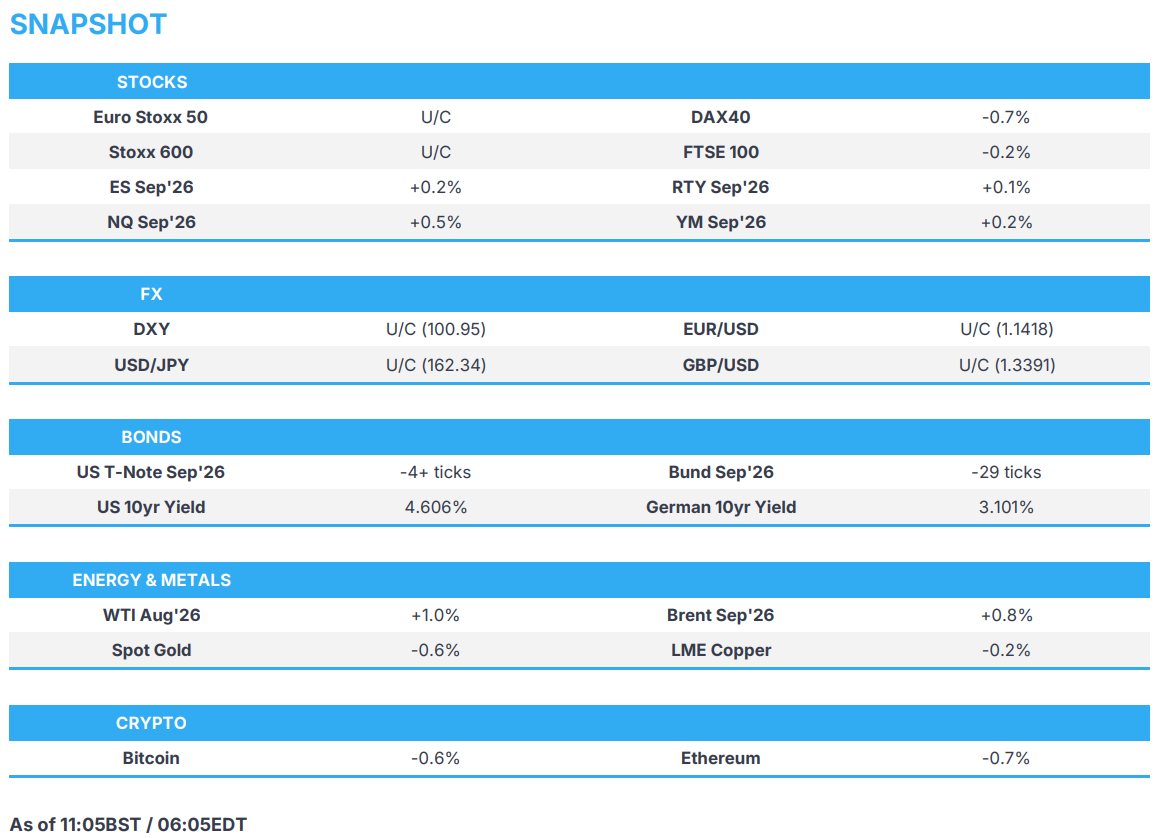
Newsquawk in 3 steps:
1. Subscribe to the free premarket movers reports
2. Listen to this report in the market open podcast (available on Apple and Spotify)
3. Trial Newsquawk’s premium real-time audio news squawk box for 7 days
EUROPEAN TRADE
EQUITIES
- European bourses (STOXX 600 U/C) are broadly lower, with the outperformance in the AEX (+0.8%) following ASML earnings. Despite the lack of clear drivers for the underperformance, geopolitics persist, with US President Trump announcing that the US will conduct strikes again on Wednesday and threatening to hit power plants and bridges unless Iran starts to negotiate. Sectors are broadly negative. Consumer Products & Services (+1.2%) tops the sector pile, as positive Richemont earnings lift other luxury names, while Tech (+1.0%) also gains. To the downside lie Optimised Personal Care (-1.1%), Chemicals (-1.1%) and Telecoms (-0.8%).
- The highly anticipated ASML earnings did not disappoint. Top and bottom line figures beat estimates while raising its FY revenue guidance to EUR 43-45bln (exp. 39.4bln, prev. guided 36-40bln). Looking ahead to Q3, ASML projects sales of between EUR 11-12bln, above Jefferies’ estimates of EUR 10.34bln. ASML stated that they are considering a 30% boost to EUV output for 2027 and again in 2028. Both Citi and JPMorgan highlighted this as a positive, with JPMorgan projecting it to add over EUR 65 in EPS in 2028. However, Citi points out that the 2027 production figure would amount to around 85 machines, which is below its forecast of between 90-100. Gains were seen as much as 7.4% at the start of trade, but has since pulled back to around 3.7%.
- US equity futures are firmer across the board. NQ (+0.5%) is the clear outperformer, helped by the ASML earnings and gains in SK Hynix overnight; however have come off in recent trade (in line with ASML). Banking earnings continue in the US, with Morgan Stanley on the docket.
- Click for the sessions European pre-market equity newsflow
- Click for the additional news
FX
- G10s mixed against the Buck, which is flat on the day despite being off recent lows. AUD and GBP lead; NOK underperforms.
- DXY looks to breach 101.00 after lifting from recent lows in the wake of cool US CPI on Tuesday. As Fed Chair Warsh said during the House testimony on Tuesday, one series does not make a trend, so while bets are trimmed for an immediate hike (prev. markets saw a 50% probability of tightening in July), eyes remain on incoming data. In addition to the post-CPI bounce, the Buck is being helped by energy benchmarks, which remain elevated amid a lack of positive Gulf newsflow.
- NOK is the worst G10 performer after the Norges Bank’s preferred inflation gauge, CPI-ATE, came in cooler than analyst/Norges Bank forecasts. NOK saw immediate pressure on the release (which was originally scheduled for 10th July).
- AUD and GBP are the best-performing G10 currencies, helped by the above factor as the cooler-than-expected US CPI trimmed bets for near-term Fed tightening, increasing appetite for these high-yielders.
- For GBP specifically, the UK press suggested Energy Secretary Miliband was less-favoured in the race for Chancellor, now Foreign Secretary Cooper and Home Secretary Mahmood are favourites for the job. Markets think that Mahmood would be fiscally conservative given her view on immigration; however, she lacks experience in economic roles, whereas Cooper previously worked as Chief Secretary to the Treasury under Gordon Brown. GBP/USD +0.1% and either side of the 1.34 mark.
FIXED INCOME
- USTs remain contained, caught between CPI and Warsh. Bunds lower on energy, but off worst levels despite a sharp but ultimately short-lived decline in the early morning. Gilts opened on the backfoot, given energy.
- USTs flat in a narrow 108-24+ to 108-31+ band, fresh catalysts light. Commentary remains focused on June’s dovish CPI report and the subsequent hawkish Fed testimony from Chair Warsh. Today, we get more insight on both points via Warsh’s Senate testimony and US PPI for June. Additionally, Fed’s Williams (voter) is on the docket.
- Bunds lower by around 20 ticks, but are a similar amount clear of the 124.79 trough. A base that printed in a bout of somewhat short-lived bout of pressure this morning. No obvious catalyst behind that, though it did occur in tandem with modest DAX and EUR downside. Ongoing focus on pension reform may have contributed, given reporting earlier in Politico that suggested pension points could be reduced in some scenarios, saving multiple billions; though, the debate continues and won’t be resolved this week.
- Alternatively, or additionally, the German Finance Ministry outlined that some EUR 13bln or energy-related relief is planned for 2027, funding for that to be sourced from the climate relief package.
- Gilts opened lower by 16 ticks and have since moved lower to an 86.89 base, holding above the 86.87 and 86.42 lows from the last two sessions. Pressure the typical underperformance seen in Gilts when energy leads. No real relief from reports, such as the FT, suggesting that Miliband has lost the race to be Chancellor; though, outlets make clear that no decision has been made yet, ahead of Burnham becoming PM this weekend.
- Germany sells EUR 0.753bln vs exp. EUR 1.0bln 2.50% 2054, EUR 0.768bln vs exp. EUR 1.0bln 2.90% 2056 & EUR 0.759 vs exp. EUR 1.0bln 0.00% 2052 Bund.
- Australia sells AUD 700mln 4.50% Apr 2033 bonds b/c 4.29, avg yield 4.6620%.
COMMODITIES
- Geopolitics remains in focus, with US and Iran still conducting strikes. Markets appear to be accustomed to the ongoing attacks, with focus now on how transits through the Strait are being impacted. On that note, 11 vessels went through the passage, 9 of those used the Iranian-designated route. Yen Ling Song of S&P Global Energy wrote that “we are seeing significantly greater caution among shipowners and operators”, given the threat of Iranian strikes. On this front, traders have continued to price in another supply glut this month – and recent rhetoric from President Trump/Iran, does not point to a near term resolution.
- To recap, Trump warned that they would be striking Iran on Wednesday night, and threatened to hit power plants/bridges next week, unless Iran negotiates. Iran stated that it is a mistake to think military action will force them to talk.
- Crude benchmarks are modestly firmer this morning. Price action overnight was fairly rangebound, but then dipped in early European trade – benchmarks have remained near recent lows since. Brent Sept’26 traded within a USD 85.02-86.55/bbl range.
- Spot gold is a little lower this morning, but ultimately within the prior day’s ranges. Price action which appears to be a bit of pull-back from the extremes seen on Wednesday, following the cooler-than-expected CPI print. The yellow-metal currently holds above the USD 4k/oz mark, in a USD 4,017-4,062/oz range. Base metals hold a negative bias, as markets digested mixed Chinese data. 3M LME Copper traded within a USD 13,550-13,677/t range.
- US Private Inventory Data (bbls): Crude -0.6mln (exp. -2.7mln), Distillates +2.3mln (exp. +1.0mln), Gasoline -1.7mln (exp. +0.6mln), Cushing +0.2mln.
NOTABLE EUROPEAN HEADLINES
- Ed Miliband’s opponents in the Labour Party believe he has failed his bid to become Chancellor, with current Home Secretary Mahmoud seen by some MPs as favourite to take the Chancellor role in Andy Burnham’s new government, according to FT.
- OECD said the UK economy to grow 0.9% in 2026 and 1.1% in 2027, with risks tilted to the downside. Added that fiscal discipline is essential to the UK.
- German government is planning a EUR 13.3bln energy relief package for 2027, which will be used to assist businesses and consumers.
NOTABLE EUROPEAN DATA RECAP
- EU Industrial Production MoM (May) M/M -0.2% vs. Exp. 0.3% (Prev. 0.1%, Low. -0.2%, High. 1.0%).
- EU Industrial Production YoY (May) Y/Y -1.2% vs. Exp. 0.2% (Prev. 0.3%, Low. -0.9%, High. 1.4%).
- Spanish Inflation Rate YoY Final (Jun) Y/Y 3.2% vs. Exp. 3.2% (Prev. 3.2%).
- Spanish Inflation Rate MoM Final (Jun) M/M 0.6% vs. Exp. 0.6% (Prev. 0.1%).
- Swedish CPIF YoY Final (Jun) Y/Y 1.3% vs. Exp. 1.3% (Prev. 1.5%).
- Swedish CPIF MoM Final (Jun) M/M 0.3% vs. Exp. 0.3% (Prev. 0.9%).
- Norwegian CPI-ATE (Jun): 2.7% Y/Y (exp. 3.3%, prev. 3.4%), -0.1% M/M (exp. 0.5%, prev. 0.4%).
TRADE/TARIFFS
- EU Trade Commissioner Sefcovic said they are aiming to have the EU-India FTA implemented in 2027.
CENTRAL BANKS
- ECB’s Nagel said from a monetary policy perspective, it remains advisable to react with caution but to act decisively if needed. Monetary policy will maintain its vigilant stance.
- ECB’s Panetta said EZ inflation is currently around 3% and expected to remain above that level until early 2027. Risks linked to higher energy prices, tighter financial conditions and persistent geopolitical uncertainty appear to be only partially incorporated into market evaluations. Several indicators suggest the rise in equity markets seen after the Iran conflict is due to an underestimation of risks. ECB’s goal is to keep inflation expectations firmly anchored, limiting indirect and second-round effects of shocks.
- ECB’s Kocher said they are ready to take monetary policy actions at any time if needed, adding that the ECB will do what is needed to bring inflation to 2% in medium-term and no second round effects seen currently.
- ECB’s Cipollone said that he is not currently seeing second round inflation effects, but monitors inflation expectations “very closely”.
NOTABLE US HEADLINES
- Trump administration may pursue further executive action addressing China-related concerns over open-source AI models, according to Semafor citing an unnamed senior White House official.
- Alibaba’s (BABA) Qwen AI will be integrated into Apple (AAPL) Intelligence in China, according to Chinese state media.
GEOPOLITICS
MIDDLE EAST
- US President Trump said in a pre-recorded Fox News interview that they are beating up Iran badly and Hormuz has to stay open, while he added that strikes will continue until he says it is enough, as well as stated they will save energy targets for last and will ultimately hit energy targets. Trump also said they will hit Iran hard on Wednesday night, and that next week will get really bad for Iran, in which they will hit Iran’s power plants and bridges next week unless Iran comes to the negotiating table. Furthermore, he said US officials spoke to Iran on Tuesday and told Iran that it better make a deal.
- US Central Command forces began launching an additional round of strikes against Iran at 15:00EDT/20:00BST on Tuesday, to continue degrading Iranian capabilities used to attack commercial shipping in the Strait of Hormuz, while CENTCOM later announced the completion of strikes against Iran.
- US struck Qeshm Island in southern Iran, and explosions were heard in the maritime area of eastern Hormozgan and Sirik, while explosions were heard in Bandar Abbas and Hengam Island. Explosions were also heard in Bampur and Chabahar in Iran, although Iran’s semi-official news agency Tasnim noted officials denied reports of explosions in Chabahar, while explosions were reported in Iran’s port city of Bandar Imam Khomeini, and a mineral water plant in Deloran was hit by three projectiles. Furthermore, reports noted that air defences around the Bushehr Nuclear Power Plant in Iran became active.
- IRGC said it targeted enemy weapons and parts storage in Bahrain and Kuwait, while it targeted a drone ramp in Kuwait’s Ali Al Salem air base and targeted US positions at Jordan’s Azraq base, as well as the US Fifth Fleet Command HQ, fuel facilities and equipment in Bahrain. IRGC said as long as the US evil stays in the region, not a drop of oil and gas will be exported from the region, and that US aggression will have no result other than delaying the opening of the Strait of Hormuz.
- Iran will respond to the US attacks, Tasnim reported.
- Iran’s Deputy Foreign Minister Gharibabadi said the US is making a mistake if it thinks its military attacks and blockade will force them to request negotiations, but also commented that Iran’s return to negotiations and tolerance regarding the Strait of Hormuz is possible. Furthermore, he said the MoU effectively no longer exists and that no country should expect Iran to continue implementing the terms of the memorandum.
- Israeli PM Netanyahu is reportedly to travel to Washington on Saturday evening, aiming to meet with US President Trump, Yedioth reported.
CRYPTO
- Bitcoin pulled back slightly from Tuesday’s gains, currently trading either side of the USD 65k handle.
APAC TRADE
- APAC stocks traded with a positive bias as most major indices took impetus from the gains on Wall St, where sentiment was underpinned, and Fed rate hike bets were trimmed following softer-than-expected CPI data, while US President Trump also abandoned plans for a 20% Hormuz fee.
- ASX 200 eked out marginal gains with outperformance in miners following Rio Tinto’s quarterly update, although the upside in the index was capped as defensives lag.
- Nikkei 225 rallied amid tech strength, but with further upside limited following weak Machinery Orders.
- KOSPI was boosted by the tech-related momentum and with SK Hynix shares up by a double-digit percentage as it played catch-up to the 27% surge in its ADRs.
- Hang Seng and Shanghai Comp diverged with the mainland lagging after a slew of mixed data releases, including Chinese GDP and activity data.
NOTABLE ASIA-PAC HEADLINES
- China announced a five-year plan to boost consumption and targets CNY 60tln yuan in retail sales by 2030, according to Nikkei.
- China’s stats bureau deputy head said China’s CPI and PPI are in reasonable ranges and hard won given most countries face big price increases, while the official added that China’s energy supplies are sufficient, production is stable, and imports are under control. Furthermore, it was stated that the Q2 GDP growth slowdown is due mainly to short-term factors and external factors, while H1 GDP growth lays a good foundation for achieving the full-year growth target.
- Japan added a footnote on BoJ autonomy to its revised fiscal policy draft, Bloomberg reported.
- Japanese PM Takaichi said FX rates should be determined by the market; boosting international competitiveness will boost the credibility of JPY.
- India announced INR 1.28tln new semiconductor manufacturing plan, according to reports.
NOTABLE APAC DATA RECAP
- Chinese GDP Growth Rate QoQ (Q2) Q/Q 0.9% vs. Exp. 0.9% (Prev. 1.3%, Low. 0.8%, High. 1.2%).
- Chinese GDP Growth Rate YoY (Q2) Y/Y 4.3% vs. Exp. 4.4% (Prev. 5%, Low. 2.7%, High. 4.8%).
- Chinese Retail Sales YoY (Jun) Y/Y 1.0% vs. Exp. -0.1% (Prev. -0.6%, Low. -1.2%, High. 0.7%).
- Chinese Fixed Asset Investment (YTD) YoY (Jun) Y/Y -5.7% vs. Exp. -5% (Prev. -4.1%, Low. -6.0%, High. -2.5%).
- Chinese Industrial Production YoY (Jun) Y/Y 5.3% vs. Exp. 4.7% (Prev. 4.5%, Low. 4.3%, High. 5.5%).
- Chinese Unemployment Rate (Jun) 5.0% vs. Exp. 5.1% (Prev. 5.1%).
- Chinese M2 Money Supply YoY (Jun) Y/Y 8% vs. Exp. 8.5% (Prev. 8.6%).
- Chinese Outstanding Loan Growth YoY (Jun) Y/Y 5.2% vs. Exp. 5.4% (Prev. 5.5%).
- Chinese Total Social Financing (Jun) 3360B vs. Exp. 3770B (Prev. 2030B).
- Japanese Machinery Orders MoM (May) M/M -12.4% vs. Exp. -4.2% (Prev. 8.7%, Low. -6.7%, High. 0.4%).
- Japanese Machinery Orders YoY (May) Y/Y -1.9% vs. Exp. 12.9% (Prev. 15.6%, Low. 0.6%, High. 17%).
1 c) Asian opening report
Europe primed for lower open as energy adds to gains and US-Iran strikes continue – Newsquawk EU Market Open
Wednesday, Jul 15, 2026 – 01:43 AM
- US struck Iran overnight, Trump said they will do so again on Wednesday night. Adding, they will hit power plants and bridges next week unless Iran negotiates.
- IRGC targeted weapons/storage in Bahrain and Kuwait, US positions in Jordan and the Fifth Fleet Command HQ. Iran said it is a mistake to think military action will force them to talk.
- Brent +0.8% on the above, USD failed to benefit with CPI continuing to weigh, USTs rangebound though Bunds came under modest pressure.
- APAC stocks were firmer as the US CPI read-across outweighed fresh US-Iran strikes, to the continued benefit of US futures, though Europe points lower, Euro Stoxx 50 -0.2%.
- GBP and EUR led on the softer USD, USD/JPY briefly moved below 162.00
- Looking ahead, highlights include Swedish CPIF Final (Jun), Spanish CPI Final (Jun), EZ Industrial Production (May), US PPI (Jun), BoC Policy Announcement (Jul), Fed Beige Book (Jul), Speakers including Fed’s Williams, Musalem, Warsh & Cook, BoC Governor Macklem, BoE’s Pill, ECB’s Nagel, Supply from Germany, Earnings from United Airlines, BlackRock, Elevance Health, Johnson & Johnson, Morgan Stanley, PNC Financial Services, BNY Mellon.
- Click for the Newsquawk Week Ahead.
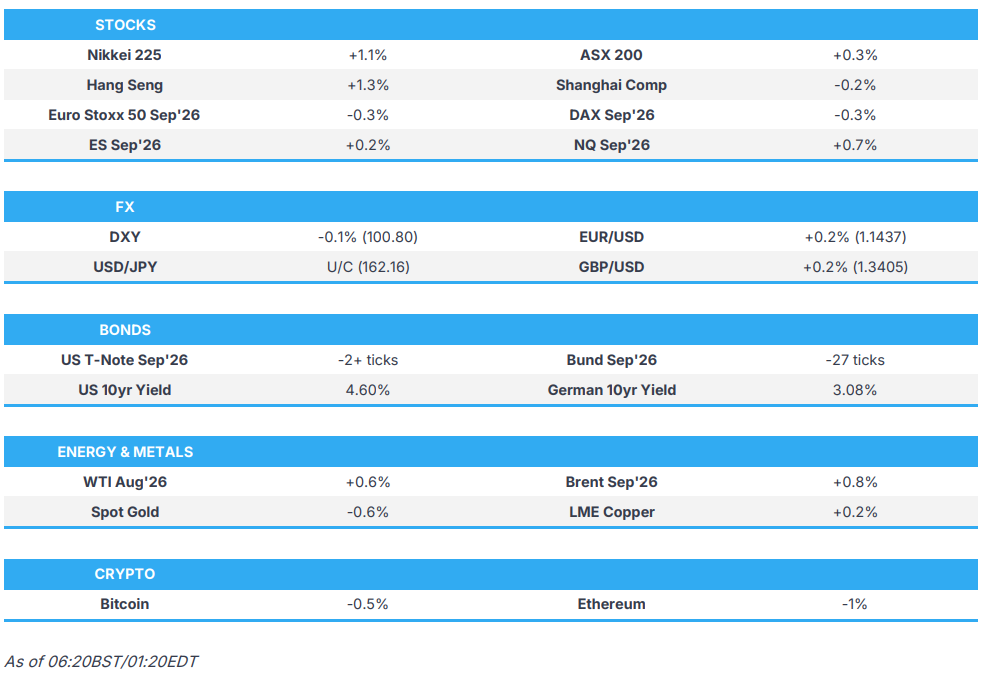
Newsquawk in 3 steps:
1. Subscribe to the free premarket movers reports
2. Listen to this report in the market open podcast (available on Apple and Spotify)
3. Trial Newsquawk’s premium real-time audio news squawk box for 7 days
IRAN CONFLICT
- US President Trump said in a pre-recorded Fox News interview that they are beating up Iran badly and Hormuz has to stay open, while he added that strikes will continue until he says it is enough, as well as stated they will save energy targets for last and will ultimately hit energy targets. Trump also said they will hit Iran hard on Wednesday night, and that next week will get really bad for Iran, in which they will hit Iran’s power plants and bridges next week unless Iran comes to the negotiating table. Furthermore, he said US officials spoke to Iran on Tuesday and told Iran that it better make a deal.
- US President Trump held a Situation Room meeting on Tuesday regarding Iran strikes and discussed a wider scope of strikes on Iran, according to Axios.
- US President Trump said, on the change to the Hormuz toll proposal, that countries had called on him and Gulf countries had asked to handle the Hormuz fee in a different way. Trump also stated that countries had offered investments, and that he did not think anyone should charge a fee in the Strait, while he added that Gulf nation investment was better than imposing a fee, and that he had spoken to Saudi Arabia, the UAE, Qatar, Bahrain and Kuwait. Furthermore, Trump said he has no regrets regarding the Iran sanctions waiver and that they gave Iran a chance by lifting the blockade before, while he added that Iran shot first, which was a big mistake.
- US official said US forces carried out a few additional strikes on military targets in Iran earlier on Tuesday, while the latest US strikes in Iran were carried out to eliminate emerging threats.
- US Central Command forces began launching an additional round of strikes against Iran at 15:00EDT/20:00BST on Tuesday, to continue degrading Iranian capabilities used to attack commercial shipping in the Strait of Hormuz, while CENTCOM later announced the completion of strikes against Iran.
- US forces resumed the naval blockade against vessels transiting to and from Iranian ports.
- US struck Qeshm Island in southern Iran, and explosions were heard in the maritime area of eastern Hormozgan and Sirik, while explosions were heard in Bandar Abbas and Hengam Island. Explosions were also heard in Bampur and Chabahar in Iran, although Iran’s semi-official news agency Tasnim noted officials denied reports of explosions in Chabahar, while explosions were reported in Iran’s port city of Bandar Imam Khomeini, and a mineral water plant in Deloran was hit by three projectiles. Furthermore, reports noted that air defences around the Bushehr Nuclear Power Plant in Iran became active.
- IRGC said it targeted enemy weapons and parts storage in Bahrain and Kuwait, while it targeted a drone ramp in Kuwait’s Ali Al Salem air base and targeted US positions at Jordan’s Azraq base, as well as the US Fifth Fleet Command HQ, fuel facilities and equipment in Bahrain. IRGC said as long as the US evil stays in the region, not a drop of oil and gas will be exported from the region, and that US aggression will have no result other than delaying the opening of the Strait of Hormuz.
- Iran’s Deputy Foreign Minister said Gharibabadi the US is making a mistake if it thinks its military attacks and blockade will force them to request negotiations, but also commented that Iran’s return to negotiations and tolerance regarding the Strait of Hormuz is possible. Furthermore, he said the MoU effectively no longer exists and that no country should expect Iran to continue implementing the terms of the memorandum.
- US Treasury issued fresh Iran sanctions on entities, individuals, and vessels.
- UK Foreign Office summoned the Iranian charge d’affaires over proxy group assaults.
- The first day of Lebanese-Israeli negotiations in Rome was positive, although Israeli forces were also reported to have carried out massive explosions in Kafr Tibnit, Lebanon.
US TRADE
EQUITIES
- US stocks closed in the green and reversed earlier pressure seen following dismal prelim. Q2 IBM earnings, with a cooler-than-expected US CPI report helping unwind the initial downward move. Following the inflation metrics, which were cooler than expected across all gauges, immediate downside was seen in US yields and the dollar, to the benefit of FX peers, spot gold, and equities. Oil prices saw gains as the US and Iran continued to trade strikes, and the blockade restarted today, although Trump backed off his plan to charge a 20% fee for safe passage through the Strait of Hormuz, and will pivot to trade deals to cover the US costs of assuring safe passage through the Strait. Elsewhere, Fed Chair Warsh testified in front of the House, and speaking on today’s inflation data, said it does not say mission accomplished, and he does not think that after today’s CPI report, that everything is swell, while he stated it is one data point, and does not want to overread or cherry-pick data.
- SPX +0.38% at 7,544, NDX +1.10% at 29,586, DJI +0.02% at 52,513, RUT +0.39% at 2,965.
- Click here for a detailed summary.
TARIFFS/TRADE
- Japan considers lifting the ban on US potato imports, according to Nikkei.
NOTABLE HEADLINES
- Fed Chair Warsh said today’s inflation data did not mean mission accomplished and that he did not think everything was swell after the CPI report, while he added it was one data point and cautioned against overreading or cherry-picking the data. Warsh reiterated the Fed’s commitment to the 2% inflation target, saying the central bank would deliver 2% inflation, and stated that June CPI was softer than expected, but stressed he was not cherry-picking the data and noted there was still plenty of work to do.
- Fed’s Goolsbee (2027 voter) said June CPI inflation was surprisingly benign and that was encouraging, but cautioned against overreacting to one month’s data, while he added that if the Fed received several months of similar inflation readings, he would feel better. Goolsbee also stated that services inflation was encouraging, and that if several months of PCE inflation mirrored the CPI data, he would feel much more confident, as well as commented that the labour market was stable without being strong.
- Fed’s Barr (voter) published a paper titled, “Will AI Broadly Raise Living Standards or Drive Income and Wealth Inequality?”, saying scenarios for AI adoption varied widely regarding how AI might affect inequality. Barr said AI, like past major technological advances, would shape the labour market and the broader economy in myriad ways, while adding that it remained unclear whether AI would reduce or increase income and wealth inequality.
- US President Trump said he thinks the inflation trend will hold and noted inflation is down, while he stated the report was incredible and to remember that for the midterms. Furthermore, he said they will bring prices much lower yet.
- US House voted to make daylight saving time permanent and sent the bill to the Senate.
APAC TRADE
EQUITIES
- APAC stocks traded with a positive bias as most major indices took impetus from the gains on Wall St, where sentiment was underpinned, and Fed rate hike bets were trimmed following softer-than-expected CPI data, while US President Trump also abandoned plans for a 20% Hormuz fee.
- ASX 200 eked out marginal gains with outperformance in miners following Rio Tinto’s quarterly update, although the upside in the index was capped as defensives lag.
- Nikkei 225 rallied amid tech strength, but with further upside limited following weak Machinery Orders.
- KOSPI was boosted by the tech-related momentum and with SK Hynix shares up by a double-digit percentage as it played catch-up to the 27% surge in its ADRs.
- Hang Seng and Shanghai Comp diverged with the mainland lagging after a slew of mixed data releases, including Chinese GDP and activity data.
- US equity futures kept afloat following softer US CPI data and the start of earnings season.
- European equity futures indicate a lower cash market open with Euro Stoxx 50 futures down 0.2% after the cash market closed with gains of 0.2% on Tuesday.
FX
- DXY remained subdued after weakening in the aftermath of the softer-than-expected CPI data, which resulted in some unwinding of Fed rate hike bets, although Fed Chair Warsh noted that the inflation data did not mean the mission was accomplished and cautioned against overreading or cherry-picking the data, while participants also look ahead to PPI data and more Fed speakers, including Warsh’s testimony to the Senate.
- EUR/USD benefited from the softer buck and reclaimed the 1.1400 status, while catalysts remained light for the bloc, although there were reports that the EU was set to propose easing banks’ capital requirements.
- GBP/USD returned to above the 1.3400 level as cyclical currencies are underpinned by the positive risk environment, while previous comments from BoE Governor Bailey had little impact, in which he noted that the core banking system in the UK was resilient and debt levels were not stretched.
- USD/JPY retested the 162.00 level to the downside after US yields retreated post-CPI, but with downside limited amid higher oil prices and disappointing Machinery Orders data from Japan.
- Antipodeans marginally edged higher owing to their high-beta statuses, but with the upside capped as participants also digested mixed Chinese GDP and activity data.
- PBoC set USD/CNY mid-point at 6.7910 vs exp. 6.7695 (prev. 6.7990).
FIXED INCOME
- 10yr UST futures struggled for direction after reversing the post-CPI spike and with Fed Chair Warsh noting the inflation data did not mean mission accomplished, while he cautioned against overreading the data.
- Bund futures were subdued amid higher energy prices and with EUR 3bln of Bund issuances due later.
- 10yr JGB futures held on to recent spoils, albeit with price action choppy overnight following disappointing Machinery Orders data and the mostly positive risk environment.
COMMODITIES
- Crude futures kept afloat after gaining yesterday as strikes continued across the Middle East in the ever-widening conflict, while attacks persisted overnight, and Trump said they will hit Iran hard tonight, as well as threatened to target Iranian power plants and bridges next week unless Iran comes to the negotiating table, although he abandoned plans to impose a 20% Strait of Hormuz fee.
- US Private Inventory Data (bbls): Crude -0.6mln (exp. -2.7mln), Distillates +2.3mln (exp. +1.0mln), Gasoline -1.7mln (exp. +0.6mln), Cushing +0.2mln.
- US President Trump said Iraq had tremendous oil reserves and significant wealth potential, adding that he would announce oil partnerships with Iraq this week or next. Trump also said that oil companies were now entering Iraq for partnerships, that oil firms were all going in and getting along with Iraq, and that while the US would be there for Iraq if it needed protection, Iraq did not need the US military.
- Spot gold faded post-CPI moves and continued to pull back from resistance at USD 4,100/oz.
- Copper futures were rangebound as participants digested Chinese GDP, Industrial Production and Retail Sales data.
CRYPTO
- Bitcoin retreated beneath the USD 65,000 level but with downside stemmed by an intraday bounce.
NOTABLE ASIA-PAC HEADLINES
- China’s stats bureau deputy head said China’s CPI and PPI are in reasonable ranges and hard won given most countries face big price increases, while the official added that China’s energy supplies are sufficient, production is stable, and imports are under control. Furthermore, it was stated that the Q2 GDP growth slowdown is due mainly to short-term factors and external factors, while H1 GDP growth lays a good foundation for achieving the full-year growth target.
DATA RECAP
- Chinese GDP Growth Rate QQ (Q2) 0.9% vs. Exp. 0.9% (Prev. 1.3%, Low. 0.8%, High. 1.2%)
- Chinese GDP Growth Rate YY (Q2) 4.3% vs. Exp. 4.4% (Prev. 5%, Low. 2.7%, High. 4.8%)
- Chinese Industrial Production YY (Jun) 5.3% vs. Exp. 4.7% (Prev. 4.5%, Low. 4.3%, High. 5.5%)
- Chinese Retail Sales YY (Jun) 1.0% vs. Exp. -0.1% (Prev. -0.6%, Low. -1.2%, High. 0.7%)
- Chinese Fixed Asset Investment YTD YY (Jun) -5.7% vs. Exp. -5.0% (Prev. -4.1%, Low. -6.0%, High. -2.5%)
- Chinese Unemployment Rate (Jun) 5.0% vs. Exp. 5.1% (Prev. 5.1%)
- Chinese House Price Index YoY (Jun) Y/Y -3.3% (Prev. -3.5%)
- Japanese Machinery Orders MM (May) -12.4% vs. Exp. -4.2% (Prev. 8.7%, Low. -6.7%, High. 0.4%)
- Japanese Machinery Orders YY (May) -1.9% vs. Exp. 12.9% (Prev. 15.6%, Low. 0.6%, High. 17%)
GEOPOLITICS
RUSSIA-UKRAINE
- US President Trump, when asked on the Russia sanctions bill, said that he thinks they might add Iran and Hezbollah to it, as well as stated that secondary sanctions on China and India have not yet been discussed, but they will have to have a look.
- US Senators released the text of the updated Russia sanctions bill negotiated by President Trump and late Senator Graham, which eases tariffs that could be placed on buyers of Russian oil and gas. Tariffs for Russian oil and gas buyers would be reduced to a maximum of 100% on the top 5 purchasers, from a blanket 500%, while the bill lets Trump waive sanctions if he deems it in the US national interest to do so.
EU/UK
NOTABLE HEADLINES
- Ed Miliband’s opponents in the Labour Party believe he has failed in his bid to become Chancellor, with current Home Secretary Mahmoud seen by some MPs as the favourite to take the Chancellor role in Andy Burnham’s new government, according to FT.
NORTH AND SOUTH KOREA AND JAPAN
SOUTH KOREA
JAPAN
3 CHINA
China’s Mass Production Of Dual-Use Drone Engines Fuels A Global Proliferation Crisis
Tuesday, Jul 14, 2026 – 11:00 PM
China’s greatest military advantage may be its ability to convert its massive civilian manufacturing base into wartime production of low-cost, one-way attack drones modeled after Iran’s Shahed-136.
This is especially alarming because the U.S. defense industrial base is only beginning (read here) to prepare for a transition to wartime output, even as a global drone procurement race accelerates. Nation-states are set to stockpile millions of autonomous, low-cost weapons in the years ahead.

We have already shown readers how Chinese firms appear to be ramping up production of Shahed-style drones, with open-source footage from social media increasingly pointing to expanding production capacity.
The latest finding centers on the drone’s powerplant: the Iranian MADO MD-550 engine, which is used throughout the Shahed family and in Russia’s Geran-2 variant. MD550-type engines are also being mass produced in China and widely advertised on Chinese e-commerce platforms, including Alibaba.

The problem is not that China manufactures small aviation engines; it is that commercially available, dual-use engines can be incorporated into Shahed-style drones with limited visibility into the final buyer or end use.
The United Nations has identified the Iranian MADO-550 as the engine used in the Shahed drone family, while the U.S. Treasury has said the sanctioned Oje Parvaz Mado Nafar Company (commonly known as Mado company).

Chinese vendors on Alibaba advertise MD550-type UAV engines in large quantities, although the listings alone do not show any connection to a Chinese state weapons program.

More importantly, the Alibaba listings are evidence of commercial availability, not proof that Beijing is deliberately supplying one-way attack drone programs. However, the listings only highlight the erosion of the boundary between civilian manufacturing and weapons production.
The real threat is that long-range strike drones can increasingly be assembled from commercially produced parts at a scale traditional export-control systems were never designed to contain. This means Shahed-style systems are likely to proliferate far beyond nation-states, spreading to proxies, criminal networks, and other threat actors.
Like this:
Latest evidence:
The question is no longer whether these drones will reach the West, but when.
4. EUROPEAN AND SCANDINAVIAN COMMENTARIES PLUS NATO
EUROPE/
New Women’s Athletics Guidelines Crack Down On ‘Sexualizing’ Camera Angles
Tuesday, Jul 14, 2026 – 09:45 PM
Authored by Calum Patterson via Dexerto,
New broadcasting guidelines have been introduced in Europe to prevent women athletes from being sexualized through camera angles and slow-motion replays.

The European Broadcasting Union partnered with European Athletics to release new guidance for women’s athletics coverage, with broadcasters urged to focus on performance and technical ability.
The guidelines warn against lingering shots of athletes’ bodies, low camera angles that capture revealing views, and slow-motion replays that offer little technical or storytelling value.
“The sexualization of women athletes through selective camera angles and editing choices continues to be a significant concern across many sports broadcasts,” said Glen Killane, Executive Director of EBU Sports.

“Lingering shots on bodies, low-angle cameras that capture revealing views, and excessive slow-motion replays that serve no technical or storytelling purpose are among the issues observed in the media coverage of women’s athletics competitions today.”
Broadcasters urged to avoid ‘compromising’ shots
The 23-page Raising the Bar document uses examples from real broadcasts to highlight potentially “compromising” shots across high jump, pole vault, long jump, and running events.
Broadcasters are advised to avoid tight shots from behind athletes, low cameras underneath competitors, and certain slow-motion replays. Instead, wider angles showing run-ups, take-offs, and technique are encouraged.

British Olympic pole vaulter Holly Bradshaw said some athletes have even become distracted by camera positions during competitions.
“Many athletes, myself included have been in competitive scenarios where they are more focused on the cameras instead of their own performance,” she said.
Bradshaw also revealed she has received social media abuse and seen “inappropriate videos” of herself and fellow athletes created from slow-motion competition footage.
The guidelines are now available to broadcasters covering women’s athletics, with the EBU saying coverage should focus on athletes’ “technical ability and compelling storytelling.”
END
SPAIN
“Deport Criminals Who Steal Or Kill”: Spanish Model Blasts Barcelona’s Immigration Crisis
Wednesday, Jul 15, 2026 – 02:00 AM
Influencer and model Jessica Goicoechea has posted a video on her social media channels in which she openly criticizes the insecurity she believes plagues Barcelona and details the personal measures she has taken to protect herself. In the clip, Goicoechea displays several security items she recently bought in Andorra, including 4 bottles of pepper sprays and a taser gun, which she describes as her “new essentials.”

The video ends with a direct message: “Now, I can go calmly through Barcelona.”
The publication quickly sparked intense debate across social platforms. While some users criticized her for publicly showcasing self-defense weapons, many others – particularly women – expressed support and inquired about where similar products could be purchased. In response, Goicoechea stated that she is receiving “infinite messages” from women seeking ways to protect themselves. She defended her actions by saying that, given the current situation, she believes “if you don’t protect yourself, no one will.”
Following the video’s viral spread, Goicoechea followed up with a written statement. She explained that she had never wanted to enter debates about safety or immigration but felt compelled to speak out because conditions have deteriorated.

Barcelona Streets Run RED With Fresh Knife Attacks And Execution-Style Shootings
What on Earth is going on in Spain?
“I’m never going to shut up again,” she declared. The model described living in fear while walking the streets of Barcelona and highlighted what she called a daily increase in stabbings and shootings that she becomes aware of almost constantly.
In the same statement, Goicoechea emphasized that her concerns are not aimed at immigration in general but specifically at individuals who commit crimes. She pointed to recidivism, impunity, and insufficient controls on people with serious criminal records as the core issues.
“The problem is not where someone comes from, but how they behave,” she maintained.
Addressing comments under her video, Goicoechea responded to one follower who linked Barcelona’s rising crime to immigration by saying she “100% agrees.”
“It all stems from political mistakes, regardless of the party’s political color, due to poor immigration planning,” read the comment she agreed with.
She later clarified that this agreement applied only to those who engage in criminal activity. She argued that “if you come to steal or kill, I prefer you be deported.”
Goicoechea reiterated that her goal is to call for improved street safety and a firmer response to crime. “I believe that demanding safe streets and firm laws against those who come to commit crimes is essential and common sense,” she concluded in the statement shared on her profiles.
Her comments arrive amid a series of violent incidents recorded across Catalonia in recent weeks, including approximately thirty firearms-related events, many concentrated in the Barcelona metropolitan area. These have been accompanied by frequent robberies and assaults that continue to affect both local residents and tourists, often generating significant public attention.
Other European models have delivered similar messages about crime concerns in the past, including Polish-American supermodel Joanna Krupa.
END
EU/RUSSIA/LNG
EU’s Russian LNG Imports Hit Record High Ahead Of 2027 Ban
Wednesday, Jul 15, 2026 – 03:30 AM
Authored by Alex Kimani via OilPrice.com,
The European Union imported a record 9.97 million metric tons of liquefied natural gas (LNG) worth €5.96 billion (~$6.82 billion) from Russia’s Yamal LNG facility in the first half of 2026, marking a 16% increase compared to the same period in 2025 as they front-loaded Russian energy supplies ahead of impending phase-out bans.

Kpler data shows that European buyers absorbed over 97% of the Siberian facility’s total output during the first half of the year, despite years-long efforts to overcome dependency on Russian energy.
Overall EU imports of Russian LNG increased by 11% Y/Y during the period, while imports of Russian pipeline gas increased 7%Y/Y, according to the data.
Supply bottlenecks in the Middle East, including blockades in the Strait of Hormuz and damage to Qatari infrastructure, forced European buyers to lean heavily on readily available Arctic gas.
The EU’s ban on short-term Russian LNG imports went into effect on April 25, 2026, under the REPowerEU Gas Regulation.
However, exemptions built into the regulation have allowed European buyers to maintain or even accelerate their intake of Russian gas before a complete blanket ban takes effect on January 1, 2027.
While LNG faces tighter initial phase-outs, pipeline imports from Russia under short-term legacy contracts were given until June 17, 2026 while long-term pipeline gas remains legally permitted until September 30, 2027.
France, Belgium, and Spain are the largest buyers of LNG from the Yamal facility, while Hungary is the largest buyer of pipeline gas shipments delivered via the TurkStream pipeline.
Meanwhile, Hungary and Slovakia continue to receive Russian crude via the southern branch of the Druzhba pipeline as they hold official temporary exemptions from the EU’s embargo on Russian seaborne oil.
A Russian airstrike damaged the pipeline in Ukraine, entirely halting oil flows to both nations for nearly three months.
Both were forced to rely on emergency reserves and alternative routes such as Croatia’s Adria pipeline during the disruption.
In response, Hungary and Slovakia have agreed to construct a new 127 km pipeline exclusively to transport refined oil products between their respective major refineries.
end
ENGLAND
a must read!! England’s dilemma
(Roth/Civitas Outlook)
Can Britain’s Next Prime Minister Escape The Net-Zero Trap?
Wednesday, Jul 15, 2026 – 06:30 AM
Authored by Diana Furchtgott-Roth via Civitas Outlook,
Andy Burnham has a chance to restore sanity to British politics by choosing domestic production over Chinese renewables.

Britain is suffering from disruptions in both weather and politics as a heat wave grips a country where only four percent of homes have air conditioning. Sir Keir Starmer has resigned as Labour Prime Minister, and former Manchester mayor Andy Burnham, elected earlier this month as MP from Makerfield, is slated to replace him.
Since former Conservative Prime Minister Theresa May signed Britain up to the amended Climate Change Act in 2019, a binding law requiring a 100 percent reduction in emissions by 2050 compared to 1990 levels, Britain has had five Prime Ministers. This outpaces Italy, which has had three, long the byword for political instability in the Western world.
After Mrs. May herself, Britain cycled through Boris Johnson, Liz Truss, Rishi Sunak, and now Sir Keir—none of them popular, none of them successful, all of them departing under economic pressure and in failure. This general dissatisfaction is not a coincidence, but linked to higher energy prices, which reduce growth and employment.
But today’s disruptions could be useful if Sir Keir’s resignation opened a window for Britain to reset its energy policy. Mr. Burnham, dubbed the King of the North, has already signaled that he wants affordable power and British jobs, especially in Britain’s north.
In his victory speech after winning his return to Parliament, Mr. Burnham declared:
“We do need to bring down water bills, energy bills, rail fares, just as we brought down bus fares in Greater Manchester, to make life more affordable for people.”
If he means it, energy is the place to start.
Britain pays 42 cents per kilowatt-hour for electricity. Germany, Europe’s other great champion of the green transition, pays 43 cents. The United States, which has no national Net Zero law, pays 20 cents, less than half. Almost every EU country with binding emissions targets pays above 30 cents.
European policy choices have mandated expensive generation, loaded green levies onto bills, and prematurely wound down reliable conventional power. The Brits are paying a Net Zero surcharge on every unit of electricity they consume, every single day, with no measurable effect on global temperatures in 2100. And Britain’s wind and solar dependency funnels money to Chinese state-subsidized manufacturers and workers rather than British ones.
This means slower UK growth. Since the end of 2019, before the pandemic, the United States has recorded total GDP growth of 15.1 percent, compared to just 6 percent for the UK. Forecasts offer little comfort: the OECD projects UK growth of just 0.8 percent in 2026, against 2.3 percent for the United States. Countries with the highest electricity prices are growing the slowest.
And it’s not like Britain is getting top value for its money. Two weeks ago, temperatures above 25 degrees Celsius (77 degrees Fahrenheit) reduced the efficiency of UK solar panels, and a lack of wind stalled the wind turbines. With electricity demand running at about 36 gigawatts, Britain had to import 20 percent of its electricity from the European Union.
The good news is that Mr. Burnham, with his flexible views, can take a different path.
Britain is not a resource-poor nation forced to depend on foreign suppliers, but a resource-rich nation that has chosen dependency through planning rules, regulatory obstruction, and a Net Zero framework that treats domestic oil and gas production as a moral failing rather than a strategic necessity.
In the short run, Britain could produce more North Sea oil and gas and approve stalled domestic natural gas projects. In the long run, Britain could speed up permitting for nuclear power plants, including new technologies such as floating nuclear reactors in harbors, as proposed by the British company Core Power.
Britain now imports oil and gas from Norway rather than allowing British workers to be well paid to extract them from the same North Sea—and pay taxes on the earnings. While Britain sits on the sidelines, Norway’s Equinor is raising output projections for the Norwegian continental shelf due to technological improvements and rising demand.
Mr. Burnham can move forward with offshore projects in the North Sea and North Atlantic totaling between 157,000 and 162,500 barrels of oil equivalent per day, with combined lifetime recoverable reserves ranging from 560 million to 920 million barrels of oil equivalent. Ithaca Energy’s Cambo project and Adura’s Rosebank and Jackdaw fields are all currently awaiting approval.
Adura estimates that Rosebank and Jackdaw will generate almost $38 billion in gross value added over their lifespans, generate almost $2 billion in tax revenues before the end of the current Parliament in 2029, and support 3,500 jobs.
In addition, the Gainsborough Trough, a major sedimentary basin between Lincolnshire and South Yorkshire, holds about 16 trillion cubic feet of recoverable gas, equivalent to 2,750 million barrels of oil. With hydrofracturing, it could power Britain for ten years and create a quarter of a million jobs. Egdon Resources has long wanted to develop it, and no government funds would be needed.
Using these domestic resources would create well-paying jobs in northern communities that have seen manufacturing and mining decline over decades—precisely the area that Mr. Burnham wants to win from Reform.
To achieve Mr. Burnham’s desired growth, the government must remove the planning restrictions, the moratorium on hydraulic fracturing, and the regulatory framework that makes hydrocarbon investment impossible. Mr. Burnham needs to say plainly that Britain’s growth matters more than the approval of green lobbying groups.
The question is whether Mr. Burnham will move Secretary of State for Energy Security and Net Zero Ed Miliband to the coveted position of Chancellor of the Exchequer. Miliband has been the defining force in Sir Keir’s Cabinet against developing a realistic energy policy.
Mr. Miliband now presides over the planning regime that blocks hydrocarbon development, and it is his ideology, the belief that Britain can lead the world to Net Zero by making itself dependent on foreign energy while foreigners burn their own, that keeps British electricity rates among the highest in the world.
If Mr. Miliband were promoted to Chancellor of the Exchequer, he would oversee balancing the budget, or at least minimizing the deficit, and he might see energy production in an entirely different light. As current Chancellor Rachel Reeves has discovered, raising taxes and taking away senior citizens’ winter fuel credits are unpopular options (and may cost her her position).
Unfortunately, Mr. Burnham has floated the idea of nationalizing energy companies and other public infrastructure, even though money would have to be borrowed, taxed, or diverted from other priorities. Public ownership of expensive infrastructure would not achieve Mr. Burnham’s objective of lowering prices. The history of state-owned enterprises in Britain, reversed by former Prime Minister Margaret Thatcher, is a history of inefficiency, underinvestment, and costs ultimately borne by taxpayers. What Mr. Burnham needs is private investment in cheap domestic production.
Energy is foundational to economic growth and to the costs of manufacturing, transportation, heating, and food production and storage. When governments require shifts from cheaper to more expensive energy options (such as from fossil fuels to more expensive renewables), they raise energy costs across the entire economy. Higher energy costs result in higher prices for goods and services, squeezing household budgets and eroding real wages.
Businesses facing higher power bills invest less, hire fewer workers, and, in some cases, relocate to cheaper jurisdictions abroad. The result is an economy that grows more slowly than it should, generates fewer job opportunities than it could, and delivers lower living standards than voters expect. People pay more for electricity and gas, groceries, and gasoline. And they take it out on whoever is leading the country. In Britain, this is the Prime Minister.
For years, Britain has turned its back on its own hydrocarbon wealth in pursuit of wind and solar targets that have driven up bills, exported jobs, and left the country dependent on imported LNG priced by global markets. The paradox is glaring: Britain sits atop significant untapped gas reserves yet pays premium prices for fuel shipped from abroad.
The economics are straightforward. North Sea drilling and domestic gas development are cheaper than the combined cost of offshore wind, grid expansion, and the battery storage needed to cover the days the wind doesn’t blow. Every pound spent on domestic production is a pound that stays in Britain, is taxed in Britain, and is employed in Britain rather than enriching foreign exporters.
Burnham says he wants to be the voice of the North. Here is his chance to prove it. An energy policy built around private investment in domestic production, lower bills, and British jobs recognizes that the transition must work for working people, not just for the investment banks financing wind farms.
Reform is siphoning off votes from both Labour and the Conservatives because it speaks to the cost of living in terms voters recognize. Mr. Burnham can occupy that ground without abandoning Labour’s broader commitments, simply by insisting that British energy for British homes comes before imported energy at any price.
Partly due to the costs of its Net Zero laws, Britain has burned through five Prime Ministers and is paying some of the highest electricity prices in the world. The King of the North has a chance to change that if he chooses a different path.
5. RUSSIAN AND MIDDLE EASTERN AFFAIRS//
ISRAEL USA/IRAN TUESDAY NIGHT
Live Updates: Iranian strikes reported across region as Trump threatens to strike power plants, bridges
US carries out fresh round of strikes in Iran • CENTCOM reinstates blockade in Strait of Hormuz • Trump requests Israel to pull out of Syria, Lebanon

A US Air Force F-35A stealth fighter jet is refueled over the Middle East, July 12, 2026.(photo credit: X/CENTCOM)
Trump says US will strike Iranian power plants, bridges next week if no deal reached
Trump added that he “doesn’t like the idea” of charging a fee in the Strait of Hormuz, noting that Iran prefers to “spend a lot of money in the United States.”

US President Donald Trump looks on after signing an executive order to drastically shrink two national monuments in Utah, paving the way for fossil fuel extraction and mining, at the Oval Office of the White House in Washington, DC, on July 13, 2026.(photo credit: SAUL LOEB / AFP via Getty Images)ByJERUSALEM POST STAFFJULY 15, 2026 01:21Updated: JULY 15, 2026 03:12
US President Donald Trump said that the United States will target Iranian power plants and bridges next week, during an interview with Fox News’s Trey Yingst on Wednesday.
“We’re going to hit them very hard tonight. We’re going to hit them very hard tomorrow night. We’re going to hit them very hard the night after,” said Trump. “Will save energy targets for last. Next week it gets really bad for them.”
“We’re gonna knock out all their power plants,” he said. “We’re gonna knock out all their bridges, unless they get to the table and negotiate.”
Trump added that Iran has “no choice” but to agree to a deal, noting that US and Iranian representatives held talks on Tuesday.
“I said, you better make a deal,” noted Trump. “You’re not going to have anything left.”

President Trump also alluded to the effect of recent US Central Command (CENTCOM) strikes on the Islamic regime along the Strait of Hormuz.
“We’re beating them up really badly,” Trump said. “They have to be beaten up.”
Trump: US strikes successful, ‘hard to find’ new targets
“We’re hitting them very, very hard,” he added. We’re hitting every single thing they have along the [Hormuz] shore.”
Trump noted the success of the renewed US military operations in the region, saying that it is “hard to find” targets left to strike.
Trump added that he “doesn’t like the idea” of charging a fee in the Strait of Hormuz, noting that Iran prefers to “spend a lot of money in the United States.”
He said that US strikes against Iran would continue “until I say it’s enough,” stressing that American goals in the region have been “completed.”
The US president described his proposed deal with Iran as a “wall” which would prevent the regime from acquiring a nuclear weapon.
“What they [Iran] signed with Obama was a worthless piece of paper that was a road to a nuclear weapon,” he claimed. “They will not have a nuclear weapon.”
Trump: ‘Everything’ Iran says ‘is a lie’
Regarding Iranian claims of not pursuing a nuclear weapon, Trump responded that “everything” Iran says “is a lie.”
Trump said that his decision to launch Operation Epic Fury on February 28 was because Iran’s effort to obtain a nuclear weapon “just never stops.”
We knew they wanted a nuclear weapon,” he said. “If they had a nuclear weapon, Israel wouldn’t be here.”
He further claimed that the US and Iran had discussed the nuclear issues during recent negotiations despite Iranian claims to the contrary.
end
ISRAEL USA/IRAN WEDNESDAY
US & Iran Exchange Heavy Strikes For 5th Day As Trump Warns He’ll Take Out Power Plants Next
Wednesday, Jul 15, 2026 – 09:00 AM
The Pentagon opened Wednesday morning (US time) by announcing yet another round of strikes on Iran, in what looks like sustained action – also increasingly expanding to include civil and energy infrastructure of the Islamic Republic.
“At 6 a.m. ET today, U.S. Central Command forces began launching a wave of strikes against Iran,” Centcom announced. “The strikes are designed to further degrade military capabilities Iranian forces have used to attack commercial shipping in the Strait of Hormuz.”
The US military further indicated it launched a “seven-hour wave” of strikes overnight. The evening prior, the US reimposed a naval blockade on Iranian ports and alongside launching its fourth consecutive night of strikes on the country, also as President Trump freshly warned that if Iran does not return to the negotiating table, “next week it gets really bad for them, because next week comes the power plants.“

“You better make a deal, or you’re not going to have anything left,” Trump has warned. “Ultimately, we’ll hit energy targets in Iran. Next week comes the bridges. We’re going to knock out all of their power plants. We’ll knock out all of their bridges unless they get to the table and negotiate.”
Iranian government spokesperson Fatemeh Mohajerani announced that at least 30 civilians have been killed across the country over 260 people wounded by American strikes of the last few days.
Airstrikes also reportedly took out an Iranian military barracks in southeastern Iran, leaving seven dead. The Associated Press details that “One strike targeted a barracks for Iran’s 388th Mechanized Infantry Brigade, which operates tanks and armored vehicles, in Sistan and Baluchestan province, Iranian state television reported.”
“The report said the Americans fired at least 13 missiles in the attack and that the seven dead included conscripts and career soldiers,” AP continues. “A number of troops were wounded.”
Heavy bombardments have focused on the coastal areas, with US strikes reportedly having hit a civilian maritime control tower in Chabahar, southern Iran – location of country’s only deep-water port outside the Strait of Hormuz, which allows Iran direct access to the Indian Ocean without passing through the Gulf.
As expected, Iran’s IRGC has continued launching a wave of retaliatory strikes targeting critical US military infrastructure across the Gulf and even reaching into Jordan.
The list of targets hit, according to an array of regional sources, include – Bahrain’s Sheikh Isa Air Base, the US Navy’s 5th Fleet support facility, Kuwait’s Ali Al-Salem and Camp Buehring, and Jordan’s Muwaffaq Salti Air Base.
Also, Emirati sources have reported strikes on the critical Fujairah Port, while Kuwait confirms one of its navy vessels was struck, leaving four crew members injured. Additionally, social media is awash with unverified footage showing Shahed kamikaze drones striking Kuwait, as well as massive plumes of black smoke rising from burning facilities in Kuwait. US 5th Fleet HQ locations in Bahrain also show signs of damage from inbound projectiles.
The IRGC has insisted that the “export of oil and gas from the region will be either for everyone or for no one.”
The Iranians have continued to tout their nationalist defiance and have at no point shown signs of backing down as is hoped by Trump:
President Trump continues facing pressure over what’s next or what the ultimate objectives are. Related to this, he was pressed by Fox News Wednesday night about taking Kharg Island. Trump responded:
“We already hit Kharg Island, as you know, twice. Even three times. I said hit everything but just leave that little area from 25 yards out because I don’t want that in terms of the world economy. As far as taking it is concerned, if we degrade them far enough and deep enough back, I would do that.”
But Iranian forces show no signs of backing down. Instead a message from its army command via state TV says that “a decisive response to this aggressive action by the American enemy” will keep coming.
Missile alert warnings have continued to sound in Bahrain and Kuwait early Wednesday amid the Iranian fire, which has at this point grown to a daily occurrence.
Meanwhile, strikes on nuclear plans return?
Overnight Developments
via Newsquawk…
- US President Trump said in a pre-recorded Fox News interview that they are beating up Iran badly and Hormuz has to stay open, while he added that strikes will continue until he says it is enough, as well as stated they will save energy targets for last and will ultimately hit energy targets. Trump also said they will hit Iran hard on Wednesday night, and that next week will get really bad for Iran, in which they will hit Iran’s power plants and bridges next week unless Iran comes to the negotiating table. Furthermore, he said US officials spoke to Iran on Tuesday and told Iran that it better make a deal.
- US Central Command forces began launching an additional round of strikes against Iran at 15:00EDT/20:00BST on Tuesday, to continue degrading Iranian capabilities used to attack commercial shipping in the Strait of Hormuz, while CENTCOM later announced the completion of strikes against Iran.
- US struck Qeshm Island in southern Iran, and explosions were heard in the maritime area of eastern Hormozgan and Sirik, while explosions were heard in Bandar Abbas and Hengam Island. Explosions were also heard in Bampur and Chabahar in Iran, although Iran’s semi-official news agency Tasnim noted officials denied reports of explosions in Chabahar, while explosions were reported in Iran’s port city of Bandar Imam Khomeini, and a mineral water plant in Deloran was hit by three projectiles. Furthermore, reports noted that air defences around the Bushehr Nuclear Power Plant in Iran became active.
- IRGC said it targeted enemy weapons and parts storage in Bahrain and Kuwait, while it targeted a drone ramp in Kuwait’s Ali Al Salem air base and targeted US positions at Jordan’s Azraq base, as well as the US Fifth Fleet Command HQ, fuel facilities and equipment in Bahrain. IRGC said as long as the US evil stays in the region, not a drop of oil and gas will be exported from the region, and that US aggression will have no result other than delaying the opening of the Strait of Hormuz.
- Iran will respond to the US attacks, Tasnim reported.
- Iran’s Deputy Foreign Minister Gharibabadi said the US is making a mistake if it thinks its military attacks and blockade will force them to request negotiations, but also commented that Iran’s return to negotiations and tolerance regarding the Strait of Hormuz is possible. Furthermore, he said the MoU effectively no longer exists and that no country should expect Iran to continue implementing the terms of the memorandum.
- Israeli PM Netanyahu is reportedly to travel to Washington on Saturday evening, aiming to meet with US President Trump, Yedioth reported.
END
ISRAEL/IRAN/USA/WEDNESDAY AFTERNOON
Pentagon Initiates Second Strike Wave Of Day After Iran Again Snubbed New Talks
Wednesday, Jul 15, 2026 – 03:20 PM
Summary
- Pentagon announces second wave of strikes later Wednesday, after initial 90-minute attack to start the day.
- Trump threatens wider strikes unless Iran returns to talks – says attacks to ‘expand’ next week.
- Wednesday saw 5th strait day of US bombardment on chiefly Iranian coastal sites.
- Iran hits US-Gulf bases and warns on regional oil exports, says it is in ‘control’ of Hormuz Strait.
- No evidence de-escalation: Tehran rejects talks and vows more retaliation.
* * *
Pentagon Announces Another Wave of Strikes Later Wednesday
It is night time in Iran, and apparently the US ‘break’ is over, and bombing resumes: (CENTCOM) “At 3 p.m. ET, U.S. forces launched operations for a second wave of strikes today against Iran. The strikes are targeting Iranian military capabilities used to threaten vessels freely transiting through the Strait of Hormuz, an international waterway vital to global commerce. The U.S. military is holding Iran accountable at the Commander in Chief’s direction.”
Without doubt these attack waves are getting heavier, but so is Iran’s ‘retaliation’… from earlier: Kuwait Hit By Worst Iran Attacks in Weeks As War Escalates (Bloomberg).
Meanwhile an interestingly ambiguous admission from President Trump Wednesday afternoon:
US President Trump says oil price will yo-yo for a while; thinks inflation at year-end will be lower than now. Would like to see rates go down but better to pause than hike
Trump: Strikes Will ‘Expand’
Earlier in the day, within hours after the morning’s 90-minutes salvo of latest US strikes on Iran was completed, President Trump once again claimed that Iran is desperately seeking diplomatic talks. However Iran was quick to respond that it has “no plans” for returning to the negotiating table.
With this, President Trump is ready to escalate militarily, telling FOX that strikes on the Islamic Republic will “expand” next week – though some are wondering why he is signaling the delay.
De-escalation seems nowhere on the horizon, also as the more ‘hardline’ influence within Iran seems ascendant, per Al Jazeera:
The Iranian government is releasing the statistic of the seven soldiers killed in US attacks “very deliberately” to solidify its popular support through the war, says Mehran Kamrava, professor of government at Georgetown University Qatar.
“What we have seen in Iran … is a resurgence of Iranian nationalism, and by highlighting the fact that Iranian soldiers are dying and giving their lives for defending the country, what the government is trying to do is to ensure that that popular support remains intact,” Kamrava told Al Jazeera.
That support is important as there is little doubt the country is struggling with high inflation, unemployment, and $270bn in damages to the economy, he said. Meanwhile, the Iranians are aware that they cannot go “toe-to-toe militarily with the Americans, so they are turning the conflict from a military one into an economic one, hence the attacks on shipping,” Kamrava said.
FROM EARLIER: WEDNESDAY MORNING
Attack Waves Halted, For Now…
The Pentagon opened Wednesday morning (US time) by announcing yet another round of strikes on Iran, in what looks like sustained action – also increasingly expanding to include civil and energy infrastructure of the Islamic Republic.
“At 6 a.m. ET today, U.S. Central Command forces began launching a wave of strikes against Iran,” Centcom announced. “The strikes are designed to further degrade military capabilities Iranian forces have used to attack commercial shipping in the Strait of Hormuz.”
The US military further indicated it launched a “seven-hour wave” of strikes overnight – and followed during the next day (Wednesday) by a 90-minute wave. Also the evening prior, the US reimposed a naval blockade on Iranian ports and alongside launching its fourth consecutive night of strikes on the country, also as President Trump freshly warned that if Iran does not return to the negotiating table, “next week it gets really bad for them, because next week comes the power plants.“
“You better make a deal, or you’re not going to have anything left,” Trump has warned. “Ultimately, we’ll hit energy targets in Iran. Next week comes the bridges. We’re going to knock out all of their power plants. We’ll knock out all of their bridges unless they get to the table and negotiate.”
US Strike Hits Iranian Military Barracks
Iranian government spokesperson Fatemeh Mohajerani announced that at least 30 civilians have been killed across the country over 260 people wounded by American strikes of the last few days.
Airstrikes also reportedly took out an Iranian military barracks in southeastern Iran, leaving seven dead. The Associated Press details that “One strike targeted a barracks for Iran’s 388th Mechanized Infantry Brigade, which operates tanks and armored vehicles, in Sistan and Baluchestan province, Iranian state television reported.”
“The report said the Americans fired at least 13 missiles in the attack and that the seven dead included conscripts and career soldiers,” AP continues. “A number of troops were wounded.”
Heavy bombardments have focused on the coastal areas, with US strikes reportedly having hit a civilian maritime control tower in Chabahar, southern Iran – location of country’s only deep-water port outside the Strait of Hormuz, which allows Iran direct access to the Indian Ocean without passing through the Gulf.
IRGC Strikes Several US-Gulf Facilities
As expected, Iran’s IRGC has continued launching a wave of retaliatory strikes targeting critical US military infrastructure across the Gulf and even reaching into Jordan.
The list of targets hit, according to an array of regional sources, include – Bahrain’s Sheikh Isa Air Base, the US Navy’s 5th Fleet support facility, Kuwait’s Ali Al-Salem and Camp Buehring, and Jordan’s Muwaffaq Salti Air Base.
Also, Emirati sources have reported strikes on the critical Fujairah Port, while Kuwait confirms one of its navy vessels was struck, leaving four crew members injured. Additionally, social media is awash with unverified footage showing Shahed kamikaze drones striking Kuwait, as well as massive plumes of black smoke rising from burning facilities in Kuwait. US 5th Fleet HQ locations in Bahrain also show signs of damage from inbound projectiles.
The IRGC has insisted that the “export of oil and gas from the region will be either for everyone or for no one.”
The Iranians have continued to tout their nationalist defiance and have at no point shown signs of backing down as is hoped by Trump:
New Warning of Kharg Island Operation
President Trump continues facing pressure over what’s next or what the ultimate objectives are. Related to this, he was pressed by Fox News Wednesday night about taking Kharg Island. Trump responded:
“We already hit Kharg Island, as you know, twice. Even three times. I said hit everything but just leave that little area from 25 yards out because I don’t want that in terms of the world economy. As far as taking it is concerned, if we degrade them far enough and deep enough back, I would do that.”
But Iranian forces show no signs of backing down. Instead a message from its army command via state TV says that “a decisive response to this aggressive action by the American enemy” will keep coming.
Missile alert warnings have continued to sound in Bahrain and Kuwait early Wednesday amid the Iranian fire, which has at this point grown to a daily occurrence.
Meanwhile, strikes on nuclear plans return?
Overnight Developments
via Newsquawk…
- US President Trump said in a pre-recorded Fox News interview that they are beating up Iran badly and Hormuz has to stay open, while he added that strikes will continue until he says it is enough, as well as stated they will save energy targets for last and will ultimately hit energy targets. Trump also said they will hit Iran hard on Wednesday night, and that next week will get really bad for Iran, in which they will hit Iran’s power plants and bridges next week unless Iran comes to the negotiating table. Furthermore, he said US officials spoke to Iran on Tuesday and told Iran that it better make a deal.
- US Central Command forces began launching an additional round of strikes against Iran at 15:00EDT/20:00BST on Tuesday, to continue degrading Iranian capabilities used to attack commercial shipping in the Strait of Hormuz, while CENTCOM later announced the completion of strikes against Iran.
- US struck Qeshm Island in southern Iran, and explosions were heard in the maritime area of eastern Hormozgan and Sirik, while explosions were heard in Bandar Abbas and Hengam Island. Explosions were also heard in Bampur and Chabahar in Iran, although Iran’s semi-official news agency Tasnim noted officials denied reports of explosions in Chabahar, while explosions were reported in Iran’s port city of Bandar Imam Khomeini, and a mineral water plant in Deloran was hit by three projectiles. Furthermore, reports noted that air defences around the Bushehr Nuclear Power Plant in Iran became active.
- IRGC said it targeted enemy weapons and parts storage in Bahrain and Kuwait, while it targeted a drone ramp in Kuwait’s Ali Al Salem air base and targeted US positions at Jordan’s Azraq base, as well as the US Fifth Fleet Command HQ, fuel facilities and equipment in Bahrain. IRGC said as long as the US evil stays in the region, not a drop of oil and gas will be exported from the region, and that US aggression will have no result other than delaying the opening of the Strait of Hormuz.
- Iran will respond to the US attacks, Tasnim reported.
- Iran’s Deputy Foreign Minister Gharibabadi said the US is making a mistake if it thinks its military attacks and blockade will force them to request negotiations, but also commented that Iran’s return to negotiations and tolerance regarding the Strait of Hormuz is possible. Furthermore, he said the MoU effectively no longer exists and that no country should expect Iran to continue implementing the terms of the memorandum.
- Israeli PM Netanyahu is reportedly to travel to Washington on Saturday evening, aiming to meet with US President Trump, Yedioth reported.
ISRAEL TBN.
END
ISRAEL AND THE USA
Ben Gurion is such a small airport and thus it is difficult if the uSA puts massive amounts of refueling tankers stationed there
(zerohedge)
Israeli Officials Try To Push US Refueling Tankers Out Of Ben Gurion Airport Amid Disruptions
Tuesday, Jul 14, 2026 – 09:20 PM
Immense controversy has remained centered on Ben Gurion International Airport as dozens of giant US Air Force refueling tankers have essentially taken over the main Israeli flight hub for many months, since the start of Trump’s Operation Epic Fury. Reports also say it has cost the airport hundreds of millions of dollars at this point.
The Israeli government itself seems to be divided, and there’s been outrage among the general public as the presence of the American tankers has blocked and slowed regular commercial flights, leading to the recent cancelations of many passengers’ tickets, but with an expected tens of thousands more cancelations to come.
On Tuesday the simmering controversy erupted again, and has even raised the possibility of introducing fresh tensions with Washington, after Israeli Transportation Minister Miri Regev announced that the government will not allow more than 20 US refueling tankers to be parked at Tel Aviv’s Ben Gurion Airport at any given time.
Regev specifically addressed the domestic public’s concerns over air travel. “Hundreds of thousands of plane tickets were bought by Israelis to fly and enjoy their summer vacation,” the official said. “We promised that we will enable commercial flights and we will not cancel a single ticket because of American refueling planes.“
Haaretz had already by June tallied that “Some 75 U.S. refueling planes occupy more than half of Ben-Gurion Airport’s parking spots and fill up takeoff and landing slots” and cites airport officials who warn: “For lack of a solution, 1.5 million passengers may have their flights canceled this summer.”

“Therefore I have given instructions that we will not allow any US refueling tankers to land at Ben Gurion Airport beyond the agreed number of 20 planes and the remaining planes will land at Air Force bases,” Regev adds.
Israeli media notes that the crisis has been building:
The directive comes after the Israel Airports Authority warned that unless more US aircraft are removed from the country’s main international air gateway, as many as 50,000 flight tickets could be at risk of cancellation in the coming weeks.
The monthslong presence of US military aircraft at Ben Gurion Airport amid the Iran war has been preventing a full return to normal commercial flight operations, while also driving up operational costs for local airlines.
It’s a deep irony that Israelis are increasingly complaining the United States military has effectively taken over Israel’s international travel hub.
Media reports have been going so far as to call Tel Aviv’s Ben Gurion Airport a “US military base” – as the prominent local newspaper Haaretz does:
The US refueling aircraft and other military assets, which have been stationed at Tel Aviv’s Ben Gurion Airport for months, are causing congestion and may result in flight cancellations, Israeli officials and media reports have said, calling the facility a “US military base.”
That prior report complained that “U.S. Air Force refueling aircraft have been stationed at Ben Gurion International Airport for three months, occupying parking spots, taking up takeoff and landing slots and worsening congestion at Israel’s main international gateway since the war with Iran erupted in late February, officials say.”
Again, a central irony here is that it has largely been US military assets protecting Israel the whole time, going all the way back from last year’s June war, from Iranian ballistic missile and drone attacks.
The Netanyahu government is perceived by many to be a prime reason the US and Iran are at war in the first place, and so the Pentagon might argue that it’s only fair that Israel host its large fleet of military planes and refueling aircraft.
Iran’s large retaliatory strikes on US airbases in the Gulf region during the opening weeks of the conflict essentially forced the Pentagon to move its expensive, large aerial assets much further back from the front lines of the war. Previously several parked tankers at Gulf facilities were destroyed or damaged.
It still remains unclear whether the Transportation Minister’s directive is approved by Netanyahu’s office. Likely all it will take is one angry phone call from President Trump and the order could be reversed.
end
ALASTAIR CROOKE/IRAN WAR
Iran War 3.0: Where Did This All Go Wrong?
Tuesday, Jul 14, 2026 – 11:25 PM
When the US Navy, in co-ordination with Qatar and Oman, tried to slip a convoy of four vessels through the Strait of Hormuz, via Omani waters, last Tuesday night – rather than pass via Iran’s officially approved route – Trump may have imagined (or been told) that with the massive funeral for the late Supreme Leader Ali Khamenei under way, that Iran would not react as the US Navy attempted to force open an American corridor. Trump however, misread the Iranian jibe – Hormuz is its “atomic weapon.” Iran will not relinquish it.
Trump insists – in clear contradiction to the terms set out in paragraph five of the MoU – that Iran has no right to interfere with any ship trying to transit the Strait of Hormuz. Iran nonetheless is acting within the terms of the agreed de-escalation framework, and has warned repeatedly that it would strike any vessel circumventing the Iranian control mechanism.
Iran responded directly to Trump’s challenge to Iranian control of the Strait by striking two vessels with missiles and a third with an armed drone. A forth Qatari-owned tanker, laden with liquefied natural gas, was set ablaze, forcing its crew to abandon the stricken vessel.

These Iranian ripostes provoked Trump to order American air strikes against Iranian targets; to reimpose sanctions on the Islamic Republic’s oil exports; and to revoke the MoU framework he had signed with what he called the “Iranian scum” – thus ending the ceasefire. “We hit them hard last night,” Trump said at the NATO summit in Ankara. “We will probably hit them hard again tonight.”
Trump did hit Iran again Wednesday night – even though Iran had not attacked another vessel seeking to by-pass the Iranian corridor. In response, Iran launched ballistic missiles and drones at US bases in Kuwait, Bahrain, the UAE and Muwaffaq Al-Salti airbase in Jordan.
Vice-President Vance is saying to Iran, “If you try to close the Strait of Hormuz, the American military will respond. It’s that simple” – i.e. Iran either keeps the Strait fully open to all, or the US will keep hitting it, as it did on Tuesday night.
Iran insists that it is the US that has violated the MoU and (via the spokesman for Iran’s Parliamentary National Security Committee) warns that further attacks by the US on Iran will be met by a comprehensive all-out surprise offensive by Iran – and potentially by other options too, such as an Iranian withdrawal from the NPT, changing the country’s nuclear doctrine, and closing the Bab al-Mandab Strait alongside the Strait of Hormuz.
So, Vice-President Vance is saying if Iran restricts Hormuz (i.e. it stays open to friendly states’ vessels) the US will escalate. And Iran is responding to this threat by warning that it will escalate militarily – two strikes for every one American strike – and that they may also turn to new doctrines of warfare.
Essentially, Trump has plunged into an escalatory trap, seemingly in part out of pique at his collapsing polls at home. He did, however, directly put himself in this situation by trying to “act cute” during the Khamenei funeral pre-occupations in order to try to gain a “quick win.”
How long will this escalatory episode last? Certainly, it will not lead to the opening of the Strait; nor bring a return of the status quo ante that preceded the war. As long as Iran maintains its ability to exert control over Hormuz, there is no basis to assume that the situation will return to what it was.
On the contrary, and more likely, the crisis will accelerate the onset of looming global economic crisis that could last until the economic pain becomes acute, as the drawdown on sour crude continues – and as the effects on the real economy in the West become visible.
With shortages of munitions and the drawdown on air assets from the Middle East already beginning, Trump probably lacks the wherewithal to go full “Iran War 3.0.”
The timeline to this new bout of low-intensity tit-for-tat therefore, is likely dictated by refinery inventories in the US; but also by the extent of the “hurt” being experienced by Trump back home in the context of his fading political prospects, but also by his dislike for any personal humiliation.
Where did this all go wrong? Possibly the crux of it derives from the moment that Iran’s new Supreme Leader, Sayyed Mojtaba, issued his statement that he had held a different view on the MoU to that of the negotiating team, but had agreed to proceed with it after receiving an assurance from the Iranian President that he would ensure and take into account Iran’s overarching principles in respect to relations with the US.
The Supreme Leader Mujtaba Khamenei’s statement put on notice both the US – and the Iranian negotiators – that Iran’s approval of the MoU was no open mandate, but rather closely tied to the 10 principles originally enunciated by the new Supreme Leader.
At some point, the Iranian leadership seemingly came to the conclusion that Iran was being played by the US; that the MoU was a deception –
…and that the entirety of events since the announcement of the MoU reflected a US strategy based on the view that in the previous round of the war against Iran – [that the US and Israel] failed to achieve their objectives – necessitating a halt to the confrontation, albeit temporarily, in order to regroup and prepare “more thoroughly” for a new round when the right conditions arise.
This led to the Iranian reassessment that the Hormuz and Lebanon components constituted the vital leverage to engage in a new war as the West ramps up pressure as a holding strategy – whilst the US and Israel prepare for the next round of war.
The interim US strategy is no change to US-Israeli objectives, but rather an adjustment to their operational mechanisms to provide for certain compromises that Washington considers necessary (i.e. closer working with Turkey and via Erdogan to engage Syria’s Jolani) to reshuffle the Lebanon deck, and then to “assess how the cards lie,” as Vance outlined.
It is not certain that this new US policy will work. The world is changing rapidly. Their expected triumph of Israel over the Middle East has resulted in failure. Trump’s MoU ploy to open Hormuz likely will fail, too.
The connected war on Russia and the siege of China are faltering too – and Israel’s (until now unassailable) hold over the US is in question too. A senior US democrat, Rahm Emanuel, and potential 2028 US Democratic presidential candidate, spoke in Israel yesterday; he warned in no uncertain terms that Israel “has lost the world’s support, become a ‘regional pariah,’ [and that its] alliance with the US is ‘at a crossroads’.”
And finally, a “black swan” now can be observed swimming in increasingly sunlit waters – Eric Katz writing in Notus writes that, “a draft report inside the US Treasury Department is set to warn of the risks posed by the artificial intelligence market, likening key aspects of it to the dotcom bubble that upended the US economy when it burst in the early 2000s.”
Treasury analysts wrote –
Career Treasury analysts found that AI firms are more deeply entrenched in the US economy than their dotcom predecessors and pose significant risk to the entire system if financial conditions change, productivity goals are missed or various choke points stymie growth.
A downturn in the AI market would send shockwaves throughout the entire economic ecosystem.
A market downturn in the US – exacerbated by an energy crisis – could spell disaster for Trump’s midterm hopes.
END
IRAN/USA
Watch: US Military Unleashes Suicide Drone-Boat Swarm On Iranian Submarine Facility
Wednesday, Jul 15, 2026 – 04:15 AM
Three U.S. Navy-backed Saronic Corsair one-way attack sea drones struck Iran’s Bandar Abbas Naval Base on Sunday, according to U.S. Central Command.
The operation marks the clearest sign yet that the U.S. military has taken a page directly from Ukraine’s maritime warfare playbook, using expendable, autonomous, suicide stealth drone boats to penetrate a heavily defended naval facility – much cheaper than a million-dollar missile.
More broadly, the combat debut of suicide drone boats and AI-enabled loitering munitions shows how technologies once thought to be in the future- perhaps the 2030s – are being pulled forward into the present.
Three weeks into the US-Iran conflict. We briefed readers on the deployment of these suicide drone boats and one-way attack drones that the US military was rapidly deploying.
Read:
Now that autonomous strike drones are being deployed, the next phase is the U.S. military procurement cycle, which means tens of thousands, and potentially hundreds of thousands, of these robots will need to be ordered. We have detailed how readers can position into the “Asymmetric Warfare Boom.” Read more here.
END
HEZBOLLAH
‘Post’ embeds with IDF in Bint Jbail as IDF races to destroy Hezbollah infrastructure within weeks
IDF races to destroy terror infrastructure as Trump ‘orders’ Netanyahu, US pushes for withdrawal • No signs of immediate withdrawal • ‘Post’ stands in stadium where Nasrallah made May 2000 speech
Follow us on Googlehttps://player.jpost.com/public/player.html?player=jpost&media=4077324&url=https://www.jpost.com/The Jerusalem Post’s Yonah Jeremy Bob embeds with the IDF at Bint Jbail stadium, southern Lebanon, July 15, 2026. (credit: YONAH JEREMY BOB/THE JERUSALEM POST)ByYONAH JEREMY BOBJULY 15, 2026 19:34
The IDF is racing to finish eliminating Hezbollah terror infrastructure in 52 southern Lebanese villages in the coming weeks before the US presses Israel for a wider withdrawal, IDF sources said on Wednesday.
During The Jerusalem Post’s visit to Bint Jbail, multiple kilometers into southern Lebanon, and where the IDF vanquished one of Hezbollah’s main centers of gravity in the area, IDF officials discussed with the Post and other outlets how they defeated the group and the current state of play.
On Tuesday, US President Donald Trump told Prime Minister Benjamin Netanyahu that he wanted Israel to withdraw from both Lebanon and Syria.
For the last couple of weeks, Israel, the US, and Lebanon have been negotiating over the multiple spots where the pilot program of Israel undertaking small partial withdrawals, in which it hands over a specific area to the Lebanese Armed Forces (LAF), will take place.
Originally, two areas under discussion were Tibnin and Ali Taher Ridge, but there could be an evolution in the areas, including the addition of a third area, IDF sources said.

IDF monitors Lebanese Armed Forces moving into areas Givati Brigade is leaving, officer tells ‘Post’
On July 5, the Post spoke with the Givati Brigade’s Weapons Commander Lt.-Col. “I,” who described to the Post watching the LAF move into certain areas where the Givati Brigade was leaving.
According to “I”, higher-level IDF and US officials handled the transition and handover of territory coordination, with “I” and his forces observing the Lebanese army from a safe distance for a period of minutes.
Curiously, this handover of land occurred some weeks before the IDF had said that officially transferring territory in some key spots in southern Lebanon over to the Lebanese army would occur.
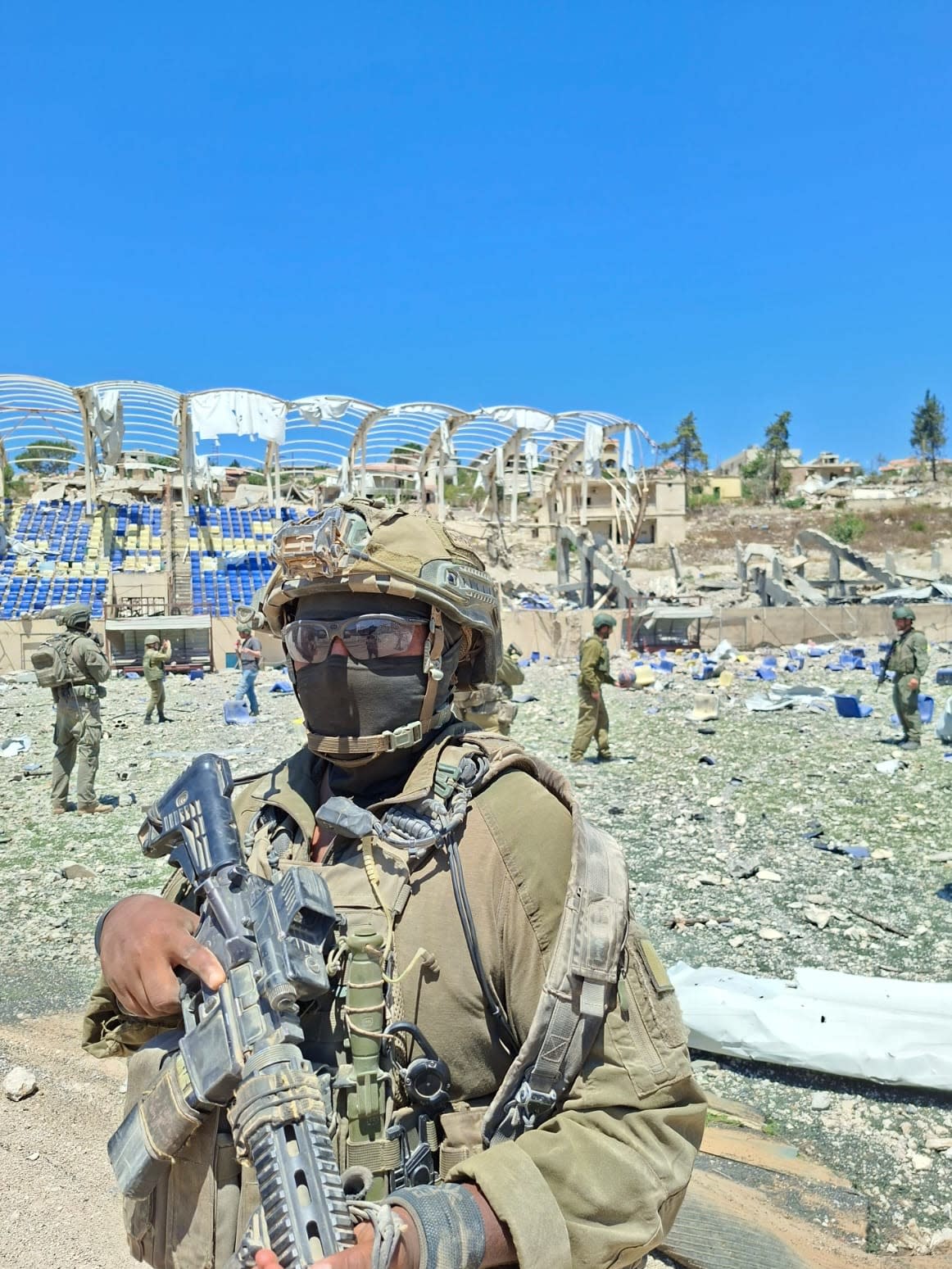
IDF sources emphasized that it is critical to Israel that the transfer process ensures the LAF meets certain benchmarks before additional transfers proceed.
The IDF has said that after a few months of trying more seriously to evict Hezbollah from southern Lebanon, the weaker Lebanese army eventually mostly gave up, part of why Hezbollah started to recover and felt strong enough to attack Israel again in July 2026.
Partial withdrawals, land transfers, being coordinated by US Marine Corps general
The partial withdrawals and land transfers are being coordinated by US Marine Corps Lt.-Gen. Joseph R. Clearfield, who was the main coordinator with Israel and Lebanon on such issues from fall 2024 until the recent war, with support from around 30 other American military officials.
IDF sources said that Clearfield properly understands the weaknesses that the Lebanese army has, though they cannot vouch for whether American political officials will hold up the land transfers if necessary from an Israeli security perspective, which may clash with their timeline for wrapping up Lebanon as an issue.
An official for CENTCOM’s Marine Corps Command (MARCENT), relating to CENTCOM’s Military Coordination Group for Lebanon, declined over the weekend to provide more specific updates about how the transfer of territory was going so far.
However, the Post understands that Clearfield met with IDF Chief of Staff Lt.-Gen. Eyal Zamir on July 1 and secretly visited Lebanon on July 2.
While IDF sources are concerned that the Lebanese army will again fail at clearing Hezbollah from areas it takes over, as it failed in 2024-2025, they have some additional hope of success given that this time the Lebanese government has held several public meetings with Israel and is publicly backing disarming Hezbollah.
During the Post’s visit to Bint Jbail, the tour showed off the destroyed Maroun al-Ras, and several vantage points to survey Bint Jbail itself, which appeared to be about 80% damaged, but has only been 44% destroyed in terms of stored terror infrastructure.

According to the IDF, 1,500 items of terror infrastructure have been destroyed, which often translates into houses, since the IDF said that nearly all of the residences in the village held Hezbollah weapons.
IDF sources said that the 91st Division, led by Brig.-Gen. Yuval Gez, had defeated around 350 Hezbollah fighters in the area, of which 200-250 were killed, and around 100 initially escaped.
Those 100 later tried to rally either at the Salah Ghandour Hospital – which one official called “the Shifa of Bint Jbail,” referring to Hamas’s use of Shifa Hospital in Gaza as a critical command center – or at the Sylvester Ridge slightly outside of the village.
The military’s 91st and 98th Divisions together defeated these forces, in some cases coming from behind them or striking from multiple vectors at once to confuse Hezbollah.
According to the IDF, it hopes to at minimum reduce the terror infrastructure left over in southern Lebanon, including Bint Jbail, to 70%, which would make it very hard for an organized Hezbollah front to reestablish itself, while aspiring toward 100% elimination.
One of the key parts of the tour of the village, which Israel had not taken in decades, including not in fall 2024, was the Post standing where then-Hezbollah secretary-general Hassan Nasrallah gave his “spider’s web speech” on May 26, 2000, saying Hezbollah would destroy Israel.
Debris spread across stadium where Nasrallah gave ‘spider’s web’ speech after IDF’s May 2000 withdrawal
The Post saw that while parts of the bleachers still stood at the stadium, much of it was destroyed and the soccer field was strewn with debris.

END
HAMAS
July 15, 1:31 PM
IDF kills two Hamas commanders in Gaza strike
The IDF killed two Hamas commanders in a strike in northern Gaza on Wednesday, the military announced.
Ali Shamlakh was a deputy commander of a Hamas Nukhba company who trained terrorists planning to carry out attacks against Israeli citizens and soldiers. The second terrorist killed was Nasser Louh, the head of a Nukhba cell in Hamas’ Sabra Battalion, the IDF said.
SAUDI ARABIA/HOUTHIS/USA
Trump Gave Saudi Crown Prince Green Light For Attack On Yemen’s Sanaa Airport
Tuesday, Jul 14, 2026 – 08:05 PM
Authored by Dave DeCamp via AntiWar.com
Axios reported Monday that President Trump gave Saudi Crown Prince Mohammed bin Salman (MbS) his support for an attack on Yemen ahead of Saudi Arabia’s bombing of the Sanaa International Airport, which shattered a years-long truce between Riyadh and the Houthis.
US officials told Axios reporter Barak Ravid that Riyadh sought support for the attack during conversations with US officials last week, which included a Friday conversation between Trump and MbS. The report said MbS “asked Trump for his backing for a military action against the Houthis and received it.“

The US backed a brutal Saudi/UAE-led war against the Houthis, officially known as Ansar Allah, from 2015 to 2022, throughout the entire first Trump administration.
The US provided significant military and intelligence support to the Saudis, meaning the US could have provided support for Monday’s attack on the Sanaa airport.
Ravid noted that the fact that MbS sought support from Trump before launching the strike suggested he’s preparing for the potential of it leading to a wider conflict with the Houthis and that Riyadh will need US military and diplomatic support.
In response to the Saudi strikes on the Sanaa airport, Ansar Allah launched missile and drone attacks against a Saudi airport and warned aircraft to stay out of Saudi airspace until the blockade on the Sanaa airport is lifted.
The Saudis bombed the Sanaa airport to prevent the landing of a flight from Iran that was carrying a Yemeni delegation that attended the funeral of Iranian Supreme Leader Ayatollah Khamenei. After the strikes, the plane was able to land in the Yemeni port city of Hodeidah.
The tensions began when a plane from Iran picked up the delegation from Sanaa earlier in the month, marking the first known Iranian flight to the airport in more than 10 years, as the Saudis have maintained a partial blockade on the airport despite the 2022 ceasefire.
Yemeni officials are warning that the next move could be the closure of the Bab el-Mandeb Strait, which connects the Red Sea and the Gulf of Aden.
“If the current situation aggravates, the Bab al-Mandeb Strait and the Strait of Hormuz will be closed in an operational alliance. Oil prices would then skyrocket to $200 a barrel in a dreadful shock,” said Mohammed al-Farah, a member of Ansar Allah’s political bureau.
END
IRAQ/USA
Iraqi Militia Vows To Disrupt Any Future Iraq-Syria Oil Pipeline: US ‘Stealing Our Oil’
Wednesday, Jul 15, 2026 – 01:40 PM
US and Iraqi officials are set to conclude a major energy deal as part of Prime Minister Ali al-Zaidi’s visit to Washington this week, according to Iraqi officials cited by AP Wednesday.
“An agreement is slated to be signed Friday between Iraq, US companies Chevron and TI Capital, and Qatar’s UCC for construction of an oil pipeline that will connect southern Iraq’s Basra to western Iraq’s Haditha,” the officials said.

The pipeline is meant to extend from Haditha to Turkiye’s Ceyhan port and the port of Baniyas in Syria.
The details of the reported agreement were not discussed publicly during meetings between Zaidi and US President Donald Trump in the Oval Office on Tuesday. Neither the US president nor the Iraqi premier mentioned the deal. AP referred to it as a “significant energy deal.”
A senior Trump administration official said later on 14 July that Washington is “facilitating conversation” between Iraq and Syria regarding potential future energy projects.
Meanwhile, Iraqi pro-Iran resistance faction Al-Nujaba Movement warned against making deals with Washington in Iraq.
“[Trump] will not continue living under the illusion of stealing Iraq’s oil and wealth, whether through direct theft or under the cover of suspicious investments. The Islamic resistance will continue confronting US forces and drive them from Iraq’s land and skies,” the movement’s leader Akram al-Kaabi said in a statement on Wednesday.
The new Iraqi prime minister’s visit to Washington is expected to last until Saturday.

On Tuesday, the premier said that Iraq deserved an equitable allocation within OPEC, coming during discussions with Trump in the Oval Office. His comments were a response to questions on whether Iraq was considering withdrawing from the oil producers’ alliance.
“Iraq is one of the founding members of OPEC … Our right is to receive a fair share for Iraq,” Zaidi said to reporters during the meeting with Trump.
“The damage suffered by Iraq exceeds $400 billion, and to this day some Iraqis still have destroyed homes and are living in camps. I have a plan to return them to their homes, and that is why I want a fair share for Iraq in OPEC,” the Iraqi premier went on to say.
During the meeting at the Oval Office, Trump called Zaidi “young” and “handsome,” and that he had “tremendous chemistry” with the new Iraqi prime minister.
In a press briefing between the two leaders, Baghdad and Washington announced that US combat troops would withdraw from Iraq by September 30.
Zaidi was sworn in as premier in May this year, succeeding former prime minister Mohammed Shia al-Sudani. This came after the president had threatened to “cut off” Iraq completely if Nouri al-Maliki – a former Iraqi premier with ties to Iran – was re-elected.
Despite initially vowing to continue running, Maliki ended up withdrawing his candidacy. “Mark my words, I knew what I was doing,” Trump said as he sat near Zaidi in the Oval Office on Tuesday.
“This man is going to be a great leader … beyond Iraq. His influence is going to spread all throughout the [region],” he said, referring to Zaidi. Zaidi’s visit coincided with reports of a major escalation of US pressure tactics, aimed at forcing the Iraqi resistance to surrender its arms. Sources told the New Arab on Wednesday that Washington has “hardened its stance” against resistance factions in the country.
The Trump administration has adopted a significantly more coercive approach than its predecessors to disarming the Iraqi resistance, stepping up pressure on Baghdad in recent months to dismantle the resistance factions swiftly.
Washington reportedly froze security programs with Baghdad and blocked dollar shipments to the country earlier this year to pressure Iraq into dismantling Iran-backed resistance groups.
Late last month, Baghdad issued a 30 September deadline for the disarmament of all armed factions in Iraq, including resistance movements.
After months of heavy US pressure, some armed organizations have agreed to turn over weapons to the state. Many others, including resistance groups Kataib Hezbollah and Al-Nujaba Movement, have refused.
Iraqi resistance groups demand a full US withdrawal, rather than the “transitional” pullout agreed on between Washington and Baghdad, which will see Washington shift from a “combat” to an “advisory” role, while still retaining a military presence in the country.
END
UN Maritime Boss Warns Ships To Avoid Hormuz As Transits Continue
Wednesday, Jul 15, 2026 – 02:00 PM
The International Maritime Organization warned Wednesday that the Strait of Hormuz remains too dangerous for commercial shipping, even as vessels continue to transit the narrow waterway.
US Central Command said its latest round of strikes against Iranian coastal military targets concluded early Wednesday. Tehran retaliated with missile and drone attacks against US-allied Gulf states while continuing to disrupt some maritime traffic through the strait.
Yet commercial ships are still transiting, suggesting Iran’s ability to fully weaponize the maritime chokepoint is gradually eroding under sustained US air and naval superiority.

Speaking on Bloomberg Radio, Arsenio Dominguez, the secretary general of the IMO, said the waterway remains dangerous and unsafe for tankers and bulk cargo ships.
“I will maintain the message of upholding international law, for countries to do the same thing, and for companies — at this stage, particularly with the volatility — not to take risk to transit through the strait of Hormuz,” Dominguez said.
Dominguez’s warning appears to be ignored by some ships.
Bloomberg data show that vessel traffic continues in the narrow waterway, at lower volumes than last week, even as fighting between the US and Iran intensified overnight.

With or without Tehran’s cooperation, US-allied Gulf countries are in the beginning innings of what we’ve described as a “great energy rewiring”…

Latest:
- Great Rewiring: US Supports Iraq-Syria Oil Pipeline To Erode Tehran’s Hormuz Leverage
- Dubai’s New East Coast Port Signals The Beginning Of End For Iran’s Hormuz Leverage
- “Zero Hormuz Dependency”: UAE Races To Rewire Energy Flows, Bypassing Chokepoint Chaos
- Hormuz Bypasses Maxed Out: Saudi East-West Pipeline Hits Record 7 MMb/d, As UAE Fujairah Crude Loadings Reach Capacity
We compiled evidence for readers showing that US-allied Gulf countries are poised to undertake a generational rewiring of regional energy flows to bypass the Hormuz chokepoint. Over time, that infrastructure buildout – from pipelines to ports – could render Tehran’s leverage over the critical waterway increasingly irrelevant.
END
RUSSIA VS UKRAINE
Zelensky To Remove Ukraine’s Reforming Young Defense Minister In Ongoing Shake-Up: Report
Wednesday, Jul 15, 2026 – 10:20 AM
Ukraine’s 35-year old defense minister, Mykhailo Fedorov, has only been in the top military spot for six months, but amid a new Zelensky-initiated major cabinet reshuffling, the FT reports that the military’s top spot has been targeted as the next leadership change.
The report has been issued just on the heels of Prime Minister Yulia Svyrydenko’s surprise removal, upon which Zelensky in a statement suggested a broader government overhaul is underway. “Ukraine is changing its political strategy,” he made clear.
The Ukrainian leader is “expected to remove defense minister Mykhailo Fedorov, the 35-year-old architect of Ukraine’s wartime defence technology drive, after just six months in the post as part of a major cabinet reshuffle,” FT writes Wednesday.

“Several senior figures close to Zelensky said the president had held conversations about replacing the minister as he prepares to unveil his new government on Thursday,” the report adds.
The FT report suggests that the young defense chief’s anti-corruption zeal is alienating powerful figures who wish for the wartime situation to be looser with less oversight:
“But defense industry officials, senior Ukrainian officials, MPs from Zelenskyy’s party and others familiar with the matter have said — some publicly — that Fedorov had been a barrier to interests seeking to profit from Ukraine’s vast wartime defence budget… Fedorov repeatedly blocked attempts to steer lucrative procurement contracts to favoured companies, which put him at odds with powerful figures inside Ukraine’s political and defence establishment, said people familiar with the situation.”
And yet interestingly President Trump has of late issued positive praise of Ukrainian forces’ accomplishments in the area of drone warfare against Russia.
Kiev has further been boasting of its drone tech, and is even seeking to market it abroad, especially in the Middle East where Gulf countries are hungry for better defenses against smaller suicide drones.
Fedorov has been widely seen as having rapidly implemented a transformative vision on this front. For example, earlier this week The Economist wrote:
Tensions simmered barely below the surface at a war-council meeting in early July. Ukraine’s military leaders had mostly good news for their president. Middle- and long-range drone operations were seeing continued successes. A campaign to isolate Russian-occupied Crimea was running ahead of schedule. But as Power Point slides were shown to the testosterone-filled room, the generals griped about missile and ammunition procurement. The focus of their criticism, Mykhailo Fedorov, the 35-year-old tech-savvy defence minister who is known—and occasionally mocked—for his Silicon Valley style presentations, responded in kind.
If it wasn’t for his emergency drone-purchasing decisions at the beginning of the year, which required borrowing money earmarked for salaries, there would be no Crimean operation to speak of. A witness to the proceedings describes “two different co-ordinate systems” in a clinch: “No common language, even if holding back from direct conflict.”
But it seems there’s a lot of angst within military command ranks over the defense chief’s reluctance to try and achieve parity with Russia in terms of conventional military hardware, which he might reason is a lose-lose pursuit anyway.
In the meantime, Zelensky had started the week by saying, “The Cabinet of Ministers needs to be renewed.” He explained that “Each priority area of foreign policy will be assigned to a specific person with substantial experience who is capable of implementing what we agree on at the leaders’ level and what the Ukrainian people expect,” he described further of an impending reshuffle. Who is next on the chopping block?
6/.GLOBAL ISSUES, COVID ISSUES, VACCINE INJURIES/HEALTH ISSUES
GLOBAL ISSUES
MARK CRISPIN MILLER
In memory of those who “died suddenly” in the United States and worldwide, July 6-13 2026Lindsey Graham; actor Scott Bryce; reality star Cristina Sanz; filmmaker Barbara Ling; rockers Mike Browning, Calvin Hayes; hoopsters Noah Boler-Kyle (24), Lynn Kennedy; downhiller TJ Lanning; & moreMark Crispin MillerJul 15 READ IN APP READ IN APP A survey of the likely global toll of COVID “vaccination,” based on the reports collected by our worldwide team of researchers this past week.To help support our work, consider subscribing or making a donation.UNITED STATES (110)Sen. Lindsey Graham Dies at 71 After ‘Brief and Sudden Illness’July 12, 2026 A survey of the likely global toll of COVID “vaccination,” based on the reports collected by our worldwide team of researchers this past week.To help support our work, consider subscribing or making a donation.UNITED STATES (110)Sen. Lindsey Graham Dies at 71 After ‘Brief and Sudden Illness’July 12, 2026 Lindsey Graham, a longtime Republican senator, has died. He was 71. The South Carolina lawmaker’s office announced in a social media post that he died unexpectedly on Saturday, July 11. “On the evening of Saturday, July 11, U.S. Senator Lindsey Graham passed away from a brief and sudden illness,” the statement read. “Senator Graham’s family appreciates prayers at this time and asks for privacy during this incredibly difficult period.” According to NBC News, emergency services responded to reports of a “cardiac arrest” at Graham’s Capitol Hill home on Saturday night. The South Carolina politician’s cause of death has not been publicly confirmed at this time. Graham’s death comes just days after his meeting with Ukrainian President Volodymyr Zelenskyy in Ukraine. Graham was scheduled to appear on NBC News’ Meet the Press to discuss his visit to Ukraine on Sunday.Researcher’s notes – Graham was “vaccinated,” and was among the few Republican senators who strongly pushed “vaccination”. In April 2021, Graham said, “I’ve been vaccinated [sic], and I’m glad I did. If you haven’t been vaccinated [sic], get vaccinated [sic]. I think the vaccine [sic] is safe, I think it’s effective, and I want to congratulate all the volunteers…. It is a military-like operation from the time you get here to the time you get your vaccination [sic], it is pretty quick.” Waving away from informed consent, Graham said, “There’s a lot of stuff on the internet. This is safe [sic]. I took it early on to try to show that I’m willing to take it. You’ll be doing yourself, your family, and the state a great service.” https://www.lgraham.senate.gov/public/index.cfm/2021/4/graham-applauds-south-carolina-vaccination-effortsLindsey Graham Dies Suddenly After 14th COVID BoosterGraham says he’s tested positive for COVID-19 despite “vaccination.” Graham said he was glad he got the “vaccine” because without it, “I am certain I would not feel as well as I do now.” https://wlos.com/news/local/lindsey-graham-tests-positive-covid-despite-vaccinationLast evening, the Washington Post confirmed, “Lindsey Graham died of aortic dissection, preliminary medical report says”Could spike protein-mediated fibrosis predispose to aortic dissection?No cause of death reported.‘As the World Turns’ Star Dead at 68 After Cancer BattlesJuly 13, 2026 Lindsey Graham, a longtime Republican senator, has died. He was 71. The South Carolina lawmaker’s office announced in a social media post that he died unexpectedly on Saturday, July 11. “On the evening of Saturday, July 11, U.S. Senator Lindsey Graham passed away from a brief and sudden illness,” the statement read. “Senator Graham’s family appreciates prayers at this time and asks for privacy during this incredibly difficult period.” According to NBC News, emergency services responded to reports of a “cardiac arrest” at Graham’s Capitol Hill home on Saturday night. The South Carolina politician’s cause of death has not been publicly confirmed at this time. Graham’s death comes just days after his meeting with Ukrainian President Volodymyr Zelenskyy in Ukraine. Graham was scheduled to appear on NBC News’ Meet the Press to discuss his visit to Ukraine on Sunday.Researcher’s notes – Graham was “vaccinated,” and was among the few Republican senators who strongly pushed “vaccination”. In April 2021, Graham said, “I’ve been vaccinated [sic], and I’m glad I did. If you haven’t been vaccinated [sic], get vaccinated [sic]. I think the vaccine [sic] is safe, I think it’s effective, and I want to congratulate all the volunteers…. It is a military-like operation from the time you get here to the time you get your vaccination [sic], it is pretty quick.” Waving away from informed consent, Graham said, “There’s a lot of stuff on the internet. This is safe [sic]. I took it early on to try to show that I’m willing to take it. You’ll be doing yourself, your family, and the state a great service.” https://www.lgraham.senate.gov/public/index.cfm/2021/4/graham-applauds-south-carolina-vaccination-effortsLindsey Graham Dies Suddenly After 14th COVID BoosterGraham says he’s tested positive for COVID-19 despite “vaccination.” Graham said he was glad he got the “vaccine” because without it, “I am certain I would not feel as well as I do now.” https://wlos.com/news/local/lindsey-graham-tests-positive-covid-despite-vaccinationLast evening, the Washington Post confirmed, “Lindsey Graham died of aortic dissection, preliminary medical report says”Could spike protein-mediated fibrosis predispose to aortic dissection?No cause of death reported.‘As the World Turns’ Star Dead at 68 After Cancer BattlesJuly 13, 2026 Scott Bryce, the two-time Daytime Emmy nominee beloved for playing Craig Montgomery on hit CBS soap opera As the World Turns, has died at 68. News of his death began circulating Sunday evening, July 12, after his longtime friend and former costar Lucie Arnaz shared it in a Facebook post that has since been taken down, according to MichelfreemanTV.com. Bryce had been diagnosed with Stage 3 esophageal and stomach cancer back in 2025, and he’d credited catching it early as a major factor in his treatment, as reported by Soapoperanews. For a while, he shared encouraging updates with fans, reporting that he was on the mend. Arnaz revealed that his cancer had ultimately returned.Researcher’s note – As an actor working in 2021 and 2022, under SAG-AFTRA’s Return-to-Work protocols, Bryce would very likely have been required to be “vaccinated”: https://www.sagaftra.org/sites/default/files/7-19-21 RTW Agreement (Fully Executed) (00249626xBE9D7).PDF?utm_source=chatgpt.comReality TV pioneer and Born This Way star Cristina Sanz dies tragically aged 36July 8, 2026 Scott Bryce, the two-time Daytime Emmy nominee beloved for playing Craig Montgomery on hit CBS soap opera As the World Turns, has died at 68. News of his death began circulating Sunday evening, July 12, after his longtime friend and former costar Lucie Arnaz shared it in a Facebook post that has since been taken down, according to MichelfreemanTV.com. Bryce had been diagnosed with Stage 3 esophageal and stomach cancer back in 2025, and he’d credited catching it early as a major factor in his treatment, as reported by Soapoperanews. For a while, he shared encouraging updates with fans, reporting that he was on the mend. Arnaz revealed that his cancer had ultimately returned.Researcher’s note – As an actor working in 2021 and 2022, under SAG-AFTRA’s Return-to-Work protocols, Bryce would very likely have been required to be “vaccinated”: https://www.sagaftra.org/sites/default/files/7-19-21 RTW Agreement (Fully Executed) (00249626xBE9D7).PDF?utm_source=chatgpt.comReality TV pioneer and Born This Way star Cristina Sanz dies tragically aged 36July 8, 2026 Cristina Sanz, the beloved star of A&E’s groundbreaking reality docuseries Born This Way, has tragically passed away at the age of 36. The news was confirmed by her heartbroken parents, Mariano and Beatriz, who revealed that the Emmy-winning television personality suffered a sudden cardiac arrest on Monday, July 6, while attending her local day program. Announcing the news of her death on social media, her parents wrote: “It is with a heavy heart that we share the news that our daughter, Cristina, passed away Monday morning. She suffered a sudden cardiac arrest while at her Day Program and was rushed to the hospital. Her death was a total shock and unexpected. We will forever treasure the gift of her life. We will all carry in our hearts the wonderful ‘Cristina moments’ that she gave us.”Oscar Winner Barbara Ling, Who Rebuilt 1969 L.A. for Tarantino, Dies at 73July 12, 2026 Cristina Sanz, the beloved star of A&E’s groundbreaking reality docuseries Born This Way, has tragically passed away at the age of 36. The news was confirmed by her heartbroken parents, Mariano and Beatriz, who revealed that the Emmy-winning television personality suffered a sudden cardiac arrest on Monday, July 6, while attending her local day program. Announcing the news of her death on social media, her parents wrote: “It is with a heavy heart that we share the news that our daughter, Cristina, passed away Monday morning. She suffered a sudden cardiac arrest while at her Day Program and was rushed to the hospital. Her death was a total shock and unexpected. We will forever treasure the gift of her life. We will all carry in our hearts the wonderful ‘Cristina moments’ that she gave us.”Oscar Winner Barbara Ling, Who Rebuilt 1969 L.A. for Tarantino, Dies at 73July 12, 2026 Barbara Ling, the Oscar-winning production designer who transformed present-day Los Angeles into 1969 Hollywood for Quentin Tarantino, has died. She was 73. Ling died Thursday in Santa Barbara after a battle with cancer, a spokesperson for WME told The Hollywood Reporter. Her work on Once Upon a Time in Hollywood earned her the 2020 Academy Award for production design alongside set decorator Nancy Haigh.Mike Browning (MORBID ANGEL, INCUBUS) Has Passed Away, Aged 62July 13, 2026 Barbara Ling, the Oscar-winning production designer who transformed present-day Los Angeles into 1969 Hollywood for Quentin Tarantino, has died. She was 73. Ling died Thursday in Santa Barbara after a battle with cancer, a spokesperson for WME told The Hollywood Reporter. Her work on Once Upon a Time in Hollywood earned her the 2020 Academy Award for production design alongside set decorator Nancy Haigh.Mike Browning (MORBID ANGEL, INCUBUS) Has Passed Away, Aged 62July 13, 2026 It has been announced that the legendary heavy metal drummer and vocalist Mike Browning has passed away on July 13, 2026, aged 62. The news comes from Decibel Magazine. Formed in 1983 by Mike Browning and Trey Azgathoth, Morbid Angel became one of the first bands to ever incorporate guttural screams, blast beats, and breakdowns in such a rapid succession, quickly earning them accolades as veterans in the death metal scene.No cause of death reported.Founding Member of Beloved ‘80s Band Dies Suddenly at 63: ‘We Are Utterly Shocked and Deeply Saddened’July 11, 2026 It has been announced that the legendary heavy metal drummer and vocalist Mike Browning has passed away on July 13, 2026, aged 62. The news comes from Decibel Magazine. Formed in 1983 by Mike Browning and Trey Azgathoth, Morbid Angel became one of the first bands to ever incorporate guttural screams, blast beats, and breakdowns in such a rapid succession, quickly earning them accolades as veterans in the death metal scene.No cause of death reported.Founding Member of Beloved ‘80s Band Dies Suddenly at 63: ‘We Are Utterly Shocked and Deeply Saddened’July 11, 2026 Calvin Hayes, a founding member of the British pop band Johnny Hates Jazz, has died at the age of 63 after collapsing at his home in Washington state. His wife, Kathy, confirmed his death to The Express UK, and on Saturday, Hayes’ former bandmates Clark Datchler and Mike Nocito shared an emotional tribute celebrating both the musician and the lasting legacy of the music they created together. In their Instagram statement, Datchler and Nocito said they were “utterly shocked and deeply saddened” by Hayes’ death, explaining that they chose to speak privately with friends and loved ones before making a public statement “to share our memories, express our emotions, and begin to come to terms with such a tragic loss.”No cause of death reported.Decatur basketball standout Noah Boler-Kyle dies after medical eventJuly 12, 2026 Calvin Hayes, a founding member of the British pop band Johnny Hates Jazz, has died at the age of 63 after collapsing at his home in Washington state. His wife, Kathy, confirmed his death to The Express UK, and on Saturday, Hayes’ former bandmates Clark Datchler and Mike Nocito shared an emotional tribute celebrating both the musician and the lasting legacy of the music they created together. In their Instagram statement, Datchler and Nocito said they were “utterly shocked and deeply saddened” by Hayes’ death, explaining that they chose to speak privately with friends and loved ones before making a public statement “to share our memories, express our emotions, and begin to come to terms with such a tragic loss.”No cause of death reported.Decatur basketball standout Noah Boler-Kyle dies after medical eventJuly 12, 2026 DECATUR, Ala. – Noah Boler-Kyle [24], a Decatur Heritage Christian Academy graduate who went on to a standout basketball career at Lee University in Tennessee, has died. Boler-Kyle died Friday after suffering a serious medical event that led to his hospitalization at UAB Hospital, according to family members who shared the news in recent days. A 6-foot-9 forward, Boler-Kyle spent five years with the Flames’ men’s basketball program, earning his bachelor’s degree before returning for a season as a graduate student.Researcher’s note – Lee University did not mandate the COVID-19 vaccine [sic] for its students or employees at any point during the pandemic. Instead, the institution strongly encouraged vaccination [sic], but allowed individuals to take personal responsibility for managing COVID-19: https://www.leeuniversity.edu/coronavirus/No cause of death reported.Lynn Kennedy, former Iowa basketball player, dies at 61July 10, 2026 DECATUR, Ala. – Noah Boler-Kyle [24], a Decatur Heritage Christian Academy graduate who went on to a standout basketball career at Lee University in Tennessee, has died. Boler-Kyle died Friday after suffering a serious medical event that led to his hospitalization at UAB Hospital, according to family members who shared the news in recent days. A 6-foot-9 forward, Boler-Kyle spent five years with the Flames’ men’s basketball program, earning his bachelor’s degree before returning for a season as a graduate student.Researcher’s note – Lee University did not mandate the COVID-19 vaccine [sic] for its students or employees at any point during the pandemic. Instead, the institution strongly encouraged vaccination [sic], but allowed individuals to take personal responsibility for managing COVID-19: https://www.leeuniversity.edu/coronavirus/No cause of death reported.Lynn Kennedy, former Iowa basketball player, dies at 61July 10, 2026 IOWA CITY, Iowa – Former University of Iowa basketball player Lynn Kennedy passed away on July 3 at the age of 61, according to UI Athletics. The New Jersey native led in Hawkeye rebounds as a rookie in 1984.No cause of death reported.US sports world in mourning: champion dies at age 41July 8, 2026 IOWA CITY, Iowa – Former University of Iowa basketball player Lynn Kennedy passed away on July 3 at the age of 61, according to UI Athletics. The New Jersey native led in Hawkeye rebounds as a rookie in 1984.No cause of death reported.US sports world in mourning: champion dies at age 41July 8, 2026 The American alpine skiing community is in mourning. Former elite skier TJ Lanning has passed away at the age of 41. U.S. Ski & Snowboard, the national governing body for skiing and snowboarding in the United States, announced the news in an emotional statement. For years, Lanning was considered one of Team USA’s greatest talents. In 2001, he was the highest-ranked junior in the world in both slalom and super-G. Later, he focused entirely on speed events, making a strong impression at the international level. No cause of death was reported.Former Rutgers football captain Jamil Merrell dead at 36 – twin brother reveals heartbreaking final wordsJuly 9, 2026 The American alpine skiing community is in mourning. Former elite skier TJ Lanning has passed away at the age of 41. U.S. Ski & Snowboard, the national governing body for skiing and snowboarding in the United States, announced the news in an emotional statement. For years, Lanning was considered one of Team USA’s greatest talents. In 2001, he was the highest-ranked junior in the world in both slalom and super-G. Later, he focused entirely on speed events, making a strong impression at the international level. No cause of death was reported.Former Rutgers football captain Jamil Merrell dead at 36 – twin brother reveals heartbreaking final wordsJuly 9, 2026 Former Rutgers football captain Jamil Merrell died at the age of 36, according his twin brother and fellow former Scarlet Knight Jamal. Jamal did not reveal the cause of death, and said his family is facing “one of the hardest moments we’ll ever have to face.” “Before this moment, he looked at us with peace and said, ‘It’s time for me to level up, and everything down here for me is complete,’ Former Rutgers football captain Jamil Merrell died at the age of 36, according his twin brother and fellow former Scarlet Knight Jamal. Jamal did not reveal the cause of death, and said his family is facing “one of the hardest moments we’ll ever have to face.” “Before this moment, he looked at us with peace and said, ‘It’s time for me to level up, and everything down here for me is complete,’  ,” Jamal wrote Wednesday in an Instagram post. Jamal added that while his “heart is broken” in an indescribable way, he’s taking peace in knowing his twin is no longer in pain. “No more suffering. No more hospitals. No more hurting. Just peace… the kind of peace you deserve,” Jamal wrote in his Instagram message.No cause of death reported.Roanoke baseball legend Al Holland, Sr. passes away at 73July 8, 2026 ,” Jamal wrote Wednesday in an Instagram post. Jamal added that while his “heart is broken” in an indescribable way, he’s taking peace in knowing his twin is no longer in pain. “No more suffering. No more hospitals. No more hurting. Just peace… the kind of peace you deserve,” Jamal wrote in his Instagram message.No cause of death reported.Roanoke baseball legend Al Holland, Sr. passes away at 73July 8, 2026 ROANOKE, Va. – Roanoke native and former MLB pitcher Al Holland, Sr. has died at the age of 73. Holland, Sr. passed away on Saturday, July 4 in Fort Mill, South Carolina, according to his son Al Holland, Jr. Holland, Sr. spent ten years in MLB, playing for the Pittsburgh Pirates, San Francisco Giants, Philadelphia Phillies, California Angles, and the New York Yankees. He was selected for the All-Star game in 1984. Holland, Sr. also served in Roanoke City Public Schools (RCPS) for more than two decades in alternative education, as a substitute teacher, and as a coach.No cause of death reported.Texas Football Community Mourns Former Athlete’s Tragic Death at 31July 8, 2026 ROANOKE, Va. – Roanoke native and former MLB pitcher Al Holland, Sr. has died at the age of 73. Holland, Sr. passed away on Saturday, July 4 in Fort Mill, South Carolina, according to his son Al Holland, Jr. Holland, Sr. spent ten years in MLB, playing for the Pittsburgh Pirates, San Francisco Giants, Philadelphia Phillies, California Angles, and the New York Yankees. He was selected for the All-Star game in 1984. Holland, Sr. also served in Roanoke City Public Schools (RCPS) for more than two decades in alternative education, as a substitute teacher, and as a coach.No cause of death reported.Texas Football Community Mourns Former Athlete’s Tragic Death at 31July 8, 2026 <p style=”margin: 0 0 20px 0;color: rgb(54,55,55);line-height: 26px; <p style=”margin: 0 0 20px 0;color: rgb(54,55,55);line-height: 26px; |
…
DR PAUL ALEXANDER
120 Horsemen of COVID Apocalypse (update as of July 15th 2026) (as the Iran US Israel war heats up); key people to be DRAGGED into proper legal courts-tribunal for their role in imposing lockdowns &
the deadly Malone Bourla Pfizer Moderna COVID mRNA vaccine (suggestions on how to end Iran war); Let our legal tribunals examine the Horsemen actions & decide if they caused harms (HANG HIGH) &
we punish harshly if declared; (please add to my list with suggested names for consideration)
END
RABOBANK/MICHAEL EVERY/OR OR PICTON/GIFFIN OR RABOBANK EXECUTIVE/COMMENTARY ON WORLDLY AFFAIRS
We Have The Tools/Tolls To Do It
Wednesday, Jul 15, 2026 – 10:00 AM
By Michael Every of Rabobank
Markets were delighted by US CPI data. Against a backdrop of oil up nearly double digits they instead got a number closer to a future trimmed mean measure without that nasty volatility, even if it was a fall in gasoline prices that resulted in the -0.4% m-o-m headline and 0.0% core prints.
Warsh modelled the New Model Army he wants to see central bankers being: he refused to say ‘mission accomplished’ on inflation: “We have the tools to do it” is perhaps being the new “Whatever it takes.” However, he didn’t want to talk about what he thought on rates: markets had to do that themselves, and they took CPI to mean less Fed tightening.
The Middle East’s new models of arms will get a big say on that. In Hormuz, the US naval blockade of Iranian ports is now back in effect, with enforcement of sanctions, and the two sides are trading blows across the strait, if not the deadliest they are capable of. Yet President Trump is again threatening to hit Iranian power plants and bridges next week if no deal is reached; Axios reports that Trump just held a Situation Room meeting on massive new strikes that are wide enough in scope to force Tehran to back off in Hormuz; the Houthis might threaten the Red Sea after announcing Saudi airspace is not safe for overflight; and Israeli PM Netanyahu warned Iran if his country is attacked, the response will be a “decisive blow.”
There are more positive signs too. Israel-Lebanon talks continue in Rome, along with a surprise Trump press conference call for Israel to withdraw from Lebanon and Syria that is unlikely to mean much on the ground. Trump also just hosted Iraq’s PM for talks on a final US troop withdrawal set for end-September, Iran, and oil – where the US is supporting efforts to revive an Iraq-Syria crude oil pipeline as another Hormuz workaround.
Trump also dropped his 20% Hormuz toll in favor of GCC FDI pledges into the US. Take Trump seriously (the US is not going to fight for free) not literally (the toll was impractical short of a full state-press vs the private sector); and will those who fight alongside the US see their FDI contribution commensurately lower? A more obvious carrot and stick is the Wall Street Journal underlining the UAE was rewarded with coveted US AI chips for supporting the war.

At a more meta level than the Financial Times — opining Trump has no clear path to victory vs. Iran — sees, stop to Hor-muse over this idea for a moment too:
- The US national security strategy openly calls for control of maritime chokepoints.
- That must include Hormuz and its energy flows.
- That’s very expensive –and hard– to achieve and maintain.
- Yet someone else controlling Hormuz is even more expensive, geostrategically.
- So, if the US starts a war to control Hormuz but can’t, even if it gains during fighting as an LNG and helium exporter, why not then ensure the strait is not a chokepoint?
- How better to achieve that than to ensure Hormuz remains in on-off chaos long enough that friends’ pipelines and new oil supply eventually reduce it to more of a sideshow?
- Seen that way, though the US went into this war wanting ‘Venezuela 2.0’, within limits, it has rolling optionality on other outcomes that suit its geostrategy – and it “has the tolls to do it.”
Brent is still stable at $85-86, in line with our energy analyst Joe Delaura’s expectations, following the aggressive short squeeze just seen. For more from him, and Florence Schmit on LNG, see here.
There is also more recognition of the incredible success of Ukrainian drone strikes on Russia’s Sea of Azov fleet, which Moscow is calling terrorism. Imagine that transplanted elsewhere…
Meanwhile, President Macron used Bastille Day to showcase Europe’s defense ambitions and will allow Ukraine to build French defense systems there; but the head of Germany’s Luftwaffe warned Europe has “no time” to counter Putin without US weapons. Somebody who should know thinks that Europe doesn’t have the tools to do it.
US Under Secretary of War Colby had a blunt social media message in a related regard, not just for Europe, but for Australia and Canada, among others: “There is a great deal of hubbub about a collective “middle powers” strategy these days. At the Department of War, we are not concerned that this is a serious possibility. Rather, we are more concerned that a few allies and partners will *think it is* and waste valuable time, money, and political capital on a distraction.”
Just before that, UK Chancellor Reeves gave an annual Mansion House speech which sounded like an interview to keep her job under PM Burnham by focusing on devolution, postcodes, “economic security is national security,” “securonomics,” and “industrial strategy.” Yet she didn’t mention tariffs as the tools to do it when statecraft logic, which she implies is being embraced, says this cannot happen without them. Then again, Reeves also sounded like she would like to rejoin the EU if possible, so that tariff decision hypothetically wouldn’t be any UK government’s to make anyway.
For its part, Europe will look at yesterday’s China-EU trade data, with the Chinese surplus surging yet again, and the report that China is targeting strategic sectors in the Netherlands as Dutch technology and companies offer Beijing outsize influence over value chains, and thinking about what it needs to do re: trade come October.
Likewise, Chinese Q2 GDP today was 4.3% y-o-y, lower than the 4.5% consensus, but 0.9% q-o-q expectations, and the y-o-y year-to-date (YTD) figure was 4.7% vs. 4.8%. Within that, retail sales for June were 1.0% y-o-y and 1.3% y-o-y YTD, while industrial production was 5.3% y-o-y vs. 4.6% consensus and 5.4% y-o-y YTD. Fixed asset investment was -5.7% y-o-y YTD, worse than -5.0% expected. In short, consumers are spending little, investment is declining (with property investment -18% y-o-y YTD and new house prices -0.3% m-o-m), yet industry is booming: that either means stockpiles are building or exports are flooding the world.

It’s the latter, clearly, as China’s economic statecraft has the tools to do it: for example, it now not only makes the tools Germany used to, but the tool-making machines it used to. Now let’s all say “securonomics” or “strategic autonomy” again and see what happens next.
Aside from tools and tolls, markets can also note that China just increased its holdings of US Treasuries, as Japan’s Finance Ministry is floating JGBs in tax-free accounts amid a GPIF portfolio review to incentivise its vast funds to keep more cash at home not abroad. What if (or when) other major economies follow suit to try to deal with the vast bills looming for a true “securonomics”?
In the meantime, enjoy headlines such as ‘Wall Street Traders Seize on Fervour and Fear to Set Records’ and ‘IBM Acting Like a Penny Stock Is a Sign of Times’ on your Bloomberg screen.
7. OIL AND NATURAL GAS//ENERGY COMMENTARIES
WTI Dips As US Crude Production Hits Record High, SPR Draw Slows, Cushing Remains At ‘Tank Bottoms’
Wednesday, Jul 15, 2026 – 10:40 AM
Oil prices are marginally higher overnight after President Trump reinstated the blockade on Iranian ports in the Strait of Hormuz and shipping slowed to a crawl amid the renewed warfare in the critical waterway.
US Central Command said it completed a morning round of strikes on Iran that further degraded its ability to attack commercial shipping in Hormuz.
It comes a day after attacks on ships that had been participating in so-called shuttle runs that have helped get oil from inside the Persian Gulf through the strait.
Visible transit through the waterway has fallen sharply in recent days, but there remains a high level of uncertainty about what’s actually crossing because many ships have been doing so dark – without broadcasting their location.

“While crude has started to find some balance after rallying from around $70, it still takes a brave shipowner to transit the Strait of Hormuz with the threat of attacks from forces aligned with Tehran remaining very real,” said Chris Weston, head of research at Pepperstone Group Ltd.
“The broader geopolitical backdrop continues to deteriorate, providing ongoing support for crude prices and keeping buyers prepared to step back in should prices push toward the $90 area.”
Overnight saw mixed data from API on crude/product supply, all eyes now on the official data.
API
- Crude -564k
- Cushing +200k
- Gasoline -1.664mm
- Distillates +2.3mm
DOE
- Crude -1.69mm (-900k exp)
- Cushing +430k
- Gasoline -1.53mm
- Distillates +4.56mm – biggest build since Jan 2026
After a build the prior week, crude stocks resumed their series of drawdowns last week (11 of last 12 weeks) and gasoline stocks also saw another draw while distillate stocks soared (amid record 3-2-1 crack spreads)…

Crack spreads remain at record highs…

The SPR saw yet another drawdown… but the smallest since the war-driven releases began (-2.985mm)…

Cushing stocks barely moved off ‘tank bottoms’…

US crude production pushed back up to record highs as the rig count trends higher…

Interestingly, after reaching record highs in the prior week, US crude product exports plunged to pre-war norms last week (but bear in mind this data series is a week lagged)…

The rebound in crude… and more notably products… has started to drag pump prices higher in the US…

Not what President trump wants to see.
But oil prices are dipping after the report…

Finally, as The FT reports, oil traders are warning that the latest flare-up of tensions in the Strait of Hormuz marks a risky new phase for the market, which is facing fresh disruption without the stockpiles that helped avert a wider economic crisis earlier in the US-Iran war.
“We’ve burned through all of the buffers we had. Everything,” said one trader.
“All of that’s now gone,” he said.
Western powers released record volumes of strategic oil reserves, China cut its oil imports in half and made its state-backed companies pull fuel from inventories, while the White House even let it be known the US could, in theory at least, intervene in futures markets if prices got out of hand.
The result was that Brent crude peaked at $126 a barrel in April, well below its all-time high, despite the IEA warning that the world was experiencing the worst supply disruption in history.
But traders said that if the renewed closure of the strait lasts for months, with some suspecting Iran wants to keep the pressure on US President Donald Trump ahead of the November midterm elections, it is not clear this time where the oil to make up the shortfall would come from.
RUSSIA
JPM: The Big Question Is No Longer About Hormuz And Oil, It’s All About Refining And Russia
AI
This refers to a recent JPMorgan commodities research note (around July 9, 2026) by Natasha Kaneva, head of Global Commodities Research.
news.futunn.com
Context and Shift in Market Focus
Earlier in 2026, geopolitical tensions (linked to conflict involving Iran) effectively disrupted the Strait of Hormuz, a critical chokepoint for ~20% of global seaborne oil trade. This created fears of crude supply shortages, driving up oil prices, forcing inventory draws, rerouting tankers, and causing “forced demand destruction” in Asia and elsewhere.
thestreet.com
With the Strait now reopened (following an MOU or de-escalation), large volumes of previously trapped Middle Eastern crude are flowing back. This has led to:
- Lower crude prices (e.g., Brent near $68 in early July reports).
- A potential temporary glut, as the market had adapted to lower flows and China’s demand has been soft. thestreet.com
The new bottleneck is refining capacity and refined product supply, not raw crude. Hormuz was mainly a crude story; the next challenges center on turning crude into usable fuels (diesel, gasoline, jet fuel, fuel oil).
news.futunn.com
Russia’s Role as the Key Refining Chokepoint
Sustained Ukrainian drone attacks have heavily damaged Russian refineries:
- Russian refinery runs dropped sharply—to around 3.6–3.8 million barrels per day in recent data, nearly 40% below normal levels in some reports.
- Only one of Russia’s top 10 refineries reportedly unaffected.
- This accounts for a significant portion of the global decline in refinery throughput (e.g., ~20% of an 8.2 million bpd global drop). news.futunn.com
Impacts:
- Reduced Russian exports of diesel and other refined products tighten global supplies.
- Shortages of diesel and fuel oil could persist into 2027, even as crude trends toward surplus over the next couple of years. news.futunn.com
- This supports high refining margins/crack spreads (e.g., strong 3-2-1 cracks in the US and elevated margins in Europe/Asia post-Hormuz reopening), benefiting refiners but pressuring consumers and certain sectors. reuters.com
JPMorgan sees three main uncertainties: damage to Middle Eastern refining, Chinese refinery recovery pace, and how well Russian facilities hold up against ongoing attacks.
news.futunn.com
Broader Market Implications
- Crude vs. Products: Divergence persists—crude prices can ease with resumed flows and potential surpluses, but product tightness (especially diesel) keeps fuel prices and margins elevated.
- Refiners’ Windfall: High crack spreads have boosted profitability, but it may be short-lived if Russian output stabilizes or other capacity comes online. reuters.com
- Geopolitical/Russia Angle: Russia’s refining woes add to global product constraints while the country has benefited from earlier disruptions (e.g., higher prices or rerouted sales). Sanctions, shadow fleets, and the Ukraine conflict remain intertwined with energy markets.
- Demand Side: China’s weak buying and global economic factors influence how long any glut or tightness lasts.
In short, JPMorgan is highlighting a pivot: the oil market’s headline risk has moved from geopolitical supply chokepoints (Hormuz) to operational/refining constraints, with Russia’s vulnerabilities central to the refined products outlook. This explains why product prices and refining margins have stayed resilient even as crude softened. Markets will watch Russian refinery repairs, Chinese demand recovery, and any further Middle East developments closely.
END
8. EMERGING MARKETS//AUSTRALIA NEW ZEALAND ISSUES
U.S./GOLD AND SILVER PRICING/ASIAN CLOSING MARKETS AND EUROPEAN BOURSE OPENING AND CLOSING/ INTEREST RATE SETTINGS WEDNESDAY MORNING 6;30AM//OPENING AND CLOSING
OPENING LEVELS OF CURRENCIES// AND CLOSING ASIAN STOCK MARKET AND OPENING EUROPEAN STOCKS:6 AM EST
EURO VS USA DOLLAR: 1.1423 DOWN 0.0009
USA/ YEN 162.31 UP 0.117 NOW TARGETS INTEREST RATE AT 1.75% AS IT WILL BUY UNLIMITED BONDS TO GETS TO THAT LEVEL…//YEN STILL FALLS//END OF YEN CARRY TRADE BEGINS AGAIN DEC 2024/Bank of Japan raises rates by .25% TO 1.75 ..TAKAICHI NEW PM AS YIELDS RISE//JAPAN DEEPLY IN TROUBLE WITH RISING RATES AND A FALLING YEN!! BANK OF JAPAN WILL NO LONGER DO QE. URGES PENSION AND INSUANCE FUNDS TO BUY JAPANESE BONDS
GBP/USA 1.3394 DOWN 0.0002 OR 2 BASIS PTS
USA/CAN DOLLAR: 1.4055 UP 0.0003 //CDN DOLLAR DOWN 3 BASIS PTS//
Last night Shanghai COMPOSITE CLOSED DOWN 11.55 PTS OR 0.29%
Hang Seng CLOSED UP 340.37 PTS OR 1.40%
AUSTRALIA CLOSED DOWN 0.60%
// EUROPEAN BOURSE: ALL RED
Trading from Europe and ASIA
I) EUROPEAN BOURSES: ALL RED
2/ CHINESE BOURSES / :Hang SENG CLOSED UP 340.37 PTS OR 1.40%
/SHANGHAI CLOSED DOWN 11.55 PTS OR 0.29%
AUSTRALIA BOURSE CLOSED DOWN 0.60%
(Nikkei (Japan) CLOSED UP 1011.50 PTS OR 1.49%
INDIA’S SENSEX IN THE GREEN
Gold very early morning trading: $4031.55
silver:$58.37
USA DOLLAR VS TRY (TURKISH LIRA): 47.03 MINUS 1 BASIS PTS AND NOW WE SEE THEIR STUPIDITY OF SELLING SOME OF THEIR GOLD AND ALL OF THEIR USA DOLLAR RESERVES. THE COUNTRY IS IN BIG FINANCIAL TROUBLE
USA DOLLAR VS RUSSIAN ROUBLE: 778.46 ROUBLE// DOWN 0 ROUBLE AND 91 BASIS PTS. WOULD YOU BELIEVE THAT THE RUSSIAN ROUBLE AND THE ISRAEL SHEKEL ARE THE STRONGEST CURRENCIES BESIDES THE DOLLAR .
UK 10 YR BOND YIELD: 4.9705 DOWN 5 BASIS PTS
UK 30 YR BOND YIELD: 5.663 DOWN 4 BASIS PTS
CDN 10 YR BOND YIELD: 3.574 UP 1 BASIS PTS
CDN 5 YR BOND YIELD; 3.186 DOWN 1 BASIS PTS
USA dollar index early WEDNESDAY MORNING: 100.72 UP 1 BASIS POINTS FROM TUESDAY’s CLOSE
WEDNESDAY MORNING NUMBERS ENDS
And now your closing WEDNESDAY NUMBERS 10.00 AM
Portuguese 10 year bond yield: 3.403% DOWN 4 in basis point(s) yield
JAPANESE BOND 10 yr YIELD: +2.678% DOWN 3 FULL POINTS BASIS POINTS /JAPAN losing control of its yield curve/
JAPAN 30 YR: 3.799 UP 3 BASIS PTS//
SPANISH 10 YR BOND YIELD: 3.587 UP 4 in basis points yield
ITALY 10 YR BOND: 3.921 UP 5 points in basis points yield ./
GERMAN 10 YR BOND YIELD: 3.0949 UP 3 BASIS PTS
IMPORTANT CURRENCY CLOSES : MID DAY WEDNESDAY
Closing currency crosses for day /USA DOLLAR INDEX/USA 10 YR BOND YIELD/10:00 AM
Euro/USA 1.132 UP 0.0007 OR 7 basis points
USA/Japan: 162.20 UP 0.008 OR YEN IS DOWN 8 BASIS PTS// HIGHLY INFLATIONARY TO JAPAN
Great Britain 10 YR RATE 4.9635 DOWN 2 BASIS POINTS //
GREAT BRITAIN 30 YR BOND; 5.664 DOWN 2 BASIS POINTS.
Canadian dollar UP 1 BASIS pts to 1.4063
xxxxxxxxxxxxxxxxxxxxxxxxxxxxxxxxxxxxxxxxxxxxxxxxxxxxxxxxxxxxxxxxxxxxxxxxxxxxxxxx
The USA/Yuan CNY 6.7694 ON SHORE ..UP
THE USA/YUAN OFFSHORE// CNH UP TO 6.7692
TURKISH LIRA: 47.03 PLUS 0 EXTREMELY DANGEROUS LEVEL/DEATH WATCH/HYPERINFLATION TO BEGIN.//
Your closing 10 yr US bond yield DOWN 3 in basis points from TUESDAY at 4.554% //trading well ABOVE the resistance level of 2.27-2.32%)
USA 30 yr bond yield 5.088 DOWN 0 basis points /10:00 AM
USA 2 YR BOND YIELD: 4.156 DOWN 4 BASIS PTS.
GOLD AT 10;00 AM 4062.10
SILVER AT 10;00: 58.32
Your 11:00 AM bourses for Europe and the Dow along with the USA dollar index closing and interest rates TUESDAY
DAY CLOSING TIME 10:00 AM///
London: CLOSED DOWN 17.51 PTS OR 0.17%
GERMAN DAX: CLOSED DOWN 126.23 PTS OR 0.50%
FRANCE: UP 10.73 OR 0.13 PTS
Spain IBEX CLOSED DOWN 86.10 PTS OR 0.45 %
Italian MIB: CLOSED DOWN 433.93 PTS OR 0.82%
WTI Oil price 80.07 10.00 EST/
Brent Oil: 84.68 10:00 EST
USA /RUSSIAN ROUBLE /// AT: 77.50 ROUBLE UP 0 AND 4 / 100
CDN 10 YEAR RATE: 3.548 DOWN 2 BASIS PTS.
CDN 5 YEAR RATE: 3.160 UP 2 BASIS PTS
CLOSING NUMBERS: 4 PM//
Euro vs USA 1.1473 UP 0.0049 OR 49 BASIS POINTS//
British Pound: 1.3537 UP 0.0141 OR 141 basis pts/
BRITISH 10 YR GILT BOND YIELD: 4.9410 DOWN 3 FULL BASIS PTS//
BRITISH 30 YR BOND YIELD: 5.624 DOWN 5 IN BASIS PTS.
JAPAN 10 YR YIELD: 2.678 DOWN 3 FULL BASIS PTS (DANGEROUS TO THEIR ECONOMY
JAPANESE 30 YR BOND: 3.763 UP 3 PTS AND STILL VERY DANGEROUS TO THEIR ECONOMY
USA dollar vs Japanese Yen: 162.09 DOWN 0.095 OR YEN UP 9 BASIS PTS//GETTING FURTHER AWAY FROM 160.00/DANGEROUS
USA dollar vs Canadian dollar: 1.4039 DOWN 0.0013 PTS// CDN DOLLAR UP 13 BASIS PTS
West Texas intermediate oil: 79.78
Brent OIL: 85.11
USA 10 yr bond yield DOWN 1 BASIS pts to 4.541
USA 30 yr bond yield: DOWN 1 PTS to 5.077%
USA 2 YR BOND 4.130 DOWN 5 PTS
CDN 10 YR RATE 3.527 DOWN 5 BASIS PTS
CDN 5 YEAR RATE: 3.137 DOWN 5 BASIS PTS
USA dollar index: 100.26 DOWN 46 BASIS POINTS
USA DOLLAR VS TURKISH LIRA: 47.03 UP 0 BASIS PTS GETTING QUITE CLOSE TO BLOWING UP/IDIOTS SOLD GOLD
USA DOLLAR VS RUSSIA//// ROUBLE: 77.50 UP 0 AND 5/100 roubles //
GOLD $4056.30 3:30 PM)
SILVER: 57.83 3;30 PM)
DOW JONES INDUSTRIAL AVERAGE: UP 150.25 POINTS OR 0.29%
NASDAQ 100 DOWN 83.69 PTS OR 0.28%
VOLATILITY INDEX 15.74 DOWN 0.76 PTS OR 4.67%
GLD: $ 372.35 UP 0.20 PTS OR 0.054%
SLV/ $52.21 PTS DOWN 0.96 OR 1.81%
TORONTO STOCK INDEX// TSX INDEX: CLOSED UP 57.50 PTS OR 0.16%
end
TRADING today ZEROHEDGE 4 PM: HEADLINE NEWS/TRADING
Bonds Bid & Hike-Odds Hammered On More Deflation; Memory Stocks Slammed As Mag7 Surges
WRAP UP;
Stocks mixed on ASML earnings and soft PPI – Newsquawk US Market Wrap
Wednesday, Jul 15, 2026 – 04:10 PM
- SNAPSHOT: Equities mixed, Treasuries up, Crude up, Dollar down, Gold flat
- REAR VIEW: Softer-than-expected US PPI; NY Fed Manufacturing tops expectations; Fed’s Williams says policy is well positioned to hit 2% inflation target; Trump leans toward expanding US military ops in Iran; Trump reportedly held a Situation Room meeting on Tuesday and discussed a wider scope of strikes on Iran; Trump says Iran wants to meet; Ghalibaf keeps diplomacy open; China’s Q2 GDP growth underwhelms; ASML earnings beat fails to impress investors; BABA’s Qwen AI will be integrated into AAPL Intelligence in China; BLK & MS beat on earnings; EIA crude stocks draw less than expected; BoC holds rates as expected.
- COMING UP: Data: UK GDP (May), Italian HICP Final (Jun), EZ Balance of Trade (May), US Retail Sales (Jun), Jobless Claims, Philly Fed Index (Jul), Pending Home Sales (Jun), Atlanta Fed GDP. Events: SNB Minutes (Jul), BoK Policy Announcement (Jul). Speakers: Fed’s Logan, Schmid. Supply: Japan, Spain, France, UK. Earnings: Netflix, Alcoa, UnitedHealth, GE Aerospace, US Bancorp, Abbott, State Street, ABB.
More Newsquawk in 2 steps:
- 1. Subscribe to the free premarket movers reports
- 2. Trial Newsquawk’s premium real-time audio news squawk box for 7 days
MARKET WRAP
Stocks were mixed on Wednesday, with the Nasdaq reversing early gains to ultimately underperform. ASML’s earnings initially lifted Nasdaq futures after the company delivered strong quarterly results. However, the stock reversed course during the US session after management guided EUV lithography machine sales slightly below consensus expectations, weighing on both ASML and the broader semiconductor sector. Elsewhere, the softer-than-expected PPI report supported the broader market by reinforcing the inflation picture shifting benignly following Tuesday’s CPI release.
Sector performance was mixed, with Communication Services and Consumer Discretionary leading the gains, while Energy and Utilities underperformed.
Crude prices were volatile but ultimately settled higher as geopolitical tensions remained elevated. The US and Iran continued exchanging strikes, while President Trump warned that Iran’s bridges and power plants would be the next targets should Tehran refuse to return to the negotiating table, adding that energy infrastructure would only be targeted as a last resort. Meanwhile, Iranian Parliamentary Speaker and chief negotiator Ghalibaf stated that Iran was prepared to use both diplomacy and military means to secure the country’s national interests, perhaps signalling a willingness to resume negotiations. However, WSJ reported that Trump is leaning towards expanding US military operation in Iran, albeit the decision is not final.
Elsewhere on the geopolitical front, CBS reported that senior Pentagon officials are quietly examining another potential flashpoint closer to home: Cuba. According to the report, military planners have recently reviewed a range of options, including an Army-led air assault involving thousands of troops from the 101st Airborne Division. However, CBS stressed that the briefings should not be interpreted as an indication that either President Trump or the Pentagon has decided to proceed with any military operation.
The softer PPI report added to Tuesday’s Treasury rally, with markets continuing to pare expectations for near-term Fed rate hikes, resulting in a bull steepening of the Treasury curve.
In FX, the Dollar underperformed following the softer inflation data, while Sterling outperformed after reports suggested Andy Burnham is leaning towards appointing Shabana Mahmood as Chancellor, who is generally viewed as being more fiscally conservative.
Attention now turns to Thursday’s US retail sales report, alongside any further developments surrounding the US-Iran conflict.
US
US PPI: The June PPI report was softer than expected, reinforcing the benign inflation message from Tuesday’s CPI release. Headline PPI declined 0.3% M/M (exp. +0.3%), reversing May’s 1.1% increase and falling below the lowest analyst estimate of -0.2%. This left annual PPI at 5.5% Y/Y, beneath both the 6.2% consensus and the prior 6.5% reading. Core PPI rose 0.2% M/M, below the 0.4% consensus and the prior month’s pace, leaving the annual core rate at 4.7% Y/Y, below expectations of 5.2% and down from 4.9% previously. Meanwhile, super core PPI (excluding food, energy and trade services) increased just 0.1% M/M, slowing from 0.8% in May, while the annual rate was unchanged at 5.1%. Within the report, the PPI components that feed into the PCE inflation measure were generally encouraging. Portfolio management prices slowed sharply to 0.51% from 4.80%, although air transportation services accelerated to 1.88% from -0.33%. Healthcare-related components were mixed but, on balance, leaned softer. The report provides further evidence that inflation pressures eased in June and supports the view that a near-term Fed rate hike may not be necessary. However, policymakers are likely to remain cautious. Chair Warsh reiterated on Tuesday that the Fed is not out of the woods yet, while Governor Waller said earlier this week that he would need to see several more benign inflation prints before concluding that inflation is sustainably moving back towards target. Oxford Economics noted that lower energy prices were a key driver of the decline in headline PPI and expects another energy-led fall in July. On core prices, the consultancy highlighted that strong AI-related demand continues to support producer prices for technology goods, particularly amid shortages of DRAM memory chips, suggesting inflation in that sector is likely to remain elevated. Following the latest CPI and PPI data, Oxford Economics continues to forecast headline PCE inflation at 3.7% Y/Y, marking a further slowdown from 4.1% in May.
NY FED MANUFACTURING: NY Empire Fed Manufacturing Index rose to 15.6 from 5.7, above the expected 8.7. Looking at the breakdown, new orders and shipments jumped to +22.2 (prev. +3.5) and +24.2 (prev. +8.6), respectively, with inventories rising to +4.0 from 0. Prices paid and received encouragingly declined to 52.3 (prev. 61.0) and 27.6 (prev. 31.4), respectively, with employment lifting to +11.4 from 9.6. Unfilled orders increased, delivery times continued to lengthen, and supply availability continued to worsen. Ahead, six-month business conditions dipped to 27.9 from 30.1, with the prices metrics also falling. NY Fed Economic Research Advisor Deltz said, “New York State manufacturing activity increased substantially in July, with new orders and shipments picking up sharply. Employment grew for a sixth consecutive month. Price increases remained elevated, and supply availability continued to worsen. ”
FED WILLIAMS (Voter): said with inflation running high, the Fed must restore it to the 2% goal on a sustained basis; the current stance of policy is well positioned to do that. He described inflation as unquestionably too high at about 4%, but expects overall inflation to decline to around 3.25% by year-end, continue toward the 2% goal in 2027 and land on target in 2028. He adds that medium- and longer-term inflation expectations remain well anchored. Switching to the labour market, he says it’s showing signs of resilience and stability. He expects the unemployment rate to edge down gradually to 4% in 2028. Meanwhile, Williams expects real GDP growth to be around 2.0%-2.25% this year and over the next two years. In the Q&A section, he noted today’s CPI print was consistent with what he is hoping to see over the coming months; Risks to energy price inflation are somewhat less. Williams sounded against changing the 2% target, ‘Absolutely’ no consideration to changing 2% target. On policy, he doesn’t have a clear direction about which way interest rates are going or when. On a longer-term basis, he expects rates to eventually move down with inflation. Lastly, he said the balance sheet is roughly in range of ample reserves, while broader consumer credit is growing consistently with the economy.
FIXED INCOME
T-NOTE FUTURES (U6) SETTLED 12 TICKS HIGHER AT 109-09+
T-notes continued to bull steepen after PPI added to the soft inflation narrative. At settlement, 2-year -6.5bps at 4.126%, 3-year -6.8bps at 4.175%, 5-year -6.4bps at 4.253%, 7-year -5.7bps at 4.390%, 10-year -4.2bps at 4.545%, 20-year -3.0bps at 5.078%, 30-year -2.0bps at 5.082%.
THE DAY: Treasuries rallied across the curve on Wednesday, with the front end outperforming after another softer-than-expected inflation report reinforced the benign CPI data released on Tuesday. Both headline and core PPI came in below expectations, further reducing the perceived need for near-term Fed rate hikes. The PPI components feeding into the PCE inflation measure also leaned softer, with economists now generally expecting monthly core PCE to print around 0.2%. Elsewhere, the NY Fed Empire Manufacturing survey exceeded expectations, driven by a sharp rise in new orders, while the employment component improved and price pressures eased.
Energy prices were choppy, ultimately settling firmer amid ongoing military exchanges between the US and Iran, as both sides continue to avoid targeting energy infrastructure. President Trump warned that Iran’s bridges and power plants would be the next targets should Tehran refuse to return to negotiations, adding that energy infrastructure would be targeted only as a last resort. Meanwhile, Iranian Parliamentary Speaker and chief negotiator Ghalibaf stated that Iran was prepared to use both diplomacy and military means to secure its national interests, perhaps signalling a willingness to return to negotiations.
Fed commentary generated little additional market reaction. Chair Warsh’s testimony before the Senate largely echoed his remarks to the House a day earlier, reiterating the Fed’s commitment to price stability while avoiding any explicit forward guidance. New York Fed President Williams maintained that policy remains well-positioned, although he stressed that there is currently no clear indication of the future direction or timing of interest rate moves.
Attention turns to US Retail Sales on Thursday.
SUPPLY
Bills
- US sold 17-wk bills at high-rate 3.745%, B/C 3.35x
- US Treasury to sell USD 110bln of 4-week bills (prev. USD 100bln) and USD 100bln of 8-week bills (prev. 95bln) on July 16th; to settle July 21st
STIRS / OPERATIONS
- Fed Pricing: Dec 25.1bps (prev. 27.2bps)
- EFFR at 3.63% (prev. 3.62%), volumes at USD 111bln (prev. USD 112bln) on July 14th
- SOFR at 3.63% (prev. 3.60%), volumes at USD 3.092tln (prev. USD 3.096tln) on July 14th
- NY Fed RRP op demand at 0.15bln (prev. 0.28bln) across 2 counterparties (prev. 4) on July 15th
CRUDE
WTI (Q6) SETTLED USD 0.26 HIGHER AT 79.60/BBL; BRENT (U6) SETTLED USD 0.22 HIGHER AT USD 84.95/BBL
The crude complex was choppy on Wednesday, but ultimately settled slightly higher as US/Iran rhetoric continues to dominate the tape. Once again, headline newsflow was constant as participants watched the ever-growing escalation, looking for any signs of progress or further steps taken, with Trump earlier threatening Iran’s bridges and energy facilities if Iran doesn’t come to talks. He also noted that enerrgy facilities would be struck as a last resort. US CENTCOM also announced they began, and concluded a new wave of strikes to further degrade the Iran’s military capabilities. Iran’s Top negotiator Ghalibaf released a statement where he noted that both diplomacy and military are ways to secure Iran’s national interests, perhaps a nod towards a willingness to return to the negotiating table. Meanwhile, US President Trump briefly gave remarks noting Iran had better behave, adding he does not like giving deadlines.
Aside from US/Iran, CBS reported that Senior Pentagon officials are quietly eyeing another flashpoint closer to home: Cuba. Military planners have in recent weeks examined a range of options for possible action against the island, including an Army-led air assault involving thousands of US soldiers to be carried out by the 101st Airborne Division, sources told CBS, who added the briefings are not an indication that Trump or the Pentagon have decided to carry out an operation.
In the weekly EIA metrics, crude saw a shallower draw than expected, distillates saw a larger build than forecasted, and gasoline saw a deeper-than-anticipated draw. Overall, crude production was up 1k W/W to 13.861mln.
EQUITIES
CLOSES: SPX +0.38% at 7,572, NDX -0.28% at 29,503, DJI +0.29% at 52,664, RUT +0.39% at 2,976
SECTORS: Utilities -0.98%, Energy -0.78%, Materials -0.41%, Industrials -0.18%, Technology -0.11%, Health 0.00% (unchanged), Consumer Staples +0.10%, Real Estate +0.10%, Financials +0.66%, Consumer Discretionary +1.36%, Communication Services +2.78%
EUROPEAN CLOSES: Euro Stoxx 50 -0.15% at 6,271, Dax 40 -0.51% at 25,019, FTSE 100 -0.15% at 10,514, CAC 40 +0.19% at 8,382, FTSE MIB -0.85% at 52,411, IBEX 35 -0.42% at 19,276, PSI -0.46% at 9,085, SMI +0.54% at 14,318, AEX +0.74% at 1,098.
STOCK SPECIFICS:
- ASML (ASML): EPS & rev. beat w/ strong next Q top line guidance & raising FY outlookMS +1.2%: Impressive Q metrics w/ strong rev. breakdown.
- PayPal (PYPL): Stripe & Advent submitted an offer to acquire Co. for $60.50/shr; closed Tues. at $47.37/shr; PayPal (PYPL) is said to be unwilling to engage with the offer from Stripe and Advent, Semafor reports citing sources.
- Pentair (PNR): CFO resigns w/ dismal prelim Q2 results.
- Lionsgate (LION): Attracts takeover interest from Bollore & Banijay.
- BlackRock (BLK): AUM, EPS & rev. surpassed St. exp.
- Elevance Health (ELV): Benefit expense ratio +80bps Y/Y, although top & bottom line w/ solid FY profit outlook.
- PNC Financial (PNC): EPS, rev., & NIl topped.
- Merck (MRK): Phase 3 Keytruda study met the primary endpoint of PFS.
- Conagra Brands (CAG): Sees FY profit below estimates.
- Travelers (TRV): Downgraded at Morgan Stanley to ‘Underweight’ from ‘Equal Weight’.
- Apple (AAPL) is reportedly hunting for acquisitions of chip firms in a move to bolster server capabilities for AI purposes, The Information reports, citing sources.
FX
USD weakened again on softer-than-expected inflation data, leaving expectations for PCE to ease comfortably in May. Similar to CPI, PPI came in beneath expectations on all watched gauges. Core rose 0.2% M/M (exp. 0.4%) while the headline fell 0.3% M/M (exp. +0.3%) due to the energy price plunge that started in May. The DXY reaction was more sustained this time, moving lower throughout the session with money markets just about pricing one 25bps rate hike by year’s end. DXY sits near the intraday lows of 100.35 from the earlier weekly high of 101.327. In other news, Fed’s Williams says current policy is well-positioned to bring inflation back to the 2% target, but on policy, didn’t have a clear direction about which way interest rates are going or when, even after this week’s inflation data. Elsewhere, Fed’s Warsh largely reiterated his comments yesterday in front of the House to the Senate today, namely, commitment to the inflation target, whilst describing the labour market as in good shape. Geopolitical developments unsurprisingly had little bearing on FX price action given the changes in the inflation dynamic. Overall, little has changed regarding the Middle East as Trump hints strikes will continue into next week, while Iran continues to respond militarily.
GBP notably outperformed, seemingly coinciding with growing reports that the likely next UK PM Candidate is expected to name the Home Secretary as Chancellor. iPaper reported that the cabinet is expected to be announced late Monday. Markets believe that Mahmood would be fiscally conservative given her history in the current ministerial role; however, she lacks experience in economic roles. GBP/USD +1.1%, peaking at 1.3558.
USD/CAD traded off USD weakness as opposed to the BoC rate decision. As expected, the central bank held rates at 2.25%. Language tweaks were made in the statement, but the overall message remains, “the current policy rate remains appropriate to sustain the economic recovery and bring inflation back to the 2% target, in line with the MPR projections”. The MPR saw growth forecasts for 2026 revised down, inflation revised up, whilst the opposite happened for 2027. Positively, the BoC said data we have received since April have increased our confidence that the economy is indeed working its way through this period of global upheaval.” USD/CAD sits slightly off the 1.40247 lows
USA DATA RELEASES/
July Rate-Hike Off The Table After Producer Price Inflation Drops Most Since COVID
Wednesday, Jul 15, 2026 – 08:38 AM
Following yesterday’s much cooler than expected, Goldman’s Rich Privorotsky notes that today’s PPI print matters more for the core PCE read-through (Fed’s favorite inflation indicator), particularly healthcare and financial services.
While May’s headline PPI print was hot, core was cooler than expected, and June’s data release today was expected to show no change in headline producer prices.
In fact, like with CPI, headline Producer prices actually saw deflation (-0.3% MoM), equaling the biggest monthly decline since April 2020. The annual pace of producer price gains slowed to 5.5% (well below the 6.2% expected) and May’s big jump was revised notably lower also…

While Services remain with modest inflation, Goods are in significant deflation now…

Core PPI (ex Food and Energy) printed +0.2% MoM, cooler than the +0.3% MoM expected, and May’s rise was revised notably lower leaving Core prices up 4.7% YoY (vs +54.1% YoY exp)…

Energy was the biggest driver of the headline deflation, but Food and Transportation also saw MoM price declines…

…and it appears, like with CPI, that Energy’s impact on inflation has peaked with prices…

Services did pick up from May’s deflation…

Additionally, according to the data, Memory prices also dipped…

Following this print’s confirmation of easing inflation angst, July is effectively off the table (technically 9% chance still priced), while September remains live (45%)…

Unless core inflation reaccelerates, Goldman’s Privorotsky says rate pricing should remain close to current levels.
END
BEIGE BOOK!!
Beige Book: Economic Activity Picked Up In 11 Of 12 Districts; Only San Fran Flat As “Employers Invested In AI”
Wednesday, Jul 15, 2026 – 02:30 PM
In a modest support of the Fed’s recent hawkish pivot, the latest Beige Book released today notes that economic activity across the US improved moderately, increasing at a slight to moderate pace in eleven of twelve Federal Reserve Districts in late May and June, while one District (San Francisco) reported no change. The pace of growth was ever so slightly better than that reported back in June when activity expanded in ten Districts, was flat in one, and down in one.
Here are the big picture highlights:
- The Beige Book, which this month was prepared by the Chicago Fed, found that consumer spending edged up as higher prices, particularly for fuel, dampened sales in other categories. To that point, several Districts noted declines in spending on discretionary items or trading down to more affordable varieties.
- Tourism was up, with some Districts receiving a boost from World Cup visitors.
- Confirming that consumers are hunkering down and not splurging, auto dealers reported little change in sales, but spending on repairs grew as consumers held onto vehicles for longer.
- Agricultural conditions deteriorated due to lower commodity prices, higher input costs, and tighter credit.
- In the energy sector, oil and gas drilling increased, despite the recent drop in oil prices.
- Manufacturing production grew modestly to moderately in most Districts, led by stronger orders from the data center, machinery, and defense sectors. Manufacturers in several Districts said supply chain issues were more common.
- Construction and real estate activity increased slightly overall, with several Districts noting growth in data center building.
- Financial conditions were stable on net, and commercial and consumer loan volumes were both up modestly.
- Commercial loan quality was stable, but consumer loan quality ticked down.
- Transportation activity increased modestly amidst ongoing supply chain changes related to higher tariffs and the conflict in the Middle East.
- Overall, activity in other service industries also was up modestly, with Districts highlighting growth in health care and professional services.
- Social service providers were adjusting to funding declines while demand for basic supports—housing, food, health care—remained high.
- Contacts generally expected the economy to continue to expand in the coming months, but several Districts noted elevated uncertainty in the outlook for fuel costs.
The Beige Book next went through an analysis of Labor Markets:
- Employment rose on balance, with five Districts showing modest, moderate, or solid gains in employment, and with seven Districts experiencing little to no change. In the previous report, only one District had modest, moderate, or solid employment gains.
- Employment rose in a variety of industries, including manufacturing, construction, and retail.
- Skilled workers were difficult to find in a range of fields, notably technicians and tradespeople.
- Though there were reports of lower employment in a couple of Districts, the declines were small.
- Wage growth was modest to moderate in most Districts, though two saw only slight wage increases. Some wage increases were attributed to increased competition for skilled workers.
- A few Districts noted that firms had increased their usage of AI, either in the hiring and screening of potential employees or to boost worker productivity.
Prices
- Prices increased moderately overall, with nine Districts reporting moderate growth, two robust growth, and one slight growth; compared with the last reporting period, price growth was the same or slower in all Districts.
- Non-labor input costs increased for a variety of industries—including services, construction, and manufacturing—and reflected in part higher costs for energy, transportation, and raw materials.
- Some contacts tied these cost increases to the conflict in the Middle East; others mentioned tariffs.
- Consumer prices continued to rise, and a few Districts said contacts saw greater price sensitivity among their customers.
- A couple of Districts reported that selling prices grew less than input costs over the period, crimping margins.
- Expectations for price growth over the coming months varied across Districts, with contacts in some expecting inflation to continue at its current pace, while contacts in others expected inflation to slow, in part due to falling fuel prices.
Highlights by Federal Reserve District
- Boston: Economic activity expanded slightly. Employment was flat, with some isolated layoffs, and wages rose at a slight pace. Cost pressures remained elevated, but output prices increased only slightly. Consumer spending rose modestly overall, buoyed by the World Cup, but discretionary spending softened among low- and moderate-income households. The outlook improved on balance.
- New York: Economic activity increased modestly, as service sector activity picked up after a long period of weakness. Employment increased modestly, with larger firms starting to hire for growth. Input prices rose strongly under pressure from tariffs and energy costs, though selling price increases remained moderate. Businesses became more optimistic.
- Philadelphia: Economic activity rose slightly in the current period, up from a slight decrease in the last period. Nonmanufacturing activity picked up, while manufacturing activity again rose modestly. Employment again declined somewhat. Wage inflation held steady at a modest pace, and prices continued to grow moderately. Manufacturers have more widespread expectations for future growth than nonmanufacturers.
- Cleveland: Fourth District business activity increased modestly, with faster growth anticipated in the coming months. Manufacturing demand rose moderately, while retailers continued to face soft demand due to higher fuel prices. Higher fuel costs filtered through to both selling prices and wage pressures. Selling prices rose at a robust pace.
- Richmond: The regional economy expanded moderately this cycle as consumer spending continued to grow despite some shifts in consumer behavior, even among higher income consumers. Business activity was generally reported as modestly growing, and employment grew modestly as well. Manufacturing output also increased modestly while producer prices were little changed despite rising input costs. Overall price growth remained moderate.
- Atlanta: Economic activity grew modestly. Employment levels remained largely flat. Wages rose moderately, and prices increased at a moderate pace. Consumer spending expanded modestly. Residential and commercial real estate were little changed. Transportation and manufacturing rose modestly. Energy activity was stable, but agricultural conditions worsened. Lending increased at a modest pace.
- Chicago: Economic activity in the Seventh District increased modestly over the reporting period. Manufacturing demand rose moderately; employment rose modestly; consumer spending, business spending, and construction and real estate activity increased slightly; and nonbusiness contacts saw a small increase in economic activity. Prices rose moderately, wages were up modestly, and financial conditions tightened slightly. Farm income expectations for 2026 edged down.
- St. Louis: Economic activity has slightly increased. Employment was unchanged, and wage growth was moderate. Prices rose at a robust pace, and increases were widespread. The outlook remains unchanged, with contacts noting that persistent uncertainty and elevated fuel costs continue to weigh on overall conditions.
- Minneapolis: The District economy expanded slightly. Employment grew modestly, and contacts reported that labor availability increased. Wage growth was modest to moderate. Prices increased moderately, but input price pressure remained elevated. Retail contacts reported greater discretion among consumers. Services, construction, commercial real estate, and manufacturing activity increased. Agricultural conditions deteriorated.
- Kansas City: Economic activity expanded slightly within the Tenth District, which was supported by increased manufacturing activity. Inflationary pressures continued to compress profit margins, prompting firms to make pricing and investment adjustments. Contacts expect slight growth over the next six months.
- Dallas: Economic activity in the Eleventh District rose moderately. Growth picked up in the banking, energy, and service sectors but moderated in manufacturing. Retail sales improved, and the real estate sector was mixed. Employment strengthened, and wage pressures rose. Outlooks were stable to positive, though inflation, the level of demand, and geopolitical and domestic policy uncertainty remained sources of concern.
- San Francisco: Economic activity was stable but somewhat muted. Employers held head counts steady and invested further in AI. Prices increased moderately, while wages rose slightly. Retail sales and demand for services edged down. Manufacturing activity rose modestly, while agriculture activity was unchanged but weak. Conditions were steady in real estate and financial services.
More in the full Beige Book
USA ECONOMIC REPORTS
De-Banked: It’s Only A Matter Of Time Before It Happens To You
Tuesday, Jul 14, 2026 – 03:05 PM
“We are writing to inform you that we cannot continue serving you.
As a result of this decision, your account will be closed within 14 days from the date of this letter.
Any remaining account balances will be sent by check to the address we have on file.”
Sooner or later, expect your bank to send you a letter like this.

They won’t even tell you why they are closing your account, and you will probably have trouble opening accounts at other banks.
De-banking is a disturbing and growing trend.
In short, the ruling elite – parasites, more accurately – have weaponized the banking system to enforce conformity to their preferred narrative.
If you don’t lap up their lies about Covid, climate, elections, wars, rising crime, or whatever the media is hyping as the “current thing,” expect the financial hammer to come down on you without warning.
You could lose your ability to take payment from your customers and pay your bills at the drop of a hat.
We’ve seen banks close the accounts of prominent doctors critical of the Covid mass hysteria and politicians opposed to schemes to centralize power on a global level (globalism).
However, for every example of a bank closing a high-profile person’s account, hundreds – or thousands – of other ordinary people likely receive the same despicable treatment but are never heard from.
Every day people are losing their ability to interact in the economy because the elite have determined they committed a thought crime.
Interestingly, the banks never canceled the accounts of the warmongers who spread the lies about WMD in Iraq or the liars that led to the toppling of the Ghadafi government in Libya and the liars that fueled the Syrian conflict.
All of their bank accounts are in good standing, even though they contributed to the unnecessary deaths of countless innocents.
Nor did the banks close the accounts of those who, for years, peddled the Russiagate lies that tore the country apart or those who claimed the Hunter Biden laptop story was phony when it was, in fact, real and probably affected the outcome of an election.
All of their bank accounts are in good standing too.
The banks also did not close Jeffrey Epstein’s accounts, even though they were likely aware of what he was up to.
These are just a few examples of the blatant double standard.
If you are skeptical about whether men can get pregnant or if cow farts will destroy the planet, you should expect very different treatment than Jeffrey Epstein or people whose lies align with the military-industrial complex.
De-banking is another example of how formerly free societies are rapidly descending into high-tech totalitarianism.
It’s only prudent to expect de-banking to worsen as governments fall deeper into bankruptcy and become more desperate to maintain control. Controlling the narrative – partly by de-banking anyone with opposing views – is crucial for them to try to hold on to their power.
Today you can be de-banked for having the wrong opinion. Tomorrow you could be de-banked for even more trivial reasons.
For example, even if you loyally follow whatever the TV tells you to think, the banks may notice you are purchasing “too much” meat or gas and are therefore exceeding your monthly carbon allowance. In the name of saving the planet and maintaining their ESG scores, they’ll close your account.
Think that’s far-fetched?
Consider that already, today, Bank of America shares all gun purchases from its clients with the FBI. It would be naive to assume they and other banks don’t automatically share additional data.
Or that PayPal recently floated the idea of charging people $2,500 for promoting so-called “misinformation” – a vague propaganda term that really means “information the people in charge don’t want you to know because they’re afraid you will come to a conclusion they don’t like.”
It’s not hard to see where the de-banking train is going.
We’re only a few stops away from a full-blown social credit system.
There Is No Free Market in Money and Banking
Money is simply supposed to be something useful for storing and exchanging value.
Banks are simply supposed to be money warehouses.
However, that is not how it works today.
Governments have perverted money and banking into tools to control the population.
An unconvincing argument you may hear is that banks are private companies exercising discretion on their clients. They are within their right to de-bank whoever they want.
They say it is no different from a baker having the right to refuse to bake a cake for someone they don’t like.
You could make that argument if only there was a totally free market in money and banking… but there isn’t. Not even close.
Here’s a more accurate analogy.
Imagine a situation where the only bread available on the market is government bread, and the only way you could obtain such bread is through government-approved bakeries. Independent bakeries would not exist.
The government could then exert overt and subtle pressure on the bakeries to ensure they aligned with their preferred narrative by removing their permission to operate or threatening to. They could also impose fines, start invasive investigations, or add more regulations.
There would be no shortage of ways a bureaucrat could find to make things unpleasant for the bakeries.
The bakeries’ owners know such a dynamic exists, so they enthusiastically fall in line with the “current thing” to avoid problems.
Then, suppose it became known to the bakery that one of their customers had committed a thought crime. They wouldn’t hesitate to throw him to the curb, even if he had been a loyal customer for many years. It simply wouldn’t be worth the potential problems. Word would spread to other bakeries that he was trouble, and they’d avoid his business too.
Since the only bread on the market is government bread, which is only available from government-licensed bakeries, he would be unable to obtain bread.
A similar situation exists today in money and banking.
In Marx’s Communist Manifesto, the 5th plank calls for the “centralization of credit in the hands of the state, by means of a national bank with state capital and an exclusive monopoly.”
That perfectly describes fiat currency and the Federal Reserve, which oversees the banking system.
The free market wouldn’t choose easy-to-produce government confetti as money without laws forcing their use.
Here’s another way to think of it.
Imagine if Tony Soprano forced his neighborhood to use pieces of paper with his signature as money and threatened violence against anyone who disobeyed. That’s what governments are doing with their currencies today.
It’s a far cry from when people used gold – a politically neutral, hard-to-produce asset voluntarily chosen on the market – as money.
That’s why the notion of a free market in money is laughable.
We don’t have free market money; we have communist money forced upon us with violence and threats of violence. Further, for most practical purposes, the banking system is needed to use this lousy “money.”
Similarly, modern banks are not creatures of the free market like the independent money warehouses of the past. Today banks exist at the pleasure and service of the state – and obtain special privileges as a result.
Perhaps the most obvious observation is that there would be zero government bailouts in a free market and certainly no such thing as “too big to fail” banks. Incidentally, it’s no coincidence that the most egregious de-bankers are the “too big to fail” banks.
Further, modern banks resemble government-sanctioned Ponzi Schemes, as they rely on the false belief that depositors’ (fake) money is readily available when, in fact, it isn’t because of fractional reserve banking. If only a tiny portion of depositors demanded their money back, most banks would be in big trouble.
Governments allow banks to commit this fraud that would be illegal in any other industry.
For example, imagine a fractional reserve car dealership or jewelry store where the car salesman and jewelry store owner could create 10x more claims for cars and pieces of jewelry than what actually exists in their inventories. They would be selling claims for goods that don’t exist.
Not only would such a practice be fraudulent, but it would also not be sustainable.
If even a few people who purchased fractional reserve claims on the nonexistent cars and jewelry asked for delivery, it would blow the whole scam up.
The government and the banks understand this dangerous dynamic, which is one reason they created the so-called “lender of last resort,” the Federal Reserve. When the banks get in trouble, the Fed can create new currency units out of thin air to bail them out.
Let me translate it into plain English.
A “lender of last resort” means legalized counterfeiting of the currency to backstop a legalized Ponzi Scheme.
Such blatant fraud would have no place in a free market for money and banking. However, because it is institutionalized and has the government’s blessing, most people thoughtlessly accept the situation as normal.
In a truly free market for money, people would voluntarily choose whatever was most suitable for storing and exchanging value. Historically, that meant gold because it was the one physical commodity that was hardest to produce and most resistant to debasement. Tomorrow it might be Bitcoin.
In a truly free market, banks would cease to be government-sanctioned Ponzi Schemes and revert to their historical role as independent money warehouses. Further, anyone could enter the banking business in a free market; you wouldn’t need the approval of the Federal Reserve cartel, as banks do today.
That’s why the argument that de-banking is simply private companies rightfully exercising discretion is disingenuous.
The Solution
The ideal solution is to get the government entirely out of banking and money and have a totally free market. But that’s probably not going to happen anytime soon.
So what can you do about de-banking?
First, don’t expect to use physical cash as a solution for long.
The elites have long had nefarious plans to eliminate cash.
END
CYCLOSPORA
hits Michigan and other states:cure Septra DS
Fast Food Giant Under Investigation Over Explosive Diarrhea Outbreak: Report
Tuesday, Jul 14, 2026 – 10:10 PM
Federal and state health officials are reportedly zeroing in on Taco Bell restaurants as a possible culprit in one of the biggest parasite outbreaks to slam the U.S. in years, a nasty bug that turns your guts into a nonstop disaster zone of explosive diarrhea and misery.

More than 4,000 people have already been sickened, the vast majority of them in Michigan, where victims are enduring days of gut-wrenching, bathroom-racing hell that has hospitalized at least 80 people so far.
The Washington Post reports that officials are probing whether contaminated fresh produce at the fast-food chain helped spread the Cyclospora parasite, which hitches a ride in feces-tainted veggies. No smoking gun has nailed Taco Bell or any single supplier yet, but the chain has yanked lettuce, cilantro, onions, pico de gallo, and guacamole from some Detroit-area locations after a nationwide recall notice surfaced last week.
Taco Bell insists it is playing it safe and putting customers first.
“The health and safety of our guests is our top priority,” the company said in a statement obtained by the Post. “Public health officials have not confirmed a link to Taco Bell or any specific ingredient, so we have voluntarily pulled some items at select spots as a precaution while authorities continue their review.”
Michigan is ground zero for the outbreak and is getting absolutely hammered, with a staggering 3,300-plus cases and hundreds more piling up daily as state health officials repeatedly flag leafy lettuce and salad greens as the leading suspect after interviewing more than 1,000 sick patients.
“Current results point to lettuce or salad greens as a potential source,” Michigan’s health department warned Monday. Meanwhile, federal officials at the CDC and FDA are being far more cautious, insisting there is no confirmed single multistate outbreak and that the numbers are not yet definitively unusual even as they log 145 cases across 17 states outside Michigan, along with 20 hospitalizations.
As we previously noted, Cyclospora cayetanensis is a microscopic parasite that loves hitching rides on fresh produce. Once it gets inside you it unleashes watery diarrhea, vicious cramps, vomiting, nausea, exhaustion, and fever that can drag on for days or even weeks if left untreated.
One victim, Cristy Cooper, recently spoke from her hospital bed to the New York Post about the nightmare that started June 25.
“This is worse than any flu I have ever gotten. It is just so miserable,” she said. “I am worn out from it. I really am.”
END
ASML
strong chip demand!
ASML Rises On Upgraded Outlook As Capacity Expansion Signals Robust Chip Demand
Wednesday, Jul 15, 2026 – 07:20 AM
Technology stocks moved higher early Wednesday after ASML Holding delivered strong earnings and raised its full-year guidance, providing fresh evidence that demand for the advanced chips and manufacturing equipment powering the AI boom remains intact.
Nasdaq 100 futures gained about 40bps, while ASML shares rose 4% in Amsterdam after the company lifted its annual sales forecast for the second time this year. SK Hynix surged 8.8% in Seoul as the memory-chip maker’s locally listed shares caught up with its US-listed ADRs, which soared 27% on Tuesday.
Focusing on ASML earnings, the company now expects annual revenue of 43 billion euros to 45 billion euros, well above its previous guidance and the Bloomberg Consensus estimate of 39.3 billion euros.
Second-quarter sales and profit also beat the Bloomberg Consensus estimate, while ASML lifted its full-year gross-margin forecast to as much as 56%, exceeding the 52.5% estimate.
ASML shares are up 4% in Amsterdam. Year-to-date, shares have risen 75%, continuing a powerful uptrend and maintaining the up-and-to-the-right pattern since mid-2025.

ASML plans to increase capacity for its low-NA extreme ultraviolet lithography machines by about 30% in 2027 and is considering another 30% expansion in 2028. CEO Christophe Fouquet said customers are increasing capital-spending plans, creating demand for more machines beginning this year.
Here’s a snapshot of the full-year forecast (courtesy of Bloomberg):
- Sees net sales EU43 billion to EU45 billion, saw EU36 billion to EU40 billion, estimate EU39.3 billion (Bloomberg Consensus)
- Sees gross margin 54% to 56%, saw 51% to 53%, estimate 52.5%
Third quarter forecast:
- Sees net sales EU11.0 billion to EU12.0 billion, estimate EU10.27 billion
- Sees gross margin 55% to 57%, estimate 52.5%
- Sees R&D expenses about EU1.2 billion
Results suggest that ASML customers, including TSMC, Samsung and SK Hynix, are expanding production, while Intel has begun using the company’s most advanced High-NA system. ASML expects a surge in demand from Elon Musk’s proposed Terafab chipmaking project.

Here is Goldman analysts’ first take on the ASML earnings, very positive:
ASML: Q2 beat, FY26 guidance was raised, and — more importantly — management gave stronger color on 2027 and 2028
Low-NA EUV capacity, directly addressing the key investor debate. Q2 sales of €9.3bn beat consensus of €8.9bn and came in above the top end of guidance.
Gross margin of 54.0% was also well ahead of the 51–52% guide and 51.7% consensus. Q3 guidance was materially better than expected, with sales of €11–12bn — around 11% above VA consensus at the midpoint — and gross margin of 55–57%, implying Q3 EBIT is roughly 26% above VA consensus.
The most important takeaway is that management addressed the core investor question on AI-driven EUV capacity. ASML said AI demand is accelerating customer capacity plans, order intake was “extremely strong,” and it now plans to add 30% to 2026 Low-NA EUV capacity of c.65 tools for 2027, taking capacity to roughly 85 tools.
Other commentary from Wall Street (courtesy of Bloomberg):
Barclays (overweight)
- “We think ASML has given a lot of what investors were looking for,” says analyst Simon Coles
- Says its guidance for low-NA EUV capacity for 2027 and 2028 should reduce investor debate on whether the firm is supply constrained
- Low-NA EUV bookings in 1H could be as much as €22b, reaching record levels
JPMorgan (overweight)
- The 2028 capacity guidance implies more than €65 in EPS for 2028, potentially enhanced even more so by the very strong installed base management revenue, says analyst Sandeep Deshpande
- The company isn’t guiding to 90 EUV tools for 2027, but “we don’t believe this should matter” given the much stronger-than- expected guidance for EUV and DUV capacity for 2028
Jefferies (hold)
- The company’s outlook comments are mixed, with the strong increase in installed base management sales and gross margins being especially positive, while the 2027 EUV guide is underwhelming, says analyst Janardan Menon
- Says 2027 low-NA EUV capacity guidance is below market expectations that have climbed sharply recently
Morgan Stanley (overweight)
- Despite no longer reporting bookings, the company talked of very strong order intake continuing across 1H, and customers looking to accelerate capacity expansions, says analyst Lee Simpson
- That suggests strong sales momentum into FY27
Oddo BHF (outperform)
- Estimates should go up materially, probably in the range of 20%
- China exposure remains at around 20% of 2026 sales but is now on a materially higher revenue base, with incremental demand coming primarily from logic
- “ASML remains a story of unrivaled tech dominance and now benefits from a fundamentally different cycle driven by AI”
Stephan Kemper, chief investment strategist at BNP Paribas Wealth Management, noted, “As such, company fundamentals matter more than ever.”
But more importantly, read our latest note on hyperscaler stress titled “Carnage” In The Hyperscaler Bond Market: Did Goldman Just Pop The AI Debt Bubble …
end
THEY BETTER DO THIS!!
US Restricts Direct Return Of US Citizens From Congo Over Ebola Outbreak
Wednesday, Jul 15, 2026 – 05:45 AM
Non-citizens had already been prohibited from entering the United States within 21 days of being in Congo, Uganda, and South Sudan, and now, the Trump administration has begun using federal authority to bar U.S. citizens who have been in Congo from entering the United States until they spend at least three weeks in another country, an official said on July 14.
The administration on Monday started using authorities under a transportation statute called Title 49 to place U.S. citizens who have been in Congo on a “do-not-board” list for commercial flights heading to America, an official told The Epoch Times in an email on condition of anonymity.
Americans who are in Congo or have recently been there “will only be allowed to board a commercial flight to the United States if they have spent at least 21 days outside of the” central African country, the official said.

As Zachary Steiber reports for The Epoch Times, around 24 Americans had been set to board flights to the United States after having been in Congo before the prohibition began.
The Centers for Disease Control and Prevention, part of the Department of Health and Human Services, states on its website that American citizens may enter the United States even if they have recently been in Congo or nearby countries.
In a May order, the administration began requiring non-citizens who have recently been in Congo, Uganda, or South Sudan to spend 21 days outside those countries before entering the United States.
The new restrictions are based on an updated order from Health Secretary Robert F. Kennedy Jr. that “highlights the new risk patterns” emerging in Congo for Ebola, the administration official said. That updated order has not been made public but will be in effect for 30 days, according to the CDC’s website.
The State Department will assist those people during the new 21-day waiting period, the official said. The State Department and the Department of Health and Human Services did not immediately respond to requests for comment.
The State Department on July 11 told Americans not to travel to Congo for any reason because of the Ebola outbreak, which as of was up to 1,926 confirmed cases, 702 deaths, and 318 recoveries.
Two Americans have tested positive after working in Congo. One, working with the nonprofit Serge, was transported to a hospital in Berlin for treatment and later discharged. Another person who recently tested positive for Ebola works for Samaritan’s Purse, an aid group, the organization’s CEO Franklin Graham told The Epoch Times. That individual was also flown to a hospital in Germany for treatment.

Health workers and local volunteers carry disinfectant containers and sanitation equipment outside the General Referral Hospital in Mongbwalu, Congo, on May 21, 2026. Michel Lunanga/Getty Images
Many Americans in Congo are working with non-governmental organizations or are there on international business, the administration official said. A smaller subset of Americans is in Congo on their own, according to the Trump administration.
The CDC will provide medical assessments for Americans in Congo “and elsewhere,” the official said.
END
KING NEWS
| The King Report July 15, 2026 Issue 7782 | Independent View of the News |
| June CPI -0.4% m/m (biggest monthly decline since 4/20) & 3.5% y/y, 0.1% m/m & 3.8% y/y expected; Core CPI 0.0% m/m & 2.6% y/y, 0.2% m/m & 2.8% y/y expected (Is the June CPI report believable?) Energy fell 5.7% m/m on a 9.7% m/m decline in gasoline. BTW, gasoline has recovered about 2/3 of its price decline since its May 18, 2026 high. https://www.bls.gov/news.release/pdf/cpi.pdf @charliebilello: The most absurd number in CPI? According to the US Government, the cost of health insurance has declined 31% over the last 4 years… https://x.com/charliebilello/status/2077035436925465076 Mr. Bond and most equity pros did NOT believe the June CPI. USUs spiked to 111 20/32 (+29/32) at 8:28 ET, two minutes before the official release of the report. Someone keeps getting the data earlier! However, USUs quickly sank to 110 29/32 (+6/32) 8:49 ET. USUs fell to 110 26/32 (+3/32). ESUs spiked to a daily high of 7613.75 (+50.75) at 8:30 ET; they sank to 7564.25 at 9:31 ET. After the usual suspects reflexively bought the NYSE opening drop, ESUs fell to 7556.50 (-6.50) at 10:16 ET. ESUs and USUs then rallied as Fed Chair Warsh gave his Humphrey-Hawkins Testimony Iran Launches ‘Brazen’ Attacks on More Tankers in Hormuz, Killing Sailors, After Araghchi Mocked Trump’s Toll Plan https://www.zerohedge.com/geopolitical/iran-launches-brazen-attacks-more-tankers-hormuz-killing-crewmembers-after-araghchi ESUs then fell to 7570.00 at 12:20 ET. After a rebound to7598.00 at 14:16 ET, ESUs slid to 7588.50 near the NYSE close. Action was listless in the afternoon. Al Jazeera: Iran war live: Deadly fighting rages as battle for Hormuz intensifies The US military carries out more strikes on Iran with state media reporting explosions in the cities of Bushehr, Bandar Abbas, Mahshahr, and Abadan. Iran says it attacked US sites in Kuwait, Bahrain, Jordan as well as two oil supertankers in the Strait of Hormuz… The UAE says two of its national vessels were hit by Iranian cruise missiles as India summons an Iran official after an Indian crew member was killed and others were wounded… https://www.aljazeera.com/news/liveblog/2026/7/14/iran-war-live-us-launches-more-attacks-trump-orders-blockade-in-hormuz IBM Shares Fall by Most (25.7%) Since 1960s on Disappointing Sales – BBG Preliminary second quarter revenue totaled $17.2 billion, below analysts’ estimates of 17.9 billion, with sales from IBM’s infrastructure division dropping 7%… What IBM’s profit warning means: Hardware is ‘eating everyone’s lunch’ – BBG Semiannual Monetary Policy Report to the Congress – Chairman Kevin Warsh July 14, 2026 The most striking feature of the economy right now is business investment. The rapid pace—which appears to be accelerating—reflects, in large part, the construction of data centers and the immense demand for the AI-related equipment and software that fill them… The first task force will assess the form and function of Fed communications. It will ask: What is the efficacy, and what are the risks, of how we currently deliberate and convey our policy choices? The second task force will review the Fed’s balance sheet policies, including the ample-reserves regime and the composition of asset holdings. It will ask: What are the advantages and disadvantages of that regime, and what are the alternatives? The third task force will evaluate new data sources and consider methodological changes to improve the information upon which we rely. It will ask: How do we ensure that policymakers are receiving accurate, relevant, contemporaneous, actionable data on the state of our economy?… Finally, the task force on inflation frameworks will examine the drivers of inflation and weigh a range of ideas for delivering price stability. This group will ask: Do our models and our thinking provide an empirically robust view of prices and outputs in our dynamic economy? Can we do better?… https://www.federalreserve.gov/newsevents/testimony/warsh20260714a.htm WSJ’s Nick Timiraos @NickTimiraos: Warsh today clarified that he thinks none of the existing, published measures of inflation that remove price outliers, such as the Dallas Fed trimmed mean, reliably capture underlying price pressures: “None of those are very good measures of underlying inflation…. My view is that we need new measures to understand the underlying changes in inflation. Am I interested in what’s the mean or median price of a good and a big box retailer? You bet I am. And none of these measures capture that. I am super interested in finding new measures to do a better job to help us inform our decisions so that the inflation of the last five years don’t continue.” At his confirmation hearing, he had referred to “trimmed averages” and “median type measures” as possibly more useful gauges of underlying inflation. This led to greater focus on median or trimmed mean gauges from Wall Street analysts who closely monitor inflation and map price data into their analysis of the Fed’s reaction function… https://x.com/NickTimiraos/status/2077125383489740825 @McClellanOsc: Inflation in 2022 and now are both easy to explain. There is a 5.31-year cycle at work. Government actions and wars can magnify or dampen the magnitudes of the moves, but not the timing. https://x.com/McClellanOsc/status/2077045535920521296 Axios: Trump backtracks on Hormuz 20% toll demand “Based on highly productive conversations with Middle East leadership, I have decided to replace the 20% United States Reimbursement Fee with Trade and Investment Deals that the various Gulf States will be making into the United States,” Trump wrote on Truth Social. https://www.axios.com/2026/07/14/trump-hormuz-toll-demand-trade-fee Axios: Trump tells Netanyahu to move forces out of Syria and Lebanon The Prime Minister, for his part, raised the need for security zones along Israel’s borders,” the Israeli Prime Minister’s Office said in a statement… https://www.axios.com/2026/07/14/trump-netanyahu-syria-lebanon-redeploy Positive aspects of previous session A ‘good’ June CPI Report appeared. (Would Team Trump allow a bad report to appear?) Tech stocks and Fangs rallied moderately on buying for the rally into earnings reports. Negative aspects of previous session Mr. Bond does NOT believe the June CPI Report. USUs rescinded their entire June CPI Report surge. Oil and gasoline rallied moderately. Ambiguous aspects of previous session Is the June CPI Report believable? First Hour/Last Hour NYSE Action [S&P 500 Index]: 1st Hour: Down; Last Hour: Down Pivot Point for S&P 500 Index [above/below indicates daily trend to day traders]: 7538.09 Previous session (S&P 500 Index) High/Low: 7557.44 (9:32 ET); 7513.23 (15:38 ET) The S&P 500 high on Tuesday occurred at 9:32 ET, the same as Monday. Its low occurred at 15:38 ET; Monday’s low occurred at 15:37 ET. @c14english: Iran is now targeting civilians in Bahrain using ballistic missiles equipped with cluster munitions. https://x.com/c14english/status/2077091916462596454 @CENTCOM: At 3 p.m. ET today, U.S. Central Command forces began launching an additional round of strikes against Iran to continue degrading Iranian capabilities used to attack commercial shipping in the Strait of Hormuz. The strikes are taking place as American forces prepare to resume the naval blockade against Iranian ports and coastal areas. The blockade goes into effect at 4 p.m. ET. Axios’ @BarakRavid: Trump tells @TreyYingst the U.S. military is going to bomb Iran’s power plants and bridges next week, if it doesn’t come to the table and negotiates. Today – June PPI will have only a transitory effect if bad because traders incontinently what to play for the earnings reporting season rally, which for years has featured tech stocks. Despite the ugly Iran news, the usual suspects aggressively bought Fangs, tech, and AI bubble stocks on Tuesday. Traders are buying NQUs (techs) on Tuesday night despite the worsening Iran situation. ESUs are +9.00; NQUs are +113.25; USUs are -7/32; WTI Oil is +1.23; Gasoline is +2.97 at 20:50 ET. Expected Impact Economic Data: June PPI 0.0% m/m & 6.2% y/y, Core PPI 0.3% m/m & 5.2% y/y Expected impact earnings: BLK 12.67, PNC 4.52, BNY 2.23, JNJ 2.87, MS 2.93, UAL 1.85, JBHT 1.72 Fed Speakers: Chair Warsh 10 ET at Senate Banking Committee, NY Pres Williams 8:45 ET, Gov Cook 13:30 ET, Fed Beige Book 14:00 ET S&P Index 50-day MA: 7447; 100-day MA: 7131; 150-day MA: 7052; 200-day MA: 6974 DJIA 50-day MA: 51,028;100-day MA: 49,443; 150-day MA: 49,273; 200-day MA: 48,670 (Green is positive slope; Red is negative slope) S&P 500 Index (7543.59 close) – BBG trading model Trender and MACD for key time frames Monthly: Trender and MACD are positive – a close below 6248.85 triggers a sell signal Weekly: Trender and MACD are positive – a close below 6897.18 triggers a sell signal Daily: Trender and MACD are positive – a close below 7447.77 triggers a sell signal Hourly: Trender and MACD are positive – a close below 7526.90 triggers a sell signal @RealSKeshel: All hell is going to break loose with the president’s address Thursday on election interference. It will compel action and make the pressure to pass the SAVE America Act overwhelming and will mandate change at the highest levels. @julie_kelly2: Right before the 2020 election, DC District Court Judge Emmet Sullivan halted the Postal Service’s plans to shore up mail processing rules to handle massive influx of mail-in ballots. Democratic states and cities sued to stop the USPS guidance; on Sept 27, 2020, Sullivan (Clinton) entered a preliminary injunction on behalf of the Democratic litigants. (A few years later, Sullivan entered a summary judgement along the same lines.) Today, a DC appellate panel determined Sullivan had no jurisdiction over the matter. Too late to have any impact on the 2020 election… https://x.com/julie_kelly2/status/2077075652847820979 @FoxNews: Supreme Court Justice Amy Coney Barrett details the chilling threats her family has faced, revealing the terrifying moment her 12-year-old son discovered a bulletproof vest in her bedroom during the fallout of the Dobbs leak. Barrett also recounted a recent “swatting” incident at her home and receiving threatening anonymous deliveries, warning that while federal judges continue to do their jobs without fear or favor, the current threat level is “really high.” “I didn’t expect that performing this service was going to put me in the position of explaining to my children what a bulletproof vest was, and why I had to wear one.” https://x.com/FoxNews/status/2077043116255723630 @mrddmia: She is now publicly admitting she is compromised by threats against her family. @cspan: Justices Amy Coney Barrett and Elena Kagan on size of security details compared to cabinet members: “Our personal details are 4-8, there’s a lot of overtime…we would really like more like 12…We have less protection than some.” https://x.com/cspan/status/2077123506018345273 @HansMahncke A judge’s obligation is to administer justice without fear or favor. The reality is that Barrett appears to have a great deal of fear, and it strains credibility to suggest that those concerns have not affected her judicial reasoning. https://x.com/HansMahncke/status/2077129986050339095 The fact that Barrett decided to appear in public and demonstrate how these intimidation tactics work, not merely against her but against her family as well, makes the situation so much worse. The only principled response would be for Barrett step aside, but she won’t. @LoneStarLegendX: Amy Coney Barrett’s record tells a troubling story. Before Dobbs, she voted with the conservative position in 81% of non-unanimous cases. Since then, that number has dropped sharply into the 50–60% range in subsequent terms — including on major cases involving birthright citizenship, election procedures, and administrative power, where she has sided with Chief Justice Roberts and the liberals. The Dobbs leak triggered violent threats and protests aimed directly at Supreme Court justices. If the threat of violence or intimidation can move a justice’s votes on foundational issues, we have a constitutional crisis on our hands. Judicial independence is not optional — it is the foundation of the rule of law. When justices appear to bend under pressure, public trust collapses and the entire system is at risk. This cannot be allowed to stand. Threats against the Court must be met with zero tolerance, full investigations, and real consequences — no matter who makes them. Anything less is an attack on self-government itself. https://x.com/LoneStarLegendX/status/2077052020981432495 @BreannaMorello: After today’s testimony, Justice Amy Coney Barrett made it clear that she can no longer effectively serve in her current role, as her primary concern is her family’s safety. That’s likely why she continues ruling with the liberal justices. Barrett should resign from the Supreme Court. @TheLastRefuge2: Federal Judges purposefully collapsed the domestic tranquility that cemented our safe unity as a nation. Chief Justice Roberts then scorned us on the issue of impeaching those malicious federal judges. Sorry Mrs. Barrett. But welcome to the unsafe world you judicially created. @bennyjohnson: GOP Senator Susan Collins Just CALLED OUT Chuck Schumer for Inciting Violence Against Supreme Court Justices: “For example, a Senator stood in front of the Supreme Court building and called out two members by name, saying that they had released the whirlwind and that they will pay the price.” “This overheated language, this completely inappropriate rhetoric against the Supreme Court endangers the lives of the justices and erodes public trust in our system of government.” https://x.com/bennyjohnson/status/2077103490854162626 Mamdani roasted over assertion that higher NYC rapes come from ‘expanded definition’ https://trib.al/RKTLLYJ | |
SWAMP STORIES FOR YOU TONIGHT
New York’s Millionaire Exodus Is Costing Billions In Lost Revenue
Tuesday, Jul 14, 2026 – 06:00 PM
Mayor Zohran Mamdani stood outside Ken Griffin’s $238 million Manhattan penthouse in April and declared victory. “When I ran for mayor, I said I was going to tax the rich. Well, today we’re taxing the rich,” he said in a social media video marking the debut of New York City’s first pied-à-terre tax, an annual fee on luxury properties worth more than $5 million whose owners do not live in the city full time. He promised the tax would raise “at least $500 million directly for the city,” money he said would fund free child care, cleaner streets, and safer neighborhoods. “This is a fundamentally unfair system that hurts working New Yorkers,” Mamdani said. “Now it’s coming to an end.”
Three months later, a new study suggests the mayor picked an odd moment to celebrate.
The Citizen Budget Commission published an analysis Monday, finding that New York’s shrinking share of the nation’s millionaires cost the state an estimated $10.7 billion in lost personal income tax revenue in 2022 alone. New York’s share of the country’s millionaires fell from 12.7 percent in 2010 to 8.7 percent in 2022, the steepest decline of any state over that period. Had New York simply held its 2010 share, the Commission concluded, the state would have collected roughly $10.7 billion more in personal income tax that year.
So Mamdani, who took office in January, had inherited a tax base already showing signs of flight. His pied-à-terre push targets exactly the kind of high earners the CBC says have been leaving in growing numbers, and critics view the timing as more provocation than plan. Gov. Kathy Hochul, who is running for reelection in November, has stopped short of backing an outright tax increase on wealthy New Yorkers this year, though she supports the pied-à-terre concept for luxury second homes in the city.
“In New York, the top 1% of earners pay about 45% of all state income taxes in any given year, so New York’s revenue is very reliant on high earners to stay in New York, and that has been a challenge in recent years,” said Jared Walczak, an economist and senior fellow at the Tax Foundation think tank, told the New York Post.
Walczak said city-level measures like Mamdani’s cannot fix the underlying problem, since any meaningful tax change requires action in Albany. He also warned that continued hikes combined with more competitive alternatives elsewhere could accelerate departures.
Abir Mandel, senior state policy analyst at the Tax Foundation, said New York currently ranks last in the nation for tax competitiveness. She pointed to Elon Musk relocating his companies from California to Texas as the kind of decision New York risks inviting without reform, cautioning that the state will otherwise struggle to attract both population and business. Of Wall Street’s outsized role in propping up state revenue, Mandel offered a blunt assessment. “Wall Street is the golden goose,” she said. “But for how long?”
The CBC report traces the stagnation back well before Mamdani ever took office. Former Gov. Andrew Cuomo raised income taxes on high earners during the COVID pandemic, and Hochul now oversees Medicaid spending, which is on pace to reach $58 billion by the end of the decade. Ken Girardin, a research fellow at the Manhattan Institute, pointed to the state’s 2019 rent-control overhaul and its green-energy mandate as a one-two punch that reduced housing supply and raised energy costs. “Albany is directly responsible for the stagnation,” he said.
New York has lost more residents to every other state than it has gained from any of them, with Florida and Texas among the top destinations for departing New Yorkers, and that’s a huge problem.
Justin Wilcox, executive director of Upstate United, called the study’s findings hard to ignore. “It’s difficult to not be alarmed by this data,” he said. “With this CBC tool, Upstate New Yorkers can see for themselves the devastating impacts of Albany’s policies – businesses failing to grow, population decline, and the loss of revenue. NYS needs to course correct now before it’s too late and we become permanently entrenched in a cycle of fewer people.”
Asked about the study on Monday during an unrelated event, Mamdani dismissed concerns that higher earners will flee the city, arguing that New York gained millionaires after past tax increases by Albany. He defended his broader philosophy without addressing the CBC’s specific findings. “I’ve been very clear about the fact that we live in the wealthiest city in the wealthiest country in the history of the world, and it’s unacceptable that one in four New Yorkers are living in poverty, and I believe that the wealthiest can do a little bit more to ensure that everyone can afford to live here,” he said.
END
Jack Smith’s Team Spied On 44 Lawmakers’ Texts, Built A Case On Them, And Misled Congress: Grassley
Tuesday, Jul 14, 2026 – 06:50 PM
Former special counsel Jack Smith’s investigators blew past the Justice Department’s own privilege safeguards to directly access text messages between Trump White House officials and 44 members of Congress – then had the FBI match the phone numbers to lawmakers’ names, according to DOJ records released Tuesday.

Assistant Attorney General Patrick Davis told Senate Judiciary Committee Chairman Chuck Grassley (R-IA) in a letter accompanying the records that Smith’s team “bypassed the Filter Team and directly accessed these text messages.” The FBI then worked out which senators and House members had sent or received them, Davis wrote.
The filter unit existed for one purpose: to screen messages pulled from the National Archives for privileged material before line investigators ever laid eyes on them.
“All communication to/from the Filter Team must go through the Coordinator,” one internal protocol document states – adding that nothing was to reach the investigative team without a filter attorney’s sign-off.
The messages, sent between October 2020 and Jan. 20, 2021, ran between a bipartisan roster of lawmakers and Trump White House figures including chief of staff Mark Meadows, Dan Scavino, Ivanka Trump, Stephen Miller, Peter Navarro, now-CIA Director John Ratcliffe and now-FBI Director Kash Patel, the records show.
Among the 44 lawmakers: Grassley himself, Sens. Susan Collins (R-Maine), Tom Cotton (R-Ark.) and Cory Booker (D-N.J.); House Majority Leader Steve Scalise (R-La.); Rep. Elise Stefanik (R-N.Y.); Rep. Adam Smith (D-Wash.), ranking member of the Armed Services Committee; then-Rep. Karen Bass (D-Calif.), now mayor of Los Angeles; and then-Rep. Lee Zeldin (R-N.Y.), now head of the EPA.
An internal DOJ email dated Aug. 21, 2023, shows Smith’s team discussing “54 excel files with text messages from White House phones” being loaded into a shared drive – material gathered under the codenames “Project Coconut,” the election-interference probe, and “Project Cranberry,” the Mar-a-Lago documents case.
“Jack Smith’s criminal investigation of President Trump was a runaway train that had no brakes,” Grassley said Tuesday, charging that investigators reviewed messages from dozens of lawmakers “outside the scope of the government’s investigation” – and that Smith’s team “ran roughshod over the Constitution even after repeated warnings.”
Sen. Ron Johnson (R-Wis.) called the disclosure “yet another grotesque example” of the Biden-era Justice Department’s weaponization, saying no one should be shocked by Smith’s “recklessness and blatant abuse of power.”
‘Just toll records’
The records land squarely on testimony Smith gave under oath seven months ago.
At his Dec. 17 deposition before the House Judiciary Committee, Smith repeatedly assured lawmakers that his office’s reach into Congress stopped at “toll records” – bare logs of who called whom, and when.
“Did you seek a search warrant for the content of any text messages from Members?” a committee lawyer asked.
“No, I don’t recall that,” Smith answered.
“It was just toll records?”
“Correct.”
Asked separately whether the toll records his office obtained from members of Congress included “the content of text messages,” Smith answered flatly: “No.”
Strictly speaking, those questions concerned records sought directly from lawmakers and their phone carriers – not the White House data Smith’s office already held. But nowhere in the 255-page deposition did Smith volunteer that his investigators possessed – and, per the Davis letter, had directly accessed – the actual contents of members’ messages, harvested from the other side of the conversation. The committee, unaware of the National Archives trove, never asked.
A review of the transcript also found Smith sharpened his sworn answers after the fact. In an errata sheet correcting the record, Smith revised his response on whether any other lawmaker’s phone had been seized from “I don’t know” to a definitive “I don’t — no.” Another correction strikes the word “text” from his reference to “text records” that could prove certain Jan. 6 calls happened – leaving just “records.”
Either way, the ‘perjury’ word is being tossed around now…
Roughly 30 pages of the transcript released by the committee – including the page carrying Smith’s “just toll records” exchange – were inserted as images rather than searchable text, meaning keyword searches of the document skip past them. The committee did not respond to questions about the formatting.
Months of warnings
Tuesday’s release caps a months-long drip of Arctic Frost disclosures: 197 subpoenas touching more than 430 Republican individuals and groups; toll records for at least 11 senators and six House members, all shielded by court-approved gag orders; and internal emails showing prosecutors were warned that congressional subpoenas could violate the Constitution’s Speech or Debate Clause.
In one email released this spring, a member of Smith’s team wrote that the office was about to “fire off subpoenas for so many members tolls” that Smith himself should be looped in first.
Smith has insisted the phone-records furor is overblown. “Recent narratives about my team’s work are false and misleading,” he told the committee in his opening statement, stressing that toll records “do not include the content of calls.” His attorneys have previously called the collection lawful – noting that special counsel Robert Hur obtained President Biden’s toll records, and that the Justice Department under Trump’s first term seized phone records of Democratic Reps. Adam Schiff and Eric Swalwell, along with those of dozens of congressional staffers.
“Jack Smith has answering to do,” Grassley said, vowing to haul the former special counsel before the Senate Judiciary Committee “in the coming months.”
END
US Gov’t Set To Expose Far-Left Radicalization Pipeline Leading Back To Communist Cuba
Wednesday, Jul 15, 2026 – 06:55 AM
Watching the Democratic Socialists of America tighten their grip on the Democratic Party while far-left activists grow louder and bolder in their calls for revolution, “killing capitalists,” and destroying the U.S. “from within” set off alarm bells.
Even the left-wing outlet The Atlantic acknowledged the troubling rise of “left-wing terrorism” following a wave of riots, political violence, assassinations and attempted assassinations, foiled terror plots, and firebombings targeting private companies.


That raised an important question: Are these efforts by far-left activist networks and NGOs to sow chaos organic, or are they part of, or linked to, foreign subversion networks that are helping fuel the unrest?
That prompted us in December 2025 to ask this question: “Is There a ‘Cuba Connection’ Behind the Radicalization of America’s Nonprofit Left?”
Six and a half months later, a State Department official speaking to Breitbart News appears to be answering the very question we raised months ago.
“The State Department will be issuing a report detailing the Cuban regime’s longstanding campaign to foment left-wing extremism in the United States and internationally,” the official said, adding, “The report finds that for nearly seven decades, the Cuban regime has played an indispensable role in nearly every notable far-left insurgency, revolution, and militant movement across the Western Hemisphere and beyond.”
At the time we raised the question, we explained that the National Network on Cuba (NNOC) is a deliberately loose coalition linking 77 activist organizations, NGOs, and political campaigns while minimizing legal exposure and obscuring clear command structures. The network was also linked to the now-sanctioned Cuban organization known as the Cuban Institute of Friendship with the Peoples, or ICAP. ICAP is a Castro-era organization used to spread Marxist ideology abroad.
Think of the NNOC as a potential pathway through which foreign subversion operations could infiltrate U.S. NGOs, with ICAP sitting at the center. Notice that the DSA is listed as a member organization of NNOC.
ICAP functions as the intake valve – political cover for intelligence operations designed to cultivate long-term assets rather than short-term spies.

The DSA is also a stated partner of the sanctioned ICAP.

Should only now make sense why DSA leaders are promoting “destroying America from within,” and the way to do it appears to be through subversion networks empowering overeducated useful liberal idiots.
Just days ago, independent Cuban news outlet ADN Cuba revealed that a US-based Cuba solidarity coalition was giving orders to their far-left revolutionaries embedded within the US to prepare rapid-response protests at US federal buildings, military bases, recruitment centers, and ICE facilities in the event of a military confrontation between the US military and the communist regime in Havana. As we’ve seen before, these protests tend to turn into riots, especially at ICE facilities.
On Monday…
Related:
- How Bad Is Foreign Influence In America’s Nonprofit Universe?
- Troubling Pattern Of Left-Wing Revolutionaries Targeting “Capitalists” Raises Alarm Over Youth Radicalization
Meanwhile….
All of this comes ahead of Secretary of State Marco Rubio’s planned meeting Thursday with delegations from more than 70 countries to address what the State Department describes as “the resurgence of transnational far-left terrorism,” suggesting the Trump administration is preparing to treat these networks as a coordinated international security threat rather than a series of isolated domestic movements.
GREG HUNTER…..


