
GOLD: NUMBER OF NOTICES FILED FOR AUGUST/2026: 116 CONTRACTs NOTICES FOR 11,600 OZ or 0.3608 TONNES
total notices so far: 15,416 contracts FOR 1,541,600 OZ OR 47.950TONNES
SILVER NOTICES: 450 NOTICE(S) FILED FOR 2.25 MILLION OZ /
total number of notices filed so far this month : 1375 CONTRACTS (NOTICES) for 6.875 million oz
GLD
INITIAL STANDING FOR JANUARY: 22.915 MILLION OZ FOLLOWED BY TODAY’S 1.185 MILLION OZ QUEUE JUMP//NEW NORMAL STANDING ADVANCES TO 49.445 MILLION OZ// TO WHICH WE ADD OUR FIRST EXCHANGE FOR RISK FOR .100 MILLION OZ//NEW STANDING ADVANCES TO 49.545 MILLION OZ!!
INTIAL STANDING FOR FEBRUARY/SILVER: 13.505 MILLION OZ FOLLOWED BY TODAY’S HUGE 0.005 MILLION OZ QUEUE JUMP / : NEW STANDING FOR SILVER AT THE COMEX ADVANCES TO 25.180 MILLION OZ. BUT WE MUST ADD OUR FIRST EXCHANGE FOR RISK OF 25 CONTRACTS FOR .125 MILLION OZ AND THEN OUR SECOND EXCHANGE FOR RISK OF .0600 MILLION OZ TO OUR THIRD HUGE 2.825 MILLION OZ EXCHANGE FOR RISK!!
INITIAL STANDING FOR MARCH: A SURPRISINGLY LOW 31.076 MILLION OZ/ FOLLOWED BY A TINY QUEUE JUMP OF XX CONTRACTS OR XXX OZ/NEW STANDING ADVANCES TO 46.060 MILLION OZ
INITIAL STANDING FOR APRIL: 7.120 MILLION OZ FOLLOWED BY TODAY’S 1 CONTRACT QUEUE JUMP WHERE 5,000 OZ WILL TAKE DELIVERY OVER ON THIS SIDE OF THE POND. NEW STANDING FOR SILVER AT THE COMEX THUS ADVANCES SLIGHTLY TO 16.565 MILLION OZ PLUS WE MUST ADD OUR 4TH EXCHANGE FOR RISK ISSUANCE OF 17 CONTRACTS OR 0.085 MILLION OZ. THESE WILL BE ADDED TO OUR OTHER 3 ISSUANCES //NEW TOTAL EXCHANGE FOR RISK//1.165 MILLION OZ// NEW TOTAL SILVER STANDING 17.730 MILLION OZ//
INITIAL STANDING FOR MAY: 31.495 MILLION OZ FOLLOWED BY ANOTHER 3 CONTRACT EXCHANGE FOR PHYSICAL JUMP TO LONDON FOR 0.015 MILLION OZ// AND THEN TO BOOT WE HAD OUR FIRST EXCHANGE FOR RISK ISSUANCE FOR 51 CONTRACTS OR 255,000 OZ MAY 21./STANDING BEFORE EXCHANGE FOR RISK: 32.070 MILLION OZ/NEW STANDING THUS REDUCES TO 32.325 MILLION OZ/.//(32.070 MILLION OZ NORMAL STANDING PLUS .255 MILLION OZ EXCHANGE FOR RISK = 32.325 MILLION OZ)
JUNE INITIAL STANDING FOR SILVER:10.935 MILLION OZ TO WHICH WE ADD OUR NEXT QUEUE JUMP OF 10,000 OZ//NEW STANDING ADVANCES TO 12.970 MILLION OZ// TO WHICH WE ADD OUR FIRST EXCHANGE FOR RISK OF 20 CONTRACTS FOR 100,000 OZ//NEW STANDING ADVANCES TO 13.070 MILLION OZ. (IN EXCHANGE FOR RISK THE BUYER ASSUMES THE RISK AND ONLY A CENTRAL BANK WOULD TAKE THAT RISK. THE BUYER IS PROBABLY THE CENTRAL BANK OF INDIA.)
JULY INITIAL STANDING: 37.110 MILLION OZ FOLLOWED BY A 3 CONTRACT QUEUE JUMP OR 0.015MILLION STANDING ADVANCES TO 45.875 MILLION OZ///
AUGUST INITIAL STANDING 6.240 MILLION OZ FOLLOWED BY TODAY’S HUGE 152 CONTRACT QUEUE JUMP FOR 0.765 MILLION OZ//NEW STANDING ADVANCES TO 7.735 MILLION OZ/
SUMMARY OF OUR JULY 2026 COMEX CONTRACT MONTH
JULY: 50.925 MILLION OZ (QUITE SMALL)
AUGUST: 59.455 MILLION OZ (QUITE SMALL)
SEPT. 50.510 MILLION OZ.(QUITE SMALL)
OCT; 82.020 MILLION OZ (WILL BE STRONG THIS MONTH)/ OCC WANTS TO REIN IN THESE ISSUANCES!
NOVEMBER: 36.425 MILLION OZ
DEC: 45.765 MILLION OZ
2026:
JANUARY 2026: 134.270 MILLION OZ (WILL BE A VERY STRONG MONTH FOR EXCHANGE FOR PHYSICAL!)
FEB : 82.130 MILLION OZ
MARCH: 56.075 MILLION OZ
APRIL; 44.44 MILLION OZ//FINAL.. SMALL THIS MONTH.
MAY 59.79 MILLION OZ
JUNE. 64.065 MILLION OZ//FINAL AND FAIR SIZED THIS MONTH.
JULY: 38.335 MILLION OZ
AUGUST: 14.495 MILLION OZ.
AND JULY: 46.720 MILLION OZ//
AUGUST: 4.70 MILLION OZ INITIAL STANDING PLUS TODAY;S 5,000 OZ QUEUE JUMP //NEW STANDING ADVANCES TO 10.960 MILLION OZ
SEPTEMBER: 68.040 MILLION OZ NORMAL DELIVERY(INCLUDES ALL QUEUE JUMPING AND EXCHANGE FOR PHYSICAL TRANSFERS) PLUS 3.0 MILLION OZ EX FOR RISK = 71.040 MILLION OZ. (THIS IS THE FIRST AND ONLY ISSUANCE OF EXCHANGE FOR RISK FOR SILVER SINCE MAY.)
OCTOBER: 39.565 MILLION OZ OF NORMAL DELIVERY INCLUDES ALL QUEUE JUMPING
PLUS
2.110 MILLION OZ EXCHANGE FOR RISK//TOTAL OZ STANDING IN OCT ADVAN
NOVEMBER: INITIAL STANDING AT 11.575 MILLION OZ FOLLOWED BY TODAY’S 195,000 OZ QUEUE JUMP WHICH FOLLOWS ALL OTHER QUEUE JUMPS OF 9.155 MILLION OZ//STANDING ADVANCES TO 19.670 MILLION OZ/
DECEMBER: INITIAL AMOUNT STANDING FOR DELIVERY: 49.33 MILLION OZ// FOLLOWED BY ANOTHER STRONG 835,000OZ QUEUE JUMP+ DEC. FIRST EXCHANGE FOR RISK 0F .850 MILLION OZ + LAST WEEK.S 495,000 OZ EXCHANGE FOR RISK AND THEN A 3RD ISSUANCE IF 1.00MILLION OZ THEN FINALLY DEC 249ISSUANCE OF 1.35 MILLION OZ EXCHANGE FOR RISK//NEW TOTAL EX FOR RIS IS 3.685 MILLION OZ // STANDING ADVANCES TO 68.415 MILLION OZ//
JANUARY: INITIAL STANDING 22.915 MILLION OZ FOLLOWED BY TODAY’S 1.185 MILLION OZ QUEUE JUMP//NORMAL STANDING ADVANCES TO 49.445 MILLION OZ// TO WHICH WE ADD OUR FIRST EXCHANGE FOR RISK OF 0.100 MILLLION OZ//NEW STANDING ADVANCES TO 49.545 MILLION OZ
FEB: 13.399 MILLION OZ IS OUR INITIAL STANDING FOR SILVER! TO WHICH WE ADD OUR NEXT QUEUE JUMP FOR 5,000 OZ AND THEN ADD OUR 3 EXCHANGE FOR RISK FOR 3.010 MILLION OZ STANDING ADVANCES TO 28.190 MILLION OZ!!
MARCH: INITIAL AMOUNT OF SILVER STANDING IS 31.076 MILLION OZ FOLLOWED BY A FINAL 0.210 MILLION OZ QUEUE JUMP //NEW TOTAL STANDING ADVANCES TO 46.060 MILLION OZ
APRIL 2026: INITITAL AMOUNT OF SILVER STANDING 7.120 MILLION OZ FOLLOWED BY TODAY’S 5,000 OZ QUUE JUMP //NEW STANDING ADVANCES TO 16.565MILLION OZ PLUS 1.165 MILLION OZ EXCHANGE FOR RISK.NEW TOTALS 17.730 MILLION OZ
MAY: INITIAL AMOUNT OF SILVER WILLING TO STAND; 31.495 MILLION OZ/ TO WHICH WE ADD OUR NEXT EXCHANGE FOR PHYSICAL JUMP OF 15,000 OZ//NEW STANDING REDUCES TO 32.070 MILLION OZ//(FOLLOWING MANY EXCHANGE FOR PHYSICAL TRANSFERS TO LONDON DURING THIS MAY DELIVERY MONTH). THERE SEEMS TO BE A SCARCITY OF SILVER OVER AT THE COMEX). THEN WE ADD OUR FIRST EXCHANGE FOR RISK OF 51 CONTRACTS FOR 255,000 OZ//STANDING ADVANCES TO 32.325 MILLION OZ//
JUNE: INITIAL AMOUNT OF SILVER WILLING TO STAND: 10.935 MILLION OZ PLUS OUR NEXT QUEUE JUMP OF 10,000 OZ//NEW STANDING ADVANCES TO 12.960 MILLION OZ TO WHICH WE ADD OUR FIRST EXCHANGE FOR RISK OF 20 CONTRACTS FOR 100,000 OZ//NEW STANDING ADVANCES TO 13.070 MILLION OZ
JULY : INITIAL STANDING: 37.110 MILLION OZ FOLLOWED BY TODAY’S 15,000 OZ QUEUE JUMP //STANDING THUS ADVANCES TO 45.875 MILLION OZ//
AUGUST 6.240 MILLION OZ FOLLOWED BY TODAY’S 765,000 OZ QUEUE JUMP//STANDING ADVANCES TO 7.735 MILLION OZ/
GOLD//OUTLINE
1.MAY SUMMARY FOR MAY TONNES WHICH STOOD FOR DELIVERY:
4. AUGUST: 60.547 TONNES OF INITIAL GOLD FIRST DAY NOTICE FOLLOWED BY THE NET MONTH’S QUEUE JUMP OF 47.2312 TONNES TO WHICH WE ADD THE FOLLOWING EXCHANGE FOR RISK ISSUANCE RECEIVED FOR THE MONTH: 5.4432 TONNES EX FOR RISK/AUG 7 , AUG 11: 2.413 TONNES EX FOR RISK AND AUG. 12 OF 2.
5.SEPT: INITIAL 8.093 TONNES OF GOLD PLUS TODAY’S QUEUE JUMP OF 0.4883 TONNES PLUS 2.2827 TONNES OF EXCHANGE FOR RISK TODAY//NEW TOTAL EX. FOR RISK/MONTH = 22.923//NEW TOTAL STANDING FOR GOLD SEPT ADVANCES TO = 48.801 TONNES!!
6.OCTOBER: 90.012 TONNES OF INITIAL GOLD STANDING WITH TODAY’S TINY 0.00311 TONNES QUEUE JUMP WHICH FOLLOWS ALL OTHER QUEUE JUMPS DURING OCT OF 76.1656 TONNES
THEN WE MUST ADD OUR 14.553 TONNES OF OUR ISSUANCE OF EXCHANGE FOR RISK/6 OCCASIONS//NEW TOTAL OF GOLD STANDING ADVANCES TO 197.5141 TONNES OF GOLD.
7.NOVEMBER BEGINS WITH 15.651 TONNES INITIALLY STANDING FOR DELIVERY FOLLOWED BY TODAY’S QUEUE JUMP OF 2.323 TONNES FOLLOWED BY ALL PREVIOUS QUEUE JUMPS IN OF OF 21.3775 TONNES TO WHICH WE ADD OUR TWO EXCHANGE FOR RISK ISSUANCE OF 4.5596 TONNES//NEW STANDING ADVANCES TO 43.9716 TONNES OF GOLD.
8. DECEMBER BEGINS WITH INITIAL STANDING OF 83.813 TONNES OF GOLD FOLLOWED BY TODAY’S 0.0TONNE QUEUE JUMP WHICH FOLLOWS ALL OTHER QUEUE JUMPS OF: 37.163 TONNES//NEW STANDING ADVANCES TO 115.390 TONNES TO WHICH WE ADD OUR 4 EXCHANGE FOR RISK FOR DECEMBER OF 6.587 TONNES/NEW STANDING ADVANCES TO 121.977 TONNES
9. JANUARY: INITITAL STANDING: 13.785 TONNES TO WHICH WE ADD OUR FIRST EXCHANGE FOR PHYSICAL TRANSFER OF 0.08709 TONNES WHICH FOLLOWS ALL OTHER QUEUE JUMPS OF 30.7117TONNES //NEW TOTAL QUEUE JUMPS 30.7117//NORMAL DELIVERY OF GOLD ADVANCES TO 36.8958 TONNES TO WHICH WE ADD OUR SIX EXCHANGE FOR RISK OF 22.315 TONNES//NEW STANDING ADVANCES TO 59.2108 TONNES.
FEB; INITIAL AMOUNT OF GOLD STANDING FOR DELIVERY: 93.567 TONNES OF GOLD TO WHICH WE ADD OUR NEXT 0.0248 TONNES 0.1555 TONNES QUEUE JUMP TO 41.2082 TONNES/ NEW NET QUEUE JUMP INCREASES TO 41.233 TONNES// AND THEN WE ADD OUR SIX EXCHANGE FOR RISK: 10,080 CONTRACTS OR 31.251 TONNES//NEW STANDING REDUCES TO 157.878 TONNES
MARCH:: INITIAL AMOUNT OF GOLD STANDING FOR DELIVERY: 8.099 TONNES TO WHICH WE ADD TODAY’S FAIR 4600 OZ QUEUE JUMP (0.2320 TONNES) AND THEN WE ADD OUR THREE EXCHANGE FOR RISK OF 22.3818 TONNES //NEW STANDING ADVANCES TO 67.6648 TONNES/
APRIL: INITIAL AMOUNT OF GOLD STANDING FOR DELIVERY: 52.600 TONNES FOLLOWED BY OUR 345 CONTRACT QUEUE JUMP FOR 34,500 OZ/ (1.073 TONNES)/NEW STANDING ADVANCES TO 70.286 TONNES TO WHICH WE ADD OUR 2ND EXCHANGE FOR RISK OF 1498 CONTRACTS FOR 149800 OZ OR 4.659 TONNES. THE NEW TOTAL EXCHANGE FOR RISK FOR THE MONTH OF APRIL IS 2239 CONTRACTS OR 223900 OZ OR 6.964 TONNES AND THIS WILL BE ADDED TO OUR NORMAL DELIVERY TOTALS (70.762 TONNES) TO GIVE US WHAT WILL STAND IN APRIL (77.726 TONNES)
MAY: INITIAL AMOUNT OF GOLD WILLING TO STAND: 12.24 TONNES OF GOLD TO WHICH WE ADD OUR NEXT QUEUE JUMP OF 345 CONTRACTS OR 34500 OZ (1.073 TONNES) TO WHICH WE ADD OUR FIVE EXCHANGE FOR RISK ISSUANCES FOR 24.635 TONNES/STANDING NOW ADVANCES TO 51.554 TONNES OF GOLD.
JUNE; INITIAL AMOUNT OF GOLD WILLING TO STAND; 64.496 TONNES.(CME CORRECTED) TO WHICH WE ADD OUR NEXT EXCHANGE FOR PHYSICAL TRANSFER OF 0.0186 TONNES/NEW STANDING REDUCES TO 127.03 TONNES
JULY: INITIAL AMOUNT OF GOLD WILLING TO STAND: 23.306 TONNES TO WHICH WE ADD OUR NEXT QUEUE JUMP OF 0.000 TONNES/ TO WHICH WE ADD OUR FIRST EXCHANGE FOR RISK 0F 0.0062 TONNES/NEW STANDING ADVANCES TO 40.824TONNES
AUGUST INITIAL STANDING 48.687 TONNES TO WHICH WE ADD OUR 2ND EXCHANGE FOR RISK OF 1.552 TONNES TO OUR FIRST 0.0715 TONNES EXCHANGE FOR RISK//NEW TOTAL EXCHANGE FOR RISK: 1.6235 AND THEN ADD OUR NEXT QUEUE JUMP OF 157 CONTRACTS OR 0.4883 TONNES//STANDING ADVANCES TO 52.067 TONNES
IN ESSENCE WE HAVE A STRONG GAIN IN TOTAL CONTRACTS IN GOLD ON THE TWO EXCHANGES OF 13,421 CONTRACTS WITH 8715 CONTRACTS INCREASED AT THE COMEX// AND A STRONG SIZED 3705 EXCHANGE FOR PHYSICAL OI CONTRACT ISSUANCE WHICH NAVIGATED OVER TO LONDON.
THUS TOTAL OI GAIN ON THE TWO EXCHANGES OF 13,421 CONTRACTS.. WE HAD THE FOLLOWING TAS CONTRACTS INITIATED (ISSUED): A STRONG SIZED AND CRIMINAL 3705 CONTRACTS AND THESE ISSUANCES ARE GENERALLY USED TO INITIATE A RAID WHEN CALLED .
GOLD PRICE ROSE BY $98.00
STANDING FOR THE LAST 8 MONTHS JANUARY TO AUGUST:
FINAL STANDING FOR GOLD, JANUARY CONTRACT AT 59.2108 TONNES OF GOLD
FEBRUARY: INITIAL STANDING FOR GOLD: 157.878 TONNES!! WHICH INCLUDES ALL QUEUE JUMPING, THREE EXCHANGE FOR PHYSICAL TRANSFERS TO LONDON AND OUR SIX ISSUANCES EXCHANGE FOR RISK!!
MARCH: INITIAL STANDING AT 8.099 TONNES TO WHICH WE ADD OUR FINAL DAY: 0.2320 TONNES QUEUE JUMP AND THEN ADD +22.3818 TONNES EXCHANGE FOR RISK//NEW STANDING ADVANCES TO 67.6648 TONNES
APRIL: INITIAL STANDING 52.600 TONNES PLUS 27,800 OZ QUEUE JUMP (0.8648TONNES): NEW STANDING ADVANCES TO 70.286 TONNES PLUS OUR TWO EXCHANGE FOR RISK FOR 223,900 OZ OR 6.964 TONNES/NEW FINAL STANDING: 77.726 TONNES
MAY: INITIAL AMOUNT OF GOLD WILLING TO STAND; 12.24 TONNES TO WHICH WE ADD OUR NEXT QUEUE JUMP FOR 345 CONTRACTS/34,500 OZ// 1.073 TONNES/ THEN WE MUST ADD OUR EXCHANGE FOR RISK ISSUANCE: TOTAL EXCHANGE FOR RISK MAY// 5 OCCASIONS: 24.635 TONNES///NEW FINAL STANDING NOW ADVANCES TO 51.554 TONNES
JUNE: INITIAL AMOUNT OF GOLD WILLING TO STAND: 64.496 TONNES TO WHICH WE ADD OUR NEXT EXCHANGE FOR PHYSICAL TRANSFER JUMP OF 0.0186 TONNES//NEW STANDING 127.03 TONNES//FINAL
JULY: INITIAL AMOUNT OF GOLD WILLING TO STAND: 23.306 TONNES OF GOLD TO WHICH WE ADD OUR NEXT QUEUE JUMP OF 0.0000 TONNES/ PLUS 0.0062 TONNES EX FOR RISK///NEW STANDING FOR GOLD REMAINS AT 40.824TONNES.
AUGUST INITIAL STANDING 48.687 TONNES TO WHICH WE ADD OUR FIRST 0.0715 TONNES EXCHANGE TO OUR 2ND EXCHANGE FOR RISK = 1.552 TONNES//TOTAL FOR RISK 1.6235 TONNES TO OUR NEXT QUEUE JUMP OF 0.4883 TONNES//STANDING ADVANCES TO 52.067 TONNES
JAN. 2025: 257.919 TONNES (ISSUANCE WILL BE PRETTY GOOD THIS MONTH BUT MUCH LOWER THAN LAST MONTH)
FEB: 207.21 TONNES//EX FOR PHYSICAL ISSUANCE (WILL BE A FAIR SIZED ISSUANCE THIS MONTH)
MARCH 130.84 TONNES//QUITE SMALL THIS MONTH.
APRIL; 208.57 TONNES. STRONG THIS MONTH
MAY: 113.499 TONNES OF GOLD EFP ISSUANCE//QUITE SMALL THIS MONTH
JUNE: 97.79 TONNES OF GOLD EFP ISSUANCE/EXTREMELY SMALL
JULY : 150.877 TONNES// QUITE SMALL
AUGUST: 175.86 TONNES A LOT LARGER THIS MONTH.
SEPT. 116.13 TONNES VERY SMALL
OCT. 252.72 TONNES//CERTAINLY MUCH LARGER THIS MONTH/VERY STRONG
NOV: 124.74 TONNES
DEC: 190.04 TONNES//GOOD SIZED THIS MONTH FINAL.
TOTAL EXCHANGE FOR PHYSICAL ISSUED FOR YEAR 2025: 2,026.20 TONNES (LOWER THAN LAST YR 2,569.00 TONNES
YEAR 2026:
JANUARY: 209.08 TONNES ( (WILL BE A STRONG MONTH FOR EXCHANGE FOR PHYSICAL)
FEB. 176.35 TONNES (WHICH IS A FAIR ISSUANCE)
MARCH: 214.67 TONNES//WILL BE STRONG ISSUANCE THIS MONTH
APRIL; 88.00 TONNES// WILL BE VERY SMALL THIS MONTH
MAY 118.430 TONNES
JUNE: 142.053 TONNES
JULY: 163.82 TONNES
AUGUST: 62.44TONNES
HERE IS A BRIEF SYNOPSIS OF HOW THE CROOKS FLEECE UNSUSPECTING LONGS
YOU WILL ALSO NOTICE THAT THE COMEX OPEN INTEREST STARTS TO RISE BUT SO IS THE OPEN INTEREST OF SPREADERS. THE OPEN INTEREST IN WILL CONTINUE TO RISE UNTIL ONE WEEK BEFORE FIRST DAY NOTICE OF AN UPCOMING ACTIVE DELIVERY MONTH (OCT), AND THAT IS WHEN THE CROOKS SELL THEIR SPREAD POSITIONS BUT NOT AT THE SAME TIME OF THE DAY. THEY WILL USE THE SELL SIDE OF THE EQUATION TO CREATE THE CASCADE (ALONG WITH THEIR COLLUSIVE FRIENDS) AND THEN COVER ON THE BUY SIDE OF THE SPREAD SITUATION AT THE END OF THE DAY. THEY DO THIS TO AVOID POSIT
WHAT IS ALARMING TO ME, ACCORDING TO OUR LONDON EXPERT ANDREW MAGUIRE IS THAT THESE EFP’S ARE BEING TRANSFERRED TO WHAT ARE CALLED SERIAL FORWARD CONTRACT OBLIGATIONS AND THESE CONTRACTS ARE LESS THAN 14 DAYS. ANYTHING GREATER THAN 14 DAYS, THESE MUST BE RECORDED AND SENT TO THE COMPTROLLER, GREAT BRITAIN TO MONITOR RISK TO THE BANKING SYSTEM. IF THIS IS INDEED TRUE, THEN THIS IS A MASSIVE CONSPIRACY TO DEFRAUD AS WE NOW WITNESS A MONSTROUS TOTAL EFP’S ISSUANCE AS IT HEADS INTO THE STRATOSPHERE.
The crooks also use the spread in the TAS account (trade at settlement). They buy the spot TAS (e.g. June) and sell the future TAS two months out (e.g. August). Then they unload the front month (i.e. unload the buy side first so the price of gold/silver falls. This occurs in the middle of the front delivery month cycle. They unload the sell side of the equation, two months down the road. The crooks violate position limits as the OCC refuse to hear our complaints.
First, here is an outline of what will be discussed tonight:
SILVER:
1.TODAY WE HAD THE OPEN INTEREST AT THE COMEX IN SILVER ROSE BY A MEGA HUGE 1578 CONTRACTS TO AN OI OF 117,421
EFP ISSUANCE 1280 CONTRACTS
OUR CUSTOMARY MIGRATION OF COMEX LONGS CONTINUE TO MORPH INTO LONDON FORWARDS AS OUR BANKERS USED THEIR EMERGENCY PROCEDURE TO ISSUE:
SEPT 1280 CONTRACTS and 0 ALL OTHER MONTHS: ZERO. TOTAL EFP ISSUANCE: 0 CONTRACTS. EFP’S GIVE OUR COMEX LONGS A FIAT BONUS PLUS A DELIVERABLE PRODUCT OVER IN LONDON. IF WE TAKE THE COMEX OI GAIN OF 1578 CONTRACTS AND ADD TO THE 1280 E.FP. ISSUED
WE OBTAIN A MEGA HUGE GAIN OF 2858 OI OPEN INTEREST CONTRACTS FROM OUR TWO EXCHANGES WITH OUR GAIN OF $2.00
THUS IN OUNCES, THE GAIN ON THE TWO EXCHANGES TOTAL 14.290 MILLION PAPER OZ
STANDING ADVANCES TO 7.735 MILLION OZ
SILVER PRICE GAIN OF $2.00
2.ASIAN AFFAIRS AUGUST 10 /2025
SHANGHAI CLOSED UP 26.56 PTS OR 0.67%
HANG SENG CLOSED UP 269.46 PTS OR 1.35%
Nikkei CLOSED UP 1457.29 PTS OR 2.22%
//Australia’s all ordinaries CLOSED DOWN 0.65%
//Chinese yuan (ONSHORE) CLOSED UP TO 6.7438
/ OFFSHORE CLOSED UP AT 6.7455 Oil UP TO 79.58 dollars per barrel for WTI and BRENT UP TO 84.75 Stocks in Europe OPENED ALL MOSTLY GREEN
ONSHORE USA/ YUAN// WITH YUAN TRADING UP (6.7438 OFFSHORE YUAN TRADING UP TO 6.7455 ONSHORE YUAN TRADING ABOVE LEVEL OF OFF SHORE AND UP ON THE DOLLAR)// / AND THUS STRONGER/OFF SHORE YUAN TRADING UP AGAINST US DOLLAR/ AND THUS STRONGER
1. COMEX DATA//AMOUNTS STANDING//VOLUME OF TRADING/INVENTORY MOVEMENTS
LET US BEGIN:
THE TOTAL COMEX GOLD OPEN INTEREST ROSE BY A STRONG 9,716 CONTRACTS TO 397,703 STILL WELL ABOVE ITS NEW LOW OF 326,052 OI SET JUNE 3, CLOSE TO THE PREVIOUS ALL TIME LOW OF 345,705 SET (MAY 28) AND CLOSE TO THE PREVIOUS ALL TIME LOW IN OI OF 353,490 SET MAY 27.. PREVIOUS TO THAT THE ALL TIME LOW IN OI WAS 390,000 SET IN THE YEAR 2001 WHEN GOLD WAS TRADING $260.00. THE CME SHOULD BE PROUD OF THEMSELVES AS MANY HAVE ABANDONED THIS CROOKED ARENA!!THUS OUR NEW ALL TIME LOW OF COMEX OI HAS NOW BEEN SET AT 326,052 //JUNE 3 2026 WITH GOLD AT AN EXTREMELY HIGH $4,450.00 WHICH MAKES ABSOLUTELY NO SENSE!!!
WE HAD ZERO T.A.S. LIQUIDATION DURING FRIDAY’S COMEX TRADING/. IT SEEMS THAT MANY OF THE SPECULATORS THAT HAVE NOW CONTINUED AGAIN TO BE ON THE SHORT SIDE WITH BANKERS ON THE LONG SIDE AND THESE GUYS WERE OBLITERATED YESTERDAY WHEN THE LONGS TENDERED FOR DELIVERY:
CENTRAL BANKS TENDERED THEIR NEW LONG CONTRACTS AT THE END OF THE DAY FOR PHYSICAL GOLD. YOU CAN VISUALIZE THIS WITH THE STRONG AMOUNT OF GOLD STANDING AT THE COMEX FOR THIS JULY CONTRACT MONTH!!
THE VERY STRONG SIZED GAIN ON OUR TWO EXCHANGES (13,421 CONTRACTS) OCCURRED WITH OUR GAIN IN PRICE IN GOLD (UP $98.00)
WE THUS HAD A STRONG GAIN IN OI ON BOTH OF OUR EXCHANGES (13,421 CONTRACTS), DESPITE OUR GAIN IN PRICE, AS WE WERE INFORMED OF A VERY STRONG CONTRACT EXCHANGE FOR PHYSICAL ISSUANCE EQUATING TO 3705 CONTRACTS.
THEN WE WERE NOTIFIED TODAY OF A 0 CONTRACT FOR RISK ISSUANCE IN GOLD CONTRACTS FOR 0 OZ OR 0 TONNES OF GOLD. TOTAL THUS SO FAR THIS MONTH: 523 CONTRACTS//52,300 OZ OR 1.6235 TONNES
MONTH OF MAY RECORD ISSUANCE OF EXCHANGE FOR RISK: THE HIGHEST EVER ISSUANCE!!
MAY 22 RECORDS THE HIGHEST EVER EXCHANGE FOR RISK AT 12.4416 TONNES. WE HAD OUR FIRST ISSUANCE FOR EXCHANGE FOR RISK IN THE MONTH OF MAY ON MAY 7, THEN OUR 2ND ISSUANCE FOR OUR MAY GOLD MONTH ON MAY 12. THE THIRD ON MAY 18 , THEN MAY 21 OUR 4TH ISSUANCE AND THEN FINALLY FRIDAY, OUR 5TH ISSUANCE. THIS GOLD WILL BE ADDED TO OUR NORMAL MAY DELIVERIES TO GIVE US OUR FINAL AMOUNT OF GOLD WILLING TO STAND AT THE COMEX..
HISTORY OF EXCHANGE FOR RISK ISSUANCE THIS YEAR: FEBRUARY THROUGH JULY AND AUGUST
FEBRUARY:
DURING THE MIDDLE OF THE FEBRUARY CONTRACT MONTH, WE HAD TWO IDENTICAL MONSTER 3,000 CONTRACT ISSUED FOR THE SAME 9.33 TONNES OF GOLD, AND THESE WERE THE HIGHEST EVER IN TONNAGE EVER ISSUED BY THE COMEX. ALTOGETHER THE TOTAL ISSUANCE FOR FEB TOTALLED SIX.(31.251 TONNES).
MARCH:
THURSDAY MARCH 17 WE RECEIVED ITS INITIAL 2000 CONTRACT EXCHANGE FOR RISK ISSUANCE FOR 6.22 TONNES. LAST FRIDAY: 0 ISSUANCE OF EXCHANGE FOR RISK. BUT ON MONDAY MARCH 23 WE RECEIVED NOTICE OF OUR SECOND EXCHANGE FOR RISK ISSUANCE FOR 2,200 CONTRACTS (220,000 OZ OR 6.843 TONNES) AND NOW FRIDAY WITH A MONSTER 2996 CONTRACTS FOR 9.3138 TONNES. THESE THREE ISSUANCES WILL NOW BE ADDED TO THE REGULAR AMOUNT OF GOLD STANDING, I.E. 22.3818 TONNES TO OUR NORMAL GOLD STANDING TO GIVE US WHAT WILL STAND FOR PHYSICAL GOLD FOR MARCH!
APRIL;: 2 EXCHANGE FOR RISK SO FAR, I.E. 2239 CONTRACTS FOR 223,900 OZ OR 6.964 TONNES AND THIS TOTAL TONNES WILL BE ADDED TO OUR NORMAL DELIVERY TO GIVE US WHAT WILL STAND IN APRIL
MAY: FIVE ISSUANCES SO FAR FOR 7920 CONTRACTS OR 792,000 OZ OR 24.635 TONNES.
JUNE: 0 IN GOLD. THUS FOR THE ENTIRE MONTH IN GOLD ZERO NOTICES WERE FILED.
JULY: 2 FOR 200 OZ OR 0.00622 TONNES
AUGUST: 523 CONTRACTS FOR 52300 OZ OR 1.6235 TONNES
XXXXXXXXXXXXXXXXXXXXXXXXXXXXXXXXX
A LITTLE HISTORY OF EXCHANGE FOR RISK DECEMBER THROUGH TO AUGUST:
IN DECEMBER WE HAVE RECORDED 5 ISSUANCES OF EXCHANGE FOR RISK/4 FOR DEC AND THE LAST ONE ON DEC 31 FOR JANUARY. WE NOW HAVE 3 CHOICES FOR THE RECIPIENT OF THIS ISSUANCE AND IT MUST BE A CENTRAL BANK. YOU WILL RECALL THAT THE BUYER ASSUMES THE RISK OF THAT DELIVERY. (THUS TOTAL EXCHANGE FOR RISK FOR THE MONTH OF DECEMBER IS 6.56 TONNES/4 OCCASIONS.
MONTH OF JANUARY/EXCHANGE FOR RISK
IN JANUARY THEY HAVE 6 TOTAL ISSUANCE : 3.446 TONNES EARLY, THEN JAN 9 ISSUANCE OF 9,331 TONNES AND THEN JAN 16: 0.1996 TONNES JAN 26: 1.499 TONNES, JAN 27: 3.160 AND FINALLY JAN 29: 4.659 TONNES TONNES//TOTAL EXCHANGE FOR RISK JANUARY 22.315 TONNES WHICH WAS ADDED TO OUR NORMAL DELVERIES.
AND FEBRUARY:
FEB EXCHANGE FOR RISK: NOW 6 ISSUANCES: 10,080 CONTRACTS FOR 1,008,000 OZ OR 31.251 TONNES!
HERE ARE THE CHOICES FOR THE RECIPIENT OF THOSE ISSUANCES:
1 THE CENTRAL BANK OF ENGLAND. BUT THEY RECEIVED CLEARANCE THAT THEIR GOLD IS BACK SO IT IS NOT LIKELY THAT THEY WOULD LIKE TO ADD TO THEIR RESERVES.
2. THE CENTRAL BANK OF THE USA: THE FED. LOGICAL CHOICE AS THEY CLAMOUR TRYING TO REDUCE THEIR 146+ TONNES OF SHORTAGE. HOWEVER THEY SEEM NOT TO BE IN A HURRY TO COVER THEIR HUGE SHORTFALL
3. THE CENTRAL BANK OF CHINA AS THEY BATTLE WITS WITH THE USA.
TOTAL EXCHANGE FOR RISK FOR DECEMBER IS 6.56 TONNES AND THIS WAS ADDED TO OUR NORMAL DELIVERY TOTALS..
THE JANUARY ISSUANCE OF 17.656 TONNES WAS ADDED TO OUR DAILY DELIVERY TOTALS!!
FEBRUARY ISSUANCES 6 FOR; 31.251 TONNES !! AND THIS WAS ADDED TO OUR DELIVERY TOTALS FOR THIS MONTH.
MARCH: CME ANNOUNCES ITS FIRST EXCHANGE FOR RISK FOR 2000 CONTRACTS FOR 200,000 OZ OR 6.22 TONNES OF GOLD DURING THE FIRST WEEK OF MARCH, AND THEN MONDAY, MARCH 22, WE RECEIVED ITS SECOND NOTICE ISSUANCE OF 2200 CONTRACTS OR 220000 OZ (6.843 TONNES). THEN FINALLY WE RECEIVED NOTICE OF OUR THIRD EXCHANGE FOR RISK OF 2996 CONTRACTS OR 9.3188 TONNES. TOGETHER ALL 3 ISSUANCES TOTAL 22.3818 TONNES WHICH WILL BE ADDED TO OUR NORMAL DELIVERY SCHEDULE.
APRIL: 2 EXCHANGE FOR RISK SO FAR FOR 223,900 OZ OR 6.964 TONNES. AND THIS TOTAL WILL BE ADDED TO OUR NORMAL DELIVERY TO GIVE US WHAT WILL STAND FOR APRIL!!
MAY: FIVE ISSUANCES SO FAR FOR 7920 CONTRACTS, 792,000 OZ OR 24.635 TONNES OF GOLD. THIS TOTAL WILL BE ADDED TO OUR NORMAL DELIVERIES IN MAY TO GIVE US WHAT WILL STAND IN MAY.
JUNE: ZERO
JULY 2 FOR 200 OZ OR 0.00622 TONNES. I DOUBT VERY MUCH THAT THIS IS A CENTRAL BANK
AUGUST: 523 CONTRACTS FOR 52300 OZ OR 1.6235 TONNES
DETAILS ON OUR NEW AUG COMEX CONTRACT MONTH//
IN TOTAL WE HAD A VERY STRONG GAIN ON OUR TWO EXCHANGES OF 13,421 CONTRACTS WITH OUR GAIN IN PRICE ($98.00). HOWEVER, OUR FRIENDLY PHYSICAL LONDON BOYS HAD ANOTHER FIELD DAY AGAIN THROUGHOUT THIS WEEK AS THEY WERE READY FOR THE FRBNY.S CONTINUED ORCHESTRATED ATTACKS VERY EARLY IN THE COMEX SESSIONS AS THEY TRIED TO ABSORB EVERYTHING IN SIGHT FROM THEIR DAILY ATTACKS. LONDONERS EXERCISED THEIR BOUGHT CONTRACTS FOR PHYSICAL GOLD VIA THE EXCHANGE FOR PHYSICAL ROUTE AND THANKED THE FRBNY AND OUR SHORT SPECULATORS FOR THEIR THOUGHTFULNESS.
LONDON ANNOUNCED EARLY IN THE YEAR (AND SCARCITY CONTINUES TO THIS DAY) THAT THEY WERE OUT OF GOLD. WRONGLY IT WAS ATTRIBUTED TO THEIR SHIPPING PHYSICAL GOLD TO COMEX FOR STORAGE DUE TO TRUMP’S INITIATION OF TARIFFS. THE TRUTH OF THE MATTER IS THAT THIS GOLD LEFT LONDON TO OTHER CENTRAL BANKS, AND COMEX BANKS HAVE BEEN PAPERING THEIR LOSSES (DERIVATIVE) WITH KILOBAR ENTRIES. BOTH COMEX AND LBMA ARE WITNESSING MASSIVE AMOUNTS OF GOLD LEAVING THEIR VAULTS.
THE LIQUIDATION OF T.A.S. CONTRACTS THROUGHOUT THE MONTHS OF JUNE/JULY/AUG CONTINUES TO DISTORT OPEN INTEREST NUMBERS GREATLY ALTHOUGH THE T.A.S. ISSUANCES IN GOLD HAVE GENERALLY BEEN ON THE LOW SIDE COMPARED TO SILVER WHICH HAVE BEEN HUGE. TODAY’S NUMBER HOWEVER IS A STRONG SIZED T.A.S ISSUANCE CONTRACTS .THE CME NOTIFIES US THAT THEY HAVE ISSUED 3048 T.A.S CONTRACTS. THESE ARE GENERALLY USED FOR RAID PURPOSES TO STOP GOLD’S RISE AND TO TEMPER HUGE LOSSES IN OTC DERIVATIVE BETS.
IT SURE LOOKS LIKE THE BIS HAS SOMEHOW LOOKED THE OTHER WAY WITH ITS GOLD SWAPS WITH THE FRBNY AS THIS ENTITY FOR THE FED REFUSES THE BIS MARCHING ORDERS TO COVER AND THAT MAY EXPLAIN THE STRONG NUMBER OF T.A.S. ISSUANCES IN DECEMBER , JANUARY AND THROUGHOUT FEBRUARY TO GO ALONG WITH OUR HUGE NUMBER OF EXCHANGE FOR RISK ISSUED DURING THESE MONTHS INCLUDING FEBRUARY’S 6 EXCHANGE FOR RISK WHICH ALSO INCLUDED TWO MONSTER 9.3312 TONNE ISSUANCE (FEB 10 AND FEB 12). TOTAL EXCHANGE FOR RISK/FEB EQUALS 31.251 TONNES!! AND MARCH’S THREE ISSUANCES FOR 22.3818 TONNES! OTHER CENTRAL BANKS ARE PAYING ATTENTION AS THEY TAKE DELIVERY OF HUGE AMOUNTS OF PHYSICAL GOLD. APRIL HAD 2 EXCHANGE FOR RISK ISSUANCES FOR 6.694 TONNES. AND MAY WITH ITS 5TH ISSUANCE FOR 12.4436 TONNES///TOTAL EXCHANGE FOR RISK FOR MAY: 24.635 TONNES ISSUED MAY 6 ,MAY 12, MAY 18 MAY 21 AND NOW MAY 22..
THEN IT SLOWS DOWN!
JUNE: ZERO FOR THE MONTH
JULY: 2 SO FAR FOR 200 IZ IR 0.00622 TONNES
AUGUST: 523 CONTRACTS FOR 52300 OZ OR 1.6235 TONNES
WE MUST ALSO REMEMBER THAT THE FRBNY IS SHORT 146+ TONNES OF GOLD, THIS COMMENCED ON JAN 2 2023 AS THEY REFUSE TO COVER DESPITE THE BIS’S PLEA TO DO SO.
HERE IS A SUMMARY OF GOLD STANDING FOR DELIVERY ON OUR LAST 16 MONTHS:
1.APRIL AT 209 TONNES
2. AND THIS CONTINUED INTO MAY WITH FINAL STANDING AT 90.23 TONNES.
3. JUNE WHICH IS A HUGE DELIVERY MONTH , FINAL STANDING WAS RECORDED AT A STRONG 93.085 TONNES. //(TOTAL NET QUEUE JUMPING FOR THE JUNE MONTH: 31.027 TONNES.)
4. IN JULY WE HAD HUGE DELIVERY NOTICES ESPECIALLY FOR A NON ACTIVE DELIVERY MONTH WITH INITIAL STANDING AT 17.947 TONNES PLUS MANY QUEUE JUMPS + 3.75 TONNES EX FOR RISK = 41.106 TONNES OF GOLD // FINAL TOTAL TONNES STANDING JULY: 41.106 TONNES
5. FOR THE MONTH OF AUGUST 2025
INITIAL AMOUNT OF GOLD STANDING FOR AUGUST: 60.547 TONNES PLUS THE MONTHS HUGE QUEUE JUMPS OF 47.2312 TONNES +44.696 TONNES EX FOR RISK (7 ISSUANCES) //NEW STANDING 152.208 TONNES WHICH IS MONSTROUS!!!
6. FINAL AMOUNT OF GOLD STANDING FOR SEPT; INITIAL STANDING; 2,602 CONTRACTS OR 260,200 OZ FOR 8.093 TONNES OF GOLD FOLLOWED BY TODAY’S 0.4883 TONNES QUEUE JUMP TO GO ALONG WITH TODAY’S 1.244 TONNES OF EXCHANGE FOR RISK ISSUANCE TODAY AND // TOTAL EXCHANGE FOR RISK ISSUANCE SEPT: 22.923 TONNES//NEW TOTALS STANDING ADVANCES TO 48.801 TONNES OF GOLD!!!
7. OCTOBER:
OCTOBER: INITIAL STANDING FOR GOLD: 90.164 TONNES TO WHICH WE ADD OUR LATEST OCT 30 QUEUE JUMP OF 0.00311 TONNES WHICH FOLLOWS OCT 29 QUEUE JUMP OF .4096 WHICH FOLLOWS; OCT 28 QUEUE JUMP OF .5069 TONNES WHICH FOLLOWS OCT 27 OF 0.3048 TONNES WHICH FOLLOWS: OCT 24 OF 0.8615 TONNES, FOLLOWING OCT 23 QUEUE JUMP OF 1.695 TONNES OCT 22 JUMP OF 8.622 TONNES WHICH FOLLOWS OCT 21: 3.8600 TONNES TO OCT 20 QUEUE JUMP OF 7.695 TONNE
SUMMARY FOR OCTOBER STANDING:
NOVEMBER WHERE INITIAL AMOUNT OF GOLD STANDING IS REGISTERED AT 15.651 TONNES OF GOLD FOLLOWED BY TODAY’S QUEUE JUMP OF 2 TONNES AND FOLLOWED BY ALL OTHER NOV QUEUE JUMPS OF 21.3775 TONNES TO WHICH WE ADD OUR TWO EXCHANGE FOR RISK ISSUANCE FOR 4.5596 TONNES.
/STANDING ADVANCES TO 43.9716 TONNES OF GOLD.
DECEMBER: INITIAL AMOUNT OF GOLD STANDING FOR DELIVERY IN THIS ACTIVE MONTH IS 83.813 TONNES FOLLOWED BY TODAY’S 0.05 TONNES QUEUE JUMP. THIS FOLLOWS ALL OTHER QUEUE JUMPING: 37.163 TONNES//NEW STANDING ADVANCES TO 115.390 TONNES TO WHICH WE ADD OUR FOUR EXCHANGE FOR RISK ISSUANCE OF 6.559 TONNES//NEW STANDING THUS INCREASES TO 121.977 TONNES
JANUARY: INITITAL STANDING: 13.785 TONNES TO WHICH WE ADD OUR QUEUE JUMP OF 0.000 TONNES WHICH FOLLOWS ALL OTHER QUEUE JUMPS OF 30.7117TONNES //NEW TOTAL QUEUE JUMPS 30.7117//NORMAL DELIVERY OF GOLD ADVANCES TO 36.8958 TONNES TO WHICH WE ADD OUR SIX EXCHANGE FOR RISK OF 22.315 TONNES//NEW STANDING ADVANCES TO 59.2108 TONNES.
FEBRUARY: . FEBRUARY: INITIAL STANDING: 93.566 TONNES TO WHICH WE ADD OUR NEXT QUEUE JUMP OF 0.0248 TONNES WHICH MUST BE ADDED ALL OTHER QUEUE JUMPS OF 41.2087 TONNES QUEUE JUMP//TOTAL QUEUE JUMP FOR FEB::ADVANCES TO 41.233 TONNES///STANDING ADVANCES TO 126.628 TONNES TO WHICH WE ADD OUR SIX EXCHANGE FOR RISK OF 31.251 TONNES/NEW STANDING FINALIZES AT 157.879 TONNES, ITS HIGHEST STANDING RECORDED IN OVER 4 YEARS.
MARCH: INITIAL STANDING FOR GOLD: 8.099 TONNES TO WHICH WE ADD OUR NEXT QUEUE JUMP OF 0.2320 TONNES AND THEN WE ADD OUR THREE EXCHANGE FOR RISK OF 22.3818 TONNES////NEW STANDING FOR GOLD ADVANCES TO: 67.6648TONNES WHICH IS ABSOLUTELY HUGE FOR A NON ACTIVE DELIVERY MONTH!!
APRIL 2026: INITIAL STANDING FOR GOLD: 52.20 TONNES FOLLOWED BY TODAY’S SMALL 500 OZ QUEUE JUMP/ TO WHICH WE ADD OUR TWO EXCHANGE FOR RISK ISSUANCES TOTALLING 223,900 OZ OR 6.964 TONNES//STANDING ADVANCES TO 77.726 TONNES WHICH IS ABSOLUTELY HUGE
MAY: INITIAL AMOUNT OF GOLD WILLING TO STAND: 12.24 TONNES OF GOLD TO WHICH WE ADD OUR NEXT HUGE QUEUE JUMP OF 34,500 OZ (1.073 TONNES) TO WHICH WE ADD OUR FIVE EXCHANGE FOR RISK ISSUANCE FOR 792,000 OZ OR 24.635 TONNES////NEW TOTALS STANDING FOR GOLD ADVANCES TO 51.554 TONNESS
JUNE: INITIAL AMOUNT OF GOLD WILLING TO STAND: 64.496 TONNES TO WHICH WE SUBTRACT AN EXCHANGE FOR PHYSICAL TRANSFER TO LONDON OF 0.0186 TONNES//NEW STANDING REDUCES TO 127.03 TONNES// TOTAL QUEUE JUMPING FOR THE MONTH FINALIZES AT 62.4217 TONNES OR AVERAGING 3.285 TONNES PER DAY IN JUNE.
JULY: INITIAL AMOUNT OF GOLD WILLING TO STAND: 749,300 OZ OR 23.306 TONNES OF GOLD TO WHICH WE ADD OUR NEXT QUEUE JUMP OF 0.000TONNES//NEW STANDING REMAINS AT 40.818TONNES PLUS 0.00622 TONNES EXHANGE FOR RISK// NEW TOTAL 40.824 TONNES . TOTAL QUEUE JUMPING SO FAR: 17.5802 TONNES OR 0.8790 TONNES ON EACH TRADING DAY LEAVING COMEX FOR EASTERN SHORES.
AUGUST INITIAL; INITIAL AMOUNT OF GOLD WILLING TO STANDS: 48.687 TONNES TO WHICH WE ADD OUR 2ND EXCHANGE FOR RISK AT 1.552 TONNES TO OUR FIRST: 0.0715 NEW TOTAL EXCHANGE FOR RISK = 1.6235 AND THEN ADD OUR NEXT QUEUE JUMP OF 157 CONTRACTS OR 15,700 OZ (.4883 TONNES)//STANDING ADVANCES TO 52.067 TONNES.
HERE ARE THE AMOUNTS THAT STOOD FOR DELIVERY IN THE PRECEDING 4 YEARS 2021-2024
DEC 2021: 112.217 TONNES
NOV. 8.074 TONNES
OCT. 57.707 TONNES
SEPT: 11.9160 TONNES
AUGUST: 80.489 TONNES
JULY 7.2814 TONNES
JUNE: 72.289 TONNES
MAY 5.77 TONNES
APRIL 95.331 TONNES
MARCH 30.205 TONNES
FEB ’21. 113.424 TONNES
JAN ’21: 6.500 TONNES.
TOTAL YEAR 2021 (JAN- DEC): 601.213 TONNES
YEAR 2022: STANDING FOR GOLD/COMEX
JANUARY 2022 17.79 TONNES
FEB 2022: 59.023 TONNES
MARCH: 36.678 TONNES
APRIL: 85.340 TONNES FINAL.
MAY: 20.11 TONNES FINAL
JUNE: 74.933 TONNES FINAL
JULY 29.987 TONNES FINAL
AUGUST:104.979 TONNES//FINAL
SEPT. 38.1158 TONNES
OCT: 77.390 TONNES/ FINAL
NOV 27.110 TONNES/FINAL
Dec. 64.000 tonnes
(TOTAL YEAR 656.076 TONNES)
JAN/2023: 20.559 tonnes
FEB 2023: 47.744 tonnes
MAR: 19.0637 TONNES
APRIL: 75.676 tonnes
MAY: 19.094 TONNES + 1.244 tonnes of exchange for risk = 20.338
JUNE: 64.354 TONNES
JULY: 10.2861 TONNES
AUGUST: 38.855 TONNES(INCLUDING .6842 EXCHANGE FOR RISK)
SEPT: 15.281 TONNES FINAL
OCT. 35.869 TONNES + 1.665 EXCHANGE FOR RISK =37.0355 tonnes
NOV: 18.7122 TONNES + 16.2505 EX. FOR RISK = 34.9627 TONNES
DEC. 47.073 + 4.634 TONNES OF EXCHANGE FOR RISK = 51.707 TONNES
TOTAL 2023 YEAR : 436.546 TONNES
2024/STANDING FOR GOLD/COMEX
JAN ’24. 22.706 TONNES
FEB. ’24: 66.276 TONNES (INCLUDES 1.723 TONNES EX. FOR RISK)
MARCH: 18.8398 TONNES + 1.1695 EX FOR RISK = 20.093 TONNES
APRIL: 2024: 53.673TONNES FINAL
MAY/ 2024 8.5536 TONNES + 3.3716 TONNES EX FOR RISK/= 11.9325
JUNE; 95.578 TONNES. + 1.045 TONNES EXCHANGE FOR RISK =96.623 THIS IS THE HIGHEST RECORDED GOLD STANDING SINCE AUGUST 2022
JULY: 11.692 TONNES
AUGUST 69.602 TONNES//FINAL STANDING
SEPT. 13.164 TONNES.
OCT 39.474 TONNES + + 20.917 TONNES EXCHANGE FOR RISK =60.391 TONNES
NOV . 11.265 TONNES +4.665 TONNES EXCHANGE FOR RISK/TUESDAY + 3.11 TONNES OF EX. FOR RISK/PRIOR = 19.0425 TONNES
DEC: 80.4230 TONNES PLUS DEC MONTH EXCHANGE FOR RISK TOTAL 14.6836 TONNES EQUALS 95.1066 TONNES
total year 2024: 540.30 tonnes
COMEX GOLD TRADING BEGINNING AUGUST. CONTRACT;
THE SPECS/HFT WERE UNSUCCESSFUL IN LOWERING GOLD’S PRICE ( IT ROSE BY $98.00)
WE HAD ZERO T.A.S. SPREADER LIQUIDATION FRIDAY // COMEX SESSION// WITH OUR GAIN IN PRICE
OTHER EASTERN CENTRAL BANKS TENDERED FOR PHYSICAL EVERY NIGHT WHICH ALSO EXPLAINS THE HUGE NUMBER OF TONNES OF GOLD THAT STOOD FOR GOLD DURING THESE PAST SEVERAL MONTHS
THE CROOKS COULD NOT STOP OTHER CENTRAL BANK LONGS, SEIZING THE MOMENT, THEY EXERCISED AGAIN FOR PHYSICAL IN A BIG WAY TENDERING FOR PHYSICAL FRIDAY EVENING //SATURDAY MORNING AND THUS OUR HUGE NUMBER OF GOLD CONTRACTS STANDING FOR DELIVERY AT THE COMEX. CENTRAL BANKERS WAIT PATIENTLY FOR THE GOLD
ALL OF THIS WAS ACCOMPLISHED WITH OUR GAIN IN PRICE AT COMEX OF $98.00
WE HAD 1001 CONTRACTS ADDED TO OUR OI AT THE COMEX TRADES TO OPEN INTEREST (CROOKS)//PRELIMINARY TO FINAL
NET GAIN ON THE TWO EXCHANGES: 13,421 CONTRACTS OR 1,342,100 OZ (41.751 TONNES)
AUG DELIVERY MONTH
AUGUST 10
| Gold | Ounces |
| Withdrawals from Dealers Inventory in oz | nil |
| Withdrawals from Customer Inventory in oz | 2 ENTRIES i) Out of JPMORGAN 105,950.800 oz ii) Out of Manfra; 96.43 0z 3 KILOBARS total withdrawal: 106,047.262 oz 3.298 tonnes |
| Deposit to the Dealer Inventory in oz | 0 ENTRY |
| Deposits to the Customer Inventory, in oz | DEPOSITS/CUSTOMER//gold ENTRIES: 0 xxxxxxxxxxxxxxxx |
| No of oz served (contracts) today | 116 CONTRACTS 11,600 OZ 0.3608 TONNES OF GOLD |
| No of oz to be served (notices) | 802Contracts 80,200 OZ 2.494 TONNES |
| Total monthly oz gold served (contracts) so far this month | 15,416 notices 1,541,600 OZ 47.950 TONNES |
| Total accumulative withdrawals of gold from the Dealers inventory this month | NIL oz |
| Total accumulative withdrawal of gold from the Customer inventory this month |
dealer deposits: 0
xxxxxxxxxxxxxxxxxxx
DEPOSITS/CUSTOMER
ENTRIES: 0
xxxxxxxxxxxxxxxxxx
comex withdrawal
2 ENTRIES
i) Out of JPMORGAN 105,950.800 oz
ii) Out of Manfra; 96.43 0z 3 KILOBARS
total withdrawal: 106,047.262 oz 3.298 tonnes
adjustments: 0
COMEX IS DRAINING GOLD
chaos inside the comex
THE FRONT MONTH OF AUG OI STANDS AT 918CONTRACTS HAVING A LOSS OF 848 CONTRACTS.
STANDING FOR GOLD YESTERDAY: 49.966. TODAY’S STANDING IS 50.444 TONNES TO WHICH WE ADD: 1.6235 TONNES EXCHANGE FOR RISK. THUS THE QUEUE JUMP IS REPRESENTED BY A STRONG 86 CONTRACTS OR AN ADDITIONAL 8600 OZ (.2674 TONNES) WILL STAND AT THE COMEX.
SEPTEMBER GAINED 107 CONTRACTS UP TO AN OI OF 5779
OCT GAINED 1082 CONTRACTS TO AN OI OF 54,384
.
We had 116 contracts filed for today representing 11,600 oz
Today, 0 notice(s) were issued from J.P.Morgan dealer and 0 notices issued from their client or customer account. The total of all issuance by all participants equate to 116 contract(s) of which 0 notices were stopped (received) by j.P. Morgan dealer and 56 notice(s) was (were) stopped (received) by J.P.Morgan//customer account
To calculate the INITIAL total number of gold ounces standing for AUGUST. /2026. contract month, we take the total number of notices filed so far for the month (15,416) to which we add the difference between the open interest for the front month of AUG (918 CONTRACTS) minus the number of notices served upon today 116x 100 oz per contract) equals 1,621,800 OZ OR (50.444 Tonnes of gold)then we add our two exchange for risk of 523 contracts for 52,300oz or 1.6235..new standing advances to 52.067 tonnes.
THUS: INITIAL total number of gold ounces standing for AUG. /2026. contract month, we take the total number of notices filed so far for the month (15,416) to which we add the difference between the open interest for the front month of AUG( 918) contracts minus the number of notices served upon today 116 x 100 oz per contract) equals 1,621,800 OZ OR (50.444 Tonnes of gold) plus 1.6235 tonnes exchange for risk..new standing 52.067
new total of gold standing in AUG becomes 52.067 TONNES//
TOTAL COMEX GOLD STANDING FOR AUG 52.067 TONNES TONNES WHICH IS NOW REALLY HUGE FOR THIS ACTIVE DELIVERY MONTH OF AUG
confirmed volume FRIDAY confirmed 231,254/ good// many have left the arena
COMEX GOLD INVENTORIES/CLASSIFICATION
NEW PLEDGED GOLD:
241,794.285 oz NOW PLEDGED /HSBC 5.94 TONNES
204,937.290 OZ PLEDGED MANFRA 3.08 TONNES
83,657.582 PLEDGED JPMorgan no 1 1.690 tonnes
265,999.054, oz JPM No 2
1,152,376.639 oz pledged Brinks/
Manfra: 33,758.550 oz
Delaware: 193.721 oz
International Delaware:: 11,188.542 oz
total pledged gold: 1,805,555.673 oz 56.160 tonnes pledged gold lowers
total inventories in gold declining rapidly
total pledged gold: 1,805,555.673tonnes oz 56.160 tonnes
TOTAL OF ALL GOLD ELIGIBLE AND REGISTERED GOLD 26,602,236.924 oz
TOTAL REGISTERED GOLD 14,191,520.609 tonnes (441.415 tonnes)
TOTAL OF ALL ELIGIBLE GOLD 12,410,416.315 oz. Lots of eligible gold leaving the comex
REGISTERED GOLD THAT CAN BE SERVED UPON 12,385.965oz ((REG GOLD- PLEDGED GOLD)=
385.255 Tonnes //
total inventories in gold declining rapidly
SILVER COMEX
AUG DELIVERY MONTH
AUGUST 10
| Silver | Ounces |
| Withdrawals from Dealers Inventory | NIL oz |
| Withdrawals from Customer Inventory | 1 entries i) Out CNT: 324,199.700 oz total withdrawal: 324,199.700 oz |
| Deposits to the Dealer Inventory | 0 |
| Deposits to the Customer Inventory | ENTRY: 0 |
| No of oz served today (contracts) | 450 CONTRACT(S) ( 2.25 MILLION OZ) |
| No of oz to be served (notices) | 172 Contracts (0.860 MILLION oz) |
| Total monthly oz silver served (contracts) | 1375 contracts 6.875 MILLION oz |
| Total accumulative withdrawal of silver from the Dealers inventory this month | NIL oz |
| Total accumulative withdrawal of silver from the Customer inventory this month |
DEPOSITS INTO DEALER ACCOUNTS
ENTRY:0
DEPOSIT ENTRIES/CUSTOMER ACCOUNT
ENTRY: 0
xxxxxxxxxxxxxxxxxxxxxxxxx
withdrawals: customer side/eligible
ONE ENTRY:
i) Out CNT: 324,199.700 oz
total withdrawal: 324,199.700 oz
adjustments :2//BOTH DEALER TO CUSTOMER ACCT
a) Asahi: 29,957.600 oz
b) CNT 55,641.607 oz
xxxxxxxxxxxxxx
TOTAL REGISTERED SILVER: 99.704 MILLION OZ//.TOTAL REG + ELIGIBLE. 333.970 Million oz
registered silver dropping in numbers
CALCULATIONS FOR THE NEW STANDING FOR SILVER FOR AUGUST
silver open interest data:
FRONT MONTH OF AUGUST /2026 OI: 621 OPEN INTEREST CONTRACTS FOR A GAIN OF 150 CONTRACTS.
YESTERDAY WE HAD 6.975 MILLION OZ STAND: TODAY WE HAVE 7.736 MILLION OZ STAND
THUS WE HAVE A GAIN OF 152 CONTRACTS I.E. A STRONG 0.76 MILLION OZ QUEUE JUMP/
SEPTEMBER SAW A LOSS OF 2617 CONTRACTS UP TO AN OI OF 78,996 CONTRACTS
OCT LOST 23 CONTRACTS TO AN OI OF 545
TOTAL NUMBER OF NOTICES FILED FOR TODAY: 450 or 2.25 MILLION oz
CONFIRMED volume FRIDAY; 89.160// good//
AND NOW AUGUST. DELIVERIES:
To calculate the number of silver ounces that will stand for delivery in AUG. we take the total number of notices filed for the month so far at 1375 X5,000 oz = 6.875 MILLION oz.
Then we take the difference between the front month of August and the number of notices filed for today x 5000 to give us our standing
Thus the standings for silver for the AUG 2026 contract month: (1375 )Notices served so far) x 5000 oz + OI for the front month of AUG ( 622 ) minus number of notices served upon today (450 x 5000 oz equals silver standing for the AUG .contract month equating to 7.735 MILLION OZ. ( a very strong delivery month)
We must also keep in mind that there is considerable silver standing in London coming from our longs
There are ONLY 99.704 million oz of registered silver
JPMorgan as a percentage of total silver: 137.898/333.970million: 41.32%
The record level of silver open interest is 234,787 contracts set on April 21./2017 with the price on that day at $18.42.
The previous record was 224,540 contracts with the price at that time of $20.44.
BOTH GLD AND SLV ARE MASSIVE FRAUD/
AUGUST 10//2026/WITH GOLD UP $22.00 /HUGE CHANGES IN GOLD AT THE GLD: A DEPOSIT OF 2.82 TONNES OF GOLD INTO THE GLD. : //:/INVENTORY RESTS AT 1017. 540TONNES
/AUGUST 7//2026/WITH GOLD UP $98.00 /HUGE CHANGES IN GOLD AT THE GLD: A DEPOSIT OF 0.57 TONNES OF GOLD INTO THE GLD. : //:/INVENTORY RESTS AT 1014.720TONNES
AUGUST 6//2026/WITH GOLD DOWN $2.45 /HUGE CHANGES IN GOLD AT THE GLD: A DEPOSIT OF 4.851 TONNES OF GOLD FROM THE GLD. : //:/INVENTORY RESTS AT 1014.143TONNES
AUGUST 5//2026/WITH GOLD UP $59.75 /HUGE CHANGES IN GOLD AT THE GLD: A WITHDRAWAL OF 1.146 TONNES OF GOLD FROM THE GLD. : //:/INVENTORY RESTS AT 1005.874TONNES
AUGUST 3//2026/WITH GOLD DOWN $15.80 /HUGE CHANGES IN GOLD AT THE GLD: A WIITHDRAWAL OF 2.28 TONNES OF GOLD FROM THE GLD. : //:/INVENTORY RESTS AT 1007.02TONNES
JULY 31//2026/WITH GOLD DOWN $50.40 /NO CHANGES IN GOLD AT THE GLD INTO THE GLD. : //:/INVENTORY RESTS AT 1009.30TONNES
JULY 30//2026/WITH GOLD UP $63.70 /NO CHANGES IN GOLD AT THE GLD INTO THE GLD. : //:/INVENTORY RESTS AT 1009.30TONNES
JULY 29//2026/WITH GOLD DOWN $0.10 /NO CHANGES IN GOLD AT THE GLD INTO THE GLD. : //:/INVENTORY RESTS AT 1009.30TONNES
JULY 28//2026/WITH GOLD UP 21.50 /NO CHANGES IN GOLD AT THE GLD INTO THE GLD. : //:/INVENTORY RESTS AT 1009.30TONNES
JULY 27.2026/WITH GOLD UP 21.50 /HUGE CHANGES IN GOLD AT THE GLD A DEPOSIT OF 1.43TONNES OF GOLD INTO THE GLD. : //:/INVENTORY RESTS AT 1009.30TONNES
JLY 24/2026/WITH GOLD UP 6.30 /NO CHANGES IN GOLD AT THE GLD A DEPOSIT OF 1.43TONNES OF GOLD INTO THE GLD. : //:/INVENTORY RESTS AT 1009.30TONNES
JULY 23/2026/WITH GOLD DOWN 98.60 /HUGE CHANGES IN GOLD AT THE GLD A DEPOSIT OF 2.00 TONNES OF GOLD INTO THE GLD. : //:/INVENTORY RESTS AT 1007.87TONNES
JULY 22/2026/WITH GOLD UP $73.30 /HUGE CHANGES IN GOLD AT THE GLD A DEPOSIT OF 2.28 TONNES OF GOLD INTO THE GLD. : //:/INVENTORY RESTS AT 1005.87 TONNES
JULY 21/2026/WITH GOLD DOWN $1.40 /HUGE CHANGES IN GOLD AT THE GLD A DEPOSIT OF 2.572 TONNES OF GOLD OUT OF GLD. : //:/INVENTORY RESTS AT 1004.45 TONNES
JULY 20/2026/WITH GOLD UP $59.75 /HUGE CHANGES IN GOLD AT THE GLD A WITHDRAWAL OF 0.860 TONNES OF GOLD OUT OF GLD. : //:/INVENTORY RESTS AT 1003.59 TONNES
JULY 17/2026/WITH GOLD UP $26.55 /HUGE CHANGES IN GOLD AT THE GLD A WITHDRAWAL OF 2.572 TONNES OF GOLD OUT OF GLD. : //:/INVENTORY RESTS AT 1001.878 TONNES
JULY 16/2026/WITH GOLD DOWN $110.60 /NO CHANGES IN GOLD AT THE GLD : //:/INVENTORY RESTS AT 1004.45 TONNES
JULY 15/2026/WITH GOLD DOWN $15.05 /HUGE CHANGES IN GOLD AT THE GLD : A DEPOSIT OF 1.94 TONNES OF GOLD INTO THE GLD/ //:/INVENTORY RESTS AT 1004.45 TONNES
JULY 14/2026/WITH GOLD UP $63.45 /NO CHANGES IN GOLD AT THE GLD : / //:/INVENTORY RESTS AT 1002.510 TONNES
JULY 13/2026/WITH GOLD DOWN $105.20 /HUGE CHANGES IN GOLD AT THE GLD : A WITHDRAWAL 0F 3.108 TONNES OF GOLD OUT OF THE GLD/ //:/INVENTORY RESTS AT 1002.510 TONNES
JULY 10/2026/WITH GOLD DOWN $27.25 /HUGE CHANGES IN GOLD AT THE GLD : A DEPOSIT 0F 3.138TONNES OF GOLD INTO THE GLD/ //:/INVENTORY RESTS AT 1005.618 TONNES
JULY 9/2026/WITH GOLD UP $58.60 /SMALL CHANGES IN GOLD AT THE GLD : A WITHDRAWAL OF 0.28 TONNES OF GOLD FROM THE GLD/ //:/INVENTORY RESTS AT 1002.510 TONNES
JULY 8/2026/WITH GOLD DOWN $73.30 /NO CHANGES IN GOLD AT THE GLD //:/INVENTORY RESTS AT 1002.79 TONNES
JULY 7/2026/WITH GOLD DOWN $28.05 /HUGE CHANGES IN GOLD AT THE GLD:A DEPOSIT OF 1.42 TONNES OUT INTO THE GLD/ ./ //:/INVENTORY RESTS AT 1002.79 TONNES
JULY 6 /2026/WITH GOLD DOWN $19.55 /HUGE CHANGES IN GOLD AT THE GLD:A WITHDRAWAL OF 3.954 TONNES OUT OF THE GLD/ ./ //:/INVENTORY RESTS AT 1001.366 TONNES
JULY 3 /2026/WITH GOLD UP $62.95 /NO CHANGES IN GOLD AT THE GLD: ./ //:/INVENTORY RESTS AT 1005.077 TONNES
JULY 2 /2026/WITH GOLD UP $44,05 /NO CHANGES IN GOLD AT THE GLD: ./ //:/INVENTORY RESTS AT 1005.077 TONNES
JULY 1 /2026/WITH GOLD UP $42.95 /NO CHANGES IN GOLD AT THE GLD: ./ //:/INVENTORY RESTS AT 1005.077 TONNES
GLD INVENTORY: 1017.54 TONNES, TONIGHTS TOTAL GOLD INVENTORY
SILVER
AUGUST 10 WITH SILVER UP $1.83 : :NO CHANGES IN INVENTORY AT THE SLV; / :INVENTORY RESTS AT 487.822 MILLION OZ
AUGUST 7 WITH SILVER UP $2.00 : :HUGE CHANGES IN INVENTORY AT THE SLV; A DEPOSIT OF 1.355 MILLION OZ INTO THE SLV : / :INVENTORY RESTS AT 487.822 MILLION OZ
AUGUST 6 WITH SILVER DOWN $0.75 : :NO CHANGES IN INVENTORY AT THE SLV : / :INVENTORY RESTS AT 486.467 MILLION OZ
AUGUST 5 WITH SILVER UP $2.20: :NO CHANGES IN INVENTORY AT THE SLV :// / :INVENTORY RESTS AT 486.673 MILLION OZ
AUGUST 4 WITH SILVER DOWN $0.07: :HUGE CHANGES IN INVENTORY AT THE SLV :A DEPOSIT OF 2.893 MILLION OZ FROIM THE SLV// / :INVENTORY RESTS AT 486.673 MILLION OZ
JULY 31 WITH SILVER DOWN $0.90: :NOCHANGES IN INVENTORY AT THE SLV : / :INVENTORY RESTS AT 483.780 MILLION OZ
JULY 30 WITH SILVER UP $0.97: :SMALL CHANGES IN INVENTORY AT THE SLV : A DEPOSIT OF 723,000 OZ INTO THE SLV // :INVENTORY RESTS AT 483.780 MILLION OZ
JULY 29 WITH SILVER UP $0.34: :NO CHANGES IN INVENTORY AT THE SLV : // :INVENTORY RESTS AT 483.057 MILLION OZ
JULY 28 WITH SILVER UP $0.27: :HUGE CHANGES IN INVENTORY AT THE SLV A WITHDRAWAL OF 0.633 MILLION OZ FROM THE SLV : // :INVENTORY RESTS AT 483.057 MILLION OZ
JULY 27 WITH SILVER UP $0.27: :HUGE CHANGES IN INVENTORY AT THE SLV A WITHDRAWAL OF 0.722 MILLION OZ FROM THE SLV : // :INVENTORY RESTS AT 483.690 MILLION OZ
JULY 24 WITH SILVER UP $1.45: :NO CHANGES IN INVENTORY AT THE SLV : // :INVENTORY RESTS AT 484.413 MILLION OZ
JULY 23 WITH SILVER DOWN 2.18: :HUGE CHANGES IN INVENTORY AT THE SLV : A DEPOSIT OF 0.723MILLION OZ OUT OF THE SLV// :INVENTORY RESTS AT 484.413 MILLION OZ
JULY 22 WITH SILVER UP $1.45: :SMALL CHANGES IN INVENTORY AT THE SLV : A WITHDRAWAL OF 0.217 MILLION OZ OUT OF THE SLV// :INVENTORY RESTS AT 483.690 MILLION OZ
JULY 21 WITH SILVER UP $1.89: :HUGE CHANGES IN INVENTORY AT THE SLV : A WITHDRAWAL OF 0.217 MILLION OZ OUT OF THE SLV// :INVENTORY RESTS AT 483.961 MILLION OZ
JULY 20 WITH SILVER UP $0.97: :HUGE CHANGES IN INVENTORY AT THE SLV : A DEPOSIT OF 2.17 MILLION OZ INTO THE SLV// :INVENTORY RESTS AT 484.232 MILLION OZ
JULY 17 WITH SILVER UP $0.25: :HUGE CHANGES IN INVENTORY AT THE SLV : A DEPOSIT OF 1.175 MILLION OZ// :INVENTORY RESTS AT 482.062 MILLION OZ
JULY 16 WITH SILVER DOWN $1.48: :NO CHANGES IN INVENTORY AT THE SLV// :INVENTORY RESTS AT 480.887 MILLION OZ
JULY 15 WITH SILVER DOWN $1.52: :HUGE CHANGES IN INVENTORY AT THE SLV/ A DEPOSIT OF 3.30 MILLLION OZ OZ INTO THE SLV// :INVENTORY RESTS AT 480.887 MILLION OZ
JULY 14 WITH SILVER UP $1.18: :HUGE CHANGES IN INVENTORY AT THE SLV/ A WITHDRAWAL OF 543,000 OZ FROM THE SLV// :INVENTORY RESTS AT 477,587 MILLION OZ
JULY 13 WITH SILVER DOWN $2.07: :NO CHANGES IN INVENTORY AT THE SLV/ :INVENTORY RESTS AT 478.130 MILLION OZ
JULY 10 WITH SILVER DOWN $0.67: :SMALL CHANGES IN INVENTORY AT THE SLV A WITHDRAWAL OF 0.904 MILLION OZ INTO THE SLV/ :INVENTORY RESTS AT 478.130 MILLION OZ
JULY 9 WITH SILVER UP $2.64: :SMALL CHANGES IN INVENTORY AT THE SLV A WITHDRAWAL OF 0.497 MILLION OZ INTO THE SLV/ :INVENTORY RESTS AT 479.531 MILLION OZ
JULY 8 WITH SILVER DOWN $2.70: :HUGE CHANGES IN INVENTORY AT THE SLV A DEPOSIT OF 0.497 MILLION OZ INTO THE SLV/ :INVENTORY RESTS AT 479.531 MILLION OZ
JULY 7 WITH SILVER DOWN $1.36: :HUGE CHANGES IN INVENTORY AT THE SLV A WITHDRAWAL OF 1.266 MILLION OZ OUT OF THE SLV/ :INVENTORY RESTS AT 479.034 MILLION OZ
JULY 6 WITH SILVER DOWN $0.51: :HUGE CHANGES IN INVENTORY AT THE SLV A DEPOSIT OF 940,000 OZ INTO THE SLV/ :INVENTORY RESTS AT 480.300 MILLION OZ
JULY 3 WITH SILVER UP $1.81: :SMALL CHANGES IN INVENTORY AT THE SLV A DEPOSIT OF 940,000 OZ INTO THE SLV.// :INVENTORY RESTS AT 479.360 MILLION OZ
JULY 2 WITH SILVER UP $0.58: : NO CHANGES IN INVENTORY AT THE SLV// :INVENTORY RESTS AT 479.360 MILLION OZ
JULY 1 WITH SILVER UP $0.48: : SMALL CHANGES IN INVENTORY AT THE SLV A DEPOSIT OF 0.233 MILLION OZ OUT OF THE SLV/./ // :INVENTORY RESTS AT 479.360 MILLION OZ
CLOSING INVENTORY 487.822 MILLION OZ OF SILVER
GOLD COMMENTARIES:
1.PETER SCHIFF
2. MATHEW PIEPENBERG/EGON VON GREYERZ//ALASDAIR MACLEOD..
ALASDAIR MACLEOD…
Japan’s funding crisis
The intervention by the US to support the yen was at the request of Japan, which, with oil supplies from the US running out, faces an acute economic, debt, and currency crisis.
There is little doubt that all members of the G7 group of countries face debt traps as their funding costs are about to go higher in the next few months, a problem brought forward by the closure of Hormuz to oil and oil derivative supplies to the rest of the world.
There has been some debate as to which G7 member will trigger the crisis that brings them all down. We got our answer last week — Japan. Japan threatens to be the domino that falls first, knocking over the other G7s in a global crisis engulfing financial markets upon which our fiat currency system is based.
The purpose of Bessent’s intervention was to save Japan
Around August 1, 2026, the US coordinated with Japan to support the yen. Treasury Secretary Scott Bessent was photographed at a Camp David cabinet meeting with a notepad reading “To Do Buy Japanese Yen $5-10 bil,” and both governments confirmed the action on August 3-4. Bessent described it on social media as “Friday’s coordinated foreign exchange actions countered disorderly yen movements.”
Rather than the more conventional approach of selling dollars directly, the Treasury reportedly sold euros held in the Exchange Stabilization Fund to finance the yen purchases.
Those appear to be the facts of the case. But other than causing a bear squeeze leading to a sharp 4.7% recovery in the yen/dollar rate, they have led to confusion as to what was to be achieved by this intervention. It should be noted that movements in the yen exchange rate of this magnitude are not without precedent, a similar move having been observed when the yen rallied 4% between 22nd and 27th January. Furthermore, as the chart below shows there have been larger countertrend rallies in the last five years:

Speculation among commentators suspected US motives, suggesting that the use of euros was significant, and that the reason for the US to act was to discourage Japanese institutions from selling US Treasuries. Not only was the intervention small with most of the rally triggered by bear closing, but there’s no way interventions of this sort protect the US’s debt funding programme. If anything, it has caused speculation about the US Treasury’s own funding position.
The most likely reason is that it was requested by a panicking Japanese finance ministry, with more obvious funding problems. On July 10, 2026, Japan’s Finance Minister Satsuki Katayama said, “One priority is to encourage households, as well as pension funds including the [Government Pension Investment Fund — GPIF] to increase their investment in Japanese financial assets. We intend to pursue policies that support that objective.”
At the time this was taken by markets as almost an instruction to sell foreign assets, which most notably include $1.143 trillion of US Treasury debt. It was clear evidence of deep concerns at the Finance Ministry about their future funding. But possibly under pressure from the US Treasury, Katayama subsequently rowed back, telling Reuters that there was no plan for an overhaul of the GPIF’s asset allocation. But her actions alerted markets to Japan’s funding crisis.
Japan’s government debt-to-GDP ratio exceeds 200% or 240% on a wider definition, something both Japan and the rest of the world has learned to live with. But that was before the Middle East’s oil crisis sparked by the US’s attack on Iran. All but 10% of Japan’s oil and LNG comes from the Middle East.
The likely impact on Japan is highlighted in the table below, which as well as with the other G7 nations compares the current situation with government debt, inflation, and bond yields at the time of the last oil shock. Today’s oil shock promises to turn out to be similarly severe.

To have seen Japan’s consumer prices increases rise as much as 30% when OPEC raised its oil reference prices in 1973-74 suggests that today Japan’s consumer prices have hardly begun to reflect the consequences of the current crisis.10-year government bond yields at 2.76% are clear evidence that JGB bonds are wildly overvalued in the light of disruption to Japan’s energy supplies. But so far, the crisis has been deferred.
Substituting for Middle East oil, tankers loading up in Alaska and along the US Gulf Coast have been heading out to Japan, Thailand, and even as far as Australia in unprecedented numbers. Japanese refiners had already collectively bought at least 8 million barrels of US crude in sales for June loading, arriving around August. More broadly, over the preceding nine weeks more than 250 million barrels of US crude had been shipped overseas to suppress prices and making America Japan’s replacement supplier as Hormuz disruptions worsened.
US strategic oil reserves have been drawn down to make these substitutions and are almost exhausted. Consequently, from now on we are likely to see global oil prices begin to rise significantly and supplies to Japan fall off a cliff, highlighting her forthcoming inflation problems and that the Bank of Japan will have to raise its reference rate multiples from its current 1%.
With a debt to GDP of 20% in the mid-1970s, the Bank of Japan managed to ride the problem out with 10-year bond yields being capped at 8%. That is not the case today, and after its longstanding policy of negative rates until as recently as March 2024, there is an enormous interest rate and bond yield adjustment still to be made.

Ahead of today’s crisis the Bank of Japan suppressed bond yields below the zero bound even before covid struck, financing government deficits and rigging the bond market with massive QE. It was only in March 2024 that the policy ended and rates began to rise. Consequently, the BOJ now owns just under 50% of all government debt on her balance sheet, and that is down from 53% after quantitative tightening over the last two years.
The value of this debt is substantially less than when it was purchased, imparting huge losses and plunging the BOJ deeply into negative equity. Neither the BOJ nor the Japanese government can afford to see borrowing costs rise from here.
As the issuer of Japan’s currency, the BOJ now has a simple choice: Does she continue to let rates and bond yields rise to project the yen and stop it declining against the US dollar, bankrupting the government, itself, and zombies in the private sector, forcing a deliberate slump onto the entire economy? Or does she double down with her monetary intervention in an attempt to suppress bond yields like she did in the mid-seventies, and let the currency go hang?
Japanese investors see the dilemma
With a thoroughly Keynesian government unable to contemplate the substantial cuts in public spending required to stabilise the currency, this oil crisis will almost certainly lead to the currency being sacrificed. It is worth observing that all fiat currencies eventually cease to exist because the issuer’s debt finally hits a brick wall, and this is what it has come to for Japan’s yen.
Japanese and other investors are gradually becoming aware of this posasibility, and that the yen probably has no escape from its fate. In relative terms, instead of buying yen debt, Japanese investors have done far better buying higher-yielding foreign debt, with the capital losses being compensated for by the yen’s decline. Furthermore, the yen carry trade upon which the US Treasury has relied upon to fund its debt will continue.
In conclusion, Bessent probably responded to a request from Japan’s finance ministry for help in stabilising a rapidly deteriorating situation for the yen. But as oil prices rise in the coming weeks, which they are bound to do, and other G7 bond yields move higher, Japan’s problems will get much worse — and rapidly.
The yen’s problems have only just started. And it doesn’t have long before it faces an existential crisis because the US has only days left of its strategic reserves’ drawdown. It is the G7 nation most likely to trigger the crisis that will lead to the end of the fiat currency system.
END
3. CHRIS POWELL AND HIS GATA DISPATCHES
4. ANDREW MAGUIRE//KINESIS LIVE FROM THE VAULT/283
5. COMMODITY REPORT: SILVER
Silver Rallies 5% as CTA Shorts Take Cover

by VBL
Friday, Aug 07, 2026 – 8:01
Contents
- Silver Futures Recharge
- Goldman: Positioning Was Light Into the Turn
- Managed Money Returns
- CTAs Begin to Cover Shorts
- Physical Market Has Yet to Confirm
Goldman: Silver Futures Recharge as Positioning and Dollar Weakness Drive the Rally
Authored by GoldFix
Silver and Gold are both called higher this morning with Silver leading the charge after a lackluster day yesterday. As of this writing Silver is up 4.9% at 64.38 up $3.00. Gold is lagging its sister up 1.8% ($78) at 43.18.
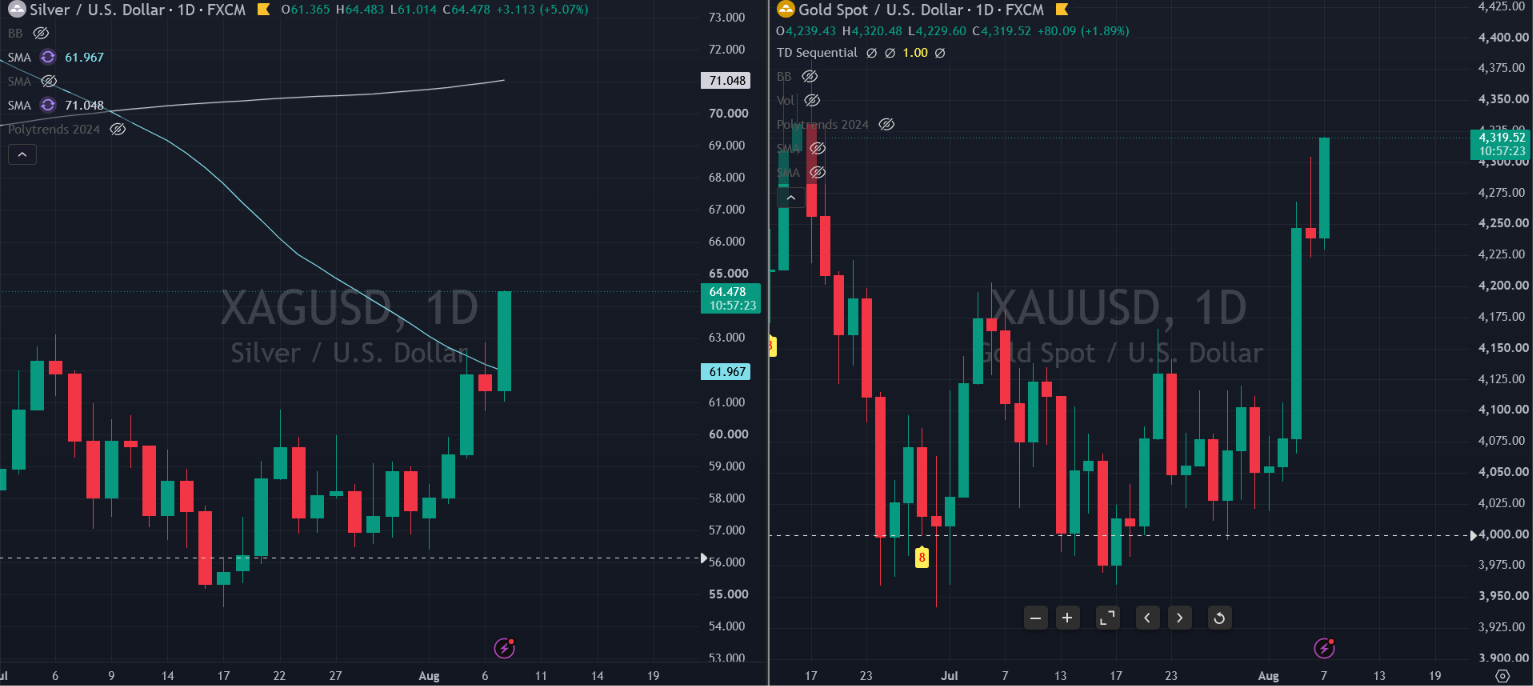
Both metals are experiencing both physical buying out of London as well as algorithmic buying out of multiple places. The algo buying is reportedly CTA money covering shorts along with good old fashioned front running of shorts in this torrid rally.
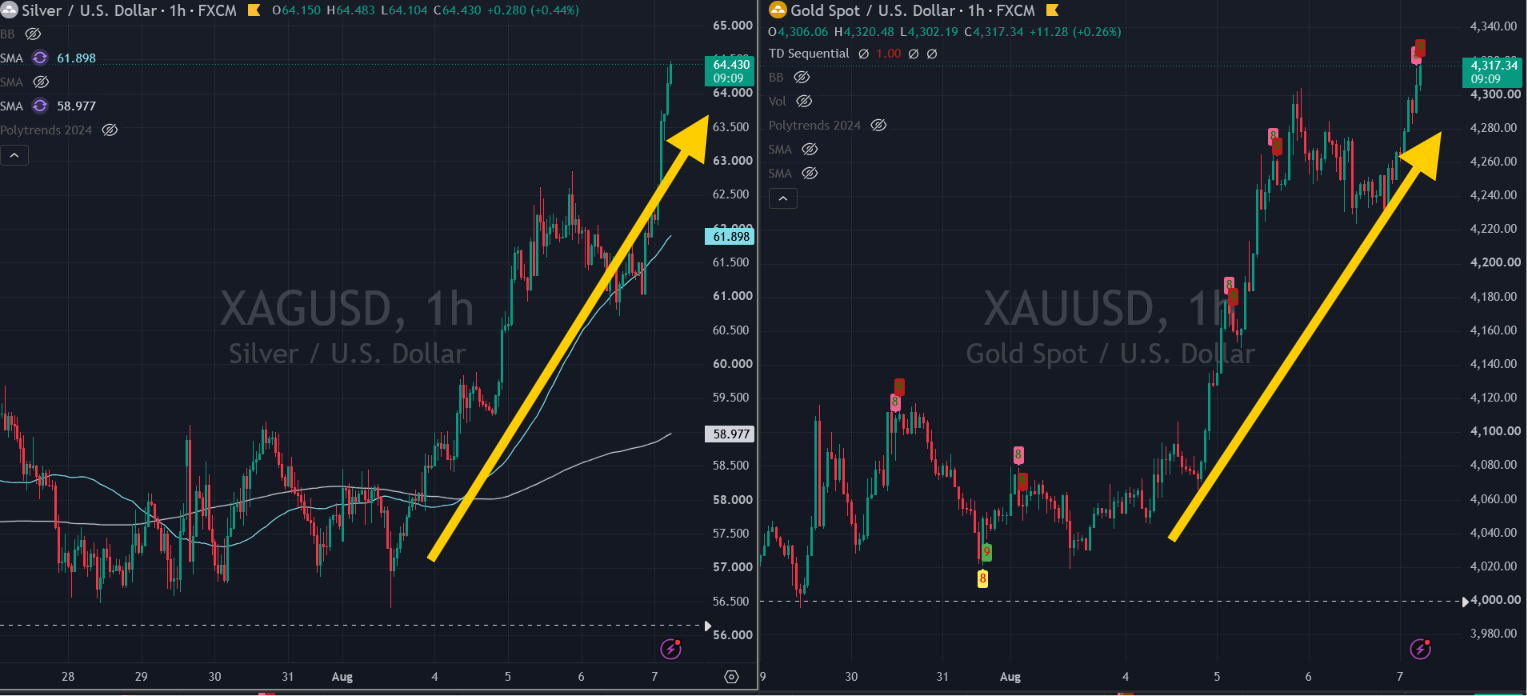
Positioning Was Light Into the Turn
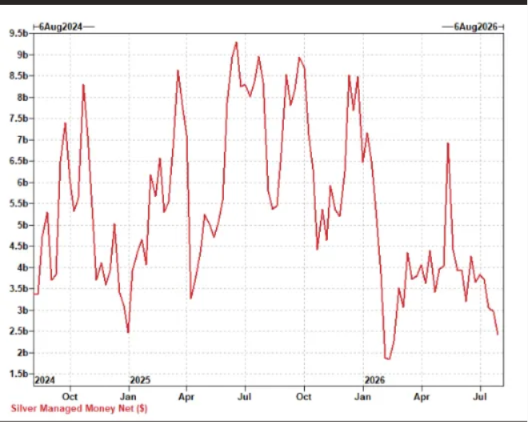
Silver entered the end of July with relatively light speculative positioning, leaving the market vulnerable to a sharp move once the macro backdrop improved. Goldman Sachs notes that Managed Money net length on July 28 stood at only a 3% two-year rank in notional terms, meaning speculative exposure was near the bottom of its recent range. As July turned into August, an incrementally dovish FOMC meeting, intervention in the Japanese yen, and a reversal in oil prices combined to weaken the dollar and lift metals. Between July 28 and August 5, the DXY fell 1.7%, while COMEX silver gained 8.3%, outperforming gold’s 5% rise and the 7.6% advances in both platinum and palladium.
Managed Money Returns
Goldman believes Managed Money gross longs were probably an important driver of the silver move. Aggregate silver open interest increased by about $2.4 billion, with the largest daily increase occurring toward the upper end of the price range, suggesting new positions were being added as prices rose.
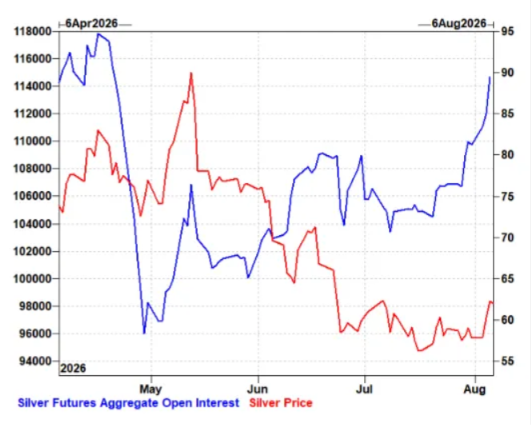
Over the past six months, changes in Managed Money gross longs have remained negatively correlated with the dollar, reinforcing the connection between recent dollar weakness and renewed speculative demand. The options market showed similar behavior, with increased call buying pushing three-month implied volatility higher while the 25-delta put-call skew became less expensive.
Continues here
END
COMMODITY SILVER
Troubling Trend At The World’s Largest Silver Producer

by SRSrocco
Friday, Aug 07, 2026 – 18:55

By the SRSroccoReport,
There’s a troubling trend taking place at the world’s largest silver producer, and this trend is likely to worsen in the years ahead. Because it now takes three mines to do the work of one, the cost to produce silver has increased significantly.
Check back for new articles and updates at the SRSrocco Report.
Contributor posts published on Zero Hedge do not necessarily represent the views and opinions of Zero Hedge, and are not selected, edited or screened by Zero Hedge editors.
END
COMMMODITY GOLD/HONG KONG
China’s PBOC Ships Gold to Hong Kong for Global Hub
by VBL
Saturday, Aug 08, 2026 – 10:12
Contents
- Hong Kong Takes Custody of PBOC Gold
- Goodbye London, Hello Hong Kong
- Gold Clearing is the BRICS Next Step
- Hong Kong Goes Global in Gold Search
- Chinese Demand Supports Gold at $4000
Hong Kong Takes Custody of PBOC Gold
Authored by GoldFix
As we’ve been discussing in this space for the better part of three years, much of gold supply chain (trading, sales, vaulting, refining) has moved eastward in response to demand shifting there. As we’ve also discussed here for the past eight months or so, China is preparing to unleash gold onto the world as a repo-eligible HQLA asset suitable for financial transactions, making it even more conducive to being held as a store of value than it already is. Here is the latest intersecting both of those trends relevant to the situation as they have been developing.

China’s central bank is increasing the amount of gold it holds in Hong Kong as the city works to expand its role in global bullion trading and price discovery.
The move involves both new inventories and the relocation of some Chinese gold reserves previously stored in London, strengthening the physical foundation behind Hong Kong’s recently launched gold clearing system and signaling continued support from Beijing for the city’s ambitions in the international gold market.
Bloomberg News reported that the People’s Bank of China has been building gold inventories in Hong Kong over the past several months, citing people familiar with the matter. According to those sources, the recent additions are accelerating a longer-running process in which the PBOC has been moving some of its reserves closer to home from London, traditionally the center of the global bullion market.
“That relocation of metal from London to Hong Kong is set to continue,” the people said.
Goodbye London, Hello Hong Kong
Central banks have historically stored significant amounts of their gold in London because its deep bullion market allows them to lend metal to commercial banks, manage reserves efficiently, and gain access to liquidity without having to move large quantities of physical gold. Some central banks have begun bringing portions of those reserves home in recent years, however, with India and Serbia among the countries that have repatriated bullion for security or political reasons.
Hong Kong: Gold Infrastructure as Bridge to Yuan Internationalization
October 1, 2025
The announced expansion of storage capacity, refining, and toll processing arrangements with the mainland creates a gold ecosystem that is both domestic and international. Gold refined in China and exported to Hong Kong for trading and settlement allows Beijing to operate a dual system: a controlled onshore market and a globally accessible offshore hub.
China’s latest activity combines that broader reserve-management trend with its own sustained accumulation of gold. The PBOC has been one of the largest official-sector buyers in recent years, and its June purchase was its biggest since October 2023, extending the central bank’s buying streak to 20 consecutive months.
The movement of additional gold into Hong Kong also gives the city a larger pool of physical metal as it attempts to strengthen its position against established bullion centers and regional competitors.
Gold Clearing is the BRICS Next Step
Hong Kong launched a new gold clearing system on a trial basis in July, including a new benchmark designed to strengthen the city’s role in global price discovery. Bloomberg said the PBOC’s decision to divert more of its reserves to Hong Kong provides a clear signal of support for that effort.
“By diverting more gold to Hong Kong, the PBOC is signaling its support for a gold clearing system that was launched on a trial basis last month.”
The system is intended to improve the infrastructure supporting gold trading, clearing and settlement in Hong Kong while giving the city a greater role in setting prices. That effort places Hong Kong alongside established centers while also competing with Singapore, which is developing its own plans to expand bullion trading.
Brics 2025: China Builds Global Gold-Vault Network
May 24, 2025

Housekeeping: We have several posts in the cue on the BRICS Summit. This one is a summary of their agenda as it pertains to next steps towards Gold as a tool of dedollarization and with it internationalizing Yuan use.
PBOC Governor Pan Gongsheng reinforced Beijing’s commitment at the system’s official launch in July, saying the central bank would continue increasing the allocation of China’s national foreign reserves to Hong Kong. The statement repeated a commitment he first made in early 2025 and tied the development of Hong Kong’s bullion infrastructure directly to the management of China’s reserves.
Continues here
END
COMMODITY: GENERAL MINING/USA
Trump To Announce $180 Million Grants For Mining Industry
Friday, Aug 07, 2026 – 09:45 PM
Authored by Emel Akan via The Epoch Times,
WASHINGTON – President Donald Trump is set to host a major mining industry roundtable on Friday at the State Department, bringing together nearly 200 business leaders, educators, and government officials to strengthen domestic mining companies. President Donald Trump arrives to speak at General Motors proving ground, Monday, July 27, 2026, in Milford, Mich. AP Photo/Alex Brandon
At the event, the president is expected to announce over $180 million in grants to expand workforce training and trade programs for the mining industry, according to the White House. CBS first reported the plan.
The Department of Energy is launching a $100 million grant program to support scholarships and related initiatives. Universities, community colleges, trade schools, industry groups, and other partners will be eligible to apply.
Additionally, the military is providing over $80 million in funding to three universities for technology and workforce development programs. The recipients are the Colorado School of Mines, the South Dakota School of Mines, and Johns Hopkins University.
“The mining industry has never had a greater champion than President Trump,” White House spokeswoman Taylor Rogers told The Epoch Times in an email.
“His unprecedented support has driven record investment, streamlined permitting, and delivered real results for American workers, companies, and communities. President Trump is the first president in decades to prioritize our country’s mining industry, unleash its abundant resources, and build the next generation of American miners.”
The meeting comes as the White House is working to reduce America’s reliance on China for critical minerals and processed metals, which are essential for the U.S. defense and technology sectors.
Key cabinet members attending include Interior Secretary Doug Burgum, Secretary of State Marco Rubio, and Commerce Secretary Howard Lutnick. Industry executives from Resolution Copper, MP Materials, American Ocean Minerals, Ivanhoe, and Century Aluminum will also participate, according to the White House.
The new funding is expected to develop skilled workers and strengthen supply chains for the American mining industry.
END
YOUR EARLY CURRENCY VALUES/GOLD AND SILVER PRICING/ASIAN AND EUROPEAN BOURSE MOVEMENTS/AND INTEREST RATE SETTINGS MONDAY MORNING.7:30 AM
SHANGHAI CLOSED UP 26.56 PTS OR 0.67%
HANG SENG CLOSED UP 269.46 PTS OR 1.35%
Nikkei CLOSED UP 1457.29 PTS OR 2.22%
//Australia’s all ordinaries CLOSED DOWN 0.65%
//Chinese yuan (ONSHORE) CLOSED UP TO 6.7438
/ OFFSHORE CLOSED UP AT 6.7455 Oil UP TO 79.58 dollars per barrel for WTI and BRENT UP TO 84.75 Stocks in Europe OPENED ALL MOSTLY GREEN
ONSHORE USA/ YUAN// WITH YUAN TRADING UP (6.7438 OFFSHORE YUAN TRADING UP TO 6.7455 ONSHORE YUAN TRADING ABOVE LEVEL OF OFF SHORE AND UP ON THE DOLLAR)// / AND THUS STRONGER/OFF SHORE YUAN TRADING UP AGAINST US DOLLAR/ AND THUS STRONGER
XXXXXXXXXXXXXXXXXXXXXXXXXXXXXXXXXXXXX
ONSHORE YUAN: CLOSED UP AT 6.7438
OFFSHORE YUAN: UP TO 6.7455
1.HANG SANG CLOSED UP 269.46 PTS OR 1.35%
2. Nikkei closed UP 1457.29 PTS OR 2.22%
WEST TEXAS INTERMEDIATE OIL UP TO 79.58
BRENT; 84.75
3. Europe stocks SO FAR: ALL MOSTLY GREEN
USA dollar INDEX DOWN TO 99.51// EURO RISES TO 1.1554 UP 5 BASIS PTS
3b Japan 10 YR bond yield:RISES TO. +2.807 UP 1 FULL BASIS PTS/ VERY TROUBLESOME//Japan buying 100% of bond issuance)/Japanese YEN vs USA CROSS NOW AT 158.82… JAPANESE YEN NOW FALLING AS WE HAVE NOW REACHED THE ENDING OF THE YEN CARRY TRADE AGAIN AND THE REPATRIATION OF YEN DENOMINATED BONDS TRADING IN THE USA/EUROPE. JAPAN 30 YR BOND YIELD: 3.952 UP 4 FULL BASIS PTS
3c Nikkei now ABOVE 17,000
3d USA/Yen rate now well ABOVE the important 120 barrier this morning
3e Gold DOWN /JAPANESE Yen DOWN CHINESE ONSHORE YUAN: UP (6.7438) AND OFFSHORE: UP AT 6.7455
3f Japan is to buy INFINITE TRILLION YEN worth of BONDS. Japan’s GDP equals 5 trillion USA. CENTRAL BANK OF JAPAN WILL NO LONGER DO QE.
Japan to buy 100% of all new Japanese debt and NOW they will have OVER 50% of all Japanese debt. GOVERMENT ASKED JAPAN PENSION FUNDS AND INSURANCE FUNDS TO BUY MORE JAPANESE BONDS AND REPATRIATE ALL FOREIGN BONDS.
3g Oil UP for WTI and UP this morning
3h European bond buying continues to push yields HIGHER on all fronts in the EU German 10yr bund YIELD UPTO +3.1457/ Italian 10 Yr bond yield UP AT 3.925/ SPAIN 10 YR BOND YIELD UP TO 3.578%
3i Greek 10 year bond yield DOWN TO 3.796%
3j Gold at $4337,90//Silver at: 64.08 1 am est) SILVER NEXT RESISTANCE LEVEL AT $100.00
3k USA vs Russian rouble;// Russian rouble DOWN 0 AND 99/ 100 roubles/82.88
3m oil (WTI) into the 79 dollar handle for WTI and 84 handle for Brent/
3n Higher foreign deposits moving out of China// huge risk of outflows and a currency depreciation. This can spell financial disaster for the rest of the world/
JAPAN ON JAN 29.2016 CONTINUES NIRP. THIS MORNING RAISES AMOUNT OF BONDS THAT THEY WILL PURCHASE UP TO .5% ON THE 10 YR BOND///YEN TRADES TO 158.82 // 10 YEAR YIELD AFTER FIRST BREAKING .54% LAST YEAR NOW EXCEEDS THAT LEVEL TO 2.807% UP 1 BASIS PTS STILL ON CENTRAL BANK (JAPAN) INTERVENTION//YEN CARRY TRADE NOW UNWINDING//YEN BOND TRADING OVERSEAS TO BE REPATRIATED.//JAPAN 30 YR: 3.952 UP 4 PTS..: USA/SF this 0.8084 as the Swiss Franc . Euro vs SF: 0.9339
USA 10 YR BOND YIELD: 4.670 UP 1 BASIS PTS…
USA 30 YR BOND YIELD: 5.217 UP 1 BASIS PTS/
USA 2 YR BOND YIELD: 4.220 UP 2 BASIS PTS
USA DOLLAR VS TURKISH LIRA: 47.71 UP 0 BASIS PTS/LIRA GETTING KILLED//IDIOTS FOR SELLING GOLD AND USA DOLLAR RESERVES.
10 YR UK BOND YIELD: 4.9444 UP 1 PTS
30 YR UK BOND YIELD: 5.6860 UP 1 BASIS PTS
10 YR CANADA BOND YIELD: 3.672 UP 3 BASIS PTS
5 YR CANADA BOND YIELD: 3.293 UP 3 BASIS PTS.
1a New York Opening report
Futures Erase Overnight Gains As Oil Hits One-Week High, Yen Slides
Monday, Aug 10, 2026 – 08:21 AM
US equity futures start the new week barely higher, having erased almost all of their overnight gains, yet still trading at all time highs, led by Tech with small caps starting the week in the red. As of 8:00am ET, S&P futures are fractionally in the green as traders look to the next big data print from the US this week in the form of CPI and PPI updates, as bets on September rate hikes tumbled after Friday’s jobs debacle; Nasdaq futures rise 0.1%. In premarket trading, both Mag7 and Semis are higher with weakness in Memory, Software, and South Korea despite the rise in KOSPI overnight. Cyclicals are outpacing Defensives, including participation from Energy / Cmdtys names. Europe’s Stoxx 600 is coming off its best daily streak of gains since June and more money managers say that this European equities rally could be durable. In Asia, Japan’s Nikkei 225 rose 2% and the Kospi was flat, lagging a 6% surge for the small-cap Kosdaq as it benefits from a rotation out of memory stocks and leveraged ETFs. Overnight, JPMorgan raised its year-end S&P target to 8000 as the bank sees earnings delivering $365/shr this year and $420/shr in FY27, +15% YoY. Bond yields are flat to +1bp as the yield curve twists flatter; USD trading higher following consecutive weekly declines. USDJPY rises 0.6% toward 159, surpassing last week’s intraday high and more than erasing the drop we saw on Friday after the soft US jobs report prompted a broad dollar selloff; about half of the post-intervention move has now been erased. Commodities are led higher by Energy with MidEast headlines driving direction; Brent trades at session highs, just under $85/bbl and the highest since Aug 3, as Iran and Oman are still short of a final deal to reopen the Strait of Hormuz while Iran ruled out direct talks with the US for now. Tehran promoted a hard-line ex-commander as its top security official. President Trump said the US was “semi-negotiating” with Iran. Israel has rejected a proposal by US-backed mediators for disarming Hamas. Houthis are targeting Saudi refineries after SA, Pakistan, and Turkey signed a new defense pact. Both Base and precious metals are mixed with silver the standout, rallying with the AI theme. There are no major econ releases today as the market preps for CPI and Retail Sales, our Scenario Analysis is included. With earnings season almost completed, we are seeing the SPX trend towards 15% rev growth, 50% EPS growth, and almost 17% margins.

In premarket trading, Mag 7 stocks are mostly higher even as Apple falls 1.1% as Jefferies downgrades to underperform noting that the roadmap to a higher-priced iPhone looks challenging. Meta Platforms (META) climbs 2.6% after introducing a new AI model called Muse Glimmer that can run on a single computer, allowing users to download and customize the technology (Alphabet +0.8%, Tesla +0.4%, Nvidia +0.2%, Amazon +0.7%, Microsoft -0.09%).
- Aaon (AAON) climbs 8% after the heating, ventilation, and air conditioning company reported adjusted earnings per share for the second quarter that beat the average analyst estimate.
- AbCellera (ABCL) climbs 22% after saying a clinical trial evaluating ABCL635 met the primary efficacy endpoints
- Barrick Mining’s US-listed shares (B) slip 4% after the company reached an agreement with Newmont Corp. on their Nevada joint venture, opening the way for Barrick to list its North American assets in New York.
- HP Enterprise (HPE) rises 6% after Morgan Stanley upgraded its rating on the stock to overweight. Morgan Stanley is more favorable on the IT hardware industry overall due to heavy spending on AI-related infrastructure.
- MarineMax (HZO) shares are halted after Safe Harbor Marinas, a Blackstone portfolio company, agreed to acquire the company for or $53.00 per share in an all-cash deal.
- Monday.com (MNDY) falls 9% after the application software company posted second quarter results and providing guidance.
- National Energy Services Reunited Corp. (NESR) rises 10% after the company reported a 59% year-over-year increase in its revenue.
- Sionna Therapeutics (SION) tumbles 91% after the biopharmaceutical company said a proof-of-concept trial did not achieve key activity endpoint.
- Tenax Therapeutics (TENX) sinks 84% after the development stage biotechnology company said a trial failed to meet its primary endpoint.
- Varex Imaging (VREX) soars 48% as Teledyne Technologies agreed to buy the company for $18.90 per share.
In other corporate news, Berkshire Hathaway spent about $4.5 billion to buy back its own shares in 2Q and purchased nearly $20 billion of equities in the period. The stock buybacks provided shareholders with their largest quarterly payout since 2021. TSMC reported a 45% rise in its monthly sales, a sign of sustained demand for AI hardware in the face of market volatility. Apple has been testing memory chips from China’s CXMT, as the iPhone maker addresses a memory crunch during the AI boom, according to the WSJ. Paramount Skydance has agreed to sign contracts with major theater chains guaranteeing that it will release 30 movies a year in cinemas if it acquires Warner Bros. Discovery.
Stock futures are set for a modest extension of Friday’s gains, which saw US stocks close at all time highs, with a rate hike looking less likely to happen anytime soon after Friday’s dismal jobs report, and strong monthly numbers from TSMC helping the AI narrative. A stellar earnings season is in its final stretch, prompting strategists at JPMorgan to boost their year-end target for the S&P 500 to 8000.The team led by Dubravko Lakos-Bujas cited stronger cloud growth and increased backlogs at Alphabet Inc., Amazon.com Inc. and Microsoft Corp. that should reduce worries over return on their invested capital.
“As elevated backlogs convert into recognized revenue, cloud growth should remain well supported, helping validate rising AI capex,” they said. “Across hyperscalers, demand indicators remain high and rising.”
Strategists at banks including Citigroup Inc., Deutsche Bank AG and Goldman Sachs Group Inc. are also among the most bullish voices on US stocks this year. On average, the S&P 500 is seen rising to 7,845 points by the year end, about 1% above current levels
As Bloomberg notes, there are fewer big market catalysts this week, though everyone will be closely looking at this week’s CPI and PPI prints now that inflation is effectively the only thing the Fed is looking at to decide if to hike rates. Investors will also look for further clues on the AI trade — and on the debate around chip valuations — when Applied Materials, Lumentum and Cisco report in the coming days. Sandisk hosts an investor day on Thursday. Further out, Nvidia numbers and the Fed’s Jackson Hole conference are expected to provide some market volatility, if options signals are anything to go by.
“With earnings largely in the rear-view mirror, geopolitics — and particularly Iran’s impact on oil prices and inflation expectations — should move back to the forefront,” said Fabio Caldato, portfolio manager at AcomeA Sgr. “We are focused on Wednesday’s US CPI print as a key test of the ongoing disinflationary process.”
The S&P is tracking for earnings growth of almost 32% in the second quarter, nearly four times the average earnings growth rate outside of the coronavirus pandemic period since the fourth quarter of 2013, according to Bloomberg Intelligence, although much of that is from equity gains on investment. However, there’s more to the story than AI, with eight of the eleven GICS sectors poised for double-digit EPS growth in 2Q, led by energy (up 133%), technology (up 68%) and materials (up 41%).
In other assets, oil held onto gains from the end of last week as Iran and Oman remained short of a deal to reopen the Strait of Hormuz. Trump signaled he’s prepared to let economic pressure on Iran build rather than launch fresh military strikes, marking a shift from his repeated threats to escalate the bombing campaign. Israel’s Netanyahu, meanwhile, hardened his position and rejected a proposal by US-backed mediators for disarming Hamas.
An agreement with Oman to establish a shipping route through Hormuz was “very close,” Iran’s Foreign Minister Abbas Araghchi said over the weekend. He ruled out direct talks with the US for now because of violations of an interim peace deal reached in June.
Elsewhere, US large cap equity positioning has jumped from near neutral to now clearly overweight, with large-cap tech particularly elevated, though still below last year’s highs, according to Deutsche Bank strategists. A broadening in EPS growth and upward revisions pushes Morgan Stanley strategists to favor quality stocks as well as AI adopters.
Over the weekend, China’s factory-gate inflation eased for the first time since the start of the Iran war and consumer prices decelerated too, suggesting cost pressures sparked by the jump in oil prices are starting to fade and the threat of deflation returning is once again front and center. Economic growth in the euro-area is expected to be firmer after a resilient second quarter, according to a Bloomberg survey of analysts. Rate-hike expectations for the Swiss National Bank have been pushed back.
European stocks are little changed as the Stoxx 600 comes off its best daily streak of gains since June and more money managers say that this European equities rally could be durable. Technology shares leading the gains, boosted by strength in semiconductors. Media and telecom stocks are underperforming. Here are the biggest movers:
- Aumovio shares rose as much as 6.2% after Bernstein upgraded the stock to outperform from market-perform, saying the German auto parts maker’s valuation “leaves substantial upside and limited downside.”
- Plus500 shares rose as much as 7.1%, with analysts positive on the trading platform operator’s 1H results and shareholder returns program. Some of the numbers were already reported in a trading update last month
- Elmos shares rose as much as 7.8%, broadly in line with the European semiconductor sector, after Oddo BHF raised its recommendation to outperform from neutral
- Legal & General shares fell as much as 2.4%, the most in a month, after Citi cut its recommendation on the UK asset manager to sell from neutral
- Amundi dropped as much as 2.9%, the most in two months, after Deutsche Bank downgraded the stock to hold from buy
- Pharos Energy shares dropped as much as 6.9%, retreating from a six-year high, after Serica Energy said it’s takeover offer is “final and will not be increased” after being narrowly outbid by Ratio Petroleum last week.
- Aryzta fell as much as 14% to trade at the lowest since January 2023, after weak market conditions in Germany weighed on the Swiss baker’s profitability in the first half of the year
Earlier in the session, Asian stocks rose, with the technology sector the top contributor to gains, after softer-than-expected US jobs data eased pressure on the Federal Reserve to raise interest rates. The MSCI Asia Pacific Index rose 0.6%, tracking an advance in US equities on Friday that drove the S&P 500 to an all-time high. Shares of Japan’s Recruit Holdings jumped by the most since its 2014 IPO to a record, after the owner of the Indeed job-search portal reported profit that beat estimates and raised its outlook. Taiwan’s Delta Electronics and TSMC were among the other big boosts to the Asia benchmark, with both firms posting a more than 40% jump in July sales. Japan’s Nikkei was the top gainer in the region, while equities in India and several Southeast Asian markets underperformed as oil prices extended gains. Iran and Oman remained short of a deal to reopen the Strait of Hormuz, while Houthi militants claimed an attack on a Saudi refinery near the Red Sea. In Indonesia, the Jakarta Composite Index reversed early gains that had put the benchmark on course for a bull market. Meanwhile, President Prabowo Subianto nominated Destry Damayanti as the sole candidate to head the nation’s central bank.
“Asian markets are taking their cue from Wall Street, where a surprisingly weak US jobs report has taken some of the heat off the Fed ahead of September,” said Josh Gilbert, lead analyst for Asia Pacific and the Middle East at eToro. “The test now is this week’s US inflation print,” with the picture challenged by higher oil prices due to the Iran war, he added.
In FX, the Bloomberg Dollar Spot Index is up 0.1%. The yen is the worst performer among G-10 currencies against a marginally stronger dollar. USD/JPY rises 0.6% toward 159, surpassing last week’s intraday high and more than erasing the drop we saw on Friday after the soft US jobs report prompted a broad dollar selloff. The Bank of Japan flagged the risk of inflation heating up in the summary of views from its July meeting, with one board member noting the possibility of a faster pace of rate hikes.
In rates, treasuries are slightly weaker as the US trading day begins — with yields higher by 1bp-2bp and the curve flatter — as oil prices climb for a third straight day amid absence of an agreement to reopen the Strait of Hormuz. Yields remain inside Friday’s ranges, when rally sparked by soft July employment data faded over the course of the session as oil prices rose. US 10Y yields trade up to 4.67%, up 2bps. First Treasury coupon auction cycle of the August-to-October financing begins Tuesday with $58b 3-year note sale; 10- and 30-year new issue auctions follow over next two days US session has few calendar events, with quarterly new-issue auctions ahead this week along with July CPI report Wednesday. IG credit new-issue calendar is expected to revive with $40 billion anticipated for the week, about half last week’s total, concentrated on Monday and Tuesday ahead of the major economic releases. JGB yields are higher with Treasury yields.
In commodities, Brent crude futures rise 1% to around $84.40 a barrel as Iran and Oman remained short of a deal to reopen the Strait of Hormuz while Iran ruled out direct talks with the US for now. WTI crude oil futures are up about 1.4% and highest in nearly a week. Tehran promoted a hard-line ex-commander as its top security official. President Trump said the US was “semi-negotiating” with Iran, according to an Axios report. Israel has rejected a proposal by US-backed mediators for disarming Hamas. Precious metal advance, with spot silver up 1%.
Today’s US economic data calendar is blank for Monday; also ahead this week are July PPI and retail sales, and August preliminary University of Michigan sentiment. Fed speaker slate includes Cleveland Fed’s Hammack, unscripted on Yahoo Finance ( 3pm); later this week, Hammack and Richmond Fed’s Barkin have appearances slated Thursday.
Market Snapshot

Top Overnight News
- President Donald Trump signaled he’s prepared to let economic pressure on Iran build rather than launch fresh military strikes, saying the US was only “semi-negotiating” with Tehran on the Strait of Hormuz: BBG
- Iran ties Hormuz reopening to US concessions on several demands: RTRS
- Intel said it will be offering $15 billion in common stock, taking advantage of renewed interest in its business prospects during the artificial intelligence data center boom.
- Lenders scrutinize US data center financing as community opposition builds: RTRS
- Meta launches new AI model as Zuckerberg champions open-weight push: RTRS
- China Unleashes $28 Trillion Markets to Catch US in AI: BBG
- Stocks held near record highs with traders looking to the next big data print from the US as bets on Federal Reserve interest-rate hikes eased. Oil climbed to $84 a barrel as a deal to reopen the Strait of Hormuz remained elusive: BBG
- Boeing agreed to take a minority stake in Archer Aviation in a deal that hands over control of its flying-taxi venture Wisk Aero: WSJ
- Economic growth in the euro zone is set to quicken after showing surprising resilience to the Iran war, according to a Bloomberg survey of analysts: BBG
- Poland and Baltics shield infrastructure, fearing a Russian false-flag strike: RTRS
- Ukraine kills 13 in drone attack on Russian city of Nizhnekamsk, officials say: RTRS
- Millions of burnt books show how ‘war of endurance’ is hurting Ukraine: AP
- GameStop’s Cohen Is Said to Weigh Pulling $56 Billion EBay Offer: BBG
- Wall Street traders and strategists say US Treasury Secretary Scott Bessent is sending fresh signals that he’s eager to keep bond yields from spiking higher: BBG
- Behind Bessent Moves, Wall Street Sees a Bond-Market Angst: BBG
- In rural Wisconsin, frustrations over Trump ag policies heat up House race: RTRS
- Swiss National Bank forecasters pushed back predictions for an interest-rate increase, with no move anticipated before next June at the earliest: BBG
Iran war
- Iran’s Foreign Ministry spokesperson said talks with Oman are constructive and positive, saying Tehran did not address the issue of fees in the discussions with Oman regarding the Strait of Hormuz, but it is natural to collect fees for services received. He added that Iran is currently focused on the Strait of Hormuz rather than resuming negotiations with the US. Furthermore, Baghaei said Iran has demanded compensation for damage caused by the US-Israel war, while the Strait of Hormuz could reopen if no third party interferes.
- The Iranian parliament’s National Security and Foreign Policy Committee on Sunday approved the general outlines of a bill to manage the Strait of Hormuz, according to ISNA.
- US President Trump told Axios that they are only semi-negotiating with Iran and are just watching Iran with its huge inflation, while he stressed that Iran is in very bad shape economically and has no money to pay its troops, with the US naval blockade exacerbating the Iranian regime’s economic crisis. However, he said it will work out and that it always works out, as well as compared it to a chess game regarding the back-and-forth with Iran.
- US Vice President JD Vance said the US is in the middle of a game in the Iran conflict.
- Iranian President Pezeshkian said now is the best time for an agreement because Iran is strong, united and seen as victorious in war. Pezeshkian separately commented on Friday that they will not yield to force, but are not seeking war or aggression either, while he added there will be no reason for the tension to continue if the pressure and threats against Iran stop. Furthermore, he said there was no gap between the government and the armed forces, as well as noted that Iran had solved many problems with its neighbours and relations had improved significantly.
- Iranian Foreign Minister Araghchi said Iran and the US are not engaged in talks, and Tehran will not allow them to start as long as Washington breaches the interim deal signed in June.
- Iran said it is very close to a deal with Oman regarding a new maritime transit route in the Strait of Hormuz, but it renewed a list of demands for the US to agree to before the waterway could open. It was separately reported that Iran warned it will not reopen the Strait of Hormuz unless the US meets a series of conditions, including paying compensation for war damage, according to FT.
- Iran’s Supreme National Security Council issued six demands to the US, including total force withdrawal, end to proxy warfare, financial reparations, sanctions and asset relief, lifting the blockade and cessation of rhetoric.
- The wait for the Iran-Oman deal regarding the Strait of Hormuz dragged on, with Iran warning the US that any pact wouldn’t lead to an immediate reopening of the key waterway.
- UKMTO reported that a vessel near Oman was struck by an unknown projectile, which caused a fire on board but has been extinguished.
- Saudi Arabia put out a fire at its Jazan plant early on Sunday, while Yemen’s Houthis claimed responsibility for the attack on the refinery. It was separately reported that Houthis resumed attacking Yemen’s Mocha port using ballistic missiles and drones, with the attacks aimed at Saudi troop concentrations and weapon depots in the region.
- Israel again targeted Alia Al-Tahir Hill in the Al-Nabatiyeh a governorate in southern Lebanon with artillery fire, according to IRNA
- Israeli PM Netanyahu said Israel does not accept a US-backed 15-point plan for Gaza, under which Hamas would disarm in exchange for a phased Israeli withdrawal from the Palestinian enclave, according to FT.
- US official said the White House is not bothered by Israeli PM Netanyahu’s statement on Gaza plan and sees it as part of election season in Israel, according to Axios
A more detailed look at global markets courtesy of Newsquawk
APAC stocks were somewhat mixed, but with most major indices in the green, following last Friday’s gains on Wall Street, where weak jobs data unwound Fed rate hike bets, while oil prices gained in the absence of a formal Strait of Hormuz deal, and participants also digested soft Chinese inflation data. ASX 200 was lower amid declines in the top-weighted financial sector following earnings from Westpac, while participants also look ahead to tomorrow’s RBA rate decision, with the central bank widely expected to keep rates on hold, but continue to echo a hawkish tone. Nikkei 225 rallied as participants digested the recent slew of earnings, with the top gainers in the index driven by their quarterly earnings results. KOSPI traded higher but with upside capped amid the somewhat choppy price action in tech heavyweights and as participants also reflect on earnings releases. Hang Seng and Shanghai Comp were in the green, albeit with gains in the mainland contained following softer-than-expected CPI and PPI data over the weekend. Nonetheless, the data is seen to keep prospects of a rate cut in H2 on the table, while the PBoC said on Sunday that it will continue to implement a moderately loose monetary policy in H2, strengthen counter-cyclical adjustment, and take solid steps to promote sustained and improved economic development.a
Top Asian News
- Chinese CPI MM (Jul) -0.1% vs. Exp. 0.2% (Prev. -0.3%).
- Chinese CPI YY (Jul) 0.5% vs. Exp. 0.8% (Prev. 1.0%).
- Chinese PPI YY (Jul) 3.5% vs. Exp. 3.8% (Prev. 4.1%).
- Japanese Eco Watchers Survey Current (Jul) 45.7 vs. Exp. 44.4 (Prev. 44.0).
- Japanese Economy Watchers Survey Outlook (Jul) 45.8 (Prev. 45.7).
European bourses begin the week relatively muted, on a quiet earnings and data docket. No major geopolitical updates over the weekend either; Iran’s Supreme National Security Council issued six demands to the US, including total force withdrawal and ending proxy warfare. More recently, the Iranian Foreign Minister Baghaei said they are currently focused on the Strait of Hormuz rather than resuming negotiations with the US. Sectors tilt negatively. Tech tops the sector pile, helped by TSMC’s July revenue figures (+44.7% Y/Y). Following another strong month of sales, analysts are now estimating a 46.8% revenue increase for Q3, proving that demand for AI hardware remains firm. Other sector gainers include Basic Resources and Energy. On the other side, Media is the sector laggard, with Food, Beverages & Tobacco and Retail rounding out the sector underperformers.
Top European News
- Germany Economy Minister Reiche warned that rising support for the far-right AfD could undermine the government’s efforts to attract foreign investors, as it seeks at least EUR 3.75tln in private capital by 2040, according to FT.
Fx
- Mixed performance across G10s, JPY leading declines while the GBP is the gainer alongside the Antipodeans.
- USD overnight attempted to claw back NFP losses, peaking at 99.70, though the modest rally (as much as +0.2%) came under pressure since the EU open, with the DXY returning back to unch. around 99.60. Focus this week will overwhelmingly be on the CPI print, especially since FT sources last week suggested Warsh was focused on the inflation side of the mandate heading into the September meeting. On that note, market bets for tightening remain trimmed vs. Friday, with the OIS curve implying ~22% probability of a hike, around half of that seen pre-data. Today’s calendar is light, though remarks are expected from hawk Hammack.
- A continued UK narrative of “no news is good news” with UK Parliament on recess and PM Burnham trickle-feeding incremental cost-of-living policies. GBP carry remains attractive, and, combined with technicals, a strong REC/KPMG jobs number is helping Cable today, which recently lifted above 1.35, with EUR/GBP supported just above 0.8560 – EZ drivers light with a strong Sentix survey not sparking a reaction. EUR incrementally firmer against most CEE, with the week’s calendar highlighted by Polish/Turkish/Czech inflation.
- JPY is the clear underperformer, USD/JPY around 30 pips higher than the US payrolls release. Pressure which lacks a clear driver, with BoJ’s summary of opinions hawkish leaning “could be considered that the pace of policy interest rate hikes will have to be faster than market expectations”. However, MUFG writes retail short USD/JPY positions have “probably” been liquidated. Participants are now potentially turning to a carry strategy, which could be seen as more attractive than chasing the pair lower at these levels. USD/JPY looks towards 159.00, currently 20-30 pips off that mark.
Fixed Income
- A contained start to the session for fixed income. With specifics for the space very light, the docket ahead is particularly thin, though it does pick up later in the week with US inflation prints, and as geopolitical uncertainty continues in what is beginning to feel somewhat like summer markets.
- USTs are flat in a thin sub-10 tick range. The docket ahead is very light, aside from Fed’s Hammack (2026, Hawk) who speaks to Yahoo. More generally, we await an update on the geopolitical front (see Commodities for details). Thereafter, the week is headlined by CPI, which draws focus after recent Fed commentary and particularly last week’s FT source reports, which placed the focus even more on near-term inflation prints; a point also exacerbated after the weak NFP report last week, which pared end-2026 hiking expectations.
- Bunds also flat, but have meandered through a c. 30 tick range, but yet to deviate lastingly from the 125.00 region. No move to the morning’s EZ Sentix for August, which printed much better than expected, driven by the current-conditions index, while the expectations component only increased marginally. More generally, the index shows that “Globally, the signs continue to point to a boom”, with all regions ex-Japan improving in August.
- Gilts opened with gains of just a few ticks, before pairing and moving to unchanged in-fitting with peers. As above, UK specifics are very light, aside from the usual political reporting around PM Burnham and potential smaller measures he may take in the weeks and months ahead, with specific reference to the cost of living. Currently, the benchmark is flat in 87.34-62 confines, well within Friday’s 87.09-80 band.
Commodities
- WTI Sept and Brent Oct futures hold a mild positive bias as US-Iran geopolitics remain uncertain, although gains remain capped as no direct military firings or airstrikes were exchanged between the US and Iranian forces over the weekend. To briefly recap, the US, Iran, and Oman are negotiating a temporary plan to partially reopen the Strait of Hormuz, but Iran says no immediate reopening is guaranteed. Iran is demanding major concessions, while disputes remain over banning US/Israeli ships and imposing transit fees under an Oman-Iran traffic-management deal. WTI resides in a USD 77.79-79.42/bbl range (vs Friday’s 76.53-78.77/bbl parameter). Brent trades within a USD 83.33-84.97/bbl range (vs Friday’s USD 81.50-84.44/bbl range).
- Dutch TTF has posted larger gains as the Middle Eastern concern is compounded by EU gas storage levels entering August at a historically low 55% capacity. Dutch TTF trades up almost 4% at the time of writing, north of EUR 57.50/MWh.
- Metals are firmer in continuation of Friday’s NFP-driven upside and amidst relatively stable oil prices and a lack of fresh geopolitics. Spot gold resides in a narrow USD 4,313-4,362/oz range, within Friday’s USD 4,230-4,372/oz range. 3M LME copper holds above USD 14k/t in a USD 14,033.98- 14,161.93/t, with little impact seen from the weekend’s soft Chinese inflation report.
- Kazakhstan is considering using the BTC and Baku-Supsa pipelines and the Trans-Caspian route via Azerbaijan, for oil exports amid disruptions to the CPC, according to IFX.
- UAE’s ADNOC Gas is planning to invest over USD 8bln as part of its expansion push, according to the WSJ.
- Hungarian PM said rising Danube water levels have allowed Paks nuclear power plant to begin reverting one turbine to its original state.
- Ukraine’s Agriculture Ministry said export disruptions could create a grain storage capacity shortfall of around 11mln T this autumn.
- UK regulators are readying a framework for tokenised gold as part of plans to encourage digitalisation of financial markets and safeguard London’s dominance in global bullion trading, according to FT
Central Banks
- BoJ Summary of Opinions from the July meeting stated that a member said Middle East Development, expanding AI-related demand and weak yen all work towards pushing up inflation, while a member said consumer goods inflation is expected to pick up again towards autumn. Furthermore, a member said policymakers should stay alert to upside inflation risks from a weak yen and strong AI-related demand, while there was also the opinion that inflation risks are skewed sharply upward as higher oil costs feed into consumer prices, and global AI demand and Japan’s expansionary fiscal policy support demand.
Geopolitics
- Russia struck two oil refineries in Ukraine’s northeastern Sumy region, according to Interfax. It was separately reported that Ukraine’s Odesa port sustained damage from a Russian attack, while Russian authorities said five were killed in a Ukrainian drone attack on Belgorod.
- US President Trump’s special envoy Steve Witkoff and Kushner may visit Kyiv and Moscow within the next 7-10 days, according to TASS.
US Event Calendar
- 3:00 pm: Fed’s Hammack Appears on Yahoo Finance
DB’s Jim Reid concludes the overnight wrap
I hope you all had a nice weekend. After a couple of months of relentless heat, and with London threatening 37°C again on Thursday, please never let me complain about the cold, wet British weather again. I’m actually starting to feel nostalgic for it, even if I am quite grateful for the extra 40 yards of run on the fairways. I’m looking forward to the cool mountain air of the Alps next week… … oh wait… it’s also shaping up to be the hottest alpine summer on record, with barely any glacial snow left to run headfirst into to cool down. So there appears to be little respite on the horizon.
There’s not much respite in markets either. Following Friday’s payrolls report, which was somewhat mixed but appeared more dovish than hawkish at face value, attention this week will be firmly on July US CPI (Wednesday), which could go a long way towards tipping the balance for September FOMC pricing. Futures pricing fell by around 10 percentage points immediately after the release on Friday, leaving the implied probability at 44%.
Don’t forget US PPI (Thursday) as well, especially for the components that feed directly into core PCE. Other US highlights include retail sales and the preliminary University of Michigan consumer sentiment survey (both Friday). Elsewhere, attention will focus on the RBA policy decision (tomorrow), the Norges Bank meeting and UK Q2 GDP report (Thursday), and inflation releases across Asia and Europe. Corporate earnings are quieter than in recent weeks but reports from Tencent, BYD, Cisco, Applied Materials and CoreWeave will still attract attention.
Before we go into the week ahead in more detail the situation in Iran remains finely balanced with Iran’s latest political and security moves suggesting that Tehran is trying to balance a tougher domestic posture with a continued search for a diplomatic off-ramp. The appointment of former Revolutionary Guard commander Mohsen Rezaee to head the Supreme National Security Council reinforces hard-line influence at the centre of decision-making, even as Iranian officials insist they are close to an agreement with Oman on a new shipping framework through the Strait of Hormuz. Foreign Minister Abbas Araghchi has described the talks as being in their final stages, but Tehran has stressed that any technical agreement on shipping routes would not by itself lead to a full reopening of the waterway. Reuters and other major outlets report that Iran continues to tie any lasting Hormuz arrangement to wider demands on the US, including sanctions relief, compensation for war damage and security guarantees. Oman has characterised the negotiations as constructive, while Washington has signalled a willingness to continue talks despite periodic tensions. Brent is up around +0.8% this morning but US and European equity futures are fairly flat.
In Asia the Nikkei (+1.80%) is strong this morning but the KOSPI is fading after a decent start and is now broadly flat on the day. Elsewhere, Chinese equities are mixed, with the CSI 300 declining -0.52%, while the Hang Seng and Shanghai Composite are up +0.72% and +0.20%, respectively. In Australia, the S&P/ASX 200 is down -0.42%, surrendering a portion of the gains recorded on Friday.
China’s weekend July inflation data underscored the fading impact of this year’s oil shock and a loss of domestic economic momentum. Headline CPI slowed to 0.5% y/y (vs. 0.8% expected, 1.0% prior), while core CPI eased to 0.9% y/y from 1.0% (1.0% expected). Producer price inflation also came in softer than anticipated, with PPI rising 3.5% y/y (vs. 3.9% expected, 4.1% prior), suggesting that easing commodity costs and still-weak domestic demand are limiting pricing pressures.
This all follows last Friday’s US payrolls report certainly offering a mixed assessment of labour market conditions. Headline payrolls unexpectedly fell by -23k, private payroll growth slowed to just +30k, and the previous two months were revised down by a cumulative -103k. However, according to our economists, much of the weakness was concentrated in two sectors – leisure and hospitality (-40k) and local government education (-50k), while goods-producing employment and construction both posted their strongest gains in several months. At the same time, the unemployment rate declined to 4.1%, its lowest level since early 2025. Our economists view the report as consistent with a broadly stable labour market rather than a sharp deterioration, noting that demographic factors continue to weigh on participation. The softer payrolls data has reduced the urgency for further Fed tightening in the near term, but with labour market slack only gradually increasing, it’s over to Wednesday’s US CPI.
On this big number, our economists expect headline CPI to rise by +0.15% mom after June’s -0.42% decline, while core CPI is forecast at +0.26% mom following an unchanged reading in June. Lower gasoline prices should keep headline inflation softer than core, and if forecasts are realised both headline and core annual inflation rates would edge down by around one-tenth to 3.45% and 2.51% respectively. Markets will also be watching for evidence of payback from several unusual price moves in June, particularly across parts of core goods and services.
Attention will then turn to July PPI on Thursday. Our economists expect headline producer prices to rise by +0.22% mom, with core PPI at +0.3% mom. Particular focus will fall on categories that feed into core PCE inflation, including healthcare services, airfares and portfolio management. Our economists are currently tracking +0.22% in July and 3.3% YoY.
Friday’s US data will offer the first major read on Q3 activity. Our economists expect retail sales to increase by +0.3% mom in July, while lower fuel prices may weigh on the headline figure relative to underlying spending measures. The preliminary University of Michigan consumer sentiment survey is expected to ease to 52.5 in August from 55.2 previously. Fed speakers are relatively sparse, although comments from Cleveland Fed President Hammack and Richmond Fed President Barkin may attract attention following the inflation data.
Outside the US, we have a couple of G10 central banks in focus this week. The Reserve Bank of Australia announces its policy decision tomorrow, with our economists (and the market) expecting rates to remain unchanged at 4.35%. Norges Bank follows on Thursday with a 25% probability of a hike priced in.
In Europe, the key release will be the UK’s Q2 GDP report on Thursday. Our economists expect June GDP to contract by -0.1% mom, leaving quarterly growth at +0.4% qoq, although risks are seen as tilted to the downside. Elsewhere, Norway and Denmark both publish July CPI figures today.
On the corporate side, the earnings season is becoming less intensive, with 400 out of the S&P 500 having now reported, but several notable companies remain on the calendar. In the US, investors will focus on results from Cisco, Applied Materials and CoreWeave, while in China attention will fall on Tencent and BYD.
Recapping last week now and markets were dominated by developments surrounding talks with Iran. Investors priced de-escalation in Middle East tensions as negotiations between Iran and Oman progressed, though some of that optimism then faded as details of a potential agreement on Thursday raised questions over whether the US would accept the deal and just how free-flowing shipping through the Strait of Hormuz would be. Energy prices moved sharply lower through the middle of the week, and while Brent crude rebounded from lows of around $78/bbl on Wednesday, it still finished the week down -7.29% to $83.55/bbl (+1.29% on Friday). WTI crude was down -7.67% to $78.18/bbl (+1.15% on Friday), while European natural gas futures slid by -4.42% over the week.
The fall in energy prices supported a risk-on move, helping the S&P 500 (+3.58%, +0.62% Friday), Stoxx 600 (+1.70%, +0.31% on Friday), DAX (+2.69%, +0.69% Friday) and CAC 40 (+2.41%, +0.17% Friday) all reach new record highs. For both the S&P 500 and the NASDAQ (+5.19%, +1.30% Friday), this also marked the largest weekly gains since April. Equities were also supported by the continued rebound in the AI trade that had started late the previous week. The Phily Semiconductor (Sox) Index rose +9.24% last week (+2.56% on Friday) after a difficult July. Other risk assets also benefited, with US HY credit spreads (-15bps) seeing their joint biggest weekly tightening since April.
Friday’s risk asset rally followed the soft US July Jobs report that saw markets dial back prospects of a September Fed hike. Following the print, investor pricing of a September Fed rate hike fell to 44% (from 72% a week earlier and 57% on Thursday). In turn, Treasury yields declined, with the 2yr (-9.6bps, -5.3bps Friday), and 10yr (-9.0bps, -3.5bps Friday) yields posting their largest weekly declines since May. In Europe, government bond yields also declined, with the 10yr gilt (-12.9bps, -1.7bps Friday), BTP (-12.0bps, -1.8bps Friday), and bund (-7.4bps, -0.8bps on Friday) yields all lower. The European bond rally was supported by the pullback in inflation pricing amid lower oil, with the Euro 1yr inflation swap down -13.1bps to 2.26% (+5.9bps on Friday).
In FX markets, the yen remained a major focus following recent intervention effort, while stronger Japanese wage growth and more hawkish signals from the Bank of Japan reinforced expectations for additional policy tightening. The yen ended the week a marginal -0.23% weaker against the US dollar at 157.76 (+0.42% Friday). Meanwhile, gold rose +7.30% to $4,342/oz (+2.44% Friday) in its best week since January.
1b European opening report
NQ outperforms after strong TSMC earnings; USD flat while JPY lags – Newsquawk EU Market Open

Monday, Aug 10, 2026 – 05:44 AM
- US President Trump told Axios that they are only semi-negotiating with Iran but said it will work out and that it always works out.
- Iran’s Supreme National Security Council issued six demands to the US, including total force withdrawal, end to proxy warfare.
- Iran’s Foreign Ministry Spokesperson said Iran is currently focused on the Strait of Hormuz rather than resuming negotiations with the US, while adding that talks with Oman are constructive and positive
- US equity futures are mixed, with the NQ outperforming as strong TSMC July revenue lifts tech names.
- DXY slightly firmer; JPY reverses post-NFP gains despite hawkish BoJ Summary of Opinions.
- Fixed income flat; Energy benchmarks slightly firmer as Iran issues demands.
- Looking ahead, highlights include comments from Fed’s Hammack.
SNAPSHOT
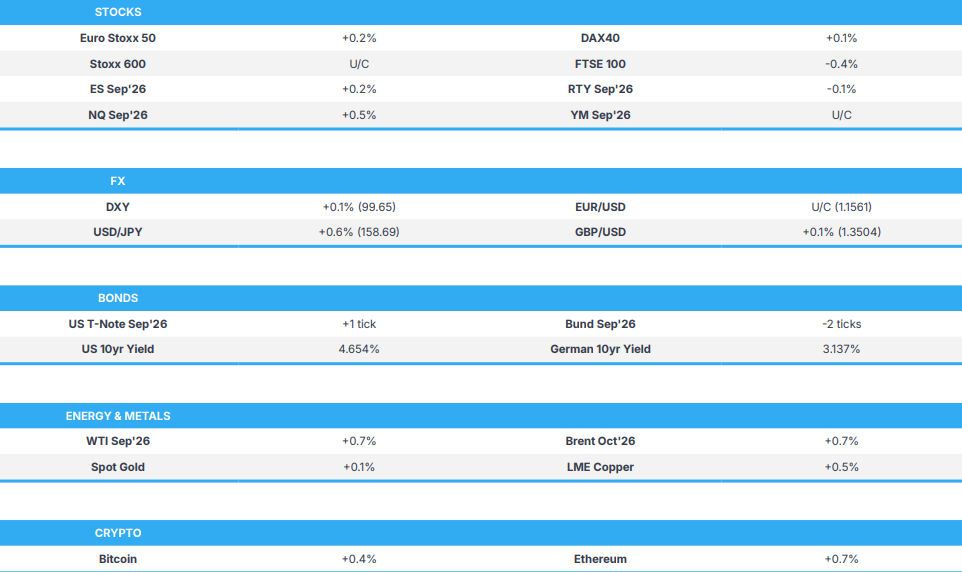
As of 10:25BST / 05:25EDT
Newsquawk in 3 steps:
1. Subscribe to the free premarket movers reports
2. Listen to this report in the market open podcast (available on Apple and Spotify)
3. Trial Newsquawk’s premium real-time audio news squawk box for 7 days
LOOKING AHEAD
- Highlights include comments from Fed’s Hammack.
- Click here for the Week Ahead preview
IRAN CONFLICT
WEEKEND HEADLINES
- US President Trump told Axios that they are only semi-negotiating with Iran and are just watching Iran with its huge inflation, while he stressed that Iran is in very bad shape economically and has no money to pay its troops, with the US naval blockade exacerbating the Iranian regime’s economic crisis. However, he said it will work out and that it always works out, as well as compared it to a chess game regarding the back-and-forth with Iran.
- US Vice President JD Vance said the US is in the middle of a game in the Iran conflict.
- Iranian President Pezeshkian said now is the best time for an agreement because Iran is strong, united and seen as victorious in war. Pezeshkian separately commented on Friday that they will not yield to force, but are not seeking war or aggression either, while he added there will be no reason for the tension to continue if the pressure and threats against Iran stop. Furthermore, he said there was no gap between the government and the armed forces, as well as noted that Iran had solved many problems with its neighbours and relations had improved significantly.
- Iranian Foreign Minister Araghchi said Iran and the US are not engaged in talks, and Tehran will not allow them to start as long as Washington breaches the interim deal signed in June.
- Iran said it is very close to a deal with Oman regarding a new maritime transit route in the Strait of Hormuz, but it renewed a list of demands for the US to agree to before the waterway could open. It was separately reported that Iran warned it will not reopen the Strait of Hormuz unless the US meets a series of conditions, including paying compensation for war damage, according to FT.
- Iran’s Supreme National Security Council issued six demands to the US, including total force withdrawal, end to proxy warfare, financial reparations, sanctions and asset relief, lifting the blockade and cessation of rhetoric.
- The wait for the Iran-Oman deal regarding the Strait of Hormuz dragged on, with Iran warning the US that any pact wouldn’t lead to an immediate reopening of the key waterway.
- UKMTO reported that a vessel near Oman was struck by an unknown projectile, which caused a fire on board but has been extinguished.
- Saudi Arabia put out a fire at its Jazan plant early on Sunday, while Yemen’s Houthis claimed responsibility for the attack on the refinery. It was separately reported that Houthis resumed attacking Yemen’s Mocha port using ballistic missiles and drones, with the attacks aimed at Saudi troop concentrations and weapon depots in the region.
- Israel again targeted Alia Al-Tahir Hill in the Al-Nabatiyeh a governorate in southern Lebanon with artillery fire, according to IRNA
- Israeli PM Netanyahu said Israel does not accept a US-backed 15-point plan for Gaza, under which Hamas would disarm in exchange for a phased Israeli withdrawal from the Palestinian enclave, according to FT.
- US official said the White House is not bothered by Israeli PM Netanyahu’s statement on Gaza plan and sees it as part of election season in Israel, according to Axios
EUROPEAN UPDATES
- Iran’s Foreign Ministry spokesperson said talks with Oman are constructive and positive, saying Tehran did not address the issue of fees in the discussions with Oman regarding the Strait of Hormuz, but it is natural to collect fees for services received. He added that Iran is currently focused on the Strait of Hormuz rather than resuming negotiations with the US. Furthermore, Baghaei said Iran has demanded compensation for damage caused by the US-Israel war, while the Strait of Hormuz could reopen if no third party interferes.
- The Iranian parliament’s National Security and Foreign Policy Committee on Sunday approved the general outlines of a bill to manage the Strait of Hormuz, according to ISNA.
EUROPEAN TRADE
EQUITIES
- European bourses begin the week relatively muted, on a quiet earnings and data docket. No major geopolitical updates over the weekend either; Iran’s Supreme National Security Council issued six demands to the US, including total force withdrawal and ending proxy warfare. More recently, the Iranian Foreign Minister Baghaei said they are currently focused on the Strait of Hormuz rather than resuming negotiations with the US.
- Sectors tilt negatively. Tech tops the sector pile, helped by TSMC’s July revenue figures (+44.7% Y/Y). Following another strong month of sales, analysts are now estimating a 46.8% revenue increase for Q3, proving that demand for AI hardware remains firm. Other sector gainers include Basic Resources and Energy. On the other side, Media is the sector laggard, with Food, Beverages & Tobacco and Retail rounding out the sector underperformers.
- US equity futures are mixed, with a slight positive tilt as the NQ outperforms. Focus this week in the US will be earnings from Supermicro and CoreWeave on Tuesday, and the inflation print on Wednesday.
- Click for the sessions European pre-market equity newsflow
- Click for the additional news
FX
- Mixed performance across G10s, JPY leading declines while the GBP is the gainer alongside the Antipodeans.
- USD overnight attempted to claw back NFP losses, peaking at 99.70, though the modest rally (as much as +0.2%) came under pressure since the EU open, with the DXY returning back to unch. around 99.60. Focus this week will overwhelmingly be on the CPI print, especially since FT sources last week suggested Warsh was focused on the inflation side of the mandate heading into the September meeting. On that note, market bets for tightening remain trimmed vs. Friday, with the OIS curve implying ~22% probability of a hike, around half of that seen pre-data. Today’s calendar is light, though remarks are expected from hawk Hammack.
- A continued UK narrative of “no news is good news” with UK Parliament on recess and PM Burnham trickle-feeding incremental cost-of-living policies. GBP carry remains attractive, and, combined with technicals, a strong REC/KPMG jobs number is helping Cable today, which recently lifted above 1.35, with EUR/GBP supported just above 0.8560 – EZ drivers light with a strong Sentix survey not sparking a reaction. EUR incrementally firmer against most CEE, with the week’s calendar highlighted by Polish/Turkish/Czech inflation.
- JPY is the clear underperformer, USD/JPY around 30 pips higher than the US payrolls release. Pressure which lacks a clear driver, with BoJ’s summary of opinions hawkish leaning “could be considered that the pace of policy interest rate hikes will have to be faster than market expectations”. However, MUFG writes retail short USD/JPY positions have “probably” been liquidated. Participants are now potentially turning to a carry strategy, which could be seen as more attractive than chasing the pair lower at these levels. USD/JPY looks towards 159.00, currently 20-30 pips off that mark.
FIXED INCOME
- A contained start to the session for fixed income. With specifics for the space very light, the docket ahead is particularly thin, though it does pick up later in the week with US inflation prints, and as geopolitical uncertainty continues in what is beginning to feel somewhat like summer markets.
- USTs are flat in a thin sub-10 tick range. The docket ahead is very light, aside from Fed’s Hammack (2026, Hawk) who speaks to Yahoo. More generally, we await an update on the geopolitical front (see Commodities for details). Thereafter, the week is headlined by CPI, which draws focus after recent Fed commentary and particularly last week’s FT source reports, which placed the focus even more on near-term inflation prints; a point also exacerbated after the weak NFP report last week, which pared end-2026 hiking expectations.
- Bunds also flat, but have meandered through a c. 30 tick range, but yet to deviate lastingly from the 125.00 region. No move to the morning’s EZ Sentix for August, which printed much better than expected, driven by the current-conditions index, while the expectations component only increased marginally. More generally, the index shows that “Globally, the signs continue to point to a boom”, with all regions ex-Japan improving in August.
- Gilts opened with gains of just a few ticks, before pairing and moving to unchanged in-fitting with peers. As above, UK specifics are very light, aside from the usual political reporting around PM Burnham and potential smaller measures he may take in the weeks and months ahead, with specific reference to the cost of living. Currently, the benchmark is flat in 87.34-62 confines, well within Friday’s 87.09-80 band.
COMMODITIES
- WTI Sept and Brent Oct futures hold a mild positive bias as US-Iran geopolitics remain uncertain, although gains remain capped as no direct military firings or airstrikes were exchanged between the US and Iranian forces over the weekend. To briefly recap, the US, Iran, and Oman are negotiating a temporary plan to partially reopen the Strait of Hormuz, but Iran says no immediate reopening is guaranteed. Iran is demanding major concessions, while disputes remain over banning US/Israeli ships and imposing transit fees under an Oman-Iran traffic-management deal. WTI resides in a USD 77.79-79.42/bbl range (vs Friday’s 76.53-78.77/bbl parameter). Brent trades within a USD 83.33-84.97/bbl range (vs Friday’s USD 81.50-84.44/bbl range).
- Dutch TTF has posted larger gains as the Middle Eastern concern is compounded by EU gas storage levels entering August at a historically low 55% capacity. Dutch TTF trades up almost 4% at the time of writing, north of EUR 57.50/MWh.
- Metals are firmer in continuation of Friday’s NFP-driven upside and amidst relatively stable oil prices and a lack of fresh geopolitics. Spot gold resides in a narrow USD 4,313-4,362/oz range, within Friday’s USD 4,230-4,372/oz range. 3M LME copper holds above USD 14k/t in a USD 14,033.98- 14,161.93/t, with little impact seen from the weekend’s soft Chinese inflation report.
- Kazakhstan is considering using the BTC and Baku-Supsa pipelines and the Trans-Caspian route via Azerbaijan, for oil exports amid disruptions to the CPC, according to IFX.
- UAE’s ADNOC Gas is planning to invest over USD 8bln as part of its expansion push, according to the WSJ.
- Hungarian PM said rising Danube water levels have allowed Paks nuclear power plant to begin reverting one turbine to its original state.
- Ukraine’s Agriculture Ministry said export disruptions could create a grain storage capacity shortfall of around 11mln T this autumn.
- UK regulators are readying a framework for tokenised gold as part of plans to encourage digitalisation of financial markets and safeguard London’s dominance in global bullion trading, according to FT
NOTABLE EUROPEAN HEADLINES
- Germany Economy Minister Reiche warned that rising support for the far-right AfD could undermine the government’s efforts to attract foreign investors, as it seeks at least EUR 3.75tln in private capital by 2040, according to FT.
NOTABLE EUROPEAN DATA RECAP
- EZ Sentix (Aug) 0.9 vs. exp. -0.7 (prev. -3.1).
- Norwegian Core CPI (Jul YY) 2.7% (Prev. 2.7%).
- Norwegian Core CPI (Jul MM) 0.8% (Prev. -0.1%).
- Norwegian CPI (Jul YY) 3.0% (Prev. 2.7%).
- Norwegian CPI (Jul MM) 1.0% (Prev. -0.2%).
CENTRAL BANKS
- BoJ Summary of Opinions from the July meeting stated that a member said Middle East Development, expanding AI-related demand and weak yen all work towards pushing up inflation, while a member said consumer goods inflation is expected to pick up again towards autumn. Furthermore, a member said policymakers should stay alert to upside inflation risks from a weak yen and strong AI-related demand, while there was also the opinion that inflation risks are skewed sharply upward as higher oil costs feed into consumer prices, and global AI demand and Japan’s expansionary fiscal policy support demand.
GEOPOLITICS
RUSSIA-UKRAINE
- Russia struck two oil refineries in Ukraine’s northeastern Sumy region, according to Interfax. It was separately reported that Ukraine’s Odesa port sustained damage from a Russian attack, while Russian authorities said five were killed in a Ukrainian drone attack on Belgorod.
- US President Trump’s special envoy Steve Witkoff and Kushner may visit Kyiv and Moscow within the next 7-10 days, according to TASS.
CRYPTO
- Bitcoin trades on a firmer footing and has regained the USD 65k mark.
APAC TRADE
- APAC stocks were somewhat mixed, but with most major indices in the green, following last Friday’s gains on Wall Street, where weak jobs data unwound Fed rate hike bets, while oil prices gained in the absence of a formal Strait of Hormuz deal, and participants also digested soft Chinese inflation data.
- ASX 200 was lower amid declines in the top-weighted financial sector following earnings from Westpac, while participants also look ahead to tomorrow’s RBA rate decision, with the central bank widely expected to keep rates on hold, but continue to echo a hawkish tone.
- Nikkei 225 rallied as participants digested the recent slew of earnings, with the top gainers in the index driven by their quarterly earnings results.
- KOSPI traded higher but with upside capped amid the somewhat choppy price action in tech heavyweights and as participants also reflect on earnings releases.
- Hang Seng and Shanghai Comp were in the green, albeit with gains in the mainland contained following softer-than-expected CPI and PPI data over the weekend. Nonetheless, the data is seen to keep prospects of a rate cut in H2 on the table, while the PBoC said on Sunday that it will continue to implement a moderately loose monetary policy in H2, strengthen counter-cyclical adjustment, and take solid steps to promote sustained and improved economic development.
NOTABLE APAC DATA RECAP
- Chinese CPI MM (Jul) -0.1% vs. Exp. 0.2% (Prev. -0.3%).
- Chinese CPI YY (Jul) 0.5% vs. Exp. 0.8% (Prev. 1.0%).
- Chinese PPI YY (Jul) 3.5% vs. Exp. 3.8% (Prev. 4.1%).
- Japanese Eco Watchers Survey Current (Jul) 45.7 vs. Exp. 44.4 (Prev. 44.0).
- Japanese Economy Watchers Survey Outlook (Jul) 45.8 (Prev. 45.7).
1c Asian opening report
Europe primed for quiet open ahead of light calendar – Newsquawk EU Market Open
Monday, Aug 10, 2026 – 02:20 AM
- US President Trump told Axios that they are only semi-negotiating with Iran but said it will work out and that it always works out.
- Iran’s Supreme National Security Council issued six demands to the US, including total force withdrawal, end to proxy warfare.
- Saudi Arabia put out a fire at its Jazan plant early on Sunday, while Yemen’s Houthis claimed responsibility for the attack on the refinery.
- APAC stocks were somewhat mixed, but with most major indices in the green, US equity futures were range-bound; European equity futures indicate a flat market open.
- DXY eked mild gains, 10yr UST futures lacked direction, crude futures gapped higher at the open as an Iran-Oman deal on the Strait of Hormuz remained elusive.
- Looking ahead, highlights include Norwegian Inflation (Jul). Earnings from Berkshire Hathaway.
SNAPSHOT
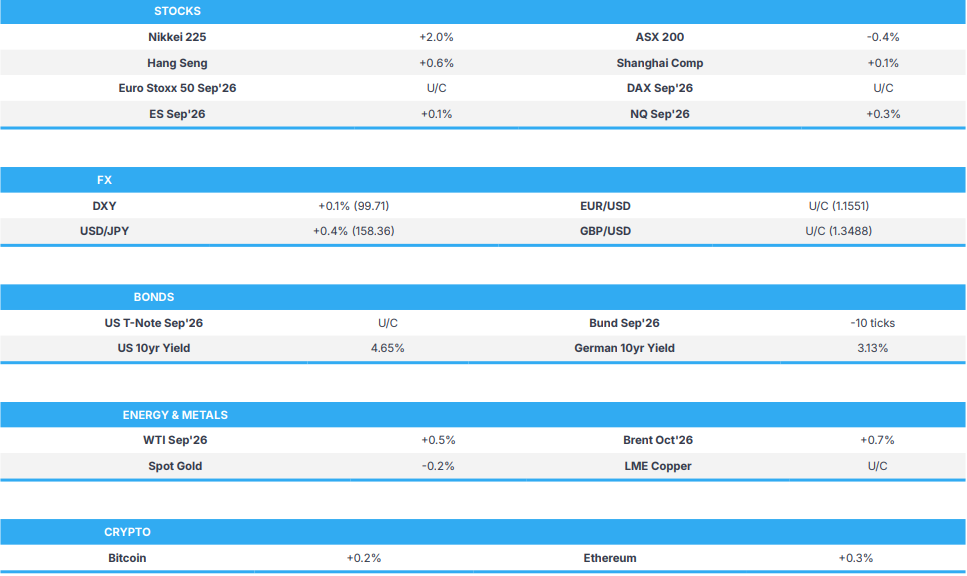
As of 06:20BST/01:20EDT
Newsquawk in 3 steps:
1. Subscribe to the free premarket movers reports
2. Listen to this report in the market open podcast (available on Apple and Spotify)
3. Trial Newsquawk’s premium real-time audio news squawk box for 7 days
LOOKING AHEAD
- Highlights include Norwegian Inflation (Jul), Earnings from Berkshire Hathaway.
- Click for the Newsquawk Week Ahead.
IRAN CONFLICT
- US President Trump told Axios that they are only semi-negotiating with Iran and are just watching Iran with its huge inflation, while he stressed that Iran is in very bad shape economically and has no money to pay its troops, with the US naval blockade exacerbating the Iranian regime’s economic crisis. However, he said it will work out and that it always works out, and compared it to a chess game regarding the back-and-forth with Iran.
- US Vice President JD Vance said the US is in the middle of a game in the Iran conflict.
- Iranian President Pezeshkian said now is the best time for an agreement because Iran is strong, united and seen as victorious in war. Pezeshkian separately commented on Friday that they will not yield to force, but are not seeking war or aggression either, while he added there will be no reason for the tension to continue if the pressure and threats against Iran stop. Furthermore, he said there was no gap between the government and the armed forces, and noted that Iran had solved many problems with its neighbours and relations had improved significantly.
- Iranian Foreign Minister Araghchi said Iran and the US are not engaged in talks, and Tehran will not allow them to start as long as Washington breaches the interim deal signed in June.
- Iran said it is very close to a deal with Oman regarding a new maritime transit route in the Strait of Hormuz, but it renewed a list of demands for the US to agree to before the waterway could open. It was separately reported that Iran warned it will not reopen the Strait of Hormuz unless the US meets a series of conditions, including paying compensation for war damage, according to FT.
- Iran’s Supreme National Security Council issued six demands to the US, including total force withdrawal, end to proxy warfare, financial reparations, sanctions and asset relief, lifting the blockade and cessation of rhetoric.
- The wait for the Iran-Oman deal regarding the Strait of Hormuz dragged on, with Iran warning the US that any pact wouldn’t lead to an immediate reopening of the key waterway.
- Iran appointed Mohsen Rezaei as Secretary of the Supreme National Security Council, while Iran’s Supreme Leader appointed Mohammad Bagher Zolghadr as political adviser.
- UKMTO reported that a vessel near Oman was struck by an unknown projectile, which caused a fire on board but has been extinguished.
- Saudi Arabia put out a fire at its Jazan plant early on Sunday, while Yemen’s Houthis claimed responsibility for the attack on the refinery. It was separately reported that Houthis resumed attacking Yemen’s Mocha port using ballistic missiles and drones, with the attacks aimed at Saudi troop concentrations and weapon depots in the region.
- Israeli PM Netanyahu said Israel does not accept a US-backed 15-point plan for Gaza, under which Hamas would disarm in exchange for a phased Israeli withdrawal from the Palestinian enclave, according to FT. It was later reported by Axios that a US official said the White House is not bothered by Israeli PM Netanyahu’s statement on the Gaza plan and sees it as part of election season in Israel. The official stated, “We understand Bibi’s political needs. We have no problem with it as long as he continues to do what we ask – especially regarding restraining attacks in Gaza”.
US TRADE
EQUITIES
- US stocks closed higher on Friday, with the Nasdaq leading gains, although the advance was broad-based, with the equal-weight S&P 500 (RSP) also firmer, highlighting positive underlying breadth. Sectors were predominantly higher, led by Materials, Consumer Discretionary and Technology, while Energy was the clear laggard. Financials and Communication Services also finished modestly lower. The US Nonfarm Payrolls report was the primary driver of market action, with the surprisingly soft release prompting participants to pare Fed rate hike expectations. The dovish repricing supported equities, Treasuries and precious metals, while weighing on the Dollar. The Treasury curve bull steepened following the report, which showed the US economy unexpectedly shed 23k jobs in July, versus expectations for a 91k increase. Prior readings were also revised sharply lower, with June cut by 37k and May by 66k, leaving the two-month net revision at -103k. However, the unemployment rate unexpectedly fell to 4.1% from 4.2%, moving further below the Fed’s 4.3% year-end projection, although the decline was accompanied by a lower participation rate.
- SPX +0.62% at 7,758, NDX +1.19% at 29,722, DJI +0.28% at 54,042, RUT +1.10% at 3,034.
- Click here for a detailed summary.
NOTABLE HEADLINES
- Fed’s Bowman (voter) said policy is well positioned to bring inflation back to 2% and that she supported keeping the Fed funds rate steady at the July meeting. Bowman also noted that improved inflation data in June and a labour market that has not been a source of inflationary pressure reinforce her case for maintaining current rates and support her view that policy is well-positioned for inflation to return to the target.
APAC TRADE
EQUITIES
- APAC stocks were somewhat mixed, but with most major indices in the green, following last Friday’s gains on Wall Street, where weak jobs data unwound Fed rate hike bets, while oil prices gained in the absence of a formal Strait of Hormuz deal, and participants also digested soft Chinese inflation data.
- ASX 200 was lower amid declines in the top-weighted financial sector following earnings from Westpac, while participants also look ahead to tomorrow’s RBA rate decision, with the central bank widely expected to keep rates on hold, but continue to echo a hawkish tone.
- Nikkei 225 rallied as participants digested the recent slew of earnings, with the top gainers in the index driven by their quarterly earnings results.
- KOSPI traded higher but with upside capped amid the somewhat choppy price action in tech heavyweights and as participants also reflect on earnings releases.
- Hang Seng and Shanghai Comp were in the green, albeit with gains in the mainland contained following softer-than-expected CPI and PPI data over the weekend. Nonetheless, the data is seen to keep prospects of a rate cut in H2 on the table, while the PBoC said on Sunday that it will continue to implement a moderately loose monetary policy in H2, strengthen counter-cyclical adjustment, and take solid steps to promote sustained and improved economic development.
- US equity futures were range-bound following the recent NFP data and unwinding of Fed rate hike bets, while markets continue to await a formalised Oman-Iran deal on the Strait of Hormuz.
- European equity futures indicate a flat market open with Euro Stoxx 50 futures U/C after the cash market closed with gains of 0.3% on Friday.
FX
- DXY eked mild gains amid upside in oil prices and in an attempt to nurse some of Friday’s losses after suffering from the disappointing US Non-farm Payrolls report, which showed an unexpected decline of 23k jobs for July and downward revisions to the prior month. Conversely, the Unemployment Rate was encouraging with a surprise decline to 4.1% (exp. 4.3%, prev. 4.2%), but was accompanied by a lower Participation Rate, while the data resulted in an unwinding of Fed rate hike bets with CME FedWatch Tool now showing a greater likelihood for the Fed to keep rates unchanged at the September meeting.
- EUR/USD took a breather after rallying in the aftermath of the US jobs data, with the single currency remaining at the 1.1500 handle owing to a lack of fresh catalysts from the bloc.
- GBP/USD traded sideways amid quiet pertinent newsflow and recent failure to sustain the 1.3500 status.
- USD/JPY clawed back nearly all of the NFP-triggered losses and returned to the 158.00 territory in a continuation of the gradual rebound from post-intervention lows, while the latest tier-2 data releases and hawkish BoJ Summary of Opinions did little to shift the dial.
- Antipodeans marginally pared some of last Friday’s spoils, but with the reversal limited amid the mostly positive risk appetite and ahead of the conclusion of the RBA’s meeting tomorrow, where the central bank is widely expected to keep rates unchanged but maintain its hawkish language.
- PBoC set USD/CNY mid-point at 6.7884 vs exp. 6.7379 (prev. 6.7904)
FIXED INCOME
- 10yr UST futures lacked direction after whipsawing in the wake of Friday’s US jobs data, in which the NFP report hugely disappointed with an unexpected decline, and the Unemployment surprisingly fell but coincided with a lower participation rate, while the data ultimately resulted in an unwinding of Fed rate hike bets.
- Bund futures returned to beneath the 125.00 level as higher energy prices stoked inflationary pressure.
- 10yr JGB futures retreated with demand hampered amid the upside in oil and rally in Tokyo stocks, while the BoJ Summary of Opinions from the July meeting had little impact but continued to signal a hawkish bias.
COMMODITIES
- Crude futures gapped higher at the open as an Iran-Oman deal on the Strait of Hormuz remained elusive, while Iran’s Supreme National Security Council issued six demands to the US, including total force withdrawal, financial reparations and sanctions relief.
- Spot gold slightly declined and continued to pare its post-NFP move amid higher oil prices.
- UK regulators are readying a framework for tokenised gold as part of plans to encourage digitalisation of financial markets and safeguard London’s dominance in global bullion trading, according to FT.
- Copper futures traded sideways amid the mostly positive risk appetite and as participants digest the recent weak US jobs report and softer Chinese inflation data.
- Unionised workers at BHP’s Port Hedland iron ore operations in Western Australia began rolling 24-hour strikes.
CRYPTO
- Bitcoin eked mild gains in choppy trade on both sides of the USD 65,000 level.
NOTABLE ASIA-PAC HEADLINES
- PBoC said it will continue to implement a moderately loose monetary policy in H2, strengthen counter-cyclical adjustment, and take solid steps to promote sustained and improved economic development.
- China issued a red alert in preparation for approaching Typhoon Dolphin, with more than 1,000 flights cancelled and some rail services suspended.
- BoJ Summary of Opinions from the July meeting stated that a member said Middle East Development, expanding AI-related demand and weak yen all work towards pushing up inflation, while a member said consumer goods inflation is expected to pick up again towards autumn. Furthermore, a member said policymakers should stay alert to upside inflation risks from a weak yen and strong AI-related demand, while there was also the opinion that inflation risks are skewed sharply upward as higher oil costs feed into consumer prices, and global AI demand and Japan’s expansionary fiscal policy support demand.
DATA RECAP
- Chinese CPI MM (Jul) -0.1% vs. Exp. 0.2% (Prev. -0.3%)
- Chinese CPI YY (Jul) 0.5% vs. Exp. 0.8% (Prev. 1.0%)
- Chinese PPI YY (Jul) 3.5% vs. Exp. 3.8% (Prev. 4.1%)
GEOPOLITICS
MIDDLE EAST
- Syria reached an agreement to take control of two Russian military bases, largely ending Moscow’s military presence in the country, according to FT.
RUSSIA-UKRAINE
- Russia struck two oil refineries in Ukraine’s northeastern Sumy region, according to Interfax. It was separately reported that Ukraine’s Odesa port sustained damage from a Russian attack, while Russian authorities said five were killed in a Ukrainian drone attack on Belgorod.
- US President Trump’s special envoy Steve Witkoff and son-in-law Jared Kushner may visit Kyiv and Moscow within the next 7-10 days, according to TASS.
- New Zealand announced additional sanctions targeting individuals and entities supporting Russia’s war against Ukraine, following the passage of a new bill in the US Senate targeting Russia’s oil and gas revenues.
EU/UK
NOTABLE HEADLINES
- French Budget Minister Amiel said they must resist the temptation to delay difficult spending decisions until after next year’s presidential election, as they cannot afford to worsen the wide deficit.
- German Economy Minister Reiche warned that rising support for the far-right AfD could undermine the government’s efforts to attract foreign investors, as it seeks at least EUR 3.75tln in private capital by 2040, according to FT.
end
2.NORTH AND SOUTH KOREA//JAPAN
JAPAN
ED DOWD…
Bessent’s ‘Yentervention’ Does Not Fix Japan’s Underlying Structural Issues
Friday, Aug 07, 2026 – 05:40 PM
Authored by Ed Dowd via ‘Beyond The Narrative’ substack,
…a delicate meal to cook before Midterms…

My conclusions on the Bessent yen intervention:
- The move is a temporary Band-Aid at best and sharp yen strength can historically trigger carry-trade unwinds and risk-asset volatility, but it does not fix Japan’s structural debt or rate differentials. The Fed, BOJ and Treasury are walking a tightrope.
- Consensus is correct that the primary driver is preventing forced sales of Japan’s $1T+ UST holdings that would spike US yields.
- Expanding the FIMA repo facility is a backdoor start to yield-curve control, letting Japan borrow dollars against Treasuries instead of dumping them.
- Bessent is explicitly worried about contagion in his own words by citing the Asian financial crisis trigger from a weak yen and framing the intervention as “stopping an emergency” before it spreads.
- I believe one of the motivations was to delay any major market or yield disruption until at least the midterms.
- Interventions like this rarely stick without fundamental policy shifts and often unleash unintended consequences down the road.
Background
On Friday last week:
July 31 (Reuters) – The U.S. Treasury has informed a number of banks that it may intervene in the Japanese yen market on Friday and that they should “stand ready for future action,” a source familiar with the matter told Reuters.
The notice to banks, channeled through the Federal Reserve Bank of New York, comes a day after Japanese authorities stepped in to prop up the yen, setting the currency up for its biggest weekly rise since February, pulling it off of four-decade lows against the dollar.
News of the potential intervention by the U.S. Treasury helped push the yen higher against the dollar on Friday. It last traded at 159.09 to the dollar after trading as low 163.65 on Thursday.
On Sunday August 2nd Treasury Secretary Scott Bessent confirmed intervention on X:
The Trump Administration delivers for America’s trusted partners. Economic security is national security. And the U.S.-Japan alliance is built on both.
Friday’s coordinated foreign exchange actions countered disorderly yen movements.
Treasury remains attentive and in close communication with our counterparts at MOF and BOJ. We will not hesitate to participate in further joint intervention.
The FIMA Repo Facility is an important backstop. We would encourage it to be upsized in the coming months.
We strongly support Japan’s decisive market and monetary steps to correct the substantial undervaluation of the yen.
The Takaichi government is moving into an exciting new phase of Abenomics, as nearly 15 years of powerful stimulus have created durable, robust underlying economic dynamics.
Market commentary on X quickly coalesced around protecting the US Treasury market. Japan is one of the largest foreign holders of USTs. A collapsing yen raises the risk of liquidation to defend the currency, pushing US yields higher at a politically sensitive moment. Many skeptics noted the fix is temporary and that the yen’s weakness is rooted in Japan’s public-debt burden and policy divergences, not purely speculative overshoot. Without follow-through on BOJ rates and Japanese fiscal discipline, official buying merely delays the inevitable.

In a clip aired on Bannon’s War Room on August 4, Bessent laid out the contagion risk directly: “One of the things that triggered the Asian financial crisis was a very weak Japanese yen that caused a tsunami across Thailand, Indonesia, and Malaysia. Someone asked me, ‘What’s the emergency?’ The emergency is stopping an emergency. We don’t have to wait for the crisis. We can remediate it early.” Bannon’s own brief framing that day was that the effort ultimately keeps Japan financing US deficits so they neither sell nor stop buying Treasuries.
My analysis
I posted this right after the weekend announcement on X:
“Massive, coordinated Yen intervention announced this weekend. Traditionally large delta rapid strengthening of the yen has been associated with risk asset weakness especially global equities. So far this is a 5% down move in USD/JPY (yen strength). Rapid moves can sometimes cause the Yen carry trade to become more expensive and liquidations can occur. In August 2024 a 10% move provided some volatility especially in Japanese equities. The cooks are in the kitchen now and it’s a delicate meal they are preparing.”
Meaning the authorities want to halt the Yen slide but they also don’t want it to strengthen too much and cause the Yen carry trade unwind. The goal is stability. Put another way, we simultaneously don’t want Japanese selling our treasuries out of reserves to defend a weak Yen but we also don’t want to see rapid yen strength cause a cascading global margin call. We saw a milder version of margin call in 2024 when the Yen strengthened 10% very quickly. The market is currently applauding the move. However, a coordinated official bid changes the near-term price action, but it does not erase the underlying positioning or the rate differential that keeps the trade alive.
I agree with the consensus that the core motive is preventing Japanese sales of US Treasuries and that the FIMA expansion is a backdoor beginning of yield-curve control. By letting Japan post Treasuries as collateral for dollar liquidity instead of selling them into the open market, the authorities are effectively capping the upward pressure on US yields. It is a clever, low-visibility way to manage the curve without an explicit Fed QE announcement. Combined with the direct yen purchases, it buys some time. I believe one of the motivations was to delay any major market or yield disruption until at least the midterms. But it is temporary. Japan’s debt dynamics and the need for eventual BOJ normalization remain. History shows these interventions lose effectiveness once markets test the resolve and the size required grows with diminishing returns.
Officials can signal and buy for a while, but without sustained Japanese policy follow-through the yen will eventually drift weaker again, forcing larger and more frequent interventions. Each round raises the risk of the very asset volatility and liquidity events that the cooks are trying to manage. Keep watching the carry-trade heat and the pace of any further coordinated actions…that will tell us whether the meal is cooked well or burnt.
“But everyone who hears these words of mine and does not put them into practice is like a foolish man who built his house on sand. The rain came down, the streams rose, and the winds blew and beat against that house, and it fell with a great crash.” Matthew 7:26-27
end
3. CHINA
4. EUROPEAN AND SCANDINAVIAN COMMENTARIES PLUS NATO
EU/SPAIN/ITALY
EU Cohesion Breaks: Madrid Socialists Impose Border Protections Against Italians After Third World Invasion
Saturday, Aug 08, 2026 – 07:35 AM
Update: Spain is to impose new border controls for flights and ships from Italy as the two countries’ row over the influx of migrants into Ceuta intensifies.
Sky News reports that the Spanish government has confirmed that passport, nationality and visa checks would be conducted for Italian passengers and visitors from other countries arriving from Italy from midnight on Saturday until 7 September.
The Spanish government called Italy’s decision to suspend Schengen travel agreements (following the Spanish enclave’s un-fettered invasion by over 70,000 military-aged male Moroccans), “unjust, contrary to EU interests and discriminatory” and with a full straight face the socialist leadership added that the decision has been taken “amid the persistent irregular migratory pressure” from Italy.

* * *
The unhinged socialists in Madrid are losing their minds over the Italian government’s move to suspend the Schengen travel agreement because it wanted to protect its national sovereignty after the Spanish African enclave of Ceuta was invaded by 70,000 mostly military-aged men.
The migrant invasion, which Elon Musk described as comparable to scenes from “World War Z,” was a complete optics disaster for the socialists in Madrid, and really, for socialists and the far left across the West, who have been hellbent on importing the Third World to install new voting blocs and build political power. Now, that move, via uncontrolled mass migration, has been delegitimized, and countries like Italy have had enough.
Madrid’s socialists say the new border checks are “unfair” and are “affecting the mobility of thousands of passengers.” But really, who cares what socialists in Madrid have to say?
The West is shifting away from the nation-killing policies of uncontrolled mass migration and entering a new era focused on restoring national security after a decade marked by repeated migrant invasion after invasion with disastours consequences.
Interestingly, the socialists responded to the Italian government by stating:
Therefore, we urge the Italian government to rectify the situation, end the checks, and treat Spaniards like all other European citizens. If it fails to do so by Sunday, August 9, Spain will be forced to take proportionate measures to protect the interests and dignity of its citizens.
Immediately after last week’s invasion, 22 European leaders condemned Madrid’s socialist regime over its open-border policies and warned that the mass crossing may have been an act of “hybrid warfare.”
Related:
“We cannot allow uncontrolled mass crossings, the instrumentalization of migration or other hybrid threats to create the perception that illegal entry into the European Union is possible,” EU leaders, including Denmark’s Mette Frederiksen, Italy’s Giorgia Meloni and Germany’s Friedrich Merz, wrote in a letter last week published on X by Denmark’s Ministry of State.
Who organized or facilitated the invasion from the Moroccan side remains a big question. Unverified speculation has pointed to possible US or Israeli involvement, but no evidence has emerged to substantiate those claims.
More speculation:
What is observable is Italy’s quick response under its right-leaning, Trump-aligned government and the resulting political blowback spreading across Europe. Years of uncontrolled mass migration have boosted support for right-wing parties campaigning on border security, national sovereignty, and the restoration of law and order.
END
UK
Kids In Tiny British Village Beg The Government Not To Force Illegal Migrants On Their Home
Saturday, Aug 08, 2026 – 07:00 AM
Authored by Steve Watson via Modernity News,
The children of a quiet Oxfordshire village have been forced to put pen to paper and plead with the Prime Minister himself. Their message is simple and heartbreaking: leave our home alone.

Piddington is a tiny English settlement of roughly 350 people – around 250 adults and just 46 children. The Home Office and Labour government under Andy Burnham intend to place 1,250 single adult male asylum seekers on a former Ministry of Defence site that borders the village, runs along the back of homes, and sits directly against the parish playing field and children’s park.
If the plan proceeds, the number of young men dumped on their doorstep will dwarf the entire local population.
You WILL NOT BELIEVE What Is Happening In This TINY English Village
Microcosm for the whole UK
Residents previously held a symbolic independence vote after the government announced the scheme with zero meaningful consultation. Weeks later the silence from Downing Street continues, so the children themselves have now spoken.
Seven-year-old Rex Perkin wrote: “Dear Andy, We like our village because I and my family walk down to my sister’s grave to see her. I worry I won’t be able to do that anymore. My family has lived here for over 100 years. I love the playing field in Piddington because I go there every week. Thanks Andy.”
Eleven-year-old Tilly West pleaded: “Please, please, please! This is for the 300-400 people in the village as well as dogs who won’t be able to go sniffing in the bushes as much.”
Nine-year-old Orla West was direct: “I do not like this idea because we love our park. We can walk our dogs. We love Piddington.”
Other children echoed the same theme – freedom to play, walk the dog, cycle, and simply be children in the only home they have ever known. Their letters were delivered as adults in the village continue to face a wall of non-response from the government.
Parish Council chair Tim McNally has documented the official silence. Fourteen days after an open letter to Burnham, there was still no engagement. “Families are anxious. Questions are growing. And trust is being tested,” he said. “This is bigger than one village. It’s about whether communities like ours still matter when decisions are made.”
The village has opened a fundraising effort and is weighing further democratic steps, including a referendum on self-determination.
Residents describe a place with deep roots and generations of the same families. One mother whose children wrote letters told reporters the scale would leave them “so outnumbered that it would change our lives completely.”
Another parent noted that even the ability of an elderly grandmother to walk home safely at night is now in question.
The site itself is a long-abandoned munitions area requiring major infrastructure work, yet the government presses ahead with plans for an open facility where men aged 18-65 can sign in and out at will for a minimum of ten years.
McNally has framed the fight as one that now represents more than Piddington. On TalkTV he made clear he feels he is speaking for the country as well as his neighbours.
Conservative MP Joy Morrissey addressed the fears of locals, noting “These mothers don’t want their daughters to [be] raped or molested.”
The official response remains the familiar boilerplate. Number 10 says community concerns are “central” to its reforms, points to a drop in hotel numbers, and claims it will “consider” the children’s letters.
That is little comfort to a village that has already watched its local voice sidelined, its planning powers stripped from the district council, and its future decided in Whitehall.
Piddington’s children are not asking for special treatment. They are asking to keep the ordinary freedoms that previous generations took for granted – walking their pets, playing on the field, growing up without being outnumbered by a sudden influx of foreign fighting-age men whose presence was never put to a democratic vote.
In a country that still claims to value local communities and the safety of its own children, those letters should be impossible to ignore. The government has so far chosen silence.
Your support is crucial in helping us defeat mass censorship. Please consider donating via Locals or check out our unique merch. Follow us on X @ModernityNews.
END
UK
UK Intelligence Suddenly Warns Of ‘Civil War’ Plot Against Migrants… Convenient Demonization?
Monday, Aug 10, 2026 – 02:00 AM
Authored by Steve Watson via Modernity News,
Intelligence officials are warning that a group of Republican extremists in Ireland, known as the New IRA, is preparing a campaign of violence to drive migrants out of the country, complete with talk of civil war and 24-hour ultimatums.

The claims, amplified across major outlets this weekend, arrive at a moment when frustration with mass migration and the crimes linked to it has reached boiling point on both sides of the border.
Whether the threat is as advanced as portrayed, or whether the timing serves to tar ordinary opposition to open borders with the brush of terrorism, remains an open question.
Security sources told the Mail on Sunday that the New IRA has two aims: Irish independence and “all migrants out.”
One source stated: “The New IRA have been very active this year in the North in attacks against the Police Service of Northern Ireland, at Lurgan police station and a car bomb at Dunmurry. They have two aims: Irish independence and all migrants out. We believe it is part of a power struggle going on between factions within the group of the old IRA, the Real and the New IRA, with the new incarnations advocating a campaign of violent intimidation.”
A video circulating on a far-right platform featured an unidentified man declaring: “They will take control, and they will give an ultimatum, not to politicians but to the illegal migrants who are in the country.”
He added: “It is now going to be time for civil war, and that is exactly what these guys are going to be doing and can you blame them? This will be a major wake-up call for the authorities. These guys will show them how it’s done and give them 24 hours to leave.”
UK officials are said to be on alert that any such campaign could push migrants north across the open land border into Northern Ireland and then into Great Britain. The Home Office offered its standard line: “We have a close and collaborative working relationship with Ireland on migration and border security. This includes a mutual commitment to protect the Common Travel Area from abuse, delivered through joint work to identify and tackle migration trends as they emerge.”
The New IRA has been active this year. In July, 25-year-old law student Isobella Perrie Sullivan was charged with possessing explosives after a device was found in a vehicle in the Republic.
The group maintains social-media links with Scottish nationalist circles. Yet the sudden prominence given to its alleged anti-migrant turn sits against a backdrop of repeated, graphic failures of the migration system that the same authorities have struggled to address.
In June 2026, the stabbing of Stephen Ogilvie in Belfast, allegedly by Sudanese asylum seeker Hadi Alodid, triggered serious disorder. Earlier that month an African migrant was filmed in a north Belfast street attack, straddling a local man and attempting to saw his head off with a Stanley knife. Bystanders had to stop him. Official descriptions reduced it to a “stabbing.”https://modernity.news/2026/06/09/belfast-horror-african-migrant-tries-to-saw-off-victims-head-in-street-attack/embed/
The previous summer saw three nights of anti-immigration riots across Northern Ireland after alleged sex crimes involving non-native teenagers in Ballymena. Homes burned, more than thirty officers were injured, and residents marked doors with Union flags simply to avoid being targeted.https://modernity.news/2025/06/13/sex-crimes-spark-three-nights-of-anti-immigration-riots-in-n-ireland/embed/
Footage of two-tier policing continues to surface. In Dungannon, a group of armed foreign youths appeared in a Protestant area carrying knives and sticks. A local man picked up a stick. Police ran past the armed group and arrested him.
Belfast Horror: African Migrant Tries To SAW OFF Victim’s Head In Street Attack
Police and media call it a mere ‘stabbing’ by a ‘man’

Sex Crimes Spark Three Nights Of Anti-Immigration Riots In N. Ireland
Homes, businesses, police attacked as patience with open borders evaporates
 modernity
Against this record, the rapid elevation of a New IRA “civil war plot” risks collapsing legitimate public rejection of mass migration into the same category as paramilitary activity.
The framing is neat. It allows officials and media to present the choice as between “terrorists” and the status quo, while the underlying drivers of anger remain largely untouched.
That pattern sits inside a wider set of warnings that have been issued for years. Professor David Betz of King’s College London has stated that many European countries are already in a pre-civil war condition. “Europe is on track for civil war,” he has said, adding that societies are “past the tipping point.”

Retired Colonel Richard Kemp has been equally direct. He has predicted “not just civil unrest but civil war in the UK in the coming years” because governments lack the will to confront the causes. “The people will feel they have no option than to take action into their own hands,” he has warned.
‘No Prospect’ Of European Governments Preventing CIVIL WAR, Warns British Army Colonel
Says The government doesn’t want to “prevent the Islamification of the UK”

Elon Musk Tells Snooty Leftist Interviewer: Civil war In Britain Is INEVITABLE
Mass migration, not ‘the far right’ brings a ‘reckoning’

What Is This REALLY About? UK Government Announces Mass STOCKPILE Order, WARGAMES
Experts say the real fear is civil conflict born of a fractured society
Elon Musk told an interviewer that civil war in Britain is “inevitable” once a large, rapidly growing population holds beliefs antithetical to Western norms. “If you have a large and growing, rapidly growing, group of people whose beliefs are antithetical to western beliefs, at some point there will be a reckoning,” he said.https://modernity.news/2026/07/24/elon-musk-tells-snooty-leftist-interviewer-civil-war-in-britain-is-inevitable/embed/
Meanwhile the British state continues practical preparations. Households have been urged to stockpile food, water and medicines. Major home-defence wargames are scheduled for 2027. Official explanations point to hybrid threats and Russia. Analysts note the overlap with the internal risks Betz and others have described.https://modernity.news/2026/07/16/what-is-this-really-about-uk-government-announces-mass-stockpile-order-wargames/embed/

Britain’s Descent Towards Civil War is No Accident
Viewing Britain from afar is sobering
Britain’s path has not been accidental. Decades of elite-driven demographic change, two-tier enforcement and refusal to maintain borders have produced the conditions now being exploited.
The sudden focus on a New IRA anti-migrant campaign allows the conversation to shift from those failures to the more comfortable territory of “extremism.”
Ordinary people who simply reject the scale and consequences of mass migration find their concerns quietly folded into the same narrative.https://modernity.news/2025/09/03/britains-descent-towards-civil-war-is-no-accident/embed/
The Common Travel Area once symbolised cooperation. Combined with uncontrolled inflows it has become a pressure valve. Violence or intimidation in one jurisdiction simply moves the problem into the other. Carefully worded assurances about “joint work” do not reverse the changes already locked in.
What is unfolding is not solely a republican revival. It is one more indication that the open-borders experiment has broken the social contract. When street-level reality includes beheading attempts, sex attacks and selective policing, while official messaging pivots to paramilitary threats against migrants, public trust evaporates further.
The New IRA may be small. The decision to elevate its alleged new focus at this precise moment still serves a useful purpose: it reframes resistance to mass migration as something darker than simple self-preservation.
Your support is crucial in helping us defeat mass censorship. Please consider donating via Locals or check out our unique merch. Follow us on X @ModernityNews.
end
GERMANY
Teacher Exposes Chaos: Violence, Drugs, & Prostitution At 75% Migrant School In Germany
Saturday, Aug 08, 2026 – 08:10 AM
A German teacher has described a secondary school in the Rhineland where violence, drug dealing, and severe behavioral problems have become part of everyday life, including one case in which a 15-year-old girl allegedly prostituted herself in the school toilets for drugs and money.

Speaking anonymously to Bild, special education teacher “Carola S.” said around 75 percent of students at her school have a migrant background, with many having arrived from Syria, Iraq, Afghanistan or Ukraine.
“It’s all blowing up in our faces,” she said.
“Every day is a challenge. Fights, shouting — this happens in the classroom and on the schoolyard,” she told the German tabloid.
“We are happy if we can teach for a few minutes at a time. Sometimes the police have to come several times a week.”
She said drugs are also dealt on school grounds and recalled an extreme case involving a 15-year-old pupil.
“A particularly egregious case involved a 15-year-old student who prostituted herself in the school toilets for drugs and money. She became pregnant and left the school.”
Carola said many newly arrived pupils initially speak little German and do not receive grades for their first two years. “After that, the students are graded regularly, but for many, their performance is still unsatisfactory. Some don’t return at all,” she said. “This year, almost 40 percent failed to obtain their secondary school leaving certificate.”
She also described clashes over cultural attitudes, including a Syrian father who objected to his son being taught by a woman.
“It is very difficult for us to reach these parents,” she said.
Carola said she was punched in the face just three weeks ago while attempting to intervene in a fight between pupils.
“I got caught in a fight between students and ended up with a split lip because a student punched me in the face during the scuffle,” she said.
She reported the incident to police, but said the case was subsequently closed.
“This is not an isolated incident. Some colleagues are openly insulted, threatened, or ambushed after school, and this isn’t even reported,” she added. “Many talk about not being able to do the job until retirement. We have a high rate of sick leave.”
The German Teachers’ Association has long accused politicians of failing to respond quickly enough. Its chairman, Stefan Düll, said back in 2024 that preventive measures, social work, school psychology and other support systems had failed to expand in line with demand.
“For too long, politicians have primarily acted reactively,” Düll said. He warned that Germany’s education system is being overwhelmed by immigration, arguing that large numbers of children entering schools with little or no German were placing an unsustainable burden on teachers.
“Due to immigration in 2015, the war in Ukraine and other immigration, new people are constantly coming into the system, but the system is slow to keep up because it is moving too fast,” he said at the time.
“The higher the percentage of immigrants, the more difficult it is to motivate the class.”
Recent incidents have added to concerns over conditions in German schools. In May, a 20-year-old Afghan was remanded in custody after allegedly sexually assaulting an 11-year-old girl inside a school restroom in Koblenz while a 19-year-old suspected accomplice allegedly held the child down.
That same month, authorities announced a regular police presence at the Karolina-Burger high school in Ludwigshafen following 118 criminal complaints, around 100 fire department call-outs and a succession of knife attacks, assaults and threats.
Teachers there had reported death threats including “I’ll shoot you all,” pupils attacking one another, and extensive vandalism. In one of the most serious cases, prosecutors said a 16-year-old girl attacked a teacher with a knife “with the intention of killing her.”
Concerns have also been raised over religious intimidation. In April, Berlin youth worker Wolfgang Büscher warned that some schools were producing what he described as “mini-Islamists,” with pupils allegedly pressuring Muslim and non-Muslim classmates to conform to strict religious practices.
Back in the Rhineland, Carola said teachers increasingly feel abandoned by authorities.
“No one from the school board ever shows up. They’ve left us to fend for ourselves,” she said.
“And then the politicians want to close the secondary schools. Where are the children supposed to go then?”
END
5.RUSSIAN AND MIDDLE EASTERN AFFAIRS
IRAN/ISRAEL /USA/YEMEN FRIDAY NIGHT
US Official: Hormuz Deal Is Imminent, Upon Which US Will Lift Blockade Of Iranian Ports
Friday, Aug 07, 2026 – 05:45 PM
Summary
- US official tells Reuters that US will lift blockade upon Omani deal announcement.
- Bessent: Hormuz could reopen under a 30-60 day ceasefire as soon as “today or tomorrow.”
- Iran asserts that US & Israeli vessels remain barred until sanctions are lifted and compensation is paid.
- Trump says the conflict could “end pretty soon,” signaling a possible final US exit.
- Iran remains defiant, pointing out it still has the leverage & can threaten Hormuz.
- However, the deal could reopen oil flows while strengthening Iran’s control over the strait.
* * *
US to Lift Blockade once Oman Deal Announced
Importantly, Reuters reports late in the day Friday that Washington plans to lift the naval blockade on Iranian ports once the Oman deal is finalized and announced, which Bessent earlier said could be as soon as ‘today or tomorrow’. If the US were to back down militarily in the Gulf, it would cede effective control of the vital waterway to the Iranians. Per Reuters:
Progress is being made between Iran and Oman on the Strait of Hormuz and “we expect a deal soon,” a U.S. official told Reuters on Friday.
Once a deal is announced to restore commercial shipping without impediments, the United States will lift its blockade of Iranian ports, the official said.
“There is progress between Oman and Iran on the Strait, and we expect a deal soon,” the official said. “Once the deal is announced to restore commercial shipping without impediments, the United States will lift the blockade of Iranian ports.”
Iran’s FM is declaring ‘victory’ saying that in the “face of the word’s most expensive military” his country’s forces demonstrated their might and capability…
Bessent: Today or Tomorrow the Strait will be Open; Iran Signals ‘Compensation’
Iran has announced that under the ‘finalized’ Oman-Iran scheme and ‘deal’ for management of the Hormuz Strait that “enemy countries” (read: US and Israel) may only transit the waterway after lifting sanctions and paying compensation for the war.
While this was not issued by the Foreign Ministry or top leadership per se, it does appear to represent Tehran’s overall position, after on Thursday it first declared that US and Israeli-linked ships will not be allowed Hormuz transit under the Oman plan:
Tehran Mayor says Passing through the Strait of Hormuz is subject to the lifting of sanctions and the payment of compensation:
“The countries that have attacked Iran will not have the right to use this strait until compensation is paid. Governments that freeze Iranian assets or continue to impose sanctions and threaten the nation will be deprived of this strategic boon.”
While Treasury Secretary Scott Bessent has appeared to back the Omani plan to reopen the strait, the US State Department has also newly warned on Friday that more ‘decisive action’ will be taken to cut off sources of Iran’s funding. Bessent has newly stated that…
I think shortly, maybe even today, tomorrow, we are going to see an agreement, a 30- to 60-day ceasefire, and the Strait will be open.
This is somewhat surprising, but as we described below, it seems a final Washington exit is indeed in motion, even if it leaves Iran with greater leverage in the region. Like Trump’s latest comments Thursday night, Bessent seems in ‘mission accomplished’ mode with this newly published interview…
This really does sound like ‘it’s finally over’ talk…
END
SATURDAY
Iran Insists US Must Meet Stringent List Of Demands Before Hormuz Opens
Saturday, Aug 08, 2026 – 03:45 PM
As expected, Iran is pressing hard to extract from Washington everything it can get – at a moment the Trump White House seems to be backing down from a heighted war over the Strait of Hormuz, given the serious risk of settling into a another years-long quagmire in the Middle East.
The US administration, including Treasury Secretary Scott Bessent, has appeared to back the Iran-Oman deal for the opening of the Strait, with President Trump and his officials having remained surprisingly quiet even as it has emerged that the deal outline is wholly favorable to Tehran’s conditions.
For example, as we’ve detailed Iran announced Friday that under the ‘finalized’ Oman-Iran scheme and ‘deal’ for management of the Hormuz Strait that “enemy countries” (read: US and Israel) may only transit the waterway after lifting sanctions and paying compensation for the war. US and Israeli-linked ships are currently banned and will be fired upon, Iran has warned.

The White House stayed mum even after that, and didn’t openly push back – nor did Trump fire off any angry Truth Social messages, but focused on some random domestic issues Friday. This even as there was a Friday story in Reuters saying that Washington even plans to lift the naval blockade of Iranian ports once the Oman deal is finalized:
“There is progress between Oman and Iran on the Strait, and we expect a deal soon,” the official said. “Once the deal is announced to restore commercial shipping without impediments, the United States will lift the blockade of Iranian ports.”
And now the Iranians are piling on the demands even more, with on Saturday the NY Times reporting on the country’s top Iranian national security official’s remarks. The security chief has laid out a list of demands and stern set of further conditions.
“Mohammad Bagher Zolghadr, the secretary of Iran’s Supreme National Security Council, issued a statement carried by state media laying out multiple requirements for reopening the strait,” reports the Times.
“He called for the United States to lift its naval blockade and sanctions on Iran, withdraw the U.S. military from around Iran, pay war reparations and release frozen Iranian assets, as well as end attacks on Iran’s allies in the region and threats against the country,”
While other Iranian officials have voiced similar demands, this could represent the ascendancy of the Islamic Republic’s so-called hardline faction within the context of the Oman negotiations. Zolghadr stated “These are the demands of the Iranian people who have been shouting for it relentlessly in the squares and streets for one hundred and sixty days.”
Iran state media has listed them out as follows (machine translation):
1. Never threaten Iran with any language or insult the sanctities of this nation.
2. End the war and aggression against Iran and its allies in Lebanon, Palestine, Yemen, and Iraq forever.
3. Lift the naval blockade and withdraw its military forces (naval and air) from around Iran.
4. Pay the damages of the two wars of aggression and imposition on Iran without any reduction or reduction.
5. Lift the cruel and illegal sanctions against the Iranian nation.
6. Unconditionally release the frozen and stolen assets of the Iranian people.
The NY Times says there’s been no immediate response from the White House when it requested comment; however, it must be remembered that the US was slapping yet more sanctions on Iran within only the last several days.
While the dropping of sanctions seems realistic as part of a deal to end the war, getting the Trump administration to agree to pay compensation for the many billions of dollars in damage done is a very tall ask. But the Iranians no doubt now smell weakness and blood in the water, as the US bombs have fallen silent for over a week at this point, and after Trump reversed course (more TACO) last weekend on the planned ‘harder’ strikes.
Bessent strongly suggested in an interview published Friday that the Hormuz Strait’s reopening was imminent, delivered by a deal that would be finalized ‘today or tomorrow’.
And yet, the Times underscores that:
Even before Mr. Zolghadr’s statement, Iranian officials had hinted on Saturday that the reopening of the strait was not imminent. Hossein Mohebbi, a spokesman for Iran’s Islamic Revolutionary Guards Corps, said that reopening the strait was “not contingent on the Iran-Oman negotiations.”
Iran is in essence saying this ain’t over & wants to extract its pound of flesh, also to ensure it is never attacked again…
Additionally, on Saturday Iran’s army spokesman Amir Akraminia has been quoted by Al Jazeera as saying Iran’s new protocols in the Strait of Hormuz are “irreversible” and shall not be thwarted by the US. “The United States has no choice but to accept the existing situation; otherwise, it will incur costs far greater than those it has faced in the past,” Akraminia said.
In perhaps a good cop, bad cop approach to Washington, Iranian President Masoud Pezeshkian has meanwhile issued a more balanced, less maximalist statement. He expressed that “the war must end at some point, and that his country is determined to adopt the memorandum of understanding as a basis, provided the US abandons the atmosphere of distrust it has created.”
END
IRAN/ISRAEL /USA//SUNDAY
Iran’s Mehr Releases Video Of Supreme Leader Mojtaba Khamenei For ‘First Time’ – Except It’s Old
Saturday, Aug 08, 2026 – 10:30 PM
Update(2210ET): Iran’s state Mehr has purported to release video of Supreme Leader Mojtaba Khamenei for the ‘first time’ since the start of the war, and since he was wounded in a US-Israeli airstrike in the opening days of the attacks of over five months ago. The state-released footage is titled “First Images of the Leader” – and shows the Ayatollah addressing students, after months of speculation over his status, or whether he is even alive. He has not been seen or heard from directly since the war began, amid conflicting reports and accounts. The video has no date or location given. It appears to be in response to recent Israeli media reports alleging his deteriorating health.
However, analysts – as well as social media users in Iran – were quick to identify the footage as old material from his past lectures in Qom. This has in turn resulted in accusations of a cover-up, and that Tehran is in damage control concerning his status. For example, one hawkish US-based think tank researcher and pundit, Jason Brodsky, has commented on the released footage as follows:
This footage is old, from before the war. It was first circulating in March. It’s telling Iran’s regime’s Mehr News feels the need to circulate old video of Mojtaba.
Foreign press reports, including Russian and Chinese state channels, have been reporting the footage soon on the heels of Iranian state media circulating it…
Proof that it is actually archived footage and not in reality recent ‘proof of life’ imagery…
This is the Mehr story indicating the outlet is claiming to publish the images for the “first time” [translation]:
* * *
In another sign of mounting pressure on President Trump to disengage the US armed forces from his failing, five-month war on Iran, America’s top general has been carefully working with other Trump advisers to communicate that continued depletion of the Pentagon’s arsenal is unlikely to alter Iran’s stance, while escalation is likely to backfire, CNN reported on Friday evening, citing “sources familiar with the matter.”
Chairman of the Joint Chiefs Gen. Dan Caine has been using side conversations with cabinet officials — including CIA Director John Ratcliffe, Secretary of State Marco Rubio and Vice President JD Vance — to ensure they have a shared, clear picture of the military situation before they meet with Trump, CNN’s sources say. Summing it up, one said, “Caine is looking for an off-ramp.”

In a July congressional hearing, Caine said “airpower has its limits.” Nicknamed “Razin Caine,” the general said to be reiterating that caution in his behind-the-scenes discussions with likeminded officials who think a major escalation of US attacks on Iran could cause disastrous fallout for the region and US interests.“There really isn’t much else to hit since it is whack-a-mole with drone and missile sites. Bombing power plants would be publicly a lot more significant,” one source said. Others said hitting Iranian infrastructure would likely rally the country’s citizens around the government — even more than the war has done already
Last weekend, the US military seemed poised to carry out Trump’s threat to unleash “the biggest attack since World War II,” but he called it off, at least in part because of profound concerns raised by Saudi Crown Prince Mohammed bin Salman. Iran had promised to wreak havoc up and down the Gulf. “The only ones in favor of the operation were elements of CENTCOM,” said one source, referring to the Pentagon’s Central Command, which is responsible for action in the Middle East. The source also pointed out that Israel also wants escalation of the war.
“I think it is just his way of protecting the military,” a source said about Caine’s cautionary campaign. In addition to squandering the lives of at least 18 US service members and wounding more than 600 more, the five-month Trump-Netanyahu war on Iran has severely depleted the US arsenal. Referring to Army Tactical Missile Systems (ATACMS) and Precision Strike Missiles (PrSM), two sources this week told Reuters that “Washington has used virtually all of these weapons,” further substantiating earlier media reports and think tank studies that sounded alarms over dwindling munitions. It’s not just offensive weapons that are running out: Low air defense missile supplies are also of grave concern, particularly to Gulf states that would face what would likely be a devastating Iranian backlash to a major new US assault on Iran.
Earlier this year, one source criticized Caine for failing to pointedly counsel Trump on the pitfalls of taking on such a well-equipped and geologically-protected adversary. “He’s definitely pulling punches,” the source said then, adding that Caine was much more candid with fellow military officers than with his commander-in-chief. Now, Caine is apparently intensifying his approach. Though warning of the dwindling arsenal, Caine is said to have assured Trump that, if he does order a major escalation, the Pentagon could manage to cause plenty of destruction across Iran. However, it probably wouldn’t put a crack in Iran’s grip on the Strait of Hormuz, much less substantially affect the nuclear situation that was fraudulently advanced as the casus belli — for decades:
END
Trump Says “We Are Low Keying It” With Iran As Options For Walking Away Have Drastically Narrowed
Sunday, Aug 09, 2026 – 04:55 PM
Iran’s IRGC is holding the line, reiterating that the Strait of Hormuz will reopen to international shipping only after the United States accepts all of its conditions, which we outlined previously. Also, on Saturday Iran’s army spokesman Amir Akraminia statedthatIran’s new protocols in the Strait of Hormuz are “irreversible” and shall not be thwarted by the US. “The United States has no choice but to accept the existing situation; otherwise, it will incur costs far greater than those it has faced in the past,” Akraminia said. “The United States has no choice but to accept the existing situation; otherwise, it will incur costs far greater than those it has faced in the past,” Akraminia had added.
On Sunday, a fresh report in The Wall Street Journal states the obvious – that President Trump has fewer and fewer options and is being squeezed, with any opportunity to declare ‘victory’ and make swift exit more elusive than ever, given Washington would have to make huge compromises, including lifting sanctions and paying war compensation to Tehran. Nearly six months ago when the war started, many non-interventionist critics accurately predicted that the current quagmire and catch-22 the US now finds itself in is precisely where things would end up.
“For weeks, President Trump had been laying the groundwork to declare victory in the Iran war should Tehran fully reopen the Strait of Hormuz, even floating the idea privately to senior aides that he’s willing to walk away without a nuclear deal, U.S. officials said,” WSJ writes.

“But that scaled-back objective became more difficult when Iran insisted Saturday on its highest price yet for permitting the free flow of traffic in the waterway, seeking billions of dollars in U.S. payments, the removal of American troops from the region and an end of the U.S. naval blockade, among other things,” the report adds.
In a parallel vein to this scaled-back, lower grade conflict, President Trump has freshly told Axios in a brief interview that “We are low keying it” in the Persian Gulf. This comes after a week ago he called off ‘planned’ ‘harder’ attacks on Iran, which may have been just a bluff all along. Tehran didn’t blink, and it continues to press for maximal demands – as if to put ‘maximum pressure’ right back on Washington.
“We are only semi-negotiating with them. We are just watching Iran with its huge inflation and the fact they have no money,” Trump claimed. According to more from Axios:
- He stressed that Iran “is in very bad shape” economically and has no money to pay its troops. The U.S. naval blockade has exacerbated the Iranian regime’s economic crisis, Trump said.
- At the same time, Trump said that with oil down to slightly over $75 a barrel, U.S. consumers are feeling less pain from the war.
Ironically, this is simply a return to administration talking points which defended the early days and weeks of a war that officials constantly touted would be ‘swift’ and limited.
The US hope was that Iran and its economy would just collapse from within, the masses would take to the streets, and the government of the Ayatollah would be overthrown. This has proven delusional time and again.
Instead, what we see happening is Washington being forced to move its bases back from front line areas in the Gulf, and officials including Trump himself constantly retreating from stated goals, objectives, and red lines. This is on display once again in the Sunday Axios interview:
In the meantime, there have been various op-ed moments throughout the conflict where The Wall Street Journal has cheer-led Operation Epic Fury. But now that political desperation has set in, and the Iranians smell blood in the water – knowing they can play hardball and extract a bigger cost from the US – even the WSJ has been forced to drastically change its tune:
Iran’s ability to essentially choke off the waterway through sporadic missile and drone attacks has proven to be powerful leverage for the country, stalling commercial traffic and roiling global oil markets. Trump has declared repeatedly in recent weeks that the Strait of Hormuz was already fully open, but each of those promises has proven premature.
Now, with less than three months until the midterm elections and the price of gasoline still much higher than it was before the war started in late February, Trump has been looking for ways to tell the American public that the war is won.
It will be quite the spectacle if eventually a desperate Trump White House is forced to lift sanctions and hand over some form of war compensation. WSJ notes further, “One major complication for the Trump administration is money.”
“Iran is seeking billions of dollars in war reparations in addition to an agreement to unfreeze the country’s assets around the world,” the report adds. “Trump has said the White House wouldn’t allow any taxpayer money to go to Iran, although a deal appears unlikely without the U.S. unfreezing some assets, possibly with conditions attached.”
Trump should have listened to the non-interventionists and he wouldn’t have put himself and the American people in this mess. American troops would not have been caught so flat-footed and directly in harm’s way (given what was clearly lack of proper US military planning and preparedness for Iran to fight back as fiercely as it did), and hundreds of Iranian civilian lives – including massacred schoolgirls – would have been sparred.
END
Tehran Doubles Down On Hormuz Demands As Hardline IRGC Commander Promoted To National Security Chief
Monday, Aug 10, 2026 – 08:30 AM
After President Trump said Sunday that the US is now “low-keying it” with Iran and only “semi-negotiating” following a top Iranian security official having laid out multiple stringent conditions for the opening of the Strait of Hormuz, oil is edging higher on Monday.
“We are only semi-negotiating with them. We are just watching Iran with its huge inflation and the fact they have no money,” Trump told Axios reporter Barak Ravid in comments we analyzed earlier, signaling his return to an economic warfare focus. President Trump has fewer and fewer options and is being squeezed, with any opportunity to declare ‘victory’ and make swift exit more elusive than ever, given Washington would have to make huge compromises, including lifting sanctions and paying war compensation to Tehran.
“The Supreme National Security Council will not retreat from these demands, whether in war or in negotiations,” the head of Iran’s Supreme National Security Council Mohammad Bagher Zolghadr has said, in effect doubling down, according to Iran’s Mehr news agency.

Hardline IRGC Commander Moved to Top Security Chief Spot
But speaking of Zolghadr, its been widely reported that a ‘hardline’ former IRGC commander will take his place. The NY Times explains:
Iran is replacing its top national security adviser with a longtime military commander whose appointment could represent a further consolidation of power by the country’s old-guard security establishment.
Mohsen Rezaei, who led Iran’s Islamic Revolutionary Guards Corps during the Iran-Iraq War of the 1980s, will be the new secretary of the Supreme National Security Council, a spokesman for Iran’s president wrote on social media on Sunday. He had been serving as an adviser to Iran’s supreme leader, Ayatollah Mojtaba Khamenei.
Mr. Rezaei is replacing Mohammad Bagher Zolghadr, who stepped into the role when the council’s previous secretary, Ali Larijani, was killed in an Israeli strike during the U.S.-Israeli attacks on Iran earlier this year.
This is yet another likely sign that Tehran sees itself in the driver’s seat, will not back off its demands and conditions for reopening Hormuz, and plans to make an exit from the conflict for Washington as painful as possible, extracting as much as it can while smelling weakness.
Ali Nikzad, Iran’s deputy speaker of the Islamic Consultative Assembly, has emphasized that the Strait of Hormuz is not going to return to its pre-war condition, addressing the body on Monday.
He said, “The Islamic Republic of Iran tried to inform the aggressor and deluded enemy of the fact that the Strait of Hormuz is not going to return to the pre-war conditions during the days of the war.”
“Unfortunately, they tried to pretend not to know, but the passage of time is the greatest teacher for deluded people, and today the American-Zionist enemy, with a strong fist of armed forces, has practically realized that the opening of the Strait of Hormuz has no military solution and must submit to the new order in the region,” Nikzad stated.
Return to Focus on Economic War
He went on to admit that a focus on reducing the country’s economic challenges is at this moment the highest priority. This is where the US hopes to regain some leverage, with the aforementioned Axios interview including the following declarations by Trump:
- He stressed that Iran “is in very bad shape” economically and has no money to pay its troops. The U.S. naval blockade has exacerbated the Iranian regime’s economic crisis, Trump said.
- At the same time, Trump said that with oil down to slightly over $75 a barrel, U.S. consumers are feeling less pain from the war.
- “It will work out. It always works out. It’s like a chess game,” Trump said of the back-and-forth with Iran.
However, the assumption that the Islamic Republic is ever on the verge of economic panic and collapse is the same talking point that existed at the very start of Operation Epic Fury – and there’s as yet been no snowball. Instead in some ways the population and leadership may have ‘toughened’ and adapted amid wartime conditions.
“Iran is not overplaying. It’s just playing its hand.”
Three Scenarios of Iran’s Strategy
Trita Parsi, who is co-founder and executive vice president of the Quincy Institute for Responsible Statecraft and co-founded the National Iranian-American Council (NIAC), lays out three scenarios on Iran’s potential strategy.
“The NYT reports that Iran has effectively rejected a deal on the Strait and presented a list of very hard-line demands in order for an agreement to be reached,” he wrote over the weekend. “My understanding of what has transpired differs somewhat. I see three possible interpretations, some of which overlap with the NYT’s reporting”…
1. There are divisions within the Iranian system in which hardline elements want to prolong the talks and have the current blockade inflict more damage on Trump and the global economy. Their narrative is that Iran agreed to the MOU too quickly, which contributed to the MOU’s deterioration later. Tehran should have held out longer then, and it should also do so now, essentially. A variation of this explanation is what the USG is advancing: The lack of agreement is because of divisions in Iran.
2. Rather than a division, it may also be that a united system is seeking to prolong the talks to pressure the US. As such, a narrative of divisions in Iran may be seen as helpful, as it diverts from an arguably more problematic reality: The more flexible elements within the Iranian system also agree that talks should be prolonged.
3. The Iranian narrative, however, is that new elements were added to the talks at the last minute by the US and that Iran’s on-the-surface hardened position is a reaction to what Tehran says is an attempt by the US to move the goalposts. Whether this is true or not, Tehran has tended to react in this manner (escalation) when it believes the US has shifted its position or added additional demands at the last minute. This is, however, not a denial of Zolghadr’s list of demands.
Parsi concludes: “That list is an accurate reflection of Iran’s broader goals, but ultimately, they won’t be its demands for the immediate deal on the Strait. If the truth is closer to the third explanation, then a deal may still be within reach in the short term.”
Weekend & Overnight Developments
- Iranian Foreign Minister Araghchi said Iran and the US are not engaged in talks, and Tehran will not allow them to start as long as Washington breaches the interim deal signed in June.
- Iran said it is very close to a deal with Oman regarding a new maritime transit route in the Strait of Hormuz, but it renewed a list of demands for the US to agree to before the waterway could open. It was separately reported that Iran warned it will not reopen the Strait of Hormuz unless the US meets a series of conditions, including paying compensation for war damage, according to FT.
- Iran’s Supreme National Security Council issued six demands to the US, including total force withdrawal, end to proxy warfare, financial reparations, sanctions and asset relief, lifting the blockade and cessation of rhetoric.
- The wait for the Iran-Oman deal regarding the Strait of Hormuz dragged on, with Iran warning the US that any pact wouldn’t lead to an immediate reopening of the key waterway.
- UKMTO reported that a vessel near Oman was struck by an unknown projectile, which caused a fire on board but has been extinguished.
- Saudi Arabia put out a fire at its Jazan plant early on Sunday, while Yemen’s Houthis claimed responsibility for the attack on the refinery.
- It was separately reported that Houthis resumed attacking Yemen’s Mocha port using ballistic missiles and drones, with the attacks aimed at Saudi troop concentrations and weapon depots in the region.
- Israel again targeted Alia Al-Tahir Hill in the Al-Nabatiyeh a governorate in southern Lebanon with artillery fire, according to IRNA
- Israeli PM Netanyahu said Israel does not accept a US-backed 15-point plan for Gaza, under which Hamas would disarm in exchange for a phased Israeli withdrawal from the Palestinian enclave, according to FT.
- US official said the White House is not bothered by Israeli PM Netanyahu’s statement on Gaza plan and sees it as part of election season in Israel, according to Axios
- The Iranian parliament’s National Security and Foreign Policy Committee on Sunday approved the general outlines of a bill to manage the Strait of Hormuz, according to ISNA.
END
MONDAY
Trump Finally Responds To Iran’s Demands, Counters US Is Owed “Compensation,” Stops Short Of New Threats
Monday, Aug 10, 2026 – 12:45 PM
Summary
- Trump demands Iran compensate the US and families of fallen soldiers, but issues no new military threats.
- US again pivots to economic warfare: Trump says Washington is “low-keying it” and betting Iran’s economic weakness will force concessions.
- Iran digs in on Hormuz: Tehran says the Strait will not return to pre-war conditions without major concessions.
- Hardliners gain influence: Former IRGC commander Mohsen Rezaei is set to take Iran’s top security post.
- Deal remains elusive: Tehran appears intent on prolonging talks and extracting maximum concessions from Washington.
* * *
Trump Belatedly Responds to Iranian Demands
President Trump on Monday has very belatedly responded to the Iranians after they issued new demands over the weekend, or conditions for reopening the Strait of Hormuz, after declaring a ban on all US and Israeli-linked vessels.
Noting that the Iranians are now asking for war compensation, Trump is seeking to turn it around and now demands compensation from Iran “for all of the people that they have killed and gravely wounded with their roadside bombs and many conflicts, for which they are famous…”. He also asserted that American families of fallen soldiers should be paid.
Interestingly and tellingly, unlike many prior Truth Social posts related to Iran, Trump did not issue any new threats or ultimatums saying what he will ‘do’ to the country if it doesn’t comply. This perhaps reveals he’s out of answers or new strategy, and doesn’t wish to escalate militarily. The statement comes on the heels of the president telling Axios on Sunday that the US is now “low-keying” it and primarily turning back to prolonged economic warfare to strangle the Iranian economy.

Trump “Low-Keying It” As Iran Doubles Down on Demands
After President Trump said Sunday that the US is now “low-keying it” with Iran and only “semi-negotiating” following a top Iranian security official having laid out multiple stringent conditions for the opening of the Strait of Hormuz, oil is edging higher on Monday.
“We are only semi-negotiating with them. We are just watching Iran with its huge inflation and the fact they have no money,” Trump told Axios reporter Barak Ravid in comments we analyzed earlier, signaling his return to an economic warfare focus. President Trump has fewer and fewer options and is being squeezed, with any opportunity to declare ‘victory’ and make swift exit more elusive than ever, given Washington would have to make huge compromises, including lifting sanctions and paying war compensation to Tehran.
“The Supreme National Security Council will not retreat from these demands, whether in war or in negotiations,” the head of Iran’s Supreme National Security Council Mohammad Bagher Zolghadr has said, in effect doubling down, according to Iran’s Mehr news agency.
Hardline IRGC Commander Moved to Top Security Chief Spot
But speaking of Zolghadr, its been widely reported that a ‘hardline’ former IRGC commander will take his place. The NY Times explains:
Iran is replacing its top national security adviser with a longtime military commander whose appointment could represent a further consolidation of power by the country’s old-guard security establishment.
Mohsen Rezaei, who led Iran’s Islamic Revolutionary Guards Corps during the Iran-Iraq War of the 1980s, will be the new secretary of the Supreme National Security Council, a spokesman for Iran’s president wrote on social media on Sunday. He had been serving as an adviser to Iran’s supreme leader, Ayatollah Mojtaba Khamenei.
Mr. Rezaei is replacing Mohammad Bagher Zolghadr, who stepped into the role when the council’s previous secretary, Ali Larijani, was killed in an Israeli strike during the U.S.-Israeli attacks on Iran earlier this year.
This is yet another likely sign that Tehran sees itself in the driver’s seat, will not back off its demands and conditions for reopening Hormuz, and plans to make an exit from the conflict for Washington as painful as possible, extracting as much as it can while smelling weakness.
Ali Nikzad, Iran’s deputy speaker of the Islamic Consultative Assembly, has emphasized that the Strait of Hormuz is not going to return to its pre-war condition, addressing the body on Monday.
He said, “The Islamic Republic of Iran tried to inform the aggressor and deluded enemy of the fact that the Strait of Hormuz is not going to return to the pre-war conditions during the days of the war.”
“Unfortunately, they tried to pretend not to know, but the passage of time is the greatest teacher for deluded people, and today the American-Zionist enemy, with a strong fist of armed forces, has practically realized that the opening of the Strait of Hormuz has no military solution and must submit to the new order in the region,” Nikzad stated.
Return to Focus on Economic War
He went on to admit that a focus on reducing the country’s economic challenges is at this moment the highest priority. This is where the US hopes to regain some leverage, with the aforementioned Axios interview including the following declarations by Trump:
- He stressed that Iran “is in very bad shape” economically and has no money to pay its troops. The U.S. naval blockade has exacerbated the Iranian regime’s economic crisis, Trump said.
- At the same time, Trump said that with oil down to slightly over $75 a barrel, U.S. consumers are feeling less pain from the war.
- “It will work out. It always works out. It’s like a chess game,” Trump said of the back-and-forth with Iran.
However, the assumption that the Islamic Republic is ever on the verge of economic panic and collapse is the same talking point that existed at the very start of Operation Epic Fury – and there’s as yet been no snowball. Instead in some ways the population and leadership may have ‘toughened’ and adapted amid wartime conditions.
“Iran is not overplaying. It’s just playing its hand.”
Th
ISRAEL TBN
GAZA/HAMAS/ISRAEL
Israel officially rejects BoP 15-point plan for Gaza’s reconstruction, Netanyahu declares
Speaking at a cabinet meeting, PM says IDF ‘will not carry out any withdrawal until Hamas is genuinely disarmed’ • Netanyahu: Iran knows Israel will deal ‘powerful blow’ if it strikes

Palestinians walk past the rubble of residential buildings destroyed during the war, at Jabalia refugee camp in the northern Gaza Strip, August 5, 2026.(photo credit: Mahmoud Issa/Reuters)ByMIRIAM SELA-EITAM, DANYA SAPERSTEIN, TZVI JASPERAUGUST 9, 2026 14:07Updated: AUGUST 9, 2026 15:21
Israel rejected the 15-point plan for the Gaza Strip proposed by the Board of Peace, Prime Minister Benjamin Netanyahu declared while speaking in a Sunday afternoon cabinet meeting.
“Israel rejects the 15-point Gaza document proposed by the Board of Peace,” Netanyahu said. “The IDF will not carry out any withdrawal until Hamas is genuinely disarmed.”
Netanyahu also reiterated his opposition to the establishment of a Palestinian state.
“As for the Gaza Strip, first of all, I want to make the main point clear: as long as I am prime minister, there will be no Palestinian state, not in Gaza and not in Judea and Samaria. Neither ‘Fatahstan’ nor ‘Hamastan,'” he said.
Netanyahu added that Israel was currently in talks with the US about the disarmament of Hamas, but emphasized that it would need to be “genuine disarmament, not fictitious disarmament.”

“When I say Hamas is disarmed, that means the heavy weapons, the less heavy weapons, all the weapons,” he said.
Israel would stand its ground on which US proposals it finds unacceptable, Netanyahu added.
Netanyahu also addressed rumors regarding Israel’s activity in Lebanon.
“In recent days Israel has acted forcefully in Lebanon, eliminating terrorists, including in the Ali Taher Ridge,” Netanyahu said, although he added that he could not elaborate on the matter, just saying Israel was conducting “very important activity.”
Senior Hamas official says Hamas remains committed to plan
Senior Hamas official Basem Naim told Reuters that the terror group expects mediators and the US to “press Netanyahu and his government to adhere to the roadmap.”
Naim said that Hamas remains committed to the roadmap agreed with in Cairo.
Netanyahu says he values ‘historic partnership’ with US, Trump
Speaking on Iran, Netanyahu said that Iran was keeping from striking Israel as it “knows what a powerful blow we [Israel] will deal it if it does.”
Netanyahu also expressed his appreciation for US President Donald Trump and the alliance between Israel and the US regarding keeping Iran from attaining nuclear weapons.
Earlier on Sunday, Army Radio reported that Netanyahu and Defense Minister Israel Katz quietly approved new development and reconstruction in the Gaza Strip two weeks ago.
According to Army Radio, the location marked for new construction is east of Rafah, within the Yellow Line, with the plan being to build new living spaces for Palestinians outside of Hamas’ control.
Security sources said that the workers involved in the construction would be Gazan Palestinians, who are currently having their background checked by the Shin Bet (Israeli Security Agency).
Smotrich welcomes Netanyahu’s rejection of the plan
Finance Minister Bezalel Smotrich commended Netanyahu’s statements, saying he “welcomed the prime minister’s unequivocal clarification.”
“We went to war with one central objective: the destruction of Hamas militarily, civilly, and as a governing authority. That means there can be no Hamas in Gaza the day after, and Gaza must not pose a threat to Israeli citizens and residents of the South for many years to come. This roadmap runs 180 degrees contrary to that objective,” Smotrich said.
Smotrich also stated that all reconstruction in Gaza would first require complete Hamas disarmament.
“The objective of the war to which we are committed is clear: a situation in which there is no Hamas in Gaza…we will not give up even a fraction of that objective,” he said.
END
HAMAS/GAZA/ISRAEL
Anti-Hamas Gaza clans inflict heavy losses, pose ‘day after’ dilemma for Israel
Since the ceasefire was declared, the clans have helped secure the Yellow Line and the area west of it, while also assisting in locating weapons and terrorist infrastructure above and below ground.

Palestinians live among buildings destroyed during the recent war in Khan Yunis, in the southern Gaza Strip, July 31, 2026.(photo credit: ABED RAHIM KHATIB/FLASH90)ByAMIR BOHBOTAUGUST 9, 2026 11:37Updated: AUGUST 9, 2026 15:36
Armed Bedouin clans in the Gaza Strip have fought Hamas’s military wing, inflicting significant casualties, and are now helping secure areas west of the Yellow Line and locate weapons and terrorist infrastructure, security officials said Sunday.
Since the ceasefire was declared, the clans have continued operating discreetly, assisting security forces in securing the area and locating weapons and terrorist infrastructure both above and below ground.
One security official described the clans’ operations as deliberately discreet.
“The activity of the anti-Hamas clans is intimate, kept in the shadows, and that is a good thing,” the official said, adding that “it is very effective and is proceeding according to plan.”
Some security officials worry about supporting the clans for the future
However, opinions within the security establishment on the future of the Bedouin clans’ operations are divided.

Other figures within the security establishment have warned of the risks involved in supporting the clans ahead of “the day after.” Some of the clans’ commanders were previously involved in criminal activity that both Hamas and the IDF sought to combat.
Walla learned that senior officials on the Peace Council, with US backing and support, want the Bedouin clans, which are based in more than three locations across the Gaza Strip, to be disarmed “the day after.”
Meanwhile, the Israeli security establishment is planning to keep some of the clans inside the Yellow Line under the IDF’s operational responsibility in order to protect them from harm. Peace Council officials, by contrast, believe the clans should be returned to Palestinian territory as part of a future IDF withdrawal to the regular border line.
Security officials have described the issue as a “minefield” that the political echelon is in no hurry to address, instead keeping it as leverage against both the Hamas leadership and the Peace Council.
One official warned that once the clans are stripped of their weapons, they will return to their previous activity: smuggling.
At this stage, despite close daily cooperation between the IDF, other Israeli security bodies, American officials, and the Bedouin clans, the possibility of transferring the clans into Israeli territory has not been raised.
Bedouin clans exerted control during IDF ground maneuver in Gaza
In September 2025, it was reported that as the IDF carried out its ground maneuver in the Gaza Strip and fighting with Hamas intensified, armed clans across Gaza demonstrated control over the areas in which they lived, according to sources in the Southern Command.
According to one military source, the clans stationed hundreds of operatives at the entrances to various territories in an effort to repel Hamas security forces seeking to strengthen their control on the ground.
Among those forces is the “Arrow Unit,” a forceful and violent Hamas unit involved in arrests, assaults, and the killing of people accused of collaborating with Israel.
END
IRAN
Iran’s Economy Is In Shambles As War Takes Its Toll
Saturday, Aug 08, 2026 – 12:15 PM
Despite the bluster from Iranian officials on social media, it should come as no surprise that the country is not doing well economically. From the beginning of the conflict to current day, Iran has been dealt an estimated $270 billion to $300 billion in total damage due to a steady barrage of strikes, including numerous infrastructure targets from bridges, highways, railways, airports, etc.
The three-month-long US blockade on Iran’s oil exports have also taken a toll, with national oil output dropping from 2.2 million bpd to less than 300,000 bpd. It is likely that there has been some long term damage to the regime’s oil wells and they have lost approximately $6 billion in oil revenues so far.
With a general information blackout in place, getting a proper estimation of the damages can be difficult. However, in recent months many Iranian leaders and media sources have indicated a dangerous shift in the stability of the country. The situation has become so volatile that citizens are reportedly turning to theft in order to get their hands on basic necessities including food.
Iranian newspaper Jahan-e Sanat has reported increased theft of basic groceries over recent months, with store workers linking the trend to rising poverty. Related reports say meat is in short supply, there is reduced consumption of staples, subsidy shortfalls, and broader poverty pressures.

Analysts note that while full state collapse or famine has not yet occurred, the combination of high food inflation, currency weakness and job losses is placing severe strain on households. Iran’s President, Masoud Pezeshkian, seemed to confirm the decline last week when he noted that the country was facing economic “difficulties and problems,” while claiming the enemy was trying to provoke protests.
At Iran’s 33rd Conference on Monetary and Banking Policies (around June 2026), he questioned why people wake up to find their purchasing power has fallen and stated there are “hundreds of ways to overcome the economic impasse.” He noted that policymakers take people’s money and “return it with reduced value.”
Central Bank Governor Abdolnaser Hemmati presented a recovery roadmap and acknowledged an ongoing GDP contraction. He stated that “the combination of war and cruel sanctions has posed serious challenges to the country’s economy. Most importantly, people’s livelihoods have been severely affected because various sectors of the economy have been impacted by sanctions.”
He also cited inflation at around 53%, which appears to be a underestimation of the real currency destruction taking place.
Government spokeswoman Fatemeh Mohajerani has discussed infrastructure damage (e.g., bridges, tunnels, gas and electricity capacity losses), adjustments to gasoline rations, and challenges with subsidy payments disrupted by banking issues or cyberattacks.
These admissions are often wrapped in claims of resiliency despite the crisis, but the biggest danger (inflation) has yet to fully play out. SCI data for the Persian month of Khordad (ending ~June 21, 2026) showed overall year-on-year inflation of 88.6% (up from pre-escalation levels around 50%). Food inflation reached 134%, with oils/fats at 278%, red meat/poultry at 178%, and bread/cereals at nearly 139%.
The rial hit record lows of around 1.5–1.9 million per USD at various points during the war. This has amplified import costs and eroded purchasing power.
Crippling infrastructure damage and currency devaluation might help to explain Iran’s desperate insistence on charging tolls in the Strait of Hormuz. If their oil industry is facing a multi-year setback and damage to infrastructure is extensive, tolls on shipping through the strait may be their only source of economic recovery.
Iranian citizens turning to theft to make ends meet is a far more profound issue than a similar trend would be in the US or Europe. In Iran, punishment for a first offense for theft of food is three months to one year of incarceration and up to 74 lashes. Multiple thefts can result in the amputation of fingers, life in prison or execution. The point is, stealing is no small matter in Iran and for people to turn to theft suggests extreme economic derailment.
Even if the war ends this week as negotiations reportedly carry forward, Iran faces a long and arduous road to recovery. It is likely that a collapse of the existing system is inevitable. Whether or not this actually leads to civil unrest as the regime fears is anyone’s guess.
END
IRAN
UN Sounds Alarm As Iran Steps Up Executions To Silence Dissent
Sunday, Aug 09, 2026 – 10:30 AM
Authored by Tom Ozimek via The Epoch Times,
The United Nations human rights chief has expressed alarm over a sharp increase in executions and death sentences in Iran, warning that authorities are using capital punishment to intimidate the population and suppress dissent.
“I am alarmed by the rise in executions and death sentences issued in Iran since March, and that capital punishment continues to be used to instill fear among the population and suppress dissent,” U.N. High Commissioner for Human Rights Volker Türk said in an Aug. 5 statement. source

Türk said that since March 19, at least 56 people have been executed on national security-related charges, including 27 in cases connected to protests earlier this year.
More than 100 others face possible execution on similar charges, while executions for drug-related offenses are also continuing at what he described as an “alarming rate.”
He raised concerns about alleged torture, forced confessions, closed-door proceedings, and the rapid execution of some defendants following their arrests.
“Persistent lack of fair trial and due process guarantees are deeply troubling,” he said.
Confessions were allegedly obtained through torture and other forms of ill-treatment, while several executions were reportedly carried out in public. Some defendants were executed only weeks after being arrested, according to Türk.
In one case, 12 defendants were sentenced to death following a single closed-door hearing lasting three hours, he said.
Separately, an independent United Nations fact-finding mission in July urged Iran to halt the executions of 10 men who participated in protests in Isfahan. It also condemned the July 19 executions of two other men sentenced in the same case.
In a statement, the mission called on Iran “to immediately halt all executions, including those of individuals convicted in connection with the protests, and establish a moratorium on the use of the death penalty with a view to its abolition for all crimes.”
Protests and War
The increase in executions has unfolded since the United States and Israel launched a bombing campaign against Iran in late February, following widespread anti-government protests in the country that began amid soaring inflation, economic hardship, and shortages.
The clampdown by the Iranian regime left thousands dead and thousands more detained, according to the United Nations, while Iranian authorities imposed an internet blackout that lasted for months.
Dr. Marjan Haghighi, an Iranian-Australian health professional and human rights advocate, said the increase appeared intended to discourage further opposition to the ruling regime in Iran in the wake of the January protests.
“Following those protests, I believe the authorities shifted from suppressing demonstrations in the streets to using executions to instill fear throughout society,” Haghighi told The Epoch Times in an emailed statement.
“Every new execution sends another message to society that dissent may carry the ultimate price,” she said.
Haghighi said Iran’s strict censorship makes independent reporting difficult and that many executions are never publicly announced.
“The true number of executions is significantly higher than what the world sees,” Haghighi said.
Iranian officials have previously rejected international criticism of the country’s human rights record while defending the use of capital punishment as lawful under Iranian law and necessary to protect public security.
Iran’s diplomatic mission to the United Nations did not respond to a request for comment by publication time.

People wade in the water with cargo ships at anchor in the background, in the Strait of Hormuz off Bandar Abbas, Iran, on June 30, 2026. Amirhosein Khorgooi/ISNA via AP
The surge in executions is taking place as the U.S.–Iran war is into its sixth month and Washington maintains military and economic pressure on Tehran.
President Donald Trump said on Aug. 6 that he believed the conflict would end soon, telling reporters that Iran could not sustain it much longer.
Trump said negotiations over reopening the Strait of Hormuz were progressing, although Iranian officials have denied that they are negotiating directly with Washington.
The United States has maintained its naval blockade of Iranian ports in order to compel Tehran to come to the table and agree to a negotiated settlement to the conflict.
Classicist and military historian Victor Davis Hanson said in recent commentary for The Epoch Times that Tehran appeared to be alternating between talks and attacks to delay a settlement and outlast the Trump administration politically.
Hanson opined that the shifting public negotiations obscured the mounting pressure inside Iran from the blockade, frozen assets, damaged infrastructure, and falling export revenue.
While critics contend that Washington risks becoming bogged down in a prolonged conflict, Hanson said the underlying conditions suggested that “Iran is running out of time.”
Trump has repeatedly said that months of U.S. strikes have decimated Iran’s military and that Tehran’s only remaining leverage is its ability to menace commercial shipping in Hormuz with naval mines and fast boats.
The U.S. president has threatened Iran with a vastly more intense and destructive wave of strikes if Tehran does not agree to a deal that would both reopen the strait and ensure that the regime never acquires nuclear weapons.
END
TURKEY
Turkey Restricts Black Sea Traffic As Drone Attacks On Commercial Vessels Spike
Sunday, Aug 09, 2026 – 07:00 AM
Turkey has begun restricting commercial ship traffic into the Black Sea amid a surge in Russian and Ukrainian attacks on civilian vessels, Bloomberg reported Saturday.
Turkiye’s Directorate General of Coastal Safety has informed several ships heading to Novorossiysk, an important Russian oil and grain export port, that it is not issuing transit permits at this time and requires more time to review passage applications through the Dardanelles.

The sources told Bloomberg that Turkish authorities had provided no explanation for the move. Some vessels have also reportedly been told that the restriction applies to ships heading to Ukraine.
The report comes after a series of drone attacks targeting Turkish commercial vessels operating in the Black Sea and near Russian ports in recent months.
On Friday, a Turkish-flagged vessel, the MV Gulluk, was struck by a drone off the Russian port of Novorossiysk. Although the drone hit the ship’s living quarters, no crew members were reported injured or killed.
On August 3rd, the Ro-Ro cargo vessel Nadezhda was struck by a drone about 20 nautical miles off Novorossiysk while en route from the Russian port to Samsun. Three members of the ship’s crew were injured and in serious condition after the attack. The same day, two civilian vessels, the Yasar and the Nadezhda, were attacked after leaving Novorossiysk.
In response, Turkiye’s Foreign Minister issued a statement saying it was “deeply concerned about the escalating conflict between Russia and Ukraine in the Black Sea, which is affecting civilian shipping despite our numerous warnings.”
“Unless preventive measures are taken, the escalation in the Black Sea will have multifaceted negative repercussions, including for food security,” the statement added.
Ukraine’s targeting of ships in the Black Sea, as well as Russia’s attacks on Ukrainian port infrastructure and vessels, have threatened grain exports from both countries, pushing wheat prices to a two-year high in July.
“Russia is the world’s largest wheat exporter, and Ukraine is known as Europe’s breadbasket, while mutual attacks between the two countries are putting pressure on maritime transport in the region during the harvest season,” Anadolu Agency reported.
Global food prices already spiked as a result of soaring energy prices following the closure of the Strait of Hormuz in the Persian Gulf earlier this year. Iran closed the strait in response to the US-Israel war of aggression, disrupting oil and natural gas exports from the Gulf countries partnering with the US and Israel in the war.
Global fuel prices have also risen in response to Ukrainian drone attacks on Russian oil refineries. On Saturday, a Ukrainian drone targeted the Ilsky oil refinery in Russia’s southern Krasnodar region, causing it to catch fire.
Ukraine’s general staff said the Ukrainian military also hit the Syzran oil refinery in the Samara region of Russia overnight, causing a fire there as well.
The Ilsky refinery can process over 6 million metric tons of oil per year, while the Syzran refinery has a processing capacity of 8.5 million tons annually.
In May, Reuters estimated that disruptions associated with the wars between the US and Iran and between Russia and Ukraine together had knocked out nearly 9 percent of global refining capacity.
END
RUSSIA /UKRAINE
Ukraine Faces Growing Air Defense Crisis As Patriot Supplies Dwindle
Saturday, Aug 08, 2026 – 10:30 AM
Via RFE/RL,
- Ukraine failed to intercept any of the 24 ballistic missiles and four Zircon cruise missiles Russia fired in the August 5 attack, underscoring the strain on its missile defenses.
- U.S. Patriot availability has become a significant constraint after extensive interceptor use during the Iran conflict.
- Kyiv is increasingly seeking European inventories, expanded production, and eventually licensed or joint Patriot manufacturing to secure its air defenses ahead of winter.
Ukraine’s failure to intercept a single Russian missile during a large-scale overnight attack this week has raised fresh concerns over Kyiv’s dwindling supply of air-defense interceptors as Moscow escalates its ballistic missile strikes on the nearly defenseless capital and other regions.

Ukrainian President Volodymyr Zelenskyy has warned that deliveries of anti-ballistic interceptor missiles from partner countries have fallen sharply, leaving Ukraine vulnerable to deadly attacks that are being launched by Russia with increasing frequency.
Following a meeting with Ukraine’s military leadership on protecting critical infrastructure on August 2, Zelenskyy said Ukraine had received only a third as many air-defense interceptors this year compared to the same period in 2025.
“Our partners have the missiles. What is needed are the necessary political decisions on deliveries and on accelerating production, including localization in Ukraine,” Zelenskyy said.
Latvian Foreign Minister Baiba Braze, who was in Kyiv during the most recent attack on August 5, condemned Russia’s latest strikes, which lit up the late-night skies with balls of flames from massive explosions.
“It was a vile attack on Ukrainians. I was hiding in the shelter along with a number of them and admiring their resilience. Russia is a terrorist state and needs to be contained,” she wrote on X.
Ukrainian Foreign Minister Andriy Sybiha also urged allies not to slow military assistance.
Speaking on August 5, he said:
“Russian strikes take no summer vacation; support for Ukraine and pressure on the aggressor must not pause, either. Every interceptor counts. They are life-saving tools.”
US Stockpile Questions
Patriot interceptor missiles remain Ukraine’s most effective defense against Russian ballistic missiles, but questions are growing over how many additional interceptors Washington can realistically provide.
Last week, the Center for Strategic and International Studies (CSIS) estimated that the United States has used more than half of its Patriot PAC-3 MSE and THAAD interceptor inventories during its military operations against Iran this year.
The report estimated that US stocks of Patriot PAC-3 MSE interceptors have fallen from more than 2,300 before the conflict, which began in February, to roughly 800, while THAAD interceptor inventories have been nearly halved.
Mark Cancian, a senior adviser with CSIS and co-author of the report, told RFE/RL that the shortages leave Washington with little flexibility to supply Ukraine.
“Ukraine will not be able to expect many interceptors — or any interceptors — from the United States for quite a while,” Cancian said.
“The US has used extensively its own inventories…. We’re down to about 800 or 900 [Patriot interceptors]. The war planners don’t want to go below that, so it would be very difficult to provide any of those or any new production to Ukraine.”
Cancian said Ukraine may instead have to seek Soviet-designed S-300 missiles from countries that still operate the system and intensify efforts to destroy Russian missile launchers before they can fire.
His assessment contrasts with public assurances from the Trump administration.
CNN, citing unnamed officials, reported on August 4 that Patriot inventories had fallen to “dangerously low” levels. Defense Secretary Pete Hegseth rejected that report, calling it “fake news.”
Just days earlier, the Pentagon announced agreements with Lockheed Martin and Northrop Grumman to expand production of Patriot PAC-3 and THAAD interceptors.
US President Donald Trump insisted early on August 6 that the United States has “massive” amounts of munitions.
Trump also had pledged to allow Ukraine to manufacture Patriot missile interceptors, only to appear to backtrack on that promise days later.
“Additionally, large amounts are being manufactured and shipped to the US as needed. Defense companies are building the largest number of plants and factories in our country’s history,” he wrote on his Truth Social platform.
“The ‘leakers’ of these treasonous statements are being hunted down. Long term jail sentences will be sought!” he added.
However, US administration officials who spoke to RFE/RL on condition of anonymity said the CSIS estimates broadly reflect the current state of American interceptor inventories.
Cancian said rebuilding those stockpiles will take years despite efforts to accelerate production.
“The United States is expanding production,” he said.
“Before the war in Ukraine, it was producing about 300 Patriot interceptors a year. Now we’re up to about 600. We’re trying to get to 2,000 a year, but that will take until at least 2030.”
Even then, he said, Ukraine will have to compete with other US partners for new production.
“The Gulf states have used a lot of their Patriots [in the current Gulf conflict]. They want their inventories replenished, so there’ll be a lot of competition for the new production. It may be four or five years before supply meets demand.”
Risks For Ukraine
The prospect of fewer US interceptors raises immediate questions for Ukraine as Russia steps up missile attacks ahead of another winter.
Adding to the urgency, several media reports, including from Reuters, quoted Ukrainian military intelligence sources as saying a North Korean missile unit had begun deploying to western Russia and could be equipped with up to 120 ballistic missiles and six launchers for attacks on Ukraine.
Kervin Aucoin, a US Army veteran and former military intelligence analyst, said reduced US inventories will inevitably affect Kyiv.
“It’s not going to be none, but it will be far less than what Ukraine was expecting,” Aucoin told RFE/RL.
Still, he argued that Ukraine has repeatedly adapted to changing battlefield conditions.
“Ukraine is doing a great job…. If they can’t rely on the US, unfortunately, they will rely on their own resilience, and they will continue to succeed on the battlefield,” he said.
Over time, he said, Ukraine may increasingly turn toward cheaper technologies, including drone-based air defense and laser systems, rather than relying primarily on costly Patriot interceptors.
Republican Senator Rick Scott of Florida, who chairs the Senate Armed Services Subcommittee, told RFE/RL he believes the White House remains committed to supporting Ukraine.
“When I talk to people in the White House, they are absolutely committed to supporting Ukraine. I’m confident they will provide Ukraine with the weapons it needs when it needs them.”
Cancian also warned that depleted US inventories could influence how America’s adversaries assess Washington’s military readiness.
“China is what the United States is most worried about,” he told RFE/RL.
“Using so many interceptors has created a window of vulnerability, and China might try to take advantage of that.”
He added that Iran could reach similar conclusions: “Iran is certainly looking at this and thinking that the United States might be unwilling to recommence hostilities because of these growing shortages.”
Ukraine Looks To Europe
With US supplies under pressure, Ukraine is increasingly looking to European allies.
US Ambassador to NATO Matthew Whitaker recently said Washington is exploring joint production of Patriot interceptors with Ukraine and European partners.
He stressed, though, that the immediate priority is to provide Ukraine with the air defense capabilities it needs to survive another winter, either from allies with excess interceptors or through increased production at US factories.
Kyiv has already begun that effort.
In early July, then-Defense Minister Mykhaylo Fedorov sent requests to nearly 40 countries seeking the temporary transfer of Patriot interceptors from existing inventories, proposing to replace them later with missiles from future production.
Ukraine has not disclosed which countries received the requests.
Within the European Union, a key provider of military assistance to Ukraine, seven countries operate Patriot systems: Germany, Poland, the Netherlands, Sweden, Greece, Spain, and Romania.
RFE/RL asked those governments on August 5 whether they would consider supplying additional interceptors following Ukraine’s failure to intercept any Russian missiles during the overnight attack.
Germany declined to comment on operational matters, as did Romania, which called it a “matter of national security.”
Sweden pointed to its contribution of an additional $108 million to the PURL initiative, bringing its total support for the program to $535 million.
The Netherlands has previously said it has already donated everything it could spare from its own Patriot inventories, and is providing Ukraine with around 3 billion euros per year in military aid until at least 2029.
“We have already delivered Patriots missiles and are currently unable to deliver more missiles from our existing stockpiles. At the same time, we are open to exploring any option that helps Ukraine protect its skies and people. Air defense has been a strong focus point of our military support and will continue to be so in the future,” the Netherlands Defense Ministry spokesman Kees Bakhuis told RFE/RL in a written statement on August 6.
Poland’s Defense Ministry said all support requests from Ukraine are reviewed by the Polish Armed Forces and organizational units of the ministry as part of the country’s comprehensive support — from the donation of military equipment, to the training of Ukrainian soldiers, to extensive logistical support and medical support — to Ukraine’s Armed Forces.
RFE/RL asked Ukraine’s ambassador to NATO, Alyona Hetmanchuk, about the state of negotiations with partner countries, but her response was not available as of publication.
END
Ukrainian Drone With Huge Explosive Payload Hits Bulgaria Near Vital Gas Pipeline
Saturday, Aug 08, 2026 – 04:55 PM
A major border and aerial incident has occurred between Ukraine and Bulgaria, and Bulgarian officials are outraged and demanding answers – ironically on the heels of a political shift regarding the Ukraine war wherein Sofia has stopped giving weaponry, citing its own stockpile shortages.
A Ukrainian drone on Saturday breached Bulgaria’s airspace and directly endangered vital energy infrastructure upon exploding in Bulgarian territory, regional media reports. These types of breaches of neighboring states’ territories and spillover from the Ukraine war has been happening with increased regularity of late.

Bulgaria’s defense ministry quickly pointed the finger at Kiev, saying the destroyed drone debris points to a weapon “widely used by the Ukrainian military.”
Despite the two countries by and large being ‘friendly’ – Bulgaria has summoned the Ukrainian ambassador for a meeting scheduled for Monday in response, AFP reports.
The Ukrainian government is seeking to defuse the situation, saying it remains “in close contact with the Bulgarian side to clarify the circumstances” of the incident. “We can say with certainty that the Ukrainian Armed Forces did not intentionally direct any assets toward Bulgaria,” Ukraine’s foreign ministry spokesman Georgiy Tykhyi said, noting that these incidents ultimately arise from the Russian invasion.
Thankfully there were no casualties, however…
According to Bulgarian Prime Minister Rumen Radev, the drone entered Bulgarian airspace from Romania before exploding 1,000 metres from a compressor station of the Trans-Balkan gas pipeline, near the former Kardam border checkpoint between the two countries.
“Noise made by the drone was detected by Romanian border police, and a loud explosion was subsequently heard by the ‘General Toshevo’ border police patrol,” he told a press conference.
Bulgarian Prime Minister Rumen Radev has expressed the main concern, saying the explosive payload the UAV carried was “significant”. But so far, Bulgarian officials have agreed that the incident does not look intentional.
Indeed, Ukraine insists it did not ‘intentionally’ target Bulgaria, an Eastern European NATO-member country, which Kiev has long sought to curry favor with.
Russian drones have also on numerous occasions breached European airspace. In prior recent instances of drones entering neighboring airspace, particularly in Baltic countries and also Poland, NATO jets were scrambled – and in some cases drones are safely brought down via electronic intercept means.
Russia has more frequently been accused of sending drones into EU airspace, after which threats & accusations fly from NATO ‘eastern flank’ leaders:
Each instance creates new tensions between Russia and NATO, and the typical accusations and threats then fly. The Kremlin has of late been especially alarmed at the Trump administration transferring 5,000 US troops from Germany to Poland, near Russia’s doorstep. But again, some of these drones in recent instances were found to be Ukrainian.
END
6/.GLOBAL ISSUES, COVID ISSUES, VACCINE INJURIES/HEALTH ISSUES
JEFFREY TUCKER…
What Else Are They Hiding?
Friday, Aug 07, 2026 – 08:55 PM
Authored by Jeffrey Tucker via The Epoch Times,
This past couples of weeks was a wild ride. Sen. Rand Paul (R-Ky.) released many thousands of pages of documentation concerning the strange world of the National Institutes of Health (NIH) while Dr. Anthony Fauci was at the height of his power as head of the National Institute of Allergy and Infectious Diseases. Fauci’s wife headed the ethics department for the entire agency.

His tenure there came to an end in December 2022, following three years in which he was celebrated by mass media as the nation’s leading voice for science and the man with all the answers for dealing with a respiratory pandemic. He was on television daily, sitting for as many as 12 interviews a day.
All this while, he kept careful logs of each day, while working with a large staff to prepare the document as the first draft of an autobiography. He believed that he would go down in history with exactly the reputation the media had cultivated for him. He lobbied for and amassed dozens of awards, some of which paid in the high six figures. He was sought after and doted on by all the elites.

All at once, it has fallen apart.
The simple reason: The agency he once occupied is now run by a man and people he had ferociously denounced in public and private.
The release was an act not of revenge but of simple transparency.
The American people deserve to know the truth about a time in which accurate information was denied to them through censorship and media propaganda.
It’s a rare treat.
We find out, for example, that the billionaire Bill Gates has special security clearances at NIH, where at every visit he was treated like royalty. Gates cleared his book on pandemics with Fauci, who recommended an editor at NIH, none other than Dr. David Morens, who has been charged with document destruction.
The revelations go on and on seemingly without limit. I started reading as soon as the diary was released. I saw that it was 1,100 pages, but that’s full pages in small type. In book form, it would be 2,400 pages. I could not stop reading. Having lived and breathed every day of this, I was fascinated to see Fauci’s own thinking in light of the world outside.
Not only was my weekend gone completely, but also, without notice, the project took up the next day and evening and then again. And again. It was late Thursday afternoon before I finished. My notes on the salient parts, the truly astounding material, alone took up 30 pages along with screenshots. I had lost so much sleep over these days and canceled every appointment. It was all too delicious to resist.
And you know why, correct?
For years we had been stuffed to the gills with the greatness myth. Then it suddenly all unraveled, slowly but furiously and all at once. The author was put in front of a Senate subcommittee and questioned in great detail about the origin of the virus, the contracts, the cover-ups, the angling for fame and fortune, and so much more.
At every question, the witness would only invoke his Fifth Amendment right to remain silent to avoid self-incrimination. But this alone was strange because the witness had already gained a full pardon for any misdeeds dating back to 2014. He could have confessed all and then some and faced no prosecution. All he had to do was tell the truth.
He was vulnerable only to the charge of perjury, but even that he could not risk. So he remained silent throughout, invoking his Fifth Amendment right 111 times. I have watched many Senate hearings in my life. I had never seen one like this. The drama was intense. I was not there, but those who were said it was even more fiery in person.
There is really no way to sum up our current moment.
In 2019, the economy was doing well and Trump was popular. There were the usual political divisions but no real emergency on the horizon. All at once in the first months of 2020, everything fell apart and a foreign regime was visited upon us, complete with new protocols that required staying home and standing apart from people and covering our faces. We could not go to church, visit the sick, or travel to other countries.
A year later came the promised relief that turned out not to hold up but instead caused more suffering. All the while, trust in the system we had never really questioned began to collapse. We were routinely instructed to trust this Dr. Fauci. Most of the dissidents, including my friends who wrote the Great Barrington Declaration, were censored. Our accounts were threatened and removed. Many were debanked.
Our world collapsed completely, and all these years we’ve cried out for answers. We’ve received only bits and pieces, enough to cobble together workable theories.
Seemingly out of nowhere, we are sitting on tens of thousands of pages of revelations. We can only read with amazement at the inner workings of government, the chaos, the pettiness, the corruption, the confusion, the deception. It’s all here, and now we see that there was a strong basis for why trust had evaporated. It seems as if every conspiracy theory was coming true.
Consider too that we have all these documents only because Fauci left so much behind on government computers. We also have men and women of conscience in charge of releasing them. Millions of hours of painstaking work are behind these releases, all done in the service of truth.
It’s really not possible to feel any joy from what we read. There is only tragedy, not only in the life of one man but also in all those who followed him and the nation that suffered so much from living under his diktat. At the very least, we are entitled to hear answers from him, point by point, but instead we get silence.
The list of institutions that have been hit hard by this is long and includes large media, academia, the scientific establishment, the world of professional medicine, and government itself. We cannot help but wonder today what is real and what is fake, what can be trusted and what is too far gone ever to be trusted again. No one ever wanted to be where we are today at the 250th anniversary of the country, to see how the dreams and ideals of our Founders have been so trounced and disrespected by so many in power. And yet that is where we are.
There is some deeply profound poetry about this moment. As sad as all of this is, and as much as it pains us today to think of all who have suffered, we should feel gratitude mainly for the truth to which we suddenly have access. For me, reading all these releases has been something of a catharsis. I hope you too will read and not merely trust media summaries or artificial intelligence reductions. It needs to be read in full to get the whole picture.
Nor can we shelve that great, great question: What else is being hidden from us, and for how long? Trust cannot return until we know the full truth. I suspect that this will take many years, and that’s fine. We can be patient.
Let there be no despair in the land today. These files have been released by men and women of enormous courage and conviction. They have taken huge risks to stand up for what is right. They have given us all a gift, the evidence that our instincts that something was not right were on target. They are evidence that redemption is not only possible; it is happening.
In those dark days of 2020 when the world seemed to be collapsing, Dr. Jay Bhattacharya of Stanford University would call me with a grave sense of moral urgency. “What can we do to stop the madness?” he would ask. He did what he could then. Now he finds himself as the head of the National Institutes of Health, working to begin the process of rebuilding. We have a very long way to go, but the essential first steps are done.
We are going to get what we seek: the truth, the whole truth, and nothing but the truth.
END
GLOBAL ISSUES…
Pillagers Vs Producers: There’s Only Two Ways To Save The Western World
Friday, Aug 07, 2026 – 11:25 PM
Authored by Brandon Smith via Alt-Market.us
For the past couple of weeks I have been closely tracking the migrant surge in the Spanish enclave of Ceuta and taking notes on the behavior of the extremely liberal Spanish government. One of the most important things to note about the event is that European officials quickly took to the media to admonish the OPTICS of the crisis, but not the migrants.
In other words, left-wing politicians didn’t like that the situation made them look bad, but they never spoke out against the basic premise of mass immigration from the third world. In fact, Spain’s Prime Minister, Pedro Sanchez, has been enthusiastically promoting open border policies since 2018. The main reason the migrants all flooded into Ceuta at the same time was because Spain’s supreme court ruled only days before that migrants arriving by sea could not be immediately deported.
It’s a scene we have witnessed over and over again in the past several years. The multiculturalists set the wheels in motion for a migrant rush into Europe then pretend to be shocked when it happens.
They engineer these events by breaking the cardinal rule of western civilization – Never leave the gates open, because the barbarians will see this as an invitation to pillage. Like hyenas circling a wounded animal, they will be uncontrollably drawn to the smell of an easy meal.

The only reason European elites took any opposition to the incident in Ceuta was because the migrants immediately started looting, burning and attacking locals the second they set foot on the beaches. If the barbarian horde had behaved themselves for a couple weeks, journalists and politicians would have called it a humanitarian crisis and lavished the migrants with praise for their “bravery.”
And yes, I have heard all the conspiracy theories about the US and Israel supposedly pulling the strings to facilitate the invasion and I have found those theories to be complete tripe based on zero tangible evidence. If the Trump Administration, for example, actually wanted migrants to invade Spain, all they would have to do is sit back and let the Spanish government continue to do what they’ve already been doing for years.
The fall of the western world is being aided by progressives, but these elitists are only tapping into the forces of an eternal conflict that has been raging for millennia.
Meaning, even if globalists were not a thing, the west would still be threatened with the constant danger of third world plunder. The elites are merely exploiting a problem that already exists naturally. The root of this conflict is the prominence of two distinct groups of human beings that are incapable of coexistence…
Pillager Culture vs Producer Culture
I was recently watching Sargon of Akkad’s latest expose on a small town in South Africa called Orania. It’s an all white town built by Afrikanns in the middle of nowhere in order to protect themselves from the exceedingly violent black population; a population organized around the ideology of race communism. The video is a great overview of the town and the controversy that surrounds it and I highly recommend watching it in full.
The details of Orania remind me of an article I published last year titled “The Third World Is Forever Chasing The White Man”. The concept of cultural separation is, I believe, the key to almost every problem we are facing in modern times. It may very well be the key to understanding every conflict since human history began.
At bottom, I argue that there are two kinds of people in the world: There are people who produce, create and maintain a functioning civilization. Then, there are parasites and pirates; people whose only survival trait is to pillage the wealth and resources of producer societies.
A community like Orania would not be controversial at all if it was made up of black isolationists, or Asians, or Hispanics, etc. In fact, it would be celebrated. It is treated as radioactive by the media specifically because the town was created by white people FOR white people. Their goal? To preserve their western principles and heritage and, most of all, to protect themselves from pillaging tribes and communists.
Orania looks much like any smaller rural town in America, with clean streets, quiet parks, well maintained infrastructure, self sufficient utilities and farms, safe neighborhoods and kids playing outside without fear.
The interesting thing is the reactions to the town by the YouTubers who visit with the expectation of discovering a virulent, racist, hate-fest. What they find instead is a community that functions far better than any other place in South Africa, run by white western people who just want to be left alone to enjoy the fruits of their labor.
There are two common reactions to Orania:
1) Black influencers, surprised by the peace and relative tranquility of the town, ask “why can’t black people have something like this…?”
2) South African politicians and thought leaders ask “How can we take away what these people have built and keep it for ourselves…?”
The answer to both questions is uncomfortable for most westerners in the US and Europe to think about, but it is a fact we desperately need to consider and embrace. They can’t copy Orania because they are socially and in some cases genetically incapable (the average IQ of Africans is 70). They can’t steal it for themselves because as soon as they take it over, the town will turn to shit and collapse.
In Ceuta, over 60,000 migrants overran the local infrastructure and demanded access to provisions, jobs, housing and the ability to travel deeper into Europe. When asked why they came to Spanish territory, they all tended to say the same thing: “We want more money and a better life.” They came to Europe because they can’t build a prosperous society on their own. Their pillager mentality drives them to latch onto the west, but as they do this they turn the west into the third world.
Western Civilization Has Two Choices: Separation Or Colonization
In recent articles I have explained the differences that separate the west from the third world, including the absence of the concept of “maintenance” in third world societies. In Africa, for example, there is no terminology for the idea of “maintenance”. They simply don’t have a word for it. They have words for “repair” or “replace”, but not a word for “maintain.” Learning this fact was a revelation for me.
It explains everything about the conflict between the third world and the west. It explains why third worlders are “forever chasing the white man.” It explains why these cultures never seem to progress without direct western investment, intervention or colonization. It explains why these people flood into western countries by the millions the second the gates are left open.
If you cannot maintain, then you can’t keep a system alive for future generations. From basics like water, sewer, sanitation, electricity, food, security, etc. – There can be no generational infrastructure and no generational wealth. Your tribe will be perpetually resource-poor and scratching in the dirt for bugs, UNLESS, that is, you turn to pillaging. You can steal the wealth created by producer tribes, but you can’t copy their success.
If we come to terms with the undeniable existence of the parasite or pillager class, everything becomes clear. The third world as we know it today is rooted in pillager culture, but this ideal is not limited to brown people. Within the west we also have white socialists and communists, useless people who have devised an entire philosophy to justify stealing from producers.
As far as the third world is concerned, the west has been dealing with such people for centuries. We were almost destroyed by them during the Muslim invasions into the Holy Roman Empire from the 7th Century to the 10th Century, and we had to continue to hold them back for several centuries after.
We’ve tried a variety of methods to solve this issue. We tried the Crusades to beat them into submission (effective). We tried colonization and importing western infrastructure so they don’t come to the west to steal what we have (also effective).
However, these solutions are no longer considered political correct by progressive ideology. It’s not a coincidence that liberalism has worked tirelessly to demonize colonization as one of the “great evils” of history. They hate it because it works; it made the west far more safe.
So, we tried global subsidization instead. In other words, western governments paid out billions of dollars (perhaps trillions) in subsidies to third world countries in order to keep them happy enough that they would stop trying to invade us. This has not worked for a number of reasons.
Most of all, migrants cannot help themselves. They will never be self reliant and independent producers, so they are compelled by their survival imperatives and their tribal instincts to plunder whenever an opportunity arises. The political left understands this dynamic and they stage opportunities so they can use migrants as biological weapons to tear down the west.
The reason third worlders and leftists seem to be joining forces (through Democratic Socialists and other organizations) is because they ARE joining forces. Conservatives will often point out the hypocrisy of progressives who claim to be champions of individual rights for women and “marginalized” groups. Meanwhile they aggressively defend the invasion of people who oppress those same groups.
I’ve made the point many times myself, but its not as profound as conservatives think it is. Leftists know exactly what they’re doing, because Marxists/Socialists/Communists and third worlders are the same. Both tribes are pillager tribes; both tribes are parasitic. They all want the same thing, which is to feed like vampires on the resources of producers. They are joining forces because parasites tend to work together.
One parasite infection can weaken a host’s immune system, which indirectly helps other parasites move in and thrive. At least, until the host is dead.
I have heard it argued that conservatives need to come to an understanding on why younger generations are turning to socialism as a solution. People claim that we don’t have enough empathy for their plight.
My position is, these people were ALWAYS going to turn to socialism because they are born pillagers. They are incapable of functioning in any merit based system, even one that is highly prosperous, because they are predisposed to feel as if they’re entitled to more. They are always going to be jealous of people who have more.
The idea of earning what we have never plays into it. They are barbarians. They are pillagers. There is no reasoning with them. There is no bargaining or compromise that will satisfy them. The only solution is for producers to separate completely, or, conquer the pillagers and force them to stop pillaging. Anything else would be a pointless half-measure.
Views expressed in this article are opinions of the author and do not necessarily reflect the views of ZeroHedge.
END
MARK CRISPIN MILLER
Penelope Lopez has had “many” brain aneurysm scares; Katie Couric has lost “hours” of memory; William Shatner & his daughter battle Stage 4 cancer; Black Sabbath’s Bill Ward confined to wheelchair“Bachelor” alum Joe Amabile has early stage brain tumor; TX TV host Tanji Patton has breast tumor; millionaire Bryan Johnson, who vowed to “defeat death,” has incurable autoimmune gastritis; moreMark Crispin MillerAug 7     READ IN APP READ IN APP CelebsUNITED STATESPenelope Cruz Reveals She Suffered ‘Many’ Brain Aneurysm Scares, Gives Update on Her HealthJuly 7, 2026 CelebsUNITED STATESPenelope Cruz Reveals She Suffered ‘Many’ Brain Aneurysm Scares, Gives Update on Her HealthJuly 7, 2026 Penélope Cruz revealed that she suffered from several brain aneurysm “scares” in recent years. “I have had many scares like that,” The Invite actress, 52, said in an interview Net-a-Porter published on Monday, July 6. “Fortunately, I’m fine, it was a false alarm.” Cruz, who shares son Leo, 15, and daughter, Luna, 12, with husband Javier Bardem, explained that the health issues inspired her to make sure she was on the right path for her well-being. “I worry about staying healthy, taking care of myself,” she explained. “I don’t drink, I don’t smoke, I really don’t party. Without health, we have nothing. You talk about real equality? Why don’t we start with health?” Earlier this year, Cruz publicly spoke about experiencing brain aneurysm symptoms while filming The Black Ball. During the film’s premiere at Cannes in May, the actress, who plays a cabaret performer in the Spanish film, revealed that a doctor told her about the health issue before one of her night shoot sequences. “We’re about to go out, I was putting on my wig, and they said, ‘Oh, apparently you have some brain aneurysm,’” she recalled of the instance at the film’s festival screening, per Variety. “I thought I was about to die. This is something that was totally surreal in my life.” Cruz explained she took the rest of the evening off and was medically cleared by a doctor to continue the production. “I thought, ‘It’s a total miracle,’” she reflected. “I have to, I must have this in me.” The actress added that the health scare also made her performance and connection to the film’s crew stronger. “You experience these things together, yet despite all this, despite the hardship, you can move forward in life,” she said.News from Underground by Mark Crispin Miller is a reader-supported publication. To receive new posts and support my work, consider becoming a free or paid subscriber.Upgrade to paidResearcher’s note – Animations Voiced by Bono, Penelope Cruz and Others Show the Importance of Mass Vaccinations [sic]: LinkKatie Couric Says a ‘Freaky’ Brain Condition Left Her Missing Hours of MemoryJuly 7, 2026 Penélope Cruz revealed that she suffered from several brain aneurysm “scares” in recent years. “I have had many scares like that,” The Invite actress, 52, said in an interview Net-a-Porter published on Monday, July 6. “Fortunately, I’m fine, it was a false alarm.” Cruz, who shares son Leo, 15, and daughter, Luna, 12, with husband Javier Bardem, explained that the health issues inspired her to make sure she was on the right path for her well-being. “I worry about staying healthy, taking care of myself,” she explained. “I don’t drink, I don’t smoke, I really don’t party. Without health, we have nothing. You talk about real equality? Why don’t we start with health?” Earlier this year, Cruz publicly spoke about experiencing brain aneurysm symptoms while filming The Black Ball. During the film’s premiere at Cannes in May, the actress, who plays a cabaret performer in the Spanish film, revealed that a doctor told her about the health issue before one of her night shoot sequences. “We’re about to go out, I was putting on my wig, and they said, ‘Oh, apparently you have some brain aneurysm,’” she recalled of the instance at the film’s festival screening, per Variety. “I thought I was about to die. This is something that was totally surreal in my life.” Cruz explained she took the rest of the evening off and was medically cleared by a doctor to continue the production. “I thought, ‘It’s a total miracle,’” she reflected. “I have to, I must have this in me.” The actress added that the health scare also made her performance and connection to the film’s crew stronger. “You experience these things together, yet despite all this, despite the hardship, you can move forward in life,” she said.News from Underground by Mark Crispin Miller is a reader-supported publication. To receive new posts and support my work, consider becoming a free or paid subscriber.Upgrade to paidResearcher’s note – Animations Voiced by Bono, Penelope Cruz and Others Show the Importance of Mass Vaccinations [sic]: LinkKatie Couric Says a ‘Freaky’ Brain Condition Left Her Missing Hours of MemoryJuly 7, 2026 Katie Couric says there are several hours of her life she’ll never get back—and that’s one of the hardest parts of a recent health scare that landed her in the hospital. In a Monday, July 6, post on her Substack, the veteran journalist opened up about a frightening episode of temporary memory loss she experienced while attending the Aspen Ideas Festival, revealing she was later diagnosed with transient global amnesia (TGA), a rare condition that temporarily prevents the brain from forming new memories. The 69-year-old explained that June 27 began like any other day. She spent the morning browsing Aspen’s farmers market before heading to the Aspen Institute, where she was scheduled to appear on two discussion panels. The last thing she remembers is stopping for lunch with her husband, John Molner. From that point forward, everything is a blank. According to Molner, Couric successfully completed both panels before an intern alerted him that something wasn’t right. Although she was awake and talking, she appeared confused, prompting a trip to Aspen Valley Hospital. Once there, doctors began asking basic orientation questions. “When I was asked the month, the year, and who was president, I got them wrong,” Couric recalled. “I wasn’t sure of the month. I thought it was 2024. And I believed Joe Biden was president.” Doctors initially feared she had suffered a stroke and immediately began stroke protocol. Fortunately, an MRI came back clear. As the evaluation continued, Molner watched his wife repeatedly introduce herself to nurses and ask the same questions over and over again. Hoping to reassure her, he wrote a handwritten note explaining where she was, why she was in the hospital and, perhaps most importantly, that her MRI was “CLEAN.” Neurologist David Perlmutter explained in a separate post for Katie Couric Media that transient global amnesia is “a sudden, temporary loss of the ability to form new memories.” Although the condition is considered scary, it typically resolves on its own, and the exact cause remains unknown. Potential triggers can include intense physical exertion or emotional stress, though Couric said none of the common explanations seemed to fit her experience. Although Couric says she’s tempted to watch recordings of the panels she participated in that day, she admitted she’s “not quite ready” to revisit the hours her brain never recorded. Instead, she’s focusing on the positive. “This was a freaky occurrence, it could have been much more serious,” she wrote. “Ultimately, I’m relieved—even though several hours of a Saturday in June will always be missing for me.”Researcher’s note – Couric covered COVID and the “vaccines” extensively, from the official narrative’s “safe and effective” perspective. Through inverviews that included Dr Fauci and the president of Moderna, Couric was profoundly influential in getting people to “trust the experts”: https://katiecouric.com/covid-19/?utm_source=chatgpt.comAlso, during the time of “vaccine” mandates, Couric worked in media in both NYC and Los Angeles. She would have been subject to “vaccination” mandates in both locations, with no option to test.Bachelor Alum Joe Amabile Says He Was Diagnosed with Early Stage Brain TumorJuly 13, 2026 Katie Couric says there are several hours of her life she’ll never get back—and that’s one of the hardest parts of a recent health scare that landed her in the hospital. In a Monday, July 6, post on her Substack, the veteran journalist opened up about a frightening episode of temporary memory loss she experienced while attending the Aspen Ideas Festival, revealing she was later diagnosed with transient global amnesia (TGA), a rare condition that temporarily prevents the brain from forming new memories. The 69-year-old explained that June 27 began like any other day. She spent the morning browsing Aspen’s farmers market before heading to the Aspen Institute, where she was scheduled to appear on two discussion panels. The last thing she remembers is stopping for lunch with her husband, John Molner. From that point forward, everything is a blank. According to Molner, Couric successfully completed both panels before an intern alerted him that something wasn’t right. Although she was awake and talking, she appeared confused, prompting a trip to Aspen Valley Hospital. Once there, doctors began asking basic orientation questions. “When I was asked the month, the year, and who was president, I got them wrong,” Couric recalled. “I wasn’t sure of the month. I thought it was 2024. And I believed Joe Biden was president.” Doctors initially feared she had suffered a stroke and immediately began stroke protocol. Fortunately, an MRI came back clear. As the evaluation continued, Molner watched his wife repeatedly introduce herself to nurses and ask the same questions over and over again. Hoping to reassure her, he wrote a handwritten note explaining where she was, why she was in the hospital and, perhaps most importantly, that her MRI was “CLEAN.” Neurologist David Perlmutter explained in a separate post for Katie Couric Media that transient global amnesia is “a sudden, temporary loss of the ability to form new memories.” Although the condition is considered scary, it typically resolves on its own, and the exact cause remains unknown. Potential triggers can include intense physical exertion or emotional stress, though Couric said none of the common explanations seemed to fit her experience. Although Couric says she’s tempted to watch recordings of the panels she participated in that day, she admitted she’s “not quite ready” to revisit the hours her brain never recorded. Instead, she’s focusing on the positive. “This was a freaky occurrence, it could have been much more serious,” she wrote. “Ultimately, I’m relieved—even though several hours of a Saturday in June will always be missing for me.”Researcher’s note – Couric covered COVID and the “vaccines” extensively, from the official narrative’s “safe and effective” perspective. Through inverviews that included Dr Fauci and the president of Moderna, Couric was profoundly influential in getting people to “trust the experts”: https://katiecouric.com/covid-19/?utm_source=chatgpt.comAlso, during the time of “vaccine” mandates, Couric worked in media in both NYC and Los Angeles. She would have been subject to “vaccination” mandates in both locations, with no option to test.Bachelor Alum Joe Amabile Says He Was Diagnosed with Early Stage Brain TumorJuly 13, 2026 Joe Amabile is opening up about an unexpected health diagnosis. In a social media video shared Monday, July 13, the Bachelor alum, who is widely known to fans as “Grocery Store Joe,” revealed that doctors discovered what appears to be an early-stage brain tumor after he underwent a full-body scan. “So a little medical update. I didn’t share my Prenuvo results because they ended up finding a lesion in my brain,” Amabile said in the video. “So then I had to go get a brain MRI, and there was a blueberry-sized lesion in my brain that looks to be a glioma, which is a tumor.” The 40-year-old said he is scheduled to undergo brain surgery in two weeks to remove the lesion and determine its exact nature. Amabile acknowledged the diagnosis has been difficult to process.Black Sabbath Rocker Reveals He’s Confined to WheelchairJuly 10, 2026 Joe Amabile is opening up about an unexpected health diagnosis. In a social media video shared Monday, July 13, the Bachelor alum, who is widely known to fans as “Grocery Store Joe,” revealed that doctors discovered what appears to be an early-stage brain tumor after he underwent a full-body scan. “So a little medical update. I didn’t share my Prenuvo results because they ended up finding a lesion in my brain,” Amabile said in the video. “So then I had to go get a brain MRI, and there was a blueberry-sized lesion in my brain that looks to be a glioma, which is a tumor.” The 40-year-old said he is scheduled to undergo brain surgery in two weeks to remove the lesion and determine its exact nature. Amabile acknowledged the diagnosis has been difficult to process.Black Sabbath Rocker Reveals He’s Confined to WheelchairJuly 10, 2026 Just less than a year after the death of frontman Ozzy Osbourne, another Black Sabbath member is dealing with his own health issues. Drummer Bill Ward, 78, let his fans know Wednesday that he is now mostly confined to a wheelchair. Despite his health struggles, Ward still plans to perform. Ward delivered the news via his X account, stating in part: “I’m announcing today somewhat sadly but nonetheless truthfully, that I’ve reached a place where publicly more and more I need to use a wheelchair, mostly in airports, or public events. I can still walk, let there be no doubt, but I can’t walk very far without need to rest, meaning I need to sit down. We started using the wheelchair about 18 months ago, mostly in airports. I was a long distance walker. I’ve walked in many different parts of the world, and I’m still a drummer. I can still play pretty good for 78 years old.” Ward co-founded Black Sabbath along with Osbourne, Tony Iommi and Geezer Butler in 1969. He left the band in the early 1980s, a few years after Osbourne left to begin a solo career, then returned for numerous reunion shows and tours throughout the late ‘90s and early 2000s. Ward performed with Black Sabbath again on July 5, 2025, for Ozzy Osbourne’s final concert. Ozzy passed two weeks later.Former San Antonio TV host Tanji Patton shares cancer diagnosisJuly 10, 2026 Just less than a year after the death of frontman Ozzy Osbourne, another Black Sabbath member is dealing with his own health issues. Drummer Bill Ward, 78, let his fans know Wednesday that he is now mostly confined to a wheelchair. Despite his health struggles, Ward still plans to perform. Ward delivered the news via his X account, stating in part: “I’m announcing today somewhat sadly but nonetheless truthfully, that I’ve reached a place where publicly more and more I need to use a wheelchair, mostly in airports, or public events. I can still walk, let there be no doubt, but I can’t walk very far without need to rest, meaning I need to sit down. We started using the wheelchair about 18 months ago, mostly in airports. I was a long distance walker. I’ve walked in many different parts of the world, and I’m still a drummer. I can still play pretty good for 78 years old.” Ward co-founded Black Sabbath along with Osbourne, Tony Iommi and Geezer Butler in 1969. He left the band in the early 1980s, a few years after Osbourne left to begin a solo career, then returned for numerous reunion shows and tours throughout the late ‘90s and early 2000s. Ward performed with Black Sabbath again on July 5, 2025, for Ozzy Osbourne’s final concert. Ozzy passed two weeks later.Former San Antonio TV host Tanji Patton shares cancer diagnosisJuly 10, 2026 A beloved Texas TV host has revealed her recent cancer diagnosis, calling it an “unexpected road” ahead. Tanji Patton, former News 4 San Antonio personality of 17 years and host of food and wine show Goodtaste with Tanji, told followers she was recently diagnosed with a malignant breast tumor. In the post, Patton shared a story from a Sunday morning MRI appointment that inspired her to go public with her condition. Addressing the outpouring of support, Patton said she is “so grateful for all your prayers and well wishes you’ve sent. Please know I read every single message, and that I’ll continue to do so….I’m praying for all of you too!”Researcher’s note – Casts and crews on productions will have to show proof of COVID booster [sic] shots under updated guidelines: LinkNo age reported.Boston City Councilor Julia Mejia appeared to experience medical emergency during meetingJuly 9, 2026 A beloved Texas TV host has revealed her recent cancer diagnosis, calling it an “unexpected road” ahead. Tanji Patton, former News 4 San Antonio personality of 17 years and host of food and wine show Goodtaste with Tanji, told followers she was recently diagnosed with a malignant breast tumor. In the post, Patton shared a story from a Sunday morning MRI appointment that inspired her to go public with her condition. Addressing the outpouring of support, Patton said she is “so grateful for all your prayers and well wishes you’ve sent. Please know I read every single message, and that I’ll continue to do so….I’m praying for all of you too!”Researcher’s note – Casts and crews on productions will have to show proof of COVID booster [sic] shots under updated guidelines: LinkNo age reported.Boston City Councilor Julia Mejia appeared to experience medical emergency during meetingJuly 9, 2026 BOSTON, MA – A Boston City Council meeting was briefly interrupted Wednesday afternoon after Councilor Julia Mejia [55] appeared to experience a medical emergency during the proceedings. Video of the meeting shows several people quickly gathering around Mejia at her seat shortly after 1:10 p.m. The meeting was then recessed as Boston EMS responded to the council chamber. Boston EMS confirmed to NewsCenter 5 that crews responded to City Hall and transported one patient to a Boston-area hospital. Because of patient privacy laws, the agency would not identify the patient. In a statement, a spokesperson for Mayor Michelle Wu’s office said the mayor spoke with Mejia later Wednesday afternoon. “The Mayor spoke with the Councilor earlier this afternoon and was relieved to hear that she is doing well. We wish Councilor Mejia a swift and full recovery, and look forward to her quick return.” Officials have not publicly identified the nature or cause of the apparent medical emergency.Reported in January:Influencer Jen Worman Diagnosed With Similar Brain Aneurysm as Kim Kardashian After Full-Body MRIJanuary 14, 2026 BOSTON, MA – A Boston City Council meeting was briefly interrupted Wednesday afternoon after Councilor Julia Mejia [55] appeared to experience a medical emergency during the proceedings. Video of the meeting shows several people quickly gathering around Mejia at her seat shortly after 1:10 p.m. The meeting was then recessed as Boston EMS responded to the council chamber. Boston EMS confirmed to NewsCenter 5 that crews responded to City Hall and transported one patient to a Boston-area hospital. Because of patient privacy laws, the agency would not identify the patient. In a statement, a spokesperson for Mayor Michelle Wu’s office said the mayor spoke with Mejia later Wednesday afternoon. “The Mayor spoke with the Councilor earlier this afternoon and was relieved to hear that she is doing well. We wish Councilor Mejia a swift and full recovery, and look forward to her quick return.” Officials have not publicly identified the nature or cause of the apparent medical emergency.Reported in January:Influencer Jen Worman Diagnosed With Similar Brain Aneurysm as Kim Kardashian After Full-Body MRIJanuary 14, 2026 Influencer Jen Worman had heard about a full-body MRI scan thanks to Kim Kardashian, but never expected they would receive the same daunting medical news. “I would actually say a couple years ago – I actually saw Kim Kardashian post one of the MRI things that she did – I looked into it, and I saw how expensive it was, and I was like, I’m over 40. I have two kids. I also dated somebody that ended up having cancer, and various people I know. And I thought to myself, ‘It would be great to prioritize this when I can,’” Worman exclusively told Us Weekly. When simonONE approached Worman – who has more than 283,000 followers on Instagram – about undergoing a preventative full-body MRI, she was game. “I gifted it by my boyfriend, did a scan, and then probably less than a week before I was supposed to get my official results – because you’re supposed to sit down with a doctor – the doctor actually called me and said, ‘Hey, we saw something and we’d love to talk to you about it.’ So they were really quick [to be] jumping on it and calling me.” Worman, who was “caught off guard” by the phone call, was informed that she had a brain aneurysm. She had not previously had any symptoms such as severe headaches or blurred vision. (Brain aneurysms, which are common, are marked by swelling in a blood vessel in the brain. Most don’t rupture or cause serious health issues, however, a rupture can become life-threatening.) “I think I was in a bit of shock at first, and after doing research and talking to them and talking to another neurologist, it sounds like very tiny brain aneurysms are in some people, some of them never grow, some of them never become anything,” Worman explained. “But the best safeguard is the fact that I do know and that I should get another scan next year. We will just monitor the growth. And as long as there’s no growth, I should be fine.” Worman happened to find out her results around “the same time” as Kardashian, 45, publicly discussed her diagnosis of “a little aneurysm” during an October 2025 episode of The Kardashians. (Kardashian explained that her doctor speculated her brain aneurysm is likely related to “stress.”) After Worman’s experience with the simonONE MRI, her boyfriend underwent a similar preventative scan – and was diagnosed with a mass near his lung, which he is having removed in February. “This is probably a cheesy statement, but health is wealth,” Worman said. “Like, without your health, you can’t work. Without your health, you can’t take care of your kids. You really can’t do anything. I know it sounds scary, but it definitely has brought to light me researching things more, me thinking about my life, more day to day decisions, like, ‘Should I work out today? Should I eat healthy today? Should I go get fast food today?’ I think it’s made me think a lot more about, like, what I do daily to take care of myself.”William Shatner Reveals How Battling Stage 4 Cancer at the Same Time as His Daughter Changed His LifeJuly 6, 2026 Influencer Jen Worman had heard about a full-body MRI scan thanks to Kim Kardashian, but never expected they would receive the same daunting medical news. “I would actually say a couple years ago – I actually saw Kim Kardashian post one of the MRI things that she did – I looked into it, and I saw how expensive it was, and I was like, I’m over 40. I have two kids. I also dated somebody that ended up having cancer, and various people I know. And I thought to myself, ‘It would be great to prioritize this when I can,’” Worman exclusively told Us Weekly. When simonONE approached Worman – who has more than 283,000 followers on Instagram – about undergoing a preventative full-body MRI, she was game. “I gifted it by my boyfriend, did a scan, and then probably less than a week before I was supposed to get my official results – because you’re supposed to sit down with a doctor – the doctor actually called me and said, ‘Hey, we saw something and we’d love to talk to you about it.’ So they were really quick [to be] jumping on it and calling me.” Worman, who was “caught off guard” by the phone call, was informed that she had a brain aneurysm. She had not previously had any symptoms such as severe headaches or blurred vision. (Brain aneurysms, which are common, are marked by swelling in a blood vessel in the brain. Most don’t rupture or cause serious health issues, however, a rupture can become life-threatening.) “I think I was in a bit of shock at first, and after doing research and talking to them and talking to another neurologist, it sounds like very tiny brain aneurysms are in some people, some of them never grow, some of them never become anything,” Worman explained. “But the best safeguard is the fact that I do know and that I should get another scan next year. We will just monitor the growth. And as long as there’s no growth, I should be fine.” Worman happened to find out her results around “the same time” as Kardashian, 45, publicly discussed her diagnosis of “a little aneurysm” during an October 2025 episode of The Kardashians. (Kardashian explained that her doctor speculated her brain aneurysm is likely related to “stress.”) After Worman’s experience with the simonONE MRI, her boyfriend underwent a similar preventative scan – and was diagnosed with a mass near his lung, which he is having removed in February. “This is probably a cheesy statement, but health is wealth,” Worman said. “Like, without your health, you can’t work. Without your health, you can’t take care of your kids. You really can’t do anything. I know it sounds scary, but it definitely has brought to light me researching things more, me thinking about my life, more day to day decisions, like, ‘Should I work out today? Should I eat healthy today? Should I go get fast food today?’ I think it’s made me think a lot more about, like, what I do daily to take care of myself.”William Shatner Reveals How Battling Stage 4 Cancer at the Same Time as His Daughter Changed His LifeJuly 6, 2026 William Shatner is reflecting on his and his daughter’s past battles with cancer. The Star Trek actor, 95, sat down for an interview with TV Insider last week, per an article published Friday, July 3, and opened up about how he and his daughter Melanie – who he shares with ex-wife Gloria Rand – “both had, at the same time, a diagnosis of stage four cancer three years ago, and through the magic of medicine, we’re both cancer-free.” Coming close to death changed the Emmy Award winner, also dad to Leslie and Lisabeth, and his daughter’s outlook on life. “It sharpened our attention to each other and my whole family,” Shatner explained. “And also, what do you want to do with the remaining years?” Shedding more light on his cancer journey, the Boston Legal alum recalled how he found out he was ill. “When I was told I had Stage 4 melanoma, and the doctor, a friend of mine, I said I got this lump, and [he] put his doctor’s gentle fingers on my cheek, and he said to me, ‘Bill, you better get this out,’” Shatner recounted, per a TV Insider article published on Saturday, July 4. “With a kind of gravitas but not alarm, like a good doctor, and I went and got it out. It took two years of treatment to become cancer-free.” The Miss Congeniality star admitted he and his daughter had totally different reactions to their diagnoses, noting “she spent a year suffering” thinking “she was going to die.” “I, on the other hand, said, ‘Really? Stage 4?’ It didn’t occur to me that I was going to die. It didn’t occur to me that bad fortune was going to happen,” Shatner confessed. “At 95, I’m sensing the leaves are getting a little yellow and falling off the tree, but, OK! I didn’t fear dying because it didn’t occur to me that I was going to die. And that’s my attitude. Even as we speak. So what does that mean?” he asked. “I’m taking care of myself. It’s an attitude. I guess it’s acquired, but it may be inborn.” Making the most of life, Shatner currently has a podcast in the works with his daughter called No Time to Die.Researcher’s note – From Brave AI: William Shatner, the iconic Star Trek actor, has been vocal about his support for COVID-19 vaccination [sic] and publicly shared his own vaccination [sic] experience.Red Dragon Cartel frontman Darren James Smith diagnosed with early onset dementia/Alzheimer’sJuly 1, 2026 William Shatner is reflecting on his and his daughter’s past battles with cancer. The Star Trek actor, 95, sat down for an interview with TV Insider last week, per an article published Friday, July 3, and opened up about how he and his daughter Melanie – who he shares with ex-wife Gloria Rand – “both had, at the same time, a diagnosis of stage four cancer three years ago, and through the magic of medicine, we’re both cancer-free.” Coming close to death changed the Emmy Award winner, also dad to Leslie and Lisabeth, and his daughter’s outlook on life. “It sharpened our attention to each other and my whole family,” Shatner explained. “And also, what do you want to do with the remaining years?” Shedding more light on his cancer journey, the Boston Legal alum recalled how he found out he was ill. “When I was told I had Stage 4 melanoma, and the doctor, a friend of mine, I said I got this lump, and [he] put his doctor’s gentle fingers on my cheek, and he said to me, ‘Bill, you better get this out,’” Shatner recounted, per a TV Insider article published on Saturday, July 4. “With a kind of gravitas but not alarm, like a good doctor, and I went and got it out. It took two years of treatment to become cancer-free.” The Miss Congeniality star admitted he and his daughter had totally different reactions to their diagnoses, noting “she spent a year suffering” thinking “she was going to die.” “I, on the other hand, said, ‘Really? Stage 4?’ It didn’t occur to me that I was going to die. It didn’t occur to me that bad fortune was going to happen,” Shatner confessed. “At 95, I’m sensing the leaves are getting a little yellow and falling off the tree, but, OK! I didn’t fear dying because it didn’t occur to me that I was going to die. And that’s my attitude. Even as we speak. So what does that mean?” he asked. “I’m taking care of myself. It’s an attitude. I guess it’s acquired, but it may be inborn.” Making the most of life, Shatner currently has a podcast in the works with his daughter called No Time to Die.Researcher’s note – From Brave AI: William Shatner, the iconic Star Trek actor, has been vocal about his support for COVID-19 vaccination [sic] and publicly shared his own vaccination [sic] experience.Red Dragon Cartel frontman Darren James Smith diagnosed with early onset dementia/Alzheimer’sJuly 1, 2026 Sixty-year-old Red Dragon Cartel frontman, Darren James Smith, has unfortunately been diagnosed with early onset dementia/Alzheimer’s. Smith. The following message was posted on Smith‘s Facebook page by his daughter Keely on June 24, 2026: “Hello everyone, this is Keely, Darren’s daughter. I want to make everyone aware that my father has been diagnosed with early onset dementia/Alzheimer’s. It’s coming on fast and I am aware of his strange behavior. I would like to apologize for any pictures/videos that may have been sent from my father. He is not in his right mind. With that being said I am shutting down his social media. If anyone would like to reach out to me with concerns feel free! This is being handled and not ignored- Keely”Biohacker Bryan Johnson reveals he has incurable disease amid mission to ‘defeat death’July 6, 2026 Sixty-year-old Red Dragon Cartel frontman, Darren James Smith, has unfortunately been diagnosed with early onset dementia/Alzheimer’s. Smith. The following message was posted on Smith‘s Facebook page by his daughter Keely on June 24, 2026: “Hello everyone, this is Keely, Darren’s daughter. I want to make everyone aware that my father has been diagnosed with early onset dementia/Alzheimer’s. It’s coming on fast and I am aware of his strange behavior. I would like to apologize for any pictures/videos that may have been sent from my father. He is not in his right mind. With that being said I am shutting down his social media. If anyone would like to reach out to me with concerns feel free! This is being handled and not ignored- Keely”Biohacker Bryan Johnson reveals he has incurable disease amid mission to ‘defeat death’July 6, 2026 Millionaire biohacker Bryan Johnson has hit a major obstacle in his yearslong quest to “defeat death.” The 48-year-old tech entrepreneur, who rose to fame for chronicling his extreme health routine curated to reduce his biological age, announced on social media last week that he has been diagnosed with an incurable autoimmune disease. “My stomach is eating itself,” Johnson wrote in a June 30 post on X. He explained that he has autoimmune gastritis, in which his immune system mistakenly attacks the healthy cells in his stomach lining. He wrote that for years, he had been unaware he was dealing with the disease, but said that it was likely caused by his diet of fast food and sugary beverages in the years before he started biohacking his health routine, which included changes to his diet and sleep habits. Bryan Johnson’s biohacking journey was explored in the 2025 Netflix documentary, ‘Don’t Die: The Man Who Wants to Live Forever’. He wrote: “AIG causes irreversible damage: nutritional deficiency, anemia, and over a long horizon, elevated cancer risk. When AIG is discovered today, standard medical care concedes defeat, stating that nothing can be done except managing the condition, no matter how awful or lethal the effects.” Despite the irreversible effects, Johnson said he plans to “try and solve” the illness by monitoring several diagnostic tests, including ferritin and iron levels. His team is also planning to conduct repeated biopsies and develop treatments depending on the results. “In the age of AI, multiomics, and custom-built DNA, proteins, and cells, no condition should be presumed incurable simply because no one has yet tried to cure it with today’s stack,” he said. Johnson said he plans to ‘try and solve’ his illness, which is a chronic condition without a cure. After selling his tech company Braintree Venmo to Paypal for $800 million in 2013, Johnson has gone to extreme financial and physical lengths – including using his teenage son’s blood plasma in hopes of resetting his body’s age to 18 – in his pursuit of eternal youth, spending roughly $2 million a year. Johnson has adopted a holistic approach to stopping the aging process and follows a 1,977-calorie vegan diet. He also takes several supplements and medicines in his journey, some of which he sells on his “blueprint” website. His protocol, which is available on his site, addresses everything from dental hygiene to daily exercise to sauna advice. He refers to his anti-aging philosophy as “don’t die.” The entrepreneur has also undergone more invasive procedures including MRIs and colonoscopies. He shares his statistics online in order to remain the “most biologically measured person ever.”Researcher’s note – In 2021, Johnson said, “Received the Moderna vaccine [sic] today. Amazed that one of my first OS Fund investments, Ginkgo Bioworks, Inc., would be injected into my body seven years later after scaling their mRNA efforts to confront a global pandemic. An unpredictable result of Zeroth Principle investing.” https://www.linkedin.com/posts/bryanrjohnson_received-the-moderna-vaccine-today-amazed-activity-6790704734152990720-LhtzLater, Johnson regretted getting “vaccinated.” He said that the systems that produce science should provide data, not sway opinion. “They swayed my opinion. And that is an improper use of power.” Millionaire biohacker Bryan Johnson has hit a major obstacle in his yearslong quest to “defeat death.” The 48-year-old tech entrepreneur, who rose to fame for chronicling his extreme health routine curated to reduce his biological age, announced on social media last week that he has been diagnosed with an incurable autoimmune disease. “My stomach is eating itself,” Johnson wrote in a June 30 post on X. He explained that he has autoimmune gastritis, in which his immune system mistakenly attacks the healthy cells in his stomach lining. He wrote that for years, he had been unaware he was dealing with the disease, but said that it was likely caused by his diet of fast food and sugary beverages in the years before he started biohacking his health routine, which included changes to his diet and sleep habits. Bryan Johnson’s biohacking journey was explored in the 2025 Netflix documentary, ‘Don’t Die: The Man Who Wants to Live Forever’. He wrote: “AIG causes irreversible damage: nutritional deficiency, anemia, and over a long horizon, elevated cancer risk. When AIG is discovered today, standard medical care concedes defeat, stating that nothing can be done except managing the condition, no matter how awful or lethal the effects.” Despite the irreversible effects, Johnson said he plans to “try and solve” the illness by monitoring several diagnostic tests, including ferritin and iron levels. His team is also planning to conduct repeated biopsies and develop treatments depending on the results. “In the age of AI, multiomics, and custom-built DNA, proteins, and cells, no condition should be presumed incurable simply because no one has yet tried to cure it with today’s stack,” he said. Johnson said he plans to ‘try and solve’ his illness, which is a chronic condition without a cure. After selling his tech company Braintree Venmo to Paypal for $800 million in 2013, Johnson has gone to extreme financial and physical lengths – including using his teenage son’s blood plasma in hopes of resetting his body’s age to 18 – in his pursuit of eternal youth, spending roughly $2 million a year. Johnson has adopted a holistic approach to stopping the aging process and follows a 1,977-calorie vegan diet. He also takes several supplements and medicines in his journey, some of which he sells on his “blueprint” website. His protocol, which is available on his site, addresses everything from dental hygiene to daily exercise to sauna advice. He refers to his anti-aging philosophy as “don’t die.” The entrepreneur has also undergone more invasive procedures including MRIs and colonoscopies. He shares his statistics online in order to remain the “most biologically measured person ever.”Researcher’s note – In 2021, Johnson said, “Received the Moderna vaccine [sic] today. Amazed that one of my first OS Fund investments, Ginkgo Bioworks, Inc., would be injected into my body seven years later after scaling their mRNA efforts to confront a global pandemic. An unpredictable result of Zeroth Principle investing.” https://www.linkedin.com/posts/bryanrjohnson_received-the-moderna-vaccine-today-amazed-activity-6790704734152990720-LhtzLater, Johnson regretted getting “vaccinated.” He said that the systems that produce science should provide data, not sway opinion. “They swayed my opinion. And that is an improper use of power.” Nikolay Kukushkin@niko_kukushkinIt sounds like a good idea—just show me the data! But it’s like asking a chef to just plate you the ingredients—it’d still be a dish, just a bad one. The only way you can communicate data is through a story. Sometimes I stare at my own data for months before I see the story. Nikolay Kukushkin@niko_kukushkinIt sounds like a good idea—just show me the data! But it’s like asking a chef to just plate you the ingredients—it’d still be a dish, just a bad one. The only way you can communicate data is through a story. Sometimes I stare at my own data for months before I see the story. Autism Capital Autism Capital  @AutismCapital @AutismCapital BRYAN JOHNSON: “I regret getting vaccinated for COVID. I want to trust the systems that produce science. Their role is to not sway my opinion, their role is to give me data. And they didn’t. They swayed my opinion. And that is an improper use of power.”2:12 PM · Jan 9, 2025 · 3.09K Views1 Reply · 3 Reposts · 16 LikesNara Smith Opens Up About Navigating 2-Year-Old Daughter Whimsy’s Cancer Diagnosis While Postpartum and Raising 3 Other KidsJuly 1, 2026 BRYAN JOHNSON: “I regret getting vaccinated for COVID. I want to trust the systems that produce science. Their role is to not sway my opinion, their role is to give me data. And they didn’t. They swayed my opinion. And that is an improper use of power.”2:12 PM · Jan 9, 2025 · 3.09K Views1 Reply · 3 Reposts · 16 LikesNara Smith Opens Up About Navigating 2-Year-Old Daughter Whimsy’s Cancer Diagnosis While Postpartum and Raising 3 Other KidsJuly 1, 2026 Nara Smith is opening up about how she’s been navigating her daughter’s cancer journey since the 2-year-old was diagnosed last year. On Wednesday, July 1, the influencer, 24, shared on Instagram that she and her husband, Lucky Blue Smith, 28, learned about their daughter Whimsy Lou’s cancer “late last year” and that the toddler’s cancer “had spread” at the time when she was diagnosed. While Nara did not specify exactly what type of cancer Whimsy was diagnosed with, she shared that she and Lucky were told that Whimsy would need to come in and start chemo treatments “immediately.” “Processing this and navigating all of this as a family has been really hard,” she shared. “A lot of you have probably realized that I’ve been posting a little less and this is the reason why. Having found all of this out and navigating this while postpartum, also loving and caring for our other kids at home, also being in the hospital with Whimsy a lot and balancing work on top of that has been really challenging,” she continued.90 Day Fiance: Alliya’s Hubby Shawn Diagnosed With Skin Cancer Again – Needs An Urgent Surgery!June 29, 2026 Nara Smith is opening up about how she’s been navigating her daughter’s cancer journey since the 2-year-old was diagnosed last year. On Wednesday, July 1, the influencer, 24, shared on Instagram that she and her husband, Lucky Blue Smith, 28, learned about their daughter Whimsy Lou’s cancer “late last year” and that the toddler’s cancer “had spread” at the time when she was diagnosed. While Nara did not specify exactly what type of cancer Whimsy was diagnosed with, she shared that she and Lucky were told that Whimsy would need to come in and start chemo treatments “immediately.” “Processing this and navigating all of this as a family has been really hard,” she shared. “A lot of you have probably realized that I’ve been posting a little less and this is the reason why. Having found all of this out and navigating this while postpartum, also loving and caring for our other kids at home, also being in the hospital with Whimsy a lot and balancing work on top of that has been really challenging,” she continued.90 Day Fiance: Alliya’s Hubby Shawn Diagnosed With Skin Cancer Again – Needs An Urgent Surgery!June 29, 2026 Shawn Finch [62], the husband of Alliya De Bastista and 90 Day Fiance face, announced his skin cancer diagnosis and that he needed to undergo surgery immediately. Shawn is a Hollywood man, stepping into Tinseltown as a celebrity hairstylist. The 90 Day Fiance star took to his Instagram to talk about his skin cancer while he walked his dog Maxwell in the park. In his posted clip, he looked very normal, but his health isn’t as good as one might think from the video alone. He gave a brief update about his podcast, Reality with Shawn. To undergo another Mohs surgery, scheduled for any day in the next cycle of weeks, he would have to pause his podcast. For the cover photo of the Reel, he used his last Mohs post-surgery picture and advised fans to wear sunscreen daily.Researcher’s note – Shawn Finch was working in Hollywood between 2022-2023: Hollywood’s On-Set Vaccine [sic] Mandates to End on May 12, 2023: https://variety.com/2023/biz/news/covid-protocols-end-vaccine-mandate-hollywood-return-to-work-1235569515/Congressional candidate Marni von Wilpert says cancer surgery ‘successful’July 6, 2026 Shawn Finch [62], the husband of Alliya De Bastista and 90 Day Fiance face, announced his skin cancer diagnosis and that he needed to undergo surgery immediately. Shawn is a Hollywood man, stepping into Tinseltown as a celebrity hairstylist. The 90 Day Fiance star took to his Instagram to talk about his skin cancer while he walked his dog Maxwell in the park. In his posted clip, he looked very normal, but his health isn’t as good as one might think from the video alone. He gave a brief update about his podcast, Reality with Shawn. To undergo another Mohs surgery, scheduled for any day in the next cycle of weeks, he would have to pause his podcast. For the cover photo of the Reel, he used his last Mohs post-surgery picture and advised fans to wear sunscreen daily.Researcher’s note – Shawn Finch was working in Hollywood between 2022-2023: Hollywood’s On-Set Vaccine [sic] Mandates to End on May 12, 2023: https://variety.com/2023/biz/news/covid-protocols-end-vaccine-mandate-hollywood-return-to-work-1235569515/Congressional candidate Marni von Wilpert says cancer surgery ‘successful’July 6, 2026 |
END
Dr. Fauci’s pulmonary embolism; Carly Simon has Parkinson’s, skin cancer; Nivea has leukemia; Ben Sasse has “torso full of tumors”; Simone Biles has bad “health scare”; Rodney Foster postpones shows
Country singer Waylon Wyatt fighting sepsis; country singer Nat Myers has “rare” cancer; NHL’s Ron Duguay found unconscious; sportscaster Curt Sandoval has lymphoma; more
| Mark Crispin MillerAug 9 | |
Celebs
UNITED STATES
Dr. Anthony Fauci’s Post-Vaccination Pulmonary Embolism and the Disconnect in Public Health Policy Examining the Dissonance Between a Concealed Medical Crisis and Federal Public Health Directives–Fauci Knew or Should Have Known Moderna Causes Blood Clots
July 26, 2026

By Peter A. McCullough, MD, MPH
News from Underground by Mark Crispin Miller is a reader-supported publication. To receive new posts and support my work, consider becoming a free or paid subscriber.

The story of the COVID-19 pandemic is one defined by a chasm between the public directives issued by the medical establishment and the private realities of its most prominent leaders. Dr. Anthony Fauci, as the long-serving director of the National Institute of Allergy and Infectious Diseases (NIAID), became the primary architect of the global vaccination strategy. Yet, documents recently released by Senator Rand Paul reveal a stark, personal contradiction that exposes the profound dissonance between the official narrative of universal vaccine safety and the private health crises faced by those enforcing it. On December 22, 2020, Dr. Fauci stood before the nation at the NIH Clinical Center to receive his first dose of the Moderna mRNA-1273 vaccine. This performance was not merely a medical procedure; it was a carefully choreographed spectacle designed to manufacture public confidence and serve as a symbol of the supposed “veil of protection” the shots would provide. However, the reality of the situation on the ground was far more complex than the celebratory press releases suggested. By mid-2021, the veneer began to crack. Internal records released by Chairman Rand Paul illuminate a harrowing medical event in June 2021. According to these documents, on June 19, 2021, Dr. Fauci was grappling with the aftermath of an acute “pulmonary infarct”—a direct result of a pulmonary embolism which is a known side effect of mRNA COVID-19 vaccination. The medical consensus documented in these notes from his own inner circle of advisors concluded that the “only definite thing” on his scan was this infarct, necessitating the immediate commencement of anticoagulation therapy with the drug Eliquis. Crucially, this health emergency occurred just months after his primary vaccination series. Yet Fauci was not transparent with the public. Furthermore, Dr. Fauci would later contract SARS-CoV-2 in June 2022, despite being “fully vaccinated” and twice-boosted, a fact that NIAID was forced to disclose as the reality of the shots’ failure to prevent infection became impossible to ignore. The most damning aspect of this revelation is not merely the medical failure itself, but the behavioral response of the architect of the policy. Even as Dr. Fauci was personally navigating the dangers of vaccine-associated vascular events-evidenced by his own prescription for Eliquis—he continued to utilize the full weight of his office to pressure the American public into accepting the same pharmaceutical interventions. There is a profound, sick irony in a public health leader suffering a life-threatening blood clot following a novel mRNA inoculation, only to return to the podium to demand that millions of others accept the same risk profile.
Carly Simon diagnosed with Parkinson’s disease, treated for skin cancer
July 27, 2026

NEW YORK – Singer Carly Simon has been diagnosed with Parkinson’s disease and was recently treated for skin cancer, the singer shared in a statement provided to The Associated Press. “So many people have written to me, kindly wondering about my relative silence, asking how I am and what I have been doing. The truth is, I’ve been learning how to live with Parkinson’s disease,” Simon’s statement on Monday read. The singer, 83, had been experiencing arthritis in one of her hips and both her knees, resulting in replacement surgeries for those three joints. But her mobility continued to decline. At times, she said, she could not walk without “considerable help.” “My family and I knew that something more was going on. After an extensive evaluation at the Mayo Clinic, I was diagnosed with Parkinson’s,” she said. She also shared that she was treated for basal cell carcinoma, a common form of skin cancer, on her face at the same time. She had surgery, and the cancer was removed, “but the surgery affected my appearance and made me more self-conscious about being seen in public,” she said.
Researcher’s note – Simon was one of the many prominent musical artists to support the Rock ‘N’ Relief live-stream concert series in March 2021, which was organized to raise funds and awareness for equitable COVID-19 “vaccination” distribution and mobile “vaccination” units: https://spectrumnews1.com/entertainment/2021/03/05/rock–n–relief-live-stream-concert-series-to-aid-vaccine-distribution
Nivea Reveals Leukemia Diagnosis at 44: ‘I’ve Been Going Through Treatment’
July 22, 2026

Nivea is opening up about her health, and sharing that she was diagnosed with leukemia earlier this year. The “Laundromat” singer, 44, gave an update on her life when asked what she was most thankful for during the Tuesday, July 21, episode of Cadillac Chronicles. “Well, first of all, I was diagnosed with leukemia earlier this year, and I’m so grateful to God. I’ve been going through treatment, and everything is going great so far. And I expect it to continue. Amen, amen, amen,” she said. Nivea remained positive during her ride, adding that she was “very grateful for life.” There are several types of leukemia, but the cancer attacks the body’s blood-forming tissues, which include bone marrow and the lymphatic system, according to the Mayo Clinic. The “Okay” singer did not disclose which type of leukemia she had been diagnosed with.
19-Year-Old Rising Country Singer Shares Health Update After Life-Threatening Medical Emergency
July 24, 2026

Waylon Wyatt expected July 17 to be a day of celebration. After years of hard work and sacrifice, his debut album, Dustpiles, landed on streaming platforms. Packed with songs like “Box of Bones,” Wyatt promoted the album with a special performance on The Kelly Clarkson Show. As Wyatt’s career continued to expand, sepsis overshadowed the release of his debut album. While under the care of doctors, Wyatt offered an update about his health. Posting a few pictures of himself having fun in the hospital, Wyatt seemed to be in high spirits. “I got out of the hospital in Montana earlier this week and have been in Nashville with family seeing specialists this week. I’m so grateful to be on the mend and can’t tell y’all how much I appreciate all y’alls support through this.” Having been hospitalized since July 17, Wyatt remained in good spirits as doctors continued searching for answers. While his recovery is still ongoing, the rising country star made it clear he’s focused on getting healthy first before returning to the stage and celebrating the milestone of his debut album.
“Docs Didn’t Tell Me I Couldn’t Sang”: 35-Year-Old Country Star With Aggressive, Incurable Cancer Returns to the Stage
July 24, 2026

Having a passion for country music, Nat Myers hoped to leave his mark on the genre that inspired him. That mark came in the form of songs like “Ramble No More,” “Duck N’ Dodge,” and “God Don’t Like It.” While it seemed that Myers was on the rise, tragedy struck when he was diagnosed with a rare form of cancer. Needing to step away from the spotlight to focus on his health, the singer recently announced that while the cancer remains, he’s ready to get back to performing. Sharing a series of pictures on Instagram, Myers wasn’t about to let his battle with cancer stop him from doing what he loves. Just last week, Myers hinted that he missed the road. Posting another video, he explained, “I had chemo this Tuesday & a biopsy on my lung Wednesday & all that to say it’s got me takin it easy. Docs didn’t tell me I couldn’t sang, but to be fair they didn’t say I could neither. Said I’d cough up some blood but then I’d be good and that’s what happened. I think I’m good but knock on wood.” As for the singer’s condition, Myers suffers from a rare but aggressive form of cancer called intimal sarcoma. According to SarcomaUK, “Intimal sarcoma is a very rare sarcoma that occurs in the large blood vessels that carry blood around the body. It most commonly occurs in the large artery that carries blood from the heart to the lungs, called the pulmonary artery. It can also occur in the heart itself or in a large artery that carries blood from the heart to the rest of the body, called the aorta.” While still facing an uncertain road ahead, Myers remains determined to keep making music and connecting with fans whenever he can. And his recent performance serves as a reminder that even cancer can’t stop his passion.
Researcher’s note – In the text below this January 2021 video for his song “It Is What It Is”, Nat Myers wrote, “Wear a mask, get a vaccine [sic] if you can, and keep safe”:

NHL Legend Ron Duguay Found Unconscious After Fainting, Daughter Details Frightening Scene
July 27, 2026

Florida – Former NHL star Ron Duguay was found unconscious on Friday, July 24, and transported to a nearby hospital. “He fainted at home, was unconscious, injured a few parts of his face, and knocked out a few teeth in the fall…this time, it wasn’t from hockey,” Ron’s daughter Shay Thomas shared via Instagram on Sunday, July 26. “He was taken by ambulance to the hospital.” She added, alongside a video of her father being loaded into the ambulance, “After extensive testing, doctors found that he was extremely dehydrated and had been struggling to eat because of how sick he had been feeling. They also discovered varices, portal hypertensive gastropathy, internal bleeding, and an ulcer.” Ron, 69, revealed he had been diagnosed with stage IV colon cancer earlier this year. “Because of the cancer in his liver, along with everything his liver has endured from surgery, chemotherapy, and the pump, pressure has built up inside the liver,” Shay wrote. “That pressure can back up into the stomach and cause bleeding. The ulcer still needs further evaluation, but the bleeding and liver pressure are the major concerns right now.” Ron’s daughter said he remains “admitted to the hospital and receiving blood transfusions while the doctors continue to monitor him closely.” “Through it all, our dad remains strong, positive, and trusting God every step of the way,” she added. “We will continue to keep everyone updated. Please keep him covered in prayer.”
Simone Biles back in hospital for surgery in latest health scare weeks after ‘almost dying’ in mystery medical emergency
July 24, 2026

Simone Biles has revealed she’s back in the hospital for surgery just weeks after a horrifying health scare. The Olympic gymnastics icon recently announced a mystery medical emergency left her ‘almost dying.’ On Thursday, the 11-time Olympic medalist posted a selfie to her Instagram story, as she wore a hospital gown next to her husband, NFL star Jonathan Owens. Biles underwent an undisclosed medical procedure but appeared to be in a good mood and joked about Owens having to spend his 31st birthday in the hospital with her. Biles’ latest hospital visit comes after the 29-year-old stunned fans on June 6 with a picture of herself wearing several hospital wristbands and revealing she had “one of, if not the scariest experiences of [her] life.” The seven-time gold medalist revealed she was rushed to the hospital after a life-threatening medical emergency on her Instagram story. “I’m not one to normally share things like this because I value privacy in today’s age,” she wrote. “But almost dying wasn’t on my bingo card earlier this week.” Several weeks later, Biles fired back at Instagram comments that questioned her mystery illness after she went on a vacation to the Dominican Republic. “A little over two weeks ago, I experienced a serious medical emergency that could have ended very differently, and this trip has been part of allowing myself to heal and appreciate being here,” she wrote. “I hope you understand that life-changing experiences can shift your perspective and that you’re able to extend a little more grace to others moving forward.”
Researcher’s note – Biles in April, 2021: “And then on vaccinations [sic], I have not been but once it’s my time. I would love to be vaccinated [sic]. And I think it’s good for athletes to become advocates for that so we can stay safe and healthy [sic] and we can have a good Games. And I think it’ll be really exciting once the time comes, so definitely approve of being vaccinated [sic]”: https://www.olympics.com/en/news/simone-biles-tokyo-new-vault-voice-naps
Beloved Sports Reporter Reveals Private Cancer Battle
July 23, 2026

Longtime sports reporter Curt Sandoval revealed he’s been quietly battling cancer since May. “What a cancer diagnosis taught me. I always thought I had pretty good perspective on life. Then God tapped me on the shoulder around 1 May. My lymphoma has returned,” the ABC7 icon shared via social media on Wednesday, July 22. “I’ve been off a lot this summer, enjoying vacation time and doing treatments.” Sandoval went on to share that the purpose of his announcement was to remind fans to “live day by day.” Sandoval – who joined ABC7 in 1999 – explained that his diagnosis was eye-opening and has forced him to slow down, prioritize sleep and maintain a healthy diet. “Yes, I have lymphoma. I’m so grateful mine is still a slow-growing cancer. But that tap on the shoulder is real!!” he wrote.”I’ll be back to work tomorrow. My ABC 7 family- has been nothing short of amazing, incredible and supportive!!! I rang the bell to put radiation in the rearview mirror!!! I still have some chemotherapy on the calendar in the fall.”
Researcher’s note – Sandoval worked for ABC7, owned by Disney, which mandated their employees take the COVID “vaccine”: https://abcnews.com/Business/google-joins-growing-list-employers-mandating-covid-19/story?id=79120671&utm_source=chatgpt.com
No age reported.
Lessons on Life and Death: Former Senator Tells Family he’s Dying
July 24, 2026

Former Senator Ben Sasse (R-Neb) [54] and his wife talk about speaking to their children after Sasse’s doctor called and said he had a “torso full of tumors”. They discuss their reluctance to tell their teenage son that the doctor said Sasse probably only has “three months or so to live.”
Researcher’s note – Sasse was strongly in favor of COVID “vaccinations”. In 2021 he praised the Biden administratino’s purchase of 500 million Pfizer doses to share worldwide. “Health diplomacy is a smart investment and buying these vaccines [sic] is the right move. America should have an aggressive strategy to vaccinate [sic] a billion people around the world this year,” Sasse said in a statement: https://www.axios.com/2021/06/10/ben-sasse-praises-biden-vaccine-purchase?utm_source=chatgpt.com
Austin City Councilmember Vanessa Fuentes shares breast cancer diagnosis
July 21, 2026

AUSTIN, Texas – As Austin City Councilmember Vanessa Fuentes [38] prepares to return to work next week from maternity leave, she is sharing some unexpected news with constituents: She has Stage 2 breast cancer. Fuentes, who represents Austin’s District 2, said she learned of her diagnosis at 37 weeks pregnant. She said her immediate question to her doctors was if her baby was OK and if she would be able to deliver her safely. Fuentes said within 36 hours of delivering her daughter and while recovering in the hospital, she began her cancer treatment. She said as she returns to work next Monday, July 27, she is about halfway through her treatment plan.
Megan Moroney cancels show mid-performance, leaves stage in tears
July 29, 2026

Country star Megan Moroney [28] cut her Denver concert short Tuesday night after becoming too sick to continue performing, later telling fans it was “the hardest decision” she has ever had to make. The singer took the stage at Ball Arena but struggled through just three songs before stopping the show. Moroney returned to address the audience herself, apologizing as she fought back tears. “I am obviously extremely sick, and I thought I did everything to make myself better, and obviously, two songs in, I just can’t play this show tonight,” she told the crowd in a fan-recorded video.
An update to our June report:
67-Year-Old Country Music Great Shares “Disappointing News” After Being Hospitalized
August 1, 2026

Radney Foster is postponing shows once again, due to a battle with sepsis that started back in early June. A few weeks after his ICU hospitalization, Foster gave fans an initial update on Instagram, per American Songwriter. “As many of you know, I was recently hospitalized with sepsis,” he said. “The good news is I’m recovering well.” Foster told fans that he was rescheduling shows through July 14, so that he would be able to “focus on making a full recovery.” He also shared that he would be present to perform at events like Songwriters in Paradise Healdsburg, as well as shows throughout July and August. More recently, on July 21, the country hitmaker shared that he has decided to push back his comeback date. “I have some disappointing news to share,” he wrote on Instagram. “On the advice of my doctors, I’ve had to postpone all my shows until the end of September. After my first shows back, it became clear I came back too soon. I’m still recovering from sepsis,” he continued. “My energy just isn’t where it needs to be yet, and I’m dealing with some balance issues that make traveling and performing unsafe.” In his caption, Foster thanked fans for their support and assured them that he would see them back on the road when he was able.
Researcher’s note – Radney Foster performed at events that required either COVID “vaccination” or a recent negative test: Link
Mets Triple-A manager Dick Scott takes leave after cancer surgery
July 28, 2026

Dick Scott, the manager of Triple-A Syracuse and a longtime fixture in the Mets’ player-development pipeline, underwent surgery after a cancer diagnosis in his kidney and is “on his way to a full recovery,” the club announced Tuesday. Now on a leave of absence, Scott will attempt to return to the team before the end of the season. Scott is in his 13th season with the organization and fourth as manager of Syracuse, where he has worked with countless young Mets from Carson Benge to Brett Baty to Nolan McLean to Christian Scott. The 64-year-old has worn many hats around the Mets, from coordinator of coaching development and instruction from 2021-2022, major league bench coach from 2016-17, director of player development from 2013-15 and minor league fielder coordinator from 2011-12.
Researcher’s note – MLB Managers, Coaches Required to Be Up to Date on COVID-19 Vaccines [sic] for 2022 Season: Link
DR PAUL ALEXANDER
END
RABOBANK/MICHAEL EVERY/OR OR PICTON/GIFFIN OR RABOBANK EXECUTIVE/COMMENTARY ON WORLDLY AFFAIRS
Give Them An Inch…
Monday, Aug 10, 2026 – 09:45 AM
By Bas van Geffen, senior macro strategist at Rabobank
Talks between Iran and Oman on the reopening of Hormuz are reportedly inching ahead, as Iran continues to give the US the silent treatment. Negotiators said that a deal to establish a safe shipping route was close, but Iran may now be exploring just how much it can extract from the US in return.
Last week, Iran had already said that any deal with Oman would be contingent on the US lifting its blockade of Iranian ports. On Friday, a US official told Reuters that the administration agreed to this. The US blockade would end once a deal is announced that “restores commercial shipping without impediments.”
But give them an inch and they’ll take a mile. Tehran added new demands over the weekend, saying that the Strait of Hormuz will not reopen unless the US meets “a number of requirements.” These demands largely seem to refer to the original memorandum of understanding. Iran’s additional demands include the US ending all hostilities and withdrawing its troops from the area. Iran also wants Washington to pay billions in war damages and lift sanctions on the country.
Or do the additional demands reflect division between Iranian camps, and varying levels of distrust of the US? The strait remains a key point of geopolitical leverage – at least until planned alternatives for oil exports are all fully operational.
Meanwhile, the US president appears to be divided on the war as well. The Wall Street Journal reported this weekend that Trump had been willing to walk away without any agreement on Iran’s nuclear programme, claiming victory if the strait reopens. However, Iran’s additional demands may have torpedoed that plan.
Netanyahu rejecting the Board of Peace plan for Gaza is a further complicating factor. The Israeli prime minister indicated that he will not withdraw troops until Hamas fully disarms.
So, yesterday, Trump told Axios that he was “low-keying it,” waiting for the economic damage to build: “We are only semi-negotiating. We are just watching Iran with its huge inflation and the fact they have no money.” Yet, the longer this persists, the more economic damage could build in the US and other parts of the world as well.
Energy markets started the week off cautiously after all this. Brent futures are marginally higher, but traders seem reluctant to take big positions given all this on-again, off-again news. Equity markets seem to have shrugged off the weekend news flow entirely, perhaps partly aided by US economic data.
Following Friday’s employment report, the case for a Fed hike is weakening, but it is certainly not yet done for. The headline payrolls number disappointed, with a -23,000 jobs print and a 37,000 downward revision to the June estimate. In contrast, unemployment declined from 4.2% to 4.1%, but the underlying data indicate that this was due to a big fall in labour supply that outpaced the decline in household employment.
Our US strategist noted earlier that employment growth has been slowing for several months, and Friday’s report confirmed that downside risks to the labor market have not disappeared entirely since the three insurance cuts last year. This could strengthen the argument of the Fed’s doves. Yet, the employment report also allows the hawks to argue that the labor market is mostly suffering from supply constraints, even if they are a little less confident in their case than before.
In short, the labor market data may have removed some urgency, reducing the odds of a September hike. However, incoming inflation data remain key.
END
7. OIL AND NATURAL GAS/ENERGY COMMENTARIES
US SPR Falls Below 300 Million Operational Limit As Oil Drain Unexpectedly Surges To 6.1MM Barrels, Most In 2 Months
Monday, Aug 10, 2026 – 12:55 PM
As negotiations between the US and Iran to reopen the Strait of Hormuz go nowhere, oil prices continue to slide lower on some naive hope that a resolution to the conflict will magically emerge. Meanwhile, both commercial and strategic stocks continue to be drained at a historic pace, and one day virtually every tank bottom will be hit, sparking a historic surge in commodity prices as the market realizes that physical always wins the war with paper oil.
That day just got closer today when the US reported that crude oil stocks in the Strategic Petroleum Reserve fell below 300 million barrels for the first time since early 1983, as global inventories are under pressure due to the Iran war.
The SPR fell by 6.1 million barrels to 298.7 million barrels last week, according to data released by the Department of Energy on Monday. The reserve is at its lowest level since January 1983.

The 6.1 million drain was a big jump in the SPR’s recent moderating trend which saw the previous week only 2.8 million barrels exit the strategic reserve. Instead, the outsized outflow which was the biggest in almost 2 months suggests that US reserves are once again working overtime to prevent the oil price frrom spiking.

Yet as we have repeatedly explained, it is only a matter of time before the SPR can no longer be used to plug the gap so to speak. That’s because the oil industry has generally accepted that the operational minimum for oil in the SPR, a point at which it would be more difficult to pump out the oil, is somewhere between 250 million and 300 million barrels. Meanwhile, sizing studies done on the SPR in the 1970s recommended an inventory minimum of 250 million barrels.
In other words, the US is already if not at the operational minimum, it will certainly hit it in a few weeks, should the weekly drain persist at this rate.
The rapid drain of the SPR explains why, according to unconfirmed reports, Iran has “completely ruled out any future negotiations with the Trump administration,” declaring it will wait out Donald Trump’s term until January 20, 2029, per Iranian outlets and Ghalibaf advisor’s post.
“Trump will not reach an agreement with us. We will accompany him until his term ends,” said Majid Shakeri, advisor to Parliament Speaker Ghalibaf.
He posted: “The path to victory is neither fighting nor a deal — it is managing the process of neither war nor peace, up to the point of victory. Publicly confirming negotiations with the U.S. is sheer folly. The winning approach is denial, ambiguity, and strategic patience.”
The US release is part of a coordinated action by countries in the International Energy Agency to support the global oil market with 400 million barrels, although the US has been by far the most aggressive lender of its strategic reserves.
The drain began after Trump ordered the release of 172 million barrels in March to help address the oil supply disruption triggered by Iran’s attacks on tankers in the Strait of Hormuz.
END
ADNOC Reports 15 Vessel Attacks As Hormuz Risks Mount
Friday, Aug 07, 2026 – 10:35 PM
Submitted by Julianne Geiger of OilPrice.com
Abu Dhabi National Oil Company said attacks on its vessels and employees are having a significant impact on operations as the company tries to keep crude, gas and refined products moving through the Strait of Hormuz.

Fifteen ADNOC vessels have been hit by missiles or drones since the war began, including three this week, the company said Friday. One crew member has been killed and 20 others injured.
The Strait of Hormuz carried roughly one-fifth of global oil consumption before the U.S.-Israeli war against Iran expanded into a broader regional conflict. Repeated attacks on commercial vessels have disrupted traffic through the waterway, driven freight costs sharply higher, and made some shipowners reluctant to enter the Persian Gulf.
ADNOC said it is working with authorities to protect personnel and assets while meeting customer requirements “as much as possible” in what it called an exceptionally challenging operating environment.
The attacks are hitting one of the few Gulf producers that has managed to restore exports close to pre-war levels. The UAE has relied on crude loading points outside Hormuz, including Fujairah, while continuing to move some barrels through the strait despite the security risk.
ADNOC is expanding its own shipping capacity even as those risks increase. Its logistics arm announced Friday that it had acquired six very large crude carriers and five very large gas carriers for about $1.3 billion.
Nine of those vessels are scheduled to enter service this quarter, with two newbuild gas carriers due in the fourth quarter. ADNOC Logistics & Services already owns more than 340 vessels and operates another 600 chartered ships.
The fleet additions are intended to support higher crude and LNG exports as ADNOC expands production and trading volumes. The company also ordered four new LNG carriers last month in a $900 million deal.
“Freedom of navigation and the safe, uninterrupted passage of commercial shipping through international waterways must be respected and protected,” ADNOC said Friday.
END
EUROPE/NORTH AFRICA:
Europe Bets Billions On North Africa’s Clean Energy Potential
Sunday, Aug 09, 2026 – 09:20 AM
Authored by Felicity Bradstock via OilPrice.com,
- The EU’s T-MED initiative aims to mobilize billions of euros for renewable energy, hydrogen, clean technology, and electricity networks across the Mediterranean.
- Morocco and Egypt are emerging as important partners as Europe invests in renewable generation, grid infrastructure, and potential subsea electricity connections.
- Greater Mediterranean interconnection could give Europe access to abundant renewable resources while attracting investment and clean-energy jobs to North Africa.
Europe is deepening its ties with North Africa to develop stronger clean energy connections between the two regions in support of a green transition. The European Union and several European countries have invested in Morocco and Egypt in recent years to support renewable energy development in countries with favourable climate conditions for energy production. Over the coming decade, Europe and North Africa are expected to establish a stronger clean energy trade corridor that will help both regions decrease reliance on fossil fuels.

In June, the European Commission (EC) pledged almost $5.8 billion in renewable energy projects in the Middle East and North Africa (MENA) as part of its T-MED initiative, which it hopes will provide Europe’s grid with clean energy. The aim is to deploy solar panels in the Sahara Desert and wind turbines along the southern and eastern shores of the Mediterranean to produce clean energy in areas with optimal climate conditions. The electricity produced will be delivered to Europe’s grid via high-voltage transmission lines that run under the sea.
Much of Europe is already accelerating the expansion of domestic renewable energy capacity. However, investing in a region with more suitable weather conditions could help European countries transition away from fossil fuels even faster, to meet their electrification targets and climate pledges. The EC estimates that the MENA region has approximately 2,300 GW of renewable energy potential, which is over twice the EU’s current installed capacity. Solar and wind power can also be produced at between 30 and 40 per cent less cost than in Europe.
The hope is that the EU financing will encourage private funding of up to $29 billion by 2035 to support the growth of the MENA region’s renewable energy industry. This includes the development of solar and wind power, hydrogen, and electricity grids. However, to fully exploit its renewable energy potential, the EC estimates that MENA will require almost $115 billion in investment.
The EC expects more governments, development banks, project developers, and private investors to see the value of investing in the region. Meanwhile, it will encourage countries across MENA to simplify permitting procedures, improve grid access, and strengthen regulatory frameworks to encourage investment.
The European Commissioner for Energy and Housing, Dan Jørgensen, emphasised the need to invest in green energy in the face of ongoing geopolitical challenges that have led to energy shortages and driven fuel prices up.
“The EU’s bill for fossil fuel imports has increased by over €47 billion in the past 100 days, but not a single molecule of energy in addition,” said Jørgensen.
“Our energy security must be based on electrified energy systems that are based on clean energy, modern grids and increased connectivity,” he added.
This echoes a broader movement to diversify energy production to improve energy security in several parts of the world.
The EC intends for the initiative to lead to the development of at least 15 GW of new renewable-energy capacity by 2035, as well as to support the creation of over 100,000 jobs. It will also deepen the energy relationship between Europe and the MENA region. This is not Europe’s first clean energy investment in North Africa, but it may be the most ambitious.
In 2019, the EU and European Investment Bank invested €106.5 million in the development of the Noor Ouarzazate solar power complex, a 580 MW power plant located around 10 km north-east of the city of Ouarzazate. The project is expected to reduce carbon emissions by around 760,000 tonnes a year.
In June, the EU announced plans to deepen ties with Egypt by providing a financing package of up to $794 million to upgrade and expand Egypt’s electricity network. The package consists of a $690 million loan from the European Investment Bank’s development arm, EIB Global, and up to $104 million in EC grants.
Meanwhile, Germany has launched a $30 billion project known as Sila Atlantik with Morocco to develop what would be the world’s longest intercontinental undersea power link. The aim is to connect Morocco and Germany via two high-voltage subsea cables to deliver up to 5 per cent of Germany’s annual electricity demand. However, the project has been delayed due to disagreements over structure and guarantees, Reuters reported in June.
If developed, the cables would stretch around 4,800 km and deliver up to 15 GW of solar and wind power from Morocco to Germany. The German firm Sila Atlantik was established to manage the project following the collapse of a similar proposed Morocco-U.K. renewable electricity link, known as Xlinks, in 2025.
The European Commission’s T-MED initiative is the latest and most ambitious plan to expand the MENA region’s renewable energy capacity and enhance clean energy trade between the two regions. It is expected to encourage high levels of private investment in the sector and support broader diversification aims to strengthen energy security across Europe, North Africa, and the Middle East.
END
Fire Erupts At Saudi Aramco’s Jazan Refinery As Iran-Backed Houthis Claim Drone Strike
Sunday, Aug 09, 2026 – 08:45 AM
Yemen’s Iran-backed Houthis claimed responsibility for a drone attack on Saudi Aramco’s $21 billion Jazan refinery, located on Saudi Arabia’s southwestern Red Sea coast, roughly 44 miles from the Yemeni border. The facility is strategically important because it allows Aramco to export refined products through the Red Sea without transiting the Strait of Hormuz. The attack also signals the growing vulnerability of Saudi energy assets in the region, where Houthi forces have repeatedly targeted them in recent weeks.
A Bloomberg report cites Saudi Arabia’s Energy Ministry, which said a fire broke out early Sunday at the 400,000-barrel-a-day Jazan refinery before being extinguished.
The outlet continued:
No injuries were reported, the ministry said in a post on X, without providing details on the cause of the fire. Authorities “are completing necessary procedures to deal with the incident,” it said. Yemen’s Houthi rebel group subsequently claimed the attack, the group’s military spokesperson said in a post, also on X.
Ariel Oseran of i24NEWS English reports:
The Houthis attacked the port of Mocha in western Yemen, causing several explosions and a large pillar of smoke. Earlier, the Houthis said they attacked a Saudi Aramco oil facility in Jazan.
The Jazan incident comes as U.S. and Iran are going back and forth in an effort to ink a peace deal to reopen the Strait of Hormuz.

U.S. Treasury Secretary Scott Bessent appears to back the Iran-Oman deal to open the critical maritime chokepoint, with President Trump and his officials remaining surprisingly quiet even as it has emerged that the deal outline is wholly favorable to Tehran’s conditions.
Any agreement to reopen the narrow waterway will require approval from Iran’s Supreme Leader Mojtaba Khamenei, potentially delaying an announcement as officials struggle to reach him, according to Bloomberg.
“The opening of the Strait is subject to other conditions, including the compensation for the US’s violations of the Islamabad Agreement,” Iranian Foreign Minister Abbas Araghchi said on Saturday. He was referring to the now-collapsed memorandum of understanding signed in June.
Catch up with Saturday’s US-Iran news flow:
- Iran Insists U.S. Must Meet Stringent List Of Demands Before Hormuz Opens
- Iran’s Mehr Releases Video Of Supreme Leader Mojtaba Khamenei For ‘First Time’ – Except It’s Old
Sunday morning data from Bloomberg show vessel crossings through the Hormuz chokepoint are still at ultra-low levels.

Brent crude futures closed Friday at $83.55 a barrel, bouncing off the $80 level.

Latest US-Iran Headlines (courtesy of Bloomberg):
Hormuz Deal Status
- Iran says it is “very close” to a deal with Oman on a temporary maritime transit route through the Strait of Hormuz, but any agreement would not immediately reopen the waterway.
- Iran’s conditions for reopening the strait include compensation for U.S. violations of the Islamabad Agreement, lifting sanctions, and billions of dollars in war damages, according to U.S. officials.
- Iran is also reportedly demanding that U.S. Navy warships be barred from passing through the Strait of Hormuz as part of any reopening agreement, reflecting the influence of IRGC hardliners.
- Oman has called for a halt to attacks on ships in the strait, saying they violate sovereignty, while describing negotiations as progressing in a “positive and constructive atmosphere.”
Iran-US Talks
- Iranian Foreign Minister Abbas Araghchi said on Sunday that direct talks with the U.S. are currently impossible, citing U.S. violations of the June Memorandum of Understanding.
- Iran says it is currently only exchanging messages with the U.S. through intermediaries, with some countries trying to reestablish grounds for negotiations.
- Trump had been laying the groundwork to declare victory if Iran fully reopened the strait, even floating the idea of walking away without a nuclear deal, but Iran’s escalating demands have complicated that objective, according to U.S. officials.
- Vice President JD Vance said the U.S. is “in the middle of the game” with Iran, using diplomatic, economic, and military tools, and expressed confidence in reaching a good outcome.
Iran’s Politics
- Supreme Leader Mojtaba Khamenei met with President Pezeshkian on Sunday for “detailed discussions” covering livelihoods, war conditions, military developments, and economic interactions. Khamenei has not been seen in public since the war began.
- Mohsen Rezaee, a military adviser to Khamenei and former IRGC commander, has been appointed as Khamenei’s representative on Iran’s Supreme National Security Council, according to TSNA.
- Hardline factions within Iran, including IRGC leaders and clerics, are reportedly pushing to keep Iran at war and block peace talks with the U.S.
.END
ROBERT H//ENERGY
EUROPE
European policy coming home to roost
Winter is coming as due to decoupling from Russian gas:
— Germany has filled only 47.6% of gas storage against a normal 75%,
— and the Netherlands only 38.5% against 77%
The EU is facing a self-made energy crisis.
And this is nothing compared to shortages of gas and diesel.
How on earth can countries ponder war when they will soon grind to halt?
END
8. EMERGING MARKETS//AUSTRALIA NEW ZEALAND ISSUES
COLUMBIA…
Trump-Backed “El Tigre” Takes Power In Colombia As Right-Wing Wave Sweeps Americas
Saturday, Aug 08, 2026 – 09:35 PM
Colombia entered a new political chapter as Trump-backed President Abelardo de la Espriella was sworn into office Friday, pledging to reverse much of former President Gustavo Petro’s nation-killing socialist agenda and to restore law and order, a free market economy, and relations with the United States.
Known by his nickname, “El Tigre” (the Tiger), De la Espriella’s inauguration marks one of the most significant political shifts in Latin America in recent years. After four years of former President Petro’s socialist experiment, which ended in economic decline, expanded coca cultivation, and increasingly strained relations with Washington, De la Espriella has already declared war on Marxist terror groups, earning a new security pledge from the US.
He was joined at the inauguration by several conservative presidents from across the Americas, including Argentina’s Javier Milei, Ecuador’s Daniel Noboa, and Chile’s José Antonio Kast. Acting U.S. Attorney General Todd Blanche attended as part of the U.S. delegation.
“I have come to close a long chapter of national resignation and, together with the people, embark on the most profound transformation of our destiny,” De la Espriella said while speaking at the Pichincha Battalion military base in Cali.
He continued, “I send a firm message to the Colombian people: The time has come to restore order, authority, and freedom.”

Camilo Guzmán, executive director of Libertank, told Fox News that the new president will be focused on rebuilding strategic ties with the US, restoring close cooperation with Israel, and adopting a tougher stance toward the authoritarian governments of Venezuela, Cuba, and Nicaragua.
“President de la Espriella inherits a house with the roof leaking and the safe empty. The order matters because almost everything he promised requires money he does not have,” Guzmán said, adding that Colombia’s deteriorating fiscal situation is the new administration’s most immediate headwind.
“Start with the fiscal picture. It is worse than his own team seems to expect. The 2026 deficit is tracking around 6.5-6.7% of GDP, the financing gap is close to $34 billion and the implicit medium-term adjustment being left on his desk is near five points of GDP. It is also a cash problem, not only an accounting one. Before he governs, he must make payroll,” he said.
Shortly after de la Espriella took office on Friday, the US pledged $1 billion in security assistance, subject to congressional approval. The money will be used to “relentlessly defeat narco-terrorism” perpetrated by revolutionary Marxist groups who had already detonated car bombs ahead of yesterday’s inauguration. If we’ve learned anything from America’s far-left revolutionaries, it is that the far left uses political violence to project power.
El Tigre’s rise to power comes amid a once-in-a-generation political shift from left-wing regimes controlling the Americas to a majority of right-wing governments closely aligned with the Trump administration. The State Department has pursued this strategy to secure the West, ensure countries align with the U.S. rather than China or Russia, and promote open and free markets over failed socialist ones.

Americas Political Map: Presidential Shift From Left To Right

Country-by-country presidential shift tracker

“For the first time in 15–20 years, the overwhelming majority of the countries in the Western Hemisphere are now led by pro-American leaders and governments since @POTUS was elected president,” Secretary of State Marco Rubio stated last week with President Trump and Secretary of War Pete Hegseth.
END
COLUMBIA
7.4 Mega Quake Rocks Colombia, Widespread Damage Reported
\
Monday, Aug 10, 2026 – 09:59 AM
A little more than six weeks after twin earthquakes devastated neighboring Venezuela, killing thousands, a magnitude-7.4 earthquake struck western Colombia on Monday morning, damaging buildings and injuring people near the epicenter in Chocó province.
Bloomberg reported that the quake was recorded at 7:34 a.m. local time near San José del Palmar. Chocó Governor Nubia Córdoba reported major structural damage in the provincial capital of Quibdó.

Footage posted on X shows widespread damage:
The quake comes just days after Trump-backed Colombian President Abelardo De La Espriella took power and declared war on Marxist FARC dissidents (read report).
*Developing…
END
U.S./GOLD AND SILVER PRICING/ASIAN CLOSING MARKETS AND EUROPEAN BOURSE OPENING AND CLOSING/ INTEREST RATE SETTINGS MONDAY MORNING 6;30AM//OPENING AND CLOSING
OPENING LEVELS OF CURRENCIES// AND CLOSING ASIAN STOCK MARKET AND OPENING EUROPEAN STOCKS:6 AM EST
EURO VS USA DOLLAR: 1.1554 UP 0.0005
USA/ YEN 158.82 UP 1.157 NOW TARGETS INTEREST RATE AT 1.75% AS IT WILL BUY UNLIMITED BONDS TO GETS TO THAT LEVEL…//YEN STILL FALLS//END OF YEN CARRY TRADE BEGINS AGAIN DEC 2024/Bank of Japan raises rates by .25% TO 1.75 ..TAKAICHI NEW PM AS YIELDS RISE//JAPAN DEEPLY IN TROUBLE WITH RISING RATES AND A FALLING YEN!! BANK OF JAPAN WILL NO LONGER DO QE. URGES PENSION AND INSUANCE FUNDS TO BUY JAPANESE BONDS
GBP/USA 1.3499 UP 0.0011 OR 11 BASIS PTS
USA/CAN DOLLAR: 1.3934 UP 0.0007 //CDN DOLLAR DOWN 7 BASIS PTS//
Last night Shanghai COMPOSITE CLOSED UP 26.56 PTS OR 0.67%
Hang Seng CLOSED UP 269.46 PTS OR 0.54%
AUSTRALIA CLOSED DOWN 0.65%
// EUROPEAN BOURSE: ALL MOSTLY GREEN
Trading from Europe and ASIA
I) EUROPEAN BOURSES: ALL MOSTLY GREEN
2/ CHINESE BOURSES / :Hang SENG CLOSED UP 268.46 PTS OR 1.35%
/SHANGHAI CLOSED UP 26.56 PTS OR 0.67%
AUSTRALIA BOURSE CLOSED DOWN 0.65%
(Nikkei (Japan) CLOSED UP 1457.29 PTS OR 2.22%
INDIA’S SENSEX IN THE GREEN
Gold very early morning trading: $4434.00
silver:$63.94
USA DOLLAR VS TRY (TURKISH LIRA): 47.71 UP 0 BASIS PTS AND NOW WE SEE THEIR STUPIDITY OF SELLING SOME OF THEIR GOLD AND ALL OF THEIR USA DOLLAR RESERVES. THE COUNTRY IS IN BIG FINANCIAL TROUBLE
USA DOLLAR VS RUSSIAN ROUBLE: 82.88 ROUBLE// DOWN 0 ROUBLE AND 99 BASIS PTS. WOULD YOU BELIEVE THAT THE RUSSIAN ROUBLE AND THE ISRAEL SHEKEL ARE THE STRONGEST CURRENCIES BESIDES THE DOLLAR .
UK 10 YR BOND YIELD: 4.9444 UP 2 BASIS PTS
UK 30 YR BOND YIELD: 5.6860 UP 2 BASIS PTS
CDN 10 YR BOND YIELD: 3.672 UP 3 BASIS PTS
CDN 5 YR BOND YIELD; 3.293 UP 3 BASIS PTS
USA dollar index early MONDAY MORNING: 99.51 UP 19 BASIS POINTS FROM FRIDAY’s CLOSE
MONDAY MORNING NUMBERS ENDS
And now your closing MONDAY NUMBERS 10.00 AM
Portuguese 10 year bond yield: 3.509% UP 4 in basis point(s) yield
JAPANESE BOND 10 yr YIELD: +2.809% UP 1 FULL POINTS BASIS POINTS /JAPAN losing control of its yield curve/
JAPAN 30 YR: 3.962 UP 5 BASIS PTS//
SPANISH 10 YR BOND YIELD: 3.610 UP 5 in basis points yield
ITALY 10 YR BOND: 3.964 UP6 points in basis points yield ./
GERMAN 10 YR BOND YIELD: 3.1727 UP 5 BASIS PTS
IMPORTANT CURRENCY CLOSES : MID DAY MONDAY
Closing currency crosses for day /USA DOLLAR INDEX/USA 10 YR BOND YIELD/10:00 AM
Euro/USA 1.1544 DOWN 0.0004 OR 4 basis points
USA/Japan: 159.01 UP 1.53 OR YEN IS UP 133 BASIS PTS// HIGHLY INFLATIONARY TO JAPAN
Great Britain 10 YR RATE 4.9830 UP 9 BASIS POINTS //
GREAT BRITAIN 30 YR BOND; 5.726 UP 6 BASIS POINTS.
Canadian dollar UP 0 BASIS pts to 1.3953
xxxxxxxxxxxxxxxxxxxxxxxxxxxxxxxxxxxxxxxxxxxxxxxxxxxxxxxxxxxxxxxxxxxxxxxxxxxxxxxx
The USA/Yuan CNY 6.7456 ON SHORE ..UP
THE USA/YUAN OFFSHORE// CNH UP TO 6.7461
TURKISH LIRA: 47.71 UP 0 EXTREMELY DANGEROUS LEVEL/DEATH WATCH/HYPERINFLATION TO BEGIN.//
Your closing 10 yr US bond yield UP 4 in basis points from FRIDAY at 4.688% //trading well ABOVE the resistance level of 2.27-2.32%)
USA 30 yr bond yield 5.2293 UP 2 basis points /10:00 AM
USA 2 YR BOND YIELD: 4.233 UP 12 BASIS PTS.
GOLD AT 10;00 AM 4324.00
SILVER AT 10;00: 63.85
Your 11:00 AM bourses for Europe and the Dow along with the USA dollar index closing and interest rates MONDAY
DAY CLOSING TIME 10:00 AM///
London: CLOSED DOWN 38.59 PTS OR 0.35%
GERMAN DAX: CLOSED UP 4.43 PTS OR 0.02%
FRANCE: UP 11.10 OR 0.13 PTS
Spain IBEX CLOSED DOWN 3.000 PTS OR 0.01%
Italian MIB: CLOSED DOWN 53.31 PTS OR 0.10%
WTI Oil price 80.57 10.00 EST/
Brent Oil: 86.04 10:00 EST
USA /RUSSIAN ROUBLE /// AT: 81.51 ROUBLE UP 0 AND 61 100
CDN 10 YEAR RATE: 3.6930 UP 5 BASIS PTS.
CDN 5 YEAR RATE: 3.1725 UP 4 BASIS PTS
CLOSING NUMBERS: 4 PM//
Euro vs USA 1.1541 DOWN 0.0008 OR 8 BASIS POINTS//
British Pound: 1.3506 UP 0.0017 OR 17 basis pts/
BRITISH 10 YR GILT BOND YIELD: 5.001 UP 8 FULL BASIS PTS//
BRITISH 30 YR BOND YIELD: 5.739 UP 7 IN BASIS PTS.
JAPAN 10 YR YIELD: 2.820 UP 4 FULL BASIS PTS (DANGEROUS TO THEIR ECONOMY
JAPANESE 30 YR BOND: 3.959 UP 5 PTS AND STILL VERY DANGEROUS TO THEIR ECONOMY
USA dollar vs Japanese Yen: 159.32 UP 1.661 OR YEN DOWN 166 BASIS PTS//GETTING FURTHER AWAY FROM 160.00/ EXTREMELY DANGEROUS
USA dollar vs Canadian dollar: 1.3939 UP 0.0007 PTS// CDN DOLLAR DOWN 7 BASIS PTS
West Texas intermediate oil: 81.86
Brent OIL: 87.55
USA 10 yr bond yield UP 6 BASIS pts to 4.707
USA 30 yr bond yield: UP 5 PTS to 5.249%
USA 2 YR BOND 4.243 UP 5 PTS
CDN 10 YR RATE 3.718 UP 7 BASIS PTS
CDN 5 YEAR RATE: 3.341 UP 8 BASIS PTS
USA dollar index: 99.70 UP 28 BASIS POINTS
USA DOLLAR VS TURKISH LIRA: 47.71 UP 1 BASIS PTS GETTING QUITE CLOSE TO BLOWING UP/IDIOTS SOLD GOLD
USA DOLLAR VS RUSSIA//// ROUBLE: 82.51 DOWN 0 AND 61/100 roubles //
GOLD $4,388./10 3:30 PM)
SILVER: 65.87 3;30 PM)
DOW JONES INDUSTRIAL AVERAGE: DOWN 60.95 POINTS OR 1.14%
NASDAQ 100 DOWN 100.50 PTS OR 0.34%
VOLATILITY INDEX 15.43 UP 0.53 PTS OR 3.56%
GLD: $ 402.62 UP 4.15 PTS OR 1.04%
SLV/ 59.43 PTS UP 1.93 OR 3.36%
TORONTO STOCK INDEX// TSX INDEX: CLOSED UP 89.52 PTS OR 0.25%
end
TRADING today ZEROHEDGE 4 PM: HEADLINE NEWS/TRADING
Big-Tech, Bonds, & Bitcoin Dump; Black Gold Jumps As US-Iran Brinksmanship Builds
WRAP UP
Oil rallies amid ongoing geopolitical risk, seeing yields move higher – Newsquawk US Market Wrap
Monday, Aug 10, 2026 – 04:16 PM
- SNAPSHOT: Equities down, Treasuries down, Crude up, Dollar up, Gold up.
- REAR VIEW: Trump said he is demanding compensation from Iran, for all of the people that they have killed and gravely wounded; Trump reportedly privately floated a willingness to walk away without a Iran nuclear deal if Hormuz reopens; Iran’s Foreign Minister stated Iran/US are not engaged in talks; September rate hike signal from the BoJ reportedly resulted in the US joining in on intervention; AAPL downgraded at Jefferies; Hammack calls for a number of rate hikes; Consortium of groups are entering a partnership with NVDA in $500B AI-financing deal; MSFT is reportedly planning to significantly increase production of its next-gen AI chips
- COMING UP: Data: Australian NAB Business Confidence (Jul), US ADP Employment Change Weekly, Existing Home Sales (Jul). Events: RBA Policy Announcement (Aug). Speakers: RBA’s Bullock. Supply: Germany, US. Earnings: Supermicro, CoreWeave.
- WEEK IN FOCUS: Highlights include: US CPI, US Retail Sales, RBA, BoJ SOO, and UK GDP. Click here for the full report.
- WEEKLY US EARNINGS ESTIMATES: Earnings calendar thins significantly next week; CSCO and AMAT the highlights. Click here for the full report.
More Newsquawk in 2 steps:
- 1. Subscribe to the free premarket movers reports
- 2. Trial Newsquawk’s premium real-time audio news squawk box for 7 days
MARKET WRAP
Stocks saw modest pressure on Monday amid relatively quiet newsflow, with the Russell 2000 leading the downside while the equal-weight S&P 500 (RSP) finished little changed, pointing to relatively flat underlying breadth. On a sector basis, Energy heavily outperformed as crude prices climbed, while Real Estate, Utilities and Technology lagged. The gains in oil largely reflected continued geopolitical uncertainty in the Middle East.
The situation surrounding the Strait of Hormuz remains fluid, with repeated suggestions that progress is being made but little concrete evidence of a breakthrough. US President Trump said the US is only “semi-negotiating” with Iran, while Iran’s Supreme National Security Council issued six demands for reopening Hormuz, including full compensation, sanctions relief, the release of frozen assets, an end to the blockade and the withdrawal of US forces from the region. Trump, however, said the US also wants compensation from Iran for damages, potentially complicating negotiations further. Elsewhere in the Gulf, Saudi Arabia extinguished a fire at its Jazan facility early on Sunday, while Yemen’s Houthis claimed responsibility for the attack.
Treasury yields rose across the curve alongside higher oil prices, retracing a chunk of Friday’s post-NFP decline as renewed energy-price pressures lifted inflation concerns. Markets continue to see a September rate hike as roughly a coin toss, leaving Wednesday’s CPI report as the next major catalyst for Fed expectations. Hammack (2026 voter, hawkish dissenter) added to the hawkish backdrop, suggesting more than one rate hike may be required and arguing that action should be taken sooner rather than later, while maintaining that the economy remains around full employment.
Despite higher Treasury yields and a firmer Dollar, precious metals rallied, with gold testing USD 4,400/oz to the upside. The resilience despite typically unfavourable moves in rates and FX suggests continued demand for precious metals amid elevated geopolitical uncertainty.
In FX, the Pound and Dollar outperformed, while the Yen was the clear laggard despite a series of hawkish domestic developments, including source reports suggesting a September BoJ rate hike is increasingly likely, further official jawboning and a hawkish-leaning BoJ Summary of Opinions.
US
FED’s HAMMACK (Voter, Hawkish dissenter): Current rates are not meaningfully restricting the economy, and would probably need some number of rate hikes. Albeit, Hammack said she has no intention to prejudge the number of rate increases or the final level. The hawkish dissenter added that markets are a complement for the Fed, they’re not a substitute, and have to stand behind words with actions when appropriate. And so certainly she is going to factor in how markets are performing, how they’re interpreting what the Fed are saying, but ultimately that’s not a substitute for the Fed taking action when it’s necessary. On the labour market, and after Friday’s NFP, she noted “I’m still not seeing a problem” with the job market, describing it as full employment. She also stressed she does not see inflation coming back down on its own.
FIXED INCOME
Yields rise across the curve as oil prices climb on geopolitical uncertainty. At settlement, 2-year +4.0bps at 4.239%, 3-year +4.6bps at 4.309%, 5-year +5.1bps at 4.408%, 7-year +5.2bps at 4.549%, 10-year +5.2bps at 4.701%, 20-year +4.6bps at 5.255%, 30-year +4.4bps at 5.246%.
THE DAY: Treasury yields rose across the curve on Monday, reversing some of Friday’s sharp decline following the weak July NFP report, with the move largely driven by higher crude prices. The situation surrounding the Strait of Hormuz remains fluid, with repeated suggestions that progress is being made but little concrete evidence of a breakthrough. Meanwhile, US President Trump said the US is only “semi-negotiating” with Iran, while Iran’s Supreme National Security Council issued six demands to the US for reopening Hormuz, including full compensation, sanctions relief, the release of frozen assets, an end to the blockade and the withdrawal of US forces from the region. Elsewhere in the Gulf, Saudi Arabia extinguished a fire at its Jazan facility early on Sunday, while Yemen’s Houthis claimed responsibility for the attack.
Higher energy prices amid the continued uncertainty in the Middle East lifted inflation expectations and helped push Treasury yields higher. Markets now see a September rate hike as roughly a coin toss, with the Fed facing competing risks from renewed energy-driven inflation pressures and signs of a weakening labour market following Friday’s jobs report. Wednesday’s CPI report will therefore be particularly important in shaping expectations for the September FOMC.
Meanwhile, Fed’s Hammack (2026 voter, hawkish dissenter) said in late trade that the current policy rate is not meaningfully restricting the economy and that the Fed will probably require some number of additional rate hikes. However, she declined to prejudge either the number of moves required or the eventual destination for rates.
Attention this week turns to Treasury supply, with the 3-year auction on Tuesday, 10-year on Wednesday and 30-year on Thursday, although the primary macro focus will be Wednesday’s CPI report.
SUPPLY
Notes/Bonds
- US to sell USD 58bln of 3yr notes on August 11th, USD 42bln of 10yr notes on 12th August, and USD 25bln of 30yr on August 13th; all settling on August 17th
Bills
- US sold 3mth bills at a high rate of 3.735%, B/C 2.88x; sold 6mth bills at a high rate of 3.830%, B/C 2.85x
- US to sell USD 95bln of 6-week bills on August 11th; all to settle on August 13th
STIRS / OPERATIONS
- Fed Hike Pricing via CME Fed Watch: Sept 12.9bps (prev. 11bps), Dec 31.6bps (prev 28.6bps).
- EFFR at 3.63% (prev. 3.63%), volumes at USD 117bln (prev. USD 113bln) on August 7th
- SOFR at 3.62% (prev. 3.65%), volumes at USD 2.977tln (prev. USD 3.055tln) on August 7th
- NY Fed RRP op demand at 0.97bln (prev. 1.45bln) across 2 counterparties (prev. 2) on August 10th
CRUDE
WTI (U6) SETTLED USD 3.95 HIGHER AT 82.13/BBL; BRENT (V6) SETTLED USD 4.17 HIGHER AT 87.72/BBL
The crude complex jumped in the first trading session of the week, as US-Iran tensions remain uncertain. Aiding the upside in the US afternoon was a Trump Truth stating, “in response to Iran’s requests for compensation during the conflict, he is demanding compensation from Iran, for all of the people that they have killed and gravely wounded with their roadside bombs and many conflicts”. Over the weekend, US, Iran and Oman continued negotiating a temporary plan to partially reopen the Strait of Hormuz, although Iran said no immediate reopening was guaranteed. Iran continues to demand major concessions, while disputes remain over banning US/Israeli ships and imposing transit fees under an Oman-Iran traffic-management deal. On that footing, Iran’s Foreign Ministry spokesperson said Iran is currently focused on the Strait of Hormuz rather than resuming negotiations with the US. All-in-all, headline newsflow was very quiet on Monday and WTI and Brent ground higher for the duration of the US day to settle at highs. The headline risk event this week is US CPI on Wednesday.
EQUITIES
CLOSES: SPX -0.05% at 7,753, NDX -0.34% at 26,622, DJI -0.11% at 53,976, RUT -0.50% at 3,019.
SECTORS: Energy +4.63%, Health +1.66%, Communication Services +0.68%, Materials +0.68%, Financials +0.32%, Consumer Discretionary +0.27%, Consumer Staples -0.22%, Industrials -0.30%, Technology -1.10%, Utilities -1.11%, Real Estate -1.23%.
EUROPEAN CLOSES: Euro Stoxx 50 +0.15% at 6,534, Dax 40 +0.14% at 26,355, FTSE 100 -0.36% at 10,862, CAC 40 +0.13% at 8,726, FTSE MIB -0.10% at 53,664, IBEX 35 +0.03% at 20,183, PSI -0.29% at 9,155, SMI +0.50% at 14,617, AEX +0.17% at 1,113
STOCK SPECIFICS:
- Intel (INTC) announced proposed USD 15bln common stock offering.
- Apple (AAPL) was downgraded at Jefferies; flag the cancelled all-glass iPhone, soaring memory costs, EPS cuts, & pressure on iPhone 18 sales.
- MarineMax (HZO) to be acquired by Blackstone-owned Safe Harbor for USD 1.5bln and to pay c. USD 53/shr in cash.
- Barrick Mining (B): Q2 adj. EPS missed; plans North American IPO by end-2026.
- TSMC (TSM) sales jump 45% Y/Y in July amid buoyant AI demand
- Sionna Therapeutics (SION) – Sion-719 phase 2a trial does not meet key endpoint; prog. discontinued as add-on.
- Meta (META) launched Muse Glimmer.
- GameStop’s (GME) Cohen is reportedly weighing pulling his USD 56bln eBay (EBAY) bid.
- Hewlett Packard Enterprise (HPE) was upgraded at Morgan Stanley to ‘Overweight’ from ‘Equal Weight’.
- Delaware judge ruled Verisk Analytics (VRSK) must proceed w/ USD 2.35bln acquisition of AccuLynx.
- Microsoft (MSFT) is planning to significantly increase production of its next-gen AI chips in 2027 to persuade big cloud customers to use them, the Information reports.
FX
The Dollar largely eked out slight gains vs. G10 peers, with the GBP outperforming and the Yen the distinct laggard. Headline newsflow was very sparse on Monday, with Fed’s Hammack saying that current rate is not meaningfully restricting the economy; would probably need some number of rate hikes, but she has no intention to prejudge the number of rate increases or the final level. In reaction, little move was seen in markets. In terms of the week ahead, the highlight is US CPI on Wednesday.
GBP was the only G10 currency to see gains vs. the Greenback, as desks noticed the continued UK narrative of “no news is good news”. CAD, EUR, AUD, NZD, and CHF all saw losses to varying degree, with the Yen the notable loser, as previously mentioned.
On the day, the JPY saw notable intra-day strength as Kyodo citing source reports, said that September rate hike signal from the BoJ resulted in the US joining in on intervention. The report added that the BoJ now has “no choice but to raise interest rates” in September. This followed a hawkish Summary of Opinions overnight. However, the strength swiftly pared, and reverse, to see USD/JPY hit a peak of 159.17 against an earlier low of 157.66. Meanwhile, the Japanese Growth Minister spoke, noting the fiscal situation is improving and they do not expect the JPY depreciation to continue.
DATA RELEASES
USA ECONOMIC REPORTS
The Fed Is Failing Its Mandate, But It Could Change Soon
Monday, Aug 10, 2026 – 07:20 AM
The Federal Reserve’s legal mandate is clear. It must focus on stable prices and maximum employment. In the past five years, the Fed has failed on both. Inflation remains materially above the 2 percent target, reaching a decade-high 25% cumulative inflation in the 2021-2025 period, while restrictive monetary conditions have been limited to rate hikes, which weigh most heavily on the small and medium-sized firms that generate most of net employment growth.
This failure was not merely a matter of missing a forecast but a policy framework that became narrative-driven rather than data-dependent. The Fed spent much of 2025 moving between concerns about inflation from tariffs based on ideology and a growing admission of weakness in the labor market. However, it continued to treat interest rates as its overwhelmingly dominant instrument. That is a poor policy mix when the problem of persistent inflation was caused by excessive government spending. Kritzman, at MIT Sloan, concluded that “mathematically, the overwhelming driver of that burst of inflation in 2022 was federal spending, not the supply chain.” However, the Fed’s policy was directed at penalizing the private sector while incentivizing large government deficit spending.
The Fed defines price stability as inflation running at 2 percent, measured by the PCE price index. That goal was still unmet at the end of 2025. Headline PCE inflation rose 2.9 percent year over year in December, while core PCE inflation was 3.0 percent. Both headline and core inflation increased 0.4 percent in that month alone. This is not price stability. It is persistent erosion of household purchasing power. A family does not suffer the inflation target in a Federal Open Market Committee statement but significantly higher price increases than those reflected in CPI at the supermarket, the gas station, rent payment, and utility bills. The fact that inflation has slowed from its 2022 peak does not mean the inflation problem has gone away. Prices remain permanently higher after years of monetary and fiscal excess, and the cumulative loss of purchasing power remains embedded in household budgets.
The Fed’s narrative during 2025 frequently focused on temporary factors, inexistent tariff effects, labor-market rebalancing, and the expected path of core inflation. Some of those factors mattered. But the larger error was to ignore the monetary and fiscal origins of the inflation shock. Inflation did not appear suddenly. It was the consequence of an extraordinary expansion of money, liquidity, and deficit-financed spending in 2021 through 2024.
The United States ran enormous fiscal deficits even after the pandemic emergency had passed. Government spending grew aggressively, while the central bank’s earlier asset-purchase programs absorbed a large volume of government and mortgage debt. The result was a policy mix in which fiscal expansion was incentivized and monetary discipline was inexistent.
The Fed was not a brake on fiscal excess. It was an enabler.
Quantitative easing and the expansion of the central-bank balance sheet created the perception that all public deficits could be financed at artificially low cost without consequences. That illusion encouraged Yellen and Biden to treat debt issuance as painless and made it easier to sustain spending levels that exceeded the productive capacity of the economy. Yellen’s reckless decision to refinance most maturities with short-term bonds proves this. She was clearly expecting more easing in 2025 after the unnecessary rate cuts announced in the middle of the election campaign.
Money supply growth, deficit spending, and ultra-low policy rates were not small mistakes or isolated events created by an emergency. Together they created too much unproductive demand relative to available supply. When supply chains normalized and energy prices fell, some disinflation followed, but the excess monetary and fiscal impulse had already lifted the general price level and distorted the allocation of capital. Furthermore, the overall inflation continued to rise even when energy prices fell below 2022 levels and supply chain costs dropped to pre-COVID-era prices, proving that monetary and fiscal excess, not a supply shock, was the main cause.
The government’s and Fed’s responses made the error worse. Instead of controlling spending and understanding the fiscal source of persistent inflation, using the balance sheet more forcefully, the government increased public spending by 2 trillion above the emergency levels of the COVID-era, and the Fed placed the burden of restrictive policy on private sector borrowers. Families with credit cards, first-time homebuyers, small businesses, and entrepreneurs became the transmission mechanism of monetary policy.
Small firms are the backbone of the U.S. labor market. Businesses with fewer than 250 employees account for more than 51 percent of net job creation and generate 58 percent of net private-sector employment growth from the first quarter of 2023 through the end of 2025.
Small businesses do not finance investments like large listed corporations, issuing bonds, syndicated loans, or share issuances. Small businesses need bank credit, using variable-rate loans, personal guarantees, commercial-property lending, and retained earnings.
The Fed’s restrictive policy hits the productive economy hardest. A large company with a strong balance sheet can delay expansion. A small business with a refinancing need will stop hiring, cut inventories, postpone equipment purchases, or close altogether.
NFIB data shows that the average short-term loan rate paid by small-business borrowers was 8.4 percent in December 2025. Only 25 percent of owners reported borrowing regularly, a historically low share.
By keeping liquidity elevated, enabling government excess, and hiking rates, the Fed has made borrowing costs prohibitive and often nonexistent for small businesses (SMEs). For many banks it became safer and more profitable to hoard government debt than to lend to families and businesses.
SME credit constraints accelerate employment losses, accounting for roughly one-third of the aggregate employment response to monetary-policy shocks. Thus, the central bank cannot claim to support maximum employment while maintaining a framework that punishes the firms responsible for most of the job creation.
The Fed’s own institutional analysis recognized that policy remained contractionary even after rate reductions, with the federal funds rate above the neutral level. Therefore, monetary policy was still restrictive while inflation was not being driven by an overheated private economy.
There is no compelling case for maintaining a punitive rate stance when private-sector credit creation is weak, hiring is slowing, and the inflation impulse is increasingly concentrated in transitory categories such as energy or government-driven cost pressures. The correct question is not whether inflation is above target. It is what is causing it.
As inflation comes from excessive government spending, debt monetization, or a temporary energy shock that is fading, higher rates do nothing to solve the source of the problem. As such, it gives the impression of a restrictive, inflation-control-focused policy but it is very far from the stated intention. The Fed was exceedingly accommodative when it came to bloating the size of government in the economy and aggressively hawkish against the private productive sector. Therefore, rate hikes simply crushed investment and consumption in sectors that did not create the inflation.
This is the massive policy mistake at the heart of the Fed’s 2021-2025 approach. It tried to cure inflation through higher borrowing costs while leaving the balance-sheet channel underused and allowing fiscal dominance to remain unchallenged. The Fed was trying to cure obesity in the system by starving the part of the economy that was already thin.
Interest rates are a blunt instrument, similar to using a cannon to swat flies. They affect every borrower, but their damage is greatest for households and smaller firms. The balance sheet is a more direct tool for removing excess liquidity, reducing monetary distortions, and restoring discipline to governments and financial markets.
The Fed did reduce securities holdings by around $2.2 trillion from June 2022. However, in October 2025, it announced that securities runoff would cease from December 1, even though its balance sheet remained extraordinarily large by historical standards. That decision sent the wrong signal. It suggested that the Fed was more willing to preserve the sovereign debt bubble and manage short-term market corrections than to implement monetary normalization. The Fed’s balance sheet has never returned to normal. It simply declines for a short period of time, only to rise again.
The Fed should have accelerated the balance-sheet reduction in a transparent and predictable manner instead of delaying it, allowing Treasury and mortgage-backed securities to roll off more rapidly, thus reducing excess money in the system. Powell and the Fed should have made clear that monetary policy cannot serve as a permanent buyer of government debt. They did the opposite.
That framework would reduce excess liquidity without forcing the entire adjustment onto entrepreneurs and working families. Furthermore, it would also create pressure for greater fiscal discipline, because government borrowing would face a more realistic market price.

Kevin Warsh offers an opportunity for a needed change in focus and approach. He recognizes that the Fed has two major instruments, interest rates and the balance sheet, and that they do not affect the economy equally. Warsh has argued that balance-sheet policy disproportionately benefits holders of financial assets, while rate policy reaches broadly across the real economy. He has supported a smaller balance sheet alongside lower interest rates, rather than treating rate hikes as the automatic and only answer to every inflation concern. This would make price stability and maximum employment easier to achieve.
END
Diarrhea-Gate: One Sinaloa Farm, 345 Sick, And Two Restaurant Chains Down Double Digits
Saturday, Aug 08, 2026 – 10:45 PM
The FDA has finished tracing a multistate outbreak of Salmonella Javiana back to its source – a single grower in Sinaloa, Mexico, which entered the U.S. through Coast Citrus Distributors, a California importer that supplies restaurant customers. In this file photo, a shopper checks the firmness of a fresh jalapeño pepper at a produce stand in Jackson, Miss., on Wednesday, July 15, 2015. (AP Photo/Rogelio V. Solis)
The agency asked Coast Citrus to recall the product. The company says has done so, and is no longer buying from the grower.
The CDC has counted 345 confirmed infections in 27 states, including 36 hospitalizations and no deaths. Illnesses began between June 19 and July 20. The real number is likely higher: most people who get salmonella recover at home and are never tested.
The epidemiology was unusually clear. Whole-genome sequencing suggested the cases were coming from the same source, and restaurant histories pointed investigators in the same direction. Of 191 people interviewed, 177 – 93 percent – said they had eaten at a Mexican-style restaurant in the month ending July 14.
The restaurant chains, for their part, moved before the investigation became a national story. Chipotle changed jalapeño suppliers at affected restaurants on July 20. The company says its traceability system allowed it to identify the grower and lot involved, remove the peppers and replace them with product from other farms.
Qdoba took a broader approach and stopped serving jalapeños across the chain on July 28. Regulators now say neither chain represents a current ongoing risk.
Investors were less patient. Chipotle shares fell nearly 10% Tuesday and have kept sliding, closing Friday down almost 12% on the week. Sweetgreen, which uses jalapeños in only two of its fifteen dressings and removed them Thursday, fell 8% Friday and is down more than 16% on the week.
Of note, Sweetgreen had already seen July sales weaken amid concern over an unrelated cyclospora outbreak tied to iceberg lettuce – an ingredient the chain does not even serve. Once customers start worrying about contaminated produce, distinctions between one ingredient, one supplier and one restaurant brand tend to disappear quickly.
Mexican health authorities have opened a separate inquiry, meanwhile. Officials visited a packing facility this week in Nuevo Leon, which is in a different state from the grower identified by U.S. investigators. FILE – The Chipotle logo is displayed at a store, Aug. 13, 2025, in Newton, Mass. (AP Photo/Charles Krupa, File)
END
Lake Mead Hits Lowest Level On Record Amid Decade-Long Western Drought
Sunday, Aug 09, 2026 – 12:15 PM
Lake Mead, the nation’s largest reservoir by storage capacity, has fallen to its lowest level on record as a drought throughout western states continues.

Bureau of Reclamation data indicate that the reservoir’s surface elevation rose to 1,040.50 feet above sea level on Thursday, below the previous low of 1,040.58 feet set in July 2022, when the lake first fell to a low following years of drought.

Hoover Dam forms Lake Mead along the Colorado River on the Nevada-Arizona border, and holds water for approximately 40 million people in seven Western states, as well as parts of Mexico. In addition, Lake Mead generates hydropower for customers in California, Arizona, and Nevada, which is threatened by the falling water levels.
As Kimberley Hayek reports for The Epoch Times, the Colorado River Basin has been in a so-called megadrought for more than 20 years.
In 1999, Lake Mead was near capacity, but by 2022 its surface had fallen by nearly 176 feet after a period that is the driest on record throughout many parts of the West.
Southern Nevada gets nearly 90 percent of its water from Lake Mead, and the Southern Nevada Water Authority has long viewed the Colorado River allotment as its largest and most critical resource, leading to conservation efforts over the years that have slashed per-person use going back to the early 2000s, and nearly all indoor water is recycled.
When Lake Mead first fell below 1,075 feet in 2021, federal officials declared a Level 1 shortage, and further declines prompted deeper cuts. Nevada’s share of the river has fallen by billions of gallons over the course of several years.

Hoover Dam also produces thousands of gigawatt-hours of electricity annually.
At Glen Canyon Dam on Lake Powell, Lake Mead’s companion reservoir, the level was 3,521 feet on Thursday, down nearly 33 feet from a year ago.
Electricity production becomes infeasible once the surface falls to 3,490 feet and below.
Both lakes still operate despite being well below the elevation levels needed for reliable power and storage.
Population growth has also added to the pressure.
Nevada ranked near the top of states for growth in recent years, and Southern Nevada is home to approximately 70 percent of the state’s residents.
Lake Mead National Recreation Area attracts millions of visitors each year for a range of activities, including boating, fishing and hiking.
Low water has exposed once submerged features, such as the ruins of the town of St. Thomas. There is also a World War II-era B-29 bomber that was submerged in the lake after crashing almost 70 years ago.
END
KING NEWS
| The King Report August 26, Issue 7801 | Independent View of the News |
| Exit Narrative Begins: Trump’s Muted Response to Hormuz Deal Suggests the ‘Declare Victory & Leave’ Moment Is Here https://www.zerohedge.com/geopolitical/exit-narrative-begins-trumps-muted-response-hormuz-deal-suggests-declare-victory-leave Stocks rallied moderately while bonds rallied modestly on a disastrous (for Team Trump) July Employment Report. NFP declined 23k in July; +80k was consensus. Even worse, June NFP was revised -37k to 20k; and May was revised by -66k to 63k, a sizable -103 two-month revision. Please recall that we complained that the May Employment Report, particularly the jobs gained in education were bogus, and were the result of faulty seasonal adjustments that labor to capture the vagaries of school closings for the summer and teachers taking other employment. @cspan: WH economic adviser Kevin Hassett says July jobs report of 23,000 lost jobs is from government employment decline from DOGE, winter snow causing teachers’ breaks to be pushed to July, showing up as layoffs, and World Cup end that meant “hospitality workers were then laid off.” https://x.com/cspan/status/2085745761640230945 The Unemployment Rate fell to 4.1% from 4.2% because 264k people left the Civilian Labor Force. Civilian Labor Force Participation rate -0.1 to 61.4%, lowest level since February 2021. Employed -87k, Unemployed -178k, Employment-Population Ratio -0.1 to 58.9%, Not in Labor Force +381k https://www.bls.gov/news.release/empsit.a.htm We have also complained that the BLS has been boosting seasonal adjustments to craft higher NFP that reality. It appears the BLS is now moving to reduce that abuse because by yearend the change in NSA jobs should equal SA jobs y/y. The BLS reduced the July 2026 seasonal adjustment to +209k from +275k in July 2025. https://www.bls.gov/news.release/empsit.t17.htm CES Highlights: Mfg. +5k, Construction +22k, Retail -19.4k with General Merchandise -21.3k, Finance & Insurance -14.6k, Health care & social assistance +22.6k with Ambulatory health care services +22k, Leisure & Hospitality -40k on Food services & drinking places -26.1k, Repair & maintenance -15.4k, Government -53k with Local government education -49.6k Birth/Death Model jobs: +235k for July 2026; +254k for July 2025 https://www.bls.gov/web/empsit/cesbd.htm The July Employment Report will complicate the Fed’s rate decisions as Fed officials must weigh weaker employment against 5 years+ of persistent inflation above the Fed’s 2% target. TRUMP: FED RATE DECISION ISN’T JUST UP TO WARSH – BBG Asked whether Fed Chair Kevin Warsh should avoid raising interest rates before the election, Trump said: “It’s up to him a little bit, but not completely. He’s got a board that’s very political. It’s not totally up to him. It’s up to a board. I think he’s great. I won’t be criticizing him.” @MauiBoyMacro: Believing our Treasury Secretary would require everyone to ignore mountains of data that says otherwise. (US labor share of nonfarm business income 53.7%, lowest since at least WWII) https://x.com/MauiBoyMacro/status/2085397624858005628 NY Fed: July Survey: Inflation Expectations Tick Down at Short-Term, Remain Unchanged at Medium- and Longer-Term Horizons Median inflation expectations decreased by 0.1 percentage point (ppt) to 3.6 percent at the one-year-ahead horizon in July, while remaining unchanged at the three- and five-year-ahead horizons at 3.3 percent and 3.0 percent, respectively… Labor market expectations were mixed, with the mean probability of a higher U.S. unemployment rate increasing by 1.1 ppt to 42.8 percent and the mean probability of losing one’s job in the next twelve months increasing by 0.1 ppt to 14.2 percent; however, the mean perceived probability of finding a job if one’s current job was lost increased by 1.3 ppt to 46.2 percent. https://www.newyorkfed.org/microeconomics/sce#/ Dec Gold surged to $4,432.30 (+132.70) its highest level since June 5th on the dismal July jobs report. Gold has rallied ~11% in over the last month. Traders aggressively bought trading sardines on Friday. The SOX Index was +1.8% at the 11:21 ET; the DJIA +0.26%, then DJTA _0.35%, the S&P 500 +0.55%, Nasdaq +1.14% USUs were +3/32, Sept WTI Oil +$0.99. Sept Gasoline +6.2 cents at 11:29 ET SpaceX +11.82%, PLTR +8.68%, TSLA +3.91%, NVDA +2.33% at 11:40 ET Though US stocks gapped substantially higher on the NYSE opening, at 9:45 ET, a pro dump appeared. The S&P 500 Index fell to a daily low of 7719.19 10:12 ET. The usual suspects eagerly bought the early dip. An ABC rally took the S&P 500 Index to a daily high of 7763.08 at 12:33 ET. After a slow roll over, the index sank to 7734.63 at 12:32 ET. After a rebound to 7752.27 at 12:50 ET, the S&P 500 Index fell 10 handles and then traded in a 5-handle range until the index broke lower at 14:13 ET. Activity dismissed as the S&P 500 Index sank. After hitting 7733.40 at 14:48 ET, the S&P 500 Index rebounded modestly. Stocks soared on the following: @zerohedge: Market closing soon, quick, leak some bullet points to Reuters US Official: Progress Between Oman and Iran on Strait of Hormuz, Deal Expected Soon – RTRS Once Deal Is Announced to Restore Commercial Shipping Without Impediments, US Will Lift Blockade of Iranian Ports 3:05 PM · Aug 7, 2026 Trump Administration to provide more than $2 bln to four battery, minerals companies – WSJ https://www.wsj.com/politics/national-security/trump-administration-to-award-2-billion-to-battery-materials-companies-58b023a7 Aug. 7, 2026 3:17 pm ET Team Trump has made it crystal clear that the markets, particularly the stock market, are a matter of national security because the stock market and the AI Bubble plus their funding are the US economy. After hitting 7756.10 at 15:18 ET, the S&P 500 Index retreat to 7749.33 at 15:43 ET. The late manipulation and expectations that Team Trump would issue verbal intervention before the NYSE opening on Monday propelled the S&P 500 Index to 7761.88 at 15:59 ET. Yahoo Finance’s @Jenniferisms: The White House has sent a letter to Federal Reserve Governor Lisa Cook providing notice that President Trump is considering removing her from the central bank, according to a copy of the letter obtained by Yahoo Finance. Cook has until Aug 26… to respond. @federalreserve: Q2 consumer credit up 2.6%; revolving credit up 3.9%; nonrevolving credit up 2.1%; June consumer credit up 3.3% (SAAR): https://federalreserve.gov/releases/g19/c @geraldposner Gen. Jack Keane with a blunt analysis this morning: Tehran believes the Strait of Hormuz gives Iran “more leverage than development and growth of a nuclear weapon.” Iran has concluded “this is their prize they’ve got as a result of the war. . .They’re not easily going to give it up, even through negotiations.” Keane’s key point: Tehran is dialed into American politics. They believe the U.S. priority is keeping oil and gas prices down ahead of the midterms, and that the closer we get to November the less likely this administration is to use major military force. That calculation, in their minds, increases their leverage and “as we get closer to the elections, they will get more aggressive.” He also notes they already blew up the previous MOU on the Straits in a matter of days. So even if a new deal is signed, “we know they won’t comply with the deal.” Bottom line from Keane: go into any talks clear-eyed — try diplomacy, “but if the Iranians don’t cooperate here, then we have to go back to major combat operations.” https://x.com/geraldposner/status/2085710410653614316 Positive aspects of previous session The DJIA +0.28%; DJTA +0.38%, S&P 500 +0.62%; Nasdaq +1.3%. Nas 100 +1.19%; USUs +7/32 Sox Index +6.83%; Info Tech +1.25%, Consumer Discretion +1.34%, Materials +1.52% Kellogg says it will remove artificial colors from all its cereals by the end of 2026. Negative aspects of previous session Sept Gasoline +2.08 cts; Precious metals soared. Ambiguous aspects of previous session The Iran situation continues to be a mess, a morass, and mendacious. Sept WTI Oil only -27 cts. First Hour/Last Hour NYSE Action [S&P 500 Index]: 1st Hour: Up; Last Hour: Down Pivot Point for S&P 500 Index [above/below indicates daily trend to day traders]: 7740.20 Previous session (S&P 500 Index) High/Low: 7763.08 (11:33 ET); 7719.19 (10:12 ET) Israel rejects Trump’s 15-point Gaza plan, Netanyahu says Declaring that Israeli forces will not withdraw from the territory until Hamas is fully disarmed… https://justthenews.com/world/middle-east/israel-rejects-trumps-15-point-gaza-plan-netanyahu-says @HormuzLetter: The Israeli military has directly informed CENTCOM Commander Adm. Brad Cooper that Israel does not need approval or support from the US to wage war against Iran, adding “we are currently making preparations to start the war,” per Israeli Channel 13. Israel is preparing for a unilateral strike on Iran as it concludes the US is no longer willing to finish the war on its terms. Iran has previously threatened to strike Israel’s Haifa oil refinery and Tel Aviv directly as soon as Israel strikes Iran again, with Iran having broken the air defense layer in Jordan and other Arab countries in daily attacks over the last few weeks allowing it to strike Israel more effectively, and with Israel’s own interceptor stocks now critically low leaving it more vulnerable. Yemen’s Houthis strike Aramco oil facility in Saudi Arabia: report https://justthenews.com/world/middle-east/yemens-houthis-strike-aramco-oil-facility-saudi-arabia-report Iran issues new demands as Pezeshkian seeks deal (“Begging for a deal” you keep saying) Zolghadr position goes beyond parts of the June 17 US-Iran memorandum of understanding. The six conditions include an end to US threats against Iran and insults to what Zolghadr described as the country’s national and religious values; a permanent end to attacks against Iran and its allies in Lebanon, Palestine, Yemen and Iraq; the lifting of the US naval blockade and withdrawal of US naval and air forces from around Iran; compensation for damage from what he called two “imposed wars”; the lifting of sanctions; and the unconditional release of frozen Iranian assets. Iran’s Islamic Revolutionary Guard Corps (IRGC) also said on Saturday that reopening Hormuz depended on Washington accepting the conditions and was separate from negotiations between Iran and Oman… https://www.aljazeera.com/news/2026/8/9/iran-issues-new-demands-as-pezeshkian-seeks-deal WSJ on Sunday: Trump Thought Opening the Strait of Hormuz Was Imminent. Iran Had Other Plans. Tehran’s new demands for major concessions come days after the White House had signaled a deal to clear commercial passage was within reach Trump willing to end Iran war without nuclear deal – WSJ https://www.iranintl.com/en/202608092560 @HormuzLetter: Trump has privately admitted defeat and told senior aides he is willing to end the Iran war without a nuclear deal if Iran fully reopens the Strait of Hormuz, a retreat from his initial “unconditional surrender” demand, per WSJ. Trump has been laying the groundwork to declare victory based solely on Hormuz reopening, walking away from his initial promises to “decimate” Iran’s nuclear program. However, Iran has raised its price for reopening the Strait in the form of new demands, effectively turning what Trump hoped would be his exit into a full US surrender document. Those demands include $300 billion in compensation, the release of up to $100 billion in frozen assets, lifting all sanctions, US troop withdrawal from the entire region, an end to the naval blockade, and accepting transit fees on every ship. US officials say Trump is desperately searching for an exit, with the only viable option being the Strait of Hormuz. Iran, however, has made even that impossible unless Trump surrenders to all of the demands. Details include: 1. This objective reportedly became “more difficult” yesterday when Iran insisted on its highest price yet for reopening the Strait of Hormuz 2. Iran is now seeking billions of dollars in US payments, the removal of US troops from the region, among other things to reopen Hormuz 3. US officials said Trump is patient and expected to ride out the latest developments as long as gas prices remain where they are. 4. Trump has reportedly told senior aides that Iran is likely unable to revive its nuclear work during his presidency The Iran War negotiations are becoming increasingly complicated. With Iran’s increasing defiance and belligerence over the weekend, Trump did exactly what was expected to boost prevent stocks from sinking on Monday: Trump to Axios: “We are low keying it” with Iran (DJT trying to spin the demeaning WSJ story) President Trump signaled on Sunday that he’s prepared to allow economic pressure on Iran to mount — as opposed to ordering a new military offensive — even as the country continues to defy the U.S. Only a week ago, Trump was on the verge of ordering a return to major combat operations. But in an interview with Axios, he did not make any new military threats… “We are low keying it,” Trump said during a brief phone call. “We are only semi-negotiating with them. We are just watching Iran with its huge inflation and the fact they have no money.” He stressed that Iran “is in very bad shape” economically and has no money to pay its troops. The U.S. naval blockade has exacerbated the Iranian regime’s economic crisis, Trump said. At the same time, Trump said that with oil down to slightly over $75 a barrel, U.S. consumers are feeling less pain from the war. “It will work out. It always works out. It’s like a chess game,” Trump said of the back-and-forth with Iran… (MAGA excuses DJT’s failings with ‘DJT is playing 4D chess!’) https://www.axios.com/2026/08/09/trump-iran-interview Trump will now try the strategy that Bush I employed, economic squeeze, to topple Saddam Hussein. It didn’t work then and is unlikely to topple another historically oppressive regime. @Barchart: Bank of America Bull & Bear Indicator reaches one of the strongest stock market sell signals this century https://x.com/Barchart/status/2086279732568478083 Affordability is a ‘defining challenge’ for Americans, with food costs leading the way, report finds The survey of 30,000 Americans across income levels found that 90% of those polled cited groceries and food prices as a top cost concern, even over other key expenses, such as housing and healthcare… (“All Food” +28.9%, BLS has it +26.6%) https://www.cnbc.com/2026/08/05/affordability-grocery-prices.html Today – As noted above and in recent missive, Team Trump desperately wants the stock market to move higher – and they will do what is necessary to propel stocks higher. This includes incessantly verbal intervention and direct intervention (forex, oil, buying stocks, etc, and suspected futures market schemes). Iran is playing Team Trump ‘like nothing ever seen before.’ They know Team Trump’s penchant for issuing ‘peace is at hand’ jabberwocky before the NYSE open on Monday. So, Iran on Saturday night issued new demands. Trump TACOed on Sunday, scurrying to Axios to announce NO attacks on Iran. Bibi has informed CENTCOM that it will no longer be held hostage to Trump’s whims. Iran knows this and has warned that it might preemptively strike Israel. ESUs are -8.75; NQUs -19.50; USUs -5/32; WTI Oil is +$0.57; Gasoline is +2.13 cts at 20:41 ET. The yen/$ is 157.926. Despite Trump’s verbal intervention, traders are reluctant to buy ESU and NQUs. It might be due to reports that Japanese banks and insurance companies hold billions in bonds losses. It might be fatigue or concern that the US has lost beaucoup prestige over Iran. S&P Index 50-day MA: 7494; 100-day MA: 7257; 200-day MA: 7049 (S&P 500 Close 7757.64) DJIA 50-day MA: 52,055; 100-day MA: 50,227; 200-day MA: 49,241 (DJIA Close 54,036.93) (Green is positive slope; Red is negative slope) “We’re Here to Destroy The White Race”: Democratic Socialist of America Hero Declares War On West – Marxist streamer Hasan Piker has emerged as an increasingly visible, if unofficial, spokesman for the Democratic Socialists of America’s rapidly expanding political action network. He campaigned for Michigan Democratic Senate candidate Abdul El-Sayed and Wisconsin gubernatorial candidate Francesca Hong while cultivating close ties with socialist New York City Mayor Zohran Mamdani. From an electoral-risk perspective, Piker is becoming a liability for Democrats. His far-left, anti-American rhetoric provides Republicans with what we called “a gift” last week. Even Hillary Clinton warned on Friday that the GOP’s “anti-communist messaging is very effective.”… https://www.zerohedge.com/political/inflection-point-arrives-dsas-unofficial-america-hating-communist-mascot The Suspected Gangster Causing Headaches for Kushner’s Albania Deal – WSJ Villagers say they warned Trump’s son-in-law their beachfront land was stolen by Artur Shehu, who now faces drug-related charges, which he denies (Like “The Sting” – a grift within a grift!) A Kushner-backed development group pressed ahead and paid Shehu over $120 million for the land earlier this year. Two months later, Albanian prosecutors sought Shehu’s arrest for allegedly playing a lead role in a sweeping international drug-smuggling operation that brought cocaine from South America to Europe in shipments of charcoal and fruit paste… He struck a no-bid deal with Serbia’s government to develop state-owned land in central Belgrade—drawing local criticism that Serbia’s government was trying to cozy up to Trump, a charge the government denied. The Serbia plans fell apart after weeks of protests and the indictment of a cabinet minister who pushed through project approvals. Kushner pulled out in December… Shehu laundered money through property—including the peninsula in Zvernec—that was stolen using techniques such as forged Ottoman-era land records, prosecutors said… https://www.wsj.com/world/europe/jared-kushner-albania-shehu-drug-investigation-95391263?st=1232P9 University of Michigan will hide grades, scrub transcripts to curb student ‘mental health crisis’ Starting this fall, the public research university’s College of Literature, Science, and the Arts will grade freshmen in their first semester solely on a pass/no credit basis instead of letter grades, the school announced in a statement. The LSA college, the largest of the university’s 19 colleges, said that students will still know their grades and receive feedback from professors, but their grades won’t be factored into their GPAs… “We believe that covering grades will help students start strong and curb the mental health crisis unfolding among college-aged individuals.”… https://trib.al/O10EZ9Y @Polymarket: WNBA Commissioner announces the league is meeting to review what a woman is, after multiple former NBA stars announced plans to join the league. (Called and raised! Is it a bluff?) @TheOfficerTatum: Chaos erupted during Chicago’s 97th annual Bud Billiken Parade as teens were seen brawling in the streets, clashing with police and throwing objects at parade-goers. Chicago deserves better. https://x.com/TheOfficerTatum/status/2086469057000215036 @Newsforce: Chicago’s largest African-American parade erupted into chaos as teens brawled in the streets, clashed with police, and hurled objects at the crowd. A woman was arrested after threatening to shoot into the parade and police recovered her weapon—all while a gang member’s online threat to “shoot it up” circulated beforehand. https://x.com/mattvanswol/status/2086428705702789582/video/1 The Bud Billiken Parade is for black Chicagoans what the St. Patrick Day’s Parade is for the Irish, a celebration of heritage. It is disheartening what occurred on Saturday during the parage. The Bud Billiken Parade and Picnic… is an annual parade held since 1929[3] in Chicago, Illinois. The Bud Billiken Day Parade is the largest African-American parade in the United States of America. Held annually on the second Saturday in August,[4][5] The parade route travels through the Bronzeville and Washington Park[6] neighborhoods on the city’s south side. Robert S. Abbott, the founder and publisher of the Chicago Defender, created the fictional character of Bud Billiken, which he featured in as youth advice column in his paper. David Kellum, co-founder of the Bud Billiken Club and longtime parade coordinator[7][8][9] suggested the parade as a celebration of African-American life. Since its beginning, the parade has featured celebrities, politicians, businessmen, civic organizations and youth. It is considered the second largest parade in the United States, whose focus is on celebrating youth, education and African-American life… https://www.budbillikenparade.org/wikipedia @ChicagoContrar1: When the South Side Irish Parade became a drunken brawl, it was briefly cancelled and later returned. Last year, after Pride Parade experienced problems in the after hours, including numerous arrests, we published an essay recommending it be temporarily cancelled or moved downtown to Grant Park. For the past several years, the Bud Billiken Parade has witnessed some serious spasms of unruly behavior. Perhaps the city should consider pausing Billiken. These celebrations are becoming safety hazards. | |
SWAMP STORIES FOR YOU TONIGHT
HUMOUR:
Your Tax Dollars At Work: NJ Cops Dress Up As Bushes To Hand Out Cell Phone Violations
Friday, Aug 07, 2026 – 09:20 PM
If you thought speed traps were getting creative, New Jersey police have officially entered the landscaping business.
Officers in Dunellen spent part of the week hiding in full ghillie suits, essentially dressing up as oversized shrubs, to catch drivers using their phones behind the wheel, according to Newser.
While unsuspecting motorists scrolled through texts and notifications, a camouflaged officer watched from the roadside with binoculars, radioing violations to waiting patrol units.

The six-hour operation ended with 74 distracted driving tickets, proving that plenty of drivers never saw the world’s most judgmental bush staring back at them. Police said they targeted the busy downtown stretch because it’s packed with traffic and pedestrians, making distracted driving especially dangerous.
New Jersey law bans handheld phone use while driving, with first-time violations carrying fines between $200 and $400. The department defended the unusual tactic as a safety measure, reminding drivers that “That text or notification can wait. Keep your eyes on the road, not your screen.”
Apparently, in New Jersey, the bushes aren’t just watching anymore, they’re writing tickets. And it feels like we’re literally one step away from officers just framing people at this point…
END
“We’re Here To Destroy The White Race”: Democratic Socialist Of America Hero Declares War On West
Saturday, Aug 08, 2026 – 01:25 PM
Marxist streamer Hasan Piker has emerged as an increasingly visible, if unofficial, spokesman for the Democratic Socialists of America’s rapidly expanding political action network. He campaigned for Michigan Democratic Senate candidate Abdul El-Sayed and Wisconsin gubernatorial candidate Francesca Hong while cultivating close ties with socialist New York City Mayor Zohran Mamdani.

From an electoral-risk perspective, Piker is becoming a liability for Democrats. His far-left, anti-American rhetoric provides Republicans with what we called “a gift” last week. Even Hillary Clinton warned on Friday that the GOP’s “anti-communist messaging is very effective.”
The Democratic Party’s failure to formally denounce Piker and distance itself from his agenda…

Piker calls on his followers to “kill capitalists”:
Piker: “We want more immigrants to come into your countries and then they’re gonna f**k your sisters and then your daughters. We’re here to destroy the White Race, Bitch.”
Piker: “Overall, my favorite flag is Hezbollah.”
Piker: “America deserved 9/11. I do not support the United States of America.”
Piker: “I don’t have any sort of patriotism in my heart for America.”
…deserves considerable scrutiny.
Piker’s close proximity to DSA-aligned candidates, combined with anti-American rhetoric and revolutionary Marxism that is hostile to America’s political and capitalist system, has federal investigators examining the possibility that revolutionary activity is being supported by foreign subversion networks:
- Hasan Piker Says Quiet Part Out Loud, Maps Radical Left NGO Network To China-Based Marxist Financier
- Feds Subpoena Hasan Piker, CodePink Cofounder Over “Humanitarian” Trip To Communist Cuba
- Feds Nab Alleged Member Of “Sprawling” Cuban Communist Subversion Network Linked To Hasan Piker’s Havana Trip
- “Americans Deserve To Know”: State Dept. Report Details Cuban Espionage, Subversion, And Role In Rise Of Far Left
Piker is becoming such a liability for America’s left that a potential inflection point may have been reached.
JNS reports that the University of Washington has decided to cancel a scheduled Piker event. This taxpayer-funded institution offers extensive coursework shaped by Marxist, feminist, and other far-left frameworks while placing limited emphasis on capitalism. If even one of America’s most progressive universities now views Piker as a liability, it may signal the beginning of a broader retreat from America-hating communists who spread hateful and violent rhetoric among America’s youth.
“I’m happy that the University of Washington, for literally the first time ever, has made the correct decision to not have an America-hating communist spread his hatred and terrible ideology to young people at our taxpayer-funded universities,” Travis Couture, a Republican state representative, told JNS.
“Obviously universities are a place for First Amendment free speech, but someone who said that America deserves 9/11 and that capitalist blood should spill in the street should not be someone we are promoting with our tax dollars,” Couture said.
“Every elected official and taxpayer-funded organization should be asked to condemn socialism, communism and Democratic Socialists of America people like Hasan Piker,” Couture told JNS. “If they will not condemn those people, actions and extreme ideology, then they should be disqualified from serving the people of Washington state.”
The cancellation suggests that his political toxicity may now outweigh his usefulness in mobilizing socialist and Marxist candidates who campaign on positions that denounce America and capitalism and are deeply unpopular with mainstream voters.
GREG HUNTER…INTEERVIEWING JIM RICKARDS
Yen Carry Trade Blow Up-Financial Equivalent of All-Out Nuclear War – Jim Rickards
By Greg Hunter On August 8, 2026 In Market Analysis, Political Analysis6 Comments
By Greg Hunter’s USAWatchdog.com (Saturday Night Post)
Eight-time, best-selling financial author Jim Rickards is warning of a financial calamity already underway that Treasury Secretary Scott Bessent is trying to contain. It is the Japanese yen carry trade where the US Treasury is propping up the yen’s value. Is the yen carry trade coming to a halt and can it blow up things? Rickards says, “The answer is yes and yes. . .. Somebody wrote me and asked if the yen carry trade is a big deal? I wrote them back and said there is nothing bigger. This is actually the biggest story in the world.”
In simple terms, the problem is people have been borrowing at 0% in yen to do deals around the world. Everything was fine until interest rates in Japan started going up after more than two decades. Rickards says, “This is the engine of global economic growth. It has been powering the US economy and the global economy for over 30 years. What could go wrong? The thing that could go wrong the fastest is if Japanese interest rates went up. . .. The bank of Japan says it is going to keep raising interest rates. It’s not going to the moon, but 3% for yen (and Japanese) interest rates is like going to the moon when it’s been 0% for 20 years. So, now, the yen carry trade is unwinding. . .. The original borrower borrows dollars to pay back the yen loan, swaps the yen and pays back the yen loan. What if you can’t borrow? What if the bank says sorry, no soup for you. . .. Now, what do you do if you want to get out of the yen carry trade? You have to sell assets. So, you are going to sit there and make a lot less money or even lose money, or you are going to dump assets to get dollars to pay back the yen loan. They are both bad for the markets. It you have to sell assets, guess what? The price goes down, and other people have to sell assets. The next thing you know it’s a stampede, and everyone is running for the exit. This is not a few investment banks on Wall Street or a few hedge funds. This is the whole world getting out of the leveraged exchange rate engine that has been running the world for 30 years. That is the financial equivalent of all out nuclear war.”
Rickards goes on to explain, “Japan is the number one holder of US Treasuries. They have been selling Treasuries to get dollars to buy yen to prop up the yen. What happens when you sell Treasuries? US interest rates go up. Do you think the Trump Administration or Secretary of the Treasury want US interest rates to go up? . . .. Treasury Secretary Bessent called Japan and said hold on to your Treasuries. We will give you all the dollars you need with a swap line with the Federal Reserve. So, what we are doing is the US is using dollars from the Fed to prop up the yen. So, the Japanese do not have to raise interest rates. So, the carry trade does not unwind. So, the markets don’t collapse. . .. It is extremely dangerous . . .. You are trying to defend an exchange rate that probably can’t be defended, and it is just a matter of time before it breaks.”
Back in 2016, long before the central banks were buying gold hand over fist, Rickards told people to buy gold in his best-selling book “The New Case for Gold.” Back then, gold was a little more than $1,300 per ounce. With the price down to around $4,300 per ounce today, that looks like it was very good investment advice. We are nowhere near the high for gold, and Rickards predicts, “I think it’s going to the moon. When I say the moon, I mean $10,000 per ounce. We have had our correction. . .. We are now heading back up again, and it’s going to happen very quickly.”
On the midterms in November and Trump stopping the voter fraud by Democrats, Rickards says, “Things are going to get rough. It’s already in the works. You can see it coming. Look at “Act Blue.” Turns out it was a total fraud. They were taking foreign money, which is illegal. They were raising billions of dollars, but they were doing it completely illegally. They are under investigation, and their board has resigned and ran for the hills. . .. You take Act Blue and Southern Poverty Law Center off line and that is what the Trump Administration has done, that is billions of dollars the Democrats cannot get their hands on. . .. In the midterms, the Republicans will spend $500 million and have an army of 500 lawyers fanning out all over the country. They are not going to wait until after the election to stop fraud.”
The Trump Administration will also stop the mail-in ballot fraud through the US Postal Service. . .. The US Postal service is going to save the day by tracking every single piece of mail (and mail- in ballot.)
There is much more in the 65-minute interview.
To get the CallFort app Rickards was talking about, click here.
There is an 8-minute video to explain how easy it is to ride out any terror attack or extreme storm. You can get more information on Sat phones and backup battery power at Sat123.com. You can get all the information on Starlink at Starlink123.com. You can get all the new Faraday bags and clothing at DarkBags.com. You can also call 855-980-5830 and talk to a real human. Same goes for EscapeZone.com where you can get Faraday bags big and small, and the newest Faraday clothing. You can also talk to a real human at EscapeZone.com by calling 702-825-0005.
Join Greg Hunter of USAWatchdog as he goes one-on-one with Jim Rickards, eight-time best-selling financial author, to talk about gold, 2026 midterm elections, stopping voter fraud, the economy and the yen carry trade unwind for 8.8.2026.
END
usawatchdog.com/yen-carry-trade-blow-up-financial-equivalent-of-all-out-nuclear-war-jim-rickards
After the Interview:
To buy Jim Rickards’ best-selling books, click here.
This segment is sponsored by Discount Gold and Silver Trading. Ask for Melody Cedarstrom, the owner, at 1-800-375-4188.




The Final Data show that THE FRONT MONTH OF AUG OI STANDS AT 1.918 contracts (not 918 CONTRACTS) HAVING A gain of 152 contracts (not a LOSS OF 848 CONTRACTS). Deliveries disappear.
This is happening already for two months.
Harvey, do you have an explication for what is going on at COMEX?
LikeLike