
GOLD CLOSED UP $16.55 TO $4380.10
EXCHANGE: COMEX
CONTRACT: AUGUST 2026 COMEX 100 GOLD FUTURES
SETTLEMENT: 4,363.600000000 USD
INTENT DATE: 08/13/2026 DELIVERY DATE: 08/17/2026
FIRM ORG FIRM NAME ISSUED STOPPED
099 H DEUTSCHE BANK AG 351
118 C MACQUARIE FUTURES US 2
118 H MACQUARIE FUTURES US 1
152 C DORMAN TRADING, LLC 4
273 H CITADEL SECURIT 1
323 C HSBC 236
363 H WELLS FARGO SECURITI 20
365 C MAREX CAPITAL MARKET 15
555 C BNP PARIBAS SEC CORP 479
624 H BOFA SECURITIES 57
661 C JP MORGAN SECURITIES 131
732 C RBC CAP MARKETS 88
737 C ADVANTAGE FUTURES 95
905 C ADM 26
991 H CME 206
TOTAL: 856 856
MONTH TO DATE: 17,536
GOLD: NUMBER OF NOTICES FILED FOR AUGUST/2026: 956 CONTRACTs NOTICES FOR 85,600 OZ or 2.663 TONNES
total notices so far: 17,536 contracts FOR 1,753,600 OZ OR 54.544 TONNES
SILVER NOTICES: 1 NOTICE(S) FILED FOR 5,000 OZ /
total number of notices filed so far this month : 1468 CONTRACTS (NOTICES) for 7.340 million oz
GLD
INITIAL STANDING FOR JANUARY: 22.915 MILLION OZ FOLLOWED BY TODAY’S 1.185 MILLION OZ QUEUE JUMP//NEW NORMAL STANDING ADVANCES TO 49.445 MILLION OZ// TO WHICH WE ADD OUR FIRST EXCHANGE FOR RISK FOR .100 MILLION OZ//NEW STANDING ADVANCES TO 49.545 MILLION OZ!!
INTIAL STANDING FOR FEBRUARY/SILVER: 13.505 MILLION OZ FOLLOWED BY TODAY’S HUGE 0.005 MILLION OZ QUEUE JUMP / : NEW STANDING FOR SILVER AT THE COMEX ADVANCES TO 25.180 MILLION OZ. BUT WE MUST ADD OUR FIRST EXCHANGE FOR RISK OF 25 CONTRACTS FOR .125 MILLION OZ AND THEN OUR SECOND EXCHANGE FOR RISK OF .0600 MILLION OZ TO OUR THIRD HUGE 2.825 MILLION OZ EXCHANGE FOR RISK!!
INITIAL STANDING FOR MARCH: A SURPRISINGLY LOW 31.076 MILLION OZ/ FOLLOWED BY A TINY QUEUE JUMP OF XX CONTRACTS OR XXX OZ/NEW STANDING ADVANCES TO 46.060 MILLION OZ
INITIAL STANDING FOR APRIL: 7.120 MILLION OZ FOLLOWED BY TODAY’S 1 CONTRACT QUEUE JUMP WHERE 5,000 OZ WILL TAKE DELIVERY OVER ON THIS SIDE OF THE POND. NEW STANDING FOR SILVER AT THE COMEX THUS ADVANCES SLIGHTLY TO 16.565 MILLION OZ PLUS WE MUST ADD OUR 4TH EXCHANGE FOR RISK ISSUANCE OF 17 CONTRACTS OR 0.085 MILLION OZ. THESE WILL BE ADDED TO OUR OTHER 3 ISSUANCES //NEW TOTAL EXCHANGE FOR RISK//1.165 MILLION OZ// NEW TOTAL SILVER STANDING 17.730 MILLION OZ//
INITIAL STANDING FOR MAY: 31.495 MILLION OZ FOLLOWED BY ANOTHER 3 CONTRACT EXCHANGE FOR PHYSICAL JUMP TO LONDON FOR 0.015 MILLION OZ// AND THEN TO BOOT WE HAD OUR FIRST EXCHANGE FOR RISK ISSUANCE FOR 51 CONTRACTS OR 255,000 OZ MAY 21./STANDING BEFORE EXCHANGE FOR RISK: 32.070 MILLION OZ/NEW STANDING THUS REDUCES TO 32.325 MILLION OZ/.//(32.070 MILLION OZ NORMAL STANDING PLUS .255 MILLION OZ EXCHANGE FOR RISK = 32.325 MILLION OZ)
JUNE INITIAL STANDING FOR SILVER:10.935 MILLION OZ TO WHICH WE ADD OUR NEXT QUEUE JUMP OF 10,000 OZ//NEW STANDING ADVANCES TO 12.970 MILLION OZ// TO WHICH WE ADD OUR FIRST EXCHANGE FOR RISK OF 20 CONTRACTS FOR 100,000 OZ//NEW STANDING ADVANCES TO 13.070 MILLION OZ. (IN EXCHANGE FOR RISK THE BUYER ASSUMES THE RISK AND ONLY A CENTRAL BANK WOULD TAKE THAT RISK. THE BUYER IS PROBABLY THE CENTRAL BANK OF INDIA.)
JULY INITIAL STANDING: 37.110 MILLION OZ FOLLOWED BY A 3 CONTRACT QUEUE JUMP OR 0.015MILLION STANDING ADVANCES TO 45.875 MILLION OZ///
AUGUST INITIAL STANDING 6.240 MILLION OZ FOLLOWED BY TODAY’S HUGE 146 CONTRACT QUEUE JUMP FOR 0.729 MILLION OZ//NEW STANDING ADVANCES TO 8.754 MILLION OZ/
SUMMARY OF OUR JULY 2026 COMEX CONTRACT MONTH
JULY: 50.925 MILLION OZ (QUITE SMALL)
AUGUST: 59.455 MILLION OZ (QUITE SMALL)
SEPT. 50.510 MILLION OZ.(QUITE SMALL)
OCT; 82.020 MILLION OZ (WILL BE STRONG THIS MONTH)/ OCC WANTS TO REIN IN THESE ISSUANCES!
NOVEMBER: 36.425 MILLION OZ
DEC: 45.765 MILLION OZ
2026:
JANUARY 2026: 134.270 MILLION OZ (WILL BE A VERY STRONG MONTH FOR EXCHANGE FOR PHYSICAL!)
FEB : 82.130 MILLION OZ
MARCH: 56.075 MILLION OZ
APRIL; 44.44 MILLION OZ//FINAL.. SMALL THIS MONTH.
MAY 59.79 MILLION OZ
JUNE. 64.065 MILLION OZ//FINAL AND FAIR SIZED THIS MONTH.
JULY: 38.335 MILLION OZ
AUGUST: 19.925 MILLION OZ.
AND JULY: 46.720 MILLION OZ//
AUGUST: 4.70 MILLION OZ INITIAL STANDING PLUS TODAY;S 5,000 OZ QUEUE JUMP //NEW STANDING ADVANCES TO 10.960 MILLION OZ
SEPTEMBER: 68.040 MILLION OZ NORMAL DELIVERY(INCLUDES ALL QUEUE JUMPING AND EXCHANGE FOR PHYSICAL TRANSFERS) PLUS 3.0 MILLION OZ EX FOR RISK = 71.040 MILLION OZ. (THIS IS THE FIRST AND ONLY ISSUANCE OF EXCHANGE FOR RISK FOR SILVER SINCE MAY.)
OCTOBER: 39.565 MILLION OZ OF NORMAL DELIVERY INCLUDES ALL QUEUE JUMPING
PLUS
2.110 MILLION OZ EXCHANGE FOR RISK//TOTAL OZ STANDING IN OCT ADVAN
NOVEMBER: INITIAL STANDING AT 11.575 MILLION OZ FOLLOWED BY TODAY’S 195,000 OZ QUEUE JUMP WHICH FOLLOWS ALL OTHER QUEUE JUMPS OF 9.155 MILLION OZ//STANDING ADVANCES TO 19.670 MILLION OZ/
DECEMBER: INITIAL AMOUNT STANDING FOR DELIVERY: 49.33 MILLION OZ// FOLLOWED BY ANOTHER STRONG 835,000OZ QUEUE JUMP+ DEC. FIRST EXCHANGE FOR RISK 0F .850 MILLION OZ + LAST WEEK.S 495,000 OZ EXCHANGE FOR RISK AND THEN A 3RD ISSUANCE IF 1.00MILLION OZ THEN FINALLY DEC 249ISSUANCE OF 1.35 MILLION OZ EXCHANGE FOR RISK//NEW TOTAL EX FOR RIS IS 3.685 MILLION OZ // STANDING ADVANCES TO 68.415 MILLION OZ//
JANUARY: INITIAL STANDING 22.915 MILLION OZ FOLLOWED BY TODAY’S 1.185 MILLION OZ QUEUE JUMP//NORMAL STANDING ADVANCES TO 49.445 MILLION OZ// TO WHICH WE ADD OUR FIRST EXCHANGE FOR RISK OF 0.100 MILLLION OZ//NEW STANDING ADVANCES TO 49.545 MILLION OZ
FEB: 13.399 MILLION OZ IS OUR INITIAL STANDING FOR SILVER! TO WHICH WE ADD OUR NEXT QUEUE JUMP FOR 5,000 OZ AND THEN ADD OUR 3 EXCHANGE FOR RISK FOR 3.010 MILLION OZ STANDING ADVANCES TO 28.190 MILLION OZ!!
MARCH: INITIAL AMOUNT OF SILVER STANDING IS 31.076 MILLION OZ FOLLOWED BY A FINAL 0.210 MILLION OZ QUEUE JUMP //NEW TOTAL STANDING ADVANCES TO 46.060 MILLION OZ
APRIL 2026: INITITAL AMOUNT OF SILVER STANDING 7.120 MILLION OZ FOLLOWED BY TODAY’S 5,000 OZ QUUE JUMP //NEW STANDING ADVANCES TO 16.565MILLION OZ PLUS 1.165 MILLION OZ EXCHANGE FOR RISK.NEW TOTALS 17.730 MILLION OZ
MAY: INITIAL AMOUNT OF SILVER WILLING TO STAND; 31.495 MILLION OZ/ TO WHICH WE ADD OUR NEXT EXCHANGE FOR PHYSICAL JUMP OF 15,000 OZ//NEW STANDING REDUCES TO 32.070 MILLION OZ//(FOLLOWING MANY EXCHANGE FOR PHYSICAL TRANSFERS TO LONDON DURING THIS MAY DELIVERY MONTH). THERE SEEMS TO BE A SCARCITY OF SILVER OVER AT THE COMEX). THEN WE ADD OUR FIRST EXCHANGE FOR RISK OF 51 CONTRACTS FOR 255,000 OZ//STANDING ADVANCES TO 32.325 MILLION OZ//
JUNE: INITIAL AMOUNT OF SILVER WILLING TO STAND: 10.935 MILLION OZ PLUS OUR NEXT QUEUE JUMP OF 10,000 OZ//NEW STANDING ADVANCES TO 12.960 MILLION OZ TO WHICH WE ADD OUR FIRST EXCHANGE FOR RISK OF 20 CONTRACTS FOR 100,000 OZ//NEW STANDING ADVANCES TO 13.070 MILLION OZ
JULY : INITIAL STANDING: 37.110 MILLION OZ FOLLOWED BY TODAY’S 15,000 OZ QUEUE JUMP //STANDING THUS ADVANCES TO 45.875 MILLION OZ//
AUGUST 6.240 MILLION OZ FOLLOWED BY TODAY’S 729,000 OZ QUEUE JUMP//STANDING ADVANCES TO 8.754 MILLION OZ/
GOLD//OUTLINE
1.MAY SUMMARY FOR MAY TONNES WHICH STOOD FOR DELIVERY:
4. AUGUST: 60.547 TONNES OF INITIAL GOLD FIRST DAY NOTICE FOLLOWED BY THE NET MONTH’S QUEUE JUMP OF 47.2312 TONNES TO WHICH WE ADD THE FOLLOWING EXCHANGE FOR RISK ISSUANCE RECEIVED FOR THE MONTH: 5.4432 TONNES EX FOR RISK/AUG 7 , AUG 11: 2.413 TONNES EX FOR RISK AND AUG. 12 OF 2.
5.SEPT: INITIAL 8.093 TONNES OF GOLD PLUS TODAY’S QUEUE JUMP OF 0.4883 TONNES PLUS 2.2827 TONNES OF EXCHANGE FOR RISK TODAY//NEW TOTAL EX. FOR RISK/MONTH = 22.923//NEW TOTAL STANDING FOR GOLD SEPT ADVANCES TO = 48.801 TONNES!!
6.OCTOBER: 90.012 TONNES OF INITIAL GOLD STANDING WITH TODAY’S TINY 0.00311 TONNES QUEUE JUMP WHICH FOLLOWS ALL OTHER QUEUE JUMPS DURING OCT OF 76.1656 TONNES
THEN WE MUST ADD OUR 14.553 TONNES OF OUR ISSUANCE OF EXCHANGE FOR RISK/6 OCCASIONS//NEW TOTAL OF GOLD STANDING ADVANCES TO 197.5141 TONNES OF GOLD.
7.NOVEMBER BEGINS WITH 15.651 TONNES INITIALLY STANDING FOR DELIVERY FOLLOWED BY TODAY’S QUEUE JUMP OF 2.323 TONNES FOLLOWED BY ALL PREVIOUS QUEUE JUMPS IN OF OF 21.3775 TONNES TO WHICH WE ADD OUR TWO EXCHANGE FOR RISK ISSUANCE OF 4.5596 TONNES//NEW STANDING ADVANCES TO 43.9716 TONNES OF GOLD.
8. DECEMBER BEGINS WITH INITIAL STANDING OF 83.813 TONNES OF GOLD FOLLOWED BY TODAY’S 0.0TONNE QUEUE JUMP WHICH FOLLOWS ALL OTHER QUEUE JUMPS OF: 37.163 TONNES//NEW STANDING ADVANCES TO 115.390 TONNES TO WHICH WE ADD OUR 4 EXCHANGE FOR RISK FOR DECEMBER OF 6.587 TONNES/NEW STANDING ADVANCES TO 121.977 TONNES
9. JANUARY: INITITAL STANDING: 13.785 TONNES TO WHICH WE ADD OUR FIRST EXCHANGE FOR PHYSICAL TRANSFER OF 0.08709 TONNES WHICH FOLLOWS ALL OTHER QUEUE JUMPS OF 30.7117TONNES //NEW TOTAL QUEUE JUMPS 30.7117//NORMAL DELIVERY OF GOLD ADVANCES TO 36.8958 TONNES TO WHICH WE ADD OUR SIX EXCHANGE FOR RISK OF 22.315 TONNES//NEW STANDING ADVANCES TO 59.2108 TONNES.
FEB; INITIAL AMOUNT OF GOLD STANDING FOR DELIVERY: 93.567 TONNES OF GOLD TO WHICH WE ADD OUR NEXT 0.0248 TONNES 0.1555 TONNES QUEUE JUMP TO 41.2082 TONNES/ NEW NET QUEUE JUMP INCREASES TO 41.233 TONNES// AND THEN WE ADD OUR SIX EXCHANGE FOR RISK: 10,080 CONTRACTS OR 31.251 TONNES//NEW STANDING REDUCES TO 157.878 TONNES
MARCH:: INITIAL AMOUNT OF GOLD STANDING FOR DELIVERY: 8.099 TONNES TO WHICH WE ADD TODAY’S FAIR 4600 OZ QUEUE JUMP (0.2320 TONNES) AND THEN WE ADD OUR THREE EXCHANGE FOR RISK OF 22.3818 TONNES //NEW STANDING ADVANCES TO 67.6648 TONNES/
APRIL: INITIAL AMOUNT OF GOLD STANDING FOR DELIVERY: 52.600 TONNES FOLLOWED BY OUR 345 CONTRACT QUEUE JUMP FOR 34,500 OZ/ (1.073 TONNES)/NEW STANDING ADVANCES TO 70.286 TONNES TO WHICH WE ADD OUR 2ND EXCHANGE FOR RISK OF 1498 CONTRACTS FOR 149800 OZ OR 4.659 TONNES. THE NEW TOTAL EXCHANGE FOR RISK FOR THE MONTH OF APRIL IS 2239 CONTRACTS OR 223900 OZ OR 6.964 TONNES AND THIS WILL BE ADDED TO OUR NORMAL DELIVERY TOTALS (70.762 TONNES) TO GIVE US WHAT WILL STAND IN APRIL (77.726 TONNES)
MAY: INITIAL AMOUNT OF GOLD WILLING TO STAND: 12.24 TONNES OF GOLD TO WHICH WE ADD OUR NEXT QUEUE JUMP OF 345 CONTRACTS OR 34500 OZ (1.073 TONNES) TO WHICH WE ADD OUR FIVE EXCHANGE FOR RISK ISSUANCES FOR 24.635 TONNES/STANDING NOW ADVANCES TO 51.554 TONNES OF GOLD.
JUNE; INITIAL AMOUNT OF GOLD WILLING TO STAND; 64.496 TONNES.(CME CORRECTED) TO WHICH WE ADD OUR NEXT EXCHANGE FOR PHYSICAL TRANSFER OF 0.0186 TONNES/NEW STANDING REDUCES TO 127.03 TONNES
JULY: INITIAL AMOUNT OF GOLD WILLING TO STAND: 23.306 TONNES TO WHICH WE ADD OUR NEXT QUEUE JUMP OF 0.000 TONNES/ TO WHICH WE ADD OUR FIRST EXCHANGE FOR RISK 0F 0.0062 TONNES/NEW STANDING ADVANCES TO 40.824TONNES
AUGUST INITIAL STANDING 48.687 TONNES TO WHICH WE ADD OUR 3RD EXCHANGE FOR RISK OF 1.7045 TONNES TO OUR 2ND EXCHANGE FOR RISK OF 1.552 TONNES TO OUR FIRST 0.0715 TONNES EXCHANGE FOR RISK//NEW TOTAL EXCHANGE FOR RISK: 3.3312 AND THEN ADD OUR NEXT QUEUE JUMP OF 628 CONTRACTS FOR 62,800 OZ OR 1.9533 TONNES//STANDING ADVANCES TO 58.2492 TONNES
IN ESSENCE WE HAVE A SMALL GAIN IN TOTAL CONTRACTS IN GOLD ON THE TWO EXCHANGES OF 121 CONTRACTS WITH 2101 CONTRACTS DECREASED AT THE COMEX// AND A FAIR SIZED 1980 EXCHANGE FOR PHYSICAL OI CONTRACT ISSUANCE WHICH NAVIGATED OVER TO LONDON.
THUS TOTAL OI GAIN ON THE TWO EXCHANGES OF 121 CONTRACTS.. WE HAD THE FOLLOWING TAS CONTRACTS INITIATED (ISSUED): A FAIR SIZED AND CRIMINAL 2110 CONTRACTS AND THESE ISSUANCES ARE GENERALLY USED TO INITIATE A RAID WHEN CALLED LIKE TODAY .
GOLD PRICE FELL BY $43.25
STANDING FOR THE LAST 8 MONTHS JANUARY TO AUGUST:
FINAL STANDING FOR GOLD, JANUARY CONTRACT AT 59.2108 TONNES OF GOLD
FEBRUARY: INITIAL STANDING FOR GOLD: 157.878 TONNES!! WHICH INCLUDES ALL QUEUE JUMPING, THREE EXCHANGE FOR PHYSICAL TRANSFERS TO LONDON AND OUR SIX ISSUANCES EXCHANGE FOR RISK!!
MARCH: INITIAL STANDING AT 8.099 TONNES TO WHICH WE ADD OUR FINAL DAY: 0.2320 TONNES QUEUE JUMP AND THEN ADD +22.3818 TONNES EXCHANGE FOR RISK//NEW STANDING ADVANCES TO 67.6648 TONNES
APRIL: INITIAL STANDING 52.600 TONNES PLUS 27,800 OZ QUEUE JUMP (0.8648TONNES): NEW STANDING ADVANCES TO 70.286 TONNES PLUS OUR TWO EXCHANGE FOR RISK FOR 223,900 OZ OR 6.964 TONNES/NEW FINAL STANDING: 77.726 TONNES
MAY: INITIAL AMOUNT OF GOLD WILLING TO STAND; 12.24 TONNES TO WHICH WE ADD OUR NEXT QUEUE JUMP FOR 345 CONTRACTS/34,500 OZ// 1.073 TONNES/ THEN WE MUST ADD OUR EXCHANGE FOR RISK ISSUANCE: TOTAL EXCHANGE FOR RISK MAY// 5 OCCASIONS: 24.635 TONNES///NEW FINAL STANDING NOW ADVANCES TO 51.554 TONNES
JUNE: INITIAL AMOUNT OF GOLD WILLING TO STAND: 64.496 TONNES TO WHICH WE ADD OUR NEXT EXCHANGE FOR PHYSICAL TRANSFER JUMP OF 0.0186 TONNES//NEW STANDING 127.03 TONNES//FINAL
JULY: INITIAL AMOUNT OF GOLD WILLING TO STAND: 23.306 TONNES OF GOLD TO WHICH WE ADD OUR NEXT QUEUE JUMP OF 0.0000 TONNES/ PLUS 0.0062 TONNES EX FOR RISK///NEW STANDING FOR GOLD REMAINS AT 40.824TONNES.
AUGUST INITIAL STANDING 48.687 TONNES TO WHICH WE ADD OUR FIRST 0.0715 TONNES EXCHANGE TO OUR 2ND EXCHANGE FOR RISK = 1.552 TONNES TO OUR 3RD EXCHANGE FOR RISK OF: 1.7045//TOTAL FOR EXCHANGE FOR RISK 3.3312 TONNES TO OUR NEXT QUEUE JUMP OF 1.9533 TONNES//STANDING ADVANCES TO 58.2492 TONNES
JAN. 2025: 257.919 TONNES (ISSUANCE WILL BE PRETTY GOOD THIS MONTH BUT MUCH LOWER THAN LAST MONTH)
FEB: 207.21 TONNES//EX FOR PHYSICAL ISSUANCE (WILL BE A FAIR SIZED ISSUANCE THIS MONTH)
MARCH 130.84 TONNES//QUITE SMALL THIS MONTH.
APRIL; 208.57 TONNES. STRONG THIS MONTH
MAY: 113.499 TONNES OF GOLD EFP ISSUANCE//QUITE SMALL THIS MONTH
JUNE: 97.79 TONNES OF GOLD EFP ISSUANCE/EXTREMELY SMALL
JULY : 150.877 TONNES// QUITE SMALL
AUGUST: 175.86 TONNES A LOT LARGER THIS MONTH.
SEPT. 116.13 TONNES VERY SMALL
OCT. 252.72 TONNES//CERTAINLY MUCH LARGER THIS MONTH/VERY STRONG
NOV: 124.74 TONNES
DEC: 190.04 TONNES//GOOD SIZED THIS MONTH FINAL.
TOTAL EXCHANGE FOR PHYSICAL ISSUED FOR YEAR 2025: 2,026.20 TONNES (LOWER THAN LAST YR 2,569.00 TONNES
YEAR 2026:
JANUARY: 209.08 TONNES ( (WILL BE A STRONG MONTH FOR EXCHANGE FOR PHYSICAL)
FEB. 176.35 TONNES (WHICH IS A FAIR ISSUANCE)
MARCH: 214.67 TONNES//WILL BE STRONG ISSUANCE THIS MONTH
APRIL; 88.00 TONNES// WILL BE VERY SMALL THIS MONTH
MAY 118.430 TONNES
JUNE: 142.053 TONNES
JULY: 163.82 TONNES
AUGUST: 86.186 TONNES
HERE IS A BRIEF SYNOPSIS OF HOW THE CROOKS FLEECE UNSUSPECTING LONGS
YOU WILL ALSO NOTICE THAT THE COMEX OPEN INTEREST STARTS TO RISE BUT SO IS THE OPEN INTEREST OF SPREADERS. THE OPEN INTEREST IN WILL CONTINUE TO RISE UNTIL ONE WEEK BEFORE FIRST DAY NOTICE OF AN UPCOMING ACTIVE DELIVERY MONTH (OCT), AND THAT IS WHEN THE CROOKS SELL THEIR SPREAD POSITIONS BUT NOT AT THE SAME TIME OF THE DAY. THEY WILL USE THE SELL SIDE OF THE EQUATION TO CREATE THE CASCADE (ALONG WITH THEIR COLLUSIVE FRIENDS) AND THEN COVER ON THE BUY SIDE OF THE SPREAD SITUATION AT THE END OF THE DAY. THEY DO THIS TO AVOID POSIT
WHAT IS ALARMING TO ME, ACCORDING TO OUR LONDON EXPERT ANDREW MAGUIRE IS THAT THESE EFP’S ARE BEING TRANSFERRED TO WHAT ARE CALLED SERIAL FORWARD CONTRACT OBLIGATIONS AND THESE CONTRACTS ARE LESS THAN 14 DAYS. ANYTHING GREATER THAN 14 DAYS, THESE MUST BE RECORDED AND SENT TO THE COMPTROLLER, GREAT BRITAIN TO MONITOR RISK TO THE BANKING SYSTEM. IF THIS IS INDEED TRUE, THEN THIS IS A MASSIVE CONSPIRACY TO DEFRAUD AS WE NOW WITNESS A MONSTROUS TOTAL EFP’S ISSUANCE AS IT HEADS INTO THE STRATOSPHERE.
The crooks also use the spread in the TAS account (trade at settlement). They buy the spot TAS (e.g. June) and sell the future TAS two months out (e.g. August). Then they unload the front month (i.e. unload the buy side first so the price of gold/silver falls. This occurs in the middle of the front delivery month cycle. They unload the sell side of the equation, two months down the road. The crooks violate position limits as the OCC refuse to hear our complaints.
First, here is an outline of what will be discussed tonight:
SILVER:
1.TODAY WE HAD THE OPEN INTEREST AT THE COMEX IN SILVER ROSE BY A MEGA HUGE 1986 CONTRACTS TO AN OI OF 118,921
EFP ISSUANCE 244 CONTRACTS
OUR CUSTOMARY MIGRATION OF COMEX LONGS CONTINUE TO MORPH INTO LONDON FORWARDS AS OUR BANKERS USED THEIR EMERGENCY PROCEDURE TO ISSUE:
SEPT 244 CONTRACTS and 0 ALL OTHER MONTHS: ZERO. TOTAL EFP ISSUANCE: 0 CONTRACTS. EFP’S GIVE OUR COMEX LONGS A FIAT BONUS PLUS A DELIVERABLE PRODUCT OVER IN LONDON. IF WE TAKE THE COMEX OI GAIN OF 2192 CONTRACTS AND ADD TO THE 244 E.FP. ISSUED
WE OBTAIN A MEGA HUGE GAIN OF 2230 OI OPEN INTEREST CONTRACTS FROM OUR TWO EXCHANGES DESPITE OUR LOSS OF $0.92
THUS IN OUNCES, THE GAIN ON THE TWO EXCHANGES TOTAL 11.80 MILLION PAPER OZ
STANDING ADVANCES TO 8.754 MILLION OZ
SILVER PRICE LOSS OF $0.92
XXXXXXXXXXXXXXXXXXXXXXXXXXXXX
2.ASIAN AFFAIRS AUGUST 14 /2025
AUGUST 14 2026
SHANGHAI CLOSED UP 0.21 PTS OR 0.01%
HANG SENG CLOSED DOWN 274.00 PTS OR 1.07%
Nikkei CLOSED UP 423.41 PTS OR 0.62%
//Australia’s all ordinaries CLOSED DOWN 0.64%
//Chinese yuan (ONSHORE) CLOSED UP TO 6.7423
/ OFFSHORE CLOSED UP AT 6.7431 Oil UP TO 82.78 dollars per barrel for WTI and BRENT UP TO 89.38 Stocks in Europe OPENED ALL RED
ONSHORE USA/ YUAN// WITH YUAN TRADING UP (6.7423 OFFSHORE YUAN TRADING UP TO 6.7431 ONSHORE YUAN TRADING ABOVE LEVEL // OFF SHORE AND UP ON THE DOLLAR)// / AND THUS STRONGER/OFF SHORE YUAN TRADING UP AGAINST US DOLLAR/ AND THUS STRONGER
1. COMEX DATA//AMOUNTS STANDING//VOLUME OF TRADING/INVENTORY MOVEMENTS
LET US BEGIN:
THE TOTAL COMEX GOLD OPEN INTEREST FELL BY A FAIR 1986 CONTRACTS TO 401,561 STILL WELL ABOVE ITS NEW LOW OF 326,052 OI SET JUNE 3, CLOSE TO THE PREVIOUS ALL TIME LOW OF 345,705 SET (MAY 28) AND CLOSE TO THE PREVIOUS ALL TIME LOW IN OI OF 353,490 SET MAY 27.. PREVIOUS TO THAT THE ALL TIME LOW IN OI WAS 390,000 SET IN THE YEAR 2001 WHEN GOLD WAS TRADING $260.00. THE CME SHOULD BE PROUD OF THEMSELVES AS MANY HAVE ABANDONED THIS CROOKED ARENA!!THUS OUR NEW ALL TIME LOW OF COMEX OI HAS NOW BEEN SET AT 326,052 //JUNE 3 2026 WITH GOLD AT AN EXTREMELY HIGH $4,450.00 WHICH MAKES ABSOLUTELY NO SENSE!!!
WE HAD HUGE T.A.S. LIQUIDATION DURING THURSDAY’S COMEX TRADING/. IT SEEMS THAT MANY OF THE SPECULATORS THAT HAVE NOW CONTINUED AGAIN TO BE ON THE SHORT SIDE WITH BANKERS ON THE LONG SIDE AND THESE GUYS WERE AGAIN OBLITERATED YESTERDAY WHEN THE LONGS TENDERED FOR DELIVERY:
CENTRAL BANKS TENDERED THEIR NEW LONG CONTRACTS AT THE END OF THE DAY FOR PHYSICAL GOLD. YOU CAN VISUALIZE THIS WITH THE STRONG AMOUNT OF GOLD STANDING AT THE COMEX FOR THIS JULY CONTRACT MONTH!!
SURPRISINGLY WE HAD A SMALL SIZED LOSS ON OUR TWO EXCHANGES (121 CONTRACTS) OCCURRED DESPITE OUR HUGE LOSS IN PRICE IN GOLD (DOWN $43.05)
WE THUS HAD A SMALL LOSS IN OI ON BOTH OF OUR EXCHANGES (121 CONTRACTS), DESPITE OUR HUGE LOSS IN PRICE, AS WE WERE INFORMED OF A FAIR CONTRACT EXCHANGE FOR PHYSICAL ISSUANCE EQUATING TO 1980 CONTRACTS.
THEN WE WERE NOTIFIED TODAY OF A ZERO CONTRACT FOR RISK ISSUANCE IN GOLD CONTRACTS FOR 0 OZ OR 0 TONNES OF GOLD. TOTAL THUS SO FAR THIS MONTH: 1071 CONTRACTS//107,100 OZ OR 3.3312 TONNES (3 OCCASIONS)
MONTH OF MAY RECORD ISSUANCE OF EXCHANGE FOR RISK: THE HIGHEST EVER ISSUANCE!!
MAY 22 RECORDS THE HIGHEST EVER EXCHANGE FOR RISK AT 12.4416 TONNES. WE HAD OUR FIRST ISSUANCE FOR EXCHANGE FOR RISK IN THE MONTH OF MAY ON MAY 7, THEN OUR 2ND ISSUANCE FOR OUR MAY GOLD MONTH ON MAY 12. THE THIRD ON MAY 18 , THEN MAY 21 OUR 4TH ISSUANCE AND THEN FINALLY FRIDAY, OUR 5TH ISSUANCE. THIS GOLD WILL BE ADDED TO OUR NORMAL MAY DELIVERIES TO GIVE US OUR FINAL AMOUNT OF GOLD WILLING TO STAND AT THE COMEX..
HISTORY OF EXCHANGE FOR RISK ISSUANCE THIS YEAR: FEBRUARY THROUGH JULY AND AUGUST
FEBRUARY:
DURING THE MIDDLE OF THE FEBRUARY CONTRACT MONTH, WE HAD TWO IDENTICAL MONSTER 3,000 CONTRACT ISSUED FOR THE SAME 9.33 TONNES OF GOLD, AND THESE WERE THE HIGHEST EVER IN TONNAGE EVER ISSUED BY THE COMEX. ALTOGETHER THE TOTAL ISSUANCE FOR FEB TOTALLED SIX.(31.251 TONNES).
MARCH:
THURSDAY MARCH 17 WE RECEIVED ITS INITIAL 2000 CONTRACT EXCHANGE FOR RISK ISSUANCE FOR 6.22 TONNES. LAST FRIDAY: 0 ISSUANCE OF EXCHANGE FOR RISK. BUT ON MONDAY MARCH 23 WE RECEIVED NOTICE OF OUR SECOND EXCHANGE FOR RISK ISSUANCE FOR 2,200 CONTRACTS (220,000 OZ OR 6.843 TONNES) AND NOW FRIDAY WITH A MONSTER 2996 CONTRACTS FOR 9.3138 TONNES. THESE THREE ISSUANCES WILL NOW BE ADDED TO THE REGULAR AMOUNT OF GOLD STANDING, I.E. 22.3818 TONNES TO OUR NORMAL GOLD STANDING TO GIVE US WHAT WILL STAND FOR PHYSICAL GOLD FOR MARCH!
APRIL;: 2 EXCHANGE FOR RISK SO FAR, I.E. 2239 CONTRACTS FOR 223,900 OZ OR 6.964 TONNES AND THIS TOTAL TONNES WILL BE ADDED TO OUR NORMAL DELIVERY TO GIVE US WHAT WILL STAND IN APRIL
MAY: FIVE ISSUANCES SO FAR FOR 7920 CONTRACTS OR 792,000 OZ OR 24.635 TONNES.
JUNE: 0 IN GOLD. THUS FOR THE ENTIRE MONTH IN GOLD ZERO NOTICES WERE FILED.
JULY: 2 FOR 200 OZ OR 0.00622 TONNES
AUGUST: 1071 CONTRACTS FOR 107,100 OZ OR 3.3312 TONNES (3 OCCASIONS THIS MONTH)
XXXXXXXXXXXXXXXXXXXXXXXXXXXXXXXXX
A LITTLE HISTORY OF EXCHANGE FOR RISK DECEMBER THROUGH TO AUGUST:
IN DECEMBER WE HAVE RECORDED 5 ISSUANCES OF EXCHANGE FOR RISK/4 FOR DEC AND THE LAST ONE ON DEC 31 FOR JANUARY. WE NOW HAVE 3 CHOICES FOR THE RECIPIENT OF THIS ISSUANCE AND IT MUST BE A CENTRAL BANK. YOU WILL RECALL THAT THE BUYER ASSUMES THE RISK OF THAT DELIVERY. (THUS TOTAL EXCHANGE FOR RISK FOR THE MONTH OF DECEMBER IS 6.56 TONNES/4 OCCASIONS.
MONTH OF JANUARY/EXCHANGE FOR RISK
IN JANUARY THEY HAVE 6 TOTAL ISSUANCE : 3.446 TONNES EARLY, THEN JAN 9 ISSUANCE OF 9,331 TONNES AND THEN JAN 16: 0.1996 TONNES JAN 26: 1.499 TONNES, JAN 27: 3.160 AND FINALLY JAN 29: 4.659 TONNES TONNES//TOTAL EXCHANGE FOR RISK JANUARY 22.315 TONNES WHICH WAS ADDED TO OUR NORMAL DELVERIES.
AND FEBRUARY:
FEB EXCHANGE FOR RISK: NOW 6 ISSUANCES: 10,080 CONTRACTS FOR 1,008,000 OZ OR 31.251 TONNES!
HERE ARE THE CHOICES FOR THE RECIPIENT OF THOSE ISSUANCES:
1 THE CENTRAL BANK OF ENGLAND. BUT THEY RECEIVED CLEARANCE THAT THEIR GOLD IS BACK SO IT IS NOT LIKELY THAT THEY WOULD LIKE TO ADD TO THEIR RESERVES.
2. THE CENTRAL BANK OF THE USA: THE FED. LOGICAL CHOICE AS THEY CLAMOUR TRYING TO REDUCE THEIR 146+ TONNES OF SHORTAGE. HOWEVER THEY SEEM NOT TO BE IN A HURRY TO COVER THEIR HUGE SHORTFALL
3. THE CENTRAL BANK OF CHINA AS THEY BATTLE WITS WITH THE USA.
TOTAL EXCHANGE FOR RISK FOR DECEMBER IS 6.56 TONNES AND THIS WAS ADDED TO OUR NORMAL DELIVERY TOTALS..
THE JANUARY ISSUANCE OF 17.656 TONNES WAS ADDED TO OUR DAILY DELIVERY TOTALS!!
FEBRUARY ISSUANCES 6 FOR; 31.251 TONNES !! AND THIS WAS ADDED TO OUR DELIVERY TOTALS FOR THIS MONTH.
MARCH: CME ANNOUNCES ITS FIRST EXCHANGE FOR RISK FOR 2000 CONTRACTS FOR 200,000 OZ OR 6.22 TONNES OF GOLD DURING THE FIRST WEEK OF MARCH, AND THEN MONDAY, MARCH 22, WE RECEIVED ITS SECOND NOTICE ISSUANCE OF 2200 CONTRACTS OR 220000 OZ (6.843 TONNES). THEN FINALLY WE RECEIVED NOTICE OF OUR THIRD EXCHANGE FOR RISK OF 2996 CONTRACTS OR 9.3188 TONNES. TOGETHER ALL 3 ISSUANCES TOTAL 22.3818 TONNES WHICH WILL BE ADDED TO OUR NORMAL DELIVERY SCHEDULE.
APRIL: 2 EXCHANGE FOR RISK SO FAR FOR 223,900 OZ OR 6.964 TONNES. AND THIS TOTAL WILL BE ADDED TO OUR NORMAL DELIVERY TO GIVE US WHAT WILL STAND FOR APRIL!!
MAY: FIVE ISSUANCES SO FAR FOR 7920 CONTRACTS, 792,000 OZ OR 24.635 TONNES OF GOLD. THIS TOTAL WILL BE ADDED TO OUR NORMAL DELIVERIES IN MAY TO GIVE US WHAT WILL STAND IN MAY.
JUNE: ZERO
JULY 2 FOR 200 OZ OR 0.00622 TONNES. I DOUBT VERY MUCH THAT THIS IS A CENTRAL BANK
AUGUST: 1071 CONTRACTS FOR 107,100 OZ OR 3.3312 TONNES//3 OCCASIONS
DETAILS ON OUR NEW AUG COMEX CONTRACT MONTH//
IN TOTAL WE HAD A SMALL LOSS ON OUR TWO EXCHANGES OF121 CONTRACTS DESPITE OUR HUGE LOSS IN PRICE ($43.05). HOWEVER, OUR FRIENDLY PHYSICAL LONDON BOYS HAD ANOTHER FIELD DAY AGAIN THROUGHOUT THIS WEEK AS THEY WERE READY FOR THE FRBNY.S CONTINUED ORCHESTRATED ATTACKS VERY EARLY IN THE COMEX SESSIONS AS THEY TRIED TO ABSORB EVERYTHING IN SIGHT FROM THEIR DAILY ATTACKS. LONDONERS EXERCISED THEIR BOUGHT CONTRACTS FOR PHYSICAL GOLD VIA THE EXCHANGE FOR PHYSICAL ROUTE AND THANKED THE FRBNY AND OUR SHORT SPECULATORS FOR THEIR THOUGHTFULNESS.
LONDON ANNOUNCED EARLY IN THE YEAR (AND SCARCITY CONTINUES TO THIS DAY) THAT THEY WERE OUT OF GOLD. WRONGLY IT WAS ATTRIBUTED TO THEIR SHIPPING PHYSICAL GOLD TO COMEX FOR STORAGE DUE TO TRUMP’S INITIATION OF TARIFFS. THE TRUTH OF THE MATTER IS THAT THIS GOLD LEFT LONDON TO OTHER CENTRAL BANKS, AND COMEX BANKS HAVE BEEN PAPERING THEIR LOSSES (DERIVATIVE) WITH KILOBAR ENTRIES. BOTH COMEX AND LBMA ARE WITNESSING MASSIVE AMOUNTS OF GOLD LEAVING THEIR VAULTS.
THE LIQUIDATION OF T.A.S. CONTRACTS THROUGHOUT THE MONTHS OF JUNE/JULY/AUG CONTINUES TO DISTORT OPEN INTEREST NUMBERS GREATLY ALTHOUGH THE T.A.S. ISSUANCES IN GOLD HAVE GENERALLY BEEN ON THE LOW SIDE COMPARED TO SILVER WHICH HAVE BEEN HUGE. TODAY’S NUMBER HOWEVER IS A FAIR SIZED T.A.S ISSUANCE CONTRACTS .THE CME NOTIFIES US THAT THEY HAVE ISSUED 2110 T.A.S CONTRACTS. THESE ARE GENERALLY USED FOR RAID PURPOSES TO STOP GOLD’S RISE AND TO TEMPER HUGE LOSSES IN OTC DERIVATIVE BETS.
IT SURE LOOKS LIKE THE BIS HAS SOMEHOW LOOKED THE OTHER WAY WITH ITS GOLD SWAPS WITH THE FRBNY AS THIS ENTITY FOR THE FED REFUSES THE BIS MARCHING ORDERS TO COVER AND THAT MAY EXPLAIN THE STRONG NUMBER OF T.A.S. ISSUANCES IN DECEMBER , JANUARY AND THROUGHOUT FEBRUARY TO GO ALONG WITH OUR HUGE NUMBER OF EXCHANGE FOR RISK ISSUED DURING THESE MONTHS INCLUDING FEBRUARY’S 6 EXCHANGE FOR RISK WHICH ALSO INCLUDED TWO MONSTER 9.3312 TONNE ISSUANCE (FEB 10 AND FEB 12). TOTAL EXCHANGE FOR RISK/FEB EQUALS 31.251 TONNES!! AND MARCH’S THREE ISSUANCES FOR 22.3818 TONNES! OTHER CENTRAL BANKS ARE PAYING ATTENTION AS THEY TAKE DELIVERY OF HUGE AMOUNTS OF PHYSICAL GOLD. APRIL HAD 2 EXCHANGE FOR RISK ISSUANCES FOR 6.694 TONNES. AND MAY WITH ITS 5TH ISSUANCE FOR 12.4436 TONNES///TOTAL EXCHANGE FOR RISK FOR MAY: 24.635 TONNES ISSUED MAY 6 ,MAY 12, MAY 18 MAY 21 AND NOW MAY 22..
THEN IT SLOWS DOWN!
JUNE: ZERO FOR THE MONTH
JULY: 2 SO FAR FOR 200 IZ IR 0.00622 TONNES
AUGUST: 1071 CONTRACTS FOR 107,100 OZ OR 3.3312 TONNES
WE MUST ALSO REMEMBER THAT THE FRBNY IS SHORT 131+ TONNES OF GOLD, THIS COMMENCED ON JAN 2 2023 AS THEY REFUSE TO COVER DESPITE THE BIS’S PLEA TO DO SO.
HERE IS A SUMMARY OF GOLD STANDING FOR DELIVERY ON OUR LAST 16 MONTHS:
1.APRIL AT 209 TONNES
2. AND THIS CONTINUED INTO MAY WITH FINAL STANDING AT 90.23 TONNES.
3. JUNE WHICH IS A HUGE DELIVERY MONTH , FINAL STANDING WAS RECORDED AT A STRONG 93.085 TONNES. //(TOTAL NET QUEUE JUMPING FOR THE JUNE MONTH: 31.027 TONNES.)
4. IN JULY WE HAD HUGE DELIVERY NOTICES ESPECIALLY FOR A NON ACTIVE DELIVERY MONTH WITH INITIAL STANDING AT 17.947 TONNES PLUS MANY QUEUE JUMPS + 3.75 TONNES EX FOR RISK = 41.106 TONNES OF GOLD // FINAL TOTAL TONNES STANDING JULY: 41.106 TONNES
5. FOR THE MONTH OF AUGUST 2025
INITIAL AMOUNT OF GOLD STANDING FOR AUGUST: 60.547 TONNES PLUS THE MONTHS HUGE QUEUE JUMPS OF 47.2312 TONNES +44.696 TONNES EX FOR RISK (7 ISSUANCES) //NEW STANDING 152.208 TONNES WHICH IS MONSTROUS!!!
6. FINAL AMOUNT OF GOLD STANDING FOR SEPT; INITIAL STANDING; 2,602 CONTRACTS OR 260,200 OZ FOR 8.093 TONNES OF GOLD FOLLOWED BY TODAY’S 0.4883 TONNES QUEUE JUMP TO GO ALONG WITH TODAY’S 1.244 TONNES OF EXCHANGE FOR RISK ISSUANCE TODAY AND // TOTAL EXCHANGE FOR RISK ISSUANCE SEPT: 22.923 TONNES//NEW TOTALS STANDING ADVANCES TO 48.801 TONNES OF GOLD!!!
7. OCTOBER:
OCTOBER: INITIAL STANDING FOR GOLD: 90.164 TONNES TO WHICH WE ADD OUR LATEST OCT 30 QUEUE JUMP OF 0.00311 TONNES WHICH FOLLOWS OCT 29 QUEUE JUMP OF .4096 WHICH FOLLOWS; OCT 28 QUEUE JUMP OF .5069 TONNES WHICH FOLLOWS OCT 27 OF 0.3048 TONNES WHICH FOLLOWS: OCT 24 OF 0.8615 TONNES, FOLLOWING OCT 23 QUEUE JUMP OF 1.695 TONNES OCT 22 JUMP OF 8.622 TONNES WHICH FOLLOWS OCT 21: 3.8600 TONNES TO OCT 20 QUEUE JUMP OF 7.695 TONNE
SUMMARY FOR OCTOBER STANDING:
NOVEMBER WHERE INITIAL AMOUNT OF GOLD STANDING IS REGISTERED AT 15.651 TONNES OF GOLD FOLLOWED BY TODAY’S QUEUE JUMP OF 2 TONNES AND FOLLOWED BY ALL OTHER NOV QUEUE JUMPS OF 21.3775 TONNES TO WHICH WE ADD OUR TWO EXCHANGE FOR RISK ISSUANCE FOR 4.5596 TONNES.
/STANDING ADVANCES TO 43.9716 TONNES OF GOLD.
DECEMBER: INITIAL AMOUNT OF GOLD STANDING FOR DELIVERY IN THIS ACTIVE MONTH IS 83.813 TONNES FOLLOWED BY TODAY’S 0.05 TONNES QUEUE JUMP. THIS FOLLOWS ALL OTHER QUEUE JUMPING: 37.163 TONNES//NEW STANDING ADVANCES TO 115.390 TONNES TO WHICH WE ADD OUR FOUR EXCHANGE FOR RISK ISSUANCE OF 6.559 TONNES//NEW STANDING THUS INCREASES TO 121.977 TONNES
JANUARY: INITITAL STANDING: 13.785 TONNES TO WHICH WE ADD OUR QUEUE JUMP OF 0.000 TONNES WHICH FOLLOWS ALL OTHER QUEUE JUMPS OF 30.7117TONNES //NEW TOTAL QUEUE JUMPS 30.7117//NORMAL DELIVERY OF GOLD ADVANCES TO 36.8958 TONNES TO WHICH WE ADD OUR SIX EXCHANGE FOR RISK OF 22.315 TONNES//NEW STANDING ADVANCES TO 59.2108 TONNES.
FEBRUARY: . FEBRUARY: INITIAL STANDING: 93.566 TONNES TO WHICH WE ADD OUR NEXT QUEUE JUMP OF 0.0248 TONNES WHICH MUST BE ADDED ALL OTHER QUEUE JUMPS OF 41.2087 TONNES QUEUE JUMP//TOTAL QUEUE JUMP FOR FEB::ADVANCES TO 41.233 TONNES///STANDING ADVANCES TO 126.628 TONNES TO WHICH WE ADD OUR SIX EXCHANGE FOR RISK OF 31.251 TONNES/NEW STANDING FINALIZES AT 157.879 TONNES, ITS HIGHEST STANDING RECORDED IN OVER 4 YEARS.
MARCH: INITIAL STANDING FOR GOLD: 8.099 TONNES TO WHICH WE ADD OUR NEXT QUEUE JUMP OF 0.2320 TONNES AND THEN WE ADD OUR THREE EXCHANGE FOR RISK OF 22.3818 TONNES////NEW STANDING FOR GOLD ADVANCES TO: 67.6648TONNES WHICH IS ABSOLUTELY HUGE FOR A NON ACTIVE DELIVERY MONTH!!
APRIL 2026: INITIAL STANDING FOR GOLD: 52.20 TONNES FOLLOWED BY TODAY’S SMALL 500 OZ QUEUE JUMP/ TO WHICH WE ADD OUR TWO EXCHANGE FOR RISK ISSUANCES TOTALLING 223,900 OZ OR 6.964 TONNES//STANDING ADVANCES TO 77.726 TONNES WHICH IS ABSOLUTELY HUGE
MAY: INITIAL AMOUNT OF GOLD WILLING TO STAND: 12.24 TONNES OF GOLD TO WHICH WE ADD OUR NEXT HUGE QUEUE JUMP OF 34,500 OZ (1.073 TONNES) TO WHICH WE ADD OUR FIVE EXCHANGE FOR RISK ISSUANCE FOR 792,000 OZ OR 24.635 TONNES////NEW TOTALS STANDING FOR GOLD ADVANCES TO 51.554 TONNESS
JUNE: INITIAL AMOUNT OF GOLD WILLING TO STAND: 64.496 TONNES TO WHICH WE SUBTRACT AN EXCHANGE FOR PHYSICAL TRANSFER TO LONDON OF 0.0186 TONNES//NEW STANDING REDUCES TO 127.03 TONNES// TOTAL QUEUE JUMPING FOR THE MONTH FINALIZES AT 62.4217 TONNES OR AVERAGING 3.285 TONNES PER DAY IN JUNE.
JULY: INITIAL AMOUNT OF GOLD WILLING TO STAND: 749,300 OZ OR 23.306 TONNES OF GOLD TO WHICH WE ADD OUR NEXT QUEUE JUMP OF 0.000TONNES//NEW STANDING REMAINS AT 40.818TONNES PLUS 0.00622 TONNES EXHANGE FOR RISK// NEW TOTAL 40.824 TONNES . TOTAL QUEUE JUMPING SO FAR: 17.5802 TONNES OR 0.8790 TONNES ON EACH TRADING DAY LEAVING COMEX FOR EASTERN SHORES.
AUGUST INITIAL; INITIAL AMOUNT OF GOLD WILLING TO STANDS: 48.687 TONNES TO WHICH WE ADD OUR 3RD EXCHANGE FOR RISK AT 1.7045 TONNES TO OUR 2ND EXCHANGE FOR RISK AT 1.552 TONNES TO OUR FIRST: 0.0715 NEW TOTAL EXCHANGE FOR RISK = 3.3312 TONNES AND THEN ADD OUR NEXT QUEUE JUMP OF 628 CONTRACTS OR 62,800 OZ (1.9533 TONNES)//STANDING THUS ADVANCES HUGELY TO 58.2492 TONNES.
HERE ARE THE AMOUNTS THAT STOOD FOR DELIVERY IN THE 4 YEARS 2021-2024
DEC 2021: 112.217 TONNES
NOV. 8.074 TONNES
OCT. 57.707 TONNES
SEPT: 11.9160 TONNES
AUGUST: 80.489 TONNES
JULY 7.2814 TONNES
JUNE: 72.289 TONNES
MAY 5.77 TONNES
APRIL 95.331 TONNES
MARCH 30.205 TONNES
FEB ’21. 113.424 TONNES
JAN ’21: 6.500 TONNES.
TOTAL YEAR 2021 (JAN- DEC): 601.213 TONNES
YEAR 2022: STANDING FOR GOLD/COMEX
JANUARY 2022 17.79 TONNES
FEB 2022: 59.023 TONNES
MARCH: 36.678 TONNES
APRIL: 85.340 TONNES FINAL.
MAY: 20.11 TONNES FINAL
JUNE: 74.933 TONNES FINAL
JULY 29.987 TONNES FINAL
AUGUST:104.979 TONNES//FINAL
SEPT. 38.1158 TONNES
OCT: 77.390 TONNES/ FINAL
NOV 27.110 TONNES/FINAL
Dec. 64.000 tonnes
(TOTAL YEAR 656.076 TONNES)
JAN/2023: 20.559 tonnes
FEB 2023: 47.744 tonnes
MAR: 19.0637 TONNES
APRIL: 75.676 tonnes
MAY: 19.094 TONNES + 1.244 tonnes of exchange for risk = 20.338
JUNE: 64.354 TONNES
JULY: 10.2861 TONNES
AUGUST: 38.855 TONNES(INCLUDING .6842 EXCHANGE FOR RISK)
SEPT: 15.281 TONNES FINAL
OCT. 35.869 TONNES + 1.665 EXCHANGE FOR RISK =37.0355 tonnes
NOV: 18.7122 TONNES + 16.2505 EX. FOR RISK = 34.9627 TONNES
DEC. 47.073 + 4.634 TONNES OF EXCHANGE FOR RISK = 51.707 TONNES
TOTAL 2023 YEAR : 436.546 TONNES
2024/STANDING FOR GOLD/COMEX
JAN ’24. 22.706 TONNES
FEB. ’24: 66.276 TONNES (INCLUDES 1.723 TONNES EX. FOR RISK)
MARCH: 18.8398 TONNES + 1.1695 EX FOR RISK = 20.093 TONNES
APRIL: 2024: 53.673TONNES FINAL
MAY/ 2024 8.5536 TONNES + 3.3716 TONNES EX FOR RISK/= 11.9325
JUNE; 95.578 TONNES. + 1.045 TONNES EXCHANGE FOR RISK =96.623 THIS IS THE HIGHEST RECORDED GOLD STANDING SINCE AUGUST 2022
JULY: 11.692 TONNES
AUGUST 69.602 TONNES//FINAL STANDING
SEPT. 13.164 TONNES.
OCT 39.474 TONNES + + 20.917 TONNES EXCHANGE FOR RISK =60.391 TONNES
NOV . 11.265 TONNES +4.665 TONNES EXCHANGE FOR RISK/TUESDAY + 3.11 TONNES OF EX. FOR RISK/PRIOR = 19.0425 TONNES
DEC: 80.4230 TONNES PLUS DEC MONTH EXCHANGE FOR RISK TOTAL 14.6836 TONNES EQUALS 95.1066 TONNES
total year 2024: 540.30 tonnes
COMEX GOLD TRADING BEGINNING AUGUST. CONTRACT;
THE SPECS/HFT WERE SUCCESSFUL IN LOWERING GOLD’S PRICE ( IT FELL BY $43.05)
WE HAD HUGE T.A.S. SPREADER LIQUIDATION THURSDAY // COMEX SESSION// WITH OUR LOSS IN PRICE
OTHER EASTERN CENTRAL BANKS TENDERED FOR PHYSICAL EVERY NIGHT WHICH ALSO EXPLAINS THE HUGE NUMBER OF TONNES OF GOLD THAT STOOD FOR GOLD DURING THESE PAST SEVERAL MONTHS
THE CROOKS COULD NOT STOP OTHER CENTRAL BANK LONGS, SEIZING THE MOMENT, THEY EXERCISED AGAIN FOR PHYSICAL IN A BIG WAY TENDERING FOR PHYSICAL THURSDAY EVENING //FRIDAY MORNING AND THUS OUR HUGE NUMBER OF GOLD CONTRACTS STANDING FOR DELIVERY AT THE COMEX. CENTRAL BANKERS WAIT PATIENTLY FOR THE GOLD
ALL OF THIS WAS ACCOMPLISHED WITH OUR LOSS IN PRICE AT COMEX OF $43.05
WE HAD 1523 CONTRACTS REMOVED FROM PRELIMINARY NUMBERS TO FINAL COMEX NUMBERS.
NET LOSS ON THE TWO EXCHANGES: 121 CONTRACTS OR 12,100 OZ (0.376 TONNES)
AUG DELIVERY MONTH
AUGUST 14
| Gold | Ounces |
| Withdrawals from Dealers Inventory in oz | nil |
| Withdrawals from Customer Inventory in oz | 0 ENTRIES |
| Deposit to the Dealer Inventory in oz | 1 ENTRIES i) Into Manfra dealer: 24,762.813 oz total deposit: 24,762.813 oz |
| Deposits to the Customer Inventory, in oz | DEPOSITS/CUSTOMER//gold i) Into Manfra customer acct 6,333.747 oz (197 kilobars) xxxxxxxxxxxxxxxx |
| No of oz served (contracts) today | 856 CONTRACTS 85,600 OZ 2.663 TONNES OF GOLD |
| No of oz to be served (notices) | 120 Contracts 12,000 OZ 0.3732 TONNES |
| Total monthly oz gold served (contracts) so far this month | 17,536 notices 1,753,600 OZ 54.544 TONNES |
| Total accumulative withdrawals of gold from the Dealers inventory this month | NIL oz |
| Total accumulative withdrawal of gold from the Customer inventory this month |
dealer deposits: 1
1 ENTRIES
i) Into Manfra dealer: 24,762.813 oz
total deposit: 24,762.813 oz
xxxxxxxxxxxxxxxxxxx
DEPOSITS/CUSTOMER
ENTRIES: 1
i) Into Manfra customer acct
6333.747 oz (197 kilobars)
xxxxxxxxxxxxxxxxxx
comex withdrawal
0 ENTRIES
adjustments: 0 CUSTOMER TO DEALER
COMEX IS DRAINING GOLD
chaos inside the comex
THE FRONT MONTH OF AUG OI STANDS AT 876 CONTRACTS HAVING A GAIN OF 189 CONTRACTS.
NORMAL STANDING FOR GOLD YESTERDAY: 52.960. TODAY’S STANDING IS 54.918 TONNES TO WHICH WE ADD OUR 3.3312 TONNES EXCHANGE FOR RISK. THE NORMAL STANDING INCLUDES OUR NEXT 450 CONTRACT QUEUE JUMP OR AN ADDITIONAL 45000 OZ (1.3996 TONNES) AND THESE WILL STAND AT THE COMEX.
SEPTEMBER LOST 506 CONTRACTS DOWN TO AN OI OF 5493
OCT GAINED 32 CONTRACTS TO AN OI OF 52,842
.
We had 856 contracts filed for today representing 85,600 oz
Today, 0 notice(s) were issued from J.P.Morgan dealer and 0 notices issued from their client or customer account. The total of all issuance by all participants equate to 856 contract(s) of which 0 notices were stopped (received) by j.P. Morgan dealer and 1131 notice(s) was (were) stopped (received) by J.P.Morgan//customer account
To calculate the INITIAL total number of gold ounces standing for AUGUST. /2026. contract month, we take the total number of notices filed so far for the month (17,536) to which we add the difference between the open interest for the front month of AUG (976 CONTRACTS) minus the number of notices served upon today 856x 100 oz per contract) equals 1,765,600 OZ OR (54.918 Tonnes of gold)then we add our three exchange for risk of 1071 contracts for 107,100oz or 3.3312..new standing advances to 58.2492 tonnes.
THUS: INITIAL total number of gold ounces standing for AUG. /2026. contract month, we take the total number of notices filed so far for the month (17,536) to which we add the difference between the open interest for the front month of AUG( 976) contracts minus the number of notices served upon today 856 x 100 oz per contract) equals 1,765,600 OZ OR (54.918 Tonnes of gold) plus 3.3312 tonnes exchange for risk..new standing advances to 58.2492 tonnes
new total of gold standing in AUG becomes 58.2492 TONNES//
TOTAL COMEX GOLD STANDING FOR AUG 58.2492 TONNES TONNES WHICH IS NOW REALLY HUGE FOR THIS ACTIVE DELIVERY MONTH OF AUG
confirmed volume THURSDAY confirmed 168,270/ poor// many have left the arena
COMEX GOLD INVENTORIES/CLASSIFICATION
NEW PLEDGED GOLD:
241,794.285 oz NOW PLEDGED /HSBC 5.94 TONNES
204,937.290 OZ PLEDGED MANFRA 3.08 TONNES
83,657.582 PLEDGED JPMorgan no 1 1.690 tonnes
265,999.054, oz JPM No 2
1,152,376.639 oz pledged Brinks/
Manfra: 33,758.550 oz
Delaware: 193.721 oz
International Delaware:: 11,188.542 oz
total pledged gold: 1,733,505.786 oz 53.919 tonnes pledged gold lowers
total inventories in gold declining rapidly
total pledged gold: 1,733,505.786 tonnes oz 53.919 tonnes
TOTAL OF ALL GOLD ELIGIBLE AND REGISTERED GOLD 26,643,357.659 oz
TOTAL REGISTERED GOLD 14,468,818.599 tonnes (450.04 tonnes)
TOTAL OF ALL ELIGIBLE GOLD 12,174,519.060 oz. Lots of eligible gold leaving the comex
REGISTERED GOLD THAT CAN BE SERVED UPON 12,735,313oz ((REG GOLD- PLEDGED GOLD)=
396.121 Tonnes //
total inventories in gold declining rapidly
SILVER COMEX
AUG DELIVERY MONTH
AUGUST 14
| Silver | Ounces |
| Withdrawals from Dealers Inventory | NIL oz |
| Withdrawals from Customer Inventory | 1 entries i) Out of Brinks 197,882.800 oz total withdrawal: 197,882.800 oz oz |
| Deposits to the Dealer Inventory | 0 |
| Deposits to the Customer Inventory | ENTRY: 0 |
| No of oz served today (contracts) | 1 CONTRACT(S) ( 0.005 MILLION OZ) |
| No of oz to be served (notices) | 143 Contracts (0.715 MILLION oz) |
| Total monthly oz silver served (contracts) | 1468 contracts 7.340 MILLION oz |
| Total accumulative withdrawal of silver from the Dealers inventory this month | NIL oz |
| Total accumulative withdrawal of silver from the Customer inventory this month |
DEPOSITS INTO DEALER ACCOUNTS
ENTRY:0
DEPOSIT ENTRIES/CUSTOMER ACCOUNT
ENTRY: 0
xxxxxxxxxxxxxxxxxxxxxxxxx
withdrawals: customer side/eligible
1 entries
i) Out of Brinks 197,882.800 oz
total withdrawal: 197,882.800 oz oz
adjustments :1
Delaware: customer to dealer: 49,421.227 oz
xxxxxxxxxxxxxx
TOTAL REGISTERED SILVER: 99.371 MILLION OZ//.TOTAL REG + ELIGIBLE. 335.229 Million oz
registered silver dropping in numbers
CALCULATIONS FOR THE NEW STANDING FOR SILVER FOR AUGUST
silver open interest data:
FRONT MONTH OF AUGUST /2026 OI: 144 OPEN INTEREST CONTRACTS FOR A LOSS OF 70 CONTRACTS.
YESTERDAY WE HAD 8.025 MILLION OZ STAND: TODAY WE HAVE 8.754 MILLION OZ STAND
THUS WE HAVE A GAIN OF 146 CONTRACTS I.E. A STRONG 0.749 MILLION OZ TO STAND FOR SILVER AT THE COMEX.
SEPTEMBER SAW A LOSS OF 3,112 CONTRACTS UP TO AN OI OF 58.863 CONTRACTS
OCT GAINED 283 CONTRACTS TO AN OI OF 1346
TOTAL NUMBER OF NOTICES FILED FOR TODAY: 1 or 0.005 MILLION oz
CONFIRMED volume THURSDAY; 72,611// fair//
AND NOW AUGUST. DELIVERIES:
To calculate the number of silver ounces that will stand for delivery in AUG. we take the total number of notices filed for the month so far at 1468 X5,000 oz = 7.340 MILLION oz.
Then we take the difference between the front month of August and the number of notices filed for today x 5000 to give us our standing
Thus the standings for silver for the AUG 2026 contract month: (1468 )Notices served so far) x 5000 oz + OI for the front month of AUG ( 144 ) minus number of notices served upon today (1 x 5000 oz equals silver standing for the AUG .contract month equating to 8.754 MILLION OZ. ( a very strong delivery month)
We must also keep in mind that there is considerable silver standing in London coming from our longs
There are ONLY 99.371 million oz of registered silver
JPMorgan as a percentage of total silver: 137.898/335.229million: 41.16%
The record level of silver open interest is 234,787 contracts set on April 21./2017 with the price on that day at $18.42.
The previous record was 224,540 contracts with the price at that time of $20.44.
BOTH GLD AND SLV ARE MASSIVE FRAUD/
AUGUST 14//2026/WITH GOLD UP $16.55 /NO CHANGES IN GOLD AT THE GLD: : //:/INVENTORY RESTS AT 1025.80 TONNES
AUGUST 13//2026/WITH GOLD DOWN $43.05 /HUGE CHANGES IN GOLD AT THE GLD: A DEPOSIT OF 3,139 TONNES OF GOLD INTO THE GLD. : //:/INVENTORY RESTS AT 1025,80TONNES
AUGUST 12//2026/WITH GOLD UP $24.55 /HUGE CHANGES IN GOLD AT THE GLD: A DEPOSIT OF 2.562 TONNES OF GOLD INTO THE GLD. : //:/INVENTORY RESTS AT 1022.672TONNES
AUGUST 11//2026/WITH GOLD UP $20.25 /HUGE CHANGES IN GOLD AT THE GLD: A DEPOSIT OF 2.52 TONNES OF GOLD INTO THE GLD. : //:/INVENTORY RESTS AT 1020.06TONNES
AUGUST 10//2026/WITH GOLD UP $22.00 /HUGE CHANGES IN GOLD AT THE GLD: A DEPOSIT OF 2.82 TONNES OF GOLD INTO THE GLD. : //:/INVENTORY RESTS AT 1017. 540TONNES
/AUGUST 7//2026/WITH GOLD UP $98.00 /HUGE CHANGES IN GOLD AT THE GLD: A DEPOSIT OF 0.57 TONNES OF GOLD INTO THE GLD. : //:/INVENTORY RESTS AT 1014.720TONNES
AUGUST 6//2026/WITH GOLD DOWN $2.45 /HUGE CHANGES IN GOLD AT THE GLD: A DEPOSIT OF 4.851 TONNES OF GOLD FROM THE GLD. : //:/INVENTORY RESTS AT 1014.143TONNES
AUGUST 5//2026/WITH GOLD UP $59.75 /HUGE CHANGES IN GOLD AT THE GLD: A WITHDRAWAL OF 1.146 TONNES OF GOLD FROM THE GLD. : //:/INVENTORY RESTS AT 1005.874TONNES
AUGUST 3//2026/WITH GOLD DOWN $15.80 /HUGE CHANGES IN GOLD AT THE GLD: A WIITHDRAWAL OF 2.28 TONNES OF GOLD FROM THE GLD. : //:/INVENTORY RESTS AT 1007.02TONNES
JULY 31//2026/WITH GOLD DOWN $50.40 /NO CHANGES IN GOLD AT THE GLD INTO THE GLD. : //:/INVENTORY RESTS AT 1009.30TONNES
JULY 30//2026/WITH GOLD UP $63.70 /NO CHANGES IN GOLD AT THE GLD INTO THE GLD. : //:/INVENTORY RESTS AT 1009.30TONNES
JULY 29//2026/WITH GOLD DOWN $0.10 /NO CHANGES IN GOLD AT THE GLD INTO THE GLD. : //:/INVENTORY RESTS AT 1009.30TONNES
JULY 28//2026/WITH GOLD UP 21.50 /NO CHANGES IN GOLD AT THE GLD INTO THE GLD. : //:/INVENTORY RESTS AT 1009.30TONNES
JULY 27.2026/WITH GOLD UP 21.50 /HUGE CHANGES IN GOLD AT THE GLD A DEPOSIT OF 1.43TONNES OF GOLD INTO THE GLD. : //:/INVENTORY RESTS AT 1009.30TONNES
JLY 24/2026/WITH GOLD UP 6.30 /NO CHANGES IN GOLD AT THE GLD A DEPOSIT OF 1.43TONNES OF GOLD INTO THE GLD. : //:/INVENTORY RESTS AT 1009.30TONNES
JULY 23/2026/WITH GOLD DOWN 98.60 /HUGE CHANGES IN GOLD AT THE GLD A DEPOSIT OF 2.00 TONNES OF GOLD INTO THE GLD. : //:/INVENTORY RESTS AT 1007.87TONNES
JULY 22/2026/WITH GOLD UP $73.30 /HUGE CHANGES IN GOLD AT THE GLD A DEPOSIT OF 2.28 TONNES OF GOLD INTO THE GLD. : //:/INVENTORY RESTS AT 1005.87 TONNES
JULY 21/2026/WITH GOLD DOWN $1.40 /HUGE CHANGES IN GOLD AT THE GLD A DEPOSIT OF 2.572 TONNES OF GOLD OUT OF GLD. : //:/INVENTORY RESTS AT 1004.45 TONNES
JULY 20/2026/WITH GOLD UP $59.75 /HUGE CHANGES IN GOLD AT THE GLD A WITHDRAWAL OF 0.860 TONNES OF GOLD OUT OF GLD. : //:/INVENTORY RESTS AT 1003.59 TONNES
JULY 17/2026/WITH GOLD UP $26.55 /HUGE CHANGES IN GOLD AT THE GLD A WITHDRAWAL OF 2.572 TONNES OF GOLD OUT OF GLD. : //:/INVENTORY RESTS AT 1001.878 TONNES
JULY 16/2026/WITH GOLD DOWN $110.60 /NO CHANGES IN GOLD AT THE GLD : //:/INVENTORY RESTS AT 1004.45 TONNES
JULY 15/2026/WITH GOLD DOWN $15.05 /HUGE CHANGES IN GOLD AT THE GLD : A DEPOSIT OF 1.94 TONNES OF GOLD INTO THE GLD/ //:/INVENTORY RESTS AT 1004.45 TONNES
JULY 14/2026/WITH GOLD UP $63.45 /NO CHANGES IN GOLD AT THE GLD : / //:/INVENTORY RESTS AT 1002.510 TONNES
JULY 13/2026/WITH GOLD DOWN $105.20 /HUGE CHANGES IN GOLD AT THE GLD : A WITHDRAWAL 0F 3.108 TONNES OF GOLD OUT OF THE GLD/ //:/INVENTORY RESTS AT 1002.510 TONNES
JULY 10/2026/WITH GOLD DOWN $27.25 /HUGE CHANGES IN GOLD AT THE GLD : A DEPOSIT 0F 3.138TONNES OF GOLD INTO THE GLD/ //:/INVENTORY RESTS AT 1005.618 TONNES
JULY 9/2026/WITH GOLD UP $58.60 /SMALL CHANGES IN GOLD AT THE GLD : A WITHDRAWAL OF 0.28 TONNES OF GOLD FROM THE GLD/ //:/INVENTORY RESTS AT 1002.510 TONNES
JULY 8/2026/WITH GOLD DOWN $73.30 /NO CHANGES IN GOLD AT THE GLD //:/INVENTORY RESTS AT 1002.79 TONNES
JULY 7/2026/WITH GOLD DOWN $28.05 /HUGE CHANGES IN GOLD AT THE GLD:A DEPOSIT OF 1.42 TONNES OUT INTO THE GLD/ ./ //:/INVENTORY RESTS AT 1002.79 TONNES
JULY 6 /2026/WITH GOLD DOWN $19.55 /HUGE CHANGES IN GOLD AT THE GLD:A WITHDRAWAL OF 3.954 TONNES OUT OF THE GLD/ ./ //:/INVENTORY RESTS AT 1001.366 TONNES
JULY 3 /2026/WITH GOLD UP $62.95 /NO CHANGES IN GOLD AT THE GLD: ./ //:/INVENTORY RESTS AT 1005.077 TONNES
JULY 2 /2026/WITH GOLD UP $44,05 /NO CHANGES IN GOLD AT THE GLD: ./ //:/INVENTORY RESTS AT 1005.077 TONNES
JULY 1 /2026/WITH GOLD UP $42.95 /NO CHANGES IN GOLD AT THE GLD: ./ //:/INVENTORY RESTS AT 1005.077 TONNES
GLD INVENTORY: 1025.80 TONNES, TONIGHTS TOTAL GOLD INVENTORY
SILVER
AUGUST 14 WITH SILVER UP $0.19 : :SMALL CHANGES IN INVENTORY AT THE SLV A DEPOSIT OF 720,000 OZ INTO THE SLV. / :INVENTORY RESTS AT 493.064 MILLION OZ
AUGUST 13 WITH SILVER DOWN $0.92 : :NO CHANGES IN INVENTORY AT THE SLV / :INVENTORY RESTS AT 492.341 MILLION OZ
AUGUST 12 WITH SILVER UP $0.75 : :HUGE CHANGES IN INVENTORY AT THE SLV;A DEPOSIT OF 3.434 MILLION OZ INTO THE SLV / :INVENTORY RESTS AT 492.341 MILLION OZ
AUGUST 11 WITH SILVER DOWN $0.39 : :HUGE CHANGES IN INVENTORY AT THE SLV;A DEPOSIT OF 1.085 MILLION OZ INTO THE SLV / :INVENTORY RESTS AT 488.907 MILLION OZ
AUGUST 10 WITH SILVER UP $1.83 : :NO CHANGES IN INVENTORY AT THE SLV; / :INVENTORY RESTS AT 487.822 MILLION OZ
AUGUST 7 WITH SILVER UP $2.00 : :HUGE CHANGES IN INVENTORY AT THE SLV; A DEPOSIT OF 1.355 MILLION OZ INTO THE SLV : / :INVENTORY RESTS AT 487.822 MILLION OZ
AUGUST 6 WITH SILVER DOWN $0.75 : :NO CHANGES IN INVENTORY AT THE SLV : / :INVENTORY RESTS AT 486.467 MILLION OZ
AUGUST 5 WITH SILVER UP $2.20: :NO CHANGES IN INVENTORY AT THE SLV :// / :INVENTORY RESTS AT 486.673 MILLION OZ
AUGUST 4 WITH SILVER DOWN $0.07: :HUGE CHANGES IN INVENTORY AT THE SLV :A DEPOSIT OF 2.893 MILLION OZ FROIM THE SLV// / :INVENTORY RESTS AT 486.673 MILLION OZ
JULY 31 WITH SILVER DOWN $0.90: :NOCHANGES IN INVENTORY AT THE SLV : / :INVENTORY RESTS AT 483.780 MILLION OZ
JULY 30 WITH SILVER UP $0.97: :SMALL CHANGES IN INVENTORY AT THE SLV : A DEPOSIT OF 723,000 OZ INTO THE SLV // :INVENTORY RESTS AT 483.780 MILLION OZ
JULY 29 WITH SILVER UP $0.34: :NO CHANGES IN INVENTORY AT THE SLV : // :INVENTORY RESTS AT 483.057 MILLION OZ
JULY 28 WITH SILVER UP $0.27: :HUGE CHANGES IN INVENTORY AT THE SLV A WITHDRAWAL OF 0.633 MILLION OZ FROM THE SLV : // :INVENTORY RESTS AT 483.057 MILLION OZ
JULY 27 WITH SILVER UP $0.27: :HUGE CHANGES IN INVENTORY AT THE SLV A WITHDRAWAL OF 0.722 MILLION OZ FROM THE SLV : // :INVENTORY RESTS AT 483.690 MILLION OZ
JULY 24 WITH SILVER UP $1.45: :NO CHANGES IN INVENTORY AT THE SLV : // :INVENTORY RESTS AT 484.413 MILLION OZ
JULY 23 WITH SILVER DOWN 2.18: :HUGE CHANGES IN INVENTORY AT THE SLV : A DEPOSIT OF 0.723MILLION OZ OUT OF THE SLV// :INVENTORY RESTS AT 484.413 MILLION OZ
JULY 22 WITH SILVER UP $1.45: :SMALL CHANGES IN INVENTORY AT THE SLV : A WITHDRAWAL OF 0.217 MILLION OZ OUT OF THE SLV// :INVENTORY RESTS AT 483.690 MILLION OZ
JULY 21 WITH SILVER UP $1.89: :HUGE CHANGES IN INVENTORY AT THE SLV : A WITHDRAWAL OF 0.217 MILLION OZ OUT OF THE SLV// :INVENTORY RESTS AT 483.961 MILLION OZ
JULY 20 WITH SILVER UP $0.97: :HUGE CHANGES IN INVENTORY AT THE SLV : A DEPOSIT OF 2.17 MILLION OZ INTO THE SLV// :INVENTORY RESTS AT 484.232 MILLION OZ
JULY 17 WITH SILVER UP $0.25: :HUGE CHANGES IN INVENTORY AT THE SLV : A DEPOSIT OF 1.175 MILLION OZ// :INVENTORY RESTS AT 482.062 MILLION OZ
JULY 16 WITH SILVER DOWN $1.48: :NO CHANGES IN INVENTORY AT THE SLV// :INVENTORY RESTS AT 480.887 MILLION OZ
JULY 15 WITH SILVER DOWN $1.52: :HUGE CHANGES IN INVENTORY AT THE SLV/ A DEPOSIT OF 3.30 MILLLION OZ OZ INTO THE SLV// :INVENTORY RESTS AT 480.887 MILLION OZ
JULY 14 WITH SILVER UP $1.18: :HUGE CHANGES IN INVENTORY AT THE SLV/ A WITHDRAWAL OF 543,000 OZ FROM THE SLV// :INVENTORY RESTS AT 477,587 MILLION OZ
JULY 13 WITH SILVER DOWN $2.07: :NO CHANGES IN INVENTORY AT THE SLV/ :INVENTORY RESTS AT 478.130 MILLION OZ
JULY 10 WITH SILVER DOWN $0.67: :SMALL CHANGES IN INVENTORY AT THE SLV A WITHDRAWAL OF 0.904 MILLION OZ INTO THE SLV/ :INVENTORY RESTS AT 478.130 MILLION OZ
JULY 9 WITH SILVER UP $2.64: :SMALL CHANGES IN INVENTORY AT THE SLV A WITHDRAWAL OF 0.497 MILLION OZ INTO THE SLV/ :INVENTORY RESTS AT 479.531 MILLION OZ
JULY 8 WITH SILVER DOWN $2.70: :HUGE CHANGES IN INVENTORY AT THE SLV A DEPOSIT OF 0.497 MILLION OZ INTO THE SLV/ :INVENTORY RESTS AT 479.531 MILLION OZ
JULY 7 WITH SILVER DOWN $1.36: :HUGE CHANGES IN INVENTORY AT THE SLV A WITHDRAWAL OF 1.266 MILLION OZ OUT OF THE SLV/ :INVENTORY RESTS AT 479.034 MILLION OZ
JULY 6 WITH SILVER DOWN $0.51: :HUGE CHANGES IN INVENTORY AT THE SLV A DEPOSIT OF 940,000 OZ INTO THE SLV/ :INVENTORY RESTS AT 480.300 MILLION OZ
JULY 3 WITH SILVER UP $1.81: :SMALL CHANGES IN INVENTORY AT THE SLV A DEPOSIT OF 940,000 OZ INTO THE SLV.// :INVENTORY RESTS AT 479.360 MILLION OZ
JULY 2 WITH SILVER UP $0.58: : NO CHANGES IN INVENTORY AT THE SLV// :INVENTORY RESTS AT 479.360 MILLION OZ
JULY 1 WITH SILVER UP $0.48: : SMALL CHANGES IN INVENTORY AT THE SLV A DEPOSIT OF 0.233 MILLION OZ OUT OF THE SLV/./ // :INVENTORY RESTS AT 479.360 MILLION OZ
CLOSING INVENTORY 493.064 MILLION OZ OF SILVER
GOLD COMMENTARIES:
1.PETER SCHIFF
2. MATHEW PIEPENBERG/EGON VON GREYERZ//ALASDAIR MACLEOD..
ALASDAIR MACLEOD…
Sentiment now positive for gold
There’s a sea-change underway in investor attitudes toward gold and silver. Markets now see growing risk to the dollar as a consequence of oil supply disruption.
| Alasdair MacleodAug 14∙Paid |  |


When America first attacked Iran on 28 February, gold and silver prices declined: gold from $5320 and silver from $93. Admittedly, both were vulnerable to a severe bout of bull market indigestion which was hardly propitious. But the suggestion of deferred interest rate deductions appeared to work against precious metal prices. Meanwhile, the equity and other bubbles continued to be inflated by free-flowing credit.
Just about the only sensible arguments as to why this was the case veers toward conspiracies: bullion banks using febrile investor psychology that they should liquidate their positions before they lose even more. Sentiment became about as negative as it could get, with open interest on Comex falling to exceptionally low levels. The chart below illustrates open interest in the silver contract:

Open interest in both gold and silver contracts are beginning to recover as can be seen in the chart above and for gold below. This is consistent with smart money accumulating long positions. The chart below zooms in to gold, which confirms what is being seen in silver:

It is a fact that while speculators in both West and East have been forced out of paper gold and silver, China and allied partners have been accumulating physical. The next chart records the PBOC’s increase in reserves during falling prices:

In addition to monetary gold, customs figures show Chinese banks importing far larger quantities of non-monetary gold:

Basically, between the PBOC and China’s commercial banks they have been buying all the bullion on offer. And now, they are promoting gold accumulation accounts to China’s household savers.
Securities Daily, one of the major financial newspapers in China, reported overnight that “commercial banks are increasing their efforts to promote these retail gold accounts by offering spread reductions, discounts per gramme, and coupons.” The potential market here is over $5 trillion equivalent.
This tells us that the penultimate insiders close to the PBOC have called the bottom in gold prices, and that the retail demand they are tapping into is far from a trivial number.
We now turn to the changing attitudes in Western capital markets. Having seen weak holders chased out of the market, we find that gold and silver are now tending to rise in circumstances that recently generated markdowns. From mid-July, not only have gold and silver begun to rise, but so too have oil and the yield on the 10-year US treasury note. This is a remarkable change that was particularly evident in the last two weeks. And it marks the beginning of a change in perception from the risk-free position being holding dollar T-bills to gold bullion.
The same abrupt change in sentiment was obvious in 1973-74, when OPEC raised its reference prices twice. After initially causing gold to be marked down by about 30%, before the second increase the smart money began buying gold and it went on to double in little more than three months. This is shown in the chart below:

Today the oil price has seen an initial and minor increase, contained by the US policy of supplying oil freely from its strategic reserves. That is coming to an end so oil prices will now increase and global shortages of derivatives such as diesel, kerosene, etc. will end up driving inflation far higher than currently expected. We know this for certain from the 1973-74 oil crisis, which led to consumer price inflation hitting 12% in the US, 30% in Japan, and 25% in the UK.
This is why bond yields are now threatening to go significantly higher, confirming debt traps for government funding requirements in the dollar and all other G7 currencies. To add to the sense of a funding crisis, US government debt is only days away from hitting the $40 trillion mark.
We will watch with interest to see whether the rise in gold and silver from here follows the rapid precedent set by the 1970s OPEC crisis. One thing is for sure: they are seriously under-owned for such an event.
END
3. CHRIS POWELL AND HIS GATA DISPATCHES
Robert Lambourne: Are BIS swaps being used to hide double-counting of ETF gold?
Submitted by admin on Thu, 2026-08-13 12:28 Section: Daily Dispatches
July’s BIS gold swaps fell 13 tonnes from June’s and now stand at 131 tonnes.
* * *
12:36p ET Thursday, August 13, 2026
Dear Friend of GATA and Gold:
GATA’s consultant on the Bank for International Settlements, Robert Lambourne, reports today that the bank’s monthly statement for July was published this week —
https://www.bis.org/banking/balsheet/statofacc260731.pdf
— and his calculations from it show that the bank’s gold swaps fell to 131 tonnes, 13 tonnes fewer than June’s 144 tonnes.
A table showing the swaps by month going back to December 2024 is appended.
We recently came upon a Reuters report from 2010 about the bank’s disclosure of its involvement in gold swaps —
— a report we hadn’t seen before. For those who can’t get full access to the report at the Reuters site, a PDF copy of the report is here:
https://www.gata.org/sites/default/files/Reuters-BIS-Gold-Swaps-07-16-2010_0.pdf
The Reuters report preceded by two weeks a report in the Financial Times about the BIS swaps, a report to which GATA has often referred —
— as well as a report the next day in Business Insider headlined “European Banks Lent Their Customers’ Gold to the BIS”:
Our discovery of the Reuters report strengthened our suspicion that the BIS swaps have been and still are being used to facilitate double-counting of metal that publicly has been claimed as the property of gold exchange-traded funds, and particularly metal claimed by the main gold ETF, GLD.
The old Reuters report prompted Lambourne to offer some reflections on it and the swaps issue. They are below.
CHRIS POWELL, Secretary/Treasurer
Gold Anti-Trust Action Committee Inc.
CPowell@GATA.org
* * *
By Robert Lambourne
Thursday, August 13, 2026
That 2010 report from Reuters is, I believe, supportive of what GATA has published on the swaps over the last 16 years.
1. The Reuters report reinforces that there was plenty of speculation, rumor, and comment on the swaps when the BIS’ annual report was published in June-July 2010. The swaps were fairly important news.
2. The Reuters report has reminded me that back then many commentators suspected that the swaps were some sort of operation by central banks to support commercial banks that were struggling. The official story was never actually set out in writing by the BIS; the bank only issued oral briefings to favored media organizations (like the Financial Times) to support this line of thinking.
3. This line of thinking was that the swaps were a mechanism to allow the BIS to provide dollar funding to commercial banks. But it always seemed to me that the swaps were much more likely to be driven by gold market concerns and so were linked to gold price suppression. The Reuters report highlights that this was a more widespread view at the time.
4. The continued silence from the BIS on the reasons for the swaps — more than 16 years after first reporting them — reinforces the suspicion that they remain a sensitive topic.
5. The Reuters report raises one important point that doesn’t seem highlighted except by GATA. That is, the size of the swaps suggests that the gold involved was probably not owned in an allocated form by any commercial bank.
6. This silence over the years has led me to believe that the swaps were used to move exchange-traded fund gold, possibly just gold owned by GLD, via the BIS to the Federal Reserve or possibly the Bank of England. This would allow the gold to be double-counted.
7. I reckon that the Reuters report, although silent on the possible use of ETF gold, is supportive of what GATA asserts as the likely reason for the swaps. Commercial banks do not own lots of unencumbered gold, and if, as the BIS claimed, its swaps were really a mechanism to provide dollar funding to commercial banks, why would the bank continue to undertake swaps for all the years since? Surely simple dollar loans could be used instead.
8. And why did the volume of BIS gold swaps, which had been as high as 594 tonnes in November 2017, fall faster after December 2022 when JP Morgan’s vaults began being used to warehouse ETF gold?
9. I remain confident that the swaps are a key part of a system to maintain some control over double-counted gold. Confirmation of this will probably be provided by the eventual confiscation of Western ETF gold.
In addition, note the allocation of the GLD gold between the ETF’s two custodians, HSBC and JP Morgan, based on yesterday’s report. GLD places 7.9% of its gold with HSBC and JP Morgan holds 92.1%:
Nearly all the gold is vaulted in London and JP Morgan is clearly the dominant custodian. I think this supports the presumption that the U.S. Treasury Department is well positioned to confiscate gold held by GLD.
If GLD held double-counted gold via the swaps prior to JP Morgan’s becoming a custodian of the fund’s gold and JPMorgan had been using some other mechanism to hide the gold swaps, then at some point this double-counted gold will have to be taken over by the U.S. Treasury to conceal that double counting ever happened.
Think of all the litigation if the Treasury ever admitted participating in gold price suppression by selling gold it did not own.
* * *
BIS GOLD SWAPS MONTHLY FROM DECEMBER 2024 TO JULY 2026
July 2026: 131
June 2026: 144
May 2026: 146
Apr 2026: 134
Mar 2026: 184
Feb 2026: 104
Jan 2026: 106
Dec 2025: 56
Nov 2025: 39
Oct 2025: 54
Sep 2025: 54
Aug 2025: 30
Jul 2025: 34
Jun 2025: 34
May 2025: 32
Apr 2025: 5
Mar 2025: 10
Feb 2025: 22
Jan 2025: 16
Dec 2024: 78
—-
Robert Lambourne is a retired business executive in the United Kingdom who consults for GATA about the Bank for International Settlements and U.S. government debt.
* * *
Join GATA here:
New Orleans Investment Conference
Hilton New Orleans Riverside Hotel
Wednesday-Saturday, October 28-31, 2026
https://neworleansconference.com/gata/
* * *
Support GATA by purchasing
Stuart Englert’s “Rigged”
“Rigged” is a concise explanation of government’s currency market rigging policy and extensively credits GATA’s work exposing it. Ten percent of sales proceeds are contributed to GATA. Buy a copy for $14.99 through Amazon:
end
Andrew to Chris and myself:

| Andrew Maguire | 5:01 AM (2 hours ago) | ||
to Chris, me | |||
Yes, especially as on and on ramps are conducted in opaque unallocated form which would enable the FED/BIS to ‘flywheel’ the degree of rehypothecation
END
4. ANDREW MAGUIRE//KINESIS LIVE FROM THE VAULT/285 AND LAST WEEK 283
285:
5. COMMODITY REPORT: GOLD
Deutsche Bank Becomes Europe’s First Non-Chinese Renminbi Clearing Bank

by VBL
Friday, Aug 14, 2026 – 6:55
Contents
- The Yuan Goes International Piggy-Backing Gold
- Step By Step
- Final Comment
Deutsche Bank Becomes Europe’s First Non-Chinese Renminbi Clearing Bank
Authored by GoldFix
Golden Yuan: We believe this is a major secular trend and as assets (Gold) start to trade in local currency (Yuan) due to policy changes (China buying Gold for Yuan backing) that asset’s relationship with the local currency tightens and becomes more robust while they are buying.
-GoldFix 2023
China just got its wish. The Renminbi is going international, European to be exact. The PBOC just appointed Deutsche Bank to be the firs EU clearing firm to handle the RMB in the push to internationalize the currency.
The Yuan Goes International Piggy-Backing Gold
The appointment, first reported by the Financial Times, gives Deutsche a direct connection to China’s financial system as Beijing accelerates efforts to expand the renminbi’s use in international trade, investment and financing.

“This establishes a direct bridge into China’s financial system and strengthens our ability to support clients engaged in Europe-China trade and investment flows,” said Leo Yin, president of Deutsche Bank China.
Deutsche said the designation reflected the renminbi’s “continued internationalization” and the bank’s growing role along major China-Europe commercial corridors. Most overseas renminbi clearing banks are local branches of China’s four largest state-owned lenders.
Yin said European companies could use the service to reduce “currency friction” and simplify supply-chain payments. Chinese companies could also finance European investments and conduct cross-border trade while remaining within the renminbi system.
The appointment deepens financial ties even as Germany encourages domestic companies to reduce their dependence on China. About 5,000 German businesses still operate in the country, including Volkswagen, Siemens and numerous Mittelstand manufacturers.
Deutsche joined China’s Cross-Border Interbank Payment System (CiP), Beijing’s alternative to Swift, as a direct participant in 2015. It is also the highest-ranked non-Chinese bank for panda-bond transactions this year, according to Bloomberg data.
Beijing has made progress expanding renminbi-denominated trade and offshore borrowing, particularly as historically low Chinese interest rates encourage multinational companies to issue panda and dim sum bonds. However, the currency’s share of global reserves remains limited, with foreign investors citing low yields, slowing growth and China’s rising debt burden as obstacles to larger allocations.
The significance of this can not be overstated. It is the CCP’s desire to internationalize the Yuan for better trade amongst its BRI partners and in doing so intentionally or not challenge the USD as a world reserve currency.
We have been talking on this topic for years here in combination with the appreciation of Gold as a necessary by product of this. It’s good to see this coming of age.
Continues here
END
YOUR EARLY CURRENCY VALUES/GOLD AND SILVER PRICING/ASIAN AND EUROPEAN BOURSE MOVEMENTS/AND INTEREST RATE SETTINGS FRIDAY MORNING.7:30 AM
SHANGHAI CLOSED UP 0.21 PTS OR 0.01%
HANG SENG CLOSED DOWN 274.00 PTS OR 1.07%
Nikkei CLOSED UP 423.41 PTS OR 0.62%
//Australia’s all ordinaries CLOSED DOWN 0.64%
//Chinese yuan (ONSHORE) CLOSED UP TO 6.7423
/ OFFSHORE CLOSED UP AT 6.7431 Oil UP TO 82.78 dollars per barrel for WTI and BRENT UP TO 89.38 Stocks in Europe OPENED ALL RED
ONSHORE USA/ YUAN// WITH YUAN TRADING UP (6.7423 OFFSHORE YUAN TRADING UP TO 6.7431 ONSHORE YUAN TRADING ABOVE LEVEL // OFF SHORE AND UP ON THE DOLLAR)// / AND THUS STRONGER/OFF SHORE YUAN TRADING UP AGAINST US DOLLAR/ AND THUS STRONGER
XXXXXXXXXXXXXXXXXXXXXXXXXXXXXXXXXXXXX
ONSHORE YUAN: CLOSED UP AT 6.7423
OFFSHORE YUAN: UP TO 6.7431
1.HANG SANG CLOSED DOWN 274.00 PTS OR 1.07%
2. Nikkei closed UP 423.41 PTS OR 0.62%
WEST TEXAS INTERMEDIATE OIL UP TO 82.78
BRENT; 89.39
3. Europe stocks SO FAR: ALL RED
USA dollar INDEX DOWN 20 BASIS PTS TO 99.66// EURO RISES TO 1.1549 UP 15 BASIS PTS
3b Japan 10 YR bond yield:RISES TO. +2.877 UP 1 FULL BASIS PTS/ VERY TROUBLESOME//Japan buying 100% of bond issuance)/Japanese YEN vs USA CROSS NOW AT 159.25… JAPANESE YEN NOW FALLING AS WE HAVE NOW REACHED THE ENDING OF THE YEN CARRY TRADE AGAIN AND THE REPATRIATION OF YEN DENOMINATED BONDS TRADING IN THE USA/EUROPE. JAPAN 30 YR BOND YIELD: 4.010 UP 2 FULL BASIS PTS
3c Nikkei now ABOVE 17,000
3d USA/Yen rate now well ABOVE the important 120 barrier this morning
3e Gold DOWN /JAPANESE Yen UP CHINESE ONSHORE YUAN: UP (6.7423) AND OFFSHORE: UP AT 6.7431
3f Japan is to buy INFINITE TRILLION YEN worth of BONDS. Japan’s GDP equals 5 trillion USA. CENTRAL BANK OF JAPAN WILL NO LONGER DO QE.
Japan to buy 100% of all new Japanese debt and NOW they will have OVER 50% of all Japanese debt. GOVERMENT ASKED JAPAN PENSION FUNDS AND INSURANCE FUNDS TO BUY MORE JAPANESE BONDS AND REPATRIATE ALL FOREIGN BONDS.
3g Oil UP for WTI and UP this morning
3h European bond buying continues to push yields HIGHER on all fronts in the EU German 10yr bund YIELD DOWNTO +3.1576/ Italian 10 Yr bond yield UP AT 3.939/ SPAIN 10 YR BOND YIELD UP TO 3.589%
3i Greek 10 year bond yield UP TO 3.8075%
3j Gold at $4344.50/Silver at: 64.56 1 am est) SILVER NEXT RESISTANCE LEVEL AT $100.00
3k USA vs Russian rouble;// Russian rouble DOWN 1 AND 34/ 100 roubles/84.41
3m oil (WTI) into the 82 dollar handle for WTI and 89 handle for Brent/
3n Higher foreign deposits moving out of China// huge risk of outflows and a currency depreciation. This can spell financial disaster for the rest of the world/
JAPAN ON JAN 29.2016 CONTINUES NIRP. THIS MORNING RAISES AMOUNT OF BONDS THAT THEY WILL PURCHASE UP TO .5% ON THE 10 YR BOND///YEN TRADES TO 159.39 // 10 YEAR YIELD AFTER FIRST BREAKING .54% LAST YEAR NOW EXCEEDS THAT LEVEL TO 2.877% UP 1 BASIS PTS STILL ON CENTRAL BANK (JAPAN) INTERVENTION//YEN CARRY TRADE NOW UNWINDING//YEN BOND TRADING OVERSEAS TO BE REPATRIATED.//JAPAN 30 YR: 4.0104 UP 2 PTS..: USA/SF this 0.8134 as the Swiss Franc . Euro vs SF: 0.9325
USA 10 YR BOND YIELD: 4.649 UP 1 BASIS PTS…DANGEROUSLY CLOSE TO 5.00%
USA 30 YR BOND YIELD: 5.232 UP 2 BASIS PTS/
USA 2 YR BOND YIELD: 4.157 UP 2 BASIS PTS
USA DOLLAR VS TURKISH LIRA: 47.88 UP 10 BASIS PTS/LIRA GETTING KILLED//IDIOTS FOR SELLING GOLD AND USA DOLLAR RESERVES.
10 YR UK BOND YIELD: 4.9807 UP 2 PTS
30 YR UK BOND YIELD: 5.7280 UP 3 BASIS PTS
10 YR CANADA BOND YIELD: 3.626 DOWN 7 BASIS PTS
5 YR CANADA BOND YIELD: 3.235 DOWN 7 BASIS PTS.
1a New York Opening report
1b) European opening report
Equities lacklustre with catalysts light, USD weakens despite firmer Oil prices – Newsquawk US Market Open

Friday, Aug 14, 2026 – 05:50 AM
- US Treasury Secretary Bessent said they will implement unprecedented measures on Iran and are conducting a maximum pressure campaign against Iran.
- UKMTO said a tanker was struck by a drone while transiting outbound through the Strait of Hormuz. This comes following comments by UAE’s ADNOC saying two of its vessels were attacked on Thursday.
- US equity futures are muted amid light volume in the summer period.
- DXY weakens despite firmer energy prices (Brent +0.9%).
- Fixed income benchmarks continue to fall; Gilts are unreactive as Farage wins the Clacton by-election.
- Looking ahead, highlights include US Retail Sales (Jul), University of Michigan Prelim. (Aug), Atlanta Fed GDP (Q3), Fitch Credit Rating update on the UK.
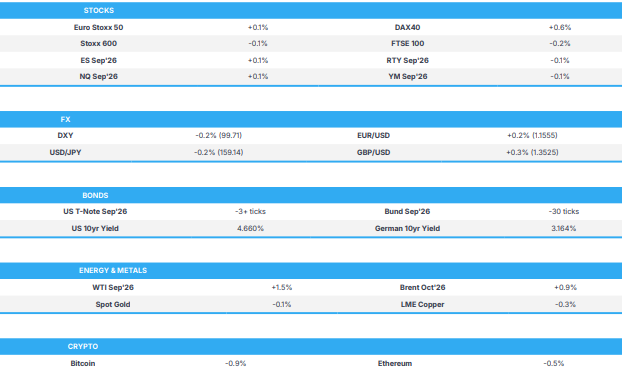
As of 10:10BST / 05:10EDT
Newsquawk in 3 steps:
1. Subscribe to the free premarket movers reports
2. Listen to this report in the market open podcast (available on Apple and Spotify)
3. Trial Newsquawk’s premium real-time audio news squawk box for 7 days
EUROPEAN TRADE
EQUITIES
- European bourses are broadly softer across the board, outside of the DAX 40 given the gains in SAP (see more below). Over in Asia, memory chip names (Kioxia +3.8%, SK Hynix +3.3%) climbed in Asia-Pac trade after Sandisk gave a positive outlook at its investor day. Sandisk said it expects revenue growth in the mid-to-high teens between 2028-30 and also plans to return 100% of excess cash to shareholders.
- Sectors are mixed. Tech is the sector outperformer, followed by Media and Insurance. To the downside is Utilities, while Basic Resources and Health Care also underperform.
- US equity futures are essentially flat across the board. Focus was on Applied Materials earnings after-hours. Shares are falling pre-market by over 5% as lofty investor expectations overshadowed solid quarterly results, an above-consensus outlook, and continued strength in AI-related semiconductor equipment demand.
- Click for the sessions European pre-market equity newsflow
- Click for the additional news
FX
- DXY gradually weakened throughout the morning to a 99.70 base, despite higher energy prices (Brent +1.5%), which are typically constructive for the USD. Weakness in the Buck likely comes as participants digest the July series of data, which contained dovish components. CPI/PPI were in-line and soft, respectively, while the payrolls figure will likely give food for Fed doves. Today, USD is set to digest US Retail Sales and the UoM survey.
- USD/JPY -0.2% and continues choppy action, this time after another BoJ source said the Bank was set to raise interest rates as soon as September; this saw the pair slip 17 pips to a 159.15 base, a level which is being tested at the time of writing. Currently, markets assign a c. 80% probability of such action in September. More pertinently, Bloomberg sources on Thursday said the Takaichi government is said to support faster BoJ rate hikes. The piece also said the bank could raise rates in either September or October; the timing of the latest source potentially the reason why this JPY strength has stuck.
- Kiwi is rebounding vs the USD after losses following Thursday’s soft inflation expectations survey; action which has entirely faded with the pair ~0.2% higher than pre-data. NZD/USD +0.4%, once again above all significant DMAs.
- NOK is the G10 outperformer, strength which is likely a function of oil prices despite the Norges Bank hold on Thursday raising questions over the removal of the tightening bias from the statement in September. Brent Oct’26 is firmer by 1.5%, after rising throughout the EU morning without a clear catalyst. NOK/SEK sees continues support above 1.00, while USD/NOK broke out of recent ranges
FIXED INCOME
- USTs continue to fall further from Thursday’s peak of 109-03+, after failing to hold above the current range highs of 109-01. The 30-year auction was soft, showing a 0.4bp tail, below-average bid-to-cover and above-average dealer allocation, all pointing to weaker demand despite the considerably higher outright yield on offer. Following the auction, analysts at TD Securities said this is problematic for the Treasury as it must fund the government at more expensive levels. Looking ahead, US Retail sales is on the docket.
- Gilts opened lower and trades at the lower end of its 86.90-87.26 range, given the steady climb in energy prices. On the political front, Reform leader Farage won the Clacton by-election as expected. Following the count, More in Common’s Tryl told Politico that despite that impressive raw vote total by Farage, the vote share was at the lower end of expectations, which shows that his opponents are highly motivated to turn out. Focus now turns to the outcome of the Parliamentary investigation into Farage over recent donations.
- Bunds continue to trade counter to energy prices, currently trading at the bottom end of its 124.72-125.01 range. A light docket ahead in Europe, given the summer period.
- Australia sells AUD 1bln November 2032 bonds, b/c 3.75, avg. yield 4.6868%.
COMMODITIES
- Crude futures have been grinding higher throughout the European morning despite the lack of a clear driver. Overnight, US Treasury Secretary Bessent said they will implement unprecedented measures on Iran and are conducting a maximum pressure campaign against Iran. Meanwhile, this morning, Iranian Foreign Ministry spokesman Baghaei said a possible agreement with Oman on a new shipping route through the Strait of Hormuz will not, by itself, mean the strategic waterway will reopen. Furthermore, UKMTO says a tanker was struck by a drone while transiting outbound through the Strait of Hormuz, possibly following comments by ADNOC stating that two of its vessels attacked while transiting the Strait of Hormuz on Thursday.
- There have also been a couple of headlines regarding Russia/Ukraine/NATO: NATO HQ confirmed allied jets were scrambled after a drone entered Latvian airspace. Russia’s Foreign Minister Lavrov said an immediate ceasefire in Ukraine is not possible.
- WTI Sept and Brent Oct futures have been edging higher since European players entered the market. Brent trades towards the top end of a USD 86.20-88.60/bbl range at the time of writing whilst WTI sits towards the upper end of a USD 80.71-82.99/bbl range. Dutch TTF is firmer by almost 2% intraday and north of EUR 61.50/MWh.
- Metals are flat/mixed amid a lack of drivers and in what is seemingly a summer lull. Spot gold resides towards the middle of a USD 4,322-4,363/oz range after dipping under yesterday’s 4,343/oz low. Spot silver ekes mild gains and resides towards the top end of a USD 63.51-64.73/oz range after briefly falling under yesterday’s USD 64.22/oz low. 3M LME copper remains above USD 14k/t in a USD 14,045.20- 14,125.28/t range.
- US VP Vance said goal one is to keep oil and gasoline affordable for the US.
- China’s State Planner said domestic gasoline and diesel retail price caps will be cut by CNY 230/T and CNY 220/T, respectively; effective on August 14.
- Ukrainian official said if a ceasefire is implemented in the Black Sea region, Ukraine could restore grain exports through its seaports within one month.
TRADE/TARIFFS
- US President Trump signed a proclamation imposing tariffs on drones and components, which imposes 100% tariffs on certain-sized drones and a 25% tariff on smaller-sized drones. 10% tariffs will be imposed on drones from the UK and 15% tariffs on drones from the EU, Japan, Liechtenstein, South Korea, Switzerland and Taiwan. Tariffs will take effect 21 days after signing, while for components of drones that are not particularly sensitive, the tariffs will take effect 180 days after signing.
- Australian PM Albanese said he spoke with US President Trump and reviewed advancements under the AUKUS defence agreement, while he added that the AUKUS initiative continues full steam ahead. Albanese said he raised the issue of tariffs with Trump and urged him to consider full exemption, while he added that Trump would consider Australia’s request.
- Brazil began analysing the reciprocity process on US tariffs, while it was notifying the US about the process and requesting that diplomatic consultations be held.
NOTABLE EUROPEAN HEADLINES
- Reform UK leader Farage won the Clacton by-election with 22,293 votes.
NOTABLE EUROPEAN DATA RECAP
- Swiss GDP Growth Rate Flash (Q2) Q/Q 1.5% vs. Exp. 0.3% (Prev. 0.4%).
- European GDP Growth Rate 2nd Est (Q2 QQ) 0.4% vs. Exp. 0.4% (Prev. 0.0%).
- European GDP Growth Rate 2nd Est (Q2 YY) 1.0% vs. Exp. 1% (Prev. 0.5%).
- European Employment Change Prel (Q2 QQ) 0.1% vs. Exp. 0.1% (Prev. 0.1%).
- European Employment Change Prel (Q2 YY) 0.5% vs. Exp. 0.6% (Prev. 0.5%).
- French HICP Final (Jul YY) 2.4% vs. Exp. 2.4% (Prev. 2.0%).
- French HICP Final (Jul MM) 0.6% vs. Exp. 0.6% (Prev. -0.3%).
- German Wholesale Prices (Jul MM) 0.2% vs. Exp. 0.4% (Prev. -0.7%).
- German Wholesale Prices (Jul YY) 5.3% (Prev. 4.9%).
CENTRAL BANKS
- Fed’s Goolsbee (2027 voter) said they have been getting a little bit better readings on inflation, which he hopes will continue and noted that a lot of inflation drivers were from tariffs, oil and things they hope to be one-time increases. Furthermore, he stated that if they can get some of that into the rearview mirror, they can get inflation heading back to 2%, and that the US economy is steady.
- The BoJ is reportedly set to raise interest rates as soon as September and also considering accelerating subsequent hikes, according to reports.
- RBA’s Harper will depart from the monetary policy board, and Melinda Cilento has been named as a part-time member of the RBA board.
NOTABLE US HEADLINES
- Fitch affirmed the US at AA+, outlook stable, while it stated that the US rating is supported by a large economy, high per capita income, dynamic business environment and exceptional financing flexibility. However, it also commented that labour demand has weakened and job creation has dropped significantly in 2026, while it expects inflation to move towards the target by year-end 2028.
- US White House deputy national security adviser Andy Baker will leave the administration in coming weeks, Axios reported.
GEOPOLITICS
MIDDLE EAST
- US VP Vance said the US has a lot of tools at its disposal for Iran.
- US Treasury Secretary Bessent said they will implement unprecedented measures on Iran and are conducting a maximum pressure campaign against Iran, targeting its bank accounts and digital currencies worldwide, while the pressure campaign caused the collapse of the Iranian banking sector. Bessent added that measures against Iran will be a combination of economic isolation and blockade in the Strait of Hormuz, and he expects more announcements on Iran next week. Furthermore, he said they will take actions unprecedented in the history of economic isolation of a country and will prevent anything from entering or leaving Iranian ports.
- Iranian Foreign Ministry spokesman Baghaei said a possible agreement with Oman on a new shipping route through the Strait of Hormuz will not, by itself, mean the strategic waterway will reopen, Press TV reported.
- UAE’s ADNOC said two of its vessels attacked while transiting the Strait of Hormuz on Thursday. Following this, UKMTO said a tanker was struck by a drone while transiting outbound through the Strait of Hormuz.
- US CENTCOM commander and Saudi Crown Prince MBS discuss mutual defence cooperation and efforts to de-escalate regional tensions, according to Saudi State News Agency.
- US President Trump’s son-in-law Jared Kushner is to visit Israel next week for consultations on the situation in Gaza, according to Axios
- Airstrikes hit separatist militant group in Erbil, Iraq, according to Tehran Times.
RUSSIA-UKRAINE
- Russia’s Foreign Minister Lavrov said an immediate ceasefire in Ukraine is not possible, IFX reported.
- Drones hit area around Russian Baltic seaport of Ust-Luga, according to the regional governor.
- Latvia issued an air threat alert in areas bordering Russia and Belarus, while NATO fighter jets shot down a drone over northeastern Latvia. It was also reported that Finland restricted aviation and maritime traffic in eastern Gulf of Finland.
OTHER
- North Korea condemned US-South Korean military drills and said the military exercises are more provocative than last year, while it added that US-Japan-South Korea military cooperation is turning into a nuclear alliance. Furthermore, North Korea vowed to respond to a new level of threat with a new level of deterrent and will continue to expand nuclear deterrence, according to KCNA.
- Japanese Regional Coast Guard said four Chinese ships intruded into Japanese territorial waters, Kyodo reported.
CRYPTO
- Bitcoin has resumed this week’s selloff and has returned below the USD 63k mark.
APAC TRADE
- APAC stocks traded mixed as the region only partially sustained the positive handover from Wall Street, where the S&P 500 hit a fresh record high, and the Nasdaq outperformed on tech strength, as softer PPI data further added to the case for the Fed to refrain from hiking rates in September. Nonetheless, the positive momentum began to wane overnight with little fresh major catalysts and after US President Trump signed a proclamation imposing tariffs on drones and components.
- ASX 200 was pressured as the strength in tech was overshadowed by losses in the heavy industries, including miners, materials, resources and industrials, while participants also digested earnings releases.
- Nikkei 225 gained and briefly reclaimed the 69,000 level before paring some of the advances, while participants continue to second-guess whether the BoJ will speed up the pace of rate increases.
- KOSPI outperformed on tech momentum, but is off earlier highs with resistance at the 7,000 level.
- Hang Seng and Shanghai Comp were subdued amid a slew of earnings releases including from SMIC and JD.com, with the latter pressured despite beating on the top and bottom lines, while sentiment was also not helped by trade-related frictions with the US to impose tariffs of up to 100% on drones, which seems to be aimed at China and DJI, which holds around an 80% share of the global drone market.
NOTABLE ASIA-PAC HEADLINES
- PBoC keeps 7-day reverse repo operation volume at zero, while it injects CNY 349bln via overnight reverse repos.
- Taiwan raises 2026 GDP forecast to +11.05% (prev. +9.64%).
- Hong Kong revises 2026 GDP forecast to 3.5-4.5% (prev. 2.5-3.5%).
NOTABLE APAC DATA RECAP
- Chinese New Yuan Loans (Jul) -340.0 vs. Exp. 45 (Prev. 1610.0).
- Chinese Total Social Financing (Jul) 1410.0 vs. Exp. 1200 (Prev. 3360.0).
- Chinese M2 Money Supply (Jul YY) 7.7% vs. Exp. 7.9% (Prev. 8.0%).
- Hong Kong GDP Growth Rate Final (Q2 YY) 4.3% vs. Exp. 4.3% (Prev. 4.3%).
- Hong Kong GDP Growth Rate Final (Q2 QQ) -0.6% vs. Exp. -0.6% (Prev. -0.6%).
- South Korean Export Prices (Jul YY) 49.1% (Prev. 48.7%).
- South Korean Import Prices (Jul YY) 18.7% (Prev. 20.9%).
1 c Asian opening report
Europe primed for a firm after strong US lead; NZD rebounds, USD weaker – Newsquawk EU Market Open
Friday, Aug 14, 2026 – 01:46 AM
- US Treasury Secretary Bessent said they will implement unprecedented measures on Iran and are conducting a maximum pressure campaign against Iran.
- Crude futures struggled for direction following the prior day’s choppy performance amid light headline newsflow and a lack of major geopolitical developments.
- APAC stocks traded mixed as the region only partially sustained the positive handover from Wall Street, where the S&P 500 hit a fresh record high.
- DXY marginally softened overnight; 10yr UST futures took a breather after recent bull steepening on softer-than-expected PPI data.
- European equity futures indicate a mildly positive cash market open with Euro Stoxx 50 futures up 0.3%.
- Looking ahead, highlights include German Wholesale Prices (Jul), French Inflation Final (Jul), EU GDP 2nd Estimate (Q2), Trade Balance (Jun), US Retail Sales (Jul), University of Michigan Prelim. (Aug), Atlanta Fed GDP (Q3), Fitch Credit Rating update on the UK.
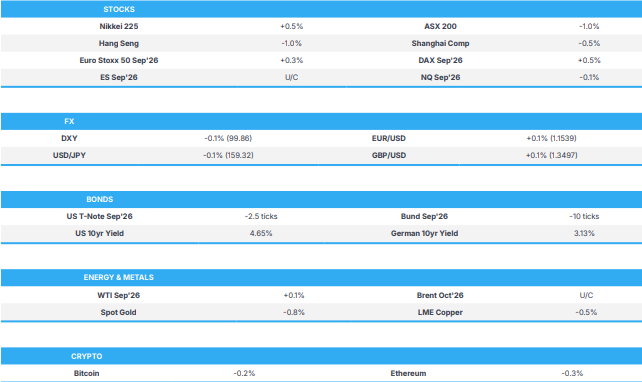
Newsquawk in 3 steps:
1. Subscribe to the free premarket movers reports
2. Listen to this report in the market open podcast (available on Apple and Spotify)
3. Trial Newsquawk’s premium real-time audio news squawk box for 7 days
LOOKING AHEAD
- Highlights include German Wholesale Prices (Jul), French Inflation Final (Jul), EU GDP 2nd Estimate (Q2), Trade Balance (Jun), US Retail Sales (Jul), University of Michigan Prelim. (Aug), Atlanta Fed GDP (Q3), Fitch Credit Rating update on the UK.
- Click for the Newsquawk Week Ahead.
IRAN CONFLICT
- US VP Vance said the US has a lot of tools at its disposal for Iran and goal is to keep oil and gasoline affordable for the US.
- US Treasury Secretary Bessent said they will implement unprecedented measures on Iran and are conducting a maximum pressure campaign against Iran, targeting its bank accounts and digital currencies worldwide, while the pressure campaign caused the collapse of the Iranian banking sector. Bessent added that measures against Iran will be a combination of economic isolation and blockade in the Strait of Hormuz, and he expects more announcements on Iran next week. Furthermore, he said they will take actions unprecedented in the history of economic isolation of a country and will prevent anything from entering or leaving Iranian ports.
- US military has lost roughly 25% of its Reaper drones as the Iran war depletes the arsenal, according to The Washington Post. However, it was separately reported that CENTCOM announced efforts to establish the first-ever multi-domain, multinational attack drone task force.
- US President Trump’s son-in-law Jared Kushner is to visit Israel next week for consultations on the situation in Gaza, while Kushner is also expected to travel to Cairo next week for talks with Egyptian, Qatari and Turkish mediators, according to a source familiar cited by Axios’s Ravid
- Israeli helicopter dropped explosives at an area of the community in the Al-Mansouri district of Tyre in southern Lebanon, according to Al Mayadeen.
- Lebanon’s Information Minister said Lebanon remains committed to negotiations with Israel.
- Britain, Italy, Switzerland and Indonesia have been shortlisted to potentially verify Hezbollah’s disarmament in southern Lebanon, according to sources.
- US CENTCOM commander and Saudi Crown Prince MBS discussed mutual defence cooperation and efforts to de-escalate regional tensions, according to Saudi State News Agency.
- UAE’s ADNOC said two of its vessels were attacked while transiting the Strait of Hormuz on Thursday.
- Yemen government forces were repelling a Houthi attack on the Al-Barah front, east of Mocha.
US TRADE
EQUITIES
- US stocks gained with all major indices in the green and outperformance seen in tech, while the S&P 500 printed a fresh all-time high, as a cooler-than-expected US PPI added to the case for a hold at the next FOMC confab, with money markets pricing a roughly 60% chance for the FOMC to refrain from lifting rates. Nonetheless, it was a very quiet day of newsflow, with not too many market-moving headlines. Sectors were generally higher, led by Communications, Real Estate, and Technology, with Software (IGV) underpinned in response to reports that Silver Lake is in talks to buy Workday (WDAY), while Dell (DELL) and HP (HPQ) were firmer after China’s Lenovo beat Q1 revenue estimates.
- SPX +0.65% at 7,799, NDX +1.15% at 30,084, DJI +0.13% at 53,845, RUT +0.24% at 3,053.
- Click here for a detailed summary.
TARIFFS/TRADE
- US President Trump posted “BIG WIN today at the U.S. Court of International Trade on one of the most DESPICABLE loopholes in American Trade Policy — The so-called “de minimis” exemption”.
- US President Trump signed a proclamation imposing tariffs on drones and components, which imposes 100% tariffs on certain-sized drones and a 25% tariff on smaller-sized drones, while it imposes 10% tariffs on drones from the UK and 15% tariffs on drones from the EU, Japan, Liechtenstein, South Korea, Switzerland and Taiwan. Tariffs will take effect 21 days after signing, while for components of drones that are not particularly sensitive, the tariffs will take effect 180 days after signing.
- Australian PM Albanese said he spoke with US President Trump and reviewed advancements under the AUKUS defence agreement, while he added that the AUKUS initiative continues full steam ahead. Albanese said he raised the issue of tariffs with Trump and urged him to consider full exemption, while he added that Trump would consider Australia’s request.
- Brazil began analysing the reciprocity process on US tariffs, while it was notifying the US about the process and requesting that diplomatic consultations be held.
NOTABLE HEADLINES
- Fed’s Goolsbee (2027 voter) said they have been getting a little bit better readings on inflation, which he hopes will continue and noted that a lot of inflation drivers were from tariffs, oil and things they hope to be one-time increases. Furthermore, he stated that if they can get some of that into the rearview mirror, they can get inflation heading back to 2%, and that the US economy is steady.
- NY Fed said the desk plans to conduct approximately USD 17bln in reinvestment purchases, while there are no reserve management purchases between August 14th and September 14th.
- White House said President Trump signed a national security presidential memorandum to fix critical long-term issues in Navy shipbuilding and ship repair programs, while the Trump memo directs the Pentagon to pursue more direct investments in the American shipbuilding industrial base based on the Finland model. Furthermore, it directs the Defence Secretary to replace advanced electromagnetic aircraft launch systems and advanced weapons elevators with traditional steam and hydraulic systems during construction of CVN 81.
- Fitch affirmed the US at AA+, outlook stable, while it stated that the US rating is supported by a large economy, high per capita income, dynamic business environment and exceptional financing flexibility. However, it also commented that labour demand has weakened and job creation has dropped significantly in 2026, while it expects inflation to move towards the target by year-end 2028.
APAC TRADE
EQUITIES
- APAC stocks traded mixed as the region only partially sustained the positive handover from Wall Street, where the S&P 500 hit a fresh record high, and the Nasdaq outperformed on tech strength, as softer PPI data further added to the case for the Fed to refrain from hiking rates in September. Nonetheless, the positive momentum began to wane overnight with little fresh major catalysts and after US President Trump signed a proclamation imposing tariffs on drones and components.
- ASX 200 was pressured as the strength in tech was overshadowed by losses in the heavy industries, including miners, materials, resources and industrials, while participants also digested earnings releases.
- Nikkei 225 gained and briefly reclaimed the 69,000 level before paring some of the advances, while participants continue to second-guess whether the BoJ will speed up the pace of rate increases.
- KOSPI outperformed on tech momentum, but is off earlier highs with resistance at the 7,000 level.
- Hang Seng and Shanghai Comp were subdued amid a slew of earnings releases including from SMIC and JD.com, with the latter pressured despite beating on the top and bottom lines, while sentiment was also not helped by trade-related frictions with the US to impose tariffs of up to 100% on drones, which seems to be aimed at China and DJI, which holds around an 80% share of the global drone market.
- US equity futures were range-bound following the prior day’s advances.
- European equity futures indicate a positive cash market open with Euro Stoxx 50 futures up 0.3% after the cash market closed with gains of 0.2% on Thursday.
FX
- DXY marginally softened overnight but ultimately held up against its major peers yesterday despite a decline in 2yr yields as the softer-than-expected PPI data spurred further bets for the Fed to remain on hold in September. There were also several comments from Fed speakers, but they did little to shift the dial as Hammack reiterated calls for rate hikes and Barkin remained uncertain on the future path of policy, while Goolsbee stated they have been getting a little bit better readings on inflation, which he hopes will continue.
- EUR/USD eked slight gains but was confined within tight parameters amid quiet macro drivers and with participants awaiting looming data including the latest EU Employment and GDP figures.
- GBP/USD kept afloat, albeit with upside limited after the recent choppy performance and failure to sustain the 1.3500 status despite the recent stronger-than-expected UK GDP data.
- USD/JPY was rangebound in the absence of any tier-1 data releases and following the recent bounce off support around the 159.00 level, while there were some comments from Japan’s former top FX diplomat Furusawa, who said the BoJ likely wants to eventually raise rates to around 1.50%-1.75%, and that US-Japan coordinated action in the FX market could occur again if the yen returns to pre-intervention levels.
- Antipodeans marginally edged higher with outperformance in NZD/USD after it continued its rebound from the lows seen following yesterday’s softer inflation expectations.
- PBoC set USD/CNY mid-point at 6.7878 vs exp. 6.7413 (prev. 6.7888)
FIXED INCOME
- 10yr UST futures took a breather after recent bull steepening as softer-than-expected PPI data further supported the case for the Fed to keep rates unchanged at the September FOMC meeting.
- Bund futures held on to most of the prior day’s spoils, but are off this week’s best levels and have reverted to beneath the 125.00 focal point, while participants now await German WPI and EU GDP data.
- 10yr JGB futures remained afloat after recent gains in global peers but with the upside capped overnight in the absence of tier-1 data and amid an enhanced liquidity auction for longer-dated JGBs.
COMMODITIES
- Crude futures struggled for direction following the prior day’s choppy performance amid light headline newsflow and a lack of major geopolitical developments.
- US Energy Secretary Wright said the US is talking and coordinating with every ship and knows how many ships transit in and out of Hormuz daily, according to a Fox News interview. Wright said 8mln-9mln barrels of oil transit through Hormuz daily and that Iran is trying to hold the world economy hostage, but noted that the US’s ability to escort and bring products is growing.
- Spot gold continued to trickle lower after failing to sustain the USD 4,400/oz level and with recent profit-taking seen from a 2-month high.
- Copper futures were subdued amid the overall mixed risk appetite.
CRYPTO
- Bitcoin traded indecisively with prices contained by resistance around the USD 63,500 level.
NOTABLE ASIA-PAC HEADLINES
- PBoC kept the 7-day reverse repo operation volume at zero, but injected CNY 349bln via overnight reverse repos.
- RBA’s Harper will depart from the monetary policy board, and Melinda Cilento has been named as a part-time member of the RBA board.
DATA RECAP
GEOPOLITICS
RUSSIA-UKRAINE
- Drones hit an area around the Russian Baltic seaport of Ust-Luga, according to the governor.
- Latvia issued an air threat alert in areas bordering Russia and Belarus, while NATO fighter jets shot down a drone over northeastern Latvia. It was also reported that Finland restricted aviation and maritime traffic in eastern Gulf of Finland.
OTHER
- North Korea condemned US-South Korean military drills and said the military exercises are more provocative than last year, while it added that US-Japan-South Korea military cooperation is turning into a nuclear alliance. Furthermore, North Korea vowed to respond to a new level of threat with a new level of deterrent and will continue to expand nuclear deterrent, according to KCNA.
- Japan is considering countermeasures after Russian President Putin’s visit to a disputed island, according to NHK.
EU/UK
NOTABLE HEADLINES
- Reform UK leader Farage won the Clacton by-election with 22,293 votes.
2.NORTH AND SOUTH KOREA//JAPAN
JAPAN
JAPAN/USA
3. CHINA
4. EUROPEAN AND SCANDINAVIAN COMMENTARIES PLUS NATO
UK
The Great Decline Of Britain
Friday, Aug 14, 2026 – 02:00 AM
Authored by Steve Watson via Modernity News,
Britain’s streets are rotting in plain sight. Road signs coated in years of grime, pavements choked with weeds, blocked drains, overflowing bins and potholes have become everyday features of life in what was once a first-world country.

Local authorities, funded by rising council tax, routinely fail to deliver the most basic maintenance. Ordinary people – including schoolchildren – are now having to do the job themselves.
All across the length and breadth of the country, from London squares to provincial roads, citizens are cleaning signs, restoring bins and clearing litter because the people paid to do it will not.
The pattern is unmistakable: a country in visible decline, where the basics are abandoned while public money flows to ideologically driven schemes.
James Melville has documented the decay repeatedly. Rubbish everywhere, weeds forcing their way through pavements, endless potholes, blocked road drains and filthy signposts appear in image after image. He notes that people are paying higher taxes yet receiving less, with local councils failing on core infrastructure.

Another recent video shows conditions that simply do not belong in a first-world nation, asking whether the decline is reversible.
Another focuses on a council that has left basic service standards unmet.
Volunteers have stepped into the gap, proving that all it takes is a step ladder, cleaning spray and sponge to make filthy almost illegible road signs clear again.
In London, Chad West fixed neglected garden square bins that the council had left unrepaired for years. He restored them in a few hours and later completed the full set of six, calling for people to take pride in their streets again.
Even children are outperforming the authorities. In the seaside village of Millisle in Northern Ireland, brothers Jonah, 10, and Eli, 9, spent their school holidays scrubbing street signs with rubber gloves, cloths, sponges and soapy water. They set themselves a target of 50 signs and had already completed 36. They began after noticing dirty signs on the drive home and decided to clean them so people could actually read the names.
Jonah said: “We were driving home in my mum’s car and we saw some dirty signs so we decided to go clean them to allow people to be able to see them.” He added: “It’s very important to take pride in your village. Doing something small can make a big difference.”
Eli said they would keep going until the job was done, whatever the weather. Their mother Shelley said she was pleased they showed initiative and that it was something they would always remember and be proud of. Local residents praised the results, noting the signs were now legible again.
These acts of basic civic maintenance stand in sharp contrast to how councils choose to spend public money.
In Cambridge, England’s first “cycle street” on Adams Road cost £2.4 million. Yes, really. Look at it.
It gave cyclists and pedestrians priority, narrowed the carriageway, added red surfacing and special signage. Within months the road markings proved inadequate. The street had to be closed for roughly two weeks so the contractor could remove and replace them. A Greater Cambridge Partnership spokesperson said a routine quality check revealed the markings were not up to the required standard and apologised for the inconvenience.
In London, Camden Council installed four zebra crossings painted in the blue, pink and white colours of the transgender pride flag in Bloomsbury at a cost of £10,464. The stated purpose was to “help celebrate transgender awareness.”
A local resident, Blessing Olubanjo, argued that the crossings breach political neutrality rules under the Local Government Act 1986 and amount to unlawful political messaging. She said: “I brought this case because I believe in fairness, freedom of belief, and the proper role of public institutions. As a Christian and a taxpayer, I should not be made to feel excluded or marginalised by political symbols in public spaces. This crossing sends a message that only one viewpoint is welcome, and that’s not right in a truly democratic society.”
Andrea Williams of the Christian Legal Centre stated: “The crossing is a visual endorsement of a contested ideology, installed by a public authority in breach of its legal duties. This is not the role of local government.” Disability groups had previously warned that the colours could confuse visually impaired people and those with learning disabilities or sensory sensitivity.
Such rainbow and trans crossings have been installed in countless locations, particularly in London.
Meanwhile, Mayor of London Sadiq Khan has poured millions into basketball courts and related programmes. City Hall has invested nearly £2 million to improve facilities, expand coaching schemes and create more opportunities for the sport.
Recent work includes partnership with NBA champion OG Anunoby and Camden Council to redevelop the Argyle Square court. Critics point out that many British people do not even play or watch basketball and that streets choked with weeds and filthy signs represent more immediate needs.

This is what decline looks like. First-world countries do not leave their road signs illegible for years. They do not require ten-year-olds to restore civic pride during the school holidays. They do not prioritise contested ideological symbols and niche sports infrastructure while the everyday environment decays.
Britain is displaying the visual markers once associated with much poorer nations: neglect of the ordinary, indifference from those in charge, and citizens forced to improvise solutions.
Your support is crucial in helping us defeat mass censorship. Please consider donating via Locals or check out our unique merch. Follow us on X @ModernityNews
END
UK
Decommissioning Spending In UK North Sea Hits Record High
Friday, Aug 14, 2026 – 03:30 AM
Authored by Michael Kern via OilPrice.com,
Decommissioning remained a major activity across the UK North Sea in 2025, with industry spending hitting a record-high of £2.6 billion, or $3.5 billion, the North Sea industry regulator said in a report on Thursday.

Well-decommissioning remains the single largest component of forecast decommissioning expenditure on the UK Continental Shelf (UKCS), accounting for around half of expected costs to 2032, the North Sea Transition Authority (NSTA) noted in its annual decommissioning cost and performance update.
The UK North Sea has a backlog of about 500 wells awaiting decommissioning and final abandonment, which means operators need to speed up work on well closures and abandonment, the watchdog said.
Last year, operators in the UK North Sea spent about £1.3 billion, or $1.75 billion, on well decommissioning activity only, with work undertaken on more than 250 wells and over 100 reaching final abandonment status.
“While this represents an increase in activity, a backlog of approximately 500 wells awaiting final abandonment remains,” the NSTA said.
“With more than 1,000 additional wells forecast to be decommissioned over the next five years, activity levels will need to increase significantly if industry is to meet regulatory expectations and provide the certainty of work needed to attract and retain critical supply chain resources.”
Nearly half of all spending on decommissioning in the UKCS is expected to be made by 2032, in what has been dubbed the ‘decade of decommissioning’ by the regulator.
Moreover, decommissioning expenditure is forecast to overtake capital expenditure (capex) from 2029 onwards as the UK North Sea matures and as few new oil and gas projects have been given the green light in recent years.
In what could be a relief for the North Sea offshore oil and gas industry, the UK’s new Labour Prime Minister, Andy Burnham, is expected to support some new projects, unlike his predecessor, Sir Keir Starmer, who sought to permanently ban new drilling.
END
UK
English Village Will Have Six Migrant Men To Every Woman
Friday, Aug 14, 2026 – 06:30 AM
Authored by Steve Watson via Modernity News,
A quiet North Yorkshire village of roughly 600 people is set to be flooded with around 1,200 single adult male asylum seekers at the nearby disused RAF Linton-on-Ouse base. Local women would be outnumbered six to one.

Labour MP Rachael Maskell has raised the alarm over the plan, which forms part of the government’s wider push to move roughly 3,750 people into three former military sites near villages as it tries to empty asylum hotels.
The base sits beside a primary school and nursery, has only four buses a day into York, and already faces severe shortages of water, sewage capacity and electricity. Maskell has written to border security and asylum minister Anna Turley and is due to meet Home Office officials this month.
“It’s just the wrong site,” Maskell said. “The last government realised that, once they got into the detail. All we’re saying to this Government is that it’s really important that they recognise that too, because the site is in a worse state now than it was when the Government last looked at this.”
Similar plans for Linton-on-Ouse were abandoned in 2022 after fierce local opposition. Now they are back under active consideration. Local Tory councillor Malcolm Taylor captured the mood of residents who moved there for a quiet life: “They’ve moved there for the peace, tranquillity and quality of life. This hand grenade has been thrown in.”
Professor Olga Matthias of the Linton Action Group called the village “categorically the wrong place for so many reasons.”
This is not an isolated case. It follows the same pattern seen in the tiny Oxfordshire village of Piddington, population around 350-400, which faces plans for 1,250 single adult male asylum seekers at a former Ministry of Defence depot right next to a children’s playing field.https://modernity.news/2026/07/15/you-will-not-believe-what-is-happening-in-this-tiny-english-village/embed/
Residents held a symbolic independence referendum in which 96 percent voted to leave the United Kingdom in protest. Children wrote letters pleading with the Prime Minister not to destroy the only home they have ever known. Parish council chairman Tim McNally has repeatedly warned that the scale is neither fair, safe nor responsible.
Prime Minister Andy Burnham has responded by doubling down. He insists that “all parts of the country need to play their part” and that middle-class and leafy areas can no longer be shielded while poorer communities carry the load.
Borders minister Anna Turley has defended the approach as creating a “more fair and equitable system,” even while acknowledging that concentrating arrivals in deprived areas previously fuelled “civil unrest.”https://modernity.news/2026/08/12/watch-uk-pm-wants-every-area-in-britain-to-house-migrants/embed/
Watch: UK PM Wants EVERY Area In Britain To House Migrants
Telling Channel crossers they’ll be housed in leafy villages is the ultimate pull factor

What They Did To This Tiny Welsh Village Is Pure BETRAYAL…
Blacked-out vehicles drop scores of migrants into old village hall
The same government that lectures about fairness is also quietly imposing itself on other quiet rural communities. In the tiny Welsh seaside village of Gronant, population around 1,600, residents discovered that their former village hall – converted into 15 new-build homes they expected to go to local families or the open market – had been handed over to asylum seekers.
Thirteen of the fifteen units were taken by Home Office contractor Clearsprings. Blacked-out minibuses arrived without warning. Locals described it as pure betrayal. One resident, Kerrie Cox, said nobody was told about the arrivals. Another called it an “absolute betrayal.”https://modernity.news/2026/08/12/what-they-did-to-this-tiny-welsh-village-is-pure-betrayal/embed/
These placements keep following the same template. Single adult men, overwhelmingly of fighting age, are being directed into the most culturally alien, high-trust, low-density English and Welsh villages imaginable – places defined by quiet streets, children’s parks, limited public transport, and a long-standing sense of safety.https://www.youtube.com/embed/oe-qRTTdLsY
The contrast could scarcely be sharper. It repeatedly seems like an intentional choice designed to generate the maximum possible friction and cultural upheaval. They could not possibly find locations more foreign to the backgrounds of many of these arrivals.
The government claims the military sites will keep people “contained.” In practice, residents are free to come and go. Infrastructure is inadequate. Policing is already stretched thin in these rural areas. Women and girls who once walked freely after dark now face the prospect of living in communities where adult men from very different cultural norms suddenly outnumber them by orders of magnitude.
This is the logical endpoint of a policy that refuses to stop the boats while insisting every corner of the country must absorb the consequences. Closing hotels and shifting people into former barracks or new-build village homes does not reduce the pull factor. It upgrades the destination.
The result is the steady erosion of the very places that once defined the character of rural Britain – one quiet village at a time.
Your support is crucial in helping us defeat mass censorship. Please consider donating via Locals or check out our unique merch. Follow us on X @ModernityNews.
END
UK
Farage Crushes Clacton By-Election With 63% As Comedy Candidates Dominate Longest Ballot In British History
Friday, Aug 14, 2026 – 08:45 AM
Nigel Farage has romped to victory in the Clacton by-election with 63.3% of the vote, seeing off 33 rivals including Count Binface, who won a quarter of the votes cast, on the longest ballot paper in British electoral history.

The Reform UK leader secured victory with 22,239 votes, which was 63.3% of the total vote and an increase on the 21,225 votes he secured when he was elected to the Essex seat at the 2024 General Election.
Count Binface, a comedian standing as a 5,900-year-old space warrior whose key policy was to freeze the price of ice cream in Clacton at 99p, was second with 9,455 votes, 26.9% of the total vote.
Mr Farage had triggered the poll and cast it as a ‘people vs the Establishment’ contest amid mounting questions over a £5 million donation from cryptocurrency tycoon Christopher Harborne.
However, a parliamentary inquiry into Mr Harborne’s donation has yet to conclude, and Mr Farage could still face another by-election within months if he is found to have broken House of Commons rules. He is expected to be interviewed by a standards watchdog within weeks of MPs returning to Westminster after their summer break.

The Reform leader, 62, declared himself the winner of the Clacton by-election in the early hours of Friday morning while ballot papers were still being counted. He then took the unprecedented step of skipping the formal result declaration, with his party claiming police had advised him to stay away due to a ‘credible threat’.
But, as Mark Angelides reports for LibertyNation.com, none of the big parties fielding a contender, what remains is who wins the narrative war.
Farage Stands Down to Step Up
The election was triggered by Farage resigning his seat last month. He did so voluntarily because of mounting stories over his financial situation, including donations and gifts he had received before running for Parliament. His argument was that it should be the voters of Clacton who decide his political fate rather than a scrutiny committee.
To be abundantly clear, Mr. Farage receiving a gift of £5 million is not illegal. Not declaring it is a breach of protocol because it occurred within 12 months of him running for office. With his return to the House of Commons, the internal investigation will continue. But what is the likely outcome? And what punishment – if any – is likely to befall the veteran campaigner?
If he is found to have broken the rules, the committee could suspend him from the House for a short period. In such a case, there is a possibility of a recall petition that would trigger a fresh by-election – which poses a conundrum. The purpose of such a contest would be to determine whether his Clacton constituency still had faith in him to be its Member of Parliament. This question was put to bed yesterday with Farage increasing his vote count and share compared with the 2024 general election.
And crucially, Nigel will have spent the last six weeks in his constituency gathering data. If he ends up having to fight yet another election, he will have up-to-date major information which other parties do not have access to. When it comes to campaigning, the data advantage cannot be underestimated.
But, as ever, the knives are out for Nigel Farage.
Establishment Closes Ranks
Former Prime Minister Keir Starmer, before his ousting, described Farage’s Reform Party as a threat to the nation. This is echoed across the myriad parties that make up British Parliament. In other recent by-elections, we have seen parties run what can best be described as paper candidates to unite around any party other than Reform.
The dominant narrative from the more established party leaders is that although they refused to stand a candidate in this “stunt” election triggered by Farage, they would certainly stand one in the potential next contest after the results of the scrutiny committee are released. But it is more than reasonable to argue that the other parties did engage in yesterday’s election. Conservative Party leader Kemi Badenoch posted on social media that voters should support “the Bin,” a reference to a parody candidate, “Count Binface,” who wears a trashcan on his head and a shiny “spacesuit.” By tacitly backing any competitor – even a joke contender – the party essentially threw its hat in the ring. Notably, Count Binface came second with almost 27%.
A Political Parallel
The current mantra is that Nigel Farage has triggered an unnecessary election that has cost taxpayers roughly £250,000 and was an affront to voters. And yet the same voices uttered no such displeasure when now-PM Andy Burnham was the beneficiary of a palace coup through a similar mechanism earlier this year.
With around 24,000 votes from one of the Labour Party’s safest seats, Mr. Burnham was drafted into Parliament and installed as leader and PM without a general election or even a vote by the party members. For those who do not support Labour, there is the mild stench of hypocrisy.
Both politicians foisted a by-election on the British public to better secure their positions. One did so to retain his position, the other to gain advancement.
Where is Reform Now?
Mr. Farage’s Reform Party has dominated polling for the last 18 months. While Mr. Burnham’s Labour Party has received a polling bounce of around 6% – quite a typical bump when a leader is changed mid-Parliament – almost every survey has suggested Reform would be the largest party at the next general election.
Farage is a threat to the Westminster establishment that has not been seen in at least 100 years. Assuming he navigates the committee’s results and commits no major faux pas in the next three years, he may well be Prime Minister. And more so, he may be the harbinger of doom for the Conservative Party and relegate Labour to a desultory second-place finish.
It seems no wonder that the Westminster establishment wants to end his career as early as possible.
5.RUSSIAN AND MIDDLE EASTERN AFFAIRS
IRAN/ISRAEL FRIDAY
Bessent: US Readies Economic Isolation Of Iran “Like The World Has Never Seen Before”
Friday, Aug 14, 2026 – 09:00 AM
Treasury Secretary Scott Bessent told Newsmax Thursday night that the Trump administration will announce unprecedented economic measures against Iran next week, signaling that a sharp escalation in economic warfare is just ahead as negotiations to reopen the Strait of Hormuz remain stalled. The warning comes as Tehran-linked Houthi rebel forces resume attacks on Saudi Aramco energy infrastructure, raising concerns that the conflict is spreading geographically and pushing Brent crude futures higher.
Bessent told Rob Schmitt of Newsmax:
And, you know, at the president’s orders, we have raised the level even again, and watch this space for more announcements coming next week because we are going to apply measures like have never been seen in the history of economic isolation on a country. And I think the reason we are succeeding is because it is a one-two punch.
People say, well, you know, Cuba lasted a long time. Venezuela lasted a long time. Venezuela immediately crumbled when we put the blockade on. So, it will be a combination of economic isolation like the world has never seen before and the continued blockade in the Strait of Hormuz that will keep anything from going in or out of the Iranian ports.
Watch Bessent
By the midpoint of this week, we explained that, with US-Iran talks stalled, President Trump was more than likely to “opt for economic siege warfare, as the US military campaign is on hold.”
Trump recently told Axios that he is “low-keying it” with Iran. “We are just watching Iran with its huge inflation and the fact they have no money,” he said.
Washington has imposed roughly 2,200 sanctions-related designations on Tehran since 2018, according to Jeremy Paner, a partner at Hughes Hubbard & Reed who tracks Iran’s energy industry. The scale of the existing sanctions architecture underscores the challenge facing the Trump administration as it seeks to exert additional leverage on Tehran.
“If 47 years of sanctions haven’t broken Tehran’s will, more of the same is unlikely to produce any changes,” according to a Bloomberg Economics report led by Jennifer Welch. She noted that the most likely scenario is that Trump stays on the same path as before, maintaining sanctions and the blockade.
The Trump administration’s accelerated pivot toward economic warfare, rather than renewed strikes on Iran’s missile and drone capabilities along the Hormuz chokepoint or an operation against Kharg Island, likely reflects growing concern over the “perfect storm” developing in refined-products markets. With the global diesel crisis intensifying and crack spreads approaching $100 level, further strikes risk triggering a severe supply shock to the fuel that powers global industries. It would also be a political disaster if gasoline and diesel prices at US pumps soared even higher with just 81 days left until the midterm elections (read diesel crisis report).
IRAN/ISRAEL/FRIDAY
ISRAEL TBN/
end
ISRAEL/USA/IRAN
US Treasury Secretary Bessent says US to apply measures ‘never seen before’ on Iran
“It will be a combination of economic isolation like the world has never seen before, and the continued blockade in the Strait of Hormuz that will keep anything from going in or out,” Bessent said.

U.S. Vice President JD Vance speaks next to Treasury Secretary Scott Bessent and acting Attorney General Todd Blanche during a cabinet meeting in the Cabinet Room at the White House, in Washington, D.C., U.S., May 27, 2026.(photo credit: Evan Vucci/REUTERS)ByESTHER DAVIS, AMICHAI STEIN, REUTERSAUGUST 14, 2026 02:39
US Treasury Secretary Scott Bessent said on Thursday that the United States is going to apply measures that have “never been seen” on Iran.
“Watch this space for more announcements coming next week because we are going to apply measures like have never been seen in the history of economic isolation on a country,” Bessent said in an interview on on Newsmax’s “Rob Schmitt Tonight” program.
“It will be a combination of economic isolation like the world has never seen before, and the continued blockade in the Strait of Hormuz that will keep anything from going in or out of the Iranian ports,” Bessent said.
This came shortly after US Vice President JD Vance told Fox News that “goal number one is to keep oil and gas cheap for the American people all across our country. Goal number two is to ensure that Iran never acquires a nuclear weapon,” emphasizing the importance of an economic approach to confronting Iran.
CENTCOM Commander Cooper visits Israel
CENTCOM Commander Adm. Brad Cooper visited Israel on Monday and spoke to senior IDF commanders about US-Israeli military relations and the war with Iran.

Cpt.Tim Hawkins, a spokesperson for US Central Command (CENTCOM) told The Jerusalem Post that reports that Cooper said during his visit to Israel that he had pushed for renewed strikes against Iran were untrue.
Hawkins told the Post that claims that Cooper had pushed for a resumption of the conflict against Iran were “an outright fabrication. It’s not true at all.”
END
IRAN/USA
US Lost 25% Of Its Reaper Drones In Iran War, Officials Estimate
Friday, Aug 14, 2026 – 02:40 PM
Amid a recent avalanche of media headlines warning of significantly depleted US weapons stockpiles, The Washington Post is out with another fresh report Thursday which sounds the alarm, this time over advanced drones.
The US military lost at least 45 MQ-9 Reaper drones during the Iran war, American defense officials were quoted as saying. The same officials estimate that this constitutes roughly 25% of the Pentagon’s fleet.

If these were the type of small, cheap drones which have been prevalent in the Russia-Ukraine war, no one would see this as much of a problem, but Reapers are highly advanced surveillance systems and also hunter-killer aircraft, capable of flying for 27+ hours straight, and with some variants able to push past 40 hours.
Made by General Atomics, each drone costs between $30 million to $50 million. With 45 drones wiped out, this means that well over one billion dollars in hardware was either shot out of the sky or crashed in the context of Iran war operations.
The US has also at times lost parked aircraft at bases that came under Iranian attack in the Gulf. This was especially true of even pricier large aerial refueling tankers.
The Washington Post explains why the Reaper has been vulnerable to shootdown by Iranian forces over the past several months in the following:
The aircraft have seen heavy use around the Strait of Hormuz, the vital shipping route that has become a major flash point in the conflict — and a key obstacle to negotiating a lasting peace deal. But the drones fly slowly and often at low altitudes, making them relatively easy targets for Iran’s military and its regional proxies in Yemen and Iraq.
A fourth U.S. official, who like the others spoke on the condition of anonymity to discuss Pentagon data, said that not all of the lost Reapers were shot down. An unspecified number crashed after their operators’ communications link to the drones failed, the official said.
That latter scenario constitutes quite a costly communications error scenario. It’s unclear whether there may have been some instances that the comms were intercepted or hacked.
As we featured earlier in the US-Iran conflict, the MQ-9 Reaper drone is being gradually phased out by the US military, although General Atomics continues to produce it for foreign customers.
Prior rare battle footage of Reaper in action over Middle East skies:
Iran’s proven ability to shoot down MQ-9 Reaper Drones is another demonstration of how it has managed to deploy some air defense, despite prior long-running claims from President Trump that the country’s defenses had been “obliterated”.
END
SAUDI ARABIA/IRAN YEMEN=S HOUTHIS
Saudi Oil Fleet Increasingly Going ‘Dark’ Due To Houthi Blockade
Friday, Aug 14, 2026 – 07:20 AM
Yemen’s maritime blockade on Saudi shipping has pushed the kingdom’s crude exports off the radar in the Red Sea, with tankers forced to turn off their tracking signals to avoid attack and every recent cargo loaded at Yanbu sailing “dark,” Reuters reported on Wednesday.
Saudi export volumes can no longer be independently verified as a result of the increased invisibility, with ship-tracking firms issuing conflicting estimates of the same shipments, figures the International Energy Agency (IEA), OPEC, and traders use to gauge world supply and forecast the market.

Three firms tracking the same week beginning August 3 reached three different conclusions.
Vortexa measured a modest decline at Yanbu, to 2.38 million barrels per day (bpd) from 2.71 million, while Kpler reported a collapse to 1.78 million bpd from 4.04 million, and AXSMarine recorded a rise, to 850,000 bpd from about 420,000.
Vortexa analyst George Morris said no Yanbu cargo lifted last week had its Automatic Identification System (AIS) switched on.
“Last week Yanbu liftings were all conducted dark. We’re not seeing any loadings with Automatic Identification System (AIS) on at the moment,” he said.
Kpler analyst Nhway Khin Soe said about 70 percent of loadings along the Saudi west coast were dark in recent weeks, and that every Yanbu cargo loaded since 23 July involved a vessel without continuous AIS coverage.
An average of 32 vessels per day passed through the Bab al-Mandeb Strait last week, according to Kpler data. That is down from roughly 50 a day before Ansarallah announced the blockade.
Saudi oil is meanwhile moving north instead, reaching the Mediterranean either through the Suez Canal or along Egypt’s SUMED Pipeline, which runs overland from the Red Sea terminal of Ain Sokhna to Sidi Kerir on the coast.
Satellite imagery reviewed by independent maritime data analyst Phileeppos in a post on X points to a far steeper fall, with loading activity at Saudi Arabia’s Red Sea terminals down by roughly half since the Yemeni blockade took effect on 20 July.
Tankers at the King Fahd and Muajjiz terminals were estimated to be holding an average of 10 million barrels per satellite pass beforehand, against around 5 million after.
This comes as Turkey confirmed its entry into a Saudi-led maritime coalition formed to protect shipping through the Bab al-Mandab Strait, the Turkish Ministry of National Defense announced in a recent statement.
The 13-country alliance, headquartered in Riyadh, was announced last month after the Ansarallah-led Yemeni Armed Forces (YAF) imposed its blockade on shipments already diverted into the Red Sea by the closure of the Strait of Hormuz.
The YAF has described the measure as a “blockade for blockade” strategy, answering more than a decade of blockade and war waged against Yemen by the kingdom.
Ankara’s participation deepens a trilateral defense pact signed in Mecca last week, committing Turkiye, Saudi Arabia, and Pakistan to collective security.
END
USA and allies//Iran
CENTCOM launches multinational attack drone force as US adapts to drone warfare
The drone initiative is an important development is harnessing the capabilities of US allies and partners in the region.

An undated U.S. Air Force handout photo of a RQ-4 Global Hawk unmanned aircraft(photo credit: U.S. AIR FORCE/BOBBI ZAPKA/HANDOUT/FILES VIA REUTERS)BySETH J. FRANTZMANAUGUST 14, 2026 04:14
US Central Command (CENTCOM) announced a new “first-ever multi-domain, multinational attack drone force” on August 13, an important development that builds on other initiatives by CENTCOM in utilizing new drone technology. CENTCOM has been at the forefront of dealing with drone threats for years. Now it is taking the steps necessary in a world increasingly dominated by drone warfare.
In February 2021, US Marine General Kenneth McKenzie, then-commander of CENTCOM), warned that cheap commercial drones were a threat. He used a symbolic argument that these kinds of drones could be acquired “at Costco right now.”
This was after ISIS had used drones in combat. McKenzie was warning about the future.
A year later Russia invaded Ukraine. This led to Ukraine revolutionizing drone technology. Today Ukraine is at the forefront of using drones on the tactical level on the battlefield. The US is also pioneering new efforts and working with regional partners and allies. The new initiative is called Task Force Falcon Strike.
The concept is to use one-way attack drones. These are sometimes called loitering munitions or kamikaze drones. These types of cheap drones are now replacing cruise missiles and more expensive missiles.
The drones enable precision strikes. They are a response to Iran using the Shahed 136 and other one-way attack drones. Iran exported these drones to the Houthis in 2020 and also to Russia.
Now CENTCOM is playing catch-up to some extent. The concept of the new task force is to build on the success of Scorpion Strike which CENTCOM says achieved success by launching the first ever attack drone from a navy warship last December. Falcon Strike builds on that success. CENTCOM head Brad Cooper has long taken the drone threat and also drone innovation seriously.

Hormuz conflict exemplifies drone threat
Over the last several years, CENTCOM has made the Middle East a laboratory for integrating new generations of unmanned systems into military operations.
Rather than viewing drones as niche capabilities, CENTCOM has sought to make them a core part of future warfare, reflecting lessons learned from conflicts in Ukraine, the Red Sea, and the growing use of Iranian drones across the region.
One of the most important developments has been the deployment of the Low-Cost Uncrewed Combat Attack System (LUCAS), a one-way attack drone designed to provide US forces with an inexpensive, attritable strike capability. This was developed under the Pentagon’s Drone Dominance initiative.
LUCAS, reports have shown, can be launched from ships, vehicles, or ground launchers and is intended to overwhelm enemy air defenses. It means the US is basically using drones that are similar to the Iranian Shahed to strike back.
CENTCOM formed Task Force Scorpion Strike to field the first operational LUCAS squadron in the Middle East, and the drone has been employed both from land and, for the first time, from the littoral combat ship USS Santa Barbara. Littoral combat is a term that describes warfare near coastlines. This is important in the new conflict over the Strait of Hormuz.
Meanwhile, the US Navy’s Task Force 59 became the centerpiece of CENTCOM’s experimentation with drone systems. Established under US Naval Forces Central Command, Task Force 59 integrated unmanned surface vessels, aerial drones, artificial intelligence, and other systems to improve maritime operations.
In essence it was another way that CENTCOM pioneered the use of drones, in this case at sea. A sea drone played a key role in rescuing downed pilots earlier this year.
The naval task force has demonstrated how numerous drone vessels can patrol strategic waterways while reducing the use of crewed ships.
Now CENTCOM is getting to the next level with its new initiative. Multinational is a key element here. The naval initiative also used various types of unmanned vessels, including a system developed in Israel. Israel has been a pioneer in drone warfare since the late 1970s.
As such, Israel is a key partner of CENTCOM in these types of future technologies. This also ties into the Abraham Accords. The anniversary of those Accords is now on the minds of some in the region.
Jared Kushner, a key architect of the Accords wrote on social media platform X this week about the importance of the Accords. “Six years ago, President Trump launched the Abraham Accords and opened a new chapter of peace, partnership, and prosperity in the Middle East,” he noted.
“For too long, the region was trapped by old ideas and failed frameworks that managed conflict rather than solved it, and too often created incentives that perpetuated division and instability.”
He added that “the idea behind the Abraham Accords was simple: instead of reinforcing the things that divide people, build bonds that bring them together. Increase understanding. Expand trade and investment. Deepen security cooperation. Create tangible benefits that make people’s lives better and give everyone a stake in peace.”
Ukraine War teaches US important lessons on drone warfare
The drone initiative is an important development is harnessing the capabilities of US allies and partners in the region. It points the way forward in terms of the future of war. It will have ramifications globally. This matters because the US is now learning from Ukraine about drone war.

The Wall Street Journal recently wrote that “US and Ukrainian Forces Went Head-to-Head in an Exercise. Ukraine’s Drones Won.” Another report noted that in the spring of 2026, Ukrainian UAV operators taking part in NATO exercises in Gotland “defeated” Swedish troops in an exercise.
As such, CENTCOM’s push for new drone indicatives is part of how the world is reacting to the drone threat and also the plethora of drones on the battlefield.
end
ISRAEL/USA/MOROCCO
THIS IS BIG!!
Israeli-American defense startup launches new Anthem cruise missile in Morocco military test
The test marked the operational launch of the new Africa Multidomain Training and Experimentation Center (AMTEC), established under the Abraham Accords.

US and Morocco defense industry partners prepare a cruise missile for a live-fire demonstration at the Africa Multidomain Training and Experimentation Center, August 5, 2026.(photo credit: Captain Jordan Beagle)ByUDI ETSIONAUGUST 14, 2026 08:26
Israeli-American startup Covenant Industries successfully conducted a live launch of its innovative new Anthem cruise missile last week in the Tan Tan area of southern Morocco, as part of a joint military exercise involving the US military and the Moroccan Armed Forces.
The test marked the operational launch of the new Africa Multidomain Training and Experimentation Center (AMTEC). The new facility, established under the Abraham Accords and amid close cooperation between Washington and Rabat, is intended to become a permanent “military laboratory” for advanced warfare technologies.
During the test, US and Moroccan forces, together with company engineers, set up a temporary launch site in the dunes of the Sahara Desert and tested the missile’s communications systems, launch mechanisms, and the collection of communications and climate data in real time.
Covenant was founded in 2024 by Michael Kaufman, an American investor and entrepreneur operating out of Israel. The company, which has subsidiaries in Israel and Germany, has so far maintained an exceptionally low public profile and has no official website. That has not prevented it from raising hundreds of millions of dollars from major Silicon Valley funds, including Founders Fund and Andreessen Horowitz.
As part of the wave of defense tech companies, Covenant focuses on developing advanced warfare technologies at relatively low cost. Anthem is intended to be its flagship product, offering a cheaper alternative that is easier to mass produce than heavy and expensive cruise missiles such as the US Tomahawk, while maintaining long range capabilities and precision strike capacity.

The company is also working on developing lower cost interceptors against drones and swarms of aircraft.
New initiative enables access to US military testing grounds
The launch in Morocco was made possible through an initiative by the office of the US Secretary of the Army, which allows private technology companies to gain rapid access, within 30 days, to military testing grounds belonging to the US and its allies.
Covenant was the first company to make use of the initiative. The test represents a critical milestone toward serial production as early as the beginning of 2027.
END
NORTHROP//NEW CHAIN GUN TECHNOLOGY TO COMBAT SWARMS OF DRONES:
(zerohedge)
“Skies Are Changing”: Northrop Grumman Unveils Chain Gun To Defend Critical Infrastructure From Drone Swarm Attacks
Friday, Aug 14, 2026 – 04:15 AM
Our view of the missing air-defense layer around data centers and other critical infrastructure emerged in late January, roughly one month before the US-Iran conflict, when we published “Explosion in AI Data Center Buildouts Will Demand Next-Gen Counter-Drone Security.”
That theme was validated shortly after the war began, when Iran targeted multiple data centers with Shahed-series one-way attack drones, which generally fall within the Group 3 category. The strikes marked one of the clearest demonstrations of how low-cost, long-range drones could threaten the physical infrastructure underpinning the AI economy.

The conflict has fundamentally changed the threat assessment surrounding high-value civilian assets and has become a matter of general consensus among military leaders and politicians, as well as the military-industrial complex and many defense startups.
We just happened to be one month ahead of that shift in consensus.
Now, defense giant Northrop Grumman has unveiled Raid Hunter, a 50mm gun-based air-defense system designed to protect not only military bases but also critical infrastructure from drone swarms, cruise missiles and other aerial threats.
Raid Hunter combines the company’s Chain Gun technology with precision-guided 50mm ammunition and a networked battle-management controller. Northrop said the high rate of fire, deep magazine and rapid reload capability offer a more economical response than launching million-dollar interceptor missiles at $20,000 drones.
Highlights of the new kinetic interceptor:
- Raid Hunter combines proven Chain Gun technology, precision-guided 50mm ammunition and a networked, interoperable system controller to deliver powerful protection against high-volume, mixed-threat aerial raids. It is designed to defeat a range of aerial threats, including high-priority cruise missile threats, unmanned aerial systems (UAS) and other advanced threats.
- Raid Hunter’s guided 50mm ammunition, combined with a high-rate-of-fire Chain Gun, delivers lethal, cost-considerate engagement with deep magazines and fast reloads, tackling the economic challenge of massed swarming threats.
- Raid Hunter is built to deploy with speed and flexibility through a modular design for rapid transportation on the C-130, with future vehicle-mounted and container-based variants planned.
- Raid Hunter is the latest product of Northrop Grumman’s continued investment in advanced counter-UAS and air-defense technologies designed to meet evolving operational requirements and emerging battlefield threats.
- As part of the company’s C-UAS integrated air- and missile-defense portfolio, the system supports layered defense architectures to protect critical assets across a range of operations.
The big challenge now shifts to series production capable of meeting the soaring demand from bases, data centers, refineries, power plants, substations, and you name it…
end
We Lost The Wargame. Good.

“We Lost The Wargame. Good.” is a premium Market Ear analysis piece published on Zero Hedge
(dated around August 14, 2026).
zerohedge.com
It focuses on recent NATO wargames in which cheap drones (reportedly in the ~$50k range, operated in a Ukrainian-style manner) inflicted heavy simulated losses on U.S. and NATO ground forces and systems that cost orders of magnitude more. The core point for markets is not who “won” the exercise, but the unfavorable cost-exchange ratio: inexpensive drones/attritable systems draining expensive munitions and platforms.
@themarketearThe publicly visible teaser states:
“The latest NATO wargames delivered an uncomfortable message: cheap drones can overwhelm military hardware costing orders of magnitude more. Ukrainian operators reportedly inflicted heavy simulated losses on U.S. and NATO ground forces using systems costing a fraction of the equipment they targeted.
For markets, who won the exercise isn’t the important part. The cost-exchange ratio is.”
zerohedge.com
The Market Ear’s X summary adds: “$50k drones are draining multimillion-dollar missiles. The market is looking at the drones. We’re looking at what happens when the missiles run out.”
@themarketear
The full article sits behind Zero Hedge’s premium paywall (The Market Ear content is part of that offering). Related public discussion and headlines on the same day also touch on counter-drone systems (e.g., Northrop Grumman chain guns) and policy responses such as tariffs on drones. The piece frames the outcome as useful (“Good”) because it forces attention onto sustainability of high-end inventories, defense-industrial priorities, and second-order market implications rather than a simple win/loss score.
END
USA DRONES/100% TARIFFS/CHINA
Unusual Machines Jumps After Trump Slaps 100% Drone Tariff In “Hard Decoupling” From China
by Tyler Durden
Friday, Aug 14, 2026 – 07:45 AM
Shares of drone makers AeroVironment and Aevex, and “pure-play” drone-parts company Unusual Machines, are higher in premarket trading Thursday after the Trump administration signed a proclamation imposing tariffs of as much as 100% on imported drones and components, part of a broader effort to decouple the nation’s drone supply chain from China.
Drones weighing more than 55 pounds, in other words, Group 3 drones, equipped with thermal imaging and certain sensitive components will face the top rate. Smaller, less-capable drones (< Group 3) and other parts will be subject to a 25% duty. Qualifying imports from the European Union and several US trading partners will face a 15% levy, while UK products will be taxed at 10%.
“The tariffs will take effect 21 days after signing. For components of drones that are not particularly sensitive, the tariffs will take effect 180 days after signing,” the White House wrote in a fact sheet describing the new drone tariffs.
“In the long term, we’re probably slipping towards an outcome of a hard decoupling for at least certain types of drones,” said Christopher Beddor, deputy China research director at Gavekal Dragonomics, who Bloomberg quoted. “I think this is part of a broader pattern in which both the US and China uphold their basic trade agreement but continue to take relatively low-grade actions against each other.”
Alicia Garcia-Herrero, chief economist for Asia-Pacific at Natixis, said these drone tariffs are all “about reducing dependence on China for advanced drones and, importantly, components, as previous FCC barriers did not cover imports of grandfathered models and many drone components.”
AeroVironment and Aevex were marginally higher in premarket trading. However, Unusual Machines, which we’ve labeled a “pure-play” NDAA-compliant drone-component manufacturer…

… jumped 13% and continues to move higher since our initial coverage began on July 23 (+54%).

Related
- This American Drone-Motor Company Is Positioned For “Massive Procurement Tailwind”
- Wall Street Zeroes In On This “Pure-Play” US Attack Drone Company
In the previous report, we focused on AeroVironment, Ondas, Red Cat, AEVEX, Redwire, Insitu and Teledyne FLIR. Private companies covered included Anduril, Skydio, Shield AI, Quantum Systems, Performance Drone Works, DZYNE, Firestorm Labs, and Neros.

Read the full report on how to profit from the “Asymmetric Warfare Boom.”
END
RUSSIA VS UKRAINE
Russia Quickly Rejects Ukraine’s Offer Of Ceasefire On Black Sea Shipping
Friday, Aug 14, 2026 – 08:20 AM
Ukraine has quietly floated a deal through a third-party mediator to halt reciprocal strikes on civilian vessels in the Black Sea, Reuters reports, in what appears to be a calculated bid to unfreeze a critical global commodity corridor and to relieve pressure on Ukraine’s battered wartime economy.
The maritime artery remains a vital economic lifeline for both nations, channeling massive volumes of grain and agricultural supplies to world markets – especially the Middle East and Africa – but there’s now been weekly and almost daily tit-for-tat attacks.

With roughly 90% of Ukrainian grain and sunflower shipments departing from the primary port cluster of Odesa, Chornomorsk, and Pivdenne, the fallout on Ukraine’s agricultural sector has been severe.
Kyiv Post cites that as a result grain exports have fallen 76% year-on-year so far in August. But the publication notes that the pressure is longer one-sided, as “on Wednesday, Ukraine launched a major coordinated strike on Novorossiysk, Russia’s key Black Sea naval and grain-export hub, forcing all three grain terminals to suspend operations and hitting naval infrastructure.”
It didn’t take long on Friday for the Kremlin to dismiss the idea of a Black Sea ceasefire, blaming Ukrainian acts of “terrorism” against maritime traffic. Foreign Ministry spokeswoman Maria Zakharova accused charged Kiev with “brazen acts of terrorism” against shipping.
“We view these attacks (by Ukraine) as a deliberate policy aimed at destabilizing civilian shipping in the Black Sea region to further escalate tensions and prolong the conflict, all with the blatant acquiescence of regional neighbours,” Zakharova said.
“At the same time, we see no signs of improvement in the situation and, consequently, no grounds for half-measures that merely grant the Kyiv regime a temporary breathing space,” she added.
Part of this grinding war of attrition if for each side to impose as much economic pain as possible, and Ukraine will be more easily squeezed by blocking its ability to export and import – given its key ports are all concentrated along its Black Sea coast.
Russian forces had hit more than 80 vessels believed involved in supplying the Ukrainian military in the month of July alone, state TASS wrote recently based on official defense ministry data.
Moscow seeks to sever military supply routes and disrupt arms shipments bound for Ukraine, but this has also obviously resulted in damaged and sunken tankers, auxiliary vessels, and even deaths of civilian bystanders among international shipping crew. It has accused Ukraine of seeking to hide military shipments under the guise of civilian cargo transit.
Russia’s reaction is somewhat expected, given it has long voiced that it has no interest in short-term ceasefires which could only allow Ukraine forces to rearm and regroup; instead, it will only settle for a lasting and permanent political solution at end to the conflict.
Of course, in Moscow’s view this means official recognition of the seized eastern territories and Crimea as Russian sovereign land. President Putin himself has made clear that he will not stop the ‘special military operation’ until at least this is fully accomplished.
END
RUSSIA/UKRAINE
Russia To Intensify Attacks On Sources Of Western Support In Ukraine: Lavrov
Friday, Aug 14, 2026 – 12:00 PM
At the end of June, Ukrainian President Volodymyr Zelensky in an unusual move declared the start of a 40-day intensified pressure campaign against Russia, designed to force Moscow to the negotiating table and agree on terms favorable to Ukraine to end the war.
This was an effort seize on the momentum of repeat drone hits on Russian refinery and energy infrastructure – a reality Russia has suffered over many months, leading to an ongoing fuel crisis spanning dozens of cities and regions, and especially Crimea, which earlier in the summer had to temporarily halt fuel sales to common citizens for a time.
In mid-June, Ukrainian Defense Minister Mykhailo Fedorov proclaimed “Hell is beginning,” for Russia and its military. “Logistics are being cut off. Crimea is being isolated,” he said at the time. From there, drone attacks across the Moscow region greatly intensified.
But Russia in turn responded with its own major campaign. In response to major nightly long-range Ukrainian drone attacks deep into its territory, Russia sent more and more ballistic missiles on Kiev – and even the far West areas of Ukraine.
On Friday Foreign Minister Sergey Lavrov has essentially declared Zelensky’s 40-day campaign to be defeated and moot. He described in a fresh media interview that not only will Russian forces implement a tougher response against Ukraine, but will go after the sources of Western support. He specifically raised the issue of the United States and its role.

“We have submitted a series of questions to the State Department requesting comment, including on the matter of intelligence data and the fact that the US is far more deeply involved in organizing and executing strikes deep within Russian territory against civilian targets. We await a response,” Lavrov told state television, as quoted in Reuters.
“Russia will intensify its military campaign in Ukraine and seek to destroy every element used by the West to sustain Kiev’s war effort,” the top diplomat said.
The Foreign Ministry has of late accused Ukraine of “brazen acts of terrorism” against shipping in the Black Sea, amid tit-for-tat ongoing attacks which have disrupted energy and grain shipping.
“We will not sink to their level. Instead, we will adopt much harsher methods to destroy everything that enables the West to fuel Kiev’s war machine. We are already doing this, and they are already moaning,” Lavrov asserted.
On the question of initiatives toward peace which Washington once prioritized (but now no longer seems to), Lavrov quoted Putin as saying while alluding back to the Alaska summit:
“Donald, you sent us proposals, and I’ve given them some thought. There are matters that require compromise. But I accept your proposals in the form you sent them to me.”
As for Lavrov’s questions on Washington’s covert targeting support to Ukraine, the Trump administration is unlikely to give a direct response or acknowledgement to the query.
President Trump at this start of his term vowed repeatedly to find a swift end to the war and a lasting peace, but this has remained elusive, and instead it appears he has kept up US intelligence and weapons support to Kiev – something that many MAGA supporters wanted to see a halt to.
END
RUSSIA/UKRAINE/LATVIA/NATO
NATO Jets Shoot Down Drone Over Latvia, Which Blames ‘Russian Electromagnetic Warfare’
Friday, Aug 14, 2026 – 11:20 AM
NATO jets have shot down another drone which spilled over into Baltic territory from the Ukraine war, Latvia’s defense ministry announced Friday.
The fresh incident happened over eastern Latvian airspace on Friday. NATO “fighter jets have successfully shot down a foreign unmanned aerial vehicle that had entered Latvia as a result of Russian electromagnetic warfare,” the ministry stated on X.

“The drone was destroyed over the Balvi region by aircraft taking part in NATO’s Baltic Air patrol mission,” CNBC wrote based on the military statement. Further, “Latvia said airspace alerts were issued across several eastern and southern regions and lifted at 4:50 a.m. local time.”
It was only described as “a foreign unmanned aerial vehicle” that had “flown into Latvia as a result of Russian electromagnetic warfare,” the translated statement said.
The reference suggests that Russian forces may have jammed and/or taken control of a Ukrainian drone, and sent it across the border. Just measures have become common for intercepting UAVs on the Ukrainian battlefield.
Latvian Prime Minister Andris Kulbergs hailed the military’s swift response on X, saying, “This is a confirmation that Latvian airspace is protected,” and added: “At the same time, such incidents remind us that we must continue to strengthen the surveillance and anti-drone capabilities of Latvia’s eastern border in order to be able to detect, identify and neutralize any potential threat as quickly as possible.”
Nearby Finland took drastic safety measures as a result of the incident:
Baltic Sea neighbor Finland also imposed temporary aviation and maritime restrictions in the eastern Gulf of Finland on Friday, its defense forces said on X.
It described the move as a precautionary measure aimed at ensuring the safety of bystanders and the operational capabilities of authorities to counter potential drones. Hours later, the governor of Russia’s northwest Leningrad region said air defences had shot down 54 Ukrainian drones.
There have been at least a half-dozen significant drone incursion incidents over the Baltic nations over just the past year, often resulting in fighter jets being scrambled. For Latvia this is at least the second recent major shootdown incident.
There have been other repeat drone incidents in Europe, for example the spate of mystery UAV sightings over Northern and Western Europe. In some cases they’ve shut down airports. With these, it’s anyone’s guess as to the origins.
Some pundits have suggested these are merely irresponsible hobbyists, or else pranksters. However, the reality of projectiles entering neighboring countries as a result of the Ukraine war is much more serious, and a significant threat to these populations.
END
6/.GLOBAL ISSUES, COVID ISSUES, VACCINE INJURIES/HEALTH ISSUES
A VERY IMPORTANT READ…..
Anthony Fauci And The Collapse Of Scientific Authority
Thursday, Aug 13, 2026 – 10:35 PM
Authored by Jason Locasale via The DisInformation Chronicle,
Today’s guest essay comes from Jason Locasale who looks at academia’s embrace of authority over scientific data and evidence to preserve narratives and protect those in power.

Anthony Fauci is now facing intense scrutiny. His diaries, emails, and testimony have raised fundamental questions about what he knew, what he then told the public, and how he exercised authority during the pandemic. Many outside of academia read these documents and view this moment as his fall from grace, while universities and medical institutions seem willing to ignore this new evidence and continue to celebrate Fauci as a heroic public servant with unmatched scientific authority.
Academics’ unconventional viewpoint cannot be ignored. Fauci matters not only because of his individual conduct, but because he exposes the institutions that produced, empowered, and continue to protect him – Georgetown rewarded him with a prestigious position after he retired from the government in his 80s.
The pandemic did not create the dysfunction inside biomedical science. It placed a magnifying glass over science institutions that had been decaying for decades. Grant politics, unfounded hype, administrative expansion, scientific gerontocracy, institutional self-protection, and the punishment of dissent were already pervasive. Fauci enabled the public to watch those forces operate through one person on television every day.
Biomedical institutions did not create a single Fauci. They created thousands. The pandemic spotlight simply made one of them famous.
What the diaries reveal
Fauci’s diaries offer an unusually revealing account of how he understood his role during the pandemic. Written as notes toward a future autobiography, they show what he considered important enough to preserve about those years.
The diaries undermine the mythology of a reluctant scientist who was unexpectedly thrust into politics and celebrity. They reveal a bureaucrat celebrity preoccupied with attention, status, prominent relationships, TV appearances, reputation, his own place in history, and cash money.
His interest in how he was portrayed, whom he met, who praised him, and how his public image was developing consumes far more attention than any serious engagement with the complex science of COVID-19 and the pandemic. The office shrine, the concern with his portrait, the meticulous record of his fame, and the diary itself as material for an autobiography all expose the same fixation.
Those self-curated notes reveal his priorities. Science is less as an intellectual pursuit than as the credential supporting the public performance.
The related emails and documents complete the picture. Fauci sought nominations for cash prizes from influential friends and used federal employees to help him win those awards. These awards were then presented publicly as independent acknowledgments of merit.

One of the most important revelations in the new documents was the distance between private uncertainty and public certainty. Fauci and those around him privately discussed scientific possibilities that they publicly dismissed and even attacked as conspiracies. The authors of the Proximal Origin paper privately assigned a laboratory origin for the COVID pandemic as a substantial probability, then helped present that possibility to the public as impossible.
The same pattern appeared in pronouncements about masking, vaccine transmission, and other major pandemic questions. The issue is not hindsight. The issue is presenting uncertain claims as settled truth while privately recognizing that the evidence was unresolved.
Authority substituted for scientific judgement
Fauci projected an image of authority, and for too many, image alone was sufficient. His title, confidence, and media presence substituted for careful engagement with data..
Masking, for example, involved questions of aerosol physics, fluid mechanics, particle size, droplet formation, airflow, filtration, leakage, and fit. These are concrete scientific and engineering questions. But Fauci’s own diary finds that he showed no interest in working through the scientific complexity before making definitive public pronouncements.
We can read in his own words that Fauci approached scientific disagreement more like a party in an adversarial legal proceeding than a scientist. Once an institutional position had been adopted, contrary evidence became an obstacle and dissenting scientists became opponents to defeat. The objective shifted from determining what was true to defending political ground and preserving authority.

This is the opposite of a scientific temperament. A good scientist is skeptical, including of his own conclusions. He is comfortable acknowledging uncertainty and may spend days thinking privately through a problem. He does not need a camera, a slogan, or the appearance of omniscience.
Fauci illustrates the difference between projecting authority and possessing a curious, scientific mind.
Scientific credentialism
Fauci majored in classics before earning an MD when medical education was driven by rote memorization and provided little formal preparation for scientific research. His degree was a clinical credential to treat sick people, not a degree for lab research.
When he entered laboratory research, molecular immunology was not yet a developed science and when academic physicians could obtain laboratory directorships early in their careers. He then became an NIH administrator at a relatively young age.
The issue is not that he began his career before modern technologies existed. Every older scientist did. The relevant question is whether an aging scientist continues learning, adapting, and making discoveries as the field develops.
The best scientists remain intellectually active later in life because they master new technologies and continue challenging themselves and their own field. Unfortunately, too many establish their careers by being in the right place at the right time, then coast for another twenty or thirty years through networks that make adaptation unnecessary.
By the time the pandemic arrived, Fauci had spent decades as a bureaucrat, dealing with budgets and manuevering through arcane government policies – far removed from frontline science. Nothing in that history made him a universal authority on masking, vaccine transmission, population epidemiology, viral evolution, or every other field on which he pronounced.
His real expertise was navigating institutions, consolidating authority, cultivating relationships, and projecting the image of a scientist to the public.
The scientific gerontocracy
Fauci’s career fits a broader historical pattern created by universities and their research systems funded by NIH.
When the NIH budget doubled around the turn of the century, universities expanded their biomedical operations. Medical schools hired large numbers of professors whose income and laboratories depended on external grants – called “soft money” positions. Scientists who had attached their names to important genes or disease pathways during the previous era suddenly gained access to enormous new funding streams.
They built large laboratories, accumulated grants, generated indirect-cost revenue for their universities, and developed influence throughout NIH study sections, journals, professional societies, and university administrations. Money created authority, and authority attracted more money.
Many of these people later became department chairs, deans, institute directors, and even university presidents. A few continued doing important science, but most did not adapt as new technologies transformed biology. Their scientific contributions declined while their institutional influence continued growing.
The result was an academic aristocracy whose power survived long after the circumstances that created it disappeared. Seniority came to be treated as wisdom, incumbency as excellence, and grant accumulation as scientific achievement.
Fauci was the most visible member of this gerontocracy. Before the public knew his name, he had already spent nearly forty years controlling a major NIH institute, and there are countless others. The transformation of NIAID into a roughly $6 billion organization is not a self-validating accomplishment. Budget growth does not prove scientific success.
A serious evaluation must examine the priorities entrenched, the dissent discouraged, the opportunities lost, and the consequences of allowing one person to control a government agency for nearly four decades. In retrospect, J. Edgar Hoover served far too many decades running the FBI and history will likely not look kindly on Fauci’s term inside the NIH.
We must also ask what was not studied because Fauci had his thumb on the funding scales for so long. Basic questions about how sleep, diet, exercise, metabolism, stress, sunlight, and other environmental factors shape immunity received far less attention than Fauci’s preferred institutional agenda which was heavily focused on HIV.
The pandemic did not suddenly turn Fauci into a problem. It exposed the culture over which he had already presided for decades.
Scientific celebrity as product
The public sees a handful of scientific celebrities. Insiders know that universities manufacture them by the thousands.
Every major institution has its local circuit of people whose identities revolve around image, status, proximity to power, and the belief that they are stars. They perform the role of scientific authority even when they have shown little interest in science for years, if ever. Some convert the arrangement into wealth. Others are paid in prestige and deference.

These people are not scientists who reluctantly became administrators. They are administrators who use science as a credential. They become skilled at cultivating superficial impressions, repeating approved narratives, and moving through bureaucratic hierarchies. Their institutional rise is then treated as evidence of scientific judgement.
Fauci was the A-list version of this phenomenon. His media charm allowed him to become nationally famous, but his underlying career was familiar. He differed from thousands of university and NIH administrators mainly because he had a camera crew and never missed a moment to be on TV.
Favor-trading as independent recognition
Fauci’s documented relationships with influential figures at Duke illustrate how the establishment reproduces itself.
Fauci reached out to his friend at Duke for award nominations. Duke receives hundreds of millions of dollars in NIAID funding. Organizations then rank Duke according to how much NIH money it attracts. Those rankings are presented as evidence of excellence, and Duke administrators are considered for senior positions within NIH.

Funding, nominations, endorsements, appointments, awards, and prestige circulate through the same small network. Each transaction is then presented as an independent recognition of merit.
This does not require a cinematic conspiracy with a mastermind issuing secret instructions. It just takes time and a bit of curiosity to read the documents laying this out. Aligned incentives, expectations of reciprocity, career dependence, and institutional self-preservation are sufficient. The network coordinates itself because everyone understands which relationships and financial streams must be protected.
And for all these exchanges made public in the news documents, thousands of similar arrangements remain hidden but just as concrete in study sections, professional societies, journal boards, university committees, philanthropic organizations, and government agencies.
Anyone who challenges the arrangement risks being marginalized or blacklisted. Those who participate are promoted as respected scientific leaders.
Narrative management replaces truth
Universities, NIH, journals, scientific societies, medical organizations, biotech, pharma, venture capital, and science media form a self-reinforcing network. Each organization looks to the others for validation. A prestigious paper creates enthusiasm. Academics repeat the narrative. Investors interpret that consensus as reduced risk. Companies raise capital. Advisors and board members reinforce the story. Pharma later treats the institutional excitement as evidence that the underlying biology is sound.
Everyone benefits from optimism until the science fails. Then the network moves on to the next target without confronting why they got the previous consensus wrong. Because self-examination might lead to loss of prestige, authority, or cash to keep the scientific enterprise afloat.
The same institutional structure rewards grant volume over insight, compliance over skepticism, and institutional pedigree over independent judgement. Peer review is not a neutral mechanism floating above these incentives. It is embedded within them.
Fauci made this process visible. Information was accepted or discarded according to whether it advanced the preferred narrative, protected institutional authority, or preserved reputation. Contrary evidence was not evaluated neutrally. It was treated as a political and professional threat.
Labels such as “conspiracy theory” became tools for dismissing plausible evidence without answering it. Institutional authority was used to define what could be discussed, and then the resulting silence was offered as proof of consensus.
Mythology survives inside academia
Many outside academia say Fauci has fallen from grace, that his legacy is destroyed, and that his reputation has collapsed. Nothing could be further from the truth inside academic medicine and biomedical research.
Within universities, medical societies, and the organizations controlling credentials and prestige, Fauci remains a celebrity and hero. He continues to receive invitations, prestigious platforms, awards, and public praise. Major universities still present him as one of the nation’s most important public-health leaders.
The managerial class sees Fauci as the embodiment of itself. His career validates the qualities that it rewards: institutional longevity, bureaucratic influence, narrative discipline, media skill, prestigious relationships, and the ability to present authority as expertise.

Fauci is not merely protected by that class. He is its idealized self-portrait.
These institutions can maintain their own universe of facts because their revenue streams continue regardless of their performance. Taxpayers, donors, tuition, hospital income, grants, and endowment returns allow them to survive without admitting error. There is no effective mechanism of accountability.
The ship is not sinking because the public discovers misconduct. The ship can take on water indefinitely because someone else keeps paying to repair it.
Why Fauci remains important
I keep returning to Fauci not because I claim expertise in every aspect of the pandemic. I do not.
I return to him because he gave the public a rare view of how scientific authority is manufactured and protected. Most people never see the senior administrators, grantmakers, journal editors, society leaders, and local scientific celebrities who shape permissible narratives inside biomedicine. Fauci placed this old way of doing science with TV appearances and shaping of the media.
His diaries and records offer a watershed opportunity. The lesson should not end with deciding whether one man lied, exercised bad judgment, or deserves punishment. The more important question is why the institutions surrounding him showed so little interest in determining the truth and remain so committed to protecting his mythology.
Scientific integrity cannot be partisan. Every person should demand honesty and accountability from institutions that claim the authority of science.
Public-health messaging must be honest before it is clear. Real leaders explain uncertainty, earn trust, and rally the public toward sound action. Manufactured certainty is not leadership. Clarity without honesty is propaganda.
What reform requires
The administrative machinery cannot investigate or reform itself. Its leaders know how to convert criticism into committees, reports, mission statements, listening sessions, and carefully worded promises while leaving the underlying structure untouched.
Reform requires enforceable transparency, external oversight, public accountability, and meaningful consequences for failure. Funding must move away from administrative empires and toward scientists capable of producing important knowledge.
The NIH-centered, large-institution model should face competition from smaller, independent research institutes with lower overhead, clearer missions, and greater accountability. Philanthropy should stop enlarging university endowments and begin building alternative institutions for science, education, and career development.
Scientific leadership should not become a throne occupied for decades. Older scientists should be judged by whether they continue learning, adapting, and contributing, not by the authority accumulated from work performed thirty years earlier. Dissent must be treated as part of science rather than a threat to institutional reputation. Uncertainty must be communicated rather than edited out. Scientific merit must be separated from grant volume, celebrity, political alignment, and bureaucratic skill.
Fauci is not the entire problem. He is just its clearest illustration. He placed the biomedical establishment under a spotlight, and they have failed to confront the harsh light.
Jason Locasale is an American biochemist and former tenured professor specializing in cancer metabolism, nutrition, and the application of AI to health and longevity research. With over two decades in academia and more than 200 peer-reviewed publications, he is recognized as a Highly Cited Researcher (top 0.1% globally) for six consecutive years. He has held advisory roles with biotech firms, the National Cancer Institute, and the National Institutes of Health, and has contributed to textbook chapters and patents.
END
GLOBAL ISSUES
PANAMA CANAL//SHIPPING
Panama Canal Fees Hit Record As El Nino, Hormuz Crisis Choke Global Shipping
Friday, Aug 14, 2026 – 01:20 PM
Panama Canal transit auction prices have surged to record highs this summer as an intensifying El Niño and disruptions in the Strait of Hormuz upend global shipping routes.
A Bloomberg report Friday morning said a supertanker paid a record $4.6 million at auction to bypass the growing queue and secure an earlier transit slot next week. The spike in canal fees and vessel wait times threatens to further raise freight costs, reinforcing growing concerns about inflationary pressures across global supply chains.

Daily auctions for August passage through the canal’s busiest locks have averaged about $1.1 million, more than 16 times the average during the same period last year, according to the Financial Times, citing Argus Media. Recent auctions for the larger locks averaged a record $2.5 million.
Bloomberg said that the liquefied petroleum gas supertanker G. Arete paid a staggering $4.6 million to skip the line, topping an earlier auction this week that exceeded $4 million.
At the same time, the Hormuz chokepoint disruption has pushed Asian buyers toward crude oil and petroleum products at major US export terminals in the Gulf of America, increasing demand for canal passage. Meanwhile, falling canal water levels linked to intensifying El Niño weather conditions, such as drought and limited rainfall, are constraining traffic, which are the main drivers behind rising transit costs.

“The problem right now is the water levels are dropping steadily, and it’s not supposed to be doing that from May to December,” said Ross Griffith, head of Americas freight pricing at Argus, who the FT quoted. This year’s El Niño has already disrupted marine traffic on European rivers such as the Rhine and Danube, leading to cruise cancellations and freight rerouting.

More color from the FT:
The Panama Canal Authority told the FT that some vessels that recently transited have paid amounts exceeding $1mn at auction to meet their specific market needs and reflected “temporary market fluctuations”, not a tariff set by the Panama Canal.
“The announced draft adjustments will not reduce the number of daily vessel transits,” an authority spokesperson said. But depending on how conditions change, the authority could impose further restrictions, the spokesperson added.
Parash Jain, managing director and HSBC’s global head of transport and logistics research, told clients earlier this week that concerns are mounting that other key waterways around the world are also facing lower water levels, constraining shipping:
El Niño increases both drought and flood risks by shifting rainfall patterns, accelerating evaporation, and lowering river levels at key gateways such as the Panama Canal and Rhine River, while creating floods in Asia and South America, reducing harvests. Authorities respond with draught limits, caps on daily transits, and tighter slot availability, which forces vessels to load less, wait longer, or split cargoes, thus reducing effective capacity and supporting freight rates. Indeed, from 26 August, The Panama Canal Authority is lowering the maximum draft for the largest vessels transiting the canal, preparing for El Niño (6 August, Maritime Executive).
The strengthening El Niño episode poses risks well beyond shipping. As major institutional desks have warned, drought, flooding and disrupted harvests could tighten agricultural supplies and place renewed upward pressure on global food prices
END
MARK CRISPIN MILLER
DR PAUL ALEXANDER
RABOBANK/MICHAEL EVERY/OR OR PICTON/GIFFIN OR RABOBANK EXECUTIVE/COMMENTARY ON WORLDLY AFFAIRS
“Bin There, Done That?” Not Quite
Friday, Aug 14, 2026 – 10:15 AM
By Elwin de Groot, head of macro strategy at Rabobank
Markets may be suffering from a growing sense of “bin there, done that” fatigue when it comes to geopolitical shocks, but central banks are in no position to throw recent developments into the bin just yet.
Take Hormuz. Both sides now claim to firmly control the Strait, President Trump appears to favour squeezing Iran economically (or, in Bessent’s words, “economic isolation like the world has never seen before”) rather than militarily (whilst Iran’s thinking may be pretty similar!), and reports of renewed US-Iran talks continue to circulate. On the surface, the situation looks calmer than it did a few weeks ago. Yet it remains as opaque as ever. Despite investors becoming more accustomed to these episodes, the net result has still been a gradual rise in crude oil prices and a renewed climb in European gas benchmarks towards this year’s highs.
That is important because this week’s US inflation report, while broadly on the mark, is unlikely to settle the debate within central banks. July CPI showed further moderation, while last week’s disappointing US payrolls figures strengthened the case for policy doves. However, policymakers are, once again, increasingly confronted by a growing collection of supply-side risks that have the potential to reignite inflationary pressures. Indeed, this week offered a reminder that the global economy’s logistical arteries are coming under strain from multiple directions.
The White House released a report on ‘illegal’ transshipment, identifying Canada, the EU, India, Israel, Japan, Mexico, South Korea and Taiwan as first tier (also because of large volumes) conduits for evading US tariffs. Although the report concludes that it “is too early to determine the net effect of the Administration’s tariff and anti-transshipment policies”, it serves as a reminder that the tariff heat remains on.
Talking about heat, Europe has entered its fifth heatwave of the year. Combined with severe drought conditions, the extreme weather is threatening agricultural yields, constraining electricity generation and disrupting transport infrastructure. Water levels on the Rhine, which accounts for around 80% of Germany’s inland waterway freight transport, have dropped towards critical levels. Transport costs (gasoline barge) from Rotterdam to Cologne have doubled (even quadrupled since end of June), creating yet another bottleneck for European industry.
Nor are these challenges confined to Europe.
Attention may shift towards Panama later this year, where a strengthening El Niño threatens to reduce rainfall and inflows into Gatun Lake, the key water source for the Panama Canal. Shipping restrictions are already being discussed as water levels remain below seasonal norms. Unsurprisingly, container freight rates continue to climb, with Shanghai-New York shipping costs reaching their highest level in more than two years and Shanghai-LA picking up again as well.

Ironically, climate change may also create new future opportunities. Climate change may imply softer European winters (lower gas demand?) and higher aggregate agricultural production due to longer growing seasons, particularly in Northern Europe. Similarly, Arctic shipping routes are becoming increasingly navigable, potentially cutting travel times between Asia and Europe dramatically. Yet that is a story for the future. For now, the list of constraints remains considerably longer than the list of potential positive externalities.
The grain market offers a particularly striking example. Exports from both Russia and Ukraine are facing severe disruption. Ukrainian Black Sea ports have been closed for weeks following intensified attacks, while low Danube water levels are limiting alternative routes. At the same time, Ukrainian strikes have disrupted Russian export infrastructure in both the Sea of Azov and around Novorossiysk. Taken together, these disruptions affect a substantial share of global wheat exports and reinforce the increasingly constructive outlook for agricultural prices.
Viewed in isolation, none of these developments necessarily forces a central bank response. Taken together, however, they help explain why policymakers remain reluctant to declare victory over inflation.
The Fed is a case in point. While softer inflation and weaker labor market data support the argument for remaining on hold, hawks will continue to question whether inflation can sustainably return to target in an environment characterized by geopolitical uncertainty, higher commodity prices and recurring supply disruptions. Our base case remains that the FOMC stays on hold for the remainder of this year, but the risk of another hike cannot be dismissed.
In Japan, the debate looks even more skewed towards further tightening. Prime Minister Sanae Takaichi has once again stressed the importance of Bank of Japan independence while also emphasizing the need to achieve the inflation target sustainably. Following the recent intervention to support the yen, policymakers are increasingly aware that exchange-rate management ultimately requires support from monetary policy. As USD/JPY retraces some of its earlier decline, the case for another BoJ hike is gradually strengthening.
Australia tells a similar story. The RBA left rates unchanged this week, and markets initially interpreted the accompanying statement as relatively dovish. Governor Bullock quickly pushed back against that view, revealing that policymakers debated both holding and hiking, and noting that another increase remains “quite possible”. The RBA clearly hopes previous tightening will prove sufficient. We remain unconvinced and continue to expect one more hike later this year.
Even in the UK, where the Bank of England remains reluctant to tighten further, yesterday’s stronger-than-expected GDP data provided ammunition for the hawks. Growth was broad-based, investment contributed positively and GDP per capita rose by a healthy 0.4% q/q. As our UK strategist Stefan Koopman notes, however, caution is warranted. Britain has developed a habit of strong first halves followed by disappointing second halves. The key question is whether 2026 finally breaks that pattern.
And then there is Clacton. Yesterday’s by-election evolved into one of the more uniquely British political events in recent memory, with Nigel Farage facing not Labour or the Conservatives, but the satirical Count Binface. Taking 62.8% of the vote, a clear improvement compared to his 2024 results, may help Reform UK to claim voters have effectively binned recent controversies. Yet, without a serious opponent from the other mainstream parties including Labour, one could question that of course. The upshot, though, is that the anti-establishment and populist wave is far from out in the UK.
All taken together, the broader lesson for markets is clear. Investors may increasingly feel that they have seen these shocks before. But central bankers cannot afford to adopt a bin-it-and-move-on approach. For them, the accumulation of supply-side risks remains impossible to ignore. And as long as that is the case, another rate hike somewhere in the world remains firmly on the table.
END
7. OIL AND NATURAL GAS/ENERGY COMMENTARIES
8. EMERGING MARKETS//AUSTRALIA NEW ZEALAND ISSUES
BRAZIL
“Brazil Is A Powder Keg” is a recent (August 13, 2026) market analysis piece by The Market Ear, published on ZeroHedge (as part of their premium content).
zerohedge.com
The publicly visible teaser and the accompanying X post from market ear summarize the core view as follows:Brazil is entering a messier phase of the year. Monetary easing momentum is fading at the same time that election risks and fiscal credibility concerns are rising. This has pushed the iShares MSCI Brazil ETF (EWZ) back toward critical long-term support levels. However, the piece does not frame it as a straightforward “sell Brazil” call. Commodities remain supportive, and Brazilian equity volatility is still relatively low compared with prior stress periods. The authors argue this creates an interesting setup where the next move could be sharp/violent, while options remain comparatively cheap (i.e., optionality is attractive).
zerohedge.com
The X post that linked the article put it even more concisely:
“Election risk rising. Fiscal credibility fading. EWZ at must-hold support. Vol still cheap. Brazil is getting interesting.”The full article sits behind ZeroHedge’s premium paywall, so only the introductory framing is freely available. The Market Ear (now part of Zero Hedge Premium) regularly publishes short, pointed macro/markets notes in this style.
end
U.S./GOLD AND SILVER PRICING/ASIAN CLOSING MARKETS AND EUROPEAN BOURSE OPENING AND CLOSING/ INTEREST RATE SETTINGS FRIDAY MORNING 6;30AM//OPENING AND CLOSING
OPENING LEVELS OF CURRENCIES// AND CLOSING ASIAN STOCK MARKET AND OPENING EUROPEAN STOCKS:6 AM EST
EURO VS USA DOLLAR: 1.1549 UP 0.0015
USA/ YEN 159.25 DOWN 0.188 NOW TARGETS INTEREST RATE AT 1.75% AS IT WILL BUY UNLIMITED BONDS TO GETS TO THAT LEVEL…//YEN STILL FALLS//END OF YEN CARRY TRADE BEGINS AGAIN DEC 2024/Bank of Japan raises rates by .25% TO 1.75 ..TAKAICHI NEW PM AS YIELDS RISE//JAPAN DEEPLY IN TROUBLE WITH RISING RATES AND A FALLING YEN!! BANK OF JAPAN WILL NO LONGER DO QE. URGES PENSION AND INSUANCE FUNDS TO BUY JAPANESE BONDS
GBP/USA 1.3509 UP 0.0019 OR 19 BASIS PTS
USA/CAN DOLLAR: 1.3892 DOWN 0.0036 //CDN DOLLAR UP 36 BASIS PTS//
Last night Shanghai COMPOSITE CLOSED UP 0.21 PTS OR 0.01%
Hang Seng CLOSED DOWN 274.00 PTS OR 1.07%
AUSTRALIA CLOSED DOWN 0.64%
// EUROPEAN BOURSE: ALL RED
Trading from Europe and ASIA
I) EUROPEAN BOURSES: ALL RED
2/ CHINESE BOURSES / :Hang SENG CLOSED DOWN 274.00 PTS OR 1.07%
/SHANGHAI CLOSED UP 0.21 PTS OR 0.01%
AUSTRALIA BOURSE CLOSED DOWN 0.64%
(Nikkei (Japan) CLOSED UP 423.41 PTS OR 0.62%
INDIA’S SENSEX IN THE RED
Gold very early morning trading: $4340.00
silver:$64.55
USA DOLLAR VS TRY (TURKISH LIRA): 47.88 UP 10 BASIS PTS AND NOW WE SEE THEIR STUPIDITY OF SELLING SOME OF THEIR GOLD AND ALL OF THEIR USA DOLLAR RESERVES. THE COUNTRY IS IN BIG FINANCIAL TROUBLE
USA DOLLAR VS RUSSIAN ROUBLE: 84.41 ROUBLE// DOWN 1 ROUBLE AND 34 BASIS PTS. WOULD YOU BELIEVE THAT THE RUSSIAN ROUBLE AND THE ISRAEL SHEKEL ARE THE STRONGEST CURRENCIES BESIDES THE DOLLAR .
UK 10 YR BOND YIELD: 4.9807 UP 2 BASIS PTS
UK 30 YR BOND YIELD: 5.728 UP 3 BASIS PTS
CDN 10 YR BOND YIELD: 3.626DOWN 7 BASIS PTS
CDN 5 YR BOND YIELD; 3.235 DOWN 7 BASIS PTS
USA dollar index early FRIDAY MORNING: 99.73 DOWN 2 BASIS POINTS FROM THURSDAY’s CLOSE
FRISDAY MORNING NUMBERS ENDS
And now your closing FRIDAY NUMBERS 10.00 AM
Portuguese 10 year bond yield: 3.493% UP 2 in basis point(s) yield
JAPANESE BOND 10 yr YIELD: +2.878% UP 1/2 FULL POINTS BASIS POINTS /JAPAN losing control of its yield curve/
JAPAN 30 YR: 4.016 UP 1/3 BASIS PTS//
SPANISH 10 YR BOND YIELD: 3.593 UP 1 in basis points yield
ITALY 10 YR BOND: 3.935 UP 1 points in basis points yield ./
GERMAN 10 YR BOND YIELD: 3.1619 UP 2 BASIS PTS
IMPORTANT CURRENCY CLOSES : MID DAY FRIDAY
Closing currency crosses for day /USA DOLLAR INDEX/USA 10 YR BOND YIELD/10:00 AM
Euro/USA 1.1566 UP 0.0032 OR 32 basis points
USA/Japan: 158.93 DOWN 0.504 OR YEN IS UP 50 BASIS PTS// HIGHLY INFLATIONARY TO JAPAN
Great Britain 10 YR RATE 4.9837 UP 2 BASIS POINTS //
GREAT BRITAIN 30 YR BOND; 5.7340 UP 3 BASIS POINTS.
Canadian dollar UP 46 BASIS pts to 1.3881
xxxxxxxxxxxxxxxxxxxxxxxxxxxxxxxxxxxxxxxxxxxxxxxxxxxxxxxxxxxxxxxxxxxxxxxxxxxxxxxx
The USA/Yuan CNY 6.7413 ON SHORE ..UP
THE USA/YUAN OFFSHORE// CNH UP TO 6.7426
TURKISH LIRA: 47.89 UP 11 EXTREMELY DANGEROUS LEVEL/DEATH WATCH/HYPERINFLATION TO BEGIN.//
Your closing 10 yr US bond yield UP 1 in basis points from THURSDAY at 4.649% //trading well ABOVE the resistance level of 2.27-2.32%)
USA 30 yr bond yield 5.229 UP 2 basis points /10:00 AM
USA 2 YR BOND YIELD: 4.123 DOWN 2 BASIS PTS.
GOLD AT 10;00 AM 4375.00
SILVER AT 10;00: 65.15
Your 11:00 AM bourses for Europe and the Dow along with the USA dollar index closing and interest rates FRIDAY
DAY CLOSING TIME 10:00 AM///
London: CLOSED DOWN 22/56 PTS OR 0.21%
GERMAN DAX: CLOSED UP 140.57 PTS OR 0.53%
FRANCE: DOWN 13.76 OR 0.16 PTS
Spain IBEX CLOSED DOWN 12.00 PTS OR 0.06%
Italian MIB: CLOSED DOWN 109.66 PTS OR 0.20%
WTI Oil price 81.17 10.00 EST/
Brent Oil: 87.00 10:00 EST
USA /RUSSIAN ROUBLE /// AT: 85.14 ROUBLE DOWN 2 AND 7/ 100
CDN 10 YEAR RATE: 3.631 UP 1 BASIS PTS.
CDN 5 YEAR RATE: 3.232 DOWN 1 BASIS PTS
CLOSING NUMBERS: 4 PM//
Euro vs USA 1.1568 UP 0.0034 OR 34 BASIS POINTS//
British Pound: 1.3536 UP 0.0046 OR 46 basis pts/
BRITISH 10 YR GILT BOND YIELD: 5.0469 UP 10 FULL BASIS PTS//
BRITISH 30 YR BOND YIELD: 5.7894 UP 9 IN BASIS PTS.
JAPAN 10 YR YIELD: 2.878 UP 1 FULL BASIS PTS (DANGEROUS TO THEIR ECONOMY
JAPANESE 30 YR BOND: 4.015 UP 2 PTS AND STILL VERY DANGEROUS TO THEIR ECONOMY
USA dollar vs Japanese Yen: 159.37 DOWN 0.062 OR YEN UP 6 BASIS PTS//GETTING FURTHER AWAY FROM 160.00/ EXTREMELY DANGEROUS
USA dollar vs Canadian dollar: 1.3874 DOWN 0.0053 PTS// CDN DOLLAR UP 53 BASIS PTS
West Texas intermediate oil: 82.32
Brent OIL: 88.49
USA 10 yr bond yield UP 5 BASIS pts to 4.690
USA 30 yr bond yield: UP 4 PTS to 5.259%
USA 2 YR BOND 4.171 UP 3 PTS
CDN 10 YR RATE 3.625 DOWN 7 BASIS PTS
CDN 5 YEAR RATE: 3.293 UP 6 BASIS PTS
USA dollar index: 99.54 DOWN 31 BASIS POINTS
USA DOLLAR VS TURKISH LIRA: 47.89 UP 12 BASIS PTS GETTING QUITE CLOSE TO BLOWING UP/IDIOTS SOLD GOLD
USA DOLLAR VS RUSSIA//// ROUBLE: 85.83 DOWN 2 AND 75/100 roubles //
GOLD $4,376.55 3:30 PM)
SILVER: 64.77 3;30 PM)
DOW JONES INDUSTRIAL AVERAGE: DOWN 107.52 POINTS OR 0.20%
NASDAQ 100 DOWN 73.86 PTS OR 0.28%
VOLATILITY INDEX 14.19 DOWN 0.44 PTS OR 3.01%
GLD: $ 401.48 UP 2.52 PTS OR 0.63%
SLV/ 58.48 PTS UP 0.31 OR 0.54%
TORONTO STOCK INDEX// TSX INDEX: CLOSED DOWN 45.64 PTS OR 0.12%
end
TRADING today ZEROHEDGE 4 PM: HEADLINE NEWS/TRADING
‘
‘Goldi-Stocks’ & The Treasury Bears: Schizophrenic Cross-Asset Chaos Spread This Week
WRAP UP
Dollar sold after weak Retail Sales and UoM but yields rise – Newsquawk US Market Wrap
Friday, Aug 14, 2026 – 04:10 PM
- SNAPSHOT: Equities lower, Treasuries down, Crude up, Dollar down, Gold up
- REAR VIEW: US Retail Sales unexpectedly decline; UoM Consumer Sentiment falls more than expected; Bessent said US will implement unprecedented measures on Iran; BoJ said set to be considering accelerating subsequent hikes; UKMTO says a tanker was struck by a drone while transiting outbound through the Strait of Hormuz; AMAT earnings fail to impress.
- COMING UP: Data: Japanese GDP Prelim (Q2), Chinese Activity Data (Jul), Canadian Inflation (Jul). Speakers: ECB’s Lane.
- WEEK IN FOCUS: FOMC Minutes, Global Flash PMIs, UK Jobs, Inflation from Japan, Canada and UK. Click here for the full report.
- WEEKLY US EARNINGS ESTIMATES: Retailers take focus with highlights including WMT, HD, TGT & LOW. Click here for the full report.
More Newsquawk in 2 steps:
- 1. Subscribe to the free premarket movers reports
- 2. Trial Newsquawk’s premium real-time audio news squawk box for 7 days
MARKET WRAP
Stocks were modestly lower on Friday in quiet trade, with the Nasdaq underperforming, while the Russell bucked the trend to close higher and the equal-weight S&P 500 was flat. Sectors were mixed, with Energy outperforming alongside firmer crude prices, while Technology and Health Care lagged.
US data was soft but had little lasting market impact. Retail Sales disappointed, while UoM Consumer Sentiment fell notably alongside declines in both Current Conditions and Expectations. However, 1-year inflation expectations ticked up to 4.3% from 4.2%, while the 5-year remained at 3.3%.
Treasury yields rose in a bear steepening despite the softer data, with no obvious catalyst in quiet trade. Firmer oil and higher near-term UoM inflation expectations may have provided some pressure, while Fed pricing was little changed with a September hold still around 67%.
Crude prices settled higher amid continued geopolitical uncertainty. Bessent said the US will implement unprecedented measures against Iran, while the UKMTO reported a tanker was struck by a drone while transiting outbound through the Strait of Hormuz.
In FX, the Dollar underperformed while NZD led the gains. The Yen briefly strengthened on reports the BoJ could hike as soon as September and accelerate subsequent tightening, before paring the move. Gold also advanced despite higher Treasury yields, supported by the weaker Dollar and continued geopolitical uncertainty.
US
RETAIL SALES (FRI) US retail sales fell 0.6% M/M in July (exp. +0.1%, prev. +0.2%), significantly below expectations, while sales excluding autos declined 0.3% (exp. +0.2%, prev. -0.2%). The details were also soft, with sales excluding autos and gasoline falling 0.2% M/M (prev. +0.4%), while the closely watched Control Group declined 0.4% (exp. +0.3%, prev. +0.4%), pointing to weakness in the component most closely linked to consumer spending in GDP. Looking at the sector breakdown, weakness was led by nonstore retailers (-2.2%), motor vehicle & parts dealers (-1.8%), gasoline stations (-0.9%), and electronics & appliance stores (-0.5%). Conversely, clothing & clothing accessories stores (+1.9%) saw the strongest increase, followed by health & personal care stores (+0.7%), miscellaneous retailers (+0.5%), and food services & drinking places (+0.5%). On an annual basis, retail sales growth slowed to 5.0% Y/Y from 6.7%. Overall, the report points to a notable loss of momentum in consumer spending at the start of Q3, particularly given the downside surprise in the Control Group. Some of the July weakness may reflect a reversal of World Cup-related spending and consumption brought forward into June, although the broad-based softness, including the decline in Control Group sales, suggests this was unlikely to be the sole driver.
UOM: The University of Michigan’s preliminary Consumer Sentiment Index fell sharply to 51.0 in August (exp. 54.5, prev. 55.2), ending two consecutive months of improvement, with weakness seen in both Current Conditions at 51.8 (exp. 55.0, prev. 54.8) and Consumer Expectations at 50.6 (exp. 55.2, prev. 55.4). Surveys of Consumers Director Hsu said sentiment fell around 8% on the month, with expected business conditions particularly weak, declining 11% for the short-run and 17% for the long-run, while views of personal finances saw only modest deterioration. Hsu noted the decline was broad-based across demographic and political groups, with particularly large falls among older, lower-income and non-college-educated consumers, who are more vulnerable to an erosion in purchasing power from inflation. Notably, just 8% of consumers expect income growth to exceed inflation over the coming year. On inflation, one-year expectations edged up to 4.3% from 4.2%, remaining well above the 3.4% seen in February before the Iran conflict, while five-year expectations were unchanged at 3.3% for a third consecutive month. Overall, the survey points to a notable deterioration in consumer confidence and the growth outlook alongside still-elevated near-term inflation concerns, although longer-term inflation expectations remained stable.
FED’S GOOLSBEE (2027 Voter) said the US economy and labor market remain broadly stable and that he supported the decision to hold rates steady in July. He cautioned against reading too much into one month of weak retail sales, though continued spending weakness would become a concern. On inflation, Goolsbee said he has been encouraged by recent CPI reports but needs to see more data. He also highlighted two consecutive weak productivity readings, warning that a persistent deterioration in productivity would challenge the narrative that AI is delivering significant productivity gains.
FIXED INCOME
T-NOTE FUTURES (U6) SETTLED 11 TICKS LOWER AT 108-18+
Treasury curve bear steepens in quiet trade despite soft retail sales. At settlement, 2-year +2.2bps at 4.171%, 3-year +2.8bps at 4.247%, 5-year +3.9bps at 4.362%, 7-year +4.5bps at 4.517%, 10-year +4.7bps at 4.696%, 20-year +5.6bps at 5.266%, 30-year +4.8bps at 5.267%.
THE DAY: Treasury yields rose across the curve on Friday, with the long end generally leading the move higher in a bear steepening, although there was no obvious catalyst behind the price action amid relatively quiet trade.
US economic data was soft but had little lasting impact. July Retail Sales disappointed expectations, while the preliminary University of Michigan survey showed a notable deterioration in consumer sentiment. The headline sentiment index fell to 51.0 from 55.2, below the 54.5 forecast, with Current Conditions declining to 51.8 from 54.8 and Consumer Expectations falling to 50.6 from 55.4. However, inflation expectations were less encouraging, with the 1-year measure rising to 4.3% from 4.2%, while the 5-year measure remained elevated at 3.3%. Despite the softer activity and sentiment data, Fed pricing was little changed, with money markets continuing to assign around a 67% probability of the Fed remaining on hold in September.
Oil prices were around USD 1/bbl firmer, potentially providing some modest upward pressure on yields through the inflation channel, although there was little fresh on the geopolitical front and the move in crude was relatively contained. On which, US Treasury Secretary Bessent said they will implement unprecedented measures on Iran and are conducting a maximum pressure campaign against the country, while the UKMTO said a tanker was struck by a drone while transiting outbound through the Strait of Hormuz.
Overall, there appeared to be no single catalyst behind the bear steepening, with the long end underperforming despite soft US data and little change in Fed expectations. The move may instead reflect some position adjustment and continued term-premium pressure at the long end following the recent backup in yields, particularly with the Fed providing little forward guidance on the future policy path.
SUPPLY
Notes/Bonds
- US to sell USD 16bln of 20-year bonds on August 19th and USD 8bln of 30-year TIPS on August 20th; all to settle August 31st
Bills - US to sell USD 95bln of 6-week bills on August 18th on August 18th, USD 92bln of 13-week bills and USD 79bln of 26-week bills on August 17th; all to settle August 20th.
STIRS / OPERATIONS
- Fed Hike Pricing via CME Fed Watch: Sept 8.2bps (prev. 8.1bps), Dec 24.2bps (prev 23.1bps).
- EFFR at 3.63% (prev. 3.63%), volumes at USD 106bln (prev. USD 106bln) on August 13th
- SOFR at 3.62% (prev. 3.62%), volumes at USD 2.932tln (prev. USD 2.943tln) on August 13th
- NY Fed RRP op demand at 0.45bln (prev. 0.725bln) across 1 counterparties (prev. 1) on August 13th
CRUDE
WTI (U6) FUTURES SETTLED USD 1.15 HIGHER AT 82.40/BBL; BRENT (V6) SETTLED USD 1.45 HIGHER AT 88.52/BBL
The crude complex was firmer to end the week, albeit on very light newsflow. Heading into the weekend, Middle East updates were sparse on Friday in typical thin summer trading conditions, as participants seemingly await the next catalyst, whether it be positive of negative, on the US/Iran war. While there was no major update in the Middle East, the notable highlights include Bessent saying they will implement unprecedented measures on Iran and are conducting a maximum pressure campaign against Iran, while the UKMTO said a tanker was struck by a drone while transiting outbound through the Strait of Hormuz. For the record, in the weekly Baker Hughes rig count, oil rigs rose 1 to 455, natgas lifted 4 to 128, leaving the total up 5 at 593. WTI traded between USD 80.71-82.99/bbl and Brent USD 86.20-88.69/bbl.
EQUITIES
CLOSES: SPX -0.18% at 7,785, NDX -0.13% at 30,046, DJI -0.20% at 53,733, RUT +0.56% at 3,070.
SECTORS: Energy +1.36%, Utilities +0.55%, Materials +0.48%, Real Estate +0.36%, Industrials +0.35%, Consumer Staples +0.10%, Communication Services -0.10%, Financials -0.14%, Consumer Discretionary -0.37%, Technology -0.43%, Health -0.60%.
EUROPEAN CLOSES: Euro Stoxx 50 -0.13% at 6,537, Dax 40 +0.51% at 26,433, FTSE 100 -0.21% at 10,750, CAC 40 -0.16% at 8,637, FTSE MIB -0.20% at 53,584, IBEX 35 -0.06% at 20,157, PSI +0.00% at 9,255, SMI -0.64% at 14,382, AEX -0.16% at 1,118
STOCK SPECIFICS:
- Reddit (RDDT) will replace AvalonBay (AVB) in the S&P 500 before trading on 18th August.
- Applied Materials (AMAT): Lofty investor exp. overshadowed solid Q results, strong outlook, & continued strength in AI-related semiconductor equipment demand; BofA cited softer gross-margin leverage and more conservative Q/Q growth guidance behind its PT cut.
- Lam Research (LRCX): Plans to invest > $3bln over the next 5yrs to expand its global R&D laboratory network.
- Apple (AAPL) trains its own AI model for China market with Alibaba’s (BABA) support.
- Tyson Foods (TSN) to close or sell 3 US beef facilities as industry struggles.
- Wayfair
 was upgraded at Bernstein to ‘Outperform’ from ‘Market Perform’
 - Sandisk (SNDK) was upgraded at JPM to ‘Overweight’ from ‘Neutral’.
- Paypal (PYPL) is in talks to sell itself to a group that includes Stripe and Advent International, reports WSJ citing sources; possible deal could come in coming weeks, but no guarantee.
FX
The Dollar Index was lower vs. G10 FX peers, albeit in very light newsflow, as disappointing retail sales and prelim UoM for August did little to move the needle. The data did little to impact markets despite the weakness, with money market pricing little changed on the day. Participants are still pricing in a hold with more certainty than a hike following last week’s NFP report and soft/in line inflation prints.
All G10 FX saw gains to varying degrees against the Greenback, with the Kiwi and CAD the outperformers and the Yen and Swissy the relative laggards. For the former, it saw choppy price action after another BoJ source said the bank was set to raise interest rates as soon as September. Regarding the BoJ, money markets assign a roughly 80% probability of a 25bps hike in September.
As mentioned, the Kiwi was the best perfomer and pared losses following Thursday’s soft inflation expectations survey. Overall, and to avoid sounding like a broken record, currency specific newsflow was thin in summer trading conditions as desks await the next catalyst.
USA DATA RELEASES/
World Cup Hangover Triggers Retail Sales Slump In July, K-Shaped Economy Waning
Friday, Aug 14, 2026 – 08:38 AM
Based on BofA’s almost omniscient analysts, traders should expect a big disappointment this morning from US retail sales as the bank’s data showed a huge drop in online retail (card not present) in July, because Prime Day and related promotions were pulled forward from July to June this year. Many other retail categories also saw m/m declines, including clothing, gas (due to lower prices) and furniture. Other factors driving the weakness in July likely included the heat wave around July 4 weekend and a modest post-World-Cup hangover effect.

And once again, BofA was right… US Retail Sales plunged 0.6% MoM in July (+0.1% MoM exp) – the biggest MoM drop since May 2025. This drop slowed the annual rise in retail sales to +5.0% YoY (still solid)…

Both headline and core sales growth slowed YoY…

Most importantly, the ‘Control Group’ – which plugs directly into GDP calculation – dropped 0.4% MoM (dramatically worse than the +0.3% MoM rise expected).

Under the hood, it was very mixed…

But, the decline in online (non-store) retailer sales stands out…

Finally, the The latest BofA data provides additional evidence that K-shaped dynamics are waning. In each of the four weeks ending Aug 1, y/y total BAC card spending growth was stronger among lower- than higher-income HHs.

And this isn’t just due to higher gas prices. Even in discretionary categories, the “K” has turned into a “C” over the last couple of months: lower-income spending looks solid, while higher-income spending has cooled off modestly.
END
UMich Sentiment Slumps In August As War Re-Escalated, Inflation Fears Tick-Up
Friday, Aug 14, 2026 – 10:08 AM
Following July’s rebound to pre-war levels, the preliminary August University of Michigan Consumer Sentiment index was expected to weaken modestly as the MidEast re-escalated (and with it the price of gas).
Sure enough, the headline sentiment index tumbled from 55.2 to 51.0 (55.0 exp) with both Current Conditions (51.8 vs 54.8 prior vs 54.9 exp) and Expectations (50.6 vs 55.4 prior vs 55.2 exp) also both tumbling…

Decreases in sentiment were seen across the political spectrum, with Republicans exhibiting the strongest month-to-month decline in August. Sentiment among Republicans is now 19% below readings just prior to the Iran conflict and the lowest since the 2024 election.
Although the early-month weakening in sentiment was pervasive across various demographic groups, notably large reductions were seen among older consumers, lower-income consumers, and those without a college degree.
As Surveys of Consumers Director, Joanne Hsu noted: “these groups are all particularly vulnerable to any erosion of purchasing power stemming from inflation.”
Across all consumers, only 8% expect their income growth to exceed inflation in the year ahead, down from 18% in December 2024, a reflection of the belief that high prices will continue to be burdensome.
While views of personal finances saw only minor declines, expected business conditions sank 11% for the short run and 17% for the long run.
Year-ahead inflation expectations ticked up from 4.2% in July to 4.3% this month. The current reading substantially exceeds the 3.4% seen in February before the Iran conflict began, along with all 2024 readings.

Long-run inflation expectations held steady at 3.3% for the third consecutive month, remaining a bit higher than its 2024 range of 2.8% to 3.2%.
Interestingly, it is Republicans’ fear of inflation that is flat to rising (admittedly from very low levels) while Democrats and Independents see inflation continuing to slow…

Slowing inflation (CPI/PPI), weaker retail sales, and now sentiment sliding… not exactly a recipe for rate-hikes…
USA ECONOMIC REPORTS
TEXAS/TWO CITIES GEORGETOWN AND NEW BRAUNFELS
Meet The Red State Corridor Behind America’s Top Boomtowns
Thursday, Aug 13, 2026 – 11:00 PM
The two top-ranked boomtowns in the United States lie less than 80 miles apart on the same stretch of Texas interstate, turning a single highway into one of the nation’s most potent engines of population and economic expansion.
New Braunfels ranked second and Georgetown first in a SmartAsset study that examined more than 400 cities with populations of at least 65,000. Both communities sit along Interstate 35, the corridor linking San Antonio to Austin and Dallas that has absorbed a large share of Texas’s inbound migration over the past decade.

The data behind New Braunfels’s ranking stand out even by Sunbelt standards. Housing units rose 40% over five years, the labor force expanded 32%, and real gross domestic product in Comal County, home to most of the city, compounded at an annual rate of 6.8% – a pace higher than almost every other county in the country. Those three metrics – housing supply, workforce size and county-level output – formed the basis of SmartAsset’s composite score.
Census Bureau estimates put the city’s population at 122,492 as of July 1, 2025.

“In recent years, some American cities stand out for attracting people, investment and development at a pace that sets them apart,” the report said. “Boomtown status does not mean growth benefits everyone equally, but it does reflect a city’s expanding economic capacity and the new opportunities that come with it.”
Texas nearly swept the top of the list – Leander ranked fourth and the Dallas-Fort Worth suburb of Lewisville fifth, giving the state four of the top five. Williamson County, home to Georgetown, posted an even faster compound rate than Comal at 7.7%.
The red state accounted for 18 of the top 75 boomtowns while Florida contributed 19, together representing nearly half the list.
KING NEWS
| The King Report August 14, 2026 Issue 7805 | Independent View of the News |
| July PPI unchanged m/m & 4.7% y/y, 0.2% m/m & 4.9% y/y exp; Core PPI 0.2% m/m & 4.2% y/y, Core PPI 0.3% m/m & 4.2% y/y exp https://www.bls.gov/news.release/pdf/ppi.pdf The BLS crafted an absurd July PPI via a 3.1% decrease in energy, including a 5.7% slide in the gasoline index. Food prices fell 0.9%. USUs had a delayed reacted to the PPI. They eventually hit a daily high of 110 4/32 (+1 3/32) at 10:17 ET. They then fell to 109 18/32 at the 11:30 ET European close. Once again, someone juiced USUs into a 30-year US bond auction to aid and abetted the US Treasury. US sells 30-year bonds at highest borrowing costs since 2001 A $25bn Treasury auction of 30-year bonds on Thursday drew yields as high as 5.22 per cent, according to the US Treasury department. It marked the highest yield since the 5.52 per cent paid in August 2001, after which 30-year auctions were suspended for almost five years… https://www.ft.com/content/9c9c948f-dc8b-4385-a9b9-4b98dc1eadd9?syn-25a6b1a6=1 @AtlantaFed While there is a broad-based slowing among some the near-term measures of underlying CPI inflation, all the year-over-year measures on the dashboard are still elevated relative to the FOMC’s price stability mandate. https://atlfed.org/4i3PiqO @AtlantaFed August 12: We’ve updated our Taylor Rule Utility data by incorporating #BLSdata in addition to updated nowcasts from the @ClevelandFed and @AtlantaFed https://atlfed.org/3S54WYA @RenMacLLC: SF Fed: “Over the past four quarters ending in the second quarter of 2026 utilization-adjusted Total Factor Productivity fell at rate of -0.42%.” To the extent there is productivity, it is about utilization of inputs, not some tech boom. https://x.com/RenMacLLC/status/2087969396270534992 BBG’s @JavierBlas: Iraq has confirmed it’s selling some of its crude inside the Persian Gulf to the national oil company of Abu Dhabi (Adnoc), which in turn is taking the barrels outside the Strait of Hormuz. Adnoc has pioneered the dark tanker shuttle runs in-and-out Hormuz. Iran to join BRICS development bank soon, central bank chief says https://www.iranintl.com/en/202608128957 The AI bubble stocks led the traders’ rally on Thursday. The SOX Index was +1.93% 12:22 ET. The DJTA was +1.22%; the DJIA was -0.18% and the S&P 500 +0.45% at the time. ESUs vacillated between small gains and loses from their opening on Wednesday night until they broke higher at 22:30 ET. ESUs plodded to 7789.00 at the 7:30 ET release of the July PPI Report. After a drop to 7778.00 one minute later, ESUs soared to 7838.50 (+68.00) at 10:35 ET. Selling appeared; ESUs fell to 7797.75 at 11:55 ET. A laboring ABC rally took ESUs to 7828.75 at 15:05 ET. ESUs fell to 7818.00 at 15:50 ET. The late manipulation took ESUs to 7825.25 at 16:00 ET. @TimmerFidelity: The S&P 500 remains on track in terms of the price analog to the 1998-2000 period, so perhaps the above-mentioned semiconductor cycle and the potential for the second derivative of earnings to put in a peak will become a catalyst for the market to lose momentum in the coming months. Fortunately it’s broadening and there are plenty of places to diversify. https://x.com/TimmerFidelity/status/2087708716246139277 Fiasco in the Factory: Taxpayers Funded a $533 Million Artillery Plant That Made Nothing Ready, Fire, Aim: In a rushed process exempted from normal rules, the Army hired General Dynamics, which brought on a Turkish subcontractor with little vetting, to make artillery shells. Money for Nothing: Despite being paid $533 million, General Dynamics did not produce a single usable shell at its new factory — and has not been held publicly accountable. Wages of Failure: Since the Army halted two production lines at the factory, the General Dynamics unit responsible for the debacle has received contract awards totaling $2.5 billion. https://www.propublica.org/article/general-dynamics-artillery-factory-failed @GOP__Ls: Trump administration permanently deletes anti-corruption registry. This has been described as the “single-greatest pro-corruption step in decades.” FinCEN Permanently Ends Beneficial Ownership Reporting Requirements for Millions of Small Business Owners – FinCEN today also announced that it will delete previously reported information by U.S. persons—now exempt from the reporting requirements—from the beneficial ownership information database… confirms that FinCEN will delete information about any individuals—company applicants, beneficial owners, or recipients of a FinCEN ID—that FinCEN reasonably believes is a U.S. person (e.g., the information is linked to a U.S. passport or U.S. driver’s license)… https://home.treasury.gov/news/press-releases/sb0603 @washingtonpost: The Trump administration plans to spend at least $900 million on White House grounds construction, a significantly larger price tag than previously reported. Taxpayers would cover most of the cost, according to records reviewed by The Post. https://www.washingtonpost.com/investigations/2026/08/12/trump-administration-set-spend-least-900-million-white-house-construction/ Secret $6M Payment to Forbes Editor Raises Questions on Advisor Rankings The New York Times reported that Forbes fired Randall Lane for taking a secret $6 million payment from RJ Shook, the founder of Shook Research, its partner on advisor rankings… https://www.thinkadvisor.com/2026/08/13/secret-6m-payment-to-forbes-editor-raises-questions-on-coveted-rankings Positive aspects of previous session S&P +0.65%, DJTA +1.5%, DJIA +0.13%, Nasdaq +0.81%, Naz 100 +1.15%, SOX Index +0.46% Com Services +1.56%, Info Tech +0.96%, Real Estate +1.34% Sept WTI Oil -$2.11, Sept Gasoline -3.83¢, Oct Brent -$2.03; Dec Gold -$61.00 Negative aspects of previous session ¥/$ hit 159.561 The US government keeps issuing bogus economic data and the Masters of the Universe act on it. The corruption, grift, and mendacity keep hitting new highs! Ambiguous aspects of previous session Why are so many ‘experts’ and Street types so ignorant about PPI? First Hour/Last Hour NYSE Action [S&P 500 Index]: 1st Hour: Up; Last Hour: Down Pivot Point for S&P 500 Index [above/below indicates daily trend to day traders]: 7759.32 Previous session (S&P 500 Index) High/Low: 7816.70 (10:32 ET); 7763.18 (9:30 ET) @foxnewspolitics: ‘THAT SCARES THE HELL OUT OF ME’: A retired Air Force officer who carried the nuclear “football” for President Bill Clinton says President Donald Trump’s Air Force One decoy operation in Ankara was “brilliant” — but warns that whoever leaked the details of how it was done was “highly placed” and should be prosecuted to the fullest. Lt. Col. Robert “Buzz” Patterson told Fox News Digital that presidential decoys and aircraft swaps are routine tools used to protect commanders in chief — and that he personally participated in a nearly identical operation with Clinton that was never publicly reported. The difference now: someone on the inside exposed the playbook. “There’s only a few people who actually know exactly what’s going down, and that’s by design,” Patterson said. “So, if somebody leaked it, it was somebody involved in the process.” Fed Balance Sheet: +$11.388B on +$ 8.632B of T-Bills; Reserves: -$49.29B WSJ’s @NickTimiraos: Dallas Fed economists produced an alternate measure of their trimmed mean inflation gauge that changes the distribution of prices that get filtered out in a way that is more symmetric. The current version is asymmetric: It trims the top 31% of prices and the bottom 24%. This reflects the average distribution of price changes or “skew” between 1977 and 2009 (over this period the distribution was negatively skewed—the largest monthly outliers were more often steep price declines than steep increases—so cutting deeper into the top tail best matched the headline trend.) The revised version uses the average price data for ten more years (1967-2009) and adjusts the filters accordingly. The result is more symmetric. It drops the bottom 19% and the top 20% of price changes. This 19/20 trimmed mean shows core inflation at 2.6% over the year ended June, up from 2.2% from the 24/31 trimmed mean, but both are below the 3.3% core PCE reading for the same month. “This signals some of the strength in core inflation is likely noise or one-off disturbances unlikely to be repeated, but the medium trend is likely still more elevated than currently suggested by the original trimmed mean.” https://www.dallasfed.org/research/economics/2026/0813 Today –Traders will play for the Friday Rally and one of the last summer Friday Rallies. Traders have visions of some Team Trump utterance on Sunday to boost stocks. It’s clear sailing for stocks, for now. Watch bonds. Dealers tend to markup their positions after Treasury Auctions to unload on patsies. If dealers cannot unload in the morning through midday, selling down to sleeping levels ahead of the weekend could occur in the afternoon. ESUs +3.00; NQUs +7.00; USUs -1/32; WTI Oil +$0.09; Gasoline -1.16¢, ¥/$ 159.445 at 20:15 ET. Expected Economic Data: July Retail Sales 0.1% m/m, Ex-Autos 0.2%; June Business Inventories 0.2% m/.m; Aug UM Consumer Sentiment 54.5, Current Conditions 55, Expectation 55.2 S&P 500 50-eay MA: 7508; 100-day MA: 7304; 200-day MA: 7069 (S&P 500 Close 7798.99) DJIA 50-day MA: 52,282; 100-day MA: 50,533; 200-day MA: 49,381 (DJIA Close 53,839.99) (Green is positive slope; Red is negative slope) Multiple USS Abraham Lincoln sailors have tried to go overboard amid extended deployment, families say – Separately, Stars and Stripes reported Tuesday that sailors described an incident in which watchstanders stopped a crew member from jumping overboard. Stripes reported that the crew was informed about the incident through a shipwide announcement… https://www.militarytimes.com/news/your-military/2026/08/11/multiple-uss-abraham-lincoln-sailors-have-tried-to-go-overboard-amid-extended-deployment-families-say/ In fiery meeting, military families confront acting Navy secretary over conditions on the USS Lincoln – Family members of sailors and Marines challenged Navy leaders on Thursday night over their concerns about mental health, supply shortages and water contamination aboard the aircraft carrier on a record deployment in the Iran war… (There are human consequences for repeated TACOs!) https://www.ms.now/news/navy-meeting-san-diego-uss-lincoln Democratic senator presses Pentagon over ‘broken toilets’ and ‘mental health’ aboard USS Lincoln After families of sailors aboard the USS Lincoln described concerns to MS NOW about poor conditions and mental strain, Sen. Richard Blumenthal, D-Conn., is demanding details from Defense Secretary Pete Hegseth… As the USS Abraham Lincoln completes its 264 day on deployment supporting the war with Iran… The carrier beat a modern day record for the most continuous days at sea without a port call in early July, raising concerns from family members about exhaustion and low morale potentially leading to deadly accidents. Family members also expressed to MS NOW and at two subsequent town halls with Navy leaders last week that they are worried about food shortages; a lack of hygienic products, such as deodorant, toothpaste and soap; moldy showers, nonoperational toilets; and laundry facilities that have been broken for weeks… https://www.ms.now/news/blumenthal-letter-conditions-navy-uss-lincoln-iran-war Dem @SenRubenGallego: I’m seeking an official oversight visit with a bipartisan Senate Delegation to the USS Lincoln to investigate the reported alarming conditions. Unlike Donald Trump, I’ve seen active duty. The way he’s treating our service members as he carries out this illegal war is not just disgusting; it’s dangerous. These sailors are owed a sense of when they will go home. The stories of crew members threatening to jump off the ship are a frightening alarm bell as to how bad the situation has become: moldy showers, sporadic hot water, rationed meals and soap, broken toilets, and grueling 12- to 16-hour shifts with no days off. Congress must do its duty to provide oversight and hold the administration accountable for these actions. @MarioNawfal: This lands days after Bloomberg reported that as many as five people who worked in or with U.S. Cyber Command died by suicide between early June and early July, a stretch the command formally classified as a suicide cluster Causes there remain under investigation, though the deaths revived long standing concerns about staffing shortages and a workload driven up by the Iran war, with General Joshua Rudd having warned lawmakers that burnout and force degradation will increase without more funding for mental health support. Two very different corners of this war, and the same disturbing warning is coming out of both. Americans are TIRED. Trump chose economic pressure over strikes, and that choice runs entirely on the backs of people holding a line indefinitely. The USS George Washington is replacing the USS Abraham Lincoln in the Middle East after the Lincoln spent over 250 days deployed – WSJ Cookies, deodorant, socks. Iran war puts military packages in limbo Thousands of boxes sent to service members in Middle East are stuck in limbo. The Postal Service has indefinitely suspended delivery amid Iran war. https://www.usatoday.com/story/news/politics/2026/04/16/iran-war-mail-packages-middle-east/89609308007/ WaPo’s @TaraCopp: The U.S. military has lost at least 45 MQ-9 Reaper drones during the war with Iran, or roughly 25 percent of its fleet, according to three U.S. officials familiar with the matter. The high-demand drones cost between $30 million and $50 million a piece. https://www.washingtonpost.com/national-security/2026/08/13/us-military-has-lost-roughly-25-its-reaper-drones-iran-war-depletes-arsenal/ | |
SWAMP STORIES FOR YOU TONIGHT
11 Charged In Immigration Scheme Involving Over 1,000 Sham Marriages
Thursday, Aug 13, 2026 – 06:25 PM
Authored by Jackson Richman via The Epoch Times,
The Department of Justice (DOJ) has charged 11 people with allegedly helping foreign nationals, primarily Chinese nationals, to obtain green cards through a marriage fraud scheme, according to an indictment unsealed on Aug. 12.

The people behind the alleged scheme were all naturalized U.S. citizens originally from China and one green card holder, according to Attorney General Todd Blanche. The defendants have been charged with conspiracy to commit marriage fraud and immigration fraud, and conspiracy to encourage the unlawful residence of aliens in the United States.
“This is one of the largest marriage fraud prosecutions in United States history,” Blanche said during a press conference announcing the indictment.
“This scheme was not a quick fly-by-night operation but rather a years-long multimillion-dollar cottage industry to criminally assist people who would not, or legally could not, otherwise become citizens of the United States.”
From at least 2016 to July 2026, the defendants were allegedly involved in a marriage fraud scheme that included approximately 1,000 sham marriages between Chinese nationals and U.S. citizens and the submission of fraudulent applications to United States Citizenship and Immigration Services requesting lawful permanent resident status for the foreign nationals, according to the 21-page indictment.
The DOJ said the defendants allegedly facilitated the marriage fraud scheme and paired foreign nationals seeking immigration status with U.S. citizens recruited by other scheme participants to partake in sham marriages, utilizing service providers—including attorneys, tax preparers, and officiants—to advance these sham marriages and submit fraudulent immigration applications to obtain lawful permanent residency for the foreign nationals.
The defendants allegedly “used word of mouth, social media, and various forms of advertising to market fraudulent immigration services to foreign nationals—primarily citizens of the People’s Republic of China—including their ability to arrange sham marriages to facilitate fraudulent applications for lawful permanent resident status in the United States,” the indictment said.
The indictment included photos of sham wedding ceremonies that the defendants submitted to immigration authorities.
“In some cases, these sham wedding ceremonies were held at nearby restaurants, where the foreign nationals and United States citizens changed into traditional Chinese wedding attire, and the facilitator, recruiter, foreign national, and United States citizen invited friends and family to create the appearance of a legitimate wedding,” according to the indictment.
The Justice Department said foreign nationals paid facilitators as much as $100,000 to manage the process and find U.S. citizens, who were then paid up to $30,000 to be part of a sham marriage, with the amount paid in three increments during the Green Card process. Recruiters got a commission of approximately $5,000 for each U.S. citizen they recruited for the scheme.
While the alleged facilitators and recruiters operated primarily in New York, they facilitated sham marriages across the United States and abroad, including in China, Vanuatu, Pennsylvania, Florida, Massachusetts, Tennessee, Kentucky, Connecticut, and Georgia, according to the indictment.
The defendants, based throughout New York, were all arrested on Aug. 12 and include Amy Cheng, Xiao Mei Chan, Christine Lu, Jing Yan Ye, Xiao Yan Chen, Gang Zheng, Anthony Cheng, Michelle Duenas, Angela Duenas, Sigrid Cetino, and Erika Johnson. They are scheduled to be arraigned on Aug. 12.
If convicted, the defendants face 10 years in prison.
U.S. Attorney Jamie McDonald for the Southern District of New York said in a statement, “The defendants and their co-conspirators allegedly operated a nationwide and international, multimillion-dollar marriage fraud scheme, using participants to abuse United States immigration laws for their own profit.”
He said that the arrests have “dismantled a central component of one of the largest marriage fraud schemes charged in United States history.”
The Department of Justice announcement follows an executive order President Donald Trump signed last week to ban birth tourism, where foreign nationals travel to the United States to give birth so that the child can be a U.S. citizen.
GREG HUNTER…


