
GOLD CLOSED DOWN $43.05 TO $4363.55
EXCHANGE: COMEX
CONTRACT: AUGUST 2026 COMEX 100 GOLD FUTURES
SETTLEMENT: 4,408.900000000 USD
INTENT DATE: 08/12/2026 DELIVERY DATE: 08/14/2026
FIRM ORG FIRM NAME ISSUED STOPPED
099 H DEUTSCHE BANK AG 2
118 H MACQUARIE FUTURES US 50
323 C HSBC 34
363 H WELLS FARGO SECURITI 82
555 C BNP PARIBAS SEC CORP 403
661 C JP MORGAN SECURITIES 1 276
726 C PLUS500US FINANCIAL 1
905 C ADM 22
991 H CME 7
TOTAL: 439 439
MONTH TO DATE: 16,680
GOLD: NUMBER OF NOTICES FILED FOR AUGUST/2026: 439 CONTRACTs NOTICES FOR 43,900 OZ or 1.3654 TONNES
total notices so far: 16,680 contracts FOR 1,668,000 OZ OR 51.881 TONNES
SILVER NOTICES: 70 NOTICE(S) FILED FOR 350,000 OZ /
total number of notices filed so far this month : 1467 CONTRACTS (NOTICES) for 7.335 million oz
GLD
INITIAL STANDING FOR JANUARY: 22.915 MILLION OZ FOLLOWED BY TODAY’S 1.185 MILLION OZ QUEUE JUMP//NEW NORMAL STANDING ADVANCES TO 49.445 MILLION OZ// TO WHICH WE ADD OUR FIRST EXCHANGE FOR RISK FOR .100 MILLION OZ//NEW STANDING ADVANCES TO 49.545 MILLION OZ!!
INTIAL STANDING FOR FEBRUARY/SILVER: 13.505 MILLION OZ FOLLOWED BY TODAY’S HUGE 0.005 MILLION OZ QUEUE JUMP / : NEW STANDING FOR SILVER AT THE COMEX ADVANCES TO 25.180 MILLION OZ. BUT WE MUST ADD OUR FIRST EXCHANGE FOR RISK OF 25 CONTRACTS FOR .125 MILLION OZ AND THEN OUR SECOND EXCHANGE FOR RISK OF .0600 MILLION OZ TO OUR THIRD HUGE 2.825 MILLION OZ EXCHANGE FOR RISK!!
INITIAL STANDING FOR MARCH: A SURPRISINGLY LOW 31.076 MILLION OZ/ FOLLOWED BY A TINY QUEUE JUMP OF XX CONTRACTS OR XXX OZ/NEW STANDING ADVANCES TO 46.060 MILLION OZ
INITIAL STANDING FOR APRIL: 7.120 MILLION OZ FOLLOWED BY TODAY’S 1 CONTRACT QUEUE JUMP WHERE 5,000 OZ WILL TAKE DELIVERY OVER ON THIS SIDE OF THE POND. NEW STANDING FOR SILVER AT THE COMEX THUS ADVANCES SLIGHTLY TO 16.565 MILLION OZ PLUS WE MUST ADD OUR 4TH EXCHANGE FOR RISK ISSUANCE OF 17 CONTRACTS OR 0.085 MILLION OZ. THESE WILL BE ADDED TO OUR OTHER 3 ISSUANCES //NEW TOTAL EXCHANGE FOR RISK//1.165 MILLION OZ// NEW TOTAL SILVER STANDING 17.730 MILLION OZ//
INITIAL STANDING FOR MAY: 31.495 MILLION OZ FOLLOWED BY ANOTHER 3 CONTRACT EXCHANGE FOR PHYSICAL JUMP TO LONDON FOR 0.015 MILLION OZ// AND THEN TO BOOT WE HAD OUR FIRST EXCHANGE FOR RISK ISSUANCE FOR 51 CONTRACTS OR 255,000 OZ MAY 21./STANDING BEFORE EXCHANGE FOR RISK: 32.070 MILLION OZ/NEW STANDING THUS REDUCES TO 32.325 MILLION OZ/.//(32.070 MILLION OZ NORMAL STANDING PLUS .255 MILLION OZ EXCHANGE FOR RISK = 32.325 MILLION OZ)
JUNE INITIAL STANDING FOR SILVER:10.935 MILLION OZ TO WHICH WE ADD OUR NEXT QUEUE JUMP OF 10,000 OZ//NEW STANDING ADVANCES TO 12.970 MILLION OZ// TO WHICH WE ADD OUR FIRST EXCHANGE FOR RISK OF 20 CONTRACTS FOR 100,000 OZ//NEW STANDING ADVANCES TO 13.070 MILLION OZ. (IN EXCHANGE FOR RISK THE BUYER ASSUMES THE RISK AND ONLY A CENTRAL BANK WOULD TAKE THAT RISK. THE BUYER IS PROBABLY THE CENTRAL BANK OF INDIA.)
JULY INITIAL STANDING: 37.110 MILLION OZ FOLLOWED BY A 3 CONTRACT QUEUE JUMP OR 0.015MILLION STANDING ADVANCES TO 45.875 MILLION OZ///
AUGUST INITIAL STANDING 6.240 MILLION OZ FOLLOWED BY TODAY’S HUGE 43 CONTRACT QUEUE JUMP FOR 0.215 MILLION OZ//NEW STANDING ADVANCES TO 8.025 MILLION OZ/
SUMMARY OF OUR JULY 2026 COMEX CONTRACT MONTH
JULY: 50.925 MILLION OZ (QUITE SMALL)
AUGUST: 59.455 MILLION OZ (QUITE SMALL)
SEPT. 50.510 MILLION OZ.(QUITE SMALL)
OCT; 82.020 MILLION OZ (WILL BE STRONG THIS MONTH)/ OCC WANTS TO REIN IN THESE ISSUANCES!
NOVEMBER: 36.425 MILLION OZ
DEC: 45.765 MILLION OZ
2026:
JANUARY 2026: 134.270 MILLION OZ (WILL BE A VERY STRONG MONTH FOR EXCHANGE FOR PHYSICAL!)
FEB : 82.130 MILLION OZ
MARCH: 56.075 MILLION OZ
APRIL; 44.44 MILLION OZ//FINAL.. SMALL THIS MONTH.
MAY 59.79 MILLION OZ
JUNE. 64.065 MILLION OZ//FINAL AND FAIR SIZED THIS MONTH.
JULY: 38.335 MILLION OZ
AUGUST: 18.705 MILLION OZ.
AND JULY: 46.720 MILLION OZ//
AUGUST: 4.70 MILLION OZ INITIAL STANDING PLUS TODAY;S 5,000 OZ QUEUE JUMP //NEW STANDING ADVANCES TO 10.960 MILLION OZ
SEPTEMBER: 68.040 MILLION OZ NORMAL DELIVERY(INCLUDES ALL QUEUE JUMPING AND EXCHANGE FOR PHYSICAL TRANSFERS) PLUS 3.0 MILLION OZ EX FOR RISK = 71.040 MILLION OZ. (THIS IS THE FIRST AND ONLY ISSUANCE OF EXCHANGE FOR RISK FOR SILVER SINCE MAY.)
OCTOBER: 39.565 MILLION OZ OF NORMAL DELIVERY INCLUDES ALL QUEUE JUMPING
PLUS
2.110 MILLION OZ EXCHANGE FOR RISK//TOTAL OZ STANDING IN OCT ADVAN
NOVEMBER: INITIAL STANDING AT 11.575 MILLION OZ FOLLOWED BY TODAY’S 195,000 OZ QUEUE JUMP WHICH FOLLOWS ALL OTHER QUEUE JUMPS OF 9.155 MILLION OZ//STANDING ADVANCES TO 19.670 MILLION OZ/
DECEMBER: INITIAL AMOUNT STANDING FOR DELIVERY: 49.33 MILLION OZ// FOLLOWED BY ANOTHER STRONG 835,000OZ QUEUE JUMP+ DEC. FIRST EXCHANGE FOR RISK 0F .850 MILLION OZ + LAST WEEK.S 495,000 OZ EXCHANGE FOR RISK AND THEN A 3RD ISSUANCE IF 1.00MILLION OZ THEN FINALLY DEC 249ISSUANCE OF 1.35 MILLION OZ EXCHANGE FOR RISK//NEW TOTAL EX FOR RIS IS 3.685 MILLION OZ // STANDING ADVANCES TO 68.415 MILLION OZ//
JANUARY: INITIAL STANDING 22.915 MILLION OZ FOLLOWED BY TODAY’S 1.185 MILLION OZ QUEUE JUMP//NORMAL STANDING ADVANCES TO 49.445 MILLION OZ// TO WHICH WE ADD OUR FIRST EXCHANGE FOR RISK OF 0.100 MILLLION OZ//NEW STANDING ADVANCES TO 49.545 MILLION OZ
FEB: 13.399 MILLION OZ IS OUR INITIAL STANDING FOR SILVER! TO WHICH WE ADD OUR NEXT QUEUE JUMP FOR 5,000 OZ AND THEN ADD OUR 3 EXCHANGE FOR RISK FOR 3.010 MILLION OZ STANDING ADVANCES TO 28.190 MILLION OZ!!
MARCH: INITIAL AMOUNT OF SILVER STANDING IS 31.076 MILLION OZ FOLLOWED BY A FINAL 0.210 MILLION OZ QUEUE JUMP //NEW TOTAL STANDING ADVANCES TO 46.060 MILLION OZ
APRIL 2026: INITITAL AMOUNT OF SILVER STANDING 7.120 MILLION OZ FOLLOWED BY TODAY’S 5,000 OZ QUUE JUMP //NEW STANDING ADVANCES TO 16.565MILLION OZ PLUS 1.165 MILLION OZ EXCHANGE FOR RISK.NEW TOTALS 17.730 MILLION OZ
MAY: INITIAL AMOUNT OF SILVER WILLING TO STAND; 31.495 MILLION OZ/ TO WHICH WE ADD OUR NEXT EXCHANGE FOR PHYSICAL JUMP OF 15,000 OZ//NEW STANDING REDUCES TO 32.070 MILLION OZ//(FOLLOWING MANY EXCHANGE FOR PHYSICAL TRANSFERS TO LONDON DURING THIS MAY DELIVERY MONTH). THERE SEEMS TO BE A SCARCITY OF SILVER OVER AT THE COMEX). THEN WE ADD OUR FIRST EXCHANGE FOR RISK OF 51 CONTRACTS FOR 255,000 OZ//STANDING ADVANCES TO 32.325 MILLION OZ//
JUNE: INITIAL AMOUNT OF SILVER WILLING TO STAND: 10.935 MILLION OZ PLUS OUR NEXT QUEUE JUMP OF 10,000 OZ//NEW STANDING ADVANCES TO 12.960 MILLION OZ TO WHICH WE ADD OUR FIRST EXCHANGE FOR RISK OF 20 CONTRACTS FOR 100,000 OZ//NEW STANDING ADVANCES TO 13.070 MILLION OZ
JULY : INITIAL STANDING: 37.110 MILLION OZ FOLLOWED BY TODAY’S 15,000 OZ QUEUE JUMP //STANDING THUS ADVANCES TO 45.875 MILLION OZ//
AUGUST 6.240 MILLION OZ FOLLOWED BY TODAY’S 215,000 OZ QUEUE JUMP//STANDING ADVANCES TO 8.025 MILLION OZ/
GOLD//OUTLINE
1.MAY SUMMARY FOR MAY TONNES WHICH STOOD FOR DELIVERY:
4. AUGUST: 60.547 TONNES OF INITIAL GOLD FIRST DAY NOTICE FOLLOWED BY THE NET MONTH’S QUEUE JUMP OF 47.2312 TONNES TO WHICH WE ADD THE FOLLOWING EXCHANGE FOR RISK ISSUANCE RECEIVED FOR THE MONTH: 5.4432 TONNES EX FOR RISK/AUG 7 , AUG 11: 2.413 TONNES EX FOR RISK AND AUG. 12 OF 2.
5.SEPT: INITIAL 8.093 TONNES OF GOLD PLUS TODAY’S QUEUE JUMP OF 0.4883 TONNES PLUS 2.2827 TONNES OF EXCHANGE FOR RISK TODAY//NEW TOTAL EX. FOR RISK/MONTH = 22.923//NEW TOTAL STANDING FOR GOLD SEPT ADVANCES TO = 48.801 TONNES!!
6.OCTOBER: 90.012 TONNES OF INITIAL GOLD STANDING WITH TODAY’S TINY 0.00311 TONNES QUEUE JUMP WHICH FOLLOWS ALL OTHER QUEUE JUMPS DURING OCT OF 76.1656 TONNES
THEN WE MUST ADD OUR 14.553 TONNES OF OUR ISSUANCE OF EXCHANGE FOR RISK/6 OCCASIONS//NEW TOTAL OF GOLD STANDING ADVANCES TO 197.5141 TONNES OF GOLD.
7.NOVEMBER BEGINS WITH 15.651 TONNES INITIALLY STANDING FOR DELIVERY FOLLOWED BY TODAY’S QUEUE JUMP OF 2.323 TONNES FOLLOWED BY ALL PREVIOUS QUEUE JUMPS IN OF OF 21.3775 TONNES TO WHICH WE ADD OUR TWO EXCHANGE FOR RISK ISSUANCE OF 4.5596 TONNES//NEW STANDING ADVANCES TO 43.9716 TONNES OF GOLD.
8. DECEMBER BEGINS WITH INITIAL STANDING OF 83.813 TONNES OF GOLD FOLLOWED BY TODAY’S 0.0TONNE QUEUE JUMP WHICH FOLLOWS ALL OTHER QUEUE JUMPS OF: 37.163 TONNES//NEW STANDING ADVANCES TO 115.390 TONNES TO WHICH WE ADD OUR 4 EXCHANGE FOR RISK FOR DECEMBER OF 6.587 TONNES/NEW STANDING ADVANCES TO 121.977 TONNES
9. JANUARY: INITITAL STANDING: 13.785 TONNES TO WHICH WE ADD OUR FIRST EXCHANGE FOR PHYSICAL TRANSFER OF 0.08709 TONNES WHICH FOLLOWS ALL OTHER QUEUE JUMPS OF 30.7117TONNES //NEW TOTAL QUEUE JUMPS 30.7117//NORMAL DELIVERY OF GOLD ADVANCES TO 36.8958 TONNES TO WHICH WE ADD OUR SIX EXCHANGE FOR RISK OF 22.315 TONNES//NEW STANDING ADVANCES TO 59.2108 TONNES.
FEB; INITIAL AMOUNT OF GOLD STANDING FOR DELIVERY: 93.567 TONNES OF GOLD TO WHICH WE ADD OUR NEXT 0.0248 TONNES 0.1555 TONNES QUEUE JUMP TO 41.2082 TONNES/ NEW NET QUEUE JUMP INCREASES TO 41.233 TONNES// AND THEN WE ADD OUR SIX EXCHANGE FOR RISK: 10,080 CONTRACTS OR 31.251 TONNES//NEW STANDING REDUCES TO 157.878 TONNES
MARCH:: INITIAL AMOUNT OF GOLD STANDING FOR DELIVERY: 8.099 TONNES TO WHICH WE ADD TODAY’S FAIR 4600 OZ QUEUE JUMP (0.2320 TONNES) AND THEN WE ADD OUR THREE EXCHANGE FOR RISK OF 22.3818 TONNES //NEW STANDING ADVANCES TO 67.6648 TONNES/
APRIL: INITIAL AMOUNT OF GOLD STANDING FOR DELIVERY: 52.600 TONNES FOLLOWED BY OUR 345 CONTRACT QUEUE JUMP FOR 34,500 OZ/ (1.073 TONNES)/NEW STANDING ADVANCES TO 70.286 TONNES TO WHICH WE ADD OUR 2ND EXCHANGE FOR RISK OF 1498 CONTRACTS FOR 149800 OZ OR 4.659 TONNES. THE NEW TOTAL EXCHANGE FOR RISK FOR THE MONTH OF APRIL IS 2239 CONTRACTS OR 223900 OZ OR 6.964 TONNES AND THIS WILL BE ADDED TO OUR NORMAL DELIVERY TOTALS (70.762 TONNES) TO GIVE US WHAT WILL STAND IN APRIL (77.726 TONNES)
MAY: INITIAL AMOUNT OF GOLD WILLING TO STAND: 12.24 TONNES OF GOLD TO WHICH WE ADD OUR NEXT QUEUE JUMP OF 345 CONTRACTS OR 34500 OZ (1.073 TONNES) TO WHICH WE ADD OUR FIVE EXCHANGE FOR RISK ISSUANCES FOR 24.635 TONNES/STANDING NOW ADVANCES TO 51.554 TONNES OF GOLD.
JUNE; INITIAL AMOUNT OF GOLD WILLING TO STAND; 64.496 TONNES.(CME CORRECTED) TO WHICH WE ADD OUR NEXT EXCHANGE FOR PHYSICAL TRANSFER OF 0.0186 TONNES/NEW STANDING REDUCES TO 127.03 TONNES
JULY: INITIAL AMOUNT OF GOLD WILLING TO STAND: 23.306 TONNES TO WHICH WE ADD OUR NEXT QUEUE JUMP OF 0.000 TONNES/ TO WHICH WE ADD OUR FIRST EXCHANGE FOR RISK 0F 0.0062 TONNES/NEW STANDING ADVANCES TO 40.824TONNES
AUGUST INITIAL STANDING 48.687 TONNES TO WHICH WE ADD OUR 3RD EXCHANGE FOR RISK OF 1.7045 TONNES TO OUR 2ND EXCHANGE FOR RISK OF 1.552 TONNES TO OUR FIRST 0.0715 TONNES EXCHANGE FOR RISK//NEW TOTAL EXCHANGE FOR RISK: 3.3312 AND THEN ADD OUR NEXT QUEUE JUMP OF 450 CONTRACTS FOR 45,000 OZ OR 1.3996 TONNES//STANDING ADVANCES TO 56.272 TONNES
IN ESSENCE WE HAVE A STRONG GAIN IN TOTAL CONTRACTS IN GOLD ON THE TWO EXCHANGES OF 5,303 CONTRACTS WITH 3353 CONTRACTS INCREASED AT THE COMEX// AND A FAIR SIZED 1950 EXCHANGE FOR PHYSICAL OI CONTRACT ISSUANCE WHICH NAVIGATED OVER TO LONDON.
THUS TOTAL OI GAIN ON THE TWO EXCHANGES OF 5,303 CONTRACTS.. WE HAD THE FOLLOWING TAS CONTRACTS INITIATED (ISSUED): A FAIR SIZED AND CRIMINAL 1950 CONTRACTS AND THESE ISSUANCES ARE GENERALLY USED TO INITIATE A RAID WHEN CALLED LIKE TODAY .
GOLD PRICE ROSE BY $20.25
STANDING FOR THE LAST 8 MONTHS JANUARY TO AUGUST:
FINAL STANDING FOR GOLD, JANUARY CONTRACT AT 59.2108 TONNES OF GOLD
FEBRUARY: INITIAL STANDING FOR GOLD: 157.878 TONNES!! WHICH INCLUDES ALL QUEUE JUMPING, THREE EXCHANGE FOR PHYSICAL TRANSFERS TO LONDON AND OUR SIX ISSUANCES EXCHANGE FOR RISK!!
MARCH: INITIAL STANDING AT 8.099 TONNES TO WHICH WE ADD OUR FINAL DAY: 0.2320 TONNES QUEUE JUMP AND THEN ADD +22.3818 TONNES EXCHANGE FOR RISK//NEW STANDING ADVANCES TO 67.6648 TONNES
APRIL: INITIAL STANDING 52.600 TONNES PLUS 27,800 OZ QUEUE JUMP (0.8648TONNES): NEW STANDING ADVANCES TO 70.286 TONNES PLUS OUR TWO EXCHANGE FOR RISK FOR 223,900 OZ OR 6.964 TONNES/NEW FINAL STANDING: 77.726 TONNES
MAY: INITIAL AMOUNT OF GOLD WILLING TO STAND; 12.24 TONNES TO WHICH WE ADD OUR NEXT QUEUE JUMP FOR 345 CONTRACTS/34,500 OZ// 1.073 TONNES/ THEN WE MUST ADD OUR EXCHANGE FOR RISK ISSUANCE: TOTAL EXCHANGE FOR RISK MAY// 5 OCCASIONS: 24.635 TONNES///NEW FINAL STANDING NOW ADVANCES TO 51.554 TONNES
JUNE: INITIAL AMOUNT OF GOLD WILLING TO STAND: 64.496 TONNES TO WHICH WE ADD OUR NEXT EXCHANGE FOR PHYSICAL TRANSFER JUMP OF 0.0186 TONNES//NEW STANDING 127.03 TONNES//FINAL
JULY: INITIAL AMOUNT OF GOLD WILLING TO STAND: 23.306 TONNES OF GOLD TO WHICH WE ADD OUR NEXT QUEUE JUMP OF 0.0000 TONNES/ PLUS 0.0062 TONNES EX FOR RISK///NEW STANDING FOR GOLD REMAINS AT 40.824TONNES.
AUGUST INITIAL STANDING 48.687 TONNES TO WHICH WE ADD OUR FIRST 0.0715 TONNES EXCHANGE TO OUR 2ND EXCHANGE FOR RISK = 1.552 TONNES TO OUR 3RD EXCHANGE FOR RISK OF: 1.7045//TOTAL FOR EXCHANGE FOR RISK 3.3312 TONNES TO OUR NEXT QUEUE JUMP OF 1.3996 TONNES//STANDING ADVANCES TO 56.272 TONNES
JAN. 2025: 257.919 TONNES (ISSUANCE WILL BE PRETTY GOOD THIS MONTH BUT MUCH LOWER THAN LAST MONTH)
FEB: 207.21 TONNES//EX FOR PHYSICAL ISSUANCE (WILL BE A FAIR SIZED ISSUANCE THIS MONTH)
MARCH 130.84 TONNES//QUITE SMALL THIS MONTH.
APRIL; 208.57 TONNES. STRONG THIS MONTH
MAY: 113.499 TONNES OF GOLD EFP ISSUANCE//QUITE SMALL THIS MONTH
JUNE: 97.79 TONNES OF GOLD EFP ISSUANCE/EXTREMELY SMALL
JULY : 150.877 TONNES// QUITE SMALL
AUGUST: 175.86 TONNES A LOT LARGER THIS MONTH.
SEPT. 116.13 TONNES VERY SMALL
OCT. 252.72 TONNES//CERTAINLY MUCH LARGER THIS MONTH/VERY STRONG
NOV: 124.74 TONNES
DEC: 190.04 TONNES//GOOD SIZED THIS MONTH FINAL.
TOTAL EXCHANGE FOR PHYSICAL ISSUED FOR YEAR 2025: 2,026.20 TONNES (LOWER THAN LAST YR 2,569.00 TONNES
YEAR 2026:
JANUARY: 209.08 TONNES ( (WILL BE A STRONG MONTH FOR EXCHANGE FOR PHYSICAL)
FEB. 176.35 TONNES (WHICH IS A FAIR ISSUANCE)
MARCH: 214.67 TONNES//WILL BE STRONG ISSUANCE THIS MONTH
APRIL; 88.00 TONNES// WILL BE VERY SMALL THIS MONTH
MAY 118.430 TONNES
JUNE: 142.053 TONNES
JULY: 163.82 TONNES
AUGUST: 80.027 TONNES
HERE IS A BRIEF SYNOPSIS OF HOW THE CROOKS FLEECE UNSUSPECTING LONGS
YOU WILL ALSO NOTICE THAT THE COMEX OPEN INTEREST STARTS TO RISE BUT SO IS THE OPEN INTEREST OF SPREADERS. THE OPEN INTEREST IN WILL CONTINUE TO RISE UNTIL ONE WEEK BEFORE FIRST DAY NOTICE OF AN UPCOMING ACTIVE DELIVERY MONTH (OCT), AND THAT IS WHEN THE CROOKS SELL THEIR SPREAD POSITIONS BUT NOT AT THE SAME TIME OF THE DAY. THEY WILL USE THE SELL SIDE OF THE EQUATION TO CREATE THE CASCADE (ALONG WITH THEIR COLLUSIVE FRIENDS) AND THEN COVER ON THE BUY SIDE OF THE SPREAD SITUATION AT THE END OF THE DAY. THEY DO THIS TO AVOID POSIT
WHAT IS ALARMING TO ME, ACCORDING TO OUR LONDON EXPERT ANDREW MAGUIRE IS THAT THESE EFP’S ARE BEING TRANSFERRED TO WHAT ARE CALLED SERIAL FORWARD CONTRACT OBLIGATIONS AND THESE CONTRACTS ARE LESS THAN 14 DAYS. ANYTHING GREATER THAN 14 DAYS, THESE MUST BE RECORDED AND SENT TO THE COMPTROLLER, GREAT BRITAIN TO MONITOR RISK TO THE BANKING SYSTEM. IF THIS IS INDEED TRUE, THEN THIS IS A MASSIVE CONSPIRACY TO DEFRAUD AS WE NOW WITNESS A MONSTROUS TOTAL EFP’S ISSUANCE AS IT HEADS INTO THE STRATOSPHERE.
The crooks also use the spread in the TAS account (trade at settlement). They buy the spot TAS (e.g. June) and sell the future TAS two months out (e.g. August). Then they unload the front month (i.e. unload the buy side first so the price of gold/silver falls. This occurs in the middle of the front delivery month cycle. They unload the sell side of the equation, two months down the road. The crooks violate position limits as the OCC refuse to hear our complaints.
First, here is an outline of what will be discussed tonight:
SILVER:
1.TODAY WE HAD THE OPEN INTEREST AT THE COMEX IN SILVER ROSE BY A MEGA HUGE 1,808 CONTRACTS TO AN OI OF 116,935
EFP ISSUANCE 687 CONTRACTS
OUR CUSTOMARY MIGRATION OF COMEX LONGS CONTINUE TO MORPH INTO LONDON FORWARDS AS OUR BANKERS USED THEIR EMERGENCY PROCEDURE TO ISSUE:
SEPT 687 CONTRACTS and 0 ALL OTHER MONTHS: ZERO. TOTAL EFP ISSUANCE: 0 CONTRACTS. EFP’S GIVE OUR COMEX LONGS A FIAT BONUS PLUS A DELIVERABLE PRODUCT OVER IN LONDON. IF WE TAKE THE COMEX OI GAIN OF 1808 CONTRACTS AND ADD TO THE 687 E.FP. ISSUED
WE OBTAIN A MEGA HUGE GAIN OF 2495 OI OPEN INTEREST CONTRACTS FROM OUR TWO EXCHANGES WITH OUR GAIN OF $0.75
THUS IN OUNCES, THE GAIN ON THE TWO EXCHANGES TOTAL 12.495 MILLION PAPER OZ
STANDING ADVANCES TO 8.025 MILLION OZ
SILVER PRICE GAIN OF $0.75
SHANGHAI CLOSED DOWN 19.71 PTS OR 0.50%
HANG SENG CLOSED DOWN 43.60 PTS OR 0.17%
Nikkei CLOSED UP 837.94 PTS OR 1.24%
//Australia’s all ordinaries CLOSED UP 0.03%
//Chinese yuan (ONSHORE) CLOSED UP TO 6.7435
/ OFFSHORE CLOSED UP AT 6.7449 Oil DOWN TO 81.53 dollars per barrel for WTI and BRENT DOWN TO 87.29 Stocks in Europe OPENED ALL MOSTLY GREEN
ONSHORE USA/ YUAN// WITH YUAN TRADING UP (6.7435 OFFSHORE YUAN TRADING UP TO 6.7449 ONSHORE YUAN TRADING ABOVE LEVEL OF OFF SHORE AND UP ON THE DOLLAR)// / AND THUS STRONGER/OFF SHORE YUAN TRADING UP AGAINST US DOLLAR/ AND THUS STRONGER
2.ASIAN AFFAIRS AUGUST 13 /2025
XXXXXXXXXXXXXXXXXXXXXXXXXXXXXXXXXXXXX
1. COMEX DATA//AMOUNTS STANDING//VOLUME OF TRADING/INVENTORY MOVEMENTS
LET US BEGIN:
THE TOTAL COMEX GOLD OPEN INTEREST ROSE BY A FAIR 3353 CONTRACTS TO 403,662 STILL WELL ABOVE ITS NEW LOW OF 326,052 OI SET JUNE 3, CLOSE TO THE PREVIOUS ALL TIME LOW OF 345,705 SET (MAY 28) AND CLOSE TO THE PREVIOUS ALL TIME LOW IN OI OF 353,490 SET MAY 27.. PREVIOUS TO THAT THE ALL TIME LOW IN OI WAS 390,000 SET IN THE YEAR 2001 WHEN GOLD WAS TRADING $260.00. THE CME SHOULD BE PROUD OF THEMSELVES AS MANY HAVE ABANDONED THIS CROOKED ARENA!!THUS OUR NEW ALL TIME LOW OF COMEX OI HAS NOW BEEN SET AT 326,052 //JUNE 3 2026 WITH GOLD AT AN EXTREMELY HIGH $4,450.00 WHICH MAKES ABSOLUTELY NO SENSE!!!
WE HAD ZERO T.A.S. LIQUIDATION DURING WEDNESDAY’S COMEX TRADING/. IT SEEMS THAT MANY OF THE SPECULATORS THAT HAVE NOW CONTINUED AGAIN TO BE ON THE SHORT SIDE WITH BANKERS ON THE LONG SIDE AND THESE GUYS WERE AGAIN OBLITERATED YESTERDAY WHEN THE LONGS TENDERED FOR DELIVERY:
CENTRAL BANKS TENDERED THEIR NEW LONG CONTRACTS AT THE END OF THE DAY FOR PHYSICAL GOLD. YOU CAN VISUALIZE THIS WITH THE STRONG AMOUNT OF GOLD STANDING AT THE COMEX FOR THIS JULY CONTRACT MONTH!!
THE STRONG SIZED GAIN ON OUR TWO EXCHANGES (5303 CONTRACTS) OCCURRED WITH OUR GAIN IN PRICE IN GOLD (UP $24.55)
WE THUS HAD A STRONG GAIN IN OI ON BOTH OF OUR EXCHANGES (5303 CONTRACTS), WITH OUR GAIN IN PRICE, AS WE WERE INFORMED OF A FAIR CONTRACT EXCHANGE FOR PHYSICAL ISSUANCE EQUATING TO 1950 CONTRACTS.
THEN WE WERE NOTIFIED TODAY OF A 548 CONTRACT FOR RISK ISSUANCE IN GOLD CONTRACTS FOR 54,800 OZ OR 1.7045 TONNES OF GOLD. TOTAL THUS SO FAR THIS MONTH: 1071 CONTRACTS//107,100 OZ OR 3.3312 TONNES (3 OCCASIONS)
MONTH OF MAY RECORD ISSUANCE OF EXCHANGE FOR RISK: THE HIGHEST EVER ISSUANCE!!
MAY 22 RECORDS THE HIGHEST EVER EXCHANGE FOR RISK AT 12.4416 TONNES. WE HAD OUR FIRST ISSUANCE FOR EXCHANGE FOR RISK IN THE MONTH OF MAY ON MAY 7, THEN OUR 2ND ISSUANCE FOR OUR MAY GOLD MONTH ON MAY 12. THE THIRD ON MAY 18 , THEN MAY 21 OUR 4TH ISSUANCE AND THEN FINALLY FRIDAY, OUR 5TH ISSUANCE. THIS GOLD WILL BE ADDED TO OUR NORMAL MAY DELIVERIES TO GIVE US OUR FINAL AMOUNT OF GOLD WILLING TO STAND AT THE COMEX..
HISTORY OF EXCHANGE FOR RISK ISSUANCE THIS YEAR: FEBRUARY THROUGH JULY AND AUGUST
FEBRUARY:
DURING THE MIDDLE OF THE FEBRUARY CONTRACT MONTH, WE HAD TWO IDENTICAL MONSTER 3,000 CONTRACT ISSUED FOR THE SAME 9.33 TONNES OF GOLD, AND THESE WERE THE HIGHEST EVER IN TONNAGE EVER ISSUED BY THE COMEX. ALTOGETHER THE TOTAL ISSUANCE FOR FEB TOTALLED SIX.(31.251 TONNES).
MARCH:
THURSDAY MARCH 17 WE RECEIVED ITS INITIAL 2000 CONTRACT EXCHANGE FOR RISK ISSUANCE FOR 6.22 TONNES. LAST FRIDAY: 0 ISSUANCE OF EXCHANGE FOR RISK. BUT ON MONDAY MARCH 23 WE RECEIVED NOTICE OF OUR SECOND EXCHANGE FOR RISK ISSUANCE FOR 2,200 CONTRACTS (220,000 OZ OR 6.843 TONNES) AND NOW FRIDAY WITH A MONSTER 2996 CONTRACTS FOR 9.3138 TONNES. THESE THREE ISSUANCES WILL NOW BE ADDED TO THE REGULAR AMOUNT OF GOLD STANDING, I.E. 22.3818 TONNES TO OUR NORMAL GOLD STANDING TO GIVE US WHAT WILL STAND FOR PHYSICAL GOLD FOR MARCH!
APRIL;: 2 EXCHANGE FOR RISK SO FAR, I.E. 2239 CONTRACTS FOR 223,900 OZ OR 6.964 TONNES AND THIS TOTAL TONNES WILL BE ADDED TO OUR NORMAL DELIVERY TO GIVE US WHAT WILL STAND IN APRIL
MAY: FIVE ISSUANCES SO FAR FOR 7920 CONTRACTS OR 792,000 OZ OR 24.635 TONNES.
JUNE: 0 IN GOLD. THUS FOR THE ENTIRE MONTH IN GOLD ZERO NOTICES WERE FILED.
JULY: 2 FOR 200 OZ OR 0.00622 TONNES
AUGUST: 1071 CONTRACTS FOR 107,100 OZ OR 3.3312 TONNES (3 OCCASIONS THIS MONTH)
XXXXXXXXXXXXXXXXXXXXXXXXXXXXXXXXX
A LITTLE HISTORY OF EXCHANGE FOR RISK DECEMBER THROUGH TO AUGUST:
IN DECEMBER WE HAVE RECORDED 5 ISSUANCES OF EXCHANGE FOR RISK/4 FOR DEC AND THE LAST ONE ON DEC 31 FOR JANUARY. WE NOW HAVE 3 CHOICES FOR THE RECIPIENT OF THIS ISSUANCE AND IT MUST BE A CENTRAL BANK. YOU WILL RECALL THAT THE BUYER ASSUMES THE RISK OF THAT DELIVERY. (THUS TOTAL EXCHANGE FOR RISK FOR THE MONTH OF DECEMBER IS 6.56 TONNES/4 OCCASIONS.
MONTH OF JANUARY/EXCHANGE FOR RISK
IN JANUARY THEY HAVE 6 TOTAL ISSUANCE : 3.446 TONNES EARLY, THEN JAN 9 ISSUANCE OF 9,331 TONNES AND THEN JAN 16: 0.1996 TONNES JAN 26: 1.499 TONNES, JAN 27: 3.160 AND FINALLY JAN 29: 4.659 TONNES TONNES//TOTAL EXCHANGE FOR RISK JANUARY 22.315 TONNES WHICH WAS ADDED TO OUR NORMAL DELVERIES.
AND FEBRUARY:
FEB EXCHANGE FOR RISK: NOW 6 ISSUANCES: 10,080 CONTRACTS FOR 1,008,000 OZ OR 31.251 TONNES!
HERE ARE THE CHOICES FOR THE RECIPIENT OF THOSE ISSUANCES:
1 THE CENTRAL BANK OF ENGLAND. BUT THEY RECEIVED CLEARANCE THAT THEIR GOLD IS BACK SO IT IS NOT LIKELY THAT THEY WOULD LIKE TO ADD TO THEIR RESERVES.
2. THE CENTRAL BANK OF THE USA: THE FED. LOGICAL CHOICE AS THEY CLAMOUR TRYING TO REDUCE THEIR 146+ TONNES OF SHORTAGE. HOWEVER THEY SEEM NOT TO BE IN A HURRY TO COVER THEIR HUGE SHORTFALL
3. THE CENTRAL BANK OF CHINA AS THEY BATTLE WITS WITH THE USA.
TOTAL EXCHANGE FOR RISK FOR DECEMBER IS 6.56 TONNES AND THIS WAS ADDED TO OUR NORMAL DELIVERY TOTALS..
THE JANUARY ISSUANCE OF 17.656 TONNES WAS ADDED TO OUR DAILY DELIVERY TOTALS!!
FEBRUARY ISSUANCES 6 FOR; 31.251 TONNES !! AND THIS WAS ADDED TO OUR DELIVERY TOTALS FOR THIS MONTH.
MARCH: CME ANNOUNCES ITS FIRST EXCHANGE FOR RISK FOR 2000 CONTRACTS FOR 200,000 OZ OR 6.22 TONNES OF GOLD DURING THE FIRST WEEK OF MARCH, AND THEN MONDAY, MARCH 22, WE RECEIVED ITS SECOND NOTICE ISSUANCE OF 2200 CONTRACTS OR 220000 OZ (6.843 TONNES). THEN FINALLY WE RECEIVED NOTICE OF OUR THIRD EXCHANGE FOR RISK OF 2996 CONTRACTS OR 9.3188 TONNES. TOGETHER ALL 3 ISSUANCES TOTAL 22.3818 TONNES WHICH WILL BE ADDED TO OUR NORMAL DELIVERY SCHEDULE.
APRIL: 2 EXCHANGE FOR RISK SO FAR FOR 223,900 OZ OR 6.964 TONNES. AND THIS TOTAL WILL BE ADDED TO OUR NORMAL DELIVERY TO GIVE US WHAT WILL STAND FOR APRIL!!
MAY: FIVE ISSUANCES SO FAR FOR 7920 CONTRACTS, 792,000 OZ OR 24.635 TONNES OF GOLD. THIS TOTAL WILL BE ADDED TO OUR NORMAL DELIVERIES IN MAY TO GIVE US WHAT WILL STAND IN MAY.
JUNE: ZERO
JULY 2 FOR 200 OZ OR 0.00622 TONNES. I DOUBT VERY MUCH THAT THIS IS A CENTRAL BANK
AUGUST: 1071 CONTRACTS FOR 107,100 OZ OR 3.3312 TONNES
DETAILS ON OUR NEW AUG COMEX CONTRACT MONTH//
IN TOTAL WE HAD A STRONG GAIN ON OUR TWO EXCHANGES OF 5303 CONTRACTS WITH OUR GAIN IN PRICE ($24.25). HOWEVER, OUR FRIENDLY PHYSICAL LONDON BOYS HAD ANOTHER FIELD DAY AGAIN THROUGHOUT THIS WEEK AS THEY WERE READY FOR THE FRBNY.S CONTINUED ORCHESTRATED ATTACKS VERY EARLY IN THE COMEX SESSIONS AS THEY TRIED TO ABSORB EVERYTHING IN SIGHT FROM THEIR DAILY ATTACKS. LONDONERS EXERCISED THEIR BOUGHT CONTRACTS FOR PHYSICAL GOLD VIA THE EXCHANGE FOR PHYSICAL ROUTE AND THANKED THE FRBNY AND OUR SHORT SPECULATORS FOR THEIR THOUGHTFULNESS.
LONDON ANNOUNCED EARLY IN THE YEAR (AND SCARCITY CONTINUES TO THIS DAY) THAT THEY WERE OUT OF GOLD. WRONGLY IT WAS ATTRIBUTED TO THEIR SHIPPING PHYSICAL GOLD TO COMEX FOR STORAGE DUE TO TRUMP’S INITIATION OF TARIFFS. THE TRUTH OF THE MATTER IS THAT THIS GOLD LEFT LONDON TO OTHER CENTRAL BANKS, AND COMEX BANKS HAVE BEEN PAPERING THEIR LOSSES (DERIVATIVE) WITH KILOBAR ENTRIES. BOTH COMEX AND LBMA ARE WITNESSING MASSIVE AMOUNTS OF GOLD LEAVING THEIR VAULTS.
THE LIQUIDATION OF T.A.S. CONTRACTS THROUGHOUT THE MONTHS OF JUNE/JULY/AUG CONTINUES TO DISTORT OPEN INTEREST NUMBERS GREATLY ALTHOUGH THE T.A.S. ISSUANCES IN GOLD HAVE GENERALLY BEEN ON THE LOW SIDE COMPARED TO SILVER WHICH HAVE BEEN HUGE. TODAY’S NUMBER HOWEVER IS A FAIR SIZED T.A.S ISSUANCE CONTRACTS .THE CME NOTIFIES US THAT THEY HAVE ISSUED 1905 T.A.S CONTRACTS. THESE ARE GENERALLY USED FOR RAID PURPOSES TO STOP GOLD’S RISE AND TO TEMPER HUGE LOSSES IN OTC DERIVATIVE BETS.
IT SURE LOOKS LIKE THE BIS HAS SOMEHOW LOOKED THE OTHER WAY WITH ITS GOLD SWAPS WITH THE FRBNY AS THIS ENTITY FOR THE FED REFUSES THE BIS MARCHING ORDERS TO COVER AND THAT MAY EXPLAIN THE STRONG NUMBER OF T.A.S. ISSUANCES IN DECEMBER , JANUARY AND THROUGHOUT FEBRUARY TO GO ALONG WITH OUR HUGE NUMBER OF EXCHANGE FOR RISK ISSUED DURING THESE MONTHS INCLUDING FEBRUARY’S 6 EXCHANGE FOR RISK WHICH ALSO INCLUDED TWO MONSTER 9.3312 TONNE ISSUANCE (FEB 10 AND FEB 12). TOTAL EXCHANGE FOR RISK/FEB EQUALS 31.251 TONNES!! AND MARCH’S THREE ISSUANCES FOR 22.3818 TONNES! OTHER CENTRAL BANKS ARE PAYING ATTENTION AS THEY TAKE DELIVERY OF HUGE AMOUNTS OF PHYSICAL GOLD. APRIL HAD 2 EXCHANGE FOR RISK ISSUANCES FOR 6.694 TONNES. AND MAY WITH ITS 5TH ISSUANCE FOR 12.4436 TONNES///TOTAL EXCHANGE FOR RISK FOR MAY: 24.635 TONNES ISSUED MAY 6 ,MAY 12, MAY 18 MAY 21 AND NOW MAY 22..
THEN IT SLOWS DOWN!
JUNE: ZERO FOR THE MONTH
JULY: 2 SO FAR FOR 200 IZ IR 0.00622 TONNES
AUGUST: 1071 CONTRACTS FOR 107,100 OZ OR 3.3312 TONNES
WE MUST ALSO REMEMBER THAT THE FRBNY IS SHORT 146+ TONNES OF GOLD, THIS COMMENCED ON JAN 2 2023 AS THEY REFUSE TO COVER DESPITE THE BIS’S PLEA TO DO SO.
HERE IS A SUMMARY OF GOLD STANDING FOR DELIVERY ON OUR LAST 16 MONTHS:
1.APRIL AT 209 TONNES
2. AND THIS CONTINUED INTO MAY WITH FINAL STANDING AT 90.23 TONNES.
3. JUNE WHICH IS A HUGE DELIVERY MONTH , FINAL STANDING WAS RECORDED AT A STRONG 93.085 TONNES. //(TOTAL NET QUEUE JUMPING FOR THE JUNE MONTH: 31.027 TONNES.)
4. IN JULY WE HAD HUGE DELIVERY NOTICES ESPECIALLY FOR A NON ACTIVE DELIVERY MONTH WITH INITIAL STANDING AT 17.947 TONNES PLUS MANY QUEUE JUMPS + 3.75 TONNES EX FOR RISK = 41.106 TONNES OF GOLD // FINAL TOTAL TONNES STANDING JULY: 41.106 TONNES
5. FOR THE MONTH OF AUGUST 2025
INITIAL AMOUNT OF GOLD STANDING FOR AUGUST: 60.547 TONNES PLUS THE MONTHS HUGE QUEUE JUMPS OF 47.2312 TONNES +44.696 TONNES EX FOR RISK (7 ISSUANCES) //NEW STANDING 152.208 TONNES WHICH IS MONSTROUS!!!
6. FINAL AMOUNT OF GOLD STANDING FOR SEPT; INITIAL STANDING; 2,602 CONTRACTS OR 260,200 OZ FOR 8.093 TONNES OF GOLD FOLLOWED BY TODAY’S 0.4883 TONNES QUEUE JUMP TO GO ALONG WITH TODAY’S 1.244 TONNES OF EXCHANGE FOR RISK ISSUANCE TODAY AND // TOTAL EXCHANGE FOR RISK ISSUANCE SEPT: 22.923 TONNES//NEW TOTALS STANDING ADVANCES TO 48.801 TONNES OF GOLD!!!
7. OCTOBER:
OCTOBER: INITIAL STANDING FOR GOLD: 90.164 TONNES TO WHICH WE ADD OUR LATEST OCT 30 QUEUE JUMP OF 0.00311 TONNES WHICH FOLLOWS OCT 29 QUEUE JUMP OF .4096 WHICH FOLLOWS; OCT 28 QUEUE JUMP OF .5069 TONNES WHICH FOLLOWS OCT 27 OF 0.3048 TONNES WHICH FOLLOWS: OCT 24 OF 0.8615 TONNES, FOLLOWING OCT 23 QUEUE JUMP OF 1.695 TONNES OCT 22 JUMP OF 8.622 TONNES WHICH FOLLOWS OCT 21: 3.8600 TONNES TO OCT 20 QUEUE JUMP OF 7.695 TONNE
SUMMARY FOR OCTOBER STANDING:
NOVEMBER WHERE INITIAL AMOUNT OF GOLD STANDING IS REGISTERED AT 15.651 TONNES OF GOLD FOLLOWED BY TODAY’S QUEUE JUMP OF 2 TONNES AND FOLLOWED BY ALL OTHER NOV QUEUE JUMPS OF 21.3775 TONNES TO WHICH WE ADD OUR TWO EXCHANGE FOR RISK ISSUANCE FOR 4.5596 TONNES.
/STANDING ADVANCES TO 43.9716 TONNES OF GOLD.
DECEMBER: INITIAL AMOUNT OF GOLD STANDING FOR DELIVERY IN THIS ACTIVE MONTH IS 83.813 TONNES FOLLOWED BY TODAY’S 0.05 TONNES QUEUE JUMP. THIS FOLLOWS ALL OTHER QUEUE JUMPING: 37.163 TONNES//NEW STANDING ADVANCES TO 115.390 TONNES TO WHICH WE ADD OUR FOUR EXCHANGE FOR RISK ISSUANCE OF 6.559 TONNES//NEW STANDING THUS INCREASES TO 121.977 TONNES
JANUARY: INITITAL STANDING: 13.785 TONNES TO WHICH WE ADD OUR QUEUE JUMP OF 0.000 TONNES WHICH FOLLOWS ALL OTHER QUEUE JUMPS OF 30.7117TONNES //NEW TOTAL QUEUE JUMPS 30.7117//NORMAL DELIVERY OF GOLD ADVANCES TO 36.8958 TONNES TO WHICH WE ADD OUR SIX EXCHANGE FOR RISK OF 22.315 TONNES//NEW STANDING ADVANCES TO 59.2108 TONNES.
FEBRUARY: . FEBRUARY: INITIAL STANDING: 93.566 TONNES TO WHICH WE ADD OUR NEXT QUEUE JUMP OF 0.0248 TONNES WHICH MUST BE ADDED ALL OTHER QUEUE JUMPS OF 41.2087 TONNES QUEUE JUMP//TOTAL QUEUE JUMP FOR FEB::ADVANCES TO 41.233 TONNES///STANDING ADVANCES TO 126.628 TONNES TO WHICH WE ADD OUR SIX EXCHANGE FOR RISK OF 31.251 TONNES/NEW STANDING FINALIZES AT 157.879 TONNES, ITS HIGHEST STANDING RECORDED IN OVER 4 YEARS.
MARCH: INITIAL STANDING FOR GOLD: 8.099 TONNES TO WHICH WE ADD OUR NEXT QUEUE JUMP OF 0.2320 TONNES AND THEN WE ADD OUR THREE EXCHANGE FOR RISK OF 22.3818 TONNES////NEW STANDING FOR GOLD ADVANCES TO: 67.6648TONNES WHICH IS ABSOLUTELY HUGE FOR A NON ACTIVE DELIVERY MONTH!!
APRIL 2026: INITIAL STANDING FOR GOLD: 52.20 TONNES FOLLOWED BY TODAY’S SMALL 500 OZ QUEUE JUMP/ TO WHICH WE ADD OUR TWO EXCHANGE FOR RISK ISSUANCES TOTALLING 223,900 OZ OR 6.964 TONNES//STANDING ADVANCES TO 77.726 TONNES WHICH IS ABSOLUTELY HUGE
MAY: INITIAL AMOUNT OF GOLD WILLING TO STAND: 12.24 TONNES OF GOLD TO WHICH WE ADD OUR NEXT HUGE QUEUE JUMP OF 34,500 OZ (1.073 TONNES) TO WHICH WE ADD OUR FIVE EXCHANGE FOR RISK ISSUANCE FOR 792,000 OZ OR 24.635 TONNES////NEW TOTALS STANDING FOR GOLD ADVANCES TO 51.554 TONNESS
JUNE: INITIAL AMOUNT OF GOLD WILLING TO STAND: 64.496 TONNES TO WHICH WE SUBTRACT AN EXCHANGE FOR PHYSICAL TRANSFER TO LONDON OF 0.0186 TONNES//NEW STANDING REDUCES TO 127.03 TONNES// TOTAL QUEUE JUMPING FOR THE MONTH FINALIZES AT 62.4217 TONNES OR AVERAGING 3.285 TONNES PER DAY IN JUNE.
JULY: INITIAL AMOUNT OF GOLD WILLING TO STAND: 749,300 OZ OR 23.306 TONNES OF GOLD TO WHICH WE ADD OUR NEXT QUEUE JUMP OF 0.000TONNES//NEW STANDING REMAINS AT 40.818TONNES PLUS 0.00622 TONNES EXHANGE FOR RISK// NEW TOTAL 40.824 TONNES . TOTAL QUEUE JUMPING SO FAR: 17.5802 TONNES OR 0.8790 TONNES ON EACH TRADING DAY LEAVING COMEX FOR EASTERN SHORES.
AUGUST INITIAL; INITIAL AMOUNT OF GOLD WILLING TO STANDS: 48.687 TONNES TO WHICH WE ADD OUR 3RD EXCHANGE FOR RISK AT 1.7045 TONNES TO OUR 2ND EXCHANGE FOR RISK AT 1.552 TONNES TO OUR FIRST: 0.0715 NEW TOTAL EXCHANGE FOR RISK = 3.3312 TONNES AND THEN ADD OUR NEXT QUEUE JUMP OF 450 CONTRACTS OR 45000 OZ (1.3996 TONNES)//STANDING THUS ADVANCES HUGELY TO 56.272 TONNES.
HERE ARE THE AMOUNTS THAT STOOD FOR DELIVERY IN THE 4 YEARS 2021-2024
DEC 2021: 112.217 TONNES
NOV. 8.074 TONNES
OCT. 57.707 TONNES
SEPT: 11.9160 TONNES
AUGUST: 80.489 TONNES
JULY 7.2814 TONNES
JUNE: 72.289 TONNES
MAY 5.77 TONNES
APRIL 95.331 TONNES
MARCH 30.205 TONNES
FEB ’21. 113.424 TONNES
JAN ’21: 6.500 TONNES.
TOTAL YEAR 2021 (JAN- DEC): 601.213 TONNES
YEAR 2022: STANDING FOR GOLD/COMEX
JANUARY 2022 17.79 TONNES
FEB 2022: 59.023 TONNES
MARCH: 36.678 TONNES
APRIL: 85.340 TONNES FINAL.
MAY: 20.11 TONNES FINAL
JUNE: 74.933 TONNES FINAL
JULY 29.987 TONNES FINAL
AUGUST:104.979 TONNES//FINAL
SEPT. 38.1158 TONNES
OCT: 77.390 TONNES/ FINAL
NOV 27.110 TONNES/FINAL
Dec. 64.000 tonnes
(TOTAL YEAR 656.076 TONNES)
JAN/2023: 20.559 tonnes
FEB 2023: 47.744 tonnes
MAR: 19.0637 TONNES
APRIL: 75.676 tonnes
MAY: 19.094 TONNES + 1.244 tonnes of exchange for risk = 20.338
JUNE: 64.354 TONNES
JULY: 10.2861 TONNES
AUGUST: 38.855 TONNES(INCLUDING .6842 EXCHANGE FOR RISK)
SEPT: 15.281 TONNES FINAL
OCT. 35.869 TONNES + 1.665 EXCHANGE FOR RISK =37.0355 tonnes
NOV: 18.7122 TONNES + 16.2505 EX. FOR RISK = 34.9627 TONNES
DEC. 47.073 + 4.634 TONNES OF EXCHANGE FOR RISK = 51.707 TONNES
TOTAL 2023 YEAR : 436.546 TONNES
2024/STANDING FOR GOLD/COMEX
JAN ’24. 22.706 TONNES
FEB. ’24: 66.276 TONNES (INCLUDES 1.723 TONNES EX. FOR RISK)
MARCH: 18.8398 TONNES + 1.1695 EX FOR RISK = 20.093 TONNES
APRIL: 2024: 53.673TONNES FINAL
MAY/ 2024 8.5536 TONNES + 3.3716 TONNES EX FOR RISK/= 11.9325
JUNE; 95.578 TONNES. + 1.045 TONNES EXCHANGE FOR RISK =96.623 THIS IS THE HIGHEST RECORDED GOLD STANDING SINCE AUGUST 2022
JULY: 11.692 TONNES
AUGUST 69.602 TONNES//FINAL STANDING
SEPT. 13.164 TONNES.
OCT 39.474 TONNES + + 20.917 TONNES EXCHANGE FOR RISK =60.391 TONNES
NOV . 11.265 TONNES +4.665 TONNES EXCHANGE FOR RISK/TUESDAY + 3.11 TONNES OF EX. FOR RISK/PRIOR = 19.0425 TONNES
DEC: 80.4230 TONNES PLUS DEC MONTH EXCHANGE FOR RISK TOTAL 14.6836 TONNES EQUALS 95.1066 TONNES
total year 2024: 540.30 tonnes
COMEX GOLD TRADING BEGINNING AUGUST. CONTRACT;
THE SPECS/HFT WERE UNSUCCESSFUL IN LOWERING GOLD’S PRICE ( IT ROSE BY $20.25)
WE HAD ZERO T.A.S. SPREADER LIQUIDATION WEDNESDAY // COMEX SESSION// WITH OUR GAIN IN PRICE
OTHER EASTERN CENTRAL BANKS TENDERED FOR PHYSICAL EVERY NIGHT WHICH ALSO EXPLAINS THE HUGE NUMBER OF TONNES OF GOLD THAT STOOD FOR GOLD DURING THESE PAST SEVERAL MONTHS
THE CROOKS COULD NOT STOP OTHER CENTRAL BANK LONGS, SEIZING THE MOMENT, THEY EXERCISED AGAIN FOR PHYSICAL IN A BIG WAY TENDERING FOR PHYSICAL WEDNESDAY EVENING //THURSDAY MORNING AND THUS OUR HUGE NUMBER OF GOLD CONTRACTS STANDING FOR DELIVERY AT THE COMEX. CENTRAL BANKERS WAIT PATIENTLY FOR THE GOLD
ALL OF THIS WAS ACCOMPLISHED WITH OUR GAIN IN PRICE AT COMEX OF $24.25
WE HAD 12 CONTRACTS REMOVED TO OUR OI AT THE COMEX TRADES TO OPEN INTEREST (CROOKS)//PRELIMINARY TO FINAL
CONTRACTS ADDED TO OUR OI AT THE COMEX TRADES TO OPEN INTEREST (CROOKS)//PRELIMINARY TO FINAL
NET GAIN ON THE TWO EXCHANGES: 5303 CONTRACTS OR 530,300 OZ (16.494 TONNES)
AUG DELIVERY MONTH
AUGUST 13
| Gold | Ounces |
| Withdrawals from Dealers Inventory in oz | nil |
| Withdrawals from Customer Inventory in oz | 0 ENTRIES |
| Deposit to the Dealer Inventory in oz | 1 ENTRIES i) Into Manfra dealer: 3,215.100 oz (1000 kilobars) total deposit: 3,215.100 oz |
| Deposits to the Customer Inventory, in oz | DEPOSITS/CUSTOMER//gold ENTRIES: 0 xxxxxxxxxxxxxxxx |
| No of oz served (contracts) today | 439 CONTRACTS 43,900 OZ 1.3654 TONNES OF GOLD |
| No of oz to be served (notices) | 348 Contracts 34800 OZ 1.082 TONNES |
| Total monthly oz gold served (contracts) so far this month | 16,680 notices 1,668,000 OZ 51.881 TONNES |
| Total accumulative withdrawals of gold from the Dealers inventory this month | NIL oz |
| Total accumulative withdrawal of gold from the Customer inventory this month |
dealer deposits: 1
1 ENTRIES
i) Into Manfra dealer: 3,215.100 oz (1000 kilobars)
total deposit: 3,215.100 oz
xxxxxxxxxxxxxxxxxxx
DEPOSITS/CUSTOMER
ENTRIES: 0
xxxxxxxxxxxxxxxxxx
comex withdrawal
0 ENTRIES
adjustments: 2 CUSTOMER TO DEALER
a) JPMorgan: 9,645.300 oz
b) Manfra: 64.302 oz
COMEX IS DRAINING GOLD
chaos inside the comex
THE FRONT MONTH OF AUG OI STANDS AT 787 CONTRACTS HAVING A LOSS OF 412 CONTRACTS.
NORMAL STANDING FOR GOLD YESTERDAY: 51.564. TODAY’S STANDING IS 52.960 TONNES TO WHICH WE ADD: 3.3312 TONNES EXCHANGE FOR RISK. THEN WE HAVE OUR NEXT 450 CONTRACT QUEUE JUMP OR AN ADDITIONAL 45000 OZ (1.3996 TONNES) WILL STAND AT THE COMEX.
SEPTEMBER GAINED 104 CONTRACTS UP TO AN OI OF 6002
OCT LOST 1710 CONTRACTS TO AN OI OF 52,810
.
We had 439 contracts filed for today representing 43,900 oz
Today, 0 notice(s) were issued from J.P.Morgan dealer and 1 notices issued from their client or customer account. The total of all issuance by all participants equate to 439 contract(s) of which 0 notices were stopped (received) by j.P. Morgan dealer and 276 notice(s) was (were) stopped (received) by J.P.Morgan//customer account
To calculate the INITIAL total number of gold ounces standing for AUGUST. /2026. contract month, we take the total number of notices filed so far for the month (16,680) to which we add the difference between the open interest for the front month of AUG (787 CONTRACTS) minus the number of notices served upon today 435x 100 oz per contract) equals 1,702,800 OZ OR (52.960 Tonnes of gold)then we add our three exchange for risk of 1071 contracts for 107,100oz or 3.3312..new standing advances to 56.272 tonnes.
THUS: INITIAL total number of gold ounces standing for AUG. /2026. contract month, we take the total number of notices filed so far for the month (16,680) to which we add the difference between the open interest for the front month of AUG( 787) contracts minus the number of notices served upon today 438 x 100 oz per contract) equals 1,702,800 OZ OR (52.960 Tonnes of gold) plus 3.3312 tonnes exchange for risk..new standing advances to 56.272 tonnes
new total of gold standing in AUG becomes 56.272 TONNES//
TOTAL COMEX GOLD STANDING FOR AUG 56.272 TONNES TONNES WHICH IS NOW REALLY HUGE FOR THIS ACTIVE DELIVERY MONTH OF AUG
confirmed volume WEDNESDAY confirmed 186,126/ poor// many have left the arena
COMEX GOLD INVENTORIES/CLASSIFICATION
NEW PLEDGED GOLD:
241,794.285 oz NOW PLEDGED /HSBC 5.94 TONNES
204,937.290 OZ PLEDGED MANFRA 3.08 TONNES
83,657.582 PLEDGED JPMorgan no 1 1.690 tonnes
265,999.054, oz JPM No 2
1,152,376.639 oz pledged Brinks/
Manfra: 33,758.550 oz
Delaware: 193.721 oz
International Delaware:: 11,188.542 oz
total pledged gold: 1,733,505.786 oz 53.919 tonnes pledged gold lowers
total inventories in gold declining rapidly
total pledged gold: 1,733,505.786 tonnes oz 53.919 tonnes
TOTAL OF ALL GOLD ELIGIBLE AND REGISTERED GOLD 26,612,241.099 oz
TOTAL REGISTERED GOLD 14,444,055.786 tonnes (449.27 tonnes)
TOTAL OF ALL ELIGIBLE GOLD 12,710,550 oz. Lots of eligible gold leaving the comex
REGISTERED GOLD THAT CAN BE SERVED UPON 12,710,502oz ((REG GOLD- PLEDGED GOLD)=
395.35 Tonnes //
total inventories in gold declining rapidly
SILVER COMEX
AUG DELIVERY MONTH
AUGUST 13\
| Silver | Ounces |
| Withdrawals from Dealers Inventory | NIL oz |
| Withdrawals from Customer Inventory | 2 entries i) Out of Delaware: 1950.500 oz ii) Out of CNT 30,173.040 oz total withdrawal: 32,129.560 oz |
| Deposits to the Dealer Inventory | 0 |
| Deposits to the Customer Inventory | ENTRY: 2 i) Out of Delaware: 982.0000 oz ii) Out of Asahi 2,9957.600 oz total withdrawal: 30,939.600 oz |
| No of oz served today (contracts) | 70 CONTRACT(S) ( 0.350 MILLION OZ) |
| No of oz to be served (notices) | 144 Contracts (0.720 MILLION oz) |
| Total monthly oz silver served (contracts) | 1467 contracts 7.335 MILLION oz |
| Total accumulative withdrawal of silver from the Dealers inventory this month | NIL oz |
| Total accumulative withdrawal of silver from the Customer inventory this month |
DEPOSITS INTO DEALER ACCOUNTS
ENTRY:0
DEPOSIT ENTRIES/CUSTOMER ACCOUNT
ENTRY: 1
ENTRY: 1
i) Into CNT 26,119.790 oz
total deposit: 26119.790 oz
xxxxxxxxxxxxxxxxxxxxxxxxx
withdrawals: customer side/eligible
2 entries
i) Out of Delaware: 982.0000 oz
ii) Out of Asahi 2,9957.600 oz
total withdrawal: 30,939.600 oz
adjustments :0
xxxxxxxxxxxxxx
TOTAL REGISTERED SILVER: 99.321 MILLION OZ//.TOTAL REG + ELIGIBLE. 335.427 Million oz
registered silver dropping in numbers
CALCULATIONS FOR THE NEW STANDING FOR SILVER FOR AUGUST
silver open interest data:
FRONT MONTH OF AUGUST /2026 OI: 214 OPEN INTEREST CONTRACTS FOR A GAIN OF 27 CONTRACTS.
YESTERDAY WE HAD 7.810 MILLION OZ STAND: TODAY WE HAVE 8.025 MILLION OZ STAND
THUS WE HAVE A GAIN OF 43 CONTRACTS I.E. A STRONG 0.215 MILLION OZ TO STAND FOR SILVER AT THE COMEX.
SEPTEMBER SAW A LOSS OF 5636 CONTRACTS UP TO AN OI OF 63,024 CONTRACTS
OCT GAINED 385 CONTRACTS TO AN OI OF 1063
TOTAL NUMBER OF NOTICES FILED FOR TODAY: 70 or 0.350 MILLION oz
CONFIRMED volume WEDNESDAY; 76,573// fair//
AND NOW AUGUST. DELIVERIES:
To calculate the number of silver ounces that will stand for delivery in AUG. we take the total number of notices filed for the month so far at 1567 X5,000 oz = 7.335 MILLION oz.
Then we take the difference between the front month of August and the number of notices filed for today x 5000 to give us our standing
Thus the standings for silver for the AUG 2026 contract month: (1467 )Notices served so far) x 5000 oz + OI for the front month of AUG ( 214 ) minus number of notices served upon today (70 x 5000 oz equals silver standing for the AUG .contract month equating to 8.025 MILLION OZ. ( a very strong delivery month)
We must also keep in mind that there is considerable silver standing in London coming from our longs
There are ONLY 99.321 million oz of registered silver
JPMorgan as a percentage of total silver: 137.898/335.427million: 41.14%
The record level of silver open interest is 234,787 contracts set on April 21./2017 with the price on that day at $18.42.
The previous record was 224,540 contracts with the price at that time of $20.44.
BOTH GLD AND SLV ARE MASSIVE FRAUD/
AUGUST 13//2026/WITH GOLD DOWN $43.05 /HUGE CHANGES IN GOLD AT THE GLD: A DEPOSIT OF 3,139 TONNES OF GOLD INTO THE GLD. : //:/INVENTORY RESTS AT 1025,80TONNES
AUGUST 12//2026/WITH GOLD UP $24.55 /HUGE CHANGES IN GOLD AT THE GLD: A DEPOSIT OF 2.562 TONNES OF GOLD INTO THE GLD. : //:/INVENTORY RESTS AT 1022.672TONNES
AUGUST 11//2026/WITH GOLD UP $20.25 /HUGE CHANGES IN GOLD AT THE GLD: A DEPOSIT OF 2.52 TONNES OF GOLD INTO THE GLD. : //:/INVENTORY RESTS AT 1020.06TONNES
AUGUST 10//2026/WITH GOLD UP $22.00 /HUGE CHANGES IN GOLD AT THE GLD: A DEPOSIT OF 2.82 TONNES OF GOLD INTO THE GLD. : //:/INVENTORY RESTS AT 1017. 540TONNES
/AUGUST 7//2026/WITH GOLD UP $98.00 /HUGE CHANGES IN GOLD AT THE GLD: A DEPOSIT OF 0.57 TONNES OF GOLD INTO THE GLD. : //:/INVENTORY RESTS AT 1014.720TONNES
AUGUST 6//2026/WITH GOLD DOWN $2.45 /HUGE CHANGES IN GOLD AT THE GLD: A DEPOSIT OF 4.851 TONNES OF GOLD FROM THE GLD. : //:/INVENTORY RESTS AT 1014.143TONNES
AUGUST 5//2026/WITH GOLD UP $59.75 /HUGE CHANGES IN GOLD AT THE GLD: A WITHDRAWAL OF 1.146 TONNES OF GOLD FROM THE GLD. : //:/INVENTORY RESTS AT 1005.874TONNES
AUGUST 3//2026/WITH GOLD DOWN $15.80 /HUGE CHANGES IN GOLD AT THE GLD: A WIITHDRAWAL OF 2.28 TONNES OF GOLD FROM THE GLD. : //:/INVENTORY RESTS AT 1007.02TONNES
JULY 31//2026/WITH GOLD DOWN $50.40 /NO CHANGES IN GOLD AT THE GLD INTO THE GLD. : //:/INVENTORY RESTS AT 1009.30TONNES
JULY 30//2026/WITH GOLD UP $63.70 /NO CHANGES IN GOLD AT THE GLD INTO THE GLD. : //:/INVENTORY RESTS AT 1009.30TONNES
JULY 29//2026/WITH GOLD DOWN $0.10 /NO CHANGES IN GOLD AT THE GLD INTO THE GLD. : //:/INVENTORY RESTS AT 1009.30TONNES
JULY 28//2026/WITH GOLD UP 21.50 /NO CHANGES IN GOLD AT THE GLD INTO THE GLD. : //:/INVENTORY RESTS AT 1009.30TONNES
JULY 27.2026/WITH GOLD UP 21.50 /HUGE CHANGES IN GOLD AT THE GLD A DEPOSIT OF 1.43TONNES OF GOLD INTO THE GLD. : //:/INVENTORY RESTS AT 1009.30TONNES
JLY 24/2026/WITH GOLD UP 6.30 /NO CHANGES IN GOLD AT THE GLD A DEPOSIT OF 1.43TONNES OF GOLD INTO THE GLD. : //:/INVENTORY RESTS AT 1009.30TONNES
JULY 23/2026/WITH GOLD DOWN 98.60 /HUGE CHANGES IN GOLD AT THE GLD A DEPOSIT OF 2.00 TONNES OF GOLD INTO THE GLD. : //:/INVENTORY RESTS AT 1007.87TONNES
JULY 22/2026/WITH GOLD UP $73.30 /HUGE CHANGES IN GOLD AT THE GLD A DEPOSIT OF 2.28 TONNES OF GOLD INTO THE GLD. : //:/INVENTORY RESTS AT 1005.87 TONNES
JULY 21/2026/WITH GOLD DOWN $1.40 /HUGE CHANGES IN GOLD AT THE GLD A DEPOSIT OF 2.572 TONNES OF GOLD OUT OF GLD. : //:/INVENTORY RESTS AT 1004.45 TONNES
JULY 20/2026/WITH GOLD UP $59.75 /HUGE CHANGES IN GOLD AT THE GLD A WITHDRAWAL OF 0.860 TONNES OF GOLD OUT OF GLD. : //:/INVENTORY RESTS AT 1003.59 TONNES
JULY 17/2026/WITH GOLD UP $26.55 /HUGE CHANGES IN GOLD AT THE GLD A WITHDRAWAL OF 2.572 TONNES OF GOLD OUT OF GLD. : //:/INVENTORY RESTS AT 1001.878 TONNES
JULY 16/2026/WITH GOLD DOWN $110.60 /NO CHANGES IN GOLD AT THE GLD : //:/INVENTORY RESTS AT 1004.45 TONNES
JULY 15/2026/WITH GOLD DOWN $15.05 /HUGE CHANGES IN GOLD AT THE GLD : A DEPOSIT OF 1.94 TONNES OF GOLD INTO THE GLD/ //:/INVENTORY RESTS AT 1004.45 TONNES
JULY 14/2026/WITH GOLD UP $63.45 /NO CHANGES IN GOLD AT THE GLD : / //:/INVENTORY RESTS AT 1002.510 TONNES
JULY 13/2026/WITH GOLD DOWN $105.20 /HUGE CHANGES IN GOLD AT THE GLD : A WITHDRAWAL 0F 3.108 TONNES OF GOLD OUT OF THE GLD/ //:/INVENTORY RESTS AT 1002.510 TONNES
JULY 10/2026/WITH GOLD DOWN $27.25 /HUGE CHANGES IN GOLD AT THE GLD : A DEPOSIT 0F 3.138TONNES OF GOLD INTO THE GLD/ //:/INVENTORY RESTS AT 1005.618 TONNES
JULY 9/2026/WITH GOLD UP $58.60 /SMALL CHANGES IN GOLD AT THE GLD : A WITHDRAWAL OF 0.28 TONNES OF GOLD FROM THE GLD/ //:/INVENTORY RESTS AT 1002.510 TONNES
JULY 8/2026/WITH GOLD DOWN $73.30 /NO CHANGES IN GOLD AT THE GLD //:/INVENTORY RESTS AT 1002.79 TONNES
JULY 7/2026/WITH GOLD DOWN $28.05 /HUGE CHANGES IN GOLD AT THE GLD:A DEPOSIT OF 1.42 TONNES OUT INTO THE GLD/ ./ //:/INVENTORY RESTS AT 1002.79 TONNES
JULY 6 /2026/WITH GOLD DOWN $19.55 /HUGE CHANGES IN GOLD AT THE GLD:A WITHDRAWAL OF 3.954 TONNES OUT OF THE GLD/ ./ //:/INVENTORY RESTS AT 1001.366 TONNES
JULY 3 /2026/WITH GOLD UP $62.95 /NO CHANGES IN GOLD AT THE GLD: ./ //:/INVENTORY RESTS AT 1005.077 TONNES
JULY 2 /2026/WITH GOLD UP $44,05 /NO CHANGES IN GOLD AT THE GLD: ./ //:/INVENTORY RESTS AT 1005.077 TONNES
JULY 1 /2026/WITH GOLD UP $42.95 /NO CHANGES IN GOLD AT THE GLD: ./ //:/INVENTORY RESTS AT 1005.077 TONNES
GLD INVENTORY: 1025.80 TONNES, TONIGHTS TOTAL GOLD INVENTORY
SILVER
AUGUST 13 WITH SILVER DOWN $0.92 : :NO CHANGES IN INVENTORY AT THE SLV / :INVENTORY RESTS AT 492.341 MILLION OZ
AUGUST 12 WITH SILVER UP $0.75 : :HUGE CHANGES IN INVENTORY AT THE SLV;A DEPOSIT OF 3.434 MILLION OZ INTO THE SLV / :INVENTORY RESTS AT 492.341 MILLION OZ
AUGUST 11 WITH SILVER DOWN $0.39 : :HUGE CHANGES IN INVENTORY AT THE SLV;A DEPOSIT OF 1.085 MILLION OZ INTO THE SLV / :INVENTORY RESTS AT 488.907 MILLION OZ
AUGUST 10 WITH SILVER UP $1.83 : :NO CHANGES IN INVENTORY AT THE SLV; / :INVENTORY RESTS AT 487.822 MILLION OZ
AUGUST 7 WITH SILVER UP $2.00 : :HUGE CHANGES IN INVENTORY AT THE SLV; A DEPOSIT OF 1.355 MILLION OZ INTO THE SLV : / :INVENTORY RESTS AT 487.822 MILLION OZ
AUGUST 6 WITH SILVER DOWN $0.75 : :NO CHANGES IN INVENTORY AT THE SLV : / :INVENTORY RESTS AT 486.467 MILLION OZ
AUGUST 5 WITH SILVER UP $2.20: :NO CHANGES IN INVENTORY AT THE SLV :// / :INVENTORY RESTS AT 486.673 MILLION OZ
AUGUST 4 WITH SILVER DOWN $0.07: :HUGE CHANGES IN INVENTORY AT THE SLV :A DEPOSIT OF 2.893 MILLION OZ FROIM THE SLV// / :INVENTORY RESTS AT 486.673 MILLION OZ
JULY 31 WITH SILVER DOWN $0.90: :NOCHANGES IN INVENTORY AT THE SLV : / :INVENTORY RESTS AT 483.780 MILLION OZ
JULY 30 WITH SILVER UP $0.97: :SMALL CHANGES IN INVENTORY AT THE SLV : A DEPOSIT OF 723,000 OZ INTO THE SLV // :INVENTORY RESTS AT 483.780 MILLION OZ
JULY 29 WITH SILVER UP $0.34: :NO CHANGES IN INVENTORY AT THE SLV : // :INVENTORY RESTS AT 483.057 MILLION OZ
JULY 28 WITH SILVER UP $0.27: :HUGE CHANGES IN INVENTORY AT THE SLV A WITHDRAWAL OF 0.633 MILLION OZ FROM THE SLV : // :INVENTORY RESTS AT 483.057 MILLION OZ
JULY 27 WITH SILVER UP $0.27: :HUGE CHANGES IN INVENTORY AT THE SLV A WITHDRAWAL OF 0.722 MILLION OZ FROM THE SLV : // :INVENTORY RESTS AT 483.690 MILLION OZ
JULY 24 WITH SILVER UP $1.45: :NO CHANGES IN INVENTORY AT THE SLV : // :INVENTORY RESTS AT 484.413 MILLION OZ
JULY 23 WITH SILVER DOWN 2.18: :HUGE CHANGES IN INVENTORY AT THE SLV : A DEPOSIT OF 0.723MILLION OZ OUT OF THE SLV// :INVENTORY RESTS AT 484.413 MILLION OZ
JULY 22 WITH SILVER UP $1.45: :SMALL CHANGES IN INVENTORY AT THE SLV : A WITHDRAWAL OF 0.217 MILLION OZ OUT OF THE SLV// :INVENTORY RESTS AT 483.690 MILLION OZ
JULY 21 WITH SILVER UP $1.89: :HUGE CHANGES IN INVENTORY AT THE SLV : A WITHDRAWAL OF 0.217 MILLION OZ OUT OF THE SLV// :INVENTORY RESTS AT 483.961 MILLION OZ
JULY 20 WITH SILVER UP $0.97: :HUGE CHANGES IN INVENTORY AT THE SLV : A DEPOSIT OF 2.17 MILLION OZ INTO THE SLV// :INVENTORY RESTS AT 484.232 MILLION OZ
JULY 17 WITH SILVER UP $0.25: :HUGE CHANGES IN INVENTORY AT THE SLV : A DEPOSIT OF 1.175 MILLION OZ// :INVENTORY RESTS AT 482.062 MILLION OZ
JULY 16 WITH SILVER DOWN $1.48: :NO CHANGES IN INVENTORY AT THE SLV// :INVENTORY RESTS AT 480.887 MILLION OZ
JULY 15 WITH SILVER DOWN $1.52: :HUGE CHANGES IN INVENTORY AT THE SLV/ A DEPOSIT OF 3.30 MILLLION OZ OZ INTO THE SLV// :INVENTORY RESTS AT 480.887 MILLION OZ
JULY 14 WITH SILVER UP $1.18: :HUGE CHANGES IN INVENTORY AT THE SLV/ A WITHDRAWAL OF 543,000 OZ FROM THE SLV// :INVENTORY RESTS AT 477,587 MILLION OZ
JULY 13 WITH SILVER DOWN $2.07: :NO CHANGES IN INVENTORY AT THE SLV/ :INVENTORY RESTS AT 478.130 MILLION OZ
JULY 10 WITH SILVER DOWN $0.67: :SMALL CHANGES IN INVENTORY AT THE SLV A WITHDRAWAL OF 0.904 MILLION OZ INTO THE SLV/ :INVENTORY RESTS AT 478.130 MILLION OZ
JULY 9 WITH SILVER UP $2.64: :SMALL CHANGES IN INVENTORY AT THE SLV A WITHDRAWAL OF 0.497 MILLION OZ INTO THE SLV/ :INVENTORY RESTS AT 479.531 MILLION OZ
JULY 8 WITH SILVER DOWN $2.70: :HUGE CHANGES IN INVENTORY AT THE SLV A DEPOSIT OF 0.497 MILLION OZ INTO THE SLV/ :INVENTORY RESTS AT 479.531 MILLION OZ
JULY 7 WITH SILVER DOWN $1.36: :HUGE CHANGES IN INVENTORY AT THE SLV A WITHDRAWAL OF 1.266 MILLION OZ OUT OF THE SLV/ :INVENTORY RESTS AT 479.034 MILLION OZ
JULY 6 WITH SILVER DOWN $0.51: :HUGE CHANGES IN INVENTORY AT THE SLV A DEPOSIT OF 940,000 OZ INTO THE SLV/ :INVENTORY RESTS AT 480.300 MILLION OZ
JULY 3 WITH SILVER UP $1.81: :SMALL CHANGES IN INVENTORY AT THE SLV A DEPOSIT OF 940,000 OZ INTO THE SLV.// :INVENTORY RESTS AT 479.360 MILLION OZ
JULY 2 WITH SILVER UP $0.58: : NO CHANGES IN INVENTORY AT THE SLV// :INVENTORY RESTS AT 479.360 MILLION OZ
JULY 1 WITH SILVER UP $0.48: : SMALL CHANGES IN INVENTORY AT THE SLV A DEPOSIT OF 0.233 MILLION OZ OUT OF THE SLV/./ // :INVENTORY RESTS AT 479.360 MILLION OZ
CLOSING INVENTORY 492.341 MILLION OZ OF SILVER
GOLD COMMENTARIES:
1.PETER SCHIFF
2. MATHEW PIEPENBERG/EGON VON GREYERZ//ALASDAIR MACLEOD..
ALASDAIR MACLEOD…
3. CHRIS POWELL AND HIS GATA DISPATCHES
4. ANDREW MAGUIRE//KINESIS LIVE FROM THE VAULT/285 AND LAST WEEK 283
285:
5. COMMODITY REPORT: GERMANIUM
“BlackDiamonds Are Forever”: How To Profit From The China-Driven Germanium Squeeze
Thursday, Aug 13, 2026 – 06:55 AM
Piper Sandler initiated coverage of LightPath Technologies with an “Overweight” rating and a 12-month price target of $15, citing the defense supplier’s proprietary BlackDiamond infrared glass, which completely “circumvents” the need for Germanium amid “significant cost increases and scarcity stemming from recent Chinese export controls.”

Clarke Jeffries, vice president and senior equity research analyst at Piper Sandler, specializes in industrial software and defense technology. In a note titled “BlackDiamonds Are Forever,” Jeffries outlined the core value proposition underpinning LightPath’s investment thesis:
Central to LightPath’s value proposition is the exclusive license to BlackDiamond, a synthetic glass that circumvents significant cost increases & scarcity from recent Chinese export controls on germanium.
With an exclusive license, and now competing at cost parity (or below) to Germanium, we believe LightPath is poised to capture meaningful share in of IR and Multi-Spectral optics market as the technical advantages of the BlackDiamond technology scale to large diameter optics and have the opportunity to be designed into large upcoming defense programs.
The urgent need for the US to seek alternatives to Germanium, whether through BlackDiamond or new supply lines, comes after China curbed exports of the rare earth metal, sending prices soaring to 14-year highs. This has unleashed a germanium squeeze, given that China accounts for about 91% of primary germanium production and controls more than 90% of global refining capacity, according to S&P Global data.
Beijing introduced export-licensing requirements in August 2023 before banning shipments to the U.S. in late 2024. Although China suspended that blanket ban through November 2026, exporters still require government licenses, while restrictions on sales to U.S. military users and for military applications remain in place.

With BlackDiamond, LightPath can produce optics and infrared camera systems critical for large defense programs without supply disruptions or margin compression caused by soaring germanium prices.

LightPath shifts supply chains to the West.

Key products


What is BlackDiamond?

Customers

BlackDiamond and beyond

The key point here is that BlackDiamond infrared glass, which circumvents reliance on Chinese-controlled Germanium, fits within the broader strategic push to reshore manufacturing and secure critical domestic supply chains against future disruptions.
One private equity firm we spoke with said its investment strategy centers on identifying US companies capable of scaling domestic production if China moves against Taiwan and severs key supply chains. The Covid pandemic served as a warning and early stress test, exposing how quickly complex overseas supply chains can break down in just a matter of weeks. A Taiwan conflict would represent the same vulnerability on a far larger and more consequential scale because of the island’s importance to global chip production.
Professional subscribers can read more on rare earths and defense here at our new Marketdesk.ai portal.
end
commodity: scandium
Scandium: The Critical Metal Nobody’s Ever Heard Of, But Everyone Needs

by Phoenix Capital Research
Thursday, Aug 13, 2026 – 8:42
Last week we covered the flurry of critical minerals deals the Trump administration announced at the mining roundtable. This week, let’s slow down and zoom in on just one of those metals, because scandium is a perfect case study in how something almost nobody has heard of turns into a genuine national security headache.
Scandium is element number 21 on the periodic table. It’s a soft, silvery white metal. It’s not technically a lanthanide at all. It sits in Group 3 right next to yttrium, and only gets lumped in with the 15 lanthanides as a “rare earth” because it behaves the same way chemically and shows up in the same ore deposits. Chemists call this classification by convention. For our purposes, it trades and gets regulated exactly like the rest of the rare earth family.
That classification matters a lot more than you’d think. In April 2025, China’s Ministry of Commerce placed export licensing requirements on seven rare earth elements as payback for President Trump’s tariffs: samarium, gadolinium, terbium, dysprosium, lutetium, yttrium, and scandium. China piled on five more elements that October. As of today, the original April restrictions on scandium have never been lifted. Every export still needs case by case approval out of Beijing.

So why does this matter?
Scandium’s whole appeal is what it does to aluminum. Added in small amounts, it produces an alloy that’s dramatically stronger, lighter, and more heat and corrosion resistant than standard aircraft-grade aluminum. Nothing else does this as well. That’s why scandium-aluminum alloys end up in fighter jets, hypersonic vehicles, and spacecraft, anywhere engineers are fighting for every gram of weight while the metal still has to survive brutal heat and stress.
There’s a second use case that’s growing fast: solid oxide fuel cells. Scandium-stabilized zirconia lowers the operating temperature of these fuel cell stacks and extends their working life. Bloom Energy (NYSE: BE), whose fuel cells are increasingly being deployed to power AI data centers on-site, says it’s the single largest consumer of scandium oxide in the world.
Put simply, with scandium you’ve got one metal sitting at the intersection of two of the biggest priorities in Washington right now: national defense and the AI buildout.
Here’s the problem: the market is tiny. Total global scandium production is only about 80 tonnes a year, according to the USGS. Copper, for comparison, runs over 22 million tonnes annually.
Scandium isn’t scarce because there isn’t any in the ground. It’s scarce because nobody mines it on purpose. It’s recovered as a byproduct of titanium dioxide processing, uranium mill tailings, and nickel laterite operations. That means global scandium supply gets decided by production choices made in completely different commodity markets.
That thin supply is exactly why pricing behaves the way it does. The Shanghai Metals Market benchmark sat at $3,333 per kilogram as of early August 2026, down from $3,748 the month before, but still multiples above where it traded before the April 2025 export controls hit. Because annual output is so small, a single multi-tonne aerospace or fuel cell contract can move spot prices 30% in a single quarter.
And demand keeps climbing. Forecasts have global scandium demand crossing 117 tonnes a year by 2026-2027, well ahead of current production. Market size estimates vary by research firm, ranging from roughly $600 million to just over $1 billion for 2026, with most projecting the market to roughly double or more by the early 2030s.
China’s grip on this market is hard to overstate. China’s share of global scandium supply is estimated anywhere from 66% to 90% depending on the source, with most estimates clustering around 80-85%. Same story we’ve walked through with every other critical mineral in this series. China doesn’t just produce the raw material. It controls the processing step that turns raw material into something usable. That’s the actual bottleneck. And unlike some of the other rare earths caught up in the April and October 2025 controls, scandium’s restrictions never got rolled back in the partial thaw after Trump and Xi met later that year. The licensing regime is still fully active today.
The West isn’t starting from zero here, though. A few projects are chipping away at this. Rio Tinto has been producing scandium oxide since 2022 at its Sorel-Tracy, Quebec facility, extracted as a byproduct of its existing titanium dioxide operations. Current nameplate capacity is 4 tonnes a year, and a C$25 million investment from the Canada Growth Fund is set to raise that to 9 tonnes. ElementUS Minerals landed a $29.9 million Department of Defense award in November 2025 to build out domestic gallium and scandium production. And Scandium Canada has been pushing its own aluminum-scandium alloy IP, filing a patent application in September 2025 to commercialize alloy technology on the downstream side of the business.
Even with these projects moving forward, none of it closes the gap between where supply sits today and where demand is headed. That’s exactly why Washington has been moving so fast on this one metal specifically.
Scandium checks every box for a genuinely critical mineral. No real substitute for what it does. A Chinese supply chain Beijing has already shown it’s willing to weaponize. Demand curves in defense and AI infrastructure that keep getting steeper. It’s a small market in dollar terms, but a metal this tightly held by one rival, with this little slack in the system, is exactly the kind of thing that turns into a real problem fast.
We will be detailing a small cap scandium company and four other critical minerals plays with close ties to the Trump administration’s agenda in a new Special Investment Report that will be going out shortly.
To reserve your copy, join our daily market commentary, Gains Pains & Capital to make sure your account is ready to go once we publish it late this week.
Graham Summers, MBA
end
YOUR EARLY CURRENCY VALUES/GOLD AND SILVER PRICING/ASIAN AND EUROPEAN BOURSE MOVEMENTS/AND INTEREST RATE SETTINGS WEDNESDAY MORNING.7:30 AM
SHANGHAI CLOSED DOWN 19.71 PTS OR 0.50%
HANG SENG CLOSED DOWN 43.60 PTS OR 0.17%
Nikkei CLOSED UP 837.94 PTS OR 1.24%
//Australia’s all ordinaries CLOSED UP 0.03%
//Chinese yuan (ONSHORE) CLOSED UP TO 6.7435
/ OFFSHORE CLOSED UP AT 6.7449 Oil DOWN TO 81.53 dollars per barrel for WTI and BRENT DOWN TO 87.29 Stocks in Europe OPENED ALL MOSTLY GREEN
ONSHORE USA/ YUAN// WITH YUAN TRADING UP (6.7435 OFFSHORE YUAN TRADING UP TO 6.7449 ONSHORE YUAN TRADING ABOVE LEVEL OF OFF SHORE AND UP ON THE DOLLAR)// / AND THUS STRONGER/OFF SHORE YUAN TRADING UP AGAINST US DOLLAR/ AND THUS STRONGER
XXXXXXXXXXXXXXXXXXXXXXXXXXXXXXXXXXXXX
ONSHORE YUAN: CLOSED UP AT 6.7435
OFFSHORE YUAN: UP TO 6.7449
1.HANG SANG CLOSED DOWN 43.66 PTS OR 0.17%
2. Nikkei closed UP 837.94 PTS OR 1.24%
WEST TEXAS INTERMEDIATE OIL DOWN TO 81.53
BRENT; 87.29
3. Europe stocks SO FAR: ALL MOSTLY GREEN
USA dollar INDEX DOWN 8 BASIS PTS TO 99.84// EURO RISES TO 1.1532 UP 4 BASIS PTS
3b Japan 10 YR bond yield:RISES TO. +2.867 UP 2 FULL BASIS PTS/ VERY TROUBLESOME//Japan buying 100% of bond issuance)/Japanese YEN vs USA CROSS NOW AT 159.39… JAPANESE YEN NOW FALLING AS WE HAVE NOW REACHED THE ENDING OF THE YEN CARRY TRADE AGAIN AND THE REPATRIATION OF YEN DENOMINATED BONDS TRADING IN THE USA/EUROPE. JAPAN 30 YR BOND YIELD: 4.006 UP 2 FULL BASIS PTS
3c Nikkei now ABOVE 17,000
3d USA/Yen rate now well ABOVE the important 120 barrier this morning
3e Gold DOWN /JAPANESE Yen DOWN CHINESE ONSHORE YUAN: UP (6.7435) AND OFFSHORE: UP AT 6.7449
3f Japan is to buy INFINITE TRILLION YEN worth of BONDS. Japan’s GDP equals 5 trillion USA. CENTRAL BANK OF JAPAN WILL NO LONGER DO QE.
Japan to buy 100% of all new Japanese debt and NOW they will have OVER 50% of all Japanese debt. GOVERMENT ASKED JAPAN PENSION FUNDS AND INSURANCE FUNDS TO BUY MORE JAPANESE BONDS AND REPATRIATE ALL FOREIGN BONDS.
3g Oil DOWN for WTI and DOWN this morning
3h European bond buying continues to push yields LOWER on all fronts in the EU German 10yr bund YIELD DOWNTO +3.1511/ Italian 10 Yr bond yield DOWN AT 3.920/ SPAIN 10 YR BOND YIELD DOWN TO 3.583%
3i Greek 10 year bond yield DOWN TO 3.802%
3j Gold at $4379.30/Silver at: 64.56 1 am est) SILVER NEXT RESISTANCE LEVEL AT $100.00
3k USA vs Russian rouble;// Russian rouble DOWN 1 AND 26/ 100 roubles/83.96
3m oil (WTI) into the 81 dollar handle for WTI and 87 handle for Brent/
3n Higher foreign deposits moving out of China// huge risk of outflows and a currency depreciation. This can spell financial disaster for the rest of the world/
JAPAN ON JAN 29.2016 CONTINUES NIRP. THIS MORNING RAISES AMOUNT OF BONDS THAT THEY WILL PURCHASE UP TO .5% ON THE 10 YR BOND///YEN TRADES TO 159.39 // 10 YEAR YIELD AFTER FIRST BREAKING .54% LAST YEAR NOW EXCEEDS THAT LEVEL TO 2.867% UP 2 BASIS PTS STILL ON CENTRAL BANK (JAPAN) INTERVENTION//YEN CARRY TRADE NOW UNWINDING//YEN BOND TRADING OVERSEAS TO BE REPATRIATED.//JAPAN 30 YR: 4.006 UP 2 PTS..: USA/SF this 0.8121 as the Swiss Franc . Euro vs SF: 0.9364
USA 10 YR BOND YIELD: 4.660 DOWN 3 BASIS PTS…DANGEROUSLY CLOSE TO 5.00%
USA 30 YR BOND YIELD: 5.236 DOWN 1 BASIS PTS/
USA 2 YR BOND YIELD: 4.174 DOWN 3 BASIS PTS
USA DOLLAR VS TURKISH LIRA: 47.78 UP 2 BASIS PTS/LIRA GETTING KILLED//IDIOTS FOR SELLING GOLD AND USA DOLLAR RESERVES.
10 YR UK BOND YIELD: 4.9643 DOWN 1 PTS
30 YR UK BOND YIELD: 5.709 DOWN 0 BASIS PTS
10 YR CANADA BOND YIELD: 3.6920 DOWN 2 BASIS PTS
5 YR CANADA BOND YIELD: 3.304 DOWN 3 BASIS PTS.
1a New York Opening report
Futures Rise, Just Under Record High Ahead Of PPI Report
Thursday, Aug 13, 2026 – 08:00 AM
Futures are higher again, although trading in a narrow range for the past week just below all time highs, with Tech flat following disappointing earnings from CSCO. As of 8:00am ET, S&P 500 futures add 0.2% while Nasdaq futures are unchanged as Cisco shares dropped 6.4% in premarket trading after earnings failed to impress. Elsewhere, Semis are flat, Memory is lower, with Mag7 / Software trading up. Cyclicals and Defensives are trading higher with weakness in Energy / Materials; AI theme remains bid. Price action in Asia was upbeat and again characterized by bubbly tech enthusiasm just days after the last Korean bubble popped, with benchmarks in South Korea, Japan and Taiwan all advancing, and the Kospi re-entering a bull market, up 20% from its late July lows. European stocks are grinding higher with the Stoxx 600 up 0.2%. Brent crude is down 1.7%, pausing its recent rally. Newsflow remains light and the impasse over the Strait of Hormuz is dragging on. Weaker energy prices are dragging US yields lower across the curve with more price data due today via PPI metrics. The Bloomberg Dollar Spot Index is flat as the low vol environment in FX markets continues. USD/JPY is steady following a report that the government is supportive of a faster BOJ hike. Spot gold is down 0.6% and back on a $4300/oz handle. JPM says to keep an eye on the Retail investor as the bank’s flows data show an uptick from 4%-ile to 64%-ile but with a shift away from Tech to macro themes, eg, gold. Today’s US economic data calendar includes weekly jobless claims and July PPI (8:30am). Fed speakers scheduled include Cleveland Fed’s Hammack (8:15am) and Richmond Fed’s Barkin (8:40am)

In premarket trading
In other corporate news, Anthropic is in talks to buy the artificial intelligence startup Decart AI for about $6 billion, according to people familiar with the matter. Kenneth Dart’s Candle Lake launched a mandatory cash takeover offer for Evolution valuing the Swedish betting company at about 132 billion kronor ($13.8 billion).
Futures rise as a benign, inline CPI print kept the path clear for equities, while a powerful rally in Asian chip stocks – South Korea’s Kospi has now surged roughly 22% from its July low – has handed US tech a strong lead-in. The question for the session is how broadly that strength holds up once US trading gets underway: Cisco is sliding pre-market after its first full-year AI revenue forecast underwhelmed investors given the scale of its order book, while Cerebras is getting smashed despite raising its annual sales outlook, as traders questioned how quickly the AI infrastructure boom will translate into revenue.
As Bloomberg notes, investors are increasingly discerning between companies already turning the data-center boom into revenue and those where they are still being asked to look further out. The reaction to Cisco and Cerebras suggests the next batch of AI earnings may face a higher bar. Headline orders and exposure to the capex boom may no longer be enough on their own, with investors likely to focus more closely on how quickly demand converts into revenue, what it does to margins and whether earnings can keep pace.
Spending remains huge and demand remains real. But if that dispersion keeps widening, the next leg of the AI trade will be driven by companies that can actually explicitly deliver on it.

Attention later in the day will turn to producer price data, which can serve as a leading indication of consumer inflation. Traders will also be watching the results of a 30-year Treasury auction, with the $25 billion offering tipped to price at the highest interest rate in 25 years.
Headline PPI likely grew 0.2% in July, but Bloomberg Economics expects details in the report to show pockets of easing inflationary pressure.
“Things are going to get much more expensive, and that’s going to be a challenge for central banks going forward,” said Michael Hewson, a senior market analyst at iForex.
In politics, Iran reorganized its military to be more aggressive abroad as talks on ending the war with the US remain mired in stalemate, a sign that Tehran is preparing for a protracted era of regional conflict. Brent crude slipped to about $87 a barrel on Thursday. It’s still far from erasing a 12% surge in the previous six days as a deal between the US and Iran to reopen the Strait of Hormuz remains out of reach.
Citigroup strategists raised their full-year earnings forecast for S&P 500 firms, and said revenue trends at the AI capex spenders “should help provide a floor for the AI-influenced portion of the index.” The team led by Scott Chronert boosts EPS target by ~4% to $365. Yet while strong second-quarter earnings were supercharged by “paper gains” in AI investments, this poses risk that losses in those same investments may weigh on quarters ahead, especially for mega-cap tech stocks, according to Ned Davis Research.
European stocks are grinding higher with the Stoxx 600 up 0.2%, boosted by strong corporate earnings and as an easing of Federal Reserve rate hike bets added to positive sentiment. Here are the biggest movers Thursday:
- Adyen shares rose as much as 14%, the most since April 2025 and after the stock lost more than a third of its value from the end of last year to Wednesday’s close
- Mandatum climbed as much as 11%, the most since Feb. 2025, following the investment management firm’s second-quarter results
- Autostore shares rose as much as 27% after the maker of automated storage and retrieval systems delivered a strong beat across the board in the second quarter and outlined revenue guidance for the year that surpassed estimates
- Maersk shares rose as much as 8.7%, hitting their highest level since August 2022, after the shipping giant significantly beat estimates in the second quarter and hiked its earnings guidance for the year
- TKMS gained as much as 12% to a new record high, adding to the stock’s strength after Wednesday’s results, as Bernstein raises its rating on the naval shipbuilder to outperform from market-perform
- Intrum shares rose as much as 15% after analysts at DNB Carnegie reinstated coverage of the Swedish credit management service provider with a buy rating following its recent rights issue
- Pandora rose as much as 6%, the most since early May, as the Danish jewelry maker exceeds expectations in the second quarter
- Swissquote dropped as much as 12%, the most since May 2022, after the Swiss online broker lowers its full-year outlook due to weak crypto income
- Antofagasta shares fell as much as 6.2%, the most in nearly a month, after the copper miner reduced its production guidance citing weather disruption at its Los Pelambres mine in Chile
- Orsted shares fell as much as 3.5% after the Danish offshore wind developer’s second-quarter results
- HelloFresh shares fell as much as 3.4% after the meal kit provider reported another decline in orders in the second quarter and said full-year revenue growth was likely to come in at the lower end of the guided range
Price action in Asia was upbeat and again characterized by tech enthusiasm, with benchmarks in South Korea, Japan and Taiwan all advancing. Asian stocks advanced, led by chipmakers, after US inflation came in line with expectations and eased concerns of an imminent Federal Reserve interest rate hike. The MSCI Asia Pacific Index climbed as much as 1.1% to the highest since July 6, led by South Korea’s SK Hynix Inc. and Samsung Electronics Co. Ltd. The nation’s Kospi Index rose as much as 4.8%, pushing the gauge into a technical bull market. Major indexes in Japan, Taiwan and China also advanced. South Korean and Japanese technology stocks “are benefiting in part from this positive movement” after the tech-heavy Nasdaq 100 gained, said Hiroshi Namioka, chief strategist at T&D Asset Management, adding sentiment is improving after the US CPI data. The renewed buying in tech and chip shares comes as US tech earnings are making investors more upbeat that the momentum in AI-rally will continue after the selloff in the past few months.
In FX, the Bloomberg Dollar Spot Index is flat as the low vol environment in FX markets continues. USD/JPY is steady following a report that Japan’s government is supportive of a near-term rate hike by the Bank of Japan, with the next move likely either in September or October, according to people familiar with the matter.
- USD/JPY steadied at 159.42; Japan’s government is said to support faster BOJ rate hikes
- EUR/NOK rose as much as 0.4% to 10.9856; Norway’s central bank kept borrowing costs steady for a second meeting
- NZD/USD falls as much as 0.6% to 0.5821, leading G-10 losses against the dollar, after a drop in New Zealand’s two-year inflation expectations
- GBP/USD dropped as much as 0.2% to 1.3474; The UK economy unexpectedly expanded in June
In rates, treasuries are near session highs in early US trading with oil prices down about 2%. This week’s curve-steepening move extends as long-end tenors lag ahead of $25 billion 30-year new-issue bond auction at 1pm New York time. Treasury yields richer by up to 3.5bp across belly of the curve, which outperforms, steepening 5s30s by around 1bp vs. Wednesday’s close; spread is widest since May 20 ahead of the 30-year bond auction, providing additional concession that may help the sale. US 10-year yield near 4.67% is about 3bp lower on the day, outperforming bunds and gilts in the sector by 0.5bp and 2.5bp. This week’s Treasury auctions conclude with $25 billion 30-year new issue set to draw the highest yield for the tenor since 2001; Wednesday’s solid 10-year note sale tailed by just 0.1bp. IG credit new-issue slate is empty so far; Wells Fargo led a five-item, $6.1 billion docket on Wednesday following the busiest two-day stretch since January. Wednesday’s issuers paid about 5bp on offerings that were 3.9 times covered. Thursday’s economic data slate includes weekly jobless claims and July PPI, and scheduled Fed speakers include Hammack and Barkin.
In commodities, Brent crude is down 1.7%, pausing its recent rally. News flow remains light and the impasse over the Strait of Hormuz is dragging on. WTI crude oil futures are approaching $81/bbl vs session high near $83, supporting Treasuries. Weaker energy prices are dragging US yields lower across the curve with more price data due today via PPI metrics. Spot gold is down 0.6% and back on a $4300/oz handle.
Today’s US economic data calendar includes weekly jobless claims and July PPI (8:30am). Fed speakers scheduled include Cleveland Fed’s Hammack (8:15am) and Richmond Fed’s Barkin (8:40am)
Market Snapshot

Top Overnight News
- SpaceX has surged 35% after its first lockup expired, adding about $500 billion in market value. BBG
- Prices for Japan’s corporate goods continued to rise at an elevated pace in July, keeping high cost pressure on companies, as central bank officials continue to consider whether to proceed with additional interest rate hikes to contain inflation. BBG
- Anthropic investors expect the AI start-up to float at a valuation of $2tn or more in October, a figure that would eclipse SpaceX and make the AI lab’s debut the largest ever initial public offering. FT
- Japan’s government supports a near-term BOJ rate hike, probably in September or October, people familiar said. Traders took note, raising the odds of a 25-basis-point move next month to about 75% and briefly lifting the yen. BBG
- The US is set to sell $25 billion of 30-year bonds at the highest borrowing cost since 2001. Lofty financing costs are feeding through to the broader economy, adding to pressure on Donald Trump ahead of the midterms.
- South Korean retail investors must now complete a week-long course before they can start trading in single-stock funds, as regulators tighten restrictions on products blamed for exacerbating wild swings in one of the world’s most volatile stock markets. FT
- Global food supplies come under threat as Russia ramps attacks on Ukraine ports and ships in the Black Sea. RTRS
- The UK economy unexpectedly expanded 0.3% in June boosted by sunny weather and World Cup football. Over the whole of the second quarter, it grew 0.4%. BBG
- Colombia’s government asked the US to join its fight against drug gangs, authorizing joint military operations against so-called “narco-terrorism,” Pete Hegseth said. BBG
- The Mexican government is pushing the U.S. to lower tariffs on North American automobiles as part of conversations over reworking the U.S.-Mexico-Canada Agreement, according to people familiar with the matter. The move is a counterproposal to the Trump administration after its push to require more American-made parts in vehicles. WSJ
- US President Trump signed a memorandum authorizing US law enforcement to use cyber tools to target criminal organizations operating in foreign jurisdictions, according to The White House.
- The US race to compete with China on lithium runs into water battles, with Trump-backed plans to build production of critical elements undercut by community resistance: FT.
- BofA Total Card Spending (w/e Aug 8th) +6.2% Y/Y (prev. 4.7%); the rebound in spending over the past 3 weeks is consistent that the mid-July slump was a blip
A more detailed look at global markets courtesy of Newqsuawk
APAC stocks were predominantly in the green as the region took its cue from the mild positive handover from Wall Street, where equities were underpinned by earnings, and September rate hike bets were unwound after in-line CPI data. ASX 200 bucked the trend amid various earnings releases, while RBA Assistant Governor Kent stuck to the hawkish-leaning script in which he noted the possibility of rates increasing further if risks materialise, but acknowledged evidence suggests that monetary policy in Australia is somewhat restrictive, and that the tightening earlier this year is working. Nikkei 225 rallied amid the tech momentum and following softer-than-expected PPI data for Japan. KOSPI outperformed as renewed semiconductor strength lifted the index into a technical bull market. Hang Seng and Shanghai Comp diverged, with sentiment initially dampened in Hong Kong as participants reflected on earnings, including mixed results from Tencent, while gains in the mainland were contained after the PBoC reiterated its support pledges in its quarterly implementation report, but refrained from 7-day reverse repo operations for the third consecutive day.
Top Asian News
- RBNZ plans a paper on modernising New Zealand’s payment system, including potential changes to the current framework
European bourses are firmer across the board, outside of the FTSE 100 given that 19% of the index is trading ex-divs. The positiveness follows on from the constructive tone overnight in Asia. Despite choppiness in China, Lenovo surged some 22% after the Co. reported a 43% increase in revenue to USD 26.94bln, beating expectations of USD 22.33bln. Post-earnings, the CEO said they are to achieve the USD 100bln annual revenue goal ahead of schedule and announced that they are working with Nvidia (NVDA) to launch an AI PC powered by the RTX chip later this year. Sectors point to a more mixed picture. Banks top the sector pile, followed by Consumer Products & Services and Food, Beverages & Tobacco. Basic Resources is the clear sector laggard, with Chemicals and Energy printing modest losses.
Top European News
- UK GDP Growth Rate Prel (Q2 QQ) 0.4% vs. Exp. 0.4% (Prev. 0.6%).
- UK GDP Growth Rate Prel (Q2 YY) 1.2% vs. Exp. 1.1% (Prev. 0.9%).
- UK GDP (Jun MM) 0.3% vs. Exp. 0% (Prev. 0.0%).
- UK GDP (Jun YY) 1.1% vs. Exp. 0.8% (Prev. 1.2%).
FX
- USD stabilises just below 100.00 after gains on Wednesday despite US CPI triggering a small dovish repricing. ING opines the USD strength seen after the data is likely a function of traders rebuilding longs as the set of July data comes to a close ahead of PPI today. Another potential factor could be this week’s quiet markets, which could have triggered some carry demand, especially as the recent data do not imply a clear Fed policy direction. Today, DXY is flat within a narrow 99.91-100.08 range after facing resistance at 100.05.
- JPY saw some strength after Bloomberg sources indicated the Takaichi government is said to support a faster BoJ rate hike. A report which has convinced markets, with interest rate futures now implying a 75% probability of BoJ tightening in September. This could be added to should these remarks come from Takaichi herself. USD/JPY fell c. 30 pips to a 159.18 base, before paring some of the move, now sitting around 159.40.
- NOK saw some weakness as while the Norges Bank left rates unchanged and keeping the door open to further tightening, it signalled inflation progress in the statement. If this progress is reflected in September’s statement, it could imply a removal of the tightening bias and as such has led to the trimming of NOK longs. Despite this, the bank remains slated to hike in September, a view held by Nordea and SEB. EUR/NOK was choppy on the announcement, initially falling 0.2% to a 10.90 base, before reversing the move to a peak just above 10.97.
- NZD is the G10 laggard after soft one year and two year inflation expectations. Kiwi saw pressure throughout the APAC session, rebounding slightly now after surpassing the 100 and 200 DMAs in NZD/USD, reaching a 0.5820 trough.
Fixed Income
- Once again, a contained start for fixed income. Major macro updates relatively light, and nothing that changes the narrative for the complex. Today, the focus is on US PPI for July, which will inform/update the calls ahead of PCE after Wednesday’s CPI; as a reminder, the series sparked a modest dovish reaction in near-term Fed pricing.
- USTs flat in 108-15 to 108-23 parameters, looking to PPI as mentioned before Fed’s Barkin (2027) and Hammack (2026), and while both have spoken recently and updated view post-CPI will be pertinent.
- Bunds in-fitting with the above, newsflow for the bloc has been and is scheduled to remain light. Currently a few ticks firmer in 124.65-83 parameters.
- A similar picture for Gilts, with no lasting reaction at the open to the morning’s GDP series which, in short, was stronger-than-expected for the GDP components aside from an in-line Q2 Q/Q print. However, the series is caveated by a weaker-than-expected breakdown for June and downward revisions to the May GDP series.
Commodities
- WTI Sep and Brent Oct futures are subdued amid a lack of notable US-Iran-related updates. On diplomacy, Pakistan’s key mediator has held a second meeting with Iran’s Foreign Minister Araghchi and is seeking to extend the 60-day truce, according to an informed source cited by Al Arabiya. On the flip side, the Strait of Hormuz authority rejected US claims and said the waterway remains blocked until Iran’s conditions are met, according to Press TV.
- WTI currently resides in a USD 81.64-83.30/bbl range, with prices now under yesterday’s USD 82.40-84.35/bbl. Brent resides in a USD 87.30-89.07/bbl range vs yesterday’s 88.10-90.07/bbl range. Dutch TTF is similarly subdued and back under EUR 60/MWh, with focus in Europe on no storage replenishing ahead of winter, and against the backdrop of Middle Eastern issues.
- Precious metals consolidate amid a lack of macro updates ahead of US PPI. Spot gold trades on either side of its 100 DMA (USD 4,387/oz) in a current USD 4,364-4,450/oz range. Spot silver similarly gives back yesterday’s gains (and more), with the precious metal under USD 64.50/oz vs yesterday’s 66.80/oz high.
- Base metals are also lower across the board amid the summer lull. Elsewhere, Antofagasta lowered its full-year 2026 copper production guidance to 625–655kmetric tons (vs prior from 650–700ktons) following a precautionary weather-related shutdown at its Los Pelambres mine in Chile. 3M LME copper hovers around the USD 14k/t mark in a current USD 13,949.58-14,133.43/t range at the time of writing.
- Romania’s Nuclearelectrica has begun to to disconnect the final nuclear reactor, due to the continued low Danube level.
Trade/Tariffs
- Mexico is pressing the US to reduce tariffs on North American autos as part of discussions over reworking the USMCA, according to people familiar with the matter cited by WSJ.
- Indian Trade Ministry said they are actively in talks with the US on pending trade issues.
Central Banks
- Japanese PM Takaichi’s government is said to support a faster BoJ rate hike, while market sources say the BoJ could raise rates in September or October, according to Bloomberg.
- Norges Bank maintained its rate at 4.25%, as expected; may still become necessary to raise the policy rate. On inflation, the statement said that slower inflation is welcome news, but inflation is still too high, and it is too early to conclude that the inflation outlook has changed materially. The Committee judges that a restrictive monetary policy stance is still needed to bring inflation down to target within a reasonable time horizon.
- RBA’s Kent said the Board sets the level of the Cash Rate it judges will achieve low and stable inflation and full employment, while he added that borrowing costs have increased, mortgage payments have risen and conditions in the established housing market have turned down. Kent stated evidence suggests that monetary policy in Australia is somewhat restrictive, and that the tightening earlier this year is working, but also noted the possibility of rates increasing further if risks materialise.
Geopolitics: Middle East
- A White House official said US sanctions and a naval blockade have left Iran completely bankrupt, and that President Trump has many tools to pressure Tehran in the coming months, according to Al Jazeera citing media reports.
- The Strait of Hormuz authority rejected the US’ claims and said the waterway remains blocked until Iran’s conditions are met, according to Press TV.
- Iran’s Paramilitary Head Basij said the Strait of Hormuz is “under Iran’s control and management”, Fars News reported.
- Pakistan’s Defence Minister met with Iran’s ambassador to Islamabad and called for strengthening bilateral cooperation with Iran, according to IRNA.
- Yemeni Armed Forces announced strikes on Saudi ships and military sites, according to Press TV.
- US President Trump’s administration criticised Israeli Defence Minister Katz’s remarks about maintaining Israel’s occupation of southern Lebanon, stressing the comments contradict commitments Israel made under framework agreement with the US and Lebanon, according to Axios.
Geopolitics: Ukraine
- Russia hit Ukraine’s Izmail port, with port infrastructure is on fire following the Russian attack, according to local authorities.
- Ukraine’s military said they hit Russia’s oil refinery in Bashkortostan, some 1,300km from the border.
US Event Calendar
- 8:30 am: United States Aug 8 Initial Jobless Claims, est. 202k, prior 199k
- 8:30 am: United States Aug 1 Continuing Claims, est. 1794k, prior 1801k
- 8:30 am: United States Jul PPI Final Demand MoM, est. 0.2%, prior -0.3%
- 8:30 am: United States Jul PPI Ex Food and Energy MoM, est. 0.3%, prior 0.2%
- 8:30 am: United States Jul PPI Final Demand YoY, est. 4.9%, prior 5.5%
- 8:30 am: United States Jul PPI Ex Food and Energy YoY, est. 4.1%, prior 4.7%
Central Bank Speakers
- 8:15 am: United States Fed’s Hammack Speaks in Moderated Discussion
- 8:40 am: United States Barkin Speaks on Economic Outlook
DB’s Jim Reid concludes the overnight wrap
For Sale: One pair of eclipse glasses. One careful owner. Used exactly once. Given yesterday’s scramble to get hold of a pair, these could prove to be a superb long-term investment for the next equivalent event to yesterday. The date? Well, the next solar eclipse visible from the UK that’s bigger than yesterday’s arrives on 3 September 2081. If you’re prepared to hold for even longer, the next total solar eclipse over the UK is on 23 September 2090.
Rewinding 64 years, for the last 24 hours, the broad market story has been a modest eclipse of Fed-hike fears, even as the Middle East backdrop has darkened again. US inflation came in broadly as expected in July, which was enough after Friday’s weak employment report to reduce the urgency for another rate increase. The result was a modest rally in front end Treasuries, while another strong performance from semiconductor stocks left the broader S&P 500 (+0.26%) within touching distance of a record high. In fact, in Asia this morning, chip stocks have also continued to boost the KOSPI’s (+4.46%) performance, with the index now up around +22% in the last 10 days. However, long-dated yields barely moved, oil remained close to $90/bbl, European gas jumped and gold climbed as hopes for a rapid US-Iran agreement continued to fade.
The main event was the US CPI report, where headline prices rose by +0.1% month-on-month in July and +3.4% year-on-year. Core CPI increased by +0.2% on the month and +2.5% on the year, with the latter matching its slowest pace since March 2021. It was all in-line with consensus but that still makes it two consecutive relatively encouraging core inflation reports and, when combined with last week’s weaker employment data, leaves less pressure on the Fed to act immediately in September.
There were some reassuring details beneath the headline. Energy and gasoline prices fell for a second consecutive month, grocery prices (-0.1%) declined for the first time since March and supercore inflation rose by a modest +0.2% mom. However, it wasn’t an entirely clean disinflationary report. Core goods prices (+0.2%) saw their largest monthly increase since last September as computer software and accessories prices rose +21.2% year-on-year, their largest increase on record. With memory chips increasingly being diverted towards data-centre demand, it is an interesting reminder that the AI investment boom is not only supporting growth and equities but may also be creating inflation in parts of the consumer technology supply chain.
For the most part, markets focused on the benign headline of the CPI print. Pricing of a September Fed hike fell from 48% to 40%, the lowest it has been since the June Fed meeting shifted the market perspective on hikes. But the overall repricing was modest, with the amount of hikes priced by year-end falling by -1.9bps to 27bps. So less a decisive all-clear on inflation than potential permission for the Fed to remain patient. Our US economists maintain their call for a Fed rate hike in September, though the CPI print together with last Friday’s mixed jobs report reduce the urgency for imminent action.
That distinction showed up clearly in the Treasury curve. The 2yr yield fell -1.4bps to 4.20%, but the 10yr yield inched up +0.5bps to 4.69%, closing about +3bps above its pre-CPI levels. And at the very long end, the 30yr yield rose +1.7bps to 5.26%, closing less than 2bps from the post -2007 high it reached on July 31.
So the CPI report eased concerns about the next Fed move without doing much to resolve the longer-term concerns around deficits, supply, and term premium. That will remain relevant as the Treasury sells $25bn of new 30yr bonds today, with the auction expected to produce the highest yield for a new 30yr issue since August 2001. Yesterday’s 10yr sale had seen $42bn of bonds issued at the highest yield since 2007 at 4.68%. Ahead of that 30yr auction, Treasury yields are a little lower overnight, with the 10yr down -2.4bps.
One reason for continued caution in rates markets is the situation in the Middle East as Iran and the US appear to harden their positions. A Revolutionary Guard general said yesterday that Iran has reorganised parts of its military as part of an “offensive doctrine”. By contrast, US President Trump posted on social media around the European close that the US has “total control” over the Strait of Hormuz as he also talked up the US naval blockade and called Iran “all talk and no action”. In another sign that talks between the US as currently deadlocked, Pakistan’s foreign ministry suggested that the larger peace process has stalled.
While there is little sign of agreement over control of the Strait of Hormuz, sanctions relief or the terms under which maritime traffic might normalize, oil flows through Hormuz have improved a bit from the worst point of the disruption, in part as shuttle transfers have played an increasing role. So that’s helped limit the extent of the upward pressure on oil prices, with both Brent crude (+0.08% to $88.98/bbl) and WTI (+0.08% to $83.27/bbl) little changed yesterday. And they are trading slightly lower this morning, though that still leaves them +6% higher so far this week.
European natural gas was the larger energy mover yesterday, surging +3.89% to €61.02/MWh and taking its gain for the week to +9.86%. In other inflationary news, wheat prices rose +3.57% after a key Russian grain export port on the Black Sea was damaged by Ukrainian drone strikes. With this backdrop, the 1yr euro inflation swap (+1.5bps) rose to a two-week high of 2.43%, even as its US counterpart fell -7.3bps to 1.90% following the CPI print. That said, European sovereign bonds saw muted moves, with yields on 10yr bunds (+0.2bps), OATs (+0.1bps) and gilts (+0.7bps) inching higher, while BTPs (-0.8bps) edged lower.
Meanwhile, US equities were the clearer beneficiaries as concerns over imminent Fed hikes eased. The S&P 500 (+0.26%) closed just -0.12% below its record high from August 7, while its equal-weighted equivalent (+0.16%) reached a new high of its own. Both the Nasdaq (+0.54%) and the Russell 2000 (+0.61%) saw larger gains, while the Mag-7 (-1.05%) lost ground. With a CPI risk event being avoided, there was also a sense of an August lull taking hold, as the VIX volatility index fell to its lowest level since January (-0.73pts to 14.55pts).
The main equity excitement remained in semiconductors, with the Philadelphia Semiconductor Index up +2.49%. That leaves the index up +75.1% year-to-date and +18.7% from its low on July 29 though still -15.3% beneath its June record. The latest gains have been led by stocks benefitting directly from AI spending, underpinned by another strong set of AI-infrastructure results. CoreWeave (+19.28%) and Super Micro (+19.02%) both soared yesterday following their upbeat outlooks on Tuesday evening. Nebius (+34.14%) then added to the positive mood before yesterday’s US open, reporting a +454% year-on-year rise in revenue to $582m, alongside stronger-than-expected margins. Demand for AI computing remains exceptionally strong, even if the escalating cost of supplying it continues to grow just as quickly.
Tencent’s results after the Hong Kong close also offered a positive revenue message out of China, with +11% sales growth, though its shares are down -3.81% this morning as profits were weaker-than-expected as the company stepped up AI capex spending. As a result, the Hang Seng (+0.05%) is broadly flat.
Looking at the broader market moves in Asia this morning, the subdued US CPI release and continued tech-rally are also propelling indices forward. South Korea’s KOSPI (+4.46%) has now recovered from its late July lows, putting the index into a technical bull market. Elsewhere, the Nikkei 225 (+1.75%) CSI 300 (+0.49%) and Shanghai Composite (+0.42%) are also advancing. Only the S&P/ASX 200 (-0.39%) has pulled back this morning.
European stock markets were softer yesterday. The Stoxx 600 fell -0.16%, ending a run of 7 consecutive gains. The CAC 40 lost -0.46%, with the DAX (-0.23%) and FTSE 100 (-0.10%) also slipping. Nevertheless, the major European indices remain very close to recent records, with all four indices within 1% of their highs.
In other asset classes, gold continued its recent rebound, rising +0.87% to $4,408/oz. Gold is now up +8.95% since the end of July, though remarkably it is still up only +2.06% year-to-date.
Turning ahead to today, the main attention will be on the US PPI release for July after yesterday’s CPI print. As a reminder, our US economists expect headline (+0.2% vs. -0.3%) and core (+0.3% vs. +0.2%) to come in close to their CPI counterparts. But as ever, the focus will be on categories like health care services, airfares, and portfolio management which feed into core PCE, because the Fed officially target the PCE measure of inflation. So with pricing for the next Fed meeting still in the balance, all these prints are likely to get a lot of attention.
In terms of the rest of the day ahead, outside of US July PPI, we’ll see initial jobless claims, UK Q2 GDP, EU industrial production. Central bank events include the Norges Bank decision, while the Fed’s Hammack and Barkin will speak. Applied Materials will be reporting its earnings today.
1b) European opening report
US equity futures firm with geopolitical newsflow light; Fixed Income and USD flat into PPI – Newsquawk US Market Open

Thursday, Aug 13, 2026 – 06:23 AM
- The Strait of Hormuz authority rejected US claims and said the waterway remains blocked until Iran’s conditions are met, according to Press TV.
- USD/JPY saw a bout of mild pressure late in the session after Bloomberg sources said that the Takaichi government is said to support a faster BoJ rate hike.
- US equity futures mixed, with the NQ giving back some of Wednesday’s gains.
- DXY flat; NOK softens as the Norges Bank leaves rates unchanged but signalled progress on inflation.
- Fixed income benchmarks muted heading into US PPI and a US 30-year auction.
- Energy benchmarks steadily fall as geopolitical headlines quieten down.
- Looking ahead, highlights include US Initial Jobless Claims (Aug/08), PPI (Jul). Speakers include Fed’s Hammack & Barkin. Supply from the US. Earnings from Applied Materials.
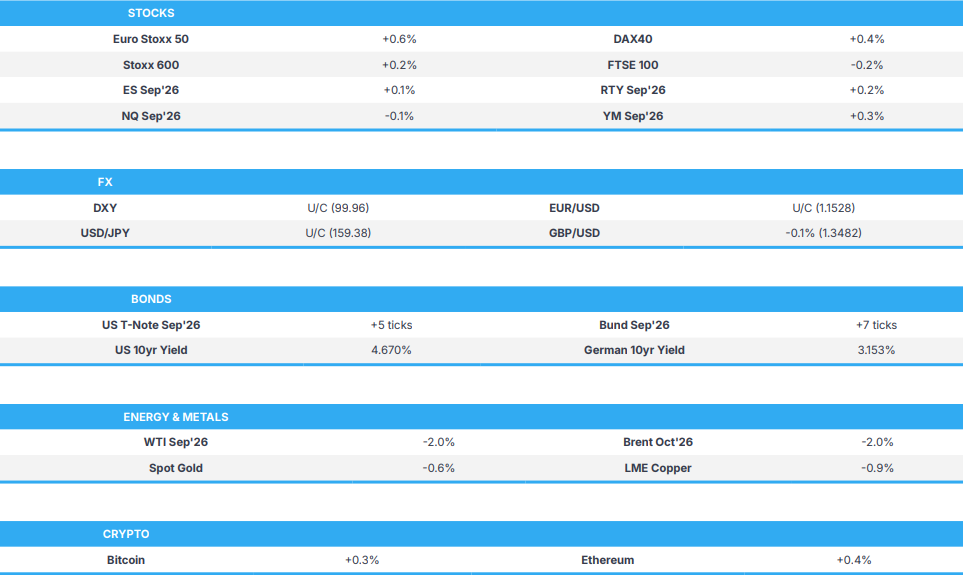
As of 10:25BST / 05:25EDT
Newsquawk in 3 steps:
1. Subscribe to the free premarket movers reports
2. Listen to this report in the market open podcast (available on Apple and Spotify)
3. Trial Newsquawk’s premium real-time audio news squawk box for 7 days
EUROPEAN TRADE
EQUITIES
- European bourses are firmer across the board, outside of the FTSE 100 given that 19% of the index is trading ex-divs. The positiveness follows on from the constructive tone overnight in Asia. Despite choppiness in China, Lenovo surged some 22% after the Co. reported a 43% increase in revenue to USD 26.94bln, beating expectations of USD 22.33bln. Post-earnings, the CEO said they are to achieve the USD 100bln annual revenue goal ahead of schedule and announced that they are working with Nvidia (NVDA) to launch an AI PC powered by the RTX chip later this year.
- Sectors point to a more mixed picture. Banks top the sector pile, followed by Consumer Products & Services and Food, Beverages & Tobacco. Basic Resources is the clear sector laggard, with Chemicals and Energy printing modest losses.
- US equity futures are muted, trading in narrow ranges. Despite the light volumes, there are a few key movers pre-market: Cerebras Systems (-17.4% pre-market), Q2 revenue missed estimates and gross margin fell; Cisco (-6.2% pre-market), despite Q4 earnings beat and raised its guidance.
- Click for the sessions European pre-market equity newsflow
- Click for the additional news
FX
- USD stabilises just below 100.00 after gains on Wednesday despite US CPI triggering a small dovish repricing. ING opines the USD strength seen after the data is likely a function of traders rebuilding longs as the set of July data comes to a close ahead of PPI today. Another potential factor could be this week’s quiet markets, which could have triggered some carry demand, especially as the recent data do not imply a clear Fed policy direction. Today, DXY is flat within a narrow 99.91-100.08 range after facing resistance at 100.05.
- JPY saw some strength after Bloomberg sources indicated the Takaichi government is said to support a faster BoJ rate hike. A report which has convinced markets, with interest rate futures now implying a 75% probability of BoJ tightening in September. This could be added to should these remarks come from Takaichi herself. USD/JPY fell c. 30 pips to a 159.18 base, before paring some of the move, now sitting around 159.40.
- NOK saw some weakness as while the Norges Bank left rates unchanged and keeping the door open to further tightening, it signalled inflation progress in the statement. If this progress is reflected in September’s statement, it could imply a removal of the tightening bias and as such has led to the trimming of NOK longs. Despite this, the bank remains slated to hike in September, a view held by Nordea and SEB. EUR/NOK was choppy on the announcement, initially falling 0.2% to a 10.90 base, before reversing the move to a peak just above 10.97.
- NZD is the G10 laggard after soft one year and two year inflation expectations. Kiwi saw pressure throughout the APAC session, rebounding slightly now after surpassing the 100 and 200 DMAs in NZD/USD, reaching a 0.5820 trough.
FIXED INCOME
- Once again, a contained start for fixed income. Major macro updates relatively light, and nothing that changes the narrative for the complex. Today, the focus is on US PPI for July, which will inform/update the calls ahead of PCE after Wednesday’s CPI; as a reminder, the series sparked a modest dovish reaction in near-term Fed pricing.
- USTs flat in 108-15 to 108-23 parameters, looking to PPI as mentioned before Fed’s Barkin (2027) and Hammack (2026), and while both have spoken recently and updated view post-CPI will be pertinent.
- Bunds in-fitting with the above, newsflow for the bloc has been and is scheduled to remain light. Currently a few ticks firmer in 124.65-83 parameters.
- A similar picture for Gilts, with no lasting reaction at the open to the morning’s GDP series which, in short, was stronger-than-expected for the GDP components aside from an in-line Q2 Q/Q print. However, the series is caveated by a weaker-than-expected breakdown for June and downward revisions to the May GDP series.
COMMODITIES
- WTI Sep and Brent Oct futures are subdued amid a lack of notable US-Iran-related updates. On diplomacy, Pakistan’s key mediator has held a second meeting with Iran’s Foreign Minister Araghchi and is seeking to extend the 60-day truce, according to an informed source cited by Al Arabiya. On the flip side, the Strait of Hormuz authority rejected US claims and said the waterway remains blocked until Iran’s conditions are met, according to Press TV.
- WTI currently resides in a USD 81.64-83.30/bbl range, with prices now under yesterday’s USD 82.40-84.35/bbl. Brent resides in a USD 87.30-89.07/bbl range vs yesterday’s 88.10-90.07/bbl range. Dutch TTF is similarly subdued and back under EUR 60/MWh, with focus in Europe on no storage replenishing ahead of winter, and against the backdrop of Middle Eastern issues.
- Precious metals consolidate amid a lack of macro updates ahead of US PPI. Spot gold trades on either side of its 100 DMA (USD 4,387/oz) in a current USD 4,364-4,450/oz range. Spot silver similarly gives back yesterday’s gains (and more), with the precious metal under USD 64.50/oz vs yesterday’s 66.80/oz high.
- Base metals are also lower across the board amid the summer lull. Elsewhere, Antofagasta lowered its full-year 2026 copper production guidance to 625–655kmetric tons (vs prior from 650–700ktons) following a precautionary weather-related shutdown at its Los Pelambres mine in Chile. 3M LME copper hovers around the USD 14k/t mark in a current USD 13,949.58-14,133.43/t range at the time of writing.
- Romania’s Nuclearelectrica has begun to to disconnect the final nuclear reactor, due to the continued low Danube level.
TRADE/TARIFFS
- Mexico is pressing the US to reduce tariffs on North American autos as part of discussions over reworking the USMCA, according to people familiar with the matter cited by WSJ.
- Indian Trade Ministry said they are actively in talks with the US on pending trade issues.
NOTABLE EUROPEAN DATA RECAP
- UK GDP Growth Rate Prel (Q2 QQ) 0.4% vs. Exp. 0.4% (Prev. 0.6%).
- UK GDP Growth Rate Prel (Q2 YY) 1.2% vs. Exp. 1.1% (Prev. 0.9%).
- UK GDP (Jun MM) 0.3% vs. Exp. 0% (Prev. 0.0%).
- UK GDP (Jun YY) 1.1% vs. Exp. 0.8% (Prev. 1.2%).
- UK GDP 3-Month Avg (Jun) 0.4% vs. Exp. 0.4% (Prev. 0.6%).
- UK Industrial Production (Jun MM) -0.2% vs. Exp. 0.1% (Prev. -0.7%).
- UK Industrial Production (Jun YY) -0.2% vs. Exp. 0.2% (Prev. 1.0%).
- UK Manufacturing Production (Jun MM) -0.5% vs. Exp. -0.2% (Prev. -0.2%).
- UK Manufacturing Production (Jun YY) 0.5% vs. Exp. 1.2% (Prev. 2.0%).
- UK Goods Trade Balance (Jun) -23.01 vs. Exp. -20.5 (Prev. -21.08).
- UK RICS House Price Balance (Jul) -30% vs. Exp. -31% (Prev. -33%).
- European Industrial Production (Jun MM) 0.0% vs. Exp. -0.1% (Prev. 0.3%)
- European Industrial Production (Jun YY) 0.1% vs. Exp. -0.8% (Prev. -0.1%)
- Spanish HICP Final (Jul YY) 3.9% vs. Exp. 3.8% (Prev. 3.6%).
- Spanish HICP Final (Jul MM) 0.0% vs. Exp. -0.1% (Prev. 0.6%).
- Swedish CPIF Final (Jul YY) 0.7% vs. Exp. 0.7% (Prev. 1.3%).
- Swedish CPIF Final (Jul MM) -0.3% vs. Exp. -0.3% (Prev. 0.3%).
CENTRAL BANKS
- Japanese PM Takaichi’s government is said to support a faster BoJ rate hike, while market sources say the BoJ could raise rates in September or October, according to Bloomberg.
- Norges Bank maintained its rate at 4.25%, as expected; may still become necessary to raise the policy rate. On inflation, the statement said that slower inflation is welcome news, but inflation is still too high, and it is too early to conclude that the inflation outlook has changed materially. The Committee judges that a restrictive monetary policy stance is still needed to bring inflation down to target within a reasonable time horizon.
- RBA’s Kent said the Board sets the level of the Cash Rate it judges will achieve low and stable inflation and full employment, while he added that borrowing costs have increased, mortgage payments have risen and conditions in the established housing market have turned down. Kent stated evidence suggests that monetary policy in Australia is somewhat restrictive, and that the tightening earlier this year is working, but also noted the possibility of rates increasing further if risks materialise.
NOTABLE US HEADLINES
- US President Trump signed a memorandum authorising US law enforcement to use cyber tools to target criminal organizations operating in foreign jurisdictions, according to The White House.
- The US race to compete with China on lithium runs into water battles, with Trump-backed plans to build production of critical elements undercut by community resistance, according to FT.
- BofA Total Card Spending (w/e Aug 8th) +6.2% Y/Y (prev. 4.7%); the rebound in spending over the past 3 weeks is consistent that the mid-July slump was a blip
GEOPOLITICS
MIDDLE EAST
- A White House official said US sanctions and a naval blockade have left Iran completely bankrupt, and that President Trump has many tools to pressure Tehran in the coming months, according to Al Jazeera citing media reports.
- The Strait of Hormuz authority rejected the US’ claims and said the waterway remains blocked until Iran’s conditions are met, according to Press TV.
- Iran’s Paramilitary Head Basij said the Strait of Hormuz is “under Iran’s control and management”, Fars News reported.
- Pakistan’s Defence Minister met with Iran’s ambassador to Islamabad and called for strengthening bilateral cooperation with Iran, according to IRNA.
- Yemeni Armed Forces announced strikes on Saudi ships and military sites, according to Press TV.
- US President Trump’s administration criticised Israeli Defence Minister Katz’s remarks about maintaining Israel’s occupation of southern Lebanon, stressing the comments contradict commitments Israel made under framework agreement with the US and Lebanon, according to Axios.
RUSSIA-UKRAINE
- Russia hit Ukraine’s Izmail port, with port infrastructure is on fire following the Russian attack, according to local authorities.
- Ukraine’s military said they hit Russia’s oil refinery in Bashkortostan, some 1,300km from the border.
CRYPTO
- Bitcoin is contained within Wednesday’s range, holding below the USD 64k handle.
APAC TRADE
- APAC stocks were predominantly in the green as the region took its cue from the mild positive handover from Wall Street, where equities were underpinned by earnings, and September rate hike bets were unwound after in-line CPI data.
- ASX 200 bucked the trend amid various earnings releases, while RBA Assistant Governor Kent stuck to the hawkish-leaning script in which he noted the possibility of rates increasing further if risks materialise, but acknowledged evidence suggests that monetary policy in Australia is somewhat restrictive, and that the tightening earlier this year is working.
- Nikkei 225 rallied amid the tech momentum and following softer-than-expected PPI data for Japan.
- KOSPI outperformed as renewed semiconductor strength lifted the index into a technical bull market.
- Hang Seng and Shanghai Comp diverged, with sentiment initially dampened in Hong Kong as participants reflected on earnings, including mixed results from Tencent, while gains in the mainland were contained after the PBoC reiterated its support pledges in its quarterly implementation report, but refrained from 7-day reverse repo operations for the third consecutive day.
NOTABLE ASIA-PAC HEADLINES
- RBNZ plans a paper on modernising New Zealand’s payment system, including potential changes to the current framework
NOTABLE APAC DATA RECAP
- New Zealand 2-year Inflation Expectations (Q3) 2.3% (Prev. 2.5%).
- New Zealand 1-year Inflation Expectations (Q3) 2.6% (Prev. 3.4%).
- Japanese PPI (Jul MM) 0.1% vs. Exp. 0.6% (Prev. 0.4%).
- Japanese PPI (Jul YY) 7.2% vs. Exp. 7.4% (Prev. 7.1%).
1c) Asian opening report
Europe primed for firm open after APAC strength; DXY attempts to build on gains into PPI – Newsquawk EU Market Open
Thursday, Aug 13, 2026 – 02:24 AM
- Pakistan’s key mediator has held a second meeting with Iran’s Foreign Minister Araghchi and is seeking to extend the 60-day truce, according to an informed source cited by Al Arabiya.
- Strait of Hormuz authority rejected US claims and said the waterway remains blocked until Iran’s conditions are met, according to Press TV.
- Crude futures initially declined but clambered off worst levels, with price action indecisive amid the absence of any major geopolitical updates overnight.
- USD/JPY saw a bout of mild pressure late in the session after Bloomberg sources said that the Takaichi government is said to support a faster BoJ rate hike.
- APAC stocks were predominantly in the green as the region took its cue from the mild positive handover from Wall Street; European equity futures indicate a positive cash market open.
- Looking ahead, highlights include UK GDP (Jun/Q2), Trade Balance (Jun), Swedish/Spanish Inflation Final (Jul), EU Industrial Production (Jun), US Initial Jobless Claims (Aug/08), PPI (Jul), Norges Bank Policy Announcement (Aug). Speakers include Fed’s Hammack & Barkin, Norges Bank’s Bache. Supply from the US. Earnings from Applied Materials, RWE, Antofagasta & Maersk.
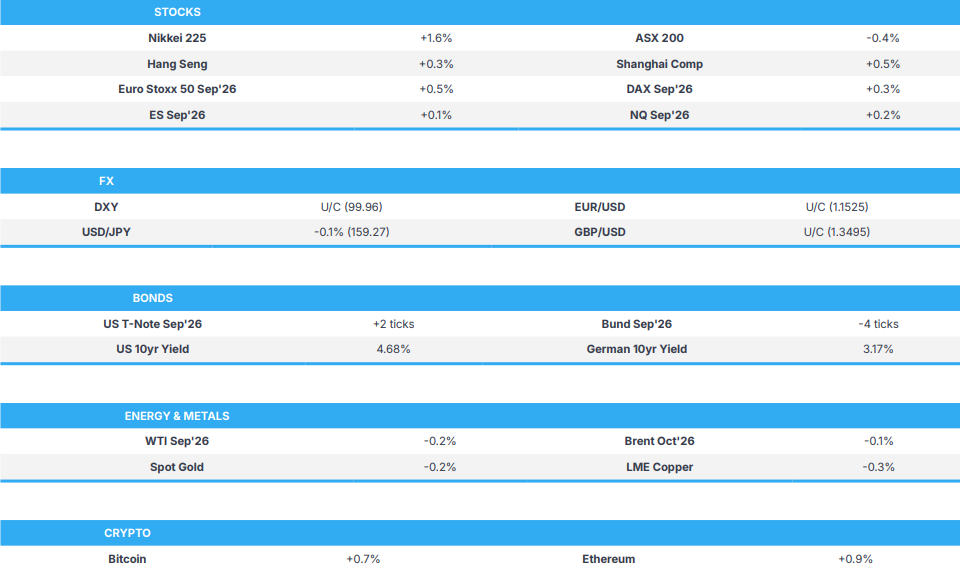
As of 06:20BST/01:20EDT
Newsquawk in 3 steps:
1. Subscribe to the free premarket movers reports
2. Listen to this report in the market open podcast (available on Apple and Spotify)
3. Trial Newsquawk’s premium real-time audio news squawk box for 7 days
LOOKING AHEAD
- Highlights include UK GDP (Jun/Q2), Trade Balance (Jun), Swedish/Spanish Inflation Final (Jul), EU Industrial Production (Jun), US Initial Jobless Claims (Aug/08), PPI (Jul), Norges Bank Policy Announcement (Aug). Speakers include Fed’s Hammack & Barkin, Norges Bank’s Bache. Supply from the US. Earnings from Applied Materials, RWE, Antofagasta & Maersk.
- Click for the Newsquawk Week Ahead.
IRAN CONFLICT
- White House official said US sanctions and a naval blockade have left Iran completely bankrupt, while the official stated President Trump has many tools to pressure Tehran in the coming months, according to Al Jazeera citing media reports.
- Strait of Hormuz authority rejected US claims and said the waterway remains blocked until Iran’s conditions are met, according to Press TV.
- Iranian political and security source told Al-Mayadeen the Strait of Hormuz has not been opened, and Iran has not made any change or even modification to its policy. The source warned against any ship that violates existing Iranian procedures and regulations in the Strait of Hormuz, adding that large ships cannot cross due to existing risks and that any ship failing to comply with Iranian procedures may face technical problems or safety risks. Furthermore, the source reiterated that the Strait of Hormuz is under Iranian control and management.
- Iranian Foreign Minister Araghchi posted, “Countries like France should stop lecturing the world about “human rights” and international law. The hypocrisy is blatant and embarrassing. Your backing of Israel’s genocide in Gaza—and aggression against Iran—has destroyed whatever moral high ground you imagined you had.”
- Iranian Foreign Ministry spokesperson said a foreign ship caused pollution on the coast of Qeshm Island and Iran cannot remain indifferent to pollution on its coast, while he added that every party benefiting from commercial traffic through the Strait of Hormuz must contribute to addressing environmental damage in the Gulf.
- Pakistan’s Defence Minister met with Iran’s ambassador to Islamabad and called for strengthening bilateral cooperation with Iran, according to IRNA.
- Pakistan’s key mediator, Interior Minister Senator Naqvi, has held a second meeting with Iran’s Foreign Minister Araghchi and is seeking to extend the 60-day truce, according to an informed source cited by Al Arabiya. Pakistan is working to keep the diplomatic track open by extending the 60-day period, and mediators need additional time to address outstanding issues between the US and Iran, although the Pakistani mediator is optimistic about extending the 60-day period.
- Iraq’s PM said they will not allow their territory to be used as a launching pad for any aggression against neighbouring countries.
- Arab sources reported drone attacks by Yemeni armed forces on Saudi mercenaries in the port of Al-Mukha, according to Fars.
- US President Trump’s administration criticised Israeli Defence Minister Katz’s remarks about maintaining the occupation of southern Lebanon, stressing the comments contradict commitments Israel made under the framework agreement with the US and Lebanon, according to Axios.
- Israeli artillery targeted the vicinity of Ali Al-Tahir Hill in Lebanon, according to Al-Mayadeen.
- Israeli security source noted escalation of settler violence in the West Bank and warned the area has become a powder keg that could explode at any moment, according to Haaretz.
US TRADE
EQUITIES
- US stocks traded higher on Wednesday, with the Nasdaq outperforming as strong earnings from CoreWeave (CRWV), Lumentum (LITE), Super Micro Computer (SMCI) and Nebius (NBIS) supported the AI trade. The equal-weight S&P 500 (RSP) posted more modest gains, while sectors were predominantly firmer. Real Estate, Technology and Consumer Staples outperformed, while Consumer Discretionary, Materials and Communication Services lagged. The major macro event of the session was the July CPI report, which came in line with expectations. The report saw money markets increase confidence in a September hold, while still maintaining expectations for a 25bps hike by year-end. Overall, the inflation data gives the Fed greater scope to remain patient, particularly following last week’s weak July jobs report, although it was not soft enough to eliminate the prospect of further tightening later in the year.
- SPX +0.26% at 7,748, NDX +0.74% at 29,743, DJI -0.04% at 53,775, RUT +0.61% at 3,045.
- Click here for a detailed summary.
TARIFFS/TRADE
- Canada and the US are not ready to make a tariff deal, while Canada is unsatisfied with the latest US offer, according to CBC. It was separately reported that Ottawa weighs a proposal on auto tariffs as it pressures the US for reprieve, according to The Globe and Mail.
- Mexico is pressing the US to reduce tariffs on North American autos as part of discussions over reworking the USMCA, according to people familiar with the matter cited by WSJ.
NOTABLE HEADLINES
- US President Trump signed a memorandum authorising US law enforcement to use cyber tools to target criminal organisations operating in foreign jurisdictions.
- US President Trump announced that White House Press Secretary Leavitt will leave her role at the end of the month so she can spend more time with family.
- US Commerce Secretary Lutnick said they will be announcing an Apple (AAPL) Mac mini factory in Texas on Thursday, while he also stated that Ford (F) is bringing more manufacturing and jobs to the US because of tariffs.
APAC TRADE
EQUITIES
- APAC stocks were predominantly in the green as the region took its cue from the mild positive handover from Wall Street, where equities were underpinned by earnings, and September rate hike bets were unwound after in-line CPI data.
- ASX 200 bucked the trend amid various earnings releases, while RBA Assistant Governor Kent stuck to the hawkish-leaning script in which he noted the possibility of rates increasing further if risks materialise, but acknowledged evidence suggests that monetary policy in Australia is somewhat restrictive, and that the tightening earlier this year is working.
- Nikkei 225 rallied amid the tech momentum and following softer-than-expected PPI data for Japan.
- KOSPI outperformed as renewed semiconductor strength lifted the index into a technical bull market.
- Hang Seng and Shanghai Comp diverged, with sentiment initially dampened in Hong Kong as participants reflected on earnings, including mixed results from Tencent, while gains in the mainland were contained after the PBoC reiterated its support pledges in its quarterly implementation report, but refrained from 7-day reverse repo operations for the third consecutive day.
- US equity futures were range-bound overnight as participants await the next market catalysts.
- European equity futures indicate a positive cash market open with Euro Stoxx 50 futures up 0.5% after the cash market closed with losses of 0.3% on Wednesday.
FX
- DXY traded flat and languished around the 100.00 level after rebounding from the initial pressure seen in reaction to the inline July CPI report, which unwound some September rate hike bets, while the recovery was facilitated by a rebound in the US 2yr yield, as a 25bps hike is still fully priced by year-end. Aside from the CPI data, there was little else to drive price action, and participants now look ahead to today’s PPI data.
- EUR/USD sat around this week’s trough after it ultimately gave up ground in post-CPI whipsawing.
- GBP/USD remained lacklustre after retreating beneath the 1.3500 handle and as UK GDP data looms.
- USD/JPY took a breather after yesterday’s intraday rebound and return to the 159.00 territory, while there was little reaction seen to the softer-than-expected Japanese PPI data, although there was a bout of mild pressure late in the session after a report that the Takaichi government is said to support a faster BoJ rate hike.
- Antipodeans weakened after recent price swings and with underperformance in NZD/USD following softer 1yr and 2yr inflation expectations.
FIXED INCOME
- 10yr UST futures eked slight gains but with upside limited after a choppy reaction to the inline US CPI data, which saw the Treasury curve bull steepen, led by declines in front-end yields, while the latest 10-year note auction was not as strong as the previous but remained better than recent averages, pointing to healthy underlying demand for duration.
- Bund futures lacked direction following recent whipsawing and uneventful German CPI data.
- 10yr JGB futures were subdued after recent fluctuations, while softer-than-expected PPI data did little to spur prices.
COMMODITIES
- Crude futures initially declined but clambered off worst levels, with price action indecisive amid the absence of any major geopolitical updates overnight and despite the Strait of Hormuz authority rejecting US claims, stating that the waterway remains blocked until Iran’s conditions are met, while some headwinds were seen yesterday following the largest build in weekly EIA crude inventories in more than three years.
- Spot gold was choppy with early gains pared after hitting resistance near the USD 4,450/oz level.
- Copper futures failed to benefit from the mostly constructive mood and extended on the prior day’s retreat amid quiet catalysts.
CRYPTO
- Bitcoin eked mild gains with price action choppy and oscillating around USD 63,500.
NOTABLE ASIA-PAC HEADLINES
- Japanese PM Takaichi’s government is said to support a faster BoJ rate hike, while market sources say the BoJ could raise rates in September or October, according to Bloomberg
- RBA’s Kent said the Board sets the level of the Cash Rate it judges will achieve low and stable inflation and full employment, while he added that borrowing costs have increased, mortgage payments have risen and conditions in the established housing market have turned down. Kent stated evidence suggests that monetary policy in Australia is somewhat restrictive, and that the tightening earlier this year is working, but also noted the possibility of rates increasing further if risks materialise.
DATA RECAP
- Japanese PPI MM (Jul) 0.1% vs. Exp. 0.6% (Prev. 0.4%)
- Japanese PPI YY (Jul) 7.2% vs. Exp. 7.4% (Prev. 7.1%)
- New Zealand 1-year Inflation Expectations (Q3) 2.6% (Prev. 3.4%)
- New Zealand 2-year Inflation Expectations (Q3) 2.3% (Prev. 2.5%)
GEOPOLITICS
MIDDLE EAST
- US is on track to withdraw all forces from Iraq by September 30th, ending its military presence there since the 2003 invasion, according to ABC News.
RUSSIA-UKRAINE
- Russia hit Ukraine’s Izmail port, while port infrastructure was on fire following the attack, according to local authorities.
OTHER
- China and Indonesia vessels reportedly wrap up practical maritime drills, including formation manoeuvres and refuelling in waters east of Taiwan.
- Japanese Foreign Minister Motegi strongly protested Russian President Putin’s visit to disputed Kuril Islands and said that the northern territories are Japan’s inherent territory historically and under international law.
EU/UK
NOTABLE HEADLINES
DATA RECAP
- UK RICS House Price Balance (Jul) -30 vs Exp. -30 (Prev. -33, Rev. -32)
2.NORTH AND SOUTH KOREA//JAPAN
JAPAN
JAPAN/USA
3. CHINA
4. EUROPEAN AND SCANDINAVIAN COMMENTARIES PLUS NATO
UK
They are crazzzzy!!
Watch: UK PM Wants Every Area In Britain To House Migrants
Thursday, Aug 13, 2026 – 09:20 AM
Authored by Steve Watson via Modernity News,
Prime Minister Andy Burnham has decided that “all parts of the country need to play their part.”

That means middle-class families and leafy villages must now accept large numbers of asylum seekers so the poorest areas are no longer the only ones carrying the load.
This approach obviously does nothing to stop the root of the problem, the sheer number of migrants washing up in boats. It simply advertises better accommodation to the next wave of illegal arrivals.
Burnham’s comments came in direct response to the ongoing revolt in the Oxfordshire village of Piddington. Residents there face plans to house up to 1,250 single adult male asylum seekers on a former military site near a community of roughly 400 people.https://modernity.news/2026/07/15/you-will-not-believe-what-is-happening-in-this-tiny-english-village/embed/

You WILL NOT BELIEVE What Is Happening In This TINY English Village
Microcosm for the whole UK
The numbers would leave locals heavily outnumbered. Children have written letters pleading with the Prime Minister not to destroy their village. Families held a symbolic independence referendum in which 96 percent voted to leave the United Kingdom in protest.https://modernity.news/2026/08/05/kids-in-tiny-british-village-beg-the-government-not-to-force-illegal-migrants-on-their-home/embed/

Kids In TINY British Village BEG The Government Not To Force Illegal Migrants On Their Home
There will be more illegals than residents
Seven-year-old Rex Perkin said his family had lived in the village for over 100 years and that he walked to his sister’s grave. He worried he would no longer be able to do that. Other children begged to keep their park, their dog walks, and the quiet life they knew. Parents described the prospect of being so outnumbered that daily life would change completely.
Burnham told GB News he understood concerns and would look into the issues raised by “the good people of Piddington.” He then made the wider point clear: “We cannot have a situation where it’s only the poorest communities in the country that receive all of the dispersal of refugees and asylum seekers. I do believe all parts of the country need to work, to play their part.”
Borders minister Anna Turley doubled down, defending the plan to impose the numbers on the tiny village and insisting the policy was about “fairness” and a “more fair and equitable system.”
She said the men would be “contained” on the site but still allowed out. The message to anyone watching from the French coast is straightforward: break into Britain and you may end up in a secure facility near a prosperous English village rather than a rundown hotel in a deprived town.
The Centre for Migration Control put the core problem bluntly:
Labour MP Graham Stringer, speaking on TalkTV, rejected the idea that opposition was rooted in racism.
GB News coverage highlighted the demographic reality. Certain areas could see locals outnumbered three to one if the redistribution continues on this scale.
Piddington is not an isolated case. Earlier this summer the village made national headlines when residents staged their symbolic breakaway vote after discovering the Home Office intended to convert the MoD Bicester site for 1,250 men with almost no local consultation.
Infrastructure, policing, and community safety were secondary concerns. The site sits next to a children’s playing field and nature reserve. Parish council chairman Tim McNally described the process as residents being “driven into a corner.”
Similar scenes have played out elsewhere. In Crowborough, East Sussex, residents formed a volunteer security group after hundreds of single adult males were placed at a former army camp.https://modernity.news/2026/05/20/residents-of-uk-town-forced-to-form-vigilante-security-team-to-protect-women-and-kids-from-migrants/embed/
Women reported feeling unsafe walking alone. The group of vetted locals began patrolling streets because official policing could not provide the reassurance needed.https://www.youtube.com/embed/oe-qRTTdLsY
Crowborough had already braced for up to 600 men from countries including Pakistan, Eritrea, Iran, Afghanistan and Bangladesh. Protests drew thousands. Locals installed extra security and questioned why their town was chosen with minimal consultation.
The housing pressure is also structural. Projections show migrants are set to take a huge share of new homes built in Britain by 2030. Net migration on current trends will require hundreds of thousands of additional properties, crowding out British families already struggling with supply.https://modernity.news/2026/03/14/migrants-set-to-swallow-40-of-new-uk-homes-by-2030/embed/
Burnham’s redistribution plan is presented as fairness after poorer areas have carried a disproportionate load for years. In practice it expands the destinations available to people who arrive illegally by boat.
Closing hotels and moving arrivals into former military sites or middle-class districts does not remove the incentive to cross. It upgrades the offer. The Channel remains open. The gangs adapt. Record numbers continue to arrive in single large boats even as ministers claim progress.
Shadow Home Secretary Chris Philp called the approach a “vindictive punishment beating” to the middle classes after years of tax rises and rising bills.
The deeper failure is strategic. A policy that signals better housing outcomes for those who reach Britain illegally cannot reduce arrivals. It can only increase them.
Piddington’s children wrote letters. Their parents voted to leave the country in protest. Other towns have formed their own security teams. The government response is to spread the same model further into the places that once felt insulated.
The boats will keep coming as long as the destination remains attractive. Housing the next arrivals in nice unspoiled villages does not change that calculation. It reinforces it.
Your support is crucial in helping us defeat mass censorship. Please consider donating via Locals or check out our unique merch. Follow us on X @ModernityNews.
end
GERMANY/REMIX..
Left-Wing German Parties Pour Record Sums Into Stopping The AfD In The East
Thursday, Aug 13, 2026 – 02:00 AM
Germany’s Green Party is campaigning with record sums of money in the eastern German states of Saxony-Anhalt and Mecklenburg-Vorpommern to keep the Alternative for Germany (AfD) out of power.

Remarkably, the Greens are campaigning with an intensity usually reserved for a national election, despite the party’s own election chances appearing rather dismal. In fact, in both states, the Greens are under threat of not even making it into parliament.
Saxony-Anhalt is by far the most important election, as there is a realistic chance that the AfD alone will obtain an absolute majority, thereby capturing the first real position of power in its history. In such a scenario, the parties of the German mainstream will be forced to cooperate with it.
Voters will choose their state legislatures, known as the Landtags, in close succession on Sept. 6 and Sept. 20, with the Greens campaigning on the slogan: “5% for the Greens in the Landtag – 0% AfD government.”
The math of the campaign is simple. If the Greens achieve 5 percent of the vote, it drastically reduces the chances of the AfD obtaining an absolute majority. Parties that score 5 percent are able to enter parliament, and the more parties that enter, the higher the AfD must score to obtain an absolute majority. Currently, the AfD has approximately 42 percent of the vote.
Right now, the Greens are under threat of being kicked out of parliament, as polling shows them consistently below the 5 percent threshold. In the last East German elections in 2024, in Thuringia and Brandenburg, the Greens were kicked out of the local Landtags; in Saxony, they just barely squeaked in. In Mecklenburg-Vorpommern, the 5 percent entry threshold was not even exceeded in the previous elections.
How much money is at stake?
In Saxony-Anhalt, the state campaign budget of the Greens now equals €1.5 million, which is the highest budget in the history of the provincial party organization, more than double the previous record, according to German newspaper Welt. Only 40 percent of this sum comes from donations.
In Mecklenburg-Vorpommern, the budget is a more modest €800,000 — more than double what was originally planned for in December 2025. In addition to subsidies, the surplus was provided by subsidies from other provincial party organizations.
By comparison, the far larger leading ruling party, the Christian Democrats (CDU), is campaigning in Mecklenburg-Vorpommern with about a million euros.
In Mecklenburg-Vorpommern, the German Social Democratic Party (SPD), which is preparing to defend its title under the leadership of Prime Minister Manuela Schwesig, will campaign with €1.1 million, which is the same as the 2021 budget, but more donations will flow there than before.
As a result, the ruling SPD in Mecklenburg-Vorpommern will be campaigning with less money than the Greens fighting for parliamentary entry in Saxony-Anhalt.
The budget of the Left Party has also jumped significantly. In Mecklenburg-Vorpommern, the party is also running for election with a record amount of €600,000, and in Saxony-Anhalt they are also running with a record high of €562,000. In both states, the party reports increased willingness among individuals to vote.
END
GERMANY/REMIX
‘Safe Space’: New Taxpayer-Funded Berlin Pool For ‘Blacks Only’ On Fridays
Thursday, Aug 13, 2026 – 06:30 AM
A temporary open-air pool erected outside Berlin’s iconic theater was supposed to represent the ultimate low-barrier urban oasis. Instead, a plan to allow only Black people to attend on Fridays has sparked outrage and accusations of racism.

Conceived as a free, non-commercial refuge requiring no identity checks — though reliant on a competitive online reservation system — the €300,000 project was introduced to the public as a shared summer meeting point. However, the organizers have implemented a protocol that excludes anyone non-Black one day a week, a clearly discriminatory practice.
Tensions arose over a specific event slated for Friday, Aug. 14. According to the official program, “During this period, the public bath is exclusively open to Black communities.”
Between 12:00 p.m. and 6:00 p.m., general admission is suspended. According to Berliner Zeitung, the venue’s operators added a note asking that “this collective self-designation and the associated spaces be respected.”
The event is organized in partnership with “EOTO” (Each One Teach One), a publicly funded non-governmental organization dedicated to social and cultural programming for Black individuals. Because the NGO receives financial backing from both the German federal government and the state of Berlin, the decision to restrict access during those six hours — effectively excluding white visitors —has drawn criticism from those who feel it contradicts the venue’s core mission.
When the venue was launched, organizers praised it as a communal stand against urban commercialization, describing the initiative as a open “summer invitation.” Critics now argue that reserving public infrastructure for specific demographic groups breaks that initial promise.
Notably, advocates for the Black-only policy claim racism against White people must be implemented to provide a “safe space” for communities facing systemic racism.
The pop-up installation serves as the inaugural project for incoming artistic director Matthias Lilienthal. The pool has been pushed as a practical solution to the city’s seasonal pool shortages. Nothing is said of the fact that Berlin’s population has exploded, mostly due to mass immigration, leaving many outdoor pool areas overcrowded and sometimes even violent.
Lilienthal noted to news outlet ZDF: “Half of the indoor and outdoor swimming pools are closed, so we thought we were helping the Governing Mayor Kai Wegner.”
The venue operates on a substantial budget, benefiting from over €20 million in annual public taxpayer subsidies. The pool itself, measuring 25 meters in length and 1.30 meters in depth, can host a maximum capacity of 46 swimmers simultaneously, with the total budget designed to accommodate an estimated 20,000 visitors over the course of the swimming season.
Racism against Whites is funded by the taxpayer in Germany
This is the hardly the only controversy involving race in Germany, with a number of government programs excluding White people or funding organizations that exclude White people.
Just this year, the right-wing Alternative for Germany (AfD) vowed to cut off taxpayer money for left-wing activist groups after a Berlin organization that runs a coworking café that reportedly excludes White people received more than €662,000 in public funding.
The pattern has been seen across Germany. In August 2023, a German museum of industrial heritage in Dortmund was scolded for only allowing “Black, Indigenous, and People of Color” to enter the museum on Saturdays between 10:00 a.m. and 2:00 p.m. for the “That’s Colonial” exhibition. The Zollern Colliery museum argued it was creating a “safer space” intended to protect people of color from “further discrimination.”
The exclusive access was “an offer for BIPoC and black people to be able to withdraw and exchange ideas openly,” according to the museum. “For BIPoC, such safe spaces are rarely found in everyday life or in museum rooms.”
In May 2025, the German Evangelical Church (EKD) was accused of racism after banning White children from attending a workshop on being “courageous and strong” during its Church Congress in Hanover.
The “Become Courage and Strong” workshop was, again, only open to Black, indigenous, and children of color. However, while ethnic Germans and ethnic Europeans are indigenous to Germany and Europe, the designation did not apply to them, only indigenous people from other continents.
“This offer is aimed exclusively at Black, Indigenous, and children of color,” read the program website.
In January of this year, the German taxpayer-funded NGO “Black Sheep,” Schwarze Schafe in German, was offering a six-month intensive seminar designed specifically for White individuals to examine their “alleged privileges,” which is modeled after the concept of “Critical Whiteness.”
The organization, which identifies as a “post-migrant education initiative,” has received significant taxpayer funding from Germans and operates a reporting center for anti-Muslim racism.
White participants were expected to pay up to €2,290 for the course that runs from March to September.
What is clear is that anti-White racism is a massive and lucrative industry in Europe, with funding amounting to tens of millions of euros, and possibly more, for tax-payer projects and NGOs targeting Whites for exclusion, ridicule, and discrimination.
END
SPAIN//KOLBE…
The Ceuta Crisis And The Emerging European Divide
Thursday, Aug 13, 2026 – 03:30 AM
Submitted by Thomas Kolbe
Eleven years have passed since Angela Merkel opened the floodgates of migration to chaos. The European Union, already firmly in the grip of statists and numerous left-wing currents, has since become almost unrecognizable. The advance of Islamization and the dissolution of established urban milieus, traditions and cultures are progressing and contributing to the disintegration of European societies.
What is particularly striking is the emergence of a kind of Islamo-Marxist movement, a fusion of radical socialist social ideals with a Sharia-based reinterpretation of society – as long as it is directed against the bourgeois West and the civilizational achievements of old Europe. Migration from North Africa and the Middle East is the united Left’s battering ram against the remnants of bourgeois European societies.
Against an increasingly tense backdrop came the Ceuta crisis: the invasion of more than seventy thousand mostly young men, tolerated as a triviality by the Spanish government – initially portrayed by the mainstream media, in a desperate attempt, as a kind of party invasion, later as a wave of poverty migration, and finally, with some reluctance, as an organized and aggressive political act. In the end, one sober conclusion remains: The European Union has no effective border protection whatsoever. Its organization Frontex is a band-aid, hastily stuck onto the gaping wound of a migration policy that, in reality, has made mass migration a goal of the left-wing consensus.
Spain’s Prime Minister Pedro Sánchez is one of the leading proponents of the EU’s political mainstream. The socialist, whose government only a few weeks ago registered 1.3 million applications to legalize immigrants residing illegally in the country – more than twice as many as originally expected – has also accepted a ruling by the Supreme Court that has effectively turned the sea route into a safe route to Spain: Only those who forcibly cross border fences may be sent back; anyone who lands by boat already enjoys state privileges. Sánchez has become a bridgehead for illegal migration into the EU – a Merkel multiplier, if you will.
At least we now have clarity: The Ceuta crisis exposes the dividing line between the socialists in the EU and the slowly but surely emerging national-conservative front.
What happened? During the night of July 31, around 72,000 people, most of them young men, crossed the border from Morocco into the Spanish enclave of Ceuta. According to Spanish figures, around 70,000 of them left the territory again within a few days – officially “voluntarily.” Madrid described the situation as being under control; in reality, it was a capitulation to sheer numbers.

The Spanish government’s complete failure caused considerable anger, particularly in Rome. Italian Prime Minister Giorgia Meloni reacted on the very day of the chaos and suspended the Schengen Agreement with regard to Spain. She spoke of shocking images from Ceuta and announced via X that Italy would not stand idly by and would, if necessary, take extraordinary measures to protect its own country from negative consequences. Her Foreign Minister Antonio Tajani ultimately implemented the closure of the Schengen area to Spain, citing the threat to national security.
A reaction from Madrid was not long in coming. One week later, on August 9, Spain turned the tables and has since been carrying out checks on travelers arriving from Italy at internal borders, ports and airports – officially, the measure is limited until September 7. The justification is cynical, if not comical, given that it comes from Spain, Europe’s migration chaos country: Persistent pressure from irregular migration from Italy had prompted the response, the government in Madrid announced.
Meloni seized the opportunity and, together with Denmark’s Social Democratic Prime Minister Mette Frederiksen, initiated an open letter to the EU institutions, signed by 22 member states, calling for a coordinated response to illegal migration and stronger EU external borders. The message from the two politicians: They will not accept uncontrolled migration into Europe and are themselves now pursuing a stricter immigration policy.
The two politicians may thus be outlining the one viable option for the future of the European Union: A jointly financed and highly professional system for protecting the EU’s external border would be one of its pillars alongside a deregulated internal market – external security and free competition within. The EU could be placed on a new foundation if it concentrated on its core responsibilities and abandoned the moralizing path of ever-growing bureaucracy. For now, however, national law stands in the way.
The socialist Sánchez will do everything he can, much like the German government, to ensure that the flow of migration does not stop. Too much is at stake: new voter potential and the conviction of the united Left that, in a globalized world, no national cultural enclaves should be tolerated. It is the heartfelt concern of all those on the Left to whom, significantly, Angela Merkel – politically socialized in East Germany – gave voice and political expression.
The dispute over Ceuta describes the dividing line between the socialist forces within the EU and the emerging national conservatives, whose informal spokesperson appears to be Italy’s prime minister. Certainly, the electoral defeat of Hungarian Prime Minister Viktor Orbán was an important victory for supporters of open borders, mass migration and globalism. His successor, Péter Magyar, has since been working under enormous pressure to dismantle Fortress Hungary and bring the country back into the migration flow.
This does not change the fact that national-conservative voices are making themselves heard in almost every country of the European Union, demanding a return to reason, to European values and, above all, to a border regime that is known to be the very foundation of statehood: A state without borders is not a state, but a settlement zone, a product of chaos – a volatile entity that sinks into the waves of poverty and crime faster than even the Left could imagine.
END
EASTERN EUROPE/DANUBE RIVER
Danube Water Levels Sink To Historic Lows
Thursday, Aug 13, 2026 – 04:15 AM
The Danube and other rivers in Europe are experiencing historic drought conditions which have thrown shipping, tourism and energy supply into disarray.
Additionally, as Statista’s Katharina Buchholz details below, the sinking water levels that have set new all-time records in some locations have revealed historic finds from World War II to Roman times and even the Ice Age.

You will find more infographics at Statista
At the end of last month, 200 cruise passengers had to be evacuated when a Viking line river cruise ship ran aground near Vidin, Bulgaria.
As of early August, cruise lines on the Danube, the Rhine and the Main are still disrupted, with itineraries being adjusted or canceled outright.
Not only tourism industries are suffering from the drought, however.
Critical energy infrastructure, agriculture and food supply routes are also in distress as the Danube provides irrigation to farmers and cooling to power plants.
On August 3, Romanian authorities carried out a controlled explosion to divert water flow towards the country’s only nuclear plant after it already had to shut down one of its two reactors in late July due to water shortages, leading to the declaration of a state of emergency. Last Thursday, it also sank four rock-laden barges in a similar plight. However, the shutdown of the second reactor on Thursday remains a possibility. A Hungarian nuclear plant which was powered down due to the low water levels is meanwhile expected to resume operations.
Like in 2022 drought conditions, the Serbian village of Prahovo saw several German World War II shipwrecks emerge which had been sunk there deliberately at the end of the war. The same happened to Budapest’s Franz Joseph bridge which German forces destroyed in 1945 while retreating and which has become visible underwater from its successor structure. Also in Budapest, the discovery of the remains of two German Wehrmacht soldiers as well as a Wehrmacht motorcycle made headlines. Yet another World War II relic surfaced in Virt, Slovakia, in the form of a naval mine.
Going back in time further to the Roman era, another old bridge, or in this case its foundations, emerged from the water near Gigen in Bulgaria. In the vicinity of Hungary’s Szalki Island, archaeologists discovered a part of a Roman altar dedicated to the god Jupiter and two more pieces of inscribed limestone. From the medieval age, a suspected catapult projectile was discovered in Visegrad, Hungary. Finally, the oldest find goes back the Ice Age: Mammoth bones and tusks were revealed by the retreating river in Ruse, Bulgaria, and specialists have confirmed the discovery.
end
ITALY
Massive Blast Rocks Italian Munitions Plant At Heart Of Europe’s Ammo Supply Chain
Thursday, Aug 13, 2026 – 11:00 AM
A massive explosion has been reported at a major Italian manufacturer of medium- and large-caliber ammunition, formerly known as Simmel Difesa. The plant operates in Colleferro and Anagni, near Rome.

Local Italian outlet Sky TG24 reports:
Fire and explosion at Colleferro, in the facility of the former Simmel Difesa, currently owned by KNDS Ammo Italy. The company, located in the Quarto Chilometro area, along via Latina, between Colleferro and Artena, produces medium- and large-caliber ammunition for land and naval defense, as well as solid fuels for aerospace launch vehicles.
The incident is said to have occurred in the powder pressing department. A loud boom was distinctly heard by residents in the area, triggering the alarm.
Separately, local media outlet Italia 24H Live posted footage on X that appears to capture the moment the explosion rocked KNDS Ammo Italy.
For context, KNDS Ammo Italy produces:
- Complete ammunition ranging from 25mm to 155mm
- Naval rounds, particularly 76mm and 127mm ammunition for Leonardo/Oto Melara guns
- Medium-caliber ammunition for land, naval and air-defense applications
- Artillery ammunition, including 155mm shells
- Propellant powders and charges
- Explosives and warheads
- Proximity and programmable fuzes
- Combustible cartridge cases and metal components
- Missile components
- Ammunition inspection, refurbishment and demilitarization services
Developments remain scant, and officials have yet to disclose the cause of the explosion, the extent of the damage or which production lines, if any, were affected. Against a backdrop of elevated concern over the Russia-Ukraine conflict’s expanding geographic footprint, the explosion warrants scrutiny. Officials have yet to disclose whether the blast was linked to sabotage or hostile action.
Ending the streak?

KNDS Ammo Italy is also Italy’s largest producer of medium- and large-caliber ammunition and a preferred supplier for Leonardo/Oto Melara naval guns.
Any supply disruption would have great exposure to:
- 76mm and 127mm naval ammunition, including programmable and proximity-fuzed rounds used for air and missile defense
- Specialized anti-air and anti-drone ammunition
- 155mm ammunition and modular propellant charges
- Fuzes, explosives and missile components supplied to other weapons manufacturers
Let’s get back to the US, where, in late 2025, Accurate Energetic Systems, a key defense contractor and manufacturer of high explosives for the military, suffered a massive explosion.
Stockpiles and potentially other KNDS plants could cover any outage at KNDS Ammo Italy. A prolonged disruption affecting explosives, propellant or fuze production would be more serious because alternative ammunition must be qualified for specific guns and fire-control systems. That process can take many months.
end
5.RUSSIAN AND MIDDLE EASTERN AFFAIRS
IRAN/ISRAEL THURSDAY
Iran Says It Reorganized Military To Be More Aggressive In Protracted Conflict After US ‘Long Miscalculated’
Thursday, Aug 13, 2026 – 09:00 AM
Top adviser to the commander of Iran’s Islamic Revolutionary Guard Corps, Mohammad Reza Naqdi, has been signaling Iran’s more aggressive stance in media appearances this week, also following a significant reshuffling of top military leadership.
“Look, we have to attain deterrence so that the enemy never dares to attack us, so we can live with security,” Naqdi said in an interview with PBS. “One way is to prolong this war until we get to the next term of the presidency and cause attrition, so that if anyone else wants to attack Iran, they will know there is a cost.”
Alluding to the recent military reorganization, he described: “Whenever the conditions are favorable and the order is issued, we must be able to take the operation into enemy territory” – while contrasting the approach with a pre-war doctrine “primarily based on defense and the preservation of the country.”

Military.com underscores that “Iran has reorganized its military to be more aggressive abroad as talks on ending the war with the U.S. remain mired in stalemate, a sign that Tehran is preparing for a protracted era of regional conflict.”
As a reminder, this is after Tehran’s obvious pivot away from negotiations, and toward a more permanent state of military resistance. The Wall Street Journal previously pointed out: “Now, the new supreme leader, Khamenei’s son Mojtaba, is putting his own stamp on the country’s national-security policy amid a confrontation with the U.S. that could last months or even years.”
According to more of the analysis:
In a sweeping overhaul of the government’s top echelon on Sunday and Monday, Iran named seasoned hard-liners to run the country’s security policies and institutions of repression.
It marked the most significant government reshuffle under Mojtaba Khamenei, who hasn’t been seen in public since the war began. U.S. intelligence agencies say he is alive but severely injured, and top Iranian cabinet members say they have never met him since he took office. Iranian officials say he was injured but in good health.
Analysts said the appointments signaled Khamenei’s determination to hold fast in a showdown with President Trump, who is seeking concessions on Iran’s nuclear program and the Strait of Hormuz.
“The regime is preparing for a more confrontational posture at home and abroad,” said Kasra Aarabi, an expert on the Islamic Revolutionary Guard Corps, a powerful paramilitary force, at United Against Nuclear Iran, a policy organization that opposes Iran’s government.
And some fresh insight from Michael Stephens, a senior associate fellow at the UK-based Royal United Services Institute (RUSI):
Nearly six months since the beginning of the war, Iran is now convinced that the US is not willing to conduct a ground invasion. “That existential threat is gone,” Stephens said. “So they want to up the tempo and maybe make the pain a little bit more acute for President Trump. And the best way to do that is to drag this out.”
Prior to the US-Israeli attack on February 28, the widely held belief was that the Iranian government would readily collapse, after enduring months of civil disobedience and unrest during major demonstrations in late December and January.
“That doesn’t seem to be the case now, and I’m not really sure the US has any tools in the bag to force the regime to do what they want,” the analyst said. Iranians can “live in this stalemate at the moment – it hurts them, but it’s not existential, and I think that’s the problem the US has now”.
Iranian leadership continues boasting of squaring up against the much larger American foe…
In follow-up, and as if confirming all of the above, Iranian Brigadier General Rasoul Sanaei-Rad has on Thursday said Iran will act more aggressively in the future, the Fars news agency reported.
“We stood firm in the recent war and, God willing, we will stand firmer and more aggressively in a possible future war,” said Sanaei-Rad, a political adviser in the office of the supreme leader. He noted that Iran’s “enemy” is seeking to fracture the country through economic pressure, but that its plan did not succeed.
Below: Mohsen Rezaei, one of the longest-serving figures in Iran’s Islamic Revolutionary Guard Corps, has returned to the heart of Tehran’s national security establishment, after Supreme Leader Mojtaba Khamenei appointed him secretary of the Supreme National Security Council.

Iran’s Foreign Minister Abbas Araghchi also chimed on in on Thursday with a similar theme of Washington miscalculation. He asserted that the United States has “has long miscalculated due to intelligence failures,” especially when launching its war on Iran.
American military actions in the Strait of Hormuz were “an even bigger miscalculation,” Araghchi stated on X. “Worse than fake news is fake intelligence,” the foreign minister said, perhaps in mockery of Trump.
end
IRAN/ISRAEL/USA THURSDAY
Tehran’s Houthi Proxies Attack Saudi Aramco Again, Crude Spikes, As Iran’s Military Command To Be ‘More Aggressive’
Thursday, Aug 13, 2026 – 11:40 AM
Summary
- Saudi Aramco attacked again: Houthi drone strikes on a Saudi refinery sent oil prices higher.
- Hormuz stalemate & standoff: US says it can sustain the Iranian port blockade indefinitely.
- Iran digs in: Tehran appears prepared for a prolonged war of attrition.
- Hard-liners rise: Iran reshuffled senior security leadership toward a more aggressive posture.
- Diplomacy dead-end: Iran says the U.S. has miscalculated, while talks remain deadlocked.
* * *
Attack on Saudi Aramco Facility Sees Crude Spike
Oil prices have spiked Thursday on emerging reports that the Houthis have freshly targeted an Aramco refinery in Saudi Arabia’s Jizan with two drones, according to regional Saba News Agency.
It seems this is part of Iran’s ‘counter-pressure’ playing book against Washington and its Gulf allies, given the Houthis have long been a proxy arm of Iran. The Houthi group is in the midst of a ‘siege for siege’ war on Saudi shipping and energy.

The Hormuz stalemate is meanwhile continuing, given War Secretary Pete Hegseth now says that the US military can maintain a blockade on Iranian ports for as long as needed.
“Indefinitely the United States Navy can maintain a blockade like that because we’ll rotate ships in and out, as we have, and we’ll continue to,” Hegseth told reporters. But Iran is also vowing to outlast and keep up the military pressure, enforcing its own strait management protocol based on the Oman deal.
Attrition Game Outlasting US Politics
Top adviser to the commander of Iran’s Islamic Revolutionary Guard Corps, Mohammad Reza Naqdi, has been signaling Iran’s more aggressive stance in media appearances this week, also following a significant reshuffling of top military leadership.
“Look, we have to attain deterrence so that the enemy never dares to attack us, so we can live with security,” Naqdi said in an interview with PBS. “One way is to prolong this war until we get to the next term of the presidency and cause attrition, so that if anyone else wants to attack Iran, they will know there is a cost.”
Alluding to the recent military reorganization, he described: “Whenever the conditions are favorable and the order is issued, we must be able to take the operation into enemy territory” – while contrasting the approach with a pre-war doctrine “primarily based on defense and the preservation of the country.”
Military.com underscores that “Iran has reorganized its military to be more aggressive abroad as talks on ending the war with the U.S. remain mired in stalemate, a sign that Tehran is preparing for a protracted era of regional conflict.”
As a reminder, this is after Tehran’s obvious pivot away from negotiations, and toward a more permanent state of military resistance. The Wall Street Journal previously pointed out: “Now, the new supreme leader, Khamenei’s son Mojtaba, is putting his own stamp on the country’s national-security policy amid a confrontation with the U.S. that could last months or even years.”
“Seasoned Hardliners” in Command
According to more of the analysis:
In a sweeping overhaul of the government’s top echelon on Sunday and Monday, Iran named seasoned hard-liners to run the country’s security policies and institutions of repression.
It marked the most significant government reshuffle under Mojtaba Khamenei, who hasn’t been seen in public since the war began. U.S. intelligence agencies say he is alive but severely injured, and top Iranian cabinet members say they have never met him since he took office. Iranian officials say he was injured but in good health.
Analysts said the appointments signaled Khamenei’s determination to hold fast in a showdown with President Trump, who is seeking concessions on Iran’s nuclear program and the Strait of Hormuz.
“The regime is preparing for a more confrontational posture at home and abroad,” said Kasra Aarabi, an expert on the Islamic Revolutionary Guard Corps, a powerful paramilitary force, at United Against Nuclear Iran, a policy organization that opposes Iran’s government.
And some fresh insight from Michael Stephens, a senior associate fellow at the UK-based Royal United Services Institute (RUSI):
Nearly six months since the beginning of the war, Iran is now convinced that the US is not willing to conduct a ground invasion. “That existential threat is gone,” Stephens said. “So they want to up the tempo and maybe make the pain a little bit more acute for President Trump. And the best way to do that is to drag this out.”
Prior to the US-Israeli attack on February 28, the widely held belief was that the Iranian government would readily collapse, after enduring months of civil disobedience and unrest during major demonstrations in late December and January.
“That doesn’t seem to be the case now, and I’m not really sure the US has any tools in the bag to force the regime to do what they want,” the analyst said. Iranians can “live in this stalemate at the moment – it hurts them, but it’s not existential, and I think that’s the problem the US has now”.
Iranian leadership continues boasting of squaring up against the much larger American foe…
Iran: US Has “Long Miscalculated”
In follow-up, and as if confirming all of the above, Iranian Brigadier General Rasoul Sanaei-Rad has on Thursday said Iran will act more aggressively in the future, the Fars news agency reported.
“We stood firm in the recent war and, God willing, we will stand firmer and more aggressively in a possible future war,” said Sanaei-Rad, a political adviser in the office of the supreme leader. He noted that Iran’s “enemy” is seeking to fracture the country through economic pressure, but that its plan did not succeed.
Below: Mohsen Rezaei, one of the longest-serving figures in Iran’s Islamic Revolutionary Guard Corps, has returned to the heart of Tehran’s national security establishment, after Supreme Leader Mojtaba Khamenei appointed him secretary of the Supreme National Security Council.
Iran’s Foreign Minister Abbas Araghchi also chimed on in on Thursday with a similar theme of Washington miscalculation. He asserted that the United States has “has long miscalculated due to intelligence failures,” especially when launching its war on Iran.
American military actions in the Strait of Hormuz were “an even bigger miscalculation,” Araghchi stated on X. “Worse than fake news is fake intelligence,” the foreign minister said, perhaps in mockery of Trump.
END
All Of Iran’s Weapons Today Are Domestic, Missile Production Exceeds Usage: IRGC Official
Thursday, Aug 13, 2026 – 10:45 AM
At a moment US officials as well as media headlines have been voicing alarm over depleted US missile stockpiles – something which President Trump sought to bat down as false – Iranian leaders have been busy boasting that their domestic defense production has not only kept pace but even expanded on the local production front.
Mohammad Reza Naqdi, Senior Advisor to the IRGC Commander-in-Chief, has been featured in state media as claiming that the production rate of ballistic missiles exceeds their operational launch rate, which comes on the heels of Tehran saying that it used the ceasefire with the US – which stretched from April into the summer months – to boost its weapons arsenal.
Naqdi asserted in a state television broadcast this week: “We are currently producing, and this process is unending.” Naqdi warned further that “The enemy should not assume that Iran’s missile stockpiles will run out one day.”

He also said: “There are many capabilities we have not deployed because we are managing the war with missile power.”
Prior US (and Israeli) bombing campaigns since the start of Operation Epic Fury took direct aim at Iran’s defense industrial sector. While it can be estimated that perhaps dozens or possibly even hundreds of missile sites as well as manufacturing locations were hit, damaged, and destroyed – Iranian officials say that hundreds more are still intact, scattered across the country.
Citing Naqdi’s words further, Iran Wire writes:
He added that Iran does not rely solely on existing stockpiles, as defense equipment manufacturing remains continuous. Naqdi claimed that even if the war continues for years, ballistic missiles will still be manufactured in Iran and supplied to the armed forces on the final day of the conflict.
Highlighting the country’s industrial capacity, the senior advisor noted that, in addition to hundreds of industrial complexes, Iran houses approximately 950 industrial towns where defense equipment production is actively underway across various regions.
The same top IRGC official also this week was interviewed by PBS. In that interview he more broadly laid out that…
“We have to attain deterrence so that the enemy never dares to attack us, so we can live with security. One way is to prolong this war until we get to the next term of the presidency and cause attrition, so that if anyone else wants to attack Iran, they will know there is a cost.”
Last week, a separate Iranian army official voiced something similar:
“We have made maximum use of the opportunity of the memorandum of understanding and every moment of the ceasefire,” army spokesman Mohammad Akraminia told state television this week, referring to a now-suspended MoU signed with the US in June.
He said attempts were made to induct existing equipment into the armed forces and import new equipment, as well as repairing and recovering damaged systems or manufacturing new systems.
The brigadier general also said new-generation drones have been used in combat, and their specifications would be announced later.
Last month, Iran’s acting Defence Minister Majid Ebn-e Reza said that missile and drone production had “not stopped for a single day” and that drone production had reached three times its pre-war levels. But he did not provide any figures.
Meanwhile, the White House appears to have given up on finding a ‘military solution’ – and is settling in for a longer economic war, hoping the Islamic Republic will be weakened from within and ultimately collapse. But the Iranian military and government say the country is prepared to endure and outlast these external pressures while remaining ever-ready to resume retaliatory strikes if necessary.
END
ISRAEL TBN
HEZBOLLAH/LEBANON
US pushes back as Katz says IDF will not withdraw from security zone in southern Lebanon
An official clarified that, from Washington’s perspective, a permanent Israeli military presence in southern Lebanon is inconsistent with the commitments made under the understandings.

A member of the Lebanese army sits on a military vehicle in Zawtar al-Gharbiyeh, after the withdrawal of Israeli forces under a US-mediated plan, in southern Lebanon, July 26, 2026.(photo credit: REUTERS/AZIZ TAHER/FILE PHOTO)ByAMIR BOHBOTAUGUST 13, 2026 09:39
After Defense Minister Israel Katz declared that the IDF “will not withdraw” from the security zone and ordered the military to prepare for a long-term presence, Washington clarified that “a permanent military presence in southern Lebanon is inconsistent with the commitments” made under the understandings.
However, an Israeli withdrawal would be contingent on the verified disarmament of Hezbollah and the dismantling of its infrastructure.
A senior US State Department official responded overnight on Thursday to remarks by Katz, who said during a visit to southern Lebanon that the IDF would not withdraw from the “security zone” and that he had instructed the military to prepare for a long-term presence in the area.
The official clarified that, from Washington’s perspective, a permanent Israeli military presence in southern Lebanon is inconsistent with the commitments made under the understandings.
“The United States expects all parties to act in a manner consistent with the framework they agreed to,” the official said. “Israel has clearly stated that it has no territorial ambitions in Lebanon.

Permanent military presence inconsistent with peace commitments
A permanent military presence in southern Lebanon is inconsistent with the commitments made under the understandings, as well as with the long-term peace and security of both countries.”
The official further stressed that the United States “fully supports Lebanon’s territorial integrity and sovereignty.” However, Washington clarified that the Israeli withdrawal is expected to proceed in accordance with progress in disarming Hezbollah and dismantling its infrastructure.
“The framework clearly includes a conditions-based path for a gradual withdrawal, tied to the verified disarmament of Hezbollah and the dismantling of its infrastructure,” the official said.
According to the official, the Lebanese Armed Forces have already begun implementing the “initial pilot zones,” and the United States will continue to support the full implementation of the process.
Katz: IDF does not intend to withdraw from currently held areas
The US response came after Katz said during a visit to IDF troops in Lebanon that Israel did not intend to withdraw from the areas it currently holds.
“As the prime minister and I have made unequivocally clear, we are not withdrawing from this security zone,” Katz said.
“The IDF is here to protect the northern communities and its troops; we will clear this area and ensure the security of the residents of the North, and under no circumstances will we withdraw from the security zones: not in Lebanon, not in Syria and not in Gaza.”
Katz added that he had instructed the IDF “to take all necessary measures to prepare for a long-term presence in the area,” and presented the Israeli presence beyond the border as part of the lessons learned from the October 7 massacre.
“The lesson of October 7 is that we protect the residents by having the IDF here, in these places, protecting them from raids, from gunfire, and from all the other things. That is our policy, that is our approach,” he said.
END
MIDDLE EAST/USA EMBASSIES:
US Embassies Across Mideast Are Permanently Reassigning Personnel
Thursday, Aug 13, 2026 – 02:45 AM
It is not just America’s military bases in the Middle East which have been greatly reduced in terms of personnel or in some cases completely abandoned altogether due to the Iran war, but US Embassies in the region have also suffered forced downgrades of staff.
Iran’s retaliation on US locations and assets across the region was much bigger and more effective than US planners apparently expected, and this could have lasting impact on how US military and diplomatic deployments operate in the region.
In some cases, such as the US Embassy in Baghdad’s Green Zone, diplomatic compounds have been directly targeted by Iranian fire or that their proxies. And now, “The State Department is asking US embassies in the Middle East to create plans to continue operating with a small number of staff on the ground, sources told CNN, as the war with Iran shows no signs of resolution.”

One aspect to the report which points to a likely permanent new arrangement is that embassy staff that had been relocated due to the war are now being offered reassignments.
CNN continues, “Additionally, personnel who have been displaced from their posts in the Middle East are increasingly being given the option to curtail their assignments, the sources said.
“The plans have not been finalized, the sources said, and it is unclear if they will be implemented at all of the embassies that are currently on reduced staffing,” the report adds.
Importantly, it concludes: “Still, the developments underscore that the State Department does not expect to return to normal staffing in the region soon amid the looming threat of a full-scale return to war.”
What’s more is that throughout the most intense phase of the war, the Iranians claimed to have targeted compounds and hotels where diplomats and even intelligence officials were being housed.
The fact that the US State Department remains worried enough to now be hatching plans for an at least semi-permanent drawdown from these locations suggest this Iranian targeting was effective to some extent. Currently, most of the US embassies across the region are shuttered for their normal operations. For example, the US Embassy in Jordan has ceased from normal operations for several months, stretching back to the very start of Operation Epic Fury, the bulk of its staff having long ago departed.
Recent NY Times reporting underscores that Iranian missiles are technologically advanced enough to punch through US regional anti-air defenses. This has especially been on display in Jordan:
During five intense days last month, Iran launched waves of drones and missiles at U.S. troops on three bases in Jordan, hoping to break through the formidable American air defenses.
Using advanced missiles that can suddenly change course, Iran pummeled the bases’ defensive systems, forcing the Americans to burn through scarce supplies of Patriot interceptors.
On the fifth day, the Iranians broke through.
Secretary of State Marco Rubio and other US officials have lately admitted that Iranian missiles have evaded America’s air defenses:
A missile struck prefabricated housing units at one of the bases on July 17, killing three U.S. soldiers and wounding more than 100. Pentagon officials later acknowledged that scores of other troops were injured and several aircraft damaged in attacks in Jordan that week.
“We shot down almost all the missiles,” Secretary of State Marco Rubio said when asked about the fatal attack. “One leaked through.”
The strikes reveal a deadly confluence of two important trends: First, Iran has become a more skilled adversary as the war has progressed, learning how to evade U.S. air defenses as it widened the battlefield to include most of the Middle East and enlisted allies like the Houthis in Yemen and militias in Iraq.
Second, the Pentagon’s supply of interceptors has quickly dwindled, with the weapons becoming more precious each day of the off-and-on conflict.
Interestingly, the NY Times concludes something that should have been glaringly obvious. It has even been predicted in Pentagon and US intelligence war-gaming exercises from years ago…
“The two trends drive home a point that has slowly emerged in the months since the war started, that a global superpower with a mighty military footprint can still be held at bay by a lesser adversary willing to wage asymmetric warfare to find any advantage it can,” The Times writes. Once also could have just looked at the ‘forever wars’ in Afghanistan and Iraq.
END
LIBYA
Libya Reels From Assassination, Oil Strikes & Central Bank Turmoil
Wednesday, Aug 12, 2026 – 10:35 PM
Libya was plunged into fresh turmoil this week after a car bomb killed eastern military intelligence chief Fawzi al-Mansouri in Benghazi, drone attacks struck the country’s largest operational oil refinery and the central bank governor resigned from his post.
Mansouri, the military intelligence chief for forces controlling eastern Libya, was leaving a mosque on Monday night when an explosive device attached to his vehicle detonated, the Libyan National Army (LNA) said on Tuesday.

Khaled Haftar, the son of the LNA renegade commander Khalifa Haftar who controls eastern Libya, said authorities had opened an investigation, adding that “indicators point to a despicable terrorist tactic”.
“Terrorism is a project targeting the entire region, not just Libya,” the statement added.
While no group has taken responsibility for the attack, Hamish Kinnear, principal Middle East and North Africa analyst at risk intelligence company Verisk Maplecroft, told Middle East Eye that “it is a reminder that security in eastern Libya remains fragile despite the domination of Khalifa Haftar’s LNA”.
The killing also challenges the Haftar family’s efforts to present eastern Libya as stable after years of conflict. The LNA said it would “not cease fighting terrorism and will continue our struggle for the stability and security of Libya, as well as for the unification of its institutions“.
The assassination came as emergency crews fought a major fire at the Zawiya oil refinery, west of Tripoli, following a drone attack on Monday evening. It was the third strike on the facility in two days.
Libya’s National Oil Corporation said a drone directly struck a tank holding about 4.5 million liters of fuel. The resulting fire caused the tank to collapse and prompted the company to warn that further attacks could force it to suspend operations.
Emergency services reported no serious injuries, although medics treated several people for smoke inhalation. Zawiya is Libya’s largest operational refinery and can process 120,000 barrels of oil per day.
“No group has claimed responsibility for the drone strikes, but they came amid an armed confrontation between rival militias in Zawiya and are likely intended as pressure on the Government of National Unity headed by Prime Minister Abdul Hamid al-Dbeibah,” Kinnear said.
The turmoil deepened after a letter attributed to Central Bank of Libya Governor Naji Issa circulated widely on social media and local news outlets.
Addressed to the heads of the House of Representatives and High State Council, the letter said Issa would not remain in his post. He declined to explain his decision, citing the “sensitivity” of the reasons.
“Drone attacks on oil infrastructure in Zawiya, a car bomb assassination in Benghazi and the resignation of one of Libya’s top officials [in a space of 24 hours] underline how quickly Libya’s fragile political and security situation can deteriorate,” said Kinnear.
Post-Gaddafi Libya remains divided between the internationally recognized government in Tripoli and an eastern administration backed by Haftar.
The hydrocarbon-rich country produces more than 1.3 million barrels of oil per day but continues to suffer prolonged electricity cuts. Blackouts have triggered protests in Tripoli, Zawiya, Misrata and other cities, where demonstrators have demanded reliable power and called for Dbeibah to resign.
“Libya’s energy infrastructure often becomes the target in these confrontations, as it is the easiest means by which pressure can be placed on political leaders and concessions demanded,” Kinnear said.
END
RUSSIA VS UKRAINE
6/.GLOBAL ISSUES, COVID ISSUES, VACCINE INJURIES/HEALTH ISSUES
GLOBAL ISSUES
MARK CRISPIN MILLER
Barry Manilow postpones show amid lung cancer recovery; Rod Stewart abruptly cancels show, rushed to hospital; ZZ Top, Earth Wind & Fire cancel shows; SA: DJ Lamiez Holworthy-Morule cancels shows
Cancelations nationwide and elsewhere
| Mark Crispin MillerAug 13 |  |


A survey of the likely global toll of COVID “vaccination,” based on the reports collected by our worldwide team of researchers this past week.
To help support our work, consider subscribing or making a donation.
Cancelations
UNITED STATES
Barry Manilow reschedules concert 45 minutes before start amid ongoing lung cancer recovery
August 5, 2026

Barry Manilow rescheduled his Kentucky show on Tuesday just 45 minutes before it was set to start. “Due to unforeseen circumstances tonight’s show in Lexington has been rescheduled,” Manilow, who was diagnosed with lung cancer last year, wrote on X ahead of the concert. No other explanation was given. While some slammed Manilow as “disrespectful” for the late rescheduling, others were quick to offer him words of encouragement. In December, Manilow revealed he had been diagnosed with early-stage lung cancer after doctors discovered a cancerous spot on his left lung following a bout of bronchitis.
News from Underground by Mark Crispin Miller is a reader-supported publication. To receive new posts and support my work, consider becoming a free or paid subscriber.
Researcher’s note – Manilow was among the artists who performed at the August 2021 “We Love NYC Concert”: A celebration of New York City’s comeback, the concert will promote health, safety, and equity. All performers, staff, crew, and attendees were required to show proof of COVID “vaccination”: https://wror.com/2021/07/27/springsteen-we-love-nyc-concert/
Rod Stewart rushed to hospital as he pulls out of Cincinnati concert at last minute
August 10, 2026

Rock legend [and US citizen] Rod Stewart was forced to postpone a concert in Cincinnati after being hospitalized. The 81-year-old singer had been scheduled to take the stage at Riverbend Music Center in the Ohio city on Sunday, August 9, but called off the show at the eleventh hour. The venue broke the news of Stewart’s hospitalization on social media just hours before the performance. In their statement, they said, “Due to an unforeseen but minor medical procedure that required prompt attention, Rod Stewart’s performance tonight in Cincinnati has been postponed.” This comes days after Stewart devastated fans for canceling his Niagara Falls concert hours before the show. The last-minute cancellation follows Stewart’s axing of a June performance on medical grounds after being diagnosed with an acute upper respiratory infection that led to laryngitis.
Researcher’s note – In a 2021 interview, Stewart said he was “vaccinated”, “boosted”, and angry at the “unvaccinated”. Stewart said, “It makes me angry, especially in America, where they talk about ‘It’s my right, it’s my freedom.’ No it’s not! Because you are a killer, and you can be killed. Dead simple.” https://www.rodstewartfc.com/all-the-news-all-the-time/december-2021
ZZ Top Drummer Frank Beard Suffering From Serious Health Issues
August 10, 2026

Frank Beard, the longtime drummer of the rock band ZZ Top, is dealing with serious health issues and it’s so bad it’s affecting their tour, TMZ has learned. The health update comes just days after ZZ Top cancelled their August 5 show at the Hollywood Bowl. Sources tell TMZ Frank’s health was the reason behind the cancellation. Drummer John Douglas has subbed in for Frank in the past, like last year, when Frank briefly stepped away from the band “to attend to a health issue,” but in Frank’s recent absence, it’s been Michael Monahan. Frank’s been with ZZ Top since 1969.
No age reported.
Earth, Wind & Fire Drummer John Paris Hospitalized After Medical Emergency
August 7, 2026

Earth, Wind & Fire drummer John Paris is the band member who suffered a medical emergency that forced the group to postpone its San Francisco concert, sources familiar with the situation tell TMZ. We’re told none of the group’s three longtime members — Philip Bailey,Verdine Whiteand Ralph Johnson — were involved. The San Francisco Fire Department told TMZ a fire engine and private ambulance responded to the venue for a cardiac incident, and one person was transported to a local hospital in critical condition. Paris’ current condition is unclear. As we reported, Earth, Wind & Fire postponed its Thursday night show with Lionel Richie at San Francisco’s Chase Center after a band member suffered a medical emergency.
Researcher’s note: Earth, Wind & Fire performed at NYC’s “Homecoming Week” in August, 2021, where musicians played for only “vaccinated” attendees: https://abc7ny.com/post/nyc-homecoming-week-concerts-mega-concert-central-park/10911932/
No age reported.
SOUTH AFRICA
Lamiez Holworthy-Morule rushed to hospital for emergency surgery
August 10, 2026

DJ and television personality Lamiez Holworthy-Morule [34] has been rushed to hospital and undergone an emergency surgical procedure, forcing her to pull out of several scheduled appearances. The Metro FM presenter’s management confirmed the news in a statement issued on Sunday, reassuring fans and industry stakeholders that her condition is not life-threatening. The nature of the medical emergency and the procedure has not been disclosed. The sudden hospitalisation has affected Holworthy-Morule’s professional commitments, with her management confirming that she will miss remaining events scheduled for Sunday, August 9, as well as Monday, August 10.
DR PAUL ALEXANDER.
RABOBANK/MICHAEL EVERY/OR OR PICTON/GIFFIN OR RABOBANK EXECUTIVE/COMMENTARY ON WORLDLY AFFAIRS
The Beautiful Great Game: Extra Time & Penalties
Thursday, Aug 13, 2026 – 10:25 AM
By Michael Every of Rabobank
Yesterday’s in-line US CPI report was the non-event its relative insignificance vs tumultuous domestic and global backdrops suggested it should be. Meanwhile, in the ‘Beautiful Great Game’, it’s extra time and penalties, medals and champagne for some, and tears for others.
Iran remains defiant. Trump says he has “total control” of and “will keep” Hormuz. He’s hoping the UAE can shuttle vastly more refined product through Hormuz under the radar than it already is, as Axios flags, ‘Diesel desperation is mounting globally.’ Trump is also hoping Tehran will crumble in the face of 300% inflation, as the US blockade really is seeing import costs rise 4x in coming only by land. Over the longer term, a popular revolt can’t be ruled out – but until then that threat looms in many places.
In the US, despite a narrow defeat in the Wisconsin gubernatorial primary, the Democratic Socialist Alliance is rising to threaten to do to the Democratic Part what MAGA has done to the Republicans. Even the Wall Street Journal has noticed the rise of the pro-communist Hasan Piker.
The UK today sees a by-election where Reform UK leader Farage likely trounces Count Binface, a comedian wearing a trash can/rubbish bin on his head. While many in London and Manchester may think this mocks a right-wing populist feuding with much further-right figures, in a manner also seen in the US, The Times’ take is that Farage will return to Parliament in a Trumpian style that will further shake established British political norms.
A poll for the German state election in Saxony-Anhalt in four weeks shows the far-right AfD at 43%, Chancellor Merz’s CDU 23%, the Left party 13%, the SPD 7%, the Greens 5%, the minimum to enter the parliament, and the far-left BSW and pro-business FDP 4% and 2%, respectively. In short, the ‘sensible centre’ of CDU, SPD, FPD, and Greens cannot govern in any possible combination, and perhaps nobody can.
The looming 2027 French presidential election holds the threat of far-right Le Pen meeting far-left Melenchon in the final round, where the former perhaps offers markets the relatively smaller shock given the latter has recently talked about outright cancelling French government debt.
Helpfully(?), the FT today asks, ‘Why must a socialist also be woke?’ arguing, “If the left could separate economics from culture, capitalism would have more to fear.” Yet elsewhere it notes the Boston Fed’s Collins saying poorer Americans are struggling to make ends meet while backing a rate hike if inflation remains hot that will hurt them too. ‘Why must capitalism not wake up?’ is a key question we ignore in assuming how we’ve played the game until now will still work ahead.
Don’t think this is just a Western issue. India has been plagued with angry youth protests called ‘The Cockroach Party’; South Korea’s governing DPK is struggling with young voters furious about unaffordable housing and the need to gamble in the volatile stock market to make ends meet.
Unfortunately, it isn’t only Hormuz to resolve. The Wall Street Journal underlines that ‘War Is Squeezing Another Global Chokepoint: The Black Sea’, where Russia is ramping up attacks on grain shipments while Ukraine has been striking oil tankers. That war and the one in the Middle East are also conflating in the Caspian Sea, where Ukraine has struck Russian Iran-bound cargoes, which saw Iran contemplate an attack on Ukraine in response.
Moreover, Putin is reportedly now considering retaliatory seizures of European ships world-wide after his shadow fleet has been interdicted by them. That could require a firm, expensive, and risky response.
Eurovision banning countries in an “armed conflict” or a “sensitive geopolitical situation” from hosting its song contest will not suffice: Russia is already banned, so this is likely aimed at Israel, but also covers Ukraine – and could the recent border Spain-Morocco border issue count too?
Indeed, much more is needed in extra time. A belated Establishment recognition that free trade is not appropriate policy in a zero-sum, geopolitical, neo-mercantilist world disorder requires countries to ask, “What is GDP *for*?” That then creates a cascading stack of follow-on questions, including “*Who* is GDP for?”
Even if we drop free trade, nobody is going to buy into a neo-mercantilism that makes people feel even worse off. Countries will therefore have to find ways to protect themselves and make people feel better off.
Yes, there is the ‘inflationary impact of tariffs.’ However, that kneejerk retort overlooks that neo-mercantilism can generate a supply-side response that lowers prices; and it sees the relative GDP share of consumption decline vs. that of investment and exports while consumer spending can still grow significantly in real terms – it did in China for many years, for example.
The Beautiful Great Game will therefore require new strategies and tactics. Old ones will need to be substituted – and some will be sent off. Space precludes a more detailed breakdown of what this is likely to entail ahead, but as underlined years ago, it involves structural changes to how the government, central banks, businesses, markets, and even society operate.
As the latest examples, the US is burning regulations like the Biden-era reporting requirement for US businesses; the US Army has just opened its testing ranges to private industry for the first time; and UK PM Burnham is talking about shaking up what the current vape-shops-and-Turkish-barbers high streets look like with differential local tax rates for various kinds of businesses. Moreover, the US Treasury has bailed out Argentina and intervened to help Japan – the latter to limited impact until the BOJ wakes up, which could trigger a tsunami for Japanese insurers and the Yen carry trade, requiring even greater US involvement; and, of course, the Fed is being restructured under Warsh and will almost inevitably work more closely with the Treasury.
There will be penalties: the US just sold 10-year debt at 4.68%, the highest such yield since the GFC. If that is a problem for the US, imagine what it means for a global system built on its back.
There will be winners’ medals and champagne: the FT today notes, ‘Wall Street giants bet Nvidia’s AI chips will defy the laws of finance’, where “Private capital firms are wagering that the crucial hardware will hold its value for years to come.”
There will also be tears. AI volatility and recent ‘permanent underclass’ fears aside, AI is such a national-security issue that it’s convenient that the private-sector is prepared to fund so many schemes exceeding the cost of the Manhattan Project, saving the state the expense, in the aim of… massive profits(?); but it’s the government –and military– that will likely want the fruits at the end, and cheaply.
That realpolitik power dynamic is a key neo-mercantilism rule you wouldn’t want to get offside of.

END
7. OIL AND NATURAL GAS/ENERGY COMMENTARIES
Hormuz Shock “Manifesting Itself In Cracks, Not Crude,” Jefferies Says
Thursday, Aug 13, 2026 – 07:45 AM
Brent crude futures held near recent highs of $90 a barrel before fading to around $87 early Thursday morning, as traders awaited progress toward reopening the Strait of Hormuz. Stalled US-Iran negotiations and tightening global fuel supplies continued to support prices and concern some top energy experts, who warn of a looming supply shock.
US-Iran talks remain deadlocked to end the week as the Trump administration maintains its blockade of Iranian ports and Tehran demands compensation for war-related damage. Pakistan, which has served as a mediator, said the broader peace talks had stalled.
Late Wednesday, President Trump wrote in a Truth Social post that the USA has “total control” over the Strait of Hormuz and “I think we will keep it.” It’s also yet more confirmation that he’s opting for economic siege warfare while the US military campaign is on hold.
Polymarket odds for “US-Iran 60-day negotiation period extended?“ currently stand at around 25%, down from 80% one week ago.https://embed.polymarket.com/market?market=us-iran-60-day-negotiation-period-extended-20260624044855448&height=300US-Iran 60 day negotiation period extended?
Yes 25% · No 76%
View full market & trade on Polymarket
So far, Brent crude is headed for a weekly advance of nearly 5% as a near-term resolution to the US-Iran conflict remains murky and Ukrainian and Russian attacks on energy infrastructure tighten oil and, more critically, diesel markets.

Last week, our note titled “Winter Is Coming“ for Europe outlined how the energy-stricken continent faces a twin diesel and natural gas crunch.
Samantha Dart, co-head of global commodities research at Goldman Sachs, told Bloomberg TV early last week that the global diesel-supply crunch is “what keeps her up at night.”
Saxo Markets strategist Charu Chanana said volatility will remain elevated until Hormuz reopens and the outlook for production becomes clearer.
Making matters worse, the International Energy Agency released a report on Wednesday that forecast a 1.8 million-barrel-a-day deficit this quarter, more than double its previous estimate. The agency also warned that elevated prices are beginning to crush demand and projected the widest annual supply shortfall in five years.
Offsetting higher prices was bearish US inventory data showing that crude stockpiles surged by 17.4 million barrels last week, the largest increase since January 2023, as exports weakened and imports from Saudi Arabia and Venezuela increased.
Jefferies analyst Sam Burwell, who specializes in oil, gas and energy infrastructure equities, wrote in a note Wednesday that showed oil-market extremes in three charts:
Three Pictures Worth 1,900 Characters – Oil Market Extremes
We return from an earnings hiatus (and step outside Canada) to show some current extremes in global oil markets. Chinese crude imports bounced a bit in July but remain far below the prior run rate. While crude is well off its highs and never made a historic spike, diesel cracks are far above prior all-time highs (gasoline is strong, too). China remains the wild card, but we think this setup is constructive for crude (and, by extension, the Canadian energy complex).

Chart #1 shows monthly Chinese crude imports. The massive ~5 mmbpd downshift in imports following the Hormuz closure demonstrated the extent of China’s demand elasticity. July did see a ~1 mmbpd m/m increase from June’s low. With somewhat higher crude prices and fewer vessels moving through Hormuz more recently, we’ll see what August and beyond bring. However, we note that a return to the ~11 mmbpd five-year average would imply ~3 mmbpd of incremental demand.

Chart #3 shows that while diesel and gasoline prices are, of course, elevated, they are much closer to, or within, prior historical highs. Notably, clean-product prices in 2008 were similar to today’s on a nominal basis (and therefore higher in real terms).

What this all shows is that global oil-market tightness is manifesting itself in cracks, not crude, at least for now. Wide cracks suggest refining runs should remain strong, however, which is positive for crude. While US refinery utilization dipped w/w, it remains near 20-year seasonal highs.
China is the crude-demand wild card, but with such wide cracks, one wonders how long it will be before the Chinese begin importing more crude to export more refined products (or simply replenish their own product/petchem stocks). Imports in the coming months will be telling as to how elastic China’s buying remains.
In short, unless the Strait of Hormuz reopens soon and fuel supplies recover meaningfully, the focus will remain on refined-product markets, particularly diesel. The critical industrial fuel is being squeezed globally, and as Bank of America’s commodities team warned, “the diesel market appears poised to stay tight, volatile, and expensive well into next year.”
END
Diesel Crack Spread Explodes To Record As Wall Street Warns Of Refined-Products “Perfect Storm”
Thursday, Aug 13, 2026 – 12:50 PM
Wall Street Warns About “Perfect Storm” Diesel Crunch:
- Goldman’s Daan Struyven Shows Global Diesel Exports Crashing
- Citi’s Anthony Yuen Warns: Global Diesel Inventories “Below 5YR Minimum“
- BofA’s Francisco Blanch Warns: “Diesel’s Perfect Summer Storm” Unfolding
- Jefferies’ Sam Burwell Warns: Hormuz Shock “Manifesting Itself In Cracks, Not Crude”
Brent crude remains hostage to daily geopolitical developments in the Gulf region more than five months into the conflict, with muted traffic through the Strait of Hormuz (read the latest US-Iran wrap) constraining tanker flows and driving refined-product markets to new, dire extremes as they become the focal point of the energy crisis.
Brent briefly fell below $80 a barrel last week as prospects improved for an Iran-Oman deal to reopen the maritime chokepoint, before rebounding toward $90 as negotiations stalled this week.
Hormuz traffic has stabilized at about 10 crossings a day, down from 30 to 40 before the latest escalation. Liquids flows are averaging roughly 4 million barrels a day, well below public estimates of 9 million, according to HSBC analysts.
We earlier cited Jefferies analyst Sam Burwell, who warned clients:
“What this all shows is that global oil-market tightness is manifesting itself in cracks, not crude, at least for now. Wide cracks suggest refining runs should remain strong, however, which is positive for crude.
By lunchtime Thursday, the front-month US diesel crack spread (HOCL1 on the Terminal) had exceeded the $97 level reached in mid-March, when the US-Iran conflict was just three weeks old, and was closing in on $100. That signals extreme tightness in diesel.
Francisco Blanch, head of commodities at Bank of America, warned clients in a note earlier titled “Diesel’s Perfect Summer Storm” that the industrial fuel is “materially disrupted in 3 of 4 major regions” around the world.
As we recently warned (see report: The crude reality of oil markets), supply disruptions are amplifying the squeeze on petroleum markets.
Three of the world’s four major refining hubs remain impaired for one reason or another.
First, the closure of the Strait of Hormuz and adjacent military activity has reduced Middle East fuel exports, with the recent Houthi strike on Saudi Arabia’s Jazan refinery being the latest example.
Second, record Russian refining disruptions following Ukrainian strikes have removed significant volumes from the global diesel pool.
Third, fearful of potential domestic shortages, China has yet to restart petroleum product exports to the Asia region. As such, Europe has increasingly relied on record US exports to fill the gap.
Yet those flows are drawing down already tight US inventories, the only major hub open for business, creating a global competition for fuel that is pushing diesel cracks back toward record seasonal highs.
Beyond Ukraine drone-striking Russian energy assets, Moscow has decided to ban diesel exports; yet again, more evidence of dwindling global supplies:
Separately, Anthony Yuen, managing director and head of energy strategy at Citi Research, warned clients that global observed diesel inventories are “below the five-year minimum and not substantially lower than this,” adding, “The last time inventories were at a similar level was in 2022, when gasoil cracks globally were about $20/bbl lower than currently observed, and they were meaningfully lower in 2018.”

Goldman’s commodities expert Daan Struyven told clients earlier today:
Since the Iran war began, we have viewed the Hormuz shock as more disruptive for refined products, especially diesel, than for crude.
Near-record prompt diesel margins have already triggered a strong supply response from refiners with spare capacity, including higher utilization and a shift in yields toward diesel. As a result, outright diesel shortages still look unlikely this year.
Struyven showed that global diesel exports are crashing.

Kpler data suggest that Persian Gulf flows are down 80% year over year for diesel, versus 48% for crude.

BofA’s Blanch noted, “In short, absent a meaningful supply recovery, the diesel market appears poised to stay tight, volatile, and expensive well into next year.”
The clearest signal of how far the energy crisis has spread, even as Brent and WTI remain relatively calm, is now visible in refined-product markets, particularly diesel, where the blowout in crack spreads signals a severe global supply squeeze.
Hormuz Shock “Manifesting Itself In Cracks, Not Crude,” Jefferies Says
Brent crude futures held near recent highs of $90 a barrel before fading to around $87 early Thursday morning, as traders awaited progress toward reopening the Strait of Hormuz. Stalled US-Iran negotiations and tightening global fuel supplies continued to support prices and concern some top energy experts, who warn of a looming supply shock.
US-Iran talks remain deadlocked to end the week as the Trump administration maintains its blockade of Iranian ports and Tehran demands compensation for war-related damage. Pakistan, which has served as a mediator, said the broader peace talks had stalled.
Late Wednesday, President Trump wrote in a Truth Social post that the USA has “total control” over the Strait of Hormuz and “I think we will keep it.” It’s also yet more confirmation that he’s opting for economic siege warfare while the US military campaign is on hold.
Polymarket odds for “US-Iran 60-day negotiation period extended?“ currently stand at around 25%, down from 80% one week ago.https://embed.polymarket.com/market?market=us-iran-60-day-negotiation-period-extended-20260624044855448&height=300US-Iran 60 day negotiation period extended?
Yes 25% · No 76%
View full market & trade on Polymarket
So far, Brent crude is headed for a weekly advance of nearly 5% as a near-term resolution to the US-Iran conflict remains murky and Ukrainian and Russian attacks on energy infrastructure tighten oil and, more critically, diesel markets.
Last week, our note titled “Winter Is Coming“ for Europe outlined how the energy-stricken continent faces a twin diesel and natural gas crunch.
Samantha Dart, co-head of global commodities research at Goldman Sachs, told Bloomberg TV early last week that the global diesel-supply crunch is “what keeps her up at night.”
Saxo Markets strategist Charu Chanana said volatility will remain elevated until Hormuz reopens and the outlook for production becomes clearer.
Making matters worse, the International Energy Agency released a report on Wednesday that forecast a 1.8 million-barrel-a-day deficit this quarter, more than double its previous estimate. The agency also warned that elevated prices are beginning to crush demand and projected the widest annual supply shortfall in five years.
Offsetting higher prices was bearish US inventory data showing that crude stockpiles surged by 17.4 million barrels last week, the largest increase since January 2023, as exports weakened and imports from Saudi Arabia and Venezuela increased.
Jefferies analyst Sam Burwell, who specializes in oil, gas and energy infrastructure equities, wrote in a note Wednesday that showed oil-market extremes in three charts:
Three Pictures Worth 1,900 Characters – Oil Market Extremes
We return from an earnings hiatus (and step outside Canada) to show some current extremes in global oil markets. Chinese crude imports bounced a bit in July but remain far below the prior run rate. While crude is well off its highs and never made a historic spike, diesel cracks are far above prior all-time highs (gasoline is strong, too). China remains the wild card, but we think this setup is constructive for crude (and, by extension, the Canadian energy complex).
Chart #1 shows monthly Chinese crude imports. The massive ~5 mmbpd downshift in imports following the Hormuz closure demonstrated the extent of China’s demand elasticity. July did see a ~1 mmbpd m/m increase from June’s low. With somewhat higher crude prices and fewer vessels moving through Hormuz more recently, we’ll see what August and beyond bring. However, we note that a return to the ~11 mmbpd five-year average would imply ~3 mmbpd of incremental demand.
Chart #3 shows that while diesel and gasoline prices are, of course, elevated, they are much closer to, or within, prior historical highs. Notably, clean-product prices in 2008 were similar to today’s on a nominal basis (and therefore higher in real terms).
What this all shows is that global oil-market tightness is manifesting itself in cracks, not crude, at least for now. Wide cracks suggest refining runs should remain strong, however, which is positive for crude. While US refinery utilization dipped w/w, it remains near 20-year seasonal highs.
China is the crude-demand wild card, but with such wide cracks, one wonders how long it will be before the Chinese begin importing more crude to export more refined products (or simply replenish their own product/petchem stocks). Imports in the coming months will be telling as to how elastic China’s buying remains.
In short, unless the Strait of Hormuz reopens soon and fuel supplies recover meaningfully, the focus will remain on refined-product markets, particularly diesel. The critical industrial fuel is being squeezed globally, and as Bank of America’s commodities team warned, “the diesel market appears poised to stay tight, volatile, and expensive well into next year.”
Professional subscribers can read a lot more energy content at our new Marketdesk.ai portal.
END
8. EMERGING MARKETS//AUSTRALIA NEW ZEALAND ISSUES
U.S./GOLD AND SILVER PRICING/ASIAN CLOSING MARKETS AND EUROPEAN BOURSE OPENING AND CLOSING/ INTEREST RATE SETTINGS THURSDAY MORNING 6;30AM//OPENING AND CLOSING
OPENING LEVELS OF CURRENCIES// AND CLOSING ASIAN STOCK MARKET AND OPENING EUROPEAN STOCKS:6 AM EST
EURO VS USA DOLLAR: 1.1532 UP 0.0004
USA/ YEN 159.39 UP 0.057 NOW TARGETS INTEREST RATE AT 1.75% AS IT WILL BUY UNLIMITED BONDS TO GETS TO THAT LEVEL…//YEN STILL FALLS//END OF YEN CARRY TRADE BEGINS AGAIN DEC 2024/Bank of Japan raises rates by .25% TO 1.75 ..TAKAICHI NEW PM AS YIELDS RISE//JAPAN DEEPLY IN TROUBLE WITH RISING RATES AND A FALLING YEN!! BANK OF JAPAN WILL NO LONGER DO QE. URGES PENSION AND INSUANCE FUNDS TO BUY JAPANESE BONDS
GBP/USA 1.3487 UP 0.0009 OR 9 BASIS PTS
USA/CAN DOLLAR: 1.3946 UP 0.0005 //CDN DOLLAR DOWN 5 BASIS PTS//
Last night Shanghai COMPOSITE CLOSED DOWN 19.71 PTS OR 0.50%
Hang Seng CLOSED DOWN 43.60 PTS OR 0.17%
AUSTRALIA CLOSED UP 0.03%
// EUROPEAN BOURSE: ALL MOSTLY GREEN (EXCEPT LONDON)
Trading from Europe and ASIA
I) EUROPEAN BOURSES: ALL MOSTLY GREEN
2/ CHINESE BOURSES / :Hang SENG CLOSED DOWN 43.60 PTS OR 0.17%
/SHANGHAI CLOSED DOWN 19.71 PTS OR 0.50%
AUSTRALIA BOURSE CLOSED UP 0.03%
(Nikkei (Japan) CLOSED UP 837.94 PTS OR 1.24%
INDIA’S SENSEX IN THE RED
Gold very early morning trading: $4380.00
silver:$64.56
USA DOLLAR VS TRY (TURKISH LIRA): 47.78 UP 2 BASIS PTS AND NOW WE SEE THEIR STUPIDITY OF SELLING SOME OF THEIR GOLD AND ALL OF THEIR USA DOLLAR RESERVES. THE COUNTRY IS IN BIG FINANCIAL TROUBLE
USA DOLLAR VS RUSSIAN ROUBLE: 83.86 ROUBLE// DOWN 1 ROUBLE AND 26 BASIS PTS. WOULD YOU BELIEVE THAT THE RUSSIAN ROUBLE AND THE ISRAEL SHEKEL ARE THE STRONGEST CURRENCIES BESIDES THE DOLLAR .
UK 10 YR BOND YIELD: 4.9643 DOWN 1 BASIS PTS
UK 30 YR BOND YIELD: 5.709 DOWN 1 BASIS PTS
CDN 10 YR BOND YIELD: 3.692 DOWN 2 BASIS PTS
CDN 5 YR BOND YIELD; 3.304 DOWN 2 BASIS PTS
USA dollar index early THURSDAY MORNING: 99.73 DOWN 2 BASIS POINTS FROM WEDNESDAY’s CLOSE
THURSDAY MORNING NUMBERS ENDS
And now your closing THURSDAY NUMBERS 10.00 AM
Portuguese 10 year bond yield: 3.476% DOWN 1 in basis point(s) yield
JAPANESE BOND 10 yr YIELD: +2.874% UP 2 FULL POINTS BASIS POINTS /JAPAN losing control of its yield curve/
JAPAN 30 YR: 4.012 UP 3 BASIS PTS//
SPANISH 10 YR BOND YIELD: 3.574 DOWN 2 in basis points yield
ITALY 10 YR BOND: 3.920 DOWN 2 points in basis points yield ./
GERMAN 10 YR BOND YIELD: 3.1417 DOWN 1 BASIS PTS
IMPORTANT CURRENCY CLOSES : MID DAY THURSDAY
Closing currency crosses for day /USA DOLLAR INDEX/USA 10 YR BOND YIELD/10:00 AM
Euro/USA 1.1544 UP 0.0016 OR 16 basis points
USA/Japan: 159.19 DOWN 0.140 OR YEN IS UP 14 BASIS PTS// HIGHLY INFLATIONARY TO JAPAN
Great Britain 10 YR RATE 4.9610 DOWN 2 BASIS POINTS //
GREAT BRITAIN 30 YR BOND; 5.7050 DOWN 1 BASIS POINTS.
Canadian dollar UP 9 BASIS pts to 1.3932
xxxxxxxxxxxxxxxxxxxxxxxxxxxxxxxxxxxxxxxxxxxxxxxxxxxxxxxxxxxxxxxxxxxxxxxxxxxxxxxx
The USA/Yuan CNY 6.7428 ON SHORE ..UP
THE USA/YUAN OFFSHORE// CNH UP TO 6.7430
TURKISH LIRA: 47.78 UP 2 EXTREMELY DANGEROUS LEVEL/DEATH WATCH/HYPERINFLATION TO BEGIN.//
Your closing 10 yr US bond yield DOWN 5 in basis points from THURSDAY at 4.646% //trading well ABOVE the resistance level of 2.27-2.32%)
USA 30 yr bond yield 5.202 DOWN 2 basis points /10:00 AM
USA 2 YR BOND YIELD: 4.155 DOWN 4 BASIS PTS.
GOLD AT 10;00 AM 4401.80
SILVER AT 10;00: 65.30
Your 11:00 AM bourses for Europe and the Dow along with the USA dollar index closing and interest rates THURSDAY
DAY CLOSING TIME 10:00 AM///
London: CLOSED DOWN 71.87 PTS OR 0.66%
GERMAN DAX: CLOSED DOWN 17.25PTS OR 0.07%
FRANCE: DOWN 20.10 OR 0.23 PTS
Spain IBEX CLOSED DOWN 6.00 PTS OR 0.03%
Italian MIB: CLOSED UP 54.32 PTS OR 0.10%
WTI Oil price 81.30 10.00 EST/
Brent Oil: 87.08 10:00 EST
USA /RUSSIAN ROUBLE /// AT: 84.18 ROUBLE DOWN 1 AND 48 100
CDN 10 YEAR RATE: 3.650 DOWN 4 BASIS PTS.
CDN 5 YEAR RATE: 3.258 DOWN 5 BASIS PTS
CLOSING NUMBERS: 4 PM//
Euro vs USA 1.1531 UP 0.0003 OR 3 BASIS POINTS//
British Pound: 1.3487 DOWN 0.0010 OR 10 basis pts/
BRITISH 10 YR GILT BOND YIELD: 4.9510 DOWN 1 FULL BASIS PTS//
BRITISH 30 YR BOND YIELD: 5.698 DOWN 3 IN BASIS PTS.
JAPAN 10 YR YIELD: 2.866 UP 2 FULL BASIS PTS (DANGEROUS TO THEIR ECONOMY
JAPANESE 30 YR BOND: 3.992 UP 1 PTS AND STILL VERY DANGEROUS TO THEIR ECONOMY
USA dollar vs Japanese Yen: 159.32 UP 0.176 OR YEN DOWN 18 BASIS PTS//GETTING FURTHER AWAY FROM 160.00/ EXTREMELY DANGEROUS
USA dollar vs Canadian dollar: 1.3932 DOWN 0.0009 PTS// CDN DOLLAR UP 9 BASIS PTS
West Texas intermediate oil: 81.22
Brent OIL: 87.50
USA 10 yr bond yield DOWN 4 BASIS pts to 4.631
USA 30 yr bond yield: DOWN 3 PTS to 5.214%
USA 2 YR BOND 4.145 DOWN 5 PTS
CDN 10 YR RATE 3.625 DOWN 7 BASIS PTS
CDN 5 YEAR RATE: 3.235 DOWN 7 BASIS PTS
USA dollar index: 99.86 DOWN 4 BASIS POINTS
USA DOLLAR VS TURKISH LIRA: 47.77 UP 2 BASIS PTS GETTING QUITE CLOSE TO BLOWING UP/IDIOTS SOLD GOLD
USA DOLLAR VS RUSSIA//// ROUBLE: 82.71 DOWN 0 AND 11/100 roubles //
GOLD $4,353.00 3:30 PM)
SILVER: 64.42 3;30 PM)
DOW JONES INDUSTRIAL AVERAGE: UP 69,72 POINTS OR 0.13%
NASDAQ 100 UP 341.90 PTS OR 1.15%
VOLATILITY INDEX 14.65 UP 0.100 PTS OR 0.62%
GLD: $ 398.95 DOWN 5.97 PTS OR 1.47%
SLV/ 58.16 PTS DOWN 0.90 OR 0.02%
TORONTO STOCK INDEX// TSX INDEX: CLOSED UP 88.60 PTS OR 0.24%
end
TRADING today ZEROHEDGE 4 PM: HEADLINE NEWS/TRADING
‘
Disinflation, Deal-Doubts, & Doubling-Down: Bond Yields Drop, Oil Slop, Tech Pops
WRAP UP
Tech outperformance continues with yields pressured by soft PPI – 13th August 2026
Thursday, Aug 13, 2026 – 03:46 PM
- SNAPSHOT: Equities up, Treasuries steepen, Crude down, Dollar flat, Gold down
- REAR VIEW: Softer-than-expected US PPI; US initial claims rise more than expected; Weak US 30yr bond auction; Fed’s Barkin said still an open question whether the Fed needs to hike; Fed’s Hammack reiterates call to hike rates; Norges holds rates as expected.
- COMING UP: Data: German Wholesale Prices (Jul), French Inflation Final (Jul), EU GDP 2nd Estimate (Q2), Trade Balance (Jun), US Retail Sales (Jul), University of Michigan Prelim. (Aug), Atlanta Fed GDP (Q3). Speakers: RBA’s Bullock. Supply: Australia. Credit Rating: Fitch on the UK
More Newsquawk in 2 steps:
- 1. Subscribe to the free premarket movers reports
- 2. Trial Newsquawk’s premium real-time audio news squawk box for 7 days
MARKET WRAP
US indices saw gains on Thursday, with sectors largely in the green, as a cooler-than-expected US PPI report had little sway on markets. However, it has made a hold more likely at the next FOMC confab, with a rough 60% chance, vs. a 40% likelihood of a 25bps hike. All in was a very quiet day of newsflow, with not too many market-moving headlines. The crude complex saw weakness as participants await the next US/Iran catalyst. The Treasury curve bull steepens after soft PPI raises September hold expectations, while the disappointing 30yr auction garnered little price action. Precious metals sit in the red, while the Dollar is more-or-less flat vs. G10 peers. EUR and CAD are the relative outperformers and see marginally strength, while the Kiwi and Swissy lag, albeit on no currency-specific headline. On the Fed front, hawkish dissenter Hammack reiterated the need to raise rates right now, while Barkin (2027 voter) was more coy and remarked that it is still an open question whether the Fed needs to raise rates to restore 2% inflation, or whether it is already on a path down. Looking ahead, US retail sales are the highlight on Friday.
Sectors were generally in the green, led by Communications, Real Estate, and Technology. Software (IGV) gains extended in response to reports that Silver Lake is in talks to buy Workday (WDAY). Meanwhile, Dell (DELL) and HP (HPQ) were firmer after China’s Lenovo beat Q1 revenue estimates.
US
PPI (JUL): Headline PPI was unchanged M/M in July, softer than the 0.2% increase expected and following the 0.3% decline in June. The Y/Y rate eased to 4.7% from 5.5%, below the 4.9% forecast. Core PPI rose 0.2% M/M, below the 0.3% consensus and slowing from the prior 0.4% increase, while the Y/Y rate cooled to 4.2% from 4.7%, in line with expectations. Overall, another softer-than-expected inflation report helped bolster expectations for the Fed to remain on hold in September, with CME FedWatch pricing the probability of a hold at around 68%, up from 60% following CPI and 50% at the start of the week. However, the PCE-relevant components were more mixed. Portfolio management prices jumped sharply, while airline transportation PPI declined and healthcare components were mixed. Following the report, Pantheon Macroeconomics raised its estimate for July core PCE to 0.24% M/M from 0.16% after CPI, highlighting that the 5.6% surge in portfolio management prices alone is expected to add around 11bps to core PCE. Pantheon argues that the portfolio management boost should prove temporary. However, the BEA is set to revise its methodology for calculating PCE portfolio management prices, alongside software and legal services prices, on September 30th and as such the consultancy expects those methodological revisions to subtract at least 0.2ppts from the current Y/Y rate of core PCE. Despite raising its near-term core PCE estimate, Pantheon continues to expect the Fed to leave rates unchanged in September. The desk expects core PCE to remain near 3.0%, as higher energy prices ripple through to consumer goods prices while services inflation slows.
JOBLESS CLAIMS: Initial jobless claims (w/e August 8th) rose to 209k from 200k, and above the expected 202k; 4wk average was unchanged at 199k. Continued claims fell to 1.777mln from 1.799mln, and shy of the forecasted 1.800mln. Note, unadjusted claims totalled 186,909 and seasonals expected an increase of 6,410 W/W. Looking at the unadjusted figures, Michigan (1,929), New York (1,620), and Texas (1,277) were the biggest risers, with no notable reductions outside of a couple of hundred. Overall, OxEco writes that initial claims rose back above 200k, but the signal is still that layoffs are low and labor market conditions have improved. There was minimal impact from those states affected by recent wildfires after thousands were evacuated, but it may be too early to determine the final impact.
FED’S BARKIN (2027 Voter, Neutral) said it remains an open question whether the Fed will need to raise rates to return inflation to 2% or whether price pressures are already on a sustainable path lower. He sees strong arguments for inflation to ease as wage pressures remain modest and the effects of tariffs, oil and other shocks should subside, but warned that inflation could prove more embedded, potentially requiring weaker demand or tighter policy. Barkin noted that many Fed officials believe current rates are already restrictive enough to bring inflation down. On the economy, he highlighted continued resilience in consumer spending and business investment, with employment and strong household wealth providing support, while AI is allowing firms to experiment with reducing headcount without yet prompting significant layoffs.
FED’S HAMMACK (2026 Voter, Hawk) reiterated that she believes the Fed should raise rates now, arguing that monetary policy is not currently restrictive enough to return inflation to target. She stressed that inflation has risen amid recent shocks and warned that strong growth and investment could add further price pressures and risk overheating the economy. Hammack said the labour market remains stable and businesses have shown resilience to tariff and oil shocks, while remaining optimistic on growth and credit. She acknowledged that raising rates can be painful but argued that greater monetary restraint is necessary to bring inflation back to 2% more quickly, questioning whether the public can tolerate another three or four years of above-target inflation.
FIXED INCOME
T-NOTE FUTURES (U6) SETTLED 12 TICKS HIGHER AT 108-29+
Treasury curve bull steepens after soft PPI raises September hold expectations. At settlement, 2-year -6.1bps at 4.140%, 3-year -6.3bps at 4.211%, 5-year -6.5bps at 4.315%, 7-year -6.3bps at 4.462%, 10-year -4.9bps at 4.639%, 20-year -5.2bps at 5.202%, 30-year -4.3bps at 5.210%.
THE DAY: The Treasury curve bull steepened on Thursday following another softer-than-expected inflation report. Headline PPI was unchanged M/M in July, below expectations for a 0.2% increase and following the 0.3% decline in June. The Y/Y rate eased to 4.7% from 5.5%, below the 4.9% forecast. Core PPI rose 0.2% M/M, below the 0.3% consensus and slowing from the prior 0.4% increase, while the Y/Y rate cooled to 4.2% from 4.7%, in line with expectations. Overall, another softer-than-expected inflation report bolstered expectations for the Fed to remain on hold in September, with CME FedWatch pricing the probability of a hold at around 68%, up from 60% following CPI and 50% at the start of the week.
Fed speak was mixed. Barkin said it remains an open question whether the Fed will need to raise rates or whether price pressures are already on a sustainable path lower, adding that many officials believe current rates are already restrictive enough to bring inflation down. However, he later acknowledged that it is difficult to know whether policy is actually restrictive given the uncertainty surrounding economic models. Hammack, meanwhile, largely reiterated her hawkish stance, again arguing that rates should be raised now. She described the labour market as stable but acknowledged that inflation has risen amid recent shocks.
Elsewhere, there were few fresh geopolitical developments, while crude saw two-way trade and ultimately settled lower. Iran said talks with Oman are ongoing and progressing positively, with advances made on several levels. However, tensions in the region remain elevated, with the Houthis claiming to have targeted an Aramco refinery in Saudi Arabia’s Jizan with two drones.
The 30-year auction was soft, with the 0.4bps tail, below-average bid-to-cover and above-average dealer allocation all pointing to weaker demand despite the considerably higher outright yield on offer.
SUPPLY
Notes/Bonds
- US sold USD 25bln of 30-yr bonds.
- US to sell USD 16bln of 20-year bonds on August 19th and USD 8bln of 30-year TIPS on August 20th; all to settle August 31st
Bills
- US sold 4-week bills at a high rate of 3.625%, B/C 2.77x; sold 8-week bills at a high rate of 3.665%, B/C 2.85x
- US to sell USD 95bln of 6-week bills on August 18th on August 18th, USD 92bln of 13-week bills and USD 79bln of 26-week bills on August 17th; all to settle August 20th.
STIRS / OPERATIONS
- Fed Hike Pricing via CME Fed Watch: Sept 8.1bps (prev. 10bps), Dec 23.1bps (prev 27.1bps).
- EFFR at 3.63% (prev. 3.63%), volumes at USD 106bln (prev. USD 109bln) on August 12th
- SOFR at 3.62% (prev. 3.64%), volumes at USD 2.943tln (prev. USD 2.961tln) on August 12th
- NY Fed RRP op demand at 0.45bln (prev. 0.725bln) across 1 counterparties (prev. 1) on August 13th
CRUDE
WTI (U6) SETTLED USD 2.02 LOWER AT 81.25/BBL; BRENT (V6) SETTLED USD 1.91 LOWER AT 87.07/BBL
The crude complex was lower on Thursday in choppy trade, amid light headline newsflow. As alluded to, it was typical summer trading conditions today, with very limited news and choppy price action as Middle East updates even took a back seat. Overall, desks await the next breakthrough or escalation, as currently it very much seems to be in a holding pattern until newsflow dictates otherwise. Despite the lack of updates, Iran reiterated Tehran-Muscat talks are ongoing and progressing positively, having achieved progress on several levels. However, on the other side, the Strait of Hormuz authority rejected US claims and said the waterway remained blocked until Iran’s conditions are met. In addition, Houthis reportedly targeted an Aramco refinery in Saudi Arabia’s Jizan with two drones, according to Saba News Agency. For the record, WTI traded between USD 80.09-83.30/bbl and Brent USD 85.85-89.07/bbl ahead of a quiet day of scheduled risk events on Friday.
EQUITIES
CLOSES: SPX +0.65% at 7,799, NDX +1.15% at 30,084, DJI +0.13% at 53,845, RUT +0.24% at 3,053
SECTORS: Materials -0.73%, Energy flat, Health flat, Industrials flat, Consumer discretionary +0.27%, Utilities +0.38%, Financials +0.58%, Consumer staples +0.89%, Technology +0.96%, Real estate +1.35%, Communication services +1.56%
EUROPEAN CLOSES: Euro Stoxx 50 +0.20% at 6,547, Dax 40 -0.15% at 26,292, FTSE 100 -0.56% at 10,773, CAC 40 -0.28% at 8,651, FTSE MIB -0.01% at 53,693, IBEX 35 -0.18% at 20,169, PSI -0.21% at 9,254, SMI +0.19% at 14,476, AEX +0.66% at 1,120
STOCK SPECIFICS:
- Cisco (CSCO): Q numbers beat & issued stronger than exp. guidance; analysts note stock had already rallied sharply into earnings on optimism around its growing role in AI infrastructure.
- Cerebras (CBRS): Q rev. missed & GMs declined, raising concerns about scaling & customer adoption.
- StubHub (STUB): Q2 profit miss & GMs missed.
- Accelerant (ARX): To be taken private by Thoma Bravo for $20.25/shr; closed Wed. at 13.61.
- Ford (F): To move prod. of some Lincoln models from China to US.
- Tapestry (TPR): FY27 revenue outlook missed.
- Coherent Corp. (COHR) shares fell despite a quarterly beat and strong outlook, as elevated investor expectations for optical networking suppliers limited the upside.
- SanDisk (SNDK) expects to return 100% of excess cash to shareholders and expects adj. FCF margin at 50% FY28-30; targets mid-to-high teens revenue growth and 80% non-GAAP gross margin FY28-30.
- Apple (AAPL) to begin Mac Mini manufacturing in Houston this year; invests hundreds of millions in Houston facility, ships first advanced AI servers.
- Silver Lake in talks to buy Workday (WDAY), deliberations ongoing, according to reports, citing sources.
- Google (GOOGL) unveiled Gemini 3.7 Flash.
FX
USD was little changed against major peers on Thursday. A softer-than-expected PPI release saw bets on a Fed hold over a hike increase in response. However, USD held up despite the move lower in US 2yr yields, helped by the elevated geopolitical risk environment. Separately, weekly initial claims rose more than expected; however, current levels of around 200k remain unalarming. Meanwhile, Fed speak saw Hammack post PPI reiterate calls for rate hikes whilst Barkin remains uncertain on the future path of policy. DXY sits around 99.950, firmer from the WTD open of 99.590.
EUR and CAD were marginally firmer vs USD, whilst NZD and CHF continued to lag, albeit by small magnitudes. For NZD, 2yr inflation expectations in Q3 eased to 2.3% from 2.5%. Meanwhile, an in-line UK GDP reading (+0.4%) was met with a muted reaction in GBP/USD, which currently trades around 1.3487.
USD/JPY continues to hover on the 159 handle, now trading at 159.49. Today’s main update was a Bloomberg report that Japanese PM Takaichi’s government is said to support a faster BoJ rate hike.
EUR/NOK & USD/NOK are little changed from the levels seen before the Norges Bank decision to hold rates at 4.25% as expected. The CB kept the door open for further hikes in the future if needed. Focus turns to the next MPR and any accompanying adjustment to that guidance.
USA DATA RELEASES/
Rate-Hike Odds Remain Low As US Producer Prices Print Cooler Than Expected In July
Thursday, Aug 13, 2026 – 08:39 AM
Following yesterday’s cooling (in-line) consumer price inflation data (driven in large part by energy deflation), US producer prices were expected to rebound modestly in July from a 0.3% MoM decline (headline) in June.
Instead, headline Producer Prices were unchanged MoM (cooler than expected), pushing the annual change down from +5.5% to +4.7% YoY…

Source: Bloomberg
Core PPI (Ex Food and Energy) also printed cooler than expected (+0.2% MoM vs +0.3% MoM), dragging Core PPI YoY down to +4.2%…

Final demand services: Prices for final demand services advanced 0.2 percent in July after rising 0.5 percent in June. The July increase can be traced to the index for final demand services less trade, transportation, and warehousing, which moved up 0.6 percent. Conversely, the indexes for final demand transportation and warehousing services and for final demand trade services decreased 1.8
percent and 0.1 percent, respectively.
- Product detail: Leading the July increase in prices for final demand services, the index for portfolio management advanced 6.5 percent. Margins for health, beauty, and optical goods retailing; automobiles and automobile parts retailing; lawn, garden, and farm equipment and supplies retailing; food and alcohol retailing; and food and alcohol wholesaling also moved higher. In contrast, prices for truck transportation of freight fell 1.8 percent. The indexes for machinery and vehicle wholesaling and for securities brokerage, dealing, and investment advice also decreased.
Final demand goods: The index for final demand goods fell 0.7 percent in July after moving down 1.4 percent in June. A major factor in the July decrease was a 3.1-percent decline in prices for final demand energy. The index for final demand foods moved down 0.9 percent. Conversely, prices for final demand goods less foods and energy increased 0.1 percent.
- Product detail: More than half of the July decrease in the index for final demand goods can be attributed to a 5.7-percent decline in prices for gasoline. The indexes for fresh and dry vegetables, diesel fuel, jet fuel, residual fuels, and thermoplastic resins and materials also fell. In contrast, prices for motor vehicles and equipment moved up 0.3 percent. The indexes for electric power and for grains also increased.

Goods deflated for the second month in a row while services rose for the second month in a row…

Energy remains a major driver of the deflationary impulse…

The recent rapid surge in memory prices has stabilized (but is not dropping)…

The CPI-PPI spread continues to (broadly speaking) signal increased pressure on corporate margins…

Rate-hike expectations remain flat from yesterday as today’s PPI merely confirmed the lack of pressure on Warsh to act with any urgency.
END
Michigan And New York Drive Jump In Initial Jobless Claims, Continuing Claims Near 2-Year-Lows
Thursday, Aug 13, 2026 – 09:07 AM
The number of Americans filing for unemployment benefits for the first time rose to 209k last week, rebounding off the lowest levels since 1969…

Michigan and New York saw the largest surge in initial jobless claims last week, while Puerto Rico and Ohio saw the biggest weekly declines…

Continuing jobless claims, however, dipped back below 1.8 million Americans, clearly trending lower again…

Combined with Friday’s disappointing payrolls print, the labor market appears to remain in the ‘no hire, no fire’ regime.
USA ECONOMIC REPORTS
Dowd: US Disabilities Hit An All-Time High Of 37 Million In July: UP 23% Since Feb 2021
Thursday, Aug 13, 2026 – 09:50 AM
Authored by Ed Dowd via Beyond The Narrative,
The latest Bureau of Labor Statistics data is out, and the number of Americans ages 16 and over reporting a disability has hit a new all-time high of roughly 37 million. As of July 2026, the Current Population Survey series sits at 37,029,000. That’s not a rounding error or a seasonal blip. It’s the continuation of a trend that broke higher more than five years ago and has refused to mean-revert.

I’ve been tracking this series since early in the COVID era. The charts have been public for years on the Phinance Technologies site and in repeated threads on X. Month after month the total population with a disability grinds higher. From the pre-2020 plateau into early 2021 the numbers were relatively stable. Then something changed.
February 2021 marks the clear inflection. The rate of increase shifted to a new, steeper trajectory, a 3-to-4 sigma departure from the prior trend. In the years since, the survey has added seven million people. Growth of that magnitude in a mature population is not normal aging, not “long COVID” in isolation, and not some gradual sociological shift. It was sudden. It has persisted. And it continues to be treated as background noise by the same public health authorities who spent years obsessed with every other metric.
Let me address the predictable objections, because they surface every time these numbers are posted. First: “It’s just fraud. People are gaming disability benefits.” That claim collapses under basic scrutiny of the data source. This is not Social Security Disability Insurance claims. It is not SSDI awards, which lag, require medical determinations, and are subject to administrative backlogs and incentive effects. This is the Current Population Survey, the same monthly household survey that produces the unemployment rate and labor-force participation numbers. Roughly 60,000 households are contacted each month. Six simple questions are asked about serious difficulty hearing, seeing, concentrating/remembering/making decisions, walking or climbing stairs, dressing or bathing, and doing errands alone. Any “yes” classifies the person as having a disability for statistical purposes.
I laid this out in detail years ago in threads that are still easy to find. The series is real-time, not claims-driven, and has nothing to do with benefit eligibility. The questions have been consistent since 2008. Response patterns do not suddenly invent millions of new disabled respondents because the political winds shifted. When the same survey that markets, banks, and the Federal Reserve rely upon for labor-market signals produces a multi-year, multi-sigma break in disability prevalence, the responsible reaction is investigation, not dismissal.
Second: “It’s illegal aliens flooding the numbers.” This one is equally weak. Undocumented immigrants have long been known to under-respond or avoid government surveys altogether out of fear of detection, deportation risk, or general distrust of authorities. They are not lining up to answer detailed questions about household members’ health limitations over the phone or in person. If anything, the survey systematically undercounts this population relative to reality. The sharp, sustained rise in reported disability began in February 2021, well before the largest recent surges in border encounters, and has continued in a manner inconsistent with simple demographic inflows. The data do not support the claim that the disability spike is an artifact of illegal immigration.
Public health agencies and the media have largely ignored the signal. There has been no serious, transparent inquiry into why the disability rate changed slope so sharply in early 2021 and has remained elevated. Temporary explanations such as COVID itself, lockdowns, mental-health effects of isolation all fail the timing and magnitude tests. The virus was already circulating in 2020 without producing this sustained break. The sharpest acceleration aligned with the mass rollout and subsequent workplace mandates. Correlation is not causation; we are constantly reminded. Fair enough, but when a novel medical intervention is administered to hundreds of millions of working-age adults on an accelerated timeline, and the independent, high-frequency survey of population health then records a multi-sigma regime change precisely then, the burden of proof shifts. Authorities who spent years demanding every other correlation be investigated suddenly lose interest.
The economic implications are not abstract. More than 37 million people reporting disability means a permanently larger share of the population facing barriers to full participation. Labor-force participation among the disabled remains far lower than among those without disability. Employers face higher absence rates and higher costs. Insurance pools absorb elevated claims. The fiscal pressure on entitlement programs grows even if this particular survey is not the claims pipeline. All of it is occurring against a backdrop of demographic aging that was already expected to raise disability prevalence gradually but not at the abrupt rate observed since early 2021.
I have posted the charts for years: total population 16+, the civilian labor force subset, men, women, employed versus not. The pattern is consistent. Rate-of-change moderation appears occasionally, then another leg higher. The February 2021 inflection remains the defining feature. A 3-to-4 sigma shift in trend is not something serious analysts discard. It is the kind of signal that, in any other domain…markets, epidemiology, engineering…would trigger immediate forensic review.
Health authorities have chosen another path. The data continues to accumulate. The total population survey keeps printing higher numbers. The questions asked of households have not changed. The methodology is the same one used for the official employment statistics that move markets every month. Yet the disability series is treated as an inconvenience rather than a red flag.
The conclusion from the data is straightforward. The timing, the magnitude, the concentration among the previously healthy working age population, and the failure of alternative explanations all point to the COVID vaccine campaign as one of the primary driver of the excess disability. That is the assessment I have maintained as the numbers have updated. Ignoring a sustained, multi-sigma break in a core government survey does not make the break disappear. It only guarantees that the consequences continue to compound while institutions look the other way.
The July 2026 print at 37 million is simply the latest confirmation. The trend that began in February 2021 has not been explained by health authorities, has not been investigated with appropriate rigor, and has not been reversed. Until that changes, the data will keep speaking whether anyone in authority cares to listen or not.
“Hear this, you foolish and senseless people, who have eyes but do not see, who have ears but do not hear.” Jeremiah 5:21
END
Two Leftist Fantasies That Collide With Reality
Wednesday, Aug 12, 2026 – 04:20 PM
Authored by Kathleen Dynan via AmericanThinker.com,
Many want to live with fantasies that contradict facts as their reality.
But facts can’t be ignored, and we are not required to accept their fantasies as our truth and reality.
Here are two such fantasies: that a man can become a woman or vice versa, and that Marxism is good for citizens of the country.

Let us examine biology and medical science facts to disprove the first fantasy.
Sex chromosomes are packages of DNA found inside most of our approximately 30 trillion cells that have a nucleus. There are two different kinds of these chromosomes, X and Y. When an egg is fertilized, the egg itself always contributes an X chromosome, while sperm can contribute either an X or a Y. Sex chromosomes are the genetic elements that define a person’s biological sex. Females have XX and males have XY chromosomes. Chromosomes themselves are made up of proteins and DNA that carry our genetic information from cell to cell. In addition to biological gender and the resulting reproductive systems, they determine other physical traits, e.g., eye color.
The reproductive systems of men and women are distinctly different. The male reproductive system mostly exists outside of the body. The external organs include the penis, scrotum and testicles. Internal organs include the vas deferens, prostate and urethra. The male reproductive system is responsible for sexual function and urination. The female reproductive system is a group of organs that enable reproduction, pregnancy, and childbirth. It also produces female sex hormones, including estrogen and progesterone. The system consists of organs and tissues inside the body and some that are visible outside the body.
Medically, it is not possible to transplant reproductive systems into the opposite sex. Drugs and mutilating surgeries change a person’s appearance, but do not change the biological gender.
To dispel a related fantasy, women are physically weaker than men because of a combination of factors rooted in this biology. Women have: less total muscle mass, different muscle fiber profiles, lower testosterone levels, higher essential body fat, and smaller, lighter bones. These differences are significant. In upper body tasks, women produce roughly 56% of the force men do; in the lower body, that figure rises to about 72%. The average gap is real, measurable, and driven by physiology that diverges sharply at puberty.
So, factual biology shows it is impossible for women to successfully compete against the strength of men in physical tasks and sports.
Now, let us look at history to disprove the second fantasy.
The Democratic Socialists of America is claiming Americans’ lives would be better under Marxism. Both socialism and communism are based on the principles of Marxism. The claim is that both are better for citizens than our form of government, a constitutional republic with an economy based on capitalism. But history shows this false claim is just a desperate attempt to seize control of Americans.
They claim Marxism would provide: a classless society; peace for all; and less labor required, meaning more leisure time. They consider the last the true measure of wealth. Capitalism, not any form of Marxism, delivers leisure time. Below are some results of living that fantasy.

Millions more citizens were stripped of all wealth and property, captured, debased and tortured under these governments. If they were able to escape these madmen, citizens fled their homelands.
To date, 11 countries have tried socialism. All have failed.
The sole equality for all was the anguish and suffering of citizens. Only the elites running those governments prospered.
The far left is trying to buy control of us by offering the same eight “free programs” they offered in 2019. These include: Universal Child Care; Guaranteed Income; Reparations to Blacks and Illegals; Affordable Housing; Medicare for All; Student Loan Forgiveness; Free Public College; and a Green New Deal. Their desperate attempt to pretend to have programs for all Americans was and is a sick joke. They can’t ever happen.
In 2019, the total world wealth was estimated to be $360.6 trillion; and the United States’ wealth (assets minus liabilities) at about 29% of that total, $106 trillion. The far left was promising to spend an estimated $81.9 trillion for these “freebies.” That was 77% of our wealth on “free stuff.” Common sense and logic said what facts proved, that none of those would materialize. (2019 Credit Suisse Report) Both wealth and costs have increased in the last 7 years, but that total wealth and costs comparison is still viable.
Unlike Marxist governments, American citizens are represented in our government. Do not let that change in the United States. Marxists can’t improve your life, but history shows they will destroy or end it.
END
NEW YORK
Mamdani’s Socialist Utopia Collides With Reality As Manhattan Rents Hit Record
Wednesday, Aug 12, 2026 – 08:30 PM
Socialist NYC Mayor Zohran Mamdani built his political campaign by relentlessly attacking America and, most importantly, portraying capitalism as the root cause of nearly every social problem, from affordability pressures to soaring rents.
Voters were sold the idea that his administration could deliver an instant utopian transformation built on free bus rides, government-run grocery stores, and cheap housing.
However, like every Marxist before him, Mamdani’s vision of utopia is not grounded in economic reality. The dream pitched to millions across the metropolitan area is now colliding with market reality: a continuing nightmare for renters. Even with Mamdani’s rent freeze and threat of a pied-à-terre tax, rents are still rising.

Delving into the granular data, a report from the New York Post, citing data from Corcoran Sunshine Marketing Group, shows that Manhattan’s average monthly rent jumped to a record $6,655 in July, up 10% from a year earlier.
The median rent reached $5,295, a 6% increase from the same month one year ago, according to the data. Average rents rose across every apartment category, including 8% for studios to $4,088, 7% for one-bedroom apartments to $5,486 and 13% for two-bedroom apartments to $8,054. Three-bedroom apartments averaged $12,228, up 12%.
NYC’s rental vacancy rate has fallen to 1.49%, the lowest since 1968 and well below the 5% threshold typically associated with a landlord’s market. Separately, state data show that roughly 57,000 rent-stabilized apartments sat vacant in 2025
A severe housing shortage, elevated mortgage rates, and new rental regulations have intensified competition for available apartments. Let’s not forget that a recent Center for Migration Studies report showed that more than 500,000 illegal aliens live in NYC.
Via Pew Research

Yet the socialists in City Hall have no interest in deporting illegal aliens – that because that’s their imported voter bloc. These illegals add pressure to the housing supply and force rental prices higher. Even the Dallas Federal Reserve recently confirmed that the illegal alien invasion under the Biden-Harris regime led to pressure on rents and housing prices on a national level.
To begin the week, a New York judge temporarily halted Mamdani’s socialist tax experiment on second homes. The far-left in City Hall also published a controversial list doxing more than 900,000 homeowners, exposing them to targeting by radical activists, including Luigi-worshipping far-left activists. Maybe the socialists’ game is not affordability but more about seizing private property.
President Trump commented on Truth Social yesterday about Mamdani’s dangerous tax “experiment” before it “destroys what was once a great City and State.” He said the federal government is looking for ways to challenge the tax scheme.
Related:
- Rich-Kid Mamdani Ally Wants To “Abolish Rent”; Could Hawley Reform Bill Stop College Indoctrination?
Beyond tax schemes, doxing wealthy, and attempted rent freezes, Mamdani and the radical left are trying to build more housing, but that takes time, something they do not have if they hope to prove that their utopian vision works. These policies may work in the short run if implemented, but over the long term, such fundamentally flawed policies have repeatedly failed around the world.
Meanwhile…
Read: South America Just Rejected Socialism. So Why Is North America Buying It?
END
The Cultural Revolution Is In Full Swing
Wednesday, Aug 12, 2026 – 11:25 PM
Authored by Larry Sand via American Greatness,
It’s no secret that socialism is advancing in the U.S. The latest development in this ominous trend occurred on August 4, when Abdul El-Sayed, a progressive backed by democratic socialists, defeated the establishment-backed congresswoman Haley Stevens in Michigan’s Democratic Senate primary.

At the same time, our culture is under constant attack by radicals seeking to transform our national ethos. Despite some claims to the contrary, the cultural upheaval known as “Wokism” is very much alive and well. As John Murawski writes in RealClearInvestigations, the movement in recent years, “from slavery reparations and polyamory to transgender advocacy and anti-colonialism, reveals that this dogma is still percolating through the culture, with some new outbreak almost every week.”
A case in point is a video released by Accuracy in Media from the just-completed American Psychological Association conference, which shows speakers advocating that psychologists use therapeutic approaches to become better “white allies” and advance “antiracist” objectives in their practices, rather than helping patients overcome mental health challenges.
There are myriad examples of woke’s staying power in our nation’s schools, where far-left ethnic studies programs still prevail. In California, the adopted curriculum includes lessons on settler colonialism and the Third World Liberation Front and even uses Black Panther Party newspapers as primary sources. California law encourages districts to develop their own ethnic studies curricula, and many have gone beyond the state model. Some have incorporated materials on the “Land Back” movement, which rejects widely accepted notions of borders and citizenship. These are not fringe supplements, and this content is already in many classrooms.
The teachers’ unions are at the forefront of this fanatical trend. On May Day, the National Education Association issued a toolkit that is essentially an updated version of Marx and Engels’ Communist Manifesto.
As reported by Defending Education, the NEA toolkit contains typical leftist claptrap, including a laundry list of demands for a day of action that stresses “building the Society we ALL deserve.” The union’s agenda includes “stopping the billionaire takeover and rampant corruption within the Trump administration, taxing the rich, and eliminating ICE,” among other measures.
May Day is just one example of students being used as pawns by radicals. Defending Education maintains a “K-12 Student Walkout and Protest Tracker” that documents K-12 student walkouts and protests from 2022 to the present, all orchestrated by left-wing educators.
The group tracks 48 states and Washington, D.C., and found that between 2022 and 2025, 169 school districts experienced teacher-led student walkouts. But this year, there have already been a whopping 402 instances.
Not surprisingly, U.S. colleges are also major purveyors of indoctrination.
“The binary definition of sex in biology is a recent invention,” writes Princeton University anthropologist Agustín Fuentes in his book, Sex Is a Spectrum: The Biological Limits of the Binary.
In a phone interview with John Murawski, Fuentes claimed that the biological sciences have been undergoing a paradigm shift for several decades and that “many scholars reject the sexual binary model that says females are defined solely by large gametes (eggs) and males by small gametes (sperm).”
Fuentes relies on “Queer Theory” in his work and maintains that it is an important part of contemporary biological thought. He believes that perceived differences in strength and speed between males and females in sports “are to a considerable extent products of culture, not biology.” He adds that if “society held the same expectations and invested equally in male and female sports, the performance gap between the sexes would narrow significantly.”
Then there is the University of Minnesota, which is developing “therapeutic” transgender dolls for children. The project is set to launch this year.
The MyGender Dolls website states that the dolls are “grounded in gender-affirming clinical practices” and will serve as a “therapeutic” resource for clinicians and educators working with children ages 4 to 10.
In addition to interchangeable genitals, the dolls also come with a wide array of customizable accessories, including outfits and hairstyles, to accommodate a diversity of gender presentations. They come in a wide range of skin tones. The dolls are also deliberately given names that could belong to either gender, such as “Sam.”
Scarily, medical schools are not exempt from the woke movement. As I wrote a year ago, the nation’s leading medical schools are controlled by Diversity, Equity, and Inclusion extremists who impose wokist nonsense, including “weight inclusivity,” racial justice, and gender ideology on their staff and students through policies, statements, and curricular mandates.
While some argue that DEI is abating, The Daily Caller reports that there has been absolutely no change to this abysmal set of circumstances. Sometimes the names of efforts have simply been altered. For example, the University of Iowa announced in March 2025 that it was shutting down its Division of Access, Opportunity, and Diversity following a directive from the Iowa Board of Regents. However, Do No Harm, which represents physicians, nurses, medical students, patients, and policymakers focused on keeping identity politics out of medical education, research, and clinical practice, found that the DEI office was “still fully up and running,” but under a different name, which amounts to putting lipstick on the proverbial pig.
While U.S. schools were once our country’s most trusted institutions, that era has passed. Rick Hess, a senior fellow at the American Enterprise Institute, notes that in 1973, 61 percent of Republicans and 60 percent of Democrats expressed “a great deal” or “quite a lot” of confidence in America’s public schools. But 50 years later, those figures have fallen to 43 percent among Democrats and to a mere 14 percent among Republicans.
In higher education, the decline has been even more rapid and dramatic.
In 2010, 75 percent of Americans said college was “very important,” but by 2025, only 35 percent did so.
Ultimately, parents should homeschool if possible; if not, they should send their children to a private school that educates without indoctrinating. Then, instead of sending their teenagers to college, parents should have them attend a good technical school where they can learn a trade, become successful adults, and avoid becoming woke robots.
END
Private Credit’s Problems Just Got Real
Thursday, Aug 13, 2026 – 11:20 AM
Submitted by QTR’s Fringe Finance
For most of this year, the private credit story I’ve written about (and warned about) has been about investors trying to get their money out. Now the loans themselves appear to be cracking.
The Wall Street Journal reported yesterday that defaults across several of the largest publicly traded private credit funds have climbed to their highest levels in at least five years, while watchlists of troubled borrowers are simultaneously expanding and investor returns are deteriorating. In other words, the private credit mess I’ve been documenting since last year is entering what could be a far more important phase.
Until now, defenders of the industry could make a relatively straightforward argument. Yes, investors were requesting redemptions, and yes, some funds were limiting withdrawals, but the underlying credit portfolios were supposedly fine. That argument is getting considerably harder to make.
According to the Journal’s analysis, the percentage of nonaccruing loans at funds overseen by Ares, Golub Capital, Blue Owl and Blackstone has reached its highest level since at least 2021. At Blue Owl Capital Corp., nonaccruals reached 2.8% during the second quarter, the highest level in at least five years.
Nonperforming loans at the other three funds examined by the Journal also reached five year highs, surpassing even the levels seen in 2023, when the Federal Reserve’s rate hikes were putting enormous pressure on leveraged borrowers.

And it isn’t just defaults. Private credit funds managed by Ares, Golub and KKR have also reported increases this year in the number of borrowers showing deteriorating performance. Their watchlists are now at their highest levels since roughly 2022 and 2023.
That matters because watchlists are effectively the waiting room for future credit problems. Not every company on one will default, and different managers use different criteria, but when nonaccruals are already rising at the same time the pipeline of potentially troubled borrowers is expanding, it becomes increasingly difficult to dismiss the deterioration as a handful of isolated accidents.
Even Golub Capital co CEO David Golub acknowledged the obvious, telling the Journal, “We are clearly in a credit cycle.”
No shit. And in my opinion, the defaults aren’t going to stop anytime soon.
This is important because it adds another leg to a story I have been following for almost a year. I started warning about private credit last October, when I listed it as one of ten areas of the market I wanted absolutely nothing to do with heading into 2026. Since then, the warning signs have arrived with almost comical regularity.
For months I’ve been arguing that investors are ignoring a growing list of warning signs across the economy and financial markets. Stocks remain in what I believe is a historic bubble. The Federal Reserve remains trapped between stubborn inflation and an equity market that still looks significantly overvalued. Consumers are exhausted and buried under debt, while the bond market continues calling bullshit on the broader narrative.
Private credit fits neatly into that picture because while public markets have spent much of 2026 behaving as though risk has been abolished, underneath the surface investors have been trying to pull billions of dollars out of private credit funds.
I’ve spent much of this year documenting that process. Blue Owl restricted redemptions. Blackstone faced record withdrawal requests. BlackRock limited withdrawals. Morgan Stanley and Cliffwater capped redemptions. Stone Ridge gated investors. Apollo and Ares restricted withdrawals. Barings followed. By June, redemption requests at Cliffwater had climbed to roughly 17%, while Apollo once again limited withdrawals from its $25 billion Apollo Debt Solutions fund after investors requested redemptions equal to 16.8% of outstanding shares.
So we already knew there was a liquidity problem. What the latest data suggests is that we increasingly have a credit problem sitting underneath it. And those two problems can feed each other.

Private credit works particularly well when investors are content to leave their money alone. The basic mismatch is not complicated. Investors want periodic liquidity while funds own loans to private companies that don’t trade continuously and may be difficult to sell at anything resembling their stated valuation during periods of stress.
As long as relatively few investors request their money back, everything works. When everybody heads for the door, redemption caps kick in. That’s what they’re designed to do. The uncomfortable question is what happens if investors keep asking for their money back quarter after quarter while the underlying loans simultaneously deteriorate.
As defaults rise, funds have to recognize losses or mark down loans. Returns deteriorate. Investors have less reason to tolerate illiquidity, more of them request redemptions and fundraising becomes more difficult. That matters because private credit has become an important refinancing mechanism for leveraged companies. If less capital enters precisely when borrowers need to refinance, weak companies face higher borrowing costs, worse terms or potentially no refinancing at all.
Perhaps the most interesting part of the Journal’s reporting is not simply that defaults are rising. It’s when they’re rising. The U.S. economy has not fallen into some catastrophic recession. Economic activity remains relatively robust, yet private credit stress is already increasing.
If borrowers are increasingly landing on watchlists and loans are increasingly going nonaccrual while the economy is still holding together, what happens if economic growth rolls over? What happens if inflation prevents the Fed from delivering the kind of rate cuts heavily indebted borrowers want?
Then there is software. The Journal notes that software companies make up 20% or more of the loans in many private credit funds. This is something I’ve been writing about since March, when the Journal previously reported that private credit’s exposure to struggling software companies was significantly larger than advertised.
So far, many of the bad loans showing up are concentrated elsewhere, including healthcare businesses and companies affected by higher oil prices. But software remains the elephant in the room. Private equity spent years buying software companies because recurring revenue, high margins and predictable growth supposedly made them ideal leveraged assets. Private credit financed a lot of those transactions. Then AI showed up.
🔥 50% OFF FOR LIFE: Using this coupon entitles you to 50% off an annual subscription to Fringe Finance for life: Get 50% off forever
The concern isn’t that every software company suddenly disappears. It is that the growth rates and valuations underpinning years of leveraged transactions may have been based on assumptions that no longer hold. If AI compresses margins, reduces pricing power or forces investors to assign lower multiples to software businesses, lenders don’t need every borrower to collapse. They merely need enough companies to start missing the projections upon which their leverage was based.
Meanwhile, the economics that attracted investors to private credit are becoming less compelling. Private credit funds routinely produced annual returns of 10% or better in previous years, according to the Journal. Today, even stronger funds are struggling to produce 7%. One troubled KKR managed fund lost 6.55% during the 12 months through June after losing 9.17% in the previous period.
That creates an obvious question. Why exactly should investors accept limited liquidity, opaque marks and growing credit risk if the return premium they receive for doing so keeps shrinking?
This is why I think looking at the latest default figures in isolation misses the larger story. I’ve been tracking this deterioration since October 2025. Since then we’ve watched markdowns appear, redemption requests surge, funds cap withdrawals, investors return the following quarter asking for even more of their money and concerns emerge about the industry’s enormous software exposure.
Now defaults across several major private credit funds have reached five year highs while watchlists of troubled borrowers are expanding. Any one of these things can be explained away. Taken together, they constitute a trend, and the trend isn’t improving.
Private credit hasn’t really been stress tested at its current scale. The asset class exploded during an extraordinary period of cheap money, enormous private equity activity and relentless investor demand for yield. Now dealmaking has slowed, portfolio companies are missing expectations, defaults are rising, watchlists are expanding, returns are declining and investors are simultaneously asking for billions of dollars back.
For nearly a year, every new crack in private credit has been dismissed as isolated. First it was markdowns. Then record redemption requests. Then redemption caps and repeated redemption caps. Now nonaccruals are reaching five year highs.
I don’t think the defaults are done. And if they continue rising while redemption requests remain elevated, private credit could find itself confronting both sides of the problem at exactly the wrong time, with investors wanting their money back while borrowers increasingly can’t pay theirs.
That’s when this story gets considerably uglier.
Tracking the private credit meltdown:
- August 11, 2026 – WSJ notes that defaults continue to grow to five year highs
- June 23, 2026 – Apollo gates investors for another quarter after they sought to redeem 16.8% of outstanding shares
- June 3, 2026 – Cliffwater redemptions hit 17% and Partners redemptions hit nearly 10%
- April 6, 2026 – Barings caps redemptions at 5% after investors seek to withdraw 11.3% in Q1
- April 2, 2026 – Blue Owl hit with “unprecedented” withdrawal requests
- March 31, 2026 – WSJ reports that software exposure among private credit funds is larger than disclosed
- March 27, 2026 – Cracks in private credit reach UBS Real Estate fund, forced to suspend withdrawals
- March 24, 2026 – Ares restricts withdrawals on its Strategic Income Fund after redemption requests hit 11.6%
- March 23, 2026 – Apollo caps withdrawals on its $25 billion Apollo Debt Solutions vehicle after redemptions hit 11%
- March 19, 2026 – Stone Ridge’s Alternative Lending Risk Premium Fund gates redemptions after overwhelming redemption requests
- March 16, 2026 – Apollo co-president says that “all” marks in parts of the private markets industry are “wrong”
- March 11, 2026 – Morgan Stanley and Cliffwater cap redemptions in $8 billion, and $33 billion funds, respectively
- March 6, 2026 – BlackRock begins limiting withdrawals from its $26 billion HPS Corporate Lending Fund
- March 3, 2026 – Blackstone faces “record” redemptions from its flagship private credit vehicle, investors sought to redeem 7.9% of fund’s $82B in assets
- February 19, 2026 – Blue Owl restricts redemptions from its retail private credit fund
- January 26, 2026 – Blackrock takes 19% markdowns on TCP Capital Corp.
- December 17, 2025 – Blue Owl walks away from $10 billion data center deal for Oracle
- October 15, 2025 – QTR warns private credit is one of 10 areas of the market that I would avoid heading into 2026
KING NEWS
| The King Report August 13, 2026 Issue 7804 | Independent View of the News |
| July CPI 0.1% m/m & 3.4% y/y as expected; Core CPI of 0.2% m/m & 2.5% y/y, 0.3% m/m & 2.5% exp. The Trump BLS crafted an in-line July CPI and de minis 0.1 better Core CPI m/m by somehow calculating that gasoline prices sank 2.9% m/m in July and diesel, which hit record highs, had fallen 1.7%!!! This is an egregious fraud! But what do you expect from a government agency (BLS) that has US healthcare costs declining over the past decade?!?! PS – Medical commodities -2.7% y/y. https://www.bls.gov/news.release/pdf/cpi.pdf Trump loves evocating and mocking ‘fake news.’ Well, his BLS is The King of Fake News! Bessent-Takaichi Split on BOJ Risks Undermining Joint Yen Rescue: BBG While Bessent pushes for aggressive monetary tightening to cure currency weakness, Takaichi remains opposed to rapid rate hikes that could harm Japan’s economic recovery… JD Vance asks Ukraine to stop attacks on tankers using Russian port – FT (Ukraine will comply) We opined that bonds would react positively at a benign July CPI Report but later exhibit concern that the surge in gasoline and diesel prices would then appear in August. USUs hit a daily high of 109 24/32, +21/32, on the 8:30 ET July CPI Report release. They sank to 109 8/32 seconds later. After a modest rebound, they fell to 109 2/32 (10:59 ET). The USU daily low of 108 30/32 occurred at 20:54 ET on Tuesday. As we thought, Mr. Bond would get it and equities would not. If Team Trump and equity jockeys didn’t get Mr. Bond’s dismissal of the bogus July CPI Report, he pitched another fit via a soft 10-year bond auction, despite massive central bank buying. US10Y auction draws highest yield (4.683%, 0.1 tail) since global financial crisis Indirect bidders—a group that includes foreign central banks and international investors—absorbed 76.7% of the offering… https://seekingalpha.com/news/4631782-us10y-auction-draws-highest-yield-since-global-financial-crisis US JULY BUDGET DEFICIT $432.31B vs. EST. $346.0B – Bloomberg (More bad news for bonds!) Full US Budget Report: https://fiscal.treasury.gov/resources/reports-statements @mmcassella Some brutal figures from Treasury’s latest monthly statement, for the fiscal year to date —The U.S. deficit is at $1.8T, larger than the deficit for all of last year —$1.2 *trillion* spent on interest on the debt —Corporate tax receipts down 18% (Used to mean recession!) And still two months left to go! USUs fell to its session low of 108 29/32, -6/32, at the 17:00 ET bond market close. After bonds fell despite the bulls-acclaimed good CPI report, the fin media and pundits found the reasons. @GasBuddyGuy: The national average is now at its highest ever level this late in the calendar year, according to GasBuddy data. Meaning the national average has never been above $4/gal after Aug. 12 in any previous year- ever. ENERGY COULD REIGNITE INFLATION IN AUGUST – @DeItaone Falling energy prices helped cool July inflation, with gasoline down 2.9% M/M and fuel oil falling 1.7%. But that relief may be temporary. Rising crude prices and strong refining margins are already pushing fuel costs higher. U.S. gasoline now averages $4.03 per gallon, up from $3.87 a month ago, suggesting energy could put renewed upward pressure on August inflation. @ekwufinance: They managed to suppress the oil price… But diesel is hitting new all-time highs. Diesel is up 110% YTD. Brace for inflation. (Chart) https://x.com/ekwufinance/status/2087600838906651037 @DianeSwonk: Inflation in July didn’t cool enough to calm Fed hawks The CPI rose 0.1% in July, and was up 3.4% from a yr ago. The relief could be short-lived given the rebound in oil prices. Brace for more increases in at the gas pump in August. Diesel fuels is way up, which has spillover effects… Computers, smart phones and internet service soared at their fastest pace on record. AI costs are just beginning to hit in full. Service sector inflation remained sticky due to rising airfares & medical costs soared. Wages cooled in July and slipped below the pace of inflation. Part of that is due to escalating benefit costs, which is supporting service sector Inflation along with aging demographic and the unusual concentration of wealth among baby boomers – the wealth they have amassed is much more than historic norms. Shelter costs are one of the largest moderating factors… It takes a while for leases to reset and the full effects to show up; we will not see major increases until 2027. The Fed missed the effects of that lag as we emerged from the pandemic. It does not like to repeat the mistakes of the past. Another issue is homeowners’ association costs, which have skyrocketed. Those costs show up less in the CPI but are better captured by the personal consumption expenditure (PCE) index, which the Fed targets. The cost of repairs and grounds keeping has soared… The PCE data, which the Fed targets, will be less tempered. August could be worse. The timing is tricky but the Fed will ultimately have to deal with the persistence of inflations which means hikes between now and the start of 2027. @AtlantaFed: The Atlanta Fed’s sticky-price consumer price index (CPI)—a weighted basket of items that change price relatively slowly—rose 3.5% (annualized basis) in July, following a 0.8% increase in June. On a year-over-year basis, the series is up 2.8%. On a core basis (excluding food and energy), the sticky-price index rose 3.9% (annualized) in July, and its 12-month percent change was 2.2%. The flexible cut of the CPI—a weighted basket of items that change price relatively frequently—decreased 6.0% (annualized) in July and on a year-over-year basis, the series is up 4.7%. See more: https://atlfed.org/3TWZB68 The yen/$ strengthened to 158.567 after an apparent intervention occurred near 6:15 ET. But the yen/$ quickly sank to 159.117 by 7:48 ET. The usual suspects poured into trading sardines, namely AI-related stocks. Fangs were sold. Near 11:20 ET, MU +6.61%, NVDA +2.81%, SNDK +8.25%, SpaceX +4.37%, Intel +3.21%, Core Weave +19.26%, AMD +3.15%; SOX Index +3.06%; MSFT -2.08%, TSLA -2.34%, Apple -1.13% Most of the above stocks hit their daily highs near the opening on CPI irrational exuberance. The S&P 500 Index opened on its high for the 2nd straight session. It quickly reversed and hit a low by the end of the first hour of NYSE trading. After a modest rebound, the index went inert. From 10:55 ET until a Noon Balloon appeared at 12:210 ET, the S&P 500 Index traded within an 8-handle range. The S&P 500 Index rallied to 7758.95 at 14:41 ET; they then sank to 7742.92 at 15:55 ET. The illegal but routine late manipulation pushed the S&P to 7749.44 at 15:59 ET. The index closed 7748.50. CNN: US embassies in Middle East prepare for extended period with reduced staff amid Iran War https://www.kcra.com/article/state-department-us-embassies-middle-east-reduced-operations/73412258 @realDonaldTrump: The U.S.A. has total control over the Strait of Hormuz. I THINK WE WILL KEEP IT! Our Naval Blockade is being called, by everyone, “A WALL OF STEEL,” and there is nothing Iran can do about it. They have no Navy, they have no Air Force, their remaining soldiers are unpaid, the IRGC is decimated and fleeing, and their “Leadership” is uncertain, at best! They have No Money – Their country is “shot.” All they have is FAKE NEWS and 300% INFLATION, and getting worse! Iran is all talk and no action, the Bully of the Middle East No Longer. Praise be to Allah!… Iran says no progress on reviving interim peace deal with US – Reuters The Intercept Sues Trump for Selling Premium Access to TruthSocial Announcements A lawsuit filed with two legal advocacy groups argues the president is restricting First Amendment-protected information in a scheme to enrich himself. https://theintercept.com/2026/08/12/trump-media-truthsocial-premium-first-amendment/ @TheStalwart: The economy is becoming less k-shaped. According to Bank of America, both spending and wage growth across the whole range of household incomes, are compressing. Lower-income household consumption growing faster. Upper income decelerating. (The stock market or else!) https://x.com/TheStalwart/status/2087170804786110682 @michaeljburry: This is the latest circular financing map (AI) from today’s Bloomberg article. There is no mystery why the revenue numbers are so good, even as losses expand, free cash flow turns negative, and off-balance sheet leverage explodes. Also, the Bank of International Settlements (BIS) Annual Report released in late June is a sober look at all this. I have spend the last week and a half going through all these filings post-earnings, and I am looking forward to tearing apart more 10Qs from Coreweave and Nebius soon. From what I have seen it is worse than this. https://x.com/michaeljburry/status/2087574948793450821 Positive aspects of previous session S&P +0.26%, DJTA +1.44%, Nasdaq +0.54%, Naz 100 +0.74%, Info Tech +1.06%, SOX Index +2.49% Someone rigged USUs, pushing them from 108 12/32 to 109 12/32; 109 2/32 at 16:30 ET Negative aspects of previous session For the 2nd straight session, the S&P high was the opening. DJTA -0.04%; ¥/$ hit 159.439 Com Services -0.94%, Consumer Discretion -1.4%, PHLX Housing -2.13% Nov Brent Oil +$0.20; Sept WTI Oil +$0.07; Sept Gasoline +1.71¢; Dec AU +$26.10 at 17:25 ET Soft 10-year auction; 2-year yield only fell 2bps to 4.21%; 10-year yield rose to 4.7% after auction USUs fell to session low of 108 29/32, -6/32, at the 17:00 ET bond market close. Ambiguous aspects of previous session Why are so many ‘experts’ and Street types so ignorant about CPI? First Hour/Last Hour NYSE Action [S&P 500 Index]: 1st Hour: Down; Last Hour: Up Pivot Point for S&P 500 Index [above/below indicates daily trend to day traders]: 7750.82 Previous session (S&P 500 Index) High/Low: 7766.01 (9:30 ET, the open); 7737.95 (10:30 ET) @rawsalerts: U.S. intelligence reportedly detected an Iranian surface-to-air missile threat against Air Force One & learned Tehran knew the exact building & floor where President Trump was staying in Ankara. Ex-Clinton advisor @Mark_Penn: Something not adding up – So we have intelligence that Iran was seeking to blow up Air Force One and kill the President. And this President is going to let those folks off the hook? Let them control the Strait, seek a nuclear weapon and fund terrorism across the region. I don’t know what the plan is but I would not write life insurance policies on the people who were going to assassinate this president. One caveat — the president has to be wary of Pakistan urging negotiations. They are really a stalking horse for a potential Turkey/Pakistan/Iran alliance that would bolster a legion of autocrats and theocrats ruling by force. The more he creates the illusion that Iran will survive this, the more Saudis and the others would rather have what they think is an insurance policy from Teheran rather than bring it down. Maybe it will be after the midterms but I just don’t think the president is going to forget a few assassination attempts here and just move on. He knows he won’t be safe until this regime is gone. CBS’s @JenniferJJacobs on Tuesday night: “Iran is going fine, going just absolutely fine,” Trump told us on tarmac after Ohio trip. “Why, are you saying I trust Iran? I’m the last person to trust Iran. They’ve lied to me constantly. We have total control over the Hormuz Strait right now. They don’t have control. We have total control. We own it. And at some point, maybe they’ll do something, and then they get blown away. But we — right now, we’re in a very good position.” Today –The July PPI, if benign, should generate a positive reaction that should be shorter than the CPI. Astute traders saw how bonds reacted to the July CPI Report and understand that the August CPI should be much hotter. The saw is true for the August PPI, barring significant price changes over the next week. When bad economic data is expected and transpires, there is often a relief rally if the metric is horrible. The opposite is true for metrics that are expected to be good/benign. So, after the July PPI Report is digested and traders make and adjust their bets, there could be relief selling. ESUs -1.50; NQUs -13.00; USUs +3/32; WTI Oil -$0.94; Gasoline -2.14¢, ¥/$ 159.304 at 20:35 ET. Expected Economic Data: July PPI 0.2% m/m & 4.9% y/y, Core PPI 0.3% m/m & 4.2% y/y; Initial Jobless Claims 202k, Continuing Claims 1.8m; Cleve Fed Pres Hammack (Big hawk) 7:15 ET, Richmond Fed Pres Barkin 7:40 ET S&P Index 50-day MA: 7504; 100-day MA: 7292; 200-day MA: 7064 (S&P 500 Close 7728.09) DJIA 50-day MA: 52,232; 100-day MA: 50,451; 200-day MA: 49,348 (DJIA Close 53,770.27) (Green is positive slope; Red is negative slope) FBI had 14 informants on Biden corruption but ran secret operation to dismiss evidence as disinformation – Bureau secretly flagged Cabinet officials like Bill Barr and Mike Pompeo, lawmakers and journalists as ‘conduits’ for Russia propaganda. (Remember ‘drain the swamp?’ Still waiting!) https://justthenews.com/accountability/russia-and-ukraine-scandals/emb6am-fbi-marked-officials-journalists-informants We don’t care about the Trump Arc, Ballroom, Reflecting Pool, Kennedy Center, early access to DJT postings, etc.! Do what you said you would do: Drain the swamp; ‘lock up’ political criminals, etc. Dems cheating Dems in the Wisconsin Democratic Primary? @EricLDaugh: Socialists are furious after “human error” in Milwaukee WI after midnight caused 5 USB STICKS to NOT have the election results on them. So, officials went back, “fixed” the data, uploaded it, and socialist Francesca Hong NARROWLY LOST by a few thousand votes to David Crowley. She was highly likely to LOSE in November if she won the primary…a 2AM ballot drop addressed that. “5 of the sticks [did not have] the results. It’s human error!” https://x.com/EricLDaugh/status/2087498725807558938 @EndWokeness: 5 USBs had “missing election data” 2:20 AM ballot dump from Milwaukee. Francesca Hong, who would have lost to the GOP in November, defeated by 4k ballots. How convenient… @ThePatriotOasis: NBC ended its live coverage of the Wisconsin Democratic primary as Milwaukee County officials announced a “tabulation error” in the election data. Five of nine USB sticks with the absentee ballot results contained only audit logs rather than the actual vote totals. Officials say it was due to “human error.” The mistake postponed the final vote tally, which miraculously led to Brandon Crowley’s victory. https://x.com/ThePatriotOasis/status/2087492021703319837 @MJTruthUltra: Remember when the Milwaukee Election Director, Claire Woodall-Vogg Suspiciously Came up with Ten’s of Thousands of Ballots that favored Joe Biden in the 2020 Election? … emails were uncovered of Claire on election night joking about “delivering the margin needed” to flip the state from Trump to Biden. In the email exchange, Ryan Chew, from the Election Group said to Clair: “Damn, Claire, you have a flair for drama, delivering just the margin needed at 3:00 am. I bet you had those votes counted at midnight, and just wanted to keep the world waiting.” Compare the timestamp of the email exchange to the infamous Graph that shot up for Biden. Milwaukee had a 140,000 ballot dump around the SAME TIME which statistically and impossibly favored Joe Biden to push him ahead. IN A SWORN DEPOSITION Claire admitted “She printed 64,000 ballots in the back conference room of City Hall, Room 501. For the Nov 3rd 2020 election.” She had city employees and others (CTCL) fill some of those out on the 4th, 6th and other floors of city hall. She Then kicked out observers around 10-10:30pm on Nov 3rd. Then brought in LARGE AMOUNTS of ballots at 1:15am on Nov 4th.” Donald Trump was leading in Wisconsin by 120,000 votes… and he himself warned of late-night ballot dumps. He was right… Vote Totals: Biden — 1,630,866 Trump — 1,610,184, a 20,682 vote Difference Claire Woodall-Vogg was fired by Mayor Cavalier Johnson and replaced her with her deputy, Paulina Gutiérrez (THE SAME OFFICIAL who just explained last night that five USB sticks magically didn’t have election results on it. The theft cycle didn’t stop, it just changed faces. https://x.com/MJTruthUltra/status/2087541149938364881 Trump says ‘stranger things have happened’ than declaring national security emergency for elections – The host commented that if the president does declare a national security emergency and federalize the elections, then he would get everything he wanted without the Senate’s assistance. https://justthenews.com/politics-policy/all-things-trump/trump-says-stranger-things-have-happened-declaring-national @WSJ: Exclusive: U.S. Army troops faced off against Ukrainian drone operators at a military exercise in Germany earlier this year. It didn’t go well for the Americans… During the exercise, Combined Resolve, Ukrainian drone units easily spotted and defeated U.S. troops and armored vehicles on rotation from Fort Hood in Texas, according to people familiar with the events. https://www.wsj.com/politics/national-security/u-s-and-ukrainian-forces-went-head-to-head-in-an-exercise-ukraines-drones-won-cc3663d5?mod=e2tw @PhillipsPOBrien: Between 2016 and today, the US has spent almost $9 trillion on defense. It then ran dangerously low in many advanced munitions fighting a country with no air force and navy–after about two months of combat operations. This is an extraordinary scandal. (The grift & skim are huge!) @OilHeadlineNews: The Houthis are using Russian satellites to guide attacks on Saudi Arabia and Saudi-backed forces in Yemen, a southern Yemeni anti-Houthi source tells Kan News. The source says Riyadh is aware, and the intelligence was passed to the U.S. @Handre: Thomas Sowell spent decades documenting what the Great Society actually did to black American families, and the evidence is brutal if you’re willing to read it honestly. In 1960, before Lyndon Johnson signed a single piece of Great Society legislation, roughly 22% of black children lived in single-parent homes. By 1980, that number had climbed past 50%. By 1995, it was near 70%. Slavery didn’t produce those numbers. Jim Crow didn’t produce those numbers. A federal welfare apparatus that penalized marriage, rewarded dependency, and treated fathers as financial liabilities produced those numbers. The Aid to Families with Dependent Children program (AFDC) made a man’s presence in the household a disqualifying factor for benefits. Washington literally paid women to be unmarried and paid them more for each additional child. You design incentives, you get outcomes. This is not complicated. Sowell’s deeper point, the one that gets buried, is that black family stability was actually improving before federal intervention accelerated. Black poverty rates fell sharply between 1940 and 1960, before the Great Society existed. Black entrepreneurship, fraternal organizations, and two-parent households were all trending in the right direction under conditions that Great Society architects later described as hopeless. The War on Poverty didn’t rescue a broken community; it interrupted a recovery… Politicians got votes. Bureaucrats got budgets. Social workers got caseloads. And three generations of children grew up without fathers in the home, with all the documented downstream effects on education, incarceration, and earnings that researchers have been tracking ever since. Everyone in that system got what they wanted except the people the system claimed to serve. https://x.com/Handre/status/2087250480879804721 (Cook Cty) Judge (D’Anthony Thedford) releases driver accused of killing pedestrian, fleeing with her body in his car https://cwbchicago.com/2026/08/judge-releases-driver-accused-of-killing-pedestrian-fleeing-with-her-body-in-his-car.html Cook County judge releases serious felony defendants nearly twice as often as his peers Appointed to the bench in 2024, Thedford started in the Traffic Division, but Cook County’s new Chief Judge, Charles Beach, reassigned him to the Pretrial Division in January, and Thedford began hearing cases on February 5… According to a profile published by Injustice Watch, Thedford served as an assistant public defender from 1997 to 2005 and then worked in private practice handling criminal defense, civil rights, and personal injury cases… https://cwbchicago.com/2026/05/cook-county-judge-releases-serious-felony-defendants-nearly-twice-as-often-as-his-peers.html Massachusetts Gov Maura Healey signs bill allowing abortions up until childbirth https://trib.al/vHqGn3e @JoeySalads: Two years ago, Kamala Harris and the Democrats called it “ridiculous” that Republicans accused them of wanting abortions up until birth. Today 10 states allow just that. https://x.com/JoeySalads/status/2087224879770988804 New York Magazine blasted for ‘antisemitic,’ ‘dangerous’ cover story that smeared Jewish people while supposedly celebrating Arab culture https://trib.al/FaYQXEh Karoline Leavitt, youngest WH Press Secretary in history, resigned. “Ever since I returned after the birth of my daughter, I’ve felt in my heart that I can’t be the best mom that my two young children deserve while devoting the constant time and energy that this role demands. That’s why I made this bittersweet decision.” Leavitt, 28 years old, described the year and a half at the presidential podium as “the honor and adventure of a lifetime” and closed with a warning: “Our country faces an existential threat from an increasingly extremist Democratic Party. My fight enters a new phase, but it’s far from over.” “Every record has been destroyed or falsified, every book has been rewritten, every picture has been repainted, every statue and street and building has been renamed, every date has been altered.” George Orwell in “1984” | |
SWAMP STORIES FOR YOU TONIGHT
Former SPLC Exec Arrested: Accused Of Funneling Donor Money To KKK, Neo-Nazi Informants
Wednesday, Aug 12, 2026 – 04:40 PM
Southern Poverty Law Center (SPLC) executive Heidi Beirich was arrested in California on Wednesday under a superseding indictment in the Justice Department’s ongoing case against the organization, according to a CNN report confirmed by federal officials. Heidi Beirich. What even…
Beirich, who directed the Southern Poverty Law Center’s Intelligence Project until 2019, faces three counts: conspiracy to commit wire fraud, conspiracy to submit false statements to a federally insured bank, and conspiracy to conceal money laundering. She was expected to make an initial appearance in Riverside later Wednesday.
“I believe she was part of the effort to open bank accounts in completely fictitious companies’ names and make payments to individuals for reasons that were not accurate as described,” Attorney General Todd Blanche told reporters Wednesday. “This is exactly what we said would happen in a case like this.”
At the center of the allegations is an SPLC program that paid informants embedded in extremist organizations the nonprofit publicly monitored and campaigned against. Prosecutors allege Beirich helped oversee those payments and shared a bank account with one of the informants receiving them.
That informant, identified in charging documents as F-9, allegedly infiltrated the neo-Nazi National Alliance. Prosecutors further allege that Beirich was living with him and romantically involved with him while the payments were being made.
Reporting on the June superseding indictment said roughly $140,000 in donor funds moved from the SPLC’s operating account into joint accounts held by Beirich and F-9 between 2015 and 2021. The organization is also alleged to have paid the informant more than $1 million since 2007.
Other payments under the same program allegedly went to separate recipients. The indictment, for example, describes funds reaching an Imperial Wizard of the United Klans of America – a different individual from the informant with whom Beirich allegedly had a relationship.
According to prosecutors, F-9 also broke into the headquarters of a white supremacist organization and removed approximately 25 boxes of documents. Those materials allegedly became the basis for a 2015 Hatewatch article written by Beirich titled “Chaos at the Compound.” A second informant was allegedly paid about $6,000 to take responsibility for the burglary and conceal the identity of the original source.
An attorney for Beirich denied wrongdoing, calling the case meritless and politically motivated and saying she looks forward to presenting her side in court. An SPLC spokesperson had no immediate comment.
The SPLC has contested the government’s case from the beginning, arguing that prosecutors are mischaracterizing a long-running intelligence-gathering program designed to monitor violent extremists. Its attorneys have also emphasized that law-enforcement agencies made use of information generated by SPLC informants.
Initial Indictment
A federal grand jury in Montgomery indicted the SPLC on April 21 on 11 counts: six of wire fraud, four of bank fraud, and one of money laundering.
Prosecutors allege the organization funneled more than $3 million in donated funds to at least eight informants associated with groups including the Ku Klux Klan, Aryan Nations, the National Alliance, and the National Socialist Party of America between 2014 and 2023.
According to the indictment, some of those payments were routed through bank accounts opened in the names of fictitious entities such as Rare Books Warehouse and Tech Writers Group.
“The SPLC is manufacturing racism to justify its existence,” Blanche said when the original charges were announced.
The SPLC pleaded not guilty in July and moved to dismiss the indictment, arguing that the prosecution was vindictive and that the administration was retaliating against the organization for identifying and criticizing extremist groups.
On Aug. 7, U.S. District Judge Emily Marks rejected that motion, finding that the SPLC had not demonstrated prosecutorial animus. We covered that ruling here, as well as the unusual timing of an Atlantic story targeting FBI Director Kash Patel three days before the original indictment here.
The FBI severed its relationship with the SPLC in October 2025. In its most recent available filing, the organization reported gross receipts of $339.3 million and assets totaling $822.2 million.
At a June 9 House Judiciary Committee hearing titled “Manufacturing Hate, Part II,” witnesses testified that the SPLC’s “hate group” designations had been used as screening criteria by payment processors, donor-advised funds, corporate-giving platforms, and web-hosting companies.
In practice, witnesses argued, the SPLC’s privately maintained list could carry consequences resembling those of an official government designation, despite there being no formal due-process mechanism for organizations placed on it.
One witness told the committee that his organization lost access to charitable-giving platforms, web hosting, and nonprofit software pricing after appearing on the SPLC’s hate map.
Those claims remain witness characterizations rather than judicial findings. But they are now part of the congressional record, and the fact that federal law-enforcement agencies previously relied on intelligence produced by the SPLC is not in dispute.
Beirich left the SPLC in 2019 amid the upheaval that followed the firing of co-founder Morris Dees and the departure of much of the organization’s senior leadership. She later co-founded the Global Project Against Hate and Extremism, where she continued working as an extremism researcher.
END
Illegal Immigrant Pleads Guilty To Purchasing 91 Firearms
Wednesday, Aug 12, 2026 – 06:25 PM
Authored by Allan Stein via The Epoch Times,
An illegal immigrant from Mexico has pleaded guilty in federal court to charges related to purchasing 91 firearms and 40,000 rounds of ammunition.

The U.S. Attorney’s Office for the District of Oregon announced on Aug. 10 that Samuel Rodrigo Melo Santos pleaded guilty to being an alien in possession of a firearm and making false statements in the acquisition of a firearm.
Authorities said Melo Santos illegally entered the United States through Arizona in May 2024 but was arrested by U.S. Border Patrol and deported to Mexico.
He later illegally re-entered at an unknown date and location.
Between May 2024 and July 2025, Melo Santos purchased 91 firearms for $56,448, along with 40,000 rounds of ammunition, for illegal resale, prosecutors said.
Prosecutors said one of the firearms was later recovered in Mexico.
“This criminal illegal alien from Mexico pleaded guilty to buying more than 90 guns and 40,000 rounds of ammunition so he could illegally resell them,” a Department of Homeland Security spokesperson said in a statement.
“Once his sentence is complete, [U.S. Immigration and Customs Enforcement] will remove him from our country.”
Melo Santos was arrested by the Bureau of Alcohol, Tobacco, Firearms, and Explosives (ATF) on Dec. 16, 2025, before being transferred to U.S. Marshals Service custody.
The investigation was led by ATF, with assistance from ICE Homeland Security Investigations and the Drug Enforcement Administration.
Assistant U.S. Attorney Judith Harper is prosecuting the case.
According to U.S. Customs and Border Protection, 2,227 seizures involving firearms and ammunition have occurred so far in 2026. The agency reported 2,997 such seizures in 2025 and 4,932 in 2024.
In 2026, CBP has intercepted 1,447 handguns and 688 explosives. In 2025, the agency took 2,487 handguns and 473 explosives, compared with 2,299 handguns and 1,816 explosives in 2024.
In February, ATF reported that since Jan. 20, 2025, it had seized 36,277 crime guns and more than 2.3 million rounds of ammunition from prohibited individuals, including gang members and suppliers of transnational criminal organizations.
More than 4,300 of the seized firearms were bound for Mexico for alleged use by violent drug cartels and gangs.
Nearly 650,000 rounds of ammunition were also bound for Mexico – an average of more than 1,600 rounds per day, according to ATF.
END
these people are nuts!!
“Abolish NYSE Stock Exchange,” Says China-Based Hasan Piker Producer, Mamdani Campaign Alum
Thursday, Aug 13, 2026 – 11:40 AM
Far-left influencer Hasan Piker’s China-based producer, Eric Hovagim, who also worked on socialist Zohran Mamdani’s campaign, has said on recent podcasts and streams that he wants to “ban the American stock market” and has boasted about his relationship with a known Beijing-based propagandist waging an informational war on the US.
Hovagim discussed his close friendship with China-based Marxist billionaire Roy Singham, whose network of revolutionary NGOs has been accused of promoting pro-Beijing and communist propaganda through what some describe as a possible foreign subversion network.

Taken together, these revolutionary comments from Hovagim merely point to a far-left agenda, suggesting that the Democratic Socialists of America are not truly focused on affordability, Palestine, climate change, opposition to data centers, or whatever the hottest issue of the day may be. Instead, they appear more focused on dismantling the foundations of America’s capitalist system.


Stu Smith of the Manhattan Institute wrote on X:
Hasan Piker’s China-Based Producer Wants to “Communize the United States“
I don’t think it has fully sunk in that Hasan Piker employs a China-based producer who helps make his content and produce his interviews, is an open China apologist, worked on Zohran Mamdani campaign videos, and says he wants to “communize the United States of America.”
He says Chinese surveillance has made his life materially better, calls much criticism of Beijing American propaganda, says there has never been a good U.S. president, wants the New York Stock Exchange abolished, and openly wonders whether America needs “a whole new system.”
On another stream, Hovagim told his followers: “I’m friends with Roy Singham. He’s dope.”
Hovagim laughed off the idea that Singham has secret ties to the Communist Party of China, before acknowledging that Singham “is friends with a lot of them.”
Hovagim boasted about his ties with Singham’s wife, Code Pink cofounder Jodie Evans. He called her “f**king dope.”
“Texted her when the Treasury subpoenas arrived… She told me not to worry because they do this shit to us literally all the time,” Hovagim said, referring to Jodie Evans, Code Pink cofounder, getting subpoenaed for a trip to Cuba to visit the communist in Havana.
Hovagim continued to boast about his Singham ties, saying, “The whole squad out here, we all know him.”
He then praises Evans as “the real deal,” citing her relationships with Fidel Castro, Hugo Chávez, and Nicolás Maduro’s son.
Manhattan Institute analyst Smith commented, “The most revealing part may be how ordinary all of this appears within Hovagim’s social and political world. Singham is not described as a distant donor or shadowy figure. He is a friend whom “the whole squad” knows, while Evans is someone Hovagim can text directly when subpoenas arrive.”
Foreign policy investigator Adam Kredo of The Washington Free Beacon revealed earlier this week that Arc of Justice, a nonprofit operated by Code Pink cofounder Medea Benjamin, was ordered to cease operations after years of missing tax filings and unanswered questions about what happened to $51 million in reported assets.
“The silence from Arc of Justice raises unanswered questions about a foundation that has long served as the financial backbone for a network of radical advocacy groups tied to Benjamin and her Code Pink cofounder, Jodie Evans,” Kredo wrote in the report.
Far-left extremist Hasan Piker & Jodie Evans in Cuba: It’s all one big network of radicals …


Fox News’ Asra Nomani recently broke the story that Singham is at the center of a Justice Department criminal probe: A federal grand jury is investigating China-based tech tycoon Neville Roy Singham over alleged financial improprieties involving $278 million that investigators say moved through his financial network over the past decade.
Risk intelligence platform Sayari shows Evan is Arc of Justice’s registered agent and serves as the bridge to a broader network of entities, including:
- Codepink Action Fund
- Codepink: Women for Peace
- Environmentalism Through Inspiration and Nonviolent Action
- The MEP Foundation
- MP & JK, LLC
- Gateways and Passages, LLC
- Agrarian Land Trust
- Schumacher Center for a New Economics
The chart’s main takeaway is that Arc of Justice is connected through Evans to several far-left Code Pink-related and other nonprofit or corporate entities.

According to investigative reports (e.g., New York Times, 2023), Singham has worked closely with pro-CCP propaganda networks targeting the US.
From NYT:
What is less known, and is hidden amid a tangle of nonprofit groups and shell companies, is that Mr. Singham works closely with the Chinese government media machine and is financing its propaganda worldwide.
From a think tank in Massachusetts to an event space in Manhattan, from a political party in South Africa to news organizations in India and Brazil, The Times tracked hundreds of millions of dollars to groups linked to Mr. Singham that mix progressive advocacy with Chinese government talking points.
Bitcoin Policy Institute documented one of those alleged Singham foreign influence operations:

The takeaway is that the socialist movement in America wants to destroy the nation from within, which could be linked to foreign subversion networks operating within the nonprofit sphere:
- Hasan Piker Says Quiet Part Out Loud, Maps Radical Left NGO Network To China-Based Marxist Financier
- Feds Subpoena Hasan Piker, CodePink Cofounder Over “Humanitarian” Trip To Communist Cuba
- Feds Nab Alleged Member Of “Sprawling” Cuban Communist Subversion Network Linked To Hasan Piker’s Havana Trip
- “Americans Deserve To Know”: State Dept. Report Details Cuban Espionage, Subversion, And Role In Rise Of Far Left
- Bombshell Report Exposes Lefty NGOs Funding A Children’s Charity Tied To Terror Network
Related:
…and Bernie Sanders and much of the Democratic Party have welcomed these socialists and Marxists into the party’s coalition. That embrace has become an absolute gold mine for opposition-research teams on the GOP side, which can draw on a steady stream of inflammatory statements from socialists and other far-left revolutionaries whose views remain far outside mainstream American opinion.
END
“Unofficial” FBI Group Swept Up Journalists, Politicians As Russian Disinfo “Conduits” For Probing Biden-Ukraine Dealings
Thursday, Aug 13, 2026 – 03:00 PM
An FBI analytical group that reviewed confidential-source reporting about Biden family corruption in Ukraine was “unofficially formed” inside the bureau’s Foreign Influence Task Force in late 2019 and did not corroborate the allegations it was assigned to assess before labeling the reporting as Russian disinformation, according to newly declassified records.

The records [Direct download link] provide a more detailed picture of an effort known as Round River, a component of a broader intelligence project called DELTA, that operated in the run-up to and through the 2020 presidential election.
An Office of the Director of National Intelligence slide deck says analysts with the FBI’s Foreign Influence Task Force-Russia, or FITF-R, came together around December 2019 and used internal systems to gather “any/all derogatory information” previously reported by confidential human sources concerning “Joseph Biden corruption and other Ukraine related-topics.”
The deck refers to that body of reporting as the “Ukraine Narrative,” including information concerning Burisma Holdings, Hunter Biden, Burisma founder Mykola Zlochevsky and allegations of Ukrainian interference in the 2016 election. The analysts’ purpose, according to the document, was to “red flag” the reporting as Russian disinformation.
But the same document states: “The Round River team did not corroborate any of the allegations of the ‘Ukraine Narrative.'”

The analysts were given “administrative accesses to all reporting” and drafted intelligence products that were later placed in confidential-source files to indicate that the reporting had been deemed Russian disinformation, the deck says.
The group “operated leading up to and through the 2020 US Presidential election.”
The records add important context to earlier reporting that senior Republican and conservative figures were identified as Russian-disinformation “conduits” in connection with Round River.
A separate FBI spreadsheet shows that the terminology was broader – and in some cases more tentative – than a designation of someone as a Russian agent or knowing participant in a foreign influence effort. It records people and organizations considered for warnings that they could be caught up in a foreign influence operation, along with the FBI’s position on providing such a briefing.
Among those listed as conduits are former Attorney General William Barr, former Secretary of State Mike Pompeo, Rudolph Giuliani, Sens. Ron Johnson and Chuck Grassley, the late Sen. Lindsey Graham, Rep. Jim Jordan and former Rep. Devin Nunes.

The document also identifies several prominent names not highlighted in initial coverage: Richard Donoghue, Pete Sessions and Mick Mulvaney.
Donoghue was serving at the highest levels of the Justice Department during the period covered by the operation. Mulvaney was White House chief of staff when the group formed, and Sessions, a former congressman at the time, returned to the House in 2021. Giuliani and Sessions are among the entries marked “FBI Equities,” indicating the bureau objected or had an investigative interest bearing on a proposed briefing. Most of the other conduit entries are marked “No Objection.”
The spreadsheet does not show that all of those nominated were actually warned – and in fact, Joe Biden is the only entry expressly marked “Briefed.”
Funny how that worked!
GREG HUNTER…


