
EXCHANGE: COMEX
CONTRACT: AUGUST 2026 COMEX 100 GOLD FUTURES
SETTLEMENT: 4,640.800000000 USD
INTENT DATE: 08/24/2026 DELIVERY DATE: 08/26/2026
FIRM ORG FIRM NAME ISSUED STOPPED
099 H DEUTSCHE BANK AG 114
190 H BMO CAPITAL MARKETS 320
323 C HSBC 300
363 H WELLS FARGO SECURITI 106
624 H BOFA SECURITIES 225
661 C JP MORGAN SECURITIES 666
732 C RBC CAP MARKETS 64
737 C ADVANTAGE FUTURES 8
905 C ADM 1 8
991 H CME 108
TOTAL: 960 960
GOLD: NUMBER OF NOTICES FILED FOR AUGUST/2026: 960 CONTRACTs NOTICES FOR 96,000 OZ or 2.9860 TONNES
total notices so far: 19,263 contracts FOR 1,926,300 OZ OR 59.916 TONNES
SILVER NOTICES: 20 NOTICE(S) FILED FOR 0.100 MILLION OZ /
total number of notices filed so far this month : 1647 CONTRACTS (NOTICES) for 8.235 million oz
GLD
GOLD COMEX OUTLINE;
1.MAY SUMMARY FOR MAY TONNES WHICH STOOD FOR DELIVERY:
4. AUGUST: 60.547 TONNES OF INITIAL GOLD FIRST DAY NOTICE FOLLOWED BY THE NET MONTH’S QUEUE JUMP OF 47.2312 TONNES TO WHICH WE ADD THE FOLLOWING EXCHANGE FOR RISK ISSUANCE RECEIVED FOR THE MONTH: 5.4432 TONNES EX FOR RISK/AUG 7 , AUG 11: 2.413 TONNES EX FOR RISK AND AUG. 12 OF 2.
5.SEPT: INITIAL 8.093 TONNES OF GOLD PLUS TODAY’S QUEUE JUMP OF 0.4883 TONNES PLUS 2.2827 TONNES OF EXCHANGE FOR RISK TODAY//NEW TOTAL EX. FOR RISK/MONTH = 22.923//NEW TOTAL STANDING FOR GOLD SEPT ADVANCES TO = 48.801 TONNES!!
6.OCTOBER: 90.012 TONNES OF INITIAL GOLD STANDING WITH TODAY’S TINY 0.00311 TONNES QUEUE JUMP WHICH FOLLOWS ALL OTHER QUEUE JUMPS DURING OCT OF 76.1656 TONNES
THEN WE MUST ADD OUR 14.553 TONNES OF OUR ISSUANCE OF EXCHANGE FOR RISK/6 OCCASIONS//NEW TOTAL OF GOLD STANDING ADVANCES TO 197.5141 TONNES OF GOLD.
7.NOVEMBER BEGINS WITH 15.651 TONNES INITIALLY STANDING FOR DELIVERY FOLLOWED BY TODAY’S QUEUE JUMP OF 2.323 TONNES FOLLOWED BY ALL PREVIOUS QUEUE JUMPS IN OF OF 21.3775 TONNES TO WHICH WE ADD OUR TWO EXCHANGE FOR RISK ISSUANCE OF 4.5596 TONNES//NEW STANDING ADVANCES TO 43.9716 TONNES OF GOLD.
8. DECEMBER BEGINS WITH INITIAL STANDING OF 83.813 TONNES OF GOLD FOLLOWED BY TODAY’S 0.0TONNE QUEUE JUMP WHICH FOLLOWS ALL OTHER QUEUE JUMPS OF: 37.163 TONNES//NEW STANDING ADVANCES TO 115.390 TONNES TO WHICH WE ADD OUR 4 EXCHANGE FOR RISK FOR DECEMBER OF 6.587 TONNES/NEW STANDING ADVANCES TO 121.977 TONNES
9. JANUARY: INITITAL STANDING: 13.785 TONNES TO WHICH WE ADD OUR FIRST EXCHANGE FOR PHYSICAL TRANSFER OF 0.08709 TONNES WHICH FOLLOWS ALL OTHER QUEUE JUMPS OF 30.7117TONNES //NEW TOTAL QUEUE JUMPS 30.7117//NORMAL DELIVERY OF GOLD ADVANCES TO 36.8958 TONNES TO WHICH WE ADD OUR SIX EXCHANGE FOR RISK OF 22.315 TONNES//NEW STANDING ADVANCES TO 59.2108 TONNES.
FEB; INITIAL AMOUNT OF GOLD STANDING FOR DELIVERY: 93.567 TONNES OF GOLD TO WHICH WE ADD OUR NEXT 0.0248 TONNES 0.1555 TONNES QUEUE JUMP TO 41.2082 TONNES/ NEW NET QUEUE JUMP INCREASES TO 41.233 TONNES// AND THEN WE ADD OUR SIX EXCHANGE FOR RISK: 10,080 CONTRACTS OR 31.251 TONNES//NEW STANDING REDUCES TO 157.878 TONNES
MARCH:: INITIAL AMOUNT OF GOLD STANDING FOR DELIVERY: 8.099 TONNES TO WHICH WE ADD TODAY’S FAIR 4600 OZ QUEUE JUMP (0.2320 TONNES) AND THEN WE ADD OUR THREE EXCHANGE FOR RISK OF 22.3818 TONNES //NEW STANDING ADVANCES TO 67.6648 TONNES/
APRIL: INITIAL AMOUNT OF GOLD STANDING FOR DELIVERY: 52.600 TONNES FOLLOWED BY OUR 345 CONTRACT QUEUE JUMP FOR 34,500 OZ/ (1.073 TONNES)/NEW STANDING ADVANCES TO 70.286 TONNES TO WHICH WE ADD OUR 2ND EXCHANGE FOR RISK OF 1498 CONTRACTS FOR 149800 OZ OR 4.659 TONNES. THE NEW TOTAL EXCHANGE FOR RISK FOR THE MONTH OF APRIL IS 2239 CONTRACTS OR 223900 OZ OR 6.964 TONNES AND THIS WILL BE ADDED TO OUR NORMAL DELIVERY TOTALS (70.762 TONNES) TO GIVE US WHAT WILL STAND IN APRIL (77.726 TONNES)
MAY: INITIAL AMOUNT OF GOLD WILLING TO STAND: 12.24 TONNES OF GOLD TO WHICH WE ADD OUR NEXT QUEUE JUMP OF 345 CONTRACTS OR 34500 OZ (1.073 TONNES) TO WHICH WE ADD OUR FIVE EXCHANGE FOR RISK ISSUANCES FOR 24.635 TONNES/STANDING NOW ADVANCES TO 51.554 TONNES OF GOLD.
JUNE; INITIAL AMOUNT OF GOLD WILLING TO STAND; 64.496 TONNES.(CME CORRECTED) TO WHICH WE ADD OUR NEXT EXCHANGE FOR PHYSICAL TRANSFER OF 0.0186 TONNES/NEW STANDING REDUCES TO 127.03 TONNES
JULY: INITIAL AMOUNT OF GOLD WILLING TO STAND: 23.306 TONNES TO WHICH WE ADD OUR NEXT QUEUE JUMP OF 0.000 TONNES/ TO WHICH WE ADD OUR FIRSST EXCHANGE FOR RISK 0F 0.0062 TONNES/NEW STANDING ADVANCES TO 40.824TONNES
AUGUST INITIAL STANDING 48.687 TONNES TO WHICH WE ADD OUR 5TH EXCHANGE FOR RISK OF 5 CONTRACTS FOR 500 OZ OR 0.0155 TONNESS TO OUR 4TH EXCHANGE FOR RISK OF 200 CONTRACTS OR 20,000 OZ OR 6.220 TONNES TO OUR 3RD EXCHANGE FOR RISK OF 1.7045 TONNES TO OUR 2ND EXCHANGE FOR RISK OF 1.552 TONNES TO OUR FIRST 0.0715 TONNES EXCHANGE FOR RISK//NEW TOTAL EXCHANGE FOR RISK: 3.9688 AND THEN ADD OUR NEXT QUEUE JUMP OF 616 CONTRACTS FOR 61,600 OZ OR 1.9160 TONNES//STANDING THUS ADVANCES TO 63.9240 TONNES
IN ESSENCE WE HAVE A STRONG GAIN IN TOTAL CONTRACTS IN GOLD ON THE TWO EXCHANGES OF 4,571 CONTRACTS WITH 2273 CONTRACTS INCREASED AT THE COMEX// AND A FAIR SIZED 2290 EXCHANGE FOR PHYSICAL OI CONTRACT ISSUANCE WHICH NAVIGATED OVER TO LONDON.
THUS TOTAL OI GAIN ON THE TWO EXCHANGES OF 4,571 CONTRACTS.. WE HAD THE FOLLOWING TAS CONTRACTS INITIATED (ISSUED): A SMALL SIZED AND CRIMINAL 849 CONTRACTS AND THESE ISSUANCES ARE GENERALLY USED TO INITIATE A RAID WHEN CALLED UPON .
GOLD PRICE ROSE BY $15.30
STANDING FOR THE LAST 8 MONTHS JANUARY TO AUGUST:
FINAL STANDING FOR GOLD, JANUARY CONTRACT AT 59.2108 TONNES OF GOLD
FEBRUARY: INITIAL STANDING FOR GOLD: 157.878 TONNES!! WHICH INCLUDES ALL QUEUE JUMPING, THREE EXCHANGE FOR PHYSICAL TRANSFERS TO LONDON AND OUR SIX ISSUANCES EXCHANGE FOR RISK!!
MARCH: INITIAL STANDING AT 8.099 TONNES TO WHICH WE ADD OUR FINAL DAY: 0.2320 TONNES QUEUE JUMP AND THEN ADD +22.3818 TONNES EXCHANGE FOR RISK//NEW STANDING ADVANCES TO 67.6648 TONNES
APRIL: INITIAL STANDING 52.600 TONNES PLUS 27,800 OZ QUEUE JUMP (0.8648TONNES): NEW STANDING ADVANCES TO 70.286 TONNES PLUS OUR TWO EXCHANGE FOR RISK FOR 223,900 OZ OR 6.964 TONNES/NEW FINAL STANDING: 77.726 TONNES
MAY: INITIAL AMOUNT OF GOLD WILLING TO STAND; 12.24 TONNES TO WHICH WE ADD OUR NEXT QUEUE JUMP FOR 345 CONTRACTS/34,500 OZ// 1.073 TONNES/ THEN WE MUST ADD OUR EXCHANGE FOR RISK ISSUANCE: TOTAL EXCHANGE FOR RISK MAY// 5 OCCASIONS: 24.635 TONNES///NEW FINAL STANDING NOW ADVANCES TO 51.554 TONNES
JUNE: INITIAL AMOUNT OF GOLD WILLING TO STAND: 64.496 TONNES TO WHICH WE ADD OUR NEXT EXCHANGE FOR PHYSICAL TRANSFER JUMP OF 0.0186 TONNES//NEW STANDING 127.03 TONNES//FINAL
JULY: INITIAL AMOUNT OF GOLD WILLING TO STAND: 23.306 TONNES OF GOLD TO WHICH WE ADD OUR NEXT QUEUE JUMP OF 0.0000 TONNES/ PLUS 0.0062 TONNES EX FOR RISK///NEW STANDING FOR GOLD REMAINS AT 40.824TONNES.
AUGUST INITIAL STANDING 48.687 TONNES TO WHICH WE ADD OUR FIRST 0.0715 TONNES EXCHANGE TO OUR 2ND EXCHANGE FOR RISK = 1.552 TONNES TO OUR 3RD EXCHANGE FOR RISK OF: 1.7045//TOTAL FOR EXCHANGE FOR RISK 3.3312 TONNES TO OUR 4TH EXCHANGE FOR RISK OF 200 CONTRACTS FOR 0.6220 TONNES/TO OUR 5TH EXCHANGE FOR RISK OF 0.0155 TONNES//TOTALL EXCHANGE FOR RISK: 3.9688 TONNES TO OUR NEXT QUEUE JUMP OF 1.9160 TONNES//STANDING ADVANCES TO 63.9240 TONNES
JAN. 2025: 257.919 TONNES (ISSUANCE WILL BE PRETTY GOOD THIS MONTH BUT MUCH LOWER THAN LAST MONTH)
FEB: 207.21 TONNES//EX FOR PHYSICAL ISSUANCE (WILL BE A FAIR SIZED ISSUANCE THIS MONTH)
MARCH 130.84 TONNES//QUITE SMALL THIS MONTH.
APRIL; 208.57 TONNES. STRONG THIS MONTH
MAY: 113.499 TONNES OF GOLD EFP ISSUANCE//QUITE SMALL THIS MONTH
JUNE: 97.79 TONNES OF GOLD EFP ISSUANCE/EXTREMELY SMALL
JULY : 150.877 TONNES// QUITE SMALL
AUGUST: 175.86 TONNES A LOT LARGER THIS MONTH.
SEPT. 116.13 TONNES VERY SMALL
OCT. 252.72 TONNES//CERTAINLY MUCH LARGER THIS MONTH/VERY STRONG
NOV: 124.74 TONNES
DEC: 190.04 TONNES//GOOD SIZED THIS MONTH FINAL.
TOTAL EXCHANGE FOR PHYSICAL ISSUED FOR YEAR 2025: 2,026.20 TONNES (LOWER THAN LAST YR 2,569.00 TONNES
YEAR 2026:
JANUARY: 209.08 TONNES ( (WILL BE A STRONG MONTH FOR EXCHANGE FOR PHYSICAL)
FEB. 176.35 TONNES (WHICH IS A FAIR ISSUANCE)
MARCH: 214.67 TONNES//WILL BE STRONG ISSUANCE THIS MONTH
APRIL; 88.00 TONNES// WILL BE VERY SMALL THIS MONTH
MAY 118.430 TONNES
JUNE: 142.053 TONNES
JULY: 163.82 TONNES
AUGUST: 134.575 TONNES
XXXXXXXXXXXXXXXXXXXXXXXXXX
SHANGHAI CLOSED UP 7.44 PTS OR 0.19%
HANG SENG CLOSED DOWN 21.33 PTS OR 0.08%
Nikkei CLOSED UP 377.91 PTS OR 0.58%
//Australia’s all ordinaries CLOSED UP 0.67%
//Chinese yuan (ONSHORE) CLOSED DOWN TO 6.7237
/ OFFSHORE CLOSED UP AT 6.7222 Oil DOWN TO 83.42 dollars per barrel for WTI and BRENT DOWN TO 90.27 Stocks in Europe OPENED ALL GREEN
ONSHORE USA/ YUAN// WITH YUAN TRADING UP (6.7222 OFFSHORE YUAN TRADING UP TO 6.7223 ONSHORE YUAN TRADING ABOVE LEVEL // OFF SHORE AND UP ON THE DOLLAR)// / AND THUS STRONGER/OFF SHORE YUAN TRADING UP AGAINST US DOLLAR/ AND THUS STRONGER
XXXXXXXXXXXXXXXXXXXXXXXXXXXXXXXXXXXXXXXXXXXXXXXXXXXXXXXXXXXXXXXXXXXX
HERE IS A BRIEF SYNOPSIS OF HOW THE CROOKS FLEECE UNSUSPECTING LONGS
YOU WILL ALSO NOTICE THAT THE COMEX OPEN INTEREST STARTS TO RISE BUT SO IS THE OPEN INTEREST OF SPREADERS. THE OPEN INTEREST IN WILL CONTINUE TO RISE UNTIL ONE WEEK BEFORE FIRST DAY NOTICE OF AN UPCOMING ACTIVE DELIVERY MONTH (OCT), AND THAT IS WHEN THE CROOKS SELL THEIR SPREAD POSITIONS BUT NOT AT THE SAME TIME OF THE DAY. THEY WILL USE THE SELL SIDE OF THE EQUATION TO CREATE THE CASCADE (ALONG WITH THEIR COLLUSIVE FRIENDS) AND THEN COVER ON THE BUY SIDE OF THE SPREAD SITUATION AT THE END OF THE DAY. THEY DO THIS TO AVOID POSITION LIMITS
WHAT IS ALARMING TO ME, ACCORDING TO OUR LONDON EXPERT ANDREW MAGUIRE IS THAT THESE EFP’S ARE BEING TRANSFERRED TO WHAT ARE CALLED SERIAL FORWARD CONTRACT OBLIGATIONS AND THESE CONTRACTS ARE LESS THAN 14 DAYS. ANYTHING GREATER THAN 14 DAYS, THESE MUST BE RECORDED AND SENT TO THE COMPTROLLER, GREAT BRITAIN TO MONITOR RISK TO THE BANKING SYSTEM. IF THIS IS INDEED TRUE, THEN THIS IS A MASSIVE CONSPIRACY TO DEFRAUD AS WE NOW WITNESS A MONSTROUS TOTAL EFP’S ISSUANCE AS IT HEADS INTO THE STRATOSPHERE.
The crooks also use the spread in the TAS account (trade at settlement). They buy the spot TAS (e.g. June) and sell the future TAS two months out (e.g. August). Then they unload the front month (i.e. unload the buy side first so the price of gold/silver falls. This occurs in the middle of the front delivery month cycle. They unload the sell side of the equation, two months down the road. The crooks violate position limits as the OCC refuse to hear our complaints.
First, here is an outline of what will be discussed tonight:
SILVER:
1.TODAY WE HAD THE OPEN INTEREST AT THE COMEX IN SILVER FELL BY A HUGE 1644 CONTRACTS TO AN OI OF 115,523
EFP ISSUANCE 296 CONTRACTS
OUR CUSTOMARY MIGRATION OF COMEX LONGS CONTINUE TO MORPH INTO LONDON FORWARDS AS OUR BANKERS USED THEIR EMERGENCY PROCEDURE TO ISSUE:
SEPT 296 CONTRACTS and 0 ALL OTHER MONTHS: ZERO. TOTAL EFP ISSUANCE: 0 CONTRACTS. EFP’S GIVE OUR COMEX LONGS A FIAT BONUS PLUS A DELIVERABLE PRODUCT OVER IN LONDON. IF WE TAKE THE COMEX OI LOSS OF 1644 CONTRACTS AND ADD TO THE 296 E.FP. ISSUED
WE OBTAIN A HUGE LOSS OF 1348 OI OPEN INTEREST CONTRACTS FROM OUR TWO EXCHANGES WITH OUR LOSS OF $1.08
THUS IN OUNCES, THE LOSS ON THE TWO EXCHANGES TOTAL 6.74 MILLION PAPER OZ
STANDING ADVANCES AT 8.240 MILLION OZ
SILVER PRICE LOSS OF $1.08
XXXXXXXXXXXXXXXXXXXXXXXXXXXXXXXXXXXXX
1. COMEX DATA//AMOUNTS STANDING//VOLUME OF TRADING/INVENTORY MOVEMENTS
LET US BEGIN:
THE TOTAL COMEX GOLD OPEN INTEREST ROSE BY A FAIR 2273 CONTRACTS TO 426,688 STILL WELL ABOVE ITS NEW LOW OF 326,052 OI SET JUNE 3, CLOSE TO THE PREVIOUS ALL TIME LOW OF 345,705 SET (MAY 28) AND CLOSE TO THE PREVIOUS ALL TIME LOW IN OI OF 353,490 SET MAY 27.. PREVIOUS TO THAT THE ALL TIME LOW IN OI WAS 390,000 SET IN THE YEAR 2001 WHEN GOLD WAS TRADING $260.00. THE CME SHOULD BE PROUD OF THEMSELVES AS MANY HAVE ABANDONED THIS CROOKED ARENA!!THUS OUR NEW ALL TIME LOW OF COMEX OI HAS NOW BEEN SET AT 326,052 //JUNE 3 2026 WITH GOLD AT AN EXTREMELY HIGH $4,450.00 WHICH MAKES ABSOLUTELY NO SENSE!!!
WE HAD ZERO T.A.S. LIQUIDATION DURING MONDAY’S COMEX TRADING/. IT SEEMS THAT MANY OF THE SPECULATORS THAT HAVE NOW CONTINUED AGAIN TO BE ON THE SHORT SIDE WITH BANKERS ON THE LONG SIDE AND THESE GUYS WERE AGAIN OBLITERATED YESTERDAY WHEN THE LONGS TENDERED FOR DELIVERY:
CENTRAL BANKS TENDERED THEIR NEW LONG CONTRACTS AT THE END OF THE DAY FOR PHYSICAL GOLD. YOU CAN VISUALIZE THIS WITH THE STRONG AMOUNT OF GOLD STANDING AT THE COMEX FOR THIS JULY CONTRACT MONTH!!
WE HAD A STRONG SIZED GAIN ON OUR TWO EXCHANGES (4,571 CONTRACTS) OCCURRED WITH OUR GAIN IN PRICE IN GOLD (UP $15.30)
WE THUS HAD A STRONG GAIN IN OI ON BOTH OF OUR EXCHANGES (4,571 CONTRACTS), WITH OUR GAIN IN PRICE, AS WE WERE INFORMED OF A FAIR CONTRACT EXCHANGE FOR PHYSICAL ISSUANCE EQUATING TO 2270 CONTRACTS.
THEN WE WERE NOTIFIED TODAY OF A 0 CONTRACT FOR RISK ISSUANCE IN GOLD CONTRACTS FOR 0 OZ OR 0.0000 TONNES OF GOLD. TOTAL THUS SO FAR THIS MONTH: 1276 CONTRACTS//127,600 OZ OR 3.9688 TONNES (5 OCCASIONS)
MONTH OF MAY RECORD ISSUANCE OF EXCHANGE FOR RISK: THE HIGHEST EVER ISSUANCE!!
MAY 22 RECORDS THE HIGHEST EVER EXCHANGE FOR RISK AT 12.4416 TONNES. WE HAD OUR FIRST ISSUANCE FOR EXCHANGE FOR RISK IN THE MONTH OF MAY ON MAY 7, THEN OUR 2ND ISSUANCE FOR OUR MAY GOLD MONTH ON MAY 12. THE THIRD ON MAY 18 , THEN MAY 21 OUR 4TH ISSUANCE AND THEN FINALLY FRIDAY, OUR 5TH ISSUANCE. THIS GOLD WILL BE ADDED TO OUR NORMAL MAY DELIVERIES TO GIVE US OUR FINAL AMOUNT OF GOLD WILLING TO STAND AT THE COMEX..
HISTORY OF EXCHANGE FOR RISK ISSUANCE THIS YEAR: FEBRUARY THROUGH JULY AND AUGUST
FEBRUARY:
DURING THE MIDDLE OF THE FEBRUARY CONTRACT MONTH, WE HAD TWO IDENTICAL MONSTER 3,000 CONTRACT ISSUED FOR THE SAME 9.33 TONNES OF GOLD, AND THESE WERE THE HIGHEST EVER IN TONNAGE EVER ISSUED BY THE COMEX. ALTOGETHER THE TOTAL ISSUANCE FOR FEB TOTALLED SIX.(31.251 TONNES).
MARCH:
THURSDAY MARCH 17 WE RECEIVED ITS INITIAL 2000 CONTRACT EXCHANGE FOR RISK ISSUANCE FOR 6.22 TONNES. LAST FRIDAY: 0 ISSUANCE OF EXCHANGE FOR RISK. BUT ON MONDAY MARCH 23 WE RECEIVED NOTICE OF OUR SECOND EXCHANGE FOR RISK ISSUANCE FOR 2,200 CONTRACTS (220,000 OZ OR 6.843 TONNES) AND NOW FRIDAY WITH A MONSTER 2996 CONTRACTS FOR 9.3138 TONNES. THESE THREE ISSUANCES WILL NOW BE ADDED TO THE REGULAR AMOUNT OF GOLD STANDING, I.E. 22.3818 TONNES TO OUR NORMAL GOLD STANDING TO GIVE US WHAT WILL STAND FOR PHYSICAL GOLD FOR MARCH!
APRIL;: 2 EXCHANGE FOR RISK SO FAR, I.E. 2239 CONTRACTS FOR 223,900 OZ OR 6.964 TONNES AND THIS TOTAL TONNES WILL BE ADDED TO OUR NORMAL DELIVERY TO GIVE US WHAT WILL STAND IN APRIL
MAY: FIVE ISSUANCES SO FAR FOR 7920 CONTRACTS OR 792,000 OZ OR 24.635 TONNES.
JUNE: 0 IN GOLD. THUS FOR THE ENTIRE MONTH IN GOLD ZERO NOTICES WERE FILED.
JULY: 2 FOR 200 OZ OR 0.00622 TONNES
AUGUST: 1276 CONTRACTS FOR 127,600 OZ OR 3.9688 TONNES (5 OCCASIONS THIS MONTH)
XXXXXXXXXXXXXXXXXXXXXXXXXXXXXXXXX
A LITTLE HISTORY OF EXCHANGE FOR RISK DECEMBER THROUGH TO AUGUST:
IN DECEMBER WE HAVE RECORDED 5 ISSUANCES OF EXCHANGE FOR RISK/4 FOR DEC AND THE LAST ONE ON DEC 31 FOR JANUARY. WE NOW HAVE 3 CHOICES FOR THE RECIPIENT OF THIS ISSUANCE AND IT MUST BE A CENTRAL BANK. YOU WILL RECALL THAT THE BUYER ASSUMES THE RISK OF THAT DELIVERY. (THUS TOTAL EXCHANGE FOR RISK FOR THE MONTH OF DECEMBER IS 6.56 TONNES/4 OCCASIONS.
MONTH OF JANUARY/EXCHANGE FOR RISK
IN JANUARY THEY HAVE 6 TOTAL ISSUANCE : 3.446 TONNES EARLY, THEN JAN 9 ISSUANCE OF 9,331 TONNES AND THEN JAN 16: 0.1996 TONNES JAN 26: 1.499 TONNES, JAN 27: 3.160 AND FINALLY JAN 29: 4.659 TONNES TONNES//TOTAL EXCHANGE FOR RISK JANUARY 22.315 TONNES WHICH WAS ADDED TO OUR NORMAL DELVERIES.
AND FEBRUARY:
FEB EXCHANGE FOR RISK: NOW 6 ISSUANCES: 10,080 CONTRACTS FOR 1,008,000 OZ OR 31.251 TONNES!
HERE ARE THE CHOICES FOR THE RECIPIENT OF THOSE ISSUANCES:
1 THE CENTRAL BANK OF ENGLAND. BUT THEY RECEIVED CLEARANCE THAT THEIR GOLD IS BACK SO IT IS NOT LIKELY THAT THEY WOULD LIKE TO ADD TO THEIR RESERVES.
2. THE CENTRAL BANK OF THE USA: THE FED. LOGICAL CHOICE AS THEY CLAMOUR TRYING TO REDUCE THEIR 131+ TONNES OF SHORTAGE. HOWEVER THEY SEEM NOT TO BE IN A HURRY TO COVER THEIR HUGE SHORTFALL
3. THE CENTRAL BANK OF CHINA AS THEY BATTLE WITS WITH THE USA.
TOTAL EXCHANGE FOR RISK FOR DECEMBER IS 6.56 TONNES AND THIS WAS ADDED TO OUR NORMAL DELIVERY TOTALS..
THE JANUARY ISSUANCE OF 17.656 TONNES WAS ADDED TO OUR DAILY DELIVERY TOTALS!!
FEBRUARY ISSUANCES 6 FOR; 31.251 TONNES !! AND THIS WAS ADDED TO OUR DELIVERY TOTALS FOR THIS MONTH.
MARCH: CME ANNOUNCES ITS FIRST EXCHANGE FOR RISK FOR 2000 CONTRACTS FOR 200,000 OZ OR 6.22 TONNES OF GOLD DURING THE FIRST WEEK OF MARCH, AND THEN MONDAY, MARCH 22, WE RECEIVED ITS SECOND NOTICE ISSUANCE OF 2200 CONTRACTS OR 220000 OZ (6.843 TONNES). THEN FINALLY WE RECEIVED NOTICE OF OUR THIRD EXCHANGE FOR RISK OF 2996 CONTRACTS OR 9.3188 TONNES. TOGETHER ALL 3 ISSUANCES TOTAL 22.3818 TONNES WHICH WILL BE ADDED TO OUR NORMAL DELIVERY SCHEDULE.
APRIL: 2 EXCHANGE FOR RISK SO FAR FOR 223,900 OZ OR 6.964 TONNES. AND THIS TOTAL WILL BE ADDED TO OUR NORMAL DELIVERY TO GIVE US WHAT WILL STAND FOR APRIL!!
MAY: FIVE ISSUANCES SO FAR FOR 7920 CONTRACTS, 792,000 OZ OR 24.635 TONNES OF GOLD. THIS TOTAL WILL BE ADDED TO OUR NORMAL DELIVERIES IN MAY TO GIVE US WHAT WILL STAND IN MAY.
JUNE: ZERO
JULY 2 FOR 200 OZ OR 0.00622 TONNES. I DOUBT VERY MUCH THAT THIS IS A CENTRAL BANK
AUGUST: 1276 CONTRACTS FOR 127,600 OZ OR 3.9688 TONNES//5 OCCASIONS
DETAILS ON OUR NEW AUG COMEX CONTRACT MONTH//
IN TOTAL WE HAD A STRONG GAIN ON OUR TWO EXCHANGES OF 4,571 CONTRACTS WITH OUR GAIN IN PRICE ($15.30). HOWEVER, OUR FRIENDLY PHYSICAL LONDON BOYS HAD ANOTHER FIELD DAY AGAIN THROUGHOUT THIS WEEK AS THEY WERE READY FOR THE FRBNY.S CONTINUED ORCHESTRATED ATTACKS VERY EARLY IN THE COMEX SESSIONS AS THEY TRIED TO ABSORB EVERYTHING IN SIGHT FROM THEIR DAILY ATTACKS. LONDONERS EXERCISED THEIR BOUGHT CONTRACTS FOR PHYSICAL GOLD VIA THE EXCHANGE FOR PHYSICAL ROUTE AND THANKED THE FRBNY AND OUR SHORT SPECULATORS FOR THEIR THOUGHTFULNESS.
LONDON ANNOUNCED EARLY IN THE YEAR (AND SCARCITY CONTINUES TO THIS DAY) THAT THEY WERE OUT OF GOLD. WRONGLY IT WAS ATTRIBUTED TO THEIR SHIPPING PHYSICAL GOLD TO COMEX FOR STORAGE DUE TO TRUMP’S INITIATION OF TARIFFS. THE TRUTH OF THE MATTER IS THAT THIS GOLD LEFT LONDON TO OTHER CENTRAL BANKS, AND COMEX BANKS HAVE BEEN PAPERING THEIR LOSSES (DERIVATIVE) WITH KILOBAR ENTRIES. BOTH COMEX AND LBMA ARE WITNESSING MASSIVE AMOUNTS OF GOLD LEAVING THEIR VAULTS.
THE LIQUIDATION OF T.A.S. CONTRACTS THROUGHOUT THE MONTHS OF JUNE/JULY/AUG CONTINUES TO DISTORT OPEN INTEREST NUMBERS GREATLY ALTHOUGH THE T.A.S. ISSUANCES IN GOLD HAVE GENERALLY BEEN ON THE LOW SIDE COMPARED TO SILVER WHICH HAVE BEEN HUGE. TODAY’S NUMBER HOWEVER IS A SMALL SIZED T.A.S ISSUANCE CONTRACTS .THE CME NOTIFIES US THAT THEY HAVE ISSUED 849 T.A.S CONTRACTS. THESE ARE GENERALLY USED FOR RAID PURPOSES TO STOP GOLD’S RISE AND TO TEMPER HUGE LOSSES IN OTC DERIVATIVE BETS.
IT SURE LOOKS LIKE THE BIS HAS SOMEHOW LOOKED THE OTHER WAY WITH ITS GOLD SWAPS WITH THE FRBNY AS THIS ENTITY FOR THE FED REFUSES THE BIS MARCHING ORDERS TO COVER AND THAT MAY EXPLAIN THE STRONG NUMBER OF T.A.S. ISSUANCES IN DECEMBER , JANUARY AND THROUGHOUT FEBRUARY TO GO ALONG WITH OUR HUGE NUMBER OF EXCHANGE FOR RISK ISSUED DURING THESE MONTHS INCLUDING FEBRUARY’S 6 EXCHANGE FOR RISK WHICH ALSO INCLUDED TWO MONSTER 9.3312 TONNE ISSUANCE (FEB 10 AND FEB 12). TOTAL EXCHANGE FOR RISK/FEB EQUALS 31.251 TONNES!! AND MARCH’S THREE ISSUANCES FOR 22.3818 TONNES! OTHER CENTRAL BANKS ARE PAYING ATTENTION AS THEY TAKE DELIVERY OF HUGE AMOUNTS OF PHYSICAL GOLD. APRIL HAD 2 EXCHANGE FOR RISK ISSUANCES FOR 6.694 TONNES. AND MAY WITH ITS 5TH ISSUANCE FOR 12.4436 TONNES///TOTAL EXCHANGE FOR RISK FOR MAY: 24.635 TONNES ISSUED MAY 6 ,MAY 12, MAY 18 MAY 21 AND NOW MAY 22..
THEN IT SLOWS DOWN!
JUNE: ZERO FOR THE MONTH
JULY: 2 SO FAR FOR 200 IZ IR 0.00622 TONNES
AUGUST: 1276 CONTRACTS FOR 127,600 OZ OR 3.9688 TONNES
WE MUST ALSO REMEMBER THAT THE FRBNY IS SHORT 131+ TONNES OF GOLD, THIS COMMENCED ON JAN 2 2023 AS THEY REFUSE TO COVER DESPITE THE BIS’S PLEA TO DO SO.
HERE IS A SUMMARY OF GOLD STANDING FOR DELIVERY ON OUR LAST 16 MONTHS:
1.APRIL AT 209 TONNES
2. AND THIS CONTINUED INTO MAY WITH FINAL STANDING AT 90.23 TONNES.
3. JUNE WHICH IS A HUGE DELIVERY MONTH , FINAL STANDING WAS RECORDED AT A STRONG 93.085 TONNES. //(TOTAL NET QUEUE JUMPING FOR THE JUNE MONTH: 31.027 TONNES.)
4. IN JULY WE HAD HUGE DELIVERY NOTICES ESPECIALLY FOR A NON ACTIVE DELIVERY MONTH WITH INITIAL STANDING AT 17.947 TONNES PLUS MANY QUEUE JUMPS + 3.75 TONNES EX FOR RISK = 41.106 TONNES OF GOLD // FINAL TOTAL TONNES STANDING JULY: 41.106 TONNES
5. FOR THE MONTH OF AUGUST 2025
INITIAL AMOUNT OF GOLD STANDING FOR AUGUST: 60.547 TONNES PLUS THE MONTHS HUGE QUEUE JUMPS OF 47.2312 TONNES +44.696 TONNES EX FOR RISK (7 ISSUANCES) //NEW STANDING 152.208 TONNES WHICH IS MONSTROUS!!!
6. FINAL AMOUNT OF GOLD STANDING FOR SEPT; INITIAL STANDING; 2,602 CONTRACTS OR 260,200 OZ FOR 8.093 TONNES OF GOLD FOLLOWED BY TODAY’S 0.4883 TONNES QUEUE JUMP TO GO ALONG WITH TODAY’S 1.244 TONNES OF EXCHANGE FOR RISK ISSUANCE TODAY AND // TOTAL EXCHANGE FOR RISK ISSUANCE SEPT: 22.923 TONNES//NEW TOTALS STANDING ADVANCES TO 48.801 TONNES OF GOLD!!!
7. OCTOBER:
OCTOBER: INITIAL STANDING FOR GOLD: 90.164 TONNES TO WHICH WE ADD OUR LATEST OCT 30 QUEUE JUMP OF 0.00311 TONNES WHICH FOLLOWS OCT 29 QUEUE JUMP OF .4096 WHICH FOLLOWS; OCT 28 QUEUE JUMP OF .5069 TONNES WHICH FOLLOWS OCT 27 OF 0.3048 TONNES WHICH FOLLOWS: OCT 24 OF 0.8615 TONNES, FOLLOWING OCT 23 QUEUE JUMP OF 1.695 TONNES OCT 22 JUMP OF 8.622 TONNES WHICH FOLLOWS OCT 21: 3.8600 TONNES TO OCT 20 QUEUE JUMP OF 7.695 TONNE
SUMMARY FOR OCTOBER STANDING:
NOVEMBER WHERE INITIAL AMOUNT OF GOLD STANDING IS REGISTERED AT 15.651 TONNES OF GOLD FOLLOWED BY TODAY’S QUEUE JUMP OF 2 TONNES AND FOLLOWED BY ALL OTHER NOV QUEUE JUMPS OF 21.3775 TONNES TO WHICH WE ADD OUR TWO EXCHANGE FOR RISK ISSUANCE FOR 4.5596 TONNES.
/STANDING ADVANCES TO 43.9716 TONNES OF GOLD.
DECEMBER: INITIAL AMOUNT OF GOLD STANDING FOR DELIVERY IN THIS ACTIVE MONTH IS 83.813 TONNES FOLLOWED BY TODAY’S 0.05 TONNES QUEUE JUMP. THIS FOLLOWS ALL OTHER QUEUE JUMPING: 37.163 TONNES//NEW STANDING ADVANCES TO 115.390 TONNES TO WHICH WE ADD OUR FOUR EXCHANGE FOR RISK ISSUANCE OF 6.559 TONNES//NEW STANDING THUS INCREASES TO 121.977 TONNES
JANUARY: INITITAL STANDING: 13.785 TONNES TO WHICH WE ADD OUR QUEUE JUMP OF 0.000 TONNES WHICH FOLLOWS ALL OTHER QUEUE JUMPS OF 30.7117TONNES //NEW TOTAL QUEUE JUMPS 30.7117//NORMAL DELIVERY OF GOLD ADVANCES TO 36.8958 TONNES TO WHICH WE ADD OUR SIX EXCHANGE FOR RISK OF 22.315 TONNES//NEW STANDING ADVANCES TO 59.2108 TONNES.
FEBRUARY: . FEBRUARY: INITIAL STANDING: 93.566 TONNES TO WHICH WE ADD OUR NEXT QUEUE JUMP OF 0.0248 TONNES WHICH MUST BE ADDED ALL OTHER QUEUE JUMPS OF 41.2087 TONNES QUEUE JUMP//TOTAL QUEUE JUMP FOR FEB::ADVANCES TO 41.233 TONNES///STANDING ADVANCES TO 126.628 TONNES TO WHICH WE ADD OUR SIX EXCHANGE FOR RISK OF 31.251 TONNES/NEW STANDING FINALIZES AT 157.879 TONNES, ITS HIGHEST STANDING RECORDED IN OVER 4 YEARS.
MARCH: INITIAL STANDING FOR GOLD: 8.099 TONNES TO WHICH WE ADD OUR NEXT QUEUE JUMP OF 0.2320 TONNES AND THEN WE ADD OUR THREE EXCHANGE FOR RISK OF 22.3818 TONNES////NEW STANDING FOR GOLD ADVANCES TO: 67.6648TONNES WHICH IS ABSOLUTELY HUGE FOR A NON ACTIVE DELIVERY MONTH!!
APRIL 2026: INITIAL STANDING FOR GOLD: 52.20 TONNES FOLLOWED BY TODAY’S SMALL 500 OZ QUEUE JUMP/ TO WHICH WE ADD OUR TWO EXCHANGE FOR RISK ISSUANCES TOTALLING 223,900 OZ OR 6.964 TONNES//STANDING ADVANCES TO 77.726 TONNES WHICH IS ABSOLUTELY HUGE
MAY: INITIAL AMOUNT OF GOLD WILLING TO STAND: 12.24 TONNES OF GOLD TO WHICH WE ADD OUR NEXT HUGE QUEUE JUMP OF 34,500 OZ (1.073 TONNES) TO WHICH WE ADD OUR FIVE EXCHANGE FOR RISK ISSUANCE FOR 792,000 OZ OR 24.635 TONNES////NEW TOTALS STANDING FOR GOLD ADVANCES TO 51.554 TONNESS
JUNE: INITIAL AMOUNT OF GOLD WILLING TO STAND: 64.496 TONNES TO WHICH WE SUBTRACT AN EXCHANGE FOR PHYSICAL TRANSFER TO LONDON OF 0.0186 TONNES//NEW STANDING REDUCES TO 127.03 TONNES// TOTAL QUEUE JUMPING FOR THE MONTH FINALIZES AT 62.4217 TONNES OR AVERAGING 3.285 TONNES PER DAY IN JUNE.
JULY: INITIAL AMOUNT OF GOLD WILLING TO STAND: 749,300 OZ OR 23.306 TONNES OF GOLD TO WHICH WE ADD OUR NEXT QUEUE JUMP OF 0.000TONNES//NEW STANDING REMAINS AT 40.818TONNES PLUS 0.00622 TONNES EXHANGE FOR RISK// NEW TOTAL 40.824 TONNES . TOTAL QUEUE JUMPING SO FAR: 17.5802 TONNES OR 0.8790 TONNES ON EACH TRADING DAY LEAVING COMEX FOR EASTERN SHORES.
AUGUST INITIAL; INITIAL AMOUNT OF GOLD WILLING TO STANDS: 48.687 TONNES TO WHICH WE ADD OUR 5TH EXCHANGE FOR RISK OF 5 CONTRACTS FOR 500 OZ OR 0.0155 TONNES TO OUR 4TH EXCHANGE FOR RISK OF 220 CONTRACTS FOR 20,000 OZ OR 0.6220 TONNES TO OUR 3RD EXCHANGE FOR RISK AT 1.7045 TONNES TO OUR 2ND EXCHANGE FOR RISK AT 1.552 TONNES TO OUR FIRST: 0.0715 NEW TOTAL EXCHANGE FOR RISK = 3.9688 TONNES AND THEN ADD OUR NEXT QUEUE JUMP OF 616 CONTRACTS OR 61,600 OZ (1.9160 TONNES)//STANDING, IN TOTAL, THUS ADVANCES HUGELY TO 63.9240 TONNES.
HERE ARE THE AMOUNTS THAT STOOD FOR DELIVERY IN THE 4 YEARS 2021-2024
DEC 2021: 112.217 TONNES
NOV. 8.074 TONNES
OCT. 57.707 TONNES
SEPT: 11.9160 TONNES
AUGUST: 80.489 TONNES
JULY 7.2814 TONNES
JUNE: 72.289 TONNES
MAY 5.77 TONNES
APRIL 95.331 TONNES
MARCH 30.205 TONNES
FEB ’21. 113.424 TONNES
JAN ’21: 6.500 TONNES.
TOTAL YEAR 2021 (JAN- DEC): 601.213 TONNES
YEAR 2022: STANDING FOR GOLD/COMEX
JANUARY 2022 17.79 TONNES
FEB 2022: 59.023 TONNES
MARCH: 36.678 TONNES
APRIL: 85.340 TONNES FINAL.
MAY: 20.11 TONNES FINAL
JUNE: 74.933 TONNES FINAL
JULY 29.987 TONNES FINAL
AUGUST:104.979 TONNES//FINAL
SEPT. 38.1158 TONNES
OCT: 77.390 TONNES/ FINAL
NOV 27.110 TONNES/FINAL
Dec. 64.000 tonnes
(TOTAL YEAR 656.076 TONNES)
JAN/2023: 20.559 tonnes
FEB 2023: 47.744 tonnes
MAR: 19.0637 TONNES
APRIL: 75.676 tonnes
MAY: 19.094 TONNES + 1.244 tonnes of exchange for risk = 20.338
JUNE: 64.354 TONNES
JULY: 10.2861 TONNES
AUGUST: 38.855 TONNES(INCLUDING .6842 EXCHANGE FOR RISK)
SEPT: 15.281 TONNES FINAL
OCT. 35.869 TONNES + 1.665 EXCHANGE FOR RISK =37.0355 tonnes
NOV: 18.7122 TONNES + 16.2505 EX. FOR RISK = 34.9627 TONNES
DEC. 47.073 + 4.634 TONNES OF EXCHANGE FOR RISK = 51.707 TONNES
TOTAL 2023 YEAR : 436.546 TONNES
2024/STANDING FOR GOLD/COMEX
JAN ’24. 22.706 TONNES
FEB. ’24: 66.276 TONNES (INCLUDES 1.723 TONNES EX. FOR RISK)
MARCH: 18.8398 TONNES + 1.1695 EX FOR RISK = 20.093 TONNES
APRIL: 2024: 53.673TONNES FINAL
MAY/ 2024 8.5536 TONNES + 3.3716 TONNES EX FOR RISK/= 11.9325
JUNE; 95.578 TONNES. + 1.045 TONNES EXCHANGE FOR RISK =96.623 THIS IS THE HIGHEST RECORDED GOLD STANDING SINCE AUGUST 2022
JULY: 11.692 TONNES
AUGUST 69.602 TONNES//FINAL STANDING
SEPT. 13.164 TONNES.
OCT 39.474 TONNES + + 20.917 TONNES EXCHANGE FOR RISK =60.391 TONNES
NOV . 11.265 TONNES +4.665 TONNES EXCHANGE FOR RISK/TUESDAY + 3.11 TONNES OF EX. FOR RISK/PRIOR = 19.0425 TONNES
DEC: 80.4230 TONNES PLUS DEC MONTH EXCHANGE FOR RISK TOTAL 14.6836 TONNES EQUALS 95.1066 TONNES
total year 2024: 540.30 tonnes
COMEX GOLD TRADING BEGINNING AUGUST. CONTRACT;
THE SPECS/HFT WERE UNSUCCESSFUL IN LOWERING GOLD’S PRICE ( IT ROSE BY $15.30)
WE HAD ZERO T.A.S. SPREADER LIQUIDATION MONDAY // COMEX SESSION// WITH OUR GAIN IN PRICE
OTHER EASTERN CENTRAL BANKS TENDERED FOR PHYSICAL EVERY NIGHT WHICH ALSO EXPLAINS THE HUGE NUMBER OF TONNES OF GOLD THAT STOOD FOR GOLD DURING THESE PAST SEVERAL MONTHS
THE CROOKS COULD NOT STOP OTHER CENTRAL BANK LONGS, SEIZING THE MOMENT, THEY EXERCISED AGAIN FOR PHYSICAL IN A BIG WAY TENDERING FOR PHYSICAL MONDAY EVENING /TUESDAY MORNING AND THUS OUR HUGE NUMBER OF GOLD CONTRACTS STANDING FOR DELIVERY AT THE COMEX. CENTRAL BANKERS WAIT PATIENTLY FOR THE GOLD
ALL OF THIS WAS ACCOMPLISHED WITH OUR GAIN IN PRICE AT COMEX OF $15.30
WE HAD 2408 CONTRACTS REMOVED FROM PRELIMINARY NUMBERS TO FINAL COMEX NUMBERS.
NET GAIN ON THE TWO EXCHANGES: 4571 CONTRACTS OR 457,100 OZ 14.21 TONNES)
AUG DELIVERY MONTH
AUGUST 25
| Gold | Ounces |
| Withdrawals from Dealers Inventory in oz | nil |
| Withdrawals from Customer Inventory in oz | 0 ENTRIES |
| Deposit to the Dealer Inventory in oz | 1 ENTRIES i) Into dealer Manfra: 30,184.354 oz total dealer deposit 30,184.354 oz |
| Deposits to the Customer Inventory, in oz | DEPOSITS/CUSTOMER//gold one entry i) Into Malca: 64,302.00 oz 2000 kilobars total deposit: 64,302.000 oz xxxxxxxxxxxxxxxx |
| No of oz served (contracts) today | 960 CONTRACTS 96,000 OZ 2.9860 TONNES OF GOLD |
| No of oz to be served (notices) | 13 Contracts 1300 OZ 0.0400 TONNES |
| Total monthly oz gold served (contracts) so far this month | 18,263 notices 1,826,300 OZ 59.916 TONNES |
| Total accumulative withdrawals of gold from the Dealers inventory this month | NIL oz |
| Total accumulative withdrawal of gold from the Customer inventory this month |
dealer deposits: 1
i) Into dealer Manfra: 30,184.354 oz
total dealer deposit 30,184.354 oz
xxxxxxxxxxxxxxxxxxx
DEPOSITS/CUSTOMER
ENTRIES: 1
i) Into Malca: 64,302.00 oz
2000 kilobars
total deposit: 64,302.000 oz
xxxxxxxxxxxxxxxxxx
comex withdrawal
0 ENTRIES
adjustments: 1//
dealer to customer JPMorgan: 17,761.525 oz
COMEX IS DRAINING GOLD
chaos inside the comex
THE FRONT MONTH OF AUG OI STANDS AT 973 CONTRACTS HAVING A HUGE GAIN OF 596 CONTRACTS.
NORMAL STANDING FOR GOLD MONDAY: 58.055. TODAY’S STANDING IS 59.956 TONNES TO WHICH WE ADD OUR 3.9688 TONNES EXCHANGE FOR RISK. THE NORMAL STANDING INCLUDES OUR NEXT 616 CONTRACT QUEUE JUMP OR AN ADDITIONAL 61,600 OZ (1.9160 TONNES) WILL STAND FOR DELIVERY OVER ON THIS SIDE OF THE POND.
SEPTEMBER LOST 578 CONTRACTS DOWN TO AN OI OF 3568
OCT GAINED 477 CONTRACTS TO AN OI OF 55,265
.
We had 960 contracts filed for today representing 96000 oz
Today, 0 notice(s) were issued from J.P.Morgan dealer and 0 notices issued from their client or customer account. The total of all issuance by all participants equate to 960 contract(s) of which 0 notices were stopped (received) by j.P. Morgan dealer and 666 notice(s) was (were) stopped (received) by J.P.Morgan//customer account
To calculate the INITIAL total number of gold ounces standing for AUGUST. /2026. contract month, we take the total number of notices filed so far for the month (19,263) to which we add the difference between the open interest for the front month of AUG (973 CONTRACTS) minus the number of notices served upon today 960 x 100 oz per contract) equals 1,927,600 OZ OR (59.956 Tonnes of gold)then we add our 5 exchange for risk of 1276 contracts for 127,600oz or 3.9688..new standing advances to 63.9240 tonnes.
THUS: INITIAL total number of gold ounces standing for AUG. /2026. contract month, we take the total number of notices filed so far for the month (19,263) to which we add the difference between the open interest for the front month of AUG( 973) contracts minus the number of notices served upon today 960 x 100 oz per contract) equals 1,927,600 OZ OR (59.956 Tonnes of gold) plus 3.9688 tonnes exchange for risk..new standing advances to 63.9240 tonnes
new total of gold standing in AUG becomes 63.9240 TONNES//
TOTAL COMEX GOLD STANDING FOR AUG 63.9240 TONNES TONNES WHICH IS NOW REALLY HUGE FOR THIS ACTIVE DELIVERY MONTH OF AUGUST
confirmed volume MONDAY confirmed 262,577/ GOOD// many have left the arena
COMEX GOLD INVENTORIES/CLASSIFICATION
NEW PLEDGED GOLD:
241,794.285 oz NOW PLEDGED /HSBC 5.94 TONNES
204,937.290 OZ PLEDGED MANFRA 3.08 TONNES
83,657.582 PLEDGED JPMorgan no 1 1.690 tonnes
265,999.054, oz JPM No 2
1,152,376.639 oz pledged Brinks/
Manfra: 33,758.550 oz
Delaware: 193.721 oz
International Delaware:: 11,188.542 oz
total pledged gold: 1,695,988.548 oz 52.752 tonnes pledged gold lowers
total inventories in gold declining rapidly
total pledged gold: 1,695,988.548 tonnes oz 52.75 tonnes
TOTAL OF ALL GOLD ELIGIBLE AND REGISTERED GOLD 26,822,223.896 oz
TOTAL REGISTERED GOLD 14,545,334.889 tonnes (452.420 tonnes)
TOTAL OF ALL ELIGIBLE GOLD 12,195.225.482 oz. Lots of eligible gold leaving the comex
REGISTERED GOLD THAT CAN BE SERVED UPON 12,849,346 oz ((REG GOLD- PLEDGED GOLD)=
399.668 Tonnes //
total inventories in gold declining rapidly
SILVER COMEX
AUG DELIVERY MONTH
AUGUST 25
| Silver | Ounces |
| Withdrawals from Dealers Inventory | NIL oz |
| Withdrawals from Customer Inventory | 2 entries i) Out of CNT 9,984.000 oz ii) Out of HSBC 2960.970 oz total withdrawal 12,944.970 oz |
| Deposits to the Dealer Inventory | 0 |
| Deposits to the Customer Inventory | ENTRY: 1 i) Into Asahi 596,928.500 oz total deposit: 596,928.500 oz |
| No of oz served today (contracts) | 20 CONTRACT(S) ( 0.100 MILLION OZ) |
| No of oz to be served (notices) | 1 Contracts (0.005 MILLION oz) |
| Total monthly oz silver served (contracts) | 1647 contracts 8.235 MILLION oz |
| Total accumulative withdrawal of silver from the Dealers inventory this month | NIL oz |
| Total accumulative withdrawal of silver from the Customer inventory this month |
DEPOSITS INTO DEALER ACCOUNTS
ENTRY:0
DEPOSIT ENTRIES/CUSTOMER ACCOUNT
ENTRY: 1
i) Into Asahi 596,928.500 oz
total deposit: 596,928.500 oz
xxxxxxxxxxxxxxxxxxxxxxxxx
withdrawals:
TWO ENTRIES
i) Out of CNT 9,984.000 oz
ii) Out of HSBC 2960.970 oz
total withdrawal 12.944.970 oz
adjustments :1 dealer to customer
i) Manfra: 96,128.695 oz
xxxxxxxxxxxxxx
TOTAL REGISTERED SILVER: 99.207 MILLION OZ//.TOTAL REG + ELIGIBLE. 338/352 Million oz
registered silver dropping in numbers
CALCULATIONS FOR THE NEW STANDING FOR SILVER FOR AUGUST
FRONT MONTH: SILVER OPEN INTEREST CONTRACTS: 21 FOR A GAIN OF 3 CONTRACTS.
MONDAY WE HAD 8.225 MILLION OZ STAND : TODAY WE HAVE 8.225 MILLION OZ STAND
THUS WE HAVE A GAIN OF 3 CONTRACTS I.E. 15,000 OZ WILL UNDERGO A QUEUE JUMP AND STAND AHEAD OF US SMALL MORTALS AND TAKE DELIVERY ON THIS SIDE OF THE POND.
SEPTEMBER SAW A LOSS OF 5822 CONTRACTS DOWN TO AN OI OF 32,113 CONTRACTS
OCT GAINED 42 CONTRACTS TO AN OI OF 2550
TOTAL NUMBER OF NOTICES FILED FOR TODAY: 20 or 0.100 MILLION oz
CONFIRMED volume MONDAY; 115.525// excellent/
AND NOW AUGUST. DELIVERIES:
To calculate the number of silver ounces that will stand for delivery in AUG. we take the total number of notices filed for the month so far at 1647 X5,000 oz = 8.235 MILLION oz.
Then we take the difference between the front month of August and the number of notices filed for today x 5000 to give us our standing
Thus the standings for silver for the AUG 2026 contract month: (1647 )Notices served so far) x 5000 oz + OI for the front month of AUG (21) minus number of notices served upon today (20 x 5000 oz) equals silver standing for the AUG .contract month equating to 8.240 MILLION OZ. ( a very strong delivery month)
We must also keep in mind that there is considerable silver standing in London coming from our longs
There are ONLY 99.207 million oz of registered silver
JPMorgan as a percentage of total silver: 137.898/338/352million: 40.82%
The record level of silver open interest is 234,787 contracts set on April 21./2017 with the price on that day at $18.42.
The previous record was 224,540 contracts with the price at that time of $20.44.
BOTH GLD AND SLV ARE MASSIVE FRAUD/
AUGUST 25//2026/WITH GOLD FLAT /HUGE CHANGES IN GOLD AT THE GLD: // A STRONG DEPOSIT OF 2.279 TONNES OF GOLD INTO THE GLD//:/INVENTORY RESTS AT 1049.489 TONNES
AUGUST 24//2026/WITH GOLD UP $15.30 /HUGE CHANGES IN GOLD AT THE GLD: // A MASSIVE DEPOSIT OF 12.50 TONNES OF GOLD INTO THE GLD//:/INVENTORY RESTS AT 1047.21 TONNES
AUGUST 21//2026/WITH GOLD UP $103.98 /NO CHANGES IN GOLD AT THE GLD: //:/INVENTORY RESTS AT 1034.65 TONNES
AUGUST 20//2026/WITH GOLD UP $29.30 /HUGE CHANGES IN GOLD AT THE GLD: A MASSIVE DEPOSIT OF 9.41 TONNES OF GOLD INTO THE GLD: //:/INVENTORY RESTS AT 1034.65 TONNES
AUGUST 19//2026/WITH GOLD UP $123.70 /HUGE CHANGES IN GOLD AT THE GLD: A MASSIVE WITHDRAWAL OF 5.42 TONNES OF GOLD OUT OF THE GLD: //:/INVENTORY RESTS AT 1025.24 TONNES
AUGUST 18//2026/WITH GOLD DOWN $51.50 /HUGE CHANGES IN GOLD AT THE GLD: A MASSIVE DEPOSIT OF 7.13 TONNES OF GOLD INTO THE GLD: //:/INVENTORY RESTS AT 1030.66 TONNES
AUGUST 17//2026/WITH GOLD UP $36.70 /HUGE CHANGES IN GOLD AT THE GLD: A WITHDRAWAL OF 2.28 TONNES OF GOLD FORM THE GLD: //:/INVENTORY RESTS AT 1023.53 TONNES
AUGUST 14//2026/WITH GOLD UP $16.55 /NO CHANGES IN GOLD AT THE GLD: : //:/INVENTORY RESTS AT 1025.80 TONNES
AUGUST 13//2026/WITH GOLD DOWN $43.05 /HUGE CHANGES IN GOLD AT THE GLD: A DEPOSIT OF 3,139 TONNES OF GOLD INTO THE GLD. : //:/INVENTORY RESTS AT 1025,80TONNES
AUGUST 12//2026/WITH GOLD UP $24.55 /HUGE CHANGES IN GOLD AT THE GLD: A DEPOSIT OF 2.562 TONNES OF GOLD INTO THE GLD. : //:/INVENTORY RESTS AT 1022.672TONNES
AUGUST 11//2026/WITH GOLD UP $20.25 /HUGE CHANGES IN GOLD AT THE GLD: A DEPOSIT OF 2.52 TONNES OF GOLD INTO THE GLD. : //:/INVENTORY RESTS AT 1020.06TONNES
AUGUST 10//2026/WITH GOLD UP $22.00 /HUGE CHANGES IN GOLD AT THE GLD: A DEPOSIT OF 2.82 TONNES OF GOLD INTO THE GLD. : //:/INVENTORY RESTS AT 1017. 540TONNES
/AUGUST 7//2026/WITH GOLD UP $98.00 /HUGE CHANGES IN GOLD AT THE GLD: A DEPOSIT OF 0.57 TONNES OF GOLD INTO THE GLD. : //:/INVENTORY RESTS AT 1014.720TONNES
AUGUST 6//2026/WITH GOLD DOWN $2.45 /HUGE CHANGES IN GOLD AT THE GLD: A DEPOSIT OF 4.851 TONNES OF GOLD FROM THE GLD. : //:/INVENTORY RESTS AT 1014.143TONNES
AUGUST 5//2026/WITH GOLD UP $59.75 /HUGE CHANGES IN GOLD AT THE GLD: A WITHDRAWAL OF 1.146 TONNES OF GOLD FROM THE GLD. : //:/INVENTORY RESTS AT 1005.874TONNES
AUGUST 3//2026/WITH GOLD DOWN $15.80 /HUGE CHANGES IN GOLD AT THE GLD: A WIITHDRAWAL OF 2.28 TONNES OF GOLD FROM THE GLD. : //:/INVENTORY RESTS AT 1007.02TONNES
JULY 31//2026/WITH GOLD DOWN $50.40 /NO CHANGES IN GOLD AT THE GLD INTO THE GLD. : //:/INVENTORY RESTS AT 1009.30TONNES
JULY 30//2026/WITH GOLD UP $63.70 /NO CHANGES IN GOLD AT THE GLD INTO THE GLD. : //:/INVENTORY RESTS AT 1009.30TONNES
JULY 29//2026/WITH GOLD DOWN $0.10 /NO CHANGES IN GOLD AT THE GLD INTO THE GLD. : //:/INVENTORY RESTS AT 1009.30TONNES
JULY 28//2026/WITH GOLD UP 21.50 /NO CHANGES IN GOLD AT THE GLD INTO THE GLD. : //:/INVENTORY RESTS AT 1009.30TONNES
JULY 27.2026/WITH GOLD UP 21.50 /HUGE CHANGES IN GOLD AT THE GLD A DEPOSIT OF 1.43TONNES OF GOLD INTO THE GLD. : //:/INVENTORY RESTS AT 1009.30TONNES
JLY 24/2026/WITH GOLD UP 6.30 /NO CHANGES IN GOLD AT THE GLD A DEPOSIT OF 1.43TONNES OF GOLD INTO THE GLD. : //:/INVENTORY RESTS AT 1009.30TONNES
JULY 23/2026/WITH GOLD DOWN 98.60 /HUGE CHANGES IN GOLD AT THE GLD A DEPOSIT OF 2.00 TONNES OF GOLD INTO THE GLD. : //:/INVENTORY RESTS AT 1007.87TONNES
JULY 22/2026/WITH GOLD UP $73.30 /HUGE CHANGES IN GOLD AT THE GLD A DEPOSIT OF 2.28 TONNES OF GOLD INTO THE GLD. : //:/INVENTORY RESTS AT 1005.87 TONNES
JULY 21/2026/WITH GOLD DOWN $1.40 /HUGE CHANGES IN GOLD AT THE GLD A DEPOSIT OF 2.572 TONNES OF GOLD OUT OF GLD. : //:/INVENTORY RESTS AT 1004.45 TONNES
JULY 20/2026/WITH GOLD UP $59.75 /HUGE CHANGES IN GOLD AT THE GLD A WITHDRAWAL OF 0.860 TONNES OF GOLD OUT OF GLD. : //:/INVENTORY RESTS AT 1003.59 TONNES
JULY 17/2026/WITH GOLD UP $26.55 /HUGE CHANGES IN GOLD AT THE GLD A WITHDRAWAL OF 2.572 TONNES OF GOLD OUT OF GLD. : //:/INVENTORY RESTS AT 1001.878 TONNES
JULY 16/2026/WITH GOLD DOWN $110.60 /NO CHANGES IN GOLD AT THE GLD : //:/INVENTORY RESTS AT 1004.45 TONNES
JULY 15/2026/WITH GOLD DOWN $15.05 /HUGE CHANGES IN GOLD AT THE GLD : A DEPOSIT OF 1.94 TONNES OF GOLD INTO THE GLD/ //:/INVENTORY RESTS AT 1004.45 TONNES
JULY 14/2026/WITH GOLD UP $63.45 /NO CHANGES IN GOLD AT THE GLD : / //:/INVENTORY RESTS AT 1002.510 TONNES
JULY 13/2026/WITH GOLD DOWN $105.20 /HUGE CHANGES IN GOLD AT THE GLD : A WITHDRAWAL 0F 3.108 TONNES OF GOLD OUT OF THE GLD/ //:/INVENTORY RESTS AT 1002.510 TONNES
JULY 10/2026/WITH GOLD DOWN $27.25 /HUGE CHANGES IN GOLD AT THE GLD : A DEPOSIT 0F 3.138TONNES OF GOLD INTO THE GLD/ //:/INVENTORY RESTS AT 1005.618 TONNES
JULY 9/2026/WITH GOLD UP $58.60 /SMALL CHANGES IN GOLD AT THE GLD : A WITHDRAWAL OF 0.28 TONNES OF GOLD FROM THE GLD/ //:/INVENTORY RESTS AT 1002.510 TONNES
JULY 8/2026/WITH GOLD DOWN $73.30 /NO CHANGES IN GOLD AT THE GLD //:/INVENTORY RESTS AT 1002.79 TONNES
JULY 7/2026/WITH GOLD DOWN $28.05 /HUGE CHANGES IN GOLD AT THE GLD:A DEPOSIT OF 1.42 TONNES OUT INTO THE GLD/ ./ //:/INVENTORY RESTS AT 1002.79 TONNES
JULY 6 /2026/WITH GOLD DOWN $19.55 /HUGE CHANGES IN GOLD AT THE GLD:A WITHDRAWAL OF 3.954 TONNES OUT OF THE GLD/ ./ //:/INVENTORY RESTS AT 1001.366 TONNES
JULY 3 /2026/WITH GOLD UP $62.95 /NO CHANGES IN GOLD AT THE GLD: ./ //:/INVENTORY RESTS AT 1005.077 TONNES
JULY 2 /2026/WITH GOLD UP $44,05 /NO CHANGES IN GOLD AT THE GLD: ./ //:/INVENTORY RESTS AT 1005.077 TONNES
JULY 1 /2026/WITH GOLD UP $42.95 /NO CHANGES IN GOLD AT THE GLD: ./ //:/INVENTORY RESTS AT 1005.077 TONNES
GLD INVENTORY: 1047.21 TONNES, TONIGHTS TOTAL GOLD INVENTORY
SILVER
AUGUST 25 WITH SILVER UP $0.43 : :HUGE CHANGES IN INVENTORY AT THE SLV: A DEPOSIT OF 3.9786 MILLION OZ INTO THE SLV / :INVENTORY RESTS AT 495.097 MILLION OZ
AUGUST 24 WITH SILVER DOWN $1.08 : :HUGE CHANGES IN INVENTORY AT THE SLV: A DEPOSIT OF 0.633 MILLION OZ INTO THE SLV / :INVENTORY RESTS AT 491.754 MILLION OZ
AUGUST 21 WITH SILVER UP $1.48 : :NO CHANGES IN INVENTORY AT THE SLV. / :INVENTORY RESTS AT 491.121 MILLION OZ
AUGUST 20 WITH SILVER UP $2.92 : :HUGE CHANGES IN INVENTORY AT THE SLV A WITHDRAWAL OF 2.169 MILLION OZ OZ OUT OF THE SLV. / :INVENTORY RESTS AT 491.121 MILLION OZ
AUGUST 19 WITH SILVER UP $1.72 : :HUGE CHANGES IN INVENTORY AT THE SLV A DEPOSIT OF 2.259 MILLION OZ OZ INTO THE SLV. / :INVENTORY RESTS AT 493.290 MILLION OZ
AUGUST 18 WITH SILVER DOWN $2.02 : :SMALL CHANGES IN INVENTORY AT THE SLV A WITHDRAWAL OF 768,000 OZ OUT OF THE SLV. / :INVENTORY RESTS AT 492.296 MILLION OZ
AUGUST 17 WITH SILVER UP $1.11 : :SMALL CHANGES IN INVENTORY AT THE SLV A WITHDRAWAL OF 768,000 OZ OUT OF THE SLV. / :INVENTORY RESTS AT 492.296 MILLION OZ
AUGUST 14 WITH SILVER UP $0.19 : :SMALL CHANGES IN INVENTORY AT THE SLV A DEPOSIT OF 720,000 OZ INTO THE SLV. / :INVENTORY RESTS AT 493.064 MILLION OZ
AUGUST 13 WITH SILVER DOWN $0.92 : :NO CHANGES IN INVENTORY AT THE SLV / :INVENTORY RESTS AT 492.341 MILLION OZ
AUGUST 12 WITH SILVER UP $0.75 : :HUGE CHANGES IN INVENTORY AT THE SLV;A DEPOSIT OF 3.434 MILLION OZ INTO THE SLV / :INVENTORY RESTS AT 492.341 MILLION OZ
AUGUST 11 WITH SILVER DOWN $0.39 : :HUGE CHANGES IN INVENTORY AT THE SLV;A DEPOSIT OF 1.085 MILLION OZ INTO THE SLV / :INVENTORY RESTS AT 488.907 MILLION OZ
AUGUST 10 WITH SILVER UP $1.83 : :NO CHANGES IN INVENTORY AT THE SLV; / :INVENTORY RESTS AT 487.822 MILLION OZ
AUGUST 7 WITH SILVER UP $2.00 : :HUGE CHANGES IN INVENTORY AT THE SLV; A DEPOSIT OF 1.355 MILLION OZ INTO THE SLV : / :INVENTORY RESTS AT 487.822 MILLION OZ
AUGUST 6 WITH SILVER DOWN $0.75 : :NO CHANGES IN INVENTORY AT THE SLV : / :INVENTORY RESTS AT 486.467 MILLION OZ
AUGUST 5 WITH SILVER UP $2.20: :NO CHANGES IN INVENTORY AT THE SLV :// / :INVENTORY RESTS AT 486.673 MILLION OZ
AUGUST 4 WITH SILVER DOWN $0.07: :HUGE CHANGES IN INVENTORY AT THE SLV :A DEPOSIT OF 2.893 MILLION OZ FROIM THE SLV// / :INVENTORY RESTS AT 486.673 MILLION OZ
JULY 31 WITH SILVER DOWN $0.90: :NOCHANGES IN INVENTORY AT THE SLV : / :INVENTORY RESTS AT 483.780 MILLION OZ
JULY 30 WITH SILVER UP $0.97: :SMALL CHANGES IN INVENTORY AT THE SLV : A DEPOSIT OF 723,000 OZ INTO THE SLV // :INVENTORY RESTS AT 483.780 MILLION OZ
JULY 29 WITH SILVER UP $0.34: :NO CHANGES IN INVENTORY AT THE SLV : // :INVENTORY RESTS AT 483.057 MILLION OZ
JULY 28 WITH SILVER UP $0.27: :HUGE CHANGES IN INVENTORY AT THE SLV A WITHDRAWAL OF 0.633 MILLION OZ FROM THE SLV : // :INVENTORY RESTS AT 483.057 MILLION OZ
JULY 27 WITH SILVER UP $0.27: :HUGE CHANGES IN INVENTORY AT THE SLV A WITHDRAWAL OF 0.722 MILLION OZ FROM THE SLV : // :INVENTORY RESTS AT 483.690 MILLION OZ
JULY 24 WITH SILVER UP $1.45: :NO CHANGES IN INVENTORY AT THE SLV : // :INVENTORY RESTS AT 484.413 MILLION OZ
JULY 23 WITH SILVER DOWN 2.18: :HUGE CHANGES IN INVENTORY AT THE SLV : A DEPOSIT OF 0.723MILLION OZ OUT OF THE SLV// :INVENTORY RESTS AT 484.413 MILLION OZ
JULY 22 WITH SILVER UP $1.45: :SMALL CHANGES IN INVENTORY AT THE SLV : A WITHDRAWAL OF 0.217 MILLION OZ OUT OF THE SLV// :INVENTORY RESTS AT 483.690 MILLION OZ
JULY 21 WITH SILVER UP $1.89: :HUGE CHANGES IN INVENTORY AT THE SLV : A WITHDRAWAL OF 0.217 MILLION OZ OUT OF THE SLV// :INVENTORY RESTS AT 483.961 MILLION OZ
JULY 20 WITH SILVER UP $0.97: :HUGE CHANGES IN INVENTORY AT THE SLV : A DEPOSIT OF 2.17 MILLION OZ INTO THE SLV// :INVENTORY RESTS AT 484.232 MILLION OZ
JULY 17 WITH SILVER UP $0.25: :HUGE CHANGES IN INVENTORY AT THE SLV : A DEPOSIT OF 1.175 MILLION OZ// :INVENTORY RESTS AT 482.062 MILLION OZ
JULY 16 WITH SILVER DOWN $1.48: :NO CHANGES IN INVENTORY AT THE SLV// :INVENTORY RESTS AT 480.887 MILLION OZ
JULY 15 WITH SILVER DOWN $1.52: :HUGE CHANGES IN INVENTORY AT THE SLV/ A DEPOSIT OF 3.30 MILLLION OZ OZ INTO THE SLV// :INVENTORY RESTS AT 480.887 MILLION OZ
JULY 14 WITH SILVER UP $1.18: :HUGE CHANGES IN INVENTORY AT THE SLV/ A WITHDRAWAL OF 543,000 OZ FROM THE SLV// :INVENTORY RESTS AT 477,587 MILLION OZ
JULY 13 WITH SILVER DOWN $2.07: :NO CHANGES IN INVENTORY AT THE SLV/ :INVENTORY RESTS AT 478.130 MILLION OZ
JULY 10 WITH SILVER DOWN $0.67: :SMALL CHANGES IN INVENTORY AT THE SLV A WITHDRAWAL OF 0.904 MILLION OZ INTO THE SLV/ :INVENTORY RESTS AT 478.130 MILLION OZ
JULY 9 WITH SILVER UP $2.64: :SMALL CHANGES IN INVENTORY AT THE SLV A WITHDRAWAL OF 0.497 MILLION OZ INTO THE SLV/ :INVENTORY RESTS AT 479.531 MILLION OZ
JULY 8 WITH SILVER DOWN $2.70: :HUGE CHANGES IN INVENTORY AT THE SLV A DEPOSIT OF 0.497 MILLION OZ INTO THE SLV/ :INVENTORY RESTS AT 479.531 MILLION OZ
JULY 7 WITH SILVER DOWN $1.36: :HUGE CHANGES IN INVENTORY AT THE SLV A WITHDRAWAL OF 1.266 MILLION OZ OUT OF THE SLV/ :INVENTORY RESTS AT 479.034 MILLION OZ
JULY 6 WITH SILVER DOWN $0.51: :HUGE CHANGES IN INVENTORY AT THE SLV A DEPOSIT OF 940,000 OZ INTO THE SLV/ :INVENTORY RESTS AT 480.300 MILLION OZ
JULY 3 WITH SILVER UP $1.81: :SMALL CHANGES IN INVENTORY AT THE SLV A DEPOSIT OF 940,000 OZ INTO THE SLV.// :INVENTORY RESTS AT 479.360 MILLION OZ
JULY 2 WITH SILVER UP $0.58: : NO CHANGES IN INVENTORY AT THE SLV// :INVENTORY RESTS AT 479.360 MILLION OZ
JULY 1 WITH SILVER UP $0.48: : SMALL CHANGES IN INVENTORY AT THE SLV A DEPOSIT OF 0.233 MILLION OZ OUT OF THE SLV/./ // :INVENTORY RESTS AT 479.360 MILLION OZ
CLOSING INVENTORY 495.097 MILLION OZ OF SILVER
GOLD COMMENTARIES:
1.PETER SCHIFF//JOHN RUBINO
2. MATHEW PIEPENBERG/EGON VON GREYERZ//ALASDAIR MACLEOD..
ALASDAIR MACLEOD…
CHRIS POWELL AND HIS GATA DISPATCHES
4. ANDREW MAGUIRE//KINESIS LIVE FROM THE VAULT/285 AND LAST WEEK 283
286//SILVER PETER KRAUTH
5. COMMODITY REPORT:URANIUM
Uranium Awakens From Five-Month Slumber As UBS Warns Market Is “Tightening Structurally”
Tuesday, Aug 25, 2026 – 05:45 AM
Bloomberg’s continuous front-month uranium futures contract (UXA1 Comdty) briefly surged above $100 a pound in late January, driven by tightening supplies, renewed government support for nuclear power, and rising electricity demand from the AI infrastructure boom.
Uranium futures then retreated and remained range-bound between $84 and $87 for five months. But momentum has returned in August, with prices approaching $89 a pound, the highest level since early February.

The ongoing theme is that years of underinvestment have limited mine supply growth despite rising reactor demand. New uranium projects can take a decade to develop, leaving producers unable to respond quickly to higher prices. Output is also concentrated among a handful of miners, such as Cameco.
Goldman analysts have routinely pointed back to these charts, which show that the uranium market has entered a deficit and that the gap will only widen as new reactor demand comes online in the years ahead.


China is firmly leading the global expansion and is expected to become the world’s largest nuclear power market by the end of the decade.

UBS analyst George Eadie noted earlier this month, “Continued strength in term pricing and signs of accelerating utility procurement offer further evidence that the uranium market is tightening structurally.”
Regular readers know that nuclear power sits at the intersection of several of our highest-conviction themes: powering up America, reindustrializing the nation, and meeting the massive new electricity demands of the AI buildout.
Related:
- Nano Nuclear Energy Signs Commercial Framework With Tillman To Enable Nuclear Power For Data Centers
As hyperscalers accelerate data-center construction, electricity availability is emerging as a critical bottleneck. Nuclear is the only scalable, low-carbon energy source capable of delivering reliable, around-the-clock baseload power, turning the nuclear renaissance into a theme that will last for years to come.
END
YOUR EARLY CURRENCY VALUES/GOLD AND SILVER PRICING/ASIAN AND EUROPEAN BOURSE MOVEMENTS/AND INTEREST RATE SETTINGS TUESDAY MORNING.7:30 AM
SHANGHAI CLOSED UP 7.44 PTS OR 0.19%
HANG SENG CLOSED DOWN 21.33 PTS OR 0.08%
Nikkei CLOSED UP 377.91 PTS OR 0.58%
//Australia’s all ordinaries CLOSED UP 0.67%
//Chinese yuan (ONSHORE) CLOSED DOWN TO 6.7237
/ OFFSHORE CLOSED UP AT 6.7222 Oil DOWN TO 83.42 dollars per barrel for WTI and BRENT DOWN TO 90.27 Stocks in Europe OPENED ALL GREEN
ONSHORE USA/ YUAN// WITH YUAN TRADING UP (6.7222 OFFSHORE YUAN TRADING UP TO 6.7223 ONSHORE YUAN TRADING ABOVE LEVEL // OFF SHORE AND UP ON THE DOLLAR)// / AND THUS STRONGER/OFF SHORE YUAN TRADING UP AGAINST US DOLLAR/ AND THUS STRONGER
XXXXXXXXXXXXXXXXXXXXXXXXXXXXXXXXXXXXX
ONSHORE YUAN: CLOSED UP AT 6.7222
OFFSHORE YUAN: UP TO 6.7223
1.HANG SANG CLOSED DOWN 21.33 PTS OR 0.08%
2. Nikkei closed UP 377.91 PTS OR 0.58%
WEST TEXAS INTERMEDIATE OIL DOWN TO 83.42
BRENT; 90.27
3. Europe stocks SO FAR: ALL GREEN
USA dollar INDEX DOWN 1 BASIS PTS TO 98.94// EURO FALLS TO 1.1664 DOWN 4 BASIS PTS
3b Japan 10 YR bond yield:RISE TO. +2.892 UP 1 FULL BASIS PTS/ VERY TROUBLESOME//Japan buying 100% of bond issuance)/Japanese YEN vs USA CROSS NOW AT 159.26… JAPANESE YEN NOW FALLING AS WE HAVE NOW REACHED THE ENDING OF THE YEN CARRY TRADE AGAIN AND THE REPATRIATION OF YEN DENOMINATED BONDS TRADING IN THE USA/EUROPE. JAPAN 30 YR BOND YIELD: 4.062 UP 1/3 FULL BASIS PTS
3c Nikkei now ABOVE 17,000
3d USA/Yen rate now well ABOVE the important 120 barrier this morning
3e Gold DOWN /JAPANESE Yen DOWN CHINESE ONSHORE YUAN: UP (6.7222) AND OFFSHORE: UP AT 6.7223
3f Japan is to buy INFINITE TRILLION YEN worth of BONDS. Japan’s GDP equals 5 trillion USA. CENTRAL BANK OF JAPAN WILL NO LONGER DO QE.
Japan to buy 100% of all new Japanese debt and NOW they will have OVER 50% of all Japanese debt. GOVERMENT ASKED JAPAN PENSION FUNDS AND INSURANCE FUNDS TO BUY MORE JAPANESE BONDS AND REPATRIATE ALL FOREIGN BONDS.
3g Oil DOWN for WTI and UP for Brent this morning
3h European bond buying continues to push yields HIGHER on all fronts in the EU German 10yr bund YIELD UP TO +3.2509/ Italian 10 Yr bond yield UP AT 4.080/ SPAIN 10 YR BOND YIELD DOWN TO 3.700%
3i Greek 10 year bond yield DOWN TO 3.915%
3j Gold at $4633.50/Silver at: 67.91 1 am est) SILVER NEXT RESISTANCE LEVEL AT $100.00
3k USA vs Russian rouble;// Russian rouble DOWN 1 AND 26/ 100 roubles/83.91
3m oil (WTI) into the 83 dollar handle for WTI and 90 handle for Brent/
3n Higher foreign deposits moving out of China// huge risk of outflows and a currency depreciation. This can spell financial disaster for the rest of the world/
JAPAN ON JAN 29.2016 CONTINUES NIRP. THIS MORNING RAISES AMOUNT OF BONDS THAT THEY WILL PURCHASE UP TO .5% ON THE 10 YR BOND///YEN TRADES TO 158.76 // 10 YEAR YIELD AFTER FIRST BREAKING .54% LAST YEAR NOW EXCEEDS THAT LEVEL TO 2.892% UP 1 BASIS PTS STILL ON CENTRAL BANK (JAPAN) INTERVENTION//YEN CARRY TRADE NOW UNWINDING//YEN BOND TRADING OVERSEAS TO BE REPATRIATED.//JAPAN 30 YR: 4.062 UP 1/3 PTS..: USA/SF this 0.8030 as the Swiss Franc . Euro vs SF: 0.9367
USA 10 YR BOND YIELD: 4.687 DOWN 2 BASIS PTS…DANGEROUSLY CLOSE TO 5.00%
USA 30 YR BOND YIELD: 5.229 DOWN 2 BASIS PTS/
USA 2 YR BOND YIELD: 4.231 DOWN 1 BASIS PTS
USA DOLLAR VS TURKISH LIRA: 48.10 UP 2 BASIS PTS/LIRA GETTING KILLED//IDIOTS FOR SELLING GOLD AND USA DOLLAR RESERVES.
10 YR UK BOND YIELD: 5.0542 DOWN 1 PTS
30 YR UK BOND YIELD: 5.7848 DOWN 1 BASIS PTS
10 YR CANADA BOND YIELD: 3.684 DOWN 8 BASIS PTS
5 YR CANADA BOND YIELD: 3.281 DOWN 8 BASIS PTS.
1a New York Opening report
Futures Bounce As Brent Drops Under $90 On Renewed Iran Optimism
Tuesday, Aug 25, 2026 – 08:29 AM
Global stocks rose as chipmakers rebounded, with falling bond yields adding support to risek sentiment after Brent crude slid below $90 a barrel, down more than 3% after a New York times reports that “evacuated foreign service officers could begin heading back to their posts as early as this week… suggesting Washington does not anticipate a renewal of full-scale conflict with Iran.” Oil is also lower on positive signals from Pakistan’s army chief, and Al-Arabiya reporting that he carried an offer to lift sanctions under the MOU. As of 8:00am ET, S&P 500 futures climbed 0.4%, while those for the Nasdaq 100 advanced 0.9% and leading the charge in a reversal of yesterday’s cash performance. In premarket trading, semis lead with Memory, Mag7, Software, and Low/Unprofitable Tech all higher too. This is occurring with bond yields down 1-2bp. Nvidia was poised to break its longest losing streak since 2022. Semis are up 2% and Memory +3.5%, reversing all of yesterday’s drop. NVDA is also leading Mag7 higher with 5 / 7 higher ex-AAPL, MSFT. The AI theme is boosting other sectors as Cyclicals ex-Energy lead Defensives. Monday saw the second-lowest tape volume of the year despite the update from Bessent and renewed noise around debasement trades. Gold snapped a four-day run of gains, while the dollar held steady. The yield on 10-year Treasuries declined four basis points. In a WSJ Op-ed, Stan Druckenmiller gives his view on the likelihood that Bessent – his former junior trader at Soros – is making with intervention. In commodities all 3 complexes are lower with Base Metals the bright spot; gold is outperforming broader Precious on the move lower. Today’s macro data focus is on Housing Data, regional Fed activity indicators, weekly ADP, and Consumer Confidence.

In premarket trading, Mag 7 names are mostly higher: Nvidia climbs 0.9%, with the chipmaker set to snap its seven-session losing streak as Wall Street awaits the company’s quarterly update due Wednesday. Meta Platforms +0.9%, Tesla +0.5%, Amazon +0.4%, Alphabet +0.4%, Apple -0.1%, Microsoft -0.2%.
- Alibaba ADRs (BABA) rise 0.5% after the South China Morning Post reported that the company’s founder Jack Ma bought more than $76.5 million worth of the company’s Hong Kong-listed shares, citing people familiar with the matter.
- Artificial intelligence-linked stocks are rising and on track to end days of share price declines. Micron (MU) climbs 2%, Seagate (STX) gains +2%.
- Dick’s Sporting Goods (DKS) falls 12% after lowering its full-year outlook amid weakness at its recently acquired Foot Locker unit, overshadowing sales gains during the World Cup.
- Dynatrace (DT) climbs 3% after Morgan Stanley upgraded the infrastructure software company to overweight, citing faster growth prospects.
- Kura Oncology (KURA) rises 9% after CEO Troy Wilson reported buying $1.24 million of shares in the company.
- Navitas Semiconductor (NVTS) gains 5% after the company announced a deal to acquire Claros Inc.
In other corporate news, investment bankers and would-be buyers have been eyeing potential assets that might be for sale with Paramount Skydance’s legal fight to buy Warner Bros. Discovery dragging on. In other assets, private equity managers using structured equity deals to placate investors frustrated by a lack of cash returns. Bitcoin climbed above $80,000 for the first time since mid-May, back in favor amid dollar debasement chatter.
Brent oil fell to the lowest level in a week after the New York Times reported the US is preparing to send diplomats back to embassies in the Middle East, suggesting Washington doesn’t anticipate a renewal of a full-scale conflict with Iran (expect this latest burst of geopolitical optimism to be reversed shortly).
Technology shares remained in the spotlight, with chip stocks firming in the run-up to earnings from Nvidia, which has for years been a bellwether for the artificial-intelligence trade. More recently, it has also become involved in orchestrating funding for projects across the technology’s ecosystem.
“Nvidia needs to give investors a reason to raise forward numbers,” said Amanda Lyons at Energy Group Capital. “The fundamental debate has shifted from whether AI demand exists to whether the extraordinary infrastructure buildout can continue generating sufficient economic returns.”
Traders are also looking out for the US Treasury’s next moves, with long-dated yields still trading near multi-decade highs. A slate of economic data and a key speech by Federal Reserve Chair Kevin Warsh at the end of the week will further shape the direction of bonds and expectations for interest rates. Warsh’s first major speech as Fed chief will be a trial of his pared-back communications style. His challenge is to address criticism that he hasn’t been forthcoming about his views on the economy without compromising his resolve not to spoon-feed traders clues about future policy moves.
Investors are awaiting key events “that could define the direction of markets heading into September,” said Laura Cooper, global investment strategist at Nuveen. “From clarity on the Fed’s reaction function and the potential need for a September hike to whether AI earnings can revive tech enthusiasm, there is plenty for investors to digest.”
Tied to the sudden burst of dollar debasement, bitcoin briefly surged past $80,000 before paring its advance. The cryptocurrency is benefiting from a return of optimism to the sector after Treasury Secretary Scott Bessent’s intervention in the bond market last week fueled demand for dollar alternatives.
Stanley Druckenmiller, the billionaire investor who mentored Bessent in his early career as a hedge fund trader, suggested his former pupil was making a mistake by wading into the bond market. “Governments defending prices against fundamentals always lose,” Druckenmiller wrote in a Wall Street Journal opinion column.
In politics, the US is set to impose a 7.5% tariff on Chinese goods over allegations of excess manufacturing capacity before a planned summit between Xi Jinping and Donald Trump. Meanwhile, Bessent’s Iran threat hinges on the willingness of the US to escalate tensions with China, which buys around 90% of Iran’s oil.
The consumer confidence reading is in focus later in the session, following alarming signs from bellwether Walmart last week and with retail gas prices elevated — unleaded remains above $4/gallon, while diesel is approaching recent highs. Consumers likely lost some confidence in August amid renewed concerns about the labor market and inflation, while elevated long-term yields will weigh on confidence for the foreseeable future, notes Bloomberg Economics.
Zoom Communications and Intuit kick off a busy week for software earnings tonight, with the broader sector the best-performing group in the S&P 500 Index over the past month. In contrast, Nvidia heads into numbers on Wednesday with the stock currently on the longest losing streak since Sept. 2022.
The mood music in Europe is also upbeat with the Stoxx 600 up 0.5% alongside a 3.1% pullback in Brent crude.
In FX, the greenback has failed to hold onto an initial gain with the Bloomberg Dollar Spot Index now slightly lower with pound the marginal G10 outperformer.
In rates, softer crude has dragged global borrowing costs lower with US yields down 1-3bp, inside last week’s ranges; 10-year near 4.66% is 3bp lower on the day with UK and German counterparts similarly richer.
Treasuries hold modest gains, trading just off session highs as US trading gets under way, as oil benchmarks extend retreat from last week’s monthly highs. Treasury auction cycle begins with 2-year notes, following a raft of second-tier US economic data. Key events later this week include July personal income and spending data including PCE price indexes and Federal Reserve Chairman Kevin Warsh’s speech at the Jackson Hole Symposium. $69 billion 2-year note auction at 1 p.m. New York time has WI yield near 4.23%; last month’s 2-year sale drew 4.315%, the highest result since December 2024; $70 billion 5-year and $44 billion 7-year note auctions follow over next two days. IG credit new-issue calendar is anticipated to be light through month-end; Sumitomo Mitsui Trust was Monday’s only issuer with a $2.25 billion three-part offering
In commodities, energy prices are weaker in the wake of the US ramping up economic pressure on Iran, positive signals from Pakistan’s army chief, and Al-Arabiya reporting that he carried an offer to lift sanctions under the MOU. WTI crude oil futures are down about 3% amid assessment of latest US measures against Iran. Spot gold printed a fresh multi-month peak before fading upside, now lower by 0.4%. Bitcoin is up 1.3% but back below the $80k mark.
US economic data calendar includes ADP weekly employment change (8:15 a.m.), August Philadelphia Fed non-manufacturing activity (8:30 a.m.), June FHFA house price index and S&P Cotality home price index (9 a.m.), August Richmond Fed manufacturing index and Conference Board consumer confidence and July new home sales (10 a.m.). Fed speaker slate includes only Richmond Fed’s Tom Barkin repeating Aug. 13 comments at 8 a.m. and 4 p.m.; Barkin, the only Fed speaker with scheduled appearances ahead of Warsh’s address at the Jackson Hole Symposium Friday, also is set to make unscripted comments in a panel discussion Wednesday
Market Snapshot

Top Overnight News
- Treasury Secretary Scott Bessent’s threat to unleash an economic assault against Iran risks setting the US on a collision course with China, its main trading partner: BBG
- Iran vows to resist widened US sanctions, says Washington seeks talks: RTRS
- U.S. Squeezes Iran but Avoids Targeting Its Biggest Lifeline: China: WSJ
- Stanley Druckenmiller, the billionaire investor who mentored US Treasury Secretary Scott Bessent in his early career as a hedge fund trader, suggested his former pupil is making a mistake by wading into the bond market: WSJ
- Oil extended Monday’s drop as a US plan to ramp up economic pressure on Iran so far spared the country’s trading partners from harsher measures for now: BBG
- The debasement narrative is back, and has propelled Bitcoin to a three-month high. The crypto rally isn’t just about a weaker dollar and fiscal concerns, however, and the key level that could prove that is $83,000: BBG
- Trump’s approval holds at record low as US support for Iran war falls: RTRS
- The AI-debt deluge is getting so extreme in most major global credit markets that a global borrower is turning to far-flung New Zealand to try to escape it, in its first overseas issuance there in almost a decade: BBG
- New installations emerge on islet as China accelerates South China Sea build-up: RTRS
- Global stocks rose as chipmakers rebounded, while Bitcoin briefly topped $80,000 and oil extended declines.
- US Supreme Court sides with President Trump for now regarding his mail-in ballots curbs. US Supreme Court lifted a judicial decision that blocked in 23 states and Washington DC, President Trump’s order restricting mail-in ballots.
- US is preparing to rescind up to 200,000 business and tourism visas in largest mass visa revocation ever, reported AP citing officials.
- Oura and Dunkin’ Get Ready to Join IPO Bonanza: WSJ
- Lutnick’s Intervention in Canada Talks Draws Praise, Blame: BBG
- Trump administration moves to impose more than $100,000 fee for H-1B worker visas: RTRS
- Goldman Sachs revises its timeline for the next Bank of Japan interest-rate hike to September from January 2027, according to a note by economists including Tomohiro Ota and Yuriko Tanaka.
A more detailed look at global markets courtesy of Newsquawk
APAC stocks were mixed following the subdued lead from Wall Street, where most major indices declined amid tech weakness and headwinds from Economic D-Day sanctions on Iran and the US-Canada trade war. ASX 200 traded higher amid strength in the domestic tech, healthcare and financial sectors, while participants digested a plethora of earnings and somewhat balanced RBA August Meeting Minutes. Nikkei 225 saw two-way price action and gradually clawed back initial losses to move into the green, with recent reports noting that Japan is considering exempting gains from non-core business sales from corporate tax if companies reinvest the proceeds in acquisitions. KOSPI underperformed amid recent tech headwinds and with SK Hynix shares also pressured after union members narrowly rejected the tentative wage agreement through a 50.1% vote against. Hang Seng and Shanghai Comp were subdued amid earnings releases and cautiousness as US sanctions on Iran and warnings against countries with economic ties to Iran, increase risks of stoking US-China frictions, while the US is also mulling 7.5% overcapacity tariffs on China.
Top Asian News
- Japanese PM Takaichi said Govt. plans to continue keeping the gasoline price at around JPY 170/Litre.
- Japanese Ministry of Finance requests a FY27 budget of JPY 38.6 tln, 15.1% increase compared to the initial budget for FY26, Kyodo reported; “the increase is due to rising interest rates”.
- Japan PM Takaichi has reportedly requested the LDP to “actively promote” measures against rising inflation, in a recent meeting, Nikkei reported.
- Japanese Finance Minister Katayama said can’t comment on budget requests for fiscal 2027, adds will focus on key policies in FY27 budget to drive economic growth and will balance fiscal sustainability and economic growth and will communicate with market. said:. Have received various opinions on scheme for JGBs for retail investors.
European bourses (STOXX 600 +0.4%) are broadly firmer this morning, digesting the positive mood music following the recent Pakistan-Iran talks in Tehran. In brief, Pakistani officials suggested that “we had a constructive exchange of views on the issues raised”, noting “big progress”. Most recently, mild risk-on action was seen after sources suggested that the Pakistani Army Chief conveyed a message from the US to Iran. The Americans reportedly offered to halt the naval blockade, in exchange for opening the Strait. Nonetheless, the gains are modest at this stage, as talks are only at preliminary stages and amidst the heightened uncertainty. European sectors hold a positive bias. Industrials takes the top spot, joined closely by Energy and then Utilities. The leader today has been buoyed by strength in Melrose (+8%) after it announced that the GKN probe has ended without criminal charges, and as it sets out a reopening timeline for the Garden Grove plant. To the downside, Autos parks itself at the foot of the pile, followed closely by Consumer Products & Services. Key Stories: NatWest (-0.2%, FT reports that the Co. plans to expand into the US), Next (+1.9%, upgraded at Citi), CD Projekt (-6%, delays release of The Witcher IV), Gerresheimer (-5.7%, CEO Rohrhoff to step down as interim CEO), Siemens Energy (+1.5%, working with Goldman Sachs to field offers for a majority stake in its steam turbines business).
Top European News
- German real wages projected at 0.7% in 2026, Handelsblatt reported citing the WSI Archive.
- EU Commission is being urged by the EPP and RE groups to withhold EUR 770mln of funding from Romania, due to concerns around rule of law, Politico reported citing a letter.
- UK PM Burnham has shelved plans to put Thames Water into a special administration regime amid concerns about the costs and legal risks involved, according to The Times.
FX
- DXY was bid through APAC trade, marking a peak of 99.11 in Europe, thereafter entirely erasing gains to a 98.94 trough following an optimistic readout of the Pakistan-Iran meeting via Saudi press sources (see commodities for details). Focus remains on the geopolitical situation and its follow through to yields, where the US 30yr currently sits at the middle of Wednesday’s Treasury announcement fall, around 5.22%. Brent contracts trade USD 3/bbl off session highs, the Brent November contract looking below to 88.50/bbl. The session ahead is light with ADP’s weekly Employment Change data and a 2yr auction scheduled.
- EUR did not take too much of a lead from the aforementioned action in energy markets. TTF around EUR 67/MWh remains at an uncomfortable level for the ECB, which, alongside a strong Ifo, paints a hawkish mood in today’s session. EUR/USD is just off recent 1.17 highs, within 1.1651-1.1671. GBP action is similarly quiet with focus on the upcoming week’s risk events; domestic updates include PM Burnham failing to rule out tax increases in the Budget, remarks which have not given much of a lead to UK assets. GBP outperforms vs. USD just below 1.1650 and EUR, at 0.8550.
- SEK is weaker against the EUR and flat against the Buck with no reaction to Riksbank minutes, which showed members were optimistic about the Swedish economy, though revealed a split on the future rate path, with some members maintaining a wait-and-see stance.
- Barclays month-end FX: moderate USD selling against all majors.
- PBoC set USD/CNY mid-point at 6.7852 vs exp. 6.7219 (prev. 6.7841).
- PBoC sold CNY 15bln of 3-month yuan bills at 1.30% and CNY 15bln in 1-year yuan bills at 1.35% in Hong Kong, as previously indicated.
Fixed Income
- Fixed benchmarks saw some modest pressure in the first part of the APAC session, before lifting in the early European morning and then falling again on data, pressure that was unwound shortly after by energy action.
- The mentioned overnight pressure sent USTs to a 108-11 base, holding above Monday’s 108-08+ trough. Since, the benchmark has been as high as 108-16, and is holding flat on the day a tick or two off that high. Recent upside a function of energy pressure, as sources report that the US told Pakistan to tell Iran that it would halt the siege and lift sanctions under the MOU, if Hormuz opens and proxy attacks stop. We now await an update from Iran, who are said to be consulting and are expected to respond soon.
- Ahead, USTs look to 2yr supply, in addition to a handful of data points.
- Bunds in-fitting with the above, just with a slightly larger range. The overnight base was 123.76, since taken out by two ticks just after the cash equity open and into Ifo where the stronger-than-expected series sparked some fresh downside. In more recent trade, the discussed energy pullback has allowed Bunds to lift back into the green, to a peak of 124.03. Some of that upside came alongside a 2028 auction, which drew a b/c of 1.49x (prev. 1.37x). However, it may not directly compare because the prior outing had EUR 6bln on offer vs EUR 5bln today.
- Gilts in-fitting with the above, as UK specifics are light. Firmer by a tick or two in 86.02-48 parameters. A 2033 Gilt auction was well received, with a b/c of 3.4x (prev. 3.16x).
- TenneT Germany to sell EUR-denominated hybrid 30-year noted; yield guidance seen at 4.875%.
- Australia sold AUD 1.2bln 1.00% November 2031 bonds, avg. yield 4.6310%, b/c 3.63.
- UK sells GBP 4bln 4.125% 2033 Treasury Gilt: b/c 3.4x (prev. 3.16x), average yield 4.761% (prev. 4.519%) & tail 0.2bps (prev. 0.2bps)
- Germany sells EUR 3.83bln vs exp. EUR 5bln 2.70% 2028 Schatz; b/c 1.49x (prev. 1.37x), average yield 2.85% (prev. 2.78%) & retention 23.4% (prev. 24.1%)
Commodities
- On diplomacy, Pakistan has been optimistic once again. Energy futures saw downticks on reports that Pakistan has reported “significant progress” in high-level diplomatic talks held in Tehran, aimed at de-escalating the ongoing US-Iran war, whilst further downside were seen after Al Arabiya/Al Hadath sources said Pakistani Army Chief Munir conveyed an offer to Iran, from the US, to halt the siege and lift sanctions under the MOU, in exchange for opening the Strait of Hormuz and stopping proxy attacks. Tehran will continue its consultations to submit its response soon, according to these reports.
- WTI Oct and Brent Nov are subdued and hit new incremental lows on the Al Hadath/Al Arabiya reports from Pakistan. The former resides towards the bottom end of a USD 82.25-85.84/bbl range and the latter in a USD 87.92-91.29/bbl parameter. As it stands, the complex is at fresh incremental lows after the NYT reported that US is reportedly mulling returning diplomats to Middle Eastern embassies as soon as this week, “suggesting that the Trump administration does not anticipate a return to all-out hostilities”.
- Dutch TTF is choppy and flat at the time of writing, but still near elevated levels north of EUR 68/MWh after earlier finding support just under EUR 67.50/bbl and then briefly topping EUR 69/MWh. “Supply concerns continue to grow in the European natural gas market, particularly with storage levels, as the region moves closer towards the heating season”, ING posits, “At the current rate, it will be difficult for the EU to hit even the lower storage target of 75% ahead of the heating season. This raises the prospects of forced buying, increasing upside risk for gas prices.”
- Metals are lower across the board with precious metals show slightly deeper losses vs base metal counterparts, with the former weighed on by a resilient DXY despite the losses in oil, whilst the latter is underpinned by continued hopes of Chinese stimulus. Spot gold resides in a USD 4,617-4,697/oz range after topping yesterday’s USD 4,681/oz high. Spot silver fell from a USD 67.56-69.95/oz. 3M LME copper resides in a narrow USD 14,197.25- 14,278.00/t parameter.
- Japanese Government is set to launch state support for construction of oil pipelines which bypass the Strait of Hormuz, Nikkei reported. PM Takaichi reportedly will announce this at the Green Transformation meeting on the 26th August.
- Oil refinery in Russia’s Rostov temporarily suspended operations following Ukrainian attack, TASS reported.
- Kazakhstan’s Kondensat refinery will process Russian crude and send 30% of refined products to Russia, IFX reported.
- Japan’s Trade Minister Akazawa said won’t release government oil stockpile in September and October.
- South Korean Finance Minister said stronger KRW will help ease rise in crude oil-related import costs, will extend naphtha supply steps through January.
- Kazakhstan Energy Ministry said oil production plans are to be tweaked due to CPC attacks, with production loss to reach 3.5mln tonnes.
- Kazakh Energy Ministry said repairs at Karachaganak are scheduled for mid-September, with oil production losses expected to reach up to 450k tons, Interfax reported.
- Mosaic (MOS) predicts a phosphate shortage in Brazil starting in September, citing waning domestic stockpiles, CNN Brasil reported citing an executive.
Trade/tariffs
- Canada is reportedly to announce retaliatory tariffs against the US on Tuesday, according to an AP source.
- US President Trump said in tele-rally that the country desperately needs aluminium and mainly gets it from Canada, while he also comments that he wants to get beef prices down.
Central Banks
- Former BoJ Board Member Adachi said the BoJ will probably raise the benchmark interest rate next month, stating the BoJ is pretty much boxed in, markets have almost fully priced in a hike, and if the BoJ doesn’t hike, the yen could weaken sharply.
- RBA’s markets head Jacobs goal is a system that can flexibly supply whatever quantity the banking system demands, while keeping the cash rate close to the board’s target. said:. As reserves become more demand driven active liquidity management will become more important for financial institutions.
- RBA Minutes from the August meeting stated board is ready to increase rates if upside risks materialise and several members judged it is possible upside risks to inflation would crystallise, others saw offsetting downside risks and time to assess data.
- Riksbank Minutes: Seim said still concerned that inflation might become too high. Seim: I am concerned that inflation might become too high. There are a further number of international factors that risk increasing inflationary pressures going forward, for instance, the extreme weather in parts of Europe and Russia’s war of aggression in Ukraine. Jansson: Overall, my assessment given this is that the inflation picture now is somewhat poorer than in June. But it deserves to be emphasised that the shifts are small. Currently have more of an impact on how we communicate future inflation risks than a direct quantitative effect on our monetary policy plan, in line with the text in the draft Update. Have scope to wait before adjusting our monetary policy, even if there are some risks of elevated inflation going forward. Thedeen: I am becoming increasingly convinced that the upturn in economic activity is now on firmer ground. My conclusion is that the level of vigilance with regard to rising inflation must be high. I assess that our next change in the policy rate needs to be a raise. Hjelm: It is appropriate to begin thinking about monetary policy in a scenario where the conflict becomes long-lasting and low intensive and where consideration for possible future escalation is no longer reasonable. It is appropriate that the policy rate remains slightly expansionary, which I assess the level of 1.75 per cent to be. I consider that the risk of an escalation of the war, resulting in substantial price increases, justifies a probability of rate increases over the year. Bunge: Overall, I think that it is reasonable to wait before adjusting the policy rate and to communicate today that the probability of a rate increase still stands since June.
- RBI is likely intervening to support the rupee, according to traders.
Geopolitics
- Ukraine military said it struck the Afipsky refinery (180k bpd) in Russia’s Krasnodar region.
- Oil refinery in Russia’s Rostov temporarily suspended operations following Ukrainian attack, TASS reported.
- Kazakhstan’s Kondensat refinery will process Russian crude and send 30% of refined products to Russia, IFX reported.
- Ukrainian forces strike Afipsky oil refinery in Russia’s Krasnodar Krai overnight.
- UK PM Burnham plans a US trip next month to lobby US President Trump on Ukraine aid.
Middle East
- Pakistani Army Chief Munir conveyed an offer to Iran, from the US, to halt the siege and lift sanctions under the MOU, in exchange for opening the Strait of Hormuz and stopping proxy attacks, Al Arabiya/Al Hadath sources report. Al Hadath reported Washington offered to halt the naval blockade and lift sanctions on Iran in exchange for opening the Strait of Hormuz and stopping proxy attacks. Pakistani Army Chief told Senior Iranian official that the agents’ attacks are ongoing despite the stopping of direct attacks. Pakistani Army Chief said that the direct attacks between Iran and America have stopped. Iran will continue the fighting in the event of a new escalation. Tehran will continue its consultations to submit its response soon.
- Iranian official said the visit of Pakistani Commander of the Army to Iran was highly fruitful…the results of which will soon become apparent.
- A senior Iranian official told Al Jazeera journalist that the talks with [Iran and] Pakistani Field Marshal Munir were constructive, with useful ideas exchanged, “though no messages were passed in either direction”. “The visit was aimed at reviving Pakistan’s role as a mediator between Iran and the US”.
- Pakistan has reported “significant progress” in high-level diplomatic talks held in Tehran, aimed at de-escalating the ongoing US-Iran war, Iran’s Press TV reported.
- Pakistan’s Interior Minister who accompanied the Chief of Defence Forces on his trip to Tehran wrote that Iran’s President clearly expressed his government’s view and we had a constructive exchange of views on the issues raised. said. There is big progress following talks with Iran’s leadership.
- Iran’s Supreme National Security Council Secretary Rezaei said during meeting with Pakistan Chief of Defence Forces Munir the US must change its behaviour and take practical actions regarding implementation of the terms of the memorandum of understanding. Munir said Pakistan has also made many efforts to establish security between the borders of the two countries.
- US is reportedly mulling returning diplomats to Middle Eastern embassies as soon as this week, NYT reports; “suggesting that the Trump administration does not anticipate a return to all-out hostilities”.
- Iran’s President Pezeshkian said on Monday that the US must change its tone and approach towards Iran, adds US reliance on coercion and bullying will only complicate executive processes.
- UKMTO said it received a report of an incident 9NM northeast of Oman’s Ash Shishah, with the master of an oil tanker reporting the vessel was struck by an unknown projectile causing damage to the engine room and disabling the vessel. Crew are reported safe and environmental impact is unknown at the time of the report.
- US F-35 fighter jet declared an emergency in Saudi airspace and is making a landing at the Mawaqaf Al-Sulti Air Base in Jordan, according to Iranian media.
US Event Calendar
- 9:00 am: United States Jun FHFA House Price Index MoM, est. 0.2%, prior 0.3%
- 10:00 am: United States Aug Richmond Fed Manufact. Index, est. 6.5, prior 5
- 10:00 am: United States Jul New Home Sales, est. 620k, prior 628k
- 10:00 am: United States Aug Conf. Board Consumer Confidence, est. 90.2, prior 90.8
Central Bank Speakers
- 8:00 am: United States Fed’s Barkin Speaks on Economy
- 4:00 pm: United States Fed’s Barkin Speaks on the Economy
DB’s Jim Reid concludes the overnight wrap
Markets started the last week of August in a mixed mood, with bonds supported by a decline in oil prices as the US announcement of economic pressure against Iran didn’t deliver material new measures. However, while yesterday’s decline in Brent crude (-2.35%) helped 10yr Treasuries (-3.7bps) recover, European bond moves were more subdued as European natural gas prices reached their highest level since early 2023. Equities also saw a more cautious performance with the S&P 500 (-0.28%) falling back amid a continued sell-off in chipmakers that saw Nvidia post its longest run of daily declines since 2022 ahead of its results tomorrow.
Starting with Bessent’s announcements on Iran, the US Treasury Secretary threatened secondary sanctions against any country enabling Iran’s economy, calling the move “economic asphyxiation” of Iran’s regime. He noted that Trump is calling world leaders with “specific requests to cease their interactions with the regime”. However, there were no concrete new steps other than sanctioning 60 Iran-linked entities and individuals, with Bessent saying “we are giving everyone the opportunity to remedy bad behavior”. He did add that the US would be sanctioning a major financial institution later this week without naming the target. One of the biggest questions is whether the US could sanction a major Chinese bank for facilitating trade with Iran, with Bessent remaining vague, saying “no one is above the reach of US sanctions” when asked on this.
Iran played down Bessent’s announcement, with its Economy Minister saying “we have been expecting these plans for a long time, and the government has a two-year plan under which it is fully prepared for these developments.” In the continuing war of words, Trump had also posted on Truth Social earlier in the day that Iran was “completely collapsing”.
In the absence of material escalation and amid continuing grey flows through the Strait of Hormuz, oil markets remained mostly in a wait-and-see mode, with Brent Crude falling back by -2.35% to $92.17/bbl after its +6.63% gain last week. It is largely flat this morning. The dip in oil prices helped bring some relief to bond markets, with US Treasury yields lower across the curve. That was led by the 10yr (-3.7bps to 4.70%) and 30yr (-4.5bps to 5.22%), while the 2yr was little changed (-0.3bps to 4.23%). Treasuries have given up some of those gains overnight, with 10yr USTs trading +1.5bps higher as we go to print.
Yesterday’s bond rally was also helped by a CNBC report that the US Treasury could use the cash in the Treasury General Account to help fund the increase in the buyback operations announced last week. Using the TGA may help fund the larger buyback operations without resorting to higher issuance of short-term debt. Note that while “excess” cash represents a relatively small portion of the $953bn currently in the TGA, this should still be easily sufficient for the larger buybacks planned for the weekly operations in September and October, which were increased from a maximum of $2bn to at least $4bn. However, the amounts involved are trivial in the context of the roughly $2trn annual US federal deficit. It’s also not clear if this reported TGA use will actually take place – Bessent refrained from any new signals on debt management strategy when asked during his press conference yesterday.
The rally in Treasuries also helped longer-dated bond performance in Europe, with yields on 10yr bunds (-0.5bps), OATs (-1.0bps) and gilts (-0.4bps) edging lower. However, shorter-dated yields rose across Europe, with the 2yr bund yield up +2.6bps to a 1-month high of 2.87% with 63bps of further ECB hikes now being priced by next June (+2.9bps on the day).
European bonds weren’t helped by a continued rise in natural gas prices. Front-month TTF prices rose +3.73% to EUR 68.94/MWh, their highest since January 2023 amid concerns over low gas storage levels. At 63% full, EU gas storage is the lowest for this time of the year since the current data begins in 2009. In other commodity-driven inflation concerns, wheat prices traded within touching distance of their two-year highs reached last month, before pulling back to +0.04% on the day after President Zelenskiy said that Ukraine will seek talks with Russia on grain exports and that Ukraine’s maritime grain exports are not fully blocked by recent Russian strikes.
In equities, sentiment was apprehensive, with the S&P 500 (-0.28%) and Nasdaq (-0.76%) moving lower, though the equal-weighted version of the S&P (+0.10%) inched up to within 0.5% of its all-time high. But the main indices were weighed down by renewed concerns over AI-chipmaker stocks, with Sandisk (-6.45%) and Micron (-5.83%) among the worst performers in the S&P 500 and the Philly Semiconductor Index falling -2.70%. Nvidia fell -2.91% ahead of its earnings release tomorrow, posting a seventh consecutive decline. That’s its longest losing streak since September 2022, two months before the public release of ChatGPT by OpenAI that then triggered Nvidia’s meteoric rise to become the world’s most valuable company.
Yesterday’s tech declines have largely carried over into Asian markets this morning, with the KOSPI (-0.72%) leading on the downside, though it has recovered from being down more than -2% down early in the session. Elsewhere, the CSI 300 (-0.46%), Shanghai Composite (-0.15%), and Hang Seng (-0.25%) are also trading lower. However, the Nikkei (+0.49%) and Australia’s S&P/ASX 200 (+0.54%) are bucking the negative trend. Meanwhile, US equity futures on both the S&P 500 (+0.12%) and Nasdaq (+0.35%) are slightly higher after yesterday’s declines.
In Europe, equities were mixed yesterday. The Stoxx 600 (+0.005%) was flat, with gains for the FTSE 100 (+0.35%) and IBEX 35 (+0.69%) offsetting losses for the CAC 40 (-0.37%) and DAX (-0.11%).
In yesterday’s other news, the tariff saga between the US and Canada continued as Trump announced a 50% tariff on cars, trucks and auto parts from Canada, effective Jan 1, 2027. Current US tariffs on Canadian automobiles stand at 25%. That followed comments from US Trade Representative Greer that trade talks had broken down because Canada had wanted more, and that political reasons were a driver for Canada. Meanwhile, Canada’s Prime Minister Carney said his government was still working on options for retaliating against the new 50% US tariffs on around $20bn of Canadian products that came into force late last week. With this escalatory backdrop, the Canadian dollar was the weakest performing G10 currency on Monday, falling by -0.61% against the US dollar.
In other overnight news, the Reserve Bank of Australia’s (RBA) minutes confirmed that policymakers considered a 25bps hike at their August meeting, reflecting growing concerns about inflation risks, though this was weighed against the possibility of a sharper slowdown in employment, housing activity, and overall demand. The board ultimately concluded that, after earlier hikes, there was sufficient time to wait before making further policy adjustments. Markets are currently pricing a 58% chance of another RBA rate hike by year-end (up from 54% yesterday).
Finally, Bitcoin rose by +1.97% yesterday and is trading another +1.7% higher this morning at just over $80k, its highest level since May. Gold also rose +1.07% yesterday to its highest level since May, at $4,652/oz.
To the day ahead now, we’ll get the US August Conference Board consumer confidence index, Philadelphia Fed non-manufacturing activity, Richmond Fed manufacturing index, business conditions, July new home sales, and June FHFA price index. The Fed’s Barkin will also speak and we’ll have the $69bn US 2-year note auction. European data releases include Germany’s August Ifo survey and France August consumer confidence.
1b European opening report
Yields and oil ease after optimistic Pakistan-Iran sources, supporting stocks with NQ +1% – Newsquawk US Market Open

Tuesday, Aug 25, 2026 – 06:49 AM
- Pakistani Army Chief Munir conveyed an offer to Iran, from the US, to halt the naval blockade in exchange for opening the Strait, Al Arabiya reports, citing sources. Brent Nov’26 -2.5%.
- Pakistan reported “significant progress” was made in high-level diplomatic talks held in Tehran.
- European bourses modestly gain, with strength also seen across US peers; NQ +0.6%.
- DXY is flat, trading around the 99.00 mark; G10s are mixed.
- Fixed income benchmarks are firmer, benefiting from lower energy prices; Bunds were mildly pressured on Ifo.
- Looking ahead, highlights include US ADP Employment Change Weekly, House Price Index (Jun), US Richmond Fed Manufacturing Index (Aug). Fed Discount Rate Minutes (Aug)., Supply from the US. Earnings from Intuit.
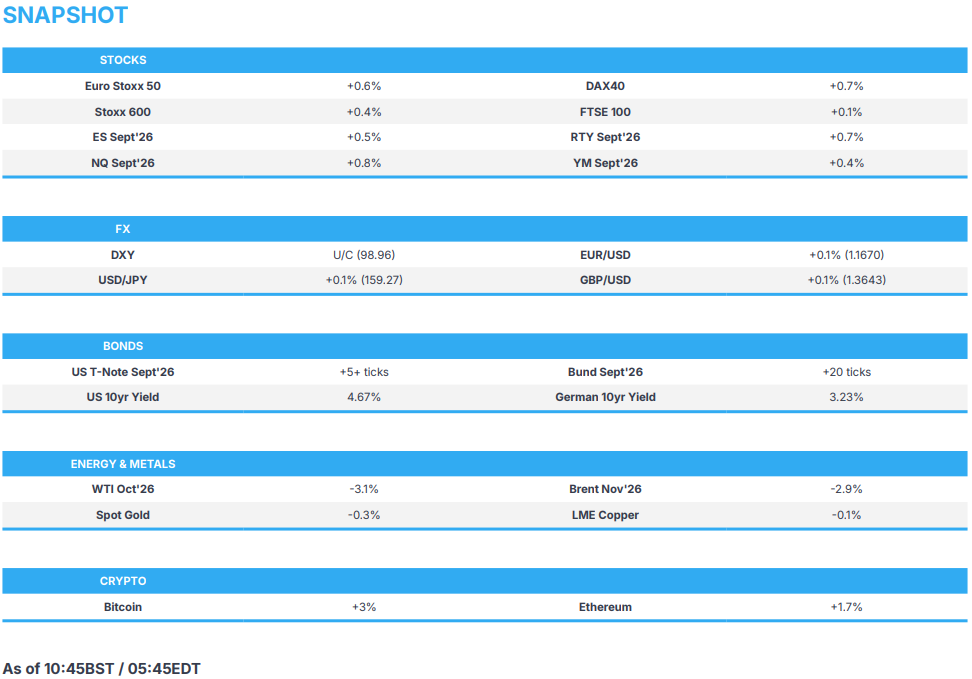
Newsquawk in 3 steps:
1. Subscribe to the free premarket movers reports
2. Listen to this report in the market open podcast (available on Apple and Spotify)
3. Trial Newsquawk’s premium real-time audio news squawk box for 7 days
LOOKING AHEAD
- Highlights include US ADP Employment Change Weekly, House Price Index (Jun), US Richmond Fed Manufacturing Index (Aug). Fed Discount Rate Minutes (Aug)., Supply from the US. Earnings from Intuit.
- Click here for the Week Ahead preview
EUROPEAN TRADE
EQUITIES
- European bourses (STOXX 600 +0.4%) are broadly firmer this morning, digesting the positive mood music following the recent Pakistan-Iran talks in Tehran. In brief, Pakistani officials suggested that “we had a constructive exchange of views on the issues raised”, noting “big progress”. Most recently, mild risk-on action was seen after sources suggested that the Pakistani Army Chief conveyed a message from the US to Iran. The Americans reportedly offered to halt the naval blockade, in exchange for opening the Strait. Nonetheless, the gains are modest at this stage, as talks are only at preliminary stages and amidst the heightened uncertainty.
- European sectors hold a positive bias. Industrials takes the top spot, joined closely by Energy and then Utilities. The leader today has been buoyed by strength in Melrose (+8%) after it announced that the GKN probe has ended without criminal charges, and as it sets out a reopening timeline for the Garden Grove plant. To the downside, Autos parks itself at the foot of the pile, followed closely by Consumer Products & Services.
- Key Stories: NatWest (-0.2%, FT reports that the Co. plans to expand into the US), Next (+1.9%, upgraded at Citi), CD Projekt (-6%, delays release of The Witcher IV), Gerresheimer (-5.7%, CEO Rohrhoff to step down as interim CEO), Siemens Energy (+1.5%, working with Goldman Sachs to field offers for a majority stake in its steam turbines business).
- US equity futures (ES +0.4% NQ +0.7% RTY +0.6%) are trading with mild gains this morning, attempting to pare back some of the losses seen in the prior session. As for key stories this morning: Apple (-0.2%, readies launch of a new Mac Mini), Meta (+0.6%, plans new AI agent platform), Tesla (+0.8%, lifts Cybertruck prices).
- BofA said it is negative on European Equities and underweight on cyclicals vs. defensives; noted AI capex boom means market has reached unusually optimistic levels.
FX
- DXY was bid through APAC trade, marking a peak of 99.11 in Europe, thereafter entirely erasing gains to a 98.94 trough following an optimistic readout of the Pakistan-Iran meeting via Saudi press sources (see commodities for details). Focus remains on the geopolitical situation and its follow through to yields, where the US 30yr currently sits at the middle of Wednesday’s Treasury announcement fall, around 5.22%. Brent contracts trade USD 3/bbl off session highs, the Brent November contract looking below to 88.50/bbl. The session ahead is light with ADP’s weekly Employment Change data and a 2yr auction scheduled.
- EUR did not take too much of a lead from the aforementioned action in energy markets. TTF around EUR 67/MWh remains at an uncomfortable level for the ECB, which, alongside a strong Ifo, paints a hawkish mood in today’s session. EUR/USD is just off recent 1.17 highs, within 1.1651-1.1671. GBP action is similarly quiet with focus on the upcoming week’s risk events; domestic updates include PM Burnham failing to rule out tax increases in the Budget, remarks which have not given much of a lead to UK assets. GBP outperforms vs. USD just below 1.1650 and EUR, at 0.8550.
- SEK is weaker against the EUR and flat against the Buck with no reaction to Riksbank minutes, which showed members were optimistic about the Swedish economy, though revealed a split on the future rate path, with some members maintaining a wait-and-see stance.
- Barclays month-end FX: moderate USD selling against all majors.
- PBoC set USD/CNY mid-point at 6.7852 vs exp. 6.7219 (prev. 6.7841).
- PBoC sold CNY 15bln of 3-month yuan bills at 1.30% and CNY 15bln in 1-year yuan bills at 1.35% in Hong Kong, as previously indicated.
FIXED INCOME
- Fixed benchmarks saw some modest pressure in the first part of the APAC session, before lifting in the early European morning and then falling again on data, pressure that was unwound shortly after by energy action.
- The mentioned overnight pressure sent USTs to a 108-11 base, holding above Monday’s 108-08+ trough. Since, the benchmark has been as high as 108-16, and is holding flat on the day a tick or two off that high. Recent upside a function of energy pressure, as sources report that the US told Pakistan to tell Iran that it would halt the siege and lift sanctions under the MOU, if Hormuz opens and proxy attacks stop. We now await an update from Iran, who are said to be consulting and are expected to respond soon.
- Ahead, USTs look to 2yr supply, in addition to a handful of data points.
- Bunds in-fitting with the above, just with a slightly larger range. The overnight base was 123.76, since taken out by two ticks just after the cash equity open and into Ifo where the stronger-than-expected series sparked some fresh downside. In more recent trade, the discussed energy pullback has allowed Bunds to lift back into the green, to a peak of 124.03. Some of that upside came alongside a 2028 auction, which drew a b/c of 1.49x (prev. 1.37x). However, it may not directly compare because the prior outing had EUR 6bln on offer vs EUR 5bln today.
- Gilts in-fitting with the above, as UK specifics are light. Firmer by a tick or two in 86.02-48 parameters. A 2033 Gilt auction was well received, with a b/c of 3.4x (prev. 3.16x).
- TenneT Germany to sell EUR-denominated hybrid 30-year noted; yield guidance seen at 4.875%.
- Australia sold AUD 1.2bln 1.00% November 2031 bonds, avg. yield 4.6310%, b/c 3.63.
- UK sells GBP 4bln 4.125% 2033 Treasury Gilt: b/c 3.4x (prev. 3.16x), average yield 4.761% (prev. 4.519%) & tail 0.2bps (prev. 0.2bps)
- Germany sells EUR 3.83bln vs exp. EUR 5bln 2.70% 2028 Schatz; b/c 1.49x (prev. 1.37x), average yield 2.85% (prev. 2.78%) & retention 23.4% (prev. 24.1%)
COMMODITIES
- On diplomacy, Pakistan has been optimistic once again. Energy futures saw downticks on reports that Pakistan has reported “significant progress” in high-level diplomatic talks held in Tehran, aimed at de-escalating the ongoing US-Iran war, whilst further downside were seen after Al Arabiya/Al Hadath sources said Pakistani Army Chief Munir conveyed an offer to Iran, from the US, to halt the siege and lift sanctions under the MOU, in exchange for opening the Strait of Hormuz and stopping proxy attacks. Tehran will continue its consultations to submit its response soon, according to these reports.
- WTI Oct and Brent Nov are subdued and hit new incremental lows on the Al Hadath/Al Arabiya reports from Pakistan. The former resides towards the bottom end of a USD 82.25-85.84/bbl range and the latter in a USD 87.92-91.29/bbl parameter. As it stands, the complex is at fresh incremental lows after the NYT reported that US is reportedly mulling returning diplomats to Middle Eastern embassies as soon as this week, “suggesting that the Trump administration does not anticipate a return to all-out hostilities”.
- Dutch TTF is choppy and flat at the time of writing, but still near elevated levels north of EUR 68/MWh after earlier finding support just under EUR 67.50/bbl and then briefly topping EUR 69/MWh. “Supply concerns continue to grow in the European natural gas market, particularly with storage levels, as the region moves closer towards the heating season”, ING posits, “At the current rate, it will be difficult for the EU to hit even the lower storage target of 75% ahead of the heating season. This raises the prospects of forced buying, increasing upside risk for gas prices.”
- Metals are lower across the board with precious metals show slightly deeper losses vs base metal counterparts, with the former weighed on by a resilient DXY despite the losses in oil, whilst the latter is underpinned by continued hopes of Chinese stimulus. Spot gold resides in a USD 4,617-4,697/oz range after topping yesterday’s USD 4,681/oz high. Spot silver fell from a USD 67.56-69.95/oz. 3M LME copper resides in a narrow USD 14,197.25- 14,278.00/t parameter.
- Japanese Government is set to launch state support for construction of oil pipelines which bypass the Strait of Hormuz, Nikkei reported. PM Takaichi reportedly will announce this at the Green Transformation meeting on the 26th August.
- Oil refinery in Russia’s Rostov temporarily suspended operations following Ukrainian attack, TASS reported.
- Kazakhstan’s Kondensat refinery will process Russian crude and send 30% of refined products to Russia, IFX reported.
- Japan’s Trade Minister Akazawa said won’t release government oil stockpile in September and October.
- South Korean Finance Minister said stronger KRW will help ease rise in crude oil-related import costs, will extend naphtha supply steps through January.
- Kazakhstan Energy Ministry said oil production plans are to be tweaked due to CPC attacks, with production loss to reach 3.5mln tonnes.
- Kazakh Energy Ministry said repairs at Karachaganak are scheduled for mid-September, with oil production losses expected to reach up to 450k tons, Interfax reported.
- Mosaic (MOS) predicts a phosphate shortage in Brazil starting in September, citing waning domestic stockpiles, CNN Brasil reported citing an executive.
TRADE/TARIFFS
- Canada is reportedly to announce retaliatory tariffs against the US on Tuesday, according to an AP source.
- US President Trump said in tele-rally that the country desperately needs aluminium and mainly gets it from Canada, while he also comments that he wants to get beef prices down.
NOTABLE EUROPEAN HEADLINES
- German real wages projected at 0.7% in 2026, Handelsblatt reported citing the WSI Archive.
- EU Commission is being urged by the EPP and RE groups to withhold EUR 770mln of funding from Romania, due to concerns around rule of law, Politico reported citing a letter.
NOTABLE EUROPEAN DATA RECAP
- German Ifo Expectations (Aug) 89.1 vs. Exp. 87.5 (Prev. 86.7).
- German Ifo Current Conditions (Aug) 88.5 vs. Exp. 87 (Prev. 86.5).
- German Ifo Business Climate (Aug) 88.8 vs. Exp. 87.2 (Prev. 86.6).
- German GDP Growth Rate Final (Q2 QQ) 0.3% vs. Exp. 0.2% (Prev. 0.4%).
- German GDP Growth Rate Final (Q2 YY) 1.0% vs. Exp. 0.9% (Prev. 0.7%).
- Spanish PPI (Jul YY) 9.2% (Prev. 7.0%).
- French Consumer Confidence (Aug) 86 vs. Exp. 87 (Prev. 86).
- Norwegian Unemployment Rate (Jul) 4.2% (Prev. 4.5%).
NOTABLE EUROPEAN EQUITY HEADLINES
- UK PM Burnham has shelved plans to put Thames Water into a special administration regime amid concerns about the costs and legal risks involved, according to The Times.
CENTRAL BANKS
- Former BoJ Board Member Adachi said the BoJ will probably raise the benchmark interest rate next month, stating the BoJ is pretty much boxed in, markets have almost fully priced in a hike, and if the BoJ doesn’t hike, the yen could weaken sharply.
- RBA’s markets head Jacobs goal is a system that can flexibly supply whatever quantity the banking system demands, while keeping the cash rate close to the board’s target. said:. As reserves become more demand driven active liquidity management will become more important for financial institutions.
- RBA Minutes from the August meeting stated board is ready to increase rates if upside risks materialise and several members judged it is possible upside risks to inflation would crystallise, others saw offsetting downside risks and time to assess data.
- Riksbank Minutes: Seim said still concerned that inflation might become too high. Seim: I am concerned that inflation might become too high. There are a further number of international factors that risk increasing inflationary pressures going forward, for instance, the extreme weather in parts of Europe and Russia’s war of aggression in Ukraine. Jansson: Overall, my assessment given this is that the inflation picture now is somewhat poorer than in June. But it deserves to be emphasised that the shifts are small. Currently have more of an impact on how we communicate future inflation risks than a direct quantitative effect on our monetary policy plan, in line with the text in the draft Update. Have scope to wait before adjusting our monetary policy, even if there are some risks of elevated inflation going forward. Thedeen: I am becoming increasingly convinced that the upturn in economic activity is now on firmer ground. My conclusion is that the level of vigilance with regard to rising inflation must be high. I assess that our next change in the policy rate needs to be a raise. Hjelm: It is appropriate to begin thinking about monetary policy in a scenario where the conflict becomes long-lasting and low intensive and where consideration for possible future escalation is no longer reasonable. It is appropriate that the policy rate remains slightly expansionary, which I assess the level of 1.75 per cent to be. I consider that the risk of an escalation of the war, resulting in substantial price increases, justifies a probability of rate increases over the year. Bunge: Overall, I think that it is reasonable to wait before adjusting the policy rate and to communicate today that the probability of a rate increase still stands since June.
- RBI is likely intervening to support the rupee, according to traders.
NOTABLE US HEADLINES
- US Supreme Court sides with President Trump for now regarding his mail-in ballots curbs. US Supreme Court lifted a judicial decision that blocked in 23 states and Washington DC, President Trump’s order restricting mail-in ballots.
- US is preparing to rescind up to 200,000 business and tourism visas in largest mass visa revocation ever, reported AP citing officials.
GEOPOLITICS
RUSSIA-UKRAINE
- Ukraine military said it struck the Afipsky refinery (180k bpd) in Russia’s Krasnodar region.
- Oil refinery in Russia’s Rostov temporarily suspended operations following Ukrainian attack, TASS reported.
- Kazakhstan’s Kondensat refinery will process Russian crude and send 30% of refined products to Russia, IFX reported.
- Ukrainian forces strike Afipsky oil refinery in Russia’s Krasnodar Krai overnight.
- UK PM Burnham plans a US trip next month to lobby US President Trump on Ukraine aid.
MIDDLE EAST
- Pakistani Army Chief Munir conveyed an offer to Iran, from the US, to halt the siege and lift sanctions under the MOU, in exchange for opening the Strait of Hormuz and stopping proxy attacks, Al Arabiya/Al Hadath sources report. Al Hadath reported Washington offered to halt the naval blockade and lift sanctions on Iran in exchange for opening the Strait of Hormuz and stopping proxy attacks. Pakistani Army Chief told Senior Iranian official that the agents’ attacks are ongoing despite the stopping of direct attacks. Pakistani Army Chief said that the direct attacks between Iran and America have stopped. Iran will continue the fighting in the event of a new escalation. Tehran will continue its consultations to submit its response soon.
- Iranian official said the visit of Pakistani Commander of the Army to Iran was highly fruitful…the results of which will soon become apparent.
- A senior Iranian official told Al Jazeera journalist that the talks with [Iran and] Pakistani Field Marshal Munir were constructive, with useful ideas exchanged, “though no messages were passed in either direction”. “The visit was aimed at reviving Pakistan’s role as a mediator between Iran and the US”.
- Pakistan has reported “significant progress” in high-level diplomatic talks held in Tehran, aimed at de-escalating the ongoing US-Iran war, Iran’s Press TV reported.
- Pakistan’s Interior Minister who accompanied the Chief of Defence Forces on his trip to Tehran wrote that Iran’s President clearly expressed his government’s view and we had a constructive exchange of views on the issues raised. said. There is big progress following talks with Iran’s leadership.
- Iran’s Supreme National Security Council Secretary Rezaei said during meeting with Pakistan Chief of Defence Forces Munir the US must change its behaviour and take practical actions regarding implementation of the terms of the memorandum of understanding. Munir said Pakistan has also made many efforts to establish security between the borders of the two countries.
- US is reportedly mulling returning diplomats to Middle Eastern embassies as soon as this week, NYT reports; “suggesting that the Trump administration does not anticipate a return to all-out hostilities”.
- Iran’s President Pezeshkian said on Monday that the US must change its tone and approach towards Iran, adds US reliance on coercion and bullying will only complicate executive processes.
- UKMTO said it received a report of an incident 9NM northeast of Oman’s Ash Shishah, with the master of an oil tanker reporting the vessel was struck by an unknown projectile causing damage to the engine room and disabling the vessel. Crew are reported safe and environmental impact is unknown at the time of the report.
- US F-35 fighter jet declared an emergency in Saudi airspace and is making a landing at the Mawaqaf Al-Sulti Air Base in Jordan, according to Iranian media.
CRYPTO
- Bitcoin continues to edge higher, but sits just shy of the USD 80k mark. Ethereum also resides in the green, but remains beneath the USD 2.5k mark.
APAC TRADE
- APAC stocks were mixed following the subdued lead from Wall Street, where most major indices declined amid tech weakness and headwinds from Economic D-Day sanctions on Iran and the US-Canada trade war.
- ASX 200 traded higher amid strength in the domestic tech, healthcare and financial sectors, while participants digested a plethora of earnings and somewhat balanced RBA August Meeting Minutes.
- Nikkei 225 saw two-way price action and gradually clawed back initial losses to move into the green, with recent reports noting that Japan is considering exempting gains from non-core business sales from corporate tax if companies reinvest the proceeds in acquisitions.
- KOSPI underperformed amid recent tech headwinds and with SK Hynix shares also pressured after union members narrowly rejected the tentative wage agreement through a 50.1% vote against.
- Hang Seng and Shanghai Comp were subdued amid earnings releases and cautiousness as US sanctions on Iran and warnings against countries with economic ties to Iran, increase risks of stoking US-China frictions, while the US is also mulling 7.5% overcapacity tariffs on China.
NOTABLE ASIA-PAC HEADLINES
- Japanese PM Takaichi said Govt. plans to continue keeping the gasoline price at around JPY 170/Litre.
- Japanese Ministry of Finance requests a FY27 budget of JPY 38.6 tln, 15.1% increase compared to the initial budget for FY26, Kyodo reported; “the increase is due to rising interest rates”.
- Japan PM Takaichi has reportedly requested the LDP to “actively promote” measures against rising inflation, in a recent meeting, Nikkei reported.
- Japanese Finance Minister Katayama said can’t comment on budget requests for fiscal 2027, adds will focus on key policies in FY27 budget to drive economic growth and will balance fiscal sustainability and economic growth and will communicate with market. said:. Have received various opinions on scheme for JGBs for retail investors.
NOTABLE APAC DATA RECAP
- Japanese BoJ Core CPI YY (Jul) 2.3% (Prev. 2.6%).
- Japanese Coincident Index Final (Jun) 118.5 vs Exp. 118.2 (Prev. 117.9)
- Japanese Leading Economic Index Final (Jun) 116.5 vs. Exp. 116.4 (Prev. 116.4).
1c) Asian opening report
Europe primed for a firmer open as yields and energy benchmarks moderate – Newsquawk EU Market Open
Tuesday, Aug 25, 2026 – 02:38 AM
- US Treasury sanctioned nearly 60 Iran-linked entities, people and vessels across nuclear, missile, cyber and oil networks.
- US President Trump is making calls to world leaders to cut economic ties with Iran and that the US expects actions from other nations and, if others do not act, the Treasury will unilaterally act.
- US Treasury Secretary Bessent said there will be a wave of sanctions after this, with a major financial institution expected to be sanctioned by the end of the week.
- Iran’s Economy Minister said the country is fully prepared for the US sanctions and that they cannot cut off Iran’s financial arteries.
- US is said to eye 7.5% China overcapacity tariffs before the Trump-Xi talks, according to multiple reports.
- APAC stocks were mixed following the subdued lead from Wall Street; European equity futures indicate a marginally positive cash market open.
- Looking ahead, highlights include German GDP Final (Q2), Ifo Expectations (Aug), US ADP Employment Change Weekly, House Price Index (Jun), US Richmond Fed Manufacturing Index (Aug). Riksbank Minutes (Aug), Fed Discount Rate Minutes (Aug)., Supply from UK, Germany and US. Earnings from Intuit.
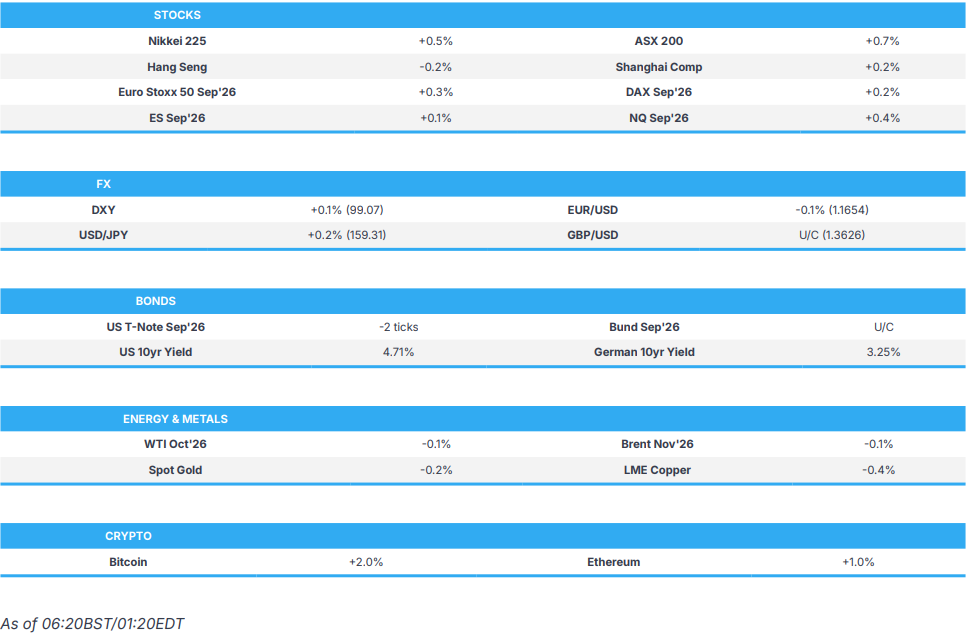
Newsquawk in 3 steps:
1. Subscribe to the free premarket movers reports
2. Listen to this report in the market open podcast (available on Apple and Spotify)
3. Trial Newsquawk’s premium real-time audio news squawk box for 7 days
LOOKING AHEAD
- Highlights include German GDP Final (Q2), Ifo Expectations (Aug), US ADP Employment Change Weekly, House Price Index (Jun), US Richmond Fed Manufacturing Index (Aug). Riksbank Minutes (Aug), Fed Discount Rate Minutes (Aug)., Supply from UK, Germany and US. Earnings from Intuit.
- Click for the Newsquawk Week Ahead.
IRAN CONFLICT
- US President Trump said in a tele-rally that they are beating Iran very badly and reiterated that Iran cannot have a nuclear weapon, while he added that gasoline prices are going to go down.
- US President Trump was said to have held a telephone conversation with Pakistani Army Chief Field Marshal Asim Munir last week, while Trump discussed the Iran issue and asked Munir to use Pakistan’s influence to resume negotiations, according to an informed source cited by Al Jazeera.
- US Treasury sanctioned nearly 60 Iran-linked entities, people and vessels across nuclear, missile, cyber and oil networks. Measures target five sectors for potential secondary sanctions, including digital assets, technology, gold, aviation and shipping, with sanctions targeting a network of broker companies and shadow-fleet vessels across the UAE, Hong Kong, China, Singapore, Switzerland and Europe.
- US Treasury Secretary Bessent said they are launching Operation Economic Outcast and are going to end the Iran threat, while he stated that Iran has two paths: normalcy or total isolation. Bessent noted that the actions of the Treasury and other agencies will tighten the noose and block every potential source of revenue that funds the IRGC and the Iranian regime, with the US enforcing a zero-leakage approach. Furthermore, he said President Trump is making calls to world leaders to cut economic ties with Iran and that the US expects actions from other nations and, if others do not act, the Treasury will unilaterally act, while countries will have a finite timeline to shut down activities identified by the US Treasury, including closing Iran’s bank branches abroad, with the US to end dollar access to those laundering Iran money.
- US Treasury Secretary Bessent said trying to buy Iran’s appeasement will no longer work, and there will be a wave of sanctions after this, with a major financial institution expected to be sanctioned by the end of the week.
- US War Secretary Hegseth said not ruling out the use of military force in the Strait of Hormuz or anywhere else.
- US Secretary of State Rubio spoke with the German Foreign Minister about their shared commitment to freedom of navigation in the Strait of Hormuz.
- Iranian President Pezeshkian said the US must change its tone and approach towards Iran, while he stated US reliance on coercion and bullying will only complicate executive processes
- Iran’s Supreme National Security Council Secretary Rezaei said during the meeting with Pakistan’s Chief of Defence Forces Munir that the US must change its behaviour and take practical actions regarding implementation of the terms of the MOU, while Munir said Pakistan has made many efforts to establish security between the borders of the two countries.
- Pakistan’s Interior Minister, who accompanied the Chief of Defence Forces on his trip to Tehran, wrote that Iran’s President clearly expressed his government’s view and we had a constructive exchange of views on the issues raised, while he noted big progress after talks with Iran’s leadership.
- Iran’s Economy Minister said the country is fully prepared for the US sanctions and that they cannot cut off Iran’s financial arteries, while he also stated that their enemies intend to launch an economic terrorist attack, but they also have their own tools and know how to play the game.
- Iran’s Parliamentary Speaker Ghalibaf said the Americans know that no one will believe their nonsense and that the US is not in a position economically to restrict its relations with other countries any further, while he added that Iran’s trading partners have made it clear, both in the media and by sending messages, that they do not believe these statements.
- Israeli PM Netanyahu said Iran tried to assassinate one of his sons.
- Israeli forces opened fire east of Khan Younis in the southern Gaza Strip.
- UKMTO said it received a report of an incident 9NM northeast of Oman’s Ash Shishah, with the master of an oil tanker reporting the vessel was struck by an unknown projectile causing damage to the engine room and disabling the vessel. However, the crew were reported safe, and the environmental impact was unknown at the time of the report.
US TRADE
EQUITIES
- US stocks were mixed on Monday, with the Dow Jones outperforming in the green, while the other major indices closed lower. Weakness was led by the Nasdaq as the Technology sector underperformed, with both semiconductor and memory names under pressure. Despite the broader downside, the equal-weight S&P 500 was flat, while sectors were mixed. Consumer Staples, Communication Services and Financials led the gains, while Technology, Energy and Industrials lagged. Energy prices settled lower despite the Treasury confirming harsh sanctions on Iran under Operation Economic Outcast, targeting nearly 60 Iranian entities, individuals and vessels, alongside secondary sanctions aimed at five key Iranian sectors: digital assets, technology, gold, aviation and shipping. The administration’s focus on intensifying economic pressure rather than further military action may have helped keep some pressure on crude. Meanwhile, sources reported that Trump spoke with the Pakistani Army Chief last week ahead of the latter’s visit to Tehran, with Trump reportedly wanting Pakistan to use its influence to bring Iran back to the negotiating table, suggesting there remains some willingness from the administration to pursue diplomacy.
- SPX -0.28% at 7,653, NDX -0.98% at 29,024, DJI +0.26% at 53,417, RUT -0.70% at 2,997.
- Click here for a detailed summary.
TARIFFS/TRADE
- US President Trump said in a tele-rally that the country desperately needs aluminium and mainly gets it from Canada, while he also commented that he wants to get beef prices down.
- US President Trump said there is a lot of “bluster” from Ontario Premier Ford, and that without the US, Canada could not survive, while he added that someone should get these clowns (referring to Ford and Carney) to “fall in line” or the consequences for Canada will be far worse.
- US Treasury Secretary Bessent said Canada was offered a good deal, but chose to reject it.
- Canada is to announce retaliatory tariffs against the US on Tuesday, while it was later reported that Canadian ministers are to unveil Canada’s reply to US tariffs at 16:00BST/11:00EDT.
- US is said to eye 7.5% China overcapacity tariffs before the Trump-Xi talks, according to multiple reports.
- Mexican President Sheinbaum said she hopes to reach a trade agreement with the US.
NOTABLE HEADLINES
- US Treasury launched the Quantum-Readiness Task Force to accelerate the financial sector’s transition to post-quantum cryptography.
- US Treasury Secretary Bessent said they are going to continue with the regular programme of auctions when asked if he is looking at reducing auction sizes for longer-term Treasury debt and what other actions could be considered from the Treasury toolkit. Bessent responded that they have not bought any yet, with the first operation on September 9th, when asked if there will be more buybacks.
- FBN’s Gasparino said Treasury Secretary Bessent will do whatever it takes to “put the fear of God” into bond vigilantes, shorting the long end of the curve in an attempt to drive the 10-year yield to 5%, according to Wall Street executives with direct knowledge.
- US Supreme Court sided with President Trump for now regarding his mail-in ballot curbs and lifted a judicial decision that blocked Trump’s order restricting mail-in ballots in 23 states and Washington DC.
- US grain farmers are said to be facing the worst crisis in decades as the Iran war sends costs spiralling, according to FT.
APAC TRADE
EQUITIES
- APAC stocks were mixed following the subdued lead from Wall Street, where most major indices declined amid tech weakness and headwinds from Economic D-Day sanctions on Iran and the US-Canada trade war.
- ASX 200 traded higher amid strength in the domestic tech, healthcare and financial sectors, while participants digested a plethora of earnings and somewhat balanced RBA August Meeting Minutes.
- Nikkei 225 saw two-way price action and gradually clawed back initial losses to move into the green, with recent reports noting that Japan is considering exempting gains from non-core business sales from corporate tax if companies reinvest the proceeds in acquisitions.
- KOSPI underperformed amid recent tech headwinds and with SK Hynix shares also pressured after union members narrowly rejected the tentative wage agreement through a 50.1% vote against.
- Hang Seng and Shanghai Comp were subdued amid earnings releases and cautiousness as US sanctions on Iran and warnings against countries with economic ties to Iran, increase risks of stoking US-China frictions, while the US is also mulling 7.5% overcapacity tariffs on China.
- US equity futures are off the prior day’s lows but with price action contained in tight parameters.
- European equity futures indicate a marginally positive cash market open with Euro Stoxx 50 futures up 0.3% after the cash market closed with losses of 0.2% on Monday.
FX
- DXY traded rangebound after mildly gaining yesterday as focus centred on the US announcement of Operation Economic Outcast against Iran and threats against further enablers of the Iranian economy, while attention was also on tariffs amid a US-Canada trade war and with Canadian ministers set to announce retaliation against Trump tariffs later today. Elsewhere, there was very little recently in terms of data and Fed speak, although participants won’t have to wait long for potential major catalysts as PCE data is due on Wednesday and with the Jackson Hole Symposium to begin the following day.
- EUR/USD remained contained within a tight range at the 1.1600 handle amid a lack of pertinent catalysts, while recent comments from ECB’s Cipollone provided very little incrementally, in which he stated that monetary policy needs to be well calibrated and that inflation is far from adverse and severe scenarios.
- GBP/USD lacked conviction following the prior day’s choppy mood amid quiet catalysts for the UK, although there were recent comments from UK PM Burnham, who ruled out a general election this year, but wouldn’t rule out tax increases in the Budget.
- USD/JPY edged higher after reclaiming the 159.00 handle and as US yields rebounded.
- Antipodeans were little changed with a muted reaction seen following the RBA Minutes from the August meeting, which noted the Board is ready to increase rates if upside risks materialise and several members judged it is possible upside risks to inflation would crystallise, although others saw offsetting downside risks, providing time to leave monetary policy unchanged and assess incoming data.
- PBoC set USD/CNY mid-point at 6.7852 vs exp. 6.7219 (prev. 6.7841).
FIXED INCOME
- 10yr UST futures mildly pulled back overnight following the prior day’s bull flattening, which had been spurred by sources suggesting that the Treasury could use funds from the Treasury General Account to fund additional buybacks, while prices were also not helped by incoming supply.
- Bund futures remained lacklustre after the recent indecisive performance, with participants awaiting German GDP and the ifo Business Climate survey, as well as issuances scheduled for today and tomorrow.
- 10yr JGB futures were subdued as oil prices partially recovered and amid expectations for an approaching BoJ rate hike, with former central bank board member Adachi noting the BoJ will probably raise the benchmark interest rate next month, stating that the BoJ is pretty much boxed in, markets have almost fully priced in a hike, and if the BoJ doesn’t hike, the yen could weaken sharply.
COMMODITIES
- Crude futures were indecisive but slightly rebounded after declining yesterday despite the US announcing Economic D-Day sanctions on Iran, while there were reports overnight that an oil tanker was struck by a projectile off Oman, which caused damage to the engine room and disabled the vessel.
- Japanese Trade Minister Akazawa said they won’t release the government oil stockpile in September and October.
- Spot gold initially extended on gains, but then pulled back from resistance just shy of the USD 4,700/oz level as yields and oil prices mildly rebounded.
- Copper futures traded sideways with demand constrained alongside the cautious risk appetite.
CRYPTO
- Bitcoin continued its resurgence and climbed back above the USD 80k level.
NOTABLE ASIA-PAC HEADLINES
- Japan’s government is reportedly considering tax breaks on gains from sales of non-core businesses, according to source reports. Gains from non-core sales would be exempt from corporate tax, provided companies reinvest proceeds in acquisitions, while the proposal is expected to be submitted as part of tax reform requests due at the end of this month.
- RBA Minutes from the August meeting stated the board is ready to increase rates if upside risks materialise and several members judged it is possible upside risks to inflation would crystallise, while others saw offsetting downside risks and time to assess data. It was also stated that following the increases in the cash target earlier in the year, monetary policy appeared sufficiently restrictive to bring inflation back to target within a reasonable timeframe, and that there was still some time to assess the accuracy of that judgement. Members considered whether to raise the cash rate target by 25bps at the meeting or to leave it unchanged for the time being. Furthermore, staff research findings implied that a more pre-emptive approach to monetary policy might be appropriate when the economy is subject to capacity constraints and adverse supply shocks, and members acknowledged that the global cost shock generated by the conflict in the Middle East meant some spare capacity may be necessary to bring inflation back to target.
GEOPOLITICS
RUSSIA-UKRAINE
- Russia’s Defence Ministry said Russian forces hit a cargo vessel in Black Sea port of Odesa, while three fuel tanks and four military equipment storage facilities intended for the Ukrainian Armed Forces were damaged at the Yuzhny port.
- Ukrainian forces struck the Afipsky oil refinery in Russia’s Krasnodar Krai overnight.
- UK PM Burnham said during his visit to Kyiv that the UK is not a fair-weather friend and is here for the long haul. It was separately reported that Burnham is planning a US trip next month to lobby President Trump on Ukraine aid.
OTHER
- Top US and South Korean diplomats agreed to continue “close” communication and cooperation to address North Korea’s nuclear issue and promote peace, according to Yonhap.
EU/UK
NOTABLE HEADLINES
- UK PM Burnham ruled out a general election this year, but won’t rule out tax increases in the Budget, according to an interview with ITV.
- UK PM Burnham has shelved plans to put Thames Water into a special administration regime amid concerns about the costs and legal risks involved, according to The Times.
2.NORTH AND SOUTH KOREA/
SOUTH KOREA//NORTH KOREA
SOUTH KOREA
US Scraps September Korea Marine Drills In Wake Of Iran War Strain
Monday, Aug 24, 2026 – 06:00 PM
Fresh on the heels of President Trump controversially ordering scaled-down US-South Korea military drills last week, there are emerging reports of more canceled plans for joint exercises.
South Korean and American force were going to hold large-scale maritime drills focused on amphibious landing exercises in September, but Seoul has said the Pentagon had to back out related to constraints due to Iran war deployments.

“The US Marine Corps formally notified our forces in June that its ability to deploy forces during this year’s Ssangyong exercise would be constrained due to the situation in the Middle East,” Han Seung-jeon, a spokesman for the South Korean Marine Corps, said in a press briefing Monday.
After this month’s Ulchi Freedom Shield were halted early so as not to provoke North Korea (as indicated by Trump), these next exercises – dubbed “Twin Dragons” – have apparently been canceled entirely.
The Twin Dragons exercise has previously featured thousands of American and South Korean forces practicing beach front landings.
At its height years ago, it included over 20 navy vessels, 30 warplanes – and 40 amphibious-assault vehicles transporting, and well over 10,000 personnel.
“Now it is the most recent example of Asian pullbacks from the U.S. More than 2,000 U.S. Marines stationed in Japan were transferred to the Middle East in March,” The Wall Street Journal reports.
“South Korea’s president publicly opposed the withdrawal of U.S. air defense assets this spring from his country. A Pacific-based American aircraft carrier, the USS George Washington, just replaced in the Middle East the USS Abraham Lincoln, which had been deployed for more than 250 days,” the report adds.
All of this is likely to strain tensions further between Washington and Seoul, something which has alarmed lawmakers on Capitol Hill.
“Both Democrats and Republicans have warned that the pullback on Ulchi Freedom Shield drills risked undermining the alliance with South Korea, calling for the exercises to be restored,” observes WSJ.
But it’s clear that Trump is pushing for a new opening with Kim Jong Un, hearkening back to the two leaders’ historic face-to-face meetings which marked a foreign policy high-point of Trump’s first administration. So far, Pyongyang has not backed off its condemnations of Seoul and Washington’s ongoing close cooperation.
JAPAN
3. CHINA/OIL
World’s Largest Refiner Says China’s Oil Demand “Very Likely Peaked Last Year”
Monday, Aug 24, 2026 – 10:10 PM
One of the most understated stories of 2026, and the reason why oil (and gas) aren’t trading at persistently nosebleed levels (ignore diesel for the time being), has been China’s unexpectedly weak oil demand. And while there has been much speculation surrounding the reason for this chronically weak oil demand, ranging from an accelerated – and offsetting – SPR drain, to a dramatic economic slowdown behind the scenes (or even in front of the scenes based on the latest dismal economic data), today for the first time we got a notable justification for this phenomenon coming from none other than the head of the nation’s – and world’s – largest refiner, who said that China’s oil demand probably peaked last year, earlier than previous estimates.
Clean energy development, electrification and low-carbon goals mean that the country’s oil demand has probably already crested, Sinopec Chairman Hou Qijun said Monday at an earnings briefing in Hong Kong, quoted by Bloomberg.
The company had previously forecast usage to top out in 2027, while the government is targeting oil and coal consumption to reach their limits during the current five-year plan period, which runs through 2030.
“Next year, even if the US-Iran conflict eases up, things might recover, but it won’t hit last year’s level,” Hou said. “So it’s very likely demand peaked last year.”
Since China is the world’s largest oil importer, an earlier start to reducing consumption would help rein in its world-leading emissions while raising questions for the world’s top crude drillers.

Sinopec, known officially as China Petroleum & Chemical Corp., said in its earnings report on Sunday that road fuel demand plummeted in the first half as consumers shied away from higher prices and shifted to electric vehicles. The declines are expected to narrow a bit in the second half because of supportive economic policies, said Tian Hongbin, a senior vice president at the company.
Even as fuel demand drops, the company is making sure domestic supply needs are met, President Wan Tao said during Monday’s briefing. It’s diversifying crude sources away from the Middle East while working with its suppliers in the region on shipping routes safe from the violence of the Iran War. The refiner has received 11 oil tankers previously stuck in the Persion Gulf that were carrying a combined 2.76 million tons of crude, he said.
The company typically keeps about 20 days of crude storage for refining purposes, and 15 days of refined products for marketing, Wan said. Inventory levels have remained steady during the war, and Sinopec will continue to follow directions from the government on its commercial storage levels, he added.
end
4. EUROPEAN AND SCANDINAVIAN COMMENTARIES PLUS NATO
UK
Details Of Iran’s First Known Successful Cyberattack Against A UK Energy Facility
Tuesday, Aug 25, 2026 – 05:00 AM
Iranian hackers shut down a British power plant for four days in an unprecedented cyber attack, the Sunday Telegraph reported.
According to the newspaper, the incident appears to mark the first time Iran-linked hackers have successfully shut down such a British facility.

The incident occurred alongside an alleged series of attacks on US water infrastructure last month, which affected at least 12 states and caused concern in the White House.
The Telegraph said that British officials have refused to disclose which facility was affected, citing security concerns.
A spokesperson for the Department for Energy Security and Net Zero said that the attack impacted a “small-scale energy generator”, posing no “risk to the wider energy system”.
No outages were reported following the incident, according to the National Cyber Security Centre (NCSC), which deals with attacks on critical infrastructure.
The British government subsequently briefed chief executives of power companies and wrote to businesses with advice, direction and next steps.
The attack appears to mark an escalation following the UK’s decision to grant the US permission to launch “defensive operations” against Iran from British bases.
In March, Prime Minister Keir Starmer’s government had granted permission to the US military to use the Royal Air Force base in Fairford and the joint facility on Diego Garcia, for limited operations against Iranian missile facilities that “directly threatened British personnel”, regional allies, or sovereign assets.
The authorization was subsequently expanded, allowing the US to launch strikes against active Iranian missile infrastructure targeting commercial oil shipping channels in the Strait of Hormuz.
In June, an Iran-linked hacker-activist group, Handala, claimed responsibility for a cyber intrusion targeting water facilities in California, saying the action was carried out in retaliation for alleged US strikes on water infrastructure in southern Iran.
The group said it had obtained data from the systems and described the breach as a warning to Washington.
In a statement, Handala said it had the capability to disrupt water supplies but “stopped short of actually cutting off water to American cities”, citing a different ethical code than its adversaries.
The group also said it had published five gigabytes of data as evidence of the intrusion.
In April, the group said it obtained at least 19,000 sensitive files after targeting the personal phone of former Israeli army chief of staff, Herzi Halevi.
“All your top-secret facilities, crisis rooms, maps, and even the tiniest details of your command centers have long been like an open book to us,” the group said in a statement posted on its website.
The files, some of which were seen by Middle East Eye, showed Halevi meeting with Arab officials.
In one undated photo taken in Qatar, Halevi could be seen attending a meeting with former US Central Command (Centcom) chief Michael Kurilla.
END
GERMANY
Death Of Europe’s Industrial Base: 140,000 VW Jobs At Risk As Union Brands Turnaround Plan “Cloud Cuckoo Land”
Tuesday, Aug 25, 2026 – 08:05 AM
If further evidence is needed to support Nomura analysts’ view that Europe’s 18-month election cycle, which is kicking off now, will accelerate the continent’s shift toward potential right-wing political victories, look beyond years of nation-killing mass migration under progressive governments. The real-time deindustrialization of Europe, or the death of Europe, particularly in Germany, is quickly eroding the left-wing establishment’s popularity and providing much-needed momentum to the right-wing Alternative for Germany party.
The latest horror story emerging from Germany, Europe’s top economic engine, is a warning from Volkswagen Group labor representatives that the struggling automaker could ultimately eliminate as many as 140,000 jobs.

VW CEO Oliver Blume and VW brand chief Thomas Schäfer will unveil a turnaround plan for the automaker later today that will detail workforce reductions and the potential shutdown of some production lines.
We first previewed the incoming announcement over the weekend:
Volkswagen is Germany’s largest manufacturer by revenue, and the warning of massive job cuts underscores the deepening crisis inside the country’s industrial core. VW’s earnings have been crushed by sliding sales in China, high labor and energy costs in Germany, and a flood of Chinese EVs undercutting domestic brands across the continent.
Bloomberg reported that VW management is considering cutting another 500,000 vehicles from annual European production capacity, reducing white-collar workers, cutting costs, and eliminating unpopular models and equipment variants.
The outlet quoted Christiane Benner, head of Germany’s largest industrial trade union, IG Metall, who called the CEO’s plan to cut massive numbers of workers and lift margins to 9% “cloud cuckoo land.”
The economic misery spreading across Germany and the rest of Europe, as left-wing governments hollow out the continent’s industrial base, is igniting a massive backlash. Nomura analysts expect Europe to “lurch right” during the coming 18-month election cycle (read report).
SPAIN
Spain’s Great Replacement: Half Of Unskilled Construction Workers Are Now Foreign Laborers
Tuesday, Aug 25, 2026 – 02:00 AM
Spain’s construction industry is undergoing rapid demographic changes. Foreign-born workers in unskilled construction roles now make up 52.6 percent of all workers, according to data from Randstad from the first quarter

The data shows that foreign workers now exceed Spanish nationals for these unskilled roles by nearly 11,000 workers. The contrast is stark compared to pre-pandemic figures, when domestic laborers outnumbered foreign counterparts by more than 33,500.
Overall, the construction industry has lost 22,711 Spanish workers since 2019 while gaining 238,451 foreign employees, a figure that includes individuals with dual nationality. As a result, almost 36 percent of all construction workers, both skilled and unskilled, are now of foreign origin in the country.
The shift is equally evident among bricklayers. In 2019, Spanish bricklayers outnumbered foreigners by 111,000. Seven years later, that gap has narrowed to just 18,000 workers. Foreign labor has gained more than 16 percentage points in this category and currently accounts for roughly 48 percent of bricklayers working in Spain. While Spaniards remain the majority in most skilled roles for now, the statistical gap continues to shrink rapidly. Experts also predict that foreigners will increasingly dominate skilled and managerial positions in the future.
This transformation extends into specialized technical trades. The count of Spanish plumbers fell from 70,932 in 2019 to 57,781 today, while foreign representation doubled after adding over 10,000 workers. One in four plumbers in Spain is now foreign-born. Electricians show a similar dynamic, with about 32,000 foreign workers joining the profession since 2019, driving foreign representation up from under 11 percent pre-pandemic to nearly three out of ten today.
Industry analysts expect these patterns to hold due to impending retirements and low replacement rates among younger Spaniards.
Spain, like many other nations, is attempting to automate the construction industry as much as possible. However, instead of relying on advanced robots, Spain has so far shifted toward a modular construction approach in which concrete panels, bathrooms, and complete structural modules are built indoors in automated, factory-controlled settings that use machinery and assembly lines similar to those in the automotive sector. Cranes then assemble these modular components on site, requiring significantly fewer workers and dramatically cutting project delivery times.
Countries such as South Korea, by contrast, are racing ahead in automated construction, precisely because nations like Spain continue to rely on mass immigration, which is often cheaper in the short term but more costly over the long run.
South Korea does not only use automated construction in planning, but also in deploying commercialized robotics, automated modular manufacturing, and government-mandated smart construction.
Automated facilities, such as Space Factory, use advanced robotic arms to cut materials, assemble structural panels, seal joints, and fit window frames without direct manual intervention.
Unlike standard build sites in Spain, South Korean contractors actively deploy field robotics directly to job sites.
Automated rebar-tying robots and robotic concrete sprayers and finishers are routinely used by major developers, such as Samsung C&T and Hyundai E&C, to reduce heavy physical labor on high-rise residential projects. In addition, unmanned excavators and bulldozers guided by real-time GPS and drone mapping handle heavy site preparation.
Robots are even acting as supervisors to some extent, with autonomous quadruped robots, such as Boston Dynamics’ “Spot,” owned by South Korea’s Hyundai Motor Group, continuously patrolling construction sites, performing 3D laser scans to verify that progress matches digital blueprints.
As Remix News has previously reported, automation, robotics, and AI are all leading elements of Asian economies, which have chosen efficiency and technology over mass immigration and cheap foreign labor.
END
EUROPE
they must compete to obtain natural gas: thus the huge 100 euro natural gas price needed to refill their winter storage.
(zerohedge)
Goldman Sounds Alarm: Europe May Need €100 NatGas Shock To Refill Winter Storage
Tuesday, Aug 25, 2026 – 04:15 AM
We have warned that Europe is approaching a twin energy crisis, with the Northern Hemisphere winter now just three months away.
Dutch front-month gas futures, Europe’s benchmark contract, surged Monday morning to 67 euros per megawatt-hour, the highest level since early 2023.

Goldman Sachs commodities expert Samantha Dart warns that EU NatGas prices may need to more than double from her base-case forecast if LNG exports through the Strait of Hormuz remain constrained.
Dart said reduced Qatari LNG loadings have forced Europe to compete more aggressively with Asia for available cargoes.
“We have argued that, in the absence of an improvement in LNG exports through the Strait of Hormuz (SoH) (Exhibit 1), European gas prices (TTF) would need to rise to discourage Asia LNG demand, thereby freeing incremental cargoes to be sent to Europe to help manage European gas storage levels,” she said.

Dart warned that the most alarming scenario would emerge if Persian Gulf energy exports recovered only gradually through 2027. Under that scenario, she estimates December 2026 TTF may need to exceed 100 euros per megawatt-hour, more than double the previous 50-euro base case, while Asian JKM prices could approach $35 per million British thermal units.
She noted, “However, because LNG prices have only been this high once, during the 2022 European energy crisis, our conviction in the scale of demand response at such price levels is low, and we would see it more as a price-discovery process.”
Dart also pointed out that there “hasn’t been enough yet to steady European gas storage injections, with Aug storage injections thus far widening the miss relative to our expectations.”
Current NatGas storage levels for the energy-stricken continent stand at just 61.68%, well below the 15-year seasonal level of 72.5%.

The conflict in the Gulf area has severely constrained LNG flows to Europe, but it is not just the gas market that is constrained. The products market is also under pressure, as evidenced by the worsening diesel crisis.
On Monday, Treasury Secretary Scott Bessent held a press conference to announce the “single greatest financial offensive ever marshaled against an adversary.”
There was good news over the weekend, as the newly opened, US military-supervised shipping corridor off Oman saw a 400% surge in commercial transits, raising further questions about whether Tehran’s leverage over the Strait of Hormuz has eroded. TotalEnergies’ CEO was quoted early Monday as saying crude is moving through the critical waterway “very quietly.”
END
5.RUSSIAN AND MIDDLE EASTERN AFFAIRS
IRAN/VS ISRAEL/USA
Oil Falls Further As US Prepares Return Of Diplomats To Mideast Embassies
Tuesday, Aug 25, 2026 – 09:00 AM
There continue to be clear signals that the White House is moving away from the potential for renewed military action and instead settling in for a long economic siege campaign targeting Iran, on a permanent basis.
The avoidance of more bombs away and with all the risks and uncertainty of a military ‘solution’ has seen oil prices drop. Energy prices are weakening also amid positive signals from Pakistan’s army chief Field Marshal Asim Munir, who just left Tehran after carrying a fresh US-drafted framework. Crude oil prices (WTI) dropped 3% to just below $82.50 a barrel on Tuesday, extending the 2.4% decline recorded in the previous session.

Al-Arabiya is reporting that he presented an offer to lift sanctions under the MOU, so long as Iran reopened the Strait of Hormuz and halts all hostile actions against Gulf states.
Munir had spoken to Trump by phone before travelling to Tehran, which underscores the high-level nature of the reported offer. Other top Pakistani officials accompanied him:
Pakistan and Iran made “significant progress” in talks that focused on the US-Israeli war on Iran and a path to peace, Pakistan’s interior minister said on Tuesday, at the end of a visit to Tehran.
Pakistan’s Interior Minister Mohsin Naqvi subsequently stated on X, “The Iranian President candidly shared his government’s perspective and we had a very constructive exchange on the issues involved.”
While it’s unclear what Tehran’s response will be, the last days have not seen new Iranian attacks on shipping in the Hormuz Strait.
Still, Tehran is proclaiming that Washington’s shift is a result of military defeat. On Tuesday Al Jazeera is citing IRGC spokesman Sardar Mohebi, who says the Trump administration’s intensified economic campaign against Iran is proof that the US has failed on the battlefield.
He calls the move toward Operation Economic Outcast a “tacit admission” of America’s military defeat in the region. As evidence for this the Iranians are pointing to US media admissions that pretty much all of the Pentagon’s Gulf outposts have suffered damage or serious destruction, and US forces have pulled back. Even bases in Jordan have been hammered in what some analysts have called a successful campaign of ‘debasification’.
But in another sign that Washington is moving away from a war-footing and instead opting for a long economic campaign, it is said to be readying the return of diplomats to the region. Another result of the fierce Iranian retaliation amid Operation Epic Fury had been the closure of US embassies and consulates across the region – which in some cases may have even been targeted.
“The State Department is preparing to send U.S. diplomats back to embassies in the Middle East that were evacuated before and during the war with Iran, suggesting that the Trump administration does not anticipate a return to all-out hostilities,” the NY Times reports Tuesday.
“The return of foreign service officers and the scaling back of emergency measures taken at U.S. missions in the Middle East could begin this week, according to an internal State Department document obtained by The Times,” the publication continues.
In Bessent’s secondary sanctions rollout presser on Monday, he slipped up the below off-the-cuff moment when he called on a random journalist, who asked an excellent question:
Of course, nothing is yet certain and the situation remains very fluid, with the Iranians having previously demonstrated willingness to assert new leverage through attacks. According to details in the NY Times:
The restaffing is set to proceed even though talks between the United States and Iran have floundered, leaving the Trump administration to threaten new economic sanctions.
Embassies slated to restore higher levels of staffing include those in Israel, Lebanon, Saudi Arabia, Qatar, Jordan, Oman, Iraq and Kuwait, the document says.
The State Department issued a statement saying it “continuously reviews the security posture at our diplomatic missions around the world. Based on our latest assessment, we are adjusting our staffing posture at certain posts in the Middle East to ensure we can continue advancing U.S. foreign policy objectives while protecting the safety and security of our personnel.”
But at this moment, embassies across the Gulf as well as Jordan remain shuttered, with most diplomatic personnel having been removed to other State Department posts.
end
IRAN/USA/CHINA ET AL
Bessent Drops Iran Sanctions Hammer On Dozens Of Chinese Firms, Spares Big Banks As Beijing Threatens Retaliation
Tuesday, Aug 25, 2026 – 07:45 AM
The Trump administration’s “Operation Economic Outcast” has expanded the sanctions campaign across China and Hong Kong, targeting dozens of individuals and businesses while intentionally holding off on sanctioning major Chinese banks that keep Tehran connected to the global financial system. Beijing, meanwhile, signaled earlier Tuesday that it would not retreat from its economic relationship with Iran, raising the risk that Trump’s economic war against Tehran could evolve into a direct confrontation with China, the largest buyer of discounted Iranian crude.
Late Monday afternoon, Treasury Secretary Scott Bessent unveiled nearly 60 Iran-linked sanctions under what he called Operation Economic Outcast, a campaign designed to sever Iran’s remaining trade, technology and financial lifelines.

At the center of the new financial war is Hong Kong-based Sweet Ocean Industrial Ltd., which Treasury accused of helping procure laser equipment and other sensitive goods for Iran’s Malek Ashtar University of Technology, a UN-sanctioned institution linked to the country’s defense-industrial base.
However, Trump’s decision to spare China’s large banks suggests the administration is still trying to increase pressure on Tehran without sparking another trade war or prompting Beijing to restrict exports of critical metals, a move that has already triggered panic in the tungsten and germanium markets.
Treasury also designated Chinese nationals Li Na, Tian Jianbai and Zhang Limei for allegedly coordinating procurement activities supporting Iran’s nuclear research and missile-development programs. Several related technology, trading and logistics firms in Hong Kong and Shenzhen were also targeted.
“Sanctions against specific entities are meaningless, as entity-specific sanctions can’t be applied quickly enough to match the speed at which substitute entities can be created,” said Derek Scissors, a senior fellow at the American Enterprise Institute who tracks Chinese trade, according to Bloomberg.
Scissors said some sanctioned entities could create pop-up shell companies to evade Treasury sanctions, adding that the dozens of entities named by the US “exist in a universe of tens of thousands.”
“No one is above the reach of US sanctions,” Bessent warned during Monday’s press conference.
Earlier Tuesday, Chinese Foreign Ministry spokesman Lin Jian told reporters that Beijing rejected Trump’s unilateral sanctions, warning that the measures could intensify the conflict rather than usher in a peace deal.
“China’s cooperation with Iran has always been conducted within the international framework and should not be interfered with or undermined,” Lin said. “China is closely monitoring relevant developments and will take all necessary measures to firmly safeguard its own interests.”
Financial Times reports that Beijing could retaliate if Chinese firms are included in any expansion of the economic war against Iran.
Most importantly, Treasury stopped short of targeting large Chinese banks because doing so could have derailed next month’s summit between Xi Jinping and Trump.
END
ISRAEL TBN
END
IRAN
Iran’s Economy On The Ropes Amid Hyperinflation And Widespread Gas Shortages, As Trump Blockade Bites
Tuesday, Aug 25, 2026 – 06:55 AM
Bessent is on a roll: first his attempt to send yields sharply lower by announcing an aggressive TSY buyback expansion, failed spectacularly, and then today, the US “economic D-Day” against Iran and unviled by Bessent, turned out to be “less Normandy and more Grenada”, according to Bloomberg. But maybe, just like in the case of last week’s “failed intervention”, Bessent doesn’t actually have to do much – in that case, all the Treasury secretary needs to do is spark a short squeeze (as noted earlier, Treasury CTA shorts are the highest on record), while Iran appears to be having some big problems of it own without Bessent even having to do much.
According to Bloomberg, Iran is facing mounting fuel shortages as the US squeezes its access to imports, stretching supplies of a commodity that previously sparked bouts of unrest in the country.
The state-run Hamshahri newspaper on Sunday reported long queues at petrol stations in Tehran because of fears of price hikes, with many drivers filling up tanks before they’re even half empty.

A top official in charge of domestic energy supply said the gasoline market had a daily deficit of 14-15 million liters due to record demand, damage incurred in the war and “changes in the national budget’s priorities.”
“We have to do something to bring consumption down to domestic production levels,” Esmaeil Saqab Esfahani, head of the Energy Optimization and Strategic Management Organization, said last week, according to the semi-official Iranian Students’ News Agency.
Needless to say, growing fuel shortages – and mounting popular unrest – will test Iran’s ability to keep the economy moving as the US launches what Treasury Secretary Scott Bessent described on Monday as “the single greatest financial offensive ever marshalled against an adversary.”

As Bloomberg notes, gasoline prices are a highly sensitive issue in oil-rich Iran, where state subsidies mean consumers benefit from some of the cheapest petrol in the world. Or should.
Past efforts to raise prices have led to deadly protests, most notably in 2019, when hundreds of Iranians were killed by security forces. Throw in rampant inflation and a worsening currency crisis now crushing millions of ordinary households in Iran, and a spike in gasoline prices could be the lit match that sparks a new explosion in public anger, similar to the deadly protests in January.
For their part, Iranian officials have been warning the public for months that price hikes may be inevitable because Israeli and US strikes on fuel storage sites and other energy facilities have compounded a longstanding supply-demand imbalance. Trump’s blockade on Iranian ports has only made the situation worse by preventing imports that Iran normally relies on to offset shortages.
President Masoud Pezeshkian, who has become an impotent figurehead, appealed to the public for support as far back as May, as he mooted the possibility of rationing and urged people to use public transport where possible. But the warnings don’t appear to have worked.
Last week, Iran’s parliament speaker and lead negotiator in the war, Mohammad Bagher Ghalibaf, said the US and Israel planned to exploit any rise in gasoline prices as part of their military operations against the Islamic Republic. Officials previously blamed an unspecified “foreign country” for a 2021 cyberattack on the country’s fuel network.
In an attempt to mitigate the shortage, the government has tried to encourage drivers of the roughly 4.5 million dual-fuel cars on the road to switch to using compressed natural gas. Iran’s biggest oil processing plant, the Persian Gulf Star Refinery, also said it was using methanol to boost gasoline production, ISNA reported on Sunday. Esfahani, the energy official, said the government is looking at three possible ways to manage the shortage.
- The first is to distribute a fixed 121 million liters of fuel per day to gas stations before “switching off” forecourt nozzles once it runs out.
- The second is to continue sales beyond that level but at a higher price
- the third is to allocate quotas to individuals rather than cars.
Currently, Iran has a tiered quota system that provides each car with a monthly allowance of discounted gasoline. The first 60 liters costs 15,000 rials ($0.008) per liter, followed by 30,000 rials each for the next 50 liters and 50,000 rials for sales beyond that.
Last week the government abruptly abandoned a pilot program in the southern city of Kerman that would have increased the overall quota but applied a much higher price of 872,000 rials per liter ($0.46) for purchases above it.
Officials blamed mismanagement of the pilot for its failure, but the higher rate had also triggered widespread alarm in Kerman and stoked fears that the government was planning similar price hikes for the rest of the country.
And speaking of surging prices, Iran’s currency plummeted to new lows on Monday as the US announced further sanctions on the Islamic republic, whose citizens are now rushing to exchange lines to save their cash.
The rial dropped to 2.02 million to one US dollar when the currency markets opened on Monday, meaning the currency is now worth about half of what it was at the start of the year.

The continued plunge during nearly six months of war has led Iranians in Tehran to sprint for the exchange markets in hopes of getting US bills before their rial falls even further.
“There is no hope for a deal and peace,” Sadegh Mahmoudi, 73, told the Associated Press as he waited at an exchange line in downtown Tehran.
Iran’s rial has been in a free fall since last November due to years of Western sanctions and persistently high inflation, factors that have only gotten worse during the war.
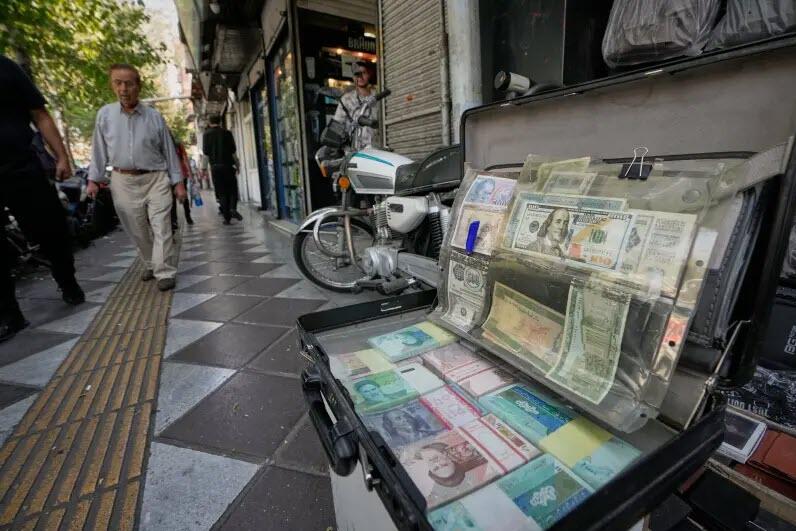
While Iran’s official Central Bank rate stands at 1.5 million rial to the dollar, the market rate is what the average Iranian pays.
“President Trump decimated Iran’s economy to a point where the rial has never been weaker and inflation has rarely been higher,” US Treasury Secretary Scott Bessent wrote Sunday in an opinion piece in the Financial Times.
“The regime’s final refuge now lies in the self-deception of fearful nations that still believe accommodating aggression can secure a durable peace,” he added.
Bessent warned that the additional financial penalties to come would effectively “collapse the regime,” with Trump echoing the same threat on social media.
“IRAN IS COMPLETELY COLLAPSING!!!” the president wrote on Truth Social.
In a tweet later in the day, Bessent said that “Iran’s currency keeps plummeting: today, crashing through the exchange rate of 2 million rials to the U.S. dollar. Over the weekend, Iran’s Central Bank Governor Abdolnaser Hemmati said that the simultaneous drop in Iran’s oil revenues, tax income, and social security contributions has affected every part of Iran’s economy. 3 million, here we come!”
With the United Arab Emirates, Iran’s largest trading partner, suspending all trade with Tehran, officials within the Islamic republic have threatened retaliation over the economic blows.
“Any escalation of this situation will undoubtedly bring about consequences,” Iranian Foreign Ministry spokesperson Esmail Baghaei told reporters on Monday. “Our hands are not tied.”
END
IRAN
Iran Unveils Huge New Gas Discovery Amid US Economic Pressure
Tuesday, Aug 25, 2026 – 02:45 AM
Iran announced a huge new gas discovery in the southern province of Fars, with the oil ministry reporting estimates of 7.5 trillion cubic feet of gas, of which 73% is recoverable, or 5.7 trillion cu ft, OilPrice reported.
Iran has the world’s second-largest natural gas reserves, after Russia.
“This amount of gas is equivalent to one block of South Pars, which can supply gas for 15 years,” oil minister Mohsen Paknejad said, as quoted by Iranian media. “This volume of gas has the special characteristic of being sweet, which reduces both development and operating costs,” Paknejad also said.

The Iranian oil ministry also said over the weekend that repairs at the South Pars gas field continue, with 70% of operations now restored. The field was damaged by U.S. and Israeli strikes in the early days of the war. It is the world’s largest gas field, shared by Iran and Qatar, which calls it the North Field and which grew into a top-three world liquefied natural gas exporter thanks to the field’s reserves.
However, restoring 100% of operations at South Pars would take at least three years, the chief executive of the company operating the field told SHANA news agency. He added that “intensive planning and alternative execution methods are being used to bring some trains back online by the end of the year and complete the overall reconstruction within two years.”
The news of the new Iranian discovery comes as the United States threatened to slap more sanctions on Tehran. President Trump called them “draconian”, saying “Well, we have things that we could sanction. We have very draconian sanctions, and we’ll see what happens.”
Separately, in an op-ed for the Financial Times, Treasury Secretary Scott Bessent threatened Iran with “an economic D-Day — the single greatest financial offensive ever marshalled against an adversary.” No details about the nature of the sanctions were revealed.
END
IRAN USA
Trump Says All Mines Cleared From Strait Of Hormuz, Warns Military Options Still On Table
Tuesday, Aug 25, 2026 – 02:40 PM
President Trump took to Truth Social on Tuesday to declare that all mines have been removed from the Strait of Hormuz – it what seems yet another attempt to declare all is well at a moment Washington has shifted from prior military operations to an economic ‘strangulation’ and siege policy targeting the Islamic Republic.
“I have just been informed by the United States Navy that all mines have been removed and/or detonated from within the International Waters of the Strait of Hormuz,” the President wrote on Tuesday. “Iran has been notified that any ship or boat placing new mines will be immediately and systematically destroyed. There is a Zero Tolerance policy on mine placement in full force and effect.”

So while there is a temporary calm for now, also with Iran not having targeted foreign vessels in at least the last couple days, Trump is essentially saying military options remain on the table.
Below is the text of the full Truth Social Post [emphasis ZH]:
I have just been informed by the United States Navy that all mines have been removed and/or detonated from within the International Waters of the Strait of Hormuz. Iran has been notified that any ship or boat placing new mines will be immediately and systematically destroyed. Through Space Force, we are watching every square inch of the Strait, as we are, also, with Pickaxe Mountain and the already destroyed three other Nuclear sites. There is a Zero Tolerance policy on mine placement in full force and effect. Thank you for your attention to this matter!
US officials along with reports in Axios and other outlets have touted US Navy assistance for a steady small ‘stealth’ stream of tankers still transiting the Strait each day with fighter jet monitoring operations near the Omani coastline.
Axios claimed for example that last week 15 million barrels of oil exited the waterway on a single day.
But some maritime monitor organizations and pundits remain skeptical, and the situation is muddied given that many ships must turn off their transponders if they choose to risk the passage, which for months has been subject to attack by Iranian drones and missiles.
This summer, for the first time in history, Trump threatened to bomb Muscat over negotiations with Tehran, given Iran has asserted that the Oman-brokered Hormuz management plan cuts the US out of the process.
Trump told Fox News journalist Trey Yingst: “If Oman gets in the way, we’ll bomb the sh*t out of them.”
Coupled with this is Bessent’s rollout on Monday of details of an economic ‘D-Day’ against Iran, saying that the country will be completely isolated from the world economy, and threatening secondary sanctions against any third party country that doesn’t comply.
The big question remains whether Washington would actually go after China over violation of the new Iran restrictions, especially given China’s President Xi Jinping is set to be hosted at the White House, just weeks away.
END
ROBERT H
UK Prime Minister hands over Storm Shadow missile blueprints to Ukraine for domestic production
 | |||
Dangerous escalation is this.
Imagine Russia giving Zircon hypersonic technology to Iran.
Everyone knows that Ukraine is a British proxy to attack Russia. The centuries old disputes between these two countries goes on.
One day perhaps the past will be resolved by diplomacy or outright war. And that history chapter is yet to be written. However Lavrov recently warmed Britain that staying with Ukraine to the end will have consequences.
And in its’ dying days will Ukraine use such technology to further its’ ambitions amongst other European countries? Such a event should not be ruled out as Europe has already seen Ukrainians act in shutting down gas and oil flow to neighbors
END
6/.GLOBAL ISSUES, COVID ISSUES, VACCINE INJURIES/HEALTH ISSUES
GLOBAL ISSUES
Society Collapse 2040: The Year The World Stops Working And Starts Dying
Monday, Aug 24, 2026 – 11:25 PM
Authored by Milan Adams via Preppgroup,
The Mathematical Warning That Refused to Fade
Fifty-four years ago, a team of researchers at MIT fed population data, resource consumption curves, and pollution metrics into a mainframe computer the size of a shipping container. The machine whirred through calculations and spat out a trajectory that ended in sharp decline. The 1972 Limits to Growth report predicted that without drastic course corrections, industrial civilization would hit terminal constraints by mid-century. At the time, critics dismissed the findings as Malthusian paranoia, pointing to the green revolution and technological optimism as proof that human ingenuity would always outpace scarcity. They were wrong. The variables aligned with terrifying precision.
A reassessment published by KPMG in January 2026 confirmed what the original MIT model suggested: we are not merely on track for the 2040 collapse – we are eighteen months ahead of the worst-case scenario. The report analyzed thirty key indicators including arable land depletion, aquifer drawdown, atmospheric carbon concentrations, and debt-to-GDP ratios across OECD nations. Twenty-seven of those indicators exceeded the 1972 projections. The remaining three—global shipping volume, semiconductor production, and satellite launches – mask underlying fragility by measuring activity rather than resilience. The study concluded that the “business as usual” trajectory now points to systemic rupture between 2032 and 2038, with cascading failures likely to begin manifesting visibly by late 2027.
The mathematics does not care about human optimism. Exponential curves have a way of appearing flat until they go vertical. The MIT model tracked five variables: population, food production, industrial output, pollution, and non-renewable resource depletion. In 2026, global population stands at 8.2 billion, having added the last billion in just twelve years. Food production plateaued in 2023 despite increased fertilizer application, indicating diminishing returns on agricultural intensification. Industrial output continues to rise, but energy return on investment – the amount of usable energy extracted versus the energy required to extract it—has fallen below the critical threshold of 15:1 for most fossil fuel sources. Pollution, measured in particulate matter, oceanic plastic density, and atmospheric methane, exceeds the model’s “pollution crisis” scenario by forty percent. The curves converge toward a singularity of scarcity and toxicity.

The Nine Fractures Already Spiderwebbing Through the Foundation
Economic architecture is not collapsing in a dramatic thunderclap. Instead, it is dissolving like limestone in acid rain—slowly, invisibly, until the cavern opens beneath your feet. Global debt reached $307 trillion in early 2026, representing 333% of global GDP. This is not a number that resolves through growth. It resolves through devaluation, default, or dissolution. Central banks in thirty-seven countries are currently piloting Central Bank Digital Currencies (CBDCs), programmable money that carries expiration dates and usage restrictions. The Bank for International Settlements openly discusses “financial repression” as a necessary tool for managing sovereign debt loads. Translation: your savings will be harvested to keep institutions solvent, and you will have no recourse because the money will be code, not cash.
The banking crisis of 2023 never truly ended; it merely entered a chemically-induced coma. Regional banks in the United States continue to hemorrhage deposits as savers flee to money market funds and Treasury bills. Commercial real estate—office towers built in the 1980s and 1990s—trades at sixty percent below 2019 valuations. Pension funds that loaded up on these “stable” assets face insolvency by 2028. The derivatives market, that opaque web of interconnected obligations, now notionalizes at over one quadrillion dollars. When—not if—a major counterparty fails, the unwind will not be orderly. It will be a stampede toward exits that no longer exist.
Climate systems are not changing. They are destabilizing. The summer of 2026 broke records that had stood for mere months. Phoenix recorded thirty-one consecutive days above 115°F. The wet-bulb temperature in Mumbai exceeded 35°C for six hours on August 3rd, 2026, crossing the threshold for human survivability without air conditioning. The Arctic ice minimum this September will likely establish a new record low, with some models suggesting the first “blue ocean event”—ice-free Arctic waters—could occur as early as 2027, decades ahead of previous estimates. The permafrost in Siberia is not merely thawing; it is exploding. Methane craters half a kilometer wide now pockmark the Yamal Peninsula, releasing ancient greenhouse gases at rates that render human emission reductions irrelevant.
Water is not becoming scarce. It is being weaponized. The Colorado River, which irrigates fifteen percent of American agricultural output, has reached critically low levels that trigger mandatory cutbacks under the 2026 Compact renegotiations. Farmers in Arizona are already bulldozing orchards that took decades to establish. The Ogallala Aquifer, which underlies the American breadbasket, drops an average of two feet annually. It will not recharge within any human timescale. In India, the groundwater beneath the Punjab region—India’s wheat basket—will be economically inaccessible by 2028. Pakistan and India have exchanged fire across the Line of Control three times this year over water rights to the Indus River basin. The first water war of the 21st century is not coming. It is already here, dressed in the rhetoric of territorial sovereignty.
Migration patterns have shifted from streams to torrents. The UN estimates that 1.2 billion people currently live in regions that will become uninhabitable within two decades due to heat, drought, or sea level rise. In 2026 alone, 340,000 people crossed the Darién Gap between Colombia and Panama, heading north. These are not economic migrants seeking opportunity; they are climate refugees fleeing agricultural collapse. The Sahel region of Africa is emptying into Europe at rates that exceed the 2015 crisis by factors of three. Bangladesh, where 160 million people live on a delta that rises one centimeter annually while seas rise three times faster, is negotiating “managed retreat” agreements that will relocate twenty million citizens by 2030. Borders are hardening. Camps are swelling. The infrastructure of compassion is fracturing under the weight of mathematical impossibility.
Food systems operate on margins so thin they resemble tightropes. The world maintains approximately seventy days of grain reserves. When Ukraine’s exports were disrupted in 2022, wheat prices spiked forty percent. When the Mississippi River dropped to historic lows in 2023, barge traffic backed up for months. These were warnings, not aberrations. In 2026, rice prices hit fourteen-year highs due to El Niño-induced droughts across Southeast Asia. The “green revolution” that fed the population boom relied on fossil fuel inputs—natural gas for fertilizer, diesel for tractors, petroleum for pesticides. As energy costs rise, food costs follow with mathematical inevitability. The bread riots that began in Sri Lanka in 2022 and spread to Pakistan, Peru, and Kenya were previews, not finales.
Disease is evolving faster than our defenses. Antibiotic resistance now kills 1.27 million people annually, a figure projected to reach ten million by 2035. Gonorrhea, tuberculosis, and staphylococcus infections are emerging that respond to no known pharmaceutical treatment. The post-antibiotic era means surgery returns to being a life-threatening gamble, childbirth becomes dangerous, and minor wounds can kill. Meanwhile, viral zoonotic spillover events have increased threefold since 2010. The H5N1 avian influenza has achieved mammal-to-mammal transmission in cattle populations across the American Midwest. Virologists give it a forty percent probability of achieving efficient human-to-human transmission within eighteen months. When—not if—it does, mortality rates could exceed those of the 1918 Spanish Flu.
Demographics are inverting with terrifying speed. The global fertility rate has fallen to 2.3 children per woman, barely above replacement level. In South Korea, it is 0.72. In Italy, 1.24. In China, 1.09. The inverted age pyramid—few young supporting many old—creates fiscal impossibilities. Japan is currently spending forty percent of its budget on elderly care and debt service. By 2030, that figure reaches sixty percent. Pension systems are not underfunded; they are unfundable. Simultaneously, youth unemployment in the developing world has reached forty percent in regions where seventy percent of the population is under thirty. The combination of idle young men and resource scarcity produces the historical precursor conditions for war.
Social cohesion is unraveling into constituent threads. Political polarization has reached levels where seventy percent of Americans view members of the opposing party as existential threats. Trust in institutions—media, government, academia, medicine—has fallen below twenty percent across Western democracies. Conspiracy theories move faster than facts because they offer narrative coherence in a world of chaotic complexity. When the official story loses credibility, people construct their own realities. The result is a population that cannot agree on basic facts, rendering collective problem-solving impossible. The public sphere has become a battlefield of competing hallucinations.
The Cascade Mechanics Nobody Modeled Correctly
These nine factors do not operate in isolation. They are coupled oscillators, feeding energy into each other with terrifying efficiency. Climate stress triggers migration. Migration triggers political backlash and border militarization. Resource nationalism disrupts trade. Trade disruption causes economic shock. Economic shock triggers currency crises. Currency crises prevent importation of food and energy. Food and energy shortages trigger social unrest. Social unrest disrupts supply chains further. The feedback loops are not linear; they are exponential.
The 2022 energy crisis in Europe demonstrated this coupling. Sanctions on Russian natural gas triggered price spikes. Price spikes forced industrial shutdowns. Shutdowns reduced fertilizer production. Reduced fertilizer production lowered grain yields. Lower yields increased food prices. High food prices triggered protests in developing nations that imported European wheat. The disruption traveled from pipelines to plazas in six months. Now imagine this cascade occurring simultaneously across water, food, energy, and financial systems. The models suggest that once three critical systems fail, the remaining seven follow within months, not years.
The concept of “resilience” has been strip-mined by corporate consultants who use it to sell software solutions. True resilience is biological, not digital. It is the redundancy of multiple seed varieties, not data backups. It is the muscle memory of manual labor, not cloud storage. It is the trust between neighbors, not blockchain verification. Industrial civilization has optimized for efficiency at the expense of redundancy, creating systems that are “lean” in the same way a razor blade is lean—sharp, but prone to snapping under pressure.
What the Breaking Point Actually Looks Like
The collapse will not announce itself with cinematic flair. There will be no single day when the president declares martial law over a montage of burning cities. Instead, the degradation will be granular, personal, and unevenly distributed. It will arrive as the day your debit card stops working at the grocery store, not because you lack funds, but because the payment processor is down. It will arrive as the week the pharmacy cannot refill your prescription because the supply chain fractured somewhere in a factory district you have never heard of. It will arrive as the month when the water coming from your tap runs brown, then stops running entirely.
Infrastructure does not fail catastrophically at first. It fails in brownouts. The electrical grid, that marvel of twentieth-century engineering, currently operates with less than three percent spare capacity in most developed nations. During the August 2026 heat dome, rolling blackouts affected forty million Americans. Hospitals ran on backup generators. Traffic lights went dark. Refrigerators warmed. The meat in freezers spoiled. These were not third-world conditions; they were suburbs of Dallas and Sacramento. When the grid finally fails completely—and physicists give it a sixty percent chance of major continental failure by 2030—it will not return quickly. Transformers take eighteen months to manufacture. High-voltage cables require specialized ships to lay. The knowledge to repair these systems resides in aging engineers who are not being replaced.
Water scarcity does not mean the taps run dry everywhere at once. It means the price triples. It means the municipal supply is restricted to four hours daily. It means those with private wells become targets. It means the wealthy install reverse-osmosis systems while the poor queue at distribution points with plastic jugs. It means hospitals cancel surgeries because they cannot sterilize instruments. It means the sewage system backs up because there is insufficient water pressure to maintain flow. It means cholera and typhoid return to cities that have not seen them in a century.
Food shortages do not manifest as empty shelves immediately. They manifest as the substitution of fresh produce with processed carbohydrates. They manifest as “meatless Mondays” becoming meatless weeks. They manifest as portion sizes shrinking while prices remain static. They manifest as the disappearance of imported goods—coffee, chocolate, bananas—replaced by local substitutes that taste like memory. They manifest as weight loss that doctors attribute to diet trends rather than caloric deficit. They manifest as the reappearance of “victory gardens” in suburban yards, not as hobbies, but as necessities.

Crime does not explode into Mad Max theatrics. It metastasizes. Petty theft becomes normalized because the police no longer respond to non-violent calls. Home invasions increase because desperation outpaces deterrence. Organized looting of cargo trains and delivery trucks becomes so common that insurance companies stop covering transported goods. Vigilante patrols form in neighborhoods that previously considered themselves progressive. The law does not disappear; it fragments into private security, gang justice, and mob violence. The state retains the capacity for overwhelming force but loses the capacity for consistent order.
Disease spreads not as plague pits but as chronic burden. Hospitals operate at 140% capacity year-round. Elective surgeries are canceled indefinitely. Cancer treatments are rationed by age. Antibiotics are reserved for the wealthy who can pay black market prices. Routine infections kill because the drugs no longer work. Mental health crises spike as anxiety becomes the baseline emotional state. The medical system does not collapse in a day; it erodes like coastal cliffs, losing a meter of capacity annually until the foundation undermines the structure.
Economic collapse does not look like hyperinflation in Weimar Germany, with wheelbarrows of cash. It looks like the cashless society the technocrats dreamed of, but as a prison rather than a convenience. CBDCs arrive as “financial inclusion” and become social control. Your money expires if not spent within thirty days. Your purchases are restricted based on carbon scores. Your accounts are frozen if you violate speech codes or exceed travel allowances. The wealthy move assets into land, precious metals, and cryptocurrency, leaving the masses holding programmable tokens that lose value algorithmically. The stock market does not crash; it is suspended “temporarily” to prevent panic selling, then reopened under capital controls.

The Survival Imperative Beyond Stockpiling
Preparation is not paranoia when the threat is mathematical. However, the survivalist aesthetic of canned goods and bunker construction misses the point. Three months of stored food will not carry you through a decade of decline. The lone wolf dies; the pack survives. The critical resource is not ammunition or freeze-dried rations; it is social capital. Trust is the currency that retains value when fiat fails. Skills are the assets that appreciate when markets crash.

Water security means more than bottled reserves. It means knowing how to purify rainfall, how to access aquifers, how to build solar stills. It means understanding your local watershed, the sources upstream, the contaminants likely downstream. It means community-level infrastructure—cisterns, filtration, distribution networks—that functions when municipal systems fail.
Food security means regenerative agriculture, not industrial agriculture. It means learning to grow calories, not Instagram aesthetics. It means heritage seeds that reproduce true, not hybrids that require annual purchase. It means composting, foraging, preserving, fermenting. It means small livestock—rabbits, chickens, goats—that convert inedible biomass into protein. It means knowing your neighbors’ skills and bartering labor for produce.
Energy security means redundancy. Solar panels with battery backup for when the grid falters. Wood stoves for when the gas lines freeze. Hand tools for when the power tools have no electrons to consume. The ability to repair rather than replace. The knowledge to maintain engines, to wire circuits, to improvise solutions from salvaged materials.
Medical security means primitive skills. Knowing how to set bones, suture wounds, identify medicinal plants. Stockpiling antibiotics while they still work, learning to use veterinary equivalents when human grades become unavailable. Understanding sanitation—proper latrine construction, water purification, waste disposal—to prevent disease rather than merely treat it.
Security means community defense, not individual armament. A fortress mentality invites siege. Mutual aid pacts, neighborhood watches, communication networks that function when cell towers fail. The ability to de-escalate conflict because every bullet fired invites retaliation. The wisdom to share surplus because hoarding invites theft.
Psychological resilience may prove the rarest commodity. The ability to adapt to lower standards of living without despair. The capacity to find meaning outside of consumption and status. The mental flexibility to abandon plans when circumstances change. The emotional stability to witness suffering without becoming numb or broken. The spiritual fortitude to maintain ethics when systems of enforcement dissolve.
The Horizon We Are Actually Walking Toward
The 2040 prediction was not wrong; it was conservative. The KPMG reassessment suggests we are witnessing not a sudden cliff but a steepening slope that began around 2020 and accelerates annually. The collapse is not an event in the future. It is a process we are currently inhabiting. The question is not whether you will live to see societal collapse. You are already living within it. The question is where on the curve you will find yourself when your personal trajectory intersects with the systemic breakdown.
The Roman Empire did not fall in a day. It experienced centuries of decline during which life continued, markets operated, and culture flourished—until they didn’t. The Mayans did not vanish; they abandoned their cities when the agricultural basis could no longer support the population density. The Bronze Age collapse of 1177 BCE saw multiple interconnected civilizations fail within decades due to climate change, seismic disruptions, and invasion. The survivors were those who decentralized, who maintained oral traditions when writing disappeared, who shifted from complexity to resilience.
We face a similar inflection. The next fifteen years will not resemble the last fifteen. The assumptions of perpetual progress, of technological salvation, of infinite growth on a finite planet, are being ground against the whetstone of physical reality. The pain will be unevenly distributed, as it always is. The wealthy will buy islands, citizenships, and security details. The poor will suffer first and most. The middle class will discover that their credentials and retirement accounts are abstractions that dissolve when the infrastructure supporting them fails.
But within this darkness, there is a strange liberation. When the impossible burden of maintaining industrial civilization is lifted by its own weight, space opens for other ways of being. Not utopia, certainly. Hardship, definitely. But also proximity, skill, meaning, and connection that the digital age promised but failed to deliver. The future is not uniformly bleak; it is textured, varied, and still undetermined.
The MIT model offered a choice in 1972. We made it, collectively, through action and inaction. Now we navigate the consequences. The 2040 horizon approaches not as prophecy, but as physics. Those who see it coming, who prepare bodies and minds and communities, will not escape the storm. But they might build boats sturdy enough to reach the other side of it.
END
MARK CRISPIN MILLER
DR PAUL ALEXANDER
Would Ontario cut off electricity to USA? Premier Ford said he would…in a deteriorating trade war Canada USA. what is your view? ‘‘Reagan would be throwing up:’ Ontario premier unloads on Trump and
threatens to cut electricity to US as trade dispute escalates; Ford warned that ‘everything is on the table’ should the dispute deteriorate, including shutting off electricity exports and critical
| Dr. Paul AlexanderAug 25 |  |


mineral shipments from Ontario”…Ford says Canada is not for sale. Is this just posturing? How did it come to this?


Canada set to announce retaliatory tariffs as Trump tells its leaders to ‘fall in line’

‘TORONTO (AP) — Canada will announce retaliatory tariffs against the United States on Tuesday after relations deteriorated sharply Monday, with President Donald Trump telling Canadian leaders to “fall in line” or face consequences “far WORSE” than existing tariffs and Prime Minister Mark Carney accusing Washington of trying to subordinate Canada.
Trump also threatened new 50% tariffs on Canadian vehicles, auto parts and steel, while Carney said U.S. trade demands showed Washington wanted to “destroy our major industries,” including autos, steel and aluminum.’
end
RABOBANK/MICHAEL EVERY/OR OR PICTON/GIFFIN OR RABOBANK EXECUTIVE/COMMENTARY ON WORLDLY AFFAIRS
Markets Now Face Two Wars And Two Economic Wars
Tuesday, Aug 25, 2026 – 08:20 AM
By Michael Every of Rabobank
Two wars and two economic wars
Friday’s Jackson Hole speech from Fed Chair Warsh would traditionally be the big event this week but that’s arguably no longer true: the action is not with central banks but elsewhere. I don’t mean the ECB’s Lagarde going to work for the WEF. Rather, markets now face two wars and two economic wars.
Dawn in the US will see what Treasury Secretary Bessent calls ‘Economic D-Day’ designed “to sever every economic lifeline that sustains the tyrannical regime until Tehran stands alone.” Until the regime collapses – and everyone must either stand with the US or against them. Iran has likewise stated that any country joining new US sanctions would be “considered an enemy.” Yes, Iran’s (powerless) president said the US MoU is still the best path out of this mess, as Pakistan’s army chief is to visit Tehran again today; then again, Iran also claims Saudi Arabia, Turkey, and Pakistan invited it to join their new defence pact, which just failed to defend the Saudis from attacks by the Houthis instigated by Iran.
Indeed, as the Iranian parliament advances plans for Hormuz ‘service fees’ and the US says it’s shuttling more oil through Hormuz, the risk is Tehran opts to attack the GCC and US bases in Europe. Greece is moving a Patriot missile system to Crete. The UK is having to face that Iranian hackers just shut down one of its power plants for four days. As if that were not enough, worrying signals about Turkey-Israel clashes in Syria have prompted deescalation efforts, yet regional tensions remain very high. Towards the western edge of the MENA region, Spain has rejected Morocco’s calls for talks on Ceuta and Melilla sovereignty.
Today marks Ukraine’s Independence Day, with EU officials in Kyiv to celebrate. With Russia testing its readiness for military mobilisation, France is promising help with missile interceptors for Ukraine, Germany a €12bn missile program, and the UK has handed over its Storm Shadow missile blueprints alongside plans to build them there. The Kremlin has warned there will be consequences for these actions and is allegedly already sabotaging weapons factories across Europe. Putin also says Ukraine opened a ‘Pandora’s box’ with its strikes vs. economic targets, and Zelenskyy says Russia refused a Black Sea shipping truce, ensuring more destruction to trade.
Canadian PM Carney stated his country is now in an “economic war” with the US after USMCA negotiations collapsed. He will be matching US tariffs dollar for dollar from 8 September. The alleged list of US demands made on Canada include scared cows like dairy and parts of the auto industry, weakened domestic cultural protections, and binding defence commitments, but also tougher trade rules of origin and restrictions on Canada’s sovereignty to sign trade or investment agreements with other nations.
Canada presumed this was just an FTA discussion. The US — as was abundantly clear — is only interested in forging a tight-knit Fortress North America bloc as part of its Grand Macro Strategy. Against that backdrop, what is Canada’s Grand Macro Strategy?

Canada is 1/10 the size of the US economy. 90% of its population sits two hours drive from the US border. It’s deeply integrated into the US economy. It runs mostly north-south, not east-west trade, with internal tariffs. As KPMG notes, “Canadian manufacturers are shifting production toward the US, and the movement is material.” It’s rich in resources. It has a separatist issue in Quebec and might soon have one in oil-rich Alberta. It has a lot of privately held guns but a weak military with a very large territory to patrol. It has long relied on a US defensive shield. It also now has a pivotal geostrategic location that’s becoming vulnerable as the Arctic transforms into a playground for the Great Powers, which matters hugely to the US for *its* national security. So:
It could do more internally, but enough to mitigate being choked by the US? It’s a trading nation and can’t just go solo.
It could side with China… unleashing a FAR stronger US reaction across the spectrum, just as The Economist notes China’s “Leninist” neomercantilist model deindustrialises others. How many cars or planes will Canada sell to it vs. raw materials?
It could, but won’t, join Russia as an Arctic power – and see a US *and* EU pushback.
It can’t join the EU as it’s *not in Europe* but could ‘do a Norway’ of sorts … then Europe would insist on the same control of its external trade, as Europe is moving closer to ‘buy local’ schemes and confronting China like the US.
It could work with the UK and Australia: but both lack a Grand Macro Strategy and are too small, too reliant on the US, and too far away. In Asia, Japan and South Korea are locked into the US camp, and ASEAN are mostly net exporters trying to balance the US and China.
In short: give in and accept the liberal world order is truly over, as is Canadian sovereignty; fight an economic war when heavily outgunned (…in the hope of a better deal or outcome from the US midterms, which is just a tactic?); or encourage the liberal world order to shrink further by choosing China, which will also imply a loss of sovereignty over time along with fears of more worrisome US actions. If that sounds like a Melian dialogue to some degree, it sadly is.
While the direct impact of the US-Canada fight on world markets is small, symbolically it matters hugely. Middle Powers, and China and Russia, will be watching to see who wins, just as they are with the US-Iran. Markets will move on that.
On which, as the financial press notes ‘Warsh seeks to soothe investors’ nerves’, yet ‘Bessent Has No Easy Fix for What’s Really Driving Yields Up’, and hears from ‘US economist Barry Eichengreen on reality of de-dollarisation and next currency reshuffle’, and as Bitcoin nears $80,000 in its biggest weekly rally in three years, something else Trump just said about rising bond yields and Bessent’s Special Military Operation Twist is worth focusing on: “The ultimate intervention is our military, and if we have to use that we will.”
Yes, folks – physical power sits behind global markets. They only exist in their current form because US power won WW2 and the Cold War, and it then used that legacy to allow markets to think they get to decide everything. Now they don’t, as Trump is making painfully clear to Canada and other Middle Powers in terms of physical markets. And he’s not the only one playing that game. That in turn flows up to financial markets.
If you want to push bond yields down… raise taxes; cut spending; cut rates; do Operation Twist; QE; or YCC. Or boost the supply side with subsidies themselves subsidized with export earnings. Or use your military to take control of upstream commodity supply chains to redirect supply where you want it, ‘encouraging’ others to strike deals with you on your terms. Yes, *such wars can be lost*, but the underlying principle should be obvious. And it’s not, “because markets.”
Ironically, those joking about what Trump said, accept ongoing BOJ JGB buying or the ECB’s APP and TPI schemes, the latter allowing unlimited bond buying to supress price discovery in peripheral Eurozone bond markets, precisely “because markets” and technobabble. Drawing an analogy, they are like those enjoying a nice chicken sandwich at the desk for lunch while preferring not to think about the existence of slaughterhouses that allow them to be served.
Bessent and Trump are saying they are willing to do ‘Whatever It Takes’. Warsh, Lagarde, PM Carney, and all of us are going to have to adapt to that awkward fact – and the equally awkward geopolitical and market movements that come alongside it whether the US wins or loses.
END
Rabobank: Bessent’s Buyback Looks A Lot Like “Whatever It Takes”, And Druck Isn’t A Fan
Tuesday, Aug 25, 2026 – 10:40 AM
By Michael Every of Rabobank
US Treasury Secretary Bessent took out a tactical nuke in saying he could use $1trn from the Treasury General Account to fund Special Military Operation Twist bond buybacks vs. the $2bn per round increase we saw last week. That looks a lot like the ‘Whatever It Takes’ mentioned yesterday: his former mentor Stan Druckenmiller is not a fan, apparently.

He also launched ‘Operation Economic Outcast’ to isolate and squeeze Iran further on top of US sanctions and a blockade against its oil. Those helping Iran will face secondary sanctions escalating to their removal from the US dollar system, as nuclear a weapon as financial warfare can wield. However, when asked why he didn’t impose them immediately, Bessent replied, “Why would I want to blow up the global financial system?” He will first try to persuade key parties to walk away from Iran: yet some have real nuclear weapons and others control rare earths and global supply chains. The stakes here are therefore sky high, unless this is a bluff.

Tehran said it would retaliate to sanctions by land, sea, air, or cyber-attacks; trolled it might kill Barron Trump, as Israeli PM Netanyahu claimed it had threatened one his sons too; continued to threaten ships transiting Hormuz; the Houthis struck a Saudi tanker in the Red Sea, which neither Egypt nor Turkey responded to; the Saudis held talks about a state-backed war insurance plan for shipping like the US one that didn’t work; China sent PLA jets to drill alongside Egypt’s; China reported it has boosted coal’s economic value by 700% after turning it to liquids, underlining it’s much more energy secure than before; a US defence start-up is making thousands of drone interceptors in the UAE for $5,000, cheaper than Iranian attack drones; and Greece warned Turkey against violating its “sovereign rights” and vowed to respond from a “position of strength.”
In Ukraine, EU leaders, and no US representative, offered help to Kyiv as it faces another €23n defense funding hole, albeit managing to hit Russia’s Afipsky oil refinery as well as another e-commerce giant. Russia threatened to hit UK factories making defence parts for Ukraine.
Trump may impose a 7.5% ‘overcapacity’ tariff on China ahead of the Xi state visit, clearly a negotiating card. He will also raise the tariff on Canadian autos and trucks from 25% to 50% from 1 January in response to PM Carney’s ‘elbows up’. Ottawa now faces the choice of matching those tariffs, retreating, or doing what those who oppose tariffs as self-harm never do: slash their levies and enjoy cheap imports replacing local production. Alberta Premier Smith, where a vote on a secession referendum looms in October, had to stress it’s “not viable” to cut off energy exports to the US; and with warnings US-Canada trade war could affect their defence relationship, Carney said he will begin negotiations with the EU about deepening trade and defence relations.
That makes political but not geostrategic sense. Canada isn’t in Europe so can’t join the EU, but if it were to enter a customs union it would surrender sovereignty: and would Europe buy Canadian cars, trucks, planes, agri products, or its fossil fuels given plans to decarbonise? They’d like its critical minerals, but can buy them now. Canada would be sending its goods to a bloc far away over seas neither it nor the EU have the navies to protect, as both are defense under-spenders relative to their huge needs. Both rely on the US for defense and, increasingly, for AI. Yet both assume a benign US stance if they push ahead without it, strategically, even while saying they are doing so because they don’t see the US as benign. That logical inconsistency implies either the strategy is hollow, or will need filling with a greater shift to economic statecraft replete with risks.
Equally, some may picture a ‘blue’ bloc from Canada to Armenia as Yerevan said it will hold a referendum on EU membership soon, shifting the bloc further east and Russia-EU tensions higher. UK PM Burnham also made more mandate-free noises about rejoining in the future.
Yet Politico underlines the German AfD — cosy with the Kremlin and wishing to leave the euro and Schengen — will win the 6 September state election in Saxony-Anhalt. The plan to deal with that ranges from ignoring to defunding Saxony to banning the AfD: are those a basis for long-term political stability? In early 2027, France then has a presidential election that could pit nationalist Le Pen vs. leftist Melenchon: both want to tear norms up, the latter to tear French debt up too. What’s the correct interest rate or FTA for these kinds of structural problems?
The new Rhine Group think tank led by Draghi states that for the EU, “The stakes are existential.” It underlines, “Europe is in a harder place than when the future of European competitiveness report was released… If stagnation continues, the continent will progressively lose the ability to fund the core obligations of a modern state: defence, public healthcare, pensions, education, climate investments, and safety nets for those who lose their jobs… Decline is not inevitable, but it is the direction we are heading unless we take urgent action.” The warning that “slow agony” lay ahead without radical, rapid EU change failed to produce anything much: will this report do the trick?
Meanwhile, showing how the world now works, the US(!) is opening up Venezuela’s telecom sector while excluding Chinese firms, as Fortune magazine floats the idea of the country adopting the US dollar.
In the US, the Supreme Court issued a ruling with potentially huge consequences. It has allowed, for now, a Trump executive order to proceed which strictly monitors mail-in voting and requires tighter control of who is listed as a voter and the envelopes used to do, at a time when the president has quietly asserted control over the postal service, according to the New York Times. Those making market, or geostrategic, gambles on midterm outcomes assuming that the magical mystery tour of mail-in votes will be cast in the same way they have may be in for a surprise – or so Republicans seem to feel.
The Trump admin also proposed a staggering $103,000 fee for H-1B visas, effectively shutting off that avenue for all but the highest-earning immigrants, and is preparing to revoke the visas of up to 200K foreigners in largest mass action ever. That looks like a midterm-focused policy.
In short, there is a lot of economic outcasting going on right now. It’s just not clear who is going to be in and who is going to be out, and with whom, when the dust settles – and we can expect serious dustups in that process.
None of that mattered to the RBA’s majorly monomaniacal meeting minutes, which showed that it left rates on hold on the view that inflation was easing and so was the tight labour market. All of the above backdrop was cast out of that forecast, as is the case with other central banks. To be fair, how does one include it? To be just as fair, how can one exclude it? Maybe Warsh will have something to say on not saying anything about that on Friday.
END
7. OIL AND NATURAL GAS/ENERGY COMMENTARIES
TotalEnergies CEO Reveals Cost To Move A Supertanker Through Hormuz
Monday, Aug 24, 2026 – 06:50 PM
The crisis-driven dislocation across Gulf oil markets has positioned French energy giant TotalEnergies SE as an early mover, capitalizing on heavily discounted Persian Gulf crude priced at $50 to $60 a barrel and moving it through the highly contested Strait of Hormuz. CEO Patrick Pouyanné revealed at the Norwegian energy conference on Monday that transiting the waterway now costs roughly $20 million per supertanker.
Bloomberg earlier quoted Pouyanné as saying that the added cost of moving crude on supertankers through the Hormuz chokepoint is about $10 per barrel. However, with Brent crude futures at $92 per barrel, the potential profit could be upward of $30 per barrel. That is before financing and other costs, creating extraordinary margins for companies willing to accept the risks of being early movers in one of the world’s most dangerous waterways.

TotalEnergies is one of the largest traders of Iraqi and Qatari crude, with both producers continuing to move oil through the Strait of Hormuz.
“We are today probably the largest trader of oil from Iraq or from Qatar … and I can tell you that today crude oil is moving through the Strait of Hormuz very quietly, not publicly,” Pouyanné said.
Pouyanné did not elaborate on whether TotalEnergies-contracted tankers are transiting the US military-supervised shipping corridor off Oman.

Recent data have shown a noticeable uptick in transits, raising the question of whether Tehran’s grip on the maritime chokepoint has eroded.
Pouyanné also warned that the refined-products market is currently in crisis.
“You have a bearish crude oil market and a very bullish product markets, which is very strange,” he said. “Our consumers in Europe will suffer on this one,” while in the US, “gasoline prices would not go lower than $4 as President Trump would like.”
More on Pouyanne from Bloomberg’s Javier Blas:
Gulf producers are willing to unload discounted crude, while some energy companies are ready to accept the risk of sailing through the Strait of Hormuz in pursuit of substantial profits. Despite all this, as Pouyanné warned, there is little that increased crude flows can do to resolve the worldwide refined-products crisis.
END
8. EMERGING MARKETS//AUSTRALIA NEW ZEALAND ISSUES
CANADA//TRADE WITH USA
WAR!!
Trump Responds to Ontario Premier Ford as He Threatens Cutting Electricity, Fires Off Profane Rebuke
ASSOCIATED PRESS!!

(L-R) U.S. President Donald Trump speaks in the Oval Office of the White House in Washington on July 21, 2026; Ontario Premier Doug Ford speaks during a news conference on Parliament Hill in Ottawa on Dec. 18, 2025. Saul Loeb, Dave Chan/AFP via Getty Images

Ontario Premier Doug Ford’s threat to cut off electricity and critical minerals to the United States has sparked a response from President Donald Trump, who is accusing both Ford and Prime Minister Mark Carney of “bad leadership.”
Trump warned about cutting off pipelines and electrical lines carrying energy to Canada in the face of Ford’s threat.
Ford told The Associated Press that “everything is on the table” after Carney walked away from trade talks with the White House on Aug. 21, saying Washington’s proposed deal infringed on Canadian sovereignty.
“I’ll cut them off,” Ford said during the interview published on Aug. 24, while discussing critical minerals. “You won’t get a grain of sand out of Ontario.”
He later told a Toronto radio station that Trump could “kiss my ***” after the president accused Canada in a Truth Social post of “ripping off the United States of America for years” and threatening 50 percent tariffs on Canadian autos starting in 2027.
Ford doubled down on the comment during a press conference in Hamilton later that afternoon, adding that that Carney has not asked him to dial back such comments.

Trump Announces New 50 Percent Tariffs on Canadian Autos

Poilievre Presses Carney to Recall Parliament to Deal With Rejected Trade Agreement
He also talked about his threat to turn off the electricity to Ontario’s American customers. He said the province would start off with a surcharge for its electricity to U.S. states like New York, Michigan, and Minnesota, and it could “escalate” from there if the trade war continues.
He added that his suggestion to cut off critical minerals is still “on the table.”
Trump also had a few choice words for Ford and Carney in an Aug. 24 Truth Social post.
He described Ford as the “less charismatic, intelligent, and overall unimpressive brother of the late, great, Rob Ford.” Rob Ford was a former mayor of Toronto. He passed away in 2016 due to cancer.
“Their businesses are fleeing for the United States, and it’s all because of their failed policies, and inept leadership!” Trump wrote.
“Without the United States, Canada couldn’t survive — It’s where they get all of their money and, because of their current bad leadership, primarily Governor Carney, and his Flunky, Ford, they will not be allowed to keep taking advantage of the United States.”
Trump went on to say that large portions of the electricity, oil, and gas that Canada receives is transported through the United States and that someone should “get these clowns to ‘fall in line’ or, the consequences for Canada will be far WORSE!”
When asked about Trump’s comments, Ford said he doesn’t “respond to a dictator like President Trump.”
Escalation
The war of words comes after trade talks between Canada and the United States collapsed on Aug. 21, when Carney called his negotiators back to Canada.
The breakdown in talks means Trump’s new 50 percent U.S. tariffs on a range of Canadian products including dairy and alcohol are now in force. Canada has said it will respond with its own counter-tariffs starting on Sept. 8.
Both countries have since traded blame over last-minute demands.
Carney was asked at an Aug. 24 press conference whether he’d be open to cutting off electricity and critical minerals supply to Washington. Carney said he wants to begin with “positive initiatives,” and will see if “we need to do more.”
“We’re staying calm, we’ll stay positive,” he said. “We will cooperate in order to build real jobs and real careers.”
Carney added that the American economy is much larger than the Canadian economy, making it difficult to carry out a “dollar-for-dollar” counter-tariff strategy. He said Canada’s tariffs will be more targeted.
Electricity Surcharge
Ford told reporters on Aug. 22 that Canada “never started this fight,” but that Ontario will “use every single tool we have” to help Canada come out on top.
The premier has made similar threats in the past. Ford’s government put a 25 percent tax on electricity supplied to New York, Michigan, and Minnesota in 2025, in response to U.S. tariffs.
The export tax on the energy Ontario sends to the three states went into force last March, and was set to net the province an estimated $300,000 to $400,000 per day, Ford told reporters during the March 10, 2025 press conference in Toronto, noting that the tariff would add roughly $100 per month to Americans’ power bills.
In response, Trump threatened to double steel and aluminum tariffs on Canada from 25 percent to 50 percent. Ford agreed shortly after to suspend Ontario’s electricity surcharge after being promised a meeting with U.S. Secretary of Commerce Howard Lutnick.
The Trump administration responded by retracting the proposed 50 percent increase to maintain the baseline metal tariffs at 25 percent, but that lasted only a few months. The White House ultimately raised it to 50 percent last June, a hike that Trump said would “even further secure the steel industry in the United States.”
Ontario’s anti-tariff ads in the United States in 2025 also became a point of contention with Trump, who abruptly ended trade talks with Canada over the ads.
The Associated Press contributed to this report
END
CANADA/USA/WAR
A MUST MUST READ….
Are Canada’s Economic Threats Against The US Legit Or Are They Bluster?
Tuesday, Aug 25, 2026 – 08:40 AM
In order to “win” a trade war, a country must first have something that other countries want or need. This basic rule defines every other aspect of the conflict, from tariffs to monetary isolation. When it comes to the US there has long been a misconception that Americans “feed off global labor” and that the dollar’s world reserve status is the country’s only point of leverage.
This is not really the whole story.
Reserve status is helpful, but another thing the US has that most countries do not is (greater) free market access, which generates economic momentum. In other words, even in blue states like California, the US does business more freely and has less socialist regulation than the vast majority of the world and this is why foreign exporters see America as a golden market for their goods.
It’s a bit ironic, but, there are many countries that could, over time, match or surpass the US as a coveted consumer market; “winning” a trade war by becoming more independent and successful. However, none of them will do it because this would mean giving more freedom to their citizens to purchase what they like and operate businesses without constant bureaucratic constraints.
This is why socialism and communism will always lose in an economic war with a country that has free markets. They cannot compete because they restrict their own population’s ability to compete. Without a healthy consumer market the only thing these nations can do is produce and export to more free economies willing to buy.
Tariffs might be viewed as an anathema to this free market flow. They are, after all, a tax on corporations importing foreign goods. This assumes that corporate sourcing can’t adapt. This has proven false as Trump’s tariffs have not led to the inflationary spike that many critics predicted. Tariffs have only added around 0.5% to the CPI and companies are gradually shifting to domestic suppliers.
America is unique because for decades the country has been treated as an “open air market” by foreigners, and America has obliged them. Tariffs against US made goods are common; US tariffs against foreign goods? No so much.
It’s quite revealing that the very moment the Trump Administration took action to enforce even moderate protections on US trade, every other government jumped directly to accusing Trump of “attacking them” and “declaring war”. The double standard is obvious: Everyone else can use tariffs, the US can’t.
Canada, for example, has used tariffs on goods from almost every other country in the world for many years, including some US goods. No one accuses Canada of “waging war” on the world, because no one is clamoring to get access to Canada’s consumer markets. America, on the other hand, is supposed to play the role of the cash cow.
To do otherwise is an egregious crime against the world order.
The US has many financial problems and pitfalls, yes, but this doesn’t change the fact that most of the planet relies on the US as a place to sell their stuff. In fact, America makes up over 30% of total global consumer markets. China and all of the EU combined cannot match that kind of allure for exporters. They can’t even afford to buy their own goods and trinkets at a level that would sustain them. Like it or not, without US consumers the global economy falters.
The escalating rhetoric from Canada is a perfect example of a socialist nation wrongly believing they have leverage in a fight against a larger opponent. Canadian officials assert that they have trade weapons that can harm the US, but is this really true? Let’s take a look at come of the threats made by Canadian leaders.
Canada Can Shut Off Electricity Exports To The US?
In his blustering speeches on the fight with the US, Canadian Prime Minister Mark Carney argued that Canada supplies over 85% of US electricity imports (largely to the Eastern Seaboard). Other officials such as Ontario Premier Doug Ford and Quebec Premier Christine Fréchette have openly called for these power supplies to be cut off in order to “punish” the US for tariffs.
What they don’t mention is that Canada’s electricity makes up less than 1% of all US power. In other words, this is empty posturing. They are relying on the stupidity and lack of research of average social media posters to repeat such fallacies in the hopes of frightening American voters.
The tactic is similar to what the Iranians have been doing – Playing on social media hype while omitting the dire realities of their ground game.
Canada Can Shut Off Oil Exports To The US?
The US is the world’s largest oil producer and is a net exporter. Strictly speaking, the US does not need any Canadian oil in order to function. On the other hand, the Great White North does supply around 60% of all foreign oil going to the US. Wouldn’t the loss of this oil cause some kind of damage to the American economy?
Possibly, but Canadians calling for this measure might not understand how their own oil infrastructure works. Around 70% of Canada’s oil supply travels out of Alberta using pipelines that cross into US territory (the Enbridge Pipelines). These pipelines go through the US east to Ontario.
This goes for natural gas as well, which Canada also transports using pipelines that travel through the US. Shutting down energy flows to the US would mean shutting down energy flows to the largest population centers in Canada. Not very smart.
The Loss Of Canadian Goods Would Be Detrimental To The US?
Besides oil, what does the US actually buy from Canada? Well, a lot of cars and car parts, machinery, engines, metals and lumber. Most of these goods used to be produced in the US until outsourcing to foreign countries killed US manufacturing, mining and logging. Meaning, the US took a massive jobs hit by opening up its markets to countries like Canada. Canada wasn’t necessarily doing the US a favor.
Canada’s advantage over all other countries except perhaps Mexico is that they are the most convenient source for these goods; that does not mean they are not the only source. They are replaceable. Scaling to adapt to the loss of Canadian auto parts, for example, would be frustrating due to extensive integration, but it can be done within 1-2 years.
In the meantime, what do Canadian leaders think is going to happen to all the manufacturers in their country who are suddenly cut off from American markets? They’re going to leave, and they will likely move their operations to the US to avoid the 50% tariffs.

At bottom, Mark Carney’s decision to walk away from the US trade deal which reduced tariffs to a reasonable level is going to prove disastrous because Canada has nothing that the US needs, and the US has something Canada needs very much (the largest consumer market in the world right next door).
The economic advantages Canada has enjoyed simply through proximity to the US cannot be denied. It seems foolish for Carney to scrap a deal with limited tariffs in favor of a 50% sledgehammer. It appears as if he believes Canada is entitled to limitless US access, as if Canada is another American state.
But let’s say that the socialists get everything they think they want, including the eventual downfall of the US economy. Let’s say they find some way, some Achilles Heal, that brings the US down. Canada and most of the world would only suffer further with the loss of 30% of global consumption. It would not be the grand victory they imagine. Instead of simply accepting moderate tariffs, they would rather blow themselves up.
END
CANADA STRIKES BACK!! STUPID MOVE
Canada Retaliates, Slaps $20 Billion In Tariffs On 700 US Goods
Tuesday, Aug 25, 2026 – 12:15 PM
Days after the US hit Canada with a 50% tariff on $20 billion worth of Canadian goods amid a collapse in trade talks – and a Monday threat to include cars, trucks, auto parts and steel, Canada hit back on Tuesday – announcing retaliatory tariffs as high as 50% on $20 billion worth of American products.

Canada will begin collecting tariffs of 50, 25, and 15 percent on roughly 700 products beginning on Sept. 8. Most notably is the doubling of tariffs on American steel and aluminum to 50%. In addition to tit-for-tat tariffs on things like tools, clothing and forestry products, Canada is also targeting consumer products like home appliances.
The retaliation was expected following warnings by Prime Minister Mark Carney – a former central banker, who said that Canada would match US tariffs “dollar for dollar,” though he admitted that the move “will raise costs and reduce choice for Canadians,” NYT reports.
One of the major sources of tension in the trade negotiations was the United States’ 25 percent tariff on automobiles, a major export for Canada, introduced about 18 months ago. On Tuesday Canada said it would keep its retaliatory tariff on American-made cars at 25 percent and maintain a system that allows companies that build cars in Canada to continue to import them from the U.S. tariff-free, within limits. Canadians buy more cars from the United States that they ship there. -NYT
Canada imports around $272 billion in US goods annually – while Carney’s government says it will spend far more on keeping Canadian exporters solvent than it will bring in from the tariff, so ouch.
Or as the NYT frames it; “because Canada’s economy is about one-twelfth the size of the U.S. economy, its retaliatory tariffs will have the effect of a pea shooter in a gun battle.”
END
U.S./GOLD AND SILVER PRICING/ASIAN CLOSING MARKETS AND EUROPEAN BOURSE OPENING AND CLOSING/ INTEREST RATE SETTINGS TUESDAY MORNING 6;30AM//OPENING AND CLOSING
OPENING LEVELS OF CURRENCIES// AND CLOSING ASIAN STOCK MARKET AND OPENING EUROPEAN STOCKS:6 AM EST
EURO VS USA DOLLAR: 1.1664 DOWN 0.0004
USA/ YEN 159.37 UP 0.241 NOW TARGETS INTEREST RATE AT 1.75% AS IT WILL BUY UNLIMITED BONDS TO GETS TO THAT LEVEL…//YEN STILL FALLS//END OF YEN CARRY TRADE BEGINS AGAIN DEC 2024/Bank of Japan raises rates by .25% TO 1.75 ..TAKAICHI NEW PM AS YIELDS RISE//JAPAN DEEPLY IN TROUBLE WITH RISING RATES AND A FALLING YEN!! BANK OF JAPAN WILL NO LONGER DO QE. URGES PENSION AND INSUANCE FUNDS TO BUY JAPANESE BONDS
GBP/USA 1.3660 UP 0.0003 OR 3 BASIS PTS
USA/CAN DOLLAR: 1.3860 UP 0.0019 //CDN DOLLAR DOWN 19 BASIS PTS//
Last night Shanghai COMPOSITE CLOSED UP 7.44 PTS OR 0.19%
Hang Seng CLOSED DOWN 26.33 PTS OR 0.08%
AUSTRALIA CLOSED UP 0.67%
// EUROPEAN BOURSE: ALL GREEN
Trading from Europe and ASIA
I) EUROPEAN BOURSES: ALL GREEN
2/ CHINESE BOURSES / :Hang SENG CLOSED DOWN 26.33 PTS OR 0.08%
/SHANGHAI CLOSED UP 7.44 PTS OR 0.19%
AUSTRALIA BOURSE CLOSED UP .67%
(Nikkei (Japan) CLOSED UP 377.91 PTS OR 0.58%
INDIA’S SENSEX IN THE RED
Gold very early morning trading: $4627.00
silver:$67.82
USA DOLLAR VS TRY (TURKISH LIRA): 48.10 UP 2 BASIS PTS AND NOW WE SEE THEIR STUPIDITY OF SELLING SOME OF THEIR GOLD AND ALL OF THEIR USA DOLLAR RESERVES. THE COUNTRY IS IN BIG FINANCIAL TROUBLE
USA DOLLAR VS RUSSIAN ROUBLE: 84.66 ROUBLE// DOWN 1 ROUBLE AND 26 BASIS PTS.
UK 10 YR BOND YIELD: 5.0542 DOWN 1 BASIS PTS
UK 30 YR BOND YIELD: 5.7848 DOWN 1 BASIS PTS
CDN 10 YR BOND YIELD: 3.684 DOWN 8 BASIS PTS
CDN 5 YR BOND YIELD; 3.281 DOWN 8 BASIS PTS
USA dollar index early TUESDAY MORNING: 98.94 DOWN 1 BASIS POINTS FROM MONDAY’s CLOSE
TUESDAY MORNING NUMBERS ENDS
And now your closing TUESDAY NUMBERS 10.00 AM
Portuguese 10 year bond yield: 3.567% DOWN 4 in basis point(s) yield
JAPANESE BOND 10 yr YIELD: +2.887% UP 1 FULL POINTS BASIS POINTS /JAPAN losing control of its yield curve/
JAPAN 30 YR: 4.065 UP 1 BASIS PTS//
SPANISH 10 YR BOND YIELD: 3.664 DOWN 5 in basis points yield
ITALY 10 YR BOND: 4.034 DOWN 7 points in basis points yield ./
GERMAN 10 YR BOND YIELD: 3.2160 DOWN 5 BASIS PTS
IMPORTANT CURRENCY CLOSES : MID DAY TUESDAY
Closing currency crosses for day /USA DOLLAR INDEX/USA 10 YR BOND YIELD/10:00 AM
Euro/USA 1.1670 UP 0.0001 OR 1 basis points
USA/Japan: 159.25 UP 0.109 OR YEN IS DOWN 11 BASIS PTS// HIGHLY INFLATIONARY TO JAPAN
Great Britain 10 YR RATE 5.0111 DOWN 5 BASIS POINTS //
GREAT BRITAIN 30 YR BOND; 5.7380 DOWN 5 BASIS POINTS.
Canadian dollar DOWN 2 BASIS PTS TO 1.3843
xxxxxxxxxxxxxxxxxxxxxxxxxxxxxxxxxxxxxxxxxxxxxxxxxxxxxxxxxxxxxxxxxxxxxxxxxxxxxxxx
The USA/Yuan CNY 6.7222 ON SHORE ..DOWN
THE USA/YUAN OFFSHORE// CNH DOWN TO 6.7226
TURKISH LIRA: 48.09 UP 1 EXTREMELY DANGEROUS LEVEL/DEATH WATCH/HYPERINFLATION TO BEGIN.//
Your closing 10 yr US bond yield DOWN 2 in basis points from FRIDAY at 4.713% //trading well ABOVE the resistance level of 2.27-2.32%)
USA 30 yr bond yield 5.239 DOWN 4 basis points /10:00 AM
USA 2 YR BOND YIELD: 4.244 UP 2 BASIS PTS.
GOLD AT 10;00 AM $4666.70
SILVER AT 10;00: $69.55
Your 11:00 AM bourses for Europe and the Dow along with the USA dollar index closing and interest rates TUESDAY
DAY CLOSING TIME 10:00 AM///
London: CLOSED UP 31/84 PTS OR 0.29%
GERMAN DAX: CLOSED UP 159/54 PTS OR 0.61%
FRANCE: DOWN 13.81 OR 0.16 PTS
Spain IBEX CLOSED DOWN 42.00 PTS OR 0.21%
Italian MIB: CLOSED UP 178.13 PTS OR 0.34%
WTI Oil price 85.56 10.00 EST/
Brent Oil: 93.03 10:00 EST
USA /RUSSIAN ROUBLE: 83.41 /// ROUBLE DOWN 0 AND 71/ 100
CDN 10 YEAR RATE: 3.7020 DOWN 6 BASIS PTS.
CDN 5 YEAR RATE: 3.298 DOWN 7 BASIS PTS
CLOSING NUMBERS: 4 PM//
Euro vs USA 1.1674 UP 0.0007 OR 7 BASIS POINTS//
British Pound: 1.3647 UP 0.0010 OR 10 basis pts/
BRITISH 10 YR GILT BOND YIELD: 4.9893 DOWN 5 FULL BASIS PTS//
BRITISH 30 YR BOND YIELD: 5.715 DOWN 9 IN BASIS PTS.
JAPAN 10 YR YIELD: 2.894 UP 2 FULL BASIS PTS (DANGEROUS TO THEIR ECONOMY
JAPANESE 30 YR BOND: 4.062 UP 1/2 PTS AND STILL VERY DANGEROUS TO THEIR ECONOMY
USA dollar vs Japanese Yen: 159.19 UP 0.057 OR YEN DOWN 6 BASIS PTS//GETTING FURTHER AWAY FROM 160.00/ EXTREMELY DANGEROUS
USA dollar vs Canadian dollar: 1.3828 DOWN 0.0013 PTS// CDN DOLLAR UP 13 BASIS PTS
West Texas intermediate oil: 82/24
Brent OIL: 88.50
USA 10 yr bond yield DOWN 7 BASIS pts to 4.634
USA 30 yr bond yield: DOWN 6 PTS to 5.171%
USA 2 YR BOND 4.195 DOWN 5 PTS
CDN 10 YR RATE 3.647 DOWN 4 BASIS PTS
CDN 5 YEAR RATE: 3.237 DOWN 5 BASIS PTS
USA dollar index: 98.85 DOWN 8 BASIS POINTS
USA DOLLAR VS TURKISH LIRA: 48.09 UP 1 BASIS PTS GETTING QUITE CLOSE TO BLOWING UP/IDIOTS SOLD GOLD
USA DOLLAR VS RUSSIA//// ROUBLE: 83.70 DOWN 0 AND 30/100 roubles //
GOLD $4,661.00 3:30 PM)
SILVER: 69.06 3;30 PM)
DOW JONES INDUSTRIAL AVERAGE: UP 172.18 POINTS OR 0.32%
NASDAQ 100 UP 186/05 PTS OR 0.64%
VOLATILITY INDEX 15.45 DOWN 0.40 PTS OR 2.52%
GLD: $ 428.10 UP 1.41 PTS OR 0.33%
SLV/ 62.31PTS UP 0.11 OR 0.18%
TORONTO STOCK INDEX// TSX INDEX: CLOSED UP 240.25 PTS OR 0.65%
end
TRADING today ZEROHEDGE 4 PM: HEADLINE NEWS/TRADING
Bonds & Stocks Bid As Oil Skids On Quiet Summer Tuesday Ahead Of NVDA
WRAP UP
Stocks bid, yields down as crude slumps on US/Iran ceasefire reports – Newsquawk US Market Wrap
Tuesday, Aug 25, 2026 – 04:28 PM
- SNAPSHOT: Equities up, Treasuries up, Crude down, Dollar down, Gold up.
- REAR VIEW: Ria reports US and Iran have agreed a ceasefire and will be announced in coming days; ECB reportedly ready to raise rates in September; Pakistan reported “significant progress” in high-level diplomatic talks held in Tehran; US mulling returning diplomats to Middle Eastern embassies as soon as this week; Hawkish Fed Collins; Mixed US data; Trump said all mines gone from the international waters of the Strait of Hormuz; Canada announces reciprocal tariffs on US; Solid 2-yr auction; Dismal DKS earnings and guidance.
- COMING UP: Data: Australian CPI (Jul), US Durable Goods (Jul), PCE (Jul), GDP 2nd (Q2), Atlanta Fed GDP (Q3) Speakers: ECB’s Cipollone Supply: Germany, Italy, US Earnings: Nvidia, Salesforce, CrowdStrike.
More Newsquawk in 2 steps:
- 1. Subscribe to the free premarket movers reports
- 2. Trial Newsquawk’s premium real-time audio news squawk box for 7 days
MARKET WRAP
Stocks closed in the green on Tuesday, with the Nasdaq outperforming in a tech-led rally. Crude prices slumped on US-Iran optimism, with a further move lower seen in late trade after Russian press RIA reported that the US and Iran are close to a ceasefire agreement that includes freedom of navigation through the Strait of Hormuz. The report also weighed on the Dollar and supported Treasuries and stocks into the closing bell. However, at the time of writing, there has been no confirmation of the report from other outlets.
Elsewhere, sectors were predominantly firmer, with Technology leading the gains, while Energy slumped alongside weaker crude prices. Consumer Discretionary was also pressured by weak Dick’s (DKS) guidance, which weighed on peers including Nike (NKE), Lululemon (LULU) and On Holding (ONON).
Treasury yields fell across the curve as oil prices tumbled, with the late RIA report adding to the move. The USD 69bln 2-year auction had little lasting impact but was met with stronger demand than recent averages, albeit was not quite as strong as the July offering despite a lower yield on offer.
US data was mixed, as Consumer Confidence was mixed, new home sales plunged, and Richmond Fed was soft, but the outlook was more encouraging. The only Fed speaker was 2028 voter Collins, who reiterated familiar Fed rhetoric and how she is concerned about price stability of the mandate.
In FX, the Yen and Dollar underperformed, while the Antipodeans led the way amid the upside in stocks. Notably, the Yen failed to benefit from the decline in US Treasury yields. Gold managed to recoup its earlier losses, while silver still settled in the red.
US
COLLINS (2028 Voter) said that current monetary policy is mildly restrictive, and that it would be appropriate to raise interest rates absent evidence of sustained disinflation. Meanwhile, maintaining the current policy rate will need continued evidence that inflation is falling. She acknowledged that the rise in longer-term interest rates should work against a re-acceleration in demand. On inflation, Collins said it is still too high, and that she is concerned about price stability as part of the Fed’s mandate. She acknowledged that high prices are pervasive amongs contacts in the New England region. She added she will be looking for evidence in coming months that inflation is durably returning to 2%. She considers disinflation the most likely outcome based on limited additional tariffs and progress on reopening the Strait of Hormuz, but noted there are also less benign scenarios – including rising inflation from the AI buildout and supply shocks. She will be watching whether productivity helps offset inflation, oil prices and changes in inflation expectations. On the labour market, Collins said it is consistent with full employment and an economy growing at near-trend pace. She noted that sharply reduced immigration and population aging should keep the labour force and labour demand in balance, which alongside continued productivity growth could also support gradual disinflation. Overall, the Boston Fed President appears to be focusing on the inflation data to determine her views on rates.
CONSUMER CONFIDENCE: Consumer confidence in August fell to 89.4 from 90.2, and shy of the expected 90.3. The Present Situation Index lifted to 121.2 from 114.4, but the Expectations Index fell by 5.8 points to 68.2. Looking at the present situation, 18.9% of consumers said business conditions were “good” (prev. 19.1% in July) and 17.6% said they were “bad” (prev. 17.9%). Views of the labour market improved as 27.0% said jobs were “plentiful” (prev. 24.4%), while 19.5% said “hard to get” (prev. 21.7%). Looking ahead it wasn’t so promising, consumers were less optimistic about future business conditions, more negative about the labour market outlook, and income prospects were less optimistic. Consumers’ write-in responses on factors affecting the economy were slightly more pessimistic in August. References to prices in general, and oil and gas specifically, remain elevated. Conference Board chief economist Dana Peterson wrote “Consumer appraisals of current business conditions were mildly positive. Perceptions of the current labour market improved, reversing three months of moderate decline. Ahead, expectations for household incomes moderated but remained optimistic overall.”
NEW HOME SALES: New home sales tumbled 10.5% in July to 607k, beneath the expected 620k, while June was revised higher to 678k from 628k. New home supply was 9.6 months’ worth at current pace (vs. 8.5 months in June) and median sale price was USD 393,800, -0.9% Y/Y. Overall, Oxford Economics writes that the housing market isn’t headed for a downturn, but rising mortgage rates and weaker growth in real disposable income due to elevated inflation will keep any rebound out of sight.
RICHMOND FED: The Richmond Fed Manufacturing Index edged down to 4 in August (exp. 7, prev. 5), signalling that Fifth District manufacturing activity changed little. Under the hood, Shipments improved to 11 (prev. 8), while New Orders eased to 3 (prev. 5) and Employment slipped into contraction at -2 (prev. 2). Other current indicators were somewhat softer, with Backlogs falling sharply to -7 (prev. 4), Local Business Conditions declining to 4 (prev. 10), and CAPEX falling to -5 (prev. 0), although Equipment & Software Spending improved to 0 (prev. -5). Price pressures firmed modestly, with annual growth in Prices Paid rising to 6.22% (prev. 6.08%) and Prices Received to 4.09% (prev. 3.96%). Looking ahead, manufacturers remained relatively optimistic, with expected New Orders edging up to 32 (prev. 31) and Employment improving to 20 (prev. 15), although expected Shipments fell to 26 (prev. 33) and Local Business Conditions eased to 16 (prev. 19). Encouragingly, expected CAPEX improved to 4 from -6 and Equipment & Software Spending to 2 from -5, while firms anticipate some moderation in price growth, with expected Prices Paid falling to 4.34% (prev. 4.67%) and Prices Received to 3.69% (prev. 3.75%).Overall, the report points to fairly subdued current manufacturing growth but continued optimism over the next six months, alongside expectations for some easing in price pressures.
FIXED INCOME
T-NOTE FUTURES (U6) SETTLE 13 TICKS HIGHER AT 108-27+
Treasury yields slide as oil prices drop. At settlement, 2-year -3.8bps at 4.200%, 3-year -4.8bps at 4.257%, 5-year -5.3bps at 4.353%, 7-year -6.4bps at 4.475%, 10-year -6.1bps at 4.639%, 20-year -5.1bps at 5.165%, 30-year -5.2bps at 5.175%.
THE DAY: Treasury yields were lower across the curve on Tuesday, with the decline in oil prices supporting the move. Crude sold off on renewed US-Iran optimism after the NYT reported that the US is considering returning diplomats to Middle Eastern embassies as soon as this week, suggesting the Trump administration does not anticipate an imminent return to all-out hostilities. Meanwhile, Saudi Press reported that Pakistan Army Chief Munir conveyed a US offer to Iran to halt the siege and lift sanctions under the MoU in exchange for reopening the Strait of Hormuz and ending proxy attacks.
The Treasury also sold USD 69bln of 2-year notes, with the 0.4bp stop-through, strong indirect participation and below-average dealer allocation pointing to healthy underlying demand, particularly given the lower outright yield on offer relative to July. The lower bid-to-cover and sharp decline in direct participation took some shine off the result, but the auction was still better than recent averages and suggested investors were willing to absorb the front-end supply despite the recent richening and lower yield on offer compared with July.
Economic data ultimately had little impact. The Richmond Fed Manufacturing survey remained subdued, although the outlook was more encouraging. Meanwhile, Consumer Confidence showed greater optimism around the current situation but a softer outlook, resulting in a slightly weaker-than-expected headline print.
There was also a Treasury buyback operation in the 5-7-year sector, which accepted just USD 1.19bln of the USD 8.4bln offered despite a maximum purchase amount of USD 4bln. This continues a similar theme seen in shorter-dated liquidity-support operations, where the Treasury has often purchased well below the maximum. In contrast, recent long-end operations have generally seen Treasury use the full USD 2bln capacity amid sizeable offers, helping explain the decision to increase long-end operation sizes to “at least” USD 4bln from September 9th.
SUPPLY
Notes/Bonds
- US sold USD 69bln of 2-year notes; Stop through 0.4bps.
- US to sell USD 70bln of 5-yr notes on Aug. 26th, and USD 44bln of 7-yr notes on Aug. 27th; all to settle on Aug. 31st
- US to sell USD 28bln of reopened 2yr FRN on Aug. 26th.
Bills
- US sold 6-week bills at a high rate of 3.650%, B/C 2.71x
- US to sell USD 72bln in 17-wk bills on August 26th; to sell USD 100bln of 4-wk bills and USD 90bln of 8-wk bills on Aug. 27th; all to settle on Sept. 1st
STIRS / OPERATIONS
- Fed Hike Pricing via CME FedWatch: Sept 10.0bps (prev. 10.4bps), 26.1bps (prev. 27.4bps).
- EFFR at 3.63% (prev. 3.63%), volumes at USD 99bln (prev. USD 96bln) on August 24th
- SOFR at 3.65% (prev. 3.65%), volumes at USD 2.919tln (prev. USD 2.952tln) on August 24th
- NY Fed RRP op demand at 0.41bln (prev. 0.38bln) across 6 counterparties (prev. 2) on August 25th
- Treasury Buyback [5-7yr nominal coupons, max USD 4bln]: Accepts USD 1.191bln of USD 8.4bln offers, O/C 7.05x. Accepts 10 of 25 eligible securities.
CRUDE
WTI (V6) SETTLED USD 2.65 LOWER AT 82.36/BBL; BRENT (X6) SETTLED USD 3.59 LOWER AT 88.58/BBL
The crude complex was lower as geopolitical developments appeared constructive following Bessent’s underwhelming ‘Operation Outcast’ and accompanying sanctions. Given that, there were numerous headlines through the European morning that garnered crude downside, which started with Pakistan reporting “significant progress” in high-level diplomatic talks held in Tehran, aimed at de-escalating the ongoing US-Iran war. Thereafter, Pakistani Army Chief Munir conveyed an offer to Iran, from the US, to halt the siege and lift sanctions under the MOU, in exchange for opening the Strait of Hormuz and stopping proxy attacks. As such, this saw benchmarks continue to trend lower before extending further as NYT reported that the US is mulling returning diplomats to Middle Eastern embassies as soon as this week, “suggesting that the Trump administration does not anticipate a return to all-out hostilities”.
Through the US session catalysts were light, and saw WTI hover around session lows for the duration of the session, albeit settling just off them. WTI fell to a USD 81.81/bbl low from a USD 85.84/bbl high, while Brent declined to USD 86.80/bbl from USD 91.29/bbl. Afterhours participants await the weekly private inventory metrics.
EQUITIES
CLOSES: SPX +0.30% at 7,676. NDX +0.64% at 29,209, DJI +0.30% at 53,577, RUT +0.48% at 3,009.
SECTORS: Technology +0.98%, Communication Services +0.46%, Materials +0.36%, Health +0.33%, Utilities +0.21%, Financials +0.18%, Real Estate +0.10%, Consumer Discretionary -0.27%, Industrials -0.30%, Consumer Staples -0.87%, Energy -1.70%.
EUROPEAN CLOSES: Euro Stoxx 50 +0.15% at 6,458, Dax 40 +0.68% at 26,285, FTSE 100 +0.29% at 10,886, CAC 40 -0.16% at 8,439, FTSE MIB +0.34% at 52,721, IBEX 35 -0.21% at 20,057, PSI +0.57% at 9,445, SMI +0.54% at 14,525, AEX -0.15% at 1,108.
STOCK SPECIFICS:
- Alibaba Group (BABA): Jack Ma buys HKD 600mln of Alibaba shares
- DICK’S Sporting Goods (DKS): Dismal report; quarterly metrics missed and cut guidance due to weakness in footwear and athletic apparel; in sympathy, Nike and Lululemon also lower
- Tesla (TSLA): Raised the price of its Cybertruck dual-motor and premium all-wheel-drive variants by USD 5,000 each in the US
- United Airlines (UAL): Announces largest international network expansion in company history, with 10 new international cities and three new routes across Europe and Asia
- Advanced Micro Devices (AMD): Upgraded at Raymond James to ‘Strong Buy’ from ‘Outperform’ as it expects AMD will overtake Intel in the CPU market.
- Paramount Skydance (PSKY): Reportedly considers selling HGTV to settle Warner (WBD) lawsuits, according to reports.
FX
The Dollar Index was marginally lower, although newsflow was fairly light and geopolitics dominated the tape, once again. There was US data, which failed to move the dial for the Dollar, as Consumer Confidence was mixed, new home sales plunged, and Richmond Fed was soft, but the outlook was more encouraging. The only Fed speaker was 2028 voter Collins, who reiterated familiar Fed rhetoric and how she is concerned about price stability of the mandate.
G10 FX, ex-JPY, managed to eke out slight gains vs. the Greenback, albeit in pretty thin currency specific newsflow. Antipodeans outperformed on the broader risk tone, as the Aussie saw little move overnight on RBA Minutes. Recapping, they stated the board is ready to increase rates if upside risks materialise and several members judged it is possible upside risks to inflation would crystallise, others saw offsetting downside risks and time to assess data.
The Loonie was once again in vogue given the worsening US trade relations, and today Canada announced its retaliatory tariffs; it is applying 15-50% tariffs on around USD 20bln of US products, and the Canadian Government said effective September 8th, counter tariffs will be on around 700 products with 15%, 25% or 50% tariffs. Canadian Government says it will introduce a CAD 7.5bln package to support businesses and workers hit by new US tariffs.
Elsewhere, Europe saw strong German Ifo data, while the HUF was unphased after the NBH cuts rates 25bps to 5.50%, as expected.
USA DATA RELEASES
US Home Prices Are Rising At Their Fastest Pace In A Year
Tuesday, Aug 25, 2026 – 09:09 AM
Following its unexpected rebound in May (from three months of declines), US home prices in America’s 20 largest cities were expected to rise again (+0.1% MOM) in June (according to the latest data from S&P Cotality Case-Shiller).
Instead prices actually accelerated more, up a sizable 0.24% MoM, pulling home prices up 2.1% YoY – the fastest acceleration in a year…

“Seasonal factors continue to support monthly price growth,” said Rebecca Kaufman, Associate Director of Commodities at S&P Dow Jones Indices.
“Because June typically falls near the peak of the homebuying season, price appreciation often moderates and market activity cools in the months ahead.”
For the fourth consecutive month, Chicago led all metros with a 6.9% annual increase in June, followed by New York (4.8%) and Cleveland (4.1%).

Meanwhile, Seattle recorded the largest annual decline at 2.0%, followed by Las Vegas (-1.9%) and Denver (-1.2%).
“This geographic divide reflects a years-long trend, with housing markets in the Northeast and Midwest regaining strength while many Western and Sunbelt markets soften,” says Kaufman.
Prices remain oddly coupled with Fed Reserves, implying stability, rather than acceleration, from here…

“The housing market remains under pressure, with 30-year mortgage rates holding near 6.5% in June,” Kaufman concluded.
“As financing costs are kept high for prospective buyers, current homeowners remain reluctant to give up the low mortgage rates secured in prior years.”
END
New Home Sales Collapsed In July As Consumer Confidence Hit 7-Month Lows
Tuesday, Aug 25, 2026 – 10:13 AM
The Conference Board’s measure of Americans’ Consumer Confidence fell from a revised-lower 90.2 to 89.4 in August (below the 90.2 exp) – the lowest since January.
Interestingly, under the hood, we saw Expectations plunge to January lows while Present Situation spiked from 5 year lows…

“Consumer confidence moderated slightly in August for a second consecutive month,” said Dana M Peterson, Chief Economist, The Conference Board.
“The Expectations Index slipped further into negative territory, which was offset by a moderate rise in the Present Situation Index after declining in the past three months. Consumer appraisals of current business conditions were mildly positive. Perceptions of the current labor market improved, reversing three months of moderate decline. Looking ahead, consumers were more pessimistic about business conditions and the labor market over the next six months. Expectations for household incomes moderated but remained optimistic overall.”

On a six-month moving average basis, confidence across all age groups trended down slightly, remaining highest among consumers under 35.
By income, confidence was mixed, but generally higher-income groups were more optimistic.

By generation, confidence for Gen Z remained the highest, followed closely by Millennials on a six-month moving average basis. The three oldest generations—Generation X, Baby Boomer, and Silent Generation—trailed in confidence by a wider margin.
By political affiliation, confidence among Independents and Republicans softened while Democrats were somewhat more positive in August.
Consumers’ write-in responses on factors affecting the economy were slightly more pessimistic in August.
References to prices in general—and oil and gas specifically—remain elevated. Comments about war/conflict, food/groceries, trade, and jobs rose in August. Consumers’ average and median 12-month inflation expectations were slightly more elevated in August. Most consumers—61.3%—still anticipated higher interest rates over the next 12 months, down moderately from 62% in July. Meanwhile, consumers still expected higher stock prices a year from now.
On a six-month moving average basis, auto purchasing expectations remained strong. Homebuying expectations declined slightly for the month but maintained an upward trend after slumping to decade-lows in early 2024.
Perhaps reflective of the weak confidence (especially ‘Expectations’), new home sales plunged 10.5% MoM in August (after an upwardly revised +7.6% bounce in July). That dragged new home sales down 6.3% YoY…

Total new home sales SAAR dropped back to 607k – basically flat since 2016…

Sales have fallen in three of the last four months, adding to evidence of a housing market burdened by elevated finance costs and prices.

However, on the potential bright side for homebuyers and affordability, median new home prices fell to a five-year low…

Interestingly, while median new home price just dropped to a 5 year low, the average new home price hasn’t budged as ultra high end homes keep lifting the average…

While builders have had some success bolstering demand with free upgrades, mortgage rate buydowns and price reductions, the entry-level market remains affordability-constrained, and likely stays there until consumer confidence rebounds (which is highly dependent on the price of gas, among other things).
USA ECONOMIC REPORTS
Trump Admin Proposes New $100K H-1B Fee To Offset Immigration Enforcement Costs
Tuesday, Aug 25, 2026 – 11:40 AM
The Trump administration plans to charge employers a fee of $103,265 for H-1B skilled foreign workers, according to a proposed regulation posted on Monday. Revenue from the fee would be used to offset the costs of running the federal immigration system – including courts and US Immigration and Customs Enforcement (ICE).

A similar $100,000 fee was shot down in June by an Obama-appointed federal judge in Massachusetts, after Trump attempted to implement it via presidential proclamation and 20 blue states went apeshit. The administration’s argument is that the H-1B program has been used to take jobs from Americans, and the additional fee would cause employers to consider the cost of just hiring Americans.
Citing a working paper in the National Bureau of Economic Research, the new proposed regulation argues that the new fee would make employers “less likely to hire an H-1B worker over a qualified and highly-skilled American.” The paper found that H1-B workers make on average around 15% less than American counterparts.
The program, passed by Congress in 1991, lets employers hire 65,000 skilled foreign workers per year – with an additional 20,000 visas available for workers who hold advanced degrees from US universities.
The new proposed regulation is set to publish in the Federal Register today – and would exempt some groups such as most US colleges, universities and nonprofit hospitals associated with academic institutions. Unlike last year’s proposal, this one would apply to many people already living in the US – not just new applications submitted from abroad.
The new rule would also restrict a major pathway used by tech companies. In recent years, Amazon has received the most H-1B visas – with over 9,300 approved petitions in FY2026 through June 30, the Washington Post notes – citing US Citizenship and Immigration Services data. Other companies using the H-1B program are India-based IT and outsourcing firms such as Infosys and Tata Consultancy Services, followed by American companies Apple and Microsoft.
KING NEWS
| The King Report August 25, 2026 Issue 7812 | Independent View of the News |
| @realDonaldTrump: Canada has been ripping off the United States of America for years. Their ridiculously high tariffs on our Farmers and farm products has made life impossible for these great American Patriots, and has long created a 60 Billion Dollar Deficit between our two Countries. Not sustainable, and NOT ANYMORE! On January First, 2027, Tariffs on all Cars, Trucks, both large and small, Automotive Parts, and Steel, will be increased to 50%. Build in the U.S. and there are ZERO TARIFFS. Canada will be treated like a State no longer! On Trade, and in other ways, also, they are among the worst Nations in the World to deal with. They feel entitled, and yet, WE DON’T NEED CANADA, THEY NEED US! They do 95% of their business with the U.S., with us, the exact opposite!… @realDonaldTrump: IRAN IS COMPLETELY COLLAPSING!!! Aug 24, 2026, 7:41 AM Stocks were mixed on Monday with a notable rotation out of AI-related stocks and into Mag7 issues. Near 10:50 ET, SOX Index -3.34%, S&P 500 -0.24%, DJIA +0.28%, DJTA -0.58%, Nas 100 -1.0%, Nasdaq -0.56%, SP Consumer Staples +1.43%; Info Tech -1.4%, Energy -1.16%; USUs +21/32; Dec Gold +$49.10, Oct WTI Oil -$2.11, Oct Diesel -17.2¢, Oct Gasoline -8.06¢ Bonds rallied early on Monday due to the latest, and expected, US verbal intervention: more QE! @CNBC: The Treasury could use its near $1 trillion General Account to help fund its recently announced plans to increase purchases of government bonds, according to two senior Treasury officials. Using the TGA would provide the Treasury with considerable firepower to influence long-term bond yields… https://www.cnbc.com/2026/08/24/bessent-1-trillion-treasury-general-account-bond-buybacks.html @chabot_ben: Most of the money in the TGA is spoken for (it’s there to pay for spending) but Treasury could draw it down. Treasury gave an estimate of how big the buyback program could get in 25Q3 (details in blog linked in tweet below) https://x.com/chabot_ben/status/2091875842896847314 WSJ Fed Whisperer @NickTimiraos: It’s worth spelling out the mechanics of this as it pertains to the Fed. The TGA is a Fed liability. So are reserves. Spending the TGA swaps one for the other: a dollar out of the government’s checking account is a dollar into the banking system. The Fed’s balance sheet would not change size but its liability mix would, as reserves go up one for one. A year ago, with runoff (QT) still underway, a TGA drawdown would have been absorbed as a cushion against an active drain—the familiar debt-ceiling dynamic. Runoff ended in December and the Fed isn’t doing reserve management purchases this month, so there’s nothing else moving reserves at the margin now. Treasury’s cash balance wouldn’t be offsetting a policy operation. It would be the operation. This raises a couple of interesting issues. First, the Treasury secretary has frowned upon the ample reserves regime, but that regime may be exactly what makes this possible. Second, this type of operation doesn’t prevent but it could complicate efforts to shrink the Fed’s balance sheet, which is a policy objective of the new Fed chair. Reducing the Fed’s footprint has increasingly been framed as a liability-side endeavor. (I.E., you don’t want to shrink assets below what liability demand requires, as this would introduce more volatility at the front end, so the work has shifted to lowering demand for reserves through bank liquidity regulation). Increasing reserves through the TGA drain pushes in the opposite direction. @robin_j_brooks: The latest headlines that the US Treasury may use the TGA – its checking account – to buy back debt will only fan the flames of the Dollar fall and rise in precious metals. It reinforces the impression in markets that artificial yield caps are coming. @amital13: Once again, Bessent appears to be trying to steer market algos with a headline – but the underlying story is much less dramatic. The TGA is the U.S. government’s operating cash account, not an investment fund or a discretionary pool of capital. Treasury maintains a substantial cash buffer there to cover day to day obligations, debt redemptions, and periods of unusually large outflows. According to the New York Fed, Treasury’s long-standing cash-management policy is to hold enough liquidity to cover roughly one week of net cash outflows, including large debt maturities. So, framing the current TGA balance as freely deployable “firepower” is misleading. And if Bessent does in fact draw down the TGA while continuing to lean heavily on T-bill issuance, he is effectively increasing the Treasury’s rollover risk. Given the US Treasury threat to monetize almost $1 trillion of US debt, US bonds rallied only moderately. Algos, day traders, and nervous shorts bought; but the big money did not. If fact, the threat of a $1T QE/debt monetization probably anger Mr. Bond ever more! Bessent Press Conference Highlights “Iran now faces a very clear choice, with only two paths before them: complete global isolation and a subsistence economy or a path back to normalcy with an opportunity to rejoin the global economy. Today, we are launching Operation Economic Outcast to foreclose every other option available to the Iranian regime… Treasury has mapped every node, every facilitator, and every network that Iran has used to smuggle oil and evade sanctions. Beginning today, the actions of Treasury and other agencies will tighten the noose and block every potential source of revenue that funds the IRGC and the evil Iranian regime… zero leakage approach… President Trump is making phone calls to world leaders… to cease their interactions with the regime… Every country has a timeline to shut down activities we have identified… Let me be clear. Any entity that facilitates money laundering on behalf of Iran will be removed from the US dollar system. The clock just started ticking.” https://x.com/RapidResponse47/status/2091937540425093414 Nations that facilitate any interactions with the regime should quickly heed our message. Those who stand with the United States will reap the rewards of our partnership; those who tether themselves to the Iranian regime should expect to share in the isolation… https://x.com/RapidResponse47/status/2091938369148461092 “The new sectoral sanctions determinations issued today target five of Iran’s most vital lifelines that it exploits in other countries: digital assets, technology, gold, aviation, and shipping… As I a speak Treasury’s Office of Foreign Asset Control is also sanctioning over 60 entities, individuals, and vessels around the world that enabled the Iranian regime to procure illicit nuclear and missile technology, conduct cyber operations and generate oil revenues. https://x.com/RapidResponse47/status/2091939105865150774 “This is a sustained campaign to collapse every last option for Iran. Let there be no ambiguity as to the position of the United States: an economic engagement of any kind with this murderous regime will expose those responsible to the full reach of American power. For decades this regime has drawn strength from a calculus that regards Iranian retaliation as certain and enforcement as negotiable. Under President Trump that era is over… To those that enable Iran, do not discount the cost of testing Washington’s resolve. No nation should expect to enjoy the rewards of our system while helping those who hope to destroy it. It’s now time for world leaders to make a decision… Peace or terror…” https://x.com/RapidResponse47/status/2091939385721700357 “Trying to buy Iran’s appeasement will no longer work.” “I expect a major financial institution to be sanctioned this week.” “Our patience is not unlimited.” @OilHeadlineNews: Bessent calls on Iranian soldiers to lay down their arms and overthrow the regime https://x.com/OilHeadlineNews/status/2091952921617244338 @Acyn: Reporter: You described this as an economic D-Day, but D-Day wasn’t a threat of an invasion and the US didn’t give a timeline to Germany. So why not impose the sanctions today? Bessent: We are giving everyone the opportunity to remedy bad behavior… Why would I want to blow up the global financial system?… Secondary sanctions are a very powerful tool… We believe that a warning shot is appropriate… if people do not want to meet our expectations we expect, and they should expect to leave the dollar system. Thank you all.” Bessent then bolted from the press conference, perhaps because he realized that he warned the US might ‘blow up the global financial system’ if it jettisons nations from the dollar system. https://x.com/Acyn/status/2091939763536433241 Kudos to the reporter that called out Bessent from imposing sanctions immediately. It flustered Bessent and got him to issue a very troubling remark about blowing up the global financial system. Numerous pundits called it an empty threat. Others noted the near certainty of the threat being TACOed. CNN’s @alaynatreene: Bessent says China is not exempt from economic action. Asked specifically about China, the biggest buyer of Iranian oil, Bessent says: “We want to make clear to here today that no one is above the reach of U.S. sanctions. That if they facilitate transactions and are part of the ecosystem that turns Iranian oil into money, into repression, they will be targeted.” Trump is welcoming Chinese President Xi Jinping to the WH next month. The S&P 500 opened at 7638.17 (-10.99) and proceeded to fall to a daily low of 7638.17 (-36.20) at 9:45 ET. Conditioned traders and algos agitated by Bessent eagerly bought the opening drop. The S&P 500 Index then zigzagged to a daily high of 7670.30 (-4.07) at 12:22 ET. Part of the rally was in anticipation of Bessent’s 1 ET Press Conference. But Bessent did not issue any remarks to aid bonds or stocks. If fact, he, probably unintentionally, threated to blow up the global financial system via secondary sanctions. The S&P 500 Index did an ABC decline to 7648.84 at 13:45 ET. An intractable afternoon rally took the S&P 500 Index to 7668.86 at 14:30 ET. But there were few organic buyers in these troubled waters. So, traders had to liquidate. The S&P 500 Index fell to 7650.93 at 15:52 ET. The illegal late manipulation forced the index to 7656.17 at 15:56 ET. The index closed at 7652.86. USUs hit a high of 109 27/32, +31/32, at 12:03 ET. They then fell to 109 15/32 at 13:23 ET. Positive aspects of previous session SP Financials +1.24%, Comm Services +1.01%, Consumer Staples +1.76%, Real Estate +0.59% DJUA +1.29%, DJIA +0.26%, META +1.66%, AMZN +1.33%, MSFT +0.88%, GOOGL +0.94% OCT WTI Oil -$2.07, Oct Diesel -22.85¢, Oct Gasoline 7.26¢ at 16:11 ET Negative aspects of previous session The fact Team Trump incessantly intervenes in markets indicates there are huge problems! Regular intervention proves policies are wrong and ineffective. NVDA -2.91%, 7th consecutive decline, longest streak since 2022, earnings due tomorrow SOX -2.7%, Info Tech -0.95%, DJTA -0.64%, Nas 100 -0.97%, Nasdaq -0.76%, S&P -0.28% PHLX Gold/Si Index +0.99%, MU -5.83%, SNDK -6.45%, TSLA -3.81%, AMD -3.49% Ambiguous aspects of previous session How long can almost daily market manipulation last before the inevitable market revolt? First Hour/Last Hour NYSE Action [S&P 500 Index]: 1st Hour: Down; Last Hour: Down Pivot Point for S&P 500 Index [above/below indicates daily trend to day traders]: 7653.78 Previous session (S&P 500 Index) High/Low: 7670.30 (12:22 ET); 7638.17 (9:45 ET) WSJ’s @NickTimiraos: Stanley Druckenmiller renders an unfavorable opinion of Treasury Secretary Scott Bessent’s use of buybacks to defend against higher yields in a market that is functioning normally. “I have spent five decades trading on a simple premise: Markets aggregate information no committee possesses, and prices are how that information reaches decision makers. The long-term Treasury yield is the most important price in the world. It is also the only fiscal disciplinarian the U.S. has left.” “Every basis point of artificial yield suppression is a subsidy to procrastination.” “Return buybacks to their stated purpose: small, scheduled, off-the-run liquidity operations announced at quarterly refundings, never off-cycle responses to yield levels. Term out the debt honestly and pay the price the market sets.” “If the 30-year must trade at 5.5% to clear, that isn’t a crisis. It is an invoice. Then do the only thing that durably lowers long-term yields: address the primary deficit.” Today – Professional traders are likely to be cautious on these concerns: Nvidia reports tomorrow; the KC Fed Jackson Hole Symposium later this week; Team Trump’s frequent verbal and real interventions; and Bessent’s threat to blow up the global financial system if countries trade or deal with Iran. And let’s not forget the leaks to ‘friends of the program’ that allows them to trade on inside info, including early alerts to Trump’s posts on social media. Why play in this fetid pool? Fed Chairman Kevin Warsh gives the keynote speech at 10AM ET next Friday, August 28, at the KC Jackson Hole Symposium. July PCE is due that Friday morning. Today is the ‘Last Trade Date’ and ‘Settlement Date’ for the September 2026 WTI Crude Oil. https://www.cmegroup.com/markets/energy/crude-oil/wti-trade-month.calendar.html Expected Economic Data: June S&/Case Shiller Home Price Index 0 .9% m/m & 1.6% y/y; June US House Price Index 0.3% m/m % 2.2% y/y; August Conference Board Consumer Confidence 91.2; July New Home Sales 62k; Richmond Fed Pres Barking 8 ET ESUs +0.25, NQUs are -14.50, USUs -1/32; WTI Oil +$0.17; Gasoline +1.40¢, ¥/$ 159.09 at 20:07 ET. S&P 500 50-eay MA: 7546; 100-day MA: 7389; 200-day MA: 7099 (S&P 500 Close 7652.86) DJIA 50-day MA: 52,641; 100-day MA: 51,053; 200-day MA: 49,586 (DJIA Close 53,441) (Green is positive slope; Red is negative slope) 49ers owner Jed York arrested in prostitution bust https://trib.al/sfoNNQx Inside the trailer park where 49ers chief was arrested for allegedly trying to pay $140 for sex worker https://trib.al/DgEbjF5 Harlem nonprofit WHDC’s board blasted over incompetence and squandered millions: ‘Things are starting to go off the rails’ https://trib.al/hVLWvvg | |
SWAMP STORIES FOR YOU TONIGHT
Is ICE Investigating Ilhan Omar? Trump ‘Truths’ Report On Withheld Fraud-Probe Records
Tuesday, Aug 25, 2026 – 09:40 AM
President Donald Trump drew fresh attention to a long-running controversy on Sunday when he reposted a Just the News article on Truth Social headlined “ICE refuses to disclose records on Ilhan Omar fraud probe, cites ongoing ‘enforcement proceedings.'” His decision to amplify the report, without comment, renewed scrutiny of allegations that have dogged Rep. Ilhan Omar (D-Minn.) for years – though ICE’s response stops short of confirming she is personally the target of any active proceeding.

The Trump administration has said for months it possesses evidence that Omar committed immigration fraud. What has remained unclear is whether that evidence translates into an indictment, a denaturalization proceeding, or nothing at all.
Just the News filed a Freedom of Information Act request in January 2026 for records related to Omar’s marriage to Ahmed Nur Said Elmi, a man whose identity, evidence suggests, is that of her brother. ICE’s response cited a specific legal exemption rather than denying or providing a timeline. “ICE has determined that the information you requested is being withheld in full pursuant to Title 5 U.S.C. § 552(b)(7)(A),” the agency wrote. “Disclosure of any responsive records at this time could reasonably be expected to interfere with enforcement proceedings.”
Department of Justice guidance requires a two-step showing before an agency can invoke it. “First, there must be a ‘reasonable likelihood’ of a pending or contemplated law enforcement proceeding,” the guidance states. “Second, release of the information must be reasonably expected to cause some articulable harm to that proceeding.” ICE cleared both hurdles by its own estimation; whether that estimation holds up matters more now that the president has amplified it himself.
While no court has established as fact that Ahmed Nur Said Elmi is Omar’s brother, the most detailed public claim comes from the government of Somaliland. This territory, which split from Somalia in 1991, claimed back in March that Omar’s original last name was Elmi before it was changed, and that this evidence “was available, but the Obama Justice Department refused to investigate.”
The allegations that Omar married her brother first surfaced during Omar’s 2016 campaign for a seat in the Minnesota House, alongside a separate claim that she remained legally married to her first husband when she married Elmi.
Omar was born in Somalia and lived in a refugee camp in Kenya before coming to the United States in 1995. She applied for a marriage license with Ahmed Hirsi in 2002 but never married him civilly, only through a Muslim ceremony. The two separated in 2008. Omar married Elmi the following year, then split from him in 2011 through another Muslim divorce. She resumed her relationship with Hirsi in 2012, a year before she won her seat in the Minnesota House. Omar did not file for a formal divorce from Elmi until 2017, and she married Hirsi civilly in 2018, sixteen years after they first applied for that license.
Omar’s campaign denied both allegations against her. “Allegations that she married her brother and is legally married to two people are categorically ridiculous and false,” said then-campaign spokesman Ben Goldfarb.
GREG HUNTE.R..


 harveyorganblog.com


