
EXCHANGE: COMEX
CONTRACT: AUGUST 2026 COMEX 100 GOLD FUTURES
SETTLEMENT: 4,598.200000000 USD
INTENT DATE: 08/26/2026 DELIVERY DATE: 08/28/2026
FIRM ORG FIRM NAME ISSUED STOPPED
099 H DEUTSCHE BANK AG 657
132 C SG AMERICAS 8
152 C DORMAN TRADING, LLC 2
190 H BMO CAPITAL MARKETS 169
363 H WELLS FARGO SECURITI 94
624 H BOFA SECURITIES 536
661 C JP MORGAN SECURITIES 160
732 C RBC CAP MARKETS 115
737 C ADVANTAGE FUTURES 71
905 C ADM 2
TOTAL: 907 907
MONTH TO DATE: 20,183
GOLD: NUMBER OF NOTICES FILED FOR AUGUST/2026: 907 CONTRACTs NOTICES FOR 90,700 OZ or 2.8211 TONNES
total notices so far: 20,183 contracts FOR 2,018,300 OZ OR 62.777 TONNES
SILVER NOTICES: 104 NOTICE(S) FILED FOR 0.520 MILLION OZ /
total number of notices filed so far this month : 1752 CONTRACTS (NOTICES) for 8.760 million oz
GLD
GOLD COMEX OUTLINE;
1.MAY SUMMARY FOR MAY TONNES WHICH STOOD FOR DELIVERY:
4. AUGUST: 60.547 TONNES OF INITIAL GOLD FIRST DAY NOTICE FOLLOWED BY THE NET MONTH’S QUEUE JUMP OF 47.2312 TONNES TO WHICH WE ADD THE FOLLOWING EXCHANGE FOR RISK ISSUANCE RECEIVED FOR THE MONTH: 5.4432 TONNES EX FOR RISK/AUG 7 , AUG 11: 2.413 TONNES EX FOR RISK AND AUG. 12 OF 2.
5.SEPT: INITIAL 8.093 TONNES OF GOLD PLUS TODAY’S QUEUE JUMP OF 0.4883 TONNES PLUS 2.2827 TONNES OF EXCHANGE FOR RISK TODAY//NEW TOTAL EX. FOR RISK/MONTH = 22.923//NEW TOTAL STANDING FOR GOLD SEPT ADVANCES TO = 48.801 TONNES!!
6.OCTOBER: 90.012 TONNES OF INITIAL GOLD STANDING WITH TODAY’S TINY 0.00311 TONNES QUEUE JUMP WHICH FOLLOWS ALL OTHER QUEUE JUMPS DURING OCT OF 76.1656 TONNES
THEN WE MUST ADD OUR 14.553 TONNES OF OUR ISSUANCE OF EXCHANGE FOR RISK/6 OCCASIONS//NEW TOTAL OF GOLD STANDING ADVANCES TO 197.5141 TONNES OF GOLD.
7.NOVEMBER BEGINS WITH 15.651 TONNES INITIALLY STANDING FOR DELIVERY FOLLOWED BY TODAY’S QUEUE JUMP OF 2.323 TONNES FOLLOWED BY ALL PREVIOUS QUEUE JUMPS IN OF OF 21.3775 TONNES TO WHICH WE ADD OUR TWO EXCHANGE FOR RISK ISSUANCE OF 4.5596 TONNES//NEW STANDING ADVANCES TO 43.9716 TONNES OF GOLD.
8. DECEMBER BEGINS WITH INITIAL STANDING OF 83.813 TONNES OF GOLD FOLLOWED BY TODAY’S 0.0TONNE QUEUE JUMP WHICH FOLLOWS ALL OTHER QUEUE JUMPS OF: 37.163 TONNES//NEW STANDING ADVANCES TO 115.390 TONNES TO WHICH WE ADD OUR 4 EXCHANGE FOR RISK FOR DECEMBER OF 6.587 TONNES/NEW STANDING ADVANCES TO 121.977 TONNES
9. JANUARY: INITITAL STANDING: 13.785 TONNES TO WHICH WE ADD OUR FIRST EXCHANGE FOR PHYSICAL TRANSFER OF 0.08709 TONNES WHICH FOLLOWS ALL OTHER QUEUE JUMPS OF 30.7117TONNES //NEW TOTAL QUEUE JUMPS 30.7117//NORMAL DELIVERY OF GOLD ADVANCES TO 36.8958 TONNES TO WHICH WE ADD OUR SIX EXCHANGE FOR RISK OF 22.315 TONNES//NEW STANDING ADVANCES TO 59.2108 TONNES.
FEB; INITIAL AMOUNT OF GOLD STANDING FOR DELIVERY: 93.567 TONNES OF GOLD TO WHICH WE ADD OUR NEXT 0.0248 TONNES 0.1555 TONNES QUEUE JUMP TO 41.2082 TONNES/ NEW NET QUEUE JUMP INCREASES TO 41.233 TONNES// AND THEN WE ADD OUR SIX EXCHANGE FOR RISK: 10,080 CONTRACTS OR 31.251 TONNES//NEW STANDING REDUCES TO 157.878 TONNES
MARCH:: INITIAL AMOUNT OF GOLD STANDING FOR DELIVERY: 8.099 TONNES TO WHICH WE ADD TODAY’S FAIR 4600 OZ QUEUE JUMP (0.2320 TONNES) AND THEN WE ADD OUR THREE EXCHANGE FOR RISK OF 22.3818 TONNES //NEW STANDING ADVANCES TO 67.6648 TONNES/
APRIL: INITIAL AMOUNT OF GOLD STANDING FOR DELIVERY: 52.600 TONNES FOLLOWED BY OUR 345 CONTRACT QUEUE JUMP FOR 34,500 OZ/ (1.073 TONNES)/NEW STANDING ADVANCES TO 70.286 TONNES TO WHICH WE ADD OUR 2ND EXCHANGE FOR RISK OF 1498 CONTRACTS FOR 149800 OZ OR 4.659 TONNES. THE NEW TOTAL EXCHANGE FOR RISK FOR THE MONTH OF APRIL IS 2239 CONTRACTS OR 223900 OZ OR 6.964 TONNES AND THIS WILL BE ADDED TO OUR NORMAL DELIVERY TOTALS (70.762 TONNES) TO GIVE US WHAT WILL STAND IN APRIL (77.726 TONNES)
MAY: INITIAL AMOUNT OF GOLD WILLING TO STAND: 12.24 TONNES OF GOLD TO WHICH WE ADD OUR NEXT QUEUE JUMP OF 345 CONTRACTS OR 34500 OZ (1.073 TONNES) TO WHICH WE ADD OUR FIVE EXCHANGE FOR RISK ISSUANCES FOR 24.635 TONNES/STANDING NOW ADVANCES TO 51.554 TONNES OF GOLD.
JUNE; INITIAL AMOUNT OF GOLD WILLING TO STAND; 64.496 TONNES.(CME CORRECTED) TO WHICH WE ADD OUR NEXT EXCHANGE FOR PHYSICAL TRANSFER OF 0.0186 TONNES/NEW STANDING REDUCES TO 127.03 TONNES
JULY: INITIAL AMOUNT OF GOLD WILLING TO STAND: 23.306 TONNES TO WHICH WE ADD OUR NEXT QUEUE JUMP OF 0.000 TONNES/ TO WHICH WE ADD OUR FIRSST EXCHANGE FOR RISK 0F 0.0062 TONNES/NEW STANDING ADVANCES TO 40.824TONNES
AUGUST INITIAL STANDING 48.687 TONNES TO WHICH WE ADD OUR 5TH EXCHANGE FOR RISK OF 5 CONTRACTS FOR 500 OZ OR 0.0155 TONNESS TO OUR 4TH EXCHANGE FOR RISK OF 200 CONTRACTS OR 20,000 OZ OR 6.220 TONNES TO OUR 3RD EXCHANGE FOR RISK OF 1.7045 TONNES TO OUR 2ND EXCHANGE FOR RISK OF 1.552 TONNES TO OUR FIRST 0.0715 TONNES EXCHANGE FOR RISK//NEW TOTAL EXCHANGE FOR RISK: 3.9688 AND THEN ADD OUR NEXT QUEUE JUMP OF 817 CONTRACTS FOR 81,700 OZ OR 2.5413 TONNES//STANDING THUS ADVANCES TO 67.1228 TONNES
IN ESSENCE WE HAVE A SMALL LOSS IN TOTAL CONTRACTS IN GOLD ON THE TWO EXCHANGES OF 454 CONTRACTS WITH 1334 CONTRACTS DECREASED AT THE COMEX// AND A SMALL SIZED 880 EXCHANGE FOR PHYSICAL OI CONTRACT ISSUANCE WHICH NAVIGATED OVER TO LONDON.
THUS TOTAL OI LOSS ON THE TWO EXCHANGES OF 454 CONTRACTS.. WE HAD THE FOLLOWING TAS CONTRACTS INITIATED (ISSUED): A SMALL SIZED AND CRIMINAL 690 CONTRACTS AND THESE ISSUANCES ARE GENERALLY USED TO INITIATE A RAID WHEN CALLED UPON .
GOLD PRICE FELL BY $75.35
STANDING FOR THE LAST 8 MONTHS JANUARY TO AUGUST:
FINAL STANDING FOR GOLD, JANUARY CONTRACT AT 59.2108 TONNES OF GOLD
FEBRUARY: INITIAL STANDING FOR GOLD: 157.878 TONNES!! WHICH INCLUDES ALL QUEUE JUMPING, THREE EXCHANGE FOR PHYSICAL TRANSFERS TO LONDON AND OUR SIX ISSUANCES EXCHANGE FOR RISK!!
MARCH: INITIAL STANDING AT 8.099 TONNES TO WHICH WE ADD OUR FINAL DAY: 0.2320 TONNES QUEUE JUMP AND THEN ADD +22.3818 TONNES EXCHANGE FOR RISK//NEW STANDING ADVANCES TO 67.6648 TONNES
APRIL: INITIAL STANDING 52.600 TONNES PLUS 27,800 OZ QUEUE JUMP (0.8648TONNES): NEW STANDING ADVANCES TO 70.286 TONNES PLUS OUR TWO EXCHANGE FOR RISK FOR 223,900 OZ OR 6.964 TONNES/NEW FINAL STANDING: 77.726 TONNES
MAY: INITIAL AMOUNT OF GOLD WILLING TO STAND; 12.24 TONNES TO WHICH WE ADD OUR NEXT QUEUE JUMP FOR 345 CONTRACTS/34,500 OZ// 1.073 TONNES/ THEN WE MUST ADD OUR EXCHANGE FOR RISK ISSUANCE: TOTAL EXCHANGE FOR RISK MAY// 5 OCCASIONS: 24.635 TONNES///NEW FINAL STANDING NOW ADVANCES TO 51.554 TONNES
JUNE: INITIAL AMOUNT OF GOLD WILLING TO STAND: 64.496 TONNES TO WHICH WE ADD OUR NEXT EXCHANGE FOR PHYSICAL TRANSFER JUMP OF 0.0186 TONNES//NEW STANDING 127.03 TONNES//FINAL
JULY: INITIAL AMOUNT OF GOLD WILLING TO STAND: 23.306 TONNES OF GOLD TO WHICH WE ADD OUR NEXT QUEUE JUMP OF 0.0000 TONNES/ PLUS 0.0062 TONNES EX FOR RISK///NEW STANDING FOR GOLD REMAINS AT 40.824TONNES.
AUGUST INITIAL STANDING 48.687 TONNES TO WHICH WE ADD OUR FIRST 0.0715 TONNES EXCHANGE TO OUR 2ND EXCHANGE FOR RISK = 1.552 TONNES TO OUR 3RD EXCHANGE FOR RISK OF: 1.7045//TOTAL FOR EXCHANGE FOR RISK 3.3312 TONNES TO OUR 4TH EXCHANGE FOR RISK OF 200 CONTRACTS FOR 0.6220 TONNES/TO OUR 5TH EXCHANGE FOR RISK OF 0.0155 TONNES//TOTALL EXCHANGE FOR RISK: 3.9688 TONNES TO OUR NEXT QUEUE JUMP OF 2.5413 TONNES//STANDING ADVANCES TO 67.1228 TONNES
JAN. 2025: 257.919 TONNES (ISSUANCE WILL BE PRETTY GOOD THIS MONTH BUT MUCH LOWER THAN LAST MONTH)
FEB: 207.21 TONNES//EX FOR PHYSICAL ISSUANCE (WILL BE A FAIR SIZED ISSUANCE THIS MONTH)
MARCH 130.84 TONNES//QUITE SMALL THIS MONTH.
APRIL; 208.57 TONNES. STRONG THIS MONTH
MAY: 113.499 TONNES OF GOLD EFP ISSUANCE//QUITE SMALL THIS MONTH
JUNE: 97.79 TONNES OF GOLD EFP ISSUANCE/EXTREMELY SMALL
JULY : 150.877 TONNES// QUITE SMALL
AUGUST: 175.86 TONNES A LOT LARGER THIS MONTH.
SEPT. 116.13 TONNES VERY SMALL
OCT. 252.72 TONNES//CERTAINLY MUCH LARGER THIS MONTH/VERY STRONG
NOV: 124.74 TONNES
DEC: 190.04 TONNES//GOOD SIZED THIS MONTH FINAL.
TOTAL EXCHANGE FOR PHYSICAL ISSUED FOR YEAR 2025: 2,026.20 TONNES (LOWER THAN LAST YR 2,569.00 TONNES
YEAR 2026:
JANUARY: 209.08 TONNES ( (WILL BE A STRONG MONTH FOR EXCHANGE FOR PHYSICAL)
FEB. 176.35 TONNES (WHICH IS A FAIR ISSUANCE)
MARCH: 214.67 TONNES//WILL BE STRONG ISSUANCE THIS MONTH
APRIL; 88.00 TONNES// WILL BE VERY SMALL THIS MONTH
MAY 118.430 TONNES
JUNE: 142.053 TONNES
JULY: 163.82 TONNES
AUGUST: 141.496 TONNES
XXXXXXXXXXXXXXXXXXXXXXXXXX
SHANGHAI CLOSED UP 44.05 PTS OR 1.13%
HANG SENG CLOSED DOWN 103.47 PTS OR 0.40%
Nikkei CLOSED DOWN 94.16 PTS OR 0.14%
//Australia’s all ordinaries CLOSED DOWN 0.93%
//Chinese yuan (ONSHORE) CLOSED UP TO 6.7200
/ OFFSHORE CLOSED UP AT 6.7192 Oil UP TO 81.28 dollars per barrel for WTI and BRENT UP TO 87.08 Stocks in Europe OPENED ALL MOSTLY MIXED
ONSHORE USA/ YUAN// WITH YUAN TRADING UP (6.7200 OFFSHORE YUAN TRADING UP TO 6.7192 ONSHORE YUAN TRADING BELOW LEVEL // OFF SHORE AND UP ON THE DOLLAR)// / AND THUS STRONGER/OFF SHORE YUAN TRADING UP AGAINST US DOLLAR/ AND THUS STRONGER
HERE IS A BRIEF SYNOPSIS OF HOW THE CROOKS FLEECE UNSUSPECTING LONGS
YOU WILL ALSO NOTICE THAT THE COMEX OPEN INTEREST STARTS TO RISE BUT SO IS THE OPEN INTEREST OF SPREADERS. THE OPEN INTEREST IN WILL CONTINUE TO RISE UNTIL ONE WEEK BEFORE FIRST DAY NOTICE OF AN UPCOMING ACTIVE DELIVERY MONTH (OCT), AND THAT IS WHEN THE CROOKS SELL THEIR SPREAD POSITIONS BUT NOT AT THE SAME TIME OF THE DAY. THEY WILL USE THE SELL SIDE OF THE EQUATION TO CREATE THE CASCADE (ALONG WITH THEIR COLLUSIVE FRIENDS) AND THEN COVER ON THE BUY SIDE OF THE SPREAD SITUATION AT THE END OF THE DAY. THEY DO THIS TO AVOID POSITION LIMITS
WHAT IS ALARMING TO ME, ACCORDING TO OUR LONDON EXPERT ANDREW MAGUIRE IS THAT THESE EFP’S ARE BEING TRANSFERRED TO WHAT ARE CALLED SERIAL FORWARD CONTRACT OBLIGATIONS AND THESE CONTRACTS ARE LESS THAN 14 DAYS. ANYTHING GREATER THAN 14 DAYS, THESE MUST BE RECORDED AND SENT TO THE COMPTROLLER, GREAT BRITAIN TO MONITOR RISK TO THE BANKING SYSTEM. IF THIS IS INDEED TRUE, THEN THIS IS A MASSIVE CONSPIRACY TO DEFRAUD AS WE NOW WITNESS A MONSTROUS TOTAL EFP’S ISSUANCE AS IT HEADS INTO THE STRATOSPHERE.
The crooks also use the spread in the TAS account (trade at settlement). They buy the spot TAS (e.g. June) and sell the future TAS two months out (e.g. August). Then they unload the front month (i.e. unload the buy side first so the price of gold/silver falls. This occurs in the middle of the front delivery month cycle. They unload the sell side of the equation, two months down the road. The crooks violate position limits as the OCC refuse to hear our complaints.
First, here is an outline of what will be discussed tonight:
SILVER:
1.TODAY WE HAD THE OPEN INTEREST AT THE COMEX IN SILVER FELL BY A HUGE 3,669 CONTRACTS TO AN OI OF 110,132
EFP ISSUANCE 145 CONTRACTS
OUR CUSTOMARY MIGRATION OF COMEX LONGS CONTINUE TO MORPH INTO LONDON FORWARDS AS OUR BANKERS USED THEIR EMERGENCY PROCEDURE TO ISSUE:
SEPT 145 CONTRACTS and 0 ALL OTHER MONTHS: ZERO. TOTAL EFP ISSUANCE: 0 CONTRACTS. EFP’S GIVE OUR COMEX LONGS A FIAT BONUS PLUS A DELIVERABLE PRODUCT OVER IN LONDON. IF WE TAKE THE COMEX OI LOSS OF 3669 CONTRACTS AND ADD TO THE 145 E.FP. ISSUED
WE OBTAIN A HUGE LOSS OF 3474 OI OPEN INTEREST CONTRACTS FROM OUR TWO EXCHANGES WITH OUR LOSS OF $0.60
THUS IN OUNCES, THE LOSS ON THE TWO EXCHANGES TOTAL 17.400 MILLION PAPER OZ
STANDING ADVANCES AT 17.370 MILLION OZ
SILVER PRICE LOSS OF $0.60
XXXXXXXXXXXXXXXXXXXXXXXXXXXXXXXXXXXXX
1. COMEX DATA//AMOUNTS STANDING//VOLUME OF TRADING/INVENTORY MOVEMENTS
LET US BEGIN:
THE TOTAL COMEX GOLD OPEN INTEREST FELL BY A FAIR 1334 CONTRACTS TO 426,623 STILL WELL ABOVE ITS NEW LOW OF 326,052 OI SET JUNE 3, CLOSE TO THE PREVIOUS ALL TIME LOW OF 345,705 SET (MAY 28) AND CLOSE TO THE PREVIOUS ALL TIME LOW IN OI OF 353,490 SET MAY 27.. PREVIOUS TO THAT THE ALL TIME LOW IN OI WAS 390,000 SET IN THE YEAR 2001 WHEN GOLD WAS TRADING $260.00. THE CME SHOULD BE PROUD OF THEMSELVES AS MANY HAVE ABANDONED THIS CROOKED ARENA!!THUS OUR NEW ALL TIME LOW OF COMEX OI HAS NOW BEEN SET AT 326,052 //JUNE 3 2026 WITH GOLD AT AN EXTREMELY HIGH $4,450.00 WHICH MAKES ABSOLUTELY NO SENSE!!!
WE HAD HUGE T.A.S. LIQUIDATION DURING WEDNESDAY’S COMEX TRADING/. IT SEEMS THAT MANY OF THE SPECULATORS THAT HAVE NOW CONTINUED AGAIN TO BE ON THE SHORT SIDE WITH BANKERS ON THE LONG SIDE AND THESE GUYS WERE AGAIN OBLITERATED YESTERDAY WHEN THE LONGS TENDERED FOR DELIVERY:
CENTRAL BANKS TENDERED THEIR NEW LONG CONTRACTS AT THE END OF THE DAY FOR PHYSICAL GOLD. YOU CAN VISUALIZE THIS WITH THE STRONG AMOUNT OF GOLD STANDING AT THE COMEX FOR THIS JULY CONTRACT MONTH!!
WE HAD A SMALL SIZED LOSS ON OUR TWO EXCHANGES (454 CONTRACTS) OCCURRED DESPITE OUR LOSS IN PRICE IN GOLD (DOWN $75.35)
WE THUS HAD A SMALL LOSS IN OI ON BOTH OF OUR EXCHANGES (454 CONTRACTS), WITH OUR LOSS IN PRICE, AS WE WERE INFORMED OF A SMALL CONTRACT EXCHANGE FOR PHYSICAL ISSUANCE EQUATING TO 880 CONTRACTS.
THEN WE WERE NOTIFIED TODAY OF A 0 CONTRACT FOR RISK ISSUANCE IN GOLD CONTRACTS FOR 0 OZ OR 0.0000 TONNES OF GOLD. TOTAL THUS SO FAR THIS MONTH: 1276 CONTRACTS//127,600 OZ OR 3.9688 TONNES (5 OCCASIONS)
MONTH OF MAY RECORD ISSUANCE OF EXCHANGE FOR RISK: THE HIGHEST EVER ISSUANCE!!
MAY 22 RECORDS THE HIGHEST EVER EXCHANGE FOR RISK AT 12.4416 TONNES. WE HAD OUR FIRST ISSUANCE FOR EXCHANGE FOR RISK IN THE MONTH OF MAY ON MAY 7, THEN OUR 2ND ISSUANCE FOR OUR MAY GOLD MONTH ON MAY 12. THE THIRD ON MAY 18 , THEN MAY 21 OUR 4TH ISSUANCE AND THEN FINALLY FRIDAY, OUR 5TH ISSUANCE. THIS GOLD WILL BE ADDED TO OUR NORMAL MAY DELIVERIES TO GIVE US OUR FINAL AMOUNT OF GOLD WILLING TO STAND AT THE COMEX..
HISTORY OF EXCHANGE FOR RISK ISSUANCE THIS YEAR: FEBRUARY THROUGH JULY AND AUGUST
FEBRUARY:
DURING THE MIDDLE OF THE FEBRUARY CONTRACT MONTH, WE HAD TWO IDENTICAL MONSTER 3,000 CONTRACT ISSUED FOR THE SAME 9.33 TONNES OF GOLD, AND THESE WERE THE HIGHEST EVER IN TONNAGE EVER ISSUED BY THE COMEX. ALTOGETHER THE TOTAL ISSUANCE FOR FEB TOTALLED SIX.(31.251 TONNES).
MARCH:
THURSDAY MARCH 17 WE RECEIVED ITS INITIAL 2000 CONTRACT EXCHANGE FOR RISK ISSUANCE FOR 6.22 TONNES. LAST FRIDAY: 0 ISSUANCE OF EXCHANGE FOR RISK. BUT ON MONDAY MARCH 23 WE RECEIVED NOTICE OF OUR SECOND EXCHANGE FOR RISK ISSUANCE FOR 2,200 CONTRACTS (220,000 OZ OR 6.843 TONNES) AND NOW FRIDAY WITH A MONSTER 2996 CONTRACTS FOR 9.3138 TONNES. THESE THREE ISSUANCES WILL NOW BE ADDED TO THE REGULAR AMOUNT OF GOLD STANDING, I.E. 22.3818 TONNES TO OUR NORMAL GOLD STANDING TO GIVE US WHAT WILL STAND FOR PHYSICAL GOLD FOR MARCH!
APRIL;: 2 EXCHANGE FOR RISK SO FAR, I.E. 2239 CONTRACTS FOR 223,900 OZ OR 6.964 TONNES AND THIS TOTAL TONNES WILL BE ADDED TO OUR NORMAL DELIVERY TO GIVE US WHAT WILL STAND IN APRIL
MAY: FIVE ISSUANCES SO FAR FOR 7920 CONTRACTS OR 792,000 OZ OR 24.635 TONNES.
JUNE: 0 IN GOLD. THUS FOR THE ENTIRE MONTH IN GOLD ZERO NOTICES WERE FILED.
JULY: 2 FOR 200 OZ OR 0.00622 TONNES
AUGUST: 1276 CONTRACTS FOR 127,600 OZ OR 3.9688 TONNES (5 OCCASIONS THIS MONTH)
XXXXXXXXXXXXXXXXXXXXXXXXXXXXXXXXX
A LITTLE HISTORY OF EXCHANGE FOR RISK DECEMBER THROUGH TO AUGUST:
IN DECEMBER WE HAVE RECORDED 5 ISSUANCES OF EXCHANGE FOR RISK/4 FOR DEC AND THE LAST ONE ON DEC 31 FOR JANUARY. WE NOW HAVE 3 CHOICES FOR THE RECIPIENT OF THIS ISSUANCE AND IT MUST BE A CENTRAL BANK. YOU WILL RECALL THAT THE BUYER ASSUMES THE RISK OF THAT DELIVERY. (THUS TOTAL EXCHANGE FOR RISK FOR THE MONTH OF DECEMBER IS 6.56 TONNES/4 OCCASIONS.
MONTH OF JANUARY/EXCHANGE FOR RISK
IN JANUARY THEY HAVE 6 TOTAL ISSUANCE : 3.446 TONNES EARLY, THEN JAN 9 ISSUANCE OF 9,331 TONNES AND THEN JAN 16: 0.1996 TONNES JAN 26: 1.499 TONNES, JAN 27: 3.160 AND FINALLY JAN 29: 4.659 TONNES TONNES//TOTAL EXCHANGE FOR RISK JANUARY 22.315 TONNES WHICH WAS ADDED TO OUR NORMAL DELVERIES.
AND FEBRUARY:
FEB EXCHANGE FOR RISK: NOW 6 ISSUANCES: 10,080 CONTRACTS FOR 1,008,000 OZ OR 31.251 TONNES!
HERE ARE THE CHOICES FOR THE RECIPIENT OF THOSE ISSUANCES:
1 THE CENTRAL BANK OF ENGLAND. BUT THEY RECEIVED CLEARANCE THAT THEIR GOLD IS BACK SO IT IS NOT LIKELY THAT THEY WOULD LIKE TO ADD TO THEIR RESERVES.
2. THE CENTRAL BANK OF THE USA: THE FED. LOGICAL CHOICE AS THEY CLAMOUR TRYING TO REDUCE THEIR 131+ TONNES OF SHORTAGE. HOWEVER THEY SEEM NOT TO BE IN A HURRY TO COVER THEIR HUGE SHORTFALL
3. THE CENTRAL BANK OF CHINA AS THEY BATTLE WITS WITH THE USA.
TOTAL EXCHANGE FOR RISK FOR DECEMBER IS 6.56 TONNES AND THIS WAS ADDED TO OUR NORMAL DELIVERY TOTALS..
THE JANUARY ISSUANCE OF 17.656 TONNES WAS ADDED TO OUR DAILY DELIVERY TOTALS!!
FEBRUARY ISSUANCES 6 FOR; 31.251 TONNES !! AND THIS WAS ADDED TO OUR DELIVERY TOTALS FOR THIS MONTH.
MARCH: CME ANNOUNCES ITS FIRST EXCHANGE FOR RISK FOR 2000 CONTRACTS FOR 200,000 OZ OR 6.22 TONNES OF GOLD DURING THE FIRST WEEK OF MARCH, AND THEN MONDAY, MARCH 22, WE RECEIVED ITS SECOND NOTICE ISSUANCE OF 2200 CONTRACTS OR 220000 OZ (6.843 TONNES). THEN FINALLY WE RECEIVED NOTICE OF OUR THIRD EXCHANGE FOR RISK OF 2996 CONTRACTS OR 9.3188 TONNES. TOGETHER ALL 3 ISSUANCES TOTAL 22.3818 TONNES WHICH WILL BE ADDED TO OUR NORMAL DELIVERY SCHEDULE.
APRIL: 2 EXCHANGE FOR RISK SO FAR FOR 223,900 OZ OR 6.964 TONNES. AND THIS TOTAL WILL BE ADDED TO OUR NORMAL DELIVERY TO GIVE US WHAT WILL STAND FOR APRIL!!
MAY: FIVE ISSUANCES SO FAR FOR 7920 CONTRACTS, 792,000 OZ OR 24.635 TONNES OF GOLD. THIS TOTAL WILL BE ADDED TO OUR NORMAL DELIVERIES IN MAY TO GIVE US WHAT WILL STAND IN MAY.
JUNE: ZERO
JULY 2 FOR 200 OZ OR 0.00622 TONNES. I DOUBT VERY MUCH THAT THIS IS A CENTRAL BANK
AUGUST: 1276 CONTRACTS FOR 127,600 OZ OR 3.9688 TONNES//5 OCCASIONS
DETAILS ON OUR NEW AUG COMEX CONTRACT MONTH//
IN TOTAL WE HAD A SMALL LOSS ON OUR TWO EXCHANGES OF 454 CONTRACTS WITH OUR LOSS IN PRICE (DOWN $75.35). HOWEVER, OUR FRIENDLY PHYSICAL LONDON BOYS HAD ANOTHER FIELD DAY AGAIN THROUGHOUT THIS WEEK AS THEY WERE READY FOR THE FRBNY.S CONTINUED ORCHESTRATED ATTACKS VERY EARLY IN THE COMEX SESSIONS AS THEY TRIED TO ABSORB EVERYTHING IN SIGHT FROM THEIR DAILY ATTACKS. LONDONERS EXERCISED THEIR BOUGHT CONTRACTS FOR PHYSICAL GOLD VIA THE EXCHANGE FOR PHYSICAL ROUTE AND THANKED THE FRBNY AND OUR SHORT SPECULATORS FOR THEIR THOUGHTFULNESS.
LONDON ANNOUNCED EARLY IN THE YEAR (AND SCARCITY CONTINUES TO THIS DAY) THAT THEY WERE OUT OF GOLD. WRONGLY IT WAS ATTRIBUTED TO THEIR SHIPPING PHYSICAL GOLD TO COMEX FOR STORAGE DUE TO TRUMP’S INITIATION OF TARIFFS. THE TRUTH OF THE MATTER IS THAT THIS GOLD LEFT LONDON TO OTHER CENTRAL BANKS, AND COMEX BANKS HAVE BEEN PAPERING THEIR LOSSES (DERIVATIVE) WITH KILOBAR ENTRIES. BOTH COMEX AND LBMA ARE WITNESSING MASSIVE AMOUNTS OF GOLD LEAVING THEIR VAULTS.
THE LIQUIDATION OF T.A.S. CONTRACTS THROUGHOUT THE MONTHS OF JUNE/JULY/AUG CONTINUES TO DISTORT OPEN INTEREST NUMBERS GREATLY ALTHOUGH THE T.A.S. ISSUANCES IN GOLD HAVE GENERALLY BEEN ON THE LOW SIDE COMPARED TO SILVER WHICH HAVE BEEN HUGE. TODAY’S NUMBER HOWEVER IS A SMALL SIZED T.A.S ISSUANCE CONTRACTS .THE CME NOTIFIES US THAT THEY HAVE ISSUED 690 T.A.S CONTRACTS. THESE ARE GENERALLY USED FOR RAID PURPOSES TO STOP GOLD’S RISE AND TO TEMPER HUGE LOSSES IN OTC DERIVATIVE BETS.
IT SURE LOOKS LIKE THE BIS HAS SOMEHOW LOOKED THE OTHER WAY WITH ITS GOLD SWAPS WITH THE FRBNY AS THIS ENTITY FOR THE FED REFUSES THE BIS MARCHING ORDERS TO COVER AND THAT MAY EXPLAIN THE STRONG NUMBER OF T.A.S. ISSUANCES IN DECEMBER , JANUARY AND THROUGHOUT FEBRUARY TO GO ALONG WITH OUR HUGE NUMBER OF EXCHANGE FOR RISK ISSUED DURING THESE MONTHS INCLUDING FEBRUARY’S 6 EXCHANGE FOR RISK WHICH ALSO INCLUDED TWO MONSTER 9.3312 TONNE ISSUANCE (FEB 10 AND FEB 12). TOTAL EXCHANGE FOR RISK/FEB EQUALS 31.251 TONNES!! AND MARCH’S THREE ISSUANCES FOR 22.3818 TONNES! OTHER CENTRAL BANKS ARE PAYING ATTENTION AS THEY TAKE DELIVERY OF HUGE AMOUNTS OF PHYSICAL GOLD. APRIL HAD 2 EXCHANGE FOR RISK ISSUANCES FOR 6.694 TONNES. AND MAY WITH ITS 5TH ISSUANCE FOR 12.4436 TONNES///TOTAL EXCHANGE FOR RISK FOR MAY: 24.635 TONNES ISSUED MAY 6 ,MAY 12, MAY 18 MAY 21 AND NOW MAY 22..
THEN IT SLOWS DOWN!
JUNE: ZERO FOR THE MONTH
JULY: 2 SO FAR FOR 200 IZ IR 0.00622 TONNES
AUGUST: 1276 CONTRACTS FOR 127,600 OZ OR 3.9688 TONNES
WE MUST ALSO REMEMBER THAT THE FRBNY IS SHORT 131+ TONNES OF GOLD, THIS COMMENCED ON JAN 2 2023 AS THEY REFUSE TO COVER DESPITE THE BIS’S PLEA TO DO SO.
HERE IS A SUMMARY OF GOLD STANDING FOR DELIVERY ON OUR LAST 16 MONTHS:
1.APRIL AT 209 TONNES
2. AND THIS CONTINUED INTO MAY WITH FINAL STANDING AT 90.23 TONNES.
3. JUNE WHICH IS A HUGE DELIVERY MONTH , FINAL STANDING WAS RECORDED AT A STRONG 93.085 TONNES. //(TOTAL NET QUEUE JUMPING FOR THE JUNE MONTH: 31.027 TONNES.)
4. IN JULY WE HAD HUGE DELIVERY NOTICES ESPECIALLY FOR A NON ACTIVE DELIVERY MONTH WITH INITIAL STANDING AT 17.947 TONNES PLUS MANY QUEUE JUMPS + 3.75 TONNES EX FOR RISK = 41.106 TONNES OF GOLD // FINAL TOTAL TONNES STANDING JULY: 41.106 TONNES
5. FOR THE MONTH OF AUGUST 2025
INITIAL AMOUNT OF GOLD STANDING FOR AUGUST: 60.547 TONNES PLUS THE MONTHS HUGE QUEUE JUMPS OF 47.2312 TONNES +44.696 TONNES EX FOR RISK (7 ISSUANCES) //NEW STANDING 152.208 TONNES WHICH IS MONSTROUS!!!
6. FINAL AMOUNT OF GOLD STANDING FOR SEPT; INITIAL STANDING; 2,602 CONTRACTS OR 260,200 OZ FOR 8.093 TONNES OF GOLD FOLLOWED BY TODAY’S 0.4883 TONNES QUEUE JUMP TO GO ALONG WITH TODAY’S 1.244 TONNES OF EXCHANGE FOR RISK ISSUANCE TODAY AND // TOTAL EXCHANGE FOR RISK ISSUANCE SEPT: 22.923 TONNES//NEW TOTALS STANDING ADVANCES TO 48.801 TONNES OF GOLD!!!
7. OCTOBER:
OCTOBER: INITIAL STANDING FOR GOLD: 90.164 TONNES TO WHICH WE ADD OUR LATEST OCT 30 QUEUE JUMP OF 0.00311 TONNES WHICH FOLLOWS OCT 29 QUEUE JUMP OF .4096 WHICH FOLLOWS; OCT 28 QUEUE JUMP OF .5069 TONNES WHICH FOLLOWS OCT 27 OF 0.3048 TONNES WHICH FOLLOWS: OCT 24 OF 0.8615 TONNES, FOLLOWING OCT 23 QUEUE JUMP OF 1.695 TONNES OCT 22 JUMP OF 8.622 TONNES WHICH FOLLOWS OCT 21: 3.8600 TONNES TO OCT 20 QUEUE JUMP OF 7.695 TONNE
SUMMARY FOR OCTOBER STANDING:
NOVEMBER WHERE INITIAL AMOUNT OF GOLD STANDING IS REGISTERED AT 15.651 TONNES OF GOLD FOLLOWED BY TODAY’S QUEUE JUMP OF 2 TONNES AND FOLLOWED BY ALL OTHER NOV QUEUE JUMPS OF 21.3775 TONNES TO WHICH WE ADD OUR TWO EXCHANGE FOR RISK ISSUANCE FOR 4.5596 TONNES.
/STANDING ADVANCES TO 43.9716 TONNES OF GOLD.
DECEMBER: INITIAL AMOUNT OF GOLD STANDING FOR DELIVERY IN THIS ACTIVE MONTH IS 83.813 TONNES FOLLOWED BY TODAY’S 0.05 TONNES QUEUE JUMP. THIS FOLLOWS ALL OTHER QUEUE JUMPING: 37.163 TONNES//NEW STANDING ADVANCES TO 115.390 TONNES TO WHICH WE ADD OUR FOUR EXCHANGE FOR RISK ISSUANCE OF 6.559 TONNES//NEW STANDING THUS INCREASES TO 121.977 TONNES
JANUARY: INITITAL STANDING: 13.785 TONNES TO WHICH WE ADD OUR QUEUE JUMP OF 0.000 TONNES WHICH FOLLOWS ALL OTHER QUEUE JUMPS OF 30.7117TONNES //NEW TOTAL QUEUE JUMPS 30.7117//NORMAL DELIVERY OF GOLD ADVANCES TO 36.8958 TONNES TO WHICH WE ADD OUR SIX EXCHANGE FOR RISK OF 22.315 TONNES//NEW STANDING ADVANCES TO 59.2108 TONNES.
FEBRUARY: . FEBRUARY: INITIAL STANDING: 93.566 TONNES TO WHICH WE ADD OUR NEXT QUEUE JUMP OF 0.0248 TONNES WHICH MUST BE ADDED ALL OTHER QUEUE JUMPS OF 41.2087 TONNES QUEUE JUMP//TOTAL QUEUE JUMP FOR FEB::ADVANCES TO 41.233 TONNES///STANDING ADVANCES TO 126.628 TONNES TO WHICH WE ADD OUR SIX EXCHANGE FOR RISK OF 31.251 TONNES/NEW STANDING FINALIZES AT 157.879 TONNES, ITS HIGHEST STANDING RECORDED IN OVER 4 YEARS.
MARCH: INITIAL STANDING FOR GOLD: 8.099 TONNES TO WHICH WE ADD OUR NEXT QUEUE JUMP OF 0.2320 TONNES AND THEN WE ADD OUR THREE EXCHANGE FOR RISK OF 22.3818 TONNES////NEW STANDING FOR GOLD ADVANCES TO: 67.6648TONNES WHICH IS ABSOLUTELY HUGE FOR A NON ACTIVE DELIVERY MONTH!!
APRIL 2026: INITIAL STANDING FOR GOLD: 52.20 TONNES FOLLOWED BY TODAY’S SMALL 500 OZ QUEUE JUMP/ TO WHICH WE ADD OUR TWO EXCHANGE FOR RISK ISSUANCES TOTALLING 223,900 OZ OR 6.964 TONNES//STANDING ADVANCES TO 77.726 TONNES WHICH IS ABSOLUTELY HUGE
MAY: INITIAL AMOUNT OF GOLD WILLING TO STAND: 12.24 TONNES OF GOLD TO WHICH WE ADD OUR NEXT HUGE QUEUE JUMP OF 34,500 OZ (1.073 TONNES) TO WHICH WE ADD OUR FIVE EXCHANGE FOR RISK ISSUANCE FOR 792,000 OZ OR 24.635 TONNES////NEW TOTALS STANDING FOR GOLD ADVANCES TO 51.554 TONNESS
JUNE: INITIAL AMOUNT OF GOLD WILLING TO STAND: 64.496 TONNES TO WHICH WE SUBTRACT AN EXCHANGE FOR PHYSICAL TRANSFER TO LONDON OF 0.0186 TONNES//NEW STANDING REDUCES TO 127.03 TONNES// TOTAL QUEUE JUMPING FOR THE MONTH FINALIZES AT 62.4217 TONNES OR AVERAGING 3.285 TONNES PER DAY IN JUNE.
JULY: INITIAL AMOUNT OF GOLD WILLING TO STAND: 749,300 OZ OR 23.306 TONNES OF GOLD TO WHICH WE ADD OUR NEXT QUEUE JUMP OF 0.000TONNES//NEW STANDING REMAINS AT 40.818TONNES PLUS 0.00622 TONNES EXHANGE FOR RISK// NEW TOTAL 40.824 TONNES . TOTAL QUEUE JUMPING SO FAR: 17.5802 TONNES OR 0.8790 TONNES ON EACH TRADING DAY LEAVING COMEX FOR EASTERN SHORES.
AUGUST INITIAL; INITIAL AMOUNT OF GOLD WILLING TO STANDS: 48.687 TONNES TO WHICH WE ADD OUR 5TH EXCHANGE FOR RISK OF 5 CONTRACTS FOR 500 OZ OR 0.0155 TONNES TO OUR 4TH EXCHANGE FOR RISK OF 220 CONTRACTS FOR 20,000 OZ OR 0.6220 TONNES TO OUR 3RD EXCHANGE FOR RISK AT 1.7045 TONNES TO OUR 2ND EXCHANGE FOR RISK AT 1.552 TONNES TO OUR FIRST: 0.0715 NEW TOTAL EXCHANGE FOR RISK = 3.9688 TONNES AND THEN ADD OUR NEXT QUEUE JUMP OF 817 CONTRACTS OR 81,700 OZ (2.5413 TONNES)//STANDING, IN TOTAL, THUS ADVANCES HUGELY TO 67.1228 TONNES.
HERE ARE THE AMOUNTS THAT STOOD FOR DELIVERY IN THE 4 YEARS 2021-2024
DEC 2021: 112.217 TONNES
NOV. 8.074 TONNES
OCT. 57.707 TONNES
SEPT: 11.9160 TONNES
AUGUST: 80.489 TONNES
JULY 7.2814 TONNES
JUNE: 72.289 TONNES
MAY 5.77 TONNES
APRIL 95.331 TONNES
MARCH 30.205 TONNES
FEB ’21. 113.424 TONNES
JAN ’21: 6.500 TONNES.
TOTAL YEAR 2021 (JAN- DEC): 601.213 TONNES
YEAR 2022: STANDING FOR GOLD/COMEX
JANUARY 2022 17.79 TONNES
FEB 2022: 59.023 TONNES
MARCH: 36.678 TONNES
APRIL: 85.340 TONNES FINAL.
MAY: 20.11 TONNES FINAL
JUNE: 74.933 TONNES FINAL
JULY 29.987 TONNES FINAL
AUGUST:104.979 TONNES//FINAL
SEPT. 38.1158 TONNES
OCT: 77.390 TONNES/ FINAL
NOV 27.110 TONNES/FINAL
Dec. 64.000 tonnes
(TOTAL YEAR 656.076 TONNES)
JAN/2023: 20.559 tonnes
FEB 2023: 47.744 tonnes
MAR: 19.0637 TONNES
APRIL: 75.676 tonnes
MAY: 19.094 TONNES + 1.244 tonnes of exchange for risk = 20.338
JUNE: 64.354 TONNES
JULY: 10.2861 TONNES
AUGUST: 38.855 TONNES(INCLUDING .6842 EXCHANGE FOR RISK)
SEPT: 15.281 TONNES FINAL
OCT. 35.869 TONNES + 1.665 EXCHANGE FOR RISK =37.0355 tonnes
NOV: 18.7122 TONNES + 16.2505 EX. FOR RISK = 34.9627 TONNES
DEC. 47.073 + 4.634 TONNES OF EXCHANGE FOR RISK = 51.707 TONNES
TOTAL 2023 YEAR : 436.546 TONNES
2024/STANDING FOR GOLD/COMEX
JAN ’24. 22.706 TONNES
FEB. ’24: 66.276 TONNES (INCLUDES 1.723 TONNES EX. FOR RISK)
MARCH: 18.8398 TONNES + 1.1695 EX FOR RISK = 20.093 TONNES
APRIL: 2024: 53.673TONNES FINAL
MAY/ 2024 8.5536 TONNES + 3.3716 TONNES EX FOR RISK/= 11.9325
JUNE; 95.578 TONNES. + 1.045 TONNES EXCHANGE FOR RISK =96.623 THIS IS THE HIGHEST RECORDED GOLD STANDING SINCE AUGUST 2022
JULY: 11.692 TONNES
AUGUST 69.602 TONNES//FINAL STANDING
SEPT. 13.164 TONNES.
OCT 39.474 TONNES + + 20.917 TONNES EXCHANGE FOR RISK =60.391 TONNES
NOV . 11.265 TONNES +4.665 TONNES EXCHANGE FOR RISK/TUESDAY + 3.11 TONNES OF EX. FOR RISK/PRIOR = 19.0425 TONNES
DEC: 80.4230 TONNES PLUS DEC MONTH EXCHANGE FOR RISK TOTAL 14.6836 TONNES EQUALS 95.1066 TONNES
total year 2024: 540.30 tonnes
COMEX GOLD TRADING BEGINNING AUGUST. CONTRACT;
THE SPECS/HFT WERE SUCCESSFUL IN LOWERING GOLD’S PRICE ( IT FELL BY $75.35)
WE HAD HUGE T.A.S. SPREADER LIQUIDATION WEDNESDAY // COMEX SESSION// DESPITE OUR HUGE LOSS IN PRICE
OTHER EASTERN CENTRAL BANKS TENDERED FOR PHYSICAL EVERY NIGHT WHICH ALSO EXPLAINS THE HUGE NUMBER OF TONNES OF GOLD THAT STOOD FOR GOLD DURING THESE PAST SEVERAL MONTHS
THE CROOKS COULD NOT STOP OTHER CENTRAL BANK LONGS, SEIZING THE MOMENT, THEY EXERCISED AGAIN FOR PHYSICAL IN A BIG WAY TENDERING FOR PHYSICAL WEDNESDAY EVENING /THURSDAY MORNING AND THUS OUR HUGE NUMBER OF GOLD CONTRACTS STANDING FOR DELIVERY AT THE COMEX. CENTRAL BANKERS WAIT PATIENTLY FOR THE GOLD
ALL OF THIS WAS ACCOMPLISHED WITH OUR LOSS IN PRICE AT COMEX OF $75.35
WE HAD 3112 CONTRACTS REMOVED FROM PRELIMINARY NUMBERS TO FINAL COMEX NUMBERS.
NET LOSS ON THE TWO EXCHANGES: 454 CONTRACTS OR 45,400 OZ 1.41 TONNES)
AUG DELIVERY MONTH
AUGUST 27
| Gold | Ounces |
| Withdrawals from Dealers Inventory in oz | nil |
| Withdrawals from Customer Inventory in oz | 1 ENTRIES i) Out of Brinks: 6012.267 oz (187 kilobars) total withdrawal 6012.267oz |
| Deposit to the Dealer Inventory in oz | 1 ENTRIES i) Into Dealer Brinks: 12,828.249 oz total deposit: 12,828.249 oz (399 kilobars) |
| Deposits to the Customer Inventory, in oz | DEPOSITS/CUSTOMER//gold TWO ENTRIES i) Into Brinks 86,839.851 oz 2701 kilobars ii) Into Malca: 25,935.900 oz total deposit: 115,775.751 oz xxxxxxxxxxxxxxxx |
| No of oz served (contracts) today | 907 CONTRACTS 90,700 OZ 2.8211 TONNES OF GOLD |
| No of oz to be served (notices) | 121 Contracts 22100 OZ 0.3764 TONNES |
| Total monthly oz gold served (contracts) so far this month | 20,183 notices 2,018,300 OZ 62.777 TONNES |
| Total accumulative withdrawals of gold from the Dealers inventory this month | NIL oz |
| Total accumulative withdrawal of gold from the Customer inventory this month |
dealer deposits: 1
i) Into Dealer Brinks: 12,828.249 oz
total deposit: 12,828.249 oz
(399 kilobars)
xxxxxxxxxxxxxxxxxxx
DEPOSITS/CUSTOMER
ENTRIES: 2
i) Into Brinks 86,839.851 oz
2701 kilobars
ii) Into Malca: 25,935.900 oz
total deposit: 115,775.751 oz
xxxxxxxxxxxxxxxxxx
comex withdrawal
1 ENTRIES
i) Out of Brinks: 6012.267 oz
(187 kilobars)
total withdrawal 6012.267oz
adjustments: 1//
dealer to customer account of Manfra: 8005.599 oz
COMEX IS DRAINING GOLD
chaos inside the comex
THE FRONT MONTH OF AUG OI STANDS AT 1028 CONTRACTS HAVING A HUGE GAIN OF 794 CONTRACTS.
NORMAL STANDING FOR GOLD YESTERDAY: 60.643. TODAY’S STANDING IS 63.153 TONNES TO WHICH WE ADD OUR 3.9688 TONNES EXCHANGE FOR RISK. THE NORMAL STANDING INCLUDES OUR NEXT 817 CONTRACT QUEUE JUMP OR AN ADDITIONAL 81,700 OZ (2.5413 TONNES) WILL STAND FOR DELIVERY OVER ON THIS SIDE OF THE POND.
SEPTEMBER LOST 716 CONTRACTS DOWN TO AN OI OF 2817
OCT LOST 3089 CONTRACTS TO AN OI OF 52,234
.
We had 907 contracts filed for today representing 90700 oz
Today, 0 notice(s) were issued from J.P.Morgan dealer and 0 notices issued from their client or customer account. The total of all issuance by all participants equate to 907 contract(s) of which 0 notices were stopped (received) by j.P. Morgan dealer and 160 notice(s) was (were) stopped (received) by J.P.Morgan//customer account
To calculate the INITIAL total number of gold ounces standing for AUGUST. /2026. contract month, we take the total number of notices filed so far for the month (20,183) to which we add the difference between the open interest for the front month of AUG (1028 CONTRACTS) minus the number of notices served upon today 907 x 100 oz per contract) equals 2,030,400 OZ OR (63.153 Tonnes of gold)then we add our 5 exchange for risk of 1276 contracts for 127,600oz or 3.9688..new standing advances to 67.1728 tonnes.
THUS: INITIAL total number of gold ounces standing for AUG. /2026. contract month, we take the total number of notices filed so far for the month (20,183) to which we add the difference between the open interest for the front month of AUG( 1028) contracts minus the number of notices served upon today 907 x 100 oz per contract) equals 2,030,400 OZ OR (63.153 Tonnes of gold) plus 3.9688 tonnes exchange for risk..new standing advances to 67.1728 tonnes
new total of gold standing in AUG becomes 67.1728 TONNES//
TOTAL COMEX GOLD STANDING FOR AUG 67.1728 TONNES TONNES WHICH IS NOW REALLY HUGE FOR THIS ACTIVE DELIVERY MONTH OF AUGUST
confirmed volume WEDNESDAY confirmed 188,326/ GOOD// many have left the arena
COMEX GOLD INVENTORIES/CLASSIFICATION
NEW PLEDGED GOLD:
241,794.285 oz NOW PLEDGED /HSBC 5.94 TONNES
204,937.290 OZ PLEDGED MANFRA 3.08 TONNES
83,657.582 PLEDGED JPMorgan no 1 1.690 tonnes
265,999.054, oz JPM No 2
1,152,376.639 oz pledged Brinks/
Manfra: 33,758.550 oz
Delaware: 193.721 oz
International Delaware:: 11,188.542 oz
total pledged gold: 1,678,874.342 oz 52.22 tonnes pledged gold lowers
total inventories in gold declining rapidly
total pledged gold: 1,678, 874/342 tonnes oz 52.22 tonnes
TOTAL OF ALL GOLD ELIGIBLE AND REGISTERED GOLD 27,025.160.978 oz
TOTAL REGISTERED GOLD 14,566,168.737 tonnes (453.068 tonnes)
TOTAL OF ALL ELIGIBLE GOLD 12,458,992.241 oz. Lots of eligible gold leaving the comex
REGISTERED GOLD THAT CAN BE SERVED UPON 12,891,824 oz ((REG GOLD- PLEDGED GOLD)=
400.98 Tonnes //
total inventories in gold declining rapidly
SILVER COMEX
AUG DELIVERY MONTH
AUGUST 27
| Silver | Ounces |
| Withdrawals from Dealers Inventory | NIL oz |
| Withdrawals from Customer Inventory | 2 entries i) Out of CNT 75,364.000 oz ii) Out of Manfra 20,162.472 oz total withdrawal 95,526.472 oz |
| Deposits to the Dealer Inventory | 0 |
| Deposits to the Customer Inventory | ENTRIES: 1 i) Into Asahi 598,436.300 oz total deposit: 598,436.300 oz |
| No of oz served today (contracts) | 104 CONTRACT(S) ( 0.005 MILLION OZ) |
| No of oz to be served (notices) | 2 Contracts (0.620 MILLION oz) |
| Total monthly oz silver served (contracts) | 1752 contracts 8.760 MILLION oz |
| Total accumulative withdrawal of silver from the Dealers inventory this month | NIL oz |
| Total accumulative withdrawal of silver from the Customer inventory this month |
DEPOSITS INTO DEALER ACCOUNTS
ENTRY:0
DEPOSIT ENTRIES/CUSTOMER ACCOUNT
ENTRIES: 1
i) Into Asahi 598,436.300 oz
total deposit: 598,436.300 oz
xxxxxxxxxxxxxxxxxxxxxxxxx
withdrawals:
THREE ENTRIES
i) Into CNT 327,739.100 oz
ii) Into Delaware 56,036.091 oz
iii) Into Loomis: 300,257.590 oz
total withdrawal: 684,032.771 oz
i) Out of CNT 75,364.000 oz
ii) Out of Manfra 20,162.472 oz
total withdrawal 95,526.472 oz
adjustments : 0
xxxxxxxxxxxxxx
TOTAL REGISTERED SILVER: 99.188 MILLION OZ//.TOTAL REG + ELIGIBLE. 338.258 Million oz
registered silver dropping in numbers
CALCULATIONS FOR THE NEW STANDING FOR SILVER FOR AUGUST
FRONT MONTH: SILVER OPEN INTEREST CONTRACTS: 104 FOR A GAIN OF 101 CONTRACTS.
MONDAY WE HAD 8.250 MILLION OZ STAND : TODAY WE HAVE 8.760 MILLION OZ STAND
THUS WE HAVE A GAIN OF 510 CONTRACTS I.E. 510,000 OZ WILL UNDERGO A QUEUE JUMP AND STAND AHEAD OF US SMALL MORTALS AND TAKE DELIVERY ON THIS SIDE OF THE POND.
SEPTEMBER SAW A LOSS OF 10,992 CONTRACTS DOWN TO AN OI OF 15,121 CONTRACTS
OCT LOST 29 CONTRACTS TO AN OI OF 2512
TOTAL NUMBER OF NOTICES FILED FOR TODAY: 1 or 0.005 MILLION oz
CONFIRMED volume WEDNESDAY; 92,316// excellent/
AND NOW AUGUST. DELIVERIES:
To calculate the number of silver ounces that will stand for delivery in AUG. we take the total number of notices filed for the month so far at 1752 X5,000 oz = 8.760 MILLION oz.
Then we take the difference between the front month of August and the number of notices filed for today x 5000 to give us our standing
Thus the standings for silver for the AUG 2026 contract month: (1752 )Notices served so far) x 5000 oz + OI for the front month of AUG (104) minus number of notices served upon today (104 x 5000 oz) equals silver standing for the AUG .contract month equating to 8.760 MILLION OZ. ( a very strong delivery month)
We must also keep in mind that there is considerable silver standing in London coming from our longs
There are ONLY 99.188 million oz of registered silver
JPMorgan as a percentage of total silver: 137.898/338/.288million: 40.82%
The record level of silver open interest is 234,787 contracts set on April 21./2017 with the price on that day at $18.42.
The previous record was 224,540 contracts with the price at that time of $20.44.
BOTH GLD AND SLV ARE MASSIVE FRAUD/
AUGUST 27//2026/WITH GOLD UP $11.35 /NO CHANGES IN GOLD AT THE GLD: ////:/INVENTORY RESTS AT 1048.950 TONNES
AUGUST 26//2026/WITH GOLD DOWN $75.35 /HUGE CHANGES IN GOLD AT THE GLD: // A STRONG WITHDRAWAL OF 1/138 TONNES OF GOLD OUT OF THE GLD//:/INVENTORY RESTS AT 1048.950 TONNES
AUGUST 25//2026/WITH GOLD FLAT /HUGE CHANGES IN GOLD AT THE GLD: // A STRONG DEPOSIT OF 2.279 TONNES OF GOLD INTO THE GLD//:/INVENTORY RESTS AT 1049.489 TONNES
AUGUST 24//2026/WITH GOLD UP $15.30 /HUGE CHANGES IN GOLD AT THE GLD: // A MASSIVE DEPOSIT OF 12.50 TONNES OF GOLD INTO THE GLD//:/INVENTORY RESTS AT 1047.21 TONNES
AUGUST 21//2026/WITH GOLD UP $103.98 /NO CHANGES IN GOLD AT THE GLD: //:/INVENTORY RESTS AT 1034.65 TONNES
AUGUST 20//2026/WITH GOLD UP $29.30 /HUGE CHANGES IN GOLD AT THE GLD: A MASSIVE DEPOSIT OF 9.41 TONNES OF GOLD INTO THE GLD: //:/INVENTORY RESTS AT 1034.65 TONNES
AUGUST 19//2026/WITH GOLD UP $123.70 /HUGE CHANGES IN GOLD AT THE GLD: A MASSIVE WITHDRAWAL OF 5.42 TONNES OF GOLD OUT OF THE GLD: //:/INVENTORY RESTS AT 1025.24 TONNES
AUGUST 18//2026/WITH GOLD DOWN $51.50 /HUGE CHANGES IN GOLD AT THE GLD: A MASSIVE DEPOSIT OF 7.13 TONNES OF GOLD INTO THE GLD: //:/INVENTORY RESTS AT 1030.66 TONNES
AUGUST 17//2026/WITH GOLD UP $36.70 /HUGE CHANGES IN GOLD AT THE GLD: A WITHDRAWAL OF 2.28 TONNES OF GOLD FORM THE GLD: //:/INVENTORY RESTS AT 1023.53 TONNES
AUGUST 14//2026/WITH GOLD UP $16.55 /NO CHANGES IN GOLD AT THE GLD: : //:/INVENTORY RESTS AT 1025.80 TONNES
AUGUST 13//2026/WITH GOLD DOWN $43.05 /HUGE CHANGES IN GOLD AT THE GLD: A DEPOSIT OF 3,139 TONNES OF GOLD INTO THE GLD. : //:/INVENTORY RESTS AT 1025,80TONNES
AUGUST 12//2026/WITH GOLD UP $24.55 /HUGE CHANGES IN GOLD AT THE GLD: A DEPOSIT OF 2.562 TONNES OF GOLD INTO THE GLD. : //:/INVENTORY RESTS AT 1022.672TONNES
AUGUST 11//2026/WITH GOLD UP $20.25 /HUGE CHANGES IN GOLD AT THE GLD: A DEPOSIT OF 2.52 TONNES OF GOLD INTO THE GLD. : //:/INVENTORY RESTS AT 1020.06TONNES
AUGUST 10//2026/WITH GOLD UP $22.00 /HUGE CHANGES IN GOLD AT THE GLD: A DEPOSIT OF 2.82 TONNES OF GOLD INTO THE GLD. : //:/INVENTORY RESTS AT 1017. 540TONNES
/AUGUST 7//2026/WITH GOLD UP $98.00 /HUGE CHANGES IN GOLD AT THE GLD: A DEPOSIT OF 0.57 TONNES OF GOLD INTO THE GLD. : //:/INVENTORY RESTS AT 1014.720TONNES
AUGUST 6//2026/WITH GOLD DOWN $2.45 /HUGE CHANGES IN GOLD AT THE GLD: A DEPOSIT OF 4.851 TONNES OF GOLD FROM THE GLD. : //:/INVENTORY RESTS AT 1014.143TONNES
AUGUST 5//2026/WITH GOLD UP $59.75 /HUGE CHANGES IN GOLD AT THE GLD: A WITHDRAWAL OF 1.146 TONNES OF GOLD FROM THE GLD. : //:/INVENTORY RESTS AT 1005.874TONNES
AUGUST 3//2026/WITH GOLD DOWN $15.80 /HUGE CHANGES IN GOLD AT THE GLD: A WIITHDRAWAL OF 2.28 TONNES OF GOLD FROM THE GLD. : //:/INVENTORY RESTS AT 1007.02TONNES
JULY 31//2026/WITH GOLD DOWN $50.40 /NO CHANGES IN GOLD AT THE GLD INTO THE GLD. : //:/INVENTORY RESTS AT 1009.30TONNES
JULY 30//2026/WITH GOLD UP $63.70 /NO CHANGES IN GOLD AT THE GLD INTO THE GLD. : //:/INVENTORY RESTS AT 1009.30TONNES
JULY 29//2026/WITH GOLD DOWN $0.10 /NO CHANGES IN GOLD AT THE GLD INTO THE GLD. : //:/INVENTORY RESTS AT 1009.30TONNES
JULY 28//2026/WITH GOLD UP 21.50 /NO CHANGES IN GOLD AT THE GLD INTO THE GLD. : //:/INVENTORY RESTS AT 1009.30TONNES
JULY 27.2026/WITH GOLD UP 21.50 /HUGE CHANGES IN GOLD AT THE GLD A DEPOSIT OF 1.43TONNES OF GOLD INTO THE GLD. : //:/INVENTORY RESTS AT 1009.30TONNES
JLY 24/2026/WITH GOLD UP 6.30 /NO CHANGES IN GOLD AT THE GLD A DEPOSIT OF 1.43TONNES OF GOLD INTO THE GLD. : //:/INVENTORY RESTS AT 1009.30TONNES
JULY 23/2026/WITH GOLD DOWN 98.60 /HUGE CHANGES IN GOLD AT THE GLD A DEPOSIT OF 2.00 TONNES OF GOLD INTO THE GLD. : //:/INVENTORY RESTS AT 1007.87TONNES
JULY 22/2026/WITH GOLD UP $73.30 /HUGE CHANGES IN GOLD AT THE GLD A DEPOSIT OF 2.28 TONNES OF GOLD INTO THE GLD. : //:/INVENTORY RESTS AT 1005.87 TONNES
GLD INVENTORY: 1048.350 TONNES, TONIGHTS TOTAL GOLD INVENTORY
SILVER
AUGUST 27 WITH SILVER UP $1.33 : :NO CHANGES IN INVENTORY AT THE SLV: / :INVENTORY RESTS AT 493.923 MILLION OZ
AUGUST 26 WITH SILVER DOWN $0.60 : :HUGE CHANGES IN INVENTORY AT THE SLV: A WITHDRAWAL OF 1.174 MILLION OZ OUT OF THE SLV / :INVENTORY RESTS AT 493.923 MILLION OZ
AUGUST 25 WITH SILVER UP $0.43 : :HUGE CHANGES IN INVENTORY AT THE SLV: A DEPOSIT OF 3.9786 MILLION OZ INTO THE SLV / :INVENTORY RESTS AT 495.097 MILLION OZ
AUGUST 24 WITH SILVER DOWN $1.08 : :HUGE CHANGES IN INVENTORY AT THE SLV: A DEPOSIT OF 0.633 MILLION OZ INTO THE SLV / :INVENTORY RESTS AT 491.754 MILLION OZ
AUGUST 21 WITH SILVER UP $1.48 : :NO CHANGES IN INVENTORY AT THE SLV. / :INVENTORY RESTS AT 491.121 MILLION OZ
AUGUST 20 WITH SILVER UP $2.92 : :HUGE CHANGES IN INVENTORY AT THE SLV A WITHDRAWAL OF 2.169 MILLION OZ OZ OUT OF THE SLV. / :INVENTORY RESTS AT 491.121 MILLION OZ
AUGUST 19 WITH SILVER UP $1.72 : :HUGE CHANGES IN INVENTORY AT THE SLV A DEPOSIT OF 2.259 MILLION OZ OZ INTO THE SLV. / :INVENTORY RESTS AT 493.290 MILLION OZ
AUGUST 18 WITH SILVER DOWN $2.02 : :SMALL CHANGES IN INVENTORY AT THE SLV A WITHDRAWAL OF 768,000 OZ OUT OF THE SLV. / :INVENTORY RESTS AT 492.296 MILLION OZ
AUGUST 17 WITH SILVER UP $1.11 : :SMALL CHANGES IN INVENTORY AT THE SLV A WITHDRAWAL OF 768,000 OZ OUT OF THE SLV. / :INVENTORY RESTS AT 492.296 MILLION OZ
AUGUST 14 WITH SILVER UP $0.19 : :SMALL CHANGES IN INVENTORY AT THE SLV A DEPOSIT OF 720,000 OZ INTO THE SLV. / :INVENTORY RESTS AT 493.064 MILLION OZ
AUGUST 13 WITH SILVER DOWN $0.92 : :NO CHANGES IN INVENTORY AT THE SLV / :INVENTORY RESTS AT 492.341 MILLION OZ
AUGUST 12 WITH SILVER UP $0.75 : :HUGE CHANGES IN INVENTORY AT THE SLV;A DEPOSIT OF 3.434 MILLION OZ INTO THE SLV / :INVENTORY RESTS AT 492.341 MILLION OZ
AUGUST 11 WITH SILVER DOWN $0.39 : :HUGE CHANGES IN INVENTORY AT THE SLV;A DEPOSIT OF 1.085 MILLION OZ INTO THE SLV / :INVENTORY RESTS AT 488.907 MILLION OZ
AUGUST 10 WITH SILVER UP $1.83 : :NO CHANGES IN INVENTORY AT THE SLV; / :INVENTORY RESTS AT 487.822 MILLION OZ
AUGUST 7 WITH SILVER UP $2.00 : :HUGE CHANGES IN INVENTORY AT THE SLV; A DEPOSIT OF 1.355 MILLION OZ INTO THE SLV : / :INVENTORY RESTS AT 487.822 MILLION OZ
AUGUST 6 WITH SILVER DOWN $0.75 : :NO CHANGES IN INVENTORY AT THE SLV : / :INVENTORY RESTS AT 486.467 MILLION OZ
AUGUST 5 WITH SILVER UP $2.20: :NO CHANGES IN INVENTORY AT THE SLV :// / :INVENTORY RESTS AT 486.673 MILLION OZ
AUGUST 4 WITH SILVER DOWN $0.07: :HUGE CHANGES IN INVENTORY AT THE SLV :A DEPOSIT OF 2.893 MILLION OZ FROIM THE SLV// / :INVENTORY RESTS AT 486.673 MILLION OZ
JULY 31 WITH SILVER DOWN $0.90: :NOCHANGES IN INVENTORY AT THE SLV : / :INVENTORY RESTS AT 483.780 MILLION OZ
JULY 30 WITH SILVER UP $0.97: :SMALL CHANGES IN INVENTORY AT THE SLV : A DEPOSIT OF 723,000 OZ INTO THE SLV // :INVENTORY RESTS AT 483.780 MILLION OZ
JULY 29 WITH SILVER UP $0.34: :NO CHANGES IN INVENTORY AT THE SLV : // :INVENTORY RESTS AT 483.057 MILLION OZ
JULY 28 WITH SILVER UP $0.27: :HUGE CHANGES IN INVENTORY AT THE SLV A WITHDRAWAL OF 0.633 MILLION OZ FROM THE SLV : // :INVENTORY RESTS AT 483.057 MILLION OZ
JULY 27 WITH SILVER UP $0.27: :HUGE CHANGES IN INVENTORY AT THE SLV A WITHDRAWAL OF 0.722 MILLION OZ FROM THE SLV : // :INVENTORY RESTS AT 483.690 MILLION OZ
JULY 24 WITH SILVER UP $1.45: :NO CHANGES IN INVENTORY AT THE SLV : // :INVENTORY RESTS AT 484.413 MILLION OZ
JULY 23 WITH SILVER DOWN 2.18: :HUGE CHANGES IN INVENTORY AT THE SLV : A DEPOSIT OF 0.723MILLION OZ OUT OF THE SLV// :INVENTORY RESTS AT 484.413 MILLION OZ
JULY 22 WITH SILVER UP $1.45: :SMALL CHANGES IN INVENTORY AT THE SLV : A WITHDRAWAL OF 0.217 MILLION OZ OUT OF THE SLV// :INVENTORY RESTS AT 483.690 MILLION OZ
CLOSING INVENTORY 493.923 MILLION OZ OF SILVER
GOLD COMMENTARIES:
1.PETER SCHIFF//JOHN RUBINO
2. MATHEW PIEPENBERG/EGON VON GREYERZ//ALASDAIR MACLEOD..
ALASDAIR MACLEOD…
CHRIS POWELL AND HIS GATA DISPATCHES
China plans a gold-convertible renminbi to internationalize it
Submitted by admin on Tue, 2026-08-25 16:50 Section: Daily Dispatches
How a Chinese Gold Vault Network Could Bolster Yuan’s Role
Julie Zhang
South China Morning Post, Hong Kong
Tuesday, August 25, 2026
China is building a global network of gold vaults and accelerating central bank reserve buying as part of efforts to promote the yuan’s role in international trade, according to an S&P Global Ratings report today.
Firms such as Zijin Mining — China’s largest gold processor — and Shandong Gold Mining were also expected to expand “faster than most of their global peers” after Beijing reclassified gold from a financial asset to a “strategic mineral” in 2025, the report said.
“If you are trading in renminbi, there’s always a question as to how you are going to use the renminbi,” said Charles Chang, greater China lead for corporate ratings at S&P Global. “But if that renminbi is convertible to gold, then that’s a potentially different picture. Gold is tradeable. It is usable in a lot of places.”
The country’s first offshore gold delivery vault was launched in Hong Kong last year under an agreement with the Shanghai Gold Exchange (SGE), with Bank of China (Hong Kong) as the designated operator.
Alongside the launch, the SGE listed two new yuan-denominated gold contracts, which can be settled through either physical delivery or cash transfer.
Other cities under consideration for China’s vault network included gold trading hubs such as Singapore, Kuala Lumpur, Dubai, Riyadh, and Moscow, the report said.
“The network offers connectivity to the world’s largest physical gold market,” Chang said. “It could also attract countries looking to diversify, onshore, or nearshore their gold storage to enhance control.”
Alongside the launch, the SGE listed two new yuan-denominated gold contracts, which can be settled through either physical delivery or cash transfer.
Other cities under consideration for China’s vault network included gold trading hubs such as Singapore, Kuala Lumpur, Dubai, Riyadh and Moscow, the report said.
China’s gold holdings had grown slowly and remained smaller as a share of official reserves, S&P Global data showed.
China’s gold reserves ranked sixth globally, behind those of the U.S., France, Italy, Germany, and Russia, a position that Chang said pointed to “sentiment for further build-up through purchases or production” as international tensions and conflicts continued to escalate.
As of the end of July, China’s gold reserves stood at 76.08 million ounces, marking the 21st consecutive month of accumulation.
Last year nine of the country’s government departments, including China’s top economic planning agency, the National Development and Reform Commission, published an industrial outline to improve the gold industry’s security, capacity, operations, innovation, scale and mine resources, according to the report.
Backed by government support and strong domestic demand for gold bars and coins, Chinese gold miners have accelerated overseas mergers and acquisitions.
Zijin Gold International, a unit of Zijin Mining, acquired another two mines in the past year. The two facilities in Ghana and Kazakhstan have already become profitable, helping drive the company’s first-half net profit up 179% year on year to US$1.45 billion in 2026.
It terminated a planned takeover of Canada’s Allied Gold in late July, instead taking a 9.2% minority stake for about US$295 million, amid Beijing’s tightening scrutiny of outbound overseas investments.
end
Fidelity fund doubles gold holdings on uncertainty over Fed
Submitted by admin on Mon, 2026-08-24 08:32 Section: Daily Dispatches
By Yihui Xie
Bloomberg News
Monday, August 24, 2026
A portfolio manager at Fidelity International Ltd. has doubled his fund’s gold holdings over the past three weeks, citing increasing uncertainty over U.S. Federal Reserve policy as a catalyst.
After raising the proportion of bullion in the fund to a self-imposed limit of 5%, George Efstathopoulos said he would consider lifting this ceiling should the safe-haven status of the U.S. dollar continue its decline.
He began his recent accumulation after the investor retreat from long-dated Treasury bonds that followed the Fed’s July meeting.
“My translation of that is the lack of Fed credibility and more policy uncertainty,” Efstathopoulos said in an interview today. …
… For the remainder of the report:
* * *
4. ANDREW MAGUIRE//KINESIS LIVE FROM THE VAULT/287
5. COMMODITY REPORT:TUNGSTEN
US Tungsten Scrap Export Ban Takes Effect As Global Supply Crisis Deepens
Thursday, Aug 27, 2026 – 09:05 AM
The Trump administration’s export halt on tungsten scrap and shredded battery material took effect Thursday as the latest effort to retain critical supplies within the US. The measure comes as the US confronts a tungsten-supply crisis marked by limited to nonexistent domestic mine production and years of alarming dependence on China-dominated supply chains, even as Beijing increasingly uses critical-mineral exports as geopolitical leverage and curtails shipments abroad.
The Commerce Department directive prohibits exports of tungsten scrap and so-called black mass, the shredded remains of lithium-ion batteries that can be processed to recover lithium, nickel, cobalt and other valuable materials. The restrictions take effect today and will remain in place for one year.

The action follows President Trump’s executive order authorizing federal agencies to restrict overseas shipments of scrap containing recoverable critical minerals. Waivers will be considered only when companies can demonstrate “undue hardship” or “irreparable harm.”
As of 2025, the US had no mined tungsten production, while China produced 67,000 tons, nearly 79% of global output. Trade data from 2024 show that the US relied on imports for roughly half of its tungsten consumption.
In February 2025, China imposed export controls on selected tungsten products. Rotterdam prices have subsequently jumped nearly 800% since China limited exports of the industrial metal. This has only driven up tungsten and scrap prices.

Wall Street has generally viewed tungsten’s role in the industrial economy primarily through a defense lens, such as armor-piercing ammunition, missile components, penetrators, fragmentation materials, and counterweights. But as Lewis Black, CEO of Almonty Industries, recently pointed out, the critical material has many uses beyond defense, including aerospace, energy, medical, automotive and consumer products. It is also, in fact, a critical building block of the artificial-intelligence boom and its associated data-center buildout.
Black, whose mining company controls the largest high-grade tungsten reserves outside China, wrote in a corporate update: “While everyone watches the defense story, you need to keep an eye on semiconductors too. There’s a gas called tungsten hexafluoride: WF₆. It’s what lays down the microscopic tungsten wiring inside advanced memory chips, the kind the entire AI boom is built on. No WF₆, no advanced chips.”
Related:
Wall Street has largely framed the tungsten shortage as a defense story. But what Black stresses is that this view is far from the complete view. With the entire US economic boom predicated on data center buildouts and chip stacks, the obscure tungsten-based process gas that sits deep inside the manufacturing chain for advanced logic, high-bandwidth memory, DRAM, and 3D NAND chips may become one of the biggest risks capable of derailing the buildout if China continues to throttle exports of the critical material.
END
COMMODITY: ZINC
Zinc Hits Four-Year High As “Extremely Thin” Physical Supply Fuels Squeeze
Thursday, Aug 27, 2026 – 12:40 PM
Zinc futures in London are headed for their largest monthly close since January, with prices hitting four-year highs this week amid tightening physical supplies.
London futures for the industrial metal initially gained as much as 1% before reversing course. Zinc fell .8% to $3,861 a ton as of 11:40 a.m. local time, halting a seven-day rally.
Despite the pullback, zinc’s physical market remains extremely tight.
“Supply constraints boosting zinc: Zinc price has risen 31% since March to $3,966, driven by declining mine output, operational disruptions (fires, delays, and lower grades), and limited project development outside China,” Jefferies analyst Sagar Sahu wrote in a note on Tuesday.

Sahu added, “ILZSG, international association for zinc & lead, has revised its 2026 global zinc market forecast to a 19kt deficit vs a 271kt surplus earlier. We raise our FY27-28E zinc price assumptions to $3,615-3,700, still 7-9% below spot prices.”
Guangzhou Futures analysts separately noted, “Available physical liquidity is at extremely thin levels” on the LME, adding, “Before mine output recovers materially, smelting costs will provide a strong floor for zinc prices.”
Zinc’s cash-to-three-month spread widened into backwardation of more than $190 per ton on Thursday, after approaching $200 per ton on Wednesday, the steepest since December.
According to Fastmarkets, treatment charges, the fees miners pay smelters to process ore into zinc metal, have fallen as low as minus $110 a ton. This comes as ore shortages force smelters to compete for concentrate. Persistent negative fees could pressure smelter margins, trigger production cuts and deepen the supply squeeze.
Similarly, copper futures in London are showing signs of supply stress, including widening short-term spreads, low inventories, and negative treatment charges. Potential US import tariffs have been among the main drivers, forcing traders to redirect shipments toward the US and reducing availability elsewhere.
Last week, veteran commodities strategist Jeff Currie warned in a series of X posts:
Wake up, folks. Commodities are telling you something, and yesterday the Treasury confirmed it.
Scarcity in the physical world. Repression in the financial one. Scarcity pushes prices up. Repression holds yields down. The gap between them is the debasement.
Commodities are the only asset class that wins on both sides. The structural case for commodities has been turbocharged.
Read more about what Currie had to say about commodities here.
END
YOUR EARLY CURRENCY VALUES/GOLD AND SILVER PRICING/ASIAN AND EUROPEAN BOURSE MOVEMENTS/AND INTEREST RATE SETTINGS THURSDAY MORNING.7:30 AM
SHANGHAI CLOSED UP 44.05 PTS OR 1.13%
HANG SENG CLOSED DOWN 103.47 PTS OR 0.40%
Nikkei CLOSED DOWN 94.16 PTS OR 0.14%
//Australia’s all ordinaries CLOSED DOWN 0.93%
//Chinese yuan (ONSHORE) CLOSED UP TO 6.7200
/ OFFSHORE CLOSED UP AT 6.7192 Oil UP TO 81.28 dollars per barrel for WTI and BRENT UP TO 87.08 Stocks in Europe OPENED ALL MOSTLY MIXED
ONSHORE USA/ YUAN// WITH YUAN TRADING UP (6.7200 OFFSHORE YUAN TRADING UP TO 6.7192 ONSHORE YUAN TRADING BELOW LEVEL // OFF SHORE AND UP ON THE DOLLAR)// / AND THUS STRONGER/OFF SHORE YUAN TRADING UP AGAINST US DOLLAR/ AND THUS STRONGER
XXXXXXXXXXXXXXXXXXXXXXXXXXXXXXXXXXXXX
ONSHORE YUAN: CLOSED UP AT 6.7200
OFFSHORE YUAN: UP TO 6.7192
1.HANG SANG CLOSED DOWN 103.47 PTS OR 0.40%
2. Nikkei closed DOWN 94.16 PTS OR 0.14%
WEST TEXAS INTERMEDIATE OIL UP TO 81.28
BRENT; 87.08
3. Europe stocks SO FAR: ALL MOSTLY MIXED
USA dollar INDEX DOWN 2 BASIS PTS TO 99.07// EURO FALLS TO 1.1656 DOWN 9 BASIS PTS
3b Japan 10 YR bond yield:RISE TO. +2.889 UP 0 FULL BASIS PTS/ VERY TROUBLESOME//Japan buying 100% of bond issuance)/Japanese YEN vs USA CROSS NOW AT 159.34… JAPANESE YEN NOW FALLING AS WE HAVE NOW REACHED THE ENDING OF THE YEN CARRY TRADE AGAIN AND THE REPATRIATION OF YEN DENOMINATED BONDS TRADING IN THE USA/EUROPE. JAPAN 30 YR BOND YIELD: 4.069 UP 0 FULL BASIS PTS
3c Nikkei now ABOVE 17,000
3d USA/Yen rate now well ABOVE the important 120 barrier this morning
3e Gold UP /JAPANESE Yen DOWN CHINESE ONSHORE YUAN: UP (6.7200) AND OFFSHORE: UP AT 6.7192
3f Japan is to buy INFINITE TRILLION YEN worth of BONDS. Japan’s GDP equals 5 trillion USA. CENTRAL BANK OF JAPAN WILL NO LONGER DO QE.
Japan to buy 100% of all new Japanese debt and NOW they will have OVER 50% of all Japanese debt. GOVERMENT ASKED JAPAN PENSION FUNDS AND INSURANCE FUNDS TO BUY MORE JAPANESE BONDS AND REPATRIATE ALL FOREIGN BONDS.
3g Oil UP for WTI and UP for Brent this morning
3h European bond buying continues to push yields HIGHER on all fronts in the EU German 10yr bund YIELD DOWN TO +3.2346/ Italian 10 Yr bond yield UP AT 4.062/ SPAIN 10 YR BOND YIELD UP TO 3.683%
3i Greek 10 year bond yield UP TO 3.914%
3j Gold at $4605.90/Silver at: 68.56 1 am est) SILVER NEXT RESISTANCE LEVEL AT $100.00
3k USA vs Russian rouble;// Russian rouble DOWN 0 AND 44/ 100 roubles/85.80
3m oil (WTI) into the 81 dollar handle for WTI and 87 handle for Brent/
3n Higher foreign deposits moving out of China// huge risk of outflows and a currency depreciation. This can spell financial disaster for the rest of the world/
JAPAN ON JAN 29.2016 CONTINUES NIRP. THIS MORNING RAISES AMOUNT OF BONDS THAT THEY WILL PURCHASE UP TO .5% ON THE 10 YR BOND///YEN TRADES TO 158.99 // 10 YEAR YIELD AFTER FIRST BREAKING .54% LAST YEAR NOW EXCEEDS THAT LEVEL TO 2.889% DOWN 0 BASIS PTS STILL ON CENTRAL BANK (JAPAN) INTERVENTION//YEN CARRY TRADE NOW UNWINDING//YEN BOND TRADING OVERSEAS TO BE REPATRIATED.//JAPAN 30 YR: 4.069 UP 0 PTS..: USA/SF this 0.8059 as the Swiss Franc . Euro vs SF: 0.9392
USA 10 YR BOND YIELD: 4.6540 DOWN 1 BASIS PTS…DANGEROUSLY CLOSE TO 5.00%
USA 30 YR BOND YIELD: 5.174 DOWN 1 BASIS PTS/
USA 2 YR BOND YIELD: 4.218 DOWN 1 BASIS PTS
USA DOLLAR VS TURKISH LIRA: 48.14 UP 2 BASIS PTS/LIRA GETTING KILLED//IDIOTS FOR SELLING GOLD AND USA DOLLAR RESERVES.
10 YR UK BOND YIELD: 5.0185 UP 2 PTS
30 YR UK BOND YIELD: 5.7511 UP 2 BASIS PTS
10 YR CANADA BOND YIELD: 3.657 UP 4 BASIS PTS
5 YR CANADA BOND YIELD: 3.259 UP 4 BASIS PTS.
1a New York Opening report
Futures Jump After Nvidia’s Unprecedented 2028 Guidance Stuns Markets
Thursday, Aug 27, 2026 – 07:59 AM
Futures are higher led by Tech as NVDA earnings boost the tape. As of 8:00am ET, S&P futures are 0.5% higher while Nasdaq futures jump 1.1% led by NVDA which is +7.4% in pre-market trading following an unprecedented forecast of 70% revenue growth in 2028, which is boosting Semis (+3%), incl MRVL +5.2% into their print tonight. NVDA helped the market climb a significant wall of worry and is not poised to resume it march higher. Memory is +3.6%, Software is +2.3%, Korea +2.1%, and Low/Unprofitable Tech +1.2% points to a broad-based Tech rally. Yet Only 2 of 7 Mag7 names are higher, NVDA and TSLA. Outside of Tech, most sectors are trading lower ex-Industrials / Utils which are benefitting from a reboot of the AI trade. Our Retail flows remain materially off their highs with behavior shifting from ETFs to single stocks; Mag7 / NVDA most bought, MRNA most sold with gold seeing strong inflows. Bond yields are +1-2bp with USD flat. Cmdtys are mostly lower dragged by Energy and Base Metals; Precious are mixed with gold flat and silver higher. Today’s macro data calendar includes July advance goods trade balance, weekly jobless claims and July inventories (8:30 a.m.) and August Kansas City Fed manufacturing activity (11 a.m.). Fed speaker slate includes Cleveland Fed’s Beth Hammack on CBNC at 10 a.m. and Fox Business at 1 p.m.

In premarket trading, Magnificent Seven stocks are mostly lower even as Nvidia jumps 7.2% after the leader in AI chips gave an outlook for revenue growth that was stronger than expected. Others are mostly in the red: Alphabet -0.4%, Amazon -0.3%, Apple -1.1%, Meta Platforms -0.3%, Microsoft -1%, Tesla +0.4%.
- AI infrastructure stocks broadly gain after Nvidia’s outlook. Intel (INTC) 2%, Advanced Micro Devices (AMD) +1%.
- Software companies are rising following robust results from a number of notable names in the sector.
- CrowdStrike (CRWD) rises 9% after the security software company raised its full-year forecast on key metrics.
- Dollar General (DG) gains 13% after the retailer’s comparable sales for the second quarter topped expectations and management boosted guidance for the year. The stock had been down 7.5% this year through Wednesday’s close.
- Dollar Tree (DLTR) falls 4% as the retailer’s guidance for the third quarter and full year proves underwhelming after the stock’s 38% advance since its 1Q results on May 28. The S&P 500 Index was up 2.1% for the same period.
- Everpure (P) rises 2% after the computer storage company reported second-quarter results that beat expectations and raised its full-year forecast.
- Nutanix (NTNX) climbs 5% after the software company’s fourth-quarter results beat expectations and it gave an outlook that is seen as positive.
- Okta (OKTA) gains 17% after the software company boosted its full-year forecast on key metrics, including adjusted earnings and revenue.
- Salesforce (CRM) is up 10% after the software company raised its full-year forecast and announced an expanded partnership with Anthropic.
- Wendy’s (WEN) plunges 14% after Reuters reported that Nelson Peltz’s Trian Fund Management has no plans to make a bid at this time to take the fast-food chain private.
In other corporate news, a $31 billion venture between Kioxia Holdings Corp. and Sandisk Corp. to ratchet up flash memory production added to the buoyant tone in technology stocks. Security Benefit Life Insurance will restructure its $14 billion stockpile of collateral loans after such assets drew scrutiny from regulators. Caesars Entertainment turned down a bid from investor Carl Icahn to take the company private and instead chose a lower offer from billionaire Tilman Fertitta because it was more comfortable with other terms of his proposal. The owners of the 800-mile Trans Alaska Pipeline System are seeking to renew its federal land authorization more than seven years before it expires, a move that could capitalize on President Trump’s enthusiasm for US oil production.
Nvidia’s 7% pre-market gain following its solid revenue outlook is propelling the Nasdaq future higher by 1.1%, even as the index pulled back from highs after Politico reported the White House is mulling a fresh round of tariffs on chips. Nvidia’s upbeat outlook offered relief to investors concerned about a bubble in the AI economy as CEO Jensen Huang said demand for its artificial-intelligence accelerators continues to expand.
Nvidia’s surprising stab at providing longer-term guidance (70% revenue growth for fiscal 2028, versus consensus around 45%) was taken positively, especially in the context of the number reflecting constrained supply dynamics (imagine how high the forecast could have been without the bottlenecks). The conference call pushed back on the circular deal narrative, while Huang later said “investing in these companies is a once in a generation opportunity. I think the only regret that I have is that I didn’t invest more and sooner.”
Nvidia’s results showed that the AI cycle is primarily constrained by physical bottlenecks such as memory and power, rather than a shortage of end demand, said Amanda Lyons, head of research at Energy Group Capital. “It effectively pushes the cyclical question further out and, crucially, gives investors permission to extend the earnings-growth runway not just for Nvidia, but across the second- and third-order beneficiaries of the AI buildout,” she said.
The VIX Index is below 15 and VVIX below 86, while even one-year Nvidia implied volatility appears cheap – despite its CDS trading at highs and as Chinese competition builds. The risk of AI headline fatigue is setting in. “Given Jensen’s constant visibility this quarter, the myriad of circular deal announcements, and just the mental exhaustion from AI headlines,” this week’s main event remains that of Warsh and the Fed at Jackson Hole, according to Dave Lutz at Jonestrading.
The company is “taking a more active role in removing the capital and infrastructure bottlenecks that could constrain its own growth,” notes Amanda Lyons, head of research at Energy Group Capital. More broadly, she adds that “the AI cycle is still being governed primarily by physical constraints such as memory, packaging, power and data-centre capacity, rather than by any shortage of end demand.”
Nvidia’s performance reflects how it has become the funding trade for AI picks and shovels, even as it acts as the industry’s bank. GAM’s head of global equities Paul Markham notes “the biggest risk to Nvidia here is a cash call, which is that it becomes a victim of its own success in the sense that investors get very, very excited about the Anthropic IPO and sell some Nvidia to fund it.”
With software considered to be perceived victims of AI, a reassuring print from CRM leader Salesforce gives some relief in predicting strong revenue expansion and deepening its partnership with Anthropic. Elsewhere in AI, AWS committed to deploy two million additional Nvidia GPUs across its global infrastructure in 2027-2028.
Attention will now turn to the Jackson Hole Economic Symposium. Kevin Warsh will deliver his first major speech as Fed chair on Friday, giving investors fresh clues on the policy outlook after he faced criticism over a lack of clarity about his views on the economy.
“The market wants a little bit more hawkishness because you have seen some pretty strong numbers coming out on growth and inflation, pointing more toward higher rather than lower rates,” said Caspar Rock at Schroders Wealth Management. “More clarity should give a bit more confidence, and that might perk up the dollar rather than fixed interest markets.”
Earnings growth from core tech names “is crucial given this is the main driver for US markets, and tech investment is the main driver for US growth,” said Geoff Yu at BNY. However, “with strong growth comes the risk of tighter monetary policy, which for now is also the market’s base case.”
Still, some pockets of weakness tempered Thursday’s optimism. HP Inc. tumbled as investors worried about demand for the company’s computers and printers. Meanwhile, Wheat prices hit the highest since July 2023, keeping inflation concerns in focus alongside still-elevated energy prices.
Tech optimism was also not on display in Europe with the Stoxx 600 down 0.3%, as a retreat in consumer stocks outweighed the gains in the technology sector.
Asian stocks advanced for a third day, led by chip stocks after Nvidia Corp.’s bullish sales outlook injected vitality into the AI trade. The MSCI Asia Pacific Index advanced as much as 0.7% before paring. The Nvidia-inspired rally in chip stocks swept across the region, from South Korea to Japan with SK Hynix, Samsung Electronics and Kioxia the biggest contributors. “Nvidia handed SK Hynix and Samsung one of the strongest demand signals they could have asked for,” said Josh Gilbert, an analyst at online trading platform eToro. “When the industry’s most important customer can not get enough memory and prices are still heading higher; the read-through for both stocks is very positive.” Kioxia shares rose 5%, boosted by reports that it will build a new facility in northern Japan. The company confirmed after the market closed that it plans to spend more than ¥5 trillion ($31.4 billion) with Sandisk to ratchet up production capacity across the country. Benchmarks in South Korea and China gained while Japanese stocks fluctuated. Philippines was the worst performer in the region, dropping the most in two months, as a third successive rate hike added to economic headwinds. AI-bellwether Korea also digested its central bank’s decision to raise its benchmark interest rate for a second consecutive meeting to contain inflation.
In rates, treasuries hold small losses as US trading gets under way, lifting yields by 2bp-3bp ahead of the monthly 7-year note auction, following a subpar, tailing 5Y on Wednesday. Yield-curve flattening trend unleashed by last week’s Treasury Department decision to expand buybacks targeting 10- to 30-year sectors is intact; 5s30 spread narrowed to under 79bp, lowest since July 29 (most recent Federal Reserve decision date), 2s10s to under 43bp, lowest since Aug. 10-year yield is about 2bp higher on the day near 4.67% and slightly cheaper vs UK and German counterparts. Oil prices, which in recent sessions have led yields lower, are little changed, inside Wednesday’s ranges.
$44 billion 7-year note auction at 1 p.m. New York time has WI yield near 4.52%, higher than results since May 2024; last month’s 7-year auction tailed slightly after a rally into the bidding deadline. IG credit new-issue calendar is anticipated to be light through month-end; Wednesday saw just one (floating rate) offering priced.
In FX, the Bloomberg Dollar Spot Index is up 0.1% with Aussie dollar extending its week-to-date outperformance versus the greenback.
In commodities, brent crude prices are a touch firmer, having fallen earlier, as traders weigh Hormuz discussions and the Russian escalation on Ukraine. WTI crude oil futures are up 0.2%. Precious metals have trimmed earlier gains with spot gold now up just 0.2%. Bitcoin is up 2.4% and back above $80k.
US economic data calendar includes July advance goods trade balance, weekly jobless claims and July inventories (8:30 a.m.) and August Kansas City Fed manufacturing activity (11 a.m.). Fed speaker slate includes Cleveland Fed’s Beth Hammack on CBNC at 10 a.m. and Fox Business at 1 p.m.
Market Snapshot

Top Overnight News
- Kuwait and Qatar, two of the Persian Gulf’s smaller oil producers, are sending more crude through the Strait of Hormuz, adding to an increase in shipments that are keeping global prices in check. The two countries, which exported a combined 2 million barrels a day of oil before the outbreak of the Iran war, have managed to get shipments back to 70% of pre-conflict levels. BBG
- Qatar’s prime minister will visit Tehran on Thursday in a bid to relaunch diplomacy after the U.S. and Iran traded recriminations over Washington’s promise to increase economic pressure on Tehran by targeting its trade partners for sanctions. Reuters.
- Iraq is offering buyers of its crude the option to collect supplies from outside of the Persian Gulf for the first time since the Iran war began, highlighting resilient exports flowing through the Strait of Hormuz: BBG
- Russia is preparing to escalate attacks on Ukraine after concluding that negotiations for a peace deal have reached a dead end. For now, Russia is weighing an intensification of powerful conventional ballistic missile attacks on Kyiv, including the center of the capital, and infrastructure targets in other Ukrainian cities. BBG
- The Trump administration is weighing a new round of sweeping tariffs on semiconductors, despite warnings from tech companies that the move could doom U.S. hopes of dominating artificial intelligence. Politico
- Nvidia reports blowout quarter, says demand for AI chips is getting even hotter. Shares rallied as the chip giant forecast 70% revenue growth next year and defended its financial support of AI companies. WSJ
- Kioxia Corporation and Sandisk Corporation today announced anticipated significant investments in Japan, totaling over $31 billion (approximately 5 trillion yen) contingent upon government support. The investments through 2032 will continue to strengthen partnership, one of the most successful joint ventures across any industry. The partnership has helped drive decades of NAND flash memory innovation and invested over $50 billion (approximately 9 trillion yen) in Japan over the past 25 years. BBG
- Anthropic PBC has agreed to spend $45 billion to rent AI cloud computing power from Nscale’s flagship data center development in West Virginia, the latest move to secure capacity for its expanding business in advance of going public. BBG
- US Treasury Secretary Scott Bessent’s more activist style of managing the nation’s debt has Wall Street war-gaming a potentially bigger shift in the government’s borrowing strategy over the coming months: BBG
- South Korea’s central bank hiked its policy rate by 25bp to 3%, its second consecutive tightening action, a move that was expected, as the country faces upside risks to both growth and inflation. Nikkei
- Norway’s economy picked up pace last quarter, growing 0.3% and keeping the door open for more monetary tightening. BBG
- Fed’s Cook (voter) denied wrongdoing and vowed to fight US President Trump’s effort to fire her from the Fed. Cook’s lawyer said there is no legally valid reason for ousting Governor Cook from the Federal Reserve board: RTRS
A more detailed look at global markets courtesy of Newqsuawk
APAC stocks were ultimately mixed, but with most indices in the green, after the flat performance stateside, where markets digested the firmer-than-expected headline PCE data and braced for NVIDIA earnings. The AI darling beat on top and bottom lines, although its shares were initially subdued, but were then boosted during the earnings call as the CFO flagged about a 70% revenue growth for the next fiscal year. ASX 200 underperformed amid another barrage of earnings releases and after recent inflation data, which prompted a call by NAB for the RBA to resume hiking rates at the next meeting in September. Nikkei 225 swung between gains and losses with the index fading the initial NVIDIA-spurred euphoria. KOSPI led the advances in the region as chipmakers cheered NVIDIA’s strong results and outlook, while investors were also unfazed by the BoK’s pre-emptive back-to-back rate hike. Hang Seng and Shanghai Comp were mixed amid several earnings releases and slower Industrial Profits, although the mainland was kept afloat after the PBoC conducted both 7-day and overnight reverse repos.
Top Asian News
- Chinese Industrial Profits (YTD) (Jul YY) 17.6% (Prev. 18.7%).
- Australian Private Capital Expenditure for 2026-27 (AUD)(Estimate 3) 200.7B (Prev. 173.4B).
- Australian Private Capital Expenditure for 2025-26 (AUD)(Estimate 7) 210.0B (Prev. 207.6B).
European bourses begin Thursday’s trade with a negative tilt, with the majority of indices in the red, outside of the DAX 40. The primary reason for the upside in the German benchmark is the read-across following upbeat Nvidia and Salesforce earnings. The broad positiveness in chipmakers was also seen overnight, with the KOSPI closing with gains of 1.5%. Sectors highlight the negative bias, with Tech the only sector printing decent gains. To the downside lies Food, Beverages & Tobacco, with Chemicals and Optimised Personal Care rounding out the sector laggards. Key movers include: Pernod Ricard (-6.0%), Q2 revenue missed estimates and guided FY sales growth at the lower end of its range due to soft US market; Delivery Hero (+0.4%), raises its FY26 guidance.
Top European News
- German GfK Consumer Confidence (Sep) -26.6 vs. Exp. -29.6 (Prev. -29.4).
- European M3 Money Supply (Jul YY) 3.4% vs. Exp. 3.4% (Prev. 3.3%).
FX
- Lacklustre price action across the FX space which has all G10 currencies essentially flat against the Buck.
- Nothing to derail the AI Capex narrative within NVIDIA earnings, in which Q2 results were strong and guidance impressed; a release which did not give too much lead to FX markets. Focus now turns to numerous Fed speakers today including the hawkish Hammack and Schmid; thereafter attention will be on Chair Warsh, who is set to speak on Friday at 15:00 BST. DXY flat/modestly firmer with a peak of 99.20 which is just above the 200DMA.
- JPY confirms the general trend seen across G10s with not many surprises from BoJ Deputy Governor Himino whose tone was consistent with pricing of September’s likely 25bps hike, noting in both of his speeches the BoJ needed to “pay more attention to upside inflation risks than before”. USD/JPY range bound within 159.30/40, calendar is light so will likely be dictated by a busy US schedule with just Tokyo CPI scheduled for Friday.
- EUR flat against the Buck with EZ catalysts light ahead of ECB minutes. Price action today will likely be at the whim of the Buck with ECB minutes likely to not surprise. EUR saw some modest weakness of around 10 pips after taking a lead from French stocks ahead of the first French presidential debate at 15:45 BST. Note that the docket features the three favourites, Marine Le Pen who does not appease markets and Jean-Luc Mélenchon, who recently touted France “set fire” to a large chunk of its public debt. EUR/USD slipped from the familiar 1.1650 to a 1.1634 base, before paring that aforementioned downside.
Fixed Income
- Fixed benchmarks are mixed this morning, with USTs (U/C) flat, whilst Bunds (-23 ticks) and Gilts (-21 ticks) are pressured. Earlier action was uneventful, but a report that the US is mulling a new round of tariffs on chips spurred some mild downside in fixed benchmarks.
- USTs attempt to pare back some of the pressure seen on Wednesday following the slightly hotter US PCE report, whereby the headline topped expectations. On the Fed, it may not shift too much for policymakers heading into the September meeting – but a slew of Fed speak is expected in the next few days. Today sees interviews via Schmid and Hammack, whilst Chair Warsh is set to speak on Friday. A tight-lipped approach from the Chair could see markets begin to shift attention back to credibility concerns, and therefore result in the resumption of the debasement trade. From a yield perspective, the US 10yr (4.65%) remains shy of the level which saw the Treasury announce its long-end support (4.7%) – albeit only marginally so. A resumption of debt / credibility concerns could see the 10yr circulate within a 4.75-5% range into the next bout of key US data. On the flip side, a significant breach below the 4.5% mark would likely require a dovish Warsh on Friday (unlikely), and favourable NFP (Sept 4) / CPI (Sept 11) reports.
- Bunds and Gilts are pressured this morning, The downside can, in part, be explained by the ongoing strength in Dutch TTF gas prices. Woes have also been further exacerbated by recent reports that Russian President Putin is to escalate the war in Ukraine, as he sees talks with Ukraine at a dead end.
Commodities
- In geopolitics, Nour News reported that Iran has warned that vessels violating new Hormuz transit rules could face blacklisting alongside their flag. The piece added that penalties could extend to other ships using blacklisted service providers. Interestingly, a headline out of Iranian Press TV suggested that Oman reportedly stopped cooperating with the US to facilitate escorted tanker movements through southern Hormuz. Note: Trump has twice publicly threatened Oman with military action due to its bilateral negotiations with Iran regarding the Strait of Hormuz.
- Meanwhile, some focus returns to Russia-Ukraine after Bloomberg sources suggested Russia is preparing to escalate attacks on Ukraine after concluding that negotiations for a peace deal have reached a dead end.
- WTI Oct and Brent Nov initially extended losses north of USD 1/bbl, but have since clambered off lows – potentially thanks to the Nour News report above. Currently WTI and Brent are posting losses of only USD 0.10/bbl, with the latter currently sitting towards the upper end of a USD 85.32-86.99/bbl range. Elsewhere, Dutch TTF is relatively flat intraday but off highs after dipping under EUR 66/MWh this morning before finding support near EUR 65/MWh and somewhat stabilising around EUR 65.50/MWh.
- Metals are mixed with precious metals taking a breather after yesterday’s losses, although with upside capped as the DXY remains resilient to oil losses. Spot gold trades in a USD 4,593-4,643/oz range, with yesterday’s parameter. Spot silver found early support at its 100 DMA (USD 68.24/oz) and resistance near yesterday’s high (USD 69.95/oz). Base metals are mostly subdued by the resiliency of the buck, but underpinned by ongoing China stimulus hopes, 3M LME copper resides in a narrow USD 14,207.30- 14,323.13/t range at the time of writing.
- Kuwait and Qatar have reportedly increased crude shipments through the Strait of Hormuz to around 1.4mmln BPD, some 70% of pre-conflict levels, according to reports.
- Thai gold dealers said that the Ministry of Finance currently has no near-term plans to impose a gold tax.
Trade/Tariffs
- USTR Greer said the US did not add any new demands at the end of the negotiations with Canada and that the US wanted mutual protection on things like steel and aluminium in trade talks with Canada. Greer also stated that the US won’t just sit down and take it if Canada imposes more retaliation, as well as noting there are no open channels with Canada at the moment.
- The US White House is reportedly considering a new round of tariffs on chips, Politico reports citing sources. The report detailed that one approach under consideration would increase the number of tech products subject to levies. This means that duties would hit chips, and potentially items such as laptops, gaming consoles and servers that fill data centres.
- US Senator Moreno (R) reportedly sent a letter to USTR Greer to open a Section 301 investigation on South Korea over its treatment of Coupang, according to Semafor.
- The US is investigating Apex Logistics over AI chip smuggling to China.
- US President Trump signed a proclamation to increase lean beef imports with the quota increased by 100k tons of beef per month effective September 1st for 90 days, while the proclamation increases lean beef trimmings that are imported with no-above-quota tariff.
Central Banks
- ECB’s Radev said October and December meetings are both live, Econostream reported. Radev stated that waiting until second-round effects are fully visible could mean acting too late, but that there is not enough broad-based evidence to say growth risks are “clearly to the upside”. On neutral, he said that 2.5% is not a “precise dividing line” but “probably around neutral”.
- BoJ Deputy Governor Himino said he believes the BoJ should continue to raise the policy interest rate and adjust the degree of monetary accommodation in accordance with developments in economic activity, prices and financial conditions. He added that the BoJ must be mindful of upside price risk more than ever before and that they will debate policy at every meeting while taking such risks into account. Himino highlighted that if underlying inflation rises to a level above the 2% price target, it would have an adverse impact on the economy. On the currency, the BoJ wants to scrutinise the various effects of a weak Yen on the economy.
- BoK kept rates steady to 3.00%, as expected. Forecasts: Sees 2026 CPI at 2.7% (prev. 2.7%), 2027 at 2.3% (prev. 2.3%); 2026 GDP growth at 3.3% (prev. 2.6%) and 2027 at 2.9% (prev. 2.1%). BoK says rate decision was not unanimous as Board Member Hwang dissented on rate decision, while inflation is projected to remain above target level for a considerable time
- NAB expects the RBA to raise rates by 25 bps to 4.6% in September.
Geopolitics: Iran
- Iran has warned that vessels violating new Hormuz transit rules could face blacklisting alongside their flag, classification society and insurer, and that penalties could extend to other ships using blacklisted service providers, Nour News reported citing an official.
- An Iranian lawmaker said Iran controls the Strait of Hormuz and vessels from the US, France, Britain or other hostile countries to enter the region.
- Pakistani Foreign Ministry spokesperson said Pakistan is not obliged to comply with unilateral sanctions imposed on Iran, while UN sanctions would constitute a different matter.
- Iraqi sources report an airstrike on the main base of separatist terrorist groups in the city of Sorran, located in the Erbil province of Iraqi Kurdistan region, according to Fars News Agency.
- Two explosions were reported in Mokha, Yemen, from missiles fired by the Houthis
Geopolitics: Ukraine
- CIA chief’s recent surprise trip to Moscow was to warn Russia not to attack NATO, according to WSJ.
- Russian Government Spokesperson Peskov said Russia’s response to Ukrainian strikes on Russia’s economic and trade infrastructure will be harsh.
- Russia’s Kremlin said Moscow remains open to participating in negotiations for a Ukrainian settlement, Al Arabiya reported.
- Russian Foreign Ministry said the UK should abandon its hostile position towards Russia, which creates risks of transferring the conflict to a fundamentally new level, IFX reported.
- Russia attacked an industrial facility in the Ukrainian city of Kryvyi Rih, according to Ukrainian authorities.
- EU states resurrect plan to use frozen Russian assets for Ukraine, with Sweden, the Netherlands and Spain pushing to use the funds to solve Kyiv’s funding crisis, according to FT
Geopolitics: Other
- North Korea denounced the US’ decision to sell weapons to South Korea and said US hostility to North Korea is clearly acknowledged, while it will respond swiftly and decisively to hostile actions, according to KCNA.
US Event Calendar
- 8:30 am: Jul P Wholesale Inventories MoM, est. 0.2%, prior 0.2%
- 8:30 am: Aug 22 Initial Jobless Claims, est. 208k, prior 206k
- 8:30 am: Aug 15 Continuing Claims, est. 1792k, prior 1799k
Central Bank Speakers
- 10:00 am: Fed’s Hammack to appear on CNBC
- 1:00 pm: Fed’s Hammack Appears on Fox Business
DB’s Jim Reid concludes the overnight wrap
After a mixed session yesterday, the market mood has turned more positive again overnight following Nvidia’s earnings last night. The chipmaker’s results delivered a moderate revenue beat, with revenue guidance for the current quarter also coming slightly ahead of expectations ($108bn vs $105.2bn est.). Crucially, this was accompanied by a bullish medium-term outlook from the company’s management on the conference call, who expected revenue growth of around 70% in the next fiscal year that starts in January 2027. So this signaled greater optimism that current runaway growth in AI demand would continue into next year.
Nvidia’s shares were up by +4.7% by the end of after-hours trading, after a -1.59% decline in yesterday’s regular session, helping futures on the S&P 500 (+0.48%) and Nasdaq (+0.83%) to decent gains overnight. The tech mood has also been helped by encouraging results from Salesforce, which released a slightly stronger-than-expected sales outlook and a deepening of its partnership with Anthropic, as well as CrowdStrike, whose shares jumped by nearly +10% after-hours. The positive tech sentiment has supported gains in Asia this morning, with the Kospi (+1.49%) leading the way, while the CSI 300 (+0.50%), Shanghai Composite (+0.60%) and Nikkei (+0.18%) are also all in the green, although the Hang Seng (-0.46%) is drifting lower.
Ahead of Nvidia’s results, equities had had a quiet day, with the S&P 500 (-0.02%), Nasdaq (-0.08%) and Mag-7 (-0.13%) all seeing marginal declines. European equities also saw muted moves, with the STOXX 600 (-0.01%) barely changed, while the DAX (+0.08%), CAC (+0.27%) and FTSEMIB (+0.31%) posted small advances.
Before that, yesterday’s main highlight was a hawkish-leaning batch of US data. While July core PCE inflation came in line with consensus at +0.2% mom, the details of the release were more inflationary. The unrounded reading was +0.246%, so just a smidgen from rounding up to +0.3%. That’s stronger than had been implied by the CPI and PPI prints as super core services PCE rose by +0.28% mom. There were also upward revisions to core PCE inflation for the previous three months, leaving the 3- and 6-month annualized rates at 3.0% and 3.5% respectively, so showing little sign of progress on disinflation. And other details of the PCE release were on the stronger side, with personal income rising +0.4% mom (vs +0.2% exp.).
Meanwhile, other US data releases pointed to strong economic momentum. Durable goods orders rose by +1.1% in July (vs +0.5% expected), with capital goods shipment growth (+1.4% mom vs +1.1% exp.) accelerating to an impressive +11.3% yoy. Finally, the second release of the Q2 GDP print saw consumer spending revised higher (from +3.2% to +3.4% annualized). That meant real final sales to private domestic purchasers, a key metric of underlying domestic demand, rose by +4.2% annualized in Q2, their strongest gain since early 2023, even as the Iran energy shock dragged on purchasing power. In all, it was a solid slate of data that’s hard to square with a view that Fed policy is restrictive.
US rates saw some hawkish repricing in response. While pricing of a September Fed hike was pretty stable (up from 36% to 37%), there was greater repricing of Fed expectations further out with 42bps of hikes now being priced by next June (+3.7bps on the day). This left 2yr Treasury yields +3.6bps higher at 4.21%. The sell-off was more modest at the long-end, with the 10yr up +1.8bps and the 30yr a marginal +0.2bps. We’ve seen a sizeable flattening of the Treasury curve since the surprise buyback announcement last Wednesday, with the 2s30s slope down by -15.5bps over this period.
European bond markets saw an even clearer reversal from Tuesday’s rally, with yields on 10yr bunds (+3.3bps), OATs (+4.0bps), BTPs (+5.3bps) and gilts (+4.3bps) all moving higher. We heard from the ECB’s Schnabel, who underlined her position as one of the most hawkish voices on the ECB Governing Council. She told Bloomberg that “further tightening will be necessary”, adding that given “resilient aggregate demand, it is critical to prevent the occurrence of second-round effects early on”. That said, Schnabel did little to push back on current market pricing, saying that markets “seem to understand our reaction function very well”. That comes as OIS markets are pricing 62bps of ECB hikes by next June (+6.5bps yesterday), including the almost fully priced hike for the upcoming September meeting.
Staying in Europe, tonight we’ll see the first French presidential debate ahead of the April 2027 election. The gradual heating up of the pre-election campaign comes as a widening of French sovereign spreads over summer has left France with the highest 10yr yield among the large and medium-sized euro area economies. The French far-left candidate Jean-Luc Melenchon drew attention on Tuesday night as he revived the call to cancel French debt currently held by the Banque de France, though this idea has been dismissed by other politicians across France’s political spectrum including RN’s Bardella.
On the geopolitical front, we saw limited news on Iran, with some of the optimism that emerged the day before fading as Reuters reported, citing Iranian sources, that an agreement with Oman over the Strait of Hormuz has not yet been finalized. Brent crude still ended the day -0.84% lower at $87.84/bbl, but was well off the lows of around $86 early in the European session. This morning Brent is down another -0.48%.
In yesterday’s other notable market moves, both wheat (+6.56%) and corn (+2.70%) prices spiked to their highest level in three years. Strikes between Russia and Ukraine have caused major disruption to both countries’ grain exports over the past several weeks and yesterday’s mood wasn’t helped by a Bloomberg report claiming that Russia’s President Putin is preparing to escalate attacks on Ukraine. The decline in Ukrainian and Russian grain exports has intensified a challenging backdrop for agriculture prices that also includes the emergent El Niño, this summer’s drought in Europe and the disruption to fertilizer exports out of the Gulf.
Elsewhere in Asia, the BoK raised its policy rate for the second consecutive time, hiking from 2.75% to 3.0%. Although the hike was widely expected, the market surprise came from the bank’s upgraded growth projections, with GDP for 2026 now at 3.3% (2.6% prevs) and 2027 at 2.9% (2.1% prevs). Although Korean rates initially came under pressure following the announcement, ten-year futures have since recovered and are trading around 32 ticks higher.
To the day ahead now, US data releases include July advance goods trade balance, wholesale inventories and weekly jobless claims, while in Europe we’ll have Germany September GfK consumer confidence, France July PPI and Eurozone July M3 data. On the central bank side, we’ll get the accounts of the July ECB meeting and the Jackson Hole symposium will get under way, though its main highlights, including Warsh’s speech, will be on Friday. Earnings include Marvell, Workday, Affirm and Dollar Tree. And France will see its first major presidential debate ahead of the April 2027 election.
1b European opening report
NQ outperforms with NVIDIA +7% after stellar guidance; G10FX and USTs quiet into Fed speak – Newsquawk US Market Open

Thursday, Aug 27, 2026 – 06:26 AM
- US White House is reportedly considering a new round of tariffs on chips, Politico reports citing sources.
- Nvidia (NVDA) shares rise by over 7% pre-market after beating on top and bottom lines, whilst the CEO said they are seeing demand acceleration and expect revenues to grow about 70% in fiscal 2028.
- US equity futures firmer across the board, helped by positive Nvidia and Salesforce earnings.
- DXY modestly higher; JPY little moved following hawkish BoJ Himino comments.
- Fixed income benchmarks tentative heading into the Fed Jackson Hole Symposium.
- Energy benchmarks pare earlier losses following firm rhetoric from Russian officials and Iranian sources.
- Looking ahead, highlights include US Jobless Claims (Aug/22). Fed Jackson Hole Symposium (27th-29th), ECB Minutes (Jul). Speakers include Fed’s Hammack, Schmid, Supply from the US & Earnings from Marvell.
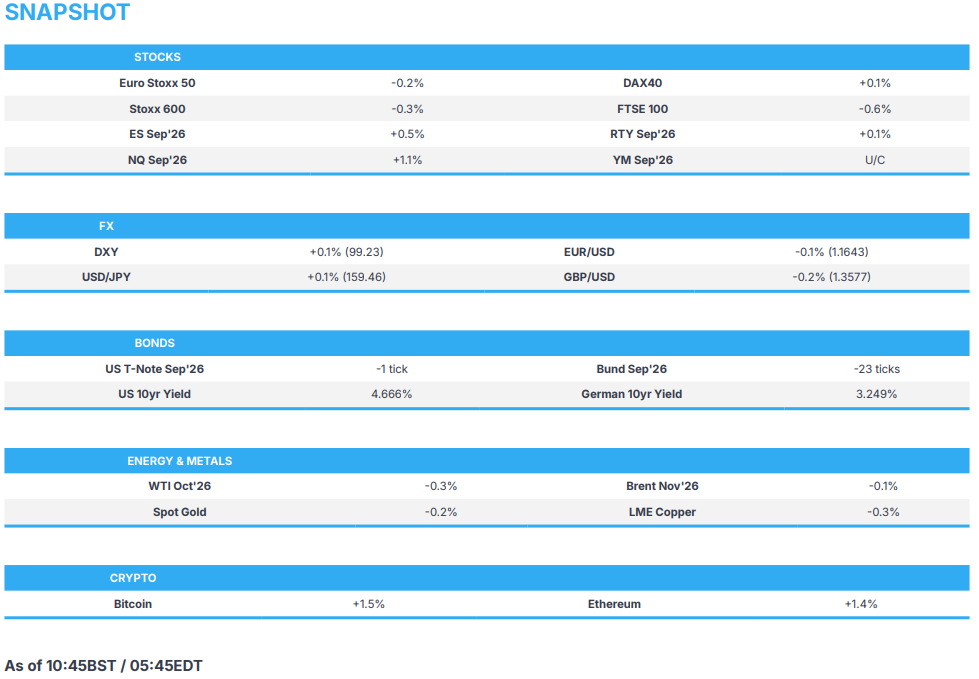
Newsquawk in 3 steps:
1. Subscribe to the free premarket movers reports
2. Listen to this report in the market open podcast (available on Apple and Spotify)
3. Trial Newsquawk’s premium real-time audio news squawk box for 7 days
EUROPEAN TRADE
EQUITIES
- European bourses begin Thursday’s trade with a negative tilt, with the majority of indices in the red, outside of the DAX 40. The primary reason for the upside in the German benchmark is the read-across following upbeat Nvidia and Salesforce earnings. The broad positiveness in chipmakers was also seen overnight, with the KOSPI closing with gains of 1.5%.
- Sectors highlight the negative bias, with Tech the only sector printing decent gains. To the downside lies Food, Beverages & Tobacco, with Chemicals and Optimised Personal Care rounding out the sector laggards. Key movers include: Pernod Ricard (-6.0%), Q2 revenue missed estimates and guided FY sales growth at the lower end of its range due to soft US market; Delivery Hero (+0.4%), raises its FY26 guidance.
- US equity futures are entirely in the green, with clear outperformance in the NQ following Nvidia (+7.2% pre-market) earnings after-hours. The tech behemoth reported Q2 metrics that beat estimates and forecasted stronger-than-expected FY28 growth, overshadowing the forecasted drop in Q3 margins. Elsewhere, Salesforce (+11.6% pre-market) also reported upbeat earnings that beat market consensus and guided metrics above forecasts.
- A Politico report which suggested that the US is mulling a new round of tariffs on chips spurred some mild downside in the NQ earlier – though this move was short-lived.
- Click for the sessions European pre-market equity newsflow
- Click for the additional news
FX
- Lacklustre price action across the FX space which has all G10 currencies essentially flat against the Buck.
- Nothing to derail the AI Capex narrative within NVIDIA earnings, in which Q2 results were strong and guidance impressed; a release which did not give too much lead to FX markets. Focus now turns to numerous Fed speakers today including the hawkish Hammack and Schmid; thereafter attention will be on Chair Warsh, who is set to speak on Friday at 15:00 BST. DXY flat/modestly firmer with a peak of 99.20 which is just above the 200DMA.
- JPY confirms the general trend seen across G10s with not many surprises from BoJ Deputy Governor Himino whose tone was consistent with pricing of September’s likely 25bps hike, noting in both of his speeches the BoJ needed to “pay more attention to upside inflation risks than before”. USD/JPY range bound within 159.30/40, calendar is light so will likely be dictated by a busy US schedule with just Tokyo CPI scheduled for Friday.
- EUR flat against the Buck with EZ catalysts light ahead of ECB minutes. Price action today will likely be at the whim of the Buck with ECB minutes likely to not surprise. EUR saw some modest weakness of around 10 pips after taking a lead from French stocks ahead of the first French presidential debate at 15:45 BST. Note that the docket features the three favourites, Marine Le Pen who does not appease markets and Jean-Luc Mélenchon, who recently touted France “set fire” to a large chunk of its public debt. EUR/USD slipped from the familiar 1.1650 to a 1.1634 base, before paring that aforementioned downside.
FIXED INCOME
- Fixed benchmarks are mixed this morning, with USTs (U/C) flat, whilst Bunds (-23 ticks) and Gilts (-21 ticks) are pressured. Earlier action was uneventful, but a report that the US is mulling a new round of tariffs on chips spurred some mild downside in fixed benchmarks.
- USTs attempt to pare back some of the pressure seen on Wednesday following the slightly hotter US PCE report, whereby the headline topped expectations. On the Fed, it may not shift too much for policymakers heading into the September meeting – but a slew of Fed speak is expected in the next few days. Today sees interviews via Schmid and Hammack, whilst Chair Warsh is set to speak on Friday. A tight-lipped approach from the Chair could see markets begin to shift attention back to credibility concerns, and therefore result in the resumption of the debasement trade. From a yield perspective, the US 10yr (4.65%) remains shy of the level which saw the Treasury announce its long-end support (4.7%) – albeit only marginally so. A resumption of debt / credibility concerns could see the 10yr circulate within a 4.75-5% range into the next bout of key US data. On the flip side, a significant breach below the 4.5% mark would likely require a dovish Warsh on Friday (unlikely), and favourable NFP (Sept 4) / CPI (Sept 11) reports.
- Bunds and Gilts are pressured this morning, The downside can, in part, be explained by the ongoing strength in Dutch TTF gas prices. Woes have also been further exacerbated by recent reports that Russian President Putin is to escalate the war in Ukraine, as he sees talks with Ukraine at a dead end.
COMMODITIES
- In geopolitics, Nour News reported that Iran has warned that vessels violating new Hormuz transit rules could face blacklisting alongside their flag. The piece added that penalties could extend to other ships using blacklisted service providers. Interestingly, a headline out of Iranian Press TV suggested that Oman reportedly stopped cooperating with the US to facilitate escorted tanker movements through southern Hormuz. Note: Trump has twice publicly threatened Oman with military action due to its bilateral negotiations with Iran regarding the Strait of Hormuz.
- Meanwhile, some focus returns to Russia-Ukraine after Bloomberg sources suggested Russia is preparing to escalate attacks on Ukraine after concluding that negotiations for a peace deal have reached a dead end.
- WTI Oct and Brent Nov initially extended losses north of USD 1/bbl, but have since clambered off lows – potentially thanks to the Nour News report above. Currently WTI and Brent are posting losses of only USD 0.10/bbl, with the latter currently sitting towards the upper end of a USD 85.32-86.99/bbl range. Elsewhere, Dutch TTF is relatively flat intraday but off highs after dipping under EUR 66/MWh this morning before finding support near EUR 65/MWh and somewhat stabilising around EUR 65.50/MWh.
- Metals are mixed with precious metals taking a breather after yesterday’s losses, although with upside capped as the DXY remains resilient to oil losses. Spot gold trades in a USD 4,593-4,643/oz range, with yesterday’s parameter. Spot silver found early support at its 100 DMA (USD 68.24/oz) and resistance near yesterday’s high (USD 69.95/oz). Base metals are mostly subdued by the resiliency of the buck, but underpinned by ongoing China stimulus hopes, 3M LME copper resides in a narrow USD 14,207.30- 14,323.13/t range at the time of writing.
- Kuwait and Qatar have reportedly increased crude shipments through the Strait of Hormuz to around 1.4mmln BPD, some 70% of pre-conflict levels, according to reports.
- Thai gold dealers said that the Ministry of Finance currently has no near-term plans to impose a gold tax.
TRADE/TARIFFS
- USTR Greer said the US did not add any new demands at the end of the negotiations with Canada and that the US wanted mutual protection on things like steel and aluminium in trade talks with Canada. Greer also stated that the US won’t just sit down and take it if Canada imposes more retaliation, as well as noting there are no open channels with Canada at the moment.
- The US White House is reportedly considering a new round of tariffs on chips, Politico reports citing sources. The report detailed that one approach under consideration would increase the number of tech products subject to levies. This means that duties would hit chips, and potentially items such as laptops, gaming consoles and servers that fill data centres.
- US Senator Moreno (R) reportedly sent a letter to USTR Greer to open a Section 301 investigation on South Korea over its treatment of Coupang, according to Semafor.
- The US is investigating Apex Logistics over AI chip smuggling to China.
- US President Trump signed a proclamation to increase lean beef imports with the quota increased by 100k tons of beef per month effective September 1st for 90 days, while the proclamation increases lean beef trimmings that are imported with no-above-quota tariff.
NOTABLE EUROPEAN DATA RECAP
- German GfK Consumer Confidence (Sep) -26.6 vs. Exp. -29.6 (Prev. -29.4).
- European M3 Money Supply (Jul YY) 3.4% vs. Exp. 3.4% (Prev. 3.3%).
CENTRAL BANKS
- ECB’s Radev said October and December meetings are both live, Econostream reported. Radev stated that waiting until second-round effects are fully visible could mean acting too late, but that there is not enough broad-based evidence to say growth risks are “clearly to the upside”. On neutral, he said that 2.5% is not a “precise dividing line” but “probably around neutral”.
- BoJ Deputy Governor Himino said he believes the BoJ should continue to raise the policy interest rate and adjust the degree of monetary accommodation in accordance with developments in economic activity, prices and financial conditions. He added that the BoJ must be mindful of upside price risk more than ever before and that they will debate policy at every meeting while taking such risks into account. Himino highlighted that if underlying inflation rises to a level above the 2% price target, it would have an adverse impact on the economy. On the currency, the BoJ wants to scrutinise the various effects of a weak Yen on the economy.
- BoK kept rates steady to 3.00%, as expected. Forecasts: Sees 2026 CPI at 2.7% (prev. 2.7%), 2027 at 2.3% (prev. 2.3%); 2026 GDP growth at 3.3% (prev. 2.6%) and 2027 at 2.9% (prev. 2.1%). BoK says rate decision was not unanimous as Board Member Hwang dissented on rate decision, while inflation is projected to remain above target level for a considerable time
- NAB expects the RBA to raise rates by 25 bps to 4.6% in September.
NOTABLE US HEADLINES
- Fed’s Cook (voter) denied wrongdoing and vowed to fight US President Trump’s effort to fire her from the Fed. Cook’s lawyer said there is no legally valid reason for ousting Governor Cook from the Federal Reserve board.
GEOPOLITICS
MIDDLE EAST
- Iran has warned that vessels violating new Hormuz transit rules could face blacklisting alongside their flag, classification society and insurer, and that penalties could extend to other ships using blacklisted service providers, Nour News reported citing an official.
- An Iranian lawmaker said Iran controls the Strait of Hormuz and vessels from the US, France, Britain or other hostile countries to enter the region.
- Pakistani Foreign Ministry spokesperson said Pakistan is not obliged to comply with unilateral sanctions imposed on Iran, while UN sanctions would constitute a different matter.
- Iraqi sources report an airstrike on the main base of separatist terrorist groups in the city of Sorran, located in the Erbil province of Iraqi Kurdistan region, according to Fars News Agency.
- Two explosions were reported in Mokha, Yemen, from missiles fired by the Houthis
RUSSIA-UKRAINE
- CIA chief’s recent surprise trip to Moscow was to warn Russia not to attack NATO, according to WSJ.
- Russian Government Spokesperson Peskov said Russia’s response to Ukrainian strikes on Russia’s economic and trade infrastructure will be harsh.
- Russia’s Kremlin said Moscow remains open to participating in negotiations for a Ukrainian settlement, Al Arabiya reported.
- Russian Foreign Ministry said the UK should abandon its hostile position towards Russia, which creates risks of transferring the conflict to a fundamentally new level, IFX reported.
- Russia attacked an industrial facility in the Ukrainian city of Kryvyi Rih, according to Ukrainian authorities.
- EU states resurrect plan to use frozen Russian assets for Ukraine, with Sweden, the Netherlands and Spain pushing to use the funds to solve Kyiv’s funding crisis, according to FT
OTHER
- North Korea denounced the US’ decision to sell weapons to South Korea and said US hostility to North Korea is clearly acknowledged, while it will respond swiftly and decisively to hostile actions, according to KCNA.
CRYPTO
- Bitcoin regains the USD 80k handle and nears Tuesday’s peak of USD 81.27k.
APAC TRADE
- APAC stocks were ultimately mixed, but with most indices in the green, after the flat performance stateside, where markets digested the firmer-than-expected headline PCE data and braced for NVIDIA earnings. The AI darling beat on top and bottom lines, although its shares were initially subdued, but were then boosted during the earnings call as the CFO flagged about a 70% revenue growth for the next fiscal year.
- ASX 200 underperformed amid another barrage of earnings releases and after recent inflation data, which prompted a call by NAB for the RBA to resume hiking rates at the next meeting in September.
- Nikkei 225 swung between gains and losses with the index fading the initial NVIDIA-spurred euphoria.
- KOSPI led the advances in the region as chipmakers cheered NVIDIA’s strong results and outlook, while investors were also unfazed by the BoK’s pre-emptive back-to-back rate hike.
- Hang Seng and Shanghai Comp were mixed amid several earnings releases and slower Industrial Profits, although the mainland was kept afloat after the PBoC conducted both 7-day and overnight reverse repos.
NOTABLE APAC DATA RECAP
- Chinese Industrial Profits (YTD) (Jul YY) 17.6% (Prev. 18.7%).
- Australian Private Capital Expenditure for 2026-27 (AUD)(Estimate 3) 200.7B (Prev. 173.4B).
- Australian Private Capital Expenditure for 2025-26 (AUD)(Estimate 7) 210.0B (Prev. 207.6B).
1c) Asian opening report
Europe set for stronger open after well received NVIDIA guidance – Newsquawk EU Market Open
Thursday, Aug 27, 2026 – 02:26 AM
- NVIDIA (NVDA) shares rose almost 5% after beating on top and bottom lines, whilst the CEO said they are seeing demand acceleration and expect revenues to grow about 70% in fiscal 2028.
- Crude futures mildly declined following recent indecisive performance amid mixed geopolitical updates.
- Oman reportedly stopped cooperating with the US to facilitate escorted tanker movements through southern Hormuz, according to Press TV.
- APAC stocks were ultimately mixed, but with most indices in the green, after the flat performance stateside, whilst US equity futures were lifted on NVDA.
- European equity futures indicate a higher cash market open with Euro Stoxx 50 futures up 0.4%.
- Looking ahead, highlights include German GfK Consumer Confidence (Sep), US Jobless Claims (Aug/22). Fed Jackson Hole Symposium (27th-29th), ECB Minutes (Jul). Supply from the US, Earnings from Marvell & Pernod Ricard.
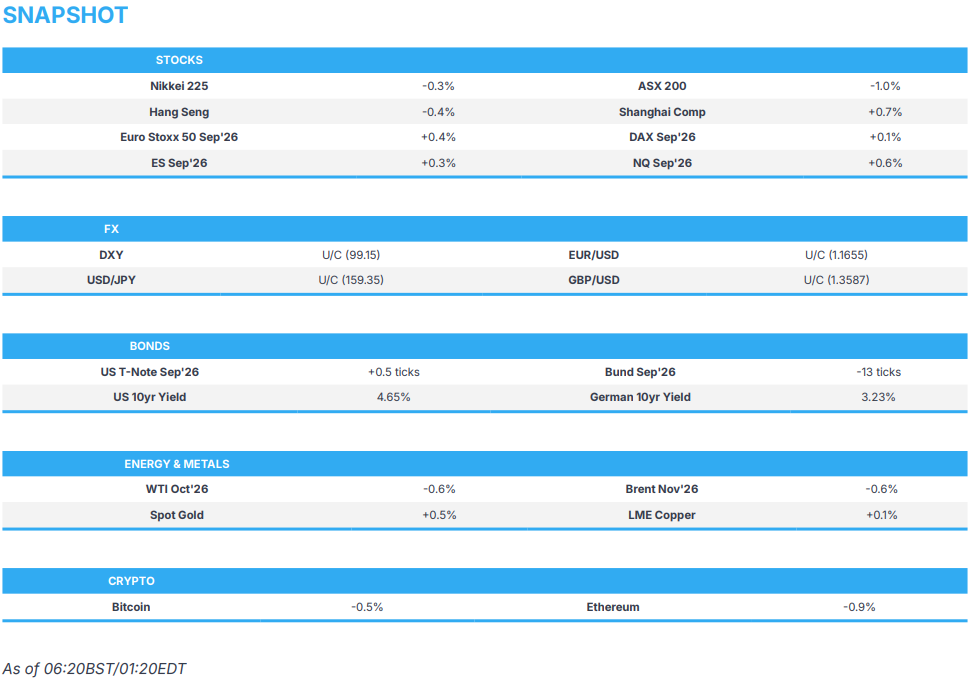
Newsquawk in 3 steps:
1. Subscribe to the free premarket movers reports
2. Listen to this report in the market open podcast (available on Apple and Spotify)
3. Trial Newsquawk’s premium real-time audio news squawk box for 7 days
LOOKING AHEAD
- Highlights include German GfK Consumer Confidence (Sep), US Jobless Claims (Aug/22). Fed Jackson Hole Symposium (27th-29th), ECB Minutes (Jul). Supply from the US, Earnings from Marvell & Pernod Ricard.
- Click for the Newsquawk Week Ahead.
IRAN CONFLICT
- US President Trump posted an AI image of himself in front of former Iranian Supreme Leader Khamenei with the caption “mission accomplished”.
- US Energy Secretary said Washington favours a diplomatic dialogue with Iran.
- US reportedly made some progress clearing sea mines in international waters, however an Iranian estimate suggested 80-150 mines it deployed remain uncleared.
- US considers reviving the “War-Spoils” court in order to claim Iranian oil, according to reports.
- Iranian Foreign Minister Araghchi urged the UN and member states to reject US economic terrorism and called the US a rogue state, according to Press TV.
- Oman reportedly stopped cooperating with the US to facilitate escorted tanker movements through southern Hormuz, according to Press TV.
- A Kuwaiti tanker was said to have been struck in the Strait of Hormuz, according to EOS Risk Group’s Kelly.
- Two explosions were reported in Mokha, Yemen, from missiles fired by the Houthis.
- Yemen’s Coast Guard seized boats carrying drone-making equipment.
- Israel has been accused of using banned phosphorus shells in Lebanon, according to IRNA.
US TRADE
EQUITIES
- US stocks traded little changed heading into NVDA earnings after the close, with sectors mixed as Industrials, Tech, and Utilities led the gains, while Healthcare and Communications underperformed. For comms, slight weakness in Alphabet was enough to offset the gains in Meta following the latter’s settlement in the US case on social media harm to children, which helps clear some of the uncertainty overhang (to pay a max of USD 16.68bln). There were several releases, with the dollar and US yields rising on the day in response to the PCE report, in which the core readings matched expectations, but the headline printed slightly above forecasts at 0.2% M/M (exp. 0.1%) and 3.7% Y/Y (exp. 3.6%). Despite the rise in US 2yr yields, money market bets on Fed policy were little changed for the September meeting, still pricing a 60% chance of a hold. Meanwhile, US GDP was unrevised at 1.5% in Q2 on the second estimate, with increases seen in consumer spending, exports, and investment; durable goods beat in July, supporting the theme of solid investment.
- SPX -0.02% at 7,676, NDX +0.05% at 29,225, DJI -0.21% at 53,469, RUT -0.14% at 3,006.
- Click here for a detailed summary.
TARIFFS/TRADE
- USTR Greer said the US did not add any new demands at the end of the negotiations with Canada and that the US wanted mutual protection on things like steel and aluminium in trade talks with Canada. Greer also stated that the US won’t just sit down and take it if Canada imposes more retaliation, as well as noted there are no open channels with Canada at the moment.
- US is investigating Apex Logistics over AI chip smuggling to China.
- China’s Foreign Minister Wang Yi met with the US Ambassador to China in Beijing and said China-US ties still encounter multiple risks and challenges, while he also stated that both sides should effectively manage differences, eliminate interference and resolve hurdles to high-level talks.
- US and South Korea are working to resolve differences related to the terms of the previously disclosed investment agreement.
NOTABLE HEADLINES
- Fed’s Cook (voter) denied any wrongdoing and vowed to fight US President Trump’s effort to fire her from the Fed, while her lawyer said there is no legally valid reason for ousting Governor Cook from the Federal Reserve Board.
- US President Trump’s administration is unveiling a new proposal aimed at turning the nation’s highway and rail lines into “multi-use” utility corridors that could hold critical infrastructure, according to Semafor.
- US President Trump signed a proclamation to increase lean beef imports with the quota increased by 100k tons of beef per month effective September 1st for 90 days, while the proclamation increases lean beef trimmings that are imported with no-above-quota tariff.
- US President Trump signs order to ban some foreign equipment in energy grids.
- US House GOP leaders are aiming to put a Senate-passed stopgap spending bill on the floor early next week, in the first days back in session after a five-week recess, according to Politico citing sources.
- NVIDIA (NVDA) Q2 2027 (USD): Adj. EPS 2.22 (exp. 2.09), Revenue 96.2bln (exp. 92.3bln). CFO said they are seeing demand acceleration and expect revenues to grow about 70% in fiscal 2028. Shares rose 4.7% after earnings.
APAC TRADE
EQUITIES
- APAC stocks were ultimately mixed, but with most indices in the green, after the flat performance stateside, where markets digested the firmer-than-expected headline PCE data and braced for NVIDIA earnings. The AI darling beat on top and bottom lines, although its shares were initially subdued, but were then boosted during the earnings call as the CFO flagged about a 70% revenue growth for the next fiscal year.
- ASX 200 underperformed amid another barrage of earnings releases and after recent inflation data, which prompted a call by NAB for the RBA to resume hiking rates at the next meeting in September.
- Nikkei 225 swung between gains and losses with the index fading the initial NVIDIA-spurred euphoria.
- KOSPI led the advances in the region as chipmakers cheered NVIDIA’s strong results and outlook, while investors were also unfazed by the BoK’s pre-emptive back-to-back rate hike.
- Hang Seng and Shanghai Comp were mixed amid several earnings releases and slower Industrial Profits, although the mainland was kept afloat after the PBoC conducted both 7-day and overnight reverse repos.
- US equity futures climbed higher with the Emini Nasdaq 100 front-running the gains following NVIDIA’s results and earnings call.
- European equity futures indicate a higher cash market open with Euro Stoxx 50 futures up 0.4% after the cash market closed with gains of 0.2% on Wednesday.
FX
- DXY paused after recently gaining on the PCE data and with little fresh macro catalysts overnight for the US, while participants await the start of the Jackson Hole Symposium where Fed Chair Warsh will deliver a keynote address on Friday.
- EUR/USD moved off the prior day’s trough, but with the upside contained amid a quiet calendar and light newsflow from the bloc.
- GBP/USD lingered near a weekly low beneath the 1.3600 handle following recent underperformance and a lack of pertinent drivers.
- USD/JPY was choppy in the absence of any tier-1 releases from Japan and after comments from BoJ Deputy Governor Himino, who reiterated the central bank’s hawkish bias, stating that he believes the BoJ should continue to raise the policy interest rate and adjust the degree of monetary accommodation in accordance with developments in economic activity, prices and financial conditions.
- Antipodeans were marginally positive amid early gains in metal prices and increased rate hike expectations, with NAB now expecting the RBA to resume hiking rates at the September meeting after the recent CPI data.
- PBoC set USD/CNY mid-point at 6.7840 vs exp. 6.7261 (prev. 6.7829).
- SNB’s Martin said he’d prefer Swiss banks to maintain robust capital buffers and take market share from foreign banks that may face difficulties during the next downturn.
FIXED INCOME
- 10yr UST futures were contained after declining yesterday as Treasury yields rose across the curve following the US PCE data, in which the headline printed firmer-than-expected, while participants await a 2yr US auction and the start of the Jackson Hole Symposium.
- Bund futures lingered around the prior day’s trough following recent supply and as German GfK data looms.
- 10yr JGB futures tracked the recent downside in global counterparts and were not helped by comments from BoJ Deputy Governor Himino, who believes the BoJ should continue to raise rates and wants to avoid a situation where delaying a rate hike leads to sharp inflation and requires rapid rate increases thereafter.
COMMODITIES
- Crude futures mildly declined following recent indecisive performance amid mixed geopolitical updates and after weekly inventory data showed headline crude inventories were little changed from the prior week.
- Indian tanker “HAANA” was planning to pass through the southern route of the Strait of Hormuz known as the Oman Corridor, but was warned to stop, according to Mehr News.
- Russia’s Norsi oil refinery reportedly halted operations following an earlier drone attack.
- Spot gold rebounded overnight to recoup post-PCE losses and returned to above USD 4,600/oz, while the early momentum coincided with advances in silver, which later stalled beneath the USD 70/oz level.
- Copper futures traded sideways alongside the somewhat mixed/mostly positive risk appetite.
CRYPTO
- Bitcoin was choppy after retreating back beneath the USD 79,000 level.
NOTABLE ASIA-PAC HEADLINES
- BoJ Deputy Governor Himino said he believes the BoJ should continue to raise the policy interest rate and adjust the degree of monetary accommodation in accordance with developments in economic activity, prices and financial conditions, while he added that they must be mindful of upside price risk more than ever before and the BoJ will debate policy at every meeting while taking such risks into account. Himino said if underlying inflation rises to a level above the 2% price target, it would have an adverse impact on the economy and that as financial conditions remain accommodative, the BoJ needs to ease off the accelerator in a timely fashion and continue raising the policy rate. Furthermore, he stated that in easing off the accelerator and raising rates, the BoJ must carefully assess conditions ahead, taking forecasts and other information into account, and it is desirable to avoid a situation where delaying a rate hike leads to sharp inflation and requires rapid rate increases thereafter.
- Bank of Korea hiked its base rate by 25bps to 3.00%, as expected, while the rate decision was not unanimous as Board Member Hwang dissented on the rate decision. BoK said inflation is projected to remain above the target level for a considerable time, and it will decide the timing and pace of further increases in the base rate. BoK Governor Shin said inflationary pressure looks like it is here to stay, and the back-to-back rate hike was necessary to preemptively respond, while they needed to act by raising interest rates before inflationary pressures grow further. In terms of board members’ forecasts, 5 of 21 policy rate projections by board members for the next six months are at 3.00%, 10 of 21 policy rate projections are at 3.25%, and 6 of 21 policy rate projections are at 3.50%.
DATA RECAP
- Australian Private Capital Expenditure (Q2 QQ) -3.6% vs. Exp. 0% (Prev. 6.5%)
- Chinese Industrial Profits YTD (Jul YY) 17.6% (Prev. 18.7%)
GEOPOLITICS
MIDDLE EAST
- Israel is mulling expelling British and potentially other European officials from the US-led co-ordination centre for postwar Gaza following criticism of Israeli PM Netanyahu’s policies on Palestinian territories, according to FT.
RUSSIA-UKRAINE
- Russian President Putin is reportedly planning a Ukraine escalation and sees talks as fruitless.
- Explosions were reported in Ukraine’s capital of Kyiv, while it was also reported that Russia attacked an industrial facility in the Ukrainian city of Kryvyi Rih.
- CIA chief Ratcliffe’s recent trip to Moscow was to warn Russia not to attack NATO, according to WSJ.
- EU member states resurrect a plan to use frozen Russian assets for Ukraine, with Sweden, the Netherlands and Spain pushing to use the funds to solve Kyiv’s funding crisis, according to FT.
OTHER
EU/UK
NOTABLE HEADLINES
- UK government is to give the BoE a new official objective of boosting innovation in digital currencies and payments, according to FT.
- UK households are unlikely to get further energy bills support before the October price cap, but more targeted measures could be examined if there is a further shock in January, according to The Guardian.
- Germany is in talks to invest in Britain’s Trident nuclear deterrent program, according to The Telegraph.
- France replaces Italy as European bond investors’ biggest concern, according to FT.
2.NORTH AND SOUTH KOREA/
SOUTH KOREA//NORTH KOREA
SOUTH KOREA
JAPAN
3. CHINA/
CHINA/NEPAL/TIBET
4. EUROPEAN AND SCANDINAVIAN COMMENTARIES PLUS NATO
UK
White Prisoners In UK Being Forced To Convert By Muslim Gangs: Report
Thursday, Aug 27, 2026 – 02:00 AM
Authored by Steve Watson via Modernity News,
Britain’s prisons are becoming recruitment grounds for Islamic gangs, with white inmates converting under threat of violence while the system frees terrorists early, jails protesters longer than child sex attackers, and racks up hundreds of millions housing foreign offenders.

New Ministry of Justice figures have exposed a stark reality inside England and Wales’ jails. One in five Muslims behind bars is white – nearly four times the 5.8 per cent rate in the general population.
The number of white Muslim prisoners has climbed from 2,767 in 2022 to 3,218 by the end of June 2025, a 16 per cent rise. Overall Muslim inmates rose 14 per cent in the same period, from 14,037 to 16,051, now making up roughly 18 per cent of the prison population despite Muslims comprising just 6.5 per cent of the country.
Shadow Justice Secretary Nick Timothy laid out the numbers and the implications. “The percentage of Muslims who are white in our prisons is so vastly higher than in the general population it raises serious questions,” he said.
“We know that experts have warned repeatedly about forced conversions taking place behind bars, driven by Islamic gangs. We need to be honest that something is not right here – Labour must urgently investigate and stamp out forced conversions in prison,” he further urged.
Government advisers have documented the pattern for years. Jonathan Hall KC, the independent reviewer of terrorism legislation, described Islamist terrorists operating as “self-styled emirs” who controlled prisoners through “leadership and recruitment.”
This included targeting “vulnerable or lonely prisoners, using guidance, sharing of food or material gifts” and “conversion backed by implicit or actual violence.”
The London Bridge attacker Usman Khan, while inside, encouraged prisoners to take Muslim names and wear Muslim dress while trying to convert others.
Ian Acheson, who reviewed Islamist extremism in prisons, said conversions often occur “as a pragmatic response to who controls power and space in our prisons.” In high-security jails especially, safety is at a premium and large numbers of violent young men seek belonging. “So Islam in this case has gang characteristics.”
A 2023 government-commissioned review by Colin Bloom found gangs ordering new arrivals to become Muslim or face consequences. “Failure to identify as a Muslim meant that at best the new prisoner would be denied ‘protection’ from the dominant Muslim gang on that wing, or at worst the new prisoner would be subjected to violence and intimidation from that same gang.”
A lawyer who regularly visits top-security prisons reported the process starts almost immediately. “This is something which will happen hours after arriving on a wing. Immediately they arrive in prison they slot into the gang hierarchy. In some cases there are entire floors dominated by Muslim gangs.”
Some conversions are opportunistic – “convenience Muslims” seeking extra time for prayers or better halal food. Others are coerced. Qurans left on beds carry a clear message.
The Ministry of Justice insists it does not tolerate intimidation or faith-based coercion and claims prisons act swiftly. Yet the numbers keep rising, and there are now 140 Muslim chaplains compared with 87 for the Church of England.
This is the same prison system that continues to house thousands of foreign national offenders at enormous cost to the British taxpayer.
Figures show 10,487 foreign national offenders costing £629 million a year – money that could fund 16,500 police officers or 15,000 NHS nurses.
Albania tops the list, followed by Ireland and Poland. Deportations remain slow, tangled in missing documents, uncooperative origin countries, and European Convention on Human Rights claims.
Taxpayers Foot STAGGERING £629 MILLION Bill For Foreign Nationals In UK Prisons
Reform UK prisons adviser slams bureaucratic delays, ECHR claims and refusal by origin countries to take back criminals
Reform UK’s prisons adviser Vanessa Frake called the bill “staggering.” She noted the drawn-out process: discarded passports, slow diplomatic correspondence, refusals by origin countries, and Article 8 family-life claims. Even a deal to return 200 Albanian prisoners came with conditions and lower daily payments to Albania than the UK pays to keep them.
While foreign offenders and Islamist networks embed inside the system, the authorities have shown a different urgency when it comes to early release.
Zahid Iqbal, convicted in 2013 for plotting to bomb an Army base using an Al-Qaeda manual, was approved for release three years early despite previous non-compliance and warnings from prison and community managers.
Colin Sutton, Reform UK’s crime adviser, called the decision “baffling.” “This wasn’t a guy in his bedroom cooking something up. This was somebody who arranged training. He had links with al-Qaeda. He was a proper terrorist.”

UK RELEASES Dangerous Bomb Plot Terrorist From Prison EARLY
Britain’s two-tier justice system strikes again
Labour’s broader early-release schemes have accelerated the emptying of cells to manage overcrowding. Thousands of offenders, including those convicted of violence, have been freed earlier than previous tariffs allowed. Even after partial pauses and exclusions for certain sex offences, the direction of travel remains clear: capacity management takes priority over consistent public protection.
Contrast that with the treatment of British citizens who protest the consequences of mass migration or speak out online. Lucy Connolly, already imprisoned for a single X post after the Southport attacks, faced the threat of recall to prison for reposting a satirical comment about Donald Trump and Keir Starmer. Probation officials treated the joke as “inciting violence” after an anonymous complaint.

Government Threatens To RETURN Lucy Connolly To PRISON For Sharing Joke Post On X
She shared a quip about Trump hauling off the PM Venezuela-style
In Essex, protests outside an asylum hotel housing Ethiopian migrant Hadush Kebatu erupted after he sexually assaulted a 14-year-old girl and a woman. Kebatu received 12 months. British protesters involved in the subsequent disorder received far longer terms.
Charlie Land got 32 months. Jonathan Glover got 30 months. Lee Gower, a local father and youth football coach, received two years and nine months. Other locals drew sentences of 22 to 33 months. Combined custodial terms for several of them exceeded 17 years – longer than the perpetrator who triggered the unrest.

British Protesters JAILED For Longer Than Migrant Who Sexually Assaulted Girl

Angry Locals JAILED For Longer Than The Migrant Who Sexually Assaulted A 14-Year-Old Girl
UK’s two-tier justice system crushes locals while shielding migrant criminals
Two British men get 30 and 32 months while Ethiopian sex offender who sparked the protests served just 12
Judges stressed that violence against police is unacceptable. Yet the sentencing disparity is unmistakable. Locals reacting to a sexual assault on a child by a small-boat arrival spend more time inside than the man who committed the assault.
Meanwhile white prisoners report pressure to convert for survival, foreign national offenders cost hundreds of millions, and convicted terrorists walk early under capacity rules.
Prisons reflect the wider failures of open borders and selective enforcement. Gangs exploit the vacuum. Vulnerable inmates adapt or suffer. Taxpayers foot the bill.
Ordinary Britons who notice and object face the sharp end of the law. The figures on white Muslim prisoners are not a statistical curiosity. They are the measurable result of a system that has lost control of its own institutions.
END
GERMANY
“Citizens Want Political Turnaround”: AfD Now Polls At 43% Across Eastern Germany
Thursday, Aug 27, 2026 – 02:45 AM
Building on Nomura analyst Andrzej Szczepaniak’s note from earlier this week, which forecasts that right-wing parties are positioned to make electoral gains across Germany, France, Spain, Switzerland, and the UK over the next 18 months, new polling data from Germany further suggest that Alternative for Germany (AfD) is performing exceptionally well as citizens demand political change after years of failed progressive experiments that encouraged a Third World migrant invasion and nation-killing deindustrialization trends.

AfD co-leader Alice Weidel cited new polling data on X from a Forsa survey showing that, if a federal election were held now, eastern German voters would choose:
- AfD: 43%
- The Left: 16%
- CDU/CSU: 13%
- Greens: 9%
- SPD: 9%
- FDP: 3%
- Other parties: 7%
Weidel said, “According to a recent Forsa survey, the AfD is at 43% across the entire East, while the CDU is down to just 13%. The citizens want the political turnaround!”
The key takeaway from the new survey is that the AfD is polling at more than three times the level of the center-right CDU/CSU and exceeds the combined support of the CDU/CSU, SPD, and Greens.
German weekly newspaper Junge Freiheit commented on the new survey, saying, “The numbers are particularly interesting ahead of the upcoming state elections in Saxony-Anhalt on September 6th and in Mecklenburg-Western Pomerania two weeks later.”
The outlet continued, “The assessment of Chancellor Friedrich Merz’s (CDU) performance remains abysmal across Germany. As in the previous week, only 13 percent of those surveyed expressed satisfaction, while 85 percent were dissatisfied.”
Elon Musk has previously stated, “AfD is the only hope for Germany.”
One reason German citizens are particularly frustrated is that Europe’s economic engine is collapsing, with Volkswagen Group labor representatives warning earlier this week that as many as 140,000 jobs could be cut at the struggling automaker.
Circling back to Szczepaniak, the Nomura analyst wrote, “Five years ago, financial markets would not have seemed so at ease with such a prospect. But then again, these populist right-wing political parties were previously not so fiscally prudent as they are perceived to be today.”
He added, “Now, if anything, financial markets are much more concerned about populist left-wing parties being elected due to their desire to increase spending, often paid for through higher borrowing or higher taxes, which are likely to shut the engine off of already stuttering economies.”
EU Election Roadmap

Read Nomura’s assessment of Europe’s changing political landscape here.
END
PORTUGAL
finally common sense prevails!!
Full-Face Veils Banned In Portugal After President Signs ‘Burqa Law’
Thursday, Aug 27, 2026 – 03:30 AM
Portuguese President António José Seguro has officially signed into law a bill banning face-concealing attire in public spaces, with the move seen targeting the full-face Islamic veils like the burqa and niqab.

Addressing the national debate, President Seguro framed the decision around human interaction, stating:
“The face should be considered a central element of human identity and communication.”
However, the former Socialist Party leader acknowledged the controversial nature of the ban, recognizing it as a matter of significant cultural and social sensitivity.
The law was largely backed by the country’s right-wing politicians and labeled the “burqa law” by Portuguese media.
It passed parliament in July with the votes of right-wing parties, with the left firmly in opposition.
The new legal framework strictly limits garments designed to hide one’s identity in public spaces.
It also penalizes forcing individuals to cover their faces based on gender, religion, or age.
Violators face financial penalties ranging from €150 to €3,000.
There are, however, some exceptions.
Wearing items that cover the face, such as medical masks, professional/artistic gear, and extreme weather wear, are all examples of exceptions under the law.
5.RUSSIAN AND MIDDLE EASTERN AFFAIRS
IRAN/VS ISRAEL/USA/WEDNESDAY NIGHT
Kuwait, Qatar Ramp Up Hormuz Oil Flows As Oman-Iran Talks Ease Supply Fears
Thursday, Aug 27, 2026 – 07:20 AM
Brent crude futures fell to an intraday low of $86.22 a barrel early Thursday before recovering above $88 by 0630 ET. The benchmark is down 6.3% this week as traders unwind part of the war-risk premium amid growing optimism that renewed diplomatic efforts involving Iran, Oman and Qatar could reduce the threat of drone attacks on tankers in the critical waterway.

Bloomberg reported earlier that Kuwait and Qatar are restoring crude exports through the highly contested maritime chokepoint. Sources familiar with energy flows in the Gulf region say that both producers are shipping about 70% of the combined 2 million barrels a day they exported before the Iran war.
Total oil shipments via tankers have climbed to between 7 million and 8 million barrels a day, up from roughly 4 million barrels a day in mid-July and equal to about 75% of prewar levels, according to the outlet.
London-based energy and freight analytics firm Vortexa told clients in a separate report that the estimated seven-day average for oil transiting the Strait of Hormuz has approached 10 million barrels a day.
The recovery in the critical waterway helps explain why Brent crude retreated to $86 earlier this morning after surging above $120 in late April. The Trump administration and Tehran remain deadlocked over finding another resolution, but Gulf exporters are increasingly finding ways around the disruption.
The outlet noted that the United Arab Emirates was the first to transit crude through the strait before transferring it to other vessels in the Gulf of Oman.
Maritime research firm TankerTrackers was the first to report the increase in ship-to-ship transfers on Tuesday.
“An Iran-Oman framework for a ‘temporary joint maritime corridor’ is pulling oil lower. It remains difficult to envision how the US would sign off on this given the concurrent ratcheting up of economic pressure,” UBS analyst Justinus Steinhorst wrote in a note.
Dennis Kissler, senior vice president for trading at BOK Financial Securities, said on Wednesday, “It seems crude is now beginning to price in a sooner-rather-than-later peace deal.”
Beyond Iran and Oman’s diplomatic push to reopen the strait, Reuters reported that both countries are working to clear all naval mines from the waterway. President Trump said earlier this week that all mines had been removed.
However, with disruptions to Middle Eastern refineries and Ukrainian attacks on Russian refineries, the energy crisis has morphed into a crude-products crisis, with diesel crack spreads in the US still trading above $90 a barrel. Last week, the spread hit an unprecedented $100-a-barrel level as global diesel supplies dwindled.
IRAN/VS ISRAEL/USA
ISRAEL TBN
ISRAEL
Israel Developing Offensive Space Capabilities
Wednesday, Aug 26, 2026 – 05:40 PM
Authored by Ioannis Vlahos via Antiwar.com,
Israel is currently prepared to begin development of offensive space capabilities, including systems designed to defend Israeli satellites from hostile spacecraft, and weapons (including lasers) capable of striking targets from space.

It is part of the Defense Ministry’s multiyear budget plan for the space sector, which will include upgrading and expanding IDF (Israel Defense Forces) intelligence and communications capabilities. The plan will also dedicate a budget to support offensive space operations, which will focus on weapons designed to protect Israeli satellites as well as weapons designed to strike targets on Earth.
Defense Minister Israel Katz spoke earlier this summer about Israel’s commitment to becoming the world leader in space-attack capabilities, a realm of warfare that has experienced a surge in Israeli military interest given its extensive use for intelligence gathering in Iran.
“One of the central goals that the prime minister [Benjamin Netanyahu] and I set is that we are recruiting the best minds,” he said. “As of today, no country has the ability to mount attacks in space. We must be the leading country in the world with this capability.”
“If we achieve this, it will ensure the advantage of deterrence, of the ability to attack, destroy, and all of the other matters versus our enemies with large resources.”
Global space warfare development has been on the rise in recent years, and some speculate that Israel’s recent activity is an effort to catch up with China and Russia, who have been testing their own offensive space capabilities. US President Donald Trump has also expressed his desire for America to do the same, by signing Executive Order 14369, “Ensuring American Space Superiority.”
However, experts warn that Israel and others’ offensive space weapon programs have increased proliferation concerns. Satellite miniaturization, falling launch costs, and the commercialization of the space industry have also allowed more countries to create their own space programs, and not all of them are peaceful. Furthermore, space weaponry not only threatens satellites and other non-military technologies operating in space, but the growing prevalence of and reliance on the latter will make cyberattacks all the more dangerous.
END
IRAN VS THE WEST
Hormuz And The Law Of Diminishing Returns: When Leverage Burns
Wednesday, Aug 26, 2026 – 09:45 PM
Authored by Tamuz Itai via The Epoch Times,
For months, the assumption that the Strait of Hormuz was Tehran’s ultimate card dominated commentary on the war.

As a narrow waterway through which roughly one-fifth of the world’s oil and a substantial share of liquefied natural gas had historically passed, it appeared to be a chokepoint Iran could close or severely disrupt at will. It did not need to destroy every tanker. Hitting a small percentage with drones, cruise missiles, speedboats, or mines would spike insurance rates, deter crews and companies, and effectively shut the strait without continuous physical control.
This idea was not new for 2026. It had long been a feature of the Iranian strategic posture, treated as both a military instrument and a political myth-proof that even under pressure Tehran retained a decisive lever over the global energy system. Parts of the Western media and independent analysts amplified the same narrative.
Relying on incomplete open-source shipping data, especially once vessels began sailing dark, many concluded that the United States had been caught unprepared and lacked a realistic path to reopen the waterway. Hormuz, they argued, was effectively closed or closable at Iran’s discretion. That framing was powerful, but also incomplete.
How the Threat Has Been Eroded
The assumption that Iran’s detection and targeting system could not be dismantled without dramatic escalation proved wrong. Under the U.S. Central Command, also known as CENTCOM, and with significant involvement from the Fifth Fleet and Air Force components, the United States ran a sustained effort to degrade the sensors Iran needed to find and hit ships.
Iran relied on mobile truck-mounted radars, drones, cruise missiles, Islamic Revolutionary Guard Corps (IRGC) speedboats, and naval mines. Inside the narrow strait, ships move in relatively predictable lanes. Iran combined active radars with passive electro-optical and infrared cameras on elevated terrain and islands such as Qeshm, Larak, and Abu Musa.
Mobile radars would radiate briefly to locate shipping, then shut down and move before anti-radiation missiles could arrive. Once a ship’s approximate position was known, strike systems could be sent to search.
The vulnerability was that every radar emission could be detected. American aircraft responded systematically with anti-radiation missiles while visual and intelligence efforts located the passive sensors. This was the core of what some involved called “draining the swamp.”
Iran had redundancy, but the number of sensors was finite. Hundreds of precision strikes gradually reduced Iran’s ability to see traffic in the strait. As the detection layer thinned, the effectiveness of the strike systems declined with it.
Parallel efforts neutralized mines with unmanned vessels and declared the southern lane near Oman largely clear. Convoys moved under escort, often at night with the automated information system (AIS) off. Arleigh Burke-class destroyers with Aegis radars and standard missile (SM)-family interceptors formed the backbone; drones and Apache helicopters armed with laser-guided rockets provided additional cover. American ships also engaged IRGC speedboats that closed on the convoys.
On the commercial side, the United States addressed insurance barriers. In early March, President Donald Trump directed the U.S. International Development Finance Corporation (DFC) to provide political risk insurance and guarantees for maritime trade.
The DFC, working with the Treasury and CENTCOM, established a revolving reinsurance facility of roughly $20 billion-later expanded with private partners including Chubb-focused on hull, machinery, and cargo cover. Early uptake was limited. As Iranian success rates fell, more vessels joined.
Results have been significant. CENTCOM has reported assisting well over a thousand commercial vessels and moving hundreds of millions of barrels since the spring. Independent trackers often showed lower numbers because much of the traffic sailed dark. Pre-war throughput was 20 million to 21 million barrels per day.
Flows through Hormuz remain below that, but combined with the Abu Dhabi-Fujairah pipeline and Saudi Arabia’s pipeline to Yanbu in the Red Sea, volumes recovered enough to keep oil prices in the $85 to $95 range-elevated, but far from the predicted catastrophe.
Not Seeing the True Picture
Public data lagged for both technical and psychological reasons. Ships that went dark during transit normally turned their AIS trackers back on afterward, so theoretically they could have been tracked and counted, yet matching was imperfect amid overlapping night movements, incomplete satellite reception, intermittent signals, and ship-to-ship transfers.
Commercial trackers attempt corrections using imagery and other data, but confidence thresholds still produce undercounts relative to what escorting forces could see.
There was also a narrative reason. The story of Iranian success and American failure fit expectations many already held. Contradictory evidence produced cognitive dissonance. The common response was to protect the original frame-by applying greater skepticism to inconvenient details and treating quieter progress as temporary.
In a contested information environment, narratives that confirm prior expectations often outlast those that require revision.
The General Principle
Hormuz illustrates a broader pattern. Leverage is often strongest while latent. The threat shapes behavior; the target hedges or hopes the card is never played. Once used at scale, incentives change. Real costs appear, and the value of neutralizing the threat rises sharply.
Adaptation follows: sensors are hunted, escorts are organized, alternative routes are accelerated, commercial workarounds are found. Over time, the original leverage delivers diminishing returns. The coercer frequently ends up weaker than before.
The pattern is not unique. In 1973, Arab oil producers cut exports and raised prices. The short-term shock was severe; the longer-term response included efficiency gains, strategic reserves, non-OPEC production, and the shale revolution.
Russia’s gas cut-offs against Europe from 2021 to 2022 produced a similar arc: LNG expansion, storage, demand reduction, and alternative suppliers collapsed Moscow’s share of the European market, forcing it to sell more of its supply with heavy discounts to China and others.
China’s 2010 rare-earth restrictions against Japan spurred alternative mining, recycling, and substitution. In recent years, the United States has also accelerated the shift with CHIPS Act funding, Department of Defense equity stakes and loans, price-floor and offtake arrangements, and Project Vault, which includes equity stakes in key producers and a strategic minerals reserve, while expanding cooperation with partners such as Australia.
Remaining Levers and Their Limits
If the Hormuz card is already delivering diminishing returns, what options remain for Iran?
The most consequential underused lever is a more systematic campaign against Gulf energy production itself-fields, processing plants, refineries, and downstream industries. Iran has already struck these targets at a meaningful scale. What has not been fully attempted is a sustained multi-country effort at lasting destruction of capacity.
Other potential levers include intensified proxies, cyber operations, pressure on Bab el-Mandeb, residual nuclear signaling, and heavier strikes on U.S. bases or critical infrastructure. Each retains some potential.
Yet the same logic applies. Further large-scale use would accelerate the responses that reduce effectiveness. At the same time, the regime faces continuous economic pressure from the U.S. naval blockade, oil-export enforcement, and broader “Operation Economic Outcast” sanctions. Escalation under that siege significantly raises costs and shortens the runway.
Another option might be a distraction elsewhere, perhaps initiated by another country in the emerging axis of Chinese Communist Party-dependent countries, such as Russia, North Korea, or China itself.
The battle for the strait is not the entire war. It has, however, illustrated a recurring feature of strategy: geographic and resource levers look most formidable while they remain latent. Once put into continuous action, they often set in motion the forces that ultimately reduce their power.
END
IRAN’
Iran Says Persian-Language Media Outlets ‘Funded By CIA’ Are Military Targets
Wednesday, Aug 26, 2026 – 07:40 PM
One key tool Washington has long utilized for influence operations and covert regime change plotting abroad has long been the establishment of foreign media for political messaging.
The idea is that a foreign language satellite news channel gets presented as ‘independent’ while in reality it beams propaganda onto a unsuspecting population within a so-called ‘rogue’ state being targeted by the US.
For example, WikiLeaks previously revealed that US intelligence invested heavily in such projects to bolster anti-Assad forces and sentiment in the context of last decade’s proxy war in Syria.
Currently, Iran says it is fully aware of several Persian-language media outlets which are subversive, given they have the backing of the US, UK, or Israeli governments, or others like Saudi Arabia.

The AFP in a Wednesday report has said Iranian state media has newly called out the following as hostile propaganda media fronts:
- BBC Persian
- Iran International
- Radio Farda
An Iranian military spokesman has said these have been added to the armed forces’ “military target bank” – putting the outlets on notice that their offices and infrastructure could come under attack.
“These hostile media outlets are the soldiers of Zionism and America and are included in our military target bank,” military spokesman Abolfazl Shekarchi announced.
He charged that they are “directly connected to Mossad, CIA and enemy intelligence organizations.” He emphasized: “The Iranian Armed Forces do not view these news outlets as media.”
And interestingly, per AFP: “Iran has designated Iran International as a terrorist organization since 2022 and has warned that cooperation with the channel is punishable under Iranian law.”
Earlier in the Iran war, we featured analysis which pointed out that Iran International calls itself the “most popular Persian speaking foreign based news channel in Iran”.It employs 700 people and broadcasts into Iran from London via satellite, radio and social media outlets.
Iran International has been accused by critics of promoting “regime change” in Iran and advancing the position of the former shah’s son, Reza Pahlavi, for a return to power. The outlet has long denied links to Israel or Saudi Arabia. The outlet reported heavily on protests that struck Iran at the beginning of this year, sparked by a cost-of-living crisis brought on, in part, by US sanctions.
In January 2025, the news site reported that more than 36,500 people were killed in a crackdown on protests. Those numbers were significantly higher than those estimated by the US and other western-based human rights groups.
US President Donald Trump cited casualty numbers similar to those reported by Iran International days before launching a war on Iran on February 28, but did not disclose where he had gotten the death toll number.
END
RUSSIA VS UKRAINE
Putin To Escalate Ukraine War In Wake Of CIA Chief’s Visit, Report Speculates
Wednesday, Aug 26, 2026 – 03:05 PM
Update1505ET: In the wake of yesterday’s unusual visit by the Director of the CIA to Moscow for mystery 2-hour talks, Bloomberg says that President Putin is preparing for a major escalate against Ukraine:
Russia is preparing to escalate attacks on Ukraine after concluding that negotiations for a peace deal have reached a dead end, according to three people close to the Kremlin.
For now, Russia is weighing an intensification of powerful conventional ballistic missile attacks on Kyiv, including the center of the capital, and infrastructure targets in other Ukrainian cities, the people said, asking not to be identified because the matter is sensitive.
While the original Bloomberg TV reporting appears just speculation based on what already seemed the current trend on the ground, oil had climbed back on the news:

* * *
An IRGC spokesman has announced Wednesday that Iran and Oman have reached agreements on their share of the Strait of Hormuz and its revenues, according toTasnim news agency. So essentially the “fee” scheme has been set. There’s talk of reopening the strait on an “interim” basis, Bloomberg says.
“We entered into negotiations with Oman about a month ago and have reached results that have been accepted by both sides,” the official said. “Agreements have been reached on the share of each country in the waters of the strait and the share of Iran and Oman in its revenues,” the statement continued, while also alleging that negotiations were previously delayed only due to the US obstructing negotiations.

Tehran is still insisting on the United States lifting its naval blockade of the country’s ports. However, it seems that for now at least Tehran is open to some level of negotiations, or at least seems content to see where this current period of rare calm leads.
This is evident in the latest words of Iranian Parliament Speaker Mohammad Bagher Ghalibaf, who argued Wednesday that any negotiations with the US don’t equate to retreat from Iran’s demands.
“Negotiation, in my view, has neither intrinsic value nor is it a taboo; it is neither absolutely good nor absolutely evil,” he wrote in a letter responding to more hardline critics, IRNA reports.
He insisted this does not mean abandoning resistance to US-Israeli aggression. “If necessary, dialogue, too, according to this logic, is the same arena of struggle and resistance; neither a replacement for it nor a sign of retreat from it,” he said.
Ghaliban further suggested this is being done by the Islamic Republic from position of strength while holding on to the nation’s “dignity, wisdom and interests.”
Meanwhile, it seems Washington is also in no mood to rush back into military action, following the Monday announcement by Scott Bessent of the Economic D-Day action against Iran, which is to including secondary sanctions on any country found not complying.
On Wednesday, Secretary of State Marco Rubio told several foreign officials in recent days that “for the time being” the US is not planning to initiate any new strikes against Iran, but instead the focus is on other means of pressure, especially the sanctions initiative, Axios reports. According to more:
- The U.S. official said that while Rubio made clear that the U.S. isn’t planning a return to major combat operations, he didn’t rule out strikes if Iran attacks first.
- Another U.S. official said the clearing of mines from the Strait of Hormuz by the U.S. Navy is a watershed moment in the war, largely neutralizing one of Iran’s main sources of leverage.
Also on Wednesday, Iranian Foreign Minister Abbas Araghchi and his Omani counterpart Badr Albusaidi confirmed their further work on the “interim framework” aimed at resuming shipping through the Strait of Hormuz, according to a joint statement.
State television has indicated Iran and Oman agreed that the new transit corridor would enter through Iranian territorial waters, with part of the exit route also passing through them. The corridor will span roughly seven miles.
On this and other headlines, oil prices continue to fall…
- Oil extends declines as Iran, Oman continue finalizing talks to reopen Hormuz
- Satellite image shows surge in Iraq’s Persian Gulf oil loadings

The day prior, on Tuesday, President Trump hinted that military options are still on the table. While announcing the new claim that all mines had been detonated or removed from international waters of the Strait of Hormuz, he said the US Space Force was watching “every square inch” of the Strait, and that “There is a Zero Tolerance policy on mine placement in full force and effect.” But Iran is still asserting that the strait remains “closed”.
END
RUSSIA AND THE UK/
STARTLING!
Moscow Warns It Could Target British Military Facilities In Unprecedented Statement
Thursday, Aug 27, 2026 – 12:00 PM
From the very start of the Ukraine war, the United Kingdom has consistently been among Kiev’s most open and ardent military supporters, time and again transferring heavy weaponry, including cutting edge long-range missiles like the Storm Shadow.
At the start of this week, Britain announced it plans to provide Ukraine with classified technology to allow for the country’s own manufacturing of the British/French-designed SCALP air-launched cruise missile (which in the UK is known as the Storm Shadow). The allies expect to set up a production line in Ukraine as soon as year’s end.

Already, Ukraine has used its domestic-made and designed Neptune cruise missile to strike oil refineries and military sites deep inside Russian territory. A domestic-made SCALP would present the likelihood of Ukraine then using this Western-designed missile to directly attack Russia, which only increases the chances of an eventual Moscow-NATO clash. Ukrainian forces already appeared to have used the missile on Donetsk and other locations closer to front lines in the Donbass.
On Thursday the Kremlin has issued one of its strongest warnings and threats aimed at London to date, accusing the UK of “fully taking part in the war on Kiev’s side” – and thus thwarting any chance of peace talks while adding fuel to the fire.
Moscow is now saying that the UK’s own military facilities could become fair game for direct attacks.
Kremlin spokesperson Maria Zakharova said in a Thursday press briefing, “We have repeatedly warned that the response to Ukrainian strikes using British weapons against Russian territory could be directed against any British military facilities and equipment in Ukraine and beyond.”
Zakharova urged “all residents of the United Kingdom to think about the inevitable, catastrophic consequences of the hostile steps taken by their own authorities.” She also laid out:
“We propose that the British leadership once again carefully analyze the situation and immediately, in the most resolute and unequivocal manner, abandon the hostile, aggressive line, which can only… create the risk of the conflict escalating to an entirely new level.”
Ironically this comes just on the heels of a rare visit of the CIA Director to Moscow. US officials claim the Tuesday meeting between John Ratcliffe and top Kremlin intelligence officials was to convey a warning to President Putin to not attack any NATO member. However, many analysts are skeptical that this was the official reason.
Zakharova further said on Thursday that Britain and France were “playing with fire” after years of escalating their involvement in Ukraine.
But London appears unmoved, with a UK Ministry of Defence official responding on Thursday as follows: “Britain stands shoulder to shoulder with Ukraine and we are committed to providing the equipment Ukraine needs to defend itself against Putin’s illegal invasion. Russia should be in no doubt about the resolve of this government to stand against Russian aggression, in Ukraine and against the UK and our allies,” the official stated.
END
6/.GLOBAL ISSUES, COVID ISSUES, VACCINE INJURIES/HEALTH ISSUES
PEER REVIEWED
CANCER HAS BEEN CURED
Ivermectin & Fenbendazole cure cancer.
Pass it on.
BREAKING NEWS: First-in-the-World Ivermectin, Mebendazole and Fenbendazole Protocol in Cancer has been peer-reviewed and published on Sep.19, 2024!
The future of Cancer Treatment starts NOW.
My thanks to lead authors Ilyes Baghli and Pierrick Martinez for their incredible inspired work, FLCCC’s Dr.Paul Marik for his extensive work on repurposed drugs and every co-author who worked hard to bring this paper to life.
I hope that this peer-reviewed paper lays the groundwork for a brand new future for Cancer Treatment.
Many of you know that I have been helping thousands of Cancer patients with high dose Ivermectin, Mebendazole, and Fenbendazol
o me |
GLOBAL ISSUES
Global Youth Unemployment And Inactivity Inch Up Again
Thursday, Aug 27, 2026 – 05:45 AM
For two years in a row, global unemployment and inactivity among youths aged 15 to 24 has inched up again across world regions.
As seen in data by the International Labor Organization, the coronavirus pandemic caused these rates to go up in 2020, but the situation improved again gradually, in 2022 and 2023 falling below pre-pandemic levels.
But, as Statista’s Katharina Buchholz reports, since then, rates have been on a slow upswing once more, reaching 12.4 percent of youths in the labor force who are unemployed and 20 percent of youths overall who are either unemployed or not engaging in any activity like education, training, employment or looking for work.

You will find more infographics at Statista
According to the recently released ILO report Global Employment Trends for Youth 2026, progress made in the area of youth employment post-Covid has come to an “abrupt halt” as uncertainty and fragility have taken over global economies, GDP growth has remained subdued and inflation has been high. The report also points out that there has not only been a deterioration in the quantity, but also the quality of jobs for youths globally, meaning that many are underemployed or work jobs that don’t match their qualifications. Especially the group of NEETs (who are neither in employment, education or training) is made up of a high number of women and girls, who tend to focus on housework and family care responsibilities more often.
12.4 percent unemployed young people between the ages of 15 and 24 equal 67 million individuals worldwide, while the NEET rate of 20 percent translates to 257 million youths. Unemployment rates were higher among young men, while NEET status was more widespread among young women.
MARK CRISPIN MILLER
DR PAUL ALEXANDER.
RABOBANK/MICHAEL EVERY/OR OR PICTON/GIFFIN OR RABOBANK EXECUTIVE/COMMENTARY ON WORLDLY AFFAIRS
Stalemate, Not Checkmate
Thursday, Aug 27, 2026 – 11:00 AM
Bas van Geffen, senior macro strategist at Rabobank
Stalemate, not checkmate
CIA Chief Ratcliffe’s 15-minute dialogue in Moscow was reportedly an elevator pitch warning Russia not to support Iran, and not to attack NATO.

Peace talks between Russia and Ukraine are at a dead end, and Ukrainian attacks on Russian economic infrastructure – including refineries and large online retailers – are increasingly putting pressure on President Putin. So, Moscow is preparing to escalate its assaults on the country. Russian military presence in Belarus is building up, which could reopen a front towards Kyiv.
Moreover, Putin considers Ukrainian attacks as NATO strikes because the weapons were supplied by the alliance. If Putin were to attack any of the Baltic states, NATO either triggers article 5 and attacks Russia, or it doesn’t. Who knows where either option leads. Escalation would spread the US’ resources thin, after reports that its defence industry is already struggling to replenish the missiles fired in the Iran war. But not doing so would effectively undermine NATO, and Europe’s security architecture.
That’s all still a hypothetical that markets can ignore for now, but the Ukrainian strikes are adding pressure to the energy complex. Ukraine forced another outage at the second-largest Russian gasoline producer, and Moscow will extend the diesel export ban through September according to Reuters’ sources. These supply shocks add to the disruptions from the Iran war.
So, several central banks are now flagging tighter policy to stop the energy shock from transforming into broader-based price pressures. Yesterday, Schnabel said that the ECB must raise rates further to prevent second-round effects early on.
The Bank of Japan’s Himino argues for a similar pro-active approach as inflationary pressures are picking up, to avoid that policymakers need to hike more aggressively later. And yesterday’s high Australian inflation print is adding to speculation that the also RBA may need to raise rates again soon – we still have a hike pencilled in for November, but the inflation print could accelerate policymakers’ timeline if it is confirmed by other incoming data.
As we’ve flagged before, time is not on central bankers’ side. The longer the Iran war lasts and the longer disruptions in energy markets persist, the stronger the inflationary impact will be.
The Qatari prime minister will travel to Tehran today to try to revive the dialogue between the US and Iran. However, the US’ change of pace to low-scale military conflict and economic warfare reduces the odds of a quick resolution. The Justice Department is preparing to revive prize courts, to improve the efficacy of the US naval blockade.
Protests and panic buying of food and fuel indicates that the war is starting to take a real toll on the Iranian population. Yet, the US may not succeed in isolating Iran economically without the support of other economic superpowers – including China. China’s ongoing trade relationship with Iran may be just enough for the country to hang on. So, a Ukraine-Russia style stalemate looks increasingly more likely than a checkmate.
This also means that oil markets continue to rely on inventories to fix a flow problem. Our energy strategists have raised their forecasts for Brent and WTI crude. But they believe that this will particularly be a problem in refined products, where refinery throughput is a key constraint.
7. OIL AND NATURAL GAS/ENERGY COMMENTARIES
very important!!
Another Major Russian Refinery Up In Flames As Diesel Nears Historic Highs
Wednesday, Aug 26, 2026 – 06:00 PM
On Wednesday Ukrainian forces struck a Wildberries facility deep inside of Russian territory for the second time this summer.
The warehouse in the central Tambov region city of Kotovsk was first targeted in July, but this time the large complex has been “completely” destroyed in the resulting fire, Governor Yevgeny Pervyshov confirmed.

The city’s mayor, Alexey Plakhotnikov, wrote on social media that “A massive fire at the Wildberries warehouse complex, smoke and smog are quickly spreading throughout the city.”
He urged residents to shelter in place as a massive black cloud of smoke has reached high into sky, and enveloped the city and its environs.
“To avoid carbon monoxide poisoning and combustion products, I strongly urge you to refrain from active movement around the city for the next two days. Keep your windows and balconies closed,” he instructed.
Regional media recounts of the same site, “The Ukrainian Armed Forces previously attacked the Wildberries logistics center in Kotovsk. On July 18, seven employees were killed and 23 more were hospitalized.”
At this point over a dozen key Wildberries logistics hubs have been hit. The online retailer is considered to be the Amazon of Russia, but Ukraine has argued it is assisting the Russian military with supplies and so is fair game for targeting. The latest overnight drone onslaught across Russia killed three people overnight.
Ukraine also struck Russia’s NORSI oil refinery in Kstovo, Nizhny Novgorod region in the overnight attack. It is a Lukoil refinery that is one of the most important in Russia, and Ukraine’s military says it is now up in flames.
President Zelensky is vowing to keep up these punishing long-range drones strikes, but also as residents of the Ukrainian capital brace for potential Russian ballistic missiles.
Regional unconfirmed reports say the Norsi complex has suffered a forced shut down as diesel prices soar near all time highs. DropSite News reviews of the significance:
- Ukraine’s General Staff said its forces struck Lukoil’s Kstovo (NORSI) refinery in Russia’s Nizhny Novgorod region about 250 miles east of Moscow.
- It is Russia’s 4th-largest oil refinery and 2nd-largest gasoline producer, and can process roughly 125 million barrels annually, or about 320,000–340,000 barrels per day. The strike sparked a fire and forced the refinery to suspend crude oil processing, according to Reuters.
- U.S. retail diesel prices meanwhile have surged near historic highs, reaching a national average of $5.62 to $5.65 per gallon.
- Prices jumped by 20 cents per gallon this week alone, driven by a global supply crunch linked to the Middle East conflict and refinery disruptions there and in Russia.
- Current diesel prices are nearly $2.00 per gallon higher than they were at this time last year.
While there’s still yet to be official Kremlin confirmation of the Norsi refinery attack and destruction, videos like the below have been spreading quickly online:
“The war must return to where it came from. Ukraine responds to Russian strikes, and we do so in a way that ensures the cost of the war for the aggressor inevitably rises.” Zelensky wrote in a post on X.
END
INDIA
India’s Crude Import Bill Surges As Hormuz Shipping Rates Soar
Wednesday, Aug 26, 2026 – 07:15 PM
Authored by Tsvetana Paraskova via OilPrice.com,
India’s crude oil import bill has soared since the Iran war choked Middle Eastern oil supply, raised benchmark crude prices, quadrupled freight rates, and boosted insurance on a single Strait of Hormuz voyage to never-before-seen highs.

India has been paying elevated prices to import Middle Eastern crude not only because of the spike in oil prices, but also due to the surging costs to bring supply from the nearest region from which it can import crude.
The freight rates on the key route from Ras Tanura on Saudi Arabia’s Persian Gulf to India have soared by more than 400% since February 28, when the war began, and Iran closed off the Strait of Hormuz. The rate for shipping crude on a very large crude carrier (VLCC) from Ras Tanura to India surged by 411% to $4.34 a barrel in August, from just $0.85 per barrel before the war, according to data compiled by Indian outlet Financial Express.
The cost of shipping non-Middle Eastern cargoes has also soared amid a spike in demand for barrels not needing the Strait of Hormuz to reach India. The Corpus Christi-India freight rates have jumped by 150% to $15.86 a barrel from $6.35 a barrel pre-war, while the cost to transport crude oil from Russia’s Ust-Luga port on the Baltic Sea on Suezmax tankers has more than doubled to $19.90 a barrel from $8.40 per barrel in February.
War-risk insurance has also jumped from a quarter of a million U.S. dollars for a Hormuz voyage before the war, to up to $10 million for a single passage through the chokepoint now.
The soaring shipping and war-risk insurance costs add to already high prices of India’s imports as Brent Crude prices have risen by about 25% since the Iran war began, with spikes into the $100s on several occasions.
India paid 60% more for crude oil imports in the April-June quarter compared to the same period last year, as the surge in oil prices couldn’t offset slightly lower import volumes.
The rise continued into the beginning of the third quarter, with the July import bill 41% higher from a year earlier.
END
Qatar And Kuwait Restore 70% Of Pre-War Oil Exports Through Hormuz
Thursday, Aug 27, 2026 – 01:40 PM
Authored by Tsvetana Paraskova via OilPrice.com,
Qatar and Kuwait have managed to boost their crude oil exports from the Strait of Hormuz to 70% of pre-war levels as they followed the United Arab Emirates in shuttling oil through the chokepoint and using ship-to-ship transfers in the Gulf of Oman, anonymous traders told Bloomberg on Thursday.

Before the Middle East conflict, Qatar and Kuwait collectively exported about 2 million barrels per day (bpd) of crude oil via the Strait of Hormuz.
They don’t have alternative routes as Saudi Arabia and the UAE do, and struggled to ship oil out of the Persian Gulf in the first couple of months of the conflict.
But around June, Kuwait and Qatar began shuttling crude out of Hormuz and offered it for transfers outside the chokepoint in the Gulf of Oman.
The increasing Kuwaiti and Qatari oil volumes add to the barrels that Saudi Arabia and the UAE have been sneaking through the Strait of Hormuz and on routes bypassing it since the start of the war.
The UAE has managed to boost its oil exports to pre-crisis levels as early as June, as it has kept pushing crude through the Strait of Hormuz and beyond. It has been shuttling crude through the chokepoint to load it on larger vessels outside the Strait, maximizing the use of its onshore pipeline to ship crude from the west to the east of the country, bypassing Hormuz, and shipping tankers through the Strait in dark mode.
Saudi Arabia, for its part, has also started offering STS transfers of Gulf crude outside Hormuz, and has been using the Red Sea and Egypt’s Mediterranean ports to bypass the Persian Gulf’s chokepoint.
Thanks to the shuttle services and dark activity, total oil flows through the Strait of Hormuz have now risen to about 7-8 million bpd, up from about 4 million bpd in the middle of July, according to Bloomberg’s trading sources.
The under-the-radar operations and the Gulf states’ creative solutions to the threats in the Strait of Hormuz and the Red Sea have helped keep oil flowing, even if at much reduced rates compared to February levels.
The higher oil volumes exiting the Persian Gulf have kept benchmark crude oil futures in check despite the tightening global fuel markets.
END
8. EMERGING MARKETS//AUSTRALIA NEW ZEALAND ISSUES
CANADA/USA TRADE
U.S./GOLD AND SILVER PRICING/ASIAN CLOSING MARKETS AND EUROPEAN BOURSE OPENING AND CLOSING/ INTEREST RATE SETTINGS THURSDAY MORNING 6;30AM//OPENING AND CLOSING
OPENING LEVELS OF CURRENCIES// AND CLOSING ASIAN STOCK MARKET AND OPENING EUROPEAN STOCKS:6 AM EST
EURO VS USA DOLLAR: 1.1656 UP 0.0009
USA/ YEN 159.34 UP 0.090 NOW TARGETS INTEREST RATE AT 1.75% AS IT WILL BUY UNLIMITED BONDS TO GETS TO THAT LEVEL…//YEN STILL FALLS//END OF YEN CARRY TRADE BEGINS AGAIN DEC 2024/Bank of Japan raises rates by .25% TO 1.75 ..TAKAICHI NEW PM AS YIELDS RISE//JAPAN DEEPLY IN TROUBLE WITH RISING RATES AND A FALLING YEN!! BANK OF JAPAN WILL NO LONGER DO QE. URGES PENSION AND INSUANCE FUNDS TO BUY JAPANESE BONDS
GBP/USA 1.3502 DOWN 0.0004 OR 4 BASIS PTS
USA/CAN DOLLAR: 1.3879 UP 0.0005 //CDN DOLLAR DOWN 5 BASIS PTS//
Last night Shanghai COMPOSITE CLOSED UP 44.05 PTS OR 1.13%
Hang Seng CLOSED DOWN 103.47 PTS OR 0.40%
AUSTRALIA CLOSED DOWN 0.93%
// EUROPEAN BOURSE: ALL MOSTLY MIXED
Trading from Europe and ASIA
I) EUROPEAN BOURSES: ALL MOSTLY MIXED
2/ CHINESE BOURSES / :Hang SENG CLOSED DOWN 103.47 PTS OR 0.40%
/SHANGHAI CLOSED UP 44.05 PTS OR 1.13%
AUSTRALIA BOURSE CLOSED DOWN .93%
(Nikkei (Japan) CLOSED DOWN 94.16 PTS OR 0.14%
INDIA’S SENSEX IN THE RED
Gold very early morning trading: $4631.60
silver:$68.86
USA DOLLAR VS TRY (TURKISH LIRA): 48.14 UP 2 BASIS PTS AND NOW WE SEE THEIR STUPIDITY OF SELLING SOME OF THEIR GOLD AND ALL OF THEIR USA DOLLAR RESERVES. THE COUNTRY IS IN BIG FINANCIAL TROUBLE
USA DOLLAR VS RUSSIAN ROUBLE: 85.81 ROUBLE// DOWN 1 ROUBLE AND 44 BASIS PTS.
UK 10 YR BOND YIELD: 5.0185 UP 2 BASIS PTS
UK 30 YR BOND YIELD: 5.7511 UP 2 BASIS PTS
CDN 10 YR BOND YIELD: 3.657 UP 4 BASIS PTS
CDN 5 YR BOND YIELD; 3.259 UP 4 BASIS PTS
USA dollar index early THURSDAY MORNING: 99.07 DOWN 2 BASIS POINTS FROM WEDNESDAY’s CLOSE
THURSDAY MORNING NUMBERS ENDS
And now your closing THURSDAY NUMBERS 10.00 AM
Portuguese 10 year bond yield: 3.610% UP 3 in basis point(s) yield
JAPANESE BOND 10 yr YIELD: +2.891% UP 1 FULL POINTS BASIS POINTS /JAPAN losing control of its yield curve/
JAPAN 30 YR: 4.084 UP 2 BASIS PTS//
SPANISH 10 YR BOND YIELD: 3.7000 UP 4 in basis points yield
ITALY 10 YR BOND: 4.084 UP 4 points in basis points yield ./
GERMAN 10 YR BOND YIELD: 3.2500 UP 4 BASIS PTS
IMPORTANT CURRENCY CLOSES : MID DAY THURSDAY
Closing currency crosses for day /USA DOLLAR INDEX/USA 10 YR BOND YIELD/10:00 AM
Euro/USA 1.1654 DOWN 0.0001 OR 1 basis points
USA/Japan: 159.37 UP 0.116 OR YEN IS DOWN 12 BASIS PTS// HIGHLY INFLATIONARY TO JAPAN
Great Britain 10 YR RATE 5.0362 UP 3 BASIS POINTS //
GREAT BRITAIN 30 YR BOND; 5.764 UP 2 BASIS POINTS.
CANADIAN DOLLAR UP 10 BASIS PTS TO 1.3864
xxxxxxxxxxxxxxxxxxxxxxxxxxxxxxxxxxxxxxxxxxxxxxxxxxxxxxxxxxxxxxxxxxxxxxxxxxxxxxxx
The USA/Yuan CNY 6.7201 ON SHORE ..UP
THE USA/YUAN OFFSHORE// CNH UP TO 6.7197
TURKISH LIRA: 48.14 UP 2 EXTREMELY DANGEROUS LEVEL/DEATH WATCH/HYPERINFLATION TO BEGIN.//
Your closing 10 yr US bond yield DOWN 1 in basis points from WEDNESDAY at 4.658% //trading well ABOVE the resistance level of 2.27-2.32%)
USA 30 yr bond yield 5.183 UP 0 basis points /10:00 AM
USA 2 YR BOND YIELD: 4.218 DOWN 1 BASIS PTS.
GOLD AT 10;00 AM $4573.30
SILVER AT 10;00: $67.98
Your 11:00 AM bourses for Europe and the Dow along with the USA dollar index closing and interest ratesTHURSDAY
DAY CLOSING TIME 10:00 AM///
London: CLOSED UP 28.13 PTS OR 0.27%
GERMAN DAX: CLOSED UP 335.88 PTS OR 1.36%
FRANCE: DOWN 39.05 OR 0.47 PTS
Spain IBEX CLOSED DOWN 87.20 PTS OR 0.45%
Italian MIB: CLOSED DOWN 1302.27 PTS OR 2.47%
WTI Oil price 82.71 10.00 EST/
Brent Oil: 88.89 10:00 EST
USA /RUSSIAN ROUBLE: 86.31 /// ROUBLE DOWN 1 AND 91/ 100
CDN 10 YEAR RATE: 3.673 UP 2 BASIS PTS.
CDN 5 YEAR RATE: 3.271 UP 1 BASIS PTS
CLOSING NUMBERS: 4 PM//
Euro vs USA 1.1656 DOWN 0.0005 OR 5 BASIS POINTS//
British Pound: 1.3589 DOWN 0.0007 OR 7 basis pts/
BRITISH 10 YR GILT BOND YIELD: 5.0400 UP 1 FULL BASIS PTS//
BRITISH 30 YR BOND YIELD: 5.7742 UP 2 IN BASIS PTS.
JAPAN 10 YR YIELD: 2.892 UP 1 FULL BASIS PTS (DANGEROUS TO THEIR ECONOMY
JAPANESE 30 YR BOND: 4.073 UP 0 PTS AND STILL VERY DANGEROUS TO THEIR ECONOMY
USA dollar vs Japanese Yen: 159.41 UP 0.157 OR YEN DOWN 16 BASIS PTS//GETTING FURTHER AWAY FROM 160.00/ EXTREMELY DANGEROUS
USA dollar vs Canadian dollar: 1.3854 DOWN 0.0021 PTS// CDN DOLLAR UP 21 BASIS PTS
West Texas intermediate oil: 83.67
Brent OIL: 89.63
USA 10 yr bond yield UP 1 BASIS pts to 4.671
USA 30 yr bond yield: UP 1 PTS to 5.190%
USA 2 YR BOND 4.230 UP 1 PTS
CDN 10 YR RATE 3.707 UP 5 BASIS PTS
CDN 5 YEAR RATE: 3.304 UP 5 BASIS PTS
USA dollar index: 99.08 UP 0 BASIS POINTS
USA DOLLAR VS TURKISH LIRA: 48.14 UP 3 BASIS PTS GETTING QUITE CLOSE TO BLOWING UP/IDIOTS SOLD GOLD
USA DOLLAR VS RUSSIA//// ROUBLE: 86.31 DOWN 1 AND 94/100 roubles //
GOLD $4,604.70 3:30 PM)
SILVER: 69.34 3;30 PM)
DOW JONES INDUSTRIAL AVERAGE: UP105.56 POINTS OR 0.20%
NASDAQ 100 UP 411/15 PTS OR 1.59%
VOLATILITY INDEX 14.48 DOWN 0.73 PTS OR 4.80%
GLD: $ 422.62 UP 1.30 PTS OR 0.31%
SLV/ 62.77PTS UP 1.17 OR 1.91%
TORONTO STOCK INDEX// TSX INDEX: CLOSED UP 18.02 PTS OR 0.05%
end
TRADING today ZEROHEDGE 4 PM: HEADLINE NEWS/TRADING
‘
No Huang-over: Semis & Software Soar After Jensen Saves The Day, Bitcoin Bid As Bonds Skid
WRAP UP
NVDA earnings leads tech higher as US/Iran tensions ramp up – Newsquawk US Market Wrap
Thursday, Aug 27, 2026 – 04:28 PM
- SNAPSHOT: Equities up, Treasuries down, Crude up, Dollar flat, Gold up.
- REAR VIEW: NVDA earnings beat & strong guidance; Trump admin told mediators it has no interest in going back to the terms of the MoU it reached with Iran in June; Initial and continuing claims fall W/W beneath exp.; White House on Iran said no negotiations happening right now and all options remain on the table; Iran said will not allow US, French, and UK vessels to enter the region of Hormuz; Fed’s Hammack said now is the time to act, argues for higher rates; WH reportedly mulls a new round of tariffs on chips; CRM and CRWD earnings beat expectations.
- COMING UP: Data: Japanese Tokyo CPI (Aug), Unemployment Rate (Jul), French/Spanish Prelim CPI (Aug), German Unemployment Rate (Aug), Canadian GDP (Jul), US Non-Farm Payrolls Annual Revision Prelim. Events: Fed Jackson Hole Symposium (27-29th). Speakers: Fed Chair Warsh; ECB’s Schnabel. Supply: Australia, Japan, Italy. Credit Ratings: Fitch on France; Moody’s on Switzerland; S&P on Portugal; Morningstar DBRS on the Netherlands.
More Newsquawk in 2 steps:
- 1. Subscribe to the free premarket movers reports
- 2. Trial Newsquawk’s premium real-time audio news squawk box for 7 days
MARKET WRAP
Stocks closed higher on Thursday, with gains led by Nvidia (NVDA) following strong earnings, including robust data centre revenue and upbeat long-term guidance. However, gains were not broad-based, with the equal-weight S&P closing lower and every sector finishing in the red aside from Technology, which rallied around 3%.
Oil prices settled in the green amid punchy US-Iran rhetoric. The WSJ reported that US President Trump has no intention of returning to the MoU agreed with Iran in June and intends to keep the blockade in effect. Iran responded by warning it would retaliate against US interests in the region if the blockade remains in place.
T-notes settled lower across the curve, with firmer oil prices weighing on Treasuries. Economic data had little impact, with jobless claims remaining low, while the advance goods trade deficit widened as capital goods imports surged amid elevated demand for AI hardware. Fed speak leaned hawkish, with Schmid and Hammack reiterating their preference for tighter policy, while Collins was more neutral, noting that policy is restrictive and should lead to further disinflation, but that hikes would be warranted if it does not. Goolsbee said he is still trying to determine whether recent inflation shocks are persistent. Meanwhile, the 7-year Treasury auction was broadly average.
In FX, the Aussie outperformed while the Yen lagged, with the Dollar little changed as attention turns to Fed Chair Warsh at Jackson Hole on Friday, alongside the annual preliminary BLS benchmark revisions.
US
COLLINS (2028 Voter, Neutral): The latest PCE report did not alter her baseline view that monetary policy remains restrictive and should deliver gradual disinflation, though she warned that rate hikes would be warranted if inflation disappoints. She described the latest inflation data as mixed, with the headline stronger than expected but more encouraging underlying details, noting that portfolio management fees had an outsized impact while market-based prices were more consistent with the Fed’s target. Collins sees reasons for inflation to ease absent further tariff and oil shocks and said the recent rise in bond yields remains consistent with price stability rather than signalling an increase in inflation expectations. She is monitoring the move in yields but declined to comment on Bessent’s intervention.
SCHMID (2028 Voter, Hawk): He would probably have supported a rate hike at the July meeting, with inflation remaining stubborn and sticky and the recent energy shock increasingly feeding through to the broader economy. He stressed that the Fed needs to return inflation to 2% but acknowledged it remains unclear how restrictive current monetary policy actually is, leaving policymakers with more information to gather ahead of the next meeting. Schmid also said the midterm elections will have no bearing on the October decision and does not believe the Fed’s credibility has been damaged by recent developments.
HAMMACK (2026 Voter, Hawk): Most recent inflation number was as expected, and that now is the time to act. She does not see Fed policy as restrictive for the economy, and that her view of the neutral rate is higher than other Fed officials. Hammack added that people are worried about the state of inflation and cost of living. The Cleveland Fed president said she goes into every meeting with an open mind, and that she is also open minded about the cadence of Fed meeting schedules.
GOOLSBEE (2027 voter, neutral): Trying to figure out if inflation shocks are persistent. The Chicago Fed President remarked that 3-month inflation does not look terrible, and that a 3% rate and 2% inflation is a loose target where the Fed is headed (likely talking long-term, given 2% inflation goal and c. 3% neutral rate).
ADVANCE GOODS TRADE BALANCE: The US goods trade deficit widened sharply to USD 118.8bln in July (exp. USD 99.0bln, prev. USD 101.4bln), as imports jumped 3.7% M/M while exports fell 2.9%. The details showed the rise in imports was overwhelmingly driven by Capital Goods, which surged 11.3% M/M to USD 140.1bln and are now 46.9% higher Y/Y, while Consumer Goods imports were broadly unchanged (+0.1%). On the export side, weakness was concentrated in Industrial Supplies (-11.2%), which includes petroleum products, partially offset by increases in Consumer Goods (+8.1%) and Capital Goods (+2.9%). Oxford Economics said the deficit was its widest since Q1 2025, with the surge in capital goods imports primarily driven by computers, computer accessories and semiconductors amid continued demand for AI hardware, while weaker oil exports weighed on the export side. Oxford expects AI-related demand to keep capital goods imports strong and said the July data support its forecast for net trade to subtract around 1ppt from Q3 GDP growth, with risks currently skewed towards an even larger drag. Meanwhile, wholesale inventories jumped 1.3% M/M (exp. +0.1%, prev. +0.3%), while retail inventories excluding autos rose 0.7% (prev. -0.5%) – a strong start for inventories in Q3.
JOBLESS CLAIMS: Initial jobless claims (w/e Aug 22nd) fell to 203k from 207k, and beneath the expected 208k; leaving the 4-wk average ticking marginally higher to 205.5k from 204.25k. Continuing claims (w/e Aug 15th) printed 1.778mln (exp. 1.790mln, prev. 1.796mln). The unadjusted figure totalled 169,786, -1.9% W/W and the seasonals had expected a decrease of 0.1% W/W. Oxford Economics notes that the jobless claims data continue to be consistent with its view that the labour market is broadly in balance, with both the demand and supply of workers relatively soft, while layoffs remain low.
FIXED INCOME
T-NOTE FUTURES (U6) SETTLED 2+ TICKS LOWER AT 108-18+
T-notes little changed ahead of Warsh. At settlement, 2-year +2.1bps at 4.230%, 3-year +2.6bps at 4.295%, 5-year +3.4bps at 4.394%, 7-year +3.0bps at 4.518%, 10-year +2.1bps at 4.670%, 20-year +1.9bps at 5.184%, 30-year +1.7bps at 5.189%.
THE DAY: Treasury yields were little changed across the curve on Thursday, rising between 0-3bps. Oil prices extended Wednesday’s gains, although there was little follow-through into Treasuries, with participants likely turning their attention to Fed Chair Warsh’s remarks on Friday. Yields saw some upside tracking oil higher after the WSJ reported that the US has no intention on returning to the MoU initially signed with Iran in June.
Economic data saw the advance goods trade deficit widen by more than expected, with capital goods imports surging amid strong AI-related demand, while industrial supplies exports declined on weaker oil exports. Meanwhile, jobless claims remained low, consistent with a steady, low-hire, low-fire labour market.
With Jackson Hole underway, focus now turns to Fed Chair Warsh on Friday. In the meantime, Schmid said he probably would have supported a hike in July, noting that inflation remains stubborn and sticky and that it is unclear how restrictive Fed policy currently is. Hammack reiterated that now is the time to act and said she does not view current policy as restrictive for the economy, although she noted that she enters every meeting with an open mind. Collins said she believes policy is restrictive enough and will likely lead to disinflation, but if disinflation is not seen, rate increases would be warranted.
The 7-year auction was broadly in line with recent averages, stopping on the screws, compared with the prior and six-auction average 0.2bp tails. Direct participation jumped notably, although this was offset by a decline in indirect demand, leaving dealers with a roughly average takedown. Overall, the higher outright yield on offer likely provided some support, although the auction was ultimately fairly average – whereas the 2- and 5-year auctions this week saw lower outright yields vs July but remained strong.
Note, the last two sessions have also seen liquidity briefly evaporate in the US bond market, which traders attributed to a gateway failure at the CME. There was no notable impact on price action, although the sudden bouts of thin liquidity left traders scratching their heads.
SUPPLY
Notes/Bonds
Bills
- US sold 4-wk bills at high-rate 3.650%, B/X 2.73x; sold 8-wk bills at high-rate 3.670%, B/C 2.77x
- US to sell USD 100bln of 4-wk bills and USD 90bln of 8-wk bills on Aug. 27th; all to settle on Sept. 1st
STIRS / OPERATIONS
- Fed Hike Pricing via CME FedWatch: Sept 8.5bps (prev. 10.0bps), Dec 27bps (prev. 26.1bps).
- EFFR at 3.63% (prev. 3.63%), volumes at USD 112bln (prev. USD 109bln) on August 26th
- SOFR at 3.64% (prev. 3.66%), volumes at USD 2.859tln (prev. USD 2.916tln) on August 26th
- NY Fed RRP op demand at 0.46bln (prev. 0.70bln) across 8 counterparties (prev. 4) on August 27th
CRUDE
WTI (V6) SETTLED USD 1.30 HIGHER AT 83.53/BBL; BRENT (X6) SETTLED USD 1.58 HIGHER AT 88.52/BBL
The crude complex settled in the green as Iran/US rhetoric worsened on Thursday, reversing any initial progress. In later trade, WTI andd Brent rose to session peaks of USD 84.27/bbl and USD 89.17/bbl, respectively, after a WSJ report, citing sources, said that the Trump admin has repeatedly told mediators it has no interest in going back to the terms of the MoU it reached with Iran in June, and Trump is willing to wait and see if squeezing Iran economically bears fruit. Prior to all this, the White House remarked no negotiations happening right now and all options remain on the table, and the naval blockade is to remain. Meanwhile, Iran warned that vessels breaching its new Hormuz transit rules could face blacklisting, while a senior Iranian security official threatened proportionate retaliation against US-linked shipping, energy, insurance and financial interests if Washington seizes Iranian oil cargoes. For the record, WTI rebounded off earlier troughs of USD 80.65/bbl and Brent USD 85.32/bbl, to settle around highs.
EQUITIES
CLOSES: SPX +0.72% at 7,731, NDX +1.43% at 29,642, DJI +0.20% at 53,574, RUT +0.28% at 3,014.
SECTORS: Technology +3.40%, Energy -0.37%, Financials -0.58%, Materials -0.71%, Utilities -0.75%, Communication Services -0.75%, Industrials -0.84%, Real Estate -0.92%, Consumer Discretionary -1.02%, Health -1.10%, Consumer Staples -1.50%.
EUROPEAN CLOSES: Euro Stoxx 50 -0.73% at 6,424, Dax 40 +0.27% at 26,356, FTSE 100 -0.79% at 10,793, CAC 40 -1.68% at 8,320, FTSE MIB -1.17% at 52,265, IBEX 35 -0.93% at 19,882, PSI -0.60% at 9,389, SMI -1.11% at 14,381, AEX -0.40% at 1,103.
STOCK SPECIFICS:
- Nvidia (NVDA): Gave long-term guidance for the first time, & sees stronger-than-exp. rev. growth in FY28, supported by broadening AI demand.
- Salesforce (CRM): Profit topped, strong outlook & AI-related growth accelerated, helped by a large gain on its Anthropic investment.
- CrowdStrike (CRWD): Top & bottom line beat, lifted guidance w/ recurring rev. growth remaining strong, supported by rising demand for AI-related cybersecurity.
- HP (HPQ): Declining PC shipments & weaker margins from rising memory/commodity costs overshadowed strong rev. growth & higher profit outlook.
- Okta (OKTA): Strong Q metrics & lifted FY view.
- Wendy’s (WEN): Trian Fund Management currently has no plans to make a take-private bid.
- Dollar General (DG): EPS, rev. & SSS topped.
- Meta (META) to reportedly spend up to USD 10bln a year on Anthropic AI models, NYT reported.
- California AG says Paramount (PSKY) settlement is possible, Co. has to follow the rules, via CNBC TV.
- Rupert Murdoch reportedly contemplates re-merger of Fox (FOXA) and News Corp. (NWSA).
FX
The Dollar Index was more-or-less flat on Thursday, with mixed performance against G10 FX peers. For the Greenback, headlines came via Fed speak at Jackson Hole, albeit little moved the dial, and US data in the form of jobless claims, which ticked lower and beneath expected. Meanwhile, the advance goods trade deficit widened, lead by a sharp rise in capital goods imports given high demand for AI hardware. Heading into Friday, Fed Chair Warsh’s address at Jackson Hole symposium is the key highlight. On the geopolitical footing, the main update was reports that the Trump administration has repeatedly told mediators it has no interest in going back to the terms of the MoU it reached with Iran in June.
G10 FX performance vs. the Dollar was either side of the unchanged mark, in pretty light currency specific newsflow. The EUR was unmoved to ECB minutes which were a non event; within them, it was argued that a rate increase would not address the underlying cause of the rise in inflation. The Yen conformed to the general flat trend with not many surprises from BoJ Deputy Governor Himino who’s tone was consistent with pricing of September’s likely 25bps hike, noting in both of his speeches the BoJ needed to “pay more attention to upside inflation risks than before”.
USA DATA RELEASES
Yields Hit Session High After Subpar 5Y Auction Tails For 10th Consecutive Time As Foreign Buyers Shrink
Wednesday, Aug 26, 2026 – 01:49 PM
While yesterday’s 2 Year auction was absolutely blockbuster, today’s sale of 5Y paper left quite a bit to be desired.
Starting at the top, today’s sale of $70BN in 2Y paper priced at a high yield of 4.393%, which was modestly below last month’s 4.408% if at the high end of all auctions in the past few years. It also tailed the When Issued 4.391% by 0.2bps, which was the 15th consecutive auction without a Stop Through, and the 10th tailing auction in a row.

The bid to cover was 2.37, an improvement to last month’s 2.28 and better than the recent average of 2.32. It was also the highest bid to cover going back to November 2025.
The internals were weaker, with foreign buyers taking down 61.5%, up from 59.2% last month if below the recent average of 65.4%. And with Directs hanging in there, and taking 28.4% of the auction, the most since January, Dealers were left holding 10.0%, the lowest since December.

Overall, this was a solid, if notably weaker auction than yesterday’s phenomenal 2Y sale, and the continued drift higher in the 10Y yield and the entire curve to session highs, confirmed the market’s muted reception.
END
Jobs ‘AI’pocalypse No! Initial Jobless Claims Hover Near Record Lows
Thursday, Aug 27, 2026 – 08:36 AM
The number of Americans filing for unemployment benefits for the first time dropped to 203k last week

The first time initial jobless claims hit this level was in May 2022.
New York and Illinois saw the largest rise in initial claims while California and New Jersey saw the biggest declines…

Continuing jobless claims also dropped, holding below the 1.8 million Americans Maginot Line…

Another week, another confirmation that the ‘low hire, no fire’ economy remains the driving force and the Jobs AIpocalypse remains absent for now.
USA ECONOMIC REPORTS
Washington did have a huge role in the 2008 collapse!!
(Mises)
The Greatest Cover-Up In Economic History: How Washington Hid Its Role In The 2008 Crash
Thursday, Aug 27, 2026 – 08:05 AM
Authored by Kevin Villani via Mises Institute,
The commentary in a recent Wall Street Journal by Senator Phil Gramm and Representative Jeb Hensarling did the nation an immense service by dismantling the persistent myth that private market greed and financial deregulation caused the 2008 financial crisis. As they rightly pointed out, inflation-adjusted mortgage rates during the bubble era were historically high, and financial institutions were suffocating under increasingly strict federal mandates, not running wild in a deregulated vacuum.

Yet, for nearly two decades, the public has been fed a completely fabricated baseline narrative. Having served as the Chief Economist at the Department of Housing and Urban Development (HUD) and later as the Chief Economist at Freddie Mac during critical regulatory shifts, and as an expert in securitization-having structured the first CMO with Larry Fink at First Boston, the first CBO with Mike Milken at Drexel, the first unique MBB with Lou Ranieri at Salomon, and later the first CLO-I watched the true mechanics of this disaster play out from the inside. The reality is uncomfortable for the political class: the real crime of 2008 was not a failure of capitalism, but a catastrophic failure of central planning.
The subprime crisis was deliberately engineered in Washington. Through affordable housing quotas managed by HUD, progressive policymakers systematically weaponized government-sponsored enterprises (GSEs) like Fannie Mae and Freddie Mac. To meet arbitrary, politically-motivated homeownership targets, these institutions were forced to aggressively buy up low-quality, high-risk mortgages.
The mechanics of this distortion were devastatingly simple. To satisfy Washington’s mandates, the GSEs had to continuously lower their credit scoring thresholds, accept zero-down-payment structures, and purchase loans with unverified incomes. This top-down command economy completely erased private market discipline. Private lenders-knowing they could instantly dump these toxic, subprime originations onto the balance sheets of government-backed entities-stopped underwriting for risk and began underwriting for political compliance. By forcing the financial system to accept trillions of dollars in low-quality debt, Washington single-handedly fueled the historic housing bubble.
When the house of cards inevitably collapsed, the economic devastation was staggering. The direct government fiscal costs alone reached an estimated $2 trillion domestically and topped $12 trillion globally in banking interventions and stabilization efforts. But the indirect, structural costs were far worse: a permanent loss of up to $14 trillion in US economic output and the immediate vaporization of over $19 trillion in household wealth.
Faced with a disaster of their own making, policymakers pulled off a multi-trillion-dollar ideological cover-up that may ultimately prove to be far more damaging than the original crime.
To shift the blame entirely onto private capital, Washington weaponized the Financial Crisis Inquiry Commission (FCIC). The commission’s partisan majority report was custom-built to exonerate the state’s progressive interventions. To achieve this, the political class relied heavily on a curated roster of nationally-recognized academic contributors. These individuals perfectly embodied what Nobel laureate economist Friedrich Hayek famously labeled “armchair intellectuals”-theorists with zero actual industry experience whose abstract models merely confused the public and distracted attention from the fundamental, government-driven causes of the collapse.
This academic misdirection, operating in tandem with Marxist-driven street movements like Occupy Wall Street, successfully captured the public imagination. By framing a state-engineered credit crisis as an inherent flaw of the free market, Washington channeled public rage away from regulators and straight onto Wall Street. This manufactured consensus provided the perfect pretext to pass the Dodd-Frank Act-a massive expansion of state regulatory power that heavily penalized the private sector while leaving the government’s destructive, highly leveraged dominance over housing finance completely untouched.
The long-term consequences of this deception are playing out in real time today. We see the latest fruit of the 2008 cover-up in the radical economic platforms of the Democratic Socialists of America (DSA). Because the true history of the crash was erased, a new generation of progressives now uses the false narrative of “market failure” to demand national rent controls, a federal tenant bill of rights, and the aggressive expansion of state-owned “social housing.” They are deploying the exact same rhetoric used by the FCIC majority and the Zuccotti Park occupiers to advocate for the complete central planning of American real estate.
By shielding Washington from accountability, the 2008 cover-up institutionalized systemic moral hazard and permanently crippled market discipline. When central planning fails, the state’s universal response is to demand even more centralized control. Unless we aggressively correct the historical record and expose the armchair intellectuals who enabled this deception, the ongoing ideological cover-up will succeed in setting the stage for a new generation of even more devastating, state-engineered economic collapses.
end
Trump Considers New Tariffs On Semiconductors – Reports Raise Alarm Could Doom US Dominance
Thursday, Aug 27, 2026 – 09:45 AM
Politico reports Thursday on what could be another significant setback for US data centers and major damper on American AI aspirations.
The White House is mulling the possibility of introducing new tariffs on semiconductors and a broader range of technology products, including laptops, servers for data centers and gaming equipment – a move tech companies have long been warning against, and which may demonstrate once again that the only thing getting ‘reshored’ is massive inflation for end consumers.

The report notes that “Commerce Secretary Howard Lutnick favors a structure that would tie foreign companies’ relief from the tariffs to investment in US chip manufacturing to juice more domestic production, said four of the people.”
“The administration is also mulling a phase-in period for the new tariffs, the four people said,” the report continues. “The people stressed that the framework could still be substantially revised in the coming weeks or months.”
Jonathan McHale, digital policy chief at the Computer and Communications Industry Association, is quoted in the report as saying. “This data center buildout, in scale and dollars, has been compared to building the transcontinental railroad.”
“Anytime you add to the cost and decrease predictability you make it more difficult to invest, and you are putting that in jeopardy,” he pointed out.
As a reminder under Biden Washington first laid the groundwork with a significant escalation of semiconductor trade barriers. Trump then upped the ante on the campaign trail, floating a shock 100% levies on imported chips while promising a full pass for anyone willing to build their manufacturing on American soil. Then in January the White House slapped a 25% tariff on high-end AI semiconductors.
US sanctions on advanced chipmaking equipment and high-end semiconductors have been aimed at slowing China’s push into cutting-edge chip production.
But as CNBC also points out, Chinese tech firms have reportedly had little trouble bypassing “strict” export bans to get their hands on Nvidia hardware.
“Industry watchers say access to advanced compute via overseas cloud providers is a key factor in Chinese AI models gaining capability,” CNBC writes Thursday. “US legislation is being discussed to plug this loophole, but hurdles remain before it can have an impact,” it adds.
A fresh White House statement says, “Reshoring semiconductor manufacturing is a top priority for President Trump, whose policies have already secured hundreds of billions of dollars of investments in this key sector,” according to admin spokesperson Kush Desai.
“The Trump administration remains focused on delivering more investments and economic relief for the American people while safeguarding our national security,” the official adds.
VDH…
Don’t Trust The Midterm Polls
Wednesday, Aug 26, 2026 – 04:20 PM
Authored by Victor Davis Hanson via The Epoch Times,
This is a lightly edited transcript of an Aug. 24 segment of the “Victor Davis Hanson: In His Own Words” podcast.
Let’s have a periodic check on the status of the midterms that we’re now less than 80 days away from. The Democrats are riding high. They feel that historical trends, i.e., 39 out of the last 41 midterms, the party in the White House loses seats, and there’s not very many seats Republicans can afford to lose, and they may lose the House and Senate.
They’re already, I guess you’d call it, measuring their drapes, but in the sense that they’re already explaining how they’re going to go after the Trump family, the Trump family associates, cryptocurrency concerns, any hangers-on, people going to the Middle East and investing. They’re gonna open it wide open.
These are the people, of course, who never investigated the Biden family or Hunter Biden. That’s no excuse if there’s culpability, but nonetheless, you can count on a two-year investigation of Donald Trump and a never-ending impeachment inquiry, and the end of the MAGA agenda should he lose the House and the Senate.
Donald Trump is strangely confident. He now has finally hit on a strategy that he feels will work. Earlier, I called it the “Anaconda Strategy,” the idea that he is squeezing a debilitated Iran. In other words, the kinetic 40 days of bombing have left the nuclear military-industrial complex in shambles.
And this time, he’s not just blockading, he’s not just having an embargo on goods. He is not just freezing the bank accounts of Iranian grandees. He’s not just debanking the entire country. He’s going to third parties and saying, “You and China and Russia and Europe have been trading with this country even while we were bearing the burden of defanging a potential nuclear renegade nation, and we’re going to isolate you. We’re not gonna do business with you if you do business with Iran.”
And the Iranians now are crying foul. They’re saying we’re colonialists. But what I’m getting at, after all that military damage from Feb. 28 for the next 40 days, and after all the blockades, they’re not able to withstand a renewed squeezing.
And so, time is actually on our side.
The second part of this strategy is Donald Trump has now put the war on the back burner. He is saying that we don’t need to have ground troops. We might not even go in and bomb them again unless they egregiously attack an ally of ours or one of our carriers or ships.
We have managed it now. The strait is mostly open, and whatever the status of the nuclear stockpile or enriched uranium of the theocracy, it’s pretty clear they can’t get at it.
Hamas, the Houthis, and Hezbollah don’t seem to be getting money. They don’t seem to have enough rockets to threaten the Gulf States or Israel, at least to get through their missile defenses.
And so, we’re just going to concentrate, Trump thinks, on the economy.
So, what he is doing now is he and JD Vance are barnstorming the country, and they’re starting to make headway. They’re not worried about the polls that show a generic 7 percent Democratic advantage and betting odds and polls that say they’re gonna lose the House because they looked at the recent primaries.
Abdul El-Sayed, the Democratic candidate for the Democratic senatorial seat in Michigan, was polling ahead 10 points, and he scarcely won by a point and a half.
Francesca Hong, the Wisconsin Democratic candidate for governor, was polling ahead 10 or 15 or 20 points. She lost and lost handily.
Mr. [Alexander] Vindman, who was running for Senate in Florida, was polling ahead. He lost to Ms. [Angie] Nixon, a democratic socialist.
So, what I’m getting at is the polls are worthless. And what we need to look at is what the status is right now.
The war is starting to wane. If it should end or if the Iranians crack in the next 60 to 70 days, that would be a spectacular achievement that Donald Trump – you know, we’ve tragically lost 17 Americans – but at a tolerable cost in blood and treasure, he ended a 50-year problem that seven presidents said was existential.
You could not allow Iran to have a nuclear weapon, and the pressure that he’s put on them and the damage he’s inflicted would probably, in the next year or two, prompt a renewal of internal opposition against a theocracy that is bleeding.
The second thing to remember very carefully is, as I said earlier, the redistricting, the red state redistricting and the Supreme Court prohibition on racial gerrymandering might give him an additional four or five seats.
But the most important developments are money and the agenda of the new Democratic Party.
Very quickly, Donald Trump has got a war chest of about $400 million, and he’s now going to use it.
He says he’s going to use it all in his political action committees to help save the Republicans in the midterms.
Elon Musk said that he is going to match dollar for dollar the Democratic oligarchic class that if they start to donate in great amounts to Democratic candidates.
So, the money issue probably favors also, like, the redistricting and maybe the course of the Iran war that could wane and be not an issue.
But the most important thing to conclude is the Democratic Party. No one thought that the Democratic socialists would ever try to absorb and even seem to succeed in absorbing the Democratic Party. I mean, Nancy Pelosi, Hakeem Jeffries, Chuck Schumer, they’ve all said they have no problem with the Democratic socialists.
It’s a big tent party, and they’re going to help them win their seats.
But the problem is, once you have the money and the effort and the attention, and you show what the democratic socialists are, like, defunding the Pentagon, defunding the police, opening the border, mass amnesties, warring on fossil fuels, isolationist foreign policy, the transgender issue reopened with biological men now by statute free to compete in women’s sports. I could go on and on.
They even want to destroy the Senate and the Electoral College, not to mention packing the Supreme Court, ending the filibuster, and bringing in new seats in the Senate by admitting new blue states such as Washington, D.C., and Puerto Rico.
And so, what I’m getting at is, the more we learn about the democratic socialists, and the more that the Democratic Party feels they’ve already taken over the apparatus of the party and they’re going to join them, or at least they’re not going to oppose them, they’re gonna be culpable or responsible for what these people say.
And they’re saying all sorts of stuff, not just anti-Semitic venom, not just anti-Israel venom, but questioning the very legitimacy of the United States government, the way that our Founders created a legislative, judicial, and executive branch, the Declaration of Independence. Our entire traditions, they’re saying, are flawed at their origins.
They got worse during our maturity, and now they’re god-awful right now. That’s not a winning message.
So, the midterms are very much up in the air.
Contrary to historical precedent, there’s still a chance that the Republicans can save both the Senate and the House.
We publish a variety of perspectives. Nothing written here is to be construed as representing the views of ZeroHedge
END
.Waste Of The Day: Deficit Could Surpass $2 Trillion
Wednesday, Aug 26, 2026 – 08:55 PM
Authored by Jeremy Portnoy via RealClearInvestigations,
The federal deficit will be $2.1 trillion when fiscal year 2026 ends on Sept. 30, the Congressional Budget Office projected in its monthly budget review.
The deficit – the gap between what the government spends and what it collects from taxes and other revenue – has never surpassed $1.8 trillion, except during the Covid-19 pandemic.

Key facts: Federal revenues are up 3% in 2026 compared to last year. Even though corporate income tax revenue has declined, income and payroll tax collections increased.
But federal spending is up 5%, according to the CBO. Interest on the national debt increased 14% compared to last year. Social Security, Medicare, Medicaid, and defense are also facing increased costs.
The CBO originally projected this year’s deficit would be $1.9 trillion. The estimate was changed “mostly because of smaller-than-expected collections of tariff duties” after the Supreme Court struck down tariffs imposed by President Donald Trump in February.
Though Trump later imposed new tariffs, the CBO still expects federal revenue to be $250 billion less than originally anticipated. About $100 billion has been refunded to companies so far, under an order from the U.S. Court of International Trade.
Critical quote: “We’ve borrowed an astounding $1.8 trillion this fiscal year, with $431 billion in the month of July alone, and equating to nearly $6 billion per day,” said Maya MacGuineas, president of the Committee for a Responsible Federal Budget. “We’re on track to surpass $2 trillion in borrowing this fiscal year despite not being in a recession. That is not normal.”
Background: The University of Pennsylvania recently estimated that under current policy, it will likely be mathematically impossible for the U.S. to pay off its debt by the year 2048.
That was before Trump asked Congress to increase discretionary spending by 19% next year, which would be the second-largest spending increase in at least 60 years.
Summary: America’s affordability crisis is the most prominent political issue in the country, yet neither party has committed to reducing government deficits. Until then, the crisis is likely to only worsen.
The #WasteOfTheDay is brought to you by the forensic auditors at Open the Books. Search all federal, state and local salaries and vendor spending with the world’s largest government spending database at OpenTheBooks.com.
END
Soda Purchases Slumped 13% After SNAP Sugary Drink Restrictions
Wednesday, Aug 26, 2026 – 11:00 PM
Soda purchases fell about 13 percent among Supplemental Nutrition Assistance Program (SNAP) beneficiaries after 10 states restricted purchases of sugary drinks with SNAP funds in 2026, a study found.

SNAP restriction waivers banned non-nutritious items like soda and candy to ensure that taxpayer dollars are directed toward nutritious options that improve health outcomes, the U.S. Department of Agriculture stated on its website.
The August study from the National Bureau of Economic Research – not yet peer-reviewed – evaluated the immediate effects of SNAP food restriction waivers in 10 states that implemented the bans.
Researchers used a Nielsen consumer dataset of about 5,000 SNAP households from July 2025 to June 2026.
Before the ban, the average SNAP household bought about 185 ounces of soda per month. That’s about 15 cans. The 13 percent drop is about 24 ounces, or two cans less per month.
Purchases of energy drinks also decreased by 4 ounces per household per month.
Interestingly, as Sylvia Xu reports for The Epoch Times, the study found that even households having enough cash to offset the restrictions reduced soda consumption by 18.5 percent, down 40 ounces per month.
When states labeled soda as an unapproved purchase, it acted as a powerful psychological signal, according to the report.
Arkansas shelf tag…

Instead of bypassing the ban with cash, families reconsidered their habits.
The policy changed what they viewed as appropriate foods to buy, leading to a significant drop in overall soda purchases, according to the study.
These findings indicate that simple administrative restrictions can effectively steer dietary choices and potentially improve public health outcomes, the researchers concluded.
Texas shelf tag…

However, it’s not clear how big the impact on sugar consumption will be.
A similar study in 2024 predicted a decline of up to 20 percent in soda purchases when the soda bans went into effect, but also forecast a 7 percent increase in juice consumption.
That would mean an overall decrease of just 7 percent in the intake of sugar from beverages.
Data on the current level of juice consumption by SNAP users is not yet available.

In fiscal year 2025, SNAP distributed $102.6 billion to nearly one in eight Americans, more than 42 million people. That’s about $2,400 per person per year.
Until this year, those funds could be used to purchase nearly all foods except for alcoholic beverages and hot prepared foods.
As of August, 23 states have implemented SNAP restriction waivers and prohibit recipients from purchasing junk food such as beverages and candy.

This is the first time in the program’s history that the Department of Agriculture has granted waivers allowing states to restrict SNAP benefits.
END
The Penal Leviathan: What Wacquant And Rothbard Reveal About Modern Punishment
Wednesday, Aug 26, 2026 – 11:33 PM
Authored by Luc Lelièvre via Mises Institute,
Loïc Wacquant and Murray Rothbard come from completely different worlds. Wacquant, in Punishing the Poor (2009), analyzes how modern states manage marginalized populations through policing and incarceration. Rothbard, in The Ethics of Liberty (1982), argues that the state is a monopoly of coercion and that real justice means restitution to victims rather than punishment imposed by the government. At first glance, they seem to have nothing in common. Yet, when you look closely at what each says about crime and punishment, they describe remarkably similar institutional dynamics: a penal system that does not exist to deliver justice but to maintain political power, control vulnerable communities, and satisfy the public’s desire for punishment.

Wacquant argues that modern punishment targets not crime itself but people with low incomes. In Punishing the Poor, he writes that “it is not so much crime that is being fought, but the poor themselves.” He attributes this dynamic to welfare retrenchment and what he interprets as neoliberal restructuring. This is Wacquant’s interpretation. My purpose here is not to defend or refute it, but to summarize his institutional analysis and compare it with Rothbard’s critique of state power. Wacquant’s central point is that the penal system expands as social protections shrink, turning prisons into warehouses for people pushed out of the labor market. He portrays the United States as an expansive apparatus of social control in which punishment falls primarily on street crime while much white-collar wrongdoing is managed through administrative and legal processes.
Rothbard approaches the issue from a different angle. For him, crime is fundamentally an aggression against a person or their property. Justice should repair the victim. That means restitution – returning what was taken, plus a penalty for the harm done. In Rothbard’s view, prison is a double injustice. It fails to compensate the victim and forces taxpayers to pay for the criminal’s room and board. As one Mises Institute essay summarizes, “the victim receives nothing and is then ‘robbed’ once more through taxes to feed and house the criminal.” Rothbard sees the prison system as wasteful, immoral, and fundamentally misaligned with justice. His alternative is clear: restitution, even if it must be paid through supervised work when the offender has no money.
Rothbard’s critique is not only moral but also economic. In his landmark article “Crime and Punishment: An Economic Approach” (1968), Gary Becker reached a similar conclusion from a different perspective. Every sanction carries costs as well as benefits, and incarceration is among the most expensive. If restitution, fines, or compensated labor can deter crime while restoring victims, prison becomes difficult to justify except for dangerous offenders. Becker’s analysis complements Rothbard’s argument by showing that restitution is not merely ethically preferable – it is also economically superior.
Wacquant and Rothbard share an understanding of the state’s role. Wacquant views the penal state as a bureaucratic arm of what he calls neoliberal governance, used to control marginalized populations. Rothbard views the penal state as a predatory institution that thrives on coercion. Both agree that the penal system tends to neglect victims, expand state power, and generate political legitimacy rather than genuine justice.
Their agreement becomes even more striking when viewed through the lens of institutional incentives. A penal bureaucracy does not merely administer justice; it sustains a network of police agencies, prosecutors, correctional officers, prison contractors, and public budgets, all of whose continued existence depends on the expansion of penal institutions. Restitution threatens this logic by shifting attention from the state to the victim. A system centered on repairing private harm requires fewer bureaucracies and leaves less room for political theater. From this perspective, incarceration persists not merely because citizens demand punishment, but because governments have institutional incentives to provide it.
René Girard, in Violence and the Sacred (1972), helps explain how punishment operates. Girard argues that societies have always used scapegoats to relieve social tension. In modern times, the criminal becomes that scapegoat, and the prison becomes the altar. As one Mises Institute essay notes, “the real product of the penal system is collective catharsis.” Punishment is not a rational policy, it is a ritual. This is why voters demand harsher penalties even when prisons fail. This is why mass incarceration persists despite its cost and lack of results. Punishment satisfies a symbolic need, not a practical one.
Girard also helps explain why governments find this ritual politically useful. If societies repeatedly seek symbolic victims to restore social cohesion, the state becomes the institution that organizes and legitimizes those sacrifices. Public fear creates demand for punishment; political institutions supply it. Rothbard exposes the institutional side of this relationship, while Girard reveals its anthropological foundation. Together, they show how emotional expectations and bureaucratic incentives reinforce each other, enabling the penal system to expand even when it fails to reduce crime or compensate victims.
This is where Rothbard offers something Wacquant does not: a way out. Restitution replaces the sacrificial logic of punishment with a logic of repair. It shifts the focus from the offender to the victim, closes the moral account rather than leaving it open, and satisfies the need for justice without feeding the bureaucratic machine. In To Serve and Protect (1990), Bruce Benson shows that pre-state legal systems, such as Anglo-Saxon weregild, relied on restitution to prevent feuds and maintain peace. These systems worked because they focused on compensation rather than punishment.
Wacquant advocates “radical penal minimalism,” a model that narrows the scope of punishment while preserving its democratic legitimacy. Rothbard calls for a justice system based on restitution rather than incarceration. Girard calls for an end to sacrificial violence. Benson shows how restitution can be implemented. Becker argues that incarceration is often less economically efficient than restitution, fines, and other alternative sanctions.
Despite their profound philosophical disagreements, all five raise serious doubts about the effectiveness and legitimacy of a prison-centered model of justice. Becker questions its efficiency. Benson presents historical alternatives. Girard exposes its sacrificial logic. Wacquant reveals its bureaucratic expansion. Rothbard offers restitution as a principled alternative.
The penal Leviathan will not disappear through abolitionist slogans or bureaucratic reforms. It will disappear only when justice ceases to be a ritual of punishment and becomes a process of repair. That requires reexamining the assumption that crime should be understood primarily as an offense against the state rather than as an injury to identifiable victims. Once the victim again becomes the central figure in justice, restitution naturally replaces punishment as the primary objective.
As long as governments monopolize punishment, they retain incentives to expand the penal apparatus, regardless of its effectiveness. Restitution reverses that logic. It limits bureaucratic power, restores the victim to the center of justice, and transforms punishment from a political ritual into a genuine process of moral and legal repair. Whether approached through sociology, economics, anthropology, or libertarian political philosophy, the victim – not the state – emerges as the indispensable starting point for any coherent theory of justice.
KING NEWS
| The King Report August 27, 2026 Issue 7814 | Independent View of the News |
| Q2 GDP 1.5%, 2.2% exp; Consumption 3.4%, 3.2% exp; GDP Price Index 6.4%, 6.3% exp; PCE 5.3 q/q, 5.1% exp; Q2 PCE Core 3.6%, 3.4% expected. You cannot grow out of debt with 1.5% GDP! July PCE, the Fed’s preferred inflation gauge 0.2% m/m & 3.7% y/y, both 0.1 above consensus. July Core PCE 0.2% m/m & 3.3% y/y as expected. US Inflation Remains Sticky in July; 2nd-Quarter GDP Unrevised at 1.5% The Personal Consumption Expenditures Price Index increased 3.7% in the 12 months through July unchanged from June, the Commerce Department’s Bureau of Economic Analysis said on Wednesday. Economists polled by Reuters had forecast a reading for PCE, which the Fed uses to set its target, of 3.6%… On a month-over-month basis, PCE rose 0.2% in July – also above economists’ forecasts – after falling 0.1% in June, which had been the weakest reading since April 2020… Also on Wednesday, BEA updated data for economic growth for the second quarter, leaving unchanged its estimate of annualized gross domestic product growth at 1.5%. https://money.usnews.com/investing/news/articles/2026-08-26/us-inflation-remains-sticky-in-july-2nd-quarter-gdp-unrevised-at-1-5 BEA: The contributors to the increase in real GDP in the second quarter were increases in consumer Spending (2.31), exports (+.5), and (Fixed) investment (1.2) that were partly offset by a decrease in government spending (-.16, Federal -.27, Nondef -.37). Imports (-1.64)… (Inventories -.71) Table 1.5.2. Contributions to Percent Change in Real Gross Domestic Product, Expanded Detail https://apps.bea.gov/iTable/?reqid=19&step=2&isuri=1&categories=survey#eyJhcHBpZCI6MTksInN0ZXBzIjpbMSwyLDNdLCJkYXRhIjpbWyJjYXRlZ29yaWVzIiwiU3VydmV5Il0sWyJOSVBBX1RhYmxlX0xpc3QiLCIzMiJdXX0= Real final sales to private domestic purchasers, the sum of consumer spending and gross private fixed investment, increased 4.2 percent in the second quarter, revised up 0.3 percentage point from the previous estimate. The price index for gross domestic purchases increased 5.8 percent in the second quarter, revised up 0.1 percentage point from the previous estimate. The personal consumption expenditures (PCE) price index increased 5.3 percent, revised up 0.2 percentage point, and the PCE price index excluding food and energy increased 3.6 percent, also revised up 0.2 percentage point… Real gross domestic income (GDI) increased 2.2 percent in the second quarter, compared with an increase of 1.2 percent in the first quarter. The average of real GDP and real GDI increased 1.8 percent, compared with an increase of 1.7 percent. Profits from current production (corporate profits with inventory valuation and capital consumption adjustments) increased $400.9 billion in the second quarter, compared with an increase of $74.4 billion in the first quarter… https://www.bea.gov/sites/default/files/2026-08/gdp2q26-2nd.pdf National Data – National Income and Product Accounts Table 1.4.1. Percent Change from Preceding Period in Real Gross Domestic Product, Real Gross Domestic Purchases, and Real Final Sales to Domestic Purchasers https://apps.bea.gov/iTable/?reqid=19&step=2&isuri=1&categories=survey&_gl=1*vvt0u8*_ga*MTQ3OTgwNDE4LjE2NzY5OTYyNTM.*_ga_J4698JNNFT*MTc0NjQ3NDIyMS4xMjc2LjEuMTc0NjQ3NDYxNC40OS4wLjA.#eyJhcHBpZCI6MTksInN0ZXBzIjpbMSwyLDNdLCJkYXRhIjpbWyJjYXRlZ29yaWVzIiwiU3VydmV5Il0sWyJOSVBBX1RhYmxlX0xpc3QiLCIyNiJdXX0= US wages plummet to 43% of national income — lowest since the Great Depression. Did Nixon’s gold breakup kill paychecks? https://finance.yahoo.com/economy/articles/us-wages-plummet-43-national-104500200.html @AtlantaFed: Business execs are expecting higher cost and price growth than they did earlier in the year. https://atlfed.org/4ivNQOc @DianeSwonk: Data deluge – Fed on the defensive: The Fed’s PCE inflation gauge still too hot, with underlying service sector inflation holding at nearly double it 2% target in July. A September rate hike is on the table and rising in probability. We still expect two rate hikes by year-end. Warsh is slated to provide his inaugural Jackson Hole Symposium Speech on Friday. Markets want his commitment to bring inflation down, free of political interference and a better sense of his decision rule on inflation. He has been reluctant to share that, which has left a void for his colleagues and market participants to fill. This is his chance to own the narrative — talk is cheap, actions speak. Consumer spending treaded water with gains in services offset by a drop in spending on goods. Spending on healthcare was buoyed by the surge in Medicare outlays amidst a surge in retirements by baby boomers and aging demographics. Incomes got a boost from lower tax rates at the state level, which kicked in with the start of the new fiscal year for many states. Disposable incomes jumped at double the pace we saw in June, largely reflecting those tax cuts. Medicare outlays, which count as income, surged… The data on consumer spending come amid another flurry of dispiriting consumer attitude surveys. Inflation weighs on consumers and fuels inequality – inflation hits those who can afford it least the hardest. That leaves us with a concentration of spending among higher income households and an economy that adds up on paper to look better than it feels to most Americans. Separately, durable goods orders surprised to the upside, buoyed by a surge in aircraft and motor vehicle & parts orders… Domestic private final sale surged an upwardly revised 4.2% on the heels of a surge in tax refunds. That is the strongest pace since the first quarter of 2023 and further evidence that the Fed’s current policies are not be tight enough to extinguish inflation. Fed’s Barkin says rising US debt will eventually lead to a reckoning Richmond Fed President Tom Barkin says there will eventually be a “reckoning” if US debt continues to rise, though the timing is difficult to predict Asked about total US public debt surpassing $40 trillion, Barkin said the government can keep borrowing as long as the public keeps buying that debt. He warned there is a real risk investors could eventually push back, saying “at some point, people stop buying your debt and that’s the risk out there.” Barkin repeated his argument for holding interest rates steady given evidence that inflation is declining. He acknowledged officials may need to hike rates if price pressures become embedded rather than continuing to ease… https://investinglive.com/central-banks/fed-s-barkin-says-rising-us-debt-will-eventually-lead-to-a-reckoning/ Looming NVDA results, the Jackson Hole Symposium, and the inflationary economic data released on Wednesday forced discerning traders to the sidelines in the morning. Stocks broke lower at midday. At midday on Wednesday, S&P -0.1%, DJITA -0.27%, DJTA +1.19%, Nasdaq -0.37%, Nas 100 -0.23%, SOX -0.5%, Energy +1.25%, Industrials +1.04%, Oct WTI Oil +$0.85, Oct Brent +$0.90, Oct Diesel +6.26¢, Oct Gasoline +8.19¢; USUs -9/32; ¥/$ 159.329; Dec Gold -$40.30 The S&P 500 Index opened at 7666.88 (-10.40) and fell to 7662.90 (-14.38) seconds later. After a rally to 7688.36 (+11.08) at 10:00 ET, the index fell to 7666.32 at 10:28 ET. After a rally to 7682.55 at 11:08 ET, the S&P 500 Index then declined to a daily low of 7657.41 at 12:44 ET. An afternoon rally took the S&P 500 to 7690.73 at 15:05 ET. Traders buying ahead of expected great Nvidia results was an impetus. We opined in yesterday’s missive that rumors or a leak regarding NVDA’s results could impact afternoon trading. The S&P 500 Index then traded in a down channel until it broke lower at 15:52 ET. The index fell to 7672.82 at 15:59 ET and closed at 7675.70. Strange JD Vance text puts Republicans in a vulnerable position. It read: ‘If you can’t give right now, don’t, Natalie. Groceries cost what they cost. But can you answer this for me?’ It then included a fundraising link and was signed ‘JD Vance.’… https://www.dailymail.com/news/us-politics/article-16081701/Bizarre-fundraising-text-JD-Vance.html Positive aspects of previous session DJTA +0.59%, DJUA +0.48%, SOX +0.2%; Info Tech +0.37%, Industrials +1.07%, Nas 100 +0.05% USUs rallied to +2/32 at NYSE close from -11/32 low. WTI, Brent, and Diesel down modestly. Negative aspects of previous session The S&P 500 lost 0.02%; DJIA -0.21%, Comm Services -0.71%, Consumer Discr -0.62%, Consumer Staples -0.4%, Real Estate -0.54%; Healthcare -1.01%; Oct Gasoline +3.35¢ at 16:11 Ambiguous aspects of previous session What will AI stocks do after Nvidia’s results? First Hour/Last Hour NYSE Action [S&P 500 Index]: 1st Hour: Down; Last Hour: Down Pivot Point for S&P 500 Index [above/below indicates daily trend to day traders]: 7674.61 Previous session (S&P 500 Index) High/Low: 7690.73 (15:05 ET); 7657.41 (12:44 ET) Chinese hackers broke into Justice Department, NASA, Federal Reserve, Senate, others, DOJ says. The group offered tools that allowed malicious actors to engage in computer intrusion activities while concealing the hackers’ country of origin, the DOJ said. https://justthenews.com/government/federal-agencies/chinese-hackers-broke-justice-department-nasa-federal-reserve-senate Nvidia Adj EPS 2.22, 2.09 exp; Revenue $96.2B, $92.2B exp; Data center revenue $89B (Hyperscale $48.7B, AI Clouds, Industrial, & Enterprise $40.3B), $86.3B exp. After an initial modest rally, Nvidia fell to 203.50, -2.08%, at 16:22 ET. It soared to 220.26, +5.05%, at 17:10 ET on Huang’s usual shilling. Nvidia CEO Jensen Huang: “So in a lot of ways and for many tasks, we could say that we’ve already achieved AGI.” @wallstengine: NVDA CFO on memory, supply and margins: “We are experiencing extreme pricing conditions in memory. The magnitude of the price increase has exceeded our prior expectations and is headed even higher into next year…We expect to grow revenue by approximately 70% in fiscal 2028. This is a supply constrained outlook…” (NVDA fell to 216.26 at 17:17 ET on this.) @faststocknewss: NVDA TOOK $400M H200 CHARGE IN FIRST HALF ON DIMINISHING DEMAND The charge covers excess inventory and purchase obligations as demand for H200 products fell. H200 is a Hopper-generation part, now being displaced by the Blackwell Ultra ramp that drove data center revenue to $89.0B in the quarter. Nvidia said Hopper shipments to China were less than 1% of data center revenue in Q2, and its Q3 outlook again assumes zero data center compute revenue from China. ZH: According to Vital Knowledge, this is going to be the most talked about part of the Nvidia report: “Accounts receivable was $63.1B with 60 days sales outstanding (DSO), up from 45 days sequentially, due to extended payment terms on large, multi-quarter agreements with certain investment-grade customers.” https://www.zerohedge.com/markets/nvidia-slides-despite-blowout-earnings-amid-concerns-about-margin-weakness-and-future CrowdStrike EPS .31, .29 exp; Revenue $1.471B, $1.44B exp. CRWD jumped 11.15% on the modest beat. CRW sees FY27 Adj EPS $1.25-$1.26, consensus $1.23; hiked FY27 revenue to $5.99B-$6.01B from $5.914B-$5.958B, consensus $5.94B. Today – Traders are aggressively buying ESUs and NQUs on NVDA’s results and Huang’s claim of achieving AGI. After the looming early binge buying, trading will depend on impact traders and investors’ reaction to the probable early panic buying. Thereafter, trading activity should quiet as the known universe waits for Fed Chair Warsh’s critical Keynote Speech at the KC Fed Jackson Hole Symposium at 10:00 ET on Friday. Ironically, the probable AI-stock bubbling on Thursday could negatively impact Fed officials. Expected Economic Data: Initial Jobless Claims 208k, Continuing Claims 1.79m; July Goods Trade Balance -$99.0B; KC Fed Jackson Hole Symposium commences. ESUs +47.50, NQUs are +350.25, USUs -5/32; WTI Oil -$0.45; Gasoline -4.9¢, ¥/$ 159.21 at 20:00 ET. S&P 500 50-eay MA: 7554; 100-day MA: 7410; 200-day MA: 7109 (S&P 500 Close 7675.70) DJIA 50-day MA: 52,725; 100-day MA: 51,194; 200-day MA: 49,651 (DJIA Close 53,463.88) (Green is positive slope; Red is negative slope) US Treasury: Treasury Takes Action Against Violent Far-Left Terrorist Networks Today, the U.S. Department of the Treasury’s Office of Foreign Assets Control (OFAC) took action to counter the growing threat posed by violent far-left terrorist groups. OFAC sanctioned Autistici Inventati, an Italy-based entity that supplies specialized digital architecture, tools, and services for Antifa cells and other violent far-left extremists, including a foreign terrorist organization; Palestine Action, a United Kingdom (UK)-based organization proscribed as a terrorist group by the UK government in July 2025; and the transnational group Masar Badil, which operates as a front for the Popular Front for the Liberation of Palestine, a designated Foreign Terrorist Organization. “Far-left extremists, their fronts, and their enablers should be on notice: We will bring the full weight of our economic tools to bear,” said Secretary of the Treasury Scott Bessent. “Political terrorism has no place in our society, and we will continue to cut the financial lifelines of these groups until they are eliminated.”… https://home.treasury.gov/news/press-releases/sb0616/ ‘Shocking’ study shows link between transgender ideology and left-wing violence The new study from researchers at Rutgers University, the right-leaning Manhattan Institute and Network Contagion Research Institute found that those normalizing transgender beliefs were more likely to be supportive of political violence… https://trib.al/PaeT57j | |
SWAMP STORIES FOR YOU TONIGHT
Democrats strongly believe that they have the right to cheat!!
Democrats Challenge Trump’s Mail-In Voting Order Despite Recent SCOTUS Ruling
Thursday, Aug 27, 2026 – 10:25 AM
Twenty-three Democratic attorneys general and the District of Columbia filed suit against the U.S. Postal Service on Wednesday, challenging a rule that limits who can receive an absentee ballot in the mail.

They filed the complaint in the U.S. District Court for Massachusetts two days after the Supreme Court allowed President Trump’s executive order on mail-in voting to proceed while the underlying case continues.
The Supreme Court ruled that the states had sued before the order’s implementation, giving them a concrete rule to fight.
“The Court’s disposition of this application does not mean that any measure taken by the Government to implement the Order will necessarily be lawful. On that score, time will tell,” the majority wrote in its order.
The liberal wing of the court dissented.
“Today’s decision does not address whether the President’s attempts to interfere with States’ administration of the November 2026 elections are lawful,” Sotomayor wrote in her dissenting opinion.
“Nor does it suggest that the Executive Branch has any constitutional or statutory authority to implement the President’s directives.”
The Court did leave open a narrower path: a challenge grounded in the Postal Service’s actual rule rather than the order that spawned it. Wednesday’s lawsuit takes that path.
Trump’s executive order requires the United States Postal Service to match every mail ballot against a federal list of eligible voters before being sent out. While it looks like commonsense election integrity to most, Democratic state officials argue that such a list effectively gives the Trump administration control over who receives a ballot ahead of November, a role the states insist belongs to them. A dozen Republican-leaning states, who filed their own brief in that appeal in support of the federal government, noted that the rule still gives states the role of shaping the final voter lists.
California Attorney General Rob Bonta is leading the suit along with the attorneys general of Nevada, Washington, and Massachusetts. The full plaintiff list runs longer: Arizona, Colorado, Connecticut, Delaware, Hawaii, Illinois, Maine, Maryland, Michigan, Minnesota, New Jersey, New Mexico, New York, North Carolina, Oregon, Rhode Island, Vermont, Virginia, and Wisconsin all joined, along with the District of Columbia. Pennsylvania Gov. Josh Shapiro, a Democrat, also appears as a plaintiff.
The states argue that the Constitution places responsibility for regulating elections with them, a power they say neither the White House nor the Postal Service holds.
“Let’s be clear: The U.S. Constitution gives states the power to regulate elections – not the President and not USPS,” Bonta said in a statement. The complaint seeks a temporary restraining order and a preliminary injunction to block the rule while litigation proceeds, and it describes the rule as a violation of “the Constitution and federal statutes many times over.”
They argue that complying with the order would be costly due to the need to redesign ballot envelopes and to build a data pipeline to USPS from scratch, on a deadline measured in weeks rather than months.
“If not stayed or preliminarily enjoined, the Rule will frustrate or outright prevent Plaintiff States from administering their mail voting programs in November and foreseeably disenfranchise voters who vote by mail,” the complaint reads.
“Donald Trump does not run elections. States do,” California Gov. Gavin Newsom said Wednesday.
“And his latest attack on democracy is proof of how weak he has become. California will continue to lead the way in defending democracy — using every tool at our disposal and every minute in our day. This perilous moment in history demands no less from us.”
White House spokeswoman Lauren Bis called the Supreme Court’s decision “was a major win for the security of American elections,” before attacking radical Democrats who “continue to oppose commonsense measures that protect the security of mail-in ballots and ensure only Americans are electing American leaders.”
GREG HUNTER…


