
EXCHANGE: COMEX
EXCHANGE: COMEX
CONTRACT: SEPTEMBER 2026 COMEX 100 GOLD FUTURES
SETTLEMENT: 4,310.000000000 USD
INTENT DATE: 09/14/2026 DELIVERY DATE: 09/16/2026
FIRM ORG FIRM NAME ISSUED STOPPED
099 H DEUTSCHE BANK AG 15
118 C MACQUARIE FUTURES US 4
363 H WELLS FARGO SECURITI 22
661 C JP MORGAN SECURITIES 18
709 C BARCLAYS 9
732 C RBC CAP MARKETS 70
905 C ADM 2
TOTAL: 70 70
JPMORGAN STOPPED 18/70
SEPT 14
GOLD: NUMBER OF NOTICES FILED FOR SEPT./2026: 70 CONTRACTs NOTICES FOR 7000 OZ or 0.2177 TONNES
total notices so far: 2870 contracts FOR 287,000 OZ OR 8.927 TONNES
SILVER NOTICES:119 NOTICE(S) FILED FOR 595,000 OZ /
total number of notices filed so far this month : 5716 CONTRACTS (NOTICES) for 28.590 million oz
GLD
SEPT: INITIAL STANDING: 24.172 MILLION OZ//FOLLOWED BY TODAY’S STRONG 112 CONTRACT OR 0.56 MILLION OZ QUEUE JUMP//STANDING ADVANCES TO 30.765 MILLION OZ//
SEPT: INITIAL STANDING 8.756 MILLION OZ//FOLLOWED BY TODAY’S 0.56 MILLION OZ QUEUE JUMP//STANDING ADVANCES TO 30.765 MILLION OZ
GOLD COMEX OUTLINE;
1.MAY SUMMARY FOR MAY TONNES WHICH STOOD FOR DELIVERY:
4. AUGUST: 60.547 TONNES OF INITIAL GOLD FIRST DAY NOTICE FOLLOWED BY THE NET MONTH’S QUEUE JUMP OF 47.2312 TONNES TO WHICH WE ADD THE FOLLOWING EXCHANGE FOR RISK ISSUANCE RECEIVED FOR THE MONTH: 5.4432 TONNES EX FOR RISK/AUG 7 , AUG 11: 2.413 TONNES EX FOR RISK AND AUG. 12 OF 2.
5.SEPT: INITIAL 8.093 TONNES OF GOLD PLUS TODAY’S QUEUE JUMP OF 0.4883 TONNES PLUS 2.2827 TONNES OF EXCHANGE FOR RISK TODAY//NEW TOTAL EX. FOR RISK/MONTH = 22.923//NEW TOTAL STANDING FOR GOLD SEPT ADVANCES TO = 48.801 TONNES!!
6.OCTOBER: 90.012 TONNES OF INITIAL GOLD STANDING WITH TODAY’S TINY 0.00311 TONNES QUEUE JUMP WHICH FOLLOWS ALL OTHER QUEUE JUMPS DURING OCT OF 76.1656 TONNES
THEN WE MUST ADD OUR 14.553 TONNES OF OUR ISSUANCE OF EXCHANGE FOR RISK/6 OCCASIONS//NEW TOTAL OF GOLD STANDING ADVANCES TO 197.5141 TONNES OF GOLD.
7.NOVEMBER BEGINS WITH 15.651 TONNES INITIALLY STANDING FOR DELIVERY FOLLOWED BY TODAY’S QUEUE JUMP OF 2.323 TONNES FOLLOWED BY ALL PREVIOUS QUEUE JUMPS IN OF OF 21.3775 TONNES TO WHICH WE ADD OUR TWO EXCHANGE FOR RISK ISSUANCE OF 4.5596 TONNES//NEW STANDING ADVANCES TO 43.9716 TONNES OF GOLD.
8. DECEMBER BEGINS WITH INITIAL STANDING OF 83.813 TONNES OF GOLD FOLLOWED BY TODAY’S 0.0TONNE QUEUE JUMP WHICH FOLLOWS ALL OTHER QUEUE JUMPS OF: 37.163 TONNES//NEW STANDING ADVANCES TO 115.390 TONNES TO WHICH WE ADD OUR 4 EXCHANGE FOR RISK FOR DECEMBER OF 6.587 TONNES/NEW STANDING ADVANCES TO 121.977 TONNES
9. JANUARY: INITITAL STANDING: 13.785 TONNES TO WHICH WE ADD OUR FIRST EXCHANGE FOR PHYSICAL TRANSFER OF 0.08709 TONNES WHICH FOLLOWS ALL OTHER QUEUE JUMPS OF 30.7117TONNES //NEW TOTAL QUEUE JUMPS 30.7117//NORMAL DELIVERY OF GOLD ADVANCES TO 36.8958 TONNES TO WHICH WE ADD OUR SIX EXCHANGE FOR RISK OF 22.315 TONNES//NEW STANDING ADVANCES TO 59.2108 TONNES.
FEB; INITIAL AMOUNT OF GOLD STANDING FOR DELIVERY: 93.567 TONNES OF GOLD TO WHICH WE ADD OUR NEXT 0.0248 TONNES 0.1555 TONNES QUEUE JUMP TO 41.2082 TONNES/ NEW NET QUEUE JUMP INCREASES TO 41.233 TONNES// AND THEN WE ADD OUR SIX EXCHANGE FOR RISK: 10,080 CONTRACTS OR 31.251 TONNES//NEW STANDING REDUCES TO 157.878 TONNES
MARCH:: INITIAL AMOUNT OF GOLD STANDING FOR DELIVERY: 8.099 TONNES TO WHICH WE ADD TODAY’S FAIR 4600 OZ QUEUE JUMP (0.2320 TONNES) AND THEN WE ADD OUR THREE EXCHANGE FOR RISK OF 22.3818 TONNES //NEW STANDING ADVANCES TO 67.6648 TONNES/
APRIL: INITIAL AMOUNT OF GOLD STANDING FOR DELIVERY: 52.600 TONNES FOLLOWED BY OUR 345 CONTRACT QUEUE JUMP FOR 34,500 OZ/ (1.073 TONNES)/NEW STANDING ADVANCES TO 70.286 TONNES TO WHICH WE ADD OUR 2ND EXCHANGE FOR RISK OF 1498 CONTRACTS FOR 149800 OZ OR 4.659 TONNES. THE NEW TOTAL EXCHANGE FOR RISK FOR THE MONTH OF APRIL IS 2239 CONTRACTS OR 223900 OZ OR 6.964 TONNES AND THIS WILL BE ADDED TO OUR NORMAL DELIVERY TOTALS (70.762 TONNES) TO GIVE US WHAT WILL STAND IN APRIL (77.726 TONNES)
MAY: INITIAL AMOUNT OF GOLD WILLING TO STAND: 12.24 TONNES OF GOLD TO WHICH WE ADD OUR NEXT QUEUE JUMP OF 345 CONTRACTS OR 34500 OZ (1.073 TONNES) TO WHICH WE ADD OUR FIVE EXCHANGE FOR RISK ISSUANCES FOR 24.635 TONNES/STANDING NOW ADVANCES TO 51.554 TONNES OF GOLD.
JUNE; INITIAL AMOUNT OF GOLD WILLING TO STAND; 64.496 TONNES.(CME CORRECTED) TO WHICH WE ADD OUR NEXT EXCHANGE FOR PHYSICAL TRANSFER OF 0.0186 TONNES/NEW STANDING REDUCES TO 127.03 TONNES
JULY: INITIAL AMOUNT OF GOLD WILLING TO STAND: 23.306 TONNES TO WHICH WE ADD OUR NEXT QUEUE JUMP OF 0.000 TONNES/ TO WHICH WE ADD OUR FIRST EXCHANGE FOR RISK 0F 0.0062 TONNES/NEW STANDING ADVANCES TO 40.824TONNES
AUGUST INITIAL STANDING 48.687 TONNES TO WHICH WE ADD OUR 5TH EXCHANGE FOR RISK OF 5 CONTRACTS FOR 500 OZ OR 0.0155 TONNESS TO OUR 4TH EXCHANGE FOR RISK OF 200 CONTRACTS OR 20,000 OZ OR 6.220 TONNES TO OUR 3RD EXCHANGE FOR RISK OF 1.7045 TONNES TO OUR 2ND EXCHANGE FOR RISK OF 1.552 TONNES TO OUR FIRST 0.0715 TONNES EXCHANGE FOR RISK//NEW TOTAL EXCHANGE FOR RISK: 3.9688 AND THEN ADD OUR NEXT QUEUE JUMP OF 39 CONTRACTS FOR 3,900 OZ OR 0.1213 TONNES//STANDING THUS ADVANCES TO 67.2441 TONNES
SEPT: INITIAL STANDING: 8.756 TONNES OF GOLD FOLLOWED BY TODAY’S 70 CONTRACTS OR 7000 OZ QUEUE JUMP (.2177 TONNES) TO WHICH WE ADD OUR TWO, 2000 CONTRACT EXCHANGE FOR RISK FOR 200,000 OZ OR 6.2208 TONNES//// // NEW STANDING ADVANCES TO 16.4385 TONNES..
IN ESSENCE WE HAVE A FAIR GAIN IN TOTAL CONTRACTS IN GOLD ON THE TWO EXCHANGES OF 1057 CONTRACTS WITH 1173 CONTRACTS DECREASED AT THE COMEX// AND A FAIR SIZED 2230 EXCHANGE FOR PHYSICAL OI CONTRACT ISSUANCE WHICH NAVIGATED OVER TO LONDON.
THUS TOTAL OI GAIN ON THE TWO EXCHANGES OF 1057 CONTRACTS.. WE HAD THE FOLLOWING TAS CONTRACTS INITIATED (ISSUED): A FAIR SIZED AND CRIMINAL 1321 CONTRACTS AND THESE ISSUANCES ARE GENERALLY USED TO INITIATE A RAID WHEN CALLED UPON .
GOLD PRICE FELL BY $54.30
STANDING FOR THE LAST 8 MONTHS JANUARY TO AUGUST:
FINAL STANDING FOR GOLD, JANUARY CONTRACT AT 59.08 TONNES OF GOLD
FEBRUARY: INITIAL STANDING FOR GOLD: 157.878 TONNES!! WHICH INCLUDES ALL QUEUE JUMPING, THREE EXCHANGE FOR PHYSICAL TRANSFERS TO LONDON AND OUR SIX ISSUANCES EXCHANGE FOR RISK!!
MARCH: INITIAL STANDING AT 8.099 TONNES TO WHICH WE ADD OUR FINAL DAY: 0.2320 TONNES QUEUE JUMP AND THEN ADD +22.3818 TONNES EXCHANGE FOR RISK//NEW STANDING ADVANCES TO 67.6648 TONNES
APRIL: INITIAL STANDING 52.600 TONNES PLUS 27,800 OZ QUEUE JUMP (0.8648TONNES): NEW STANDING ADVANCES TO 70.286 TONNES PLUS OUR TWO EXCHANGE FOR RISK FOR 223,900 OZ OR 6.964 TONNES/NEW FINAL STANDING: 77.726 TONNES
MAY: INITIAL AMOUNT OF GOLD WILLING TO STAND; 12.24 TONNES TO WHICH WE ADD OUR NEXT QUEUE JUMP FOR 345 CONTRACTS/34,500 OZ// 1.073 TONNES/ THEN WE MUST ADD OUR EXCHANGE FOR RISK ISSUANCE: TOTAL EXCHANGE FOR RISK MAY// 5 OCCASIONS: 24.635 TONNES///NEW FINAL STANDING NOW ADVANCES TO 51.554 TONNES
JUNE: INITIAL AMOUNT OF GOLD WILLING TO STAND: 64.496 TONNES TO WHICH WE ADD OUR NEXT EXCHANGE FOR PHYSICAL TRANSFER JUMP OF 0.0186 TONNES//NEW STANDING 127.03 TONNES//FINAL
JULY: INITIAL AMOUNT OF GOLD WILLING TO STAND: 23.306 TONNES OF GOLD TO WHICH WE ADD OUR NEXT QUEUE JUMP OF 0.0000 TONNES/ PLUS 0.0062 TONNES EX FOR RISK///NEW STANDING FOR GOLD REMAINS AT 40.824TONNES.
AUGUST INITIAL STANDING 48.687 TONNES TO WHICH WE ADD OUR FIRST 0.0715 TONNES EXCHANGE TO OUR 2ND EXCHANGE FOR RISK = 1.552 TONNES TO OUR 3RD EXCHANGE FOR RISK OF: 1.7045//TOTAL FOR EXCHANGE FOR RISK 3.3312 TONNES TO OUR 4TH EXCHANGE FOR RISK OF 200 CONTRACTS FOR 0.6220 TONNES/TO OUR 5TH EXCHANGE FOR RISK OF 0.0155 TONNES//TOTALL EXCHANGE FOR RISK: 3.9688 TONNES TO OUR NEXT QUEUE JUMP OF 0.1213 TONNES//STANDING ADVANCES TO 67.2441 TONNES
SEPT: INITIAL STANDING FOR GOLD: 8.756 TONNES FOLLOWED BY TODAY’S 7000 OZ QUEUE JUMP (.2177 TONNES) TO WHICH WE ADD OUR SECOND 1000 CONTRACT EXCHANGE FOR RISK TO OUR FIRST: THUS// NEW EXCHANGE FOR RISK: 6.2208 TONNES// NEW STANDING ADVANCES TO 16.4385 TONNES.
JAN. 2025: 257.919 TONNES (ISSUANCE WILL BE PRETTY GOOD THIS MONTH BUT MUCH LOWER THAN LAST MONTH)
FEB: 207.21 TONNES//EX FOR PHYSICAL ISSUANCE (WILL BE A FAIR SIZED ISSUANCE THIS MONTH)
MARCH 130.84 TONNES//QUITE SMALL THIS MONTH.
APRIL; 208.57 TONNES. STRONG THIS MONTH
MAY: 113.499 TONNES OF GOLD EFP ISSUANCE//QUITE SMALL THIS MONTH
JUNE: 97.79 TONNES OF GOLD EFP ISSUANCE/EXTREMELY SMALL
JULY : 150.877 TONNES// QUITE SMALL
AUGUST: 175.86 TONNES A LOT LARGER THIS MONTH.
SEPT. 116.13 TONNES VERY SMALL
OCT. 252.72 TONNES//CERTAINLY MUCH LARGER THIS MONTH/VERY STRONG
NOV: 124.74 TONNES
DEC: 190.04 TONNES//GOOD SIZED THIS MONTH FINAL.
TOTAL EXCHANGE FOR PHYSICAL ISSUED FOR YEAR 2025: 2,026.20 TONNES (LOWER THAN LAST YR 2,569.00 TONNES
YEAR 2026:
JANUARY: 209.08 TONNES ( (WILL BE A STRONG MONTH FOR EXCHANGE FOR PHYSICAL)
FEB. 176.35 TONNES (WHICH IS A FAIR ISSUANCE)
MARCH: 214.67 TONNES//WILL BE STRONG ISSUANCE THIS MONTH
APRIL; 88.00 TONNES// WILL BE VERY SMALL THIS MONTH
MAY 118.430 TONNES
JUNE: 142.053 TONNES
JULY: 163.82 TONNES
AUGUST: 151.107 TONNES
SEPT: 53.44 TONNES
XXXXXXXXXXXXXXXXXXXXXXXXXX
SHANGHAI CLOSED DOWN 46.29 PTS OR 1.18%
HANG SENG CLOSED DOWN 195.97 PTS OR 0.79%
Nikkei CLOSED DOWN 1220.95 PTS OR 1.87%
//Australia’s all ordinaries CLOSED UP 0.18%
//Chinese yuan (ONSHORE) CLOSED DOWN TO 6.7097
/ OFFSHORE CLOSED DOWN AT 6.7093 Oil DOWN TO 100.63 dollars per barrel for WTI and BRENT DOWN TO 104.68 Stocks in Europe OPENED ALL GREEN
ONSHORE USA/ YUAN// WITH YUAN TRADING DOWN (6.7097 OFFSHORE YUAN TRADING DOWN TO 6.7093 ONSHORE YUAN TRADING BELOW LEVEL // OFF SHORE AND DOWN ON THE DOLLAR)// / AND THUS WEAKER/OFF SHORE YUAN TRADING DOWN AGAINST US DOLLAR/ AND THUS WEAKER
HERE IS A BRIEF SYNOPSIS OF HOW THE CROOKS FLEECE UNSUSPECTING LONGS
YOU WILL ALSO NOTICE THAT THE COMEX OPEN INTEREST STARTS TO RISE BUT SO IS THE OPEN INTEREST OF SPREADERS. THE OPEN INTEREST IN WILL CONTINUE TO RISE UNTIL ONE WEEK BEFORE FIRST DAY NOTICE OF AN UPCOMING ACTIVE DELIVERY MONTH (OCT), AND THAT IS WHEN THE CROOKS SELL THEIR SPREAD POSITIONS BUT NOT AT THE SAME TIME OF THE DAY. THEY WILL USE THE SELL SIDE OF THE EQUATION TO CREATE THE CASCADE (ALONG WITH THEIR COLLUSIVE FRIENDS) AND THEN COVER ON THE BUY SIDE OF THE SPREAD SITUATION AT THE END OF THE DAY. THEY DO THIS TO AVOID POSITION LIMITS
WHAT IS ALARMING TO ME, ACCORDING TO OUR LONDON EXPERT ANDREW MAGUIRE IS THAT THESE EFP’S ARE BEING TRANSFERRED TO WHAT ARE CALLED SERIAL FORWARD CONTRACT OBLIGATIONS AND THESE CONTRACTS ARE LESS THAN 14 DAYS. ANYTHING GREATER THAN 14 DAYS, THESE MUST BE RECORDED AND SENT TO THE COMPTROLLER, GREAT BRITAIN TO MONITOR RISK TO THE BANKING SYSTEM. IF THIS IS INDEED TRUE, THEN THIS IS A MASSIVE CONSPIRACY TO DEFRAUD AS WE NOW WITNESS A MONSTROUS TOTAL EFP’S ISSUANCE AS IT HEADS INTO THE STRATOSPHERE.
The crooks also use the spread in the TAS account (trade at settlement). They buy the spot TAS (e.g. June) and sell the future TAS two months out (e.g. August). Then they unload the front month (i.e. unload the buy side first so the price of gold/silver falls. This occurs in the middle of the front delivery month cycle. They unload the sell side of the equation, two months down the road. The crooks violate position limits as the OCC refuse to hear our complaints.
First, here is an outline of what will be discussed tonight:
SILVER:
1.TODAY WE HAD THE OPEN INTEREST AT THE COMEX IN SILVER ROSE BY A SMALL 183 CONTRACTS TO AN OI OF 104,713
EFP ISSUANCE 650 CONTRACTS
OUR CUSTOMARY MIGRATION OF COMEX LONGS CONTINUE TO MORPH INTO LONDON FORWARDS AS OUR BANKERS USED THEIR EMERGENCY PROCEDURE TO ISSUE:
DEC 650 CONTRACTS and 0 ALL OTHER MONTHS: ZERO. TOTAL EFP ISSUANCE: 0 CONTRACTS. EFP’S GIVE OUR COMEX LONGS A FIAT BONUS PLUS A DELIVERABLE PRODUCT OVER IN LONDON. IF WE TAKE THE COMEX OI GAIN OF 183 CONTRACTS AND ADD TO THE 650 E.FP. ISSUED
WE OBTAIN A HUGE GAIN OF 890 OI OPEN INTEREST CONTRACTS FROM OUR TWO EXCHANGES DESPITE OUR LOSS OF $0.91
THUS IN OUNCES, THE GAIN ON THE TWO EXCHANGES TOTAL 4.095 MILLION PAPER OZ
STANDING SEPT AT 30.765 MILLION OZ
SILVER PRICE LOSS OF $0.91
XXXXXXXXXXXXXXXXXXXXXXXXXXXXXXXXXXXXX
LET US BEGIN:
THE TOTAL COMEX GOLD OPEN INTEREST FELL BY A FAIR 1173 CONTRACTS TO 410,068 STILL WELL ABOVE ITS NEW LOW OF 326,052 OI SET JUNE 3, CLOSE TO THE PREVIOUS ALL TIME LOW OF 345,705 SET (MAY 28) AND CLOSE TO THE PREVIOUS ALL TIME LOW IN OI OF 353,490 SET MAY 27.. PREVIOUS TO THAT THE ALL TIME LOW IN OI WAS 390,000 SET IN THE YEAR 2001 WHEN GOLD WAS TRADING $260.00. THE CME SHOULD BE PROUD OF THEMSELVES AS MANY HAVE ABANDONED THIS CROOKED ARENA!!THUS OUR NEW ALL TIME LOW OF COMEX OI HAS NOW BEEN SET AT 326,052 //JUNE 3 2026 WITH GOLD AT AN EXTREMELY HIGH $4,450.00 WHICH MAKES ABSOLUTELY NO SENSE!!!
WE HAD HUGE T.A.S. LIQUIDATION DURING MONDAY’S COMEX TRADING// RAID. IT SEEMS THAT MANY OF THE SPECULATORS THAT HAVE NOW CONTINUED AGAIN TO BE ON THE SHORT SIDE WITH BANKERS ON THE LONG SIDE AND THESE GUYS WERE AGAIN OBLITERATED YESTERDAY WHEN THE LONGS TENDERED FOR DELIVERY:
CENTRAL BANKS TENDERED THEIR NEW LONG CONTRACTS AT THE END OF THE DAY FOR PHYSICAL GOLD. YOU CAN VISUALIZE THIS WITH THE STRONG AMOUNT OF GOLD STANDING AT THE COMEX FOR THIS JULY CONTRACT MONTH!!
WE HAD A FAIR SIZED GAIN ON OUR TWO EXCHANGES (1,057 CONTRACTS) OCCURRED DESPITE OUR LOSS IN PRICE IN GOLD (DOWN $54.30)
WE THUS HAD A FAIR GAIN IN OI ON BOTH OF OUR EXCHANGES (1,057 CONTRACTS), DESPITE OUR LOSS IN PRICE, AS WE WERE INFORMED OF A FAIR CONTRACT EXCHANGE FOR PHYSICAL ISSUANCE EQUATING TO2230 CONTRACTS.
THEN WE WERE NOTIFIED TODAY OF A 0 CONTRACT FOR RISK ISSUANCE IN GOLD CONTRACTS FOR 0 OZ OR 0 TONNES OF GOLD. TOTAL THUS SO FAR THIS MONTH: 2000 CONTRACTS//200,000 OZ OR 6.2208 TONNES (2 OCCASIONS)
MONTH OF MAY RECORD ISSUANCE OF EXCHANGE FOR RISK: THE HIGHEST EVER ISSUANCE!!
MAY 22 RECORDS THE HIGHEST EVER EXCHANGE FOR RISK AT 12.4416 TONNES. WE HAD OUR FIRST ISSUANCE FOR EXCHANGE FOR RISK IN THE MONTH OF MAY ON MAY 7, THEN OUR 2ND ISSUANCE FOR OUR MAY GOLD MONTH ON MAY 12. THE THIRD ON MAY 18 , THEN MAY 21 OUR 4TH ISSUANCE AND THEN FINALLY FRIDAY, OUR 5TH ISSUANCE. THIS GOLD WILL BE ADDED TO OUR NORMAL MAY DELIVERIES TO GIVE US OUR FINAL AMOUNT OF GOLD WILLING TO STAND AT THE COMEX..
HISTORY OF EXCHANGE FOR RISK ISSUANCE THIS YEAR: FEBRUARY THROUGH JULY AND AUGUST
FEBRUARY:
DURING THE MIDDLE OF THE FEBRUARY CONTRACT MONTH, WE HAD TWO IDENTICAL MONSTER 3,000 CONTRACT ISSUED FOR THE SAME 9.33 TONNES OF GOLD, AND THESE WERE THE HIGHEST EVER IN TONNAGE EVER ISSUED BY THE COMEX. ALTOGETHER THE TOTAL ISSUANCE FOR FEB TOTALLED SIX.(31.251 TONNES).
MARCH:
THURSDAY MARCH 17 WE RECEIVED ITS INITIAL 2000 CONTRACT EXCHANGE FOR RISK ISSUANCE FOR 6.22 TONNES. LAST FRIDAY: 0 ISSUANCE OF EXCHANGE FOR RISK. BUT ON MONDAY MARCH 23 WE RECEIVED NOTICE OF OUR SECOND EXCHANGE FOR RISK ISSUANCE FOR 2,200 CONTRACTS (220,000 OZ OR 6.843 TONNES) AND NOW FRIDAY WITH A MONSTER 2996 CONTRACTS FOR 9.3138 TONNES. THESE THREE ISSUANCES WILL NOW BE ADDED TO THE REGULAR AMOUNT OF GOLD STANDING, I.E. 22.3818 TONNES TO OUR NORMAL GOLD STANDING TO GIVE US WHAT WILL STAND FOR PHYSICAL GOLD FOR MARCH!
APRIL;: 2 EXCHANGE FOR RISK SO FAR, I.E. 2239 CONTRACTS FOR 223,900 OZ OR 6.964 TONNES AND THIS TOTAL TONNES WILL BE ADDED TO OUR NORMAL DELIVERY TO GIVE US WHAT WILL STAND IN APRIL
MAY: FIVE ISSUANCES SO FAR FOR 7920 CONTRACTS OR 792,000 OZ OR 24.635 TONNES.
JUNE: 0 IN GOLD. THUS FOR THE ENTIRE MONTH IN GOLD ZERO NOTICES WERE FILED.
JULY: 2 FOR 200 OZ OR 0.00622 TONNES
AUGUST: 1276 CONTRACTS FOR 127,600 OZ OR 3.9688 TONNES (5 OCCASIONS THIS MONTH)
SEPT: SO FAR: 2000 CONTRACTS FOR 200,000 OZ OR 6.2208 TONNESS (TWO OCCASIONS)
XXXXXXXXXXXXXXXXXXXXXXXXXXXXXXXXX
A LITTLE HISTORY OF EXCHANGE FOR RISK DECEMBER THROUGH TO SEPT:
IN DECEMBER WE HAVE RECORDED 5 ISSUANCES OF EXCHANGE FOR RISK/4 FOR DEC AND THE LAST ONE ON DEC 31 FOR JANUARY. WE NOW HAVE 3 CHOICES FOR THE RECIPIENT OF THIS ISSUANCE AND IT MUST BE A CENTRAL BANK. YOU WILL RECALL THAT THE BUYER ASSUMES THE RISK OF THAT DELIVERY. (THUS TOTAL EXCHANGE FOR RISK FOR THE MONTH OF DECEMBER IS 6.56 TONNES/4 OCCASIONS.
MONTH OF JANUARY/EXCHANGE FOR RISK
IN JANUARY THEY HAVE 6 TOTAL ISSUANCE : 3.446 TONNES EARLY, THEN JAN 9 ISSUANCE OF 9,331 TONNES AND THEN JAN 16: 0.1996 TONNES JAN 26: 1.499 TONNES, JAN 27: 3.160 AND FINALLY JAN 29: 4.659 TONNES TONNES//TOTAL EXCHANGE FOR RISK JANUARY 22.315 TONNES WHICH WAS ADDED TO OUR NORMAL DELVERIES.
AND FEBRUARY:
FEB EXCHANGE FOR RISK: NOW 6 ISSUANCES: 10,080 CONTRACTS FOR 1,008,000 OZ OR 31.251 TONNES!
HERE ARE THE CHOICES FOR THE RECIPIENT OF THOSE ISSUANCES:
1 THE CENTRAL BANK OF ENGLAND. BUT THEY RECEIVED CLEARANCE THAT THEIR GOLD IS BACK SO IT IS NOT LIKELY THAT THEY WOULD LIKE TO ADD TO THEIR RESERVES.
2. THE CENTRAL BANK OF THE USA: THE FED. LOGICAL CHOICE AS THEY CLAMOUR TRYING TO REDUCE THEIR 131+ TONNES OF SHORTAGE. HOWEVER THEY SEEM NOT TO BE IN A HURRY TO COVER THEIR HUGE SHORTFALL
3. THE CENTRAL BANK OF CHINA AS THEY BATTLE WITS WITH THE USA.
TOTAL EXCHANGE FOR RISK FOR DECEMBER IS 6.56 TONNES AND THIS WAS ADDED TO OUR NORMAL DELIVERY TOTALS..
THE JANUARY ISSUANCE OF 17.656 TONNES WAS ADDED TO OUR DAILY DELIVERY TOTALS!!
FEBRUARY ISSUANCES 6 FOR; 31.251 TONNES !! AND THIS WAS ADDED TO OUR DELIVERY TOTALS FOR THIS MONTH.
MARCH: CME ANNOUNCES ITS FIRST EXCHANGE FOR RISK FOR 2000 CONTRACTS FOR 200,000 OZ OR 6.22 TONNES OF GOLD DURING THE FIRST WEEK OF MARCH, AND THEN MONDAY, MARCH 22, WE RECEIVED ITS SECOND NOTICE ISSUANCE OF 2200 CONTRACTS OR 220000 OZ (6.843 TONNES). THEN FINALLY WE RECEIVED NOTICE OF OUR THIRD EXCHANGE FOR RISK OF 2996 CONTRACTS OR 9.3188 TONNES. TOGETHER ALL 3 ISSUANCES TOTAL 22.3818 TONNES WHICH WILL BE ADDED TO OUR NORMAL DELIVERY SCHEDULE.
APRIL: 2 EXCHANGE FOR RISK SO FAR FOR 223,900 OZ OR 6.964 TONNES. AND THIS TOTAL WILL BE ADDED TO OUR NORMAL DELIVERY TO GIVE US WHAT WILL STAND FOR APRIL!!
MAY: FIVE ISSUANCES SO FAR FOR 7920 CONTRACTS, 792,000 OZ OR 24.635 TONNES OF GOLD. THIS TOTAL WILL BE ADDED TO OUR NORMAL DELIVERIES IN MAY TO GIVE US WHAT WILL STAND IN MAY.
JUNE: ZERO
JULY 2 FOR 200 OZ OR 0.00622 TONNES. I DOUBT VERY MUCH THAT THIS IS A CENTRAL BANK
AUGUST: 1276 CONTRACTS FOR 127,600 OZ OR 3.9688 TONNES//5 OCCASIONS
SEPT: SO FAR: 2000 CONTRACTS FOR 200,000 OZ OR 6.2208 TONNES/TWO OCCASIONS
DETAILS ON OUR NEW SEPT COMEX CONTRACT MONTH//
IN TOTAL WE HAD A FAIR GAIN ON OUR TWO EXCHANGES OF 1,057 CONTRACTS DESPITE OUR LOSS IN PRICE (DOWN $54.30). HOWEVER, OUR FRIENDLY PHYSICAL LONDON BOYS HAD ANOTHER FIELD DAY AGAIN THROUGHOUT THIS WEEK AS THEY WERE READY FOR THE FRBNY.S CONTINUED ORCHESTRATED ATTACKS VERY EARLY IN THE COMEX SESSIONS AS THEY TRIED TO ABSORB EVERYTHING IN SIGHT FROM THEIR DAILY ATTACKS. LONDONERS EXERCISED THEIR BOUGHT CONTRACTS FOR PHYSICAL GOLD VIA THE EXCHANGE FOR PHYSICAL ROUTE AND THANKED THE FRBNY AND OUR SHORT SPECULATORS FOR THEIR THOUGHTFULNESS.
LONDON ANNOUNCED EARLY IN THE YEAR (AND SCARCITY CONTINUES TO THIS DAY) THAT THEY WERE OUT OF GOLD. WRONGLY IT WAS ATTRIBUTED TO THEIR SHIPPING PHYSICAL GOLD TO COMEX FOR STORAGE DUE TO TRUMP’S INITIATION OF TARIFFS. THE TRUTH OF THE MATTER IS THAT THIS GOLD LEFT LONDON TO OTHER CENTRAL BANKS, AND COMEX BANKS HAVE BEEN PAPERING THEIR LOSSES (DERIVATIVE) WITH KILOBAR ENTRIES. BOTH COMEX AND LBMA ARE WITNESSING MASSIVE AMOUNTS OF GOLD LEAVING THEIR VAULTS.
THE LIQUIDATION OF T.A.S. CONTRACTS THROUGHOUT THE MONTHS OF JUNE/JULY/AUG CONTINUES TO DISTORT OPEN INTEREST NUMBERS GREATLY ALTHOUGH THE T.A.S. ISSUANCES IN GOLD HAVE GENERALLY BEEN ON THE LOW SIDE COMPARED TO SILVER WHICH HAVE BEEN HUGE. TODAY’S NUMBER HOWEVER IS A FAIR SIZED T.A.S ISSUANCE CONTRACTS .THE CME NOTIFIES US THAT THEY HAVE ISSUED 1321 T.A.S CONTRACTS. THESE ARE GENERALLY USED FOR RAID PURPOSES TO STOP GOLD’S RISE AND TO TEMPER HUGE LOSSES IN OTC DERIVATIVE BETS.
IT SURE LOOKS LIKE THE BIS HAS SOMEHOW LOOKED THE OTHER WAY WITH ITS GOLD SWAPS WITH THE FRBNY AS THIS ENTITY FOR THE FED REFUSES THE BIS MARCHING ORDERS TO COVER AND THAT MAY EXPLAIN THE STRONG NUMBER OF T.A.S. ISSUANCES IN DECEMBER , JANUARY AND THROUGHOUT FEBRUARY TO GO ALONG WITH OUR HUGE NUMBER OF EXCHANGE FOR RISK ISSUED DURING THESE MONTHS INCLUDING FEBRUARY’S 6 EXCHANGE FOR RISK WHICH ALSO INCLUDED TWO MONSTER 9.3312 TONNE ISSUANCE (FEB 10 AND FEB 12). TOTAL EXCHANGE FOR RISK/FEB EQUALS 31.251 TONNES!! AND MARCH’S THREE ISSUANCES FOR 22.3818 TONNES! OTHER CENTRAL BANKS ARE PAYING ATTENTION AS THEY TAKE DELIVERY OF HUGE AMOUNTS OF PHYSICAL GOLD. APRIL HAD 2 EXCHANGE FOR RISK ISSUANCES FOR 6.694 TONNES. AND MAY WITH ITS 5TH ISSUANCE FOR 12.4436 TONNES///TOTAL EXCHANGE FOR RISK FOR MAY: 24.635 TONNES ISSUED MAY 6 ,MAY 12, MAY 18 MAY 21 AND NOW MAY 22..
THEN IT SLOWS DOWN!
JUNE: ZERO FOR THE MONTH
JULY: 2 SO FAR FOR 200 IZ IR 0.00622 TONNES
AUGUST: 1276 CONTRACTS FOR 127,600 OZ OR 3.9688 TONNES
SEPT: 2000 CONTRACTS SO FAR FOR 200,000 OZ OR 6.2208 TONNES (TWO OCCASIONS)
WE MUST ALSO REMEMBER THAT THE FRBNY IS SHORT 141+ TONNES OF GOLD, THIS COMMENCED ON JAN 2 2023 AS THEY REFUSE TO COVER DESPITE THE BIS’S PLEA TO DO SO.
HERE IS A SUMMARY OF GOLD STANDING FOR DELIVERY ON OUR LAST 16 MONTHS:
1.APRIL AT 209 TONNES
2. AND THIS CONTINUED INTO MAY WITH FINAL STANDING AT 90.23 TONNES.
3. JUNE WHICH IS A HUGE DELIVERY MONTH , FINAL STANDING WAS RECORDED AT A STRONG 93.085 TONNES. //(TOTAL NET QUEUE JUMPING FOR THE JUNE MONTH: 31.027 TONNES.)
4. IN JULY WE HAD HUGE DELIVERY NOTICES ESPECIALLY FOR A NON ACTIVE DELIVERY MONTH WITH INITIAL STANDING AT 17.947 TONNES PLUS MANY QUEUE JUMPS + 3.75 TONNES EX FOR RISK = 41.106 TONNES OF GOLD // FINAL TOTAL TONNES STANDING JULY: 41.106 TONNES
5. FOR THE MONTH OF AUGUST 2025
INITIAL AMOUNT OF GOLD STANDING FOR AUGUST: 60.547 TONNES PLUS THE MONTHS HUGE QUEUE JUMPS OF 47.2312 TONNES +44.696 TONNES EX FOR RISK (7 ISSUANCES) //NEW STANDING 152.208 TONNES WHICH IS MONSTROUS!!!
6. FINAL AMOUNT OF GOLD STANDING FOR SEPT; INITIAL STANDING; 2,602 CONTRACTS OR 260,200 OZ FOR 8.093 TONNES OF GOLD FOLLOWED BY TODAY’S 0.4883 TONNES QUEUE JUMP TO GO ALONG WITH TODAY’S 1.244 TONNES OF EXCHANGE FOR RISK ISSUANCE TODAY AND // TOTAL EXCHANGE FOR RISK ISSUANCE SEPT: 22.923 TONNES//NEW TOTALS STANDING ADVANCES TO 48.801 TONNES OF GOLD!!!
7. OCTOBER:
OCTOBER: INITIAL STANDING FOR GOLD: 90.164 TONNES TO WHICH WE ADD OUR LATEST OCT 30 QUEUE JUMP OF 0.00311 TONNES WHICH FOLLOWS OCT 29 QUEUE JUMP OF .4096 WHICH FOLLOWS; OCT 28 QUEUE JUMP OF .5069 TONNES WHICH FOLLOWS OCT 27 OF 0.3048 TONNES WHICH FOLLOWS: OCT 24 OF 0.8615 TONNES, FOLLOWING OCT 23 QUEUE JUMP OF 1.695 TONNES OCT 22 JUMP OF 8.622 TONNES WHICH FOLLOWS OCT 21: 3.8600 TONNES TO OCT 20 QUEUE JUMP OF 7.695 TONNE
SUMMARY FOR OCTOBER STANDING:
NOVEMBER WHERE INITIAL AMOUNT OF GOLD STANDING IS REGISTERED AT 15.651 TONNES OF GOLD FOLLOWED BY TODAY’S QUEUE JUMP OF 2 TONNES AND FOLLOWED BY ALL OTHER NOV QUEUE JUMPS OF 21.3775 TONNES TO WHICH WE ADD OUR TWO EXCHANGE FOR RISK ISSUANCE FOR 4.5596 TONNES.
/STANDING ADVANCES TO 43.9716 TONNES OF GOLD.
DECEMBER: INITIAL AMOUNT OF GOLD STANDING FOR DELIVERY IN THIS ACTIVE MONTH IS 83.813 TONNES FOLLOWED BY TODAY’S 0.05 TONNES QUEUE JUMP. THIS FOLLOWS ALL OTHER QUEUE JUMPING: 37.163 TONNES//NEW STANDING ADVANCES TO 115.390 TONNES TO WHICH WE ADD OUR FOUR EXCHANGE FOR RISK ISSUANCE OF 6.559 TONNES//NEW STANDING THUS INCREASES TO 121.977 TONNES
JANUARY: INITITAL STANDING: 13.785 TONNES TO WHICH WE ADD OUR QUEUE JUMP OF 0.000 TONNES WHICH FOLLOWS ALL OTHER QUEUE JUMPS OF 30.7117TONNES //NEW TOTAL QUEUE JUMPS 30.7117//NORMAL DELIVERY OF GOLD ADVANCES TO 36.8958 TONNES TO WHICH WE ADD OUR SIX EXCHANGE FOR RISK OF 22.315 TONNES//NEW STANDING ADVANCES TO 59.2108 TONNES.
FEBRUARY: . FEBRUARY: INITIAL STANDING: 93.566 TONNES TO WHICH WE ADD OUR NEXT QUEUE JUMP OF 0.0248 TONNES WHICH MUST BE ADDED ALL OTHER QUEUE JUMPS OF 41.2087 TONNES QUEUE JUMP//TOTAL QUEUE JUMP FOR FEB::ADVANCES TO 41.233 TONNES///STANDING ADVANCES TO 126.628 TONNES TO WHICH WE ADD OUR SIX EXCHANGE FOR RISK OF 31.251 TONNES/NEW STANDING FINALIZES AT 157.879 TONNES, ITS HIGHEST STANDING RECORDED IN OVER 4 YEARS.
MARCH: INITIAL STANDING FOR GOLD: 8.099 TONNES TO WHICH WE ADD OUR NEXT QUEUE JUMP OF 0.2320 TONNES AND THEN WE ADD OUR THREE EXCHANGE FOR RISK OF 22.3818 TONNES////NEW STANDING FOR GOLD ADVANCES TO: 67.6648TONNES WHICH IS ABSOLUTELY HUGE FOR A NON ACTIVE DELIVERY MONTH!!
APRIL 2026: INITIAL STANDING FOR GOLD: 52.20 TONNES FOLLOWED BY TODAY’S SMALL 500 OZ QUEUE JUMP/ TO WHICH WE ADD OUR TWO EXCHANGE FOR RISK ISSUANCES TOTALLING 223,900 OZ OR 6.964 TONNES//STANDING ADVANCES TO 77.726 TONNES WHICH IS ABSOLUTELY HUGE
MAY: INITIAL AMOUNT OF GOLD WILLING TO STAND: 12.24 TONNES OF GOLD TO WHICH WE ADD OUR NEXT HUGE QUEUE JUMP OF 34,500 OZ (1.073 TONNES) TO WHICH WE ADD OUR FIVE EXCHANGE FOR RISK ISSUANCE FOR 792,000 OZ OR 24.635 TONNES////NEW TOTALS STANDING FOR GOLD ADVANCES TO 51.554 TONNESS
JUNE: INITIAL AMOUNT OF GOLD WILLING TO STAND: 64.496 TONNES TO WHICH WE SUBTRACT AN EXCHANGE FOR PHYSICAL TRANSFER TO LONDON OF 0.0186 TONNES//NEW STANDING REDUCES TO 127.03 TONNES// TOTAL QUEUE JUMPING FOR THE MONTH FINALIZES AT 62.4217 TONNES OR AVERAGING 3.285 TONNES PER DAY IN JUNE.
JULY: INITIAL AMOUNT OF GOLD WILLING TO STAND: 749,300 OZ OR 23.306 TONNES OF GOLD TO WHICH WE ADD OUR NEXT QUEUE JUMP OF 0.000TONNES//NEW STANDING REMAINS AT 40.818TONNES PLUS 0.00622 TONNES EXHANGE FOR RISK// NEW TOTAL 40.824 TONNES . TOTAL QUEUE JUMPING SO FAR: 17.5802 TONNES OR 0.8790 TONNES ON EACH TRADING DAY LEAVING COMEX FOR EASTERN SHORES.
AUGUST INITIAL; INITIAL AMOUNT OF GOLD WILLING TO STANDS: 48.687 TONNES TO WHICH WE ADD OUR 5TH EXCHANGE FOR RISK OF 5 CONTRACTS FOR 500 OZ OR 0.0155 TONNES TO OUR 4TH EXCHANGE FOR RISK OF 220 CONTRACTS FOR 20,000 OZ OR 0.6220 TONNES TO OUR 3RD EXCHANGE FOR RISK AT 1.7045 TONNES TO OUR 2ND EXCHANGE FOR RISK AT 1.552 TONNES TO OUR FIRST: 0.0715 NEW TOTAL EXCHANGE FOR RISK = 3.9688 TONNES AND THEN ADD OUR NEXT QUEUE JUMP OF 39 CONTRACTS OR 3900 OZ (0.1213 TONNES)//STANDING, IN TOTAL, THUS ADVANCES HUGELY TO 67.2441 TONNES.
SEPT/2026. INITIAL STANDING : 8.756 TONNES//FOLLOWED BY TODAY’S QUEUE JUMP OF 7000 OZ OR .2177 TONNES TO WHICH WE ADD THIS TO OUR TWO EXCHANGE FOR RISK OF 2,000 CONTRACTS/200,000 OZ OR 6.2208 TONNES: /NEW STANDING ADVANCES TO 16.4385 TONNES
HERE ARE THE AMOUNTS THAT STOOD FOR DELIVERY IN THE 4 YEARS 2021-2024
DEC 2021: 112.217 TONNES
NOV. 8.074 TONNES
OCT. 57.707 TONNES
SEPT: 11.9160 TONNES
AUGUST: 80.489 TONNES
JULY 7.2814 TONNES
JUNE: 72.289 TONNES
MAY 5.77 TONNES
APRIL 95.331 TONNES
MARCH 30.205 TONNES
FEB ’21. 113.424 TONNES
JAN ’21: 6.500 TONNES.
TOTAL YEAR 2021 (JAN- DEC): 601.213 TONNES
YEAR 2022: STANDING FOR GOLD/COMEX
JANUARY 2022 17.79 TONNES
FEB 2022: 59.023 TONNES
MARCH: 36.678 TONNES
APRIL: 85.340 TONNES FINAL.
MAY: 20.11 TONNES FINAL
JUNE: 74.933 TONNES FINAL
JULY 29.987 TONNES FINAL
AUGUST:104.979 TONNES//FINAL
SEPT. 38.1158 TONNES
OCT: 77.390 TONNES/ FINAL
NOV 27.110 TONNES/FINAL
Dec. 64.000 tonnes
(TOTAL YEAR 656.076 TONNES)
JAN/2023: 20.559 tonnes
FEB 2023: 47.744 tonnes
MAR: 19.0637 TONNES
APRIL: 75.676 tonnes
MAY: 19.094 TONNES + 1.244 tonnes of exchange for risk = 20.338
JUNE: 64.354 TONNES
JULY: 10.2861 TONNES
AUGUST: 38.855 TONNES(INCLUDING .6842 EXCHANGE FOR RISK)
SEPT: 15.281 TONNES FINAL
OCT. 35.869 TONNES + 1.665 EXCHANGE FOR RISK =37.0355 tonnes
NOV: 18.7122 TONNES + 16.2505 EX. FOR RISK = 34.9627 TONNES
DEC. 47.073 + 4.634 TONNES OF EXCHANGE FOR RISK = 51.707 TONNES
TOTAL 2023 YEAR : 436.546 TONNES
2024/STANDING FOR GOLD/COMEX
JAN ’24. 22.706 TONNES
FEB. ’24: 66.276 TONNES (INCLUDES 1.723 TONNES EX. FOR RISK)
MARCH: 18.8398 TONNES + 1.1695 EX FOR RISK = 20.093 TONNES
APRIL: 2024: 53.673TONNES FINAL
MAY/ 2024 8.5536 TONNES + 3.3716 TONNES EX FOR RISK/= 11.9325
JUNE; 95.578 TONNES. + 1.045 TONNES EXCHANGE FOR RISK =96.623 THIS IS THE HIGHEST RECORDED GOLD STANDING SINCE AUGUST 2022
JULY: 11.692 TONNES
AUGUST 69.602 TONNES//FINAL STANDING
SEPT. 13.164 TONNES.
OCT 39.474 TONNES + + 20.917 TONNES EXCHANGE FOR RISK =60.391 TONNES
NOV . 11.265 TONNES +4.665 TONNES EXCHANGE FOR RISK/TUESDAY + 3.11 TONNES OF EX. FOR RISK/PRIOR = 19.0425 TONNES
DEC: 80.4230 TONNES PLUS DEC MONTH EXCHANGE FOR RISK TOTAL 14.6836 TONNES EQUALS 95.1066 TONNES
total year 2024: 540.30 tonnes
COMEX GOLD TRADING BEGINNING SEPT CONTRACT;
THE SPECS/HFT WERE SUCCESSFUL IN LOWERING GOLD’S PRICE ( IT FELL BY $54.30)
WE HAD HUGE T.A.S. SPREADER LIQUIDATION MONDAY // COMEX SESSION// WITH OUR LOSS IN PRICE
OTHER EASTERN CENTRAL BANKS TENDERED FOR PHYSICAL EVERY NIGHT WHICH ALSO EXPLAINS THE HUGE NUMBER OF TONNES OF GOLD THAT STOOD FOR GOLD DURING THESE PAST SEVERAL MONTHS
THE CROOKS COULD NOT STOP OTHER CENTRAL BANK LONGS, SEIZING THE MOMENT, THEY EXERCISED AGAIN FOR PHYSICAL IN A BIG WAY TENDERING FOR PHYSICAL MONDAY EVENING TUESDAY MORNING AND THUS OUR HUGE NUMBER OF GOLD CONTRACTS STANDING FOR DELIVERY AT THE COMEX. CENTRAL BANKERS WAIT PATIENTLY FOR THE GOLD
ALL OF THIS WAS ACCOMPLISHED WITH OUR LOSS IN PRICE AT COMEX OF $54.30
WE HAD 2,705 CONTRACTS REMOVED // PRELIMINARY NUMBERS TO FINAL COMEX NUMBERS.
NET GAIN ON THE TWO EXCHANGES: 1,057 CONTRACTS OR 105,700 OZ 3.280 TONNES)
SEPT DELIVERY MONTH
SEPT 15
| Gold | Ounces |
| Withdrawals from Dealers Inventory in oz | nil |
| Withdrawals from Customer Inventory in oz | 0 ENTRIES |
| Deposit to the Dealer Inventory in oz | 0 ENTRIES |
| Deposits to the Customer Inventory, in oz | DEPOSITS/CUSTOMER//gold 1 ENTRIES NEW VAULT: TEXAS PRECIOUS METALS 1 ENTRY: INTO TEXAS: 35,301.798. ( 1098 kilobars) xxxxxxxxxxxxxxxx |
| No of oz served (contracts) today | 70 CONTRACTS 7000 OZ 0.2172 TONNES OF GOLD |
| No of oz to be served (notices) | 415 Contracts 41,500 OZ 1.291 TONNES |
| Total monthly oz gold served (contracts) so far this month | 2870 notices 287,000 OZ 8.927 TONNES |
| Total accumulative withdrawals of gold from the Dealers inventory this month | NIL oz |
| Total accumulative withdrawal of gold from the Customer inventory this month |
dealer deposits: 0
xxxxxxxxxxxxxxxxxxx
ENTRIES: 1
DEPOSITS/CUSTOMER
1 ENTRIES
NEW VAULT:
TEXAS PRECIOUS METALS
1 ENTRY:
INTO TEXAS: 35,301.798.
( 1098 kilobars)
xxxxxxxxxxxxxxxxxx
comex withdrawal
0 ENTRIES
adjustments: 0
COMEX IS DRAINING GOLD
chaos inside the comex
THE FRONT MONTH OF SEPT OI STANDS AT 485 CONTRACTS HAVING A LOSS OF 2 CONTRACTS.
MONDAY WE HAD NORMAL STANDING AT 321,500 OZ //TODAY: 328,500 OZ STAND. THUS A GAIN OF 7000 OZ(0.2177 TONNES) OR 70 CONTRACTS UNDERWENT A QUEUE JUMP WHERE THEY WILL TAKE DELIVERY ON THIS SIDE OF THE POND.
OCT LOST 279 CONTRACTS TO AN OI OF 49,889
NOVEMBER GAINED 216 CONTRACTS RISING TO 1034
.
We had 70 contracts filed for today representing 7000 oz
Today, 0 notice(s) were issued from J.P.Morgan dealer and 0 notices issued from their client or customer account. The total of all issuance by all participants equate to 70 contract(s) of which 0 notices were stopped (received) by j.P. Morgan dealer and 18 notice(s) was (were) stopped (received) by J.P.Morgan//customer account
To calculate the INITIAL total number of gold ounces standing for SEPT /2026. contract month, we take the total number of notices filed so far for the month (2870) to which we add the difference between the open interest for the front month of SEPT (485 CONTRACTS) minus the number of notices served upon today 70 x 100 oz per contract) equals 328,500 OZ OR (10.2177Tonnes of gold) to which we add our two exchange for risk, 2000 contracts or 200,000 oz (6.2208 tonnes)///// thus new standing thus advances to 16.4385 tonnes
THUS: INITIAL total number of gold ounces standing for SEPT. /2026. contract month, we take the total number of notices filed so far for the month (2870) to which we add the difference between the open interest for the front month of SEPT(485) contracts minus the number of notices served upon today 70 x 100 oz per contract) equals 328,500 OZ OR (10.2177 Tonnes of gold) to which we add our two exchange for risk of 6.2208 tonnes/new standing advances to 16.4385 tonnes
new total of gold standing in SEPT becomes 16.4385TONNES//
TOTAL COMEX GOLD STANDING FOR SEPT 16.5385 TONNES WHICH IS NOW VERY STRONG FOR THIS NON ACTIVE DELIVERY MONTH OF SEPT
confirmed volume MONDAY confirmed 193,345/ fair//
COMEX GOLD INVENTORIES/CLASSIFICATION
NEW PLEDGED GOLD:
241,794.285 oz NOW PLEDGED /HSBC 5.94 TONNES
204,937.290 OZ PLEDGED MANFRA 3.08 TONNES
83,657.582 PLEDGED JPMorgan no 1 1.690 tonnes
265,999.054, oz JPM No 2
1,152,376.639 oz pledged Brinks/
Manfra: 33,758.550 oz
Delaware: 193.721 oz
International Delaware:: 11,188.542 oz
total pledged gold: 1,732,993.643 oz 53.903 tonnes pledged gold lowers
total inventories in gold declining rapidly
total pledged gold: 1,732,993.643 tonnes oz 53.903 tonnes
TOTAL OF ALL GOLD ELIGIBLE AND REGISTERED GOLD 27,383,818.341 oz
TOTAL REGISTERED GOLD 15,155,521.022 tonnes (471.400 tonnes)
TOTAL OF ALL ELIGIBLE GOLD 12,228,297.319 oz. Lots of eligible gold leaving the comex
REGISTERED GOLD THAT CAN BE SERVED UPON 13,422,528 oz ((REG GOLD- PLEDGED GOLD)=
424.30 Tonnes //
total inventories in gold declining rapidly
SILVER COMEX
SEPT DELIVERY MONTH
SEPT 15
| Silver | Ounces |
| Withdrawals from Dealers Inventory | NIL oz |
| Withdrawals from Customer Inventory | 4 entries i) Out of ASAHI 597,288.400 OZ ii) Out of CNT 30,128.05 oz iii) Out of JPMorgan 1,318,670.680 oz iv) Out of Loomis: 1,200,776.810 oz total withdrawal 3,148,863.860 OZ |
| Deposits to the Dealer Inventory | 0 ENTRY |
| Deposits to the Customer Inventory | ENTRIES: 1 i) Into ASAHI: 1,196,362.300 OZ total deposit 1,196,362.300 oz |
| No of oz served today (contracts) | 119 CONTRACT(S) ( 595,000 OZ) |
| No of oz to be served (notices) | 435 Contracts (2.175 MILLION oz) |
| Total monthly oz silver served (contracts) | 5718 contracts 28.590 MILLION oz |
| Total accumulative withdrawal of silver from the Dealers inventory this month | NIL oz |
| Total accumulative withdrawal of silver from the Customer inventory this month |
DEPOSITS INTO DEALER ACCOUNTS
ENTRY:0
DEPOSIT ENTRIES/CUSTOMER ACCOUNT
1 ENTRIES:
i) Into ASAHI: 1,196,362.300 OZ
total deposit 1,196,362.300 oz
xxxxxxxxxxxxxxxxxxxxxxxxx
withdrawals:
4 WITHDRAWALS
i) Out of ASAHI 597,288.400 OZ
ii) Out of CNT 30,128.05 oz
iii) Out of JPMorgan 1,318,670.680 oz
iv) Out of Loomis: 1,200,776.810 oz
total withdrawal 3,148,863.860 OZ
adjustments : 1
customer account to dealer account: Brinks:
581,816.230 oz
xxxxxxxxxxxxxx
TOTAL REGISTERED SILVER: 96.445 MILLION OZ//.TOTAL REG + ELIGIBLE. 334.319 Million oz
registered silver dropping in numbers
CALCULATIONS FOR THE NEW STANDING FOR SILVER FOR SEPT
FRONT MONTH: SILVER OPEN INTEREST CONTRACTS: 554 FOR A LOSS OF 103 CONTRACTS.
MONDAY WE HAD 30.205 MILLION OZ STAND: TODAY 30.765 MILLION OZ FOR A GAIN OF 0.56 MILLION OZ (560,000 OZ OR A 112 CONTRACT QUEUE JUMP WHERE THEY WILL TAKE EXTRA DELIVERY ON THIS SIDE OF THE POND.
OCT LOST 23 CONTRACTS TO AN OI OF 3027
NOVEMBER LOST 7 CONTRACTS UP TO AN OI OF 482
TOTAL NUMBER OF NOTICES FILED FOR TODAY: 119 or 0.595 MILLION oz
CONFIRMED volume MONDAY; 50,859// FAIR/
AND NOW SEPT. DELIVERIES:
To calculate the number of silver ounces that will stand for delivery in SEPT. we take the total number of notices filed for the month so far at 5718 X5,000 oz = 28.590 MILLION oz.
Then we take the difference between the front month of September and the number of notices filed for today x 5000 to give us our standing
Thus the standings for silver for the Sept 2026 contract month: (5718 )Notices served so far) x 5000 oz + OI for the front month of SEPT 554) minus number of notices served upon today ( 119 x 5000 oz) equals silver standing for the SEPT .contract month equating to 30.765 MILLION OZ. ( a very strong delivery month)
We must also keep in mind that there is considerable silver standing in London coming from our longs
There are ONLY 96.445 million oz of registered silver
JPMorgan as a percentage of total silver: 133.090/334.319million: 39.82%
The record level of silver open interest is 234,787 contracts set on April 21./2017 with the price on that day at $18.42.
The previous record was 224,540 contracts with the price at that time of $20.44.
BOTH GLD AND SLV ARE MASSIVE FRAUD
SEPT 15//2026/WITH GOLD DOWN $19.45 /NO CHANGES IN GOLD AT THE GLD://A WITHDRAWAL OF 0.353 TONNES OF GOLD FROM THE GLD/:/INVENTORY RESTS AT 1047.420 TONNES
SEPT 14//2026/WITH GOLD DOWN $54.50 /SMALL CHANGES IN GOLD AT THE GLD://A WITHDRAWAL OF 0.353 TONNES OF GOLD FROM THE GLD/:/INVENTORY RESTS AT 1047.420 TONNES
SEPT 11//2026/WITH GOLD UP $1.05 /SMALL CHANGES IN GOLD AT THE GLD://A WITHDRAWAL OF 0.353 TONNES OF GOLD FROM THE GLD/:/INVENTORY RESTS AT 1050.277 TONNES
/SEPT 10//2026/WITH GOLD UP $50.60 /NO CHANGES IN GOLD AT THE GLD://:/INVENTORY RESTS AT 1050.63 TONNES
SEPT 9//2026/WITH GOLD UP $20.40 /HUGE CHANGES IN GOLD AT THE GLD:A WITHDRAWAL OF 1.43 TONNES OF GOLD OUT OF THE GLD/ ////:/INVENTORY RESTS AT 1050.63 TONNES
SEPT 8//2026/WITH GOLD DOWN $34.20 /HUGE CHANGES IN GOLD AT THE GLD:A WITHDRAWAL OF 1.42 TONNES OF GOLD OUT OF THE GLD/ ////:/INVENTORY RESTS AT 1052.06 TONNES
SEPT 4//2026/WITH GOLD DOWN $63.50 /HUGE CHANGES IN GOLD AT THE GLD:A WITHDRAWAL OF 3.14 TONNES OF GOLD OUT OF THE GLD/ ////:/INVENTORY RESTS AT 1053.48 TONNES
SEPT 3//2026/WITH GOLD UP $141.55 /HUGE CHANGES IN GOLD AT THE GLD:A DEPOSIT OF 9.98 TONNES OF GOLD INTO THE GLD/ ////:/INVENTORY RESTS AT 1056.62 TONNES
SEPT 2//2026/WITH GOLD UP $19.25 /HUGE CHANGES IN GOLD AT THE GLD:A DEPOSIT OF 4.28 TONNES OF GOLD INTO THE GLD/ ////:/INVENTORY RESTS AT 1046.64 TONNES
SEPT 1//2026/WITH GOLD DOWN $80.25 /NO CHANGES IN GOLD AT THE GLD:// ////:/INVENTORY RESTS AT 1042.36 TONNES
AUGUST 31//2026/WITH GOLD DOWN $48.20 /HUGE CHANGES IN GOLD AT THE GLD:A WITHDRAWAL OF 4.25 TONNES OF GOLD FROM THE GLD// ////:/INVENTORY RESTS AT 1042.36 TONNES
AUGUST 28//2026/WITH GOLD DOWN $119.00 /HUGE CHANGES IN GOLD AT THE GLD:A WITHDRAWAL OF 1.71 TONNES OF GOLD FROM THE GLD// ////:/INVENTORY RESTS AT 1046.64 TONNES
AUGUST 27//2026/WITH GOLD UP $11.35 /NO CHANGES IN GOLD AT THE GLD: ////:/INVENTORY RESTS AT 1048.950 TONNES
AUGUST 26//2026/WITH GOLD DOWN $75.35 /HUGE CHANGES IN GOLD AT THE GLD: // A STRONG WITHDRAWAL OF 1/138 TONNES OF GOLD OUT OF THE GLD//:/INVENTORY RESTS AT 1048.950 TONNES
AUGUST 25//2026/WITH GOLD FLAT /HUGE CHANGES IN GOLD AT THE GLD: // A STRONG DEPOSIT OF 2.279 TONNES OF GOLD INTO THE GLD//:/INVENTORY RESTS AT 1049.489 TONNES
AUGUST 24//2026/WITH GOLD UP $15.30 /HUGE CHANGES IN GOLD AT THE GLD: // A MASSIVE DEPOSIT OF 12.50 TONNES OF GOLD INTO THE GLD//:/INVENTORY RESTS AT 1047.21 TONNES
AUGUST 21//2026/WITH GOLD UP $103.98 /NO CHANGES IN GOLD AT THE GLD: //:/INVENTORY RESTS AT 1034.65 TONNES
AUGUST 20//2026/WITH GOLD UP $29.30 /HUGE CHANGES IN GOLD AT THE GLD: A MASSIVE DEPOSIT OF 9.41 TONNES OF GOLD INTO THE GLD: //:/INVENTORY RESTS AT 1034.65 TONNES
AUGUST 19//2026/WITH GOLD UP $123.70 /HUGE CHANGES IN GOLD AT THE GLD: A MASSIVE WITHDRAWAL OF 5.42 TONNES OF GOLD OUT OF THE GLD: //:/INVENTORY RESTS AT 1025.24 TONNES
AUGUST 18//2026/WITH GOLD DOWN $51.50 /HUGE CHANGES IN GOLD AT THE GLD: A MASSIVE DEPOSIT OF 7.13 TONNES OF GOLD INTO THE GLD: //:/INVENTORY RESTS AT 1030.66 TONNES
AUGUST 17//2026/WITH GOLD UP $36.70 /HUGE CHANGES IN GOLD AT THE GLD: A WITHDRAWAL OF 2.28 TONNES OF GOLD FORM THE GLD: //:/INVENTORY RESTS AT 1023.53 TONNES
AUGUST 14//2026/WITH GOLD UP $16.55 /NO CHANGES IN GOLD AT THE GLD: : //:/INVENTORY RESTS AT 1025.80 TONNES
AUGUST 13//2026/WITH GOLD DOWN $43.05 /HUGE CHANGES IN GOLD AT THE GLD: A DEPOSIT OF 3,139 TONNES OF GOLD INTO THE GLD. : //:/INVENTORY RESTS AT 1025,80TONNES
AUGUST 12//2026/WITH GOLD UP $24.55 /HUGE CHANGES IN GOLD AT THE GLD: A DEPOSIT OF 2.562 TONNES OF GOLD INTO THE GLD. : //:/INVENTORY RESTS AT 1022.672TONNES
AUGUST 11//2026/WITH GOLD UP $20.25 /HUGE CHANGES IN GOLD AT THE GLD: A DEPOSIT OF 2.52 TONNES OF GOLD INTO THE GLD. : //:/INVENTORY RESTS AT 1020.06TONNES
AUGUST 10//2026/WITH GOLD UP $22.00 /HUGE CHANGES IN GOLD AT THE GLD: A DEPOSIT OF 2.82 TONNES OF GOLD INTO THE GLD. : //:/INVENTORY RESTS AT 1017. 540TONNES
/AUGUST 7//2026/WITH GOLD UP $98.00 /HUGE CHANGES IN GOLD AT THE GLD: A DEPOSIT OF 0.57 TONNES OF GOLD INTO THE GLD. : //:/INVENTORY RESTS AT 1014.720TONNES
AUGUST 6//2026/WITH GOLD DOWN $2.45 /HUGE CHANGES IN GOLD AT THE GLD: A DEPOSIT OF 4.851 TONNES OF GOLD FROM THE GLD. : //:/INVENTORY RESTS AT 1014.143TONNES
GLD INVENTORY: 1047.420 TONNES, TONIGHTS TOTAL GOLD INVENTORY
SILVER
SEPT 15 WITH SILVER DOWN $0.16 : :HUGE CHANGES IN INVENTORY AT THE SLV: A WITHDRAWAL OF 813,000 OZ FROM THE SLV/ :INVENTORY RESTS AT 491.636 MILLION OZ
SEPT 14 WITH SILVER DOWN $0.91 : :NO CHANGES IN INVENTORY AT THE SLV:/ :INVENTORY RESTS AT 492.449 MILLION OZ
SEPT 11 WITH SILVER DOWN $3.50 : :NO CHANGES IN INVENTORY AT THE SLV:/ :INVENTORY RESTS AT 492.449 MILLION OZ
SEPT 10 WITH SILVER DOWN $3.50 : :NO CHANGES IN INVENTORY AT THE SLV:// / :INVENTORY RESTS AT 493.171 MILLION OZ
SEPT 9 WITH SILVER UP $0.56 : :NO CHANGES IN INVENTORY AT THE SLV:// / :INVENTORY RESTS AT 493.171 MILLION OZ
SEPT 8 WITH SILVER UP $0.31 : :HUGE CHANGES IN INVENTORY AT THE SLV:/ A DEPOSIT OF 0.632 MILLION OZ INTO THE SLV// / :INVENTORY RESTS AT 493.171 MILLION OZ
SEPT 4 WITH SILVER UP $2.20 : :NO CHANGES IN INVENTORY AT THE SLV:/// / :INVENTORY RESTS AT 492.539 MILLION OZ
SEPT 3 WITH SILVER UP $2.20 : :HUGE CHANGES IN INVENTORY AT THE SLV:A WITHDRAWAL OF 1.293 MILLION OZ FROM THE SLV//// / :INVENTORY RESTS AT 492.539 MILLION OZ
SEPT2 WITH SILVER UP $0.15 : :NO CHANGES IN INVENTORY AT THE SLV:// / :INVENTORY RESTS AT 493.832 MILLION OZ
SEPT1 WITH SILVER DOWN $1.43 : :NO CHANGES IN INVENTORY AT THE SLV:// / :INVENTORY RESTS AT 493.832 MILLION OZ
AUGUST 31 WITH SILVER DOWN $0.97 : :SMALL CHANGES IN INVENTORY AT THE SLV:A DEPOSIT OF 0.452 MILLION OZ INTO THE SLV// / :INVENTORY RESTS AT 493.832 MILLION OZ
AUGUST 28 WITH SILVER DOWN $2.44 : :SMALL CHANGES IN INVENTORY AT THE SLV:A WITHDRAWAL OF 0.543,000 MILLION OZ FROM THE SLV// / :INVENTORY RESTS AT 493.380 MILLION OZ
AUGUST 27 WITH SILVER UP $1.33 : :NO CHANGES IN INVENTORY AT THE SLV: / :INVENTORY RESTS AT 493.923 MILLION OZ
AUGUST 26 WITH SILVER DOWN $0.60 : :HUGE CHANGES IN INVENTORY AT THE SLV: A WITHDRAWAL OF 1.174 MILLION OZ OUT OF THE SLV / :INVENTORY RESTS AT 493.923 MILLION OZ
AUGUST 25 WITH SILVER UP $0.43 : :HUGE CHANGES IN INVENTORY AT THE SLV: A DEPOSIT OF 3.9786 MILLION OZ INTO THE SLV / :INVENTORY RESTS AT 495.097 MILLION OZ
AUGUST 24 WITH SILVER DOWN $1.08 : :HUGE CHANGES IN INVENTORY AT THE SLV: A DEPOSIT OF 0.633 MILLION OZ INTO THE SLV / :INVENTORY RESTS AT 491.754 MILLION OZ
AUGUST 21 WITH SILVER UP $1.48 : :NO CHANGES IN INVENTORY AT THE SLV. / :INVENTORY RESTS AT 491.121 MILLION OZ
AUGUST 20 WITH SILVER UP $2.92 : :HUGE CHANGES IN INVENTORY AT THE SLV A WITHDRAWAL OF 2.169 MILLION OZ OZ OUT OF THE SLV. / :INVENTORY RESTS AT 491.121 MILLION OZ
AUGUST 19 WITH SILVER UP $1.72 : :HUGE CHANGES IN INVENTORY AT THE SLV A DEPOSIT OF 2.259 MILLION OZ OZ INTO THE SLV. / :INVENTORY RESTS AT 493.290 MILLION OZ
AUGUST 18 WITH SILVER DOWN $2.02 : :SMALL CHANGES IN INVENTORY AT THE SLV A WITHDRAWAL OF 768,000 OZ OUT OF THE SLV. / :INVENTORY RESTS AT 492.296 MILLION OZ
AUGUST 17 WITH SILVER UP $1.11 : :SMALL CHANGES IN INVENTORY AT THE SLV A WITHDRAWAL OF 768,000 OZ OUT OF THE SLV. / :INVENTORY RESTS AT 492.296 MILLION OZ
AUGUST 14 WITH SILVER UP $0.19 : :SMALL CHANGES IN INVENTORY AT THE SLV A DEPOSIT OF 720,000 OZ INTO THE SLV. / :INVENTORY RESTS AT 493.064 MILLION OZ
AUGUST 13 WITH SILVER DOWN $0.92 : :NO CHANGES IN INVENTORY AT THE SLV / :INVENTORY RESTS AT 492.341 MILLION OZ
AUGUST 12 WITH SILVER UP $0.75 : :HUGE CHANGES IN INVENTORY AT THE SLV;A DEPOSIT OF 3.434 MILLION OZ INTO THE SLV / :INVENTORY RESTS AT 492.341 MILLION OZ
AUGUST 11 WITH SILVER DOWN $0.39 : :HUGE CHANGES IN INVENTORY AT THE SLV;A DEPOSIT OF 1.085 MILLION OZ INTO THE SLV / :INVENTORY RESTS AT 488.907 MILLION OZ
AUGUST 10 WITH SILVER UP $1.83 : :NO CHANGES IN INVENTORY AT THE SLV; / :INVENTORY RESTS AT 487.822 MILLION OZ
AUGUST 7 WITH SILVER UP $2.00 : :HUGE CHANGES IN INVENTORY AT THE SLV; A DEPOSIT OF 1.355 MILLION OZ INTO THE SLV : / :INVENTORY RESTS AT 487.822 MILLION OZ
AUGUST 6 WITH SILVER DOWN $0.75 : :NO CHANGES IN INVENTORY AT THE SLV : / :INVENTORY RESTS AT 486.467 MILLION OZ
CLOSING INVENTORY 491.636 MILLION OZ OF SILVER
GOLD COMMENTARIES:
1.PETER SCHIFF//JOHN RUBINO
JOHN RUBINO……….
ALASDAIR MACLEOD….
3.CHRIS POWELL AND HIS GATA DISPATCHES
4. ANDREW MAGUIRE//KINESIS LIVE FROM THE VAULT/289
END
END
5. COMMODITY REPORT: gold
China Buying Twice More Gold Than Officially Reported Amid Surge In Central Bank Purchases
Yes, multiple analyses from banks and independent researchers indicate that China’s actual central bank gold accumulation substantially exceeds its official reported figures—often estimated at roughly 2x or more (with some periods or methods pointing to 4–5x or higher)—amid a broader global surge in official-sector buying.
fxstreet.com
The People’s Bank of China (PBOC) has been reporting steady monthly additions in recent years (e.g., consecutive months of increases extending into 2026, with official year-to-date additions around 40 tonnes early in 2026 and larger single-month figures like 15 tonnes in June or 20 tonnes in July in some reports). Official holdings have been cited in the range of roughly 2,300–2,366 tonnes (around 6–8.5% of total reserves depending on the exact date and valuation).
tradingview.com
However, analysts widely view the official numbers as incomplete. Key points from recent reporting and estimates include:
- Goldman Sachs analysis: In May 2026 data, China was estimated to have acquired more than 48 tonnes via the London OTC market—about 4.8 times the official 10-tonne report for that month. Applying a more conservative 2x multiplier to the official year-to-date figure of ~40 tonnes suggested actual 2026 accumulation closer to 80 tonnes (or higher with the larger multiplier). Goldman’s nowcast also pointed to elevated overall central bank buying (e.g., averages well above the pre-2022 norm of ~17 tonnes/month). fxstreet.com
- Broader estimates of underreporting: Société Générale and others have previously estimated total Chinese purchases far higher than reported (e.g., potential for hundreds of tonnes in a year when official figures were in the low tens of tonnes). Independent analyses (including those tracking trade flows, UK/London exports, Shanghai Gold Exchange dynamics, and World Gold Council “unreported” categories) have long suggested actual PBOC or related official buying runs several times the disclosed amounts. Some researchers (e.g., Jan Nieuwenhuijs) have estimated total Chinese monetary gold holdings above 5,000 tonnes—more than double the official figure—based on cumulative import, production, and residual gaps. oilprice.com
- Methods and reasons for opacity: Estimates draw from trade data (imports vs. reported reserves/domestic demand), London vault/OTC flows, and residual supply-demand gaps after accounting for jewelry, investment, and mining. China has a history of infrequent or lagged reporting of large additions (e.g., big one-off disclosures in past years). Motives cited include gradual diversification away from USD assets/Treasuries, hedging geopolitical/sanctions risks, and avoiding sharp price spikes during accumulation. Official gold remains a modest share of China’s large reserves compared with many other major holders. english.elpais.com
This fits a wider post-2022 trend: global central banks have sharply increased net gold purchases (often >1,000 tonnes annually in peak years, far above the prior decade average), with a rising share unreported to the IMF. China is frequently identified as a major contributor (alongside others), supporting higher gold prices even as official disclosed volumes vary.
spglobal.com
Exact unreported volumes cannot be verified independently in real time (reporting is voluntary and incomplete), and estimates vary by methodology and period. Official PBOC data still show ongoing net accumulation, and the gap between reported and estimated buying has been a persistent theme in market analysis for several years.
5 web pages
END
COMMODITY; URANIUM
Russia Just Put the World’s Uranium Supply at Risk

by Asymmetric Research
Tuesday, Sep 15, 2026 – 6:26
Russia has temporarily banned the export of sulphuric acid until the end of the year, to secure supply for its own industrial and fertiliser producers. It sounds like a niche chemicals story. It is not. It lands directly on the world’s largest uranium producer, Kazakhstan, and its reliance on Russian acid.
Why the acid ban matters for Kazakh uranium
Kazakhstan is a notable producer of sulphuric acid, at around 2.4 Mtpa, but the country runs a deficit, importing roughly 20% of its annual needs, mainly from Russia. Sulphuric acid is the binding input for the in-situ leach method Kazakhstan uses, so acid availability directly constrains how much uranium the country can produce.
Kazatomprom recently delayed the start-up of its new 0.8 Mtpa acid plant to late 2027 or early 2028. Until that plant is running, the company relies on external acid purchases of around 1.5 Mtpa to sustain production of c70-75 Mlbs. Its own acid production is about 60% of the Kazakh total, and we estimate around 0.3 Mtpa of its acid needs are met from imports.
Assuming Kazatomprom has already secured a majority of its imported acid for next year’s production, the residual exposure is manageable but not trivial. If no intergovernmental arrangement is reached to keep Russian acid flowing to Kazakhstan, we estimate the ban could reduce Kazatomprom’s 2027 production by around 3 Mlbs, or roughly 4%. We still await the company’s 2027 production plans.
Kazatomprom and Kazakh sulphuric acid requirements, and estimated Russian freeze impact

Source: Asymmetric Research, inbusiness.kz, Kursiv Media
The waiver question, and the Uranium One angle
The Russian resolution allows exceptions: exports can proceed where approved by the Russian authorities, or under intergovernmental agreements and international transit arrangements. On the face of it, Kazakhstan is the kind of counterparty for which such a waiver would make sense. The two countries are closely tied in the nuclear fuel chain, and those ties have if anything just deepened.
In late August, Kazatomprom disclosed an agreement to sell natural uranium to Uranium One Group, the Rosatom entity that operates Russia’s foreign uranium assets and is itself a shareholder in several of Kazatomprom’s key joint ventures, with physical delivery into Russia’s Siberian Chemical Plant. The agreement is to be put to Kazatomprom shareholders at an Extraordinary General Meeting, with voting concluding in early October. So at the very moment Russia is restricting acid exports, it is deepening its uranium relationship with Kazakhstan. That interdependence makes a waiver for Kazakh acid supply look logical.
On balance we think it would be reasonable to expect some form of agreement to be reached, given the depth of the relationship. But we would not assume it, and until it is confirmed the c3 Mlb risk to 2027 production stands.
In any case, the episode reinforces a theme we have made repeatedly: the time of cheap uranium is over. Kazakh costs are on fire and acid shortages persist.
The more important point for Kazakhstan, and one we think the market is missing, is the strategic uranium reserve set out in the country’s Nuclear Industry Development Strategy, announced in April. That is the real game changer for the Kazakh supply outlook, and we think it will limit production there meaningfully over time. We covered it in detail in our earlier reports on the sector.
END
COMMODITY: DIESEL…
Thune “Open To Exploring” Diesel Export Ban As Skyrocketing Prices Raise Fears Of 2008-Style Shock
Tuesday, Sep 15, 2026 – 02:20 PM
Senate Majority Leader John Thune told reporters this morning that he is “open to exploring” a diesel export ban as AAA’s national average price for the industrial fuel continues to set new highs, now topping $6.27 a gallon.
His comments follow a warning yesterday from Bloomberg Intelligence senior commodity strategist Mike McGlone that surging fuel prices are signaling the risk of a 2008-style energy shock.

“We’ll be looking at any proposal that is a viable solution, but I do think if we have the supply in this country and we’re exporting it right now that might be one way of getting at it,” Thune told reporters, who were quoted by Bloomberg, in response to a question. “If that would take pressure off of prices, you know I’m open to exploring it.“
Any broad diesel ban by the US would initially lower Gulf Coast wholesale prices while driving overseas diesel prices even higher, as the world is engulfed in a refinery crisis produced by the Russia-Ukraine war and compounded by the mess in the Gulf area.
The latest EIA data show U.S. distillate exports averaged about 1.7 million barrels a day over the four weeks through September 4. Distillates include diesel and heating oil, so the volume affected would depend on the ban’s scope.
The surge in industrial fuel costs prompted Bloomberg Intelligence’s McGlone to warn on Monday: “Commodity spikes tend to sow the seeds of their own reversal, and diesel’s first-ever surge above $6 a gallon may echo gasoline’s 2008 experience. The US daily average gasoline price, at roughly $4.30 on Sept. 11, is only about 4% above its 2008 peak, which helped fuel the Great Recession.”
JPMorgan’s head of commodities research, Natasha Kaneva, outlined six policy options in March that the Trump administration could pursue to contain oil prices.
Several, including Jones Act waivers and SPR releases, have already been deployed. New discussion of export restrictions raises the question of whether a federal fuel-tax suspension could also enter the policy conversation to contain runaway fuel prices.
END
YOUR EARLY CURRENCY VALUES/GOLD AND SILVER PRICING/ASIAN AND EUROPEAN BOURSE MOVEMENTS/AND INTEREST RATE SETTINGS TUESDAY MORNING.7:30 AM
SHANGHAI CLOSED DOWN 21.05 PTS OR 0.54%
HANG SENG CLOSED DOWN 293.10 PTS OR 1.18%
Nikkei CLOSED DOWN 0.99 PTS OR 0.00%
//Australia’s all ordinaries CLOSED DOWN 1.39%
//Chinese yuan (ONSHORE) CLOSED DOWN TO 6.7130
/ OFFSHORE CLOSED DOWN AT 6.7140 Oil UP TO 103.29 dollars per barrel for WTI and BRENT UP TO 107.53 Stocks in Europe OPENED ALL RED
ONSHORE USA/ YUAN// WITH YUAN TRADING DOWN (6.7130 OFFSHORE YUAN TRADING DOWN TO 6.7140 ONSHORE YUAN TRADING ABOVE LEVEL // OFF SHORE AND DOWN ON THE DOLLAR)// / AND THUS WEAKER/OFF SHORE YUAN TRADING DOWN AGAINST US DOLLAR/ AND THUS WEAKER
XXXXXXXXXXXXXXXXXXXXXXXXXXXXXXXXXXXXX
ONSHORE YUAN: CLOSED DOWN AT 6.7130
OFFSHORE YUAN: DOWN TO 6.7140
1.HANG SANG CLOSED DOWN 213.10 PTS OR 1.18%
2. Nikkei closed DOWN 0.99 PTS OR 0.00%
WEST TEXAS INTERMEDIATE OIL UP TO 103.29
BRENT; 107.53
3. Europe stocks SO FAR: ALL RED
USA dollar INDEX UP 4 BASIS PTS TO 99.32// EURO FALLS TO 1.1539 DOWN 8 BASIS PTS
3b Japan 10 YR bond yield:RISES TO. +3.037 UP 4 FULL BASIS PTS/ VERY TROUBLESOME//Japan buying 100% of bond issuance)/Japanese YEN vs USA CROSS NOW AT 154.80… JAPANESE YEN NOW FALLING AS WE HAVE NOW REACHED THE ENDING OF THE YEN CARRY TRADE AGAIN AND THE REPATRIATION OF YEN DENOMINATED BONDS TRADING IN THE USA/EUROPE. JAPAN 30 YR BOND YIELD: 4.153 UP 7 FULL BASIS PTS
3c Nikkei now ABOVE 17,000
3d USA/Yen rate now well ABOVE the important 120 barrier this morning
3e Gold DOWN /JAPANESE Yen DOWN CHINESE ONSHORE YUAN: DOWN (6.7130) AND OFFSHORE: DOWN AT 6.7140
3f Japan is to buy INFINITE TRILLION YEN worth of BONDS. Japan’s GDP equals 5 trillion USA. CENTRAL BANK OF JAPAN WILL NO LONGER DO QE.
Japan to buy 100% of all new Japanese debt and NOW they will have OVER 50% of all Japanese debt. GOVERMENT ASKED JAPAN PENSION FUNDS AND INSURANCE FUNDS TO BUY MORE JAPANESE BONDS AND REPATRIATE ALL FOREIGN BONDS.
3g Oil UP for WTI and UP for Brent this morning
3h European bond buying continues to push yields HIGHER on all fronts in the EU German 10yr bund YIELD UP TO +3.5660/ Italian 10 Yr bond yield UP AT 4.6445/ SPAIN 10 YR BOND YIELD UP TO 4.040%
3i Greek 10 year bond yield UP TO 4.330%
3j Gold at $4267.65/Silver at: 62.56 1 am est) SILVER NEXT RESISTANCE LEVEL AT $100.00
3k USA vs Russian rouble;// Russian rouble DOWN 0 AND 11/ 100 roubles/84.61
3m oil (WTI) into the 103 dollar handle for WTI and 107 handle for Brent/
3n Higher foreign deposits moving out of China// huge risk of outflows and a currency depreciation. This can spell financial disaster for the rest of the world/
JAPAN ON JAN 29.2016 CONTINUES NIRP. THIS MORNING RAISES AMOUNT OF BONDS THAT THEY WILL PURCHASE UP TO .5% ON THE 10 YR BOND///YEN TRADES TO 154.80 // 10 YEAR YIELD AFTER FIRST BREAKING .54% LAST YEAR NOW EXCEEDS THAT LEVEL TO 3.037% UP 3 BASIS PTS STILL ON CENTRAL BANK (JAPAN) INTERVENTION//YEN CARRY TRADE NOW UNWINDING//YEN BOND TRADING OVERSEAS TO BE REPATRIATED.//JAPAN 30 YR: 4.153 UP 7 PTS..: USA/SF this 0.8174 as the Swiss Franc . Euro vs SF: 0.9433
USA 10 YR BOND YIELD: 5.038 UP 5 BASIS PTS…NOW PAST 5.00%
USA 30 YR BOND YIELD: 5.393 UP 7 BASIS PTS/REFUSES TO GO DOWN WITH BESSENT’S QE TWIST
USA 2 YR BOND YIELD: 4.676 UP 4 BASIS PTS
USA DOLLAR VS TURKISH LIRA: 48.64 UP 1 BASIS PTS/LIRA GETTING KILLED//IDIOTS FOR SELLING GOLD AND USA DOLLAR RESERVES.
10 YR UK BOND YIELD: 5.4229 UP 6 PTS
30 YR UK BOND YIELD: 5.9392 UP 5 BASIS PTS
10 YR CANADA BOND YIELD: 3.962 UP 2 BASIS PTS
5 YR CANADA BOND YIELD: 3.676 UP 3 BASIS PTS.
1a New York Opening report
Futures Drop As Yields, Oil Prices Keep Rising
Tuesday, Sep 15, 2026 – 08:31 AM
Futures are lower – but well off session lows thanks to some well-time oil sell orders just before US traders walked in to work – as bond yields continue to make new highs, with both Nasdaq and Russell lagging the S&P which feels like more de-risking into tomorrow’s Fed release. AS of 8:15am ET, S&P and Nasdaq futures are down 0.1% amid premarket weakness in Mag7 with GOOG / META / MSFT all down at least 90bp but NVDA in the green helping Semis outperform on the move lower. Memory / Korea names are bid despite Kospi closing lower. Energy, Utils, and pockets of Healthcare are higher with the other sectors weaker pre-market. The yield curve is bear steepening as yields continue to march higher in response to oil/energy and growth. The 10Y rose as high as 5.04% before retracing back to around 5.0% USD is stronger. Crude is +2% as the UKR / RU détente on striking energy infra fails to materialize and growing chatter of UK aiding Saudis in fighting the Houthis. Ags are mixed and Metals are weaker, with Base outperforming Precious. Today’s macro data focus is on weekly ADP and Empire Mfg.

In premarket trading, Mag 7 stocks are mostly lower: Nvidia +0.5%, Tesla -0.1%, Amazon -0.2%, Meta -0.5%, Apple -0.6%, Alphabet -0.9%, Microsoft -0.9%
- Cryptocurrency-linked stocks fall on waning optimism that a comprehensive US crypto regulatory bill will progress this week.
- Dave & Buster’s (PLAY) drops 13% after the restaurant and arcade chain operator reported revenue for the second quarter that missed the average analyst estimate.
- Eli Lilly (LLY) is up 1.3% after Berenberg upgraded the pharmaceutical giant, with analysts arguing it’s worthy of a more significant valuation premium due to its superior growth profile and the breadth of its pipeline.
- Enova International (ENVA) falls 18% after the financial services company withdrew its applications with the Office of the Comptroller of the Currency and the Federal Reserve for the acquisition of Grasshopper Bancorp.
- Etsy (ETSY) rises 3% after Oppenheimer upgraded the online retailer to outperform, citing improvements the company is making to its platform.
- Forgent Power Solutions (FPS) gains 9% after the power equipment company reported fourth-quarter revenue and adjusted Ebitda above a guidance range given in May. The company’s backlog grew 256% year-over-year.
- Vera Therapeutics (VERA) jumps 12% after the drugmaker gave updated results from a late-stage trial of its recently approved drug for a kidney disorder.
- Waystar (WAY), which provides payment-related software to health-care organizations, rises 12% after a Reuters report that said the company is exploring options that include a sale. The report cited sources familiar with the matter.
In other corporate news, Enova International withdrew its bank regulatory applications for the acquisition of Grasshopper Bancorp. Dave & Buster’s shares fell in premarket trading after the restaurant and arcade chain operator reported second quarter results below expectations.
Elevated bond yields, which overnight hit a new 19 year high of 5.04% before reversing, are setting the tone for markets, placing surging energy costs and mounting debt firmly on traders’ radar. Enthusiasm for the AI trade, the major driver of equity gains this year, also remains tempered as debate rages over whether the technology may inflict catastrophic harm. A surprising note from Goldman found that the momentum trade is shifting notably under the surface.
“Of course the bond selloff is weighing on tech and growth stocks,” said Louis Puga at Societe de Gestion Prevoir. “There are really two worlds at play here: on one side healthy corporate balance sheets and profits, and on the other side countries running big deficits and putting pressure on the bond market.”
The weakness in bonds raises the stakes ahead of the Federal Reserve’s interest-rate decision on Wednesday, for which money markets are pricing in more than a 90% chance of a hike. If officials hold off, or Chair Kevin Warsh signals a shallower-than-expected path of tightening, investors may demand even higher yields as protection against inflation.
“After years of inflation overshooting target, the Fed’s credibility is under scrutiny,” wrote Jenny Zeng at Allianz Global Investors. Warsh’s “recent comments leave little doubt that restoring price stability remains the priority. September is the meeting where that commitment is put to the test.”
A resilient economic backdrop and cautious investor positioning suggest the equity market can absorb more pressure before the rally comes under threat, Bloomberg proposes. “Being early is the same as being wrong, so I’d be careful not to declare the game over too soon,” Rowe says. Still, investors are keen to make protective moves: Hedging demand is ticking higher, with three of the four largest VIX trades this year all taking place in the last two weeks.

Underneath the AI rhetoric, the picture is more nuanced. Growth won’t suddenly change and adoption and token use remain high, while any move by leading AI developers to slow the frontier could hand an advantage to some of the hyperscalers. Still, investors are likely to become more selective about picking potential winners.
Monday’s chip drawdown was also reflective of positioning: The latest BofA global fund manager survey revealed that long global semiconductor stocks is the single most crowded trade, according to more than half of respondents. The poll also showed fading exuberance around risk assets, with net 49% of managers now overweight global equities compared with 56% last month.
In politics, the Supreme Court refused to clear the Postal Service to enforce new restrictions on mail-in ballots for the midterm elections, rebuffing the Trump administration’s request to intervene. Gavin Newsom said he would not run for president in 2028 if Kamala Harris enters the race, ruling out a potential primary showdown between two of California’s most prominent Democrats.
Europe’s Stoxx 600 fell 0.2%. Deutsche Bank slipped more than 2%, echoing declines among US peers after Bank of America warned that trading revenue for the current quarter will be flat. Regional bonds were mixed. Here are the biggest movers Tuesday:
- Kety shares rose as much as 9.7% after the Polish aluminum products and packaging maker agreed to buy Italy’s Metra from KPS Capital Partners
- Shares in Acciona Energía and parent Acciona advanced after newspaper Expansión reported that EQT and Norges Bank Investment Management have joined forces to bid for the Spanish renewables company
- Defense stocks outperformed a struggling broader market on Tuesday morning, with the sector boosted by US inventory shortfalls and news that Japan could raise defense spending
- Wickes shares rose as much as 9.9%, the biggest intraday gain since May 2025, after the home improvement retailer reported a “significantly improved trend” in the third quarter and said it remains confident it can meet full-year expectations
- Kier shares rose as much as 4.8%, the most since July, after the UK infrastructure contractor’s FY26 results showed continued growth in orders and the firm announced it would reallocate capital for property investment toward the balance sheet
- Schott Pharma climbed as much as 5.5%, the most in almost a month, as JPMorgan initiates at overweight with a Street-high €27.1 price target, citing supportive structural trends and the German pharma packaging company’s market leading role
- Trustpilot shares dropped as much as 20%, the most since December 2025, after the online review platform’s results were “noisier than usual” according to JPMorgan analysts, who noted one-off items that impacted the firm’s top-line and lack of a guidance upgrade
- European lenders declined following US peers weakness after Bank of America’s CEO said trading revenue will be “relatively flat” compared with last year’s third quarter
- Lundbeck shares slid as much as 5.9%, the most since February, after Deutsche Bank downgraded the pharmaceutical company to sell, noting headwinds including a patent cliff for Rexulti that are set to weigh on sales in the medium term
- Deutz shares fell as much as 7% after the German engine manufacturer successfully completed a cash capital increase via accelerated bookbuilding
- UniCredit shares fell as much as 2.9% after RBC Capital Markets initiated coverage at sector perform, saying there are few catalysts for a rerating of the Italian lender while earnings are clouded by its ongoing attempt to acquire Commerzbank
Asian stocks declined, dragged by financials, as headwinds mount for the market on higher oil prices and US 10-year Treasury yields breaching the 5% mark. The MSCI Asia Pacific Index dropped 1%, poised for a fourth-straight session of losses. Asian banks declined, following US peers lower after Bank of America said its trading revenue will be “relatively flat.” Singapore led broad losses across the region, while equities rose in Vietnam. Spiking bond yields and oil prices are weighing on the macro outlook ahead of expected monetary tightening this week in the US and Japan. The Asian benchmark has fallen 3.7% over four days. Asian banks may take some cue after JPMorgan and Morgan Stanley give some color on trading revenue at a conference in New York tonight, said Kieran Calder, head of Asia equity research at Union Bancaire Privee.
Meanwhile, Citigroup cautioned that bearish bets have increased across global markets, with Asia having the weakest positioning. On the other hand, BlackRock has returned to an overweight recommendation on emerging-market equities including South Korea and Taiwan, betting that access to scarce resources needed for the AI boom and strong earnings will drive outperformance.
“Rising yields and energy prices are creating a risk-off environment,” said Bilal Khan, head of international equity sales, at Arif Habib. “Chip-related stocks did show some resilience earlier in the session before adding to the selloff.”
In FX, the Bloomberg Dollar Spot Index rises for a second day, with the yen underperforming.
In rates, bond markets continue to decline, with 10-year US Treasury yields hitting the highest since 2007. Yields are higher across the board in Europe too. Treasuries are mixed in early US session with long-end yields still about 2bp cheaper on the day after retreating from session highs as oil gains fade. Yields across tenors reached fresh YTD highs, the 10-year its highest level since 2007. Front-end Treasury yields are little changed, steepening 2s10s and 5s30s curves by about 2bp; 10-year is back around 5% after peaking at 5.04% Gilts hold similar moves following Telegraph report that the Bank of England could soon stop selling long-dated bonds
$13 billion 20-year bond reopening has WI yield near 5.41%, about 21bp cheaper than last month’s new-issue auction, which tailed by half a basis point, IG dollar issuance slate includes a couple of deals. Ten offerings totaling almost $24 billion were priced Monday with issuers paying about 2bp in new issue concessions on deals that were 4.1 times covered. At least five borrowers stood down Monday, setting the stage for another heavy slate Tuesday. US session includes 20-year bond reopening at 1 p.m. New York time.
US stock futures are falling. European equities are sinking too, with a drag from financial services and banking stocks, the latter after downbeat comments from Bank of America’s CEO on trading revenue in the third quarter.
In commodities, oil prices are up, with Brent rising above $108/bbl as traders weigh ongoing disruptions to supplies, before sliding around the time US traders (but mostly Jane Street) walked into the room. WTI crude has pared a 2.8% gain to about 1%.Gold is sinking further below $4,300/oz and base metal prices have also dipped.
US economic data slate includes weekly ADP employment change (8:15am) and September Empire manufacturing (8:30am); Fed speakers remain in external communications blackout period around the Sept. 15-16 FOMC meeting
Market Snapshot

Top Overnight News
- Saudi Arabia has increasingly found itself caught in the middle of the war between the United States and Iran. Now, the kingdom’s leadership is assessing dwindling options on how to respond. NYT
- The Defense Department’s inspector general released its first report on the war with Iran on Monday, saying the conflict has resulted in a shortfall of U.S. munitions and “bottlenecks” in supply chains as the Trump administration works to replenish weaponry. NBC
- Offering a grim assessment of Russia’s relations with the West, President Vladimir Putin pointedly warned European governments not to deploy any troops, including peacekeeping forces, to Ukraine, saying it would mean “war.” WaPo
- Ukraine on Mon said it would end energy attacks if Russia did the same, but Kyiv is skeptical Moscow will agree to a halt. CNBC
- Ukraine Strikes Russian Refinery, Drone Plant and Ozon Facility in Massive Overnight Attack: Kyiv Post
- Japan is considering a new mid-term defense spending target of 3.5% of GDP in line with NATO and other US allies, a move that could send a shockwave through financial markets concerned about Prime Minister Sanae Takaichi’s spending plans. BBG
- Japan Prime Minister Sanae Takaichi’s cabinet approved a plan to temporarily reduce the consumption tax on food, moving closer to delivering on a key election pledge to ease the burden on households from the soaring cost of living. BBG
- The Bank of England is poised to announce this week that it will stop selling long-dated government bonds which have been hit by a global selloff in debt markets, potentially freeing up some cash for finance minister John Healey: Telegraph
- China’s domestic economic indicators weakened further last month, piling pressure on policymakers to take more forceful measures to reinvigorate growth in the world’s second-largest economy. Retail sales grew 0.4% year-on-year in August, data from the National Bureau of Statistics showed on Tuesday, down from 0.6% growth in July and falling short of a median forecast of 0.8% growth. FT
- Industrial America is contending with a fresh wave of supply chain inflation as Donald Trump’s Iran war pushes up energy costs, tariffs raise import prices and the AI boom strains supplies of crucial electronics. FT
- There is another factor that could add Treasury bonds volatility into the mix: hedge funds, a growing force in this market. Hedge funds held about $2 trillion of Treasurys at the start of this year, more than double their holdings five years earlier, according to the Treasury Department’s Office of Financial Research, which said hedge funds controlled a record 7% of the market. Data released by the Federal Reserve on Friday suggests that funds’ Treasury holdings remain elevated. WSJ
- US House Democrats will reportedly challenge US Treasury Secretary Bessent on rising costs at the Financial Services Committee on Tuesday, Semafor reported citing a memo, with questions also to include bonds, tariffs, Russia, Iran and crypto.
- US Supreme Court rejected Trump administration mail ballot curbs for the Midterms.
A more detailed look at global markets courtesy of Newsquawk
APAC stocks traded mostly lower following the recent tech selling that was triggered by calls from industry CEOs for a slowdown in AI development, which President Trump pushed back against, while participants digested mixed Chinese activity data and await major central bank meetings. ASX 200 underperformed amid weakness in the mining, materials, resources and financial sectors, while risk sentiment was also not helped by the rising yield environment. Nikkei 225 was choppy, while Kioxia benefited from reports that Kioxia is weighing a US listing next year. However, the index then stumbled and briefly turned negative before rebounding again. KOSPI saw two-way price action amid the choppy mood in the local tech giants. South Korea’s main stock exchange saw its first after-hours trading session, trading between 16:00-20:00 KST. According to data cited by Bloomberg, volatility spikes in individual stocks triggered brief trading halts 1,637 times, over 4x the number during the regular session. This shows the lack of liquidity provided and will therefore remain risky until institutional traders provide more liquidity. Hang Seng and Shanghai Comp were indecisive following several data releases from China, including a continued contraction in House Prices and mixed activity data in which Industrial Production topped forecasts but Retail Sales disappointed, while Fixed Assets Investment weakened and the Urban Unemployment ticked higher.
Top Asian News
- China’s stats bureau said August economic activity was generally steady, though the impact of an unfavourable external environment is deepening. NBS stated residents’ ability and willingness to spend should be enhanced, while it added the supply of high-quality goods and services should be improved.
- Japan is said to mull raising defence spending to 3.5% of GDP, according to Bloomberg. However, Finance Minister Katayama stated that she is not aware of the report.
- Japan Finance Minister Katayama said Japan will include that a food sales tax cut will be limited to two years in upcoming legislation and that Japan will assess tax revenue, review spending and aim to lower the debt-to-GDP ratio in the upcoming budgeting process. Katayama added that Japan will control new debt issuance through the combined initial and supplementary budgets. Furthermore, she said the government will maintain market credibility by reviewing spending and revenue and will not rely on deficit-financing bonds to fund tax cuts.
- Japanese PM Takaichi is set to reshuffle LDP executives on Wednesday ahead of a cabinet reshuffle on Thursday
European bourses (STOXX 600 -0.8%) are entirely in the red, as higher energy prices and yields continue to weigh on equities. Not much in terms of geopolitics overnight, outside of the continued strikes on Saudi airbases by the Houthis. On the data front, the UK jobs report was mixed; payrolls fell more than expected while the unemployment rate held steady. Little reaction was seen in the FTSE 100. Sectors highlight the negative bias, with Retail the only sector printing modest gains. Financial Services is the clear sector laggard, with Basic Resources and Consumer Products & Services following closely behind.
Top European News
- ECB’s Moulin said the current increase in long-term bond yields reflects higher supply and increased inflation expectations and added that the inflation outlook justified recent ECB rate rise. On government debt, he said member states must take steps to reduce budget deficits. Specifically for France, he said that France’s debt agency has no problem selling bonds, with no difficulty for the French Treasury in raising funds.
- Worldpanel said UK Grocery inflation at 2.3% in 4 weeks to Sep (vs 2.1% in Aug).
FX
- Snapshot: G10s are broadly lower against the USD, which continues to benefit from stronger energy prices and elevated yields. The JPY remains the underperformer on wider yield differentials, whilst high-beta Antipodeans have been pressured by the risk environment.
- DXY is firmer this morning and trades at the upper end of a 99.47 to 99.68 range. Strength is facilitated by higher energy prices and elevated yields, with the US 10-year topping the 5.00% mark. Should geopols/yields remain stable heading into the FOMC on Wednesday, then the index will likely hover within recent ranges.
- JPY continues to underperform, paring back a few weeks of strength. As mentioned previously, the next bout of strength for the JPY would likely require a hawkish BoJ this week – one which would see policymakers explicitly guide for a faster pace of rate hikes. Elsewhere, Finance Minister Katayama was on the wires earlier, where she stated that she was not aware of reports that the government plans to boost defence budget spending to 3.5% of GDP (vs current 1.9%).
- GBP has been hampered by the broad USD strength. Earlier, markets saw the release of a mixed Jobs/Wages report, whereby Unemployment remained steady at 4.9% (exp. 5%), whilst the wages components were in-line. Overall, it will not do much to shift views at the BoE ahead of Thursday’s meeting, where expectations are for rates to remain on hold.
Fixed Income
- Global fixed benchmarks are entirely in the red, and yields have risen to multi-decade/record highs. USTs (-14 ticks) are the clear underperformers, whilst Bunds (-20 ticks) and Gilts (-14 ticks) also remain in the red.
- USTs are the clear underperformers today. It appears that an accumulation of a) higher energy prices, b) hawkish Fed repricing, c) fiscal stability woes have all caught up to the benchmark. Moreover, there may be some concession heading into the US 20-year auction later today; for reference, the Japanese outing for the same maturity was solid.
- From a yield perspective, the US 10-year (5.02%) holds beyond the key 5.00% mark, after making a peak of 5.04% earlier this morning. This brings the yield to levels not seen since the GFC. The Fed policy decision on Wednesday should see yields edge off highs (at the long-end), however, a convincing breach below the 5% mark would also likely require a hawkish SEP/commentary. This, in theory, would help ease stability concerns at the long-end; but of course, other factors such as AI-issuance and the Middle East crisis will temper any moves lower.
- Gilts are pressured alongside peers, given energy dynamics. Earlier, a mixed jobs/wages report had little impact on Gilts at the open; the Unemployment Rate remained at 4.9% (exp. 5%), whilst wages were in-line. On the supply side, The Telegraph reported that the BoE has reportedly written plans with the DMO to overhaul its money-printing programme, with plans to stop selling 20- and 30-year gilts.
- Bunds follow the above. There was little move to WPI, which saw the M/M top expectations. Thereafter, the German ZEW Survey was released, where Economic Sentiment rose incrementally from the prior, whilst Current Conditions improved. No move was seen in Bunds following the data.
- The Bank of England has reportedly written plans with the DMO to overhaul its money-printing programme, with plans to stop selling 20- and 30-year gilts, according to the Telegraph.
- Germany sells EUR 3.817bln vs Exp. 5bln 2.70% 2028 Schatz: b/c 1.26x (prev. 1.49x), average yield 3.27% (prev. 2.85%), retention 23.66% (prev. 23.4%).
- UK sells GBP 1.25bln 2029 Gilt via Tender: b/c 3.65x (prev. 3.61x), average yield 4.818% (prev. 4.062%).
- Japan sells JPY 532.1bln 20-year JGBs: b/c 4.01x (prev. 3.98), average yield 3.856% (prev. 3.698%), Tail in price 0.15 (prev. 0.17).
Commodities
- WTI Oct and Brent Nov futures remain firmer as the Middle East conflict continues to underpin the complex, with Saudi Arabia’s East-West pipeline still offline following attacks, Riyadh seeking to boost shipments through the Strait of Hormuz, and Iran reiterating that the Strait remains closed and under its control. WTI trades towards the bottom end of a USD 101.83-103.49/bbl range (vs yesterday’s USD 100.53-104.95/bbl range), while Brent resides close to the current intraday peak within a USD 106.25-107.86/bbl range (vs yesterday’s USD 104.80-109.80/bbl range).
- Dutch TTF are currently flat and off earlier highs, trading around EUR 82.50/MWh within a EUR 81.76-83.42/MWh range (vs yesterday’s EUR 79.52-84.50/MWh range), with the increasing energy-supply risks continuing to underpin European gas ahead of winter.
- Precious metals are softer as the firmer USD and high oil prices reinforce expectations of a Fed hike tomorrow. Spot gold has slipped back below USD 4,300/oz and trades within a USD 4,261-4,317/oz range (vs yesterday’s USD 4,253-4,355/oz range), with the 100 DMA at USD 4,328.90/oz).
- Base metals are subdued amid the firmer USD, softer risk tone and mixed Chinese activity data, with weak retail sales and investment offset somewhat by stronger industrial production. Copper is also pressured by fresh deliveries into LME warehouses signalling easing supply tightness. 3M LME copper trades on either side of USD 14k/t in a USD 13,985.85-14,083.68/t range.
- Half of Russia’s leading diesel-producing refineries have reduced output following drone strikes.
- Libya’s oil and gas minister said they plan to raise nat gas production to 4bln SCFD within 3-5 years.
- EPA Administrator said the US is proposing to rescind all major greenhouse gas emission standards for all power plants.
- Oman November OSP for November delivery set at USD 128.48/bbl.
- China Steel Association said it condemns overproduction and urges controls and urges for supply-side remedies, and strictly enforces output controls.
Central Banks
- ECB staff committee urged for clarification whether President Lagarde will leave before the end of the term, warning that prolonged uncertainty risks damaging trust in the institution, according to FT.
- NBP’s Zarzecki said there’s minimal room for Polish rate changes until end-2026.
Geopolitics: Iran
- Iranian Parliament Speaker Ghalibaf said Iranian forces have full control of the Strait of Hormuz and will prevent enemy vessels from crossing.
- Iran’s top security official Rezaei said don’t get distracted by the US President’s mixed signals from ‘no negotiations’ to ‘we’re ready to talk’, while he added that stakes around oil and the straits have changed, damage control won’t stop what’s coming, and there will be no talks until Iran’s conditions are met, period!
- Iran’s Foreign Minister Araghchi held a phone call with Lebanon’s House of Representatives Speaker Berri and discussed the need to strengthen coordination to confront Israel’s efforts to ignite wars against Lebanon and countries in the region. Araghchi stressed Iran’s keenness to preserve Lebanon’s national sovereignty and territorial integrity in the face of Israeli aggression, while he affirmed Iran’s full support for the proud Lebanese resistance in the face of Israeli occupation and aggression.
- UKMTO said they received a delayed report of an incident in the Strait of Hormuz, stating that a vessel has been struck by an unknown projectile.
- UN Security Council will hold an emergency meeting on Tuesday regarding developments around the Bab Al-Mandab Strait, according to Fars News Agency.
- Iranian Foreign Minister Araghchi held talks with the leader of Iraq’s Patriotic Union of Kurdistan (PUK).
Geopolitics: Ukraine
- Sources cited by Russian press said US President Trump’s statement on an energy truce is “an impromptu move”, and that no decision was made on an energy truce in the latest talks in Moscow between the US delegation and Russian President Putin.
- Russia Foreign Minister Lavrov said that the US has never offered concessions to Russia over the Ukraine conflict in exchange for Moscow’s assistance in resolving the Iranian issue, Interfax reported. Furthermore, Lavrov said Russia is ready for reasonable compromises on Ukraine.
- Russia Foreign Minister Lavrov plans to meet US Secretary of State Rubio on the sidelines of the UN General Assembly in New York, RIA reported.
- Ukraine President Zelensky said Ukrainian forces made new gains at the Syzran refinery and struck a UAV production facility in Taganrog, a UAV preparation and launch base in the Oryol region, and targets in the Black Sea
- NATO military jets were scrambled in Lithuania due to a drone near Vilnius and a military fighter jet shot down the drone in Lithuanian airspace, according to the National Crisis Management Centre.
- A Russian presidential aide warned that if Poland enters a war against Russia, Moscow would use its entire military arsenal.
US Event Calendar
- 8:30 am: United States Sep Empire Manufacturing, est. 15, prior 20.6
DB’s Jim Reid concludes the overnight wrap
As I continue to bravely soldier on through manflu, markets have started the week with a few notable coughs and splutters as inflationary fears and talk of an AI slowdown have led to a difficult 24 hours. Although the weekend talk was all about AI, the broader market driver was a fresh rise in energy prices, with Brent crude (+1.02%) closing at $105.68/bbl, and back above $107 this morning, while European natural gas futures (+3.83%) hit their highest since 2022. So that pushed bond yields to multi-year highs, and we even saw the 10yr Treasury yield (+2.0bps to 4.99%) move above 5% in trading for the first time since 2023. It’s back above that level in Asia as I type. The 5% threshold alone would have been a newsworthy day, but we simultaneously saw a huge slump for chip stocks given the AI slowdown headlines, with the Philly semiconductor index (-5.86%) posting its worst day since July. So it was another session where September lived up to its reputation as the worst month of the year for asset performance, with bonds and equities continuing to struggle. Today we’ll hear from US Treasury Secretary Bessent in his testimony to the House Financial Services Committee. It’ll be interesting to see if he tries to lean in some credible way against the rising tide of bond yields.
Before this, geopolitical headlines were the biggest factor behind yesterday’s selloff. In part, this followed Friday night’s closure of Saudi Arabia’s east-west pipeline, which acts as an alternative to the Strait of Hormuz. There was hope this was largely precautionary, but the Associated Press reported officials yesterday who said the repairs could take 3-5 weeks. So with another supply route taken out, that added to fears about a lengthier period of disruption. In addition, as we discussed yesterday morning, the meeting between Iran and other Gulf nations about a temporary shipping lane in the Strait of Hormuz scheduled for Monday was postponed on Sunday. We don’t have the exact details, but Bloomberg reported that a source had suggested this was partly because of Saudi Arabia’s frustration at Iran-backed groups continuing attacks on its territory. So that dampened hopes about traffic resuming through the Strait of Hormuz anytime soon.
We did see a decent turnaround later in the session after President Trump posted that Russia and Ukraine had agreed to halt their strikes on energy targets and made a series of posts about Iran, including that it “wants to make a deal, quickly and badly”. It later appeared that any Russia-Ukraine deal on energy strikes was not actually agreed yet, with Ukraine’s President Zelenskiy acknowledging a “strong US proposal” while saying that Ukraine would suspend its strikes if Russia were to stop attacks on Ukraine’s “energy facilities, critical infrastructure and food supply routes”. Still, with Trump’s posts suggesting an increased sensitivity to higher energy prices, and with Iran’s ILNA citing Pakistani sources that the US was seeking a “step-by-step” agreement with Iran, the rise in oil lost some of its steam.
All that meant energy prices extended the large gains we saw last week but closed well off the day’s highs. For instance, Brent crude (+1.02%) settled at $105.68/bbl by the close, after trading as high as $109.80 at the start of the US session, while WTI was +1.34% higher to $101.39/bbl. Brent is another +1.54% higher this morning at $107.31, still comfortably off yesterday’s highs but creeping back towards it. Over the other side of the pond, front-end European natural gas futures were up another +3.83% yesterday to a post-2022 high of €82.60/MWh.
That backdrop of building inflation meant investors priced in a growing chance of a full-blown hiking cycle for the months ahead. Indeed, the probability of a Fed hike tomorrow was up to 92% by the close last night, from 88% at the end of last week. And looking further out, 90bps of hikes are now priced by the June 2027 meeting, up +2.0bps on the previous day. That contributed to a fresh surge in Treasury yields across the curve, with the 10yr yield briefly moving above 5% for the first time since 2023. Yields did then turn lower, helped by Trump’s post on the energy strikes, but a late sell-off still saw yields end the day at their highest levels since autumn 2023. Ultimately, the 10yr yield (+2.0bps) closed at 4.99%, while the 2yr yield (+3.4bps) saw a larger rise to 4.66%. As mentioned at the top 10yr yields are now back above 5% in Asia, trading at 5.02% as I type.
Over in Europe the fixed income sell-off was more consistent given the continent’s bigger exposure to higher energy prices. Moreover, a hawkish shift in ECB pricing drove a big selloff at the front end in particular. So among others, Germany’s 2yr yield (+6.8bps) jumped to 3.26%, the highest since September 2023, and the 10yr bund yield (+1.2bps) hit a post-2009 high of 3.51%. The larger front-end repricing came amid a larger rise in European inflation expectations, with the Euro 1yr inflation swap (+9.8bps) up to 3.60%, whilst the US 1yr inflation swap (+0.7bps) saw a marginal rise to 2.59%. Elsewhere in Europe, the 10yr OAT yield (+2.0bps) hit a post-2008 high of 4.47%, and here in the UK, the 10yr gilt yield (+2.4bps) hit a post-2007 high of 5.37%.
As all that was going on, there was a big selloff in chip stocks yesterday after the weekend calls for some kind of AI slowdown. So the Philly semiconductor index (-5.86%) had its worst daily performance since July. President Trump again pushed back against the prospect of an AI slowdown, as he had initially on Sunday, saying yesterday that the US already had “tremendous CRIMINAL and REGULATORY power over these companies!” And then in a separate post, he said that “the United States is leading, by a lot, every other country. Don’t kill the Golden Goose!” While this helped chip stocks recover a bit, they were back near the day’s lows by the close. That slump helped to drag US equities down more broadly, with the S&P 500 (-0.48%) seeing a decent fall, despite a narrow majority of companies in the index rising on the day. In Europe, the STOXX 600 (-0.49%) registered a similar loss.
Markets are lower again in Asia, but losses are relatively contained. As I check my screens, the S&P/ASX 200 (-0.89%), the KOSPI (-0.71%), the Hang Seng (-0.23%) and the Nikkei (-0.16%) are all in negative territory with mainland Chinese stocks just on the negative side. US equity futures are down a couple of tenths of a percent with European futures flat.
Early morning data showed that China’s industrial production grew 5.2% year-on-year in August, surpassing market expectations of 4.8% and accelerating from the 4.5% growth seen in July. The stronger-than-expected performance was largely supported by robust external demand, which continued to bolster export-oriented manufacturing despite broader signs of economic weakness. However, industrial production remained the lone bright spot in an otherwise challenging economic landscape. Fixed asset investment for the January-August period contracted by -7.2%, slightly worse than the -7.1% expected decline and deteriorating further from the -6.7% contraction recorded in the previous month. As a key indicator of both public and private capital expenditure in China, the metric has remained firmly in negative territory since April, highlighting persistent weakness in investment activity. Meanwhile, retail sales increased just +0.4% year-on-year in August, falling short of +0.8% expectations and slowing from the 0.6% rise seen in July. The data suggests that consumer spending in the world’s second-largest economy remains subdued despite a series of stimulus and support measures introduced by Beijing.
Separately, China’s property sector continued to weigh on economic activity, with new home prices declining by -0.17% in August, nearly matching July’s -0.18% drop. The continued fall in housing prices underscores the ongoing challenges posed by the country’s prolonged real estate downturn.
Finally, there was very little data yesterday, although we did get Canada’s CPI print for August. That was exactly as expected, with headline CPI remaining at +3.0%, and the various core measures also in line with expectations. Against that backdrop, there was little change in market pricing for the Bank of Canada’s next meeting in late-October, with a 75% chance of a hike priced in by the close.
Looking at the day ahead, data releases include UK unemployment for July, the German ZEW survey for September, and the US Empire State manufacturing survey for September. From central banks, we’ll hear from the ECB’s Escriva and Cipollone. Otherwise, US Treasury Secretary Bessent will be testifying before the House Financial Services Committee.
1b) European opening report
Global yields remain elevated weighing on US equity futures – Newsquawk US Market Open

Tuesday, Sep 15, 2026 – 06:08 AM
- Iranian Parliament Speaker Ghalibaf said Iranian forces have full control of the Strait of Hormuz and will prevent enemy vessels from crossing.
- The Bank of England has reportedly written plans with the DMO to overhaul its money-printing programme, with plans to stop selling 20- and 30-year gilts, according to the Telegraph.
- Global equities continue to be weighed on by higher energy prices and bond yields.
- DXY edges higher; GBP unreactive following a mixed jobs report.
- Fixed income benchmarks fall, with USTs underperforming; Gilts little moved amid the Telegraph report.
- Energy benchmarks remain at elevated levels as Houthis continue to strike Saudi military sites.
- Looking ahead, highlights include US ADP Employment Change Weekly. Speakers include ECB’s Cipollone and US Treasury Secretary Bessent. Supply from the US.
SNAPSHOT

Newsquawk in 3 steps:
1. Subscribe to the free premarket movers reports
2. Listen to this report in the market open podcast (available on Apple and Spotify)
3. Trial Newsquawk’s premium real-time audio news squawk box for 7 days
EUROPEAN TRADE
EQUITIES
- European bourses (STOXX 600 -0.8%) are entirely in the red, as higher energy prices and yields continue to weigh on equities. Not much in terms of geopolitics overnight, outside of the continued strikes on Saudi airbases by the Houthis. On the data front, the UK jobs report was mixed; payrolls fell more than expected while the unemployment rate held steady. Little reaction was seen in the FTSE 100.
- Sectors highlight the negative bias, with Retail the only sector printing modest gains. Financial Services is the clear sector laggard, with Basic Resources and Consumer Products & Services following closely behind.
- US equity futures follow their European peers, with focus remaining on the FOMC policy announcement on Wednesday. According to Macro Risk Advisors, an 8-10% pullback in the S&P is expected if the Fed starts a rate-hiking cycle, as higher rates will “compress margins in companies that cannot pass costs through as well as deliver a volatility shock into a market that is not positioned for it.”
- Click for the sessions European pre-market equity newsflow
- Click for the additional news
FX
- Snapshot: G10s are broadly lower against the USD, which continues to benefit from stronger energy prices and elevated yields. The JPY remains the underperformer on wider yield differentials, whilst high-beta Antipodeans have been pressured by the risk environment.
- DXY is firmer this morning and trades at the upper end of a 99.47 to 99.68 range. Strength is facilitated by higher energy prices and elevated yields, with the US 10-year topping the 5.00% mark. Should geopols/yields remain stable heading into the FOMC on Wednesday, then the index will likely hover within recent ranges.
- JPY continues to underperform, paring back a few weeks of strength. As mentioned previously, the next bout of strength for the JPY would likely require a hawkish BoJ this week – one which would see policymakers explicitly guide for a faster pace of rate hikes. Elsewhere, Finance Minister Katayama was on the wires earlier, where she stated that she was not aware of reports that the government plans to boost defence budget spending to 3.5% of GDP (vs current 1.9%).
- GBP has been hampered by the broad USD strength. Earlier, markets saw the release of a mixed Jobs/Wages report, whereby Unemployment remained steady at 4.9% (exp. 5%), whilst the wages components were in-line. Overall, it will not do much to shift views at the BoE ahead of Thursday’s meeting, where expectations are for rates to remain on hold.
FIXED INCOME
- Global fixed benchmarks are entirely in the red, and yields have risen to multi-decade/record highs. USTs (-14 ticks) are the clear underperformers, whilst Bunds (-20 ticks) and Gilts (-14 ticks) also remain in the red.
- USTs are the clear underperformers today. It appears that an accumulation of a) higher energy prices, b) hawkish Fed repricing, c) fiscal stability woes have all caught up to the benchmark. Moreover, there may be some concession heading into the US 20-year auction later today; for reference, the Japanese outing for the same maturity was solid.
- From a yield perspective, the US 10-year (5.02%) holds beyond the key 5.00% mark, after making a peak of 5.04% earlier this morning. This brings the yield to levels not seen since the GFC. The Fed policy decision on Wednesday should see yields edge off highs (at the long-end), however, a convincing breach below the 5% mark would also likely require a hawkish SEP/commentary. This, in theory, would help ease stability concerns at the long-end; but of course, other factors such as AI-issuance and the Middle East crisis will temper any moves lower.
- Gilts are pressured alongside peers, given energy dynamics. Earlier, a mixed jobs/wages report had little impact on Gilts at the open; the Unemployment Rate remained at 4.9% (exp. 5%), whilst wages were in-line. On the supply side, The Telegraph reported that the BoE has reportedly written plans with the DMO to overhaul its money-printing programme, with plans to stop selling 20- and 30-year gilts.
- Bunds follow the above. There was little move to WPI, which saw the M/M top expectations. Thereafter, the German ZEW Survey was released, where Economic Sentiment rose incrementally from the prior, whilst Current Conditions improved. No move was seen in Bunds following the data.
- The Bank of England has reportedly written plans with the DMO to overhaul its money-printing programme, with plans to stop selling 20- and 30-year gilts, according to the Telegraph.
- Germany sells EUR 3.817bln vs Exp. 5bln 2.70% 2028 Schatz: b/c 1.26x (prev. 1.49x), average yield 3.27% (prev. 2.85%), retention 23.66% (prev. 23.4%).
- UK sells GBP 1.25bln 2029 Gilt via Tender: b/c 3.65x (prev. 3.61x), average yield 4.818% (prev. 4.062%).
- Japan sells JPY 532.1bln 20-year JGBs: b/c 4.01x (prev. 3.98), average yield 3.856% (prev. 3.698%), Tail in price 0.15 (prev. 0.17).
COMMODITIES
- WTI Oct and Brent Nov futures remain firmer as the Middle East conflict continues to underpin the complex, with Saudi Arabia’s East-West pipeline still offline following attacks, Riyadh seeking to boost shipments through the Strait of Hormuz, and Iran reiterating that the Strait remains closed and under its control. WTI trades towards the bottom end of a USD 101.83-103.49/bbl range (vs yesterday’s USD 100.53-104.95/bbl range), while Brent resides close to the current intraday peak within a USD 106.25-107.86/bbl range (vs yesterday’s USD 104.80-109.80/bbl range).
- Dutch TTF are currently flat and off earlier highs, trading around EUR 82.50/MWh within a EUR 81.76-83.42/MWh range (vs yesterday’s EUR 79.52-84.50/MWh range), with the increasing energy-supply risks continuing to underpin European gas ahead of winter.
- Precious metals are softer as the firmer USD and high oil prices reinforce expectations of a Fed hike tomorrow. Spot gold has slipped back below USD 4,300/oz and trades within a USD 4,261-4,317/oz range (vs yesterday’s USD 4,253-4,355/oz range), with the 100 DMA at USD 4,328.90/oz).
- Base metals are subdued amid the firmer USD, softer risk tone and mixed Chinese activity data, with weak retail sales and investment offset somewhat by stronger industrial production. Copper is also pressured by fresh deliveries into LME warehouses signalling easing supply tightness. 3M LME copper trades on either side of USD 14k/t in a USD 13,985.85-14,083.68/t range.
- Half of Russia’s leading diesel-producing refineries have reduced output following drone strikes.
- Libya’s oil and gas minister said they plan to raise nat gas production to 4bln SCFD within 3-5 years.
- EPA Administrator said the US is proposing to rescind all major greenhouse gas emission standards for all power plants.
- Oman November OSP for November delivery set at USD 128.48/bbl.
- China Steel Association said it condemns overproduction and urges controls and urges for supply-side remedies, and strictly enforces output controls.
NOTABLE EUROPEAN HEADLINES
- ECB’s Moulin said the current increase in long-term bond yields reflects higher supply and increased inflation expectations and added that the inflation outlook justified recent ECB rate rise. On government debt, he said member states must take steps to reduce budget deficits. Specifically for France, he said that France’s debt agency has no problem selling bonds, with no difficulty for the French Treasury in raising funds.
- Worldpanel said UK Grocery inflation at 2.3% in 4 weeks to Sep (vs 2.1% in Aug).
NOTABLE EUROPEAN DATA RECAP
- UK Unemployment Rate (Jul) 4.9% vs. Exp. 5.0% (Prev. 4.9%).
- UK Employment Change (Jul) 67K (Prev. 83K).
- UK HMRC Payrolls Change (Aug) -26K vs Exp. -5K (Prev. -19K).
- UK Claimant Count Change (Aug) 27.8K vs. Exp. 8.3K (Prev. -11.8K).
- UK Average Earnings excl. Bonus (Jul 3MYr) 3.5% vs. Exp. 3.5% (Prev. 3.5%).
- UK Average Earnings incl. Bonus (Jul 3MYr) 3.9% vs. Exp. 3.9% (Prev. 4.2%).
- European ZEW Economic Sentiment Index (Sep) 25.8 vs. Exp. 39.9 (Prev. 31.4).
- German ZEW Economic Sentiment Index (Sep) 34.7 vs. Exp. 37 (Prev. 34.2).
- German ZEW Current Conditions (Sep) -47.1 vs. Exp. -52.2 (Prev. -61.1).
- French HICP Final (Aug YY) 2.6% vs. Exp. 2.7% (Prev. 2.4%).
- French HICP Final (Aug MM) 0.7% vs. Exp. 0.8% (Prev. 0.6%).
- Spanish HICP Final (Aug YY) 4.6% vs. Exp. 4.5% (Prev. 3.9%).
- Spanish CPI Final (Aug MM) 0.7% vs. Exp. 0.7% (Prev. 0.3%).
- German Wholesale Prices (Aug MM) 0.9% vs. Exp. 0.1% (Prev. 0.2%).
- German Wholesale Prices (Aug YY) 6.8% (Prev. 5.3%).
CENTRAL BANKS
- ECB staff committee urged for clarification whether President Lagarde will leave before the end of the term, warning that prolonged uncertainty risks damaging trust in the institution, according to FT.
- NBP’s Zarzecki said there’s minimal room for Polish rate changes until end-2026.
NOTABLE US HEADLINES
- US President Trump posted “Just like I delivered on the Great Big Beautiful Bill, which everyone said was impossible to pass, and the $1,776 to our great Military Warriors, I will get the $5000 for adult citizens if the Republicans win the House and Senate. JUST GET OUT AND VOTE!!!”
- US House Democrats will reportedly challenge US Treasury Secretary Bessent on rising costs at the Financial Services Committee on Tuesday, Semafor reported citing a memo, with questions also to include bonds, tariffs, Russia, Iran and crypto.
- US Supreme Court rejected Trump administration mail ballot curbs for the Midterms.
GEOPOLITICS
MIDDLE EAST
- Iranian Parliament Speaker Ghalibaf said Iranian forces have full control of the Strait of Hormuz and will prevent enemy vessels from crossing.
- Iran’s top security official Rezaei said don’t get distracted by the US President’s mixed signals from ‘no negotiations’ to ‘we’re ready to talk’, while he added that stakes around oil and the straits have changed, damage control won’t stop what’s coming, and there will be no talks until Iran’s conditions are met, period!
- Iran’s Foreign Minister Araghchi held a phone call with Lebanon’s House of Representatives Speaker Berri and discussed the need to strengthen coordination to confront Israel’s efforts to ignite wars against Lebanon and countries in the region. Araghchi stressed Iran’s keenness to preserve Lebanon’s national sovereignty and territorial integrity in the face of Israeli aggression, while he affirmed Iran’s full support for the proud Lebanese resistance in the face of Israeli occupation and aggression.
- UKMTO said they received a delayed report of an incident in the Strait of Hormuz, stating that a vessel has been struck by an unknown projectile.
- UN Security Council will hold an emergency meeting on Tuesday regarding developments around the Bab Al-Mandab Strait, according to Fars News Agency.
- Iranian Foreign Minister Araghchi held talks with the leader of Iraq’s Patriotic Union of Kurdistan (PUK).
RUSSIA-UKRAINE
- Sources cited by Russian press said US President Trump’s statement on an energy truce is “an impromptu move”, and that no decision was made on an energy truce in the latest talks in Moscow between the US delegation and Russian President Putin.
- Russia Foreign Minister Lavrov said that the US has never offered concessions to Russia over the Ukraine conflict in exchange for Moscow’s assistance in resolving the Iranian issue, Interfax reported. Furthermore, Lavrov said Russia is ready for reasonable compromises on Ukraine.
- Russia Foreign Minister Lavrov plans to meet US Secretary of State Rubio on the sidelines of the UN General Assembly in New York, RIA reported.
- Ukraine President Zelensky said Ukrainian forces made new gains at the Syzran refinery and struck a UAV production facility in Taganrog, a UAV preparation and launch base in the Oryol region, and targets in the Black Sea
- NATO military jets were scrambled in Lithuania due to a drone near Vilnius and a military fighter jet shot down the drone in Lithuanian airspace, according to the National Crisis Management Centre.
- A Russian presidential aide warned that if Poland enters a war against Russia, Moscow would use its entire military arsenal.
CRYPTO
- Bitcoin completely reverses Monday’s gains as optimism over the passage of a key US regulatory bill wanes, and has fallen back below the USD 77k mark.
APAC TRADE
- APAC stocks traded mostly lower following the recent tech selling that was triggered by calls from industry CEOs for a slowdown in AI development, which President Trump pushed back against, while participants digested mixed Chinese activity data and await major central bank meetings.
- ASX 200 underperformed amid weakness in the mining, materials, resources and financial sectors, while risk sentiment was also not helped by the rising yield environment.
- Nikkei 225 was choppy, while Kioxia benefited from reports that Kioxia is weighing a US listing next year. However, the index then stumbled and briefly turned negative before rebounding again.
- KOSPI saw two-way price action amid the choppy mood in the local tech giants. South Korea’s main stock exchange saw its first after-hours trading session, trading between 16:00-20:00 KST. According to data cited by Bloomberg, volatility spikes in individual stocks triggered brief trading halts 1,637 times, over 4x the number during the regular session. This shows the lack of liquidity provided and will therefore remain risky until institutional traders provide more liquidity.
- Hang Seng and Shanghai Comp were indecisive following several data releases from China, including a continued contraction in House Prices and mixed activity data in which Industrial Production topped forecasts but Retail Sales disappointed, while Fixed Assets Investment weakened and the Urban Unemployment ticked higher.
NOTABLE ASIA-PAC HEADLINES
- China’s stats bureau said August economic activity was generally steady, though the impact of an unfavourable external environment is deepening. NBS stated residents’ ability and willingness to spend should be enhanced, while it added the supply of high-quality goods and services should be improved.
- Japan is said to mull raising defence spending to 3.5% of GDP, according to Bloomberg. However, Finance Minister Katayama stated that she is not aware of the report.
- Japan Finance Minister Katayama said Japan will include that a food sales tax cut will be limited to two years in upcoming legislation and that Japan will assess tax revenue, review spending and aim to lower the debt-to-GDP ratio in the upcoming budgeting process. Katayama added that Japan will control new debt issuance through the combined initial and supplementary budgets. Furthermore, she said the government will maintain market credibility by reviewing spending and revenue and will not rely on deficit-financing bonds to fund tax cuts.
- Japanese PM Takaichi is set to reshuffle LDP executives on Wednesday ahead of a cabinet reshuffle on Thursday.
NOTABLE APAC DATA RECAP
- Chinese Industrial Production (Aug YY) 5.2% vs. Exp. 4.8% (Prev. 4.5%).
- Chinese Fixed Asset Investment (YTD) (Aug YY) -7.2% vs. Exp. -7.2% (Prev. -6.7%).
- Chinese Retail Sales (Aug YY) 0.4% vs. Exp. 0.8% (Prev. 0.6%).
- Chinese Unemployment Rate (Aug) 5.3% vs. Exp. 5.2% (Prev. 5.2%).
- Chinese House Price Index (Aug YY) -3.0% (Prev. -3.2%).
- Chinese House Price Index (Aug MM) -0.1% (Prev. -0.1%).
1c) Asian opening report
2.NORTH AND SOUTH KOREA/
SOUTH KOREA//NORTH KOREA
SOUTH KOREA
JAPAN
JAPAN/
Japanese Bond Yields Surge To 30 Year High On Report Tokyo May Hike Defense Spending To 3.5% Of GDP
Tuesday, Sep 15, 2026 – 01:40 PM
Just in case Japan’s bond yields weren’t high enough already, Bloomberg reports that Japan is considering a new mid-term defense spending target of 3.5% of GDP in line with NATO and other US allies. Such a move would send a shockwave through financial markets concerned about Prime Minister Sanae Takaichi’s spending plans at a time when Japan is preparing to trim tax receipts even more by cutting consumption tax to 1%.
Japanese defense officials have already signaled a willingness to sharply increase defense spending in meetings with their US counterparts, Bloomberg reported. One scenario under consideration is to match a commitment made by South Korea to increase defense spending to 3.5% of gross domestic product over 10 years, while a lower target, such as 3%, is also possible, according to one of the people.
Responding to the news, Japanese Defense Ministry Press Secretary Kimihito Aguin denied that Japan had expressed an intention to the US to sharply raise spending to 3.5% of GDP, although that is likely explained by his fear how the bond market would react if another huge spending category is suddenly revealed.
“Japan’s defense buildup is something we undertake based on our own independent judgment, under the fundamental principle that we must defend our own country ourselves,” Aguin said at a press conference Tuesday. “It is also not a matter of starting with a predetermined spending figure. What matters is the substance of our defense capabilities.”
Well, the substance of Japan’s defense capabilities is entirely dependent on how much is spent, so….
Like other US allies, Tokyo has been under pressure from the Trump administration to boost its defensive strength and reduce its reliance on the American military. Takaichi has already accelerated defense spending to almost 2% of gross domestic product in the financial year ended in March this year, two years ahead of schedule.
Until 2022, Japan had an informal cap on defense spending around 1% of GDP, an indication of how quickly thinking on defense has changed in recent years. A new five-year defense spending plan is expected at the end of this year. Committing to 3.5% could unsettle market players wary of large debt issuance, even though Takaichi has pledged to follow a “responsible, proactive fiscal policy.”
While US defense officials have largely avoided public pressure on Japan to commit to a 3.5% defense spending goal, they have made clear that they expect significantly more investment.
“We are anxiously looking for Japan to step up,” US Under Secretary of Defense for Policy Elbridge Colby said last month of Tokyo’s defense spending.
In June, Takaichi’s ruling Liberal Democratic Party noted that 3.5% had become a global standard for defense spending, but didn’t provide recommendations on how Japan could pay for such a level of outlays.
“We’ll review both spending and revenue across the board,” Finance Minister Satsuki Katayama said Tuesday. “While keeping a close eye on tax revenue, we’ll determine a level of fiscal spending — including, of course, defense spending — that is consistent with steadily bringing down the debt-to-GDP ratio.”
In meetings between defense officials from both nations, Japan has indicated it will most likely align with other US allies but it has avoided discussing details. Some Japanese officials have said they aren’t ready to make a formal pledge and would deny the existence of such a goal if it was made public, according to Bloomberg. In public, Defense Minister Shinjiro Koizumi has also said spending will be determined by military needs rather than monetary targets.
Behind Japan’s caution over specifying a goal is concern over the amount of funding needed to reach 3.5%. When Japan set its 2% goal in 2022 it said it would continue to measure spending in comparison to GDP that year. Koizumi said in April that defense spending and related expenditures for this fiscal year of ¥10.6 trillion ($68.8 billion) were equivalent to 1.9% of nominal GDP in 2022.
Measured against the Cabinet Office’s nominal GDP forecast for this fiscal year, spending would come to 1.5%, he said. A budget of 3.5% using that forecast would amount to ¥24 trillion, more than double the current amount.
Spending 3.5% of GDP on defense has become a global benchmark for US allies since North Atlantic Treaty Organization members pledged last June to reach that level by 2035. As a national security hawk and strong advocate of the US-Japan alliance, Takaichi has made clear she wants to further boost the military.
“Japan needs to proactively pursue a fundamental strengthening of its defense capabilities,” she said in parliament this year.
But she also has ambitious plans for the economy. This year Takaichi announced a growth plan targeting more than ¥370 trillion in combined public and private investment by 2040, a program that may strain the nation’s finances. Ramping up defense spending at the same time may test investors’ confidence in Japan’s ability to keep a lid on its debt. After lifting its informal cap on defense spending in 2022, Japan has made significant investments in long-range strike capabilities such as land and ship-launched Tomahawk missiles. In its budget request for the fiscal year starting next April, the Defense Ministry requested a record ¥8.9 trillion for the next fiscal year, up 0.9% from the current year.
But many items in the budget request haven’t been given a projected cost, meaning the final budget is likely to be much higher. Yen weakness has also eroded Japan’s spending power for weapons from overseas.
Even if Japan commits to 3.5%, it would lag behind NATO countries. For NATO, the target is for so-called “core” defense spending, such as weapons and troop salaries. Members have also pledged an additional 1.5% of GDP for defense-related spending, such as protecting critical infrastructure.

Japan bundles core and non-core spending in its defense budget, meaning that it would be spending less on its military as a percentage of GDP than NATO countries even if it raised defense outlays to 3.5% of GDP.
Robert Ward, Japan Chair at the International Institute for Strategic Studies, said the groundwork had been laid among policymakers and bureaucrats in Japan for a big jump in defense spending. It’s now mostly a matter of timing of when Japan goes to 3.5%, he said.
“Whether it’s over five years or 10 years, I don’t see any alternative given how important the US alliance is,” Ward said.
Japanese defense shares IHI Corp and Kawasaki Heavy Industries Ltd closed 1.8% and 0.9% higher in Tokyo, reversing earlier losses of more than 2%, after the report came out. The biggest impact was on Japanese government bonds extended their fall, with the benchmark 10-year yield rising to its highest level since 1996. The yen weakened as far as 155.24 to the dollar.

“There are fiscal concerns, as shown in the bond market reaction, so it’s difficult for investors to take news like this positively,” said Daisuke Aiba, an analyst at Iwai Cosmo Securities Co. “Plus, there are questions about whether Japan actually has the ability to expand its defense capabilities beyond their current limited scope.”
There was more: besides spending more, Japan is hell-bent on also collecting less (after all there are votes to be bought), and on Tuesday the Takaichi cabinet approved a plan to temporarily reduce the consumption tax on food, moving closer to delivering on a key campaign pledge ahead of February’s national election to ease the burden on households from the soaring cost of living by eliminating sales tax on food for two years.
The cabinet signed off on the annual tax reform plan, which calls for lowering the sales tax on food and beverages to 1% from 8% for two years starting in April. Under the proposal, the government won’t issue new debt to finance the roughly ¥5 trillion ($32.3 billion) measure, but… of course it will in the end. The government deferred until the end of the year a decision on how to fund the tax cut. The reason for the delay: there is no other way to fund the tax cut since no other part of the Japanese govt will agree to slashing its own expenditures.
“Tax revenue will likely rise, and also we will review various revenue and expenditures,” Finance Minister Satsuki Katayama said Tuesday during an appearance on Fuji TV, reiterating that the government will find ways to finance the measure without relying on new debt. She added that Japan’s version of the Department of Government Efficiency will step up efforts to review and eliminate redundant subsidies and spending.
“We will make sweeping cuts to wasteful spending from now on,” Katayama said, responding to criticism that ministries identified only three programs for possible cuts in voluntary reviews aimed at finding cost savings.
Oh yes, a Japanese DOGE. That should help slow down debt issuance in the most indebted country in world history.
Borrowing costs for the Japanese government were already elevated, with bond yields hovering near three-decade highs. The 10-year yield hit 3% earlier this month for the first time since 1996, driven by concerns over inflation and fiscal spending as well as expectations the Bank of Japan may need to raise interest rates more quickly. The yield was half that level around this time last year; it closed Tuesday at 3.04%, the highest since August 2016.
end
3. CHINA/
CHINA/TAIWAN
4. EUROPEAN AND SCANDINAVIAN COMMENTARIES PLUS NATO
UK
Older Britons Are Working Longer As Youth Unemployment Rises
Tuesday, Sep 15, 2026 – 02:45 AM
Britain has a strange labor problem: the people who have spent decades working increasingly aren’t leaving, while the people trying to begin their careers increasingly can’t get in, according to Bloomberg.
More than 1.7 million people over 65 are now employed in the UK, the highest level on record. Meanwhile, youth unemployment is hovering near a decade-plus high, and nearly one million people between 16 and 24 are neither employed nor in school.
The demographic shift is dramatic. About two decades ago, there were roughly 10 working young people for every employed person over 65. Today there are only about two.

Some of this is simply good news: people are healthier, living longer and have more opportunities to work flexible schedules. But money is clearly part of the equation too. Rising living expenses have pushed some retirees back into the workforce and encouraged others to postpone retirement.
That becomes more consequential when companies aren’t creating many new positions. The Bank of England has described Britain as having a “low hire, low fire” labor market. Companies aren’t necessarily conducting massive layoffs, but they’re also reluctant to expand payrolls. When older employees remain in their jobs longer, fewer vacancies naturally work their way down the ladder.

Bloomberg writes that AI could amplify the problem. Graduate positions as a percentage of available jobs have reportedly been cut in half since 2022. Instead of building large teams of junior employees, companies can increasingly give experienced workers AI tools and ask them to produce more.
As one employment expert put it, some companies are effectively saying, “we just want to get rid of some junior staff and replace them with AIs.”
Working from home could be contributing as well. Junior employees require more training and supervision, something that becomes considerably more difficult when employees and managers aren’t regularly sitting together.
The end result is almost backwards from the traditional labor-market cycle. Britain has record numbers of retirement-age people still collecting paychecks at precisely the same time that an unusually large number of young people can’t find their first one.
END
UK
ISIS Fanatic Set To Walk Free From UK Prison In Weeks
Tuesday, Sep 15, 2026 – 02:00 AM
Authored by Steve Watson via Modernity News,
An ISIS fanatic who pledged allegiance to the caliphate, circulated execution videos, and blagged his way into an NHS heart unit with a fake degree is lining up for parole in November.

GB News host Patrick Christys broke the story this week and put it as plainly as it deserves: “What a country we are.”
Full segment:
Ali Abdillahi, a Somali-born Dutch national who has lived in Britain since the age of seven, was jailed in March 2022 for eight years and ten months.
The Old Bailey heard he ran a private Telegram group called “Sons of Abdullah,” pumped out recordings of preachers calling for armed jihad, and shared Islamic State films showing executions and graphic violence.
View counts on the material ran from 280 to 1,300. Officers found a pledge of allegiance to ISIS on his phone and notebooks that laid out the same mindset.
Mr Justice Sweeney called it one of the “more serious cases of its type.” The judge told Abdillahi: “You had showed you committed these offences because of your support for Islamic extremism.” Sweeney added that he supported the concept of “Armed Jihad” and viewed Islamic State as the “inheritor of Islam.” No separate jail term was added for the fraud that got him through the hospital doors.
In July 2020, while he was spreading that material, Abdillahi forged a biomedical science degree from the University of Hertfordshire, stuffed the lie onto his CV, and applied through an agency.
Croydon University Hospital took him on as a cardiographer. He treated heart patients. The court was told no concerns were raised about his work before his arrest on 7 August 2020 at his home in Enfield.
He then tried to use the same fake qualifications to talk a court into granting him bail on the terrorism charges. That earned him the extra ten months for perverting the course of justice.
When police first asked about the degree, he offered this: “I believe I created a character for myself, and looking back, I do not know what is real and what is not… I was convinced I had a degree. My intention was not to lie or anything like that.”
Metropolitan Police Counter Terrorism Command’s Commander Richard Smith said at the time: “Extremist propaganda online is extremely harmful and is a means by which terrorist groups seek to radicalise people all over the world. Abdillahi sent videos and recordings glorifying extremist violence to promote the hate-filled mindset he supported to others.”
Christys noted the obvious: this was not a porter or a cleaner. “An ISIS fanatic managed to use a totally fake degree to get a real job in the NHS… he was examining people’s hearts.”
GB News has established he is listed for parole on 19 November. A three-year extended licence sits on top of the sentence. Whether the Home Office has even bothered to order his deportation is, according to the channel, still unclear.
This is not a one-off. In February, we reported the case of Zahid Iqbal, jailed in 2013 after plotting to bomb a Territorial Army centre in Luton with an IED strapped to a remote-controlled toy car, working from an al-Qaeda kitchen-bomb manual.
The parole board moved to free him years early despite warnings from prison and community offender managers, and despite a previous early release in 2021 that had to be revoked when he failed to comply.
Reform UK crime adviser Colin Sutton called that decision “baffling.” “This wasn’t a guy in his bedroom cooking something up. This was somebody who arranged training. He had links with al-Qaeda. He was a proper terrorist. And he was released early in 2021 and had to be called back in because he wasn’t complying with the conditions.”
Abdillahi’s November date sits inside the same culture. Terrorists and fraudsters get calendars. Ordinary people who post the wrong opinion get cells.
Labour’s answer to a prison system running at around 97 percent capacity has been to empty it. After public fury over plans that would have fast-tracked rapists, groomers and the killers of PC Andrew Harper, Prime Minister Andy Burnham narrowed the scheme. Rape, serious child sex offences, grooming and unlawful killing were carved out. The rest of the machine still runs.
Official figures published this month show about 700 eligible offenders due out on 1 October, with some 2,550 released by the end of the year and around 4,500 over the following months.
Prisoners who would once have served 40 percent of a standard sentence can now walk after a third. Others who would have served two-thirds can leave at halfway. Police chiefs have already said forces will need nearly £500 million extra just to chase licence breaches and fresh offending from the wave.
The exemptions do not rescue the principle. A man who pledged himself to ISIS, tried to radicalise others, and was allowed to put electrodes on British patients with a printed-off degree is still being processed toward the street. The Home Office cannot even say, on the record, whether it intends to put him on a plane.
Britain imported the ideology, waved the fake certificate through an agency, parked him in a heart department, and is now preparing the paperwork for his return to the community.
That is not a glitch. It is the system working as built: weak borders, weaker vetting, and a justice machine that treats jihadist propaganda as a manageable risk while it panics over tweets posted by those concerned about it.
END
GERMANY/CHINA
BYD’s EU Invasion Deepens Germany’s Auto Industry Crisis
Tuesday, Sep 15, 2026 – 07:45 AM
The rise of right-wing populism in Germany comes as globalist policies backfire and crush Europe’s industrial powerhouse. The nation’s auto industry is in shambles, with layoffs and production cuts, after European leaders had the brilliant idea of letting cheap Chinese EVs flood the struggling continent.

Bloomberg cites new data from Schmidt Automotive Research showing Chinese brands accounted for 10.7% of Western European car sales in the second quarter, up from 3.4% two years earlier, highlighting how BYD Motors’s cheap $34,000 EV is quickly taking market share from domestic brands.
Chinese EVs in the EU have seen quarterly registrations surpass those of Japanese brands. Citigroup analyst Harald Hendrikse estimates Chinese brands could capture 30% of the EU market by 2035 without additional protective measures.

The immediate result of the flood of Chinese EVs on the continent has been restructuring news from Volkswagen that upwards of 100,000 jobs could be cut by the end of the decade. More recently, Jaguar Land Rover plans to cut 10% of its workforce.
Beyond automakers, the ripple effect of layoffs is impacting parts supplier companies:
European Auto Job Cuts

Auto Suppliers Job Cuts

Germany, previously resistant to tougher trade barriers, is preparing tariffs on Chinese hybrids as it watches its industrial base erode, stoking the rise of Alternative für Deutschland as German political elites betray working-class folks.
Protection could give domestic brands time to restructure. Still, China’s dominance in batteries and rare earths gives Beijing potential means to retaliate, complicating Europe’s effort to preserve its automotive industrial base.
The quick erosion of Europe’s automotive industry is a national security risk for the continent because its factories, skilled workforce and supplier networks underpin the continent’s capacity to produce weapons. At a time when the Russia-Ukraine war escalates and the Middle East conflict spreads, a diminished industrial base in Europe ahead of a much-needed rearmament supercycle is just bad news for EU defenses.
END
UK/SAUDI ARABIA/HOUTHIS
UK Mulls Military Support For Saudis Against Houthis After MbS Appeal
by Tyler Durden
Tuesday, Sep 15, 2026 – 08:40 AM
Amid ongoing Saudi humiliation as the Houthis have rapidly expanded their territory in Yemen, which involved a 36-hour period last week where the rebels took control of the country’s entire Red Sea coast, Crown Prince Mohammed bin Salman (MbS) is desperately seeking military help from key allies in the West and regionally.
Already rejected by the Trump administration (other than some few dozen American advisors being brought into the kingdom to help guide a response), Britain is weighing whether to step up.

According to Bloomberg, the Saudi government has issued a formal request to Andy Burnham’s government for operational support in repelling the Iran-aligned rebels, given their threat over the Bab el-Mandeb Strait, and amid the increased attacks inside the kingdom on airbases and Aramco oil sites.
Like the meager US response, Burnham has agreed to send British military advisors, Bloomberg notes, while contemplating potentially bigger action – which has yet to be decided.
The key problem remains that after drones struck the kingdom’s East-West oil pipeline, which is expected to be down for major repairs for a month or more, Riyadh is looking to increase its amount of oil shipments to offset the losses. Reuters has indicated at least five or six weeks for the pipeline to come back online.
And now it is both the Iranians and Houthis threatening its exports, and not to mention Shia militias out of Iraq (the latter believed responsible for the drone attack on the pipeline). Oil has soared since last week’s Houthi blitz against the Saudi-backed Yemeni government, allowing it to tighten its ‘siege for siege’ policy against Saudi Arabia.
Not only do the Saudis desperately want British help in Yemen, but MbS is flying to Cairo Tuesday, where he will likely also asked President Abdel Fattah el-Sisi for military support.
Reports also say he wants Turkish help, especially in light of the recently inked Mecca Defense Pact – which so far hasn’t resulted in any kind of ‘Article 5-style’ response.
As for where things stand on the battlefield, and amid more overnight reports of Houthis ballistic missiles fired on Saudi Arabia, one pundit has offered a hilariously accurate assessment of Saudi Arabia’s performance thus far. Bill Buppert of The Libertarian Institute writes:
I’m not sure there has been a more incompetent regional military power as the Saudis since Italy in WWII. They have the 8th largest military budget in the world. The Saudis pour billions into their military for the very best state-of-the-art equipment which makes the result even more comical.
Their whole army is designed for vibes and aura farming.
They’re the opposite of the Italians. Italy had terrible production, equipment and leadership, but actually fought bravely, whereas the Saudis are given all the equipment and advisors they could dream of and still fail.
Mind you, the current conflict is primarily between the Yemeni military and Houthi militants. Currently the Saudis only provide logistical support and airstrikes.
The whole first book of Dune revolves around underestimating the Fremen.
The commentator then concludes: “Money can’t buy competence” – after Washington and London have spent decades sinking billions into Saudi military readiness and base infrastructure.
end
5.RUSSIAN AND MIDDLE EASTERN AFFAIRS
ISRAEL/USA/VS IRAN/MONDAY NIGHT
Supertanker Explodes After Hitting Mine, IRGC Says, & Asserts ‘Strait Of Hormuz Is Closed’
Monday, Sep 14, 2026 – 03:59 PM
Summary
- IRGC says supertanker exploded after hitting mine in Hormuz, says strait remains closed.
- ‘Deal’ headlines return: US seeks “Step-by-Step” agreement with Iran, reports state media.
- Houthis seized more Red Sea territory, including Perim Island near the Bab al-Mandab Strait.
- Iran-Gulf diplomacy was postponed, delaying efforts to address the Strait of Hormuz crisis in what was to be a rare GCC-Iran meeting.
- Saudi oil exports face ongoing disruption after a pipeline shutdown, pushing oil prices above $100/barrel.
* * *
Supertanker Explodes After Hitting Mine: IRGC
Iran’s IRGC Navy has late Monday (local) announced that a foreign supertanker exploded when it struck naval mines after attempting to enter an unapproved zone of the southern Strait of Hormuz, Fars reports.
Bloomberg also picked up the reported tanker explosion, providing the following further details:
- Efforts to contain the blaze have been unsuccessful, leaving the vessel engulfed in flames, Fars says
- The statement identified the vessel as the supertanker EL GAIA, with IMO number 9325336
- “Warnings had previously been issued regarding the dangers of this illegal passage”
- “IRGC Navy decisively declares that the Strait of Hormuz is closed”
If the emerging reports are accurate, it contradicts President Trump’s recent claims that the strait has been fully de-mined. Reuters in late August noted of a Truth Social post that the president proclaimed “all mines had been detonated or removed from international waters of the Strait of Hormuz and that Iran has been told that any ship or boat placing new mines will be destroyed.”
Oil Drops on Return of ‘US Seeks Deal’ Headlines
Just as President Trump is appearing to show some desperation concerning soaring energy prices ahead of the midterm elections, and amid growing Republican angst, we witness a return to the ‘a deal could return’ style headlines which marked earlier phases of the war:
US seeks “Step-by-Step” agreement with Iran, reports ILNA citing Pakistani sources
- As the war and US pressure against Iran continue, Washington’s efforts to reach a “step-by-step” agreement with Tehran; a scenario that could be a prelude to the US entering the path of negotiations, without abandoning military and economic pressure.
And the all too familiar pattern that marked early summer…
OIL DROPS TO INTRADAY LOW, BRENT TRADES NEAR $106 A BARREL
Iranian state media is meanwhile suggesting that Washington interfered in what was a planned meeting between Iran and the Gulf Cooperation Council states (GCC) toward reopening the Strait of Hormuz. That meeting, which was supposed to happen Monday, was postponed indefinitely – after reports said the Saudis sought to add something untenable to a draft agreement. Tehran is still rejecting that it is ‘seeking’ new talks with Washington.
Trump has issued several provocative Truth Social posts throughout the morning…

The next weeks could possibly see a return to Axios’ ‘negotiations imminent’ WH leak tactics, to artificially keep energy prices under control…
Meanwhile and important indicator of where things actually stand…
Yemen’s Houthis Attack Saudi Base, And Take Fire After Major Conquest
Yemen’s Ansar Allah — also known as the Houthis — claimed it fired drones and missiles at King Khalid Air Base in southern Saudi Arabia. Dozens of ballistic missiles and drones targeted military infrastructure in the rare and major cross-border attack.
The Houthis say the base suffered direct hits and extensive damage in a “large-scale military operation”, though this could not be immediately verified, after the operation which their military spokesman described as retaliation more than 300 Saudi airstrikes across Yemen over most of the past week. Early reports from open source analysts suggest serious damage sustained at the base.
The sprawling base in Khamis Mushait has historically been used at times by US and UK advanced fighter jets, and has hangars that are well-fortified, though it’s unknown the degree to which Western assets continue to be stationed there. For example, it was heavily utilized by the Pentagon during the first Gulf War, from where stealth fighters were launched to attack high priority targets in Iraq.
A Houthi spokesman has declared that the ongoing mission’s targeting includes “weapons depots and command and control centers that are managing the aggression against our nation and people.”
On Sunday, the internationally recognized Yemeni government — which controls neither the capital nor territory encompassing a majority of the population — said its air force launched three strikes on Houthi positions in the Taiz region. There were also reports of artillery fire on a Houthi stronghold in Saada province, on the northern border with Saudi Arabia.
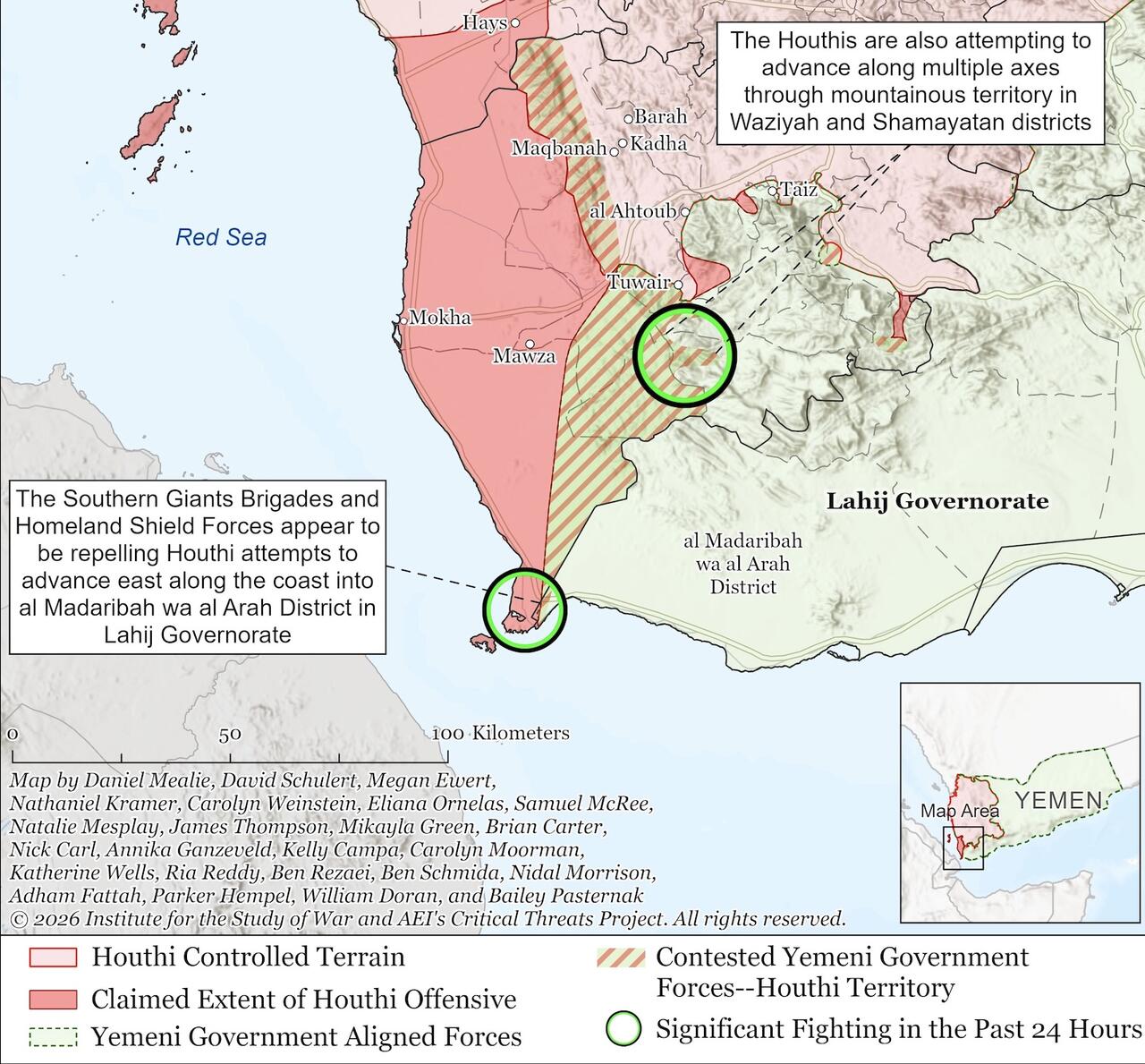
In a blitz that caught the world by surprise, the Houthis late last week achieved an enormous strategic victory by conquering the remainder of Yemen’s western coastline it didn’t already control — positioning it to easily enforce its declared blockade against Saudi-related shipping entering or leaving the Red Sea via the Bab al-Mandab Strait. Houthi soldiers also took over Perim Island, which sits in the strait.
As Associated Press noted, the seizure of the new territory puts the Houthis in much closer proximity to US forces:
The Houthis’ advance puts them just 20 miles (32 kilometers) from the U.S. military base in Djibouti, on the other side of the Bab el-Mandeb Strait. It’s the main U.S. base in Africa and one of several foreign military bases in Djibouti, including those of China, France and Japan.

The Houthi blockade is positioned as retaliation for the Saudi coalition’s siege and blockade of Houthi-controlled areas of Yemen. Though the Houthi blockade only targets Saudi shipping, global cargo lines are highly wary of transiting the waterway that’s narrower than the Strait of Hormuz. Many are rerouting traffic all the way around Africa’s Cape of Good Hope, which requires at least 20 extra days and a lot more money. “Freedom of navigation and international trade in the Red Sea and Bab al-Mandeb are safe and orderly,” a Houthi official told Al Jazeera.
While it’s too little, too late for Riyah’s hopes of some kind of big Washington intervention in Yemen, Saudi Arabia’s Crown Prince Mohammed bin Salman on Monday met US Central Command chief Admiral Brad Cooper in Jeddah, the Saudi Press Agency (SPA) has confirmed. Likely they reviewed the coalition’s narrowing options going forward, but President Trump has thus far expressed reluctance to get directly involved militarily, at a moment he’s still trying to figure out what’s next with Iran.
Iran Diplomacy Postponed
Cold water has been thrown on flickering hopes for finding an exit from the latest and most dangerous chapter in America’s “endless wars,” as a highly-anticipated Monday summit of Iran and other Persian Gulf states was postponed.
That bad news follows an eventful several days that saw Yemen’s Iran-allied Ansar Allah take control of a large swath of strategic coastside territory. Saudi Arabia’s critical east-west pipeline, shut down after a drone attack that originated in Iraq, may be the center of a major hit to global oil supply.
The Monday meeting was set to take place in the Omani coastal city of Salalah, with attendees including foreign ministers of Iran, Oman, Iraq, Saudi Arabia, UAE, Kuwait and Qatar. Taking a US-friendly line, Bahrain had declined to attend, saying stability “cannot be preserved through a policy of appeasement” and demanding the strait be re-opened without “discrimination, fees or permits.” The tiny state that is was home to the US Navy’s Fifth Fleet also cited its ongoing suspension of diplomatic relations with Iran.
The meeting was going to focus on a proposed arrangement by which Iran and Oman would jointly manage the flow of shipping through the Strait of Hormuz. Traffic through the vital waterway is at a near standstill, more than six months after the United States and Israel launched a war on Iran. Axios’ Barak Ravid, seen by many as a conduit for US-Israeli narratives, reported that Saudi Arabia had submitted amendments to the proposal.
“At the request of some regional countries and by a joint decision of Oman and Iran, the meeting of foreign ministers of Persian Gulf coastal states, which was planned for Monday, has been postponed to another date,” Iranian foreign ministry official Mohammad Ali Bak told Iran’s IRNA. If the meeting comes to fruition, it would be the first one to convene top diplomats from Iran and the Gulf Cooperation Council since the war started on Feb 28.
Previously, Iranian Foreign Minister Abbas Araghchi said attendees would be presented with route maps and other details about how ships would enter and depart the strait. Importantly, he emphasized that the proposal was not sufficient to actually reopen the strait.
Closure of Saudi Pipeline Set To Remove 4% of Global Supply
A different lifeline was completely closed over the weekend, with no end in sight: Saudi Arabia’s east-west oil pipeline was shut down after a devastating attack on a pumping station that seemingly originated with Shiite militias in Iraq. The pipeline was playing a vital role in offsetting the closure of the Strait of Hormuz, by sending oil to Saudi Arabia’s Yanbu port on the Red Sea.
Saudi oil traders told Reuters that, unless the pipeline is opened up within days, the kingdom will run out of export stock, removing as much as 4% of worldwide supply from the market. Even before the pipeline-pumping station attack, Saudi inventory had plummeted to its lowest level in 30 years.
Though Saudi Arabia initially called the closure a mere “precautionary measure,” some observers have very little optimism about a quick resumption of pipeline flow. One source told Reuters it could take five to six weeks to repair. If you’d imagined the pumping station some small facility, this image should give you a proper orientation to what must be restored “in a few days” to avert a major disruption of global supply:

Overnight, West Texas Intermediate futures leapt by 2.89% to $102.94 a barrel. Brent was up almost as much, trading at $107.56.
end
Saudi Oil Routes Narrow: Kingdom Eyes Hormuz Export Surge After Pipeline Attack
Tuesday, Sep 15, 2026 – 09:45 AM
Middle East tensions remain high, with Brent crude futures trading around $105 a barrel and US diesel crack spreads near $110 a barrel amid an ongoing global refining crisis. Disruptions to Russian fuel production from the war in Ukraine are compounding supply constraints across the Middle East.
Saudi Arabia’s options for maintaining exports have significantly narrowed following a drone attack that shut down its critical East-West pipeline last week. With that alternative pipeline route disrupted, possibly for up to a month, and shipping risks elevated around the Arabian Peninsula, Riyadh is seeking to move more crude through the highly contested Strait of Hormuz.
US Energy Secretary Chris Wright told reporters Monday that the US Navy is escorting a large number of vessels through the Oman shipping corridor in the Hormuz chokepoint. Those escorts could support increased Saudi shipments and bolster Riyadh’s confidence in US naval protection.

Bloomberg reported that Riyadh has already begun ramping up crude transits through Hormuz. The report cited sources, and the kingdom did not confirm it.
Saudi exports had recovered toward 4 million barrels a day in early September, with about 1 million moving through Hormuz and the balance through Yanbu on the Red Sea. That leaves the kingdom facing a substantial export shortfall.
Riyadh has two options right now:
- Restore East-West pipeline pumping infrastructure in a timely manner; or
- Sharply increase Gulf shipments (with US naval protection).
Geospatial intelligence shows high-resolution satellite imagery of the aftermath of the drone attack that destroyed pumping infrastructure.
“The pipeline, with capacity of 7mb/d, had played an important role in re-routing oil away from the Strait of Hormuz, and the impact of the pipeline’s closure on Red Sea exports (combined with recent Houthi efforts to disrupt Red Sea flows) will continue to support oil prices for the foreseeable future,” UBS energy expert Dominic Ellis told clients.

Wright joined Bloomberg TV to calm energy markets and said pipeline operations could resume “very soon,” yet no timeline was given.
Meanwhile, AP News reported that flows through the pipeline could resume in three to five weeks.
Riyadh’s most immediate response is to ramp up Hormuz shipments with what appears to be US naval protection, but tanker availability remains another big problem. Also, tanker freight rates from Saudi Gulf ports to China topped $1 million at the end of last week.
end
RUSSIA/UKRAINE
That will keep the price of oil high:
(zerohedge)
Energy Truce In Shambles: Ukraine Strikes Russian Refinery Despite Trump’s Warning Amid Global Diesel Crisis
Tuesday, Sep 15, 2026 – 07:20 AM
President Volodymyr Zelenskyy said on X that Ukrainian forces struck the Syzran refinery in Russia’s Samara region, about 75 miles west of Samara and 466 miles southeast of Moscow. The strike comes days after President Trump urged Ukraine to halt attacks on Russian refineries, as average US retail diesel prices jumped above $6 a gallon and alarming disruptions to global refining capacity threaten fuel supplies ahead of the Northern Hemisphere winter.
Zelenskyy wrote on X:
Russia continues to attack our energy sector, regular logistics, and critical infrastructure. And our responses to them for this are tangible. There are new results from the Defense Forces of Ukraine regarding the refinery in Syzran. There was also a strike in Taganrog on a drone production facility, as well as on a drone preparation and launch site in the Oryol region. Targets were hit in the Black Sea as well. I thank every one of our warriors for the effectiveness of our long-range sanctions!
The day before, the United States also announced a significant decision regarding Russia’s VTB Bank – one of Russia’s systemic banks, which is heavily involved in schemes supporting Russia’s war and, in particular, its relations with the Iranian regime. All such schemes that work against peace truly need to be dismantled. I thank our partners for this useful step!
There is no alternative to ending this war. And all forms of pressure on Russia must create the right diplomatic conditions. Glory to Ukraine!
President Trump on Sunday urged Ukraine to stop attacking Russian refineries, as record US diesel prices above $6 a gallon intensify political concerns over fuel costs and affordability ahead of November’s midterm elections.
Trump blamed the strikes for shortages he said were “hurting the world.” Ukraine’s drone strike campaign against Russian refineries has curtailed refining and, alongside Moscow’s export restrictions, sharply reduced overseas diesel supplies, tightening availability of the industrial fuel essential to freight, agriculture and industry.
Compounding the supply pressure, Saudi Arabia shut its East-West pipeline following a drone attack that Saudi and Iraqi authorities said originated in Iraq. The pipeline provides Saudis with a critical route to Red Sea export facilities, bypassing the Strait of Hormuz. Meanwhile, Houthi advances around the Bab al-Mandeb Strait are threatening another major maritime chokepoint, adding to disruptions on both sides of the Arabian Peninsula.
END
ISRAEL/USA VS IRAN WEDNESDAY
Saudis Cancel September Crude Cargoes To Europe As East-West Pipeline Shutdown Deepens Energy Crisis
Tuesday, Sep 15, 2026 – 11:26 AM
Summary:
- Saudis Cancel September-Loading Crude Cargoes to Europe
- Europeans are paying between $9-$11 per gallon for diesel amid Global Refining Crisis
- Saudi Oil Routes Narrow: Kingdom Eyes Hormuz Export Surge After Pipeline Attack
Saudis Cancel September-Loading Crude Cargoes to Europe
“Refining is super short. Between Europe’s woes, Russias war on Ukraine and a drop in refined products from the Arabian Gulf its really bad. As many of my amazing followers showed yesterday… Europeans are paying between $9-$11 per gallon for diesel,” CNBC’s Brian Sullivan wrote on X.
Europe’s energy supply outlook is deteriorating after Reuters reported Tuesday that Saudi Arabia had notified some European refiners that their September-loading crude cargoes would be canceled following the shutdown of its critical East-West pipeline after a drone attack.
Beyond a diesel shortage in the West, Europeans are also dealing with low natural gas stockpiles heading into the Northern Hemisphere winter, with prices reaching their highest level since December 2022.
Saudi Oil Routes Narrow: Kingdom Eyes Hormuz Export Surge After Pipeline Attack
Middle East tensions remain high, with Brent crude futures trading around $105 a barrel and US diesel crack spreads near $110 a barrel amid an ongoing global refining crisis. Disruptions to Russian fuel production from the war in Ukraine are compounding supply constraints across the Middle East.
Saudi Arabia’s options for maintaining exports have significantly narrowed following a drone attack that shut down its critical East-West pipeline last week. With that alternative pipeline route disrupted, possibly for up to a month, and shipping risks elevated around the Arabian Peninsula, Riyadh is seeking to move more crude through the highly contested Strait of Hormuz.
US Energy Secretary Chris Wright told reporters Monday that the US Navy is escorting a large number of vessels through the Oman shipping corridor in the Hormuz chokepoint. Those escorts could support increased Saudi shipments and bolster Riyadh’s confidence in US naval protection.
Bloomberg reported that Riyadh has already begun ramping up crude transits through Hormuz. The report cited sources, and the kingdom did not confirm it.
Saudi exports had recovered toward 4 million barrels a day in early September, with about 1 million moving through Hormuz and the balance through Yanbu on the Red Sea. That leaves the kingdom facing a substantial export shortfall.
Riyadh has two options right now:
- Restore East-West pipeline pumping infrastructure in a timely manner; or
- Sharply increase Gulf shipments (with US naval protection).
Geospatial intelligence shows high-resolution satellite imagery of the aftermath of the drone attack that destroyed pumping infrastructure.
“The pipeline, with capacity of 7mb/d, had played an important role in re-routing oil away from the Strait of Hormuz, and the impact of the pipeline’s closure on Red Sea exports (combined with recent Houthi efforts to disrupt Red Sea flows) will continue to support oil prices for the foreseeable future,” UBS energy expert Dominic Ellis told clients.
Wright joined Bloomberg TV to calm energy markets and said pipeline operations could resume “very soon,” yet no timeline was given.
Meanwhile, AP News reported that flows through the pipeline could resume in three to five weeks.
Riyadh’s most immediate response is to ramp up Hormuz shipments with what appears to be US naval protection, but tanker availability remains another big problem. Also, tanker freight rates from Saudi Gulf ports to China topped $1 million at the end of last week.
END
Trump Says Countries Should Reimburse US For Strait Of Hormuz Help
Tuesday, Sep 15, 2026 – 10:40 AM
Authored by Jack Phillips via The Epoch Times,
President Donald Trump on Sept. 14 said that countries should reimburse the United States for its military efforts in trying to get oil through the Strait of Hormuz amid the Iran war.

Trump said oil is continuing to flow through the strait, a critical route for crude oil and natural gas shipments, although both the Brent crude international benchmark and U.S. West Texas International oil prices remained above $100 per barrel on Sept. 14.
“Oil is flowing through the Hormuz Strait. The Countries of the World, which have been no help to us whatsoever, should, and will, reimburse the United States of America” when the war ends, he wrote in a post on Truth Social.
“We are doing it much more for others, than we are for ourselves, and we have been for Generations,” he said.
Earlier this year, Trump had sought assistance from NATO allies such as France and the UK, as well as from China and South Korea in securing the Strait of Hormuz.
Also on Sept. 14, Trump said that his administration would be open to the idea of negotiations with Iran and that Tehran has said it wants to come to an agreement on ending the war.
“The failing Nation of Iran wants to make a deal, quickly and badly. I will determine whether or not the U.S.A. will choose to engage – The concept of which we are open to,” Trump wrote in a separate post on Truth Social earlier in the day.
Negotiations that were held between Washington and Tehran fell through over the summer, leading to sporadic tit-for-tat strikes around the Strait of Hormuz. U.S. forces have continued to maintain a naval blockade against Iran, redirecting 101 ships, the U.S. Central Command said on Sept. 13.
It comes as the Iran-backed Houthi terrorist group in Yemen said it fired dozens of missiles and drones at a military airbase in Khamis Mushait in southern Saudi Arabia, targeting aircraft hangars, radar systems, runways, and ammunition depots in retaliation for Saudi airstrikes in Yemen.
Saudi authorities issued emergency alerts there and in three other southern cities that have previously come under Houthi fire.
The Houthis have advanced rapidly in Yemen in recent days, capturing territory including Perim Island at the mouth of the Red Sea on Sept. 11. A separate attack the same day, which Riyadh blamed on Iran-backed fighters in Iraq, knocked out Saudi Arabia’s East-West oil pipeline, a key route that allows Gulf oil exports to bypass the blockaded Strait of Hormuz.
The United States bombed Houthi targets for two months in 2025 before Trump halted the campaign after reaching a ceasefire with the group.
Trump, who was attending a golf tournament at his resort in Ireland, told reporters over the weekend that he expected the Iran war to end shortly after November’s U.S. midterm elections, after which oil prices would “drop like a rock.”
Speaking to reporters on Sept. 14, Vice President JD Vance said the Trump administration is in communication with the Houthis and is “very much on top” of the group’s advance through Yemen.
END
ISRAEL TBN
END
HAMAS
IDF kills five Hamas terrorists, among them military commander, in Gaza counterterrorism operation
The IDF and Shin Bet have intensified counterterrorism efforts in the Gaza Strip in recent weeks with the goal of killing Hamas terrorists and minimizing reconstruction efforts.

Palestinians walk past a destroyed Israeli armored vehicle left behind by the Israeli army during the recent war, in the Tel al-Hawa neighborhood of Gaza City, September 7, 2026.(photo credit: ABED RAHIM KHATIB/FLASH90)ByAVI ASHKENAZISEPTEMBER 15, 2026 01:31Updated: SEPTEMBER 15, 2026 01:53
The IDF continued its counterterrorism operations across the Gaza Strip on Monday with five targeted strikes on Hamas terrorists.
At least four terrorists serving in command and force-building positions were killed throughout the day, with one top commander from Hamas’s Gaza City Brigade, a unit within the al-Qassam Brigades, killed in an overnight strike.
According to an N12 report, the commander, named Ahmed al-Batech Abu Osama, was killed in a strike on his vehicle.
Another terrorist was hiding inside a tent in Khan Yunis, whose southern half is currently under IDF control.
The IDF and Shin Bet (Israel Security Agency) struck targets in Deir al-Balah, Daraj al-Tuffah, and Gaza City near Shifa Hospital, where the IDF had carried out an operation on a weapons storage facility last week.

All of the strikes were directed based on intelligence from the Shin Bet and Military Intelligence Directorate, according to a military source.
The IDF and Shin Bet have intensified counterterrorism operations against Hamas terrorists in Gaza in recent weeks.
Among other targets have been officials involved in rebuilding the terror group and restoring its military capabilities in Gaza.
Nili unit locating, killing terrorists who participated in October 7 Massacre
The Shin Bet’s Nili unit, established in 2023 with the goal of tracking and killing Hamas members who participated in the October 7 Massacre, has also been working on locating terrorists involved in the attack.
Security forces are also focusing on damaging Hamas’s ability to acquire weapons. The Air Force has struck in the past two weeks around 20 of the terror group’s weapons storage facilities, as well as workshops and laboratories used for the production of weapons.
END
HOUTHIS/SAUDI ARABIA/ISRAEL
Israel unlikely to improve Saudi ties despite Houthi threat, expert tells ‘Post’ – interview
“If there was a new governing coalition that seemed more committed to discretion, then perhaps there would be an opening for greater cooperation,” Dr. Brandon Friedman suggested.

Crown Prince and Prime Minister of the Kingdom of Saudi Arabia Mohammed bin Salman looks on during a meeting with US President Donald Trump (not pictured) in the Oval Office of the White House in Washington, DC on November 18, 2025; illustrative(photo credit: BRENDAN SMIALOWSKI/AFP via Getty Images)
powered byask.divee.aiWhich major pipeline did the Houthis recently bomb?›Why did Pakistan refuse to send troops against Houthis?›Why is Saudi-Israel defense cooperation suddenly stalling?›Where is the Strait of Hormuz?›

SEPTEMBER 14, 2026 14:53Updated: SEPTEMBER 14, 2026 18:54
Israel is unlikely to find the opportunity to improve relations with Saudi Arabia despite Riyadh’s efforts to expand intelligence sharing and military assistance in its fight against the Houthis, Dr. Brandon Friedman told The Jerusalem Post on Monday. Friedman is the director of research at the Moshe Dayan Center for Middle Eastern and African Studies at Tel Aviv University, and a researcher on political reform in Saudi Arabia.
Friedman spoke with the Post after Reuters reported that Saudi Crown Prince Mohammed bin Salman was seeking US military assistance to confront the Houthi threat. Israel Hayom subsequently reported that Israel had been indirectly approached through US Central Command (CENTCOM) to share intelligence and provide other assistance.
Saudi media confirmed that Salman discussed regional developments with CENTCOM chief Adm. Brad Cooper in Jeddah on Monday, though it remains unclear to what extent Riyadh pursued other options for military support.
Though Friedman said it would be logical for Israel to collaborate with Saudi Arabia, given their shared enemy in the Iranian axis, he maintained it would be “fairly unlikely as things stand” given that “all foreign policy issues today are being refracted through the lens of the Israeli election.”
Any support Riyadh would receive from Israel would need to happen “quietly,” because of their “own domestic political needs,” Friedman said, adding that he believed that any support Israel would currently provide would only be given in the context of providing the governing coalition with a “pre-election boost.”

Jerusalem, Washington long sought to bring Saudi Arabia into Abraham Accords
Though Riyadh has maintained that it will not normalize relations with Israel until a Palestinian state is established, Jerusalem and Washington have long sought to bring Saudi Arabia into the Abraham Accords.
Though Saudi Arabia ranked 25th out of 145 countries in the 2026 Global Firepower Index, Friedman argued that Riyadh had become increasingly dependent on Washington over the past 15 years and now had “very little of its own military power,” leaving it with limited tools at its disposal, “which is why their war in Yemen since basically 2015 has been a failure.”
While Riyadh could turn to Israel and the UAE for support, Friedman suggested that they would be unlikely to do so given that “the Saudis have been at loggerheads” with both countries for the last year. Though Israel has signaled it is willing to share intelligence, Friedman maintained that it was “fairly unlikely, given the current political constellation.”
“If there was a new governing coalition that seemed more committed to discretion, then perhaps there would be an opening for greater cooperation,” he suggested.
With reports indicating that Washington has now refused to come to the aid of Riyadh against the Houthis, and cooperation with Israel still off the table, Friedman explained that Saudi Arabia has begun searching for new regional powers, hence the Mecca Agreement signed by Turkey and Pakistan. The agreement, however, has not provided Riyadh with the support it needs now, as such a move would be considered premature.
Pakistan has already refused to provide its own troops for war with the Houthis and is preoccupied with fighting the Taliban.
Mecca Agreement insufficient for Saudi, may appease Iran
With the US out and the Mecca Agreement unable to offer what is needed, Friedman said that the final option for Saudi Arabia would be to try to “appease” Iran, which he suggested is what was happening now.
“The Iranians are trying to tie the war in Yemen to their ongoing negotiations through Oman with the GCC states over service charges for commercial shipping through the Strait of Hormuz,” he explained, adding that Iran had directed the Houthis to escalate in hopes of seeing Riyadh fold on Tehran’s demands.
With the Houthis attempting to assert control over the Bab el-Mandeb Strait, which connects the Red Sea to the Arabian Sea and the Indian Ocean, Saudi Arabia’s oil industry could be “strangled,” he continued.
Advertisement
The Houthis have already bombed the East-West pipeline, which has rerouted around four million barrels of oil per day, or roughly 4% of global supply. Iranian-backed militias have also repeatedly targeted Saudi oil infrastructure, Friedman said, arguing that the attacks are intended to pressure Riyadh into accepting greater Iranian control over the Strait of Hormuz.
Given the impact the Houthis are having on oil prices, Friedman suggested that Riyadh was holding onto the hope that Washington would throw its weight against the Houthis and Iran, something Friedman said was unlikely given the upcoming summit with the Chinese presidency and the approaching midterm elections.
“The Americans are not keen to see the war expand right now, and I think that’s part of why the Iranians are escalating at this point,” he theorized.
With the Gulf states unable to agree to a united response, and with Iran increasingly using the global economy as political leverage, Friedman suggested Riyadh would become trapped under the increasing pressure.
end
RUSSIA VS UKRAINE UPDATES
ROBERT H….
About 6:15 AM EST
I hear that ….
– Storm Shadow missile launches have been detected from the direction of the Romanian coastline.
– Launch area: the Black Sea, off Romania’s coast.
– The missiles are reportedly heading toward targets in Russian territory; possibly DEEP into Russian territory.
This is crazy. The other day Russia sent a clear message to Boris Johnson and his fellow entourage on the train to Kiev; they are not welcome. If Russia wanted to kill them they would have done so.
Now this ill thought through action if accurately stated will be followed by Russian response calculated for impact to drive home a message. It is long known that the EU wants war to mask their incompetent running of the place. The Netherlands today experienced major sabotage on their rail system. Wait until the migrants really get pissed off and start using the weapons they bought off the Ukrainians that teh West so generously provided for profit.
Europe is playing with a future that war will not contribute well to. Europe is not capable to wage war nor is it capable of surviving one intact.
Will we have to see another Marshal Plan to rebuild Europe from war to make the bankers rich? If so the people of Europe will shed many tears.
END
6/.GLOBAL ISSUES, COVID ISSUES, VACCINE INJURIES/HEALTH ISSUES
GLOBAL ISSUES
COVID VACCINE INJURIES: MARK CRISPIN MILLER
DR PAUL ALEXANDER..
RABOBANK/MICHAEL EVERY/OR OR PICTON/GIFFIN OR RABOBANK EXECUTIVE/COMMENTARY ON WORLDLY AFFAIRS
7. OIL AND NATURAL GAS/ENERGY COMMENTARIES
Indian Refineries Run At Up To 108% Capacity On Soaring Diesel Demand
Monday, Sep 14, 2026 – 08:30 PM
India’s refineries have been running at an unprecedented 105% to 108% capacity utilization in the past six months as demand for diesel soars and international fuel markets tighten amid the ongoing Middle East crisis, OilPrice reports citing Reuters.
Refinery capacity utilization in the world’s third-largest crude oil importer has been between 105% and 108% since the war began, a senior executive at Mangalore Refinery and Petrochemicals Limited (MRPL) said at the APPEC petroleum conference in Singapore on Wednesday.

“Most of our refiners are complex, can take a wide variety of crude from an API range of something like 16 to 45 or 48,” Nandakumar Pillai, a company director at MRPL, said at the event, as carried by Reuters.
MRPL operates a refinery with the capacity to process 300,000 barrels per day (bpd) on the coast of India’s southern state of Karnataka. The refinery has a versatile design with complex secondary processing units and high flexibility to process crudes of various API, delivering a variety of quality products, the refiner says.
MRPL will continue to run its refinery at above 100% until March 2027, Pillai told Reuters on the sidelines of the conference.
All Indian refiners are currently prioritizing diesel production at the expense of jet fuel amid soaring domestic diesel demand and a crunch in global middle distillate supply.
Diesel prices globally are soaring, and diesel cracks have hit all-time highs as supply remains constrained in the Middle East and Russia, while maximized refinery runs elsewhere cannot offset the supply lost to the U.S.-Iran war and Ukraine’s drone attacks on Russian refineries.
The re-escalation in the Middle East and the Russian ban on diesel exports pushed middle distillate cracks to record highs last week.
Analysts have been warning for weeks that diesel and other fuels are the real stress test in the oil markets, not crude oil.
END
8. EMERGING MARKETS//AUSTRALIA NEW ZEALAND ISSUES
CANADA/ GAS PRICES
Where Fuel Prices in Canada Could Go Amid Global Tensions

A pump at a gas station is seen in Toronto on Sept. 2, 2026. The Canadian Press/Keito Newman

9/8/2026|Updated:
9/13/2026
Although the federal government is extending its fuel excise tax holiday into 2027, Canadians may not see broad relief at the pump, with global energy pressures continuing to push fuel prices upward.
Ottawa announced on Sept. 2 that it will extend its suspension of the excise tax on gasoline and diesel until Jan. 31, 2027, after the tax holiday was set to expire on Sept. 7. The tax will be reinstated at half its regular rate from Feb. 1 to March 31, before returning to its regular rate on April 1.
Economists say that while the gas tax holiday will provide some price relief to Canadians, risks to global energy markets could continue to push energy prices—and inflation—higher.
Carol Montreuil, vice-president of the Canadian Fuels Association, said that the savings of 10 cents per litre are a “welcome relief” for Canadians but that the conflicts in the Middle East and Ukraine are continuing to contribute to high energy prices.
“People can expect, coming into the fall season, an impact of all these higher [energy] prices on many of the commodities we consume,” he told The Epoch Times.
Trevor Tombe, an economics professor at the University of Calgary, concurred that the extension of the gas tax holiday makes sense but said higher energy prices will trickle down into higher inflation for Canadians, particularly at the grocery store.

Federal Gas Tax Holiday Extended Until January 2027

US Says More Than 17 Million Barrels of Oil Passed Through Strait of Hormuz on Monday
Dan McTeague, president of Canadians for Affordable Energy, said that with U.S. strategic oil reserves falling to multi-decade lows and the conflict over the Strait of Hormuz waterway continuing, oil prices could head even higher in the coming months.
“We’ve been running on emergency supplies now for four or five months. The world’s running out, especially China. … They have to come up for air, and that’s likely to lead to a skyrocketing of oil prices that have been so far kept down,” McTeague said.
High Oil Prices
The price of oil skyrocketed in March after the United States and Israel launched strikes on Iran, which led Tehran to virtually shut down the Strait of Hormuz, a waterway through which some 20 percent of global oil supplies flow. The price of West Texas Intermediate (WTI), a major benchmark for crude oil prices, rose from around US$67 in February to over US$100 in April.
While the United States and Iran implemented a ceasefire and signed a potential peace agreement in June, leading WTI to fall to around US$70, negotiations broke down and the two countries returned to strikes.
Although the Strait of Hormuz has remained mostly closed due to attempts by Iran to hit ships traversing it, the U.S. military has been escorting some oil tankers out of the waterway. With Washington and Tehran recently trading limited strikes, WTI is at around US$95.

U.S. forces patrol the Arabian Sea near the M/V Touska by the Strait of Hormuz on April 20, 2026. U.S. Navy via Getty Images
At the same time, Ukraine has resumed its drone attacks on oil and gas facilities across Russia, while Russia has banned exports of gasoline and diesel until Jan. 31, 2027.
In March, members of the International Energy Agency (IEA) agreed to release 400 million barrels of oil from reserves to address rising oil prices, which was the largest release in history. The United States agreed to release 172 million barrels from its reserves, which have fallen to around 286 million barrels as of Aug. 28, the lowest inventory level since 1982.
Canada committed to releasing 23.6 million barrels, but since it does not have a strategic oil stockpile, it instead pledged to release the oil through additional exports.
Relief
Ottawa had suspended the federal fuel excise tax on gasoline, diesel, and aviation fuel across Canada on April 20, with the suspension set to last until Sept. 7.
When announcing the extension of the tax holiday, Finance Minister François-Philippe Champagne said it would mean continued savings of 10 cents per litre on gasoline and unleaded aviation gasoline, and 4 cents per litre on diesel and aviation fuel.
The average price of gasoline across Canada is about $1.77 per litre as of Sept. 8.
Montreuil said that although the gas tax holiday extension would bring price relief for Canadians, gas prices in Canada will likely remain elevated as long as the conflicts in Iran and Ukraine continue. He said that while an end to one or both wars could cause energy prices to fall, their continuation would leave global energy inventories at the lowest levels in more than 30 years, just as harvest season begins for Canadian agricultural producers.
Montreuil said the energy crisis is being seen particularly in diesel prices, which recently reached an all-time high of $4.68, while oil prices have not breached all-time highs so far in 2026.
“We know how important diesel is for agriculture, for the transportation of everything, whether it’s trucks, marine, rail,” he said. “All of a sudden, people are starting to understand that these higher prices on diesel, in particular, will trickle down in everything we consume.”
McTeague noted that the government is still maintaining the clean fuel standard, which adds 8 cents a litre to gas prices and around 13 cents a litre to diesel prices.
The Conservative Party has called on the federal government to suspend all federal taxes on gas and diesel until at least Canada Day 2027, which could mean savings of 25 cents a litre at the pump.
McTeague says elevated prices of diesel, a fuel he calls the “global workhorse,” is an “unwelcome and very disturbing omen.” He said diesel consumption will increase as farmers harvest their crops and colder weather drives Canadians to use more heating.
“I’m very worried about colder weather, and I’m worried about what’s going to happen with diesel,” he said. “Policymakers better not ignore this one, especially when it comes to facile, irrelevant trimming around the edges with excise taxes that amount to a rounding error.”
Tombe said extending the gas tax holiday makes sense, as higher tax revenues from oil and gas companies could offset the lost revenue from the fuel tax.
He also noted that WTI Futures show prices declining to nearly $70 by September 2027. However, he said that “nobody knows because it depends on all these unforeseeable developments, including decisions taken both by the U.S. and Iran. So if anyone’s hanging their head on any particular number, they’re taking a gamble.”
When it comes to prices, Tombe estimates that gasoline and fertilizer prices both rising by 50 percent would raise consumer inflation by 1.2 percentage points, and that food prices would be “particularly exposed.”
“So for the typical household, that’s about $1,000 a year in additional costs. Half of that is energy, and the other half are all these indirect effects,” he said.
Canada’s inflation rate hit 3.2 percent in May, fell to 2.8 percent in June, and rose again to 3.0 percent in July, according to Statistics Canada. But food inflation remained higher for those months, sitting at 4.3 percent in May, 3.9 percent in June and 3.1 percent in July.
END
CANADA USA
Manufacturers Set To Move Production Out Of Canada As US Tariffs Hit Hard
Tuesday, Sep 15, 2026 – 03:40 PM
The circumstances of US/Canadian trade should be common knowledge by now, but the details often get mired in the swamp of political rhetoric. When Canadian Prime Minister Mark Carney describes the tariff issue as the US “waging war” on Canada, he knows exactly what he’s doing. Carney has turned a simple trade issue over reasonable 10% tariffs into an existential crisis, an invasion, an ethnic cleansing, a last stand against “evil” imperialists.
But getting the Canadian public riled up with delusions that they are underdog insurgents will not help them keep manufacturing companies or domestic jobs. There is no reason to “endure” a trade war involving 50% tariffs that can be easily solved by simply taking the sweetheart deal that was offered to them. Carney could easily wait Trump out and try to renegotiate once a new president is elected. Unless, there’s an alternative agenda at play for Carney.

Estimates in July on manufacturing losses indicated that 42% of Canadian companies (and some US companies) would be moving at least a portion of their operations to the US to avoid the debilitating tariffs. Some will be shutting down entirely. With Carney asserting that negotiations are off the table, this leaves no room for speculation. Businesses are adjusting operations for the long haul which means skyrocketing job losses for Canada.
The latest manufacturers to make announcements are:
Aeris Protective Packaging in Montreal: The company says it is opening a U.S. plant after 50% U.S. tariffs on paper and packing containers. About 70% of its customers are in the U.S. It plans to keep some manufacturing in Quebec and Ontario for Canadian, European, and Mexican customers.
Sapporo/Sleeman Breweries: Sapporo says it will move production of beer made in Canada for the U.S. market to the United States by the first half of 2027, citing 50% tariffs on Canadian beer. Sleeman later said the move is “not finalized”. Most beer sold in Canada would still be brewed in Canada.
RYAM (Rayonier Advanced Materials) in Témiscaming, Quebec: The US-owned paperboard mill announced an indefinite temporary shutdown, blaming 50% U.S. tariffs. About 400–425 workers were affected. The stop was first set for mid-September, then postponed to October 3rd after new Canadian orders. The company has not given a restart date.
Stellantis – Brampton Assembly (Ontario): In mid-August 2026 the company told Unifor it was opening talks on a possible sale of the idle Brampton plant (idled since late 2023 after Jeep Compass production was moved to the U.S.). Stellantis had plans to reopen the mothballed site, but they backed out after the trade war with the US went parabolic.
Northern Cable (Brockville, Ontario): An August 2026 report says the firm is considering a U.S. factory if 50% tariffs on electric cable take effect, because half of the company’s business is in the United States.
Some companies have already move production to the US, including Crown Royale which moved its bottling plant to Alabama in April.
A Reuters/LSEG poll of economists originally predicted Canada would add 15,000 jobs in August 2026. Instead, the country lost 42,000 jobs; that’s a 57,000 job disparity. Canadian economists are treating the forecast miss as an anomaly, however, it is likely that the decline in jobs will escalate through the end of the year unless a deal between the US and Canada is struck.
If Carney’s intention is to use economic hysteria as a tool to help Democrats win during the US midterm elections, then there’s no chance of a deal before the end of the year. Canadians will continue into winter with the threat of rising unemployment and much higher prices.
Canada relies on the US for 78% of all export sales and there are no practical trade alternatives. A similar but smarter base case is Mexico, which sells around 84% of all their exports to American markets. The difference? The Mexican government has avoided arrogant jousting with the US and is engaging in fair negotiations (so far). They are also showing more cooperation to meet the Trump Administration’s demands on securing the southern border.
In other words, they didn’t abandon negotiations at the last minute like Carney, and this has helped Mexico to avoid punishing tariffs and job losses. Whatever Carney’s intentions, it’s clear that average Canadians will be paying the price for the Prime Minister’s lack of diplomacy.
END
SOMALIA/USA
US Bombs Somalia For 81st Time This Year
Tuesday, Sep 15, 2026 – 03:30 AM
Authored by Dave DeCamp via Antiwar.com,
US Africa Command announced on Friday that its forces launched another airstrike in Somalia as the Trump administration continues a record-breaking bombing campaign in the country, which receives virtually no coverage in US media.

AFRICOM said the strike was launched on September 8 and targeted al-Shabaab in the vicinity of Quumbi, a village about 50 miles northeast of the southern port city of Kismayo,
As usual, AFRICOM offered no other details about the strike, and there were no statements from US-backed forces about military operations in the area that day.
“Specific details about units and assets will not be released to ensure continued operations security,” AFRICOM said.
According to AFRICOM’s numbers, the attack brings the total number of US airstrikes in Somalia this year to 81, higher than any other year prior to 2025, when President Trump oversaw 124 AFRICOM airstrikes, breaking the previous annual record of 63 that he set in 2019.
The US has also been conducting an air war against an ISIS affiliate in Somalia’s northeastern Puntland region, and Drop Site News recently reported that a US strike was carried out in the region on September 3, though it has not been claimed by AFRICOM, suggesting that not every US attack is being announced.
According to numbers from New America, an organization that tracks the air war and also counts airstrikes that are reported but not claimed by the US, the September 8 strike would bring the total number of US bombings in Somalia this year to 83.
The US has been involved in Somalia for decades and has been fighting al-Shabaab since the George W. Bush administration backed an Ethiopian invasion in 2006 that ousted the Islamic Courts Union, a Muslim coalition that briefly held power in Mogadishu after taking the city from CIA-backed warlords.
Al-Shabaab was the radical offshoot of the Islamic Courts Union, and its first recorded attack was a suicide bombing in 2007 that targeted Ethiopian troops occupying Mogadishu. It wasn’t until 2012 that the group pledged loyalty to al-Qaeda. The ISIS affiliate in Puntland started as an offshoot of al-Shabaab and first emerged in 2015.
end
U.S./GOLD AND SILVER PRICING/ASIAN CLOSING MARKETS AND EUROPEAN BOURSE OPENING AND CLOSING/ INTEREST RATE SETTINGS TUESDAY MORNING 6;30AM//OPENING AND CLOSING\
OPENING LEVELS OF CURRENCIES// AND CLOSING ASIAN STOCK MARKET AND OPENING EUROPEAN STOCKS:6 AM EST
EURO VS USA DOLLAR: 1.1539 DOWN 0.0008
USA/ YEN 154.80 UP 0.385 NOW TARGETS INTEREST RATE AT 1.75% AS IT WILL BUY UNLIMITED BONDS TO GETS TO THAT LEVEL…//YEN STILL FALLS//END OF YEN CARRY TRADE BEGINS AGAIN DEC 2024/Bank of Japan raises rates by .25% TO 1.75 ..TAKAICHI NEW PM AS YIELDS RISE//JAPAN DEEPLY IN TROUBLE WITH RISING RATES AND A FALLING YEN!! BANK OF JAPAN WILL NO LONGER DO QE. URGES PENSION AND INSUANCE FUNDS TO BUY JAPANESE BONDS//
YEN CARRY TRADERS MURDERED
GBP/USA 1.3474 DOWN 0.0024 OR 24 BASIS PTS
USA/CAN DOLLAR: 1.3900 UP 0.0001 //CDN DOLLAR DOWN 1 BASIS PTS//
Last night Shanghai COMPOSITE CLOSED DOWN 21.05 PTS OR 0.54%
Hang Seng CLOSED DOWN 293.10 PTS OR 1.18%
AUSTRALIA CLOSED DOWN 1.39%
// EUROPEAN BOURSE: ALL RED
Trading from Europe and ASIA
I) EUROPEAN BOURSES: ALL RED
2/ CHINESE BOURSES / :Hang SENG CLOSED DOWN 293.10 PTS OR 1.18%
/SHANGHAI CLOSED DOWN 21.05 PTS OR 0.54%
AUSTRALIA BOURSE CLOSED DOWN 1.39%
(Nikkei (Japan) CLOSED DOWN 0.99 PTS OR 0.00%
INDIA’S SENSEX IN THE RED
Gold very early morning trading: $4289.00
silver:$62.97
USA DOLLAR VS TRY (TURKISH LIRA): 48.64 UP 1 BASIS PTS AND NOW WE SEE THEIR STUPIDITY OF SELLING SOME OF THEIR GOLD AND ALL OF THEIR USA DOLLAR RESERVES. THE COUNTRY IS IN BIG FINANCIAL TROUBLE
USA DOLLAR VS RUSSIAN ROUBLE: 84.61 ROUBLE// DOWN 0 ROUBLE AND 11 BASIS PTS.
UK 10 YR BOND YIELD: 5.4229 UP 5 BASIS PTS
UK 30 YR BOND YIELD: 5.9392 UP 5 BASIS PTS
CDN 10 YR BOND YIELD: 3.962 UP 2 BASIS PTS
CDN 5 YR BOND YIELD; 3.676 UP 3 BASIS PTS
USA dollar index early TUESDAY MORNING: 99.32 UP 4 BASIS POINTS FROM MONDAY’s CLOSE
TUESDAY MORNING NUMBERS ENDS
And now your closing TUESDAY NUMBERS 10.00 AM
Portuguese 10 year bond yield: 3.910% UP 1 in basis point(s) yield
JAPANESE BOND 10 yr YIELD: +3.033% UP 3 FULL POINTS BASIS POINTS /JAPAN losing control of its yield curve/
JAPAN 30 YR: 4.159 UP 8 BASIS PTS//
SPANISH 10 YR BOND YIELD: 4.010 UP 0 in basis points yield
ITALY 10 YR BOND: 4.418 UP 0 points in basis points yield ./
GERMAN 10 YR BOND YIELD: 3.5393 UP 0 BASIS PTS
IMPORTANT CURRENCY CLOSES : MID DAY TUESDAY
Closing currency crosses for day /USA DOLLAR INDEX/USA 10 YR BOND YIELD/10:00 AM
Euro/USA 1.1543 DOWN 0.0005 OR 5 basis points
USA/Japan: 154.98 UP 0.0556 OR YEN IS DOWN 56 BASIS PTS// HIGHLY INFLATIONARY TO JAPAN
Great Britain 10 YR RATE 5.4157 UP 4 BASIS POINTS //
GREAT BRITAIN 30 YR BOND; 5.9490 UP 1 BASIS POINTS.
CANADIAN DOLLAR DOWN 17 BASIS PTS TO 1.3918
xxxxxxxxxxxxxxxxxxxxxxxxxxxxxxxxxxxxxxxxxxxxxxxxxxxxxxxxxxxxxxxxxxxxxxxxxxxxxxxx
The USA/Yuan CNY 6.7116 ON SHORE ..DOWN
THE USA/YUAN OFFSHORE// CNH DOWN TO 6.7136
TURKISH LIRA: 48.64 UP 1 EXTREMELY DANGEROUS LEVEL/DEATH WATCH/HYPERINFLATION TO BEGIN.//
Your closing 10 yr US bond yield UP 5 in basis points from MONDAY at 5.013% //trading well ABOVE the resistance level of 2.27-2.32%)
USA 30 yr bond yield 5.375 UP 1 basis points /10:00 AM
USA 2 YR BOND YIELD: 4.663 UP 2 BASIS PTS.
GOLD AT 10;00 AM $4279.60
SILVER AT 10;00: $63.22
Your 11:00 AM bourses for Europe and the Dow along with the USA dollar index closing and interest ratesTUESDAY
DAY CLOSING TIME/ 12:00 AM///
London: CLOSED UP 39.44 PTS OR 0.37%
GERMAN DAX: CLOSED DOWN 38.53 PTS OR 0.15%
FRANCE: DOWN 27.50 OR 0.34 PTS
Spain IBEX CLOSED DOWN 9.60 PTS OR 0.05%
Italian MIB: CLOSED DOWN 73.58 PTS OR 0.14%
WTI Oil price 103.76 10.00 EST/
Brent Oil: 108.25 10:00 EST
USA /RUSSIAN ROUBLE: 84.34 /// ROUBLE DOWN 0 AND 1/ 100
CDN 10 YEAR RATE: 3.959 UP 0 BASIS PTS.
CDN 5 YEAR RATE: 3.657 DOWN 2 BASIS PTS
CLOSING NUMBERS: 4 PM//
Euro vs USA 1.1542 DOWN 0.0006 OR 6 BASIS POINTS//
British Pound: 1.3476 DOWN 0.0023 OR 23 basis pts/
BRITISH 10 YR GILT BOND YIELD: 5.3848 UP 4 FULL BASIS PTS//
BRITISH 30 YR BOND YIELD: 5.9240 UP 4 IN BASIS PTS.
JAPAN 10 YR YIELD: 3.041 UP 4 FULL BASIS PTS (DANGEROUS TO THEIR ECONOMY
JAPANESE 30 YR BOND: 4.167 UP 8 PTS AND STILL VERY DANGEROUS TO THEIR ECONOMY
USA dollar vs Japanese Yen: 155.12 UP 0.694 OR YEN DOWN 69 BASIS PTS//GETTING FURTHER AWAY FROM 160.00/ EXTREMELY DANGEROUS
USA dollar vs Canadian dollar: 1.39199 UP 0.0020 PTS// CDN DOLLAR DOWN 20 BASIS PTS
West Texas intermediate oil: 105.57
Brent OIL: 108.36
USA 10 yr bond yield UP 4 BASIS pts to 5.000
USA 30 yr bond yield: UP 3 PTS to 5.364%
USA 2 YR BOND 4.667 UP 3 PTS
CDN 10 YR RATE 3.952 UP 1 BASIS PTS
CDN 5 YEAR RATE: 3.657 UP 0 BASIS PTS
USA dollar index: 99.15 UP 3 BASIS POINTS
USA DOLLAR VS TURKISH LIRA: 48.64 UP 2 BASIS PTS GETTING QUITE CLOSE TO BLOWING UP/IDIOTS SOLD GOLD
USA DOLLAR VS RUSSIA//// ROUBLE: 84.20 UP 0 AND 29/100 roubles //
GOLD $4,300.60 3:30 PM)
SILVER: 63.75 3;30 PM)
DOW JONES INDUSTRIAL AVERAGE: DOWN 328.63 POINTS OR 0.63%
NASDAQ 100 DOWN 189.32 PTS OR 0.65%
VOLATILITY INDEX 17.50 UP 0.40 PTS OR 2.30%
GLD: $ 394.12 UP 1.28 PTS OR 0.33%
SLV/ 57.53 PTS UP 0.69 OR 1.21%
TORONTO STOCK INDEX// TSX INDEX: CLOSED DOWN 126.24 PTS OR 0.35%
end
TRADING today ZEROHEDGE 4 PM: HEADLINE NEWS/TRADING
Oil, Bonds, The Yen: The Macro Shock Is Spreading
Crude Rips, Crypto Flips, Stocks Dip, As Fed Fears Eclipse All
WRAP UP:
Stocks slide and Dollar gains as eyes turn to FOMC – Newsquawk US Market Wrap
Tuesday, Sep 15, 2026 – 04:05 PM
- SNAPSHOT: Equities down, Treasuries steepen, Crude up, Dollar up, Gold flat.
- REAR VIEW: Libya’s NOC said production and operations have been suspended in 3 oil fields; Oil loadings suspended at top Saudi Red Sea port of Yanbu after previous attack on east-west pipeline; Oman’s Foreign Minister spoke by phone with the US Secretary of State to discuss regional developments; Dismal US 20yr auction; Houthi militia is digging trenches near Bab al-Mandeb and laying mines in the sea; China criticises US calls for a slowdown in AI development.
- COMING UP: Data: Japanese Trade Balance (Aug), UK Inflation (Aug), Italian Inflation Final (Aug), ECB Wage Tracker (Aug), US Retail Sales (Aug), Atlanta Fed GDP (Q3), New Zealand GDP (Q2) Events: Fed Policy Announcement, BCB Policy Announcement, BoC Minutes Speakers: ECB’s Vujcic, Elderson, Nagel; Fed Chair Warsh Supply: Australia, Germany
More Newsquawk in 2 steps:
- 1. Subscribe to the free premarket movers reports
- 2. Trial Newsquawk’s premium real-time audio news squawk box for 7 days
MARKET WRAP
Stocks closed lower again on Tuesday, with the Nasdaq and Russell underperforming, while the equal-weight S&P fell 0.4%. Calls for a slowdown in AI development remained an overhang for sentiment, although the SOXX and DRAM ETFs were marginally firmer following their sharp declines on Monday.
Sectors were predominantly lower, with weakness led by Consumer Discretionary, Communication Services and Utilities. Energy was the only sector to close higher as crude prices rallied.
The upside in crude was driven by fresh supply concerns after Libya’s NOC said operations had been suspended at three oil fields, while Saudi Arabia reportedly informed some European refiners that their September crude cargo loadings had been cancelled. Oil loadings were also reportedly suspended at the key Saudi Red Sea port of Yanbu following the recent attack on the East-West pipeline.
The Treasury yield curve steepened marginally, with front-end yields edging lower and long-end yields slightly higher, despite the rally in crude prices. The NY Fed Manufacturing survey had little impact, with participants largely awaiting Wednesday’s FOMC rate decision, updated SEPs and Chair Warsh’s press conference. Meanwhile, the 20-year Treasury auction saw a very weak reception, tailing the WI by 2bps alongside a sharp decline in indirect demand.
In FX, the Dollar outperformed amid the broader risk-off backdrop and firmer crude prices, while the Yen and Kiwi lagged. Gold was little changed, while silver saw gains. Bitcoin was sold after the Senate failed to advance the CLARITY Act.
US
NY FED MANUFACTURING: The Empire State Manufacturing Index fell to 7.6 in September (exp. 14.75, prev. 20.6), below expectations but still signalling a modest expansion in New York manufacturing activity following August’s strong growth. Under the hood, New Orders slowed sharply to 2.0 (prev. 17.3), while Shipments fell into contraction at -3.2 (prev. 11.7) and Unfilled Orders eased to 5.9 (prev. 15.5). Supply-chain pressures remained elevated, with Delivery Times at 18.8 (prev. 20.6) signalling significantly longer lead times, while Supply Availability remained negative at -11.9 (prev. -13.4). Labour indicators were notably stronger, with Employment rising to 10.6 (prev. 9.3) and the Average Workweek jumping to 17.0 (prev. 6.9), its highest in nearly five years. Meanwhile, inflation pressures intensified, with Prices Paid rising to 63.1 (prev. 58.6), edging above its recent four-year high reached in May, while Prices Received increased to 28.1 (prev. 22.7). Looking ahead, firms remained optimistic, although expectations moderated somewhat, with Future Business Conditions at 29.0 (prev. 32.1), Future New Orders at 25.3 (prev. 37.1), and Future Employment at 20.0 (prev. 28.2). Expected Prices Paid jumped to 67.3 (prev. 57.7), suggesting firms anticipate input-cost pressures remaining elevated, while capital spending plans remained modest. Overall, the report points to slower but still-positive manufacturing growth, alongside solid labour demand and intensifying price pressures, with supply constraints continuing to weigh on the sector.
FIXED INCOME
T-NOTE FUTURES (Z6) SETTLED 7+ TICKS LOWER AT 105-30
Yield curve steepens, but all eyes turn to Wednesday’s FOMC rate decision. At settlement, 2-year -0.7bps at 4.661%, 3-year -1.1bps at 4.757%, 5-year -0.7bps at 4.824%, 7-year -0.7bps at 4.905%, 10-year -0.2bps at 4.996%, 20-year +0.7bps at 5.402%, 30-year +1.0bps at 5.364%.
THE DAY: The Treasury yield curve steepened modestly on Tuesday, with front-end yields marginally lower while long-end yields edged higher, although price action was relatively contained ahead of Wednesday’s key FOMC rate decision.
The steepening came despite a rally in crude prices amid ongoing supply concerns. Libya’s NOC said production and operations had been suspended at three oil fields after a valve was closed on the Al-Hamada-Zawiya pipeline, warning it may need to declare force majeure if the closure persists. Meanwhile, Saudi Arabia reportedly informed some European refiners that their September crude cargo loadings had been cancelled, while oil loadings were reportedly suspended at Saudi Arabia’s key Red Sea port of Yanbu following the earlier attack on the East-West pipeline.
Meanwhile, the 20-year bond auction was very weak. The 2bp tail, below-average bid-to-cover, sharp decline in indirect participation and elevated dealer allocation pointed to a very soft reception despite the substantial increase in outright yield. The auction cleared at 5.420%, more than 20bps above the prior auction’s 5.204%, suggesting the additional yield was insufficient to attract strong demand. Direct participation was a notable bright spot but was not enough to offset the significant deterioration in indirect demand. The significant event risk surrounding Wednesday’s FOMC decision and updated SEP may have kept some participants on the sidelines.
The US data highlight was the September NY Fed Manufacturing Index, which pointed to slower but still-positive manufacturing growth alongside solid labour demand and intensifying price pressures, while supply constraints continued to weigh on the sector.
Overall, Treasuries largely meandered on Tuesday as participants awaited Wednesday’s FOMC rate decision. A 25bp hike is largely expected, although an unchanged decision remains a risk. With the immediate decision heavily priced, attention will also be on the updated SEP and dot plot, alongside Chair Warsh’s press conference, for guidance on whether policymakers expect further tightening beyond September.
SUPPLY
Notes
- US sold USD 13bln of 20yr bonds; tail 2bps
- US to sell USD 19bln of 10yr TIPS on Sept. 17th; to settle on Sept. 30th
Bills
- US sold 6-wk bills at a high rate of 3.850%, B/C 3.16x
- US to sell USD 72bln of 17-wk bills on September 16th; to sell USD 90bln of 4-wk bills and USD 85bln of 8-wk bills on Sept. 17th; all to settle on Sept. 22nd
STIRS / OPERATIONS
- Fed Hike Pricing via CME FedWatch: Sept 23.6bps (prev. 23.2bps), Dec 52.6bps (prev. 50.7bps)
- EFFR at 3.63% (prev. 3.63%), volumes at USD 91bln (prev. USD 105bln) on September 14th
- SOFR at 3.62% (prev. 3.62%), volumes at USD 2.861tln (prev. USD 2.867tln) on September 14th
- NY Fed RRP op demand at 0.70bln (prev. 1.42bln) across 2 counterparties (prev. 4) on September 15th
- Treasury Buyback [10-30year TIPS, Liquidity Support, Max USD 500mln]: Accepts USD 500mln of USD 2.088bln offers, accepts 6 of 16 eligible securities. O/C 4.176%.
CRUDE
WTI (V6) SETTLED USD 4.44 HIGHER AT 105.83/BBL; BRENT (X6) SETTLED USD 3.07 HIGHER AT 108.75/BBL
The crude complex surged on Tuesday as a series of bullish supply headlines pushed benchmarks higher. Through the European morning and early US session, WTI and Brent initially drifted lower, falling to lows of USD 101.21/bbl and USD 105.10/bbl, respectively, after reports that Oman’s Foreign Minister and the US Secretary of State discussed efforts to de-escalate regional tensions.
Thereafter, however, it was largely one-way traffic higher for crude. The upside was driven by a series of supply-related developments: firstly, Libya’s NOC said production and operations had been suspended at three oil fields after a valve was closed on the Al-Hamada-Zawiya pipeline, warning it may need to declare force majeure if the closure persists. Secondly, Saudi Arabia reportedly informed some European refiners that their September crude cargo loadings had been cancelled. Finally, oil loadings were reportedly suspended at Saudi Arabia’s key Red Sea port of Yanbu following the earlier attack on the East-West pipeline.
Against this backdrop, WTI and Brent rallied towards session highs of USD 106.75/bbl and USD 109.45/bbl, with participants awaiting further developments surrounding the US/Iran situation and the broader supply outlook. Bloomberg also reported that Saudi Arabia and the forces it backs in Yemen are struggling to counter the Houthi advance, according to assessments from several Western European militaries, and are unlikely to regain the key Red Sea port of Mokha, which the Houthis captured last week.
Some strength was pared into settlement after Tasnim reported that Iran and Pakistan are cooperating to ensure regional security, although benchmarks still settled around session highs. Attention now turns to the private inventory data due after-hours.
EQUITIES
CLOSES: SPX -0.45% at 7,585, NDX -0.78% at 28,938, DJI -0.63% at 52,093, RUT -0.68% at 2,873.
SECTORS: Energy +2.26%, Materials +0.37%, Health -0.08%, Real Estate -0.24%, Technology -0.34%, Financials -0.35%, Industrials -0.64%, Communication Services -0.84%, Consumer Staples -0.85%, Utilities -1.20%, Consumer Discretionary -1.76%.
EUROPEAN CLOSES: Euro Stoxx 50 -0.36% at 6,238, DAX 40 -0.07% at 25,423, FTSE 100 -0.37% at 10,658, CAC 40 -0.34% at 8,090, FTSE MIB -0.14% at 51,555, IBEX 35 -0.05% at 19,556, PSI +0.71% at 9,447, SMI -0.50% at 13,809, AEX -0.23% at 1,096.
STOCK SPECIFICS:
- China criticises US calls for a slowdown in AI development.
- Wells Fargo (WFC) said Q3 NIM could be better than guidance and FY26 loan growth will likely be better than guided.
- Sysco (SYY) launched USD 1bln stock offering.
- Dave & Buster’s Entertainment (PLAY) reported a surprise loss per share, revenue was light and comparable sales declined; also flagged a pullback in spending and investment.
- Waystar Holding (WAY) is reportedly exploring strategic options, including a potential sale.
- Boeing (BA) close to finalising order for 150 Max jets to Turkish airlines after engine maintenance dispute resolved, according to reports.
- Butterfly Network (BFLY) CEO remarked Sam Altman is now starting his own neuralink and chose Butterfly.
- JPMorgan (JPM) Co-President Pinto stated CEO Dimon is not stepping back; seeing broad based strength across IB and across all geographies, and would expect IB fees in Q3 to be up mid to high teens.
FX
The Dollar Index was firmer on Tuesday amid broader risk-off sentiment and surging oil prices, to the detriment of its G10 peers. Dollar-specific newsflow was sparse ahead of Wednesday’s pivotal FOMC decision, where the Fed is widely expected to hike rates by 25bps, although such a move is not quite a foregone conclusion. There was no Fed speak amid the blackout period and little in the way of tier-one US data, while the headline NY Fed Manufacturing Index disappointed expectations for September.
G10 FX was lower across the board against the Greenback, with the Yen the clear laggard amid widening yield differentials, followed by the Kiwi. The EUR, AUD and CAD were relative outperformers, although all still weakened to varying degrees. On the Yen, US Treasury Secretary Bessent said the US has been in constant dialogue with Japan regarding intervention and used a “nominal amount” during its Yen intervention, adding that the US made tens of millions of dollars on the operation. The next major risk event for the Yen is the BoJ decision later this week.
Elsewhere, Germany’s September ZEW Economic Sentiment Index underwhelmed, rising to 34.7 from 34.2 but falling short of the 37.0 forecast. In the UK, the Jobs/Wages report was mixed, with unemployment holding at 4.9% (exp. 5.0%), while the wage components were in line with expectations. Overall, the report is unlikely to materially alter expectations for Thursday’s BoE meeting, where rates are expected to remain unchanged. In Asia, Chinese Retail Sales fell short of the Wall Street consensus, while Industrial Production beat expectations.
USA DATA RELEASE
Money-Supply Growth Accelerated In July To A 59-Month High
Tuesday, Sep 15, 2026 – 12:00 PM
Authored by Ryan McMaken via The Mises Institute,
Shortly after becoming the new Fed chairman, Kevin Warsh has admitted that it’s been more than five years since the Federal Reserve hit its two-percent price-inflation target. Warsh has also claimed that he’ll change that, and he’ll bring down price inflation very soon. But if Warsh is serious about price inflation he’s going to have to make some pretty substantial changes. After all, the Fed’s preferred price-inflation measure (core PCE) was up by 3.7 percent, year over year, in the most recent data from July. That’s the 65th month in a row during which price inflation came in above the Fed’s target rate of 2 percent.
Nor should we expect much change in this trend so long as money-supply growth continues to accelerate as it has been doing for two years. July’s measure of money-supply growth – the most recent data available – showed growth at the fastest pace, year-over-year, in 59 months. Moreover, measured month-to-month, the money supply has increased during 11 of the past 12 months.
More specifically, during July, year-over-year growth in the money supply was at 8.62 percent. That’s up from June’s year-over-year increase of 8.59 percent. Money-supply growth is also up sizably compared to July of last year when year-over-year growth was 1.46 percent.

In July, the total money supply again rose, rising above $19.71 trillion and growing by $1.5 trillion in a year from July 2025 to July 2026.

Measuring month-to-month growth, we find that the money supply has grown in every month of the past year except January. During July, money-supply growth was at 0.097 percent.

The money supply metric used here – the “true,” or Rothbard-Salerno, money supply measure (TMS) – is the metric developed by Murray Rothbard and Joseph Salerno, and is designed to provide a better measure of money supply fluctuations than M2. (The Mises Institute now offers regular updates on this metric and its growth.)
Historically, M2 growth rates have often followed a similar course to TMS growth rates, but throughout much of 2025, M2 outpaced even TMS, and M2 money-supply totals are again rapidly heading upward. M2 is now at the highest level it’s ever been, topping $23.1 trillion. Measured year over year, July’s growth rate for M2 was 5.42 percent. That’s the highest growth rate in 49 months.
Since the end of 2009, the TMS money supply is now up by more than 226 percent. (M2 has grown by more than 170 percent in that period.) Out of the current money supply of $19.7 trillion, 30 percent of that has been created since January 2020. Since 2009, in the wake of the global financial crisis, more than $13 trillion of the current money supply has been created. In other words, nearly 70 percent of the total existing money supply have been created since the Great Recession.
Given current weak economic conditions, it is surprising to see such robust growth in the money supply. For example, the estimate for GDP growth in the second quarter of 2026 recently came in at only 1.5 percent. The employment level in the US has fallen by more than 1.2 million since the end of 2025. Wage growth has been below the PCE inflation rate – i.e., wage growth has been negative in real terms – since March of this year.
Given all this, we would not expect to see such robust growth in the money supply. Private commercial banks play a large role in growing the money supply in response to loose Fed policy, and when economic conditions are expansive, and as employment grows, lending also grows, further loosening monetary conditions. But when economic conditions are weak, we’d expect to see less lending and less bank-fueled monetary growth.
So, we should expect to see downward pressure on money supply growth given current economic conditions. However, in an effort to further pump asset prices, and to somehow counter our growing economic stagnation, and to push down yields on Treasuries, the Fed continues to intervene to push down interest rates. This requires a dovish stance on monetary policy, and this is reflected in how money-supply growth continues to accelerate.
As an example of the Fed’s commitment to monetary growth, we can look the Fed’s portfolio which, in spite of many years of Fed claims about “normalization,” has grown by $124 billion over the past year. In other words, the Fed is purchasing Treasuries with newly created money, further ensuring that the money supply continues to grow, even as the economy slows. Moreover, the Fed has refused to increase its target policy rate even as the PCE inflation measure shows no sign of coming close to the two-percent target.

So, how does monetary growth relate to rising prices? It is important to remember that growth in the money supply growth does not drive a one-to-one increase in price inflation. That is, a 10 percent increase in the money supply does not necessary lead to a similar increase in prices. Rather, there will always be a number of lags and measurement problems in calculating how monetary inflation affects price inflation. Nonetheless, monetary inflation is the primary enabling factor in price inflation. Yes, events like wars and logistical failures can lead to rising prices, but in the absence of monetary inflation, rising prices in some areas will require falling prices in other areas. Only in the presence of a growing money supply can there be a general increase in prices. And this is what we are seeing now. Even as energy prices rise, thanks to Trump’s wars and trade barriers, we continue to see rising prices in most other areas as well, including food, real estate, and even apparel. This is made possible by a relentlessly rising money supply, engineered by the Federal Reserve and US Treasury officials.
END
USA ECONOMIC REPORTS
US Data Centers To Burn More Natural Gas Than Most Nations
Monday, Sep 14, 2026 – 06:50 PM
Several weeks ago, we explained why most data center developers favor on-site gas power: it boiled down to two main reasons – availability (especially since modular nuclear power for commercial ‘behind the meter’ use is still in the distant future) and price. Furthermore, a recent BloombergNEF analysis shows the marginal cost of operating an on-site gas plant may be below industrial electricity tariffs, making continued generation from on-site assets the cheaper option in many cases.
As we discussed in late August, marginal generation costs depend on fuel prices and variable operating expenses. BloombergNEF modeled the marginal cost of operating engines, turbines and fuel cells at a mid-scenario gas price of $3.97 per million British thermal units. Gas engines, such as ones manufactured by Wartsila and INNIO, have the highest marginal cost, at $43.2 per megawatt-hour (MWh). Fuel cells, most prominently procured from Bloom Energy, are the cheapest to continue running, at $21.5/MWh, benefiting from high thermal efficiencies and the lowest variable operational cost.

It appears that none of this was lost on US data centers, and the result has been an explosion of nat gas use to power the domestic data center industry which in turn is critical to keep the AI bubble afloat.
Which brings us to another key data point: according to a new outlook from BloombergNEF, data centers in the United States will consume more natural gas than most countries within a decade.
Gas consumption to produce electricity for data centers is expected to grow by 15 billion cubic feet per day in the ten years to 2035, even accounting for many currently planned projects never being built, BloombergNEF said. That’s more gas than is currently consumed by all nations except China, Russia, Iran and the US itself, according to data from the US Energy Information Administration. It’s also more than double BloombergNEF’s previous forecast in December of 6.9 billion cubic feet per day.
The report is the latest illustration of how the future of AI is intertwined with the burning of vast amounts of fossil fuels, tying Big Tech’s ambitions to those of the legacy oil and gas industry, and why – as we discussed over the weekend – a Democratic win in the midterm elections will make life for data center developers a socialist hell.
The abundance and low cost of producing natural gas in the US, combined with gas power plants’ ability to quickly ramp up and down as needed by 24/7 data centers, are a key part of why the fuel is expected to supply 69% of the power needed by new grid-connected data centers in BloombergNEF’s forecast.

The wave of new projects powering the AI boom makes the power sector the second-largest driver of US gas demand in the decade through 2035, just behind the demand growth of new liquefied natural gas export terminals entering service on the US Gulf Coast, according to the outlook. Power-sector gas consumption is expected to increase to 54 billion cubic feet per day by 2035, up by 18 billion cubic feet per day in 2025, while gas demand from LNG exports rises by 21 billion cubic feet per day.
Of course, given the uncertainty of how the AI boom will play out over the next decade, the “error bars” undergirding BloombergNEF’s forecast for data center gas consumption are “fairly large — both to the upside and the downside, frankly,” said Henry Eaton, a gas market analyst at BloombergNEF and the lead author of the report. “Our power demand estimates are definitely not low, but they’re not the highest on the Street.”
That said, the soaring, simultaneous gas needs of AI data centers and LNG export plants pose “a complex challenge for domestic gas producers,” which are currently projected to raise gas output by 35 billion cubic feet per day between 2025 and 2035 but will need to produce an additional 11 billion cubic feet per day to meet forecasted demand, according to the outlook. Failing that, nat gas prices will be the next to surge.
BloombergNEF’s report adds to the growing bullish chorus around US natural gas because of the data center and LNG build-out, alongside fears that some of the highest-quality acreage in major US gas fields could become depleted as operators drill it more aggressively.
Citing those same factors, Wood Mackenzie in July declared “the decade of cheap Henry Hub gas is coming to an end,” referring to the pipeline trading hub in Louisiana that sets the US benchmark for natural gas. The analyst firm projected power-sector gas demand to rise by 17 billion cubic feet per day “by the mid-2030s,” nearly identical to BloombergNEF’s forecast of 18 billion cubic feet per day.
Wood Mackenzie’s outlook was followed by a viral interview with Chronometer Holdings LLC Founder Matthew Smith, who predicted that by the end of the decade, “you’re going to start to see a knife fight to secure natural gas.”
“The biggest losers of this will be US consumer,” Smith said in the video interview which was seen over 1.6 million times on X and was hotly contested by some in the industry.
“I couldn’t disagree more with Matt’s view,” Ben Dell, managing partner of co-founder of investment firm Kimmeridge Energy Management Co., wrote in response to Smith’s dire outlook. While the US gas market will see “considerable demand growth” from LNG and data centers, ample undeveloped acreage within US gas fields help to explain how the gas industry “has consistently met the demand while lowering costs on an inflation adjusted basis.”
end
AI
We’ll Soon Find Out If Yields Are More Important Than Fed Funds
Long-term Treasury yields (especially the 10-year) often matter more for the real economy and financial conditions than the Fed funds rate itself—and the upcoming FOMC decision is a live test of that dynamic.The Fed directly sets the overnight federal funds rate (currently targeted in the 3.50%–3.75% range). That anchors the short end of the curve and influences bank funding costs, money-market rates, and floating-rate debt. But most borrowing that affects households and businesses—mortgages, auto loans, corporate bonds, longer-term business investment—prices off intermediate- and long-term yields, particularly the 10-year Treasury. Those yields are set by the market and incorporate expectations for growth, inflation, fiscal deficits/supply, term premium, and the expected path of policy over years, not just the current overnight rate.Current backdrop (as of mid-September 2026)
- The 10-year yield has climbed to around 5% (hitting multi-year highs not seen since ~2007 in some sessions), while the 30-year has also moved higher (into the mid-to-high 5% area in recent trading).
- This has occurred even as the Fed previously cut and then paused; the long end has often moved independently or even in the opposite direction of short-rate expectations at times.
- Markets have been pricing a high probability of a 25 bp hike at the September meeting (the first in years under Chair Kevin Warsh), with further tightening potentially priced further out. The 2-year yield has also risen notably above the current funds target in places, a classic signal of expected policy tightening.
- Financial conditions have tightened via higher longer yields even without (or ahead of) official funds-rate moves. Warsh and others have at times acknowledged market-driven tightening as relevant.
This is the classic distinction: the Fed controls one rate; the bond market prices the rest. When the term premium rises (due to inflation uncertainty, heavy Treasury issuance, fiscal concerns, or reduced confidence in the policy path), long yields can stay elevated or rise even if the Fed is cutting or holding. Conversely, credible tightening or disinflation can sometimes pull long yields down even as short rates rise.Why “we’ll soon find out”A Fed hike (or the reaction to the decision, dots, and guidance—or lack of forward guidance under the current approach) will reveal how much the long end is already doing the work versus how much markets still need explicit short-rate action for credibility on inflation. If yields continue rising or stay sticky high after a hike, it underscores that market pricing of the longer horizon (inflation persistence, deficits, growth) dominates. If a hike stabilizes or lowers the long end by reinforcing the inflation fight, it shows policy-rate moves still have meaningful signaling power beyond the overnight rate. Treasury Secretary comments emphasizing the 10-year as a key benchmark further highlight the administration’s focus on longer yields over the pure funds rate.In short, mortgages, corporate borrowing costs, and broader financial conditions already reflect the higher yields more than the precise level of fed funds. The next Fed decision and market response will clarify how independent (or dominant) that long-end pricing remains. This divergence has been a recurring theme when inflation, fiscal dynamics, or supply pressures keep the long end elevated relative to the short-rate path the Fed sets.
END
ABOUT TIME!! CARBON RULES WERE TOTAL NONSENSE!!
(ZEROHEDGE)
EPA Repeals Biden-Era Carbon Rules For Power Plants
Tuesday, Sep 15, 2026 – 11:40 AM
As previewed here yesterday, late on Monday the Environmental Protection Agency (EPA) said that it finalized a rule repealing most of the carbon-emission limits for coal- and natural gas-fired power plants and proposed a separate measure that could restrict similar regulations in the future. Appropriately, the Sept. 14 announcement came at the G20 energy event in Houston.
The EPA projects that the two actions announced on Sept. 14 would save about $310.4 billion if the proposed repeal is finalized.
EPA Administrator Lee Zeldin said the changes would allow the United States to build power-generating infrastructure to meet a rapidly rising demand.
“For over 15 years, the Obama and Biden administrations implemented a war on coal to destroy reliable and affordable energy. The Trump administration has come in to protect American energy and to make sure you can afford to keep the lights on,” Zeldin said in a Sept. 14 statement.
“Americans will see a decrease in electricity prices, but this is just the beginning. We are working to go even further so that American energy can be fully unleashed. Realizing the full potential of American energy means more jobs, lower prices, and a more prosperous America.”
As the Epoch Times reports, the Sept. 14 action repealed most of the greenhouse-gas emission standards that were adopted under the Biden administration for existing coal-fired power plants and new natural gas-fired plants. The 2024 rule that is being repealed would have required existing coal plants and some types of new gas-powered plants to eventually capture and store their emissions underground.
The EPA also proposed a separate rule that would conclude that emissions from fossil-fuel power plants do not contribute significantly to dangerous air pollution, potentially preventing future administrations from imposing similar regulations under the Clean Air Act.
Such a rule would be all but certain to face challenges in court.
For more than a decade, the EPA has relied on Section 111 of the Clean Air Act as the legal baseline for regulations on U.S. power sector emissions, the second largest source of emissions in the United States, behind motor vehicles. That power could be on the chopping block as the issue moves forward.
If administration changes go through and are upheld in court, it would defang a significant portion of federal legislation on the issue in the future.
President Donald Trump has long expressed a preference for fossil fuels over renewable energy sources.
The proposals from the EPA come as the administration faces mounting pressure to expand energy production in the United States in order to power artificial intelligence data centers, which have strained power grids across the country.
Trump has been favorable to data centers and AI research more broadly, saying that the U.S. must continue to invest in the technology in order to keep pace with China.
The Natural Resources Defense Council, a nonprofit environmental group, opposed the moves.
Meredith Hankins, the federal climate legal director at the Natural Resources Defense Council, said that as millions of Americans facing wildfires, heat waves, and deadly storms fueled by climate change, the Trump administration is cutting the biggest polluters loose to do more damage than ever.
“For the health of our families and good of our nation, this cannot stand. Ignoring the immense harm to the public from this power plant pollution is a clear violation of the Clean Air Act and of Supreme Court precedent. We will be seeing them in court,” Hankins said.
Michelle Bloodworth, president and CEO of America’s Power, supported the repeal when it was proposed in June 2025, saying it would improve grid reliability and make electricity more affordable.
Bloodworth said in 2025 the Biden-era rule would have forced coal plants to close, worsening the risk of electricity shortages as demand rises from data centers, artificial intelligence, advanced manufacturing, and industrial growth.
She said that preserving existing coal plants would improve grid reliability, hold down electricity prices, and strengthen U.S. energy security and economic competitiveness.
“Under President Trump’s leadership, the United States is proving that we can protect human health and the environment while growing our economy and getting important projects built,” Zeldin said in a Sept. 14 statement. “Clear, timely, and predictable permitting gives businesses the confidence to invest, creates opportunities for American workers, and helps turn good ideas into real projects.”
KING NEWS
| The King Report September 15, 2026 Issue 7826 | Independent View of the News |
| On Monday, the US 10-year Treasury note yield hit 5% for first time since 2023. At 10:25 ET on Monday, 2-year 4.677%; 10-year 5.012%, 30-year 5.38% Anthropic CEO Dario Amodei fomented AI angst on Saturday when he said his company would introduce new safeguards for AI development. He urged the AI industry to slow the development of its most advanced models. OpenAI’s Sam Altman backed the proposal, and Elon Musk posted, “Dario is right.” Trump urged the AI industry to ignore Amodei’s action and warnings and continue to develop ASAP. @realDonaldTrump: The only control or “guardrails” that AI needs is a STRONG AND SMART (High IQ!) PRESIDENT, and the U.S.A. has that, in spades! The Trump Administration has stopped AI “people” from doing bad, or potentially bad, “things,“ like Dario (Anthropic!), who is now pretending to be a “perfect little angel” – and we will continue to do so! We already have tremendous CRIMINAL and REGULATORY power over these companies! There is a SICK conspiracy going on against AI and Data Centers, and the only one that is happy about it is China. WHOEVER WINS AI, WINS! We are leading China, and all others, and will continue to do so. Conspiracy Theorists, Treasonists, Traitors, and Leakers, BEWARE! … Sep 14, 2026, 9:58 AM The only reason the AI/Data Center outburst is happening is because the United States is leading, by a lot, every other country. Don’t kill the Golden Goose!… Sep 14.2026, 11:23 AM ET Ukraine has agreed not to hit Russian Energy targets. Russia has agreed to do likewise! The World’s Diesel price rise is mostly caused by the Russia/Ukraine War, not Iran… Sep 14, 11:05 AM ET Palantir, Nvidia curb AI model use over data fears, The Information reports 11:11 AM ET Anthropic faced customer pushback after a June policy change for its Fable model gave the company rights to retain usage logs for 30 days to guard against “complex and novel attacks,” according to the report. OpenAI has faced similar scrutiny amid claims it may have trained models on user data to help solve a math problem, the report said… https://finance.yahoo.com/technology/ai/articles/palantir-nvidia-curb-ai-model-151108619.html The A.I. Slowdown Debate Goes Global – NYT A call to slow the development of artificial intelligence has rattled markets and drawn pushback in Washington and Beijing… “I won’t lie to you — there are real dangers,” Amodei told CBS News over the weekend about his call for a slowdown in developing the most advanced A.I. models… https://www.nytimes.com/2026/09/14/business/dealbook/ai-slowdown-dc-beijing.html @financialjuice: Anthropic’s Amodei and Openai’s Altman spoke with US Senator Mark Warner over the weekend about AI risks – Senate Spokesperson. Investors and traders rotated out of AI Bubble stocks and into Fangs on Monday. At 12:45 ET: MU -5.44%, NVDA -2.98%, SNDK -5.22%, INTC -4.73%, AVGO -4.23% META +2.09%, META +2.07%, APPL +0.73%, GOOGL +2.4%, MSFT +2.23% USZs hit a low of 106 9/32, -15/32, at 10:24 ET, but rallied to 107 7/32, +15/32 at 12:13 ET after Trump’s verbal intervention on diesel prices. Despite DJT’s diesel announcement, OCT WTI Oil was +$2.57 at 12:43 ET. Oct Brent was +2.48%; Oct Diesel was +5.89¢; Oct Gasoline +3.22¢. All were substantially higher before DJT’s post. Oct WTI Oil high 104.95, +$4.90; Nov Brent high 109.78, +$5.17; Oct Diesel high 5.1919, +14.26¢: Oct Gasoline high 3.4603, +15.31¢ Yen/$ range on Monday: 154.999 (9:56 ET) to 153.38 (20:02 ET, Sunday night) Prior to the NYSE opening on Monday, BofA said the stock market is due for a 10% correction. BofA equity and quantitative strategist… Subramanian said stocks are entering a “seasonally weak period” and due for a correction. She noted that the S&P 500 has experienced only one 5% pullback this year, compared with an average of roughly three per year, according to BofA. It added that a correction of at least 10% typically occurs about once a year, but the last such decline came in spring 2025… https://finance.yahoo.com/markets/stocks/articles/stock-market-overdue-over-10-105752706.html The S&P 500 Index gapped lower on the opening (7636.75). After a rally to 7624.07 on conditioned buying, the index retreated to a daily low of 7592.28 at 10:55 ET. Then Trump happened; algos and day traders got jiggy. The SP 500 Index rallied to a daily high of 6747.99 at 12:53 ET. Contributing to the late morning rally was a rumor, citing Pakistan sources, that the US has sought a “step-by-step” agreement with Iran. But this was precisely the plan/proposal back in June! Iran media claims US seeks ‘phased’ deal US President Donald Trump’s recent comments about the war ending “right after” the midterm elections in the US do not mean that a comprehensive deal between Washington and Tehran will be reached immediately, but that the US government plans to “reset” the terms of negotiations in the coming months and “strengthen its position” before signing a broader agreement… the first phase may be to agree on issues such as shipping security and preventing the conflict from spreading further, before the parties move to more complex issues such as Tehran’s nuclear program, missile capacities, and Iran’s role in the Middle East. https://breakingthenews.net/Article/Iran-media-claims-US-seeks-‘phased’-deal/67102113 Iran deputy FM says ‘ready to move forward’ in deal with US Jun 19, 2026 “We are ready to move forward step by step, if the other party demonstrates the same seriousness,” Saeed Khatibzadeh told Al Jazeera Arabic… https://www.aljazeera.com/news/2026/6/19/iran-deputy-fm-says-ready-to-move-forward-in-deal-with-us @realDonaldTrump: The failing Nation of Iran wants to make a deal, quickly and badly. I will determine whether or not the U.S.A. will choose to engage – The concept of which we are open to… 11:32 Bank of America was -5.7% at 14:07 ET because BofA CEO Brian Moynihan said sales & trading revenue would be roughly flat y/y at a Barclays Conference. @zerohedge: BANK OF AMERICA SHARES QUICKLY EXTEND DROP TO SESSION LOW *CITIGROUP SHARES QUICKLY EXTEND DROP TO 2.6% *JPMORGAN SHARES EXTEND DROP TO 2% *GOLDMAN SACHS SHARES HIT SESSION LOW OF 4.1% 13:19 ET But Trump was NOT done with his AI promotions! @realDonaldTrump: Concerning AI, when, in the History of Business, did anyone see the Leaders of an Industry call for Regulation that, if strongly implemented, will drive them into oblivion and bankruptcy? AI taking over the World, destroying Humanity, and all other things bad, is a HOAX, no different from RUSSIA, RUSSIA, RUSSIA — UKRAINE, UKRAINE, UKRAINE — IMPEACHMENT HOAX #1 — IMPEACHMENT HOAX #2 — and all of the other HOAXES and SCAMS that America was forced to endure through the Destructionists’ and Deviants’ foul play and illegal conduct. President Xi, of China, just announced that China will be doing absolutely nothing to stand in the way of AI, or its future. Google has recently stated that they want to build a massive Plant in Finland, all because they are finding permitting too difficult in the United States. I am not happy about this and want them to change their thinking. AI, and Data Centers, will be the Greatest Economic Development Engine in History — Bigger than Oil, Gold, Diamonds, or even the Internet. It will not be stopped by brilliantly run Destructive Forces during the Term of President… Sep 14, 2026, 13:33 PM @realDonaldTrump: I hope everyone realizes that price increases throughout America were caused by Sleepy Joe Biden and the Biden Administration, not by “TRUMP.” Even Oil was higher under Biden than it is right now, and we prevented Iran from having a Nuclear Weapon! With the temporary exception of Oil, prices are coming down sharply, and Oil will drop like a rock as soon as the Military Conflict with Iran is over, and that will not be long… Sep 14, 2026, 12:31 AM After the S&P 500 Index high at 12:53 ET on beaucoup DJT posts and Iran deal reports, the index rolled over and drifted lower until they moved higher at 14:30 ET. Alas, the rally was modest and short lived. The S&P 500 Index hit 7637.98 near 14:50 ET and rolled over. The decline accelerated at 15:50 ET. The index fell to a 7619.98 close. Positive aspects of previous session Another Team Trump intervention for Monday; this time with multiple acts by the Major Domo SP Comm Services +2.79%, Health Care +1.35%, Consumer Staples +1.27%, DJTA +0.49% Energy commodities retreated sharply on DJT intervention after hitting cycle highs Negative aspects of previous session US bonds and notes hit new yield highs for this cycle before retreating Stocks fell in the afternoon. S&P 500 -0.48, DJIA -0.29%, Nasdaq -0.56%. Nas 100 -0.82%; SOX Index -5.86% Info Tech -1.67%, Industrials -1.44%, Utes -1.34%, Materials -1.03%, Energy -0.86%, Real Estate -0.48%, Consumer Discretionary -0.48%, Financials -0.35% After exploding to new highs, diesel and gasoline retreated Ambiguous aspects of previous session How many posts/interventions will DJT make on Tuesday? First Hour/Last Hour NYSE Action [S&P 500 Index]: 1st Hour: Up; Last Hour: Down Pivot Point for S&P 500 Index [above/below indicates daily trend to day traders]: 7620.08 Previous session (S&P 500 Index) High/Low: 7647.99 (12:53 ET); 7592.28 (10:55 ET ET) From Homeland computer breaches to pathogen smuggling, the China threat is blinking red https://justthenews.com/world/asia/homeland-computer-breaches-pathogen-smuggling-china-threat-blinking-red Egregiously dumb and insulting statement by JD Vance: “If you don’t have confidence that the federal government is going to protect your money, why do you pay taxes at all?” (It’s the prison time, stupid!) https://x.com/clashreport/status/2099548686434873830 @Barchart: TLT (US Treasury 20+yr maturity ETF) fell to its lowest price in history https://x.com/Barchart/status/2099548310038024435 McDonald’s has fallen to its lowest price in 26 months https://x.com/Barchart/status/2099386351057580483 Today – Traders will play for a Turnaround Tuesday to upside abetted by the upward bias of the rally for Fed Day AND the upward bias of Expiration Week. Will Trump verbally intervene again? And if so, will it be as voluminous as on Monday? Key 2-day FOMC Meetings begin. Sept NY Empire State Mfg. Index 15 exp; US 20-year auction ESUs +2.50, NQUs +11.75, USZs +3/32, Oct WTI +1.27, Oct Gas +1.53¢, Yen/$ 154.60 at 20:34 ET. S&P 500 50-eay MA: 7610; 100-day MA: 7503; 200-day MA: 7166 (S&P 500 Close 7619.98) DJIA 50-day MA: 52,958; 100-day MA: 51,757; 200-day MA: 50,016 (DJIA Close 52,421.20) (Green is positive slope; Red is negative slope) Award-winning journalist @geraldposner: What Bill Clinton just told a New York radio audience about bin Laden is not true. I know, because I reported this out in detail for my 2003 book, “Why America Slept: The Failure to Prevent 9/11.” On WABC, Clinton said: “I had authorized the CIA to try to take him out. But they were afraid that if they missed, they’d kill a lot of innocent civilians. They didn’t want to run the risk. I didn’t second-guess them…” That is not what happened at the moment his administration had its best shot. On May 18, 1996, bin Laden left Khartoum for Jalalabad aboard a chartered C-130, traveling with his wives, children, and roughly 150 of his top aides and lieutenants. The flight had to stop to refuel in Qatar. The CIA’s Counterterrorism Center drew up an operations plan to interdict that plane in international airspace and force it down. It went to the White House and was presented to President Clinton. And he decided not to act — because he and most of his senior advisors already considered it a win just to have pushed bin Laden out of Sudan. Here is what a former CIA analyst assigned to the Counterterrorism Center told me on the record for the book: “We were just incensed after we learned there would be no action on our recommendation. We had clear and convincing proof of what bin Laden had done, and it would have been easy to bring him in.” And here’s the part Clinton doesn’t mention on the radio: after 9/11, he told a dinner guest in New York that passing on bin Laden in 1996 was “probably the biggest mistake of my presidency.” So the CIA didn’t block a strike out of fear of civilian casualties. The decision not to act on a workable interdiction plan was made at the top of the administration. Rewriting that now doesn’t change the record. Former CIA Director Brennan subpoenaed to testify in federal Trump conspiracy case … prosecutors last Thursday presented him with a subpoena for Brennan to appear Oct. 15 before a grand jury in Fort Pierce, Florida… https://www.foxnews.com/politics/former-cia-director-brennan-subpoenaed-testify-federal-trump-conspiracy-case “An enemy will agree, but a friend will argue.” — Russian Proverb -END- | |
SWAMP STORIES FOR YOU TONIGHT
GREG HUNTER….


