
EXCHANGE: COMEX
EXCHANGE: COMEX
CONTRACT: SEPTEMBER 2026 COMEX 100 GOLD FUTURES
SETTLEMENT: 4,366.200000000 USD
INTENT DATE: 09/11/2026 DELIVERY DATE: 09/15/2026
FIRM ORG FIRM NAME ISSUED STOPPED
099 H DEUTSCHE BANK AG 18
118 C MACQUARIE FUTURES US 4
363 H WELLS FARGO SECURITI 17
365 C MAREX CAPITAL MARKET 6
661 C JP MORGAN SECURITIES 19
709 C BARCLAYS 12
732 C RBC CAP MARKETS 66
905 C ADM 2
TOTAL: 72 72
MONTH TO DATE: 2,800
JPMORGAN STOPPED 19.72
SEPT 14
GOLD: NUMBER OF NOTICES FILED FOR SEPT./2026: 72 CONTRACTs NOTICES FOR 7200 OZ or 0.2237 TONNES
total notices so far: 2800 contracts FOR 280,000 OZ OR 8.709 TONNES
SILVER NOTICES:215 NOTICE(S) FILED FOR 1,075,000 OZ /
total number of notices filed so far this month : 5599 CONTRACTS (NOTICES) for 27.995 million oz
GLD
SEPT: INITIAL STANDING: 24.172 MILLION OZ//FOLLOWED BY TODAY’S STRONG 271 CONTRACT OR 1.355 MILLION OZ QUEUE JUMP//STANDING ADVANCES TO 30.205 MILLION OZ//
SEPT: INITIAL STANDING 8.756 MILLION OZ//FOLLOWED BY TODAY’S 1.355 MILLION OZ QUEUE JUMP//STANDING ADVANCES TO 30.205 MILLION OZ
GOLD COMEX OUTLINE;
1.MAY SUMMARY FOR MAY TONNES WHICH STOOD FOR DELIVERY:
4. AUGUST: 60.547 TONNES OF INITIAL GOLD FIRST DAY NOTICE FOLLOWED BY THE NET MONTH’S QUEUE JUMP OF 47.2312 TONNES TO WHICH WE ADD THE FOLLOWING EXCHANGE FOR RISK ISSUANCE RECEIVED FOR THE MONTH: 5.4432 TONNES EX FOR RISK/AUG 7 , AUG 11: 2.413 TONNES EX FOR RISK AND AUG. 12 OF 2.
5.SEPT: INITIAL 8.093 TONNES OF GOLD PLUS TODAY’S QUEUE JUMP OF 0.4883 TONNES PLUS 2.2827 TONNES OF EXCHANGE FOR RISK TODAY//NEW TOTAL EX. FOR RISK/MONTH = 22.923//NEW TOTAL STANDING FOR GOLD SEPT ADVANCES TO = 48.801 TONNES!!
6.OCTOBER: 90.012 TONNES OF INITIAL GOLD STANDING WITH TODAY’S TINY 0.00311 TONNES QUEUE JUMP WHICH FOLLOWS ALL OTHER QUEUE JUMPS DURING OCT OF 76.1656 TONNES
THEN WE MUST ADD OUR 14.553 TONNES OF OUR ISSUANCE OF EXCHANGE FOR RISK/6 OCCASIONS//NEW TOTAL OF GOLD STANDING ADVANCES TO 197.5141 TONNES OF GOLD.
7.NOVEMBER BEGINS WITH 15.651 TONNES INITIALLY STANDING FOR DELIVERY FOLLOWED BY TODAY’S QUEUE JUMP OF 2.323 TONNES FOLLOWED BY ALL PREVIOUS QUEUE JUMPS IN OF OF 21.3775 TONNES TO WHICH WE ADD OUR TWO EXCHANGE FOR RISK ISSUANCE OF 4.5596 TONNES//NEW STANDING ADVANCES TO 43.9716 TONNES OF GOLD.
8. DECEMBER BEGINS WITH INITIAL STANDING OF 83.813 TONNES OF GOLD FOLLOWED BY TODAY’S 0.0TONNE QUEUE JUMP WHICH FOLLOWS ALL OTHER QUEUE JUMPS OF: 37.163 TONNES//NEW STANDING ADVANCES TO 115.390 TONNES TO WHICH WE ADD OUR 4 EXCHANGE FOR RISK FOR DECEMBER OF 6.587 TONNES/NEW STANDING ADVANCES TO 121.977 TONNES
9. JANUARY: INITITAL STANDING: 13.785 TONNES TO WHICH WE ADD OUR FIRST EXCHANGE FOR PHYSICAL TRANSFER OF 0.08709 TONNES WHICH FOLLOWS ALL OTHER QUEUE JUMPS OF 30.7117TONNES //NEW TOTAL QUEUE JUMPS 30.7117//NORMAL DELIVERY OF GOLD ADVANCES TO 36.8958 TONNES TO WHICH WE ADD OUR SIX EXCHANGE FOR RISK OF 22.315 TONNES//NEW STANDING ADVANCES TO 59.2108 TONNES.
FEB; INITIAL AMOUNT OF GOLD STANDING FOR DELIVERY: 93.567 TONNES OF GOLD TO WHICH WE ADD OUR NEXT 0.0248 TONNES 0.1555 TONNES QUEUE JUMP TO 41.2082 TONNES/ NEW NET QUEUE JUMP INCREASES TO 41.233 TONNES// AND THEN WE ADD OUR SIX EXCHANGE FOR RISK: 10,080 CONTRACTS OR 31.251 TONNES//NEW STANDING REDUCES TO 157.878 TONNES
MARCH:: INITIAL AMOUNT OF GOLD STANDING FOR DELIVERY: 8.099 TONNES TO WHICH WE ADD TODAY’S FAIR 4600 OZ QUEUE JUMP (0.2320 TONNES) AND THEN WE ADD OUR THREE EXCHANGE FOR RISK OF 22.3818 TONNES //NEW STANDING ADVANCES TO 67.6648 TONNES/
APRIL: INITIAL AMOUNT OF GOLD STANDING FOR DELIVERY: 52.600 TONNES FOLLOWED BY OUR 345 CONTRACT QUEUE JUMP FOR 34,500 OZ/ (1.073 TONNES)/NEW STANDING ADVANCES TO 70.286 TONNES TO WHICH WE ADD OUR 2ND EXCHANGE FOR RISK OF 1498 CONTRACTS FOR 149800 OZ OR 4.659 TONNES. THE NEW TOTAL EXCHANGE FOR RISK FOR THE MONTH OF APRIL IS 2239 CONTRACTS OR 223900 OZ OR 6.964 TONNES AND THIS WILL BE ADDED TO OUR NORMAL DELIVERY TOTALS (70.762 TONNES) TO GIVE US WHAT WILL STAND IN APRIL (77.726 TONNES)
MAY: INITIAL AMOUNT OF GOLD WILLING TO STAND: 12.24 TONNES OF GOLD TO WHICH WE ADD OUR NEXT QUEUE JUMP OF 345 CONTRACTS OR 34500 OZ (1.073 TONNES) TO WHICH WE ADD OUR FIVE EXCHANGE FOR RISK ISSUANCES FOR 24.635 TONNES/STANDING NOW ADVANCES TO 51.554 TONNES OF GOLD.
JUNE; INITIAL AMOUNT OF GOLD WILLING TO STAND; 64.496 TONNES.(CME CORRECTED) TO WHICH WE ADD OUR NEXT EXCHANGE FOR PHYSICAL TRANSFER OF 0.0186 TONNES/NEW STANDING REDUCES TO 127.03 TONNES
JULY: INITIAL AMOUNT OF GOLD WILLING TO STAND: 23.306 TONNES TO WHICH WE ADD OUR NEXT QUEUE JUMP OF 0.000 TONNES/ TO WHICH WE ADD OUR FIRSST EXCHANGE FOR RISK 0F 0.0062 TONNES/NEW STANDING ADVANCES TO 40.824TONNES
AUGUST INITIAL STANDING 48.687 TONNES TO WHICH WE ADD OUR 5TH EXCHANGE FOR RISK OF 5 CONTRACTS FOR 500 OZ OR 0.0155 TONNESS TO OUR 4TH EXCHANGE FOR RISK OF 200 CONTRACTS OR 20,000 OZ OR 6.220 TONNES TO OUR 3RD EXCHANGE FOR RISK OF 1.7045 TONNES TO OUR 2ND EXCHANGE FOR RISK OF 1.552 TONNES TO OUR FIRST 0.0715 TONNES EXCHANGE FOR RISK//NEW TOTAL EXCHANGE FOR RISK: 3.9688 AND THEN ADD OUR NEXT QUEUE JUMP OF 39 CONTRACTS FOR 3,900 OZ OR 0.1213 TONNES//STANDING THUS ADVANCES TO 67.2441 TONNES
SEPT: INITIAL STANDING: 8.756 TONNES OF GOLD FOLLOWED BY TODAY’S 69 CONTRACTS OR 6,900 OZ QUEUE JUMP (.2144 TONNES) TO WHICH WE ADD OUR TWO, 2000 CONTRACT EXCHANGE FOR RISK FOR 200,000 OZ OR 6.2208 TONNES//// // NEW STANDING ADVANCES TO 16.2208 TONNES..
IN ESSENCE WE HAVE A FAIR LOSS IN TOTAL CONTRACTS IN GOLD ON THE TWO EXCHANGES OF 2012 CONTRACTS WITH 2787 CONTRACTS DECREASED AT THE COMEX// AND A SMALL SIZED 775 EXCHANGE FOR PHYSICAL OI CONTRACT ISSUANCE WHICH NAVIGATED OVER TO LONDON.
THUS TOTAL OI LOSS ON THE TWO EXCHANGES OF 2012 CONTRACTS.. WE HAD THE FOLLOWING TAS CONTRACTS INITIATED (ISSUED): A SMALL SIZED AND CRIMINAL 957 CONTRACTS AND THESE ISSUANCES ARE GENERALLY USED TO INITIATE A RAID WHEN CALLED UPON .
GOLD PRICE ROSE BY $1.05
STANDING FOR THE LAST 8 MONTHS JANUARY TO AUGUST:
FINAL STANDING FOR GOLD, JANUARY CONTRACT AT 59.08 TONNES OF GOLD
FEBRUARY: INITIAL STANDING FOR GOLD: 157.878 TONNES!! WHICH INCLUDES ALL QUEUE JUMPING, THREE EXCHANGE FOR PHYSICAL TRANSFERS TO LONDON AND OUR SIX ISSUANCES EXCHANGE FOR RISK!!
MARCH: INITIAL STANDING AT 8.099 TONNES TO WHICH WE ADD OUR FINAL DAY: 0.2320 TONNES QUEUE JUMP AND THEN ADD +22.3818 TONNES EXCHANGE FOR RISK//NEW STANDING ADVANCES TO 67.6648 TONNES
APRIL: INITIAL STANDING 52.600 TONNES PLUS 27,800 OZ QUEUE JUMP (0.8648TONNES): NEW STANDING ADVANCES TO 70.286 TONNES PLUS OUR TWO EXCHANGE FOR RISK FOR 223,900 OZ OR 6.964 TONNES/NEW FINAL STANDING: 77.726 TONNES
MAY: INITIAL AMOUNT OF GOLD WILLING TO STAND; 12.24 TONNES TO WHICH WE ADD OUR NEXT QUEUE JUMP FOR 345 CONTRACTS/34,500 OZ// 1.073 TONNES/ THEN WE MUST ADD OUR EXCHANGE FOR RISK ISSUANCE: TOTAL EXCHANGE FOR RISK MAY// 5 OCCASIONS: 24.635 TONNES///NEW FINAL STANDING NOW ADVANCES TO 51.554 TONNES
JUNE: INITIAL AMOUNT OF GOLD WILLING TO STAND: 64.496 TONNES TO WHICH WE ADD OUR NEXT EXCHANGE FOR PHYSICAL TRANSFER JUMP OF 0.0186 TONNES//NEW STANDING 127.03 TONNES//FINAL
JULY: INITIAL AMOUNT OF GOLD WILLING TO STAND: 23.306 TONNES OF GOLD TO WHICH WE ADD OUR NEXT QUEUE JUMP OF 0.0000 TONNES/ PLUS 0.0062 TONNES EX FOR RISK///NEW STANDING FOR GOLD REMAINS AT 40.824TONNES.
AUGUST INITIAL STANDING 48.687 TONNES TO WHICH WE ADD OUR FIRST 0.0715 TONNES EXCHANGE TO OUR 2ND EXCHANGE FOR RISK = 1.552 TONNES TO OUR 3RD EXCHANGE FOR RISK OF: 1.7045//TOTAL FOR EXCHANGE FOR RISK 3.3312 TONNES TO OUR 4TH EXCHANGE FOR RISK OF 200 CONTRACTS FOR 0.6220 TONNES/TO OUR 5TH EXCHANGE FOR RISK OF 0.0155 TONNES//TOTALL EXCHANGE FOR RISK: 3.9688 TONNES TO OUR NEXT QUEUE JUMP OF 0.1213 TONNES//STANDING ADVANCES TO 67.2441 TONNES
SEPT: INITIAL STANDING FOR GOLD: 8.756 TONNES FOLLOWED BY TODAY’S 6900 OZ QUEUE JUMP (.2144 TONNES) TO WHICH WE ADD OUR SECOND 1000 CONTRACT EXCHANGE FOR RISK TO OUR FIRST: THUS// NEW EXCHANGE FOR RISK: 6.2208 TONNES// NEW STANDING ADVANCES TO 16.2208 TONNES.
JAN. 2025: 257.919 TONNES (ISSUANCE WILL BE PRETTY GOOD THIS MONTH BUT MUCH LOWER THAN LAST MONTH)
FEB: 207.21 TONNES//EX FOR PHYSICAL ISSUANCE (WILL BE A FAIR SIZED ISSUANCE THIS MONTH)
MARCH 130.84 TONNES//QUITE SMALL THIS MONTH.
APRIL; 208.57 TONNES. STRONG THIS MONTH
MAY: 113.499 TONNES OF GOLD EFP ISSUANCE//QUITE SMALL THIS MONTH
JUNE: 97.79 TONNES OF GOLD EFP ISSUANCE/EXTREMELY SMALL
JULY : 150.877 TONNES// QUITE SMALL
AUGUST: 175.86 TONNES A LOT LARGER THIS MONTH.
SEPT. 116.13 TONNES VERY SMALL
OCT. 252.72 TONNES//CERTAINLY MUCH LARGER THIS MONTH/VERY STRONG
NOV: 124.74 TONNES
DEC: 190.04 TONNES//GOOD SIZED THIS MONTH FINAL.
TOTAL EXCHANGE FOR PHYSICAL ISSUED FOR YEAR 2025: 2,026.20 TONNES (LOWER THAN LAST YR 2,569.00 TONNES
YEAR 2026:
JANUARY: 209.08 TONNES ( (WILL BE A STRONG MONTH FOR EXCHANGE FOR PHYSICAL)
FEB. 176.35 TONNES (WHICH IS A FAIR ISSUANCE)
MARCH: 214.67 TONNES//WILL BE STRONG ISSUANCE THIS MONTH
APRIL; 88.00 TONNES// WILL BE VERY SMALL THIS MONTH
MAY 118.430 TONNES
JUNE: 142.053 TONNES
JULY: 163.82 TONNES
AUGUST: 151.107 TONNES
SEPT: 46.507 TONNES
XXXXXXXXXXXXXXXXXXXXXXXXXX
SHANGHAI CLOSED DOWN 46.29 PTS OR 1.18%
HANG SENG CLOSED DOWN 195.97 PTS OR 0.79%
Nikkei CLOSED DOWN 1220.95 PTS OR 1.87%
//Australia’s all ordinaries CLOSED UP 0.18%
//Chinese yuan (ONSHORE) CLOSED DOWN TO 6.7097
/ OFFSHORE CLOSED DOWN AT 6.7093 Oil DOWN TO 100.63 dollars per barrel for WTI and BRENT DOWN TO 104.68 Stocks in Europe OPENED ALL GREEN
ONSHORE USA/ YUAN// WITH YUAN TRADING DOWN (6.7097 OFFSHORE YUAN TRADING DOWN TO 6.7093 ONSHORE YUAN TRADING BELOW LEVEL // OFF SHORE AND DOWN ON THE DOLLAR)// / AND THUS WEAKER/OFF SHORE YUAN TRADING DOWN AGAINST US DOLLAR/ AND THUS WEAKER
HERE IS A BRIEF SYNOPSIS OF HOW THE CROOKS FLEECE UNSUSPECTING LONGS
YOU WILL ALSO NOTICE THAT THE COMEX OPEN INTEREST STARTS TO RISE BUT SO IS THE OPEN INTEREST OF SPREADERS. THE OPEN INTEREST IN WILL CONTINUE TO RISE UNTIL ONE WEEK BEFORE FIRST DAY NOTICE OF AN UPCOMING ACTIVE DELIVERY MONTH (OCT), AND THAT IS WHEN THE CROOKS SELL THEIR SPREAD POSITIONS BUT NOT AT THE SAME TIME OF THE DAY. THEY WILL USE THE SELL SIDE OF THE EQUATION TO CREATE THE CASCADE (ALONG WITH THEIR COLLUSIVE FRIENDS) AND THEN COVER ON THE BUY SIDE OF THE SPREAD SITUATION AT THE END OF THE DAY. THEY DO THIS TO AVOID POSITION LIMITS
WHAT IS ALARMING TO ME, ACCORDING TO OUR LONDON EXPERT ANDREW MAGUIRE IS THAT THESE EFP’S ARE BEING TRANSFERRED TO WHAT ARE CALLED SERIAL FORWARD CONTRACT OBLIGATIONS AND THESE CONTRACTS ARE LESS THAN 14 DAYS. ANYTHING GREATER THAN 14 DAYS, THESE MUST BE RECORDED AND SENT TO THE COMPTROLLER, GREAT BRITAIN TO MONITOR RISK TO THE BANKING SYSTEM. IF THIS IS INDEED TRUE, THEN THIS IS A MASSIVE CONSPIRACY TO DEFRAUD AS WE NOW WITNESS A MONSTROUS TOTAL EFP’S ISSUANCE AS IT HEADS INTO THE STRATOSPHERE.
The crooks also use the spread in the TAS account (trade at settlement). They buy the spot TAS (e.g. June) and sell the future TAS two months out (e.g. August). Then they unload the front month (i.e. unload the buy side first so the price of gold/silver falls. This occurs in the middle of the front delivery month cycle. They unload the sell side of the equation, two months down the road. The crooks violate position limits as the OCC refuse to hear our complaints.
First, here is an outline of what will be discussed tonight:
SILVER:
1.TODAY WE HAD THE OPEN INTEREST AT THE COMEX IN SILVER FELL BY A SMALL 281 CONTRACTS TO AN OI OF 104,473
EFP ISSUANCE 474 CONTRACTS
OUR CUSTOMARY MIGRATION OF COMEX LONGS CONTINUE TO MORPH INTO LONDON FORWARDS AS OUR BANKERS USED THEIR EMERGENCY PROCEDURE TO ISSUE:
DEC 474 CONTRACTS and 0 ALL OTHER MONTHS: ZERO. TOTAL EFP ISSUANCE: 0 CONTRACTS. EFP’S GIVE OUR COMEX LONGS A FIAT BONUS PLUS A DELIVERABLE PRODUCT OVER IN LONDON. IF WE TAKE THE COMEX OI LOSS OF 281 CONTRACTS AND ADD TO THE 474 E.FP. ISSUED
WE OBTAIN A SMALL GAIN OF 193 OI OPEN INTEREST CONTRACTS FROM OUR TWO EXCHANGES DESPITE OUR LOSS OF $3.50
THUS IN OUNCES, THE GAIN ON THE TWO EXCHANGES TOTAL 0.965 MILLION PAPER OZ
STANDING SEPT AT 28.850 MILLION OZ
SILVER PRICE GAIN OF $1.05
XXXXXXXXXXXXXXXXXXXXXXXXXXXXXXXXXXXXX
LET US BEGIN:
THE TOTAL COMEX GOLD OPEN INTEREST FELL BY A FAIR 2787 CONTRACTS TO 411,241 STILL WELL ABOVE ITS NEW LOW OF 326,052 OI SET JUNE 3, CLOSE TO THE PREVIOUS ALL TIME LOW OF 345,705 SET (MAY 28) AND CLOSE TO THE PREVIOUS ALL TIME LOW IN OI OF 353,490 SET MAY 27.. PREVIOUS TO THAT THE ALL TIME LOW IN OI WAS 390,000 SET IN THE YEAR 2001 WHEN GOLD WAS TRADING $260.00. THE CME SHOULD BE PROUD OF THEMSELVES AS MANY HAVE ABANDONED THIS CROOKED ARENA!!THUS OUR NEW ALL TIME LOW OF COMEX OI HAS NOW BEEN SET AT 326,052 //JUNE 3 2026 WITH GOLD AT AN EXTREMELY HIGH $4,450.00 WHICH MAKES ABSOLUTELY NO SENSE!!!
WE HAD HUGE T.A.S. LIQUIDATION DURING FRIDAY’S COMEX TRADING// ATTEMPTED RAID. IT SEEMS THAT MANY OF THE SPECULATORS THAT HAVE NOW CONTINUED AGAIN TO BE ON THE SHORT SIDE WITH BANKERS ON THE LONG SIDE AND THESE GUYS WERE AGAIN OBLITERATED YESTERDAY WHEN THE LONGS TENDERED FOR DELIVERY:
CENTRAL BANKS TENDERED THEIR NEW LONG CONTRACTS AT THE END OF THE DAY FOR PHYSICAL GOLD. YOU CAN VISUALIZE THIS WITH THE STRONG AMOUNT OF GOLD STANDING AT THE COMEX FOR THIS JULY CONTRACT MONTH!!
WE HAD A FAIR SIZED LOSS ON OUR TWO EXCHANGES (2012 CONTRACTS) OCCURRED WITH OUR GAIN IN PRICE IN GOLD (UP $1.05)
WE THUS HAD A FAIR LOSS IN OI ON BOTH OF OUR EXCHANGES (2012 CONTRACTS), WITH OUR GAIN IN PRICE, AS WE WERE INFORMED OF A SMALL CONTRACT EXCHANGE FOR PHYSICAL ISSUANCE EQUATING TO 775 CONTRACTS.
THEN WE WERE NOTIFIED TODAY OF A 0 CONTRACT FOR RISK ISSUANCE IN GOLD CONTRACTS FOR 0 OZ OR 0 TONNES OF GOLD. TOTAL THUS SO FAR THIS MONTH: 2000 CONTRACTS//200,000 OZ OR 6.2208 TONNES (2 OCCASIONS)
MONTH OF MAY RECORD ISSUANCE OF EXCHANGE FOR RISK: THE HIGHEST EVER ISSUANCE!!
MAY 22 RECORDS THE HIGHEST EVER EXCHANGE FOR RISK AT 12.4416 TONNES. WE HAD OUR FIRST ISSUANCE FOR EXCHANGE FOR RISK IN THE MONTH OF MAY ON MAY 7, THEN OUR 2ND ISSUANCE FOR OUR MAY GOLD MONTH ON MAY 12. THE THIRD ON MAY 18 , THEN MAY 21 OUR 4TH ISSUANCE AND THEN FINALLY FRIDAY, OUR 5TH ISSUANCE. THIS GOLD WILL BE ADDED TO OUR NORMAL MAY DELIVERIES TO GIVE US OUR FINAL AMOUNT OF GOLD WILLING TO STAND AT THE COMEX..
HISTORY OF EXCHANGE FOR RISK ISSUANCE THIS YEAR: FEBRUARY THROUGH JULY AND AUGUST
FEBRUARY:
DURING THE MIDDLE OF THE FEBRUARY CONTRACT MONTH, WE HAD TWO IDENTICAL MONSTER 3,000 CONTRACT ISSUED FOR THE SAME 9.33 TONNES OF GOLD, AND THESE WERE THE HIGHEST EVER IN TONNAGE EVER ISSUED BY THE COMEX. ALTOGETHER THE TOTAL ISSUANCE FOR FEB TOTALLED SIX.(31.251 TONNES).
MARCH:
THURSDAY MARCH 17 WE RECEIVED ITS INITIAL 2000 CONTRACT EXCHANGE FOR RISK ISSUANCE FOR 6.22 TONNES. LAST FRIDAY: 0 ISSUANCE OF EXCHANGE FOR RISK. BUT ON MONDAY MARCH 23 WE RECEIVED NOTICE OF OUR SECOND EXCHANGE FOR RISK ISSUANCE FOR 2,200 CONTRACTS (220,000 OZ OR 6.843 TONNES) AND NOW FRIDAY WITH A MONSTER 2996 CONTRACTS FOR 9.3138 TONNES. THESE THREE ISSUANCES WILL NOW BE ADDED TO THE REGULAR AMOUNT OF GOLD STANDING, I.E. 22.3818 TONNES TO OUR NORMAL GOLD STANDING TO GIVE US WHAT WILL STAND FOR PHYSICAL GOLD FOR MARCH!
APRIL;: 2 EXCHANGE FOR RISK SO FAR, I.E. 2239 CONTRACTS FOR 223,900 OZ OR 6.964 TONNES AND THIS TOTAL TONNES WILL BE ADDED TO OUR NORMAL DELIVERY TO GIVE US WHAT WILL STAND IN APRIL
MAY: FIVE ISSUANCES SO FAR FOR 7920 CONTRACTS OR 792,000 OZ OR 24.635 TONNES.
JUNE: 0 IN GOLD. THUS FOR THE ENTIRE MONTH IN GOLD ZERO NOTICES WERE FILED.
JULY: 2 FOR 200 OZ OR 0.00622 TONNES
AUGUST: 1276 CONTRACTS FOR 127,600 OZ OR 3.9688 TONNES (5 OCCASIONS THIS MONTH)
SEPT: SO FAR: 2000 CONTRACTS FOR 200,000 OZ OR 6.2208 TONNESS (TWO OCCASIONS)
XXXXXXXXXXXXXXXXXXXXXXXXXXXXXXXXX
A LITTLE HISTORY OF EXCHANGE FOR RISK DECEMBER THROUGH TO SEPT:
IN DECEMBER WE HAVE RECORDED 5 ISSUANCES OF EXCHANGE FOR RISK/4 FOR DEC AND THE LAST ONE ON DEC 31 FOR JANUARY. WE NOW HAVE 3 CHOICES FOR THE RECIPIENT OF THIS ISSUANCE AND IT MUST BE A CENTRAL BANK. YOU WILL RECALL THAT THE BUYER ASSUMES THE RISK OF THAT DELIVERY. (THUS TOTAL EXCHANGE FOR RISK FOR THE MONTH OF DECEMBER IS 6.56 TONNES/4 OCCASIONS.
MONTH OF JANUARY/EXCHANGE FOR RISK
IN JANUARY THEY HAVE 6 TOTAL ISSUANCE : 3.446 TONNES EARLY, THEN JAN 9 ISSUANCE OF 9,331 TONNES AND THEN JAN 16: 0.1996 TONNES JAN 26: 1.499 TONNES, JAN 27: 3.160 AND FINALLY JAN 29: 4.659 TONNES TONNES//TOTAL EXCHANGE FOR RISK JANUARY 22.315 TONNES WHICH WAS ADDED TO OUR NORMAL DELVERIES.
AND FEBRUARY:
FEB EXCHANGE FOR RISK: NOW 6 ISSUANCES: 10,080 CONTRACTS FOR 1,008,000 OZ OR 31.251 TONNES!
HERE ARE THE CHOICES FOR THE RECIPIENT OF THOSE ISSUANCES:
1 THE CENTRAL BANK OF ENGLAND. BUT THEY RECEIVED CLEARANCE THAT THEIR GOLD IS BACK SO IT IS NOT LIKELY THAT THEY WOULD LIKE TO ADD TO THEIR RESERVES.
2. THE CENTRAL BANK OF THE USA: THE FED. LOGICAL CHOICE AS THEY CLAMOUR TRYING TO REDUCE THEIR 131+ TONNES OF SHORTAGE. HOWEVER THEY SEEM NOT TO BE IN A HURRY TO COVER THEIR HUGE SHORTFALL
3. THE CENTRAL BANK OF CHINA AS THEY BATTLE WITS WITH THE USA.
TOTAL EXCHANGE FOR RISK FOR DECEMBER IS 6.56 TONNES AND THIS WAS ADDED TO OUR NORMAL DELIVERY TOTALS..
THE JANUARY ISSUANCE OF 17.656 TONNES WAS ADDED TO OUR DAILY DELIVERY TOTALS!!
FEBRUARY ISSUANCES 6 FOR; 31.251 TONNES !! AND THIS WAS ADDED TO OUR DELIVERY TOTALS FOR THIS MONTH.
MARCH: CME ANNOUNCES ITS FIRST EXCHANGE FOR RISK FOR 2000 CONTRACTS FOR 200,000 OZ OR 6.22 TONNES OF GOLD DURING THE FIRST WEEK OF MARCH, AND THEN MONDAY, MARCH 22, WE RECEIVED ITS SECOND NOTICE ISSUANCE OF 2200 CONTRACTS OR 220000 OZ (6.843 TONNES). THEN FINALLY WE RECEIVED NOTICE OF OUR THIRD EXCHANGE FOR RISK OF 2996 CONTRACTS OR 9.3188 TONNES. TOGETHER ALL 3 ISSUANCES TOTAL 22.3818 TONNES WHICH WILL BE ADDED TO OUR NORMAL DELIVERY SCHEDULE.
APRIL: 2 EXCHANGE FOR RISK SO FAR FOR 223,900 OZ OR 6.964 TONNES. AND THIS TOTAL WILL BE ADDED TO OUR NORMAL DELIVERY TO GIVE US WHAT WILL STAND FOR APRIL!!
MAY: FIVE ISSUANCES SO FAR FOR 7920 CONTRACTS, 792,000 OZ OR 24.635 TONNES OF GOLD. THIS TOTAL WILL BE ADDED TO OUR NORMAL DELIVERIES IN MAY TO GIVE US WHAT WILL STAND IN MAY.
JUNE: ZERO
JULY 2 FOR 200 OZ OR 0.00622 TONNES. I DOUBT VERY MUCH THAT THIS IS A CENTRAL BANK
AUGUST: 1276 CONTRACTS FOR 127,600 OZ OR 3.9688 TONNES//5 OCCASIONS
SEPT: SO FAR: 2000 CONTRACTS FOR 200,000 OZ OR 6.2208 TONNES/TWO OCCASIONS
DETAILS ON OUR NEW SEPT COMEX CONTRACT MONTH//
IN TOTAL WE HAD A FAIR LOSS ON OUR TWO EXCHANGES OF 2012 CONTRACTS WITH OUR GAIN IN PRICE (UP $1.05). HOWEVER, OUR FRIENDLY PHYSICAL LONDON BOYS HAD ANOTHER FIELD DAY AGAIN THROUGHOUT THIS WEEK AS THEY WERE READY FOR THE FRBNY.S CONTINUED ORCHESTRATED ATTACKS VERY EARLY IN THE COMEX SESSIONS AS THEY TRIED TO ABSORB EVERYTHING IN SIGHT FROM THEIR DAILY ATTACKS. LONDONERS EXERCISED THEIR BOUGHT CONTRACTS FOR PHYSICAL GOLD VIA THE EXCHANGE FOR PHYSICAL ROUTE AND THANKED THE FRBNY AND OUR SHORT SPECULATORS FOR THEIR THOUGHTFULNESS.
LONDON ANNOUNCED EARLY IN THE YEAR (AND SCARCITY CONTINUES TO THIS DAY) THAT THEY WERE OUT OF GOLD. WRONGLY IT WAS ATTRIBUTED TO THEIR SHIPPING PHYSICAL GOLD TO COMEX FOR STORAGE DUE TO TRUMP’S INITIATION OF TARIFFS. THE TRUTH OF THE MATTER IS THAT THIS GOLD LEFT LONDON TO OTHER CENTRAL BANKS, AND COMEX BANKS HAVE BEEN PAPERING THEIR LOSSES (DERIVATIVE) WITH KILOBAR ENTRIES. BOTH COMEX AND LBMA ARE WITNESSING MASSIVE AMOUNTS OF GOLD LEAVING THEIR VAULTS.
THE LIQUIDATION OF T.A.S. CONTRACTS THROUGHOUT THE MONTHS OF JUNE/JULY/AUG CONTINUES TO DISTORT OPEN INTEREST NUMBERS GREATLY ALTHOUGH THE T.A.S. ISSUANCES IN GOLD HAVE GENERALLY BEEN ON THE LOW SIDE COMPARED TO SILVER WHICH HAVE BEEN HUGE. TODAY’S NUMBER HOWEVER IS A SMALL SIZED T.A.S ISSUANCE CONTRACTS .THE CME NOTIFIES US THAT THEY HAVE ISSUED 957 T.A.S CONTRACTS. THESE ARE GENERALLY USED FOR RAID PURPOSES TO STOP GOLD’S RISE AND TO TEMPER HUGE LOSSES IN OTC DERIVATIVE BETS.
IT SURE LOOKS LIKE THE BIS HAS SOMEHOW LOOKED THE OTHER WAY WITH ITS GOLD SWAPS WITH THE FRBNY AS THIS ENTITY FOR THE FED REFUSES THE BIS MARCHING ORDERS TO COVER AND THAT MAY EXPLAIN THE STRONG NUMBER OF T.A.S. ISSUANCES IN DECEMBER , JANUARY AND THROUGHOUT FEBRUARY TO GO ALONG WITH OUR HUGE NUMBER OF EXCHANGE FOR RISK ISSUED DURING THESE MONTHS INCLUDING FEBRUARY’S 6 EXCHANGE FOR RISK WHICH ALSO INCLUDED TWO MONSTER 9.3312 TONNE ISSUANCE (FEB 10 AND FEB 12). TOTAL EXCHANGE FOR RISK/FEB EQUALS 31.251 TONNES!! AND MARCH’S THREE ISSUANCES FOR 22.3818 TONNES! OTHER CENTRAL BANKS ARE PAYING ATTENTION AS THEY TAKE DELIVERY OF HUGE AMOUNTS OF PHYSICAL GOLD. APRIL HAD 2 EXCHANGE FOR RISK ISSUANCES FOR 6.694 TONNES. AND MAY WITH ITS 5TH ISSUANCE FOR 12.4436 TONNES///TOTAL EXCHANGE FOR RISK FOR MAY: 24.635 TONNES ISSUED MAY 6 ,MAY 12, MAY 18 MAY 21 AND NOW MAY 22..
THEN IT SLOWS DOWN!
JUNE: ZERO FOR THE MONTH
JULY: 2 SO FAR FOR 200 IZ IR 0.00622 TONNES
AUGUST: 1276 CONTRACTS FOR 127,600 OZ OR 3.9688 TONNES
SEPT: 2000 CONTRACTS SO FAR FOR 200,000 OZ OR 6.2208 TONNES (TWO OCCASIONS)
WE MUST ALSO REMEMBER THAT THE FRBNY IS SHORT 141+ TONNES OF GOLD, THIS COMMENCED ON JAN 2 2023 AS THEY REFUSE TO COVER DESPITE THE BIS’S PLEA TO DO SO.
HERE IS A SUMMARY OF GOLD STANDING FOR DELIVERY ON OUR LAST 16 MONTHS:
1.APRIL AT 209 TONNES
2. AND THIS CONTINUED INTO MAY WITH FINAL STANDING AT 90.23 TONNES.
3. JUNE WHICH IS A HUGE DELIVERY MONTH , FINAL STANDING WAS RECORDED AT A STRONG 93.085 TONNES. //(TOTAL NET QUEUE JUMPING FOR THE JUNE MONTH: 31.027 TONNES.)
4. IN JULY WE HAD HUGE DELIVERY NOTICES ESPECIALLY FOR A NON ACTIVE DELIVERY MONTH WITH INITIAL STANDING AT 17.947 TONNES PLUS MANY QUEUE JUMPS + 3.75 TONNES EX FOR RISK = 41.106 TONNES OF GOLD // FINAL TOTAL TONNES STANDING JULY: 41.106 TONNES
5. FOR THE MONTH OF AUGUST 2025
INITIAL AMOUNT OF GOLD STANDING FOR AUGUST: 60.547 TONNES PLUS THE MONTHS HUGE QUEUE JUMPS OF 47.2312 TONNES +44.696 TONNES EX FOR RISK (7 ISSUANCES) //NEW STANDING 152.208 TONNES WHICH IS MONSTROUS!!!
6. FINAL AMOUNT OF GOLD STANDING FOR SEPT; INITIAL STANDING; 2,602 CONTRACTS OR 260,200 OZ FOR 8.093 TONNES OF GOLD FOLLOWED BY TODAY’S 0.4883 TONNES QUEUE JUMP TO GO ALONG WITH TODAY’S 1.244 TONNES OF EXCHANGE FOR RISK ISSUANCE TODAY AND // TOTAL EXCHANGE FOR RISK ISSUANCE SEPT: 22.923 TONNES//NEW TOTALS STANDING ADVANCES TO 48.801 TONNES OF GOLD!!!
7. OCTOBER:
OCTOBER: INITIAL STANDING FOR GOLD: 90.164 TONNES TO WHICH WE ADD OUR LATEST OCT 30 QUEUE JUMP OF 0.00311 TONNES WHICH FOLLOWS OCT 29 QUEUE JUMP OF .4096 WHICH FOLLOWS; OCT 28 QUEUE JUMP OF .5069 TONNES WHICH FOLLOWS OCT 27 OF 0.3048 TONNES WHICH FOLLOWS: OCT 24 OF 0.8615 TONNES, FOLLOWING OCT 23 QUEUE JUMP OF 1.695 TONNES OCT 22 JUMP OF 8.622 TONNES WHICH FOLLOWS OCT 21: 3.8600 TONNES TO OCT 20 QUEUE JUMP OF 7.695 TONNE
SUMMARY FOR OCTOBER STANDING:
NOVEMBER WHERE INITIAL AMOUNT OF GOLD STANDING IS REGISTERED AT 15.651 TONNES OF GOLD FOLLOWED BY TODAY’S QUEUE JUMP OF 2 TONNES AND FOLLOWED BY ALL OTHER NOV QUEUE JUMPS OF 21.3775 TONNES TO WHICH WE ADD OUR TWO EXCHANGE FOR RISK ISSUANCE FOR 4.5596 TONNES.
/STANDING ADVANCES TO 43.9716 TONNES OF GOLD.
DECEMBER: INITIAL AMOUNT OF GOLD STANDING FOR DELIVERY IN THIS ACTIVE MONTH IS 83.813 TONNES FOLLOWED BY TODAY’S 0.05 TONNES QUEUE JUMP. THIS FOLLOWS ALL OTHER QUEUE JUMPING: 37.163 TONNES//NEW STANDING ADVANCES TO 115.390 TONNES TO WHICH WE ADD OUR FOUR EXCHANGE FOR RISK ISSUANCE OF 6.559 TONNES//NEW STANDING THUS INCREASES TO 121.977 TONNES
JANUARY: INITITAL STANDING: 13.785 TONNES TO WHICH WE ADD OUR QUEUE JUMP OF 0.000 TONNES WHICH FOLLOWS ALL OTHER QUEUE JUMPS OF 30.7117TONNES //NEW TOTAL QUEUE JUMPS 30.7117//NORMAL DELIVERY OF GOLD ADVANCES TO 36.8958 TONNES TO WHICH WE ADD OUR SIX EXCHANGE FOR RISK OF 22.315 TONNES//NEW STANDING ADVANCES TO 59.2108 TONNES.
FEBRUARY: . FEBRUARY: INITIAL STANDING: 93.566 TONNES TO WHICH WE ADD OUR NEXT QUEUE JUMP OF 0.0248 TONNES WHICH MUST BE ADDED ALL OTHER QUEUE JUMPS OF 41.2087 TONNES QUEUE JUMP//TOTAL QUEUE JUMP FOR FEB::ADVANCES TO 41.233 TONNES///STANDING ADVANCES TO 126.628 TONNES TO WHICH WE ADD OUR SIX EXCHANGE FOR RISK OF 31.251 TONNES/NEW STANDING FINALIZES AT 157.879 TONNES, ITS HIGHEST STANDING RECORDED IN OVER 4 YEARS.
MARCH: INITIAL STANDING FOR GOLD: 8.099 TONNES TO WHICH WE ADD OUR NEXT QUEUE JUMP OF 0.2320 TONNES AND THEN WE ADD OUR THREE EXCHANGE FOR RISK OF 22.3818 TONNES////NEW STANDING FOR GOLD ADVANCES TO: 67.6648TONNES WHICH IS ABSOLUTELY HUGE FOR A NON ACTIVE DELIVERY MONTH!!
APRIL 2026: INITIAL STANDING FOR GOLD: 52.20 TONNES FOLLOWED BY TODAY’S SMALL 500 OZ QUEUE JUMP/ TO WHICH WE ADD OUR TWO EXCHANGE FOR RISK ISSUANCES TOTALLING 223,900 OZ OR 6.964 TONNES//STANDING ADVANCES TO 77.726 TONNES WHICH IS ABSOLUTELY HUGE
MAY: INITIAL AMOUNT OF GOLD WILLING TO STAND: 12.24 TONNES OF GOLD TO WHICH WE ADD OUR NEXT HUGE QUEUE JUMP OF 34,500 OZ (1.073 TONNES) TO WHICH WE ADD OUR FIVE EXCHANGE FOR RISK ISSUANCE FOR 792,000 OZ OR 24.635 TONNES////NEW TOTALS STANDING FOR GOLD ADVANCES TO 51.554 TONNESS
JUNE: INITIAL AMOUNT OF GOLD WILLING TO STAND: 64.496 TONNES TO WHICH WE SUBTRACT AN EXCHANGE FOR PHYSICAL TRANSFER TO LONDON OF 0.0186 TONNES//NEW STANDING REDUCES TO 127.03 TONNES// TOTAL QUEUE JUMPING FOR THE MONTH FINALIZES AT 62.4217 TONNES OR AVERAGING 3.285 TONNES PER DAY IN JUNE.
JULY: INITIAL AMOUNT OF GOLD WILLING TO STAND: 749,300 OZ OR 23.306 TONNES OF GOLD TO WHICH WE ADD OUR NEXT QUEUE JUMP OF 0.000TONNES//NEW STANDING REMAINS AT 40.818TONNES PLUS 0.00622 TONNES EXHANGE FOR RISK// NEW TOTAL 40.824 TONNES . TOTAL QUEUE JUMPING SO FAR: 17.5802 TONNES OR 0.8790 TONNES ON EACH TRADING DAY LEAVING COMEX FOR EASTERN SHORES.
AUGUST INITIAL; INITIAL AMOUNT OF GOLD WILLING TO STANDS: 48.687 TONNES TO WHICH WE ADD OUR 5TH EXCHANGE FOR RISK OF 5 CONTRACTS FOR 500 OZ OR 0.0155 TONNES TO OUR 4TH EXCHANGE FOR RISK OF 220 CONTRACTS FOR 20,000 OZ OR 0.6220 TONNES TO OUR 3RD EXCHANGE FOR RISK AT 1.7045 TONNES TO OUR 2ND EXCHANGE FOR RISK AT 1.552 TONNES TO OUR FIRST: 0.0715 NEW TOTAL EXCHANGE FOR RISK = 3.9688 TONNES AND THEN ADD OUR NEXT QUEUE JUMP OF 39 CONTRACTS OR 3900 OZ (0.1213 TONNES)//STANDING, IN TOTAL, THUS ADVANCES HUGELY TO 67.2441 TONNES.
SEPT/2026. INITIAL STANDING : 8.756 TONNES//FOLLOWED BY TODAY’S QUEUE JUMP OF 6900 OZ OR .2146 TONNES TO WHICH WE ADD THIS TO OUR TWO EXCHANGE FOR RISK OF 2,000 CONTRACTS/200,000 OZ OR 6.2208 TONNES: /NEW STANDING ADVANCES TO 16.2208 TONNES
HERE ARE THE AMOUNTS THAT STOOD FOR DELIVERY IN THE 4 YEARS 2021-2024
DEC 2021: 112.217 TONNES
NOV. 8.074 TONNES
OCT. 57.707 TONNES
SEPT: 11.9160 TONNES
AUGUST: 80.489 TONNES
JULY 7.2814 TONNES
JUNE: 72.289 TONNES
MAY 5.77 TONNES
APRIL 95.331 TONNES
MARCH 30.205 TONNES
FEB ’21. 113.424 TONNES
JAN ’21: 6.500 TONNES.
TOTAL YEAR 2021 (JAN- DEC): 601.213 TONNES
YEAR 2022: STANDING FOR GOLD/COMEX
JANUARY 2022 17.79 TONNES
FEB 2022: 59.023 TONNES
MARCH: 36.678 TONNES
APRIL: 85.340 TONNES FINAL.
MAY: 20.11 TONNES FINAL
JUNE: 74.933 TONNES FINAL
JULY 29.987 TONNES FINAL
AUGUST:104.979 TONNES//FINAL
SEPT. 38.1158 TONNES
OCT: 77.390 TONNES/ FINAL
NOV 27.110 TONNES/FINAL
Dec. 64.000 tonnes
(TOTAL YEAR 656.076 TONNES)
JAN/2023: 20.559 tonnes
FEB 2023: 47.744 tonnes
MAR: 19.0637 TONNES
APRIL: 75.676 tonnes
MAY: 19.094 TONNES + 1.244 tonnes of exchange for risk = 20.338
JUNE: 64.354 TONNES
JULY: 10.2861 TONNES
AUGUST: 38.855 TONNES(INCLUDING .6842 EXCHANGE FOR RISK)
SEPT: 15.281 TONNES FINAL
OCT. 35.869 TONNES + 1.665 EXCHANGE FOR RISK =37.0355 tonnes
NOV: 18.7122 TONNES + 16.2505 EX. FOR RISK = 34.9627 TONNES
DEC. 47.073 + 4.634 TONNES OF EXCHANGE FOR RISK = 51.707 TONNES
TOTAL 2023 YEAR : 436.546 TONNES
2024/STANDING FOR GOLD/COMEX
JAN ’24. 22.706 TONNES
FEB. ’24: 66.276 TONNES (INCLUDES 1.723 TONNES EX. FOR RISK)
MARCH: 18.8398 TONNES + 1.1695 EX FOR RISK = 20.093 TONNES
APRIL: 2024: 53.673TONNES FINAL
MAY/ 2024 8.5536 TONNES + 3.3716 TONNES EX FOR RISK/= 11.9325
JUNE; 95.578 TONNES. + 1.045 TONNES EXCHANGE FOR RISK =96.623 THIS IS THE HIGHEST RECORDED GOLD STANDING SINCE AUGUST 2022
JULY: 11.692 TONNES
AUGUST 69.602 TONNES//FINAL STANDING
SEPT. 13.164 TONNES.
OCT 39.474 TONNES + + 20.917 TONNES EXCHANGE FOR RISK =60.391 TONNES
NOV . 11.265 TONNES +4.665 TONNES EXCHANGE FOR RISK/TUESDAY + 3.11 TONNES OF EX. FOR RISK/PRIOR = 19.0425 TONNES
DEC: 80.4230 TONNES PLUS DEC MONTH EXCHANGE FOR RISK TOTAL 14.6836 TONNES EQUALS 95.1066 TONNES
total year 2024: 540.30 tonnes
COMEX GOLD TRADING BEGINNING SEPT CONTRACT;
THE SPECS/HFT WERE UNSUCCESSFUL IN LOWERING GOLD’S PRICE ( IT ROSE BY $1.05)
WE HAD HUGE T.A.S. SPREADER LIQUIDATION FRIDAY // COMEX SESSION// WITH OUR SLIGHT GAIN IN PRICE
OTHER EASTERN CENTRAL BANKS TENDERED FOR PHYSICAL EVERY NIGHT WHICH ALSO EXPLAINS THE HUGE NUMBER OF TONNES OF GOLD THAT STOOD FOR GOLD DURING THESE PAST SEVERAL MONTHS
THE CROOKS COULD NOT STOP OTHER CENTRAL BANK LONGS, SEIZING THE MOMENT, THEY EXERCISED AGAIN FOR PHYSICAL IN A BIG WAY TENDERING FOR PHYSICAL FRIDAY EVENING SATURDAY MORNING AND THUS OUR HUGE NUMBER OF GOLD CONTRACTS STANDING FOR DELIVERY AT THE COMEX. CENTRAL BANKERS WAIT PATIENTLY FOR THE GOLD
ALL OF THIS WAS ACCOMPLISHED WITH OUR GAIN IN PRICE AT COMEX OF $1.05
WE HAD 2276 CONTRACTS REMOVED // PRELIMINARY NUMBERS TO FINAL COMEX NUMBERS.
NET GAIN ON THE TWO EXCHANGES: 2012 CONTRACTS OR 201,200 OZ 0.625 TONNES)
SEPT DELIVERY MONTH
SEPT 14
| Gold | Ounces |
| Withdrawals from Dealers Inventory in oz | nil |
| Withdrawals from Customer Inventory in oz | 0 ENTRIES |
| Deposit to the Dealer Inventory in oz | 0 ENTRIES |
| Deposits to the Customer Inventory, in oz | DEPOSITS/CUSTOMER//gold 0 ENTRIES xxxxxxxxxxxxxxxx |
| No of oz served (contracts) today | 72 CONTRACTS 7200 OZ 0.2239 TONNES OF GOLD |
| No of oz to be served (notices) | 415 Contracts 41,500 OZ 1.291 TONNES |
| Total monthly oz gold served (contracts) so far this month | 2800 notices 280,000 OZ 8.709 TONNES |
| Total accumulative withdrawals of gold from the Dealers inventory this month | NIL oz |
| Total accumulative withdrawal of gold from the Customer inventory this month |
dealer deposits: 0
xxxxxxxxxxxxxxxxxxx
ENTRIES: 0
DEPOSITS/CUSTOMER
xxxxxxxxxxxxxxxxxx
comex withdrawal
0 ENTRIES
adjustments: 0
COMEX IS DRAINING GOLD
chaos inside the comex
THE FRONT MONTH OF SEPT OI STANDS AT 487 CONTRACTS HAVING A GAIN OF 61 CONTRACTS.
FRIDAY WE HAD NORMAL STANDING AT 314,600 OZ //TODAY: 321,500 OZ STAND. THUS A GAIN OF 6900 OZ(0.2146 TONNES) OR 69 CONTRACTS UNDERWENT A QUEUE JUMP WHERE THEY WILL TAKE DELIVERY ON THIS SIDE OF THE POND.
OCT LOST 2019 CONTRACTS TO AN OI OF 45,168
NOVEMBER GAINED 138 CONTRACTS RISING TO 818
.
We had 8 contracts filed for today representing 800 oz
Today, 0 notice(s) were issued from J.P.Morgan dealer and 0 notices issued from their client or customer account. The total of all issuance by all participants equate to 72 contract(s) of which 0 notices were stopped (received) by j.P. Morgan dealer and 19 notice(s) was (were) stopped (received) by J.P.Morgan//customer account
To calculate the INITIAL total number of gold ounces standing for SEPT /2026. contract month, we take the total number of notices filed so far for the month (2800) to which we add the difference between the open interest for the front month of SEPT (487 CONTRACTS) minus the number of notices served upon today 72 x 100 oz per contract) equals 321,500 OZ OR (10.0000Tonnes of gold) to which we add our two exchange for risk, 2000 contracts or 200,000 oz (6.2208 tonnes)///// thus new standing thus advances to 16.2208 tonnes
THUS: INITIAL total number of gold ounces standing for SEPT. /2026. contract month, we take the total number of notices filed so far for the month (2800) to which we add the difference between the open interest for the front month of SEPT(487) contracts minus the number of notices served upon today 72 x 100 oz per contract) equals 321,500 OZ OR (10.000 Tonnes of gold) to which we add our two exchange for risk of 6.2208 tonnes/new standing advances to 16.2208 tonnes
new total of gold standing in SEPT becomes 16.2208TONNES//
TOTAL COMEX GOLD STANDING FOR SEPT 16.2208 TONNES WHICH IS NOW VERY STRONG FOR THIS NON ACTIVE DELIVERY MONTH OF SEPT
confirmed volume FRIDAY confirmed 219,233/ fair//
COMEX GOLD INVENTORIES/CLASSIFICATION
NEW PLEDGED GOLD:
241,794.285 oz NOW PLEDGED /HSBC 5.94 TONNES
204,937.290 OZ PLEDGED MANFRA 3.08 TONNES
83,657.582 PLEDGED JPMorgan no 1 1.690 tonnes
265,999.054, oz JPM No 2
1,152,376.639 oz pledged Brinks/
Manfra: 33,758.550 oz
Delaware: 193.721 oz
International Delaware:: 11,188.542 oz
total pledged gold: 1,720,286.441 oz 53.508 tonnes pledged gold lowers
total inventories in gold declining rapidly
total pledged gold: 1,720,286.441 tonnes oz 53.508 tonnes
TOTAL OF ALL GOLD ELIGIBLE AND REGISTERED GOLD 27,348,516.543 oz
TOTAL REGISTERED GOLD 15,120,219.227 tonnes (470.302 tonnes)
TOTAL OF ALL ELIGIBLE GOLD 12,228,297.319 oz. Lots of eligible gold leaving the comex
REGISTERED GOLD THAT CAN BE SERVED UPON 13,399,993 oz ((REG GOLD- PLEDGED GOLD)=
416.796 Tonnes //
total inventories in gold declining rapidly
SILVER COMEX
SEPT DELIVERY MONTH
SEPT 14
| Silver | Ounces |
| Withdrawals from Dealers Inventory | NIL oz |
| Withdrawals from Customer Inventory | 3 entries i) Out of ASAHI 24,746.500 OZ ii) Out of CNT 214,717.147 oz iii) Out of JPMorgan 1,311,900.900 oz total withdrawal: 1,551,364.547 OZ |
| Deposits to the Dealer Inventory | 0 ENTRY |
| Deposits to the Customer Inventory | ENTRIES: 1 i) Into ASAHI: 581,259.112 OZ total deposit 581,259.112 oz |
| No of oz served today (contracts) | 215 CONTRACT(S) ( 1,075,000 OZ) |
| No of oz to be served (notices) | 442 Contracts (2.210 MILLION oz) |
| Total monthly oz silver served (contracts) | 5599 contracts 27.995 MILLION oz |
| Total accumulative withdrawal of silver from the Dealers inventory this month | NIL oz |
| Total accumulative withdrawal of silver from the Customer inventory this month |
DEPOSITS INTO DEALER ACCOUNTS
ENTRY:0
DEPOSIT ENTRIES/CUSTOMER ACCOUNT
1 ENTRIES:
i) Into ASAHI: 581,259.112 OZ
total deposit 581,259.112 oz
xxxxxxxxxxxxxxxxxxxxxxxxx
withdrawals:
3 WITHDRAWALS
3 entries
i) Out of ASAHI 24,746.500 OZ
ii) Out of CNT 214,717.147 oz
iii) Out of JPMorgan 1,311,900.900 oz
total withdrawal: 1,551,364.547 OZ
adjustments : 0
xxxxxxxxxxxxxx
TOTAL REGISTERED SILVER: 95.864 MILLION OZ//.TOTAL REG + ELIGIBLE. 336.271 Million oz
registered silver dropping in numbers
CALCULATIONS FOR THE NEW STANDING FOR SILVER FOR SEPT
FRONT MONTH: SILVER OPEN INTEREST CONTRACTS: 657 FOR A GAIN OF 71 CONTRACTS.
FRIDAY WE HAD 28.850 MILLION OZ STAND: TODAY 30.205 MILLION OZ FOR A GAIN OF 1.355 MILLION OZ (1,355,000 OZ OR A 271 CONTRACT QUEUE JUMP WHERE THEY WILL TAKE EXTRA DELIVERY ON THIS SIDE OF THE POND.
OCT LOST 25 CONTRACTS TO AN OI OF 3060
NOVEMBER GAINED 12 CONTRACTS UP TO AN OI OF 489
TOTAL NUMBER OF NOTICES FILED FOR TODAY: 215 or 1.025 MILLION oz
CONFIRMED volume FRIDAY; 62,211// FAIR/
AND NOW SEPT. DELIVERIES:
To calculate the number of silver ounces that will stand for delivery in SEPT. we take the total number of notices filed for the month so far at 5599 X5,000 oz = 27.995 MILLION oz.
Then we take the difference between the front month of September and the number of notices filed for today x 5000 to give us our standing
Thus the standings for silver for the Sept 2026 contract month: (5599 )Notices served so far) x 5000 oz + OI for the front month of SEPT (657) minus number of notices served upon today ( 215 x 5000 oz) equals silver standing for the SEPT .contract month equating to 30.205 MILLION OZ. ( a very strong delivery month)
We must also keep in mind that there is considerable silver standing in London coming from our longs
There are ONLY 95.864 million oz of registered silver
JPMorgan as a percentage of total silver: 134.409/336.271million: 39.97%
The record level of silver open interest is 234,787 contracts set on April 21./2017 with the price on that day at $18.42.
The previous record was 224,540 contracts with the price at that time of $20.44.
BOTH GLD AND SLV ARE MASSIVE FRAUD
SEPT 14//2026/WITH GOLD DOWN $54.50 /SMALL CHANGES IN GOLD AT THE GLD://A WITHDRAWAL OF 0.353 TONNES OF GOLD FROM THE GLD/:/INVENTORY RESTS AT 1050.277 TONNES
SEPT 11//2026/WITH GOLD UP $1.05 /SMALL CHANGES IN GOLD AT THE GLD://A WITHDRAWAL OF 0.353 TONNES OF GOLD FROM THE GLD/:/INVENTORY RESTS AT 1050.277 TONNES
/SEPT 10//2026/WITH GOLD UP $50.60 /NO CHANGES IN GOLD AT THE GLD://:/INVENTORY RESTS AT 1050.63 TONNES
SEPT 9//2026/WITH GOLD UP $20.40 /HUGE CHANGES IN GOLD AT THE GLD:A WITHDRAWAL OF 1.43 TONNES OF GOLD OUT OF THE GLD/ ////:/INVENTORY RESTS AT 1050.63 TONNES
SEPT 8//2026/WITH GOLD DOWN $34.20 /HUGE CHANGES IN GOLD AT THE GLD:A WITHDRAWAL OF 1.42 TONNES OF GOLD OUT OF THE GLD/ ////:/INVENTORY RESTS AT 1052.06 TONNES
SEPT 4//2026/WITH GOLD DOWN $63.50 /HUGE CHANGES IN GOLD AT THE GLD:A WITHDRAWAL OF 3.14 TONNES OF GOLD OUT OF THE GLD/ ////:/INVENTORY RESTS AT 1053.48 TONNES
SEPT 3//2026/WITH GOLD UP $141.55 /HUGE CHANGES IN GOLD AT THE GLD:A DEPOSIT OF 9.98 TONNES OF GOLD INTO THE GLD/ ////:/INVENTORY RESTS AT 1056.62 TONNES
SEPT 2//2026/WITH GOLD UP $19.25 /HUGE CHANGES IN GOLD AT THE GLD:A DEPOSIT OF 4.28 TONNES OF GOLD INTO THE GLD/ ////:/INVENTORY RESTS AT 1046.64 TONNES
SEPT 1//2026/WITH GOLD DOWN $80.25 /NO CHANGES IN GOLD AT THE GLD:// ////:/INVENTORY RESTS AT 1042.36 TONNES
AUGUST 31//2026/WITH GOLD DOWN $48.20 /HUGE CHANGES IN GOLD AT THE GLD:A WITHDRAWAL OF 4.25 TONNES OF GOLD FROM THE GLD// ////:/INVENTORY RESTS AT 1042.36 TONNES
AUGUST 28//2026/WITH GOLD DOWN $119.00 /HUGE CHANGES IN GOLD AT THE GLD:A WITHDRAWAL OF 1.71 TONNES OF GOLD FROM THE GLD// ////:/INVENTORY RESTS AT 1046.64 TONNES
AUGUST 27//2026/WITH GOLD UP $11.35 /NO CHANGES IN GOLD AT THE GLD: ////:/INVENTORY RESTS AT 1048.950 TONNES
AUGUST 26//2026/WITH GOLD DOWN $75.35 /HUGE CHANGES IN GOLD AT THE GLD: // A STRONG WITHDRAWAL OF 1/138 TONNES OF GOLD OUT OF THE GLD//:/INVENTORY RESTS AT 1048.950 TONNES
AUGUST 25//2026/WITH GOLD FLAT /HUGE CHANGES IN GOLD AT THE GLD: // A STRONG DEPOSIT OF 2.279 TONNES OF GOLD INTO THE GLD//:/INVENTORY RESTS AT 1049.489 TONNES
AUGUST 24//2026/WITH GOLD UP $15.30 /HUGE CHANGES IN GOLD AT THE GLD: // A MASSIVE DEPOSIT OF 12.50 TONNES OF GOLD INTO THE GLD//:/INVENTORY RESTS AT 1047.21 TONNES
AUGUST 21//2026/WITH GOLD UP $103.98 /NO CHANGES IN GOLD AT THE GLD: //:/INVENTORY RESTS AT 1034.65 TONNES
AUGUST 20//2026/WITH GOLD UP $29.30 /HUGE CHANGES IN GOLD AT THE GLD: A MASSIVE DEPOSIT OF 9.41 TONNES OF GOLD INTO THE GLD: //:/INVENTORY RESTS AT 1034.65 TONNES
AUGUST 19//2026/WITH GOLD UP $123.70 /HUGE CHANGES IN GOLD AT THE GLD: A MASSIVE WITHDRAWAL OF 5.42 TONNES OF GOLD OUT OF THE GLD: //:/INVENTORY RESTS AT 1025.24 TONNES
AUGUST 18//2026/WITH GOLD DOWN $51.50 /HUGE CHANGES IN GOLD AT THE GLD: A MASSIVE DEPOSIT OF 7.13 TONNES OF GOLD INTO THE GLD: //:/INVENTORY RESTS AT 1030.66 TONNES
AUGUST 17//2026/WITH GOLD UP $36.70 /HUGE CHANGES IN GOLD AT THE GLD: A WITHDRAWAL OF 2.28 TONNES OF GOLD FORM THE GLD: //:/INVENTORY RESTS AT 1023.53 TONNES
AUGUST 14//2026/WITH GOLD UP $16.55 /NO CHANGES IN GOLD AT THE GLD: : //:/INVENTORY RESTS AT 1025.80 TONNES
AUGUST 13//2026/WITH GOLD DOWN $43.05 /HUGE CHANGES IN GOLD AT THE GLD: A DEPOSIT OF 3,139 TONNES OF GOLD INTO THE GLD. : //:/INVENTORY RESTS AT 1025,80TONNES
AUGUST 12//2026/WITH GOLD UP $24.55 /HUGE CHANGES IN GOLD AT THE GLD: A DEPOSIT OF 2.562 TONNES OF GOLD INTO THE GLD. : //:/INVENTORY RESTS AT 1022.672TONNES
AUGUST 11//2026/WITH GOLD UP $20.25 /HUGE CHANGES IN GOLD AT THE GLD: A DEPOSIT OF 2.52 TONNES OF GOLD INTO THE GLD. : //:/INVENTORY RESTS AT 1020.06TONNES
AUGUST 10//2026/WITH GOLD UP $22.00 /HUGE CHANGES IN GOLD AT THE GLD: A DEPOSIT OF 2.82 TONNES OF GOLD INTO THE GLD. : //:/INVENTORY RESTS AT 1017. 540TONNES
/AUGUST 7//2026/WITH GOLD UP $98.00 /HUGE CHANGES IN GOLD AT THE GLD: A DEPOSIT OF 0.57 TONNES OF GOLD INTO THE GLD. : //:/INVENTORY RESTS AT 1014.720TONNES
AUGUST 6//2026/WITH GOLD DOWN $2.45 /HUGE CHANGES IN GOLD AT THE GLD: A DEPOSIT OF 4.851 TONNES OF GOLD FROM THE GLD. : //:/INVENTORY RESTS AT 1014.143TONNES
GLD INVENTORY: 1047.420 TONNES, TONIGHTS TOTAL GOLD INVENTORY
SILVER
SEPT 14 WITH SILVER DOWN $0.91 : :NO CHANGES IN INVENTORY AT THE SLV:/ :INVENTORY RESTS AT 492.449 MILLION OZ
SEPT 11 WITH SILVER DOWN $3.50 : :NO CHANGES IN INVENTORY AT THE SLV:/ :INVENTORY RESTS AT 492.449 MILLION OZ
SEPT 10 WITH SILVER DOWN $3.50 : :NO CHANGES IN INVENTORY AT THE SLV:// / :INVENTORY RESTS AT 493.171 MILLION OZ
SEPT 9 WITH SILVER UP $0.56 : :NO CHANGES IN INVENTORY AT THE SLV:// / :INVENTORY RESTS AT 493.171 MILLION OZ
SEPT 8 WITH SILVER UP $0.31 : :HUGE CHANGES IN INVENTORY AT THE SLV:/ A DEPOSIT OF 0.632 MILLION OZ INTO THE SLV// / :INVENTORY RESTS AT 493.171 MILLION OZ
SEPT 4 WITH SILVER UP $2.20 : :NO CHANGES IN INVENTORY AT THE SLV:/// / :INVENTORY RESTS AT 492.539 MILLION OZ
SEPT 3 WITH SILVER UP $2.20 : :HUGE CHANGES IN INVENTORY AT THE SLV:A WITHDRAWAL OF 1.293 MILLION OZ FROM THE SLV//// / :INVENTORY RESTS AT 492.539 MILLION OZ
SEPT2 WITH SILVER UP $0.15 : :NO CHANGES IN INVENTORY AT THE SLV:// / :INVENTORY RESTS AT 493.832 MILLION OZ
SEPT1 WITH SILVER DOWN $1.43 : :NO CHANGES IN INVENTORY AT THE SLV:// / :INVENTORY RESTS AT 493.832 MILLION OZ
AUGUST 31 WITH SILVER DOWN $0.97 : :SMALL CHANGES IN INVENTORY AT THE SLV:A DEPOSIT OF 0.452 MILLION OZ INTO THE SLV// / :INVENTORY RESTS AT 493.832 MILLION OZ
AUGUST 28 WITH SILVER DOWN $2.44 : :SMALL CHANGES IN INVENTORY AT THE SLV:A WITHDRAWAL OF 0.543,000 MILLION OZ FROM THE SLV// / :INVENTORY RESTS AT 493.380 MILLION OZ
AUGUST 27 WITH SILVER UP $1.33 : :NO CHANGES IN INVENTORY AT THE SLV: / :INVENTORY RESTS AT 493.923 MILLION OZ
AUGUST 26 WITH SILVER DOWN $0.60 : :HUGE CHANGES IN INVENTORY AT THE SLV: A WITHDRAWAL OF 1.174 MILLION OZ OUT OF THE SLV / :INVENTORY RESTS AT 493.923 MILLION OZ
AUGUST 25 WITH SILVER UP $0.43 : :HUGE CHANGES IN INVENTORY AT THE SLV: A DEPOSIT OF 3.9786 MILLION OZ INTO THE SLV / :INVENTORY RESTS AT 495.097 MILLION OZ
AUGUST 24 WITH SILVER DOWN $1.08 : :HUGE CHANGES IN INVENTORY AT THE SLV: A DEPOSIT OF 0.633 MILLION OZ INTO THE SLV / :INVENTORY RESTS AT 491.754 MILLION OZ
AUGUST 21 WITH SILVER UP $1.48 : :NO CHANGES IN INVENTORY AT THE SLV. / :INVENTORY RESTS AT 491.121 MILLION OZ
AUGUST 20 WITH SILVER UP $2.92 : :HUGE CHANGES IN INVENTORY AT THE SLV A WITHDRAWAL OF 2.169 MILLION OZ OZ OUT OF THE SLV. / :INVENTORY RESTS AT 491.121 MILLION OZ
AUGUST 19 WITH SILVER UP $1.72 : :HUGE CHANGES IN INVENTORY AT THE SLV A DEPOSIT OF 2.259 MILLION OZ OZ INTO THE SLV. / :INVENTORY RESTS AT 493.290 MILLION OZ
AUGUST 18 WITH SILVER DOWN $2.02 : :SMALL CHANGES IN INVENTORY AT THE SLV A WITHDRAWAL OF 768,000 OZ OUT OF THE SLV. / :INVENTORY RESTS AT 492.296 MILLION OZ
AUGUST 17 WITH SILVER UP $1.11 : :SMALL CHANGES IN INVENTORY AT THE SLV A WITHDRAWAL OF 768,000 OZ OUT OF THE SLV. / :INVENTORY RESTS AT 492.296 MILLION OZ
AUGUST 14 WITH SILVER UP $0.19 : :SMALL CHANGES IN INVENTORY AT THE SLV A DEPOSIT OF 720,000 OZ INTO THE SLV. / :INVENTORY RESTS AT 493.064 MILLION OZ
AUGUST 13 WITH SILVER DOWN $0.92 : :NO CHANGES IN INVENTORY AT THE SLV / :INVENTORY RESTS AT 492.341 MILLION OZ
AUGUST 12 WITH SILVER UP $0.75 : :HUGE CHANGES IN INVENTORY AT THE SLV;A DEPOSIT OF 3.434 MILLION OZ INTO THE SLV / :INVENTORY RESTS AT 492.341 MILLION OZ
AUGUST 11 WITH SILVER DOWN $0.39 : :HUGE CHANGES IN INVENTORY AT THE SLV;A DEPOSIT OF 1.085 MILLION OZ INTO THE SLV / :INVENTORY RESTS AT 488.907 MILLION OZ
AUGUST 10 WITH SILVER UP $1.83 : :NO CHANGES IN INVENTORY AT THE SLV; / :INVENTORY RESTS AT 487.822 MILLION OZ
AUGUST 7 WITH SILVER UP $2.00 : :HUGE CHANGES IN INVENTORY AT THE SLV; A DEPOSIT OF 1.355 MILLION OZ INTO THE SLV : / :INVENTORY RESTS AT 487.822 MILLION OZ
AUGUST 6 WITH SILVER DOWN $0.75 : :NO CHANGES IN INVENTORY AT THE SLV : / :INVENTORY RESTS AT 486.467 MILLION OZ
CLOSING INVENTORY 492.449 MILLION OZ OF SILVER
GOLD COMMENTARIES:
1.PETER SCHIFF//JOHN RUBINO
JOHN RUBINO……….
Spiking Interest Rates Freeze Housing, In Five Charts
Inflation isn’t moderating. Instead, it’s stuck at levels far above the Fed’s 2% target:

Sticky inflation is causing long-term US interest rates to spike:

Spiking 10-year yields have pushed mortgage interest rates above 7%:

Home sales, already anemic, fell again in August:

But despite all of the above, home prices haven’t declined:

Panic Selling
Three groups of homeowners are watching current trends with growing anxiety:
- Boomers who, at long last, are ready to sell their McMansions.
- Airbnb entrepreneurs whose properties aren’t paying for their upkeep.
- Private equity landlords who face growing (and well-deserved) public outrage and unfavorable regulatory changes.
Collectively, these three own millions of houses and condos. Many of them have been waiting for a more favorable market to cash out, and, thanks to the past month’s data, are suddenly concluding that things are about to get much worse.
The result will be a tsunami of inventory hitting the market just as would-be buyers are paralyzed by rising mortgage rates. 2027, in short, is looking like a real estate bust for the record books.
END
2. MATHEW PIEPENBERG/EGON VON GREYERZ
ALASDAIR MACLEOD….
The bond doom-loop
US T-bonds face a crisis as yields trend to new long-term highs, undermining all dollar debt values in other G7s as well. Gold will benefit, but the principal crisis will be in equities.
“The time for speculating to accumulate wealth is past. It is time to seek protection from the crumbling cliff edge that’s the 55-year-old fiat currency system by getting out of all forms of credit into gold and silver.”

In this article, we highlight the dangers from US and G7 bond yields inevitably rising above current levels. The fact is that the US along with other G7 member nations are irretrievably bust, increasing risks for holders of all fiat currencies. Meanwhile, with markets asleep to these certainties, the adjustment is bound to be sudden with highly destructive consequences for personal wealth.
Nowhere is this danger more acute than in equities.
The US debt position
There’s no doubt about it: Bessent is in deep trouble. A glance at the chart above
should convince everyone that the yield on US Treasuries is heading higher. Closing at 4.975% last Friday, not only has it the momentum to take out the matching high in October 2023, but the 5% level as well. Already, debt interest is killing US government finances:

In the fiscal year starting next month, Bessent will need to refinance nearly $10 trillion of debt, and a further $2 trillion of new issuance not including the additional $1.2 trillion if Trump’s $5,000 gift to all Americans goes through. Most of this will be by short-term bills rolled over again and again giving an auction total of over $30 trillion.
These are enormous numbers, obviously. And there are a number of headwinds to be overcome. Genuine holders including foreign central banks holding dollar reserves and sovereign wealth funds are sellers, not buyers. Central banks have been reducing their holdings to buy gold, and Norway’s sovereign wealth fund shocked markets by declaring that it was selling its US Treasuries — an announcement that would have been keenly noted by other sovereign wealth funds and family offices.
Earlier this year, China also told its commercial banks to lighten up. And more recently, Japan’s finance minister told its pension funds to buy more yen paper, effectively telling them to sell US and other bonds. That leaves Bessent relying on carry-traders to maintain foreign interest, but even that is beginning to go wrong as the yen begins a strong rally.
Never in the recent history of US debt funding has a Treasury Secretary faced such a daunting task. Even without the inflationary consequences of the Gulf war, he is going to have to pay higher rates to complete his funding. But the Gulf war is going to drive rates higher still, not just for the US but for all G7 nations. A global financial crisis is all but certain.
The last time we had a similar energy crisis was in 1973—74, when OPEC raised its reference prices in two steps. The table below shows the consequences for inflation rates and bond yields then, compared with the current position:

With debt-to-GDPs averaging 27% 50 years ago, G7 governments could afford to issue debt at yields of 10% or more. Today, the average is 125% with Japan a particularly serious outlier. The lesson from the comparison is that G7 CPI inflation is going far higher and that our working assumption for bond yields should be for them to at least double.
The consequences will be extremely serious. Led by the US, G7 governments simply cannot afford interest and coupon costs in excess of current levels. Furthermore, the economic consequences of fuel shortages for logistics distribution over land, sea, and air will almost certainly reduce GDP denominators thereby increasing debt-to-GDPs even further. As well as the unaffordability of higher bond yields, G7 nations are in a debt doom-loop from which there is no politically acceptable escape.
Dire consequences for equities
Investors should understand that the underlying message is of rapidly escalating risk not just in bonds, but in the future value of fiat currencies. But the market which will crash most spectacularly will be US equities, where contrasting with their sales of dollar debt, at $24.5 trillion foreigners have the highest level of equity investment ever.
Additionally, relative to long bonds US equities are even more expensive than at the top of the dotcom bubble. This is illustrated by the following chart, which shows how in normal conditions there’s a closely negative correlation between a falling long bond yield and a rising S&P 500 index:

By rebasing both the S&P (left-hand scale) and the long bond yield (right-hand scale and inverted) to 1985, we can we that as the bond yield falls the S&P rises and that this negative correlation is remarkably close most of the time. There are aberrations, the notable ones being the dotcom bubble (arrowed), the Lehman crisis, covid, and lastly the S&P’s overvaluation today. The current disparity is more than three times as great as during the dotcom bubble. Fuelling this excessive bubble of all bubbles is excessive credit:

The danger to equity investors cannot be overemphasised. The emerging bond market crisis is sure to burst the equity bubble. Furthermore, foreign investors whose interests are purely profit-related will attempt to get out, selling the dollars realised. The consequences for the dollar will be to drive it even lower, particularly against gold triggering further selling of other dollar denominated assets
In all this, carry traders who are almost the only other major holders of US Treasuries classified as foreign are bound to liquidate their positions as well, hastening the collapse of equities, bonds, and the dollar. Of course, everyone hopes this nightmare scenario doesn’t materialise, but it is increasingly difficult to see how it can be avoided.
The time for speculating to accumulate wealth is past. It is time to seek protection from the crumbling cliff edge that’s the 55-year-old fiat currency system by getting out of all forms of credit into gold and silver.
END
3.CHRIS POWELL AND HIS GATA DISPATCHES
Does London want ‘tokenized’ gold and commodities to create more imaginary supply?
Submitted by admin on Mon, 2026-09-14 00:25 Section: Daily Dispatches
Just as with futures, how many times could an ounce be ‘tokenized’ to how many owners at the same moment? The Financial Conduct Authority hasn’t been checking with ‘paper’ gold, so why would it check with ‘tokens’?
* * *
Tokenised Gold Could Be Exempt from Fund Regulations under FCA Proposal
By Martin Arnold
Financial Times, London
Monday, September 14, 2026
Tokenised gold would be exempt from UK fund regulations under potential reforms the financial watchdog will present today as it seeks to strengthen London’s dominant position as a centre for bullion trading and custody.
The Financial Conduct Authority will say it is considering whether “a bespoke regime for tokenised gold, or tokenised commodities more broadly” could be created along with the Treasury and the Bank of England.
Tokenised gold involves creating digital assets that represent ownership rights over physical gold. Gold bars are held by the issuer as a backing asset for the tokens. The FCA believes this could help unlock more of London’s bullion reserves as collateral in financial transactions.
“Unlike shares or debt securities, which are already issued, traded, and settled through mature electronic market infrastructures, tokenisation could make a traditionally physical and operationally complex asset easier to divide and transfer across digital markets,” it will say today. …
… For the remainder of the report:
END
Can Africa seize its moment in the race for critical minerals?
Submitted by admin on Sun, 2026-09-13 09:53 Section: Daily Dispatches
By Andy Home
Reuters
via China Global South Project, Johannesburg, South Africa
Friday, September 11, 2026
The intensifying global competition for critical minerals could be a transformative moment for Africa.
The continent is already a major producer of energy transition metals such as copper, cobalt, and manganese but is nowhere near its full potential.
Africa’s share of global mineral revenues sits at just 10%, despite accounting for 30% of the world’s reserves, according to the Brookings Institution.
There may be yet more riches hidden underground. It’s difficult to know, because the continent was the target of just 10% of global mineral exploration in 2024, according to the U.S. think-tank Center for Strategic and International Studies.
Moving forward, however, that number is likely to increase as Africa becomes the front line in the global battle for resources, with the West vying with China for control of metals that are core components of both green technologies and AI data centers.
Can Africa seize its metallic moment? …
… For the remainder of the report:
END
More gold and silver investment money is diverted from metal to the imaginary
Submitted by admin on Thu, 2026-09-10 22:44 Section: Daily Dispatches
Kalshi Launches ‘Perps’ for Gold and Silver Following CFTC Approval, Expanding Futures Offerings
By Davis Giangiulio
CNBC, New York
Thursday, September 10, 2026
Kalshi has won approval to list perpetual futures tied to precious metals gold and silver in the U.S., in the latest development as the company seeks to grow its trading offerings beyond prediction markets.
The listing was originally filed in July. The Commodity Futures Trading Commission — which regulates derivatives contracts — approved the listing of the perpetuals this week.
The new markets for the contracts launched today on the site.
Kalshi first received approval to list perpetual futures tied to cryptocurrencies in late May, bringing the novel asset class with $90 trillion in annual volume in 2025 onshore to the U.S. for the first time. Since then, the contracts have done $44 billion in notional volume, according to the platform’s website.
Udesh Jha, chief risk officer at Kalshi Klear, the exchange’s clearing house, said the company moved to have this be their next asset to offer perpetual futures for due to high interest in the commodities.
“Metals, especially gold and silver, have a story to tell because of inflation,” he said. …
… For the remainder of the report:
END
4. ANDREW MAGUIRE//KINESIS LIVE FROM THE VAULT/289
5. COMMODITY REPORT: TUNGSTEN
US Miner Almonty Strikes Major Deal With Africa’s Largest Tungsten-Producing Country
Monday, Sep 14, 2026 – 08:05 AM
Almonty Industries is positioning itself to “become the leading Western producer of tungsten,” potentially as early as 2027, as Western buyers confront a severe supply shortage sparked by China and, more broadly, what we’ve described as “resource nationalism.”
Bloomberg reports that Almonty has partnered with Rwanda’s government, securing a foothold in Africa’s largest tungsten-producing nation. The deal aims to accelerate access to existing production and develop a traceable, conflict-free supply chain for Western governments, reducing dependence on China’s quasi-monopolistic market position on not just tungsten but rare earths.
Under a binding agreement disclosed early Monday, Rwanda will receive a 25% stake in Almonty’s local subsidiary in exchange for an exploration concession and a processing license. The Dillon, Montana-based miner will retain a 75% stake.
Almonty’s strategy to partner with Rwanda, as described by Bloomberg’s James Attwood, targets one of the West’s most pressing problems in its race to secure critical materials: new mines take years to build, while supplies are desperately needed.
Attwood explained:
Rather than waiting years for a new mine to be developed, the partnership plans to begin acquiring ore, pre-concentrate and panning tailings from existing licensed Rwandan producers, including small-scale miners. That material can initially be sold, upgraded or exported while the partners work toward building a permanent collection and processing facility in Rwanda.
CEO Lewis Black told Attwood in an exclusive interview that the Rwanda deal is the quickest and most viable solution to boost tungsten supply for the West, as new mines take years to develop and partnering with existing producers can deliver supplies more quickly.
“Traders can play with the pirates,” Black said. “We’re only interested in licensed domestic output.”
Black said the US government helped structure the deal but is not funding the new venture. Tungsten will be shipped to customers in the US, Europe, Japan and South Korea, he added.
The US government’s involvement in the deal only suggests the urgency by the Trump administration to identify leading tungsten companies, such as Almonty, to quickly come up with solutions as China chokes the world of this critical material that underpins defense production, semiconductor manufacturing, AI data center buildouts, power grid upgrades and industrial tooling.
Black also noted that the new venture plans to deploy a mobile processing unit near existing tailings dams and explore the roughly 12-square-mile Shyorongi concession. The deal boosts near-term supplies for Almonty while simultaneously developing a larger domestic processing and production base.
Back said the deal with Africa’s largest tungsten producer and ranked seventh globally in 2025 serves as a blueprint for other countries where small-scale tungsten mining is practiced and it only seems like Almonty can take this blueprint and begin building out a rapid sourcing network of tungsten and become the early leader in deliverable tungsten on an ex-China basis.
For Almonty, the deal expands its existing network, which includes a major mine ramping up in South Korea, operations in Portugal and projects in Spain and the US.
Almonty began processing ore at its crown jewel, the Sangdong mine in South Korea, in June, marking its transition to scalable tungsten ore production, with throughput potentially increasing to 1.2 million tons of tungsten ore in 2027.
In July, Almonty expanded its agreement with Pennsylvania-based Global Tungsten & Powders, extending the term to 21 years, increasing total contracted volumes by 40% and improving pricing by approximately 6.3%. This establishes a direct route into US industrial and defense supply chains.
Almonty’s most recent presentation describes itself as becoming the leading Western tungsten producer following Sangdong’s Phase II expansion and an extension at Portugal’s operating Panasqueira mine.

Almonty is pursuing that higher-value processing opportunity through a planned South Korean tungsten oxide plant with an initial annual capacity of 4,000 tons, then expanding to 6,000 tons.

Companies that can bring supply online sooner could capture a crucial early market advantage, including Almonty as it ramps up tungsten production in South Korea.
And that’s why Jefferies initiated coverage earlier this month.
Across the tungsten industry over the last several weeks, there have been troubling developments of “resource nationalism”:
Last week, at the Jefferies Industrials Conference, MSC Industrial executive Martina McIsaac warned of a tungsten supply shock rippling through the company’s supply chain and continuing to drive up industrial tooling costs.
China’s near-total control of the tungsten market …

… which Beijing’s February 2025 export-licensing requirements intensified the global shortage, contributing to a 70% decline in Chinese exports of ammonium paratungstate, or APT, through the first 11 months of 2025, according to Katusa analysts.
Rotterdam APT prices jumped from around $390 per metric ton unit at the beginning of 2025 to roughly $3,400 this spring, according to Katusa Research.

The shortage has spooked Wall Street, as mentions of “tungsten” on earnings calls have soared.

Black said, “Better lucky than smart. Only need to be right once.”
The advantage today belongs to producers that can turn deals into verified and conflict-free deliverable tungsten. In a market defined by scarcity, as former Goldman commodities head Jeff Currie has warned, early movers that deliver reliable supplies to the West will earn Wall Street’s recognition. That recognition could grow in the months ahead as the decoupling between China and the West accelerates.
END
YOUR EARLY CURRENCY VALUES/GOLD AND SILVER PRICING/ASIAN AND EUROPEAN BOURSE MOVEMENTS/AND INTEREST RATE SETTINGS MONDAY MORNING.7:30 AM
SHANGHAI CLOSED UP 2.78 PTS OR 0.07%
HANG SENG CLOSED DOWN 111.97 PTS OR 0.45%
Nikkei CLOSED DOWN 370.34 PTS OR 0.58%
//Australia’s all ordinaries CLOSED UP 0.08%
//Chinese yuan (ONSHORE) CLOSED UP TO 6.7085
/ OFFSHORE CLOSED UP AT 6.7085 Oil UP TO 102.36 dollars per barrel for WTI and BRENT UP TO 107.35 Stocks in Europe OPENED ALL MOSTLY RED EXCEPT LONDON
ONSHORE USA/ YUAN// WITH YUAN TRADING UP (6.7085 OFFSHORE YUAN TRADING UP TO 6.7089 ONSHORE YUAN TRADING ABOVE LEVEL // OFF SHORE AND UP ON THE DOLLAR)// / AND THUS STRONGER/OFF SHORE YUAN TRADING UP AGAINST US DOLLAR/ AND THUS STRONGER
XXXXXXXXXXXXXXXXXXXXXXXXXXXXXXXXXXXXX
ONSHORE YUAN: CLOSED UP AT 6.7085
OFFSHORE YUAN: UP TO 6.7089
1.HANG SANG CLOSED UP 111.97 PTS OR 0.45%
2. Nikkei closed DOWN 370.34 PTS OR 0.58%
WEST TEXAS INTERMEDIATE OIL UP TO 102.36
BRENT; 107.35
3. Europe stocks SO FAR: ALL MOSTLY RED EXCEPT LONDON
USA dollar INDEX UP 6 BASIS PTS TO 99.28// EURO FALLS TO 1.1539 DOWN 54 BASIS PTS
3b Japan 10 YR bond yield:RISES TO. +2.990 UP 1 FULL BASIS PTS/ VERY TROUBLESOME//Japan buying 100% of bond issuance)/Japanese YEN vs USA CROSS NOW AT 154.66… JAPANESE YEN NOW FALLING AS WE HAVE NOW REACHED THE ENDING OF THE YEN CARRY TRADE AGAIN AND THE REPATRIATION OF YEN DENOMINATED BONDS TRADING IN THE USA/EUROPE. JAPAN 30 YR BOND YIELD: 4.080 UP 3 FULL BASIS PTS
3c Nikkei now ABOVE 17,000
3d USA/Yen rate now well ABOVE the important 120 barrier this morning
3e Gold DOWN /JAPANESE Yen DOWN CHINESE ONSHORE YUAN: UP (6.7085) AND OFFSHORE: UP AT 6.7089
3f Japan is to buy INFINITE TRILLION YEN worth of BONDS. Japan’s GDP equals 5 trillion USA. CENTRAL BANK OF JAPAN WILL NO LONGER DO QE.
Japan to buy 100% of all new Japanese debt and NOW they will have OVER 50% of all Japanese debt. GOVERMENT ASKED JAPAN PENSION FUNDS AND INSURANCE FUNDS TO BUY MORE JAPANESE BONDS AND REPATRIATE ALL FOREIGN BONDS.
3g Oil UP for WTI and UP for Brent this morning
3h European bond buying continues to push yields HIGHER on all fronts in the EU German 10yr bund YIELD UP TO +3.5101/ Italian 10 Yr bond yield UP AT 4.390/ SPAIN 10 YR BOND YIELD UP TO 3.984%
3i Greek 10 year bond yield DOWN TO 4.2268%
3j Gold at $4294.65/Silver at: 62.95 1 am est) SILVER NEXT RESISTANCE LEVEL AT $100.00
3k USA vs Russian rouble;// Russian rouble DOWN 0 AND 38/ 100 roubles/84.49
3m oil (WTI) into the 102 dollar handle for WTI and 107 handle for Brent/
3n Higher foreign deposits moving out of China// huge risk of outflows and a currency depreciation. This can spell financial disaster for the rest of the world/
JAPAN ON JAN 29.2016 CONTINUES NIRP. THIS MORNING RAISES AMOUNT OF BONDS THAT THEY WILL PURCHASE UP TO .5% ON THE 10 YR BOND///YEN TRADES TO 154.30 // 10 YEAR YIELD AFTER FIRST BREAKING .54% LAST YEAR NOW EXCEEDS THAT LEVEL TO 2.990% UP 1 BASIS PTS STILL ON CENTRAL BANK (JAPAN) INTERVENTION//YEN CARRY TRADE NOW UNWINDING//YEN BOND TRADING OVERSEAS TO BE REPATRIATED.//JAPAN 30 YR: 4.080 UP 3 PTS..: USA/SF this 0.8175 as the Swiss Franc . Euro vs SF: 0.9433
USA 10 YR BOND YIELD: 4.966 DOWN 1 BASIS PTS…DANGEROUSLY CLOSE TO 5.00%
USA 30 YR BOND YIELD: 5.343 DOWN 1 BASIS PTS/REFUSES TO GO DOWN WITH BESSENT’S QE TWIST
USA 2 YR BOND YIELD: 4.639 DOWN 1 BASIS PTS
USA DOLLAR VS TURKISH LIRA: 48.63 UP 2 BASIS PTS/LIRA GETTING KILLED//IDIOTS FOR SELLING GOLD AND USA DOLLAR RESERVES.
10 YR UK BOND YIELD: 5.3609 UP 1 PTS
30 YR UK BOND YIELD: 5.9096 DOWN 0 BASIS PTS
10 YR CANADA BOND YIELD: 3.938 DOWN 0 BASIS PTS
5 YR CANADA BOND YIELD: 3.650 UP 0 BASIS PTS.
1a New York Opening report
Futures Slide As Tech Tumbles On Fears Of AI Slowdown, Oil Jumps
Monday, Sep 14, 2026 – 08:31 AM
US futures are sliding, dragged by fears of a possible AI development slowdown as well as higher oil prices (Brent > 108), though bond yields are not reacting yet (10Y yield still under 5%). As of 8:00am ET, S&P futures are down 0.6%, and potentially facing their first down 1% day since late July; Nasdaq futures plunging 1.5% as AI-linked stocks like chipmakers and memory tumble in US premarket trading following a call to put the brakes on developing cutting-edge models. Semis are down 4.7% pre-mkt, driven by the AI pullback story though China is pushing back saying the statements are alarmist; expect additional pushback from Trump. Software is +1.5% but Mag7 are weaker with NVDA -3.2%, TSLA -2.1%, and META -1.2%. Staples / HC are bid with Discretionary / Fins mixed but slightly positive. Industrials are also getting hit with AI theme (less data center contruction). Brent is rising and sitting close to $108/barrel on the shutdown of a Saudi pipeline and as a meeting between Iran and Gulf nations was delayed. That’s weighing on European bonds, mostly at the short-end. UK two-year yields are up six basis points, German two-year yields by five basis points. Treasuries are little changed at the short-end, while 10-year yields are down a basis point. The USD is seeing its strongest day in 3 wks, rallying with oil and the Bloomberg Dollar Spot Index is up by 0.4%, with the New Zealand dollar and Japanese yen among the underperformers. Gold prices are sinking and now below $4,300/oz. Commodities are mostly lower ex-Energy with WTI approaching $104/bbl with fuel prices higher; moves are driven by Saudi closing east/est pipeline and a delay on Iran/Gulf countries meetings to discuss Strait of Hormuz navigation. Base metals are outperforming Precious, but both are lower. US economic data slate empty for the session. Fed speakers remain in external communications blackout period ahead of Sept. 15-16 FOMC meeting

In premarket trading, Mag 7 stocks are mixed: Nvidia (NVDA) falls 2.3% as AI leaders called for a slower pace of development of their most advanced and lucrative models (Alphabet +1.8%, Amazon -0.4%, Apple +0.5%, Meta +2.6%, Microsoft +0.3%, Tesla -1.5%)
- Chipmakers and other artificial intelligence-related firms slide. Decliners include Intel (INTC) -6%, Micron (MU) -5% and CoreWeave (CRWV) -7%.
- Baldwin Insurance (BWIN) gains 6% after the Financial Times reported that billionaire Michael Dell’s family office is nearing a deal to acquire the insurance brokerage firm.
- Corning (GLW) falls 9% after entering into a $2 billion equity distribution agreement with Goldman Sachs.
- Definium Therapeutics (DFTX) rises 16% after the company announced that its Phase 3 Panorama study met its primary and key secondary efficacy endpoints.
- Hewlett Packard Enterprise (HPE) falls 7% after Evercore ISI downgraded the company to inline from outperform, citing valuation in the wake of recent strength.
- Olema Pharmaceuticals (OLMA) falls 9% after AstraZeneca’s Etcamah failed to meet the primary endpoint of progression-free survival in a late-stage trial in first-line advanced breast cancer.
- Rum Group (RUM) rallies 11% after the Information reported that Anthropic has struck a $13.7 billion compute pact with the firm.
- Scholar Rock (SRRK) rises 6% after the drug developer said the US FDA has approved its muscle-targeted therapy for spinal muscular atrophy. Analysts are positive about the approval, with many raising their price targets ahead of the drug launch.
In other corporate news, Anthropic was said to pick Nasdaq for a potential listing. It also told investors it expects a second straight quarter of positive adjusted operating profit, according to the FT. OpenAI will not go public in 2026, Sam Altman told Fortune Magazine in an interview, citing need for safety-related work. Kalshi is filing for regulatory approval to offer the first single-stock perpetual futures in the US and is looking to expand the contracts in commodities to include agriculture. In deals, Apollo is in discussions to acquire Johnson & Johnson’s orthopedics unit for $20 billion, according to people familiar with the matter. Billionaire Michael Dell’s family office is nearing a deal to acquire The Baldwin Insurance Group, an insurance brokerage with a market value of $4.2 billion.
Stock futures slide, led by tech names after leaders of the biggest artificial-intelligence firms proposed slowing the technology’s development. An ETF tracking key chip stocks dropped 5% in early trading as traders fretted that efforts to rein in AI could weigh on the boom driving hundreds of billions of dollars in capital spending. OpenAI backer SoftBank slid the most in nearly three months, while South Korea’s Kospi index dropped 3.3%. S&P 500 contracts were down 0.6%.
“There was a bit of irrational exuberance in the middle of the summer that’s been unwound,” said Chris Armstrong at Berenberg. “This is, I think, another leg bringing down expectations.”
Anthropic CEO Dario Amodei sparked the rout after saying on Saturday that the company would introduce fresh safeguards as he urged the industry to slow the development of its most advanced models. OpenAI’s Sam Altman backed the proposal, while xAI’s Elon Musk said “Dario is right.”
Questions remain over how committed AI leaders will be to moderate the pace of development, given intense competition from China. President Donald Trump downplayed the concerns, while China dismissed them as “fearmongering.”
“Having guardrails would help steer the direction of AI development, but we do not think it is going to slow it down,” noted Mohit Kumar at Jefferies. “The direction of travel, in our view, would still remain forward.”
Nevertheless, tech – the biggest weighting in the S&P 500 – is facing pressure on both sides of the valuation equation: Tighter financial conditions are pushing up the discount rate, while Amodei’s intervention puts fresh scrutiny on the growth assumptions underpinning the AI trade.
Fresh disruptions to crude supplies from the Middle East added to the dour mood. Brent jumped 3.7% to top $108 a barrel after Saudi Arabia closed its East-West pipeline as a precaution following attacks. The dollar rose 0.3% while treasuries slipped as money markets saw a nearly 90% chance of a Federal Reserve rate increase on Wednesday. Gold tumbled.
“Two unwelcome headwinds collide,” said Tim Waterer, chief market analyst for KCM Trade. “Warnings that AI development needs to slow down, combined with another leg higher in oil prices after the Saudi East-West pipeline closure, are a difficult mix for risk assets.”
The selloff in tech stocks comes at the start of a week in which both the Fed and Bank of Japan face pressure to raise rates as policymakers meet Wednesday and Friday, respectively, against a backdrop of mounting inflation risks. Traders are pricing a 90% chance of a 25-basis-point Fed hike this week. Most strategists aren’t too worried, with those at banks including Morgan Stanley, JPMorgan and Goldman Sachs saying any declines driven by expected tightening are likely to be short-lived given healthy earnings.
While a Bank of England hike on Thursday isn’t anticipated, the prospect of a shift toward an increase in November remains on the cards. “We will take each decision when it is needed, and we will not waver when the evidence calls for action,” Kazimir said Monday in an op-ed on the website of Slovakia’s central bank, which he heads.
Europe’s Stoxx 600 dipped 0.3%. The region’s bonds underperformed as higher oil and gas prices worsened the inflation outlook. Yields on two-year UK gilts rose eight basis points to 4.89%. The euro hit a one-month low against the dollar. Here are the biggest movers Monday:
- Campari shares rose as much as 4.5%, the most in six weeks, after Morgan Stanley upgraded the stock to overweight, noting the beverage maker’s strategy is yielding results and that a cash-flow inflection is potentially on the horizon
- Axfood climbed as much as 4.3%, the most since January, as Handelsbanken upgrades the Swedish retailer to buy from hold
- European semiconductor stocks and those linked to data centers fell after leaders of some of the world’s largest AI companies called for a slower pace of development for safety
- Fallers include Soitec (-13%), Aixtron (-9.8%), Technoprobe (-8.0%), Infineon (-8.1%), ASM International (-9.2%), BE Semi (-7.1%) and ASML (-5.4%)
- GlobalData slumped as much as 26%, the most since Jan. 2009, as JPMorgan says the research and consulting solutions firm’s outlook reset is negative for sentiment
- Cerillion shares dropped as much as 21%, the most on record, after the billings software provider said full-year revenue will be below consensus expectations due to customer order delays
Asian stocks fell after leaders of the world’s biggest artificial intelligence platforms called for slower development of advanced models, citing growing risks from the technology. The MSCI Asia Pacific Index slipped as much as 1.1% before paring some of the loss, though a subgauge of tech stocks was down 2.4% — the worst-performance among sector groups. South Korea’s benchmark Kospi slumped more than 3% to be the top loser in the region. Indian markets were shut for a holiday. In Indonesia, President Prabowo Subianto removed Finance Minister Purbaya Yudhi Sadewa in his latest cabinet shakeup, and appointed Deputy Finance Minister Suahasil Nazara as the new finance chief. The nation’s benchmark stock index rebounded from an intraday loss of 2.6% to finish the session little changed. A gauge of Asian semiconductor stocks was down 2.4%, heading for a third day of declines, which would mark its longest losing run since July 30.
“Risk assets really had no other direction to head other than down, given the comments about the pace of AI development from the US tech heavyweights, and the fresh move higher in oil,” said Tim Waterer, chief market analyst at KCM Trade. “The medium and longer term sustainability of the AI bullish momentum trend is in tact, but questions over the speed of growth in the short term have resulted in traders hitting the sell button today.”
In FX, the dollar is rallying with oil and the Bloomberg Dollar Spot Index is up by 0.4%, with the New Zealand dollar and Japanese yen among the underperformers.
In rates, the latest jump in commodity prices has not fully weighed on bonds yet: treasuries are steady with yields broadly within a basis point of Friday’s close across the curve, outperforming bunds and gilts where front-end yields are cheaper by 5bp and 6bp following a jump in energy prices. US 10-year yield is back around 4.97% after barely exceeding Friday’s multiyear high near 4.98%; European bonds lag, flattening yield curves, with WTI crude oil futures up 2.7% after the shutdown of a Saudi pipeline. European bonds are lower, mostly at the short-end. UK two-year yields are up six basis points, German two-year yields by five basis points. IG dollar issuance slate includes a couple of offerings already; dealers expect around $55 billion this week, front-loaded ahead of Wednesday’s Fed decision. Treasury auctions this week include $13 billion 20-year bond reopening on Tuesday and $19 billion 10-year TIPS reopening Thursday.
In commodities, Brent is rising and sitting close to $108/barrel on the shutdown of a Saudi pipeline and as a meeting between Iran and Gulf nations was delayed. WTI crude oil futures are up 2.7%. Gold prices are sinking and now below $4,300/oz.
US economic data slate empty for the session. Fed speakers remain in external communications blackout period ahead of Sept. 15-16 FOMC meeting
Market Snapshot

Top Overnight News
- Donald Trump played down the idea of further guardrails in most advanced AI models, saying the US needs to keep its lead over China. BBG
- China’s spy agency has warned that AI could pose a risk to the country’s political and social security, signaling growing concern in Beijing that rapid advances in the technology could be exploited against the country. FT
- Oil rose as a meeting between Iran and several Gulf nations on a temporary shipping lane was postponed, while Saudi Arabia’s East-West pipeline remained closed, following last week’s attacks by Iraqi militants. BBG
- U.S. President Donald Trump on Sunday called on Ukrainian President Volodymyr Zelenskiy to stop targeting Russian diesel infrastructure, saying the attacks were causing a shortage of the fuel that is “hurting the world”. RTRS
- A wave of long-distance Ukrainian drone attacks on Russian oil refineries in recent months has reduced that country’s fuel production, triggering gasoline shortages across the country. RTRS
- Just as Ukraine was learning how to parry Russia’s drone attacks, Moscow has moved the goal posts with a new generation of innovative jet-powered weapons. WSJ
- The CMBS market is being reshaped by a surge in data-center deals, forcing investors to grapple with an entirely new set of risks. BBG
- A year after shifting production and sourcing out of China to avoid higher U.S. tariffs, some companies are learning that replicating the country’s factory ecosystem is not so easy and are bringing manufacturing back. RTRS
- Eurozone governments are gearing up for one of the biggest leadership reshuffles in the European Central Bank’s 28-year history, with a “grand package” over its three top roles expected to be agreed by the end of December, according to people familiar with the matter. FT
- The 10-year US Treasury yield surged to nearly 5% this week, reaching its highest level since October 2023. Following an above-consensus CPI print, Goldman economists expect a 25 bp hike at the FOMC meeting next week. Their rates strategists believe that the combination of rising oil prices, a repricing of the Fed path, strong economic growth, and AI investment have lifted long-term interest rates
- House Speaker Johnson said US President Trump’s proposed $5,000 dividend for every US adult would require congressional approval, contradicting Trump’s claim that the payments can be made without authorization.
A more detailed look at global markets courtesy of Newsquawk
APAC stocks were ultimately mixed after gradually improving from the initial risk-off mood seen at the start of the session, which had been triggered by AI-related selling after key industry executives called for a slowdown in AI development. There were also headwinds from the conflict in the Middle East after Saudi Arabia shut its East-West Pipeline following drone attacks last week, which threatens the loss of 4% of global supply, while Oman postponed the Persian Gulf meeting on Monday, where Iran had planned to formally unveil a temporary shipping lane agreement for the Strait of Hormuz. ASX 200 was kept afloat in range-bound trade amid resilience in defensives and the consumer sectors, while there were some comments from RBA Assistant Governor Hunter, who stated that Australian household spending is holding up okay and business investment is showing signs of strength, but also noted inflation remains above target. Nikkei 225 slumped at the open amid notable losses in Kioxia and with SoftBank dropping by double-digit percentages owing to its heavy AI exposure, although the index is well off today’s worst levels amid mixed yields in Japan and with the TOPIX index in the green. KOSPI underperformed amid losses in semiconductor heavyweights, while today marks the start of the Korea Exchange extending trading hours to allow stock trading until 8pm local time. Hang Seng and Shanghai Comp pared opening losses and moved into the green, but with upside capped ahead of tomorrow’s activity data, while US President Trump said he is not worried about Chinese President Xi cancelling their planned summit after reports that Beijing informed Washington it will cancel the planned summit if any new arms sales to Taipei are approved.
Top Asian News
- PBoC plans to expand the yuan offshore market and will consider expanding the central bank’s macroprudential and financial stability roles, adding that they will innovate macroprudential policy tools and support steady economic recovery and growth.
European bourses are broadly lower to start the week, with Italy’s FTSE MIB the underperformer, while the SMI and FTSE 100 print decent gains, helped by updates in the Pharma space. Sectors point to a mixed picture. Health Care tops the sector pile, with Optimised Personal Care and Food, Beverages & Tobacco rounding out the leaders. Tech leads the downside, followed by Basic Resources and Industrials. The overnight downside was driven by Anthropic CEO Amodei, urging a slowdown in the development of the most advanced AI systems to prevent AI from slipping beyond human control. The effect this has on semiconductors may be slower capex investment; however, Amodei insists that pacing AI capabilities will not necessarily translate into reduced spending or growth. As a result, SK Hynix and Samsung Electronics slumped overnight (-6.4% and -4.1%, respectively), while ASML is currently down by 5.2%, while US behemoth NVIDIA slides by 2.5% pre-market.
Top European News
- Exit polls showed that Sweden’s centre-left opposition is on course for an election win in a blow to the far-right, while broadcaster SVT’s revised projections suggest the opposition bloc is on course to win 175 seats and the incumbent right-wing bloc is on course to win 174 seats.
- Swedish election is reportedly too close to call as total count may take days.
- Fitch affirmed Italy at ‘BBB+’; outlook stable.
FX
- Snapshot: G10s are lower against the broadly stronger USD, as traders increase their bets on a rate hike this week. JPY is the clear underperformer this morning on widening yield differentials, followed closely by the Kiwi. The Loonie fares a touch better vs peers, thanks to higher energy prices and simmering down in US-Canada tensions; Trump recently downplayed leaving the USMCA, with both countries suggesting that a deal would be found “fairly soon”.
- DXY is stronger this morning and currently trades towards the upper end of a 99.07 to 99.60 range. Much of the upside comes as a number of sell-side banks bring forward their bets of a hike this week; Goldman Sachs the latest to do so. As it stands, money markets assign an 86% chance of a hike this week. There’s not a whole lot on the docket heading into the Wednesday meeting, so the index will likely remain within familiar ranges – though any updates on the geopolitical situation would spur a break in either direction.
- JPY is the clear underperformer this morning on higher expectations that the Fed will join the BoJ in hiking rates this week. Much of the strength in the JPY over the past couple of weeks has been attributed to narrowing yield differentials (hawkish BoJ), and joint intervention worries. Another bout of near-term strength in the JPY would likely require a hawkish BoJ on Friday, and particularly, board members explicitly guiding for a faster pace of rate hikes. Recent source reports have suggested that the Bank could do this. USD/JPY currently holds within a 153.37 to 154.61 range.
Fixed Income
- Global fixed benchmarks are mixed. USTs (+3+ ticks) hold afloat, whilst Bunds (-4 ticks) and Gilts (-3 ticks) have been pressured by another bout of strength in the energy complex. For reference, energy benchmarks are moving higher on a) postponement of Iran-Gulf talks on the Strait and b) Saudi shutting a key pipeline.
- USTs remain firmer this morning, and currently hold within a 106-03 to 106-10+ range. Strength which comes despite sell-side banks boosting their bets of a hike this week, and higher energy prices. The environment is clouded by fiscal and geopolitical uncertainty. This is made evident by sustained elevated yields; the US 10-year (4.96%) trades just shy of the 5.00% mark, and a hawkish Fed mid-week will likely see it top that mark.
- Bunds and Gilts have been pressured throughout the European morning as energy benchmarks gradually picked up. Gilts are pressured given their high dependency on external energy, and as traders eye the BoE this week.
- BTPs have steadily fallen throughout the morning and are currently at the lower end of their 111.96-112.57 range. After-hours on Friday, Fitch affirmed Italy at ‘BBB+’; outlook stable. The credit agency commented that the “continued increase in public debt/GDP over the medium term” is a risk that could result in a downgrade. Regarding the upcoming elections, Fitch observed that the “recent political stability has been a positive anchor for Italy’s sovereign rating”, and that the law to switch the proportional electoral system could favour a stable government.
Commodities
- Snapshot: Crude benchmarks are stronger this morning on a) the postponement of the Iran-Gulf nations meeting, and b) Saudi Arabia shutting the East-West pipeline. Spot gold is hampered by a stronger USD, whilst base metals have been dented by the risk-tone.
- To recap the geopolitical environment briefly, Oman postponed the Persian Gulf meeting on Monday, where Iran had planned to formally unveil a temporary shipping lane agreement for the Strait of Hormuz. Axios suggested that Saudi was concerned that the new Strait proposal would effectively establish a new status quo; however, the Iranian FM Spokesperson suggested that the meeting was postponed due to the Yemen-Saudi situation. On the supply front, Saudi shut the East-West pipeline, which reportedly threatens the loss of c. 4% of global supply. Marhelm sources pointed out that repairs could take over a month.
- Given the above, crude benchmarks gapped higher at the open and traded sideways for most of the APAC session. As the European session got underway, the oil complex caught another bid higher (on reports that the IRGC shot down a US drone, and following Iran FM comments). As it stands, Brent Nov’26 (+2.6%) holds at the top end of a USD 106.11/bbl to 108.65/bbl range; WTI Nov’26 (+2.6%) also holds at the upper end of a USD 101.59/bbl to 103.83/bbl range.
- Spot gold (-1.6%) has been hampered by a stronger USD (increased rate hike bets) and higher energy prices. As such, the yellow metal currently sits at the bottom end of a USD 4,279.28/oz to USD 4,355.40/oz range. This week, action for gold will be dictated by any geopolitical developments and the Fed mid-week. Elsewhere, base metals are entirely in the red, given the downbeat risk tone. 3M LME Copper currently trades at the lower end of a USD 14,100-14,236/t range.
- Saudi oil buyers and traders warned the kingdom could run out of oil stocks for exports if it doesn’t restart a major pipeline to the Red Sea within days, which could lead to a loss of up to 4% of global supply.
- Marhelm cited sources within Saudi Arabia that stated the damages to the East-West Pipeline will take over a month to repair due to a lack of spare parts and deeply impacted supply chains. Furthermore, it was stated that minor damages to the pipe have been repaired, but catastrophic damage to pumping infrastructure will take longer to fix.
- Exxon (XOM) executive said that they see US LNG supply growing to make c. 30% of global LNG supply by 2030.
- Shell (SHEL LN) executive said around 36mln tonnes of LNG from the Middle East have been lost to date.
Trade/Tariffs
- US President Trump said he’s not worried about Chinese President Xi calling off their summit scheduled for this month, while Japanese media reported that Beijing informed Washington it will cancel the planned summit if any new arms sales to Taipei are approved.
- US President Trump suggested he may be willing to permit a Chinese car company to build EVs in the US if it did so with US workers. It was separately reported that President Trump said the US will lift tariffs on Irish whiskey.
- US President Trump expressed optimism regarding resolving the trade dispute with Canada soon and downplayed prospects of leaving the USMCA, while Trump took verbal jabs at Europe regarding trade and immigration during his Ireland visit.
- Canadian PM Carney is set to meet with UK PM Burnham as Canada deepens its relations with Europe, while Carney proposed that Canada should become the EU’s first ‘associate member’, and the bloc is said to be open to the idea.
Central Banks
- ECB President Lagarde said the current inflation shock is longer-lasting, with the volatility and pressure on energy prices to continue amid the conflict in the Middle East.
- ECB’s Kazaks said the case is building for more tightening and the ECB can afford to act stepwise without rushing.
- ECB’s Simkus said he cannot exclude action at any meeting, adding that December is a natural time to assess the situation more.
- ECB’s Kazimir said all options will be considered for the next decision, but action will be taken if necessary.
Geopolitics: Middle East
- US President Trump said Iran-backed Houthis asked the US not to target them, while Trump reiterated that he expects the Iran war to end this year, possibly after the Midterms, but also suggested that the US could stay in Iran and keep the oil, like the Venezuela deal.
- Iran’s Foreign Ministry Spokesperson said that Saudi Arabia insisted that the meeting between Iran and Gulf nations in Oman not to take place and it will be postponed to another date due to the Yemen situation. The spokesperson added that the MoU between Iran and Oman is the result of weeks of intensive negotiations and was drafted with full respect for the sovereign rights of the two countries. On the situation in Iran, Baghaei said Iran has no interference in Yemen and denied any participation in the attacks on a Saudi oil pipeline. On the reports about nuclear activity in Pickaxe mountain, he called them “baseless”.
- Oman postponed the Persian Gulf Foreign Ministers meeting for an indefinite period. This was later confirmed by Iran.
- Oman’s Energy Minister said the Strait of Hormuz will be open and it’s probably a short-term situation, while he is pleased Oman is still able to continue producing oil and gas. Furthermore, he stated that skyrocketing oil and LNG prices are not sustainable and the situation should stabilise in the medium-term.
- Iran’s Akbari said “The Iranian route can be a sustainable alternative to the Red Sea route and ensure the connection of Asia, India, China and Singapore to Europe in times of crisis”
- Iran’s PGSA published an updated list of 77 vessels allegedly violating Iranian Strait of Hormuz protocols. The listed vessels could face future passage restrictions, including fines, detention or confiscation. Vessels cooperating with sanctioned ships will also be added to the list.
- Houthi Spokesperson claimed the attack on Saudi’s King Khaliq Air base, stating “The Armed Forces will continue to carry out significant military operations towards Saudi territory as long as it continues its unjust aggression against our people”.
- Saudi Crown Prince met the US CENTCOM chief to discuss the latest regional developments, according to Saudi state TV.
- Saudi civil defence issued emergency alerts for Khamis Mushait, Abha City, Jizan region and Najra province but said the danger has passed.
- Saudi Yanbu oil exports were halted after a pipeline attack, while weekend reports noted multiple explosions struck Saudi Arabia’s Yanbu Industrial City on Sunday.
Geopolitics: Other
- US President Trump said he could settle the UK-Argentina dispute regarding the Falklands, while he separately commented that he would love to see Ireland unified.
- North Korea fired multiple short-range ballistic missiles towards its east coast on Saturday.
- US President Trump said he warned Ukrainian President Zelensky to stop targeting Russian oil refineries as strikes have shut down diesel refining and helped lift prices of the fuel to record levels.
US Event Calendar
- No major events scheduled
DB’s Jim Reid concludes the overnight wrap
My new chartbook is on the Deutsche Bank Research Institute site here, where it is open to all. Titled ” The Home Straight “, it examines the key market themes as we enter the final stretch of the year.
Welcome to a new week and one where I’ve started it with a severe case of manflu. My Whoop and Oura ring are flashing code red which was useful to show my wife as vague proof of my demise. While I coughed and spluttered, one of the more interesting developments over the weekend was a rare show of agreement amongst several of the most prominent AI leaders. The debate centred on whether frontier AI development is now moving so quickly that safety, oversight and our ability to fully understand the systems need more time to catch up. Whilst this falls a long way short of calling for a pause in development, it does represent one of the clearest acknowledgements yet from within the industry that there may be limits to how fast capabilities can responsibly advance. For markets, the key question is whether this is the first sign that the extraordinary AI investment cycle might eventually moderate. For now, that seems unlikely. The competitive race between companies and countries remains intense, and it’s difficult to imagine firms voluntarily stepping back while rivals continue to push ahead. It is hard to see China standing still. Indeed, that’s something President Trump said yesterday in response to the weekend news. He didn’t seem in favour of any kind of pause.
I suppose another way of looking at it is that if leading executives are openly discussing the risks of increasingly powerful systems, it could be them trying to get across how transformative they believe the technology may become and help advertise the power of their product. So rather than signalling less spending, it could simply be that a greater share of AI investment is directed towards safety, monitoring and governance alongside the continued build-out of compute infrastructure. The debate may therefore alter the composition of AI capex more than its overall scale.
Markets in Asia have reacted negatively to the story with the KOSPI (-2.74%) emerging as the region’s biggest underperformer. Chipmakers led the declines, with SK Hynix (-6.60%) and Samsung Electronics (-4.01%) weighing heavily on the index. The Nikkei 225 (-1.01%) is also under pressure amid broader weakness across the semiconductor sector. Major tech investor Softbank is -11.24% lower. Elsewhere, Chinese equities are mixed, with the CSI 300 (-0.32%) trading lower, while the Hang Seng (+0.35%) and the Shanghai Composite (+0.16%) are bucking the regional trend and remain in positive territory. S&P 500 (-0.50%) and NASDAQ 100 (-1.25%) futures are being notably impacted by the AI story, more than for Stoxx futures (-0.33%). 10yr USTs are around +0.6bps higher at 4.97%. The AI story would have probably led to a rally, but Brent is back up +2.82% to $107.56/bbl.
This follows the precautionary shutdown of a major Saudi pipeline late on Friday following recent attacks, and the postponement of today’s planned meeting between Iran and other Gulf states to discuss the creation of a temporary shipping corridor through the Strait of Hormuz. Several countries seem to have reservations about the plan. Meanwhile focus remains on the advances by the Iranian backed Houthis along the Red Sea around the Yemen coast, another important chokepoint.
Moving on, it’s a bumper week for central bank decisions, with the Fed (Wednesday), BoE (Thursday) and BoJ (Friday) all meeting. Key data releases include US retail sales (Wednesday) and industrial production (Friday), UK inflation (Wednesday) and labour market data (Tuesday), economic activity in China (tomorrow), and inflation and trade in Japan (Friday and Wednesday respectively). Other events include the annual testimony of the US Treasury Secretary namely Bessent (tomorrow), and the State of the Union address in Europe (Wednesday).
Delving into more detail now and the main event for markets will be the Fed’s decision on Wednesday. Our economists have long expected a 25bp rate hike with the market now at 87% this morning up from around 35% two Friday’s ago just before Warsh’s Jackson Hole speech. Such a move would take the target range to 3.75%-4.00%. Our economists believe the accompanying projections are likely to show a somewhat stronger growth outlook alongside still-elevated inflation. They have also added an extra hike in March to their forecast which now makes it 75bps of hikes over the next 7 months. A big focus will be Warsh’s press conference and how he squares the circle between a dislike of forward guidance and calming markets which are baying for more info. See DB’s preview note here.
Friday’s inflation data strengthened the case for action this week. Core CPI rose by 0.29% in August, a touch above expectations and up from 0.22% in July. The details were also firm, with notable strength in wireless services, airfares and lodging-away-from-home prices. Meanwhile, last Thursday’s PPI report contained hawkish elements, including stronger hospital and international airfare prices. Combining the latest CPI and PPI data, our economists estimate August core PCE increased by 0.27%, a pace they do not view as consistent with sufficient progress back towards the Fed’s inflation target.
Attention will now turn to incoming US activity data. Tomorrow, markets will receive Treasury Secretary Bessent’s annual testimony before the House Financial Services Committee. On Wednesday, August US retail sales are released and our economists expect a rebound to +0.9% month-on-month, following July’s -0.6% decline. They also forecast ex-auto sales at +0.6% and retail control sales at +0.3%, arguing that July’s weakness looked more like a temporary pause in consumer spending than the start of a broader slowdown. On Friday, industrial production is due and our economists expect growth to edge up to +0.3% from +0.2% previously.
Looking beyond the US, the BoE announces its latest policy decision on Thursday. Our economists expect Bank Rate to remain unchanged at 3.75%, with a 6-3 voting split, and continue to see the MPC remaining relatively cautious compared with some other major central banks. However, the bond market and energy moves at the end of the week make it a closer call than it was, with futures pricing in a 23% probability of a move, up from under 10% early last Thursday. See our economists’ preview here. Before that, UK labour market data are released tomorrow, while August CPI is due on Wednesday. Our economists expect headline inflation to rise to 3.04% YoY, while core CPI eases slightly to 2.53% YoY. UK retail sales, together with the GfK consumer confidence survey, follow on Friday.
In Asia, the BoJ concludes its meeting on Friday. Our economists expect a 25bp rate hike (futures price in a 98% probability now), and argue that external considerations, including pressure for greater FX stability, are likely to be at least as important as domestic economic fundamentals in driving the decision. See their preview here. Japan also releases trade data and core machine orders on Wednesday, followed by national CPI on Friday, where our economists expect core inflation excluding fresh food to remain at 1.8% YoY.
China’s August activity indicators are released tomorrow. Our economists expect industrial production growth to accelerate to 5.0% YoY from 4.5%, while retail sales and fixed-asset investment should also improve. Elsewhere, Germany’s ZEW survey is due tomorrow, while the ECB publishes its consumer expectations survey on Friday.
On the political front, the European Commission President delivers the annual State of the Union address on Wednesday, setting out priorities for the year ahead. Finally, the NATO’s Military Committee Conference takes place in Copenhagen at the end of the week.
Recapping last week now, the main story was a huge selloff for sovereign bonds, which pushed yields up to multi-year highs around the world. The main catalyst for that was a fresh surge in energy prices, with Brent crude oil up +8.65% last week (-2.81% Friday) to $104.61/bbl. Moreover, it wasn’t just confined to oil, as European natural gas futures also jumped +10.52% (-3.08% Friday) to €79.50/MWh. So that led to mounting fears of stagflation, along with growing speculation that central banks would hike rates more aggressively.
The prospect of faster hikes was given further support by the latest data. In particular, the US CPI print showed core CPI running faster than expected at +0.3% in August (vs. +0.2% expected), even as headline inflation was in line with consensus at +0.4%. So that led to mounting expectations that the Fed would deliver a rate hike at the next meeting, with futures raising the chance from 62% to 88% over the course of the week. Meanwhile, last week also saw the ECB deliver a hawkish 25bp rate hike, as their statement said that “inflation is set to remain well above target for an extended period”, and they upgraded their growth and inflation forecasts.
That backdrop meant that sovereign bonds sold off around the world. That was particularly clear at the front end, as the US 2yr Treasury yield saw its biggest weekly jump since the Liberation Day tariff turmoil in April 2025, up +25.9bps last week (+3.9bps Friday) to 4.63%. Moreover, it was also its highest closing level since July 2024. Otherwise, the 10yr Treasury yield saw its biggest weekly jump since May, up +18.5bps (+0.4bps Friday) to 4.97%. And over in Europe, the 10yr bund yield was up +16.5bps (+0.4bps Friday), ending the week at a post-2009 high of 3.50%.
All that put mounting pressure on risk assets, with the S&P 500 down -0.80% last week (+0.86% Friday). Indeed, it would have been even worse were it not for the resilience of the Mag 7, which still rose +0.63% last week (+1.00% Friday). Then in Europe, there were even bigger falls given the continent’s greater exposure to higher energy prices, and the STOXX 600 fell -1.66% last week (+0.49% Friday). Elsewhere, credit spreads were more mixed. In the US, IG spreads (-2bps) and HY spreads (-2bps) saw a modest tightening. But it was the reverse picture for Euro IG spreads (+2bps) and HY spreads (+3bps).
1b European opening report
Talks between Iran and Gulf states postponed and Saudi shuts a key oil pipeline; crude benchmarks gain – Newsquawk US Market Open

Monday, Sep 14, 2026 – 06:15 AM
- Iranian Foreign Ministry Spokesperson said that Saudi Arabia insisted that the meeting between Iran and Gulf nations in Oman not to take place and it will be postponed to another date due to the Yemen situation.
- US President Trump said he warned Ukraine to stop targeting Russian oil refineries, as strikes have shut down diesel refining and helped lift prices of the fuel to record levels.
- Anthropic CEO Amodei urged a slowdown in the development of the most advanced AI systems to prevent AI from slipping beyond human control.
- US equity futures fall, Semis hit the hardest on worries of less capex investment.
- DXY firms on Fed rate hike bets and higher energy prices; JPY underperforms.
- Fixed income benchmarks mixed despite higher energy prices (Brent +2.7%).
- Looking ahead, highlights include the Canadian CPI (Aug). Speakers include ECB’s Cipollone & Lagarde.
SNAPSHOT
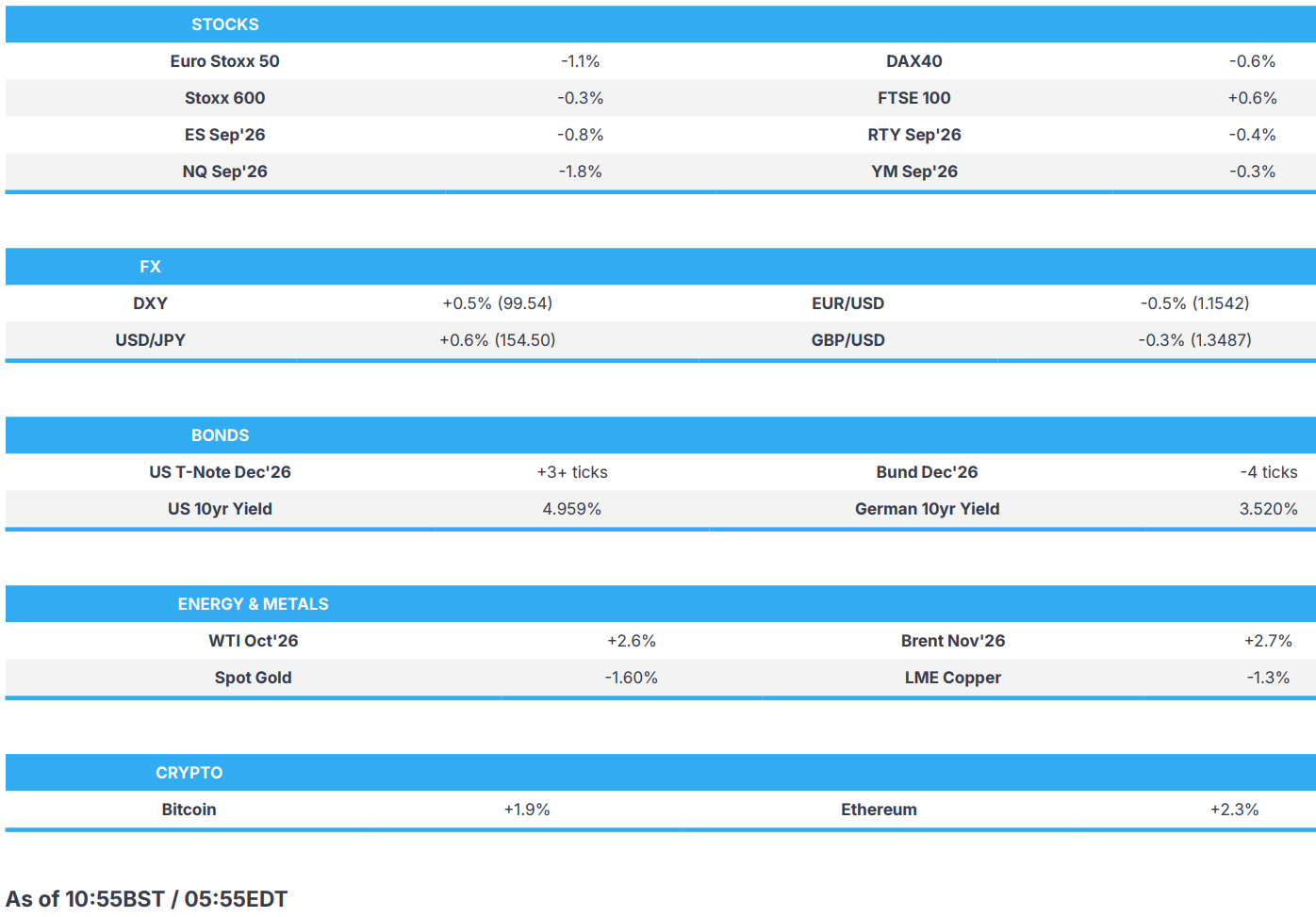
Newsquawk in 3 steps:
1. Subscribe to the free premarket movers reports
2. Listen to this report in the market open podcast (available on Apple and Spotify)
3. Trial Newsquawk’s premium real-time audio news squawk box for 7 days
EUROPEAN TRADE
EQUITIES
- European bourses are broadly lower to start the week, with Italy’s FTSE MIB the underperformer, while the SMI and FTSE 100 print decent gains, helped by updates in the Pharma space. Sectors point to a mixed picture. Health Care tops the sector pile, with Optimised Personal Care and Food, Beverages & Tobacco rounding out the leaders. Tech leads the downside, followed by Basic Resources and Industrials.
- The overnight downside was driven by Anthropic CEO Amodei, urging a slowdown in the development of the most advanced AI systems to prevent AI from slipping beyond human control. The effect this has on semiconductors may be slower capex investment; however, Amodei insists that pacing AI capabilities will not necessarily translate into reduced spending or growth. As a result, SK Hynix and Samsung Electronics slumped overnight (-6.4% and -4.1%, respectively), while ASML is currently down by 5.2%, while US behemoth NVIDIA slides by 2.5% pre-market.
- US equity futures are lower across the board, with the NQ the laggard given the AI woes detailed above. Focus this week will be on the FOMC rate decision, with markets pricing in an 89% chance of a hike.
- Click for the sessions European pre-market equity newsflow
- Click for the additional news
FX
- Snapshot: G10s are lower against the broadly stronger USD, as traders increase their bets on a rate hike this week. JPY is the clear underperformer this morning on widening yield differentials, followed closely by the Kiwi. The Loonie fares a touch better vs peers, thanks to higher energy prices and simmering down in US-Canada tensions; Trump recently downplayed leaving the USMCA, with both countries suggesting that a deal would be found “fairly soon”.
- DXY is stronger this morning and currently trades towards the upper end of a 99.07 to 99.60 range. Much of the upside comes as a number of sell-side banks bring forward their bets of a hike this week; Goldman Sachs the latest to do so. As it stands, money markets assign an 86% chance of a hike this week. There’s not a whole lot on the docket heading into the Wednesday meeting, so the index will likely remain within familiar ranges – though any updates on the geopolitical situation would spur a break in either direction.
- JPY is the clear underperformer this morning on higher expectations that the Fed will join the BoJ in hiking rates this week. Much of the strength in the JPY over the past couple of weeks has been attributed to narrowing yield differentials (hawkish BoJ), and joint intervention worries. Another bout of near-term strength in the JPY would likely require a hawkish BoJ on Friday, and particularly, board members explicitly guiding for a faster pace of rate hikes. Recent source reports have suggested that the Bank could do this. USD/JPY currently holds within a 153.37 to 154.61 range.
FIXED INCOME
- Global fixed benchmarks are mixed. USTs (+3+ ticks) hold afloat, whilst Bunds (-4 ticks) and Gilts (-3 ticks) have been pressured by another bout of strength in the energy complex. For reference, energy benchmarks are moving higher on a) postponement of Iran-Gulf talks on the Strait and b) Saudi shutting a key pipeline.
- USTs remain firmer this morning, and currently hold within a 106-03 to 106-10+ range. Strength which comes despite sell-side banks boosting their bets of a hike this week, and higher energy prices. The environment is clouded by fiscal and geopolitical uncertainty. This is made evident by sustained elevated yields; the US 10-year (4.96%) trades just shy of the 5.00% mark, and a hawkish Fed mid-week will likely see it top that mark.
- Bunds and Gilts have been pressured throughout the European morning as energy benchmarks gradually picked up. Gilts are pressured given their high dependency on external energy, and as traders eye the BoE this week.
- BTPs have steadily fallen throughout the morning and are currently at the lower end of their 111.96-112.57 range. After-hours on Friday, Fitch affirmed Italy at ‘BBB+’; outlook stable. The credit agency commented that the “continued increase in public debt/GDP over the medium term” is a risk that could result in a downgrade. Regarding the upcoming elections, Fitch observed that the “recent political stability has been a positive anchor for Italy’s sovereign rating”, and that the law to switch the proportional electoral system could favour a stable government.
COMMODITIES
- Snapshot: Crude benchmarks are stronger this morning on a) the postponement of the Iran-Gulf nations meeting, and b) Saudi Arabia shutting the East-West pipeline. Spot gold is hampered by a stronger USD, whilst base metals have been dented by the risk-tone.
- To recap the geopolitical environment briefly, Oman postponed the Persian Gulf meeting on Monday, where Iran had planned to formally unveil a temporary shipping lane agreement for the Strait of Hormuz. Axios suggested that Saudi was concerned that the new Strait proposal would effectively establish a new status quo; however, the Iranian FM Spokesperson suggested that the meeting was postponed due to the Yemen-Saudi situation. On the supply front, Saudi shut the East-West pipeline, which reportedly threatens the loss of c. 4% of global supply. Marhelm sources pointed out that repairs could take over a month.
- Given the above, crude benchmarks gapped higher at the open and traded sideways for most of the APAC session. As the European session got underway, the oil complex caught another bid higher (on reports that the IRGC shot down a US drone, and following Iran FM comments). As it stands, Brent Nov’26 (+2.6%) holds at the top end of a USD 106.11/bbl to 108.65/bbl range; WTI Nov’26 (+2.6%) also holds at the upper end of a USD 101.59/bbl to 103.83/bbl range.
- Spot gold (-1.6%) has been hampered by a stronger USD (increased rate hike bets) and higher energy prices. As such, the yellow metal currently sits at the bottom end of a USD 4,279.28/oz to USD 4,355.40/oz range. This week, action for gold will be dictated by any geopolitical developments and the Fed mid-week. Elsewhere, base metals are entirely in the red, given the downbeat risk tone. 3M LME Copper currently trades at the lower end of a USD 14,100-14,236/t range.
- Saudi oil buyers and traders warned the kingdom could run out of oil stocks for exports if it doesn’t restart a major pipeline to the Red Sea within days, which could lead to a loss of up to 4% of global supply.
- Marhelm cited sources within Saudi Arabia that stated the damages to the East-West Pipeline will take over a month to repair due to a lack of spare parts and deeply impacted supply chains. Furthermore, it was stated that minor damages to the pipe have been repaired, but catastrophic damage to pumping infrastructure will take longer to fix.
- Exxon (XOM) executive said that they see US LNG supply growing to make c. 30% of global LNG supply by 2030.
- Shell (SHEL LN) executive said around 36mln tonnes of LNG from the Middle East have been lost to date.
TRADE/TARIFFS
- US President Trump said he’s not worried about Chinese President Xi calling off their summit scheduled for this month, while Japanese media reported that Beijing informed Washington it will cancel the planned summit if any new arms sales to Taipei are approved.
- US President Trump suggested he may be willing to permit a Chinese car company to build EVs in the US if it did so with US workers. It was separately reported that President Trump said the US will lift tariffs on Irish whiskey.
- US President Trump expressed optimism regarding resolving the trade dispute with Canada soon and downplayed prospects of leaving the USMCA, while Trump took verbal jabs at Europe regarding trade and immigration during his Ireland visit.
- Canadian PM Carney is set to meet with UK PM Burnham as Canada deepens its relations with Europe, while Carney proposed that Canada should become the EU’s first ‘associate member’, and the bloc is said to be open to the idea.
NOTABLE EUROPEAN HEADLINES
- Exit polls showed that Sweden’s centre-left opposition is on course for an election win in a blow to the far-right, while broadcaster SVT’s revised projections suggest the opposition bloc is on course to win 175 seats and the incumbent right-wing bloc is on course to win 174 seats.
- Swedish election is reportedly too close to call as total count may take days.
- Fitch affirmed Italy at ‘BBB+’; outlook stable.
NOTABLE EUROPEAN DATA RECAP
- Swedish CPIF Final (Aug YY) 0.7% vs. Exp. 0.7% (Prev. 0.7%).
- Swedish CPIF Final (Aug MM) -0.3% vs. Exp. -0.3% (Prev. -0.3%).
CENTRAL BANKS
- ECB President Lagarde said the current inflation shock is longer-lasting, with the volatility and pressure on energy prices to continue amid the conflict in the Middle East.
- ECB’s Kazaks said the case is building for more tightening and the ECB can afford to act stepwise without rushing.
- ECB’s Simkus said he cannot exclude action at any meeting, adding that December is a natural time to assess the situation more.
- ECB’s Kazimir said all options will be considered for the next decision, but action will be taken if necessary.
NOTABLE US HEADLINES
- US House Speaker Johnson said US President Trump’s proposed USD 5,000 dividend for every US adult would require congressional approval, contradicting Trump’s claim that the payments can be made without authorisation.
GEOPOLITICS
MIDDLE EAST
- US President Trump said Iran-backed Houthis asked the US not to target them, while Trump reiterated that he expects the Iran war to end this year, possibly after the Midterms, but also suggested that the US could stay in Iran and keep the oil, like the Venezuela deal.
- Iran’s Foreign Ministry Spokesperson said that Saudi Arabia insisted that the meeting between Iran and Gulf nations in Oman not to take place and it will be postponed to another date due to the Yemen situation. The spokesperson added that the MoU between Iran and Oman is the result of weeks of intensive negotiations and was drafted with full respect for the sovereign rights of the two countries. On the situation in Iran, Baghaei said Iran has no interference in Yemen and denied any participation in the attacks on a Saudi oil pipeline. On the reports about nuclear activity in Pickaxe mountain, he called them “baseless”.
- Oman postponed the Persian Gulf Foreign Ministers meeting for an indefinite period. This was later confirmed by Iran.
- Oman’s Energy Minister said the Strait of Hormuz will be open and it’s probably a short-term situation, while he is pleased Oman is still able to continue producing oil and gas. Furthermore, he stated that skyrocketing oil and LNG prices are not sustainable and the situation should stabilise in the medium-term.
- Iran’s Akbari said “The Iranian route can be a sustainable alternative to the Red Sea route and ensure the connection of Asia, India, China and Singapore to Europe in times of crisis”
- Iran’s PGSA published an updated list of 77 vessels allegedly violating Iranian Strait of Hormuz protocols. The listed vessels could face future passage restrictions, including fines, detention or confiscation. Vessels cooperating with sanctioned ships will also be added to the list.
- Houthi Spokesperson claimed the attack on Saudi’s King Khaliq Air base, stating “The Armed Forces will continue to carry out significant military operations towards Saudi territory as long as it continues its unjust aggression against our people”.
- Saudi Crown Prince met the US CENTCOM chief to discuss the latest regional developments, according to Saudi state TV.
- Saudi civil defence issued emergency alerts for Khamis Mushait, Abha City, Jizan region and Najra province but said the danger has passed.
- Saudi Yanbu oil exports were halted after a pipeline attack, while weekend reports noted multiple explosions struck Saudi Arabia’s Yanbu Industrial City on Sunday.
RUSSIA-UKRAINE
- US President Trump said he warned Ukrainian President Zelensky to stop targeting Russian oil refineries as strikes have shut down diesel refining and helped lift prices of the fuel to record levels.
OTHER
- US President Trump said he could settle the UK-Argentina dispute regarding the Falklands, while he separately commented that he would love to see Ireland unified.
- North Korea fired multiple short-range ballistic missiles towards its east coast on Saturday.
CRYPTO
- Bitcoin surged at the start of Asian trade and currently resides just shy of its USD 78.24k peak despite the risk-off tone.
APAC TRADE
- APAC stocks were ultimately mixed after gradually improving from the initial risk-off mood seen at the start of the session, which had been triggered by AI-related selling after key industry executives called for a slowdown in AI development. There were also headwinds from the conflict in the Middle East after Saudi Arabia shut its East-West Pipeline following drone attacks last week, which threatens the loss of 4% of global supply, while Oman postponed the Persian Gulf meeting on Monday, where Iran had planned to formally unveil a temporary shipping lane agreement for the Strait of Hormuz.
- ASX 200 was kept afloat in range-bound trade amid resilience in defensives and the consumer sectors, while there were some comments from RBA Assistant Governor Hunter, who stated that Australian household spending is holding up okay and business investment is showing signs of strength, but also noted inflation remains above target.
- Nikkei 225 slumped at the open amid notable losses in Kioxia and with SoftBank dropping by double-digit percentages owing to its heavy AI exposure, although the index is well off today’s worst levels amid mixed yields in Japan and with the TOPIX index in the green.
- KOSPI underperformed amid losses in semiconductor heavyweights, while today marks the start of the Korea Exchange extending trading hours to allow stock trading until 8pm local time.
- Hang Seng and Shanghai Comp pared opening losses and moved into the green, but with upside capped ahead of tomorrow’s activity data, while US President Trump said he is not worried about Chinese President Xi cancelling their planned summit after reports that Beijing informed Washington it will cancel the planned summit if any new arms sales to Taipei are approved.
NOTABLE ASIA-PAC HEADLINES
- PBoC plans to expand the yuan offshore market and will consider expanding the central bank’s macroprudential and financial stability roles, adding that they will innovate macroprudential policy tools and support steady economic recovery and growth.
NOTABLE APAC DATA RECAP
- Chinese Outstanding Loan Growth (Aug YY) 4.9% vs. Exp. 5.1% (Prev. 5.1%).
- Chinese M2 Money Supply (Aug YY) 7.5% vs. Exp. 7.6% (Prev. 7.7%).
- Chinese Total Social Financing (Aug) 1660.0B vs. Exp. 2040B (Prev. 1410.0B).
- Chinese New Yuan Loans (Aug) 60.0B vs. Exp. 400B (Prev. -340.0B).
- Japanese Industrial Production Final (Jul YY) 3.9% (Prev. 4.9%).
- Japanese Industrial Production Final (Jul MM) -0.2% vs. Exp. 0.1% (Prev. 1.9%).
1 c) Asian opening report
Crude rises on geopolitics whilst APAC sees AI-related selling – Newsquawk EU Market Open
Monday, Sep 14, 2026 – 01:45 AM
- Crude futures began the week higher, with Saudi Arabia shutting its East-West Pipeline following attacks last week.
- Oman postponed the Persian Gulf meeting on Monday, where Iran had planned to formally unveil a temporary shipping lane agreement for the Strait of Hormuz.
- US President Trump said he warned Ukraine to stop targeting Russian oil refineries, as strikes have shut down diesel refining and helped lift prices of the fuel to record levels.
- AI-related selling was seen in APAC stocks after key industry executives called for a slowdown in AI development.
- APAC stocks were ultimately mixed after gradually improving from the initial risk-off mood seen at the start of the session; Europe is poised to open subdued.
- Looking ahead, highlights include the Swedish CPIF Final (Aug), Canadian CPI (Aug). Speakers include ECB’s Schnabel, Cipollone & Lagarde.
Newsquawk in 3 steps:
1. Subscribe to the free premarket movers reports
2. Listen to this report in the market open podcast (available on Apple and Spotify)
3. Trial Newsquawk’s premium real-time audio news squawk box for 7 days
SNAPSHOT
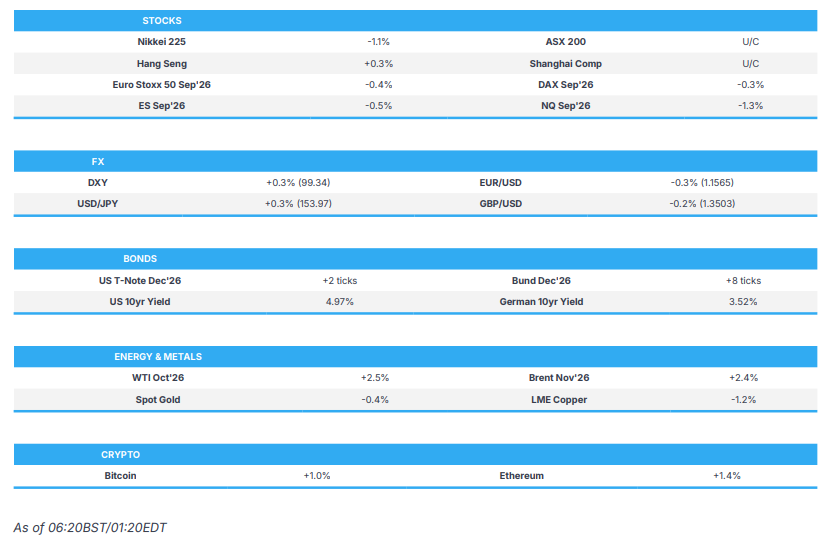
LOOKING AHEAD
- Highlights include the Swedish CPIF Final (Aug), Canadian CPI (Aug). Speakers include ECB’s Schnabel, Cipollone & Lagarde.
- Click for the Newsquawk Week Ahead.
IRAN CONFLICT
- US President Trump said Iran-backed Houthis asked the US not to target them, while Trump reiterated that he expects the Iran war to end this year, possibly after the Midterms, but also suggested that the US could stay in Iran and keep the oil, like the Venezuela deal.
- US Energy Secretary Wright downplayed prospects of a breakthrough in the Strait of Hormuz as Iran planned to pitch other Gulf countries on a deal for passage through the key waterway.
- Iran had planned to formally unveil an agreement on a temporary shipping lane for the Strait of Hormuz on Monday, although it was reported that Oman postponed the Persian Gulf Foreign Ministers meeting for an indefinite period. Furthermore, Iran confirmed that the meeting was postponed at the request of regional countries.
- Iranian source said the understanding between Iran and Oman does not provide an immediate reopening of the Strait of Hormuz, although it establishes the basis on which it could reopen.
- Oman’s Energy Minister said the Strait of Hormuz will be open and it’s probably a short-term situation, while he is pleased Oman is still able to continue producing oil and gas. Furthermore, he stated that skyrocketing oil and LNG prices are not sustainable and the situation should stabilise in the medium-term.
- Iran’s President Pezeshkian met with Abu Dhabi’s Crown Prince on the sidelines of the BRICS summit, as Iran touted a deal to permit more ships through the Strait of Hormuz.
- Local sources reported the sound of several missiles being fired from Iran’s Sirik, which were linked to Hormuz Strait operations, although there has been no official confirmation regarding the incident, according to SNN.
- UKMTO said early on Sunday that a vessel was struck by an unknown projectile while transiting the Strait of Hormuz. It was separately reported that an Iranian commercial vessel was struck off Qeshm Island early on Saturday, which killed one person and wounded three others.
- Saudi Arabia shut the East-West pipeline that bypasses Hormuz following attacks on Thursday, while the drone attack was said to have been launched from Iraq.
- Saudi Yanbu oil exports were halted after a pipeline attack, while weekend reports noted multiple explosions struck Saudi Arabia’s Yanbu Industrial City on Sunday.
- Sirens sounded in four Saudi cities following a Yemeni strike, according to Tasnim.
- Saudi Foreign Minister held a call with his UAE counterpart to discuss regional developments and de-escalation efforts, while it was also reported that Qatar’s PM and Foreign Minister held a call with Kuwait’s Foreign Minister to discuss the regional situation and coordination on diplomatic efforts to ease tensions, as well as support security and stability in the region.
- Iraq is said to be moving to contain a fallout from the attack that caused a closure of Saudi Arabia’s East-West pipeline, after reports noted that the strikes were found to have been launched from inside Iraq.
- Yemeni government forces have reportedly retaken positions west of Taiz that were previously infiltrated by Houthis and have advanced towards the Jir Bani Omar area as part of operations to expel Houthis from Taiz province.
US TRADE
EQUITIES
- US stocks gained on Friday, with broad-based strength seeing the SPX, NDX and DJI rise by around 1%, while the equal-weight S&P gained c. 0.8%. The majority of sectors finished higher, with Communication Services, Technology and Consumer Discretionary outperforming, while Utilities, Health Care and Energy lagged; Utilities and Health Care were the only sectors to close in the red. Sentiment was initially supported by Oracle (ORCL) earnings released after-hours on Thursday, although the stock ultimately faded its gains and closed the session lower. The highlight of the session was the US CPI report. The majority of metrics were in line with expectations, although core CPI rose 0.3% M/M, above the 0.2% forecast. The hotter-than-expected core print saw markets price a 25bps Fed rate hike in the week ahead with greater conviction, with the implied probability rising to around 86% from 70% pre-data, while several banks revised their calls from a hold to a hike. The initial reaction to the data was hawkish, with equities, T-notes and gold coming under pressure while the Dollar rallied. However, much of the initial move subsequently reversed. The Dollar finished broadly flat, gold erased its losses to close higher, while equities more than recovered their post-data weakness and finished firmly in the green. The Treasury curve ultimately flattened, with front-end yields rising while the long end was little changed.
- SPX +0.83% at 7,655, NDX +0.91% at 29,368, DJI +0.98% at 52,573, RUT +0.40% at 2,903.
- Click here for a detailed summary.
TARIFFS/TRADE
- US President Trump said he’s not worried about Chinese President Xi calling off their summit scheduled for this month, while Japanese media reported that Beijing informed Washington it will cancel the planned summit if any new arms sales to Taipei are approved.
- US President Trump suggested he may be willing to permit a Chinese car company to build EVs in the US if it did so with US workers. It was separately reported that President Trump said the US will lift tariffs on Irish whiskey.
- US President Trump expressed optimism regarding resolving the trade dispute with Canada soon and downplayed prospects of leaving the USMCA, while Trump took verbal jabs at Europe regarding trade and immigration during his Ireland visit.
- Canadian PM Carney is set to meet with UK PM Burnham as Canada deepens its relations with Europe, while Carney proposed that Canada should become the EU’s first ‘associate member’, and the bloc is said to be open to the idea.
- Philippines halted exports of fresh purple yam amid a rise in global demand.
NOTABLE HEADLINES
- US President Trump reiterated that the US should have the lowest interest rates in the world.
- White House economic advisor Hassett said they will 100% support what the Fed decides on rates.
- US House Speaker Johnson said President Trump’s proposed USD 5,000 dividend would require congressional approval, contradicting Trump’s claim that payments can be made without authorisation.
- Anthropic’s CEO said “we need to slow down” AI developments, while OpenAI’s CEO and SpaceX’s CEO agreed with the Anthropic chief’s view.
- NVIDIA (NVDA) plans to invest up to USD 10bln in the Anthropic IPO, with the latter seeking to raise USD 100bln at a USD 2tln valuation.
- OpenAI CEO Altman said the company will not conduct an IPO this year and will prioritise safety.
APAC TRADE
EQUITIES
- APAC stocks were ultimately mixed after gradually improving from the initial risk-off mood seen at the start of the session, which had been triggered by AI-related selling after key industry executives called for a slowdown in AI development. There were also headwinds from the conflict in the Middle East after Saudi Arabia shut its East-West Pipeline following drone attacks last week, which threatens the loss of 4% of global supply, while Oman postponed the Persian Gulf meeting on Monday, where Iran had planned to formally unveil a temporary shipping lane agreement for the Strait of Hormuz.
- ASX 200 was kept afloat in range-bound trade amid resilience in defensives and the consumer sectors, while there were some comments from RBA Assistant Governor Hunter, who stated that Australian household spending is holding up okay and business investment is showing signs of strength, but also noted inflation remains above target.
- Nikkei 225 slumped at the open amid notable losses in Kioxia and with SoftBank dropping by double-digit percentages owing to its heavy AI exposure, although the index is well off today’s worst levels amid mixed yields in Japan and with the TOPIX index in the green.
- KOSPI underperformed amid losses in semiconductor heavyweights, while today marks the start of the Korea Exchange extending trading hours to allow stock trading until 8pm local time.
- Hang Seng and Shanghai Comp pared opening losses and moved into the green, but with upside capped ahead of tomorrow’s activity data, while US President Trump said he is not worried about Chinese President Xi cancelling their planned summit after reports that Beijing informed Washington it will cancel the planned summit if any new arms sales to Taipei are approved.
- US equity futures declined at the open with underperformance in the Emini Nasdaq 100 after Anthropic CEO Amodei called for the slowdown of AI development, while OpenAI CEO Altman and SpaceX CEO Musk agreed with Amodei’s view.
- European equity futures indicate a lower cash market open with Euro Stoxx 50 futures down 0.4% after the cash market closed with gains of 0.9% on Friday.
FX
- DXY gained amid higher oil prices and the early spooked sentiment, while participants look ahead to this week’s key central bank rate decisions beginning with the FOMC mid-week, with money market pricing leaning towards a hike. Furthermore, there were some mixed comments from the administration as US President Trump reiterated that the US should have the lowest interest rates in the world, while White House economic advisor Hassett said they will 100% support what the Fed decides on rates.
- EUR/USD retreated further beneath the 1.1600 handle amid the dollar strength and after failing to benefit from recent hawkish comments from ECB officials, including Lagarde, who stated the current inflation shock is longer-lasting, while ECB’s Kocher warned high oil prices could force the central bank to continue hiking rates.
- GBP/USD was lacklustre as participants await UK inflation data on Wednesday and the BoE rate decision on Thursday, with the latter expected to stand pat, while there was quiet weekend newsflow from the UK, although there were comments from US President Trump that he could settle the UK-Argentina dispute regarding the Falklands and that he would love to see Ireland unified.
- USD/JPY edged higher and returned to above the 154.00 level amid the upside in oil prices and despite a widely anticipated BoJ rate hike scheduled later in the week.
- Antipodeans retreated amid a firmer buck and as risk sentiment was pressured at the start of trade, while there were also declines seen in metal prices.
- PBoC set USD/CNY mid-point at 6.7698 vs Exp. 6.7083 (prev. 6.7743)
FIXED INCOME
- 10yr UST futures eked out slight gains in otherwise uneventful trade, with upside limited amid higher oil prices and as participants await the rate decision from the Fed this week, while US President Trump reiterated his call for the US to have the lowest interest rates in the world.
- Bund futures traded marginally higher and got some reprieve from last week’s selling pressure, but with the rebound contained following hawkish rhetoric from ECB officials.
- 10yr JGB futures conformed to the slightly positive performance in global counterparts, albeit with price action somewhat choppy ahead of the key rate decisions from the Fed and BoJ, with money markets heavily leaning towards both central banks hiking rates.
COMMODITIES
- Crude futures began the week higher as the conflict in the Middle East continues to threaten global energy supplies, with Saudi Arabia shutting its East-West Pipeline following attacks last week, which risks the loss of 4% of global supply, while it was also reported that Oman postponed the Persian Gulf Foreign Ministers meeting, where Iran had planned to formally unveil an agreement on a temporary Hormuz shipping lane.
- Saudi oil buyers and traders warned the kingdom could run out of oil stocks for exports if it doesn’t restart a major pipeline to the Red Sea within days, which could lead to a loss of up to 4% of global supply.
- Marhelm cited sources within Saudi Arabia that stated the damages to the East-West Pipeline will take over a month to repair due to a lack of spare parts and deeply impacted supply chains. Furthermore, it was stated that minor damages to the pipe have been repaired, but catastrophic damage to pumping infrastructure will take longer to fix.
- Iraq kept its October Basrah medium crude official selling price to Asia unchanged at parity to the Oman/Dubai average.
- Spot gold mildly declined after last week’s post-CPI whipsawing and as participants await the FOMC.
- Copper futures retreated with demand hampered alongside the early negative mood across the region and with the focus this week on major central bank rate decisions.
CRYPTO
- Bitcoin gradually advanced after climbing back above the USD 77,000 level.
NOTABLE ASIA-PAC HEADLINES
- Chinese President Xi used the BRICS summit as a platform for laying out Beijing’s vision for AI and said that China will lead the creation of a BRICS ‘community’ for open-source AI.
- Chinese President Xi held a bilateral meeting with Indian PM Modi in a signal of a reset of ties between the two countries.
- China called on state-owned enterprises to sharpen overseas investment strategies and strengthen security safeguards.
- Japan’s government is considering subsidising defence equipment production.
- Japan’s GPIF could sell as much as USD 62bln of US Treasuries without a formal revamp of its asset allocation policy, according to analysts at Banco Santander.
GEOPOLITICS
RUSSIA-UKRAINE
- US President Trump said he warned Ukrainian President Zelensky to stop targeting Russian oil refineries as strikes have shut down diesel refining and helped lift prices of the fuel to record levels.
- Ukrainian President Zelensky’s chief of staff said Kyiv is preparing for trilateral talks to resume in October.
- Ukraine struck Russian refineries as Russia targeted ports in Odesa, while Ukraine said a Russian drone struck a passenger train headed to Warsaw near the Ukrainian-Polish border and that Russia also attacked a truck near Ukraine’s border with Poland.
- Russian state nuclear energy corporation head accused Ukraine of attacking diesel fuel trucks and endangering the Zaporizhzhia nuclear plant.
- Russia’s Kremlin said Indian PM Modi and Chinese President Xi offered their services for Ukrainian peace talks, according to TASS.
OTHER
- US President Trump said he could settle the UK-Argentina dispute regarding the Falklands, while he separately commented that he would love to see Ireland unified.
- North Korea fired multiple short-range ballistic missiles towards its east coast on Saturday.
EU/UK
NOTABLE HEADLINES
- UK faces a GBP 258bln infrastructure spending gap, according to FT citing a report on the state of Britain’s infrastructure.
- Exit polls showed that Sweden’s centre-left opposition is on course for an election win in a blow to the far-right, while broadcaster SVT’s revised projections suggest the opposition bloc is on course to win 175 seats and the incumbent right-wing bloc is on course to win 174 seats.
- Swedish election is reportedly too close to call as total count may take days.
- Bank of France issued a statement denying it sold debt holdings on the market, as it faces increasing criticism from presidential candidate Melenchon and his far-left party.
- Italy’s Economy Minister said they need to keep public finances in check as the ECB hikes rates.
- ECB President Lagarde said the current inflation shock is longer-lasting, with the volatility and pressure on energy prices to continue amid the conflict in the Middle East.
- ECB’s Kocher warned that high oil prices could force the central bank to continue hiking rates.
2.NORTH AND SOUTH KOREA/
SOUTH KOREA//NORTH KOREA
SOUTH KOREA
JAPAN
JAPAN/
3. CHINA/
CHINA/TAIWAN
PLA Purge May Be Driving China To Rely More On Military Pressure Against Taiwan: Analysts
Friday, Sep 11, 2026 – 10:35 PM
Authored by Michael Zhuang via The Epoch Times,
China’s purge of senior military leaders may be pushing Beijing to rely more heavily on military intimidation and gray-zone operations against Taiwan, even as the upheaval leaves the Chinese military with a weakened command structure, according to two Chinese academics and an insider familiar with the Chinese military.

The insider and academics spoke to The Epoch Times on condition of anonymity out of fear of reprisal.
The developments are raising concerns that Beijing’s increasingly aggressive operations around Taiwan could become more difficult to control as analysts say political loyalty takes precedence over military expertise within the People’s Liberation Army (PLA).
Taiwan’s Defense Ministry has reported near-daily Chinese military activity around the island, describing the operations as increasingly aggressive and unpredictable, according to Taiwan’s national news agency CNA. Chinese military planners are studying drone swarms, long-range strikes, ammunition consumption, maritime blockades and coordination with other countries, while exploring methods that could potentially isolate Taiwan, cut off outside supplies, and weaken its defenses during the early stages of a conflict.
At the same time, the PLA is undergoing an unusually extensive leadership purge. The seven-member Central Military Commission (CMC), which formally oversees China’s armed forces, is down to just two members.
A Chinese military academic told The Epoch Times that the continuing purge suggests Xi remains deeply concerned about the loyalty of senior military commanders.
“The CMC has had so many people fall. There are already very few military members of the Central Committee,” he said. “The possibility of war is not very high, but the harassment [against Taiwan] will not stop.”
Military Pressure Continues
The academic said the purge has created serious gaps in the military command structure at a time when Beijing continues to use military pressure against Taiwan.
He said former CMC Vice Chairman Zhang Youxia had been authorized to oversee simulated training for operations against Taiwan and that it would be difficult to find a replacement with comparable experience.
“At present, the pressure on Taiwan is concentrated on military intimidation,” the academic said. “If they give up intimidation, they simply cannot come up with a better method.”
The leadership turmoil has unfolded alongside a series of high-level purges. In October last year, nine senior military officers, including CMC Vice Chairman He Weidong, were expelled from the Chinese Communist Party (CCP) and the military.
In January, the Chinese regime announced investigations into Zhang Youxia and Liu Zhenli, chief of the CMC’s Joint Staff Department.
The academic said the military could be experiencing an unusually broad leadership vacuum ahead of the CCP’s 21st National Congress next year.
The leadership upheaval does not necessarily mean that Beijing is preparing to launch an invasion of Taiwan. Instead, military pressure could continue precisely because it is one of the few tools available to a command structure weakened by political purges, according to the academic.
Chinese military activity around Taiwan has increasingly extended beyond conventional military exercises. Beijing has also been combining military drills, combat-readiness patrols and China Coast Guard operations, creating pressure that remains between ordinary peacetime activity and open warfare.
Taiwan’s National Security Bureau Director-General Tsai Ming-yen told reporters in July that the months of July through September are typically a period of heightened Chinese military exercises. Taiwan had detected increased activity by the Chinese navy and other maritime forces, including four Chinese naval formations operating in the western Pacific at the time.
A Chinese military academic and researcher told The Epoch Times that Beijing was increasingly integrating military exercises with combat-readiness patrols and coast guard enforcement.
The approach allows China to maintain sustained pressure on Taiwan without crossing the threshold into open conflict, the researcher said.
He cautioned, however, that the pattern should not necessarily be interpreted as preparation for an imminent attack.
“If [the CCP] wants to launch military action against Taiwan, [it] needs to first carry out war mobilization, deploy logistical support, and even more importantly, have powerful offensive weapons and a strong and effective command system,” he said.
Potential Blockade
Taiwan’s Defense Ministry has assessed that China does not yet possess all the capabilities required for a full-scale amphibious invasion of Taiwan. But Beijing has other options, including maritime isolation, a joint blockade, missile strikes, cyberattacks, and information warfare.
A blockade or maritime isolation campaign could require fewer forces than a full-scale invasion and could be conducted under the cover of military exercises or law-enforcement operations, according to researchers who spoke to The Epoch Times.
That creates a dilemma for Taiwan. If Taipei does not respond, Beijing could gradually expand its control over surrounding waters. If Taiwan responds militarily, Beijing could portray Taipei as the party responsible for escalating tensions.
Taiwanese President Lai Ching-te said on Sept. 2 that Taiwan’s defense budget for next year would exceed NT$1 trillion ($32 billion) for the first time, according to CNA. The government plans to invest in unmanned systems, AI, and Taiwan’s domestic defense industry.
The Chinese military researcher said the continued expansion of Chinese military and maritime operations around Taiwan is reducing the island’s warning time.
The greater concern, he said, is not a deliberate decision by Beijing to start a war, but the possibility that an incident could escalate when military judgment is compromised by political considerations.
For Taiwan, he said, that makes continued vigilance essential.
Shi Youliang contributed to this report.
end
CHINA/OIL DEMAND//
China’s 70% EV Target Deals Another Blow To Oil Demand
Saturday, Sep 12, 2026 – 07:50 PM
Authored by Tsvetana Paraskova via OilPrice.com,
China aims to have electric and hybrid vehicles account for as much as 70% of all passenger car sales by 2030, in a massive transport shift set to further dent oil demand for road fuels.

As of the end of last year, the share of the so-called new energy vehicles was 54% of all passenger vehicle sales.
In the new five-year plan for the automotive industry compiled by nearly a dozen Chinese government agencies, China also targets to have 40% of new commercial vehicle sales be electric by 2030.
The 70% target by 2030 could even be achieved earlier than planned, analysts say, as this year’s oil and fuel price shock is accelerating the shift to electric vehicles.
EVs and hybrids accounted for 65% of China’s total passenger car sales in August, according to data by the local Passenger Car Association (PCA) cited by Bloomberg.
The ambitious EV targets are expected to continue eroding road fuel demand in China, which has been falling for the second year in a row. This year, the decline has been steeper amid the energy price shock following the start of the war in Iran.
Chinese state refiners expect continued declines and prepare for the future of plateauing and falling road fuel demand.
For example, China’s Sinopec, the world’s top refiner by capacity, expects Chinese oil demand to drop by 8.9% in 2026 from a year earlier amid demand destruction from higher oil prices and the acceleration of electric vehicle adoption. Gasoline demand is set for an 8.7% decline, while diesel consumption is expected to crash by 11.4%, Sinopec Economics & Development Research Institute says.
The high oil prices destroyed some demand and sped up the adoption of EVs, which has been growing anyway in recent years, suppressing total oil demand even without blocked crude supplies in the Middle East.
end
4. EUROPEAN AND SCANDINAVIAN COMMENTARIES PLUS NATO
UK
Is Britain Abandoning Military Defense To Fund More Socialism?
Monday, Sep 14, 2026 – 02:45 AM
It’s a curious position for European governments; for the past few years they have been rattling their sabers over the Russian war in Ukraine, calling for boots on the ground. It’s the kind of intervention that would automatically trigger WWIII. Yet, these same governments are completely unprepared in terms of military spending, armament and training.
When the British government refused to join the US blockade against Iran in the Strait of Hormuz, almost no one cared because the British have allowed their navy to decay into irrelevance. Twenty years ago, they had nearly 50 active fighting vessels and today they are down to 22 vessels. Britain’s GDP per capita is currently lower than the state of Alabama. And, they keep importing thousands upon thousands of third world migrants, with the vast majority relying on taxpayer funded subsidies.
When given a choice between funding the British military or funding more immigrants, the government has chosen to fund more immigrants. Britain has increased welfare spending by 16% in the past 5 years alone.

A year ago the Brits, under pressure from the Trump Administration, took steps to expand their defense budget in order to better meet an increase in NATO obligations. Multiple European countries have been avoiding these obligations for a long time, instead relying on the US to foot the bill while they enjoyed extra cash to spend on subsidized programs. However, the British increase in their defense budget doesn’t mean much if the military is not actually allowed to spend any money.
The British Army has been ordered to pause most “non-essential” collective training (large live-fire drills, tank/Apache exercises, etc.) for UK-based units that are on standby (only 4% of British units are actually deployed). The immediate reason is a shortage of cash in the Ministry of Defence’s day-to-day resource budget (RDEL). Fuel and ammunition prices have risen faster than planned, meaning routine training budgets drawn up years earlier no longer cover the same activity.
Their defense budget expansion is not even keeping up with inflation. Leftists in the UK, of course, blame Trump. But inflation in Europe hit well before Trump returned to office and the lack of accountability on the part of British progressives is not going to save them from the fallout.
Military officials warned two years ago that British training standards were outdated by a decade. In June of this year, Defense Secretary John Healey quit after government refusals to provide adequate funding for training.
Healey is now the Chancellor, and he’s due to present a budget in October that still has yet to find roughly £1.4 billion a year for the next three years to fund a plan stays within the government’s fiscal rules. The military is required to create a budget without diverting money from health or education programs. The training pause is a short-term cash-management measure – Longer-term funding questions remain unresolved.
An easy way to stockpile significant funding for British defense would be to stop all immigration and remigrate millions of third world residents who are feeding on government welfare. But this is something the current leadership will never do. Multiculturalism is their priority, for reasons that remain a mystery.
On the bright side, less funding and less capability for Europe’s armies means a lesser chance that they will be shipped off to Ukraine to start a world war.
END
FRANCE
Foreigners Responsible For 87% Of Thefts, 61% Of Sexual Violence On Paris Public Transport
Monday, Sep 14, 2026 – 02:00 AM
Foreigners account for a massive share of thefts, sexual violence, and robberies on Paris public transport in 2025, according to new government data.

According to compilations from the SSMSI data files, foreigners accounted in 2025 for 87 percent of simple thefts on Île-de-France public transport, 60 percent of robberies, and 38 percent of physical assault.
In addition, foreigners account for 61 percent of sexual violence cases on Paris public transport and its surrounding regions.
National figures for foreigners committing crimes on public transport are lower but still high, approximately 76 percent of simple-theft suspects are foreigners and 71 percent of all theft suspects are foreigners.
Some groups are highly overrepresented among foreigners.
Maghrebi nationals, for instance, account for about 40 percent of theft suspects in transport nationwide, while making up roughly 2 percent of the national population, according to data analyst Marc Vanguard.
INSEE’s latest estimate puts foreigners at 9.1 percent of France’s population in 2025, or around 6.3 million people. Their share is higher in Île-de-France, especially in the multicultural Seine-Saint-Denis department, but the crime for foreigners is still disproportionately high. In total, police and gendarmerie recorded 104,880 victims of theft, violence, or payment fraud in public transport nationwide in 2025, down 2 percent from 2024 and 22 percent from 2016 – the lowest level in a decade, including the pandemic years.
Theft without violence still accounts for 77 percent of those victims. Thefts and payment frauds fell but recorded physical and sexual violence rose slightly, jumping 3 percent. Drug-use and trafficking suspects in transport rose another 5 percent after the sharp Olympic-year jump in 2024.
It should be noted that among the “French” perpetrators, their potential migration background is not recorded. There are approximately 10 million people in France with a foreign background, including second-generation citizens with a migration background. As a result, a French citizen who is an ethnic Algerian, for instance, would be recorded as a French perpetrator in all crime statistics. France does not keep data on the race of crime suspects, as required by national law.
More broadly speaking, there are estimates that foreigners and French citizens with a migration background account for two out of three crimes in France.
END
SWEDEN
Sweden Discovers That Deporting Immigrant Gangsters Reduces Crime…
Saturday, Sep 12, 2026 – 02:00 PM
Authored by Mike McDaniel via AmericanThinker.com,
Among the things a police career taught me is that a small number—usually single digits—of felons commit most felonies. They’ll draw in other criminals, involve them in their crimes, and when convenient, abandon them to arrest. There is no honor among thieves. And the number of the most prolific felons increases and decreases slightly from place to place, and in relation to the specific type of crime.
In some places, crooks specialize in home or business burglaries. In others, specialization might involve burglarizing vehicles or carjacking.
But one thing is certain: take these small bands of crooks out of circulation, and the number of their crimes in those areas immediately, dramatically plummets. The trick is identifying the crooks and rolling them over on each other. Catch some in the act or with the evidence, and the second part is usually easier than the first. When they’re put away, innumerable people we’ll never know don’t end up as victims.
Of course, these kinds of positive results also rely on prosecutors willing to prosecute and judges willing to keep criminals in jail and hand down realistic sentences. That’s a real issue in blue cities and states.
Now it seems Sweden is discovering this reality, particularly where gang-committed, immigrant crime is involved. And it’s about time too. Reports out of Sweden, which has shown suicidal empathy for third-world barbarians, indicate that hand grenade(?!) attacks have become common. At PJ Media, Stephen Green explains:
So Sweden elected a conservative prime minister four years ago who promised to send criminal migrants back to their home countries, and you’ll never believe what happened next.
Violent crime went down. Way down. Particularly gang violence, according to a new report out this week.
Imagine that.

Graphic: X Post
When he campaigned for the PM spot in 2022, Ulf Kristersson — then a member of the Swedish parliament or riksdag — said of violent acts: “If you commit such crimes in Sweden and are not a Swedish citizen, you should be thrown out of the country.”
Apparently, Swedes got tired of dodging grenades and having their women raped.
By the summer of ’22, escalating gang shootings and even bombings were commonplace in what had once been a country better known for spas than jihads. In total, Sweden suffered 361 shootings, 62 shooting deaths, and 90 bombings. The problem with migrant gangs escalated so quickly that Swedish authorities didn’t bother to record bombings until 2018.
By the last election, even the governing soft-on-crime Social Democrats promised tougher measures, but that wasn’t enough to stop Kristersson from putting together a coalition big enough to oust the SD.
Sweden didn’t bother to report bombings until 2018? That’s terminal suicidal empathy, but the Swedes had enough. They better funded the police, did more wiretapping, and directly focused on stopping gang recruitment among the young.
As it turns out — and again, you won’t be shocked by this — sending foreign criminals home is just as effective as locking up homegrown thugs. But the numbers must be seen to be believed.
Shootings are down “by 80 per cent since their 2022 peak,” the Financial Times reported on Monday, and Kristersson reduced “the number of asylum seekers to its lowest in four decades.”
It was apparently a huge deal earlier this year when one Swedish paper reported “No shootings in May.”
“The fact that you have headlines saying no shootings at all this month: it says something,” Kristersson told the FT.
Sadly, the national tendency toward suicide may once again assert itself:
Still, Sweden holds another national election on Sunday, and the Social Democrats could very well take power again. “There’s a lot of discussion about the Winston Churchill effect,” Mattias Karlsson, the nationalist Sweden Democrats’ chief ideologue, said.
Having all but won the war, will Swedish voters reject the man who got them this far?
The “Churchill effect” refers to what happened to Winston Churchill after WWII. Without him, England likely would have fallen to the Nazis. He was, during the war, the indispensable man, but once the war was won, he was put out to pasture, and the kinds of political forces that would have lost the war wormed their way back into power.
Having once again discovered the benefits of national sanity, Will Sweden fall back into leftist delusion and defeat? Perhaps there’s a lesson there for our midterms and beyond.
END
UK
Bank Of England Spends £85k Researching How Best To Erase Churchill
Monday, Sep 14, 2026 – 07:45 AM
Authored by Steve Watson via Modernity News,
The Bank of England has spent more than £85,000 of research money to justify wiping Winston Churchill, Jane Austen, J.M.W. Turner and Alan Turing off Britain’s banknotes and swapping them for hedgehogs, foxes and puffins.

A Freedom of Information trail shows Savanta was paid £49,000 to run focus groups that told officials historical figures were “elitist and divisive.”
Another £22,500 went on public consultations about which animals should replace them. The Bank called the result a “positive evolution,” not censorship.
The October 2025 Savanta report, delivered months before the nature theme was announced, warned that portraits of notable Britons were “contentious and not representative of the UK’s cultural and natural diversity.”
Officials were told historical figures represented “a backward-looking vision of the UK that carries too great a risk of division and controversy.”
Most of the 119 focus-group participants said featuring such people was “potentially divisive, elitist and disconnected from their own experiences.”
Churchill sits on the current £5. Austen is on the £10, Turner on the £20, Turing on the £50. All are scheduled to go. King Charles stays on the front.
Governor Andrew Bailey is due to pick the animals by the end of 2026 from a shortlist that includes the European hedgehog, red fox, Atlantic puffin, barn owl, common frog and bottlenose dolphin.

They’re Replacing Winston Churchill With A HEDGEHOG
Culture purge: Prioritizing fuzzy animals over wartime heroes
What the fuck does a dolphin have to do with the history of Great Britain?
The Bank insists the driver was an earlier consultation of 44,000 responses in which nature came top, plus the need for new anti-counterfeit features. Chief cashier Victoria Cleland said: “The key driver for introducing a new banknote series is always to increase counterfeit resilience, but it also provides an opportunity to celebrate different aspects of the UK.
Nature is a great choice from a banknote-authentication perspective and means we can showcase the UK’s rich and varied wildlife.”
Critics were not buying the security alibi. Reform UK’s Nigel Farage called the plan “absolutely crackers.” Tory leader Kemi Badenoch said it was “erasing our history” and “a silly thing to do.” Liberal Democrat leader Sir Ed Davey said Churchill “deserves better than being replaced by a badger.”
A Serious Country Does Not Swap Its Greatest Leader On Banknotes For Little Animals
Bank of England axes Churchill after researchers brand him ‘elitist and divisive’
The same Whitehall that now treats Churchill as a liability was simultaneously lobbying for something even more ideological. Cabinet Office officials from the Office for Equality and Opportunity wrote to the Bank’s chief cashier arguing that current figures gave an “incomplete picture” of British identity. They wanted “greater representation of women, disabled people, ethnic minority communities and LGBT+ individuals” to “send a strong signal of progress and recognition.”
Imagine that set of banknotes.
Shadow minister Alex Burghart said government officials had been “caught red-handed conspiring with the Bank of England to remove them from our banknotes.” Banknotes, he added, “should feature the greatest Britons – the historic figures that unite our country. They shouldn’t be chosen on the basis of Labour’s equality laws.”
The UK Government Lobbied For Putting Migrants And Trans People On BANKNOTES
They wanted to replace Churchill with ‘ethnic-minorities’
This is not an isolated design tweak. It sits inside a years-long campaign against British history and culture.
In June 2020, Churchill’s Parliament Square statue, the Washington statue and the Cenotaph were boarded up as Black Lives Matter riots rolled through London. A petition demanded the box come off. It was treated as a victory for the mob that wanted the bronze gone.
The statue has been defaced again since, including with pro-Palestine slogans in 2026. The pattern is the same: protect the monument from the crowd by hiding it, then treat the hidden monument as proof that the figure himself is the problem.
Now the United Nations has joined the lecture. A UN Committee on the Elimination of Racial Discrimination guidance tells former slaving states that “public spaces should honour the contributions of people of African descent.”
It wants statues, memorials, rewritten schoolbooks and “reparatory justice.” Historian Matt Goodwin’s response was two words: “jog on.” Professor Robert Tombs called the campaign “sinister” and “a huge financial and political scam.”

UN Demands AFRICAN Statues in London As Britain Is Told To Atone For Slavery
Woke lawyers want new monuments, rewritten classrooms and “nicer” treatment of migrants
While Churchill is priced off the currency, Sadiq Khan’s Fourth Plinth in Trafalgar Square has been given over to Tschabalala Self’s five-metre Lady in Blue: an overweight black woman in a tight dress and heels, billed as an “everywoman” and “a symbol of confidence and purpose.”
Self said she is “not an idol to venerate or a historic figurehead to commemorate.” City Hall called it an excellent addition. Large parts of the public called it an eyesore bolted onto the square that holds Nelson atop his column.

Fat black woman statue now shares Trafalgar Square with Nelson
So let’s recap. They boxed up the county’s greatest leader. Commissioned consultants to declare him elitist and divisive. Lobbied for identity-group replacements. Installed a cartoon figure next to Nelson. Invited the UN to demand African statues as atonement. Then they spent £85,000 proving that a hedgehog is less “divisive” than the man who kept the country free from Nazi rule.
God help us.
Your support is crucial in helping us defeat mass censorship. Please consider donating via Locals or check out our unique merch. Follow us on X @ModernityNews.
END
EUROPE:
WINDFALL TAX ON ENERGY GAINS!!!
Unfair Gains? Let’s Talk About A European Windfall Tax
Monday, Sep 14, 2026 – 06:30 AM
Authored by Mark Nayler via FEE,
After another summer of heatwaves and wildfires, Spain is petitioning the EU to create a climate adaptation fund. In a letter sent to the EU’s climate commissioner Wopke Hoekstra, the Spanish minister for the ecological transition Sara Aagesen Muñoz said that Europe needs a blanket strategy to help its member states cope with climate change, and to mobilize the “resources needed to deliver the necessary investments.” The mobilizing strategy favored by Muñoz is a permanent windfall tax on energy companies, many of which have cashed in on higher gas and oil prices resulting from the wars in Ukraine and Iran. She also recommends more mutual debt financing, similar to the (supposedly one-off) Next Generation EU scheme introduced to help member states recover from the pandemic – an unpopular idea that is unlikely to be a feature of the EU’s next seven-year budget.
It wouldn’t be the first time that the EU has taxed exceptional profits. In 2022, in reaction to Russia’s invasion of Ukraine, Brussels imposed a minimum levy of 33% on fossil fuel companies’ surplus profits, defined as being 20% above their annual averages from 2018 (this in itself highlighted one problem with windfall taxes – namely, defining “surplus” profit). So far, however, the EU has resisted reintroducing what Meg O’Neill, the CEO of BP, calls a “highly flawed response to the situation”, instead pointing out that individual countries can introduce their own windfall taxes. Last month, Portugal imposed a tax of 33% on oil companies benefiting from the Iran war, saying that it was “both fair and necessary to create a solidarity mechanism.”
The fairness of windfall taxes, of course, is one of the most questionable things about them. As the Portuguese finance ministry said when introducing its windfall levy, the elevated profits of oil and gas providers this year have resulted “solely from external market conditions.” So why punish them? Advocates of an EU-wide windfall tax base their argument on this fact; but precisely the same circumstance provides a compelling reason to oppose them.
On this view, such taxes penalize oil and gas companies for benefiting from the operation of neutral market forces. These companies are also, of course, susceptible to market downturns – so one might expect to see them compensated by the state in hard times as well as heavily taxed during booms. That they are never compensated in this way suggests that windfall levies aren’t really about fairness. One suspects that many of their advocates want to punish energy companies, even when their extraordinary profits have been achieved without subterfuge, corruption, or creative bookkeeping. Proponents of windfall taxes also tend to assume that the resulting money would be better invested by governments than private entities. But as several controversies around the Next Gen EU scheme have reminded us, that is not a given.
Muñoz’s letter to the EU’s climate ministry comes less than a month after several EU member states put the idea of a EU-wide windfall tax to Ireland, which currently holds the six-month, rotating presidency of the Council of the EU. Germany, Spain, Portugal, Italy, Poland, and Austria are requesting that the presidency puts this idea on the agenda at the next meeting of EU finance ministers, due in Dublin on September 18 – 19. Echoing Muñoz’s call, they said that the EU needs a “common approach, one that ensures that those who are profiting from the crisis do their part to ease the burden on the general public.”
This is another questionable assumption – that an EU-wide tax on energy providers would transubstantiate into lower prices for consumers. But in some countries, it might have the opposite effect: as with Trumpian tariffs, higher operating costs could simply be passed on to customers. Patrick Pouyanné, CEO of TotalEnergies, has already warned that the company’s price caps of €1.99 ($2.30) and €2.25 ($2.60) for petrol and diesel, respectively – introduced in March and so far estimated to have cost the company around €200 million ($233 million) – would be scrapped if the French government imposed a windfall tax on profits connected with the Iran war.
Windfall taxes also create an unstable regulatory environment, which in turn can dramatically reduce share values. In July 2022, when Spain’s Socialist prime minister Pedro Sánchez announced a one-off “solidarity” tax on Spain’s biggest banks, Spanish-listed banking groups slumped by €5 billion ($5.8 billion; along with fossil fuel companies, banks are the most common target of morally-motivated windfall taxes). This “temporary” tax, which now operates on a sliding scale, has been rolled over until at least next year, highlighting another problem – that windfall levies often stick around well past their stipulated deadlines. The longer they exist, the less attractive the affected companies become to investors.
This was the main reason why ExxonMobil sued the EU over its “solidarity” tax in 2022, a year in which the American energy giant’s third quarter profits hit almost $20 billion, the largest it had ever posted and triple those of the previous year (“more money than God,” as then-US President Joe Biden put it). Filed through its Dutch and German subsidiaries at Luxembourg’s general court, ExxonMobil’s complaint stated that Brussels’s windfall tax would “undermine investor confidence, discourage investment, and increase reliance on imported energy and fuel products.” The case has yet to be resolved – but European courts would surely see many more like it if Spain’s recommendations are acted on.
The most devastating criticism of Spain’s proposal of a permanent windfall tax to combat climate change, however, is that it would be utterly self-defeating. It will cost an estimated €27 trillion ($31 trillion) for the EU to reach its 2050 climate neutrality goals, with the majority of that capital expected to come from the private sector. According to the European Central Bank: “Public policies should aim to remove structural rigidities, improve regulatory and administrative efficiency and foster green innovation.” The EU’s recent deregulation drive has those aims in mind; but a windfall tax on energy companies – especially if it remained in place for years, as Muñoz recommends – would have the opposite effect, by restricting the private sector’s ability to invest. Oil and gas companies are going to need more money than God to help facilitate the green transition.
In its focus on long-term prevention, rather than short-term reaction, the EU’s new wildfire strategy shows the direction in which the bloc should be heading with its climate policies. Punishing companies that have profited from geopolitical turmoil might cater to public anger at their windfalls; but in the long run it won’t benefit consumers, nor will it help Europe reach its climate goals. To realize those, the EU needs to work with its biggest energy companies, not against them.
END
5.RUSSIAN AND MIDDLE EASTERN AFFAIRS
ISRAEL/USA/VS IRAN/FRIDAY NIGHT
Report Sounds Alarm Over Return Of Iranian Mass Ballistic Missile Production
Saturday, Sep 12, 2026 – 07:35 AM
Among an array of shifting official goals of the Iran war offered by the US administration, there’s one which has remained consistent: President Trump and White House officials have time and again proclaimed that Iran’s ballistic missile arsenal is mostly obliterated.
Yet, this very week – as well as the past several weeks – Iran has been intermittently responding to US provocations by unleashing large ballistic missile salvos on some of the Gulf states, but especially Jordan. Here’s the NY Times commenting on the latest attack on US bases in Jordan just yesterday:
The Jordanian military said that it had intercepted 18 of the 20 missiles and that two had fallen in unpopulated areas. But the two U.S. officials acknowledged that the base in Azraq, Jordan, was hit.
How then are the Iranians sustaining such large repeat strike waves after US-Israeli attacks supposedly destroyed much of their missile program?

For a very brief trip down memory lane spanning various phases of the six-month long conflict…
* * *
March 9, 2026. President Trump very early in the Operation Epic Fury campaign told Fox News:
“We have sunk all Iranian ships and destroyed most of its missile launch platforms, with only 20% remaining.”
April 1, 2026. Roughly a month into the conflict, Trump delivered a formal address outlining the scope of the destruction, claiming the following:
“That means eliminating Iran’s navy, which is now absolutely destroyed, hurting their air force and their missile program at levels never seen before, and annihilating their defense industrial base. We’ve done all of it; their navy is gone. Their air force is gone. Their missiles are just about used up or beaten.”
June 5, 2026. Trump in NBC News Meet the Press interview, actually reiterated what seemed like very specific figures:
“Most of the missile manufacturing areas have been knocked out… I would say, percentage-wise, maybe 21, 22 per cent of their missiles. It’s a lot of missiles, but it’s not what it was when we first attacked.”
* * *
Now, on Thursday, enter The Wall Street Journal with a new report saying the Islamic Republic has again ramped-up its damaged defense sector, producing ballistic missiles once again:
Iran has resumed its production of ballistic missiles using stockpiled components and working in underground facilities, officials from the U.S. and Middle East familiar with the matter said, eroding what the U.S. and Israel have touted as a major achievement of the war.
Despite heavy attacks on its missile sites and industrial facilities during the initial phase of the war, Iran has been busy assembling liquid-propellant missiles, which have to be fueled just before launch, as well as solid-propellant missiles, which can be stored ready to fire, some of the officials said.
Iranian officials have all along claimed that they kept up weapons production even under the height of US bombing raids.
Earlier this week, Iranian Brigadier General Alireza Elhami, who serves as the commander of Iran’s Khatam al-Anbiya Joint Air Defense Headquarters, assessed the following as cited in PressTV: “The equipment produced [inside Iran] passed a successful test during that conflict, and now they are being rapidly mass-produced to be deployed across the entire expanse of the Islamic Republic of Iran.”
The new WSJ report is consistent with the Iranian military official’s words: “Intelligence points to activity at several underground sites, including the Khojir missile facility in southeastern Iran, those officials said. Iran is also attempting to build new underground assembly points to avoid getting struck again, they said.”
“So far, Iran is mainly assembling the new missiles from existing components in more limited quantities than before the war, the U.S. and regional officials said,” the report continues. “The U.S. and Israel damaged a number of industrial facilities needed to produce missile components and missiles themselves, and the naval blockade has complicated imports of parts and ingredients for solid fuel.”
Iran sees itself in a situation of an existential fight for its survival as a people and a nation, so is pulling out all the stops and seeking to demonstrate resiliency, charging full steam ahead. ‘Victory’ for Tehran is survival, and it seems to only now be sinking in for Washington just how hard it will be to remove the country’s rulers and institutions.
END
SUNDAY
Hormuz Deal Hits Snag: Monday’s Gulf-Iran Shipping Talks “Postponed”
Sunday, Sep 13, 2026 – 03:50 PM
Summary:
- Monday’s Hormuz Meeting With Iran and Gulf Nations “Postponed”
- UAE Meets With Iran Leaders As Tehran Teases Oman Shipping Deal
A planned meeting for Monday morning between several Gulf nations and Iran has been postponed. The meeting was supposed to hammer out a possible deal on a temporary shipping route through the Strait of Hormuz.
“In the interests of consensus, the regional meeting set for tomorrow in Salalah has been postponed. We remain committed to fostering dialogue that supports stability and lasting cooperation in our region,” Omani Foreign Minister Badr Albusaidi wrote on X late Sunday.
In the interests of consensus the regional meeting set for tomorrow in Salalah has been postponed.
We remain committed to fostering dialogue that supports stability and lasting cooperation in our region 🇧🇭 🇮🇷 🇮🇶 🇰🇼 🇴🇲 🇶🇦 🇸🇦 🇦🇪
— Badr Albusaidi – بدر البوسعيدي (@badralbusaidi) September 13, 2026
However, the post was deleted soon afterwards, leaving oil traders on tenterhooks.
Even before the delay, the proposed Hormuz deal offered little relief: Iran said the arrangement would not fully reopen Hormuz and that it would retain control over which vessels could transit.
Earlier this weekend, Abu Dhabi’s crown prince, Sheikh Khaled bin Mohamed Al Nahyan, and Iranian President Masoud Pezeshkian discussed de-escalation plans at the BRICS summit in India.
Ahead of the futures open in New York, here’s a snapshot of markets via the blockchain-based trading platform Hyperliquid:

UAE Meets With Iran Leaders As Tehran Teases Oman Shipping Deal
Encouraging diplomatic signals emerged from the Gulf area this weekend as Abu Dhabi’s crown prince met Iran’s president amid efforts to secure a deal allowing more vessel transits through the highly contested Strait of Hormuz. However, the hopeful signs of de-escalation were overshadowed by days of mounting threats to alternative export routes, with Iran-backed Houthis capturing a strategic island inside another maritime chokepoint in the southern Red Sea and drone attacks shutting Saudi Arabia’s East-West pipeline.
Bloomberg cites the UAE’s state-run WAM news agency, which reported Sunday that Sheik Khaled bin Mohamed Al Nahyan and President Masoud Pezeshkian discussed de-escalation plans on the sidelines of the BRICS summit in India. The meeting comes as Oman seeks broader de-escalation by bringing Iran and Gulf Cooperation Council members together to discuss shipping access to the Hormuz chokepoint.
Pezeshkian has called for “balanced and rational” stances throughout the six-month conflict, Anwar Gargash, senior diplomatic adviser to the president of the United Arab Emirates, stated on X.
A separate Bloomberg report earlier Sunday cited Iranian lawmaker and secretary of Parliament’s National Security and Foreign Policy Commission Behnam Saeedi, who said on state television that Iran and Oman will soon announce an understanding on shipping transits through the Hormuz chokepoint.

Saeedi said the deal to reopen the strait with a temporary route “won’t amount to the reopening of the Strait.” A full reopening remains contingent on several conditions, including an end to the US naval blockade against Iran.
A full reopening of the strait, which would mean the US giving up its stranglehold on Iran through economic sanctions and the naval blockade, remains highly unlikely in the near term, as US planners continue at full tilt on a pressure campaign to topple the regime in Tehran.
But a full reopening might not need to occur because Vitol CEO Russell Hardy stated last week that 10 million barrels a day are still transiting Hormuz, while Goldman commodities strategist Yulia Zhestkova Grigsby recently said that figure could be much higher, between 15 million and 16 million barrels a day.
This only suggests that Tehran has lost part of its leverage over Hormuz and likely explains why Tehran had to accelerate its Houthi rebels’ efforts to gain more control over the Bab el-Mandeb Strait in the southern Red Sea and launch attacks on Saudi Arabia’s East-West pipeline.

Simultaneous disruption of the Bab el-Mandeb Strait and the Strait of Hormuz creates a two-sided squeeze for the West and Gulf producer allies: less energy can leave the Gulf, while tankers that can move face longer, more expensive journeys. It also threatens Saudi Arabia’s Red Sea terminal.

The US pursuit of toppling Tehran through economic warfare may only ramp up after the Trump-Xi summit later this month, and Kharg Island may become a target after the midterm elections.
END
MONDAY
Houthis Unleash Major Missile Barrage On Saudi Arabia’s Sprawling King Khalid Air Base
Monday, Sep 14, 2026 – 08:45 AM
Summary
- Houthis attacked a Saudi air base with missiles and drones, claiming major damage.
- Houthis seized more Red Sea territory, including Perim Island near the Bab al-Mandab Strait.
- Shipping risks are rising, with vessels avoiding the Red Sea and taking longer routes around Africa.
- Iran-Gulf diplomacy was postponed, delaying efforts to address the Strait of Hormuz crisis in what was to be a rare GCC-Iran meeting.
- Saudi oil exports face ongoing disruption after a pipeline shutdown, pushing oil prices above $100/barrel.
* * *
Yemen’s Houthis Attack Saudi Base, And Take Fire After Major Conquest
Yemen’s Ansar Allah — also known as the Houthis — claimed it fired drones and missiles at King Khalid Air Base in southern Saudi Arabia. Dozens of ballistic missiles and drones targeted military infrastructure in the rare and major cross-border attack.
The Houthis say the base suffered direct hits and extensive damage in a “large-scale military operation”, though this could not be immediately verified, after the operation which their military spokesman described as retaliation more than 300 Saudi airstrikes across Yemen over most of the past week. Early reports from open source analysts suggest serious damage sustained at the base.
The sprawling base in Khamis Mushait has historically been used at times by US and UK advanced fighter jets, and has hangars that are well-fortified, though it’s unknown the degree to which Western assets continue to be stationed there. For example, it was heavily utilized by the Pentagon during the first Gulf War, from where stealth fighters were launched to attack high priority targets in Iraq.
A Houthi spokesman has declared that the ongoing mission’s targeting includes “weapons depots and command and control centers that are managing the aggression against our nation and people.”
On Sunday, the internationally recognized Yemeni government — which controls neither the capital nor territory encompassing a majority of the population — said its air force launched three strikes on Houthi positions in the Taiz region. There were also reports of artillery fire on a Houthi stronghold in Saada province, on the northern border with Saudi Arabia.
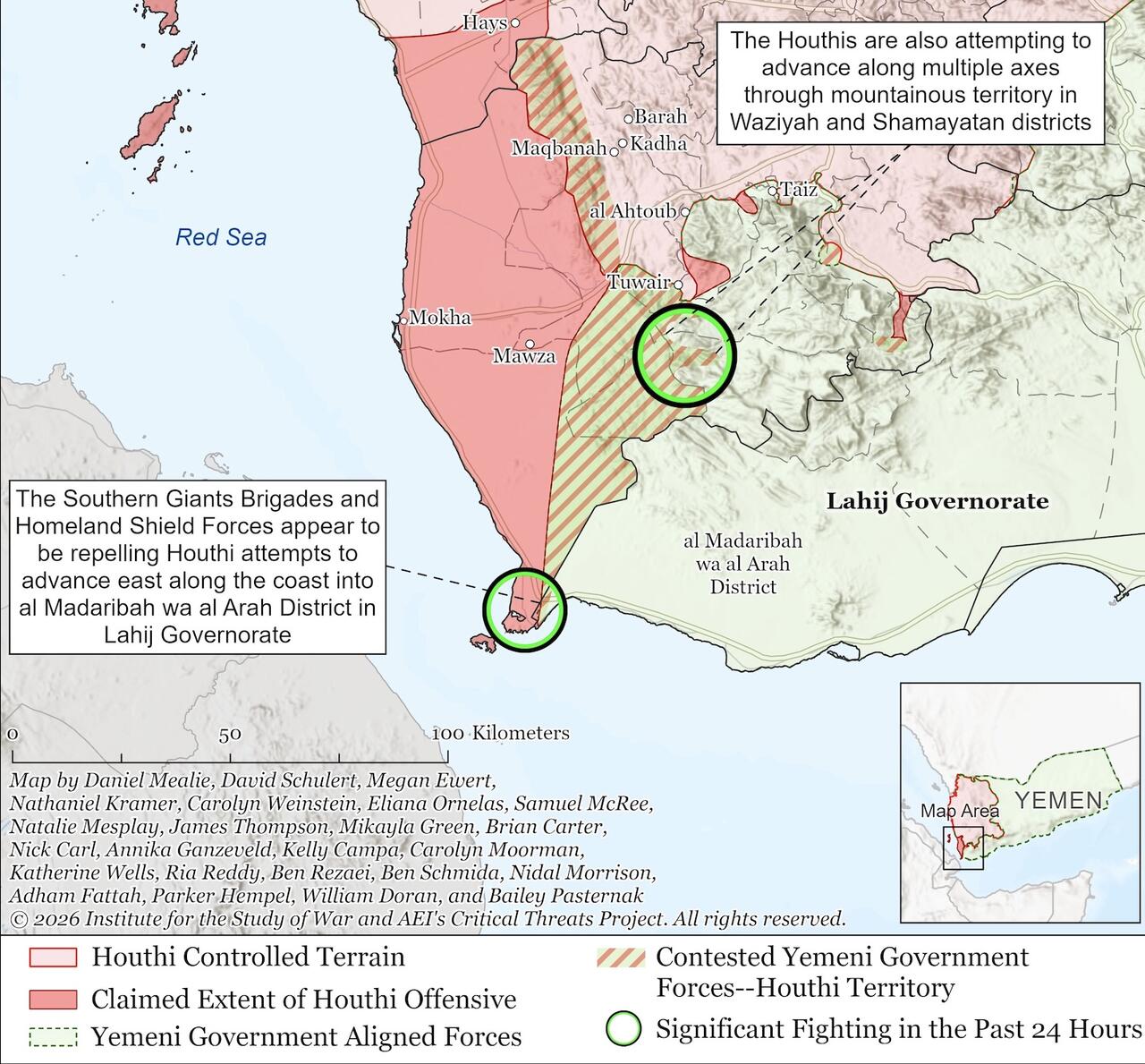
In a blitz that caught the world by surprise, the Houthis late last week achieved an enormous strategic victory by conquering the remainder of Yemen’s western coastline it didn’t already control — positioning it to easily enforce its declared blockade against Saudi-related shipping entering or leaving the Red Sea via the Bab al-Mandab Strait. Houthi soldiers also took over Perim Island, which sits in the strait.
As Associated Press noted, the seizure of the new territory puts the Houthis in much closer proximity to US forces:
The Houthis’ advance puts them just 20 miles (32 kilometers) from the U.S. military base in Djibouti, on the other side of the Bab el-Mandeb Strait. It’s the main U.S. base in Africa and one of several foreign military bases in Djibouti, including those of China, France and Japan.

The Houthi blockade is positioned as retaliation for the Saudi coalition’s siege and blockade of Houthi-controlled areas of Yemen. Though the Houthi blockade only targets Saudi shipping, global cargo lines are highly wary of transiting the waterway that’s narrower than the Strait of Hormuz. Many are rerouting traffic all the way around Africa’s Cape of Good Hope, which requires at least 20 extra days and a lot more money. “Freedom of navigation and international trade in the Red Sea and Bab al-Mandeb are safe and orderly,” a Houthi official told Al Jazeera.
While it’s too little, too late for Riyah’s hopes of some kind of big Washington intervention in Yemen, Saudi Arabia’s Crown Prince Mohammed bin Salman on Monday met US Central Command chief Admiral Brad Cooper in Jeddah, the Saudi Press Agency (SPA) has confirmed. Likely they reviewed the coalition’s narrowing options going forward, but President Trump has thus far expressed reluctance to get directly involved militarily, at a moment he’s still trying to figure out what’s next with Iran.
Iran Diplomacy Postponed
Cold water has been thrown on flickering hopes for finding an exit from the latest and most dangerous chapter in America’s “endless wars,” as a highly-anticipated Monday summit of Iran and other Persian Gulf states was postponed.
That bad news follows an eventful several days that saw Yemen’s Iran-allied Ansar Allah take control of a large swath of strategic coastside territory. Saudi Arabia’s critical east-west pipeline, shut down after a drone attack that originated in Iraq, may be the center of a major hit to global oil supply.
The Monday meeting was set to take place in the Omani coastal city of Salalah, with attendees including foreign ministers of Iran, Oman, Iraq, Saudi Arabia, UAE, Kuwait and Qatar. Taking a US-friendly line, Bahrain had declined to attend, saying stability “cannot be preserved through a policy of appeasement” and demanding the strait be re-opened without “discrimination, fees or permits.” The tiny state that is was home to the US Navy’s Fifth Fleet also cited its ongoing suspension of diplomatic relations with Iran.
The meeting was going to focus on a proposed arrangement by which Iran and Oman would jointly manage the flow of shipping through the Strait of Hormuz. Traffic through the vital waterway is at a near standstill, more than six months after the United States and Israel launched a war on Iran. Axios’ Barak Ravid, seen by many as a conduit for US-Israeli narratives, reported that Saudi Arabia had submitted amendments to the proposal.
“At the request of some regional countries and by a joint decision of Oman and Iran, the meeting of foreign ministers of Persian Gulf coastal states, which was planned for Monday, has been postponed to another date,” Iranian foreign ministry official Mohammad Ali Bak told Iran’s IRNA. If the meeting comes to fruition, it would be the first one to convene top diplomats from Iran and the Gulf Cooperation Council since the war started on Feb 28.
Previously, Iranian Foreign Minister Abbas Araghchi said attendees would be presented with route maps and other details about how ships would enter and depart the strait. Importantly, he emphasized that the proposal was not sufficient to actually reopen the strait.
Closure of Saudi Pipeline Set To Remove 4% of Global Supply
A different lifeline was completely closed over the weekend, with no end in sight: Saudi Arabia’s east-west oil pipeline was shut down after a devastating attack on a pumping station that seemingly originated with Shiite militias in Iraq. The pipeline was playing a vital role in offsetting the closure of the Strait of Hormuz, by sending oil to Saudi Arabia’s Yanbu port on the Red Sea.
Saudi oil traders told Reuters that, unless the pipeline is opened up within days, the kingdom will run out of export stock, removing as much as 4% of worldwide supply from the market. Even before the pipeline-pumping station attack, Saudi inventory had plummeted to its lowest level in 30 years.
Though Saudi Arabia initially called the closure a mere “precautionary measure,” some observers have very little optimism about a quick resumption of pipeline flow. One source told Reuters it could take five to six weeks to repair. If you’d imagined the pumping station some small facility, this image should give you a proper orientation to what must be restored “in a few days” to avert a major disruption of global supply:

Overnight, West Texas Intermediate futures leapt by 2.89% to $102.94 a barrel. Brent was up almost as much, trading at $107.56.
SYRIA/ARAB SPRING 2.0
Arab Spring 2.0? Fuel Riots Erupt In Syria As Instability Spreads Across Mideast
Sunday, Sep 13, 2026 – 08:00 PM
New footage posted on X shows what appear to be protests, with Israeli news organizations saying the anger is erupting because of skyrocketing fuel costs, reminiscent of the Arab Spring food riots 15 years ago.
i24NEWS reports that demonstrations have popped up in parts of Raqqa, Hasakah and Deir ez-Zor provinces, with protesters blocking roads and stopping oil tankers as rising energy costs intensify affordability pressures.
Videos on X, including one from Middle East Observer, show the chaos unfolding.
Other footage:
The unrest underscores just how quickly higher fuel costs can ignite public anger and fuel social unrest.
i24NEWS added more color to the situation:
According to the Syrian Observatory for Human Rights, security forces affiliated with the Ministry of Interior fired live ammunition while attempting to disperse the demonstrators. Tensions remained high as security personnel sought to reopen the roads and remove protesters from the area.
A separate report from Times of Israel states:
Protests have broken out in different parts of Syria over increased fuel prices, with demonstrators blocking a main highway in Idlib province for several hours.
The government announced what it said were temporary price increases for gasoline, diesel and other petroleum products earlier today, citing rising global fuel prices as a result of the US-Iran war. The price of gasoline increased by about 30% and diesel by 40%.
Syrian Energy Minister Mohammed al-Bashir said yesterday that Syria is producing about 102,000 barrels of oil per day, while it needs about 325,000 barrels per day for domestic consumption and is relying on imports to make up the difference.
Renewed instability in Syria could widen the fallout from the US-Iran conflict, creating new openings for armed groups, straining regional security, and placing pressure on President Ahmad al-Sharaa’s US-aligned government.
END
Tehran Says US Seeks Step-by-Step Agreement After Trump Claims ‘Iran Wants To Make A Deal’
Monday, Sep 14, 2026 – 01:55 PM
Summary
- ‘Deal’ headlines return: US seeks “Step-by-Step” agreement with Iran, reports state media.
- Houthis seized more Red Sea territory, including Perim Island near the Bab al-Mandab Strait.
- Shipping risks are rising, with vessels avoiding the Red Sea and taking longer routes around Africa.
- Iran-Gulf diplomacy was postponed, delaying efforts to address the Strait of Hormuz crisis in what was to be a rare GCC-Iran meeting.
- Saudi oil exports face ongoing disruption after a pipeline shutdown, pushing oil prices above $100/barrel.
* * *
Oil Drops on Return of ‘US Seeks Deal’ Headlines
Just as President Trump is appearing to show some desperation concerning soaring energy prices ahead of the midterm elections, and amid growing Republican angst, we witness a return to the ‘a deal could return’ style headlines which marked earlier phases of the war:
US seeks “Step-by-Step” agreement with Iran, reports ILNA citing Pakistani sources
- As the war and US pressure against Iran continue, Washington’s efforts to reach a “step-by-step” agreement with Tehran; a scenario that could be a prelude to the US entering the path of negotiations, without abandoning military and economic pressure.
And the all too familiar pattern that marked early summer…
OIL DROPS TO INTRADAY LOW, BRENT TRADES NEAR $106 A BARREL
Iranian state media is meanwhile suggesting that Washington interfered in what was a planned meeting between Iran and the Gulf Cooperation Council states (GCC) toward reopening the Strait of Hormuz. That meeting, which was supposed to happen Monday, was postponed indefinitely – after reports said the Saudis sought to add something untenable to a draft agreement. Tehran is still rejecting that it is ‘seeking’ new talks with Washington.
Trump has issued several provocative Truth Social posts throughout the morning…

The next weeks could possibly see a return to Axios’ ‘negotiations imminent’ WH leak tactics, to artificially keep energy prices under control…
ISRAEL; TBN
SAUDI ARABIA
“Riyadh In Difficult Position”: Saudis Shutter Critical East-West Pipeline After Drone Attacks
Saturday, Sep 12, 2026 – 09:55 AM
Saudi Arabia temporarily shut its 7 million-barrel-a-day East-West pipeline following multiple drone attacks, exposing a massive vulnerability in a critical export route used to bypass the Strait of Hormuz during more than six months of US-Iran conflict.

The closure puts new pressure on Saudi oil exports as the pipeline designed to bypass the Hormuz chokepoint becomes a target. The Energy Ministry described the shutdown as precautionary while emergency crews secured the pipeline and assessed its safety.
Here’s the ministry’s statement:
An official source at the Ministry of Energy stated that the East-West Pipeline in the Riyadh and Madinah regions was subjected to multiple attacks on the morning of Thursday, 10 September 2026. The pipeline was shut down as a precautionary measure. The attacks resulted in a number of injuries, and medical care was provided to those affected.
The source said emergency and specialised technical teams responded immediately following the attacks, taking the necessary measures to secure the pipeline and assess its safety in line with approved safety procedures and emergency response plans, in coordination with the relevant authorities. Any further developments will be announced in due course.
The shutdown deepens an already severe export squeeze on the kingdom. Saudi oil shipments fell to about 3 million barrels a day in August, the lowest level on record since early 2017.
Iran-backed Houthis seized the strategic island of Mayun in the Bab al-Mandeb Strait last week, tightening pressure on the kingdom’s Red Sea export hub. With Hormuz already disrupted, ongoing threats to both maritime chokepoints are narrowing the kingdom’s options for moving crude to global markets.
“Riyadh is in a difficult position,” said Rapidan Energy Group analyst Fernando Ferreira. “As the US maintains the blockade and succeeds in escorting more tankers out of the region, Iran will pivot toward increased attacks on Gulf energy facilities.”
END
HOUTHIS
Trump: Houthis ‘Don’t Want’ US In Yemen – So They’re Letting Most Red Sea Shipping Through
Saturday, Sep 12, 2026 – 04:55 PM
After it was widely reported this week that Saudi Crown Prince Mohammed bin Salman urgently sought military assistance from President Donald Trump amid the rapid Houthi takeover of Yemen’s Red Sea coast from the forces of the internationally recognized Sanaa government, Trump has said the Houthis are in contact with him and have pledged to let ships through the Bab Al-Mandab Strait.
Trump is currently in Ireland. He said to reporters Saturday while meeting with Irish Prime Minister Micheal Martin, “The Houthis called us, and they don’t want to fight with us. They don’t want us to go after them.”
He further explained that “they would much prefer not having us involved:” and so “they are letting most ships go through.” The president did acknowledged they do have a ban on Saudi vessels, however.
Indeed this is consistent with Ansar Allah’s latest statements declaring the Red Sea passage remains open, but closed to Saudi and Israeli-linked shipping.
This seems to confirm prior reporting that said Trump rejected MbS’ request for US military intervention in Yemen. To review:
Axios: Trump declined Saudi requests to strike Ansarallah as they advanced Saudi Crown Prince Mohammed bin Salman called U.S. President Donald Trump twice on Thursday, urging him to launch strikes against Yemen’s Ansarallah as they advanced along the Red Sea coast toward Bab al-Mandab, two U.S. officials told Axios. Trump declined, with Washington saying it has no plans to intervene directly for now.
It seems Washington also doesn’t want to see the Iran conflict explode into a runaway regional war which would certainly greatly exacerbate the global energy crisis.
Aaran Kennedy, a maritime security analyst with the global consultancy, Control Risks, has described to Al Jazeera that while “These advances strengthen the Houthis’ already strong position over the Red Sea. They simply make it even easier for the Houthis to target shipping” – the reality remains “It doesn’t necessarily mean that, right now, they’re going to expand their maritime target set.”
Kennedy believes a full Bab al-Mandeb closure is unlikely. “Just because the Houthis have gained this territory near the Bab al-Mandeb Strait, it doesn’t mean that they’re going to close it down. That situation remains highly unlikely. But what it does do is it expands their capabilities because it puts their weaponry closer to the Red Sea shipping lanes.”
But this does also ultimately given Tehran huge leverage, given it can persuade its Houthi allies anytime to take drastic action over the strait. Houthi threats over regional waters was on full display during the height of the Gaza War, which saw the US Navy get involved in the Red Sea, but warships later departed under the guise of handing security over to regional as well as European allies.
END
RUSSIA VS UKRAINE//CHINA
ROBERT H..
Chinese demand for Russian oil surges amid supply constraints
Why does anyone still think money buys everyone? Energy is what matters and moves economies. Money is the avatar not the reality of what matters. Just like national output of nations. The growth in nations today is those countries which have understood. It is why capital is running to them for growth and safety.
Russia has no interest in Western money nor what the West offers. Would we not think the same if someone stole your money? Sadly the removal of Russia from Swift and the freezing of 300 billion in currency held by the West was sufficient a lesson not just for Russians but the entire Global South.
One day soon it will be realized that the US has lost not just against Iran but the entire Middle East.
Chinese demand for Russian oil surges amid supply constraints

Crude oil all time high predictions
2 days ago
Share
Photo by Jan Zakelj
Sponsored: bc.game –Top Crypto Game! WIN BIG with Leicester City!Play Now
Oil prices from Russia’s Pacific coast are climbing as Chinese refiners intensify their purchase of spot cargoes due to limited supply options. This development reflects a tightening oil market, driven by increased Chinese demand for Russian crude. The surge in demand is likely affecting global oil price dynamics, particularly as geopolitical factors and supply constraints come into play. Market participants are closely monitoring these shifts, as they could influence the probability of crude oil reaching new all-time highs.
Key Takeaways
- Market activity suggests an increase in demand for Russian oil, which may contribute to rising global oil prices.
- Crude oil markets appear to interpret the narrowing supply options for China as consistent with YES outcome support for reaching a new all-time high.
- The December 31 market shows a more significant increase in YES pricing, indicating expectations of potential catalysts before year-end.
What to Watch
Observers should keep an eye on further developments in Chinese oil procurement strategies and any additional geopolitical tensions that might exacerbate supply constraints. Key actors such as OPEC and the IEA may adjust their outlooks, impacting market sentiment. Any announcements regarding OPEC production cuts or geopolitical instability in major oil-producing regions could further influence the odds of crude oil reaching a new all-time high by December 31.
END
TURKEY
Turkey Arrests 162 In LGBTQ+ Raids
Monday, Sep 14, 2026 – 04:15 AM
Turkish police arrested at least 162 people and searched the offices of six LGBTQ+ associations in weekend raids designed to support the country’s campaign to protect family values. The Ankara-based LGBTQ+ rights group Kaos GL claimed that beyond arrests, the government had also cut access to dozens of websites and social media accounts belonging to associate groups and rights advocates.
Turkish Justice Minister Akin Gurlek said investigations, prompted by accusations of prostitution and obscenity, were coordinated by prosecutors in Istanbul, Ankara, Izmir, Aydin and Mersin and involved judicial proceedings against 162 suspects, nine associations and 13 businesses across 15 provinces.
“As per the duty to protect families and children given to the state by the constitution, no criminal organization, abuse network or illegal activity which targets children, youths or families will be tolerated!” Gurlek added in a social media post.

Authorities say they seized drugs, digital equipment, smuggled alcohol and a gun in weekend police operations targeting gay bars and night clubs as well as a hammam that was said to be a place of prostitution.
The Istanbul prosecutor’s office added that it had found evidence indicating that children and minors were being inappropriately swayed on issues tied to sexual orientation and gender identity.
Rights groups say the government is unfairly targeting the LGBTQ+ community, with Kaos GL saying that it had been accused of making “posts containing obscenities” accessible to children.
The weekend police operation was dubbed “My Family is Safe” by the government and was part of President Recep Tayyip Erdogan‘s “Decade of Family and Population” scheme, which is designed to reverse plummeting birthrates in the aging country.
Authorities say it was intended to make sure that society does not see LGBTQ+ activity as “normal” and that raids were carried out to “protect children, the institution of the family, and our shared moral values.”
Although same-sex relations are not illegal in the country, homophobia is rife, with President Erdogan blaming LGBTQ “perverts” for Turkey’s rapidly declining birthrates.
That would seem a rhetorical diversion from the actual complexity of reasons for the decline, which Erdogan — who has ruled as the country’s authoritarian president since 2014 as well as serving as its influential prime minister for 10 years before that — has called “a disaster.”
Though Turkey‘s statistical agency, TurkStat, tracked a sharp decline in the total fertility rate between 2013 and 2023 (from 2.11 to 1.51), the shift brings birthrates in the country closer to those in other developed nations.
Observers say the real reasons for the drop are more likely of a structural and institutional nature rather than one chalked up to lifestyle.
Turkey’s chronically worsening financial crisis, inflation, skyrocketing housing prices, family unfriendly workplace environments, limited access to affordable childcare, and higher educational and employment rates for women are all considered reasons for Turks to postpone having children, as well as for having fewer when they finally do.
RUSSIA/UKRAINE/USA
Trump Calls On Zelenskyy To Stop Attacks On Russian Diesel Facilities
Sunday, Sep 13, 2026 – 10:45 PM
President Donald Trump has called on Ukrainian President Volodymyr Zelenskyy to stop targeting Russian diesel fuel as the attacks are causing a global shortage and diesel in the United States has hit a record high.
Trump was asked by a reporter on Sunday if he’d had conversations with Zelenskyy about the issue.
Zelenskyy “has to do one thing. He has to stop knocking out diesel fuel in Russia,” Trump told reporters on the sidelines of the Irish Open, adding that he had spoken to the Ukrainian president about it. “There are plenty of other targets. Don’t hit diesel fuel, because that’s hurting, that’s hurting the world.”
Ukraine has targeted Russia’s oil and gas industry for months with long-range attacks and Russia has responded with fuel rationing. In July, Russia banned diesel exports.
Diesel in the United States rose to $6.20 a gallon on average on Sunday, a new record, while regular gas is selling for $4.31 a gallon on average, according to AAA.

Zelenskyy has defended Ukraine’s tactics of striking Russian refineries.
The Ukrainian president posted video on June 28 of a Ukrainian strike on a Russian fuel facility.
“Last night, our long-range sanctions reached two oil refineries in Russia. The Slavyansk oil refinery in the Krasnodar region was hit – about 300 kilometers [186 miles] from the frontline,” Zelenskyy said in the post on X.
“We also reached a refinery in the Yaroslavl region, approximately 700 kilometers [435 miles] from our border. We continue our operations that weaken Russia’s ability to wage this war. Each of our long-range sanctions means fewer resources serving Russia’s war machine, and another step toward peace. We will continue to respond to Russian terror.”

Ukraine’s energy infrastructure has also been attacked by Russia, according to Zelenskyy.
“The Russians are burning warehouses with food and gas stations, pharmaceutical facilities and ordinary passenger trains, residential buildings and civilian businesses,” Zelenskyy said in a Sept. 12 post on X.
The International Energy Agency said in a September 2026 report that diesel and gasoil exports from Gulf countries averaged 390,000 barrels per day in August, just over one-quarter of their levels before the war with Iran began in February. Restricted traffic through the Strait of Hormuz has sharply reduced shipments from the region.
That report said that Ukraine’s attacks on Russia’s refining system have compounded the diesel supply issues.
The IEA said U.S. diesel prices surpassed $200 per barrel in early September, which was 94 percent above their pre-war level. Diesel and other similar fuels account for nearly 30 percent of global oil demand.
6/.GLOBAL ISSUES, COVID ISSUES, VACCINE INJURIES/HEALTH ISSUES
GLOBAL ISSUES
Hartnett: All Eyes On This Indicator, Whose Breakdown Will Confirm A Fall Stagflation Event
Bank of America’s Michael Hartnett is focusing on the iShares Transportation Average ETF (IYT) holding (or breaking) its 200-day moving average near 80 as the key confirmation signal for an autumn stagflation event.
@MikeZaccardiIn his recent “Flow Show” note (“Those yields might not hurt yet, but diesel”), Hartnett highlights record diesel prices (~$6/gallon national average) as the primary real-economy pressure point—more so than headline oil at ~$100/bbl. Diesel directly hits shipping, trucking, agriculture, construction, and mining. Combined with multi-year-high 30-year yields (highest since mid-2007) and elevated commodities, this creates stagflation risks (sticky/high inflation + slowing growth) that markets have underpriced, with little visible panic so far.
zerohedge.com
Transports sit squarely in the path of that diesel shock. Hartnett’s rule of thumb:
- If IYT holds above its 200-day MA (~80), the economy may still be absorbing higher energy costs, and the summer “as good as it gets” derisking narrative can persist.
- A decisive break below confirms that high energy costs are beginning to impair real activity and margins, turning summer macro derisking into a broader autumn stagflation event. kodiaktrades.substack.com
Supporting context from the note includes BofA’s Bull & Bear Indicator still elevated near 9.5 (tactical sell signal in place since late May, with crowded positioning and record-low cash levels among private clients), ongoing bond-fund inflows, and equity outflows. Hartnett stresses that markets often stop panicking only when policymakers start panicking—and that threshold has not yet been reached despite the bond and commodity moves.
finvaulta.com
This is a tactical confirmation level rather than a standalone forecast. Transportation stocks have historically served as a cyclical/economic-health barometer (echoing elements of Dow Theory), so their technical breakdown would signal that the diesel-driven cost shock is feeding through more forcefully into growth
END
BRICS/ABANDONING THJE DOLLAR
BRICS Steps Off The Dollar, With Iran Pressing Hardest
Sunday, Sep 13, 2026 – 09:30 PM
Authored by former CIA officer Larry Johnson
The 18th BRICS summit opened on Saturday with the bloc taking its most concrete step yet toward loosening the grip of the US dollar, adopting a 45-page New Delhi Declaration on the first day and endorsing a payments architecture built to route cross-border trade around the Western financial system. For most members the move was incremental. For Iran — under sweeping US sanctions, a naval blockade, and roughly six months into a war with the United States and Israel — it was closer to a lifeline.
The declaration and the payment rails
Leaders gathered at the Bharat Mandapam convention center adopted the New Delhi Declaration 2026 unanimously on the opening day, with Prime Minister Narendra Modi emerging from a closed session to report that no member had objected to the text. The economic centerpiece was a commitment to expand trade and investment settled in members’ own national currencies, and to link their domestic payment and messaging systems so that transactions can move without passing through the dollar-denominated SWIFT network. According to the declaration, the bloc’s payment task force had studied cross-border interoperability of those channels and examined using local currencies for trade settlement and investment.
The mechanism drawing the most attention was BRICS Pay, a decentralized payment-messaging framework that stitches together India’s UPI, China’s CIPS, and Russia’s SPFS into a shared interoperability layer — a way to clear payments among members outside SWIFT. The declaration also referenced a pilot for a gold-backed “Unit” token.

Just as telling was what the bloc again declined to do. There was no endorsement of a single common BRICS currency; India in particular has resisted that leap, favoring interoperable national-currency settlement over the political and monetary complexity of a shared unit. The result, as several observers characterized it, is incremental financial de-dollarization rather than a monetary union — plumbing, not a new reserve currency.
Washington’s answer
The response from Washington was immediate. President Trump threatened tariffs of up to 100% on the bloc, extending a pressure campaign he has waged all year against what he calls BRICS’s “anti-American” trajectory. The threat carries genuine weight for export-dependent members that rely on the US market — but its deterrent power erodes with each transaction the bloc succeeds in routing through non-dollar channels.
That is the paradox Washington now faces: the tariffs are meant to punish de-dollarization, yet de-dollarization is precisely what blunts the tariffs.
Iran at the front of the line
No member arrived with more at stake than Iran. President Masoud Pezeshkian pressed the case for national-currency trade, telling reporters that expanding the use of members’ own currencies in intra-bloc commerce was among the most important steps the group could take. Tehran has pushed throughout the summit for mechanisms to insulate members from Western financial pressure — a priority sharpened by the sanctions and blockade it now faces.
Crucially, the summit institutionalizes at the multilateral level what Iran has already been building bilaterally. On January 29, 2026, Tehran signed a trilateral strategic pact with China and Russia, an agreement whose economic core is the construction of alternative financial mechanisms that sidestep SWIFT and reduce exposure to the dollar-centered system. That pact rests on foundations already in place: an Iran–Russia monetary agreement, operational since early 2025, that settles trade directly in rials and rubles and links Russia’s Mir card network to Iran’s Shetab system; a 25-year Iran–China cooperation framework; and the plain fact that China now buys the overwhelming majority of Iran’s oil, much of it settled in yuan.
The implication cuts against the common assumption that Iran is scrambling for a dollar workaround. It already has one. For Tehran, BRICS Pay is not a novel escape hatch but a larger, sanctions-resistant network onto which it can graft trade it is already conducting outside Western channels — and a multilateral blessing for the parallel financial architecture it has spent two years assembling with Moscow and Beijing.
Where BRICS drew the line – and where it didn’t
The declaration’s language on the region’s wars was the most fought-over in the text, and the outcome was uneven: sharp in places, deliberately vague in others. Reaching consensus reportedly required negotiations that ran until 4 a.m., driven mainly by a rift between Iran and the United Arab Emirates.
On the US–Israeli war against Iran, the bloc expressed deep concern and called for maximum restraint, dialogue and diplomacy — but it named neither the United States nor Israel, and condemned no country outright. That hedge was the price of unanimity. Iranian Foreign Minister Abbas Araghchi had pressed BRICS to condemn what he called unlawful US and Israeli aggression; the UAE pushed back hard, accusing Tehran of using the summit to justify its own missile and drone barrages against Gulf states. India, in the chair, acknowledged “differing views among some members” and steered the text toward common ground. The language was firmer in tone than a bland appeal for peace, but well short of the unequivocal condemnation of the strikes on Iran that Tehran had won from the Rio summit a year earlier — a notable step back on that specific question, not forward.
Yet Iran signed the text anyway, and that was the summit’s quieter diplomatic story. Tehran — which has spent the war firing missiles and drones at the UAE, most recently at the Al Minhad Air Base in late August — put its name to language its Gulf adversary could also accept, while Pezeshkian met the Abu Dhabi crown prince on the sidelines in the two sides’ highest-level contact since the fighting began. Iran’s willingness to sit inside the consensus rather than force a rupture signaled that it read the declaration’s direction — deep concern over the escalation and a call to protect civilians — as acceptable enough, even without the naming it had sought. But the same words served Abu Dhabi: the call to respect the sovereignty and territorial integrity of states pointed as much at Iran’s strikes on the Gulf as at the US–Israeli assault on Iran. The consensus held because the text could be read both ways.
On Lebanon, the bloc was sharper, and it named Israel directly. The leaders condemned the continued violations of Lebanon’s sovereignty and territorial integrity, called on Israel to withdraw its occupying forces from all Lebanese territory, demanded full implementation of UN Security Council Resolution 1701, and condemned all attacks against the UNIFIL peacekeeping force — extending condolences for peacekeepers killed in the south, among them four Indonesians, and demanding accountability. It amounts to some of the most direct criticism of Israel in any BRICS declaration to date, even though Israel is named only three times in the entire 45-page document. The declaration separately took note of the International Court of Justice proceedings brought by South Africa against Israel over Gaza, and rejected any unilateral moves to alter the status of occupied Jerusalem.
For India, the shift is best measured against where Modi stood barely six months earlier. On February 25–26 he made a landmark visit to Israel — the first Indian premier to address the Knesset, honored with its Speaker’s Medal as the first foreign leader to receive it, presiding over the elevation of ties to a “special strategic partnership” and a defense co-production track. When the US and Israel opened their war on Iran forty-eight hours after he left, killing Iran’s supreme leader in an airstrike, New Delhi stayed conspicuously silent — no condemnation of the strikes, no condolence for the killing — and let its own Iran links, from Chabahar port funding to bilateral trade, wither under US pressure. That silence held for months.
It broke at Bishkek. On September 1, at the Shanghai Cooperation Organization summit, Modi signed a declaration condemning the military strikes on Iranian territory as violations of international law, offering condolences for the slain Iranian leader, and backing Iran’s sovereignty and its rights under the Non-Proliferation Treaty — the first time India had endorsed language condemning the US–Israeli assault. From the leader who had embraced Netanyahu in February, that was a genuine reversal, not a calibration. The New Delhi Declaration eleven days later was actually softer on Iran than Bishkek, and the reason is instructive: the SCO has no Gulf Arab members, but BRICS has the UAE, which pushed back hard and forced the unnamed “deep concern” formula — even as the bloc kept firm, named criticism of Israel over Lebanon. India’s arc across 2026, from the Knesset medal to the Bishkek condemnation, is the real measure of the move; the hedged Iran passage in the New Delhi text reflects the BRICS bargaining table, not a retreat from it.
What is real, and what is symbolic
Sober assessment is warranted. BRICS Pay is a messaging and interoperability layer, not a replacement for the dollar as the world’s reserve asset, and nothing in the New Delhi Declaration displaces the dollar’s dominance in global reserves, commodity pricing, or third-country trade. The bloc’s unity also has limits the declaration papered over rather than resolved: the consensus on the Middle East held only because the text avoided naming the aggressors Iran wanted named, and the Iran–UAE rift that nearly sank the negotiations has not gone away. Grand pronouncements about a post-dollar order have a long history of outrunning the mechanics.
But the asymmetry inside the bloc is the point. What reads as incremental to India or Brazil — countries with full access to Western markets and finance — is closer to existential for Iran and Russia. For a state locked out of SWIFT and dollar clearing, a payment rail that functions precisely because it does not touch the dollar is worth far more than any debate over reserve-currency theory. The New Delhi Declaration will not dethrone the dollar. What it does is hand the bloc’s sanctioned members a collective, expanding, and now formally endorsed alternative to the system Washington has used to isolate them.
The backdrop
All of this unfolds under the shadow of simultaneous wars — in Ukraine and across the Middle East — and an Iran conflict, triggered by US–Israeli strikes in late February, that has pushed oil above $100 a barrel, disrupted the Strait of Hormuz, and now bleeds into the escalation between Saudi Arabia and Yemen’s Houthis. It is an environment that gives the de-dollarization agenda its urgency: the more Washington wields financial and military pressure, the greater the incentive for the targeted states to build channels beyond its reach. Day two of the summit turns to supply chains, energy security, and the bloc’s Economic Strategy 2030.
COVID VACCINE INJURIES: MARK CRISPIN MILLER
Tulsi Gabbard’s husband Abraham has “very rare bone cancer”; Television’s Richard Lloyd has bile duct cancer; boxer Tommy Morrison has stomach cancer; ESPN’s Victor Rojas has prostate cancer
Boston radio’s Marc Bertrand has thyroid cancer; Chuck Chapple (Golden Bachelorette) has prostate cancer; Montgomer County (MD) pol Will Jawando has heart attack while playing basketball; & more
| Mark Crispin MillerSep 13 |  |


A survey of the likely global toll of COVID “vaccination,” based on the reports collected by our worldwide team of researchers this past week.
To help support our work, consider subscribing or making a donation.
Celebs
UNITED STATES
Tulsi Gabbard Breaks Down in Tears as She Shares Update on Husband’s Cancer Battle
August 21, 2026
 Tulsi Gabbard
  @TulsiGabbardEarlier this year, my husband Abraham was diagnosed with a very rare bone cancer. This has been a challenging time for us and is hard to talk about. But so many of you have reached out asking how he’s doing, and sharing your prayers and well wishes with us. We made this video
 1:05 PM · Aug 20, 2026 · 5.06M Views14.3K Replies · 15.5K Reposts · 150K Likes
Former Trump Director of National Intelligence Tulsi Gabbard broke down in tears as she shared a video update of her husband Abraham Williams’ (37) battle with an extremely rare form of bone cancer. “Earlier this year, my husband, Abraham, was diagnosed with cancer,” she began in the video. “I picked up the phone and Abraham’s voice was different. He said that he got a call from his doctor and the doctor told him that he has sacral chordoma, very, very rare – one in a million – form of cancer.” She said the two treatment options were either a “very invasive surgery to remove the bottom of his sacrum and his tailbone” or radiation. “So we scheduled the surgery as quickly as we could,” she says as the video cuts to a clip of Williams preparing for the procedure. Gabbard said that while the surgery was a success, Williams now faces a long road to recovery. “So here we are now, almost three months after we started a very rigorous physical therapy program. He gets frustrated a lot because he wants to be able to make progress faster. And sometimes he’s pushed a little too far, but overall Abraham is progressing very well.” However, Gabbard said he will now have to undergo frequent MRIs to make sure the cancer does not return.
News from Underground by Mark Crispin Miller is a reader-supported publication. To receive new posts and support my work, consider becoming a free or paid subscriber.
‘The Golden Bachelorette’ winner Chock Chapple confirms prostate cancer diagnosis
August 24, 2026

The Golden Bachelorette winner Chock Chapple [62] has confirmed that he has prostate cancer, and now he’s making it his mission to help others in the same situation. In a recent Instagram post, Chock stated, “I wanted to follow up [from] last week with my post with [Joan Vassos] on me announcing that I have prostate cancer. [I] had the surgery a couple of weeks ago. I got two things that I want to talk about.” Chock explained how he and Joan received a lot of questions from fans, especially women, who wanted to know how they could convince their partners to get tested. “They said, ‘I’m concerned about this.’ I’m not a physician… but prostate cancer is one of the most populous cancers, especially for men over 60 years old,” Chock said.
Television’s Richard Lloyd Diagnosed with Bile Duct Cancer, GoFundMe Launched
August 23, 2026

Richard Lloyd, co-founding guitarist of Television, has been diagnosed with cholangiocarcinoma, a serious form of bile duct cancer. According to GoFundMe launched by his Richard Lloyd Group bandmate Sean Seymour, the cancer has left Lloyd [75] with “tumors in his liver, including one located dangerously close to a major blood vessel. Because of its location, doctors cannot safely operate to remove it at this time… He has been in the ICU seven times, dealing with serious complications including sepsis twice, as well as complications involving his liver and kidneys. And through all of this, he’s fighting.” Funds from the GoFundMe will go towards supporting Lloyd and his wife Sheila during this difficult time, including covering medical expenses, monthly living expenses, and other costs that come with Richard being unable to work and Sheila being a full-time caregiver.
Olympian Jenny Simpson won’t be able to run again after a cardiac event. Here’s what she wants to focus on as she recovers
August 21, 2026

Three-time Olympian Jenny Simpson built her entire life around running – but after a sudden cardiac event two months ago revealed a hidden rare disease and nearly killed her, she is embarking on a new kind of race. Simpson, 39, had helped a group of girls pace themselves during a milelong run in Raleigh, North Carolina, in June moments before she collapsed. She told CBS News she doesn’t remember anything that happened that day. But Ivy and Joey Pointer will never forget it. Joey Pointer is the CEO of the company Fleet Feet, which hired Simpson as its chief running officer earlier this year. Ivy is a pediatric intensive care unit physician. The pair aren’t just Simpson’s co-workers and friends: They are also the parents of a child with a congenital heart disease, so they carry an automated external defibrillator. That meant when Simpson collapsed, they had all the tools necessary to rush to her side. “When I looked over from afar, I knew that something was very, very wrong,” Ivy told CBS News. “So I told Joey to grab an AED and ran over and got there. … I just remember thinking like, ‘This can’t happen right now. Like we have a lot happening soon and that this is not going to happen right now. You are going to fight. You’re going to hold on. You have to wake up.’ And I just kept saying her name and kind of screaming her name, honestly.”
Simpson, a bronze medalist in the 1,500 meters at the 2016 Olympics in Rio, had spent the last year on a 50-state running tour with her husband Jason, joining local groups in scenic, far-flung places. If she had experienced a cardiac event without lifesaving resources nearby, her story might have had a different ending. Ivy and other bystanders performed CPR until first responders arrived and rushed Simpson to an area hospital. She suffered a second cardiac arrest and was then transferred to Duke University Medical Center. Her husband flew to be by her side as she spent days on life support. Simpson was diagnosed with arrhythmogenic right ventricular cardiomyopathy, a rare congenital heart condition where the heart repairs damage with tissue that doesn’t properly conduct electricity in the right ventricle. Running doesn’t cause the condition, but it did eventually reveal it. Simpson had a defibrillator and pacemaker implanted, and regularly sees her cardiologist, who she called her “favorite person in the world.” But still, she’ll never be able to run again.
Tommy Morrison’s Big-Punching Son Reveals Stomach Cancer Diagnosis
August 21, 2026

Kenzie Morrison, the heavyweight son of the late former world champion Tommy Morrison, has revealed that he has been diagnosed with stomach cancer after spending the past month dealing with health problems. Morrison announced the devastating news from a hospital bed after undergoing a CAT scan following repeated problems with his stomach and back. The 36-year-old said doctors informed him of the diagnosis before sending him to Tulsa for further CT and MRI scans. Morrison said he was due to meet with a neurosurgeon regarding possible back surgery before speaking with an oncology team about the cancer. He did not suggest that the back problem was connected to his cancer diagnosis. Morrison has launched a GoFundMe as he prepares for treatment and mounting medical expenses. Morrison also appealed for prayers while awaiting further information from his doctors.
John Cena Sr. Requests Prayers for Girlfriend’s Son Diagnosed with Rare ALS
August 21, 2026
John Cena Sr. has turned to fans for support after sharing a personal update involving his girlfriend’s son. He asked the wrestling community to keep Tommy in their prayers following the difficult news. Cena Sr. shared the news on X on Thursday, August 20. He revealed that Tommy, the 42-year-old son of his girlfriend, had just received a devastating diagnosis of a very rare case of Amyotrophic Lateral Sclerosis (ALS), commonly known as Lou Gehrig’s disease. “I very rarely ask for something. Today, I am asking you all for prayers. My girlfriends son, age 42 was just diagnosed with a very rare case of ALS. I am asking you all for your prayers for him. Thank you, his name is Tommy. Thank you all for your prayers.” ALS, or amyotrophic lateral sclerosis, is a progressive disease that damages nerve cells in the brain and spinal cord involved in voluntary muscle movement. The condition can lead to muscle weakness and a gradual loss of physical function.
WHO 13 meteorologist Jason Parkin reveals Parkinson’s diagnosis
August 19, 2026

WHO 13 meteorologist Jason Parkin [56] has revealed that he has Parkinson’s disease. Parkin disclosed his diagnosis in a Facebook video last week, which he said helps explain years of unexplained fatigue. Parkin tells Axios that doctors haven’t been able to predict how quickly his Parkinson’s will progress because cases can vary significantly. He exercises as much as he can and tries to limit his carbohydrate and sugar intake to help manage the disease.
Parkin is the second member of the WHO weather team this year to publicly disclose a serious neurological diagnosis, following longtime meteorologist Jeriann Ritter’s announcement that she has ALS. “In all my years in TV news, I’ve never heard of a situation like the one the NBC affiliate in Des Moines is dealing with,” retired KCCI-TV news director Dave Busiek, a former coworker of Parkin’s, wrote in a column about the two meteorologists.
Researcher’s note – Casts and crews on productions will have to show proof of COVID booster [sic] shots under updated guidelines: Link
Founder of music label that helped launch Migos, Lil Baby hospitalized
August 21, 2026

An Atlanta [GA] music industry heavyweight is hospitalized, prompting his record label to push back against false rumors circulating online about his death. Quality Control Music released a statement confirming that co-founder Pierre “P” Thomas is alive and receiving medical care after social media speculation suggested otherwise. “We want to clarify that Pierre ‘P’ Thomas is alive and currently hospitalized receiving medical care,” the label said in a statement. Quality Control Music, founded in Atlanta by Thomas and Kevin “Coach K” Lee, grew into one of hip-hop’s most influential labels. The company helped launch the careers of some of the biggest names in rap, including Migos, Lil Baby and Lil Yachty. The label did not provide details about Thomas’ condition or what led to his hospitalization. As of Friday, no additional information about Thomas’ health had been released.
No age reported.
‘Pawn Stars’ Rick Harrison hospitalized after emergency bypass surgery
September 4, 2026

“Pawn Stars” star Rick Harrison has been hospitalized following emergency surgery. Harrison, 61, underwent an unexpected bypass surgery – an operation to restore or reroute blood flow – after going in “for a simpler procedure,” a spokesperson for the family told USA TODAY on Friday, Sept. 4. “He is resting comfortably and looking forward to a full recovery,” the spokesperson added. “He is grateful for the doctors and staff at the hospital and that his wife and family can be with him during this time.”
DR PAUL ALEXANDER..
RABOBANK/MICHAEL EVERY/OR OR PICTON/GIFFIN OR RABOBANK EXECUTIVE/COMMENTARY ON WORLDLY AFFAIRS
7. OIL AND NATURAL GAS/ENERGY COMMENTARIES
MONDAY
Oil Surges As Saudi Pipeline Crisis Puts 4% Of Global Supply At Risk; Bernstein Warns Of $150 Crude
Monday, Sep 14, 2026 – 07:20 AM
Brent crude futures jumped overnight after Saudi Arabia shut its East-West pipeline following drone attacks last week, threatening a critical route for bypassing the highly contested Strait of Hormuz chokepoint and a loss of what could amount to 4% of global supply.
The global oil benchmark rose as much as 3.7% to above $108 a barrel before trimming gains to $107.70 by 6:00 a.m. ET, while WTI futures traded around $103.

Riyadh described the shutdown as precautionary but gave no timetable for restarting the pipeline, which can transport upwards of 7 million barrels a day.
New geospatial intelligence shows what appears to be high-resolution satellite imagery of the aftermath of the drone attack that destroyed pumping infrastructure. Vantor produced this satellite imagery and shared it on X via The Hormuz Letter.
UBS energy expert Dominic Ellis summarized the weekend and overnight events unfolding across the Gulf region:
Brent has risen over $107/b on reports planned talks between Iran and GCC leaders on establishing a safe route through the Strait of Hormuz have been postponed indefinitely, and following reports Saudi Arabia closed its East-West pipeline following attacks late last week.
The pipeline, with capacity of 7mb/d, had played an important role in re-routing oil away from the Strait of Hormuz, and the impact of the pipeline’s closure on Red Sea exports (combined with recent Houthi efforts to disrupt Red Sea flows) will continue to support oil prices for the foreseeable future.
Near-term impact on energy equities is positive – the UBS team flagged 40% upside to consensus 3Q earnings earlier this month (with refining-leveraged names like Repsol, Galp and OMV having 80-90% upside), and while buy-side numbers have likely responded to rapidly-changing macro conditions more frequently than those on the sell-side, I still believe market-wide caution on the sector means there is upside to expectations.
Saudi oil traders told Reuters on Sunday that if the East-West pipeline is not restarted promptly, then Saudi Arabia will run out of oil stocks for Red Sea exports.
More color per the outlet:
Sources that spoke to Reuters gave varying estimates, with one saying the damage could take as long as five to six weeks to repair, while another said it could be fixed sooner and could resume pumping partially while repairs are ongoing.
Saudi Arabia’s government media office and energy ministry did not immediately respond to requests for comment.For the past six months, the pipeline running through the desert across the Arabian Peninsula has spared Saudi Arabia from the brunt of the impact of the wartime shutdown of the Strait of Hormuz that has crippled exports from its neighbours.
The world’s biggest exporter has used the pipeline to reroute around 4 million barrels per day — around 4% of global supply — to the port of Yanbu on the Red Sea.But with the pipeline out of service, Yanbu now has stocks to maintain exports for just five to seven days, according to three industry sources familiar with Saudi exports.Saudi Arabia also has stocks to supply customers for several days from Egypt’s ports of Ain Sukhna on the Red Sea and Sidi Kerir on the Mediterranean, a fourth source said.
Yanbu storage capacity stands at around 35 million barrels, according to industry estimates, with Ain Sukhna and Sidi Kerir able to store 18 million and 20 million barrels respectively.Stocks are not full and will ultimately run out without the east-west pipeline resuming operations, the four sources said.Saudi oil supply has already fallen to a more than three-decade low in August on reduced flows via Hormuz and the Red Sea, the International Energy Agency said on Friday.World oil supply will decline this year by 5.7 million bpd, or about 6%, the IEA, which coordinates Western energy policies, said.In addition to the attack on the pipeline, Houthi fighters in Yemen who have threatened Saudi oil shipments seized an island on Friday in the mouth of the Red Sea
Gulf developments over the weekend prompted Bernstein analysts Neil Beveridge and Brian Ho to warn that Brent could rally to between $120 and $150 a barrel as East-West pipeline disruptions collide with ongoing troubles along the Strait of Hormuz and the Bab el-Mandeb Strait in the southern Red Sea.
Beveridge described the market as “chronically undersupplied” and said their existing $90 Brent forecast for 2026 had been “overtaken by events.”
Combined flows through Hormuz, Bab el-Mandeb and the Suez Canal remain below 7 million barrels a day, compared with roughly 20 million before the conflict, according to Bloomberg.
One of the biggest restraints on crude prices this summer has been the 5 million-barrel-a-day reduction in Chinese imports. But analysts said that decline partly reflects Beijing tapping its estimated 1.5 billion barrels of SPR. Imports are now recovering and bidding up oil prices around the world.
END
EU NatGas Hits Highest Since 2022 As Low Storage Sets Stage For Winter Cold-Snap Price Shock
Monday, Sep 14, 2026 – 08:25 AM
European natural gas futures hit their highest level since December 2022 (early days of the Russia-Ukraine conflict) as domestic supplies remain well below the 15-year average. With the Northern Hemisphere winter approaching, the restocking phase may be jeopardized by maritime chokepoint madness across the Gulf and Red Sea, with the Strait of Hormuz and Bab al-Mandab Strait under threat.
Dutch benchmark futures jumped as much as 5.3% to 83.67 euros a megawatt-hour early Monday. Prices have tripled so far this year, and the latest surge comes after Saudi Arabia’s East-West pipeline was taken offline in recent days following a drone strike on pumping infrastructure.

Europe is heading toward the heating season with gas storage facilities just 68% full, well below the 15-year trend of about 85% for this time of year.

LNG arrivals into Western Europe retreated last week after an early-September recovery, while inventory replenishment slowed.
“The delay pushes any prospect of de-escalation even further out of reach,” analysts at ING Groep NV wrote in a note earlier.
A Timera Energy analyst warned that one consequence of low gas storage “is a more fragile winter balance,” adding, “That increases the potential for volatility if cold weather or another supply shock emerges faster than cargoes can respond.”
Translation: one cold snap this coming winter could trigger sharp price swings and intensify pressure on European households, as the energy-stricken continent is more than ever held hostage to conflicts in the Middle East.
END
motor oil is now scarce in the USA
Costco Begins Rationing Kirkland Signature Motor Oil As Refined Crisis Spreads
Monday, Sep 14, 2026 – 11:45 AM
Costco’s Kirkland Signature motor oil has doubled in price, and customers now reportedly face a purchase limit as the Gulf energy conflict, combined with the Russia-Ukraine war, has sent the global refining market into a tailspin.
Auto news website The Auto Wire reports that a 10-quart package of Kirkland full-synthetic oil now costs about $58, up from around $30, with a new purchase limit of two packages per week.
Costco’s online sales platform confirms an order limit: when attempting to order three packs, an alert message reads, “Item 997930 has a maximum order quantity of 2.”

Another auto blog, MotorBiscuit, provided more detail on the refining crisis and its impact on the global liquids market:
The ongoing military entanglement with Iran and the blockade of the Strait of Hormuz have effectively choked off these crucial exports. To compound the supply chain disaster, the massive Pearl GTL facility in Qatar sustained heavy damage from Iranian airstrikes in March 2026, instantly crippling a major portion of global production for at least a year.
Refineries Chase 40-Year Profit Highs
Typically, when Middle Eastern supply lines fracture, South Korean refiners step in to pick up the slack. Unfortunately, those refiners are currently struggling to secure raw crude oil themselves.
Furthermore, the petroleum industry is aggressively shifting its manufacturing priorities. Right now, global profit margins for diesel and jet fuel have hit staggering 40-year highs. Motor oil, diesel, and aviation fuel all originate from the same barrels of raw crude. Given the choice between producing essential base oils for passenger cars or cashing in on incredibly lucrative aviation and commercial diesel markets, refiners are overwhelmingly choosing the latter.
This geopolitical squeeze is hitting at the exact worst time for everyday drivers. Today’s highly stressed, turbocharged, small-displacement engines require incredibly sophisticated oil chemistries to prevent catastrophic failure and comply with strict environmental standards.
Because modern engines are so sensitive, automakers demand rigorous chemical testing and licensing. General Motors, for example, requires vendors to pay double licensing fees (both per product and per unit sold) just to print the “Dexos-approved” badge on their packaging. This certification appears directly on Costco’s Kirkland brand.
Combine a fractured Middle Eastern supply chain, international refiners chasing diesel profits, and the expensive licensing fees required for modern engines, and you have the perfect storm for empty shelves.
It’s not just motor oil. Households relying on heating oil face the risk of sharply higher bills as the Northern Hemisphere winter approaches. With the national average retail diesel at a record $6.23 a gallon Monday morning, the squeeze on distillate fuels and other refined fuels is causing a shock. However, electric vehicle owners are just sitting back, watching this all unfold.
end
Trump Declares Ukraine, Russia Have Agreed To Halt All Attacks On Energy Targets
Monday, Sep 14, 2026 – 11:19 AM
Update(11:19)ET: Amid soaring national diesel products and painfully high prices at the pump, President Trump on Monday announced the Zelensky government has acceded to the US president’s prior call to abstain from attacking diesel infrastructure in Russia. He has unveiled what he’s presenting as a new Russia-Ukraine energy ceasefire.
Trump says “Ukraine has agreed not to hit Russian Energy targets. Russia has agreed to do, likewise! The World’s Diesel price rise is mostly caused by the Russia/ Ukraine War, not Iran.” Clearly high fuel prices are creating immense pressure within the GOP, and Trump is trying to essentially tweet his way out of this war-related mess…
DIESEL FUTURES PARE GAINS, TRADE NEAR $5.04/GAL

Diesel responded immediately…

And also crude…

* * *
The Kremlin has welcomed President Trump’s weekend call for Ukraine to stop attacking Russian diesel supply and infrastructure sites. The somewhat surprise remarks which will only serve to further pressure the Zelensky government came when pressed by a reporter on Sunday. Trump responded by saying Zelensky “has to do one thing. He has to stop knocking out diesel fuel in Russia.”
The US president said at the sidelines of the Irish Open on Sunday, “There are plenty of other targets. Don’t hit diesel fuel, because that’s hurting, that’s hurting the world” – adding that he indeed had spoken to the Ukrainian president about it.
“I’ve asked Zelensky not to hit the Russian refineries. Diesel is being driven up by the fact that it’s having a hard time coming out of Russia,” Trump additionally stated. “That’s a case that hurts the world, and we’ve got to stop it.”
On Monday, Putin spokesman Dmitry Peskov was asked about Trump’s words. “Of course, one can only welcome any call on the Kiev regime to stop strikes on civilian economic infrastructure,“ Peskov told a press briefing.

The Kremlin official had been questioned on whether Putin views the US call to refrain from strikes on Russia’s diesel-producing infrastructure a positive step toward a settlement of the Ukrainian conflict.
“Any countries can contribute to a settlement in Ukraine by influencing Kiev and pushing it toward flexibility,” Peskov said, leaving things somewhat vague. He said that disabling of Saudi Arabia’s East-West oil pipeline, which has reportedly knocked more than 4% of global supplies off the market, is cause of serious concern.
“The deterioration of the situation in oil markets cannot but cause concern among global economies,” he emphasized. On that front, the Associated Press newly reports Monday:
A crucial Saudi oil pipeline hit in strikes will be mostly out of service for several weeks for repairs, reports AP citing officials
Specifically concerning the status of the ‘special military operation’ in Ukraine, the Putin spokesman described, “It is becoming increasingly clear to professionals, based on the dynamics at the front lines, that Russia is consistently moving toward achieving its goals in the special military operation.”
He vowed: “The dynamics of advances at the front lines of the special military operation will continue; no one should have any doubts about that.”
And he explained of the weekend New Delhi-hosted major BRICS summit, “Putin reacted positively to the readiness of the leaders of China and India to contribute to the Ukrainian settlement.”
As for Ukraine, President Zelensky over the weekend pointed out that the country’s own energy infrastructure has also subject of frequent attack by Russia.
“The Russians are burning warehouses with food and gas stations, pharmaceutical facilities and ordinary passenger trains, residential buildings and civilian businesses,” Zelensky stated in a Sept.12 X post.
end
$6 Diesel Flashes 2008 Warning As Energy Shock, AI Slowdown Fears Fuel Perfect Storm
Monday, Sep 14, 2026 – 10:40 AM
As of Monday morning, AAA’s national average retail diesel price topped $6.23 a gallon as a global refining crisis sparked by the Russia-Ukraine war and compounded by the Gulf conflict sent the price of the most critical fuel powering the industrial world skyrocketing.

Bloomberg Intelligence senior commodity strategist Mike McGlone warned Monday that “$6 diesel echoes 2008 gasoline shock.”
“Commodity spikes tend to sow the seeds of their own reversal, and diesel’s first-ever surge above $6 a gallon may echo gasoline’s 2008 experience. The US daily average gasoline price, at roughly $4.30 on Sept. 11, is only about 4% above its 2008 peak, which helped fuel the Great Recession,” McGlone wrote in a note.
He added, “Elevated stock market valuations could add to the vulnerability.”

On top of a fuel price shock, tech is sliding Monday morning amid fears of an AI slowdown (read the morning note).
McGlone’s warning comes as Patrick De Haan, head of petroleum analysis at GasBuddy, pointed out at the end of last week that some gas pumps across California hit a record $9.99 per gallon for the industrial fuel.
Any sustained diesel price shock can push inflation higher while slowing economic growth, creating a stagflationary squeeze. Higher energy costs raise production expenses and reduce households’ purchasing power, also denting consumer sentiment.
The global refining crisis has drawn the White House’s attention. President Trump on Sunday called on Ukrainian President Volodymyr Zelenskyy to halt strikes on Russian diesel infrastructure.
“Zelenskyy has to do one thing. He has to stop knocking out diesel fuel in Russia,” Trump told reporters at the Irish Open yesterday.
“We spoke to Mr. Zelenskyy about it. There are plenty of other targets. Don’t hit diesel fuel, because that’s hurting, that’s hurting the world,” the president said.
Meanwhile, the Trump administration is considering how to use the Defense Production Act to expand US oil refining capacity as the Iran conflict drives up fuel prices.
Brent crude traded around $109 a barrel this morning. Last week, the IEA published a report warning of potential demand destruction for industrial fuels. US diesel crack spread remains above $110 a barrel.
S&P Global Energy warned Thursday that it does not forecast Middle East crude production to return to prewar levels by the end of 2027.
Citi analysts warned Friday that soaring commodity costs and diesel prices will weigh on many of the companies in their coverage universe through the first half of next year:
In 2025, commodity costs were mildly inflationary except for select inputs such as coffee, gas, and tallow which up meaningful +DD%. However, in 2026, commodity inflation has reaccelerated with acute pressure on direct and indirect energy-based products driven by the geopolitical conflict in the Middle East including oil, resins, and diesel/freight costs. Additionally, prices for commodities impacted by tariffs and the global trade dynamics have also increased in 2026 including in aluminum and steel. Many of our companies have highlighted these input cost headwinds, which are pressuring margins this year and which we suspect will remain headwinds into at least 1H’27.
In March, JPMorgan’s head of commodity research, Natasha Kaneva, outlined six policy levers the Trump administration could pull to contain oil prices. Some, including Jones Act waivers and Strategic Petroleum Reserve releases, have already been used. Other options include export restrictions and waiving federal fuel taxes.
8. EMERGING MARKETS//AUSTRALIA NEW ZEALAND ISSUES
CANADA/USA
Trump Says Trade Deal With Canada Could Happen ‘Fairly Soon’
The president said Canada needed to ’treat our farmers better’ and stop charging large tariffs.


U.S. President Donald Trump and Irish President Catherine Connolly meet respective delegations at Áras an Uachtaráin in Dublin, Ireland, on Sept. 12, 2026. Travis Gillmore/The Epoch Times

President Donald Trump suggested that a trade deal with Canada is expected to be secured “fairly soon” after negotiations collapsed in August.
“Canada wants to make a deal very bad,” Trump said on Sept. 12, after a bilateral meeting with Irish Prime Minister Micheál Martin in Dublin.
Trump’s remarks came in response to a reporter’s question about whether he was considering withdrawing from the United States–Mexico–Canada Agreement (USMCA).
“It’s a strange question to be asked over here,” Trump responded while sitting next to Martin in Ireland.
“No, we’re going to have a great relationship with Mexico. We actually have a good one with Canada, but the United States has been ripped off for 50 years by Canada.”
Trump said Canada needed to “treat our farmers better” and stop charging large tariffs.

President Trump Visits Ireland

Trump Says He’s Open to Chinese Automakers Building Cars in US
“They’re charging our farmers 400 percent tariffs and many other things so when those things go away, [and] they’re willing to get rid of all of them, you’ll probably see a deal with Canada fairly soon,” he said.
Tariff battles between the neighboring countries intensified after negotiations fell through last month.
Both nations blamed the other for new demands that upended the talks.

Canadian Prime Minister Mark Carney and President Donald Trump speak at the G7 working luncheon, during the G7 summit in Evian-les-Bains, France, on June 16, 2026. The Canadian Press/Christopher Katsarov
“We offered them the best deal,” U.S. Trade Representative Jamieson Greer told Fox News’s “Special Report” on Sept. 4. “They looked at it square in the face and turned around.”
After trade negotiations hit a stopping point, Trump imposed 50 percent tariffs on Canadian goods such as hockey sticks and honey on Aug. 22.
Canadian Prime Minister Mark Carney responded hours later, announcing that his country planned to issue retaliatory dollar-for-dollar tariffs on American exports.
“Let me be clear: We take this step reluctantly, reluctantly because we recognize that some of these measures will raise costs and reduce choice for Canadians,” Carney said during a press conference on Aug. 22.
Canada’s tariffs are in effect for around 700 goods that legally qualify as U.S.-origin under USMCA marking rules.
During the initial round of trade talks, the United States said it asked Canada to end “discriminatory” trade practices against American-made exports such as automobiles, alcohol, and dairy products, in exchange for lowering the current tariffs.
Before the deal collapsed last month, Canadian provinces were preparing to restock U.S.-made alcohol, such as Kentucky bourbon, which has been in short supply since previous tariffs took effect in the spring of 2025.
END
U.S./GOLD AND SILVER PRICING/ASIAN CLOSING MARKETS AND EUROPEAN BOURSE OPENING AND CLOSING/ INTEREST RATE SETTINGS MONDAY MORNING 6;30AM//OPENING AND CLOSING\
OPENING LEVELS OF CURRENCIES// AND CLOSING ASIAN STOCK MARKET AND OPENING EUROPEAN STOCKS:6 AM EST
EURO VS USA DOLLAR: 1.1539 UP 0.0054
USA/ YEN 154.66 UP 1.254 NOW TARGETS INTEREST RATE AT 1.75% AS IT WILL BUY UNLIMITED BONDS TO GETS TO THAT LEVEL…//YEN STILL FALLS//END OF YEN CARRY TRADE BEGINS AGAIN DEC 2024/Bank of Japan raises rates by .25% TO 1.75 ..TAKAICHI NEW PM AS YIELDS RISE//JAPAN DEEPLY IN TROUBLE WITH RISING RATES AND A FALLING YEN!! BANK OF JAPAN WILL NO LONGER DO QE. URGES PENSION AND INSUANCE FUNDS TO BUY JAPANESE BONDS//
YEN CARRY TRADERS MURDERED
GBP/USA 1.3483 DOWN 0.0030 OR 30 BASIS PTS
USA/CAN DOLLAR: 1.3897 UP 0.0034 //CDN DOLLAR DOWN 34 BASIS PTS//
Last night Shanghai COMPOSITE CLOSED DOWN 2.78 PTS OR 0.07%
Hang Seng CLOSED UP 111.97 PTS OR 0.45%
AUSTRALIA CLOSED UP 0.08%
// EUROPEAN BOURSE: ALL MOSTLY RED
Trading from Europe and ASIA
I) EUROPEAN BOURSES: ALL MOSTLY RED
2/ CHINESE BOURSES / :Hang SENG CLOSED UP 111.97 PTS OR 0.45%
/SHANGHAI CLOSED DOWN 2.78 PTS OR 0.07%
AUSTRALIA BOURSE CLOSED UP .08%
(Nikkei (Japan) CLOSED DOWN 1220.95 PTS OR 1.87%
INDIA’S SENSEX IN THE RED
Gold very early morning trading: $4292.60
silver:$62.82
USA DOLLAR VS TRY (TURKISH LIRA): 48.63 UP 2 BASIS PTS AND NOW WE SEE THEIR STUPIDITY OF SELLING SOME OF THEIR GOLD AND ALL OF THEIR USA DOLLAR RESERVES. THE COUNTRY IS IN BIG FINANCIAL TROUBLE
USA DOLLAR VS RUSSIAN ROUBLE: 84.49 ROUBLE// DOWN 0 ROUBLE AND 39 BASIS PTS.
UK 10 YR BOND YIELD: 5.3609 UP 1 BASIS PTS
UK 30 YR BOND YIELD: 5.9096 DOWN 0 BASIS PTS
CDN 10 YR BOND YIELD: 3.938 DOWN 1 BASIS PTS
CDN 5 YR BOND YIELD; 3.650 UP 1 BASIS PTS
USA dollar index early MONDAY MORNING: 99.28 UP 47 BASIS POINTS FROM FRIDAY’s CLOSE
MONDAY MORNING NUMBERS ENDS
And now your closing MONDAY NUMBERS 10.00 AM
Portuguese 10 year bond yield: 3.904% UP 3 in basis point(s) yield
JAPANESE BOND 10 yr YIELD: +2,993% UP 1 FULL POINTS BASIS POINTS /JAPAN losing control of its yield curve/
JAPAN 30 YR: 4.086 UP 2 BASIS PTS//
SPANISH 10 YR BOND YIELD: 4.0150 UP 5 in basis points yield
ITALY 10 YR BOND: 4.432 UP 8 points in basis points yield ./
GERMAN 10 YR BOND YIELD: 3.5358 UP 3 BASIS PTS
IMPORTANT CURRENCY CLOSES : MID DAY MONDAY
Closing currency crosses for day /USA DOLLAR INDEX/USA 10 YR BOND YIELD/10:00 AM
Euro/USA 1.1542 DOWN 0.0051 OR 51 basis points
USA/Japan: 154.64 UP 1.254 OR YEN IS DOWN 125 BASIS PTS// HIGHLY INFLATIONARY TO JAPAN
Great Britain 10 YR RATE 5.3487 DOWN .0025 BASIS POINTS //
GREAT BRITAIN 30 YR BOND; 5.9420 UP 3 BASIS POINTS.
CANADIAN DOLLAR DOWN 89 BASIS PTS TO 1.3903
xxxxxxxxxxxxxxxxxxxxxxxxxxxxxxxxxxxxxxxxxxxxxxxxxxxxxxxxxxxxxxxxxxxxxxxxxxxxxxxx
The USA/Yuan CNY 6.7085 ON SHORE ..DOWN
THE USA/YUAN OFFSHORE// CNH DOWN TO 6.7112
TURKISH LIRA: 48.63 UP 2 EXTREMELY DANGEROUS LEVEL/DEATH WATCH/HYPERINFLATION TO BEGIN.//
Your closing 10 yr US bond yield UP 4 in basis points from FRIDAY at 4.980% //trading well ABOVE the resistance level of 2.27-2.32%)
USA 30 yr bond yield 5.362 UP 3 basis points /10:00 AM
USA 2 YR BOND YIELD: 4.641 UP 3 BASIS PTS.
GOLD AT 10;00 AM $4285.60
SILVER AT 10;00: $62.86
Your 11:00 AM bourses for Europe and the Dow along with the USA dollar index closing and interest ratesMON
DAY
DAY CLOSING TIME/ 12:00 AM///
London: CLOSED UP 47.13 PTS OR 0.44%
GERMAN DAX: CLOSED DOWN 127.75 PTS OR 0.44%
FRANCE: DOWN 61.99 OR 0.78 PTS
Spain IBEX CLOSED DOWN 273.00 PTS OR 1.38%
Italian MIB: CLOSED DOWN 883.26 PTS OR 1.68%
WTI Oil price 102,92 10.00 EST/
Brent Oil: 108.65 10:00 EST
USA /RUSSIAN ROUBLE: 84.73 /// ROUBLE DOWN 0 AND 61/ 100
CDN 10 YEAR RATE: 3.956 UP 2 BASIS PTS.
CDN 5 YEAR RATE: 3.6630 UP 2 BASIS PTS
CLOSING NUMBERS: 4 PM//
Euro vs USA 1.1554 DOWN 0.0038 OR 38 BASIS POINTS//
British Pound: 1.3508 DOWN 0.0005 OR 5 basis pts/
BRITISH 10 YR GILT BOND YIELD: 5.3545 UP 1 FULL BASIS PTS//
BRITISH 30 YR BOND YIELD: 5.8999 DOWN 2 IN BASIS PTS.
JAPAN 10 YR YIELD: 2.999 UP 1/2 FULL BASIS PTS (DANGEROUS TO THEIR ECONOMY
JAPANESE 30 YR BOND: 4.084 UP 3 PTS AND STILL VERY DANGEROUS TO THEIR ECONOMY
USA dollar vs Japanese Yen: 154.21 UP 828 OR YEN DOWN 83 BASIS PTS//GETTING FURTHER AWAY FROM 160.00/ EXTREMELY DANGEROUS
USA dollar vs Canadian dollar: 1.3901 UP 0.0038 PTS// CDN DOLLAR DOWN 38 BASIS PTS
West Texas intermediate oil: 100.93
Brent OIL: 105.45
USA 10 yr bond yield UP 0 BASIS pts to 4.972
USA 30 yr bond yield: DOWN 2 PTS to 5.336%
USA 2 YR BOND 4.645 UP 2 PTS
CDN 10 YR RATE 3.9450 UP 0 BASIS PTS
CDN 5 YEAR RATE: 3.655 UP 1 BASIS PTS
USA dollar index: 99.15 UP 3 BASIS POINTS
USA DOLLAR VS TURKISH LIRA: 48.62 UP 2 BASIS PTS GETTING QUITE CLOSE TO BLOWING UP/IDIOTS SOLD GOLD
USA DOLLAR VS RUSSIA//// ROUBLE: 84.88 DOWN 0 AND 76/100 roubles //
GOLD $4,301.60 3:30 PM)
SILVER: 63.49 3;30 PM)
DOW JONES INDUSTRIAL AVERAGE: DOWN 152.01 POINTS OR 0.21%
NASDAQ 100 DOWN 241/28 PTS OR 0.32%
VOLATILITY INDEX 16.87 UP 1.03 PTS OR 6.50%
GLD: $ 392.74 DOWN 6.03 PTS OR 1.51%
SLV/ 56.84 PTS DOWN 1.28 OR 2.20%
TORONTO STOCK INDEX// TSX INDEX: CLOSED DOWN 8.37 PTS OR 0.023%
end
TRADING today ZEROHEDGE 4 PM: HEADLINE NEWS/TRADING
Crypto Clarity Booms, AI Dooms, Banks Gloom, Oil Zooms, As Fed Looms
WRAP UP
Stocks hit as AI CEOs call for slowdown in AI development – Newsquawk US Market Wrap
Monday, Sep 14, 2026 – 04:03 PM
- SNAPSHOT: Equities down, Treasuries up, Crude up, Dollar up, Gold down.
- REAR VIEW: AI bosses call for a slowdown in the pace of its development; Cooler-than-expected Canadian inflation; Crucial Saudi oil pipeline hit in strikes will be mostly out of service for several weeks; Trump said Ukraine and Russia agreed not to hit energy targets; US seeks “Step-by-Step” agreement with Iran; Iran-Gulf nations meeting postponed.
- COMING UP: Data: Chinese Activity Data (Aug), UK Jobs/Wages (Jul), French/Spanish Inflation Final (Aug), German/EU ZEW Economic Sentiment Index (Sep), US ADP Employment Change Weekly Speakers: ECB’s Cipollone Supply: Japan, UK, Germany, US
More Newsquawk in 2 steps:
- 1. Subscribe to the free premarket movers reports
- 2. Trial Newsquawk’s premium real-time audio news squawk box for 7 days
MARKET WRAP
Stocks were sold on Monday, albeit finishing well off earlier lows, with weakness primarily driven by chip and memory names after a group of prominent AI CEOs, including those from OpenAI, xAI and Anthropic, called for a slowdown in the pace of AI development amid safety concerns.
The majority of sectors finished lower, although Communication Services, Health Care and Consumer Staples outperformed. The AI developments weighed heavily on semiconductor and memory names given their significant exposure to the AI buildout, while cybersecurity names such as CrowdStrike (CRWD) and Palo Alto Networks (PANW) rallied. Software names also outperformed as concerns over increasingly advanced AI replacing existing software services eased.
Elsewhere, Financials came under pressure after Bank of America (BAC), speaking at the Barclays conference, warned that sales and trading revenue is expected to be roughly flat Y/Y. Citi (C), however, pared earlier losses after guiding to low-single-digit Y/Y growth in investment banking revenue and mid-single-digit growth in markets revenue.
Crude prices settled higher but notably off earlier peaks. Oil initially rallied after the Iran-Gulf nations meeting was postponed and Saudi Arabia’s East-West pipeline was shut down, with the pipeline expected to remain mostly out of service for several weeks. However, benchmarks pared gains on more constructive geopolitical headlines after President Trump said Ukraine and Russia had agreed not to strike each other’s energy infrastructure and that Iran wants to make a deal, while ILNA, citing Pakistani sources, reported that the US is seeking a step-by-step agreement with Iran.
As oil retreated from its highs, Treasuries moved off their lows, with the long end ultimately rallying and the curve flattening. The AI developments may also have provided some support further out the curve, with a slowdown in AI development potentially reducing CapEx requirements and, consequently, corporate debt issuance to fund the AI buildout.
In FX, the Dollar rallied amid the risk-off environment, while the Antipodeans, Yen and Euro lagged. Gold tumbled but finished off its lows, remaining below USD 4,300/oz. Attention now turns firmly to Wednesday’s FOMC decision, where expectations for a rate hike have continued to build. A Reuters poll conducted after Friday’s CPI report found 85% of forecasters expect a 25bp hike, while money markets assign around a 90% probability to such a move.
FIXED INCOME
T-NOTE FUTURES (Z6) SETTLED 2 TICKS HIGHER AT 106-05+
Yield curve flattens as oil pares early gains while AI CEOs call for slowdown in AI development. At settlement, 2-year +0.7bps at 4.637%, 3-year +1.0bps at 4.731%, 5-year unchanged at 4.788%, 7-year -0.5bps at 4.869%, 10-year -1.0bps at 4.959%, 20-year -2.2bps at 5.367%, 30-year -2.9bps at 5.327%.
THE DAY: The Treasury yield curve flattened on Monday, with earlier losses reversing as oil pared from its highs, while participants also weighed the potential implications of a slowdown in AI development for the bond market. Some technical trading may have also been a factor after the 10-year yield briefly rose above 5.00%, for the first time since 2023.
Oil was initially supported after the Iran-Gulf nations meeting was postponed and Saudi Arabia’s East-West pipeline was shut down, with the crucial pipeline expected to remain mostly out of service for several weeks while repairs are carried out. However, a series of more constructive geopolitical developments subsequently saw crude retreat from its peaks, coinciding with Treasuries moving higher. US President Trump announced that Ukraine and Russia had agreed not to strike each other’s energy infrastructure, before later saying that Iran also wants to make a deal and that the US is open to the concept. Meanwhile, ILNA, citing Pakistani sources, reported that the US is seeking a step-by-step agreement with Iran.
As oil reversed from its highs, Treasuries moved off their lows and the long end ultimately rallied on the session. Another potential factor was the focus on calls for a slowdown in AI deployment from several prominent AI CEOs, including OpenAI’s Altman, xAI’s Musk and Anthropic’s Amodei. The developments weighed heavily on semiconductor and memory names, but also have potential implications for the bond market. A material slowdown in AI development could reduce the enormous CapEx requirements associated with the AI buildout and, in turn, reduce the need for companies to tap debt markets to fund that investment. Given elevated corporate issuance to fund AI-related CapEx has been one source of upward pressure on yields this year, expectations for reduced future issuance may have provided some support to Treasuries, particularly further out the curve.
At the front end, however, yields remained under upward pressure as expectations for a Fed hike on Wednesday continued to build. An updated Reuters poll found that 85% of forecasters now expect the Fed to hike by 25bps, versus the previous poll which showed a consensus for rates to remain unchanged. Money markets are assigning around a 90% probability of a hike this week, with another hike fully priced by year-end and almost two further hikes priced through 2027.
SUPPLY
Notes
- US to sell USD 13bln of 20yr bonds on September 15th; to settle on Sept. 18th; to sell USD 19bln of 10yr TIPS on Sept. 17th; to settle on Sept. 30th
Bills
- US to sell USD 92bln of 13-wk bills and USD 79bln of 26-wk bills on Sept. 14th, to sell USD 75bln of 6-wk bills on Sept. 15th.
STIRS / OPERATIONS
- Fed Hike Pricing via CME FedWatch: Sept 23.2bps (prev. 21.6bps), Dec 50.7bps (prev. 48.5bps)
- EFFR at 3.63% (prev. 3.63%), volumes at USD 105bln (prev. USD 108bln) on September 11th
- SOFR at 3.62% (prev. 3.62%), volumes at USD 2.867tln (prev. USD 2.921tln) on September 11th
- NY Fed RRP op demand at 1.42bln (prev. 5.25bln) across 4 counterparties (prev. 3) on September 14th
- NY Fed plans to conduct approximately USD 15.6bln in reinvestment purchases (prev. USD 17.0bln) and no reserve management purchases over the noted monthly period (Sept 15th – Oct 14th).
CRUDE
WTI (V6) SETTLED USD 1.34 HIGHER AT 101.39/BBL; BRENT (X6) SETTLED USD 1.07 HIGHER AT 105.68/BBL
The crude complex started the week on the front foot, albeit settling around session lows. At the reopening of trade, benchmarks gapped higher, supported by the postponement of the Iran-Gulf nations meeting and the shutdown of Saudi Arabia’s East-West pipeline. Further upside was seen following reports that the IRGC shot down a US drone and after comments from the Iranian Foreign Ministry, before crude caught another bid after AP reported that the crucial Saudi pipeline will remain mostly out of service for several weeks while repairs are carried out. Against this backdrop, WTI and Brent rose to peaks of USD 104.95/bbl and USD 109.80/bbl, respectively. However, several more constructive geopolitical developments emerged through the US afternoon, helping the energy complex pare some of its earlier gains. Firstly, Trump said Ukraine and Russia had agreed not to strike each other’s energy infrastructure. Secondly, Trump remarked that Iran wants to make a deal “quickly and badly”, adding that he would determine whether the US is open to the concept, although Iranian sources quickly pushed back on the remarks. Finally, ILNA, citing Pakistani sources, reported that the US is seeking a “step-by-step” agreement with Iran. Collectively, the more constructive geopolitical headlines helped push WTI and Brent back towards session lows of USD 100.79/bbl and USD 105.17/bbl, respectively, with benchmarks settling around these levels.
EQUITIES
CLOSES: SPX -0.47% at 7,621, NDX -0.82% at 29,127, DJI -0.31% at 52,412, RUT -0.41% at 2,892.
SECTORS: Communication Services +2.78%, Health +1.36%, Consumer Staples +1.26%, Financials -0.36%, Consumer Discretionary -0.51%, Real Estate -0.80%, Energy -0.91%, Materials -1.05%, Utilities -1.36%, Industrials -1.47%, Technology -1.68%.
EUROPEAN CLOSES: Euro Stoxx 50 -0.79% at 6,275, DAX -0.60% at 25,415, CAC 40 -0.76% at 8,118, FTSE 100 +0.44% at 10,698, SMI +0.75% at 13,879, FTSE MIB -1.68% at 51,629, IBEX 35 -1.38% at 19,566, PSI -1.52% at 9,380, AEX -0.04% at 1,098.
STOCK SPECIFICS:
- AI-linked stocks: Pressured after bosses of AI companies called for a slowdown in the pace of AI development.
- Oracle (ORCL) Executive Chair Larry Ellison cancelled his plan to sell USD 7.5bln of Oracle shares.
- The Baldwin Insurance Group (BWIN) is going private in a USD 7.7bln deal with Sequence Holdings and Michael Dell’s family office.
- The Elmet Group (ELMT) gets USD 450mln DoW investment and up to USD 2bln Defense Logistics Agency contract.
- Affirm Holdings (AFRM) was upgraded at Wolfe Research.
- Bank of America (BAC) CEO said Co. will see USD 1.6-1.8bln in Q3 Investment Banking fees; sales and trading revenue expeced roughly flat Y/Y.
- Citigroup (C) expects FY ROTCE to finish a bit above the 11% top end of its guidance range. IB revenue expected to rise low single digits while market revenue is tracking up mid-single digits Y/Y.
FX
The Dollar Index was firmer to start the week amid the broad-based risk-off trade given the wider AI development concerns, although risk sentiment did improve throughout the duration of the US session. Dollar-related news flow was fairly sparse on Monday, given the aforementioned AI worries, but also ahead of the pivotal FOMC confab on Wednesday; the central bank is expected to hike rates by 25bps, with money markets assigning around a 90% probability to a 25bps rate hike. In the latest Reuters poll, 15% expect the Fed to hold rates steady, so it is no certainty about what they shall ultimately decide what to do.
G10 FX was lower across the board against the Greenback. Antipodeans, JPY, and EUR were the laggards, while the Swissy and Pound were the relative outperformers, albeit still seeing slight losses vs. the Dollar. The Loonie saw pressure following the region’s inflation metrics, as headline Y/Y printed in-line with expectations, though Core M/M and Headline M/M were a touch cooler.
Elsewhere, currency-specifics were light to start the week as risk events await, although overnight there were reports that the PBoC plans to expand the yuan offshore market and will consider expanding the central bank’s macroprudential and financial stability roles; it added that it will innovate macroprudential policy tools and support steady economic recovery and growth.
USA DATA RELEASE
USA ECONOMIC REPORTS
Long-Term US Unemployment Rate Creeps Up To 27% Despite Blockbuster August Hiring
Sunday, Sep 13, 2026 – 08:45 AM
Despite the recent blockbuster August jobs report, the anemic pace of hiring in prior months has been exacerbating challenges for long-term unemployed Americans, new research from the Richmond Federal Reserve finds.
The long-term unemployment rate – those who are out of work for 27 weeks or longer as a share of the total unemployed – has been steadily climbing since early 2023.
Of all unemployed Americans in August, more than one-quarter (27 percent), or 1.93 million, had been out of work for a prolonged period, according to last month’s Bureau of Labor Statistics report.

This is up from 25.5 percent, or 1.77 million, in July.
Federal Reserve Chairman Kevin Warsh gave the labor market glowing marks during his keynote address at the Jackson Hole Economic Symposium last month.
With an unemployment rate hovering around 4 percent over the past couple of years, job conditions would suggest that the Fed has achieved its maximum employment mandate.
Last month’s nonfarm payrolls also surged by 162,000, blowing past the consensus forecast of 56,000.

But, as Andrew Moran reports for The Epoch Times, the situation might not be optimistic for Americans who have been out of the job market for many months.
This year’s sluggish growth in U.S. payrolls is likely to present fresh hurdles for job hunters, regional central bank researchers warn.
“In the current ‘low-hire, low-fire’ labor market – which features both slower job creation and less job separation activity (including firings and layoffs) – becoming unemployed can be particularly challenging as finding a new job can be more difficult,” the Richmond Fed economists wrote in a Sept. 1 paper.
America’s labor market has been entrenched in an environment in which employers are neither increasing headcount nor laying off workers.
Weekly unemployment claims have been stuck in a historically low range of 189,000 to 230,000 – near 57-year lows. The number and layoff rate are near record lows. The jobless rate has been down in 241 of 387 metro areas over the past year.
Continuing jobless claims have also been on a downward trajectory since late 2025, a measurement that could signal two trends in the U.S. economy.
First, workers are finding it easier to locate job opportunities. Second, Americans have exhausted their benefits since many states cap eligibility at 26 weeks.
For a growing chorus of workers who have been searching for several months, the search may no longer be worth it, which could help explain the drop in workforce participation.
“The data have yet to show that job-finding prospects are improving meaningfully for those who have been jobless for an extended duration,” the Richmond Fed said.
“In particular, those who have been out of work for a year or more are experiencing more challenges seeking reemployment relative to the ‘standard’ long-term unemployed.”
The U.S. labor force participation rate ticked up to 61.6 percent in August – from 61.4 percent in July – hovering close to its lowest level since the 1970s (excluding the pandemic).
While part of this can be explained by older workers exiting the labor market, young men are not pursuing employment opportunities.
The participation rate for males aged 16 to 24 plummeted to around 56 percent last month, from 69 percent in 2000.
Skills Shortage
But while job growth has been choppy this year, labor demand has been robust.
Job vacancies are close to 7.3 million, and small businesses have indicated they plan to bolster their hiring plans in the coming months.
The challenge for employers is finding qualified workers to fill these openings.
According to the Federal Reserve’s Beige Book – a periodic report summarizing economic conditions across the central bank’s 12 districts – employment demand in the construction and manufacturing sectors was “healthy” this summer.
“Labor availability was mixed. Skilled trades and technical workers were difficult to find,” the report stated.
It is estimated that employers face a talent gap of approximately 1.3 million workers, according to an Aug. 25 report by labor market intelligence firm Lightcast.
Additionally, seven of the 10 most in-demand skilled-trade occupations – construction, electricians, and technicians, for example – already face significant labor shortages.
“The impending lack of skilled trades workers has been a resounding issue in our economy for years,” Ron Hetrick, principal economist at Lightcast, said in a statement.
The skills shortage comes at a time when the United States is witnessing a rebirth of manufacturing amid the artificial intelligence (AI) boom.
The data-center expansion has already brought on about 315,000 additional skilled-trade workers in the past five years, the report found.
END
Here’s What’s Happening Inside Convenience Stores As Gas And Diesel Spike
Monday, Sep 14, 2026 – 03:05 PM
We continue to track convenience store trends as an indicator of working-class sentiment, building on our coverage of the spending pullback that emerged early in the US-Iran conflict. That weakness persisted into late summer as August’s fuel-price spike put further pressure on household budgets.
The Gulf conflict and a global refining squeeze pushed regular gasoline above $4.50 a gallon and diesel above $5.50 in August, leaving consumers with less room for discretionary purchases.

Jefferies food analyst Scott Marks published a note on Monday morning providing new insight into consumer trends at the convenience store level in August, as elevated fuel prices appeared to renew pressure on consumers.

Marks and his team found that visits fell 2% from a year earlier, a 1.25-percentage-point deterioration in the annual growth rate compared with July. The reversal largely erased July’s improvement, he said, adding that higher fuel prices in late August and early September suggest traffic could remain under pressure.

The squeeze is showing up both at the pump and inside the store. Across tracked convenience store food categories, volumes declined roughly 9% from a year earlier during the three months ended Aug. 22, compared with a 7.5% decline over the six-month period. Dollar sales fell about 3%, even as pricing growth accelerated to approximately 6% from 5%.
Marks added more color:
What We C: Traffic Takes a Step Back in August
Convenience store traffic stepped back down in August, with rising fuel prices appearing to renew pressure on the consumer. A vast majority of top food categories saw sales worsen L3M vs. L6M, with volume trends similarly worsening in most. Performance nutrition shakes were the clear standout on strong DD% growth, underscoring consumer demand for protein, while chocolate inflected negative and energy continues to lead in beverages.

Convenience channel traffic steps back down. C-store foot traffic fell ~2% y/y in August, representing a 125 bps sequential decline vs. July. This decline follows a 150 bps sequential improvement in July, with rising fuel prices in the back half of the month that remained elevated through August likely driving the reversal in trends. Notably, with fuel prices rising further in late August and early September, c-store traffic is likely to remain under pressure. Nielsen data showed broad-based softening across top food categories, with a majority experiencing weaker sales trends in the L3M versus L6M period. Volumes also deteriorated across most categories, while pricing accelerated in the majority.

CASY results underscore trade-down, low-end more pressured. CASY FQ1 pointed to a consumer still spending on food/bevs while trading down elsewhere, with inside comps +3.2% and PFDB +4.8% driven by traffic and units. All income cohorts grew, though lower-income shoppers were more pressured, and higher fuel prices drove fewer gallons per trip but more trips. Grocery softness was category-led, as national brand pricing pushed snack buyers into private label and beer stayed weak, while nicotine alts and energy outperformed. With expectations elevated into the print, shares traded off on multiple compression rather than deteriorating fundamentals.
Performance nutrition shakes lead as chocolate inflects negative. U.S. tracked channel convenience store sales and volume trends deteriorated in the L3M vs. L6M ending Aug. 22, with total convenience volumes worsening to down ~9% from ~7.5% and sales worsening to down ~3% from ~2.7%. Performance nutrition shakes were the clear standout, with sales up ~13.5% L3M (vs. ~9% L6M) on ~13% volume growth and ~15% TDP growth, underscoring consumer demand for protein. Chocolate inflected negative on sales (down ~1% L3M vs. up ~1% L6M) as volumes worsened to down ~10% from ~8.5%. Multi serve (down ~17.5%), ice cream (down ~11.5%), meat snacks (down ~11%) and confection (down ~10.5%) led volume declines, with multi serve, frozen novelty, and sandwiches deteriorating most sharply L3M vs. L6M. On a sales basis, multi serve (down ~12.5%), confection (down ~6.5%), doughnuts (down ~6%) and meat snacks (down ~6%) were the steepest decliners. Price realization remained positive for most categories, led by chocolate (+8.5%), with total convenience food pricing accelerating to +6% L3M from +5% L6M.
Energy Remains a Standout in Beverages. Non-Alc Beverages declined 0.5% y/y over the L3M (-0.2% L6M) in the convenience channel, while Energy’s outperformance continues, up 4.7%. Pricing is sticking, innovation is working, and new consumers are entering the category as consumers prioritize functional beverages. Meanwhile, soft drinks declined on both a dollar (down 3.4%) and a volume basis (units down 7.5%) over the L3M. Beer did, too, with sales down 5.0% L3M.
The report draws on Placer.AI foot-traffic data and NielsenIQ data from major convenience store chains and fuel retailers, including 7-Eleven, Casey’s, Circle K, QuikTrip, Royal Farms and Wawa, providing a broad view of spending behavior across the channel.
Marks’ findings suggest consumers are becoming more defensive with their spending, trading down and reducing purchase volumes as fuel and food costs squeeze household budgets. Strength in select categories shows that consumers remain willing to spend. This consumer pressure story at the convenience store level doesn’t bode well for the Trump administration ahead of the midterm elections, as folks usually vote with their pocketbooks.
Professional subscribers can read more about consumer trends here at our new Marketdesk.ai portal.
MISES…
No Secretary Bessent, We Aren’t Magically Growing Our Way Out Of Debt
Saturday, Sep 12, 2026 – 10:30 AM
Authored by Vincent Cook via The Mises Institute,
As the official federal debt hit the $40 trillion mark and attracted a lot of negative publicity, Treasury Secretary Scott Bessent tried to reassure CNBC’s Sara Eisen in an August 20 interview that there is nothing to worry about:
Well, yes, I mean, look, Sara, there’s nothing magic about the $40 trillion number. And we can grow our way out of that. So, but what we do want to signal is, I think that there’s been a lot of misinformation in terms of what’s going on with the deficit, what’s going on with the deficit to GDP. We actually had a fiscal consolidation for the calendar year 2025. We had, we are at about 5.7 percent of GDP. And one of the things that’s temporary here that’s influencing the deficit has been these tariff refunds. And we won’t have to do that again. . . . The other big item in the budget that we’re seeing is the hit that we’re taking from, to revenues for the immediate expensing of factories and of equipment and farm structures. And I think that, if people sit back and think, that’s not government spending. That is actually an investment in the future and we’re increasing the tax base. And that’s how, that is what measures the wealth of a nation, is the ability to increase after-tax return on capital. So we’re pulling back the, think of it as pulling back the slingshot here. We have a lot of potential energy that will turn into kinetic energy during this year, next year, as these factories come online.
While Republicans have long been chanting “voodoo economics” incantations (i.e., claiming that increased growth happens in spite of federal deficit surges caused by tax reductions, so tax revenues will eventually catch up to spending over the long run), Bessent’s remark does represent a new wrinkle on this theme. Here Bessent focuses attention on the ratio of the official budget deficit to GDP, as if the official budget is the only relevant factor affecting the future growth of total public debt and as if a short-run increase in GDP is a strongly positive indicator of the economy’s long-run ability to sustain increased taxes.

The most basic objection to Bessent’s argument (and indeed to the older versions of “supply-side” voodoo as well) is that it doesn’t make any fundamental difference in the physical quantity of capital goods if private savings are consumed by higher deficits instead of being consumed by higher taxes. Either way, the labor and natural resources that otherwise could have been devoted to increased net capital accumulation are instead diverted towards increased present consumption and/or increased governmental malinvestments. Giving a tax break to encourage greater investment without corresponding decreases in government spending is self-defeating, since increased deficits divert the additional savings away from private businesses towards the government and its clients and minions.
We can see through the Republican smoke and mirrors to visualize the relationship between deficits and net saving with a graph of historical data. Figure 1 shows these amounts as fractions of net national product (NNP, a measure of what was actually earned by Americans at home and abroad) over the past seventy-five years, with the green line representing net saving and the green line representing federal surpluses and deficits.
Figure 1: Net saving, federal surpluses/deficits as fractions of net national product, 1950-2025

Source: BEA and OMB via FRED®
During the first twenty-four years, net saving varied between ten percent to fifteen percent of NNP, while the federal budget was close to being balanced. However, net saving peaked in 1965, and has since declined to very nearly zero percent in the 2020s. This sixty-year decline in net saving coincides with the emergence of steadily worsening federal deficits, which started becoming particularly acute in the 1980s and early 1990s at around 5 percent of NNP (roughly comparable to the New Deal deficits of the 1930s). During Clinton’s two terms things turned around and the federal budget climbed all the way back to a small surplus, coinciding with a partial recovery of net saving.
Since the Clinton era the deficit situation has severely deteriorated, punctuated by sharp spikes during the 2008 financial crisis and during the 2020 covid lockdowns. It is in this fiscal morass that net saving has almost vanished. While Bessent can truthfully boast that net saving in 2025 was a little bit better than in 2024, keeping up this rate of improvement for three more years won’t even get net saving back to the level achieved under the first Trump administration in 2019.
Chronic deficits have canceled whatever successes Republicans have had otherwise in reducing tax rates on investors. Their failure since the Eisenhower administration to keep spending under control, in conjunction with the equally reckless fiscal policies of the Democrats, has had a catastrophic impact on America’s ability to keep increasing its stock of capital goods out of its own private thrift. While soaring deficits didn’t cause the entire decline of net saving over the past sixty years, they did account for roughly half of it.
The official debt figure as such isn’t even accurate as a measure of the problem, let alone magical, as $40 trillion gravely understates total federal obligations. This official figure does not include the net present value of the unfunded liabilities of the Social Security, Medicare, and federal employee trust funds, which the trustees (including Secretary Bessent) estimate will put the federal government a further $80 trillion in the hole in the absence of any growth-killing tax increases or political career-killing benefit cuts. The total liabilities of the federal government add up to at least $120 trillion; just servicing such an almost incomprehensible burden requires extremely powerful magic indeed, since no politician even dares acknowledge that two of the trust funds are set to go broke in the early 2030s, let alone come up with a plan to balance all the trust fund budgets.
So what are we to make of Bessent’s contention that everything is fine because GDP is growing faster than deficits are? The deficit/GDP ratio referenced by Bessent (figure 2) did decrease from 6.2 percent in 2024 to 5.8 percent in 2025, but such a tiny improvement is barely noticeable when viewed over a seventy-five year perspective.
Figure 2: Federal surpluses/deficits as a fraction of GDP, 1950-2025

Source: BEA via FRED®
The deficit-GDP ratio in figure 2 looks very similar to the red line of figure 1, the main difference being that GDP is somewhat larger than NNP because it includes capital depreciation expenses (which makes “gross” metrics bigger than “net” metrics), offset slightly by the overseas earnings of Americans (which makes “national” metrics smaller than “domestic” metrics). GDP has grown slightly faster than NNP over this period, but it is NNP that is the better proxy of the income tax base, since depreciation expenses are not taxable while overseas income is taxable.
Admittedly Bessent overstating growth slightly by his preference for GDP over NNP is a minor issue, but it highlights a more fundamental methodological problem in his thinking. He starts by cherry-picking a popular metric to compare to the deficit metric and then extrapolates long-term trends from a single year’s changes in each metric. What he fails to do is to apply sound economic theories deduced from the incontrovertible fact of human purposefulness to the historical statistics, a priori theories which are necessary both for selecting the most relevant comparative metric and for correctly inferring what possible combinations of causal factors might account for observed changes. Moreover, extrapolating a sustained trend reversal from a single, small year-over-year improvement makes absolutely no sense; a credible time-series analysis of these data can only show a worsening budget trend.
The GDP growth illusion conjured up and widely touted by Trump, and Vance, as well as by Bessent depends heavily on wicked black magic of the monetary variety. The accelerating creation of fiat dollars out of thin air by the Federal Reserve and the creation of fractional reserve dollar deposits and other dollar-denominated substitutes out of thin air by the banking system – that is, accelerating inflation and faster inflation-caused price increases – are what temporarily boost GDP, what permanently increase trust fund obligations via statutory cost-of-living adjustments, and what fuel wasteful boom-bust cycles characterized during the bust phase by burgeoning deficits, severe declines of net saving due to intensified government interventions, and the writing off of massive quantities of malinvested capital.
This sort of monetary hocus-pocus never makes tax revenues catch up with soaring expenditures over the long run; inflation can “solve” the federal liabilities problem only by utterly destroying the purchasing power of the dollar and thereby making all dollar-denominated obligations worthless. Whatever one may think about the efficacy of the central bank’s monetary wizardry and the Treasury’s fiscal sorcery, none of their spell-casting, witchery’s brews, or prestidigitations are equivalent to private restraint of present consumption by Americans making more labor and natural resource inputs available for growing the physical quantities of sustainably-productive factories, equipment, and farm structures in America. The green line in figure 1 demonstrates that such growth has virtually halted; over the decades Republicans and Democrats alike have put a bipartisan hex on growth.
END
Warsh Faces An “Incredibly Difficult Dilemma” This Week
Sunday, Sep 13, 2026 – 02:00 PM
By Peter Tchir of Academy Securities
Never Forgotten! And Some Work Stuff…
The 25th anniversary of 9/11 hit hard. What a scary day! What a scary time. I only attended a couple of funerals, but will never forget the last moments of some people who I had done business and hung out with for years. The funerals were cathartic. The whole experience even 25 years later seems surreal, at best. I will never forget walking through Central Park to avoid Grand Central (as a potential target). Then finally, standing around a TV with “bunny ears” outside a bodega on 1st avenue. Clutching a beer and trying to make sense of the news, as there was no way to reach anyone. Seeing firetruck after firetruck scream down the FDR on the way to ground zero. At first some of the names of the firetrucks made sense. Places in and around NYC. Then you saw them coming in from places like Patchogue (I could be wrong, but that one is somehow emblazoned in my mind). Places in Long Island that had no business being in NYC. I do not know to this day how many of those brave first responders, racing down the FDR, lived to breathe another day. Horrific. Walking in midtown, late in the day, once the “worst” seemed behind us, only to feel the ground shake as #7 came down. We lasted in the city, until the third time the area around us was put on strict alert due to legitimate threats on the Empire State Building. Being one of the first “civilians” being allowed back into the area, not because of anything heroic, but because we were working on a big deal with a re-insurance company in the ground zero area, that “had to get done.” Work did have to continue, but NEVER FORGET!
I am fortunate to work at Academy Securities, where those who enlisted post 9/11 help shape the goals of the firm in terms of creating opportunities for veterans. I am not a veteran, but it has been a pleasure to be involved with the growth of Academy in the almost 10 years that I’ve been here.
Here is a small selection of the challenge coins I’ve received in my time at Academy. If I’d thought of doing this in advance, rather than spur of the moment, the collection (and photo) would have been better. But the twin towers on the back of Academy Securities’ challenge coin never fail to inspire me, and even more so on this 25th anniversary.

And Some Work Stuff…
We will keep the work stuff relatively short today. Partly because we’ve covered a lot of this already, and partly because we have time to send the latest updates just ahead of the Fed.
Warsh Has A Difficult Job…
While it isn’t Warsh’s decision alone, he faces an incredibly difficult dilemma this week as he tries to steer the Fed into a hike or to a hold.
- The market is 90% pricing in a hike, so it is difficult to push for a hold.
- A hike will likely help the longer end of the yield curve. Which is good.
- With $6 trillion of T-bills maturing in 2026, any hike will immediately increase the amount the country is spending on interest. $15 billion annually. We really don’t benefit much from better longer-term yields. The Federal Reserve balance sheet sits at $6.7 trillion, most funded overnight. Another $15 billion of cost to the country. With interest expense already an issue relative to defense or discretionary spending, a rate hike does not help on that front.
- I find it difficult to imagine President Trump liking the idea, even if it helps the longer end of the yield curve, or that stocks have priced it in.
- While CPI disappointed, it is years of being above trend that make a relatively benign number seem malignant. I continue to wish we could move to alternative data sources sooner than later. The conversation around inflation should be much broader based. While I agree we missed inflation (especially in the aftermath of COVID, I’m not sure fighting old battles is the best way to manage the world’s largest economy).
- I don’t see how hiking rates helps the price of oil, or gasoline, or diesel, when the problem isn’t excess demand, it is supply disruption and a global system of refining that isn’t operating at optimal levels. If everyone was running around willy nilly, “splurging” on gasoline, electricity, and diesel, it might help, but the cost is already impeding demand. How does raising rates help? Maybe it hurts as it makes some projects to generate more oil, gas, and electricity less easy to justify economically?
- While we try to figure out whether AI will kill us all in 10 years or not, there is little to slow the “compute” spending. Well, there is an increasingly vocal, largely local, movement against data centers, but they will get built. The companies (who maybe should have been reading the T-Report months and months ago when we first discussed The AI Revolution) are finally starting to do some better outreach. I completely agree with Bessent when he gave them a poor grade on steps taken to persuade communities why they should want, and even embrace, data centers in their area. But there is a 0.00001% chance that 50 bps of hikes slows the compute spend. The compute spend is built on “addressable market shares” that dwarf even current valuations in the compute space. The only way the compute spend slows down is if the perception of the addressable market decreases. That could happen: too much AI slop, Cheap Chinese Compute, etc., but it won’t slow due to rate hikes. Until something changes in the value perception, we are going to see higher memory prices, etc., permeate consumer electronics. So why hike to slow this if it won’t slow it? Btw, here is the AI graphic we use for the AI Revolution and continue to advocate that the industry should spend more time on community outreach; we need AI for many reasons, including national security, but it needs to be “sold” (or better explained to the people than it currently has been).

Warsh has a tough job. I would fight tooth and nail to stay on hold! Not because it would make the President happy (it would). Not because it would help the long end of the yield curve (it won’t), but because hiking won’t help fight the current drivers of inflation, and inflation isn’t high enough to have what I think is a “pre-emptive/fighting past wrongs” hike.
Bessent Is Making His Job More Difficult Than It Is…
Ignoring the fact that periodically Bessent appears to be the spokesperson for the DoW, for Trade, and for the State Department, he is making his own job more difficult. Calling out “Bloomberg Bros” during an interview is curious at best, mildly amusing in the middle, and somewhat preposterous at worst. We addressed this in some reports this week that you may have missed.
As a golfer who is scared of bringing down the wrath of the golf gods, as a trader who goes into panic attacks at the sight of a pen with red ink on the desk, I think he is risking “jinxing” himself (a polite way of saying being far too smug and condescending, when the issues facing markets are much greater than so-called Bond Vigilantes or Terminal Bros). The 3 reports together are comprehensive and worth a read if you missed any of them.
- I Am The House Now compared and contrasted what he is doing with the yen versus the Treasury market. Also highlighted the risk that he may push Japan too far, because they certainly don’t want to be viewed as initiating policy as a puppet of the U.S.
- The 6 Billion Dollar Man was an appropriate follow-up and still has the “bionic running” sounds going through my head. It explained in more detail why he isn’t doing enough, but I do turn mildly bullish on the long end (obviously early).
- For me, last weekend’s Supply & Demand vs Data, where we attempted to create a metric to measure the sheer volume of duration that the IG credit market has been sucking out of the system, is crucial. I do think that the “pleasant” surprise for yields and compute spreads is that more money may currently be set aside for future issuance, without realizing that maybe some of the “future” issuance was done in the summer?
If Warsh does the “wrong” thing (from my view) and hikes, the long end rallies.
Away from that, Bessent is going to have to get serious about addressing the situation (monetizing gold, urging the Fed to do QE, etc.), or get lucky with a smaller IG calendar. Otherwise, we will likely see 5% on 10s over time.
The Gulf States and Iran
There is reporting that the pipeline the Saudis have been using to bypass the Strait has been hit and is currently shut down. We have repeatedly argued that any “new” pipelines (or Middle East Data Centers) are going to be expensive and slow to build because they will need to be “hardened.” Hundreds of miles of exposed pipe is an easy target for drones and rockets and almost impossible to defend.
While the President seems to be indicating that there will be no resolution until after the midterms (consistent with our earliest expectations of when the increased economic pressure on Iran could bring results), he (and the country) faces a couple of realities. Let’s start with diesel.

Diesel permeates the economy. It is incredibly important in shipping and agriculture, therefore the entire economy. It is the highest ever. The 2007 “China Commodity Boom” was higher adjusted for inflation, but that was part of an economic boom. My understanding is that U.S. refineries are operating at close to maximum capacity. That some “normal” maintenance shutdowns have been pushed off. Can this continue? Are there risks even to the domestic system, let alone the global system? Ukraine’s attacks on Russia have also worked to push diesel prices higher.

It is far too late to wonder why no one bothered refilling the reserve when we could have.
About 125 million barrels have been extracted from the reserve since the start of the war. We are sitting at 285 million barrels as of last week, but the big question is what is the practical limit to how much can be withdrawn? Without a doubt it cannot be drained to zero and retain structural integrity. How close are we to risking structural integrity? How much more can be released?
During the first phase of the war, globally, reserves played a key role in containing oil prices and ensuring the refining systems were working relatively efficiently.
Without that, this could get much worse, and more quickly than markets have been pricing in.
Bottom Line
Oil and rates seem as important or more important than compute spend to markets and the economy. It is kind of refreshing, but unfortunately the risk/reward in both of those assets is geared towards more pain (higher bond yields and higher oil prices). Yes, I’m mildly bullish bonds (especially compute bonds on an all-in yield basis), but only for a trade, until something changes. The oil situation may get worse far faster than I expected.
Get ready for the Fed and Warsh’s difficult task, Never Forget!
END
KING NEWS
| The King Report September 14, 2026 Issue 7825 | Independent View of the News |
| August CPI 0.4% m/m & 3.4% y/y as expected. Core CPI 0.3% m/m & 2.4% y/y; 0.2% m/m & 2.4% y/y expected. @charliebilello:: The most absurd number in CPI? According to the US Government, the cost of health insurance has declined 35% over the last 4 years. https://x.com/charliebilello/status/2099161893352903109 Stocks and bonds experienced a ‘relief rally’ early on Friday when US August CPI was not horrible and Core was a tad worse than expected. For decades, the BLS has crafted unrealistically low CPI and PPI so the Fed can paper over profligate US spending. The BLS is NOT going to become realistic now! PS – Gasoline, Diesel, and Oil have all inflated higher in September to date! Despite the relief rally in bonds and most notes, the US 2-year yield jumped to 4.655% (per CNBC), a 2-year high. According to Street convention, the Fed is 100+ bps behind the curve! The 10-year hit 4.973% at 0:02 ET on Friday; fell to 4.91% at 9:52 ET and rallied to 4.957% at 14:00 ET. Fed Target Rate: 3.50% – 3.75%; Effective Federal Funds Rate: Trading around 3.63%. The odds of a Fed rate hike jumped to 90+% after the CPI Report. @DianeSwonk: Core CPI… gains were heavily in services, a problem for the Fed. The super core services rose a wicked hot 0.5% and were up 3% from a year ago. That marks an acceleration from July. Gains were broad based. Notable double-digit gains in in-home health care… Those gains coupled with yesterday’s hot PPI report suggest the PCE index, the Fed’s target, will rise 0.4% in August; the core will rise 0.3%. That will push the annual rise in those figures to 3.8 and 3.4%, respectively… Pressures continue to build in the pipeline in both goods and service sector prices. The ISM pricing component accelerated again this year. Manufacturing pressures are high; services were higher yet. Goods will get an extra lift from the recent surge in diesel prices. We now expect three rate hikes by early 2026. The probability that the vote will be unanimous just rose. That would provide a much-needed boost to the Fed’s inflation-fighting credibility, something the bond market is craving. The Fed controls overnight short-term rate. The bond vigilantes control the longer-term interest rates, and they have grown nervous. The long prophesied Boomergeddon for Social Security and Medicare is nigh! Social Security is paying out about $1.5 trillion/year now. A massive number of Boomers are retiring or about to retire. Washington Post April 1: Americans age 65 and older received an estimated $2.7 trillion in federal outlays last year… That ratio is only expected to grow as the population ages. Japan August PPI +7.6% y/y, highest since February 2023; 7.4% consensus; July revised to +7.7% y/y from 7.2%. August PPI -0.2% m/m. UM Sentiment 51m Current Conditions 51.3, Expectations 50.5, 1-year Inflation 4.6%, 3.9% expected @zerohedge: How is this possible (UM Survey): Democratic inflation expectations dropped, Republican and Independent inflation expectations unchanged… yet overall inflation expectations jumped the most since May 2026!? https://x.com/zerohedge/status/2098413132704108830 Axios’ @BarakRavid: Scoop: Saudi Crown Prince MBS called President Trump twice Thursday, urging him to launch strikes against the Houthis as the Iran-backed group closed in on a vital Red Sea chokepoint. Trump declined for now, U.S. officials said. https://www.axios.com/2026/09/11/houthis-yemen-saudi-trump-mbs-strikes @c14english: Trump Rejects Saudi Appeal for Military Intervention as Mecca Pact Fails First Test – Following Houthi attacks on Saudi territory, MBS reportedly called Trump twice urging immediate US intervention. US officials stated the administration does not intend to take direct military action at this time. (Saudi Arabia dismissed Trump’s request for help with the Abraham Accords and attacking Iran.) @hissgoescobra: Something very strange is going on with the Saudi Air Force. They have 250 modern aircraft, including Typhoons and F-15Es, but they’re incapable of launching airstrikes on their own border? This bears watching closely. The S&P 500 Index gapped higher on the opening, and its opening (7636.75) was the daily low. It rallied to 7677.02 at 10:00 ET on day trader buying and rolled over. After a dip to7650.21 at 11:48 ET, the S&P 500 Index rebounded to make a triple top of 7675.94 at 12:27 ET, 7675.70 at 12:44 ET, and 7675.35 at 13:05 ET. Pros knew what to do; they unloaded. The index fell to7661.69 at 13:40 ET. After a rebound to 7676.23, the triple top level, at 13:25 ET, the SP 500 Index rolled over and did a slow, gradual decline until the index bottomed (7663.50) at 15:15 ET and traders bought for the expected late manipulation. A tepid, 5-handle rally appeared; it peaked at 15:36 ET. The S&P 500 Index fell and closed at 7656.98. Bonds rescinding most of their rally and going slightly negative for the day was a huge factor. On Friday, Saudi Arabia shut down East-West crude oil pipeline after multiple attacks https://www.cnbc.com/2026/09/11/saudi-arabia-shut-down-east-west-crude-oil-pipeline.html Blame game begins after Iran-backed Houthis’ lightning advance down Red Sea coast – CNN “The Houthis committed everything they had – waves upon waves of fighters … along with their available ballistic missiles and weapons,” a senior Yemeni source attached to their military forces told CNN. The source said he contacted the United States Central Command (CENTCOM) and was assured the US was “watching the situation closely and that Saudi air support was coming.” “But the air support never came,” the source said. “And Mocha has now fallen.” ‘Ghost’ army rosters and no backup support – Saudi-backed forces in Yemen reportedly had some battalions composed of nearly 80% “ghost soldiers,” fake troops that existed solely on paper to collect salaries. https://www.cnn.com/2026/09/12/middleeast/yemen-houthi-saudi-us-blame-intl @TheMaverickWS: Currently, there is a massive effort to manipulate the price of crude oil to keep it under $100. They’re shorting aggressively to push the price down but algos are programmed to buy… Bloomberg @business: The federal budget deficit hit $1.96 trillion in the first 11 months of the fiscal year, pushing US debt toward historic levels (Mr. House is going to need a bigger boat buyback!) Reuters’ @JarrettRenshaw: The White House is weighing use of the Defense Production Act to expand U.S. oil refining capacity as the Iran conflict exposes vulnerabilities to global crude disruptions… @FoxBusiness: Trump says US can ‘easily’ afford $1.2T price tag for $5K dividend to adults Positive aspects of previous session Relief rally for stocks, bonds, and notes. S&P +0.86%, DJIA +0.98%, DJTA +0.32%, Nasdaq +0.96%. Nas 100 +0.91%; SOX Index +1.81% SP Comm Services +1.35%, Consumer Discretionary +1.13%, Info Tech +1.07%, Real Estate +0.88%, Financials +0.62%, Consumer Staples +0.56%, Materials +0.5%, Energy +0.34%, Someone pushed energy commodities sharply lower. Oct WTI Oil -$2.22 and Oct Brent -$2.86 at 16:33 ET; Oct Gasoline -7¢; Oct Diesel -5.79¢ Negative aspects of previous session Stocks surged early and traded lower in the afternoon. SP Health Care -0.14%, Utilities -0.34% After hitting a high of 107 17/32, +22/32, USZs fell to 106 23/32, -4/32, at 16:36 ET Ambiguous aspects of previous session When will equity types ‘get it’ and unleash fear and loathing of stocks? Dec Gold -$19.2 and yen/$ 153.744 at 16:42 ET. First Hour/Last Hour NYSE Action [S&P 500 Index]: 1st Hour: Up; Last Hour: Down Pivot Point for S&P 500 Index [above/below indicates daily trend to day traders]: 7656.92 Previous session (S&P 500 Index) High/Low: 7677.02 (11:37 ET); 7636.75 (9:30 ET) “The difference between a welfare state and a totalitarian state is a matter of time.” — Ayn Rand Charlie Cook, log-time pollster that leans Dem, Sept 11, 2026 report on House races Solid Democrat (185), Likely Democrat (12), Lean Democrat (9), (206 total) Toss Up (21) Lean Republican (7), Likely Republican (21), Solid Republican (180) (208 total) https://www.cookpolitical.com/ratings/house-race-ratings @SteveRob: Terry Liu, the Chinese national arrested this week in Maine, has been charged with illegally modifying the hardware of Customs and Border Patrol computers at the Maine-Canada border. Liu, who described himself as a native of Guangzhou, China, was caught on camera breaking into CBP computers and replacing processors and memory devices before re-inserting them into government networks. https://x.com/SteveRob/status/2098414840142496119 Chinese entities gave Iran satellite images of air base before missile strike killed 3 US service members in Jordan: report (Why do US officials coddle China?) https://trib.al/9j7bbkL @Osint613: President Trump, talking to press aboard Air Force One: Q: On the topic of Xi, we recently reported that Chinese entities may have provided Iranians with satellite imagery of air bases in Jordan. DJT: They do what we do. I think Xi has behaved reasonably well. We are behaving reasonably well. You know, when they say that China is spying on us, you’re right, and we spy on them too. Trump on Sunday: “Mr. Zelensky has to do one thing; he has to stop knocking out diesel fuel in Russia. Let him go after targets, but not diesel fuel. He’s causing a shortage of diesel… There are plenty of other targets. Don’t hit diesel fuel.” https://x.com/RapidResponse47/status/2099152570153312570 @Hedgeye: Over the last six years, the Bloomberg U.S. Aggregate Bond Index has suffered the deepest and longest drawdown on record, while consumer prices have risen +28.9%. https://x.com/Hedgeye/status/2098454270727344252 Bond cash market 17:00 ET close on Friday: 2-year 4.63%, 10-year 4.971%, 30-year 5.358% The Pentagon told Congress that the administration needs a 1.5 trillion-dollar defense request to restock key weapons used in the war with Iran. – BBG https://www.bloomberg.com/news/articles/2026-09-11/pentagon-s-top-weapons-buyer-says-congress-must-act-on-munitions Today – This is Fed Week and September Expiry for about $9.6 trillion of options and futures. The Fed should hike 50bs because it is 100+bps behind the curve. However, politics via the coming Midterm Elections suggest a 25bps rate hike and another in October unless there is a drastic change. Traders will play for the Monday and Fed Week Rallies. Research shows stocks tend to rally into the release of the FOMC Communique (Wednesday). And of course, there is standard Expiry Week manipulation to squeeze expiring call options. With a ginormous about of derivatives set to expire, the incentive for manipulation is off the charts! If the 10-year note ticks 5% or more… Instead of Sunday NQU buying, there is selling on AI angst! ESUs -39.50, NQUs -343.75, USUs +1/32, Oct WTI +$2.45, Oct Gas +1.85¢, Yen/$ 153.63 at 20:18 ET. S&P 500 50-eay MA: 7607; 100-day MA: 7497; 200-day MA: 7162 (S&P 500 Close 7656.98) DJIA 50-day MA: 52,967; 100-day MA: 51,724; 200-day MA: 49,986 (DJIA Close 52,573.29) (Green is positive slope; Red is negative slope) @Geiger_Capital: A 9/11 widow just went rogue in NYC… She read her husband’s name and then called out Islamic terror and Saudi Arabia. She called out Bush, Obama, Biden and JD Vance/Trump while they sat right in front of her. The entire crowd at ground zero cheered. https://x.com/Geiger_Capital/status/2098408296759566568 9/11 families confront Bush, Obama and Biden over ‘deep state’ Saudi cover-up at memorial … with dire plea to Trump and Vance… accusing them of protecting Saudi Arabia instead of families… https://www.dailymail.com/news/article-16123855/9-11-widow-confronts-Bush-Obama-Biden-Saudi-cover-memorial-issues-dire-warning-Trump-Vance.html AOC spotted laughing next to Mamdani at 9/11 ceremony — as victims’ families weep during reading of names https://nypost.visitlink.me/v-nrw1 @RealAmVoice: AOC & Mamdani seen LAUGHING together as names of honored dead read at Ground Zero https://x.com/RealAmVoice/status/2098424470058713518 On Friday, to Trump’s credit, he released the Presidential Daily Brief from September 12, 2001. “Mounting evidence indicates Sunni extremists in Afghanistan and the Persian Gulf recently were aware Usama Bin Ladin-directed attacks were imminent.” https://x.com/SteveGuest/status/2098464545899438561/photo/1 CIA Releases President’s Daily Briefs in Commemoration of the 25th Anniversary of 9/11 https://www.cia.gov/stories/story/cia-releases-presidents-daily-briefs-in-commemoration-of-the-25th-anniversary-of-9-11/ 71 Declassified 9/11 related President’s Daily Brief products https://www.cia.gov/stories/story/cia-releases-presidents-daily-briefs-in-commemoration-of-the-25th-anniversary-of-9-11/seventy-one-declassified-presidents-daily-brief-products/ Bin Ladin Determined to Strike in US (2 pages) Publication Date: August 06, 2001 https://www.cia.gov/static/08-06-2001-Bin-Ladin-Determined-To-Strike-in-US.pdf CIA Director George Tenet and counterterrorism deputy J. Cofer Black held an emergency meeting at the White House on July 10, 2001, to warn National Security Adviser Condoleezza Rice about an imminent, “spectacular” al-Qaeda attack against the United States. [1] https://www.cia.gov/readingroom/document/0005389188 ‘The Attacks Will Be Spectacular’ – An exclusive look at how the Bush administration ignored this warning from the CIA months before 9/11, along with others that were far more detailed than previously revealed. Bin Laden Determined to Strike in U.S.” The CIA’s famous Presidential Daily Brief, presented to George W. Bush on August 6, 2001, has always been Exhibit A in the case that his administration shrugged off warnings of an Al Qaeda attack. But months earlier, starting in the spring of 2001, the CIA repeatedly and urgently began to warn the White House that an attack was coming… The drama of failed warnings began when Tenet and Black pitched a plan, in the spring of 2001, called “the Blue Sky paper” to Bush’s new national security team. It called for a covert CIA and military campaign to end the Al Qaeda threat—“getting into the Afghan sanctuary, launching a paramilitary operation, creating a bridge with Uzbekistan.” “And the word back,” says Tenet, “‘was ‘we’re not quite ready to consider this. We don’t want the clock to start ticking.’” (Translation: they did not want a paper trail to show that they’d been warned.)… At the end of July, Tenet and his deputies gathered in the director’s conference room at CIA headquarters. “We were just thinking about all of this and trying to figure out how this attack might occur,” he recalls. “And I’ll never forget this until the day I die. Rich Blee looked at everybody and said, ‘They’re coming here.’ And the silence that followed was deafening. You could feel the oxygen come out of the room. ‘They’re coming here.’”… Tenet vividly recalls the White House meeting with Rice and her team. (George W. Bush was on a trip to Boston.) “Rich [Blee] started by saying, ‘There will be significant terrorist attacks against the United States in the coming weeks or months. The attacks will be spectacular. They may be multiple. Al Qaeda’s intention is the destruction of the United States.’” [Condi said:] ‘What do you think we need to do?’ Black responded by slamming his fist on the table, and saying, ‘We need to go on a wartime footing now!’”… https://www.politico.com/magazine/story/2015/11/cia-directors-documentary-911-bush-213353/ @seanmdav: George W. Bush was personally warned in May of 2001–via a top secret memorandum marked “For the President Only”—that Osama Bin Laden was planning spectacular attacks against the U.S. using hijacked aircraft. The May 22, 2001 memo, prepared exclusively for President George W. Bush, was entitled “Captured Terrorist Details Hostage Plot” and noted that “planning is under way for three separate operations[.]” https://x.com/seanmdav/status/2098468675112018338 @TheLastRefuge2: According to Karl Rove, CIA Director George Tenet had been trying to get a personal briefing with President Bush to discuss these matters. Then National Security Advisor Condeleeza Rice had been blocking that meeting. Eventually, Tenet won out and gained that meeting. When Tenet entered the Oval Office he outlined that the CIA had intercepted “chatter’ which indicated airlines and a terrorist threat were part of it, but the details were unknown. President Bush then told Tenet, ‘ok, you’ve outlined the concern, it seems like you just want to cover your ass and share the issue just in case’. That was the end result of the matter until 9/11 took place. FBI Was Warned About Flight Schools – CBS https://www.cbsnews.com/news/fbi-was-warned-about-flight-schools/ Co-workers question $5 million terror reward – An instructor at the flight school Zacarias Moussaoui attended before the Sept. 11 attacks is $5 million richer for his efforts to alert authorities — but colleagues say he wasn’t the only one sounding an alarm. https://www.nbcnews.com/id/wbna22844162 Minneapolis whistleblower reflects on FBI’s pre-9/11 failures In the month leading up to the September 11th attacks, Minneapolis FBI agents were actively trying to sound the alarm on a potential terror plot involving a jet “I turned and said to the person next to me, I go, ‘Oh my gosh, it’s the guy here,'” said Coleen Rowley, the Chief Division Counsel for the FBI’s Minneapolis field office… agents took the reports seriously, and arrested him on an immigration violation the next day… “And then all the problems start, all the foot dragging, if you wanna be nice about it,” Rowley told KARE 11… Rowley says in the days that followed, FBI Headquarters in Washington would not approve a warrant to search Moussaoui’s computer, notebooks, aviation materials and cell phone — claiming there wasn’t enough of a link to foreign terrorism. “The agents primarily responsible for the case were tearing their hair out. They were calling up to the CIA separately, going around the FBI headquarters to call directly to the CIA Counterterrorism Center,” Rowley said. When asked if the Minneapolis agents were informed about a similar recent report of suspicious flight students in Phoenix, Rowley said, “No, of course not. A lot of this is failure to share intelligence.” … Rowley says, federal officials would not allow the agents in her office to interview Moussaoui that day, even with the public safety legal exception she wanted to invoke… Nicknamed the “20th Hijacker,” Moussaoui eventually testified that he was supposed to pilot a fifth plane targeting the White House… https://www.kare11.com/article/news/local/minneapolis-whistleblower-reflects-fbi-pre-911-failures/89-62c889f3-5dfe-403d-8e8e-de4b6439a540 @JMichaelWaller on Friday: 25 years ago today, at 3:00 PM Eastern time, President George W. Bush was to have met in the Oval Office with Muslim Brotherhood front organizations. The meeting was scheduled well in advance. At that gathering, Bush was to pledge that he would seek the repeal of a law that allowed the US to use classified information in immigration courts to deport foreign terror figures, without permitting the foreigners to see the information… with the White House on lockdown, White House staffers Tim Goeglein and Suhail Khan held an impromptu substitute meeting by moving it a few blocks away to Grover Norquist’s conference room… This is where the mainstreaming of the Muslim Brotherhood and its fronts into American society truly began. 25 years ago today. Norquist credited the Tampa Bay Islamic Center – run by Sami Al-Arian of the Palestinian Islamic Jihad – for supposedly turning out the votes that helped Bush defeat Al Gore in Florida that year. Al-Arian, whom we saw enter Norquist’s office at one point, was later tried and convicted of terrorism-related charges, served some prison time, and was deported. https://x.com/JMichaelWaller/status/2098486735172730991 @seanmdav: Newly declassified CIA documents show that U.S. intelligence agencies knew as early as 1998 that Bin Laden planned to hijack American aircraft. “Bin Ladin might implement plans to hijack a US aircraft,” a December 4, 1998 CIA memorandum stated. “[T]wo members of the operational team had evaded security checks during a recent trial run at an unidentified New York airport.” “Some members of the Bin Ladin network have received hijack training,” the memo continued, “but no group directly tied to Bin Ladin’s al-Qa’ida has ever carried out an aircraft hijacking.” Four months after the CIA authored that memo, the 9/11 hijackers began to obtain the passports and visas they would later need to enter the U.S. Four of them attended flight schools in the U.S. At least one of them lived in an apartment with an FBI source. 9/11 Never Happened – The fantasy-fed denialism of George Bush’s Freedom Agenda has metastasized into a dangerous suppression of our most basic survival instincts in the face of a foe we can no longer name, but who is sure to attack us again The whitewash of Sep. 11 was conducted in full view of the public and started almost immediately after the attacks.. Six days after the Twin Towers collapsed, then President George W. Bush visited the Islamic Center of Washington, D.C., where Muslim leaders joined him onstage…“The face of terror is not the true faith of Islam,” said Bush…. And even more remarkably, “Islam is peace.”… The argument was that we could protect Americans at home and U.S. interests abroad only by first securing the political rights of Muslims in the Middle East. That’s why U.S. forces righteously focused their fire on those groups and regimes, like Saddam Hussein’s, who seemed to be the obstacle to the democratic aspirations of Muslim citizens. Once these people were free to exercise their civil rights and use their votes to improve their societies, the theory went, young Muslim men would no longer feel compelled to channel their frustrations into terrorism that kills Americans and U.S. allies… Washington became the global caliphate of moderate Islam, passing out billions of dollars to virtually anyone who flashed their credentials, as journalists, political activists, and even religious authorities swindled credulous policymakers with the promise that, since they had the ear of the Arab street, they would gladly help turn Muslim opinion in favor of America… What surprised U.S. officials most about 9/11 was that Muslims around the world so overwhelmingly supported it… The crucial test came with the 2006 Palestinian elections. Officials and outside experts warned that Hamas was certain to win big, but Secretary of State Condoleezza Rice ignored them. Hamas swept the polls and soon went to war against Mahmoud Abbas’ U.S.-backed Fatah faction, leaving Hamas in charge of Gaza and Fatah ruling the West Bank. The important point is that given a choice, the Palestinians chose the more radical faction, the terrorists… This gave clear proof that the premise of the Freedom Agenda was wrong. The problem with Arab societies wasn’t the ruthless regimes that crushed the nascent democratic energies of their people, leaving them no other outlet for the political but terrorism. No, the problem with Arab society was Arab society itself…But the Bush administration could not accept that its vision of the Middle East had been routed on the ground…Even as the freedom agenda crashed, the Bush administration admitted millions of Muslim and Arab immigrants… In the aftermath of 9/11, our basic survival instincts were suppressed, and the horror is that now the people who celebrated the attacks and those who whitewashed them are deciding what we are permitted to remember. https://www.tabletmag.com/sections/news/articles/911-never-happened @theblaze: George Bush reflects on the aftermath of the 9/11 terrorist attacks: “I made it clear that Islam was a religion of peace.“ https://x.com/theblaze/status/2098053727873536279 The American Conservative: In 2000, the Project for a New American Century issued a report that proposed establishing a new U.S.-led security perimeter across the globe to protect Western interests and perform the “constabulary” duties associated with “shaping the security environment in critical regions.” The report, “Rebuilding America’s Defenses,” which suggested billions more in the Pentagon budget annually for reimagining military capabilities across the forces, including nuclear and space, was based in part on the Defense Policy Guidance, crafted by Paul Wolfowitz and Dick Cheney during the George H. W. Bush Administration “for maintaining U.S. preeminence, precluding the rise of a great power rival, and shaping the international security order in line with American principles and interests.” The report noted that “the process of transformation” that PNAC envisioned, “even if it brings revolutionary change, is likely to be a long one, absent some catastrophic and catalyzing event—like a new Pearl Harbor.” (The Neocons got their ‘new Pearl Harbor” and ginormous military spending, and a surveillance state!) https://www.theamericanconservative.com/beware-the-iran-pearl-harbor-moment/ @CliffordDMay: I was at the Pentagon on 9/11. Here’s what surprises me 25 years later. https://wapo.st/46jUAaM Khalid Sheikh Mohammed told James E. Mitchell, his CIA interrogator: “We will win because Americans don’t realize … we do not need to defeat you militarily; we only need to fight long enough for you to defeat yourself by quitting.” KSM had another prophecy: According to Mitchell, he said that “jihadi-minded brothers would immigrate into the United States” and “wrap themselves in America’s rights and laws” until they were strong enough to rise up and attack us. Mitchell said that KSM explained to him that “he and his brothers will not stop until the entire world lives under Sharia law.” @NoelSmith: I was the main counterparty for airline puts before/during the 9/11 attacks (I was in the World Trade Center building for lunch the day before); they were buying puts in UAL and American Airlines for weeks before the attacks. (People knew!) Brokers would call me and ask for a bid, I sold some, they seemed rich, then richer, then they just kept coming. When someone is buying a dollar bill for $1.01, you think, “sucker.” When someone pays you $1.05 for a dollar, you think this is free money; when someone pays you $5 for $1, you bury your face in research, study the trade and you’re very worried; when someone pays you $10 for $1, you know you’re dead, but it just has not happened yet… The morning of 9/11, I would have blown out hard and would have had to fire about 60 or 70 people; the market didn’t open, so that saved my firm… https://x.com/NoelSmith/status/2098773567663960442 User Clip: Clinton had 10 chances to kill Osama Bin Laden (But didn’t do it.) https://www.c-span.org/clip/washington-journal/user-clip-clinton-had-10-chances-to-kill-osama-bin-laden/4505566 WaPo: Bill Clinton and the missed opportunities to kill Osama bin Laden “The World Trade Center came down because Bill Clinton didn’t kill Osama bin Laden when he had the chance to kill him.” —Sen. Marco Rubio (R-Fla.), remarks in the GOP debate, Feb. 13, 2016 We will leave it to readers to decide whether that means there were “four times” when Clinton could have killed bin Laden, as Rubio asserted. There were certainly opportunities that were missed — but whether they would have been successful or resulted in unintended consequences is impossible to say… https://www.washingtonpost.com/news/fact-checker/wp/2016/02/16/bill-clinton-and-the-missed-opportunities-to-kill-osama-bin-laden/ Bill Clinton reveals why the CIA told him not to take out bin Laden before 9/11 https://trib.al/C1TezHe “But they were afraid that if they missed, they’d kill a lot of innocent civilians…” (3k civilians p 9/11!) Robert Mueller helped Saudi Arabia cover up its role in 9/11 attacks: suit “In October of 2001, Mueller shut down the government’s investigation after only three weeks and then took part in the Bush [administration’s] campaign to block, obfuscate and generally stop anything about Saudi Arabia from being released,” added Premoli, a plaintiff in the 9/11 lawsuit against Saudi Arabia. In fact, Mueller threw up roadblocks in the path of his own investigators working the 9/11 case, while making it easier for Saudi suspects to escape questioning, multiple case agents told me. Then he deep-sixed what evidence his agents did manage to uncover, according to the 9/11 lawsuit against the Saudis… https://nypost.com/2019/09/07/robert-mueller-helped-saudi-arabia-cover-up-its-role-in-9-11-attacks-suit/ @JackPosobiec: The 28 Pages show that two 9/11 hijackers tied to Saudi intelligence rented a room from an FBI informant in California before the 2001 attacks. The Director of the FBI kept this covered up for years. His name? Robert Mueller (ex-FBI Dir. & Special Counsel investigating DJT) Palestinian flag-waving loon runs onto field at Yankee Stadium (0n 9/11) – Subway Series fans respond with ‘USA’ chants https://trib.al/3Psf7Kz The person has been identified as Kelly Marcucci… https://justthenews.com/government/local/police-id-yankee-stadium-spectator-who-allegedly-ran-field-911-palestinian-flag School district in Virginia advises teachers avoid linking 9/11 to radical Islam on anniversary https://justthenews.com/politics-policy/education/school-district-virginia-advises-teachers-avoid-linking-911-radical-islam @normmacdonald Dec 15, 2016: What terrifies me is if ISIS were to detonate a nuclear device and kill 50 million Americans. Imagine the backlash against peaceful Muslims? @CurtisHouck: Lindsay Clancy juror Paula Devlin reveals on ‘CBS Mornings’ that the lone, male holdout juror who voted to find Clancy guilty of murdering her children was the *only* person of color — a black man. The 11 not-guilty jurors — who hectored him for a week to cave — were all white. https://x.com/CurtisHouck/status/2098380024369811488 @SteveGuest: (CBS’s) Gayle King upon finding out that the heroic holdout juror in the Lindsay Clancy murder trial is a black man: “Woah. I have to sit with that for just a second.” (Says a lot about Gayle!) Now, the media is trying to destroy the holdout juror’s life. @NBC10Boston: The holdout juror in the Lindsay Clancy trial had a history of domestic violence allegations, the NBC10 Boston Investigators have learned through court documents and interviews with family members. Read the full investigation here. (Perhaps his hormones made him too emotional!) X Community Note: Massachusetts law prohibits anyone “to engage in an act directed at a [juror] that seriously alarms or annoys such person” with a penalty of up to 10 years imprisonment. https://www.mass.gov/info-details/mass-general-laws-c268-ss-13b @QuillBoston: Six of Clancy’s doctors testified that she did not have psychosis, as did three of the expert witnesses. She was turned away from a postpartum program in Rhode Island because they said she was too far past the birth of her last child to qualify. The DSM-5 defines it as the first four weeks after birth. Her defense attorney is the only one to diagnose Lindsay Clancy with postpartum psychosis. Stop pushing Reddington’s lies and BS. WSJ: The Newest Feminist Icon — A Killer Mom Sept. 11, 2001 12:01 am ET Andrea Yates, the Houston mother who drowned her five children last June, is the newest feminist icon. The National Organization for Women is rallying around her. Diana Lynn-Barnes of the Center for Postpartum Health sounded the battle cry: “Women are mad as hell and they are not going to take it anymore. There’s a vast amount of compassion for Andrea Yates because… they can see how one could go down this road. She’s a victim of a culture that says women come last.” Newsweek columnist Anna Quindlen invoked the “insidious cult of motherhood” to explain Yates’ actions… https://www.wsj.com/articles/SB1000167313906390645 @GuntherEagleman: This is Shelly Headen, Democrat running for NC House District 62. She toured Dachau, a Nazi death camp, smiled in front of the ovens, and posted: “This is where Trump supporters belong.” 41,500 people were murdered there… running to “restore human decency”… Same woman who wrote America’s “only hope” was an attack on U.S. soil”, preferably Alabama, Louisiana… where the stupid people live.” https://x.com/GuntherEagleman/status/2098739314548944930 “The wicked grow bold as they are tolerated.” – Tolstoy | |
SWAMP STORIES FOR YOU TONIGHT
GREG HUNTER….INTERVIEWING DR JEROME CORSI..
National Emergency Order to Stop Voter Fraud Coming – Dr. Jerome Corsi
By Greg Hunter On September 13, 2026 In Political Analysis5 Comments
By Greg Hunter’s USAWatchdog.com (Saturday Night Post)
Dr. Jerome Corsi, who has a Harvard PhD in political science, has been on the cutting edge of the fight to stop Democrat voter fraud for the 2026 midterm elections this November. Trump’s order to “. . . restrict mail-in voting remains blocked after appeals panel ruling.” Dr. Corsi, who has written more than 50 books, says the fight for election integrity could go from the Supreme Court to emergency presidential powers soon. President Trump may be forced to act to secure elections in November. When President Trump acts, it most likely will not be stopped as Congress needs two thirds majority in both House and Senate to vote it down. So, Trump’s emergency election orders cannot be stopped in the courts or Congress. Dr. Corsi says, “President Trump’s July speech already gave evidence that China has taken thousands, if not millions, of voter registration files out of the computers. GodsFiveStones.com shows how you can do this with the algorithms that are in these computers. Voter data bases are susceptible to fraud, and mail-in ballots are often the way fraud is done. So, therefore, we have not solved the problem. And Democrats will cheat to win. Donald Trump knows this, and Trump is getting prepared to do a national emergency security declaration under the National Security Emergency Act. This means under that act, the powers of the President are exceptional. It would take two thirds vote majority in the House and Senate to overturn a Presidential declaration of a national emergency. Therefore, Donald Trump can take control of the elections. He can have the military or National Guard go in and make sure the elections are done legitimately. He can have DHS (Department of Homeland Security) at the polling stations to arrest illegal immigrants who try to vote. . .. There was a national emergency order in Trump’s first term to build the wall. There was a vote to try to overturn it, but they never got the votes.”
Dr. Corsi says we have a fight on our hands we have never seen before at election time. Dr. Corsi says, “The extreme left are communists aligned with radical Islam. They want Hamas, and they want to destroy the country. They act like insurgents, and they actually should be tried for treason. In the 1950s, they would be considered traitors. They would be tried for treason, and they are doing it again. So, therefore, Donald Trump is not going to allow the election to be stolen. He knows he has these powers, and we have been writing about it. Wayne Allen Root has been talking about it. You have been talking about it, and I have been on USAWatchdog numerous times talking about it. Trump has the authority, and he is aware he has the authority. . .. Donald Trump, in the final analysis, has no alternative but to use the powers given to him to defend the country both external and internal. That’s China and DSA (Democrat Socialists of America). China and the Democrat Party have aligned with and become insurgents. They are treasonous.”
What happens when voter fraud is cut off for Democrats and things turn violent? Dr. Corsi says, “Donald trump has the ability to put down the violence under the Insurrection Act. He can use the military, and he has the ability to bring out the National Guard. Donald Trump is not going to put up with Portland, Oregon being burned or the George Floyd riots in 2020, or the Black Lives Matter riots. These are going to be stopped. A lot of people think they are going to get away with that, and they are wrong. We have seen that act, and we have seen the act of a stolen election, and Donald Trump is not going to let it happen again. If he did, we would lose the republic. It’s that serious. If the Democrats get a hold of the House and Senate, they will impeach Donald Trump and JD Vance simultaneously . . . then, Hakeem Jeffries, who would be Speaker of the House at that time, will be President. That’s the kind of nightmare scenario that Donald Trump has got to prevent.”
In closing, Dr. Corsi says, “The have completely destroyed the Democrat Party, and the only way they can survive is to steal elections. . .. The sympathy is not with these extreme leftists. . .. They have been seen as liars. They have been seen as traitors. So, I don’t think there is any valid reason that President Trump would not issue and order demanding election security and election integrity before the midterm election occurs.”
There is much more in the 32-minute interview.
There is an 8-minute video to explain how easy it is to ride out any terror attack or extreme storm. You can get more information on Sat phones and backup battery power at Sat123.com. You can get all the information on Starlink “Mini” here. You can get all the new Faraday bags and clothing at DarkBags.com. You can also call 855-980-5830 and talk to a real human. Same goes for EscapeZone.com where you can get Faraday bags big and small, and the newest Faraday clothing. You can also talk to a real human at EscapeZone.com by calling 702-825-0005.
Join Greg Hunter of USAWatchdog as he goes one-on-one with Dr. Jerome Corsi of GodsFiveStones.com as things heat up on the voter fraud war being fought for honest elections in the November midterms for 9.12.26.
After the Interview:
To donate to fund election integrity by Dr. Corsi and his group, you can make a tax-deductible donation by clicking here. GodsFiveStones.com is a 501(c)(3).
If you go to GodsFiveStones.com, you can see all the election fraud data for free.
You can also donate by snail mail at the address below:
Capstone Legacy Foundation
900 West Valley Road STE 203
Wayne, PA 19087


