
NIL
GOLD: NUMBER OF NOTICES FILED FOR SEPT./2026: 0 CONTRACTs NOTICES FOR 0 OZ or 0.0000 TONNES
total notices so far: 4183 contracts FOR 418,300 OZ OR 13.010 TONNES
SILVER NOTICES:66 NOTICE(S) FILED FOR 0.330 MILLION OZ /
total number of notices filed so far this month : 6765 CONTRACTS (NOTICES) for 33.840 million oz
GLD
SEPT: INITIAL STANDING: 24.172 MILLION OZ//FOLLOWED BY TODAY’S STRONG 70 CONTRACT OR 350,000 OZ QUEUE JUMP//STANDING ADVANCES TO 33.865 MILLION OZ//
SEPT: INITIAL STANDING 8.756 MILLION OZ//FOLLOWED BY TODAY’S 350,000 OZ QUEUE JUMP//STANDING ADVANCES TO 33.865 MILLION OZ
GOLD COMEX OUTLINE;
1.MAY SUMMARY FOR MAY TONNES WHICH STOOD FOR DELIVERY:
4. AUGUST: 60.547 TONNES OF INITIAL GOLD FIRST DAY NOTICE FOLLOWED BY THE NET MONTH’S QUEUE JUMP OF 47.2312 TONNES TO WHICH WE ADD THE FOLLOWING EXCHANGE FOR RISK ISSUANCE RECEIVED FOR THE MONTH: 5.4432 TONNES EX FOR RISK/AUG 7 , AUG 11: 2.413 TONNES EX FOR RISK AND AUG. 12 OF 2.
5.SEPT: INITIAL 8.093 TONNES OF GOLD PLUS TODAY’S QUEUE JUMP OF 0.4883 TONNES PLUS 2.2827 TONNES OF EXCHANGE FOR RISK TODAY//NEW TOTAL EX. FOR RISK/MONTH = 22.923//NEW TOTAL STANDING FOR GOLD SEPT ADVANCES TO = 48.801 TONNES!!
6.OCTOBER: 90.012 TONNES OF INITIAL GOLD STANDING WITH TODAY’S TINY 0.00311 TONNES QUEUE JUMP WHICH FOLLOWS ALL OTHER QUEUE JUMPS DURING OCT OF 76.1656 TONNES
THEN WE MUST ADD OUR 14.553 TONNES OF OUR ISSUANCE OF EXCHANGE FOR RISK/6 OCCASIONS//NEW TOTAL OF GOLD STANDING ADVANCES TO 197.5141 TONNES OF GOLD.
7.NOVEMBER BEGINS WITH 15.651 TONNES INITIALLY STANDING FOR DELIVERY FOLLOWED BY TODAY’S QUEUE JUMP OF 2.323 TONNES FOLLOWED BY ALL PREVIOUS QUEUE JUMPS IN OF OF 21.3775 TONNES TO WHICH WE ADD OUR TWO EXCHANGE FOR RISK ISSUANCE OF 4.5596 TONNES//NEW STANDING ADVANCES TO 43.9716 TONNES OF GOLD.
8. DECEMBER BEGINS WITH INITIAL STANDING OF 83.813 TONNES OF GOLD FOLLOWED BY TODAY’S 0.0TONNE QUEUE JUMP WHICH FOLLOWS ALL OTHER QUEUE JUMPS OF: 37.163 TONNES//NEW STANDING ADVANCES TO 115.390 TONNES TO WHICH WE ADD OUR 4 EXCHANGE FOR RISK FOR DECEMBER OF 6.587 TONNES/NEW STANDING ADVANCES TO 121.977 TONNES
9. JANUARY: INITITAL STANDING: 13.785 TONNES TO WHICH WE ADD OUR FIRST EXCHANGE FOR PHYSICAL TRANSFER OF 0.08709 TONNES WHICH FOLLOWS ALL OTHER QUEUE JUMPS OF 30.7117TONNES //NEW TOTAL QUEUE JUMPS 30.7117//NORMAL DELIVERY OF GOLD ADVANCES TO 36.8958 TONNES TO WHICH WE ADD OUR SIX EXCHANGE FOR RISK OF 22.315 TONNES//NEW STANDING ADVANCES TO 59.2108 TONNES.
FEB; INITIAL AMOUNT OF GOLD STANDING FOR DELIVERY: 93.567 TONNES OF GOLD TO WHICH WE ADD OUR NEXT 0.0248 TONNES 0.1555 TONNES QUEUE JUMP TO 41.2082 TONNES/ NEW NET QUEUE JUMP INCREASES TO 41.233 TONNES// AND THEN WE ADD OUR SIX EXCHANGE FOR RISK: 10,080 CONTRACTS OR 31.251 TONNES//NEW STANDING REDUCES TO 157.878 TONNES
MARCH:: INITIAL AMOUNT OF GOLD STANDING FOR DELIVERY: 8.099 TONNES TO WHICH WE ADD TODAY’S FAIR 4600 OZ QUEUE JUMP (0.2320 TONNES) AND THEN WE ADD OUR THREE EXCHANGE FOR RISK OF 22.3818 TONNES //NEW STANDING ADVANCES TO 67.6648 TONNES/
APRIL: INITIAL AMOUNT OF GOLD STANDING FOR DELIVERY: 52.600 TONNES FOLLOWED BY OUR 345 CONTRACT QUEUE JUMP FOR 34,500 OZ/ (1.073 TONNES)/NEW STANDING ADVANCES TO 70.286 TONNES TO WHICH WE ADD OUR 2ND EXCHANGE FOR RISK OF 1498 CONTRACTS FOR 149800 OZ OR 4.659 TONNES. THE NEW TOTAL EXCHANGE FOR RISK FOR THE MONTH OF APRIL IS 2239 CONTRACTS OR 223900 OZ OR 6.964 TONNES AND THIS WILL BE ADDED TO OUR NORMAL DELIVERY TOTALS (70.762 TONNES) TO GIVE US WHAT WILL STAND IN APRIL (77.726 TONNES)
MAY: INITIAL AMOUNT OF GOLD WILLING TO STAND: 12.24 TONNES OF GOLD TO WHICH WE ADD OUR NEXT QUEUE JUMP OF 345 CONTRACTS OR 34500 OZ (1.073 TONNES) TO WHICH WE ADD OUR FIVE EXCHANGE FOR RISK ISSUANCES FOR 24.635 TONNES/STANDING NOW ADVANCES TO 51.554 TONNES OF GOLD.
JUNE; INITIAL AMOUNT OF GOLD WILLING TO STAND; 64.496 TONNES.(CME CORRECTED) TO WHICH WE ADD OUR NEXT EXCHANGE FOR PHYSICAL TRANSFER OF 0.0186 TONNES/NEW STANDING REDUCES TO 127.03 TONNES
JULY: INITIAL AMOUNT OF GOLD WILLING TO STAND: 23.306 TONNES TO WHICH WE ADD OUR NEXT QUEUE JUMP OF 0.000 TONNES/ TO WHICH WE ADD OUR FIRST EXCHANGE FOR RISK 0F 0.0062 TONNES/NEW STANDING ADVANCES TO 40.824TONNES
AUGUST INITIAL STANDING 48.687 TONNES TO WHICH WE ADD OUR 5TH EXCHANGE FOR RISK OF 5 CONTRACTS FOR 500 OZ OR 0.0155 TONNESS TO OUR 4TH EXCHANGE FOR RISK OF 200 CONTRACTS OR 20,000 OZ OR 6.220 TONNES TO OUR 3RD EXCHANGE FOR RISK OF 1.7045 TONNES TO OUR 2ND EXCHANGE FOR RISK OF 1.552 TONNES TO OUR FIRST 0.0715 TONNES EXCHANGE FOR RISK//NEW TOTAL EXCHANGE FOR RISK: 3.9688 AND THEN ADD OUR NEXT QUEUE JUMP OF 39 CONTRACTS FOR 3,900 OZ OR 0.1213 TONNES//STANDING THUS ADVANCES TO 67.2441 TONNES
SEPT: INITIAL STANDING: 8.756 TONNES OF GOLD FOLLOWED BY TODAY’S 0 CONTRACTS OR 0 OZ QUEUE JUMP (0.0000 TONNES) TO WHICH WE ADD OUR TWO, 2000 CONTRACT EXCHANGE FOR RISK FOR 200,000 OZ OR 6.2208 TONNES//// // NEW STANDING REMAINS AT 19.2308 TONNES..
IN ESSENCE WE HAVE A FAIR GAIN IN TOTAL CONTRACTS IN GOLD ON THE TWO EXCHANGES OF 2139 CONTRACTS WITH 2031 CONTRACTS DECREASED AT THE COMEX// AND A STRONG SIZED 4170 EXCHANGE FOR PHYSICAL OI CONTRACT ISSUANCE WHICH NAVIGATED OVER TO LONDON.
THUS TOTAL OI GAIN ON THE TWO EXCHANGES OF 2139 CONTRACTS.. WE HAD THE FOLLOWING TAS CONTRACTS INITIATED (ISSUED): A FAIR SIZED AND CRIMINAL 1544 CONTRACTS AND THESE ISSUANCES ARE GENERALLY USED TO INITIATE A RAID WHEN CALLED UPON .
GOLD PRICE FELL BY $150.20
STANDING FOR THE LAST 8 MONTHS JANUARY TO AUGUST:
FINAL STANDING FOR GOLD, JANUARY CONTRACT AT 59.08 TONNES OF GOLD
FEBRUARY: INITIAL STANDING FOR GOLD: 157.878 TONNES!! WHICH INCLUDES ALL QUEUE JUMPING, THREE EXCHANGE FOR PHYSICAL TRANSFERS TO LONDON AND OUR SIX ISSUANCES EXCHANGE FOR RISK!!
MARCH: INITIAL STANDING AT 8.099 TONNES TO WHICH WE ADD OUR FINAL DAY: 0.2320 TONNES QUEUE JUMP AND THEN ADD +22.3818 TONNES EXCHANGE FOR RISK//NEW STANDING ADVANCES TO 67.6648 TONNES
APRIL: INITIAL STANDING 52.600 TONNES PLUS 27,800 OZ QUEUE JUMP (0.8648TONNES): NEW STANDING ADVANCES TO 70.286 TONNES PLUS OUR TWO EXCHANGE FOR RISK FOR 223,900 OZ OR 6.964 TONNES/NEW FINAL STANDING: 77.726 TONNES
MAY: INITIAL AMOUNT OF GOLD WILLING TO STAND; 12.24 TONNES TO WHICH WE ADD OUR NEXT QUEUE JUMP FOR 345 CONTRACTS/34,500 OZ// 1.073 TONNES/ THEN WE MUST ADD OUR EXCHANGE FOR RISK ISSUANCE: TOTAL EXCHANGE FOR RISK MAY// 5 OCCASIONS: 24.635 TONNES///NEW FINAL STANDING NOW ADVANCES TO 51.554 TONNES
JUNE: INITIAL AMOUNT OF GOLD WILLING TO STAND: 64.496 TONNES TO WHICH WE ADD OUR NEXT EXCHANGE FOR PHYSICAL TRANSFER JUMP OF 0.0186 TONNES//NEW STANDING 127.03 TONNES//FINAL
JULY: INITIAL AMOUNT OF GOLD WILLING TO STAND: 23.306 TONNES OF GOLD TO WHICH WE ADD OUR NEXT QUEUE JUMP OF 0.0000 TONNES/ PLUS 0.0062 TONNES EX FOR RISK///NEW STANDING FOR GOLD REMAINS AT 40.824TONNES.
AUGUST INITIAL STANDING 48.687 TONNES TO WHICH WE ADD OUR FIRST 0.0715 TONNES EXCHANGE TO OUR 2ND EXCHANGE FOR RISK = 1.552 TONNES TO OUR 3RD EXCHANGE FOR RISK OF: 1.7045//TOTAL FOR EXCHANGE FOR RISK 3.3312 TONNES TO OUR 4TH EXCHANGE FOR RISK OF 200 CONTRACTS FOR 0.6220 TONNES/TO OUR 5TH EXCHANGE FOR RISK OF 0.0155 TONNES//TOTALL EXCHANGE FOR RISK: 3.9688 TONNES TO OUR NEXT QUEUE JUMP OF 0.1213 TONNES//STANDING ADVANCES TO 67.2441 TONNES
SEPT: INITIAL STANDING FOR GOLD: 8.756 TONNES FOLLOWED BY TODAY’S 0 OZ QUEUE JUMP (0.0000TONNES) TO WHICH WE ADD OUR SECOND 1000 CONTRACT EXCHANGE FOR RISK TO OUR FIRST: THUS// NEW EXCHANGE FOR RISK: 6.2208 TONNES// NEW STANDING REMAINS AT 19.2308 TONNES.
JAN. 2025: 257.919 TONNES (ISSUANCE WILL BE PRETTY GOOD THIS MONTH BUT MUCH LOWER THAN LAST MONTH)
FEB: 207.21 TONNES//EX FOR PHYSICAL ISSUANCE (WILL BE A FAIR SIZED ISSUANCE THIS MONTH)
MARCH 130.84 TONNES//QUITE SMALL THIS MONTH.
APRIL; 208.57 TONNES. STRONG THIS MONTH
MAY: 113.499 TONNES OF GOLD EFP ISSUANCE//QUITE SMALL THIS MONTH
JUNE: 97.79 TONNES OF GOLD EFP ISSUANCE/EXTREMELY SMALL
JULY : 150.877 TONNES// QUITE SMALL
AUGUST: 175.86 TONNES A LOT LARGER THIS MONTH.
SEPT. 116.13 TONNES VERY SMALL
OCT. 252.72 TONNES//CERTAINLY MUCH LARGER THIS MONTH/VERY STRONG
NOV: 124.74 TONNES
DEC: 190.04 TONNES//GOOD SIZED THIS MONTH FINAL.
TOTAL EXCHANGE FOR PHYSICAL ISSUED FOR YEAR 2025: 2,026.20 TONNES (LOWER THAN LAST YR 2,569.00 TONNES
YEAR 2026:
JANUARY: 209.08 TONNES ( (WILL BE A STRONG MONTH FOR EXCHANGE FOR PHYSICAL)
FEB. 176.35 TONNES (WHICH IS A FAIR ISSUANCE)
MARCH: 214.67 TONNES//WILL BE STRONG ISSUANCE THIS MONTH
APRIL; 88.00 TONNES// WILL BE VERY SMALL THIS MONTH
MAY 118.430 TONNES
JUNE: 142.053 TONNES
JULY: 163.82 TONNES
AUGUST: 151.107 TONNES
SEPT: 99.458 TONNES
XXXXXXXXXXXXXXXXXXXXXXXXXX
SHANGHAI CLOSED UP 6.83 PTS OR 0.18%
HANG SENG CLOSED DOWN 141.51 PTS OR 0.57%
Nikkei CLOSED DOWN 306.62 PTS OR 0.47%
//Australia’s all ordinaries CLOSED UP 0.28%
//Chinese yuan (ONSHORE) CLOSED UP TO 6.7038
/ OFFSHORE CLOSED UP AT 6.7050 Oil DOWN TO 93.38 dollars per barrel for WTI and BRENT UP TO 106.07 Stocks in Europe OPENED ALL GREEN
ONSHORE USA/ YUAN// WITH YUAN TRADING UP (6.7038 OFFSHORE YUAN TRADING UP TO 6.7050 ONSHORE YUAN TRADING ABOVE LEVEL // OFF SHORE AND UP ON THE DOLLAR)// / AND THUS STRONGER/OFF SHORE YUAN TRADING UP AGAINST US DOLLAR/ AND THUS STRONGER
HERE IS A BRIEF SYNOPSIS OF HOW THE CROOKS FLEECE UNSUSPECTING LONGS
YOU WILL ALSO NOTICE THAT THE COMEX OPEN INTEREST STARTS TO RISE BUT SO IS THE OPEN INTEREST OF SPREADERS. THE OPEN INTEREST IN WILL CONTINUE TO RISE UNTIL ONE WEEK BEFORE FIRST DAY NOTICE OF AN UPCOMING ACTIVE DELIVERY MONTH (OCT), AND THAT IS WHEN THE CROOKS SELL THEIR SPREAD POSITIONS BUT NOT AT THE SAME TIME OF THE DAY. THEY WILL USE THE SELL SIDE OF THE EQUATION TO CREATE THE CASCADE (ALONG WITH THEIR COLLUSIVE FRIENDS) AND THEN COVER ON THE BUY SIDE OF THE SPREAD SITUATION AT THE END OF THE DAY. THEY DO THIS TO AVOID POSITION LIMITS
WHAT IS ALARMING TO ME, ACCORDING TO OUR LONDON EXPERT ANDREW MAGUIRE IS THAT THESE EFP’S ARE BEING TRANSFERRED TO WHAT ARE CALLED SERIAL FORWARD CONTRACT OBLIGATIONS AND THESE CONTRACTS ARE LESS THAN 14 DAYS. ANYTHING GREATER THAN 14 DAYS, THESE MUST BE RECORDED AND SENT TO THE COMPTROLLER, GREAT BRITAIN TO MONITOR RISK TO THE BANKING SYSTEM. IF THIS IS INDEED TRUE, THEN THIS IS A MASSIVE CONSPIRACY TO DEFRAUD AS WE NOW WITNESS A MONSTROUS TOTAL EFP’S ISSUANCE AS IT HEADS INTO THE STRATOSPHERE.
The crooks also use the spread in the TAS account (trade at settlement). They buy the spot TAS (e.g. June) and sell the future TAS two months out (e.g. August). Then they unload the front month (i.e. unload the buy side first so the price of gold/silver falls. This occurs in the middle of the front delivery month cycle. They unload the sell side of the equation, two months down the road. The crooks violate position limits as the OCC refuse to hear our complaints.
First, here is an outline of what will be discussed tonight:
SILVER:
1.TODAY WE HAD THE OPEN INTEREST AT THE COMEX IN SILVER ROSE BY A HUGE 578 CONTRACTS TO AN OI OF 106,984
EFP ISSUANCE 725 CONTRACTS
OUR CUSTOMARY MIGRATION OF COMEX LONGS CONTINUE TO MORPH INTO LONDON FORWARDS AS OUR BANKERS USED THEIR EMERGENCY PROCEDURE TO ISSUE:
DEC 725 CONTRACTS and 0 ALL OTHER MONTHS: ZERO. TOTAL EFP ISSUANCE: 0 CONTRACTS. EFP’S GIVE OUR COMEX LONGS A FIAT BONUS PLUS A DELIVERABLE PRODUCT OVER IN LONDON. IF WE TAKE THE COMEX OI GAIN OF 578 CONTRACTSAND ADD TO THE 725 E.FP. ISSUED
WE OBTAIN A HUGE GAIN OF 1308 OI OPEN INTEREST CONTRACTS FROM OUR TWO EXCHANGES DESPITE OUR LOSS OF $2.91
THUS IN OUNCES, THE GAIN ON THE TWO EXCHANGES TOTAL 6.515 MILLION PAPER OZ
STANDING SEPT AT 33.865 MILLION OZ
SILVER PRICE LOSS OF $2.91
XXXXXXXXXXXXXXXXXXXXXXXXXXXXXXXXXXXXX
LET US BEGIN:
THE TOTAL COMEX GOLD OPEN INTEREST FELL BY A FAIR 2035 CONTRACTS TO 405,241 STILL WELL ABOVE ITS NEW LOW OF 326,052 OI SET JUNE 3, CLOSE TO THE PREVIOUS ALL TIME LOW OF 345,705 SET (MAY 28) AND CLOSE TO THE PREVIOUS ALL TIME LOW IN OI OF 353,490 SET MAY 27.. PREVIOUS TO THAT THE ALL TIME LOW IN OI WAS 390,000 SET IN THE YEAR 2001 WHEN GOLD WAS TRADING $260.00. THE CME SHOULD BE PROUD OF THEMSELVES AS MANY HAVE ABANDONED THIS CROOKED ARENA!!THUS OUR NEW ALL TIME LOW OF COMEX OI HAS NOW BEEN SET AT 326,052 //JUNE 3 2026 WITH GOLD AT AN EXTREMELY HIGH $4,450.00 WHICH MAKES ABSOLUTELY NO SENSE!!!
WE HAD HUGE T.A.S. LIQUIDATION DURING MONDAY’S COMEX TRADING HOURS// . IT SEEMS THAT MANY OF THE SPECULATORS THAT HAVE NOW CONTINUED AGAIN TO BE ON THE SHORT SIDE WITH BANKERS ON THE LONG SIDE AND THESE GUYS WERE AGAIN OBLITERATED YESTERDAY WHEN THE LONGS TENDERED FOR DELIVERY:
CENTRAL BANKS TENDERED THEIR NEW LONG CONTRACTS AT THE END OF THE DAY FOR PHYSICAL GOLD. YOU CAN VISUALIZE THIS WITH THE STRONG AMOUNT OF GOLD STANDING AT THE COMEX FOR THIS JULY CONTRACT MONTH!!
WE HAD A FAIR SIZED GAIN ON OUR TWO EXCHANGES (2139 CONTRACTS) OCCURRED DESPITE OUR HUGE LOSS IN PRICE IN GOLD (DOWN $150.20)
WE THUS HAD A FAIR GAIN IN OI ON BOTH OF OUR EXCHANGES (2139 CONTRACTS), DESPITE OUR LOSS IN PRICE, AS WE WERE INFORMED OF A STRONG CONTRACT EXCHANGE FOR PHYSICAL ISSUANCE EQUATING TO 4170 CONTRACTS.
THEN WE WERE NOTIFIED TODAY OF A 0 CONTRACT FOR RISK ISSUANCE IN GOLD CONTRACTS FOR 0 OZ OR 0 TONNES OF GOLD. TOTAL THUS SO FAR THIS MONTH: 2000 CONTRACTS//200,000 OZ OR 6.2208 TONNES (2 OCCASIONS)
MONTH OF MAY RECORD ISSUANCE OF EXCHANGE FOR RISK: THE HIGHEST EVER ISSUANCE!!
MAY 22 RECORDS THE HIGHEST EVER EXCHANGE FOR RISK AT 12.4416 TONNES. WE HAD OUR FIRST ISSUANCE FOR EXCHANGE FOR RISK IN THE MONTH OF MAY ON MAY 7, THEN OUR 2ND ISSUANCE FOR OUR MAY GOLD MONTH ON MAY 12. THE THIRD ON MAY 18 , THEN MAY 21 OUR 4TH ISSUANCE AND THEN FINALLY FRIDAY, OUR 5TH ISSUANCE. THIS GOLD WILL BE ADDED TO OUR NORMAL MAY DELIVERIES TO GIVE US OUR FINAL AMOUNT OF GOLD WILLING TO STAND AT THE COMEX..
HISTORY OF EXCHANGE FOR RISK ISSUANCE THIS YEAR: FEBRUARY THROUGH JULY AND AUGUST
FEBRUARY:
DURING THE MIDDLE OF THE FEBRUARY CONTRACT MONTH, WE HAD TWO IDENTICAL MONSTER 3,000 CONTRACT ISSUED FOR THE SAME 9.33 TONNES OF GOLD, AND THESE WERE THE HIGHEST EVER IN TONNAGE EVER ISSUED BY THE COMEX. ALTOGETHER THE TOTAL ISSUANCE FOR FEB TOTALLED SIX.(31.251 TONNES).
MARCH:
THURSDAY MARCH 17 WE RECEIVED ITS INITIAL 2000 CONTRACT EXCHANGE FOR RISK ISSUANCE FOR 6.22 TONNES. LAST FRIDAY: 0 ISSUANCE OF EXCHANGE FOR RISK. BUT ON MONDAY MARCH 23 WE RECEIVED NOTICE OF OUR SECOND EXCHANGE FOR RISK ISSUANCE FOR 2,200 CONTRACTS (220,000 OZ OR 6.843 TONNES) AND NOW FRIDAY WITH A MONSTER 2996 CONTRACTS FOR 9.3138 TONNES. THESE THREE ISSUANCES WILL NOW BE ADDED TO THE REGULAR AMOUNT OF GOLD STANDING, I.E. 22.3818 TONNES TO OUR NORMAL GOLD STANDING TO GIVE US WHAT WILL STAND FOR PHYSICAL GOLD FOR MARCH!
APRIL;: 2 EXCHANGE FOR RISK SO FAR, I.E. 2239 CONTRACTS FOR 223,900 OZ OR 6.964 TONNES AND THIS TOTAL TONNES WILL BE ADDED TO OUR NORMAL DELIVERY TO GIVE US WHAT WILL STAND IN APRIL
MAY: FIVE ISSUANCES SO FAR FOR 7920 CONTRACTS OR 792,000 OZ OR 24.635 TONNES.
JUNE: 0 IN GOLD. THUS FOR THE ENTIRE MONTH IN GOLD ZERO NOTICES WERE FILED.
JULY: 2 FOR 200 OZ OR 0.00622 TONNES
AUGUST: 1276 CONTRACTS FOR 127,600 OZ OR 3.9688 TONNES (5 OCCASIONS THIS MONTH)
SEPT: SO FAR: 2000 CONTRACTS FOR 200,000 OZ OR 6.2208 TONNESS (TWO OCCASIONS)
XXXXXXXXXXXXXXXXXXXXXXXXXXXXXXXXX
A LITTLE HISTORY OF EXCHANGE FOR RISK DECEMBER THROUGH TO SEPT:
IN DECEMBER WE HAVE RECORDED 5 ISSUANCES OF EXCHANGE FOR RISK/4 FOR DEC AND THE LAST ONE ON DEC 31 FOR JANUARY. WE NOW HAVE 3 CHOICES FOR THE RECIPIENT OF THIS ISSUANCE AND IT MUST BE A CENTRAL BANK. YOU WILL RECALL THAT THE BUYER ASSUMES THE RISK OF THAT DELIVERY. (THUS TOTAL EXCHANGE FOR RISK FOR THE MONTH OF DECEMBER IS 6.56 TONNES/4 OCCASIONS.
MONTH OF JANUARY/EXCHANGE FOR RISK
IN JANUARY THEY HAVE 6 TOTAL ISSUANCE : 3.446 TONNES EARLY, THEN JAN 9 ISSUANCE OF 9,331 TONNES AND THEN JAN 16: 0.1996 TONNES JAN 26: 1.499 TONNES, JAN 27: 3.160 AND FINALLY JAN 29: 4.659 TONNES TONNES//TOTAL EXCHANGE FOR RISK JANUARY 22.315 TONNES WHICH WAS ADDED TO OUR NORMAL DELVERIES.
AND FEBRUARY:
FEB EXCHANGE FOR RISK: NOW 6 ISSUANCES: 10,080 CONTRACTS FOR 1,008,000 OZ OR 31.251 TONNES!
HERE ARE THE CHOICES FOR THE RECIPIENT OF THOSE ISSUANCES:
1 THE CENTRAL BANK OF ENGLAND. BUT THEY RECEIVED CLEARANCE THAT THEIR GOLD IS BACK SO IT IS NOT LIKELY THAT THEY WOULD LIKE TO ADD TO THEIR RESERVES.
2. THE CENTRAL BANK OF THE USA: THE FED. LOGICAL CHOICE AS THEY CLAMOUR TRYING TO REDUCE THEIR 131+ TONNES OF SHORTAGE. HOWEVER THEY SEEM NOT TO BE IN A HURRY TO COVER THEIR HUGE SHORTFALL
3. THE CENTRAL BANK OF CHINA AS THEY BATTLE WITS WITH THE USA.
TOTAL EXCHANGE FOR RISK FOR DECEMBER IS 6.56 TONNES AND THIS WAS ADDED TO OUR NORMAL DELIVERY TOTALS..
THE JANUARY ISSUANCE OF 17.656 TONNES WAS ADDED TO OUR DAILY DELIVERY TOTALS!!
FEBRUARY ISSUANCES 6 FOR; 31.251 TONNES !! AND THIS WAS ADDED TO OUR DELIVERY TOTALS FOR THIS MONTH.
MARCH: CME ANNOUNCES ITS FIRST EXCHANGE FOR RISK FOR 2000 CONTRACTS FOR 200,000 OZ OR 6.22 TONNES OF GOLD DURING THE FIRST WEEK OF MARCH, AND THEN MONDAY, MARCH 22, WE RECEIVED ITS SECOND NOTICE ISSUANCE OF 2200 CONTRACTS OR 220000 OZ (6.843 TONNES). THEN FINALLY WE RECEIVED NOTICE OF OUR THIRD EXCHANGE FOR RISK OF 2996 CONTRACTS OR 9.3188 TONNES. TOGETHER ALL 3 ISSUANCES TOTAL 22.3818 TONNES WHICH WILL BE ADDED TO OUR NORMAL DELIVERY SCHEDULE.
APRIL: 2 EXCHANGE FOR RISK SO FAR FOR 223,900 OZ OR 6.964 TONNES. AND THIS TOTAL WILL BE ADDED TO OUR NORMAL DELIVERY TO GIVE US WHAT WILL STAND FOR APRIL!!
MAY: FIVE ISSUANCES SO FAR FOR 7920 CONTRACTS, 792,000 OZ OR 24.635 TONNES OF GOLD. THIS TOTAL WILL BE ADDED TO OUR NORMAL DELIVERIES IN MAY TO GIVE US WHAT WILL STAND IN MAY.
JUNE: ZERO
JULY 2 FOR 200 OZ OR 0.00622 TONNES. I DOUBT VERY MUCH THAT THIS IS A CENTRAL BANK
AUGUST: 1276 CONTRACTS FOR 127,600 OZ OR 3.9688 TONNES//5 OCCASIONS
SEPT: SO FAR: 2000 CONTRACTS FOR 200,000 OZ OR 6.2208 TONNES/TWO OCCASIONS
DETAILS ON OUR NEW SEPT COMEX CONTRACT MONTH//
IN TOTAL WE HAD A FAIR GAIN ON OUR TWO EXCHANGES OF 2139 CONTRACTS DESPITE OUR HUGE LOSS IN PRICE (DOWN $150.20). HOWEVER, OUR FRIENDLY PHYSICAL LONDON BOYS HAD ANOTHER FIELD DAY AGAIN THROUGHOUT THIS WEEK AS THEY WERE READY FOR THE FRBNY.S CONTINUED ORCHESTRATED ATTACKS VERY EARLY IN THE COMEX SESSIONS AS THEY TRIED TO ABSORB EVERYTHING IN SIGHT FROM THEIR DAILY ATTACKS. LONDONERS EXERCISED THEIR BOUGHT CONTRACTS FOR PHYSICAL GOLD VIA THE EXCHANGE FOR PHYSICAL ROUTE AND THANKED THE FRBNY AND OUR SHORT SPECULATORS FOR THEIR THOUGHTFULNESS.
LONDON ANNOUNCED EARLY IN THE YEAR (AND SCARCITY CONTINUES TO THIS DAY) THAT THEY WERE OUT OF GOLD. WRONGLY IT WAS ATTRIBUTED TO THEIR SHIPPING PHYSICAL GOLD TO COMEX FOR STORAGE DUE TO TRUMP’S INITIATION OF TARIFFS. THE TRUTH OF THE MATTER IS THAT THIS GOLD LEFT LONDON TO OTHER CENTRAL BANKS, AND COMEX BANKS HAVE BEEN PAPERING THEIR LOSSES (DERIVATIVE) WITH KILOBAR ENTRIES. BOTH COMEX AND LBMA ARE WITNESSING MASSIVE AMOUNTS OF GOLD LEAVING THEIR VAULTS.
THE LIQUIDATION OF T.A.S. CONTRACTS THROUGHOUT THE MONTHS OF JUNE/JULY/AUG CONTINUES TO DISTORT OPEN INTEREST NUMBERS GREATLY ALTHOUGH THE T.A.S. ISSUANCES IN GOLD HAVE GENERALLY BEEN ON THE LOW SIDE COMPARED TO SILVER WHICH HAVE BEEN HUGE. TODAY’S NUMBER HOWEVER IS A FAIR SIZED T.A.S ISSUANCE CONTRACTS .THE CME NOTIFIES US THAT THEY HAVE ISSUED 1544 T.A.S CONTRACTS. THESE ARE GENERALLY USED FOR RAID PURPOSES TO STOP GOLD’S RISE AND TO TEMPER HUGE LOSSES IN OTC DERIVATIVE BETS.
IT SURE LOOKS LIKE THE BIS HAS SOMEHOW LOOKED THE OTHER WAY WITH ITS GOLD SWAPS WITH THE FRBNY AS THIS ENTITY FOR THE FED REFUSES THE BIS MARCHING ORDERS TO COVER AND THAT MAY EXPLAIN THE STRONG NUMBER OF T.A.S. ISSUANCES IN DECEMBER , JANUARY AND THROUGHOUT FEBRUARY TO GO ALONG WITH OUR HUGE NUMBER OF EXCHANGE FOR RISK ISSUED DURING THESE MONTHS INCLUDING FEBRUARY’S 6 EXCHANGE FOR RISK WHICH ALSO INCLUDED TWO MONSTER 9.3312 TONNE ISSUANCE (FEB 10 AND FEB 12). TOTAL EXCHANGE FOR RISK/FEB EQUALS 31.251 TONNES!! AND MARCH’S THREE ISSUANCES FOR 22.3818 TONNES! OTHER CENTRAL BANKS ARE PAYING ATTENTION AS THEY TAKE DELIVERY OF HUGE AMOUNTS OF PHYSICAL GOLD. APRIL HAD 2 EXCHANGE FOR RISK ISSUANCES FOR 6.694 TONNES. AND MAY WITH ITS 5TH ISSUANCE FOR 12.4436 TONNES///TOTAL EXCHANGE FOR RISK FOR MAY: 24.635 TONNES ISSUED MAY 6 ,MAY 12, MAY 18 MAY 21 AND NOW MAY 22..
THEN IT SLOWS DOWN!
JUNE: ZERO FOR THE MONTH
JULY: 2 SO FAR FOR 200 IZ IR 0.00622 TONNES
AUGUST: 1276 CONTRACTS FOR 127,600 OZ OR 3.9688 TONNES
SEPT: 2000 CONTRACTS SO FAR FOR 200,000 OZ OR 6.2208 TONNES (TWO OCCASIONS)
WE MUST ALSO REMEMBER THAT THE FRBNY IS SHORT 141+ TONNES OF GOLD, THIS COMMENCED ON JAN 2 2023 AS THEY REFUSE TO COVER DESPITE THE BIS’S PLEA TO DO SO.
HERE IS A SUMMARY OF GOLD STANDING FOR DELIVERY ON OUR LAST 16 MONTHS:
1.APRIL AT 209 TONNES
2. AND THIS CONTINUED INTO MAY WITH FINAL STANDING AT 90.23 TONNES.
3. JUNE WHICH IS A HUGE DELIVERY MONTH , FINAL STANDING WAS RECORDED AT A STRONG 93.085 TONNES. //(TOTAL NET QUEUE JUMPING FOR THE JUNE MONTH: 31.027 TONNES.)
4. IN JULY WE HAD HUGE DELIVERY NOTICES ESPECIALLY FOR A NON ACTIVE DELIVERY MONTH WITH INITIAL STANDING AT 17.947 TONNES PLUS MANY QUEUE JUMPS + 3.75 TONNES EX FOR RISK = 41.106 TONNES OF GOLD // FINAL TOTAL TONNES STANDING JULY: 41.106 TONNES
5. FOR THE MONTH OF AUGUST 2025
INITIAL AMOUNT OF GOLD STANDING FOR AUGUST: 60.547 TONNES PLUS THE MONTHS HUGE QUEUE JUMPS OF 47.2312 TONNES +44.696 TONNES EX FOR RISK (7 ISSUANCES) //NEW STANDING 152.208 TONNES WHICH IS MONSTROUS!!!
6. FINAL AMOUNT OF GOLD STANDING FOR SEPT; INITIAL STANDING; 2,602 CONTRACTS OR 260,200 OZ FOR 8.093 TONNES OF GOLD FOLLOWED BY TODAY’S 0.4883 TONNES QUEUE JUMP TO GO ALONG WITH TODAY’S 1.244 TONNES OF EXCHANGE FOR RISK ISSUANCE TODAY AND // TOTAL EXCHANGE FOR RISK ISSUANCE SEPT: 22.923 TONNES//NEW TOTALS STANDING ADVANCES TO 48.801 TONNES OF GOLD!!!
7. OCTOBER:
OCTOBER: INITIAL STANDING FOR GOLD: 90.164 TONNES TO WHICH WE ADD OUR LATEST OCT 30 QUEUE JUMP OF 0.00311 TONNES WHICH FOLLOWS OCT 29 QUEUE JUMP OF .4096 WHICH FOLLOWS; OCT 28 QUEUE JUMP OF .5069 TONNES WHICH FOLLOWS OCT 27 OF 0.3048 TONNES WHICH FOLLOWS: OCT 24 OF 0.8615 TONNES, FOLLOWING OCT 23 QUEUE JUMP OF 1.695 TONNES OCT 22 JUMP OF 8.622 TONNES WHICH FOLLOWS OCT 21: 3.8600 TONNES TO OCT 20 QUEUE JUMP OF 7.695 TONNE
SUMMARY FOR OCTOBER STANDING:
NOVEMBER WHERE INITIAL AMOUNT OF GOLD STANDING IS REGISTERED AT 15.651 TONNES OF GOLD FOLLOWED BY TODAY’S QUEUE JUMP OF 2 TONNES AND FOLLOWED BY ALL OTHER NOV QUEUE JUMPS OF 21.3775 TONNES TO WHICH WE ADD OUR TWO EXCHANGE FOR RISK ISSUANCE FOR 4.5596 TONNES.
/STANDING ADVANCES TO 43.9716 TONNES OF GOLD.
DECEMBER: INITIAL AMOUNT OF GOLD STANDING FOR DELIVERY IN THIS ACTIVE MONTH IS 83.813 TONNES FOLLOWED BY TODAY’S 0.05 TONNES QUEUE JUMP. THIS FOLLOWS ALL OTHER QUEUE JUMPING: 37.163 TONNES//NEW STANDING ADVANCES TO 115.390 TONNES TO WHICH WE ADD OUR FOUR EXCHANGE FOR RISK ISSUANCE OF 6.559 TONNES//NEW STANDING THUS INCREASES TO 121.977 TONNES
JANUARY: INITITAL STANDING: 13.785 TONNES TO WHICH WE ADD OUR QUEUE JUMP OF 0.000 TONNES WHICH FOLLOWS ALL OTHER QUEUE JUMPS OF 30.7117TONNES //NEW TOTAL QUEUE JUMPS 30.7117//NORMAL DELIVERY OF GOLD ADVANCES TO 36.8958 TONNES TO WHICH WE ADD OUR SIX EXCHANGE FOR RISK OF 22.315 TONNES//NEW STANDING ADVANCES TO 59.2108 TONNES.
FEBRUARY: . FEBRUARY: INITIAL STANDING: 93.566 TONNES TO WHICH WE ADD OUR NEXT QUEUE JUMP OF 0.0248 TONNES WHICH MUST BE ADDED ALL OTHER QUEUE JUMPS OF 41.2087 TONNES QUEUE JUMP//TOTAL QUEUE JUMP FOR FEB::ADVANCES TO 41.233 TONNES///STANDING ADVANCES TO 126.628 TONNES TO WHICH WE ADD OUR SIX EXCHANGE FOR RISK OF 31.251 TONNES/NEW STANDING FINALIZES AT 157.879 TONNES, ITS HIGHEST STANDING RECORDED IN OVER 4 YEARS.
MARCH: INITIAL STANDING FOR GOLD: 8.099 TONNES TO WHICH WE ADD OUR NEXT QUEUE JUMP OF 0.2320 TONNES AND THEN WE ADD OUR THREE EXCHANGE FOR RISK OF 22.3818 TONNES////NEW STANDING FOR GOLD ADVANCES TO: 67.6648TONNES WHICH IS ABSOLUTELY HUGE FOR A NON ACTIVE DELIVERY MONTH!!
APRIL 2026: INITIAL STANDING FOR GOLD: 52.20 TONNES FOLLOWED BY TODAY’S SMALL 500 OZ QUEUE JUMP/ TO WHICH WE ADD OUR TWO EXCHANGE FOR RISK ISSUANCES TOTALLING 223,900 OZ OR 6.964 TONNES//STANDING ADVANCES TO 77.726 TONNES WHICH IS ABSOLUTELY HUGE
MAY: INITIAL AMOUNT OF GOLD WILLING TO STAND: 12.24 TONNES OF GOLD TO WHICH WE ADD OUR NEXT HUGE QUEUE JUMP OF 34,500 OZ (1.073 TONNES) TO WHICH WE ADD OUR FIVE EXCHANGE FOR RISK ISSUANCE FOR 792,000 OZ OR 24.635 TONNES////NEW TOTALS STANDING FOR GOLD ADVANCES TO 51.554 TONNESS
JUNE: INITIAL AMOUNT OF GOLD WILLING TO STAND: 64.496 TONNES TO WHICH WE SUBTRACT AN EXCHANGE FOR PHYSICAL TRANSFER TO LONDON OF 0.0186 TONNES//NEW STANDING REDUCES TO 127.03 TONNES// TOTAL QUEUE JUMPING FOR THE MONTH FINALIZES AT 62.4217 TONNES OR AVERAGING 3.285 TONNES PER DAY IN JUNE.
JULY: INITIAL AMOUNT OF GOLD WILLING TO STAND: 749,300 OZ OR 23.306 TONNES OF GOLD TO WHICH WE ADD OUR NEXT QUEUE JUMP OF 0.000TONNES//NEW STANDING REMAINS AT 40.818TONNES PLUS 0.00622 TONNES EXHANGE FOR RISK// NEW TOTAL 40.824 TONNES . TOTAL QUEUE JUMPING SO FAR: 17.5802 TONNES OR 0.8790 TONNES ON EACH TRADING DAY LEAVING COMEX FOR EASTERN SHORES.
AUGUST INITIAL; INITIAL AMOUNT OF GOLD WILLING TO STANDS: 48.687 TONNES TO WHICH WE ADD OUR 5TH EXCHANGE FOR RISK OF 5 CONTRACTS FOR 500 OZ OR 0.0155 TONNES TO OUR 4TH EXCHANGE FOR RISK OF 220 CONTRACTS FOR 20,000 OZ OR 0.6220 TONNES TO OUR 3RD EXCHANGE FOR RISK AT 1.7045 TONNES TO OUR 2ND EXCHANGE FOR RISK AT 1.552 TONNES TO OUR FIRST: 0.0715 NEW TOTAL EXCHANGE FOR RISK = 3.9688 TONNES AND THEN ADD OUR NEXT QUEUE JUMP OF 39 CONTRACTS OR 3900 OZ (0.1213 TONNES)//STANDING, IN TOTAL, THUS ADVANCES HUGELY TO 67.2441 TONNES.
SEPT/2026. INITIAL STANDING : 8.756 TONNES//FOLLOWED BY TODAYS QUEUE JUMP OF 0 OZ OR 0.0000 TONNES TO WHICH WE ADD THIS TO OUR TWO EXCHANGE FOR RISK OF 2,000 CONTRACTS/200,000 OZ OR 6.2208 TONNES: /NEW STANDING ADVANCES TO 19.2316 TONNES
HERE ARE THE AMOUNTS THAT STOOD FOR DELIVERY IN THE 4 YEARS 2021-2024
DEC 2021: 112.217 TONNES
NOV. 8.074 TONNES
OCT. 57.707 TONNES
SEPT: 11.9160 TONNES
AUGUST: 80.489 TONNES
JULY 7.2814 TONNES
JUNE: 72.289 TONNES
MAY 5.77 TONNES
APRIL 95.331 TONNES
MARCH 30.205 TONNES
FEB ’21. 113.424 TONNES
JAN ’21: 6.500 TONNES.
TOTAL YEAR 2021 (JAN- DEC): 601.213 TONNES
YEAR 2022: STANDING FOR GOLD/COMEX
JANUARY 2022 17.79 TONNES
FEB 2022: 59.023 TONNES
MARCH: 36.678 TONNES
APRIL: 85.340 TONNES FINAL.
MAY: 20.11 TONNES FINAL
JUNE: 74.933 TONNES FINAL
JULY 29.987 TONNES FINAL
AUGUST:104.979 TONNES//FINAL
SEPT. 38.1158 TONNES
OCT: 77.390 TONNES/ FINAL
NOV 27.110 TONNES/FINAL
Dec. 64.000 tonnes
(TOTAL YEAR 656.076 TONNES)
JAN/2023: 20.559 tonnes
FEB 2023: 47.744 tonnes
MAR: 19.0637 TONNES
APRIL: 75.676 tonnes
MAY: 19.094 TONNES + 1.244 tonnes of exchange for risk = 20.338
JUNE: 64.354 TONNES
JULY: 10.2861 TONNES
AUGUST: 38.855 TONNES(INCLUDING .6842 EXCHANGE FOR RISK)
SEPT: 15.281 TONNES FINAL
OCT. 35.869 TONNES + 1.665 EXCHANGE FOR RISK =37.0355 tonnes
NOV: 18.7122 TONNES + 16.2505 EX. FOR RISK = 34.9627 TONNES
DEC. 47.073 + 4.634 TONNES OF EXCHANGE FOR RISK = 51.707 TONNES
TOTAL 2023 YEAR : 436.546 TONNES
2024/STANDING FOR GOLD/COMEX
JAN ’24. 22.706 TONNES
FEB. ’24: 66.276 TONNES (INCLUDES 1.723 TONNES EX. FOR RISK)
MARCH: 18.8398 TONNES + 1.1695 EX FOR RISK = 20.093 TONNES
APRIL: 2024: 53.673TONNES FINAL
MAY/ 2024 8.5536 TONNES + 3.3716 TONNES EX FOR RISK/= 11.9325
JUNE; 95.578 TONNES. + 1.045 TONNES EXCHANGE FOR RISK =96.623 THIS IS THE HIGHEST RECORDED GOLD STANDING SINCE AUGUST 2022
JULY: 11.692 TONNES
AUGUST 69.602 TONNES//FINAL STANDING
SEPT. 13.164 TONNES.
OCT 39.474 TONNES + + 20.917 TONNES EXCHANGE FOR RISK =60.391 TONNES
NOV . 11.265 TONNES +4.665 TONNES EXCHANGE FOR RISK/TUESDAY + 3.11 TONNES OF EX. FOR RISK/PRIOR = 19.0425 TONNES
DEC: 80.4230 TONNES PLUS DEC MONTH EXCHANGE FOR RISK TOTAL 14.6836 TONNES EQUALS 95.1066 TONNES
total year 2024: 540.30 tonnes
COMEX GOLD TRADING BEGINNING SEPT CONTRACT;
THE SPECS/HFT WERE SUCCESSFUL IN LOWERING GOLD’S PRICE ( IT FELL BY $150.20).
WE HAD HUGE T.A.S. SPREADER LIQUIDATION MONDAY // COMEX SESSION// WITH OUR LOSS IN PRICE.
OTHER EASTERN CENTRAL BANKS TENDERED FOR PHYSICAL EVERY NIGHT WHICH ALSO EXPLAINS THE HUGE NUMBER OF TONNES OF GOLD THAT STOOD FOR GOLD DURING THESE PAST SEVERAL MONTHS
THE CROOKS COULD NOT STOP OTHER CENTRAL BANK LONGS, SEIZING THE MOMENT, THEY EXERCISED AGAIN FOR PHYSICAL IN A BIG WAY TENDERING FOR PHYSICAL MONDAY EVENING //TUESDAY MORNING AND THUS OUR HUGE NUMBER OF GOLD CONTRACTS STANDING FOR DELIVERY AT THE COMEX. CENTRAL BANKERS WAIT PATIENTLY FOR THE GOLD
ALL OF THIS WAS ACCOMPLISHED WITH OUR LOSS IN PRICE AT COMEX OF $150.20
WE HAD 1266 CONTRACTS REMOVED // PRELIMINARY NUMBERS TO FINAL COMEX NUMBERS.
NET GAIN ON THE TWO EXCHANGES: 2139 CONTRACTS OR 213,900 OZ 6.653 TONNES
SEPT DELIVERY MONTH
SEPT 29.2026
| Gold | Ounces |
| Withdrawals from Dealers Inventory in oz | nil |
| Withdrawals from Customer Inventory in oz | 0 ENTRIES |
| Deposit to theDealerInventory in oz | 0 ENTRIES |
| Deposits to the Customer Inventory, in oz | DEPOSITS/CUSTOMER//gold 1 ENTRIES I) INTO MANFRA: 19,290.600 OZ (600 KILOBARS) TOTAL DEPOSIT; 19,290.600 OZ xxxxxxxxxxxxxxxx |
| No of oz served (contracts) today | 0 CONTRACTS 0 OZ 0 TONNES OF GOLD |
| No of oz to be served (notices) | 0 Contracts 0 OZ 0.000 TONNES |
| Total monthly oz gold served (contracts) so far this month | 4183 notices 418,300 OZ 13.010 TONNES |
| Total accumulative withdrawals of gold from the Dealers inventory this month | NIL oz |
| Total accumulative withdrawal of gold from the Customer inventory this month |
dealer deposits: 0
xxxxxxxxxxxxxxxxxxx
DEPOSITS:
ENTRIES: 1
I) INTO MANFRA: 19,290.600 OZ
(600 KILOBARS)
TOTAL DEPOSIT; 19,290.600 OZ
xxxxxxxxxxxxxxxxxx
comex withdrawal
0 ENTRIES
adjustments: 1
DEALER TO CUSTOMER ACCT: MANFRA
a) Manfra: 52,517.306 oz
COMEX IS DRAINING GOLD
chaos inside the comex
THE FRONT MONTH OF SEPT OI STANDS AT 0 CONTRACTS HAVING A LOSS OF 11 CONTRACTS.
MONDAY WE HAD NORMAL STANDING AT 418,300 OZ //TODAY: 418,300 OZ STAND. THUS A GAIN OF 0 OZ(0.0000 TONNES) OR 0 CONTRACTS UNDERWENT A QUEUE JUMP WHERE THEY WILL TAKE DELIVERY ON THIS SIDE OF THE POND.
OCT LOST 5951 CONTRACTS TO AN OI OF 15,675. THIS IS THE FRONT MONTH AND WE STILL HAVE ONE MORE READING DAYS BEFORE FIRST DAY NOTICE ON THE 30TH OF SEPT. EXPECT A LITTLE OVER 30 TONNES TO STAND FOR DELIVERY.
NOVEMBER GAINED 329 CONTRACTS RISING TO 1846
.
We had 0 contracts filed for today representing 0 oz
Today, 0 notice(s) were issued from J.P.Morgan dealer and 0 notices issued from their client or customer account. The total of all issuance by all participants equate to 0 contract(s) of which 0 notices were stopped (received) by j.P. Morgan dealer and 0 notice(s) was (were) stopped (received) by J.P.Morgan//customer account
To calculate the INITIAL total number of gold ounces standing for SEPT /2026. contract month, we take the total number of notices filed so far for the month (4183) to which we add the difference between the open interest for the front month of SEPT (0 CONTRACTS) minus the number of notices served upon today 0 x 100 oz per contract) equals 418,300 OZ OR(13.0100 Tonnes of gold) to which we add our two exchange for risk, 2000 contracts or 200,000 oz (6.2208 tonnes)///// thus new standing thus ADVANCES to 19.2308 tonnes
THUS: INITIAL total number of gold ounces standing for SEPT. /2026. contract month,we take the total number of notices filed so far for the month (4183) to which we add the difference between the open interest for the front month of SEPT(0) contracts minus the number of notices served upon today 0 x 100 oz per contract) equals 418,300 OZ OR(13.010 Tonnes of gold) to which we add our two exchange for risk of 6.2208 tonnes/new standing ADVANCES to 19.2308 tonnes
new total of gold standing in SEPT becomes 19.2308 TONNES//
TOTAL COMEX GOLD STANDING FOR SEPT.: 19.2308 TONNES WHICH IS NOW VERY STRONG FOR THIS NON ACTIVE DELIVERY MONTH OF SEPT
confirmed volume MONDAY confirmed 260,710/ fair//
COMEX GOLD INVENTORIES/CLASSIFICATION
NEW PLEDGED GOLD:
241,794.285 oz NOW PLEDGED /HSBC 5.94 TONNES
204,937.290 OZ PLEDGED MANFRA 3.08 TONNES
83,657.582 PLEDGED JPMorgan no 1 1.690 tonnes
265,999.054, oz JPM No 2
1,152,376.639 oz pledged Brinks/
Manfra: 33,758.550 oz
Delaware: 193.721 oz
International Delaware:: 11,188.542 oz
total pledged gold: 1,706,592.093 oz 53.082 tonnes pledged gold lowers
total inventories in gold declining rapidly
total pledged gold: 1,706,592.093 tonnes oz 53.082 tonnes
TOTAL OF ALL GOLD ELIGIBLE AND REGISTERED GOLD 23,407,279.211 oz//
TOTAL REGISTERED GOLD 15,103,820.838 tonnes (469.792 tonnes)
TOTAL OF ALL ELIGIBLE GOLD 8,303,458.373 oz.
REGISTERED GOLD THAT CAN BE SERVED UPON 13,397,338 oz ((REG GOLD- PLEDGED GOLD)=
416.710 Tonnes //
total inventories in gold declining rapidly
SILVER COMEX
SEPT DELIVERY MONTH
SEPT 29
| Silver | Ounces |
| Withdrawals from Dealers Inventory | NIL oz |
| Withdrawals from Customer Inventory | 2 entries i) Out of Brinks: 279,886.180 oz ii) Out of CNT; 599,920.968 oz total withdrawal 879,807.148 OZ |
| Deposits to the Dealer Inventory | 0 ENTRY |
| Deposits to the Customer Inventory | ENTRIES: 2 i) Into Asahi: 899,484.500 oz ii) Into Delaware: 991.300 oz total deposit: 900,475.8 oz |
| No of oz served today (contracts) | 66 CONTRACT(S) ( 330,000 OZ) |
| No of oz to be served (notices) | 5 Contracts (0.025 MILLION oz) |
| Total monthly oz silver served (contracts) | 6768 contracts 33.840 MILLIONoz |
| Total accumulative withdrawal of silver from the Dealers inventory this month | NIL oz |
| Total accumulative withdrawal of silver from the Customer inventory this month |
DEPOSITS INTO DEALER ACCOUNTS
ENTRY:0
DEPOSIT ENTRIES/CUSTOMER ACCOUNT
2 ENTRIES:
i) Into Asahi: 899,484.500 oz
ii) Into Delaware: 991.300 oz
total deposit: 900,475.8 oz
xxxxxxxxxxxxxxxxxxxxxxxxx
withdrawals:
2 entries
i) Out of Brinks: 279,886.180 oz
ii) Out of CNT; 599,920.968 oz
total withdrawal 879,807.148 OZ
adjustments : 3
a) strange: deposit //added// into Asahi 2,903,085.522 oz
b) customer to dealer: Brinks: 16,804.300 oz
c) dealer to customer: Manfra: 39,341.137 oz
xxxxxxxxxxxxxx
TOTAL REGISTERED SILVER: 99.203 MILLION OZ//.TOTAL REG + ELIGIBLE. 335.906 Million oz
registered silver dropping in numbers
CALCULATIONS FOR THE NEW STANDING FOR SILVER FOR SEPT
FRONT MONTH: SILVER OPEN INTEREST CONTRACTS: 71 FOR A GAIN OF 26 CONTRACTS.
MONDAY WE HAD 33.515 MILLION OZ STAND: TODAY 33.865 MILLION OZ FOR A GAIN OF 350,000 OZ ( OR A 70 CONTRACT QUEUE JUMP WHERE THEY WILL TAKE EXTRA DELIVERY ON THIS SIDE OF THE POND.
OCT LOST 150 CONTRACTS TO AN OI OF 3,279. THIS BECOMES THE FRONT MONTH AND WE HAVE ONE MORE READING DAYS BEFORE FIRST DAY NOTICE: EXPECT A STANDING OF AROUND 13 TO 15 MILLION OZ
NOVEMBER GAINED 158 CONTRACTS UP TO AN OI OF 990
TOTAL NUMBER OF NOTICES FILED FOR TODAY: 66 or 0.330 MILLION oz
CONFIRMED volume MONDAY;70,723 // strong/
AND NOW SEPT. DELIVERIES:
To calculate the number of silver ounces that will stand for delivery in SEPT. we take the total number of notices filed for the month so far at 6765 X5,000 oz = 33.840 MILLION oz.
Then we take the difference between the front month of September and the number of notices filed for today x 5000 to give us our standing
Thus the standings for silver for the Sept 2026 contract month: (6765 )Notices served so far) x 5000 oz + OI for the front month of SEPT (71) minus number of notices served upon today ( 66 x 5000 oz) equals silver standing for the SEPT .contract month equating to 33.865 MILLION OZ. ( a very strong delivery month)
We must also keep in mind that there is considerable silver standing in London coming from our longs
There are ONLY 99.203 million oz of registered silver
JPMorgan as a percentage of total silver: 132.672/335.906million: 39.47%
The record level of silver open interest is 234,787 contracts set on April 21./2017 with the price on that day at $18.42.
The previous record was 224,540 contracts with the price at that time of $20.44.
BOTH GLD AND SLV ARE MASSIVE FRAUD
XXXXXXXXXXXXXXXXXXXXXXXXXXXXXXXXXXXXXXXXXXX
SEPT 29//2026/WITH GOLD UP $11.75 /NO CHANGES IN GOLD AT THE GLD //:/INVENTORY RESTS AT 1054.56 TONNES
SEPT 28//2026/WITH GOLD DOWN $150.20 /NO CHANGES IN GOLD AT THE GLD //:/INVENTORY RESTS AT 1054.56 TONNES
SEPT 25//2026/WITH GOLD DOWN $150.20 /NO CHANGES IN GOLD AT THE GLD //:/INVENTORY RESTS AT 1054.56 TONNES
SEPT 24//2026/WITH GOLD DOWN $18.70 /HUGE CHANGES IN GOLD AT THE GLD A DEPOSIT OF 1.43 TONNES OF GOLD INTO THE GLD://:/INVENTORY RESTS AT 1056.84 TONNES
SEPT 23//2026/WITH GOLD DOWN $58.00 /HUGE CHANGES IN GOLD AT THE GLD://:/INVENTORY RESTS AT 1055.41 TONNES
SEPT 22//2026/WITH GOLD DOWN $6.30 /HUGE CHANGES IN GOLD AT THE GLD://A DEPOSIT OF 0.31 TONNES OF GOLD INTO THE GLD/:/INVENTORY RESTS AT 1055.41 TONNES
SEPT 21//2026/WITH GOLD DOWN $41.20 /HUGE CHANGES IN GOLD AT THE GLD://A DEPOSIT OF 2.26 TONNES OF GOLD INTO THE GLD/:/INVENTORY RESTS AT 1055.10 TONNES
SEPT 18//2026/WITH GOLD UP $26.45 /HUGE CHANGES IN GOLD AT THE GLD://A DEPOSIT OF 0.85 TONNES OF GOLD INTO THE GLD/:/INVENTORY RESTS AT 1052.84 TONNES
SEPT 17//2026/WITH GOLD UP $14.05 /HUGE CHANGES IN GOLD AT THE GLD://A DEPOSIT OF 1.71 TONNES OF GOLD INOT THE GLD/:/INVENTORY RESTS AT 1051.99 TONNES
SEPT 16//2026/WITH GOLD UP $53.40 /HUGE CHANGES IN GOLD AT THE GLD://A DEPOSIT OF 2.86 TONNES OF GOLD INOT THE GLD/:/INVENTORY RESTS AT 1050.28 TONNES
SEPT 15//2026/WITH GOLD DOWN $19.45 /NO CHANGES IN GOLD AT THE GLD://A WITHDRAWAL OF 0.353 TONNES OF GOLD FROM THE GLD/:/INVENTORY RESTS AT 1047.420 TONNES
SEPT 14//2026/WITH GOLD DOWN $54.50 /SMALL CHANGES IN GOLD AT THE GLD://A WITHDRAWAL OF 0.353 TONNES OF GOLD FROM THE GLD/:/INVENTORY RESTS AT 1047.420 TONNES
SEPT 11//2026/WITH GOLD UP $1.05 /SMALL CHANGES IN GOLD AT THE GLD://A WITHDRAWAL OF 0.353 TONNES OF GOLD FROM THE GLD/:/INVENTORY RESTS AT 1050.277 TONNES
/SEPT 10//2026/WITH GOLD UP $50.60 /NO CHANGES IN GOLD AT THE GLD://:/INVENTORY RESTS AT 1050.63 TONNES
SEPT 9//2026/WITH GOLD UP $20.40 /HUGE CHANGES IN GOLD AT THE GLD:A WITHDRAWAL OF 1.43 TONNES OF GOLD OUT OF THE GLD/ ////:/INVENTORY RESTS AT 1050.63 TONNES
SEPT 8//2026/WITH GOLD DOWN $34.20 /HUGE CHANGES IN GOLD AT THE GLD:A WITHDRAWAL OF 1.42 TONNES OF GOLD OUT OF THE GLD/ ////:/INVENTORY RESTS AT 1052.06 TONNES
SEPT 4//2026/WITH GOLD DOWN $63.50 /HUGE CHANGES IN GOLD AT THE GLD:A WITHDRAWAL OF 3.14 TONNES OF GOLD OUT OF THE GLD/ ////:/INVENTORY RESTS AT 1053.48 TONNES
SEPT 3//2026/WITH GOLD UP $141.55 /HUGE CHANGES IN GOLD AT THE GLD:A DEPOSIT OF 9.98 TONNES OF GOLD INTO THE GLD/ ////:/INVENTORY RESTS AT 1056.62 TONNES
SEPT 2//2026/WITH GOLD UP $19.25 /HUGE CHANGES IN GOLD AT THE GLD:A DEPOSIT OF 4.28 TONNES OF GOLD INTO THE GLD/ ////:/INVENTORY RESTS AT 1046.64 TONNES
SEPT 1//2026/WITH GOLD DOWN $80.25 /NO CHANGES IN GOLD AT THE GLD:// ////:/INVENTORY RESTS AT 1042.36 TONNES
AUGUST 31//2026/WITH GOLD DOWN $48.20 /HUGE CHANGES IN GOLD AT THE GLD:A WITHDRAWAL OF 4.25 TONNES OF GOLD FROM THE GLD// ////:/INVENTORY RESTS AT 1042.36 TONNES
AUGUST 28//2026/WITH GOLD DOWN $119.00 /HUGE CHANGES IN GOLD AT THE GLD:A WITHDRAWAL OF 1.71 TONNES OF GOLD FROM THE GLD// ////:/INVENTORY RESTS AT 1046.64 TONNES
AUGUST 27//2026/WITH GOLD UP $11.35 /NO CHANGES IN GOLD AT THE GLD: ////:/INVENTORY RESTS AT 1048.950 TONNES
AUGUST 26//2026/WITH GOLD DOWN $75.35 /HUGE CHANGES IN GOLD AT THE GLD: // A STRONG WITHDRAWAL OF 1/138 TONNES OF GOLD OUT OF THE GLD//:/INVENTORY RESTS AT 1048.950 TONNES
AUGUST 25//2026/WITH GOLD FLAT /HUGE CHANGES IN GOLD AT THE GLD: // A STRONG DEPOSIT OF 2.279 TONNES OF GOLD INTO THE GLD//:/INVENTORY RESTS AT 1049.489 TONNES
AUGUST 24//2026/WITH GOLD UP $15.30 /HUGE CHANGES IN GOLD AT THE GLD: // A MASSIVE DEPOSIT OF 12.50 TONNES OF GOLD INTO THE GLD//:/INVENTORY RESTS AT 1047.21 TONNES
AUGUST 21//2026/WITH GOLD UP $103.98 /NO CHANGES IN GOLD AT THE GLD: //:/INVENTORY RESTS AT 1034.65 TONNES
AUGUST 20//2026/WITH GOLD UP $29.30 /HUGE CHANGES IN GOLD AT THE GLD: A MASSIVE DEPOSIT OF 9.41 TONNES OF GOLD INTO THE GLD: //:/INVENTORY RESTS AT 1034.65 TONNES
AUGUST 19//2026/WITH GOLD UP $123.70 /HUGE CHANGES IN GOLD AT THE GLD: A MASSIVE WITHDRAWAL OF 5.42 TONNES OF GOLD OUT OF THE GLD: //:/INVENTORY RESTS AT 1025.24 TONNES
AUGUST 18//2026/WITH GOLD DOWN $51.50 /HUGE CHANGES IN GOLD AT THE GLD: A MASSIVE DEPOSIT OF 7.13 TONNES OF GOLD INTO THE GLD: //:/INVENTORY RESTS AT 1030.66 TONNES
AUGUST 17//2026/WITH GOLD UP $36.70 /HUGE CHANGES IN GOLD AT THE GLD: A WITHDRAWAL OF 2.28 TONNES OF GOLD FORM THE GLD: //:/INVENTORY RESTS AT 1023.53 TONNES
AUGUST 14//2026/WITH GOLD UP $16.55 /NO CHANGES IN GOLD AT THE GLD: : //:/INVENTORY RESTS AT 1025.80 TONNES
AUGUST 13//2026/WITH GOLD DOWN $43.05 /HUGE CHANGES IN GOLD AT THE GLD: A DEPOSIT OF 3,139 TONNES OF GOLD INTO THE GLD. : //:/INVENTORY RESTS AT 1025,80TONNES
AUGUST 12//2026/WITH GOLD UP $24.55 /HUGE CHANGES IN GOLD AT THE GLD: A DEPOSIT OF 2.562 TONNES OF GOLD INTO THE GLD. : //:/INVENTORY RESTS AT 1022.672TONNES
AUGUST 11//2026/WITH GOLD UP $20.25 /HUGE CHANGES IN GOLD AT THE GLD: A DEPOSIT OF 2.52 TONNES OF GOLD INTO THE GLD. : //:/INVENTORY RESTS AT 1020.06TONNES
AUGUST 10//2026/WITH GOLD UP $22.00 /HUGE CHANGES IN GOLD AT THE GLD: A DEPOSIT OF 2.82 TONNES OF GOLD INTO THE GLD. : //:/INVENTORY RESTS AT 1017. 540TONNES
/AUGUST 7//2026/WITH GOLD UP $98.00 /HUGE CHANGES IN GOLD AT THE GLD: A DEPOSIT OF 0.57 TONNES OF GOLD INTO THE GLD. : //:/INVENTORY RESTS AT 1014.720TONNES
AUGUST 6//2026/WITH GOLD DOWN $2.45 /HUGE CHANGES IN GOLD AT THE GLD: A DEPOSIT OF 4.851 TONNES OF GOLD FROM THE GLD. : //:/INVENTORY RESTS AT 1014.143TONNES
GLD INVENTORY: 1054.56 TONNES, TONIGHTS TOTAL GOLD INVENTORY
SILVER
SEPT 29 WITH SILVER DOWN $0.58 : :SMALL CHANGES IN INVENTORY AT THE SLV: A WITHDRAWAL OF 566,000 OZ FROM THE SLV// :INVENTORY RESTS AT 493.984 MILLION OZ
SEPT 28 WITH SILVER DOWN $2.91 : :SMALL CHANGES IN INVENTORY AT THE SLV: A DEPOSIT OF 0.542 MILLION OZ FROM THE SLV// :INVENTORY RESTS AT 494.436 MILLION OZ
SEPT 25 WITH SILVER DOWN $2.91 : :SMALL CHANGES IN INVENTORY AT THE SLV: A DEPOSIT OF 0.542 MILLION OZ FROM THE SLV// :INVENTORY RESTS AT 494.436 MILLION OZ
SEPT 24 WITH SILVER DOWN $0.96 : :HUGE CHANGES IN INVENTORY AT THE SLV: A WITHDRAWAL OF 0.813 MILLION OZ FROM THE SLV// :INVENTORY RESTS AT 493.533 MILLION OZ
SEPT 23 WITH SILVER UP $1.58 : :HUGE CHANGES IN INVENTORY AT THE SLV: A WITHDRAWAL OF 1.716 MILLION OZ FROM THE SLV// :INVENTORY RESTS AT 494.346 MILLION OZ
SEPT 22 WITH SILVER UP $0.10 : :NO CHANGES IN INVENTORY AT THE SLV: :INVENTORY RESTS AT 496.062 MILLION OZ
SEPT 21 WITH SILVER UP $1.04 : :HUGE CHANGES IN INVENTORY AT THE SLV: :INVENTORY RESTS AT 489.558 MILLION OZ
SEPT 18 WITH SILVER UP $1.04 : :NO CHANGES IN INVENTORY AT THE SLV: :INVENTORY RESTS AT 489.558 MILLION OZ
SEPT 17 WITH SILVER UP $1.10 : :HUGE CHANGES IN INVENTORY AT THE SLV: A WITHDRAWAL OF 1.265 MILLION OZ FROM THE SLV/ :INVENTORY RESTS AT 489.558 MILLION OZ
SEPT 16 WITH SILVER UP $0.95 : :HUGE CHANGES IN INVENTORY AT THE SLV: A WITHDRAWAL OF 813,000 OZ FROM THE SLV/ :INVENTORY RESTS AT 490.823 MILLION OZ
SEPT 15 WITH SILVER DOWN $0.16 : :HUGE CHANGES IN INVENTORY AT THE SLV: A WITHDRAWAL OF 813,000 OZ FROM THE SLV/ :INVENTORY RESTS AT 491.636 MILLION OZ
SEPT 14 WITH SILVER DOWN $0.91 : :NO CHANGES IN INVENTORY AT THE SLV:/ :INVENTORY RESTS AT 492.449 MILLION OZ
SEPT 11 WITH SILVER DOWN $3.50 : :NO CHANGES IN INVENTORY AT THE SLV:/ :INVENTORY RESTS AT 492.449 MILLION OZ
SEPT 10 WITH SILVER DOWN $3.50 : :NO CHANGES IN INVENTORY AT THE SLV:// / :INVENTORY RESTS AT 493.171 MILLION OZ
SEPT 9 WITH SILVER UP $0.56 : :NO CHANGES IN INVENTORY AT THE SLV:// / :INVENTORY RESTS AT 493.171 MILLION OZ
SEPT 8 WITH SILVER UP $0.31 : :HUGE CHANGES IN INVENTORY AT THE SLV:/ A DEPOSIT OF 0.632 MILLION OZ INTO THE SLV// / :INVENTORY RESTS AT 493.171 MILLION OZ
SEPT 4 WITH SILVER UP $2.20 : :NO CHANGES IN INVENTORY AT THE SLV:/// / :INVENTORY RESTS AT 492.539 MILLION OZ
SEPT 3 WITH SILVER UP $2.20 : :HUGE CHANGES IN INVENTORY AT THE SLV:A WITHDRAWAL OF 1.293 MILLION OZ FROM THE SLV//// / :INVENTORY RESTS AT 492.539 MILLION OZ
SEPT2 WITH SILVER UP $0.15 : :NO CHANGES IN INVENTORY AT THE SLV:// / :INVENTORY RESTS AT 493.832 MILLION OZ
SEPT1 WITH SILVER DOWN $1.43 : :NO CHANGES IN INVENTORY AT THE SLV:// / :INVENTORY RESTS AT 493.832 MILLION OZ
AUGUST 31 WITH SILVER DOWN $0.97 : :SMALL CHANGES IN INVENTORY AT THE SLV:A DEPOSIT OF 0.452 MILLION OZ INTO THE SLV// / :INVENTORY RESTS AT 493.832 MILLION OZ
AUGUST 28 WITH SILVER DOWN $2.44 : :SMALL CHANGES IN INVENTORY AT THE SLV:A WITHDRAWAL OF 0.543,000 MILLION OZ FROM THE SLV// / :INVENTORY RESTS AT 493.380 MILLION OZ
AUGUST 27 WITH SILVER UP $1.33 : :NO CHANGES IN INVENTORY AT THE SLV: / :INVENTORY RESTS AT 493.923 MILLION OZ
AUGUST 26 WITH SILVER DOWN $0.60 : :HUGE CHANGES IN INVENTORY AT THE SLV: A WITHDRAWAL OF 1.174 MILLION OZ OUT OF THE SLV / :INVENTORY RESTS AT 493.923 MILLION OZ
AUGUST 25 WITH SILVER UP $0.43 : :HUGE CHANGES IN INVENTORY AT THE SLV: A DEPOSIT OF 3.9786 MILLION OZ INTO THE SLV / :INVENTORY RESTS AT 495.097 MILLION OZ
AUGUST 24 WITH SILVER DOWN $1.08 : :HUGE CHANGES IN INVENTORY AT THE SLV: A DEPOSIT OF 0.633 MILLION OZ INTO THE SLV / :INVENTORY RESTS AT 491.754 MILLION OZ
AUGUST 21 WITH SILVER UP $1.48 : :NO CHANGES IN INVENTORY AT THE SLV. / :INVENTORY RESTS AT 491.121 MILLION OZ
AUGUST 20 WITH SILVER UP $2.92 : :HUGE CHANGES IN INVENTORY AT THE SLV A WITHDRAWAL OF 2.169 MILLION OZ OZ OUT OF THE SLV. / :INVENTORY RESTS AT 491.121 MILLION OZ
AUGUST 19 WITH SILVER UP $1.72 : :HUGE CHANGES IN INVENTORY AT THE SLV A DEPOSIT OF 2.259 MILLION OZ OZ INTO THE SLV. / :INVENTORY RESTS AT 493.290 MILLION OZ
AUGUST 18 WITH SILVER DOWN $2.02 : :SMALL CHANGES IN INVENTORY AT THE SLV A WITHDRAWAL OF 768,000 OZ OUT OF THE SLV. / :INVENTORY RESTS AT 492.296 MILLION OZ
AUGUST 17 WITH SILVER UP $1.11 : :SMALL CHANGES IN INVENTORY AT THE SLV A WITHDRAWAL OF 768,000 OZ OUT OF THE SLV. / :INVENTORY RESTS AT 492.296 MILLION OZ
AUGUST 14 WITH SILVER UP $0.19 : :SMALL CHANGES IN INVENTORY AT THE SLV A DEPOSIT OF 720,000 OZ INTO THE SLV. / :INVENTORY RESTS AT 493.064 MILLION OZ
AUGUST 13 WITH SILVER DOWN $0.92 : :NO CHANGES IN INVENTORY AT THE SLV / :INVENTORY RESTS AT 492.341 MILLION OZ
AUGUST 12 WITH SILVER UP $0.75 : :HUGE CHANGES IN INVENTORY AT THE SLV;A DEPOSIT OF 3.434 MILLION OZ INTO THE SLV / :INVENTORY RESTS AT 492.341 MILLION OZ
AUGUST 11 WITH SILVER DOWN $0.39 : :HUGE CHANGES IN INVENTORY AT THE SLV;A DEPOSIT OF 1.085 MILLION OZ INTO THE SLV / :INVENTORY RESTS AT 488.907 MILLION OZ
AUGUST 10 WITH SILVER UP $1.83 : :NO CHANGES IN INVENTORY AT THE SLV; / :INVENTORY RESTS AT 487.822 MILLION OZ
AUGUST 7 WITH SILVER UP $2.00 : :HUGE CHANGES IN INVENTORY AT THE SLV; A DEPOSIT OF 1.355 MILLION OZ INTO THE SLV : / :INVENTORY RESTS AT 487.822 MILLION OZ
AUGUST 6 WITH SILVER DOWN $0.75 : :NO CHANGES IN INVENTORY AT THE SLV : / :INVENTORY RESTS AT 486.467 MILLION OZ
CLOSING INVENTORY 493.984 MILLION OZ OF SILVER
GOLD COMMENTARIES:
1.PETER SCHIFF//JOHN RUBINO//RAVEN
1 B // JAMES RICKARDS
2. ALASDAIR MACLEOD
3. CHRIS POWELL AND HIS GATA DISPATCHES
Burkina Faso opens its first gold refinery in push for economic sovereignty
Submitted by admin on Tue, 2026-09-29 11:12 Section: Daily Dispatches
By Monika Pronczuk
Association Press
Tuesday, September 29, 2026
DAKAR, Senegal — Burkina Faso has opened its first gold refinery as its military-led government seeks greater economic sovereignty after severing ties with traditional Western partners.
“From now on, gold from Burkina Faso must not only be extracted in Burkina Faso, it must be processed, controlled, valued, and certified in Burkina Faso,” President Ibrahim Traore, who has ruled the West African country since a 2022 military coup, said on Monday at the opening of the refinery, known as Raffinor-BF.
Across West Africa, governments are taking steps to reclaim control over their natural resources by rewriting mining codes, banning exports of raw produce, and boosting government ownership.
Guinea and Ghana recently restricted gold exports. Mali said it was building a gold refinery together with Russia’s Yadran Group, and Ivory Coast announced it would open one next year. …
… For the remainder of the report:
END
Senate investigation finds rampant use of Tether’s stablecoin by Iranian regime
Submitted by admin on Mon, 2026-09-28 23:10Section: Daily Dispatches
By Dylan Tokar
The Wall Street Journal
via MSN News, Redmond, Washington
Monday, September 28, 2026
Iran has relied on digital dollars issued by one of the world’s most profitable cryptocurrency companies to bypass a U.S. sanctions dragnet, said a report that Senate Democrats released today.
The report, by the Permanent Subcommittee on Investigations, says Tether’s stablecoin has become a primary means of payment for the Iranian regime and a tool for funding terrorist proxy organizations such as Hezbollah, according to a copy viewed by The Wall Street Journal.
Tether, which issues the stablecoin known as USDT, represents about 60% of all stablecoins by market capitalization. Stablecoins are a type of crypto pegged to real-world currencies — in the case of USDT, to the U.S. dollar. That makes them less volatile than other types of digital assets and better suited as a means of exchange or payment, including by money launderers.
Following U.S. military strikes in Iran this year, the Treasury Department has sought to ratchet up its economic campaign against the Islamic Republic. It has undertaken several attempts to isolate Iran, including one in August dubbed Operation Economic Outcast.
The Senate report, by Sen. Richard Blumenthal, D-Conn., analyzed 846 wallets — the accounts cryptocurrency users open for transactions — that have been sanctioned by the U.S. and Israeli governments in connection with Iran. It found that 84% of the wallets transacted exclusively, or near exclusively, in USDT.
The report “exposes how Tether and its flagship token have become central to Iran’s shadow banking system, allowing the Iranian government to fund its regional proxies, commit human-rights abuses, and pursue hostile drone and missile programs as they defy our sanctions regime,” Blumenthal told the Journal. …
… For the remainder of the report:
4. ANDREW MAGUIRE//KINESIS LIVE FROM THE VAULT/291
END
5. COMMODITY REPORT: CATTLE:
US Cattle Slaughter Plunges 16% In A Day As Immigration Crackdown Guts Kansas “Golden Triangle” Workforce
Monday, Sep 28, 2026 – 06:50 PM
A heightened wave of federal immigration enforcement in southwest Kansas has sent a shockwave through the U.S. beef supply chain, causing severe processing plant slowdowns, stranding thousands of cattle at feedlots, and threatening to drive up consumer meat prices.

U.S. cattle slaughter plummeted 16% to an estimated 90,000 head on Thursday, September 24, as fear of Immigration and Customs Enforcement (ICE) activity led to widespread workforce absenteeism. By Friday, slaughter numbers remained 14% below the previous week’s levels, translating into millions of dollars in lost revenue for producers whose animals are suddenly backed up.
The disruptions are centered in the Kansas “Golden Triangle” of commercial beef packing, which encompasses Dodge City, Liberal, and Garden City. This rural region is home to massive facilities operated by Cargill, Tyson Foods, and National Beef. Collectively, these plants process roughly 24,000 head of cattle per day, representing more than 20% of daily U.S. fed-cattle slaughter capacity.
Agricultural groups, including the Kansas Livestock Association, Texas Cattle Feeders Association, and Oklahoma Cattlemen’s Association, warned that the unannounced enforcement actions are creating supply-chain chokepoints from feedyards to processors. In a joint statement, the organizations said the ICE presence has created a “massive chilling effect on the legal, documented, skilled workers that put beef on the table and keep the cattle supply chain moving.”
The Department of Homeland Security has pushed back against characterizations of the sweeps as worksite raids. “ICE is not conducting worksite operations in Kansas,” Homeland Security Secretary Markwayne Mullin said, adding that agents are targeting “heinous criminals including murderers, rapists, and drug traffickers and illegal aliens with final orders of removal.” However, the heavy presence of federal agents near packing plants and in local communities has kept many of the region’s agricultural workers at home.
Local officials from Dodge City, Garden City, and Liberal reported receiving no advance notice of the federal operation. “When ICE operates in Kansas, it needs to coordinate with our local law enforcement,” said Sen. Roger Marshall, who along with fellow Kansas Republican Sen. Jerry Moran has pressed DHS on the operation. “Our community is a ghost town,” Liberal’s vice mayor told Reuters. “Businesses are not open because people are scared to leave their homes.”
The labor shock arrives at a particularly sensitive time for the cattle market. Driven by prolonged drought, the U.S. cattle herd has shrunk to its smallest size in roughly 75 years. This historically tight physical market caused cattle futures to gyrate wildly this week as traders weighed the sudden loss of processing capacity against limited animal supplies. Texas Agriculture Commissioner Sid Miller said ranchers are receiving $300 to $500 less per head for their cattle.
The situation presents a unique policy collision in Washington. The Trump administration has actively sought to lower historically high consumer beef prices by expanding access to imported meat and enacting other supply-side measures. However, the abrupt reduction in domestic processing capacity – triggered by the administration’s own immigration enforcement push – directly undercuts those efforts.
As the backlog grows, market-ready animals are getting heavier at feedlots, piling up feed costs and creating animal welfare concerns. Industry groups warn that if the Kansas bottleneck persists, fewer cattle moving through packing plants will mean less beef on supermarket shelves – and higher prices at the meat counter.

YOUR EARLY CURRENCY VALUES/GOLD AND SILVER PRICING/ASIAN AND EUROPEAN BOURSE MOVEMENTS/AND INTEREST RATE SETTINGS MONDAY MORNING.7:30 AM
SHANGHAI CLOSED UP 6.83 PTS OR 0.18%
HANG SENG CLOSED DOWN 141.51 PTS OR 0.57%
Nikkei CLOSED DOWN 306.62 PTS OR 0.47%
//Australia’s all ordinaries CLOSED UP 0.28%
//Chinese yuan (ONSHORE) CLOSED UP TO 6.7038
/ OFFSHORE CLOSED UP AT 6.7050 Oil DOWN TO 93.38 dollars per barrel for WTI and BRENT UP TO 106.07 Stocks in Europe OPENED ALL GREEN
ONSHORE USA/ YUAN// WITH YUAN TRADING UP (6.7038 OFFSHORE YUAN TRADING UP TO 6.7050 ONSHORE YUAN TRADING ABOVE LEVEL // OFF SHORE AND UP ON THE DOLLAR)// / AND THUS STRONGER/OFF SHORE YUAN TRADING UP AGAINST US DOLLAR/ AND THUS STRONGER
XXXXXXXXXXXXXXXXXXXXXXXXXXXXXXXXXXXXX
ONSHORE YUAN: CLOSED UP AT 6.7038
OFFSHORE YUAN: UP TO 6.7050
1A.HANG SANG CLOSED DOWN 141.51 PTS OR 0.57%
1 B. SHANGHAI CLOSED UP 6.83 OR 0.18%
2. Nikkei closed DOWN 306.62 PTS OR 0.47%
WEST TEXAS INTERMEDIATE OIL DOWN TO 93.38
BRENT; 106.07
3. Europe stocks SO FAR: ALL GREEN
USA dollar INDEX UP 17 BASIS PTS TO 101.09// EURO FALLS TO 1.1349 DOWN 21 BASIS PTS
3b Japan 10 YR bond yield:FALLS TO. +3.074 DOWN 2 FULL BASIS PTS/ VERY TROUBLESOME//Japan buying 100% of bond issuance)/Japanese YEN vs USA CROSS NOW AT 157.36… JAPANESE YEN NOW FALLING AS WE HAVE NOW REACHED THE ENDING OF THE YEN CARRY TRADE AGAIN AND THE REPATRIATION OF YEN DENOMINATED BONDS TRADING IN THE USA/EUROPE. JAPAN 30 YR BOND YIELD: 4.169 DOWN 2 FULL BASIS PTS
3c Nikkei now ABOVE 17,000
3d USA/Yen rate now well ABOVE the important 120 barrier this morning
3e Gold UP /JAPANESE Yen UP CHINESE ONSHORE YUAN: UP (6.7038) AND OFFSHORE: UP AT 6.7050
3f Japan is to buy INFINITE TRILLION YEN worth of BONDS. Japan’s GDP equals 5 trillion USA. CENTRAL BANK OF JAPAN WILL NO LONGER DO QE.
Japan to buy 100% of all new Japanese debt and NOW they will have OVER 50% of all Japanese debt. GOVERMENT ASKED JAPAN PENSION FUNDS AND INSURANCE FUNDS TO BUY MORE JAPANESE BONDS AND REPATRIATE ALL FOREIGN BONDS.
3g Oil DOWN for WTI and DOWN for Brent this morning
3h European bond buying continues to push yields LOWER on all fronts in the EU German 10yr bund YIELD DOWN TO +3.6219/ Italian 10 Yr bond yield DOWN AT 4.5780/ SPAIN 10 YR BOND YIELD DOWN TO 4.122%
3i Greek 10 year bond yield DOWN TO 4.4373%
3j Gold at $4141.80 /Silver at: 60.66 1 am est) SILVER NEXT RESISTANCE LEVEL AT $100.00
3k USA vs Russian rouble;// Russian rouble UP 0 AND 37/ 100 roubles/84.54
3m oil (WTI) into the 93 dollar handle for WTI and 106 handle for Brent/
3n Higher foreign deposits moving out of China// huge risk of outflows and a currency depreciation. This can spell financial disaster for the rest of the world/
JAPAN ON JAN 29.2016 CONTINUES NIRP. THIS MORNING RAISES AMOUNT OF BONDS THAT THEY WILL PURCHASE UP TO .5% ON THE 10 YR BOND///YEN TRADES TO 157.36 // 10 YEAR YIELD AFTER FIRST BREAKING .54% LAST YEAR NOW EXCEEDS THAT LEVEL TO 3.074% DOWN 2 BASIS PTS STILL ON CENTRAL BANK (JAPAN) INTERVENTION//YEN CARRY TRADE NOW UNWINDING//YEN BOND TRADING OVERSEAS TO BE REPATRIATED.//JAPAN 30 YR: 4.169 DOWN 1 PTS..: USA/SF this 0.8332 as the Swiss Franc . Euro vs SF: 0.9457
USA 10 YR BOND YIELD: 5.237 DOWN 1 BASIS PTS…NOW BELOW 5.00%
USA 30 YR BOND YIELD: 5.547 DOWN 2 BASIS PTS/REFUSES TO GO DOWN WITH BESSENT’S QE TWIST
USA 2 YR BOND YIELD: 4.931 UP 1 BASIS PTS
USA DOLLAR VS TURKISH LIRA: 49.00 UP 2 BASIS PTS/LIRA GETTING KILLED//IDIOTS FOR SELLING GOLD AND USA DOLLAR RESERVES.
10 YR UK BOND YIELD: 5.3934 DOWN 3 PTS
30 YR UK BOND YIELD: 5.8803 DOWN 2 BASIS PTS
10 YR CANADA BOND YIELD: 3.967 UP 4 BASIS PTS
5 YR CANADA BOND YIELD: 3.6850 UP 5 BASIS PTS.
1a New York Opening report
Futures Rise As Oil Drops, Dragging Rates Lower
Tuesday, Sep 29, 2026 – 08:39 AM
US equity futures have reversed earlier losses and trade in the green, near session highs, as bond yields drop across the curve, following a decline in oil which has also hit the dollar, despite lack of any tangible news out of Iran and as traders brace for the week’s first labor data following a neverending firehose of artificial-intelligence news and events. As of 8:15am ET, S&P futures rose 0.2% while Nasdaq futures gained 0.4%, as Mag7, semis, and memory stocks all see a mild bid while software is weaker; EU Semis are up more than 3% so we may see US get active as the market opens. The AI theme is also creating a bid across industrials and utilities; cyclicals leading defensives with notable weakness in Staples. Energy names are lower with crude prices. The commodities complex is mostly lower with gold seeing a moderate bid and some Ags higher. Oil is at session lows, down 2% as Saudi Arabia resumed flows through a key pipeline after comments from the Qatar Foreign Ministry on possible US-Iran solutions. Overall price action looks like a cautious re-risking with guarded optimism around a US / Iran deal. Today’s macro data focus is on JOLTS ahead of Friday’s NFP and another batch of Fedspeakers.
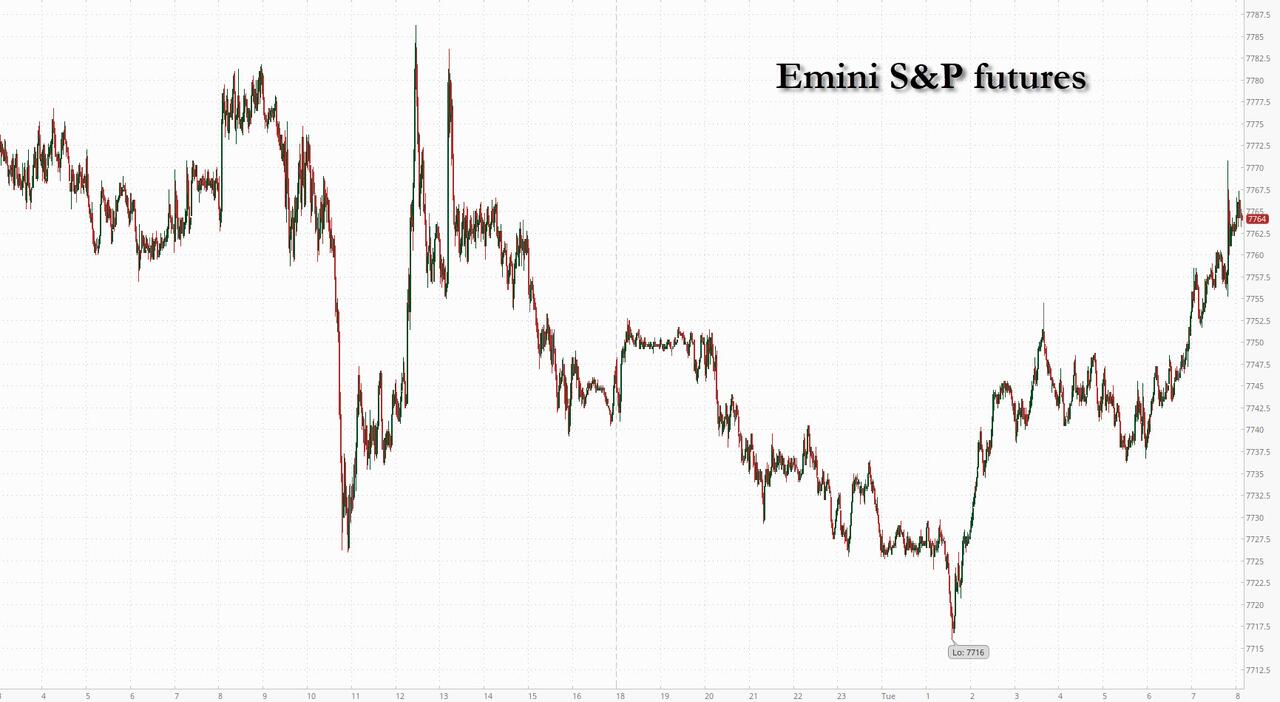
In premarket trading, Mag 7 stocks are mixed (Alphabet (GOOGL) -0.08%, Amazon (AMZN) +0.3%, Apple (AAPL) -0.4%, Meta Platforms (META) +0.8%, Microsoft (MSFT) -0.08%, Nvidia (NVDA) +0.6%, Tesla (TSLA) +0.3%)
- AAR (AIR) gains 5% after the aerospace and defense company reported adjusted diluted earnings per share and revenue for the first quarter that beat the average analyst estimate.
- Fair Issac (FICO), a credit score company, slumps 18% after Federal Housing Finance Agency Director Bill Pulte announced a move that makes it easier for lenders to adopt VantageScore. According to analysts, this will increase competition while pressuring Fair Issac’s market share and pricing power.
- FuelCell Energy (FCEL) rises 5% after Oppenheimer & Co initiated coverage of the fuel cell maker with a recommendation of outperform, expecting demand to stay “well ahead” of supply as it ramps up its production capacity.
- Iovance Biotherapeutics (IOVA) climbs 5% after boosting its revenue guidance for the full year.
- Monday.com Ltd. (MNDY) slips 1.8% after JPMorgan downgraded the software company to neutral from overweight, citing growth challenges for annual recurring revenue.
- Netflix (NFLX) inches 1% higher after Deutsche Bank upgraded the streaming-video company to buy, saying that concerns about engagement were overblown.
- Summit Therapeutics (SMMT) rises 16% after AstraZeneca announced an investment in the biotech to collaborate on new cancer medication.
- Uniqure (QURE) slumps 58% after saying that the benefits of its Huntington’s disease gene therapy drug AMT-130 were not as good after four years as they were after three years in a small trial — a result that could complicate its bid to get the treatment approved by US regulators.
In other corporate news, AstraZeneca is investing $2 billion in US biotech Summit Therapeutics to collaborate on a promising new cancer medicine; AMD agreed to acquire World Labs for $8.2 billion, gaining an AI startup founded by industry pioneer and researcher Fei-Fei Li; Vail Resorts anticipates a rebound in fiscal year 2027 above analyst estimates, based on a range of normal weather conditions and incremental cost savings.
Markets are finding their footing after a turbulent start to the week that saw volatile oil prices trigger selling across stocks and bonds. Among potential catalysts, traders will closely follow what emerges from a lunch meeting on AI safety risks between US President Donald Trump and industry leaders. A busy stretch of economic data also kicks off with the release of the August job openings report. Traders will parse remarks from six Federal Reserve speakers for clues on the rate outlook at a time when markets are pricing as many as four hikes over the next 12 months
For traders, the current backdrop is tricky to navigate. Mounting risks from oil prices and interest rates have prompted some investors to pause aggressively building positions and wait for a clearer signal to re-engage, according to Bloomberg. US long-term net asset inflows fell in August versus the previous month, driven by lower passive inflows, according to JPMorgan, citing Morningstar data. Equity inflows declined to $11 billion from $39 billion in July.
The AI trade is also getting more complicated. OpenAI scrapped the debut of its GPT-6.1 Astra model while it establishes stronger safeguards, while Anthropic warned of “existential risks to humanity” in an IPO prospectus, Reuters reported. Both will remain in focus today, with OpenAI’s DevDay in San Francisco, including Sam Altman’s keynote at 1 p.m. ET, and Anthropic and Nvidia CEOs due to attend a lunch with Trump to discuss AI risks.
“We’ve had some rather large moves over the last few days or so, and we’ll have the ultimate data trigger in the form of non-farm payrolls heading into Friday, so I think it makes sense for positions to be squared,” said Geoff Yu, a senior macro strategist at BNY. “Also worth bearing in mind it’s month-end, so there will be these passive transactions which are not aligned to data.”
Worries that AI may cause harm have also moved to the fore, leading some industry executives, including Anthropic PBC head Dario Amodei, to call for a slowdown in the technology’s development. As Amodei and others prepare to meet Trump, traders will also listen what OpenAI Chief Executive Officer Sam Altman has to say about the issue at the group’s annual developer conference. The ChatGPT chatbot owner is holding back a version of its Astra model to put stronger guardrails in place.
The impact of rising inflation was on display Tuesday when Australia’s central bank lifted borrowing costs to the highest level in about 15 years. In Spain, inflation moved further above the European Central Bank’s 2% target, reinforcing the case for higher euro-area rates.
Macro data include JOLTS and consumer confidence, which Bloomberg Economics expect to show muted labor demand and subdued household sentiment. There’s also half a dozen Fed speakers, including two closely watched voters. Barr, who called for additional rate hikes last week, is speaking on the economic outlook in Detroit, and Williams, who has said more work is needed to lower inflation, will deliver keynote remarks in Buffalo.
European stocks are benefiting from the drop in oil, with the Stoxx 600 up 0.4% as cyclicals outperform defensives. Sentiment was also lifted as investors pared bets on rate hikes from the European Central Bank, with Julius Baer Group surging after Swiss regulatory action against the bank ended. Here are the biggest movers Tuesday:
- Julius Baer surges as much as 8.8% to a new all-time high after Finma said the wealth manager must hold CHF250 million in additional capital, less than previously required, as it ended its enforcement procedure. The Swiss firm has also sought approval for a share buyback program.
- Vesuvius shares gain as much as 32%, the most since 1990, after the metallurgical engineering firm announced a cash-and-shares offer from RHI Magnesita
- Close Brothers shares rise 13% after the specialized lender reported full-year earnings that beat expectations. Costs came in better than forecast, while loan growth accelerated in the second half
- Hapag-Lloyd gains as much as 5.3% after the German container shipper raised its full-year guidance. JPMorgan attributed the boost to shipping rates remaining at elevated levels
- Hemnet gains as much as 5.9%, the most in two weeks, after the Swedish property listings platform announced a series of operational changes, including the introduction of two new free entry-level listing formats
- Pepco Group gains as much as 5.1% in Warsaw after the discount retailer reported an acceleration in like-for-like sales, increased its earnings guidance and unveiled a new buyback
- Legrand gains as much as 7.8%, the most since April 8, after the electrical device specialist updated its financial targets through to 2030 at its capital markets day in Singapore
- Lindt & Sprüngli’s participation certificates fall as much as 9%, the most since March, after cutting its full-year 2026 organic sales growth forecast to 0%–2% from a prior range of 4%–6%
- Rentokil shares fall as much as 2.4% after Morgan Stanley cut its recommendation to equalweight from overweight. Morgan Stanley says the US pest control “narrative is unravelling and may have peaked”
- Shares in French airports and highways operators drop in heavy trading after news that the government is considering increasing taxes on transport infrastructure in its 2027 budget
- Accelleron Industries sares drop as much as 4.3% as Barclays starts coverage of the turbocharger manufacturer with a “contrarian” underweight, giving the stock its only negative analyst rating
- Pharming drops as much as 6.7% after announcing that Fabrice Chouraqui will step down as Chief Executive Officer with immediate effect
Asian stocks headed for a second straight day of losses as a lack of progress in US-Iran talks to reopen the Strait of Hormuz kept oil prices elevated. The MSCI Asia Pacific Index declined as much as 1.2% before paring some losses. Financials tracked US peers lower and were the biggest drags among sectors on the regional benchmark. MediaTek’s 7.1% slide, which was the largest in two months and followed a recent run-up in the stock, also weighed on the gauge as Taiwan markets resumed trading after holidays. Most of the national benchmarks in Asia fell on Tuesday. In China, the CSI 300 Index ended little changed, while property stocks rallied after the nation’s cabinet said it will study new policies to stabilize the real estate market, promote employment and boost domestic demand in response to issues emerging in the economy. The CSI benchmark had slumped to its lowest level in more than a year on Monday. Here are the most notable Asian movers
- Jiangsu Hengrui Pharmaceuticals’ shares gain as much as 3.7% in Shanghai after it agreed to license obesity and diabetes drug HRS-1596 to Novo Nordisk in a deal valued at up to $2.6 billion, according to an HKEX filing.
- RoboTechnik Intelligent Technology Co. shares fell on their trading debut in Hong Kong in one of the city’s busiest days for new listings.
- Chugai Pharmaceutical shares fall as much as 2.8% to the lowest in about a month after the Japanese company said the clinical development of emugrobart for obesity will be discontinued.
- PT GoTo Gojek Tokopedia shares extend their drop by another 14%, following a similar decline on Monday that came after Indonesia Stock Exchange removed its 50-rupiah price floor.
- Guangzhou Automobile Group shares jump after the company announced plans to acquire a 50% stake in FAW Toyota through share issuance, according to a filing to Shanghai Stock Exchange.
- Akeso shares rise as much as 13% after AstraZeneca said it would invest $2b in Summit Therapeutics, a partner of the Hong Kong-listed company.
- UBTech’s shares drop as much as 4.8% in Hong Kong after JPMorgan downgrades to neutral from underweight, reflecting a more cautious stance on humanoid robot manufacturers.
Asia’s equity benchmark is now down 1.3% in September as rising oil prices, surging bond yields, volatility in high-flying AI stocks and growing odds for more rate hikes by the Federal Reserve have combined to sour sentiment. Even so, the index is up more than 20% in 2026, heading for a fourth straight annual gain. Meanwhile, Indian equities are breaking through a series of long-held technical support levels as a selloff gathers pace in a market once considered an emerging-market darling. The benchmark NSE Nifty 50 Index has fallen for seven straight weeks and broken through its 200-day moving average on a weekly basis for the first time in six years.
In FX, the Bloomberg Dollar Spot Index is gaining further ground, up 0.2%, pressuring EUR/USD lower toward its year-to-date low. Aussie dollar finds itself near the foot of the G10 leaderboard after a hawkish RBA hike was followed up by a more dovish tone from Governor Bullock.
In rates, treasury futures are higher in early US session after erasing losses, with oil prices extending their retreat from Monday’s highs.US yields drop near session lows across the curve, with 10-year borrowing costs down 2bps to 5.21%. European yields are lower.US two- to 10-year yields are about 2bp richer with longer tenors lagging, steepening 5s30s spread by around 1bp on the day. 10-year is around 5.22% with bunds and gilts in the sector outperforming by 2bp and 3bp respectively. UK gilts outperformed European peers as markets waited for Prime Minister Andy Burnham to address the ruling Labour Party in Liverpool. Officials expect Burnham could signal he wants to begin a conversation about reforming the state pension to help pay for social care. IG dollar issuance slate includes a couple of names so far. Kroger was the sole issuer to tap the US primary market Monday, raising $1.5 billion while at least four others elected to stand down. Paramount is expected to announce the US dollar leg of a debt sale as soon as Tuesday after holding investor outreach Monday. US session includes consumer confidence gauge, JOLTs job openings data and comments by six Fed officials.
In commodities, WTI futures are on session lows, having added to losses after comments from the Qatar Foreign Ministry on possible US-Iran solutions. Brent crude is down 2% and trading around $104/bbl after advancing as high as $107.87/bbl in the European morning. There was no obvious news driver behind the dip but it follows a familiar recent pattern. Bitcoin is up 0.5%.
Today’s US economic data slate includes July FHFA house price index and S&P Cotality home prices (9 a.m.), September consumer confidence and August JOLTS job openings (10 a.m.) and September Dallas Fed services activity (10:30 a.m.). Fed speaker slate includes Vice Chair for Supervision Bowman (11 a.m.), Governor Barr (12:40 p.m.), Chicago’s Goolsbee (1 p.m.), St. Louis’s Musalem (1:30 p.m.), New York’s Williams (2 p.m.) and Governor Waller (3 p.m.)
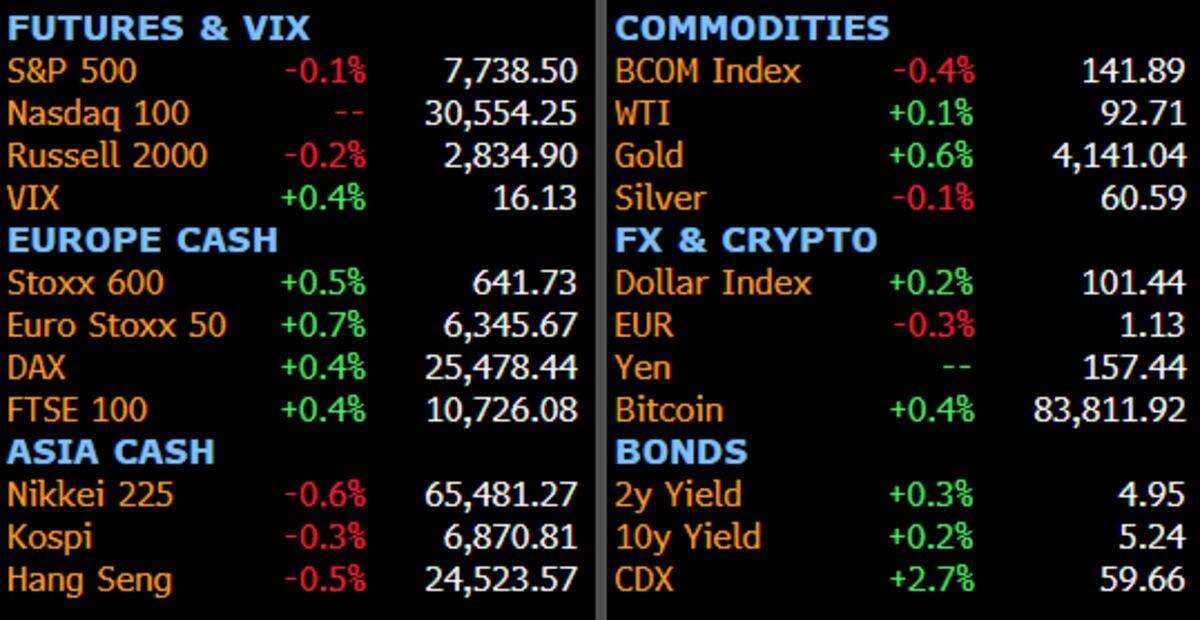
Market Snapshot
Top Overnight News
- Iran’s ability to choke off oil flowing through the Strait of Hormuz—and use that as leverage in talks with the U.S.—is breaking down, raising the risk it will resort to military escalation to bolster its position. WSJ
- Crude oil exports from key Middle East producers rebounded in September to 16.328 million barrels per day (bpd), the highest since the US-Israeli war on Iran started in late February, data from Kpler showed on Monday, as Saudi Arabia and the United Arab Emirates boosted exports. RTRS
- President Trump is willing to give Iran sanctions relief and release Iranian frozen funds in return for concrete Iranian steps regarding the nuclear program, U.S. officials say. But Trump took to Truth Social Monday evening to say such reports were “untrue.” Axios
- Nvidia has held talks with insurance companies about shouldering the risks of lending against its chips as chief executive Jensen Huang pushes to unlock more demand for its semiconductors beyond Big Tech groups. FT
- China pledged more support for its slowing economy, including tapping unused local bond quotas and expanding central bank relending. Beijing will also subsidize interest payments for first-home mortgages. BBG
- A US import ban on certain Canadian motorcycles, alcoholic beverages and whey products took effect after Ottawa imposed retaliatory tariffs. The affected trade is relatively small at about $1 billion. BBG
- South Korea’s Finance Minister said closely monitoring the bond market and will conduct treasury bond buyback if bond yields rise excessively: BBG
- Australia’s central bank has raised interest rates to the highest level in 15 years as the war in the Middle East fuels inflation and adds to economic uncertainty. The Reserve Bank of Australia on Tuesday increased its main borrowing rate by 0.25 percentage points to 4.6%, its fourth rate rise this year, as higher fuel prices fed into costs of goods and services. FT
- Japan’s 40-year government bond auction drew its strongest demand in six years as elevated yields lured investors back to the nation’s longest-dated debt, offering a potential reprieve to fragile global markets. BBG
- Spanish inflation rose for an eighth month in a row in September, accelerating beyond the eurozone average as its economy continues to outperform. WSJ
- September’s living up to its reputation for typically being the worst month for Treasuries. History suggests October will offer little relief, especially with the US-Iran war, fiscal concerns and a hawkish Fed. BBG
Iran Latest
- Iran’s Foreign Minister Araghchi said Tehran discussed proposals with Qatari mediators to present to the US, and response is to be relayed to Tehran through Qatari mediators, adds conditions set by Supreme Leader must be met to reopen Strait of Hormuz. If the US wants a deal or peace, Iran has offered a solution. He will fly to Tehran in a few hours, and the Qataris will know how to reach us whenever they have the answer. Expects US response on Tuesday. Communications and messages exchanged by Qatari and Pakistani mediators have always been, but now they have taken a more serious form due to the plan presented by Iran.
- Iranian Foreign Minister Araghchi said Iran’s positions have not changed and conditions for reopening the Strait of Hormuz are clear, while their position on other matters is clear. Hopeful the US’ final answer will be conveyed via Qatari “by tomorrow”.
- Iran’s Foreign Ministry spokesperson Baghaei said media reported about the content of consultations with the Qatari mediator are baseless speculation, noting such accounts have no basis in reality and no discussion of the details of the issues took place.
- Iran Foreign Ministry Iranian delegation met with Qatar mediator on Monday afternoon at the UNGA, adds media speculation on Qatar talks is false and that there were no talks held on detailed issues with Qatari mediator. said:. Iran delegation will depart New York for Tehran on Monday night.
- Iranian MP Ebrahim Rezaei said no negotiations will begin until the US fulfils its commitments in the Islamabad understanding, while he stated that Iranian diplomats lack permission for bilateral or trilateral talks in the current situation. said:. US failed to release blocked funds after Islamabad deal.
- UN Secretary-General Guterres requested in a meeting with Iran’s Foreign Minister Araghchi for a continuation of negotiations to achieve peace, according to Fars News Agency.
- US President Trump posted “Axios just released a story that “Trump” offered Sanctions Relief and Frozen Funds to Iran. This is untrue. I offered them NOTHING! Axios’ story, like most others, is a HOAX”. Full post “Axios just released a story that “Trump” offered Sanctions Relief and Frozen Funds to Iran. This is untrue. I offered them NOTHING! Axios’ story, like most others, is a HOAX, used only for purposes of satisfying their Trump Derangement Syndrome. They should withdraw this fake story, IMMEDIATELY!”.
A more detailed look at global markets courtesy of Newsquawk
APAC stocks were mostly subdued following the weak handover from Wall Street, where the major indices were pressured as oil prices and yields continued to climb, amid a slew of conflicting geopolitical headlines. ASX 200 traded rangebound with the index kept afloat for most of the session amid outperformance in the local tech, mining and materials industries, but with the upside limited after disappointing Household Spending and with mild pressure seen after the RBA hiked rates as expected and stuck to the hawkish script. Nikkei 225 underperformed and tested the 65,000 level to the downside, with the declines led by weakness in refiner and power-related stocks. KOSPI was choppy with the index ultimately dragged lower by the tech giants amid recent upside in yields, while South Korea’s Finance Minister noted they are closely monitoring the bond market and will conduct a treasury bond buyback if bond yields rise excessively. Hang Seng and Shanghai Comp traded mixed with Hong Kong pressured amid weakness in some autonames and as fast fashion retailer Shein slumped after it reported its H1 oper. profit fell by over 50% Y/Y, while the mainland was resilient after the PBoC and government agencies issued guidance to expand capacity and improve the quality of China’s service sector through financial support, and China also asked local governments to pilot high-quality policies to boost consumption.
Top Asian News
- China has asked local governments to pilot high-quality policies to boost consumption, according to SCMP.
- Japan’s Chief Cabinet Secretary Kihara said multi-layered Japan-China communication is important.
European bourses (STOXX 600 +0.5%) are broadly firmer this morning, with sentiment buoyed by increased hopes of US-Iran diplomacy – although uncertainty remains (see commodities for details). The energy complex has waned off best levels throughout the London morning, which has also helped lift the equities complex. European sectors hold a positive bias. Tech takes the top spot, reversing some of the pressure seen in the prior session. Industrials and Basic Resources complete the top three, with the latter rebounding from the pressure seen on Monday. To the downside, Food Beverage & Tobacco is joined by Energy and Optimised Personal Care.
Top European News
- UK PM Burnham has been warned by one of Britain’s largest unions that scrapping the triple lock on state pensions to help fund free social care for the elderly would be “electoral suicide” amid growing cabinet splits, reported The Times.
FX
- DXY is firmer after strengthening on Monday alongside higher US yields, with the Buck supported by elevated energy prices and continued Fed tightening expectations. DXY briefly rose from around 101.30 to above 101.38 in recent trade before paring slightly despite a dip in yields at the time, with the index currently towards session highs in a 101.17-101.44 range.
- EUR/USD is softer as the Dollar strengthens, with the pair extending below 1.1350 and trading towards the bottom of a 1.1343-1.1374 range. Spanish CPI printed hotter than expected at 4.9% Y/Y (exp. 4.7%, prev. 4.3%), with Core CPI also rising to 3.1% from 2.9%, although the data provided little support to the Single Currency.
- GBP is softer against the Dollar and trades towards the lower end of a 1.3227-1.3258 range. Sterling-specific newsflow centres on PM Burnham’s Labour conference speech later, where reports suggest he will edge the party closer towards rejoining the EU and signal an end to the pensions triple lock, although price action thus far remains largely driven by the firmer Dollar.
- JPY is broadly flat against the Dollar but outperforming most G10 peers, with USD/JPY trading around the middle of a 157.20-157.59 range. Japanese Finance Minister Katayama reiterated that the undervalued Yen is problematic and said Japan and the US agreed to bolster cooperation on FX after discussions with Treasury Secretary Bessent.
- Antipodeans underperform, led by AUD following the RBA. The Bank unanimously hiked rates by 25bps to 4.60% and retained the option of further tightening, but Governor Bullock subsequently struck a more dovish-than-usual tone, saying she hopes the four hikes delivered this year will be restrictive enough to slow inflation and that further hikes may not be needed if inflation comes down. AUD/USD fell from 0.7021 during the press conference to a 0.6973 low and remains close to session lows. NZD is also softer against the Dollar.
- Japanese Finance Minister Katayama said exchanged views on FX trends with US Treasury Secretary Bessent on Friday and agreed to bolster cooperation, adds we believe the undervalued yen, in general, is problematic. said:. Will continue close communications with US Treasury to ensure orderly Forex markets. PM Takaichi’s administration is not reflationary. Closely monitoring bond markets. Interest rates are determined by markets. Will communicate closely with bond markets and conduct appropriate debt management policy. Will communicate closely with market participants while maintaining high sense of urgency.
Central Banks
- RBA Governor Bullock said inflationary pressures to last longer than expected; inflation is driven by domestic capacity pressures; Board will raise rates again if needed.
- RBA hikes the Cash Rate by 25bps to 4.60%, as expected with the decision unanimous, while it stated inflation remains elevated and some of the upside risks in August are materialising.
- ECB’s Kazimir said the rate hike was unavoidable, energy prices remain a key factor, and January repricing will be key for him; ECB needs flexibility, it has enough time.
- PBoC injected CNY 90.5bln via 7-day reverse repos and CNY 698.5bln in overnight reverse repos.
- PBoC set USD/CNY mid-point at 6.7411 vs Exp. 6.7177 (prev. 6.7399).
- Indonesia’s central bank said rupiah weakens on higher global inflation and oil price risk., adds rupiah depreciation is due to worries about global inflation and fiscal risk amid high crude prices and interest rates.
Fixed Income
- A firmer start to the day, but the magnitudes vary significantly. USTs near-enough flat, awaiting an update on the geopolitical front; as it stands, Iran has suggested that a final response from the US could be presented to them by the US via Qatari mediators. Though, details on that remain light. Nonetheless, and despite relatively punchy (but familiar) Iranian rhetoric, energy has eased off highs across the morning.
- USTs flat in 104-08+ to 104-19 parameters. Aside from the above, the day features a handful of Fed speakers that may prove pertinent in addition to the latest JOLTS and confidence data stateside.
- Bunds firmer by around 20 ticks at the time of writing, a few ticks shy of Monday’s 119.71 peak thus far. Specifics for the space are a little light, no move to ECB speak or a handful of data points. Otherwise, focus remains on the energy complex, and particularly TTF which continues to ease but remains well above EUR 70/MWh.
- Gilts outperform, firmer by c. 50 ticks at best, but have eased modestly off the 84.44 peak across the morning. Outperformance comes ahead of the 14:00BST speech by UK PM Burnham at the Labour Party Conference. A speech that is expected to touch on a number of topics as part of his plan for the UK ahead.
- Particular focus will be on the triple lock, reports hint that he will open the door to an end to this in his speech, by signalling a review of it as part of the next Labour manifesto. Reporting that drives Gilts higher, as the fiscal cost of the commitment is already significant and is projected to increase markedly in the years ahead. However, it remains to be seen if there is the political/public appetite for this, and what measure(s) Burnham will have to provide to offset the hit to pensioners. For reference, projections for the lock suggest it will cost over GBP 15bln/yr in 2030.
- Italy sold EUR 6.5bln (vs exp. EUR 5.5-6.5bln) 3.95% 2032 and 4.00% 2036 BTPs.
- UK sold GBP 4.25bln 4.875% 2036 Gilt: b/c 3.34x (prev. 3.65x), average yield 5.383% (prev. 5.155%), tail 0.5bps (prev. 0.1bps).
- Deutsche Telekom (DTE GY) files to sell EUR 1.5bln three-parter.
- Japan sold JPY 300bln in 40-year JGBs; b/c 3.10x (prev. 2.82x), highest accepted yield 4.125% (prev. 3.865%). Price at the highest accepted yield 93.69 (prev. 98.68).
Commodities
- WTI Nov and Brent Dec futures are modestly firmer/flat but off earlier highs as traders continue to digest conflicting US-Iran developments (see below). WTI trades towards the lower end of a USD 92.44-94.74/bbl range, while Brent similarly sits near the bottom of a USD 97.62-100.28/bbl range, albeit both firmer intraday.
- Dutch TTF is softer, pulling back from earlier highs despite continued concerns around European energy security. The European Commission has asked member states to consider measures to reduce gas and electricity demand for as long as necessary. TTF is choppy but currently towards the middle of a EUR 71.65-73.10/MWh range.
- Precious metals are firmer as they attempt to recover some of Monday’s heavy losses, helped by the modest pullback in global yields this morning. Spot gold trades towards the upper end of a USD 4,113-4,149/oz range, although fundamentals remain against the yellow metal amid high energy prices and expectations of further Fed tightening. Spot silver is flat towards the middle of a narrow USD 60.29-61.03/oz range.
- Base metals are softer, with the complex remaining near recent lows amid subdued risk sentiment and ahead of China’s holiday period. 3M LME copper sits at the bottom of a USD 14,391-14,518/t range, while COMEX copper is lower by around 0.6%.
- In geopolitics, Iran expects a US response today to its latest proposal on reopening the Strait of Hormuz, although reports of Tehran showing flexibility on its nuclear position were denied by Iranian officials, while Trump also denied offering sanctions relief or frozen funds in return for nuclear concessions. This morning, Iran’s Parliament Speaker warned that if Iran cannot sell oil, no one in the region will sell oil, while an explosion was reported involving a commercial vessel in the Strait and Houthis reportedly attacked oil facilities in Yanbu. On the supply side, Saudi Arabia has resumed crude loading from Yanbu following partial repairs to the East-West pipeline.
- Gas production in Iran’s South Pars Phase 11 reaches 1bln cubic feet, IRIB reported.
- Iraqi Oil Ministry announces the start of trial operations for the storage capacity project at the Nasiriyah gas depot, INA reported.
- EU Energy Commissioner Jorgensen said they do not want to relax methane rules, but rather to delay their implementation.
- Spanish Energy Minister said that Spain, Portugal and Luxembourg sent a letter to the Commission asking for a new renewable energy capacity. Spain wants the EU to consider measures to capture windfall profits from high energy prices. Spain is still waiting for a response to the proposal. Spain wants a permanent levy on the oil and gas industry to raise climate funds.
- Syria said gas pipeline fire between Al-Shola and Deir al-Zour caused by sabotage, while efforts underway to extinguish fire and fire stopped gas supply from Jbeissa plant to power stations.
- British government is said to be privately lobbying the Trump administration for an exemption should the US impose any diesel export ban, according to sources.
- IEA Chief Birol said Europe is one of the regions most exposed to the degrading diesel market, which the IEA is monitoring closely. IEA will discuss with member governments whether more strategic reserve releases are needed. IEA is discussing the situation with countries.
Trade/Tariffs:
- Nvidia (NVDA) and AMD (AMD) are lobbying US President Trump’s administration to stop lawmakers from curbing exports to China, Politico reported citing sources; asking that lawmakers hold off on the China-related chip export restriction in the defence bill. The legislation in question has bipartisan support.
- US import bans on a range of Canadian products, including alcoholic beverages, dairy ingredients and some motorcycles, took effect as scheduled.
Geopolitics: Ukraine
- Estonian official said Russia was behind an arson attack on defence maker Milrem Robotics.
- Ukraine’s air force reported guided bombs striking the Kharkiv region.
- Russian President Putin orders an increase in the size of the Russian army.
- FT reporter posted after a day of relentless drone attacks, Russia is now hitting Kyiv with a wave of ballistic missiles and several explosions have shaken Ukraine’s capital in the last few minutes.
Geopolitics: Iran
- Iranian Parliament Speaker Ghalibaf said if Iran cannot sell oil, no one in the region will sell oil, and warns that if Iran’s security is not ensured, no infrastructure will be safe, ISNA reported.
- IRGC reiterates that Iran will never seek a nuclear weapon, Al Jazeera reported; reiterates conflict takes a different form and will bring new weapons to the field. Most of the American bases in the region have been destroyed and can no longer be used again.
- US Secretary of State Rubio tells Fox News Iran has threatened to attack our interests around the world and we are taking those threats very seriously, while he warned there will be repercussions if American interests are attacked.
- Iran Supreme Leader senior adviser warned that if Iran is attacked by the US again, the confrontation will expand to new fronts, according to Press TV.
- Iranian MP said before any negotiations, the US must accept Iran’s conditions, reported Fars.
- An explosion was reported in the Strait of Hormuz, which is said to be a commercial ship attempting to pass through the southern route of the Strait, Fars reported citing Ambrey.
Other:
- Houthis reportedly attacked oil facilities in Yanbu on the Red Sea with a large number of ballistic missiles and drones; satellites showed several giant oil storage tanks at the Al-Mu’ajiz terminal in southern Saudi Arabia ablaze, Al Akhbar reported. According to an economic source close to the Ansar Allah movement, who spoke to Al-Akhbar, Sana’a forces have designated Aramco assets in Jizan, Najran, and Yanbu, valued at USD 100bln, as legitimate targets in the current round of fighting. This phase will be followed by the addition of strategic facilities of equal importance to Aramco’s to their target bank.
- Intelligence sources say that Houthis expand target bank in Saudi Arabia, according to ILNA.
- N12’s Lipkin reported that the commander of Hama’s northern Gaza Strip brigade was “eliminated”.
- US Treasury Department said Treasury Secretary Bessent met with Lebanon’s PM today, while he urged Lebanon to disrupt Iran and Hezbollah networks.
- US Secretary of State Rubio told Lebanon’s PM, we support a sovereign Lebanese state free from the harmful influence of Hezbollah and Iran. said:. Tripartite framework is the only way to achieve lasting peace between Lebanon and Israel.
- US Secretary of State Rubio urges Cuba to choose a different path and said the US will not tolerate threat to national security.
- Riyadh airspace experienced threat disruption and flight suspensions with planes held in holding pattern over Riyadh for about 20 minutes, according to SNN.
- North Korea said US approval for South Korea’s nuclear submarine increases regional instability.
US Event Calendar
- 9:00 am: Jul FHFA House Price Index MoM, est. 0.1%, prior 0%
- 10:00 am: Sep Conf. Board Consumer Confidence, est. 89, prior 89.4
- 10:00 am: Aug JOLTS Job Openings, est. 7227.5k, prior 7271k
Central Bank Speakers
- 11:00 am: Fed’s Bowman Delivers Opening Remarks
- 12:40 pm: Fed’s Barr Speaks On Economic Outlook
- 1:00 pm: Fed’s Goolsbee Speaks in Moderated Discussion
- 1:30 pm: Fed’s Musalem Speaks on US Economy
- 2:00 pm: Fed’s Williams Gives Keynote Remarks
- 3:00 pm: Fed’s Waller Speaks on Payments System
DB’s Jim Reid concludes the overnight wrap
The relentless bond selloff has shown no sign of easing, with a fresh rise in yields overnight as oil prices keep moving higher. The immediate driver was the weekend news that President Trump had rejected Iran’s proposal. So Brent crude was up +0.92% yesterday to $105.28/bbl, and this morning it’s up another +1.92% to $107.30/bbl. And as concerns have mounted about persistent inflation, that’s pushed yields up to multi-year highs once again. In fact, yesterday saw the 10yr Treasury yield (+7.6bps) close at 5.24%, and this morning it’s up further to 5.26%. So we’re not far off the 2007 closing peak of 5.29%, which would then be its highest level since 2002 if that’s surpassed. Moreover, yesterday started to see growing pressure on risk assets as well, as the S&P 500 fell -0.77%, whilst US and European HY spreads reached their widest levels since April.
Those oil moves were the main catalyst for the latest bond moves, as the weekend headlines made clear that both the US and Iran remained far from an immediate deal. After all, Trump said on Saturday that “They made a proposal but I rejected it”. And Iran’s foreign minister Araghchi said on Sunday that “we have no reason to come back to diplomacy and engage with this administration once again”. So when oil markets reopened again yesterday, that immediately drove a fresh jump.
To be fair, there were some signs of potential progress, as Iran’s foreign minister Abbas Araghchi met with mediators in New York yesterday, according to Iran’s ISNA. And later on, we saw similar reports by CNN and then Axios that Trump was open to sanctions relief and releasing frozen Iranian funds if there was “concrete” progress by Iran on the nuclear issue. So coupled with the news that Saudi Arabia has restored about half the flows through its East-West pipeline, this helped Brent pull back to flat on the day after trading as much as +4.5% higher. But then into the close, oil prices moved higher again as Trump denied the Axios story, while Iran’s Press TV claimed that reports of Iranian flexibility in nuclear talks were false.
Given all the rhetoric from both sides, investors have become more pessimistic since last week’s hopes about some kind of negotiated deal around the UN. In general, there’s been a growing awareness that hopes for a US-Iran deal have been repeatedly dashed in recent months, and that scepticism about the Strait of Hormuz reopening any time soon has led investors to price a longer period of high prices into next year. For instance, the December 2027 Brent future (+0.22%) closed at a new high of $80.29/bbl yesterday, and this morning it’s up again to $80.67/bbl. So for markets it wasn’t just a story about front-end prices yesterday, but a more protracted period of high oil prices stretching well into 2027.
This inflation momentum led investors to price in a more hawkish path for central banks, with growing expectations of a Fed rate hike at their next meeting. Indeed, as we go to press this morning, futures are pricing in a 73% chance of an October hike. And further out, markets are now pricing in the most hawkish path to date for the coming months, with 93bps of hikes now priced by the June 2027 meeting. Those moves came as Fed Governor Cook said that the labour market appears well positioned to handle higher rates, suggesting it is “roughly in balance and gradually improving.”
With markets pricing in more rate hikes and energy prices up yet again, that put even more pressure on Treasuries across the curve. Among others, the 10yr yield (+7.6bps) moved up to 5.24% by the close, leaving it not far away from its 2007 closing peak of 5.29%. Indeed, if it surpasses that milestone, it would then be the highest 10yr yield since 2002. Elsewhere, yesterday also saw the 2yr yield (+7.9bps) rise to 4.93%, the highest since 2024, and the 30yr yield (+5.6bps) rose to a new post-2004 high of 5.55%. And once again, it was real yields driving most of the increase, with 10yr real yields (+7.1bps) reaching a new post-2008 high of 2.89%.
Over in Europe it was much the same story, with yields also hitting multi-year highs across the continent. That included 10yr bunds (+4.1bps), which hit a post-2009 high of 3.64%, whilst 10yr OATs (+7.8bps) hit a post-2008 high of 4.77%, and 10yr gilts (+5.6bps) hit a post-2007 high of 5.42%. Moreover, there was also a widening in sovereign bond spreads, with the Franco-German 10yr spread up to a post-2012 high of 113bps. The last time it was that wide was just a few weeks before Mario Draghi delivered his famous “whatever it takes” speech that was seen as a turning point in the Euro crisis.
That backdrop also hit equities on both sides of the Atlantic, with the major indices generally moving lower. In the US, the S&P 500 (-0.77%) fell in a broad-based decline, with matters not helped by a larger fall for the Magnificent 7 (-1.72%). Nevertheless, some of the defensive sectors managed to post modest gains, including consumer staples (+0.40%), healthcare (+0.29%) and energy (+0.21%). Meanwhile in Europe, the STOXX 600 (+0.005%) inched up by less than a basis point, as strong gains for equities in the Netherlands, Austria and Greece helped to outweigh declines in the larger countries, with the DAX (-0.13%) and the FTSE 100 (-0.10%) both falling.
There were also signs of stress in other risk assets yesterday, as IG and HY credit spreads widened to levels last seen in April in both the US and Europe. So by the close, US IG (+2bps) and HY (+9bps) had both seen a notable jump, as had European IG (+3bps) and HY (+9bps). Moreover, that comes after US HY saw its biggest weekly widening last week (+27bps) since October last year.
This trend has generally continued overnight, with many indices in Asia lower this morning, including the Nikkei (-1.24%), the KOSPI (-0.93%) and the Hang Seng (-0.63%). The main exception to this is in mainland China, where the CSI 300 (+0.03%) and the Shanghai Comp (+0.08%) have posted very modest advances. Meanwhile, the rise in bond yields has also continued, with Japan’s 10yr yield (+0.8bps) up to 3.07% this morning. That said, despite the selloff, Japan’s 40yr government bond auction still attracted the strongest demand since 2020, with the bid-to-cover ratio at 3.1, up from 2.82 at the previous auction.
Otherwise overnight, the hawkish newsflow has continued, as the Reserve Bank of Australia delivered a 25bp rate hike, which takes its cash rate target to 4.60%. The move was expected by markets, and its statement said that “inflation is still too high” and they would be willing to raise “the cash rate target further if needed.” Meanwhile, Australia’s 10yr government bond yield is up +0.2bps this morning at a post-2011 high of 5.42%.
Looking at the day ahead, US data releases include the JOLTS report for August, the FHFA’s house price index for July, and the Conference Board’s consumer confidence for September. Otherwise, we’ll get UK mortgage approvals for August, and the European Commission’s economic sentiment indicator for the Euro Area in September. Then, from central banks, we’ll hear from the Fed’s Bowman, Barr, Goolsbee, Musalem, Williams and Waller, the ECB’s Kazimir, Nagel, Escriva, Cipollone, and the BoE’s Mann and Taylor.
1b) European opening report
Iranian Foreign Minister says they expect a US response today; AUD lags post-RBA – Newsquawk US Market Open

Tuesday, Sep 29, 2026 – 06:06 AM
- Iranian Foreign Minister Araghchi said Tehran discussed proposals with Qatari mediators to present to the US, and that a response is to be relayed to Tehran through Qatari mediators. Iranian Foreign Minister said they expect a US response today; Brent -0.2%
- Iran was reported to have agreed to halt enrichment in exchange for easing US sanctions, although the Iranian Foreign Ministry spokesperson later denied these reports.
- US President Trump denied reports that he is prepared to ease sanctions on Iran and release its frozen assets in exchange for progress on the nuclear issue.
- European bourses are firmer; US equity futures trade on either side of the unchanged mark.
- DXY is slightly stronger, holding just shy of 101.50; Aussie lags after the RBA hiked rates by 25bps, though Governor Bullock tilted dovish.
- Gilts outperform ahead of UK PM Burnham; USTs await data, Fed speak and geopolitical updates.
- Looking ahead, highlights include US JOLTS (Aug). Speakers include ECB’s Lagarde, Vujcic & Lane, Fed’s Musalem, Goolsbee, Williams, Bowman, Barr & Waller, BoC’s Gravelle, BoE’s Taylor & Mann. Earnings from Micron.
SNAPSHOT

Newsquawk in 3 steps:
1. Subscribe to the free premarket movers reports
2. Listen to this report in the market open podcast (available on Apple and Spotify)
3. Trial Newsquawk’s premium real-time audio news squawk box for 7 days
LOOKING AHEAD
- Looking ahead, highlights include US JOLTS (Aug). Speakers include ECB’s Lagarde, Vujcic & Lane, Fed’s Musalem, Goolsbee, Williams, Bowman, Barr & Waller, BoC’s Gravelle, BoE’s Taylor & Mann. Earnings from Micron.
- Click here for the Week Ahead preview
IRAN CONFLICT
Diplomacy
- Iran’s Foreign Minister Araghchi said Tehran discussed proposals with Qatari mediators to present to the US, and response is to be relayed to Tehran through Qatari mediators, adds conditions set by Supreme Leader must be met to reopen Strait of Hormuz. If the US wants a deal or peace, Iran has offered a solution. He will fly to Tehran in a few hours, and the Qataris will know how to reach us whenever they have the answer. Expects US response on Tuesday. Communications and messages exchanged by Qatari and Pakistani mediators have always been, but now they have taken a more serious form due to the plan presented by Iran.
- Iranian Foreign Minister Araghchi said Iran’s positions have not changed and conditions for reopening the Strait of Hormuz are clear, while their position on other matters is clear. Hopeful the US’ final answer will be conveyed via Qatari “by tomorrow”.
- Iran’s Foreign Ministry spokesperson Baghaei said media reported about the content of consultations with the Qatari mediator are baseless speculation, noting such accounts have no basis in reality and no discussion of the details of the issues took place.
- Iran Foreign Ministry Iranian delegation met with Qatar mediator on Monday afternoon at the UNGA, adds media speculation on Qatar talks is false and that there were no talks held on detailed issues with Qatari mediator. said:. Iran delegation will depart New York for Tehran on Monday night.
- Iranian MP Ebrahim Rezaei said no negotiations will begin until the US fulfils its commitments in the Islamabad understanding, while he stated that Iranian diplomats lack permission for bilateral or trilateral talks in the current situation. said:. US failed to release blocked funds after Islamabad deal.
- UN Secretary-General Guterres requested in a meeting with Iran’s Foreign Minister Araghchi for a continuation of negotiations to achieve peace, according to Fars News Agency.
- US President Trump posted “Axios just released a story that “Trump” offered Sanctions Relief and Frozen Funds to Iran. This is untrue. I offered them NOTHING! Axios’ story, like most others, is a HOAX”. Full post “Axios just released a story that “Trump” offered Sanctions Relief and Frozen Funds to Iran. This is untrue. I offered them NOTHING! Axios’ story, like most others, is a HOAX, used only for purposes of satisfying their Trump Derangement Syndrome. They should withdraw this fake story, IMMEDIATELY!”.
Please see the geopolitics section below for details.
EUROPEAN TRADE
EQUITIES
- European bourses (STOXX 600 +0.5%) are broadly firmer this morning, with sentiment buoyed by increased hopes of US-Iran diplomacy – although uncertainty remains (see commodities for details). The energy complex has waned off best levels throughout the London morning, which has also helped lift the equities complex.
- European sectors hold a positive bias. Tech takes the top spot, reversing some of the pressure seen in the prior session. Industrials and Basic Resources complete the top three, with the latter rebounding from the pressure seen on Monday. To the downside, Food Beverage & Tobacco is joined by Energy and Optimised Personal Care.
- US equity futures are currently trading on either side of the unchanged mark; the NQ (U/C) holds flat, whilst the ES and RTY are lower by c. 0.1%. Focus today will be on President Trump’s meeting with AI heads, where discussions will be on AI oversight/safety and competition with China. The day ahead is packed with a number of Fed speakers, as well as US JOLTS job openings.
- It is also worth noting that Trump’s pharma tariffs (announced in Apr), will take effect on a number of key nations today. A 15% levy has been put on the EU, South Korea and Switzerland. Some analysts opine that the new measures could see a reduction in medication available to customers, and could even lead to higher prices.
FX
- DXY is firmer after strengthening on Monday alongside higher US yields, with the Buck supported by elevated energy prices and continued Fed tightening expectations. DXY briefly rose from around 101.30 to above 101.38 in recent trade before paring slightly despite a dip in yields at the time, with the index currently towards session highs in a 101.17-101.44 range.
- EUR/USD is softer as the Dollar strengthens, with the pair extending below 1.1350 and trading towards the bottom of a 1.1343-1.1374 range. Spanish CPI printed hotter than expected at 4.9% Y/Y (exp. 4.7%, prev. 4.3%), with Core CPI also rising to 3.1% from 2.9%, although the data provided little support to the Single Currency.
- GBP is softer against the Dollar and trades towards the lower end of a 1.3227-1.3258 range. Sterling-specific newsflow centres on PM Burnham’s Labour conference speech later, where reports suggest he will edge the party closer towards rejoining the EU and signal an end to the pensions triple lock, although price action thus far remains largely driven by the firmer Dollar.
- JPY is broadly flat against the Dollar but outperforming most G10 peers, with USD/JPY trading around the middle of a 157.20-157.59 range. Japanese Finance Minister Katayama reiterated that the undervalued Yen is problematic and said Japan and the US agreed to bolster cooperation on FX after discussions with Treasury Secretary Bessent.
- Antipodeans underperform, led by AUD following the RBA. The Bank unanimously hiked rates by 25bps to 4.60% and retained the option of further tightening, but Governor Bullock subsequently struck a more dovish-than-usual tone, saying she hopes the four hikes delivered this year will be restrictive enough to slow inflation and that further hikes may not be needed if inflation comes down. AUD/USD fell from 0.7021 during the press conference to a 0.6973 low and remains close to session lows. NZD is also softer against the Dollar.
- Japanese Finance Minister Katayama said exchanged views on FX trends with US Treasury Secretary Bessent on Friday and agreed to bolster cooperation, adds we believe the undervalued yen, in general, is problematic. said:. Will continue close communications with US Treasury to ensure orderly Forex markets. PM Takaichi’s administration is not reflationary. Closely monitoring bond markets. Interest rates are determined by markets. Will communicate closely with bond markets and conduct appropriate debt management policy. Will communicate closely with market participants while maintaining high sense of urgency.
FIXED INCOME
- A firmer start to the day, but the magnitudes vary significantly. USTs near-enough flat, awaiting an update on the geopolitical front; as it stands, Iran has suggested that a final response from the US could be presented to them by the US via Qatari mediators. Though, details on that remain light. Nonetheless, and despite relatively punchy (but familiar) Iranian rhetoric, energy has eased off highs across the morning.
- USTs flat in 104-08+ to 104-19 parameters. Aside from the above, the day features a handful of Fed speakers that may prove pertinent in addition to the latest JOLTS and confidence data stateside.
- Bunds firmer by around 20 ticks at the time of writing, a few ticks shy of Monday’s 119.71 peak thus far. Specifics for the space are a little light, no move to ECB speak or a handful of data points. Otherwise, focus remains on the energy complex, and particularly TTF which continues to ease but remains well above EUR 70/MWh.
- Gilts outperform, firmer by c. 50 ticks at best, but have eased modestly off the 84.44 peak across the morning. Outperformance comes ahead of the 14:00BST speech by UK PM Burnham at the Labour Party Conference. A speech that is expected to touch on a number of topics as part of his plan for the UK ahead.
- Particular focus will be on the triple lock, reports hint that he will open the door to an end to this in his speech, by signalling a review of it as part of the next Labour manifesto. Reporting that drives Gilts higher, as the fiscal cost of the commitment is already significant and is projected to increase markedly in the years ahead. However, it remains to be seen if there is the political/public appetite for this, and what measure(s) Burnham will have to provide to offset the hit to pensioners. For reference, projections for the lock suggest it will cost over GBP 15bln/yr in 2030.
- Italy sold EUR 6.5bln (vs exp. EUR 5.5-6.5bln) 3.95% 2032 and 4.00% 2036 BTPs.
- UK sold GBP 4.25bln 4.875% 2036 Gilt: b/c 3.34x (prev. 3.65x), average yield 5.383% (prev. 5.155%), tail 0.5bps (prev. 0.1bps).
- Deutsche Telekom (DTE GY) files to sell EUR 1.5bln three-parter.
- Japan sold JPY 300bln in 40-year JGBs; b/c 3.10x (prev. 2.82x), highest accepted yield 4.125% (prev. 3.865%). Price at the highest accepted yield 93.69 (prev. 98.68).
COMMODITIES
- WTI Nov and Brent Dec futures are modestly firmer/flat but off earlier highs as traders continue to digest conflicting US-Iran developments (see below). WTI trades towards the lower end of a USD 92.44-94.74/bbl range, while Brent similarly sits near the bottom of a USD 97.62-100.28/bbl range, albeit both firmer intraday.
- Dutch TTF is softer, pulling back from earlier highs despite continued concerns around European energy security. The European Commission has asked member states to consider measures to reduce gas and electricity demand for as long as necessary. TTF is choppy but currently towards the middle of a EUR 71.65-73.10/MWh range.
- Precious metals are firmer as they attempt to recover some of Monday’s heavy losses, helped by the modest pullback in global yields this morning. Spot gold trades towards the upper end of a USD 4,113-4,149/oz range, although fundamentals remain against the yellow metal amid high energy prices and expectations of further Fed tightening. Spot silver is flat towards the middle of a narrow USD 60.29-61.03/oz range.
- Base metals are softer, with the complex remaining near recent lows amid subdued risk sentiment and ahead of China’s holiday period. 3M LME copper sits at the bottom of a USD 14,391-14,518/t range, while COMEX copper is lower by around 0.6%.
- In geopolitics, Iran expects a US response today to its latest proposal on reopening the Strait of Hormuz, although reports of Tehran showing flexibility on its nuclear position were denied by Iranian officials, while Trump also denied offering sanctions relief or frozen funds in return for nuclear concessions. This morning, Iran’s Parliament Speaker warned that if Iran cannot sell oil, no one in the region will sell oil, while an explosion was reported involving a commercial vessel in the Strait and Houthis reportedly attacked oil facilities in Yanbu. On the supply side, Saudi Arabia has resumed crude loading from Yanbu following partial repairs to the East-West pipeline.
- Gas production in Iran’s South Pars Phase 11 reaches 1bln cubic feet, IRIB reported.
- Iraqi Oil Ministry announces the start of trial operations for the storage capacity project at the Nasiriyah gas depot, INA reported.
- EU Energy Commissioner Jorgensen said they do not want to relax methane rules, but rather to delay their implementation.
- Spanish Energy Minister said that Spain, Portugal and Luxembourg sent a letter to the Commission asking for a new renewable energy capacity. Spain wants the EU to consider measures to capture windfall profits from high energy prices. Spain is still waiting for a response to the proposal. Spain wants a permanent levy on the oil and gas industry to raise climate funds.
- Syria said gas pipeline fire between Al-Shola and Deir al-Zour caused by sabotage, while efforts underway to extinguish fire and fire stopped gas supply from Jbeissa plant to power stations.
- British government is said to be privately lobbying the Trump administration for an exemption should the US impose any diesel export ban, according to sources.
- IEA Chief Birol said Europe is one of the regions most exposed to the degrading diesel market, which the IEA is monitoring closely. IEA will discuss with member governments whether more strategic reserve releases are needed. IEA is discussing the situation with countries.
TRADE/TARIFFS
- Nvidia (NVDA) and AMD (AMD) are lobbying US President Trump’s administration to stop lawmakers from curbing exports to China, Politico reported citing sources; asking that lawmakers hold off on the China-related chip export restriction in the defence bill. The legislation in question has bipartisan support.
- US import bans on a range of Canadian products, including alcoholic beverages, dairy ingredients and some motorcycles, took effect as scheduled.
NOTABLE EUROPEAN HEADLINES
- UK PM Burnham has been warned by one of Britain’s largest unions that scrapping the triple lock on state pensions to help fund free social care for the elderly would be “electoral suicide” amid growing cabinet splits, reported The Times.
NOTABLE EUROPEAN DATA RECAP
- Italian PPI (Aug MM) 2.4% (Prev. 2.3%).
- Italian PPI (Aug YY) 10.9% (Prev. 7.8%).
- Italian Industrial Sales (Jul YY) 4.8% (Prev. 3.1%).
- Italian Industrial Sales (Jul MM) 0.60% (Prev. -1.00%).
- European Selling Price Expectations (Sep) 20.3 (Prev. 16.9).
- European Industrial Sentiment (Sep) -3.8 vs. Exp. -4.7 (Prev. -5.0).
- European Services Sentiment (Sep) 6.1 vs. Exp. 6.5 (Prev. 5.6).
- European Consumer Confidence Final (Sep) -16.5 vs. Exp. -16.5 (Prev. -16.5).
- European Consumer Inflation Expectations (Sep) 35.2 (Prev. 33.0).
- European Economic Sentiment (Sep) 97.9 vs. Exp. 99 (Prev. 98.4).
- UK Net Lending to Individuals (Aug MM) 6.874B vs. Exp. 6.2B (Prev. 6.300B).
- UK BoE Consumer Credit (Aug) 2.464B vs. Exp. 1.9B (Prev. 2.097B).
- UK Mortgage Lending (Aug) 4.41B vs. Exp. 4.4B (Prev. 4.08B).
- UK Mortgage Approvals (Aug) 54.92K vs. Exp. 56.1K (Prev. 55.93K).
- UK M4 Money Supply (Aug MM) 0.4% vs. Exp. 0.1% (Prev. -0.3%).
- UK BRC Shop Price Inflation (Sep) 1.4% vs. Exp. 1.5% (Prev. 1.5%).
- Spanish Retail Sales (Aug YY) -0.4% (Prev. -0.3%).
- Spanish HICP Preliminary (Sep YY) 5.0% (Prev. 4.6%).
- Spanish HICP Preliminary (Sep MM) 0.6% (Prev. 0.7%).
- Spanish CPI Prel (Sep YY) 4.9% vs. Exp. 4.7% (Prev. 4.3%).
- Spanish CPI Prel (Sep MM) 0.3% (Prev. 0.7%).
- Spanish Core CPI Prel (Sep YY) 3.1% (Prev. 2.9%).
CENTRAL BANKS
- [PRESS CONFERENCE] RBA Governor Bullock said inflationary pressures to last longer than expected; inflation is driven by domestic capacity pressures; Board will raise rates again if needed.
- RBA hikes the Cash Rate by 25bps to 4.60%, as expected with the decision unanimous, while it stated inflation remains elevated and some of the upside risks in August are materialising.
- ECB’s Kazimir said the rate hike was unavoidable, energy prices remain a key factor, and January repricing will be key for him; ECB needs flexibility, it has enough time.
- PBoC injected CNY 90.5bln via 7-day reverse repos and CNY 698.5bln in overnight reverse repos.
- PBoC set USD/CNY mid-point at 6.7411 vs Exp. 6.7177 (prev. 6.7399).
- Indonesia’s central bank said rupiah weakens on higher global inflation and oil price risk., adds rupiah depreciation is due to worries about global inflation and fiscal risk amid high crude prices and interest rates.
NOTABLE US HEADLINES
- South Korea’s Finance Minister said closely monitoring the bond market and will conduct treasury bond buyback if bond yields rise excessively.
GEOPOLITICS
RUSSIA-UKRAINE
- Estonian official said Russia was behind an arson attack on defence maker Milrem Robotics.
- Ukraine’s air force reported guided bombs striking the Kharkiv region.
- Russian President Putin orders an increase in the size of the Russian army.
- FT reporter posted after a day of relentless drone attacks, Russia is now hitting Kyiv with a wave of ballistic missiles and several explosions have shaken Ukraine’s capital in the last few minutes.
MIDDLE EAST
Iran:
- Iranian Parliament Speaker Ghalibaf said if Iran cannot sell oil, no one in the region will sell oil, and warns that if Iran’s security is not ensured, no infrastructure will be safe, ISNA reported.
- IRGC reiterates that Iran will never seek a nuclear weapon, Al Jazeera reported; reiterates conflict takes a different form and will bring new weapons to the field. Most of the American bases in the region have been destroyed and can no longer be used again.
- US Secretary of State Rubio tells Fox News Iran has threatened to attack our interests around the world and we are taking those threats very seriously, while he warned there will be repercussions if American interests are attacked.
- Iran Supreme Leader senior adviser warned that if Iran is attacked by the US again, the confrontation will expand to new fronts, according to Press TV.
- Iranian MP said before any negotiations, the US must accept Iran’s conditions, reported Fars.
- An explosion was reported in the Strait of Hormuz, which is said to be a commercial ship attempting to pass through the southern route of the Strait, Fars reported citing Ambrey.
Other:
- Houthis reportedly attacked oil facilities in Yanbu on the Red Sea with a large number of ballistic missiles and drones; satellites showed several giant oil storage tanks at the Al-Mu’ajiz terminal in southern Saudi Arabia ablaze, Al Akhbar reported. According to an economic source close to the Ansar Allah movement, who spoke to Al-Akhbar, Sana’a forces have designated Aramco assets in Jizan, Najran, and Yanbu, valued at USD 100bln, as legitimate targets in the current round of fighting. This phase will be followed by the addition of strategic facilities of equal importance to Aramco’s to their target bank.
- Intelligence sources say that Houthis expand target bank in Saudi Arabia, according to ILNA.
- N12’s Lipkin reported that the commander of Hama’s northern Gaza Strip brigade was “eliminated”.
- US Treasury Department said Treasury Secretary Bessent met with Lebanon’s PM today, while he urged Lebanon to disrupt Iran and Hezbollah networks.
- US Secretary of State Rubio told Lebanon’s PM, we support a sovereign Lebanese state free from the harmful influence of Hezbollah and Iran. said:. Tripartite framework is the only way to achieve lasting peace between Lebanon and Israel.
- US Secretary of State Rubio urges Cuba to choose a different path and said the US will not tolerate threat to national security.
- Riyadh airspace experienced threat disruption and flight suspensions with planes held in holding pattern over Riyadh for about 20 minutes, according to SNN.
- North Korea said US approval for South Korea’s nuclear submarine increases regional instability.
CRYPTO
- Bitcoin (+1.2%) is a touch firmer this morning and trades back above USD 83k; Ethereum (+2.3%) moves back above USD 2.7k.
APAC TRADE
- APAC stocks were mostly subdued following the weak handover from Wall Street, where the major indices were pressured as oil prices and yields continued to climb, amid a slew of conflicting geopolitical headlines.
- ASX 200 traded rangebound with the index kept afloat for most of the session amid outperformance in the local tech, mining and materials industries, but with the upside limited after disappointing Household Spending and with mild pressure seen after the RBA hiked rates as expected and stuck to the hawkish script.
- Nikkei 225 underperformed and tested the 65,000 level to the downside, with the declines led by weakness in refiner and power-related stocks.
- KOSPI was choppy with the index ultimately dragged lower by the tech giants amid recent upside in yields, while South Korea’s Finance Minister noted they are closely monitoring the bond market and will conduct a treasury bond buyback if bond yields rise excessively.
- Hang Seng and Shanghai Comp traded mixed with Hong Kong pressured amid weakness in some autonames and as fast fashion retailer Shein slumped after it reported its H1 oper. profit fell by over 50% Y/Y, while the mainland was resilient after the PBoC and government agencies issued guidance to expand capacity and improve the quality of China’s service sector through financial support, and China also asked local governments to pilot high-quality policies to boost consumption.
NOTABLE ASIA-PAC HEADLINES
- China has asked local governments to pilot high-quality policies to boost consumption, according to SCMP.
- Japan’s Chief Cabinet Secretary Kihara said multi-layered Japan-China communication is important.
NOTABLE APAC DATA RECAP
- Japanese Coincident Index Final (Jul) 120.6 (Prev. 118.9).
- Japanese Leading Economic Index Final (Jul) 117.7 vs. Exp. 117.9 (Prev. 116.2).
- Australian Household Spending (Aug YY) 6.8% vs Exp. 7.1% (Prev. 7.0%).
- Australian Household Spending (Aug MM) 0.0% vs
1c) Asian opening report
Crude edged higher; APAC stocks were mostly subdued; European equity futures indicate a flat/positive cash market open – Newsquawk EU Market Open
Tuesday, Sep 29, 2026 – 01:42 AM
- Iranian Foreign Minister Araghchi said Tehran discussed proposals with Qatari mediators to present to the US, and that a response is to be relayed to Tehran through Qatari mediators. Iranian Foreign Minister said they expect a US response today.
- Iran was reported to have agreed to halt enrichment in exchange for easing US sanctions, although the Iranian Foreign Ministry spokesperson later denied these reports.
- US President Trump denied reports that he is prepared to ease sanctions on Iran and release its frozen assets in exchange for progress on the nuclear issue.
- The RBA hiked rates by 25bps to 4.60%, as expected, and noted it will raise the cash rate further if needed; Press conference at 06:30 BST.
- Crude futures edged higher overnight; APAC stocks were mostly subdued; European equity futures indicate a flat/positive cash market open.
- Looking ahead, highlights include Spanish Inflation (Sep) & Retail Sales (Aug), EZ Economic Sentiment (Sep), US JOLTS (Aug). Speakers include RBA’s Bullock, ECB’s Cipollone, Lagarde, Vujcic & Lane, Fed’s Goolsbee, Williams, Bowman, Barr & Waller, BoC’s Gravelle, BoE’s Taylor & Mann. Supply from the UK & Italy. Earnings from Micron.
SNAPSHOT

Newsquawk in 3 steps:
1. Subscribe to the free premarket movers reports
2. Listen to this report in the market open podcast (available on Apple and Spotify)
3. Trial Newsquawk’s premium real-time audio news squawk box for 7 days
IRAN CONFLICT
- US President Trump said they will win the Iran war very soon and gas prices will come tumbling down, while he added that inflation will be eradicated after the war with Iran ends and stated that US officials spoke with Iran mediators on Monday.
- US President Trump posted “Axios just released a story that “Trump” offered Sanctions Relief and Frozen Funds to Iran. This is untrue. I offered them NOTHING! Axios’ story, like most others, is a HOAX, used only for purposes of satisfying their Trump Derangement Syndrome. They should withdraw this fake story, IMMEDIATELY!”
- US official said Washington was continuing positive discussions with Iran through intermediaries, and there will be no agreement without addressing the nuclear issue, while it was also reported that a US official said President Trump is prepared to ease sanctions on Iran and release its frozen assets in exchange for progress on the nuclear issue, according to Al Jazeera.
- US Secretary of State Rubio told Fox News Iran had threatened to attack US interests around the world and they are taking those threats very seriously, while he warned there will be repercussions if American interests are attacked. Rubio also stated that what happened in Britain over the weekend was a very serious threat and that Iran was seeking to acquire huge numbers of drones, missiles and conventional weapons. Furthermore, he said Iran wanted to use its arsenal to threaten the region and US forces, and then move towards acquiring a nuclear weapon.
- US Secretary of State Rubio told Lebanon’s PM that the US supports a sovereign Lebanese state free from the harmful influence of Hezbollah and Iran, while he added that a tripartite framework is the only way to achieve lasting peace between Lebanon and Israel.
- US Treasury Secretary Bessent said they will continue to degrade the Iranian regime’s ability to fund terrorism and develop a nuclear weapon. In relevant news, Bessent met with Lebanon’s PM and urged Lebanon to disrupt Iran and Hezbollah networks.
- Iranian Foreign Minister said they expect a US response today to the proposal to reopen the Strait of Hormuz.
- Iranian Foreign Minister Araghchi said Tehran discussed proposals with Qatari mediators to present to the US, and that a response is to be relayed to Tehran through Qatari mediators, while he added that conditions set by Supreme Leader must be met to reopen Strait of Hormuz, and that Iran has offered a solution if the US wants a deal or peace. Araghchi said he will fly to Tehran on Monday evening, and noted that communications and messages exchanged by Qatari and Pakistani mediators have always been, but now they have taken a more serious form, due to the plan presented by Iran.
- Iranian Foreign Minister Araghchi said Iran’s positions have not changed at all and conditions for reopening the Strait of Hormuz are clear, while he added their position on other matters is also clear and that the only current issue is the Strait of Hormuz, with the reopening of the strait contingent on fulfilling the conditions that they have announced to the other side.
- Iran’s Foreign Ministry spokesperson Baghaei said media reports about the content of consultations with the Qatari mediator are baseless speculation, while he added that such accounts have no basis in reality and that no discussion of the details of the issues took place.
- Iranian Supreme Leader’s senior adviser warned that if Iran is attacked by the US again, the confrontation will expand to new fronts, according to Press TV.
- Iranian MP Ebrahim Rezaei said no negotiations will begin until the US fulfils commitments in the Islamabad MoU, while he stated that Iranian diplomats lack permission for bilateral or trilateral talks in the current situation and that the US failed to release blocked funds after the Islamabad deal.
- Iran Deputy Speaker of Parliament said Iran’s Parliament is reviewing the three-point plan to withdraw from the NPT, according to Fars News Agency.
- Iran was reported to have agreed to halt enrichment in exchange for easing US sanctions and mediators were pressuring Iran to make nuclear concessions.
- Iranian official said reports published by some news outlets about Iran showing flexibility over its nuclear position are false, according to Press TV. Furthermore, it was stated that Iran’s position on the nuclear issue remains unchanged, while the official stressed that no discussions are taking place on the matter, and stated that the US government is “stuck” in the Strait of Hormuz and is raising the nuclear issue to deflect attention from the problem.
- Iranian officials are reportedly pessimistic about reaching a deal with the US before the midterm elections, while talks in New York made limited progress, with nuclear concessions and reopening Hormuz remaining key sticking points.
- Iranian source told Amwaj Media that whilst some reports alleged that mediators in a last-ditch effort have suggested that Tehran frontload nuclear-related concessions to get buy-in from Trump, no such proposal has been made, while a second source said in the absence of any discernible progress, Iranian Foreign Minister Araghchi is likely to imminently depart from New York.
- Talks continuing between the US and Iran through intermediaries are positive and constructive, according to Sky News Arabia citing US media, although there will be no agreement unless the issues related to the nuclear file are addressed. Furthermore, Iran was said to have shown flexibility on nuclear issues, but the sides still differ on the timing of commitments and steps, while the US doubts Iran’s commitments after it violated the MoU by firing on commercial ships. It was also reported by Jerusalem Post that the chance of a breakthrough in negotiations between the US and Iran is “not great”.
- US source involved in negotiations with Iran said chances of an agreement are extremely slim, while gaps are wide and obstacles are significant.
- An explosion was heard in Iran’s Qeshm Island, which originated from the sea.
- Saudi Foreign Minister discussed with US Secretary of State Rubio the situation in Yemen and efforts being made regarding it, while they also discussed political developments and the importance of protecting navigation in the Strait of Hormuz and the Bab el-Mandeb Strait.
US TRADE
EQUITIES
- US stocks declined with all major indices in the red and the Nasdaq the underperformer, while the sectors were predominantly lower, led by Communication Services, Consumer Discretionary and Financials, while Staples, Health Care and Energy were the only sectors to finish with gains. Treasuries sold off across the curve, with yields rising around 7-9bps amid choppy US-Iran headlines. Yields pared from highs alongside crude as reports suggested potential progress towards sanctions relief and a nuclear agreement, although subsequent reports said the chances of a deal remain extremely slim, while Press TV cited an official who noted that reports of Iranian flexibility on the nuclear issue are false.
- SPX -0.76% at 7,685, NDX -1.08% at 30,277, DJI -0.67% at 51,482, RUT -0.63% at 2,820.
- Click here for a detailed summary.
TARIFFS/TRADE
- US import ban on a range of Canadian products, including alcoholic beverages, dairy ingredients and some motorcycles, took effect from midnight as scheduled.
- US President Trump said he had a very respectful meeting with Chinese President Xi and would rate it a 12 on a scale of 0-10, while he said that an arms sale to China was not discussed.
- US President Trump said Canada wants a deal and they call the US all the time, while he thinks that a deal will be made.
NOTABLE HEADLINES
- Fed’s Cook (voter) expects to see continued inflation pressure in coming months from AI and the Middle East conflict, while she added that the labour market is well positioned to handle an increase in rates and noted signs of broadening pressure in inflation data. Cook added that gains will not come in time to offset broadening inflation this year, and she is highly attentive to a scenario in which AI leads to at least a temporary rise in unemployment.
- Fed’s Barkin (2027 voter) said he would not say AI is immune to rate pressure, while adding that low unemployment is a key factor for consumption.
- White House Economic Adviser Hassett estimates productivity growth right now at 2.5%, while the base case on GDP growth should be around 4%.
- OpenAI is scrapping the release of a new AI model dubbed GPT-6.1 Astra due to safety concerns, according to WSJ.
- US Democrat Rep. Khanna is to introduce a bill to regulate artificial intelligence, which includes a ban on recursive technology according to CNBC.
APAC TRADE
EQUITIES
- APAC stocks were mostly subdued following the weak handover from Wall Street, where the major indices were pressured as oil prices and yields continued to climb, amid a slew of conflicting geopolitical headlines.
- ASX 200 traded rangebound with the index kept afloat for most of the session amid outperformance in the local tech, mining and materials industries, but with the upside limited after disappointing Household Spending and with mild pressure seen after the RBA hiked rates as expected and stuck to the hawkish script.
- Nikkei 225 underperformed and tested the 65,000 level to the downside, with the declines led by weakness in refiner and power-related stocks.
- KOSPI was choppy with the index ultimately dragged lower by the tech giants amid recent upside in yields, while South Korea’s Finance Minister noted they are closely monitoring the bond market and will conduct a treasury bond buyback if bond yields rise excessively.
- Hang Seng and Shanghai Comp traded mixed with Hong Kong pressured amid weakness in some autonames and as fast fashion retailer Shein slumped after it reported its H1 oper. profit fell by over 50% Y/Y, while the mainland was resilient after the PBoC and government agencies issued guidance to expand capacity and improve the quality of China’s service sector through financial support, and China also asked local governments to pilot high-quality policies to boost consumption.
- US equity futures trickled lower overnight amid the current backdrop of rising yields and higher oil prices.
- European equity futures indicate a flat/positive cash market open with Euro Stoxx 50 futures up 0.1% after the cash market closed flat on Monday.
FX
- DXY eked out slight gains after ultimately strengthening yesterday in choppy trade alongside higher US yields and a slew of conflicting geopolitical headlines, while there were also some Fed comments, including from Cook, who expects to see continued inflation pressure in the coming months from AI and the Middle East conflict, while she also noted signs of broadening pressure in inflation data.
- EUR/USD was contained after marginally softening on Monday, with some headwinds amid comments from ECB’s Lagarde that she views a measured response as appropriate to keep inflation in check and that they remain in the middle path for monetary policy that was laid out earlier this year, while more ECB speakers are scheduled today.
- GBP/USD lacked demand following its recent indecisive mood amid several BoE comments and reports that UK PM Burnham is expected to edge Labour closer to rejoining the EU and will signal the end of the pensions triple lock in his conference speech today.
- USD/JPY conformed to the humdrum mood across the FX space amid a lack of tier-1 data from Japan and despite jawboning from Japanese Finance Minister Katayama, who stated that they exchanged views on FX trends with US Treasury Secretary Bessent on Friday and agreed to bolster cooperation, while she also stated that they believe the undervalued yen, in general, is problematic.
- Antipodeans struggled for direction with AUD/USD constrained after weaker-than-expected Household Spending data, while there was brief support after the RBA hiked rates by 25bps to 4.60%, as expected, and noted it will raise the cash rate further if needed.
- PBoC set USD/CNY mid-point at 6.7411 vs Exp. 6.7177 (prev. 6.7399).
FIXED INCOME
- 10yr UST futures remained subdued after the recent upside in yields across the curve amid higher oil prices and a slew of conflicting geopolitical reports ahead of key US data this week.
- Bund futures kept afloat after yesterday’s intraday rebound, but with upside capped amid inflationary-related headwinds.
- 10yr JGB futures edged higher after recently bouncing off a contract low at the 124.00 level, but then stalled amid a quiet calendar with no tier-1 releases from Japan and after a mixed 40-year JGB auction.
COMMODITIES
- Crude futures edged higher following yesterday’s ultimately positive but choppy performance amid conflicting geopolitical headlines, as reports noted that Iran was said to have shown flexibility on nuclear issues and that President Trump is willing to give Iran sanctions relief and release Iranian frozen funds in return for concrete Iranian steps regarding the nuclear program. However, these reports were later denied, with an Iranian official stating the reports about Iran showing flexibility over its nuclear position are false, while President Trump also posted that the story he offered sanctions relief and frozen funds to Iran is untrue and that he offered them nothing.
- Saudi Arabia started loading crude oil on Sunday from the Red Sea port of Yanbu after it completed partial repairs and tests on the East-West pipeline.
- Syria said the gas pipeline fire between Al-Shola and Deir al-Zour was caused by sabotage and had halted gas supply from Jbeissa plant to power stations. Furthermore, the Syrian Oil Company said the gas pipeline fire south of Deir ez-Zor was still ongoing and efforts to contain it had failed so far.
- UK government is said to be privately lobbying the Trump administration for an exemption should the US impose any diesel export ban, according to sources.
- European Energy Commissioner wrote to 27 member states ahead of the meeting, inviting them to consider taking or continuing to take measures that can reduce gas and electricity demand for as long as necessary, while the informal talks are not expected to result in major decisions, but will help coordinate action among the bloc’s nations, according to AFP.
- Spot gold attempted to nurse some of its recent losses after slumping alongside higher yields.
- Copper futures were stuck near yesterday’s trough amid the mostly negative risk sentiment.
CRYPTO
- Bitcoin was mildly pressured and tested the USD 83,000 level to the downside.
NOTABLE ASIA-PAC HEADLINES
- RBA hiked the Cash Rate by 25bps to 4.60%, as expected with the decision unanimous. RBA stated inflation remains elevated and some of the upside risks in August are materialising, while the Board will continue to take whatever action it considers necessary to return inflation sustainably to target, including raising the cash rate target further if required. RBA stated the conflict in the Middle East has widened and global energy prices are now significantly higher than assumed in the August forecast, with recent inflation outcomes in Australia stronger than anticipated at the prior meeting. Furthermore, it stated that the three increases in the cash rate target since the start of the year have tightened financial conditions and the economy appears to be losing momentum, but added that inflation remains too high and the Board judged that, given recent developments, further tightening in financial conditions is warranted to support a return of inflation to target within a reasonable timeframe.
- China asked local governments to pilot high-quality policies to boost consumption.
- Japanese Finance Minister Katayama said they exchanged views on FX trends with US Treasury Secretary Bessent on Friday and agreed to bolster cooperation, while she added that they believe the undervalued yen is problematic in general, and will continue close communications with the US Treasury to ensure orderly forex markets.
DATA RECAP
- Australian Household Spending (Aug MM) 0.0% vs. Exp. 0.4% (Prev. 1.1%)
- Australian Household Spending (Aug YY) 6.8% vs Exp. 7.1% (Prev. 7.0%)
GEOPOLITICS
RUSSIA-UKRAINE
- Russia targeted Kyiv with a wave of ballistic missiles and several explosions reportedly shook Ukraine’s capital, according to an FT reporter.
- Russian President Putin reportedly ordered an increase in the size of the Russian army.
- US President Trump’s envoys are touting “real progress” after holding talks on the sidelines of the UN General Assembly, including negotiations on the Russia-Ukraine war and the US-Iran conflict, according to the NY Post.
OTHER
- US Secretary of State Rubio urged Cuba to choose a different path and said the US will not tolerate threats to national security, according to an interview on Fox News.
- North Korea said US approval for South Korea’s nuclear submarine increases regional instability.
EU/UK
NOTABLE HEADLINES
- UK PM Burnham is expected to edge Labour closer to rejoining the EU as he prepares to address the Labour Party conference for the first time as prime minister, while ministers have stated it is now a question of how much he emphasises the UK’s return to Europe, rather than if, according to The Independent.
- UK PM Burnham will signal the end of the pensions triple lock in his conference speech today, according to The Telegraph.
- UK PM Burnham has been warned by one of Britain’s largest unions that scrapping the triple lock on state pensions to help fund free social care for the elderly would be “electoral suicide” amid growing cabinet splits, according to The Times.
- ECB’s Pereira said natgas price pressures could lift inflation this winter, with inflation pressures currently concentrated in energy prices.
DATA RECAP
- UK BRC Shop Price Inflation (Sep) 1.4% vs. Exp. 1.5% (Prev. 1.5%)
2.NORTH AND SOUTH KOREA/
SOUTH KOREA//NORTH KOREA
SOUTH KOREA/USA
END
JAPAN
JAPAN//USA
3. CHINA
CHINA/
Wage-Cuts Hit Hospital Workers In China As Financial Pressures Mount
Monday, Sep 28, 2026 – 09:45 PM
Authored by Michael Zhuang via The Epoch Times,
Workers at hospitals in several parts of China are facing cuts to wages and performance bonuses, with some medical workers reporting monthly base salaries of less than 2,000 yuan ($298) as public institutions struggle under mounting financial pressure.

The reductions are adding to financial concerns for workers already dealing with a weakening economy. Some hospitals have also been accused of delaying wages for months, while others have faced financial difficulties, including unpaid debts, drug shortages, and suspension of operations.
Several China-based individuals familiar with the matter spoke to The Epoch Times on condition of anonymity out of fear of reprisal.
An employee in the medical administration department of a public hospital in Hangzhou, surnamed Qian, told the publication that a hospital in the area cut nurses’ monthly base salaries from 2,750 yuan ($410) to 2,200 yuan ($328) in August – a 20 percent reduction.
In Suzhou, Jiangsu Province, a resident surnamed Liu, whose family member works as a nurse at a public hospital, told The Epoch Times that the nurse’s base salary had gradually fallen from 3,700 yuan ($551) per month before the COVID-19 pandemic to about 1,700 yuan ($253) today. The hospital has also stopped paying bonuses.
Hospitals Face Growing Wage Crisis
Reports of unpaid wages have also triggered protests by medical workers in several parts of China.
In November 2025, medical workers at Suihua People’s Hospital in Heilongjiang Province staged a protest over unpaid wages. When The Epoch Times contacted the hospital’s emergency department at the time, the person who answered the phone said employees had gone five or six months without receiving their salaries. The workers remained on the front line while continuing to seek payment of their wages and social security contributions.
Videos circulated online in April showing medical workers at Hedong Hospital in Linyi, Shandong Province, demanding unpaid wages. The Chinese labor rights X account @YesterdayBigcat said the protest took place on April 8 and 9.
The Epoch Times has also previously reported that a public hospital in Beijing required employees to return six months of performance bonuses that had already been paid.
In Jiangxi Province, Tianhu Hospital in Leping fell into financial difficulties following changes to health insurance policies and subsequently owed employees wages before dismissing its entire workforce, according to Chinese state media Xinhua News Agency. In 2024, Luxinan Hospital in Shandong entered bankruptcy liquidation proceedings after owing more than 600 employees eight months of wages, according to a hospital notice.
The cases illustrate the financial pressures facing some hospitals, although the circumstances vary from institution to institution.
Financial Pressure Affects Patients
Financial difficulties can also pressure hospitals to find other ways to generate revenue, according to an insider.
A public official working in a health department in Xuzhou, Jiangsu Province, surnamed Sun, told The Epoch Times that hospitals that receive partial government funding may face larger financial gaps when government allocations decline.
“Hospital funding is a differential appropriation system. If fiscal allocations decrease, the hospital has to find ways to generate revenue to make up for the shortfall, which means collecting it from patients by raising fees,” Sun said. “But now ordinary people can’t afford to see a doctor, so fewer people are going to hospitals, and the hospitals’ losses become even greater.”
He said some hospitals in Jiangsu had faced complaints over their charges and were penalized by authorities. After some hospitals were required to restore their previous fee schedules, their revenues declined further, widening their fiscal gaps.
Ye Zilong contributed to this report.
end
4. EUROPEAN AND SCANDINAVIAN COMMENTARIES PLUS NATO
EUROPE/ENERGY
they found religion
(zerohedge)
EU Eyes Methane Rule Retreat As Energy Crisis Deepens; IEA Floats Another Emergency Oil Dump
Tuesday, Sep 29, 2026 – 07:20 AM
The European Union is considering postponing methane emissions requirements for imported oil and gas to help boost energy supplies, with the Northern Hemisphere winter just months away. Energy prices in the bloc are already soaring, and uncomfortably low supplies of diesel and natural gas could push them even higher. The energy-stricken continent faces a difficult balancing act as it fights for its energy security.
Reuters quoted EU Energy Commissioner Dan Jorgensen as saying the bloc could delay the methane emissions provisions by a year, which are scheduled to take effect at the start of next year. The rules require foreign producers supplying Europe to monitor and report methane emissions.
The big concern is that compliance risks and potential penalties could discourage suppliers from sending fuel to Europe just as governments panic-search to secure winter supplies. Disruptions linked to the war in Ukraine and Iran have disrupted supplies of avaiable crude and crude products.
“I have instructed my services… to look into possibilities of postponing the part that has to do with imports,” Jorgensen told reporters at a meeting of EU energy ministers in Dublin.
The potential withdrawal of the new methane emissions rule comes as the International Energy Agency weighs another strategic oil reserves dump to cap crude oil prices from rising further – just as China re-enters.
“We are following the markets very closely, especially the product markets, diesel and others. If there is a need, of course, we will discuss with our member governments to take the necessary steps,” IEA head Fatih Birol told reporters in Dublin ahead of a meeting of EU energy ministers.
Fatih Birol
UBS markets analyst Nana Antiedu commented earlier today on the ongoing disruption to the global refining market:
Since the July update, UBS Evidence Lab’s refining project tracker shows disruptions across global refining have intensified, driven by the Strait of Hormuz situation and further attacks on Russian refineries.
Around 11% of global refining capacity was offline during August, typically the lightest month of the year for maintenance. European refining margins set a new all-time high at $50/bbl. As the industry enters the autumn maintenance season, energy analyst Anna Kishmariya estimates offline capacity should remain above 11Mb/d through at least October, absent a recovery in Middle Eastern product flows.
She raises the estimate of capacity requiring repairs exceeding two months to about 2.3Mb/d. The key focus remains the potential US product export ban. Given US exports account for over 20% of the global diesel export market, Anna does not believe the market could absorb another major supply disruption. While not her base case, this remains the key upside risk to margins.
Brent prices reversed earlier amid conflicting messaging on US-Iran negotiations, continued flows through the Hormuz chokepoint and renewed flows through Saudi Arabia’s East-West pipeline. Recall last week that Goldman warned a global refining nightmare could extend well into 2027 (read report).
END
UK
British Schoolkids Told To List Only The Positives Of Mass Migration
Tuesday, Sep 29, 2026 – 02:00 AM
Authored by Steve Watson via Modernity.news,
Children as young as seven are being sat down in British classrooms and told to list the “positive” aspects of migration – and only the positives. No pressure on housing. No wages. No hotels. No community strain. Just the approved script.

Show Racism the Red Card, which brands itself the UK’s “leading anti-racism charity,” has produced lesson plans that treat migration as an unalloyed good.
Pupils are being handed headlines such as “how many more migrants can we take?” and instructed to rewrite them in a cheerier register – “migrant workers bring fresh hope to British economy” is the model answer. The materials describe the exercise as “an opportunity to explore what is positive and good about migration.”
It’s pure insidious indoctrination.
The same packs tell British kids that women and children make up 80 per cent of refugees worldwide. They do not mention that adult men account for around three-quarters of those landing on British beaches in small boats.
Pupils are told it is “false” to claim most people fleeing their countries are adult men. They are told asylum seekers survive on £6.42 a day and are banned from working. They are not told what hotels, HMO placements and the rest of the support system actually cost.
Listed “benefits” include filling vacancies, plugging skills shortages, propping up social care and closing the “pension gap” with young foreign workers. There is no matching column for crowded classrooms, GP waiting lists, suppressed wages at the bottom end, or what happens when too many people arrive too fast into towns that never voted for any of it.
Sunderland’s Reform-led council has now ended a 30-year relationship with the group. Council leader Christopher Eynon said the authority would no longer back “politically charged organisations with an agenda.”
Labour Party chairman Bridget Phillipson called the cut “misguided, cruel and in no way backed by the people of Sunderland.” Nigel Farage took the opposite view: “As ever an innocuous sounding organisation has a hard-Left agenda.“
The lesson catalogue goes well beyond migration. It covers activism, Black History Month, the meaning and purpose of demonstrations, Windrush, Gypsy, Roma and Traveller communities, “what makes a happy home,” how to support people experiencing racism, anti-Semitism, and racism in online gaming, which the plans call “extremely common.”
Anti-racism is one thing. Turning seven-year-olds into activists for a live political project is quite another.
The charity’s own “Migration. Making Britain Great” programme was built to “counter and alter the negative narrative surrounding migration.” That is the point. Not to weigh evidence. To alter the narrative.
A Department for Education spokesman said pupils should receive “a balanced presentation of opposing views on political topics,” and that schools must promote fundamental British values. “This isn’t optional, it’s the law.” The SRTRC packs do not look like balance. They look like one side of an argument, laminated and handed out as fact.
The same project has been running through British schools for years.
More than 1,100 schools and nurseries signed up to City of Sanctuary’s Schools of Sanctuary scheme. Suggested reading for children as young as five includes Kind by Alison Green, which tells pupils that people who “had to leave their homes and their countries because of danger” are “brave and amazing,” then offers the line: “Sometimes people say there’s no room for anyone more. But maybe you can say ‘There’s plenty of room! Come on in!‘”
Everybody’s Welcome by Patricia Hegarty is even blunter: “Everybody’s welcome, no matter who they are, wherever they may come from, whether near or far.”

UK Schools Pushing Books On Kids Telling Them ‘There’s Plenty Of Room’ For Small Boat Migrants
Over 1,100 institutions have signed up to charity scheme promoting ‘everybody’s welcome’ messaging
Then-shadow education secretary Laura Trott slammed the findings, stating “Classrooms should be places of learning not promoting political ideology.” She added, “Portraying the arrival of small boats as a positive thing in books for children as young as five is indoctrination, this is an illegal practice.” The organisation’s aim, she noted, was to turn pupils into “ethically informed change makers.”
The far left Green Party went further. A leaked dossier called for a Department of Migration to push into classrooms “the need for and moral obligation of asylum and humanitarian protection.” Not an argument. A moral obligation – taught to children who cannot yet vote
You Won’t Believe What The UK Green Party Wants To Teach Children…
Leaked document unveils radical plan
The BBC opened another door. Pro-migrant charity Heard, which has taken seed support linked to George Soros’s Open Society Foundations, met producers of the CBBC show Pickle Storm – a comedy about a young “alien” fleeing persecution and settling in a British town.
Heard described the work as a way to “tap into children’s media and directly impact framing of migration in children’s content.” The corporation claimed the group “had no power to influence editing or production.”

BBC Hands SOROS-Linked Pro-Migrant Campaigners Direct Access To Shape Children’s Show
Basic propaganda
Picture books. Lesson plans. Children’s television. All are amplifying the same narrative.
While seven-year-olds are told to accentuate the positive, boats in the English Channel have delivered an army.
Home Office figures put small-boat arrivals since Labour took office on 4 July 2024 at 83,279. Regular Army strength sits at 83,000. Shadow home secretary Chris Philp put it plainly: “Labour has let an entire army-sized population cross the Channel illegally. More people have arrived in small boats than we have soldiers defending Britain. That is completely bonkers.”
Former Royal Navy officer Chris Parry said Labour’s intake amounted to six-and-a-half divisions of fighting-age men. “That’s more divisions than were in the Allied assault wave on D-Day.” Almost 90 per cent of those intercepted since 2018 have been male; two-thirds aged 18 to 39.

Boat Migrants Who Have Entered The Country Now OUTNUMBER British Soldiers
It’s an ARMY…
Farage, writing after another surge of landings, said: “It is utterly insane.” Ordinary Britons, he added, “rightly ask if successive governments cannot stop people from arriving illegally in broad daylight… then what exactly is the point of having a border?”
Home Secretary Shabana Mahmood has herself warned that the UK’s “generous” benefits and asylum support system is “drawing illegal migrants across the Channel.” The Home Office says significant numbers of those in the boats are economic migrants. That is the adult conversation. The classroom version skips it.
Nobody needs a think tank paper to decode this. Charities write the worksheets. Schools deliver them. Broadcasters soften the story for the same age group. Parties draft “moral obligation” into education policy. And the raw numbers keep arriving on beaches.
The children being trained to rewrite “how many more can we take” will inherit the housing queue, the school places and the social care system those arrivals load. They are not being equipped to judge that. They are being equipped to applaud it.
END
5.RUSSIA AND ISRAEL AND MIDDLE EASTERN AFFIARS
ISRAEL/USA VS IRAN/MONDAY NIGHT
Trump Denies He Offered Sanctions Relief, As Iran Insists No Change On Enrichment Stance
Monday, Sep 28, 2026 – 04:43 PM
Summary
- Trump by day’s end denies offering Iran sanctions relief in exchange for nuclear concessions; the morning headlines triggered a sharp drop in oil prices.
- US-Iran talks may resume, but only indirectly, this week; however Tehran remains skeptical after Trump rejected its ceasefire proposal.
- Iran announced targeting 19 vessels over a 48 hour period this weekend and is threatening to escalate further.
- Iran’s economy feels the pressure, with the rial hitting a record low near 2.3 million per dollar.
* * *
Trump Denies
We’ve really come full circle from where Monday morning started, and conveniently it’s just after market close:
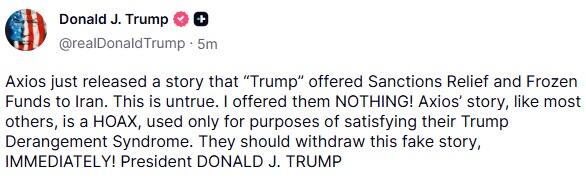
Rinse and repeat…
All of this and it’s only Monday…

State Media Denies Iran Agreed to Halt Enrichment
As expected, the Iranians are denying the earlier reports that it “agreed to halt enrichment” – which came through Saudi state sources (see below):
IRANIAN OFFICIAL SAYS IRAN’S POSITION ON THE NUCLEAR ISSUE HAS NOT CHANGED AND THAT NO DISCUSSIONS ARE CURRENTLY TAKING PLACE ON THE MATTER, ADDING THAT REPORTS OF IRAN’S FLEXIBILITY ON ITS NUCLEAR STANCE ARE INCORRECT – FARS NEWS
IRAN’S ARAGHCHI: ‘STRONGLY DENY’ FLEXIBILITY ON NUCLEAR ISSUE
More confirmation: “Iranian MP Ebrahim Rezaei says no negotiations will begin until the US fulfils its commitments in the Islamabad understanding, while he stated that Iranian diplomats lack permission for bilateral or trilateral talks in the current situation.” But importantly:
TRUMP: DID NOT OFFER SANCTIONS RELIEF TO IRAN
And via state PressTV, calling the reports false
END
Oil Slides As Qatar Touts ‘Talks’ Again; Iran Struck Large Crude Tanker Overnight
Tuesday, Sep 29, 2026 – 08:50 AM
Iran is said to have struck a Very Large Crude Carrier in the Strait of Hormuz late on Monday, signaling what will likely be the resumption of strikes on foreign vessels seeking to navigate the Strait of Hormuz, after last week’s diplomatic talks at the UN failed to produce a breakthrough. Still, for the time being more oil is being shipped through the strait compared to where the situation was for the past many months of war.
Maritime monitor UKMTO indicated the vessel was struck by a suspected unknown projectile, resulting in a fire. The fire looks to have been extinguished quickly, with the crew safe and the vessel underway on its transit.
On Tuesday Iran’s parliament speaker Bagher Ghalibaf has reiterated that America should know that “in a region where we don’t sell oil, no one will sell oil.“ He followed with, “If our security is not ensured, no infrastructure will be safe.”
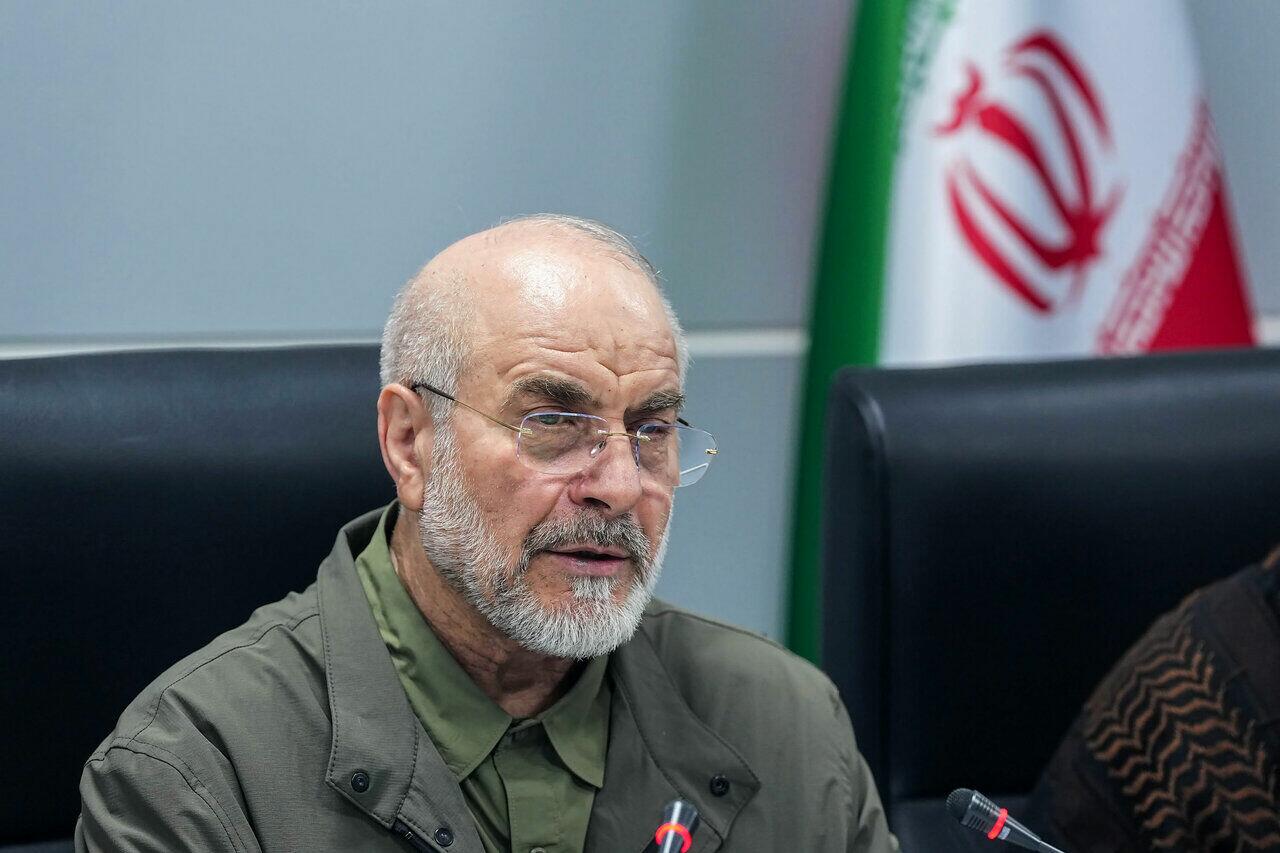
Ghalibaf further described during a parliament session that “the era of intimidation and threats is over” and that the Islamic Republic would escalate its responses.
But he also echoed prior words of Iranian President Masoud Pezeshkian, who at last week’s UN General Assembly said that Iran still seeks diplomacy while asserting its rights.
Similar messaging has been newly issued on the Iranian military front, with Major General Yahya Rahim Safavi, who is a senior advisor to the Supreme Leader, saying that the armed forces stand ready to expand the confrontation to new fronts.
Referencing the ongoing Houthi conflict with the Saudis, wherein the Iran-aligned rebel group has captured Yemen’s Red Sea coast, Safavi stated, “The addition of the Bab al-Mandab Strait would change the scene of the war,“ as quoted in IRIB News.
While some reports have long pointed to the likelihood that IRGC advisers assisted the Houthis this month, the high-ranking general suggested Tehran could get more directly involved, or could tell the Houthis to close the Bab al-Mandab Strait to all foreign vessels.

So far, Houthi statements have sought to assure the rest of the world, particularly Europe, that international vessels can still safely pass through, with the exception of Saudi or Israeli-linked ships.
On the question of Strait of Hormuz transit, The Wall Street Journal summarizes the conclusions of several monitoring firms:
Iran’s ability to choke off oil flowing through the Strait of Hormuz—and use that as leverage in talks with the U.S.—is breaking down, raising the risk it will resort to military escalation to bolster its position.
The erosion of Iran’s position comes as the U.S. Navy and Gulf oil producers have become better at fending off or evading Iranian attacks, allowing more tankers to cross the strait.
Middle Eastern crude exports rebounded this month to around their highest level since the war began in February, oil data trackers say. Shipments via Hormuz and bypass routes were delivering just under 80% of their prewar regional flows as of last week, according to tracker Kpler.
Ghalibaf’s aforementioned threat of “no one will sell oil” promises to change this equation – though clearly US Marines are directly involved in trying to protect shipping.
“So far this month, crude exports from major Middle Eastern producers including Saudi Arabia, Iraq, the U.A.E. and others—moving through Hormuz and alternative routes—have risen to almost 13 million barrels a day,” WSJ notes. “That is the highest total since February, when the region exported nearly 19 million barrels a day, according to ship tracker Huax.”
As for talks, Iran has insisted there are no direct talks and that the nuclear file is not up for negotiation, at least until after the war ends with a ceasefire deal in place.
According to a summary of a press briefing by Qatari Foreign Ministry spokesman Majed al-Ansari on Tuesday::
- Qatar and other mediators are still delivering messages between Iran and the United States and Doha will continue these efforts.
- Mediators are holding meetings and exchanging possible solutions between the two sides to end the seven-month conflict.
- The US-Israeli war on Iran has inflicted a heavy toll on the global economy and the upcoming winter season will make the situation worse with energy shipments largely blocked.
- Qatar condemns Israeli comments on taking over territory in Lebanon and Gaza and demands unimpeded aid to reach the beleaguered Palestinians.
- The Israeli government is trying to force “a new reality” in the occupied West Bank that contradicts the Oslo accords.
- Qatar welcomes actions by the European Union and other countries against illegal Israeli settlements in occupied Palestinian territory.
And like clockwork: WTI futures are on session lows, having added to losses after comments from the Qatar Foreign Ministry on possible US-Iran solutions.
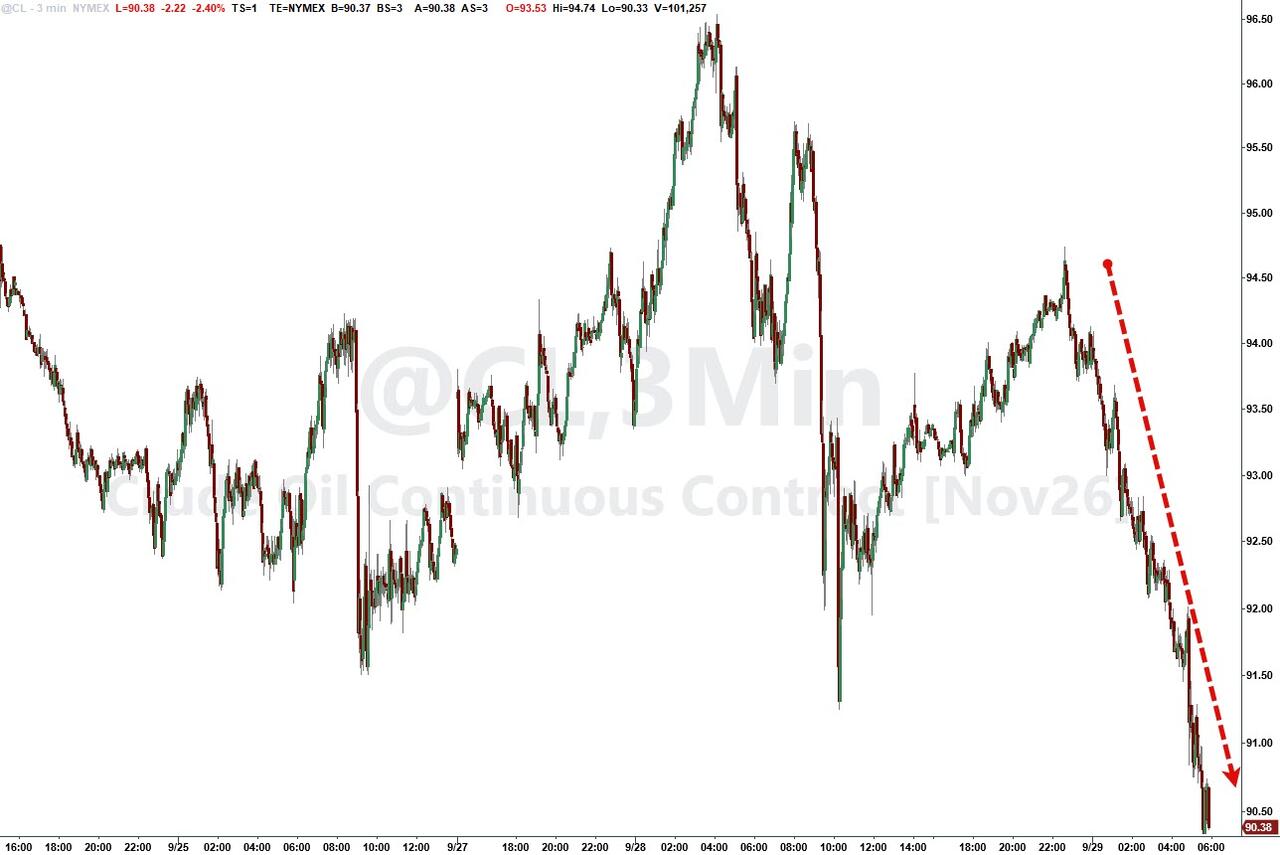
Rial at record low against US dollar, with traders in Tehran exchanging more than 2.5 million rials to the U.S. dollar.
More Latest Developments
via Newsquawk
- Iran’s Foreign Minister Araghchi said Tehran discussed proposals with Qatari mediators to present to the US, and response is to be relayed to Tehran through Qatari mediators, adds conditions set by Supreme Leader must be met to reopen Strait of Hormuz. If the US wants a deal or peace, Iran has offered a solution. He will fly to Tehran in a few hours, and the Qataris will know how to reach us whenever they have the answer. Expects US response on Tuesday. Communications and messages exchanged by Qatari and Pakistani mediators have always been, but now they have taken a more serious form due to the plan presented by Iran.
- Iranian Foreign Minister Araghchi said Iran’s positions have not changed and conditions for reopening the Strait of Hormuz are clear, while their position on other matters is clear. Hopeful the US’ final answer will be conveyed via Qatari “by tomorrow”.
- Iran’s Foreign Ministry spokesperson Baghaei said media reported about the content of consultations with the Qatari mediator are baseless speculation, noting such accounts have no basis in reality and no discussion of the details of the issues took place.
- Iran Foreign Ministry Iranian delegation met with Qatar mediator on Monday afternoon at the UNGA, adds media speculation on Qatar talks is false and that there were no talks held on detailed issues with Qatari mediator. said:. Iran delegation will depart New York for Tehran on Monday night.
- Iranian MP Ebrahim Rezaei said no negotiations will begin until the US fulfils its commitments in the Islamabad understanding, while he stated that Iranian diplomats lack permission for bilateral or trilateral talks in the current situation. said:. US failed to release blocked funds after Islamabad deal.
- UN Secretary-General Guterres requested in a meeting with Iran’s Foreign Minister Araghchi for a continuation of negotiations to achieve peace, according to Fars News Agency.
- US President Trump posted “Axios just released a story that “Trump” offered Sanctions Relief and Frozen Funds to Iran. This is untrue. I offered them NOTHING! Axios’ story, like most others, is a HOAX”. Full post “Axios just released a story that “Trump” offered Sanctions Relief and Frozen Funds to Iran. This is untrue. I offered them NOTHING! Axios’ story, like most others, is a HOAX, used only for purposes of satisfying their Trump Derangement Syndrome. They should withdraw this fake story, IMMEDIATELY!”.
END
ISRAEL TBN
END
HAMAS
IDF kills Hamas’s Northern Gaza Brigade commander in strike
The IDF killed Izz al-Din al-Bik, commander of Hamas’s Northern Gaza Brigade, in a strike early Tuesday morning, according to a joint statement by Prime Minister Benjamin Netanyahu and Defense Minister Israel Katz.
END
ISRAEL GAS PRICES
Gas in Israel to reach all-time high at over $10 per gallon amid worldwide price hikes
The price hike comes after gasoline prices worldwide jumped by approximately 13%, amid rising crude oil prices, continued concerns over disruptions to supply chains, and global energy vulnerability.

Illustration of a gas station in Jerusalem. August 30, 2026.(photo credit: CHAIM GOLDBERG/FLASH90)ByWALLA! FINANCESEPTEMBER 29, 2026 10:27Updated: SEPTEMBER 29, 2026 10:38
The price of gasoline in Israel will rise by 52 agorot per liter at midnight between Wednesday and Thursday, reaching an all-time high of NIS 8.27 per liter, equivalent to $10.17 per gallon, following a surge in the dollar exchange rate and global gasoline prices.
The increase will break the previous record of NIS 8.25 per liter.
The price hike comes after gasoline prices worldwide jumped by approximately 13%, amid rising crude oil prices, continued concerns over disruptions to supply chains, and the vulnerability of the global energy market.
At the same time, the US dollar strengthened by approximately 3% against the shekel, another factor contributing to the final increase in fuel prices in Israel.
The increase comes less than a month after Finance Minister Bezalel Smotrich intervened to prevent drivers from absorbing a sharp price hike of approximately 60 agorot per liter. After receiving the necessary approvals, Smotrich signed a temporary reduction in the fuel excise tax, bringing the price of gasoline down to NIS 7.75 per liter.

Smotrich’s tax reduction to hold until end of October
The tax reduction is due to remain in effect through the end of October.
Advertisement
This time, however, the price increase is taking place while the tax reduction is still in effect. In other words, even after the state temporarily waived part of the excise tax, rising global oil prices have erased much of the savings passed on to drivers in less than a month.
Last month’s excise tax reduction was intended not only to ease the burden on drivers, but also to moderate the impact of fuel prices on transportation, distribution, and shipping costs, which ultimately feed into the prices of goods and services.
Now, even before the tax reduction expires, gasoline prices are climbing again.
The increase also comes before the excise tax reduction signed by Smotrich is due to expire. The reduction is scheduled to remain in effect through October 31. If it is not extended, gasoline prices could rise again in November, depending on global oil prices and the dollar exchange rate.
END
IRAQ/USA
The Hidden Mechanism Behind Washington’s Control Of Iraq’s Oil Money
Monday, Sep 28, 2026 – 10:35 PM
For more than two decades, Iraq’s oil wealth has passed through a financial system centered thousands of miles away in New York. The arrangement, created after the US-led invasion of Iraq in 2003, was initially designed to protect Iraqi oil revenues from creditors and help fund reconstruction.
Today, it gives Washington significant leverage over Iraq’s access to its own dollars, leverage that the US is increasingly using as it pressures Baghdad to curb Iran’s influence and the activities of armed groups aligned with Tehran. The issue came into sharp focus in April, when Washington blocked a shipment of about $500m in cash to Iraq as it pressured the government over Iran-aligned armed groups.
Muayen al-Kadhimi, a former parliamentary Finance Committee member, condemned the decision at the time, calling on the government to end what he described as US dominance over Iraqi funds. “The US decision to freeze or delay sending Iraq’s foreign currency entitlements represents a serious violation of the financial and political sovereignty of the Iraqi state,” al-Kadhimi said.
The shipment was later restored, but the episode demonstrated how Iraq’s dependence on the US financial system can be used as a political tool.
The arrangement began after the US-led invasion in May 2003, when the Coalition Provisional Authority established the Development Fund for Iraq (DFI) to collect the country’s oil revenues and use them for reconstruction and humanitarian needs. Under UN Security Council Resolution 1483, issued in May 2003, Iraqi oil and gas revenues were transferred to a special account in the name of the Central Bank of Iraq at the US Federal Reserve.
Five percent of the revenues were deducted for compensation to Kuwait following Iraq’s 1990 invasion. The system also included frozen assets belonging to Saddam Hussein’s former government and surplus funds from the UN’s Oil-for-Food program.
The arrangement was intended in part to protect Iraqi assets from international creditors pursuing claims dating back to Saddam’s rule. An International Advisory and Monitoring Board, including representatives from the UN, IMF, World Bank and Arab Fund for Economic and Social Development, was established to oversee the fund.
The UN-backed system ended in 2011 at the request of the Iraqi government but Iraq’s oil revenues remained tied to the Federal Reserve.
A new account, known as IRAQ2, was established at the New York Fed. Oil revenues are deposited there before being transferred to the Central Bank of Iraq. At the same time, Iraq lost the comprehensive international protection previously provided under the UN system and became dependent on annual US executive orders granting immunity to its sovereign funds.
So while the formal international arrangement changed, the underlying dependence on the US financial system remained.
Why can’t Iraq simply move its money?
Iraqi oil is priced overwhelmingly in US dollars, while the country depends heavily on the currency for imports and international trade. Iraq also has about $40bn in unsettled external debts, creating concerns that moving its funds outside the existing system could expose them to claims from creditors.
Ahmed Saddam, an associate professor of economics at the University of Basra, told Middle East Eye that keeping the Central Bank of Iraq’s account in New York has important benefits. “I believe that the most important advantages of keeping the Central Bank of Iraq’s account in New York are protecting Iraqi oil revenues from being seized by creditors of the former regime, since the debts are estimated at tens of billions of dollars.”
“The second advantage is facilitating the sale of oil and the settlement of Iraq’s international trade; this account reduces transfer costs, and we should not forget that the dollar is the most widely used currency in international transactions.”
But Saddam said the arrangement also leaves Iraq vulnerable to US pressure. “As for the most prominent disadvantages, they lie in the ability of the US authorities to impose their influence by restricting access to dollars to Iraq, for example, and this means there is no real financial independence.”
According to Saddam, Iraq could sell its oil in euros or Chinese yuan, provided there were no binding conditions in its oil contracts, but even then that would not necessarily free Iraq from the dollar. “Even if that happens, the price will remain linked to the dollar because oil is priced in dollars, and what happens in practice is that the buyer pays the value in a non-dollar currency after converting it according to the dollar exchange rate.”
Iraq would still need dollars for much of its international trade, Saddam said, while shifting currencies could expose the country to exchange-rate losses and political pressure from Washington. His proposal was therefore diversification rather than an immediate break with the US system.
“I believe that Iraq’s financial independence will not be achieved if we assume moving the Central Bank of Iraq’s account from the United States to another country.”
“In my view, financial independence can be achieved by opening multiple sovereign accounts outside the United States while keeping the current account in New York. For example, the Central Bank could open an account with the European Central Bank, as well as with central banks in East Asia,” Saddam said.
“Part of Iraq’s oil could also be sold in euros and yuan, let us assume only 15–20 percent, while the remaining 80–85 percent is sold in US dollars. In addition, financial independence requires developing the banking system in Iraq by expanding direct correspondent banking relationships with major banks in Europe and Asia,” he added.
How is the system being used against Iran?
The financial arrangement has taken on greater importance as Washington seeks to squeeze Iran economically and target armed groups in Iraq that are aligned with Tehran. Iraq has close political, economic and security ties with Iran, while several powerful armed groups operate inside the country.
For Washington, that has made Iraq’s financial system a key battleground in its efforts to restrict the flow of dollars to Iran. The US has accused Iraqi banks, exchange companies and other financial networks of exploiting the country’s financial system to move dollars towards sanctioned entities.
Since the US and Israel launched their war on Iran, Washington has responded by tightening its oversight of Iraq’s access to the dollar and pressuring Baghdad to bring its financial system into line with US sanctions.
In early 2025, Iraq ended its long-running dollar auction system, formally known as the foreign currency window, after sustained US pressure. The system had allowed private banks and exchange companies to obtain dollars from the Central Bank of Iraq in exchange for Iraqi dinars.
But Washington’s leverage extends beyond Iraq’s banking system to the physical movement of dollars into the country. The April suspension of the $500m shipment was particularly significant because the cash was generated from Iraq’s own oil revenues.
Although electronic dollar transfers for international trade continued, the episode showed that Washington could restrict access to physical dollars when it wanted to pressure Baghdad.
The Iraqi government has sought to maintain its relationship with Washington while balancing its ties with Tehran and Iran-aligned armed groups.
Iraq’s Oil Minister Basem Mohammed Khudhair refused to answer questions about moving away from the Federal Reserve, telling MEE that the question fell under the remit of the finance ministry. However, he described the relationship between Baghdad and Washington as positive.
“There has been dialogue with the United States – a very positive dialogue, especially after our trip accompanied by the Prime Minister Ali al-Zaidi there,” he said. “There is great understanding between the Iraqi government and the American government, and the US has provided all support to the Iraqi government for its success in its economic and political dossiers.”
But the consequences of Iraq’s financial dependence are ultimately felt beyond government ministries and central banks.
‘US controls Iraq’s fate’
Hussein Ali, a 35-year-old Baghdad native, said removing US oversight would not necessarily improve the lives of ordinary Iraqis. “For us, whether Iraq’s money goes to the Federal Reserve in America or comes directly to Iraq, I don’t think our situation as citizens will improve.
“Instead, the money will be at the disposal of the corrupt, and financial corruption will be even greater than it is now. From my viewpoint, I find it better for the money to remain in New York, under the guardianship and oversight of the US banking authorities.” Ali nevertheless acknowledged the sovereignty problem.
“It is true that keeping Iraq’s money in the US bank gives the United States the freedom to control Iraq’s fate politically, financially and in sovereign terms. But Iraq is not ready in terms of banking infrastructure, and the situation requires a strong government to come that cares about the country’s affairs and the interests of its people.”
He also raised concerns about money being moved towards Iran. “We have often heard how many officials and not state people smuggle money to Iran to help it confront the American economic blockade on Iran. Imagine what would happen if Iraq received its oil sale money into Iraqi banks far from American oversight and auditing. I believe Iraq’s situation will only get worse.”
Fatima Abdulkarim, a 55-year-old from Basra, shared those concerns. “I do not believe that Iraq’s oil funds going to Iraq directly instead of going to US banks will help to improve our economic situation.”
“Yes, it means Iraqis would dispose of the money without direct US intervention, but corruption will be greater, and the money will go to the same corrupt parties and officials. If the money remains in New York, it is at least under oversight and auditing. But if it comes to Iraqi banks far from any real oversight, I believe Iraq’s situation will be worse off.”
“Keeping the money under the guardianship and oversight of the US banking authorities is better than it reaching the hands of the corrupt,” Abdulkarim said.
END
HAMAS /ISRAEL
Hamas official’s arrest in Gaza gave Israel intelligence surge to kill top terrorists – exclusive
Three Hamas brigade commanders have been killed since September 11, following the September 2 capture of senior Hamas security official Mu’in al-Arabid in Gaza.

Palestinian firefighters extinguish a fire on a vehicle hit by an Israeli airstrike in Khan Younis, in the southern Gaza Strip, September 23, 2026(photo credit: REUTERS/Ramadan Abed)Who was named as the new Rafah Brigade commander?›How did one arrest trigger a wave of assassinations?›What is the Shin Bet?›Which Hamas commanders were just targeted in Gaza?›

ByYONAH JEREMY BOBFollowSEPTEMBER 29, 2026 12:02Updated: SEPTEMBER 29, 2026 13:31
The arrest of a senior Hamas official on September 2 gave Israel tremendous intelligence which has helped create a spike in locating and assassinating other top Hamas officials, funds, and weapons, The Jerusalem Post has learned.
On September 2, the IDF, Shin Bet, and various Palestinian militias captured Mu’in al-Arabid, one of Hamas’s top internal security officials.
The IDF and Shin Bet on Tuesday confirmed the overnight assassination of Hamas Northern Gaza Brigade Chief Izz al-Din al-Bik in Gaza City.
This is the third assassination of a Hamas brigade chief since September 11, meaning that three out of the five brigade commanders have been killed during that period.
Al-Bik had served in his current role since Ahmed Randur was assassinated by Israel on November 10, 2023.

According to the joint statement, al-Bik was responsible for managing the activities of the brigade’s operatives, including issuing orders to carry out attacks on Israeli soldiers and civilians.
He also managed efforts to reconstitute the brigade’s capabilities, which had been heavily damaged over the last three years of war, said the IDF.
Defense Minister Israel Katz disclosed the assassination in a statement shortly before the official IDF and Shin Bet statement.
Prior, the IDF killed two of five Hamas brigade commanders
In mid-September, the IDF and Shin Bet killed Muhammad Yazouri in the Khan Yunis area. Yazouri served as commander of Hamas’s Khan Yunis Brigade.
Yazouri was appointed to the position after holding a series of roles in the brigade, including deputy commander of the Khan Yunis Brigade.
He replaced Rafa Salame.
Further, in mid-September, the IDF and Shin Bet also announced that they had struck Hamas Rafah Brigade commander Nayal Abu Obeid.
Obeid replaced his predecessor, Mohammad Shabanah, who was killed by the IDF in May 2025.
Abu Obeid was a key figure among Hamas leaders, according to a statement from the IDF, and previously served as the deputy commander of the Rafah Brigade and commander of the Tel al-Sultan and Yibna Battalions.
Jerusalem Post Staff contributed to this story.
END
ISRAEL /HAMAS/HEZBOLLAH
Israel not conducting genocide, not guilty of apartheid, new academic study shows
A new academic study examines apartheid, genocide and settler colonialism accusations against Israel, concluding the first two are not established and the third is an inadequate classification.

People take part in the National March for Palestine – hands off Gaza, a pro-Palestinian protest calling for the government to “end the genocide and stop arming Israel”, in London, Britain, January 31, 2026.(photo credit: REUTERS/Jack Taylor)ByALEX CARSONSEPTEMBER 28, 2026 18:34Updated: SEPTEMBER 28, 2026 19:56
A new academic study published last Thursday examines legal and historical evaluations of charges labeling Israel as an apartheid state, a settler-colonial project, or guilty of genocide, concluding that “apartheid and genocide are not established and that settler colonialism is an inadequate classification, including in the settings where each accusation is strongest.”
Authored by Philippe Karpe, a Senior Researcher and International Expert at CIRAD, and Gunther Jikeli, an Associate Professor at the Institute for the Study of Contemporary Antisemitism at Indiana University Bloomington, the paper was published on SSRN.
Study acknowledges that ‘racism’ persists in Israeli society
The authors examine the legal definitions governing apartheid under the 1973 Apartheid Convention and the Rome Statute. According to the study, while “racism and substantial disparities persist” within Israel’s citizenship regime inside the Green Line, Arab citizens participate in national elections, litigate in courts, and serve in the Knesset.
The authors state that applying the apartheid label here “equates ethnonational inequality with a system of legally enforced racial segregation and political exclusion that does not exist there.”

Regarding the West Bank, the authors note that prolonged occupation, settlements, and unequal administrative arrangements present “the strongest case” for the accusation. However, the study states that the evidence does not establish the required purpose or intent to maintain “systematic racial domination and oppression.”
The authors point out that the West Bank’s administrative divisions originate from the negotiated Oslo Accords, noting that “Palestinian non-citizenship and Palestinian Authority jurisdiction supply a national-territorial explanation for part of the legal differentiation.” Furthermore, the study notes that Gaza’s distinct internal governance and subsequent military actions “must still be distinguished analytically from an institutionalized racial regime.”
Turning to settler-colonialism, the authors evaluate the framework across pre-state settlement, the 1947 to 1949 displacement, and the post-1967 West Bank settlement enterprise.
While acknowledging that the framework illuminates aspects of land acquisition and settlement expansion, the authors argue it fails to account for “Zionism’s national and refugee character, Jewish historical attachment, or the absence of a conventional or functionally equivalent metropole.”
The study notes that, even within the West Bank, “divergent territorial strategies and negotiations over withdrawal complicate the claim of a continuous project of permanent incorporation.”
Additionally, the study notes that the survival and incorporation of approximately 160,000 Arab residents who remained inside Israel after the 1948 war “complicate the claim that state formation was conceived and executed as a preexisting comprehensive program of Indigenous removal.”
On the accusation of genocide, the study evaluates conditions in Gaza against Article II of the Genocide Convention, focusing on provisions concerning the deliberate infliction of conditions of life calculated to bring about physical destruction and measures intended to prevent births.
Analyzing data from the Coordinator of Government Activities in the Territories, the authors note that the dataset records “at least 1,341,904 tons of food associated with 63,191 truckloads on land and maritime routes,” which “weaken the inference that deprivation resulted from a food-entry policy calculated to bring about the population’s physical destruction.”
While addressing the March to May 2025 suspension of aid, the authors state that “the suspension by itself [does not] establish a purpose of physically destroying the population,” noting that the broader record supports “a competing inference that the restrictions served military or operational purposes.”
Examining the destruction of the Al-Basma IVF clinic, the study notes that the UN Commission of Inquiry found that the strike used “a large caliber projectile, most probably a shell fired from an Israeli security forces tank” and relied on “the precision of the strike,” but the authors argue that “intent to destroy a clinic or reproductive material is not by itself intent to prevent births so as to contribute to the physical or biological destruction of the protected group.”
The researchers focused on legal and historical precision
The authors also analyze how these three accusations function collectively in public discourse, arguing that “expansive definitions and selective evidence allow the three accusations to reinforce one another, shift the burden of proof, and erode the distinctions they are meant to capture.” When presented in their totalizing forms, the authors write that they function “less as descriptions of specific wrongdoing than as instruments for stigmatizing and delegitimizing Israel as such.”
Karpe and Jikeli told The Jerusalem Post: “Our argument is fundamentally about legal and historical precision, but also about the way these accusations are increasingly combined in public discourse and what this combination does to the way Israel and the conflict are understood. Apartheid and genocide are not simply descriptions of particular conduct; they are legal classifications with specific elements, including requirements concerning purpose or intent.
“Settler colonialism is a different, historical-comparative framework. We, therefore, examine each accusation on its own terms, rather than allowing the three labels to reinforce one another.”
The authors added: “Applying the relevant legal and historical criteria, our conclusion is that the evidence does not establish apartheid or genocide, while settler colonialism does not provide an adequate overall classification of Zionism and Israel. But the article is also concerned with what happens when these categories are detached from their limiting criteria and presented as mutually reinforcing descriptions. They can then cease to distinguish particular conduct, periods, and legal questions and instead, become part of a broader, totalizing account.”
Karpe and Jikeli emphasized, “Our broader concern is, therefore, not to replace one narrative with another, but to examine the claims being made, the evidence on which they rest, and the way these claims interact in contemporary discourse. Analytical clarity – distinguishing legal findings from historical interpretation, and both from moral or political judgment – is essential if the complex realities at issue are to be understood rather than reduced to competing labels.”
Read more about Philippe Karpe and Gunther Jikeli’s study here:
https://papers.ssrn.com/sol3/papers.cfm?abstract_id=7501120
END
RUSSIA VS UKRAINE
Russia’s Drones Zero In On Ukraine’s Data Centers, Mobile Providers
Tuesday, Sep 29, 2026 – 11:30 AM
The Russian defense ministry on Tuesday indicated that it attacked and struck two military cargo vessels in the Black Sea as well as two data centers in the Ukrainian capital overnight.
The vessels, which were sailing foreign flags, were struck off Odessa, President Zelensky also confirmed in a Tuesday statement.

The Kyiv region along with ten other areas came under attack overnight, Zelensky acknowledged. But it is the capital which has been getting pounded, also following many weeks and months of Ukraine’s long-range drone strikes on Russian territory.
On Monday at least two people were killed when a drone hit National Academy of Sciences in the central part of the capital. The academy in a statement blasted the attack as “Russian terror” and “barbarity” aimed at “peaceful people who were simply at their workplaces.”
A couple of new ‘themes’ have emerged in what have long been a nightly reality of devastating air raids. First, high flying jet-powered drones have been increasingly deployed by Russia.
The new Geran-5 is said to have anti-jamming capabilities and can travel up to an estimated 370mph, reports say. All of this makes them extremely hard to intercept.
Another theme is the war on data centers and mobile infrastructure. One regional source cited the Russian Defense Ministry as calling the campaign a ‘mandatory digital detox’ with grim sarcasm.
The same source documents the following recent attacks on data centers in Ukraine:
Russian forces continue to strike Ukrainian data centers. On September 25, they attacked an office building in Kyiv that houses a Datagroup data center. The center was damaged, but the company said all its services continued to run from backup sites.
On September 26, a Cosmonova data center in another Kyiv office building was hit. It had to shut down, interrupting broadcasts by several television channels. The strikes on data centers also left some Kyiv residents without internet access.
On September 28, a Russian drone struck an office building in Dnipro. The regional administration reported damage and casualties but did not say which companies occupied the building…
On September 26, Russia’s Defense Ministry said it was striking data centers because they “process and transmit intelligence data for the Ukrainian Armed Forces.” The next day, the ministry posted an image of a drone on social media with the caption “Digital detox” and the comment “Mandatory!”
At the start of this week Russia hit the headquarters of Kyivstar, Ukraine’s largest mobile service provider, according to a statement by the company.
Reports of at least seven total killed and over 50 injured in the capital on Monday amid the major attack:
Additionally the Russian military had on Sunday announced hitting a data center belonging to Vodafone Ukraine, which is Ukraine’s second-largest cell network provider – all of which strongly points to the campaign on comms infrastructure set to continue.
END
RUSSIA/UKRAINE/USA
Trump Mulls Big Russia Sanctions Relief For Prisoners, Risking Wrath Of Allies & Hawks
Tuesday, Sep 29, 2026 – 02:45 PM
Diplomacy is obviously stalemated and almost non-existent when it comes to the Iran conflict and Hormuz Strait crisis, and so the White House needs some level of a ‘win’.
It seems President Trump continues to look for this in the years-long Ukraine crisis, as he’s said to now be mulling a major deal which would see the Kremlin free some political prisoners in exchange for a significant easing of sanctions on the Russian economy.
The Atlantic on Tuesday in reporting the initiative characterized the potential deal as so sweeping that it “could outrage even his allies.” Of course, the Zelensky government and Europe is actively trying to tighten the screws on Moscow.
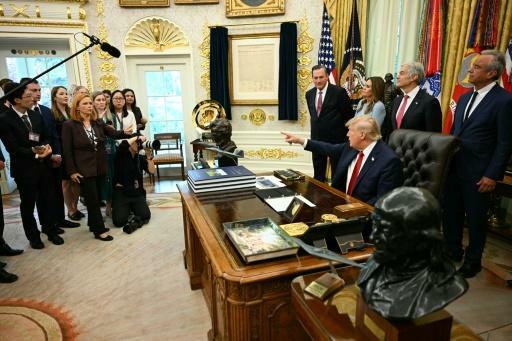
But the proposed plan would in many ways be a reversal of the prior policy of ‘global isolation’ of Putin. The report says:
Donald Trump’s envoy to Eastern Europe came to the president with a new idea for breaking the deadlock in U.S. relations with Moscow. The plan involved a quid pro quo reminiscent of the Cold War: The Kremlin would free some political prisoners, and the United States would reward their release by easing sanctions on the Russian economy. Trump signed on.
This new initiative, which is still in its early stages and has not been previously reported, promises to advance several of Trump’s goals at once. It would help reintegrate Russia into the global economy and broaden Trump’s talks with the Kremlin beyond the intractable war in Ukraine, which his envoys have failed to end after more than a year of diplomacy. It would create a path for the U.S. to sign lucrative deals involving Russian oil, diesel, rare earth minerals, and other commodities. As a bonus, the release of prisoners on humanitarian grounds could bolster Trump’s case for his long-coveted Nobel Peace Prize.
Trump’s envoy to Eastern Europe, John Coale, had reportedly first pitched the initiative “a few months ago,” and “Trump signed on,” the report notes.
However, it’s said to still be early stages, but if it gets close to the finish line the plan “is likely to outrage the Ukrainians, Europeans, and even many of Trump’s allies on Capitol Hill,” The Atlantic underscores.
But such concerns have never stopped Trump before, and it could actually help jump-start the long dormant peace process, and possibly cool soaring tensions with NATO.
The report also comments that “any potential business deal between the US and Russia would risk funneling money to the Russian military even as it continues to terrorize Ukraine and threatens a wider war against US allies in Europe.”
An important caveat which could hinder an ambitious prisoner release for sanctions relief is that fact that Trump just drastically upped the ante by earlier this month signing a bill co-authored by the late NeoCon senator Lindsey Graham which authorized the president to “impose severe sanctions on Russia and its trading partners.”
So if Trump was wishing to soon strike a deal and cool tensions with Russia, why sign the Graham bill? A lot of contradictions in Washington policy remain. The Trump administration has also had a running ‘love-hate’ relationship with Zelensky. At times Zelensky is being berated, at others he’s being praised. Like the Iran conflict, MAGA and conservatives in general have by and large been divided on the issue of Ukraine and what US policy should be.
END
ROBERT H…,
Russian Embassy, UK on X: “

Those advocating a blockade or strike on Kaliningrad should have no illusions about the consequences. Any British or NATO military action against Russian territory would be met with all means at Russia’s disposal, including nuclear weapons. https://t.co/DgNjixMBSe” /
The likes of Boris Johnson and many others in the UK and in the EU should take note of the fact that Russians DO NOT threaten they simply tell you to your face the consequence of actions.
Kaliningrad is Russia and a blockade of it or a strike from the Baltic States will not be accepted by Russia and will result in the use of Nuclear missiles.
Do recall I cautioned the other week about troop movements and trains loaded with tanks and armored personnel carriers being transported. You can bet Russian satellites have been watching.
No embassy in the world would issue such a warning idly.
And to imagine that America would come to the rescue is delusion.
Meanwhile the Russian “Dead Hand” is alive and operating. So even if the entire Russian Government and military was wiped out this computer system would launch hundreds of missiles at an aggressor by itself. Let that sink in!!!!! NO nation can defend against such a launch. Let alone what Poseidon can accomplish with one strike. One strike by Poseidon and the UK will cease to exist. And there is nothing that the UK can do to stop such a strike.
So it does beg the question of why would one try to do the impossible if you understood that certain death would result? Only a fool or a delusional war monger would face certain death this way to try to win an against impossible odds of success. Perhaps success is not the goal.
If all wars are banker wars one assumes there is a great need for reconstruction loans on the death of millions of people. And the choice is nuclear destruction since the civilian population of both the UK and EU will not fight for politicians nor bankers.
Very sad commentary on lessons that civilizations never learn to allow history to repeat.
6/.GLOBAL ISSUES, COVID ISSUES, VACCINE INJURIES/HEALTH ISSUES
Newly Released Fauci Files Reveal Dangerous NIAID-Funded Aerosolized Ebola Research
Tuesday, Sep 29, 2026 – 11:10 AM
Authored by Debra Heine via American Greatness,
Senator Rand Paul (R-Ky.) released documents from Dr. Fauci’s diary and emails Monday detailing his dangerous NIAID-funded research during the Obama Administration, including a 2015 experiment that exposed vaccinated monkeys to aerosolized Ebola.
The risky research was conducted at the United States Army Medical Research Institute of Infectious Diseases (USAMRIID) at Fort Detrick under a NIAID task order. The NIAID study compared four vaccines in groups of four monkeys exposed to aerosolized Ebola. The exposure was engineered to drive the virus deep into the lungs in a way natural infection would not, the records show.
The vaccinated primates reportedly developed necrosis, inflammation, and fibrin in the lungs, while the unvaccinated controls did not, indicating that the vaccine itself was making the disease worse. The experiments left 80 percent of vaccinated monkeys dead.
“What idiots those guys at USAMRIID are,” Fauci wrote on March 7, 2016. The work “should have been a classified experiment that never should have been done in the first place,” he added. Two days later, however, then-NIAID director wrote that the experiments were “important for bio defense.”
Fauci was outraged that the failed vaccine research was shared with U.S. embassy officials in Guinea, Liberia, and Sierra Leone.
“This should have been a classified experiment,” he wrote in his diary. “The foolish DOD people send the data to the FDA and then circulated as FYI to various embassies including those in West Africa where we are about to engage on a much larger DSD vaccine trial for Ebola.”
According to Fauci, the embassy officials “went bonkers” because it looked like the U.S. wanted to vaccinate people with a dangerous vaccine.
He also said such experiments should have been classified because they “could indicate a vulnerability.”
However, NIAID’s own report states that at no time had clearances been requested, nor was classification ever mentioned. Moreover, the data had already gone to vaccine manufacturers, and some of it had already been published.
Nonetheless, Fauci was dismayed when a Department of Defense official mentioned the experiments were funded by NIAID during a White House briefing. “No one followed up on that, but I almost fell off my chair!!!!” he wrote in an email to his colleagues at NIAID.
Following this disclosure, NIAID officials discussed “damage control” in an email chain. “We may need to a bit of damage control here,” NIAID’s biodefense director wrote.
The problem for Fauci wasn’t the dangerous experiments, but the possibility the public could find out about the dangerous experiments. So he took immediate steps to have the research classified.
“The DoD folks said that they wanted to publish the data. I said that I thought that it should be classified and the NSC people blew them out of the water and said that they agreed with me,” he said.
Deputy Director Cliff Lane told two NIAID scientists not to move forward on Ebola experiments until the dust settled, warning that “one might consider this dual use research.” He instructed his colleagues not to discuss the matter with anyone until he had a chance to talk to them.
Four days later, NIAID researcher Peter Jahrling warned that if aerosol challenge studies were treated as dual use research of concern, “the entire MCM development paradigm is gutted,” and wrote “I will keep the rest off Email.”
In the same message, Jahrling ominously noted that with the Ebola work paused, NIAID would “continue to make plans to initiate the CoV [COVID-19] study as soon as the lights turn green.”
END
GLOBAL ISSUES
COVID VACCINE INJURY REPORT: MARK CRISPIN MILLER
A: Celine Dion’s Paris comeback “could be disastrous”; FR: rocker Chris Holmes has prostate cancer; DE: pol Bendt Bendtsen has had cancer since ’22; SK: TV director Ahn Pan-seok has brain hemorrhage
SW: footie Glenn Hysen has Parkinson’s; DE: Royal Household’s Chief of Staff Jens Ole Rossen-Jørgensen steps down with “advanced illness”; NZ sportscaster Jenny Woods has non-malignant brain tumor
| Mark Crispin MillerSep 28 |  |


A survey of the likely global toll of COVID “vaccination,” based on the reports collected by our worldwide team of researchers this past week.
To help support our work, consider subscribing or making a donation.
Celebs
CANADA
Celine Dion’s Paris Comeback ‘Could Be Disastrous’ Amid Health Battle: ‘She’s Trying to Do Too Much’
July 30, 2026

Celine Dion is gearing up for her long-awaited comeback in Paris – and a source says she’s understandably nervous about taking the stage again but vowing to give it her best shot. As Examiner previously reported, the “My Heart Will Go On” singer, 58, stepped away from the music industry after being diagnosed with stiff person syndrome (SPS) in 2022. “Celine has so much riding on this as far as her self-confidence and even her legacy, and there are people worrying that she’s trying to do too much, too soon,” reveals the source. “She’s throwing her heart and soul into this comeback and putting a huge amount of pressure on herself because she wants everything to be absolutely perfect.” From September to October, Dion will perform 16 shows at the Plenitude Arena in France before returning in May for an additional 10 concerts. “Once she gets out on that stage, if it doesn’t go according to plan, it could be disastrous because she’s a very sensitive person with extremely high expectations of herself,” the source says. “But Celine isn’t listening to any of that. She’s insisting that she feels she’s in really good shape going into this and thankfully, she’s been rehearsing in a very sensible way without pushing herself too hard,” the source says.
News from Underground by Mark Crispin Miller is a reader-supported publication. To receive new posts and support my work, consider becoming a free or paid subscriber.
Researcher’s note – In a May 2021 interview with Radio Canada, Celine Dion encouraged COVID “vaccination”: https://www.facebook.com/watch/?v=207163587681975
FRANCE
Chris Holmes (formerly of W.A.S.P.) reveals alarming health diagnosis
July 29, 2026

Chris Holmes, a former guitarist for the W.A.S.P., has been diagnosed with prostate cancer, as per theprp. The 68-year-old artist, who has been living with his wife in France since 2014, has started treatment for the most frequent disease among men (after skin cancer), having successfully fought throat and neck cancer back in 2022. A GoFundMe page has been started by Chris’s manager and wife, Catherine Savean Holmes, to help with the growing medical expenses that may arise while the guitarist is unable to tour. Chris and Catherine want to raise 50,000 euros, or roughly $57,000, to help pay for the prescription drugs, tests, and transportation Chris needs to complete his treatment safely. We never imagined we would have to write something like this again. In 2022, just after two years of Covid lockdown, Chris faced throat cancer. A GoFundMe carried us through an impossible moment. We were deeply grateful, and we hoped we would never have to ask again.
SWEDEN
Liverpool legend Glenn Hysen, 66, reveals he has Parkinson’s disease as he opens up on diagnosis
July 28, 2026

LIVERPOOL icon Glenn Hysen, 66, has revealed he has been diagnosed with Parkinson’s. The Swedish star featured 72 times in the league for the Reds between 1989 and 1992. But now he has shared his worrying diagnosis in an interview with Swedish outlet Hant. Thankfully, Hysen was diagnosed with a mild form of the disease, and claims that he is not expected to deteriorate provided he maintains a regimen of medication. He said: “I take medication 3-4 times a day with tablets. It’s not dangerous, but you have to treat it.” He was in high spirits as he broke his silence on the ordeal. “I could probably work in a bar now and shake a drink.”
DENMARK
Bendt Bendtsen reveals he was diagnosed with cancer in 2022
July 30, 2026

In an interview with Fyens Stiftstidende [72], the former party chairman of the Conservative People’s Party opens up about some of the health problems he has gone through in recent years. Bendt Bendtsen has had cancer since 2022. Today it is dormant, which means he goes for checkups every six months. “I suddenly had pain in all my joints and could barely stand up. It turned out that I had muscular arthritis. But the many tests also showed that I had bone marrow cancer,” he tells Fyens Stiftstidende. In the interview with the media outlet, the former top politician also opens up about how he was given an ultimatum by a doctor.
Important message from the royal family: confirms major change after serious illness
July 30, 2026

After an illness, the Royal Household’s Chief of Staff, the Adjutant General, must now retire. A new and experienced face has already been positioned to take over the important post at Christiansborg Palace. In an official press release, the court announced that the current Chief of Staff, Chamberlain and Colonel Jens Ole Rossen-Jørgensen, will leave his prestigious position at the end of August. The departure comes against an incredibly sad backdrop, as he has requested to be relieved due to an advanced illness. The 60-year-old colonel left his then commanding position at the Guard Hussar Regiment in Slagelse in 2021 to move to Christiansborg. He has since headed a staff of eight people. The department – which falls under the Ministry of Defence – handles, among other things, the guard service at the royal palaces and is responsible for the official escort at special events.
SOUTH KOREA
Melodrama Maestro Ahn Pan-seok Collapses, Recovers From Cerebral Hemorrhage
July 31, 2026

It was belatedly revealed that director Ahn Pan-seok [64], dubbed the “melodrama maestro,” collapsed due to a cerebral hemorrhage and underwent treatment. On the 31st, Studio Genie shared with OSEN, “Director Ahn Pan-seok is currently in recovery. He has completed editing after finishing filming. The broadcast schedule remains unaffected.” According to the broadcasting industry, Ahn Pan-seok recently collapsed from a cerebral hemorrhage and was hospitalized in the intensive care unit, but his condition has since improved, and he is now receiving inpatient treatment.
NEW ZEALAND
I would lose my path netball commentating. Doctors found a tennis ball-sized tumour on my brain – Jenny Woods
August 1, 2026

Auckland – ‘Looking back, I wonder what took me so long to realise something was wrong. Admittedly there were a few odd occurrences, but each could be explained away … it’s the hours I work, I’m getting older, I’ve got a lot on my plate.’
Researcher’s note: The rest of the article is behind a paywall.
From Brave AI: Jenny Woods [64], a New Zealand broadcast journalist and former Sky Sport netball commentator, underwent successful brain surgery in March 2026 to remove a tennis ball-sized meningioma. The non-malignant tumor was pressing on her brain and caused symptoms such as memory lapses, difficulty finding words, and spatial disorientation, which initially disrupted her role as a sub-editor at Newstalk ZB.
Woods had been scheduled to commentate on netball at the Commonwealth Games in Glasgow but withdrew after her diagnosis. The seven-hour surgery at Auckland City Hospital was completed successfully, allowing her to return to work and resume her life with a period of recuperation that included learning to use public transport due to a temporary driving ban.
If you like “News from Underground” (or hate it, but get something out of it), please read this post.
DR PAUL ALEXANDER..
Canadian medical system, socialized or what you want to call it, is NOT bullshit, it is a very good system, fair, has issues like all, but I argue ~better than in USA at present under Obamacare et al.
all you hear in US congress and Senate about the Canadian medical health system BS, it is socialized medicine which means all persons have equal access, no point of care costs for ANYTHING
| Dr. Paul AlexanderSep 29 |  |

Why war? Why do we as human being see the need to kill each other? Why?

the health care is not a failure and way better than what Americans get subjected to…I feel so sorry for Americans…as to health care and affordability…it is insane to get healthcare in USA. The health lobby, insurance companies et al., the medical doctors are all frauds, terrible what they do to Americans.
END
RABOBANK/MICHAEL EVERY/OR OR PICTON/GIFFIN OR RABOBANK EXECUTIVE/COMMENTARY ON WORLDLY AFFAIRS
Pinky Promise
Tuesday, Sep 29, 2026 – 10:05 AM
By Molly Schwarz, cross-asset macro strategist at Rabobank
Iran is feeling some of the economic pressure of Bessent’s “Operation Economic Outcast” with reports from Al-Hadath suggesting that Iran has agreed to halt uranium enrichment in exchange for the relaxing of US sanctions. This, of course, is the uranium that Iran was apparently never enriching, and even if they were enriching it in facilities that no one is allowed to check, it would only be for peaceful purposes. Pinky promise.
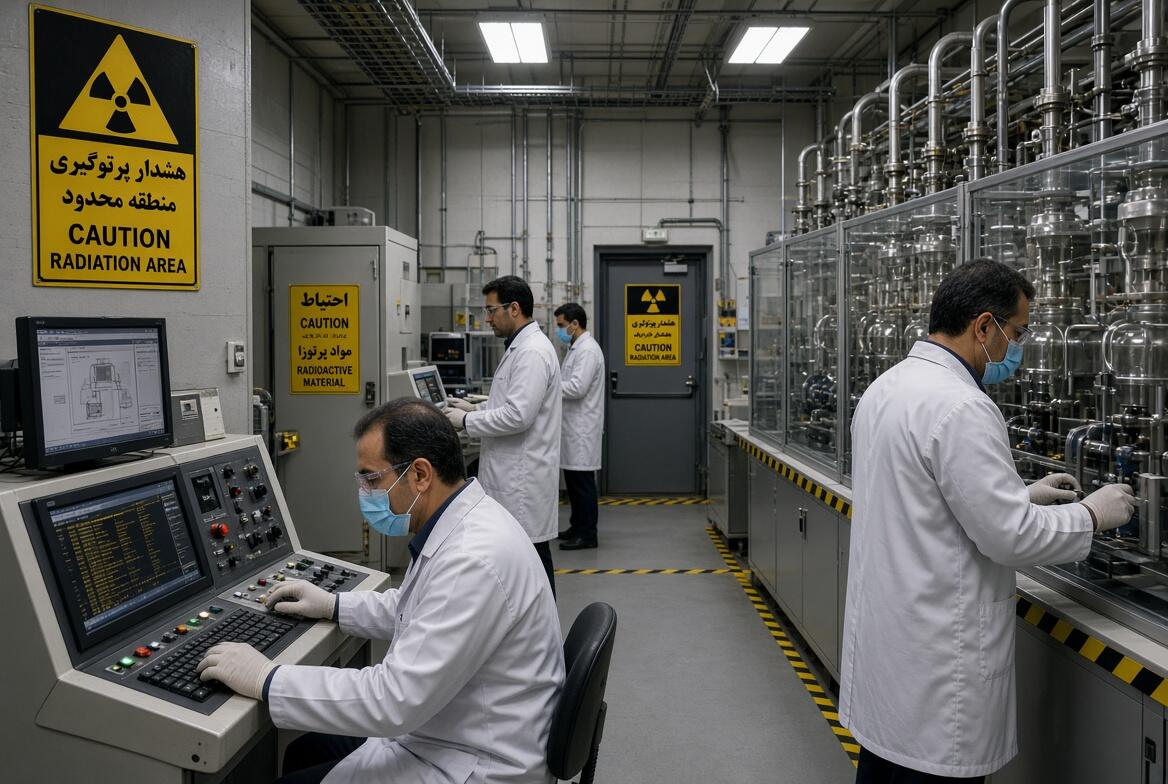
But, should these reports be verified, this could suggest some meaningful steps in the right direction to start to ease military and economic pressures in the Middle East. Total regime change in Iran is likely off the table, but convincing the current regime in Iran to give up on its goal of obtaining a nuclear weapon is…unlikely. A “compromise” where Iran pretends to stop enriching Uranium, and gets some economic relief in the process, and the US has an out where the GOP can save some face, right before the midterms, could mean end game. However, this all necessitates that the Al-Hadath headline is legitimate, that Iranian officials stand by their word, and that the US agrees to such conditions.
But markets were happy to digest whatever positive news they could, with Brent crude oil dropping around $4 on the announcement to $105/bbl. Despite the retracement in oil, yields still made their way higher, with the 2-year trading back up to 4.92%, and the 10-year up to 5.23%, after briefly breaking above 5.25%. Some talks are circulating about potential re-inversion of the US yield curve, as traders price in more hikes in the short end (17.5bp at the October meeting, and 94.6bp by July of 2027), but a look at the current spread of 32bp suggests that there’s still some way to go before reinversion becomes dinner-table talk.
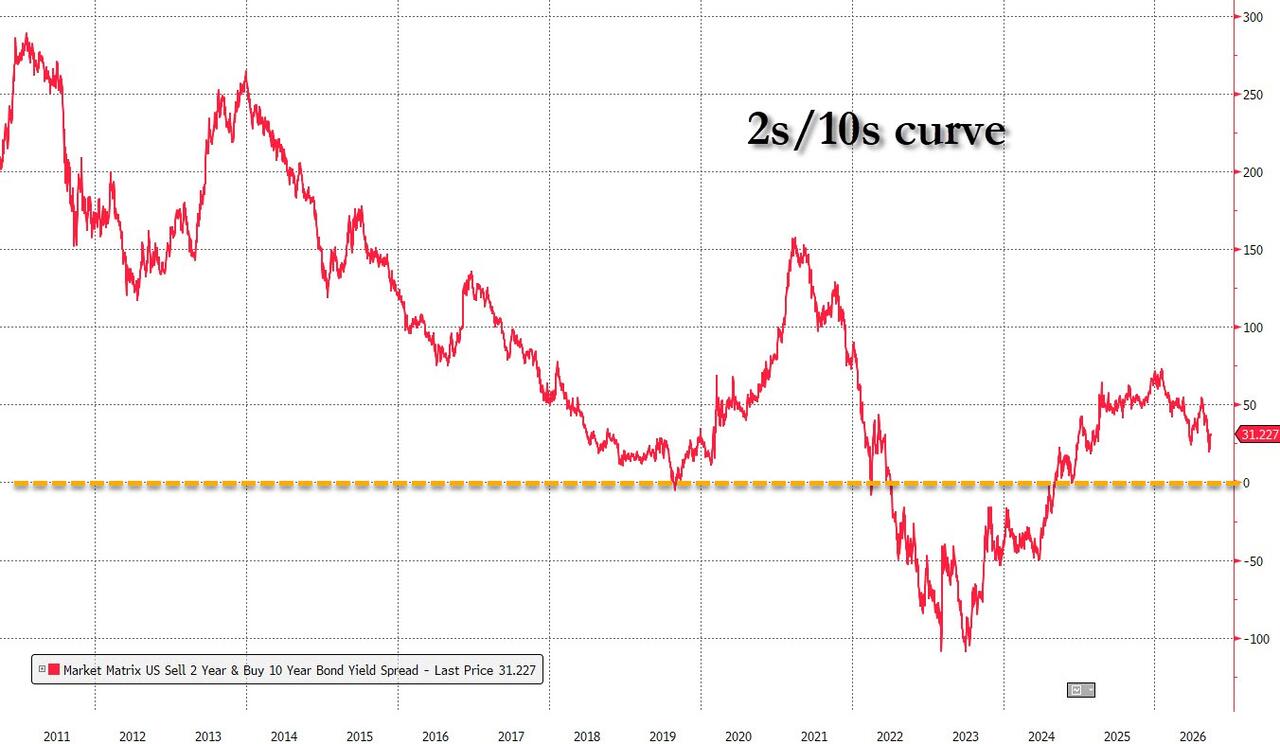
Stablecoin has also made its way back into US-Senate headlines, after the Senate failed to pass the CLARITY Act a few weeks ago. However, the recent headline suggests that the passage of the CLARITY Act might also be farther off than originally thought. On Monday, the US Senate subcommittee on investigations released a 28-page report cleverly titled “Tethered to Terrorism” which highlighted findings that Tether stablecoin had been used by the Iranian regime to evade sanctions and fund its proxy groups throughout the Middle East. Much of the fear surrounding stablecoin and other cryptocurrencies is the lack of traceability and the ability to use it for nefarious transactions. Which reminds me of an interesting proposition: imagine that instead of digital banking transactions, we instead printed physical cash, that could be circulated both domestically and internationally, without ever leaving a documented online trail that the cops nor the IRS could easily follow? Think about the millions of dollars of taxes that could be evaded and all the black market transactions that could take place…crazy, right?
The Financial Times reports that “EU countries are considering NATO-style joint responses to Russian hybrid attacks.” Hybrid attacks—those that include both physical and online warfare—were flagged recently by Danish intelligence, suggesting that their frequency, including those against NATO members, could increase in the coming months. But mobilizing 27 member-countries to go to war, when they can’t even agree on whether to sanction Russian gas or not, is easier said than done. One unnamed, but brilliant EU diplomat said “I’m not sure that anyone thinks the way to fight back against the Russians is to hold more meetings.” While wise in theory, holding meetings is what the EU does best. Defense ministers were invited to discuss the proposals yesterday.
The US and China agreed to extend their trade truce to January 10 to lift tariffs on USD 60 billion of “non-sensitive goods,” with each country receiving USD 30 billion of preferential trade status on their respective exports. Non-sensitive goods may or may not include military arms, apparently, as the US ambassador to China, David Perdue, said that Trump offered to sell arms to China. In the realm of national security, it’s not a great idea to be reliant on your adversaries for weapons. But, in the case of the US, exporting weapons to your adversaries might be good business—notwithstanding that US law prohibits arms sales to China. Nor what happens if American (or Taiwanese) troops find themselves staring down the barrel of an M16. Unless, as part of the arms deal, China pinky promises to only use them for peaceful purposes. It should be noted that the White House has denied all claims of Trump making such an offer, and Xi’s response to this offer has not been revealed.
END
7. OIL AND NATURAL GAS/ENERGY COMMENTARIES
8. EMERGING MARKETS//AUSTRALIA NEW ZEALAND ISSUES
COLUMBIA
Colombia Extradites Alleged Drug Lord ‘The Spider’ To California
by Tyler Durden
Monday, Sep 28, 2026 – 10:10 PM
A Colombian rebel commander nicknamed “The Spider” is now in U.S. custody after a change in leadership in Bogotá cleared the way for his extradition, according to CBS.
Geovany Andres Rojas, also known as “Araña,” was transferred to California over the weekend, where prosecutors have charged him with drug trafficking and terrorism offenses tied to his alleged role in Colombia’s cocaine trade.
Rojas was a senior figure in Comandos de la Frontera, an armed organization operating primarily in Putumayo, a major coca-producing region near Colombia’s borders with Ecuador and Peru.
Colombian authorities arrested him in February 2025, and the country’s Supreme Court later authorized his extradition. But the transfer stalled under former President Gustavo Petro, whose government was pursuing negotiations with several armed factions. Petro gave Rojas a role in those talks, effectively keeping him in Colombia while negotiations continued.
That changed after conservative President Abelardo de la Espriella won office in June. His administration abandoned the previous government’s negotiations with rebel organizations and moved quickly to send Rojas to the United States.

CBS writes that De la Espriella personally oversaw the transfer and said Colombia should not shield accused drug traffickers in the name of pursuing peace. He also called on U.S. prosecutors to ensure any eventual agreement with Rojas does not allow him to avoid accountability.
Rojas’ extradition comes as Colombia continues struggling with armed groups that expanded after the historic 2016 peace agreement with FARC. More than 14,000 combatants disarmed under that deal, ending a decades-long conflict, but some fighters refused to participate while other organizations moved into territory previously controlled by FARC.
Those groups have increasingly competed for control of cocaine trafficking corridors, illegal mining and extortion operations in parts of rural Colombia where government authority remains limited.
Comandos de la Frontera was formed in the aftermath of the FARC agreement and includes former guerrillas who remained armed. The organization later partnered with Segunda Marquetalia, another FARC splinter faction, before the relationship collapsed.
Rojas is scheduled to appear in federal court Monday.
END
U.S./GOLD AND SILVER PRICING/ASIAN CLOSING MARKETS AND EUROPEAN BOURSE OPENING AND CLOSING/ INTEREST RATE SETTINGS TUESDAY MORNING 6;30AM//OPENING AND CLOSING\
OPENING LEVELS OF CURRENCIES// AND CLOSING ASIAN STOCK MARKET AND OPENING EUROPEAN STOCKS:6 AM EST
EURO VS USA DOLLAR: 1.1349 DOWN 0.0021
USA/ YEN 157.36 DOWN 0.002 NOW TARGETS INTEREST RATE AT 1.75% AS IT WILL BUY UNLIMITED BONDS TO GETS TO THAT LEVEL…//YEN STILL FALLS//END OF YEN CARRY TRADE BEGINS AGAIN DEC 2024/Bank of Japan raises rates by .25% TO 1.75 ..TAKAICHI NEW PM AS YIELDS RISE//JAPAN DEEPLY IN TROUBLE WITH RISING RATES AND A FALLING YEN!! BANK OF JAPAN WILL NO LONGER DO QE. URGES PENSION AND INSUANCE FUNDS TO BUY JAPANESE BONDS//
YEN CARRY TRADERS MURDERED
GBP/USA1.3234 DOWN 0.0019 OR 19 BASIS PTS
USA/CAN DOLLAR: 1.4188 UP 0.0011 //CDN DOLLAR DOWN 11 BASIS PTS//
Last night Shanghai COMPOSITE CLOSED UP 6.83 OR 0.18%
Hang Seng CLOSED DOWN 141.51 PTS OR 0.57%
AUSTRALIA CLOSED UP 0.28%
// EUROPEAN BOURSE: ALL GREEN
Trading from Europe and ASIA
I) EUROPEAN BOURSES: ALL GREEN
2/ CHINESE BOURSES / :Hang SENG CLOSED DOWN 141.51 PTS OR 0.57%
/SHANGHAI CLOSED UP 6.83 PTS OR 0.18%
AUSTRALIA BOURSE CLOSED UP 0.28%
(Nikkei (Japan) CLOSED DOWN 306.62 PTS OR 0.47%
INDIA’S SENSEX IN THE RED
Gold very early morning trading: $4140.20
silver:$60.76
USA DOLLAR VS TRY (TURKISH LIRA): 49.00 UP 1 BASIS PTS AND NOW WE SEE THEIR STUPIDITY OF SELLING SOME OF THEIR GOLD AND ALL OF THEIR USA DOLLAR RESERVES. THE COUNTRY IS IN BIG FINANCIAL TROUBLE
USA DOLLAR VS RUSSIAN ROUBLE: 84.54 ROUBLE// DOWN 0 ROUBLE AND 34 BASIS PTS.
UK 10 YR BOND YIELD: 5.3934 DOWN 3 BASIS PTS
UK 30 YR BOND YIELD: 5.8803 DOWN 2 BASIS PTS
CDN 10 YR BOND YIELD: 3.967 UP 2 BASIS PTS
CDN 5 YR BOND YIELD; 3.6850 UP 3 BASIS PTS
USA dollar index early TUESDAY MORNING: 100.88 UP 18 BASIS POINTS FROM MONDAY’s CLOSE
TUESDAY MORNING NUMBERS ENDS
And now your closing TUESDAY NUMBERS 10.00 AM
Portuguese 10 year bond yield: 4.0160% DOWN 4 in basis point(s) yield
JAPANESE BOND 10 yr YIELD: +3.078% DOWN 2 FULL POINTS BASIS POINTS /JAPAN losing control of its yield curve/
JAPAN 30 YR: 4.177 DOWN 2 BASIS PTS//
SPANISH 10 YR BOND YIELD: 4.123 DOWN 2 in basis points yield
ITALY 10 YR BOND: 4.595 DOWN 1 points in basis points yield ./
GERMAN 10 YR BOND YIELD: 3.5991 DOWN 4 BASIS PTS
IMPORTANT CURRENCY CLOSES : MID DAY TUESDAY
Closing currency crosses for day /USA DOLLAR INDEX/USA 10 YR BOND YIELD/10:00 AM
Euro/USA 1.1344 DOWN 0.0028 OR 28 basis points
USA/Japan: 157.39 UP 0.031 OR YEN IS DOWN 3 BASIS PTS// HIGHLY INFLATIONARY TO JAPAN
Great Britain 10 YR RATE 5.3837 DOWN 5 BASIS POINTS //
GREAT BRITAIN 30 YR BOND; 5.8886 DOWN 5 BASIS POINTS.
CANADIAN DOLLAR DOWN 9 BASIS PTS TO 1.4187
xxxxxxxxxxxxxxxxxxxxxxxxxxxxxxxxxxxxxxxxxxxxxxxxxxxxxxxxxxxxxxxxxxxxxxxxxxxxxxxx
The USA/Yuan CNY 6.7034 ON SHORE ..UP
THE USA/YUAN OFFSHORE// CNH UP TO 6.7079
TURKISH LIRA: 49.00 UP 2 EXTREMELY DANGEROUS LEVEL/DEATH WATCH/HYPERINFLATION TO BEGIN.//
Your closing 10 yr US bond yield UP 1 in basis points from MONDAY at 5.255% //trading well ABOVE the resistance level of 2.27-2.32%)
USA 30 yr bond yield 5.580 UP 2 basis points /10:00 AM
USA 2 YR BOND YIELD: 4.9410 UP 1 BASIS PTS.
GOLD AT 10;00 AM $4166.00
SILVER AT 10;00: $61.09
Your 11:00 AM bourses for Europe and the Dow along with the USA dollar index closing and interest ratesTUESDAY
DAY CLOSING TIME/ 12:00 AM///
London: CLOSED DOWN 59.25 PTS OR 0.65%
GERMAN DAX: CLOSED DOWN 8.49 PTS OR 0.09%
FRANCE: DOWN 50.22 OR 0.62 PTS
Spain IBEX CLOSED DOWN 92.10 PTS OR 0.47%
Italian MIB: CLOSED DOWN 44.49 PTS OR 0.09%
WTI Oil price 90.65 10.00 EST/
Brent Oil: 103.93 10:00 EST
USA /RUSSIAN ROUBLE: 84.01/// ROUBLE UP 0 AND 40/ 100
CDN 10 YEAR RATE: 3.972 DOWN 1 BASIS PTS.
CDN 5 YEAR RATE: 3.681 DOWN 2 BASIS PTS
CLOSING NUMBERS: 4 PM//
Euro vs USA 1.1341 DOWN 0.0030 OR 30 BASIS POINTS//
British Pound: 1.3229 DOWN 0.0024 OR 24 basis pts/
BRITISH 10 YR GILT BOND YIELD: 5.4120 UP 1 FULL BASIS PTS//
BRITISH 30 YR BOND YIELD: 5.909 UP 1 IN BASIS PTS.
JAPAN 10 YR YIELD: 3.081 DOWN 1 FULL BASIS PTS (DANGEROUS TO THEIR ECONOMY
JAPANESE 30 YR BOND: 4.173 UP 1 PTS AND STILL VERY DANGEROUS TO THEIR ECONOMY
USA dollar vs Japanese Yen: 157.23 DOWN 0.131 OR YEN UP 13 BASIS PTS//GETTING FURTHER AWAY FROM 160.00/ EXTREMELY DANGEROUS
USA dollar vs Canadian dollar: 1.4177 UP 0.0004 PTS// CDN DOLLAR DOWN 4 BASIS PTS
West Texas intermediate oil: 89.26
Brent OIL: 102.62
USA 10 yr bond yield UP 2 BASIS pts to 5.262
USA 30 yr bond yield: UP 2 PTS to 5.592%
USA 2 YR BOND 4.893 DOWN 4 PTS
CDN 10 YR RATE 3.999 UP 3 BASIS PTS
CDN 5 YEAR RATE: 3.703 UP 3 BASIS PTS
USA dollar index: 101.12 UP 11 BASIS POINTS
USA DOLLAR VS TURKISH LIRA: 49.00 UP 2 BASIS PTS GETTING QUITE CLOSE TO BLOWING UP/IDIOTS SOLD GOLD
USA DOLLAR VS RUSSIA//// ROUBLE: 84.01 UP 0 AND 3 /100 roubles //
GOLD $4,170.00 3:30 PM)
SILVER: 61.32 3;30 PM)
DOW JONES INDUSTRIAL AVERAGE: DOWN 121.54 POINTS OR 0.24%
NASDAQ 100 UP 56.28 PTS OR 0.19%
VOLATILITY INDEX 16.17 UP 0.10 PTS OR 0.62%
GLD: $ 382.90 UP 4.98 PTS OR 1.32%
SLV/ 55.48 PTS UP 0.53 OR 0.96%
TORONTO STOCK INDEX// TSX INDEX: CLOSED DOWN 43,19 PTS OR 0.12%
end
TRADING today ZEROHEDGE 4 PM: HEADLINE NEWS/TRADING
‘Doves’ Drive Oil & Rate-Hike Odds Down; Dollar & Gold Bid Ahead Of Macro/Micro Maelstrom
WRAP UP
US stocks were mixed with most major indices lower amid curve steepening and despite a drop in oil – Newsquawk Daily Asia-Pac Market Open
Tuesday, Sep 29, 2026 – 05:54 PM
- US stocks were mixed, with most major indices in the red although the tech-heavy Nasdaq 100 outperformed and closed with gains as Oracle saw strength amid reports that OpenAI’s annual recurring revenue is reportedly close to USD 70bln, a steep increase from earlier reports of an annualised run rate over USD 40bln by mid-2026. Sectors were varied, as Utilities and Communication Services sat atop of the breakdown, while Energy lagged amid the losses in the crude complex after some more positive US/Iran rhetoric, as well as a couple of other bearish oil reports, including Trump backing Russia sanctions relief on prisoner release, and would create a path for the US to sign lucrative deals involving Russian oil, diesel, rare earth minerals, while the US DoE offered up to 40mln barrels from SPR.
- USD strengthened on Tuesday, supported by the rise in long-term yields, albeit gains faded in the afternoon on dovish Fed Williams remarks. The Vice Chair, who has historically been closely aligned with the Fed Chair in the past, sees no need for urgency after the September rate hike, arguing there is time to gather more information to provide greater clarity on the underlying economic trends and associated risks in support of setting the appropriate monetary policy.
- Looking ahead, highlights include South Korean & Japanese Industrial Production & Retail Sales, New Zealand ANZ Business Confidence, Philippines Trade Data, Australian Monthly CPI, Building Approvals & Private Sector Credit, Chinese Official & RatingDog Manufacturing & Services PMIs, Supply from Japan.
More Newsquawk in 2 steps:
1. Subscribe to the free premarket movers reports
2. Trial Newsquawk’s premium real-time audio news squawk box for 7 days
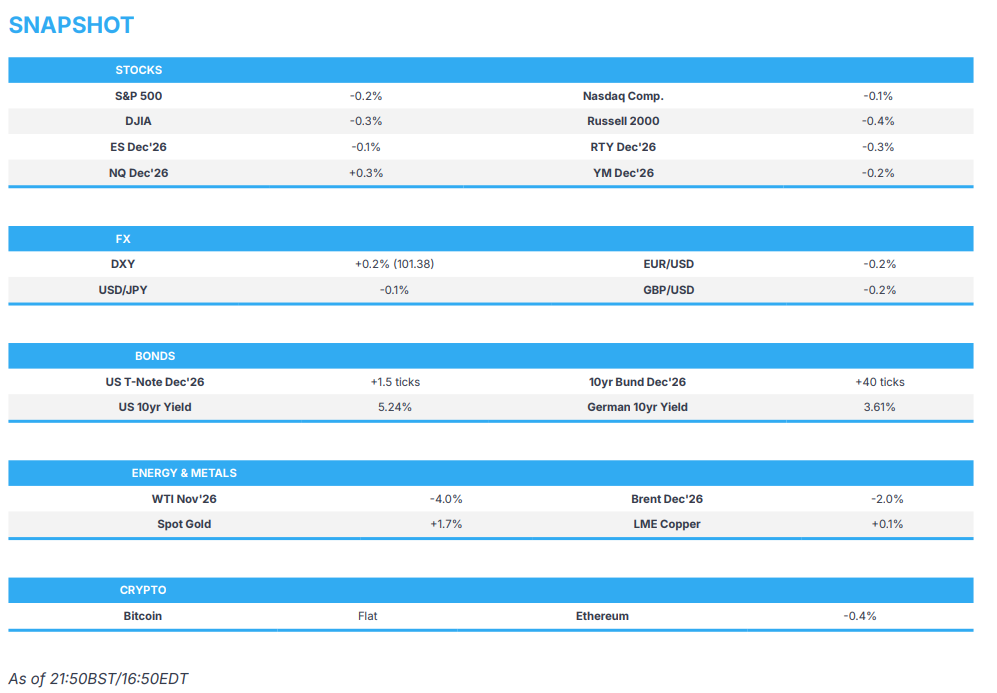
LOOKING AHEAD
- Highlights include South Korean & Japanese Industrial Production & Retail Sales, New Zealand ANZ Business Confidence, Philippines Trade Data, Australian Monthly CPI, Building Approvals & Private Sector Credit, Chinese Official & RatingDog Manufacturing & Services PMIs, Supply from Japan.
- Click for the Newsquawk Week Ahead.
IRAN CONFLICT
- US President Trump said Iran is failing very badly and will be over very soon, as well as stated that oil prices will tumble.
- US VP Vance said information confirms Iranian officials opposed targeting the ships but failed to convince the hardliners, adding that they are guessing at the Iranian position due to the absence of a decision-making system.
- US OFAC sanctioned 10 individuals and entities across multiple jurisdictions under Operation Economic Outcast for procuring weapons and components for Iran’s Ministry of Defence and Armed Forces Logistics.
- Iranian Major General Rezai said Iran has stated its conditions and that US President Trump is incapable of making decisions, while he added that Iran is ready to help establish peace in the Caucasus, but the US has no future in the region, and Iran stands firmly against it, according to IRIB.
- Iranian Parliamentary Speaker Ghalibaf reiterated that America should know that in a region where Iran does not sell oil, no one will sell oil, while he warned that if Iran’s security is not ensured, no infrastructure will be safe.
- Iranian diplomatic source said Iran will be ready to discuss the nuclear issue only after the Strait of Hormuz issue is resolved and Washington lifts the blockade, while the source added that Iran is ready to discuss the nuclear dossier only after a number of conditions are met.
- IRGC reiterated that Iran will never seek a nuclear weapon, while it also reiterated that the conflict takes a different form and will bring new weapons to the field. Furthermore, it claimed most US bases in the region have been destroyed and can no longer be used again, according to Al Jazeera.
- IRGC spokesperson said that if they find out that an enemy attack is imminent, they will definitely carry out pre-emptive operations, according to Fars.
- IRGC spokesperson said US ships have fled 500km from the Strait of Hormuz and claimed that no American ship remains in the Persian Gulf, with not even a single ship or small craft in the US Fifth Fleet based in Bahrain, which operates from the Persian Gulf.
- Iranian Foreign Ministry said regarding Israeli PM Netanyahu’s visit to the UAE that all countries in the region should be careful about the consequences of this trip, according to Fars News.
- Drone reportedly fired at an offending ship in the southern route of the Strait of Hormuz.
- UKMTO noted a report from the evening of September 28th saying a vessel was struck by an unknown projectile in the Strait of Hormuz, although the vessel is underway after the resulting fire was extinguished and with the crew safe.
- Mediators are working on an American-Iranian understanding that paves the way for reviving the Islamabad agreement, while communication channels between Washington and Tehran remain open, according to Al Hadath citing diplomatic sources.
- Mediators push to break the US-Iran deadlock, and negotiators were expected to hand over the latest amended draft of a proposed interim agreement to Iran on Tuesday, according to FT.
- Qatari spokesperson said efforts are currently focused on building common ground between the American and Iranian sides, adding that Qatari mediation efforts are ongoing and that there is no solution other than a peaceful one, with messages being exchanged and possible solutions discussed.
- Houthi source told Al-Mayadeen that any attempt to establish Saudi-backed groups and troop buildups will be met with targeting, while the source stated daily Saudi airstrikes are indiscriminate, target civilian infrastructure and will not go unanswered.
- Israeli PM Netanyahu is reportedly urging the UAE to engage in the war on Yemen in exchange for restoring some of Abu Dhabi’s regional roles, according to Al Mayadeen.
- Israeli PM Netanyahu said there are indications that Israel’s enemies will attack before the Israeli elections on October 27th, according to Al Arabiya.
- Israeli officials told Channel 12 that a large-scale operation in the Gaza Strip is inevitable, according to Al Hadath.
- IDF is prepared for a wide range of scenarios in the near and far theatres, while no concrete, well-founded information has emerged so far that directly links Election Day in Israel to escalation, according to Kan News citing a source.
US TRADE
- US stocks were mixed, with most major indices in the red although the tech-heavy Nasdaq 100 outperformed and closed with gains as Oracle saw strength amid reports that OpenAI’s annual recurring revenue is reportedly close to USD 70bln, a steep increase from earlier reports of an annualised run rate over USD 40bln by mid-2026. Sectors were varied, as Utilities and Communication Services sat atop of the breakdown, while Energy lagged amid the losses in the crude complex after some more positive US/Iran rhetoric, as well as a couple of other bearish oil reports, including Trump backing Russia sanctions relief on prisoner release, and would create a path for the US to sign lucrative deals involving Russian oil, diesel, rare earth minerals, while the US DoE offered up to 40mln barrels from SPR.
- SPX -0.17% at 7,671, NDX +0.21% at 30,339, DJI -0.26% at 51,355, RUT -0.35% at 2,808.
- Click here for a detailed summary.
TARIFFS/TRADE
- Nvidia (NVDA) and AMD (AMD) are lobbying the Trump administration to stop lawmakers from curbing exports to China and are asking that lawmakers hold off on the China-related chip export restriction in the defence bill, while the legislation in question has bipartisan support, according to Politico citing sources.
- China urged the EU to use dialogue to solve disputes and vowed a response if the EU goes ahead with discriminatory moves.
NOTABLE HEADLINES
- Fed’s Barr (voter) said there is a need to recalibrate policy, with a base case that further policy adjustments are likely needed, while he stated that risks to achieving the inflation target have increased and risks to the labour market have reduced. Furthermore, Barr expects GDP growth to pick up a bit in H2 from 2% in H1 and said inflation is a clear concern, with the Fed having been knocked off course to its 2% goal. Barr also said he is seeing some elevated wage rates in the skilled trades and that, taking the longer view, the Fed needs to be sure to do what it takes to bring supply and demand into balance.
- Fed’s Williams (voter) said he sees no need for urgency after the September rate hike, while he noted that US economic momentum is strong and may be strengthening. Williams stated AI investment issues are an increasingly big issue for inflation and he sees US GDP at 2.25% this year and unemployment at 4% over 2027, as well as stated that Fed policy can make sure the impact of supply shocks is not long-lasting.
- Fed’s Goolsbee (2027 voter) said expectations of productivity gains from AI in the future create a high danger of overheating now and noted that nothing in the Federal Reserve Act says to make sure the bond market is happy or stock markets are not surprised. Goolsbee also stated that the Fed needs to revisit the logic of looking through supply shocks.
- Fed’s Musalem (2028 voter) said central bankers needn’t make promises, but should tell the public how and why the central bank makes policy decisions. He also stated that a well-articulated framework should include two or three likely scenarios, and that central banks should avoid communications and actions with no framework to make sense of them.
- US President Trump said he will sign a powerful order on AI and that the AI order will change the name to Super Intelligence. Trump added that he will never stifle the growth of AI and does not want to give China US AI secrets, while he did not discuss AI that much with President Xi and wants to keep the AI lead, and will sign an order to make agencies integrate with America.gov.
- US President Trump said regarding that AI meeting that it was very good and very productive, while he added the US has a big lead in AI and will keep the lead. Trump stated he would sign the AI renaming order at 5 PM EDT, as well as noted that AI leaders are to work with local communities on data centres and they will be releasing a statement soon to summarise what they did. Trump also said he will be naming an AI Czar in the next three or four days and that he discussed the Xi meeting in great detail with tech firms.
- US House Speaker Johnson said the US can achieve both AI security and innovation, while hoping today’s AI meeting will reach an agreement and said AI industry leaders welcome some level of regulation.
DATA RECAP
- US CB Consumer Confidence (Sep) 81.9 vs. Exp. 89.2 (Prev. 88.6)
- US S&P/Case-Shiller Home Price (Jul YY) 2.5% vs. Exp. 2.2% (Prev. 2.2%)
- US Dallas Fed Services Index (Sep) -1.8 (Prev. 4.2)
- US JOLTS Job Openings (Aug) 7.079M vs. Exp. 7.23M (Prev. 7.335M)
FX
- USD strengthened on Tuesday, supported by the rise in long-term yields, albeit gains faded in the afternoon on dovish Fed Williams remarks. The Vice Chair, who has historically been closely aligned with the Fed Chair in the past, sees no need for urgency after the September rate hike, arguing there is time to gather more information to provide greater clarity on the underlying economic trends and associated risks in support of setting the appropriate monetary policy.
- EUR trickled lower for most of the day despite hawkish-leaning rhetoric from ECB officials, but is off worst levels after dovish comments from Fed’s Williams provided some relief for the single currency.
- GBP gave way to the firmer buck and was also not helped by PM Burnham’s vow to scrap the pension triple lock, although the downside was cushioned by support near the 1.3200 level.
- JPY was indecisive with USD/JPY trading sideways in a choppy fashion at the 157.00 handle.
FIXED INCOME
- T-notes settled slightly lower and the curve steepened as short-end losses reversed on dovish remarks from Fed Williams, who sees no need for urgency after the September rate hike, arguing there is time to gather more information to provide greater clarity on the underlying economic trends and associated risks in support of setting the appropriate monetary policy.
COMMODITIES
- Oil prices declined and settled at session lows after further signs that US-Iran diplomacy remains possible, as Qatar said mediation efforts are ongoing and focused on building common ground between the US and Iran. There were numerous downside catalysts, including a report that US President Trump backs Russia sanctions relief on prisoner release, and would create a path for the US to sign lucrative deals involving Russian oil, diesel, rare earth minerals, and other commodities, while it was also reported that the US DoE offered up to 40mln barrels from the SPR.
- OPEC+ is likely to stick with the plan for steady quotas, according to delegates.
- US offers up to 40mln barrels from strategic oil reserve.
- White House has reportedly urged EU to draw down from diesel emergency inventories in a bid to lower global prices, while it was also reported that the Trump administration said several EU member countries have not released as much oil and refined products from reserves as they promised.
- EU Energy Commissioner said they have discussed possible oil release with IEA’s Birol, and still need to have talks with member states and IEA on these issues.
- IEA’s Birol said another oil stock release is not at the top of the agenda.
- Tanker Trackers stated that exports of Saudi crude over the past complete seven days average out to nearly 9mln BPD, and that’s only from what they can gather from the available satellite imagery.
GEOPOLITICAL
RUSSIA-UKRAINE
- US President Trump reportedly doubts that Russian President Putin would agree to an energy ceasefire with Ukraine before the winter, according to Kyiv Independent citing sources.
- US President Trump backs Russia sanctions relief on prisoner release and expressed support for the plan a few months ago, while this would create a path for the US to sign lucrative deals involving Russian oil, diesel, rare earth minerals and other commodities.
- US official said Russian President Putin’s Envoy Dmitriev had a ‘constructive’ meeting on Monday with US officials on peacefully resolving the war in Ukraine, with possible US-Russia energy initiatives after the war ends also discussed.
OTHER
- Japan and the US will hold large-scale joint military drills from October 19th for 11 days, involving seven nations and deploying 1,000km-range surface-to-ship missiles, according to NHK.
ASIA-PAC
NOTABLE HEADLINES
- Chinese Vice Premier He Lifeng said China welcomes Japanese companies to develop in China and share market opportunities, according to Xinhua.
- PBoC cut the mortgage-supplementary lending rate (PSL) by 25bps, lowering the one-year PSL rate to 1.50% (prev. 1.75%), while it said the reduction aims to better incentivise policy banks to support the real economy and national strategic priorities. It will include construction of six networks — water networks, new-type power grids, computing power networks, next-generation communications networks, urban underground pipe networks and logistics networks — and guide policy banks to step up financing for these projects to help expand effective investment and deepen domestic demand. PBoC also raised the re-lending quota for tech innovation and technological transformation by CNY 200bln to CNY 1.4tln and increased the facility’s support ratio from 60% to 100%, aiming to steer banks to expand lending to SME tech firms and support corporate equipment upgrades.
EU/UK
NOTABLE HEADLINES
- UK PM Burnham said the UK will adjust the pension triple lock promise in 2030, with pensions rising by either inflation or 2.5%, becoming a double lock with wages taken out. Burnham said pensioners will always share in the rising prosperity of the nation, while savings from changes to pensions will go into the care service, while these changes will generate significant savings and he will make a manifesto commitment at the next election to change the electoral system.
- UK PM Burnham said he will not give the UK a clear path until the country decides a long-term relationship with the EU and noted that Brexit has done more harm than good, while he will lay out the different options for the UK’s long-term relationship with Europe.
- UK PM spokesperson did not rule out the UK rejoining the EU and the government is not ruling out tax rises to pay for PM Burnham’s social care policy, in addition to scrapping the pensions triple lock, while the changes announced will save GBP 15bln by 2040, but taxes may also have to rise, according to a government official.
- BoE’s Taylor said the right policy response is to be vigilant but disciplined and monetary policy should not react mechanically to movements in energy prices if those movements remain primarily relative-price shocks. Taylor added that the case for further rate increases is not compelling to him unless energy prices remain high for an extended period and also generate clearer signals of a transmission into broader inflation persistence.
- BoE’s Mann said inflation staying above 2% is an equality problem.
- ECB’s DeMarco said stronger core inflation could be grounds to act and would not exclude a rate hike in October, while the recent rise in long-term bond yields is quite worrying.
- ECB’s Escriva said the ECB is still not in restrictive territory, adding that what he would start to worry about is the global upward trajectory of long-term rates, which can add pressure to interest rates, while Escriva also said that Spain is not considering moving its gold reserves.
- ECB’s Kazimir said the rate hike was unavoidable, with energy prices remaining a key factor and January repricing set to be key for him. ECB needs flexibility and has enough time.
DATA RECAP
- European Economic Sentiment (Sep) 97.9 vs. Exp. 99 (Prev. 98.4)
- European Industrial Sentiment (Sep) -3.8 vs. Exp. -4.7 (Prev. -5.0)
- European Services Sentiment (Sep) 6.1 vs. Exp. 6.5 (Prev. 5.6)
- European Consumer Confidence Final (Sep) -16.5 vs. Exp. -16.5 (Prev. -16.5)
- European Consumer Inflation Expectations (Sep) 35.2 (Prev. 33.0)
- European Selling Price Expectations (Sep) 20.3 (Prev. 16.9)
USA DATA RELEASES
US Home Prices Are Rising At Their Fastest Pace In Over A Year, But…
Tuesday, Sep 29, 2026 – 09:23 AM
Amid soaring mortgage rates, new home prices falling rapidly, and collapsing homebuilder confidence, US home prices in America’s 20 largest cities rose for the fourth straight month in July (according to the latest – admittedly lagged – data from S&P Cotality Case-Shiller).
The 20-City Composite index rose 0.32% MoM (far stronger than the 0.2% MoM rise expected) in July. That is the strongest monthly rise since Dec 2025 and lifted the annual home price appreciation to its fastest pace since May 2025…
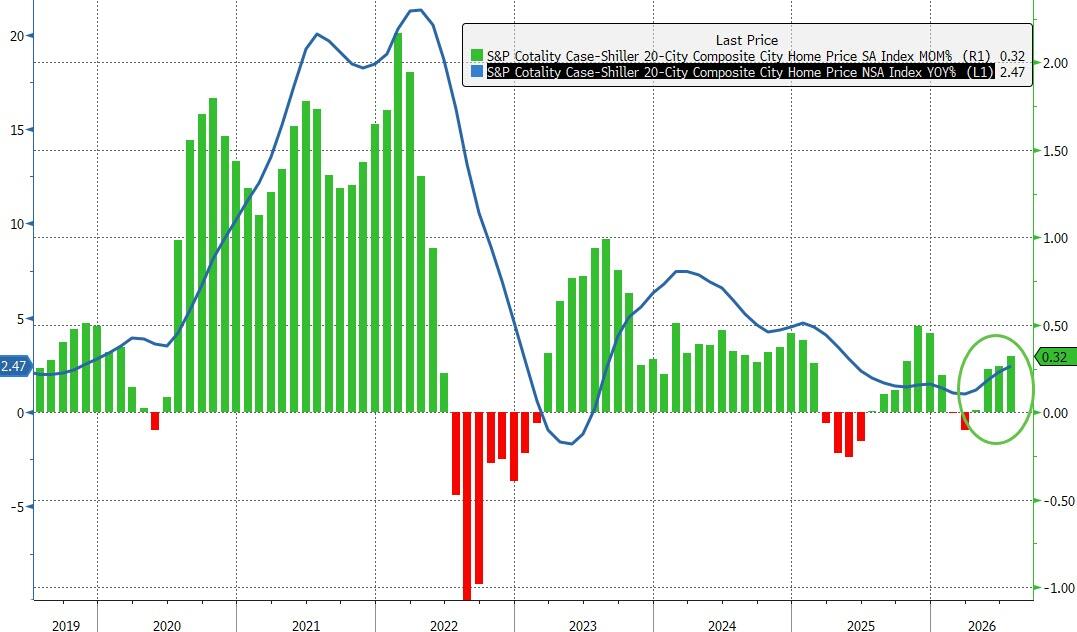
This was “a notable departure from typical seasonal patterns,’ said Rebecca Kaufman, Associate Director of Commodities at S&P Dow Jones Indices.
For the fifth consecutive month, Chicago led all metros with a 6.9% annual gain in July, but New York and Miami both saw large jumps. Meanwhile, Seattle posted the largest annual decline for the second consecutive month, falling 1.6%, followed by Las Vegas (-1.3%) and Denver (-1.1%)
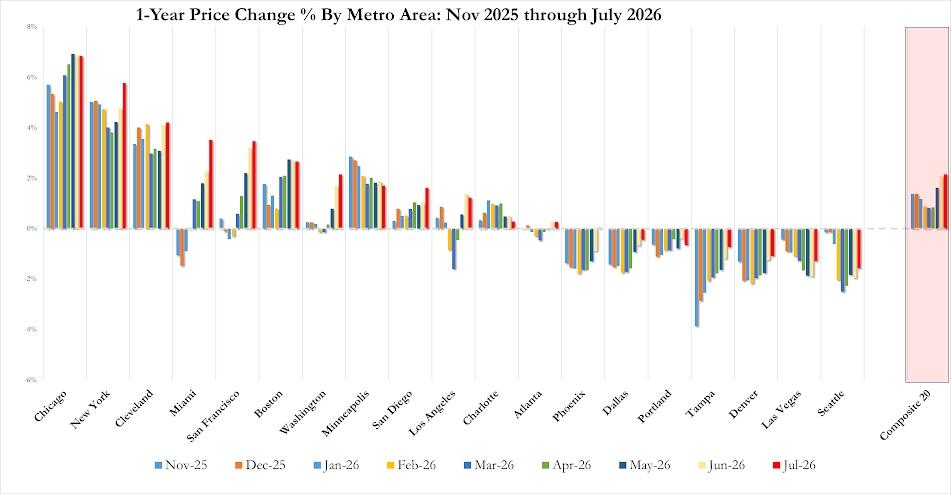
“The years-long East-West divide persists, with six out of the eight Eastern metropolitan markets recording greater year-over-year changes in July versus June, compared with just two of the eight Western metropolitan markets,” noted Kaufman.
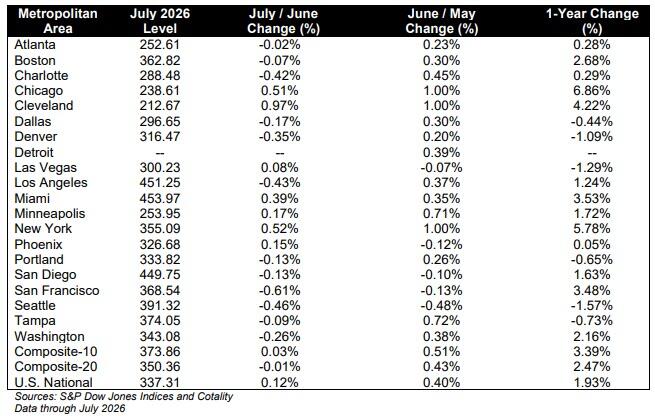
However, given the lagged and smoothed nature of Case-Shiller’s data, the party may just be about to collapse into the hangover…
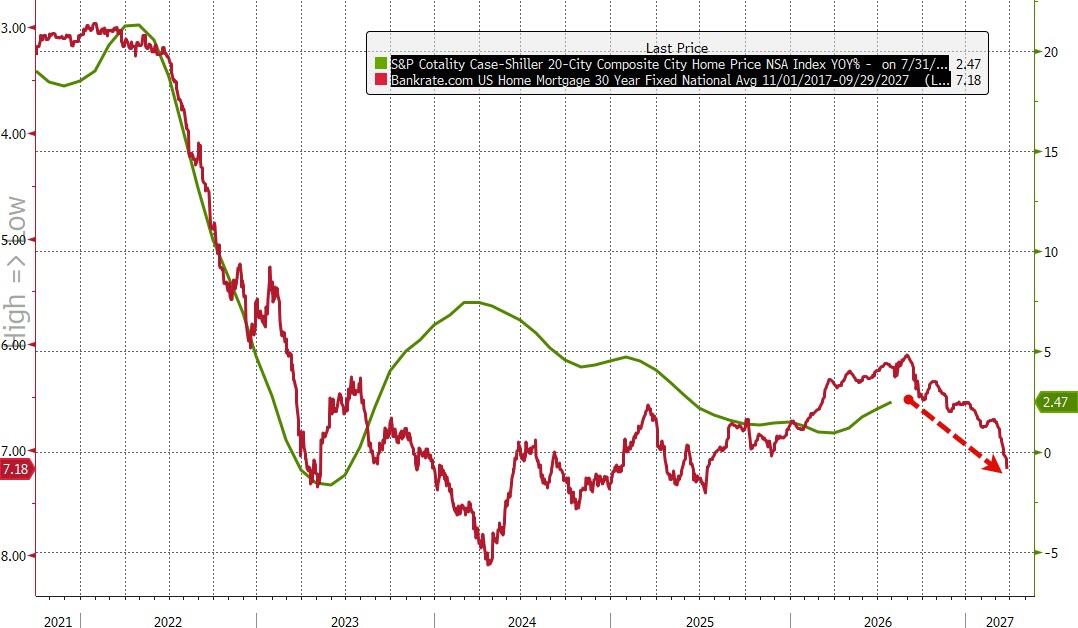
And finally, while slightly lower inflation and stronger nominal home price appreciation helped narrow the gap, Kaufman notes that “home prices continued to decline in real terms in July 2026, marking the 14th consecutive month of real declines.”
END
‘Worse Than COVID’: Consumer Confidence Crashes In September
by Tyler Durden
Tuesday, Sep 29, 2026 – 10:17 AM
The Conference Board’s Consumer Confidence Index plunged in September (-6.7pt to 81.9) – the lowest headline print since April 2014.
The Present Situation Index fell sharply, while the Expectations Index slipped further into negative territory.
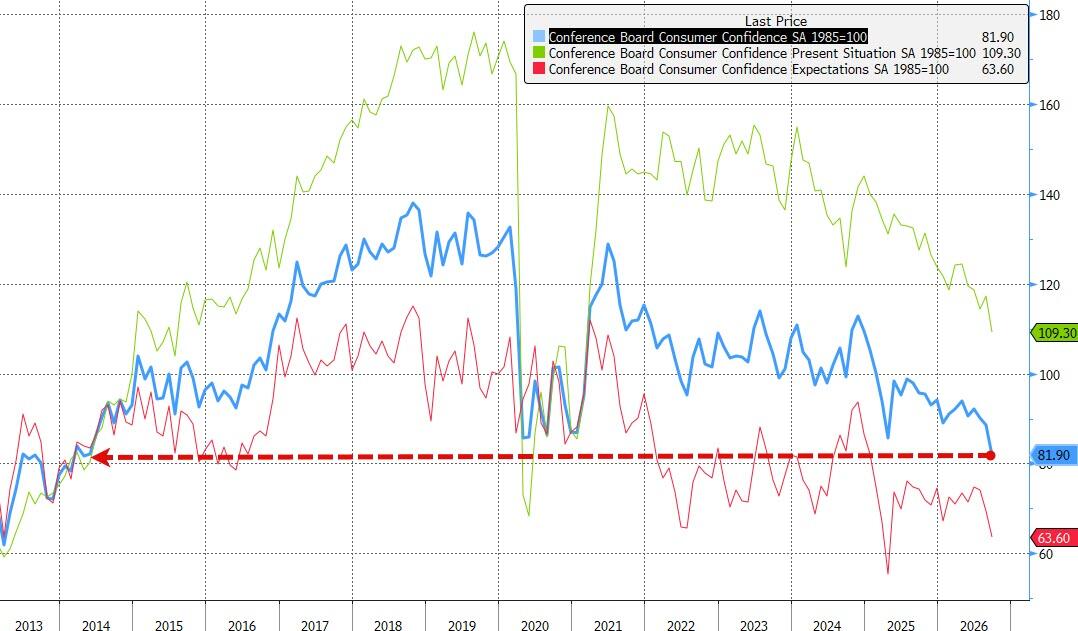
This was the fourth straight monthly miss for confidence and the biggest miss since Dec 2024…
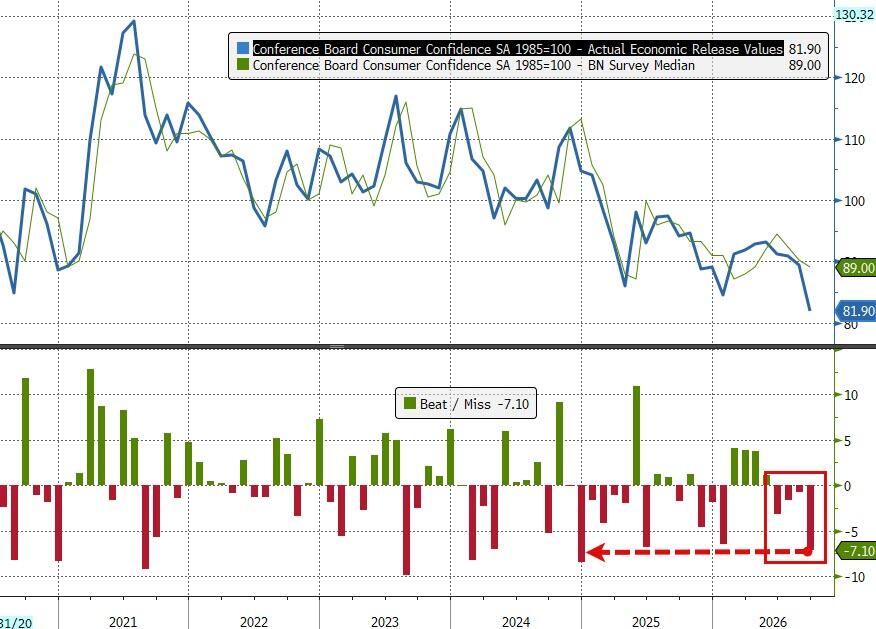
“Consumer appraisals of current business conditions became negative for the first time since September 2024,” said Dana M Peterson, Chief Economist, The Conference Board.
“Perceptions of the current labor market also worsened, though remained within positive territory. Over the next six months, consumers expected both business conditions and the labor market to weaken. Consumers still anticipated their household incomes to rise, but less so compared to previous months.”
Perceptions of current employment conditions also softened, with the labor market differential – the share of consumers saying jobs are “plentiful” minus the share saying jobs are “hard to get” – retreating tumbling to its lowest since Feb 2021…
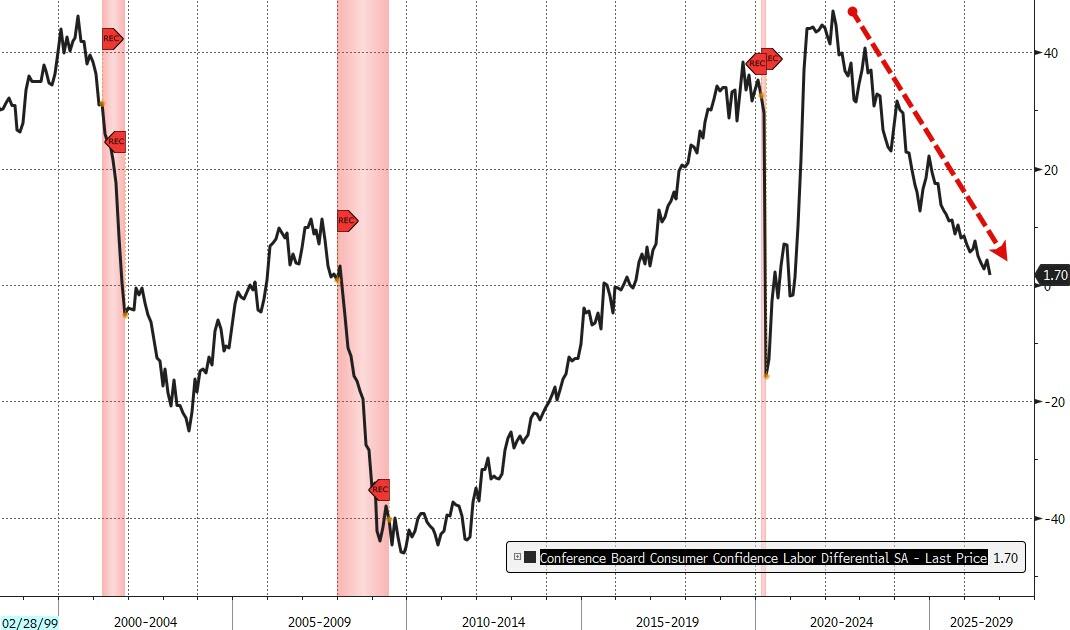
On a six-month moving average basis, confidence across all age groups and nearly all income groups trended downward.
While higher-income groups remained generally more optimistic, those with a household income of $125,000-$149,000 reported the greatest decline in confidence over the last six months.
By generation, confidence for Gen Z, followed by Millennials, remained the highest on a six-month moving average basis.
Confidence continued to weaken among the three oldest generations – Generation X, Baby Boomers, and the Silent Generation.
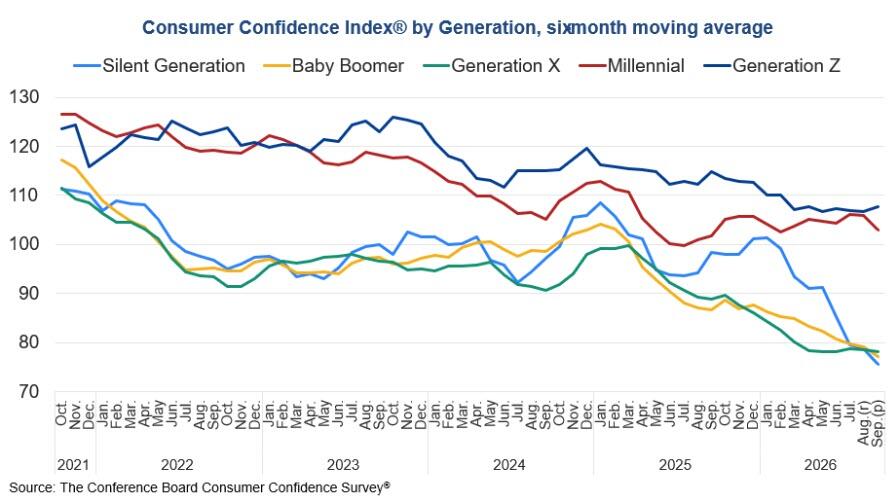
Confidence fell in September across all political affiliations – Democrats, Republicans, and Independents.
Consumers’ average and median 12-month inflation expectations also jumped in September to 6.1% and 5.1% respectively.
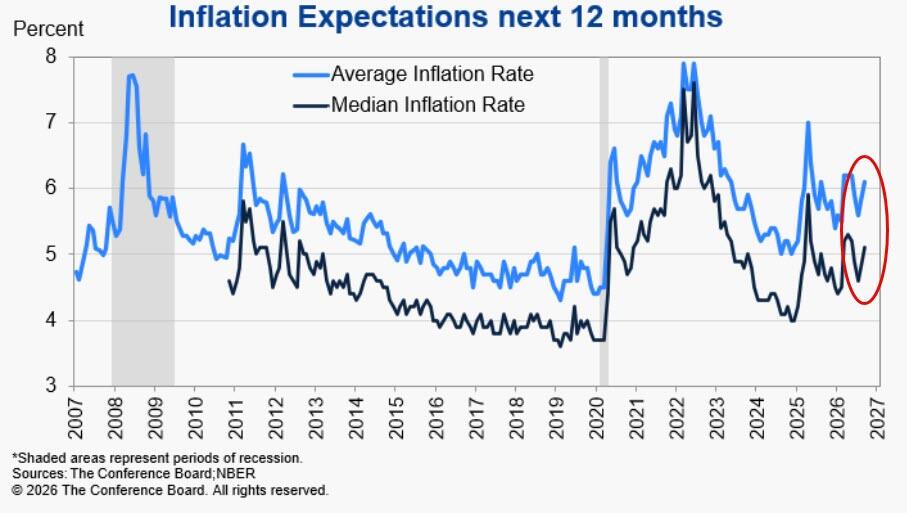
The share of consumers anticipating higher interest rates over the next 12 months jumped by 5.2 ppts to 68.4%. Consumers still largely expected stock prices to rise in the next 12 months, but optimism moderated in September.
Finally, consumers’ write-in responses regarding factors affecting the economy were mostly pessimistic in September:
“References to prices, the high cost of goods and services, and oil and gas prices in particular, rose to new heights, reflecting September’s surge in fuel costs.
Comments about war/conflict eased this month but remained elevated. Consumers also frequently cited politics, trade, and employment in their write-in responses, though to a lesser extent.”
Not pretty… especially into the Midterms.
END
Record Plunge In Real-Estate Job Opening Sends JOLTS Sharply Lower, Hints At Ugly Jobs Report
Tuesday, Sep 29, 2026 – 10:45 AM
After five straight months of JOLTS beats earlier in the year, including two blowout prints for April and May and zero misses since 2025, the June JOLTS report was a surprising miss (despite the previously discussed surge in government job openings). One month later, the July JOLTS report made it two misses for two, when the US reportedly had 7.271 million job openings, modestly below the consensus estimate. Fast forward to today when moments ago the BLS reported that in August the number of job openings dropped from an upward revised 7.335 million (which ironically would have been a beat to last month’s estimate), to 7.079 million…
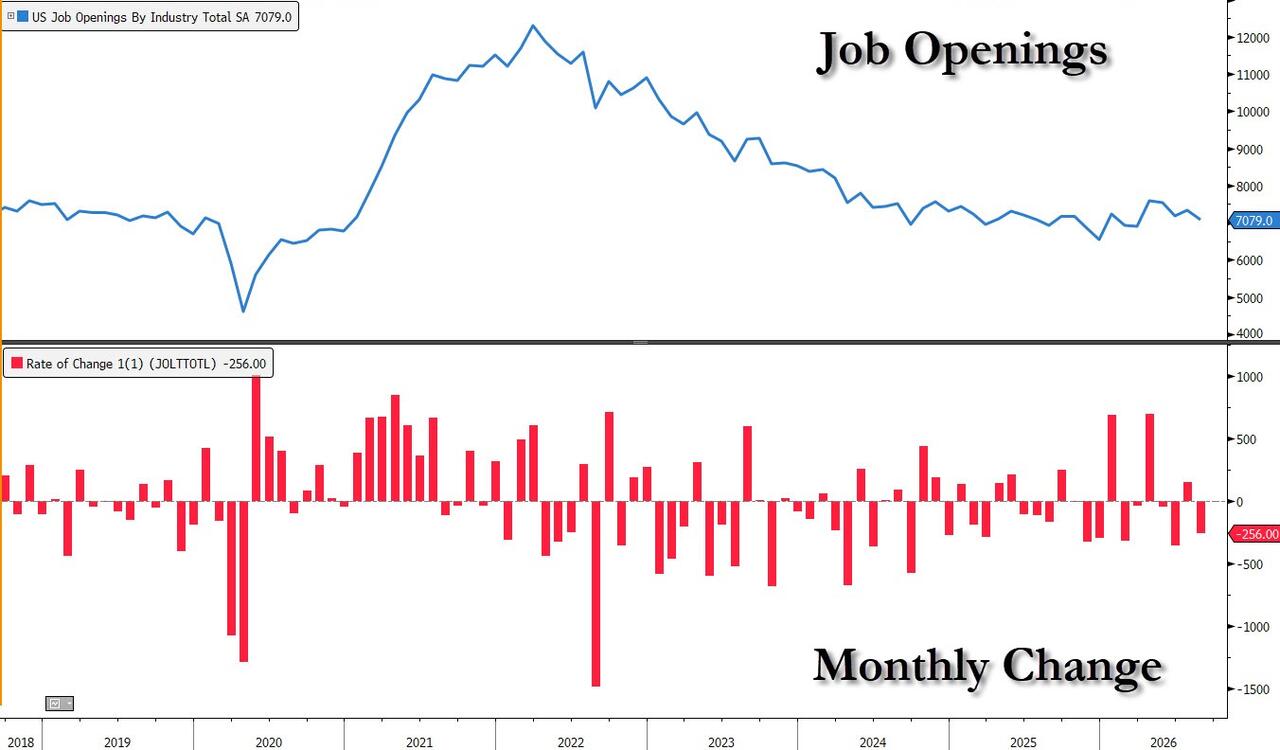
…. missing the consensus estimate of 7.228 million for the third month in a row.
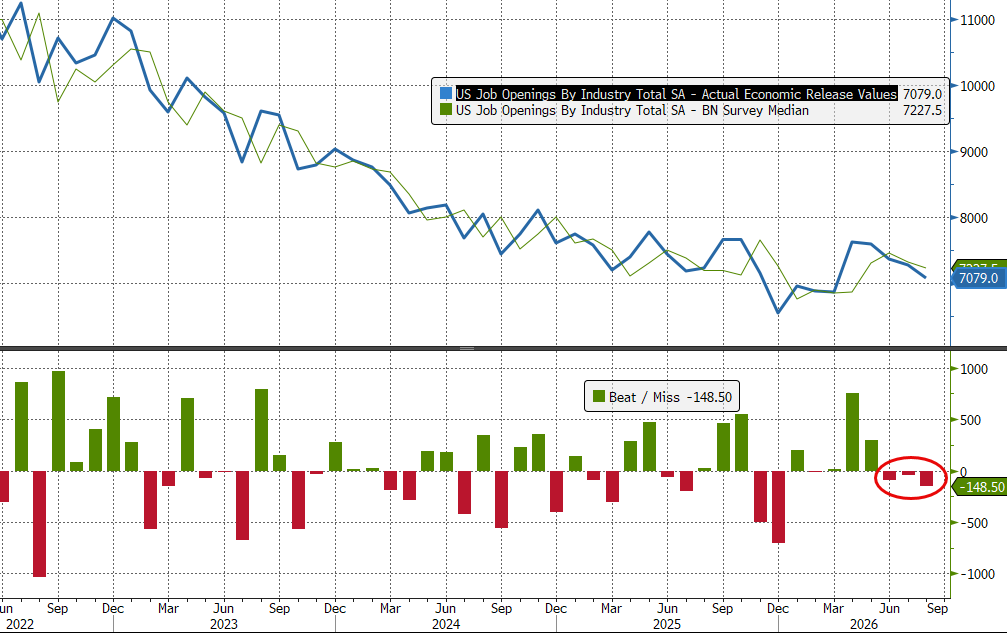
Notably, this was the first upward revision to the data after three months. Of course, nobody can possibly forget the three straight years of negative revisions between 2023 and 2025…
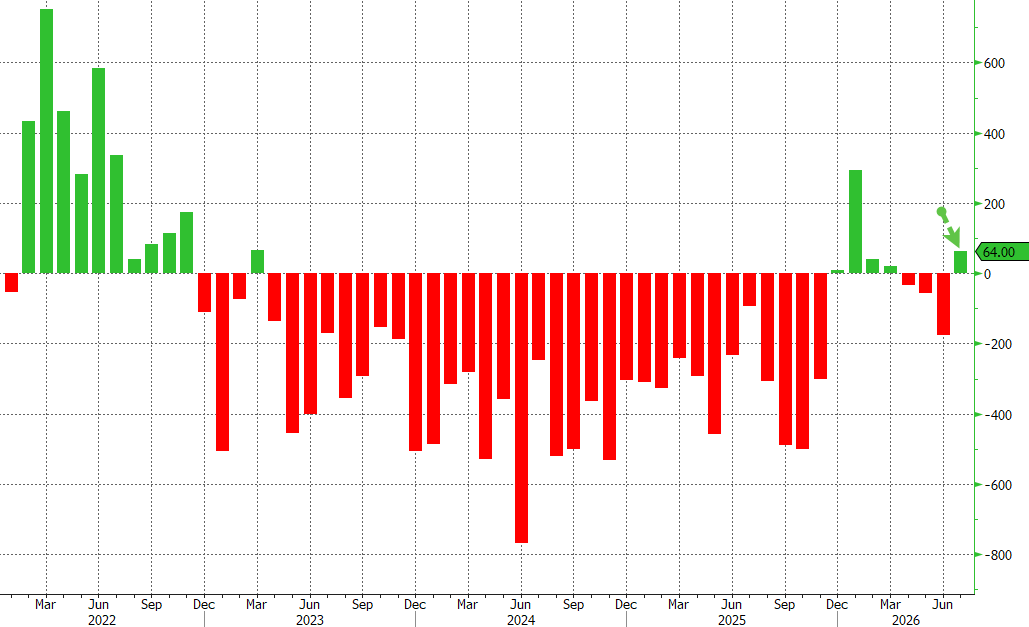
Where did the openings come from? According to the BLS the number and rate of job openings were little changed at 7.1 million and 4.3 percent, respectively. As shown in the table below, there were gains in trade, information, leisure and hospitality job openings, offset by declines in construction, manufacturing, professional/business services, and private education job openings.
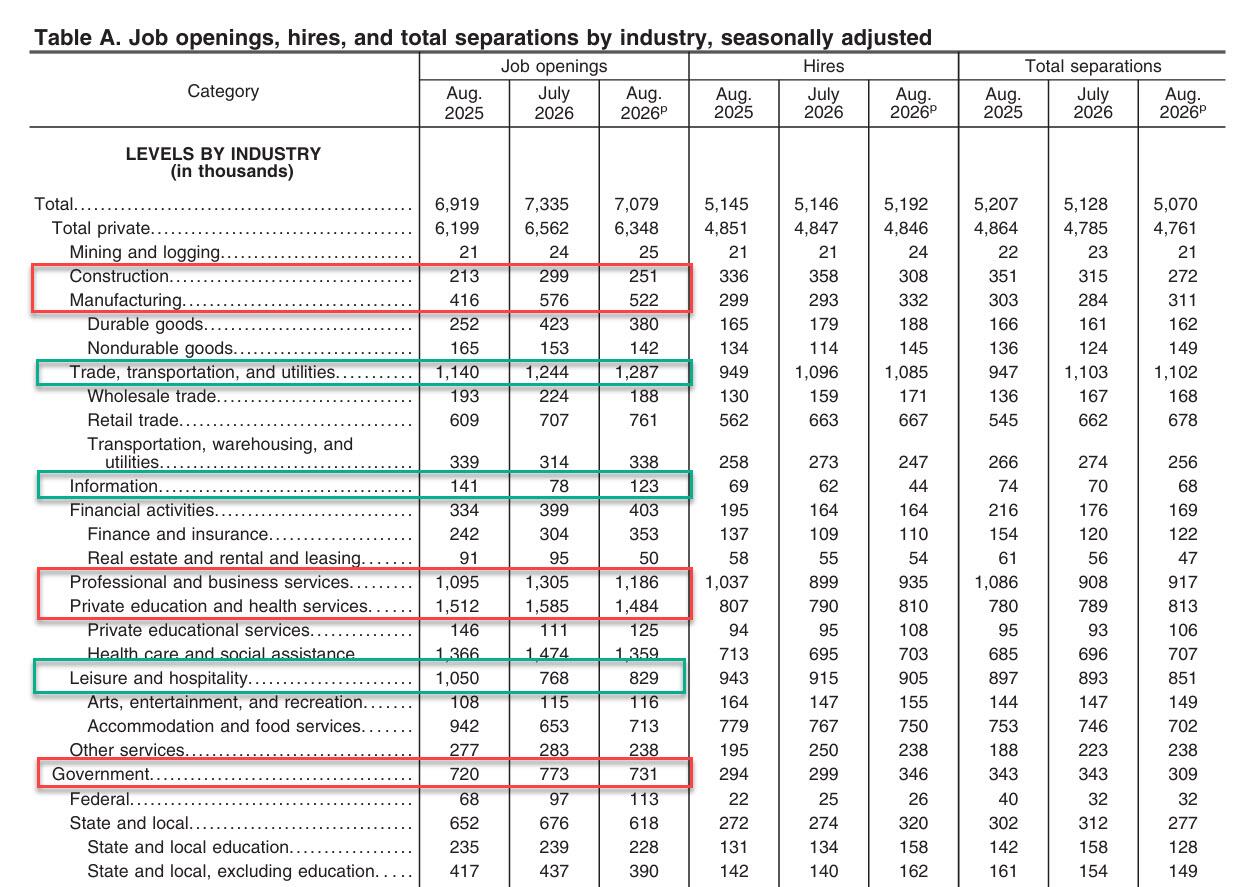
The most notable category, however, was real estate and rental and leasing job openings, which plunged by almost half, dropping to just 50K in August, the lowest since Feb 2014.
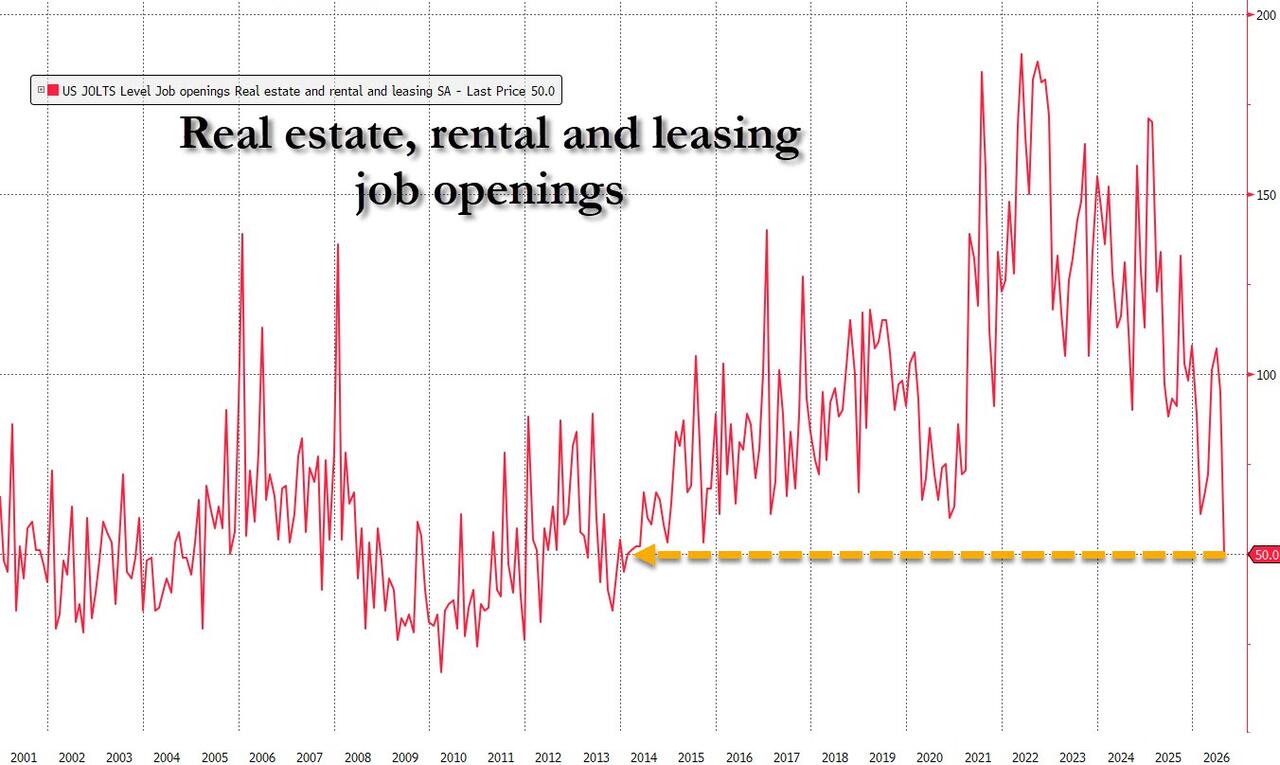
The August rise in job openings was juxtaposed with an overall drop in July employment, which meant that after 9 months of labor surplus which ended in March, and after 4 months of modest improvements in the number of excess job openings, we are back to being on the verge of having fewer job openings than unemployed workers, as the August surplus tumbled to just 48K from 419K the month before, and a concerning development for the broader labor market which according to most other measures continues to fire on all cylinders.
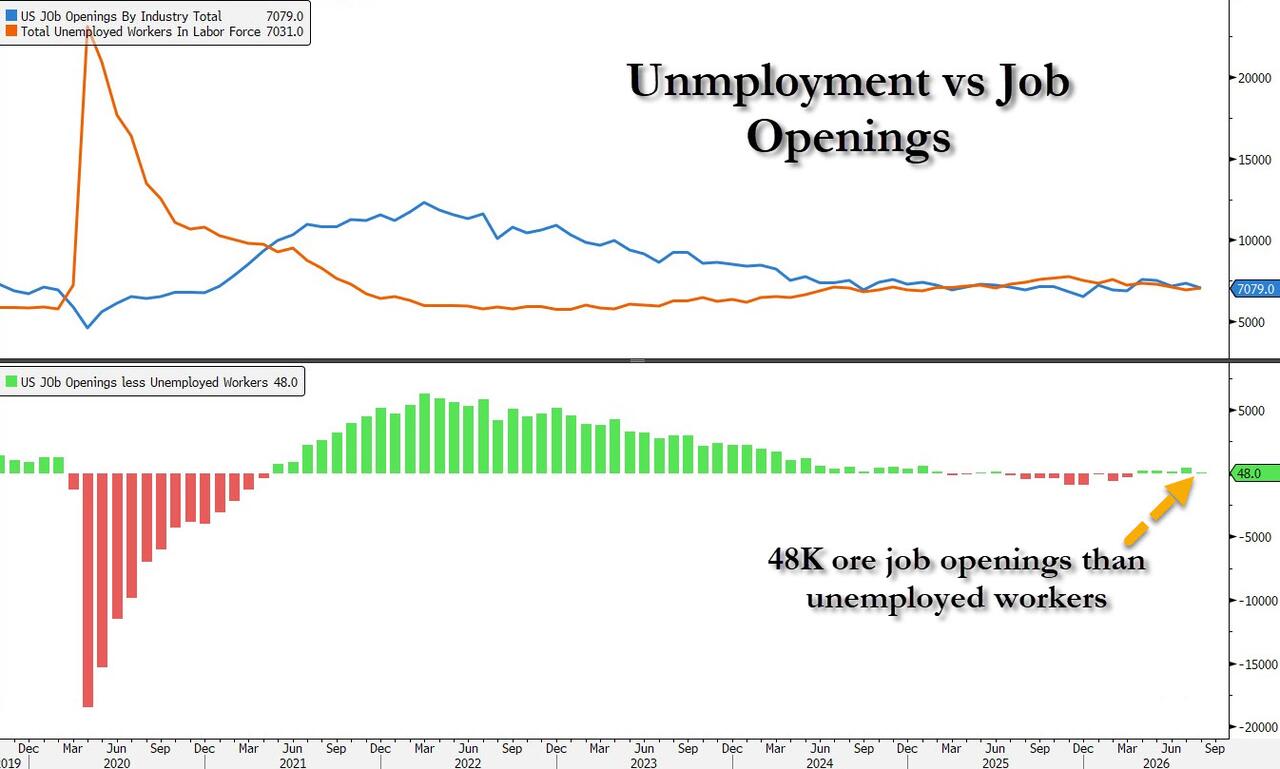
The latest JOLTS data also means that after rising as high as 1.1x in July, the ratio of job openings to unemployed dropped back down to 1.0x.
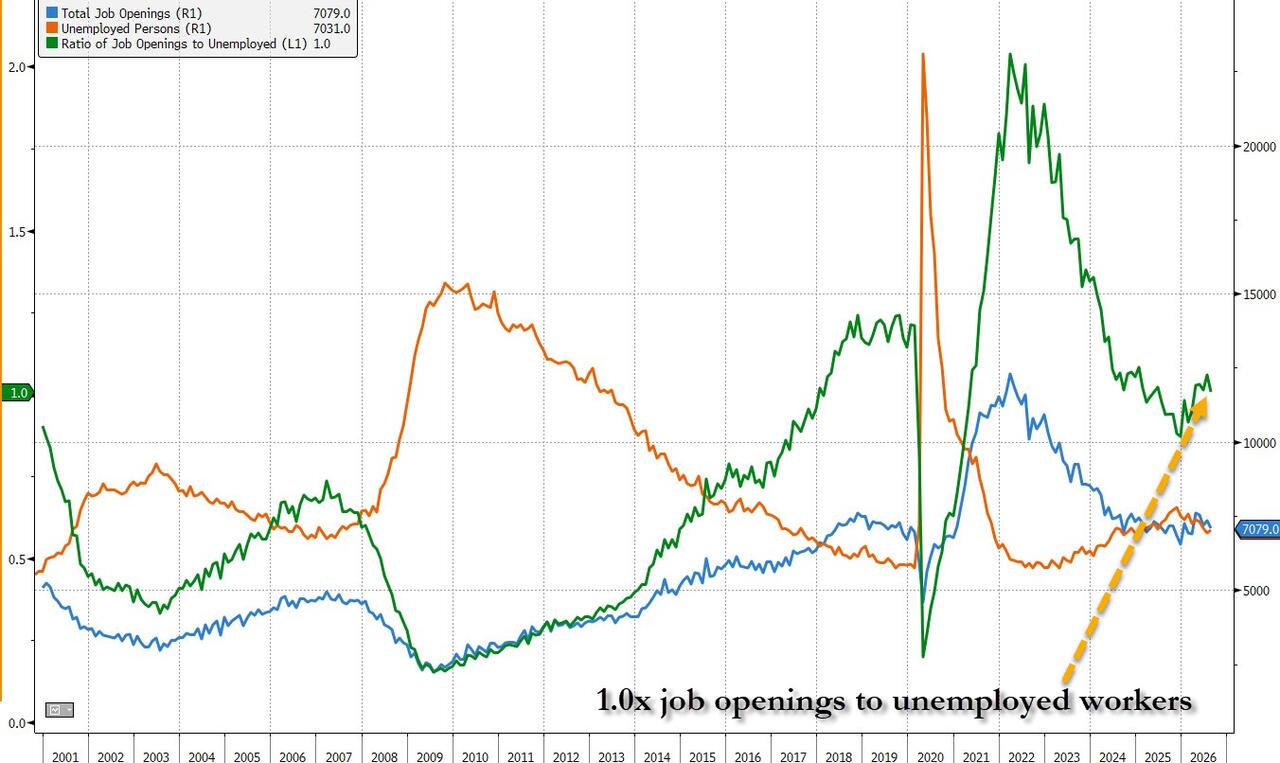
While the job openings number was far weaker than expected for the third time this year, in July we also saw continued weakness in quits offset by a small bounce in hires. In August the number of Quits – or the “take his job and shove it” indicator – dropped by another 23K to 3.066MM from 3.089MM indicating a drop in confidence that better jobs await elsewhere; at the same time hires rose modestly by 46K, from 5.146MM to 5.192MM.
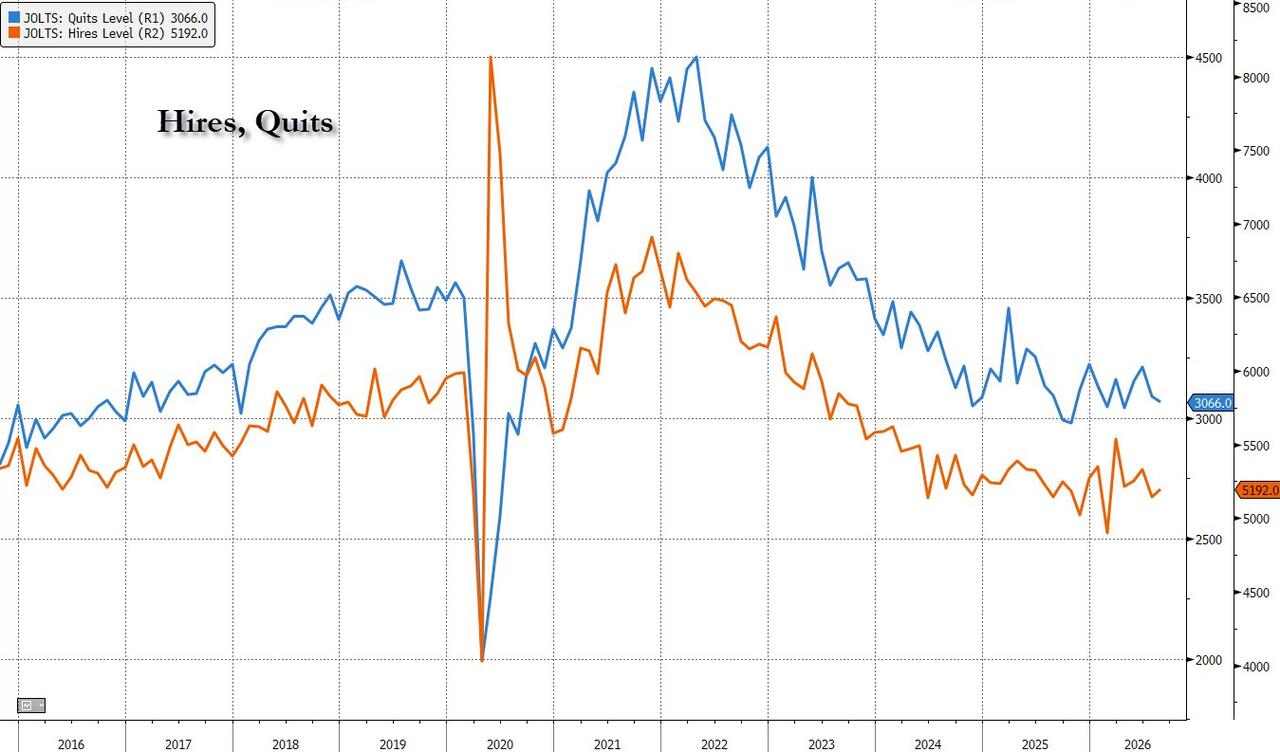
It goes without saying that disappointing job openings (which tumbled after an upward revision) while quits slump and hires barely rise, leads one to scratch their head how weak the labor market truly is.
In any case, since this hires number feeds directly into the payrolls calculations (after netting out separations) this explains why the August payrolls report surged by 162K (at a time when the hires less separations print was 122K). And since the JOLTS implied number is far weaker than that, having printed negative for a third month in a row, we expect the August payrolls report this Friday to be yet another catch down, and will likely be much lower than the 162K increase reported last month.
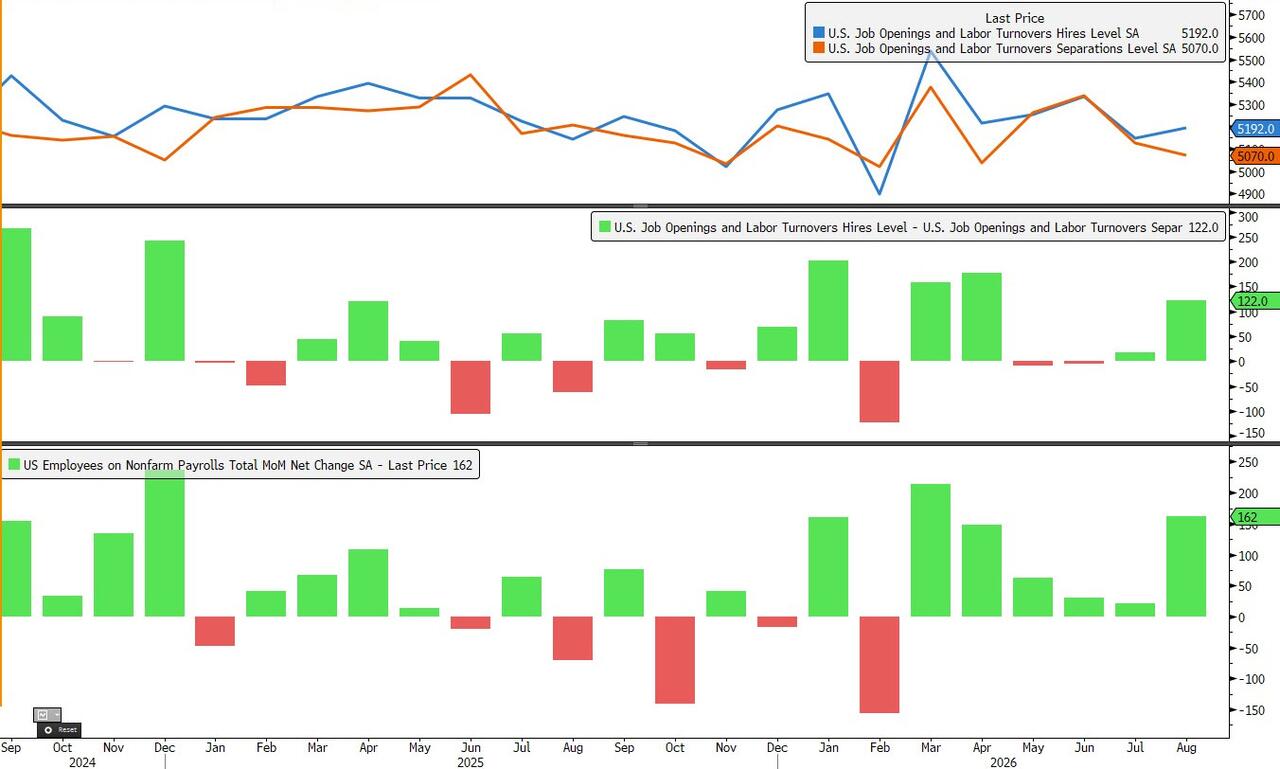
Overall, this was a weak JOLTS report, with weakness in both openings and quits, and shows that after some significant strength in the early part of of 2026, US labor market is now hitting an air pocket and this could translate into another notable miss in this Friday jobs report.
USA ECONOMIC REPORTS
Tether Says It Helped Freeze $550M In Iran-Linked USDT This Year
Tuesday, Sep 29, 2026 – 08:20 AM
Authored by Felix Ng via Cointelegraph,
Stablecoin issuer Tether said it helped authorities freeze nearly $550 million in Iran-linked USDT during 2026, as a Senate Democrat called for an investigation into the stablecoin issuer on Monday.
In a statement on Monday, the company said it has been working closely with international law enforcement for years. This year alone, it froze more than $130 million in USDT across four wallets, and in April, it froze more than $344 million linked to the Central Bank of Iran.

“Tether has consistently demonstrated that USDT is not a haven for sanctioned actors, terrorist organizations or criminal networks,” said Tether CEO Paolo Ardoino.
The statement from Tether came as Democratic investigators on the Senate Permanent Subcommittee on Investigations released a report alleging USDT had become a key channel for Iran to evade sanctions.
Investigators found that 84% of 846 crypto wallets sanctioned over ties to Iran had transacted exclusively or nearly exclusively in USDT. The findings prompted US Senator Richard Blumenthal to call on the Treasury and Justice departments to investigate potential sanctions violations.
Tether said its cooperation with authorities globally had resulted in more than $4.9 billion in assets being frozen, including more than $2.4 billion connected to US authorities.
“The record is public: the DOJ, FBI, Secret Service, HSI, OFAC and authorities around the world have repeatedly worked with Tether to trace, freeze and recover assets. We will continue to make that capability available to authorities working to stop terrorism, sanctions evasion, fraud and other serious crimes,” Ardoino said.
end
Senate Passes ‘Protect College Sports Act’
Tuesday, Sep 29, 2026 – 03:25 PM
The Senate on Sept. 28 passed a bill that seeks to bring stability to the rapidly changing landscape of collegiate sports, sending it to the House of Representatives.
The Protect College Sports Act of 2026 passed on a 77-22 vote. The bill aims to address growing concerns surrounding athlete compensation, transfer rules, conference realignment, and long-term athlete protections. Since the House is out of session, it is unlikely to vote on the bill until after the November midterm elections.
In a Truth Social post, President Donald Trump called the Senate’s passage of the bill “a really big deal.”
“It will not only save college sports, it will save the colleges themselves,” he said.

Under the legislation, the NCAA would be exempt from antitrust laws, and there would be a nationwide standard for name, image, and likeness (NIL) rules that would override the current patchwork of state laws.
As Jackson Richman reports further for The Epoch Times,The bill would allow student-athletes to use five seasons of eligibility within a five-year window and limit athletes to one transfer during their college careers. Division I schools would also be required to honor scholarships for up to 10 years after an athlete’s final season.
Additionally, it would revise the Sports Broadcasting Act, allowing athletic conferences to pool television rights.
Another major component of the bill is player health and safety provisions.
Division I schools would be required to cover out-of-pocket medical costs for sports-related injuries both during participation and for five years after an athlete’s final competition.
The legislation would mandate catastrophic injury coverage, access to second opinions, and post-career physical examinations, and establish a $60 million medical trust fund from the NCAA’s coffers to assist smaller schools and athletes with long-term medical conditions.
The bill would also create an independent office within college athletics to provide confidential, free guidance to student-athletes and help resolve disputes involving schools, conferences, or athletic associations.
College football coaches would be prohibited from leaving midseason to take on another college football coaching job. This provision came after Lane Kiffin left his role as head coach of the University of Mississippi football team in November 2025 to take the same title at Louisiana State University.
Under the measure, at least one-third of governing boards or rulemaking committees within athletic associations would be required to consist of current or former student-athletes.
The bill also targets what lawmakers describe as abuses within the NIL system. It would ban compensation arrangements intended to bypass revenue-sharing limits or disguise pay-for-play incentives while preserving legitimate education- and athletics-related benefits established under the House settlement framework.
Under the House v. NCAA settlement, Division I athletes are eligible to receive a share of up to $20.5 million in school-generated revenue, with that cap expected to increase over time. The settlement also included nearly $2.8 billion in back pay for athletes who competed between 2016 and 2024.
The Protect College Sports Act would extend the revenue-sharing cap beyond the expiration of the House settlement after the 2034-35 academic year while allowing annual inflation adjustments.
The measure would create a bipartisan congressional commission to study the long-term future of college athletics, including athlete compensation, Olympic and women’s sports, spending limits, health and safety standards, agent regulations, and the overall structure of college sports.
One unresolved issue in college athletics is whether student-athletes should be classified as employees of their schools.
The new legislation does not take a position. Congress has previously attempted to address the issue through measures such as the SCORE Act and SAFE Act. The House had planned to vote on the SCORE Act in May, but the vote was canceled amid concerns about insufficient support. That proposal would prevent student-athletes from being classified as employees.
Moreover, the legislation would prohibit certain large-revenue conferences, such as the Southeastern Conference and the Atlantic Coast Conference, from consolidating with or acquiring other conferences. It would limit the SEC, Big Ten, Big 12, and ACC to 19 schools. Any school from these conferences that changes to another conference would need to operate independently for three years. This provision would sunset in six years.
The bill has the support of the major conferences such as the Big Ten and Southeastern Conference, and others.
Sen. Ted Cruz (R-Texas), who introduced the bill with Sen. Maria Cantwell (D-Wash.), said the bill is necessary to bring sanity to college sports.
“The Protect College Sports Act is bipartisan legislation designed to bring order to the chaos, designed to put simple, common-sense rules in place so that college sports remain strong and vibrant for decades to come,” Cruz said at a press conference on Sept. 14.
Cantwell said at the press conference, “This is about reining in the bad practices that are happening in college sports today, the runaway costs that are sending people to the state legislature, asking for bailout from taxpayers to pay for sports, asking people to take endowment funds that really should go to things like wheat research or AI, and instead have to be spent because of the runaway arms race in sports spending.”
Most importantly, the bill has the support of President Donald Trump.
“The alternative just is no good. … We have to get it voted on, and we’re counting on the House – and I think the House will come through, too,” the president told political commentator Clay Travis in an interview on Sept. 26.
Opposition to the bill has come from the NAACP and some Democrats.
“We recognize that the bill contains provisions concerning scholarships, healthcare, athlete agents, safety standards, and student-athlete representation,” the NAACP’s president and CEO, Derrick Johnson, wrote in an Aug. 4 letter to Senate Majority Leader John Thune (R-S.D.) and Minority Leader Chuck Schumer (D-N.Y.).
“College athletes deserve those protections. They should not, however, be used as political cover for provisions that insulate institutions and conferences from legal and economic accountability.“
In a speech on the Senate floor on Sept. 16, Sen. Cory Booker (D-N.J.) disagreed with those who advocate for the bill.
“It’s not about the safety, it’s not about the well-being, it’s not about the education of college athletes,” he said. “This is a money play, plain and simple.”
END
Supreme Court Lets Trump’s Third-Country Deportations Resume, Takes Case
Tuesday, Sep 29, 2026 – 03:16 PM
Update (1516ET): The Supreme Court on Tuesday allowed the Trump administration to resume third-country deportations and agreed to hear the underlying dispute this winter.
In a brief emergency-docket order in DHS v. D.V.D., the justices stayed U.S. District Judge Brian Murphy’s Feb. 25 judgment, which had blocked the Department of Homeland Security from sending people with final removal orders to countries not named in those orders unless they first received notice and a chance to raise persecution or torture claims.
The stay puts the First Circuit’s Sept. 18 ruling on hold and lets DHS restart removals under its March 2025 guidance while the case proceeds.
The Court also treated the government’s application as a petition for review and granted certiorari. Argument is set for the December 2026 sitting. The stay lasts until the Court issues its final judgment.
Justices Sonia Sotomayor, Elena Kagan, and Ketanji Brown Jackson would have denied the stay.
The order is the Court’s third intervention in the same litigation. It previously paused Murphy’s preliminary injunction on June 23, 2025, and clarified on July 3, 2025, that the pause applied in full – including a flight the administration sought to send to South Sudan after it was diverted to a U.S. base in Djibouti.
Solicitor General D. John Sauer told the Court last week that the First Circuit’s late-night dissolution of its own stay had thrown removal operations into chaos, including cancellation of a flight carrying about 70 deportees – some with criminal convictions – to three countries.
DHS counsel James Percival has said more than 25,000 people have already been removed under the program. Rights groups put the figure at more than 25,000 people sent to about 29 countries, many of them to Mexico.
The justices directed briefing on whether the district court had jurisdiction, whether classwide declaratory relief and APA vacatur are allowed under 8 U.S.C. §1252(f)(1), and whether the third-country guidance is unlawful under the removal statute, the Due Process Clause, or CAT/FARRA.
Tuesday’s order does not decide those questions. It restores the policy for now and tees them up for a full hearing.
* * *
The Department of Justice (DOJ) asked the U.S. Supreme Court on Sept. 24 to revive its third-country deportation program that sends deportees to countries that were not named in their removal orders.
The Trump administration has said it removes individuals to third countries when it cannot quickly return them to their home countries.
However, critics say the policy is used to bypass legal restrictions and deter illegal immigration.

The Department of Homeland Security (DHS) policy, adopted in March 2025, allows immigration officials to deport foreign nationals in as little as six hours.
The Supreme Court has already ruled in favor of the program twice on its emergency docket.
As Matthew Vadum further reports via The Epoch Times, following Supreme Court rules, the application is addressed to Justice Ketanji Brown Jackson because she oversees emergency appeals from decisions of the U.S. Court of Appeals for the First Circuit.
However, U.S. Solicitor General D. John Sauer took the unusual step of asking Jackson to refer the stay request to the full court instead of ruling on it herself if she will not freeze the lower court’s order.
Jackson voted against the government both times when the litigation previously came before the high court.
Sauer said lower court decisions were throwing into chaos the delicate arrangements the government has negotiated with other nations to take in deportees who are not their citizens.
“Third-country removals require careful negotiation with foreign governments, which are rarely enthusiastic about accepting foreign citizens (especially criminals), and often requires obtaining travel documents and devoting significant manpower to the staging of flights to protect government officers and flight crews,” he said.
Disrupting those plans “imposes massive costs on the government,” and forces it to engage in new instances of diplomatic engagement with countries “who may be all the more skeptical of our removal efforts given the disruption.”
The filing concerns a First Circuit ruling from Sept. 18 that struck down DHS guidance allowing removal based on diplomatic assurances that receiving countries will not persecute or torture people sent to them.
The three-judge panel raised concerns about “blanket assurances” from third countries that promise U.S. deportees won’t be tortured or persecuted, saying this promise is not sufficient and does not properly allow foreign nationals to raise persecution or torture concerns.
The panel affirmed the final judgment U.S. District Judge Brian Murphy issued Feb. 25 vacating the DHS guidance. In its Sept. 18 decision, it affirmed the striking down of the policy.
Murphy previously certified the respondents, who are people with final removal orders, as a nationwide class.
The respondents argue that the government may deport a removable noncitizen to a willing third country, but not without inquiring about whether the person would be persecuted or tortured in that country.
The case is known as DHS v. D.V.D.
On Sept. 24, Jackson did not respond to Sauer’s request. Instead, she directed the other side to file a response to the application by 4 p.m. on Sept. 28.
USA/MIGRANTS
Trump Uses Rescission “Loophole” To Cut Nearly $1 Billion In Funds For Illegals
Tuesday, Sep 29, 2026 – 06:55 AM
To summarize the Democrat Party’s current strategy on immigration, here is essentially how it works:
Whenever in power, they create billions in incentives and subsidies to entice third world migrants to flood the US en masse. With open borders and amnesty programs, moving 10 million or more illegals at a time into the country is easy and fast. When out of power, they use lawfare and political obstruction to prevent deportations and slow down the process.
In other words, make immigration easy and remigration nearly impossible. Stall for four years, regain power during the next election while pro-deportation constituents whine and complain about the president “not doing enough”, then repeat the process all over again. Under the current system, it would take three full conservative presidential terms or more to undo what Democrats did in a single term. That is the play they are relying on.

From 2017 to 2024, the Trump Administration faced 64 nationwide injunctions on immigration and deportation policies; 92% of them came from judges appointed by Democrat presidents.
From 2025 to today, Trump has been blocked at least 86 times by activist judges nationwide or class-wide injunctions and major program pauses. To put this in perspective, nationwide injunctions were extremely rare through the 20th Century. Starting in 2000, the numbers increased, but nowhere near the level Trump has dealt with.
George W Bush had only 6 injunctions from Democrat judges. Barack Obama had 12 injunctions from Republican judges. Biden had 28 injunctions (largely because of his efforts to expand pandemic controls and enforce vaccine mandates).
It is undeniable – The bureaucracy is being abused as a way to stop Trump from enacting normal policy decisions on immigration. This forces the White House to exploit every legal loophole available just to get anything done in the next couple of years.
Enter the “recission” method…
The White House has moved to cancel $810 million in already-approved federal spending through a rare budget tactic called a “pocket rescission.” The administration frames it as cutting “wasteful and harmful” programs tied to noncitizens, DEI, and ideology. Critics call it “illegal”.
The timing is what makes the decision controversial. The federal fiscal year ends September 30th. Under the Impoundment Control Act of 1974, a president can propose canceling appropriated money and withhold it for 45 days while Congress considers the request. By sending this package with only five days left, the White House is betting the money will expire before Congress can act.
This is the second such move in about 50 years and both came in Trump’s second term. Last year the administration used the same tactic on $5 billion in foreign aid; the Supreme Court later allowed that effort to proceed 6–3, citing foreign-affairs authority.
Legal challenges are still likely, but perhaps this situation will help to illustrate why the deportation process has been a grind. Even with the constant interventions, deportations have skyrocketed by 30% in the past year to 80,000 illegals removed per month. Trump should be commended for finding a way despite all the obstacles Democrats have put in place.
END

…pensions set to dump a near-record $33 billion in stocks into qtr/mth end…
This is a recent ZeroHedge headline (published around September 29, 2026) highlighting rising U.S. Treasury yields becoming a growing headwind for equities, with Goldman Sachs commentary on the 10-year yield breaching a key threshold and large mechanical pension fund selling into month-/quarter-end.
zerohedge.com
Key elements from the reporting and related Goldman notes
- Rates pressure: The move higher in yields (with the 10-year referenced in market chatter around elevated levels near or above recent multi-year highs in the ~5%+ area in contemporaneous commentary) is described as “getting too punitive to ignore.” Goldman’s one-delta desk head Rich Privorotsky has noted that equities have shown impressive resilience so far amid the “trifecta” of oil, rates, and stocks, but the pace and level of the rates move is drawing increasing attention as a risk. zerohedge.com
- Goldman on the 10Y “critical barrier”: Commentary ties into broader Goldman views that rapid yield rises (not just absolute levels) matter for equities—historically, sharp moves (e.g., ~2 standard deviation weekly/monthly changes) have coincided with more negative equity-bond correlations and stress for balanced portfolios. Absolute levels around 5% on the 10-year have also been flagged in past Goldman analysis as a point where higher yields become a clearer problem for stocks. news.futunn.com
- Pension rebalancing flows: Goldman’s desk model estimates ~$33 billion of U.S. equities to be sold by U.S. pensions into month- and quarter-end (driven by relative performance of equities vs. bonds), with an equivalent amount of bonds to be bought. Earlier related estimates around the same period were in the $32 billion range ($10bn monthly + $22bn quarterly components), ranking in the high percentiles historically (e.g., 95th over recent years / 97th since 2000 in absolute terms for similar prints). These are mechanical rebalancing flows rather than discretionary selling. @zerohedge
Context and market implications
Pension funds (especially defined-benefit plans) routinely rebalance to target asset allocations. When equities outperform bonds significantly over a period, they sell stocks and buy fixed income (and vice versa). Large estimated sells into thin year-end liquidity can add near-term supply pressure, though the actual market impact varies with broader flows, positioning, and risk appetite.This sits against a backdrop of elevated long-end yields driven by a mix of resilient growth, fiscal concerns/supply, term premium, and (in the 2026 environment referenced across sources) factors like energy/geopolitical influences and shifting Fed expectations. Equities have often remained resilient longer than expected in such regimes when earnings (particularly AI-related) have been strong, but the combination of punitive rates + mechanical equity supply is the cautionary signal being highlighted.Markets can absorb or fade these flows depending on other buyers (e.g., retail, systematic strategies, corporate activity), but the headline captures the classic late-month/quarter technical setup that desks watch closely. For the latest precise yield levels, Goldman note details, or real-time flow updates, checking primary sources or market data is best, as these estimates update with price action
KING NEWS
| The King Report September 29, 2026 Issue 7836 | Independent View of the News |
| Nvidia just greenlit the biggest buyback ($150B) in stock market history… on Monday that it has authorized an expansion of its existing share buyback plan by $150 billion, increasing the value of approved repurchases to $235 billion. Apple previously held the record for the largest-ever buyback, authorizing $110 billion in 2024… Nvidia stock climbed 3% soon after Monday’s open. It was up 21% for the year as of Friday’s close, and nearly 1,000% over the past five years… The buyback plan was announced just hours after Nvidia launched its Open Agent Safety Platform, a system designed to stop AI agents from going rogue…https://uk.finance.yahoo.com/news/nvidia-just-greenlit-biggest-buyback-124302753.html US, Iran set to hold separate talks with mediators on Monday or Tuesday, official saysQatari mediators are likely to hold talks with Iranian Foreign Minister Abbas Araqchi in New York and separately with the US side on Monday or Tuesday, an official briefed on the negotiations told Reuters, in a fresh push to end the war… https://reut.rs/4xR7PLr Nov WTI Oil hit a high of 96.54, +$4.13 or +4.47%. The US 30-year hit 5.578% and the 10-year hit 5.272% at 11:00 ET. The 2-year hit 4.951% at 10:57 ET. Despite the record NVDA share repurchase announcement, the Nasdaq 100 gapped down on the opening and fell to 30,081.06, -1.72%, at 10:48 ET; Nasdaq was -1 3%. The SOX Index was -3.05% at 10:45 ET. The S&P 500 was -0.98% at 10:55 ET; the DJIA was -0.79% at 11.02%. Fangs declined, with Meta down 4.52% at 10:48 ET and Amazon -2.22% second after its opening. IBD: Micron Technology (MU) declined more than 1% Monday premarket, ahead of the company’s earnings report scheduled for late Wednesday… Friday’s September jobs report… takes the economic spotlight Friday, while the primary Federal Reserve inflation gauge is set for Wednesday. Forecasters expect the jobs report to show a gain of 100,000 nonfarm payrolls… The jobless rate is seen holding at 4.1%. The core personal consumption expenditures price index, part of the personal income and outlays report, is seen rising 0.3% on the month, lifting the 12-month core inflation rate to 3.4% from 3.3%…https://www.investors.com/market-trend/stock-market-today/dow-jones-sp500-nasdaq-trump-iran-oil-prices-treasury-yields Trump to announce largest steel plant in U.S. history will be built in IowaThe Minnesota-based company Mesabi Metallics are expected to unveil the company’s $15 billion plans in the Oval Office at 2 p.m. for what the White House is calling a mega steel plant. Once it’s up and running in 2030, the plant is expected to produce 7.5 million or more tons of steel per year…https://www.cbsnews.com/news/trump-steel-plant-iowa/ Trump dines with Anthropic CEO Dario Amodei after months of bitter AI feud https://trib.al/a0XRBkw Stocks rallied in the afternoon on yet another instance of Team Trump Monday verbal intervention. US official tells Al Jazeera: Trump Ready to Ease Sanctions, Release Frozen Assets for Nuclear Progress (You cannot make this up! This headline/story/verbal intervention has recurred for months!) The S&P 500 Index gapped lower on the opening and fell to a daily low of 7666.60 at 10:55 ET. After a bounce to 7686.35 at 11:10 ET, the index retreated into a 5-handle range until it jumped to 7724.15 at 12:27 ET on the umpteenth report of some type of US-Iran deal. As we warned last week or so, the verbal and actual intervention will continue into the Midterms to keep stocks buoyant for ‘the vote.’ The S&P fell on this: Iran Officials Pessimistic About Deal with US Before Midterms: BBG 12:33 ETIran and the US made little progress during talks in New York on the sidelines of the United Nations General Assembly last week and the Islamic Republic believes there’s a high chance of the conflict escalating after the Nov. 3 vote, according to the people, some of whom were briefed by Iranian officials. They asked not to be named discussing sensitive matters… After a drop to 7695.10 at 13:08 ET, the S&P rallied to 7720.97 at 13:12 ET on this: Iran has agreed to halt enrichment in exchange for easing US sanctions, report Al Hadath Traders sold after the pop; the S&P fell to 7698.13 at 13:37 ET. After a modest rebound, the S&P traded in a 5-handle range until it broke lower after 14:00 ET. After penetrating the lower trade range by only 2 handles, the S&P snapped back into the trading band within 2 minutes. The S&P 500 Index fell to 7693.17 at 14:40 ET. The index rebounded to 7701.58 at 14:49 ET but rolled over and broke down at 15:00 ET. The S&P fell to 7685.80 at 15:15 ET. The late rally/manipulation then began; it failed in 6 minutes because the index stalled after a meager 3-handle rally. The S&P 500 fell to 7680.56 at 15:39 ET. The late manipulation forced the S&P 500 to 7686.22 at 15:47 ET. Alas, too many traders were long; the S&P fell to 7677.96 at 15:54 ET. But ‘they’ needed ‘the marks!’ So, a final manipulation forced the S&P 500 Index to 7685.27 at 15:59 ET. The S&P closed at 7683.69. @KevRGordon: Fed’s Lisa Cook says she expects to see continued pressure on inflation from the AI buildout and the passthrough of higher oil prices / supply chain disruptions. Also, she says the labor market is well positioned to handle an increase in rates. https://x.com/KevRGordon/status/2104639493806379047 WSJ’s @NickTimiraos: The Moves That Backfired on Trump and Drove Interest Rates and Inflation Higher – The president’s advisers said fiscal restraint and deregulation would bring down prices and borrowing costs. Then came tariffs, war and an investment boom. In the early days of Trump’s second term, his economic advisers laid out a simple theory: Show the bond market that Washington was serious about closing its gaping deficits and long-term interest rates would fall on their own. Trump could leave the Fed alone. It hasn’t worked out that way. The White House theory rested on fiscal restraint that never arrived and overlooked how much of Trump’s own agenda would feed the price pressures now pushing rates higher. Tariffs raised the cost of imported goods. The war with Iran sent oil and diesel prices soaring… Deficits typically swell in recessions because spending rises as receipts tumble. With the deficit starting near 6% of GDP, a mild recession could push it to 8% or 9%…https://www.wsj.com/economy/trump-economy-inflation-jobs-724e4da8?st=UDhtCZ Fauci diary reveals alarm that U.S. had aerosolized Ebola virus: ‘Never should have been done’Fauci’s private alarm over Army biodefense experiments with Ebola and their results, which he worried would erode public trust in vaccines… (Worried about vax trust, not beaucoup deaths!)https://justthenews.com/government/congress/fauci-alarmed-over-us-army-ebola-tests-funded-his-own-agency-diary-entries-and Positive aspects of previous session DJTA 0.06%; SP Consumer Staples +0.4%, Health Care +0.29%, Energy +0.22%,Nov Gasoline fell 9.19¢ from its high; Oil finished modestly higher after be up sharply early. Negative aspects of previous session S&P 500 -0.77%, DJIA -0.67%, Nasdaq -0.92%, Nas 100 -1.08%; SOX -1.61%SP Comm Services -1.67%, Consumer Discretionary -1.58%, Financials -1.14%, Industrials -1.0%, Materials -0.74%, Info Tech -0.7%, Utes -0.65%, Real Estate -0.38%USZs hit a low of 103 14/32, -1 4/32 and were -21/32 at 16:22 ETNov Diesel +7.43¢ at 16:20 ET. Ambiguous aspects of previous session Are ‘they’ selling stocks due to end of Q3 rebalancing expectations? First Hour/Last Hour NYSE Action [S&P 500 Index]: 1st Hour: Down; Last Hour: Down. Pivot Point for S&P 500 Index [above/below indicates daily trend to day traders]: 7691.56 Previous session (S&P 500 Index) High/Low: 7724.15 (12:27 ET); 7666.60 (10:55 ET) More Hospitals Are Being Bought by Private Equity. Here’s How It’s Changing Healthcare.Private equity firms apply the playbook of leverage buyouts, staff reduction, and asset sales to double their investment in as little as seven years. (Recently two family members were asked to sign DNRs even though they were NOT hospitalized!)… Private investors are buying into the healthcare system to extract profit, which can permanently change the structure of a healthcare institution, sometimes for the worse… hospitals owned by private investors were found to have higher rates of falls and hospital-acquired infections, lower patient satisfaction, and lower scores in standardized quality ratings…https://www.zerohedge.com/medical/more-hospitals-are-being-bought-private-equity-heres-how-its-changing-healthcare#google_vignette Bing Copilot: In 2005, Toys “R” Us was acquired by a consortium of private equity firms—Bain Capital, KKR, and Vornado Realty Trust—through a $6.6 billion leveraged buyout (LBO). Only about $1.3 billion came from the firms’ own capital; the remaining $5.3 billion was borrowed and placed directly on the company’s balance sheet, creating a massive debt burden. This debt required annual interest payments exceeding $400 million, diverting funds from store upgrades, e-commerce development, and competitive pricing strategies, leaving the company financially constrained despite being operationally viable… Private equity owners further extracted value by selling Toys “R” Us’s real estate to affiliated real estate investment trusts (REITs) and leasing it back at inflated rates. This move increased fixed costs and reduced long-term security, effectively turning the company into a rent-paying tenant on its own former properties… While Toys “R” Us remained profitable and capable of competing, the financial engineering imposed by private equity prevented strategic adaptation, accelerating the company’s decline. The bankruptcy and liquidation of over 700 stores left 33,000 employees without severance, sparking public outcry… When Private Equity Gutted Toys “R” UsHow private equity loaded Toys “R” Us with debt and put the iconic toy store out of business...https://inequalityfocus.substack.com/p/when-private-equity-gutted-toys-r @chris_kratovil: The worst kept secret in Texas is no longer a secret and is now official; Wall Street giant Morgan Stanley is joining “Y’all Street” in Dallas with a huge new 3,800 employee campus expected to cost about $1.2 billion. The Morgan Stanley employees in Dallas will be close enough to the new and similarly sized Goldman Sachs campus that they will be able to keep an eye on their multi-decades rivals in this major new market for both investment banking titans. This is a major win for Dallas and Texas, and it proves once again that Y’all Street is fast becoming a reality, not just a clever marketing slogan. @IPONewsroom_: Anthropic has filed for an IPO, with its prospectus revealing just how fast the company is scaling. FY25 revenue jumped 1,088% YoY to $4.59B, while compute and infrastructure spending rose 190% to $7.33B. The company posted an $8.06B operating loss and ended 2025 with $20.28B in cash and short-term investments. Anthropic’s two largest direct customers accounted for 24% of total revenue combined. (GAAP net loss: $41.97B per reports) Trump 5:34 PM ET [after the close]: Axios just released a story that “Trump” offered Sanctions Relief and Frozen Funds to Iran. This is untrue. I offered them NOTHING! Axios’ story, like most others, is a HOAX, used only for purposes of satisfying their Trump Derangement Syndrome. They should withdraw this fake story, IMMEDIATELY! (This is an interesting development because most of the known universe believes that Team DJT regularly leaks stuff to Axios, especially when it is something positive.) With so many insider trading incidents on US events the past few years, it is NOT inconceivable that someone with a degree of authority leaked a bogus sanctions relief for Iran story and traded on it. WSJ: OpenAI Scraps Release of New AI Model Over Safety ConcernsThe model, known as GPT-6.1 Astra, was due to debut inside ChatGPT and Codex in October. Today – The usual suspects want to play for a Turnaround Tuesday to the upside. However, seasoned traders and operators expect stocks to be under pressure from end of Q3 portfolio rebalancing because bonds are historically undervalued, according to most models, versus stocks. ESZs +1.50; NQZs +16.50, USZs +6/32, Nov WTI +$0.64, Nov Gas -0.13¢, Yen/157.68 at 20:00 ET Expected economic data: July S&P/Case Shiller Home Prices 0.4% m/m & 2.2% y/y; July FHFA Home Price Index 0.1% m/m & 2.2% y/y; Sept Conference Board Consumer Confidence 90; JOLTS Job Opening 7.23m; Chicago Fed Pres Goolsbee 12:00 ET, St. Louis Fed Pres Musalem 12:30 ET, NY Fed Pres Williams 13:00 ET S&P 500 50-day MA: 7641; 100-day MA: 7553; 200-day MA: 7208 (Close 7683.69, -0.77%)Nasdaq 100 50-day MA: 29,321; 100-day MA: 29,435; 200-day MA: 25,377 (Close 30,276.81, +0.42%) DJIA 50-day MA: 52,783; 100-day MA: 52,002; 200-day MA: 50,221 (Close 51,481.51, -0.67) (Green is positive slope; Red is negative slope) Fox’s @BillMelugin_: To recap what happened over the weekend w/ ICE:– Verbal guidance did go out to some ICE offices across the country instructing agents not to arrest illegal aliens without a criminal history.– It was rescinded within hours w/ sources telling Fox News it was an error & miscommunication. I’m told there was no written directive, only verbal.– In a phone call with me, President Trump said there are no changes to his immigration enforcement agenda, and while they will *prioritize* the most egregious offenders with a “worst first” mentality, anyone in the US illegally is on the table and they will continue to arrest aliens who have no criminal history, including “collaterals” who weren’t the targets of their initial operation but are encountered and determined to be in the US illegally.– Border czar Tom Homan reiterated that point to me, and said after record setting ICE arrests in June, July, and August, September is now on track to potentially break a new record.https://x.com/BillMelugin_/status/2104583307975332101 Trump personally helped orchestrate taxpayer-funded ads promoting himself and his policies, source says https://www.cnn.com/2026/09/28/politics/trump-ads-taxpayer-funds @CNN: The five men arrested in an alleged plot to attack a UK airbase used by US forces are to be released on bail, British police say. (The UK is in suicidal empathy mode!) https://cnn.it/4hpMjqU | |
SWAMP STORIES FOR YOU TONIGHT
Trump Admin Asks Supreme Court To Revive Third-Country Deportations
Monday, Sep 28, 2026 – 11:00 PM
The Department of Justice (DOJ) asked the U.S. Supreme Court on Sept. 24 to revive its third-country deportation program that sends deportees to countries that were not named in their removal orders.
The Trump administration has said it removes individuals to third countries when it cannot quickly return them to their home countries.
However, critics say the policy is used to bypass legal restrictions and deter illegal immigration.
The Department of Homeland Security (DHS) policy, adopted in March 2025, allows immigration officials to deport foreign nationals in as little as six hours.
The Supreme Court has already ruled in favor of the program twice on its emergency docket.
As Matthew Vadum further reports via The Epoch Times, following Supreme Court rules, the application is addressed to Justice Ketanji Brown Jackson because she oversees emergency appeals from decisions of the U.S. Court of Appeals for the First Circuit.
However, U.S. Solicitor General D. John Sauer took the unusual step of asking Jackson to refer the stay request to the full court instead of ruling on it herself if she will not freeze the lower court’s order.
Jackson voted against the government both times when the litigation previously came before the high court.
Sauer said lower court decisions were throwing into chaos the delicate arrangements the government has negotiated with other nations to take in deportees who are not their citizens.
“Third-country removals require careful negotiation with foreign governments, which are rarely enthusiastic about accepting foreign citizens (especially criminals), and often requires obtaining travel documents and devoting significant manpower to the staging of flights to protect government officers and flight crews,” he said.
Disrupting those plans “imposes massive costs on the government,” and forces it to engage in new instances of diplomatic engagement with countries “who may be all the more skeptical of our removal efforts given the disruption.”
The filing concerns a First Circuit ruling from Sept. 18 that struck down DHS guidance allowing removal based on diplomatic assurances that receiving countries will not persecute or torture people sent to them.
The three-judge panel raised concerns about “blanket assurances” from third countries that promise U.S. deportees won’t be tortured or persecuted, saying this promise is not sufficient and does not properly allow foreign nationals to raise persecution or torture concerns.
The panel affirmed the final judgment U.S. District Judge Brian Murphy issued Feb. 25 vacating the DHS guidance. In its Sept. 18 decision, it affirmed the striking down of the policy.
Murphy previously certified the respondents, who are people with final removal orders, as a nationwide class.
The respondents argue that the government may deport a removable noncitizen to a willing third country, but not without inquiring about whether the person would be persecuted or tortured in that country.
The case is known as DHS v. D.V.D.
On Sept. 24, Jackson did not respond to Sauer’s request. Instead, she directed the other side to file a response to the application by 4 p.m. on Sept. 28.
GREG HUNTER…


