
EXCHANGE: COMEX
CONTRACT: OCTOBER 2026 COMEX 100 GOLD FUTURES
SETTLEMENT: 4,155.600000000 USD
INTENT DATE: 09/30/2026 DELIVERY DATE: 10/02/2026
FIRM ORG FIRM NAME ISSUED STOPPED
092 C DEUTSCHE BANK 206
099 H DEUTSCHE BANK AG 129
118 C MACQUARIE FUTURES US 422 24
363 H WELLS FARGO SECURITI 20
624 H BOFA SECURITIES 8
657 C MORGAN STANLEY 6
661 C JP MORGAN SECURITIES 415 749
686 C STONEX FINANCIAL INC 56 2
730 C PTG DIVISION OF SGAS 9
732 C RBC CAP MARKETS 46
737 C ADVANTAGE FUTURES 12 2
905 C ADM 1 9
TOTAL: 1,058 1,058
MONTH 11,305
GOLD: NUMBER OF NOTICES FILED FOR OCT./2026: 1058 CONTRACTs NOTICES FOR 105,800 OZ or 3.290 TONNES
total notices so far: 11,305 contracts FOR 1,130,500 OZ OR 35.163 TONNES
SILVER NOTICES:37 NOTICE(S) FILED FOR 0.185 MILLION OZ /
total number of notices filed so far this month : 1994 CONTRACTS (NOTICES) for 9.970 million oz
GLD
SEPT: INITIAL STANDING: 24.172 MILLION OZ//FOLLOWED BY TODAY’S STRONG 70 CONTRACT OR 350,000 OZ QUEUE JUMP//STANDING ADVANCES TO 33.865 MILLION OZ//
OCT: INITIAL STANDING: 16.355 MILLION OZ FOLLOWED BY TODAY’S HUGE 172 CONTRACT OR 860,000 OZ QUEUE JUMP//NEW STANDING ADVANCES TO 17.215 MILLION OZ//
SEPT: INITIAL STANDING 8.756 MILLION OZ//FOLLOWED BY TODAY’S 350,000 OZ QUEUE JUMP//STANDING ADVANCES TO 33.865 MILLION OZ
OCT: INITIAL STANDING: 16.355 MILLION OZ//FOLLOWED BY TODAY’S 860,000 OZ QUEUE JUMP//STANDING ADVANCES TO 17.215 MILLION OZ/
GOLD COMEX OUTLINE;
1.MAY SUMMARY FOR MAY TONNES WHICH STOOD FOR DELIVERY:
4. AUGUST: 60.547 TONNES OF INITIAL GOLD FIRST DAY NOTICE FOLLOWED BY THE NET MONTH’S QUEUE JUMP OF 47.2312 TONNES TO WHICH WE ADD THE FOLLOWING EXCHANGE FOR RISK ISSUANCE RECEIVED FOR THE MONTH: 5.4432 TONNES EX FOR RISK/AUG 7 , AUG 11: 2.413 TONNES EX FOR RISK AND AUG. 12 OF 2.
5.SEPT: INITIAL 8.093 TONNES OF GOLD PLUS TODAY’S QUEUE JUMP OF 0.4883 TONNES PLUS 2.2827 TONNES OF EXCHANGE FOR RISK TODAY//NEW TOTAL EX. FOR RISK/MONTH = 22.923//NEW TOTAL STANDING FOR GOLD SEPT ADVANCES TO = 48.801 TONNES!!
6.OCTOBER: 90.012 TONNES OF INITIAL GOLD STANDING WITH TODAY’S TINY 0.00311 TONNES QUEUE JUMP WHICH FOLLOWS ALL OTHER QUEUE JUMPS DURING OCT OF 76.1656 TONNES
THEN WE MUST ADD OUR 14.553 TONNES OF OUR ISSUANCE OF EXCHANGE FOR RISK/6 OCCASIONS//NEW TOTAL OF GOLD STANDING ADVANCES TO 197.5141 TONNES OF GOLD.
7.NOVEMBER BEGINS WITH 15.651 TONNES INITIALLY STANDING FOR DELIVERY FOLLOWED BY TODAY’S QUEUE JUMP OF 2.323 TONNES FOLLOWED BY ALL PREVIOUS QUEUE JUMPS IN OF OF 21.3775 TONNES TO WHICH WE ADD OUR TWO EXCHANGE FOR RISK ISSUANCE OF 4.5596 TONNES//NEW STANDING ADVANCES TO 43.9716 TONNES OF GOLD.
8. DECEMBER BEGINS WITH INITIAL STANDING OF 83.813 TONNES OF GOLD FOLLOWED BY TODAY’S 0.0TONNE QUEUE JUMP WHICH FOLLOWS ALL OTHER QUEUE JUMPS OF: 37.163 TONNES//NEW STANDING ADVANCES TO 115.390 TONNES TO WHICH WE ADD OUR 4 EXCHANGE FOR RISK FOR DECEMBER OF 6.587 TONNES/NEW STANDING ADVANCES TO 121.977 TONNES
9. JANUARY: INITITAL STANDING: 13.785 TONNES TO WHICH WE ADD OUR FIRST EXCHANGE FOR PHYSICAL TRANSFER OF 0.08709 TONNES WHICH FOLLOWS ALL OTHER QUEUE JUMPS OF 30.7117TONNES //NEW TOTAL QUEUE JUMPS 30.7117//NORMAL DELIVERY OF GOLD ADVANCES TO 36.8958 TONNES TO WHICH WE ADD OUR SIX EXCHANGE FOR RISK OF 22.315 TONNES//NEW STANDING ADVANCES TO 59.2108 TONNES.
FEB; INITIAL AMOUNT OF GOLD STANDING FOR DELIVERY: 93.567 TONNES OF GOLD TO WHICH WE ADD OUR NEXT 0.0248 TONNES 0.1555 TONNES QUEUE JUMP TO 41.2082 TONNES/ NEW NET QUEUE JUMP INCREASES TO 41.233 TONNES// AND THEN WE ADD OUR SIX EXCHANGE FOR RISK: 10,080 CONTRACTS OR 31.251 TONNES//NEW STANDING REDUCES TO 157.878 TONNES
MARCH:: INITIAL AMOUNT OF GOLD STANDING FOR DELIVERY: 8.099 TONNES TO WHICH WE ADD TODAY’S FAIR 4600 OZ QUEUE JUMP (0.2320 TONNES) AND THEN WE ADD OUR THREE EXCHANGE FOR RISK OF 22.3818 TONNES //NEW STANDING ADVANCES TO 67.6648 TONNES/
APRIL: INITIAL AMOUNT OF GOLD STANDING FOR DELIVERY: 52.600 TONNES FOLLOWED BY OUR 345 CONTRACT QUEUE JUMP FOR 34,500 OZ/ (1.073 TONNES)/NEW STANDING ADVANCES TO 70.286 TONNES TO WHICH WE ADD OUR 2ND EXCHANGE FOR RISK OF 1498 CONTRACTS FOR 149800 OZ OR 4.659 TONNES. THE NEW TOTAL EXCHANGE FOR RISK FOR THE MONTH OF APRIL IS 2239 CONTRACTS OR 223900 OZ OR 6.964 TONNES AND THIS WILL BE ADDED TO OUR NORMAL DELIVERY TOTALS (70.762 TONNES) TO GIVE US WHAT WILL STAND IN APRIL (77.726 TONNES)
MAY: INITIAL AMOUNT OF GOLD WILLING TO STAND: 12.24 TONNES OF GOLD TO WHICH WE ADD OUR NEXT QUEUE JUMP OF 345 CONTRACTS OR 34500 OZ (1.073 TONNES) TO WHICH WE ADD OUR FIVE EXCHANGE FOR RISK ISSUANCES FOR 24.635 TONNES/STANDING NOW ADVANCES TO 51.554 TONNES OF GOLD.
JUNE; INITIAL AMOUNT OF GOLD WILLING TO STAND; 64.496 TONNES.(CME CORRECTED) TO WHICH WE ADD OUR NEXT EXCHANGE FOR PHYSICAL TRANSFER OF 0.0186 TONNES/NEW STANDING REDUCES TO 127.03 TONNES
JULY: INITIAL AMOUNT OF GOLD WILLING TO STAND: 23.306 TONNES TO WHICH WE ADD OUR NEXT QUEUE JUMP OF 0.000 TONNES/ TO WHICH WE ADD OUR FIRST EXCHANGE FOR RISK 0F 0.0062 TONNES/NEW STANDING ADVANCES TO 40.824TONNES
AUGUST INITIAL STANDING 48.687 TONNES TO WHICH WE ADD OUR 5TH EXCHANGE FOR RISK OF 5 CONTRACTS FOR 500 OZ OR 0.0155 TONNESS TO OUR 4TH EXCHANGE FOR RISK OF 200 CONTRACTS OR 20,000 OZ OR 6.220 TONNES TO OUR 3RD EXCHANGE FOR RISK OF 1.7045 TONNES TO OUR 2ND EXCHANGE FOR RISK OF 1.552 TONNES TO OUR FIRST 0.0715 TONNES EXCHANGE FOR RISK//NEW TOTAL EXCHANGE FOR RISK: 3.9688 AND THEN ADD OUR NEXT QUEUE JUMP OF 39 CONTRACTS FOR 3,900 OZ OR 0.1213 TONNES//STANDING THUS ADVANCES TO 67.2441 TONNES
SEPT: INITIAL STANDING: 8.756 TONNES OF GOLD FOLLOWED BY TODAY’S 0 CONTRACTS OR 0 OZ QUEUE JUMP (0.0000 TONNES) TO WHICH WE ADD OUR TWO, 2000 CONTRACT EXCHANGE FOR RISK FOR 200,000 OZ OR 6.2208 TONNES//// // NEW STANDING REMAINS AT 19.2308 TONNES..
OCT: INITIAL STANDING: 38.345 TONNES OF GOLD FOLLOWED BY TODAY’S HUGE 438 CONTRACT//43,800 OZ EXCHANGE FOR PHYSICAL TRANSFER TO LONDON WHERE THEY WILL TAKE DELIVERY ON THAT SIDE OF THE POND//STANDING THUS REDUCES TO 36.982 TONNES./
IN ESSENCE WE HAVE A STRONG SIZED LOSS IN TOTAL CONTRACTS IN GOLD ON THE TWO EXCHANGES OF 7473 CONTRACTS WITH 9125 CONTRACTS DECREASED AT THE COMEX// AND A FAIR SIZED 1652 EXCHANGE FOR PHYSICAL OI CONTRACT ISSUANCE WHICH NAVIGATED OVER TO LONDON.
THUS TOTAL OI LOSS ON THE TWO EXCHANGES OF 7473 CONTRACTS.. WE HAD THE FOLLOWING TAS CONTRACTS INITIATED (ISSUED): A FAIR SIZED AND CRIMINAL 1487 CONTRACTS AND THESE ISSUANCES ARE GENERALLY USED TO INITIATE A RAID WHEN CALLED UPON .
GOLD PRICE ROSE BY $7.80
STANDING FOR THE LAST 8 MONTHS JANUARY TO AUGUST:
FINAL STANDING FOR GOLD, JANUARY CONTRACT AT 59.08 TONNES OF GOLD
FEBRUARY: INITIAL STANDING FOR GOLD: 157.878 TONNES!! WHICH INCLUDES ALL QUEUE JUMPING, THREE EXCHANGE FOR PHYSICAL TRANSFERS TO LONDON AND OUR SIX ISSUANCES EXCHANGE FOR RISK!!
MARCH: INITIAL STANDING AT 8.099 TONNES TO WHICH WE ADD OUR FINAL DAY: 0.2320 TONNES QUEUE JUMP AND THEN ADD +22.3818 TONNES EXCHANGE FOR RISK//NEW STANDING ADVANCES TO 67.6648 TONNES
APRIL: INITIAL STANDING 52.600 TONNES PLUS 27,800 OZ QUEUE JUMP (0.8648TONNES): NEW STANDING ADVANCES TO 70.286 TONNES PLUS OUR TWO EXCHANGE FOR RISK FOR 223,900 OZ OR 6.964 TONNES/NEW FINAL STANDING: 77.726 TONNES
MAY: INITIAL AMOUNT OF GOLD WILLING TO STAND; 12.24 TONNES TO WHICH WE ADD OUR NEXT QUEUE JUMP FOR 345 CONTRACTS/34,500 OZ// 1.073 TONNES/ THEN WE MUST ADD OUR EXCHANGE FOR RISK ISSUANCE: TOTAL EXCHANGE FOR RISK MAY// 5 OCCASIONS: 24.635 TONNES///NEW FINAL STANDING NOW ADVANCES TO 51.554 TONNES
JUNE: INITIAL AMOUNT OF GOLD WILLING TO STAND: 64.496 TONNES TO WHICH WE ADD OUR NEXT EXCHANGE FOR PHYSICAL TRANSFER JUMP OF 0.0186 TONNES//NEW STANDING 127.03 TONNES//FINAL
JULY: INITIAL AMOUNT OF GOLD WILLING TO STAND: 23.306 TONNES OF GOLD TO WHICH WE ADD OUR NEXT QUEUE JUMP OF 0.0000 TONNES/ PLUS 0.0062 TONNES EX FOR RISK///NEW STANDING FOR GOLD REMAINS AT 40.824TONNES.
AUGUST INITIAL STANDING 48.687 TONNES TO WHICH WE ADD OUR FIRST 0.0715 TONNES EXCHANGE TO OUR 2ND EXCHANGE FOR RISK = 1.552 TONNES TO OUR 3RD EXCHANGE FOR RISK OF: 1.7045//TOTAL FOR EXCHANGE FOR RISK 3.3312 TONNES TO OUR 4TH EXCHANGE FOR RISK OF 200 CONTRACTS FOR 0.6220 TONNES/TO OUR 5TH EXCHANGE FOR RISK OF 0.0155 TONNES//TOTALL EXCHANGE FOR RISK: 3.9688 TONNES TO OUR NEXT QUEUE JUMP OF 0.1213 TONNES//STANDING ADVANCES TO 67.2441 TONNES
SEPT: INITIAL STANDING FOR GOLD: 8.756 TONNES FOLLOWED BY TODAY’S 0 OZ QUEUE JUMP (0.0000TONNES) TO WHICH WE ADD OUR SECOND 1000 CONTRACT EXCHANGE FOR RISK TO OUR FIRST: THUS// NEW EXCHANGE FOR RISK: 6.2208 TONNES// NEW STANDING REMAINS AT 19.2308 TONNES.
OCT: INITIAL STANDING FOR GOLD: 38.345 TONNES FOLLOWED BY TODAY’S HUGE 860,000 OZ CONTRACT EXCHANGE FOR PHYSICAL TRANSFER TO LONDON //STANDING THUS REDUCES TO 36.982 TONNES//
JAN. 2025: 257.919 TONNES (ISSUANCE WILL BE PRETTY GOOD THIS MONTH BUT MUCH LOWER THAN LAST MONTH)
FEB: 207.21 TONNES//EX FOR PHYSICAL ISSUANCE (WILL BE A FAIR SIZED ISSUANCE THIS MONTH)
MARCH 130.84 TONNES//QUITE SMALL THIS MONTH.
APRIL; 208.57 TONNES. STRONG THIS MONTH
MAY: 113.499 TONNES OF GOLD EFP ISSUANCE//QUITE SMALL THIS MONTH
JUNE: 97.79 TONNES OF GOLD EFP ISSUANCE/EXTREMELY SMALL
JULY : 150.877 TONNES// QUITE SMALL
AUGUST: 175.86 TONNES A LOT LARGER THIS MONTH.
SEPT. 116.13 TONNES VERY SMALL
OCT. 252.72 TONNES//CERTAINLY MUCH LARGER THIS MONTH/VERY STRONG
NOV: 124.74 TONNES
DEC: 190.04 TONNES//GOOD SIZED THIS MONTH FINAL.
TOTAL EXCHANGE FOR PHYSICAL ISSUED FOR YEAR 2025: 2,026.20 TONNES (LOWER THAN LAST YR 2,569.00 TONNES
YEAR 2026:
JANUARY: 209.08 TONNES ( (WILL BE A STRONG MONTH FOR EXCHANGE FOR PHYSICAL)
FEB. 176.35 TONNES (WHICH IS A FAIR ISSUANCE)
MARCH: 214.67 TONNES//WILL BE STRONG ISSUANCE THIS MONTH
APRIL; 88.00 TONNES// WILL BE VERY SMALL THIS MONTH
MAY 118.430 TONNES
JUNE: 142.053 TONNES
JULY: 163.82 TONNES
AUGUST: 151.107 TONNES
SEPT: 99.458 TONNES
OCT: 3.138 TONNES
XXXXXXXXXXXXXXXXXXXXXXXXXX
SHANGHAI CLOSED
HANG SENG CLOSED
Nikkei CLOSED UP 2292.28 PTS OR 3.43%
//Australia’s all ordinaries CLOSED DOWN 2.16%
//Chinese yuan (ONSHORE) CLOSED DOWN TO 6.7046
/ OFFSHORE CLOSED UP AT 6.7046 Oil UP TO 92.33 dollars per barrel for WTI and BRENT UP TO 100.38 Stocks in Europe OPENED ALL RED
ONSHORE USA/ YUAN// WITH YUAN TRADING DOWN (6.7046 OFFSHORE YUAN TRADING DOWN TO 6.7098 ONSHORE YUAN TRADING ABOVE LEVEL // OFF SHORE AND DOWN ON THE DOLLAR)// / AND THUS WEAKER/OFF SHORE YUAN TRADING DOWN AGAINST US DOLLAR/ AND THUS WEAKER
HERE IS A BRIEF SYNOPSIS OF HOW THE CROOKS FLEECE UNSUSPECTING LONGS
YOU WILL ALSO NOTICE THAT THE COMEX OPEN INTEREST STARTS TO RISE BUT SO IS THE OPEN INTEREST OF SPREADERS. THE OPEN INTEREST IN WILL CONTINUE TO RISE UNTIL ONE WEEK BEFORE FIRST DAY NOTICE OF AN UPCOMING ACTIVE DELIVERY MONTH (OCT), AND THAT IS WHEN THE CROOKS SELL THEIR SPREAD POSITIONS BUT NOT AT THE SAME TIME OF THE DAY. THEY WILL USE THE SELL SIDE OF THE EQUATION TO CREATE THE CASCADE (ALONG WITH THEIR COLLUSIVE FRIENDS) AND THEN COVER ON THE BUY SIDE OF THE SPREAD SITUATION AT THE END OF THE DAY. THEY DO THIS TO AVOID POSITION LIMITS
WHAT IS ALARMING TO ME, ACCORDING TO OUR LONDON EXPERT ANDREW MAGUIRE IS THAT THESE EFP’S ARE BEING TRANSFERRED TO WHAT ARE CALLED SERIAL FORWARD CONTRACT OBLIGATIONS AND THESE CONTRACTS ARE LESS THAN 14 DAYS. ANYTHING GREATER THAN 14 DAYS, THESE MUST BE RECORDED AND SENT TO THE COMPTROLLER, GREAT BRITAIN TO MONITOR RISK TO THE BANKING SYSTEM. IF THIS IS INDEED TRUE, THEN THIS IS A MASSIVE CONSPIRACY TO DEFRAUD AS WE NOW WITNESS A MONSTROUS TOTAL EFP’S ISSUANCE AS IT HEADS INTO THE STRATOSPHERE.
The crooks also use the spread in the TAS account (trade at settlement). They buy the spot TAS (e.g. June) and sell the future TAS two months out (e.g. August). Then they unload the front month (i.e. unload the buy side first so the price of gold/silver falls. This occurs in the middle of the front delivery month cycle. They unload the sell side of the equation, two months down the road. The crooks violate position limits as the OCC refuse to hear our complaints.
First, here is an outline of what will be discussed tonight:
SILVER:
1.TODAY WE HAD THE OPEN INTEREST AT THE COMEX IN SILVER FELL BY A HUGE 1036 CONTRACTS TO AN OI OF 106,011
EFP ISSUANCE 630 CONTRACTS
OUR CUSTOMARY MIGRATION OF COMEX LONGS CONTINUE TO MORPH INTO LONDON FORWARDS AS OUR BANKERS USED THEIR EMERGENCY PROCEDURE TO ISSUE:
DEC 630 CONTRACTS and 0 ALL OTHER MONTHS: ZERO. TOTAL EFP ISSUANCE: 0 CONTRACTS. EFP’S GIVE OUR COMEX LONGS A FIAT BONUS PLUS A DELIVERABLE PRODUCT OVER IN LONDON. IF WE TAKE THE COMEX OI LOSS OF 1036 CONTRACTSAND ADD TO THE 630 E.FP. ISSUED
WE OBTAIN A FAIR LOSS OF 406 OI OPEN INTEREST CONTRACTS FROM OUR TWO EXCHANGES WITH OUR LOSS OF $0.55
THUS IN OUNCES, THE LOSS ON THE TWO EXCHANGES TOTAL 2.030 MILLION PAPER OZ
STANDING OCT AT 17.215 MILLION OZ
SILVER PRICE LOSS OF $0.55
XXXXXXXXXXXXXXXXXXXXXXXXXXXXXXXXXXXXX
LET US BEGIN:
THE TOTAL COMEX GOLD OPEN INTEREST FELL BY A HUGE 9125 CONTRACTS TO 397,291 STILL WELL ABOVE ITS NEW LOW OF 326,052 OI SET JUNE 3, CLOSE TO THE PREVIOUS ALL TIME LOW OF 345,705 SET (MAY 28) AND CLOSE TO THE PREVIOUS ALL TIME LOW IN OI OF 353,490 SET MAY 27.. PREVIOUS TO THAT THE ALL TIME LOW IN OI WAS 390,000 SET IN THE YEAR 2001 WHEN GOLD WAS TRADING $260.00. THE CME SHOULD BE PROUD OF THEMSELVES AS MANY HAVE ABANDONED THIS CROOKED ARENA!!THUS OUR NEW ALL TIME LOW OF COMEX OI HAS NOW BEEN SET AT 326,052 //JUNE 3 2026 WITH GOLD AT AN EXTREMELY HIGH $4,450.00 WHICH MAKES ABSOLUTELY NO SENSE!!!
WE HAD SOME T.A.S. LIQUIDATION DURING TUESDAY’S COMEX TRADING HOURS// . IT SEEMS THAT MANY OF THE SPECULATORS THAT HAVE NOW CONTINUED AGAIN TO BE ON THE SHORT SIDE WITH BANKERS ON THE LONG SIDE AND THESE GUYS WERE AGAIN OBLITERATED YESTERDAY WHEN THE LONGS TENDERED FOR DELIVERY:
CENTRAL BANKS TENDERED THEIR NEW LONG CONTRACTS AT THE END OF THE DAY FOR PHYSICAL GOLD. YOU CAN VISUALIZE THIS WITH THE STRONG AMOUNT OF GOLD STANDING AT THE COMEX FOR THIS JULY CONTRACT MONTH!!
WE HAD A STRONG SIZED LOSS ON OUR TWO EXCHANGES (7473 CONTRACTS) OCCURRED DESPITE OUR GAIN IN PRICE IN GOLD (UP $7.80)
WE THUS HAD A STRONG LOSS IN OI ON BOTH OF OUR EXCHANGES (7473 CONTRACTS), DESPITE OUR GAIN IN PRICE, AS WE WERE INFORMED OF A FAIR CONTRACT EXCHANGE FOR PHYSICAL ISSUANCE EQUATING TO 1652 CONTRACTS.
THEN WE WERE NOTIFIED TODAY OF A 0 CONTRACT FOR RISK ISSUANCE IN GOLD CONTRACTS FOR 0 OZ OR 0 TONNES OF GOLD. TOTAL THUS SO FAR THIS MONTH: 2000 CONTRACTS//200,000 OZ OR 6.2208 TONNES (2 OCCASIONS)
MONTH OF MAY RECORD ISSUANCE OF EXCHANGE FOR RISK: THE HIGHEST EVER ISSUANCE!!
MAY 22 RECORDS THE HIGHEST EVER EXCHANGE FOR RISK AT 12.4416 TONNES. WE HAD OUR FIRST ISSUANCE FOR EXCHANGE FOR RISK IN THE MONTH OF MAY ON MAY 7, THEN OUR 2ND ISSUANCE FOR OUR MAY GOLD MONTH ON MAY 12. THE THIRD ON MAY 18 , THEN MAY 21 OUR 4TH ISSUANCE AND THEN FINALLY FRIDAY, OUR 5TH ISSUANCE. THIS GOLD WILL BE ADDED TO OUR NORMAL MAY DELIVERIES TO GIVE US OUR FINAL AMOUNT OF GOLD WILLING TO STAND AT THE COMEX..
HISTORY OF EXCHANGE FOR RISK ISSUANCE THIS YEAR: FEBRUARY THROUGH JULY AND AUGUST
FEBRUARY:
DURING THE MIDDLE OF THE FEBRUARY CONTRACT MONTH, WE HAD TWO IDENTICAL MONSTER 3,000 CONTRACT ISSUED FOR THE SAME 9.33 TONNES OF GOLD, AND THESE WERE THE HIGHEST EVER IN TONNAGE EVER ISSUED BY THE COMEX. ALTOGETHER THE TOTAL ISSUANCE FOR FEB TOTALLED SIX.(31.251 TONNES).
MARCH:
THURSDAY MARCH 17 WE RECEIVED ITS INITIAL 2000 CONTRACT EXCHANGE FOR RISK ISSUANCE FOR 6.22 TONNES. LAST FRIDAY: 0 ISSUANCE OF EXCHANGE FOR RISK. BUT ON MONDAY MARCH 23 WE RECEIVED NOTICE OF OUR SECOND EXCHANGE FOR RISK ISSUANCE FOR 2,200 CONTRACTS (220,000 OZ OR 6.843 TONNES) AND NOW FRIDAY WITH A MONSTER 2996 CONTRACTS FOR 9.3138 TONNES. THESE THREE ISSUANCES WILL NOW BE ADDED TO THE REGULAR AMOUNT OF GOLD STANDING, I.E. 22.3818 TONNES TO OUR NORMAL GOLD STANDING TO GIVE US WHAT WILL STAND FOR PHYSICAL GOLD FOR MARCH!
APRIL;: 2 EXCHANGE FOR RISK SO FAR, I.E. 2239 CONTRACTS FOR 223,900 OZ OR 6.964 TONNES AND THIS TOTAL TONNES WILL BE ADDED TO OUR NORMAL DELIVERY TO GIVE US WHAT WILL STAND IN APRIL
MAY: FIVE ISSUANCES SO FAR FOR 7920 CONTRACTS OR 792,000 OZ OR 24.635 TONNES.
JUNE: 0 IN GOLD. THUS FOR THE ENTIRE MONTH IN GOLD ZERO NOTICES WERE FILED.
JULY: 2 FOR 200 OZ OR 0.00622 TONNES
AUGUST: 1276 CONTRACTS FOR 127,600 OZ OR 3.9688 TONNES (5 OCCASIONS THIS MONTH)
SEPT: SO FAR: 2000 CONTRACTS FOR 200,000 OZ OR 6.2208 TONNESS (TWO OCCASIONS)
OCT: 0 SO FAR!
XXXXXXXXXXXXXXXXXXXXXXXXXXXXXXXXX
A LITTLE HISTORY OF EXCHANGE FOR RISK DECEMBER THROUGH TO OCT:
IN DECEMBER WE HAVE RECORDED 5 ISSUANCES OF EXCHANGE FOR RISK/4 FOR DEC AND THE LAST ONE ON DEC 31 FOR JANUARY. WE NOW HAVE 3 CHOICES FOR THE RECIPIENT OF THIS ISSUANCE AND IT MUST BE A CENTRAL BANK. YOU WILL RECALL THAT THE BUYER ASSUMES THE RISK OF THAT DELIVERY. (THUS TOTAL EXCHANGE FOR RISK FOR THE MONTH OF DECEMBER IS 6.56 TONNES/4 OCCASIONS.
MONTH OF JANUARY/EXCHANGE FOR RISK
IN JANUARY THEY HAVE 6 TOTAL ISSUANCE : 3.446 TONNES EARLY, THEN JAN 9 ISSUANCE OF 9,331 TONNES AND THEN JAN 16: 0.1996 TONNES JAN 26: 1.499 TONNES, JAN 27: 3.160 AND FINALLY JAN 29: 4.659 TONNES TONNES//TOTAL EXCHANGE FOR RISK JANUARY 22.315 TONNES WHICH WAS ADDED TO OUR NORMAL DELVERIES.
AND FEBRUARY:
FEB EXCHANGE FOR RISK: NOW 6 ISSUANCES: 10,080 CONTRACTS FOR 1,008,000 OZ OR 31.251 TONNES!
HERE ARE THE CHOICES FOR THE RECIPIENT OF THOSE ISSUANCES:
1 THE CENTRAL BANK OF ENGLAND. BUT THEY RECEIVED CLEARANCE THAT THEIR GOLD IS BACK SO IT IS NOT LIKELY THAT THEY WOULD LIKE TO ADD TO THEIR RESERVES.
2. THE CENTRAL BANK OF THE USA: THE FED. LOGICAL CHOICE AS THEY CLAMOUR TRYING TO REDUCE THEIR 131+ TONNES OF SHORTAGE. HOWEVER THEY SEEM NOT TO BE IN A HURRY TO COVER THEIR HUGE SHORTFALL
3. THE CENTRAL BANK OF CHINA AS THEY BATTLE WITS WITH THE USA.
TOTAL EXCHANGE FOR RISK FOR DECEMBER IS 6.56 TONNES AND THIS WAS ADDED TO OUR NORMAL DELIVERY TOTALS..
THE JANUARY ISSUANCE OF 17.656 TONNES WAS ADDED TO OUR DAILY DELIVERY TOTALS!!
FEBRUARY ISSUANCES 6 FOR; 31.251 TONNES !! AND THIS WAS ADDED TO OUR DELIVERY TOTALS FOR THIS MONTH.
MARCH: CME ANNOUNCES ITS FIRST EXCHANGE FOR RISK FOR 2000 CONTRACTS FOR 200,000 OZ OR 6.22 TONNES OF GOLD DURING THE FIRST WEEK OF MARCH, AND THEN MONDAY, MARCH 22, WE RECEIVED ITS SECOND NOTICE ISSUANCE OF 2200 CONTRACTS OR 220000 OZ (6.843 TONNES). THEN FINALLY WE RECEIVED NOTICE OF OUR THIRD EXCHANGE FOR RISK OF 2996 CONTRACTS OR 9.3188 TONNES. TOGETHER ALL 3 ISSUANCES TOTAL 22.3818 TONNES WHICH WILL BE ADDED TO OUR NORMAL DELIVERY SCHEDULE.
APRIL: 2 EXCHANGE FOR RISK SO FAR FOR 223,900 OZ OR 6.964 TONNES. AND THIS TOTAL WILL BE ADDED TO OUR NORMAL DELIVERY TO GIVE US WHAT WILL STAND FOR APRIL!!
MAY: FIVE ISSUANCES SO FAR FOR 7920 CONTRACTS, 792,000 OZ OR 24.635 TONNES OF GOLD. THIS TOTAL WILL BE ADDED TO OUR NORMAL DELIVERIES IN MAY TO GIVE US WHAT WILL STAND IN MAY.
JUNE: ZERO
JULY 2 FOR 200 OZ OR 0.00622 TONNES. I DOUBT VERY MUCH THAT THIS IS A CENTRAL BANK
AUGUST: 1276 CONTRACTS FOR 127,600 OZ OR 3.9688 TONNES//5 OCCASIONS
SEPT: SO FAR: 2000 CONTRACTS FOR 200,000 OZ OR 6.2208 TONNES/TWO OCCASIONS
OCT: 0 SO FAR
DETAILS ON OUR NEW SEPT COMEX CONTRACT MONTH//
IN TOTAL WE HAD A STRONG LOSS ON OUR TWO EXCHANGES OF 7473 CONTRACTS DESPITE OUR GAIN IN PRICE (UP $7.80). HOWEVER, OUR FRIENDLY PHYSICAL LONDON BOYS HAD ANOTHER FIELD DAY AGAIN THROUGHOUT THIS WEEK AS THEY WERE READY FOR THE FRBNY.S CONTINUED ORCHESTRATED ATTACKS VERY EARLY IN THE COMEX SESSIONS AS THEY TRIED TO ABSORB EVERYTHING IN SIGHT FROM THEIR DAILY ATTACKS. LONDONERS EXERCISED THEIR BOUGHT CONTRACTS FOR PHYSICAL GOLD VIA THE EXCHANGE FOR PHYSICAL ROUTE AND THANKED THE FRBNY AND OUR SHORT SPECULATORS FOR THEIR THOUGHTFULNESS.
LONDON ANNOUNCED EARLY IN THE YEAR (AND SCARCITY CONTINUES TO THIS DAY) THAT THEY WERE OUT OF GOLD. WRONGLY IT WAS ATTRIBUTED TO THEIR SHIPPING PHYSICAL GOLD TO COMEX FOR STORAGE DUE TO TRUMP’S INITIATION OF TARIFFS. THE TRUTH OF THE MATTER IS THAT THIS GOLD LEFT LONDON TO OTHER CENTRAL BANKS, AND COMEX BANKS HAVE BEEN PAPERING THEIR LOSSES (DERIVATIVE) WITH KILOBAR ENTRIES. BOTH COMEX AND LBMA ARE WITNESSING MASSIVE AMOUNTS OF GOLD LEAVING THEIR VAULTS.
THE LIQUIDATION OF T.A.S. CONTRACTS THROUGHOUT THE MONTHS OF JUNE/JULY/AUG CONTINUES TO DISTORT OPEN INTEREST NUMBERS GREATLY ALTHOUGH THE T.A.S. ISSUANCES IN GOLD HAVE GENERALLY BEEN ON THE LOW SIDE COMPARED TO SILVER WHICH HAVE BEEN HUGE. TODAY’S NUMBER HOWEVER IS A FAIR SIZED T.A.S ISSUANCE CONTRACTS .THE CME NOTIFIES US THAT THEY HAVE ISSUED 1487 T.A.S CONTRACTS. THESE ARE GENERALLY USED FOR RAID PURPOSES TO STOP GOLD’S RISE AND TO TEMPER HUGE LOSSES IN OTC DERIVATIVE BETS.
IT SURE LOOKS LIKE THE BIS HAS SOMEHOW LOOKED THE OTHER WAY WITH ITS GOLD SWAPS WITH THE FRBNY AS THIS ENTITY FOR THE FED REFUSES THE BIS MARCHING ORDERS TO COVER AND THAT MAY EXPLAIN THE STRONG NUMBER OF T.A.S. ISSUANCES IN DECEMBER , JANUARY AND THROUGHOUT FEBRUARY TO GO ALONG WITH OUR HUGE NUMBER OF EXCHANGE FOR RISK ISSUED DURING THESE MONTHS INCLUDING FEBRUARY’S 6 EXCHANGE FOR RISK WHICH ALSO INCLUDED TWO MONSTER 9.3312 TONNE ISSUANCE (FEB 10 AND FEB 12). TOTAL EXCHANGE FOR RISK/FEB EQUALS 31.251 TONNES!! AND MARCH’S THREE ISSUANCES FOR 22.3818 TONNES! OTHER CENTRAL BANKS ARE PAYING ATTENTION AS THEY TAKE DELIVERY OF HUGE AMOUNTS OF PHYSICAL GOLD. APRIL HAD 2 EXCHANGE FOR RISK ISSUANCES FOR 6.694 TONNES. AND MAY WITH ITS 5TH ISSUANCE FOR 12.4436 TONNES///TOTAL EXCHANGE FOR RISK FOR MAY: 24.635 TONNES ISSUED MAY 6 ,MAY 12, MAY 18 MAY 21 AND NOW MAY 22..
THEN IT SLOWS DOWN!
JUNE: ZERO FOR THE MONTH
JULY: 2 SO FAR FOR 200 IZ IR 0.00622 TONNES
AUGUST: 1276 CONTRACTS FOR 127,600 OZ OR 3.9688 TONNES
SEPT: 2000 CONTRACTS SO FAR FOR 200,000 OZ OR 6.2208 TONNES (TWO OCCASIONS)
OCT: 0 SO FAR
WE MUST ALSO REMEMBER THAT THE FRBNY IS SHORT 141+ TONNES OF GOLD, THIS COMMENCED ON JAN 2 2023 AS THEY REFUSE TO COVER DESPITE THE BIS’S PLEA TO DO SO.
HERE IS A SUMMARY OF GOLD STANDING FOR DELIVERY ON OUR LAST 16 MONTHS:
1.APRIL AT 209 TONNES
2. AND THIS CONTINUED INTO MAY WITH FINAL STANDING AT 90.23 TONNES.
3. JUNE WHICH IS A HUGE DELIVERY MONTH , FINAL STANDING WAS RECORDED AT A STRONG 93.085 TONNES. //(TOTAL NET QUEUE JUMPING FOR THE JUNE MONTH: 31.027 TONNES.)
4. IN JULY WE HAD HUGE DELIVERY NOTICES ESPECIALLY FOR A NON ACTIVE DELIVERY MONTH WITH INITIAL STANDING AT 17.947 TONNES PLUS MANY QUEUE JUMPS + 3.75 TONNES EX FOR RISK = 41.106 TONNES OF GOLD // FINAL TOTAL TONNES STANDING JULY: 41.106 TONNES
5. FOR THE MONTH OF AUGUST 2025
INITIAL AMOUNT OF GOLD STANDING FOR AUGUST: 60.547 TONNES PLUS THE MONTHS HUGE QUEUE JUMPS OF 47.2312 TONNES +44.696 TONNES EX FOR RISK (7 ISSUANCES) //NEW STANDING 152.208 TONNES WHICH IS MONSTROUS!!!
6. FINAL AMOUNT OF GOLD STANDING FOR SEPT; INITIAL STANDING; 2,602 CONTRACTS OR 260,200 OZ FOR 8.093 TONNES OF GOLD FOLLOWED BY TODAY’S 0.4883 TONNES QUEUE JUMP TO GO ALONG WITH TODAY’S 1.244 TONNES OF EXCHANGE FOR RISK ISSUANCE TODAY AND // TOTAL EXCHANGE FOR RISK ISSUANCE SEPT: 22.923 TONNES//NEW TOTALS STANDING ADVANCES TO 48.801 TONNES OF GOLD!!!
7. OCTOBER:
OCTOBER: INITIAL STANDING FOR GOLD: 90.164 TONNES TO WHICH WE ADD OUR LATEST OCT 30 QUEUE JUMP OF 0.00311 TONNES WHICH FOLLOWS OCT 29 QUEUE JUMP OF .4096 WHICH FOLLOWS; OCT 28 QUEUE JUMP OF .5069 TONNES WHICH FOLLOWS OCT 27 OF 0.3048 TONNES WHICH FOLLOWS: OCT 24 OF 0.8615 TONNES, FOLLOWING OCT 23 QUEUE JUMP OF 1.695 TONNES OCT 22 JUMP OF 8.622 TONNES WHICH FOLLOWS OCT 21: 3.8600 TONNES TO OCT 20 QUEUE JUMP OF 7.695 TONNE
SUMMARY FOR OCTOBER STANDING:
NOVEMBER WHERE INITIAL AMOUNT OF GOLD STANDING IS REGISTERED AT 15.651 TONNES OF GOLD FOLLOWED BY TODAY’S QUEUE JUMP OF 2 TONNES AND FOLLOWED BY ALL OTHER NOV QUEUE JUMPS OF 21.3775 TONNES TO WHICH WE ADD OUR TWO EXCHANGE FOR RISK ISSUANCE FOR 4.5596 TONNES.
/STANDING ADVANCES TO 43.9716 TONNES OF GOLD.
DECEMBER: INITIAL AMOUNT OF GOLD STANDING FOR DELIVERY IN THIS ACTIVE MONTH IS 83.813 TONNES FOLLOWED BY TODAY’S 0.05 TONNES QUEUE JUMP. THIS FOLLOWS ALL OTHER QUEUE JUMPING: 37.163 TONNES//NEW STANDING ADVANCES TO 115.390 TONNES TO WHICH WE ADD OUR FOUR EXCHANGE FOR RISK ISSUANCE OF 6.559 TONNES//NEW STANDING THUS INCREASES TO 121.977 TONNES
JANUARY: INITITAL STANDING: 13.785 TONNES TO WHICH WE ADD OUR QUEUE JUMP OF 0.000 TONNES WHICH FOLLOWS ALL OTHER QUEUE JUMPS OF 30.7117TONNES //NEW TOTAL QUEUE JUMPS 30.7117//NORMAL DELIVERY OF GOLD ADVANCES TO 36.8958 TONNES TO WHICH WE ADD OUR SIX EXCHANGE FOR RISK OF 22.315 TONNES//NEW STANDING ADVANCES TO 59.2108 TONNES.
FEBRUARY: . FEBRUARY: INITIAL STANDING: 93.566 TONNES TO WHICH WE ADD OUR NEXT QUEUE JUMP OF 0.0248 TONNES WHICH MUST BE ADDED ALL OTHER QUEUE JUMPS OF 41.2087 TONNES QUEUE JUMP//TOTAL QUEUE JUMP FOR FEB::ADVANCES TO 41.233 TONNES///STANDING ADVANCES TO 126.628 TONNES TO WHICH WE ADD OUR SIX EXCHANGE FOR RISK OF 31.251 TONNES/NEW STANDING FINALIZES AT 157.879 TONNES, ITS HIGHEST STANDING RECORDED IN OVER 4 YEARS.
MARCH: INITIAL STANDING FOR GOLD: 8.099 TONNES TO WHICH WE ADD OUR NEXT QUEUE JUMP OF 0.2320 TONNES AND THEN WE ADD OUR THREE EXCHANGE FOR RISK OF 22.3818 TONNES////NEW STANDING FOR GOLD ADVANCES TO: 67.6648TONNES WHICH IS ABSOLUTELY HUGE FOR A NON ACTIVE DELIVERY MONTH!!
APRIL 2026: INITIAL STANDING FOR GOLD: 52.20 TONNES FOLLOWED BY TODAY’S SMALL 500 OZ QUEUE JUMP/ TO WHICH WE ADD OUR TWO EXCHANGE FOR RISK ISSUANCES TOTALLING 223,900 OZ OR 6.964 TONNES//STANDING ADVANCES TO 77.726 TONNES WHICH IS ABSOLUTELY HUGE
MAY: INITIAL AMOUNT OF GOLD WILLING TO STAND: 12.24 TONNES OF GOLD TO WHICH WE ADD OUR NEXT HUGE QUEUE JUMP OF 34,500 OZ (1.073 TONNES) TO WHICH WE ADD OUR FIVE EXCHANGE FOR RISK ISSUANCE FOR 792,000 OZ OR 24.635 TONNES////NEW TOTALS STANDING FOR GOLD ADVANCES TO 51.554 TONNESS
JUNE: INITIAL AMOUNT OF GOLD WILLING TO STAND: 64.496 TONNES TO WHICH WE SUBTRACT AN EXCHANGE FOR PHYSICAL TRANSFER TO LONDON OF 0.0186 TONNES//NEW STANDING REDUCES TO 127.03 TONNES// TOTAL QUEUE JUMPING FOR THE MONTH FINALIZES AT 62.4217 TONNES OR AVERAGING 3.285 TONNES PER DAY IN JUNE.
JULY: INITIAL AMOUNT OF GOLD WILLING TO STAND: 749,300 OZ OR 23.306 TONNES OF GOLD TO WHICH WE ADD OUR NEXT QUEUE JUMP OF 0.000TONNES//NEW STANDING REMAINS AT 40.818TONNES PLUS 0.00622 TONNES EXHANGE FOR RISK// NEW TOTAL 40.824 TONNES . TOTAL QUEUE JUMPING SO FAR: 17.5802 TONNES OR 0.8790 TONNES ON EACH TRADING DAY LEAVING COMEX FOR EASTERN SHORES.
AUGUST INITIAL; INITIAL AMOUNT OF GOLD WILLING TO STANDS: 48.687 TONNES TO WHICH WE ADD OUR 5TH EXCHANGE FOR RISK OF 5 CONTRACTS FOR 500 OZ OR 0.0155 TONNES TO OUR 4TH EXCHANGE FOR RISK OF 220 CONTRACTS FOR 20,000 OZ OR 0.6220 TONNES TO OUR 3RD EXCHANGE FOR RISK AT 1.7045 TONNES TO OUR 2ND EXCHANGE FOR RISK AT 1.552 TONNES TO OUR FIRST: 0.0715 NEW TOTAL EXCHANGE FOR RISK = 3.9688 TONNES AND THEN ADD OUR NEXT QUEUE JUMP OF 39 CONTRACTS OR 3900 OZ (0.1213 TONNES)//STANDING, IN TOTAL, THUS ADVANCES HUGELY TO 67.2441 TONNES.
SEPT/2026. INITIAL STANDING : 8.756 TONNES//FOLLOWED BY TODAYS QUEUE JUMP OF 0 OZ OR 0.0000 TONNES TO WHICH WE ADD THIS TO OUR TWO EXCHANGE FOR RISK OF 2,000 CONTRACTS/200,000 OZ OR 6.2208 TONNES: /NEW STANDING ADVANCES TO 19.2316 TONNES
OCT: INITIAL AMOUNT OF GOLD STANDING: 38.345 TONNES! FOLLOWED BY TODAY’S HUGE 438 CONTRACT EXCHANGE FOR PHYSICAL TRANSFER TO LONDON (43,800 OZ OR 1.3623 TONNES)//STANDING THUS AT THE COMEX REDUCES TO 36.982 TONNES.
HERE ARE THE AMOUNTS THAT STOOD FOR DELIVERY IN THE 4 YEARS 2021-2024
DEC 2021: 112.217 TONNES
NOV. 8.074 TONNES
OCT. 57.707 TONNES
SEPT: 11.9160 TONNES
AUGUST: 80.489 TONNES
JULY 7.2814 TONNES
JUNE: 72.289 TONNES
MAY 5.77 TONNES
APRIL 95.331 TONNES
MARCH 30.205 TONNES
FEB ’21. 113.424 TONNES
JAN ’21: 6.500 TONNES.
TOTAL YEAR 2021 (JAN- DEC): 601.213 TONNES
YEAR 2022: STANDING FOR GOLD/COMEX
JANUARY 2022 17.79 TONNES
FEB 2022: 59.023 TONNES
MARCH: 36.678 TONNES
APRIL: 85.340 TONNES FINAL.
MAY: 20.11 TONNES FINAL
JUNE: 74.933 TONNES FINAL
JULY 29.987 TONNES FINAL
AUGUST:104.979 TONNES//FINAL
SEPT. 38.1158 TONNES
OCT: 77.390 TONNES/ FINAL
NOV 27.110 TONNES/FINAL
Dec. 64.000 tonnes
(TOTAL YEAR 656.076 TONNES)
JAN/2023: 20.559 tonnes
FEB 2023: 47.744 tonnes
MAR: 19.0637 TONNES
APRIL: 75.676 tonnes
MAY: 19.094 TONNES + 1.244 tonnes of exchange for risk = 20.338
JUNE: 64.354 TONNES
JULY: 10.2861 TONNES
AUGUST: 38.855 TONNES(INCLUDING .6842 EXCHANGE FOR RISK)
SEPT: 15.281 TONNES FINAL
OCT. 35.869 TONNES + 1.665 EXCHANGE FOR RISK =37.0355 tonnes
NOV: 18.7122 TONNES + 16.2505 EX. FOR RISK = 34.9627 TONNES
DEC. 47.073 + 4.634 TONNES OF EXCHANGE FOR RISK = 51.707 TONNES
TOTAL 2023 YEAR : 436.546 TONNES
2024/STANDING FOR GOLD/COMEX
JAN ’24. 22.706 TONNES
FEB. ’24: 66.276 TONNES (INCLUDES 1.723 TONNES EX. FOR RISK)
MARCH: 18.8398 TONNES + 1.1695 EX FOR RISK = 20.093 TONNES
APRIL: 2024: 53.673TONNES FINAL
MAY/ 2024 8.5536 TONNES + 3.3716 TONNES EX FOR RISK/= 11.9325
JUNE; 95.578 TONNES. + 1.045 TONNES EXCHANGE FOR RISK =96.623 THIS IS THE HIGHEST RECORDED GOLD STANDING SINCE AUGUST 2022
JULY: 11.692 TONNES
AUGUST 69.602 TONNES//FINAL STANDING
SEPT. 13.164 TONNES.
OCT 39.474 TONNES + + 20.917 TONNES EXCHANGE FOR RISK =60.391 TONNES
NOV . 11.265 TONNES +4.665 TONNES EXCHANGE FOR RISK/TUESDAY + 3.11 TONNES OF EX. FOR RISK/PRIOR = 19.0425 TONNES
DEC: 80.4230 TONNES PLUS DEC MONTH EXCHANGE FOR RISK TOTAL 14.6836 TONNES EQUALS 95.1066 TONNES
total year 2024: 540.30 tonnes
XXXXXXXXXXXXXXXXXXXXXXXXXXXXXXXXXXXXXXXXXXXXXXXXXXXXXXXXX
COMEX GOLD TRADING BEGINNING OCT. CONTRACT;
THE SPECS/HFT WERE UNSUCCESSFUL IN LOWERING GOLD’S PRICE ( IT ROSE BY $7.80).
WE HAD SOME T.A.S. SPREADER LIQUIDATION WEDNESDAY // COMEX SESSION// WITH OUR GAIN IN PRICE.
OTHER EASTERN CENTRAL BANKS TENDERED FOR PHYSICAL EVERY NIGHT WHICH ALSO EXPLAINS THE HUGE NUMBER OF TONNES OF GOLD THAT STOOD FOR GOLD DURING THESE PAST SEVERAL MONTHS
THE CROOKS COULD NOT STOP OTHER CENTRAL BANK LONGS, SEIZING THE MOMENT, THEY EXERCISED AGAIN FOR PHYSICAL IN A BIG WAY TENDERING FOR PHYSICAL WEDNESDAY EVENING //THURSDAY MORNING AND THUS OUR HUGE NUMBER OF GOLD CONTRACTS STANDING FOR DELIVERY AT THE COMEX. CENTRAL BANKERS WAIT PATIENTLY FOR THE GOLD
ALL OF THIS WAS ACCOMPLISHED WITH OUR GAIN IN PRICE AT COMEX OF $7.80
WE HAD 260 CONTRACTS REMOVED // PRELIMINARY NUMBERS TO FINAL COMEX NUMBERS.
NET LOSS ON THE TWO EXCHANGES: 7473 CONTRACTS OR 747,300 OZ 23.24TONNES
OCT DELIVERY MONTH
OCT 1
| Gold | Ounces |
| Withdrawals from Dealers Inventory in oz | nil |
| Withdrawals from Customer Inventory in oz | 1 ENTRIES i) Out of Brinks: 3440.157 oz (107 kilobar) total withdrawal: 3440.157oz |
| Deposit to theDealerInventory in oz | 0 ENTRIES |
| Deposits to the Customer Inventory, in oz | DEPOSITS/CUSTOMER//gold 1 ENTRIES I) INTO INTERNATIONAL DELAWARE: 32,015.721 OZ TOTAL DEPOSIT; 32,015.721 oz xxxxxxxxxxxxxxxx |
| No of oz served (contracts) today | 1058 CONTRACTS 105,800 OZ 3.290 TONNES OF GOLD |
| No of oz to be served (notices) | 585 Contracts 58,500 OZ 1.819 TONNES |
| Total monthly oz gold served (contracts) so far this month | 11,305 notices 1,130,500 OZ 35.163 TONNES |
| Total accumulative withdrawals of gold from the Dealers inventory this month | NIL oz |
| Total accumulative withdrawal of gold from the Customer inventory this month |
dealer deposits: 0
xxxxxxxxxxxxxxxxxxx
DEPOSITS:
ENTRIES: 1
I) INTO INTERNATIONAL DELAWARE: 32,015.721 OZ
TOTAL DEPOSIT; 32,015.721 oz
xxxxxxxxxxxxxxxxxx
comex withdrawal
1 ENTRIES
i) Out of Brinks: 3440.157 oz (107 kilobar)
total withdrawal: 3440.157oz
adjustments: 2
dealer acct to customer account
a) Brinks: 999.245 oz
b) JPMorgan 50,676.933 oz
COMEX IS DRAINING GOLD
chaos inside the comex
THE FRONT MONTH OF SEPT OI STANDS AT 1643 CONTRACTS HAVING A LOSS OF 10,685 CONTRACTS.
YESTERDAY WE HAD 1,232,800 OZ ( 38.345 TONNES) OF GOLD STANDING FOR DELIVERY: TODAY: 1,189,000 OZ OR 36.982 TONNES FOR A LOSS OF 43,800 OZ (1.3623 TONNES) OR 438 CONTRACTS UNDERWENT AN EXCHANGE FOR PHYSICAL TRANSFER TO LONDON WHERE THEY WILL TAKE IMMEDIATE DELIVERY ON A T PLUS ONE BASIS.
NOVEMBER GAINED 273 CONTRACTS RISING TO 4227
DECEMBER, THE LARGEST DELIVERY MONTH IN THE CALENDAR RISES BY 232 CONTRACTS UP TO 326,163.
.
We had 1058 contracts filed for today representing 105,800 oz
Today, 0 notice(s) were issued from J.P.Morgan dealer and 415 notices issued from their client or customer account. The total of all issuance by all participants equate to 1058 contract(s) of which 0 notices were stopped (received) by j.P. Morgan dealer and 749 notice(s) was (were) stopped (received) by J.P.Morgan//customer account
To calculate the INITIAL total number of gold ounces standing for OCT /2026. contract month, we take the total number of notices filed so far for the month (11,305) to which we add the difference between the open interest for the front month of OCT (1643 CONTRACTS) minus the number of notices served upon today 1058 x 100 oz per contract) equals 1,189,000 OZ OR(36.982 Tonnes of gold)
THUS: INITIAL total number of gold ounces standing for OCT. /2026. contract month,we take the total number of notices filed so far for the month (11,305) to which we add the difference between the open interest for the front month of SOCT(XXXX) contracts minus the number of notices served upon today 1058 x 100 oz per contract) equals 1,189,000 OZ OR(36.982 Tonnes of gold)
new total of gold standing in OCT becomes 36.982 TONNES//
TOTAL COMEX GOLD STANDING FOR OCT.: 36.982 TONNES WHICH IS NOW VERY STRONG FOR THIS NON ACTIVE DELIVERY MONTH OF OCT
confirmed volume WEDNESDAY confirmed 172,005/ poor/
COMEX GOLD INVENTORIES/CLASSIFICATION
NEW PLEDGED GOLD:
241,794.285 oz NOW PLEDGED /HSBC 5.94 TONNES
204,937.290 OZ PLEDGED MANFRA 3.08 TONNES
83,657.582 PLEDGED JPMorgan no 1 1.690 tonnes
265,999.054, oz JPM No 2
1,152,376.639 oz pledged Brinks/
Manfra: 33,758.550 oz
Delaware: 193.721 oz
International Delaware:: 11,188.542 oz
total pledged gold: 1,721,684.952 oz 53.55 tonnes pledged gold lowers
total inventories in gold declining rapidly
total pledged gold: 1,721,684.952 tonnes oz 53.55 tonnes
TOTAL OF ALL GOLD ELIGIBLE AND REGISTERED GOLD 23,467,833.896oz//
TOTAL REGISTERED GOLD 15,086,528.079 tonnes (469.254 tonnes)
TOTAL OF ALL ELIGIBLE GOLD 8,381.3-5/817 oz.
REGISTERED GOLD THAT CAN BE SERVED UPON 13,364,844oz ((REG GOLD- PLEDGED GOLD)=
415.702 Tonnes //
total inventories in gold declining rapidly
SILVER COMEX
OCT DELIVERY MONTH
OCT 1
| Silver | Ounces |
| Withdrawals from Dealers Inventory | NIL oz |
| Withdrawals from Customer Inventory | 4 entries i) Out of Brinks: 594,252.150 oz ii) Out of CNT; 30,338.110 oz iii) Out of Delaware 7052.80 oz iv) Out of Loomis: 100,120.360 total withdrawal 731,813.450 OZ |
| Deposits to the Dealer Inventory | 0 ENTRY |
| Deposits to the Customer Inventory | ENTRIES: 1 i) Into International Delaware 3005,523.054 oz total deposit: 3,005,523.054 oz |
| No of oz served today (contracts) | 1957 CONTRACT(S) ( 9.785 MILLION OZ) |
| No of oz to be served (notices) | 1449 Contracts (7.245 MILLION oz) |
| Total monthly oz silver served (contracts) | 1957 contracts 9.785 MILLIONoz |
| Total accumulative withdrawal of silver from the Dealers inventory this month | NIL oz |
| Total accumulative withdrawal of silver from the Customer inventory this month |
DEPOSITS INTO DEALER ACCOUNTS
ENTRY:0
DEPOSIT ENTRIES/CUSTOMER ACCOUNT
1 ENTRIES:
i) Into International Delaware 3005,523.054 oz
total deposit: 3,005,523.054 oz
xxxxxxxxxxxxxxxxxxxxxxxxx
withdrawals:
4 entries
i) Out of Brinks: 594,252.150 oz
ii) Out of CNT; 30,338.110 oz
iii) Out of Delaware 7052.80 oz
iv) Out of Loomis: 100,120.360
total withdrawal 731,813.450 OZ
adjustments : 3 all dealer to customer
a) Asahi: 152,456.120 o
b) : CNT: 24,876.070 oz
c) JPMORGAN : 5,179.600 oz
xxxxxxxxxxxxxx
TOTAL REGISTERED SILVER: 101.378 MILLION OZ//.TOTAL REG + ELIGIBLE. 337.581 Million oz
registered silver dropping in numbers
CALCULATIONS FOR THE NEW STANDING FOR SILVER FOR OCT
FRONT MONTH: SILVER OPEN INTEREST CONTRACTS: 1486 FOR A LOSS OF 1785 CONTRACTS.
YESTERDAY WE HAD 16.355 MILLION OZ STAND: TODAY: 17.215 MILLION OZ FOR A GAIN OF 0.86 MILLION OZ OR 860,000 OZ (172 CONTRACTS)
NOVEMBER GAINED 50 CONTRACTS UP TO AN OI OF 1034
DECEMBER GAINED 551 CONTRACTS UP TO AN OI OF 86,022
TOTAL NUMBER OF NOTICES FILED FOR TODAY: 37 or 0.185 MILLION oz
CONFIRMED volume WEDNESDAY;49,307 // poor/
AND NOW OCT. DELIVERIES:
To calculate the number of silver ounces that will stand for delivery in OCT. we take the total number of notices filed for the month so far at 1994 X5,000 oz = 9.970 MILLION oz.
Then we take the difference between the front month of OCT. and the number of notices filed for today x 5000 to give us our standing
Thus the standings for silver for the OCT 2026 contract month: (1994 )Notices served so far) x 5000 oz + OI for the front month of OCT (1486) minus number of notices served upon today ( 37 x 5000 oz) equals silver standing for the SEPT .contract month equating to 17.215 MILLION OZ. ( a very strong delivery month)
We must also keep in mind that there is considerable silver standing in London coming from our longs
There are ONLY 101.378 million oz of registered silver
JPMorgan as a percentage of total silver: 132.671/337.581million: 39.40%
The record level of silver open interest is 234,787 contracts set on April 21./2017 with the price on that day at $18.42.
The previous record was 224,540 contracts with the price at that time of $20.44.
BOTH GLD AND SLV ARE MASSIVE FRAUD
XXXXXXXXXXXXXXXXXXXXXXXXXXXXXXXXXXXXXXXXXXX
OCT 1//2026/WITH GOLD UP $19.55 /HUGE CHANGES IN GOLD AT THE GLD:: A WITHDRAWAL OF 1.711 TONNES OF GOLD OUT OF THE GLD// //:/INVENTORY RESTS AT 1055.696 TONNES
SEPT 30//2026/WITH GOLD UP $7.80 /HUGE CHANGES IN GOLD AT THE GLD:: A DEPOSIT OF 2.847 TONNES OF GOLD INTO THE GLD// //:/INVENTORY RESTS AT 1057.407 TONNES
SEPT 29//2026/WITH GOLD UP $11.75 /NO CHANGES IN GOLD AT THE GLD //:/INVENTORY RESTS AT 1054.56 TONNES
SEPT 28//2026/WITH GOLD DOWN $150.20 /NO CHANGES IN GOLD AT THE GLD //:/INVENTORY RESTS AT 1054.56 TONNES
SEPT 25//2026/WITH GOLD DOWN $150.20 /NO CHANGES IN GOLD AT THE GLD //:/INVENTORY RESTS AT 1054.56 TONNES
SEPT 24//2026/WITH GOLD DOWN $18.70 /HUGE CHANGES IN GOLD AT THE GLD A DEPOSIT OF 1.43 TONNES OF GOLD INTO THE GLD://:/INVENTORY RESTS AT 1056.84 TONNES
SEPT 23//2026/WITH GOLD DOWN $58.00 /HUGE CHANGES IN GOLD AT THE GLD://:/INVENTORY RESTS AT 1055.41 TONNES
SEPT 22//2026/WITH GOLD DOWN $6.30 /HUGE CHANGES IN GOLD AT THE GLD://A DEPOSIT OF 0.31 TONNES OF GOLD INTO THE GLD/:/INVENTORY RESTS AT 1055.41 TONNES
SEPT 21//2026/WITH GOLD DOWN $41.20 /HUGE CHANGES IN GOLD AT THE GLD://A DEPOSIT OF 2.26 TONNES OF GOLD INTO THE GLD/:/INVENTORY RESTS AT 1055.10 TONNES
SEPT 18//2026/WITH GOLD UP $26.45 /HUGE CHANGES IN GOLD AT THE GLD://A DEPOSIT OF 0.85 TONNES OF GOLD INTO THE GLD/:/INVENTORY RESTS AT 1052.84 TONNES
SEPT 17//2026/WITH GOLD UP $14.05 /HUGE CHANGES IN GOLD AT THE GLD://A DEPOSIT OF 1.71 TONNES OF GOLD INOT THE GLD/:/INVENTORY RESTS AT 1051.99 TONNES
SEPT 16//2026/WITH GOLD UP $53.40 /HUGE CHANGES IN GOLD AT THE GLD://A DEPOSIT OF 2.86 TONNES OF GOLD INOT THE GLD/:/INVENTORY RESTS AT 1050.28 TONNES
SEPT 15//2026/WITH GOLD DOWN $19.45 /NO CHANGES IN GOLD AT THE GLD://A WITHDRAWAL OF 0.353 TONNES OF GOLD FROM THE GLD/:/INVENTORY RESTS AT 1047.420 TONNES
SEPT 14//2026/WITH GOLD DOWN $54.50 /SMALL CHANGES IN GOLD AT THE GLD://A WITHDRAWAL OF 0.353 TONNES OF GOLD FROM THE GLD/:/INVENTORY RESTS AT 1047.420 TONNES
SEPT 11//2026/WITH GOLD UP $1.05 /SMALL CHANGES IN GOLD AT THE GLD://A WITHDRAWAL OF 0.353 TONNES OF GOLD FROM THE GLD/:/INVENTORY RESTS AT 1050.277 TONNES
/SEPT 10//2026/WITH GOLD UP $50.60 /NO CHANGES IN GOLD AT THE GLD://:/INVENTORY RESTS AT 1050.63 TONNES
SEPT 9//2026/WITH GOLD UP $20.40 /HUGE CHANGES IN GOLD AT THE GLD:A WITHDRAWAL OF 1.43 TONNES OF GOLD OUT OF THE GLD/ ////:/INVENTORY RESTS AT 1050.63 TONNES
SEPT 8//2026/WITH GOLD DOWN $34.20 /HUGE CHANGES IN GOLD AT THE GLD:A WITHDRAWAL OF 1.42 TONNES OF GOLD OUT OF THE GLD/ ////:/INVENTORY RESTS AT 1052.06 TONNES
SEPT 4//2026/WITH GOLD DOWN $63.50 /HUGE CHANGES IN GOLD AT THE GLD:A WITHDRAWAL OF 3.14 TONNES OF GOLD OUT OF THE GLD/ ////:/INVENTORY RESTS AT 1053.48 TONNES
SEPT 3//2026/WITH GOLD UP $141.55 /HUGE CHANGES IN GOLD AT THE GLD:A DEPOSIT OF 9.98 TONNES OF GOLD INTO THE GLD/ ////:/INVENTORY RESTS AT 1056.62 TONNES
SEPT 2//2026/WITH GOLD UP $19.25 /HUGE CHANGES IN GOLD AT THE GLD:A DEPOSIT OF 4.28 TONNES OF GOLD INTO THE GLD/ ////:/INVENTORY RESTS AT 1046.64 TONNES
SEPT 1//2026/WITH GOLD DOWN $80.25 /NO CHANGES IN GOLD AT THE GLD:// ////:/INVENTORY RESTS AT 1042.36 TONNES
AUGUST 31//2026/WITH GOLD DOWN $48.20 /HUGE CHANGES IN GOLD AT THE GLD:A WITHDRAWAL OF 4.25 TONNES OF GOLD FROM THE GLD// ////:/INVENTORY RESTS AT 1042.36 TONNES
AUGUST 28//2026/WITH GOLD DOWN $119.00 /HUGE CHANGES IN GOLD AT THE GLD:A WITHDRAWAL OF 1.71 TONNES OF GOLD FROM THE GLD// ////:/INVENTORY RESTS AT 1046.64 TONNES
AUGUST 27//2026/WITH GOLD UP $11.35 /NO CHANGES IN GOLD AT THE GLD: ////:/INVENTORY RESTS AT 1048.950 TONNES
AUGUST 26//2026/WITH GOLD DOWN $75.35 /HUGE CHANGES IN GOLD AT THE GLD: // A STRONG WITHDRAWAL OF 1/138 TONNES OF GOLD OUT OF THE GLD//:/INVENTORY RESTS AT 1048.950 TONNES
AUGUST 25//2026/WITH GOLD FLAT /HUGE CHANGES IN GOLD AT THE GLD: // A STRONG DEPOSIT OF 2.279 TONNES OF GOLD INTO THE GLD//:/INVENTORY RESTS AT 1049.489 TONNES
AUGUST 24//2026/WITH GOLD UP $15.30 /HUGE CHANGES IN GOLD AT THE GLD: // A MASSIVE DEPOSIT OF 12.50 TONNES OF GOLD INTO THE GLD//:/INVENTORY RESTS AT 1047.21 TONNES
AUGUST 21//2026/WITH GOLD UP $103.98 /NO CHANGES IN GOLD AT THE GLD: //:/INVENTORY RESTS AT 1034.65 TONNES
AUGUST 20//2026/WITH GOLD UP $29.30 /HUGE CHANGES IN GOLD AT THE GLD: A MASSIVE DEPOSIT OF 9.41 TONNES OF GOLD INTO THE GLD: //:/INVENTORY RESTS AT 1034.65 TONNES
AUGUST 19//2026/WITH GOLD UP $123.70 /HUGE CHANGES IN GOLD AT THE GLD: A MASSIVE WITHDRAWAL OF 5.42 TONNES OF GOLD OUT OF THE GLD: //:/INVENTORY RESTS AT 1025.24 TONNES
AUGUST 18//2026/WITH GOLD DOWN $51.50 /HUGE CHANGES IN GOLD AT THE GLD: A MASSIVE DEPOSIT OF 7.13 TONNES OF GOLD INTO THE GLD: //:/INVENTORY RESTS AT 1030.66 TONNES
AUGUST 17//2026/WITH GOLD UP $36.70 /HUGE CHANGES IN GOLD AT THE GLD: A WITHDRAWAL OF 2.28 TONNES OF GOLD FORM THE GLD: //:/INVENTORY RESTS AT 1023.53 TONNES
AUGUST 14//2026/WITH GOLD UP $16.55 /NO CHANGES IN GOLD AT THE GLD: : //:/INVENTORY RESTS AT 1025.80 TONNES
AUGUST 13//2026/WITH GOLD DOWN $43.05 /HUGE CHANGES IN GOLD AT THE GLD: A DEPOSIT OF 3,139 TONNES OF GOLD INTO THE GLD. : //:/INVENTORY RESTS AT 1025,80TONNES
AUGUST 12//2026/WITH GOLD UP $24.55 /HUGE CHANGES IN GOLD AT THE GLD: A DEPOSIT OF 2.562 TONNES OF GOLD INTO THE GLD. : //:/INVENTORY RESTS AT 1022.672TONNES
AUGUST 11//2026/WITH GOLD UP $20.25 /HUGE CHANGES IN GOLD AT THE GLD: A DEPOSIT OF 2.52 TONNES OF GOLD INTO THE GLD. : //:/INVENTORY RESTS AT 1020.06TONNES
AUGUST 10//2026/WITH GOLD UP $22.00 /HUGE CHANGES IN GOLD AT THE GLD: A DEPOSIT OF 2.82 TONNES OF GOLD INTO THE GLD. : //:/INVENTORY RESTS AT 1017. 540TONNES
/AUGUST 7//2026/WITH GOLD UP $98.00 /HUGE CHANGES IN GOLD AT THE GLD: A DEPOSIT OF 0.57 TONNES OF GOLD INTO THE GLD. : //:/INVENTORY RESTS AT 1014.720TONNES
AUGUST 6//2026/WITH GOLD DOWN $2.45 /HUGE CHANGES IN GOLD AT THE GLD: A DEPOSIT OF 4.851 TONNES OF GOLD FROM THE GLD. : //:/INVENTORY RESTS AT 1014.143TONNES
GLD INVENTORY: 1055.696 TONNES, TONIGHTS TOTAL GOLD INVENTORY
SILVER
OCT 1 WITH SILVER UP $0.57 : :HUGE CHANGES IN INVENTORY AT THE SLV: A WITHDRAWAL OF 1.400 MILLION OZ OUT OF THE SLV// :INVENTORY RESTS AT 493.578 MILLION OZ
SEPT 30 WITH SILVER DOWN $0.55 : :HUGE CHANGES IN INVENTORY AT THE SLV: A DEPOSIT OF 994,000 OZ INTO THE SLV// :INVENTORY RESTS AT 494.978 MILLION OZ
SEPT 29 WITH SILVER DOWN $0.58 : :SMALL CHANGES IN INVENTORY AT THE SLV: A WITHDRAWAL OF 566,000 OZ FROM THE SLV// :INVENTORY RESTS AT 493.984 MILLION OZ
SEPT 28 WITH SILVER DOWN $2.91 : :SMALL CHANGES IN INVENTORY AT THE SLV: A DEPOSIT OF 0.542 MILLION OZ FROM THE SLV// :INVENTORY RESTS AT 494.436 MILLION OZ
SEPT 25 WITH SILVER DOWN $2.91 : :SMALL CHANGES IN INVENTORY AT THE SLV: A DEPOSIT OF 0.542 MILLION OZ FROM THE SLV// :INVENTORY RESTS AT 494.436 MILLION OZ
SEPT 24 WITH SILVER DOWN $0.96 : :HUGE CHANGES IN INVENTORY AT THE SLV: A WITHDRAWAL OF 0.813 MILLION OZ FROM THE SLV// :INVENTORY RESTS AT 493.533 MILLION OZ
SEPT 23 WITH SILVER UP $1.58 : :HUGE CHANGES IN INVENTORY AT THE SLV: A WITHDRAWAL OF 1.716 MILLION OZ FROM THE SLV// :INVENTORY RESTS AT 494.346 MILLION OZ
SEPT 22 WITH SILVER UP $0.10 : :NO CHANGES IN INVENTORY AT THE SLV: :INVENTORY RESTS AT 496.062 MILLION OZ
SEPT 21 WITH SILVER UP $1.04 : :HUGE CHANGES IN INVENTORY AT THE SLV: :INVENTORY RESTS AT 489.558 MILLION OZ
SEPT 18 WITH SILVER UP $1.04 : :NO CHANGES IN INVENTORY AT THE SLV: :INVENTORY RESTS AT 489.558 MILLION OZ
SEPT 17 WITH SILVER UP $1.10 : :HUGE CHANGES IN INVENTORY AT THE SLV: A WITHDRAWAL OF 1.265 MILLION OZ FROM THE SLV/ :INVENTORY RESTS AT 489.558 MILLION OZ
SEPT 16 WITH SILVER UP $0.95 : :HUGE CHANGES IN INVENTORY AT THE SLV: A WITHDRAWAL OF 813,000 OZ FROM THE SLV/ :INVENTORY RESTS AT 490.823 MILLION OZ
SEPT 15 WITH SILVER DOWN $0.16 : :HUGE CHANGES IN INVENTORY AT THE SLV: A WITHDRAWAL OF 813,000 OZ FROM THE SLV/ :INVENTORY RESTS AT 491.636 MILLION OZ
SEPT 14 WITH SILVER DOWN $0.91 : :NO CHANGES IN INVENTORY AT THE SLV:/ :INVENTORY RESTS AT 492.449 MILLION OZ
SEPT 11 WITH SILVER DOWN $3.50 : :NO CHANGES IN INVENTORY AT THE SLV:/ :INVENTORY RESTS AT 492.449 MILLION OZ
SEPT 10 WITH SILVER DOWN $3.50 : :NO CHANGES IN INVENTORY AT THE SLV:// / :INVENTORY RESTS AT 493.171 MILLION OZ
SEPT 9 WITH SILVER UP $0.56 : :NO CHANGES IN INVENTORY AT THE SLV:// / :INVENTORY RESTS AT 493.171 MILLION OZ
SEPT 8 WITH SILVER UP $0.31 : :HUGE CHANGES IN INVENTORY AT THE SLV:/ A DEPOSIT OF 0.632 MILLION OZ INTO THE SLV// / :INVENTORY RESTS AT 493.171 MILLION OZ
SEPT 4 WITH SILVER UP $2.20 : :NO CHANGES IN INVENTORY AT THE SLV:/// / :INVENTORY RESTS AT 492.539 MILLION OZ
SEPT 3 WITH SILVER UP $2.20 : :HUGE CHANGES IN INVENTORY AT THE SLV:A WITHDRAWAL OF 1.293 MILLION OZ FROM THE SLV//// / :INVENTORY RESTS AT 492.539 MILLION OZ
SEPT2 WITH SILVER UP $0.15 : :NO CHANGES IN INVENTORY AT THE SLV:// / :INVENTORY RESTS AT 493.832 MILLION OZ
SEPT1 WITH SILVER DOWN $1.43 : :NO CHANGES IN INVENTORY AT THE SLV:// / :INVENTORY RESTS AT 493.832 MILLION OZ
AUGUST 31 WITH SILVER DOWN $0.97 : :SMALL CHANGES IN INVENTORY AT THE SLV:A DEPOSIT OF 0.452 MILLION OZ INTO THE SLV// / :INVENTORY RESTS AT 493.832 MILLION OZ
AUGUST 28 WITH SILVER DOWN $2.44 : :SMALL CHANGES IN INVENTORY AT THE SLV:A WITHDRAWAL OF 0.543,000 MILLION OZ FROM THE SLV// / :INVENTORY RESTS AT 493.380 MILLION OZ
AUGUST 27 WITH SILVER UP $1.33 : :NO CHANGES IN INVENTORY AT THE SLV: / :INVENTORY RESTS AT 493.923 MILLION OZ
AUGUST 26 WITH SILVER DOWN $0.60 : :HUGE CHANGES IN INVENTORY AT THE SLV: A WITHDRAWAL OF 1.174 MILLION OZ OUT OF THE SLV / :INVENTORY RESTS AT 493.923 MILLION OZ
AUGUST 25 WITH SILVER UP $0.43 : :HUGE CHANGES IN INVENTORY AT THE SLV: A DEPOSIT OF 3.9786 MILLION OZ INTO THE SLV / :INVENTORY RESTS AT 495.097 MILLION OZ
AUGUST 24 WITH SILVER DOWN $1.08 : :HUGE CHANGES IN INVENTORY AT THE SLV: A DEPOSIT OF 0.633 MILLION OZ INTO THE SLV / :INVENTORY RESTS AT 491.754 MILLION OZ
AUGUST 21 WITH SILVER UP $1.48 : :NO CHANGES IN INVENTORY AT THE SLV. / :INVENTORY RESTS AT 491.121 MILLION OZ
AUGUST 20 WITH SILVER UP $2.92 : :HUGE CHANGES IN INVENTORY AT THE SLV A WITHDRAWAL OF 2.169 MILLION OZ OZ OUT OF THE SLV. / :INVENTORY RESTS AT 491.121 MILLION OZ
AUGUST 19 WITH SILVER UP $1.72 : :HUGE CHANGES IN INVENTORY AT THE SLV A DEPOSIT OF 2.259 MILLION OZ OZ INTO THE SLV. / :INVENTORY RESTS AT 493.290 MILLION OZ
AUGUST 18 WITH SILVER DOWN $2.02 : :SMALL CHANGES IN INVENTORY AT THE SLV A WITHDRAWAL OF 768,000 OZ OUT OF THE SLV. / :INVENTORY RESTS AT 492.296 MILLION OZ
AUGUST 17 WITH SILVER UP $1.11 : :SMALL CHANGES IN INVENTORY AT THE SLV A WITHDRAWAL OF 768,000 OZ OUT OF THE SLV. / :INVENTORY RESTS AT 492.296 MILLION OZ
AUGUST 14 WITH SILVER UP $0.19 : :SMALL CHANGES IN INVENTORY AT THE SLV A DEPOSIT OF 720,000 OZ INTO THE SLV. / :INVENTORY RESTS AT 493.064 MILLION OZ
AUGUST 13 WITH SILVER DOWN $0.92 : :NO CHANGES IN INVENTORY AT THE SLV / :INVENTORY RESTS AT 492.341 MILLION OZ
AUGUST 12 WITH SILVER UP $0.75 : :HUGE CHANGES IN INVENTORY AT THE SLV;A DEPOSIT OF 3.434 MILLION OZ INTO THE SLV / :INVENTORY RESTS AT 492.341 MILLION OZ
AUGUST 11 WITH SILVER DOWN $0.39 : :HUGE CHANGES IN INVENTORY AT THE SLV;A DEPOSIT OF 1.085 MILLION OZ INTO THE SLV / :INVENTORY RESTS AT 488.907 MILLION OZ
AUGUST 10 WITH SILVER UP $1.83 : :NO CHANGES IN INVENTORY AT THE SLV; / :INVENTORY RESTS AT 487.822 MILLION OZ
AUGUST 7 WITH SILVER UP $2.00 : :HUGE CHANGES IN INVENTORY AT THE SLV; A DEPOSIT OF 1.355 MILLION OZ INTO THE SLV : / :INVENTORY RESTS AT 487.822 MILLION OZ
AUGUST 6 WITH SILVER DOWN $0.75 : :NO CHANGES IN INVENTORY AT THE SLV : / :INVENTORY RESTS AT 486.467 MILLION OZ
CLOSING INVENTORY 493.578 MILLION OZ OF SILVER
GOLD COMMENTARIES:
1.PETER SCHIFF//JOHN RUBINO//RAVEN
THE RAVEN…
1 B // JAMES RICKARDS
2. ALASDAIR MACLEOD
3. CHRIS POWELL AND HIS GATA DISPATCHES
4. ANDREW MAGUIRE//KINESIS LIVE FROM THE VAULT/291
END
5. COMMODITY REPORT: URANIUM…
Uranium Term Prices Hit A Record… So Why Is Nuclear Getting Nuked?
Wednesday, Sep 30, 2026 – 10:38 PM
If you only looked at the price of the fuel, you’d think the nuclear trade has never been better. Long-term uranium prices are sitting at $96/lb, an all-time record and up ~12% YTD, taking out the $95/lb high set in mid-2007 at the peak of the last uranium mania (per UxC data compiled by TD Cowen). Spot has followed along to roughly $90/lb, up ~11% YTD.
If, however, you looked at anything with a ticker attached to it, you’d think the nuclear renaissance had been quietly cancelled somewhere between the “AI will need infinite power” phase and the “wait, who’s paying for all this capex?” phase.
That, in a nutshell, is the disconnect TD Cowen’s uranium team (Craig Hutchison and David Liang) highlights in its two latest Uranium Monitors: the commodity is making all-time highs, while the equities, the SMR darlings and even the IPO pipeline are going in the opposite direction. And the cause, at least in the short run, is the same one that kills every rally in a physical market eventually: the buyers are balking.
A record… on thin volume
Recall that when we first flagged the record term print on Sep 10, TD noted the term price rose $2/lb w/w “despite thin volume,” and that as of Aug 31, term contracting volumes were down ~15% y/y at just over 38Mlbs. TD’s main hope at the time was that the World Nuclear Association Symposium in London (Sep 9-11), where utilities, fuel-cycle players and policymakers all gather, “could be a catalyst to spur increased trading volumes.”
It sort of was. Term volumes rose to 42.2Mlbs by Sep 15, which narrowed the y/y shortfall to ~3%. Still, per TD’s latest note, what companies heard from utilities is not exactly the stuff of a buying frenzy:
“Term pricing remains at all-time high, and based on our conversations with the companies under coverage, utilities are feeling a sticker shock on pricing and seem reluctant to contract in any meaningful way.”
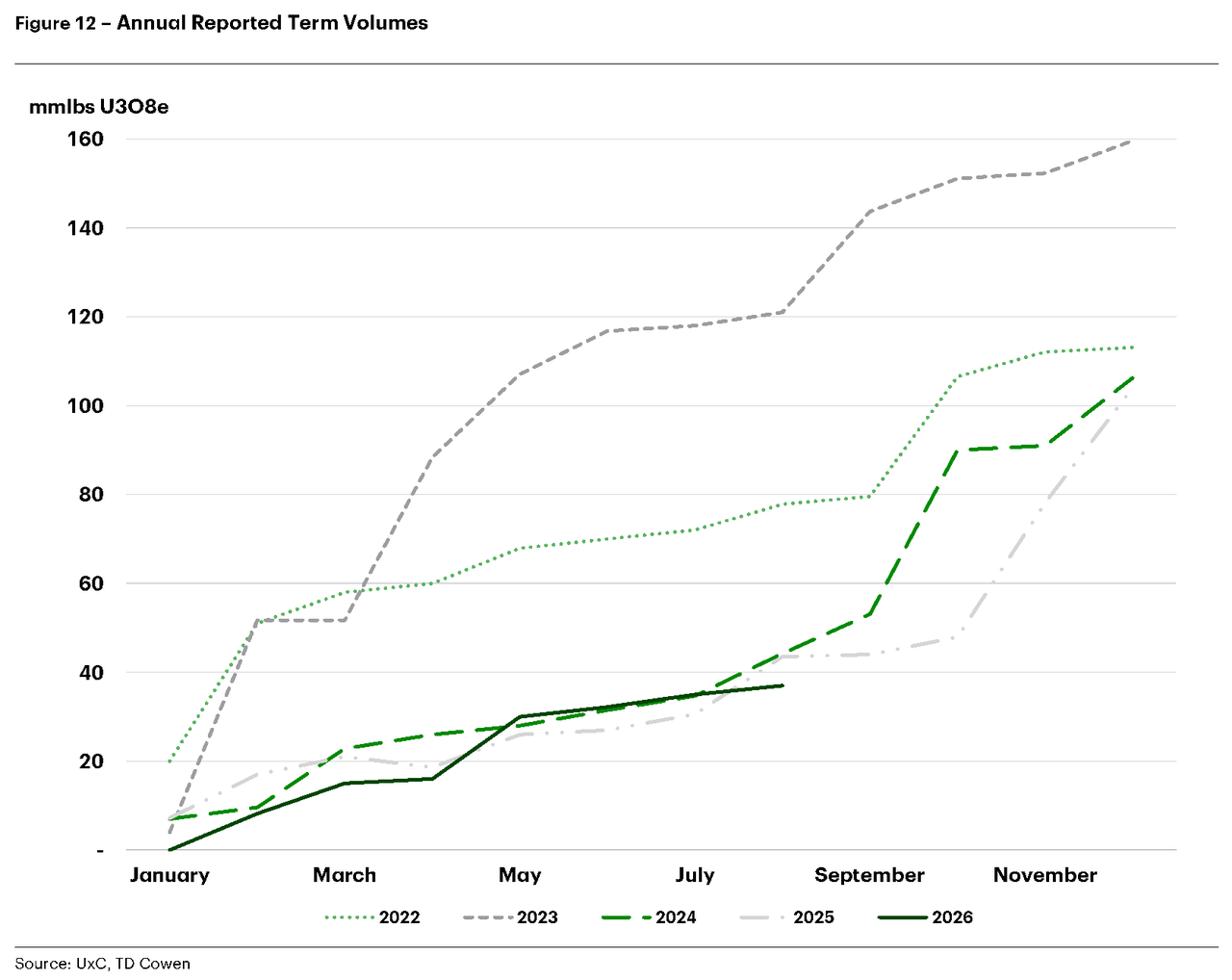
TD, to its credit, is not fazed and argues that “it is not a question of if term contract volumes pick up, it is a question of when,” since utilities keep contracting below replacement rates. The chart below shows what that looks like: 2026 cumulative term volumes are tracking at the bottom of the past five years, well below 2023’s ~160Mlb blowout and behind both 2024 and 2025 at the same point in the calendar. Utilities can put off buying fuel for a while. They can’t put it off forever, because reactors don’t run on “we’ll revisit in Q1.”
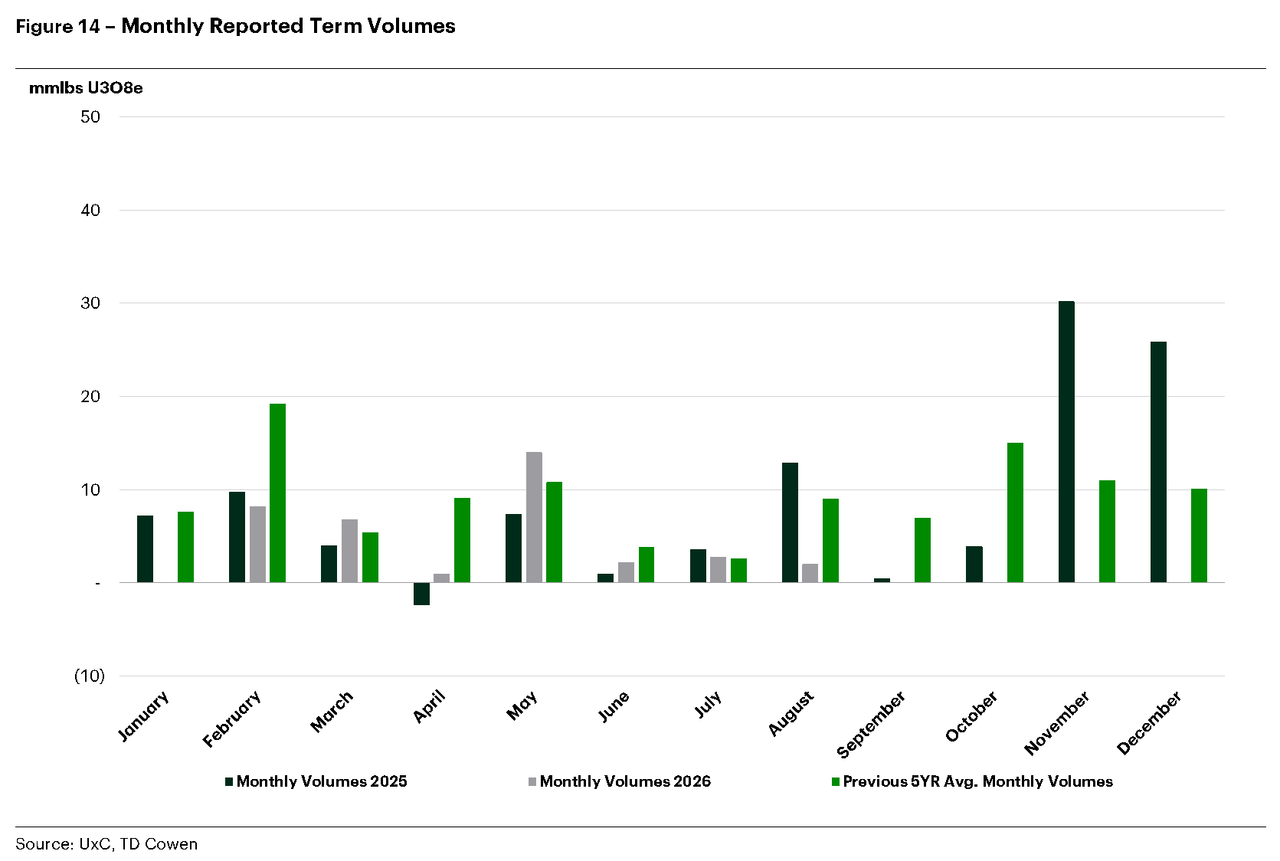
The monthly breakdown shows the same thing: outside a decent May, 2026 has undershot the prior five-year average almost every month, and last year’s big November/December catch-up (~30Mlbs and ~26Mlbs) is a reminder of how lumpy, and how late in the year, utility procurement tends to be.
Spot, meanwhile, is a bit livelier. Cumulative 2026 spot volume reached 38.6Mlbs across 377 transactions as of Sep 15 (+12% y/y), though TD concedes this is “largely attributable to SPUT’s sizable purchases earlier this year.” The encouraging part is that September activity picked up, with weekly volumes topping 1Mlb and “participation broadening beyond SPUT,” helped by the usual post-summer seasonal pickup, near-term utility needs and “more aggressive pricing strategies from major producers.” Translation: Cameco and Kazatomprom are not in the mood to discount.
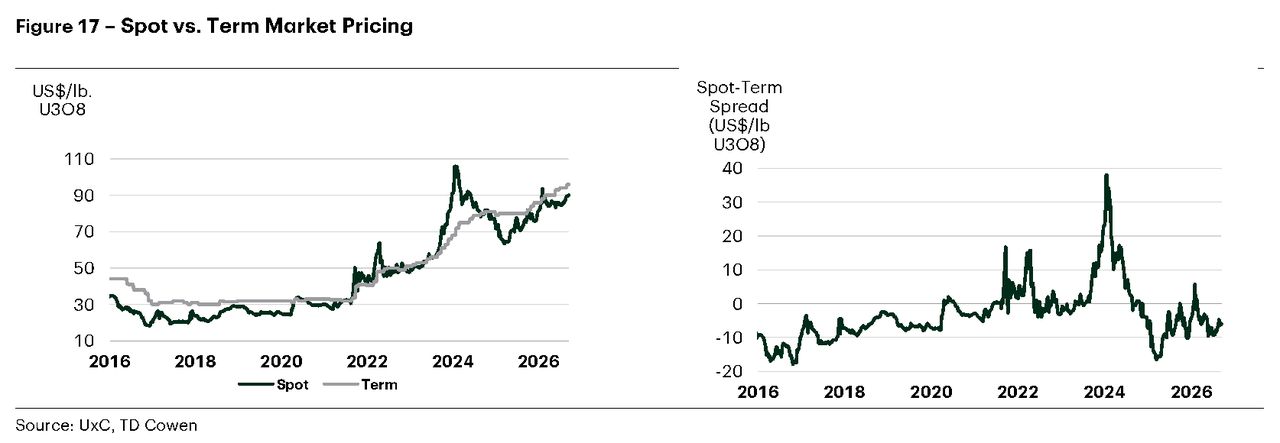
Note also where the spot/term spread sits: spot at a ~$6/lb discount to term, a far cry from the 2023-24 squeeze when spot traded at a $30+ premium. This is a market where end users are pricing long-dated scarcity but are not panicking about near-term delivery, which is the exact opposite of a blow-off top.
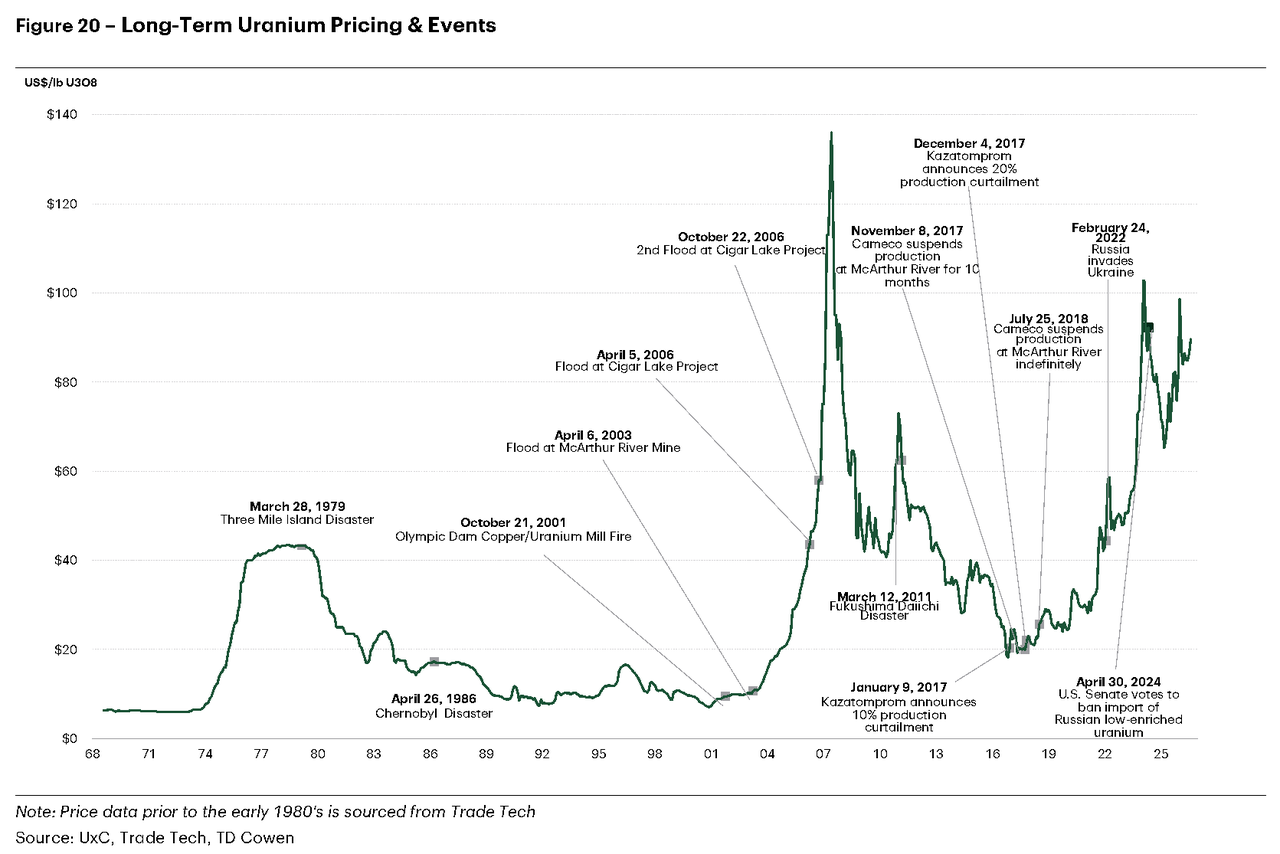
And for those wondering how “record” a record really is: $95 in 2007 is roughly $150 in today’s dollars. Or, as TD put it, “considering the significant inflationary pressures since 2007, there is considerable room for the term and spot price to run.” In other words, in real terms uranium is nowhere near its prior peak, as the long-term chart makes clear.
Meanwhile, in equity land…
While the fuel price grinds higher, the stocks go the other way, and fast. Comparing TD’s two performance tables, here’s what happened in the two weeks between Aug 31 and Sep 14, right around the WNA Symposium that was supposed to be a catalyst:
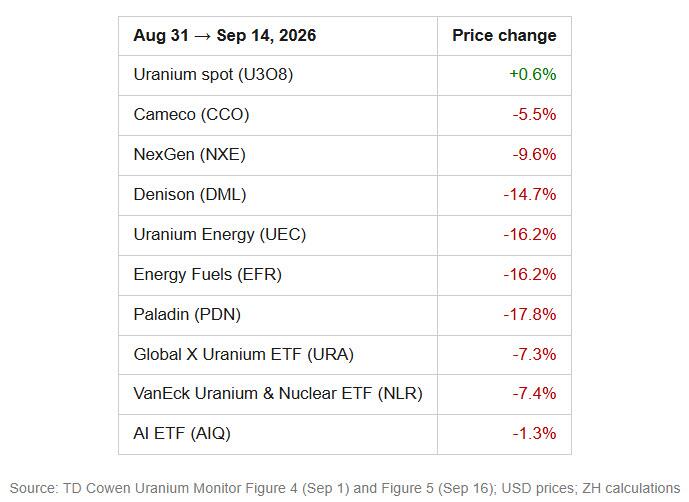
On a longer lookback the picture is just as odd. NLR, the broad nuclear ETF, is down 12% YTD and ~35% below its 52-week high, while the AI ETF (AIQ) is up 25% YTD. So for all the talk about nuclear as the “AI power trade,” the market has clearly separated the two: investors still want AI, but they’re no longer paying up for the power plants that are supposed to run it.
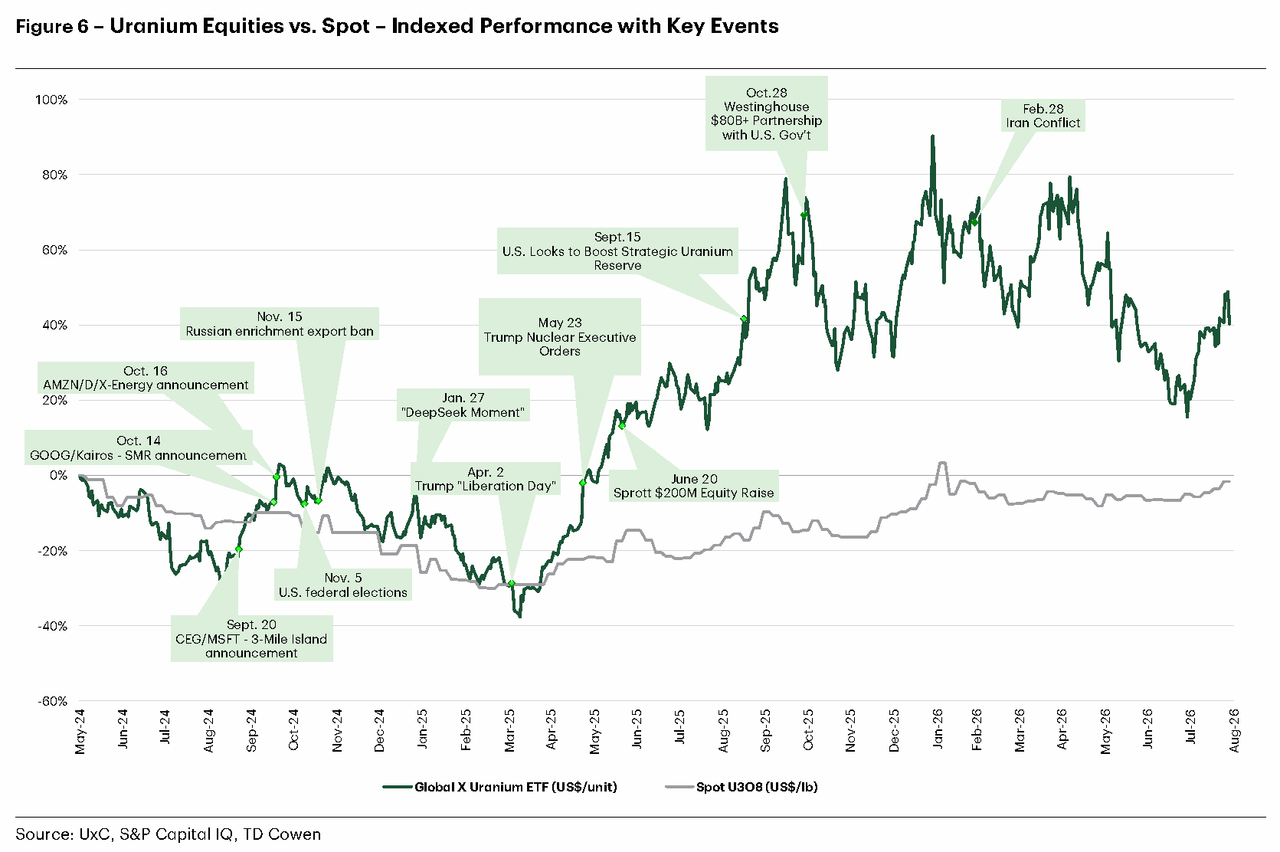
TD’s indexed chart shows the round trip: URA surged roughly 80-90% above its 2024 starting point on the Oct 2025 Westinghouse/US government $80BN partnership and again into the spring of 2026, before a vicious drawdown into July. Spot uranium, meanwhile, barely moved through all of that, which is a good reminder of which part of this complex was driven by fundamentals and which part was driven by momentum.
The carnage has been even worse further out on the risk curve. NuScale and Oklo are each down roughly 50% YTD. Holtec pulled its ~$10BN IPO last week, with CEO Kris Singh blaming “a recent market correction and cooling investor enthusiasm for the AI trade,” after the recent class of nuclear debutantes (X-Energy ~37% below its April IPO price, Standard Nuclear 20%+ below its July debut) showed what happens to public investors who pay for the promise. And this week, Oklo lost its PJM interconnection queue fight after FERC said its application was deficient, which is not the first time a regulator has sent Oklo’s homework back for “missing information.”
Even the policy headlines, which used to be good for a double-digit pop, now fade within hours. The House passing the Ratepayer Protection Act on Sep 17, which would make data centers pay for their own generation and grid upgrades (effectively the “behind the meter” framework we have long argued should be mandatory), sent NuScale +10% and Oklo +13%… and then both gave back most of it the next day. And the South Korean “$100BN+ for up to eight US reactors” headline that TD flagged as a potential catalyst has, for now, turned into a $22.3BN gas plant in Texas (with no customers), with the nuclear portion reportedly on hold amid the tangle of the Westinghouse/KHNP IP settlement, Korea’s talks about a stake in Westinghouse, and tariff negotiations. You can’t make this up.
Goldman: “inbounds have been extremely light”
So what does the sell side hear from actual investors? Goldman’s Energy, Natural Resources & Utilities sector specialist (Sep 18) gave a blunt read:
“To level set – inbounds have been extremely light on the nuclear front over the last couple of weeks – though we think is likely just a reflection of the current tape (rates, inflation, broader AI concerns).”
What makes the Goldman take useful is the distinction it draws between the long run and the near run. On the long run, “there is less doubt in the longer-term role of nuclear in the power stack.” On the near run, though, “there’s more focus on time to power (recips, turbines, fuel cells, batteries) and the cost profile for most projects remains a sticking point for investors.” In other words, hyperscalers need megawatts in 2027, not gigawatts in 2037, and the market is pricing nuclear accordingly. GS also pointed to an NEI survey showing +7 GWe of new capacity planned via uprates, restarts, longer refueling cycles and other output increases since the prior survey, which is the unglamorous, cheap and fast way to add nuclear power, and which also happens to burn more uranium.
That brings us to the more important point for the fuel.
The supply side isn’t getting any easier
While equity investors worry about rates and AI capex, the physical side of the market keeps getting tighter at the margin:
- Kazakhstan’s acid problem: Kazatomprom (roughly the Saudi Arabia of uranium) delayed commissioning of its TQZ sulfuric acid plant by 6-12 months (from Q1/27 to Q3/27-Q1/28) after a regulatory suspension, raised capex guidance on acid and cost inflation, and warned that the delay will be reflected in 2027 production guidance. TD thinks “a downward revision of uranium output in 2027 is possible.”
- Then Russia made it worse: Moscow banned sulfuric acid exports through year-end. As we noted on Sep 15, Kazakhstan relies on Russian acid for ~20% of its needs, and without a waiver the ban could cut ~3Mlbs (~4%) from Kazatomprom’s 2027 output. Goldman’s sector specialist flagged the same risk: “Kazakhstan is a major taker of Russian sulfuric acid as an input for uranium production.”
- The Red Book reality check: The NEA/IAEA’s latest Red Book (Sep 14) showed only a 2.1% increase in economically recoverable resources and emphasized rising mining costs, depletion of low-cost deposits, and the higher cost profile of new discoveries. At the same time, the IAEA raised its long-term outlook to 696 GWe (low) to 1,284 GWe (high) of nuclear capacity by 2060, i.e. +85% to +241% vs 2025.
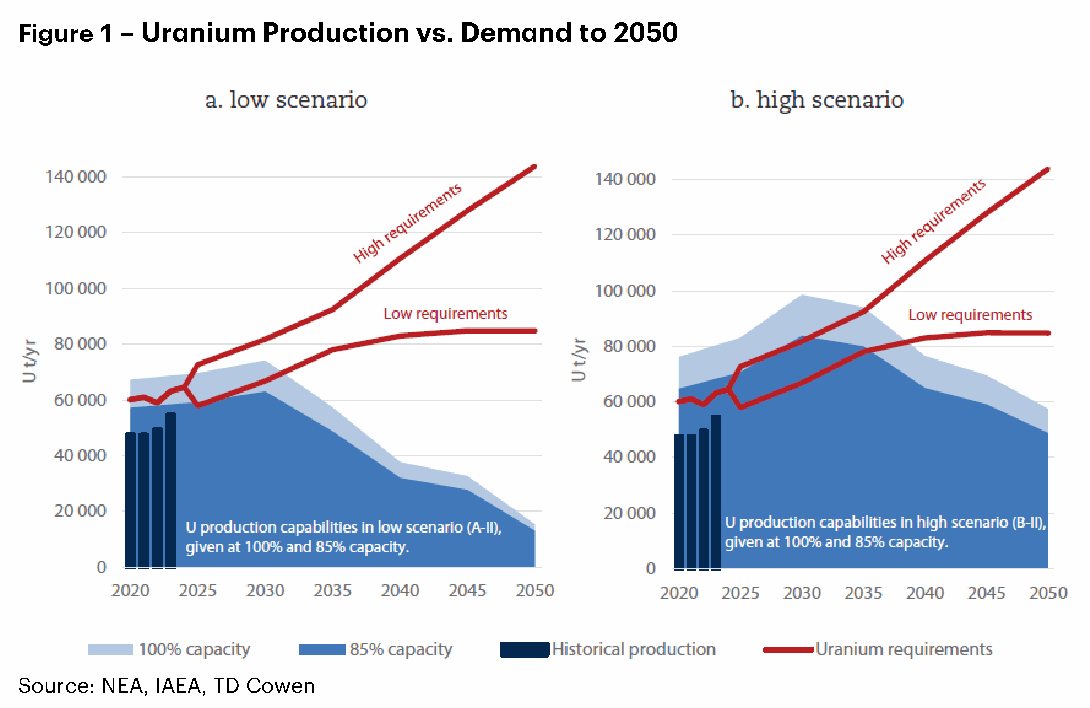
The chart above is what the long-run bull case looks like: even in the high-production scenario, existing and expected capacity peaks around 2030 and then declines, while requirements climb under both demand cases.
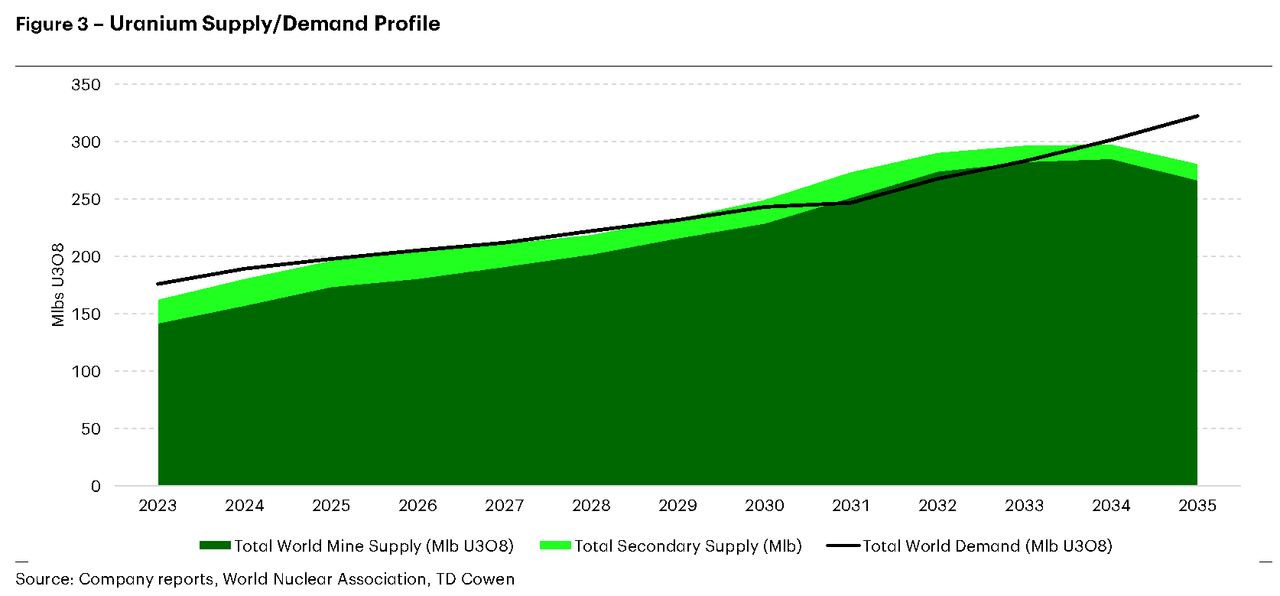
To be fair (and balanced), TD’s own model is less apocalyptic in the medium term than the bulls often are. It shows the market roughly balanced near term (-1Mlb in 2026 and 2027), then moving into a surplus from 2030-2033 as Western mine supply ramps (peaking at +27Mlbs in 2031), before the deficit comes back hard: -4Mlbs in 2034 and -42Mlbs in 2035, when total demand hits 322Mlbs vs 281Mlbs of supply. Put differently, the thesis rests on utilities having to lock in 2030s supply today, which is exactly the contracting they’re currently putting off because of “sticker shock.”
Throw in India opening its nuclear sector to private build-own-operate for the first time (draft SHANTI Act rules released Aug 14, a story we’ve been tracking since July), the DOE adding 13 more projects to its Nuclear Energy Launch Pad, and Washington’s push for faster enrichment buildout, and it becomes clear that policy hasn’t turned against nuclear. What has changed is how much equity investors are willing to pay for it.
The mood in London: positive, “albeit perhaps slightly less bullish”
TD hosted its 1-on-1 uranium conference in London alongside the WNA Symposium (which we will discuss in a subsequent post), which drew a record 1,300 attendees. The read: tone “positive, albeit perhaps slightly less bullish than last year,” no major announcements, and investors “continue to view progress on the deployment of new nuclear reactors in the U.S. as one of the key near term catalysts.” Which, given the Korean deal’s detour into Texas natural gas, may take a bit longer to show up.
Still, the picture on actual reactor builds outside the US hasn’t changed: 37 reactors are under construction in China alone. The US? Zero.
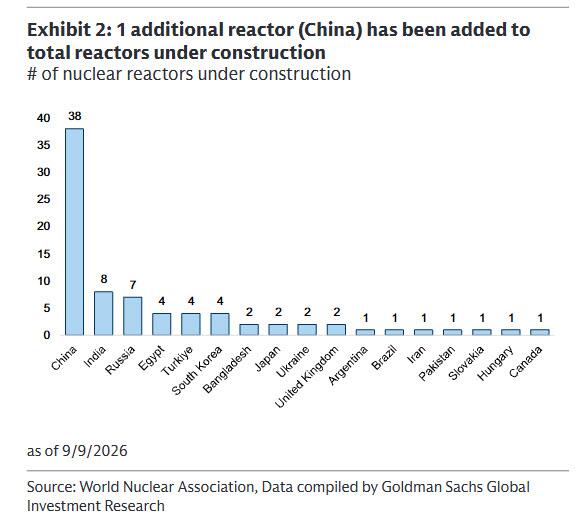
Meanwhile, in Japan, TEPCO just restarted Unit 6 at Kashiwazaki-Kariwa, the largest power plant in the world: And that’s after the public mood against nuclear in the country of Fukushima is, as one can imagine, negative to quite negative.
Bottom line
The fuel market and the equity market are telling two different stories, and history suggests the fuel market usually wins. The same UBS analysts who in late August warned that the market is “tightening structurally” were pointing to the same combination we see now: firm term prices, long mine lead times, and sustained utility need. The difference today is that equity investors have stopped paying ahead of the utilities. Once utilities get over their “sticker shock” and resume contracting, likely in the traditional Q4 rush if last year is a guide, the question is whether the stocks will still be trading as if nuclear were just another AI-capex casualty.
For those who want to front-run the catch-up, TD keeps Cameco as its top pick among uranium equities and Denison Mines as its top small/mid-cap name (DML is down ~15% in two weeks, so it’s cheaper than it was when TD last said so). And Goldman, in a note published just yesterday, reiterated its Buy on Uranium Energy (UEC) after FQ4 revenue came in ahead of expectations “reflecting solid uranium price environment,” citing sharply ramping production, falling unit costs, and medium-term catalysts from “US-origin needs (e.g. NNSA)” and a potential move into conversion.
Or, to put it differently: uranium hit a record high and nobody cared. Historically, that’s not how the bull market ends; it’s what the middle of one looks like.
END
COMMODITY GOLD:
Gold Fights for $4,200 as Yields Hit 2002 Highs

by Blue Line Futures
Thursday, Oct 01, 2026 – 7:14
Start your week with an edge. Sign up for “Navigating the Week Ahead,” Blue Line Futures’ free weekly outlook released every weekend. Get key events and actionable insights across Gold, Silver, Equities, Interest Rates, Volatility, and the US Dollar before Monday’s open: https://bluelinefutures.com/navigating-the-week-ahead/
END
COMMODITY TUNGSTEN:
Cantor: Almonty “Moving Seamlessly” Into Production As Korean Tungsten Mine Becomes Western Lifeline
Thursday, Oct 01, 2026 – 02:40 PM
Cantor Fitzgerald metals and mining analyst Matthew O’Keefe provided clients on Tuesday with an update on Almonty Industries, citing a corporate update from CEO Lewis Black. The miner’s crown jewel tungsten mine in South Korea has begun shipping concentrate as the West’s answer to conflict-free tungsten supply comes online, playing into a bigger theme we’ve outlined called “owning the bottlenecks.”
O’Keefe says the Sangdong mine has begun shipping concentrate, is moving toward 24/7 operations, and has about 4.6 months of stockpiled ore to support its ramp-up. Phase II expansion is also already underway, with completion expected in 2027.
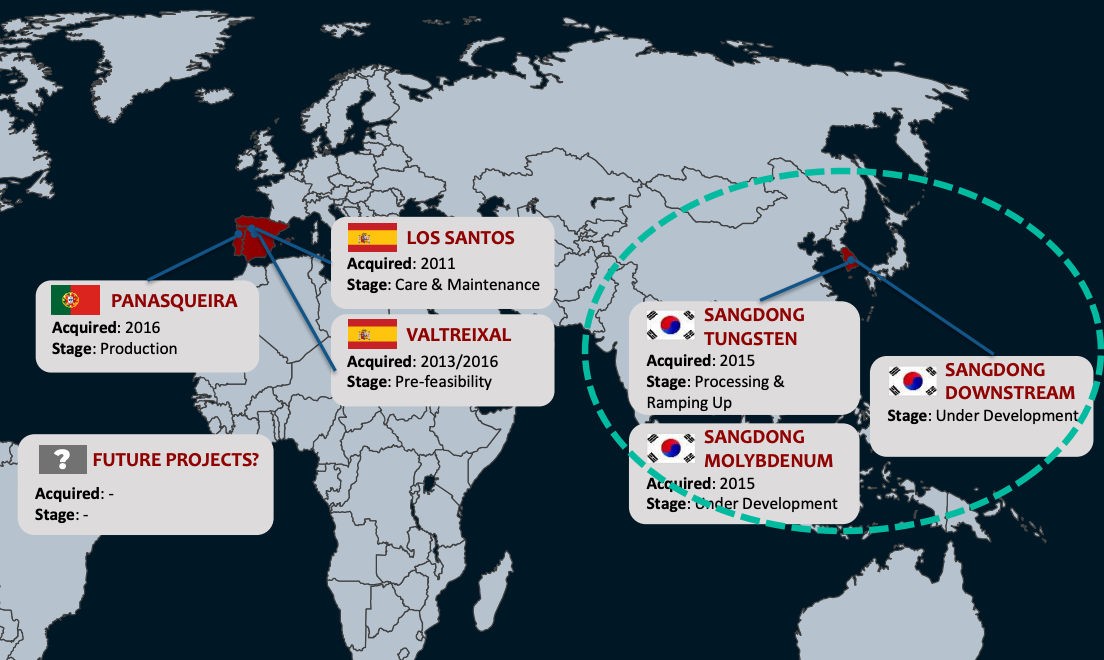
O’Keefe outlined why Sangdong is critical to expanding Western-aligned tungsten supply and breaking China’s “quasi-monopoly” grip:
A major source ex-China: Phase II would increase throughput to 1.2 million tonnes annually, potentially supporting more than 460,000 MTU of tungsten trioxide production per year at Sangdong.
The production inflection: Cantor’s detailed model forecasts consolidated output rising from 126,287 MTU in 2026 to 444,400 MTU in 2027, while all-in sustaining costs fall from $905 to $319 per MTU. These are forecasts, contingent on successful execution.
“This is a defining moment for Almonty and for Western supply chains: tungsten mined and processed in an allied nation is now a reality,” CEO Black wrote in a statement.

CEO Black added more color on the ramp-up of the South Korean mine:
Sangdong Phase II: The Next Chapter Is Already Underground
The stockpile on the surface does more than feed the mill. It buys us time, and we are putting that time to work. With enough ore on-hand to carry Phase 1 through ramp-up and early production, our mining teams have been free to turn their attention deeper into the mountain, where underground development for Phase II is already well underway.
While the drills advance below ground, the mill above it has gained an important partner. Metso, a global leader in minerals processing technology, is on site at Sangdong, working alongside our operators to support the Phase 1 ramp-up. The same engineers helping us fine-tune today’s plant are laying the technical groundwork for tomorrow’s future.
That brings me to the news many of you have been waiting for.
Phase II is officially a go.
Underground development is progressing, and we are placing orders with Metso for the equipment that will power the expansion, including new mills. The same partner that helped bring Phase 1 to life will now help build its successor. We expect Phase II to be completed in 2027, further ramping capacity to up to 1.2 million tonnes per annum and positioning Sangdong to potentially produce over 460,000 MTU annually, making it one of the largest tungsten mines outside of China and definitively the largest producing currently.
Sangdong’s ramp-up comes as Stifel aerospace and defense analyst Jonathan Siegmann pointed out that the US strategic stockpile of tungsten has been nearly depleted. This is merely an indication that the Trump administration’s push to secure conflict-free critical material supply chains will create massive tailwinds for the metals space, and those miners that can deliver today will be the big winners.
The most glaring problem is that China’s control over critical materials mining and refining will remain in play through the end of this decade…


Adrien Rabier, Bernstein’s equity analyst covering European aerospace and defense, outlined earlier this week that the rearmament cycle in Europe, and more broadly across the West, is already underway.
The problem is that missiles, bombs, drones, fighter jets, tanks, and just about everything else in the defense world require high-quality critical materials. Shortages could derail production lines, which is why the West is actively seeking to build out new supplies, making early movers such as Almonty and others that can deliver conflict-free supplies the winners.
O’Keefe reiterated a “Buy” rating on Almonty with a 12-month $25.50 target, implying about 93% upside from the previous close cited in the report.
END
YOUR EARLY CURRENCY VALUES/GOLD AND SILVER PRICING/ASIAN AND EUROPEAN BOURSE MOVEMENTS/AND INTEREST RATE SETTINGS THURSDAY MORNING.7:30 AM
SHANGHAI CLOSED
HANG SENG CLOSED
Nikkei CLOSED UP 2292.28 PTS OR 3.43%
//Australia’s all ordinaries CLOSED DOWN 2.16%
//Chinese yuan (ONSHORE) CLOSED DOWN TO 6.7046
/ OFFSHORE CLOSED UP AT 6.7046 Oil UP TO 92.33 dollars per barrel for WTI and BRENT UP TO 100.38 Stocks in Europe OPENED ALL RED
ONSHORE USA/ YUAN// WITH YUAN TRADING DOWN (6.7046 OFFSHORE YUAN TRADING DOWN TO 6.7098 ONSHORE YUAN TRADING ABOVE LEVEL // OFF SHORE AND DOWN ON THE DOLLAR)// / AND THUS WEAKER/OFF SHORE YUAN TRADING DOWN AGAINST US DOLLAR/ AND THUS WEAKER
XXXXXXXXXXXXXXXXXXXXXXXXXXXXXXXXXXXXX
ONSHORE YUAN: CLOSED DOWN AT 6.7046
OFFSHORE YUAN: DOWN TO 6.7098
1A.HANG SANG CLOSED
1 B. SHANGHAI CLOSED
2. Nikkei closed UP 2292.28 PTS OR 3.43%
WEST TEXAS INTERMEDIATE OIL UP TO 92.33
BRENT; 100.30
3. Europe stocks SO FAR: ALL RED
USA dollar INDEX UP 33 BASIS PTS TO 101.52// EURO FALLS TO 1.1298 DOWN 28 BASIS PTS
3b Japan 10 YR bond yield:RISES TO. +3.126 UP 6 FULL BASIS PTS/ VERY TROUBLESOME//Japan buying 100% of bond issuance)/Japanese YEN vs USA CROSS NOW AT 157.36… JAPANESE YEN NOW FALLING AS WE HAVE NOW REACHED THE ENDING OF THE YEN CARRY TRADE AGAIN AND THE REPATRIATION OF YEN DENOMINATED BONDS TRADING IN THE USA/EUROPE. JAPAN 30 YR BOND YIELD: 4.184 UP 5 FULL BASIS PTS
3c Nikkei now ABOVE 17,000
3d USA/Yen rate now well ABOVE the important 120 barrier this morning
3e Gold DOWN /JAPANESE Yen DOWN CHINESE ONSHORE YUAN: DOWN (6.7046) AND OFFSHORE: DOWN AT 6.7098
3f Japan is to buy INFINITE TRILLION YEN worth of BONDS. Japan’s GDP equals 5 trillion USA. CENTRAL BANK OF JAPAN WILL NO LONGER DO QE.
Japan to buy 100% of all new Japanese debt and NOW they will have OVER 50% of all Japanese debt. GOVERMENT ASKED JAPAN PENSION FUNDS AND INSURANCE FUNDS TO BUY MORE JAPANESE BONDS AND REPATRIATE ALL FOREIGN BONDS.
3g Oil UP for WTI and UP for Brent this morning
3h European bond buying continues to push yields HIGHER on all fronts in the EU German 10yr bund YIELD UP TO +3.6099/ Italian 10 Yr bond yield UP AT 4.711/ SPAIN 10 YR BOND YIELD UP TO 4.196%
3i Greek 10 year bond yield UP TO 4.5690%
3j Gold at $4154.90 /Silver at: 60.39 1 am est) SILVER NEXT RESISTANCE LEVEL AT $100.00
3k USA vs Russian rouble;// Russian rouble UP 0 AND 1/ 100 roubles/83.37
3m oil (WTI) into the 92 dollar handle for WTI and 100 handle for Brent/
3n Higher foreign deposits moving out of China// huge risk of outflows and a currency depreciation. This can spell financial disaster for the rest of the world/
JAPAN ON JAN 29.2016 CONTINUES NIRP. THIS MORNING RAISES AMOUNT OF BONDS THAT THEY WILL PURCHASE UP TO .5% ON THE 10 YR BOND///YEN TRADES TO 158.39 // 10 YEAR YIELD AFTER FIRST BREAKING .54% LAST YEAR NOW EXCEEDS THAT LEVEL TO 3.126% UP 6 BASIS PTS STILL ON CENTRAL BANK (JAPAN) INTERVENTION//YEN CARRY TRADE NOW UNWINDING//YEN BOND TRADING OVERSEAS TO BE REPATRIATED.//JAPAN 30 YR: 4.184 UP 6 PTS..: USA/SF this 0.8349 as the Swiss Franc . Euro vs SF: 0.9427
USA 10 YR BOND YIELD: 5.346 UP 4 BASIS PTS…NOW BELOW 5.00%
USA 30 YR BOND YIELD: 5.673 UP 4 BASIS PTS/REFUSES TO GO DOWN WITH BESSENT’S QE TWIST
USA 2 YR BOND YIELD: 4.912 UP 3 BASIS PTS
USA DOLLAR VS TURKISH LIRA: 49.04 UP 2 BASIS PTS/LIRA GETTING KILLED//IDIOTS FOR SELLING GOLD AND USA DOLLAR RESERVES.
10 YR UK BOND YIELD: 5.4767 UP 7 PTS
30 YR UK BOND YIELD: 6.014 UP 11 BASIS PTS
10 YR CANADA BOND YIELD: 3.999 UP 3 BASIS PTS
5 YR CANADA BOND YIELD: 3.703 UP 2 BASIS PTS.
1a New York Opening report
Stocks Rise On First Day Of Q4 As 10Y Yields Pull Back From 24 Year High
Thursday, Oct 01, 2026 – 08:48 AM
The disconnect continues. With 10Y yields rising as high as 5.34% – a new 24 year high – before easing back US equities remain completely oblivious of the tightening in financial conditions and instead are obsessing with the memory bubble, and pushing higher on the first day of Q4 as strength in technology shares held up against volatility in bond markets and a renewed climb in oil. As of 8:00am ET, S&P 500 futures were up 0.4%, erasing an earlier loss; Nasdaq 100 contracts rose 0.7% with memory and semis providing support following an upbeat forecast from chipmaker Micron. Mag 7 and software firms were also stronger as the Nasdaq remains in a debt-funded world of its own. The AI theme is boosting Indu / Utils while the most other sectors are lagging as usual. In the near-term, with yields and the dollar higher, the market seems comfortable reverting to portions of the Q2 playbook which was dominated by Tech / Semis. Meanwhile, Russell 2000 small caps struggles in the face of the highest bond yields in a generation; JPM points out that “more than 40% of the index are unprofitable companies though squeeze risk exists with a MidEast deal.” Tempering sentiment were swings in global yields, with the yield on 10-year Treasuries briefly touching the highest since 2002 before pulling back; it was trading at 5.27% last. JPMorgan’s market intel suggests that bonds are oversold but may take some time to find a support level. USD continues its bull run, setting a new 52-wk high this morning before erasing gains. Commodities are mixed but higher with crude and Ags leading; Base over Precious with gold/silver flat. The US economic data slate includes weekly jobless claims (8:30 a.m.), September final S&P Global US manufacturing PMI (9:45 a.m.), September ISM manufacturing and August construction spending (10 a.m.) ahead of the NFP tomorrow, which may have an upside surprise given the ADP print yesterday.
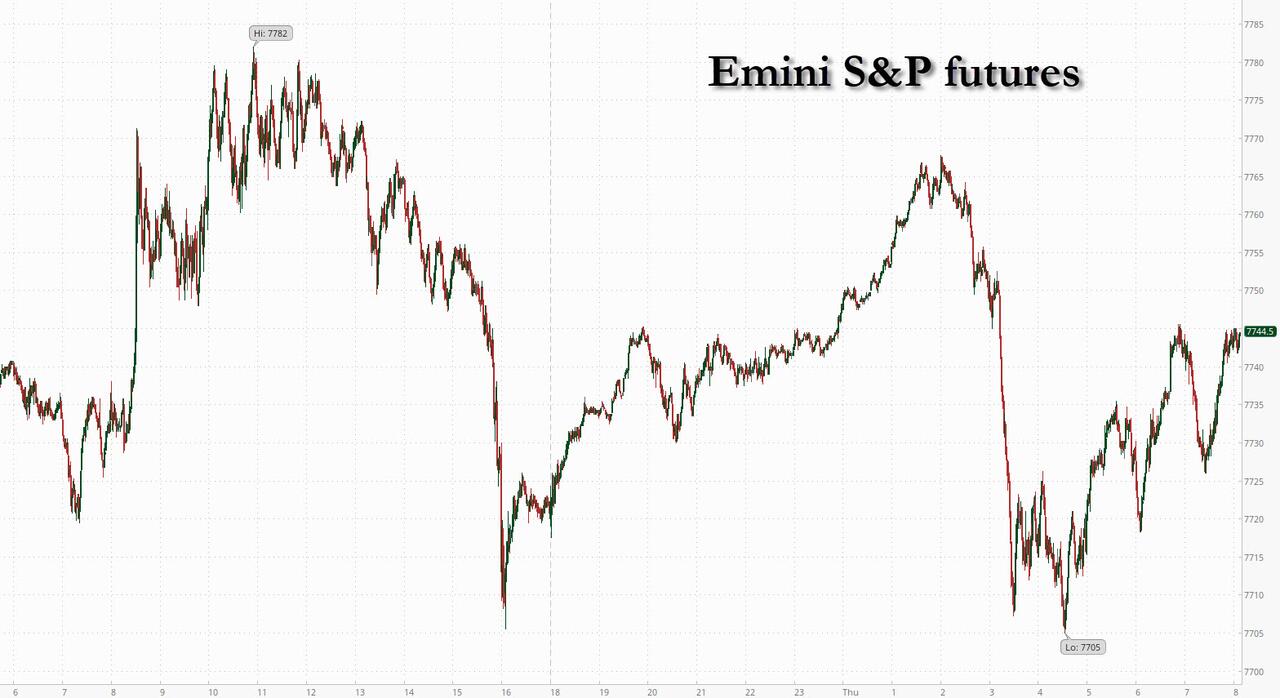
In premarket trading Mag 7 stocks are mostly higher: Alphabet is up 1.8% after Google announced its much-awaited new frontier model called Gemini 4 Argon (Amazon +1%, Apple -0.2%, Meta little changed, Microsoft +0.8%, Nvidia (NVDA) +0.6%, Tesla (TSLA) +0.3%
- Accenture (ACN) gains 17% after the IT services company reported fourth-quarter results that beat expectations on key metrics, including revenue and bookings.
- Constellation Energy (CEG) rises 3% after the operator of gas power plants said it signed a 20-year power purchase agreement with Amazon, which covers 690 megawatts of nuclear capacity at Maryland’s Calvert Cliffs Clean Energy Center, including a 190-megawatt uprate.
- Liquidia (LQDA) falls 5% — set to extend decline for a second day — after BTIG downgraded the drugmaker to neutral from buy, citing a court ruling that found Liquidia infringed two claims of rival, United Therapeutics’ patent.
- Nu Holdings (NU) gains 5% after the company said it’s not pursuing a deal with Monzo Bank Ltd.
- Oracle (ORCL) is up 1.9% after the Financial Times reports that Tencent agreed to a five-year lease across the US cloud technology firm’s data centers in Southeast Asia.
- Rocket Lab (RKLB) gains 4% after Citi initiated coverage on the space company with a buy rating, calling it a “core holding for space bulls.”.
- Vicor (VICR) rises 12% after the maker of power-conversion technology raised its third quarter sequential revenue growth guidance citing increased royalties from the previously announced first non-exclusive license to Vertical Power Delivery.
In other corporate news, Netflix co-CEO Ted Sarandos said the US streaming giant isn’t growing as quickly as he would like. Amazon.com has agreed to purchase 690 MW of power from Constellation Energy, in a deal that will help the biggest US nuclear operator boost capacity at the only reactors in Maryland. Nubank said it’s not pursuing a deal with Monzo Bank after reports that the Brazilian company was eyeing a transaction with the UK fintech firm.
The global bond selloff is rippling through to equities – well at least non-chip/Mag7/semiconductor equities – while the spread on the riskiest US corporate bonds has jumped above 1,000 basis points over Treasuries for the first time since the regional banking crisis in 2023.
“Momentum has collapsed outside the tech sector, as the pain threshold for valuations has been crossed,” says Bank J Safra Sarasin’s Wolf von Rotberg. “Even financials have started to underperform” because of widening HY spreads and pressure on borrowers. For BNP Paribas CIB’s Florian Roger, yields at 5.5% is when “the pressure really starts kicking in” for equities. “We’re nearly there and that’s when valuations can start looking excessive.”
Tech, meanwhile, is ignoring the soaring interest rates, and instead focusing on Micron’s debt-fueled results which reinforced confidence that the memory maker and its peers continue to be inundated with orders as hundreds of billions of dollars pour into the global buildout of AI infrastructure. The sector has been the main driver of global stocks through a period marked by geopolitical upheaval and interest-rate hikes, with Micron alone rallying more than 270% this year.
On AI, anecdotes remain bullish, from Micron’s print to South Korea export data, which showed September chip exports rose 263% year-on-year, accelerating from the month before. Elsewhere in tech, Alphabet Inc. rose 1.8% in early trading after beginning to roll out its latest flagship AI model, Gemini 4 Argon, its long-awaited flagship AI model, but the company is grappling with internal skepticism over how well it performs in key areas. And tech CEOs privately questioned Anthropic’s Dario Amodei for sounding the alarm bell on AI safety, the WSJ reported. In another sign of the scale of the AI buildout, Tencent Holdings Ltd. signed an estimated $7 billion lease deal with cloud provider Oracle Corp., the Financial Times reported.
Still, the memory stock rally may be losing steam, as evidenced by the equity volatility gauge in Korea (Samsung and Hynix account for 53% of Kospi) as traders shift from speculative options for upside to selling volatility. But the underlying supply and demand imbalance remains constructive for pricing and profit: Micron capex is still going higher and customers are extending commitments beyond 2030.
“Take a look at the Nikkei or Nasdaq futures, there’s clearly little gloom and doom,” said David Kruk, head of trading at La Financiere de l’Echiquier in Paris. “The next driver is the third-quarter earnings season which should be strong, just as the last one.”
Swings in oil continue to ripple through markets at a time when a resilient US economy and elevated inflation have investors seeing scope for as many as four Federal Reserve interest-rate hikes over the next 12 months. That outlook has added to strains in bond markets, with US volatility surging to a six-month high.
With a day to go before the US payrolls report, fresh data showed US companies announced the fewest job cuts for any September since 2022. Minneapolis Fed President Neel Kashkari told Bloomberg TV the economy’s resilience continued to surprise him.
“We’ve identified 5.5% on US 10-year bonds as the level at which pressure really starts kicking in on equity markets,” said Florian Roger at BNP Paribas CIB. “We’re nearly there and that’s when valuations can start looking excessive.”
With macro front and center, there are no less than ten Fed speakers on the agenda today, including Waller, who will speak about Federal Reserve economic data, and Jefferson on the US economy and monetary policy. Trump said former Fed Chair Powell should be forced to resign from the central bank’s board.
Meanwhile, Europe’s Stoxx 600 fell, with the Stoxx 600 heading for its worst day in almost two weeks and back to the lowest level since June, with the UK’s FTSE 100 down 1%. French short-end bonds underperformed as the government unveiled plans to narrow the budget deficit sharply, kicking off a debate that risks toppling the prime minister. “There’s no one to buy the dip until there is a credible plan to tackle the deficit and debt,” Kruk said. “That’s in any event far away from now.”
Asian stocks were steady as gains in tech firms offset declines elsewhere, with elevated oil prices and bond yields continuing to weigh on sentiment. The MSCI Asia Pacific Index was little changed, rebounding from losses of as much as 0.7% earlier in the session. Chipmakers were the biggest boosts to the index, while financial firms the biggest drags. Australian shares fell the most in seven months, while benchmarks in India, Vietnam and Malaysia also dropped. Markets were shut in Hong Kong and Mainland China for a holiday.
Semiconductor-related shares got a boost from Micron’s guidance through 2027, lifting tech-heavy markets including Japan, Taiwan and South Korea. Still, oil’s renewed advance above $100 per barrel is keeping inflationary concerns in focus.
“The hurdle is quite high now for memory companies on these beats and these raises,” Vikas Pershad, portfolio manager at M&G Investments told Bloomberg TV. “I don’t think it’s a surprise that the numbers continue to be strong heading into 2027.”
“Risk appetite remains limited outside the AI-related space,” said Kazunori Tatebe, chief strategist at Daiwa Asset Management. “Investors are worried about interest rates.”
In FX, the Bloomberg Dollar Spot Index rises 0.3%. The yen is the weakest of the G-10 currencies, falling 0.6% against the greenback after the BOJ summary of opinions leaned dovish. Precious metals are little changed.
In rates, higher energy prices and rising concerns around fiscal sustainability have pushed global government bonds lower. The moves have retraced somewhat but yields are still broadly higher with US 10-year borrowing costs up 1bps to 5.29% after reaching 5.34% — highest since 2002 — during European morning; curve is slightly steeper on the day with front-end and belly outperforming, widening 2s10s and 5s30s spreads by about 1bp. In 10-year sector bunds and gilts outperform by 5bp and 1bp respectively. Treasuries hold small losses, keeping yields within 2bp of Wednesday’s closing levels, after paring steeper ones. Futures rebounded from session lows as oil gains were pared, with energy traders weighing higher Middle East crude flows against uncertainty across fuel markets. In Europe, the UK 30-year yield hit 6% for the first time since 1998, while French bond spreads continue to widen ahead of the budget announcement. IG dollar issuance slate is blank so far. Paramount Skydance priced an eight-part, $30 billion offering Wednesday, the sixth-largest deal on record. Robust demand saw orders peak at $109 billion, placing it among the largest order books on record, before closing just short $80 billion.
In commodities, WTI crude oil futures have pared a 2.7% increase to about 2%, guiding yields lower. Brent crude futures rise 2.6% and above $100 a barrel. Precious metals are little changed.
US equity futures were also pulled lower but are still in the green as an upbeat forecast from Micron supports tech stocks. The Bloomberg Dollar Spot Index rises 0.3%. The yen is the weakest of the G-10 currencies, falling 0.6% against the greenback after the BOJ summary of opinions leaned dovish. Precious metals are little changed.
The US economic data slate includes weekly jobless claims (8:30 a.m.), September final S&P Global US manufacturing PMI (9:45 a.m.), September ISM manufacturing and August construction spending (10 a.m.). Fed speaker slate includes Minneapolis’s Kashkari (7:30 a.m.), Richmond’s Barkin, Boston’s Collins and Kansas City’s Schmid (9:05 a.m.), Governor Waller (10 a.m.), Vice Chair Jefferson (1:30 p.m.), Vice Chair for Supervision Bowman (3 p.m.), Governor Cook and New York’s Williams (3:30 p.m.) and Dallas’s Logan (7:20 p.m.)
Market Snapshot
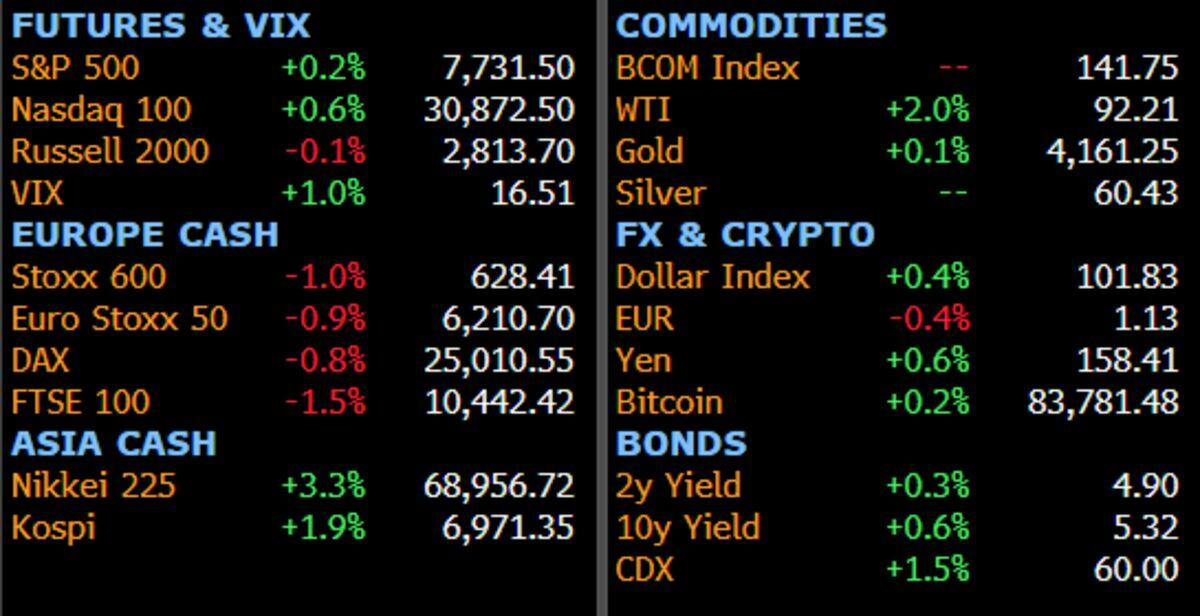
Top Overnight News
- The 10-year Treasury yield rose to 5.33%, the highest since 2002, as global bonds grappled with stubborn inflation and warnings that rates may stay “higher for longer.” Brent climbed back above $100. UK long-term yields hit 6% for the first time in almost three decades. BBG
- Washington is winning the War of Hormuz as Middle East oil exports approach pre-war levels, although the Pentagon is expending a lot of resources to guarantee supply and the global shortage of refined energy products is worsening. WaPo
- The Trump administration has told Germany and France to draw down emergency diesel inventories to help to ease global fuel prices or face a potential US diesel export ban, said three people close to the discussions. The warning marks an escalation of pressure on Europe as US President Donald Trump considers a potential diesel export ban to bring down US fuel prices ahead of November’s midterm elections. RTRS
- Chinese fuel exporters have canceled some oil-product cargoes slated for export in October, prioritizing domestic supply during an extended period of upheaval in global energy markets. Shipments including gasoline and diesel have been affected, with the prompt spread for these fuels in Asia stretching higher as traders learned the news, indicating a tighter market. BBG
- Factory activity across Europe and Asia expanded last month as demand, partly boosted by the global AI spending boom, remained strong even as the energy price shock from the Iran war kept inflation elevated, surveys showed on Thursday. RTRS
- Japan is aiming to speed up data center development with a $140bn investment scheme leveraging its powerful gas trading company in a bid to become the world’s largest AI infrastructure hub outside the US and China. FT
- Minneapolis Federal Reserve President Neel Kashkari said price pressures remain elevated after the latest batch of inflation data released Wednesday. Kashkari’s comments come after the Fed’s preferred inflation measure, the personal consumption expenditures price index, rose by 3.4% over the past 12 months in August. Despite revisions to PCE lowering the year-over-year trend, economists project the central bank will largely stay committed to achieving price stability on a timely basis. WSJ
- Powell will probably wind up staying at the Fed until Jan 2028. Politico
- Tencent has signed its largest overseas lease deal with US cloud provider Oracle as the Chinese tech giant strives to catch up in an escalating AI race. The leading social media and gaming group in China this year agreed to a five-year lease across multiple Oracle data centers in south-east Asia, according to two people with knowledge of the matter. FT
- US Senators Hawley (R) and Murphy (D) are planning to introduce AI liability legislation as a bipartisan effort to regulate AI: Axios
- BofA (w/e 26th Sept) Total Card Spending +5.6% Y/Y (prev. +6.9%); notes that after a brief reversal last week, lower-income spending growth again outpaced higher income
A more detailed look at global markets courtesy of Newsquawk
APAC stocks were mixed as the region takes its cue from the similar performance stateside, where participants digested a slew of data, and yields continued to climb despite softer PCE data, while markets in Mainland China and Hong Kong were shut for the National Day holiday. ASX 200 underperformed with all sectors in the red and the downside led by weakness in energy, real estate and defensives, while a return to growth in Australian Exports and Imports did little to inspire. Nikkei 225 rallied with chip-related stocks boosted following strong earnings from Micron, while participants also reflected on the BoJ Tankan survey, which showed sentiment among Large Manufacturers improved but missed forecasts, and coupled with recent weak activity data, supports the argument for a less aggressive BoJ rate normalisation. KOSPI shrugged off the initial weakness and climbed into the green as tech-related momentum began to pick up. Furthermore, US President Trump recently unveiled plans for South Korea to invest USD 200bln in energy projects in the US as part of South Korea’s investment pledge that got auto tariffs reduced from 25% to 15%, while South Korean Exports surged.
Top Asian News
- RBA Financial Stability Review stated that households and businesses are well placed to weather a slower economy and falling house prices, while it added that even if house prices fell a further 20%, only 5% of mortgages would be in negative equity. Furthermore, less than 1% of borrowers are in negative equity and household balance sheets remain strong, while banks are well-positioned to weather a material deterioration in the housing market.
- China’s Finance Minister said they will implement proactive fiscal policy and support achievement of full-year economic goals, while they will boost domestic demand, prevent and resolve debt risks, as well as appropriately accelerate the pace of fiscal spending.
- Japanese PM Takaichi said the government will appropriately control total annual government bond issuance, taking into account both initial and supplementary budgets. On the FX market, Takaichi said the FX market is determined by a number of factors, that economic policy is not aimed at manipulating FX while she also told US President Trump that undervaluation of yen is a problem. Takaichi also added that they expect the consumption tax cut on food will be passed on to sales prices.
European bourses (STOXX 600 -1.0%) have come under significant pressure to start the final quarter of 2026. Energy prices continue to be the main driver (Brent +1.7%), while the downside in fixed income is also not helping sentiment. Sectors highlight the negative bias, with all sectors entirely in the red. Banks are the clear laggard, with Basic Resources and Consumer Products & Services following suit. US equity futures are mixed, with the tech-heavy NQ outperforming. Focus for Thursday will be on the flurry of Fed speakers, while the Jobs Report is to be released tomorrow. Initially, upbeat sentiment was seen across the Tech space after Micron delivered strong quarterly results after-hours, with upbeat guidance underscoring the robust AI-driven memory demand, although expected margin compression, due to increased worker pay, and higher operating expenses limited the reaction in shares (-0.7% pre-market).
Top European News
- French PM Lecornu reportedly aims for EUR 43bln in new savings in the budget, according to BFM TV. The government intends to reduce the deficit to 5% of GDP by 2027, while forecasting higher revenues from VAT and income tax, and lower revenues for businesses, in the 2027 draft budget. The report added that the government wants to put an end to the “windfall” subsidies for renewable energy, extend the tax on sugary drinks and lower the 10% tax allowance ceiling for retirees. Additionally, the government is proposing to freeze family allowances in 2027, hoping this will save EUR 500mln and also seeks a EUR 600mln reduction in spending on the back-to-school allowance.
- European Commission officials will present to member nation’s governments examples of “reforms, investments and outputs” and discuss the regional aspects of the bloc’s budget, Politico reported citing sources. The new system would give the Commission greater control, sidelining some regions. The plan includes bundling agriculture, regional and migration spending into national cash pots called NRPPs, while payments could be conditional on economic reform milestones.
- The German Chancellery has halted Finance Minister Klingbeil’s sugar tax draft bill, which targeted EUR 1.2bln from consumers versus EUR 450mln, Bild reported.
- The UK government is reportedly not planning to overhaul the student loan system in the Autumn budget to cut the cost of living for graduates, the i Paper reported.
FX
- Snapshot: A dire situation, with global yields at multi-decade highs, lifting the USD to levels not seen since May 2025. The CHF benefits post-CPI and haven-demand, whilst the JPY underperformed post-Tankan survey.
- DXY is stronger this morning, and currently trades at the top end of a 101.45-101.84 range; the peak for the day has surpassed the 24 June high (101.80), and now trades at levels not seen since May 2025. The strength today is facilitated by stronger energy prices, with yields also moving higher in tandem. There is no one clear driver for the energy move this morning, but perhaps as traders digest the lack of progress between US-Iran; A US official said Secretary of State Rubio demanded that Iran’s UN delegation immediately leave the US after negotiations stalled.
- EUR is weaker vs USD this morning, and fell below the 1.13 mark for the first time since May 2025. The single currency has been swept away by the broader USD strength, but also has its own domestic issues to worry about, namely in France. PM Lecornu reportedly aims for EUR 43bln in new savings in the budget, with tax changes likely to make up the rest of the expected EUR 54bln savings plan that was previously touted. Most pertinently is that the deficit is seen falling to 5% of GDP by 2027, well above the EU’s deficit-to-GDP ceiling of 3%. This raises three key concerns: a) Will the EU impose fines/sanctions, b) potential use of Article 49.3 – raising political uncertainty, c) French sovereign debt credit rating downgrades.
- JPY is the clear underperformer this morning, following a weaker-than-expected Tankan report. Mizuho previously noted that a strong reading could boost the odds of an October rate hike at the BoJ; today’s weak reading has likely kicked the can down the road, at least for now. Also for the JPY was the release of the BoJ SOO, which “appears to have disappointed some market participants who were looking for a stronger signal that the BoJ were open to another hike as soon as next month”, MUFG says.
Fixed Income
- Despite a relatively steady APAC-European handover for fixed income, marked pressure has been seen this morning on what appears to be a bit of a self-fulfilling narrative, as concerns over yield upside see major levels breached, in-turn spurring further upside.
- The main point has been the French draft budget and reporting around that. In short, PM Lecornu’s government is looking to save around EUR 43bln from their spending, with various tax-related adjustments also being reported with a total figure of over EUR 50bln still in play as things stand. Nonetheless, this leaves them on track to have a deficit-to-GDP ratio of 5%, well above the EU’s EDP 3% threshold. As such, sovereign updates will be keenly watched in the run up to the 2027 Presidential election.
- Bunds also pressured, in-fitting with peers, awaiting updates from the European Commission on the regional aspects of the bloc’s budget, updates that could weigh on EGBs further. For Germany, Bild reports that Chancellor Merz has blocked vice-Chancellor/Finance Minister Klingbeil’s sugar tax proposal, which would have raised EUR 1.2bln vs the EUR 0.4bln currently planned. Bunds lower by 20 ticks at the time of writing, lower by as much as 60 early doors, but has since been able to find a bit of a floor.
- Despite a lack of fresh fundamental news, the UK 30yr yield has eclipsed the 6% mark. A breach that may well have helped drive some of the self-fulfilling action early on ahead of the broader pressure and French updates.
- USTs, in-line directionally with the above, but with somewhat smaller magnitudes into an afternoon packed with speakers and data. Currently, just above the 104-00 handle, after minting a 103-28+ contract low this morning.
- France sells EUR 11.999bln vs Exp. 10-12bln 3.70% 2036, 3.80% 2037, 1.25% 2038, 2.00% 2048 OAT.
- Spain sells EUR 5.061bln vs Exp. EUR 4.5-5.5bln 1.45% 2029, 3.40% 2036, 2.90% 2046 Bono.
Commodities
- WTI Nov and Brent Dec futures have reversed overnight losses and are sharply firmer as the European morning progresses, with the complex supported by the continued lack of progress in US-Iran negotiations (see below for details) and despite any obvious news flow to explain the gains. WTI has rallied from a USD 88.79/bbl low to a USD 92.90/bbl high, while Brent has surged from USD 96.55/bbl to briefly top USD 100/bbl, printing a USD 100.79/bbl high. There was also focus on diesel after the US reportedly told France and Germany to release emergency stocks or face a possible US export ban.
- Dutch TTF is firmer alongside the broader energy complex, with ongoing Middle Eastern uncertainty keeping supply risks on traders’ minds. Syria also reported that three power plants remain out of service following a gas pipeline explosion. TTF has risen from a EUR 71.22/MWh low to a EUR 74.25/MWh high.
- Precious metals are flat/mixed as the rise in crude pushes global yields higher, limiting the benefit from lingering geopolitical uncertainty. Spot gold is little changed overall in a USD 4,139/oz low to a USD 4,193/oz high, while spot silver is modestly firmer within a USD 59.97-61.43/oz range.
- Base metals are softer, with the complex pressured by higher energy prices and yields, while mainland China remains closed for the National Day holiday. 3M LME copper is down almost 1.5% within a USD 14,231-14,491/t range, while COMEX copper is similarly lower.
- In geopolitics, Trump said developments regarding Iran will happen “very soon” and that the war could end soon, while a White House official said a deal remains possible. However, negotiations have stalled, with US Secretary of State Rubio reportedly demanding Iran’s UN delegation leave the US, while Iranian officials said they received Washington’s response to their latest proposal without disclosing its contents. Further support comes from reports that the Israeli Security Cabinet will discuss the situation “on all fronts” on Sunday following yesterday’s Flydubai incident, which was a suspected terrorist plot, with Israel not ruling out Iran’s involvement.
- The US has reportedly told France and Germany to release emergency diesel stocks or face a possible export ban, according to sources. The source added that the US wants the EU to release 120mln barrels of diesel in the next six months. Following this, reports suggested that the EU is seeking to form a unified position on releasing diesel reserves.
- Chinese refiners reportedly suspend fuel product exports beyond Hong Kong and Macau, according to Reuters.
- US Interior Secretary Burgum said a European refined fuel stockpile release could lower prices and that European voluntary release of diesel stockpiles would help.
- US Energy Secretary Wright said they will have some announcements on diesel and will hear announcements from Europe about new diesel supplies.
- US President Trump said a diesel export ban is something they talk about daily, but could have a negative impact on gasoline, which would go up.
Trade/Tariffs
- US President Trump announced a deal for nuclear power plants to be funded by South Korea, as part of South Korea’s investment pledge that got auto tariffs reduced from 25% to 15%.
- South Korea’s Industry Minister said he lodged strong objections with US Commerce Secretary Lutnick over his announcement on the Alaska LNG project.
- South Korea Industry Minister said the US is likely to maintain a tariff rate on South Korea at 15%, according to Yonhap.
- Japan plans to send a business delegation to Beijing next March, looking for talks with Chinese President Xi’s leadership, Kyodo reported citing sources.
Central Banks
- Fed’s Kashkari (2026 voter) said inflation is still too high and is around a 3% rate, while he added that new data didn’t change that story and that the longer the economy remains strong, the more he questions how restrictive monetary policy is. Kashkari said he pencilled in one more hike this year and another next year, while he hopes the Fed can bring inflation down with modest action and said the Fed must get inflation back to 2% given how long it’s been above target.
- Fed’s Goolsbee (2027 voter) noted a record gap between consumer sentiment vibes and hard data of spending, while he stated that sentiment is a less informative growth indicator.
- BoE Governor Bailey said the AI boom could trigger market shocks, while he added that AI asset prices could see a correction and that AI investment brings sticky risks.
- BoJ Summary of Opinions from the September meeting noted one member said it’s appropriate to continue raising rates in accordance with the economy, price and financial developments, while a member said the policy phase has shifted and the BoJ must focus on keeping underlying inflation anchored around 2%. It was also stated that the BoJ must respond flexibly and demonstrate to markets its determination to prevent an inflation overshoot while staying mindful of FX-market effects and that the BoJ must accelerate rate hikes if signs emerge of an inflation overshoot. Furthermore, there was an opinion that the BoJ must raise rates towards the terminal level early so it can react quickly to unexpected economic and price developments, although a member said there is no need to hurry rate hikes, but policy must be steered appropriately as underlying inflation is likely to reach 2% soon.
- ECB has asked the EU to start finding a successor to ECB’s Schnabel.
Middle East
- A US official said Secretary of State Rubio demanded on Monday that Iran’s delegation to the UN General Assembly immediately leave the country after negotiations stalled, according to Axios.
- UK PM Burnham said there are strong indications that Iran played a part in what happened over the weekend at the Fairford Air Base incident.
- Iran’s Foreign Minister Araghchi rejected UK PM Burnham’s accusations linking Tehran to an alleged security incident involving the Fairford Airbase in the UK, while he stated that “I can confirm Iran’s belief that releasing supposed terrorists working for foreign states really says it all”.
- Israeli Security Cabinet to discuss situation “on all fronts” on Sunday, Al Hadath reported.
Other
- South Korea’s President Lee said they will take practical measures to lower military tension with North Korea, while South Korea is to upgrade its missile defence systems, including AI-based command networks and laser interceptors.
US Event Calendar
- 8:30 am: Sep 26 Initial Jobless Claims, est. 200k, prior 197k
- 8:30 am: Sep 19 Continuing Claims, est. 1725k, prior 1719k
- 9:45 am: Sep F S&P Global US Manufacturing PMI, est. 57, prior 57
- 10:00 am: Sep ISM Manufacturing, est. 55, prior 54.6
- 10:00 am: Sep ISM Prices Paid, est. 73, prior 71.1
- 10:00 am: Aug Construction Spending MoM, est. 0%, prior -0.5%
Central Bank Speakers
- 7:30 am: Fed’s Kashkari on Bloomberg TV
- 9:05 am: Fed’s Barkin, Collins, Schmid on Panel About Rural America
- 10:00 am: Fed’s Waller Speaks on Federal Reserve Economic Data
- 1:30 pm: Fed’s Jefferson Speaks on US Economy and Monetary Policy
- 3:00 pm: Fed’s Bowman Speaks on Modernizing Financial Regulation
- 3:30 pm: Fed’s Cook and NY Fed’s Williams at Panel
- 7:20 pm: Fed’s Logan Speaks At Eleventh District Appreciation Event
DB’s Jim Reid concludes the overnight wrap
Welcome to Q4, although as I write this from Chicago, having moved on from Pheonix, I’m still in Q3. As it’s the start of the quarter for most of the world, Henry will shortly release our usual review of how different financial assets fared in Q3. Overall, it was a tricky quarter, as the re-escalation in the US-Iran conflict pushed Brent crude oil up +42.0% from its lows at the end of June. So that led to a major global bond selloff, with 10yr Treasury yields up for a 7th consecutive month for the first time since 2011. They ended up climbing +53bps in September, the most since September 2022. To be fair, it wasn’t all bad news, as global growth and earnings were very resilient. But that only added to the rates pressure and gave central banks the space to turn more hawkish, with the Fed, ECB and BoJ all hiking again in September. So it was a terrible month for fixed income, with equities also a little soft. The S&P 500 fell -0.3% in September but that outperformed the Stoxx 600 (-2.4%), DAX (-4.0%) and FTSE (-2.0%).
In terms of the last 24 hours, it was a difficult session for investors to grapple with, as multiple trends all hit at once. On the bright side, downward revisions to the US PCE inflation data pushed back on speculation the Fed would hike this month. That had helped equities recover for most of the session but a late month-end sell-off left the S&P -0.25% lower at the close. Meanwhile, other headlines were more inflationary, with Brent crude up another +0.92%, whilst the flash CPI prints from several European countries surprised on the upside. And on top of that, the bond market stress continued, with the 10yr Treasury yield (+4.9bps) rising to another post-2007 high of 5.28%, whilst the Franco-German 10yr spread widened to a post-2012 high of 127bps. So despite the PCE-related rally, there were still clear signs of stress in fixed income. 30yr USTs were +6.3bps, with month-end positioning perhaps again playing a part. And if all that wasn’t enough, the theme of Fed independence reared its head again, with Trump posting that Powell “should be forced to resign” from the Fed Board.
That PCE data was the big event yesterday, and it generally leant in a more dovish direction. Admittedly, the core PCE print for August wasn’t far from expectations, at a monthly +0.25% (vs. +0.3% expected). But the significant news was the downward revisions to the previous months, which made the overall inflation picture look a lot better. So with those revisions, the year-on-year core PCE print was only at +3.0% (vs. +3.3% expected), whilst headline PCE was only at +3.4% (vs. +3.7% expected). And if you just look at the more recent trends, the 3-month annualised rate for core PCE stood at +2.05% in August, which is actually the softest it’s been since July 2024.
So that played into the narrative from NY Fed President Williams on Tuesday, and it meant market pricing for an October hike was down from 47% on Tuesday to 37% by the close last night, while the amount of hikes priced by year-end fell by -2.5bps to 29.6bps. Indeed, our US economists see the print as reducing the urgency for the Fed to act in October but, with inflation still well above target, they maintain the expectation of the next hike in December.
However, this dovish repricing didn’t hold further out the curve, with the 2yr Treasury yield closing +1.1bps higher on the day at 4.89% after trading as low as 4.825% after the PCE release. At the same time, the relentless long-end selloff continued, with the 10yr Treasury yield (+4.9bps) hitting another post-2007 high of 5.28%. Indeed, it had traded as high as 5.304% with less than an hour of trading left, which would have seen it surpass the 2007 closing peak of 5.29% and reach the highest level since 2002. Moreover as discussed above, the 30yr yield (+6.3bps) saw an even bigger increase to a post-2002 high of 5.63%. The 10yr real yield (+2.6bps) rose to a post-2008 high of 2.92%. The continued rise in yields saw equities soften after an initial post-PCE rally, before a further sharp fall in the final 15 minutes of trading left the S&P 500 -0.25% lower on the day despite trading +0.68% higher early on.
Meanwhile, in other Fed news, Trump claimed in social media post that “‘Too Late’ Powell should be forced to resign from the Board” following an Inspector General report into budget overruns during the renovation of the Fed’s headquarters. As a reminder while Jerome Powell’s term as Fed Chair ended in May, his term as Fed Governor runs through to January 2028.
Even as the PCE data surprised on the downside, there were still other inflationary pressures in the mix yesterday. The main one was higher oil prices once again, with Brent crude (+0.92%) up to $103.53/bbl, though due to the month-end change in the benchmark this will now fall towards $98/bbl so be careful when you now look at the front contracts. WTI (+1.16%) was up to $90.42/bbl. There wasn’t a single catalyst for that, but the moves came amidst growing scepticism that the US and Iran would reach a deal anytime soon. Indeed, that concern was clear further out the oil futures curve, with the Brent future for December 2027 up +0.54% to a new high of $81.25/bbl yesterday.
The other inflationary headline came from the flash CPI prints for several Euro Area member states in September, which consistently surprised on the upside. So the German inflation print rose more than expected to +3.3% on the EU-harmonised measure (vs. +3.2% expected). Similarly in France, inflation was up to +3.4% (vs. +3.2% expected), and in Italy, inflation rose to +4.1% (vs. +3.7% expected). So that raised fears that the Euro Area-wide number tomorrow would come in on the stronger side, and that the ECB would need to be more hawkish to deal with that. Our European economists now see headline Euro Area CPI tracking at +3.8%, a tenth above consensus, with core inflation tracking at +2.5%, in line with consensus but a tenth above their earlier expectation.
The bond market stress was also clear in France, where the spread of French yields over their German counterparts took another leg higher yesterday. Most notably, the Franco-German 10yr spread rose +8.7bps to 127bps by the close, the highest it’s been since June 2012, and up from 85bps at the start of the month. At the same time, the Italian 10yr spread over bunds also closed above 100bps yesterday for the first time in over a year, ending the session at 103bps. In absolute terms, the 10yr bund yield still fell -3.9bps on the day to 3.58%, but the signs of financial stress took their toll across the continent. Indeed, France’s CAC 40 (-0.89%) was the worst-performing of the major European equity markets, whilst the STOXX 600 (-0.50%) also struggled.
Overnight in Asia, the Nikkei is +2.35% and KOSPI +0.5% higher in very early trading. China and Hong Kong are closed for holidays. The ASX (-1.51%) seems to be caught up in the bond sell off that’s seeing Japanese and Aussie governments bonds catch down to yesterday’s fixed income sell off. Micron results last night after the bell seem to be helping Asia tech and also S&P (+0.30%) and Nasdaq (+0.45%) futures although I’m writing this in Q3, and a bit earlier than I would if I were in London so by the time you read this things may have changed.
Looking at the day ahead now, data releases include the September ISM manufacturing from the US, along with the final manufacturing PMIs from around the world. In addition, we’ll get the Euro Area unemployment rate for August and the weekly initial jobless claims from the US. Otherwise, central bank speakers include Fed Vice Chair Jefferson, the Fed’s Barkin, Collins, Schmid, Waller Bowman, Cook, Williams and Logan, ECB President Lagarde, the ECB’s Cipollone, Makhlouf, Nagel, Sleijpen and Schnabel, BoE Governor Bailey, and the BoE’s Mann and Pill.
1b European opening report
Yields surge weighing on global equities and lifting DXY; JPY lags post-data – Newsquawk US Market Open

Thursday, Oct 01, 2026 – 05:59 AM
- A US official said Secretary of State Rubio demanded on Monday that Iran’s delegation to the UN General Assembly immediately leave the country after negotiations stalled, according to Axios.
- The US has reportedly told France and Germany to release emergency diesel stocks or face a possible export ban, with the US pushing for the release of 120mln barrels of diesel in the next six months, according to sources.
- US equity futures are mixed, with the NQ outperforming after Google releases Gemini 4 Argon.
- DXY reaches levels not seen since May 2025; CHF supported by safe-haven demand.
- Fixed income benchmarks under pressure but off worst amid higher energy prices (Brent +2.6%); OATs on high alert amid the draft budget announcement.
- Looking ahead, highlights include US Jobless Claims (Sep/26), ISM Manufacturing PMI (Sep), Atlanta Fed GDP (Q3). Speakers include BoE’s Mann & Pill, ECB’s Lagarde & Schnabel, Fed’s Barkin, Collins, Schmid, Waller, Jefferson, Bowman, Cook, Williams & Logan, BoC’s Rogers. Earnings from Accenture, McCormick & Nike.
SNAPSHOT

Newsquawk in 3 steps:
1. Subscribe to the free premarket movers reports
2. Listen to this report in the market open podcast (available on Apple and Spotify)
3. Trial Newsquawk’s premium real-time audio news squawk box for 7 days
EUROPEAN TRADE
EQUITIES
- European bourses (STOXX 600 -1.0%) have come under significant pressure to start the final quarter of 2026. Energy prices continue to be the main driver (Brent +1.7%), while the downside in fixed income is also not helping sentiment.
- Sectors highlight the negative bias, with all sectors entirely in the red. Banks are the clear laggard, with Basic Resources and Consumer Products & Services following suit.
- US equity futures are mixed, with the tech-heavy NQ outperforming. Focus for Thursday will be on the flurry of Fed speakers, while the Jobs Report is to be released tomorrow.
- Initially, upbeat sentiment was seen across the Tech space after Micron delivered strong quarterly results after-hours, with upbeat guidance underscoring the robust AI-driven memory demand, although expected margin compression, due to increased worker pay, and higher operating expenses limited the reaction in shares (-0.7% pre-market).
- Micron Technology Inc. (MU) Q4 2026 (USD): Adj. EPS 33.42 (exp. 31.49), Revenue 54.229bln (exp. 50.92bln). Q1 Guidance: Adj. EPS 38.15 (exp. 35.40), revenue 61.5bln (exp. 57.024bln), gross margin 85.95% (exp. 87%).
- Click for the sessions European pre-market equity newsflow
- Click for the additional news
FX
- Snapshot: A dire situation, with global yields at multi-decade highs, lifting the USD to levels not seen since May 2025. The CHF benefits post-CPI and haven-demand, whilst the JPY underperformed post-Tankan survey.
- DXY is stronger this morning, and currently trades at the top end of a 101.45-101.84 range; the peak for the day has surpassed the 24 June high (101.80), and now trades at levels not seen since May 2025. The strength today is facilitated by stronger energy prices, with yields also moving higher in tandem. There is no one clear driver for the energy move this morning, but perhaps as traders digest the lack of progress between US-Iran; A US official said Secretary of State Rubio demanded that Iran’s UN delegation immediately leave the US after negotiations stalled.
- EUR is weaker vs USD this morning, and fell below the 1.13 mark for the first time since May 2025. The single currency has been swept away by the broader USD strength, but also has its own domestic issues to worry about, namely in France. PM Lecornu reportedly aims for EUR 43bln in new savings in the budget, with tax changes likely to make up the rest of the expected EUR 54bln savings plan that was previously touted. Most pertinently is that the deficit is seen falling to 5% of GDP by 2027, well above the EU’s deficit-to-GDP ceiling of 3%. This raises three key concerns: a) Will the EU impose fines/sanctions, b) potential use of Article 49.3 – raising political uncertainty, c) French sovereign debt credit rating downgrades.
- JPY is the clear underperformer this morning, following a weaker-than-expected Tankan report. Mizuho previously noted that a strong reading could boost the odds of an October rate hike at the BoJ; today’s weak reading has likely kicked the can down the road, at least for now. Also for the JPY was the release of the BoJ SOO, which “appears to have disappointed some market participants who were looking for a stronger signal that the BoJ were open to another hike as soon as next month”, MUFG says.
FIXED INCOME
- Despite a relatively steady APAC-European handover for fixed income, marked pressure has been seen this morning on what appears to be a bit of a self-fulfilling narrative, as concerns over yield upside see major levels breached, in-turn spurring further upside.
- The main point has been the French draft budget and reporting around that. In short, PM Lecornu’s government is looking to save around EUR 43bln from their spending, with various tax-related adjustments also being reported with a total figure of over EUR 50bln still in play as things stand. Nonetheless, this leaves them on track to have a deficit-to-GDP ratio of 5%, well above the EU’s EDP 3% threshold. As such, sovereign updates will be keenly watched in the run up to the 2027 Presidential election.
- Bunds also pressured, in-fitting with peers, awaiting updates from the European Commission on the regional aspects of the bloc’s budget, updates that could weigh on EGBs further. For Germany, Bild reports that Chancellor Merz has blocked vice-Chancellor/Finance Minister Klingbeil’s sugar tax proposal, which would have raised EUR 1.2bln vs the EUR 0.4bln currently planned. Bunds lower by 20 ticks at the time of writing, lower by as much as 60 early doors, but has since been able to find a bit of a floor.
- Despite a lack of fresh fundamental news, the UK 30yr yield has eclipsed the 6% mark. A breach that may well have helped drive some of the self-fulfilling action early on ahead of the broader pressure and French updates.
- USTs, in-line directionally with the above, but with somewhat smaller magnitudes into an afternoon packed with speakers and data. Currently, just above the 104-00 handle, after minting a 103-28+ contract low this morning.
- France sells EUR 11.999bln vs Exp. 10-12bln 3.70% 2036, 3.80% 2037, 1.25% 2038, 2.00% 2048 OAT.
- Spain sells EUR 5.061bln vs Exp. EUR 4.5-5.5bln 1.45% 2029, 3.40% 2036, 2.90% 2046 Bono.
COMMODITIES
- WTI Nov and Brent Dec futures have reversed overnight losses and are sharply firmer as the European morning progresses, with the complex supported by the continued lack of progress in US-Iran negotiations (see below for details) and despite any obvious news flow to explain the gains. WTI has rallied from a USD 88.79/bbl low to a USD 92.90/bbl high, while Brent has surged from USD 96.55/bbl to briefly top USD 100/bbl, printing a USD 100.79/bbl high. There was also focus on diesel after the US reportedly told France and Germany to release emergency stocks or face a possible US export ban.
- Dutch TTF is firmer alongside the broader energy complex, with ongoing Middle Eastern uncertainty keeping supply risks on traders’ minds. Syria also reported that three power plants remain out of service following a gas pipeline explosion. TTF has risen from a EUR 71.22/MWh low to a EUR 74.25/MWh high.
- Precious metals are flat/mixed as the rise in crude pushes global yields higher, limiting the benefit from lingering geopolitical uncertainty. Spot gold is little changed overall in a USD 4,139/oz low to a USD 4,193/oz high, while spot silver is modestly firmer within a USD 59.97-61.43/oz range.
- Base metals are softer, with the complex pressured by higher energy prices and yields, while mainland China remains closed for the National Day holiday. 3M LME copper is down almost 1.5% within a USD 14,231-14,491/t range, while COMEX copper is similarly lower.
- In geopolitics, Trump said developments regarding Iran will happen “very soon” and that the war could end soon, while a White House official said a deal remains possible. However, negotiations have stalled, with US Secretary of State Rubio reportedly demanding Iran’s UN delegation leave the US, while Iranian officials said they received Washington’s response to their latest proposal without disclosing its contents. Further support comes from reports that the Israeli Security Cabinet will discuss the situation “on all fronts” on Sunday following yesterday’s Flydubai incident, which was a suspected terrorist plot, with Israel not ruling out Iran’s involvement.
- The US has reportedly told France and Germany to release emergency diesel stocks or face a possible export ban, according to sources. The source added that the US wants the EU to release 120mln barrels of diesel in the next six months. Following this, reports suggested that the EU is seeking to form a unified position on releasing diesel reserves.
- Chinese refiners reportedly suspend fuel product exports beyond Hong Kong and Macau, according to Reuters.
- US Interior Secretary Burgum said a European refined fuel stockpile release could lower prices and that European voluntary release of diesel stockpiles would help.
- US Energy Secretary Wright said they will have some announcements on diesel and will hear announcements from Europe about new diesel supplies.
- US President Trump said a diesel export ban is something they talk about daily, but could have a negative impact on gasoline, which would go up.
TRADE/TARIFFS
- US President Trump announced a deal for nuclear power plants to be funded by South Korea, as part of South Korea’s investment pledge that got auto tariffs reduced from 25% to 15%.
- South Korea’s Industry Minister said he lodged strong objections with US Commerce Secretary Lutnick over his announcement on the Alaska LNG project.
- South Korea Industry Minister said the US is likely to maintain a tariff rate on South Korea at 15%, according to Yonhap.
- Japan plans to send a business delegation to Beijing next March, looking for talks with Chinese President Xi’s leadership, Kyodo reported citing sources.
NOTABLE EUROPEAN HEADLINES
- French PM Lecornu reportedly aims for EUR 43bln in new savings in the budget, according to BFM TV. The government intends to reduce the deficit to 5% of GDP by 2027, while forecasting higher revenues from VAT and income tax, and lower revenues for businesses, in the 2027 draft budget. The report added that the government wants to put an end to the “windfall” subsidies for renewable energy, extend the tax on sugary drinks and lower the 10% tax allowance ceiling for retirees. Additionally, the government is proposing to freeze family allowances in 2027, hoping this will save EUR 500mln and also seeks a EUR 600mln reduction in spending on the back-to-school allowance.
- European Commission officials will present to member nation’s governments examples of “reforms, investments and outputs” and discuss the regional aspects of the bloc’s budget, Politico reported citing sources. The new system would give the Commission greater control, sidelining some regions. The plan includes bundling agriculture, regional and migration spending into national cash pots called NRPPs, while payments could be conditional on economic reform milestones.
- The German Chancellery has halted Finance Minister Klingbeil’s sugar tax draft bill, which targeted EUR 1.2bln from consumers versus EUR 450mln, Bild reported.
- The UK government is reportedly not planning to overhaul the student loan system in the Autumn budget to cut the cost of living for graduates, the i Paper reported.
NOTABLE EUROPEAN DATA RECAP
- Swiss CPI (Sep YY) 1% vs. Exp. 1% (Prev. 0.8%).
- Swiss CPI (Sep MM) 0% vs. Exp. 0% (Prev. 0.4%).
- European S&P Global Manufacturing PMI Final (Sep) 52.9 vs. Exp. 52.7 (Prev. 52.7).
- German S&P Global Manufacturing PMI Final (Sep) 53.9 vs. Exp. 53.8 (Prev. 54.3).
- French S&P Global Manufacturing PMI Final (Sep) 50.6 vs. Exp. 50.3 (Prev. 51.1).
- Italian S&P Global Manufacturing PMI (Sep) 50.4 vs. Exp. 50 (Prev. 49.6).
- Spanish S&P Global Manufacturing PMI (Sep) 51 vs. Exp. 50.1 (Prev. 49.5).
- UK S&P Global Manufacturing PMI Final (Sep) 51.9 vs Exp. 52 (prev. 51.7).
- UK Nationwide Housing Prices (Sep MM) -0.2% vs. Exp. 0% (Prev. 0.2%).
- UK Nationwide Housing Prices (Sep YY) 0.8% vs. Exp. 1.3% (Prev. 1.6%).
CENTRAL BANKS
- Fed’s Kashkari (2026 voter) said inflation is still too high and is around a 3% rate, while he added that new data didn’t change that story and that the longer the economy remains strong, the more he questions how restrictive monetary policy is. Kashkari said he pencilled in one more hike this year and another next year, while he hopes the Fed can bring inflation down with modest action and said the Fed must get inflation back to 2% given how long it’s been above target.
- Fed’s Goolsbee (2027 voter) noted a record gap between consumer sentiment vibes and hard data of spending, while he stated that sentiment is a less informative growth indicator.
- BoE Governor Bailey said the AI boom could trigger market shocks, while he added that AI asset prices could see a correction and that AI investment brings sticky risks.
- BoJ Summary of Opinions from the September meeting noted one member said it’s appropriate to continue raising rates in accordance with the economy, price and financial developments, while a member said the policy phase has shifted and the BoJ must focus on keeping underlying inflation anchored around 2%. It was also stated that the BoJ must respond flexibly and demonstrate to markets its determination to prevent an inflation overshoot while staying mindful of FX-market effects and that the BoJ must accelerate rate hikes if signs emerge of an inflation overshoot. Furthermore, there was an opinion that the BoJ must raise rates towards the terminal level early so it can react quickly to unexpected economic and price developments, although a member said there is no need to hurry rate hikes, but policy must be steered appropriately as underlying inflation is likely to reach 2% soon.
- ECB has asked the EU to start finding a successor to ECB’s Schnabel.
NOTABLE US HEADLINES
- US Challenger Job Cuts (Sep) 43.281k (prev. 52.881k)
- US Senators Hawley (R) and Murphy (D) are planning to introduce AI liability legislation as a bipartisan effort to regulate AI, Axios reported.
- BofA (w/e 26th Sept) Total Card Spending +5.6% Y/Y (prev. +6.9%); notes that after a brief reversal last week, lower-income spending growth again outpaced higher income
GEOPOLITICS
MIDDLE EAST
- A US official said Secretary of State Rubio demanded on Monday that Iran’s delegation to the UN General Assembly immediately leave the country after negotiations stalled, according to Axios.
- UK PM Burnham said there are strong indications that Iran played a part in what happened over the weekend at the Fairford Air Base incident.
- Iran’s Foreign Minister Araghchi rejected UK PM Burnham’s accusations linking Tehran to an alleged security incident involving the Fairford Airbase in the UK, while he stated that “I can confirm Iran’s belief that releasing supposed terrorists working for foreign states really says it all”.
- Israeli Security Cabinet to discuss situation “on all fronts” on Sunday, Al Hadath reported.
OTHER
- South Korea’s President Lee said they will take practical measures to lower military tension with North Korea, while South Korea is to upgrade its missile defence systems, including AI-based command networks and laser interceptors.
CRYPTO
- Bitcoin has seen two-way price action throughout the European morning, topping at USD 84.37k before reversing to a low of USD 83.11k and has since bounced to just shy of the USD 84k mark.
APAC TRADE
- APAC stocks were mixed as the region takes its cue from the similar performance stateside, where participants digested a slew of data, and yields continued to climb despite softer PCE data, while markets in Mainland China and Hong Kong were shut for the National Day holiday.
- ASX 200 underperformed with all sectors in the red and the downside led by weakness in energy, real estate and defensives, while a return to growth in Australian Exports and Imports did little to inspire.
- Nikkei 225 rallied with chip-related stocks boosted following strong earnings from Micron, while participants also reflected on the BoJ Tankan survey, which showed sentiment among Large Manufacturers improved but missed forecasts, and coupled with recent weak activity data, supports the argument for a less aggressive BoJ rate normalisation.
- KOSPI shrugged off the initial weakness and climbed into the green as tech-related momentum began to pick up. Furthermore, US President Trump recently unveiled plans for South Korea to invest USD 200bln in energy projects in the US as part of South Korea’s investment pledge that got auto tariffs reduced from 25% to 15%, while South Korean Exports surged.
NOTABLE ASIA-PAC HEADLINES
- RBA Financial Stability Review stated that households and businesses are well placed to weather a slower economy and falling house prices, while it added that even if house prices fell a further 20%, only 5% of mortgages would be in negative equity. Furthermore, less than 1% of borrowers are in negative equity and household balance sheets remain strong, while banks are well-positioned to weather a material deterioration in the housing market.
- China’s Finance Minister said they will implement proactive fiscal policy and support achievement of full-year economic goals, while they will boost domestic demand, prevent and resolve debt risks, as well as appropriately accelerate the pace of fiscal spending.
- Japanese PM Takaichi said the government will appropriately control total annual government bond issuance, taking into account both initial and supplementary budgets. On the FX market, Takaichi said the FX market is determined by a number of factors, that economic policy is not aimed at manipulating FX while she also told US President Trump that undervaluation of yen is a problem. Takaichi also added that they expect the consumption tax cut on food will be passed on to sales prices.
NOTABLE APAC DATA RECAP
- Japanese Tankan Large Manufacturers Index (Q3) 24 vs. Exp. 25 (Prev. 22).
- Japanese Tankan Large Manufacturing Outlook (Q3) 21 vs. Exp. 22 (Prev. 17).
- Japanese Tankan Large Non-Manufacturing Index (Q3) 35 vs. Exp. 36 (Prev. 37).
- Japanese Tankan Non-Manufacturing Outlook (Q3) 30 vs. Exp. 30 (Prev. 28).
- Japanese Tankan Small Manufacturers Index (Q3) 14 vs. Exp. 11 (Prev. 9).
- Japanese S&P Global Manufacturing PMI Final (Sep) 54.1 vs. Exp. 54.1 (Prev. 54.9).
- Australian Trade Balance (Aug) 0.5B vs. Exp. 2B (Prev. 1.923B).
- Australian Exports (Aug MM) 5.8% (Prev. -3.3%).
- Australian Imports (Aug MM) 3.7% (Prev. -2.5%).
- Australian S&P Global Manufacturing PMI Final (Sep) 49.6 vs. Exp. 49.3 (Prev. 52.0).
- South Korean Trade Balance (Sep) 49.85B vs. Exp. 38.2B (Prev. 34.75B).
- South Korean Exports (Sep YY) 83.5% vs. Exp. 61.7% (Prev. 68.7%).
1c) Asian opening report
Trump claims that the US has almost total control of the Strait, DXY gains whilst JPY lags post-Tankan survey – Newsquawk EU Market Open
Thursday, Oct 01, 2026 – 01:43 AM
- US President Trump said developments regarding Iran will happen very soon, while saying the US has almost total control of the Strait of Hormuz and the war could end soon.
- A US official said Secretary of State Rubio demanded that Iran’s UN delegation immediately leave the US after negotiations stalled.
- Crude futures gradually retreated overnight amid relatively quiet geopolitical news flow; spot gold mildly rebounded.
- APAC stocks were mixed as the region takes its cue from the similar performance stateside; European equity futures indicate a lower cash market open.
- DXY eked out slight gains; JPY weakened on Tankan survey; 10yr UST futures were contained after Treasury yields rose across the curve yesterday.
- Looking ahead, highlights include Swiss CPI (Sep), French Budget, US Challenger Job Cuts (Sep), Jobless Claims (Sep/26), ISM Manufacturing PMI (Sep), Atlanta Fed GDP (Q3). Speakers include BoE’s Bailey, Mann & Pill, ECB’s Cipollone, Lagarde & Schnabel, Fed’s Barkin, Collins, Schmid, Waller, Jefferson, Bowman, Cook, Williams & Logan, BoC’s Rogers. Supply from Spain & France. Earnings from Accenture, McCormick & Nike.
SNAPSHOT

IRAN CONFLICT
- US President Trump said we will see things happening very soon regarding Iran, while he added there have been historic flows of oil out of Hormuz in the last three days and that the US has almost total control of the Strait of Hormuz. Trump separately commented that when the war with Iran ends, which will be pretty soon, gasoline prices will drop.
- A US official said Secretary of State Rubio demanded on Monday that Iran’s delegation to the UN General Assembly immediately leave the country after negotiations stalled, according to Axios.
- White House Deputy Assistant to the President said a deal between the US and Iran remains possible, and the Trump admin believes it can resolve the confrontation imminently.
- UK PM Burnham said there are strong indications that Iran played a part in what happened over the weekend at the Fairford Air Base incident.
- Iran’s Foreign Minister Araghchi rejected UK PM Burnham’s accusations linking Tehran to an alleged security incident involving the Fairford Airbase in the UK, while he stated that “I can confirm Iran’s belief that releasing supposed terrorists working for foreign states really says it all”.
- Iranian officials said they received an official US response to its latest offer on ending the war, but didn’t indicate what the response contained and if it was a rejection, according to NYP.
- Air Raid sirens were reportedly activated in the Azraq area of Jordan, according to SNN.
- US President Trump announced on Truth Social that the last American forces are leaving Iraq.
- Iraq’s Hezbollah Brigades Secretary General issued an order to halt the group’s military operations and logistical and field activities, according to ILNA.
US TRADE
EQUITIES
- US stocks were mixed amid a slew of data releases and with notable Nasdaq outperformance, while the SPX saw mild gains, RUT was flat and DJI lower, with the equal-weight S&P also declining. The majority of sectors were lower, led by Consumer Staples, Health Care and Real Estate. Meanwhile, Technology and Communication Services rallied, supporting the broader indices given their weightings, largely led by gains in Apple (AAPL) and Alphabet (GOOGL). Attention turns to Micron (MU) earnings after-hours, with some choppy trade seen in late trade on account of month and quarter end. The macro highlight was US PCE, which was broadly softer than expected, although somewhat clouded by BEA methodology changes, with many expecting a downside surprise. The initial reaction was dovish but ultimately faded. Q2 GDP was also stronger than expected, while the Goods Trade Balance deficit widened in August, led by further capital goods imports amid strong AI-related demand, and ADP private payrolls topped expectations.
- SPX -0.20% at 7,656, NDX +0.23% at 30,409, DJI -0.86% at 50,909, RUT -0.38% at 2,797.
- Click here for a detailed summary.
TARIFFS/TRADE
- US President Trump announced a deal for nuclear power plants to be funded by South Korea, as part of South Korea’s investment pledge that got auto tariffs reduced from 25% to 15%.
- USTR Greer said 10 more trade deals are on the way, while he stated he is in frequent contact with his Canadian counterpart and that if Canada wants a deal, the US door is always open.
NOTABLE HEADLINES
- Fed’s Cook (voter) said inflation has been too high for too long and she is committed to returning it to 2% while preserving labour market strength.
- Fed’s Kashkari (2026 voter) said inflation is still too high and is around a 3% rate, while he added that new data didn’t change that story and that the longer the economy remains strong, the more he questions how restrictive monetary policy is. Kashkari said he pencilled in one more hike this year and another next year, while he hopes the Fed can bring inflation down with modest action and said the Fed must get inflation back to 2% given how long it’s been above target.
- Fed’s Goolsbee (2027 voter) noted a record gap between consumer sentiment vibes and hard data of spending, while he stated that sentiment is a less informative growth indicator.
- US President Trump reiterated criticism of Powell and said he should quit the Fed board, while he also stated that Fed Chair Warsh will do his own thing.
APAC TRADE
EQUITIES
- APAC stocks were mixed as the region takes its cue from the similar performance stateside, where participants digested a slew of data, and yields continued to climb despite softer PCE data, while markets in Mainland China and Hong Kong were shut for the National Day holiday.
- ASX 200 underperformed with all sectors in the red and the downside led by weakness in energy, real estate and defensives, while a return to growth in Australian Exports and Imports did little to inspire.
- Nikkei 225 rallied with chip-related stocks boosted following strong earnings from Micron, while participants also reflected on the BoJ Tankan survey, which showed sentiment among Large Manufacturers improved but missed forecasts, and coupled with recent weak activity data, supports the argument for a less aggressive BoJ rate normalisation.
- KOSPI shrugged off the initial weakness and climbed into the green as tech-related momentum began to pick up. Furthermore, US President Trump recently unveiled plans for South Korea to invest USD 200bln in energy projects in the US as part of South Korea’s investment pledge that got auto tariffs reduced from 25% to 15%, while South Korean Exports surged.
- US equity futures rebounded overnight with Nasdaq futures outperforming on Micron earnings.
- European equity futures indicate a lower cash market open with Euro Stoxx 50 futures down 0.4% after the cash market closed with losses of 0.8% on Wednesday.
FX
- DXY eked out slight gains following the prior day’s intraday rebound as yields continued to climb following the slew of data releases and despite the softer-than-expected PCE data. There were also several hawkish comments from Fed officials, with Cook stating that inflation has been too high for too long and she is committed to returning it to 2%, while Kashkari also stated inflation is still too high, at around a 3% rate, and new data didn’t change that story, as well as noted that the longer the economy remains strong, the more he questions how restrictive monetary policy is and he has pencilled in one more hike this year and another next year.
- EUR/USD remained lacklustre after fading the early momentum seen following yesterday’s firmer-than-expected inflation data from some of the bloc’s key economies, while participants also look ahead to a busy schedule of central bank speakers.
- GBP/USD took a breather after recent outperformance and upward revisions to UK GDP data for Q2, while PM Burnham continued to suggest that a move to rejoin the EU is among the options.
- USD/JPY climbed higher and returned to above the 158.00 level in the aftermath of the continued upside in US yields and an overall weaker-than-expected BoJ Tankan survey.
- Antipodeans lacked demand amid the mixed risk appetite and with AUD/USD unmoved following the latest Australian trade data and RBA Financial Stability Review.
FIXED INCOME
- 10yr UST futures were contained after Treasury yields rose across the curve yesterday, with the long end leading the move to see the curve bear steepen, while there was plenty of data to digest, including higher-than-expected ADP private payrolls, which pointed to solid private-sector hiring, while Q2 final GDP was revised to the upside, and PCE was softer-than-expected, although much of the softness reflected well-documented BEA methodology changes affecting software and accessories, portfolio management, and legal services. Furthermore, the US Treasury announced it would buy back USD 6bln of 10-20yr bonds, matching the prior size, but did little to spur price action.
- Bund futures kept afloat after gaining yesterday, albeit in a choppy fashion, with prices retesting the 120.00 level and as participants look ahead to a slew of central bank rhetoric.
- 10yr JGB futures ultimately declined in two-way trade as participants digested the latest BoJ Tankan survey, which was somewhat disappointing as the large industry sentiment and outlooks mostly missed forecasts, but showed that the headline Large Manufacturing still improved from the previous, while the Summary of Opinions from the BoJ September meeting noted an opinion that it was appropriate to keep raising rates in line with economy, price and financial developments.
COMMODITIES
- Crude futures gradually retreated overnight amid relatively quiet geopolitical news flow and following yesterday’s choppy price action, with seemingly little progress on US-Iran talks, while the Abqaiq oil city in Saudi Arabia was attacked by Houthis.
- US President Trump said a diesel export ban is something they talk about daily, but could have a negative impact on gasoline, which would go up.
- US Energy Secretary Wright said they will have some announcements on diesel and will hear announcements from Europe about new diesel supplies.
- US Interior Secretary Burgum said a European refined fuel stockpile release could lower prices and that European voluntary release of diesel stockpiles would help.
- Syria said three power plants are out of service following a gas pipeline explosion.
- Spot gold mildly rebounded after pulling back yesterday as yields climbed alongside a slew of data releases and despite the softer-than-expected PCE report.
- Copper futures were lacklustre amid the mixed risk sentiment and with its largest buyer away from the market for a week-long holiday.
- Escondida union was said to reject contract offer paving the way for a strike.
- European steel exports have fallen by a fifth with production at historic lows as the industry contends with soaring energy costs, according to FT
CRYPTO
- Bitcoin edged higher overnight but with gains capped and prices remaining beneath USD 84,000.
NOTABLE ASIA-PAC HEADLINES
- China’s Finance Minister said they will implement proactive fiscal policy and support achievement of full-year economic goals, while they will boost domestic demand, prevent and resolve debt risks, as well as appropriately accelerate the pace of fiscal spending.
- BoJ Summary of Opinions from the September meeting noted one member said it’s appropriate to continue raising rates in accordance with the economy, price and financial developments, while a member said the policy phase has shifted and the BoJ must focus on keeping underlying inflation anchored around 2%. It was also stated that the BoJ must respond flexibly and demonstrate to markets its determination to prevent an inflation overshoot while staying mindful of FX-market effects and that the BoJ must accelerate rate hikes if signs emerge of an inflation overshoot. Furthermore, there was an opinion that the BoJ must raise rates towards the terminal level early so it can react quickly to unexpected economic and price developments, although a member said there is no need to hurry rate hikes, but policy must be steered appropriately as underlying inflation is likely to reach 2% soon.
- RBA Financial Stability Review stated that households and businesses are well placed to weather a slower economy and falling house prices, while it added that even if house prices fell a further 20%, only 5% of mortgages would be in negative equity. Furthermore, less than 1% of borrowers are in negative equity and household balance sheets remain strong, while banks are well-positioned to weather a material deterioration in the housing market.
DATA RECAP
- Japanese Tankan Large Manufacturers Index (Q3) 24 vs. Exp. 25 (Prev. 22)
- Japanese Tankan Large Manufacturing Outlook (Q3) 21 vs. Exp. 22 (Prev. 17)
- Japanese Tankan Large Non-Manufacturing Index (Q3) 35 vs. Exp. 36 (Prev. 37)
- Japanese Tankan Large Non-Manufacturing Outlook (Q3) 30 vs. Exp. 30 (Prev. 28)
- Japanese Tankan Large All Industry Capex (Q3) 11.3% vs. Exp. 12.3% (Prev. 11.5%)
- South Korean Trade Balance (Sep) 49.9B vs. Exp. 38.2B (Prev. 34.8B)
- South Korean Exports (Sep YY) 83.5% vs. Exp. 61.7% (Prev. 68.7%)
- South Korean Imports (Sep YY) 26.0% vs. Exp. 21.5% (Prev. 22.5%)
- Australian Trade Balance (Aug) 0.5B vs. Exp. 2.0B (Prev. 1.923B)
- Australian Exports (Aug MM) 5.8% (Prev. -3.3%)
- Australian Imports (Aug MM) 3.7% (Prev. -2.5%)
GEOPOLITICS
OTHER
- South Korea’s President Lee said they will take practical measures to lower military tension with North Korea, while South Korea is to upgrade its missile defence systems, including AI-based command networks and laser interceptors.
EU/UK
NOTABLE HEADLINES
- UK PM Burnham said they are looking at all things, including fuel duty ahead of the budget, adding that it is hard to return to past growth without closer EU ties.
- BoE Governor Bailey said the AI boom could trigger market shocks, while he added that AI asset prices could see a correction and that AI investment brings sticky risks.
- ECB President Lagarde said France’s debt situation is serious at 120% of GDP, while she stated France needs a credible budget trajectory and reforms to restore confidence. Lagarde said the European financial system is more solid now than during the 2008 and 2011 crises, as well as noted that if she leaves the ECB early, it will only be by a few months, according to La Croix Newspaper.
- ECB’s Schnabel said high costs are passed through to consumers more quickly when the economy is resilient. Schnabel stated that robust credit dynamics suggest financial conditions are not yet restrictive, and it is possible the economy responds more to the recent global yield rise than assumed, which would dampen price pressures, while she added that inflation can return to the target more gradually when expectations are anchored.
2.NORTH AND SOUTH KOREA/
SOUTH KOREA//NORTH KOREA
SOUTH KOREA/USA
JAPAN//AI
The Japanese Whale Is Turning — And Global Bonds Have A Problem
One of the world’s biggest structural bond buyers is starting to turn. Japanese money is coming home. The timing for global duration couldn’t be worse
The structural pivot of Japanese institutional investors—the “Japanese Whale”—represents one of the most critical secular shifts for global fixed-income markets.
The Core Premise: Money Coming Home
For decades, Japanese institutional capital (lifers, pension funds like GPIF, and retail investors) acted as the ultimate marginal buyer for global duration. Driven by near-zero domestic yields and the Bank of Japan’s Yield Curve Control (YCC), Japanese capital migrated into US Treasuries, European sovereign debt, and corporate bonds.
The Times of India
Now, with domestic Japanese Government Bond (JGB) yields breaking out to decade highs following the BoJ’s policy rate hikes, the math on holding unhedged or FX-hedged foreign duration has shifted dramatically:
The Times of India
- FX-Hedging Drag: High short-term rates in the US and Europe mean FX-hedging costs remain elevated, wiping out the nominal yield advantage of foreign bonds over domestic JGBs for Japanese institutions.
- Domestic Yield Competitiveness: With 10-year and 30-year JGB yields offering viable domestic returns without foreign exchange risk, domestic lifers and pension funds are structural candidates to reallocate back to home-currency assets.
Why the Timing Is Problematic for Global Duration
- Supply-Demand Imbalance in US Treasuries: The timing coincides with record US fiscal deficit spending and heavy Treasury issuance across long maturities. Losing the largest foreign holder of US debt as a passive structural buyer forces US yields higher to attract marginal domestic buyers.
- Yen Carry Trade Pressure: Rising Japanese yields narrow the interest rate differential with the US and Europe, increasing borrowing costs for yen-denominated carry trades. This acts as a global monetary tightening vector, forcing leverage reduction across risk assets and sovereign bonds. The Times of India
- Upward Floor on Global Long-Term Rates: As the world’s primary source of cheap excess capital dries up, the structural baseline floor for global long-end benchmark yields (US 10Y/30Y, German Bunds, UK Gilts) resets higher.
JAPAN//USA
3. CHINA
CHINA/
US Ambassador Says China Is ‘Weaponizing’ Rare-Earth Dominance
Wednesday, Sep 30, 2026 – 05:50 PM
Authored by Arthur Zhang via The Epoch Times,
Beijing is “weaponizing” its dominance of rare earths, and Chinese authorities have escalated restrictions on efforts to diversify supply chains away from China, U.S. Ambassador David Perdue said on Sept. 29.
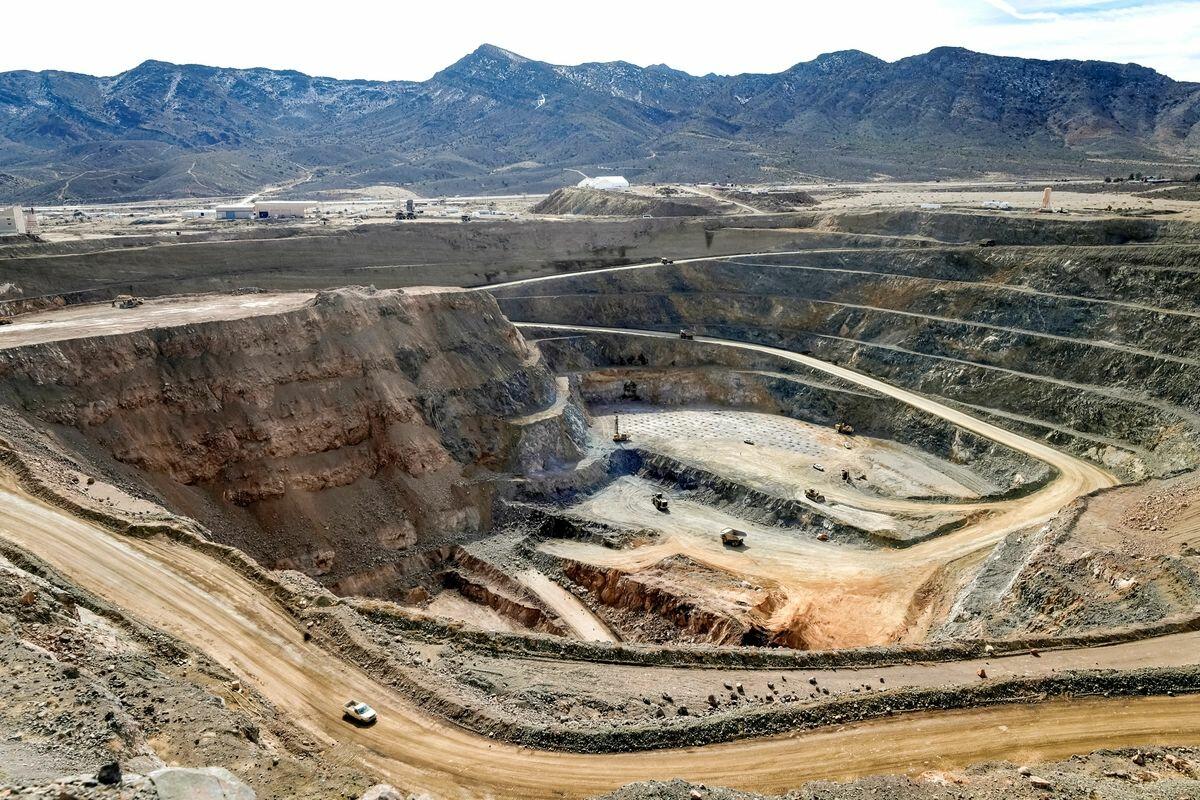
“This is a single-source dominant position that China is weaponizing against the world right now,” Perdue said in a post on X.
“We have told them this is unacceptable,” he said. “We are not going to live in a world where we have to go to China and kowtow to do business the way we want.”
In another post the same day, Perdue described the changes as an escalation from controls on exports from China to restrictions with consequences for people and businesses seeking alternatives.
“Back in April of last year, China put the export regime process in place for rare-earth elements and magnets,” he said. “Then, on Oct. 9, they weaponized that by expanding that to the entire world.“
“Now, they’ve weaponized it even further by escalating to the point where they make any diversification effort away from China a criminal offense, where they can arrest people, prosecute criminally, seize assets, exit ban, and so forth.”
Beijing has expanded its enforcement of strategic-mineral controls in recent months.
In June, China’s Commerce Ministry established a system encouraging organizations and individuals to report suspected violations involving strategic minerals. The conduct subject to reporting includes routing controlled materials through third countries and illegally transferring controlled technology overseas through investment, research and development, consulting or other means.
People who make verified reports may receive rewards, according to the ministry. Companies that discover that they have violated, or may have violated, the rules are instructed to report themselves, with voluntary disclosure considered as a possible basis for a lighter penalty. The system took effect July 1.
Rare-earth technology is also subject to controls covering more than shipments of minerals.
Rules Beijing announced last October covered technology used in rare-earth mining, refining, metal production, magnet manufacturing and recycling. They defined exports to include transferring or providing controlled technology to foreign organizations or individuals through investment, joint research, employment, hiring, and consulting.
The rules also barred Chinese citizens and organizations, without government permission, from providing substantial assistance to overseas rare-earth mining, refining and magnet-making operations.
China suspended implementation of those controls in November 2025 following U.S. – China trade talks, with the suspension formally scheduled to run through Nov. 10, 2026. The two countries agreed this month to extend their broader trade truce by two months, through Jan. 10, 2027, but Beijing has not announced a corresponding extension of these specific controls.
China added another enforcement tool this month.
Regulations that took effect Sept. 15 allow Chinese authorities to stop Chinese citizens from leaving the country for violations of export-control or technology import-export rules that authorities determine may endanger China’s industrial or technological security.
The restrictions have also reached two companies at the center of U.S. efforts to build rare-earth supplies outside China.
On June 22, China’s Commerce Ministry placed MP Materials and USA Rare Earth on an export-control list along with eight other U.S. companies. MP Materials operates the Mountain Pass rare-earth mine in California, while USA Rare Earth is developing a U.S. mine-to-magnet supply chain.
The Chinese order prohibits exporters from supplying the listed companies with dual use items and prohibits organizations and individuals in other countries from transferring Chinese-origin dual use items to them. Special exceptions require an application to the Commerce Ministry.
Beijing said the action was taken in response to the U.S. government adding Chinese companies to its list of “Chinese military companies.”
END
TAIWAN/CHINA
Taiwan Plans $930 Million Sea Drone Buildout As China Expands Maritime Pressure
Thursday, Oct 01, 2026 – 02:45 AM
Taiwan is moving quickly to build a large fleet of unmanned vessels as it looks for cheaper, scalable ways to complicate any Chinese attempt to blockade or cross the Taiwan Strait, according to Nikkei Asia.
The emerging strategy combines something Taiwan already does well, building ships and sophisticated electronics, with American expertise in autonomous systems, artificial intelligence and military command networks.
The potential scale is significant. Taiwan’s navy is considering roughly 1,320 small attack drones for the water, with spending estimated at about NT$29.6 billion, or $930 million. The Coast Guard is pursuing unmanned vessels as well, creating what could become a meaningful new domestic market for maritime defense technology.
Taiwan does not need to build the industry from scratch. It already has shipyards capable of designing and producing the physical platforms, along with a deep electronics manufacturing ecosystem. What it needs are many of the technologies that turn an unmanned boat into an effective military system: secure communications, autonomous navigation, sensors, AI, command-and-control software and the ability to coordinate large numbers of vessels simultaneously.

That is where U.S. defense technology companies are increasingly entering the picture. CSBC, Taiwan’s government-backed shipbuilder, recently partnered with Rhode Island-based Havoc to develop autonomous surface vessels using Taiwanese manufacturing and American autonomy technology. Saronic, Anduril, MARTAC, VATN Systems, Albacore, Shield AI and Auterion have also established relationships with Taiwanese organizations, including the government-owned National Chung-Shan Institute of Science and Technology.
Havoc CEO Paul Lwin described the model simply: “American autonomy software, Taiwan-built platforms, Taiwan workforce.”
Nikkei Asia writes that domestic companies are positioning themselves for the spending wave. CSBC has developed its Endeavor Manta unmanned boat and says it has capacity to manufacture about 40 annually. Established shipbuilders Jong Shyn and Lungteh are competing for contracts, while companies better known for drones and semiconductors, including Thunder Tiger and Myson Century, are moving into unmanned maritime systems.
The attraction is partly economic. Instead of attempting to match China ship for ship, Taiwan could deploy large numbers of smaller and cheaper autonomous platforms capable of surveillance, targeting, protecting undersea infrastructure and, in some cases, carrying weapons. The war in Ukraine has provided a real-world demonstration of how unmanned systems can impose substantial costs on a conventionally superior military.
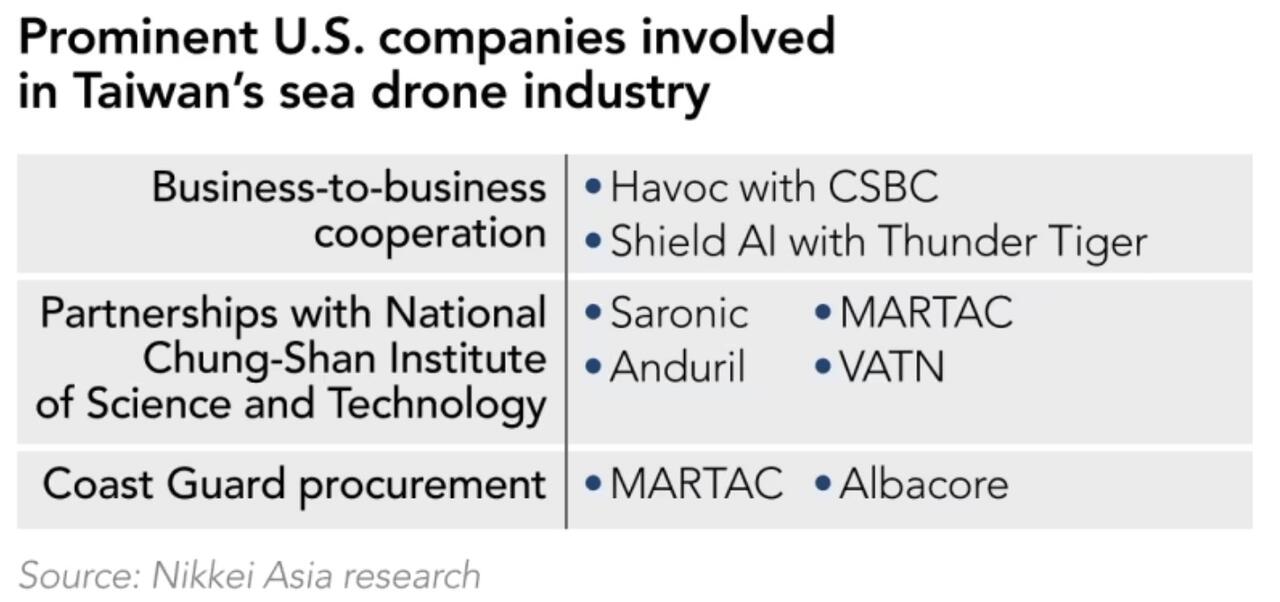
But producing thousands of drone boats is only part of the equation. They must continue communicating, navigating and coordinating in a contested environment where satellites, communications infrastructure and command centers could themselves become targets.
“The key gaps are resilient communications, AI-enabled autonomy and C2, and multi-vessel coordination,” said Cathy Fang of Taiwan’s Research Institute for Democracy, Society and Emerging Technology.
That technological gap helps explain why the growing U.S.-Taiwan partnerships matter. Taiwan can supply the shipyards, electronics manufacturing and eventually the production scale, while American defense technology firms provide much of the software and autonomy layer.
If the navy ultimately proceeds with its proposed 1,320-vessel program, the result could be more than another Taiwanese weapons purchase. It could provide the anchor customer needed to establish an entirely new domestic defense industry built around producing autonomous vessels in large numbers, with Taiwan manufacturing the hardware and U.S. companies supplying much of the technological nervous system.
4. EUROPEAN AND SCANDINAVIAN COMMENTARIES PLUS NATO
EUROPE/
EUROPE/USA/DIESEL
US Warns Europe: Release Emergency Diesel Supplies Or Face Export Ban
Thursday, Oct 01, 2026 – 07:20 AM
The refined products crisis remains unresolved as the Northern Hemisphere winter approaches.
Speaking in the Oval Office on Wednesday, President Trump said he holds discussions “every day” about a potential diesel export ban, blaming Russia’s war in Ukraine for fueling the supply squeeze. His administration is now pressuring European governments to release emergency diesel inventories to contain further price surges and reduce the risk of an economic shock in the coming months.
Reuters reports that the Trump administration has asked Germany and France to release emergency diesel inventories to help create a buffer against the supply squeeze in the industrial fuel or face a potential US diesel export ban.
The total request calls for the release of 120 million barrels of diesel over the next six months, according to a source in a European capital cited by the outlet. That would be equivalent to about 660,000 barrels a day of additional supply.
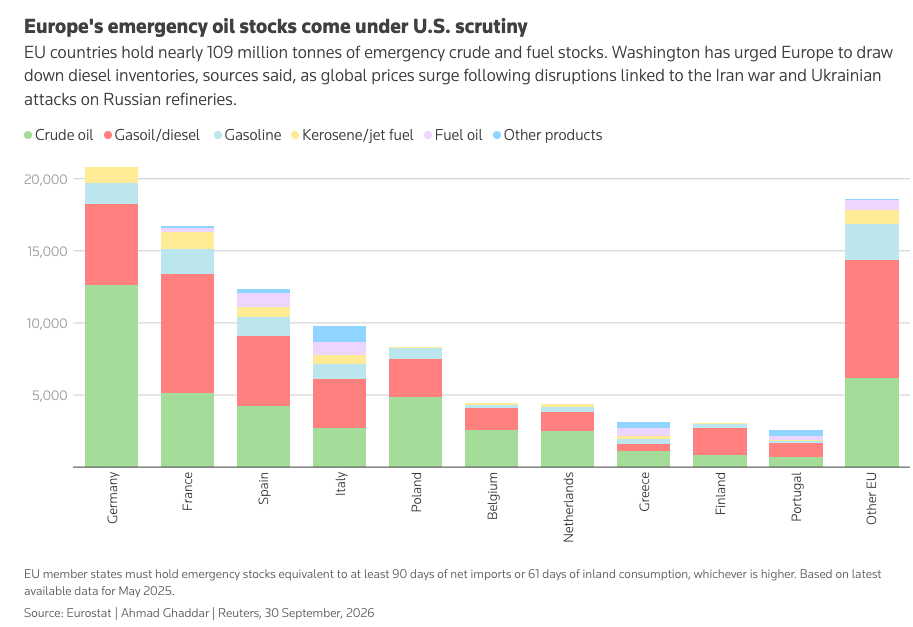
“It is in Europe’s best interest to work with the United States as we pursue multiple pathways to boost the supply of refined products and lower costs for consumers,” one source, a US official, told Reuters.
Trump warned yesterday in the Oval Office that an export ban would “have a negative impact on gasoline” prices but could lower diesel costs. He warned that Russia’s war with Ukraine is the main driver of soaring prices. Russia recently extended an export ban on the industrial fuel.
Goldman analysts Yulia Zhestkova Grigsby, Alexandra Paulus and Daan Struyven noted earlier this week that estimated “dark exports” have helped boost Persian Gulf oil exports to 23.3 million barrels a day over the past week, back to prewar levels. Still, refined product exports remain at just half of their 2025 averages.
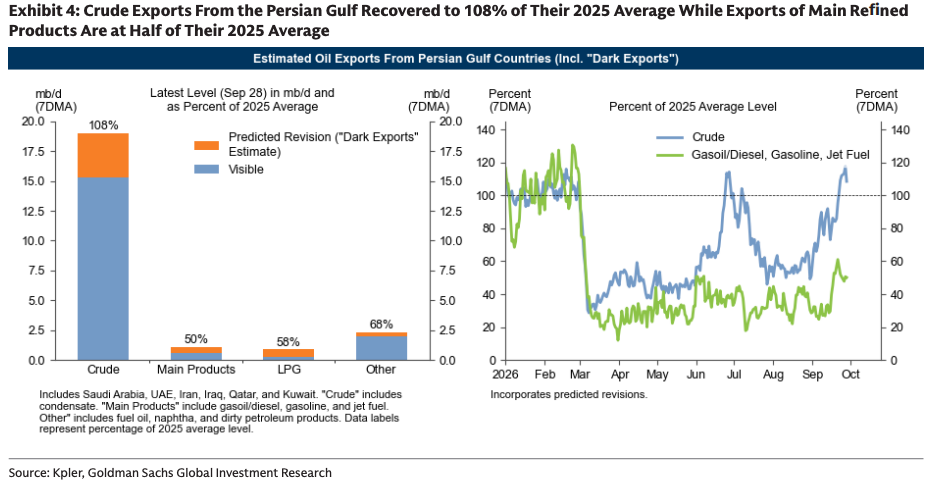
Goldman energy analyst Nikhil Bhandari warned last month that the refining crisis would persist through 2027 and prolong the pain at the pump.
Elevated diesel prices across the West risk triggering an economic shock, according to Bloomberg Intelligence senior commodity strategist Mike McGlone. He said that shock could be similar to what happened during the 2008 energy crisis.
Perhaps the first domino has already fallen: trucking companies with the weakest balance sheets fall first.
Bloomberg commodities expert Javier Blas wrote earlier on X, “Europe is finding itself sandwiched from all sides when it comes to refined products … diesel in particular (some of the damage is due to the US-Iran war; some is due to Ukraine-Russia; some is due to China, and a lot is self-inflicted). Policy response: Head in the sand.”
US Energy Secretary Chris Wright said Wednesday that the Trump administration expects announcements from Europe very soon about tapping emergency diesel supplies.
END
EU
Debt Crisis Back? European Bond Markets Crash, CDS Explode Amid France Budget Panic Contagion
\
Thursday, Oct 01, 2026 – 01:44 PM
It’s starting to smell awful sovereigny crisisy in Europe all over again.
In a vivid deja vu to the peak European debt crisis days of 2010 (and 2011… and 2012… and 2015), credit spreads, credit default swaps and the risk premium in euro-area government bonds exploded on Thursday to levels not seen in over a decade, following a rout sparked by concerns around France’s fiscal and political situation which in addition to local social chaos, is starting to spill over into other markets.
The spread between Italy and Germany’s two-year yields almost doubled to 55 basis points on Thursday, the biggest daily jump since 2020 on a closing basis.
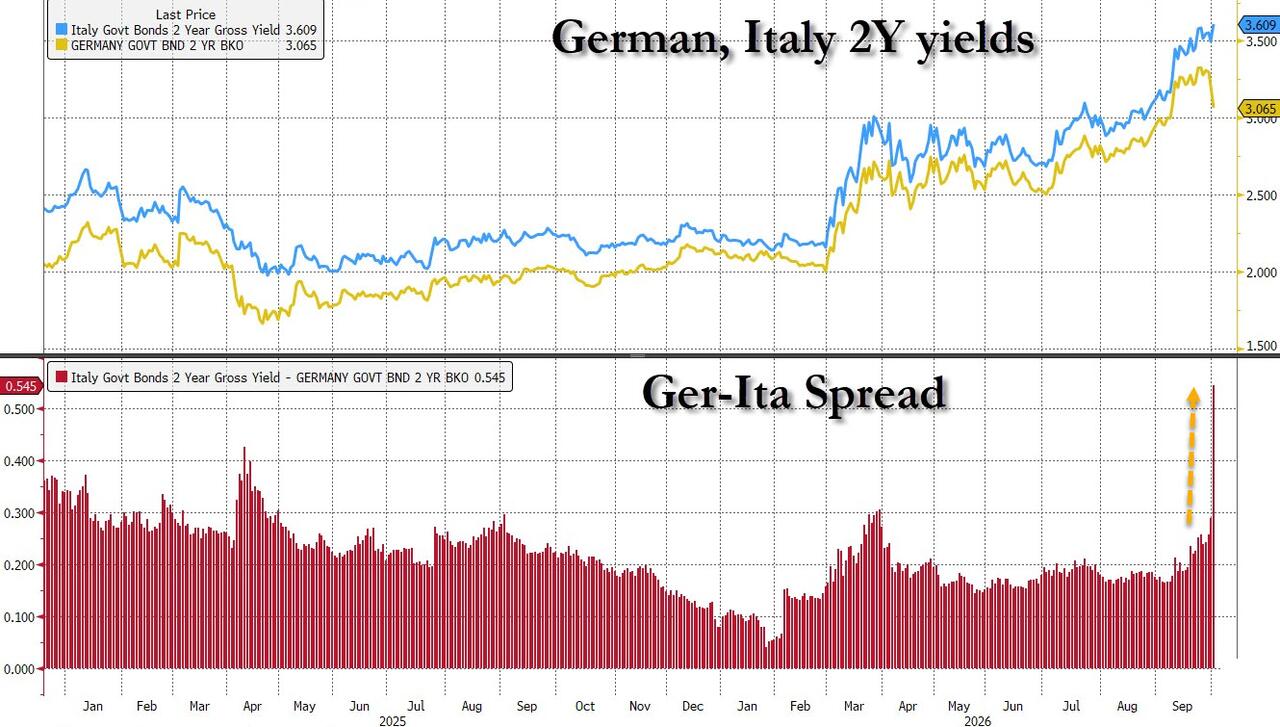
The equivalent gap for France rose as much as 22 basis points, the most since 2012.
Meanwhile, the spread between 10Y French OATs and 10Y Bunds has soared to 1.41%, the highest going back to the 2012 European Sovereign debt crisis.
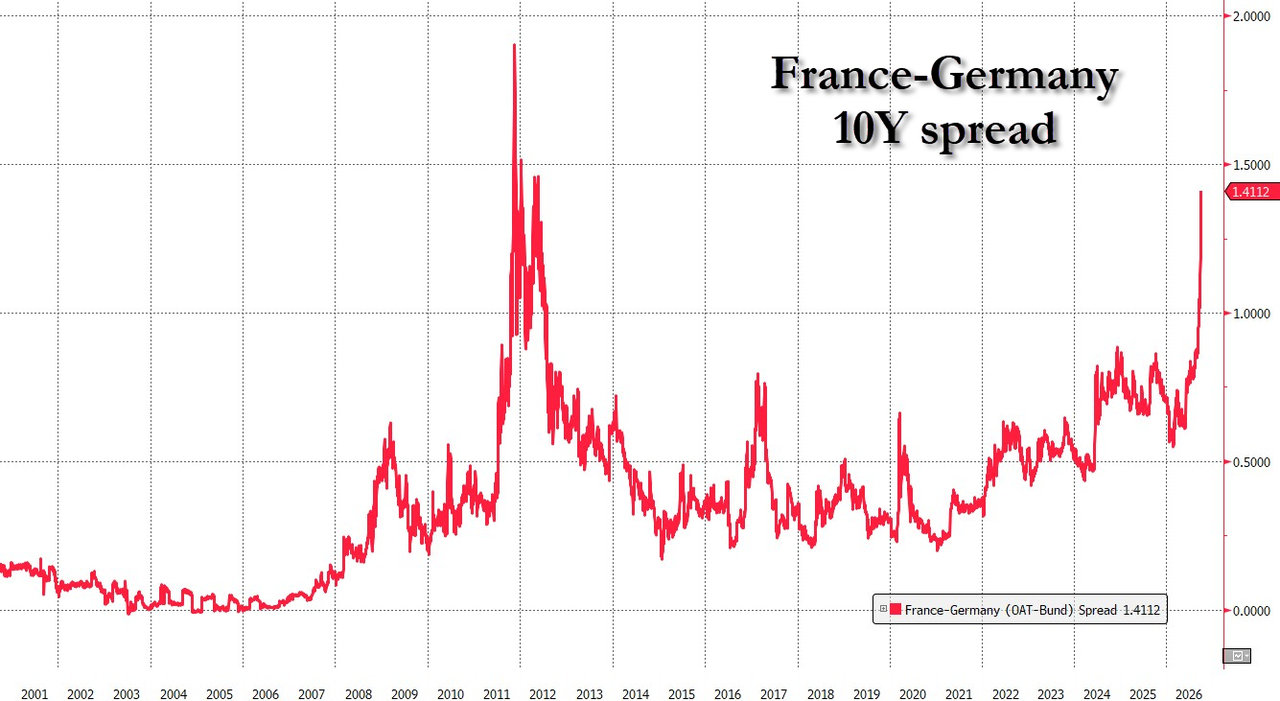
A measure of French bond risk reached another milestone this week as investors positioned for political upheaval next year and an ongoing deterioration in the country’s public finances. The widely watched spread between France and Germany’s 10-year yields jumped 14 basis points on Thursday to 141 basis points, already the widest since 2012.
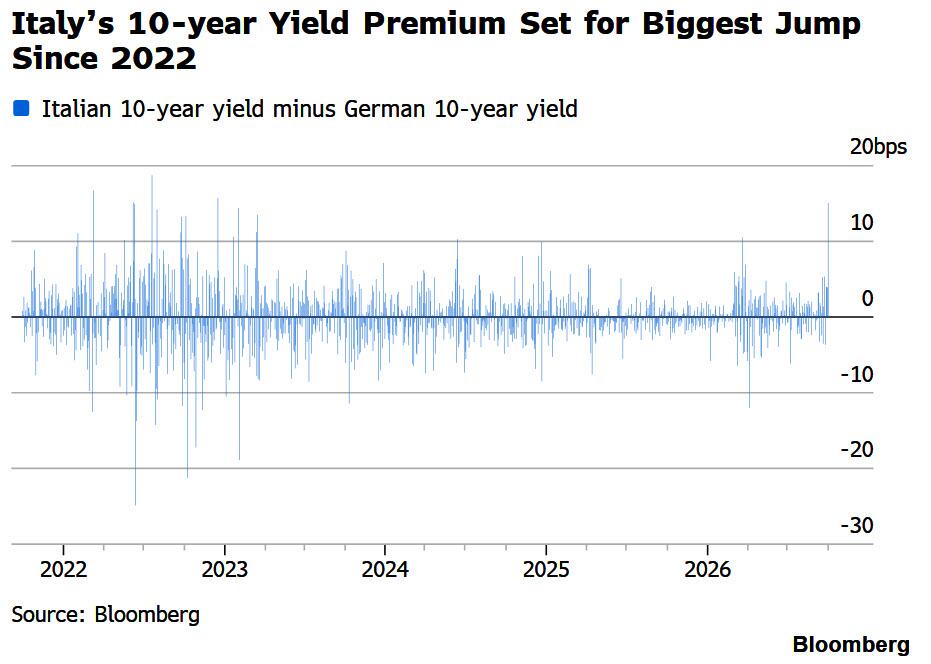
French CDS has more than doubled in the past month on mounting fiscal viability fears.
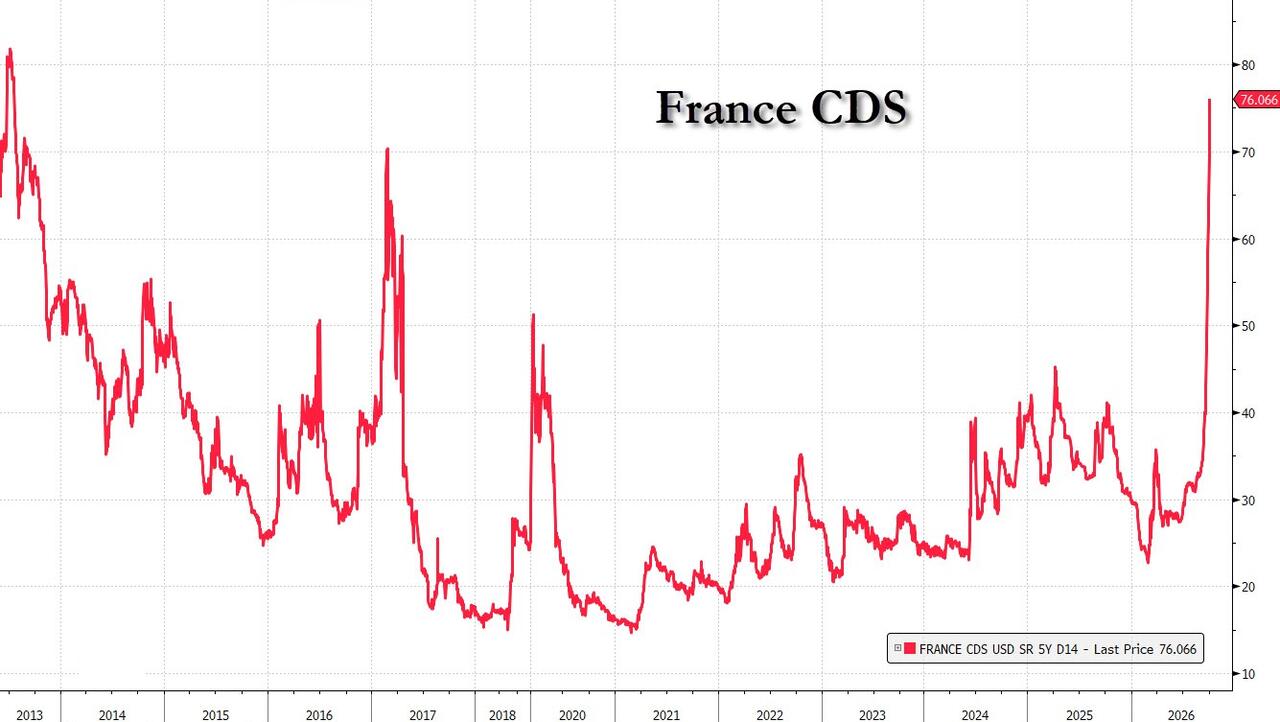
Today’s violent moves came as German bonds rallied sharply as investors rushed for the region’s “safest” asset (which is ironic for a country whose entire manufacturing sector has been gutted by China), while dumping everything else. Curiously, Treasury yields also surged during the European session, as locals dumped US paper alongside the periphery, although the selloff ended the moment Europe closed.
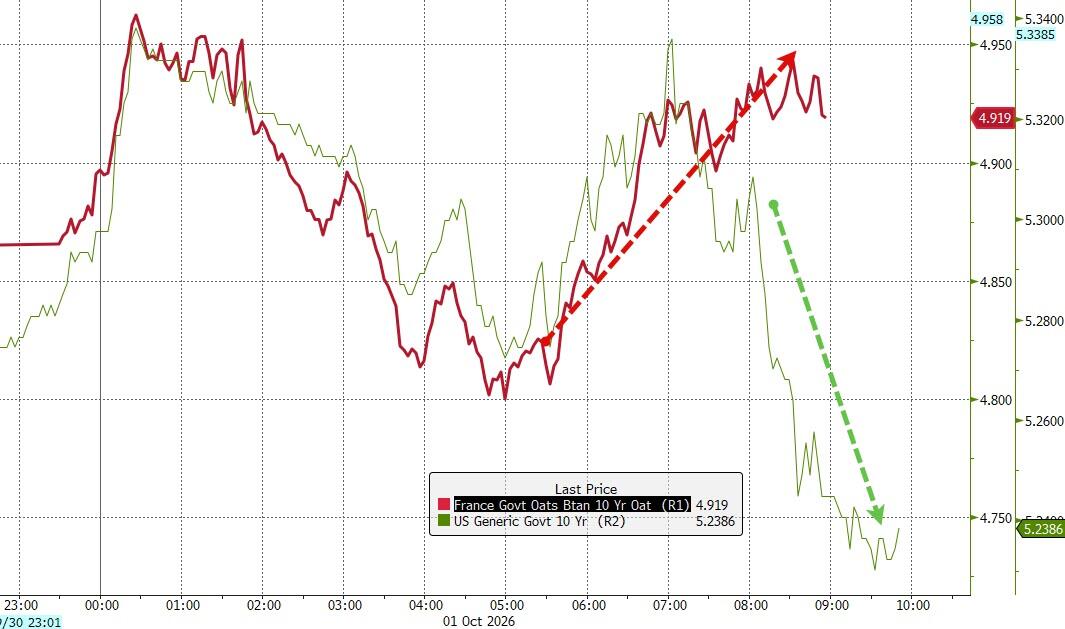
The nervousness suggests the selloff in French markets caused by the nation’s struggle to get a grip on runaway public finances is starting to sap risk appetite more broadly, as we first laid out two months ago in “France’s €107 Billion Deficit Shock: The Next Euro Debt Crisis?“
“France has been slowly but steadily breaking,” said Mike Riddell, lead manager of Fidelity International’s Strategic Bond Fund. “But today feels like the first day that broader financial markets have noticed.”
He’s right:
- ITALY-GERMANY TWO-YEAR BOND YIELD SPREAD WIDENS MOST SINCE 2020
- GERMANY-FRANCE 10Y YIELD SPREAD CLOSES 14BPS WIDER AT 141BPS
There were also signs that markets are starting to price the toll from higher yields – which tighten financial conditions – on the economy. Traders slashed wagers on the extent of further interest-rate hikes from the European Central Bank, and swaps are no longer fully pricing three more quarter-point increases. As recently as Tuesday, they were betting on at least four more.
“The price action is very unusual,” said Rohan Khanna, head of European rates strategy at Barclays. “We are reducing ECB rate hike expectations, yet the EGB complex, with the exception of Germany and the Netherlands, is selling off. It is reminiscent of periods when bond market fragmentation was a major concern, such as during the European sovereign debt crisis.”
In other words, it is reminiscent of when Europe was on the verge – or already in – a debt crisis.
As Bloomberg notes, investors and strategists also said the moves suggested hedge funds have been forced to capitulate on positions as the market moved against them and losses piled up.
“One of the favorite hedge fund carry trades was to own short dated France versus swaps,” added Fidelity’s Riddell. “Some of these positions must have been reduced the past few weeks, but it feels like a capitulation.”
END
UK
DISABILITIES:ED DOWD//UK
COVID VACCINE INJURIES ON THE RISE: THE MUST VIEW….
The Disastrous UK Disability Signal That Corroborates The US Data!
Thursday, Oct 01, 2026 – 02:00 AM
Authored by Ed Dowd: Beyond the Narrative via Substack,
The Disability Signal Across the Atlantic
On August 11 I wrote US Disabilities Hit an All-Time High of 37 Million In July: UP 23% Since Feb 2021. The BLS Current Population Survey printed 37,029,000 Americans 16 and over reporting a disability. That is seven million more people since February 2021, a 3-to-4 sigma break from the pre-2020 plateau that has not mean-reverted.
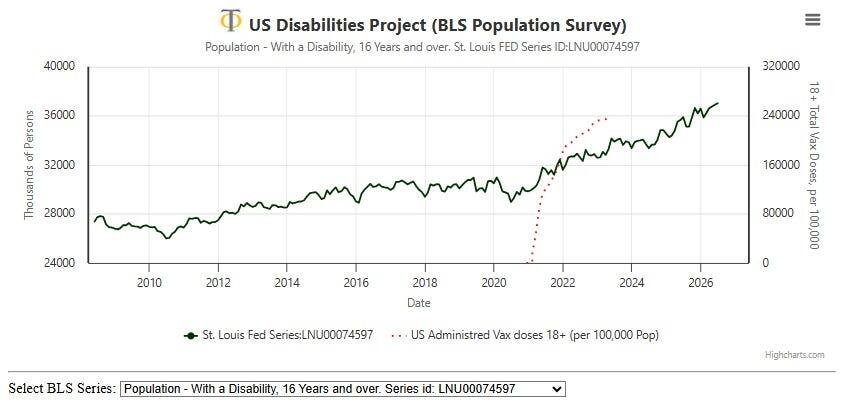
The inflection is February 2021 with the Covid vaccine rollout not in 2020 when Covid was at its most virulent strain. Alternative explanations fail the timing and the magnitude test. The UK PIP system corroborates that US survey signal with something the American series cannot give you: medically assessed new claims broken down by body system and underlying cause.
If you want to know whether that US survey signal is real, stop arguing about survey design and look at an administrative system that actually diagnoses people.
Go back to the UK Disabilities (PIP) Project we published at Phinance Technologies. The page is still up…use it. It was built so researchers, doctors, and ordinary citizens could see the same thing we saw in 2023. You can look at total body system new claims or by underlying cause new claims (best viewed on desktop) within a body system. You can pick absolute new claims, excess new claims, percent excess new claims and excess new claims z score. We also break it out by monthly and yearly data. Finally you can sort it by age group as well. Play with data and be horrified like we were in 2023. Interactive charts…all done by Phinance Technologies for free.
PIP is not the protagonist from Charles Dickens’s novel Great Expectations. It is the UK’s main working-age disability benefit officially known as the Personal Independence Pension program by the UK Department of Work. Claims are medically assessed. Decisions, “clearances,” as noted above are coded by body system and then by underlying cause. The positive award rate has been stable at around 40 percent, so you are not looking at a sudden collapse in standards. You are looking at more people presenting with more illness…new claims, not just the stock of existing claimants, sorted monthly or yearly and by age band versus a 2016-2019 trend.
That is the advantage over the US survey. The BLS series tells you that disability exploded after early 2021 with the vaccine rollout and not in 2020 with the virus. PIP tells you where in the body it exploded, and it lets you watch the timing against the vaccine rollout curve on the same chart.
Two Body Systems Make the Point
Hematological (blood) disorders went off the rails. New excess clearances rose about 217 percent in 2021 and then 522 percent in 2022 while 2023 declined but still at an absurd 374 percent above trend. Over 300 percent above trend two years running. When looking at new claims on a monthly basis Hematology jumped early and hard almost coincident with the first doses. That is a regime change in medically assessed claims. I have posted those charts more than once on X in 2023. Something broke and the administrative system recorded it at a scale that alone should have produced a public-health investigation…it did not.
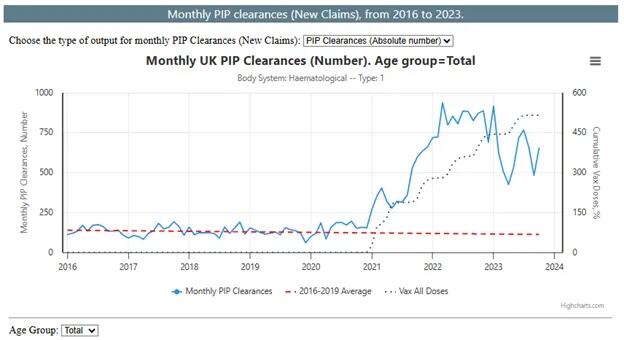
Musculoskeletal claims tell a different, equally inconvenient story. Monthly clearances sat near a “normal” 10,000 through 2020 and early 2021. Then, around September 2021, they jumped and stayed elevated above 18,000 a month. The rise did not arrive with the first lockdowns or the first COVID wave. It arrived after the mass rollout and into the booster period. Inflammation, joint and soft-tissue disease, the conditions that take people out of work and onto daily-living and mobility awards. The timing is not subtle.
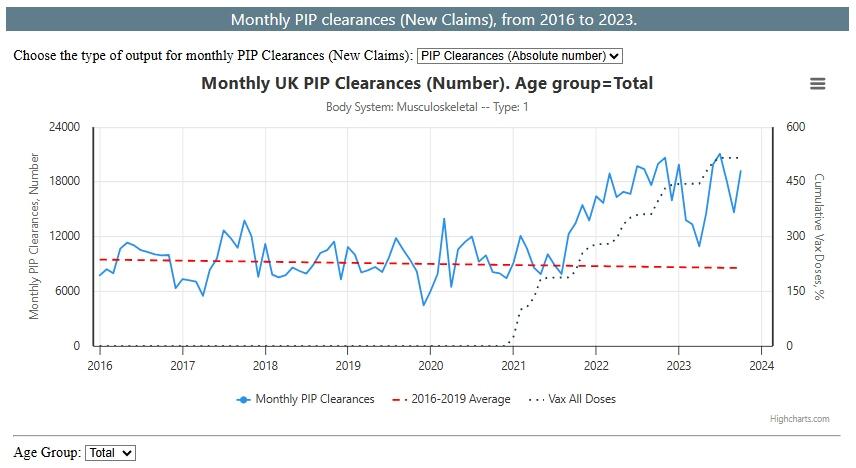
Those two systems are not the whole file. Cardiovascular and neurological claims rose. Breast-cancer clearances showed large excesses in 2022 and 2023 with high z-scores. Different latencies, same calendar: the break is 2021, not 2020. That is why the UK file is useful. It is not one blob called “disability.” It is a set of body systems with different clocks, all accelerating after the intervention that was supposed to end the emergency.
People will say PIP is being gamed by fraud. Look at the body-system split before you buy that. A fraud wave does not preferentially light up hematology in early 2021 and musculoskeletal in late 2021 while neurological claims print 20 plus-sigma years. An awareness campaign does not move breast-cancer clearances. Two independent disability systems, two countries, both detecting the same inflection period in 2021.
The fiscal piece is already visible in Britain. Claimant counts have roughly doubled since 2019. Psychiatric disorders are now the largest single category. Spending is on a path that forces politicians to talk about “sustainability” and tighter points tests instead of asking why so many working-age bodies failed in the same window. The US version of that conversation is coming. A permanently larger disabled share of the 16-plus US population is lower labor force participation, higher absence, higher insurance cost, and more pressure on SSDI and Medicaid. You can ignore a chart. You cannot ignore the payroll.
Bottom Line
I am not a clinician. We said that on the site in 2023 and asked doctors to explain the findings…mostly crickets. The charts are still there. Pick a body system. Pick an age band. Look at the cumulative dose curve. Watch across the many body systems how in 2020 they stay close to trend and then in 2021 they leave the trend. That is the instruction. The US disability series tells you that the population got sicker after February 2021 in the US. The UK PIP file tells you which systems broke and when.
Together they are the corroborating signal no one in official public health circles wants you to see.
The great cover up continues into 2026 and the damage is slowly compounding.
END
BULGARIA/EU/RUSSIA VS UKRAINE
A Lone Voice Of Sanity On NATO’s Eastern Flank Emerges
Thursday, Oct 01, 2026 – 06:30 AM
There are a few sane voices left in the EU and NATO when it comes to urging an immediate de-escalation of rhetoric regarding Russia. Still, it’s a refreshing surprise when dovish sentiment comes from a country forming part of NATO’s eastern flank in particular.
“We always need to think about the worst-case scenario,” Bulgarian Prime Minister Rumen Radev has told a European defense summit while warning that seeking to impose total defeat on Russia poses real risks of nuclear war.
Radev instead urged robust diplomacy to avert such a catastrophe. “The problem is that no one is raising the question about nuclear risk. Does it exist? Maybe not, I don’t know, but this is a risk,” he stated in remarks published Wednesday.
“I don’t think the war in Ukraine will end in a nuclear war but we have to be prepared for the risk.”
“We always need to think about the worst-case scenario. Are we prepared for this? Does anybody speak about risk assessment? Does it exist at all? Because we have been trying to achieve a conventional victory over the biggest nuclear power.”
He acknowledged that “there is a nuclear card” which Russia would be more likely to play if it perceived itself cornered.
“We need to have this into account. We cannot close our eyes (to the fact) that there are nuclear weapons on our continent, there are nuclear weapons in the arsenal of Russia.”
The Bulgarian prime minister emphasized, “And this is part of the game calculation.” What has he gotten for his sensible calls for walking back tensions with Moscow? Western mainstream media has consistently labeled him “Kremlin-friendly”.
Radev still made clear in this week’s comments that he rejected “this type of speaking” [nuclear rhetoric] from the Kremlin, referring to the recent example of Russian Foreign Minister Sergey Lavrov, who warned earlier this month that a war between Russia and Europe would be “completely different” and “very short”.
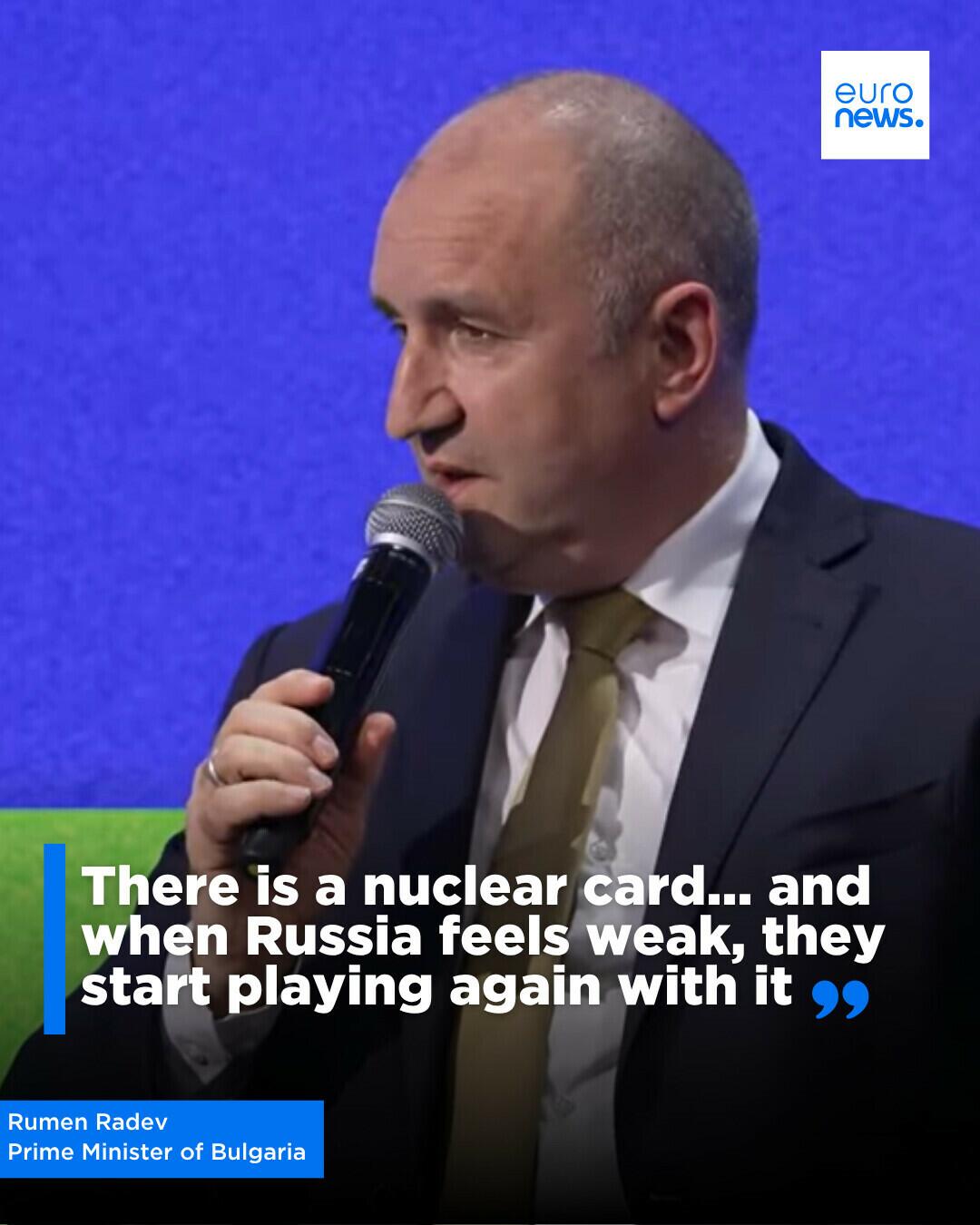
The words were widely seen as a veiled threat of deploying strategic forces against Europe.
Early this week NATO leadership called out what it slammed as ‘desperate’ rhetoric on the part of the Kremlin, also at a moment of growing accusations from European officials that Moscow is engaged in sabotage against EU interests and assets.
“Russia’s use of hybrid tactics is a sign of desperation. But we will not be dissuaded from our support to Ukraine,” NATO spokesperson Allison Hart said Tuesday, adding that “we [NATO] have what it takes to defend every inch of allied territory and remain strong, ready, and able to counter any threat.”
“NATO is a defensive alliance and none of our activities or exercises pose a risk to any part of Russia,” she reiterated. “We strongly denounce the threat of force, including any irresponsible nuclear rhetoric.” Hart added: “We call on Russia to end its unprovoked war in Ukraine.”
Finally some serious questioning of the narrative: Where is the proof that the ‘Russians are coming’ – or are on the brink of some kind of invasion of European states?
As for other tiny handful of EU countries which have been voices of sanity which call for dialogue with Russia, this has included:
- Slovakia
- Austria
- Czech Republic
- and Hungary (or at least, while it was previously under Viktor Orban)
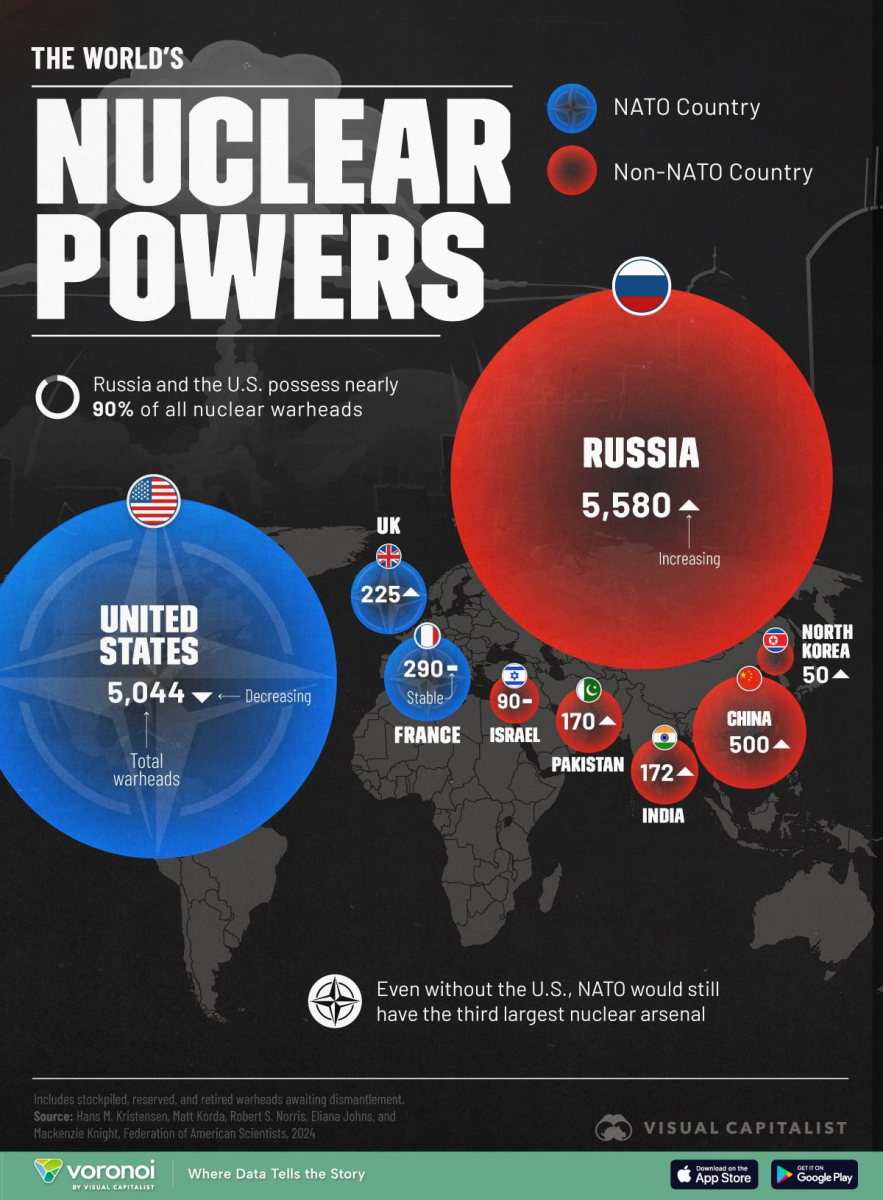
Meanwhile, on Wednesday a new alarming headline has emerged connected with the Ukraine war: Russian Foreign Ministry spokesperson says European weapons factories producing arms for Ukraine are legitimate military targets for Russia. Things look to grow a lot hotter before they cool off.
END
5.RUSSIA AND ISRAEL AND MIDDLE EASTERN AFFIARS
ISRAEL/USA VS IRAN/ THURSDAY
Supertanker Ablaze After Iran Attack In Hormuz As US Deploys 10K More Troops & Third Carrier To Mideast
Thursday, Oct 01, 2026 – 03:30 PM
Update(1530ET): Iranians are apparently going back on the offensive, after it’s been widely reported that US-protected oil transit through the Strait of Hormuz has been fast gaining steam. Iran state media says a supertanker is burning off the coast of Oman after coming under Iranian attack:
Local sources reported that a 2.5 million barrel capacity supertanker that was traveling through the Strait of Hormuz illegally was hit 8 kilometers off the coast of Oman and is burning, reports Fars
Earlier we reported that starting in mid-August (on Aug. 16), Iran’s Supreme National Security Council set October 1 as a deadline. It warned at the time that if Washington failed to lift its naval blockade of Iranian ports within 45 days, Tehran could resume attacks against US forces, and by implication step up attacks on foreign shipping.
Iran’s 45-day deadline for the United States has now expired. That deadline has now passed, potentially adding another layer of uncertainty to an already tense confrontation where Tehran may decide it must act ‘preemptively’ while facing more bombs by Trump (likely after the midterms).

* * *
Signs of potential major escalation, or the next round at least (which Trump has hinted will come after the midterm elections), just hit The Wall Street Journal, and sent oil prices soaring. A quick summary:
- The Pentagon is sending a third aircraft-carrier strike group and additional Marine Corps ships to the Middle East, adding 9,000 to 10,000 more troops to the region.
- The ships, jet fighters, Marines and sailors will arrive in the region by the end of November, as President Trump considers renewing strikes on Iran after the midterm elections.
- The additional servicemembers will add to the more than 50,000 troops already in the region, with the deployments coming after Trump rejected Iran’s latest proposal for a seven-day ceasefire.
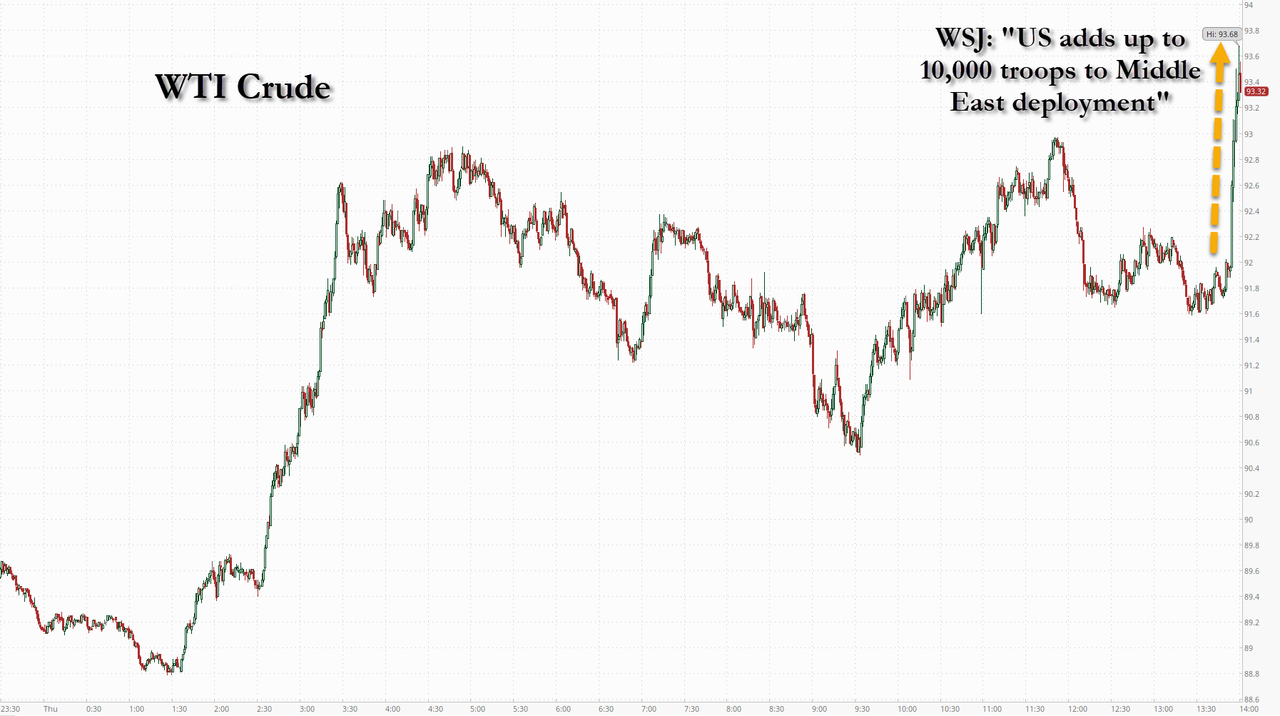
The Trump administration is deploying a third aircraft carrier to the Middle East along with additional Marines, an American official also told Israeli media on Thursday. And later, in the afternoon, Trump posted a new Truth Social message as follows:
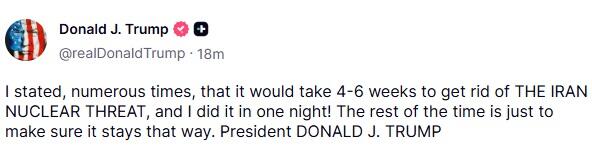
The USS Theodore Roosevelt is en route to US Central Command’s (CENTCOM) area of operations after having just left San Diego this week. It is expected to relieve the Japan-based USS George Washington, which entered regional waters in mid-August.
But both carriers could also stay on extended deployments. The WSJ writes further:
The additional moves will further strain the U.S. Navy, however, which has experienced supply shortages and faced near-record deployments during the conflict. Iran has in recent weeks fired ballistic missiles at American warships. The crew of the Roosevelt is prepared for a longer-than-normal deployment as well, according to senior Navy officials.

Carriers which more frequently had Indo-Pacific deployments have been increasingly diverted to the Middle East in recent years, a trend which had only picked up steam amid tensions with Iran and the Houthis out of Yemen.
Also on Thursday Al Jazeera is newly reporting that three carriers will stay in regional waters, “By the end of November, three aircraft carriers and two landing groups will be deployed around Iran,” a US official told the Qatar-based outlet.
And USNI News earlier detailed:
On September 28, USNI News reported that a U.S. defense official had confirmed the carrier’s departure from San Diego the previous day. Navy officials had also warned families that the deployment could exceed seven months, with eight months being used as the planning baseline.
Carrier Strike Group 9 includes Theodore Roosevelt, Carrier Air Wing 11, Destroyer Squadron 23, Information Warfare Squadron 9 and the Ticonderoga-class guided-missile cruiser USS Chosin (CG-65). Its embarked air wing brings together several combat and support aircraft. The strike component includes F-35C Lightning II fighters from VFA-86, F/A-18E Super Hornets from VFA-211 and VFA-25, and F/A-18F aircraft from VFA-154. VAQ-137 operates the EA-18G Growler for electronic warfare, while VAW-115 flies the E-2D Advanced Hawkeye for airborne surveillance and command and control.
Whether one of the carriers ends up leaving the theatre or not, the extra deployment does mean President Trump will have a wider range of options for more possible military actions against the Islamic Republic.
He has in a freshly published TIME interview this week reiterated that he may be escalating attacks on Iran after the November midterms if an acceptable deal can’t be reached.
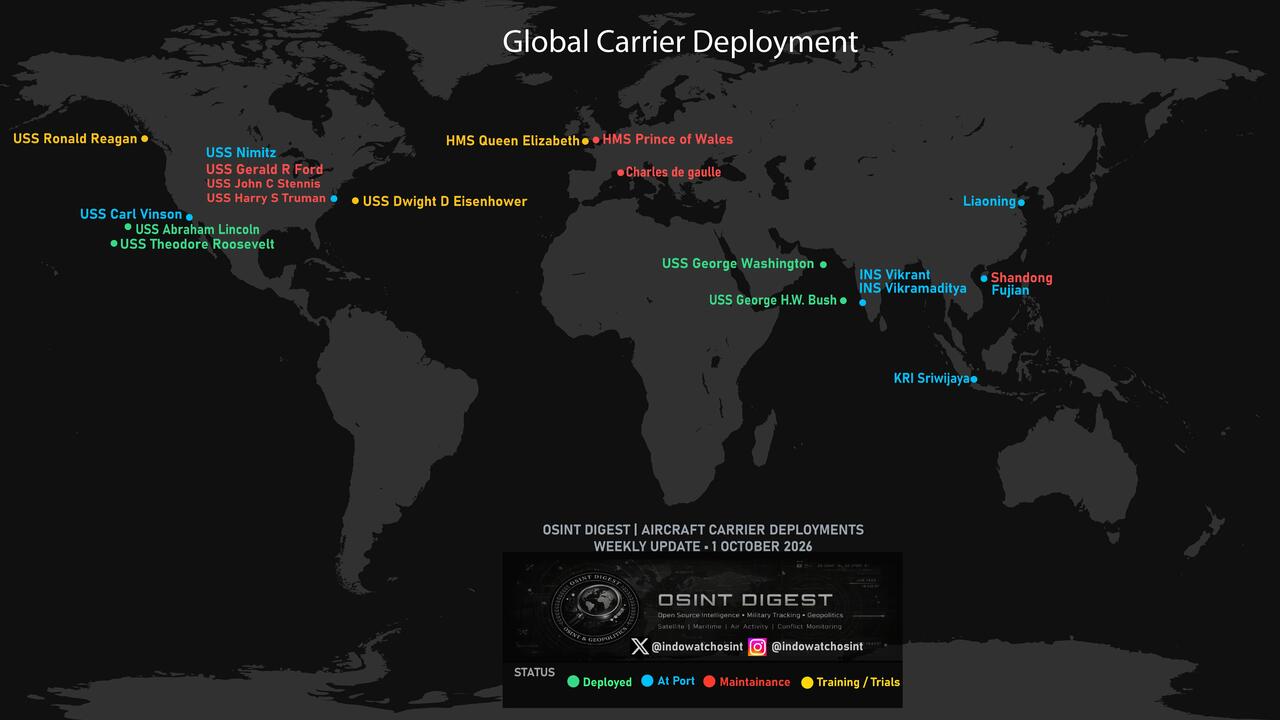
As for the new carrier deployment, it was additionally confirmed: “During a town hall on August 31, Chief of Naval Operations Adm. Daryl Caudle said USS Theodore Roosevelt would be the next carrier sent to the Arabian Sea and was expected to relieve USS George Washington.”
But again, follow-up reports suggest it will not be to relieve one of the carriers, but to serve as a likely third floating base of support for Iran operations.
ISRAEL TBN
UAE/ISRAEL/IRAN?
Netanyahu: Israel to join flydubai probe, ‘we’ll find out’ whether Iran was involved
In a CNN interview, Netanyahu revealed Israel will join the flydubai probe, praised heroes who averted a ‘9/11 disaster,’ denied pre-October7 warnings, and called settler violence framing a ‘hoax.

Israeli Prime Minister and Likud party chairman Benjamin Netanyahu, surrounded by supporters, during an election campaign tour in the southern Israeli city of Ashdod, September 29, 2026(photo credit: Liron Moldovan/Flash90)ByIDAN KWELLEROCTOBER 1, 2026 02:48
In a wide-ranging CNN interview, the prime minister said UAE President Sheikh Mohammed bin Zayed agreed that Israel would participate in the investigation. Netanyahu said Israel had no specific warning about the flydubai incident, defended the war against Iran, rejected reports of pre-October 7 warnings, and called the framing of “settler violence” a “tremendous hoax” while condemning vigilante attacks.
Prime Minister Benjamin Netanyahu said Wednesday that Israel would join the investigation into the Flydubai co-pilot suspected in the dramatic incident aboard a flight approaching Israel, saying investigators would soon be able to determine whether Iran had any connection to the event.
In an interview with CNN’s Jim Sciutto, Netanyahu stressed that he did not yet have information allowing him to attribute the incident to Tehran.
“What we know is [that he is] an Omani national,” Netanyahu said of the attacking co-pilot.
Netanyahu described screams coming from the cockpit as the aircraft approached Israel and said an Israeli passenger, a plumber named Yaniv, rushed toward the cockpit.

Netanyahu’s account of the flydubai incident
According to Netanyahu, the Indian pilot who had been stabbed “showed incredible heroism” by managing, despite bleeding heavily, to unlock the cockpit door.
“The Israeli passenger burst in, saw the attacking co-pilot hover over the instruments,” Netanyahu said. “He wasn’t sitting in one of the two pilot seats, but he was trying to jam the instruments.”
Netanyahu said the passenger threw the attacker backward, took the controls and pulled back on the stick while another Israeli passenger and an air crew member helped restrain the attacker.
Reserve pilots who had been in the passenger area then entered the cockpit and stabilized the aircraft, which Netanyahu said had gone into a nosedive and sustained damage to its rudder and tail.
“The amazing heroism here of the Indian pilot, the Israeli passenger and his colleagues, and those pilots managed to prevent a 9/11 disaster, because that’s what it looks like was happening,” he said.
‘No specific warning’
Sciutto asked Netanyahu whether his warning a day earlier that Israel’s enemies could try to attack ahead of the election had been based on intelligence related to the flydubai incident.
“No, not specifically,” Netanyahu replied.
“What we had is a lot of information streaming in that Iran’s proxies, in particular Hezbollah and Hamas, were planning attacks against Israel and Israeli civilians abroad. But I can’t tell you that we had any specific warning about this.”
Netanyahu said the suspect was being interrogated in Saudi Arabia and that he expected him to be transferred to the United Arab Emirates.
“I spoke to the president of the United Arab Emirates, Sheikh Mohammed bin Zayed, and he agreed that Israel would join the interrogation,” Netanyahu said. “So we’ll find out very soon if Iran had anything to do with it, but I can’t say that in advance of the conclusion of the interrogation.”

He later added: “We know that Iran is sponsoring a lot of this, but I can’t speak specifically of this.”
Netanyahu did, however, assert that Iran had been behind a separate attack in Britain.
“They did stand behind the attack in Britain. We passed that information to the Brits,” he said, before criticizing London for imposing sanctions on Israel days later. “The cynicism and the hypocrisy here is unbelievable.”
Iran nuclear program: ‘It’s not an intelligence assessment. It’s intelligence’
The interview then turned to Iran and reports that Tehran may be trying to rebuild nuclear infrastructure.
“It will if it can,” Netanyahu said when asked whether Iran would try to resume its nuclear program.
“But I think President Trump’s actions, the blockade, are very effective in crippling this regime. And obviously, yes, they will try to resuscitate their nuclear program, and it’s something that we’re obviously tracking all the time.”
Netanyahu said his goal and US President Donald Trump’s goal were the same: preventing Iran from obtaining nuclear weapons.
He argued that the economic blockade was “really crippling the IRGC economy” and said Iran was “reeling from this economic blockade.”
Asked whether the war had failed to achieve Israel’s objectives because Iran’s highly enriched uranium had not been secured, Netanyahu rejected the premise.
“I think, first of all, it achieved a great objective,” he said. “They’re on the verge of manufacturing nuclear weapons, atomic bombs, and if we hadn’t acted, they’d have them already, and they probably would have used them, and that would have changed history.”
When Sciutto asked what intelligence assessment supported that claim, Netanyahu replied: “It’s not an intelligence assessment. It’s intelligence. We had it very clear. That’s why we had to act.”
Netanyahu compared the nuclear threat to cancer.
“You know you have a big lump of cancer, and you know one thing: if you don’t remove it, then you’re going to die,” he said. “But it doesn’t mean that the cancer can’t come back. So we have to be on constant alert.”
Netanyahu rejects reports of pre-October 7 warnings
Sciutto also pressed Netanyahu on recent reports that Egypt and the UAE had warned him ahead of the October 7 attacks and asked whether he accepted personal responsibility for not doing more to prevent them.
“First of all, those reports are false,” Netanyahu said. “They didn’t give me any such warnings. That’s completely false.”
He said “elements” in neighboring countries and political opponents were promoting what he called lies.
“I didn’t receive such warnings,” he said.
Asked whether there was anything he wished he had done differently before the attack, Netanyahu said there had been no solid intelligence assessment warning of such an assault.
“In fact, the intelligence assessments were the exact opposite, including days before the attack,” he said.
Netanyahu said security meetings held shortly before October 7 had concluded that “Hamas is deterred” and wanted economic benefits.
“So clearly, we were all blindsided by this,” he said.
He added that the failure should nevertheless be investigated.
“We do ask that question, and we’re going to come to the bottom of it, obviously, with a proper investigative effort.”
‘Settler violence’ framing a ‘tremendous hoax’
Toward the end of the interview, Sciutto challenged Netanyahu over violence by Israelis in the West Bank and asked whether his government had lost control of settler violence.
“The settler violence thing is a tremendous hoax,” Netanyahu responded.
He immediately clarified that he was not denying that violence had occurred.
“It’s about 150, 200 juvenile delinquents who are doing this, and I can’t stomach that,” he said. “I can’t accept vigilante action. We’re a country of laws, so I put the Shin Bet, our security services, against them.”
Netanyahu said he had already condemned such incidents.
“I can’t tolerate vigilantes and I can’t tolerate uncontrolled violence or any kind of violence that is directed against civilians. That’s not something we accept.”
But he argued that comparing such violence with Palestinian terrorism created a false equivalence.
“To compare this is like to compare an olive to a toxic tree,” Netanyahu said.
He cited figures on shootings, explosive-device attacks, stabbings, car-ramming attacks, suicide attacks and kidnappings against Israelis and said the scale was fundamentally different.
At the end of the interview, Netanyahu also addressed the future of Israeli forces in Gaza and Lebanon.
He said Israel would remain in security corridors in both arenas as long as Hamas and Hezbollah retained the ability to threaten Israel.
“Once these two malign forces, these terrorist monsters, are defeated,” Netanyahu said, “then I think a whole new opportunity for peace and for prosperity occurs in the Middle East, both for us and for our Arab neighbors.”
END
FLYDUBAI/ISRAEL/CO PILOT
Ben-Gvir to demand extradition of flydubai pilot to Israel after attempted terror hijacking
“Our security doctrine must be clear: Anyone who tries to murder or harm Israelis, the State of Israel will pursue them and settle the score with them anywhere in the world,” he said.

National Security Minister and Otzma Yehudit party chairman Itamar Ben-Gvir, together with members of his party, arrives to submit the Otzma Yehudit party list to the Central Elections Committee ahead of the upcoming Israeli general elections at the Knesset, in Jerusalem, September 7, 2026.(photo credit: YONATAN SINDEL/FLASH90)BySHIR PERETSOCTOBER 1, 2026 13:49Updated: OCTOBER 1, 2026 13:51
National Security Minister Itamar Ben-Gvir will demand at Thursday’s security cabinet meeting that Israel seek the extradition of the flydubai pilot who attempted to hijack a Tel Aviv-bound passenger plane on Wednesday, according to a statement from the minister’s office.
Ben-Gvir, a member of the security cabinet, stated he would call on the Justice Ministry and relevant diplomatic officials to immediately use all available means to secure the suspect’s extradition to Israel, where he would be questioned and prosecuted to the fullest extent of the law.
“Anyone who planned to crash a plane and murder 180 Israelis must be extradited to Israel and pay the heaviest price here,” Ben-Gvir said. “We cannot be satisfied with the fact that the disaster was prevented through abundant divine mercy and thanks to our heroic passengers.”
“Our security doctrine must be clear: Anyone who tries to murder or harm Israelis, the State of Israel will pursue them and settle the score with them anywhere in the world,” he added.

Transportation Ministry calls halt to flydubai flights amid investigation
Ben-Gvir was among several government ministers who responded to the incident on Wednesday by calling for a tougher approach to threats against Israelis. He praised the passengers who intervened and said Israel’s security doctrine needed to be strengthened following the attack.
The incident also prompted an Israeli review of aviation security measures. Transportation Minister Miri Regev called for flydubai flights to Israel to be halted after questions emerged over the Omani pilot’s presence on a route to Israel, while Israeli aviation and security officials examined procedures for responding to suspicious aircraft approaching Israeli airspace.
HEZBOLLAH/IRAN
CENTEF report reveals Hezbollah acquired $157m of weapons in 2024, majority provided freely by Iran
The report, titled Hezbollah Financial Statements, is the first installment in a series set to expose Hezbollah’s spending on media, payments to wounded fighters, and its military infrastructure.

Hezbollah rockets discovered by the IDF in southern Lebanon, May 2, 2026.(photo credit: IDF SPOKESPERSON’S UNIT
)ByDANIELLE GREYMAN-KENNARDOCTOBER 1, 2026 14:01Updated: OCTOBER 1, 2026 14:11
Hezbollah acquired an estimated $157 million worth of weaponry in 2024 despite its war with Israel, with the vast majority donated by the Islamic Republic at no cost to the Iran-backed group, according to Israeli Center for Research of Terror Financing’s new research published on Thursday.
The report, titled Hezbollah Financial Statements, is the first installment in a series set to expose Hezbollah’s media spending, payments to wounded fighters, and spending on its military infrastructure.
Based on open-source information and valuations of known Hezbollah military assets, CENTEF estimates that Iran provided roughly $129 million worth of weapons and military equipment as an in-kind grant, while Hezbollah itself spent approximately $28 million in cash on its acquisitions.
Seeking to understand Hezbollah’s expenses as a business entity, to better assess the terror group’s financial health and identify ways to weaken it while avoiding the costly airstrikes that can have significant consequences for Lebanese civilians, the researchers examined the group’s weapons procurement and manufacturing costs, as well as its ability to sustain its arsenal if the Islamic Republic’s capacity to supply it were reduced.
Explaining the rationale behind the analysis, CENTEF CEO Sharon Gal told The Jerusalem Post that breaking down Hezbollah’s finances as a business could help legislators and operators efficiently identify and prioritize key supply chains to disrupt, creating pressure points on Iranian-backed terror groups.

Researchers aim for interactive tool on Hezbollah finances
Expanding those efforts, researcher Marc Cohen told the Post that they plan to release an interactive tool to help civilians understand Hezbollah’s financial statements, with the hope that it can raise awareness of Hezbollah’s negative impact on the Lebanese economy and the scale of its operations.
The researchers looked at the different types of military equipment Hezbollah is estimated to have acquired in 2024, including rockets, missiles, drones, ATGMs, air-defense systems, ammunition, launchers, naval equipment, and IED-related assets.
Hezbollah’s own investment in its weapons is limited to small arms, ammunition, drone components, dual-use equipment, and equipment obtained through its international procurement networks.
Because Hezbollah’s weapons acquisitions are clandestine, the researchers had to estimate how many weapons the group acquired in 2024 rather than rely on procurement records. They used three methods: Analyzing Hezbollah’s historical rate of replenishing its arsenal, assessing Iran’s capacity to manufacture and deliver weapons, and comparing global benchmarks for the costs of equipping, training, and mobilizing military forces.
The first method was based on Hezbollah’s growth over the past two decades. According to estimates from the Center for Strategic and International Studies, Hezbollah had approximately 15,000 rockets in 2006 and had expanded its arsenal to roughly 150,000 by 2024, amounting to an average increase of about 7,500 rockets per year over 18 years of Iranian resupply.
Acknowledging that Hezbollah’s replenishment likely varied year-to-year, it estimated that the disruption to Hezbollah’s supply chain and manufacturing abilities during the 2024 fighting resulted in them acquiring approximately 4,500 to 6,500 rockets and missiles during the year.
The second method considered Iran’s ability to actually supply Hezbollah. The researchers noted that Iran can only manufacture and physically deliver a limited number of sophisticated weapons, and those weapons must be distributed among Iran’s own forces and multiple proxies.
Iran is estimated to produce approximately 50 to 240 ballistic missiles per month and 1,800 to 3,000 attack drones per year total. This places a ceiling on how many guided missiles and drones Hezbollah could realistically have acquired in 2024. With that in mind, researchers analyzed the value of weapons in Hezbollah’s arsenal to understand exactly what Iranian support was worth and confirm that Hezbollah would be unable to afford such advanced weaponry without Tehran’s patronage.

Hezbollah arsenal includes heavy Iranian Falaq rockets, Katyushas
A staple of Hezbollah’s arsenal is the Katyusha rocket, alongside Iran’s heavier Falaq-1 and Falaq-2 rockets, which have 240mm and 333mm warheads respectively, and the crude, large-warhead Burkan rocket. The 122mm Katyusha is one of the few systems for which there is a publicly available price, at approximately $300 per round, while the Burkan is estimated to cost around $400 per rocket. Based on OSINT, the researchers estimate that Hezbollah acquired approximately 4,000 of the short-range rockets, 400 Falaq rockets, and 120 Burkan rockets in 2024.
Advertisement
Hezbollah’s inventory also includes Iran’s Fajr series and Syrian-origin heavy rockets. The Fajr-3 is a 240mm artillery rocket armed with a 45-kilogram warhead, while the Fajr-5 is a 333mm rocket with a GPS-guided Fajr-5C variant. CENTEF estimates that Hezbollah acquired approximately 600 rockets across this class in 2024, at an estimated cost of $2,000 to $10,000 per unit.
The inventory also includes the unguided Zelzal-2, which costs an estimated $25,000 per rocket, and the GPS-guided Fateh-110/M-600, a high-priority transfer estimated by JINSA to cost $110,000. The transfer can also be fitted with a $5,000 to $10,000 GPS guidance kit to turn them into a guided weapon. With Iran’s missile production shared among several recipients and the supply corridor repeatedly disrupted during 2024, Hezbollah’s acquisition of these systems was thought to have been tightly constrained and it is understood the group acquired only 60 Zelzal rockets, 40 Fateh-110/M-600 missiles, and 150 guidance kits.
Advertisement
The inventory also includes Iran’s Paveh land-attack cruise missile, which has a range of approximately 700 to 2,000 kilometers. Given its high unit value, CENTEF estimates that only about 12 were acquired in 2024.
Anti-tank guided missiles (ATGMs) accounted for about 20% of Hezbollah’s attacks on Israel during its attacks after October 8, 2023, and were likely its largest-value weapons category, according to the researchers The Russian-made Kornet, supplied via Syria, costs approximately $26,000 per round, while Iran’s reverse-engineered Dehlavieh costs an estimated $12,000 to $15,000. Hezbollah also uses the Iranian Almas, older Konkurs and Metis systems, and the RPG-29. CENTEF estimates that Hezbollah received approximately 700 Kornet and 500 Dehlavieh rounds, 500 Almas missiles, and 400 Konkurs/Metis missiles, along with 30 launchers in 2024.
Advertisement
The RPG-7 standard squad-level anti-armor weapon, with reusable launchers costs about $350 and rounds $100 to $500, and CENTEF estimated that Hezbollah acquired approximately 800 RPG launchers and 15,000 rounds in 2024, with some rounds procured on the black market.
Hezbollah also acquired drones and unmanned aerial vehicles, including the Iranian Mirsad-1 and Ababil-T and small Shahed-101-class loitering munitions. Loitering munitions cost an estimated $20,000 to $40,000, while commercial and FPV quadcopters range from $1,000 to $15,000. CENTEF estimates that Hezbollah acquired approximately 300 Mirsad and Ababil drones combined, 200 loitering munitions, 400 commercial and FPV drones, and several reconnaissance UAVs in 2024.
Advertisement
Hezbollah’s air-defense inventory includes MANPADS cost roughly $5,000 to $100,000 each depending on the model, and it is thought to have also received 358 of Iran’s loitering surface-to-air missile.

Small arms, IEDs relatively cheap for Hezbollah
Small arms are comparatively inexpensive. Hezbollah uses AKM and AK-103 assault rifles, along with PKM and DShK machine guns and SVD sniper rifles. CENTEF estimates that it acquired about 5,000 rifles, 900 crew-served weapons, 80 mortar tubes, 15,000 mortar rounds, and 8 million rounds of ammunition in 2024.
Advertisement
Given that IEDs are relatively cheap to manufacture, and can be produced in Lebanon, the researchers estimated the group invested in 2,000.
CENTEF is also gathering data on how Hezbollah spends money on its civilian arm, including through charities that provide assistance to residents of Lebanon’s south displaced through the group’s wars. Though still analyzing the cost of Hezbollah’s media landscape, it has already come to the estimation that Hezbollah spent $26 million to $28 million on media in 2024, with Al-Manar alone accounting for $16.5 million to $17.2 million.
Advertisement
The researchers said understanding these expenses, alongside Hezbollah’s military spending and Iran’s support, could provide a fuller picture of the group’s financial dependencies and generate more choke points to pressure it.
ISRAEL
‘Sensitive Security Situation’: Israeli Army Chief Abruptly Cancels Trip To US
Thursday, Oct 01, 2026 – 03:30 AM
The Israel military’s Chief of Staff Eyal Zamir has canceled a planned trip to the US due to a “sensitive security situation,” Israeli news outlet i24 reported on 30 September.
There is “increased alertness” in the army, said i24 military analyst Yossi Yehoshua. “The decision to cancel the trip was made by the military’s top echelon even before Prime Minister Benjamin Netanyahu’s statements yesterday regarding threats to Israel,” the report added.

A senior Israeli army source told i24, “You can’t put the military on alert and fly abroad.“
Zamir was scheduled to hold multiple meetings with the commander of US Central Command (CENTCOM).
“The talks were intended to deal with joint security coordination and preparations for developments in the region. Nevertheless, the state of high alert declared in the operational units of the [military], alongside the need for close management of readiness on the ground, determined that at this time the chief of staff must remain in Israel,” the outlet wrote.
A FlyDubai jet headed from Dubai to Tel Aviv landed in Saudi Arabia on Wednesday after the Emirati pilot was attacked by his Omani copilot – reportedly in an effort to crash the plane.
Hebrew media reports say Tel Aviv is suspecting it was an “attempted terror attack.”
One day before the incident took place, Israeli Prime Minister Benjamin Netanyahu held a security establishment assessment and talks with opposition leader Yair Lapid over an alleged, pre-Israeli election “security threat” that the premier had announced earlier on Tuesday.
“There are signs our enemies will try to attack us ahead of election,“ Netanyahu had announced on Tuesday.
“Don’t mess with us, not now and not ever. Our long arm will reach you anywhere and at any time,” he added.
Netanyahu’s threats coincide with a US military buildup of around 50,000 troops deployed across West Asia.
Reports have said that US President Donald Trump plans to renew bombardment of the Islamic Republic after mid-term elections.
SYRIA
Massive Gas Pipeline Blast Rocks Damascus Suburbs – 2nd Suspected Sabotage This Week
Wednesday, Sep 30, 2026 – 05:25 PM
A huge explosion has rocked a Damascus suburb area on Wednesday evening (local), in what could be the second act of suspected sabotage against natural gas infrastructure in just a few days.
“A gas pipeline exploded Wednesday near the Tishreen power station in Syria’s Eastern Ghouta area in the Damascus countryside,“ Alikhbariah TV reported.
According to more per regional sources, “It said the loud blast heard in Eastern Ghouta was caused by the pipeline explosion near the power station.”
Unconfirmed images are already widely circulating…
Syria had reported at least two acts of major sabotage against its gas infrastructure in the prior six weeks.
One of these events happened Monday, and saw a fire rage out of control for many hours at a gas pipeline between al-Shola and Deir Ezzor following a mystery explosion.
For several years stretching through much of the last decade, Syrian cities – including the capital – have suffered intermittent and long power outages. It was especially during the tail-end of the proxy war to oust Assad that lack of fuel and electricity became a prolonged crisis.
Damascus residents, for example, often had a mere one hour of electricity in their homes per day – if at all. Entire remote villages and towns simply proceeded with daily life amid a total and persistent blackout.
This was to a large degree the result of a US-led sanctions war which in effect strangled the population. US troops had even for years directly occupied Syria’s eastern oil and gas fields, which had been crucial for meeting domestic energy needs.
But now after Jolani and his HTS jihadists seized power, and with Washington sanctions declared removed, the country is trying to restore and rebuild services.
While no group has yet claimed responsibility for sabotaging facilities in the east, it illustrates how the country is still in a deeply unstable situation.
END
ABU DHABI/UAE/ENERGY/HORMUZ
“Zero Hormuz”: Abu Dhabi Crown Prince Readies Tens Of Billions To Turn Fujairah Into Hormuz Bypass
Wednesday, Sep 30, 2026 – 11:24 PM
On March 3, just days after the first US and Israeli strikes on Iran, when most of the market was still busy pricing the closure of the Strait of Hormuz as a temporary inconvenience, we pointed out something that seemed rather obvious (to us): the UAE’s oil port of Fujairah, which sits on the Gulf of Oman and bypasses the strait completely, was far too small for its strategic importance – and that would change.
Six days later we went one step further:
Seven months later, the “major infrastructure push” has a name, a sponsor, and a checkbook. According to a new Bloomberg Big Take, Abu Dhabi Crown Prince Sheikh Khaled bin Mohamed Al Nahyan – who took the helm of the emirate’s $300 billion L’imad Holding sovereign fund weeks before the war began – is now the point man for what the UAE is officially calling its “Zero Hormuz” strategy (wonder if he was reading Zero Hedge at the time). And the centerpiece of that strategy is, you guessed it, Fujairah.
Follow the money (to the Gulf of Oman)
Here are the Bloomberg report highlights:
- L’imad has announced plans to take Abu Dhabi Ports Co. private at a valuation of nearly $9 billion, and people familiar say the fund is now likely to spend tens of billions of dollars more on new port infrastructure outside the strait.
- The crown prince and his inner circle are expected to be “particularly focused” on expanding ports in Fujairah, which sits just outside Hormuz and opens into the Gulf of Oman.
- In May, L’imad struck an agreement with BlackRock (via its Global Infrastructure Partners unit), Temasek and ADNOC to jointly target up to $30 billion of infrastructure investment in energy transportation, logistics and water. Abu Dhabi did not want such a large push funded solely by state money – which is a polite way of saying Larry Fink gets a toll road around Iran.
- Sheikh Khaled also chairs the executive committee of ADNOC’s board, which is building a second oil pipeline to double export capacity through Fujairah; at a May meeting he directed the company to accelerate delivery.
- Meanwhile Dubai’s DP World is separately pushing new container terminals in Fujairah – meaning that a relatively small stretch of coastline under the Al Hajar mountains is about to become some of the most crowded (and most valuable) real estate in the Gulf.
The UAE’s trade minister Thani Al Zeyoudi summed up the doctrine back in June: the country wants to move to Zero Hormuz dependency regardless of whether the strait is open or not. Translation: even if Tehran signs a peace deal tomorrow, the leverage it enjoyed over Gulf exports for decades is never coming back.
Regular readers will recognize every step of this progression. On April 2 we noted that Gulf states were dusting off costly bypass pipeline plans; on May 15 we reported that ADNOC would double its crude export capacity bypassing Hormuz with the new pipeline to Fujairah, due in 2027; and on July 13 we wrote that DP World’s plan for a new east coast port in Fujairah “signals the beginning of the end” of Iran’s Hormuz leverage. That same day, as peace talks went nowhere, we also offered an alternative engineering solution:
Abu Dhabi, it appears, has opted for the slightly less ambitious version: pipelines plus a lot of concrete.
Goldman: 60% of Gulf exports insulated from Hormuz by 2028
So how far can this go? Goldman’s commodity team (Alexandra Paulus, Yulia Grigsby, Daan Struyven and Filippo Cuscito) ran the numbers in a July note titled “Gulf Exports: Short-Term Uncertainty, Long-Term Pipeline Hedge“ (available here to pro subs), and the conclusion is that while Hormuz still dictates prices in the short run, the long run looks very different. The bank estimates that enough pipeline capacity will be added in the region to insulate over 45% of pre-war Persian Gulf exports by end-2027 and more than 60% by end-2028 from any future Hormuz shock.
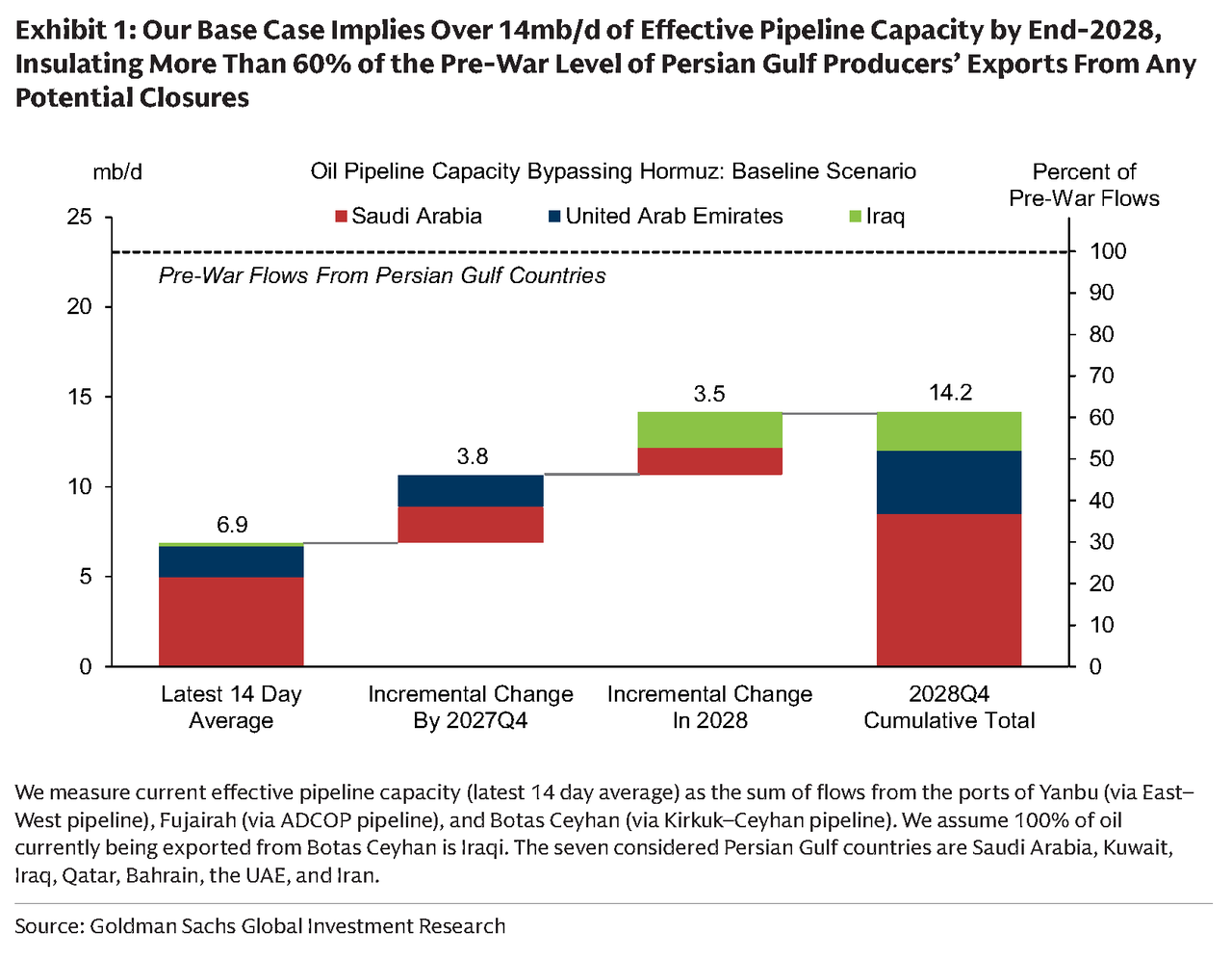
Some of the details:
- Goldman measures current effective bypass capacity as the flows out of Yanbu (East-West pipeline), Fujairah (ADCOP pipeline) and Ceyhan (Kirkuk-Ceyhan). In its base case, that capacity rises by 3.8mb/d by end-2027 and 7.3mb/d cumulatively by end-2028, to over 14mb/d – versus ~23mb/d of pre-war exports from the seven Gulf producers that need pipelines to dodge Hormuz.
- The UAE features prominently: the West-East pipeline (ADNOC’s second line to Fujairah) is one of only two projects already under construction, while a Hamriyah-Fujairah pipeline sits in Goldman’s “Accelerated Scenario” – which would insulate 75% of exports by end-2028 (vs. just over 45% in the “Conservative Scenario”).
- History is on the builders’ side: across Goldman’s sample, the median construction time for Mideast pipelines was 2.5 years, and single-country projects get built faster, especially in response to supply disruptions. Multi-country projects (looking at you, Iraq-Syria) not so much.
- Total cost across the seven projects: roughly $30-48 billion – or, put differently, about one BlackRock/L’imad infrastructure platform.
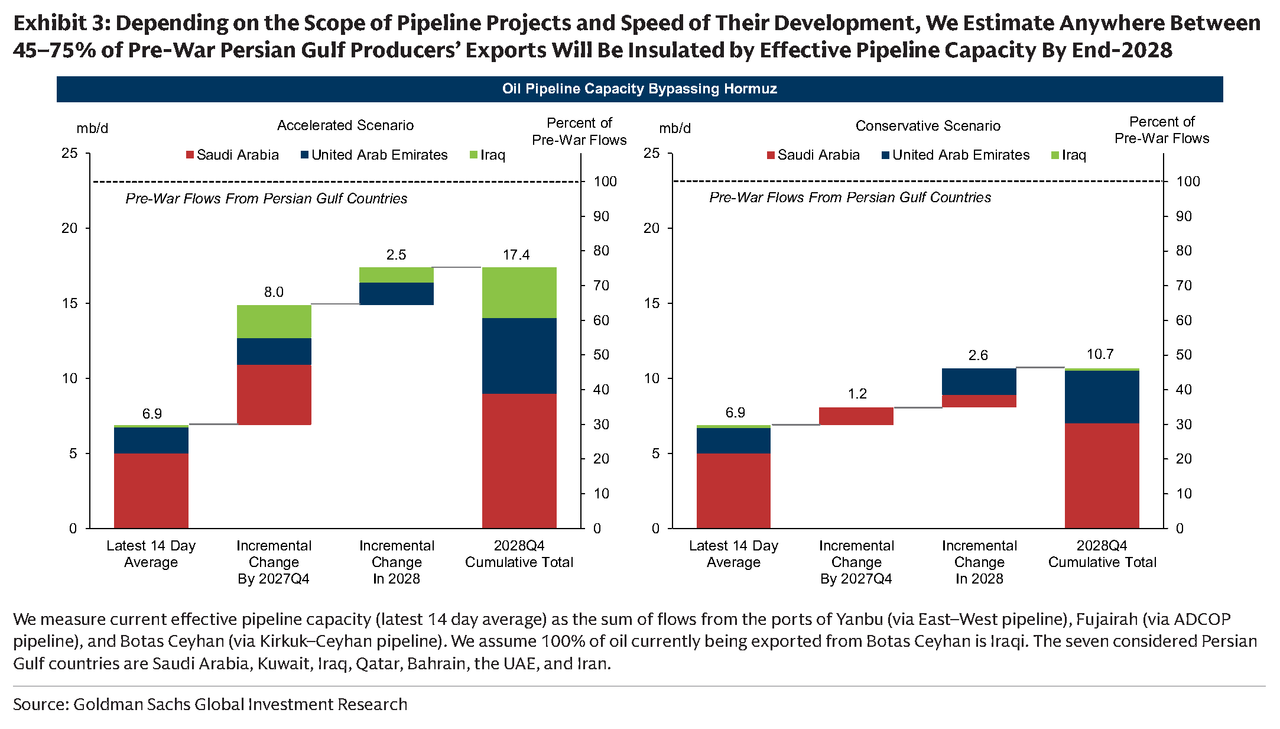
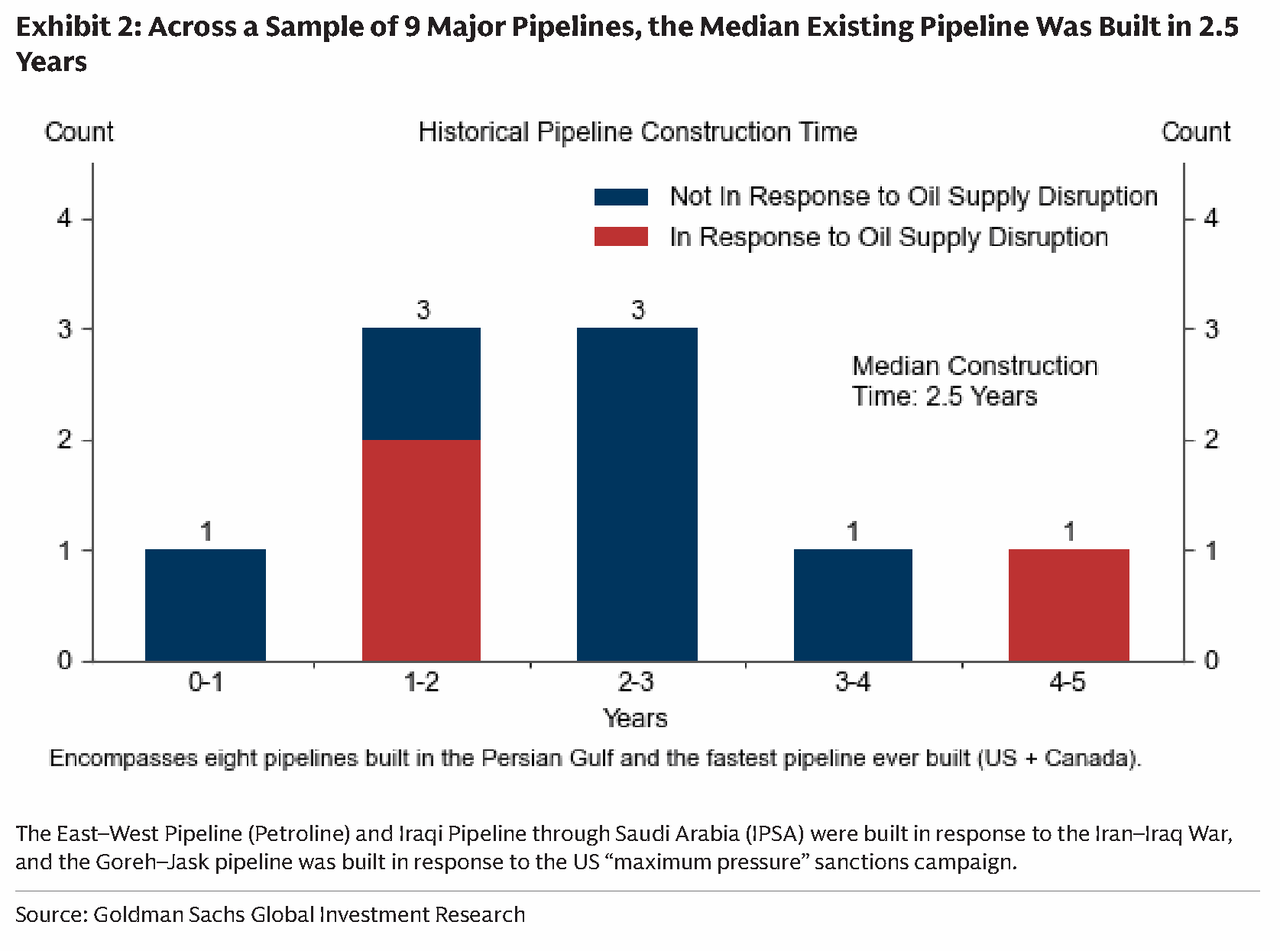
And here is the punchline for oil bulls: Goldman raised its long-dated Brent assumption (3-year-ahead futures) by $9 to $76/bbl at the peak of the war, mostly on a higher structural security premium. But the bank warns that the eventual expansion of bypass capacity poses downside risk to that long-dated assumption. In other words, every barrel that Sheikh Khaled routes to Fujairah is a barrel of risk premium Iran can no longer charge the world.
The plumbing is already working
The “adaptation” is already visible in the export data. As we reported earlier today, Goldman estimates that Persian Gulf oil exports (including “dark exports”) recovered to 23.3mb/d over the past week, in line with their 2025 average, after doubling in September. Crude accounted for nearly 90% of the recovery, reaching 19mb/d (108% of the 2025 average), while refined product exports remain stuck at about half of normal. Crucially for this story, Goldman notes that oil exports from the UAE – which shockingly exited OPEC shortly after the Iran war started – are also above their 2025 average, “with likely further upside” – while Iran shipped no crude by sea at all in September.
Drill down and Fujairah is doing a lot of the heavy lifting: Goldman’s late-September breakdown puts flows via Fujairah at 3.6mb/d (crude, products and LPG combined), more than Yanbu’s 2.6mb/d, and more than double the ~1.7mb/d Fujairah handled before the war.
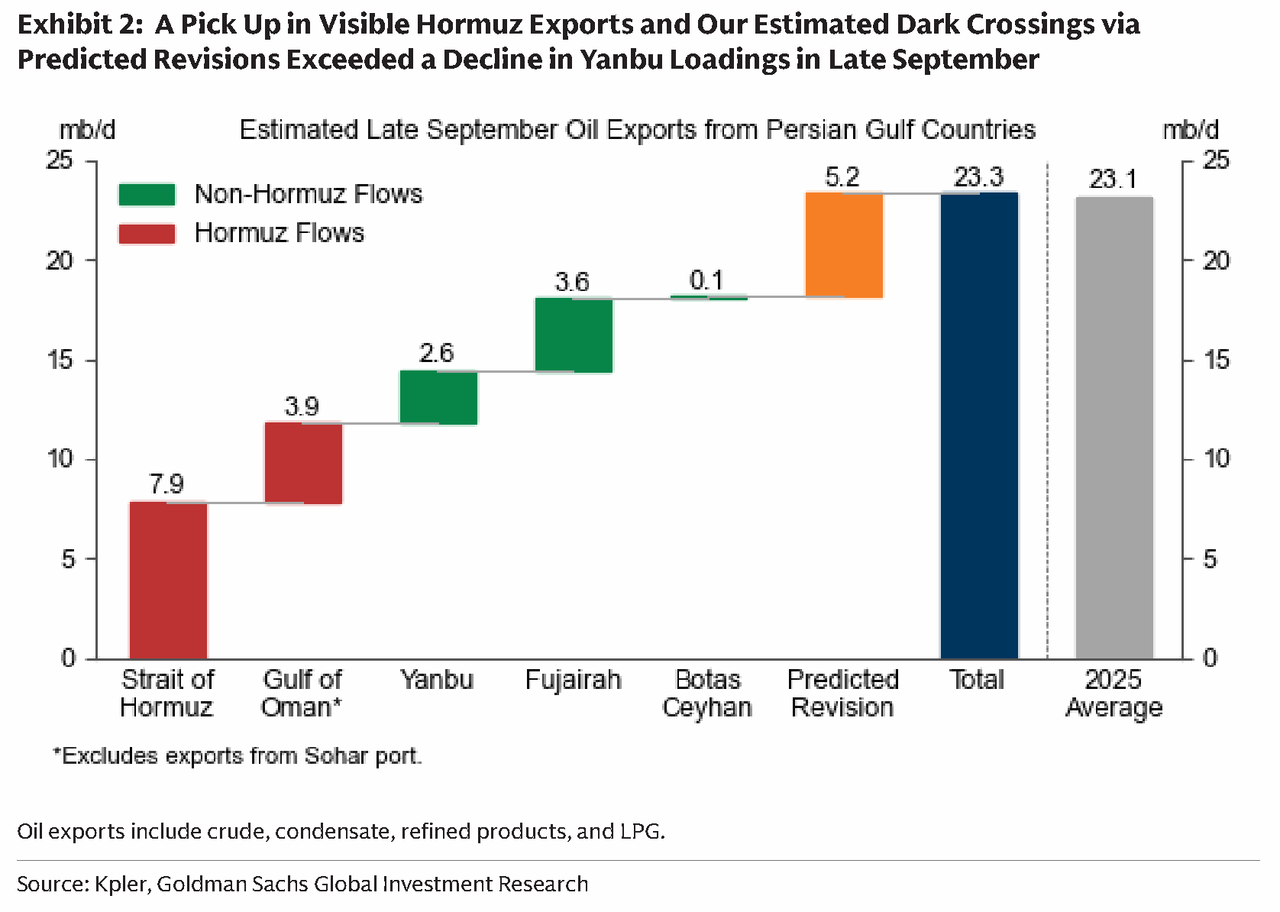
And by country, the UAE is already running at 110% of its 2025 export average – second only to Saudi Arabia’s dark-transit-fueled surge – while Iran sits at 19%.
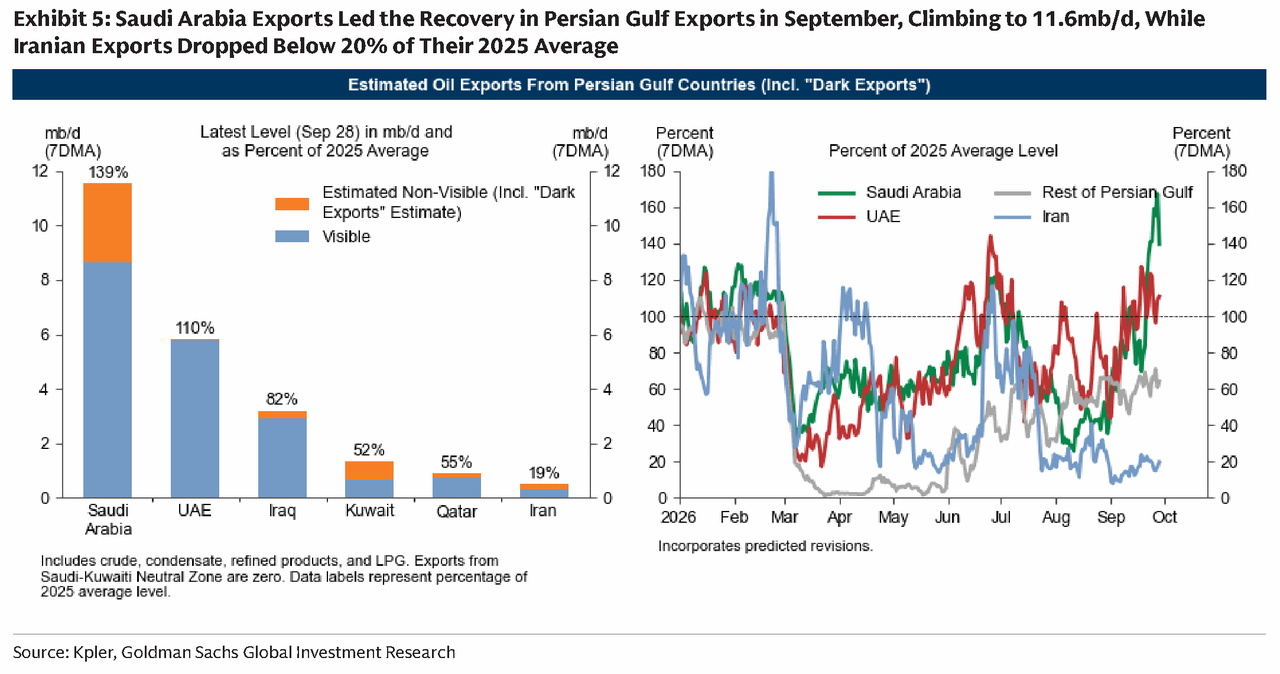
The UAE in particular has been the most creative workaround artist of the war: as we noted in July, its crude output hit an all-time high of 4.1mb/d in June after it quit OPEC, with ADNOC selling cargoes for loading off Fujairah and Sohar, outside the strait. Back in March, we reported that Fujairah crude loadings had already hit ~1.9mb/d – about the max the existing 1.5-1.8mb/d Habshan-Fujairah line can carry. The only real constraint was pipe. Which is exactly what Abu Dhabi is now paying to fix.
Bypassing the strait is not the same as bypassing the drones
None of this makes Fujairah safe. It is roughly 80 miles from Hormuz and well within range of Iranian drones and short-range missiles – a point LSE professor Steffen Hertog makes in the Bloomberg piece. Tehran knows exactly what Fujairah represents: the port was in flames on March 14, was attacked at least seven times in the first four weeks of the war, and on March 31 Iran explicitly threatened to target the port and its pipeline “in order to close the UAE’s route to bypass the Strait of Hormuz.” On May 4, another Iranian strike on Fujairah’s oil zone sent Brent above $114.
Saudi Arabia offers the cautionary tale. Its 7mb/d East-West pipeline to Yanbu – the region’s single biggest Hormuz bypass – was shut down on September 11 after drone attacks by pro-Iran militias, before restarting on September 28. Goldman’s September 14 Oil Tracker pointed out that an April strike on the same pipeline cut flows by just 0.7mb/d for four days, while the latest attack was far more severe and threatened the remaining ~2mb/d of Yanbu exports. The Saudis promptly pivoted back to shipping through… Hormuz. Meanwhile the Houthis are advancing on Bab el-Mandeb, threatening the other end of the Red Sea route.
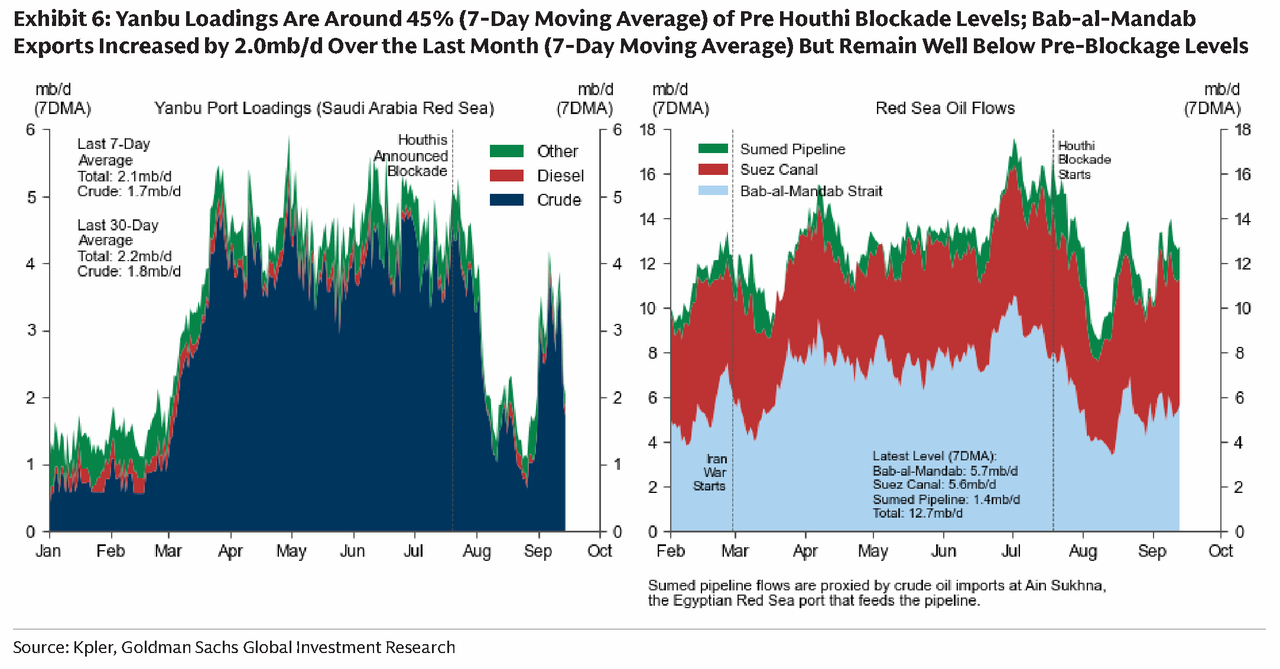
Which brings us to Treasury Secretary Bessent, who predicted on September 1 that in two years Hormuz will be “a worthless piece of water.” Qatar’s energy minister promptly called that “completely wrong” – which is easy to understand when you are Qatar, have no geographic alternative route, and have watched your gas revenue drop sharply. The truth is somewhere in between: Hormuz won’t be worthless, but if Goldman’s math is right it will be worth a lot less to Iran – and a lot more to whoever owns the ports on the other side of the mountains.
As Chatham House’s Sanam Vakil puts it, a “No Hormuz” policy is now of utmost importance for the UAE – but with Iran’s proxies extending their reach, Abu Dhabi will also have to prepare for infrastructure targeting outside Hormuz too. Expect the next line item in the L’imad budget to be air defense.
For now, the bottom line is the one we flagged on day four of the war: the Gulf’s most important real estate is no longer inside the strait, it’s on the Gulf of Oman – and the crown prince of Abu Dhabi has just put tens of billions of dollars (and BlackRock’s money) behind that view.
END
RUSSIA VS UKRAINE
Russia Extends Diesel Export Ban Through Oct. 31
Thursday, Oct 01, 2026 – 05:00 AM
Authored by Tsvetana Paraskova via OilPrice.com,
Russia’s government on Wednesday extended the ban on exports of diesel, marine fuel, and gasoil for all fuel producers by October 31, which effectively extends the period in which the tightening global market will have to cope without Russian diesel shipments for another month.

The government took the decision to extend the ban, which has been in place since the summer, “to maintain a stable situation on the domestic fuel market, including to meet higher demand for fuel during the harvest season.”
Russia has been extending the ban on diesel and other fuel exports by one month for months as Ukrainian attacks on Russian refineries are crippling domestic fuel production.
Ukraine continues its campaign to cripple Russian refining capacity, fuel supply, and export revenues.
Russia has been suffering from a gasoline and diesel crunch since the spring, when Ukraine intensified its drone attacks at Russian refineries, aiming to cripple fuel supply to the front lines and to the domestic Russian market.
The Russian ban on diesel exports has added to the Middle East crisis to tighten global middle distillate markets.
Before the ban on exports, Russia’s diesel shipments accounted for about 10% of global seaborne diesel supply.
The disappearance of Russian diesel added to the slow and uneven exit of fuel cargoes out of the Strait of Hormuz and reduced refinery operations in the Middle East following several Iranian strikes at Gulf refineries at the start of the war.
“We have 7 million barrels a day of refineries down in Asia and the Middle East and another 1.4 million barrels down in Russia. And the refineries, depending on the damage and the ability to get spare parts, are going to take a good long time to get back online,” Brian Mandell, Executive Vice President of Marketing & Commercial at Phillips 66, said on the Q2 earnings call in early August.
The limited supply from Russia and the Middle East has sent retail diesel prices to record highs, including in the United States, where the average price of diesel is $6.41 per gallon as of September 30.
By Tsvetana Paraskova for Oilprice.com
END
RUSSIA VS UKRAINE
Ukraine Hit By Severe Power Cuts After Russia Pounds Grid Ahead Of Freezing Temps
Thursday, Oct 01, 2026 – 08:30 AM
Ongoing major Russian strikes on Ukraine’s energy infrastructure have resulted in significant forced power cuts across various regions of Russia ahead of what promises to be a frigid winter.
National grid operator Ukrenergo on Thursday urged consumers to limit usage following the recent attacks of the past 24 hours. The outages have chiefly impacted central Ukraine, as well as Kharkiv region in the east, along with Chernihiv and Sumy in the north.

“Where security conditions currently allow, emergency repair and restoration work is already under way,” a statement said.
“Energy workers are doing everything possible to restore power to all disconnected consumers as quickly as possible,” it added.
And BBC reports, “Kyiv has been preparing for a renewed onslaught before winter begins, by building fifteen small scale power plants in heavily fortified concrete bunkers.”
Another European outlet warns of what this means for residents going into winter:
Kyiv said it was Moscow’s opening salvo in an expected campaign to try to knock out heating and power as winter approaches.
A recent increase in strikes has prompted fears about another winter with little or no power or heating, after similar attacks last year when temperatures plunged to -20C.
The strikes which started Wednesday are being called one of the heaviest combined attacks on energy cited in months. Ukrainian officials reported seven people killed as a result.
Ukraine’s prime minister Sergii Koretskyi confirmed on X, “Russia has escalated to massive strikes on energy infrastructure.” And President Zelensky indicated that critical infrastructure was hit across five regions.
Freezing temperatures are expected to hit the capital region in the coming days, as emergency repair crews scramble – though there’s unlikely to be a let-up in the nightly attacks.
Zelensky has lately floated he’d be open to another energy ceasefire deal, and these calls are likely to be renewed; however, it will have to go both ways and the Ukrainians have also been unrelenting in their long-range drone attacks on Russian territory and oil refineries.
Russian forces have also of late been systematically degrading and destroying data centers and mobile providers in Ukraine. Internet connectivity has become a problem throughout various sectors of the country.
6/.GLOBAL ISSUES, COVID ISSUES, VACCINE INJURIES/HEALTH ISSUES
HEALTH:
Lilly’s “Incredible Hulk” Obesity Combo Delivers Record 23% Weight Loss In Diabetics
Thursday, Oct 01, 2026 – 08:00 AM
Eli Lilly’s experimental combination of eloralintide and Mounjaro delivered average weight loss of up to 23% in people with diabetes, strengthening the company’s competitive edge against Novo Nordisk in the obesity and diabetes treatment market.
Participants who received the highest dose lost an average of 54 pounds over 48 weeks. Their A1C, a measure of average blood sugar, fell 2.9 percentage points from a baseline of 8.1%, with up to three-quarters reaching normal blood sugar levels, according to Bloomberg.
“This could open up even a next frontier in weight loss,” Ken Custer, president of Lilly’s cardiometabolic unit, stated.
Custer said the study sets a “new, even higher bar” but cautioned against comparing different studies.
Lilly shares rose as much as 2.6% earlier today before paring gains. Year to date, shares are up a little more than 10%, while competitor Novo Nordisk has slumped more than 20%.
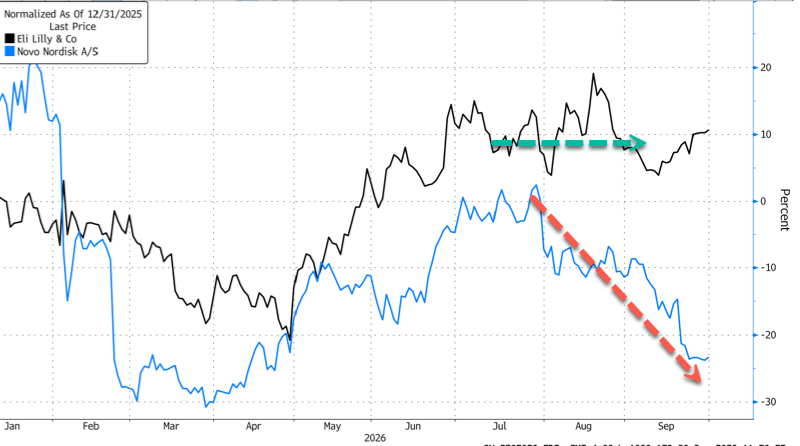
The Study
The Phase 2b trial, announced by Lilly Wednesday and presented at the European Association for the Study of Diabetes (EASD) meeting in Milan, randomized 367 adults with obesity or overweight and type 2 diabetes in the US and Argentina to placebo, eloralintide alone, tirzepatide alone, or one of four combinations of the two. Tirzepatide is the active ingredient in both Mounjaro and Lilly’s obesity shot Zepbound. Lilly calls the combination EloraTZP.
Eloralintide mimics amylin, a hormone the pancreas releases alongside insulin that slows digestion and signals fullness to the brain. Tirzepatide hits two gut hormone receptors, GIP and GLP-1, so the combination works on three appetite and blood sugar pathways at once.
The results at 48 weeks, from an average starting weight of 232.4 pounds:
| Arm | Weight change | Pounds | A1C change |
|---|---|---|---|
| Eloralintide 9 mg + tirzepatide 15 mg | -23.3% | -54.1 | -2.9 |
| Eloralintide 6 mg + tirzepatide 10 mg | -19.9% | -46.2 | -2.6 |
| Eloralintide 6 mg + tirzepatide 5 mg | -19.4% | -45.1 | -2.7 |
| Eloralintide 3 mg + tirzepatide 5 mg | -13.2% | -30.7 | -2.2 |
| Tirzepatide 15 mg alone | -14.8% | -34.4 | -2.4 |
| Eloralintide 6 mg alone | -12.3% | -28.6 | -1.4 |
| Placebo | -3.0% | -7.0 | -0.3 |
Source: Eli Lilly. Efficacy estimand, i.e. assuming all participants stayed on treatment.
In other words, adding eloralintide to the top dose of Mounjaro bought an extra 20 pounds of weight loss. Oddly, the highest dose of eloralintide on its own (9 mg) did worse than the 6 mg dose, at 11.1%.
Weight loss is typically harder to come by in diabetics, which is what makes the number stand out. Analysts at Citi wrote that the 23.3% figure is “comparable to tirzepatide in patients without T2D” and came in “comfortably above our 17% bar.” For comparison, Lilly’s triple-hormone shot retatrutide produced 20.8% weight loss in diabetics in its Phase 3 TRIUMPH-2 trial, and that took 80 weeks.
Study investigator Julio Rosenstock offered a very colorful description of the new GLP-1 wonder drug. Having nicknamed Mounjaro “King Kong,” with retatrutide already claiming “Godzilla,” Rosenstock called the new combination the “Incredible Hulk.” Rosenstock, a University of Texas diabetes researcher, coined the first two in 2023: “We know that tirzepatide (Mounjaro) is the King Kong of the GLP-1s. And when I look at retatrutide, I think that there is no question that Godzilla is smiling.”
The Catch
Rosenstock cautioned that not all patients need to lose that much weight. At the highest dose, 27% of participants stopped taking the drug because of side effects. More than four-fifths reported a side effect of some kind, with roughly half experiencing nausea.
Across the four combination arms, Lilly reported discontinuation rates due to adverse events of 10.8% to 27%, versus 2.9% for tirzepatide alone. The side effects were mostly gastrointestinal and hit hardest during dose escalation. Citi’s analysts blamed starting both drugs at once and said a gentler Phase 3 titration “could preserve efficacy while improving adherence.” Custer told CNBC Lilly will adjust the dosing, “and we expect that we’ll end up with a very favorable balance of efficacy and tolerability.”
Lilly vs. Novo
The results add competitive pressure on Novo, which pioneered the approach with CagriSema, a combination of its amylin treatment cagrilintide and semaglutide, the active ingredient in its blockbuster Wegovy.
That drug has already been bloodied by Lilly. In February, CagriSema failed to prove it was even as good as Mounjaro in the head-to-head REDEFINE 4 trial, with 23% weight loss after 84 weeks versus 25.5% for tirzepatide. Novo filed CagriSema with the FDA in December 2025 and expects a decision by late 2026.
Novo also lost the fight for the next amylin drug. In November, Pfizer outbid it for Metsera in a roughly $10 billion bidding war over the biotech’s monthly amylin candidate. Meanwhile Mounjaro overtook Merck’s Keytruda as the world’s best-selling drug in the first quarter, with $8.7 billion in sales.
Lilly plans to begin late-stage studies of the new combination by year-end, using a single co-formulated injection rather than the two separate shots used in this trial. Eloralintide is already in Phase 3 on its own, after producing up to 20.1% weight loss in non-diabetics in a 48-week Phase 2 study.
END
GLOBAL ISSUES
CENTRAL BANKS/DEBT
Central Banks Cannot Fix The Sovereign Debt Bubble
Thursday, Oct 01, 2026 – 06:00 AM
Authored by Daniel Lacalle via dlacalle.com,
Global investors spend a great deal of time worrying about an alleged artificial intelligence bubble. However, they should pay more attention to the government debt bubble. The most dangerous assumption is that governments can keep borrowing and making promises because central banks will always step in, disguising fiscal irresponsibility with quantitative easing programs. Many market participants hail debt accumulation and expanding government size in the economy because they believe it will create asset inflation forever. However, encouraging malinvestment and complacency is a poor long-term strategy.
Furthermore, buying government bonds does not create the wealth needed to pay for those promises. Many pension funds and Keynesian market participants are discovering that supporting constant government expansion is not profitable. The massive losses in some complacent bond portfolios show the mistake. The Bloomberg Global Aggregate Index remains significantly underwater from its early 2021 peak, sitting at an overall net decline of approximately 16% as of September 25, 2026. Smart bond investors have steered away from duration and government debt, concentrating their strategies on credit, low duration, and private debt.

Public debt is like a massive iceberg. The bonds that have already been issued are the visible part of the iceberg. However, the 94% global public debt to GDP only tells a small part of the story. Below the surface are unfinanced commitments to pensions, healthcare, and other spending that have no adequate funding and add up to 300% of GDP. Looking only at outstanding debt provides us an incomplete picture of what taxpayers may eventually have to finance. Even worse, it gives a wrong view of government solvency.
The IMF projects global public debt will reach 100% of GDP by 2029, with the increase driven by major economies. Thus, this problem extends well beyond the emerging markets usually associated with debt crises.
The United States provides a clear example. Treasury’s fiscal 2025 financial report puts federal debt held by the public at 99% of GDP and separately reports approximately $88.4 trillion in projected social insurance funding shortfalls, measured in present-value terms over 75 years.
That figure measures the gap between projected benefit payments and dedicated revenues, discounted into today’s dollars, and depends on assumptions about future conditions. Nonetheless, these are spending promises that require financing or changes to the rules.
The pressure will become harder to manage if governments continue postponing spending cuts and structural reforms. Rising demands for social spending and defense added to increasing interest burdens make the situation worse. Every government may consider all its spending plans essential, but calling them essential does not make them affordable.
The political incentives are evident. Politicians can announce benefits today and leave future taxpayers to cover the cost. As populism takes over, promises become larger and solvency weakens.
Cutting spending attracts opposition immediately, whereas borrowing seems to be hailed and postpones the argument. However, refusing to choose between competing priorities does not remove the cost. The bill is passed to someone else and under worse conditions.
Central banks can make borrowing easier and help governments disguise the problem for a while. Lower interest costs can provide some relief. However, governments use that relief to increase spending instead of repairing their finances. Thus, the underlying problem keeps growing.
Quantitative easing may calm markets and reduce risk premiums for a while. However, central banks do not print solvency, and bond purchases do not make permanent overspending sustainable.
Furthermore, QE does not make the public sector’s obligations disappear. When a central bank buys long-term government bonds using interest-bearing bank reserves, it effectively replaces longer-term borrowing with liabilities whose cost moves with overnight interest rates, according to the Bank For International Settlements. Viewed together, the government and central bank become more exposed to increases in short-term rates, not less. Once we understand this situation, we also see why inflation is rising. Central banks and governments are eroding the purchasing power of the currency by issuing too much money-debt compared to the private sector demand. Additionally, higher taxes constantly weaken the private sector. All this combined leads to stagnation and persistent inflation.
Consider a simple example. A government saves one percentage point of GDP in interest costs but increases its deficit before interest payments by the same percentage point. Additional overspending has more than absorbed the cheaper financing. Thus, a monetary intervention in the bond market coexists with a worsening fiscal position.
Governments have grown accustomed to the idea that they can spend more during growth periods and even more during recessions. As such, the placebo effect of central bank intervention lasts less every time.
There is also a problem with incentives. If politicians expect the central bank to intervene whenever borrowing becomes uncomfortable, they will never make difficult spending decisions. Each bailout can buy time, but time is useful only if governments use it to change course. Governments use easing periods to announce even more spending and pretend that their policies work.
Financial repression is also shifting the burden while impoverishing citizens. Governments can steer savings towards public debt, but they keep returns below inflation, reducing the real value of what they owe.
The sad truth is that no government is going to provide savers a real economic return when investing in their debt. It is a real and many times nominal loss.
Savers and taxpayers pay through lost purchasing power. As governments then use the savings to finance more deficits, citizens suffer without gaining healthier public finances. Taking purchasing power from savers does not make debt affordable; it makes everyone poorer.
Ignoring the problem and delaying spending cuts also makes the adjustment harder. Treasury estimates that delaying fiscal reform until 2036 would increase the average adjustment needed from 4.7% to 5.6% of GDP. Waiting for the next central-bank intervention is therefore a comfortable but costly political choice.
The solution comes from cutting spending and reforming committed programs before a crisis forces abrupt changes. Stronger productivity, private investment, and competition must also be part of the answer. Governments cannot keep weakening the productive economy with ever-increasing taxes while expecting it to finance ever-larger promises.
Central banks cannot fix the sovereign debt bubble. The short-term placebo effect fades away faster every time, regardless of the size of the purchase plan. QE and financial repression did not buy time, because governments did nothing and left the underlying problem unresolved. Citizens are paying for the same irresponsibility through inflation, weaker growth, lower real net wages, and higher taxes. The absence of a bond-market crisis today does not mean the problem has disappeared; it is just eroding the productive economy through crowding out and financial repression.
The next time you hear a politician promising free stuff, remember that you will pay for it many times over.
END
COVID VACCINE INJURY REPORT: DR. MARK CRISPIN MILLER
DR PAUL ALEXANDER
RABOBANK/MICHAEL EVERY/OR OR PICTON/GIFFIN OR RABOBANK EXECUTIVE/COMMENTARY ON WORLDLY AFFAIRS
7. OIL AND NATURAL GAS/ENERGY COMMENTARIES
Oil Soars As US Sending 10K More Troops, 3rd Carrier, To Mideast After Trump Threatens Post-Midterm Bombing
Thursday, Oct 01, 2026 – 02:11 PM
Signs of potential major escalation, or the next round at least (which Trump has hinted will come after the midterm elections), just hit The Wall Street Journal, and sent oil prices soaring. A quick summary:
- The Pentagon is sending a third aircraft-carrier strike group and additional Marine Corps ships to the Middle East, adding 9,000 to 10,000 more troops to the region.
- The ships, jet fighters, Marines and sailors will arrive in the region by the end of November, as President Trump considers renewing strikes on Iran after the midterm elections.
- The additional servicemembers will add to the more than 50,000 troops already in the region, with the deployments coming after Trump rejected Iran’s latest proposal for a seven-day ceasefire.
The Trump administration is deploying a third aircraft carrier to the Middle East along with additional Marines, an American official also told Israeli media on Thursday. And later, in the afternoon, Trump posted a new Truth Social message as follows:
The USS Theodore Roosevelt is en route to US Central Command’s (CENTCOM) area of operations after having just left San Diego this week. It is expected to relieve the Japan-based USS George Washington, which entered regional waters in mid-August.
But both carriers could also stay on extended deployments. The WSJ writes further:
The additional moves will further strain the U.S. Navy, however, which has experienced supply shortages and faced near-record deployments during the conflict. Iran has in recent weeks fired ballistic missiles at American warships. The crew of the Roosevelt is prepared for a longer-than-normal deployment as well, according to senior Navy officials.
Carriers which more frequently had Indo-Pacific deployments have been increasingly diverted to the Middle East in recent years, a trend which had only picked up steam amid tensions with Iran and the Houthis out of Yemen.
Also on Thursday Al Jazeera is newly reporting that three carriers will stay in regional waters, “By the end of November, three aircraft carriers and two landing groups will be deployed around Iran,” a US official told the Qatar-based outlet.
And USNI News earlier detailed:
On September 28, USNI News reported that a U.S. defense official had confirmed the carrier’s departure from San Diego the previous day. Navy officials had also warned families that the deployment could exceed seven months, with eight months being used as the planning baseline.
Carrier Strike Group 9 includes Theodore Roosevelt, Carrier Air Wing 11, Destroyer Squadron 23, Information Warfare Squadron 9 and the Ticonderoga-class guided-missile cruiser USS Chosin (CG-65). Its embarked air wing brings together several combat and support aircraft. The strike component includes F-35C Lightning II fighters from VFA-86, F/A-18E Super Hornets from VFA-211 and VFA-25, and F/A-18F aircraft from VFA-154. VAQ-137 operates the EA-18G Growler for electronic warfare, while VAW-115 flies the E-2D Advanced Hawkeye for airborne surveillance and command and control.
Whether one of the carriers ends up leaving the theatre or not, the extra deployment does mean President Trump will have a wider range of options for more possible military actions against the Islamic Republic.
He has in a freshly published TIME interview this week reiterated that he may be escalating attacks on Iran after the November midterms if an acceptable deal can’t be reached.
As for the new carrier deployment, it was additionally confirmed: “During a town hall on August 31, Chief of Naval Operations Adm. Daryl Caudle said USS Theodore Roosevelt would be the next carrier sent to the Arabian Sea and was expected to relieve USS George Washington.”
But again, follow-up reports suggest it will not be to relieve one of the carriers, but to serve as a likely third floating base of support for Iran operations.
8. EMERGING MARKETS//AUSTRALIA NEW ZEALAND ISSUES
BRAZIL
Brazil Election Polls Too Close To Call, But Polymarket Gives Bolsonaro Clear Lead
Wednesday, Sep 30, 2026 – 11:55 PM
Brazil’s presidential race is entering the final stretch ahead of Sunday’s first-round vote.
HSBC strategists led by Nicole Inui wrote in a note that the latest polls show socialist President Luiz Inácio Lula da Silva slightly ahead of right-wing Senator Flávio Bolsonaro, though the race remains neck and neck.
Both candidates remain statistically tied. If no candidate wins more than 50% of valid votes, the two will face a runoff on October 25.

“Brazil’s presidential elections are entering their final stretch with first round elections to be held Sunday, 4 Oct. If no candidate wins more than half of the valid vote, a run-off will be held on 25 Oct,” Inui wrote in the note.
Inui continued, “If no candidate wins more than half of the valid vote , a run-off will be held on 25 Oct. First-round election results could be a major market-moving event, we think. The key variable is the margin between the leading candidates. Latest polls point to a tight margin of 5ppts between current president Lula da Silva (PT) vs. Senator Flávio Bolsonaro.
“A narrower lead for President Lula or stronger performance by third-party candidates could add to policy change expectations, which could support risk-on sentiment. However, history suggests some caution: since 1989, every first-round winner has secured the presidency in the run-off of elections,” the analyst said.
However, Polymarket bettors see a clearer favorite, giving Bolsonaro a 60% chance of winning, compared with 39% for Lula.
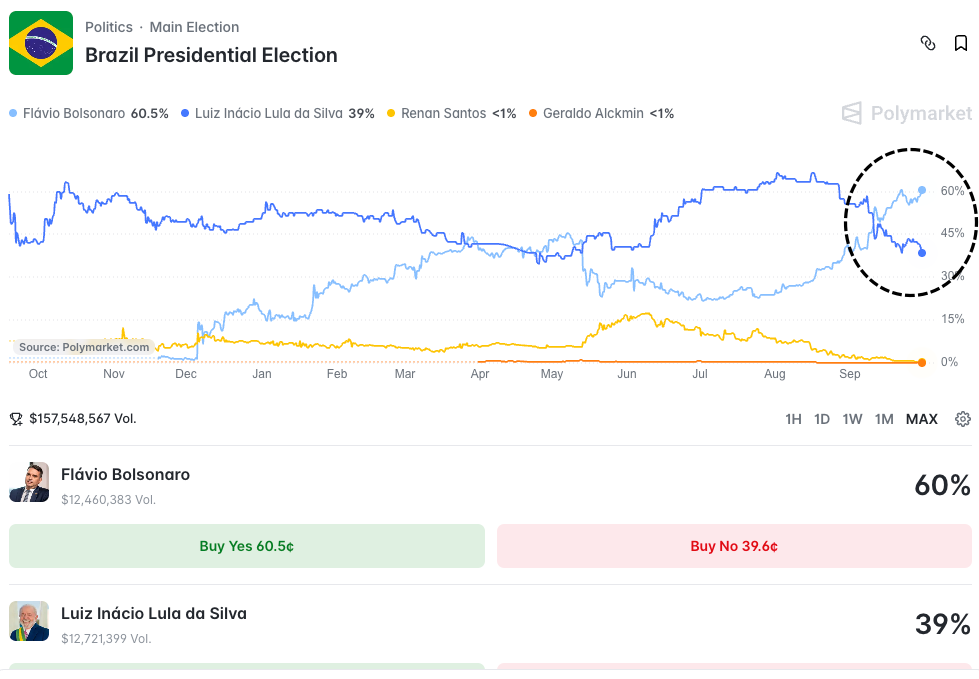
Here’s more from HSBC analysts on market impacts:
What to look out for:
Brazil heads to the polls on 4 October, with a second round scheduled for 25 October if no candidate wins more than 50% of valid votes. Recent polling is pointing towards a highly competitive presidential race, with neither candidate expected to garner enough votes to win in the first round. Since 1989, all but one went to a second round. Leading candidates received between c42-c53% in the first-round vote and all went on to eventually win. In other words, first round winners prevailed and they won the first round by c42%-49%. In the last election cycle, the margin of victory was the tightest in recent history at 1.8ppts (50.9% for Lula vs 49.1% for Bolsonaro), with Lula’s vote share only increasing by 2.5ppts between rounds, compared with c9-15ppts for winners in previous five runoffs. This is a useful benchmark for a highly polarized election, we think, especially considering there are no relevant left-wing candidates besides Lula in the first round.
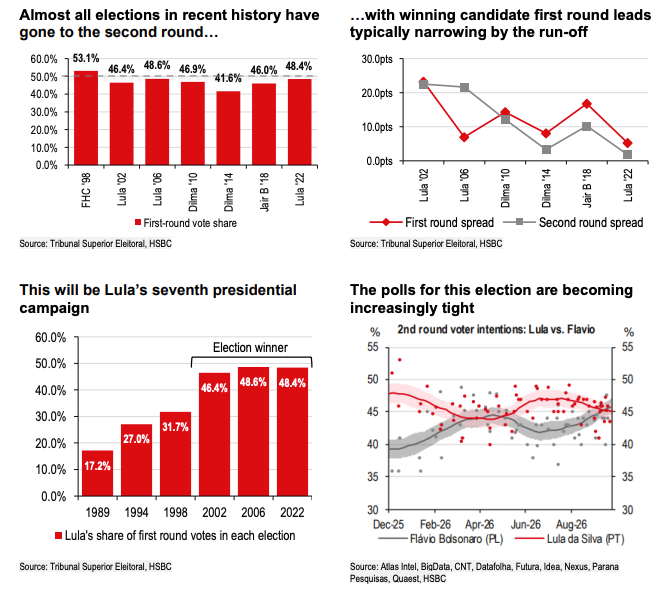
Initial upside, not necessarily sustained
In the first trading session following the 2022 first round election, the IBOV surged 5.5%, while real strengthened against the dollar. In the 2022 elections, privatization hopes drove the largest immediate gains in SOEs at the time (Copasa, Sabesp, Cemig), and interest rate futures immediately fell, with consumer discretionary accounting for 50% of the top 10 performers. The move likely was attributed to Bolsonaro’s stronger-than-expected (vs polls) first round results and the composition of the incoming Congress, which together reduced the policy risk premium investors had considered before the vote. However, the Ibovespa came down from its highs leading up to the second round, declining 1.4% from the close after the first round, but still 4.1% above pre-first-round level. The BRL and iShares MSCI Brazil ETF (EWZ Index) followed a similar pattern, but the EWZ saw greater appreciation from 1 September 2022 than the Ibovespa around the run-off. Leading up to the run-off, reduced perceived risks of government intervention continued to support utilities and energy, which retained gains, while consumer discretionary’s initial rally faded as interest rate futures rose again.
A similar story could occur for 2026. An outsized reaction could occur immediately after 4 October if investors mark down the perceived fiscal/policy-risk premium based on a tight first round outcome, like what occurred in 2022, but would not necessarily extend into a three week straight rally. Subsequent price action would depend on polling, endorsements, campaign economic proposals, the congressional result, and the long end of the Brazilian rates curve. We believe a first round result associated with lower long-term fiscal risk would likely produce a broader domestic risk-on trade, with SOEs, domestic cyclicals, and bond proxies potentially experiencing the most upside. If first round results are tighter than in the prior elections, equity markets could react positively on expectations of fiscal consolidation ahead.
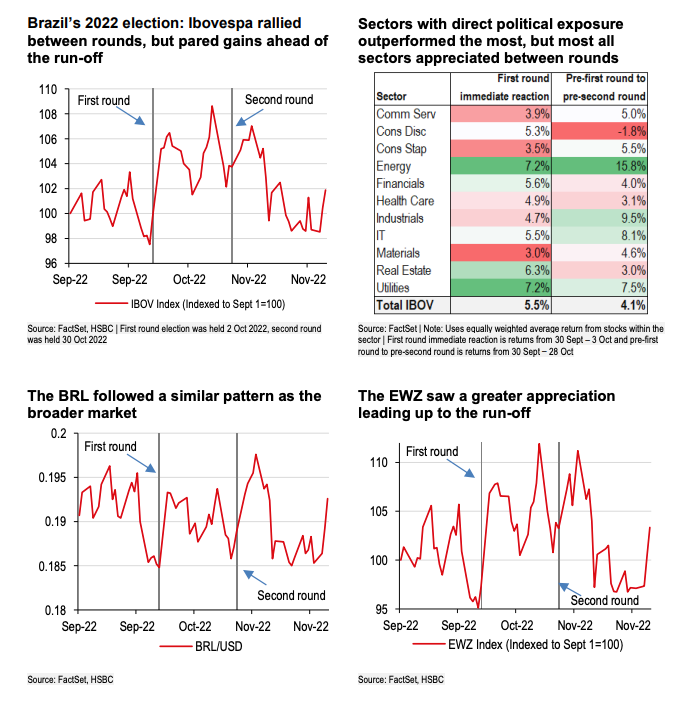
And post-election results? We see asymmetric returns for equity markets
We expect an initial knee-jerk reaction following the run-off as markets reassess the likelihood of fiscal consolidation under the incoming administration. A result that increases confidence in a more credible fiscal path could drive a relatively rapid rerating through lower-end yields, tighter risk premia, and stronger performance in domestic cyclicals and bond proxies where valuations are sensitive to fiscal and rate outlooks. Conversely, a result that reduces expectations for fiscal consolidation could trigger an initial derating, but we see some valuation support limiting the downside in parts of the market. Many election sensitive names including Petrobras are already trading close to historical trough valuations on an EV/EBITDA basis, leaving less room for further multiple compression Petrobras, 16 Aug. And Banco do Brasil is trading at a P/B of 0.7x and a 69% discount to Itau, close to a historic high, Brazilian Financials, 14 Sept.
Given the close race, we would emphasize segments that can participate in a relief rally without requiring an aggressive risk stance. Lower-beta yield names and selected bond proxies appear better placed to capture upside from lower long-end rates while offering more resilience if the market reaction is short lived. Politically exposed names and higher beta domestic cyclicals could outperform in a market-friendly scenario, but they would also be more sensitive to any reversal in fiscal expectations.
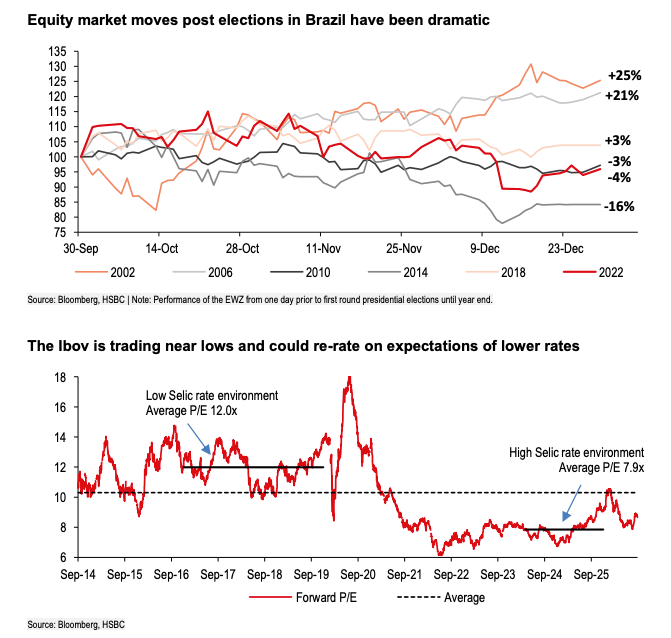
Polls suggest the race remains too close to call, while Polymarket odds point to Bolsonaro as the favorite.
END
CANADA/UKRAINE
CANADA’S BLACK HOLE
Canada Has A Ukrainian Blindspot
Thursday, Oct 01, 2026 – 07:40 AM
Authored by Ted Snider via The Libertarian Institute
On September 10, Ukrainian President Volodymyr Zelensky landed in Canada where he and Canadian Prime Minister Mark Carney signed a 100-year partnership “elevat[ing] the relationship between their countries into a Comprehensive Strategic Partnership and confirming their aligned nature.”
Canada already has a special relationship with Ukraine. Before the war, Canada had the largest Ukrainian community in the Ukrainian diaspora with 1,209,805 Ukrainian-Canadians. Canada is the fifth largest financial contributor to Ukraine after only the United States, the European Union, Germany, and the United Kingdom with over $16 billion in military, financial and humanitarian aid.

Carney said that “Canada will always stand in solidarity with Ukraine” and that “there is no qualification to our commitment.” There is little wrong with that: Ukraine was invaded by Russia and taken advantage of by the West.
But there are two problems with the Comprehensive Strategic Partnership. The first is practical.
Since Russia invaded Ukraine in 2022, Canada has contributed $8.5 billion in military support to Ukraine. The Comprehensive Partnership includes a joint declaration on defense and security co-operation. During the official visit, Carney announced new investments to support Ukraine’s defense, including $350 million for interceptor missiles for air defence.
The practical problem is that Ukraine is black hole into which money intended for defense disappears. This is a problem well known to Ukraine’s partners who, nonetheless, keep pouring money in with a blind eye to the problem. Earlier this month, following close on the heels of a U.S. $100 billion European Union loan to Ukraine, Kiev surprised the European Union with a request for an additional $27 billion to address a shortfall that was difficult to explain. The request “unsettled” European officials, some of whom privately worried “whether money is being spent efficiently or whether needs are being overstated.”
A recent New York Times investigation found that seven of Ukraine’s ten top military contractors continued to be awarded contracts after Kiev knew they were facing investigations for fraud, corruption, or failure to deliver on deals they were paid for. Eighteen companies won contracts despite defaulting on previous ones. Millions were thrown away by inexplicably, and conveniently, awarding contracts to the highest bidder. Government audits show that in one year of the war alone, Ukraine lost $1.2 billion in U.S. foreign aid to “fraud, waste and mismanagement.” Sending hundreds of millions more to Ukraine sounds great. But to whom will it go?
There is a second problem with the 100-year Comprehensive Partnership that is deeper. Carney said the Strategic Partnership is based on the two countries “aligned nature.” But there are important aspects that do not align.
Canada is a federalist country that officially recognizes more than one culture and language. The Carney administration recently walked away from negotiating a trade agreement with the United States partly in defense of its sovereign right to protect French culture, French language, and its official bilingualism. Ukraine has been locked in a civil war since 2014 to protect the opposite: a monist vision of Ukrainian society that rejects federalism and recognizes only one culture as Ukrainian while suppressing the language, culture, and religion of ethnic Russian citizens of Ukraine in Crimea, the Donbas, and the southeast. It specifically denies the pluralist alternative that is a defining feature of Canadian identity. Rather than aligning in their natures, in this essential aspect, the two countries are the antithesis of each other.
Canada has confronted this blind spot before. In 2023, Yaroslav Hunka received two standing ovations in Canada’s Parliament as “a Ukrainian Canadian war veteran from the Second World War who fought for Ukrainian independence against the Russians” and as “a Ukrainian hero and a Canadian hero,” despite having served in the 14th Waffen Grenadier Division of Adolf Hitler’s SS.
Carney insisted that “Canadians understand in our bones the importance of your struggle” and explained that the reason “there is no qualification to our commitment” to Ukraine is “because your cause—freedom, democracy, sovereignty—is our cause.”
It may be “our cause,” but the historical record is less clear that it is their cause. Zelensky has formally banned eleven opposition parties, including the Opposition Platform for Life party that was once the second largest party in the Ukrainian parliament, though they all condemned Russia’s invasion and contributed to Russia’s defence.
He has restricted freedom of information, unifying all television sources into a single source of television news, and increased the censorship powers of the state over print and online media.
The Ukrainian Orthodox Church, Ukraine’s largest church organization, has been banned by Zelensky though Ukraine’s constitution protects freedom of religion, despite that the Primate of the UOC expressed the church’s loyalty to Ukraine and condemnation of Russia’s invasion.
Cultural and linguistic rights for minorities have fared no better than political and religious rights and freedom of expression. Pursuing the monist interpretation of Ukraine, Zelensky has gone down a path of abolishing any hint of Russian culture. Legislation has erased the Russian language, making Ukrainian the sole language of government, schools, universities, culture, publishing and media.
It is fine for Canada to “stand in solidarity with Ukraine.” But we should not be blind to Ukraine’s struggles and challenges. If Ukraine is to avoid civil war after the war with Russia and if Ukraine is to have a chance of joining the European Union and orienting toward the west, they, too, are going to have to confront these challenges.
END
U.S./GOLD AND SILVER PRICING/ASIAN CLOSING MARKETS AND EUROPEAN BOURSE OPENING AND CLOSING/ INTEREST RATE SETTINGS THURSDAY MORNING 6;30AM//OPENING AND CLOSING\
OPENING LEVELS OF CURRENCIES// AND CLOSING ASIAN STOCK MARKET AND OPENING EUROPEAN STOCKS:6 AM EST
EURO VS USA DOLLAR: 1.1298 DOWN 0.0028
USA/ YEN 158.39 UP 0.828 NOW TARGETS INTEREST RATE AT 1.75% AS IT WILL BUY UNLIMITED BONDS TO GETS TO THAT LEVEL…//YEN STILL FALLS//END OF YEN CARRY TRADE BEGINS AGAIN DEC 2024/Bank of Japan raises rates by .25% TO 1.75 ..TAKAICHI NEW PM AS YIELDS RISE//JAPAN DEEPLY IN TROUBLE WITH RISING RATES AND A FALLING YEN!! BANK OF JAPAN WILL NO LONGER DO QE. URGES PENSION AND INSUANCE FUNDS TO BUY JAPANESE BONDS//
YEN CARRY TRADERS MURDERED
GBP/USA1.3222 DOWN 0.0042 OR 42 BASIS PTS
USA/CAN DOLLAR: 1.4245 UP 0.0009 //CDN DOLLAR DOWN 9 BASIS PTS//
Last night Shanghai COMPOSITE CLOSED HOLIDAY
Hang Seng CLOSED HOLIDAY
AUSTRALIA CLOSED DOWN 2.16%
// EUROPEAN BOURSE: ALL RED
Trading from Europe and ASIA
I) EUROPEAN BOURSES: ALL RED
2/ CHINESE BOURSES / :Hang SENG CLOSED
/SHANGHAI CLOSED
AUSTRALIA BOURSE CLOSED DOWN 2.16%
(Nikkei (Japan) CLOSED UP 2292.28 PTS OR 3.43%
INDIA’S SENSEX IN THE RED
Gold very early morning trading: $4154.90
silver:$60.37
USA DOLLAR VS TRY (TURKISH LIRA): 49.04 UP 2 BASIS PTS AND NOW WE SEE THEIR STUPIDITY OF SELLING SOME OF THEIR GOLD AND ALL OF THEIR USA DOLLAR RESERVES. THE COUNTRY IS IN BIG FINANCIAL TROUBLE
USA DOLLAR VS RUSSIAN ROUBLE: 83.37 ROUBLE// UP 0 ROUBLE AND 1 BASIS PTS.
UK 10 YR BOND YIELD: 5.4767 UP 9 BASIS PTS
UK 30 YR BOND YIELD: 6.0140 UP 6 BASIS PTS
CDN 10 YR BOND YIELD: 3.999 UP 3 BASIS PTS
CDN 5 YR BOND YIELD; 3.703 UP 2 BASIS PTS
USA dollar index early THURSDAY MORNING: 101.52 UP 33 BASIS POINTS FROM WEDNESDAY’s CLOSE
THURSDAY MORNING NUMBERS ENDS
And now your closing THURSDAY NUMBERS 10.00 AM
Portuguese 10 year bond yield: 3.9740% UP 1 in basis point(s) yield
JAPANESE BOND 10 yr YIELD: +3.092% UP 4 FULL POINTS BASIS POINTS /JAPAN losing control of its yield curve/
JAPAN 30 YR: 4.178 UP 4 BASIS PTS//
SPANISH 10 YR BOND YIELD: 4.099 DOWN 2 in basis points yield
ITALY 10 YR BOND: 4.601 DOWN 2 points in basis points yield ./
GERMAN 10 YR BOND YIELD: 3.5328 DOWN 5 BASIS PTS
IMPORTANT CURRENCY CLOSES : MID DAY THURSDAY
Closing currency crosses for day /USA DOLLAR INDEX/USA 10 YR BOND YIELD/10:00 AM
Euro/USA 1.1295 DOWN 0.0052 OR 52 basis points
USA/Japan: 157.96 UP 0.394 OR YEN IS DOWN 40 BASIS PTS// HIGHLY INFLATIONARY TO JAPAN
Great Britain 10 YR RATE 5.4052 DOWN 1 BASIS POINTS //
GREAT BRITAIN 30 YR BOND; 5.926 DOWN 3 BASIS POINTS.
CANADIAN DOLLAR UP 11 BASIS PTS TO 1.4247
xxxxxxxxxxxxxxxxxxxxxxxxxxxxxxxxxxxxxxxxxxxxxxxxxxxxxxxxxxxxxxxxxxxxxxxxxxxxxxxx
The USA/Yuan CNY 6.7046 ON SHORE ..DOWN
THE USA/YUAN OFFSHORE// CNH DOWN TO 6.7070
TURKISH LIRA: 49.04 UP 2 EXTREMELY DANGEROUS LEVEL/DEATH WATCH/HYPERINFLATION TO BEGIN.//
Your closing 10 yr US bond yield DOWN 3 in basis points from WEDNESDAY at 5.284% //trading well ABOVE the resistance level of 2.27-2.32%)
USA 30 yr bond yield 5.636 DOWN 0 basis points /10:00 AM
USA 2 YR BOND YIELD: 4.858 DOWN 3 BASIS PTS.
GOLD AT 10;00 AM $4182.30
SILVER AT 10;00: $61.19
Your 11:00 AM bourses for Europe and the Dow along with the USA dollar index closing and interest ratesTUESDAY
DAY CLOSING TIME/ 12:00 AM///
London: CLOSED DOWN 177.73 PTS OR 1.68%
GERMAN DAX: CLOSED DOWN 259.80 PTS OR 1.63%
FRANCE: DOWN 129.20 OR 1,62 PTS
Spain IBEX CLOSED DOWN 420.90 PTS OR 2.17%
Italian MIB: CLOSED DOWN 1134.12 PTS OR 2.26%
WTI Oil price 91.56 10.00 EST/
Brent Oil: 100.06 10:00 EST
USA /RUSSIAN ROUBLE: 83.51/// ROUBLE UP 0 AND 14/ 100
CDN 10 YEAR RATE: 3.970 DOWN 3 BASIS PTS.
CDN 5 YEAR RATE: 3.650 DOWN 6 BASIS PTS
CLOSING NUMBERS: 4 PM//
Euro vs USA 1.1242 DOWN 0.0084 OR 84 BASIS POINTS//
British Pound: 1.3197 DOWN 0.0067 OR 67 basis pts/
BRITISH 10 YR GILT BOND YIELD: 5.3926 DOWN 1 FULL BASIS PTS//
BRITISH 30 YR BOND YIELD: 5.948 DOWN 1 IN BASIS PTS.
JAPAN 10 YR YIELD: 3.126 UP 7 FULL BASIS PTS (DANGEROUS TO THEIR ECONOMY
JAPANESE 30 YR BOND: 4.190 UP 7 PTS AND STILL VERY DANGEROUS TO THEIR ECONOMY
USA dollar vs Japanese Yen: 158.38 UP 0.513 OR YEN DOWN 52 BASIS PTS//GETTING FURTHER AWAY FROM 160.00/ EXTREMELY DANGEROUS
USA dollar vs Canadian dollar: 1.4226 DOWN 0.0011 PTS// CDN DOLLAR UP 11 BASIS PTS
West Texas intermediate oil: 93.34
Brent OIL: 102.35
USA 10 yr bond yield DOWN 6 BASIS pts to 5.250
USA 30 yr bond yield: DOWN 3 PTS to 5.611%
USA 2 YR BOND 4.789 DOWN 10 PTS
CDN 10 YR RATE 3.948 DOWN 5 BASIS PTS
CDN 5 YEAR RATE: 3.621 DOWN 8 BASIS PTS
USA dollar index: 101.80 DOWN 8 BASIS POINTS
USA DOLLAR VS TURKISH LIRA: 49.04 UP 2 BASIS PTS GETTING QUITE CLOSE TO BLOWING UP/IDIOTS SOLD GOLD
USA DOLLAR VS RUSSIA//// ROUBLE: 83.51 DOWN 0 AND 14 /100 roubles //
GOLD $4,176.40 3:30 PM)
SILVER: 60.97 3;30 PM)
DOW JONES INDUSTRIAL AVERAGE: UP 21.28 POINTS OR 0.042%
NASDAQ 100 UP 93.06 PTS OR 0.31%
VOLATILITY INDEX 16.31 UP 0.03 PTS OR 0.18%
GLD: $ 382.76 UP 1.92 PTS OR 0.50%
SLV/ 55.02 PTS UP .51 OR .94%
TORONTO STOCK INDEX// TSX INDEX: CLOSED DOWN 110.96 PTS OR 0.31%
end
TRADING today ZEROHEDGE 4 PM: HEADLINE NEWS/TRADING
‘
Stocks, Bonds, & Oil All Up Amid ‘Red October’ Rout Across Europe
WRAP UP
USA DATA RELEASES
USA ECONOMIC REPORTS
TRUCKING HUGE STORY!!
16 U.S. Trucking Companies File For Bankruptcy In Less Than A Month As Diesel Prices Soar
Thursday, Oct 01, 2026 – 04:15 AM
Diesel prices have exploded over the past month, creating another major cost shock for an industry that was already operating on thin margins. The national average climbed from roughly $5.60 per gallon at the end of August to a record $6.53 in late September, an increase of about 17% in just a few weeks. Prices have eased slightly from that peak, but the EIA’s latest weekly reading still puts diesel at $6.38 per gallon, compared with $5.60 at the end of August.
Now the financial damage is beginning to show up. Sixteen American trucking companies have entered bankruptcy proceedings in less than a month, affecting more than 250 jobs, according to FreightWaves and the Independent. Eight filed for Chapter 11 bankruptcy, allowing them to continue operating while restructuring their debts, while seven entered Chapter 7 and are liquidating their assets and shutting down.

Among the larger companies seeking Chapter 11 protection are Xoco Transport and Globemaster. Neither specified the cause of its financial problems in federal court filings, and diesel is hardly the industry’s only problem. Carriers have also been grappling with rising labor, insurance, maintenance and regulatory costs, while seasonal slowdowns can leave them without enough revenue to absorb those increases.
But the sudden surge in fuel costs adds another layer of pressure because trucking companies have limited options when diesel jumps this quickly. They can absorb the expense and sacrifice margins, pass it through with higher freight rates and risk losing business, or cut workers and equipment. The latter can keep a company alive temporarily, but it also reduces shipping capacity and the amount of revenue the carrier can generate.
And for now, there is little reason to consider the diesel problem resolved. Prices remain near historic highs and are still heavily tied to the war with Iran and the resulting disruption to global energy supplies.
Even as crude shipments through the Strait of Hormuz have begun recovering, refined-product flows remain constrained, inventories have been depleted and damaged Middle Eastern refining infrastructure continues to limit supply. Until those disruptions ease materially, diesel remains another major transmission mechanism through which the Iran war is feeding directly into the U.S. economy.
END
AI
US Banks Just Puked. Are European Banks Next?

US bank stocks have sold off sharply in recent weeks (a “puke”), and the question of spillover to European banks is a live market concern as of early October 2026.
de.finance.yahoo.com
What’s driving the US bank weakness
- The KBW Bank Index (a key gauge of large US banks) fell into a technical correction, down more than 10% from its August 2026 highs by late September. Individual names and broader financials (including XLF and S&P bank indexes) saw multi-percent daily drops. de.finance.yahoo.com
- Key catalysts include:
- The Federal Reserve’s return to rate hikes (first since 2023) amid sticky inflation/oil pressures, raising funding costs and potentially cooling loan demand/credit quality.
- A rapidly flattening Treasury yield curve (2s10s at its flattest levels in over a year at points), which compresses net interest margins—the traditional profit engine for banks.
- Softer guidance on trading and investment-banking revenues from some large banks (e.g., comments around flat or lower results), plus broader worries about AI disruption in wealth management and related areas.
- Residual credit and commercial real estate (CRE) sensitivities, unrealized securities losses on bank balance sheets, and general risk-off sentiment. reuters.com
This follows a period of strong performance for US banks, fueled by earlier deregulation tailwinds, robust capital markets activity, and profitability advantages over European peers.Are European banks next?Sentiment contagion is already visible: European bank stocks and the Stoxx 600 Banks index have come under pressure in recent sessions (including declines on October 1), as global risk appetite shifts and investors reprice rate/credit risks. Heavyweights like Deutsche Bank, Barclays, and others have participated in the downside.
es.marketscreener.com
However, the fundamental picture is more nuanced—European banks are not identical to their US counterparts:
- Strengths relative to the US: Many European (and euro-area) banks remain well-capitalized and liquid after years of post-GFC reforms, with solid CET1 ratios and liquidity coverage. Profitability has improved meaningfully in recent years on higher rates, better efficiency, and lower credit costs. Some metrics (liquidity coverage, certain capital ratios) have compared favorably, and the sector delivered strong returns earlier (e.g., outsized gains in 2025). Cross-border issues and fragmentation persist, but the core deposit-funded model and stricter supervision provide buffers against pure liquidity runs of the 2023 SVB style. bis.org
- Vulnerabilities and structural lags: European banks generally lag in scale, investment-banking/trading market share, IT spending intensity, and capital-markets depth. US banks have pulled further ahead in profitability, balance-sheet growth, and global wholesale activity over the past 15+ years. European institutions face a more fragmented single market, higher relative costs in some areas, and less ability to compete head-to-head in high-return capital-markets businesses. CRE and other credit exposures exist (as do dollar-funding risks for some), and any global risk-off or higher-for-longer rates can still hit valuations and sentiment hard. Officials continue to call for greater scale, consolidation, and deeper capital markets precisely to close the competitiveness gap with the US. reuters.com
In short, pure technical/sentiment spillover is already occurring and can intensify if US credit or rate stresses worsen. A full-blown European banking crisis is less likely in the near term given stronger post-crisis buffers and different funding mixes, but the sector is not immune—especially given shared global market exposures, any escalation in CRE or private-credit issues, or further yield-curve/rate pressure. European banks have closed some of the valuation and profitability gap in recent years, yet structural disadvantages (scale, markets depth) remain a longer-term headwind.Markets are watching upcoming earnings, Fed/ECB path, oil/inflation data, and any fresh credit headlines closely. “The Market Ear” style of commentary typically frames these as high-conviction, chart-driven observations on positioning and momentum rather than deep fundamental research—useful for near-term trading context but best paired with primary data from regulators, bank filings, and broader macro analysis.
END
Musk, Luckey And Gingrich Walk Into The Pentagon: Hegseth Unveils “Project Meridian” As Defense Stocks Suffer Record Losing Streak
Thursday, Oct 01, 2026 – 11:20 AM
What do you get when you put the world’s first trillionaire, the man who builds killer drones in Ohio, and a former House Speaker in a room and ask them to design the next century of warfare? According to Pete Hegseth, you get “Project Meridian.”
In a sprawling “State of the Force” address to junior officers and enlisted troops at Marine Corps Base Quantico on Wednesday, the Secretary of War announced that Elon Musk, Anduril founder Palmer Luckey and Newt Gingrich (all three were in the audience) will lead an initiative “focused on discovering, developing and fielding the weapons and systems that our children and our grandchildren will need in their lifetimes.”
“Its purpose is to creatively look to the future and identify the domains that we must conquer and capabilities we must master,” Hegseth said, adding that “the best forecasters of future conflict” do “not solely reside inside the Pentagon.”
The project will be overseen by Emil Michael, the former Uber executive who is now the Pentagon’s top technology official. Bloomberg said Hegseth offered no further details, although Axios reports that the trio is expected to deliver its findings within 120 days, in both a public and a classified version.
The Customer Asks The Suppliers What It Should Buy
One does not need to be a cynic (although it helps) to notice that two of the three people now advising the Pentagon on which “capabilities we must master” also happen to run two of the companies most likely to sell those capabilities.
Musk’s SpaceX handles national security launches and has been a public company since its blockbuster June 12 IPO, which made Musk the planet’s first trillionaire. Luckey’s Anduril, meanwhile, has gone from defense upstart to prime-in-waiting in record time: it landed a $20 billion Pentagon contract in March, followed in May by a $5 billion raise at a $61 billion valuation, and it also builds the software for Golden Dome together with Palantir. As for Gingrich… Bloomberg notes he “has written a book on technology and entrepreneurism,” which is presumably what counts as a defense credential in 2026.
Then there is the Musk comeback. More than a year after the ultimately unpopular DOGE effort and the very public falling out with Trump, which at one point had the administration weighing shutting SpaceX out of Golden Dome, Musk is baaaack. In the past week alone he attended the Trump-Xi state dinner and was slated for a White House AI lunch, and now has his first formal advisory role since DOGE. Some feuds age like milk, others like fine wine; this one appears to have aged like a Pentagon contract.

What Goldman Says About The “Affordable Mass” Pitch
To be fair, there is a real case for letting outsiders shake up how the Pentagon buys things, and few have laid it out better than Goldman’s A&D analyst Noah Poponak, who sat down with Anduril’s management in June. Goldman’s diagnosis was that the legacy defense industry produces “low numbers of expensive, bespoke assets” that are hard to scale, while Anduril designs for “affordable mass” through selective vertical integration, common components across product lines, designs simple enough to automate, and flexible factories that can switch products quickly.
The economics also explain why everyone wants in. Per Goldman, Anduril targets a near 25% total company operating margin over time and gets roughly 70-80% of its revenue from fixed-price work, well above what the traditional primes earn. Poponak also saw “early signs of progress” in Pentagon acquisition reform, including multi-year frameworks and open-testing programs such as Drone Dominance. One of the architects of the “affordable mass” model will now help write the Pentagon’s wish list, which is either the most efficient procurement reform in history or the most efficient sales pitch. Possibly both.
Goldman is also constructive on the listed drone names. In his AeroVironment notes this month, Poponak noted that funded backlog rose 37% y/y and 23% sequentially and that AVAV “has exposure to faster growing portions of the defense budget.” He pointed to demand for its LOCUST directed-energy counter-drone system (first international order: more than $50mn) and the low-cost Freedom Eagle interceptor, which offers “a significantly lower-cost alternative to traditional missile defense systems.”
Enter AutoWarCom
Meridian was not the only new acronym. Hegseth also unveiled a new four-star Autonomous Warfare Command (yes, “AutoWarCom“) with “service-like authorities” over drones, AI and command-and-control. It is set to be operational by October 1, 2027. Until then, an interim effort called Project Agincourt will draw on the Defense Innovation Unit and the Drone Dominance program, pairing “operators with entrepreneurs in rapid adaptation cycles.” Existing programs such as the Collaborative Combat Aircraft and the Navy’s MQ-25 unmanned tanker are being folded in. Hegseth called it “the fastest peacetime shift in modern military history.”
The money was already lined up. As we reported in April, the Pentagon’s FY27 request seeks $54.6 billion for the Defense Autonomous Warfare Group, up from $225 million in FY26, a 243x increase that would make even a Silicon Valley VC blush.
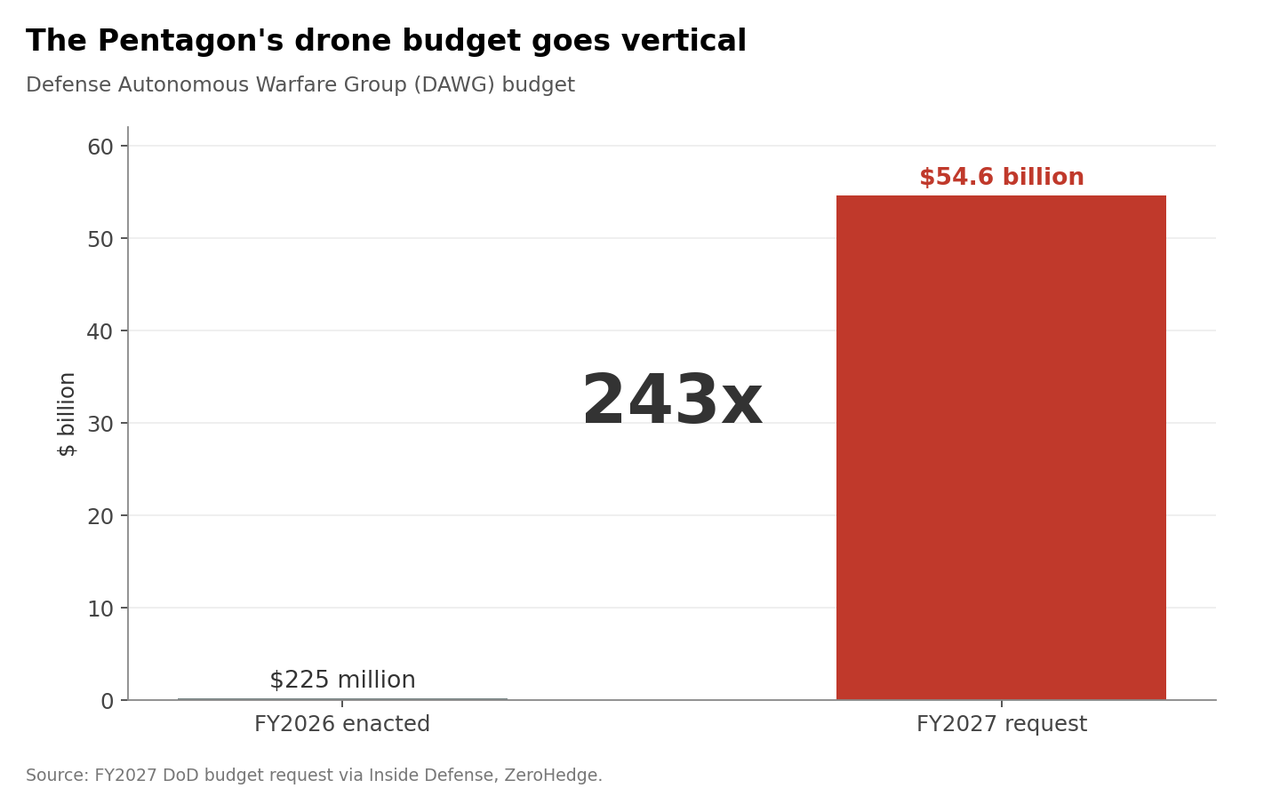
Add the $1.1 billion Drone Dominance initiative to stockpile 300,000 sub-$5,000 attack drones by the end of 2027 (which sent drone stocks soaring in May), plus the Army’s $500 million FPV award to Neros in July, and the direction of travel is pretty clear.
…So Why Are Defense Stocks Puking?
You would think a four-star command dedicated to drones, a 243x budget request and the world’s richest man drafting the shopping list would be manna for defense stocks. Instead, the SPDR S&P Aerospace & Defense ETF (XAR) is down 22% from its August 14 peak and in a bear market, and as of Wednesday it is on track for a seventh straight weekly decline, the longest losing streak since the fund launched in 2011. XAR is now down 4.1% YTD while the S&P is up almost 12%.
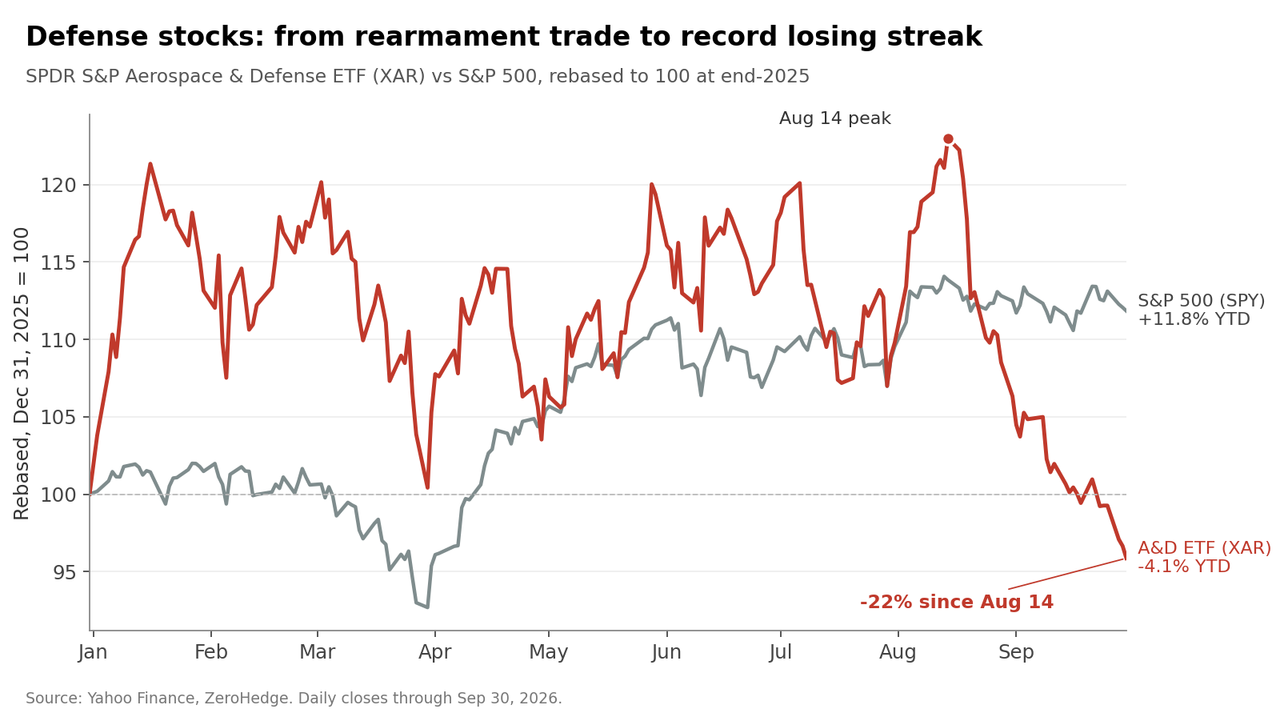
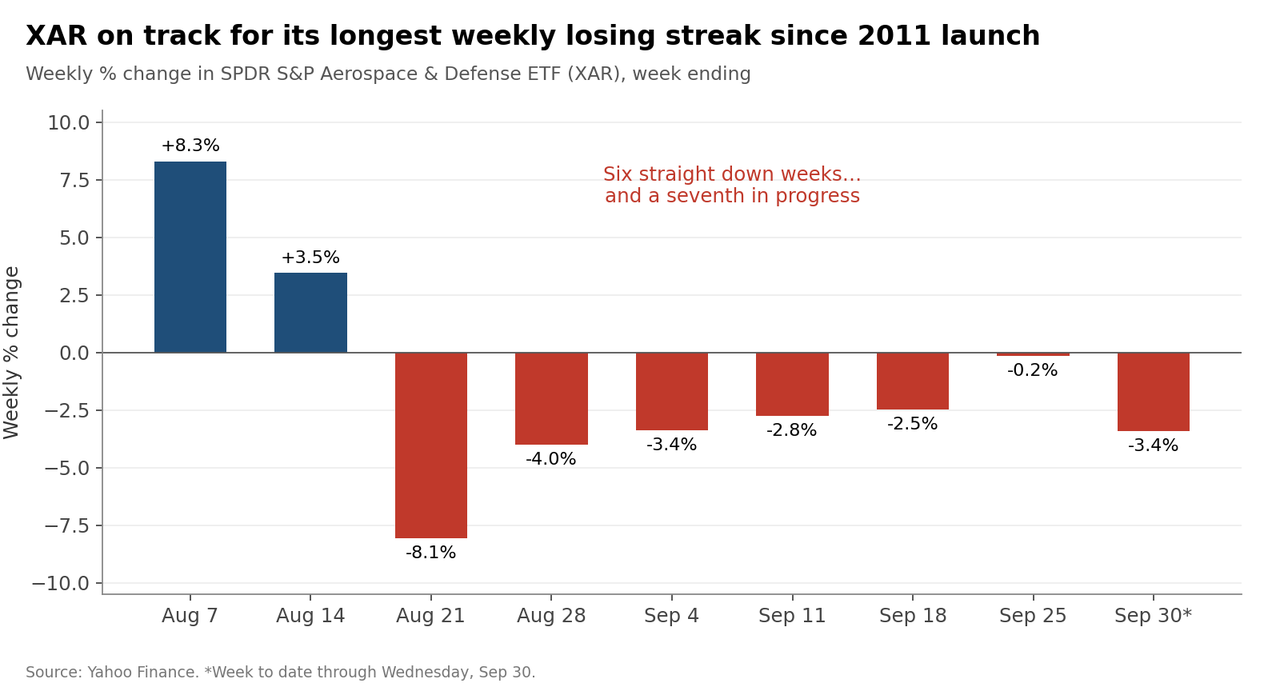
The explanations are familiar to ZH readers:
- First, peace is breaking out, or at least the possibility of it: on September 22 reports surfaced that Iran offered to reopen the Strait of Hormuz in exchange for an easing of US military pressure, while Trump floated a negotiated end to the conflict at the UN (that didn’t quite work out as expected, although the downward momentum was already in there).
- Second, the budget is stuck. Neither chamber has passed appropriations, and a stopgap through December 11 would freeze spending at 2026 levels. “The budget is stalled,” said Bernstein’s Douglas Harned, noting that defense stocks have gone from a 15% premium to the S&P 500 in February to a 12% discount.
- Third, the midterms: as we wrote two weeks ago, UBS’s Allyson Gordon said investors “remain reluctant to add exposure… until after the midterms,” and the Polymarket odds on Senate control are the reason why. Whoever controls Congress controls appropriations.
But the most interesting part is who is getting hit. Goldman’s US Industrials desk (Ryan Novak) put it bluntly in late August: defense tech “is definitely a tale of haves and have nots,” and “the day to day in SPCX is having impacts on the broader ‘space’ but specifically drone names.” The six weeks since have proved the point. The pure-play drone names have been crushed (Red Cat -42%, Kratos -34%, Unusual Machines -28%, AeroVironment -26%), while SpaceX and Palantir are both up roughly 8% since the sector peaked. In other words, the market has already picked its winners, and the biggest of them now has its CEO sitting at the Meridian table.
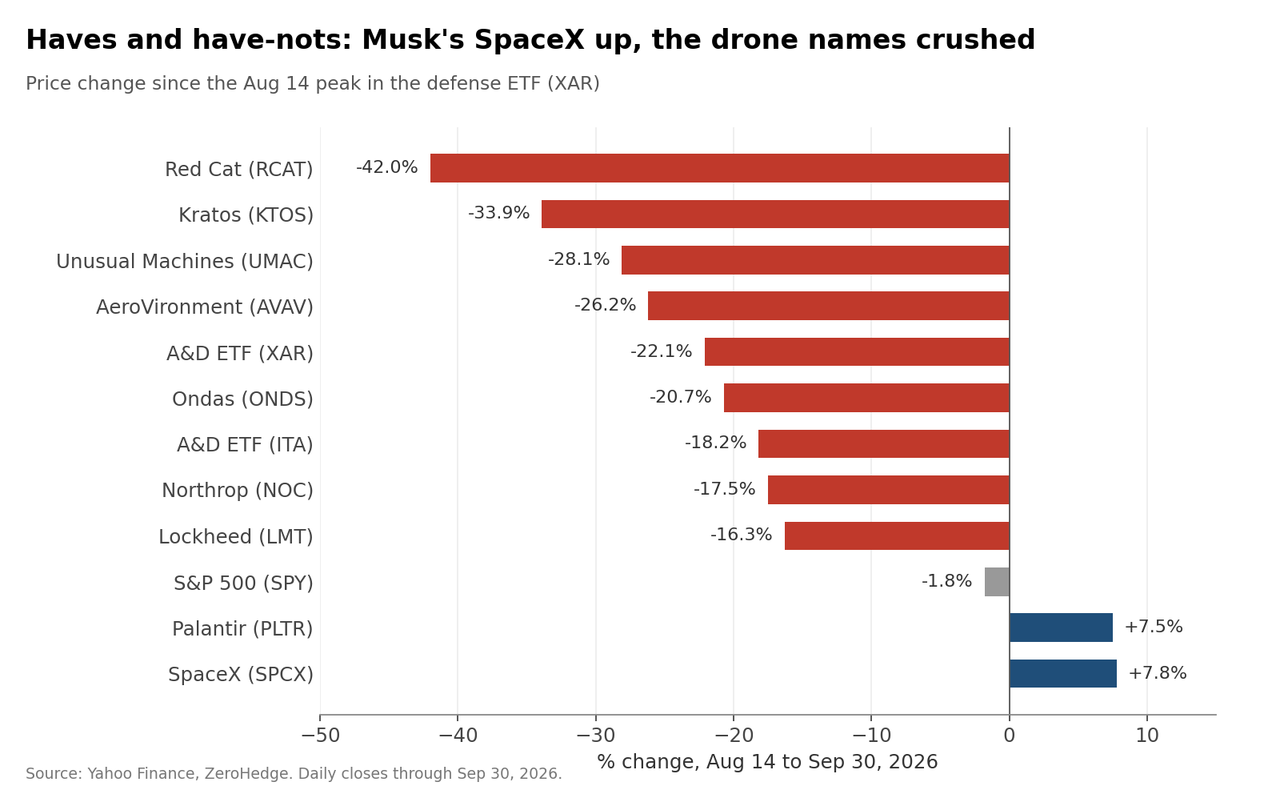
“Behind The Meter” Comes To Fort Bragg
Buried in the speech was one item ZH readers will recognize. Hegseth said he wants every major US military installation to generate its own power, so that bases keep running if a cyberattack takes down the grid. That will come in the form of nuclear microreactors, with the first targeted to be operational by September 2028 and Eielson AFB in Alaska leading the Air Force effort.
This has been building for a while. The Army launched its “Janus” microreactor program last October, and in August it picked five companies under agreements worth up to $2.2 billion: Antares (Fort Bragg), BWXT (Fort Campbell), General Atomics (Fort Hood), Radiant (Fort Benning) and Westinghouse (Fort Drum). Meanwhile, the Air Force has its own microreactor pairings at three bases and has also been working with NANO Nuclear: AFWERX gave the company a $1.25 million contract last September to study putting its KRONOS microreactor at Joint Base Anacostia-Bolling in Washington, and in July it followed up with a second award to adapt KRONOS for military installations more broadly.
Long-time readers know where we stand. Back in November we argued that every data center must have its own “behind the meter” onsite power generation, and in December we put it more simply: “Make ‘behind the meter’ mandatory.” We have also long said that small modular reactors are the only real long-term answer to America’s power crunch. It is nice to see the Pentagon get there too, even if it took the threat of a grid-killing cyberattack rather than a hyperscaler’s electricity bill.
And The Rest
In case that wasn’t enough for one morning, Hegseth also:
- Confirmed that general and flag officer billets will be cut by 20%, double last year’s 10% (as we previewed on Tuesday), with the reductions due by January 1, 2027;
- Announced the first new US military base in four decades, a “Next Great American Base” for 15,000-plus troops built in “timeless classical architecture,” with states invited to compete to host it, as the Pentagon weighs large troop cuts in Europe;
- Created an Office of Religious Affairs reporting directly to the Secretary;
- Launched new “corps of cadets” partnerships with Hillsdale, Liberty, LSU, Mississippi State and Tuskegee; and
- Accused US media outlets of “treason” over their coverage of the Iran war, a few weeks after Thomas Massie forced a House vote on impeaching him.
- Oh, and he clarified who may serve: “No fatties…No trannies…No beardos….No weirdoes…No wimps.”
The bottom line: the Pentagon is reorganizing itself around drones, autonomy and AI, putting the people who build those things in charge of deciding what comes next, and asking for the budget to match. The market isn’t buying it yet. Not because the story is wrong, but because nobody wants to own the stocks until Congress, the midterms and Iran give them a reason to. When that changes, the “haves” are already obvious. The have-nots, at 40% off, may turn out to be the more interesting trade… assuming Meridian’s 120-day report leaves any room for them.
KING NEWS
| The King Report October 1, 2026 Issue 7838 | Independent View of the News |
| AI Overview: The US Core PCE Price Index printed significantly cooler than expected for August 2026, dropping to an annual rate of 3.0% against consensus forecasts of 3.3%. This sharp “miss” was heavily driven by a major methodological overhaul and annual rebenchmarking implemented by the Bureau of Economic Analysis (BEA). The BEA retroactively updated its calculations back to Q1 2021 to better match real-world household spending patterns, reshaping three key categories that make up roughly 3.67% of the PCE basket:1. Portfolio Management & Investment Advice: Switched to a Consumer Expenditure Survey (CES)-based quantity series rather than relying strictly on nominal price deflation. Revisions shaved roughly 10 percentage points off this component’s specific annual inflation rate.2. Computer Software & Accessories: Shifted to a new composite index built from both PPI and CPI data. This adjustment corrected distortions caused by the recent surge in AI-fueled hardware and software demand.3. Legal Services: Migrated to a more stable deflator after the prior CPI-based metric was deemed unreliable and prone to overstating actual consumer price changes. Capital Economics, these structural data shifts chopped an estimated 0.3 percentage points (30 basis points) off the headline core inflation calculation. Because of these retroactive changes, the three-month annualized core inflation rate dropped to precisely 2.0%, hitting the Fed’s target on paper…https://www.google.com/search?q=Core+PCE+Prints+Cooler+Than+Expected+Due+To+Change+In+Methodology&sourceid=chrome&ie=UTF-8&source=chrome.ctxt Consumer-killing inflation in the ‘70s induced the US government to change CPI methodologies (removed actual home prices for one) and introduce the Core CPI concept that ignored the inflation components that most impaired Americans. The fact that the US government has changed its CPI methodology now evinces that inflation is a big problem – and the remedy is to gaslight Americans. Core PCE Prints Cooler Than Expected Due to Change in Methodology, as Savings Rate Plunges To 3 Year Low – “the Bureau of Economic Analysis updated methodology for calculating inflation in three components is expected to trim August year-on-year change by a few tenths of a percentage point.”… Despite rampant energy inflation and record diesel prices, headline PCE came in line sequentially, printing up 0.3%, in line with expectations but coming in far cooler than expected on an annual basis, rising just 3.4%, vs expectations of a 3.7% print… Core PCE, which strips out volatile energy and food prices, that rose 0.2% MoM (technically 0.247%, below the +0.3% MoM expected) with a notable miss in the YoY print, which dropped to +3.0% from the unrevised 3.3% (now revised to 3.0%), missing estimates of a 3.3% print…https://www.zerohedge.com/economics/core-pce-prints-cooler-expected-due-change-methodology-savings-rate-plunges-3-year-low Higher energy commodity prices on Wednesday, mitigated the crafted PCE boost for financial assets. Mr. Bond was not fooled like so many ‘experts’ and economists on the government’s PCE legerdemain.USZs hit a high of 103 31/32, + 23/32, at 2:15 ET on anticipation that the BLS PCE methodology change would foment algo and Pavlovian buying after the PCE report. However, USZs fell to 103 13/32 15 minutes before the release of the PCE. After the 8:30 ET release of the PCE, algos and dumb money spiked USZs to 103 29/32. Sellers pounced; by 9:46 ET. USZs had tumbled to 103 3/32, -5/32. US Q2 GDP 2.2%, 1.5% exp; GDP Price Index 5.0%, 6.4% q/q exp; Core GDP Price Index 3.3%, 3.6% exp. Q2 GDP was juiced 1.4 percentage points on the much lower and dubious GDP Price Index. The BEA: Real GDP was revised up 0.7 percentage point from the second estimate, primarily reflecting upward revisions to investment, consumer spending, and government spending… the increase in real GDP reflected increases in real value added of 2.5 percent for private services-producing industries, 2.3 percent for private goods-producing industries, and less than 0.1 percent for government. The leading industry contributors to the increase in real GDP were real estate and rental and leasing, information, durable goods manufacturing, and finance and insurance. The leading offsets were decreases in transportation and warehousing, retail trade, and nondurable goods manufacturing… Real final sales to private domestic purchasers, the sum of consumer spending and gross private fixed investment, increased 4.6 percent in the second quarter, revised up 0.4 percentage point from the previous estimate… https://www.bea.gov/sites/default/files/2026-09/gdp2q26-3rd.pdf Table 1.5.2. Contributions to Percent Change in Real Gross Domestic Product, Expanded DetailThe very dubious and vague ‘intellectual property’ added .51; Non-residential fixed investment (AI Bubble) 1.25. Equipment 0.75 (AI too?); Real Estate & Rental & Leasing 0.57https://apps.bea.gov/iTable/?reqid=19&step=2&isuri=1&categories=survey#eyJhcHBpZCI6MTksInN0ZXBzIjpbMSwyLDNdLCJkYXRhIjpbWyJjYXRlZ29yaWVzIiwiU3VydmV5Il0sWyJOSVBBX1RhYmxlX0xpc3QiLCIzMiJdXX0= Aug PCE Price Index 0.4% m/m & 3.7% y/y; Aug Core PCE 0.3 m/m & 3.4%; Aug Personal Income 0.4% m/m, Spending 0.8%; Sept ADP Employment Change+72kAug Goods Trade Balance -$113.5BSept Chicago PMI 51 ‘No need for urgency’: New York Fed’s Williams squashes notion of an October rate hikeWilliams sees one more rate hike “late this year” to support what he calls a “timelier” return of inflation to the Fed’s 2% target. Late this year, to many, implies a hike timed for December rather than in October, when their next meeting takes place…https://finance.yahoo.com/economy/article/no-need-for-urgency-new-york-feds-williams-squashes-notion-of-an-october-rate-hike-202237159.html As we have stated, the NY Fed President typically stooges for Wall Street. Other Fed Presidents from financial centers, notably Boston and Chicago, are of the same ilk. PS – The Wall Streeters that run the NY Fed imported Williams from San Fransico, where he was SF Fed President. As we postulated, the usual suspects poured into AI bubble stocks and select Fangs on Pavlovian buying and manipulation to embellish Q3 performance. Near 9:10 ET: MU + 0.82%, NVDA +1.74%, INTC +2.2%, SNDK +1.05%, APPL +2.66%, GOOGL 2.6%, SPCX +1.86%, MSFT +1.93%, S&P 500 +0.6%, DJIA +0.17%, Nasdaq +1.05% The S&P 500 Index gapped up and opened at its low (7688.99) and ran to a high of 7722.88 at 10:55 ET. After a retreat7707.31 at 11:12 ET, the index rebounded modestly and settled into a 15-handle range until then index broke down at 13:14 ET. After falling to 7689.42 at 14:54 ET, the index rebounded to 7697.31 at 15:05 ET. The index then fell to 7689.74 at 1555 ET. The late manipulation, intensified by Q3 performance gaming, took the S&P 500 Index to 7686.28 at 15:48 ET. Alas. Selling returned; the S&P sank and closed at the daily low of 7651.54. The US 30-year bond hit a 5.651% yield at 13:26 ET. The 10-year hit 5.306% (24-yr high) at 16:03 ET after posting a low yield of 5.201% at 8:32 ET (when algos and pasties bought on the crafted PCE). The 2-year yield rebounded to a daily high of 4.8992% at 15:02 ET after a low of 4.827% at 9:08 ET USZ hit a daily low of 102 16/32, -24/32 for the session and -1 15/32 from the high at 15:03 ET. ADP National Employment Report: Private-Sector Employment Increased by 90,000 Jobs in September –Base pay for private-sector workers rose 3.2% and gross pay was up 4.7% year over year…Goods-producing: 31,000… Service-providing: 59,000 with Education and health services 55,000…https://www.prnewswire.com/news-releases/adp-national-employment-report-private-sector-employment-increased-by-90-000-jobs-in-september-302894314.html @WSJTech: The Federal Trade Commission is investigating leading artificial-intelligence companies Anthropic and OpenAI, aiming to determine whether they have misled consumers about potential harms from their technology The S&P 500 closed the third quarter with a 2% gain, but three-quarters of index components declined during September… https://tradingstrategyguides.com/stock-market-recap-september-30-2026-sp-masked-by-ai-put/ Q3 S&P Sector returns: Energy +16.48%, Information Technology +7.06%, Health Care +6.03%, Communication Services +3.48%, Financials -0.48%, Consumer Staples -2.43%, Materials -3.19%, Consumer Discretionary -5.24%, Real Estate -6.32%, Industrials -9.91%, Utilities -13.03% Positive aspects of previous session Nasdaq +0.24%, Nas 100 +0.23%, SOX Index unchangedSP Info Tech +0.61%, Consumer Discretionary +0.13%,Mr. Bond was NOT fooled by US government economic data chicanery! Negative aspects of previous session Instead of soaring on the crafted PCE and Q3 portfolio rebalancing buying, bonds & notes sank.S&P 500 -0.25% (Closed at daily low), DJIA -0.86%, DJTA -1.37%, Nasdaq -0.09%SP Consumer Staples -1.68%, Health Care -1.39%, Industrials -1.29%, Real Estate -1.28%,Financials -1.19%, Materials -0.82%, Utes -0.73%, Comm Services -0.04%, Energy -0.02%,USZ hit a daily low of 102 16/32, -24/32 for the session and -1 15/32 from the high at 15:03 ET.Nov WTI Oil +1.12, Nov Brent +1.88, Nov Diesel +18.06¢, Gasoline +13:45¢ at 16:12 ET Ambiguous aspects of previous session How high will bond and note yields rise? First Hour/Last Hour NYSE Action [S&P 500 Index]: 1st Hour: Up; Last Hour: Down. Pivot Point for S&P 500 Index [above/below indicates daily trend to day traders]: 7675.32 Previous session (S&P 500 Index) High/Low: 7722.88 (10:55 ET); 7651.54 (16:00 ET) Iran is behind ‘terror plot’ at US bomber base in in UK, British leader says https://trib.al/r5DDUVy Micron (MU) closed +0.03 points but was +1.91% at 16:33 ET on good Q4 results. MU Q4 EPS $33.42, $31.83 expected; Revenue $54.23B; $51.49B expected; MU projects Q1 2027 revenue between $60B and $63B, $56.77B consensus Today – Traders will play for start-of-Quarter 4 buying near or at the NYSE close and a relief rally after portfolio rebalancing sell pressure on equities. This is why ‘they’ are buying equity futures on Wednesday night. Unless someone has inside information, afternoon activity could be lame as traders get cautious ahead of the September Employment Report. To summarize the state of the union: Stocks, bonds, oil, the yen, and US economic data are being rigged and manipulated, and this will continue into the Midterm Elections (11/3). Trade and invest accordingly. ESZs +27.75; NQZs +122.00, USZs +3/32, Nov WTI -$0.44, Nov Gas -0.01¢, Yen/157.64 at 20:01 ET Expected economic data: Initial Jobless Claims 200k, Continuing Claims 1.73m; Richmond Fed Pres Barkin, KC Fed Pres Schmift, and Boston Fed Pres Collins 8:05 ET, Sept S&P Global Mfg. PMI 57, Sept ISM Mfg. PMI 55, Prices 72.9, Employment 51, New Orders 53; Fed VCEO Jefferson 12:30 ET, Fed Gov. Bowman 15:00ET, NY Fed Pres (huge dove) Williams 15:30 ET S&P 500 50-day MA: 7649; 100-day MA: 7559; 200-day MA: 7216 (Close 7651.54, -0.25%)Nasdaq 100 50-day MA: 29,383; 100-day MA: 29,472; 200-day MA: 25,424 (Close 30,408.50, +0.23%) DJIA 50-day MA: 52,750; 100-day MA: 52,031; 200-day MA: 50,249 (Close 50.906.05, -0.86%) (Green is positive slope; Red is negative slope) Netanyahu says pilot tried to crash Israel-bound (from Dubai) commercial jet, lauds hero passengers… “I salute these heroes, who displayed exceptional resourcefulness and courage. They saved many lives. They prevented a huge disaster,” Netanyahu said… (30 children on flight reportedly) “I spoke with one of the Israeli passengers. He told me that the plane went into a spin and began to descend. He told me that, somehow, he managed to break into the cockpit with one of the crew members and, together, they overpowered the pilot who had carried out the stabbing while he was attempting to sabotage the aircraft’s systems. I salute these heroes, who displayed exceptional resourcefulness and courage. They saved many lives…https://justthenews.com/world/middle-east/flight-bound-israel-makes-emergency-landing-saudi-arabia-following-bloody-cockpit @netanyahu: My salute to the Indian pilot Captain Smit Machchhar for his extraordinary bravery.Despite being stabbed and seriously injured, he fought back, resisted, opened the cockpit door, and enabled passengers and crew to overpower the attacker — preventing a catastrophic mid-air disaster.He saved the lives of 174 people, including Israeli citizens and other nationals. I wish Captain Machchhar a speedy and full recovery. He is a true hero. Two-thirds of young Dem women say men are to blame for most of society’s problems: poll survey found. https://nypost.visitlink.me/IWjjmQ (Isn’t this sexist?) | |
SWAMP STORIES FOR YOU TONIGHT
Sen. Marsha Blackburn Sues Former Special Counsel Jack Smith
Thursday, Oct 01, 2026 – 12:20 PM
Authored by Troy Myers via The Epoch Times,
Sen. Marsha Blackburn (R-Tenn.) on Wednesday sued former special counsel Jack Smith and the Department of Justice (DOJ) over a subpoena Smith’s office issued for her phone records during his investigation of President Donald Trump’s actions around Congress’s certification of the 2020 election.

Blackburn alleged Smith violated her constitutional rights and was unlawfully appointed. She asked the U.S. District Court for the Middle District of Tennessee to order the Justice Department to destroy the records or return them.
The senator opened her lawsuit with the quote: “The prosecutor has more control over life, liberty, and reputation than any other person in America,” from former attorney general and later Supreme Court justice Robert Jackson.
Blackburn claimed that Smith violated her First Amendment right of association and Fourth Amendment right against unreasonable searches and seizures.
She accused the former special counsel of violating the Speech or Debate Clause in the Constitution, which provides members of Congress and their aides with immunity from criminal prosecutions or civil suits stemming from their actions taken within their official duties.
The Supreme Court has previously said this legislation must not be interpreted literally but instead be construed broadly to accomplish the proper separation of powers it intends to make.
Blackburn also claimed former Attorney General Merrick Garland unlawfully appointed Smith, a private citizen, to special counsel, serving in that role from November 2022 to January 2025, in violation of the Appointments Clause, which gives authority to the president to name federal officials subject to the advice and consent of the Senate.
Blackburn said she never had the chance, as a senator, to offer her advice, consent, or rejection of Smith’s appointment.
Furthermore, the Tennessee senator said Smith and the DOJ’s actions in obtaining her phone records violated the constitutional provision of separation of powers.
“The facts alleged herein demonstrate that the Executive Branch ignored our Constitution’s carefully constructed design and allowed a private citizen to wield enormous power that did not belong to him, resulting in egregious violations of personal liberty and constitutional rights,” Blackburn’s suit read.
Garland named Smith as special counsel to investigate the events leading up to Congress’s joint session on Jan. 6, 2021, for certifying electoral votes from the 2020 presidential election. Smith alleged that Trump, who lost that election, was behind a suspected conspiracy to overturn the results. Trump said he was seeking to delay the certification in order to give states time to investigate claims of fraud and irregularities.
Trump was charged by a grand jury as a result of Smith’s investigation and pleaded not guilty, but the charges were eventually dropped after he won the 2024 presidential election.
Blackburn says in the lawsuit that she seeks to prevent any future attorney general from making any “fictitious” appointment as Garland did for Smith.
“No president appointed him, nor did Congress confirm him to serve in that role,” the lawsuit read. “Congress did not pass any law that authorized Attorney General Garland to appoint a Special Counsel.”
The senator requested nominal damages from Smith in the amount of $1.
As part of the former special counsel’s investigation into Trump, which was codenamed “Arctic Frost,” Smith issued subpoenas for toll records for Blackburn’s phone she used for legislative purposes. The investigation served as “the vehicle” for Smith to conspire and violate Blackburn’s rights, the lawsuit alleged, along with the rights of other Republican lawmakers and Trump supporters.
Smith defended his obtaining of GOP lawmakers’ cellphone data during congressional testimony on Sept. 29, calling it “materially relevant” to his investigation.
“Given what had happened that afternoon [on] Jan. 6, in my view, added to the powerful evidence we had of Donald Trump’s guilt, and the participation of his co-conspirators in his criminal scheme at his behest,” Smith said.
In addition to Blackburn, Smith subpoenaed and received records from Ron Johnson (R-Wis.), Lindsey Graham (R-S.C.), Bill Hagerty (R-Tenn.), Josh Hawley (R-Mo.), Cynthia Lummis (R-Wyo.), Dan Sullivan (R-Alaska), and Tommy Tuberville (R-Ala.), and Rep. Mike Kelly (R-Pa.).
Smith also had obtained nondisclosure orders from a federal district judge that prevented the lawmakers from knowing that their phone records were being investigated.
The former special counsel maintained during testimony that his investigation showed Trump “engaged in a criminal scheme to overturn the results and prevent the lawful transfer of power.”
Smith could not be reached for comment at the time of publication.
GREG HUNTER….
SEE YOU TOMORROW


