
EXCHANGE: COMEX
CONTRACT: OCTOBER 2026 COMEX 100 GOLD FUTURES
SETTLEMENT: 4,172.900000000 USD
INTENT DATE: 10/01/2026 DELIVERY DATE: 10/05/2026
FIRM ORG FIRM NAME ISSUED STOPPED
092 C DEUTSCHE BANK 25
099 H DEUTSCHE BANK AG 10
118 C MACQUARIE FUTURES US 4
167 C MAREX 4
363 H WELLS FARGO SECURITI 50
624 H BOFA SECURITIES 30
661 C JP MORGAN SECURITIES 65 94
686 C STONEX FINANCIAL INC 8 1
690 C ABN AMRO CLR USA LLC 5
700 C UBS SECURITIES LLC 1
732 C RBC CAP MARKETS 5
737 C ADVANTAGE FUTURES 2 1
905 C ADM 2
991 H CME 13
TOTAL: 160 160
MONTH TO DATE: 11,465
GOLD: NUMBER OF NOTICES FILED FOR OCT./2026: 160 CONTRACTs NOTICES FOR 16,000 OZ or 0.4976 TONNES
total notices so far: 11,465 contracts FOR 1,146,500 OZ OR 35.660 TONNES
SILVER NOTICES: 65 NOTICE(S) FILED FOR 0.325 MILLION OZ /
total number of notices filed so far this month : 2059 CONTRACTS (NOTICES) for 10.295 million oz
GLD
SEPT: INITIAL STANDING: 24.172 MILLION OZ//FOLLOWED BY TODAY’S STRONG 70 CONTRACT OR 350,000 OZ QUEUE JUMP//STANDING ADVANCES TO 33.865 MILLION OZ//
OCT: INITIAL STANDING: 16.355 MILLION OZ FOLLOWED BY TODAY’S HUGE 172 CONTRACT OR 860,000 OZ QUEUE JUMP//NEW STANDING ADVANCES TO 17.215 MILLION OZ//
SEPT: INITIAL STANDING 8.756 MILLION OZ//FOLLOWED BY TODAY’S 350,000 OZ QUEUE JUMP//STANDING ADVANCES TO 33.865 MILLION OZ
OCT: INITIAL STANDING: 16.355 MILLION OZ//FOLLOWED BY TODAY’S 360,000 OZ QUEUE JUMP//STANDING ADVANCES TO 17.575 MILLION OZ/
GOLD COMEX OUTLINE;
1.MAY SUMMARY FOR MAY TONNES WHICH STOOD FOR DELIVERY:
4. AUGUST: 60.547 TONNES OF INITIAL GOLD FIRST DAY NOTICE FOLLOWED BY THE NET MONTH’S QUEUE JUMP OF 47.2312 TONNES TO WHICH WE ADD THE FOLLOWING EXCHANGE FOR RISK ISSUANCE RECEIVED FOR THE MONTH: 5.4432 TONNES EX FOR RISK/AUG 7 , AUG 11: 2.413 TONNES EX FOR RISK AND AUG. 12 OF 2.
5.SEPT: INITIAL 8.093 TONNES OF GOLD PLUS TODAY’S QUEUE JUMP OF 0.4883 TONNES PLUS 2.2827 TONNES OF EXCHANGE FOR RISK TODAY//NEW TOTAL EX. FOR RISK/MONTH = 22.923//NEW TOTAL STANDING FOR GOLD SEPT ADVANCES TO = 48.801 TONNES!!
6.OCTOBER: 90.012 TONNES OF INITIAL GOLD STANDING WITH TODAY’S TINY 0.00311 TONNES QUEUE JUMP WHICH FOLLOWS ALL OTHER QUEUE JUMPS DURING OCT OF 76.1656 TONNES
THEN WE MUST ADD OUR 14.553 TONNES OF OUR ISSUANCE OF EXCHANGE FOR RISK/6 OCCASIONS//NEW TOTAL OF GOLD STANDING ADVANCES TO 197.5141 TONNES OF GOLD.
7.NOVEMBER BEGINS WITH 15.651 TONNES INITIALLY STANDING FOR DELIVERY FOLLOWED BY TODAY’S QUEUE JUMP OF 2.323 TONNES FOLLOWED BY ALL PREVIOUS QUEUE JUMPS IN OF OF 21.3775 TONNES TO WHICH WE ADD OUR TWO EXCHANGE FOR RISK ISSUANCE OF 4.5596 TONNES//NEW STANDING ADVANCES TO 43.9716 TONNES OF GOLD.
8. DECEMBER BEGINS WITH INITIAL STANDING OF 83.813 TONNES OF GOLD FOLLOWED BY TODAY’S 0.0TONNE QUEUE JUMP WHICH FOLLOWS ALL OTHER QUEUE JUMPS OF: 37.163 TONNES//NEW STANDING ADVANCES TO 115.390 TONNES TO WHICH WE ADD OUR 4 EXCHANGE FOR RISK FOR DECEMBER OF 6.587 TONNES/NEW STANDING ADVANCES TO 121.977 TONNES
9. JANUARY: INITITAL STANDING: 13.785 TONNES TO WHICH WE ADD OUR FIRST EXCHANGE FOR PHYSICAL TRANSFER OF 0.08709 TONNES WHICH FOLLOWS ALL OTHER QUEUE JUMPS OF 30.7117TONNES //NEW TOTAL QUEUE JUMPS 30.7117//NORMAL DELIVERY OF GOLD ADVANCES TO 36.8958 TONNES TO WHICH WE ADD OUR SIX EXCHANGE FOR RISK OF 22.315 TONNES//NEW STANDING ADVANCES TO 59.2108 TONNES.
FEB; INITIAL AMOUNT OF GOLD STANDING FOR DELIVERY: 93.567 TONNES OF GOLD TO WHICH WE ADD OUR NEXT 0.0248 TONNES 0.1555 TONNES QUEUE JUMP TO 41.2082 TONNES/ NEW NET QUEUE JUMP INCREASES TO 41.233 TONNES// AND THEN WE ADD OUR SIX EXCHANGE FOR RISK: 10,080 CONTRACTS OR 31.251 TONNES//NEW STANDING REDUCES TO 157.878 TONNES
MARCH:: INITIAL AMOUNT OF GOLD STANDING FOR DELIVERY: 8.099 TONNES TO WHICH WE ADD TODAY’S FAIR 4600 OZ QUEUE JUMP (0.2320 TONNES) AND THEN WE ADD OUR THREE EXCHANGE FOR RISK OF 22.3818 TONNES //NEW STANDING ADVANCES TO 67.6648 TONNES/
APRIL: INITIAL AMOUNT OF GOLD STANDING FOR DELIVERY: 52.600 TONNES FOLLOWED BY OUR 345 CONTRACT QUEUE JUMP FOR 34,500 OZ/ (1.073 TONNES)/NEW STANDING ADVANCES TO 70.286 TONNES TO WHICH WE ADD OUR 2ND EXCHANGE FOR RISK OF 1498 CONTRACTS FOR 149800 OZ OR 4.659 TONNES. THE NEW TOTAL EXCHANGE FOR RISK FOR THE MONTH OF APRIL IS 2239 CONTRACTS OR 223900 OZ OR 6.964 TONNES AND THIS WILL BE ADDED TO OUR NORMAL DELIVERY TOTALS (70.762 TONNES) TO GIVE US WHAT WILL STAND IN APRIL (77.726 TONNES)
MAY: INITIAL AMOUNT OF GOLD WILLING TO STAND: 12.24 TONNES OF GOLD TO WHICH WE ADD OUR NEXT QUEUE JUMP OF 345 CONTRACTS OR 34500 OZ (1.073 TONNES) TO WHICH WE ADD OUR FIVE EXCHANGE FOR RISK ISSUANCES FOR 24.635 TONNES/STANDING NOW ADVANCES TO 51.554 TONNES OF GOLD.
JUNE; INITIAL AMOUNT OF GOLD WILLING TO STAND; 64.496 TONNES.(CME CORRECTED) TO WHICH WE ADD OUR NEXT EXCHANGE FOR PHYSICAL TRANSFER OF 0.0186 TONNES/NEW STANDING REDUCES TO 127.03 TONNES
JULY: INITIAL AMOUNT OF GOLD WILLING TO STAND: 23.306 TONNES TO WHICH WE ADD OUR NEXT QUEUE JUMP OF 0.000 TONNES/ TO WHICH WE ADD OUR FIRST EXCHANGE FOR RISK 0F 0.0062 TONNES/NEW STANDING ADVANCES TO 40.824TONNES
AUGUST INITIAL STANDING 48.687 TONNES TO WHICH WE ADD OUR 5TH EXCHANGE FOR RISK OF 5 CONTRACTS FOR 500 OZ OR 0.0155 TONNESS TO OUR 4TH EXCHANGE FOR RISK OF 200 CONTRACTS OR 20,000 OZ OR 6.220 TONNES TO OUR 3RD EXCHANGE FOR RISK OF 1.7045 TONNES TO OUR 2ND EXCHANGE FOR RISK OF 1.552 TONNES TO OUR FIRST 0.0715 TONNES EXCHANGE FOR RISK//NEW TOTAL EXCHANGE FOR RISK: 3.9688 AND THEN ADD OUR NEXT QUEUE JUMP OF 39 CONTRACTS FOR 3,900 OZ OR 0.1213 TONNES//STANDING THUS ADVANCES TO 67.2441 TONNES
SEPT: INITIAL STANDING: 8.756 TONNES OF GOLD FOLLOWED BY TODAY’S 0 CONTRACTS OR 0 OZ QUEUE JUMP (0.0000 TONNES) TO WHICH WE ADD OUR TWO, 2000 CONTRACT EXCHANGE FOR RISK FOR 200,000 OZ OR 6.2208 TONNES//// // NEW STANDING REMAINS AT 19.2308 TONNES..
OCT: INITIAL STANDING: 38.345 TONNES OF GOLD FOLLOWED BY TODAY’S 2ND INA ROW 76 CONTRACT//7600 OZ EXCHANGE FOR PHYSICAL TRANSFER TO LONDON WHERE THEY WILL TAKE DELIVERY ON THAT SIDE OF THE POND//STANDING THUS REDUCES TO 36.7465 TONNES./
IN ESSENCE WE HAVE A FAIR SIZED LOSS IN TOTAL CONTRACTS IN GOLD ON THE TWO EXCHANGES OF 2954 CONTRACTS WITH 3225 CONTRACTS DECREASED AT THE COMEX// AND A SMALL SIZED 271 EXCHANGE FOR PHYSICAL OI CONTRACT ISSUANCE WHICH NAVIGATED OVER TO LONDON.
THUS TOTAL OI LOSS ON THE TWO EXCHANGES OF 2954 CONTRACTS.. WE HAD THE FOLLOWING TAS CONTRACTS INITIATED (ISSUED): A SMALL SIZED AND CRIMINAL 918 CONTRACTS AND THESE ISSUANCES ARE GENERALLY USED TO INITIATE A RAID WHEN CALLED UPON .
GOLD PRICE ROSE BY $19.55
STANDING FOR THE LAST 8 MONTHS JANUARY TO AUGUST:
FINAL STANDING FOR GOLD, JANUARY CONTRACT AT 59.08 TONNES OF GOLD
FEBRUARY: INITIAL STANDING FOR GOLD: 157.878 TONNES!! WHICH INCLUDES ALL QUEUE JUMPING, THREE EXCHANGE FOR PHYSICAL TRANSFERS TO LONDON AND OUR SIX ISSUANCES EXCHANGE FOR RISK!!
MARCH: INITIAL STANDING AT 8.099 TONNES TO WHICH WE ADD OUR FINAL DAY: 0.2320 TONNES QUEUE JUMP AND THEN ADD +22.3818 TONNES EXCHANGE FOR RISK//NEW STANDING ADVANCES TO 67.6648 TONNES
APRIL: INITIAL STANDING 52.600 TONNES PLUS 27,800 OZ QUEUE JUMP (0.8648TONNES): NEW STANDING ADVANCES TO 70.286 TONNES PLUS OUR TWO EXCHANGE FOR RISK FOR 223,900 OZ OR 6.964 TONNES/NEW FINAL STANDING: 77.726 TONNES
MAY: INITIAL AMOUNT OF GOLD WILLING TO STAND; 12.24 TONNES TO WHICH WE ADD OUR NEXT QUEUE JUMP FOR 345 CONTRACTS/34,500 OZ// 1.073 TONNES/ THEN WE MUST ADD OUR EXCHANGE FOR RISK ISSUANCE: TOTAL EXCHANGE FOR RISK MAY// 5 OCCASIONS: 24.635 TONNES///NEW FINAL STANDING NOW ADVANCES TO 51.554 TONNES
JUNE: INITIAL AMOUNT OF GOLD WILLING TO STAND: 64.496 TONNES TO WHICH WE ADD OUR NEXT EXCHANGE FOR PHYSICAL TRANSFER JUMP OF 0.0186 TONNES//NEW STANDING 127.03 TONNES//FINAL
JULY: INITIAL AMOUNT OF GOLD WILLING TO STAND: 23.306 TONNES OF GOLD TO WHICH WE ADD OUR NEXT QUEUE JUMP OF 0.0000 TONNES/ PLUS 0.0062 TONNES EX FOR RISK///NEW STANDING FOR GOLD REMAINS AT 40.824TONNES.
AUGUST INITIAL STANDING 48.687 TONNES TO WHICH WE ADD OUR FIRST 0.0715 TONNES EXCHANGE TO OUR 2ND EXCHANGE FOR RISK = 1.552 TONNES TO OUR 3RD EXCHANGE FOR RISK OF: 1.7045//TOTAL FOR EXCHANGE FOR RISK 3.3312 TONNES TO OUR 4TH EXCHANGE FOR RISK OF 200 CONTRACTS FOR 0.6220 TONNES/TO OUR 5TH EXCHANGE FOR RISK OF 0.0155 TONNES//TOTALL EXCHANGE FOR RISK: 3.9688 TONNES TO OUR NEXT QUEUE JUMP OF 0.1213 TONNES//STANDING ADVANCES TO 67.2441 TONNES
SEPT: INITIAL STANDING FOR GOLD: 8.756 TONNES FOLLOWED BY TODAY’S 0 OZ QUEUE JUMP (0.0000TONNES) TO WHICH WE ADD OUR SECOND 1000 CONTRACT EXCHANGE FOR RISK TO OUR FIRST: THUS// NEW EXCHANGE FOR RISK: 6.2208 TONNES// NEW STANDING REMAINS AT 19.2308 TONNES.
OCT: INITIAL STANDING FOR GOLD: 38.345 TONNES FOLLOWED BY TODAY’S HUGE 360,000 OZ CONTRACT EXCHANGE FOR PHYSICAL TRANSFER TO LONDON //STANDING THUS REDUCES TO 36.7465 TONNES//
JAN. 2025: 257.919 TONNES (ISSUANCE WILL BE PRETTY GOOD THIS MONTH BUT MUCH LOWER THAN LAST MONTH)
FEB: 207.21 TONNES//EX FOR PHYSICAL ISSUANCE (WILL BE A FAIR SIZED ISSUANCE THIS MONTH)
MARCH 130.84 TONNES//QUITE SMALL THIS MONTH.
APRIL; 208.57 TONNES. STRONG THIS MONTH
MAY: 113.499 TONNES OF GOLD EFP ISSUANCE//QUITE SMALL THIS MONTH
JUNE: 97.79 TONNES OF GOLD EFP ISSUANCE/EXTREMELY SMALL
JULY : 150.877 TONNES// QUITE SMALL
AUGUST: 175.86 TONNES A LOT LARGER THIS MONTH.
SEPT. 116.13 TONNES VERY SMALL
OCT. 252.72 TONNES//CERTAINLY MUCH LARGER THIS MONTH/VERY STRONG
NOV: 124.74 TONNES
DEC: 190.04 TONNES//GOOD SIZED THIS MONTH FINAL.
TOTAL EXCHANGE FOR PHYSICAL ISSUED FOR YEAR 2025: 2,026.20 TONNES (LOWER THAN LAST YR 2,569.00 TONNES
YEAR 2026:
JANUARY: 209.08 TONNES ( (WILL BE A STRONG MONTH FOR EXCHANGE FOR PHYSICAL)
FEB. 176.35 TONNES (WHICH IS A FAIR ISSUANCE)
MARCH: 214.67 TONNES//WILL BE STRONG ISSUANCE THIS MONTH
APRIL; 88.00 TONNES// WILL BE VERY SMALL THIS MONTH
MAY 118.430 TONNES
JUNE: 142.053 TONNES
JULY: 163.82 TONNES
AUGUST: 151.107 TONNES
SEPT: 99.458 TONNES
OCT: 5.981 TONNES
XXXXXXXXXXXXXXXXXXXXXXXXXX
SHANGHAI CLOSED UP 11.74 PTS OR .31%
HANG SENG CLOSED DOWN 640.98 PTS OR 2.68%
Nikkei CLOSED DOWN 599.72 PTS OR 0.87%
//Australia’s all ordinaries CLOSED UP 0.64%
//Chinese yuan (ONSHORE) CLOSED UP TO 6.7046
/ OFFSHORE CLOSED UP AT 6.7058 Oil DOWN TO 89.26 dollars per barrel for WTI and BRENT DOWN TO 99.22 Stocks in Europe OPENED ALL GREEN
ONSHORE USA/ YUAN// WITH YUAN TRADING UP (6.7046 OFFSHORE YUAN TRADING UP TO 6.7058 ONSHORE YUAN TRADING ABOVE LEVEL // OFF SHORE AND UP ON THE DOLLAR)// / AND THUS STRONGER/OFF SHORE YUAN TRADING UP AGAINST US DOLLAR/ AND THUS STRONGER
HERE IS A BRIEF SYNOPSIS OF HOW THE CROOKS FLEECE UNSUSPECTING LONGS
YOU WILL ALSO NOTICE THAT THE COMEX OPEN INTEREST STARTS TO RISE BUT SO IS THE OPEN INTEREST OF SPREADERS. THE OPEN INTEREST IN WILL CONTINUE TO RISE UNTIL ONE WEEK BEFORE FIRST DAY NOTICE OF AN UPCOMING ACTIVE DELIVERY MONTH (OCT), AND THAT IS WHEN THE CROOKS SELL THEIR SPREAD POSITIONS BUT NOT AT THE SAME TIME OF THE DAY. THEY WILL USE THE SELL SIDE OF THE EQUATION TO CREATE THE CASCADE (ALONG WITH THEIR COLLUSIVE FRIENDS) AND THEN COVER ON THE BUY SIDE OF THE SPREAD SITUATION AT THE END OF THE DAY. THEY DO THIS TO AVOID POSITION LIMITS
WHAT IS ALARMING TO ME, ACCORDING TO OUR LONDON EXPERT ANDREW MAGUIRE IS THAT THESE EFP’S ARE BEING TRANSFERRED TO WHAT ARE CALLED SERIAL FORWARD CONTRACT OBLIGATIONS AND THESE CONTRACTS ARE LESS THAN 14 DAYS. ANYTHING GREATER THAN 14 DAYS, THESE MUST BE RECORDED AND SENT TO THE COMPTROLLER, GREAT BRITAIN TO MONITOR RISK TO THE BANKING SYSTEM. IF THIS IS INDEED TRUE, THEN THIS IS A MASSIVE CONSPIRACY TO DEFRAUD AS WE NOW WITNESS A MONSTROUS TOTAL EFP’S ISSUANCE AS IT HEADS INTO THE STRATOSPHERE.
The crooks also use the spread in the TAS account (trade at settlement). They buy the spot TAS (e.g. June) and sell the future TAS two months out (e.g. August). Then they unload the front month (i.e. unload the buy side first so the price of gold/silver falls. This occurs in the middle of the front delivery month cycle. They unload the sell side of the equation, two months down the road. The crooks violate position limits as the OCC refuse to hear our complaints.
First, here is an outline of what will be discussed tonight:
SILVER:
1.TODAY WE HAD THE OPEN INTEREST AT THE COMEX IN SILVER FELL BY A HUGE 1638 CONTRACTS TO AN OI OF 104,373
EFP ISSUANCE 344 CONTRACTS
OUR CUSTOMARY MIGRATION OF COMEX LONGS CONTINUE TO MORPH INTO LONDON FORWARDS AS OUR BANKERS USED THEIR EMERGENCY PROCEDURE TO ISSUE:
DEC 344 CONTRACTS and 0 ALL OTHER MONTHS: ZERO. TOTAL EFP ISSUANCE: 0 CONTRACTS. EFP’S GIVE OUR COMEX LONGS A FIAT BONUS PLUS A DELIVERABLE PRODUCT OVER IN LONDON. IF WE TAKE THE COMEX OI LOSS OF 1638 CONTRACTSAND ADD TO THE 344 E.FP. ISSUED
WE OBTAIN A HUGE LOSS OF 1294 OI OPEN INTEREST CONTRACTS FROM OUR TWO EXCHANGES WITH OUR GAIN OF $0.57
THUS IN OUNCES, THE LOSS ON THE TWO EXCHANGES TOTAL 6.470 MILLION PAPER OZ
STANDING OCT AT 17.575 MILLION OZ
SILVER PRICE GAIN OF $0.57
XXXXXXXXXXXXXXXXXXXXXXXXXXXXXXXXXXXXX
LET US BEGIN:
THE TOTAL COMEX GOLD OPEN INTEREST FELL BY A FAIR 3225 CONTRACTS TO 394,066 STILL WELL ABOVE ITS NEW LOW OF 326,052 OI SET JUNE 3, CLOSE TO THE PREVIOUS ALL TIME LOW OF 345,705 SET (MAY 28) AND CLOSE TO THE PREVIOUS ALL TIME LOW IN OI OF 353,490 SET MAY 27.. PREVIOUS TO THAT THE ALL TIME LOW IN OI WAS 390,000 SET IN THE YEAR 2001 WHEN GOLD WAS TRADING $260.00. THE CME SHOULD BE PROUD OF THEMSELVES AS MANY HAVE ABANDONED THIS CROOKED ARENA!!THUS OUR NEW ALL TIME LOW OF COMEX OI HAS NOW BEEN SET AT 326,052 //JUNE 3 2026 WITH GOLD AT AN EXTREMELY HIGH $4,450.00 WHICH MAKES ABSOLUTELY NO SENSE!!!
WE HAD SOME T.A.S. LIQUIDATION DURING THURSDAY’S COMEX TRADING HOURS// . IT SEEMS THAT MANY OF THE SPECULATORS THAT HAVE NOW CONTINUED AGAIN TO BE ON THE SHORT SIDE WITH BANKERS ON THE LONG SIDE AND THESE GUYS WERE AGAIN OBLITERATED YESTERDAY WHEN THE LONGS TENDERED FOR DELIVERY:
CENTRAL BANKS TENDERED THEIR NEW LONG CONTRACTS AT THE END OF THE DAY FOR PHYSICAL GOLD. YOU CAN VISUALIZE THIS WITH THE STRONG AMOUNT OF GOLD STANDING AT THE COMEX FOR THIS JULY CONTRACT MONTH!!
WE HAD A FAIR SIZED LOSS ON OUR TWO EXCHANGES (2954 CONTRACTS) OCCURRED DESPITE OUR GAIN IN PRICE IN GOLD (UP $19.55)
WE THUS HAD A FAIR LOSS IN OI ON BOTH OF OUR EXCHANGES (2954 CONTRACTS), DESPITE OUR GAIN IN PRICE, AS WE WERE INFORMED OF A SMALL CONTRACT EXCHANGE FOR PHYSICAL ISSUANCE EQUATING TO 271 CONTRACTS.
THEN WE WERE NOTIFIED TODAY OF A 0 CONTRACT FOR RISK ISSUANCE IN GOLD CONTRACTS FOR 0 OZ OR 0 TONNES OF GOLD. TOTAL THUS SO FAR THIS MONTH: 2000 CONTRACTS//200,000 OZ OR 6.2208 TONNES (2 OCCASIONS)
MONTH OF MAY RECORD ISSUANCE OF EXCHANGE FOR RISK: THE HIGHEST EVER ISSUANCE!!
MAY 22 RECORDS THE HIGHEST EVER EXCHANGE FOR RISK AT 12.4416 TONNES. WE HAD OUR FIRST ISSUANCE FOR EXCHANGE FOR RISK IN THE MONTH OF MAY ON MAY 7, THEN OUR 2ND ISSUANCE FOR OUR MAY GOLD MONTH ON MAY 12. THE THIRD ON MAY 18 , THEN MAY 21 OUR 4TH ISSUANCE AND THEN FINALLY FRIDAY, OUR 5TH ISSUANCE. THIS GOLD WILL BE ADDED TO OUR NORMAL MAY DELIVERIES TO GIVE US OUR FINAL AMOUNT OF GOLD WILLING TO STAND AT THE COMEX..
HISTORY OF EXCHANGE FOR RISK ISSUANCE THIS YEAR: FEBRUARY THROUGH JULY AND AUGUST
FEBRUARY:
DURING THE MIDDLE OF THE FEBRUARY CONTRACT MONTH, WE HAD TWO IDENTICAL MONSTER 3,000 CONTRACT ISSUED FOR THE SAME 9.33 TONNES OF GOLD, AND THESE WERE THE HIGHEST EVER IN TONNAGE EVER ISSUED BY THE COMEX. ALTOGETHER THE TOTAL ISSUANCE FOR FEB TOTALLED SIX.(31.251 TONNES).
MARCH:
THURSDAY MARCH 17 WE RECEIVED ITS INITIAL 2000 CONTRACT EXCHANGE FOR RISK ISSUANCE FOR 6.22 TONNES. LAST FRIDAY: 0 ISSUANCE OF EXCHANGE FOR RISK. BUT ON MONDAY MARCH 23 WE RECEIVED NOTICE OF OUR SECOND EXCHANGE FOR RISK ISSUANCE FOR 2,200 CONTRACTS (220,000 OZ OR 6.843 TONNES) AND NOW FRIDAY WITH A MONSTER 2996 CONTRACTS FOR 9.3138 TONNES. THESE THREE ISSUANCES WILL NOW BE ADDED TO THE REGULAR AMOUNT OF GOLD STANDING, I.E. 22.3818 TONNES TO OUR NORMAL GOLD STANDING TO GIVE US WHAT WILL STAND FOR PHYSICAL GOLD FOR MARCH!
APRIL;: 2 EXCHANGE FOR RISK SO FAR, I.E. 2239 CONTRACTS FOR 223,900 OZ OR 6.964 TONNES AND THIS TOTAL TONNES WILL BE ADDED TO OUR NORMAL DELIVERY TO GIVE US WHAT WILL STAND IN APRIL
MAY: FIVE ISSUANCES SO FAR FOR 7920 CONTRACTS OR 792,000 OZ OR 24.635 TONNES.
JUNE: 0 IN GOLD. THUS FOR THE ENTIRE MONTH IN GOLD ZERO NOTICES WERE FILED.
JULY: 2 FOR 200 OZ OR 0.00622 TONNES
AUGUST: 1276 CONTRACTS FOR 127,600 OZ OR 3.9688 TONNES (5 OCCASIONS THIS MONTH)
SEPT: SO FAR: 2000 CONTRACTS FOR 200,000 OZ OR 6.2208 TONNESS (TWO OCCASIONS)
OCT: 0 SO FAR!
XXXXXXXXXXXXXXXXXXXXXXXXXXXXXXXXX
A LITTLE HISTORY OF EXCHANGE FOR RISK DECEMBER THROUGH TO OCT:
IN DECEMBER WE HAVE RECORDED 5 ISSUANCES OF EXCHANGE FOR RISK/4 FOR DEC AND THE LAST ONE ON DEC 31 FOR JANUARY. WE NOW HAVE 3 CHOICES FOR THE RECIPIENT OF THIS ISSUANCE AND IT MUST BE A CENTRAL BANK. YOU WILL RECALL THAT THE BUYER ASSUMES THE RISK OF THAT DELIVERY. (THUS TOTAL EXCHANGE FOR RISK FOR THE MONTH OF DECEMBER IS 6.56 TONNES/4 OCCASIONS.
MONTH OF JANUARY/EXCHANGE FOR RISK
IN JANUARY THEY HAVE 6 TOTAL ISSUANCE : 3.446 TONNES EARLY, THEN JAN 9 ISSUANCE OF 9,331 TONNES AND THEN JAN 16: 0.1996 TONNES JAN 26: 1.499 TONNES, JAN 27: 3.160 AND FINALLY JAN 29: 4.659 TONNES TONNES//TOTAL EXCHANGE FOR RISK JANUARY 22.315 TONNES WHICH WAS ADDED TO OUR NORMAL DELVERIES.
AND FEBRUARY:
FEB EXCHANGE FOR RISK: NOW 6 ISSUANCES: 10,080 CONTRACTS FOR 1,008,000 OZ OR 31.251 TONNES!
HERE ARE THE CHOICES FOR THE RECIPIENT OF THOSE ISSUANCES:
1 THE CENTRAL BANK OF ENGLAND. BUT THEY RECEIVED CLEARANCE THAT THEIR GOLD IS BACK SO IT IS NOT LIKELY THAT THEY WOULD LIKE TO ADD TO THEIR RESERVES.
2. THE CENTRAL BANK OF THE USA: THE FED. LOGICAL CHOICE AS THEY CLAMOUR TRYING TO REDUCE THEIR 131+ TONNES OF SHORTAGE. HOWEVER THEY SEEM NOT TO BE IN A HURRY TO COVER THEIR HUGE SHORTFALL
3. THE CENTRAL BANK OF CHINA AS THEY BATTLE WITS WITH THE USA.
TOTAL EXCHANGE FOR RISK FOR DECEMBER IS 6.56 TONNES AND THIS WAS ADDED TO OUR NORMAL DELIVERY TOTALS..
THE JANUARY ISSUANCE OF 17.656 TONNES WAS ADDED TO OUR DAILY DELIVERY TOTALS!!
FEBRUARY ISSUANCES 6 FOR; 31.251 TONNES !! AND THIS WAS ADDED TO OUR DELIVERY TOTALS FOR THIS MONTH.
MARCH: CME ANNOUNCES ITS FIRST EXCHANGE FOR RISK FOR 2000 CONTRACTS FOR 200,000 OZ OR 6.22 TONNES OF GOLD DURING THE FIRST WEEK OF MARCH, AND THEN MONDAY, MARCH 22, WE RECEIVED ITS SECOND NOTICE ISSUANCE OF 2200 CONTRACTS OR 220000 OZ (6.843 TONNES). THEN FINALLY WE RECEIVED NOTICE OF OUR THIRD EXCHANGE FOR RISK OF 2996 CONTRACTS OR 9.3188 TONNES. TOGETHER ALL 3 ISSUANCES TOTAL 22.3818 TONNES WHICH WILL BE ADDED TO OUR NORMAL DELIVERY SCHEDULE.
APRIL: 2 EXCHANGE FOR RISK SO FAR FOR 223,900 OZ OR 6.964 TONNES. AND THIS TOTAL WILL BE ADDED TO OUR NORMAL DELIVERY TO GIVE US WHAT WILL STAND FOR APRIL!!
MAY: FIVE ISSUANCES SO FAR FOR 7920 CONTRACTS, 792,000 OZ OR 24.635 TONNES OF GOLD. THIS TOTAL WILL BE ADDED TO OUR NORMAL DELIVERIES IN MAY TO GIVE US WHAT WILL STAND IN MAY.
JUNE: ZERO
JULY 2 FOR 200 OZ OR 0.00622 TONNES. I DOUBT VERY MUCH THAT THIS IS A CENTRAL BANK
AUGUST: 1276 CONTRACTS FOR 127,600 OZ OR 3.9688 TONNES//5 OCCASIONS
SEPT: SO FAR: 2000 CONTRACTS FOR 200,000 OZ OR 6.2208 TONNES/TWO OCCASIONS
OCT: 0 SO FAR
DETAILS ON OUR NEW SEPT COMEX CONTRACT MONTH//
IN TOTAL WE HAD A FAIR LOSS ON OUR TWO EXCHANGES OF 2954 CONTRACTS DESPITE OUR GAIN IN PRICE (UP $19.55). HOWEVER, OUR FRIENDLY PHYSICAL LONDON BOYS HAD ANOTHER FIELD DAY AGAIN THROUGHOUT THIS WEEK AS THEY WERE READY FOR THE FRBNY.S CONTINUED ORCHESTRATED ATTACKS VERY EARLY IN THE COMEX SESSIONS AS THEY TRIED TO ABSORB EVERYTHING IN SIGHT FROM THEIR DAILY ATTACKS. LONDONERS EXERCISED THEIR BOUGHT CONTRACTS FOR PHYSICAL GOLD VIA THE EXCHANGE FOR PHYSICAL ROUTE AND THANKED THE FRBNY AND OUR SHORT SPECULATORS FOR THEIR THOUGHTFULNESS.
LONDON ANNOUNCED EARLY IN THE YEAR (AND SCARCITY CONTINUES TO THIS DAY) THAT THEY WERE OUT OF GOLD. WRONGLY IT WAS ATTRIBUTED TO THEIR SHIPPING PHYSICAL GOLD TO COMEX FOR STORAGE DUE TO TRUMP’S INITIATION OF TARIFFS. THE TRUTH OF THE MATTER IS THAT THIS GOLD LEFT LONDON TO OTHER CENTRAL BANKS, AND COMEX BANKS HAVE BEEN PAPERING THEIR LOSSES (DERIVATIVE) WITH KILOBAR ENTRIES. BOTH COMEX AND LBMA ARE WITNESSING MASSIVE AMOUNTS OF GOLD LEAVING THEIR VAULTS.
THE LIQUIDATION OF T.A.S. CONTRACTS THROUGHOUT THE MONTHS OF JUNE/JULY/AUG CONTINUES TO DISTORT OPEN INTEREST NUMBERS GREATLY ALTHOUGH THE T.A.S. ISSUANCES IN GOLD HAVE GENERALLY BEEN ON THE LOW SIDE COMPARED TO SILVER WHICH HAVE BEEN HUGE. TODAY’S NUMBER HOWEVER IS A SMALL SIZED T.A.S ISSUANCE CONTRACTS .THE CME NOTIFIES US THAT THEY HAVE ISSUED 918 T.A.S CONTRACTS. THESE ARE GENERALLY USED FOR RAID PURPOSES TO STOP GOLD’S RISE AND TO TEMPER HUGE LOSSES IN OTC DERIVATIVE BETS.
IT SURE LOOKS LIKE THE BIS HAS SOMEHOW LOOKED THE OTHER WAY WITH ITS GOLD SWAPS WITH THE FRBNY AS THIS ENTITY FOR THE FED REFUSES THE BIS MARCHING ORDERS TO COVER AND THAT MAY EXPLAIN THE STRONG NUMBER OF T.A.S. ISSUANCES IN DECEMBER , JANUARY AND THROUGHOUT FEBRUARY TO GO ALONG WITH OUR HUGE NUMBER OF EXCHANGE FOR RISK ISSUED DURING THESE MONTHS INCLUDING FEBRUARY’S 6 EXCHANGE FOR RISK WHICH ALSO INCLUDED TWO MONSTER 9.3312 TONNE ISSUANCE (FEB 10 AND FEB 12). TOTAL EXCHANGE FOR RISK/FEB EQUALS 31.251 TONNES!! AND MARCH’S THREE ISSUANCES FOR 22.3818 TONNES! OTHER CENTRAL BANKS ARE PAYING ATTENTION AS THEY TAKE DELIVERY OF HUGE AMOUNTS OF PHYSICAL GOLD. APRIL HAD 2 EXCHANGE FOR RISK ISSUANCES FOR 6.694 TONNES. AND MAY WITH ITS 5TH ISSUANCE FOR 12.4436 TONNES///TOTAL EXCHANGE FOR RISK FOR MAY: 24.635 TONNES ISSUED MAY 6 ,MAY 12, MAY 18 MAY 21 AND NOW MAY 22..
THEN IT SLOWS DOWN!
JUNE: ZERO FOR THE MONTH
JULY: 2 SO FAR FOR 200 IZ IR 0.00622 TONNES
AUGUST: 1276 CONTRACTS FOR 127,600 OZ OR 3.9688 TONNES
SEPT: 2000 CONTRACTS SO FAR FOR 200,000 OZ OR 6.2208 TONNES (TWO OCCASIONS)
OCT: 0 SO FAR
WE MUST ALSO REMEMBER THAT THE FRBNY IS SHORT 141+ TONNES OF GOLD, THIS COMMENCED ON JAN 2 2023 AS THEY REFUSE TO COVER DESPITE THE BIS’S PLEA TO DO SO.
HERE IS A SUMMARY OF GOLD STANDING FOR DELIVERY ON OUR LAST 16 MONTHS:
1.APRIL AT 209 TONNES
2. AND THIS CONTINUED INTO MAY WITH FINAL STANDING AT 90.23 TONNES.
3. JUNE WHICH IS A HUGE DELIVERY MONTH , FINAL STANDING WAS RECORDED AT A STRONG 93.085 TONNES. //(TOTAL NET QUEUE JUMPING FOR THE JUNE MONTH: 31.027 TONNES.)
4. IN JULY WE HAD HUGE DELIVERY NOTICES ESPECIALLY FOR A NON ACTIVE DELIVERY MONTH WITH INITIAL STANDING AT 17.947 TONNES PLUS MANY QUEUE JUMPS + 3.75 TONNES EX FOR RISK = 41.106 TONNES OF GOLD // FINAL TOTAL TONNES STANDING JULY: 41.106 TONNES
5. FOR THE MONTH OF AUGUST 2025
INITIAL AMOUNT OF GOLD STANDING FOR AUGUST: 60.547 TONNES PLUS THE MONTHS HUGE QUEUE JUMPS OF 47.2312 TONNES +44.696 TONNES EX FOR RISK (7 ISSUANCES) //NEW STANDING 152.208 TONNES WHICH IS MONSTROUS!!!
6. FINAL AMOUNT OF GOLD STANDING FOR SEPT; INITIAL STANDING; 2,602 CONTRACTS OR 260,200 OZ FOR 8.093 TONNES OF GOLD FOLLOWED BY TODAY’S 0.4883 TONNES QUEUE JUMP TO GO ALONG WITH TODAY’S 1.244 TONNES OF EXCHANGE FOR RISK ISSUANCE TODAY AND // TOTAL EXCHANGE FOR RISK ISSUANCE SEPT: 22.923 TONNES//NEW TOTALS STANDING ADVANCES TO 48.801 TONNES OF GOLD!!!
7. OCTOBER:
OCTOBER: INITIAL STANDING FOR GOLD: 90.164 TONNES TO WHICH WE ADD OUR LATEST OCT 30 QUEUE JUMP OF 0.00311 TONNES WHICH FOLLOWS OCT 29 QUEUE JUMP OF .4096 WHICH FOLLOWS; OCT 28 QUEUE JUMP OF .5069 TONNES WHICH FOLLOWS OCT 27 OF 0.3048 TONNES WHICH FOLLOWS: OCT 24 OF 0.8615 TONNES, FOLLOWING OCT 23 QUEUE JUMP OF 1.695 TONNES OCT 22 JUMP OF 8.622 TONNES WHICH FOLLOWS OCT 21: 3.8600 TONNES TO OCT 20 QUEUE JUMP OF 7.695 TONNE
SUMMARY FOR OCTOBER STANDING:
NOVEMBER WHERE INITIAL AMOUNT OF GOLD STANDING IS REGISTERED AT 15.651 TONNES OF GOLD FOLLOWED BY TODAY’S QUEUE JUMP OF 2 TONNES AND FOLLOWED BY ALL OTHER NOV QUEUE JUMPS OF 21.3775 TONNES TO WHICH WE ADD OUR TWO EXCHANGE FOR RISK ISSUANCE FOR 4.5596 TONNES.
/STANDING ADVANCES TO 43.9716 TONNES OF GOLD.
DECEMBER: INITIAL AMOUNT OF GOLD STANDING FOR DELIVERY IN THIS ACTIVE MONTH IS 83.813 TONNES FOLLOWED BY TODAY’S 0.05 TONNES QUEUE JUMP. THIS FOLLOWS ALL OTHER QUEUE JUMPING: 37.163 TONNES//NEW STANDING ADVANCES TO 115.390 TONNES TO WHICH WE ADD OUR FOUR EXCHANGE FOR RISK ISSUANCE OF 6.559 TONNES//NEW STANDING THUS INCREASES TO 121.977 TONNES
JANUARY: INITITAL STANDING: 13.785 TONNES TO WHICH WE ADD OUR QUEUE JUMP OF 0.000 TONNES WHICH FOLLOWS ALL OTHER QUEUE JUMPS OF 30.7117TONNES //NEW TOTAL QUEUE JUMPS 30.7117//NORMAL DELIVERY OF GOLD ADVANCES TO 36.8958 TONNES TO WHICH WE ADD OUR SIX EXCHANGE FOR RISK OF 22.315 TONNES//NEW STANDING ADVANCES TO 59.2108 TONNES.
FEBRUARY: . FEBRUARY: INITIAL STANDING: 93.566 TONNES TO WHICH WE ADD OUR NEXT QUEUE JUMP OF 0.0248 TONNES WHICH MUST BE ADDED ALL OTHER QUEUE JUMPS OF 41.2087 TONNES QUEUE JUMP//TOTAL QUEUE JUMP FOR FEB::ADVANCES TO 41.233 TONNES///STANDING ADVANCES TO 126.628 TONNES TO WHICH WE ADD OUR SIX EXCHANGE FOR RISK OF 31.251 TONNES/NEW STANDING FINALIZES AT 157.879 TONNES, ITS HIGHEST STANDING RECORDED IN OVER 4 YEARS.
MARCH: INITIAL STANDING FOR GOLD: 8.099 TONNES TO WHICH WE ADD OUR NEXT QUEUE JUMP OF 0.2320 TONNES AND THEN WE ADD OUR THREE EXCHANGE FOR RISK OF 22.3818 TONNES////NEW STANDING FOR GOLD ADVANCES TO: 67.6648TONNES WHICH IS ABSOLUTELY HUGE FOR A NON ACTIVE DELIVERY MONTH!!
APRIL 2026: INITIAL STANDING FOR GOLD: 52.20 TONNES FOLLOWED BY TODAY’S SMALL 500 OZ QUEUE JUMP/ TO WHICH WE ADD OUR TWO EXCHANGE FOR RISK ISSUANCES TOTALLING 223,900 OZ OR 6.964 TONNES//STANDING ADVANCES TO 77.726 TONNES WHICH IS ABSOLUTELY HUGE
MAY: INITIAL AMOUNT OF GOLD WILLING TO STAND: 12.24 TONNES OF GOLD TO WHICH WE ADD OUR NEXT HUGE QUEUE JUMP OF 34,500 OZ (1.073 TONNES) TO WHICH WE ADD OUR FIVE EXCHANGE FOR RISK ISSUANCE FOR 792,000 OZ OR 24.635 TONNES////NEW TOTALS STANDING FOR GOLD ADVANCES TO 51.554 TONNESS
JUNE: INITIAL AMOUNT OF GOLD WILLING TO STAND: 64.496 TONNES TO WHICH WE SUBTRACT AN EXCHANGE FOR PHYSICAL TRANSFER TO LONDON OF 0.0186 TONNES//NEW STANDING REDUCES TO 127.03 TONNES// TOTAL QUEUE JUMPING FOR THE MONTH FINALIZES AT 62.4217 TONNES OR AVERAGING 3.285 TONNES PER DAY IN JUNE.
JULY: INITIAL AMOUNT OF GOLD WILLING TO STAND: 749,300 OZ OR 23.306 TONNES OF GOLD TO WHICH WE ADD OUR NEXT QUEUE JUMP OF 0.000TONNES//NEW STANDING REMAINS AT 40.818TONNES PLUS 0.00622 TONNES EXHANGE FOR RISK// NEW TOTAL 40.824 TONNES . TOTAL QUEUE JUMPING SO FAR: 17.5802 TONNES OR 0.8790 TONNES ON EACH TRADING DAY LEAVING COMEX FOR EASTERN SHORES.
AUGUST INITIAL; INITIAL AMOUNT OF GOLD WILLING TO STANDS: 48.687 TONNES TO WHICH WE ADD OUR 5TH EXCHANGE FOR RISK OF 5 CONTRACTS FOR 500 OZ OR 0.0155 TONNES TO OUR 4TH EXCHANGE FOR RISK OF 220 CONTRACTS FOR 20,000 OZ OR 0.6220 TONNES TO OUR 3RD EXCHANGE FOR RISK AT 1.7045 TONNES TO OUR 2ND EXCHANGE FOR RISK AT 1.552 TONNES TO OUR FIRST: 0.0715 NEW TOTAL EXCHANGE FOR RISK = 3.9688 TONNES AND THEN ADD OUR NEXT QUEUE JUMP OF 39 CONTRACTS OR 3900 OZ (0.1213 TONNES)//STANDING, IN TOTAL, THUS ADVANCES HUGELY TO 67.2441 TONNES.
SEPT/2026. INITIAL STANDING : 8.756 TONNES//FOLLOWED BY TODAYS QUEUE JUMP OF 0 OZ OR 0.0000 TONNES TO WHICH WE ADD THIS TO OUR TWO EXCHANGE FOR RISK OF 2,000 CONTRACTS/200,000 OZ OR 6.2208 TONNES: /NEW STANDING ADVANCES TO 19.2316 TONNES
OCT: INITIAL AMOUNT OF GOLD STANDING: 38.345 TONNES! FOLLOWED BY TODAY’S 2ND INA ROW 76 CONTRACT EXCHANGE FOR PHYSICAL TRANSFER TO LONDON (7600 OZ OR 0.2364 TONNES)//STANDING THUS AT THE COMEX REDUCES TO 36.7465 TONNES.
HERE ARE THE AMOUNTS THAT STOOD FOR DELIVERY IN THE 4 YEARS 2021-2024
DEC 2021: 112.217 TONNES
NOV. 8.074 TONNES
OCT. 57.707 TONNES
SEPT: 11.9160 TONNES
AUGUST: 80.489 TONNES
JULY 7.2814 TONNES
JUNE: 72.289 TONNES
MAY 5.77 TONNES
APRIL 95.331 TONNES
MARCH 30.205 TONNES
FEB ’21. 113.424 TONNES
JAN ’21: 6.500 TONNES.
TOTAL YEAR 2021 (JAN- DEC): 601.213 TONNES
YEAR 2022: STANDING FOR GOLD/COMEX
JANUARY 2022 17.79 TONNES
FEB 2022: 59.023 TONNES
MARCH: 36.678 TONNES
APRIL: 85.340 TONNES FINAL.
MAY: 20.11 TONNES FINAL
JUNE: 74.933 TONNES FINAL
JULY 29.987 TONNES FINAL
AUGUST:104.979 TONNES//FINAL
SEPT. 38.1158 TONNES
OCT: 77.390 TONNES/ FINAL
NOV 27.110 TONNES/FINAL
Dec. 64.000 tonnes
(TOTAL YEAR 656.076 TONNES)
JAN/2023: 20.559 tonnes
FEB 2023: 47.744 tonnes
MAR: 19.0637 TONNES
APRIL: 75.676 tonnes
MAY: 19.094 TONNES + 1.244 tonnes of exchange for risk = 20.338
JUNE: 64.354 TONNES
JULY: 10.2861 TONNES
AUGUST: 38.855 TONNES(INCLUDING .6842 EXCHANGE FOR RISK)
SEPT: 15.281 TONNES FINAL
OCT. 35.869 TONNES + 1.665 EXCHANGE FOR RISK =37.0355 tonnes
NOV: 18.7122 TONNES + 16.2505 EX. FOR RISK = 34.9627 TONNES
DEC. 47.073 + 4.634 TONNES OF EXCHANGE FOR RISK = 51.707 TONNES
TOTAL 2023 YEAR : 436.546 TONNES
2024/STANDING FOR GOLD/COMEX
JAN ’24. 22.706 TONNES
FEB. ’24: 66.276 TONNES (INCLUDES 1.723 TONNES EX. FOR RISK)
MARCH: 18.8398 TONNES + 1.1695 EX FOR RISK = 20.093 TONNES
APRIL: 2024: 53.673TONNES FINAL
MAY/ 2024 8.5536 TONNES + 3.3716 TONNES EX FOR RISK/= 11.9325
JUNE; 95.578 TONNES. + 1.045 TONNES EXCHANGE FOR RISK =96.623 THIS IS THE HIGHEST RECORDED GOLD STANDING SINCE AUGUST 2022
JULY: 11.692 TONNES
AUGUST 69.602 TONNES//FINAL STANDING
SEPT. 13.164 TONNES.
OCT 39.474 TONNES + + 20.917 TONNES EXCHANGE FOR RISK =60.391 TONNES
NOV . 11.265 TONNES +4.665 TONNES EXCHANGE FOR RISK/TUESDAY + 3.11 TONNES OF EX. FOR RISK/PRIOR = 19.0425 TONNES
DEC: 80.4230 TONNES PLUS DEC MONTH EXCHANGE FOR RISK TOTAL 14.6836 TONNES EQUALS 95.1066 TONNES
total year 2024: 540.30 tonnes
XXXXXXXXXXXXXXXXXXXXXXXXXXXXXXXXXXXXXXXXXXXXXXXXXXXXXXXXX
COMEX GOLD TRADING BEGINNING OCT. CONTRACT;
THE SPECS/HFT WERE UNSUCCESSFUL IN LOWERING GOLD’S PRICE ( IT ROSE BY $19.55).
WE HAD SOME T.A.S. SPREADER LIQUIDATION THURSDAY // COMEX SESSION// WITH OUR GAIN IN PRICE.
OTHER EASTERN CENTRAL BANKS TENDERED FOR PHYSICAL EVERY NIGHT WHICH ALSO EXPLAINS THE HUGE NUMBER OF TONNES OF GOLD THAT STOOD FOR GOLD DURING THESE PAST SEVERAL MONTHS
THE CROOKS COULD NOT STOP OTHER CENTRAL BANK LONGS, SEIZING THE MOMENT, THEY EXERCISED AGAIN FOR PHYSICAL IN A BIG WAY TENDERING FOR PHYSICAL THURSDAY EVENING //SATURDAY MORNING AND THUS OUR HUGE NUMBER OF GOLD CONTRACTS STANDING FOR DELIVERY AT THE COMEX. CENTRAL BANKERS WAIT PATIENTLY FOR THE GOLD
ALL OF THIS WAS ACCOMPLISHED WITH OUR GAIN IN PRICE AT COMEX OF $19.55
WE HAD XCXX CONTRACTS REMOVED // PRELIMINARY NUMBERS TO FINAL COMEX NUMBERS.
NET LOSS ON THE TWO EXCHANGES: 2954 CONTRACTS OR 295,400 OZ 9.188 TONNES
OCT DELIVERY MONTH
OCT 2
| Gold | Ounces |
| Withdrawals from Dealers Inventory in oz | nil |
| Withdrawals from Customer Inventory in oz | 0 ENTRIES |
| Deposit to theDealerInventory in oz | 0 ENTRIES |
| Deposits to the Customer Inventory, in oz | DEPOSITS/CUSTOMER//gold 1 ENTRIES I) INTO ASAHI: 11,913.230 OZ TOTAL DEPOSIT; 11,913.230 oz xxxxxxxxxxxxxxxx |
| No of oz served (contracts) today | 160 CONTRACTS 16000 OZ 0.4976 TONNES OF GOLD |
| No of oz to be served (notices) | 399 Contracts 39900 OZ 1.241 TONNES |
| Total monthly oz gold served (contracts) so far this month | 11,465 notices 1,146,500 OZ 35.660 TONNES |
| Total accumulative withdrawals of gold from the Dealers inventory this month | NIL oz |
| Total accumulative withdrawal of gold from the Customer inventory this month |
dealer deposits: 0
xxxxxxxxxxxxxxxxxxx
DEPOSITS:
ENTRIES: 1
I) INTO ASAHI: 11,913.230 OZ
TOTAL DEPOSIT; 11,913.230 oz
xxxxxxxxxxxxxxxxxx
comex withdrawal
0 ENTRIES
adjustments: 0
COMEX IS DRAINING GOLD
chaos inside the comex
THE FRONT MONTH OF SEPT OI STANDS AT 559 CONTRACTS HAVING A LOSS OF 1083 CONTRACTS.
YESTERDAY WE HAD 1,189,000 OZ ( 36.982 TONNES) OF GOLD STANDING FOR DELIVERY: TODAY: 1,181,400 OZ OR 36.744 TONNES FOR A LOSS OF 7600 OZ (0.2364 TONNES) OR FOR THE 2ND DAY IN A ROW 76 CONTRACTS UNDERWENT AN EXCHANGE FOR PHYSICAL TRANSFER TO LONDON WHERE THEY WILL TAKE IMMEDIATE DELIVERY ON A T PLUS ONE BASIS. THE BOYS COULD NOT FIND ANY PHYSICAL GOLD OVER HERE.
NOVEMBER LOST 18 CONTRACTS RISING TO 4209
DECEMBER, THE LARGEST DELIVERY MONTH IN THE CALENDAR FALLS BY 2465 CONTRACTS DOWN TO 323,698.
.
We had 160 contracts filed for today representing 16000 oz
Today, 0 notice(s) were issued from J.P.Morgan dealer and 65 notices issued from their client or customer account. The total of all issuance by all participants equate to 160 contract(s) of which 0 notices were stopped (received) by j.P. Morgan dealer and 94 notice(s) was (were) stopped (received) by J.P.Morgan//customer account
To calculate the INITIAL total number of gold ounces standing for OCT /2026. contract month, we take the total number of notices filed so far for the month (11,465) to which we add the difference between the open interest for the front month of OCT (559 CONTRACTS) minus the number of notices served upon today 160 x 100 oz per contract) equals 1,181,400 OZ OR(36.7465 Tonnes of gold)
THUS: INITIAL total number of gold ounces standing for OCT. /2026. contract month,we take the total number of notices filed so far for the month (11,465) to which we add the difference between the open interest for the front month of OCT(559) contracts minus the number of notices served upon today 160 x 100 oz per contract) equals 1,181,400 OZ OR(36.7465 Tonnes of gold)
new total of gold standing in OCT becomes 36.7465 TONNES//
TOTAL COMEX GOLD STANDING FOR OCT.: 36.7465 TONNES WHICH IS NOW VERY STRONG FOR THIS NON ACTIVE DELIVERY MONTH OF OCT
confirmed volume THURSDAY confirmed 145.494/ poor/
COMEX GOLD INVENTORIES/CLASSIFICATION
NEW PLEDGED GOLD:
241,794.285 oz NOW PLEDGED /HSBC 5.94 TONNES
204,937.290 OZ PLEDGED MANFRA 3.08 TONNES
83,657.582 PLEDGED JPMorgan no 1 1.690 tonnes
265,999.054, oz JPM No 2
1,152,376.639 oz pledged Brinks/
Manfra: 33,758.550 oz
Delaware: 193.721 oz
International Delaware:: 11,188.542 oz
total pledged gold: 1,721,684.952 oz 53.55 tonnes pledged gold lowers
total inventories in gold declining rapidly
total pledged gold: 1,721,684.952 tonnes oz 53.55 tonnes
TOTAL OF ALL GOLD ELIGIBLE AND REGISTERED GOLD 23,479,747.126oz//
TOTAL REGISTERED GOLD 15,086,528.079 tonnes (469.254 tonnes)
TOTAL OF ALL ELIGIBLE GOLD 8,393,219.047 oz.
REGISTERED GOLD THAT CAN BE SERVED UPON 13,364,844oz ((REG GOLD- PLEDGED GOLD)=
415.702 Tonnes //
total inventories in gold declining rapidly
SILVER COMEX
OCT DELIVERY MONTH
OCT 2
| Silver | Ounces |
| Withdrawals from Dealers Inventory | NIL oz |
| Withdrawals from Customer Inventory | 0 entries |
| Deposits to the Dealer Inventory | 0 ENTRY |
| Deposits to the Customer Inventory | ENTRIES: 0 |
| No of oz served today (contracts) | 65 CONTRACT(S) ( 0.325 MILLION OZ) |
| No of oz to be served (notices) | 1456 Contracts (7.280 MILLION oz) |
| Total monthly oz silver served (contracts) | 2059 contracts 10.295 MILLIONoz |
| Total accumulative withdrawal of silver from the Dealers inventory this month | NIL oz |
| Total accumulative withdrawal of silver from the Customer inventory this month |
DEPOSITS INTO DEALER ACCOUNTS
ENTRY:0
DEPOSIT ENTRIES/CUSTOMER ACCOUNT
0 ENTRIES:
xxxxxxxxxxxxxxxxxxxxxxxxx
withdrawals:
0 entries
adjustments : 2 all dealer to customer
a) Asahi: 224,632.600 oZ
b) :Brinks 56,312.901 oz
xxxxxxxxxxxxxx
TOTAL REGISTERED SILVER: 101.097 MILLION OZ//.TOTAL REG + ELIGIBLE. 337.581 Million oz
registered silver dropping in numbers
CALCULATIONS FOR THE NEW STANDING FOR SILVER FOR OCT
FRONT MONTH: SILVER OPEN INTEREST CONTRACTS: 1521 FOR A GAIN OF 55 CONTRACTS.
YESTERDAY WE HAD 17.215 MILLION OZ STAND: TODAY: 17.575 MILLION OZ FOR A GAIN OF 0.36 MILLION OZ OR 360,000 OZ (72 CONTRACTS)
NOVEMBER LOST 8 CONTRACTS UP TO AN OI OF 1026
DECEMBER LOST 1605 CONTRACTS UP TO AN OI OF 84,417
TOTAL NUMBER OF NOTICES FILED FOR TODAY: 65 or 0.325 MILLION oz
CONFIRMED volume THURSDAY;49,307 // poor/
AND NOW OCT. DELIVERIES:
To calculate the number of silver ounces that will stand for delivery in OCT. we take the total number of notices filed for the month so far at 2059 X5,000 oz = 10.295 MILLION oz.
Then we take the difference between the front month of OCT. and the number of notices filed for today x 5000 to give us our standing
Thus the standings for silver for the OCT 2026 contract month: (2059 )Notices served so far) x 5000 oz + OI for the front month of OCT (559) minus number of notices served upon today ( 65 x 5000 oz) equals silver standing for the SEPT .contract month equating to 17.575 MILLION OZ. ( a very strong delivery month)
We must also keep in mind that there is considerable silver standing in London coming from our longs
There are ONLY 101.097 million oz of registered silver
JPMorgan as a percentage of total silver: 132.671/337.581million: 39.40%
The record level of silver open interest is 234,787 contracts set on April 21./2017 with the price on that day at $18.42.
The previous record was 224,540 contracts with the price at that time of $20.44.
BOTH GLD AND SLV ARE MASSIVE FRAUD
XXXXXXXXXXXXXXXXXXXXXXXXXXXXXXXXXXXXXXXXXXX
OCT 2//2026/WITH GOLD DOWN $43.00 /HUGE CHANGES IN GOLD AT THE GLD:: A DEPOSIT OF 0.854 TONNES OF GOLD INTO THE GLD// //:/INVENTORY RESTS AT 1056.55 TONNES
OCT 1//2026/WITH GOLD UP $19.55 /HUGE CHANGES IN GOLD AT THE GLD:: A WITHDRAWAL OF 1.711 TONNES OF GOLD OUT OF THE GLD// //:/INVENTORY RESTS AT 1055.696 TONNES
SEPT 30//2026/WITH GOLD UP $7.80 /HUGE CHANGES IN GOLD AT THE GLD:: A DEPOSIT OF 2.847 TONNES OF GOLD INTO THE GLD// //:/INVENTORY RESTS AT 1057.407 TONNES
SEPT 29//2026/WITH GOLD UP $11.75 /NO CHANGES IN GOLD AT THE GLD //:/INVENTORY RESTS AT 1054.56 TONNES
SEPT 28//2026/WITH GOLD DOWN $150.20 /NO CHANGES IN GOLD AT THE GLD //:/INVENTORY RESTS AT 1054.56 TONNES
SEPT 25//2026/WITH GOLD DOWN $150.20 /NO CHANGES IN GOLD AT THE GLD //:/INVENTORY RESTS AT 1054.56 TONNES
SEPT 24//2026/WITH GOLD DOWN $18.70 /HUGE CHANGES IN GOLD AT THE GLD A DEPOSIT OF 1.43 TONNES OF GOLD INTO THE GLD://:/INVENTORY RESTS AT 1056.84 TONNES
SEPT 23//2026/WITH GOLD DOWN $58.00 /HUGE CHANGES IN GOLD AT THE GLD://:/INVENTORY RESTS AT 1055.41 TONNES
SEPT 22//2026/WITH GOLD DOWN $6.30 /HUGE CHANGES IN GOLD AT THE GLD://A DEPOSIT OF 0.31 TONNES OF GOLD INTO THE GLD/:/INVENTORY RESTS AT 1055.41 TONNES
SEPT 21//2026/WITH GOLD DOWN $41.20 /HUGE CHANGES IN GOLD AT THE GLD://A DEPOSIT OF 2.26 TONNES OF GOLD INTO THE GLD/:/INVENTORY RESTS AT 1055.10 TONNES
SEPT 18//2026/WITH GOLD UP $26.45 /HUGE CHANGES IN GOLD AT THE GLD://A DEPOSIT OF 0.85 TONNES OF GOLD INTO THE GLD/:/INVENTORY RESTS AT 1052.84 TONNES
SEPT 17//2026/WITH GOLD UP $14.05 /HUGE CHANGES IN GOLD AT THE GLD://A DEPOSIT OF 1.71 TONNES OF GOLD INOT THE GLD/:/INVENTORY RESTS AT 1051.99 TONNES
SEPT 16//2026/WITH GOLD UP $53.40 /HUGE CHANGES IN GOLD AT THE GLD://A DEPOSIT OF 2.86 TONNES OF GOLD INOT THE GLD/:/INVENTORY RESTS AT 1050.28 TONNES
SEPT 15//2026/WITH GOLD DOWN $19.45 /NO CHANGES IN GOLD AT THE GLD://A WITHDRAWAL OF 0.353 TONNES OF GOLD FROM THE GLD/:/INVENTORY RESTS AT 1047.420 TONNES
SEPT 14//2026/WITH GOLD DOWN $54.50 /SMALL CHANGES IN GOLD AT THE GLD://A WITHDRAWAL OF 0.353 TONNES OF GOLD FROM THE GLD/:/INVENTORY RESTS AT 1047.420 TONNES
SEPT 11//2026/WITH GOLD UP $1.05 /SMALL CHANGES IN GOLD AT THE GLD://A WITHDRAWAL OF 0.353 TONNES OF GOLD FROM THE GLD/:/INVENTORY RESTS AT 1050.277 TONNES
/SEPT 10//2026/WITH GOLD UP $50.60 /NO CHANGES IN GOLD AT THE GLD://:/INVENTORY RESTS AT 1050.63 TONNES
SEPT 9//2026/WITH GOLD UP $20.40 /HUGE CHANGES IN GOLD AT THE GLD:A WITHDRAWAL OF 1.43 TONNES OF GOLD OUT OF THE GLD/ ////:/INVENTORY RESTS AT 1050.63 TONNES
SEPT 8//2026/WITH GOLD DOWN $34.20 /HUGE CHANGES IN GOLD AT THE GLD:A WITHDRAWAL OF 1.42 TONNES OF GOLD OUT OF THE GLD/ ////:/INVENTORY RESTS AT 1052.06 TONNES
SEPT 4//2026/WITH GOLD DOWN $63.50 /HUGE CHANGES IN GOLD AT THE GLD:A WITHDRAWAL OF 3.14 TONNES OF GOLD OUT OF THE GLD/ ////:/INVENTORY RESTS AT 1053.48 TONNES
SEPT 3//2026/WITH GOLD UP $141.55 /HUGE CHANGES IN GOLD AT THE GLD:A DEPOSIT OF 9.98 TONNES OF GOLD INTO THE GLD/ ////:/INVENTORY RESTS AT 1056.62 TONNES
SEPT 2//2026/WITH GOLD UP $19.25 /HUGE CHANGES IN GOLD AT THE GLD:A DEPOSIT OF 4.28 TONNES OF GOLD INTO THE GLD/ ////:/INVENTORY RESTS AT 1046.64 TONNES
SEPT 1//2026/WITH GOLD DOWN $80.25 /NO CHANGES IN GOLD AT THE GLD:// ////:/INVENTORY RESTS AT 1042.36 TONNES
AUGUST 31//2026/WITH GOLD DOWN $48.20 /HUGE CHANGES IN GOLD AT THE GLD:A WITHDRAWAL OF 4.25 TONNES OF GOLD FROM THE GLD// ////:/INVENTORY RESTS AT 1042.36 TONNES
AUGUST 28//2026/WITH GOLD DOWN $119.00 /HUGE CHANGES IN GOLD AT THE GLD:A WITHDRAWAL OF 1.71 TONNES OF GOLD FROM THE GLD// ////:/INVENTORY RESTS AT 1046.64 TONNES
AUGUST 27//2026/WITH GOLD UP $11.35 /NO CHANGES IN GOLD AT THE GLD: ////:/INVENTORY RESTS AT 1048.950 TONNES
AUGUST 26//2026/WITH GOLD DOWN $75.35 /HUGE CHANGES IN GOLD AT THE GLD: // A STRONG WITHDRAWAL OF 1/138 TONNES OF GOLD OUT OF THE GLD//:/INVENTORY RESTS AT 1048.950 TONNES
AUGUST 25//2026/WITH GOLD FLAT /HUGE CHANGES IN GOLD AT THE GLD: // A STRONG DEPOSIT OF 2.279 TONNES OF GOLD INTO THE GLD//:/INVENTORY RESTS AT 1049.489 TONNES
AUGUST 24//2026/WITH GOLD UP $15.30 /HUGE CHANGES IN GOLD AT THE GLD: // A MASSIVE DEPOSIT OF 12.50 TONNES OF GOLD INTO THE GLD//:/INVENTORY RESTS AT 1047.21 TONNES
AUGUST 21//2026/WITH GOLD UP $103.98 /NO CHANGES IN GOLD AT THE GLD: //:/INVENTORY RESTS AT 1034.65 TONNES
AUGUST 20//2026/WITH GOLD UP $29.30 /HUGE CHANGES IN GOLD AT THE GLD: A MASSIVE DEPOSIT OF 9.41 TONNES OF GOLD INTO THE GLD: //:/INVENTORY RESTS AT 1034.65 TONNES
AUGUST 19//2026/WITH GOLD UP $123.70 /HUGE CHANGES IN GOLD AT THE GLD: A MASSIVE WITHDRAWAL OF 5.42 TONNES OF GOLD OUT OF THE GLD: //:/INVENTORY RESTS AT 1025.24 TONNES
AUGUST 18//2026/WITH GOLD DOWN $51.50 /HUGE CHANGES IN GOLD AT THE GLD: A MASSIVE DEPOSIT OF 7.13 TONNES OF GOLD INTO THE GLD: //:/INVENTORY RESTS AT 1030.66 TONNES
AUGUST 17//2026/WITH GOLD UP $36.70 /HUGE CHANGES IN GOLD AT THE GLD: A WITHDRAWAL OF 2.28 TONNES OF GOLD FORM THE GLD: //:/INVENTORY RESTS AT 1023.53 TONNES
AUGUST 14//2026/WITH GOLD UP $16.55 /NO CHANGES IN GOLD AT THE GLD: : //:/INVENTORY RESTS AT 1025.80 TONNES
AUGUST 13//2026/WITH GOLD DOWN $43.05 /HUGE CHANGES IN GOLD AT THE GLD: A DEPOSIT OF 3,139 TONNES OF GOLD INTO THE GLD. : //:/INVENTORY RESTS AT 1025,80TONNES
AUGUST 12//2026/WITH GOLD UP $24.55 /HUGE CHANGES IN GOLD AT THE GLD: A DEPOSIT OF 2.562 TONNES OF GOLD INTO THE GLD. : //:/INVENTORY RESTS AT 1022.672TONNES
AUGUST 11//2026/WITH GOLD UP $20.25 /HUGE CHANGES IN GOLD AT THE GLD: A DEPOSIT OF 2.52 TONNES OF GOLD INTO THE GLD. : //:/INVENTORY RESTS AT 1020.06TONNES
AUGUST 10//2026/WITH GOLD UP $22.00 /HUGE CHANGES IN GOLD AT THE GLD: A DEPOSIT OF 2.82 TONNES OF GOLD INTO THE GLD. : //:/INVENTORY RESTS AT 1017. 540TONNES
/AUGUST 7//2026/WITH GOLD UP $98.00 /HUGE CHANGES IN GOLD AT THE GLD: A DEPOSIT OF 0.57 TONNES OF GOLD INTO THE GLD. : //:/INVENTORY RESTS AT 1014.720TONNES
AUGUST 6//2026/WITH GOLD DOWN $2.45 /HUGE CHANGES IN GOLD AT THE GLD: A DEPOSIT OF 4.851 TONNES OF GOLD FROM THE GLD. : //:/INVENTORY RESTS AT 1014.143TONNES
GLD INVENTORY: 1056.55 TONNES, TONIGHTS TOTAL GOLD INVENTORY
SILVER
OCT 2 WITH SILVER DOWN $0.74 : :NO CHANGES IN INVENTORY AT THE SLV: // :INVENTORY RESTS AT 493.578 MILLION OZ
OCT 1 WITH SILVER UP $0.57 : :HUGE CHANGES IN INVENTORY AT THE SLV: A WITHDRAWAL OF 1.400 MILLION OZ OUT OF THE SLV// :INVENTORY RESTS AT 493.578 MILLION OZ
SEPT 30 WITH SILVER DOWN $0.55 : :HUGE CHANGES IN INVENTORY AT THE SLV: A DEPOSIT OF 994,000 OZ INTO THE SLV// :INVENTORY RESTS AT 494.978 MILLION OZ
SEPT 29 WITH SILVER DOWN $0.58 : :SMALL CHANGES IN INVENTORY AT THE SLV: A WITHDRAWAL OF 566,000 OZ FROM THE SLV// :INVENTORY RESTS AT 493.984 MILLION OZ
SEPT 28 WITH SILVER DOWN $2.91 : :SMALL CHANGES IN INVENTORY AT THE SLV: A DEPOSIT OF 0.542 MILLION OZ FROM THE SLV// :INVENTORY RESTS AT 494.436 MILLION OZ
SEPT 25 WITH SILVER DOWN $2.91 : :SMALL CHANGES IN INVENTORY AT THE SLV: A DEPOSIT OF 0.542 MILLION OZ FROM THE SLV// :INVENTORY RESTS AT 494.436 MILLION OZ
SEPT 24 WITH SILVER DOWN $0.96 : :HUGE CHANGES IN INVENTORY AT THE SLV: A WITHDRAWAL OF 0.813 MILLION OZ FROM THE SLV// :INVENTORY RESTS AT 493.533 MILLION OZ
SEPT 23 WITH SILVER UP $1.58 : :HUGE CHANGES IN INVENTORY AT THE SLV: A WITHDRAWAL OF 1.716 MILLION OZ FROM THE SLV// :INVENTORY RESTS AT 494.346 MILLION OZ
SEPT 22 WITH SILVER UP $0.10 : :NO CHANGES IN INVENTORY AT THE SLV: :INVENTORY RESTS AT 496.062 MILLION OZ
SEPT 21 WITH SILVER UP $1.04 : :HUGE CHANGES IN INVENTORY AT THE SLV: :INVENTORY RESTS AT 489.558 MILLION OZ
SEPT 18 WITH SILVER UP $1.04 : :NO CHANGES IN INVENTORY AT THE SLV: :INVENTORY RESTS AT 489.558 MILLION OZ
SEPT 17 WITH SILVER UP $1.10 : :HUGE CHANGES IN INVENTORY AT THE SLV: A WITHDRAWAL OF 1.265 MILLION OZ FROM THE SLV/ :INVENTORY RESTS AT 489.558 MILLION OZ
SEPT 16 WITH SILVER UP $0.95 : :HUGE CHANGES IN INVENTORY AT THE SLV: A WITHDRAWAL OF 813,000 OZ FROM THE SLV/ :INVENTORY RESTS AT 490.823 MILLION OZ
SEPT 15 WITH SILVER DOWN $0.16 : :HUGE CHANGES IN INVENTORY AT THE SLV: A WITHDRAWAL OF 813,000 OZ FROM THE SLV/ :INVENTORY RESTS AT 491.636 MILLION OZ
SEPT 14 WITH SILVER DOWN $0.91 : :NO CHANGES IN INVENTORY AT THE SLV:/ :INVENTORY RESTS AT 492.449 MILLION OZ
SEPT 11 WITH SILVER DOWN $3.50 : :NO CHANGES IN INVENTORY AT THE SLV:/ :INVENTORY RESTS AT 492.449 MILLION OZ
SEPT 10 WITH SILVER DOWN $3.50 : :NO CHANGES IN INVENTORY AT THE SLV:// / :INVENTORY RESTS AT 493.171 MILLION OZ
SEPT 9 WITH SILVER UP $0.56 : :NO CHANGES IN INVENTORY AT THE SLV:// / :INVENTORY RESTS AT 493.171 MILLION OZ
SEPT 8 WITH SILVER UP $0.31 : :HUGE CHANGES IN INVENTORY AT THE SLV:/ A DEPOSIT OF 0.632 MILLION OZ INTO THE SLV// / :INVENTORY RESTS AT 493.171 MILLION OZ
SEPT 4 WITH SILVER UP $2.20 : :NO CHANGES IN INVENTORY AT THE SLV:/// / :INVENTORY RESTS AT 492.539 MILLION OZ
SEPT 3 WITH SILVER UP $2.20 : :HUGE CHANGES IN INVENTORY AT THE SLV:A WITHDRAWAL OF 1.293 MILLION OZ FROM THE SLV//// / :INVENTORY RESTS AT 492.539 MILLION OZ
SEPT2 WITH SILVER UP $0.15 : :NO CHANGES IN INVENTORY AT THE SLV:// / :INVENTORY RESTS AT 493.832 MILLION OZ
SEPT1 WITH SILVER DOWN $1.43 : :NO CHANGES IN INVENTORY AT THE SLV:// / :INVENTORY RESTS AT 493.832 MILLION OZ
AUGUST 31 WITH SILVER DOWN $0.97 : :SMALL CHANGES IN INVENTORY AT THE SLV:A DEPOSIT OF 0.452 MILLION OZ INTO THE SLV// / :INVENTORY RESTS AT 493.832 MILLION OZ
AUGUST 28 WITH SILVER DOWN $2.44 : :SMALL CHANGES IN INVENTORY AT THE SLV:A WITHDRAWAL OF 0.543,000 MILLION OZ FROM THE SLV// / :INVENTORY RESTS AT 493.380 MILLION OZ
AUGUST 27 WITH SILVER UP $1.33 : :NO CHANGES IN INVENTORY AT THE SLV: / :INVENTORY RESTS AT 493.923 MILLION OZ
AUGUST 26 WITH SILVER DOWN $0.60 : :HUGE CHANGES IN INVENTORY AT THE SLV: A WITHDRAWAL OF 1.174 MILLION OZ OUT OF THE SLV / :INVENTORY RESTS AT 493.923 MILLION OZ
AUGUST 25 WITH SILVER UP $0.43 : :HUGE CHANGES IN INVENTORY AT THE SLV: A DEPOSIT OF 3.9786 MILLION OZ INTO THE SLV / :INVENTORY RESTS AT 495.097 MILLION OZ
AUGUST 24 WITH SILVER DOWN $1.08 : :HUGE CHANGES IN INVENTORY AT THE SLV: A DEPOSIT OF 0.633 MILLION OZ INTO THE SLV / :INVENTORY RESTS AT 491.754 MILLION OZ
AUGUST 21 WITH SILVER UP $1.48 : :NO CHANGES IN INVENTORY AT THE SLV. / :INVENTORY RESTS AT 491.121 MILLION OZ
AUGUST 20 WITH SILVER UP $2.92 : :HUGE CHANGES IN INVENTORY AT THE SLV A WITHDRAWAL OF 2.169 MILLION OZ OZ OUT OF THE SLV. / :INVENTORY RESTS AT 491.121 MILLION OZ
AUGUST 19 WITH SILVER UP $1.72 : :HUGE CHANGES IN INVENTORY AT THE SLV A DEPOSIT OF 2.259 MILLION OZ OZ INTO THE SLV. / :INVENTORY RESTS AT 493.290 MILLION OZ
AUGUST 18 WITH SILVER DOWN $2.02 : :SMALL CHANGES IN INVENTORY AT THE SLV A WITHDRAWAL OF 768,000 OZ OUT OF THE SLV. / :INVENTORY RESTS AT 492.296 MILLION OZ
AUGUST 17 WITH SILVER UP $1.11 : :SMALL CHANGES IN INVENTORY AT THE SLV A WITHDRAWAL OF 768,000 OZ OUT OF THE SLV. / :INVENTORY RESTS AT 492.296 MILLION OZ
AUGUST 14 WITH SILVER UP $0.19 : :SMALL CHANGES IN INVENTORY AT THE SLV A DEPOSIT OF 720,000 OZ INTO THE SLV. / :INVENTORY RESTS AT 493.064 MILLION OZ
AUGUST 13 WITH SILVER DOWN $0.92 : :NO CHANGES IN INVENTORY AT THE SLV / :INVENTORY RESTS AT 492.341 MILLION OZ
AUGUST 12 WITH SILVER UP $0.75 : :HUGE CHANGES IN INVENTORY AT THE SLV;A DEPOSIT OF 3.434 MILLION OZ INTO THE SLV / :INVENTORY RESTS AT 492.341 MILLION OZ
AUGUST 11 WITH SILVER DOWN $0.39 : :HUGE CHANGES IN INVENTORY AT THE SLV;A DEPOSIT OF 1.085 MILLION OZ INTO THE SLV / :INVENTORY RESTS AT 488.907 MILLION OZ
AUGUST 10 WITH SILVER UP $1.83 : :NO CHANGES IN INVENTORY AT THE SLV; / :INVENTORY RESTS AT 487.822 MILLION OZ
AUGUST 7 WITH SILVER UP $2.00 : :HUGE CHANGES IN INVENTORY AT THE SLV; A DEPOSIT OF 1.355 MILLION OZ INTO THE SLV : / :INVENTORY RESTS AT 487.822 MILLION OZ
AUGUST 6 WITH SILVER DOWN $0.75 : :NO CHANGES IN INVENTORY AT THE SLV : / :INVENTORY RESTS AT 486.467 MILLION OZ
CLOSING INVENTORY 493.578 MILLION OZ OF SILVER
GOLD COMMENTARIES:
1.PETER SCHIFF//JOHN RUBINO//RAVEN
THE RAVEN…
Everything Is Fine, Except For Everything
Market breadth is deteriorating at a historic pace as yields surge, flashing huge warning signals under indexes powered by just a handful of stocks.
| Quoth the RavenOct 1 |  |
Often quoted by me on this blog, Mark Baum in The Big Short said it best:
“It is a shitstorm out here, sweetie. You have no idea the kind of crap people are pulling. And everyone’s walking around like they’re in a goddamn Enya video.”

Because right now, it seems like everybody looks at the market and tells themselves that almost nothing particularly unusual is happening. Stocks keep moving to all-time highs, there’s no sense of urgency on financial newsmedia, things like Fartcoin…well, still exist. Market participants don’t seem to have a care in the world.
But every day we get a peek of something different under the hood of this market, and it seems like we get yet another “shitstorm” to worry about it while the rest of the world watches the baseball playoffs.
For example, Bloomberg pointed out yesterday that the equal-weighted S&P 500, which strips away much of the distorting effect of the Mag 7 (hereinafter referred to as “The 7 Stocks of The Apocalypse”) by giving every constituent the same weight, is on pace for its seventh consecutive losing week.
If that streak survives through Friday, it would be only the third seven-week losing streak in the history of the index. The other two occurred in 2002, during the aftermath of the dot-com collapse, and in 2022, during that year’s bear market.

The weakness is hardly isolated. Only two S&P 500 sectors managed to rise during September, information technology and communication services, both of which are heavily influenced by enormous technology companies.
Financials, meanwhile, were the month’s worst performing sector, falling nearly 7%, while the KBW Bank Index slipped into correction territory after peaking in August. The regional banking ETF (one of 10 areas of the market I said I’d be hell bent on avoiding about a year ago) is down -6.54% over the last month.
Yet the headline S&P 500 continues to look relatively serene because the strength of a small collection of enormous companies has been doing an increasingly impressive job of disguising what is happening everywhere else. Bloomberg noted that the difference between the apparent calm at the index level and the turmoil among individual stocks has widened to levels last seen around the dot-com collapse.
The equal-weighted S&P 500 fell -4.4% in September, its worst month since March. For the third quarter, the normal capitalization-weighted S&P 500 actually gained +2.82%, while its equal-weight counterpart lost 1.67%. For the last month period, YCharts shows the RSP down -5.2% but the SPY down just -0.58%.

That is a remarkable divergence for two indices containing exactly the same 500 companies.
Goldman Sachs highlighted just how strange things have become this week, noting that strength in AI-related stocks has kept the S&P 500 relatively steady while market breadth has deteriorated to its weakest level since the dot-com bubble. According to strategist Ben Snider, the median S&P 500 stock is now trading roughly 16% below its 52-week high.
As one user on X noted days ago: “60% of S&P 500 stocks are now trading below their 100-day moving average, the worst market breadth since March.”

Ned Davis Research found that while the S&P 500 was sitting less than 2% below its all-time high, fewer than one quarter of its constituents were above their 50-day moving averages and fewer than 45% were above their 200-day averages.
According to NDR, that represents the worst breadth ever recorded with the S&P 500 this close to a record high. Since 1980, the combination of fewer than 35% of stocks above their 50-day average, fewer than 50% above their 200-day average and the S&P 500 sitting within 3% of a record has occurred only six times.
By Wednesday’s close, some breadth measures had deteriorated even further. One market breadth database put just 21% of S&P 500 constituents above their 50-day moving averages, 31% above their 100-day averages and 40% above their 200-day averages, even with SPY only about 2% below its high.
Its historical screen, using CRSP industry portfolios to extend the breadth data back to 1927, found only three previous matches: September 1972, March 2000 and May 2023. This is why I included the RSP on my list of the 11 ETFs I’d pick if I had to just “set and forget” a portfolio for the next 20 years. I think because it’s overshooting to the downside now, it’ll plunge less than the SPY during a crash, and maybe even outperform on the way back up.
And look, bad breadth does not guarantee a crash, and anybody claiming otherwise is selling certainty that does not exist. Markets can remain narrow for surprisingly long periods, and enormous companies can continue dragging capitalization-weighted indices higher even while most stocks struggle underneath them.
But breadth becomes considerably more important when you ask why it is deteriorating and in the face of a bond market that appears hell bent on ensuring equities crash.

Days ago, I argued that the end of structurally cheap money would force markets to rediscover something they have spent most of the last two decades avoiding: the cost of capital.
The bond market has not calmed down in the days since I wrote that. This morning, the 10-year Treasury yield made new 52 week highs to 5.33% and moved to levels above its 2007 peak, last seen in 2002. The third quarter was the worst quarter for the benchmark yield this century.
The long end is even more remarkable. The 30-year Treasury yield pushed to roughly 5.67% this morning, around its highest level since July 2002.
At the same time, Britain’s 30-year gilt yield has broken above 6% to its highest level since 1998, France’s 10-year yield is approaching 5%, and Japanese sovereign yields have now posted five consecutive quarters of double-digit increases.
In other words, the global cost of capital is repricing higher at exactly the same moment that the internals of the U.S. equity market are deteriorating, and as…in my opinion only…the wheels of the AI trade are starting to fall off in a big way.

The S&P 500 is increasingly behaving like a mansion whose foundation is starting to crack while everybody stands on the roof admiring the view. The capitalization-weighted index remains elevated because a handful of gigantic companies, particularly those associated with the AI trade, carry enough weight to offset weakness almost everywhere else.
But equal-weight stocks are falling. Banks are falling. Midcaps and small caps have been hit harder. Fewer stocks are holding their moving averages. The median stock is nowhere near its high. And those are precisely the areas, along with unprofitable small cap shitcos that need constant capital to survive, where you would expect higher financing costs to begin showing themselves first.
And the bond market just keeps turning the screws tighter.

This is the basic mechanism I have been writing about for a while. Higher Treasury yields do not need to “cause” stocks to fall through some mysterious psychological process. They change the arithmetic underneath virtually every asset on the planet.
A 5.3% 10-year Treasury changes the discount rate applied to future corporate cash flows. A 5.7% 30-year changes mortgage rates, commercial real estate economics and long-duration financing. Higher risk-free rates mean corporate borrowers must pay more because their debt is priced at a spread over Treasuries. Private equity hurdle rates move higher. Refinancing becomes more painful. Leveraged companies lose flexibility. Consumers face more expensive mortgages and loans. Governments devote more revenue to servicing debt. And at some point, something has to give.
For most of the post-financial-crisis era, investors could effectively ignore this mechanism because whenever financial conditions became sufficiently uncomfortable, rates eventually went lower and liquidity eventually arrived. The cost of capital repeatedly disappeared as a meaningful constraint.
As I noted last week, we couldn’t have been more arrogant. We laughed off our country’s credit downgrades. Economists and analysts turned into total pussies and cowards, crumbling into bits every time the market sold off 5%. And financial projections turned to the “invent a number you like first, then backfit a story to it” method of equity valuation.
Cheap capital did not merely raise valuations. It extended the amount of time bad economics could remain hidden. Now, the car is going in reverse and I think market breadth may be one of the first places where the consequences are becoming impossible to hide.
The S&P 500 is not really telling us that everything is fine. It is telling us that a handful of enormous companies are still strong enough to offset an extraordinary amount of weakness underneath them.
I genuinely cannot remember seeing this many red flags flashing simultaneously while the major stock indices remained this indifferent to them. Inflation is above target. Bonds are at brutal levels. Seven stocks are driving the entire stock market higher…and investors have never been less prepared psychologically for a crash.
Maybe the megacaps can continue holding the entire structure together for another few weeks or months. Markets have an almost supernatural ability to remain ridiculous longer than anyone expects, and breadth deterioration by itself has never been a reliable stopwatch for a crash. But they can’t repeal basic math.
The world’s benchmark risk-free rates are sitting at levels we have not seen in roughly a quarter century, and the damage is increasingly visible beneath the surface of the equity market. Almost everything seems to see it now, except the stock market.
So who you going to be believe, me or your lying eyes?

1 B // JAMES RICKARDS
2. ALASDAIR MACLEOD
A tale of two markets
While paper markets continue to suppress gold and silver, physical demand from China and others “in the know” continues, absorbing physical liquidity.
| Alasdair MacleodOct 2∙Paid |  |


“Who is right: the big money from central banks downwards, or the little people who have a record of buying at the top and selling at the bottom?”
In recent weeks, open interest on Comex gold and silver contracts has struggled higher but is still close to deeply oversold territory. This reflects speculators putting just a toe in the water. Using their language, they are yet to be fully convinced that the debasement trade is on, so they believe gold and silver are vulnerable to rising bond yields. Hence, the opportunity for market makers and bullion bank trading desks to cover shorts and attempt to build neutral to long positions. But open interest tells us that this shakeout has its limitations:

As a measure of an oversold market, open interest is still struggling to rise above the extreme levels at the end of the 2011-2015 bear market. The fact that market makers have been trying hard to close their bears and go long tells us that they expect prices to rise from here and need to be positioned accordingly.
To confirm the bullish thesis, deliveries on the October contract expiry rose sharply: 11,465 gold contracts representing 35.66 tonnes, and 2,125 silver contracts representing 330.47 tonnes. So far, in 2026 600.6 tonnes of gold and 9,000.65 tonnes of silver have stood for delivery. Furthermore, China’s customs data records 1,141 tonnes of gold imported by end-August and there’s a further 80 tonnes of monetary gold added to the PBOC’s official reserves.
To summarise, while Western retail demand is virtually non-existent, China and other Asian nations are using the opportunity to get out of the dollar and into gold in huge quantities. Who is right: the big money from central banks downwards, or the little people who have a record of buying at the top and selling at the bottom?
We will leave that question hanging and move our attention to bonds. All bond markets are in crisis with yields rising to levels exposing the bankruptcy of the dollar-based fiat currency system. The 10-year US treasury note yield has risen by 1.25% since February breaking new high ground last seen 25 years ago:

In 2001, US debt to GDP was 54%: today it is about 120%, pushing the interest bill rapidly higher. Now that the consequences of the US/Israeli war against Iran are set to drive the global economy into a slump with higher energy prices and food prices, the purchasing power of the dollar along with other G7 currencies is expected to decline at an accelerating rate. That is why China and other Asians are selling dollars for gold.
In another headwind for gold, the dollar’s trade weighted index has rallied mainly due to weakness in the euro brought about by concerns over France’s debts, its bond yields having soared recently:

Meanwhile, there appears to be a campaign telling us that Hormuz is open and crude oil shipments are back to normal. Goldman Sachs even claims that shipments are at 98% of pre-conflict levels. This doesn’t square with the data of ships transiting the straights:

The seven-day average stands at 59% of the pre-war normal. The shipping that’s getting through is with the permission of Iran’s IRGC having paid the exit fees. Those that try to run it are attacked by drones. And the East-West Saudi pipeline to Yanbu on the Red Sea was closed by Iraqi-based attacks, and even though the Saudis claimed it would only take a week to fix, tankers delivering to Asian markets have to navigate the Bab el Mandab strait controlled by the Houthis.
The oil situation is extremely volatile, with spot prices for Brent currently $120 — the headline price of $100 is for one month delivery on a backwardation curve falling to $82 one-year out.
There is growing conflict between governments over diesel, with the US accusing the EU of hoarding and threatening to cut its exports. This is part of a growing trend as everyone tries to hang onto their reserves, starving global markets of international supplies.
Putting it all together, the debasement trade appears to be the way forward, in which case when it gathers pace, availability of bullion is likely to be limited. That being the case, higher bond yields and oil prices will lead to higher gold prices, just as they did in December 1973-April 1974 when gold doubled.
END
3. CHRIS POWELL AND HIS GATA DISPATCHES
Entrenched premium leaves gold primed to climb despite surge in U.S. bond yields
Submitted by admin on Thu, 2026-10-01 11:16Section: Daily Dispatches
By Polina Devitt
Reuters
via WSAU-AM550, Wausau, Wisconsin
Thursday, October 1, 2026
LONDON — Gold’s resilience above $4,000 an ounce despite soaring Treasury yields suggests the post-2022 demand premium is proving more durable than many expected, setting the stage for further gains once the US Federal Reserve’s tightening cycle ends.
Typically, gold — a non-yielding asset — moved largely in the opposite direction to real yields, and from 2000 to Russia’s 2022 invasion of Ukraine, interest rates and US dollar movements explained most of bullion’s price.
That relationship changed after Western sanctions froze roughly half of Russia’s official reserves. Central banks, particularly in emerging markets, accelerated efforts to diversify reserves away from dollar assets, supporting gold even when higher yields would normally weigh on the price.
“The real-yield framework still anchors fair value, but since 2022 a persistent, structurally higher premium driven by reserve diversification and geopolitical hedging has become the dominant driver that macro factors no longer capture, and it is not fading,” said Nicky Shiels, metals strategist at MKS PAMP.
Shiels estimates this “debasement and de-dollarization” premium — the portion of the gold price not justified by real yields and the dollar — has risen from about $120 an ounce before 2022 to an average of more than $1,000 since then.
It currently stands at roughly $840 an ounce.
Gold has been on a four-year roller-coaster. It surged to a record $5,595 in January before energy-driven inflation from the Iran war dragged it back to around $4,161.
None of this was expected. Delegates heading to next week’s London Bullion Market Association conference in Italy had forecast a year ago that gold would be trading near $4,980 by now.
Meanwhile, the 10-year US Treasury yield, a yardstick for global borrowing costs and asset prices, rose to its highest since 2002 on Thursday, having posted its biggest quarterly rise this century in July-September.
“For a non-yielding asset, all else equal, that is going to be challenging because gold has to compete against that yield level in people’s portfolios,” said Amy Gower, commodities strategist at Morgan Stanley.
However, gold being above $4,000 despite yields that high signals that there is still demand that goes outside of what is happening with yields, she added.
“The temporary headwinds for gold are enormous and, in almost any other environment, would probably have pushed prices significantly lower,” said Jay Tatum, portfolio manager at Valent Asset Management.
“Prices are not lower because underlying factors are so strong. I think of gold right now as somebody compressing a spring.” …
… For the remainder of the report:
END
RONAN MANLY
Ronan Manly: Gold is no one’s liability, the asset no one can print, freeze, or default on
Submitted by admin on Thu, 2026-10-01 09:30Section: Daily Dispatches
By Ronan Manly
Bullion Star, Singapore
Monday, September 28, 2026
The modern financial system is built on an assumption so deeply accepted that it is rarely tested: that the institutions and infrastructure standing behind financial assets will remain trustworthy.
That assumption holds only in a world where the institutions holding the financial system together act the same way today and tomorrow as they acted yesterday.
While the system tells you that banks will honour deposits, governments will repay bonds, central banks will preserve the value of their currencies, payment systems will stay open, and that the international financial infrastructure will remain politically neutral, these are not facts. They are behaviours, and behaviours can change.
When confidence is high, this assumption is almost invisible, and financial claims are traded without anyone asking what stands behind them. But when institutional trust begins to weaken, the distinction between an asset and a claim on an asset becomes much more important.
Because a bank deposit is not cash held by the depositor. It is a liability of the bank. A bond is a contractual claim on a borrower. A reserve balance held through a foreign financial system may be an asset on a central bank’s balance sheet, but it can also be frozen, sanctioned, or made inaccessible.
That distinction was made real in February 2022 when a coordinated move by the United States, the EU, UK, Canada, and Japan, immobilised roughly $300 billion of the Russian central bank’s foreign exchange reserves, split between $207 billion in euro assets, $67 billion in US dollars and $37 billion in sterling, with the largest single concentration at Euroclear in Belgium. Several Russian banks were also removed from SWIFT. The only major Russian reserves to escape the freeze were those held as renminbi in China, or as physical gold in Russian vaults.
But the episode did not affect Russia alone. It also shattered the global financial system’s illusion of trust. As Zoltan Pozsar observed, “what had previously been thought of as risk-free became risk-free no more as non-existent credit risk was instantly substituted for very real confiscation risk.”
While renminbi reserves escaped for geopolitical reasons (they were beyond the reach of Western sanctions), physical gold escaped for structural reasons, because there was no entity to enforce it against. That’s because gold is not issued by a government, central bank, or corporation, and so physical gold is not somebody else’s promise to pay. It has no maturity date, no debtor and no requirement that another institution remain solvent. Nor has physical gold any counterparty risk, because it has no counterparty.
That makes gold more than an inflation hedge. It makes gold a neutral asset in a world where trust in institutions, currencies and geopolitical arrangements is becoming increasingly less certain. …
… For the remainder of the commentary:
END
THIS IS REALLY GOOD!!
Gold bonds advocate Judy Shelton joins Treasury Department
Submitted by admin on Thu, 2026-10-01 09:00Section: Daily Dispatches
From VBLGoldFix, Substack
Thursday, October 1, 2026
Judy Shelton has joined the Treasury Department as counselor to Secretary Scott Bessent, bringing an advocate of gold-convertible government bonds into his office as inflation and deficit concerns drive up U.S. borrowing costs.
The New York Times’ DealBook column reported her appointment on Sept. 16, alongside rising bond yields despite Treasury’s multibillion-dollar buybacks. Bessent defended those purchases, saying yields would have been higher without them. The Independent Institute also lists Shelton as counselor to the Treasury secretary.
Shelton proposed Treasury Trust Bonds in a 2012 Cato Journal paper: zero-coupon securities repayable in dollars or a specified quantity of gold at the bondholder’s choice. The structure would protect lenders against the dollar losing value relative to gold. …
… For the remainder of the report:
END
4. ANDREW MAGUIRE//KINESIS LIVE FROM THE VAULT/291
END
5. COMMODITY REPORT: URANIUM…
YOUR EARLY CURRENCY VALUES/GOLD AND SILVER PRICING/ASIAN AND EUROPEAN BOURSE MOVEMENTS/AND INTEREST RATE SETTINGS FRIDAY MORNING.7:30 AM
SHANGHAI CLOSED UP 11.74 PTS OR .31%
HANG SENG CLOSED DOWN 640.98 PTS OR 2.68%
Nikkei CLOSED DOWN 599.72 PTS OR 0.87%
//Australia’s all ordinaries CLOSED UP 0.64%
//Chinese yuan (ONSHORE) CLOSED UP TO 6.7046
/ OFFSHORE CLOSED UP AT 6.7058 Oil DOWN TO 89.26 dollars per barrel for WTI and BRENT DOWN TO 99.22 Stocks in Europe OPENED ALL GREEN
ONSHORE USA/ YUAN// WITH YUAN TRADING UP (6.7046 OFFSHORE YUAN TRADING UP TO 6.7058 ONSHORE YUAN TRADING ABOVE LEVEL // OFF SHORE AND UP ON THE DOLLAR)// / AND THUS STRONGER/OFF SHORE YUAN TRADING UP AGAINST US DOLLAR/ AND THUS STRONGER
XXXXXXXXXXXXXXXXXXXXXXXXXXXXXXXXXXXXX
ONSHORE YUAN: CLOSED UP AT 6.7046
OFFSHORE YUAN: UP TO 6.7058
1A.HANG SANG CLOSED DOWN 640.98 PTS OR 2.68%
1 B. SHANGHAI CLOSED UP 11.74 PTS OR 0.31%
2. Nikkei closed DOWN 599.72 PTS OR 0.87%
WEST TEXAS INTERMEDIATE OIL UP TO 89.26
BRENT; 99.22
3. Europe stocks SO FAR: ALL GREEN
USA dollar INDEX DOWN 18 BASIS PTS TO 101.70// EURO RISES TO 1.1352 UP 4 BASIS PTS
3b Japan 10 YR bond yield:FALLS TO. +3.099 DOWN 3 FULL BASIS PTS/ VERY TROUBLESOME//Japan buying 100% of bond issuance)/Japanese YEN vs USA CROSS NOW AT 157.53… JAPANESE YEN NOW FALLING AS WE HAVE NOW REACHED THE ENDING OF THE YEN CARRY TRADE AGAIN AND THE REPATRIATION OF YEN DENOMINATED BONDS TRADING IN THE USA/EUROPE. JAPAN 30 YR BOND YIELD: 4.1990 UP 2 FULL BASIS PTS
3c Nikkei now ABOVE 17,000
3d USA/Yen rate now well ABOVE the important 120 barrier this morning
3e Gold UP /JAPANESE Yen UP CHINESE ONSHORE YUAN: UP (6.7046) AND OFFSHORE: UP AT 6.7058
3f Japan is to buy INFINITE TRILLION YEN worth of BONDS. Japan’s GDP equals 5 trillion USA. CENTRAL BANK OF JAPAN WILL NO LONGER DO QE.
Japan to buy 100% of all new Japanese debt and NOW they will have OVER 50% of all Japanese debt. GOVERMENT ASKED JAPAN PENSION FUNDS AND INSURANCE FUNDS TO BUY MORE JAPANESE BONDS AND REPATRIATE ALL FOREIGN BONDS.
3g Oil DOWN for WTI and DOWN for Brent this morning
3h European bond buying continues to push yields LOWER on all fronts in the EU German 10yr bund YIELD DOWN TO +3.4311/ Italian 10 Yr bond yield DOWN AT 4.658/ SPAIN 10 YR BOND YIELD DOWN TO 4.080%
3i Greek 10 year bond yield DOWN TO 4.5090%
3j Gold at $4184.90 /Silver at: 61.07 1 am est) SILVER NEXT RESISTANCE LEVEL AT $100.00
3k USA vs Russian rouble;// Russian rouble DOWN 0 AND 9/ 100 roubles/83.59
3m oil (WTI) into the 89 dollar handle for WTI and 99 handle for Brent/
3n Higher foreign deposits moving out of China// huge risk of outflows and a currency depreciation. This can spell financial disaster for the rest of the world/
JAPAN ON JAN 29.2016 CONTINUES NIRP. THIS MORNING RAISES AMOUNT OF BONDS THAT THEY WILL PURCHASE UP TO .5% ON THE 10 YR BOND///YEN TRADES TO 157.53 // 10 YEAR YIELD AFTER FIRST BREAKING .54% LAST YEAR NOW EXCEEDS THAT LEVEL TO 3.099% DOWN 3 BASIS PTS STILL ON CENTRAL BANK (JAPAN) INTERVENTION//YEN CARRY TRADE NOW UNWINDING//YEN BOND TRADING OVERSEAS TO BE REPATRIATED.//JAPAN 30 YR: 4.199 UP 2 PTS..: USA/SF this 0.8280 as the Swiss Franc . Euro vs SF: 0.9317
USA 10 YR BOND YIELD: 5.232 DOWN 1 BASIS PTS…NOW BELOW 5.00%
USA 30 YR BOND YIELD: 5.605 UP 0 BASIS PTS/REFUSES TO GO DOWN WITH BESSENT’S QE TWIST
USA 2 YR BOND YIELD: 4.785 UP 0 BASIS PTS
USA DOLLAR VS TURKISH LIRA: 49.04 UP 2 BASIS PTS/LIRA GETTING KILLED//IDIOTS FOR SELLING GOLD AND USA DOLLAR RESERVES.
10 YR UK BOND YIELD: 5.3320 DOWN 9 PTS
30 YR UK BOND YIELD: 5.873 DOWN 9 BASIS PTS
10 YR CANADA BOND YIELD: 3.931 DOWN 7 BASIS PTS
5 YR CANADA BOND YIELD: 3.603 DOWN 10 BASIS PTS.
1a New York Opening report
Futures Rise, Yields and Oil Drop Ahead Of Key Jobs Report
Friday, Oct 02, 2026 – 08:27 AM
US futures climbed and bond yields reversed an earlier rise, as a drop in oil prices provides a tailwind in calm trading following a week in which markets were lashed by sharp swings in yields, with the US payrolls report still to come. As of 8:15am ET, S&P 500 futures were up 0.4% after Thursday’s close left the index headed for its worst week since August; Nasdaq 100 contracts have added 0.8%. In premarket trading, chipmakers rallied while all Mag 7 are higher, with NVDA (+1.7%) the outperformer. The stabilization in yields overnight, in addition to the Treasury rally yesterday, was supportive of risk assets. Overnight, there weren’t many new macro headlines, with investors waiting for NFP today. See Feroli’s preview below. Yet under the hood, tighter financial conditions are crushing equity breadth, which is now at levels last seen during the dot com bubble. Bond yields are 1-2bp lower across the curve amid a -3.8% decline in oil. Treasuries gained across maturities with 10-year yields down 1 bp to 5.23% ahead of payrolls. While US rates were calm, Europe’s debt crisis is getting worse as the premium on France’s 10-year yield over Germany’s hit its highest level since 2011 as unease over policy gridlock in Paris grew. Gilts and bunds are rising in lockstep, with UK and German 10-year yields falling 6 basis points each. French bonds are lag peers, widening spreads further. Base metals fell 1-2%; precious metals were unchanged. The dollar snapped a four-day run of gains as it headed for a third weekly advance, which would be its longest under the current Presidential term. Bitcoin climbed. Today’s US economic data slate also includes August factory orders 10 a.m. Fed speaker slate includes Dallas’s Logan (10 a.m.) and Chicago’s Goolsbee (12 p.m.)
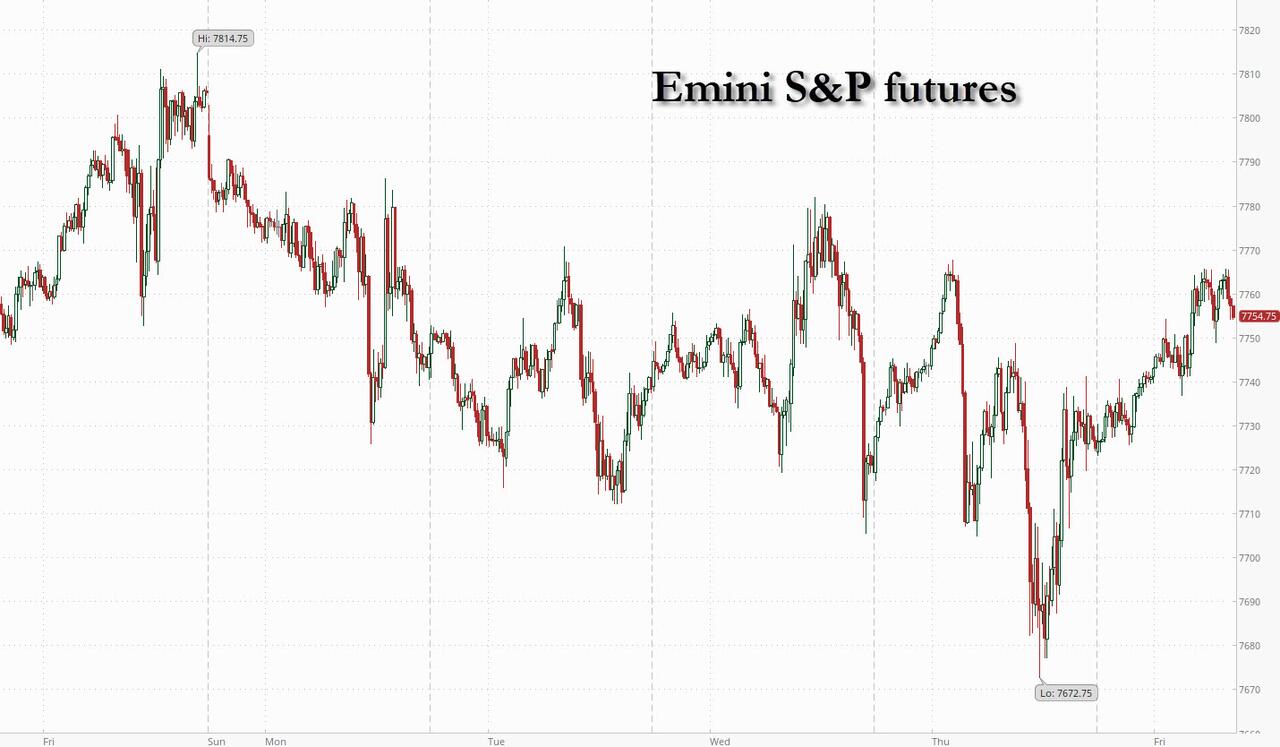
In premarket trading all Mag 7 stocks are higher (Nvidia +1.7%, Alphabet +0.4%, Tesla +0.7%, Amazon +0.5%, Microsoft +0.9%, Meta Platforms +0.4%, Apple +0.2%)
- Airbnb (ABNB) rises about 2% after KeyBanc Capital Markets upgraded the online travel company to overweight, seeing positive growth trends.
- Edison International (EIX) falls 2% after Jefferies cut its recommendation on the utilities company to underperform on California wildfire liability risk.
- Fair Isaac (FICO) falls 8% as the FHFA is planning to direct Fannie Mae and Freddie Mac within weeks to require lenders to pull credit data from two major credit reporting bureaus instead of three, according to a person familiar with the plans. TransUnion (TRU) falls 3% and Equifax (EFX) slumps 3%.
- Nike (NKE) slumps 9% after the sneaker and sportswear maker’s revenue guidance for the full year fell short of consensus estimates.
- Twilio (TWLO) rises 1% after S&P Dow Jones Indices noted that the stock will replace Warner Bros Discovery in the S&P 500 effective Oct. 6.
- ON Semi (ON) climbs 8% after the chipmaker said it will buy Synaptics for $123 per share, revising their earlier all-stock deal to an all-cash transaction. Synaptics (SYNA) rises 15%.
- Vylor (VYLR) climbs 3% after the Corteva Inc. seed spinoff was initiated with buy ratings on its growth profile.
- Western Digital (WDC) falls 8% and Seagate Technology (STX) drops 12% after Nikkei reported that Toshiba would invest ¥60 billion to double its production capacity for hard disk drives.
In other corporate news RTX received a deal worth as much as $24.4 billion to accelerate production of a key anti-air and anti-surface missile for the US Navy; Amazon is exploring a deal to shift about $8 billion worth of top-end Nvidia chips off its balance sheet into a special-purpose vehicle, according to the FT. Netflix reported a collaboration agreement with independent Spanish streamer Filmin.
Twilio will replace Warner Bros Discovery in the S&P 500, Vylor replaces Corteva in the S&P 500 and Moderna replaces Warner Bros Discovery in the Nasdaq 100. Nike is cutting jobs and embarking on a sweeping overhaul of its business as results deteriorate, a restructuring plan that it said will save $2.5 billion over the next five years. The FHFA is said to be planning to direct Fannie Mae and Freddie Mac within weeks to require lenders to pull credit data from two major credit reporting bureaus instead of three.
Sentiment was lifted after Brent fell below $100 a barrel as European countries were said to discuss the release of strategic reserves. The retreat took some pressure off the inflation outlook, helping traders pare expectations for US rate hikes to only one move this year. The odds of more than three over the next 12 months also receded.
Yet divisions are emerging at the Fed, with Lorie Logan wanting more hikes to cool inflation, while members of the central bank’s troika have been calling for patience to see how data unfolds over the coming weeks.
On that front, payrolls are first on the slate for today. The September jobs report is expected to show nonfarm payrolls increased 90k vs August’s 162k increase and unemployment rate steady at 4.1%; Bloomberg crowd-sourced whisper number for payrolls is currently 86 while Bloomberg Economics expects 55k, which would point to a labor market stuck in low-hiring mode with the drivers of job growth shifting. This mix — along with early tracking of cooler September core CPI — would do little to strengthen the case for another rate hike, according to Bloomberg (our full preview is here). The US jobs report will be key at a time when resilient data are supporting riskier assets while giving the Fed room to fight inflation.
“If we get a very high number or materially higher than 90,000, you could expect more pressure on yields from here,” said Sotirios Nakos, head of multi-asset portfolio management at Aviva Investors. For Mabrouk Chetouane at Natixis IM, strong data will bode well for third-quarter earnings and see traders price “growth and Fed hikes accordingly.”
Andrea Tueni at Saxo Bank warned that a blowout report could put stocks at risk. “US equity markets have so far managed to cope with really elevated bond yields, but I’m not sure how high these can go from here before something breaks,” he said.
The S&P 500 Equal Weight Index is on track for its seventh-consecutive weekly loss, which would be its longest streak since May 2022. BofA’s Hartnett describes a market “trading long artificial intelligence” (Nasdaq 100), “short artificial irrelevance” (S&P 500 Equal Weight). US equities saw $2.7 billion exit in the last week of the quarter, according to BofA citing EPFR Global data, while global bond funds drew $18.8 billion. Flows provide evidence of investors shifting to the safest paper, with Treasuries enjoying the 14th consecutive week of inflows.
High oil prices, AI giants’ surging demand for capital and a crowded short base in Treasury futures have fueled a spike in bond volatility that has rippled across asset classes. Thursday brought an unusual divergence, with Treasuries rallying on haven demand while riskier debt came under intense selling pressure.
Meanwhile,high-grade debt has lost some of its haven appeal as spreads on global corporate bonds blew out this week to their widest in six months. Fresh evidence of building price pressures came from the euro area, where inflation quickened to a three-year high. At the same time, bond traders were nursing losses after Paramount’s debt issue, to fund the biggest Hollywood buyout ever, cratered in initial trading. Meanwhile, Broadcom’s Wall Street syndicate are starting to gather $60 billion of fresh AI chip financing to benefit Anthropic and other companies.
In politics, Trump predicted that Democrats would impeach him for a third time if they retake control of Congress, seeking to boost voter enthusiasm for Republican candidates, as his approval rating hits new lows. The US administration has diverted aid set for EMEA countries to conservative-leaning governments in Latin America, the Washington Post reported.
Separately, governments around the world are running out of room to shield consumers from higher energy prices, with fuel subsidies potentially costing more than $1 trillion this year, according to a United Nations study.
In Europe, the Stoxx 600 has climbed 0.7% after three days of losses, with technology stocks leading gains. Still, Europe is set for a weekly drop, the fourth in five weeks. as bond markets remained under pressure from inflation concerns. IG Group slumped after it issued an unscheduled third-quarter update. Here are the biggest movers Friday:
- Universal Music Group shares rise as much as 3.3% after an upgrade to overweight at Barclays. The music label company’s stock is inexpensive for the first time after a period of underperformance, according to the bank
- Hensoldt shares rise as much as 5.2% as the German defense firm is upgraded to buy from hold by Kepler Cheuvreux, which says earnings and order momentum are poised to accelerate
- BT shares rise as much as 4.4% on Friday after the Financial Times reported that the telecom firm has opened talks with UK government officials over the possibility of buying TalkTalk
- J D Wetherspoon shares rise as much as 8.9%, to the highest level since March 2022, as analysts are encouraged by robust current trading, boosted by favorable weather
- IG Group falls as much as 27%, the most since 2016, after an unscheduled third-quarter update in which it cut its 2026 revenue growth outlook to the mid-single digits from 10%-15%
- Sanofi falls as much as 4.6%, the most since July, as Citi flags skepticism surrounding the French drugmaker’s announcement yesterday of an expanded partnership with Regeneron
- Kering falls as much as 6.5% as JPMorgan flags a tougher luxury backdrop and slower Chinese recovery for the French luxury-goods company after discussions with Kering’s investor relations team
- European sportswear stocks are sliding this morning after US firm Nike fell in extended trading on Thursday, following weaker-than-expected quarterly sales and a disappointing outlook for full year revenue. Analysts at Vital Knowledge described the sales guidance as “pretty ugly”
For Europe, “the key issue from a monetary policy perspective is any adverse spillovers from higher energy prices,” noted Pia Fromlet and Marcus Widen at SEB. “The test for how strong this effect will be is still ahead of us. Up until October the narrative of little evidence of indirect effects remains.”
Asian stocks fell to head for their worst week since mid-July, pressured by rising yields and US troop deployment concerns in the Middle East. The MSCI Asia Pacific Index was down as much as 1% on Friday before paring some of the losses. The gauge is still on track to close the week down 1.1%, the most since the week ending July 17. The stock markets in Hong Kong and Japan slumped, while South Korea and Taiwan gained. Hong Kong was the region’s worst-performer, down the most since March, as investors fretted over tech companies’ potentially higher borrowing costs. Alibaba, Tencent and Xiaomi were some of the lead decliners in the Hang Seng Index. Asia’s bank stocks, including HSBC, were also trading lower, tracking moves in global peers amid concerns over higher yields and potential UK tax hikes targeting the sector.
In FX, the Bloomberg Dollar Spot Index is down 0.4%. The Japanese yen and Swiss franc are the best performing G-10 currencies, rising 0.3% each.
In rates, treasuries hold small gains in early US session led by intermediate- to long-end tenors, slightly flattening the curve. US 10-year yield is down about 2bp near 5.22% vs declines of 9bp and 7bp for German and UK counterparts; European government bonds rallied out the gate this morning and remain in the ascendancy as a drop in oil prices provides an additional tailwind. French 10-year is about 3bp cheaper on the day. Bunds and gilts outperform amid lower oil prices and haven bid as French bonds weaken. IG dollar issuance slate is blank so far and expected to remain quiet. Weekly volume stands at about $33 billion vs dealers’ $50 billion projection; they anticipate $100 billion of supply in October. US session features September jobs report at 8:30 a.m. New York time.
In commodities, Brent crude futures have fallen 3% to around $99 a barrel while WTI crude oil futures, down nearly 4%, support European bonds as France proposed developed nations release strategic reserves to ease surging prices at the pump. Precious metals are heading higher while Bitcoin has added 2%.
Today’s US economic data slate also includes August factory orders 10 a.m. Fed speaker slate includes Dallas’s Logan (10 a.m.) and Chicago’s Goolsbee (12 p.m.)
Market Snapshot
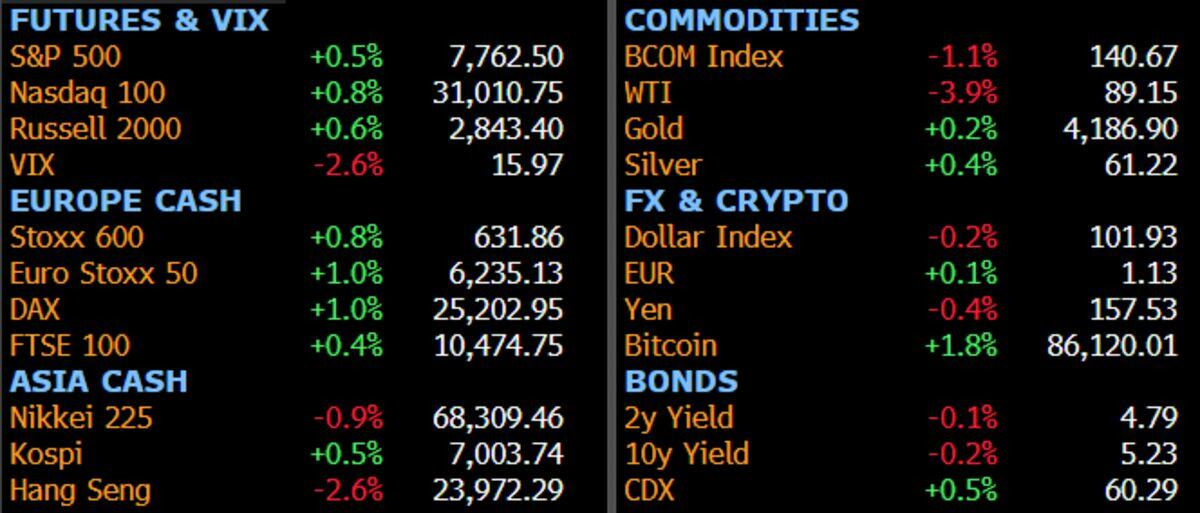
Top Overnight News
- Iran is preparing a broader and more forceful response if the United States resumes large-scale military attacks, sources said, while continuing a diplomatic push that Iranian officials privately see as unlikely to succeed. RTRS
- Vladimir Putin has instructed his military leaders to abandon the rules of war, prompting a steep increase in strikes on civilian targets amid a major push to regain the advantage in the conflict, according to intelligence intercepted by Kyiv. FT
- Governments around the world are running out of room to shield consumers from higher energy prices resulting from the Iran war and other crises, with fuel subsidies potentially costing more than $1 trillion this year, a United Nations study found. BBG
- World food prices rose in September, as transportation disruptions and weather concerns limited supplies and lifted prices for several crop-based commodities, the United Nations’ Food and Agriculture Organization said. WSJ
- Amazon’s exploring a deal to shift about $8 billion of high-end Nvidia chips into a sale-leaseback SPV vehicle backed by outside investors to help strengthen its balance sheet. FT
- European countries are in crisis talks over the release of diesel stocks, as the US threatens them with a diesel export ban unless they release strategic reserves of the oil product. FT
- Tokyo’s key inflation gauge rose sharply as the effects of some temporary government measures faded, backing the Bank of Japan’s stance on continuing to raise the benchmark rate after authorities accelerated the pace of policy normalization. BBG
- Eurozone CPI for Sept ran hot on the headline (+3.8% vs. the Street +3.7% and vs. +3.2% in Aug) and was inline on core (+2.5% vs. +2.4% in Aug). BBG
- Trump posted “Republicans in the Senate have to get moving on what I call the “No More Changing of Clocks Act,” officially known as The Sunshine Protection Act”.
- Goldman estimates nonfarm payrolls rose by 80k in September, slightly below consensus of +88k. On the positive side, the level of layoffs remains low and big data indicators of job growth picked up sequentially. On the negative side, September payroll growth has tended to underperform its recent trend when Labor Day is later in the month—like it was this year—and last month’s sharp increase in nonfarm payrolls was boosted by outsized increases in leisure and hospitality and local educational services payrolls that we do not expect to repeat. GS Research
- BofA Flow Show (w/e 30th September): USD 18.8bln to bonds, 15.8bln to stocks, 0.9bln to crypto, 0.7bln to gold, 118.0bln from cash on quarter-end; Bull and Bear indicator 8.8 (prev. 9.3).
A more detailed look at global markets courtesy of Newsquawk
APAC stocks traded mixed following the ultimately choppy performance stateside as oil prices climbed, yields pulled back, and participants digested a slew of data, while all eyes turn to the looming NFP report. ASX 200 mildly gained, with the index led by strength in tech and energy, albeit with further upside capped amid a lack of fresh catalysts and with real estate and healthcare at the other end of the spectrum. Nikkei 225 retreated as participants digested the latest data releases, including a surprise uptick in the Unemployment Rate and the hotter-than-expected Tokyo CPI data, which was said to be driven by an unwinding of price suppression effects from targeted government subsidies. KOSPI traded indecisively following the somewhat mixed South Korean CPI data, in which the Y/Y reading slowed to 2.9% from 3.1%, as expected, but remained above the central bank’s 2% target. Hang Seng underperformed on return from the holiday closure, with Stock Connect trade remaining shut owing to the week-long closure in the mainland, while pressure was seen in auto names following monthly sales updates and with casino stocks in the red after Macau casino revenue declined last month.
Top Asian News
- Japanese Economy Minister Kiuchi said Japan is no longer in deflation, so there is no need for excessively loose monetary policy that favours higher inflation, while he added that the Takaichi administration’s policy is different from reflationary policy that aims to pull Japan out of deflation, and is different from Abenomics in that it seeks to achieve both a strong economy and fiscal discipline and focuses on boosting Japan’s supply capabilities.
- Japanese Tokyo Core CPI (Sep YY) 2.7% vs. Exp. 2.4% (Prev. 1.8%).
- Japanese Tokyo CPI (Sep YY) 2.7% vs. Exp. 2.5% (Prev. 1.9%).
- Japanese Tokyo CPI Ex Food and Energy (Sep YY) 3.0% vs. Exp. 2.5% (Prev. 2.0%).
- South Korean CPI (Sep YY) 2.9% vs. Exp. 2.9% (Prev. 3.1%).
- South Korean CPI (Sep MM) 0.3% vs. Exp. 0.4% (Prev. 0.2%).
European bourses (STOXX 600 +0.9%) are firmer across the board as they pare back some of Thursday’s losses. A pullback in energy prices seems to be supporting equities, with recent Reuters reporting that France is proposing to release 50mln barrels of diesel from Europe and 50mln barrels of crude oil across IEA members, further weighing on the crude complex. Sectors highlight the clear positive bias. Tech leads sectors higher, with Basic Resources and Travel & Leisure following suit, while Health Care is the sector laggard.
Top European News
- BoE Decision Maker Panel (Sep): Year-ahead CPI inflation expectations 3.1% (prev. 3.1%), Three-year-ahead CPI inflation expectations 2.8% (prev. 2.8%), expected wage growth remained at 3.4%.
- UK PM Burnham is reportedly leaving the door open to a snap general election next year, according to The i Paper.
- Moody’s said France’s ability to tackle key policy difficulties despite political fragmentation is a key factor for the resolution of the negative outlook.
- European HICP (Sep YY) 3.8% vs. Exp. 3.6% (Prev. 3.2%); Services 3.2% (prev. 3%).
- European HICP (Sep MM) 0.6% (Prev. 0.4%).
- European Core HICP (Sep YY) 2.2% (prev. 2.1%).
- European HICP Ex Food, Energy & Tobacco (Sep YY) 2.5% vs. Exp. 2.5% (Prev. 2.4%).
FX
- G10s are broadly firmer against the USD, which has been pressured alongside pressure yields and pressure in the energy complex. That was facilitated by reports that France has proposed plans to release 50mln barrels of diesel from Europe (vs the US request of 120mln over 180 days), and perhaps more pertinently 50mln barrels of crude oil across IEA members – this would include the US.
- Given the recent pressure in yields, the index is under mild pressure this morning and currently holds towards the lower end of a 101.79 to 102.13 range – but still around the prior day’s peak. A material bout of pressure for the USD would likely require significant progress between US-Iran and/or confirmation of a crude stock release. Bar that, the index will likely trade tentatively around the current range as markets await US NFP later today. The US economy is expected to add 90k nonfarm payrolls in September. Analysts note that the August data, where 162k payroll additions were reported, may have been subject to favourable seasonal adjustments, and will be watching to see if the data is revised lower in September. The unemployment rate is expected to hold at 4.1%, an expectation supported by the Chicago Fed’s flash real-time unemployment rate forecast. (A full preview can be found in the Newsquawk Research Suite).
- CHF is the outperformer across G10s this morning, extending on recent gains. There appears to be a bit of an unwind of the recent carry trade that the CHF was subject to, with net positioning of long-shorts at c. -16.45k over the past 3 months. Further helping is some haven-related demand stemming from the French fiscal situation.
- Elsewhere, JPY also holds towards the top of the G10 pile, also buoyed by the yield situation. Domestically, Tokyo CPI accelerated in September, and broadly topped expectations. A report which will no doubt boost calls for the BoJ to hike; it seems like the BoJ is now dealing with waning sentiment across Japanese businesses (evidenced in the latest Tankan survey), and rising inflation in a key leading indicator.
- EUR is a touch firmer this morning, with focus ultimately on the region’s inflation report. Headline Y/Y printed at 3.8% (exp. 3.6%, prev. 3.2%), and Services also rose from the prior. Pertinently, Core HICP moved only a touch higher to 2.2% (prev. 2.1%), which will be welcomed for policymakers, since there is still little evidence of second-round effects. Nonetheless, woes of rising inflation remain – and this data will only further cement calls for another hike later this year
Fixed Income
- A modestly firmer start to the day has extended into one of marked gains across EGBs and Gilts, with the bulk of the move following a constructive report on energy supplies.
- However, while a touch firmer, USTs have not really budged from the unchanged mark, into an afternoon dominated by the September NFP report. In brief, the headline is seen at 90k while the August figure of 162k could be subject to a downward revision after potential distortion from seasonal adjustments. For the Fed, the data isn’t expected to have a significant impact as long as it doesn’t change the broad description of a stable and close to full employment labour market, with inflation very much the focus point.
- Back in Europe, Bunds peaked at 121.37, notching a new high for the week and on track to close the week out with gains of c. 150 ticks (100 of that is from today, at the time of writing), the first positive weekly return since August. While the reported energy stockpile releases will be welcome in the immediacy, it does not change the US-Iran picture, supply risk through Hormuz and the usage of stockpiles now could have a knock on effect during winter. Though, the El Nino will see warmer weather may push any cold spell to later in the season, potentially giving the region some stockpile breathing room.
- EGBs generally trade with the above. For France, OATs hit a 108.76 peak, firmer by 36 ticks at best, but at the lower-end of the WTD 108.02-110.36 band, after the poorly received draft budget. This morning, Moody’s updated on the draft plan and highlighted the clear fiscal and political risks facing France, points that dominate thinking in the French bond space. Reflecting this, the OAT-Bund 10yr yield spread peaked at 146bps this morning, vs 110bps at the start of the week. No real move to the September Flash HICP, with energy once again driving the upside but no overt signs of second round effects as the core components remain at acceptable levels; though, the absolute level means further tightening remains a valid call.
- Gilts also benefit from the energy moves. At an 84.81 session high, firmer by c. 100 ticks at best and set to end the week at highs.
- Australia sells AUD 1.2bln 4.50% April 2033 bonds: b/c 3.00x, avg. yield 5.108%.
Commodities
- WTI Nov and Brent Dec futures are sharply lower after yesterday’s rally, with pressure intensifying during the European morning on reports France proposed releasing 50mln bbls of diesel from Europe alongside 50mln bbls of crude across IEA members. The proposal would be conditional on a US commitment not to impose a unilateral diesel export ban and follows Washington’s request for major European countries to release diesel reserves. WTI fell from USD 90.80/bbl to USD 89.88/bbl on the report, while Brent fell from USD 100.90/bbl to USD 99.76/bbl. European gasoil futures fell over 4% on the reports. Prior to this, the complex was already under pressure despite continued US-Iran tensions, with Trump reportedly telling aides he expects bombing of Iran to resume in November and the Pentagon sending a third carrier strike group to the region. WTI and Brent currently trades at session lows, with the former briefly falling below the USD 89/bbl mark while the latter touches the USD 99/bbl handle.
- Dutch TTF is also softer despite continued European energy-security concerns heading into winter, with attention dominated by discussions around coordinated energy-stock releases. TTF trades towards the lower end of a EUR 71.05-73.61/MWh range.
- Precious metals are firmer ahead of US NFP, helped by the pullback in oil prices and some reprieve in global yields. Spot gold trades towards the upper end of a USD 4,134-4,197/oz range, having recovered further from yesterday’s USD 4,139/oz low, while spot silver is similarly firmer within a USD 60.22-61.56/oz range.
- Base metals were subdued overnight with mainland China still absent for the week-long holiday, but have since clambered into the green on the aforementioned pullback in energy and subsequent boost to risk. 3M LME copper trades in a USD 14,243.03- 14,380.38/t range at the time of writing.
- EU countries discussed a French proposal to release 50mln barrels of diesel from Europe and 50mln barrels of crude oil across IEA members, in response to the US’ threat of a diesel export ban, Reuters reported citing sources. The report added that any agreement on further stock releases should include a US commitment to avoid a unilateral diesel export ban.
- France’s Elysee said President Macron spoke with US President Trump about energy and fuel prices.
- European Commissioner Jorgensen said the EU is discussing with all IEA members, not only the US, when it is time to release diesel stocks.
- Ukrainian Agricultural Minister said that the area planted to winter wheat in 2027 could decline about 17%.
Trade/Tariffs
- US President Trump said the trade deficit with China has dropped to the lowest in 44 years and that he gets along great with Chinese President Xi, while he added that China used to rip the US badly and that Canada is ripping the US badly.
Central Banks
- Fed’s Logan (2026 voter) said the policy rate needs to increase an additional 50bps or more and that without higher rates, inflation will not get to the 2% goal, while she added that policy is not sufficiently restrictive and needs to become modestly tighter. Logan said price stability must be restored and at a minimum, several further rate hikes would reverse last autumn’s cuts. She also stated that it remains uncertain how high the policy rate must go to bring inflation back towards 2%.
- Fed’s Bowman (voter) said she sees no urgent need for more rate moves this year, while she touted benefits of a Fed capital plan tied to treasuries.
- ECB’s Rehn told Econostream that ECB forecasts are facing extremely high and widespread uncertainty and that the energy surge is nearer to the adverse scenario. Rehn added that one uncertainty is that market sentiment toward AI could reverse suddenly, while higher long-term rates will slow economic growth and reduce the pass-through of energy shocks to prices and wages.
Geopolitics: Iran
- US President Trump reiterated that Iran will never have a nuclear weapon and has no navy or army, while he stated that Iran has not been able to get one of its vessels through the Strait of Hormuz for months. Trump also said huge quantities of oil have passed through the Strait of Hormuz and the US is taking out millions of barrels of oil, claiming that in some cases, it is more than before the war.
- US President Trump said the Iran war will be ending soon, one way or the other, and that it looks like Iran was involved in the UK base incident. Trump warned that Iran will be hit very hard if it is behind the copilot who tried to crash a flight to Israel, while he separately commented that based on what he heard, Iran was connected to the attempted attack on the plane.
- The Iranian National Security Commission said that Iranian management of the Strait of Hormuz will be applied. Ships to Zionist or hostile regimes will not be able to pass through the Strait, others will have to get permission. Bill is queued for parliament.
- IRGC said three UAE-linked tankers attacked recently in the Strait of Hormuz were on the PGWA’s non-compliance list, and had transited the Strait repeatedly over the past two months.
- Saudi‑led coalition intercepted and destroyed ballistic missiles launched by Yemeni Houthis towards Khamis Mushait.
Geopolitics: Other
- Russia’s Kremlin said Russia will continue operations to completely stop supply of weapons and fuel for the Ukrainian military via the Black Sea.
- Russia’s Defence Ministry said they struck a vessel in the Black Sea and an industrial production complex at the port of Izmail in Ukraine’s Odessa region overnight, according to IFX.
- South Korean President Lee said they will take additional measures if Ukraine continues to deny the agreement on North Korean prisoners of war repatriation, while he called on Ukraine to acknowledge the agreement and apologise.
US Event Calendar
DB’s Jim Reid concludes the overnight wrap
Markets stumbled yesterday as we began Q4, with mounting signs of financial stress focused on Europe. In fact, the daily moves were reminiscent of the Euro crisis in many respects, with sovereign contagion a big talking point. For instance, the Franco-German 10yr spread (+13.9bps) saw its biggest daily jump since March 2020 at the height of the Covid turmoil, the same day that ECB President Lagarde said “we are not here to close spreads”. And over in Italy, the 10yr spread to bunds (+15.9bps) saw its biggest daily jump since July 2022, the day that the ECB delivered their first rate hike in over a decade. Moreover, the impact cascaded across different asset classes, with the Euro (-0.76%) posting its worst day against the dollar since June, whilst the STOXX Banks index (-3.90%) had its worst day since March.
The interesting thing about yesterday’s moves was that there wasn’t a single catalyst driving them. Initially, the day began with a genuinely global bond selloff, driven by higher oil prices and a hawkish batch of US data. Indeed, the 10yr US Treasury yield hit its highest intraday level since 2002, at 5.34%. But as the session went on, it then morphed into a classic risk-off move, with bunds and US Treasuries starting to rally, whilst others like French OATs and Italian BTPs sold off. That went hand in hand with mounting stress for risk assets too, particularly in the affected markets. So France’s CAC 40 (-1.62%) hit a 6-month low, and Italy’s FTSE MIB Index (-2.21%) hit a 3-month low, underperforming the Europe-wide STOXX 600 (-1.30%). French banks came under pressure, with Société Générale (-5.00%), Crédit Agricole (-3.70%) and BNP Paribas (-3.64%) losing significant ground, and this was broadly in line with the broader STOXX Banks (-3.90%) as contagion spread through European markets. Credit took a big hit as well, with European HY spreads (+18bps) seeing their worst session since the start of the Iran war, reaching their widest level in six months.
That financial stress led to growing doubt whether central banks like the ECB could hike rates as aggressively as thought. After all, tighter financial conditions would do some of the work for them in bringing down inflation, and the selloff also raised doubts as to whether the economy could cope with another hike. So when it came to ECB pricing, the number of further hikes priced by December’s meeting fell -6.1bps on the day to 23.5bps. Or in other words, another ECB hike is no longer fully priced by year-end. So that led to a huge collapse in front-end German yields, with the 2yr German yield (-14.2bps) falling back to 3.07%, its biggest drop since April. Meanwhile, the 10yr bund yield (-7.8bps) also fell back to 3.51%.
For Europe, those issues were exacerbated yesterday by the latest rise in energy prices, which hit the continent more given it’s an energy importer (unlike the US nowadays). So Brent crude was up +4.37% by the close to $102.31/bbl, whilst European natural gas futures were also up +2.18%. In part, that followed comments from President Trump, who said in a Time interview that it was “possible” he would resume bombing Iran once the midterm elections had passed. In addition, there were further reports about US military deployments in the Middle East, with Bloomberg reporting the US was sending an additional aircraft carrier, along with 10,000 sailors and Marines to the Persian Gulf. So coupled with the absence of any progress towards a deal, this led to growing pessimism that free shipping via the Strait of Hormuz would resume anytime soon. And in turn, that pushed longer-dated oil futures higher once again, with the June 2027 Brent future up to a new high yesterday of $88.03/bbl by the close.
Whilst European assets struggled yesterday, there was a very different tone in the US. Initially, it looked like Treasury yields would hit new highs, and we did see the 10yr yield hit its highest intraday level since 2002 yesterday, at 5.34%. But that turned in the afternoon, with the 10yr yield ultimately down -4.4bps on the day to 5.24%. Moreover, US equities recovered from their earlier sell-off, with the S&P 500 (+0.19%) ending a run of three consecutive declines, whilst futures for the index are up another +0.27% this morning.
In part, those moves were aided by more dovish commentary from FOMC officials, which added to the sense that officials weren’t in a rush to hike again. So that meant the 2yr Treasury yield (-9.6bps) saw its biggest daily decline since July, closing at 4.79%. Those comments included Vice Chair Jefferson’s, who suggested that deciding on future rate hikes “may take more time”, while Governor Bowman (one of the more dovish voices on the FOMC) said she did not “currently see an urgent need for further action”. That left an October Fed hike just 30% priced by yesterday’s close, down from 37% on Wednesday and 70% on Monday before NY Fed President Williams similarly signalled no urgency for the next hike.
What was also striking was how the financial stress and the Fed commentary outweighed a hawkish batch of US data, which initially put upward pressure on Treasury yields earlier in the day. Collectively, that data painted a picture of ongoing resilience in the US economy, alongside plenty of price pressures, so it was very much in line with the prints of recent weeks. Among others, the weekly initial jobless claims fell to a 10-week low of 197k in the week ending September 26 (vs. 200k expected). Then the continuing claims for the previous week fell to a three-and-a-half-year low of 1.701m (vs. 1.725m expected). And just 90 minutes after that, the ISM manufacturing print came in at 54.5 in September (vs. 55.0 expected), but the prices paid subcomponent surged more than expected to 77.9 (vs. 73.0 expected) and the employment component rose more than anticipated to 52.7 (vs. 52.0 expected). So initially that drove yields higher, but the wider risk-off move then saw that reverse course.
With all that in mind, today’s focus will now turn to the US jobs report for September, which is out at 13:30 London time. Clearly, the monthly jobs reports are always a macro highlight, but this is an important one, as the continued data resilience has been a huge factor supporting US risk assets, and it’s also given the Fed space to start hiking rates. Indeed, last month’s report was very strong, with payrolls up +162k alongside positive revisions to the previous two months. So that added to the hawkish momentum leading up to the Fed’s September meeting a couple of weeks later. This time around, our US economists are expecting payrolls to come in at +60k, with the unemployment rate holding steady at 4.1%.
Ahead of that jobs report, Asian markets have also generally lost ground overnight, with the Hang Seng (-2.64%) sharply lower as it returns after the previous day’s holiday. Then in Japan, the Nikkei is down -0.94%, which comes as the Tokyo CPI data for September was faster than expected. That showed headline CPI rising to +2.7% (vs. +2.5% expected), whilst the core-core measure reached its fastest in over a year, at +3.0% (vs. +2.5% expected). Otherwise in South Korea, the KOSPI is up +0.26% this morning, and the country’s CPI eased to +2.9% in September, in line with expectations. In mainland China, markets are still closed for a holiday.
Looking at the day ahead now, the data highlights will include the US jobs report for September, and the Euro Area flash CPI print for September. From central banks, we’ll hear from the Fed’s Logan, and the ECB’s Moulin, Cipollone, Rehn, Sleijpen, Vujcic and Nagel.
1b) European opening report
DXY under mild pressure into NFP; focus on EU proposal to release diesel from stockpiles – Newsquawk US Market Open

Friday, Oct 02, 2026 – 05:52 AM
- Energy complex falls on reports that the EU discussed a proposal to release diesel from stockpiles (Brent -3.2%, EU Gasoil -5.5%).
- US equity futures climb, while NKE falls on a downbeat earnings report.
- DXY slightly lower; JPY gains on hotter-than-expected Tokyo CPI.
- Fixed income benchmarks benefiting from lower energy prices as markets await the US jobs report.
- Looking ahead, highlights include US NFP (Sep). Speakers include ECB’s Vujcic & Fed’s Logan. Credit Ratings update from Scope on the US.
SNAPSHOT

Newsquawk in 3 steps:
1. Subscribe to the free premarket movers reports
2. Listen to this report in the market open podcast (available on Apple and Spotify)
3. Trial Newsquawk’s premium real-time audio news squawk box for 7 days
EUROPEAN TRADE
EQUITIES
- European bourses (STOXX 600 +0.9%) are firmer across the board as they pare back some of Thursday’s losses. A pullback in energy prices seems to be supporting equities, with recent Reuters reporting that France is proposing to release 50mln barrels of diesel from Europe and 50mln barrels of crude oil across IEA members, further weighing on the crude complex.
- Sectors highlight the clear positive bias. Tech leads sectors higher, with Basic Resources and Travel & Leisure following suit, while Health Care is the sector laggard.
- US equity futures are also higher, with outperformance in the NQ. Focus was on Nike earnings after hours, in which shares fell 8.6% in extended US trading after revenue missed expectations, and the company forecast a FY sales decline, with weakness in Greater China, sportswear and the Jordan Brand, while restructuring plans and further layoffs added to concerns despite an earnings beat. The poor results also had an effect on its European peers before climbing amid the upbeat risk tone.
- Click for the sessions European pre-market equity newsflow
- Click for the additional news
FX
- G10s are broadly firmer against the USD, which has been pressured alongside pressure yields and pressure in the energy complex. That was facilitated by reports that France has proposed plans to release 50mln barrels of diesel from Europe (vs the US request of 120mln over 180 days), and perhaps more pertinently 50mln barrels of crude oil across IEA members – this would include the US.
- Given the recent pressure in yields, the index is under mild pressure this morning and currently holds towards the lower end of a 101.79 to 102.13 range – but still around the prior day’s peak. A material bout of pressure for the USD would likely require significant progress between US-Iran and/or confirmation of a crude stock release. Bar that, the index will likely trade tentatively around the current range as markets await US NFP later today. The US economy is expected to add 90k nonfarm payrolls in September. Analysts note that the August data, where 162k payroll additions were reported, may have been subject to favourable seasonal adjustments, and will be watching to see if the data is revised lower in September. The unemployment rate is expected to hold at 4.1%, an expectation supported by the Chicago Fed’s flash real-time unemployment rate forecast. (A full preview can be found in the Newsquawk Research Suite).
- CHF is the outperformer across G10s this morning, extending on recent gains. There appears to be a bit of an unwind of the recent carry trade that the CHF was subject to, with net positioning of long-shorts at c. -16.45k over the past 3 months. Further helping is some haven-related demand stemming from the French fiscal situation.
- Elsewhere, JPY also holds towards the top of the G10 pile, also buoyed by the yield situation. Domestically, Tokyo CPI accelerated in September, and broadly topped expectations. A report which will no doubt boost calls for the BoJ to hike; it seems like the BoJ is now dealing with waning sentiment across Japanese businesses (evidenced in the latest Tankan survey), and rising inflation in a key leading indicator.
- EUR is a touch firmer this morning, with focus ultimately on the region’s inflation report. Headline Y/Y printed at 3.8% (exp. 3.6%, prev. 3.2%), and Services also rose from the prior. Pertinently, Core HICP moved only a touch higher to 2.2% (prev. 2.1%), which will be welcomed for policymakers, since there is still little evidence of second-round effects. Nonetheless, woes of rising inflation remain – and this data will only further cement calls for another hike later this year.
FIXED INCOME
- A modestly firmer start to the day has extended into one of marked gains across EGBs and Gilts, with the bulk of the move following a constructive report on energy supplies.
- However, while a touch firmer, USTs have not really budged from the unchanged mark, into an afternoon dominated by the September NFP report. In brief, the headline is seen at 90k while the August figure of 162k could be subject to a downward revision after potential distortion from seasonal adjustments. For the Fed, the data isn’t expected to have a significant impact as long as it doesn’t change the broad description of a stable and close to full employment labour market, with inflation very much the focus point.
- Back in Europe, Bunds peaked at 121.37, notching a new high for the week and on track to close the week out with gains of c. 150 ticks (100 of that is from today, at the time of writing), the first positive weekly return since August. While the reported energy stockpile releases will be welcome in the immediacy, it does not change the US-Iran picture, supply risk through Hormuz and the usage of stockpiles now could have a knock on effect during winter. Though, the El Nino will see warmer weather may push any cold spell to later in the season, potentially giving the region some stockpile breathing room.
- EGBs generally trade with the above. For France, OATs hit a 108.76 peak, firmer by 36 ticks at best, but at the lower-end of the WTD 108.02-110.36 band, after the poorly received draft budget. This morning, Moody’s updated on the draft plan and highlighted the clear fiscal and political risks facing France, points that dominate thinking in the French bond space. Reflecting this, the OAT-Bund 10yr yield spread peaked at 146bps this morning, vs 110bps at the start of the week. No real move to the September Flash HICP, with energy once again driving the upside but no overt signs of second round effects as the core components remain at acceptable levels; though, the absolute level means further tightening remains a valid call.
- Gilts also benefit from the energy moves. At an 84.81 session high, firmer by c. 100 ticks at best and set to end the week at highs.
- Australia sells AUD 1.2bln 4.50% April 2033 bonds: b/c 3.00x, avg. yield 5.108%.
COMMODITIES
- WTI Nov and Brent Dec futures are sharply lower after yesterday’s rally, with pressure intensifying during the European morning on reports France proposed releasing 50mln bbls of diesel from Europe alongside 50mln bbls of crude across IEA members. The proposal would be conditional on a US commitment not to impose a unilateral diesel export ban and follows Washington’s request for major European countries to release diesel reserves. WTI fell from USD 90.80/bbl to USD 89.88/bbl on the report, while Brent fell from USD 100.90/bbl to USD 99.76/bbl. European gasoil futures fell over 4% on the reports. Prior to this, the complex was already under pressure despite continued US-Iran tensions, with Trump reportedly telling aides he expects bombing of Iran to resume in November and the Pentagon sending a third carrier strike group to the region. WTI and Brent currently trades at session lows, with the former briefly falling below the USD 89/bbl mark while the latter touches the USD 99/bbl handle.
- Dutch TTF is also softer despite continued European energy-security concerns heading into winter, with attention dominated by discussions around coordinated energy-stock releases. TTF trades towards the lower end of a EUR 71.05-73.61/MWh range.
- Precious metals are firmer ahead of US NFP, helped by the pullback in oil prices and some reprieve in global yields. Spot gold trades towards the upper end of a USD 4,134-4,197/oz range, having recovered further from yesterday’s USD 4,139/oz low, while spot silver is similarly firmer within a USD 60.22-61.56/oz range.
- Base metals were subdued overnight with mainland China still absent for the week-long holiday, but have since clambered into the green on the aforementioned pullback in energy and subsequent boost to risk. 3M LME copper trades in a USD 14,243.03- 14,380.38/t range at the time of writing.
- EU countries discussed a French proposal to release 50mln barrels of diesel from Europe and 50mln barrels of crude oil across IEA members, in response to the US’ threat of a diesel export ban, Reuters reported citing sources. The report added that any agreement on further stock releases should include a US commitment to avoid a unilateral diesel export ban.
- France’s Elysee said President Macron spoke with US President Trump about energy and fuel prices.
- European Commissioner Jorgensen said the EU is discussing with all IEA members, not only the US, when it is time to release diesel stocks.
- Ukrainian Agricultural Minister said that the area planted to winter wheat in 2027 could decline about 17%.
TRADE/TARIFFS
- US President Trump said the trade deficit with China has dropped to the lowest in 44 years and that he gets along great with Chinese President Xi, while he added that China used to rip the US badly and that Canada is ripping the US badly.
NOTABLE EUROPEAN HEADLINES
- BoE Decision Maker Panel (Sep): Year-ahead CPI inflation expectations 3.1% (prev. 3.1%), Three-year-ahead CPI inflation expectations 2.8% (prev. 2.8%), expected wage growth remained at 3.4%.
- UK PM Burnham is reportedly leaving the door open to a snap general election next year, according to The i Paper.
- Moody’s said France’s ability to tackle key policy difficulties despite political fragmentation is a key factor for the resolution of the negative outlook.
NOTABLE EUROPEAN DATA RECAP
- European HICP (Sep YY) 3.8% vs. Exp. 3.6% (Prev. 3.2%); Services 3.2% (prev. 3%).
- European HICP (Sep MM) 0.6% (Prev. 0.4%).
- European Core HICP (Sep YY) 2.2% (prev. 2.1%).
- European HICP Ex Food, Energy & Tobacco (Sep YY) 2.5% vs. Exp. 2.5% (Prev. 2.4%).
CENTRAL BANKS
- Fed’s Logan (2026 voter) said the policy rate needs to increase an additional 50bps or more and that without higher rates, inflation will not get to the 2% goal, while she added that policy is not sufficiently restrictive and needs to become modestly tighter. Logan said price stability must be restored and at a minimum, several further rate hikes would reverse last autumn’s cuts. She also stated that it remains uncertain how high the policy rate must go to bring inflation back towards 2%.
- Fed’s Bowman (voter) said she sees no urgent need for more rate moves this year, while she touted benefits of a Fed capital plan tied to treasuries.
- ECB’s Rehn told Econostream that ECB forecasts are facing extremely high and widespread uncertainty and that the energy surge is nearer to the adverse scenario. Rehn added that one uncertainty is that market sentiment toward AI could reverse suddenly, while higher long-term rates will slow economic growth and reduce the pass-through of energy shocks to prices and wages.
NOTABLE US HEADLINES
- US President Trump posted “Republicans in the Senate have to get moving on what I call the “No More Changing of Clocks Act,” officially known as The Sunshine Protection Act”.
- Amazon (AMZN) is reportedly looking to offload around USD 8bln of NVIDIA’s (NVDA) Grace Blackwell chips to external investors through a special-purpose vehicle to help strengthen its balance sheet, the FT reported.
- BofA Flow Show (w/e 30th September): USD 18.8bln to bonds, 15.8bln to stocks, 0.9bln to crypto, 0.7bln to gold, 118.0bln from cash on quarter-end; Bull and Bear indicator 8.8 (prev. 9.3).
GEOPOLITICS
MIDDLE EAST
- US President Trump reiterated that Iran will never have a nuclear weapon and has no navy or army, while he stated that Iran has not been able to get one of its vessels through the Strait of Hormuz for months. Trump also said huge quantities of oil have passed through the Strait of Hormuz and the US is taking out millions of barrels of oil, claiming that in some cases, it is more than before the war.
- US President Trump said the Iran war will be ending soon, one way or the other, and that it looks like Iran was involved in the UK base incident. Trump warned that Iran will be hit very hard if it is behind the copilot who tried to crash a flight to Israel, while he separately commented that based on what he heard, Iran was connected to the attempted attack on the plane.
- The Iranian National Security Commission said that Iranian management of the Strait of Hormuz will be applied. Ships to Zionist or hostile regimes will not be able to pass through the Strait, others will have to get permission. Bill is queued for parliament.
- IRGC said three UAE-linked tankers attacked recently in the Strait of Hormuz were on the PGWA’s non-compliance list, and had transited the Strait repeatedly over the past two months.
- Saudi‑led coalition intercepted and destroyed ballistic missiles launched by Yemeni Houthis towards Khamis Mushait.
RUSSIA-UKRAINE
- Russia’s Kremlin said Russia will continue operations to completely stop supply of weapons and fuel for the Ukrainian military via the Black Sea.
- Russia’s Defence Ministry said they struck a vessel in the Black Sea and an industrial production complex at the port of Izmail in Ukraine’s Odessa region overnight, according to IFX.
OTHER
- South Korean President Lee said they will take additional measures if Ukraine continues to deny the agreement on North Korean prisoners of war repatriation, while he called on Ukraine to acknowledge the agreement and apologise.
CRYPTO
- Bitcoin has regained the USD 86k handle, topping at USD 86.9k in the Asian session as the constructive risk tone across markets feeds into the cryptocoin.
APAC TRADE
- APAC stocks traded mixed following the ultimately choppy performance stateside as oil prices climbed, yields pulled back, and participants digested a slew of data, while all eyes turn to the looming NFP report.
- ASX 200 mildly gained, with the index led by strength in tech and energy, albeit with further upside capped amid a lack of fresh catalysts and with real estate and healthcare at the other end of the spectrum.
- Nikkei 225 retreated as participants digested the latest data releases, including a surprise uptick in the Unemployment Rate and the hotter-than-expected Tokyo CPI data, which was said to be driven by an unwinding of price suppression effects from targeted government subsidies.
- KOSPI traded indecisively following the somewhat mixed South Korean CPI data, in which the Y/Y reading slowed to 2.9% from 3.1%, as expected, but remained above the central bank’s 2% target.
- Hang Seng underperformed on return from the holiday closure, with Stock Connect trade remaining shut owing to the week-long closure in the mainland, while pressure was seen in auto names following monthly sales updates and with casino stocks in the red after Macau casino revenue declined last month.
NOTABLE ASIA-PAC HEADLINES
- Japanese Economy Minister Kiuchi said Japan is no longer in deflation, so there is no need for excessively loose monetary policy that favours higher inflation, while he added that the Takaichi administration’s policy is different from reflationary policy that aims to pull Japan out of deflation, and is different from Abenomics in that it seeks to achieve both a strong economy and fiscal discipline and focuses on boosting Japan’s supply capabilities.
NOTABLE APAC DATA RECAP
- Japanese Tokyo Core CPI (Sep YY) 2.7% vs. Exp. 2.4% (Prev. 1.8%).
- Japanese Tokyo CPI (Sep YY) 2.7% vs. Exp. 2.5% (Prev. 1.9%).
- Japanese Tokyo CPI Ex Food and Energy (Sep YY) 3.0% vs. Exp. 2.5% (Prev. 2.0%).
- South Korean CPI (Sep YY) 2.9% vs. Exp. 2.9% (Prev. 3.1%).
- South Korean CPI (Sep MM) 0.3% vs. Exp. 0.4% (Prev. 0.2%).
1c) Asian opening report
APAC stocks traded mixed following the ultimately choppy performance stateside; Europe looks for a flat/firmer open – Newsquawk EU Market Open
Friday, Oct 02, 2026 – 02:02 AM
- US President Trump reportedly recently told aides he expects to resume bombing Iran in November, WSJ reported.
- Crude futures paused overnight after rallying yesterday in the continued absence of any progress between the US and Iran.
- APAC stocks traded mixed following the ultimately choppy performance stateside; European equity futures indicate a slightly higher cash market open.
- 10yr UST futures took a breather after advancing yesterday as yields pulled back from multi-year highs; DXY traded little changed during Asia-Pac hours.
- Looking ahead, highlights include EZ HICP (Sep), US NFP (Sep). Speakers include ECB’s Vujcic & Fed’s Logan. Credit Ratings update from Scope on the US.
Newsquawk in 3 steps:
1. Subscribe to the free premarket movers reports
2. Listen to this report in the market open podcast (available on Apple and Spotify)
3. Trial Newsquawk’s premium real-time audio news squawk box for 7 days
SNAPSHOT
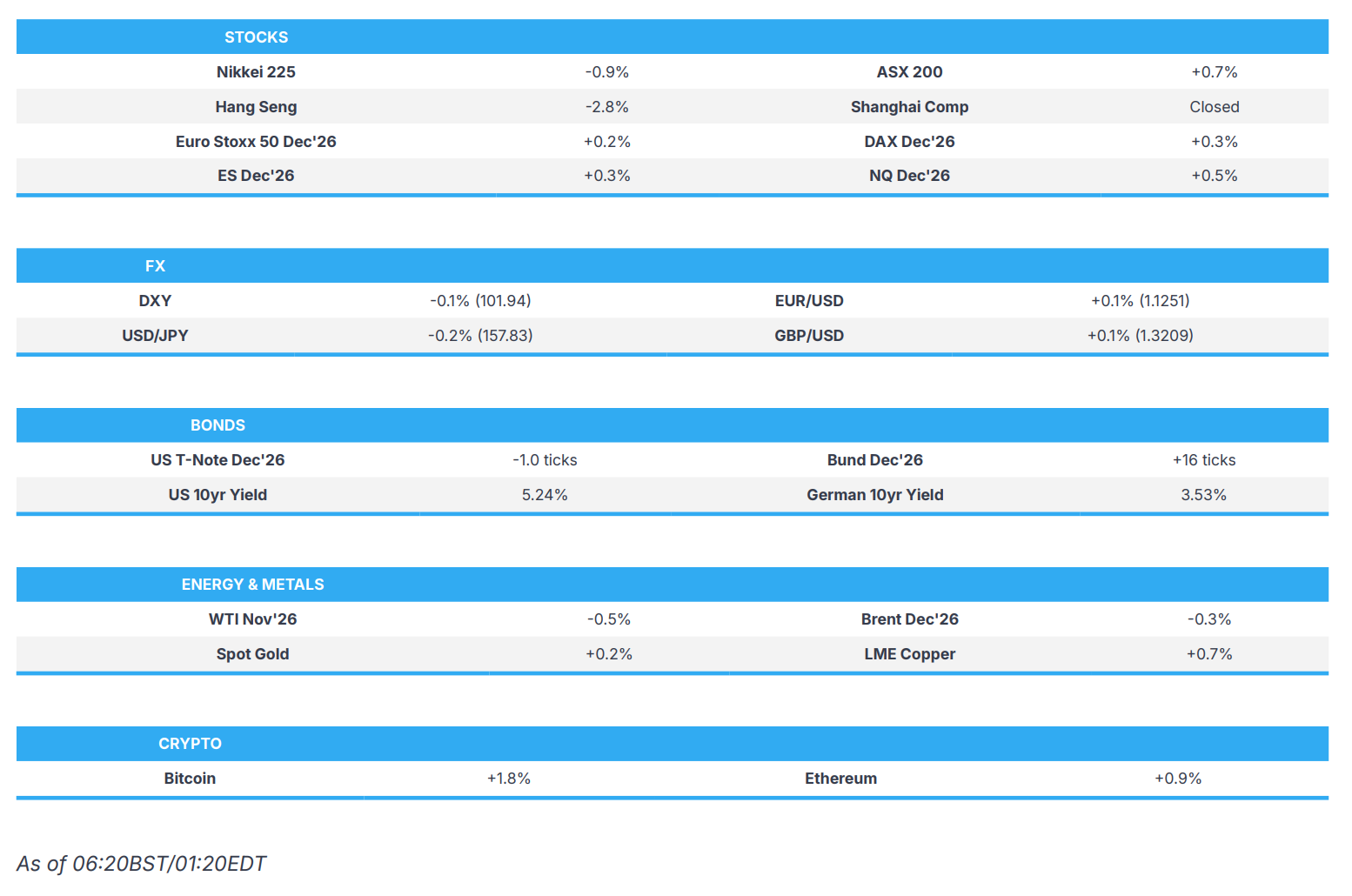
IRAN CONFLICT
- US Pentagon is sending a third aircraft-carrier strike group and additional Marine Corps ships to the Middle East, adding up to 10,000 more troops to the region, according to the Wall Street Journal, citing US officials. The report noted the arrival is expected by the end of November and that Trump recently told aides he expects to resume bombing Iran in November, while the Roosevelt crew is prepared for an extended deployment, according to sources. Note: the third aircraft-carrier deployment was reported in hours via Al Jazeera.
- In recent weeks, the US military has sent two more batteries of the Patriot air defense system to protect oil and gas facilities in Saudi Arabia and Qatar, Axios reported.
- US President Trump reiterated that Iran will never have a nuclear weapon and has no navy or army, while he stated that Iran has not been able to get one of its vessels through the Strait of Hormuz for months. Trump also said huge quantities of oil have passed through the Strait of Hormuz and the US is taking out millions of barrels of oil, claiming that in some cases, it is more than before the war.
- US President Trump reiterated that Iran cannot have a nuclear weapon, while he added that he now has to make a decision and that either Iran signs a deal, or it will no longer exist.
- US President Trump said the Iran war will be ending soon, one way or the other, and that it looks like Iran was involved in the UK base incident. Trump warned that Iran will be hit very hard if it is behind the copilot who tried to crash a flight to Israel, while he separately commented that based on what he heard, Iran was connected to the attempted attack on the plane.
- US President Trump said he had repeatedly stated it would take four to six weeks to eliminate the Iranian nuclear threat, but that he had achieved this in one night, while he added that the remaining time was to ensure the threat stays eliminated.
- US Treasury Secretary Bessent said Iran loaded zero crude oil onto tankers in September and that the Trump administration is cutting off the Iranian regime’s most critical source of revenue, while he added that Operation Economic Outcast is severing the economic lifelines that have allowed Tehran to finance its terrorist agenda.
- Iran’s Foreign Minister reportedly suggested in private talks that Iran was willing to restore nuclear inspectors’ access to bombed facilities in exchange for sanctions relief, according to Bloomberg citing sources. However, IRNA denied the report that Iran proposed a return of IAEA inspectors to nuclear facilities in exchange for easing sanctions.
- IRGC said three UAE-linked tankers attacked recently in the Strait of Hormuz were on the PGWA’s non-compliance list, and had transited the Strait repeatedly over the past two months.
- Local sources reported that a 2.5mln bbl capacity supertanker travelling through the Strait of Hormuz illegally was hit 8 kilometres off the coast of Oman and was burning, according to Fars News. UKMTO also announced it received a report of a tanker being struck by an unknown projectile while transiting the Strait of Hormuz, resulting in a fire.
- Yemeni armed forces said their forces targeted 11 high-value targets in Saada, while they later announced that they conducted 20 strikes on Houthi targets across several areas of the Taiz province during a three-hour period.
- Houthi-run Saba News Agency denied that the group attacked a power station in Saudi Arabia’s Medina, citing sources.
- Saudi‑led coalition intercepted and destroyed ballistic missiles launched by Yemeni Houthis towards Khamis Mushait.
US TRADE
EQUITIES
- US stocks closed with marginal gains on what was a choppy day, with the Nasdaq 100 mildly outperforming as Technology led, supported by software names following strong Accenture (ACN) earnings, while Synopsys (SNPS) also gained after raising guidance following its deal with OpenAI. Treasuries saw two-way trade, but ultimately bull steepened as front-end yields led the rally, with price action influenced by economic data, Fed speak, and geopolitics as markets entered Q4. There were several data releases in which jobless claims remained low, the Revelio Labs labour market report showed an acceleration in September, while the Chicago Fed unemployment nowcast was unchanged at 4.1%, while ISM Manufacturing missed expectations, but prices paid jumped and the employment component improved, with all eyes now turning to the NFP report.
- SPX +0.19% at 7,666, NDX +0.31% at 30,502, DJI +0.04% at 50,932, RUT +0.35% at 2,807.
- Click here for a detailed summary.
TARIFFS/TRADE
- US President Trump said the trade deficit with China has dropped to the lowest in 44 years and that he gets along great with Chinese President Xi, while he added that China used to rip the US badly and that Canada is ripping the US badly.
- USTR Greer said there is no timeline yet for US-China tariff reductions under the board of trade. Greer also stated that he had constructive talks with the Indian trade minister and they are trying to finish a deal, but added that a US-India trade deal is not imminent and they have identified sticking points.
- Mexico’s Economy Minister said they will send a trade mission to the EU next spring.
NOTABLE HEADLINES
- Fed’s Bowman (voter) said she sees no urgent need for more rate moves this year, while she touted benefits of a Fed capital plan tied to treasuries.
- Fed’s Cook (voter) said supply shocks have had surprisingly persistent effects, becoming more salient for policy, while she stated it is possible that the optimal policy response to a supply shock could be sector-dependent, and they have to be attentive to consumer confidence. Cook also commented that AI is causing pockets of inflation and doesn’t think private credit is having a big effect on financial stability.
- Fed’s Jefferson (voter) said the Fed is fully committed to returning inflation to its 2% target and may need more time before deciding on its next rate move, while he added that future rate changes should be driven by the data and that weighing additional information would allow the Fed to make a better decision. Jefferson added that economic output and the labour market are broadly solid, while bond yields indicate that market participants are reassessing the outlook. He also said the September rate hike would help anchor inflation expectations.
- Fed’s Logan (2026 voter) said the policy rate needs to increase an additional 50bps or more and that without higher rates, inflation will not get to the 2% goal, while she added that policy is not sufficiently restrictive and needs to become modestly tighter. Logan said price stability must be restored and at a minimum, several further rate hikes would reverse last autumn’s cuts. She also stated that it remains uncertain how high the policy rate must go to bring inflation back towards 2%.
- Fed’s Kashkari (2026 voter) said he does not have a strong view on an October rate hike and is open-minded about the pace of further tightening. He has pencilled in one more hike this year and another in 2027. Kashkari added that monetary policy does not appear to be providing much restraint at present and that he does not see meaningful tightening in financial conditions based on the data.
- Fed’s Schmid (2028 voter) said the relentless rise in long-term interest rates is starting to have effects on more parts of the economy, while he noted some frictions in some of the long-market users of credit, pointing to multifamily housing and commercial lending, according to Axios.
- US Treasury Buyback (Liquidity support, 10-20-year nominal coupons, max USD 6bln): Accepts USD 6.0bln of USD 46.39bln offers, accepts 2 of 41 eligible securities.
- US President Trump is likely to pick Jay Clayton for AI czar, while the White House has been discussing having him remain in his current role as National Intelligence Director, according to CBS.
- Amazon (AMZN) is reportedly looking to offload around USD 8bln of NVIDIA’s (NVDA) Grace Blackwell chips to external investors through a special-purpose vehicle to help strengthen its balance sheet, the FT reports.
APAC TRADE
EQUITIES
- APAC stocks traded mixed following the ultimately choppy performance stateside as oil prices climbed, yields pulled back, and participants digested a slew of data, while all eyes turn to the looming NFP report.
- ASX 200 mildly gained, with the index led by strength in tech and energy, albeit with further upside capped amid a lack of fresh catalysts and with real estate and healthcare at the other end of the spectrum.
- Nikkei 225 retreated as participants digested the latest data releases, including a surprise uptick in the Unemployment Rate and the hotter-than-expected Tokyo CPI data, which was said to be driven by an unwinding of price suppression effects from targeted government subsidies.
- KOSPI traded indecisively following the somewhat mixed South Korean CPI data, in which the Y/Y reading slowed to 2.9% from 3.1%, as expected, but remained above the central bank’s 2% target.
- Hang Seng underperformed on return from the holiday closure, with Stock Connect trade remaining shut owing to the week-long closure in the mainland, while pressure was seen in auto names following monthly sales updates and with casino stocks in the red after Macau casino revenue declined last month.
- US equity futures edged higher in a gradual continuation of yesterday’s intraday rebound, but with gains contained as participants await the key US jobs data.
- European equity futures indicate a slightly higher cash market open with Euro Stoxx 50 futures down 0.2% after the cash market closed with losses of 1.5% on Thursday.
FX
- DXY traded little changed during Asia-Pac hours but held on to the prior day’s spoils after gaining against most of its peers as it benefited amid the choppy risk sentiment, while there was an abundance of Fed speakers, including Jefferson, who suggested they could take more time to decide the next rate move, as giving more time to consider the data would allow the Fed to make a better decision on rates, while Bowman sees no urgent need for more rate moves this year. Furthermore, Kashkari said he does not have a strong view on an October rate hike and is open-minded about the pace of further tightening, while Logan said the policy rate needs to increase by an additional 50bps or more and that without higher rates, inflation will not get to the 2% goal. In terms of the data, the recent releases were somewhat mixed, while all attention turns to the looming US NFP report.
- EUR/USD price action was constrained after recently underperforming as it gave way to CHF and dollar strength, while the US was said to have warned France and Germany to release emergency diesel stocks or face a possible export ban.
- GBP/USD just about reclaimed the 1.3200 handle after bouncing off a 3-month trough, although the recovery is limited and there was little reaction seen to reports that UK PM Burnham is leaving the door open to a snap general election next year.
- USD/JPY traded relatively sideways as participants digested the latest data from Japan, which showed a surprise uptick in the Unemployment Rate and an acceleration in Tokyo-area CPI.
- Antipodeans eked slight gains in uneventful overnight trade amid the mixed risk appetite and in the absence of pertinent data.
FIXED INCOME
- 10yr UST futures took a breather after advancing yesterday as yields pulled back from multi-year highs amid mixed data, Fed speak and geopolitics, while participants look ahead to the NFP report.
- Bund futures held on to their gains after global yields reversed yesterday in choppy trade and with the US pressuring Europe to release some of its diesel stockpiles.
- 10yr JGB futures tracked the recent rebound in global counterparts but are off today’s best levels as participants also reflected on the acceleration in Tokyo CPI data.
COMMODITIES
- Crude futures paused overnight after rallying yesterday in the continued absence of any progress between the US and Iran. The upside was also facilitated amid the ongoing risk of a US diesel export ban, while WSJ reported that the US is sending a third carrier strike group to the Middle East and that President Trump was said to have told aides he expects to resume bombing Iran in November.
- Crude flows through Saudi Arabia’s East-West pipeline have recovered to around 5.5mln BPD, allowing exports to restart from the Red Sea port of Yanbu, according to Argus, citing a source.
- Iraq, Kuwait, Saudi Arabia, Qatar and the UAE have exported an average of 26% fewer barrels of crude oil during the conflict than over the same period last year, while the average price per barrel has risen 44% YTD, according to Tanker Trackers.
- Venezuela’s oil exports fell to 1.08mln BPD in September, while exports to the US increased to 629k BPD and shipments to India and Europe declined to 253k BPD and 86k BPD, respectively.
- US President Trump said the US will begin filling the Strategic Petroleum Reserve with Venezuelan oil at very little cost.
- US President Trump said he may ask Europe to release diesel supplies, while he also stated that prices are coming down.
- US Energy Secretary Wright said the US will ask Europe to release strategic diesel reserves, adding that he expects positive news and is highly confident Europe will help address the situation, according to Fox. He also said gasoline and diesel prices will be lower by the election.
- US Treasury Secretary Bessent said their European partners should accelerate delivery on their existing commitments and make additional supplies immediately available to address ongoing disruptions.
- EU Trade Chief Sefcovic said he discussed high diesel prices with USTR Greer and spoke about a coordinated approach to releasing diesel reserves, while he added that any release would form part of a wider ongoing discussion, according to FBN.
- EU Energy Union Taskforce is due to meet today to discuss potential diesel stock releases, according to diplomats.
- Spot gold swung between gains and losses as participants await the key US jobs report.
- Copper futures were choppy amid the mixed risk appetite and absence of its largest buyer.
CRYPTO
- Bitcoin climbed higher overnight and returned to above the USD 85,000 level.
NOTABLE ASIA-PAC HEADLINES
- Japanese Economy Minister Kiuchi said Japan is no longer in deflation, so there is no need for excessively loose monetary policy that favours higher inflation, while he added that the Takaichi administration’s policy is different from reflationary policy that aims to pull Japan out of deflation, and is different from Abenomics in that it seeks to achieve both a strong economy and fiscal discipline and focuses on boosting Japan’s supply capabilities.
DATA RECAP
- Japanese Tokyo CPI (Sep YY) 2.7% vs. Exp. 2.5% (Prev. 1.9%)
- Japanese Tokyo Core CPI (Sep YY) 2.7% vs. Exp. 2.4% (Prev. 1.8%)
- Japanese Tokyo CPI Ex Food and Energy (Sep YY) 3.0% vs. Exp. 2.5% (Prev. 2.0%)
- Japanese Unemployment Rate (Aug) 2.5% vs. Exp. 2.4% (Prev. 2.4%)
- Japanese Jobs/Applications Ratio (Aug) 1.18 vs. Exp. 1.18 (Prev. 1.18)
- South Korean CPI (Sep MM) 0.3% vs. Exp. 0.4% (Prev. 0.2%)
- South Korean CPI (Sep YY) 2.9% vs. Exp. 2.9% (Prev. 3.1%)
GEOPOLITICS
RUSSIA-UKRAINE
- Russian President Putin said Russia needs security guarantees over Ukraine and is ready to hold talks and conclude them as soon as possible, but only on conditions acceptable to the Russian people. Putin also stated that he does not see a willingness on Ukraine’s part to negotiate.
- Russian President Putin said Russia is not threatening anyone, but would consider using all weapons in its arsenal if a threat emerged to the Russian exclave of Kaliningrad.
- Russian President Putin said some European countries, including Germany, have seized Russian assets and that Russia is responding in kind, while he added that those countries may recover the assets under a favourable scenario.
- Russian President Putin said he supports a meeting with Chinese President Xi and US President Trump, but added that the agenda would need to be worked out. Putin also stated that Russia is developing its nuclear forces, which are more than 98% modernised, and is ready to resume dialogue with the US on strategic nuclear weapons if Washington expresses an interest.
- Ukrainian President Zelensky said Russian President Putin instructed his military leaders to abandon the rules of war, citing information obtained by Ukrainian spy agencies, according to FT.
- South Korean President Lee said they will take additional measures if Ukraine continues to deny the agreement on North Korean prisoners of war repatriation, while he called on Ukraine to acknowledge the agreement and apologise.
EU/UK
NOTABLE HEADLINES
- UK PM Burnham is reportedly leaving the door open to a snap general election next year, according to The i Paper.
- UK Ministers are working up sweeping plans for welfare changes including scrapping a key disability benefit for under-25s and replacing it with a multibillion-pound package of support to get into work, according to The Guardian.
2.NORTH AND SOUTH KOREA/
SOUTH KOREA//NORTH KOREA
SOUTH KOREA/USA
JAPAN//AI
JAPAN//USA
3. CHINA
CHINA/RUSSIA
ROBERT H:
October surprises
“Long ago a dear friend explained to me that tomorrow’s news as written yesterday. I have never forgotten.
Many months ago I wrote that October especially the time around the 5th was critical for events to become apparent. Why? Because it takes time for plans to turn into actions that are governed by circumstance and geopolitical events affecting commerce. And like with all pressure points on the big board of hegemony all nations and their people are pawns that are always in play.
Yesterday far reaching eyes planned out events based on their goals using actions future and present to occasion programmed actions to achieve goals. Today we are seeing the consequences of such planning. It is why such means as quantum scenarios are used to if probabilities and sequences of events.
TODAY, China has instructed its refiners to suspend oil product exports for October as Beijing looks to preserve domestic stocks, a move that will further crimp globally war-constrained fuel markets.
Beijing restricted fuel exports in back in March after the outbreak of the Iran war disrupted Middle Eastern crude supplies.
China, the world’s top oil importer, relaxed the curbs in July and is managing diesel, gasoline and jet fuel shipments on a monthly basis. China is followed by India as an importer. Do you recognize that both are part of the BRICS?
Russia has announced the extended the ban on exports of diesel, marine fuel, and gas oil for all fuel producers to October 31, which effectively extends the period in which the tightening global market will have to cope without Russian diesel shipments for another month.
Today’s revelations are shocking oil markets worldwide. These developments will cause actual outages of fuel in many places around the world. Not merely “shortages” but rather full outages of fuel.
Economic activity will be quickly affected. Business cannot run without energy and fuel provides energy. No fuel means no energy and no energy means no business. No business means recession or worse. Interest rate hikes are meaningless to control or offset the inflation that will result.
You perhaps do not know that Marco Rubio ORDERED the Iran Delegation in New York to leave the United States on Monday night-into-Tuesday Morning because negotiations with Iran were not making progress.
The Iran Delegation was taken to the airport, put on a plane to Doha, QATAR and departed New York City at 1:20 AM on Tuesday morning. In simple terms, they were thrown out.
Yesterday at about 10:00 PM Eastern Time,Trump CANCELED the planned trip by Witkoff and Kushner to Pakistan, to resume negotiations with Iran.
Trump said, we will “NOT be making any more 18 hour flight to sit around and talk about NOTHING.” He also said “Iran can call anytime.”
Can you still believe an early solution to a global energy crisis?
Well today The United Arab Emirates (UAE) is under attack.
According Sources in the Middle East Iran is now “bombing the hell out of Abu Dhabi.”
A giant onshore oil and gas field in Al Dhafra is on fire.
Yemen’s Ansar Allah is also bombing Saudi Arabia’s largest crude stabilization plant.
The Abqaiq Oil Processing Facility is on fire.
Iran has now raised its readiness level at 46 vital facilities. And the US is departing from many regions in the Middle East.
Do we still think this is game of chicken little?
Please do recall that I told you that following the Duma elections Russia would step up its’ efforts to end the Ukrainian conflict. Quite contrary to EU illusions and delusion, and American lies about support for peace over conflict. The Russians will settle matters on the battlefield with Ukraine and all other comers who are vain enough to try their luck at destroying Russia. To this end ponder current actions as a scripted writing being played out. Do no think that Russian warnings of nuclear repercussions are without substance.
Russia has taken control of the skies over Kiev, as Ukrainian air defenses appear to have ceased functioning entirely. Panic has set in at the Verkhovna Rada, which is Ukraine’s Parliament: “In essence, the airspace over the nation’s capital is entirely under Russian control,” said MP Oleksiy Goncharenko.
Well yes all communication and logistics are being destroyed to preserve lives and shorten the conflict. If it means Ukraine is reduced to the horse and buggy stage it will be so to achieve peace. The gloves are off.
Please prepare to deal with the shortages and result of actins under way as we will experience everything from liquidity issues to scarcity of al goods and services in times ahead. This will take into countries that break up and conflicts that economic pain causes. No one fights when fat and happy.
The next 5 years will be much more dramatic than the last 5 years. “
END
4. EUROPEAN AND SCANDINAVIAN COMMENTARIES PLUS NATO
EUROPE/
UK
UK Officials Are Keeping A List Of Brits Who Question Government Policy
Friday, Oct 02, 2026 – 03:30 AM
Authored by Steve Watson via Modernity.news,
The British state is compiling a list of people who criticise its own counter-terror programme. Ordinary X and Reddit users who questioned Prevent training, flagged a one-sided focus on the “far Right,” or simply criticised it have had their posts logged, stored and “investigated” by a Home Office-linked unit most of them have never heard of.

Officials spent more than a year trying to keep that database secret. They only released it after an appeal to the Information Commissioner’s Office. The public was never told their feeds were being trawled.
The Standards and Compliance Unit, or StaCU, was set up in February 2024 as an “opaque” body to handle complaints about Prevent, the safeguarding scheme sold as a way to stop people becoming terrorists. Documents obtained by The Metro and released by Rights & Security International show StaCU did more than wait for formal complaints.
Between March 2024 and February 2025 it made 77 “observations” of critical online comments, most of them from X, with others from Reddit and even articles in the Guardian and the Telegraph.
Jacob Smith, Freedom of Expression and Belief Team Leader at Rights & Security International, fought for a year to force the Home Office to publish the material.
“It is shocking that the government has been trawling X and Reddit to find out who has been critiquing Prevent – and then storing that information,” he said. “You should be allowed to criticise government policy without being put on a list.”
He added: “People should be able to express their views on social media without that being catalogued in government databases.”
Many of those logged, he said, had posted without thinking “that the government might be looking at their feed and taking that data. It is in an almost private setting.”
His conclusion was blunt: “It’s a stark reminder that, in the government’s eyes, anything you share online is fair game and could go into a file forever.“
A large share of the logged posts accused Prevent training of treating the “far Right” as the main threat while skating over Islamist extremism.
One X user was recorded after calling the training “complete bullshit.” They wrote: “Anyone’s who done the prevent training knows it only talks about the far Right. Islam extremism isn’t even mentioned.”
Another poster said they “sat through Prevent training at work … and the narrative was very much that the far Right is the biggest threat.” They added: “I kid you not!”
StaCU says it tries to independently verify claims about Prevent. It managed that for only 10 percent of the posts. The unit’s parent body, the Commission for Countering Extremism, sometimes replies in public, inviting the user to submit a formal complaint.
In one case, after a post accused Prevent training of “turning a blind eye to Islam,” the Commission wrote: “Hello, we process and investigate complaints about Prevent and are interested in finding out more about the training referenced above. Please feel free to DM us, tweet us back, or make a formal complaint using this link.”
What that reply does not say is that the user’s post has already been stored in an internal government list.
It was not only anonymous accounts. Open Rights Group had a tweet recorded that said: “How data is managed and stored under the Prevent programme lacks transparency.“
Sarah Lasoye, the group’s Programme Manager for Pre-Crime, told The Metro: “Prevent has expanded far beyond its stated aim of identifying people considered ‘vulnerable to radicalisation’, and has increasingly been used to justify extensive surveillance.”
She added, “It is deeply concerning to see the Prevent duty being used to enable the monitoring of people and organisations simply because they are critical of the programme. That raises serious questions about freedom of expression and the right to dissent and protest.”
“There is also a troubling lack of transparency about what happens to the information gathered through this social media monitoring: how long it is retained, who it is shared with, and ultimately what the Government is using it for,” Lasoye urged.
Rights & Security International says organisations including Hope Not Hate and Maslaha also appear in or around the observations. The Campaign Against Antisemitism had a post logged that did not even name Prevent. It criticised police for failing to take a Hezbollah vigil seriously. A spokesperson said: “We aren’t sure whether to be flattered or concerned that StaCU has picked up a post of ours.”
The group added, “If it’s because we’ve dared to be critical of law enforcement’s lax attitude toward Islamist extremism in this country, we stand by what we said and would reiterate it for as long as it takes to bring about change. But if our post was flagged because StaCU agrees with us that police forces have failed to train their officers on what Islamist terrorism looks like and which organisations are banned, we hope that the message is being received and change is coming.”
That last point tracks a long-running complaint. Sir William Shawcross, in his 2023 review of Prevent, wrote: “The bar for what RICU includes on Islamism looks to be relatively high, whereas the bar for what is included on the extreme Right-wing is comparably low.”
Home Office figures for the year to September 2025 showed 10,293 Prevent referrals. Twenty percent were recorded as extreme right-wing ideology. Eight percent concerned Islamist extremism.
A Home Office spokesperson said: “Prevent does not track people who may have criticised the programme, and nor does it target any particular community.” The department added that keeping the public safe is “our number one priority” and that Prevent has “moved more than 6,000 people away from violent ideologies since 2015.”
The documents say otherwise on the first claim. StaCU collated the posts as “open-source complaints,” stored them internally, and the Home Office refused to release the list until the Information Commissioner forced its hand. Nobody outside the unit can say who else sees the file, how long it is kept, or whether it is shared with police, platforms or other departments.
This is not an isolated compliance desk. It sits inside a growing stack of state machinery built to police speech, “narratives” and online anger.
In June, we laid out how the Home Office’s Research, Information and Communications Unit has been used to manage the mass-migration story – briefing police to cast concerned citizens as “unsympathetic thugs,” shaping family statements after migrant-linked killings, and running a higher bar for Islamism than for the so-called extreme Right.
The same week, ministers moved to give Ofcom faster powers to block “false information” during so-called crisis events – a phrase wide enough to cover any unrest the government would rather you not describe accurately.\

EXPOSED: UK Government Has A ‘Thought Police’ Unit To Control Mass Migration Narrative
Former MI6 operatives caught briefing police to brand concerned citizens as “unsympathetic thugs
Zerohedge.com/political/uk-officials-are-keeping-list-brits-who-question-government-policy
Last week Prime Minister Andy Burnham used his first United Nations speech to announce a National Centre for Information Defence – a new machine to “detect, attribute and disrupt” what ministers call hostile information attacks and to stop a “distorted and untrue narrative about Britain.”

MINISTRY OF TRUTH: Government To BLOCK ‘False Information’ During ‘Crisis Events’
Surveillance grid expands

London Mayor Sadiq Khan Calls For A Government Social Media ‘Disinformation’ Unit
London Mayor accuses platforms of waging war on the capital while ignoring exploding crime and violence under his watch
Police have their own version. The National Internet Intelligence Investigations team, stood up after the 2024 Southport riots, has referred more than 100 “suspicious” posts to local forces, including dozens tied to protest-related activity.
London Mayor Sadiq Khan Calls For A Government Social Media ‘Disinformation’ Unit

ANOTHER New UK Government Unit To Police ‘Untrue Narratives’
A literal Ministry of Truth
That is roughly 34 arrests a day. Big Brother Watch director Silkie Carlo said speech policing is “out of control” and called the result an “Orwellian mess.” Lord Toby Young asked why authorities spend so much time “policing our tweets when they could be policing our streets.

Britain’s SPEECH GULAG: 62,000 Arrested In Five Years
Police hunt jokes and tweets while streets rot — and the numbers just got worse
 modernity
UK Police Literally Have An ‘Elite Squad’ To Flag Spicy Social Media Posts…
And report the ‘offenders’ to the government
The arrest figures sit underneath all of it. Between 2021 and 2025 at least 62,199 people were arrested in Britain on suspicion of communications offences – section 127 of the Communications Act 2003, the Malicious Communications Act 1988, and the Online Safety Act’s false-communications offence.
Prevent is sold as safeguarding. The logged posts are not bomb plots. They are workers calling official training biased, campaigners asking how data is stored, and a Jewish group complaining that police treat a banned terrorist organisation too lightly.
If that is enough to enter a Home Office database, the category of “acceptable” speech is already whatever officials decide it is on a whim.
Britain does not need another unit to hunt “untrue narratives.” It needs a government that can survive being questioned without opening a file on the questioner.
END
END
BERLIN/EUROPE
Europe’s Housing Crisis Is An Immigration Crisis, Berlin Data Confirms
Friday, Oct 02, 2026 – 02:00 AM
In a system that rejects mass immigration, the population can fall, opening up room for cheaper housing, lower rents, and even an increase in the birthrate.

Across the West, native Europeans are dying out but rental prices continue to go up every year. While the left would like to point the finger at capitalists and greedy landlords, the primary factor driving the housing affordability crisis is mass immigration.
Berlin is a prime example of this trend, as German journalist and author Jens Winter pointed out on X using clear population and housing data.
“Rental prices on the market have more than doubled in Berlin since 2011 – plenty of money for corporations. But where is the increased demand coming from? While the native population of the capital has declined by 260,000 since 2011, the number of foreigners and people with a migration background has risen by 650,000 over the same period. That means: Without migration, there would be less demand for housing in Berlin today than in 2011,” he wrote.
In a follow-up post, he wrote that the German “conservative” party is just as guilty as the left.
“The CDU-aligned real estate lobby is raking in big money with migration in Berlin. The Germans have a choice: dying out in the CDU’s multikulti capitalism or in the Left’s multikulti socialism. Understandable response: If we’re going to disappear anyway, why bust our asses for it?” he wrote.
While the doubling of rents is real, there is a basic supply and demand reality that the left would like to deny. It is indeed true that predatory property owners, major institutional players, and money printing have played contributing roles to the housing crisis, but no matter how many greedy property owners are involved, if the population of a city falls, rental and housing prices are almost inevitably going to fall.
Mass immigration means that population numbers never fall. Any breathing space for German families to repopulate, have more children, and fill in the gaps left by older generations passing away is immediately filled by hundreds of thousands of foreigners.
The data shows that the population of native Germans fell by 260,000 people. In a system that rejects mass immigration and foreign real estate investors, this could have been a boon for birthrates and increasing home ownership. For one, Germans who already lived in Berlin, and those looking to move to Berlin, would have been more easily able to afford rents and housing due to less competition on the housing market. Secondly, more native Germans would have had a chance to start families – and those who already had families could have afforded an extra child or two – by securing affordable housing.
However, Germany does not reject mass immigration.
Instead, 650,000 foreigners arrived in the same period of time and housing and rental prices soared. The left, however, refuses to do simple math.
There is of course another solution, but it is far more complicated than simply allowing population levels to fall in a country that has never had so many people living in it. Instead of ending mass immigration, left-wing parties, along with the CDU, demand more housing is built.
However, there are myriad reasons why the required housing is not being built, including high construction and material costs, red tape, zoning, and a lack of skilled workers. The same parties have been making the same demands for years now, but construction cannot keep pace with demand in Berlin or other major cities across Germany.
The Left Party may promise to build more, but the reality is that it will not happen. Nothing the left offers will lead to the necessary building. Before Olaf Scholz of the far-left Social Democrats (SPD) won the chancellorship, he promised that his “goal” was to create 400,000 new apartments per year, which would include 100,000 units of social housing, saying, “That’s not witchcraft, we just have to want to do it.”
It never happened under Scholz and it won’t happen under a left-wing government in Berlin either.
Should more housing even be built?
As Western cities race to replace their native European populations, the question becomes whether life really becomes better in a crowded multicultural city when it means more traffic, longer waiting times at hospitals, crowded classrooms, and imported crime – just to name a few ills.
The newcomers also did not fix the skilled worker shortage that could potentially build all the homes and apartments politicians and lobbyists claim Europe needs. While a certain number of new houses and apartments always need to be built, the question then becomes should Western civilization really be involved in endless building to accommodate millions of foreigners.
On top of all of these questions, the buildings developers managed to build are now in fact uglier than ever, more expensive than ever, and are built more slowly than ever.
In fact, data shows that the time from start to completion for a project is longer than it has been in decades. Again, where are all these young migrants from Africa and the Middle East to fuel a new construction boom with their master artisan and building skills?
The reality is they largely do not exist. Many skilled builders who are immigrants are from neighboring European countries, such as Poland, and they increasingly see fewer reasons to work in Germany.
The pro-migration left is making housing worse
Winter’s X post is especially relevant given that the Left Party recently won a first place finish in Berlin elections, securing over 25 percent of the vote. Commentators and analysts have contributed the rise of the party in Germany’s capital due a variety of factors, but two major components are the party’s ability to secure the vote of German citizens with a migration background and young voters.
The second factor is Berlin’s housing crisis, which helped drive support from groups like non-voters, the young, and foreigners.
German taxpayer-funded Deutsche Welle, wrote: “That makes sense to 17-year-old Liska, who voted for the socialists: ‘The Left Party did appeal to me, especially because of the social issues – getting prices down, making rents more affordable.’ Rents in Berlin are indeed rising at a massive pace – by some 7% in the last two years alone – and first-time tenants are likely to be the hardest hit. Polls also showed that by far the biggest proportion of Berlin voters – 37% – thought that the Left Party was the most likely to create affordable housing.“
The Left Party and various other left-wing parties have convinced young people that there are easy fixes to the housing crisis. The problem is not relegated to Berlin, as all of Germany has seen tight vacancies as more and more migrants arrive, as Remix News previously reported.
In the end, the left and its voters are choosing a path where more and more building only leads to overcrowding and environmental degradation.
Mass immigration and higher housing costs hurt birthrates
Numerous studies have shown that immigration has helped drive soaring rental and housing prices across the Western world – not just in Germany. In turn, studies have also shown that soaring housing prices have depressed birthrates, including in countries like the Netherlands, according to the Netherlands Interdisciplinary Demographic Institute (NIDI).
Again, the same story is taking place in the Netherlands, with the natural population increase for the Dutch at near zero or negative. Nevertheless, the population rose from about 16.8 million in 2013 to 18.1 million in 2025, with net migration accounting for virtually all of the recent increase.
It must also be remembered that just like in Germany, most of these migrants want to head to the major cities, such as Amsterdam.
Official housing-need forecasts in the Netherlands also attribute a large share of future extra demand, often 45 percent or more of the extra dwellings required, to population growth that is itself 95 percent migration-driven.
Great for landlords, bad for the citizens.
Of course, the Alternative for Germany has tried to tie the housing crisis to mass immigration, and they have successfully made this case to some extent.
The problem is that as more and more of the population becomes foreign, this argument holds less and less sway. Immigration may raise housing prices but if immigration brought a person to a country in the first place, and if more immigration might also enable more and more of their family members and fellow countrymen to arrive, then these voters have every incentive to keep immigration levels high regardless of housing costs.
Many of these migrants are not paying for rent anyway. There are millions of foreigners on social welfare, which means not only are they taking housing places of native Germans, but they are being paid to do it. They then often have far higher birthrates than native Germans, even with limited space, which entitles them to larger spaces.
The cycle is self-reinforcing and relentless. That means unless dramatic action is taken against mass immigration, housing and rental prices may never truly come down.
END
UK
London Mosque Pushes Wife-Beating, Throwing Gays Off Tall Buildings
Friday, Oct 02, 2026 – 06:30 AM
Authored by Steve Watson via Modernity.news,
A London mosque with charitable status is under investigation for posting sermons that tell husbands to hit disobedient wives and setting out execution methods for gay men, including being thrown from tall buildings.

The lectures were not smuggled out of a private meeting. They sit on the Hackney Islamic Community Centre’s own YouTube channel, delivered from the mosque also known as Masjid Daar Al-Hadeeth. The National Secular Society referred the material to the regulator. The Daily Mail published the tapes. Britain’s official response is a case file.
The Charity Commission has opened a regulatory compliance case. It has not, so far, taken the charity’s status away.
Yasin Munye, described as an ustaadh at the centre, reads in one lecture from Manthumatu al-Kaba’ir, a poem listing what the tradition treats as major sins. One of them, in his words, is “disobeying the husband, leaving the house without his permission, and disobeying the husband when it comes to calling her to bed, when it comes to calling her for intimacy, when she says ‘no’ without any excuse.”
The remedy he sets out is not a row and a solicitor. “Advise her, and boycott her in bed, don’t touch her in bed – and discipline them physically as well, by lightly hitting them to show them who is in charge.“
If she still refuses, he says husbands “don’t have to give her a house anymore.” He adds: “If a person has multiple wives, then he doesn’t have to stay with her; he can abandon her and stay with the other wife until she becomes obedient again.”
The same lecture turns to sex between men. Munye calls it “one of the most evil acts” and “a crime” that sees both participants “executed in the Sharia.” On the method, he is specific. “Scholars, they differ on how the execution occurs. Some of them say he is executed through the sword, like every other normal execution. Others say that they are thrown off of a tall building and rocks are thrown after that on top of them.“
The National Secular Society says the videos were published on the charity’s YouTube account in 2023. They were still there when campaigners and reporters went looking this week, but have since been made private.
A separate lecture praises a state that still kills people accused of witchcraft. “Sihr (magic) is real, it is true,” Munye says. “In Saudi Arabia, they are killed, alhamdulillah (praise be to God), bless that, because a lot of Muslim countries today you don’t find this ruling applied. Alhamdulillah, in that country, that punishment is still applied.”
A community elder at the same mosque, Abu Sa’ad Muhammad Al-Iraqi, treats the British police as the problem. If a husband “is not nice to you and mistreats you,” he says, “there is a way: you bring your family, speak to his family, to teach him a lesson. But you have to give his right, otherwise don’t be his wife.”
He goes on: “Women think these days, our sisters think, that you only be kind to him if he’s been kind back… it doesn’t work like that.” Then the line that should have ended the tax exemption on the spot. “In another country they can’t do that, they won’t. But it is an unfortunate reality of this country that they turn wife against husband. They know if you slap them once, they’ll call the police for you. They don’t fear Allah.”
The centre has been a registered charity since 2006. It re-registered as a charitable incorporated organisation in April, a change that separates trustees from the charity’s debts and lets it hold property under charity law. Its objects include advancing the Islamic faith. In the year to March 2025 it took in £191,097, almost £155,000 of it in donations, and paid no tax on any of it.
Megan Manson, head of campaigns at the National Secular Society, called the renewal alarming. The charity, she said, has hosted “lectures which promote violence against women, say women cannot refuse their husbands sex, and condone the death penalty for gay men and those accused of ‘witchcraft’.”
“Hackney Islamic Community Centre is just one of many charities promoting misogyny, homophobia and other harmful ideologies through the charitable purpose of ‘the advancement of religion’,” she said. “This charitable purpose must be urgently reviewed. It is evidently facilitating the advancement of ideas which, far from benefiting the public, could fuel discrimination, division and abuse.”
The Charity Commission provided a stock reply, noting that the commission “has clear expectations that all charities, regardless of their purpose, must operate for the public benefit and provide a safe and trusted environment for all.”
It added that concerns had been raised “about alleged sermons and social media content linked to Hackney Islamic Community Centre and we have opened a regulatory compliance case to further assess these. This will determine any next steps.“
A compliance case is not a statutory inquiry. Earlier this year a preacher at Hatch End Islamic Centre, Ahmed Shah, told worshippers it was mandatory for women to do the housework and serve their husbands. The sermon came down. The commission offered advice and guidance, but the centre’s charity status remained in place.
None of this arrives in a vacuum. In July the Home Office was still handing Skilled Worker sponsorship licences to Islamic bookshops stocking jihad texts and a guide that includes wife-beating. Reform MP Lee Anderson called it “a perfect illustration of 14 years of Tory failure: rather than doctors and engineers, we brought in staff for Islamic shops selling books on jihad.”
UK Hands ‘Skilled’ Visa Powers To Islamic Bookshops Selling JIHAD Texts, Wife-beating Guides
As well as dodgy vape shops
The same month a retired officer, Stephen Gray, 65, was convicted under the Communications Act for resharing a bacon meme about Islam. He was fined more than £1,000. “I made a joke, an ironic joke, about Islam. That is all it was at the end of the day. A joke,” he said. Lord Young of the Free Speech Union called it “a new low. No one making a similar joke about Jesus would face prosecution.”

UK Police Force Invites Non-Muslim Staff To FAST During Ramadan As Act Of SOLIDARITY
DEI ideology continues to erode impartial British policing
Last month, Barnet Hill Academy in West Hendon moved onto the state payroll as a voluntary-aided Islamic primary, with a compulsory white hijab for girls from Year 3. Stephen Evans of the National Secular Society said it was “appalling that taxpayers are being asked to fund a school that forces girls as young as seven to wear the hijab.”

UK Government To FUND School FORCING Seven-year-olds Into HIJABS
Leftist council rubber-stamps compulsory headscarves while British flags are outlawed
A recent YouGov survey for King’s College London found 34 per cent of British adults believe London already has no-go areas where Sharia dominates and non-Muslims cannot enter.

A THIRD Of Britain Now Fears SHARIA No-go Zones
Officials say London is “extremely safe”
On the one hand, a former police officer can be fined for a joke about Islam. On the other, a Islamic preacher can tell men to strike their wives, abandon them for a second wife, and advocate for gay men being thrown from buildings, yet retain charity status.
Is there a clearer example of a two-tier state? Mock the creed and the courts come for you. Preach beating and killing, and nothing happens.
END
FRANCE OIL
Art Of Leverage? France Pushes 100-Million-Barrel Emergency Release After Trump Threatens Diesel Export Ban
Friday, Oct 02, 2026 – 08:40 AM
If confirmed, Bloomberg’s report that France proposed that other European countries and International Energy Agency members release 100 million barrels of diesel and crude oil from emergency stockpiles would signal that Brussels is caving to President Trump’s demand.
Europe’s dependence on US fuel supplies gives the Trump administration major bargaining power as the continent approaches winter with below-average energy supplies and exposure to higher costs if a cold snap or further supply disruptions materialize.
The report has not been officially confirmed and is based on sources, but it says European countries are considering releasing 50 million barrels of diesel, with International Energy Agency members making another 50 million barrels of crude available.
One day earlier, Reuters reported that the Trump administration asked Germany and France to release emergency diesel inventories to help create a buffer against the supply squeeze in the industrial fuel or face a potential US diesel export ban.
The art of wheeling and dealing is all about leverage, and it appears the US threat of a diesel export ban might be enough to make Europeans come to their senses and dump emergency fuel and crude supplies onto the market.

Bloomberg also mentioned that French President Emmanuel Macron and President Trump spoke overnight and that G7 leaders are set to convene around 0830 ET.
“It is in Europe’s best interest to work with the United States as we pursue multiple pathways to boost the supply of refined products and lower costs for consumers,” one source, a US official, told Reuters on Thursday.
END
5.RUSSIA AND ISRAEL AND MIDDLE EASTERN AFFIARS
ISRAEL/USA VS IRAN/ THURSDAY
Trump Sees Likely Iran Link In FlyDubai Attack, Vows ‘Very Hard’ Response
Thursday, Oct 01, 2026 – 07:40 PM
It hasn’t taken long at all for Israeli and US officials to strongly suggest a link between Wednesday’s scary FlyDubai security incident and Iran.
President Trump raised Thursday that Iran may be linked to the copilot who tried to crash an Israel-bound plane, which forced it to make a dangerous rapid descent and an emergency landing, after passengers and crew rushed the cockpit.
But while investigators have yet to disclose a motive in what Israel called a full-fledged terror attack, which also left the flight’s captain with a stab wound, Trump laid out the following on Thursday:
Fox’s Peter Doocy: “Has anybody briefed you about whether or not the guy, the pilot of the flight in FlyDubai plane is linked to Iran?“
President Trump: “We’re working on it right now. They’re being very open with us. I would say the answer based on what I’m hearing is yes, but we’re working on it right now.”
Doocy: “So this guy might have been either put in there by the IRGC or ratified some other way, and then he tried to take down the plane.”
Trump: “It could have been, yeah.”
So we’ve gone from no motive yet being publicly offered to assertions that the IRGC may have clandestinely inserted the pilot onto the flight with an aim to conduct some kind of 9/11-style terror attack against Israel and the over 170 passengers who were inbound from Dubai.
Trump was further asked whether – if it is established that Iran was behind it – he would retaliate, to which he responded: “Oh they’ll be hit, very hard, don’t worry.”
“You just ask them,” he added. “They know what happened. They’ll be hit very hard.”
Netanyahu too has been quick to suspect Iran – though without saying if this is based on any evidence, though this is perhaps to be expected considering his history of such linkages.
“I spoke to the president of the United Arab Emirates, Sheikh Mohammed bin Zayed, and he agreed that Israel would join the investigation and we’ll find out,” Netanyahu told CNN..
“Look, we know that Iran is sponsoring a lot of this, but I can’t speak specifically of this. I can say that they did stand behind the attack in Britain. We passed that information to the Brits.”
He still acknowledge that ultimately it’s too early to tell, while confirming that co-pilot accused of stabbing the captain and trying to bring down the plane is currently in the custody Saudi Arabia (where the plane diverted upon the emergency) and is expected to be sent to the UAE.
The timing of the horrible episode couldn’t be worse (or also some pundits might also say the timing is curious), set against the background of the Iran conflict. Trump is said to be mulling resuming a major bombing campaign against the Islamic Republic by end of November, after the midterm elections in the US. The terror incident will likely exacerbate US-Iran tensions, and seems to already be doing so.

ISRAEL/USA VS IRAN/FRIDAY
ISRAEL TBN
IRAN
Iran’s Disappearing Oil Is Becoming Everyone’s Problem
Friday, Oct 02, 2026 – 03:05 PM
Authored by Natalia Katona via OilPrice.com,
Iranian oil is disappearing from the market just as its biggest buyer returns for more. China’s recovering crude demand is colliding with the loss of a supplier that sustained its independent refiners through the crisis, forcing them to compete for increasingly expensive alternatives. The consequences reach beyond China: every replacement barrel tightens supplies for other buyers, while Tehran faces a growing incentive to disrupt the Strait of Hormuz, which is now carrying an unexpectedly strong 13 million barrels a day (just 5 million below pre-crisis level), while its own oil remains trapped.

Iranian crude has long been an underestimated part of the global oil balance. After Bashar al-Assad’s government fell in December 2024, breaking the political relationship that sustained Iranian shipments to Syria, China became Iran’s only crude buyer – in 2025, it received an average of 1.4 million b/d. The war initiated by the US and Israel in late February initially made Iran even more important to Chinese buyers: while Tehran blocked other tankers from crossing Hormuz, its own cargoes passed freely, lifting Chinese intake of Iranian oil to around 1.76 million b/d in April.
That competitive edge ended with the US blockade announced on April 13. Loaded tankers could no longer leave the Gulf, while empty vessels could not enter. Loadings at Kharg Island, Iran’s main export terminal, collapsed from 1.8 million b/d in March to 260,000 b/d in May. A June 17 memorandum allowing Iranian cargoes to pass for 60 days offered temporary relief: loadings recovered to 740,000 b/d in June and 890,000 b/d in July. But the reprieve expired in August, shipments slumped again to 250,000 b/d, and no Iranian loadings were observed in the Gulf in September.
The more important part of the story, however, was unfolding outside the Strait. Iran had accumulated a vast floating stockpile that allowed deliveries to China to continue even when fresh cargoes could not leave the Gulf. In mid-April, that cushion stood at about 160 million barrels, spread across waters around South, Southeast and East Asia. Drawing on those stocks, China still imported 1.37 million b/d of Iranian oil in May, just 10% below February’s level. But the buffer was shrinking; floating storage fell to 106 million barrels by mid-June before the temporary reopening replenished it to 128 million by mid-July.
That replenishment of available floaters has since stopped. China still received 980,000 b/d of Iranian crude in August, but only 475,000 b/d in September, with arrivals ceasing from September 26 (all of the last arriving cargoes had been loaded in June).
Iran still has around 86 million barrels on the water, the lowest volume since January 2025. Yet 23 million barrels (more than a quarter) are trapped inside the Gulf. The total has barely changed since Chinese arrivals have wound down to an almost complete halt over the past two weeks, with evident loadings in the Kharg island stopping completely. With onshore storage gradually filling up (Kpler data suggests Iranian storage tanks are now 60% full, storing around 70 million barrels), Iran will face the inevitable choice of cutting production. Whilst roughly 2.2 million b/d of production is relatively safe due to demand from its refineries, Tehran’s pre-war crude output of 3.2 million b/d seems to be no longer achievable.
For China’s ‘teapots’ (the smaller independent refineries concentrated in Shandong province), this removes a cornerstone of their crude supply. Accounting for roughly a fifth of Chinese crude imports, these refiners have built their purchasing strategies around discounted sanctioned barrels, particularly from Iran and Russia. Now they must search for barrels farther away, from the Middle East, West Africa and South America. In mid-September, ten Chinese independent refiners reportedly sent traders to Singapore to secure available supplies from the mentioned regions.
The shift is visible at Shandong’s ports. Qingdao, connected by pipeline to 12 independent refineries, relied on Iran for 40% of its 690,000 b/d incoming flows in 2025. In recent months, it has increased purchases of Brazil’s Tupi and Buzios grades and even started receiving Guyana’s Golden Arrow in July, while still relying on Saudi and Russian supplies. Nevertheless, intake has fallen to a record low of around 150,000 b/d over the past three months.
At Dongying, on Shandong’s northern Bohai coast, situated near 32 independent refineries, Russia and Iran supplied virtually all of last year’s 330,000 b/d intake, accounting for two-thirds and one-third respectively. Iranian deliveries started to decrease in summer months, with just two cargoes arriving in August and just one in September. Total intake fell to a mere 220,000 b/d in September as crude-deprived refiners were compelled to cut refinery throughputs.
These refiners are being left with less oil and more expensive alternatives. Guyanese crude is particularly costly when long voyages coincide with an unprecedented shortage of very large crude carriers and record freight rates. To encourage independent refiners to increase runs, the Chinese government issued an additional 28.05 million tonnes of crude import quotas in late September, taking the annual allocation for non-state imports to a record high of 257 million tonnes. These quotas determine how much crude refiners are authorized to import, so the increase gives them room to buy more, but does little to make barrels available or more affordable.
Competition for Russian oil is intensifying, too. Chinese buying has reportedly pushed ESPO differentials to an all-time high premium of $28/bbl vs ICE Brent, while Urals is also trading $7-8/bbl above the same benchmark. Independents must also compete with state-owned buyers, which currently account for roughly half of China’s seaborne crude imports, compared with 45% in February.
China’s recovery is still at an early stage. Seaborne crude imports rose from 7.24 million b/d in August to 7.5 million b/d in September, but remain far below February’s 11.5 million b/d. During April-July, imports had fallen to roughly half that pre-crisis level, depressed by the Beijing-mandated refinery product export ban, lower refinery runs and a gradual shift towards SPRs usage. China’s strategic reserves (both state- and private-owned) remain at 1.12 billion barrels, down from 1.25 billion in April, but rebuilding imports while Iranian supplies disappear will put greater pressure on barrels available elsewhere.
For Tehran, the imbalance is becoming harder to tolerate. Peace negotiations continue without a breakthrough, its crude remains blocked, and its export revenues are squeezed. Meanwhile, oil from neighboring producers is moving through Hormuz at a surprisingly strong 13 million b/d. That recovery is both a relief for buyers and a vulnerability. As long as Iran cannot export, it has little economic incentive to preserve the arrangement allowing its neighbors’ barrels through. Mounting financial pressure could eventually push Tehran to disrupt those flows, even more than it did ever before.
The market therefore faces two connected risks: China must replace Iranian oil as its demand recovers, and Iran may lose patience with a Strait that is reopening for everyone else. The disappearance of Iranian barrels is already tightening supply. A renewed disruption to Hormuz would make the cost of replacing them much higher.
END
IRAN/USA/ALLIES
US Sends Patriot Batteries To Defend Critical Gulf Energy Assets As Trump Weighs Renewed Iran Strikes
Friday, Oct 02, 2026 – 09:25 AM
The US has deployed two additional Patriot missile batteries to Saudi Arabia and Qatar to protect energy infrastructure from aerial threats, according to a new report, reinforcing the urgent need to defend allied energy infrastructure ahead of potential renewed strikes on Iran. The report came before Thursday’s news that the Department of War is sending a third aircraft carrier strike group and additional Marine Corps ships to the region.
Axios reported late Thursday that one Patriot battery was sent last month to protect a key Saudi oil facility, while another was deployed to defend a natural gas plant in Qatar.

“The U.S. military transferred batteries and interceptors to the Middle East from other regional commands, raising concerns about readiness in other parts of the world,” the report said.
Trump told reporters yesterday that he was considering renewing a bombing campaign in the coming weeks. “Now I have to make a decision: either Iran signs the deal, or it won’t exist any longer,” he warned.
The urgent need for two more Patriot batteries in the region, designed to intercept aircraft, cruise missiles, certain ballistic missiles, and one-way attack drones, comes as Iran and proxy forces have hit critical energy infrastructure in Saudi Arabia and Qatar.
The latest attack on Saudi infrastructure came last month, when Iranian proxies hit the critical East-West pipeline, rendering it inoperable for weeks. Flows were restored only last week. Meanwhile, the latest Goldman data shows Hormuz crude flows have returned to pre-war levels as Tehran’s grip on the critical maritime chokepoint erodes.
Also overnight, a report said the DoW is preparing to send a third aircraft carrier strike group and additional Marine Corps ships to the Middle East, adding 9,000 to 10,000 more troops to the region. That news sent Brent crude futures to nearly $104 a barrel overnight, but the oil benchmark slipped below $100 as trading moved through Asia and Europe and into the early US session.
END
IRAN/USA AND ALLIES
RIDICULOUS!!
Another Tanker Struck & Damaged By Iran In Strait Of Hormuz
Friday, Oct 02, 2026 – 12:33 PM
Update(1233ET): On Friday there are reports of another foreign tanker which has been struck and damaged in the Strait of Hormuz. Several similar drone attacks have occurred this week, and over the last few days – however unlike with prior attacks these latest are not being heavily featured in the media, and have also made surprising little impact on oil prices.
* * *
The US has deployed two additional Patriot missile batteries to Saudi Arabia and Qatar to protect energy infrastructure from aerial threats, according to a new report, reinforcing the urgent need to defend allied energy infrastructure ahead of potential renewed strikes on Iran. The report came before Thursday’s news that the Department of War is sending a third aircraft carrier strike group and additional Marine Corps ships to the region.
Axios reported late Thursday that one Patriot battery was sent last month to protect a key Saudi oil facility, while another was deployed to defend a natural gas plant in Qatar.
“The U.S. military transferred batteries and interceptors to the Middle East from other regional commands, raising concerns about readiness in other parts of the world,” the report said.
Trump told reporters yesterday that he was considering renewing a bombing campaign in the coming weeks. “Now I have to make a decision: either Iran signs the deal, or it won’t exist any longer,” he warned.
The urgent need for two more Patriot batteries in the region, designed to intercept aircraft, cruise missiles, certain ballistic missiles, and one-way attack drones, comes as Iran and proxy forces have hit critical energy infrastructure in Saudi Arabia and Qatar.
The latest attack on Saudi infrastructure came last month, when Iranian proxies hit the critical East-West pipeline, rendering it inoperable for weeks. Flows were restored only last week. Meanwhile, the latest Goldman data shows Hormuz crude flows have returned to pre-war levels as Tehran’s grip on the critical maritime chokepoint erodes.
Also overnight, a report said the DoW is preparing to send a third aircraft carrier strike group and additional Marine Corps ships to the Middle East, adding 9,000 to 10,000 more troops to the region. That news sent Brent crude futures to nearly $104 a barrel overnight, but the oil benchmark slipped below $100 as trading moved through Asia and Europe and into the early US session.
END
IRAQ/ERBIL/USA/ISIS
Counter-ISIS Mission In Iraq Comes To An End
Thursday, Oct 01, 2026 – 10:35 PM
Authored by Patty Nieberg via Task & Purpose,
The U.S. military-led mission to counter the Islamic State in Iraq has officially come to an end.

U.S. Central Command (CENTCOM) announced Wednesday that the “orderly departure” of U.S. personnel and equipment from Erbil Air Base in northern Iraq was officially complete. Officials said the withdrawal marked the end to Operation Inherent Resolve in Iraq, the U.S. military’s counter-ISIS mission in the country.
The Erbil Air Base had served as a central hub for the Combined Joint Task Force-Operation Inherent Resolve mission since U.S. forces had been invited back by the Iraqi government to fight ISIS insurgents in the country.
The U.S. invaded Iraq in 2003 to topple Saddam Hussein, and by 2011, American forces left the country. As ISIS insurgents took hold of broad swaths of the country, Iraqi authorities invited a smaller contingent of U.S. forces to help counter the growing threat. Operation Inherent Resolve, a U.S.-led international coalition of military partners, was then established in 2014.
A majority of the 1,500 American and coalition partners supporting these operations worked out of Erbil. The mission will now be headquarters based in Jordan for U.S. forces to continue its mission focused on Syria, officials said.
“As we step back and hand full primary responsibility for Iraq’s security to the Government of Iraq and the brave people of Iraq, U.S. and Coalition forces stationed across the region will remain ready to respond to any ISIS threats that arise,” Adm. Brad Cooper, CENTCOM’s commander, said in a release. “Maintaining our vigilance and readiness is essential to protecting the U.S. homeland and strengthening regional security.”
For more than a decade, U.S. troops have trained and assisted Iraqi partner forces to fight ISIS in Iraq and Syria. In 2024, the U.S. and Iraq reached an agreement for a new bilateral security partnership, which ended the coalition’s work in the country and moved the U.S. towards more of an “advisory” and “capacity-building” role for Iraqi security forces.
“ISIS no longer poses a systemic threat to Iraq’s national security and Iraqi security forces, including the Peshmerga and other Iraqi Kurdistan Region security forces, now possess the capacity, leadership, and operational independence to unilaterally manage threats to their homeland,” Cooper said.
When the new security partnership with Iraq was announced in 2024, U.S. officials would not say how many of the roughly 2,500 troops in Iraq would ultimately withdraw or stay behind. Department of Defense officials said in a release Wednesday that local security forces would lead counter-ISIS efforts in the country but that the U.S. would continue providing “targeted training and intelligence support to our Iraqi partners.”
In response to inquiries about how many American troops would be in Iraq going forward, a U.S. official declined to comment, citing operational security.
The withdrawal comes as the U.S. war with Iran enters its eighth month. The U.S. withdrawal prompted mixed feelings among Iraqis about the departure of American forces in the country after decades of war, and concerns from Kurdish officials who worry that the removal of U.S. air defense equipment will leave the Kurdistan region vulnerable to Iranian drone and ballistic missile attacks.
END
RUSSIA VS UKRAINE
Defunct US-Russia Arms Control Talks Should Have Started ‘Yesterday’: Kremlin
Friday, Oct 02, 2026 – 02:45 AM
There are two familiar trends related to the Ukraine war which have persisted. The White House is still reportedly trying to get creative regarding some kind of deal that would east tensions between Moscow and the West – including potential sanctions relief for the release of political prisoners – but at the same time the rhetoric between Russia and Europe has gotten increasingly dangerous.
The Kremlin this week highlighted another big issue which serves as an ongoing source of broader tensions. It announced Monday that arms control talks between Washington and Moscow should have begun “yesterday”.
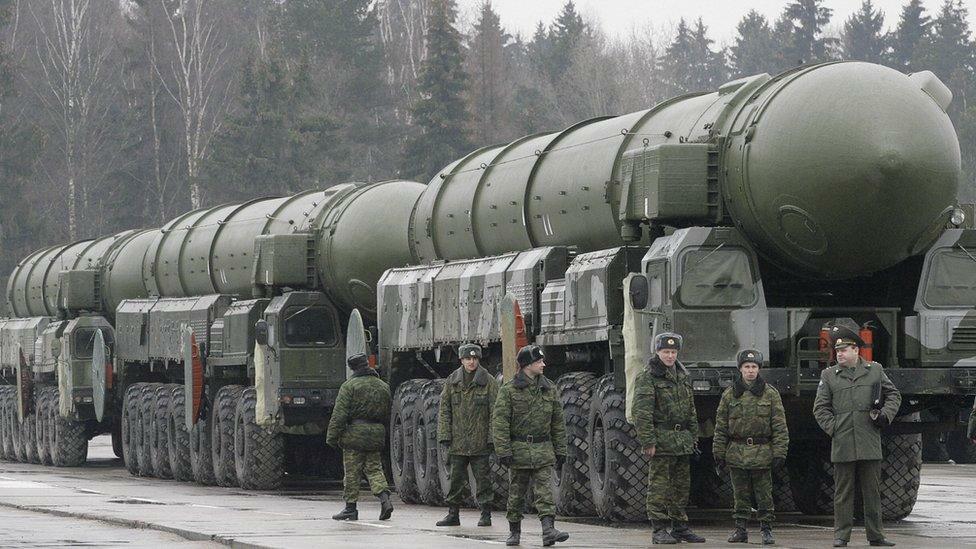
As it stands, there are no existent nuclear arms control treaties remaining between the globe’s two biggest nuclear-armed superpowers. Kremlin spokesman Dmitry Peskov warned in fresh comments that the nuclear issue remains “completely unaddressed” at this stage.
The New START nuclear arms reduction agreement officially went defunct on February 5, 2026 – as it was not renewed, amid the backdrop of war in Ukraine and ratcheted US sanctions on Russia.
Revisit our: Uncharted Territory: US & Russia Now Have No Limits On Nuclear Weapons
“This is such a complex matter that it requires very lengthy, meticulous, and expert-level negotiations. Therefore, in any case, it will be a process that takes a long time,” Kremlin spokesman Dmitry Peskov said.
The New Strategic Arms Reduction Treaty was signed in 2010 by Presidents Barack Obama and Dmitry Medvedev, and limits the number of deployed strategic warheads to 1,550 per side, and caps deployed delivery systems – including of missiles, bombers, and submarines – at 700.
The treaty was further designed to regulate targeting of each rival’s political and military centers in a potential nuclear conflict.
The August 15, 2025 Alaska summit between Presidents Trump and Putin had as one of its many aims setting the “next stages” of discussions could include reaching “agreements in the area of control over strategic offensive weapons.”
However, such an agreement has remained elusive and not even the New START Treaty survived, also given the Trump administration has long voiced that it wants to see China included in future landmark arms control deals.
END
RUSSIA/UKRAINE/HUNGARY
Russia Expels Hungarian Diplomats In Stunning Break With Orban Era
Friday, Oct 02, 2026 – 04:15 AM
Over several years of the Ukraine war, Russia and various European countries have escalated their diplomatic war – amid parallel ‘spy wars’ and mutual accusations of sabotage efforts – which has resulted in tit-for-tat expulsions of diplomats.
A big exception to this trend until now was Hungary under Viktor Orbán. Having served as the Prime Minister of Hungary for a near 20-year total period across two separate periods, Orbán throughout the years of the Ukraine war until his defeat by Péter Magyar was a thorn in the side of the EU for his openness to Moscow and condemnation of NATO’s deepening role in propping up the Zelensky government.

Prime Minister Magyar, leader of the pro-European conservative Tisza Party, has been in office only five months and already he has drastically shifted the country on Moscow relations.
On Thursday Russia’s Foreign Ministry said it has moved to expel a group of Hungarian diplomats in a tit-for-tat action.
Starting Sept.8, Budapest under Magyar expelled ten Russian diplomats who were suspected of spying activities. Moscow in the wake of this lodged a formal and “decisive protest” over the “groundless and openly unfriendly” expulsion.
Such words would have been unthinkable under Orbán. And now, as state media confirms, several Hungarian diplomats have been sent packing:
Hungarian Charge d’Affaires in Russia Gabor Gergich, who was summoned to the Russian Foreign Ministry, was informed that, as a retaliatory measure, a group of employees of the Hungarian Embassy in Moscow and Hungarian Consulates General in St. Petersburg and Kazan must leave Russian territory, the Russian Foreign Ministry said in a statement.
“The Hungarian diplomat was informed that, as a retaliatory measure, a group of employees of the Hungarian Embassy in Moscow and the Consulates General of Hungary in St. Petersburg and Kazan must leave Russian territory within two weeks,” the ministry said.
As for the new era of Magyar he early on made clear he would not block a €90 billion EU loan to Ukraine which Orbán originally vetoed, resulting in a collective sigh of relief among Eurocrats in Brussels.
Beyond the Ukraine funding veto, it was Orbán’s refusal to submit to open borders and mass immigration that caused constant conflict with the EU.
Things are rapidly changing on multiple diplomatic fronts:
He was frequently referred to by the political left as a “dictator” and a “fascist” in part because of his strict border policies (even though he is voluntarily leaving office after losing the election, which is not the behavior of a dictator)
END
RUSSIA/UKRAINE
Putin: Ready To Use ‘All Weapons’ Including Nuclear, If Kaliningrad Attacked
Friday, Oct 02, 2026 – 08:20 AM
Now it’s no longer just high-ranking Kremlin officials saying it, but Russian President Vladimir Putin has now directly weighed in amid the ongoing nuclear threat tit-for-tat involving European officials.
Speaking at the Valdai Discussion Club in Moscow on Thursday, he warned the Western allies to cease their escalation in Ukraine, stressing he’s willing to use “all weapons” in the Russian arsenal in the scenario that Russia’s exclave of Kaliningrad comes under attack.
“The drills in the Baltic Sea, following one another… Then the attempts to arrest our ships and vessels. All this is an escalation. And then we began to hear statements regarding the Kaliningrad region,” Putin said.

“If it comes to direct attack against the Russian Federation, in this case on Kaliningrad and possibly some other territories, of course the issue of using all weapons in our country’s arsenal will inevitably and unavoidably emerge on the agenda. This is unavoidable,” he asserted in a warning that includes nuclear weapons.
NATO held recent military drills near Kaliningrad which were broadly described as deterrence operations, which Putin referenced in the remarks.
Rhetoric has been running particularly hot over the exclave which is sandwiched between NATO members Poland and Lithuania all week, as Associated Press earlier described:
The warning sent to NATO echoed statements issued by several Russian embassies in Europe this week which said that Moscow has “information that NATO is preparing (an) air and naval blockade of Kaliningrad and Kaliningrad region.”
The embassies in the U.K. and Ireland posted their statements on their Telegram channels, and the embassy in Belgium released it to the Tass news agency.
The ratcheting accusations from the European side have also centered on charges of a Russian sabotage campaign targeting the Baltics as well as Germany.
Moscow at the start of the week took the rare step of submitting a formal letter to NATO leadership in Brussels.
The letter accused NATO of an “unprecedented escalation of the military-political situation around Russia’s region of Kaliningrad accompanied by highly provocative public statements by NATO Allies’ officials.”
“This dangerous and reckless course entails high risk of the outbreak of a direct armed conflict with the possibility of Russian strikes against decision-making centers of the alliance’s member states right from the outset of the conflict,” the letter said.
NATO was especially incensed and alarmed at this key line of Moscow’s letter:
“Russia will be ready to use the entire arsenal of forces and capabilities at its disposal, including nuclear weapons, in order to defend its territory, should NATO countries undertake any attempt aimed at isolating the Kaliningrad region from the rest of the country.”
Apparently this most recent tense back-and-forth over Kaliningrad was initially triggered by a television show which recently aired in the UK this month.
Preview of the provocative UK series The WarGame which started airing this month. The Kremlin has vehemently condemned it, and sees in it some clear messaging and an ominous threat:
Newsweek described, “The statement follows a miniseries aired by British broadcaster Sky News last week, The Wargame, which traces a hypothetical Russian attack on the U.K. and how the country might respond—including by authorizing operations against the Baltic territory of Kaliningrad.”
END
6/.GLOBAL ISSUES, COVID ISSUES, VACCINE INJURIES/HEALTH ISSUES
IVERMECTIN
SPECIAL THANKS TO ROBERT H FOR SENDING THIS TO US:
Doctors Say Ivermectin Helped Treat
COVID-19 Patients
Repurposed medicine led to patient recoveries, medical professionals said during a roundtable.
141 192 Save Print
Ivermectin, in a file image. Natasha Holt/The Epoch Times
Zachary Stieber
Senior Reporter
9/29/2026 | Updated: 9/30/2026
CDC Recommends
COVID-19 Vaccine to All
Adults, Many Children…
Several doctors on Sept. 28 said during a roundtable that ivermectin, along with
other repurposed drugs, led to the recovery of COVID-19 patients.
“I observed many of the alternative treatments … that were censored by medical
societies, pharmacists, social media, the press, and established health agencies—
treatments including ivermectin, hydroxychloroquine, vitamin D, zinc, quercetin,
and just physical exercise—were highly effective at treating COVID,” Dr. James P.
Miller, who worked during the COVID-19 pandemic in Washington state and now
practices in Florida, testified during the event.
Dr. Susan Rohr, who practices in South Dakota, said during the roundtable that
administrators at the practice instructed people to stick with government-
recommended treatment methods, including supplemental oxygen and
intubation. She said that she still presented other options for families and
patients who requested assistance, including repurposed drugs.
Rohr recounted a 52-year-old female patient in dire straits. The woman, a wife
and mother, was intubated for about two weeks when Rohr returned to the
intensive care unit. Family members met with Rohr, and she advised them of
alternative options. Relatives chose to proceed with a package that included a
steroid called methylprednisolone and ivermectin.
“She’s now alive and well,” Rohr said. “She continues to flourish and live a full life
with her family, as do many more.”
A third physician, Dr. John Littell of Florida, said that he was disciplined after
giving a patient ivermectin.
“We expect our physicians to be in lockstep with us when it comes to hospital
policy,” Littell recalled being told.
Sen. Ron Johnson (R-Wis.) hosted the roundtable in Washington. He said that he
has proposed legislation that would enable doctors to use drugs that have been
approved by the Food and Drug Administration for “basically whatever good
doctors … would decide to do” with them.
Ivermectin is approved by the FDA to treat parasitic infections. It has been used
for various other maladies off-label.
Data on ivermectin against COVID-19 are mixed. Some testing suggested it was
effective, while other testing indicated it was not.
People who were admitted to hospitals with COVID-19, or family members of
those who were, also testified at the roundtable. Multiple patients, they said, were
denied ivermectin and other repurposed drugs, and some of those patients died.
Ralph Lorigo, an attorney, said he represented 212 such families across 40 states
and was able to secure access for dozens of patients. He said that in the 72 cases
he won that resulted in the administering of ivermectin, all but three patients
survived, while every single person in the other cases perished.
Littell said he witnessed patients being denied access to drugs such as ivermectin.
“I’m here representing a medical profession that I know can and will do better for
the patients of this country, and I apologize for those who did not,” he said.
END
GLOBAL ISSUES
COVID/VACCINE INJURY REPORT: DR MARK CRISPIN MILLER
DR PAUL ALEXANDER…
RABOBANK/MICHAEL EVERY/OR OR PICTON/GIFFIN OR RABOBANK EXECUTIVE/COMMENTARY ON WORLDLY AFFAIRS
France Should Grok How To Solve Its Fiscal Crisis, Please Make No Mistakes
Friday, Oct 02, 2026 – 10:45 AM
By Benjamin Picton, Senior Market Strategist At Rabobank
European equity indices fell sharply yesterday, pacing gains in sovereign yields for France, Italy and Greece. The spread between 10-year OATs and Bunds blew out to more than 140bps as the French government unveiled plans for €43bn worth of spending cuts and higher taxes in an effort to tackle France’s yawning fiscal deficit. The plan contains cuts to France’s social security system, including partial freezes to pensions indexation, trimming of retiree tax benefits, and a slower projected pace of healthcare spending growth.
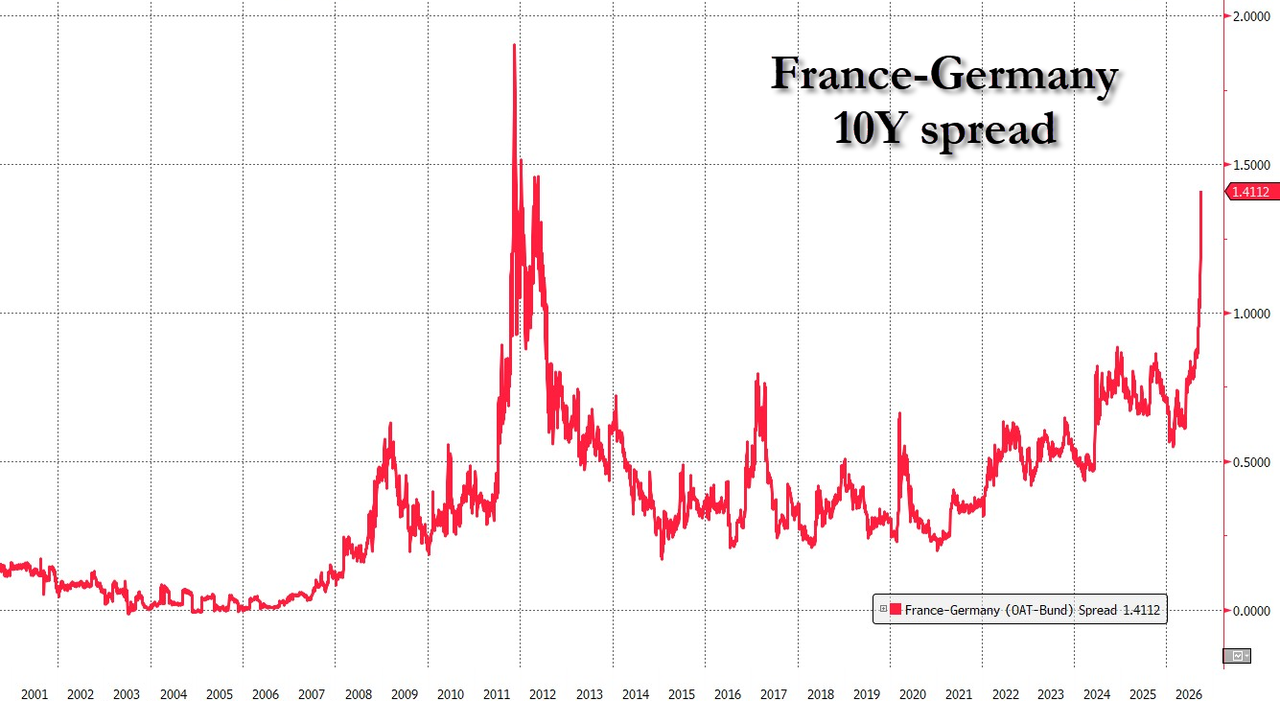
Nevertheless, the market reaction suggests that investors are not optimistic about the prospects for reform. Firstly, the projected result is not exactly stellar. If all the measures are enacted the fiscal deficit would only fall from 5.4% to 5%. Secondly, social security retrenchment has proven an intractable challenge that has outlasted several governments and the prospects for successfully steering reform through a fractured national parliament a few months out from a contentious Presidential election where the leading candidates on the populist left and right generally oppose pension reform are not strong.
The sense that the French administrative state lacks the capacity to reform itself is reflected in the fact that the sovereign spread to bunds is now substantially worse than is the case for Italy and Greece. Those two were among the ‘PIIGS’ during the European sovereign debt crisis of the early 2010s and were previous viewed as the worst offenders in terms of fiscal responsibility. No longer.
The French government now says that debt interest costs are expected to rise 15% next year to €91bn, which is almost double what the republic plans to spend on core defense this year (i.e. excluding pensions) even as pressures to commit more funding to military are only increasing. Obviously, rising borrowing costs come at an unhelpful time as European leaders issue ever more urgent warnings about Russian hybrid warfare, and as Russia threatened to use nuclear weapons if NATO were to blockade the Kaliningrad. In such an environment European re-armament and sovereign supply chain capacity is surely a necessity rather than a nice to have.
Regarding the latter, Europe is off to a slow start. Politico carried a story yesterday regarding the EU’s rollout of ‘Element Pro’, which it describes as an internal sovereign backup to Microsoft Teams that could be used in the event of a “disruption”. Anonymous EU officials quoted in the story were less than impressed, describing the system in unflattering terms and suggesting that in any tech conflict with the United States the U.S. would “instantly win the war”.
Sovereign capacity over critical supply chains is a theme that we have been banging on about for many years now. The importance of that capacity is now highlighted almost daily. A case in point is reports yesterday that the Trump administration had told European counterparts to release diesel stockpiles or face the risk of a US export ban. Brent crude oil prices were down by almost 1.2% to $102.31/bbl yesterday as markets continued to price in the effects of rising flows out of the Strait of Hormuz, but diesel prices remain one of several political sore points for the Trump administration ahead of the upcoming midterm elections.
The US now has enormous influence over flows of crude and refined products from the Americas and the Middle East. With little oil of its own, and an outsized appetite for diesel, Europe again finds itself bargaining from a position of relative weakness. Several market analysts have noted that a US diesel export ban could prove to be self-defeating, prompting refineries to cut production runs that would raise prices for even more politically sensitive gasoline, while logistics issues conspire to prevent meaningful falls in retail diesel prices.
Mindful of this, European leaders might choose to call the US’s bluff, but differing views regarding the rationality of the US President could create dissent on that score that again exposes the political frailties inherent in the EU’s status as a collection of nations with varying interests, rising nationalistic fervour, and relatively powerful national governments. By contrast, and despite their own challenges with political polarisation, the US, China and Russia are internally coherent nations with much stronger central government.
Reclaiming lost sovereignty was supposed to be one of the rationales for Britain’s 2016 decision to leave the EU, but new PM Burnham has now made it clear that a fresh in-out referendum on EU membership could be a feature of Labour’s next election manifesto. Meanwhile, former PM Truss – who was famously outlasted by a wilting lettuce – noted with some schadenfreude yesterday that 30y gilt yields had breached 6% for the first time since the late 1990s and asked in a not-so-subtle dig whether the Bank of England would “Bailey” the government out again.
Truss has publicly implied that she was effectively deposed in a liberal deep state coup after her government unveiled a mini budget replete with tax and spending cuts that precipitated a disorderly move higher in sovereign yields and her swift replacement with the more politically orthodox figure of Rishi Sunak. The Bank of England holds responsibility for ensuring the stability of the financial system, but in an era of fiscal dominance the lines of demarcation between independent monetary authorities and elected officials are increasingly in dispute. As Treasury yields and US mortgage rates soared to new highs this week Donald Trump’s efforts to exert more control over the Fed again came to the fore via renewed legal threats to Jerome Powell.
Speaking of renewed threats, the US just deployed a third carrier strike group to the Middle East and has reportedly sent new missile defence systems to gulf allies to assist in protecting vital energy infrastructure. That’s as Trump recently threatened that the US may resume bombing of Iran after the midterm elections (which has been our geopolitical base-case), or if it is found that the Omani co-pilot who attempted to hijack a FlyDubai flight to Tel Aviv had links to Iran.
Just as at the start of the war, three carrier groups in the region would be an unusually large concentration of firepower if the US didn’t intend to use it. With that context, it may be the case that President Trump has already decided to resume bombing, or it may not. There are reports circulating today that claim President Trump spent “hours” seeking the counsel of the GrokAI chatbot regarding the likely response of Venezuelans to a US capture of Nicolas Maduro. The chatbot reportedly advised Trump that the Americans would be welcomed as liberators.
Perhaps France could ask Grok how to solve its fiscal woes? Please make no mistakes.

7. OIL AND NATURAL GAS/ENERGY COMMENTARIES
Trump Admits Diesel US Export Ban Could Raise Gasoline Prices
Friday, Oct 02, 2026 – 09:10 AM
Authored by Tsvetana Paraskova via OilPrice.com,
A potential ban on U.S. diesel exports could have “a negative impact on gasoline,” U.S. President Donald Trump said late on Wednesday, although he didn’t rule out such a move from the Administration.

The President told reporters in the Oval Office that he and the Administration continue to discuss the pros and cons of a diesel export ban every day, “but it just seems that it would have a negative impact on gasoline.”
Earlier this week, Goldman Sachs analysts also warned that a U.S. diesel export ban would push domestic gasoline prices higher as refiners could be forced to reduce processing rates.
President Trump on Wednesday appeared to be less inclined to ban diesel exports than a few days ago, but he has not yet ruled out the idea that emerged last month as retail diesel prices in the United States hit $6 per gallon nationwide average for the first time ever, and then $6.50 a gallon.
As a result of the jump in crude oil prices and a worsening global crunch for fuels, U.S. gasoline prices are also at a record high level for this time of year, even as demand is easing after the end of the peak driving season. At an average nationwide price of $4.43 per gallon, the price of regular gasoline is higher than the $4.08 from a month ago and way higher than $3.15 per gallon on this day in 2025.
Diesel prices have hit record highs in many economies amid refinery constraints in the Middle East and Russia, which refineries elsewhere cannot offset even if they run at maximum utilization rates, as is the case in the United States.
Refinery capacity is constrained in the Middle East due to Iranian strikes on refineries and the trickle of fuel flows through the Strait of Hormuz. Then there is also severely restricted capacity in Russia due to Ukrainian drone strikes at Russian refineries. Russia has just extended its ban on diesel exports through October 31.
END
ROBERT H..
Oil shortages are very real
You have to be an Ostrich not to see that the world will soon come face to face with long term fuel shortages. This will result in a short term bidding war for fuel supply and those people fortunate enough to act early will secure reliable Suppliers of fuel during this period. You can bet that any Party with Fuel supply will strive to build relationships with customers they want and refer to those who wander in from the street and bidders.
It is called geopolitical reality or Realpolitik.
One attachment • Scanned by Gmail
END
And you think rates will not rise???
One attachment • Scanned by Gmail
END
8. EMERGING MARKETS//AUSTRALIA NEW ZEALAND ISSUES
ETHIOPIA
War Returns To Ethiopia As The Horn Edges Closer To Abyss
Friday, Oct 02, 2026 – 05:00 AM
Authored by Joseph Solis-Mullen via The Libertarian Institute
Barely four years after the Pretoria Agreement formally ended one of the deadliest wars of the twenty-first century, serious fighting has returned to northern Ethiopia. As we begin October, Tigrayan forces have seized the airports at Mekelle, Aksum, and Shire, launched coordinated attacks into neighboring Afar and Amhara regions, and declared themselves once again in a state of full-blown war with the federal government in Addis Ababa. The Ethiopian military responded with drone strikes, artillery, and claims to have killed or captured hundreds of attackers. Flights were suspended, telecommunications disrupted, and civilians in Tigray began stocking food and cash in anticipation of another blockade.
In March of this year I warned in these pages that “the Horn of Africa is ready to explode” -pointing to unresolved territorial disputes, incomplete implementation of the Pretoria deal, military buildups, and the dangerous realignment of forces around Ethiopia, Tigray, and Eritrea. That assessment has, unfortunately, proven accurate. That fragile peace has given way to open conflict, and the risk of a wider regional conflagration is now higher than at any point since 2022.

The 2020–2022 Tigray War left somewhere in the area of 600,000 dead, millions displaced, and large parts of the region in ruins. Ethiopian federal forces, Amhara militias, and Eritrean troops fought the Tigray People’s Liberation Front (TPLF) in a campaign marked by mass atrocities, famine, and ethnic cleansing. The Pretoria Agreement called for a cessation of hostilities, disarmament of Tigrayan forces, restoration of services, and an interim administration. Implementation was partial at best. Disarmament remained incomplete. Territorial disputes in the center, north, and northwest of country went unresolved—including occupation of parts of Tigray by Eritrea. Political power struggles inside the TPLF eventually produced a hardline faction that reasserted control, reinstated the pre-war regional government, and began mobilizing and conscripting fighters.
By early August 2026, lower-level clashes had already resumed near the Sudanese border. Federal drone strikes followed. In mid-September the TPLF announced an alliance with six other armed groups, including elements of the Amhara Fano, with whom it has a fraught history and territorial dispute, aimed at removing Abiy’s government. Days later the airports fell and fighting spread. The former adversaries now appear to be cooperating on the battlefield against a common enemy in Addis Ababa.
This temporary marriage of convenience is one of the most striking features of the current round.
Equally significant is the role of Eritrea. During the last war, despite their history of enmity, Eritrean forces fought alongside the Ethiopian army against the TPLF. Relations between Addis Ababa and Asmara have since deteriorated sharply. Unsurprising, as since 2023 Abiy Ahmed’s Ethiopia has repeatedly emphasized the need of securing Red Sea access—particularly through the Eritrean port of Assab, which has understandably alarmed President Isaias Afwerki’s government. Ethiopian officials have accused Eritrea of financially and materially supporting the TPLF and the broader anti-government alliance. Eritrea denies the charges. Independent verification of direct combat involvement remains limited, yet the strategic logic is clear: a weakened or distracted Ethiopia reduces the immediate threat to Eritrean territory and ports.
Sudan adds another combustible layer. As I examined in detail earlier this month in “Could Washington Pick a Side in Sudan’s Civil War?” the conflict between the Sudanese Armed Forces and the Rapid Support Forces has already drawn in a complex web of external actors —the United Arab Emirates, Egypt, Israel, and others—whose interests increasingly center on Red Sea security, ports, and the strategic geography of the Horn. Ethiopia has been accused of allowing the RSF to train and stage operations from its territory; the SAF has, in turn, been accused of hosting or assisting Tigrayan fighters. Neither claim has produced confirmed large-scale intervention in the present fighting, but the proxy relationships are already in place. A major escalation in western Tigray could easily merge the two wars, turning northern Ethiopia into another front in the broader contest over the approaches to the Red Sea.
This pattern of interlocking crises is not new. In “Washington and Africa Are Intertwining Their Chaos,” I illustrated how U.S. policy across the continent has repeatedly transformed local conflicts into regional infernos through arms, training, intelligence partnerships, and the selection of favored clients. Somalia remains the clearest long-running example. As I detailed in “The Opportunity Costs of Our War in Somalia,” more than two decades of American airstrikes and special operations have failed to defeat al-Shabaab, have helped create the conditions for its rise in the first place, and continue to consume resources while delivering no measurable benefit to the American people. The same institutional habits that sustain that campaign—inertia, bureaucratic self-interest, and the refusal to acknowledge failure—are precisely what raise the risk that Washington will eventually feel compelled to “do something” as the Horn destabilizes further.
From a military perspective, Abiy’s government enters this round in a stronger position than in 2020. It possesses a substantial arsenal of drones that proved decisive in the later stages of the previous conflict, and the federal army is larger. Yet it is also stretched by ongoing insurgencies in Amhara and Oromia. The TPLF has reconstituted forces, secured at least temporary local allies, and demonstrated the ability to seize key infrastructure quickly. Neither side appears confident of a rapid, decisive victory. Both appear willing to risk another prolonged and catastrophic war.
Outside powers have so far limited themselves to calls for de-escalation. That is the correct public posture. The danger lies in the temptation, already visible in some quarters, to treat the conflict as another arena in which Washington or its regional partners must choose a side for larger geopolitical reasons—Red Sea security, countering Iranian influence, or balancing against other Gulf actors, specifically the Houthis. American policymakers have a long record of entering complex local conflicts with incomplete information, overestimating their ability to shape outcomes, and then discovering that their preferred clients commit the same atrocities they once condemned. Sudan’s civil war already illustrates the pattern. Ethiopia does not need a second demonstration.
The human costs of renewed full-scale war would be immense. Tigray has not recovered from the last conflict. Hundreds of thousands remain displaced. Food insecurity is chronic. Another blockade, another wave of drone strikes on civilian infrastructure, and another cycle of revenge killings would deepen a humanitarian catastrophe that the international system is already failing to address. History in the Horn of Africa offers little evidence that military “solutions” produce lasting political settlements. They produce exhaustion, new grievances, and the conditions for the next round of fighting.
Diplomatic pathways still exist. They require genuine inclusion of Eritrea, credible confidence-building measures, and a willingness on all sides to implement the core provisions of Pretoria rather than treat the agreement as a temporary truce to be discarded when convenient—which requires settling the federal relationship with the necessary stakeholders and permanently putting to rest the dispute between Tigray and its Amhara neighbors. Whether that political will materializes remains doubtful. What is not doubtful is that another major war in the Horn will kill large numbers of people who have already suffered enough, further destabilize an already fragile region, and create new opportunities for external powers to meddle at the expense of the local populations.
Washington’s most constructive contribution would be to stay out—genuinely stay out—and to discourage its partners from treating northern Ethiopia as a secondary front in someone else’s strategic competition. The people of Tigray, Amhara, Afar, and Eritrea do not need another proxy war. They need the fighting to stop.
END
U.S./GOLD AND SILVER PRICING/ASIAN CLOSING MARKETS AND EUROPEAN BOURSE OPENING AND CLOSING/ INTEREST RATE SETTINGS FRIDAY MORNING 6;30AM//OPENING AND CLOSING\
OPENING LEVELS OF CURRENCIES// AND CLOSING ASIAN STOCK MARKET AND OPENING EUROPEAN STOCKS:6 AM EST
EURO VS USA DOLLAR: 1.1252 UP 0.0004
USA/ YEN 157.59 DOWN 0.405 NOW TARGETS INTEREST RATE AT 1.75% AS IT WILL BUY UNLIMITED BONDS TO GETS TO THAT LEVEL…//YEN STILL FALLS//END OF YEN CARRY TRADE BEGINS AGAIN DEC 2024/Bank of Japan raises rates by .25% TO 1.75 ..TAKAICHI NEW PM AS YIELDS RISE//JAPAN DEEPLY IN TROUBLE WITH RISING RATES AND A FALLING YEN!! BANK OF JAPAN WILL NO LONGER DO QE. URGES PENSION AND INSUANCE FUNDS TO BUY JAPANESE BONDS//
YEN CARRY TRADERS MURDERED
GBP/USA1.3213 UP 0.0016 OR 16 BASIS PTS
USA/CAN DOLLAR: 1.4232 UP 0.0012 //CDN DOLLAR DOWN 12 BASIS PTS//
Last night Shanghai COMPOSITE CLOSED UP 11.74 PTS OR 0.31%
Hang Seng CLOSED DOWN 640.98 PTS OR 2.68%
AUSTRALIA CLOSED UP 0.64%
// EUROPEAN BOURSE: ALL GREEN
Trading from Europe and ASIA
I) EUROPEAN BOURSES: ALL GREEN
2/ CHINESE BOURSES / :Hang SENG CLOSED DOWN 640.98 PTS OR 2.65%
/SHANGHAI CLOSED UP 111.74 PTS OR 0.31%
AUSTRALIA BOURSE CLOSED UP 0.64%
(Nikkei (Japan) CLOSED DOWN 599.72 PTS OR 0.87%
INDIA’S SENSEX IN THE RED
Gold very early morning trading: $4184.00
silver:$61.07
USA DOLLAR VS TRY (TURKISH LIRA): 49.16 UP 14 BASIS PTS AND NOW WE SEE THEIR STUPIDITY OF SELLING SOME OF THEIR GOLD AND ALL OF THEIR USA DOLLAR RESERVES. THE COUNTRY IS IN BIG FINANCIAL TROUBLE
USA DOLLAR VS RUSSIAN ROUBLE: 83.59 ROUBLE// DOWN 0 ROUBLE AND 9 BASIS PTS.
UK 10 YR BOND YIELD: 5.3320 DOWN 9 BASIS PTS
UK 30 YR BOND YIELD: 5.873 DOWN 9 BASIS PTS
CDN 10 YR BOND YIELD: 3.931 DOWN 7 BASIS PTS
CDN 5 YR BOND YIELD; 3.603 DOWN 10 BASIS PTS
USA dollar index early FRIDAY MORNING: 101.70 DOWN 19 BASIS POINTS FROM THURSDAY’s CLOSE
FRIDAY MORNING NUMBERS ENDS
And now your closing FRIDAY NUMBERS 10.00 AM
Portuguese 10 year bond yield: 3.987% UP 1 in basis point(s) yield
JAPANESE BOND 10 yr YIELD: +3.101% DOWN 3 FULL POINTS BASIS POINTS /JAPAN losing control of its yield curve/
JAPAN 30 YR: 4.189 UP 1 BASIS PTS//
SPANISH 10 YR BOND YIELD: 4.093 DOWN 6 in basis points yield
ITALY 10 YR BOND: 4.666 DOWN 5 points in basis points yield ./
GERMAN 10 YR BOND YIELD: 3.3893 DOWN 13 BASIS PTS
IMPORTANT CURRENCY CLOSES : MID DAY THURSDAY
Closing currency crosses for day /USA DOLLAR INDEX/USA 10 YR BOND YIELD/10:00 AM
Euro/USA 1.1261 UP 0.0013 OR 13 basis points
USA/Japan: 157.23 DOWN 0.731 OR YEN IS UP 73 BASIS PTS// HIGHLY INFLATIONARY TO JAPAN
Great Britain 10 YR RATE 5.3000 DOWN 10 BASIS POINTS //
GREAT BRITAIN 30 YR BOND; 5.837 DOWN 10 BASIS POINTS.
CANADIAN DOLLAR UP 3 BASIS PTS TO 1.4218
xxxxxxxxxxxxxxxxxxxxxxxxxxxxxxxxxxxxxxxxxxxxxxxxxxxxxxxxxxxxxxxxxxxxxxxxxxxxxxxx
The USA/Yuan CNY 6.7046 ON SHORE ..UP
THE USA/YUAN OFFSHORE// CNH UP TO 6.7021
TURKISH LIRA: 49.15 UP 11 EXTREMELY DANGEROUS LEVEL/DEATH WATCH/HYPERINFLATION TO BEGIN.//
Your closing 10 yr US bond yield DOWN 7 in basis points from THURSDAY at 5.1740% //trading well ABOVE the resistance level of 2.27-2.32%)
USA 30 yr bond yield 5.5561 DOWN 4 basis points /10:00 AM
USA 2 YR BOND YIELD: 4.735 DOWN 5 BASIS PTS.
GOLD AT 10;00 AM $4220,00
SILVER AT 10;00: $61.76
Your 11:00 AM bourses for Europe and the Dow along with the USA dollar index closing and interest ratesTHURSDAY
DAY CLOSING TIME/ 12:00 AM///
London: CLOSED UP 33.68 PTS OR 0.32%
GERMAN DAX: CLOSED UP 291.85 PTS OR 1.17%
FRANCE: UP 61.88 OR 0.79 PTS
Spain IBEX CLOSED UP 80.00 PTS OR 0.42%
Italian MIB: CLOSED UP 245/35 PTS OR 0.49%
WTI Oil price 89.36 10.00 EST/
Brent Oil: 99.43 10:00 EST
USA /RUSSIAN ROUBLE: 83.72/// ROUBLE DOWN 0 AND 22/ 100
CDN 10 YEAR RATE: 3.858 DOWN 7 BASIS PTS.
CDN 5 YEAR RATE: 3.525 DOWN 8 BASIS PTS
CLOSING NUMBERS: 4 PM//
Euro vs USA 1.1256 UP 0.0008 OR 8 BASIS POINTS//
British Pound: 1.3246 UP 0.0049 OR 49 basis pts/
BRITISH 10 YR GILT BOND YIELD: 5.3746 UP 2 FULL BASIS PTS//
BRITISH 30 YR BOND YIELD: 5.908 DOWN 4 IN BASIS PTS.
JAPAN 10 YR YIELD: 3.088 DOWN 4 FULL BASIS PTS (DANGEROUS TO THEIR ECONOMY
JAPANESE 30 YR BOND: 4.194 UP 1 PTS AND STILL VERY DANGEROUS TO THEIR ECONOMY
USA dollar vs Japanese Yen: 157.81 DOWN 0.124 OR YEN UP 12 BASIS PTS//GETTING FURTHER AWAY FROM 160.00/ EXTREMELY DANGEROUS
USA dollar vs Canadian dollar: 1.4254 UP 0.0033 PTS// CDN DOLLAR DOWN 33 BASIS PTS
West Texas intermediate oil: 91.11
Brent OIL: 102.37
USA 10 yr bond yield UP 5 BASIS pts to 5.2860
USA 30 yr bond yield: UP 3 PTS to 5.636%
USA 2 YR BOND 4.836 UP 5 PTS
CDN 10 YR RATE 3.936 DOWN 1 BASIS PTS
CDN 5 YEAR RATE: 3.6130 DOWN 1 BASIS PTS
USA dollar index: 101.66 DOWN 7 BASIS POINTS
USA DOLLAR VS TURKISH LIRA: 49.14 UP 10 BASIS PTS GETTING QUITE CLOSE TO BLOWING UP/IDIOTS SOLD GOLD
USA DOLLAR VS RUSSIA//// ROUBLE: 84.16 DOWN 0 AND 66 /100 roubles //
GOLD $4,146.40 3:30 PM)
SILVER: 60.58 3;30 PM)
DOW JONES INDUSTRIAL AVERAGE: UP 250.88 POINTS OR 0.49%
NASDAQ 100 UP 306 PTS OR 1.00%
VOLATILITY INDEX 15.39 DOWN 1.00 PTS OR 6.10%
GLD: $ 380.14 DOWN 2.62 PTS OR 0.68%
SLV/ 54.74 PTS DOWN .28 OR .51%
TORONTO STOCK INDEX// TSX INDEX: CLOSED DOWN 330.01 PTS OR 0.98%
end
TRADING today ZEROHEDGE 4 PM: HEADLINE NEWS/TRADING
‘Bond Vigilantes Battle ‘Bad News’ Bulls; Big-Tech Bid Hides Ugly Equity Reality
JOBS REPORT//HUGE MISS
Jobs Huge Miss: Sept Payrolls Plunge To 29K, Below All Estimates As July Revised Negative… But Employment Soars
Friday, Oct 02, 2026 – 08:49 AM
In our jobs preview post, we told readers to “beware a bond squeeze as august seasonals reverse” and boy were we right: yields are tumbling from 5.22% to 5.16%, a new weekly low, as all those record TSY shorts get bigly squeezed following what was a big miss in the September jobs print which tumbled from a downward revised August (as we said it would be) 133K vs 162K originally to just 29K.
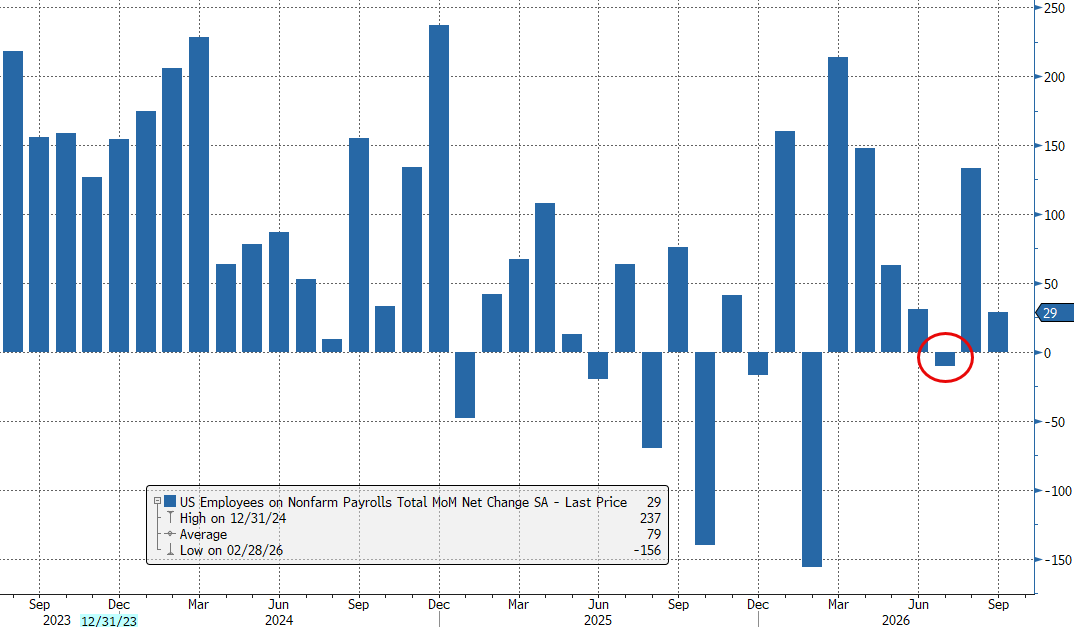
It wasn’t just August that was revised down by 29,000, from +162,000 to +133,000: July was also revised down by 31,000, from +21,000 to -10,000. This means that the original negative print of -23K, and which was revised up to 31K last month, is now once again negative and that had the Fed known this, it most likely would not have hiked last month. With these revisions, employment in July and August combined is 60,000 lower than previously reported.
More notably, the 29K job print was below all estimates, which is amusing since August was originally above all estimates, but has since been revised sharply lower and just in line.
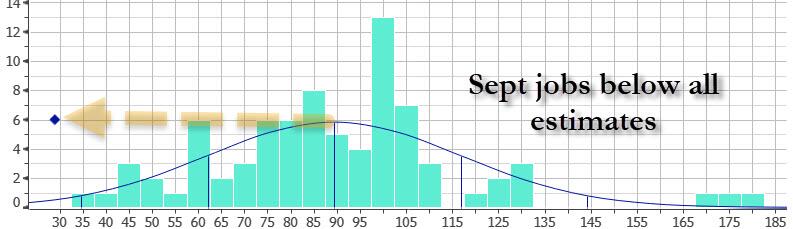
While the headline payrolls print was a big miss, the unemployment rate actually rose to 4.2%, from 4.1%, and above estimates of an unchanged print, as the number of unemployed workers rose to 7.109MM from 7.031MM, up 78K, while the labor force rose by 485K to 170.262MM. Among the major worker groups, the unemployment rate for people who are Black (7.0 percent) jumped in September. The jobless rates for adult men (3.9 percent), adult women (3.6 percent), teenagers (14.5 percent), and people who are White (3.6 percent), Asian (2.9 percent), or Hispanic (4.7 percent) showed little change over the month.
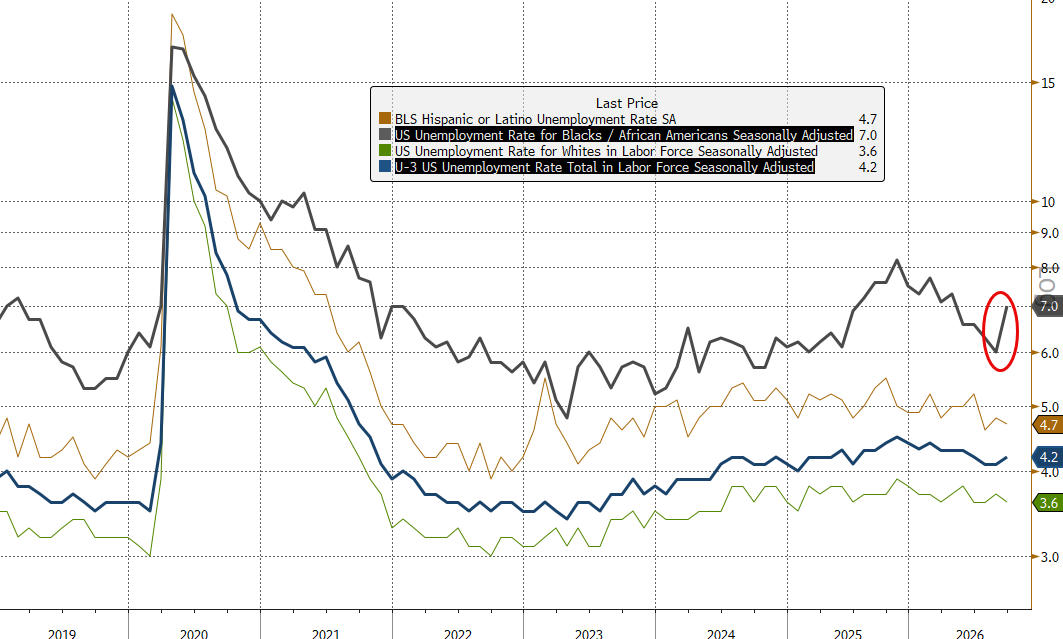
As for the specific reason why the unemp rate rose despite the drop in payrolls, that’s because the Household Survey showed a 406K surge in the number of employed workers, the second highest since Jan 2025 (only August’s 569K was higher)…
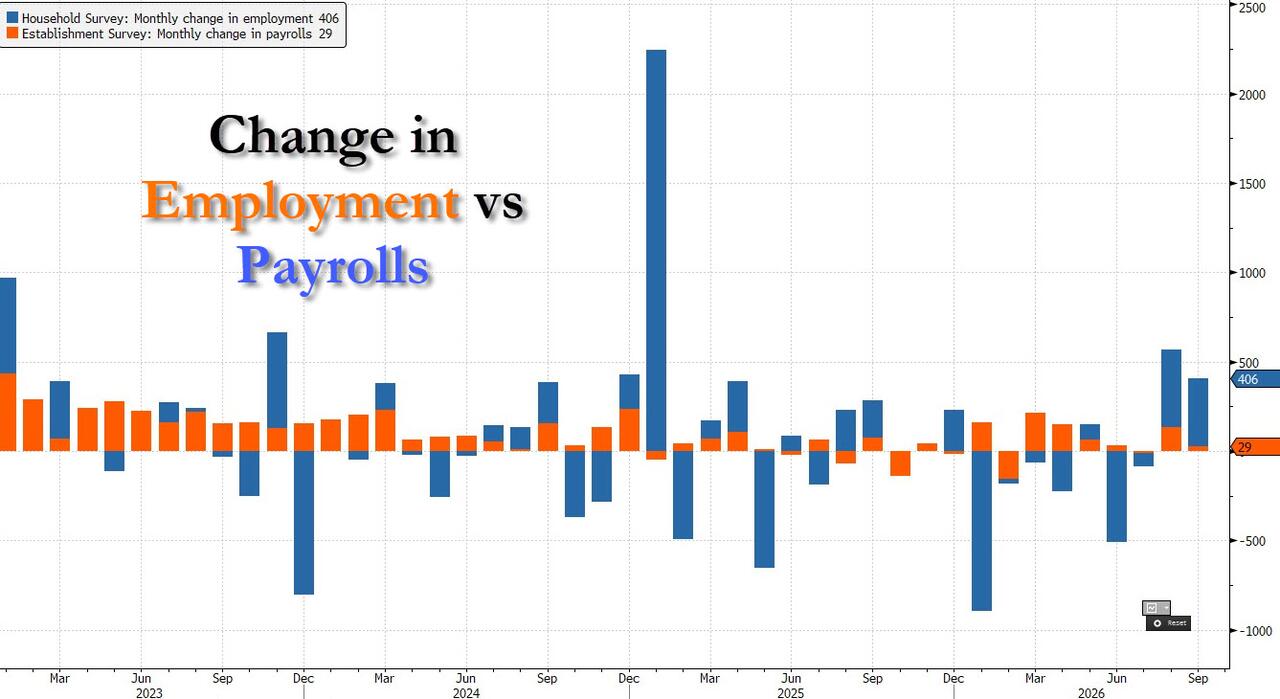
… which pushed the total number of employed workers to 163.152MM, the highest since January.
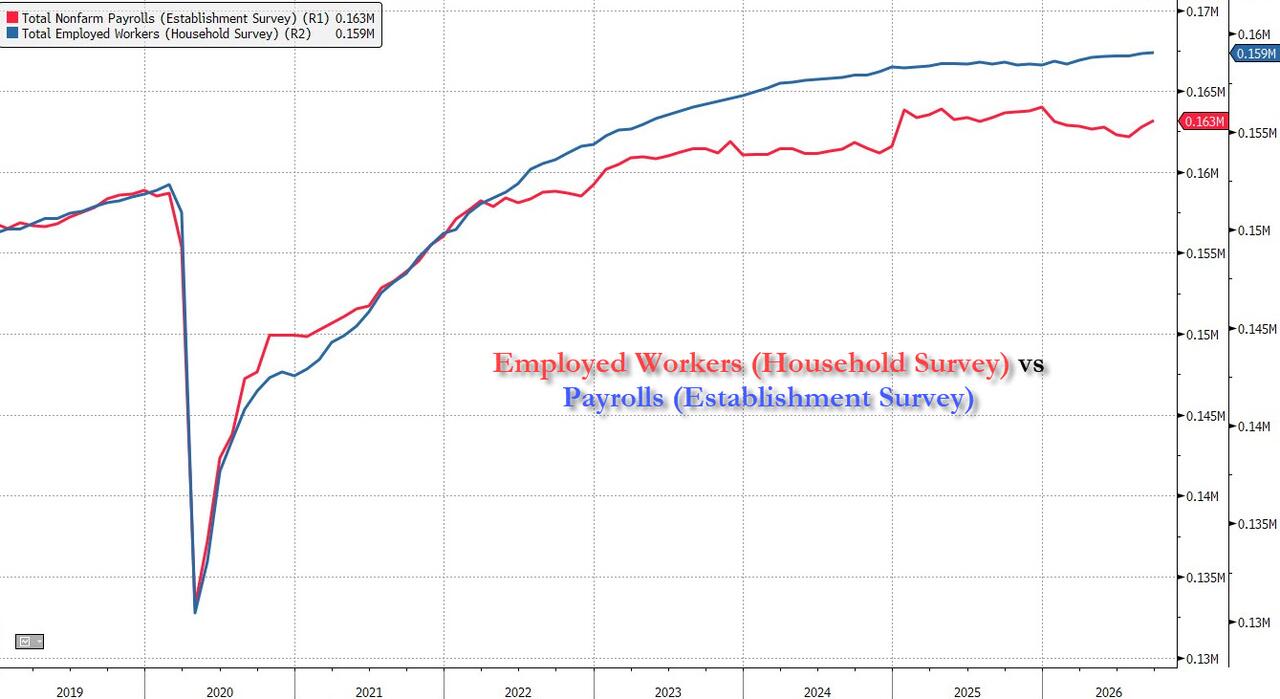
It’s also why the participation rate has jumped sharply in the past two months after dropping to a 5 year low in July.
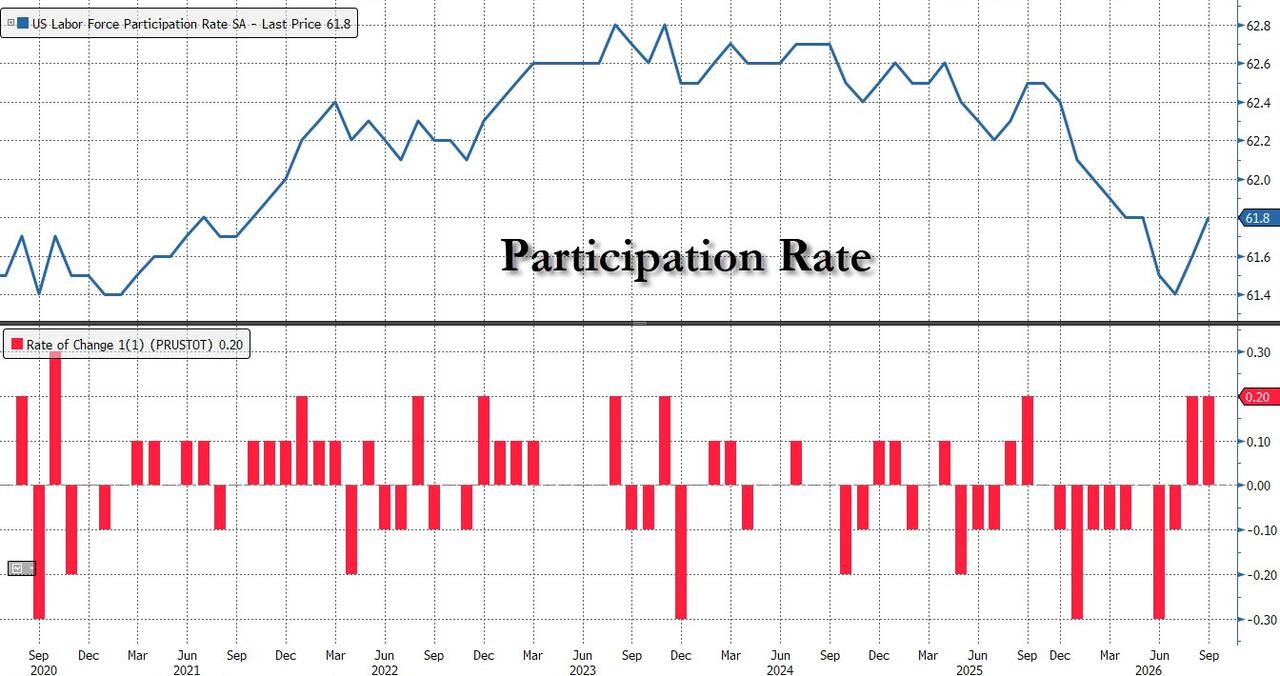
There was some more relief on the inflation front as average hourly earnings rose just 0.1%, below the 0.3% expected, which pulled the annual wage growth to just 3.0%, down from 3.1% and below estimates of an unchanged print.In September, average hourly earnings of private-sector production and nonsupervisory employees rose by 7 cents, or 0.2 percent, to $32.60.
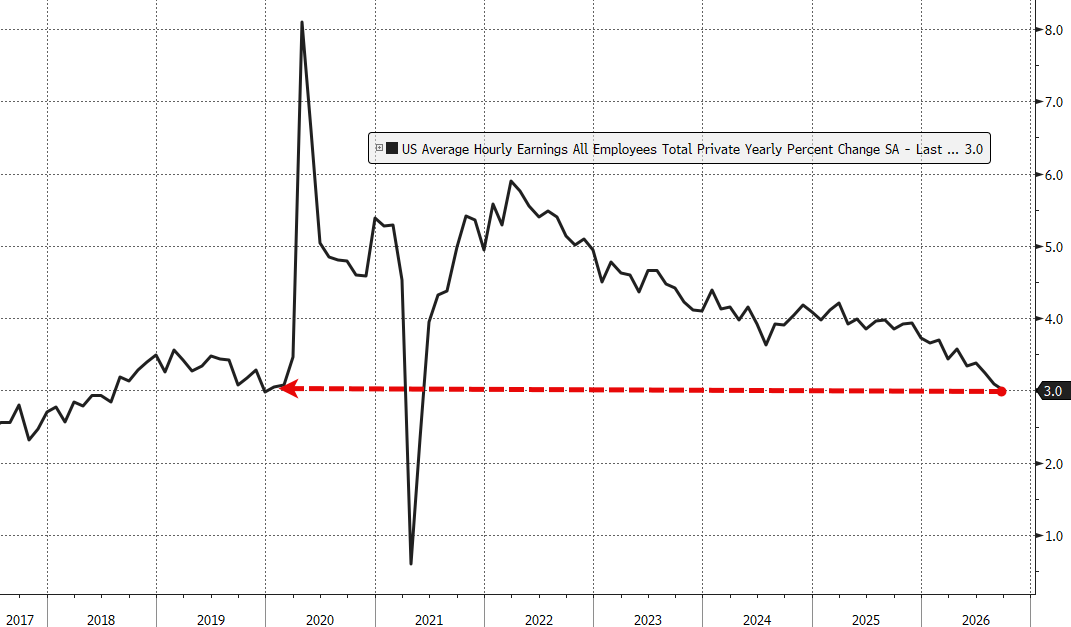
The average workweek for all employees on private nonfarm payrolls remained at 34.4 hours in September. In manufacturing, the average workweek was unchanged at 40.6 hours, and overtime held at 3.0 hours. The average workweek for production and nonsupervisory employees on private nonfarm payrolls remained at 33.8 hours.
Taking a closer look at the numbers in the report, we find the following:
- The number of long-term unemployed (those jobless for 27 weeks or more) was essentially unchanged at 1.9 million in September. The long-term unemployed accounted for 27.1 percent of all unemployed people.
- Both the labor force participation rate, at 61.8 percent, and the employment-population ratio, at 59.2 percent, changed little in September. These measures showed little net change since January.
- The number of people employed part time for economic reasons changed little at 4.5 million in September. These individuals would have preferred full-time employment but were working part time because their hours had been reduced or they were unable to find full-time jobs.
- In September, the number of people not in the labor force who currently want a job changed little at 5.8 million. These individuals were not counted as unemployed because they were not actively looking for work during the 4 weeks preceding the survey or were unavailable to take a job.
- Among those not in the labor force who wanted a job, the number of people marginally attached to the labor force decreased by 236,000 to 1.5 million in September. These individuals wanted and were available for work and had looked for a job sometime in the prior 12 months but had not looked for work in the 4 weeks preceding the survey. The number of discouraged workers, a subset of the marginally attached who believed that no jobs were available for them, changed little over the month at 414,000.
Next, looking at the actual industries in today’s report, we find the following:
- Health care employment continued its upward trend in September (+17,000), but at a slower pace than the average monthly gain over the prior 12 months (+33,000). In September, employment continued to trend up in ambulatory health care services (+13,000) and in hospitals (+12,000), while nursing and residential care facilities lost jobs (-9,000).
- Employment in construction changed little in September (+11,000). The industry had added an average of 10,000 jobs per month over the prior 12 months. In September, employment in nonresidential specialty trade contractors continued to trend up (+12,000).
- Manufacturing employment was little changed in September (+9,000) but is up by 72,000 since a recent low in December 2025. Over the month, employment increased in plastics and rubber products manufacturing (+5,000) and in machinery manufacturing (+5,000).
- In September, financial activities employment was little changed (-7,000). Employment in financial activities is down by 129,000 since a recent peak in May 2025, with most of the job loss in insurance carriers and related activities (-90,000).
- Employment also showed little change over the month in other major industries, including mining, quarrying, and oil and gas extraction; wholesale trade; retail trade; transportation and warehousing; information; professional and business services; social assistance; leisure and hospitality; other services; and government.
And visually:
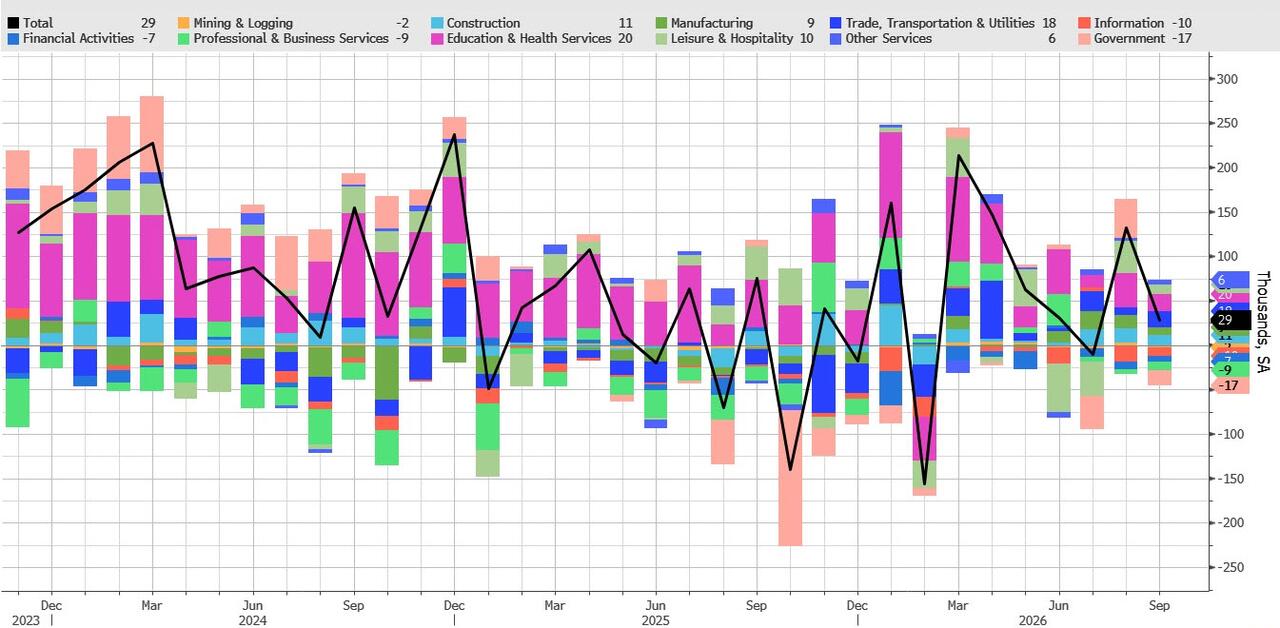
There were no major surprises below the surface, as part-time jobs rose by 205K to 28.746MM while full-time jobs rose by 88K to 134.376MM.
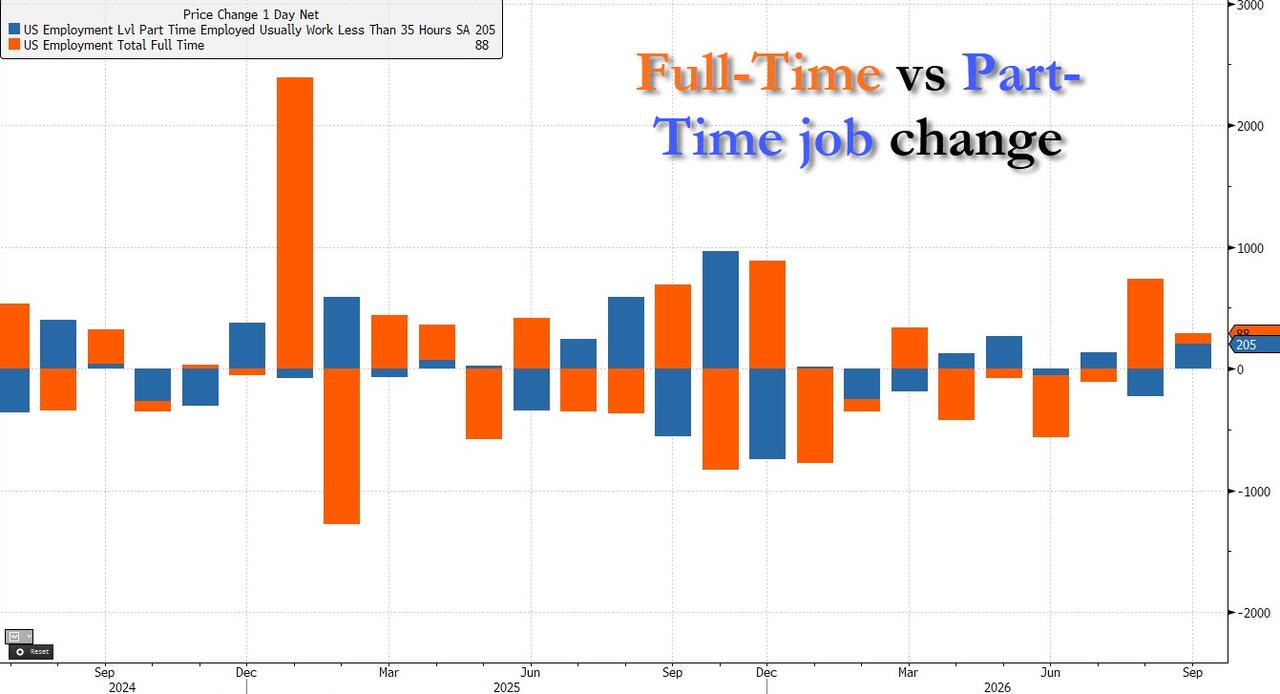
Finally, looking at the breakdown in native vs foreign-born, there were no surprises here too, as the number of US born workers rose by 298K while foreign-born workers surged by 473K, on other words, back to the old normal.
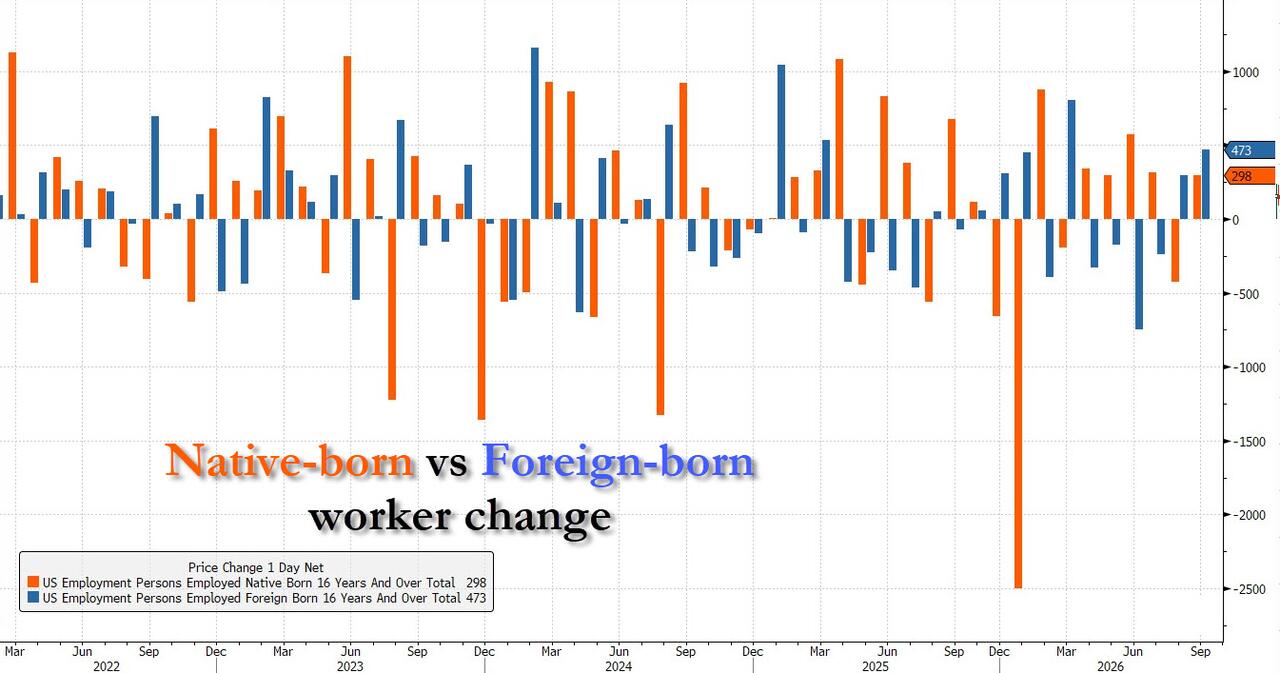
Overall, this was a mixed report, with the Household Survey painting a much stronger picture than Establishment (hence unemployment rate higher). But since the market – and by extension the Fed – are mostly swayed by the Payrolls part of the equation, it is not surprising that the market reaction today is one where bonds are getting massively short squeezed after the payroll print which missed all estimates.
END
‘Massive Short Squeeze’: Yields, Rate-Hike Odds Plummet After Piss-Poor Payrolls Print
Friday, Oct 02, 2026 – 08:53 AM
With nonfarm payrolls printing below even the weakest analyst’s forecast, the market’s reaction has been uniformly dovish with rate-hike odds plummeting, treasury yields tumbling, stocks soaring, dollar down and gold and crypto higher.
The biggest impact of the piss-poor payrolls print was the market basically pricing out a hike in October…
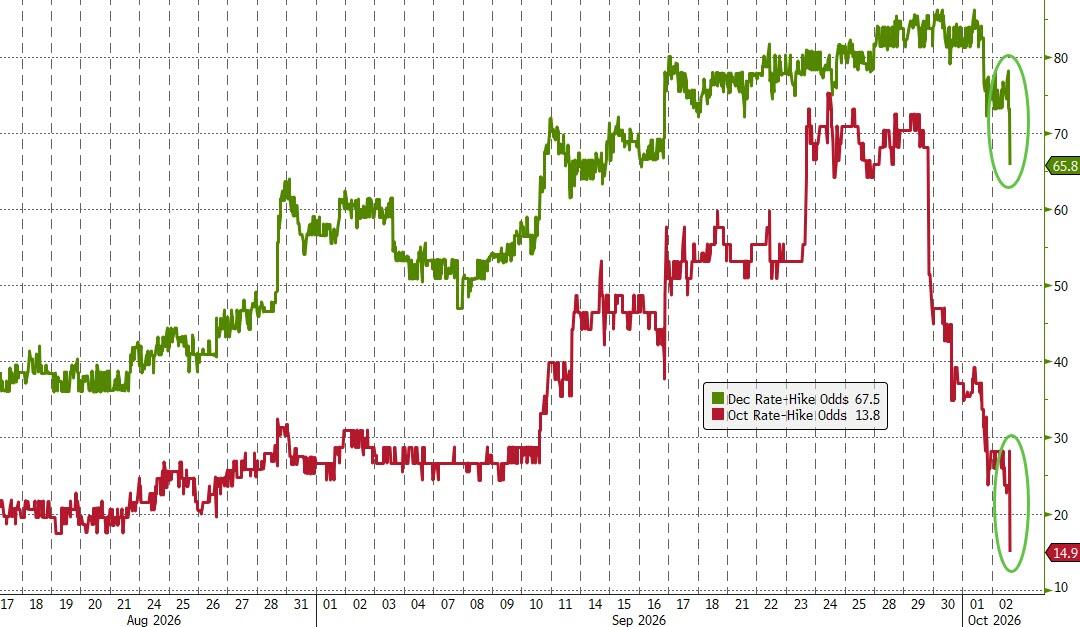
With less than one total hike (22.5bps) now priced in for 2026 (and only 2 more hikes in 2027)…
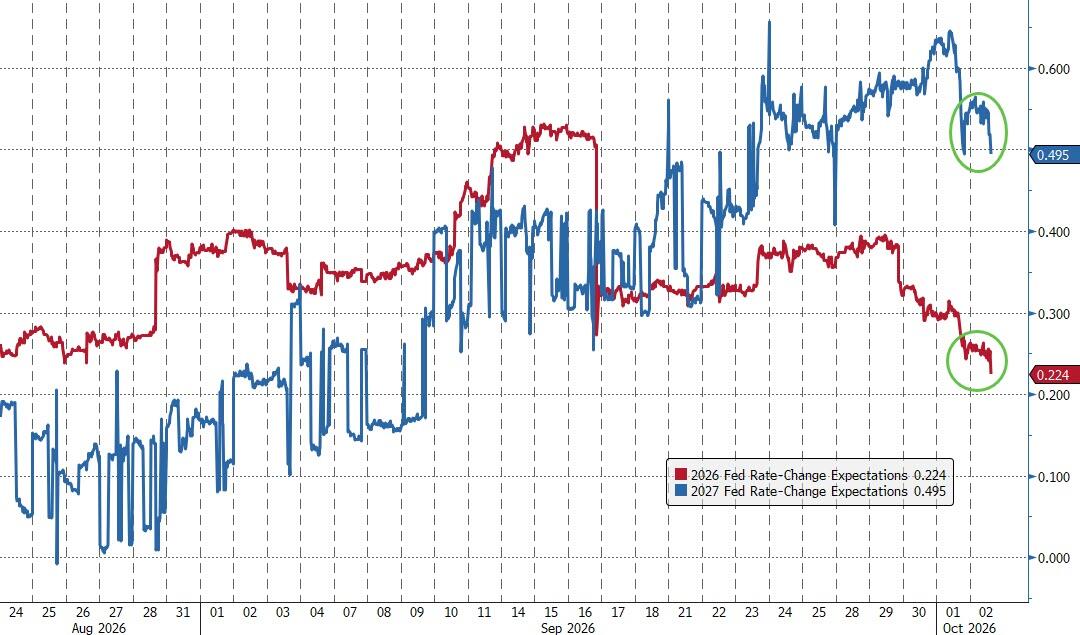
Yields are all down, led by the short-end…
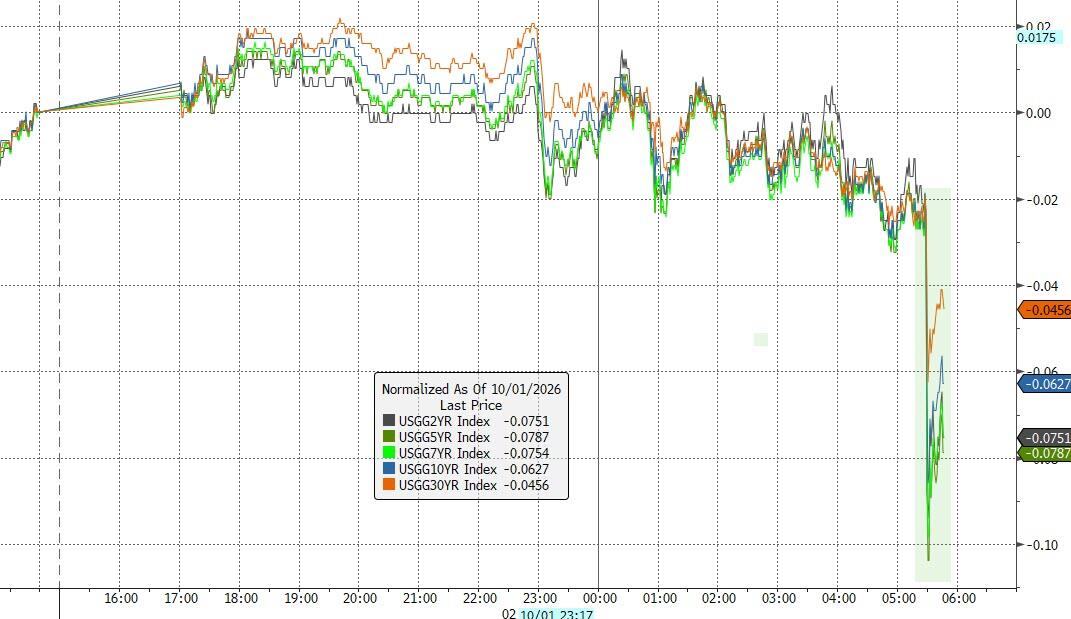
Which makes sense given that heading into the print (as we previewed perfectly), Goldman’s Brian Garrett says the bank’s CTA model shows managers “extremely short global bonds (~$390bn notional).”
US 10Ys are at 99% of max short and 30Ys at 100%.
With systematic funds that short, a weak print, or even a 4.2% unemployment rate, could set off a massive short squeeze in bonds.
Stocks spiked on the report, led by the most rate-sensitive names (Small Caps) and longest duration tech names…
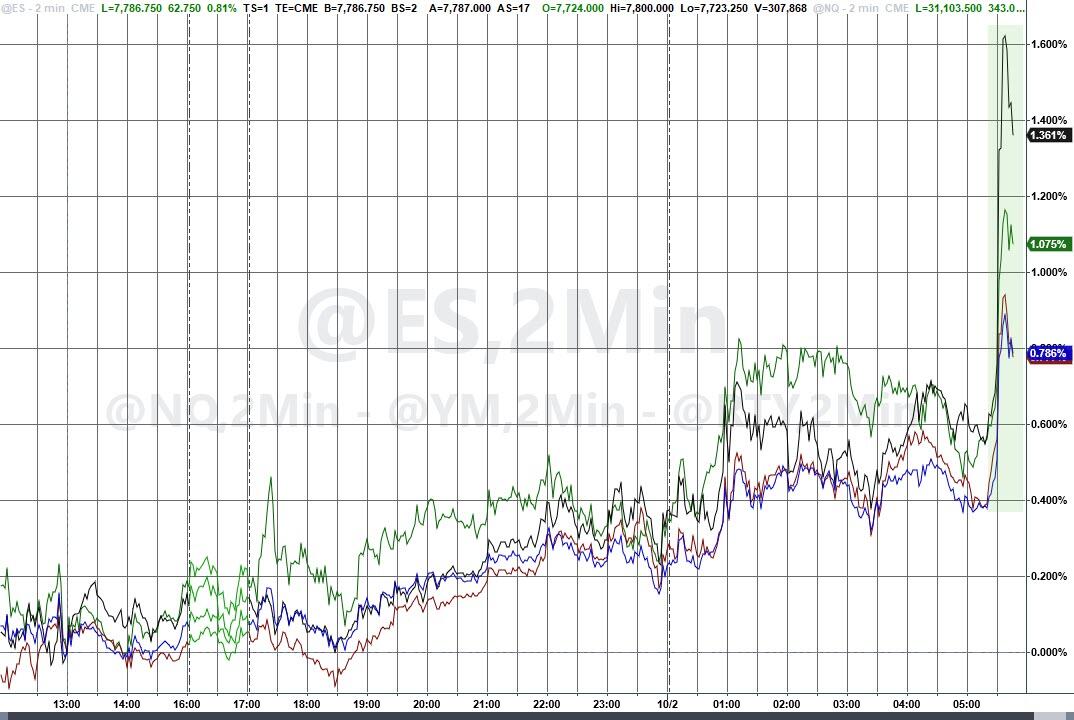
And gold is rising (as the dollar dips)…
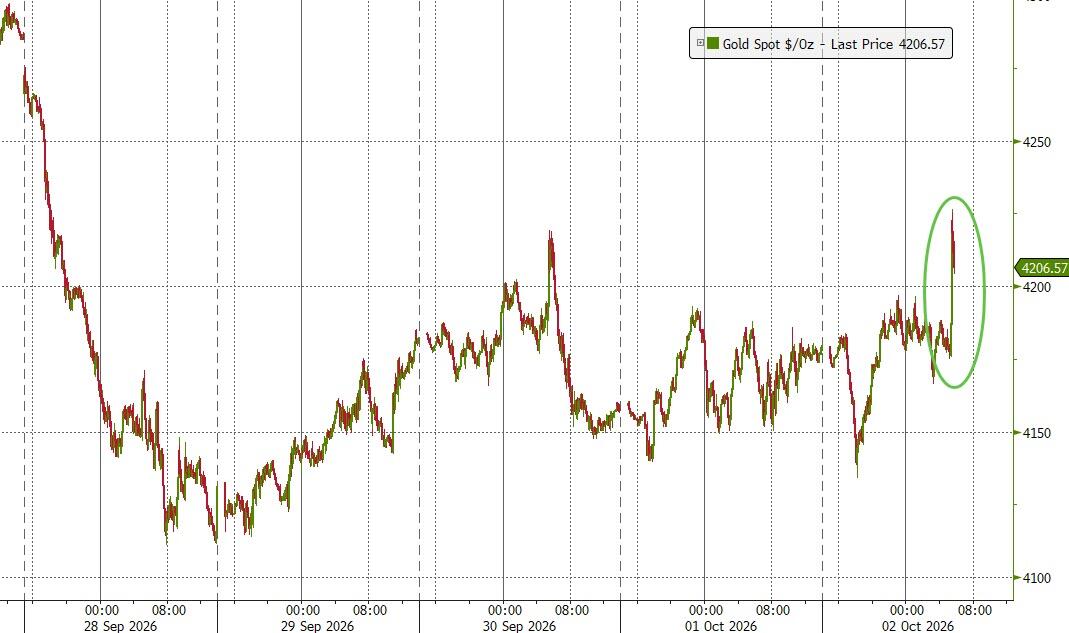
Tom Simons, chief US economist at Jefferies, said this payroll number “should be the nail in the coffin” for an October hike.
“We had been expecting that they would continue with successive 25 bp moves, but it now looks more likely that the policymakers emphasizing that they have some more time before another hike is needed will remain patient.”
With these revisions, employment in July and August combined is 60,000 lower than previously.
Makes you wonder if Warsh would have hiked at all if he had accurate data.
Finally, Christopher Hodge at Natixis doesn’t think these numbers move the Fed debate by a lot:
“This data won’t shift the broader decision making calculus for the Fed as inflation remains the supreme concern, but with wages lower and the jobs picture a bit less rosy, it certainly decreases the urgency to hike in October.“
But with Jefferson and WIlliams already in the dovish/hold/wait-and-see camp, and the proximity to the Midterms, it seems October’s hike is well and trul off the table (after topping 75% odds just a week or so ago).
END
WRAP UP
Stocks gain as rate hike bets ease on soft NFP – Newsquawk US Market Wrap
Friday, Oct 02, 2026 – 04:25 PM
- SNAPSHOT: Equities up, Treasuries down, Crude down, Dollar down, Gold down
- REAR VIEW: NFP softer than expected; G7 leaders confirm 100mln barrels release, Macron said diesel and crude stocks to be released over 4 months; Fed’s Logan sees at least 50bps of hiking need to return inflation to 2% goal; Toshiba is to double AI data center HDD capacity by FY27; TSLA Q3 deliveries beat.
- COMING UP: Data: Japanese Consumer Confidence (Sep), Global S&P Services/Composite PMI Final (Sep), EU PPI (Aug), US ISM Services PMI (Sep). Speakers: ECB’s Schnabel; Fed’s Goolsbee
- WEEK IN FOCUS: FOMC Minutes, US ISM
Services PMI, OPEC+, Canadian Jobs and ECB Minutes
Click here for the full report. - WEEKLY US EARNINGS ESTIMATES: PEP the highlight in a thin week of earnings. Click here for the full report.
More Newsquawk in 2 steps:
- 1. Subscribe to the free premarket movers reports
- 2. Trial Newsquawk’s premium real-time audio news squawk box for 7 days
MARKET WRAP
US indices closed the final session of the week in the green, as did all sectors, with Consumer Discretionary and Materials the outperformers. The key risk event on Friday was the soft US payrolls report, as the headline underwhelmed, and the unemployment rate rose, albeit as did the participation rate. Following the release, there was a notable dovish reaction with upside in US equity futures, US Treasuries, and spot gold, accompanied by downside in the Dollar. However, since the data print the moves have pared into weekend trade, where participants await any Middle East update. In the energy complex, which sparked initial downside, French President Macron confirmed that diesel and crude stocks would be released over 4 months, and G7 leaders confirmed the release of up to 100mln barrels of oil and diesel stocks.
2nd October 2026
NFP
US JOBS REPORT REVIEW: The September jobs report was soft, with just 29k jobs added, below the 90k consensus and the prior 133k, which was revised down from 162k. The net revision to July and August payrolls was -60k, suggesting that the labour market was not as strong as initially thought, and favourable seasonal dynamics may have supported the August release. Private payrolls slowed to 46k from 89k, with the prior revised down from 127k. The unemployment rate also ticked up to 4.2% from 4.1%, alongside an increase in the participation rate to 61.8% from 61.6%. The weak headline payroll growth, rise in unemployment and negative revisions add to concerns around the labour market. However, the labour market has remained relatively robust, and Fed officials have largely characterised it as close to full employment. One report is therefore unlikely to completely change that assessment, particularly given the Fed’s emphasis on trends rather than individual data points. However, when accompanied by the downward revisions, the weakness is more notable. Pantheon Macroeconomics highlights that the three-month average of payroll growth now stands at just 51k, which it suggests is “probably slightly below the break-even pace”. Moreover, officials have been more focused on the inflation side of the dual mandate, meaning the September CPI report on October 14th will be key. Nonetheless, the jobs report likely cements expectations for an October pause, particularly following the softer August core PCE data and calls for patience from Williams and Jefferson, while Bowman favours no further hikes this year. Money markets now assign just a 16% probability of an October hike, down from 24% on Thursday evening. Looking ahead, Pantheon expects the Fed to hold in October and notes December remains a close call, but expects continued weakness in payrolls alongside slower services inflation to give the FOMC sufficient grounds to look through an anticipated rise in core goods inflation and keep policy unchanged.
FED
LOGAN (2026 voter): Policy rate needs to increase an additional 50bps or more, and that without higher rates, inflation will not get to the 2% goal. She added that policy is not sufficiently restrictive and needs to become modestly tighter, and that economic growth is gaining momentum, while the labour market remains well balanced. The hawk added that, at a minimum, several further rate hikes would reverse last autumn’s cuts, and reiterated the Fed’s message that price stability must be restored. Added it remains uncertain how high the policy rate must go to bring inflation back towards 2%. Higher yields may partly reflect increased term premiums, which could lessen the need for additional policy tightening. Rising long-term yields suggest investors expect interest rates to remain higher and will continue monitoring bond-yield developments and evaluate their implications.
GOOLSBEE (2027 voter): Labour market is steady, and the inflation side of the Fed’s job is more important. Plenty of room for anything on the table as far as a rate hike or pause, and open to seeing if they get evidence they are heading back to 2% inflation. Chicago Fed President won’t rule out any decision at the next rate meeting.
FIXED INCOME
T-NOTE FUTURES (Z6) SETTLED 9+ TICKS LOWER AT 104-11+
Yield rally despite despite soft jobs report and lower energy prices. At settlement, 2-year +3.6bps at 4.827%, 3-year +5.2bps at 4.958%, 5-year +5.0bps at 5.059%, 7-year +4.5bps at 5.171%, 10-year +3.8bps at 5.281%, 20-year +2.9bps at 5.677%, 30-year +1.9bps at 5.632%.
It was a choppy day for T-notes, with the curve sold. Overnight, Fed’s Logan (2026 voter, hawk) said at least 50bps or more of further Fed rate hikes are needed and that several additional hikes are required to reverse last autumn’s cuts; otherwise inflation will not return to 2%. However, she also acknowledged that elevated longer-term yields may partly reflect higher term premiums, which could lessen the need for policy tightening.
The highlight was the US Nonfarm Payrolls report. Ultimately, it was a weak report, with just 29k jobs added versus the 90k consensus, while the prior was revised down to 133k from 162k. The two-month net revision was -60k, taking the three-month average to 50.7k from 71k. The unemployment rate also ticked up to 4.2% from 4.1%; notably, the Fed median sees unemployment at 4.1% through 2029, while the longer-run median stands at 4.2%. The initial reaction was, as expected, dovish, with yields falling across the curve as participants continued to price out the chance of an October rate hike. However, much of the move subsequently pared, with yields ultimately settling largely higher across the curve.
Although the report was soft on the headline, it is worth noting that the Fed tends to focus on trends rather than individual data points. The combination of the two-month downward revision and weak September payroll growth points to a softer employment backdrop, although the Fed’s primary focus remains on inflation and officials are still likely to characterise the labour market as at or close to full employment. The September CPI report on October 14th will therefore be key in shaping Fed rate expectations. Even with Williams, Bowman and Jefferson signalling support for patience in October, there remains scope for hawkish dissent, particularly from Logan following her remarks overnight.
Elsewhere, oil and diesel prices were lower following coordinated European measures to release diesel stocks and alleviate ongoing supply concerns.
Despite the combination of weaker labour data and lower energy prices, Treasuries struggled to sustain the initial rally. There was no obvious catalyst for the reversal, although some profit-taking/positioning following Thursday’s sizeable Treasury rally may have played a role. More broadly, participants may require further evidence of a sustained deterioration in the labour market and/or easing inflation before pushing yields materially lower, particularly with inflation still above target and geopolitical and fiscal/issuance risks remaining in focus.
Supply
Notes
- US to sell USD 39bln 10yr notes on October 7th; to sell USD 58bln 3yr notes on October 6th; to sell USD 22bln 30 year bonds on October 8th; all to settle on October 15th
Bills
- US sold 4-week bills at a high rate of 3.890%, B/C 2.83x; sold 8-week bills at 3.990%, B/C 2.70x
- US to sell USD 95bln 13-week bills and USD 82bln 26-week bills on October 5th; to sell USD 95bln of 6-week bills on October 6th; all to settle on October 8th
STIRS / OPERATIONS
- Fed Hike Pricing via CME FedWatch: Oct 5.7bps (prev. 6bps), Dec 25.9bps (prev. 24.8bps)
- EFFR at 3.88% (prev. 3.88%), volumes at USD 120bln (prev. USD 83bln) on October 1st
- SOFR at 3.87% (prev. 3.90%), volumes at USD 3.067tln (prev. USD 3.23tln) on October 1st
- NY Fed RRP op demand at 1.051bln (prev. 0.35bln) across 3 counterparties (prev. 1) on October 2nd
CRUDE
WTI (X6) SETTLED USD 1.76 LOWER AT USD 91.11/BBL; BRENT (Z6) SETTLED USD 0.06 LOWER AT USD 102.25/BBL
Brent ended the final trading session of the week little changed, while WTI was lower. Initially, benchmarks were pressured by reports that France proposed releasing 50mln bbls of diesel from Europe alongside 50mln bbls of crude across IEA members, conditional on the US refraining from a unilateral diesel export ban. Moreover, WTI and Brent fell to lows of USD 88.06/bbl and USD 95.12/bbl, respectively, following French President Macron confirming that diesel and crude stocks would be released over 4 months and G7 leaders confirming the release of up to 100mln barrels of oil and diesel stocks. However, after the aforementioned troughs were hit, benchmarks reversed, with Brent even paring losses, on no clear headline driver heading into weekend trade. For the record, in the weekly Baker Hughes rig count, oil was up 1 at 456, natgas down 2 to 133, leaving the total down 1 at 598. Over the weekend, participants will be awaiting any further updates from the Middle Eastern situation.
EQUITIES
CLOSES: SPX +0.73% at 7,723, NDX +1.00% at 30,808, DJI +0.49% at 51,182, RUT +0.94% at 2,833
SECTORS: Health -0.03%, Financials +0.01%, Energy +0.24%, Utilities +0.37%, Real estate +0.38%, Consumer staples +0.16%, Industrials +0.78%, Communication services +0.88%, Materials +0.98%, Technology +1.06%, Consumer discretionary +1.38%.
EUROPEAN CLOSES: Euro Stoxx 50 +1.07% at 6,242, Dax 40 +1.13% at 25,222, FTSE 100 +0.32% at 10,462, CAC 40 +0.79% at 7,897, FTSE MIB +0.49% at 50,483, IBEX 35 +0.42% at 19,085, PSI -0.63% at 9,417, SMI +0.28% at 13,661, AEX +1.28% at 1,117
STOCK SPECIFICS:
- Toshiba to double AI data centre HDD capacity by FY27
- Vylor (VYLR) will join SPX on Oct. 1st
- Twilio (TWLO) will join SPX on Oct. 6th
- Moderna (MRNA) will join NDX BMO on Oct. 9th
- Nike (NKE) rev. light & sees FY sales decline w/ weakness in Greater China, sportswear & Jordan Brand; restructuring plans & further layoffs added to concerns.
- ON Semiconductor (ON) agreed to acquire Synaptics (SYNA) for $123/shr in cash; ON expects immediate accretion to adj. EPS.
- Amazon (AMZN) seeks to offload & lease back c. $8bln of NVDA Grace Blackwell chips.
- Tesla (TSLA) Q3 total deliveries 486,532 (exp. 456,896); Q3 total production 464,391 (exp. 486,761)
- Rivian (RIVN) reaffirmed its 2026 delivery range guidance of 65,000 – 70,000; delivered a record 19,248 vehicles in Q3 (exp. 18,001 vehicles).
- Hunterbrook short Lennar (LEN) and Millrose Properties (MRP).
- US reportedly to offer USD 4bln loan to Vistra (VST) to support nuclear production.
FX
DXY was only slightly weaker after a softer-than-expected NFP reading as money markets still priced one 25bps rate hike by year end. Employment growth was 29k, shy of the expected 90k, accompanied by 60k negative revisions to the prior reading, and an unemployment rate ticking up to 4.2%. One data point does not mark a trend, is the likely response from the Fed hawks, and with an unemployment rate that stands close to full employment, means the focus has and will remain on the inflation mandate. As such, the initial dovish reaction faded with the reversal higher in US yields allowing the dollar to rebound. Recent dovish Fed speak (Williams, Jefferson, Bowman) and a soft PCE report has seen an October hike look less likely. 2026 Voter Logan sees at least an additional 50bps of tightening to fulfill the Fed’s inflation target, effectively reducing the risk management cuts we saw last year amid labour market concerns. DXY hit lows on NFP of 101.668, albeit remains firmer for the third consecutive week, back at May 2025 levels.
G10 FX strength was led by the GBP, AUD, and CHF. Meanwhile, CAD underperformed amid the backdrop of lower energy prices, as next week’s labour report is eyed. Oxford Economics expects the Canadian economy to continue struggling to create jobs in the near term as mounting headwinds from new US-Canada tariffs, greater uncertainty from an escalation in the trade war, the ongoing Iran conflict and a shrinking population weigh on hiring. USD/CAD is now hovering around the YTD highs of 1.42629.
EUR saw modest strength, however, French fiscal issues are still at the forefront of minds. In the EU morning, EZ headline inflation Y/Y printed at 3.8% (exp. 3.6%, prev. 3.2%), and Services also rose from the prior. Pertinently, Core HICP moved only a touch higher to 2.2% (prev. 2.1%), which will be welcomed by policymakers, since there is still little evidence of second-round effects. Nonetheless, woes of rising inflation remain – and this data will only further cement calls for another hike later this year.
USA DATA RELEASES
USA ECONOMIC REPORTS
The $40 Billion Minerals Gamble: Can Trump Break China’s Chokehold Before The West’s Rearmament Hits A Wall?
Thursday, Oct 01, 2026 – 08:30 PM
The Trump administration has committed billions of dollars to rebuild conflict-free critical materials supply chains outside China. The question remains whether these supply chains will be up and running in time for the West’s rearmament cycle, which desperately needs missiles, bombs, drones, fighter jets, submarines, and even night-vision equipment.
Bloomberg Intelligence analysts published a note today titled “Defense-Critical Mineral Capital Moves Downstream,” analyzing whether more than $40 billion in announced support will translate into reliable near-term supplies and improve defense readiness.
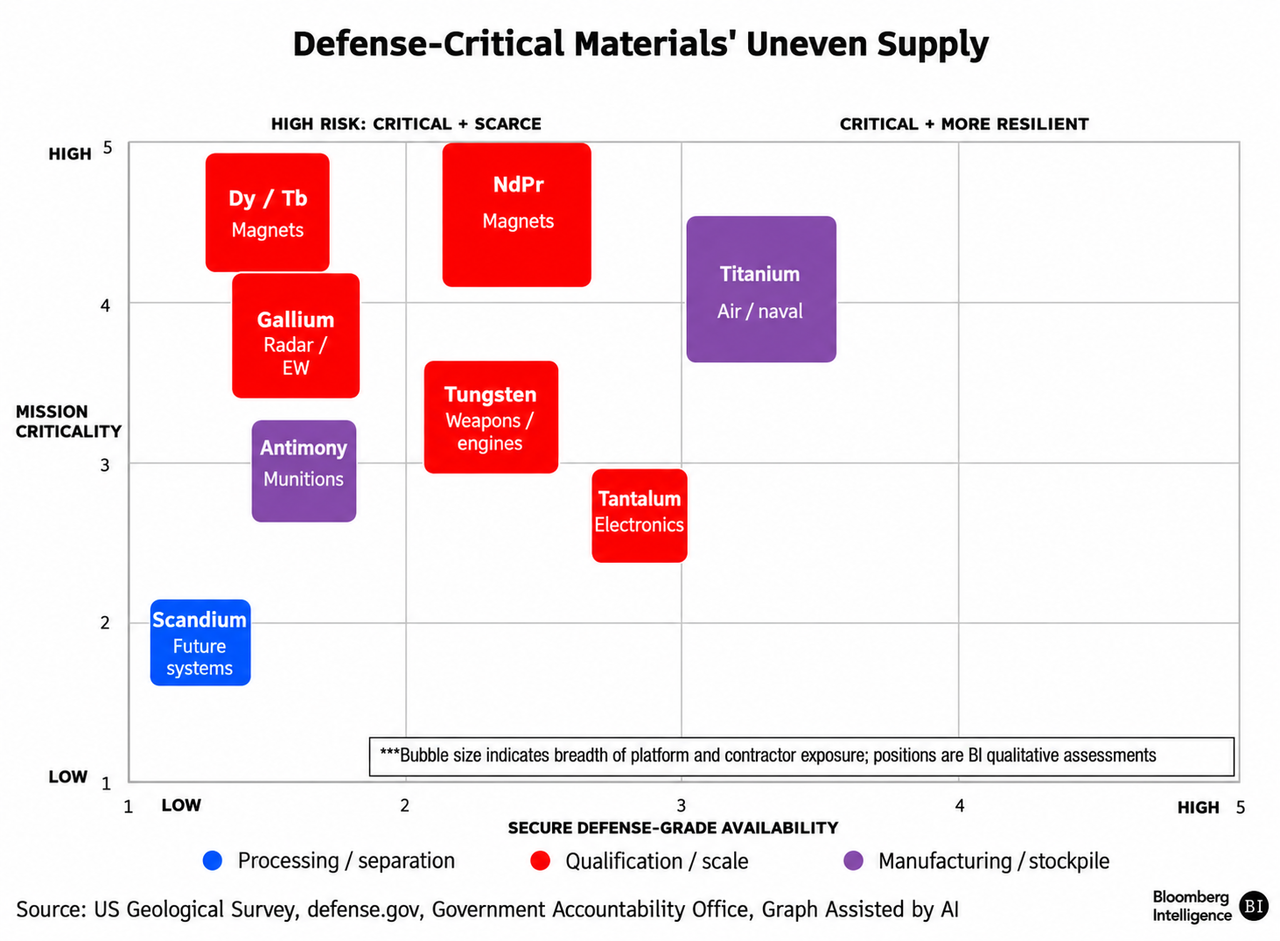
“Execution, not government support alone, will determine if US critical-minerals policy translates into durable revenue and stronger defense readiness,” the analysts wrote.
They continued, “Policy is moving beyond grants toward equity, price floors, loans, offtake and stockpiles designed to preserve capacity through commodity cycles.”
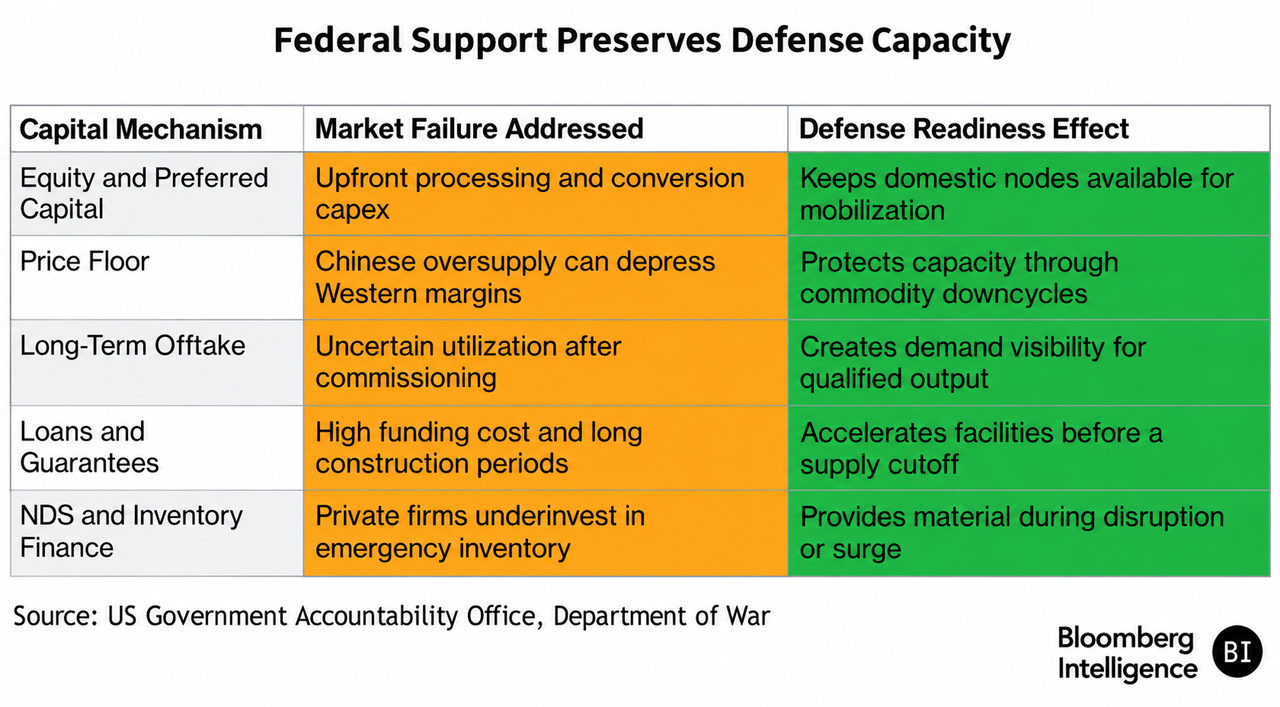
Adding, “MP Materials and ATALCO offer the clearest near-term links to magnets and gallium, while IperionX and Perpetua provide targeted titanium and antimony exposure. Defense-grade output, customer qualification and contracted volume still need to follow announced capacity.”
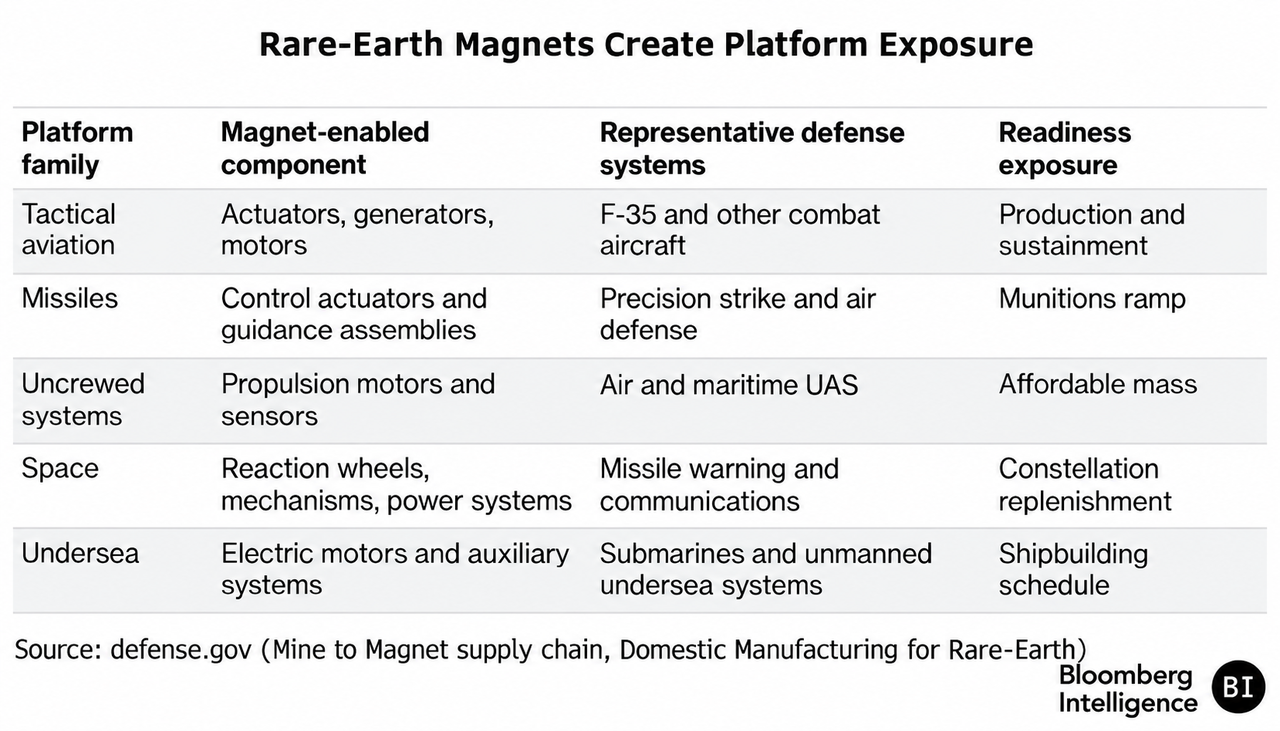
Beyond the mining aspect of rejiggering critical materials supply chains, refining and downstream production remain critically important, including heavy-rare-earth separation, manufacturing yields, customer qualification, and reliable deliveries.
These high-grade critical materials are essential for missiles, drones, satellites, and undersea platforms. The F-35 alone requires more than 900 pounds of rare-earth materials, the analysts noted.
Breaking China’s “quasi-monopolistic position” in critical materials is unlikely to be a this-decade story. Christian Keller, Barclays’ global head of economics research, recently pointed out that mining and refining of these critical materials will persist through 2030.


Stifel aerospace and defense analyst Jonathan Siegmann wrote in a note last week that investors want to “own the bottlenecks” in the critical materials space, mainly the producers that can deliver today.
Siegmann’s most important chart in the report was the near-depletion of US tungsten reserves.
Adrien Rabier, Bernstein’s equity analyst covering European aerospace and defense, put a timeline on the EU’s defense rearmament supercycle, which is already ramping up and will last through 2030.
Bloomberg Intelligence analysts added that the Trump administration’s Project Vault, intended to rebuild the nation’s critical materials stockpiles, provides another buffer by financing inventories for civilian and dual-use manufacturers can draw down and replenish. It complements the National Defense Stockpile but does not replace its emergency role or guarantee that material will be available in military-qualified form.
The only problem is that new mining projects take years to commission, while refining supply chains also take time to come online, as this shortage of critical materials collides with a rearmament supercycle in the West. As for tungsten, Jefferies, Goldman, and Stifel favor this miner, which is set to become the West’s largest ex-China supplier.
END
3 Huge Storms Will Combine Over The Central United States To Form A Gigantic “Hybrid Storm” That Will Cause Widespread Flooding
Thursday, Oct 01, 2026 – 08:05 PM
Authored by Michael Snyder via End Of The American Dream,
We are about to witness something extremely rare. At the same time that a historic financial storm is brewing on Wall Street as bond yields go wild, a historic weather event threatens to dump trillions of gallons of rain over the middle of the country. Meteorologists are telling us that 3 enormous storms will combine to create an absolutely colossal “hybrid storm” that will cause “considerable” flooding over large stretches of the nation. We have never seen anything quite like this before, and it appears that this disaster will be significantly worse than the experts were originally anticipating.

The remnants of Hurricane Polo are about to merge with the remnants of Hurricane Odalys and an upper level low that will be funneling massive amounts of moisture from the Gulf of Mexico to form “a new, hybrid storm” which will be very dangerous…
A soggy, potentially dangerous week is ahead for a “huge” section of the central United States, forecasters warned, as the remnants of Hurricane Polo interact with a separate, sprawling weather system to bring days of rain and possible flooding.
“As these features combine into a new, hybrid storm, the influx of moisture spreading across the central United States will pose the risk for flash flooding,” AccuWeather meteorologist Alyssa Glenny said.
The National Weather Service explained that tropical moisture from the remnants of Hurricane Odalys and Hurricane Polo will surge over the Southwest into the central U.S. this week with several days of heavy to excessive rainfall, which may bring limited to “considerable” flooding. The threat area is “huge,” the weather service said in an online forecast.
This wasn’t supposed to happen.
But it is happening.
Even if the remnants of Hurricane Polo and Hurricane Odalys were not an issue, the upper level low which is about to move into the center of the nation “would still be a heavy rain and flood threat”…
In addition to the moisture from Polo, the other system, known as an upper-level low, or trough, will be moving into the central U.S. from the West, Marc Chenard, a meteorologist with NOAA’s Weather Prediction Center, told USA TODAY.
That low will help funnel plentiful moisture northward from the Gulf, he said. “This will produce a widespread area of heavy rainfall.”
“Even if we didn’t have Polo,” there would still be a heavy rain and flood threat in the central U.S. this week, Chenard told USA TODAY.
It is very unusual to see three major systems come together like this.
On Tuesday, flood watches were issued in 10 different states, and we are being warned that this is just the beginning…
Flood watches have been issued in ten states Tuesday morning as meteorologists warn that the widespread effects of Hurricane Polo are merging with leftover moisture from Hurricane Odalys and a dip in the natural jet stream running across the US to create one massive storm.
This ‘triple flood’ is expected to bring the heaviest rainfall to Arizona, Colorado, New Mexico, Kansas, Oklahoma and Texas on Tuesday, but the storm threat will continue throughout the entire week.
To say that the worst hit areas will get a lot of rain is a major understatement.
According to Accuweather, there are a few isolated locations that could see up to 18 inches of rainfall…
AccuWeather’s latest forecast has warned that as much as eight inches of rain could flood parts of Colorado, Iowa, Kansas, Missouri, Nebraska, New Mexico, Oklahoma and Texas this week.
However, the weather service’s worst-case scenario noted up to 18 inches of rain could fall in isolated areas.
If you live in an area that is prone to flooding, you may want to brace for the worst.
We are being told that in some parts of New Mexico this could be “the most dangerous flash flooding risk in the last 5 years or more”…
“In some places, especially in New Mexico, this may be the most dangerous flash flooding risk in the last 5 years or more,” AccuWeather Chief Meteorologist Jon Porter said.
Accuweather is normally very conservative in their forecasts, and so I would take this warning very seriously.
Even if you do not live in one of the danger zones, that doesn’t mean that you won’t get rain.
In fact, Accuweather is projecting that 30 U.S. states will receive at least one inch of rain this week…
There are many parts of the nation that could desperately use some rain.

But we didn’t want to get it all at once.
Hopefully the flooding will not be quite as bad as they are currently forecasting.
There is one other thing that I wanted to mention in this article.
An extremely vast “Kelvin wave” will soon bring “an untold amount of warm water” to the west coast…
Concerns are mounting about an ocean phenomenon known as a Kelvin wave that could raise sea levels along the California coastline by up to a foot, as scientists say El Niño is supercharging the threat of storm surges and flooding in the coming months.
As an incredibly strong El Niño continues to develop in the Pacific, the phenomenon brings with it a strange shift in the ocean. The Kelvin wave phenomenon is created when trade winds that usually blow from South America towards Asia die down or reverse in El Niño years, setting off a massive, slow-moving slosh of water.
Kelvin waves are not like crashing waves at the beach. They are planetary in scale, spanning thousands of miles. And when a Kelvin wave kicks off, it brings with it an untold amount of warm water that slowly moves from the western Pacific, along the equator, towards South, Central and North America.
This “Kelvin wave” hit South America late last month, and now it is traveling north toward California…
“You can follow them along … we see the higher sea levels along the equator, and when the wave reaches the coast of South America, it cannot continue to go eastward,” Severine Fournier, a research scientist studying ocean circulation at Nasa’s Jet Propulsion Laboratory, said. “So it goes north and south.”
One such wave hit the northern tip of South America in late August and has begun moving up towards the west coast of the US. That wave could reach California shores within days, and when it does, ocean scientists say it may raise sea levels by up to a foot for months as El Niño lingers and keeps that warm water trapped along the coast.
Ocean levels along the west coast will rise significantly.
But that is only temporary.
Of much greater importance is what all of this warm water will mean for storms that approach the California coastline.
Normally, very cool water along the California coastline causes tropical storms and hurricanes to fizzle out as they approach.
But now conditions will be ideal for a tropical storm or a hurricane to come slamming right into the state.
The Super El Niño that is causing this to occur will be sticking around for quite a while, and so this is a story that is not going to go away any time soon.
END
Cotton Calls For Military Supply Chain Security Review After F-35 Parts Diverted To Hong Kong
Thursday, Oct 01, 2026 – 05:00 PM
Authored by Arthur Zhang via The Epoch Times,
Sen. Tom Cotton (R-Ark.) asked the Department of War on Sept. 29 to review security controls for U.S. military equipment and supplies transported through commercial and contractor-managed supply chains, citing reports that F-35 components bound for the United States from Australia were diverted to Hong Kong.

In a letter to Secretary of War Pete Hegseth, Cotton cited the diversion of F-35 components being shipped from Australia and reports that the Chinese government had taken possession of the parts and had not returned them.
“We can’t afford for U.S. military equipment to fall into the hands of a foreign adversary because of vulnerabilities in commercial transportation,” Cotton wrote.
Cotton, chairman of the Senate Select Committee on Intelligence, also said in a Sept. 29 post on X that secure supply chains are critical to ensuring weapons, technology, and supplies reach U.S. troops rather than adversaries.
“That’s why I’m calling on [the Department of War] to conduct a review and take any necessary actions,” he wrote.
5 Areas for Review
Cotton’s request extends beyond the circumstances of the missing F-35 components.
He asked the Department of War to examine five areas: chain-of-custody requirements for military equipment and supplies moved by contractors and commercial carriers, the department’s ability to track the location and routing of shipments, procedures for approving and reporting route changes, criteria for allowing shipments to pass through foreign jurisdictions, and safeguards against military materiel transiting through or being diverted to China and other adversary-controlled jurisdictions.
The department relies extensively on contractors and commercial carriers to move military equipment, replacement parts, and other supplies around the world, Cotton wrote.
He said those arrangements provide speed and ease of movement but should not come at the expense of the U.S. military advantage.
While classified and designated sensitive components should receive heightened protections, Cotton said all U.S. military materiel could give adversaries information about American weapons systems, logistics, and readiness, as well as access to U.S. troops.
Cotton said securing the supply chains was necessary both to ensure U.S. troops have access to advanced equipment and technology and to prevent adversaries from gaining access to U.S. technology.
F-35 Parts Diverted to Hong Kong
The F-35 Joint Program Office confirmed to The Epoch Times on Sept. 18 that it and the Office of the Secretary of War were aware of a “shipment issue” involving unserviceable F-35 Lightning II components.
“We are actively working with U.S. authorities and industry partners to retrieve these components, investigate the incident, and place safeguards to avoid a future occurrence,” the program office said.
The office did not identify the components, say where the shipment had been diverted, or explain how the diversion occurred.
Australian Defense Minister Richard Marles said on Sept. 22 his understanding was that the shipment did not involve sensitive equipment or sensitive parts. He said the matter ultimately would be managed by the United States and Lockheed Martin.
Earlier Problems Tracking F-35 Parts
The Government Accountability Office (GAO) has previously identified problems with the Pentagon’s ability to account for parts in the F-35’s global supply system.
A 2023 GAO audit found that one F-35 prime contractor had recorded more than 1 million spare parts worth over $85 million as lost since May 2018. The F-35 Joint Program Office reviewed the circumstances surrounding less than 2 percent of those losses.
The watchdog said the Pentagon lacked sufficient oversight of government-owned F-35 spare parts held outside prime-contractor facilities and recommended procedures for reporting losses and disposing of excess, obsolete, or unserviceable parts. The Defense Department concurred with all four recommendations at the time.
Ryan Morgan contributed to this report.
END
NIKE/USA
SIGN OF THE TIMES!! ELIMINATION OF JOBS
Nike Plunges On Slashed Outlook As UBS Warns Against Catching A Falling Knife
Friday, Oct 02, 2026 – 06:55 AM
Nike shares are down nearly 10% in pre-market trading in New York after the struggling athletic footwear and apparel company warned its sales slump will deepen and unveiled a restructuring that will eliminate jobs.
As of Thursday’s close, year-to-date performance had been absolutely abysmal, with shares down 45%. The extended decline could now put the stock on track for its worst annual loss on record.
The decline follows the sportswear giant’s earnings release after hours on Thursday, when it stated that it now expects revenue to decline by a high-single-digit percentage this fiscal year, substantially worse than the 2.4% drop analysts tracked by Bloomberg forecast.
Nike spent years catering to woke culture while neglecting to stay ahead of the industry as competitors ate into its market share. It now plans to fold its Greater China unit into its broader Asia Pacific division and combine Latin America with North America.
This restructuring is expected to deliver $2.5 billion in savings over five years while generating roughly $1 billion in pretax charges.
CEO Elliott Hill wrote in a memo to investors that this restructuring “will require fewer roles over time.”
Hill, approaching his third year as CEO, has focused on rebuilding retail relationships and organizing Nike around individual sports.
The ugly guidance on Thursday comes after BofA retail analyst Lorraine Hutchinson downgraded the stock last week and warned that its “turnaround is taking longer” than expected.
UBS retail analyst Jay Sole wrote in a note shortly after earnings about “why it’s still not time to buy Nike” and maintained a “Neutral” rating on the stock, lowering his 12-month price target to $34 from $42.
Sole explained:
The key downside risk is Nike’s downward EPS revision cycle may persist:
The pivotal Nike question remains “Is all the ‘bad news’ now priced in?” Despite the pullback in Nike’s stock price, we still don’t see a good entry point. Nike’s stock price is still not cheap at ~28x our FY27 EPS estimate, in our view, and this suggests a solid rebound remains priced in. We continue to see a balanced upside/downside skew. The main upside risk is Nike’s November Analyst Day convinces the market the stock’s downward earnings revision cycle has ended and investors are willing to put a peak multiple on their FY27 EPS outlook. The main downside risk is the rebound takes much longer than the market anticipates and therefore the downward earnings revision cycle may not be over.
We see 3 reasons NKE’s downward EPS revision cycle may not be over:
- The market may be underestimating the negative impact on unit demand as Nike tries to reduce discounts. Nike’s FY27e gross margin likely hits a 20-year low. To drive a gross margin recovery, Nike would have to significantly reduce discounts. We believe the elasticity of demand in this situation could be greater than 1. However, we don’t think Nike’s -HSD% FY27 revenue guidance incorporates this. We believe the sales guide reflects weak demand, elevated inventory levels and a major China pullback. Thus, we see risk pulling back on promotions drive another big drop in sales in FY28.
- The market may be underestimating the negative impact on sales from Nike having to reset its Sportswear and Jordan businesses. Nike brand Sportswear plus Jordan Streetwear equates to roughly 60% percent of NKE revenues. 1Q27 sales in these categories fell at least -LDD% y/y. We believe fashion trend shifts and a lack of brand momentum are hurting Nike in a major way. The risk is Nike can’t impact these trends soon and this leads to more pressure well into FY28.
- The market may be underestimating the negative impact on margins if sales slow. Nike announced its 3rd big cost adjustment program since 2020. The concern is Nike may not have very many easy cost reductions left to make and will need to ramp up investment in order to grow. If so, more downside revenue surprises could pressure margins more than we and the market expect.
We lower our FY27-FY29 EPS estimates ~4-6%, respectively:
We lower our FY27 and FY28 revenue growth forecasts related to Nike’s reset of its Jordan and Greater China businesses. We note Nike mgmt. expects these actions to weigh on revenues over FY27 and into FY28. Additionally, we now anticipate greater fixed cost deleverage driven by our weak topline forecasts. Lastly, we now model a higher share count given lower than expected buybacks during Q1 and expected going forward given our reduced FCF forecasts. This is partially offset by a reduced SG&A forecast given Nike’s newly announced Pace cost savings initiative. These factors are the main drivers of the 4-6% reduction in our FY27-FY29 EPS estimates, respectively. Please find much more forecast detail inside.
Valuation: We lower our PT 19% to $34 and remain Neutral:
Our $34 PT is based on 18x our $1.90 FY29 EPS estimate. Our prior was based on 21x our old $2.00 FY29 EPSe. We lower EPS estimates and the P/E used to value NKE given our view fundamental trends in China and Nike’s Jordan business are weaker than previously thought. Our multiples analysis indicates a $34 PT puts NKE’s valuation in-line with peers in terms of P/E, P/Sales, & FCF yield (Fig. 6). Our DCF analysis also supports a $34 valuation (Fig. 9).
Other Wall Street analysts offered their first take assessments, courtesy of Bloomberg:
Morgan Stanley (underweight, PT $27 from $31)
- Nike’s 1Q print “did little to change” our underweight rating, “with negative EPS revision & valuation de-rating risk remaining intact,” analyst Alex Straton says
- “The Investor Day is the next key catalyst, with our focus on the magnitude of further topline right-sizing”
Guggenheim (buy, PT to $50 from $60)
- “With yet another downward revision, the questions remain when guidance cuts will represent the band-aid rip versus slow bleed as they continue to debate the path potential stabilization ahead,” analyst Simeon Siegel says
Vital Knowledge
- Analyst Adam Crisafulli says Nike’s first-quarter numbers were fine, but the guidance “is pretty ugly”
- Expectations “were very low” after earlier results from peers Dick’s Sporting Goods and JD Sports, but the inability of management to get a handle on the business “is going to grate on investors (and might even start spurring talk about potentially changing the CEO position, even though Hill has only been in the role for ~2 years).”
CFRA (buy, PT $62)
- “We are disappointed with the results and expected better full-year EPS guidance,” writes analyst Zachary Warring
- Says growth in North America was more than offset by continued deterioration in Greater China and a sharp ongoing decline at Converse
According to Bloomberg data, 15 analysts are “Buy” rated on the stock, another 25 with “Holds,” and 7 “Sells.” The average 12-month price target is $40.
UBS Sole makes a great point: the stock is still not at the bottom.
KING NEWS
| The King Report October 2, 2026 Issue 7839 | Independent View of the News |
| ISM Manufacturing PMI for September 54.5 (54.8 exp), 54.6 Aug; Prices 77.9 (72.9 exp), 71.1 Aug New Orders 55.3 (54.7 exp), 53.7 Aug Production 56.7, 58.3 Aug Employment 52.7 (52 exp), 51.2 Aug Supplier Deliveries 59, 59.3 Aug Inventories 48.6, 50.6 Aug Backlog of Orders 56.4, 51.8 Aug New Export Orders 50.9, 53.2 Aug Imports 51, 52.5 Aug https://www.prnewswire.com/news-releases/manufacturing-pmi-at-54-5-september-2026-ism-manufacturing-pmi-report-302894520.html Inflation (Prices) and AI spending pushed the ISM Sept Mfg. PMI to its highest reading since May 2022. US Census Bureau: Monthly Construction Spending, August 2026 Construction spending during August 2026 was estimated at a seasonally adjusted annual rate of $2,203.1 billion, 0.9 percent [(0.0% m/m exp)] (±1.0 percent)* above the revised July estimate of $2,184.5 billion. The August figure is 1.7 percent (±1.5 percent) below the August 2025 estimate of $2,242.0 billion. During the first eight months of this year, construction spending amounted to $1,450.4 billion, 3.1 percent (±1.0 percent) below the $1,496.6 billion for the same period in 2025… https://www.census.gov/construction/c30/current/index.html The US 10-year hit 5.344%, a 22-year high; the 30-year hit 5.69% at 10:01 ET; the 2-year hit 4.925% France’s 10-year yield hit 4.96% on Thursday, a 24-year high. WSJ: France Is Ground Zero in the Global Bond Rout The country’s finance ministry outlined tens of billions in cuts and cost savings Attackers douse teacher in gasoline as student protests rage across France https://trib.al/WsYkTOb Trump warned Europe to release diesel emergency supplies or face a US diesel export ban. Near 10:45 ET, US equity indices were modestly mixed: DJIA -0.29%, DJTA +0.13%, S&P 500 -0.05%, Nasdaq +0.054, Nasdaq 100 +0.03%, SOX Index +0.68% (of course); USZs -7/32 at 102 14/32, but up 17/32 from its 101 29/32 low at 10:01 ET. Nov WTI Oil +$1.73; Nov Brent +$3.18; Nov Diesel -6.53¢; Nov Gasoline +8.45¢ near 11:00 ET. US Jobless Claims 197k, 200k exp; Continuing Claims 1.701m, 1.73m expected The S&P 500 Index gapped higher on its opening and ran to its daily high of 7683.65 (+33.11) at 9:39 ET. Pros dumped; the S&P did an ABC declined to 7616.78 at 11:11 ET. The index commenced a 5-wav e rally that took the S&P 500 to 7681.71 at 13:47 ET. The rally ended on the following report: WSJ: U.S. Sending Third Aircraft Carrier, Up to 10,000 More Troops, to Middle East 1:49 pm ET The deployments come as Trump weighs resuming bombing Iran after the midterms The S&P 500 Index fell to 7651.29 at 14:07 ET, but rallied on the following report: Iran Offers to Allow Nuclear Inspectors If Sanctions Are Eased – BBG Oct 1, 2026 at 1:23 PM CDT Foreign Minister Abbas Araghchi raised the idea in meetings at the United Nations with European and Middle Eastern diplomats while he was in New York for the annual General Assembly… It’s as if people keep leaking stuff to the media to manipulate the markets and profit from it! The S&P 500 rallied to 7679.52 at 14:35 ET on the above BBG story. Sellers returned; the S&P 500 fell to a 7970.05 & 7970.03 double bottom at 14:43 and 14:46 ET. After a bounce to7678.02 at 15:00 ET, the S&P 500 waffled in a 5-handle range until the bank expanded 1 handle to the upside after 15:36 ET. A late and illegal manipulation spiked the S&P to 7684.75 at 15:51 ET. Alas, the general stock market has been leaking oil for months, and the usual suspects were too long. So, the S&P 500 Index tumbled to 7663.34 at 15:59 ET and closed at 7666.45, +0.19%. Paramount bonds yield over 10% after new debt falls in price – The company issued about $52 billion of debt and bank loans Wednesday to finance its $81 billion purchase of Warner Bros. Discovery, which is set to close next Tuesday. Those bonds began trading Thursday… https://www.msn.com/en-us/money/top-stocks/paramount-bonds-yield-over-10-after-new-debt-falls-in-price/ar-AA2dmXBI @TruthGundlach: Paramount floated the largest high yield bond offering in history this week, and the bonds sold off immediately in trading afterwards. This is not a sign of a strong market. WSJ’s @NickTimiraos: Trump says in his Time magazine interview the Fed’s interest rate policies are hurting the U.S. “more than inflation is hurting our country.” On why it has been so difficult to slow the rise in the debt: “I don’t want to tell you what those means are, but you can pay off the debt through other means.” “Certain levels of inflation will also pay off that debt very rapidly. Very rapidly.” Read the Full Transcript of Donald Trump’s 2026 Interview With TIME You said last week that these were not, you know, your choices, Gorsuch, Kavanaugh, Coney, Barrett were not the people you interviewed. You said they were like shells of their former selves. Do you regret nominating them? Yeah. Yeah. What can I do? I put them in. They voted against me too often. I was very—I gave them the position of a lifetime, and they vote against me often. They vote for me too. The Democrats stick like glue—those three, they virtually never vary. You can come up with the worst thing in the world and they’ll vote as a group. And while I don’t like it, there’s something I admire about it: there’s loyalty. So they have loyalty to Barack Hussein Obama. They have loyalty to Biden, even though Biden doesn’t even know who the hell they are. He wouldn’t know. He doesn’t even know what the Supreme Court is. And me, I gave them the chance of a lifetime, and it’s unfortunate what they did… It’s unfortunate what they did—not to me, to our country. Birthright citizenship. It’s becoming a major industry now. People are making millions and millions of dollars, and we’re losing trillions of dollars. And it’s become a corrupt business, all because of the Supreme Court decision… I don’t want loyalty. I want good decisions. The tariff decision was disastrous for the country. I want good decisions for the country… https://time.com/article/2026/10/01/donald-trump-2026-interview-transcript/ Positive aspects of previous session S&P 500 +0.19%, DJIA +0.04%, DJTA +1.15%, Nasdaq +0.04%, Nas 100 +0.31%, SOX +1.59% SP Energy +1.92%, Industrials +1.0%, Info Tech +0.76%, Utes +0.61%, Financials +0.16% USZs +13/32 at 16:21 ET after a low of -24/32. Nov Diesel -5.44¢ at 16:21 ET. Negative aspects of previous session SP Health Care -1.3%, Comm Services -1.19%, Real Estate -0.62%, Materials -0.45%, Consumer Staples -0.29%, Consumer Discretionary -0.15% The US 10-year hit 5.344%, a 22-year high; the 30-year hit 5.69% at 10:01 ET; the 2-year hit 4.925% Nov WTI Oil +$2.50 and Gasoline +14.62¢ at 16:21 ET. Dec Brent hit $103.80, +$5.77, at 17:31 ET. Ambiguous aspects of previous session Will the September Employment Report be honesty constructed? First Hour/Last Hour NYSE Action [S&P 500 Index]: 1st Hour: Down.; Last Hour: Down Pivot Point for S&P 500 Index [above/below indicates daily trend to day traders]: 7655.99 Previous session (S&P 500 Index) High/Low: 7684.75 (9:39 ET); 7616.78 (11:11 ET) Tech companies launching their own programs to train grads because they ‘can’t rely’ on Ivy Leagues https://trib.al/Fi2miAG Paying $100k+/year and accruing beaucoup debt isn’t paying off like before. And the ‘networking’ aspect /excuse for paying beaucoup bucks isn’t as valid anymore. @gc22gc: SCHILLING: It wasn’t MIT that built General Motors. It was GENERAL MOTORS UNIVERSITY. Corporations used to train their employees on the spot bc they needed workers. They didn’t have 4 years to wait for them to get a degree. We’ve got to get back to that. Corps should be responsible for training their employees. https://x.com/gc22gc/status/2105732292442198203 Fed Balance Sheet: -$4.673B with MBS -$12.32B and T-Bills +$5.838B; Reserves: +$17.897B The FT: Top Fed official signals central bank will keep rates on hold in October Vice-chair for monetary policy Philip Jefferson echoes dovish remarks made by New York central bank head John Williams… “Since our September meeting, yields across the term structure have increased further, a sign that investors are reassessing the evolving macroeconomic landscape,” Jefferson said. “My colleagues and I will need to come to our own judgment, which may take more time.” https://www.ft.com/content/e3a53272-385d-40a8-ac77-408f4c136f6f?syn-25a6b1a6=1 Today – The dilemma for Team Trump: Craft a good Sept NFP (last Employment Report before the Nov Midterms) and watch bonds get torched or allow a kosher report to appear and take your chances. Traders want to play for the Friday Rally. The risk for equity types is Mr. Bond throwing a fit on a strong September Employment Report. The AI Bubble, and daily Fang Roulette, are the only equity games. Most of the S&P 500 Index is a bear market. History tells us how this will end. But stocks will be kept buoyant until (at least) the US Midterm Elections on November 3. ESZs +8.75; NQZs +79.00, USZs -5/32, Nov WTI +$0.11, Nov Gas 10.02¢, Yen/157.877 at 20:00 ET Expected economic data: Sept NFP 84-90k, Mfg. 10k, Rate 4.1%, Hourly Wages 0.3% m/m & 3.1% y/y, Workweek 34.3; Aug Factory Orders 0.1% m/m; Sept Vehicle Sales 16.6m; Dallas Fed Pres Logan 9 ET S&P 500 50-day MA: 7652; 100-day MA: 7562; 200-day MA: 7220 (Close 7666.45, +0.19%) Nasdaq 100 50-day MA: 29,412; 100-day MA: 29,488; 200-day MA: 25,450 (Close 30,501.56, +0.31%) DJIA 50-day MA: 52,722; 100-day MA: 52,043; 200-day MA: 50,261 (Close 50.926.56, +0.04%) (Green is positive slope; Red is negative slope) It is a well-known and well-established fact that most incumbent presidents generate Midterms problems for their party. However, because a handful of GOP Establishment Senators and Reps lost their GOP Primary fights, and DJT was a big factor, the GOP Establishment is sabotaging GOP candidates in the absurd hope/belief that if the GOP goes down in flames, the GOP faithful will return to the GOP flock. Nevertheless, even left-leaning pollsters believe that the GOP will hold the Senate. @cnni: A CNN investigation has found that while Jared Kushner acted as a key Middle East peace negotiator, his private equity firm held the largest stake in an Israeli company backing businesses tied to Israel’s military campaign in Gaza, including its largest arms manufacturer. https://cnn.it/4y0xe5x White Sox get blessing from Pope Leo before MLB playoffs – then go dominate Astros https://trib.al/y0m1tlI | |
SWAMP STORIES FOR YOU TONIGHT
CNN Concedes Republicans Will Keep The Senate If The Polls Miss Like They Have Before
Friday, Oct 02, 2026 – 12:20 PM
CNN chief data analyst Harry Enten said Wednesday that Republicans have beaten their September polling in Ohio, Iowa and Michigan by wide margins in recent election cycles. If that pattern repeats in November, the GOP could keep control of the Senate despite current Democratic leads in all three states.

With just over a month before the midterms, Democrats have spent weeks enjoying a Senate map that looked impossible a year ago. Democrats need to net just four seats to win the majority. Republicans started the second half of President Donald Trump’s term with what looked like a firm hold on the upper chamber. The Democrats’ original plan was to defend Michigan, Georgia, and New Hampshire, then take Republican seats in Alaska, Maine, North Carolina, and Ohio. Then the map got bigger for the Democrats. Trump’s falling approval numbers and voters’ frustration with the economy gave Democrats openings in states the party had long given up on. Senate Democratic Leader Chuck Schumer took a victory lap almost immediately.
“We now have multiple paths for the majority,” Schumer said. “We found new states – Iowa, Texas – which people a year ago weren’t even paying attention to.”
However, Michigan and Maine, two races Democrats once treated as near-certain wins, have become real contests. That forces the party to win more of its new territory just to stay even. Every “reach” state Schumer adds to the list has to make up for a seat that was supposed to be in the bag.
If Democrats win a majority in the Senate, they’ll be able to block presidential nominees, including judges. A Democratic majority would turn every confirmation vote into a two-year war of attrition. However, some of the races Democrats are banking on going their way have a history of being wrong.
“But here’s the question, what if the polls are wrong?” CNN anchor John Berman asked the network’s chief data analyst Harry Enten.
“We’ve had really good Democratic polls coming out from Ohio, Michigan, Iowa,” Enten told CNN. “And, you know, fool me once, shame on you. Fool me four times, I just have to ask the question, could it happen again?”
His data suggests it might. “In Iowa, where the Democrats have been getting really good polls, Republicans outperformed their September polls by nine points back in 2024. How about Ohio? Six points. How about Michigan? Five points.”
He continued, “And I will note that the leads that the Democrats have in all of these races right now are under how much the GOP outperformed back in 2024.”
Enten went back to 2018, Trump’s first midterm, when Trump wasn’t on the ballot, and the trend was the same.
“You can go back to Donald Trump’s first midterm election. And it’s the same exact story. Look at this, the GOP outperformed September polls in the major 2018 statewide races by six points in Iowa, six points in Ohio and eight points in Michigan.”
The miss wasn’t just a Trump-on-the-ballot effect. It showed up in every cycle Enten checked except 2022. “The bottom line is this,” Enten said. “Over the last few cycles, whether it be 2018, 2016, 2020, 2024, Republicans have outperformed their September polls by at least five points in all these three states where Democrats right now are ahead, but not by a wide enough margin whereby if Republicans outperform their September polls again, it could become very, very interesting.”
So, if the trend continues, the Senate map looks really good for Republicans.
“Let’s just say that the GOP outperforms their Midwest polls, like they did in 2018 and 2024,” Enten said. “Well, what do you get? You get a red Michigan. You get a red Ohio. You get a red Iowa. And all of a sudden, even if Democrats carry states like Texas, Georgia, and North Carolina and Alaska, well, guess what you get? You get a 50/50 Senate with J.D. Vance casting the tie-breaking vote.“
The party could pull off a historic upset in Texas, hold Georgia, and flip North Carolina and Alaska, and still end up in the minority because three Midwestern states have behaved the same way in four of the last five cycles.
The prediction markets are less sure than the polls, according to Enten. “Well, the Kalshi prediction market says that Abdul El-Sayed is still a favorite in Michigan, but not an overwhelming one, 73 percent. Sherrod Brown in Ohio, 61 percent. That’s basically a toss-up territory. And Josh Turek in Iowa, where he got a really good poll earlier this week, a 42 percent chance.”
“In these midwestern Senate races, yes, Democrats have gotten good polls,” Enten said. “But I would just say, hold on just a brief second here because history says, you know what, it might not end for them as well as the polls currently suggest it will.”
GREG HUNTER…..


