
GOLD: NUMBER OF NOTICES FILED FOR OCT./2026: 161 CONTRACTs NOTICES FOR 16,100 OZ or 0.5007 TONNES
total notices so far: 11,626 contracts FOR 1,162,600 OZ OR 36.161 TONNES
SILVER NOTICES: 139 NOTICE(S) FILED FOR 0.695 MILLION OZ /
total number of notices filed so far this month : 2198 CONTRACTS (NOTICES) for 10.990 million oz
GLD
| Gold | Ounces |
| Withdrawals from Dealers Inventory in oz | nil |
| Withdrawals from Customer Inventory in oz | 0 ENTRIES |
| Deposit to theDealerInventory in oz | 0 ENTRIES |
| Deposits to the Customer Inventory, in oz | DEPOSITS/CUSTOMER//gold 0 ENTRIES xxxxxxxxxxxxxxxx |
| No of oz served (contracts) today | 161 CONTRACTS 16100 OZ 0.5007 TONNES OF GOLD |
| No of oz to be served (notices) | 356 Contracts 35600 OZ 1.1073 TONNES |
| Total monthly oz gold served (contracts) so far this month | 11,626 notices 1,162,600 OZ 36.161 TONNES |
| Total accumulative withdrawals of gold from the Dealers inventory this month | NIL oz |
| Total accumulative withdrawal of gold from the Customer inventory this month |
dealer deposits: 1
i) Into Asahi dealer: 584,926.196 oz
total dealer deposit 584,926.196 oz
xxxxxxxxxxxxxxxxxxx
DEPOSITS:
ENTRIES: 0
xxxxxxxxxxxxxxxxxx
comex withdrawal
1 ENTRIES
1 entries
i) Out of Stonex: 584,814.05 oz
total withdrawal: 584,814.05 oz
adjustments: 0
COMEX IS DRAINING GOLD
chaos inside the comex
THE FRONT MONTH OF OCT OI STANDS AT 517 CONTRACTS HAVING A LOSS OF 42 CONTRACTS.
YESTERDAY WE HAD 1,181,400 OZ ( 36.744 TONNES) OF GOLD STANDING FOR DELIVERY: TODAY: 1,198,200 OZ OR 37.269 TONNES FOR A GAIN OF 16,800 OZ (0.52300 TONNES) OR 168 CONTRACTS UNDERWENT A QUEUE JUMP FOR 16,800 OZ (.5230 TONNES) AS THEY SEE PHYSICAL GOLD ON THIS SIDE OF THE POND.
NOVEMBER GAINED 135 CONTRACTS RISING TO 1161
DECEMBER, THE LARGEST DELIVERY MONTH IN THE CALENDAR, ITS OI RISES BY 464 CONTRACTS UP TO 84,881.
.
We had 161 contracts filed for today representing 16,100 oz
Today, 0 notice(s) were issued from J.P.Morgan dealer and 61 notices issued from their client or customer account. The total of all issuance by all participants equate to 161 contract(s) of which 0 notices were stopped (received) by j.P. Morgan dealer and 16 notice(s) was (were) stopped (received) by J.P.Morgan//customer account
To calculate the INITIAL total number of gold ounces standing for OCT /2026. contract month, we take the total number of notices filed so far for the month (11,626) to which we add the difference between the open interest for the front month of OCT (517 CONTRACTS) minus the number of notices served upon today 161 x 100 oz per contract) equals 1,198,200 OZ OR(37.269 Tonnes of gold) to which we add our first exchange for risk in Oct totalling 836 contracts for 83,600 oz or 2.600 tonnes. Thus Oct standing for gold advances hugely to 39.869 tonnes
THUS: INITIAL total number of gold ounces standing for OCT. /2026. contract month,we take the total number of notices filed so far for the month (11,626) to which we add the difference between the open interest for the front month of OCT(517) contracts minus the number of notices served upon today 161 x 100 oz per contract) equals 1,198,200 OZ OR(37.269 Tonnes of gold) plus our first exchange for risk totalling 836 contracts//83600 oz//2.600 tonnes//standing advances to 39.869 tonnes
new total of gold standing in OCT becomes 39.869 TONNES//
TOTAL COMEX GOLD STANDING FOR OCT.: 39.869 TONNES WHICH IS NOW VERY STRONG FOR THIS NON ACTIVE DELIVERY MONTH OF OCT
confirmed volume FRIDAY confirmed 192,476/ poor/
COMEX GOLD INVENTORIES/CLASSIFICATION
NEW PLEDGED GOLD:
241,794.285 oz NOW PLEDGED /HSBC 5.94 TONNES
204,937.290 OZ PLEDGED MANFRA 3.08 TONNES
83,657.582 PLEDGED JPMorgan no 1 1.690 tonnes
265,999.054, oz JPM No 2
1,152,376.639 oz pledged Brinks/
Manfra: 33,758.550 oz
Delaware: 193.721 oz
International Delaware:: 11,188.542 oz
total pledged gold: 1,721,684.952 oz 53.55 tonnes pledged gold lowers
total inventories in gold declining rapidly
total pledged gold: 1,721,684.952 tonnes oz 53.55 tonnes
TOTAL OF ALL GOLD ELIGIBLE AND REGISTERED GOLD 23,479,747.126oz//
TOTAL REGISTERED GOLD 15,086,528.079 tonnes (469.254 tonnes)
TOTAL OF ALL ELIGIBLE GOLD 8,393,219.047 oz.
REGISTERED GOLD THAT CAN BE SERVED UPON 13,364,844oz ((REG GOLD- PLEDGED GOLD)=
415.702 Tonnes //
total inventories in gold declining rapidly
SILVER COMEX
OCT DELIVERY MONTH
OCT 5
| Silver | Ounces |
| Withdrawals from Dealers Inventory | NIL oz |
| Withdrawals from Customer Inventory | 1 entries i) Out of Stonex: 584,814.05 oz total withdrawal: 584,814.05 oz |
| Deposits to the Dealer Inventory | 1 ENTRY i) Into Asahi dealer: 584,926.196 oz total dealer deposit 584,926.196 oz |
| Deposits to the Customer Inventory | ENTRIES: 1 i)Into customer Asahi: 591 639.71 oz total deposit: 591,639.71 oz |
| No of oz served today (contracts) | 139 CONTRACT(S) ( 0.69 MILLION OZ) |
| No of oz to be served (notices) | 1323 Contracts (7.280 MILLION oz) |
| Total monthly oz silver served (contracts) | 2198 contracts 10.990 MILLIONoz |
| Total accumulative withdrawal of silver from the Dealers inventory this month | NIL oz |
| Total accumulative withdrawal of silver from the Customer inventory this month |
DEPOSITS INTO DEALER ACCOUNTS
ENTRY:1
i) Into dealer Asahi: 584,921.146 oz
total dealer deposit; 584,921.146 oz
DEPOSIT ENTRIES/CUSTOMER ACCOUNT
1 ENTRIES:
i)Into customer Asahi: 591 639.71 oz
total deposit: 591,639.71 oz
xxxxxxxxxxxxxxxxxxxxxxxxx
withdrawals:
0 entries
adjustments : 0
xxxxxxxxxxxxxx
TOTAL REGISTERED SILVER: 101.682 MILLION OZ//.TOTAL REG + ELIGIBLE. 338.175 Million oz
registered silver dropping in numbers
CALCULATIONS FOR THE NEW STANDING FOR SILVER FOR OCT
FRONT MONTH: SILVER OPEN INTEREST CONTRACTS: 1462 FOR A LOSS OF 43 CONTRACTS.
FRIDAY WE HAD 17.575 MILLION OZ STAND: TODAY: 17.605 MILLION OZ FOR A GAIN OF 0.03 MILLION OZ OR 30,000 OZ (6 CONTRACTS). THIS IS A QUEUE JUMP FOR A CENTRAL BANK SEEKS PHYSICAL SILVER OVER AT THE COMEX.
NOVEMBER GAINED 175 CONTRACTS UP TO AN OI OF 1161
DECEMBER LOST 558 CONTRACTS UP TO AN OI OF 84,975
TOTAL NUMBER OF NOTICES FILED FOR TODAY: 139 or 0.695 MILLION oz
CONFIRMED volume FRIDAY;46,904 // poor/
AND NOW OCT. DELIVERIES:
To calculate the number of silver ounces that will stand for delivery in OCT. we take the total number of notices filed for the month so far at 2198 X5,000 oz = 10.990 MILLION oz.
Then we take the difference between the front month of OCT. and the number of notices filed for today x 5000 to give us our standing
Thus the standings for silver for the OCT 2026 contract month: (2198 )Notices served so far) x 5000 oz + OI for the front month of OCT (1442) minus number of notices served upon today ( 139 x 5000 oz) equals silver standing for the SEPT .contract month equating to 17.605 MILLION OZ to which we add silver’s first exchange for risk for 200 contracts (1.0 million oz).. total standing advances to 18.605 million oz//. ( a very strong delivery month)
We must also keep in mind that there is considerable silver standing in London coming from our longs
There are ONLY 101.682 million oz of registered silver
JPMorgan as a percentage of total silver: 132.671/338.173million: 39.34%
The record level of silver open interest is 234,787 contracts set on April 21./2017 with the price on that day at $18.42.
The previous record was 224,540 contracts with the price at that time of $20.44.
BOTH GLD AND SLV ARE MASSIVE FRAUD
XXXXXXXXXXXXXXXXXXXXXXXXXXXXXXXXXXXXXXXXXXX
OCT 5//2026/WITH GOLD DOWN $2.20 /HUGE CHANGES IN GOLD AT THE GLD:: A WITHDRAWAL OF 0.854 TONNES OF GOLD INTO THE GLD// //:/INVENTORY RESTS AT 1055.696 TONNES
OCT 2//2026/WITH GOLD DOWN $43.00 /HUGE CHANGES IN GOLD AT THE GLD:: A DEPOSIT OF 0.854 TONNES OF GOLD INTO THE GLD// //:/INVENTORY RESTS AT 1056.55 TONNES
OCT 1//2026/WITH GOLD UP $19.55 /HUGE CHANGES IN GOLD AT THE GLD:: A WITHDRAWAL OF 1.711 TONNES OF GOLD OUT OF THE GLD// //:/INVENTORY RESTS AT 1055.696 TONNES
SEPT 30//2026/WITH GOLD UP $7.80 /HUGE CHANGES IN GOLD AT THE GLD:: A DEPOSIT OF 2.847 TONNES OF GOLD INTO THE GLD// //:/INVENTORY RESTS AT 1057.407 TONNES
SEPT 29//2026/WITH GOLD UP $11.75 /NO CHANGES IN GOLD AT THE GLD //:/INVENTORY RESTS AT 1054.56 TONNES
SEPT 28//2026/WITH GOLD DOWN $150.20 /NO CHANGES IN GOLD AT THE GLD //:/INVENTORY RESTS AT 1054.56 TONNES
SEPT 25//2026/WITH GOLD DOWN $150.20 /NO CHANGES IN GOLD AT THE GLD //:/INVENTORY RESTS AT 1054.56 TONNES
SEPT 24//2026/WITH GOLD DOWN $18.70 /HUGE CHANGES IN GOLD AT THE GLD A DEPOSIT OF 1.43 TONNES OF GOLD INTO THE GLD://:/INVENTORY RESTS AT 1056.84 TONNES
SEPT 23//2026/WITH GOLD DOWN $58.00 /HUGE CHANGES IN GOLD AT THE GLD://:/INVENTORY RESTS AT 1055.41 TONNES
SEPT 22//2026/WITH GOLD DOWN $6.30 /HUGE CHANGES IN GOLD AT THE GLD://A DEPOSIT OF 0.31 TONNES OF GOLD INTO THE GLD/:/INVENTORY RESTS AT 1055.41 TONNES
SEPT 21//2026/WITH GOLD DOWN $41.20 /HUGE CHANGES IN GOLD AT THE GLD://A DEPOSIT OF 2.26 TONNES OF GOLD INTO THE GLD/:/INVENTORY RESTS AT 1055.10 TONNES
SEPT 18//2026/WITH GOLD UP $26.45 /HUGE CHANGES IN GOLD AT THE GLD://A DEPOSIT OF 0.85 TONNES OF GOLD INTO THE GLD/:/INVENTORY RESTS AT 1052.84 TONNES
SEPT 17//2026/WITH GOLD UP $14.05 /HUGE CHANGES IN GOLD AT THE GLD://A DEPOSIT OF 1.71 TONNES OF GOLD INOT THE GLD/:/INVENTORY RESTS AT 1051.99 TONNES
SEPT 16//2026/WITH GOLD UP $53.40 /HUGE CHANGES IN GOLD AT THE GLD://A DEPOSIT OF 2.86 TONNES OF GOLD INOT THE GLD/:/INVENTORY RESTS AT 1050.28 TONNES
SEPT 15//2026/WITH GOLD DOWN $19.45 /NO CHANGES IN GOLD AT THE GLD://A WITHDRAWAL OF 0.353 TONNES OF GOLD FROM THE GLD/:/INVENTORY RESTS AT 1047.420 TONNES
SEPT 14//2026/WITH GOLD DOWN $54.50 /SMALL CHANGES IN GOLD AT THE GLD://A WITHDRAWAL OF 0.353 TONNES OF GOLD FROM THE GLD/:/INVENTORY RESTS AT 1047.420 TONNES
SEPT 11//2026/WITH GOLD UP $1.05 /SMALL CHANGES IN GOLD AT THE GLD://A WITHDRAWAL OF 0.353 TONNES OF GOLD FROM THE GLD/:/INVENTORY RESTS AT 1050.277 TONNES
/SEPT 10//2026/WITH GOLD UP $50.60 /NO CHANGES IN GOLD AT THE GLD://:/INVENTORY RESTS AT 1050.63 TONNES
SEPT 9//2026/WITH GOLD UP $20.40 /HUGE CHANGES IN GOLD AT THE GLD:A WITHDRAWAL OF 1.43 TONNES OF GOLD OUT OF THE GLD/ ////:/INVENTORY RESTS AT 1050.63 TONNES
SEPT 8//2026/WITH GOLD DOWN $34.20 /HUGE CHANGES IN GOLD AT THE GLD:A WITHDRAWAL OF 1.42 TONNES OF GOLD OUT OF THE GLD/ ////:/INVENTORY RESTS AT 1052.06 TONNES
SEPT 4//2026/WITH GOLD DOWN $63.50 /HUGE CHANGES IN GOLD AT THE GLD:A WITHDRAWAL OF 3.14 TONNES OF GOLD OUT OF THE GLD/ ////:/INVENTORY RESTS AT 1053.48 TONNES
SEPT 3//2026/WITH GOLD UP $141.55 /HUGE CHANGES IN GOLD AT THE GLD:A DEPOSIT OF 9.98 TONNES OF GOLD INTO THE GLD/ ////:/INVENTORY RESTS AT 1056.62 TONNES
SEPT 2//2026/WITH GOLD UP $19.25 /HUGE CHANGES IN GOLD AT THE GLD:A DEPOSIT OF 4.28 TONNES OF GOLD INTO THE GLD/ ////:/INVENTORY RESTS AT 1046.64 TONNES
SEPT 1//2026/WITH GOLD DOWN $80.25 /NO CHANGES IN GOLD AT THE GLD:// ////:/INVENTORY RESTS AT 1042.36 TONNES
AUGUST 31//2026/WITH GOLD DOWN $48.20 /HUGE CHANGES IN GOLD AT THE GLD:A WITHDRAWAL OF 4.25 TONNES OF GOLD FROM THE GLD// ////:/INVENTORY RESTS AT 1042.36 TONNES
AUGUST 28//2026/WITH GOLD DOWN $119.00 /HUGE CHANGES IN GOLD AT THE GLD:A WITHDRAWAL OF 1.71 TONNES OF GOLD FROM THE GLD// ////:/INVENTORY RESTS AT 1046.64 TONNES
AUGUST 27//2026/WITH GOLD UP $11.35 /NO CHANGES IN GOLD AT THE GLD: ////:/INVENTORY RESTS AT 1048.950 TONNES
AUGUST 26//2026/WITH GOLD DOWN $75.35 /HUGE CHANGES IN GOLD AT THE GLD: // A STRONG WITHDRAWAL OF 1/138 TONNES OF GOLD OUT OF THE GLD//:/INVENTORY RESTS AT 1048.950 TONNES
AUGUST 25//2026/WITH GOLD FLAT /HUGE CHANGES IN GOLD AT THE GLD: // A STRONG DEPOSIT OF 2.279 TONNES OF GOLD INTO THE GLD//:/INVENTORY RESTS AT 1049.489 TONNES
AUGUST 24//2026/WITH GOLD UP $15.30 /HUGE CHANGES IN GOLD AT THE GLD: // A MASSIVE DEPOSIT OF 12.50 TONNES OF GOLD INTO THE GLD//:/INVENTORY RESTS AT 1047.21 TONNES
AUGUST 21//2026/WITH GOLD UP $103.98 /NO CHANGES IN GOLD AT THE GLD: //:/INVENTORY RESTS AT 1034.65 TONNES
AUGUST 20//2026/WITH GOLD UP $29.30 /HUGE CHANGES IN GOLD AT THE GLD: A MASSIVE DEPOSIT OF 9.41 TONNES OF GOLD INTO THE GLD: //:/INVENTORY RESTS AT 1034.65 TONNES
AUGUST 19//2026/WITH GOLD UP $123.70 /HUGE CHANGES IN GOLD AT THE GLD: A MASSIVE WITHDRAWAL OF 5.42 TONNES OF GOLD OUT OF THE GLD: //:/INVENTORY RESTS AT 1025.24 TONNES
AUGUST 18//2026/WITH GOLD DOWN $51.50 /HUGE CHANGES IN GOLD AT THE GLD: A MASSIVE DEPOSIT OF 7.13 TONNES OF GOLD INTO THE GLD: //:/INVENTORY RESTS AT 1030.66 TONNES
AUGUST 17//2026/WITH GOLD UP $36.70 /HUGE CHANGES IN GOLD AT THE GLD: A WITHDRAWAL OF 2.28 TONNES OF GOLD FORM THE GLD: //:/INVENTORY RESTS AT 1023.53 TONNES
AUGUST 14//2026/WITH GOLD UP $16.55 /NO CHANGES IN GOLD AT THE GLD: : //:/INVENTORY RESTS AT 1025.80 TONNES
AUGUST 13//2026/WITH GOLD DOWN $43.05 /HUGE CHANGES IN GOLD AT THE GLD: A DEPOSIT OF 3,139 TONNES OF GOLD INTO THE GLD. : //:/INVENTORY RESTS AT 1025,80TONNES
AUGUST 12//2026/WITH GOLD UP $24.55 /HUGE CHANGES IN GOLD AT THE GLD: A DEPOSIT OF 2.562 TONNES OF GOLD INTO THE GLD. : //:/INVENTORY RESTS AT 1022.672TONNES
AUGUST 11//2026/WITH GOLD UP $20.25 /HUGE CHANGES IN GOLD AT THE GLD: A DEPOSIT OF 2.52 TONNES OF GOLD INTO THE GLD. : //:/INVENTORY RESTS AT 1020.06TONNES
AUGUST 10//2026/WITH GOLD UP $22.00 /HUGE CHANGES IN GOLD AT THE GLD: A DEPOSIT OF 2.82 TONNES OF GOLD INTO THE GLD. : //:/INVENTORY RESTS AT 1017. 540TONNES
/AUGUST 7//2026/WITH GOLD UP $98.00 /HUGE CHANGES IN GOLD AT THE GLD: A DEPOSIT OF 0.57 TONNES OF GOLD INTO THE GLD. : //:/INVENTORY RESTS AT 1014.720TONNES
AUGUST 6//2026/WITH GOLD DOWN $2.45 /HUGE CHANGES IN GOLD AT THE GLD: A DEPOSIT OF 4.851 TONNES OF GOLD FROM THE GLD. : //:/INVENTORY RESTS AT 1014.143TONNES
GLD INVENTORY: 1055.696 TONNES, TONIGHTS TOTAL GOLD INVENTORY
SILVER
OCT 5 WITH SILVER UP $0.87 : :NO CHANGES IN INVENTORY AT THE SLV: // :INVENTORY RESTS AT 493.361 MILLION OZ
OCT 2 WITH SILVER DOWN $0.74 : :NO CHANGES IN INVENTORY AT THE SLV: // :INVENTORY RESTS AT 493.578 MILLION OZ
OCT 1 WITH SILVER UP $0.57 : :HUGE CHANGES IN INVENTORY AT THE SLV: A WITHDRAWAL OF 1.400 MILLION OZ OUT OF THE SLV// :INVENTORY RESTS AT 493.578 MILLION OZ
SEPT 30 WITH SILVER DOWN $0.55 : :HUGE CHANGES IN INVENTORY AT THE SLV: A DEPOSIT OF 994,000 OZ INTO THE SLV// :INVENTORY RESTS AT 494.978 MILLION OZ
SEPT 29 WITH SILVER DOWN $0.58 : :SMALL CHANGES IN INVENTORY AT THE SLV: A WITHDRAWAL OF 566,000 OZ FROM THE SLV// :INVENTORY RESTS AT 493.984 MILLION OZ
SEPT 28 WITH SILVER DOWN $2.91 : :SMALL CHANGES IN INVENTORY AT THE SLV: A DEPOSIT OF 0.542 MILLION OZ FROM THE SLV// :INVENTORY RESTS AT 494.436 MILLION OZ
SEPT 25 WITH SILVER DOWN $2.91 : :SMALL CHANGES IN INVENTORY AT THE SLV: A DEPOSIT OF 0.542 MILLION OZ FROM THE SLV// :INVENTORY RESTS AT 494.436 MILLION OZ
SEPT 24 WITH SILVER DOWN $0.96 : :HUGE CHANGES IN INVENTORY AT THE SLV: A WITHDRAWAL OF 0.813 MILLION OZ FROM THE SLV// :INVENTORY RESTS AT 493.533 MILLION OZ
SEPT 23 WITH SILVER UP $1.58 : :HUGE CHANGES IN INVENTORY AT THE SLV: A WITHDRAWAL OF 1.716 MILLION OZ FROM THE SLV// :INVENTORY RESTS AT 494.346 MILLION OZ
SEPT 22 WITH SILVER UP $0.10 : :NO CHANGES IN INVENTORY AT THE SLV: :INVENTORY RESTS AT 496.062 MILLION OZ
SEPT 21 WITH SILVER UP $1.04 : :HUGE CHANGES IN INVENTORY AT THE SLV: :INVENTORY RESTS AT 489.558 MILLION OZ
SEPT 18 WITH SILVER UP $1.04 : :NO CHANGES IN INVENTORY AT THE SLV: :INVENTORY RESTS AT 489.558 MILLION OZ
SEPT 17 WITH SILVER UP $1.10 : :HUGE CHANGES IN INVENTORY AT THE SLV: A WITHDRAWAL OF 1.265 MILLION OZ FROM THE SLV/ :INVENTORY RESTS AT 489.558 MILLION OZ
SEPT 16 WITH SILVER UP $0.95 : :HUGE CHANGES IN INVENTORY AT THE SLV: A WITHDRAWAL OF 813,000 OZ FROM THE SLV/ :INVENTORY RESTS AT 490.823 MILLION OZ
SEPT 15 WITH SILVER DOWN $0.16 : :HUGE CHANGES IN INVENTORY AT THE SLV: A WITHDRAWAL OF 813,000 OZ FROM THE SLV/ :INVENTORY RESTS AT 491.636 MILLION OZ
SEPT 14 WITH SILVER DOWN $0.91 : :NO CHANGES IN INVENTORY AT THE SLV:/ :INVENTORY RESTS AT 492.449 MILLION OZ
SEPT 11 WITH SILVER DOWN $3.50 : :NO CHANGES IN INVENTORY AT THE SLV:/ :INVENTORY RESTS AT 492.449 MILLION OZ
SEPT 10 WITH SILVER DOWN $3.50 : :NO CHANGES IN INVENTORY AT THE SLV:// / :INVENTORY RESTS AT 493.171 MILLION OZ
SEPT 9 WITH SILVER UP $0.56 : :NO CHANGES IN INVENTORY AT THE SLV:// / :INVENTORY RESTS AT 493.171 MILLION OZ
SEPT 8 WITH SILVER UP $0.31 : :HUGE CHANGES IN INVENTORY AT THE SLV:/ A DEPOSIT OF 0.632 MILLION OZ INTO THE SLV// / :INVENTORY RESTS AT 493.171 MILLION OZ
SEPT 4 WITH SILVER UP $2.20 : :NO CHANGES IN INVENTORY AT THE SLV:/// / :INVENTORY RESTS AT 492.539 MILLION OZ
SEPT 3 WITH SILVER UP $2.20 : :HUGE CHANGES IN INVENTORY AT THE SLV:A WITHDRAWAL OF 1.293 MILLION OZ FROM THE SLV//// / :INVENTORY RESTS AT 492.539 MILLION OZ
SEPT2 WITH SILVER UP $0.15 : :NO CHANGES IN INVENTORY AT THE SLV:// / :INVENTORY RESTS AT 493.832 MILLION OZ
SEPT1 WITH SILVER DOWN $1.43 : :NO CHANGES IN INVENTORY AT THE SLV:// / :INVENTORY RESTS AT 493.832 MILLION OZ
AUGUST 31 WITH SILVER DOWN $0.97 : :SMALL CHANGES IN INVENTORY AT THE SLV:A DEPOSIT OF 0.452 MILLION OZ INTO THE SLV// / :INVENTORY RESTS AT 493.832 MILLION OZ
AUGUST 28 WITH SILVER DOWN $2.44 : :SMALL CHANGES IN INVENTORY AT THE SLV:A WITHDRAWAL OF 0.543,000 MILLION OZ FROM THE SLV// / :INVENTORY RESTS AT 493.380 MILLION OZ
AUGUST 27 WITH SILVER UP $1.33 : :NO CHANGES IN INVENTORY AT THE SLV: / :INVENTORY RESTS AT 493.923 MILLION OZ
AUGUST 26 WITH SILVER DOWN $0.60 : :HUGE CHANGES IN INVENTORY AT THE SLV: A WITHDRAWAL OF 1.174 MILLION OZ OUT OF THE SLV / :INVENTORY RESTS AT 493.923 MILLION OZ
AUGUST 25 WITH SILVER UP $0.43 : :HUGE CHANGES IN INVENTORY AT THE SLV: A DEPOSIT OF 3.9786 MILLION OZ INTO THE SLV / :INVENTORY RESTS AT 495.097 MILLION OZ
AUGUST 24 WITH SILVER DOWN $1.08 : :HUGE CHANGES IN INVENTORY AT THE SLV: A DEPOSIT OF 0.633 MILLION OZ INTO THE SLV / :INVENTORY RESTS AT 491.754 MILLION OZ
AUGUST 21 WITH SILVER UP $1.48 : :NO CHANGES IN INVENTORY AT THE SLV. / :INVENTORY RESTS AT 491.121 MILLION OZ
AUGUST 20 WITH SILVER UP $2.92 : :HUGE CHANGES IN INVENTORY AT THE SLV A WITHDRAWAL OF 2.169 MILLION OZ OZ OUT OF THE SLV. / :INVENTORY RESTS AT 491.121 MILLION OZ
AUGUST 19 WITH SILVER UP $1.72 : :HUGE CHANGES IN INVENTORY AT THE SLV A DEPOSIT OF 2.259 MILLION OZ OZ INTO THE SLV. / :INVENTORY RESTS AT 493.290 MILLION OZ
AUGUST 18 WITH SILVER DOWN $2.02 : :SMALL CHANGES IN INVENTORY AT THE SLV A WITHDRAWAL OF 768,000 OZ OUT OF THE SLV. / :INVENTORY RESTS AT 492.296 MILLION OZ
AUGUST 17 WITH SILVER UP $1.11 : :SMALL CHANGES IN INVENTORY AT THE SLV A WITHDRAWAL OF 768,000 OZ OUT OF THE SLV. / :INVENTORY RESTS AT 492.296 MILLION OZ
AUGUST 14 WITH SILVER UP $0.19 : :SMALL CHANGES IN INVENTORY AT THE SLV A DEPOSIT OF 720,000 OZ INTO THE SLV. / :INVENTORY RESTS AT 493.064 MILLION OZ
AUGUST 13 WITH SILVER DOWN $0.92 : :NO CHANGES IN INVENTORY AT THE SLV / :INVENTORY RESTS AT 492.341 MILLION OZ
AUGUST 12 WITH SILVER UP $0.75 : :HUGE CHANGES IN INVENTORY AT THE SLV;A DEPOSIT OF 3.434 MILLION OZ INTO THE SLV / :INVENTORY RESTS AT 492.341 MILLION OZ
AUGUST 11 WITH SILVER DOWN $0.39 : :HUGE CHANGES IN INVENTORY AT THE SLV;A DEPOSIT OF 1.085 MILLION OZ INTO THE SLV / :INVENTORY RESTS AT 488.907 MILLION OZ
AUGUST 10 WITH SILVER UP $1.83 : :NO CHANGES IN INVENTORY AT THE SLV; / :INVENTORY RESTS AT 487.822 MILLION OZ
AUGUST 7 WITH SILVER UP $2.00 : :HUGE CHANGES IN INVENTORY AT THE SLV; A DEPOSIT OF 1.355 MILLION OZ INTO THE SLV : / :INVENTORY RESTS AT 487.822 MILLION OZ
AUGUST 6 WITH SILVER DOWN $0.75 : :NO CHANGES IN INVENTORY AT THE SLV : / :INVENTORY RESTS AT 486.467 MILLION OZ
CLOSING INVENTORY 493.361 MILLION OZ OF SILVER
GOLD COMMENTARIES:
1.PETER SCHIFF//JOHN RUBINO//RAVEN
PETER SCHIFF..
The Fed is Going to Ignore Another Weak Jobs Report

by quoth the raven
Monday, Oct 05, 2026 – 8:43
The analysis below covers the Employment picture released on the first Friday of every month. While most of the attention goes to the Headline Report, it can be helpful to look at the details, revisions, and other reports to get a better gauge of what is really going on.
Current Trends
The jobs report showed a meager gain of 29k jobs in the month of September. This follows the “strong” August report of 162k which has now been revised down to 133k jobs. The bigger surprise is the second strong month of the household survey which showed a gain of 406k which followed 569k added in August.
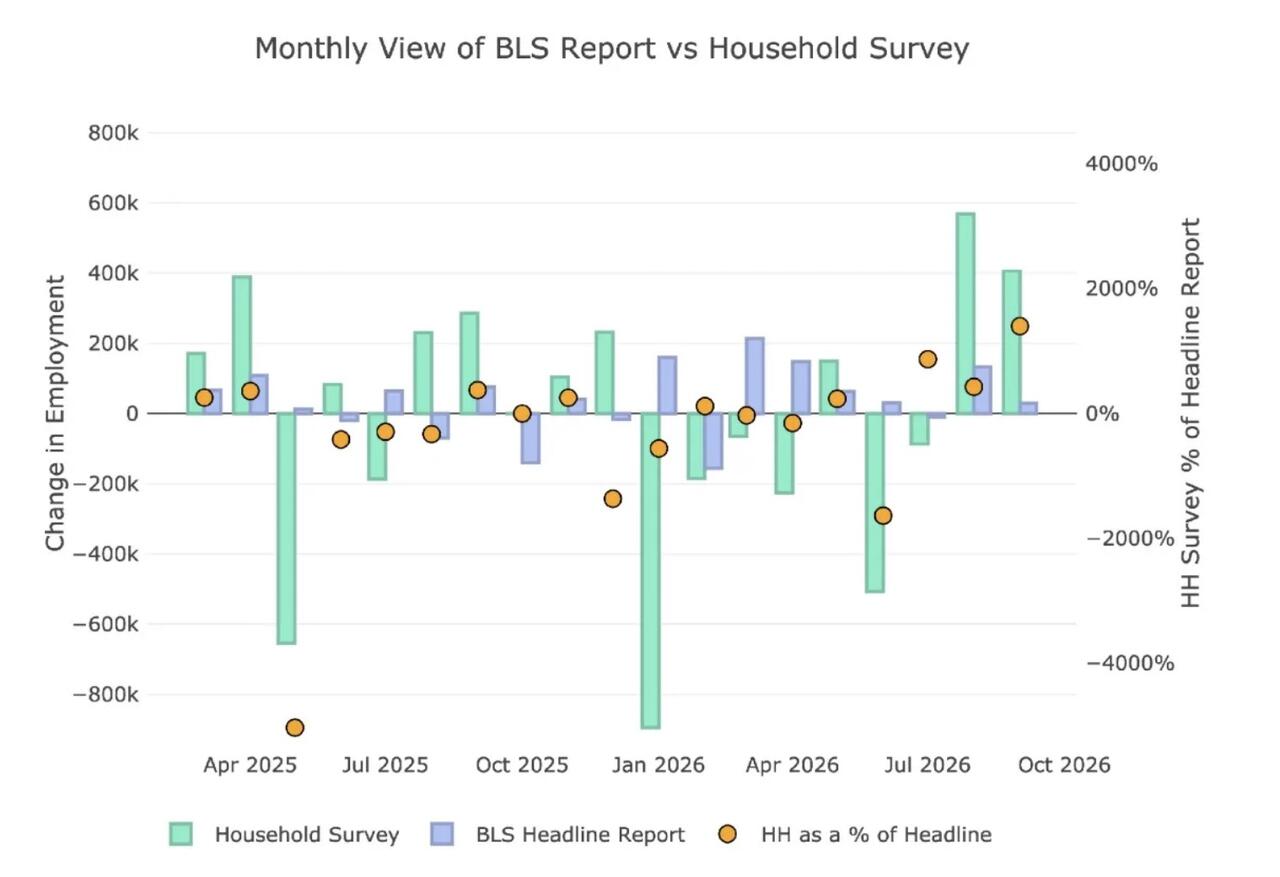
Figure: 1 Primary Report vs Household Survey – Monthly
Despite the massive outperformance in the Household Survey, when looking at the YTD number, it still underperforms. For the year, the Headline Report shows a gain of 612k vs the Household Survey which shows a loss of 840k.
So, even with two very strong months, the Household Report still shows an extremely weak job market. Outside of Covid, this is the worst year for jobs since at least 2010 according to the Household Report. It’s also the only year where the two reports are moving in opposite directions, as seen in the chart below…
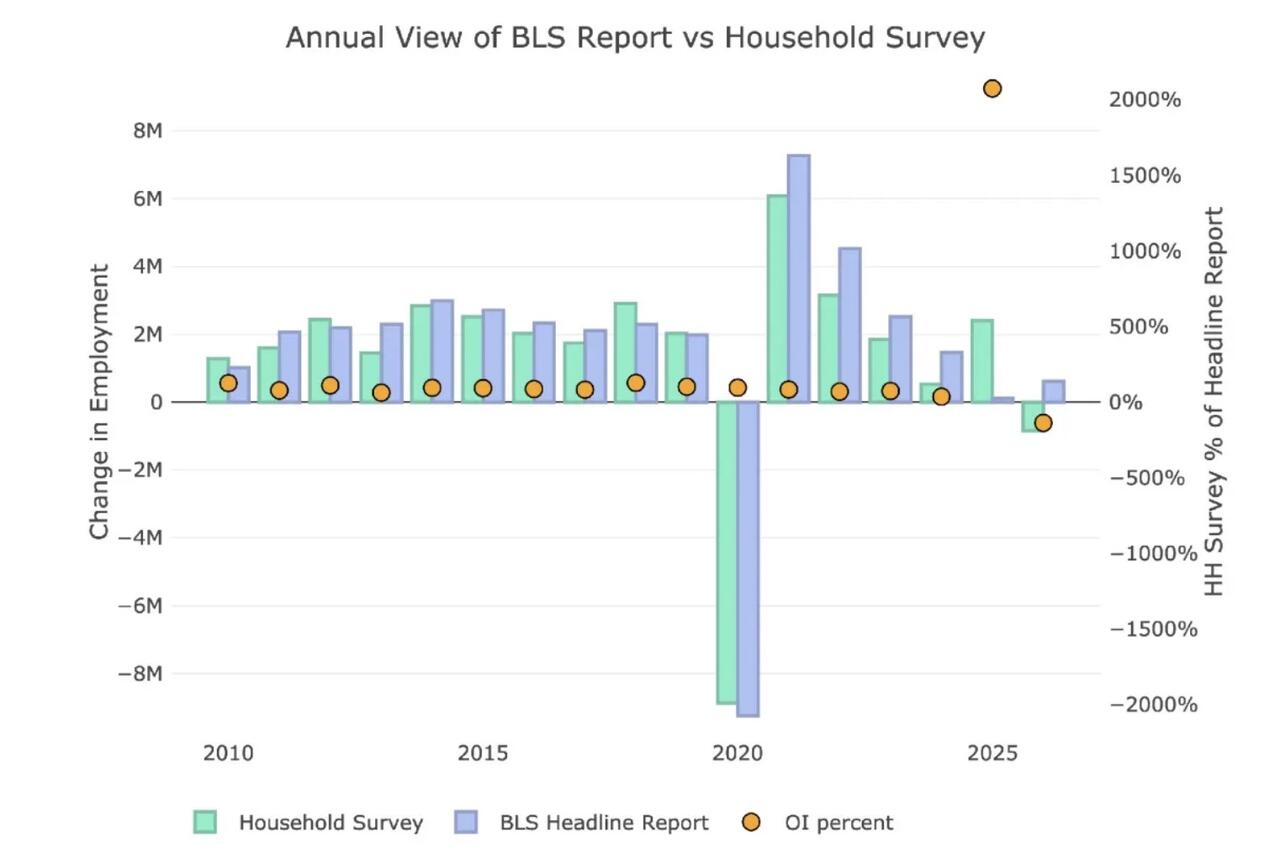
Figure: 2 Primary Report vs Household Survey – Annual
The BLS publishes the data behind their Birth/Death assumptions (formation of new business). The data showed that the BLS assumed a loss of 190k jobs for September. This is the first month since March where the assumed jobs was actually negative…(READ THIS FULL ARTICLE 100% FREE HERE).
END
JOHN RUBINO…
Open Borders + Red/Green Alliance = Currency Collapse
| John RubinoOct 3 |  |


Let’s start with France, where a decade of mass immigration has validated the warning “Import the Third World, become the Third World.”
This is happening today:

The political doctrine that views the above as positive is known as the “red/green alliance.” From a recently published research paper:
The Emerging Red-Green Alliance: Where Political Islam Meets the Radical Left
Abstract:
No matter how unlikely it may seem, radical Leftists and Islamists have come closer in recent years. Drawing on substantial ideological interchange, and operating at both state and non-state levels, the two movements are building a Common Front against the United States and its allies. In this article, we use framing theory to examine the contemporary convergence of political Islam and the radical Left. Both radical Leftists and Islamists have utilized the master frame of anti-globalization/anti-capitalism and the master frame of anti-colonialism/anti-imperialism to elicit support from the widest possible range of people. The emerging Red-Green alliance presents a complex challenge that will require careful attention from U.S. and European policymakers.
Uncontrolled Deficits
Recent French governments have tried to reduce public spending by, for instance, raising the retirement age from the current 62(!) years to a still extremely generous 64. The streets immediately erupted with violent protests by citizens unwilling to accept the change, leading the authorities to cave.
The result: French government deficits are now uncontrolled, and debt has risen to US (i.e., horrendous) levels as a percent of GDP:

From Politico:
French debt hits 119% of GDP
PARIS — France accrued nearly €3.6 trillion in debt amounting to 119% of gross domestic product as of the end of June, national statistics agency Insee said Tuesday.
The figures were released as pessimism mounts over the future of the French economy, whose debt levels are starting to get closer to those of Italy and Greece — two of the eurozone’s most indebted countries — while growth stagnates.
French Prime Minister Sébastien Lecornu said earlier this month that he plans to propose savings worth €54 billion in the 2027 budget, which will be formally unveiled on Thursday. Lecornu has pledged to bring the budget deficit — the difference between what a country spends and collect in taxes every year — down to 5% of the GDP next year, but it’s unclear if his minority government will be able to muster enough support for its spending plans.
Bond Markets Panic
Unlike the US, France lacks the “exorbitant privilege” of a global reserve currency. Thus unable to control its own monetary policy, it is powerless to manage long-term interest rates, which — after years of relative stability — are now spiking:

Euro Death Spiral?
Now the questions are:
- Who in their right mind would lend money to a country that’s descending simultaneously into civil war and financial chaos?
- How can a country that can’t function without access to credit…function when credit evaporates?
- How can the euro continue as a viable currency (i.e., a store of value, medium of exchange, unit of account) if the main countries backing it have lost support of global capital?
The answers: No one; it can’t; and it won’t. Seriously, keep stacking.
You’re currently a free subscriber to John Rubino’s Substack. For the full experience, upgrade your subscription.
END
1 B // JAMES RICKARDS
2. ALASDAIR MACLEOD
Global debt crisis starts with France
All G7 nations are in deep debt trouble. It’s just a case of which one brings down the others. It now looks like France is failing first.

We can be sure that the euro debasement trade versus the US dollar is not over. France’s situation is suddenly critical, particularly when its experience of the 1973-1974 OPEC crisis is considered.
Introduction
Regular readers of MacleodFinance will be aware of a looming debt crisis affecting all G7 member nations and beyond. This crisis is unique for modern times, being a widespread government financial crisis and not a private sector one in its origin. The outstanding question has been which of the G7 dominoes will topple first, and will it knock all the others down?
We appear to have the answer: France. Headlines tell us of a far-right takeover in the French senate, and there’s a presidential election in six months. Students are rioting out of control. But this is not unusual for France; the problem the media misses is the government debt bomb in the process of exploding.
The chart below reflects the growing risk of a French default on its debt, whereby the buyer in effect pays an insurance premium as protection against default on a 5-year bond. In the last month, this CDS has risen from 33.75, an increase of 136%. It is screaming crisis.

France’s debt situation
The French government’s debt stood at €3.596 trillion in June, giving a debt to GDP of 119% with the economy hardly growing. Along with other G7 nations (US, UK, Germany, Italy, Canada, and Japan) France’s economy is being undermined by the oil crisis in the Middle East. Consequently, bond yields have been rising rapidly, undermining the ability of the government to finance its budget deficit:

In mid-December 2022, the 10-year bond yielded minus 0.2%, and France’s debt to GDP stood at €2.95 trillion, equal to 111.6% of GDP. Since then, nominal GDP has grown by €383 billion while debt has grown by €646 billion. In other words, debt has been growing 69% faster than GDP, which is taken as the proxy for financing it. And now, debtors see the French economy tanking along with the other G7 nations due to the oil shock, which has two consequences.
Firstly, tax revenues will decline while welfare costs rise increasing the budget deficit, which was already deteriorating from 4.7% of GDP to 5.4% estimated for this year by the government itself, before the consequences of the oil shock are factored in. And secondly, as the divisor in the debt to GDP equation, if the economy actually contracts, that of itself will drive the ratio higher.
It is becoming obvious to the markets that France is in an inescapable debt trap. A debt trap is one whereby debt service costs outrun the capacity to refinance it on sustainable terms, describing the French situation to a T. Furthermore, because France doesn’t have its own currency, it cannot print its way out of trouble, an escape route often propounded as a solution.
If France was able to print its way out, it would collapse her currency, a solution not available to euro-area nations. But it is assumed that despite restrictions on the European Central Bank to do so, ways will be found to make the credit available for the French government without escalating its borrowing costs as a debt crisis demands. Consequently, much of the dollar’s trade-weighted strength is due to the euro exchange rate falling, which is the main US$ TWI constituent:

In just six weeks, the euro has fallen 3.7% against the US dollar, taking over the position on the G7 currency’s naughty step from the Japanese yen.
We can be sure that the euro debasement trade versus the US dollar is not over. France’s situation is set to deteriorate further, particularly when its experience of the 1973—1974 OPEC crisis is considered. It will lead to uncomfortable questions over the other euro-area participants, dragging in all national euro debtors — remember the PIGS? They still lurk in the background.
The table below considers the key metrics with respect to the debt positions of all G7 nations today ranked by today’s debt ratios in descending order:

What’s true of France is demonstrably true of the others. With the possible exception of Germany, they are all constrained by unsustainable debt past the point of no return and simply cannot afford the higher financing costs likely to be triggered by the still developing crisis in the Middle East. In their individual ways, they all have other problems which will emerge as the current G7 debt crisis evolves. And this begs the question: how will they tackle the inflationary outcomes if they face anything like the mid-seventies’ experience?
Politics, not economics or old-fashioned common sense always drives these outcomes. This is why currencies are falling priced in gold at an accelerating rate. Physical gold is real legal money, the safe haven from the conditions which are set to collapse both the fiat dollar and the other G7 fiat currencies, all of which are simply credit with escalating risk attached.

Just as the dollar and other G7 currencies plunged lower against gold in 1973-74 during the OPEC oil crisis, they are set to do so again today. With France setting the pace for the euro, we can see how the fiat currency system is now going to end. And as it gathers momentum, it won’t take long.
Clearly, for these unfolding events gold is undervalued priced in fiat currencies. The recent consolidation is a heaven-sent opportunity to escape the coming mayhem as fiat currencies race each other towards extinction.
END
3. CHRIS POWELL AND HIS GATA DISPATCHES
4. ANDREW MAGUIRE//KINESIS LIVE FROM THE VAULT/291
END
XXXX
5. COMMODITY REPORT: REFINED OIL
.The US Doesn’t Have An Oil Problem – It Has A Refinery Problem
Sunday, Oct 04, 2026 – 01:30 PM
One of the enduring weaknesses of the modern US economy is the lack of redundancy. As long as most of the world is operating normally and there are no serious geopolitical disruptions, America’s “just in time” system works fine. But, throw a monkey-wrench into distribution, global exports, freight systems, shipping or elements of production and cracks quickly form in the armor.
This does not mean that the US economy can’t adapt; the pandemic shutdowns were horrifically pointless but they did prove that the system has the ability to function despite deep deficiencies. However, when it comes to the management of vital resources, such as energy resources, it’s clear that some changes need to be made in the near term.
Before the war in Iran a large portion of the public was oblivious to the fact that the US is the largest exporter of oil in the world, and of the foreign oil supplies we do receive, only 8% come from Gulf nation producers. A mere 7% of those supplies travel through the Strait of Hormuz. In other words, the US doesn’t rely on the Gulf for oil. With the new Venezuelan deal and oil flows from the gulf back to 98% of pre-conflict levels, the war is even less of a concern when it comes to US energy.
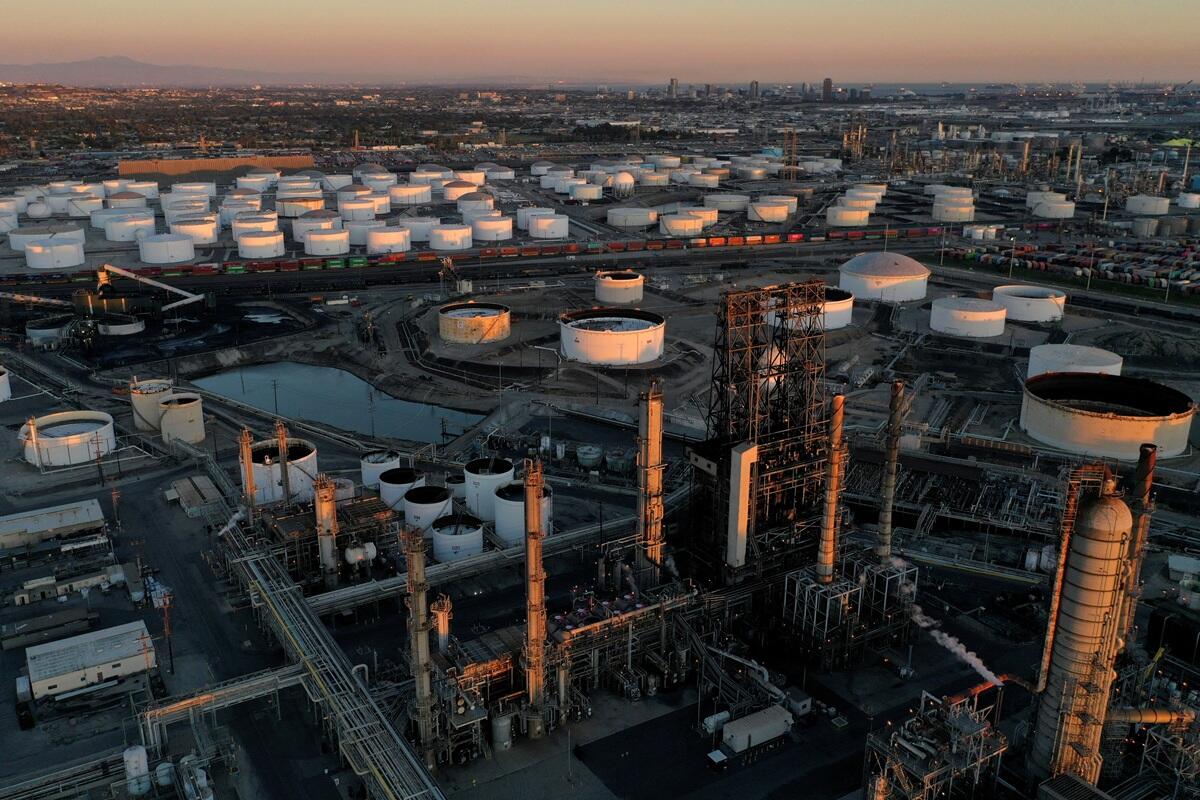
The problem is, there is a global oil refinery capacity shortage, and the US is not adapting as it should.
Ukrainian drone strikes against Russian refineries have recently forced the Kremlin to cut off all diesel exports to other countries. Russia is the second largest supplier of diesel in the world with 12% of all exports. This loss to global markets is straining already struggling refineries and causing prices to climb. The only country with the ability to increase refining capacity quickly is the US, but it’s not happening.
The last time a full-conversion refinery was built in the US was Marathon’s Garyville, Louisiana plant. It came online in 1977 at about 200,000 b/d and has since been expanded to about 617,000 b/d. Most U.S. capacity growth since the 1970s has come from expanding existing sites, not building new ones.
In five decades, no major infrastructure has been added. This means that as aging plants shut down, or as they are closed down due to state policies, US refining capacity will continue to fall and the ceiling for supply vs demand will get tighter and tighter.
Currently, national demand for distilled products is 8.7 million b/d, and production provides only 9.5 million b/d – That’s an extremely narrow gap at 95%-98%. Unfortunately, this gap has narrowed further due to refinery closures in 2025. The largest drop in U.S. capacity came from the shutdown of the LyondellBasell’s Houston plant (about 264,000 barrels per day) and the Phillips 66’s Los Angeles plant (about 139,000 barrels per day). Together those removed about 400,000 b/d; small expansions elsewhere offset some of that, but not enough.
The Houston plant was built in 1918 and was so old any expansion or updating would have been too costly. Plants in California, on the other hand, have been closing due to crushing regulations. Valero’s Benicia plant (about 145,000 b/d) stopped refining this spring and was taken out of monthly capacity later.
The answer to refinery shrinkage has long been “expansion creep” in existing facilities because it’s faster than building brand new infrastructure, but this is not going to help for much longer. Current facilities are limited in their ability add on more capacity and these measures do not account for abrupt global changes, wars and crisis events.
The US needs redundancy, not “just in time” economics.
Estimates suggest that up to eight new refineries (for heavy and light crude) running at least 250,000 b/d would be needed to increase the capacity ceiling while adding modern infrastructure and redundancy to offset aging plants. A safer margin would be demand at 85%-90% of capacity. This would also help the US to add supplies to any global market shortfall and keep prices from skyrocketing in the event of ongoing wars.
What’s stopping this from happening? There’s a number of obstacles. First and foremost, no one wants to sink billions of dollars into a new facility based on higher gas margins that might be temporary. In other words, investors will wait around until there’s a catastrophic disruption and prices go out of control, but by then it will be too late.
This means it’s likely that the only way to get new refineries built would be for the US government to partially backstop the investment. It’s not the worst way to spend taxpayer money; everyone likes lower gas prices. Getting such a measure passed through congress is questionable, though.
One possible avenue would be profit sharing with taxpayers on excess fuel sold, or on exports sold from new refineries. This is similar to the Saudi Arabia model, which invests some oil profits back into healthcare, education, housing loans, and cheaper fuel and utilities for citizens. Of course, Saudi Arabia is a monarchy and moving from theory to practice in the US is another matter.
Then there’s the permits, environmental studies and regulations, and a lot of other red tape that can extend build time up to 10 years. Even with a streamlined bureaucracy, it can still take 3-5 years. With government aid, the time can be reduced to 1-3 years. It’s clear that this is not a quick fix in any scenario, but if the process had been started a few years ago, then there would be no capacity issue and there would be no need for this discussion.
Again, the US economy is almost designed to avoid redundancy and preparedness.
There is the possibility that a rush to build refineries is unnecessary in the short term. With ship traffic in the Hormuz returning to normal, prices on oil will continue to drop. This does not mean, though, that gasoline prices will fall in tandem, at least not for months to come. The war in Ukraine also looks like it will be ongoing for some time, which means Russian supplies will not be returning to global markets.
Refineries are a long term solution which requires long term planning; something which is nearly impossible within the US where the political landscape changes every 2-4 years. It is also extremely difficult when half the government under Democrats wants to tear down oil infrastructure and force the country to accept inefficient green tech. The point is, there are obvious fixes available, but nothing will happen until disaster strikes and politicians are effectively frightened.
end
COMMODITY COPPER
DB’s Ghali: US/China Stockpiling Drives a $22,050 Copper Target

by VBL
Monday, Oct 05, 2026 – 6:00
Own the bottlenecks
Authored by GoldFix
London copper is near record highs, supporting the commodity supercycle thesis former Goldman Sachs commodities chief Jeff Currie outlined in August on ZeroHedge’s: “get long and buckle up.” His case for sustained commodity price gains rests on tight physical supplies, currency debasement and policy intervention. On the heels of that report comes Dan Ghali who has joined DB as head of metals he puts more meat on the bone of Currie’s concepts.
He starts by observing China holds an estimated 2.05 million tonnes in strategic reserves and US warehouse stocks heading toward 1.3 million tonnes by year-end. Industrial buyers elsewhere must now compete for the copper remaining outside those holdings.
He forecasts $22,050 per tonne in the second quarter of 2027, roughly 50% above prices when he issued this week’s analysis. He calls available inventories “unprecedented lows” and estimates that US and Chinese stockpiling will encumber 71% of global inventories by year-end.
China’s Reserves and US Warehouses
China’s strategic holdings account for approximately 43% of global above-ground copper inventories. Ghali’s US estimate includes exchange and commercial warehouses, where traders are accumulating metal ahead of potential import tariffs.
“The combination of de-globalization and decades of underinvestment in supply has created vulnerabilities such that, by year-end, stockpiling in the USA and China will have encumbered 71% of global inventories.”
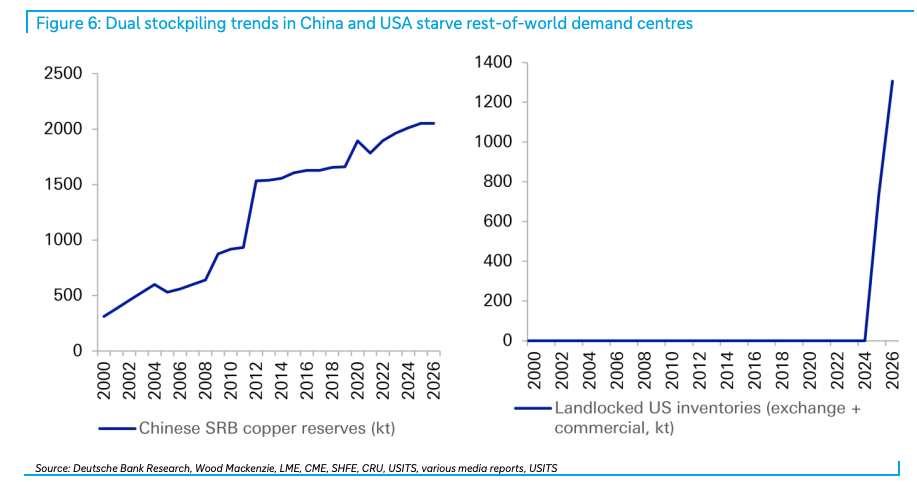
The End-2028 Inventory Projection
If stockpiling continues at the current pace, freely available inventories would approach zero by the end of 2028. Ghali expects higher prices to reduce consumption before then, encouraging some users to switch to aluminum, a cheaper, less efficient conductor. He judges current copper prices insufficient to prompt that switch.
ZH also noted:
Ghali called this the “most acute copper scarcity on record“ and a “de-globalization endgame.” The industrial metal’s story is quickly shifting from an AI data center boom to a liquidity crisis, as free-floating copper inventories decline to unprecedented levels.
The bank’s charts show Chinese copper concentrate treatment charges below zero and project refined-market deficits in 2027 and 2028. Smelters are competing for mine feedstock while stockpiling absorbs refined metal.
Continues here
END
YOUR EARLY CURRENCY VALUES/GOLD AND SILVER PRICING/ASIAN AND EUROPEAN BOURSE MOVEMENTS/AND INTEREST RATE SETTINGS MONDAY MORNING.7:30 AM
SHANGHAI CLOSED UNTIL THURSDAY
HANG SENG CLOSED UP 68.04 PTS OR 0.28%
Nikkei CLOSED UP 1676.54 PTS OR 2.45%
//Australia’s all ordinaries CLOSED DOWN 0.33%
//Chinese yuan (ONSHORE) CLOSED TIL THURSDAY
/ OFFSHORE CLOSED DOWN AT 6.7071 Oil UP TO 90.67 dollars per barrel for WTI and BRENT UP TO 102.62 Stocks in Europe OPENED ALL MIXED
ONSHORE USA/ YUAN// WITH YUAN TRADING XXX (OFF TIL THURSDAY) OFFSHORE YUAN TRADING DOWN TO 6.7071 ONSHORE YUAN TRADING ABOVE LEVEL // OFF SHORE AND DOWN ON THE DOLLAR)// / AND THUS XXXXX/OFF SHORE YUAN TRADING DOWN AGAINST US DOLLAR/ AND THUS WEAKER
XXXXXXXXXXXXXXXXXXXXXXXXXXXXXXXXXXXXX
ONSHORE YUAN: CLOSED OFF UNTIL THURSDAY
OFFSHORE YUAN: DOWN TO 6.7071
1A.HANG SANG CLOSED UP 167.54 PTS OR 2.45%
1 B. SHANGHAI CLOSED OFF UNTIL THURSDAY
2. Nikkei closed UP 1676.54 PTS OR 2.45%
WEST TEXAS INTERMEDIATE OIL UP TO 90.67
BRENT; 102.62
3. Europe stocks SO FAR: ALL MIXED
USA dollar INDEX UP 22 BASIS PTS TO 101.93// EURO FALLS TO 1.1206 DOWN 42 BASIS PTS
3b Japan 10 YR bond yield:FALLS TO. +3.089 DOWN 0 FULL BASIS PTS/ VERY TROUBLESOME//Japan buying 100% of bond issuance)/Japanese YEN vs USA CROSS NOW AT 157.92… JAPANESE YEN NOW FALLING AS WE HAVE NOW REACHED THE ENDING OF THE YEN CARRY TRADE AGAIN AND THE REPATRIATION OF YEN DENOMINATED BONDS TRADING IN THE USA/EUROPE. JAPAN 30 YR BOND YIELD: 4.2465 UP 5 FULL BASIS PTS
3c Nikkei now ABOVE 17,000
3d USA/Yen rate now well ABOVE the important 120 barrier this morning
3e Gold UP /JAPANESE Yen DOWNCHINESE ONSHORE YUAN: XX (XXX) AND OFFSHORE: DOWN AT 6.7071
3f Japan is to buy INFINITE TRILLION YEN worth of BONDS. Japan’s GDP equals 5 trillion USA. CENTRAL BANK OF JAPAN WILL NO LONGER DO QE.
Japan to buy 100% of all new Japanese debt and NOW they will have OVER 50% of all Japanese debt. GOVERMENT ASKED JAPAN PENSION FUNDS AND INSURANCE FUNDS TO BUY MORE JAPANESE BONDS AND REPATRIATE ALL FOREIGN BONDS.
3g Oil UP for WTI and UP for Brent this morning
3h European bond buying continues to push yields HIGHER on all fronts in the EU German 10yr bund YIELD UP TO +3.4590/ Italian 10 Yr bond yield UP AT 4.663/ SPAIN 10 YR BOND YIELD UP TO 4.124%
3i Greek 10 year bond yield UP TO 4.5090%
3j Gold at $4158.75 /Silver at: 61.67 1 am est) SILVER NEXT RESISTANCE LEVEL AT $100.00
3k USA vs Russian rouble;// Russian rouble DOWN 1 AND 20/ 100 roubles/85.000
3m oil (WTI) into the 90 dollar handle for WTI and 102 handle for Brent/
3n Higher foreign deposits moving out of China// huge risk of outflows and a currency depreciation. This can spell financial disaster for the rest of the world/
JAPAN ON JAN 29.2016 CONTINUES NIRP. THIS MORNING RAISES AMOUNT OF BONDS THAT THEY WILL PURCHASE UP TO .5% ON THE 10 YR BOND///YEN TRADES TO 157.92 // 10 YEAR YIELD AFTER FIRST BREAKING .54% LAST YEAR NOW EXCEEDS THAT LEVEL TO 3.089% DOWN 0 BASIS PTS STILL ON CENTRAL BANK (JAPAN) INTERVENTION//YEN CARRY TRADE NOW UNWINDING//YEN BOND TRADING OVERSEAS TO BE REPATRIATED.//JAPAN 30 YR: 4.2490 UP 5 PTS..: USA/SF this 0.8288 as the Swiss Franc . Euro vs SF: 0.289
USA 10 YR BOND YIELD: 5.2820 UP 0 BASIS PTS…NOW BELOW 5.00%
USA 30 YR BOND YIELD: 5.630 UP 0 BASIS PTS/REFUSES TO GO DOWN WITH BESSENT’S QE TWIST
USA 2 YR BOND YIELD: 4.812 DOWN 1 BASIS PTS
USA DOLLAR VS TURKISH LIRA: 49.16 UP 0 BASIS PTS/LIRA GETTING KILLED//IDIOTS FOR SELLING GOLD AND USA DOLLAR RESERVES.
10 YR UK BOND YIELD: 5.3956 UP 2 PTS
30 YR UK BOND YIELD: 5.9156 UP 2 BASIS PTS
10 YR CANADA BOND YIELD: 3.945 UP 2 BASIS PTS
5 YR CANADA BOND YIELD: 3.623 UP 2 BASIS PTS.
1a New York Opening report
Stock Futures Drift As Attention Turns To European Debt Crisis
Monday, Oct 05, 2026 – 08:38 AM
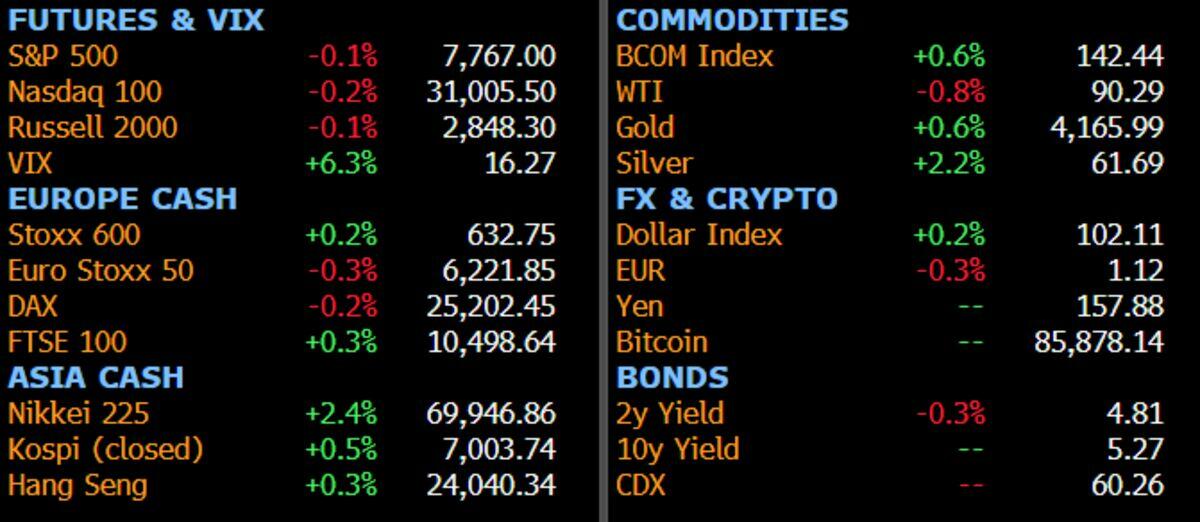
Futures are lower to start the week and global markets struggle for direction, as political upheaval and mounting concern over Europe’s public finances dampened risk sentiment and sent the euro to a 17-month low against the dollar while the US yield curve twists steeper and USD appreciates. As of 8:00am ET S&P futures are down 0.1% and Nasdaq futures slip 0.2% from their record close on Friday, as most Mag 7 stocks are lower although Nvidia climbs another 0.6% after partner Hon Hai Precision Industry reported better-than-expected quarterly revenue, pointing to sustained and elevated spending on AI infrastructure. In premarket trading, tech is lower with Semis / Memory lagging, Mag7 and Software flat. Intel tumbles 4% after a report on discussions of a potential collaboration between Taiwanese chip giant TSMC and Elon Musk’s Terafab, which Intel joined in April. Cyclicals ex-Energy are flat to Defensives with the market looking to broadening if yields stabilize. Brazil-related names are higher following preliminary election results which show Bolsonaro defeating Lula, and EWZ +11.9% pre-market. The CAC 40 in Paris was the main weak spot in Europe. Asian stocks played catch-up with Friday’s US rally. US bond yields fluctuated, with the short end leading as the selloff in Treasuries showing few signs of abating, and traders on alert for signs of bond market contagion in Europe. German bunds affirmed their haven appeal as they outperformed in Europe. French bonds were mixed, while Spanish debt lagged. Currency markets showed the biggest reaction as the euro dropped 0.5% against the dollar. Commodities are higher led by Ags and Metals with Precious leading Base; crude is lower despite unconfirmed, opposing headlines that the Saudi East/West pipeline has been shut. US economic data slate includes September services PMI (9:45am) and ISM services index (10am). Fed speaker slate empty for the session.
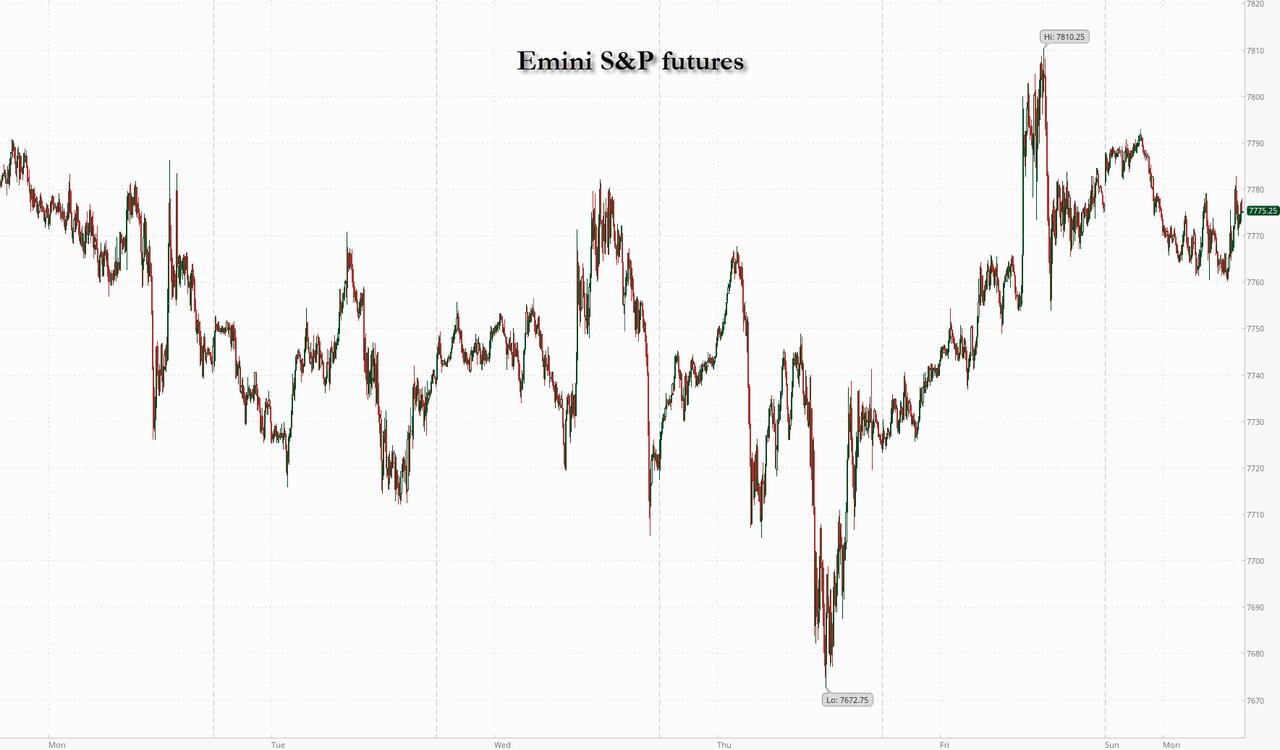
In premarket trading, Mag 7 stocks are mixed: Nvidia climbs 0.6% after partner Hon Hai Precision Industry reported better-than-expected quarterly revenue, pointing to sustained and elevated spending on AI infrastructure (Alphabet unchanged, Amazon -0.1%, Apple -0.2%, Meta -0.2%, Microsoft +0.4%, Tesla -0.3%)
- Align Technology Inc. shares (ALGN) are down 2.8% after Evercore ISI downgraded the medical-device company to inline from outperform, writing that “the dental macro picture has meaningfully weakened.”
- Alvotech shares (ALVO) jump 8% after the US FDA approved additional US manufacturing capacity for Simlandi, the biotech’s biosimilar to Humira.
- CH Robinson Worldwide shares fall 7.8% after the freight broker announced an agreement to acquire peer RXO (RXO +20%) for stock and cash for an implied value of $30.25 per share.
- Cboe Global Markets Inc. (CBOE) rises 1.8% as it is being upgraded to buy from hold at TD Cowen, which sees an improving outlook for the exchange operator, especially in the wake of it signing an extension of its licensing agreement with S&P Dow Jones Indices.
- Cenovus Energy Inc. shares (CVE) fall 3.1% after the Canadian energy company agreed to buy Athabasca Oil Corp. for C$12 per share at an enterprise value of C$5.7 billion ($4 billion), with the deal expected to close in December.
- Cerebras Systems shares (CBRS) rally 4.5% after OpenAI CEO Sam Altman said the company is “a close partner” of OpenAI and the two firms have “a deep engagement pushing on the frontiers of speed.”
- DraftKings shares (DKNG) are up 4.6% as BofA raises the recommendation on the online sports betting company to buy from neutral, with the analyst citing her more positive view of the predictions markets (PM) impact.
- Estée Lauder Cos. shares (EL) rise 2.8% as Barclays raised its recommendation on the beauty company to overweight from equal-weight, citing its attractive sales growth and earnings profiles.
- Harley-Davidson Inc. shares (HOG) are up 5.7% after Citi upgraded the motorcycle company to buy from neutral, writing that an acceleration in retail growth is “tough to ignore.”
- HubSpot Inc. shares (HUBS) are down 1.4% after Raymond James downgraded the software company to market perform from outperform, citing near-term uncertainty.
- Mosaic Co. shares (MOS) fall 1.1% after RBC Capital Markets cut its recommendation on the fertilizer firm to sector perform from outperform on delayed phosphate recovery.
- PTC (PTC) surges 36% after Schneider Electric agreed to acquire the company.
- Samsara Inc. shares (IOT) are up 0.9% after Jefferies started coverage on the stock with a buy rating and $50 price target, seeing strong AI-related growth prospects for the hardware-software platform.
- TSMC shares (TSM) gain 1.6% in Taipei on Monday with sentiment boosted by discussions between the Taiwanese chip giant and Elon Musk’s Terafab on potential collaboration, while shares in Intel (INTC), which joined the Terafab initiative back in April, fell 3.9%.
- Texas Roadhouse Inc. shares (TXRH) are up 2.2% after Evercore ISI upgraded the restaurant chain operator to outperform from inline, seeing a buying opportunity in the wake of recent weakness.
- US-listed stock of Brazilian companies and firms exposed to the country (NU +13%, BBD +12%) rallied as Flávio Bolsonaro surged to a surprise lead over Luiz Inácio Lula da Silva in the first round of the presidential election.
- Vaxcyte shares (PCVX) soar 56% after the pharmaceutical firm said that VAX-31, its experimental vaccine to prevent invasive pneumococcal disease (IPD) and pneumococcal pneumonia, met all primary endpoints in the OPUS-1 pivotal Phase 3 adult trial, compared to PCV20 and PCV21.
- Virtu Financial Inc. shares (VIRT) are up 3.3% after JPMorgan upgraded the market-making firm to overweight from neutral, citing a strong outlook ahead.
- Wells Fargo & Co. shares (WFC) are up 2.2% after Morgan Stanley upgraded the bank to overweight from equal-weight, seeing “a clearer path to improving profitability in 2027.”
In other corporate news OKX filed with the SEC to launch a tokenized-stock trading platform, making it one of the first major crypto exchanges to take advantage of new US rules. Digger, the last film to be released from Warner Bros. Discovery before its acquisition, was a major disappointment at the box office, taking in $8 million on its opening weekend. CME Group shelved plans to launch a round-the-clock oil contract following industry pushback. In deals, Schneider Electric agreed to acquire industrial software firm PTC for about $22.6 billion, stepping up its effort to tap into the AI boom. North Sea oil and gas producer Ithaca Energy struck its first international deal, agreeing to buy assets in Canada from Suncor Energy.
US equity futures are slightly lower on the day. Oil slipped after Saudi Arabia cut prices of its benchmark grade to Asia as flows recover, offsetting a lift from intensified fighting in Yemen. Markets are starting the week with strains in Europe firmly in focus after policy gridlock in France sparked a selloff in the region’s more vulnerable debt. French government bonds are underperforming regional peers, widening the 10-year yield spread with Germany by ~5 bps as budget concerns persist. The unease threatened to spread to Spain on Monday as Prime Minister Pedro Sánchez called an early election amid mounting social protests over housing, sending Spanish bonds slightly lower. Treasuries and bunds are higher as haven-demand provides support, while the euro tumbles to a 17 month lows against the USD.
“Europe is out of favor with investors and bond market vigilantes are watching developments in the euro zone closely,” said Kathleen Brooks at XTB. “The question now is, will Spain be next?”
As Goldman wrote over the weekend, stocks continue to be disconnected from everything. Equity resilience has a simple explanation, according to Barclays’ Ajay Rajadhyaksha. “The equity market is repricing the earnings power of a technology cycle that comes along once in a generation,” he wrote. In normal times, the forces driving bonds would be expected to eventually spill over into stocks. “But these are not normal times.”
Meanwhile, Brazilian assets were set to jump after Senator Flávio Bolsonaro finished ahead of President Luiz Inácio Lula da Silva in the first round of the election, making him the overwhelming favorite to win, with Brazil likely to see a big shift to the right. Bolsonaro, seen as a more market-friendly name than Lula, had 47% of the vote, compared with the incumbent’s 45%. Fabrício Taschetto at Ace Capital saw the real strengthening some 3%. Retailers, homebuilders, shopping-mall operators and consumer and apparel companies were set to lead the rally, according to Felipe Arslan at Morada Capital.
Strategists at Citi and JPMorgan reckon that strong earnings can keep equities going despite bond market noise. JPMorgan’s Mislav Matejka sees big differences to the 2022 inflation surge, highlighting the tech outlook and backdrop for wages and labor, while Citi strategists forecast about 6% gains for global equities to year-end, driven by earnings growth.
While markets remain fragile, many stocks have already priced in the risk from higher oil and tighter financial conditions, said Alberto Tocchio, a portfolio manager at Kairos Partners.
“If oil stops rising and bond volatility calms, the next move could be less about another Nasdaq-high and more about a much healthier broadening of market participation,” Tocchio said. “France is clearly the main European risk. For now, however, I would still view this primarily as a French rather than a systemic euro-area crisis.”
Macro data and events to watch this week include services ISM this morning, FOMC meeting minutes on Wednesday and University of Michigan sentiment on Friday. The ISM Services PMI should show the economy continuing to expand in September, but at a slower pace, according to Bloomberg Economics, who note regional Fed surveys point to softer activity and demand after August’s strong readings.
Minutes from the Federal Reserve’s September meeting count among the highlights of a week with a relatively sparse economic calendar. Since policymakers raised rates at that meeting, investors have dialed back bets on a second straight increase following softer US jobs data and weaker-than-expected inflation.
In Europe, the Stoxx 600 is up 0.3% while the CAC 40 is falling 1% although that’s largely down to weakness in Schneider Electric shares. Here are the biggest European movers:
- European stocks exposed to Brazil rise after Flávio Bolsonaro surged to a surprise lead over Luiz Inácio Lula da Silva in the first round of Brazil’s presidential election. Brazilian assets are set to jump.
- Santander rose as much as 2.7% before paring gains; Telefonica advanced as much as 2.2%, Carrefour rose as much as 1.7%; all three generate more than 20% of their revenue in Brazil, according to data compiled by Bloomberg
- Italian financial stocks are on the move after Intesa Sanpaolo said its improved offer for Banca Monte dei Paschi di Siena has won the backing of the target’s biggest shareholder. While shares in Monte dei Paschi, Intesa and Unipol gain, Mediobanca slips.
- BT shares gain as much as 1.9% after the British telco agreed to buy struggling broadband provider TalkTalk in a deal that will inflict a £400 million hit on the company’s cash position, but should help protect the payments it receives from TalkTalk.
- Genmab climbs as much as 5%, to the highest since October 2023, after the Danish biotech firm releases Phase 2 data for Rina-S in ovarian cancer. Jefferies says this further de-risks the bull case for the upcoming Phase 3 readout.
- Air Liquide shares rise as much as 4.1% to the highest since July 27. Analysts reacted positively to the industrial gas supplier’s new strategic targets through 2030, including plans for a €4 billion share buyback program over 2027-2028. This comes ahead of the group’s virtual capital markets day later Monday.
- Schneider Electric falls as much as 9.2% in Paris, the most since April 2025, as an agreement to acquire PTC draws a cautious initial response from analysts. Concerns center on the size and financing of the transaction, as well as uncertainty over AI disruption and whether the deal can strengthen Schneider’s competitive position.
- IG Group falls as much as 4%, extending Friday’s 23% selloff, after Panmure and RBC analysts trim estimates and price targets for the stock following the trading platform’s profit warning on Friday.
Asian stocks played catch-up with Friday’s US rally, rising as softer US jobs data alleviated pressure on the Federal Reserve to keep raising interest rates and investors scooped up tech shares. The MSCI Asia Pacific Index climbed as much as 1.3%, the most in about a month, with Taiwan Semiconductor Manufacturing Co., MediaTek and Tokyo Electron as the biggest contributors. Mainland China and South Korea were closed for a holiday. Other markets traded higher following Friday’s report that showed US employers added fewer workers than forecast in September. Investors are also assessing Middle East developments, after Yemen launched a military campaign to recapture all Houthi-held territory. Shares of TSMC jumped 3% in Taiwan following a report that the chip giant is in discussions with Elon Musk’s Terafab on potential collaboration.
In FX, the Bloomberg dollar spot index rose 0.2%, closing in on its highest level of the year as EUR/USD dropped as much as 0.8% to 1.1611, its weakest since mid-May
In rates, German bunds affirmed their haven appeal as they outperformed in Europe. French bonds were mixed, while Spanish debt lagged. Treasuries fluctuated, with the short end leading. US yields cheaper by 1bp across long-end of the curve while front-end outperformance steepens 2s10s and 5s30s spreads by 2bp and 1.5bp on the day. US 10-year yields trade near unchanged at 5.27% with gilts lagging by 2bp and bunds, along with French debt, slightly outperforming. Treasuries curve twist steepens with front-end outperforming, where 2-year yields are lower by around 1bp on the day. Price action supported by bigger steepening move seen across German bonds where front-end yields are lower by 5bp on the day, along with WTI futures which trade down 1%. German bunds affirmed their haven appeal as they outperformed in Europe. French bonds were mixed, while Spanish debt lagged. Treasuries fluctuated, with the short end leading. IG dollar issuance slate empty so far. Dealers are expecting around $100 billion in new debt sales for October, compared with $195 billion seen in September. Multiple issuers stood down last week as unfavorable credit conditions kept funding costs elevated. Treasury auctions this week kick off Tuesday with $58 billion 3-year notes, followed by $39 billion 10-year and $22 billion 30-year reopenings Wednesday and Thursday
In commodities, Brent crude swung between gains and losses as traders remained wary of disruptions to Middle East flows. While Saudi Arabia cut prices of its benchmark grade to Asia, the kingdom’s state producer warned about the risk of low stockpiles and fighting in Yemen intensified. WTI futures lower by around 0.70%. Precious metals are advancing, with spot silver up over 2%.
US economic data slate includes September services PMI (9:45am) and ISM services index (10am). Fed speaker slate empty for the session
Market Snapshot
Top Overnight News
- Oil fluctuated in jittery trading, as Saudi Arabia cut prices of its benchmark grade to Asia, the kingdom’s state producer warned about the risk of low stockpiles and as fighting in Yemen intensified: BBG
- Yemen’s internationally recognized government launched a full-scale military campaign to recapture Houthi-held territory after weeks of escalating conflict between the Iran-backed group and Saudi Arabia: BBG
- Flávio Bolsonaro surged to a surprise lead over Luiz Inácio Lula da Silva in the first round of Brazil’s presidential election, making him the overwhelming favorite to win the runoff and take Latin America’s biggest economy sharply to the right: BBG
- The euro fell to its weakest level since May 2025, as France’s deepening fiscal crisis and the prospect of fresh political upheaval in the region rattled European markets: BBG
- Spanish PM Sanchez gambles on snap election to end parliament deadlock: BBG
- Democrats Inch Into Red Territory, but Have Problems on Home Turf: WSJ
- Intel stock slides as TSMC explores Terafab tie-up, analyst flags share losses: RTRS
- Savills’ Prime London index is down about 27% since its peak in 2014, as a cocktail of taxes, political and economic shocks have created more than a decade of misery for the owners of the city’s finest homes. When combined with the consumer price index, the real-terms drop is more than 49%: BBG
- US goes into midterm elections with a less dynamic form of full employment: RTRS
- US Senators Warren (D) and Hawley (R) are reportedly beginning a probe into how home and auto insurers process claims: WSJ.
- US Army tests counter-drone tech at Mexican border as cartel drone use rises: RTRS
- All B-1 Bombers Returning to U.S. From U.K. Base: WSJ
- Bank Stocks Are Haunted by the Ghosts of 2023: WSJ
A more detailed look at global markets courtesy of Newsquawk
APAC stocks began the week mostly higher in holiday-thinned conditions and following the gains last Friday on Wall St, where stocks were underpinned as Fed rate hike bets were unwound in a knee-jerk dovish reaction to the weak jobs data. ASX 200 eked marginal gains with upside in miners, materials and healthcare helping keep the index afloat, although gains were limited by weakness in utilities and consumer stocks. Nikkei 225 rallied and briefly reclaimed the 70,000 level amid strength in tech stocks, which seemed to also benefit from the holiday closure in South Korea. Hang Seng lagged amid the continued absence of mainland participants and stock connect flows, while automakers were also pressured following reports that the UK is considering imposing tariffs on Chinese electric vehicle imports amid concerns that Beijing is flooding the market with state-subsidised cars.
Top Asian News
- Brazilian President Lula won around 45.2% of votes, and Flavio Bolsonaro won around 47% of votes in the first round of Brazil’s Presidential Election and will head into a runoff on October 25th. Brazil’s President Lula said it was an unexpected result and he was convinced that he would win in the first round, while Bolsonaro said he is very happy with the results and that Brazil wants change.
- Japanese PM Takaichi said that realising strong, lasting growth is her starting point and will achieve virtuous cycle through GDP growth. Takaichi said that they will seek to draw in domestic investment with massive long term fiscal expenditure, deployed in a well-planned and predictable manner. On debt, she said the government will control the annual debt issuance amount appropriately while scrutinizing the economy, prices, tax revenues, interest rates, debt servicing costs and market developments.
European bourses start the week mixed, with Spain’s IBEX 35 outperforming after Brazil’s Bolsonaro took a surprise lead over current President Lula in the Presidential Election. A factor which has helped buoy those companies with exposure to Brazil. Elsewhere, France’s CAC 40 lags following recent M&A and broker updates in the luxury sector. Sectors highlight a positive bias. Chemicals lead, with Optimised Personal Care and Food, Beverages & Tobacco following, while Industrials is the only sector in the red.
Top European News
- Spanish PM Sanchez called for an early election, to be held on November 29th, after the government failed to pass a housing bill through the Spanish Congress.
- UK government is to announce plans for a social media ban for under-16s in the coming weeks amid concerns that children are being exposed to harmful content, according to The Times’s Swinford.
FX
- Snapshot: G10s are mixed against the USD, with the Aussie leading whilst the EUR lags on regional political woes.
- DXY is a touch firmer this morning and trades within a 101.85 to 102.53 range. Upside is broadly facilitated by a weak EUR, which has been pressured by ongoing French fiscal woes. The narrative is that the latest Budget proposal from PM Lecornu is not sufficient to solve the fiscal situation in France; moreover, the French budget watchdog suggested that current growth assumptions for the plan are optimistic. In the near term, focus will be on whether the draft budget can be passed; as it stands, National Rally Leader Le Pen has voiced her support to amend the current draft, rather than outright block it. Her aim would be to show fiscal responsibility ahead of the 2027 Presidential election. Should the draft budget fail, the likely option for Lecornu is to invoke Article 49.3.
- France aside, there has also been some focus on Spanish politics; PM Sanchez announced an early election for November 29. This comes after he failed to pass emergency housing bills through Congress, which has led to some unrest within the region. The EUR was ultimately little moved on the announcement itself. As it stands, the ruling coalition is losing in polls, with the People’s Party leading with 34%. Sanchez is likely banking on using the blocking of the housing bill by the far-right in his party’s favour; however, other key talking points such as immigration and the economy remain at the forefront of minds.
- JPY held firmer for much of the overnight action, but has held around the unchanged mark throughout the European morning. Initial strength was perhaps associated with positive commentary from PM Takaichi, where she told markets to “rest assured” over the country’s spending plans; she essentially pledged fiscal discipline.
Central Banks
- ECB’s Lane said underlying inflation indicators indicate that an upward shift in medium-term inflation has not taken hold but that the recent surge in energy prices can be interpreted as a second wave of the energy supply shock, following the initial jump at the start of the Middle East conflict and the temporary fall-back during the summer. This second wave of the energy supply shock poses direct upside risks to the inflation outlook but also downside risks to the growth outlook. In any event, the overall size and duration of the energy supply shock remain highly dependent on geopolitical developments. Lane reiterated the meeting-by-meeting and data-dependent basis.
- ECB’s Nagel said the inflation outlook faces upside risks and that uncertainty requires a flexible response rather than inaction while there is currently no clear signs that inflation has fed through into price or wage setting.
- BoJ Deputy Governor Uchida said adoption of AI might have positive and negative implications for productivity and labour markets, while he added that AI has become a key topic of discussion among central banks, including at the BoJ’s monetary policy meetings. Furthermore, he said AI has implications for several key monetary policy variables, including the output gap, financial conditions and neutral-rate measures, as well as noted that AI represents a strong positive demand shock, adding upward pressure to both the economy and prices, while it could also influence the supply side, potentially in a positive way by lifting productivity and supporting capital accumulation.
Fixed Income
- A mixed start to the week for fixed income. USTs are near-enough flat despite the numerous key energy/geopolitical updates this morning, looking ahead to the ISM print for more timely insight after Friday’s weak Payrolls. Currently, USTs are in a narrow 104-10 to 104-13+ parameter, well within the 104-07 to 105-08 band from Friday.
- Focus this morning, energy/geopolitics aside, has been firmly in Europe. Firstly, OATs find themselves under further pressure as the fiscal situation remains fraught and is likely to continue to be so well into next year, a point that has spurred much commentary around ECB-level intervention in the market. Perhaps more likely, the weakness in European fixed income, particularly if the OAT situation reverberates through the periphery, could dissuade some from supporting a back-to-back hike in October.
- OATs hit a 108.32 low, down by c. 60 ticks, but have since lifted modestly off that to around 108.55. This morning, the OAT-Bund 10yr yield spread hit a 147bps high today, just shy of the 151bps peak from last week.
- Competing with France for the limelight is Spain. After a period of speculation, PM Sanchez has started the process to hold early elections on the 29th of November. Once again, opposition PP is ahead in the polls, but incumbent Sanchez will be banking on the housing bill dispute and the relatively limited chance of PP and moderate parties coming to a coalition agreement.
- Bonos not too reactive thus far, as the early election was on the cards. However, it adds to the fractured European backdrop at the moment and provides further political risk to the region. Bono-Bund hit a 66bps peak today, just shy of the c. 70bps high from last week, which printed alongside the French action.
- Finally, for the UK, domestic updates are comparably light as we count down to the budget. Action is instead driven almost entirely by the energy moves, with Gilts currently lower by around 30 ticks but around 10 off worst levels.
Commodities
- WTI Nov and Brent Dec futures have pared some of the earlier downside following fresh supply and geopolitical developments. The complex initially remained pressured by Friday’s G7 agreement to release 100mln bbls of diesel and crude from emergency reserves, Trump ruling out a US diesel export ban and Kpler data showing Middle East oil exports exceeded pre-war levels last week. OPEC+ also kept November production quotas unchanged, while Saudi Aramco surprisingly cut its OSP to Asia to a USD 5/bbl discount (exp. USD 5/bbl increase).
- The complex caught a bid this morning after AFP sources reported that Saudi Arabia’s East-West oil pipeline halted pumping following a new attack, with “big damage” reported, while Iranian Armed Forces Chief of Staff Major General Abdollahi warned that if a new war is launched against Iran, its consequences will engulf everyone. Focus also remains in the Bab al-Mandeb Strait, after Yemeni government forces now say they have successfully taken control of Bab al-Mandab after earlier claiming to have seized Dhubab, although the Houthis deny this.
- WTI rebounded from a USD 89.31/bbl low towards USD 92/bbl, within a USD 89.31-91.88/bbl range, while Brent recovered from a USD 100.65/bbl low to above USD 103/bbl, within a USD 100.65-103.40/bbl range. Dutch TTF is modestly firmer in relatively contained trade and resides within a EUR 74.20-76.52/MWh range.
- Precious metals are firmer but to varying degrees, with spot gold relatively contained within Friday’s range following post-NFP volatility, as the softer jobs report prompted markets to pare near-term Fed hike expectations, while the subsequent Dollar rebound limits upside. Spot gold trades within a USD 4,124-4,170/oz range, while spot silver outperforms within a USD 60.37-61.79/oz range.
- Base metals are modestly firmer as the reduction in near-term Fed hike expectations provides some support, although upside remains capped with mainland China absent for the National Day holiday and therefore little participation from the complex’s largest consumer. 3M LME copper trades within a narrow USD 14,281.83-14,388.38/t range.
- Saudi Arabia’s East-West pipeline is flowing as normal, Bloomberg reported citing sources. It was earlier reported by AFP that Saudi Arabia’s East-West oil pipeline pumping reportedly halted after a new attack by the Houthis over the weekend.
- Saudi Aramco CEO said oil market pressure will worsen until the Strait of Hormuz reopens, refilling global oil stockpiles could take two years after the reopening of the Strait and that global oil releases provide only temporary relief for markets. The CEO added that global oil demand needs to rise by at least 2mln BPD over the next 18 months to draw down current inventories. Oil demand is recovering and inventories need replenishment. On Brent, the CEO forecasted that it could have reached USD 200/bbl without the East-West oil pipeline.
- Saudi Arabia set November Arab light crude oil OSP to Asia at a discount of USD 5/bbl vs Oman/Dubai average, while it set the OSP to Northwest Europe at a premium of USD 0.85/bbl vs ICE Brent, and set the OSP to the US at a premium of USD 4.60/bbl vs ASCI.
- Major OPEC+ producers agreed to maintain oil production quotas at current levels for November, according to delegates.
- ConocoPhillips (COP) sees US oil production exceeding 14mln BPD in 2027 if prices remain at current levels.
- Asian gold producers reportedly began hoarding supplies following recent increases in prices and are stepping up efforts to capture more of the value from gold boom through increased refining or discouraging exports through taxes or central bank purchases
- The EU would “significantly limit” Ukraine’s access to the EU’s agricultural markets and lucrative farming subsidies if Kyiv became a member of the bloc, according to proposals for EU enlargement cited by FT.
Trade/Tariffs
- US President Trump said on Friday that they didn’t jump the gun on the Alaska pipeline and warned if Korea doesn’t do the pipeline, they will charge South Korea more.
- The UK is reportedly preparing plans to impose import tariffs on Chinese EVs to meet a key demand from the EU to ensure it remains part of the Made in Europe local-content rules, The Times reported.
Geopolitics: Iran
- A US official told Semafor that there is a real possibility that Iran may want to inflict some pain on US President Trump before the midterms, and that Iran may do something in the next couple of weeks.
- The US removed all its B-1 bombers from the UK’s Fairford air base amid security concerns, while Axios reported that a US official said the base was under threat of attack by Iran.
- Iran said the Strait of Hormuz will not reopen until its conditions are met.
- Iranian Foreign Minister Aragchi stated that Iran is serious and firm in both defending itself and advancing diplomacy, while he emphasised that if the enemies once again take the path of military confrontation, they will face a stronger response than in the past, but noted Iran remains ready to achieve a just and honourable solution through diplomacy.
- Iranian Foreign Ministry senior official said Iran is reviewing Washington’s response to the 7-day proposal sent through intermediaries, as other officials offered differing assessments of whether further negotiations with the US were needed, according to Iran International.
- IRGC’s Commander-in-Chief Advisory Group head Fadavi warned that if the US launched a ground attack, Iran will target vessels, bases and any place belonging to the US, while he also stated that Iran has not even wasted a day to strengthen its military capability.
- Pakistan’s Deputy PM and Foreign Minister, Federal Minister of Defense and Chief of Army Staff will pay an official visit to Riyadh, Saudi Arabia on Monday to attend a meeting of the SPDC established under the Makkah Joint Defence Agreement.
- Yemeni Government Forces said they have successfully taken control of Bab al-Mandab, while the Houthis denied that government forces made any progress.
Geopolitics: Ukraine
- Ukrainian President Zelensky said Ukraine will strike Russian refineries in response to Moscow’s “new doctrine” of airstrikes. In response, Russia’s Kremlin said Ukraine will “pay the price” if it strikes Russian oil refineries.
- Russia said it would intensify attacks on Ukrainian infrastructure, while the Russian Foreign Ministry separately warned that diplomats and foreign officials in Kyiv were in mortal danger.
- Russia said it struck a cargo vessel off Odessa and downed 559 drones. It was also reported that Russia struck an infrastructure facility in Zaporizhzhia, although there were no preliminary reports of casualties in the Zaporizhzhia attack, according to Novyny Live.
- German Foreign Intelligence Chief said Germany is at risk of getting into a violent conflict with Russia and that Russian President Putin has passed the point where he could simply stop the war with Ukraine without risking his own power.
US Event Calendar
- 9:45 am: Sep F S&P Global US Services PMI, est. 58.7, prior 58.7
- 9:45 am: Sep F S&P Global US Composite PMI, est. 58.3, prior 58.4
- 10:00 am: Sep ISM Services Index, est. 55, prior 55.4
DB’s Jim Reid concludes the overnight wrap
The French situation will dominate markets in the early part of this week. Last week the Franco-German 10yr spread widened by +32bps to 141bps, which is the biggest weekly widening in available Bloomberg data back to 1990, the year of German reunification. At one point on Friday, the spread hit +160bps so we were on the edge of a mini panic. Ironically, the weak US payroll print seemed to turn things around as some global rate hikes got priced out. The big question is whether this is the start of a new euro sovereign crisis or whether markets have already overshot. After listening to Friday’s excellent DB webinar on France that had 600 listening in, my bias is towards the latter — although I suspect markets may continue to force political responses in the near and medium-term. France’s fiscal problem is real and has been building for years, but that is why the timing of the latest move is so interesting: there has been little genuinely new in the fundamentals. Instead, an aggressive ECB hiking cycle had been priced into a market where leveraged investors had become comfortable owning French front-end carry. Once OATs started to see large VAR swings, that positioning was flushed out and the move became disorderly. DB’s rates team now sees OATs as around 40-50bps cheap even relative to France’s already weak fundamentals. So the house view is not that France suddenly looks healthy; rather, a very large political-risk premium is now embedded in prices and the eventual political outcome may be less damaging than the market fears.
What happens next could therefore be quite different from the early stages of the euro crisis. The pressure itself may become the circuit breaker. Higher French yields are already tightening financial conditions and should make it progressively harder for the ECB to deliver the hikes markets had been pricing; DB economists see the terminal rate nearer 2.75%, perhaps 3%, rather than the 3.5% priced in 8 business days ago and 3.20% now. Interestingly, around the weakest point on Friday when the France-German 10yr spread hit +160bp, the ECB terminal rate slumped to 3.01%. So France and the ECB cycle are inextricably linked at the moment.
Meanwhile the French budget is more likely to pass than in the last two years, RN is increasingly trying to establish fiscal credibility, and French banks enter this episode with much less of the sovereign-bank feedback problem seen in earlier peripheral crises. None of that means the lows in French assets are necessarily in — our strategists are not yet comfortable simply buying OATs outright — but the faster contagion develops, the greater the pressure on French politicians to produce credible spending reform and on European institutions eventually to provide a backstop if markets materially overshoot fundamentals. In other words, there is a plausible path where things get worse before they get better, but where the sell-off itself accelerates the solution.
So far this morning the Euro has seen a relatively large slide for this time of day, trading -0.72% lower. However European equity futures are fairly flat alongside US futures. There has been talk overnight about the Spanish government calling for an early election after being defeated in two housing bills on Friday. We may know as soon as today. So another topic to watch in Europe.
Elsewhere, Brazil’s election delivered a sizeable surprise overnight, with right-wing Senator Flávio Bolsonaro finishing ahead of President Lula in the first round and the contest now heading to a run-off on October 25. With virtually all votes counted, Bolsonaro had around 47.0% of valid votes against roughly 45.1% for Lula, having gone into the weekend with private polls generally showing Lula ahead. The result was accompanied by a strong showing for the right in congressional races, with our LatAm team noting that right-leaning parties increased their share of Senate seats from 47% to 63%. Brazilian assets are likely to open strongly today with equity ETFs trading as much as 10% higher in Asia, while our LatAm rates strategists expect a broad rally in DI rates of around 100bp as election premium unwinds and favour front-end receivers.
In Asia, the Nikkei (+2.53%) is leading gains, with technology stocks again benefiting. Elsewhere, the S&P/ASX 200 (+0.14%) and the Hang Seng (+0.02%) are quiet. South Korea’s equity markets remain closed for the National Foundation Day holiday, while mainland Chinese markets will be shut until Thursday.
Early morning data showed that growth in Japan’s services sector slowed in September and came in below expectations, as weaker business activity and softer new orders offset stronger employment growth. The Services PMI declined to 51.3 in September from 52.5 in August.
Given the high stress and high alert in bond markets, the main focus in the week ahead will be on central banks, with the minutes from the September FOMC meeting on Wednesday and the ECB’s account of its latest meeting on Thursday. There is also a busy run of central-bank speakers, while the data calendar includes US ISM services today and the University of Michigan survey on Friday, a run of German activity data through the week, and Japanese wages on Wednesday.
In the US, the week begins in the shadow of Friday’s important September employment report. Headline payrolls rose just +29k, compared with +133k expected, while private payrolls increased +46k versus +127k expected. There were also 60k of downward revisions to headline payrolls over the previous two months, and average hourly earnings rose only +0.1% against +0.3% expected. Nevertheless, our US economists think the details still point to a broadly stable labour market. The unemployment rate edged up only slightly to 4.175% from 4.141%, the broader U-6 rate fell a tenth to 7.6%, and participation rose two-tenths to 61.8%, its highest since May last year. Prime-age participation and the employment-to-population ratio also recovered further after their unusually large June declines. So although the headline payroll number was disappointing, the wider labour-market picture remains relatively resilient, particularly alongside recent ADP and jobless-claims readings, and our economists continue to expect two further 25bp Fed hikes over the next couple of quarters. The market is pricing in another 86bps over the next 12 months, down from 100bps early last week but up from 70bps just after the payroll release. So lots of vol on Friday in rates and fixed income as we’ll see in the review of the week at the end.
The highly unsettled bond market makes the incoming US data and Fed communication particularly relevant. The first key release is the September ISM services index today, where our economists expect the headline gauge to rise to 55.9 from 55.4 in August. Tomorrow brings the August trade balance, while Wednesday’s September FOMC minutes should provide more colour on the near-term policy outlook. Since the meeting, Fed communication has broadly reinforced the quarterly pace of rate hikes implied by the September SEP. Vice Chair Jefferson and New York Fed President Williams have both indicated a preference to take some time to assess incoming data before deciding on the next move, but several officials have continued to argue for additional tightening. So the minutes will be worth watching for how the broader Committee is framing the current tightening cycle and for its discussion of the neutral rate, where estimates shifted higher in the September SEP.
The rest of the US calendar is lighter. Thursday brings initial jobless claims and August wholesale trade sales, before attention turns to the preliminary October University of Michigan survey on Friday. Our economists expect consumer sentiment to be broadly unchanged at 48.0, versus 48.1 in September. The survey may attract some extra attention with the November 3 midterm elections approaching. More broadly, our US economists currently estimate Q3 real GDP growth at 3.3% annualised, and this week’s activity data will help refine that estimate.
Moving to Europe, the ECB publishes the account of its September meeting on Thursday, alongside a packed speaker calendar. It’ll be interesting to see whether the French situation gets prominent mentions. Germany has a particularly busy run of activity data, with August factory orders tomorrow, industrial production on Wednesday and the trade balance on Thursday. France releases August industrial production tomorrow, while Italy follows on Friday. Sweden publishes September CPI on Wednesday and Norway on Friday. In the UK, the BoE releases its Bank Liabilities and Credit Conditions surveys on Thursday, when Governor Bailey is also due to speak.
In Asia, Japan is the main focus. August labour cash earnings are released on Wednesday, with our Chief Japan Economist expecting same-sample total cash earnings growth to accelerate to 3.6% year-on-year from 2.9% in July. The September Economy Watchers survey follows on Thursday and August household spending on Friday. China’s September foreign-exchange reserves are also due on Wednesday.
Recapping last week now and of course the big story was the European contagion, with genuinely historic moves in spreads last week. As we noted at the top, the Franco-German 10yr spread widened by +32bps last week to 141bps, which is the biggest weekly widening in available Bloomberg data back to 1990. Similarly in Italy, the 10yr spread over bunds widened +23bps to 114bps, the biggest weekly jump since April 2020 during the initial wave of the Covid-19 pandemic. There were also big moves in absolute yield levels too, with Germany’s 10yr bund down -14.0bps to 3.46%, its biggest weekly decline since the week of the Liberation Day tariff announcements in April 2025. And in turn, that had knock-on effects elsewhere, with the STOXX 600 down -1.14% despite a +0.75% rebound on Friday, whilst France’s CAC 40 fell -2.24% (+0.79% Friday). Meanwhile, the Euro itself weakened -1.19% against the US dollar.
Given the financial contagion, there was growing doubt about whether central banks would hike again in October. And that was cemented after the US jobs report for September was softer than expected. So that led investors to dial back rate hike pricing, with the chance of a Fed hike in October falling from 64% to 23% over the week, whilst an ECB hike in October went from 42% to 14%. Nevertheless, the wider bond selloff still pushed the 10yr Treasury yield up +11.0bps over the week to 5.27%, its 5th consecutive weekly rise. The volatility on Friday was significant with 10yr US yields trading as low as 5.155% just after payrolls.
Whilst geopolitics wasn’t the biggest market story last week, oil prices continued to move slightly higher. Looking at Brent crude, prices were up +4.94% last week to $102.25/bbl, using the December contract for consistency given the roll. But there was some relief for refined products, with European diesel prices falling -7.31% (-6.62% Friday) as the G7 on Friday announced a plan to release as much as 100 million barrels of oil and diesel reserves.
Meanwhile, US equities were relatively steady, with the S&P 500 only down -0.27% on the week. However, there were big swings over the week, with the index falling at the start, before a +0.73% jump on Friday after the jobs report led to a dovish repricing. Finally, credit spreads widened on both sides of the Atlantic, with US IG (+2bps) and HY (+12bps) widening, while Euro IG (+14bps) and HY (+47bps) saw their biggest weekly jump since the post-Liberation Day sell off last April.
END
1b European opening report
Saudi Arabia’s East-West pipeline reportedly hit, but is said to be flowing as normal; DXY firmer into ISM Services – Newsquawk US Market Open

Monday, Oct 05, 2026 – 06:04 AM
- A US official told Semafor that there is a real possibility that Iran may want to inflict some pain on US President Trump before the midterms, and that Iran may do something in the next couple of weeks.
- Yemen’s government launched a campaign against the Houthis, recapturing the Bab al-Mandeb Strait.
- Spanish PM Sanchez called for an early election after the government failed to pass a housing bill through the Spanish Congress.
- Energy benchmarks fall, with price action choppy after reports that Saudi Arabia’s East-West pipeline is reportedly flowing as normal, despite earlier contrary reports.
- US equity futures muted; Spanish assets benefiting from Bolsonaro’s lead in Brazil.
- DXY bid but off best levels, EUR further hit on fiscal and political woes.
- Fixed income benchmarks mixed, as OATs continue to underperform.
- Looking ahead, highlights include US S&P Services/Composite PMI Final (Sep), ISM Services PMI (Sep). Speakers include ECB’s Kocher & Fed’s Goolsbee.
SNAPSHOT

EUROPEAN TRADE
EQUITIES
- European bourses start the week mixed, with Spain’s IBEX 35 outperforming after Brazil’s Bolsonaro took a surprise lead over current President Lula in the Presidential Election. A factor which has helped buoy those companies with exposure to Brazil. Elsewhere, France’s CAC 40 lags following recent M&A and broker updates in the luxury sector. Sectors highlight a positive bias. Chemicals lead, with Optimised Personal Care and Food, Beverages & Tobacco following, while Industrials is the only sector in the red.
- US equity futures are lower but relatively muted across the board. Focus remains on chipmakers, with Culpium reporting that TSMC is exploring a potential partnership with Terafab, which could include a new fab in Texas. Overnight, TSMC shares rose 3% on this, with Musk later confirming that talks are ongoing.
- Click for the sessions European pre-market equity newsflow
- Click for the additional news
FX
- Snapshot: G10s are mixed against the USD, with the Aussie leading whilst the EUR lags on regional political woes.
- DXY is a touch firmer this morning and trades within a 101.85 to 102.53 range. Upside is broadly facilitated by a weak EUR, which has been pressured by ongoing French fiscal woes. The narrative is that the latest Budget proposal from PM Lecornu is not sufficient to solve the fiscal situation in France; moreover, the French budget watchdog suggested that current growth assumptions for the plan are optimistic. In the near term, focus will be on whether the draft budget can be passed; as it stands, National Rally Leader Le Pen has voiced her support to amend the current draft, rather than outright block it. Her aim would be to show fiscal responsibility ahead of the 2027 Presidential election. Should the draft budget fail, the likely option for Lecornu is to invoke Article 49.3.
- France aside, there has also been some focus on Spanish politics; PM Sanchez announced an early election for November 29. This comes after he failed to pass emergency housing bills through Congress, which has led to some unrest within the region. The EUR was ultimately little moved on the announcement itself. As it stands, the ruling coalition is losing in polls, with the People’s Party leading with 34%. Sanchez is likely banking on using the blocking of the housing bill by the far-right in his party’s favour; however, other key talking points such as immigration and the economy remain at the forefront of minds.
- JPY held firmer for much of the overnight action, but has held around the unchanged mark throughout the European morning. Initial strength was perhaps associated with positive commentary from PM Takaichi, where she told markets to “rest assured” over the country’s spending plans; she essentially pledged fiscal discipline.
FIXED INCOME
- A mixed start to the week for fixed income. USTs are near-enough flat despite the numerous key energy/geopolitical updates this morning, looking ahead to the ISM print for more timely insight after Friday’s weak Payrolls. Currently, USTs are in a narrow 104-10 to 104-13+ parameter, well within the 104-07 to 105-08 band from Friday.
- Focus this morning, energy/geopolitics aside, has been firmly in Europe. Firstly, OATs find themselves under further pressure as the fiscal situation remains fraught and is likely to continue to be so well into next year, a point that has spurred much commentary around ECB-level intervention in the market. Perhaps more likely, the weakness in European fixed income, particularly if the OAT situation reverberates through the periphery, could dissuade some from supporting a back-to-back hike in October.
- OATs hit a 108.32 low, down by c. 60 ticks, but have since lifted modestly off that to around 108.55. This morning, the OAT-Bund 10yr yield spread hit a 147bps high today, just shy of the 151bps peak from last week.
- Competing with France for the limelight is Spain. After a period of speculation, PM Sanchez has started the process to hold early elections on the 29th of November. Once again, opposition PP is ahead in the polls, but incumbent Sanchez will be banking on the housing bill dispute and the relatively limited chance of PP and moderate parties coming to a coalition agreement.
- Bonos not too reactive thus far, as the early election was on the cards. However, it adds to the fractured European backdrop at the moment and provides further political risk to the region. Bono-Bund hit a 66bps peak today, just shy of the c. 70bps high from last week, which printed alongside the French action.
- Finally, for the UK, domestic updates are comparably light as we count down to the budget. Action is instead driven almost entirely by the energy moves, with Gilts currently lower by around 30 ticks but around 10 off worst levels.
COMMODITIES
- WTI Nov and Brent Dec futures have pared some of the earlier downside following fresh supply and geopolitical developments. The complex initially remained pressured by Friday’s G7 agreement to release 100mln bbls of diesel and crude from emergency reserves, Trump ruling out a US diesel export ban and Kpler data showing Middle East oil exports exceeded pre-war levels last week. OPEC+ also kept November production quotas unchanged, while Saudi Aramco surprisingly cut its OSP to Asia to a USD 5/bbl discount (exp. USD 5/bbl increase).
- The complex caught a bid this morning after AFP sources reported that Saudi Arabia’s East-West oil pipeline halted pumping following a new attack, with “big damage” reported, while Iranian Armed Forces Chief of Staff Major General Abdollahi warned that if a new war is launched against Iran, its consequences will engulf everyone. Focus also remains in the Bab al-Mandeb Strait, after Yemeni government forces now say they have successfully taken control of Bab al-Mandab after earlier claiming to have seized Dhubab, although the Houthis deny this.
- WTI rebounded from a USD 89.31/bbl low towards USD 92/bbl, within a USD 89.31-91.88/bbl range, while Brent recovered from a USD 100.65/bbl low to above USD 103/bbl, within a USD 100.65-103.40/bbl range. Dutch TTF is modestly firmer in relatively contained trade and resides within a EUR 74.20-76.52/MWh range.
- Precious metals are firmer but to varying degrees, with spot gold relatively contained within Friday’s range following post-NFP volatility, as the softer jobs report prompted markets to pare near-term Fed hike expectations, while the subsequent Dollar rebound limits upside. Spot gold trades within a USD 4,124-4,170/oz range, while spot silver outperforms within a USD 60.37-61.79/oz range.
- Base metals are modestly firmer as the reduction in near-term Fed hike expectations provides some support, although upside remains capped with mainland China absent for the National Day holiday and therefore little participation from the complex’s largest consumer. 3M LME copper trades within a narrow USD 14,281.83-14,388.38/t range.
- Saudi Arabia’s East-West pipeline is flowing as normal, Bloomberg reported citing sources. It was earlier reported by AFP that Saudi Arabia’s East-West oil pipeline pumping reportedly halted after a new attack by the Houthis over the weekend.
- Saudi Aramco CEO said oil market pressure will worsen until the Strait of Hormuz reopens, refilling global oil stockpiles could take two years after the reopening of the Strait and that global oil releases provide only temporary relief for markets. The CEO added that global oil demand needs to rise by at least 2mln BPD over the next 18 months to draw down current inventories. Oil demand is recovering and inventories need replenishment. On Brent, the CEO forecasted that it could have reached USD 200/bbl without the East-West oil pipeline.
- Saudi Arabia set November Arab light crude oil OSP to Asia at a discount of USD 5/bbl vs Oman/Dubai average, while it set the OSP to Northwest Europe at a premium of USD 0.85/bbl vs ICE Brent, and set the OSP to the US at a premium of USD 4.60/bbl vs ASCI.
- Major OPEC+ producers agreed to maintain oil production quotas at current levels for November, according to delegates.
- ConocoPhillips (COP) sees US oil production exceeding 14mln BPD in 2027 if prices remain at current levels.
- Asian gold producers reportedly began hoarding supplies following recent increases in prices and are stepping up efforts to capture more of the value from gold boom through increased refining or discouraging exports through taxes or central bank purchases
- The EU would “significantly limit” Ukraine’s access to the EU’s agricultural markets and lucrative farming subsidies if Kyiv became a member of the bloc, according to proposals for EU enlargement cited by FT.
TRADE/TARIFFS
- US President Trump said on Friday that they didn’t jump the gun on the Alaska pipeline and warned if Korea doesn’t do the pipeline, they will charge South Korea more.
- The UK is reportedly preparing plans to impose import tariffs on Chinese EVs to meet a key demand from the EU to ensure it remains part of the Made in Europe local-content rules, The Times reported.
NOTABLE EUROPEAN HEADLINES
- Spanish PM Sanchez called for an early election, to be held on November 29th, after the government failed to pass a housing bill through the Spanish Congress.
- UK government is to announce plans for a social media ban for under-16s in the coming weeks amid concerns that children are being exposed to harmful content, according to The Times’s Swinford.
NOTABLE EUROPEAN DATA RECAP
- UK S&P Global Composite PMI Final (Sep) 52.0 vs. Exp. 51.7 (Prev. 52.5).
- UK S&P Global Services PMI Final (Sep) 52.1 vs. Exp. 51.7 (Prev. 52.5).
- European PPI (Aug MM) 1.9% vs. Exp. 1.9% (Prev. 1.6%).
- European PPI (Aug YY) 8.2% vs. Exp. 8.1% (Prev. 5.8%).
- European S&P Global Composite PMI Final (Sep) 53.1 vs. Exp. 53.1 (Prev. 52.0).
- European S&P Global Services PMI Final (Sep) 53.0 vs. Exp. 53 (Prev. 51.6).
- German S&P Global Composite PMI Final (Sep) 53.8 vs. Exp. 53.8 (Prev. 51.8).
- German S&P Global Services PMI Final (Sep) 52.9 vs. Exp. 52.9 (Prev. 49.7).
- French S&P Global Composite PMI Final (Sep) 51.1 vs. Exp. 51.2 (Prev. 48.5).
- French S&P Global Services PMI Final (Sep) 51.2 vs. Exp. 51.4 (Prev. 48.0).
- Italian S&P Global Composite PMI (Sep) 51.0 (Prev. 53.6).
- Italian S&P Global Services PMI (Sep) 51.7 vs. Exp. 54.6 (Prev. 55.2).
- Spanish S&P Global Composite PMI (Sep) 56.8 (Prev. 55.8).
- Spanish S&P Global Services PMI (Sep) 58.3 vs. Exp. 56.8 (Prev. 57.8).
CENTRAL BANKS
- ECB’s Lane said underlying inflation indicators indicate that an upward shift in medium-term inflation has not taken hold but that the recent surge in energy prices can be interpreted as a second wave of the energy supply shock, following the initial jump at the start of the Middle East conflict and the temporary fall-back during the summer. This second wave of the energy supply shock poses direct upside risks to the inflation outlook but also downside risks to the growth outlook. In any event, the overall size and duration of the energy supply shock remain highly dependent on geopolitical developments. Lane reiterated the meeting-by-meeting and data-dependent basis.
- ECB’s Nagel said the inflation outlook faces upside risks and that uncertainty requires a flexible response rather than inaction while there is currently no clear signs that inflation has fed through into price or wage setting.
- BoJ Deputy Governor Uchida said adoption of AI might have positive and negative implications for productivity and labour markets, while he added that AI has become a key topic of discussion among central banks, including at the BoJ’s monetary policy meetings. Furthermore, he said AI has implications for several key monetary policy variables, including the output gap, financial conditions and neutral-rate measures, as well as noted that AI represents a strong positive demand shock, adding upward pressure to both the economy and prices, while it could also influence the supply side, potentially in a positive way by lifting productivity and supporting capital accumulation.
NOTABLE US HEADLINES
- US Senators Warren (D) and Hawley (R) are reportedly beginning a probe into how home and auto insurers process claims, according to the WSJ.
GEOPOLITICS
MIDDLE EAST
- A US official told Semafor that there is a real possibility that Iran may want to inflict some pain on US President Trump before the midterms, and that Iran may do something in the next couple of weeks.
- The US removed all its B-1 bombers from the UK’s Fairford air base amid security concerns, while Axios reported that a US official said the base was under threat of attack by Iran.
- Iran said the Strait of Hormuz will not reopen until its conditions are met.
- Iranian Foreign Minister Aragchi stated that Iran is serious and firm in both defending itself and advancing diplomacy, while he emphasised that if the enemies once again take the path of military confrontation, they will face a stronger response than in the past, but noted Iran remains ready to achieve a just and honourable solution through diplomacy.
- Iranian Foreign Ministry senior official said Iran is reviewing Washington’s response to the 7-day proposal sent through intermediaries, as other officials offered differing assessments of whether further negotiations with the US were needed, according to Iran International.
- IRGC’s Commander-in-Chief Advisory Group head Fadavi warned that if the US launched a ground attack, Iran will target vessels, bases and any place belonging to the US, while he also stated that Iran has not even wasted a day to strengthen its military capability.
- Pakistan’s Deputy PM and Foreign Minister, Federal Minister of Defense and Chief of Army Staff will pay an official visit to Riyadh, Saudi Arabia on Monday to attend a meeting of the SPDC established under the Makkah Joint Defence Agreement.
- Yemeni Government Forces said they have successfully taken control of Bab al-Mandab, while the Houthis denied that government forces made any progress.
RUSSIA-UKRAINE
- Ukrainian President Zelensky said Ukraine will strike Russian refineries in response to Moscow’s “new doctrine” of airstrikes. In response, Russia’s Kremlin said Ukraine will “pay the price” if it strikes Russian oil refineries.
- Russia said it would intensify attacks on Ukrainian infrastructure, while the Russian Foreign Ministry separately warned that diplomats and foreign officials in Kyiv were in mortal danger.
- Russia said it struck a cargo vessel off Odessa and downed 559 drones. It was also reported that Russia struck an infrastructure facility in Zaporizhzhia, although there were no preliminary reports of casualties in the Zaporizhzhia attack, according to Novyny Live.
- German Foreign Intelligence Chief said Germany is at risk of getting into a violent conflict with Russia and that Russian President Putin has passed the point where he could simply stop the war with Ukraine without risking his own power.
CRYPTO
- Bitcoin has traded either side of the USD 86k mark, lacking a clear bias to start the week.
APAC TRADE
- APAC stocks began the week mostly higher in holiday-thinned conditions and following the gains last Friday on Wall St, where stocks were underpinned as Fed rate hike bets were unwound in a knee-jerk dovish reaction to the weak jobs data.
- ASX 200 eked marginal gains with upside in miners, materials and healthcare helping keep the index afloat, although gains were limited by weakness in utilities and consumer stocks.
- Nikkei 225 rallied and briefly reclaimed the 70,000 level amid strength in tech stocks, which seemed to also benefit from the holiday closure in South Korea.
- Hang Seng lagged amid the continued absence of mainland participants and stock connect flows, while automakers were also pressured following reports that the UK is considering imposing tariffs on Chinese electric vehicle imports amid concerns that Beijing is flooding the market with state-subsidised cars.
NOTABLE ASIA-PAC HEADLINES
- Brazilian President Lula won around 45.2% of votes, and Flavio Bolsonaro won around 47% of votes in the first round of Brazil’s Presidential Election and will head into a runoff on October 25th. Brazil’s President Lula said it was an unexpected result and he was convinced that he would win in the first round, while Bolsonaro said he is very happy with the results and that Brazil wants change.
- Japanese PM Takaichi said that realising strong, lasting growth is her starting point and will achieve virtuous cycle through GDP growth. Takaichi said that they will seek to draw in domestic investment with massive long term fiscal expenditure, deployed in a well-planned and predictable manner. On debt, she said the government will control the annual debt issuance amount appropriately while scrutinizing the economy, prices, tax revenues, interest rates, debt servicing costs and market developments.
NOTABLE APAC DATA RECAP
- Japanese Consumer Confidence (Sep) 35.4 vs. Exp. 35.3 (Prev. 35.5).
- Japanese S&P Global Composite PMI Final (Sep) 52.30 vs. Exp. 52.50 (Prev. 52.50).
- Japanese S&P Global Services PMI Final (Sep) 51.3 vs. Exp. 51.6 (Prev. 51.6).
- Australian S&P Global Composite PMI Final (Sep) 51.3 vs. Exp. 50.8 (Prev. 52.7).
- Australian S&P Global Services PMI Final (Sep) 51.9 vs. Exp. 51.4 (Prev. 53.2).
- Australian TD-MI Inflation Gauge (Sep MM) 0.3% (Prev. 0.5%).
1 c Asian opening report
Iran reiterates that the Strait will not reopen until its conditions are met; European equities set for a slightly lower open – Newsquawk EU Market Open
Monday, Oct 05, 2026 – 01:41 AM
- US President Trump said that he will be making a decision on Iran; Iran said the Strait of Hormuz will not reopen until its conditions are met.
- APAC stocks began the week mostly higher in holiday-thinned conditions; US equity futures pared early upside in the absence of major fresh catalysts.
- DXY strengthened to start the week; EUR/USD weakened overnight to its lowest since May last year, with the single currency not helped by the unrest in France.
- Crude futures ultimately retreated despite the initial upside seen amid the ongoing US-Iran stalemate; 10yr UST futures gradually rebounded.
- Looking ahead, highlights include Global S&P Services/Composite PMI Final (Sep), EU PPI (Aug), and US ISM Services PMI (Sep). Speakers include ECB’s Schnabel & Fed’s Goolsbee.
SNAPSHOT

LOOKING AHEAD
- Highlights include Global S&P Services/Composite PMI Final (Sep), EU PPI (Aug), US ISM Services PMI (Sep). Speakers include ECB’s Schnabel & Fed’s Goolsbee.
- Click for the Newsquawk Week Ahead.
IRAN CONFLICT
- US President Trump said that he will be making a decision on Iran, while he added Iran has been decimated, so the only question is if it will be the easy way or the hard way.
- US President Trump’s cabinet members and top security officials met secretly at Camp David on Friday to discuss the next steps for conflicts in Iran and Yemen, according to Axios.
- US removed all its B-1 bombers from the UK’s Fairford air base amid security concerns, while Axios reported that a US official said the base was under threat of attack by Iran.
- Iran said the Strait of Hormuz will not reopen until its conditions are met.
- Iranian Foreign Minister Aragchi stated that Iran is serious and firm in both defending itself and advancing diplomacy, while he emphasised that if the enemies once again take the path of military confrontation, they will face a stronger response than in the past, but noted Iran remains ready to achieve a just and honourable solution through diplomacy.
- Iranian Foreign Ministry senior official said Iran is reviewing Washington’s response to the 7-day proposal sent through intermediaries, as other officials offered differing assessments of whether further negotiations with the US were needed, according to Iran International.
- IRGC’s Commander-in-Chief Advisory Group head Fadavi warned that if the US launched a ground attack, Iran will target vessels, bases and any place belonging to the US, while he also stated that Iran has not even wasted a day to strengthen its military capability.
- Iran summoned the Norwegian ambassador in Tehran to lodge a formal diplomatic protest over Oslo’s continued inaction regarding unauthorised Starlink satellite internet operations within Iranian territory, which the US and Israel are said to have weaponised for subversion and espionage.
- Israel’s Chief of General Staff Zamir chaired a senior commanders meeting, where it was stated that future military strategy will prioritise preventing sudden war and include a comprehensive expansion of forces.
- Yemen Houthis attacked a Saudi Aramco facility in Riyadh with missiles and drones.
- Saudi-backed Yemeni forces began an operation to reclaim areas held by the Houthis.
- UKMTO received reports of an incident 60 nautical miles south of Yemen’s Mocha port, in which a tanker reported multiple explosions nearby, although the crew was reported to be safe and no environmental impact was observed. UKMTO reported earlier on Sunday that it received a report that a tanker was struck in the Strait of Hormuz, causing damage to the engine room.
US TRADE
EQUITIES
- US stock indexes closed the final session of the week in the green, as did all sectors, with Consumer Discretionary and Materials the outperformers. The key risk event on Friday was the soft US payrolls report, as the headline underwhelmed, and the unemployment rate rose, albeit as did the participation rate. Following the release, there was a notable dovish reaction with upside in US equity futures, US Treasuries, and spot gold, accompanied by downside in the Dollar. However, since the data print, the moves had pared into the weekend, where participants await Middle East updates. In the energy complex, which sparked initial downside, French President Macron confirmed that diesel and crude stocks would be released over 4 months, and G7 leaders confirmed the release of up to 100mln barrels of oil and diesel stocks.
- SPX +0.73% at 7,723, NDX +1.00% at 30,808, DJI +0.49% at 51,182, RUT +0.94% at 2,833.
- Click here for a detailed summary.
TARIFFS/TRADE
- US President Trump said on Friday that they didn’t jump the gun on the Alaska pipeline and warned if Korea doesn’t do the pipeline, they will charge South Korea more.
- US will receive its first potash shipment from Belarus in four years as relations thaw, according to FT.
- China launched an anti-dumping probe into European chemical exports in a tit-for-tat following three similar investigations launched by the EU last week, according to FT.
NOTABLE HEADLINES
- Fed’s Goolsbee (2027 voter) said on Friday that the labour market is steady and the inflation side of the Fed’s job is more important, while he noted there is plenty of room for anything on the table as far as a rate hike or pause. Furthermore, he is open to seeing if they get evidence they are heading back to 2% inflation and won’t rule out any decision at the next meeting.
- US President Trump posted that his administration will, immediately, begin sending checks of nearly USD 100 to over 20mln seniors to help pay for Medicare Part B premiums, which they have already reduced by significant amounts.
- US Treasury Secretary Bessent downplayed concerns over the recent rise in yields, saying it was in line with global trends, while also playing down concerns about an AI bubble. He criticised prominent AI figures’ warnings about existential risks posed by AI as alarmist and unhelpful, and called on the industry to police itself and develop solutions. Bessent also stated that he discussed uncontrolled AI agents with Chinese Vice Premier He and that they will talk more in October and November. He also commented that China is substantially behind the US on AI but has advanced.
- White House National Economic Council Director Hassett called on former Fed Chair Powell to leave the Fed’s board following an internal report that cited management failures in the renovation of the central bank’s headquarters.
- White House AI task force led by National Intelligence Director Clayton, whom President Trump named as his AI czar, will provide a report assessing the risks posed by AI and the federal government’s responsibilities regarding the technology.
- US and Mexico have jointly deployed military personnel in a border area in Texas as part of operations, according to the Mexican government.
APAC TRADE
EQUITIES
- APAC stocks began the week mostly higher in holiday-thinned conditions and following the gains last Friday on Wall St, where stocks were underpinned as Fed rate hike bets were unwound in a knee-jerk dovish reaction to the weak jobs data.
- ASX 200 eked marginal gains with upside in miners, materials and healthcare helping keep the index afloat, although gains were limited by weakness in utilities and consumer stocks.
- Nikkei 225 rallied and briefly reclaimed the 70,000 level amid strength in tech stocks, which seemed to also benefit from the holiday closure in South Korea.
- Hang Seng lagged amid the continued absence of mainland participants and stock connect flows, while automakers were also pressured following reports that the UK is considering imposing tariffs on Chinese electric vehicle imports amid concerns that Beijing is flooding the market with state-subsidised cars.
- US equity futures pared early upside in the absence of major fresh catalysts over the weekend and with ISM Services data due later, while this week’s main scheduled highlight is the FOMC Minutes on Wednesday.
- European equity futures indicate a mildly positive cash market open with Euro Stoxx 50 futures up 0.3% after the cash market closed with gains of 1.0% on Friday.
FX
- DXY strengthened to start the week and reclaimed the 102.00 status after rebounding from the post-NFP dip as the greenback benefited from the weakness in its major counterparts, despite the unwinding of October Fed rate hike bets. There were few fresh macro catalysts over the weekend, although there were previous comments from Fed’s Goolsbee, who stated that there is plenty of room for anything on the table as far as a rate hike or pause and that he won’t rule out any decision at the next rate meeting, while Treasury Secretary Bessent downplayed concerns over the recent rise in yields and stated that it was in line with global trends.
- EUR/USD weakened overnight to its lowest since May last year, with the single currency not helped by the unrest in France, where student protests in Paris forced hundreds of schools to fully or partially close, while the bloc also faces headwinds from trade-related frictions with China launching an anti-dumping probe into European chemical exports in a tit-for-tat following similar investigations launched by the EU last week.
- GBP/USD was pressured and retested the 1.3200 level to the downside, while there is a lack of tier-1 data for the UK this week.
- USD/JPY climbed higher amid the firmer buck and despite the lack of fresh catalysts, while comments over the weekend from Japanese Finance Minister Katayama did little to shift the dial, in which she stated that the FX trend has changed somewhat since the joint FX intervention was announced, and that US Treasury Secretary Bessent questioned whether Japan’s government has been sending a unified message to markets.
- Antipodeans began the week on the backfoot, with AUD/USD not helped by mixed tier-2 data, while NZD/USD resumed the weakening trend seen since late August, with the pair dipping to sub-0.5600 territory.
- Brazilian President Lula won around 45.2% of votes, and Flavio Bolsonaro won around 47% of votes in the first round of Brazil’s Presidential Election and will head into a runoff on October 25th. Brazil’s President Lula said it was an unexpected result and he was convinced that he would win in the first round, while Bolsonaro said he is very happy with the results and that Brazil wants change.
FIXED INCOME
- 10yr UST futures gradually rebounded from the trough seen during Friday’s session, where they ultimately reversed the knee-jerk dovish reaction to the weak jobs data, while there was no clear catalyst for the downside pressure, although long-term yields have since eased back with the curve flatter to start the week.
- Bund futures kept afloat but off the recent 3-week high with near-term resistance at the 122.00 level.
- 10yr JGB futures edged higher in mixed price action following a decline in oil and recent weak data releases from both Japan and the US, resulting in a steeper Japanese curve with short-end JGBs outperforming and Japan’s 30yr yield hitting a fresh record high.
COMMODITIES
- Crude futures ultimately retreated despite the initial upside seen amid the ongoing US-Iran stalemate and reports that Houthis targeted an Aramco facility in Riyadh. However, the opening gains were short-lived as participants also mulled recent supply-related headlines, including the announcement on Friday that G7 countries agreed to release 100mln barrels of diesel and crude oil from emergency reserves, while President Trump had also announced that the US would not conduct a diesel export ban. Furthermore, there was little surprise from the OPEC+ meeting on Sunday, in which major producers agreed to maintain production quotas at their current levels for November, while it was also reported that Middle East oil exports in the last week exceeded pre-war levels, according to Kpler data.
- Major OPEC+ producers agreed to maintain oil production quotas at current levels for November, according to delegates.
- G7 countries agreed on Friday to release 100mln barrels of diesel and crude oil from emergency reserves, while pledging to refrain from energy export restrictions following pressure from the US.
- US President Trump said on Friday that they will not do a diesel export ban, while he added that Europe is making a major contribution, and so is the US. Trump separately commented that the US will soon be filling up its strategic petroleum reserve.
- Middle East oil exports last week exceeded pre-war levels, according to Al Arabiya citing Kpler data.
- Iraq said on Saturday that it transported 2mln bbls of crude through the Strait of Hormuz.
- Saudi Arabia set November Arab light crude oil official selling price to Asia at a discount of USD 5 per barrel vs Oman/Dubai average, while it set the OSP to Northwest Europe at a premium of USD 0.85 vs ICE Brent, and set the OSP to the US at a premium of USD 4.60 vs ASCI.
- Iranian Oil Minister Paknejad resigned, while Deputy Oil Minister and Head of National Iranian Oil Company Hamid Bovard was appointed as Acting Oil Minister.
- UK union said Apache workers back a strike that could disrupt the North Sea Forties oil pipeline.
- Spot gold was indecisive following the post-NFP fluctuations and as long-term yields retreated overnight.
- Copper futures gained amid the mostly positive risk sentiment after October Fed rate hike bets unwound on the weak jobs data, but with the upside capped in the absence of its largest buyer.
CRYPTO
- Bitcoin gradually declined in two-way trade but remained above the USD 86,000 level.
NOTABLE ASIA-PAC HEADLINES
- Japanese Finance Minister Katayama said the FX trend has changed somewhat since the joint FX intervention was announced, while she added that US Treasury Secretary Bessent has questioned whether the Japanese government has been sending a unified message to the markets.
- BoJ Deputy Governor Uchida said adoption of AI might have positive and negative implications for productivity and labour markets, while he added that AI has become a key topic of discussion among central banks, including at the BoJ’s monetary policy meetings. Furthermore, he said AI has implications for several key monetary policy variables, including the output gap, financial conditions and neutral-rate measures, as well as noted that AI represents a strong positive demand shock, adding upward pressure to both the economy and prices, while it could also influence the supply side, potentially in a positive way by lifting productivity and supporting capital accumulation.
- SoftBank (9984 JT) CEO Masayoshi Son said even he is worried about AI safety risks, as machines rapidly gain more capabilities.
- South Korean regulators urged financial institutions to promptly complete internal security inspections and report the results to authorities after a series of cyber attacks and data breaches.
- Temu’s UK sales more than doubled to USD 171mln last year, as the Chinese ecommerce company exploited a tax loophole that exempts its small parcel imports from customs duty.
GEOPOLITICS
RUSSIA-UKRAINE
- Ukrainian President Zelensky said Ukraine will strike Russian refineries in response to Moscow’s “new doctrine” of airstrikes.
- Russia said it would intensify attacks on Ukrainian infrastructure, while the Russian Foreign Ministry separately warned that diplomats and foreign officials in Kyiv were in mortal danger.
- Russia said it struck a cargo vessel off Odessa and downed 559 drones. It was also reported that Russia struck an infrastructure facility in Zaporizhzhia, although there were no preliminary reports of casualties in the Zaporizhzhia attack, according to Novyny Live.
- US President Trump’s administration’s talks with Russia on ending the Ukraine war now include a potential multibillion-dollar oil deal benefitting Middle Eastern business executives with ties to US negotiators Witkoff and Kushner, according to NYT.
- German Chancellor Merz warned of Russia’s threat to the West and reiterated Germany’s support for Ukraine during a visit to Kyiv. He also announced a fresh EUR 1.35bln in military aid for Ukraine and said Germany would not be intimidated into withdrawing its support.
- Moldova said several Russian attack drones had violated its airspace before exploding.
OTHER
- North Korean leader Kim oversaw the launch of an intermediate-range strategic missile using a hypersonic weapons system, according to KCNA. It was separately reported that South Korea’s Blue House convened a national security council meeting regarding the North Korea missile launch.
EU/UK
NOTABLE HEADLINES
- UK Treasury Select Committee Chair Hillier said Chancellor Healey will face pressure this week from top British lenders to back a cut in their capital requirements, according to FT.
- UK government is to announce plans for a social media ban for under-16s in the coming weeks amid concerns that children are being exposed to harmful content, according to The Times’s Swinford.
- UK Conservative Party leader Badenoch is using the party’s annual convention to call for the abolition of inheritance tax and an expansion of childcare support to higher earners.
- German Chancellor Merz is set to meet former ECB members de Cos and Knot, who are frontrunners to succeed ECB President Lagarde, according to people familiar with the matter
- France’s Education Minister said that as many as 500 schools could be partially or fully closed on Monday following clashes between riot police and student protesters.
- EU would “significantly limit” Ukraine’s access to the EU’s agricultural markets and lucrative farming subsidies if Kyiv became a member of the bloc, according to proposals for EU enlargement cited by FT.
- Latvian Prime Minister Kulbergs’s party won a record number of seats in the parliamentary elections and is on track to secure 42 seats in the 100-member parliament with 35.3% of the vote.
2.NORTH AND SOUTH KOREA/
SOUTH KOREA//NORTH KOREA
SOUTH KOREA/USA
JAPAN//AI
JAPAN//USA
3. CHINA
swine flu is back!!
Chinese Pig Farmers Report Suspected Swine Fever Outbreaks As Prices Fall
Sunday, Oct 04, 2026 – 10:10 PM
Authored by Michael Zhuang via The Epoch Times,
Pig farmers in several parts of China are reporting suspected outbreaks of African swine fever that they say have killed large numbers of pigs and forced some farms to clear their herds, adding pressure on small producers already struggling with falling prices and weak demand.
Farmers in several provinces told The Epoch Times that outbreaks have been reported in their areas this year, with some farms being forced to sell or dispose of infected pigs.
China’s Ministry of Agriculture and Rural Affairs has not publicly reported an African swine fever outbreak corresponding to the farmers’ accounts. Its recent major animal disease notices have included one September case of type O foot-and-mouth disease found among pigs in Chongqing.
The discrepancy between official reports and accounts from farmers makes it difficult to independently establish the scale of any current African swine fever outbreaks. In China, the regime frequently conceals data and imposes strict information control over major social issues.
Rapid Deaths and Herd Clearances
In Rong County in Guangxi Province, farmer Lin Yongchang told The Epoch Times his area has experienced two waves of swine fever this year.
Lin said some pigs developed health problems after being vaccinated.
“Previously, I had always used a vaccine from Guangdong [Province] and there were no problems. The first time I used a vaccine from China Animal Husbandry Group [a state-owned company], there was an outbreak,” he said.
He said vaccinated sows experienced miscarriages and stillbirths, while some weaned pigs also became ill.
Ruan Jiale, a farmer in Hunan, similarly said some large farms in his area had been affected despite vaccination.
“Those large farms all vaccinated their pigs, and they still went down,” he told The Epoch Times.
Ruan estimated that 80 percent to 90 percent of farms in his area had been affected and cleared their herds. However, that figure could not be independently verified.
He described pigs dying within days of showing symptoms.
“The pigs’ noses become dry, and they die in three days,” Ruan said.
For farmers with large animals, disposing of the carcasses can be a major problem. Ruan said his pigs weighed more than 300 pounds. He said infected pigs were sometimes sold at steep discounts, while dead pigs were buried.
“Everything is losing money now. When swine fever comes, you have to get rid of them at a low price, and the losses are huge,” he said.
Farmers also described informal channels for disposing of pigs after outbreaks.
Liang Jianguo, a farmer in Guangxi Province, told The Epoch Times that farms near his had recently cleared their herds after pigs began dying, but the pigs that were still alive can be collected and transported to refrigerated processing facilities.
“They’re taken directly to the freezing plant for processing, for making sausages,” Liang said. “Many sausages are made from diseased pigs and culled sows.”
The Epoch Times is unable to independently verify Liang’s claims about diseased pigs entering meat-processing channels.
Falling Prices Add to Farmers’ Losses
In Gao’an, Jiangxi Province, farmer Zhang Shujuan told The Epoch Times many local farmers had sold their pigs early because buyers had become harder to find.
Zhang said the problem was particularly difficult for small-scale farmers, who have limited financial reserves and few alternative sales channels.
“Now the government doesn’t provide much in the way of subsidies,” she said.
Swine fever occurs every year in some parts of China, Zhang said, but she believes this year has been particularly severe in some provinces.
The farmers’ accounts come as China’s pig industry faces a broader profitability squeeze.
According to data cited by Chinese media National Business Daily, the national average price for three-way crossbred pigs was 10.82 yuan ($1.61) per kilogram in August, down 21.42 percent from a year earlier.
For small farmers, an outbreak can therefore create a double financial burden, since infected pigs may have little or no market value, while farmers still have to dispose of dead animals.
The reported outbreaks and vaccine concerns remain based largely on farmers’ accounts, and the extent of African swine fever in the affected areas cannot be established from those reports alone.
Li Jing and Gu Xiaohua contributed to this report.
END
CHINA/USA
US Squeezes China’s Jet Parts Supply As Rare Earth Showdown Escalates
Friday, Oct 02, 2026 – 08:30 PM
If you want an indication that resource nationalism and Beijing’s weaponization of critical material exports to gain leverage over the US in high-stakes trade negotiations are accelerating, a new report Thursday afternoon says the Trump administration is planning to slow shipments of commercial jet parts to China.
Reuters cites several people familiar with the Commerce Department’s moves to slow export licensing and limit the quantities of jet parts approved for shipment to China’s state-owned planemaker COMAC to prevent stockpiling.

Officials have also explored new licensing requirements covering aviation hydraulic fluid and rules that could make it easier to restrict landing gear and other components.

The report stated:
The slowdown has taken several forms. The Commerce Department slowed export licensing for airplane parts bound for China in recent weeks, two other sources told Reuters.
Officials have also expressed interest in issuing an export regulation that could make it easier to restrict landing gear and other aircraft parts to China, two sources said. A draft version included a new licensing requirement on aviation hydraulic fluid shipped by US suppliers like ExxonMobil, one of the people said.
And the Commerce Department has been limiting the number of parts licensed to be shipped to China’s state-owned planemaker, COMAC, to keep the company from stockpiling, another source said.
What this suggests is that last month’s Trump-Xi meeting in Washington produced no resolution on rare earths, only now an increased willingness by Beijing to tighten restrictions on critical material exports to the US and the West even further.
This has produced shortages of gallium, germanium, tungsten, and other critical materials essential to the looming defense rearmament supercycle, and in return, we’ve launched our “own the bottlenecks” theme.
In early 2025, China ramped up restrictions on critical material exports to the US, while the Trump administration sought a level playing field and has choked off China’s access to cheap crude, whether from Cuba, Venezuela, or through the Strait of Hormuz.
END
4. EUROPEAN AND SCANDINAVIAN COMMENTARIES PLUS NATO
FRANCE/GERMANY
France Just Printed A 16 Sigma Move And That’s Not Even The Weirdest Part
France just delivered an extreme (16-sigma) move in its front-end rates, amid a sharp widening of OAT-Bund spreads, an oversold euro, and other market extremes.
zerohedge.com
“16-sigma” event means a price or yield move roughly 16 standard deviations from the mean of recent/historical volatility. Under a normal distribution, moves of this magnitude are vanishingly rare (far beyond 6-sigma “once-in-a-lifetime” territory). The Market Ear / ZeroHedge piece highlights this as occurring at the front end of the French curve (short-term OATs or related rates), alongside:
- OAT-Bund spreads exploding to multi-year highs (recently reported in the 140–150+ bp range on the 10-year, levels last associated with the 2011–2012 eurozone debt crisis).
- EUR/USD reaching its most oversold reading since 2015.
- Global rates moves hitting thresholds (e.g., Goldman’s 2-standard-deviation “pain” level for equities).
- Oil trading above $100 with relatively subdued upside volatility. zerohedge.com
Context for the French move
French government bonds (OATs) have been under sustained pressure due to fiscal concerns. The deficit outlook has deteriorated (projections around or above 5% of GDP for 2026), growth forecasts have been cut, and the government faces challenges passing meaningful austerity or consolidation measures in a fragmented political environment ahead of the next presidential cycle. This has driven a France-specific risk premium: French yields rising while German Bund yields fall (flight-to-quality), producing rapid spread widening that accelerated in late September/early October 2026.
Short-end moves can be especially violent because they are sensitive to near-term funding, liquidity, political headlines, and any reassessment of credit or redenomination risk. A 16-sigma print underscores how abrupt and outsized the repricing has been relative to normal daily volatility.Broader “extremes”The same commentary notes credit markets showing more stress than equities, European banks potentially vulnerable after a strong run, and divergences (bonds screaming while stocks remain relatively resilient). These conditions often signal elevated uncertainty, positioning extremes, or the potential for further volatility or mean-reversion once the immediate catalysts (budget details, political developments, or any policy response) clarify.In short, the headline captures a rare statistical outlier in French rates as part of a larger risk-off/repricing episode centered on French fiscal and political credibility, with spillover into FX, spreads, and global rates. Markets are pricing a meaningfully higher risk premium for France versus the euro-area core
END
FRANCE…
Far-Left Riots “Tearing France Apart” Is Political Gift For Le Pen As Election Odds Soar
Saturday, Oct 03, 2026 – 01:25 PM
Riots that French officials blame on far-left groups have morphed into a political crisis, leaving hundreds injured and more than 100 high schools severely damaged. The social unrest appears to be a gift to right-wing presidential contender Marine Le Pen, whose Polymarket odds of winning next year’s election have surged in recent days.
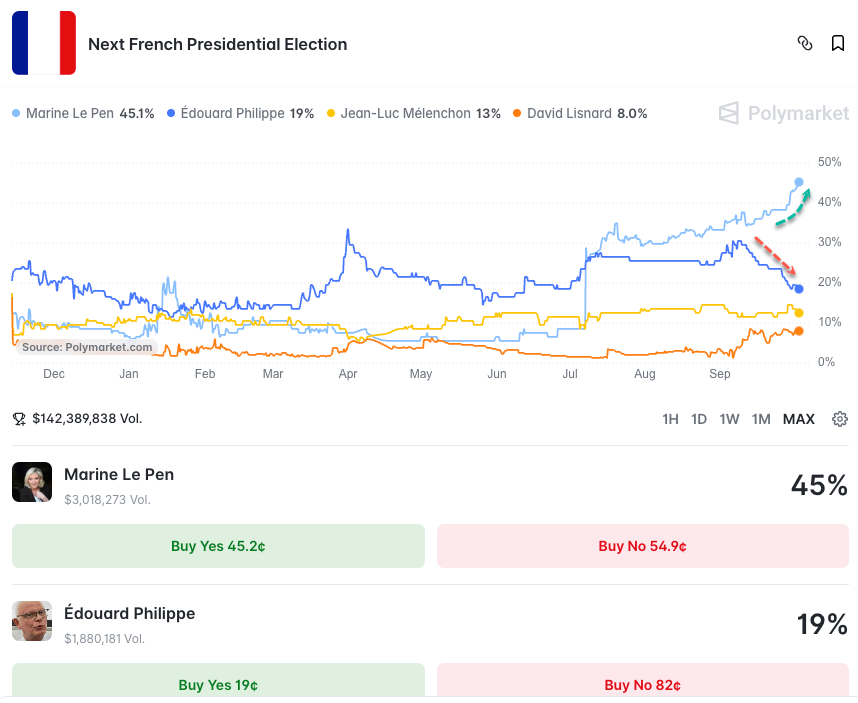
At least 65 school employees, including 40 principals, and roughly 170 students have been injured since the unrest began, Euronews reported Friday. Education Minister Édouard Geffray said at least 100 high schools had suffered severe damage.
The unrest began over overcrowded classrooms, teacher shortages, long school days, and deteriorating facilities. The government’s proposed 2027 budget only offers a 1.7% increase in education spending, bringing the total to 65.53 billion euros.
French intelligence agencies told a government crisis meeting Thursday that radical politicians from the far-left France Unbowed party, known as LFI, had sparked the riots.
According to local outlet Le Monde, Geffray told reporters that far-left groups had taken control of the movement.
The broader security concern is that far-left groups exploit legitimate grievances, recruit younger and younger participants, and transform localized protests into opportunities to riot. The far-left-fueled riots that accompanied US protests in 2020 offer a cautionary tale about how these groups hijack movements, and Western governments are only now coming to their senses about this problem.
For Le Pen, these riots seem like a gift, as her Polymarket odds of winning next April’s election have surged.
END
FRANCE
France’s 200bp Nightmare Is No Longer Unthinkable/AI
The OAT-Bund spread (French 10-year government bond yield minus German Bund yield) has widened sharply, and analysts now view a move to 200 basis points (2%) as a plausible next target if France fails to deliver a credible fiscal response.
@themarketear
This is the core of recent market commentary (notably from TS Lombard, relayed via ZeroHedge/The Market Ear on 5 October 2026). After a violent widening, the spread retreated toward ~140 bp but had spiked as high as ~158–160 bp (near 15-year highs last seen around the 2011–12 eurozone debt crisis). French 10-year yields approached or briefly touched ~5%, while Bunds were in the mid-3% area. France’s yields have at times exceeded Italy’s—an inversion that was almost unthinkable a few years ago.
morningstar.com
Context and drivers
- Historically, the OAT-Bund spread traded in a tight 20–50 bp range for long periods, reflecting France’s core-euro status. It pushed past 100 bp in mid-September 2026 for the first time since 2012 and accelerated further on budget concerns. reuters.com
- The immediate trigger is France’s fiscal trajectory and political gridlock. The government (under Prime Minister Sébastien Lecornu) presented a 2027 budget aiming for ~€54 billion in consolidation to bring the deficit toward 5% of GDP (from a projected 5.4% this year). Markets viewed this as insufficient to stabilize debt (projected near 122% of GDP), especially given a fragmented parliament and limited political will for deeper reforms. Interest costs are rising rapidly and already form a major budget item. observador.pt
- Broader backdrop includes rating-agency actions (downgrades to A+ territory by major agencies), high issuance needs, and uncertainty ahead of the 2027 presidential election.
Why 200 bp mattersTS Lombard argues that around 150 bp markets begin pricing in a greater chance of a policy response (making aggressive short positions riskier after the recent parabolic move). Without a credible French response, however, 200 bp becomes a realistic target. At that level the pain intensifies—higher borrowing costs feed back into the deficit, bank and insurance balance sheets feel pressure, and euro-area fragmentation risks rise. For comparison, Italian BTP-Bund spreads exceeded 300 bp during the 2018 political crisis; 200 bp for France would be extreme but no longer “unthinkable.” Analysts note the trade has become harder (policy response risk increases at these levels), but the underlying fiscal and political problems have not disappeared. ECB tools exist to counter disorderly widening, yet they are typically conditional on credible national fiscal paths, and markets currently see limited near-term political capacity in Paris for the scale of adjustment required.In short, the headline captures a genuine shift: what was once a remote tail risk for France’s sovereign spread is now actively discussed as a possible next waypoint if fiscal credibility remains elusive.
END
EUROPE
“One Month Until Drawdown”: UBS Sounds Alarm On Europe’s Thin Gas Buffer As Winter Looms
Saturday, Oct 03, 2026 – 07:35 AM
UBS energy analyst Nayoung Kim warned about a growing vulnerability in Europe’s natural gas market on Thursday: with less than a month before seasonal withdrawals begin, storage levels remain well below historical norms for this time of year, leaving the continent with a smaller buffer against winter demand and supply disruptions.
Kim wrote that despite optimism this week over improved Hormuz flows (read the Goldman report), which has kept energy prices in check, top LNG exporter Qatar shipped just four cargoes in September, compared with 25 a month before June 2025 and an average of around 30. Force majeure has also been extended into November or early December for some buyers.
The final countdown to Europe’s NatGas drawdown period is underway, with EU gas storage standing at just 71.50% full as of the end of the week, well below the 15-year average of around 88% for this time of year.
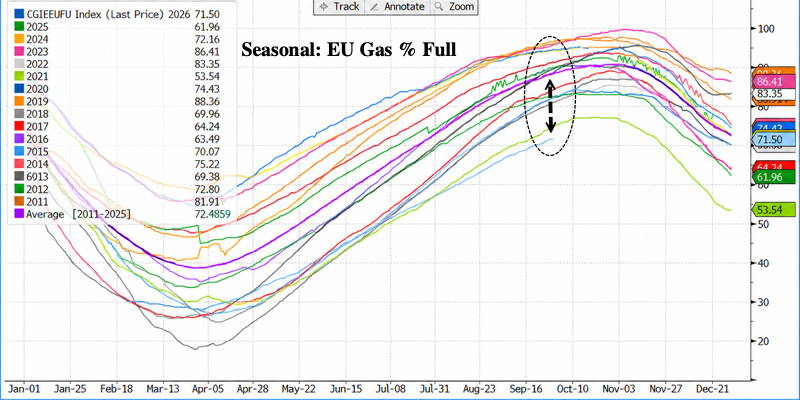
Weekly injections slowed to 1.3 billion cubic meters from 1.6 billion, with Norwegian maintenance and higher industrial demand offsetting an increase in LNG arrivals.
“We expect storage to reach 74% by winter, below last year’s 84% and the five-year average of 90%, before falling to around 25% by the end of winter,” Kim wrote in the note.
Meanwhile, Asian buyers are stepping up purchases. Weekly LNG inflows into Asia rose 12%, led by Northeast Asia, while combined arrivals into Japan and South Korea jumped 33% from the previous week.
Europe will have to pay up to keep cargoes coming before the Northern Hemisphere winter arrives. Asia’s JKM benchmark is trading at a premium of more than $1.50 per million British thermal units to Europe’s TTF, potentially forcing European buyers to raise bids for spot supplies, according to the analyst.
For Europe, the reality is clear: its benchmark Dutch TTF natural gas price will have to stay elevated through the winter, and buffers will remain unusually thin.
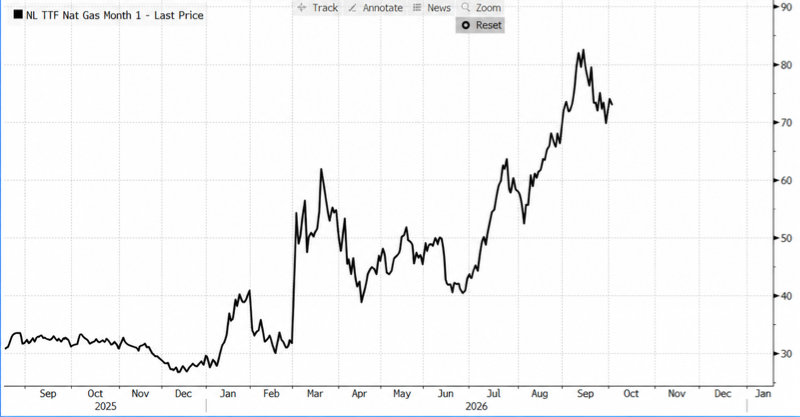
All it will take is one cold shot, renewed disruption to Gulf shipments, or sustained Asian buying for the Europeans to panic.
Beyond low NatGas supplies, Europe is also facing a fuel crisis, as the Trump administration has asked France and Germany to begin releasing emergency diesel supplies.
END
FRANCE/SPAIN/MONDAY
France Is Cracking, The Euro Is Imploding… And Now Dirty Sanchez Joins The Mess

Extremely oversold euro. Exploding French stress. FX vol waking up. 25-year tightening extreme. And now… Dirty Sanchez.
A1
This tracks real market moves on October 5, 2026: the euro is under heavy pressure from French fiscal/political stress, FX volatility is picking up, and Spain’s Pedro Sánchez (widely nicknamed “Dirty Sanchez” in some circles, including by Elon Musk) just added political uncertainty by calling a snap election.
zerohedge.com
What’s happening
- Euro weakness: EUR/USD hit a 17-month low near $1.1161 (weakest since May 2025) after four straight weekly losses. It’s being described as extremely oversold on technical measures (RSI in deep oversold territory, extreme short positioning, Z-scores well beyond typical extremes). Previous similar technical setups have sometimes led to further downside rather than immediate rebounds. reuters.com
- French stress exploding: The France-Germany 10-year yield spread has blown out to ~140–150 bps (largest weekly jump in 17 years, levels not seen since the eurozone debt-crisis era). French 10-year yields have pushed toward multi-decade highs (~4.9%). France’s debt-to-GDP is elevated (~117–119%), deficits remain large (~5%+ of GDP), political gridlock is intense ahead of the 2027 presidential cycle, and budget credibility is low. Markets are treating France as the eurozone’s current “sick man,” raising contagion fears. euronews.com
- FX vol waking up: Options markets show rising demand for downside euro protection. EUR/CHF and other crosses have reacted, consistent with investors hedging eurozone sovereign risk.
- “Dirty Sanchez” joins the mess: Spanish Prime Minister Pedro Sánchez called a snap general election for November 29 after parliament rejected his government’s housing decrees amid protests over rents and affordability. His minority government has been fragile (corruption cases, migration issues in Ceuta, lost support from key partners). Polls favor the center-right PP, likely needing far-right Vox support. Spain’s yields have been more stable than France’s so far, but the political shock adds another layer of eurozone uncertainty. bbc.co.uk
ZeroHedge’s piece (from The Market Ear) frames the long-term EURUSD chart as having reversed at a major negative trendline, with a 21-week MA crossing below the 50-week historically preceding further euro weakness. The “25-year tightening extreme” likely refers to the scale of recent yield/spread moves or related positioning extremes.Context and caveatsFrance is a much larger economy and bond market than the peripheral countries that drove the 2010–12 crisis, so any serious French funding stress would be systemic. Spain’s election adds political noise but its fiscal metrics have generally looked better than France’s recently. The euro’s weakness is also amplified by a firm USD (safe-haven flows + higher US yields). Oversold conditions can persist if the fundamental drivers (French budget credibility, political risk) do not improve.In short, the headline is hyperbolic ZeroHedge-style language for a genuine combination of French sovereign stress, euro technical oversold readings, rising FX volatility, and fresh Spanish political risk. Markets are pricing higher eurozone fragmentation risk right now.
END
FRANCE/MONDAY
As French Riots Escalate, ‘Wild Horde’ Beats Police Commander Unconscious, Stomps His Head
Monday, Oct 05, 2026 – 05:00 AM
Authored by Steve Watson via Modernity.news,
A French police commander in his sixties was chased, knocked down and kicked in the head until he blacked out outside a Belfort high school on Friday morning. Prosecutors have opened an investigation for attempted murder of a public official.

The officer is the local chief of territorial intelligence. He was in plain clothes, trying to arrest a youth suspected of starting a fire.
This is not a scuffle on the edge of a school complaint. It is the second mob hunt of a lone officer in two days, filmed, shared, and dressed up by parts of the press as a student protest about classrooms.
Posting several clips in the event some are removed by X:
The attack happened at about 9:15 a.m. on Friday, October 2, on the grass near Lycée Gustave-Courbet. Belfort prosecutor Paul-Édouard Lallois said the commander “was set upon by a wild horde of young people who knocked him to the ground and beat him with punches and kicks, particularly to the head.” Most of the attackers had hoods up or faces covered. Reinforcements scattered them. The officer had already lost consciousness.
Lallois called it “a scene of unheard-of violence” and said “we came within two fingers of a tragedy.” Interior Minister Laurent Nuñez wrote that the images were of “a rare violence” and “unbearable,” that the officer had been “deliberately targeted,” and that “everything will be done to identify the authors of this abject act.”
Nuñez added that the commander was hospitalized after losing consciousness, and that his condition “fortunately no longer inspires major concern.” On Saturday, police sources told France Télévisions the first exams were reassuring and the injuries were superficial trauma.
He was treated at Trévenans hospital with bruises and open wounds to the face, and Lallois said he was “particularly shocked, marked by the savagery of the assault,” with “very visible marks of blows on his face.”
The Alliance police union posted the footage with a blunt line: a cop “hunted like prey, caught, thrown to the ground and struck in the face several times, several against one.” The union’s verdict: “This is no longer anti-cop hatred. IT IS A HUNT FOR COPS.“
The commander heads the departmental territorial intelligence service for the Territoire de Belfort. He was not standing in a cordon. He had just tried to arrest a youth suspected of starting a fire on the grass around the school and of throwing a projectile at officers. The prefecture said that youth was carrying a bag containing hydrochloric acid and protective equipment. The youth got away when the pack closed in.
A separate clip of the arrest, shot in a stream beside the school, was then waved around as proof the officer had tried to drown a teenager. Lallois shut that down on Saturday. “It is the individual who deliberately goes into the water” while trying to escape, he said. Both of them fell. “The youth cannot be immersed in the water, there is not enough water to be immersed.” The commander was on his knees in the stream. The suspect was then cuffed on the bank.
That same suspect is now one of the people investigators want. Lallois said several people have been identified as likely principal authors, and that he was “fairly optimistic” they could be arrested within 24 hours. The youth the commander had handcuffed is “clearly identified as coming to deliver two violent kicks to the head of the police officer,” recognizable on the video by the cuff still on his wrist.
Friday’s beating landed on top of Thursday’s hunt in Paris. A trainee lieutenant with the Paris police prefecture was chased on foot near Avenue Gambetta, in the 20th arrondissement, during a lycée gathering. Voices on the recording call her a “bitch” and scream “Kill her.”
Someone trips her. Others kick her on the ground, including to the head. She filed a complaint. Nuñez called the attack intolerable and said a young trainee lieutenant “was pursued, thrown to the ground and assaulted by several individuals.”
Marine Le Pen wrote: “The image of this young policewoman, pursued by a pack howling its hatred, thrown to the ground and assaulted, is unbearable. These acts deserve exemplary sentences. Let her know that tonight, millions of French people offer her warm support.”

“Kill Her!” — Feral Mob Hunts French Cop; Le Pen Calls It “Unbearable”
France’s interior minister said the perpetrators would be found and prosecuted
The official story is still that this is a pupil movement about absent teachers, overcrowded rooms and late buses. Education Minister Édouard Geffray said the movement had been “taken hostage by ultra-violent small groups.”
On Thursday alone the Interior Ministry counted 1,949 arrests and 305 injured officers. Geffray said 235 people in the education sector had been hurt, including 65 school staff. About 400 schools were closed on Friday. Nuñez sent the BRAV-M motorcycle units into Paris and said that when police use force on his orders, “they are not facing demonstrators but rioters.”
Footage shows burning classrooms, buses and fire engines set alight, shops looted, and packs going after female officers. The media is adamant that this is not about race or demographics, while those on the receiving end in virtually every single instance are white native French people.
French politician Éric Zemmour urged “This has nothing to do with bad school conditions. Plain and simple. These are ethnic riots and demographics is destiny. Without remigration, this is the fate of all Western European nations.”
END
EUROPE/DIESEL/USA
KOLBE..
Trump’s Diesel Threat Worked: G7 Dumps 100 Million Barrels As Europe’s Energy Dependence Laid Bare
Monday, Oct 05, 2026 – 03:30 AM
Submitted by Thomas Kolbe
In the end, Donald Trump’s threat to prohibit diesel exports apparently proved credible after all.
Faced with rapidly rising prices at the pump and an emerging acute shortage of middle distillates, from diesel and heating oil to aviation kerosene, the G7 heads of government decided on Friday, under pressure from the US president, to release their own oil reserves.
For the EU, the perfect storm is brewing: a rising dollar price, the visible control of the Strait of Hormuz by the US military, as well as rising interest rates in the bond markets amid the threat of a sovereign debt crisis, have made the pressure particularly tangible for the EU states: further rising energy prices will hit the fragile eurozone industrial economy considerably harder than the essentially energy-autonomous United States.
The problems of the EU Europeans are homegrown and not the result of American special interests: completely overstretched welfare states, a self-inflicted migration crisis that can no longer simply be wished away, an economy in an atmosphere of departure – though not at home, but fleeing EU regulation, excessive energy costs and the political raid of the Green Deal. They have laid a fuse to the fragile structure of the EU, lit it and are no longer willing to recognize that this powder keg could explode at any moment.
One miscalculation is piling on top of another. In Brussels, Berlin and Paris, they had counted on the Americans shouldering the lion’s share of forcing a regime change in Moscow – cheap access to the country’s energy and resources, possibly bargaining and pricing power, have by now become indispensable to keeping the EU’s economic model alive. Energy costs have to come down, as quickly as possible. From Washington to Brussels, from Moscow to Beijing, they all understand the EU Europeans’ strategic hopelessness. In the case of Russia, instead of a triumph, the result has recently been the destruction of Russian refinery capacity, ironically by partner Ukraine – the next setback in view of the EU’s energy problems.
So now comes the first step toward alleviating the energy price crisis, merely a fight against symptoms that will solve none of the EU’s structural problems.
French President Emmanuel Macron explained the strategy, which essentially consists of three steps:
- First, 100 million barrels will be released from strategic reserves in a coordinated manner over a period of four months. A substantial quantity of diesel is supposed to reach the market within the first 20 days.
- Second, the maintenance schedules of the refineries in the participating states are to be better coordinated. The aim is to prevent several facilities from being shut down at the same time – the throughput is above all intended to help reduce the diesel shortage. Where possible, refineries are to temporarily increase their utilization rates. Obviously, this does not resolve the contradiction of how, in the face of destructive climate policy, new refinery capacity could possibly be conjured up in Europe. These projects take long periods of time and, given CO2 certificates and climate regulation, are simply no longer profitable. In the CO2 frenzy, more than 20 percent of refinery capacity had already been destroyed in recent years. This madness is now coming back to haunt them.
- As a third measure, the G7 states committed themselves not to impose any export restrictions on energy and petroleum products among themselves. This is precisely where the geopolitical background to the release of these reserves becomes apparent: the conflict between Washington and the EU had recently shifted from trade policy issues to the energy market and has now reached a temporary climax with the release of the reserves.
In addition to the measures mentioned above, the International Energy Agency is to monitor their implementation and propose a further package of measures within 20 days.
All in all, the action was an act of desperation that is likely to lose its effect in the markets after a few weeks.
These weeks are exposing the economic-policy sins of a policy that was, on the one hand, driven by the understandable desire to achieve an energy-autonomous situation – Europe still obtains around 60 percent of its energy requirements from abroad. Added to the desire for autonomy were eco-socialist forces that saw their opportunity in the fight against fossil fuels not only to eliminate parts of refinery capacity and fossil energy production, but also to establish their own political center of power with the help of climate policy.
With overregulation, a CO2 extraction economy and a green patronage economy designed to enrich political friends, greater damage is being left behind than anyone is currently willing to admit.
Ultimately, it was trillions spent on the green transformation, on von der Leyen’s Green Deal, that were simply burned and produced no positive effect whatsoever.
A few have made themselves rich, while what remains are industrial wastelands and a slowly rotting continent in unchecked decline.
What awaits the EU Europeans who are still dreaming green is a brutally hard emptiness, delivered straight to their door by reality: The global economy still operates to 87 percent on the rails of fossil fuels and the resurgent power of nuclear energy. Everything else is propaganda.
* * *
About the author: Thomas Kolbe, a German graduate economist, has worked for over 25 years, he has worked as a journalist and media producer for clients from various industries and business associations. As a publicist, he focuses on economic processes and observes geopolitical events from the perspective of the capital markets. His publications follow a philosophy that focuses on the individual and their right to self-determination.
END
UK
UK Taxpayers (Unknowingly) Funding Free Hijabs For Illegal Immigrants
Monday, Oct 05, 2026 – 02:00 AM
Authored by Steve Watson via Modernity.news,
The British government has been handing out thousands of hijabs to illegal migrants washing up on the shores of the country in boats, while Home Office staff have been spending time in Calais cooking meals for them.

Internal figures show 974 hijabs issued to small-boat arrivals between January and June, at a rate of 162 a month. Run that rate forward and the year’s total is already past 1,000 and heading for 1,500.
The same clothing data also proves that the vast majority of those arriving are fighting age males, with more than 10,000 male packs being provided against 2,670 for women, while children’s packs number just 773 for boys and 829 for girls.
This isn’t a deterrent, it’s an open armed welcome.
Home Office documents show the scarves are part of the dry-clothing pack issued at short-term holding sites such as Manston in Kent. A Home Office source told the Mail the department has a legal duty, under the Short-term Holding Facility Rules, to provide basic clothing, including cultural and religious items, and that migrants’ cultural and religious needs “must be catered for so far as is practicable.”
A spokesman added: “All arrivals receive a basic dry clothing pack where required. The items available form part of standard welfare arrangements.”
Shadow Home Secretary Chris Philp told the Mail: “The Government must stop handing out hijabs to illegal immigrants immediately. It’s an insult to hard-working British taxpayers that they’re funding religious items for people who have broken into our country. It should not be for us to fund someone else’s religious practices.”
He went on: “Many illegal immigrants actually hate our values. Many come here for free accommodation and a life on benefits at our expense. Illegal immigrants crossing the channel are breaking into our country. They have no legitimate reason to flee France, which is clearly safe. That’s why we must leave the European Convention on Human Rights so we can deport all illegal immigrants immediately upon arrival.”
Reform UK MP Andrew Rosindell told GB News: “I don’t know why we should be giving these people anything. They’re coming in illegally, and if they’re coming in illegally, we shouldn’t be incentivising people by making them feel like they’re getting everything given to them on a plate. You couldn’t make it up.”
GB News presenter Ben Leo put the same point in plainer language: “Don’t act surprised when Britain no longer looks like the Britain you grew up in.” His argument was that the country has to stop looking like it “comes with a welcome pack.”
Campaigning journalist David Atherton also asked the question, “what is the Home Office doing in promoting a backward practice that suppresses women?”
Nearly 20,000 people have reached Britain by dinghy this year alone. The Home Office is keen to note that is down 42 per cent on the same point in 2025, and that summer 2026 produced the fewest summer arrivals since 2020.
A spokesman said: “We have made progress tackling the small boats. Crossings are down significantly.” GB News reported that Sunday morning alone had already put more than 200 arrivals into Dover, with close to 500 since Friday, and a further dinghy heading north from a beach near Cherbourg, part of a westward shift in launch points away from Dunkirk and Calais. A bit lower than last year’s chaos is not the same thing as a border.
The hijab figures landed on the same weekend as a Telegraph investigation into who, inside the system, is spending their spare time on the French side of the water.
Around eight members of the Public and Commercial Services Union, including Home Office staff, spent two days in February at a migrant camp in Calais with Care4Calais. They cooked meals and handed out fleeces. The trip was organised by PCS, which has worked with the charity since about 2022, including joint opposition to the Rwanda plan.
Full-time union officials on the visit included general secretary Fran Heathcote and Mike Jones, group secretary for Home Office members. Among the Home Office contingent were Passport Office worker and union representative Karen Alderson, Keith Hannant and Jordan David.
Alderson said: “It’s important that we have a presence here. A lot of our members work in asylum and the way we hear it reported in the media, it’s all about numbers [but these are] people.” Hannant said: “And then you come and see [Calais], and they’re just people like you and me.” David said they talk about the asylum situation in meetings “but none of us have that real hands-on experience of what it’s like to work with refugees.”
Care4Calais’s Charlotte Khan was open about the point of the relationship: “We have people who work in the Home Office.” Jones’s remedy was not removal. It was “proper plans that can deal with the safe crossing to make sure that people can come to the country safely.”
A PCS spokesman said the visit was so representatives “working within the Home Office, including those representing PCS members working in the asylum and immigration system,” could “gain a better understanding of the realities facing refugees.” The Home Office, asked about its own staff, said only that it expected “all employees to meet the highest standards expected of them.“
The charity is not a neutral soup kitchen in this story. A separate Telegraph investigation found Care4Calais had backed asylum seekers disputing official age assessments, including a Sudanese man in his 20s placed in children’s accommodation after the charity referred him to a council. Immigration courts later rejected the claim.
Home Office figures for the year ending March show 6,255 age-dispute cases closed, with 43 per cent found to be adults despite claiming to be children. The charity’s response was that “the real scandal” was children wrongly judged to be adults, and that it is “a humanitarian charity that distributes aid to people who have fled war, torture and persecution.”
Home Office figures put small-boat arrivals since Labour took office on 4 July 2024 at 83,279.
That figure is more than the regular British Army of about 83,000. Since records began in December 2018 the cumulative total is past 200,000, larger than the Army, Navy and RAF combined. About 90 per cent have been male. Two-thirds have been aged 18 to 39.

Boat Migrants Who Have Entered The Country Now OUTNUMBER British Soldiers
It’s an ARMY…
Meanwhile, this weekend Kent Police ran what Assistant Chief Constable Nigel Brookes called a “substantial” operation around a planned anti-migrant protest in Dover, after masked demonstrators previously blocked the port on 5 September. A face-covering ban was in force from 8am to 9pm under the Crime and Policing Act 2026. Protesters who reached the port were dispersed under a Section 14 notice. Processing of arrivals has repeatedly been linked to the cruise terminal.
Accounts on the ground went further. UK Dispatch reported that Kent Police had put signal blockers near the cruise terminal to stop people live-streaming.
A state that issues religious clothing to illegal arrivals, sends its own immigration staff to volunteer with NGOs on the beach, and polices the cameras at the terminal is not failing to stop the boats.
It is managing the intake, dressing it, and telling the public the numbers are down. France is a safe country. The dinghies are still launching from Normandy. The welcome pack is still waiting at Manston.
END
UK
Watch: UK Police Clear Streets Of Entire Town So Migrant Boat Can Offload
Monday, Oct 05, 2026 – 03:20 PM
Residents of Gosport, the Royal Navy harbor town across the water from Portsmouth, spent Sunday under police orders that let officers direct people to leave town, as a migrant boat from France made its way toward their coastline.

Hampshire and Isle of Wight Constabulary imposed a Section 34 dispersal order covering the entire town under the Anti-Social Behaviour, Crime and Policing Act 2014, running until 7am Tuesday. It lets officers order people to leave an area and not return, and refusing is a criminal offense. Police stacked several more restrictions on top:
- Protesters were confined to a single designated area inside the Walpole car park under Section 14 of the Public Order Act.
- Face coverings at protests were banned across both Gosport and Portsmouth.
- Haslar Bridge was closed.
The boat left Normandy, near Utah Beach, on Sunday morning. Late Sunday evening, two RNLI lifeboats brought 149 people ashore in Gosport, who were then put on coaches to Kent for processing, health, security and biometric checks. It was the third crossing headed for the western Channel coast in a month, a route that had been rare in recent years.
Two weeks ago, a boat carrying around 50 migrants was rerouted to Dover after locals protested.
On Sunday, around 350 demonstrators turned out anyway, according to the Portsmouth News, with reports of flares and scuffles with police. By Monday, 12 people had been arrested, for offenses including assaulting a police officer. Six people were arrested at a similar protest last month.
Footage posted overnight shows the lifeboats coming in after dark, and the police escort that then moved the coaches out of town.
Tensions on this stretch of coast have been building for weeks. On Sept. 22, Hayling Island native Daniel Thomas, an anti-migrant activist known online as “Danny Tommo” whom Breitbart describes as a Tommy Robinson ally, allegedly slashed a migrant boat in the Channel with an emergency responder on board. The 37-year-old has pleaded not guilty to criminal damage and to refusing to give police his phone PIN, and a judge at Portsmouth Crown Court denied him bail on Sept. 29. His trial is provisionally set for March 2027.
The local Conservative MP, Caroline Dinenage, wants the boats sent elsewhere. “Gosport is not a safe or suitable location to disembark small boats,” she said, arguing that any small boat intercepted in the Channel should be taken directly to Dover by water, as the Home Office did two weeks ago.

George Madgwick, who leads Reform UK on Hampshire County Council, put it more bluntly: “It’s heart-breaking because Portsmouth Harbour is the home of the Royal Navy… Britain is Broken.”
Then there is the bill. Hampshire’s Police and Crime Commissioner, Donna Jones, says every one of these landings now comes with a price tag for local taxpayers:
“On each one of the protests that are happening every time we have one of these threats of a small boat landing, it is costing me £150,000 of taxpayers’ money from my police budget, which I can ill afford to spend.”
In a video message, Jones called on the Home Secretary to make sure Border Force has vessels big enough to transfer people off the dinghies at sea and take them to Dover for processing.
On Monday, a government spokesperson said: “We have established contingency plans to make sure we can securely disembark, check and process all small boat arrivals.”
END
SPAIN/BOND CRISIS
Spain Joins The Party: Snap Election Adds Madrid To Europe’s “Red October” Bond Crisis
\
Monday, Oct 05, 2026 – 09:20 AM
For the past week, the only question that mattered in European fixed income was whether France’s fiscal meltdown would stay French. On Monday morning, Madrid volunteered an answer, or at least a new variable.
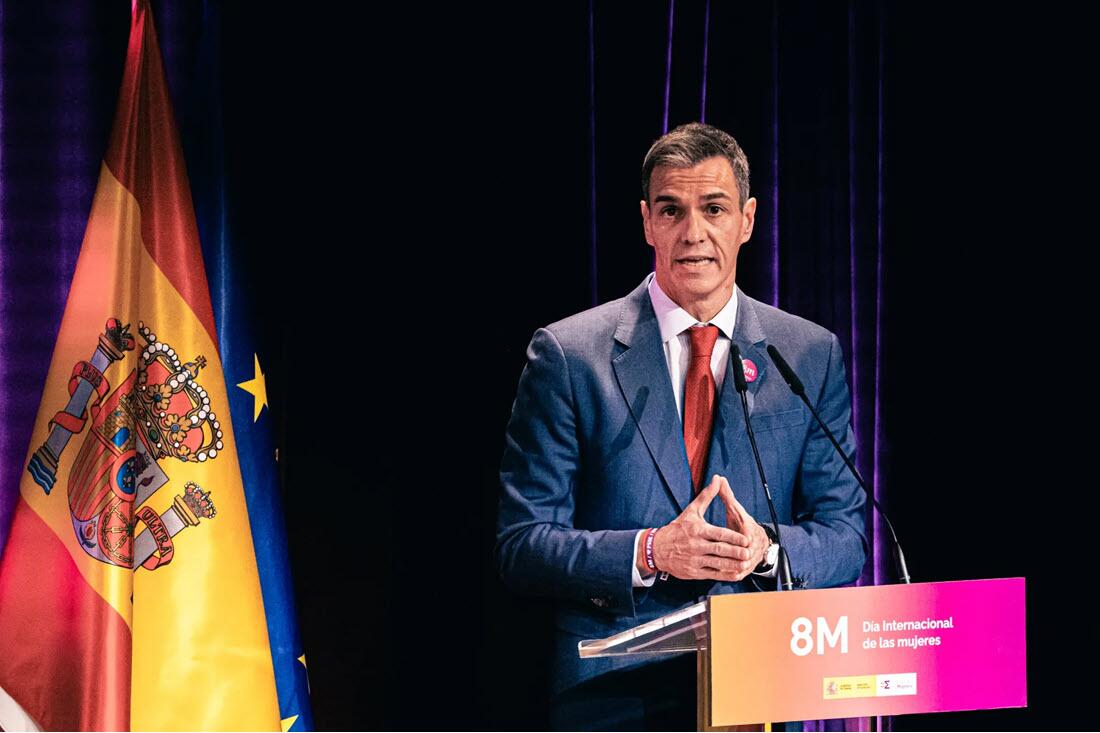
Spanish Prime Minister Pedro Sánchez called a snap general election for November 29, roughly eight months before his term was due to expire, after a fragmented parliament killed his emergency housing decrees on Friday. It’s a high-stakes gamble for a Socialist leader who trails in nearly every poll, and it lands in a eurozone where the OAT-Bund spread just touched levels last seen in the 2011 debt crisis and EURUSD is sliding to a 17-month low.
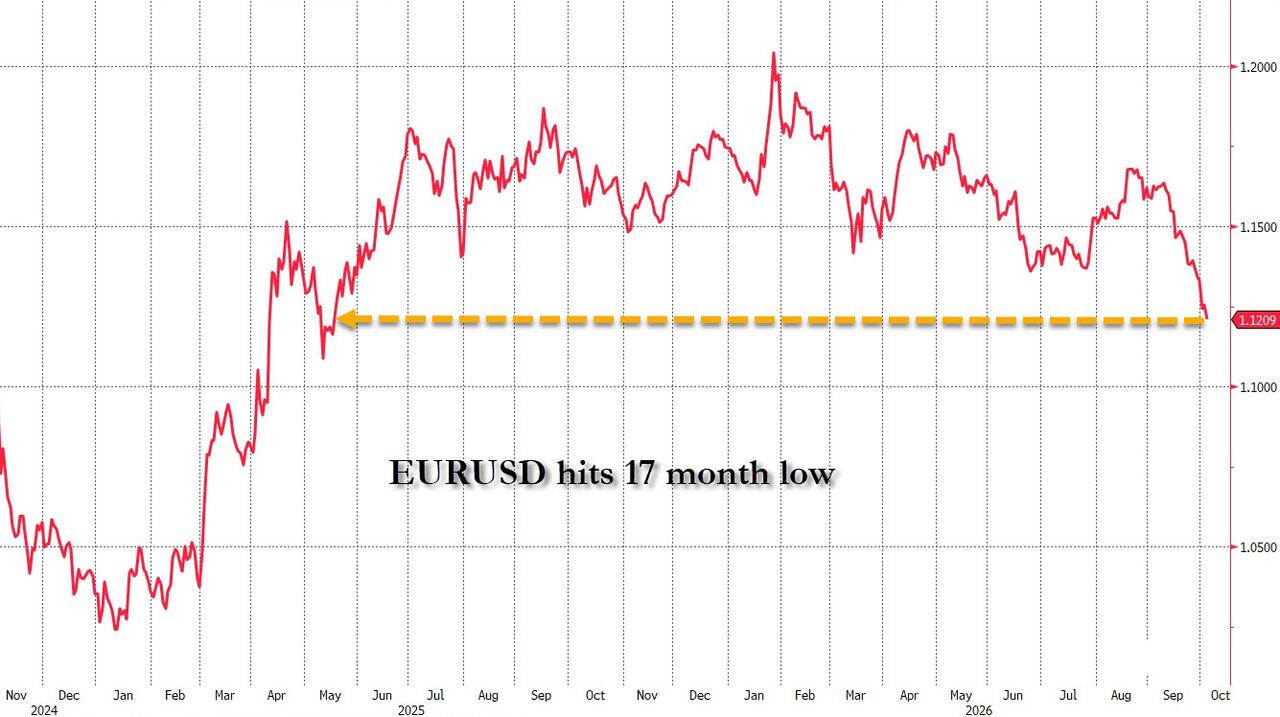
Goldman trader Rich Privorotsky summed up the Street’s first read in his morning note (available to pro subs):
“EUR getting hit. Potential Spain snap election risk is another political wobble, but France is still the bigger issue. OAT/Bund spread acceleration and fiscal anxiety is clearly bleeding into the currency. Spain itself isn’t a huge tail, but it adds to the broader sense of political instability.“
In other words, Spain isn’t the fire, it’s more dry kindling next to one.
Below we break down why Sánchez pulled the trigger, how markets (barely) reacted, and why Goldman thinks Spain is precisely the kind of country the ECB would rush to protect… as long as nobody confuses it with France.
The Gamble: Housing Fails, Sánchez Folds… Forward
The proximate cause for the Sanchez announcement was housing. As Bloomberg reports, Sánchez’s emergency package sought to freeze rents, make rental contracts indefinite, ban evictions of vulnerable tenants and regulate short-term tourist apartments. Nationwide protests boiled over after an 87-year-old disabled woman was evicted from her apartment. Then on Friday the package died in parliament, with Catalan separatists Junts, the same party that put Sánchez back in office in 2023, arguing that more intervention in the housing market would only make the problem worse.
“We need to renew people’s support,” Sánchez said in a televised address, per Reuters, while conceding he had “made mistakes” and fallen short of campaign promises. Translation: the minority government that hasn’t passed a budget since 2023 has run out of road, and would rather fight now on housing (a rare issue where the left can mobilize) than in 2027, when the migrant crisis in Ceuta and the corruption cases swirling around his party and his family return to centre stage. As Freemarket’s Lorenzo Bernaldo de Quiros told Reuters: “If he does not call elections fast, (those topics) will return to center stage.“
Regular readers are familiar with those topics, from the 500,000-person migrant amnesty (Feb 7) to the chaos in Ceuta, where roughly 80,000 undocumented migrants arrived this summer (“Spain Gasses Its Own People; Police Probe Migrant/Soros NGO Acid Buys In Ceuta”, Sep 4). And as we discussed earlier today in “Left Under Pressure”, Sánchez is hardly the only left-wing incumbent having a rough Monday.
The opposition was, to put it mildly, ready. The People’s Party posted “AT LAST” on X, and leader Alberto Núñez Feijóo said: “Finally! What’s at stake is no longer merely a change of government, but the urgent need to undertake a process of national reconstruction.” The math explains the enthusiasm: the latest 40dB poll (Sept 25-28) has the PP at 31.6%, Vox at 18.4% and Sánchez’s PSOE at 27.4%. Feijóo has signalled he could govern with Vox, which would put a far-right party in Spain’s central government for the first time since Franco.
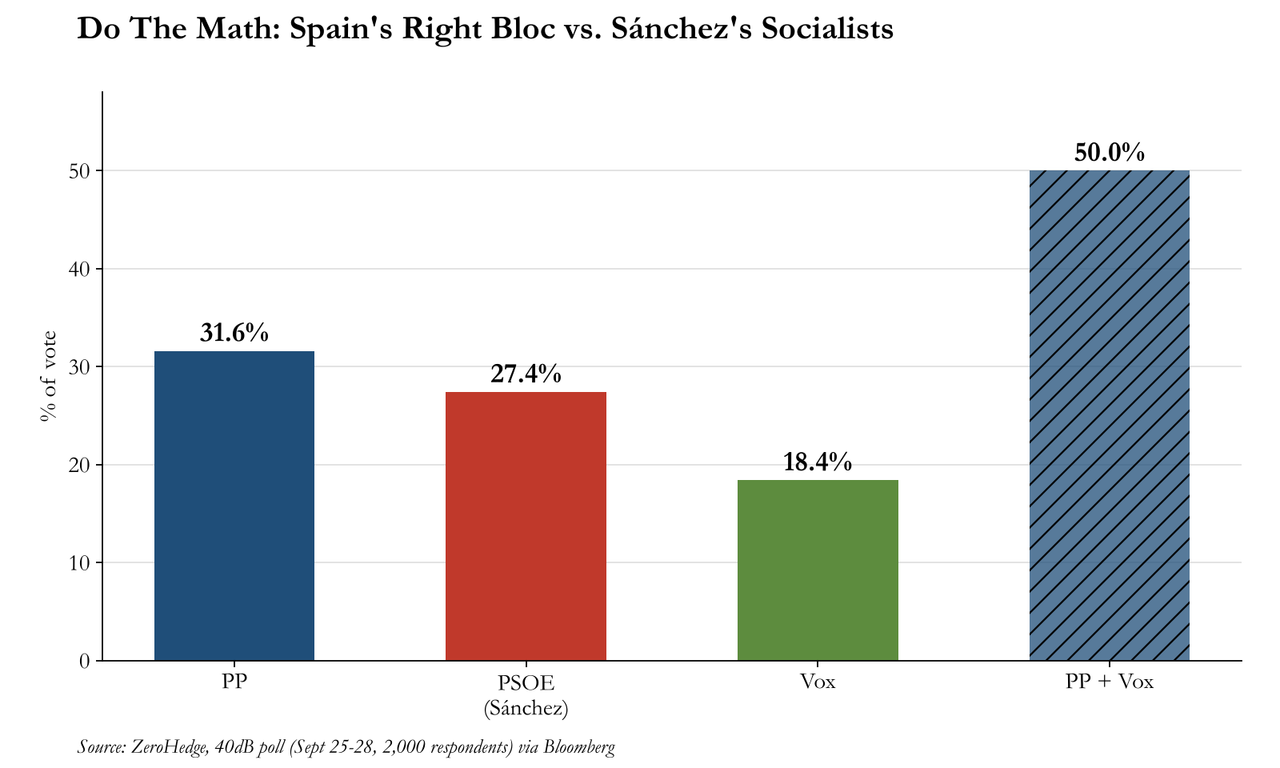
That said, Vox leader Santiago Abascal is wisely not counting chickens: “Surveys said the same thing in 2023 and Sanchez managed to form a majority with all his accomplices.” Sánchez has spent eight years assembling coalitions that weren’t supposed to exist, so we wouldn’t write the obituary just yet.
“Spain Itself Isn’t A Huge Tail”… But The Timing Is
Spanish assets, for their part, took it in stride. The IBEX was flat after the announcement, benchmark 10Y Bonos were little changed at 4.08%, and the spread over Bunds widened a modest 3bps to 65bps, per Bloomberg. JPMorgan’s Andrew Tyler even noted that among major European markets, “Spain [is] leading and France lagging” this morning, while Goldman’s Spain Domestics basket (GSXEESDO) was up 40bps.
The reason for the shrug: the Street has been pricing a change of government for months. Goldman’s EMEA execution desk wrote that “feedback on Friday was supportive on elections given PP leading in the poll,” before adding a dose of humility courtesy of Sunday’s Brazil shock: “perhaps what we have learned from Brazil is the fact that polls are not always accurate. So perhaps it creates a bit of volatility in Spain to start with.”
The problem isn’t Spain, it’s the calendar. Here is Goldman’s FX desk (Matt Atherton) on why the euro broke below 1.12:
“Speculation that Spanish government officials were preparing for an early election – now confirmed. This development follows the defeat of two emergency housing bills in Parliament last week – a core issue for their supporters. Our view is that both of these issues independently would not be a cause for concern nor trigger any real EUR depreciation, but the timing is much more the issue amid broader European stress.“
Goldman’s Jonathan Lightowler listed the full rap sheet behind EURUSD’s slide from 1.1260 to a 1.1161 low overnight: “talk of EUR selling from Asia investors selling European FI Friday; plus ongoing French fiscal focus; plus headlines around a snap election in Spain which has now been called; plus Italy’s Friday fiscal revisions.”
So four separate catalysts, and all in one direction. Diversification at its finest.
Patient Zero Is In Paris
For context on just how “broad” the broader European stress is: last week the Franco-German 10Y spread widened 32bps to 141bps, which Deutsche Bank’s Jim Reid called “the biggest weekly widening in available Bloomberg data back to 1990, the year of German reunification.” At one point on Friday it hit 160bps, “so we were on the edge of a mini panic.” Italy’s 10Y spread widened 23bps to 114bps, the biggest weekly jump since April 2020.
Regular readers saw it coming in real time. As we wrote on Thursday in “Debt Crisis Back? European Bond Markets Crash, CDS Explode Amid France Budget Panic Contagion” (Oct 1), “It’s starting to smell awful sovereigny crisisy in Europe all over again.” Or, as we put it on X that afternoon:
The key question for Spain is whether French stress stays French. Goldman’s FX strategist Mike Cahill says it rarely does, and that’s exactly when the euro starts to care. In his framework, “contagion is the trigger – idiosyncratic stress, especially in smaller member states, barely moves FX until it infects regional risk sentiment (best proxied by GDP- or market-weighted spreads…).” His second principle is the one to tape to the screen:
“Second, the beta jumps when credit is in focus: the Euro depreciates roughly 4-5% per 100bp of spread widening on average, but in practice the response is near zero most of the time and spikes only in acute stress – spreads don’t matter for the currency until they’re the only thing that matters.“
And the GDP-weighted spread is now moving. Goldman’s chart below shows the broad EGB-Bund spread, which drifted lower for most of 2025-26, finally turning higher alongside the OAT vertical:
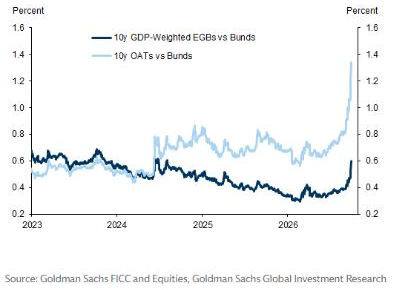
Zoom into the front end and you see the spillover more clearly: Spain’s 2Y spread to Germany, which spent August and September hugging single digits, has jumped to roughly 20bps alongside Portugal, while France and Italy lead the charge. Spain is no longer immune, it’s just less sick.
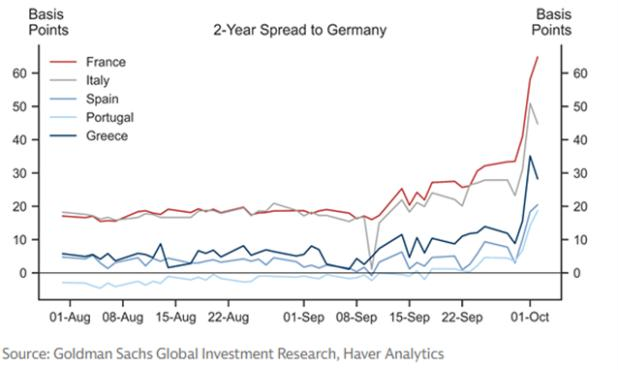
The “Innocent Bystander” Clause
Which brings us to what may be the most important line of Goldman research for Bonos holders this week. In their Sunday note, “ECB—Potential Implications of Rising Sovereign Stress” (available to pro subs), Goldman economists Sven Jari Stehn and Alexandre Stott walk through the ECB’s likely reaction function and draw an explicit line between Madrid and Paris:
“TPI activation would likely require significantly more intense and broad-based sovereign stress, especially with inflation well above target. That said, the bar for TPI purchases to protect ‘innocent bystanders’ from contagion (such as Spain) seems much lower than intervention in markets where current fiscal policies are inconsistent with the stabilisation of public debt (such as France). The TPI could possibly be used temporarily under disorderly market conditions to buy time for a policy adjustment (in a parallel to the mini-budget episode in the UK). But addressing fundamental sovereign risk requires a fiscal rather than an ECB solution.”
Put differently: if Spain gets dragged into France’s mess, the ECB’s cavalry may show up. If France keeps digging, it’s on its own. That’s a powerful distinction, and it helps explain why Spain’s 10Y spread sits at less than half of France’s.
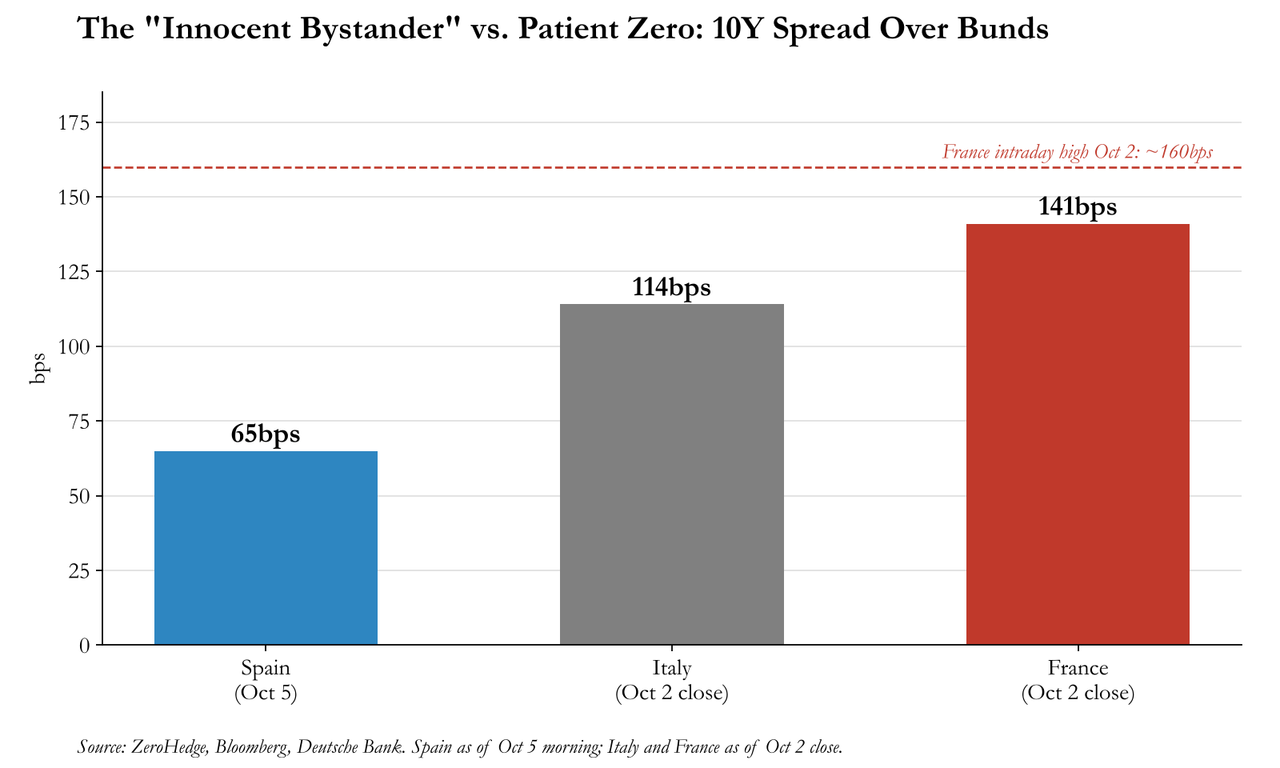
There is a catch, however. Goldman notes the euro area FCI “has tightened by nearly 40bp since the start of July, potentially substituting for one 25bp ECB rate hike,” but the bank still keeps its call for a third and final hike in December, with euro area September CPI at 3.8%. Before reaching for anti-fragmentation tools, Goldman sees the balance sheet (slowing QT) as “the more likely first lever,” calling TPI “the last resort, not the next step.” Translation: the ECB is trying to tighten financial conditions while simultaneously being asked to loosen them for half the periphery. As we tweeted on Friday:
Who Gets Hurt: Data Centers And CaixaBank
Beyond the macro, the snap vote throws a wrench into some very specific trades. Goldman’s real estate team (Jonathan Kownator, Maria Grego Llacer) flagged that Madrid had planned to approve a new data-centre Royal Decree during October, a key swing factor for Merlin Properties (MRL.MC):
“While it is too early to assess the ultimate impact on the legislation, the election introduces additional uncertainty around both timing and final content. This comes against a backdrop of rising opposition to the current proposal with the PP publicly criticising the draft decree, while recent opinion polls point to a potential PP-Vox parliamentary majority.“
Goldman nonetheless remains Buy rated with c.48% upside to its €17.9 price target, which is either conviction, or a reminder that price targets tend to be the last thing to update.
On the banks, Goldman’s EU Financials specialist Gaelle Jarrousse is going the other way, pitching a short in CaixaBank into Q3 on numbers that sit 2% below consensus NII for both Q3 and FY26, adding that “Spanish elections can create a bit of volatility even if the PP is leading the polls and seens as more business friendly.” She also flagged hedge funds as sellers of Caixa this morning, while BBVA saw one of the biggest week-over-week increases in short interest on Goldman’s stock lending desk.
And for those wondering why any of this matters for the broader European tape, Goldman’s Sharon Bell has the rule of thumb: “Each 10bp widening in the average spread of OATs and BTPs to Bunds takes 0.9% from Europe’s PE.” Spain isn’t in that formula… yet.
Bottom Line
On its own, Spain’s snap election is a mostly domestic affair. Bloomberg Economics put it bluntly: “The near-term economic impact should be limited. Spain was already mired in policy paralysis.” And Spain’s economy remains the fastest-growing among Europe’s majors, with unemployment at its lowest since the financial crisis. A PP-led government would likely be seen as more market-friendly, which is why Friday’s desk feedback was “supportive.”
But markets don’t trade countries in isolation when spreads are blowing out, and Goldman’s own framework says contagion, not fundamentals, is what moves the euro. Spain heads into seven weeks of campaigning just as France debates its budget (RN’s counter-budget lands Tuesday, plenary debates start Oct 13), Italy revises its deficit targets higher and the ECB keeps hiking into 3.8% inflation. Goldman thinks Spain qualifies for “innocent bystander” status. We agree it does today. But as anyone who has ever stood next to a sovereign debt crisis knows, bystanders tend to get hit first and rescued last, especially when the rescuer is busy fighting inflation. The far more likely path is that Bonos trade with French headlines, not Spanish polls, for the next seven weeks.
Then again, Sánchez has made a career out of surviving elections everyone said he’d lose. We’ll check back after Spain’s September PMIs (due today) and France’s budget debate kicks off on October 13.
Much more in the full Goldman “ECB—Potential Implications of Rising Sovereign Stress” note and the “Merlin Properties: Spain calls snap elections” note, both available to pro subs.
END
5.RUSSIA AND ISRAEL AND MIDDLE EASTERN AFFIARS
ISRAEL/USA VS IRAN SATURDAY
“First Time In History”: Bessent Says Iran Faces Zero Oil Revenue As Tanker Loadings Collapse
Sunday, Oct 04, 2026 – 12:30 PM
Treasury Secretary Scott Bessent joined Mike Allen for a new episode of “The Axios Show,” published Saturday morning.
Bessent spoke about the Iran war’s effect on the cost of living for US consumers and his “I am the house” comment early last month, which warned anyone betting against the Treasury’s defense of the long end of the market.
Beyond the broader global bond rout, his comments on the Strait of Hormuz added color to President Trump’s economic stranglehold on Tehran.
“They are isolating them economically like this never happened before. You know, right now, the score: barrels out of the Strait: U.S. about 1.1 billion, Iran zero,” Bessent told Allen.
Bessent continued, “For the first time in history, they, since they started pumping oil, they will have no oil on the water this week. They will have no revenue.”
Separately, last week, Goldman analysts Yulia Zhestkova Grigsby, Alexandra Paulus, and Daan Struyven told clients that a “divergence between the fall of Iranian exports and the rise of exports of other Persian Gulf producers” was underway.
The Goldman energy experts estimated that “dark exports” have helped boost Persian Gulf oil exports to 23.3 million barrels a day over the past week, back to prewar levels.
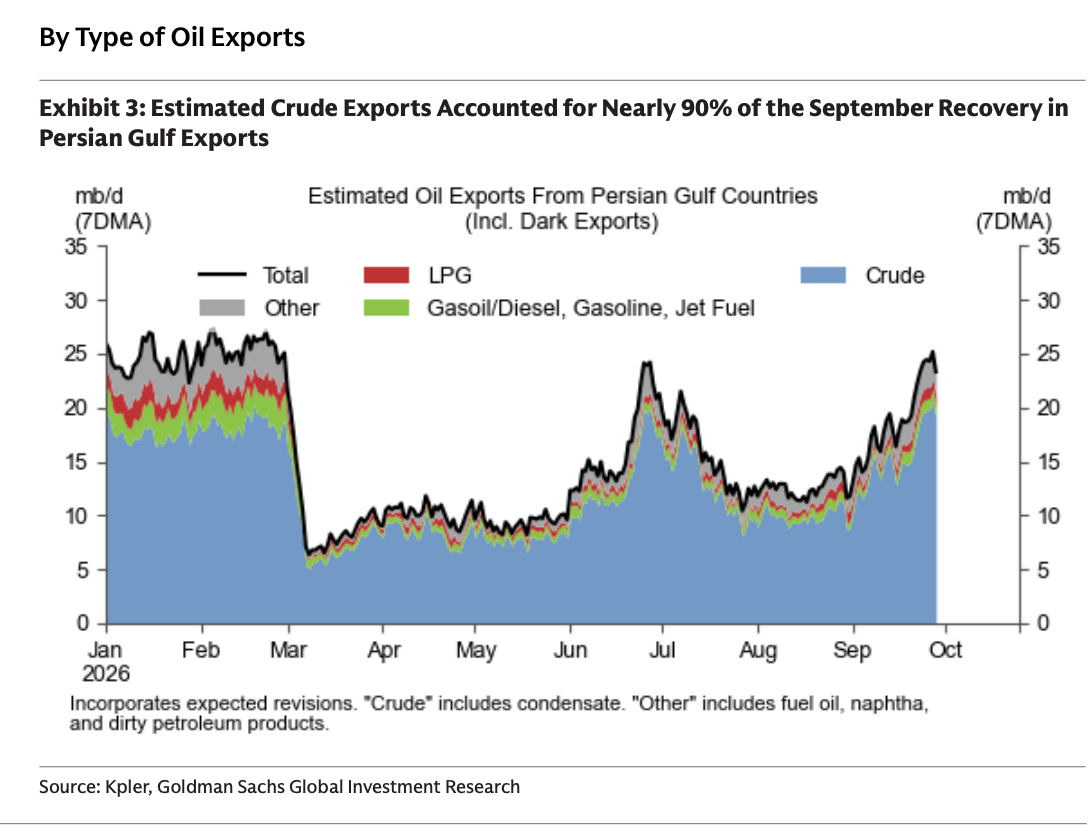
Also last week, Bloomberg News reported that Iran’s crude loadings crashed to zero in August from around 250,000 barrels per day.
Data providers Kpler and Vortexa also recorded zero crude loadings last month.
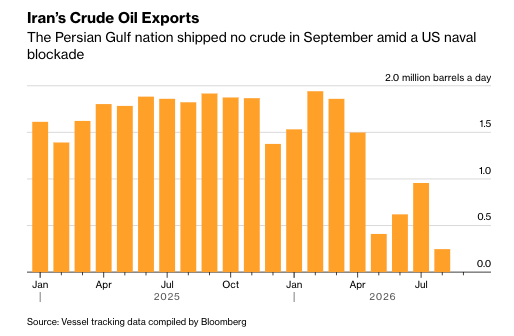
The collapse in Iranian crude loadings suggests the US naval blockade is constraining Tehran’s export options, while recovering flows from other Gulf producers point to eroded Iranian leverage over the strait. If sustained, Tehran’s oil revenues would plunge, pressuring the regime to make a deal.
end
SUNDAY
Iran “Decision Week”: Trump Teases “Easy Way Or Hard Way” As Tankers Burn, Rial Craters And Tehran’s Oil Minister Quits
Sunday, Oct 04, 2026 – 07:20 PM
Seven months into the war, the Iran story has settled into a familiar loop: Tehran sets conditions, Washington rejects them, a tanker catches fire, oil stays at $100, repeat… then a modest de-escalation before markets open on Monday morning and reversal around Friday’s closer.
This weekend, though, felt different. Nearly every piece of the puzzle moved at once, and the man at the center of it all made clear that he has a decision to make.
“We have a decision that I’ll make about Iran. Iran’s been decimated. So the only question is, it’ll either be the easy way or the hard way,” President Trump told reporters outside the White House on Saturday. Asked what was coming, he offered the kind of non-answer that tends to precede actual answers, or even more non-answers: “If I told you, you’d have a major story, right? But you’ll see.”
Here is what happened over the weekend, and what to watch in the week ahead.
The Camp David War Council
The “you’ll see” makes more sense in light of what happened on Friday. CBS News confirmed that the administration’s entire Iran brain trust met at Camp David: Vice President JD Vance, Secretary of State Marco Rubio, Defense Secretary Pete Hegseth, special envoy Steve Witkoff, CIA Director John Ratcliffe and Joint Chiefs Chairman Gen. Dan Caine. Axios first reported the unannounced session, which Vance chaired. Two items were on the agenda: the Iran war, and the Saudi-Houthi war in Yemen that is now spilling into global oil routes (more below).
The White House has not said what was decided. One person familiar with the meeting told Axios that “things were decided or at least deeply discussed,” which is a remarkably candid way of saying nothing, right about par for the course for an Axios “scoop.” For context, the last time this crowd quietly decamped to the Maryland mountains to talk Iran was in June 2025. You may recall what followed (spoiler: it involved B-2s).
Meanwhile, the military is moving into position regardless. The USS Theodore Roosevelt carrier strike group and the USS Makin Island amphibious group are heading to the Middle East with about 7,000 sailors and 2,000 Marines, due by the end of October. Bloomberg notes that this could give the US three carrier strike groups in the region, a concentration not seen since the opening phase of the Iraq war in 2003. Hegseth, for his part, called the US blockade of Iranian ports “ironclad.”
We flagged the build-up when the third carrier was first announced in “Supertanker Ablaze After Iran Attack In Hormuz As US Deploys 10K More Troops & Third Carrier To Mideast” (Oct 1). Trump himself had been dropping hints for days:
On timing, Trump told TIME last week that heavier strikes are “possible” after the Nov. 3 midterms. And according to Bloomberg, Iranian officials themselves see little chance of a deal before the vote and a “high chance of escalation” after it. So “decision week” may yet turn into “decision month” (this is still Washington, after all).
Bombers Out Of Britain
The other military headline came from England. The Pentagon confirmed on Sunday that all US bombers deployed to RAF Fairford, a dozen B-1Bs that had been used for strikes on Iran, have returned to their home stations in the United States. The move came a week after several men were arrested near the base on suspicion of preparing terrorist acts. The WSJ first reported the redeployment.
“While operational security precluded us from confirming the movement of our assets and forces in real-time, we can acknowledge now that all US bombers that were deployed to RAF Fairford have re-deployed to their home stations in the United States,” a Pentagon spokesman wrote, per Reuters.
UK Prime Minister Andy Burnham said on Wednesday that Britain has “strong indications” Iran was involved in the plot. US intelligence describes an IRGC-linked handler recruiting British citizens for a multi-stage operation, starting with a diversion near the base. Trump said the plotters had planned “big damage,” while Rubio pointed to the “hands of a foreign actor.” Tehran called the accusations baseless and summoned the British ambassador. Five British suspects, plus a sixth with dual British-Iranian citizenship who was arrested in London, have all since been released on bail. Some UK officials have also questioned whether the plot was as sophisticated as US accounts make it sound.
The Pentagon insists that moving the bombers does not reduce its long-range strike capability. That is probably true: B-1s can reach Iran from the continental US with aerial refueling. It just takes a lot longer, and nobody has to worry about who is loitering near the fence line. Make of that what you will.
Two More Tankers Hit, And Hormuz “Will Not Be Opened”
On the water, the attacks continued. On Sunday the UK Maritime Trade Operations agency (UKMTO) reported two more tankers struck by unknown projectiles (CNBC). One was hit inside the Strait of Hormuz and suffered engine-room damage. The other, a crude carrier roughly four nautical miles east of Oman, was hit on its port side. All crew were reported safe and no environmental damage was reported. By SBS’s count, that makes at least four incidents in October alone. The first was the 2.5-million-barrel supertanker set ablaze off Oman on Thursday, which Iran’s Fars said was using an “unauthorized” route.
UKMTO’s latest weekly report counts 91 incidents of damage to vessels since February. Since July 6, 31 of 48 projectile strikes have happened along the southern Omani route, the US-facilitated corridor that much of the recovering Gulf traffic now uses.
Hours before the latest strikes, Iran restated its terms. Per Reuters, parliament speaker and chief negotiator Mohammad Baqer Qalibaf said:
“The position of the Islamic Republic of Iran is completely clear and firm, and the Strait of Hormuz will not be opened until our seven conditions, based on the Islamabad Memorandum of Understanding, are met… [Washington] must understand that the period of dragging out the (diplomatic) process and dictating one-sided demands is over.” (emphasis ours)
For anyone who has lost track, these are the seven conditions Tehran presented in September: (1) lift the maritime blockade; (2) restore Iran’s frozen assets; (3) lift sanctions on Iranian oil exports; (4) halt all US actions “under the pretext of threats and military operations”; (5) end the war on Iran and its regional allies; (6) withdraw US forces from areas around Iran’s borders; and (7) pay compensation for war damage and commit not to interfere with Iran’s nuclear and missile capabilities. Translation: everything, plus reparations. So it is perhaps not a shock that Trump “promptly rejected” the seven-day reopening plan built on these terms.
Foreign Ministry spokesman Esmaeil Baghaei said that the US counter-proposal, relayed via Qatar, is “more or less in line with their previous positions, specifically on the nuclear issue.” He added that Tehran’s focus “in this stage is the issue of the Strait of Hormuz,” and denied that Iran had offered UN inspections in exchange for sanctions relief. One official briefed on the talks told Reuters that the dispute is about the sequencing of steps, not their content. Meanwhile, FM Abbas Araqchi warned that if the US “again move[s] towards military solutions, we are more prepared than before.”
“Iran Zero”: The Blockade Bites
The irony is that the strait Iran is “keeping shut” is increasingly open to everyone except Iran. As we laid out in “Gulf Exports Roar Back To Pre-War Levels, Goldman Says” (Sep 30), Goldman’s commodity strategists estimate that Persian Gulf oil exports, including “dark exports,” have effectively recovered to their 2025 average. Saudi Arabia led the rebound… while Iran fell below 20% of its 2025 level.
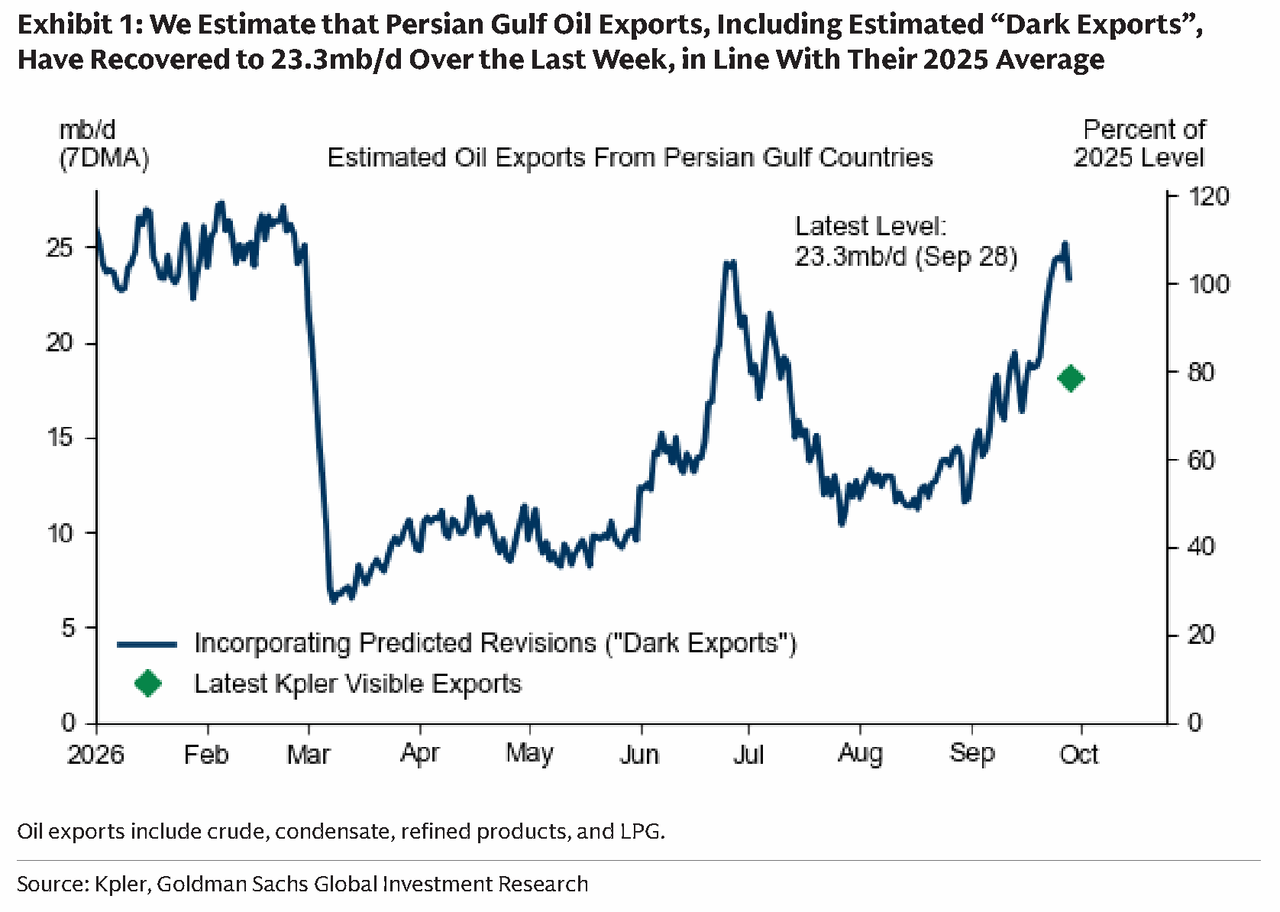
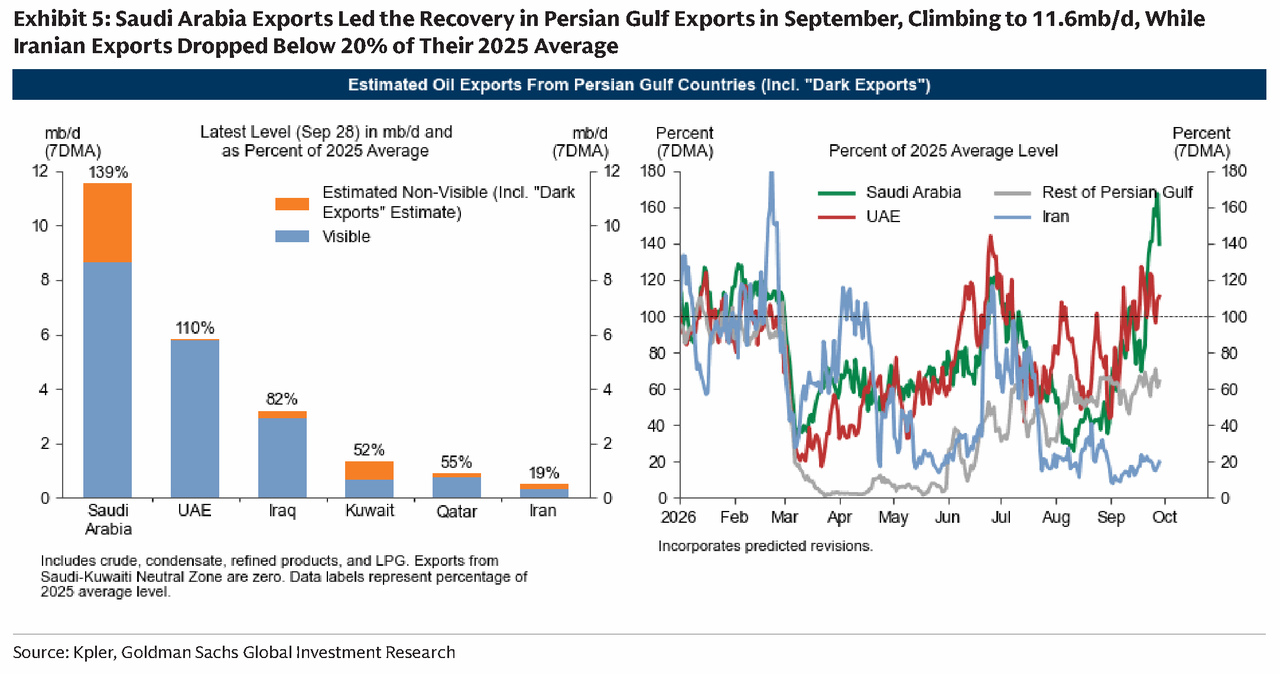
In this weekend’s update for clients (available here for pro subs), Struyven, co-head of Goldman’s global commodities research, put the latest number at 23.6mb/d, about 4mb/d of which is estimated dark exports. He added that “the data show no seaborne crude exports from Iran in September.” JPMorgan, cited by Bloomberg, estimates Middle East crude shipments are back to 17.5mb/d, or 98% of pre-war levels. According to Bloomberg tanker tracking, Saudi crude exports jumped from 3.4mb/d in August to roughly 6.1mb/d in September.
Treasury Secretary Scott Bessent kept score in our earlier post “First Time In History”: Bessent Says Iran Faces Zero Oil Revenue As Tanker Loadings Collapse: “barrels out of the Strait: U.S. about 1.1 billion, Iran zero… For the first time in history… they will have no oil on the water this week. They will have no revenue.“
Which brings us to the man whose job was to produce that revenue.
The Oil Minister Who Had No Oil To Sell
Iran’s oil minister Mohsen Paknejad resigned on Sunday. State media said the reasons were “personal.” Hamid Bovard, chief executive of the National Iranian Oil Company, takes over as acting minister.
Mehdi Tabatabaei, communications deputy in the president’s office, told state TV that Paknejad had resigned “a long time ago” and that President Pezeshkian accepted it at Paknejad’s insistence. The timing is still remarkable. Just hours before the news broke, Paknejad was quoted by state media insisting that “revenues of the oil that we have sold are still coming and that will continue, God willing.” When an oil minister leans on divine intervention for cash flow, the cash flow is probably not great.
The Rial: 2.7 Million And Counting
The clearest scorecard of the economic war is Iran’s currency. On the open market the rial has fallen to a record low of about 2.7 million per dollar, and the euro topped 3 million rials for the first time (per Iran International). That is despite a central bank plan to inject $2 billion of banknotes, with the first $1 billion sold through banks at up to $10,000 per ID holder. Official year-over-year inflation has hit a record 89.8% (in reality it is much higher), and at the current rate the monthly minimum wage of 166 million rials works out to roughly $66.
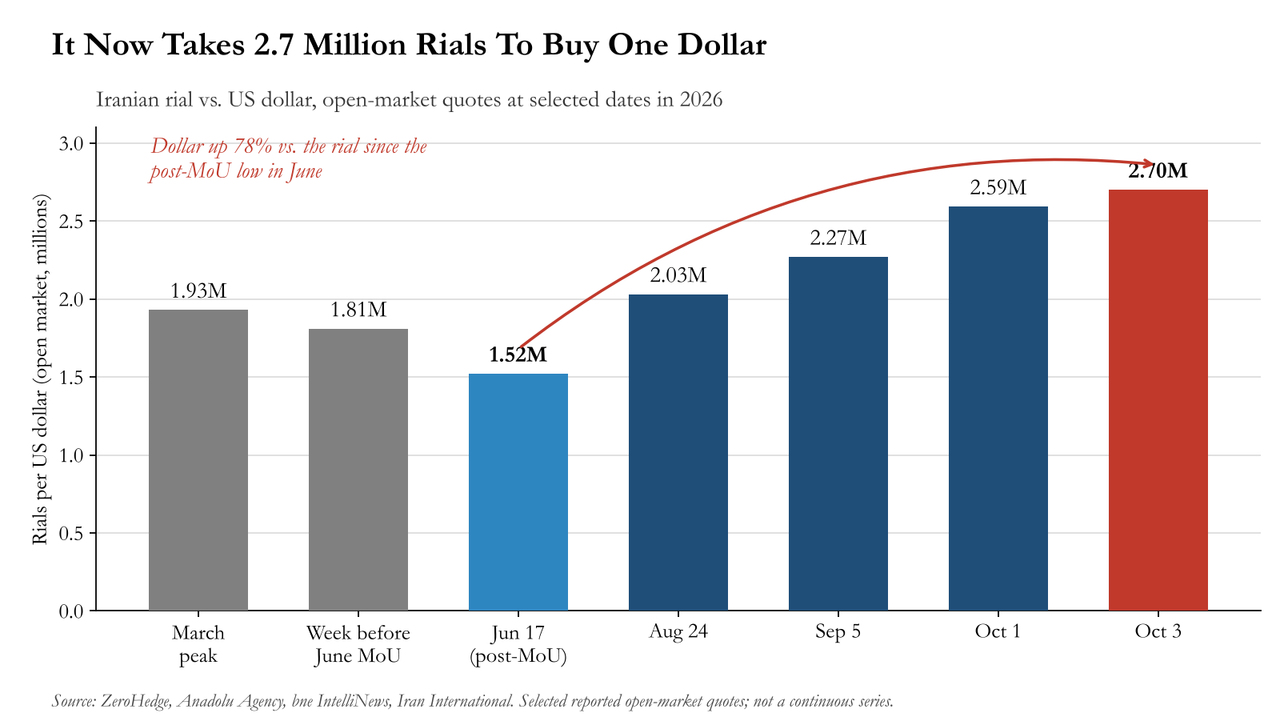
Bloomberg calculates that the rial has lost about 25% against the dollar in the past two months alone. Readers who were with us for “Iran’s Deadline Expires Today”: Tehran Threatens Renewed Attacks As Blockade Bites, Rial Collapses will recognize that the slide is accelerating rather than leveling off. Bessent calls the collapse proof that the sanctions campaign is working. Economy Minister Ali Madanizadeh says “predictions of collapse repeatedly proved wrong” and blames “psychological pressure.” Both may well be true, which is what makes Tehran’s next move so hard to call.
Kuwait University’s Bader Al-Saif put the dilemma well to Bloomberg: “Everyone has a breaking point, and Iran is no exception… The irony is that such pressure can yield opposing responses: concessions or a preemptive strike.”
Meanwhile In Yemen: Oil Advances As Traders Track Saudi-Backed Offensive
As if one war weren’t enough, a second front reopened on Sunday. Yemen’s Saudi-backed government launched a major offensive to recapture all Houthi-held territory. Presidential Leadership Council head Rashad al-Alimi vowed to fight “until the country is liberated from the grip of the terrorist militia.” According to Reuters, the Saudis are leading the air campaign while Yemeni forces fight on the ground, and the US is already providing intelligence.
The stakes are about oil as much as territory. Last month’s Houthi offensive captured the Bab el-Mandeb strait and some 150km of Red Sea coast, the very bypass route Riyadh has been using to get crude out without getting blasting for shipping through Hormuz. On Sunday the Houthis responded by claiming missile and drone strikes on Saudi Aramco sites in Riyadh and Khurais, saying they caused major fires. Saudi Arabia has not confirmed the claims. We covered the opening shot in “In The Name Of God”: Yemen Leader Orders All-Out Offensive Against Iran-Backed Houthis.
Oil noticed. Brent rose 81 cents to $103.06 in early Asian trading Monday and WTI rose to $91.57. Per Bloomberg, December Brent was already up almost 5% last week, even though OPEC+ agreed to keep November quotas unchanged and the G7 announced a release of up to 100 million barrels of emergency oil and diesel. The world’s largest crude exporter is now fighting a ground war on its southern border while its Gulf coast exports run through a strait it doesn’t control. That is not a recipe for cheaper oil.
Regular readers know we have argued since March that the Hormuz bypasses (Fujairah, Yanbu and the Saudi East-West pipeline) would become the war’s main battleground. The Houthi push on Bab el-Mandeb is the darker version of that call: Iran’s proxies don’t need to close Hormuz if they can close the exit. Abu Dhabi is reading from the same playbook (See “Zero Hormuz”: Abu Dhabi Crown Prince Readies Tens Of Billions To Turn Fujairah Into Hormuz Bypass).
Why Is Oil Still $100? Goldman Explains
That is the question Goldman’s commodity desk says it keeps getting. Gulf exports are back to 2025 levels, global inventories are still above early-2025 levels (when Brent was $75), and Goldman Research sees the market roughly balanced in September. Desk strategist Thomas Evans answered in Sunday’s Weekly Commodity Thoughts (available to pro subs):
“The physical story has eased; the risk premium has not… Futures and spreads sit near local highs because the market continues to price substantial risk premium – we’d put it at roughly $20-25/bbl. That premium is justified here, because the balance delta matters: we entered this conflict with inventories on the highs and ample spare capacity; we now sit at record-low global stocks (ex-OECD commercial), with spare capacity of uncertain/at risk availability… The relevant risk is an attack taking Gulf flows back below 50% inside a few days – against a far thinner buffer. Stocks and price go non-linear once thresholds break.” (emphasis ours)
The positioning detail matters more. For the first time in this conflict, Evans says, specs are buying outright delta instead of calls: “Many macro books are structured to perform if the crisis eases but bleed badly if oil spikes toward $130 – effectively short oil in the tail.” In other words, a large chunk of the macro community is positioned for the “easy way.” It is worth keeping that in mind when a president keeps saying “or the hard way.”
Jerome Dortmans, Goldman’s global co-head of oil and products trading, was blunter on the bank’s Weekend Macro Call:
“My view remains that the ability for Iran to disrupt the flows out of the Strait is significant… And there’s a part of this that thinks they are allowing these barrels flow out, for whatever reason… But I would think it would be too complacent to think that this is going to be the regular state of the Strait… the headline that they’re bringing a third carrier group into the region and 10,000 more Marines.. is certainly not going to be something that the Iranians are going to ignore.”
On the research side, Struyven is sticking with Goldman’s base case that “Brent prices moderate to $85/bbl by year-end and to $80 in 2027.” He adds that “we still worry about renewed potential escalation that damages more energy infrastructure, which could cause significant upside to prices.” Sam Dart, his co-head, points out that the LNG recovery lags far behind oil. Hormuz LNG crossings are running at only 21% of pre-war levels, and if Gulf LNG exports stay stuck near 25% through the winter, Goldman estimates that European TTF gas would need to rise above €100/MWh.
Bloomberg’s own explainer lands in the same place. Global stockpiles of about 4.3 billion barrels are down more than 400 million barrels since March (Energy Aspects) and at a five-year low. Tanker rates top $1.2 million a day for the Persian Gulf to China run. And with bond yields at 2002 highs, traders are once again using oil as an inflation hedge. BofA’s economists summed up the mood in their Global Economic Weekly [MARKETDESK LINK] (“The fog of war”): “oil flows are normalizing in the Middle East, but Brent keeps trading above $100 per barrel… Something does not add up.“
Decision Week: Easy Way Vs. Hard Way, Priced
So what is each path worth? BofA’s commodity team, in Friday’s Oil Gusher (also available to pro subs), raised its 2H26 Brent baseline to $95 (from $83) on the view that “skirmishes seem likely to continue into yearend.” Its scenario tree maps neatly onto Trump’s binary:
- Deal / back to the MoU (“less likely”): flows of more than 10mb/d resume; Brent averages $83 in 2H26 and $75 in 2027.
- Skirmishes continue (baseline): intermittent flows of 5mb/d; Brent averages $95 in 2H26 and $80 in 2027.
- Back to intense combat (“unlikely”): Brent goes to $120 in both 2H26 and 2027.
- War hits energy assets (tail risk): Brent averages $150 in 2H26 and $150+ in 2027, with ICE gasoil at $300.
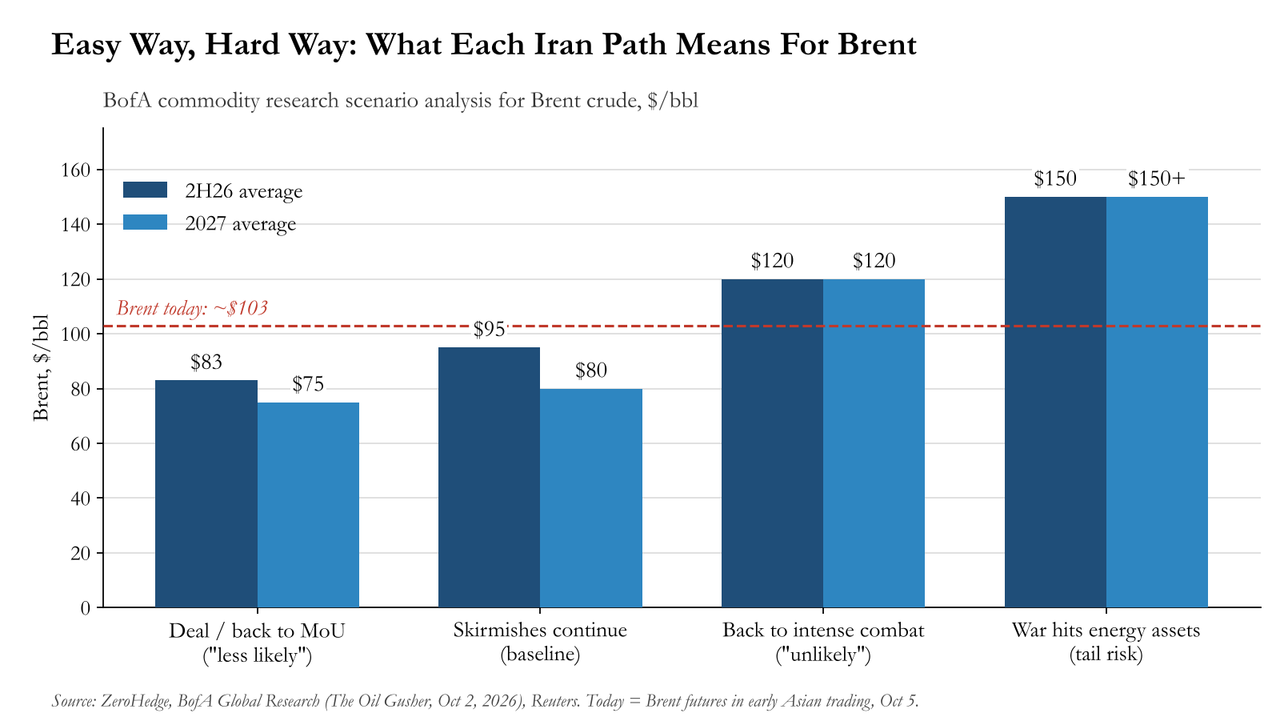
Brent at around $103 is pricing something between “skirmishes” and “combat,” which is about where the Camp David attendees appear to be. Here’s what to watch this week:
- Trump’s “decision.” The president has now said “you’ll see” at least three times in five days. The Camp David readout, or the lack of one, is the main event.
- Tehran’s reply. Baghaei says “additional points” still have to go back to Washington through Qatar. Watch for any movement on sequencing, which is the real sticking point.
- Yemen. The Houthis are advancing on the last road between Taiz and Aden. Any confirmed damage at Riyadh or Khurais, or a stalled Saudi push near Bab el-Mandeb, puts Goldman’s “below 50% inside a few days” scenario in play.
- The southern Omani route. At least four tanker strikes since Thursday. If UKMTO keeps reporting at this pace, the “dark export” recovery in Goldman’s chart above will be tested.
- Tehran’s home front. With an acting oil minister, a rial at 2.7 million and inflation near 90%, the next rial print matters as much as the next tanker report.
- Macro crosswinds. FOMC minutes (Wednesday), 10- and 30-year Treasury auctions, and China’s return from Golden Week on Thursday with October fuel exports suspended. In a market where Goldman says oil is “tracking rates far more tightly than usual,” these matter for crude too.
Bottom Line
Bloomberg’s best summary of the standoff came from the Chatham House associate fellow Aniseh Bassiri Tabrizi: “Both sides generally want an agreement, but they are moving further apart rather than closer.” Iran’s leverage over Hormuz is fading, its currency is in freefall and its oil minister just walked out the door. That is exactly what makes the “easy way” more likely, and the “hard way” more dangerous. Tehran’s hardliners, as one former US intelligence official told Bloomberg, “are betting that they can absorb more domestic pain and wait out US engagement in the region.”
Meanwhile, the oil market, which entered this war with full tanks and ample spare capacity, now has neither. Goldman’s desk puts the risk premium at $20-25/bbl, and the macro crowd is positioned for it to shrink. If Trump picks door number two, that premium will look cheap. We’ll know soon enough. After all, we’ve been told by the president, “you’ll see.”
Much more in the full Goldman Weekly Commodity Thoughts and BofA Oil Gusher notes, available to pro subs.
END
ISRAEL TBN
IRAN//SAUDI ARABIA MONDAY
Black Smoke Reported Over Critical Aramco Refinery As Saudis Weigh Major Assault On Houthi Rebels
Saturday, Oct 03, 2026 – 08:10 AM
Unverified reports and footage circulating on X early Saturday morning appear to show smoke rising from Saudi Aramco’s Riyadh refinery. The cause and any impact on operations remain unclear. Separately, Axios reports that Saudi Arabia is preparing a major offensive against Iran-backed Houthis in the coming days. President Trump’s comments last week that a bombing campaign against Tehran could resume after the midterm elections add to signs that the Gulf conflict remains far from any near-term resolution.
Turkish news outlet Türkiye Today cites NASA’s FIRMS satellite monitoring system, which shows higher-intensity VIIRS thermal hits across Aramco’s Riyadh refinery, one of Saudi Arabia’s most important refining assets, with a capacity of about 130,000 barrels a day.
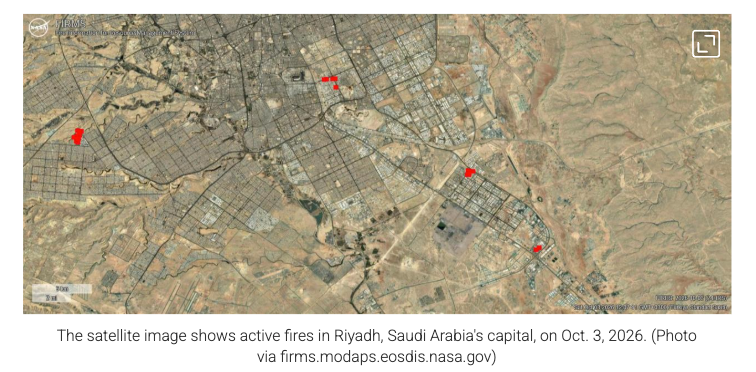
Open-source intelligence (OSINT) accounts on X are sharing footage of what may be Iran-backed Houthi attacks on the refinery. No official word yet on why thick black plumes of smoke are rising from multiple locations at the refinery.
A separate report by Axios overnight states that the Saudis are preparing for a major operation against the Houthis in the coming days, targeting coastal areas that give the rebels leverage over the critical maritime chokepoint of the Bab al-Mandeb Strait. The report cites two US officials.
More color from Axios:
Behind the scenes: A U.S. official said the Saudis have been planning the operation for weeks and that plans were approved by Saudi leadership several days ago.
- The operation will include ground forces loyal to the internationally recognized government in Yemen with Saudi air cover.
- On Thursday, Saudi Defense Minister Prince Khalid Bin Salman called Defense Secretary Pete Hegseth to brief him on the planned operation and ask again for U.S. airstrikes against Houthi targets, the U.S. official said.
- A U.S. official said that the U.S. “is not going to take kinetic action for now.”
President Trump reiterated to TIME last week that he may escalate attacks on Iran after the November midterms if an acceptable deal can’t be reached.
Separately, University of Chicago political scientist Robert Pape has warned that Oct. 1 could mark a new phase in the conflict. He writes that “Iran’s 45-day deadline to the United States expired today.”
“On August 16, Iran’s Supreme National Security Council decided that if Washington did not lift its naval blockade of Iranian ports within 45 days, Tehran would retain the option of launching renewed attacks against U.S. forces,” Pape underscores. “That clock has now run out.”
END
Black Smoke Reported Over Critical Aramco Refinery As Saudis Weigh Major Assault On Houthi Rebels
Sunday, Oct 04, 2026 – 08:10 AM
Unverified reports and footage circulating on X early Saturday morning appear to show smoke rising from Saudi Aramco’s Riyadh refinery. The cause and any impact on operations remain unclear. Separately, Axios reports that Saudi Arabia is preparing a major offensive against Iran-backed Houthis in the coming days. President Trump’s comments last week that a bombing campaign against Tehran could resume after the midterm elections add to signs that the Gulf conflict remains far from any near-term resolution.
Turkish news outlet Türkiye Today cites NASA’s FIRMS satellite monitoring system, which shows higher-intensity VIIRS thermal hits across Aramco’s Riyadh refinery, one of Saudi Arabia’s most important refining assets, with a capacity of about 130,000 barrels a day.
Open-source intelligence (OSINT) accounts on X are sharing footage of what may be Iran-backed Houthi attacks on the refinery. No official word yet on why thick black plumes of smoke are rising from multiple locations at the refinery.
A separate report by Axios overnight states that the Saudis are preparing for a major operation against the Houthis in the coming days, targeting coastal areas that give the rebels leverage over the critical maritime chokepoint of the Bab al-Mandeb Strait. The report cites two US officials.
More color from Axios:
Behind the scenes: A U.S. official said the Saudis have been planning the operation for weeks and that plans were approved by Saudi leadership several days ago.
- The operation will include ground forces loyal to the internationally recognized government in Yemen with Saudi air cover.
- On Thursday, Saudi Defense Minister Prince Khalid Bin Salman called Defense Secretary Pete Hegseth to brief him on the planned operation and ask again for U.S. airstrikes against Houthi targets, the U.S. official said.
- A U.S. official said that the U.S. “is not going to take kinetic action for now.”
President Trump reiterated to TIME last week that he may escalate attacks on Iran after the November midterms if an acceptable deal can’t be reached.
Separately, University of Chicago political scientist Robert Pape has warned that Oct. 1 could mark a new phase in the conflict. He writes that “Iran’s 45-day deadline to the United States expired today.”
“On August 16, Iran’s Supreme National Security Council decided that if Washington did not lift its naval blockade of Iranian ports within 45 days, Tehran would retain the option of launching renewed attacks against U.S. forces,” Pape underscores. “That clock has now run out.”
END
SAUDI ARABIA/EAST WEST PIPELINE
Saudi East-West Pipeline Hit By New Attack, But Still Flowing As Normal
Monday, Oct 05, 2026 – 08:20 AM
“The East-West pipeline was attacked again yesterday,” a source working in the kingdom’s energy sector told Agence France-Presse (AFP) on Monday. “A pumping station east of Riyadh in Khurais. It wasn’t targeted before. There was big damage and the pipeline stopped again.”
However, follow-up reports were quick to note that the some 745-mile pipeline between Saudi Arabia’s main oil fields in the east and the Yanbu terminal on the Red Sea are already back to operating normally and that flows are continuing.
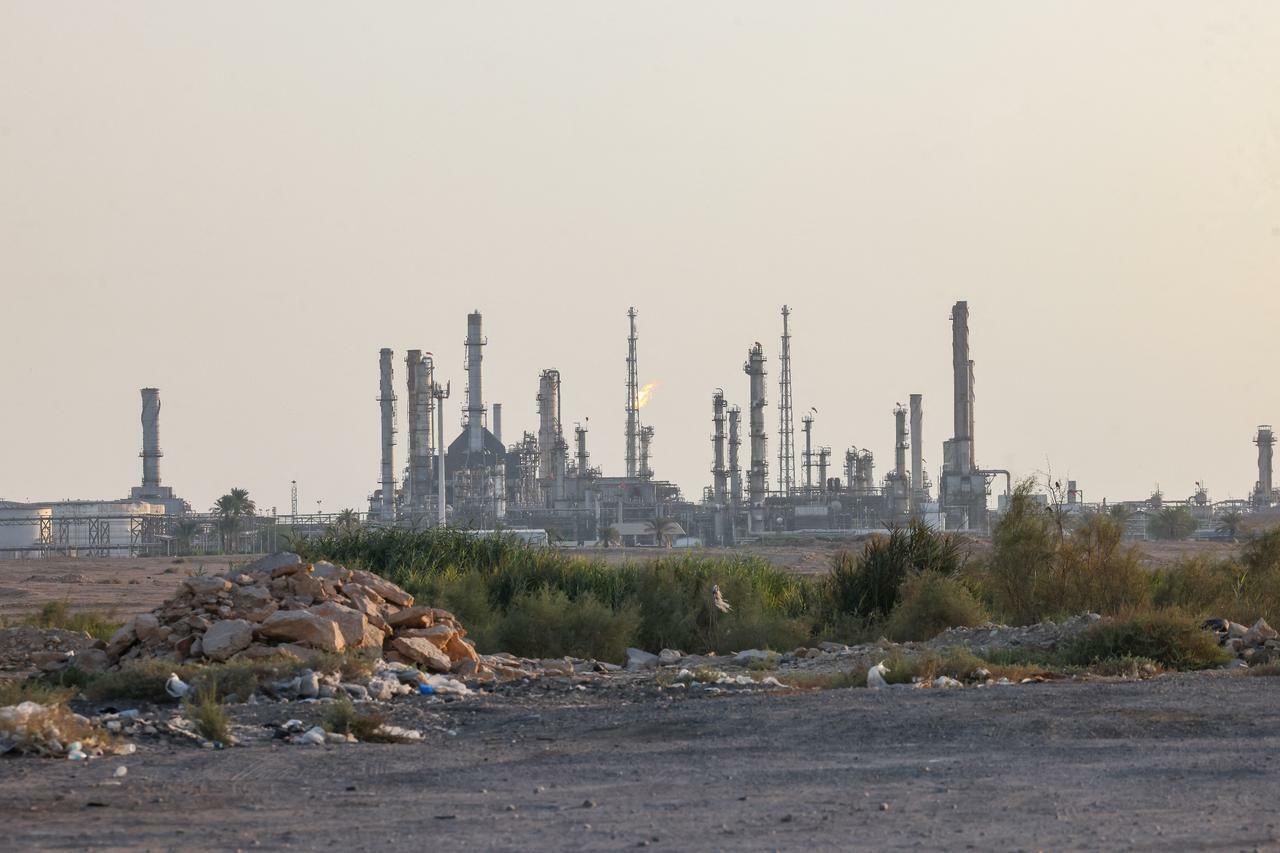
Bloomberg reports Monday, “Oil continues to flow through the East-West link, the people said, asking not to be identified discussing private information” – while confirming that the conduit was briefly halted over the weekend due to attack.
The East-West pipeline has been targeted several times after renewed Houthi-Saudi fighting over prior weeks, and such attacks could continue given that fighting has only intensified in neighboring Yemen.
The Saudi-backed government there over the weekend announced a “new phase in the battle to restore the state.“ Information Minister Moammar al-Eryani wrote on X that the Saudi-backed military operation aims to “extend authority … over every inch of Yemen’s land.”
“The recovery of land, islands, and strategic positions in the Bab al-Mandeb Strait … directly contributes to safeguarding one of the world’s most vital maritime passages and securing international trade and navigation, after the Houthi militia turned it into a tool for extortion and threats,” he said of the anti-Houthi fight.
But amid optimistic pro-Riyadh headlines of counter-Houthi progress, the Ansar Allah movement is saying these reports are exagerrated.
Houthi official Hizam al-Assad has been cited in Nour News on Monday as saying that the Saudi coalition’ mercenaries are fleeing and that headlines of “victory” do not capture the reality on the ground but something only being floated for inaccurate media reports. Per the regional report:
- Hizam al-Assad, a member of the political bureau of Yemen’s Ansarullah, pointed out that Saudi Arabia’s mercenaries continue to spread lies and stated: Their alleged “victories” do not go beyond the media and social networks.
- This member of the Ansarullah office emphasized: In the real field, Saudi Arabia’s mercenaries are constantly fleeing; from “Ras al-Aara” on the coast of the Gulf of Aden to the “Al-Muwasit” area and the location of the traitor Al-Ulaymi in “Ta’iz”.
Meanwhile the chief executive of the world’s biggest oil company, Saudi Aramco, offered some negative news on global crude supplies Monday.
He doesn’t see the current situation as “normalizing” anytime soon, and so squeeze on crude oil and refined fuels is set to tighten.
“Until Hormuz fully re-opens and confidence returns, the crude reality is that pressure at both ends of the barrel will intensify. Even then, replenishing inventories while meeting demand could take up to two years,” Amin Nasser told the Energy Intelligence Forum in London.
“The system is already straining,” he said in what importantly marked his first in-person speech since the launch of the Iran war. According to more from the Aramco chief: “Brent crude prices would have reached up to $200 per barrel if Saudi Arabia’s East-West pipeline did not exist,” he said.
END
SAUDIA ARABIA/HOUTHIS
Massive Fires Along Saudi Oil Export Pipeline, Regional Outlet Says
Monday, Oct 05, 2026 – 10:17 AM
Update(1015ET): The news outlet of pro-Iranian factions in Iraq, Sabereen News, has cited new satellite imagery to report “massive fires in the Saudi oil export pipeline.“
The outlet posted the following image on its official Telegram channel. Newsquawk, which picked up the Sabereen report, has noted that it remains unclear whether this is a new incident or is damage stemming from the earlier reported Sunday attack on Saudi Arabia’s East-West pipeline (detailed below):

The same platform reviews:
- Saudi Arabia’s East-West oil pipeline pumping reportedly halted after a new attack, AFP reports citing sources; “There was big damage and the pipeline stopped again”
- Saudi Arabia’s East-West pipeline is flowing as normal, Bloomberg reports citing sources
- Modest upside seen in the energy benchmarks following this.
And more: Yemeni Houthis hit Saudi Arabia’s Ras Tanura refinery (550k BPD) with missiles, Sabereen reports
Some other open source regional watchers have similarly observed:
Regional escalation moving fast:
Some further (unconfirmed) footage emerging…
END
SAUDI ARABIA/USA/ YEMEN
US Again Rebuffs Riyadh’s Yemen Plea As 100,000-Man Force Readies For War
Saturday, Oct 03, 2026 – 12:15 PM
Several reports have indicated that Saudi Arabia and Yemeni government forces are preparing for a major offensive against Houthi rebels in the coming weeks, which will mobilize a huge force with an aim to take back Yemen’s Red Sea coast and to ultimately secure the Bab el-Mandeb Strait, amid an ongoing threat to global shipping in the Red Sea area.
Over 100,000 Yemeni pro-government troops could mobilize for the offensive, Reuters has reported. Last month, the ease and quickness of Houthi gains proved humiliating for the Saudi coalition in Yemen.

The report described, “The Saudis are considering two possible options for the assault, the Gulf and Yemeni officials said: Either a narrowly focused attack on the area around Bab el-Mandeb or a broader offensive that also includes other synchronized attacks on multiple fronts around Yemen, in the governorates of Al-Bayda, Marib, Taiz and Al-Jawf.”
Parallel to the Reuters reporting, Axios said Friday that the United States will definitely not join the offensive in any direct way, short of possible intelligence or even targeting help.
The report cited US officials who say Riyadh again directly requested military help from Washington, but the kingdom has been rebuffed for the second time in a few weeks.
The Saudis are expected to focus on air cover for ground forces loyal to Sanaa, and reports suggest the Saudis wanted US warplanes in the air as well.
Saudi Defense Minister Prince Khalid Bin Salman called Pentagon chief Pete Hegseth to brief him ahead of the operation and specifically requested US airstrikes as coverage for the ground operations. The request was rejected, US officials say.
An admin official was cited in Axios as saying the US “is not going to take kinetic action for now.”It was just a week ago that President Trump was said to have been close to ordering US military support in the Yemen theatre, but that he decided against it at the last minute.
Sunni clerics denigrate Shi’ites of the region:
US officials have said getting bogged down in the Yemen conflict would be a “distraction” at a moment US forces engaged against Iran and in escorting oil transit through the contested Strait of Hormuz.
There’s also the fact that in prior years when the US was more directly supporting of the Saudis and UAE in coalition operations in Yemen, it did little to change realities on the ground, other than imposing misery and death on the broader Yemeni population.
END
UAE/ISRAEL// FLY DUBAI
UAE Says Omani Flydubai Co-Pilot Attacked Captain With Axe, Tried To Seize Israel-Found Jet For “Terror Act”
Saturday, Oct 03, 2026 – 09:20 AM
State news agency WAM quoted UAE Attorney General Hamad Saif Al Shamsi as saying the Flydubai Omani co-pilot accused of attacking the captain with a crash axe tried to seize control of the passenger jet bound for Israel and attempted to carry out a “terrorist attack.”
“Investigations into the incident involving flydubai flight FZ1073 found that the co-pilot had attempted to carry out a terrorist attack,” Al Shamsi said.
The aircraft operating flight FZ1073 from Dubai to Tel Aviv on Wednesday, about one week before the third anniversary of the October 7 attacks, plunged 18,000 feet during the attack as passengers and crew subdued the attacker.
The passenger jet, with 174 souls on board, diverted to Tabuk in northwestern Saudi Arabia for an emergency landing.

Al Shamsi said the investigation is under way “to uncover all the circumstances of the incident, its motives, and related connections, in addition to completing technical examinations and examining physical and digital evidence.”
On Friday, Israeli Prime Minister Benjamin Netanyahu said that Israel was investigating whether the co-pilot had acted under anyone’s direction, warning that anyone involved in the terror plot would pay a “heavy price.”
Flydubai halted all flights on the Israel route shortly after the terror plot was foiled, and Israel’s El Al canceled its scheduled flights, stranding some Israelis in the UAE.
end
YEMEN
“In The Name Of God”: Yemen Leader Orders All-Out Offensive Against Iran-Backed Houthis
Sunday, Oct 04, 2026 – 11:30 AM
Saudi Arabia and Yemeni government forces have been preparing for a major offensive against Iran-backed Houthis, whose latest advances along Yemen’s western coast have tightened their control over coastal areas and disrupted a critical maritime chokepoint known as the Bab el-Mandeb Strait. Bloomberg now reports that the operation is underway.
The outlet reports that Rashad Al-Alimi, head of Yemen’s Presidential Leadership Council, ordered all branches of the armed forces into active combat operations on Sunday.
“All state military, security and civil institutions as of this moment are mobilized and on high alert until the mission is completed and victory is achieved,” Al-Alimi said on Sunday.
He said the operation would continue “until the liberation of the country from the grip of the terrorist Houthi militia.”
Our reporting on Saturday indicated that more than 100,000 Yemeni pro-government troops were set to mobilize for the offensive. Last month, the ease and speed of Houthi gains proved humiliating for the Saudi coalition in Yemen.
The Houthis largely stayed out of the US-Israeli war against Iran. But by midsummer, the terror group had announced a blockade of Saudi ships in the critical maritime chokepoint in response to what it described as a “siege” of Yemen. It has since repeatedly attacked the kingdom, including its oil facilities.
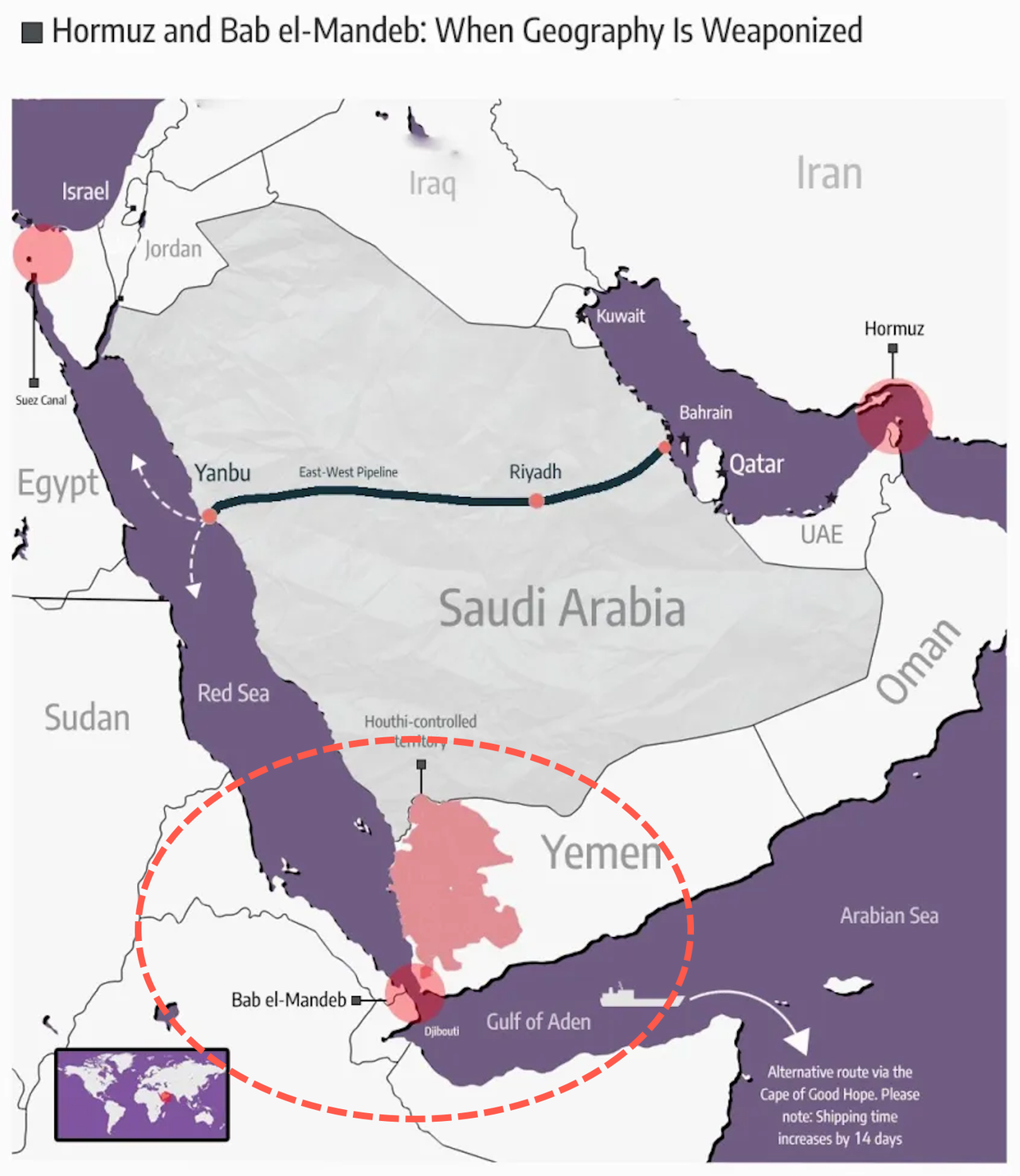
On Saturday, multiple reports and footage circulating on X showed what appeared to be smoke rising from Saudi Aramco’s Riyadh refinery.
Reuters reported Friday that Saudi air power would support Yemeni ground forces. The report did not specify which aircraft had been deployed for the operation, but the Saudis operate US-built F-15s, Eurofighter Typhoons and Tornado strike aircraft.
Beyond the Bab el-Mandeb Strait, the latest data from Goldman show that crude oil flows through the Strait of Hormuz are back to pre-war levels, an indication that Tehran’s leverage in the region has quickly eroded.
END
SYRIA
Mystery Gunmen Slaughter Seven People On Bus In Syria’s Homs
Friday, Oct 02, 2026 – 09:45 PM
Gunmen in Syria killed seven people and wounded four others after opening fire on a civilian bus in western Homs province on Wednesday evening.
The bus was carrying company employees returning home from work when it came under fire as it crossed the Masyaf Bridge in the western Homs countryside, according to the Homs Health Directorate.

Security units were immediately deployed to the scene to secure the area, while criminal investigators began collecting evidence to identify those responsible and determine the motive, according to Homs Internal Security Forces commander Brig Gen Bassem Mohammad Shaaban.
The injured were taken to hospitals across the governorate, while security forces began an investigation.
Maan Mahmoud Fahd, director of the Homs Grand Hospital, told Sana that four individuals were declared dead upon arrival, after suffering from severe gunshot wounds to the head and chest.
No group has yet claimed responsibility, and authorities have not named any suspects. Shaaban vowed to pursue those responsible, saying the attack would not go unpunished.
“We view this cowardly attack as an attempt to undermine security in Homs and destabilise the stability we have worked to consolidate,” Shaaban said.
“We will not allow criminals to threaten the security of our people or undermine the stability the city is experiencing,” he added.
The ambush was one of several recent attacks to raise security concerns in Syria since the fall of Bashar al-Assad’s government in December 2024.
Brigadier General Munir al-Hariri, a Syrian military analyst, told Syria TV that former Assad loyalists were most likely behind Wednesday’s attack, which he said aimed to destabilize security in the country. [ZH: We should note the presence of the literally hundreds if not thousands of jihadist groups, many of them foreign, unleashed on Syria during the height of the CIA/NATO/Gulf-backed proxy war to overthrow Assad].
In August, a bus carrying members of the internal security forces was targeted near Damascus, while an explosive device exploded on a passenger bus in Jaramana, southeast of the capital, wounding 14 people earlier that month.
Gas pipeline blast
The bus attack was one of three major security incidents to hit Syria on Wednesday. A gas pipeline explosion at the Tishreen thermal power plant in Syria’s Damascus countryside on Wednesday evening forced three power stations out of service, the Syrian Electricity Company said, warning that the shutdown would cause longer scheduled power cuts.
The blast triggered a large fire and injured two people, according to state broadcaster Alikhbaria. The explosion hit a pressure-reduction station at the plant entrance and damaged the two gas lines that supply it, the Syrian Petroleum Company said.
The loss of gas supplies shut down the Deir Ali and Nasiriyah plants, along with Tishreen, which lies about 36km from the capital.
Abdul Hamid Salat, director of the energy ministry’s media department, said the interruption to gas supplies had also affected water-pumping and treatment stations, disrupting services for hundreds of thousands of people across Damascus and its countryside, Daraa, Sweida and Quneitra.
Speaking at the site late on Wednesday, Energy Minister Mohammad al-Bashir said the fire was brought under control overnight. Al-Bashir added specialists would inspect the site once civil defense teams finished cooling it, to determine “the causes and circumstances precisely”.

Authorities have not yet established whether the explosion resulted from a technical fault, a deliberate attack or sabotage.
Israeli incursion
Israeli forces fired three artillery shells at the area around al-Mantara Dam in Syria’s southern Quneitra province on Wednesday. No immediate casualties or damage were reported.
On Thursday morning, Israeli forces also entered the village of Saida al-Golan in southern Quneitra with around 12 military vehicles as students were making their way to school. The forces later withdrew towards villages in the Yarmouk Basin, with no reports of arrests or house searches.
Reports from Al-Araby News outlet indicate that there was an assassination attempt on a Ministry of Defence officer in the city of Sanamen, situated to the north of Dara.The shelling came amid continued Israeli military activity in southern Syria.
On Tuesday, Israeli forces carried out incursions in Quneitra, including an operation in which soldiers questioned and assaulted shepherds, according to Syrian state media.
The latest developments also come days after Syrian President Ahmed al-Sharaa said talks with Israel on a security framework had reached nearly 90 percent agreement before Israel withdrew or introduced additional conditions.
Speaking at an Atlantic Council panel in New York last week, al-Sharaa said several rounds of negotiations had taken place over the previous year with US involvement and that the talks were continuing.
END
IRAN/USA
Lingering Iranian Diplomats In New York ‘Kicked Out’ By Rubio
Monday, Oct 05, 2026 – 11:10 AM
The 81st session of the United Nations General Assembly took place September 22–29 in New York City, with the Iranian delegation being allowed into the country (even as the delegation of the Palestinian Authority was blocked).
President Masoud Pezeshkian addressed the UNGA without any problems, and Foreign Minister Abbas Araghchi engaged in talks with the US on the sidelines and via mediators. Both top officials exited the country, after safety concerns were voiced in Iranian outlets – given the US is engaged in an active war with the Islamic Republic.
But apparently a couple of Iranian diplomats that traveled with the delegation lingered behind and are now being “kicked out” – according to Axios reporting on Sunday.
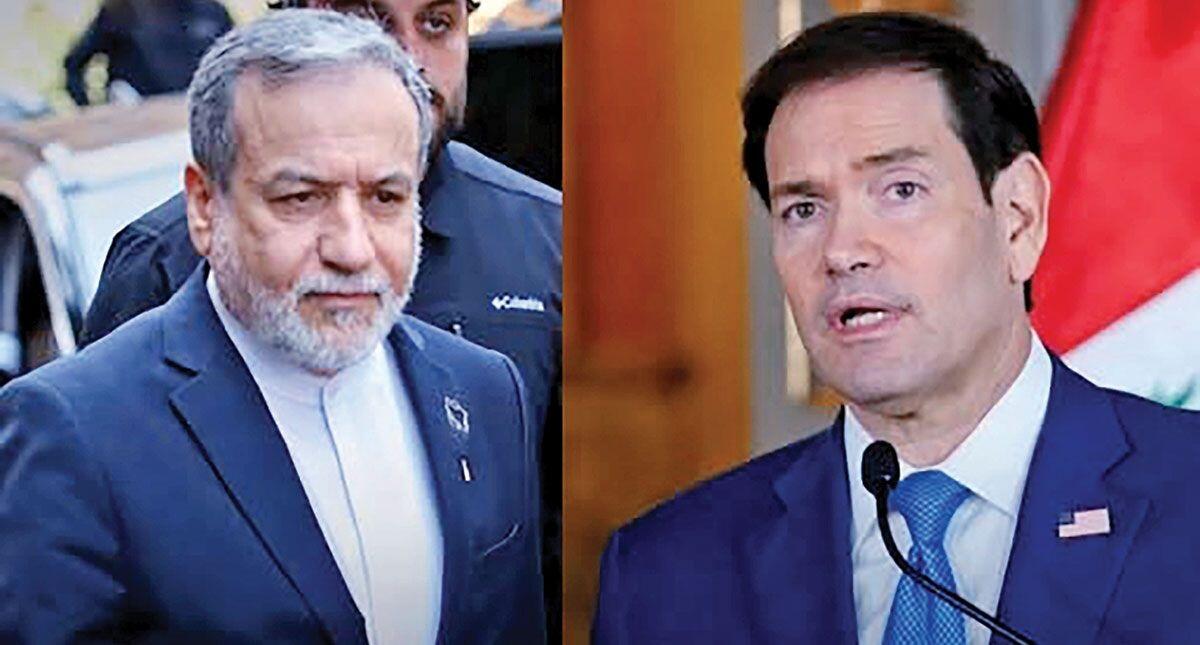
A US official described to the outlet the the Iranian officials stayed in New York for multiple days after the Trump administration ordered the Iranian delegation out of the country.
“Secretary Rubio means business. Two more members of the Iranian delegation were found still in New York long after the U.N. General Assembly had passed. They have now been kicked out of the country,” a US official said.
But the two have now departed, with one having left Friday and the other Saturday morning, the US official detailed.
Iran’s Foreign Ministry has disputed the account, with FM Araghchi having stated on X, “All Iranian diplomats who attended UNGA, except one who departed earlier, left as scheduled.”
Araghchi took the opportunity to blast the United States as not upholding its diplomatic obligations as a host nation for UN headquarters.
“Taking pride in fake diplomat ‘expulsion’ is inappropriate for the head of any diplomatic corps,” he had said Saturday. “It oozes of desperation and defeat, and is inconsistent with UN host nation obligations.”
Many nations would likely be more comfortable is UN headquarters were based in Europe, or some other more neutral region.
Washington not infrequently uses its power to grant or deny access to UN headquarters in New York as leverage over countries it deems ‘rogue’ actors. For example, it regularly does this with Palestinian representation.
END
TURKEY
we were waiting for this as Turkey’s lira has been plummeting! Now funds are gated. Head honchos trying to rectify the bleeding but to no avail
Turkey’s Fix For Its $20 Billion Hedge Fund Meltdown: Kindly Ask The Winners To Give The Money Back
Saturday, Oct 03, 2026 – 08:45 AM
Two weeks after a cluster of Istanbul asset managers stopped honoring redemptions, triggering a market-wide circuit breaker and the liquidation of 131 funds held by some 455,758 Turkish retail investors, Ankara has unveiled its plan to make everyone whole. Or at least, to make everyone a little bit less un-whole.
As Bloomberg reports, Turkey will start payments to investors caught in the fund crisis. The Capital Markets Board (SPK) approved interim payments of up to 1 million lira (about $20,400) per eligible investor in funds run by Tera, Pusula, Atlas and Hedef, calculated on each investor’s “net investment” as determined by the Central Securities Depository (MKK). Below a million lira, you get your money back; above it, you get a million and a place in the queue. Money market funds get paid first, the rest in descending order of investor count, with A1 Capital, Bulls and Pardus funds slotted in afterward. The interim payments are advances against whatever the liquidation ultimately recovers, which is a polite way of saying nobody knows yet.

Finance Minister Mehmet Simsek, meanwhile, insists that “we are not talking about a systemic problem,” pointing out that public debt is just 22% of GDP and the budget deficit is “roughly half the developing country average.” All true, and also not much consolation to the investor who, as Turkish Minute recounts, sold her Istanbul home before moving to Portugal, parked the proceeds in stock funds as an inflation hedge, and has watched her account fall ~90% while being unable to withdraw even that. “It is melting away before my eyes, and I can’t do anything about it.”
The “please give it back” account
The payouts are the boring part. The truly bizarre part is how Turkey – long the biggest banana in crowded bus of capital markets banana republics – plans to refill the pot.
Alongside the interim payments, the regulator announced the creation of “Voluntary Return Accounts” at Birlesik Fon Bankasi “for individuals seeking to return excessive profits obtained from pre-liquidation share sales.” Proceeds will be funneled to the fund liquidation estates and on to Ziraat and Isbank for distribution to investors. A separate “General Share Refund Account” has been opened for anyone who would like to hand back profits from speculative trading in listed stocks, and a new fund inside the deposit insurer TMSF will receive assets later determined to be proceeds of crime (details here).
To summarize: Turkey’s plan to compensate 455,000 losers is, in part, to ask the winners nicely.
Bloomberg’s Eric Balchunas summed it up best: “Turkey wants investors who made a lot of money in market to gift excessive returns to the other investors who lost $20b.”
Which raises a question that every holder of Turkish assets, foreign ones included, will now be asking: if realized gains can be deemed “excessive” after the fact, at what point do they become yours?
For those who don’t feel like volunteering, there is the stick, or rather a discounted stick: under a leniency provision, anyone who pays twice their gains (minimum 500,000 lira) within 15 days of a criminal complaint gets a reduced penalty. Note where that money goes: not to the stranded investors, but to the Treasury and Finance Ministry. Market manipulation as a revenue line.
So who exactly made the “excessive gains”?
Here the honor system runs into a few practical problems. According to a detailed timeline of the probe, Pusula chairman Muhammed Yariz wired roughly 2.89 billion lira (~$15 million) to Edmond de Rothschild in Switzerland on September 1, two weeks before his firm defaulted; Pusula Holding chairman Serdar Turhan sent ~1.2 billion lira (~€25 million) to the same Swiss bank on August 24. Both have since been arrested. One suspects the Birlesik Fon Bankasi “voluntary return” desk is not their first call.
Then there’s Cengiz Avci, a major shareholder in Odine Solutions, a stock that rose 987% this year to a peak 366 billion lira valuation before collapsing 94%. Prosecutors allege he booked ~15 billion lira in gains and converted 12 billion lira (~$244 million) into cash. There is an arrest warrant. He “had not returned and was not located.” Presumably the voluntary return form got lost in the mail.
And then there’s the politics. Fatma Betul Sayan Kaya, deputy chair of Erdogan’s ruling AKP and a former family minister, resigned after the opposition alleged she bought shares in shipbuilder Ozata Denizcilik, a navy contractor whose valuation was ramped to $5 billion (above Ford Otosan) while Tera’s brokerage reportedly controlled 95% of its shares, for about €1.1 million in April and sold for €23.3 million just before the September 16 crash. Kaya has not directly addressed the allegations, which remain unproven in court. A 21x return in five months: if that isn’t “excessive,” we’d love to know what is.
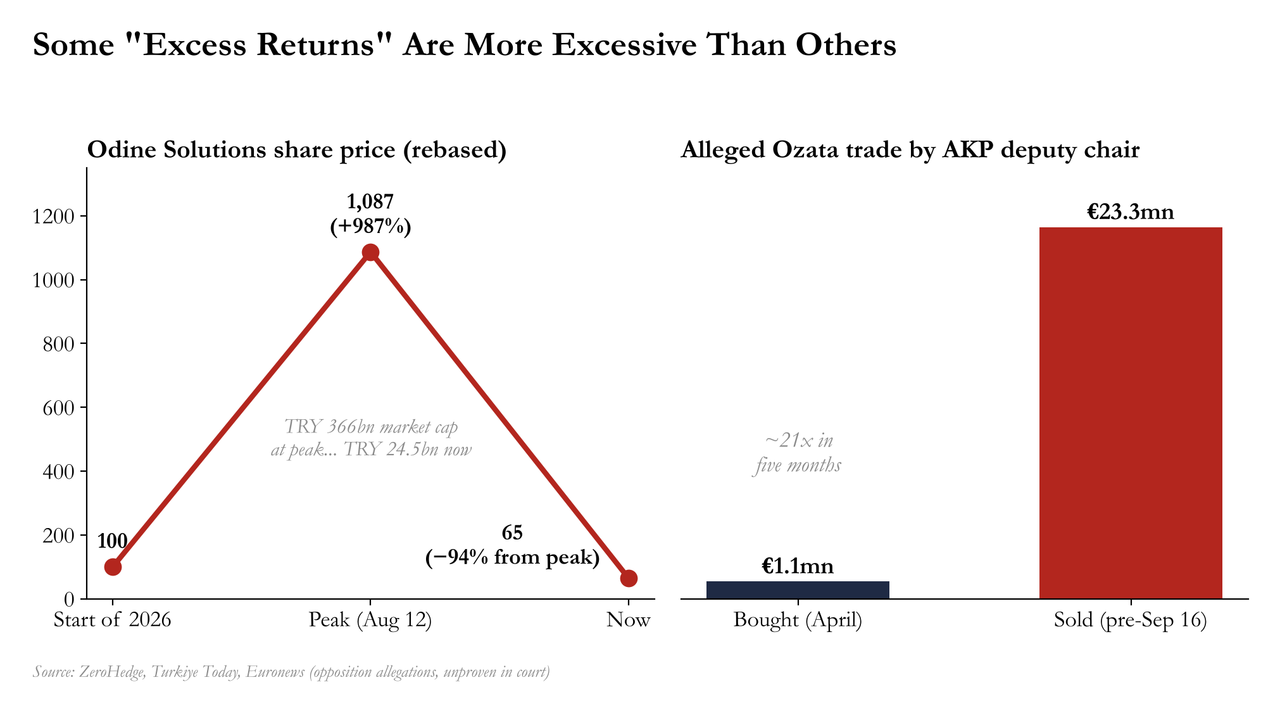
It doesn’t stop there. As Middle East Eye details, one Erdogan adviser sat on Tera Portfolio’s board until January, another former presidential adviser stayed on until the crisis erupted, and an Ozata board member arrested this week is the son of a former banking regulator and the son-in-law of a sitting deputy finance minister. Tera chairman Emre Tezmen, arrested on charges of running a Ponzi-like scheme, previously served on the board of the MKK, the very central depository now tasked with calculating each investor’s “net investment” for the payouts.
Freeze, unfreeze, arrest the tweeters
The enforcement response has been equally on-brand. On a Friday, the Justice Minister announced asset freezes on 46 companies, 18 funds and 42 individuals. By Sunday, the freezes on 45 companies and 19 funds were lifted after the CMB conducted “a new assessment,” with Simsek explaining that “protecting investment, employment, production and exports was a priority.” Restrictions on the 42 individuals remain. Meanwhile, prosecutors in Bakirkoy arrested 16 people for social media posts deemed to be market manipulation and blocked access to 246 accounts “spreading speculative panic.” It’s always the tweets.
Officials have now identified 217 suspects across 26 manipulated stocks, with 56 detained as of September 30. The mechanics of the scheme were hardly sophisticated: funds piled into illiquid, low-float stocks, and with nobody on the other side, prices went vertical. Prosecutors allege some prices were inflated nearly 100x. Then the regulator tightened concentration rules in late August, the funds were forced to sell into a market with no bid, and retail rushed for the exits on the TEFAS platform. The ones who got out first were, inevitably, the ones closest to the funds.
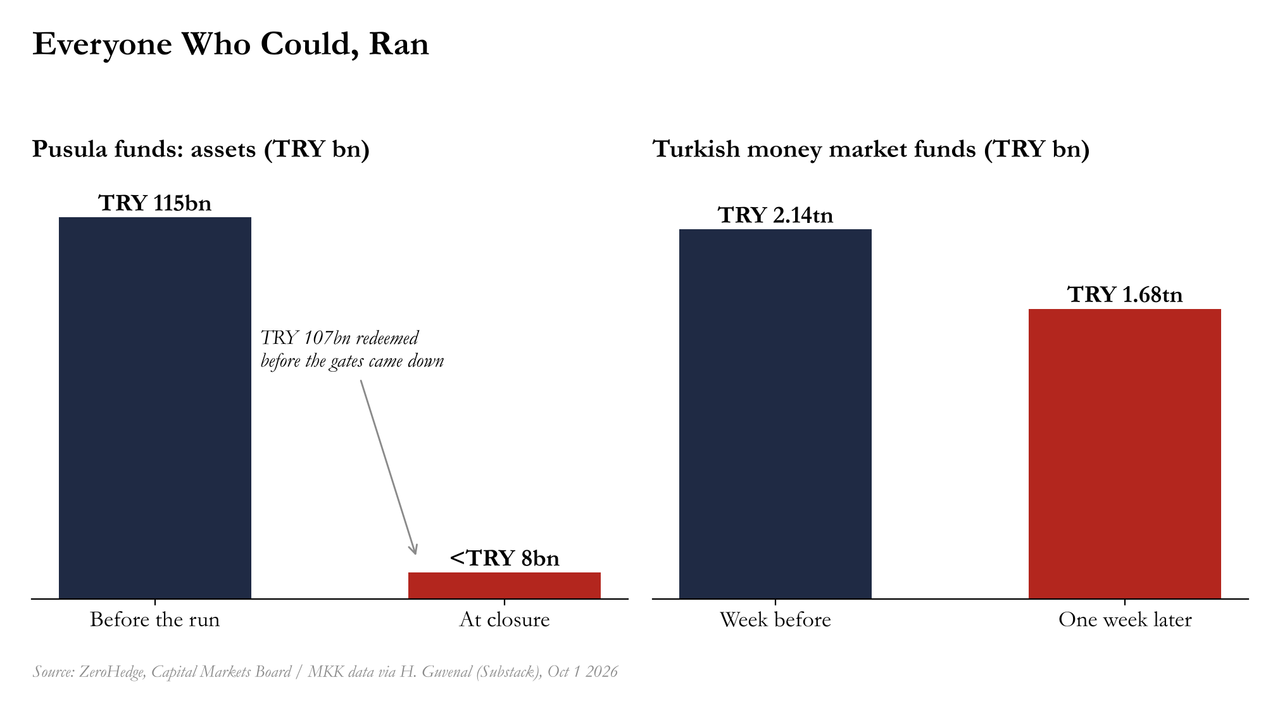
The numbers tell the story: Pusula’s funds shrank from 115 billion lira to under 8 billion, with 107 billion lira withdrawn before the doors closed. Money market funds, supposedly the safe end of the spectrum, saw 456 billion lira pulled in a single week (from 2.14 trillion to 1.68 trillion). In other words, those who knew ran, and those who trusted a “state-supervised system,” as one law graduate who invested with her mother put it, are now waiting for a $20,000 interim check.
What Goldman is telling clients
As the crisis erupted, Goldman’s EM credit desk wrote on September 17 that the equity market’s 6% plunge was due to the “near-collapse and redemption default of asset manager Pusula Portfoy, precipitated by the regulator’s clampdown on concentrated ‘fund-chain’ positions,” followed by Tera “failing to meet redemption requests.” The central bank responded with bond buybacks (you know, “NOT QE”), bigger repo auctions and lower discount rates, while Simsek spent the day “defending current policy mix and committing not to deviate from the anti-inflation track despite elections.” Turkey CDS widened 10bps intraday before closing +6.5bps; Turkish bank perps fell as much as 65 cents.
We were more laconic: Turkey was getting “Leopolded” we reported late on Sept 16 when first news of the fund meltdown emerged.
By that weekend, Goldman’s EM credit team was calling it a “systemic liquidity squeeze” in which “the liquidation of approximately $20 billion in local funds, sparked by redemption failures, dragged the BIST 100 down 6% and pushed external sovereign debt and CDS as much as 15bps wider midweek.” Yet the bank’s key takeaway was that “Turkey’s move was technical rather than credit-driven, with a domestic fund liquidation transmitting into external debt before local buyers and short covering reversed most of it.”
Goldman CEEMEA sales trader Ashwin Sharma went further, noting that the crackdown targeted a speculative boom that index provider MSCI had described as “co-ordinated trading,” and that reining it in, “given threats of possible MSCI demotion (to Frontier),” was “a clear positive for me.” His conclusion: “Despite near-term redemption-driven volatility, I continue to see Turkey as an attractive buy-on-weakness story,” with banks pointing to further rate cuts and NIM expansion into 2027, and an energy price shock (Turkey is a net oil importer) the biggest risk. The bank’s GIR EM strategists echoed the theme in their weekly kickstart, flagging Turkey’s 5% weekly drop on “regulatory action on select investment funds.”
The carry crowd hasn’t left either. In a September 29 note, Goldman’s EM SSA desk said Turkey remains a carry trade “GIR continues to favour and where we continue to see client allocation,” with clients extending out the curve into paper like the EBRD 27.5% 2029s, which yield ~200bps above the 2027s. Then again, as of this morning, the bank’s credit desk reported that in the Turkish corporate complex “risk was still available and offered with corps feeling particularly abandoned.”
Which is, in a nutshell, the Turkish trade: the high-30s lira yields and the orthodox finance minister are real, and so is the system in which an AKP deputy chair allegedly makes 21x on a navy shipbuilder ramped by a fund whose chairman sat on the board of the securities depository, while the regulator’s answer to the losers is a $20,000 advance and a bank account for the winners’ conscience.
Been here before
Readers will recall the last time Turkish markets needed a marketwide trading halt, after the arrest of Erdogan’s top rival Ekrem Imamoglu sent the lira to a record low (“All Hell Breaks Loose In Turkey“). And in May we noted that Turkey had sold nearly all its US Treasuries, dumping holdings from ~$16 billion to $1.8 billion alongside gold to defend the lira after the Middle East war erupted. The buffers, in other words, are thinner than the macro tables suggest.
As for the gated funds, the playbook should be familiar to anyone who followed the private credit redemption mess earlier this year: illiquid assets, daily liquidity promises, and a “screen price” that only exists until someone tries to sell. As one local analyst put it, whether the till “will have the money to pay it is unclear.” The interim payments come out of what’s left in the funds; the rest depends on the liquidators finding buyers for stocks that, by prosecutors’ account, had been inflated as much as 100-fold, and on the winners volunteering to give back their winnings.
We wouldn’t hold our breath. But we would watch the precedent: in Turkey, a realized gain is now only yours until the government decides it was excessive.
END
YEMEN/HOUTHIS
Houthis Seize Yemen Parliament Speaker’s Home, Cut Taiz-Aden Lifeline As All-Out War Erupts
Monday, Oct 05, 2026 – 01:00 PM
Iran-aligned Houthi forces have seized the home of Yemen’s parliament speaker, Sultan al-Barakani, during a lightning advance south of Taiz that has also cut one of the government’s most important remaining supply routes, according to reports.

Multiple Yemeni and regional outlets reported Sunday that Houthi fighters entered al-Barakani’s residence in Wadi al-Barakani, south of Taiz, and established positions inside. Al-Araby Al-Jadeed reported the seizure citing field sources, while Al-Ain placed the property in the Al-Ma’afer district and said the Houthis occupied it following heavy fighting with Yemeni forces and local residents. China’s Xinhua subsequently quoted a Yemeni government official confirming that Houthi forces had captured the al-Barakani area containing the parliament speaker’s house.
Aden Al-Ghad later published video which it said showed Houthi fighters entering the property. Footage circulated by the open-source researcher @war_noir shows armed men moving through a large reception hall lined with seating, then cuts to the white compound on the hillside.
Al-Barakani has served as speaker of the internationally recognized Yemeni parliament since 2019 and remains one of the most prominent political figures aligned with the anti-Houthi camp – so images of Houthi fighters inside his residence therefore make for obvious propaganda.
Taiz’s Lifeline Is Cut
The Houthis’ advance through southern Taiz governorate has severed the critical road network connecting Taiz with Aden, the temporary capital of Yemen’s internationally recognized government.
The Critical Threats Project and Institute for the Study of War assessed Sunday that Houthi forces advanced through al-Safiyah and al-Mansora before capturing the strategically vital town of al-Turbah, citing geolocated imagery as well as Yemeni sources.
Al-Turbah sits at the junction of the two main roads connecting government front-line positions around Taiz with Aden.
CTP/ISW warned that Houthi control there will likely “severely constrain” the government’s ability to reinforce and resupply forces across Taiz governorate.
Control of the roads south of Taiz could also deny government troops an obvious escape route if the Houthis continue closing the ring around the city.
The Houthis had already demonstrated that they did not need to physically occupy every junction to cripple the route. Earlier attacks damaged sections of the Taiz-Aden ground line of communication, forcing government forces onto increasingly limited alternatives. Fighting on the Taiz axis was already underway in the days before the house seizure: government troops firing on Houthi positions, and Houthi fighters claiming Jabal al-Habashi.
The Front Has Been Moving For Weeks
On September 10, we reported that the Houthis had seized the strategic port of Mocha as government forces abandoned positions along Yemen’s western coast, dramatically increasing Houthi leverage over the Bab el-Mandeb shipping chokepoint.
The following days brought additional Houthi gains around the Red Sea coast and Bab el-Mandeb, while Saudi-backed formations struggled to stabilize the front. As we also noted, the group was accumulating actual coastal territory overlooking one of the most important maritime passages on the planet. By late September, the crisis had become serious enough that Yemen’s Saudi-backed leadership was publicly calling for broader mobilization.
On Monday reports are emerging that the Houthis may have lost Mocha, in what would be a hugely symbolic setback if accurate:
As we reported Saturday, Saudi Arabia and Yemeni government forces were preparing a force potentially exceeding 100,000 troops for a major counteroffensive aimed at retaking the Red Sea coast and securing Bab el-Mandeb.
Saudi officials had again sought direct American military involvement, according to reporting cited at the time, but Washington declined to provide the airstrikes Riyadh requested as cover for the ground campaign, while leaving open intelligence and other support.
On Sunday, Presidential Leadership Council chairman Rashad al-Alimi declared that the government was moving from preparation to action. We covered his announcement Sunday as he ordered military operations intended to retake Houthi-held territory across Yemen.
The Counterattack Has Begun
Reuters reported that Saudi-backed Yemeni forces, supported by Saudi air power, had attacked Houthi positions around the Dhubab district overlooking Bab el-Mandeb and claimed to have seized several key positions, including the Dhubab airstrip.
The Houthis disputed the government’s claims, and fighting remained underway. Later Monday, Information Minister Moammar al-Eryani claimed government forces had secured “effective control” of the Bab el-Mandeb Strait, which the Houthis called false, even as a government source said fighting continued at a military base near the strait. Video from the coast showed an Al Arabiya correspondent with government forces coming under what the outlet described as a Houthi ballistic-missile attack near the strait.
Reuters described Taiz as increasingly encircled as Houthi forces pushed toward al-Mawasit even while government troops launched their coastal counterattack.
The Associated Press likewise reported Monday that the Saudi-led coalition had intensified its air campaign as government forces began a major offensive along the Red Sea coast following the Houthis’ latest territorial gains. The coalition said 100 fighter jets were backing the government’s forces.
And Now The President’s Residence?
On Monday, Xinhua cited Yemeni sources saying Houthi forces had entered the al-Aloum area of al-Mawasit district, where the family home of Presidential Leadership Council chairman Rashad al-Alimi is located.
Houthi-aligned media went further, claiming the residence itself had fallen. Video posted Monday shows fighters posing, praying, and celebrating outside a large multi-story building, with a Yemeni flag raised on the roof. @war_noir and Yemeni accounts identified the site as al-Alimi’s family house.
Reuters has not verified the reported seizure of al-Alimi’s home, though UAE-based Erem News, citing local sources, reported Monday that Houthi fighters took the house, where his relatives live, without resistance.
Beyond Yemen
Yemen’s war – comparatively frozen since the UN-brokered truce of 2022 – has suddenly erupted across multiple fronts.
Bab el-Mandeb connects the Red Sea and Suez route with the Indian Ocean. The Houthis have already demonstrated the ability to threaten commercial shipping using missiles, drones and unmanned vessels; territorial control around the chokepoint adds an entirely different dimension to that threat.
As we have has been documenting for months now, the Red Sea has also become increasingly important to Saudi energy exports as turmoil elsewhere in the region places pressure on alternative routes.
END
RUSSIA VS UKRAINE
Zelensky Vows To Hammer More Russian Refineries As G7 Greenlights Emergency Fuel Dump
Sunday, Oct 04, 2026 – 10:30 AM
President Volodymyr Zelensky told Reuters in an exclusive interview that Ukraine plans to intensify attacks on Russian oil refineries in response to continued strikes on Ukrainian cities. The threat comes as the Trump administration pressures European allies to release up to 100 million barrels of emergency oil and diesel stocks ahead of the Northern Hemisphere winter, with a global refining crunch already straining fuel supplies.
Zelensky told the outlet that Ukrainian intelligence had obtained documents outlining what he described as Russian President Vladimir Putin’s new war doctrine to broaden attacks on civilian infrastructure ahead of winter.
“We saw documents and we know that they allow them to attack infrastructure, logistics, and especially to attack in the cities, in the villages, everywhere, roads, schools, hospitals,” Zelensky said. “To pressure people to leave the capital, leave different cities: this is the goal of the operation.”
Zelensky then said, “We have to respond in any way (we can). With their attacks on our energy, we have to respond on their energy. First of all, oil refiners, etc.: what gives money to them for this war. But we will not respond, of course, just like them, on any civilian objects.”
Zelensky’s plan to further destroy Russia’s refineries comes as the Trump administration seeks to revive peace negotiations. Zelensky said Russia had shown no willingness to discuss either peace talks or a ceasefire covering energy infrastructure.
The Trump administration’s move to pressure European countries and other G7 members into releasing as much as 100 million barrels of emergency oil and diesel stocks, as confirmed by French President Emmanuel Macron on Friday, is likely in response to Zelensky’s expanding drone and missile attacks on Russian energy assets, as stockpiles for critical fuels are well below seasonal levels for this time of year.
The International Energy Agency is coordinating the emergency release, which will take place over the next four months, according to Macron.
Goldman energy analyst Nikhil Bhandari warned last month that the global refining crisis stems from a combination of disruptions in the Strait of Hormuz and, more importantly, Ukraine’s bombardment of Russian refineries. Those attacks have prompted Moscow to extend its diesel export halt, suggesting the refining crisis could linger well into next year and keep refined-product prices elevated.
Meanwhile, last Thursday at the Valdai Discussion Club in Moscow, Putin warned the Western allies to cease their escalation in Ukraine, stressing he’s willing to use “all weapons” in the Russian arsenal in the scenario that Russia’s exclave of Kaliningrad comes under attack.
end
RUSSIA/UKRAINE/EUROPE
A Report from Russia: How Close is Europe and Russia to a Wider Conflict?
ROBERT H AND FOLLOWING SCOTT RITTER…
“Scott does not miss much with this article. It is true that the Brits and the Yanks took over from the Germans in directing OUN after WWII. US involvement was clear in the Maiden with Nuland.
Much of so called nationalism in Ukraine lies at the foot of decades of money spend in an effort to defeat Russia. Ukrainians are not alone as neighboring countries like Poland are also expendable Slavs in this quest of conquest.
And Zelensky’s uttering recently to take the fight t space speaks volumes about mindless ambition in the face of realities too awful to swallow which is the West cannot defeat Russia.
But that is not the only issue for Russia. The so called sponsors or friends of Russia like China, India etc. all have their own take on what they want to see. Yes, they want Russia to win and do support this. However they do not want Russia to win by so much as to tip the balance too far in Russia’s favor. After all Russia could come out of this too strong as a powerhouse fueled by an unmatched natural resource wealth combined with an economy firing on all cylinders.
This is something the West does not know how to deal with as it has lost its’ ability to influence leaving others to man their own thoughts. Even Iran wants help from Russia but tempers that with Chinese balance as a too strong a Russia reduces its’ own power and influence.
The world today is being guided by many nations seeking a balance not always in favor or anyone else but themselves”
From: Real Scott Ritter <scottritter@substack.com>
Date: October 5, 2026 at 12:19:40 PM EDT
Subject:A Report from Russia: How Close is Europe and Russia to a Wider Conflict?
Reply-To: Real Scott Ritter <reply+3mcpwn&184d63&&909a909749362d7611f70247c7153191c3d2949d678400a54ade96097b7849db@mg1.substack.com>
Many months ago I wrote about what would happen after the state Duma elections, and how by November we all would see the reality of the futility of conflict in Ukraine being a western proxy to weaken Russia.
This morning, Russia’s Ministry of Foreign Affairs bluntly urged:
“All foreign nationals and Diplomats should leave Kiev Immediately The Russian Federation can’t guarantee your security.
In recent days, you are very aware of the increase in strikes by the Russian military. It will only get worse for the Kiev regime.”
Whether the EU listens or not a much harsher fate lies ahead if this conflict spreads and this will be clear before the end of this year.
END
EGYPT
Independent media news outlet, Matsada2sh, arrested and disappeared. These people were critical of the way government handled various aspects of Egyptian life.
(zerohedge)
Egypt Arrests, Disappears Entire Newsroom Over ‘Fake News’ Allegations
Saturday, Oct 03, 2026 – 04:20 PM
Egyptian authorities have detained the entire newsroom of one of the country’s only independent media outlets in a move that rights groups have denounced as a “first” and an “alarming escalation” on free speech.
On September 28 and 29, security forces raided the homes of the six journalists – Mohamed Ashraf Abu Emeira, Abdallah Qadry, Islam Barakat, Omar Helal, Mohamed Mahmoud and Mohamed Adel – who constitute the entire team working for Matsada2sh (Arabic for “Don’t believe”). The arrests bring the number of journalists detained in Egypt to 24.
“It is a first in Egypt: an entire newsroom behind bars,” press freedom watchdog Reporters Without Borders (RSF) said, criticising the authorities for failing to reveal the journalists’ whereabouts.
“It’s a violation of the Egyptian Constitution, even though this is common practice. Journalists detained in Egypt are often forcibly disappeared for several days before being officially charged and brought before a court,” the group added.
According to multiple accounts by rights groups, the officers confiscated the phones and laptops belonging to the journalists as well as those of their family members during the raids. They also did not present any arrest warrants and refused to disclose where the journalists would be held.
The interior ministry later published a statement confirming the arrests and accusing the journalists of running an unlicensed platform that is “run from abroad” and of spreading “fake news”.
It also accused its journalists of being affiliated with the Muslim Brotherhood, the country’s largest opposition group that has been outlawed under the government of President Abdel Fattah el-Sisi since 2014.
One of the platform’s editors was previously detained in 2023 over similar allegations but was released two days later.
Matsada2sh was founded in 2018 as a fact-checking outlet that corrects misleading or inaccurate information by various sources, including those by official government sources or opposition media.
“Independent journalism is critical in any free society and Egyptian authorities’ failure to allow free exercises of expression to thrive flies in the face of a purported commitment to dialogue, transparency, anti-corruption, and regional leadership,” more than 80 rights groups and independent media outlets said in a statement.
“The crackdown on the Matsada2sh platform and these arrests are alarming escalations on independent media and freedom of expression that cannot be allowed to stand.”
One of the founders of Matsada2sh, Abdelrahman Mansour, who is not based in Egypt, told the Associated Press on Thursday that the families do not know where the journalists are.
“Everyone on this team knew the risks when they went to work every day, but it’s unacceptable for the government to make false accusations and forcibly disappear journalists just because they’re afraid of a free press,” AP quoted Mansour as saying. “Their families are worried, we’re worried, we just want them released unharmed.”
END
IRAN/USA
US Navy Super Hornet “Sub Buster” Marking Hints At Iranian Submarine Kill
`
Sunday, Oct 04, 2026 – 10:45 PM
Military aviation and defense news website The Aviationist reports that a US Navy F/A-18F Super Hornet returned from Operation Epic Fury carrying a “Sub Buster” marking, raising the possibility that a carrier-based fighter jet was credited with an Iranian submarine kill.

Photographs taken by Jeff Rojas and highlighted last week by The Aviationist show a broken-submarine victory marking, potentially the first such decoration on a Super Hornet.

The Aviationist explained:
Iran lost a large number of its submarine force during Operation Epic Fury, so it is not possible to definitively confirm which vessel the Super Hornet was involved in destroying. However, if the marking is designed to be representative, it most resembles a Kilo class submarine. Of Iran’s three Russian-built Kilo class submarines, one, the Taregh, was specifically confirmed by the U.S. as destroyed while in port. The remaining two are thought to have long been inoperable though, if also targeted, would count as a kill all the same.
The Navy has not publicly confirmed a submarine kill by the fighter jet or explained the marking. The marking also does not establish whether the aircraft delivered the weapon, supported another platform or participated in a broader operation.
END
6.GLOBAL ISSUES//COVID VACCINE INJURY REPORTS
GLOBAL ISSUES
COVID/VACCINE INJURY REPORT: DR MARK CRISPIN MILLER
See how many CLUSTERS of “sudden deaths” we’ve noted just this year. How many will it take to get the press to start reporting it, and everybody else to notice it?
140+ articles make all too clear that the whole world is going through an unacknowleged Holocaust
| Mark Crispin MillerOct 3 |  |
Such grotesque “coincidental” deaths have been increasing since this cull began. (One stark example popped up in the fall of 2024, when 33 nurses all “died suddenly” in the US alone.) It almost seems as if the more there are, the blinder millions are to it; but surely that can’t last.
Do what you can to force the world to see what’s happening. Spread this post far and wide, and post appropriate comments on articles like these. We simply can’t let this go on.
News from Underground by Mark Crispin Miller is a reader-supported publication. To receive new posts and support my work, consider becoming a free or paid subscriber.
5 Lifelong Friends All Lost Their Spouses Within 9 Months, Calling It a ‘Cruel Twist of Fate’
September 20, 2026

In 2025, five friends living in New Jersey all lost their spouses within nine months. “The coincidence was eerie,” Sharon Brierley, who lost her husband Walter Brierley that January, tells PEOPLE exclusively. “It felt like a bad, recurring dream, really a nightmare.” The first loss in their friend group came in the first month of the year, when Sharon’s beloved husband, “Walt,” died years after being diagnosed with lung disease. He had undergone a double lung transplant in September 2023, but began experiencing chronic rejection the following summer. As doctors tried to stabilize him and get him strong enough to return to the donor list, he declined and eventually died in the respiratory intensive care unit.
A month later, in February, Frances Jordan lost her husband, Patrick Jordan, suddenly to a stroke at age 63. Then came March, when John lost Deirdre, his wife of 38 years and the person who had been beside him through so much of his life. Together, they had four children. “When Deirdre was diagnosed with tongue cancer in May of 2024, she attacked it like she did everything in life, head-on with no fear; she was gonna beat this,” John says. “However, when it reached the point of being fitted for a radiation mask, it felt as though we were at the beginning of the end.” Deirdre was declared cancer-free in December 2024, but three months later, the cancer returned, and there was nothing more doctors could do. She died on March 11, 2025, at the age of 59.
In May, Chris Mullen’s wife, Eileen, died unexpectedly at age 64 following a cardiac arrest. The couple had been married for 39 years, and unlike some of the illnesses the friends had watched over time, her death came as a complete “shock.”
Then, in September, the group suffered its fifth loss. Elaine Wurtenberg’s husband, John “Werty” Wurtenberg, died at 65 after being diagnosed with acute myelogenous leukemia, a type of cancer of the blood, just months prior. He had previously gone through treatment for throat and tongue cancer and was known as someone who would drop everything for the people he loved. By the time Werty died, the five friends had lost their spouses in the span of nine months, and for Elaine, the sheer number of losses was almost impossible to comprehend. “Unbelievable coincidence that five friends died within nine months? Cruel twist of fate, for sure,” she emphasizes.
Researcher’s note – Maybe it wasn’t a “coincidence.” From Brave AI: New Jersey’s fully vaccinated [sic] percentage has varied significantly over time, peaking at over 75% of eligible residents by October 2021.
Fourth inmate from Michigan’s female prison dies after cardiac event
July 2, 2026
Another inmate from Michigan’s female prison died on Thursday, the Michigan Department of Corrections reported, becoming the fourth female inmate to die at the facility plagued by complaints of poor conditions since May. Dalephenia Jones, 62, of the Women’s Huron Valley Correctional Facility, died at Trinity Health Hospital about two weeks after correctional officers found that she needed medical assistance in her cell, the department said.
1 Teen Dies, 5 Other Kids Sickened in Rare Cancer Cluster: ‘Something Must Be Causing It, Right?’
July 10, 2026
Parents in a close-knit Southern California community are looking for answers after one teen died, and five more were diagnosed with a rare cancer. Six children from Ladera Ranch [CA] have been diagnosed with Ewing sarcoma, a very rare cancer of the bones and soft tissues, according to a report by NBC LA. About 200 children are diagnosed with it each year, the American Cancer Society says. “Seems very, very out of the ordinary for our community to have that many cases here. And something must be causing it, right?” Dustin Matteson, whose son, Brody, died in March, told NBC LA. Brody was first diagnosed with Ewing sarcoma in August 2024, and as a GoFundMe established to support the family explains, his treatment caused him to develop a secondary cancer, acute myeloid leukemia (AML). He died on March 22. “We don’t have a clear line of evidence to pesticides, but it is one of the things that concerns us,” said Matteson, who told NBC that after Brody’s death, he heard from other parents in Ladera Ranch whose children also had been diagnosed with Ewing sarcoma.
Five died at Walt Disney World in the last year
Walt Disney World It’s a Small World Afterlife
July 16, 2026
A Walt Disney World guest suffered a heart emergency while riding It’s a Small World and they were later pronounced dead, TMZ has confirmed. The death happened in April but it’s just coming to light now. The latest theme park injury report update from the Florida Department of Agriculture & Consumer Services says a 54-year-old man with a pre-existing condition experienced a cardiac emergency on the attraction back on April 24, and he was transported to a local hospital, where he died.
Four people died at Disney World in a one-month span late last year, but none of those deaths appeared to be related to medical emergencies suffered in the middle of attractions. A Disneyland guest died in October after suffering a possible heart attack while riding Haunted Mansion. Video showed her being rushed out of the attraction on a gurney. She later died at a local hospital.
Four adult models “died suddenly” over the last few months:
Adult star Dale Savage dies from a stroke at 62
July 6, 2026

Tributes are pouring in for Dale Savage. The 62-year-old adult model passed away after a sudden stroke on June 19. Photographer Anthony Duran, a partner in Ducato Studios, announced Savage’s death on social media on July 3. Savage was a fireman before joining the adult entertainment industry at 50 years old. After filming content for about a decade, he decided to retire and live a quiet life in Colorado. Lane Rogers, Seth Peterson, Colton Ford, and other notable models have also passed away in recent months.
Ole Miss students found dead identified as freshman, 18, and ‘dear son,’ 20, as cops search for answers
September 26, 2026
The University of Mississippi has Friday, Sept. 25, that Aidan Hamilton, 18, a freshman from Englewood, Colorado, and Robert Strang, 20, a junior from Atlanta [GA], as the students who died Monday, Sept. 21. Hamilton was found unresponsive on campus and later died after CPR attempts, while Strang died off campus, according to The Daily Mississippian, the university’s student newspaper. The causes of the deaths remain under investigation, and toxicology reports are not yet available. Lafayette County Metro Narcotics said Tuesday, Sept. 22, that packaged kratom purchased from a retail store was found at both locations. The agency has not confirmed that kratom, or any other substance, contributed to either death, and said there is no information linking the cases, according to NBC News.
Two GMA staffers recently “died suddenly”:
‘Good Morning America’ Mourns the Loss of Long-Time Staffer
September 17, 2026

George Stephanopoulos led a heartfelt tribute for Good Morning America editor Judd Parson at the end of Thursday’s episode. He and the rest of the show’s anchors–Michael Strahan, Rebecca Jarvis, Lara Spencer, Sam Champion and Ginger Zee–sat on the couch and said Parson’s death has brought back many memories of the beloved editor. The sad news comes soon after another tribute was given to late GMA engineer Francisco Antonio “Fran” Saldaña, who passed at age 70 on August 29. Parson worked the overnight shift, where he edited “thousands” of stories and mentored many producers and editors during nearly 25 years with the show. Parson’s age and cause of death were not revealed.
Researcher’s note – As employees of Good Morning America/ABC, owned by Disney, both Parson and Saldaña would have been subject to COVID “vaccine” mandates, with no option to test: Link
Good Morning America heavily promoted COVID “vaccination”: Link
Saldaña, the engineer for GMA, died of congestive heart failure: https://www.megaromemorialhome.com/obituaries/Francisco-A-Saldana?obId=49406300
3 New York City Taxi Drivers Have Been Found Dead
September 26, 2026
A trio of New York City taxi cab drivers have been found dead over the past few months, as families are speaking out in concern. Bhairavi Desai, the Executive Director of the New York Taxi Workers Alliance, said Jagjit Singh, who was in his 50s, was found dead in his cab on Friday, September 11. He died of a heart attack after he “dropped off a fare from Kennedy Airport to the West Village at around 5:30 p.m.” In August, 53-year-old cabbie Khalifa Siwa died alone with insulin in his hand. In July, Richard Coulibaly, who was in his 70s, died of a heart attack. The New York Taxi Workers Alliance said that “the common thread here is they’re all working really grueling hours and not able to take care of themselves.”
Researcher’s note – Another common thread is that NYC taxi drivers were required to take the COVID “vaccine”, or lose their jobs: https://www.gocurb.com/post/vaccine-mandate-for-tlc-drivers
Two California prison staffers “died suddenly”:
HR mourns loss of Supervisor Matthew Armitage
September 17, 2026

Headquarters Human Resources (HR) is mourning the loss of Supervisor Matthew “Matt” Armitage, who passed away Sept. 12, 2026. Armitage [56] began his career with CDCR as a Personnel Specialist in January 2008. He continued to promote to a supervisor, remaining in CDCR HR until his passing.
Researcher’s note – All Calif. COs, staff must get COVID-19 vaccine [sic], federal judge rules: https://www.corrections1.com/cdcr/articles/all-calif-cos-staff-must-get-covid-19-vaccine-federal-judge-rules-GNd7Dlp4oWLu5A3i/
No cause of death reported.
RJ Donovan mourns passing of Officer Haig Zakaryan

September 15, 2026
Richard J Donovan Correctional Facility (RJD) is mourning the passing of Correctional Officer Haig Zakaryan, who passed away Sept. 13, 2026. Officer Zakaryan [49] began his career with the California Department of Corrections and Rehabilitation as a cadet at the Richard A. McGee Correctional Training Center in July 2007. After graduating the Basic Correctional Officer Academy in October 2007, he reported to RJD in San Diego. He remained at the institution until his passing.
Researcher’s note – All Calif. COs, staff must get COVID-19 vaccine [sic], federal judge rules: https://www.corrections1.com/cdcr/articles/all-calif-cos-staff-must-get-covid-19-vaccine-federal-judge-rules-GNd7Dlp4oWLu5A3i/
No cause of death reported.
Three California prison staffers “died suddenly”:
High Desert mourns passing of Sergeant Brandon Seitz
September 4, 2026

Brandon Seitz, a correctional sergeant at High Desert State Prison in Susanville [CA], passed away Sept. 3, 2026. Seitz began his career with the department in November 2008, graduating the academy and then reporting to California State Prison, Los Angeles County in Lancaster, as a correctional officer. He transferred to High Desert State Prison in July 2012, where he promoted to correctional sergeant in June 2015. Seitz remained at High Desert State Prison until his passing.
No age or cause of death reported.
Calipatria mourns passing of Cassell Jones, supervising cook
September 2, 2026
DR PAUL ALEXANDER…
RABOBANK/MICHAEL EVERY/OR OR PICTON/GIFFIN OR RABOBANK EXECUTIVE/COMMENTARY ON WORLDLY AFFAIRS
Key Roles Over Payrolls
Monday, Oct 05, 2026 – 10:50 AM
By Michael Every of Rabobank
Friday’s US payrolls were weaker than expected at 29K, another random walk which helped walk soaring bond yields back from the edge of the cliff, at least temporarily. However, far more important things are happening than that report, much as it’s a markets catechism to repeat it.
Europe agreed to US demands to release 50m barrels of its diesel reserves over the next two months, which saw prices dip, also helping yields fall. However, those reserves are not from a government-owned facility but private stocks and were reportedly already available for sale, but Europe is instead opting to buy cheaper US flows. So, the EU move was serious, showing who still asks, ‘How many barrels?’ when the White House asks for a jump in output, yet performative in that truly cheap diesel will remain in short supply. Which geopolitics, not payrolls, will also tell you.
Yemen’s government launched a Saudi-backed offensive to seize all areas held by the Iran-backed Houthis – that means a war and instability around the Red Sea and Bab-el-Mandeb. Egypt, Eritrea, Somalia, and Sudan called on Ethiopia to cease attacks on the separatists in Tigray Addis Ababa accuses them of backing: the risks are of more fighting on the other side of the Red Sea too. Iran is considering Russia’s offer to take its 60%-enriched uranium according to one report, and its foreign minister tried to claim asylum in the US before his family was threatened according to a rumor, but Tehran is increasing the range of its missiles and preparing for new US attacks as strikes against tankers in Hormuz increase. The US has also now removed all its B-1 bombers from the UK base just subject to a suspected Iran-linked terror attack amid security concerns, yet the British have, confusingly, bailed all those arrested over it.
Ukraine’s Zelenskyy stated he will step up attacks on Russian oil refineries, but that the US wants to hold trilateral talks with Russia this month. Germany’s Merz visited Kyiv, which Russia attacked again, announcing $1.5bn in aid including interceptor drones and air defence missiles – Ukraine equally believes that Russia has shared its new jet-drone technology with North Korea. The US is also to receive a potash shipment from Belarus as it tries to create a wedge between it and Moscow, and Poland and Romania are meanwhile shunning Kyiv’s pleas to help it free grain trapped by the Black Sea’s de facto closure. Worryingly, the White House is now monitoring a suspected plague outbreak in Russia following an accident a bioweapons lab: some reports say three Siberian hospitals nearby have been quarantined.
As the Hong Kong press says, ‘China urged to build ‘system’ to protect expanding overseas interests’ to “reshape the rules,” the Taipei Times claims the Pentagon is to assign representatives to Taiwan’s Ministry of National Defence, who “would be able to participate directly in defence discussions, including weapons procurement.” That would seem close to a red line for China just after a Trump-Xi summit and ahead of two more meetings alongside Putin before year-end.
In geoeconomics, China claims most of the G20 rejects the US call for its capacity curbs – yet its press notes even allied Russian consumer exporters are facing Chinese competitive pressure, and the Beijing-sympathetic Thailand is seeing protestors slamming Chinese and other foreign companies. Moreover, the UK is expected to impose 45% tariffs on Chinese EVs to avoid ‘Made in Europe’ clashes despite the absence of economic statecraft from British PM Burnham’s relaunch, the Liberal Democrats, Reform, and the Conservative Party’s new mission statement.
Here is the key point I keep stressing: smaller economies will have to adopt the external tariffs set by larger ones as the world fragments. The key questions are how it fragments and who plays what role.

On which, pro-Trump presidential candidate Flavio Bolsonaro leads the incumbent Lula in the first round of Brazil’s election by 47.0% to 45.2%. The margin of that lead combined with the votes for other right-wing candidates suggests to some analysts he is now the clear favourite to get over 50% in the run-off on October 25. At the same time, Bolsonaro’s Liberal Party (PL) also just saw the most state governors, senators, and federal deputies elected in parallel elections, giving it the most influence in the next Congress. That has huge implications for Brazil, as Reuters notes how the election winner ‘could reshape its institutions as vacancies mount’.
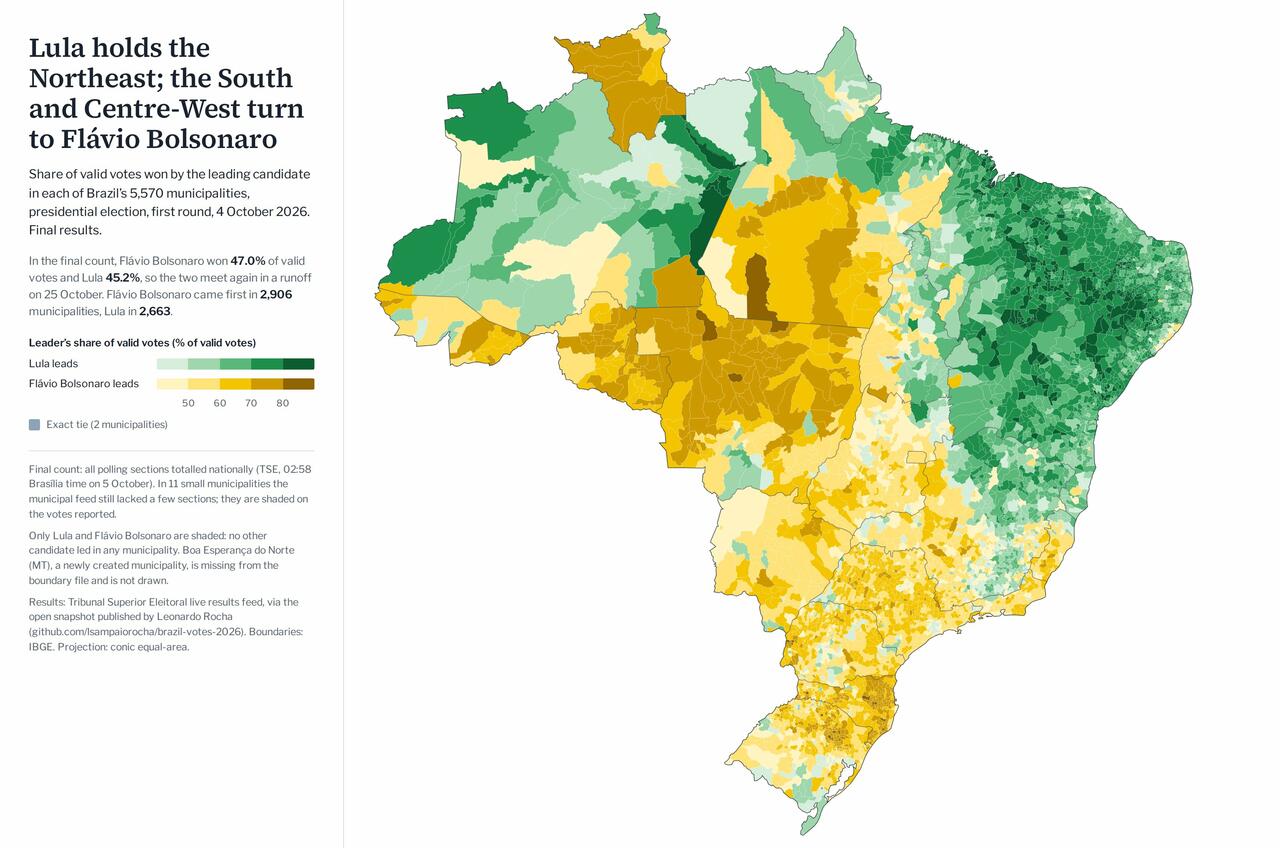
It also has huge global implications. If Brazil ‘flips’, and we are not there yet, it would effectively leave the BRICS with RICS, of which only RC are deeply connected and would see only Nicaragua, Canada, and already-squeezed Cuba of note out of the emerging ‘Donroe Doctrine’ loop given Greenland has been sealed into it – and potentially very much to the AmericaS’ (plural) benefit, which in a more zero-sum world is therefore to others’ detriment. The western hemisphere is after all close to the Middle East in terms of energy production and refining capacity, a giant in agri production, has vast resources of all kinds, and a combined population of around a billion.
Of course, the test would be if the US National Security Strategy is serious about “the goal is for our partner nations to build up their domestic economies, while an economically stronger and more sophisticated Western Hemisphere becomes an increasingly attractive market for American commerce and investment” behind a common external tariff, or if America First is still just cheap labor banana-republic neoliberalism that can be easily outbid on the geopolitical chessboard by others.
Nothing is yet certain, but this could be yet another key if-lines-on-maps-move-so-do-lines-on-screens moment in the making for markets.
end
7. OIL AND NATURAL GAS/ENERGY COMMENTARIES
Saudis off line/SUNDAY
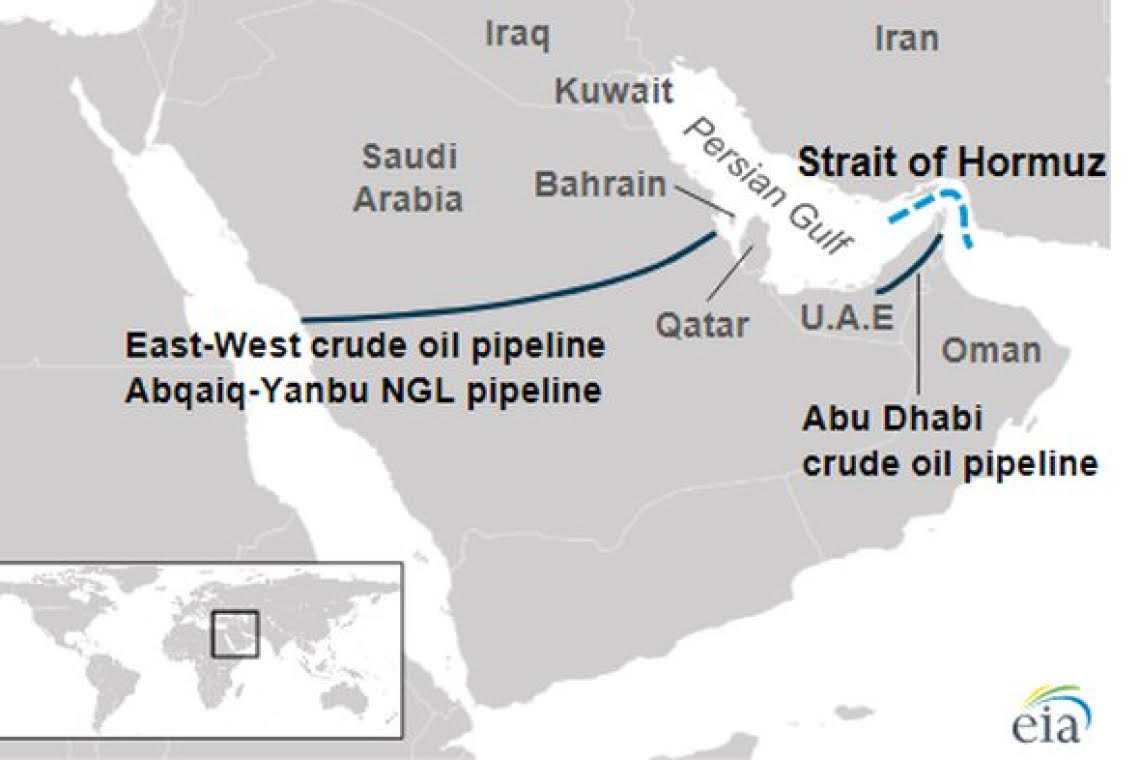
Zero chance of oil shipments.. think shortages will continue
12:30 PM EDT, today — reports are coming in claiming the Houthi’s have struck Saudi Arabia’s East-West Pipeline AGAIN.
Reports are saying “Pumping Station #2 is offline and burning.” east of Riyadh.
Sentinel-3 satellite imagery shows a black smoke plume roughly 50 km long over the site today.
END
MONDAY
Europe’s Soaring Gas Bill Is Sending Utilities Back To Coal
Monday, Oct 05, 2026 – 06:30 AM
Authored by Haley Zaremba via OilPrice.com,
Europe’s energy crisis isn’t over. Gas prices remain punishingly high across the continent as Europeans stare down the barrel of a long winter.

In response to back-to-back-to-back energy crises stemming from Europe’s continued reliance on imported liquefied natural gas against the backdrop of ongoing global geopolitical volatility, Europe’s leaders are pushing to diversify the bloc’s energy mix. While this means that Europe is rapidly expanding its renewable energy capacity, it also marks a significant return to the world’s dirtiest fossil fuel – coal.
Earlier this year, when the United States and Israel began an offensive in Iran and thereby instigated the disruption of one-fifth of the world’s oil and gas trades, Europe awakened to realize that it had sleepwalked into yet another energy crisis – its third in just four years. “We swore we’d learn. We promised things would change, but here we are,” a ‘highly frustrated European diplomat’ was recently (anonymously) quoted by the BBC.
“Instead of concentrating on much-needed long-term plans – about how to make Europe more competitive in this increasingly volatile world, [European] prime ministers and presidents are now in a panic over [energy] prices, worried about angry voters and scrambling for short-term solutions,” the source continued. “Just like the crisis after Russia’s full-scale invasion of Ukraine. Different conflict. Same European divisions; same dilemmas over energy. We can’t keep going round in these circles. Something’s got to give.”
Now, half a year after the outbreak of the war in Iran and the initial closure of the Strait of Hormuz, Europe is still grappling with the fallout as gas prices remain brutally high. Just this month, gas prices hit their highest mark in three years, soaring above €80 ($90.98) per megawatt hour.
Prices are so high, in fact, that coal-fired power has become cheaper than gas-fired power in Europe for the first time in years. This calculus has pushed many European nations, and especially the European Union’s largest economy, Germany, back to coal. And, worryingly, experts contend that that trend will continue for years to come.
“Coal is expected to remain cheaper than gas for power generation through next year and potentially until March 2028,” Reuters reported earlier this week, based on a conversation with Marta Wroniszewska, an analyst at Veyt. “Longer-dated gas prices indicate traders expect supply constraints to persist.”
However, there are notable limits to coal’s growth potential in Europe. Years of policy aimed at phasing down and phasing out coal have left the continent with dramatically fewer coal-fired power plants than it had previously. In 1990, the European Union derived more than a third of its electricity production from coal. By 2025, that share had fallen to just 9.2 percent, according to data from Eurostat. So while Europe’s remaining coal plants will receive a windfall from the current gas prices, there is a ceiling to coal’s potential rebound in the region.
Outside of Europe, however, it’s a different story. Globally, coal is still the single-biggest source of power production. And while Europe is shutting down its coal-fired capacity, many emerging economies are continuing to build theirs up, with particularly strong growth from the Philippines, Indonesia, and other rapidly developing countries across Asia. Not coincidentally, this was also the region hit hardest by the closure of the Strait of Hormuz.
While coal is cheap, abundant, and seen as a critical tool for enabling economic development in poor countries, the continuously extending timeline of coal’s reign presents trade-offs that far outweigh the benefits. Coal is the single largest driver of global warming, responsible for about 40 percent of all greenhouse gas emissions. However, it’s not all bleak – coal’s comeback is happening in tandem with a major global increase in clean energy resources. Increasingly, renewable energies are being adopted for their role in a more energy-secure future, and are seen as a critical buffer against the next global energy crisis.
Unlike natural gas, oil, and coal, “Wind and solar cannot be embargoed, blockaded, or shut off by a foreign power,” David Frykman, General Partner at Stockholm-based venture capital group Norrsken, wrote in an op-ed for Fortune earlier this year. “Every terawatt-hour of domestic renewable generation is a terawatt-hour that no adversary can weaponize.”
end
Aramco Cuts Asia Oil Prices To Six-Year Low, Warns Global Oil Supply Buffer “Scarily Thin”
Monday, Oct 05, 2026 – 11:40 AM
Saudi Aramco has raised oil prices for European-bound cargoes in November but has cut prices for Asian buyers to the lowest in six years as Persian Gulf producers race for market share with flows through the Strait of Hormuz increasing.
The state-owned firm will offer Arab Light crude to buyers in Asia to $5 a barrel less than the Dubai/Oman benchmark for November, according to Bloomberg citing a list from the producer. That compared with a discount of $2 a barrel for this month. Traders and refiners had expected a $5 increase from October, a Bloomberg survey shows.
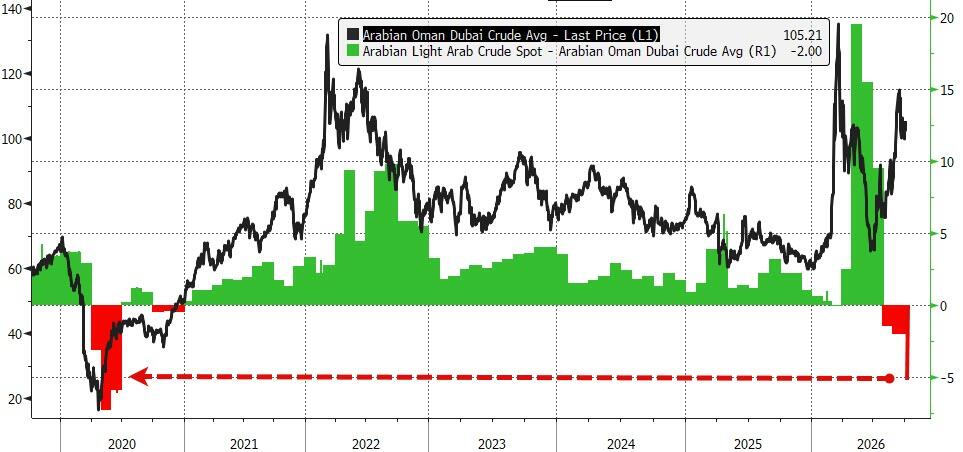
The unexpected cut amounted to $3 per barrel – which is the lowest since June 2020, not long after crude hit negative prices for the first and only time in history – is a signal the world’s largest oil exporter may be trying to boost sales to Asia, along with other Persian Gulf producers. Aramco raised November prices to Europe by $3 a barrel, and left those to the US unchanged from this month.
For European buyers, on the other hand, the November oil price will be $3 per barrel higher than it was for this month, across all grades. The prices for Saudi oil grades sold to the United States remained unchanged from October.
The discount for Asian buyers is likely a response to a surge in shipping costs for the Hormuz route, where Saudi Arabia is using ship-to-ship transfers in the Gulf of Oman to reduce the risk of Iranian attacks on vessels carrying its crude. The STS involves sending smaller vessels to pick up crude from the Persian Gulf, pass through Hormuz, and offload the crude onto VLCCs waiting off Oman. This oil-shuttling has boosted the cost of transporting crude from the Persian Gulf to other parts of the world, mostly Asia.
The freight cost for a very large crude carrier has soared to an all-time high of $1.3 million per day because of the Hormuz situation. This is up 43 times from January this year, when the rate for a VLCC stood at some $30,000 per day, according to Bloomberg.
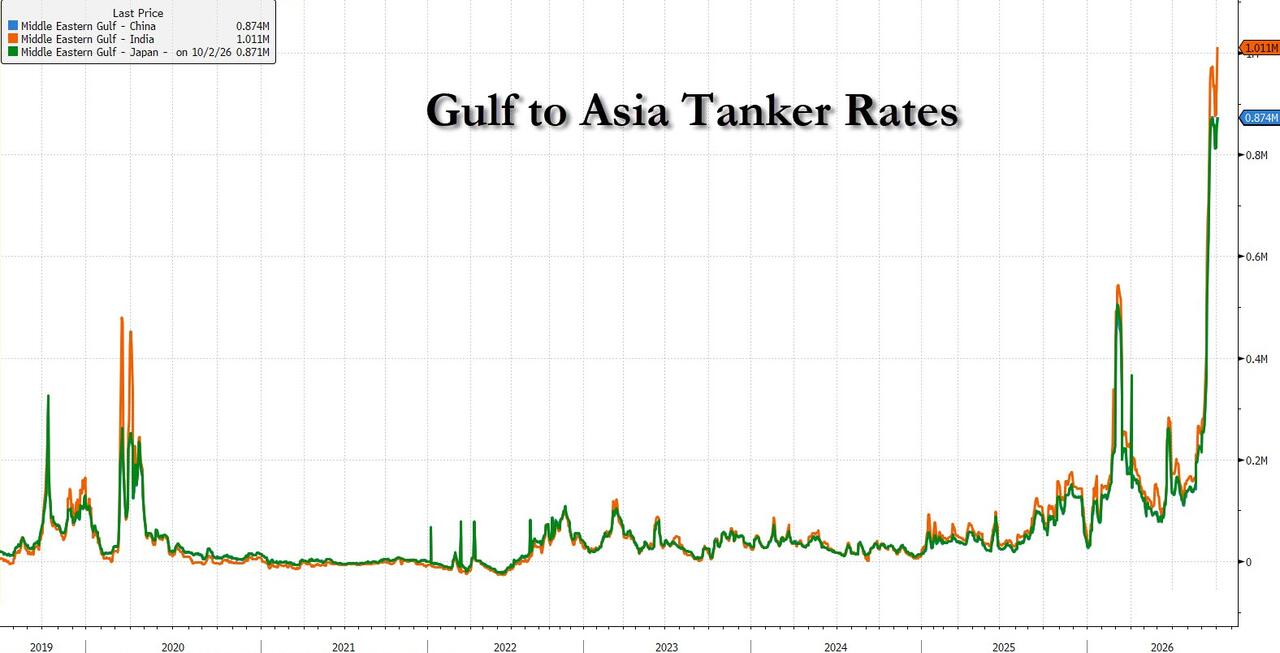
Because of these price developments, freight costs now add some $33 to the price of a barrel of oil getting shipped out of the Persian Gulf. This compares to $1.73 per barrel in January. In percentage terms, freight costs now represent 27% of the delivered cost for a VLCC cargo, versus 3% in January, the Poten & Partners data also showed.
Meanwhile, at roughly the same time as it was slashing prices to capture some of the UAE’s market share, the head of Saudi Arabia’s state producer said that oil stockpiles that cushion the world from supply shocks have become “scarily thin,” putting markets at risk of worsening unless the Strait of Hormuz reopens.
The head of the world’s single biggest crude exporting company was speaking just days after governments in the world’s biggest economies announced plans to release as much as 100 million barrels of emergency oil and diesel stocks to ease rising fuel costs.
“Until Hormuz fully re-opens and confidence returns, the crude reality is that pressure at both ends of the barrel will intensify,” Amin Nasser, chief executive of Saudi Aramco, said at the Energy Intelligence Forum in London on Monday. “While the squeeze on crude is serious, refined fuel prices have risen even more sharply.”
Consumption of crude is still rising and countries will require even more supply for at least the next two years while rebuilding their inventories, Nasser said. That could mean additional demand of at least 2 million barrels a day, or even more if governments decide to increase the amount of oil they hold in stockpiles, he said.
Commenting on the latest emergency release, Rabobank’s Michael Every writes that the 50 million barrels of oil that Europe agreed to release (following US demands) are not from a government-owned facility but private stocks and were reportedly already available for sale, “but Europe is instead opting to buy cheaper US flows. So, the EU move was serious, showing who still asks, ‘How many barrels?’ when the White House asks for a jump in output, yet performative in that truly cheap diesel will remain in short supply.”
When the US-Iran war began, the world had about 10 billion barrels of oil stocks, Nasser said. That has fallen to less than 6 billion, of which only 10% of which is practically available due to various technical restrictions, he said, echoing what JPM‘s Natasha Kaneva warned about back in May.
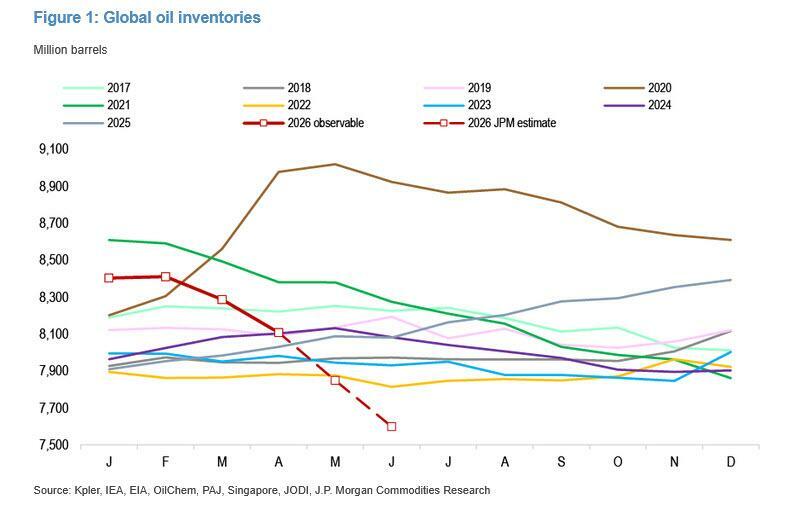
Releasing part of what’s left in global stockpiles will buy economies some time but won’t fix the imbalances between supply and demand, Nasser said. Gulf producers are working to ramp up production and exports and have succeeded in boosting crude flows to near prewar levels.
Saudi Arabia and neighbors like the United Arab Emirates and Kuwait have been using their own tankers to ship crude through Hormuz, which has been at least partly obstructed since the US and Israel attacked Iran at the end of February, kicking off a regional war.
The higher flows have provided scant relief for oil markets, which are still pricing in security risks to supply in the Persian Gulf and Red Sea. Brent crude, the international benchmark, has traded around $100 a barrel over the past month, even as more tankers transited Hormuz. Those vessels have had to run the risk of heightened attacks, while Saudi Arabia has been repeatedly targeted over the last month.
Still, all of Aramco’s upstream capacity remains intact, Nasser said. That has allowed the company to continue covering its supply contracts with buyers in Europe and Asia. The company has used various export routes, shifted supply between its different crude grades and pressed its own tankers into operation to supply customers, he said.
Over the past month, Aramco boosted crude shipments from its main export terminal at Ras Tanura in the Persian Gulf. The company reacted quickly to a temporary halt to its main cross-country pipeline after an attack last month, and has since brought flows back to about 80% of capacity, although earlier today we got reports of another massive explosion on the East-West pipeline which likely halted shipments again.
Aramco is looking for alternative crude export routes to avoid relying too much on any single method of reaching global buyers, Nasser said, without providing specifics. The company is studying plans that would double or triple the capacity of its storage facilities, he said.
END
8. EMERGING MARKETS//AUSTRALIA NEW ZEALAND ISSUES
BRAZIL
Bolsonaro Leads As Brazil Election Heads Toward Runoff; Traders Brace For Monday Volatility
Sunday, Oct 04, 2026 – 07:54 PM
Summary:
- Datafolha Says Election Headed For Runoff
- Right-Wing Bolsonaro Leads Socialist Lula
- Polling closed at 4 pm local time
- Brazil Votes In Tight Presidential Election With South America’s Future On The Line
Bolsonaro Leads But Headed For Election Runoff
Brazil’s presidential election is headed for a runoff on Oct. 25.
Right-wing Senator Flávio Bolsonaro held about 47.8% of the vote against President Luiz Inácio Lula da Silva’s 44.2%, with roughly 92.3% of ballots counted.
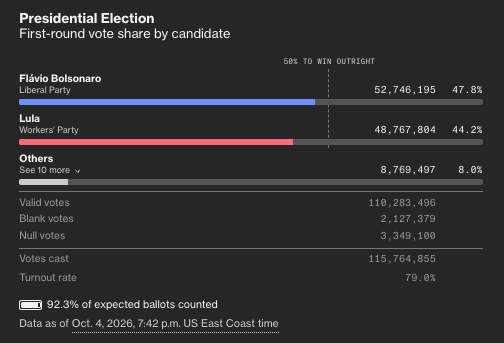
Paulo Abreu, founding partner and portfolio manager at Rio de Janeiro-based Mantaro Capital, told Bloomberg he expected a strong opening for Brazilian assets on Monday morning, saying investors had been lightly positioned for the result.
“Tomorrow will be a much better day than even the most optimistic investors had expected,” Abreu said, adding that the outcome would encourage investors to increase their exposure.
Currency futures trading on CME also signaled expectations of a stronger real, with the quoted exchange rate moving to about 5.01 from Friday’s close of 5.25.
Brendan McKenna, an emerging-markets strategist at Societe Generale, expects the Brazilian real to jump 4% to 5% on Monday following Bolsonaro’s first-round lead.
“Assuming no new scandals, always possible, and Bolsonaro is set to win the runoff, I think local assets can continue to rally into the second round, he said.
Bloomberg reporter Beatriz Reis wrote:
With more than 91% of ballots counted and Bolsonaro holding a surprise first-round lead, his campaign’s theory suddenly looks more plausible: that some voters were reluctant to publicly admit they planned to back the right-wing senator. Whether that phenomenon actually explains the polling miss will take time to determine, but the result exposed support for Bolsonaro that pre-election surveys failed to fully capture.
Now the challenge flips for both campaigns. Lula has just three weeks to understand where he lost ground and win those voters back. Bolsonaro has to protect an advantage few expected him to have and prove that Sunday’s surprise can survive all the way to the Oct. 25 runoff.
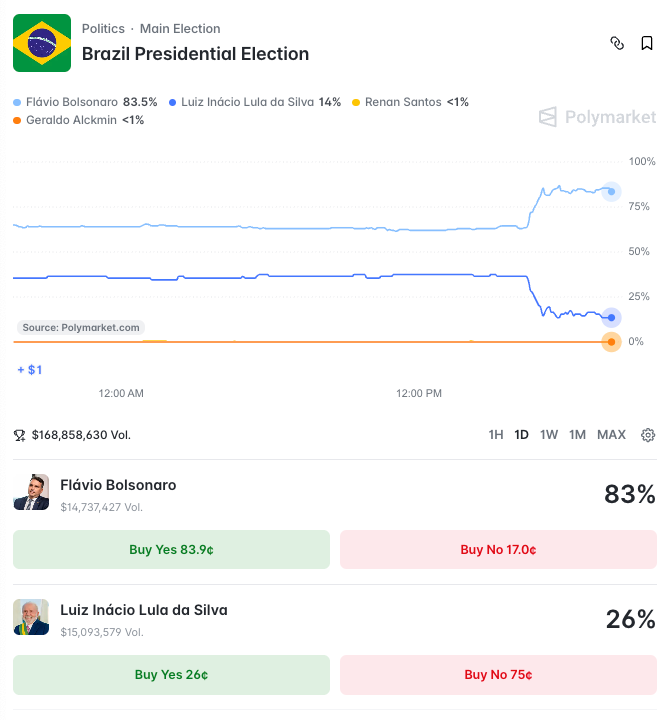
Latest Election Development
Brazil’s presidential election is headed for a runoff, Datafolha projected just moments ago, setting up a second-round contest between socialist President Luiz Inácio Lula da Silva and right-wing Senator Flávio Bolsonaro on Oct. 25.
Latest Election Count
Right-wing Senator Flávio Bolsonaro leads socialist President Luiz Inácio Lula da Silva 51.2% to 40.7%, with just 18.7% of votes counted in Brazil’s first-round presidential election Sunday.
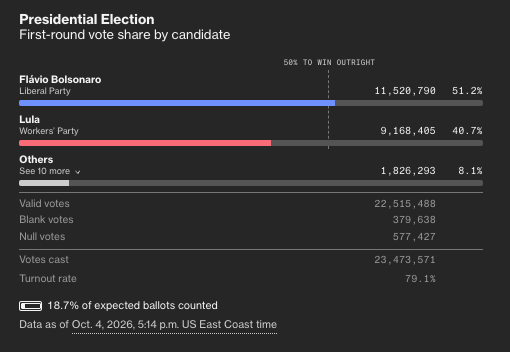
Polymarket:
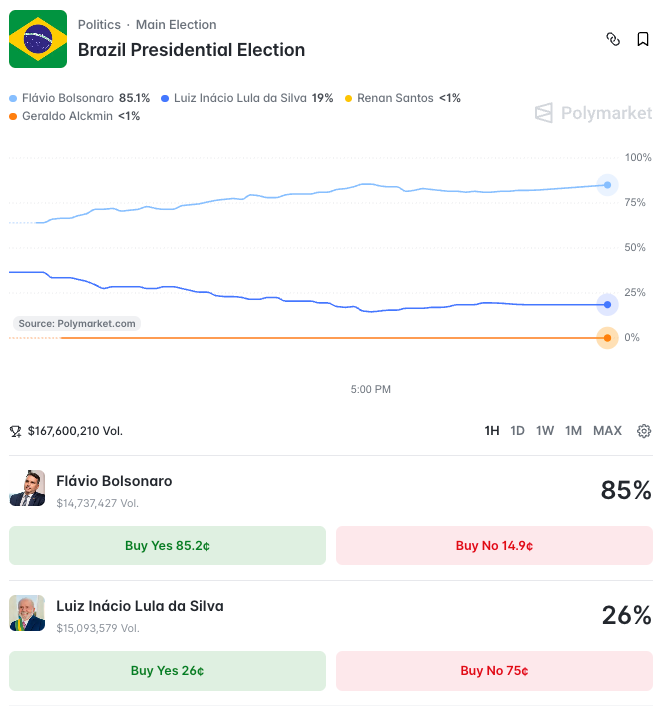
END
BRAZIL/MONDAY MORNING//SPAIN
Left Under Pressure: Bolsonaro Leads Socialist Lula In Brazil As Spain’s Sanchez Calls Snap Elections Amid Turmoil
Monday, Oct 05, 2026 – 07:20 AM
Political developments in Brazil and Spain overnight are adding volatility to certain overseas markets, highlighting mounting pressure on failing left-wing regimes.
In Brazil, right-wing Senator Flávio Bolsonaro’s first-round lead over socialist President Luiz Inácio Lula da Silva significantly strengthens his position heading into the Oct. 25 runoff. A Bolsonaro victory would shift Latin America’s largest GDP to the right, reinforcing a broader regional once-in-a-generation realignment from unhinged leftist regimes to common-sense right-wing governments.
Brazil’s political pendulum is swinging right after years of toxic socialism, and investors are cheering on Monday morning:
BANKS, FINANCIAL FIRMS
- Banco Bradesco: +10%
- Itau Unibanco Holding: +11%
- NU Holdings: +9.5%
- Inter & Co.: +11%
- Banco Santander (Brasil): +3.5%
- PagSeguro Digital: +14%
- StoneCo: +12%
- PicS: +6.2%
STEEL, METAL & MINING
- Companhia Siderurgica Nacional: +9.5%
- Vale: +6.5%
- Gerdau S.A.: +7.0%
AERO, OIL & GAS AND OTHER SECTORS
- XP Inc.: +15%
- Ambev: +8.4%
- Embraer: +6.3%
- MercadoLibre: +7.0%
- Telefonica Brasil: +8.1%
- Companhia Energetica de Minas Gerais: +7.0%
- Companhia Paranaense de Energia: +5.8%
- Petroleo Brasileiro: +7.0%
- Ultrapar Participacoes: +7.2%
- Cia de Saneamento Basico do Estado de Sao Paulo (SABESP): +9.7%
- TIM S.A.: +6.8%
Bolsonaro captured 47% of the vote against Lula’s 45.2%, with counting completed, as conservative allies dominated races across the country.
Via Bloomberg:
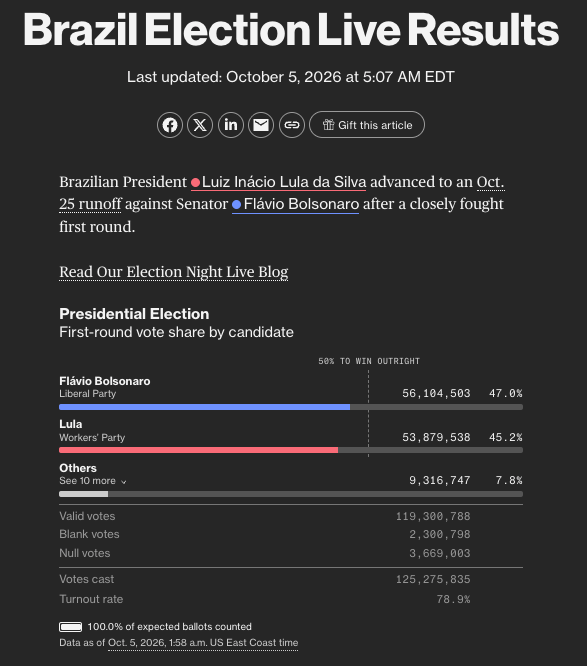
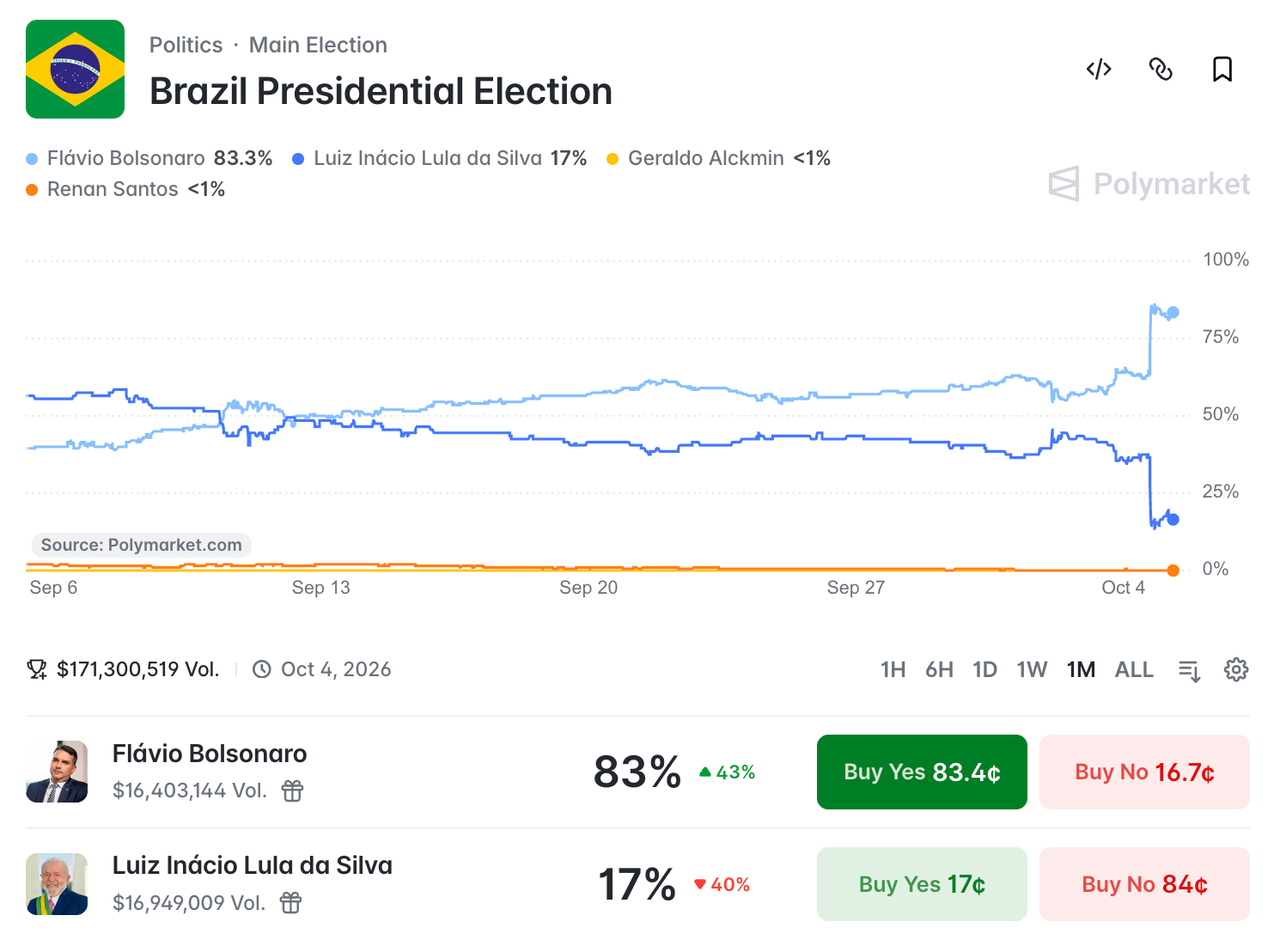
“The magnitude of the first-round win by Flávio will come as a surprise to financial markets, and given the light positioning by foreigners, I would expect a meaningful rally in the near term as investors begin to price in a change in government, a shift in policy direction, a potential reform agenda and a reduction in fiscal risk. From a stock perspective, watch SOEs, beta and rate-sensitive names as the market starts to price in a faster reduction of interest rates in 2027,” UBS analyst Justin Wensek wrote, adding, “Market reaction: Risk-on, blue-sky scenario starting Monday.”
Goldman Sachs one-delta desk head Rich Privorotsky noted, “Flávio Bolsonaro 47.0%, Lula 45.2%… substantially better for the market than expected. Brazil should be up a lot today and the market will now front-load the second round. Worth looking through the 2nd-order Brazil plays across Europe. At least initially this should be supportive for BRL, domestic equities and risk assets across the geography.”
A Bolsonaro victory later this month would cement Latin America’s largest economy’s rightward shift and politically transform the entire continent in just a few short years. It’s fascinating to watch this shift unfold as USAID funding has dried up.

Then, in Spain, Socialist Prime Minister Pedro Sánchez called a snap election for Nov. 29 after parliament rejected an emergency housing package, deepening a political crisis fueled by anti-left sentiment, the migrant invasion of Ceuta, and corruption scandals.
Spain’s 10-year government bond yield was little changed at 4.08%, while its spread over German debt widened three basis points to 65 basis points. The euro fell 50bps to $1.1197 amid broader concerns over fiscal and political risks in the currency bloc.
In France, President Emmanuel Macron’s approval rating has collapsed amid unrest involving far-left groups and migrants, adding to his political vulnerability and strengthening Marine Le Pen ahead of next year’s presidential election.
From Brazil to Spain and France, the common understanding here is mounting voter anger at the socialist and left-wing regimes that have been nothing but disastours for the West. With USAID funding curtailed and progressive policies facing a growing backlash, the right has taken advantage of an open window to gain political ground and turn frustration into electoral gains.
Taken altogether, the West is pushing back against socialist and pro-China governments. Latin America’s full rightward shift hinges on Brazil’s runoff results later this month, while Europe has seen right-wing political movements gain ground, especially in Germany with AfD’s rise. Nomura expects that Europe “lurches” right over the next year or so of elections.
end
CANADA/GR BRITAIN/USA
Failing Canada And Britain Blame Trump, Putin, And ‘White Supremacy’
Friday, Oct 02, 2026 – 11:25 PM
Authored by J.B. Shurk via American Thinker,
Commie Canada and the dis-United Kingdom should be renamed the “Dumb and Dumber” of the British Commonwealth.
King Charles III’s North American prime minister, Mark Carney, ran to The New York Times last week to talk about his military combat preparations against the United States in the event that President Trump crosses Lake America and liberates Canada from its delusional leaders. What a showboating dunce. The U.S. singlehandedly sustains Canada’s economy and national security, yet the tiny central banker huffed and puffed in a hilariously Napoleonic display of fake strength.
In the same interview with the failing Times, Con-man Carney outlined his intent to integrate Canada’s economy with that of China and the European Union and to replace the U.S. Dollar with a China-linked global reserve currency. Rhetorically defending Canada’s sovereignty while insulting his U.S. benefactor, Little Mark Carney explained how he would subjugate his socialist nanny-state to Chinese Communist Party General Secretary Xi Jinping and unelected European Commission President Ursula von der Leyen. Mark is the global mascot for “educated” idiots everywhere.
Not to be outdone by not-so-Great Britain’s Canadian cousin, U.K. Prime Minister Poindexter (er, I mean Andy Burnham) informed the United Nations General Assembly last week that his government was constructing yet another speech-police organization (this one given the august name, “National Centre for Information Defence,” which should not be confused with the “Research, Information, and Communications Unit,” the “Government Communication Service,” the “Counter Disinformation Unit,” the “Defending Democracy Taskforce,” the “Information Threats and Influence Directorate,” the “Rapid Response Unit,” the “National Cyber Force and Social Cohesion Taskforce,” the “Media Monitoring Unit,” or any of the other information-control agencies already mobilized across totalitarian Britain) to protect the British people from scary thoughts and words. Burnham blamed the Russians for spreading “a narrative of decline, stoking division, and sowing despair” in the U.K. (and definitely not Westminster’s promotion of decline, division, and despair!) and promised to counteract this “information warfare” by censoring Britons’ public speech and feeding his collapsing country a steady diet of State-sanctioned propaganda. In order to beat back the Russians, Dilapidated Britain must have its very own digital Iron Curtain! Two cheers for democracy! Hip hip…who cares.
The British people are screwed. On average, their government grants settlement or citizenship to an illegal alien every single minute. These foreign nationals receive more welfare from British taxpayers than ever before. The third-world invaders (I mean, “newcomers”) use Britain’s streets as public toilets. Rather than securing the kingdom’s borders, the Home Office hands out a nine-page booklet informing mostly-Muslim men of military age that it is illegal to rape women and children while they conquer the islands. In the last two years alone, the number of illegal immigrants (and future citizens!) arriving by boat has exceeded the size of the entire British Army! But if these outrageous facts disturb you enough to publicly express your feelings on social media, you will most likely join the roughly 65,000 Brits who have been arrested for “speech-related offenses” over the last five years. Foreign invasion? Good! Free speech? Very bad!
Apparently, the British police state also plans to imprison anyone who would rather not fight WWIII against the Russian Federation. During a recent episode of former cabinet minister Jacob Rees-Mogg’s “State of the Nation” on GB News, one leftist-globalist commentator in favor of mass conscription argued, “We would have to lock a few people up…some of the pro-Russian voices, people saying there isn’t a threat, don’t fight for your country, don’t go to war for Burnham, we’ll have to lock ’em up.” Rather than responding with horror at the suggestion that his fellow Britons should be imprisoned for opposing a catastrophic war, Rees-Mogg pedantically replied, “Well, we suspended habeas corpus during the Napoleonic Wars…indeed, yes.” In another interview, Rees-Mogg nonchalantly remarked that British citizens have a “duty” to “die” for Britain in a war against Russia.
In Burnham and Rees-Mogg’s Britain, the only way to “defend democracy” is to imprison anyone who disagrees with the British Establishment and to sacrifice everyone else to the killing fields! The British Isles might as well be renamed the “Gulag Archipelago.”
Interestingly, GB News – which leans conservative – discovered last week that Britain’s media regulator, the Office of Communications (Ofcom), had covered up data showing that viewers trust GB News more than the BBC. GB News, in fact, is ranked above all other networks with regard to viewpoint diversity and impartiality. British authorities apparently did not want the public to know these inconvenient truths because the BBC is treated as an objective, trustworthy, and premier source of news (fact check: false!). In an effort to control the public’s perception of the BBC, Ofcom restricted what information the public was permitted to know. P.M. Burnham takes the “defense of information” very seriously!
How seriously? Burnham and the British government force citizens to pay for the BBC’s awful dreck whether they watch it or not! Every household in the U.K. must fork over a £180 license fee to the BBC each year. Because more households are refusing to pay the license, the government is considering the imposition of a mandatory £11-a-month Internet tax in order to keep the BBC’s fake news funded. The BBC says that the “fee is essential for maintaining the quality and diversity of public broadcasting in the UK.”
What does “quality and diversity” look like at the BBC? Two “reporters” just did a major exposé describing how women who don’t polish their nails perpetuate “white supremacy.” No joke! “Nail art’s historical and creative roots are linked back to black, Latino, and Asian communities and the suggestion that bare nails are now a sign of high status could stigmatise bold manicures,” the BBC “reports.” “They are often called elegant or tasteful, and these are often usually euphemisms that perpetuate white supremacist standards of beauty.” Yes, Burnham, force Britain’s working-class to pay for this race-baiting propaganda posing as hard news!
Earlier this year, British authorities announced that YouTube and other social media platforms would be forced to manipulate their algorithms and push BBC “news” to the top of feeds in order to counter “disinformation.” In other words, Whitehall steals money from British citizens to pay for State-run TV and then forces them to watch it. During the Cold War, we called that Soviet-style propaganda. Yet if you ask the fake “reporters” at the BBC, Canada’s publicly-funded CBC, or America’s NPR or PBS, all these propagandists would insist that they have nothing in common with the Soviet Union’s Pravda or the Russian Federation’s RT (Russia Today) News. In the West, State-funded media are somehow not State media. Does that sound more like propaganda or breaking news?
Britain’s State-imposed “narrative control” is utterly totalitarian. Dismissing the “narrative of decline” and “despair” in Britain as a “corrosive narrative…which bears no resemblance to reality” and a “distorted and untrue narrative about Britain,” P.M. Burnham casts all public dissent as “far-right narratives.” As military historian Professor Michael Rainsborough mocks, “The problem isn’t the problem, the problem is the people noticing the problem.” Rainsborough points out that right after Burnham rebranded “decline” as “disinformation,” the prime minister laid out a “10-year plan” to fight inflation, housing costs, hopelessness, inequality, and division. “The narrative of decline,” in other words, “bears no resemblance to reality, although reality apparently requires a 10-year plan.”
Both Canada and Britain are failing. The public has noticed. Carney and Burnham wish to whitewash reality with fake “narratives.” The worse things become, the more difficult it will be for their ministries of truth to succeed. Expect the BBC to blame Trump, Putin, and “white supremacy.”
END
U.S./GOLD AND SILVER PRICING/ASIAN CLOSING MARKETS AND EUROPEAN BOURSE OPENING AND CLOSING/ INTEREST RATE SETTINGS MONDAY MORNING 6;30AM//OPENING AND CLOSING\
OPENING LEVELS OF CURRENCIES// AND CLOSING ASIAN STOCK MARKET AND OPENING EUROPEAN STOCKS:6 AM EST
EURO VS USA DOLLAR: 1.1206 DOWN 0.0042
USA/ YEN 157.92 UP 0.124 NOW TARGETS INTEREST RATE AT 1.75% AS IT WILL BUY UNLIMITED BONDS TO GETS TO THAT LEVEL…//YEN STILL FALLS//END OF YEN CARRY TRADE BEGINS AGAIN DEC 2024/Bank of Japan raises rates by .25% TO 1.75 ..TAKAICHI NEW PM AS YIELDS RISE//JAPAN DEEPLY IN TROUBLE WITH RISING RATES AND A FALLING YEN!! BANK OF JAPAN WILL NO LONGER DO QE. URGES PENSION AND INSUANCE FUNDS TO BUY JAPANESE BONDS//
YEN CARRY TRADERS MURDERED
GBP/USA1.3223 DOWN 0.0012 OR 12 BASIS PTS
USA/CAN DOLLAR: 1.4243 UP 0.0006 //CDN DOLLAR DOWN 6 BASIS PTS//
Last night Shanghai COMPOSITE CLOSED HOLIDAY UNTIL THURSDAY
Hang Seng CLOSED UP 68.04 PTS OR 0.28%
AUSTRALIA CLOSED DOWN 0.33%
// EUROPEAN BOURSE: ALL MIXED
Trading from Europe and ASIA
I) EUROPEAN BOURSES: ALL MIXED
2/ CHINESE BOURSES / :Hang SENG CLOSED UP 68.04 PTS OR 0.28%
/SHANGHAI CLOSED
AUSTRALIA BOURSE CLOSED DOWN 0.33%
(Nikkei (Japan) CLOSED UP 1676.54 PTS OR 2.45%
INDIA’S SENSEX IN THE GREEN
Gold very early morning trading: $4157.95
silver:$61.66
USA DOLLAR VS TRY (TURKISH LIRA): 49.16 UP 0 BASIS PTS AND NOW WE SEE THEIR STUPIDITY OF SELLING SOME OF THEIR GOLD AND ALL OF THEIR USA DOLLAR RESERVES. THE COUNTRY IS IN BIG FINANCIAL TROUBLE
USA DOLLAR VS RUSSIAN ROUBLE: 85.00 ROUBLE// DOWN 1 ROUBLE AND 20 BASIS PTS.
UK 10 YR BOND YIELD: 5.3989 UP 3 BASIS PTS
UK 30 YR BOND YIELD: 5.9156 UP 2 BASIS PTS
CDN 10 YR BOND YIELD: 3.9450 UP 2 BASIS PTS
CDN 5 YR BOND YIELD; 3.623 UP 2 BASIS PTS
USA dollar index early MONDAY MORNING: 101.93 UP 22 BASIS POINTS FROM THURSDAY’s CLOSE
MONDAY MORNING NUMBERS ENDS
And now your closing MONDAY NUMBERS 10.00 AM
Portuguese 10 year bond yield: 3.995% UP 1 in basis point(s) yield
JAPANESE BOND 10 yr YIELD: +3.091% UP 1 FULL POINTS BASIS POINTS /JAPAN losing control of its yield curve/
JAPAN 30 YR: 4.254 UP 6 BASIS PTS//
SPANISH 10 YR BOND YIELD: 4.110 UP 2 in basis points yield
ITALY 10 YR BOND: 4.635 UP 2 points in basis points yield ./
GERMAN 10 YR BOND YIELD: 3.4700 UP 2 BASIS PTS
IMPORTANT CURRENCY CLOSES : MID DAY MONDAY
Closing currency crosses for day /USA DOLLAR INDEX/USA 10 YR BOND YIELD/10:00 AM
Euro/USA 1.1194 DOWN 0.0054 OR 54 basis points
USA/Japan: 158.20 UP 0.401 OR YEN IS UP 40 BASIS PTS// HIGHLY INFLATIONARY TO JAPAN
Great Britain 10 YR RATE 5.4128 UP 4 BASIS POINTS //
GREAT BRITAIN 30 YR BOND; 5.9350 UP 4 BASIS POINTS.
CANADIAN DOLLAR DOWN 16 BASIS PTS TO 1.4260
xxxxxxxxxxxxxxxxxxxxxxxxxxxxxxxxxxxxxxxxxxxxxxxxxxxxxxxxxxxxxxxxxxxxxxxxxxxxxxxx
The USA/Yuan CNY 6.7046 ON SHORE ..OFF
THE USA/YUAN OFFSHORE// CNH DOWN TO 6.7075
TURKISH LIRA: 49.16 UP 1 EXTREMELY DANGEROUS LEVEL/DEATH WATCH/HYPERINFLATION TO BEGIN.//
Your closing 10 yr US bond yield UP 4 in basis points from FRIDAY at 5.306% //trading well ABOVE the resistance level of 2.27-2.32%)
USA 30 yr bond yield 5.665 UP 4 basis points /10:00 AM
USA 2 YR BOND YIELD: 4.825 UP 1 BASIS PTS.
GOLD AT 10;00 AM $4145,00
SILVER AT 10;00: $61.35
Your 11:00 AM bourses for Europe and the Dow along with the USA dollar index closing and interest ratesMONDAY
DAY CLOSING TIME/ 12:00 AM///
London: CLOSED UP 35.94 PTS OR 0.34%
GERMAN DAX: CLOSED UP 23.01 PTS OR 0.09%
FRANCE: down 63.09 OR 0.80 PTS
Spain IBEX CLOSED UP 214.40 PTS OR 1.12%
Italian MIB: CLOSED UP 335.17 PTS OR 0.66%
WTI Oil price 89.66 10.00 EST/
Brent Oil: 101.60 10:00 EST
USA /RUSSIAN ROUBLE: 85.31/// ROUBLE DOWN 1 AND 51/ 100
CDN 10 YEAR RATE: 3.972 UP 3 BASIS PTS.
CDN 5 YEAR RATE: 3.641 UP 2 BASIS PTS
CLOSING NUMBERS: 4 PM//
Euro vs USA 1.1217 DOWN 0.0030 OR 30 BASIS POINTS//
British Pound: 1.3222 DOWN 0.0013 OR 13 basis pts/
BRITISH 10 YR GILT BOND YIELD: 5.4252 UP 5 FULL BASIS PTS//
BRITISH 30 YR BOND YIELD: 5.935 UP 3 IN BASIS PTS.
JAPAN 10 YR YIELD: 3.092 UP 1 FULL BASIS PTS (DANGEROUS TO THEIR ECONOMY
JAPANESE 30 YR BOND: 4.243 UP 5 PTS AND STILL VERY DANGEROUS TO THEIR ECONOMY
USA dollar vs Japanese Yen: 157.56 UP 0.176 OR YEN DOWN 18 BASIS PTS//GETTING FURTHER AWAY FROM 160.00/ EXTREMELY DANGEROUS
USA dollar vs Canadian dollar: 1.4255 UP 0.0001 PTS// CDN DOLLAR DOWN 1 BASIS PTS
West Texas intermediate oil: 88.94
Brent OIL: 99.98
USA 10 yr bond yield UP 4 BASIS pts to 5.315
USA 30 yr bond yield: UP 4 PTS to 5.669%
USA 2 YR BOND 4.833 UP 0 PTS
CDN 10 YR RATE 3.958 UP 2 BASIS PTS
CDN 5 YEAR RATE: 3.6230 UP 1 BASIS PTS
USA dollar index: 101.903 DOWN 3 BASIS POINTS
USA DOLLAR VS TURKISH LIRA: 49.16 UP 2 BASIS PTS GETTING QUITE CLOSE TO BLOWING UP/IDIOTS SOLD GOLD
USA DOLLAR VS RUSSIA//// ROUBLE: 85.31 DOWN 1 AND 51 /100 roubles //
GOLD $4,140.40 3:30 PM)
SILVER: 61.22 3;30 PM)
DOW JONES INDUSTRIAL AVERAGE: UP 91.41 POINTS OR 0.18%
NASDAQ 100 UP 268.51 PTS OR 0.87%
VOLATILITY INDEX 15.55 UP 0.24 PTS OR 1.57%
GLD: $ 379.55 DOWN 0.59 PTS OR 0.16%
SLV/ 55.13 PTS UP .39 OR .71%
TORONTO STOCK INDEX// TSX INDEX: CLOSED UP 58.51 PTS OR 0.17%
end
TRADING today ZEROHEDGE 4 PM: HEADLINE NEWS/TRADING
‘
The Crazy Continues: Stocks Up, Breadth Down; Yields Up, Oil Down
WRAP UP:
Stocks rally across the board while long-end yields advance higher – Newsquawk US Market Wrap
Monday, Oct 05, 2026 – 04:08 PM
- SNAPSHOT: Equities up, Treasuries down, Crude down, Dollar up, Gold
- REAR VIEW: ISM Services headline misses & prices rise; Two refineries reportedly hit in Saudi Arabia; Mixed reporting on current state of Saudi’s East-West pipeline; Spanish PM Sanchez called an early election; Japan’s GPIF reportedly didn’t discuss allocation at its September meeting; Bolsonaro edges Lula in first Brazil election round
- COMING UP: Data: Australian Westpac Consumer Confidence (Oct), German Factory Orders (Aug), EU Retail Sales (Aug), US ADP Employment Change Weekly, Atlanta Fed GDP (Q3). Events: EIA STEO. Speakers: BoE’s Mann; ECB’s Zigman, Elderson, Cipollone; Fed’s Williams, Bowman, Schmid. Supply: Japan, UK, Germany, US.
- WEEK IN FOCUS: FOMC Minutes, US ISM Services PMI, OPEC+, Canadian Jobs and ECB Minutes. Click here for the full report.
- WEEKLY US EARNINGS ESTIMATES: PEP the highlight in a thin week of earnings. Click here for the full report.
More Newsquawk in 2 steps:
- 1. Subscribe to the free premarket movers reports
- 2. Trial Newsquawk’s premium real-time audio news squawk box for 7 days
MARKET WRAP
Stocks rallied on Monday, with broad-based gains across the major US indices, including the equal-weight S&P 500. Sectoral performance was also strong, with all sectors closing higher aside from Real Estate, while Materials, Communication Services and Health Care led the gains.
Treasuries sold off and the curve bear steepened, with long-end yields leading the move higher. There was little reaction to the US ISM Services PMI report, which fell marginally below forecasts as activity measures slowed M/M, while Prices accelerated and Employment returned to expansionary territory. The rise in yields supported the Dollar, while the Euro underperformed amid lingering French fiscal concerns and further protests, and Spain’s PM called for a snap election.
Elsewhere in FX, the Aussie outperformed alongside higher metal prices, while the Yen saw some strength following constructive commentary from Japanese PM Takaichi, who vowed to maintain fiscal discipline. Crude prices were choppy on mixed geopolitical reports, particularly regarding Saudi Arabia and Yemen, alongside reports of fires in the Saudi oil export line and strikes at refineries, but crude ultimately settled in the red. Gold gave back its earlier gains as US yields moved higher throughout the session.
Note: Brazilian assets rallied following election results over the weekend, which put Bolsonaro ahead of incumbent President Lula, with the Presidential election run-off vote due 25th October.
US
ISM SERVICES PMI: The ISM Services PMI report was mixed. The headline fell to 54.9 in September from 55.4 in August, slightly below the 55.0 forecast but above the 54.1 twelve-month average. Business Activity dropped to 56.5 from 61.7, while New Orders also fell to 56.5 from 61.7, weighing on the headline print. On inflation and employment, the Prices Index rose to 74.0 from 72.6, above the 73.3 forecast, while Employment returned to expansionary territory after two months of contraction, rising to 50.1 from 47.8 and above the 48.8 forecast. Meanwhile, thirteen industries reported growth, one more than in August, while four reported contraction, one fewer than the prior month. The report noted that tariff and fuel-cost impacts were the most cited issues affecting supply chains, with fuel costs mentioned twice as often as any other single issue, while supply-chain constraints were also a key concern. Pantheon Macroeconomics highlights that the report suggests activity in the services sector is rising at no more than a moderate pace and points to less momentum in services activity than indicated by the S&P Global Services PMI. The upside in employment is encouraging, particularly after the weak September NFP report, but the upside in prices remains a clear concern for the Fed.
FIXED INCOME
T-NOTE FUTURES (Z6) SETTLED 4+ TICKS LOWER AT 104-07
Yield curve bear steepens as long end leads yields higher. At settlement, 2-year +0.4bps at 4.831%, 3-year +0.2bps at 4.959%, 5-year +0.9bps at 5.063%, 7-year +2.3bps at 5.186%, 10-year +3.2bps at 5.307%, 20-year +3.9bps at 5.709%, 30-year +3.8bps at 5.661%.
THE DAY: Treasury yields continued to move higher on Monday, with the curve bear steepening as the long end led the move. There was no Fed speak to digest, while US data saw a mixed ISM Services PMI report. The headline declined M/M to marginally below expectations, with Business Activity and New Orders both falling sharply, indicating slower activity growth than in August. Conversely, Prices accelerated further and Employment returned to expansionary territory. The data ultimately had little impact on Treasury price action.
The moves largely continued Friday’s reversal despite the soft NFP report. Meanwhile, oil prices settled in the red, albeit after choppy trade, which may have helped keep the front end of the curve relatively anchored. More broadly, the price action extends the trend seen over recent months, with Treasury yields continuing to climb and the move accelerating since September amid renewed upside in oil prices, the resumption of Fed rate hikes and persistent global fiscal concerns. The AI investment boom has also remained a potential source of pressure through expectations for stronger investment and growth, alongside the significant financing needs associated with the buildout.
Overall, there was no obvious fresh catalyst behind Monday’s price action, with the move instead appearing to reflect a continuation of the broader trend seen in recent months.
Supply
Notes
- US to sell USD 58bln 3yr notes on October 6th, USD 39bln 10yr notes on October 7th; and USD 22bln 30 year bonds on October 8th; all to settle on October 15th
Bills
- US sold 6-month bills at a high rate of 4.165%, B/C 2.79x; sold 3-month bills at a high rate of 4.050%, B/C 2.51x
- US to sell USD 95bln of 6-week bills on October 6th; all to settle on October 8th
STIRS / OPERATIONS
- Fed Hike Pricing via CME FedWatch: Oct 6.0bps (prev. 5.7bps), Dec 27.1bps (prev. 25.9bps)
- EFFR at 3.88% (prev. 3.88%), volumes at USD 118bln (prev. USD 120bln) on October 2nd
- SOFR at 3.88% (prev. 3.87%), volumes at USD 3.013tln (prev. USD 3.067tln) on October 2nd
- NY Fed RRP op demand at 1.00bln (prev. 1.50bln) across 6 counterparties (prev. 3) on October 5th
- US Treasury to buy back up to USD 4bln of 2-3 year notes on October 6th (as expected)
CRUDE
WTI (X6) SETTLED USD 1.68 LOWER AT 89.43/BBL; BRENT (Z6) SETTLED USD 1.93 LOWER AT 100.32/BBL
The crude complex ended the day in the red, albeit in choppy trade, amid a slew of market moving headlines. Initially, benchmarks saw upside after AFP reported that Saudi Arabia’s East-West oil pipeline pumping reportedly halted after a new attack. However, oil swiftly pared these initial moves as BBG citing sources said East-West pipeline is flowing as normal.
Benchmarks later saw upside on two further supply headlines, with them being: 1) Reports of a “massive explosion” at a oil refinery in Jeddah, Saudi; 2) Yemeni Houthis hit Saudi Arabia’s Ras Tanura refinery (550k BPD) with missiles. In the midst of the upside, there were some positive geopolitical updates, which prompted downside, as Yemeni Houthi leader reportedly called for a truce, saying “no one benefits from war, while the Iranian Interior Minister headed to Doha for talks. However, Houthi media pushed back on claims of a truce. Elsewhere, Yemeni government forces also claimed control of Bab al-Mandab, although the Houthis disputed the government claims of victory. Overall, WTI traded between USD 88.88-91.88/bbl and Brent USD 99.90-103.40/bbl, as traders await any further updates on geopolitics.
EQUITIES
CLOSES: SPX +0.71% at 7,777, NDX +0.87% at 31,076, DJI +0.18% at 51,268, RUT +0.64% at 2,851
SECTORS: Materials +1.22%, Communication Services +1.14%, Energy +0.89%, Health +0.75%, Financials +0.73%, Technology +0.72%, Consumer Staples +0.64%, Utilities +0.34%, Consumer Discretionary +0.33%, Industrials +0.05%, Real Estate -0.44%.
EUROPEAN CLOSES: Euro Stoxx 50 +0.04% at 6,241, Dax 40 +0.06% at 25,246, FTSE 100 +0.34% at 10,498, CAC 40 -0.80% at 7,834, FTSE MIB +0.66% at 50,818, IBEX 35 +1.12% at 19,300, PSI -0.66% at 9,354, SMI +0.35% at 13,709, AEX +0.64% at 1,124
STOCK SPECIFICS:
- Elon Musk confirmed TSMC (TSM) is in early discussions to join Terafab semiconductor project in Texas; Investors hoping Intel (INTC) would have Terafab all to itself.
- Bernstein & Citi recommend buying Western Digital (WDC) and Seagate (STX) after Friday’s selloff.
- Schneider Electric agreed to acquire PTC (PTC) for $205/shr in cash; PTC closed Fri. at $144.03/shr.
- Trump admin plans to offer Vistra (VST) c. $4bln in loans to upgrade three nuclear plants.
- Amprius (AMPX) awarded Caminus a contract to produce hundreds of thousands of drone batteries in 2027
- C.H. Robinson (CHRW) agreed to acquire Rxo (RXO) for $30.25/shr.
- Insmed (INSM) announced CFO Sara Bonstein to step down.
FX
The Dollar Index was firmer on Monday, to the detriment of most G10 FX peers. Currency specific newsflow was light to start the week, and there was little move to a mixed ISM Services report. NZD, EUR, and CHF were the G10 laggards, while the Aussie was the clear outperformer and managed to eke out gains against the Greenback.
The Yen initially saw strength, amid constructive commentary from PM Takaichi who essentially vowed for fiscal discipline. However, the Yen saw a bout of pressure following a BBG report which noted that Japan’s GPIF did not discuss allocation at its September meeting. To remind, there was some speculation that the GPIF could adjust its JGB allocation to the upper end of its 19-31% band (current target is c. 27%). Meanwhile, EUR saw pressure amid fiscal and political woes, as French Unions called for a nationwide day of strikes on November 5th, and the Spanish PM called for a snap election.
In EMFX, the Brazilian Real soared on Bolsonaro’s first-round election lead, and also Brazil interest rate futures move sharply lower. Senator Flavio Bolsonaro won Brazil’s first-round presidential vote with 47.03% vs President Lula da Silva’s 45.16%. A run-off will take place on 25th October. Bolsonaro’s Liberal Party also led congressional and regional results, with its campaign centring on crime, corruption, the economy and sovereignty, with Bolsonaro favouring closer US ties, and Lula defending stronger state-led social and industrial policies.
USA DATA RELEASES
Tech Leads Strong Growth Signals From US Services Sector Surveys; But Prices Are Soaring
Monday, Oct 05, 2026 – 10:05 AM
After last weeks impressive moves in Manufacturing survey data (though burdened with the baggage of a surge in Prices Paid), all eyes are on the Services side of the US economy with mixed results expected (S&P up, ISM small down).
- S&P Global US Services September slightly better than expected (58.8 vs 58.7 exp/flash vs 56.5 prior) – strongest in five years
- ISM US Services slightly worse than expected (54.9 vs 55.0 exp vs 55.4 prior)
Quite a divergence…
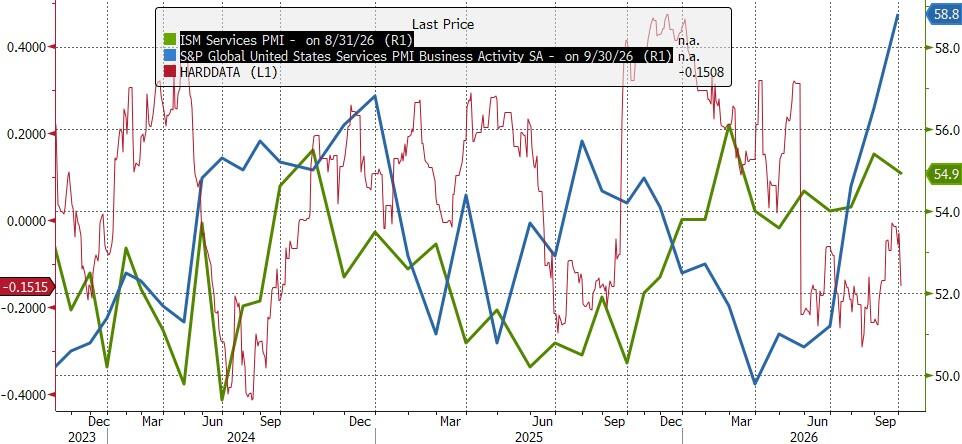
“September has seen US business growth surge to its highest for over five years,” said Chris Williamson, Chief Business Economist at S&P Global Market Intelligence, “with rising demand and improved optimism encouraging firms to take on workers at a pace not seen for over four years.
Combined with the encouragingly solid manufacturing PMI, the strong service sector expansion points to economic growth of around 4% in the third quarter and 5% in September alone, the latter hinting at accelerating momentum into the fourth quarter.
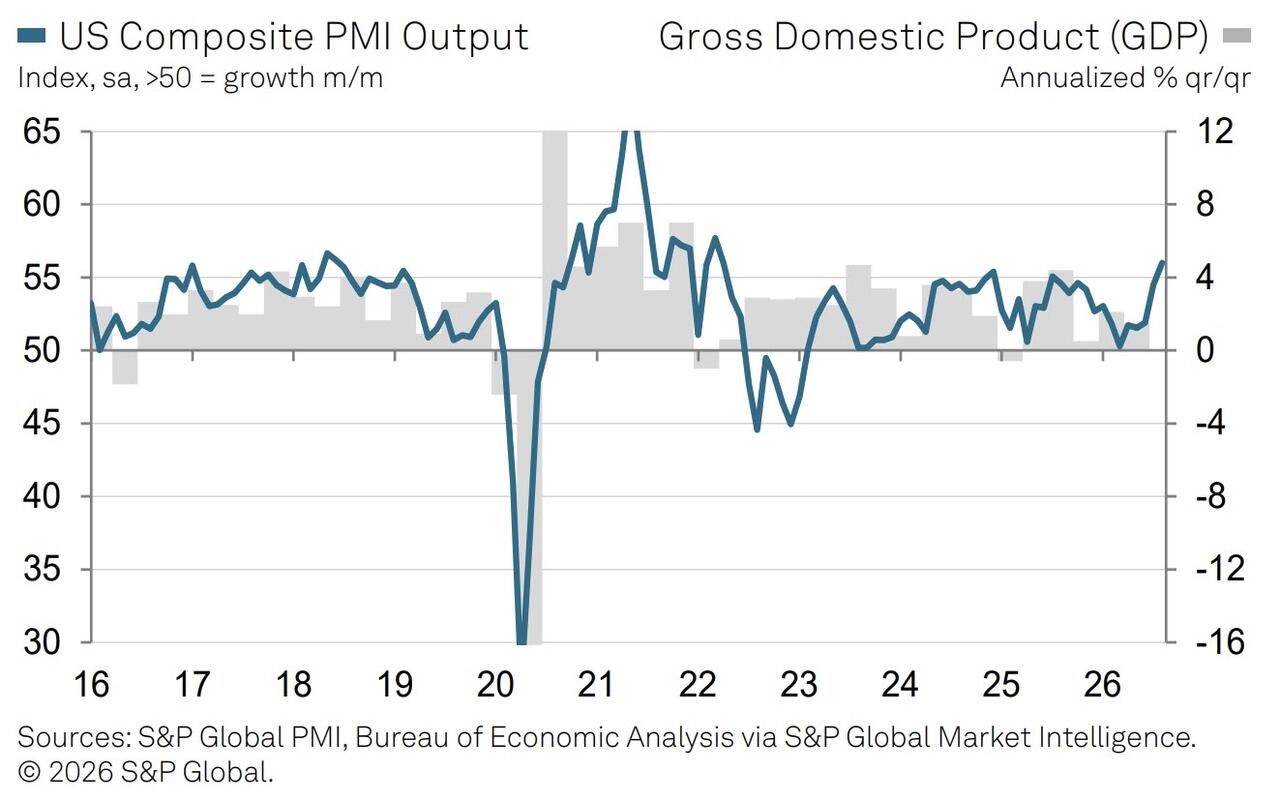
This also leaves the US economy by far the strongest in the world…
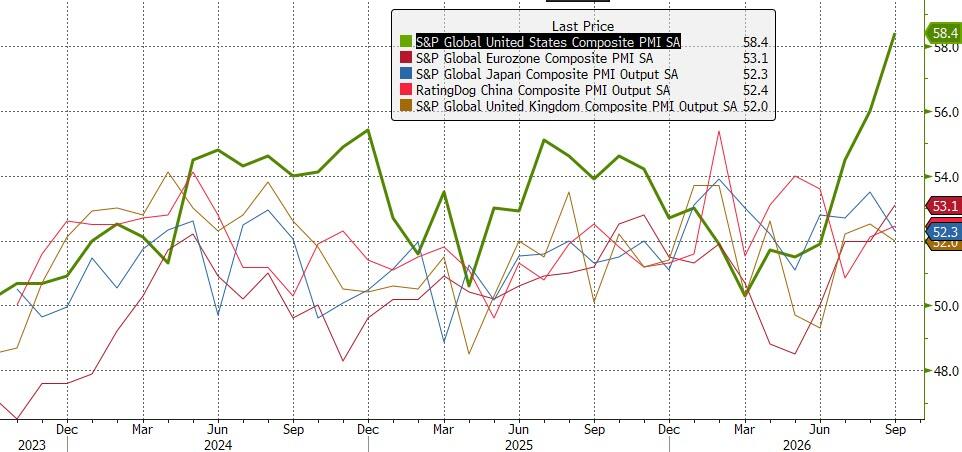
New orders and backlogs of work are rising at increased rates and growth expectations have recovered to a one-year high, adding to the sense of an economy picking up further pace in the near term.
For the first time in 10 months, output trended higher across all five broad sectors covered by the survey as transport & storage activity returned to growth. By far the sharpest expansion was seen in the information & communication sector, however.
“Tech companies are reporting by far the strongest growth but the rising tide is now lifting all boats as far as the major sectors are concerned, with accelerating growth also reported for consumer-facing businesses as well as industrials and healthcare, alongside sustained solid growth in financial services.”
However, concerns that the economy is running too hot will be fueled by the survey’s price gauges, which point to accelerating inflation.
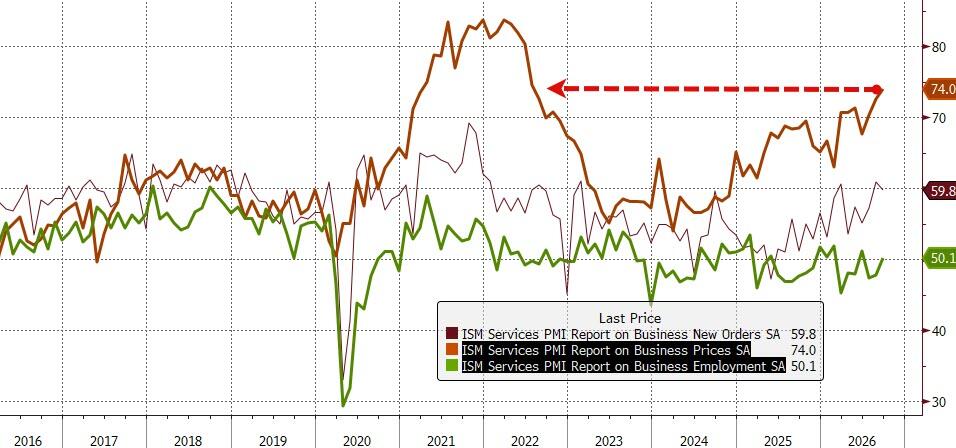
Measured across goods and services, firms’ input costs are now rising at the fastest rate for nearly four years.
“While these increased costs in part reflect higher fuel prices, the worry is that selling price growth has also moved higher again to signal sustained stubbornly high inflation, well above the Fed’s 2% target.”
Stronger growth and sticky/soaring inflation are going to counter the dovish message from last week’s FedSpeak and weaker payrolls.
USA ECONOMIC REPORTS
Minnesota Might Hand Republicans A Senate Upset Nobody Predicted
Saturday, Oct 03, 2026 – 09:35 PM
Democrats entered this year’s midterms aiming to flip Senate seats in Maine, North Carolina, Alaska, and Ohio, and hold Georgia and Michigan.

With the national mood really riding against the GOP, they see opportunities in Texas and Iowa as well. But things appear to be changing. That Democrats plan to flip the Senate assumed they wouldn’t lose any seats they currently hold. Michigan is potentially winnable for the GOP after Democrats in the state nominated Abdul El-Sayed, but now another reliably blue state has landed on the defensive side of the ledger, forcing Democrats to defend a seat in a blue state they have held for nearly two decades.
Republican Michele Tafoya trails Democratic Lt. Gov. Peggy Flanagan by less than 2 points in the RealClearPolitics polling average of Minnesota’s U.S. Senate race, a gap that sits inside the margin of error. If the environment were as poisonous for Republicans as it is believed to be, this election wouldn’t be on anyone’s radar. Instead, it has become a true contest, and that raises a question the party would rather avoid: how many of its offensive gains survive if one of its safest seats slips away in November?
The competitive nature of this election is most certainly due in part to unique circumstances in the state. A KSTP poll taken last month found that 14% of Minnesota voters named fraud as their most important issue, behind inflation and cost of living at 37% and ahead of health care at 12%.
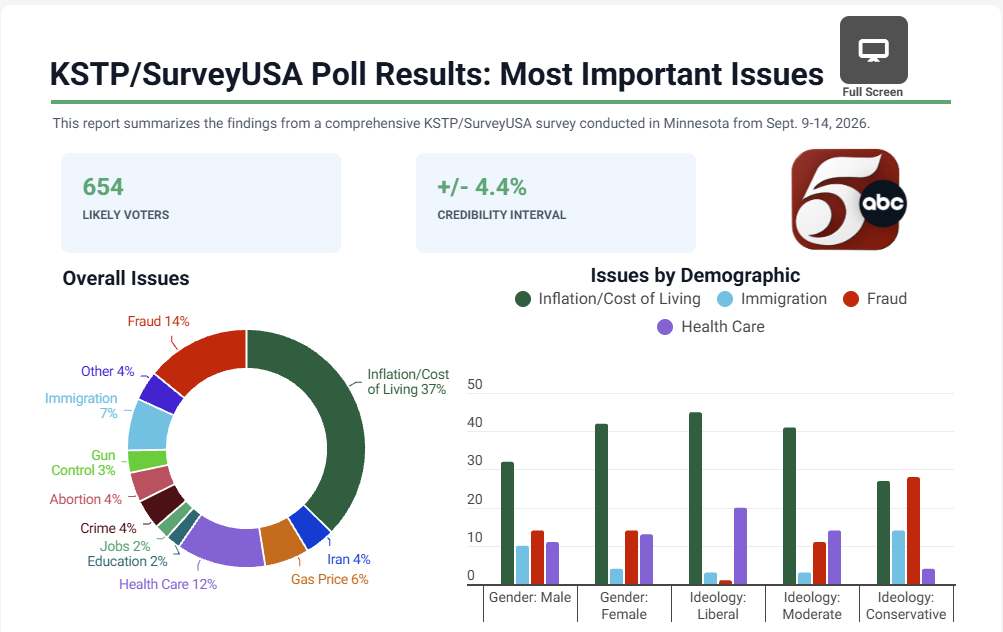
Federal prosecutors estimate that at least $9 billion billed to 14 state-run Medicaid programs since 2018 may be fraudulent, a figure Walz disputes, on top of separate schemes in which sham nonprofits billed the state for child care, school lunches and other services. According to a House Oversight report, the state’s Democratic leaders knew about the fraud and failed to act.
Most of those charged are of Somali descent, and the House report found state officials ignored the fraud to avoid accusations of racism. Gov. Tim Walz’s net approval has since collapsed from +19 in June 2025 to -14 in August 2026. The damage has spread to Attorney General Keith Ellison, Sen. Amy Klobuchar and the Democratic legislature. Pollsters have yet to publish separate numbers for Flanagan, though a politician who has stood one step behind Walz since 2019 has little room to distance herself from the scandal. Tafoya has built her campaign on that exact point.
The fraud issue is moving more than one race. Klobuchar entered the governor’s contest in late January with a double-digit lead. The most recent co/efficient survey has her up by 2.
MPR News described the Senate contest as quiet, since the outside money pouring into Texas and Maine has yet to show up in Minnesota. That quiet works in Tafoya’s favor. She is running a state-level argument about state-level failure, and national Democrats have given her the space to make it without interference.
If control of the Senate comes down to a single seat in November, Democrats may discover that the race they never thought they would have to defend was the one that mattered, and that their handling of one of the largest benefits scandals in American history might save the GOP from losing the Senate.
end
huge case!!
Supreme Court To Hear Pivotal Climate Case With Billions At Stake
Monday, Oct 05, 2026 – 08:50 AM
Authored by Kevin Stocklin via The Epoch Times,
The Supreme Court will hear oral arguments on Oct. 5 regarding a lawsuit from Boulder, Colorado, demanding compensation from energy companies for local weather damage allegedly caused by global greenhouse gas emissions.

The question before the court, however, is not whether global warming theories hold water. It’s whether local courts throughout the United States should have the authority to extract billions of dollars from energy companies for damage allegedly caused by global emissions.
The energy companies argue that giving such power to local courts would allow municipalities to effectively impose a massive nationwide carbon tax with the potential to bankrupt the U.S. energy industry.
Experts say the court’s decision in this case could have a dramatic impact, both on U.S. energy production and on what Americans pay for oil, gas, and electricity.
“It is actually bigger than climate change,” O.H. Skinner, executive director of the Alliance for Consumers, told reporters at a pre-hearing conference. “It’s about [climate activists’] overall ability to weaponize courts to accomplish policy goals that are sweeping, that are multi-billion dollars in scale, and that could end up with an order that basically rewrites the American economy.”
Boulder County originally brought its suit in 2018, charging that the products of Suncor, a Canadian energy company operating refineries in Colorado, and ExxonMobil, the largest U.S. energy company, caused climate-related damage, and that these companies concealed information about those risks.
The lawsuit argues that the defendants are liable under local tort laws for creating a public nuisance, trespassing, unjust enrichment, conspiracy, and failure to warn consumers that use of their products could cause extreme weather events.
In a brief supporting Boulder county’s authority to apply local tort law, the American Association for Justice, a nonprofit legal group, wrote that “states have a manifest interest in both applying their own laws when their citizens are affected and in providing residents with a convenient forum for redressing injuries inflicted by out-of-state actors.”
The energy companies, and their backers, including the Justice Department, counter that federal law, including the Clean Air Act, precludes, or preempts, state law because the emissions that allegedly cause global warming extend beyond state borders. The Supreme Court will separately consider whether it has jurisdiction to hear the challenge.
Claiming federal preemption, the Justice Department has sued Minnesota, Hawaii, and Michigan to block climate lawsuits brought in those states, and sued New York and Vermont over “polluter pays” climate superfund laws that seek to tax fossil fuel companies according to their CO2 emissions.
“When states seek to regulate energy beyond their constitutional or statutory authority, they harm the country’s ability to produce energy and they aid our adversaries,” Acting Assistant Attorney General Adam Gustafson said in a statement.
Billions at Stake
Boulder County’s suit is one of dozens of climate lawsuits currently moving through courts across the country. While Boulder’s lawsuit has not named a dollar figure for damages, a similar climate lawsuit in Multnomah County, Oregon, is claiming $50 billion from Exxon, Chevron, and other energy companies for damages and for an abatement fund against heat waves and wildfires.
Critics of the lawsuits say that, in the wake of failed attempts to pass climate legislation like the Green New Deal, these climate lawsuits are an attempt by activists to achieve a similar outcome through municipal courts.
“They’re going around to these cities and states, using tort litigation and public nuisance lawsuits in a coordinated way to effectuate the same result, but without having to go through their democratically elected officials,” former Alaska Attorney General Stephen Cox told reporters at a pre-hearing conference. “They’re essentially trying to regulate through litigation.”
The outcome of the suits, should they succeed, will likely be to drive up the cost of energy for consumers, restrict the use of fossil fuels, and potentially bankrupt oil and gas companies altogether, Cox said.
Oral arguments in the case will begin on Oct. 5, and a ruling is expected some time between late fall 2026 and June 2027. If the Supreme Court allows Boulder’s lawsuit to proceed, dozens of other climate lawsuits across the country will likely also proceed to discovery and trial.
If the Court dismisses the suit, “it will kick the legs out from this public nuisance approach,” Skinner said. “It would basically conclusively end this type of attack by the left in state courts to reshape our energy industry and our nation.”
On Sept. 28, Justice Samuel Alito announced that he would recuse himself from the Boulder case, without citing a reason, creating the possibility of a 4 – 4 split decision.
Litigation Versus Legislation
The proliferation of climate litigation extends well beyond U.S. cities and states. According to a 2025 United Nations Environment Program (UNEP) report, there are more than 3,000 such lawsuits against energy companies worldwide.
“Climate litigation has evolved into a powerful global tool for advancing climate action, and accountability,” UNEP’s executive director Inger Andersen said in a statement.
However, many U.S. courts have disagreed with this view, ruling that national legislation in which the voting public has a voice is the appropriate way to set national energy policy.
In dismissing climate lawsuits, numerous courts have pointed to federal legislation, in particular the Clean Air Act of 1970, as the proper legal authority on issues that cross state borders. Even in blue states like New York, New Jersey, Maryland, and Delaware, appellate judges have rejected local tort litigation as a tool to address global warming.
In dismissing a New York City lawsuit in 2021, the Second Circuit Court of Appeals stated that local CO2 emissions “may contribute no more to flooding in New York than emissions in China,” and that “such a sprawling case is simply beyond the limits of state law.”
And in 2024, Baltimore Judge Videtta Brown dismissed the case of Baltimore City v. BP, et al., stating that the suit was an attempt to regulate CO2 emissions and “simply a way to get in the back door what they cannot get in the front door.”
One foreign government recently came to the same conclusion. On May 12, New Zealand outlawed climate lawsuits in the country.
On the New Zealand government’s website, Justice Minister Paul Goldsmith stated: “The courts are not the right place to resolve claims of harm from climate change, and tort law is not well-suited to respond to a problem like climate change, which involves a range of complex environmental, economic and social factors.”
By contrast, state supreme courts in Colorado and Hawaii have ruled that municipal tort law is appropriate in these cases, and have green-lit them to proceed. Before Boulder v. Suncor made its way to the U.S. Supreme Court, the Colorado Supreme Court in 2025 rejected defendants’ claims that federal environmental law preempted local jurisdiction.
In order to avoid a conflict with federal regulations, climate litigants have claimed that they are merely seeking compensation for local injuries and that their cases are not intended to regulate emissions.
Presenting arguments in 2025 before Maryland’s Supreme Court for climate lawsuits brought by Baltimore, Annapolis, and Anne Arundel County, plaintiff’s attorney Victor Sher stated the suit “does not involve capping, regulating or limiting emissions by the defendants or anybody.
“It doesn’t involve changing pollution control measures or installing equipment or anything like that by these defendants or anyone else,” Sher stated. Rather the lawsuit was about local residents getting compensation for “nuisance, trespass and failure to warn.”
Contradicting this claim, David Bookbinder, an attorney who formerly represented Boulder Colorado in its climate lawsuit, stated at a 2025 Federalist Society panel discussion that “tort liability is an indirect carbon tax. You sue an oil company; an oil company is liable; the oil company then passes that liability on to the people who are buying its products.
“The people who buy those products are now going to be paying for the cost imposed by those products,” Bookbinder said, calling the lawsuits “a convoluted way to achieve the goals of a carbon tax.”
According to Skinner, this process of achieving political goals through litigation, if it succeeds, is unlikely to end with energy companies.
“These cases should matter to everybody,” Skinner said. “If they are able to bring lawsuits over energy companies producing oil and gas, then they’ll go after utilities, they’ll go after car manufacturers making the wrong kind of cars.”
A Network Supporting Climate Lawsuits
Although the scientific theories underpinning the lawsuits are not at issue in the upcoming U.S. Supreme Court hearing, critics have charged that a concerted effort has been ongoing both to fund the climate lawsuits and to convince local judges that the plaintiffs’ claims have merit.
In January, Reps. Jim Jordan (R-Ohio), chairman of the House Judiciary Committee, and Darrell Issa (R-Calif.), chairman of the Subcommittee on Courts, Intellectual Property, and the Internet, told the Federal Judicial Center in a letter that the manual it produced to educate judges on climate issues included “biased programming” with the “underlying goal of predisposing federal judges in favor of plaintiffs who allege injuries from the manufacturing, marketing, use, or sale of fossil-fuel products.”
In a July Truth Social post, President Donald Trump stated that the National Academies of Sciences, Engineering, and Medicine (NASEM), which wrote climate sections of the Federal Judicial Center’s manual, had “published fraudulent, biased, and misleading Manuals on Climate Change” and that “taxpayers should not be funding Climate Fraud, and Judges should never have relied upon it.”
In September, a coalition of 25 state attorneys general called on the federal government to defund NASEM, stating that it used taxpayer money to produce reports in support of global warming narratives and so-called attribution methodology, which is a way to calculate specific dollar claims of harm to local communities from greenhouse gas emissions.
The Federal Judicial Center has since removed the chapter on climate science from its judicial manual, and NASEM pledged an internal investigation into how its reports were produced.
In addition, a 2024 Senate Commerce Committee report stated that Sher Edling, a law firm that represents more than 20 municipalities in climate lawsuits, will “not only … receive approximately one-third of any amount it extracts from energy companies if it is somehow successful, far-left funds are offsetting any risk the firm would otherwise have in pursuing these absurd claims by bankrolling Sher Edling to the tune of millions of dollars each year.”
The report stated that left-wing nonprofits such as the Resources Legacy Fund and the New Venture Fund have given Sher Edling more than $13 million since 2017.
The Epoch Times reached out to Sher Edling for comment but did not receive a response as of publication time.
END
Peter Navarro on the jobs report!!
(Peter Navarro)
Navarro: The Jobs Report Reveals Federal Reserve Election Interference
Monday, Oct 05, 2026 – 07:45 AM
Authored by Peter Navarro via RealClearMarkets,
CNBC and Yahoo Finance called the jobs report a miss. Fox said it was lower than expected. More bad analysis from a Keynesian financial press that has shown extraordinary supply-side ignorance throughout the Trump 47 term.
The deeper story is indeed more complicated – and considerably more reassuring.
Start with the unemployment rate. It rose a tenth not because people lost jobs but because people came looking for them. The labor force participation rate jumped two tenths to 61.8 percent, well above expectations.
Behind the curtain, the share of prime-age Americans holding a job rose three tenths to 80.7 percent; for prime-age men, four tenths to 86.2 percent. When more people enter the labor force than the economy can hire in a single month, the unemployment rate rises. That is not weakness. That is Americans coming off the sidelines.
Now the headline number itself. Wall Street still reads payrolls through a Biden-era lens, when open borders swelled the labor force and the economy had to create well over 100,000 jobs a month just to stand still.
That world is gone. With the border secured and the population aging, the breakeven pace of job creation – the number that holds unemployment steady – has fallen to roughly 40,000 a month by most estimates, and the Dallas Fed puts it near zero. This month’s 29,000 is well within the neighborhood of breakeven.
Now consider the composition: private employers added 46,000 jobs in September while government shed 17,000. Under Biden Wokenomics, government hiring padded the headline month after month. Under Trumpnomics, the private sector carries the load and the public payroll shrinks. That is exactly the right direction.
Then there is the industrial turn, which the headline – and the anti-Trump media – hides every month and which matters most. Manufacturing added 9,000 jobs in September, bringing this year’s gain to roughly 72,000, after the sector lost more than 200,000 jobs in the last two years of the Biden administration.
Ahead of those production jobs comes the construction that makes them possible. Nonresidential specialty trade contractors, the electricians, pipefitters and concrete crews who build factories, added 12,300 jobs in September and are up nearly 112,000 since January 2025.
The factory-construction numbers of 2025 and 2026 are the manufacturing payrolls of 2027 and 2028. Real fixed private investment, up 2.3 percent in 2024 and 3.8 percent in 2025, is running at a 6.9 percent annual rate this year.
And a MAGA White House – built on blue-collar America – loves this: the unemployment rate for Americans without a high school diploma has fallen two and a half points over the year to 4.3 percent, the lowest on record.
Moreover, initial jobless claims, measured against the size of the workforce, are the lowest since the data began in 1967. Employers are holding on to the workers they have.
Nominal weekly earnings for manufacturing workers are up 5 percent, too, over the year, nearly 6 percent for production and nonsupervisory workers, while construction workers’ earnings are up 4.7 percent.
Against the latest CPI – 3.4 percent headline, 2.4 percent core – those gains are comfortably positive in real terms, roughly 1 to 2½ percent after inflation. Solid, and no sign of a wage-price spiral.
Yet the newly minted Warsh Fed hiked rates in September into the teeth of an oil shock, breaking the Greenspan-Bernanke-Navarro rule: watch the second-round effects of an energy spike before you attack the first round.
This jobs report is the second-round evidence. There is no demand-side inflation for a rate hike to cure, and NOTHING in Friday’s report offers a reason to tighten again in October.
Which raises the question: who is really running the Fed? The Trump-appointed chairman, who certainly must know better than to hike rates now? Or is Warsh leading from behind, appeasing a group of partisan anti-Trump Fed governors?
Remember that on September 18, 2024 – 48 days before Election Day – the Fed cut the federal-funds target by 50 basis points, from 5.25-5.50 percent to 4.75-5.00 percent. It was the first rate cut since March 2020. It was larger than the quarter-point move most forecasters expected, and it was a blatant attempt to help a hapless Kamala Harris beat Donald John Trump.
Now the Fed is interfering again, this time in the midterm elections. The September 16 hike has come again 48 days before Election Day – the same 48 days as in 2024. How other than politics do you explain a Fed rate hike on the eve of an election unsupported by the data and in flagrant violation of the Greenspan-Bernanke-Navarro rule?
There, I said it. And it damn well needs to be said.
KING NEWS
| The King Report October 5, 2026 Issue 7840 | Independent View of the News |
| The last employment report (September) before the November 3 Midterm Elections showed ugly NFPs. September NFP of 29k was far below the expected 84-90k. Plus, August NFP was revised to 133k from 162k; July NFP was revised to NEGATIVE 10k from +21k.However, the Household Survey conflicted, again, with the (CES) Establishment Report, by showing ‘Employed’ at +406k! The Unemployment Rate rose 0.1 to 4.2%; 4.1% was consensus. ‘Unemployed’ +78k, Not in Labor Force -346k, Labor force participation rate +0.2 to 61.8%; the employment-population ratio +0.1 to 59.2%. https://www.bls.gov/news.release/empsit.a.htm The BLS: The unemployment rate for people who are Black (7.0 percent) increased in September. The jobless rates for adult men (3.9 percent), adult women (3.6 percent), teenagers (14.5 percent), and people who are White (3.6 percent), Asian (2.9 percent), or Hispanic (4.7 percent) showed little change over the month. (See tables A-1, A-2, and A-3.)… https://www.bls.gov/news.release/empsit.nr0.htm Perhaps the worst aspect of the report: Hourly Wages grew only 0.1% m/m (0.3% exp) and 3.0% y/y (3.1% exp). Workweek 34.4; 34.3 exp Construction +11k, Mfg. +9k (10k exp), Retail +5.8k, Transportation & warehousing +7.6k, Info -10k, Employment services -14.3k, Health care and social assistance +23k with Ambulatory health care services +16.7k, Hospitals +12k, Leisure & Hospitality +10k on Food services & drinking places +10.8k, Government -17k with Local government, excluding Education -10.6khttps://www.bls.gov/news.release/empsit.t17.htm The seasonal adjustment for September 2025 was -181k. The seasonal adjustment for September 2026 is -194k. The scheme of using seasonal adjustments to craft better-than-reality NFP appears to have ended. WHY? Because by December Employment Report NFP SA should equal NFP NSA for the year.This is the probable reason for the significant downward revisions to August & July NFPs. Expected economic data: Sept S&P Global Services PMI 56.5, Composite PMI 56; Sept ISM PMI 55.4, Services Business Activity 61.7, Employment 47.8, New Orders 60.9, Prices 72.6 S&P 500 50-day MA: 7658; 100-day MA: 7565; 200-day MA: 7225 (Close 7722.72, +0.73%)Nasdaq 100 50-day MA: 29,458; 100-day MA: 29,498; 200-day MA: 25,479 (Close 30,807.93, +1.0%) DJIA 50-day MA: 52,711; 100-day MA: 52,057; 200-day MA: 50,275 (Close 51,176.96 +0.49%) (Green is positive slope; Red is negative slope) U.S. bombers head back to America as security concerns grow at U.K. air baseThe decision comes after British authorities arrested suspects near the U.S.-used air base over an alleged plot targeting the facility. (Trump remembers that Brits spied on DJT at the behest of Obama!)https://justthenews.com/government/federal-agencies/us-bombers-head-back-america-security-concerns-grow-uk-air-base Some European allies of the US are no longer reliable. Some due to leftism; some due to appeasing their growing 3rd World populations, which includes terrorists and US haters. This is why Greenland was critical to the US and its security. Trump rips Jack Smith for wearing ‘No Kings’ Springsteen shirt at ‘Power to the People Fest’“Deranged Jack Smith is a Crooked Prosecutor!” Trump wrotehttps://justthenews.com/government/white-house/trump-rips-jack-smith-wearing-no-kings-shirt-power-people-fest Trump suggests he’ll pardon admin officials before leaving office: ‘Sure, I’d do that’“Yeah, sure I’d do that,” the president told Time magazine during a lengthy sit down Monday, later adding: “Sleepy Joe Biden, he gave pardons to everyone.” “He gave them to [Dr. Anthony] Fauci,” Trump later groused. “He gave them to this. But you mean I’m not allowed to give them, but Sleepy Joe’s allowed to give them?”…https://nypost.com/2026/10/01/us-news/trump-suggests-hell-pardon-admin-officials-before-leaving-office-sure-id-do-that/ Now we know why the DoJ is NOT contesting the concept of blanket and vague presidential pardons. Crew of hijacked plane clashed with heroic Israeli passengers, demanded tied-up terror pilot be freed – A power play ensued with the crewmembers insisting that they were in charge of the plane and needed to remain alone in the area directly in front of the cockpit. The Israelis, fearing the crew could be involved in the pilot’s plot, ordered the stewards to leave the cockpit area and to take seats in the middle of the plane… https://trib.al/H7EDoWh | |
SWAMP STORIES FOR YOU TONIGHT
GREG HUNTER..INTERVIEWING MARTIN ARMSTRONG\
Higher War Chances Mean Higher Interest Rates – Martin Armstrong
By Greg Hunter On October 3, 2026 In Market Analysis, Political Analysis43 Comments

By Greg Hunter’s USAWatchdog.com (Saturday Night Post)
Legendary financial and geopolitical cycle analyst Martin Armstrong says rising war chances mean higher interest rates. You have seen the 10-year Treasury go from 4.5% to around 5.25% in a matter of weeks. This is a very big move in a very short amount of time. This headline from yesterday shows you how serious the war chances are with Europe and Russia. It reads: “Putin: Ready To Use ‘All Weapons’ Including Nuclear, If Kaliningrad Attacked.” President Putin calls this an “escalation,” and interest rates are escalating too. Is Europe out of their minds? What is going on? Armstrong says, “They want war. It is as simple as that. They are broke. . .. The economy is failing. Economic growth in Germany is 0.8%. Italy is 0.5%. You’ve got long term interest rates rising because you are beating the war drums. You don’t want to buy their debt because it’s going to default anyhow. This is all coming to a head. This is why you see them bashing Putin. Oh, he wants to invade Europe, and for what? They have nothing of value. They buy their energy from Russia. This is why you had Napolean and Hitler try to conquer Russia because it is the richest country in the world from a natural resource perspective.”
Armstrong reveals that Trump Administration contacts have been consulting with him, and he told them, “Europe is going to lose. What I have warned Washington is China and North Korea are coming in. Why? Because they know if Russia fails, they are next.”
Armstrong said the recent meeting between President Trump and China’s Xi Jinping involved a discussion of war between Russia, Europe and what China might do to help Russia. Armstrong says, “I want to keep America the hell out of this. Fine, let them go. There is no way China is going to allow Russia to collapse.”
Armstrong says he knows President Trump has told President Xi that America will not get involved with war between Russia and Europe over Ukraine. Armstrong says, “I got another briefing, and I was told they understood the problem was with Zelensky (Ukraine) and not with Putin.”
Armstrong says assets are coming to America, and this trend is not going to stop anytime soon. So, can we forget all the crazy talk of a huge crash coming to American markets? Armstrong says, “Yes. . .. Do you want to sell all your private assets and buy government debt now? Some people are calling this the ‘everything bubble.’ Stocks are up. Real estate is up. Coins, stamps, antique cars, art and this is the ‘everything bubble.’ This is cash fleeing the public sector and going to the private sector. The London Times just did a big story on this, and it said, yes, money is going to America, but it’s going to the private sector. When they beat these war drums over there with nuclear war, are you going to leave your money there? You get the hell out of town.”
On gold, Armstrong is still very bullish and says, “Gold will go up because you are looking at war on so many fronts at this stage.”
Armstrong has a warning for Trump about the midterm elections. In August, the midterms were 50/50, but now it looks like the Democrats have the edge. Armstrong says, “We may see a Democrat victory here. . .. Bush 43 lost the midterms because of the Iraq war. His approval was 38% and Trump’s is at 34%. Americans do not like endless wars — period. That is the risk here.”
There is much more in the 70-minute interview.
Join Greg Hunter of USAWatchdog as he goes one-on-one with Martin Armstrong to talk about rising rates, war, gold and the 2026 Midterm Elections for 10.03.26.
After the Interview:
There is free information, analysis and articles on ArmstrongEconomics.com.
There are also current cutting-edge, in-depth reports you can buy on a wide variety of subjects by clicking here.
Also, the World Economic Conference that Armstrong puts on every year is in Orlando, FL, December 4, 5 and 6. Tickets are on sale now. There will also be streaming, but you cannot order that–yet. Check back and order streaming closer to the event date.


