
SILVER: 61.42 3;30 PM)
EXCHANGE: COMEX
CONTRACT: OCTOBER 2026 COMEX 100 GOLD FUTURES
SETTLEMENT: 4,159.200000000 USD
INTENT DATE: 10/06/2026 DELIVERY DATE: 10/08/2026
FIRM ORG FIRM NAME ISSUED STOPPED
099 H DEUTSCHE BANK AG 2
118 C MACQUARIE FUTURES US 1
152 C DORMAN TRADING, LLC 4
363 H WELLS FARGO SECURITI 46
737 C ADVANTAGE FUTURES 59
800 C MAREX SPEC 17
880 C CITIGROUP 10
905 C ADM 4
991 H CME 19
TOTAL: 81 81
MONTH TO DATE: 11,909
GOLD: NUMBER OF NOTICES FILED FOR OCT./2026: 81 CONTRACTs NOTICES FOR 8100 OZ or 0.2519 TONNES
total notices so far: 11,909 contracts FOR 1,190,900 OZ OR 37.042 TONNES
SILVER NOTICES: 114 NOTICE(S) FILED FOR 0.570 MILLION OZ /
total number of notices filed so far this month : 2437 CONTRACTS (NOTICES) for 12.185 million oz
GLD
SHANGHAI CLOSED UNTIL THURSDAY
HANG SENG CLOSED DOWN 195.56 PTS OR 0.81%
Nikkei CLOSED DOWN 537.98 PTS OR 0.76%
//Australia’s all ordinaries CLOSED DOWN 0.01%
//Chinese yuan (ONSHORE) CLOSED TIL THURSDAY
/ OFFSHORE CLOSED DOWN AT 6.7045 Oil UP TO 90.09 dollars per barrel for WTI and BRENT UP TO 101.00 Stocks in Europe OPENED ALL RED
ONSHORE USA/ YUAN// WITH YUAN TRADING XXX (OFF TIL THURSDAY) OFFSHORE YUAN TRADING DOWN TO 6.7045 ONSHORE YUAN TRADING ABOVE LEVEL // OFF SHORE AND DOWN ON THE DOLLAR)// / AND THUS XXXXX/OFF SHORE YUAN TRADING DOWN AGAINST US DOLLAR/ AND THUS WEAKER
XXXXXXXXXXXXXXXXXXXXXXXXXXXXXXXXXXXXX
| Gold | Ounces |
| Withdrawals from Dealers Inventory in oz | nil |
| Withdrawals from Customer Inventory in oz | 0 ENTRIES |
| Deposit to theDealerInventory in oz | 0 ENTRIES |
| Deposits to the Customer Inventory, in oz | DEPOSITS/CUSTOMER//gold 0 ENTRIES xxxxxxxxxxxxxxxx |
| No of oz served (contracts) today | 81 CONTRACTS 8100 OZ 0.2519 TONNES OF GOLD |
| No of oz to be served (notices) | 143 Contracts 14300 OZ 0.4448 TONNES |
| Total monthly oz gold served (contracts) so far this month | 11,909 notices 1,190,900 OZ 37.042 TONNES |
| Total accumulative withdrawals of gold from the Dealers inventory this month | NIL oz |
| Total accumulative withdrawal of gold from the Customer inventory this month |
dealer deposits: 0
xxxxxxxxxxxxxxxxxxx
DEPOSITS:
ENTRIES: 0
xxxxxxxxxxxxxxxxxx
comex withdrawal
0 ENTRIES
adjustments: 2
DEALER TO CUSTOMER ACC’T
a) Brinks: 13,310.514 oz
b) Manfra 1639.201 oz
COMEX IS DRAINING GOLD
chaos inside the comex
THE FRONT MONTH OF OCT OI STANDS AT 224 CONTRACTS HAVING A LOSS OF 149 CONTRACTS.
YESTERDAY WE HAD 1,199,900 OZ ( 37.321 TONNES) OF GOLD STANDING FOR DELIVERY: TODAY: 1,205,200 OZ OR 37.486 TONNES FOR A GAIN OF 5300 OZ (0.1648 TONNES) OR 53 CONTRACTS UNDERWENT A QUEUE JUMP FOR 5300 OZ (.1648 TONNES) AS THEY SEEK PHYSICAL GOLD ON THIS SIDE OF THE POND.
NOVEMBER LOST 86 CONTRACTS FALLING TO 4136
DECEMBER, THE LARGEST DELIVERY MONTH IN THE CALENDAR, ITS OI FALLS BY 81 CONTRACTS UP TO 323,592.
.
We had 81 contracts filed for today representing 8100 oz
Today, 0 notice(s) were issued from J.P.Morgan dealer and 0 notices issued from their client or customer account. The total of all issuance by all participants equate to 81 contract(s) of which 0 notices were stopped (received) by j.P. Morgan dealer and 0 notice(s) was (were) stopped (received) by J.P.Morgan//customer account
To calculate the INITIAL total number of gold ounces standing for OCT /2026. contract month, we take the total number of notices filed so far for the month (11,909) to which we add the difference between the open interest for the front month of OCT (224 CONTRACTS) minus the number of notices served upon today 81 x 100 oz per contract) equals 1,205,200 OZ OR(37.486 Tonnes of gold) to which we add our first exchange for risk in Oct totalling 836 contracts for 83,600 oz or 2.600 tonnes. Thus Oct standing for gold advances hugely to 40.086 tonnes
THUS: INITIAL total number of gold ounces standing for OCT. /2026. contract month,we take the total number of notices filed so far for the month (11,909) to which we add the difference between the open interest for the front month of OCT(224) contracts minus the number of notices served upon today 81 x 100 oz per contract) equals 1,205,200 OZ OR(37.486 Tonnes of gold) plus our first exchange for risk totalling 836 contracts//83600 oz//2.600 tonnes//standing advances to 40.086 tonnes
new total of gold standing in OCT becomes 40.086 TONNES//
TOTAL COMEX GOLD STANDING FOR OCT.: 40.086 TONNES WHICH IS NOW VERY STRONG FOR THIS NON ACTIVE DELIVERY MONTH OF OCT./
TUESDAY VOLUME: 133,075 POOR
COMEX GOLD INVENTORIES/CLASSIFICATION
NEW PLEDGED GOLD:
241,794.285 oz NOW PLEDGED /HSBC 5.94 TONNES
204,937.290 OZ PLEDGED MANFRA 3.08 TONNES
83,657.582 PLEDGED JPMorgan no 1 1.690 tonnes
265,999.054, oz JPM No 2
1,152,376.639 oz pledged Brinks/
Manfra: 33,758.550 oz
Delaware: 193.721 oz
International Delaware:: 11,188.542 oz
total pledged gold: 1,721,684.952 oz 53.55 tonnes pledged gold lowers
total inventories in gold declining rapidly
total pledged gold: 1,721,684.952 tonnes oz 53.55 tonnes
TOTAL OF ALL GOLD ELIGIBLE AND REGISTERED GOLD 23,479,618.582oz//
TOTAL REGISTERED GOLD 15,074,857.266 tonnes (468.89 tonnes)
TOTAL OF ALL ELIGIBLE GOLD 8,404,761.256 oz.
REGISTERED GOLD THAT CAN BE SERVED UPON 13,353,173oz ((REG GOLD- PLEDGED GOLD)=
415.339 Tonnes //
total inventories in gold declining rapidly
SILVER COMEX
OCT DELIVERY MONTH
OCT 7
| Silver | Ounces |
| Withdrawals from Dealers Inventory | NIL oz |
| Withdrawals from Customer Inventory | 3 entries i) Out of Asahi 592,145.710 oz. ii) Out of JPMorgan: 1,912,308.800 oz iii) Out of Loomis: 600,962.490 oz total withdrawal: 3,105,416.500 oz |
| Deposits to the Dealer Inventory | 0 ENTRY |
| Deposits to the Customer Inventory | ENTRIES: 1 i)Into customer HSBC: 713,508.420 oz total deposit: 713,508.420 oz |
| No of oz served today (contracts) | 114 CONTRACT(S) ( 0.570 MILLION OZ) |
| No of oz to be served (notices) | 1087 Contracts (5.435 MILLION oz) |
| Total monthly oz silver served (contracts) | 2437 contracts 12.185 MILLIONoz |
| Total accumulative withdrawal of silver from the Dealers inventory this month | NIL oz |
| Total accumulative withdrawal of silver from the Customer inventory this month |
DEPOSITS INTO DEALER ACCOUNTS
ENTRY:0
DEPOSIT ENTRIES/CUSTOMER ACCOUNT
1 ENTRIES:
i)Into customer HSBC: 713,508.420 oz
total deposit: 713,508.420 oz
xxxxxxxxxxxxxxxxxxxxxxxxx
withdrawals:
3 entries
i) Out of Asahi 592,145.710 oz.
ii) Out of JPMorgan: 1,912,308.800 oz
iii) Out of Loomis: 600,962.490 oz
total withdrawal: 3,105,416.500 oz
adjustments : 1//Asahi dealer to customer:
29,560.200 oz
2/ customer to dealer: Brinks 560,667.007 oz
xxxxxxxxxxxxxx
TOTAL REGISTERED SILVER: 102.817 MILLION OZ//.TOTAL REG + ELIGIBLE. 335.548 Million oz
registered silver dropping in numbers
CALCULATIONS FOR THE NEW STANDING FOR SILVER FOR OCT
FRONT MONTH: SILVER OPEN INTEREST CONTRACTS: 1201 FOR A LOSS OF 125 CONTRACTS.
TUESDAY WE HAD 17.620 MILLION OZ STAND: TODAY: 17.620 MILLION OZ FOR A GAIN OF 0.0 MILLION OZ OR 0 OZ (0 CONTRACTS). THUS IS A ZERO QUEUE JUMP FOR A CENTRAL BANK SEEKING PHYSICAL SILVER OVER AT THE COMEX.
NOVEMBER GAINED 22 CONTRACTS UP TO AN OI OF 1272
DECEMBER LOST 891 CONTRACTS DOWN TO AN OI OF 82,950
TOTAL NUMBER OF NOTICES FILED FOR TODAY: 114 or 0.570 MILLION oz
CONFIRMED volume TUESDAY;31,968 // poor/
AND NOW OCT. DELIVERIES:
To calculate the number of silver ounces that will stand for delivery in OCT. we take the total number of notices filed for the month so far at 2437 X5,000 oz = 12.185 MILLION oz.
Then we take the difference between the front month of OCT. and the number of notices filed for today x 5000 to give us our standing
Thus the standings for silver for the OCT 2026 contract month: (2437 )Notices served so far) x 5000 oz + OI for the front month of OCT (224) minus number of notices served upon today ( 114 x 5000 oz) equals silver standing for the OCT .contract month equating to 17.620 MILLION OZ to which we add silver’s TWO exchange for risk for 450 contracts (2.25 million oz).. total standing advances to 19.870 million oz//. ( a very strong delivery month)
We must also keep in mind that there is considerable silver standing in London coming from our longs
There are ONLY 102.817 million oz of registered silver
JPMorgan as a percentage of total silver: 129.484/335.548 million: 39.50%
The record level of silver open interest is 234,787 contracts set on April 21./2017 with the price on that day at $18.42.
The previous record was 224,540 contracts with the price at that time of $20.44.
BOTH GLD AND SLV ARE MASSIVE FRAUD
XXXXXXXXXXXXXXXXXXXXXXXXXXXXXXXXXXXXXXXXXXX
OCT 7//2026/WITH GOLD DOWN $46.70 /NO CHANGES IN GOLD AT THE GLD:: //:/INVENTORY RESTS AT 1056.27 TONNES
OCT 6//2026/WITH GOLD UP $30.60 /HUGE CHANGES IN GOLD AT THE GLD:: A DEPOSIT OF 0.754 TONNES OF GOLD INTO THE GLD// //:/INVENTORY RESTS AT 1056.27 TONNES
OCT 5//2026/WITH GOLD DOWN $2.20 /HUGE CHANGES IN GOLD AT THE GLD:: A WITHDRAWAL OF 0.854 TONNES OF GOLD INTO THE GLD// //:/INVENTORY RESTS AT 1055.696 TONNES
OCT 2//2026/WITH GOLD DOWN $43.00 /HUGE CHANGES IN GOLD AT THE GLD:: A DEPOSIT OF 0.854 TONNES OF GOLD INTO THE GLD// //:/INVENTORY RESTS AT 1056.55 TONNES
OCT 1//2026/WITH GOLD UP $19.55 /HUGE CHANGES IN GOLD AT THE GLD:: A WITHDRAWAL OF 1.711 TONNES OF GOLD OUT OF THE GLD// //:/INVENTORY RESTS AT 1055.696 TONNES
SEPT 30//2026/WITH GOLD UP $7.80 /HUGE CHANGES IN GOLD AT THE GLD:: A DEPOSIT OF 2.847 TONNES OF GOLD INTO THE GLD// //:/INVENTORY RESTS AT 1057.407 TONNES
SEPT 29//2026/WITH GOLD UP $11.75 /NO CHANGES IN GOLD AT THE GLD //:/INVENTORY RESTS AT 1054.56 TONNES
SEPT 28//2026/WITH GOLD DOWN $150.20 /NO CHANGES IN GOLD AT THE GLD //:/INVENTORY RESTS AT 1054.56 TONNES
SEPT 25//2026/WITH GOLD DOWN $150.20 /NO CHANGES IN GOLD AT THE GLD //:/INVENTORY RESTS AT 1054.56 TONNES
SEPT 24//2026/WITH GOLD DOWN $18.70 /HUGE CHANGES IN GOLD AT THE GLD A DEPOSIT OF 1.43 TONNES OF GOLD INTO THE GLD://:/INVENTORY RESTS AT 1056.84 TONNES
SEPT 23//2026/WITH GOLD DOWN $58.00 /HUGE CHANGES IN GOLD AT THE GLD://:/INVENTORY RESTS AT 1055.41 TONNES
SEPT 22//2026/WITH GOLD DOWN $6.30 /HUGE CHANGES IN GOLD AT THE GLD://A DEPOSIT OF 0.31 TONNES OF GOLD INTO THE GLD/:/INVENTORY RESTS AT 1055.41 TONNES
SEPT 21//2026/WITH GOLD DOWN $41.20 /HUGE CHANGES IN GOLD AT THE GLD://A DEPOSIT OF 2.26 TONNES OF GOLD INTO THE GLD/:/INVENTORY RESTS AT 1055.10 TONNES
SEPT 18//2026/WITH GOLD UP $26.45 /HUGE CHANGES IN GOLD AT THE GLD://A DEPOSIT OF 0.85 TONNES OF GOLD INTO THE GLD/:/INVENTORY RESTS AT 1052.84 TONNES
SEPT 17//2026/WITH GOLD UP $14.05 /HUGE CHANGES IN GOLD AT THE GLD://A DEPOSIT OF 1.71 TONNES OF GOLD INOT THE GLD/:/INVENTORY RESTS AT 1051.99 TONNES
SEPT 16//2026/WITH GOLD UP $53.40 /HUGE CHANGES IN GOLD AT THE GLD://A DEPOSIT OF 2.86 TONNES OF GOLD INOT THE GLD/:/INVENTORY RESTS AT 1050.28 TONNES
SEPT 15//2026/WITH GOLD DOWN $19.45 /NO CHANGES IN GOLD AT THE GLD://A WITHDRAWAL OF 0.353 TONNES OF GOLD FROM THE GLD/:/INVENTORY RESTS AT 1047.420 TONNES
SEPT 14//2026/WITH GOLD DOWN $54.50 /SMALL CHANGES IN GOLD AT THE GLD://A WITHDRAWAL OF 0.353 TONNES OF GOLD FROM THE GLD/:/INVENTORY RESTS AT 1047.420 TONNES
SEPT 11//2026/WITH GOLD UP $1.05 /SMALL CHANGES IN GOLD AT THE GLD://A WITHDRAWAL OF 0.353 TONNES OF GOLD FROM THE GLD/:/INVENTORY RESTS AT 1050.277 TONNES
/SEPT 10//2026/WITH GOLD UP $50.60 /NO CHANGES IN GOLD AT THE GLD://:/INVENTORY RESTS AT 1050.63 TONNES
SEPT 9//2026/WITH GOLD UP $20.40 /HUGE CHANGES IN GOLD AT THE GLD:A WITHDRAWAL OF 1.43 TONNES OF GOLD OUT OF THE GLD/ ////:/INVENTORY RESTS AT 1050.63 TONNES
SEPT 8//2026/WITH GOLD DOWN $34.20 /HUGE CHANGES IN GOLD AT THE GLD:A WITHDRAWAL OF 1.42 TONNES OF GOLD OUT OF THE GLD/ ////:/INVENTORY RESTS AT 1052.06 TONNES
SEPT 4//2026/WITH GOLD DOWN $63.50 /HUGE CHANGES IN GOLD AT THE GLD:A WITHDRAWAL OF 3.14 TONNES OF GOLD OUT OF THE GLD/ ////:/INVENTORY RESTS AT 1053.48 TONNES
SEPT 3//2026/WITH GOLD UP $141.55 /HUGE CHANGES IN GOLD AT THE GLD:A DEPOSIT OF 9.98 TONNES OF GOLD INTO THE GLD/ ////:/INVENTORY RESTS AT 1056.62 TONNES
SEPT 2//2026/WITH GOLD UP $19.25 /HUGE CHANGES IN GOLD AT THE GLD:A DEPOSIT OF 4.28 TONNES OF GOLD INTO THE GLD/ ////:/INVENTORY RESTS AT 1046.64 TONNES
SEPT 1//2026/WITH GOLD DOWN $80.25 /NO CHANGES IN GOLD AT THE GLD:// ////:/INVENTORY RESTS AT 1042.36 TONNES
GLD INVENTORY: 1056.27 TONNES, TONIGHTS TOTAL GOLD INVENTORY
SILVER
OCT 7 WITH SILVER DOWN $1.36 : :SMALL CHANGES IN INVENTORY AT THE SLV:A WITHDRAWAL OF 451,000 OZ FROM THE SLV// // :INVENTORY RESTS AT 492.910 MILLION OZ
OCT 6 WITH SILVER UP $0.31 : :NO CHANGES IN INVENTORY AT THE SLV: // :INVENTORY RESTS AT 493.361 MILLION OZ
OCT 5 WITH SILVER UP $0.87 : :NO CHANGES IN INVENTORY AT THE SLV: // :INVENTORY RESTS AT 493.361 MILLION OZ
OCT 2 WITH SILVER DOWN $0.74 : :NO CHANGES IN INVENTORY AT THE SLV: // :INVENTORY RESTS AT 493.578 MILLION OZ
OCT 1 WITH SILVER UP $0.57 : :HUGE CHANGES IN INVENTORY AT THE SLV: A WITHDRAWAL OF 1.400 MILLION OZ OUT OF THE SLV// :INVENTORY RESTS AT 493.578 MILLION OZ
SEPT 30 WITH SILVER DOWN $0.55 : :HUGE CHANGES IN INVENTORY AT THE SLV: A DEPOSIT OF 994,000 OZ INTO THE SLV// :INVENTORY RESTS AT 494.978 MILLION OZ
SEPT 29 WITH SILVER DOWN $0.58 : :SMALL CHANGES IN INVENTORY AT THE SLV: A WITHDRAWAL OF 566,000 OZ FROM THE SLV// :INVENTORY RESTS AT 493.984 MILLION OZ
SEPT 28 WITH SILVER DOWN $2.91 : :SMALL CHANGES IN INVENTORY AT THE SLV: A DEPOSIT OF 0.542 MILLION OZ FROM THE SLV// :INVENTORY RESTS AT 494.436 MILLION OZ
SEPT 25 WITH SILVER DOWN $2.91 : :SMALL CHANGES IN INVENTORY AT THE SLV: A DEPOSIT OF 0.542 MILLION OZ FROM THE SLV// :INVENTORY RESTS AT 494.436 MILLION OZ
SEPT 24 WITH SILVER DOWN $0.96 : :HUGE CHANGES IN INVENTORY AT THE SLV: A WITHDRAWAL OF 0.813 MILLION OZ FROM THE SLV// :INVENTORY RESTS AT 493.533 MILLION OZ
SEPT 23 WITH SILVER UP $1.58 : :HUGE CHANGES IN INVENTORY AT THE SLV: A WITHDRAWAL OF 1.716 MILLION OZ FROM THE SLV// :INVENTORY RESTS AT 494.346 MILLION OZ
SEPT 22 WITH SILVER UP $0.10 : :NO CHANGES IN INVENTORY AT THE SLV: :INVENTORY RESTS AT 496.062 MILLION OZ
SEPT 21 WITH SILVER UP $1.04 : :HUGE CHANGES IN INVENTORY AT THE SLV: :INVENTORY RESTS AT 489.558 MILLION OZ
SEPT 18 WITH SILVER UP $1.04 : :NO CHANGES IN INVENTORY AT THE SLV: :INVENTORY RESTS AT 489.558 MILLION OZ
SEPT 17 WITH SILVER UP $1.10 : :HUGE CHANGES IN INVENTORY AT THE SLV: A WITHDRAWAL OF 1.265 MILLION OZ FROM THE SLV/ :INVENTORY RESTS AT 489.558 MILLION OZ
SEPT 16 WITH SILVER UP $0.95 : :HUGE CHANGES IN INVENTORY AT THE SLV: A WITHDRAWAL OF 813,000 OZ FROM THE SLV/ :INVENTORY RESTS AT 490.823 MILLION OZ
SEPT 15 WITH SILVER DOWN $0.16 : :HUGE CHANGES IN INVENTORY AT THE SLV: A WITHDRAWAL OF 813,000 OZ FROM THE SLV/ :INVENTORY RESTS AT 491.636 MILLION OZ
SEPT 14 WITH SILVER DOWN $0.91 : :NO CHANGES IN INVENTORY AT THE SLV:/ :INVENTORY RESTS AT 492.449 MILLION OZ
SEPT 11 WITH SILVER DOWN $3.50 : :NO CHANGES IN INVENTORY AT THE SLV:/ :INVENTORY RESTS AT 492.449 MILLION OZ
SEPT 10 WITH SILVER DOWN $3.50 : :NO CHANGES IN INVENTORY AT THE SLV:// / :INVENTORY RESTS AT 493.171 MILLION OZ
SEPT 9 WITH SILVER UP $0.56 : :NO CHANGES IN INVENTORY AT THE SLV:// / :INVENTORY RESTS AT 493.171 MILLION OZ
SEPT 8 WITH SILVER UP $0.31 : :HUGE CHANGES IN INVENTORY AT THE SLV:/ A DEPOSIT OF 0.632 MILLION OZ INTO THE SLV// / :INVENTORY RESTS AT 493.171 MILLION OZ
SEPT 4 WITH SILVER UP $2.20 : :NO CHANGES IN INVENTORY AT THE SLV:/// / :INVENTORY RESTS AT 492.539 MILLION OZ
SEPT 3 WITH SILVER UP $2.20 : :HUGE CHANGES IN INVENTORY AT THE SLV:A WITHDRAWAL OF 1.293 MILLION OZ FROM THE SLV//// / :INVENTORY RESTS AT 492.539 MILLION OZ
SEPT2 WITH SILVER UP $0.15 : :NO CHANGES IN INVENTORY AT THE SLV:// / :INVENTORY RESTS AT 493.832 MILLION OZ
SEPT1 WITH SILVER DOWN $1.43 : :NO CHANGES IN INVENTORY AT THE SLV:// / :INVENTORY RESTS AT 493.832 MILLION OZ
CLOSING INVENTORY 492.910 MILLION OZ OF SILVER
GOLD COMMENTARIES:
1.PETER SCHIFF//JOHN RUBINO//RAVEN
JOHN RUBINO/
END
1 B // JAMES RICKARDS/MATHEW PIEPENBURG/ALASDAIR MACLEOD..
ALASDAIR MACLEOD…
Prices and poppycock
Long-run prices valued in gold are remarkably stable. It is in currencies that they rise. The extent of the rise reflects debasement, much of which is hidden by statistical method.
We demonstrate that the difference between the official annual rate of inflation and changes in the sterling/gold exchange rate over time is less than 2%, easily explained by government statisticians routinely underestimating it. Therefore, long-run changes in the gold price are a better measure of currency debasement, fully confirming its role as a safe haven. And what is true for sterling is also true for other currencies.
Gold has always been money
In 1750, you could order a cup of coffee in Jonathan’s coffee house, which was the forerunner of the London Stock Exchange. Jobbers and sundry speculators would gather to listen and gossip about the latest speculations and perhaps trade in shares and bonds. That cup of coffee would cost you a penny.
There were 240 pre-decimal pennies to a pound sterling, which, following the Coinage Act of 1816, became tied to a gold sovereign coin. A gold sovereign today is worth about £775, valuing a 1750 penny at about £3.23. An Americano coffee in Starbucks is about £3.25, perhaps slightly more in central London. But it is not just coincidence that the price is remarkably similar over the span of 276 years.
We can find similar examples over longer timespans. 1,725 years ago, the Roman Emperor Diocletian tried to fix prices by edict, which were rising due to the debasement of the denarius silver coin. In Nero’s time, it had contained 4.5 grammes of silver but by Diocletian’s it had become almost entirely comprised of copper leading to an inflation of prices. In his edict, Diocletian also fixed the ratio of silver to gold at 12 so using gold we can calculate equivalent prices today, confirming some remarkable similarities. A pair of good shoes costing 100 denari would cost $138 today using Diocletian’s ratio of gold to silver. A half-litre of beer is the equivalent today of $5.56. Meats are cheaper today than in 301 AD, but prices of these comestibles would have already risen ahead of Diocletian’s edict.
The truth is that prices of goods valued in gold tend to be remarkably stable over long periods. The chart below shows sterling’s depreciation since 1913 (when the gold standard ended) based on the Office for National Statistics’ consumer price calculations, compared with the value of gold (the yellow line) which is taken to be constant.

Officially, prices have multiplied about 160 times since 1913 when the gold standard was suspended. It reflects an annual compounded increase of prices at 4.22%. Meanwhile, on the same basis the gold/sterling rate has increased annually by 6.1%, a difference of only 1.88%. This raises the question: does this mean gold is overvalued, or ahead of events?
It is easy to justify the apparent premium and it is to be expected. Since indexation of a number of government liabilities, the UK along with other governments has artificially suppressed price rises by statistical method since the early 1980s. If this suppression, which has become significant was removed — as John Williams of Shadowstats.com proves exists for the US — the pound’s debasement would be shown to be considerably greater over time.
Allowing for government under-reporting of inflation justifies the apparent premium in the sterling to gold exchange rate. As an inflation hedge, it confirms that gold is not overvalued as the official figures imply. Instead, we can confirm that despite being demonetised by the US government, gold’s role as a stable monetary measure of prices still holds.
Governments pursue a policy of continual depreciation of their currencies, officially targeted at 2% annually. It’s in accordance neo-Keynesian theory to stimulate production, and more importantly it allows governments to devalue their accumulating liabilities.
In the UK’s case, roughly one-third of outstanding gilts are index-linked, giving an added incentive to manipulate apparent inflation rates downwards. It goes to confirm what Lord Canning, prime minister in 1827 said about statistics: “I can prove anything by statistics except the truth.” Governments fully exploit Canning’s dictum, and amazingly everyone believes their statistics represent the truth.
The only truth is of the value of goods in gold. Individually they vary over time, and even without the distortions of fiat currencies we have every reason to assume that individual prices reflect the interplay between their changes in supply and demand. That must be allowed to continue, being the consequence of progress. But in valuing aggregated commodities and products, gold always retains its purchasing power.
END
3. CHRIS POWELL AND HIS GATA DISPATCHES
4. ANDREW MAGUIRE//KINESIS LIVE FROM THE VAULT/291
END
XXXX
5. COMMODITY REPORT: GOLD
Why Did Treasury Just Hire the Architect of the Gold-Backed Bond?

by Phoenix Capital Research
Tuesday, Oct 06, 2026 – 8:20
In late September, Treasury Secretary Scott Bessent brought Judy Shelton into his office as Counselor to the Secretary.
Most of the coverage treated it as a personnel note about a longtime gold advocate. I think the more useful question is a simple one: why would Treasury want her, and why now?
Start with the problem Bessent is trying to solve.
Treasury has to sell trillions of dollars in long-term debt to finance a national debt that has passed $40 trillion. Investors are demanding more to hold it. On Monday, the 30-year Treasury yield hit 5.7%, its highest level since 2002. Treasury expanded its bond buyback program in August to bring those yields down, and it has had little lasting effect.
The traditional fixes for this problem run through the Federal Reserve: the Fed buys bonds, or it caps long-term yields directly. Both options hand the problem to the Fed, and both tend to weaken the dollar.
Judy Shelton has spent more than a decade designing a different fix. One that runs through Treasury.
In a 2012 paper for the Cato Journal, she proposed Treasury Trust Bonds: zero-coupon bonds that holders could redeem at maturity for either dollars or a fixed amount of gold. More recently, she has advocated a 50-year Treasury bond backed by U.S. gold reserves. Her argument is that investors would accept a lower interest rate in exchange for the gold option, which would reduce the government’s borrowing costs.
That is a very specific skill set. And it happens to match a very specific problem.
Now look at the order in which things have happened.
First, President Trump personally named gold a critical mineral in Executive Order 14241. Then Treasury audited Fort Knox and valued America’s gold reserves at more than $1 trillion. Then Treasury added gold to its Iran sanctions. And now the country’s leading designer of gold-convertible debt is working in the Secretary’s office
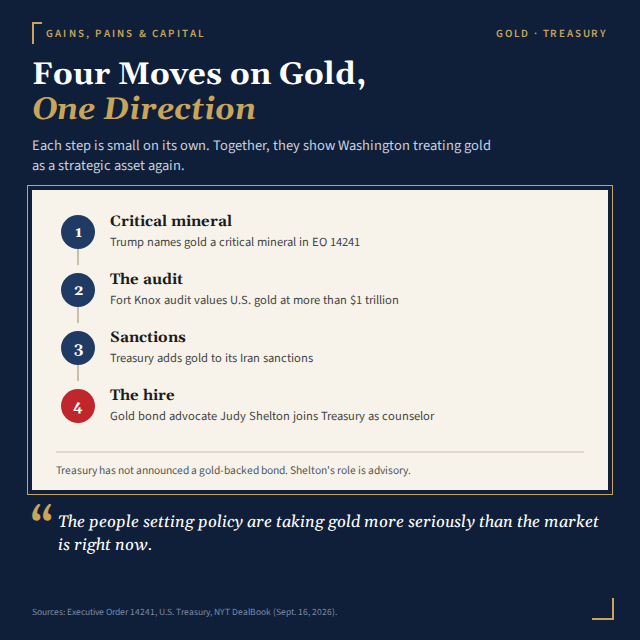
If you were preparing to use gold as part of the government’s financing toolkit, those are the steps you would take: establish its strategic importance, verify what you own, and bring in someone who knows how to structure it.
I want to be careful here. Treasury has not announced or proposed a gold-backed bond. Shelton’s role is advisory. Bessent himself said this summer that gold doesn’t determine the value of the dollar. It is entirely possible that she is there for other reasons, such as Washington’s push to reform the Fed, which she has criticized for years.
Still, investors get paid for understanding what is possible before the market prices it. So let’s look at the implications.
First, the balance sheet. The U.S. government still carries its gold at $42.22 an ounce, an official price set in 1973. At that price, America’s roughly 261 million ounces are worth about $11 billion on paper. At today’s price of around $4,170, they’re worth about $1.1 trillion. Any program that uses gold as backing for debt puts that gap to work without selling a single ounce.
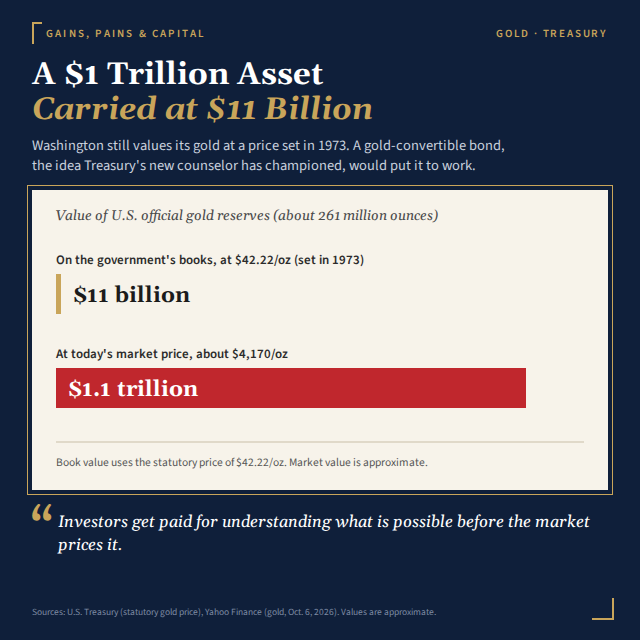
Second, the incentive. A government that uses gold to support its borrowing has a reason to want a strong gold price, because the more gold is worth, the more it can support. That would be a meaningful shift from the past 50 years, when Washington treated gold as a relic.
Third, China. Beijing is already treating gold as strategic money. China’s central bank added 20.2 tonnes in August, its largest monthly purchase since October 2023. Its gold holdings have risen for 22 consecutive months, and gold is now 9% of China’s foreign exchange reserves. Shelton has written for years about rebuilding the international monetary system with gold playing a role. If Washington wants a response to China’s gold buildup, strengthening the dollar’s link to gold is one option.
And here’s what makes this interesting for investors: the market isn’t paying attention.
Gold is down nearly 8% from a month ago, and its gain over the past year is the smallest since Yahoo Finance began tracking it daily. Back in January, gold was up more than 95% year over year. Investors are treating gold as a trade that has run its course.
Meanwhile, the world’s largest central bank buyer is accelerating its purchases, and the U.S. Treasury just hired the person who has done the most work on how a government could borrow against its gold.
None of this guarantees a gold-backed bond. But it does tell me that the people setting policy in Washington and Beijing are taking gold more seriously than the market is right now. When policy and price diverge like this, I prefer to follow the policy. I see this pullback as an opportunity.
I’ve outlined how to position for this in my special report, Survive the Inflationary Storm. It covers the investments best positioned for a world where governments are rethinking the role of money itself.
It normally sells for $499. I’m releasing 100 copies free to Gains, Pains & Capital readers today, and when they’re claimed the offer closes.
To pick up your copy, Click Here Now!
Best Regards,
Graham Summers, MBA
END
COMMODITY GOLD: CHINA
they are purchasing a lot more and hiding it within their commercial banks
(VBL/GOLDFIX)
China’s Central Bank Adds 23 Tonnes of Gold in September

by VBL
Wednesday, Oct 07, 2026 – 11:05
Authored by GoldFix
The People’s Bank of China added roughly 23 tonnes of gold to its official reserves in September, extending its buying streak to 23 consecutive months as the pace of reported purchases continued to accelerate.
In official reserve data published by China’s State Administration of Foreign Exchange, gold holdings rose to 77.47 million ounces at the end of September from 76.73 million ounces in August. The increase of 740,000 ounces, or approximately 23.02 tonnes, brought China’s reported holdings to about 2,410 tonnes.
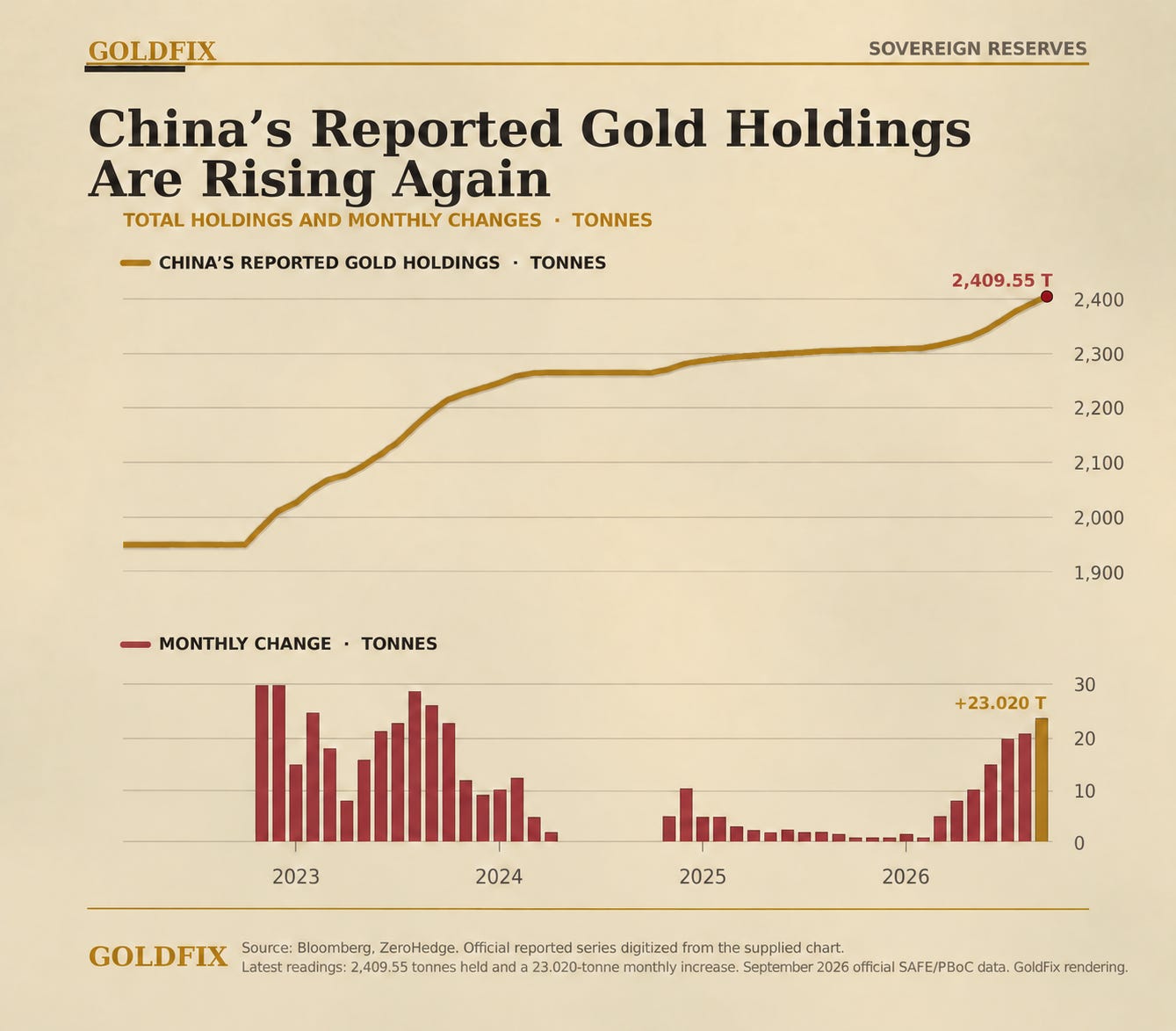
China’s broader foreign-exchange reserves fell $38.1 billion to $3.4003 trillion during September. SAFE attributed the decline to a stronger dollar, lower global financial-asset prices and valuation effects.
Continues here
END
YOUR EARLY CURRENCY VALUES/GOLD AND SILVER PRICING/ASIAN AND EUROPEAN BOURSE MOVEMENTS/AND INTEREST RATE SETTINGS WEDNESDAY MORNING.7:30 AM
SHANGHAI CLOSED UNTIL THURSDAY
HANG SENG CLOSED DOWN 195.56 PTS OR 0.81%
Nikkei CLOSED DOWN 537.98 PTS OR 0.76%
//Australia’s all ordinaries CLOSED DOWN 0.01%
//Chinese yuan (ONSHORE) CLOSED TIL THURSDAY
/ OFFSHORE CLOSED DOWN AT 6.7045 Oil UP TO 90.09 dollars per barrel for WTI and BRENT UP TO 101.00 Stocks in Europe OPENED ALL RED
ONSHORE USA/ YUAN// WITH YUAN TRADING XXX (OFF TIL THURSDAY) OFFSHORE YUAN TRADING DOWN TO 6.7045 ONSHORE YUAN TRADING ABOVE LEVEL // OFF SHORE AND DOWN ON THE DOLLAR)// / AND THUS XXXXX/OFF SHORE YUAN TRADING DOWN AGAINST US DOLLAR/ AND THUS WEAKER
XXXXXXXXXXXXXXXXXXXXXXXXXXXXXXXXXXXXX
ONSHORE YUAN: CLOSED OFF UNTIL THURSDAY
OFFSHORE YUAN: DOWN TO 6.7045
1A.HANG SANG CLOSED DOWN 195.56 PTS OR 0.81%
1 B. SHANGHAI CLOSED OFF UNTIL THURSDAY
2. Nikkei closed DOWN 533.98 PTS OR 0.76%
WEST TEXAS INTERMEDIATE OIL UP TO 90.09
BRENT; 101.00
3. Europe stocks SO FAR: ALL RED
USA dollar INDEX UP 44 BASIS PTS TO 102.03// EURO FALLS TO 1.1198 DOWN 62 BASIS PTS
3b Japan 10 YR bond yield:RISES TO. +3.106 UP 0 FULL BASIS PTS/ VERY TROUBLESOME//Japan buying 100% of bond issuance)/Japanese YEN vs USA CROSS NOW AT 158.07… JAPANESE YEN NOW FALLING AS WE HAVE NOW REACHED THE ENDING OF THE YEN CARRY TRADE AGAIN AND THE REPATRIATION OF YEN DENOMINATED BONDS TRADING IN THE USA/EUROPE. JAPAN 30 YR BOND YIELD: 4.218 DOWN 2 FULL BASIS PTS
3c Nikkei now ABOVE 17,000
3d USA/Yen rate now well ABOVE the important 120 barrier this morning
3e Gold DOWN /JAPANESE Yen DOWN//CHINESE ONSHORE YUAN: XX (XXX) AND OFFSHORE: DOWN AT 6.7045
3f Japan is to buy INFINITE TRILLION YEN worth of BONDS. Japan’s GDP equals 5 trillion USA. CENTRAL BANK OF JAPAN WILL NO LONGER DO QE.
Japan to buy 100% of all new Japanese debt and NOW they will have OVER 50% of all Japanese debt. GOVERMENT ASKED JAPAN PENSION FUNDS AND INSURANCE FUNDS TO BUY MORE JAPANESE BONDS AND REPATRIATE ALL FOREIGN BONDS.
3g Oil UP for WTI and UP for Brent this morning
3h European bond buying continues to push yields HIGHER on all fronts in the EU German 10yr bund YIELD UP TO +3.4826/ Italian 10 Yr bond yield UP AT 4.620/ SPAIN 10 YR BOND YIELD UP TO 4.126%
3i Greek 10 year bond yield UP TO 4.473%
3j Gold at $4129.50 /Silver at: 60.44 1 am est) SILVER NEXT RESISTANCE LEVEL AT $100.00
3k USA vs Russian rouble;// Russian rouble DOWN 0 AND 86/ 100 roubles/85.60
3m oil (WTI) into the 89 dollar handle for WTI and 101 handle for Brent/
3n Higher foreign deposits moving out of China// huge risk of outflows and a currency depreciation. This can spell financial disaster for the rest of the world/
JAPAN ON JAN 29.2016 CONTINUES NIRP. THIS MORNING RAISES AMOUNT OF BONDS THAT THEY WILL PURCHASE UP TO .5% ON THE 10 YR BOND///YEN TRADES TO 158.07 // 10 YEAR YIELD AFTER FIRST BREAKING .54% LAST YEAR NOW EXCEEDS THAT LEVEL TO 3.106% UP 0 BASIS PTS STILL ON CENTRAL BANK (JAPAN) INTERVENTION//YEN CARRY TRADE NOW UNWINDING//YEN BOND TRADING OVERSEAS TO BE REPATRIATED.//JAPAN 30 YR: 4.210 DOWN 2 PTS..: USA/SF this 0.8333 as the Swiss Franc . Euro vs SF: 0.9322
USA 10 YR BOND YIELD: 5.298 UP 3 BASIS PTS…NOW ABOVE 5.00%
USA 30 YR BOND YIELD: 5.687 UP 5 BASIS PTS/REFUSES TO GO DOWN WITH BESSENT’S QE TWIST
USA 2 YR BOND YIELD: 4.802 UP 1 BASIS PTS
USA DOLLAR VS TURKISH LIRA: 49.20 UP 2 BASIS PTS/LIRA GETTING KILLED//IDIOTS FOR SELLING GOLD AND USA DOLLAR RESERVES.
10 YR UK BOND YIELD: 5.4149 UP 4 PTS
30 YR UK BOND YIELD: 5.9410 UP 4 BASIS PTS
10 YEAR FRENCH BOND YIELD; 4.850 % //UP 10 BASIS PTS
10 YR CANADA BOND YIELD: 3.928 DOWN 2 BASIS PTS
5 YR CANADA BOND YIELD: 3.598 DOWN 2 BASIS PTS.
1a New York Opening report
Futures Slide From Record As Oil Jumps On Hormuz Tanker Attacks, 30Y Yield Hits 2002 High
Wednesday, Oct 07, 2026 – 08:23 AM
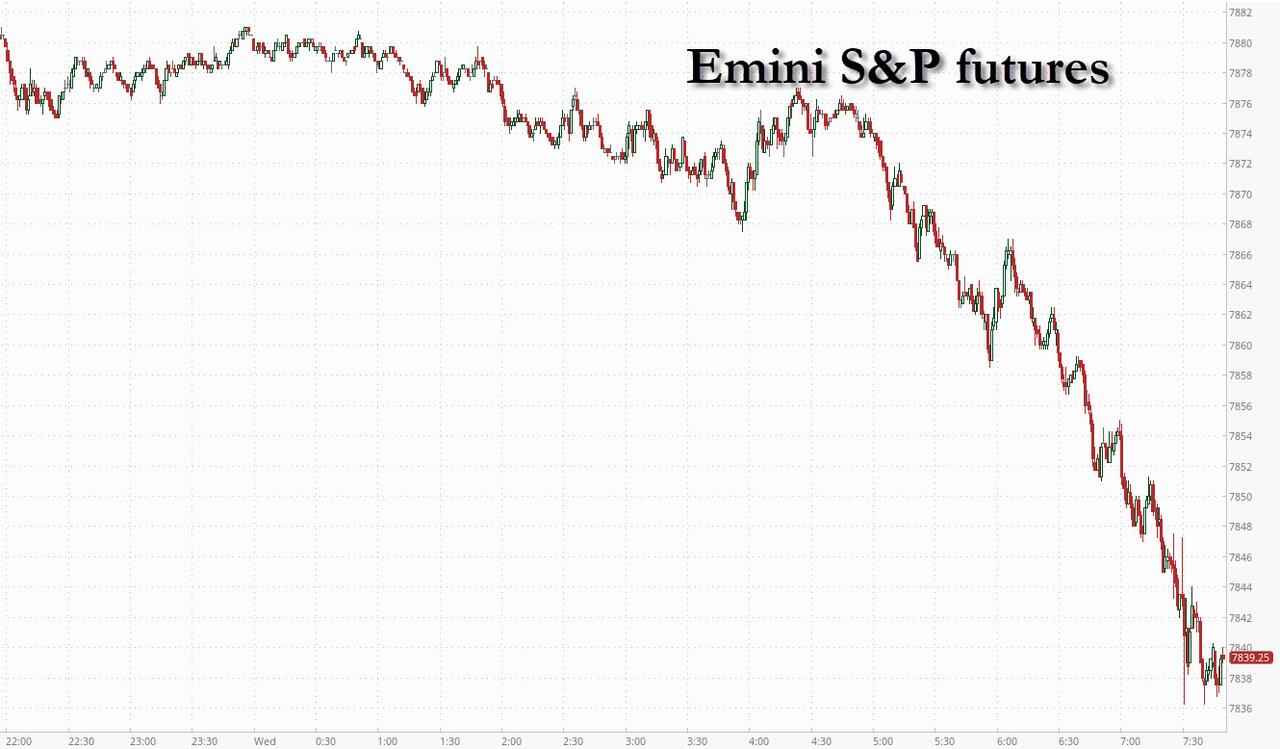
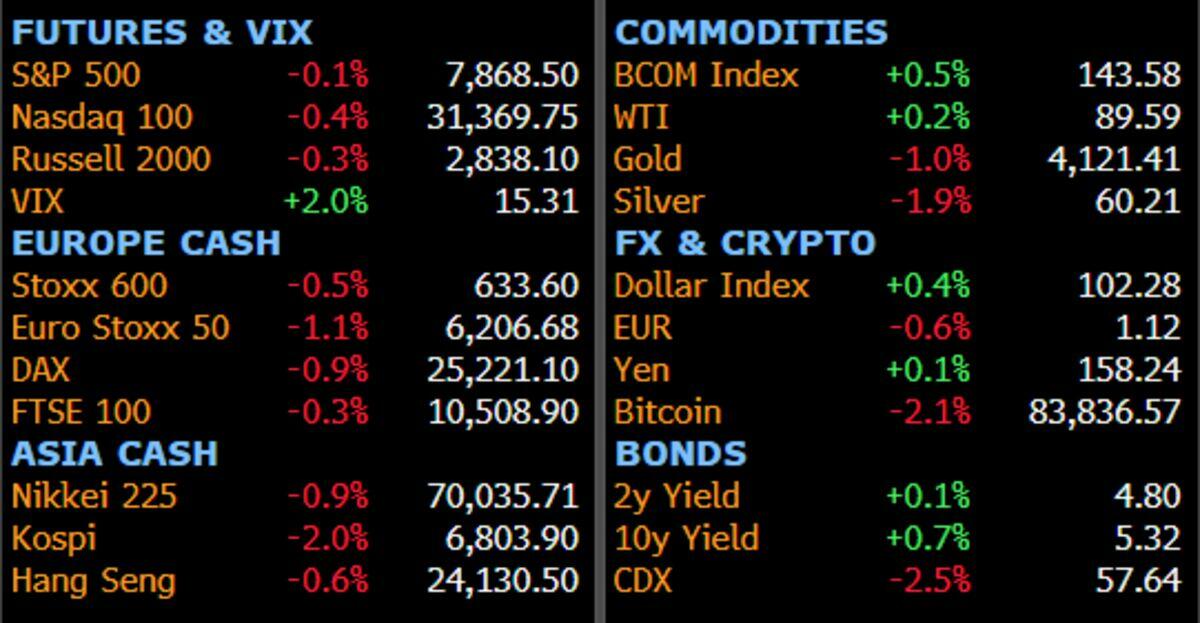
US equity futures are sliding from Tuesday’s record close as oil climbs back above $100, global bond yields resume their ascent and the AI bubble debate makes an unwelcome comeback. As of 8:00am ET, S&P futures are 0.4% lower, trading around 7,844, while Nasdaq 100 and Dow futures drop 0.6%; small caps are also under pressure with Russell 2000 futures down 0.3-0.4% as usual. On Tuesday the S&P 500 rose 0.6% to close at a record high for the first time since August 13, its fourth consecutive advance and longest winning streak in about two months, with the Nasdaq 100 also closing at an all-time high. Premarket, the Mag 7 are mixed (Apple +0.4%, Tesla -0.8%) while Memory, Semis and Software are all lower as the AI theme sees some profit-taking following a slide in Korea’s Kospi; Constellation Brands slides 4.7% after the Corona brewer reaffirmed guidance, Neogen jumps 11% on an earnings beat, and SpaceX falls 2% on a report it is seeking to raise $40 billion in a chip-backed SPV to buy Nvidia chips. The day’s driver is once again oil: Iran has increased the pace of attacks on tankers in the Strait of Hormuz just as shipments through the chokepoint approach prewar levels, sending Brent up 1.4% to $101.94 and WTI up 0.7% to $90.02. That has pushed Treasuries lower, with the long end leading: the 30-year yield climbed 5bps to 5.70%, the highest since 2002, while the 10Y trades around 5.335%, up 5bps, and 2s10s is 4bps steeper. The Bloomberg Dollar Spot Index rose 0.3%, approaching its highest levels since June, as the euro slid to a 16-month low against the pound amid renewed French fiscal angst, with the OAT-Bund spread back out to 138bps. Gold dropped 1% to around $4,121 and silver fell 1.9% to $60.21, while copper is flat with Chinese buyers still away for Golden Week. Bitcoin is down 2.4% near $83,600. US economic data slate includes MBA mortgage applications (7am, -4.2%), September NY Fed 1-year inflation expectations (11am), FOMC minutes from the September 16 meeting (2pm) and August consumer credit (3pm). The Treasury sells $39 billion of 10-year notes in a reopening at 1pm.
In premarket trading, Magnificent Seven stocks are mixed: Apple (AAPL) +0.6%, Meta Platforms (META) -0.1%, Alphabet (GOOGL) -0.5%, Nvidia (NVDA) -0.6%, Amazon (AMZN) -0.6%, Microsoft (MSFT) -0.7%, Tesla (TSLA) -0.8%
- Constellation Brands (STZ) is down 5.5% after the maker of Modelo Especial and Corona Extra reaffirmed its comparable earnings per share forecast for the full year. The company also announced the acquisition of SpikedAde, a vodka-based drink brand.
- Flutter Entertainment (FLUT) is up 3% after Citi upgraded the stock to buy from neutral, saying recent share-price weakness on concerns over Brazil and September US sports results is overdone.
- Neogen (NEOG) gains 13% after the life sciences firm reported adjusted earnings per share for the first quarter that exceeded Wall Street’s expectations.
- NetApp Inc. (NTA) is up 1.8% after Evercore ISI upgraded the computer hardware and storage company to outperform from inline, seeing a strong growth outlook.
- Penguin Solutions (PENG) gains 4.2% after the semiconductor device company reported fourth-quarter results that beat expectations and gave an outlook that is seen as strong.
- Sigma Lithium (SGML) is up 4% after the company said it has resumed operations after a Brazilian court of appeals upheld its environmental licenses.
- SpaceX (SPCX) falls 2.4% as the company is in talks with banks and investors to raise $40 billion to buy chips from Nvidia Corp., according to people familiar with the matter.
In other corporate news, Apple’s upcoming smart home devices will include a doorbell, thermostat, and other accessories developed through a partnership with LG Electronics. Shell expects to report strong results from oil trading in the third quarter as a squeeze on global fuel supplies drives refining margins to a record. HSBC is planning sweeping job cuts across its UK wealth management business as part of a broader push to use AI to serve affluent clients more efficiently, the FT reported. Frasers Group acquired an 8.8% stake in Under Armour. Affiliates of Energy Capital Partners are selling about $891 million of shares in Constellation Energy in an unregistered block trade, while Oaktree sold its remaining 6.2% stake in Torm. Black Hills will invest $1.8 billion serving a Google data center, CRH is buying aggregates operations in Denmark and Finland, and Porsche plans to raise prices of its top-end sports cars by an average of 20%.
A rally in stocks came to a halt and global bonds fell as mounting attacks on tankers in the Middle East pushed oil prices higher. “Stocks are taking a breather after closing at new record highs,” Bloomberg’s Neil Campling writes, noting that volumes, volatility and single stock dispersion remain low, with AI and earnings continuing to dominate the narrative. Meanwhile, the debate around an AI bubble is back: Temasek’s CIO said the unwinding of the AI trade is the biggest risk facing global markets along with inflation, Ray Dalio warned once more that AI is a “classic bubble” near bursting point, and the IMF sees the world facing risks from AI, a prolonged energy shock and record debt piles. Not that the market seems to care much: as we noted last night, stocks hit fresh record highs even as the 10Y hovers near its highest since 2002, and earnings concentration is getting absurd, with Micron and Nvidia alone set to deliver a third of Q3 earnings growth.
“Bond markets really worry about the outlook for fiscal policy, but the political reality is that the people on the ground are not ready to accept that,” she said.
“Extraordinary” AI-related earnings growth should keep certain major indexes relatively resilient despite rising yields, says Mark Cudmore of Bloomberg’s MLIV. Earnings growth expectations for the upcoming season have been ticking higher and are currently sitting at 24.5%. Barclays strategists agree that the AI boom remains a key earnings driver, but note that rising debt issuance and capital intensity are putting returns under greater scrutiny.

In other AI news, SpaceX is said to be in talks with banks and investors to raise $40 billion to buy chips from Nvidia (we covered the Apollo-led SPV debt here). Given that SpaceX is currently sitting on $100 billion of cash, the financing isn’t out of necessity, but speaks to the ongoing appetite for AI deals in credit markets. AMD is working with customers to optimize memory footprints as tight supplies persist, and Intel said it will continue to work with Elon Musk on Terafab.
For traders getting more nervous about AI names, BofA strategists recommend tapping equity derivatives both to benefit from the record rally and hedge against the fallout from a potential bubble. Traders are also looking to the upcoming earnings season to see whether profits can support valuations despite macro headwinds and whether the artificial-intelligence boom still has plenty of legs.
“It’s the period before earnings when there’s a bit of a lull, so markets can be pushed around easily,” said Guy Miller at Zurich Insurance. “The focus point is still around bond yields. There was relief yesterday but let’s be clear, nothing fundamental has changed.”
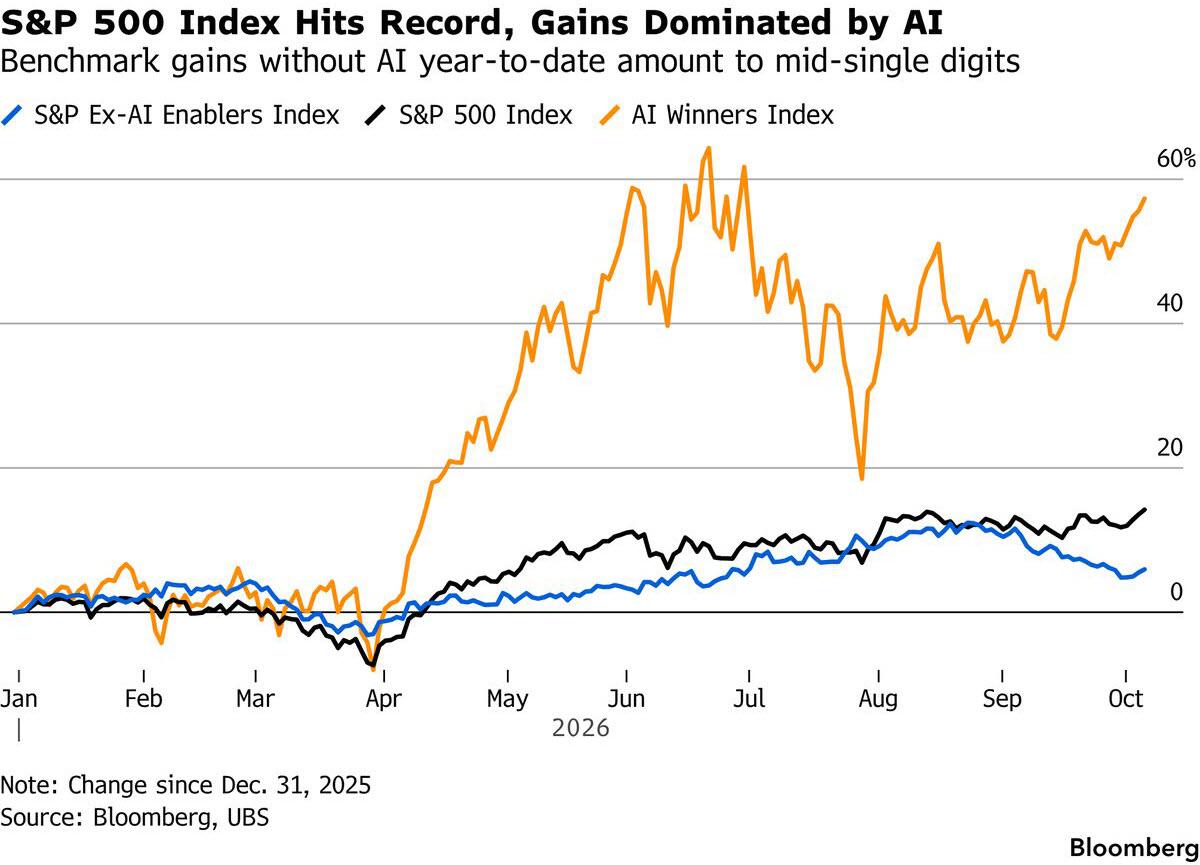
JPM’s Market Intel desk under Andrew Tyler remains Tactically Bullish and thinks the market “may not be BULLISH enough into earnings”: FactSet reports 26Q3 set a record for the largest number of positive pre-announcements, all 11 sectors are expected to show positive revenue and earnings growth, and consensus sees 12.3% revenue growth and 29.5% earnings growth with 15.0% margins (vs 52.3% EPS growth in Q2). The desk sees a broadening, but given where yields are, prefers a barbell with large-caps over small-caps and AI/Tech as the core. JPM also notes the bond market now prices a ~22% chance of an October hike and ~80% for December, down from 70% and 84% at the start of last week. JPM’s Manish Sinha is less sanguine, flagging that the Equity Risk Premium is negative, which “effectively requires a meaningful earnings re-rating higher to justify taking equity risk,” and that Momentum looks vulnerable either way.
Goldman’s desk is turning more cautious. US derivatives MD Shawn Tuteja writes that “the Tech / AI asymmetry has shifted. The macro is unequivocally more difficult, and the positioning within AI and large-cap tech no longer seem to be tailwinds.” Since Aug 27, the SPX is +1.28% while the S&P ex-AI names is down 5.19%, and Mag 7 net exposure on GS Prime is near 22% of total US exposure, the highest since the start of 2022. His left-tail scenario: one where “the Fed must hike an excessive number of times to maintain credibility in the backend of the bond curve.” In London, Goldman Delta One head Rich Privorotsky says today’s tape “feels less like generic risk off and more like higher oil + higher real rates increasingly biting the duration sensitive parts of the tape,” adding that “more leverage in the AI ecosystem is not exactly what the market wants to hear right now.” Meanwhile, the GS cash desk notes hedge fund nets are approaching a 5-year low with market breadth at the lowest level since 2000 (no wonder traders keep paying up for protection).
On the macro front, FOMC minutes come later but may offer less insight into current thinking given Warsh’s desire to trust the data and with PCE revisions and jobs data having been released since the Sept. meeting. Speaking of inflation, oil is ticking higher as traders weigh increased flows through the Strait of Hormuz against a pickup in Iranian attacks against vessels. Elsewhere, the EU is preparing safeguard measures to limit imports of Chinese hybrid vehicles into the bloc.
France is back on the tape: the spread between French and German 10-year yields widened as much as 10bps to 138bps, unwinding Tuesday’s Le Pen relief rally, as investors continue to price in heightened fiscal pressure around budget negotiations (and as Goldman warned, the “Le Pen bounce” was not to be trusted). ECB’s Moulin said the situation on France’s bond market is complicated and serious, but doesn’t warrant intervention from Frankfurt. Not everyone is panicking:
“Unlike previous episodes of severe sovereign stress in the euro area, we do not see evidence of broader financial contagion,” ABN Amro senior rates strategist Larissa de Barros Fritz wrote. “We do not expect OAT-Bund spreads to reach the 200bp+ levels seen during past Italian stress episodes.”
In Europe, the Stoxx 600 is down 0.4% at 633.64, ending a three-day run of gains as oil prices climbed and bond yields resumed their rise, with 351 members down and 233 up; Euro Stoxx 50 is down 1.1% and the DAX 0.9%. Telecoms, autos and retail lead, with carmakers rising as much as 1.75% on the EU’s planned cap on Chinese hybrid imports, while banks, tech and utilities lag, with French lenders among the worst performers. Pennon plunged as much as 20% to the lowest since 2004 after a larger-than-expected £550m rights issue. Here are the biggest European movers:
- Remy Cointreau shares advance as much as 7.5%, the most since June, after the French beverages maker held a pre-earnings call that analysts said offered reassurance on the sales outlook and US trends.
- Europe’s carmakers advance as the European Union prepares a limit on imports of Chinese hybrid vehicles into the bloc. The Stoxx 600 Auto & Parts Index gained as much as 1.75%, leading gains among sectors.
- NCC shares gain as much as 7.7%, the most since Feb. 6, after the Swedish construction company agreed to sell its Industry business at an enterprise value of SEK8.2b.
- ALK-Abello shares gain as much as 3.4% as Nordea upgrades the Danish pharmaceutical firm to buy, arguing it has the potential to return to substantial sales growth from 2028 onward, following an expected dip in 2027 due to German medication rebate reform.
- Forvia climbs as much as 11% following a double-upgrade to buy at BofA, which removes the stock’s only negative analyst rating, with room seen for the auto-tech supplier to re-rate after weak performance in the shares year to date.
- Pennon shares fall as much as 20% to the lowest level since October 2004 after a £550m rights issue that was larger than analysts expected. Analysts also flag the rebased dividend and uncertainty over returns as limiting the potential for a re-rating of the South West Water owner.
- BE Semiconductor shares drop as much as 8.4% after UBS downgraded the stock to sell from buy, citing a slower adoption of hybrid bonding among memory chipmakers due to a supply crunch.
Asian stocks fell for the first time in three days, led by tech, as the earnings optimism that drove US stocks to records failed to carry over to the region. The MSCI Asia Pacific Index dropped as much as 0.9% with SK Hynix, TSMC and Alibaba among the biggest losers; SK Hynix slumped ahead of the expiry of a lockup in its ADRs on Oct. 8. South Korea’s Kospi led declines, closing down 2.0% at 6,803.90, with Goldman’s Korea desk noting foreigners sold $1.94 billion (net sellers for an 8th session) while retail bought $1.91 billion, and Samsung’s preliminary results due tomorrow. Japan’s Nikkei fell 0.9% to 70,035.71, just about holding the 70,000 level as investors booked profits, with beer makers lower after the Fair Trade Commission started investigating them over suspected price fixing; the Topix fell 0.5%. The Hang Seng slid 0.6%, Taiwan’s Taiex fell 0.1% and Australia’s ASX 200 was flat. Mainland China remains closed for Golden Week and reopens Thursday. Southeast Asian banks sold off after JPMorgan warned surging long bond yields will hurt third-quarter earnings, while India’s RBI hiked rates by 25bps to 5.50%, its first hike in nearly four years.
“There’s a sense that Asian markets are starting to lose some of the relative momentum they enjoyed earlier,” said Tim Waterer, chief market analyst at KCM Trade. “After a period of outperformance, the lack of fresh catalysts combined with still-elevated oil and bond yields is leaving the region looking a little tired.”
In FX, the Bloomberg Dollar Spot Index rose 0.3%, approaching its highest since June, with the dollar stronger against all G10 peers and the DXY trading in a 101.88-102.32 range. EUR/USD fell to 1.1180, closing in on the 1.1161 low hit earlier in the week (the lowest since May 2025), as French fiscal angst pushed the euro to a 16-month low against the pound. USD/JPY edged up to around 158.5 after a report that Japan may be considering another supplementary budget, though PM Takaichi said the government will review policies, revenue and spending if rate moves diverge from expectations. GBP/USD slipped 0.2% to 1.3247 as gilts sold off.
“Markets are unlikely to welcome the prospect of a second supplementary budget, regardless of its size, given earlier guidance that they are no longer planned,” said Wei Liang Chang, macro strategist at DBS Bank. “The yen and JGBs may trade slightly weaker as investors await details.”
In rates, Treasuries’ long end leads the selloff into the early US session, with 30-year yields cheaper by 5bps on the day at 5.70%, the highest since 2002, and peeking through Monday’s highs. Yields are 1bp to 5bps higher across the curve, with 2s10s and 5s30s steeper by 4bps and 2bps; the 10-year trades around 5.325%. Gilts lag by an additional 4bps in the 10-year sector, with UK 30-year yields up 10bps to 6% (round number, nobody panic), while bunds slightly outperform and OATs give back all of Tuesday’s gains; a new 2033 Bund auction drew a dire 1.42x cover with 52% retained. Duration supply is a factor: the $39 billion 10-year reopening at 1pm follows Tuesday’s solid $58 billion 3-year sale, which stopped 0.2bp through, and the 10-year WI around 5.33% is ~50bps cheaper than the September reopening, which stopped 1.5bps through. The IG dollar issuance slate includes a couple of deals after four borrowers priced $4.25 billion on Tuesday. FOMC minutes from the September 16 hike land at 2pm.
“Instead of blaming bond vigilantes, deficits, Japan, fiscal dominance, erosion of central bank independence, the driver of higher rates is central banks delivering rate hikes,” wrote Bank of America rates strategist Ralf Preusser, adding that “term premium explains the entirety of the 10y yield move in US, UK, Japan, Australia and Canada” since the September central bank meetings.
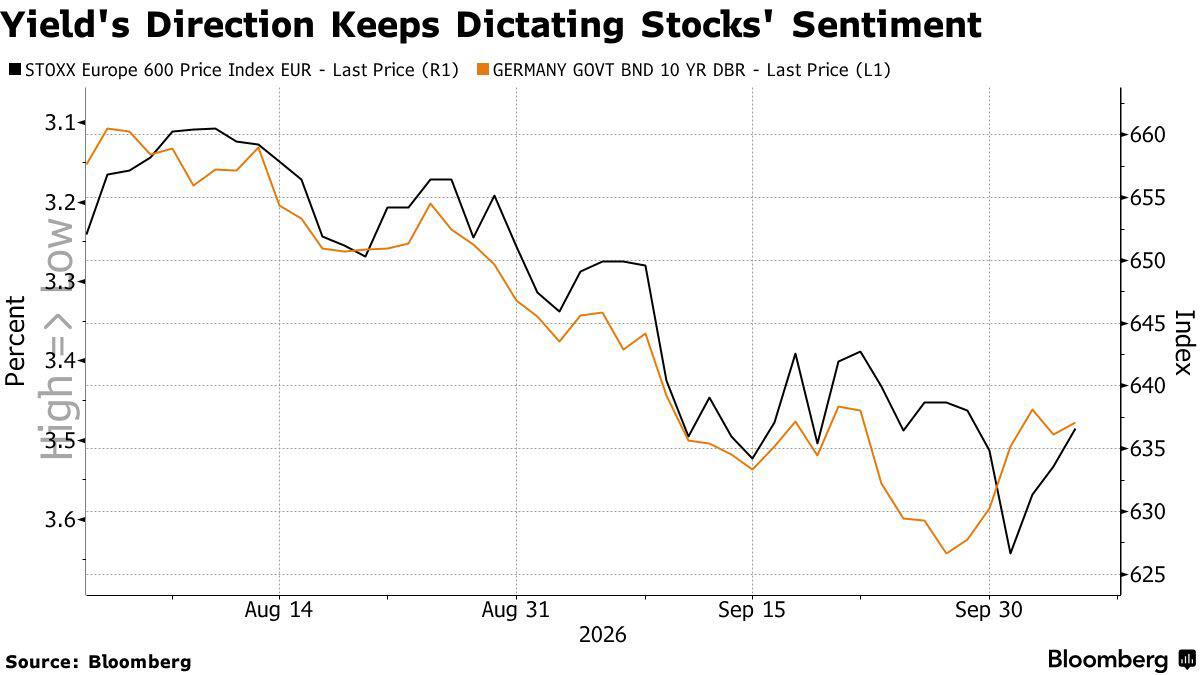
In commodities, WTI for November delivery gained 0.7% to $90.02 and Brent for December rose 1.4% to $101.94 as of 6:52am, in choppy trading (WTI ranged $89.33-90.61, Brent $100.72-102.06) as traders weigh a pickup in Iranian attacks on vessels in Hormuz against resilient Middle East flows; UK maritime authorities logged nine attacks in the strait this month, already half of September’s count. Vitol’s CEO says the crisis has entered a new phase as buyers struggle to secure tankers (as we discussed here, every crude freight index is at a record), while EU states expect the G7 emergency release of up to 100 million barrels to merely enact prior commitments; the IEA holds an informal meeting on releasing oil and diesel reserves. Shell is evacuating non-essential workers from several US Gulf assets ahead of Tropical Storm Isaias. Dutch TTF rose to €77.37/MWh. Spot gold fell from $4,170 to a $4,117 low and silver from $61.50 to $60.34 as the dollar firmed, while 3M LME copper is stuck in a $14,339.60-14,445.85 range.
US economic data slate includes MBA mortgage applications (7am, -4.2%, 30-year rate 7.49%), September NY Fed 1-year inflation expectations (11am), FOMC minutes (2pm) and August consumer credit (3pm). Fed speaker slate: The Treasury sells $75 billion of 17-week bills (11:30am) and $39 billion of 10-year notes (1pm).
No significant earnings are expected before the open; Costco reports September sales later in the day and Levi Strauss and Applied Digital report after the close.
Market Snapshot
Top Overnight News
- Japan’s Sanae Takaichi said the government may review spending and revenue plans if bond yields move unexpectedly. BBG
- The EU’s preparing measures to limit imports of Chinese hybrid vehicles into the bloc, people familiar said. One option is to impose a levy on imports above a certain volume. BBG
- India’s central bank raised interest rates for the first time in more than three years as the Middle East conflict kept energy prices high, hurting the rupee and fueling inflation fears. The Reserve Bank of India’s monetary policy committee voted unanimously to raise its benchmark repo rate by 25 basis points to 5.50%, ending a pause spanning four consecutive meetings. WSJ
- According to the Saudi aviation authority, Saudi Arabia’s airports in Jazan and Najran were targeted in two attacks, as hostilities between Yemen’s Iran-backed Houthis and the kingdom grow. CNBC
- Leading oil executives warned that the world is running out of stopgaps to manage the impact of the Iran war as the conflict extends into an eighth month. Producers and consumers have pulled virtually every lever available to adjust to the diminished flows, including reductions in demand and large releases from strategic petroleum reserves. BBG
- The global energy crisis triggered by the Middle East conflict has entered a new phase because of a shortage of tankers to move crude around the world, according to the head of the world’s largest independent oil trader. Vitol chief executive Russell Hardy said that while more oil was now flowing out of the Gulf, there was a fresh bottleneck as buyers struggled to secure ships. FT
- The US is gearing up for another quarter of bumper corporate earnings spurred by lavish spending on the AI build-out. The robust growth should help Wall Street shrug off worries about the durability of the AI trade against the backdrop of rising borrowing costs but may do little to allay concerns about how reliant the record-high stock market has become on a small group of technology names. FT
- The French government desperately needs a return to strong growth if it is to contain its rapidly rising debts. But uncertainty about whether the country can fix its finances has itself started to weigh on economic activity. France only narrowly avoided a recession in the second quarter, as activity stagnated after extreme heat hit agricultural output and the energy price shock from the war in Iran continued to squeeze households and businesses. WSJ
- SpaceX is in talks to raise $40 billion to buy Nvidia chips, people familiar said, in one of the biggest-ever debt financings for AI buildout as the borrowing binge accelerates. BBG
- Iran has increased the pace of attacks on tankers in the Strait of Hormuz in recent days, just as oil shipments through the world’s most important energy chokepoint approach prewar levels. BBG
- US 30-year yields rose 5bps to 5.7%, the highest since 2002, while 10-year yields climbed 4bps to 5.3%; traders extended their short bets against US government bonds. BBG
- Germany’s industrial production for Aug came in ahead of expectations at +2% M/M (vs. the Street +0.5%). BBG
- Taiwan’s CPI overshoots the consensus at +2.73% headline (vs. the Street +2.4%) and +2.52% core (vs. the Street +2.45%). BBG
- Iraq devalued its currency by about 13% versus the dollar as Hormuz disruption hits oil exports. BBG
- The Dutch government plans to cut its stake in ABN Amro to 10.5% from 20.7%. BBG
- US VP Vance said that Iran must make a “meaningful” reduction in its nuclear enrichment capacity to satisfy US demands and end the war. RTRS
- US officials have formally requested additional information from Russia and are coordinating with governments around the world: State Department spokesperson
- France’s government is willing to bypass parliament to pass billions in cuts. WSJ
- US equities have decoupled from the ex-AI market: since Aug 27, the SPX is +1.28% while SPX ex-AI is -5.19%, with the rolling 30-day gap near its widest since January 2023. GS
- FactSet reports 26Q3 set a record for the largest number of positive pre-announcements, led by Tech, Industrials and Healthcare. JPM
A more detailed look at global markets courtesy of Newsquawk
APAC stocks were mostly negative, with the region failing to take inspiration from the gains on Wall St, where the S&P 500 and Nasdaq printed fresh all-time highs, while the sentiment soured overnight amid a rebound in oil and yields. ASX 200 struggled for direction and was flat for the session in the absence of any major catalysts and tier-1 data. Nikkei 225 retreated with investors booking profits following the recent rally in the index, which just about held on to the 70,000 status, with participants also reflecting on Labour Cash Earnings data, which decelerated but still topped forecasts. Elsewhere, there was pressure seen in brewers including Asahi on reports that Japan’s FTC is probing Japan’s four major breweries over suspected price fixing. KOSPI underperformed in choppy trade with the index weighed on by weakness in SK Hynix, while Samsung Electronics was indecisive ahead of its preliminary earnings results tomorrow. Hang Seng conformed to the downbeat mood amid tech-related weakness and continued absence of mainland participants, who will be returning from the week-long holiday closure tomorrow.
Top Asian News
- Japanese PM Takaichi said the government will review policies, revenue and spending if interest rate shifts diverge from expectations.
European bourses (STOXX 600 -0.6%) are broadly lower, giving back the gains seen earlier in the week, but have rebounded slightly in recent trade amid the recent downside in energy benchmarks. No clear driver has been seen to explain this reversal. Sectors lack a clear bias. Telecoms top the sector pile, with Autos and Retail rounding out the sector gainers. Banks reside at the bottom of the sector pile, with Tech and Utilities rounding out the sector laggards. European autos are finding some support this morning, after Bloomberg reported that the EU is preparing a temporary import cap on Chinese hybrid cars. The safeguards by the EU will be welcomed by domestic manufacturers, as Chinese hybrid sales make up 25% of total sales in the bloc. Further in the report, the source added that the Commission plans to use hybrids as a test case, and if successful, would replicate it in other sectors. US equity futures are lower, with the ES outperforming as it hovers around the unchanged mark. Constellation Brands, the Corona owner, fell after hours despite upbeat Q2 metrics as they highlight softer underlying beer demand and a reduced operating margin outlook.
Top European News
- UK Chancellor Healey held a scheduled meeting with economists from primary dealer firms in the Gilt market, with the purpose of the meeting being to share views on global and UK economic prospects.
- UK Chancellor Healey is considering a major intervention to cut energy bills for poorer households at this month’s budget, according to The Guardian.
- UK Labour Party is to shelve GBP 800mln of planned military housing repairs until at least 2029, according to The Times.
- France’s government is willing to bypass parliament to pass billions in cuts, according to the WSJ.
- ECB’s Moulin said the situation in the bond market is “complicated”, but stated that France is not in an economic crisis yet. The French economic situation is serious but “we can act”, while adding that the ECB is not there to respond to nations’ budgetary problems.
- Germany’s foreign trade association raised its 2026 export growth forecast to 1%.
FX
- USD is stronger against most G10 peers this morning, with strength facilitated by higher energy prices and elevated yields. JPY holds towards the top of the pile, whilst the EUR underperforms.
- DXY is firmer this morning and trades within a 101.88 to 102.32 range; strength has been facilitated by higher energy prices and continued pressure in the EUR. US-specific news flow has been lacking, but attention later will be on the FOMC Minutes. It will be eyed to see how members view the future path of tightening. Elsewhere, geopolitical updates remain light. The usual rhetoric from Trump on continued oil flows through the Strait, and ongoing strikes between Saudi Arabia and the Houthis remain the key drivers.
- EUR is once again on the backfoot this morning, after finding some reprieve in the prior session. To remind, French fiscal woes appeared to ease as Le Pen provided markets with a friendly alternative budget, but failed at expressing how she would achieve it. Therefore, it was mentioned in yesterday’s FX “Market Analysis” that the EUR pressure would likely return – and it has come alongside a bout of USD strength. French fiscal concerns have re-emerged; for reference, OATs are underperforming today, and the OAT-Bund spread has widened back towards 138bps (vs yesterday’s close at 130bps).
- JPY outperforms vs peers, but still resides flat/slightly lower. Strength which comes despite widening yield differentials, and after Yomiuri reported that Japan is considering a second supplementary budget. Sticking with the fiscal side of things, PM Takaichi said that she would review policies and spending amidst elevated yields – which could help ease debt concerns within the region. Nonetheless, JGBs remained fairly unchanged overnight, which means that the JPY action may be subject to other factors. That could potentially be the region’s Labour Cash Earnings data, which showed a deceleration but still printed firmer-than-expected. Overall, a report which keeps BoJ hikes on the table by year-end.
Central Banks
- RBI hiked the Repurchase Rate by 25bps to 5.50% via unanimous decision, and adjusted its policy stance to calibrated tightening from neutral with four out of six MPC members in favour of stance change, with the RBI Governor saying it implies a “milder form” of a hiking cycle. The RBI said its FY27 inflation forecast while also lifting its real GDP growth.
- BoJ Board Member Sato said she agrees on the need for a gradual adjustment to interest rates and does not think there should be a pre-set pace of rate hikes, while she added the BoJ must decide monetary policy independently in a way that is consistent with the administration’s proactive fiscal policy. Sato also noted risks to the price outlook are skewed to the upside due to rising oil costs from the Middle East conflict, according to Kyodo.
- ECB’s Dolenc said that the current ECB rate level ensures flexibility for the central bank’s upcoming rate decisions.
Fixed Income
- A bearish start to the day, as renewed energy upside lifted fixed income overnight. Magnitudes are in-fitting with Tuesday’s action, in the sense that OATs outperformed yesterday and currently underperform today.
- Within Europe, for today, the focus is more on Germany into the CDU/CSU-SPD coalition meeting at around 15:30BST today. A meeting that is in focus after Bild reported that the Grand Coalition is looking to get agreement from SPD to outline a deadline for pension reform.
- In general, EGBs are under pressure given the energy move. Bunds lower by about 10 ticks in 120.45-90 parameters, while OATs underperform at a 108.86 low, down by essentially a full point. A move for OATs that has unwound all of yesterday’s upside, and thus the OAT-Bund 10yr yield spread is wider today, at 138bps currently.
- It is worth noting that a new 2033 Bund auction was met with dire demand, with b/c at 1.42x; more pertinently was a massive retention of 52%, indicating a high amount of caution for EGBs.
- Ex-OATs, Gilts are underperforming. Hit by the mentioned energy move and the usual somewhat outsized reaction seen in Gilts to this. Additionally, fresh budget speculation regarding energy relief is factoring; while welcome for consumers, it adds to the funding pressure that Chancellor Healey is already under. Lower by 55 ticks at the time of writing.
- Finally, USTs conform to the energy-driven move, with US yields extending as energy picks up across the morning, to the benefit of the USD and detriment of the general risk tone. At the lower-end of 104-07+ to 104-15+ parameters, with the yield curve bear-steepening. Ahead, FOMC Minutes and a 10yr auction dominate the docket.
- Germany sells EUR 1.912bln vs Exp. 4bln 2033 Bund: b/c 1.42x, average yield 3.36%, retention 52.2%.
- UK sells GBP 1.0bln 0.25% 2031 Gilt via tender; b/c 4.39x (prev. 2.65x), average yield 4.842% (prev. 1.144%).
- Australia sells AUD 1.0bln 4.25% October 2026 bonds: b/c 4.51x, avg. yield 5.3802%.
Commodities
- WTI Nov and Brent Dec futures are mixed after paring overnight gains, with the complex caught between ongoing geopolitical risks and signs of improving supply. Overnight upside was driven by continued Saudi-Houthi attacks, reports of a vessel being attacked off Oman’s Musandam coast and missiles launched towards the Strait of Hormuz. However, gains were capped by yesterday’s Saudi Energy Minister supply comments, while Trump reiterated that millions of barrels have recently moved through Hormuz and expects oil prices to fall once the Iran war ends. US VP Vance also highlighted terms to end the Iran war, stating that Iran must cut its enrichment meaningfully. More recently, modest brief upside was seen after EU states said they expect no new oil-release obligations following the G7 agreement, alongside Zelensky saying Ukraine struck four targets supporting Russia’s war effort, including two oil facilities. WTI resides within a USD 89.33-90.61/bbl range, while Brent trades within a USD 100.72-102.06/bbl range.
- Dutch TTF is firmer, extending from a EUR 75.52/MWh low to EUR 77.37/MWh at the time of writing, as European energy-security concerns remain elevated amid continued Middle East disruption. Attention is also on the IEA’s informal meeting at 12:00 BST, where proposals to release oil and diesel reserves will be discussed.
- Precious metals are softer as the USD firms and yields rebound alongside energy prices. Spot gold has fallen from USD 4,170/oz to a USD 4,117/oz low, while spot silver has declined from USD 61.50/oz to USD 60.34/oz. The FOMC Minutes later today could provide impetus. As a reminder, The Fed unanimously hiked rates by 25bps in September, with the median participant projecting one more hike in 2026 and rates on hold through 2027. Since then, Williams and Jefferson have signalled no rush for further hikes, and Bowman sees none, while softer PCE data and a soft jobs report, with unemployment rising to 4.2%, may leave the minutes stale.
- Base metals are flat/mixed amid the firmer USD, higher yields and a generally lacklustre risk tone, with Chinese buyers still absent ahead of their return from the week-long holiday tomorrow. Copper remains capped, with the return of Chinese participation overall providing little support to the complex. 3M LME copper resides in a USD 14,339.60-14,445.85/t range.
- US Weekly Private Inventory Data (bbls): Crude -2.1mln (prev. +1.0mln), Gasoline -1.4mln (prev. +3.0mln), Distillate +0.5mln (prev. -0.3mln), Cushing +0.9mln.
- Shell (SHEL LN) is evacuating non-essential workers from Stones, Mars, Olympus, Ursa, Vito and Appomattox assets in the US Gulf, while Chevron (CVX) does not expect the approaching storm to affect offshore operations.
- EU diplomats said the IEA will hold an informal meeting at 12:00 BST to discuss proposals to release oil and diesel reserves.
- EU states expect no new oil release obligations following the G7 agreement.
- US Secretary of State Rubio said the current situation in the Strait of Hormuz and the Red Sea makes a strong partnership with Greece essential.
Trade/Tariffs
- Talks between the EU and China will focus in on autos, as the EU looks for a commitment from China on stemming exports of hybrid vehicles, Politico reported citing sources. Bloomberg earlier reported that the EU is preparing a temporary import cap on Chinese hybrid cars.
Geopolitics: Middle East
- US President Trump said they have to finish up regarding Iran and that the question is how, while he added that we will soon find out how they will finish up Iran and stated that Iran’s drone-making capacity will soon be gone.
- US VP Vance told Reuters that Iran must make a “meaningful” reduction in its nuclear enrichment capacity to satisfy US demands and end the war. Vance added that the US remained open to an agreement but would require concrete Iranian nuclear concessions. Furthermore, the VP questioned who makes decisions in Tehran, following on from earlier comments by US President Trump saying that his biggest problem is that no one knows who is running Iran.
- US Secretary of State Rubio reiterated Iran cannot be allowed to have a nuclear programme.
- Yemen’s Houthi forces said they used drones to attack King Khalid International Airport in Riyadh, while they targeted Abha Airport and Khamis Mushait using missiles and drones.
- Satellite imagery, cited by Sabereen, confirmed that there is still a fire at Saudi’s Khurais oilfield.
- An Asharq reporter posted that Syria may join the war in Yemen, with the idea said to be under discussion, citing multiple sources, although no final decision has been made; it follows Syria’s President visiting Saudi Arabia.
Geopolitics: Ukraine
- US President Trump said the Russia-Ukraine war is getting closer to ending, while he had a call scheduled with Russian President Putin regarding the plague and said he will probably be able to report on the pneumonic plague incident in Russia on Wednesday.
- Ukrainian President Zelensky said Russia launched one of the largest attacks on Ukraine, directly targeting the country’s energy sector. Zelensky added that Ukrainian forces struck four targets supporting Russia’s war effort, including two oil facilities and a training ground in the Perm, Samara and Astrakhan regions.
Geopolitics: Other
- North Korea warned South Korea not to cross the border by even a millimetre. It was separately reported that North Korea said the US should think twice before opposing China regarding Taiwan, according to KCNA.
Crypto
- Bitcoin slumped early in the Asian session before stabilising around the USD 84k mark.
US Event Calendar
- 7:00am: Oct 2 MBA Mortgage Applications -4.2%, prior -6.0%
- 11:00am: Sept. NY Fed 1-Yr Inflation Expectations, est. 3.64%, prior 3.58%
- 11:30am: US to sell $75bn 17-week bills
- 1:00pm: US to sell $39bn 10-year notes (reopening)
- 2:00pm: FOMC Meeting Minutes (Sept. 16 meeting)
- 3:00pm: Aug. Consumer Credit, est. $15.000b, prior $18.062b
DB’s Jim Reid concludes the overnight wrap
Although we said on Monday that the French government bond sell-off looked overdone — likely driven largely by the unwinding of carry trades amid an aggressive repricing of ECB rates — there is also a longer-term fundamental story to tell about France. Last night, Henry and I published a chartbook on the Deutsche Bank Research Institute (link here), with a series of long-term charts on France, in some cases using data going back a couple of hundred years. One standout is an old favourite of ours: France hasn’t run a budget surplus since 1974. One of the longest consecutive runs in the world. Italy hasn’t had one since 1925, but it has mostly run primary surpluses over the last three decades or so, so there is an important difference. See the pack here for plenty more charts putting the current situation in French debt into a longer-term perspective. Also a reminder that our Q3 survey results can be found here.
For now the stress in France continues to ease with OATs staging a strong recovery yesterday, which came as RN leader Marine Le Pen vowed to continue cutting the French deficit in the years ahead, which offered some reassurance on the country’s fiscal risks. So that helped a big rebound for French OATs and we’ve now seen the biggest 2-day decline in the Franco-German 10yr spread (-13.7bps) since the initial pandemic turmoil in March 2020, so these aren’t everyday moves. The optimism also translated into a global cross-asset rally, as US Treasury yields also pulled back from their multi-year highs while the S&P 500 (+0.58%) reached its first record high since mid-August. Although US equity futures are flat overnight, the mood in Asia is weaker amid a rise in oil and bond yields.
Starting with Le Pen’s speech, markets were reassured by her pledge to cut the French deficit. She said that they’d get the deficit below 3% over the first 18 months if elected next spring, so in 2028. In addition, she also pledged to eliminate the primary deficit before end-2028, and called for spending as a share of GDP to fall beneath 50% by the end of her presidential term. Given Le Pen is currently leading in opinion polls, her fiscal plans are ones that markets are paying attention to. There are plenty of questions over both the feasibility of her radical headline fiscal target, which would far outpace any fiscal tightening France has delivered in recent history, as well as the credibility of some of the details in Le Pen’s proposals. Still, her public focus on delivering fiscal consolidation helped to ease the recent spike in investor concerns.
To be fair, much of the rally in OATs had also already played out before Le Pen’s speech, with a likely unwinding of some of the distortions that had emerged in the recent sell-off. Notably, at the front-end of the curve the 2yr Franco-German spread tightened by -15.4bps to 45bps. In absolute terms, there was also a sharp decline in French yields across the curve, with the 10yr yield (-10.9bps) falling to 4.74%, in contrast to the modest decline for 10yr bund yields (-1.4bps).
That recovery in French bonds also supported a relief rally across much of Europe, as it eased fears about contagion spreading to other countries. So the sovereign bonds of other countries with high debt levels also outperformed, with Italy’s 10yr BTP yields (-9.8bps) seeing a decent pullback to 4.53%. Moreover, several assets that struggled last week also stabilised, with the Euro (+0.32%) picking up from its recent low on Monday, whilst the STOXX Banks Index (+1.34%) was up for a second day running. That extended to credit as well, with European HY spreads (-15bps) seeing their biggest daily tightening since April.
Outside of Europe, the other big headline yesterday was that the S&P 500 (+0.58%) closed at a new record high for the first time since August 13, ahead of the Q3 earnings season. The move was a broad-based one, with the equal-weighted S&P 500 (+0.58%) rising by the same amount. And there were also new highs for the Mag 7 (+0.45%) and the NASDAQ (+0.45%). The moves were also part of a global equity rally, with Europe’s STOXX 600 (+0.48%) and France’s CAC 40 (+0.40%) also rising.
US Treasuries also rallied. The 10yr yield (-2.6bps) fell back from its post-2002 high on Monday to 5.28%, and the 2yr yield (-1.4bps) also fell to 4.80%. The move lower was led by real yields, with the 10yr real yield (-2.6bps) falling back from its post-2008 high to 2.91%.
All that came as yesterday saw a sizeable round trip in oil prices. Brent crude fell towards $97/bbl early in the US session amid optimism on oil flows coming out of the Middle East. However, this gave way to caution later on news of increased Iranian strikes against tankers passing through the Strait of Hormuz and as Iran’s IRNA reported that a blast was heard off Qeshm island near Hormuz. This brought Brent crude back up to $100.58/bbl by the close (+0.26% on the day), and it is another +1.01% higher this morning. Meanwhile, European natural gas prices rose yesterday, with front-month TTF rising +2.96% to €75.70/MWh, its highest level since mid-September.
With bonds selling off and oil rallying, the mood in Asia is softer this morning. 10yr US yields are +2.8bps, reversing yesterday’s rally so far. In equities, the KOSPI (-1.18%) is leading declines, weighed down by losses in index heavyweight SK Hynix. The Nikkei (-0.81%) and the Hang Seng (-0.53%) are also trading lower, while the S&P/ASX 200 (-0.05%) is fairly flat. Mainland Chinese markets remain closed for the National Day holiday and will reopen tomorrow. European Stoxx futures are -0.64% lower, underperforming their flat US equivalents.
Elsewhere, the Japanese yen (-0.20%) is weakening for a third straight session, trading around 158.40 against the dollar, after newly appointed BOJ board member Ayano Sato signalled support for a gradual, multi-stage approach to further interest-rate hikes. In terms of data, real wages rose by 1.5% last month matching estimates with nominal up +3.8% and the seventh month above 3%, the longest run since 1992.
To the day ahead now, data releases include the NY Fed’s Survey of Consumer Expectations for September, US August consumer credit, Germany’s August industrial production, France’s August current account balance, and Sweden September CPI. We’ll also get the FOMC minutes and hear from the Fed’s Logan, along with the ECB’s Cipollone and Vujcic.
1b) European opening report
DXY gains on rising energy prices and higher yields; EU is reportedly preparing a temporary import cap on Chinese hybrid cards – Newsquawk US Market Open

Wednesday, Oct 07, 2026 – 06:18 AM
- US VP Vance said that Iran must make a “meaningful” reduction in its nuclear enrichment capacity to satisfy US demands and end the war.
- The EU is reportedly preparing a temporary import cap on Chinese hybrid cars as EU-China talks begin on Thursday.
- US equity futures fall, as the NQ underperforms as SpaceX begin talks to borrow USD 40bln for Nvidia chips.
- DXY gains amid higher energy and yields, giving to further EUR pressure.
- Fixed income benchmarks modestly lower; Bunds unmoved following poor 2033 auction.
- Looking ahead, highlights include US MBA Mortgage Applications, NY Fed SCE (Sep), NBP Policy Announcement (Oct), FOMC Minutes (Sep), Speakers including ECB’s Cipollone & Vujcic, BoE’s Bailey. Supply from the US.
SNAPSHOT

EUROPEAN TRADE
EQUITIES
- European bourses (STOXX 600 -0.6%) are broadly lower, giving back the gains seen earlier in the week, but have rebounded slightly in recent trade amid the recent downside in energy benchmarks. No clear driver has been seen to explain this reversal.
- Sectors lack a clear bias. Telecoms top the sector pile, with Autos and Retail rounding out the sector gainers. Banks reside at the bottom of the sector pile, with Tech and Utilities rounding out the sector laggards.
- European autos are finding some support this morning, after Bloomberg reported that the EU is preparing a temporary import cap on Chinese hybrid cars. The safeguards by the EU will be welcomed by domestic manufacturers, as Chinese hybrid sales make up 25% of total sales in the bloc. Further in the report, the source added that the Commission plans to use hybrids as a test case, and if successful, would replicate it in other sectors.
- US equity futures are lower, with the ES outperforming as it hovers around the unchanged mark. Constellation Brands, the Corona owner, fell after hours despite upbeat Q2 metrics as they highlight softer underlying beer demand and a reduced operating margin outlook.
- Click for the sessions European pre-market equity newsflow
- Click for the additional news
FX
- USD is stronger against most G10 peers this morning, with strength facilitated by higher energy prices and elevated yields. JPY holds towards the top of the pile, whilst the EUR underperforms.
- DXY is firmer this morning and trades within a 101.88 to 102.32 range; strength has been facilitated by higher energy prices and continued pressure in the EUR. US-specific news flow has been lacking, but attention later will be on the FOMC Minutes. It will be eyed to see how members view the future path of tightening. Elsewhere, geopolitical updates remain light. The usual rhetoric from Trump on continued oil flows through the Strait, and ongoing strikes between Saudi Arabia and the Houthis remain the key drivers.
- EUR is once again on the backfoot this morning, after finding some reprieve in the prior session. To remind, French fiscal woes appeared to ease as Le Pen provided markets with a friendly alternative budget, but failed at expressing how she would achieve it. Therefore, it was mentioned in yesterday’s FX “Market Analysis” that the EUR pressure would likely return – and it has come alongside a bout of USD strength. French fiscal concerns have re-emerged; for reference, OATs are underperforming today, and the OAT-Bund spread has widened back towards 138bps (vs yesterday’s close at 130bps).
- JPY outperforms vs peers, but still resides flat/slightly lower. Strength which comes despite widening yield differentials, and after Yomiuri reported that Japan is considering a second supplementary budget. Sticking with the fiscal side of things, PM Takaichi said that she would review policies and spending amidst elevated yields – which could help ease debt concerns within the region. Nonetheless, JGBs remained fairly unchanged overnight, which means that the JPY action may be subject to other factors. That could potentially be the region’s Labour Cash Earnings data, which showed a deceleration but still printed firmer-than-expected. Overall, a report which keeps BoJ hikes on the table by year-end.
FIXED INCOME
- A bearish start to the day, as renewed energy upside lifted fixed income overnight. Magnitudes are in-fitting with Tuesday’s action, in the sense that OATs outperformed yesterday and currently underperform today.
- Within Europe, for today, the focus is more on Germany into the CDU/CSU-SPD coalition meeting at around 15:30BST today. A meeting that is in focus after Bild reported that the Grand Coalition is looking to get agreement from SPD to outline a deadline for pension reform.
- In general, EGBs are under pressure given the energy move. Bunds lower by about 10 ticks in 120.45-90 parameters, while OATs underperform at a 108.86 low, down by essentially a full point. A move for OATs that has unwound all of yesterday’s upside, and thus the OAT-Bund 10yr yield spread is wider today, at 138bps currently.
- It is worth noting that a new 2033 Bund auction was met with dire demand, with b/c at 1.42x; more pertinently was a massive retention of 52%, indicating a high amount of caution for EGBs.
- Ex-OATs, Gilts are underperforming. Hit by the mentioned energy move and the usual somewhat outsized reaction seen in Gilts to this. Additionally, fresh budget speculation regarding energy relief is factoring; while welcome for consumers, it adds to the funding pressure that Chancellor Healey is already under. Lower by 55 ticks at the time of writing.
- Finally, USTs conform to the energy-driven move, with US yields extending as energy picks up across the morning, to the benefit of the USD and detriment of the general risk tone. At the lower-end of 104-07+ to 104-15+ parameters, with the yield curve bear-steepening. Ahead, FOMC Minutes and a 10yr auction dominate the docket.
- Germany sells EUR 1.912bln vs Exp. 4bln 2033 Bund: b/c 1.42x, average yield 3.36%, retention 52.2%.
- UK sells GBP 1.0bln 0.25% 2031 Gilt via tender; b/c 4.39x (prev. 2.65x), average yield 4.842% (prev. 1.144%).
- Australia sells AUD 1.0bln 4.25% October 2026 bonds: b/c 4.51x, avg. yield 5.3802%.
COMMODITIES
- WTI Nov and Brent Dec futures are mixed after paring overnight gains, with the complex caught between ongoing geopolitical risks and signs of improving supply. Overnight upside was driven by continued Saudi-Houthi attacks, reports of a vessel being attacked off Oman’s Musandam coast and missiles launched towards the Strait of Hormuz. However, gains were capped by yesterday’s Saudi Energy Minister supply comments, while Trump reiterated that millions of barrels have recently moved through Hormuz and expects oil prices to fall once the Iran war ends. US VP Vance also highlighted terms to end the Iran war, stating that Iran must cut its enrichment meaningfully. More recently, modest brief upside was seen after EU states said they expect no new oil-release obligations following the G7 agreement, alongside Zelensky saying Ukraine struck four targets supporting Russia’s war effort, including two oil facilities. WTI resides within a USD 89.33-90.61/bbl range, while Brent trades within a USD 100.72-102.06/bbl range.
- Dutch TTF is firmer, extending from a EUR 75.52/MWh low to EUR 77.37/MWh at the time of writing, as European energy-security concerns remain elevated amid continued Middle East disruption. Attention is also on the IEA’s informal meeting at 12:00 BST, where proposals to release oil and diesel reserves will be discussed.
- Precious metals are softer as the USD firms and yields rebound alongside energy prices. Spot gold has fallen from USD 4,170/oz to a USD 4,117/oz low, while spot silver has declined from USD 61.50/oz to USD 60.34/oz. The FOMC Minutes later today could provide impetus. As a reminder, The Fed unanimously hiked rates by 25bps in September, with the median participant projecting one more hike in 2026 and rates on hold through 2027. Since then, Williams and Jefferson have signalled no rush for further hikes, and Bowman sees none, while softer PCE data and a soft jobs report, with unemployment rising to 4.2%, may leave the minutes stale. A full primer is available in Newsquawk’s week ahead note, available in the research suite.
- Base metals are flat/mixed amid the firmer USD, higher yields and a generally lacklustre risk tone, with Chinese buyers still absent ahead of their return from the week-long holiday tomorrow. Copper remains capped, with the return of Chinese participation overall providing little support to the complex. 3M LME copper resides in a USD 14,339.60-14,445.85/t range.
- US Weekly Private Inventory Data (bbls): Crude -2.1mln (prev. +1.0mln), Gasoline -1.4mln (prev. +3.0mln), Distillate +0.5mln (prev. -0.3mln), Cushing +0.9mln.
- Shell (SHEL LN) is evacuating non-essential workers from Stones, Mars, Olympus, Ursa, Vito and Appomattox assets in the US Gulf, while Chevron (CVX) does not expect the approaching storm to affect offshore operations.
- EU diplomats said the IEA will hold an informal meeting at 12:00 BST to discuss proposals to release oil and diesel reserves.
- EU states expect no new oil release obligations following the G7 agreement.
- US Secretary of State Rubio said the current situation in the Strait of Hormuz and the Red Sea makes a strong partnership with Greece essential.
TRADE/TARIFFS
- Talks between the EU and China will focus in on autos, as the EU looks for a commitment from China on stemming exports of hybrid vehicles, Politico reported citing sources. Bloomberg earlier reported that the EU is preparing a temporary import cap on Chinese hybrid cars.
NOTABLE EUROPEAN HEADLINES
- UK Chancellor Healey held a scheduled meeting with economists from primary dealer firms in the Gilt market, with the purpose of the meeting being to share views on global and UK economic prospects.
- UK Chancellor Healey is considering a major intervention to cut energy bills for poorer households at this month’s budget, according to The Guardian.
- UK Labour Party is to shelve GBP 800mln of planned military housing repairs until at least 2029, according to The Times.
- France’s government is willing to bypass parliament to pass billions in cuts, according to the WSJ.
- ECB’s Moulin said the situation in the bond market is “complicated”, but stated that France is not in an economic crisis yet. The French economic situation is serious but “we can act”, while adding that the ECB is not there to respond to nations’ budgetary problems.
- Germany’s foreign trade association raised its 2026 export growth forecast to 1%.
NOTABLE EUROPEAN DATA RECAP
- Swedish CPIF Prel (Sep YY) 1.5% vs. Exp. 1.6% (Prev. 0.7%).
- Swedish CPIF Prel (Sep MM) 0.9% (Prev. -0.3%).
- Swedish Core CPIF (Sep MM) 0.1% (exp. 0.3%), Y/Y 0.5% (exp. 0.7%) .
- UK Lloyds House Price Index (Sep MM) 0% vs. Exp. 0.2% (Prev. -0.3%).
- French Trade Balance (Aug) -6.1B vs. Exp. -6.5B (Prev. -6.6B).
CENTRAL BANKS
- RBI hiked the Repurchase Rate by 25bps to 5.50% via unanimous decision, and adjusted its policy stance to calibrated tightening from neutral with four out of six MPC members in favour of stance change, with the RBI Governor saying it implies a “milder form” of a hiking cycle. The RBI said its FY27 inflation forecast while also lifting its real GDP growth.
- BoJ Board Member Sato said she agrees on the need for a gradual adjustment to interest rates and does not think there should be a pre-set pace of rate hikes, while she added the BoJ must decide monetary policy independently in a way that is consistent with the administration’s proactive fiscal policy. Sato also noted risks to the price outlook are skewed to the upside due to rising oil costs from the Middle East conflict, according to Kyodo.
- ECB’s Dolenc said that the current ECB rate level ensures flexibility for the central bank’s upcoming rate decisions.
NOTABLE US HEADLINES
- US officials have formally requested additional information from Russia and are coordinating with governments around the world, according to the State Department spokesperson.
GEOPOLITICS
MIDDLE EAST
- US President Trump said they have to finish up regarding Iran and that the question is how, while he added that we will soon find out how they will finish up Iran and stated that Iran’s drone-making capacity will soon be gone.
- US VP Vance told Reuters that Iran must make a “meaningful” reduction in its nuclear enrichment capacity to satisfy US demands and end the war. Vance added that the US remained open to an agreement but would require concrete Iranian nuclear concessions. Furthermore, the VP questioned who makes decisions in Tehran, following on from earlier comments by US President Trump saying that his biggest problem is that no one knows who is running Iran.
- US Secretary of State Rubio reiterated Iran cannot be allowed to have a nuclear programme.
- Yemen’s Houthi forces said they used drones to attack King Khalid International Airport in Riyadh, while they targeted Abha Airport and Khamis Mushait using missiles and drones.
- Satellite imagery, cited by Sabereen, confirmed that there is still a fire at Saudi’s Khurais oilfield.
- An Asharq reporter posted that Syria may join the war in Yemen, with the idea said to be under discussion, citing multiple sources, although no final decision has been made; it follows Syria’s President visiting Saudi Arabia.
RUSSIA-UKRAINE
- US President Trump said the Russia-Ukraine war is getting closer to ending, while he had a call scheduled with Russian President Putin regarding the plague and said he will probably be able to report on the pneumonic plague incident in Russia on Wednesday.
- Ukrainian President Zelensky said Russia launched one of the largest attacks on Ukraine, directly targeting the country’s energy sector. Zelensky added that Ukrainian forces struck four targets supporting Russia’s war effort, including two oil facilities and a training ground in the Perm, Samara and Astrakhan regions.
OTHER
- North Korea warned South Korea not to cross the border by even a millimetre. It was separately reported that North Korea said the US should think twice before opposing China regarding Taiwan, according to KCNA.
CRYPTO
- Bitcoin slumped early in the Asian session before stabilising around the USD 84k mark.
APAC TRADE
- APAC stocks were mostly negative, with the region failing to take inspiration from the gains on Wall St, where the S&P 500 and Nasdaq printed fresh all-time highs, while the sentiment soured overnight amid a rebound in oil and yields.
- ASX 200 struggled for direction and was flat for the session in the absence of any major catalysts and tier-1 data.
- Nikkei 225 retreated with investors booking profits following the recent rally in the index, which just about held on to the 70,000 status, with participants also reflecting on Labour Cash Earnings data, which decelerated but still topped forecasts. Elsewhere, there was pressure seen in brewers including Asahi on reports that Japan’s FTC is probing Japan’s four major breweries over suspected price fixing.
- KOSPI underperformed in choppy trade with the index weighed on by weakness in SK Hynix, while Samsung Electronics was indecisive ahead of its preliminary earnings results tomorrow.
- Hang Seng conformed to the downbeat mood amid tech-related weakness and continued absence of mainland participants, who will be returning from the week-long holiday closure tomorrow.
NOTABLE ASIA-PAC HEADLINES
- Japanese PM Takaichi said the government will review policies, revenue and spending if interest rate shifts diverge from expectations.
NOTABLE APAC DATA RECAP
- Japanese Leading Economic Index Prel (Aug) 118.0 vs. Exp. 118.1 (Prev. 117.7).
- Japanese Coincident Index Prel (Aug) 118.7 (Prev. 120.6).
- Japanese Average Cash Earnings (Aug YY) 3.8% vs. Exp. 3.7% (Prev. 4.3%).
- Japanese Overtime Pay (Aug YY) 5.20% (Prev. 4.50%).
1 c) Asian opening report
Sentiment hampered as yields and energy picks up once again; DXY eyes FOMC Minutes later – Newsquawk EU Market Open
Wednesday, Oct 07, 2026 – 01:47 AM
- US President Trump reiterated that millions of barrels of oil have been delivered over the last couple of days, adding that oil prices will come way down.
- However, reports suggest that a ship was attacked off Oman’s Musandam coast; separate sources indicated that several missiles were launched towards the Strait of Hormuz.
- APAC stocks were mostly negative amidst a rebound in energy and yields; European equity futures are indicative of a lower open.
- DXY is a touch firmer, with Fed’s Daly the latest to keep the door open for further tightening this year; G10s are broadly lower against the USD.
- Crude benchmarks gained overnight amidst continued attacks between Saudi Arabia and the Houthis.
- Looking ahead, highlights include Swedish CPIF Prelim. (Sep), NBP Policy Announcement (Oct), FOMC Minutes (Sep), Speakers including Fed’s Logan, ECB’s Cipollone & Vujcic, Supply from UK, Germany & the US.
SNAPSHOT

Newsquawk in 3 steps:
1. Subscribe to the free premarket movers reports
2. Listen to this report in the market open podcast (available on Apple and Spotify)
3. Trial Newsquawk’s premium real-time audio news squawk box for 7 days
LOOKING AHEAD
- Highlights include Swedish CPIF Prelim. (Sep), NBP Policy Announcement (Oct), FOMC Minutes (Sep), Speakers including Fed’s Logan, ECB’s Cipollone & Vujcic, Supply from UK, Germany & the US.
- Click for the Newsquawk Week Ahead.
IRAN CONFLICT
- US President Trump said Iran is doing very poorly and stated regarding the Strait of Hormuz that millions of barrels of oil have been delivered just over the last couple of days, while he added that prices are now coming way down and oil will be going way down as soon as the war is over, which will be soon.
- US President Trump said they have to finish up regarding Iran and that the question is how, while he added that we will soon find out how they will finish up Iran and stated that Iran’s drone-making capacity will soon be gone.
- US Treasury Secretary Bessent said Iran hasn’t loaded a single barrel of crude onto a vessel since August 25th.
- Iran’s Persian Gulf Shipping Agency added over a dozen vessels to its blacklist amid Strait of Hormuz rules.
- Several missiles were launched towards the Strait of Hormuz, according to Naya.
- An explosion was heard on Qeshm Island, Iran, from the sea, according to IRNA.
- A ship was attacked off Oman’s Musandam coast, according to Fars.
- Oman said it carried out a medical evacuation for 10 crew members of a Panama-flagged commercial vessel that was attacked northeast of Lima.
- Emirati tanker DRAGON FORTUNE was unable to pass through the Strait of Hormuz today despite a US escort. The ship changed course after receiving a warning, and its Automatic Identification System was also turned on.
- Saudi‑led coalition said it intercepted a Houthi ballistic missile targeting Khamis Mushait, while explosions were reported in Yemen’s capital Sanaa.
- Yemen’s Houthi forces said they used drones to attack King Khalid International Airport in Riyadh, while they targeted Abha Airport and Khamis Mushait using missiles and drones.
- Yemeni Houthis reportedly now have the capability to close all Saudi airports and ports, according to Al Mayadeen citing a Houthi political bureau member, who added that they believe it is unlikely Turkey and Pakistan will directly enter the Yemeni war.
- A Houthi official posted a video of a fire at a facility, stating that Aramco oil facilities belonging to Saudi Arabia in Rabigh are pleading with Trump after having been afflicted.
- An Asharq reporter posted that Syria may join the war in Yemen, with the idea said to be under discussion, citing multiple sources, although no final decision has been made; it follows Syria’s President visiting Saudi Arabia.
- Israel conducted artillery shelling on areas in Syria’s Deraa province, while it was separately reported that Israel plans to assassinate Hezbollah Secretary General Sheikh Naim Qassem, according to ILNA reports.
US TRADE
EQUITIES
- US stocks gained and most indices closed in the green with the S&P 500 and Nasdaq printing fresh record highs amid risk-on trade as global yields moved lower, although the small-cap Russell 2000 lagged and finished in the red. Given the sentiment, all sectors aside from Health Care were higher, with Utilities and Consumer Discretionary outperforming as the former was buoyed by Constellation Energy surging after it entered into a power deal with Google.
- SPX +0.58% at 7,819, NDX +0.48% at 31,224, DJI +0.49% at 51,526, RUT -0.59% at 2,830.
- Click here for a detailed summary.
TARIFFS/TRADE
- China and EU trade officials reportedly held a preparatory video meeting on Tuesday.
NOTABLE HEADLINES
- Fed’s Daly (2027 voter) told Axios that she was very pleased and very supportive of the rate hike in September, while she added that whether more will be needed depends on the same set of conditions and noted that if shocks from tariffs, oil prices from the Middle East conflict and AI prove to be conventional shocks that are temporary, then they may not need more, which she still has some probability on. However, she also stated that if the shocks compound each other or last longer than forecast, including through a second round of tariff negotiations resulting in more tariffs, that would extend the period over which the shocks play out. Daly also stated that some companies are preparing for an AI-fueled chip squeeze that could push up prices far beyond the data centre boom alone, as well as noted that effects of AI, tariffs and higher energy costs could last longer than expected or compound each other, keeping inflation elevated and requiring more tightening.
- Fed’s Schmid (2028 voter) said the labour force remains in a good place, adding that there is still a way to go in beating inflation and that credibility is at stake in the fight against inflation.
- US President Trump said they have a very strong dollar because they are doing well and that a strong dollar is good in many ways, but also stated that they can make a case that a strong dollar slows things down. Trump said he thinks they are going to do very well in the midterms and that his rallies are changing it around.
APAC TRADE
EQUITIES
- APAC stocks were mostly negative, with the region failing to take inspiration from the gains on Wall St, where the S&P 500 and Nasdaq printed fresh all-time highs, while the sentiment soured overnight amid a rebound in oil and yields.
- ASX 200 struggled for direction and was flat for the session in the absence of any major catalysts and tier-1 data.
- Nikkei 225 retreated with investors booking profits following the recent rally in the index, which just about held on to the 70,000 status, with participants also reflecting on Labour Cash Earnings data, which decelerated but still topped forecasts. Elsewhere, there was pressure seen in brewers including Asahi on reports that Japan’s FTC is probing Japan’s four major breweries over suspected price fixing.
- KOSPI underperformed in choppy trade with the index weighed on by weakness in SK Hynix, while Samsung Electronics was indecisive ahead of its preliminary earnings results tomorrow.
- Hang Seng conformed to the downbeat mood amid tech-related weakness and continued absence of mainland participants, who will be returning from the week-long holiday closure tomorrow.
- US equity futures traded range-bound and took a breather after the fresh record highs on Wall St.
- European equity futures indicate a lower cash market open with Euro Stoxx 50 futures down 0.6% after the cash market closed with gains of 0.5% on Tuesday.
FX
- DXY strengthened overnight alongside the rebound in yields and higher oil prices, while there were recent comments from Fed officials, in which Daly stated that she was very pleased and very supportive of the rate hike in September, as well as kept the door open on whether more will be needed. Furthermore, Schmid said there is still a way to go in beating inflation and that the central bank’s credibility is at stake in the fight against inflation, while participants look ahead to the looming FOMC Minutes.
- EUR/USD faded some of the prior day’s gains as the dollar recovered, while the latest rhetoric from ECB officials provided little to shift the dial. The single currency was also unaffected by reports that the French Government is willing to bypass parliament to pass billions in cuts.
- GBP/USD pulled back following its recent advances, with price action largely driven by the dollar and US yields, as catalysts for the UK remained light. Nonetheless, participants continue to look for clues on the Budget announcement later this month, with Chancellor Healey said to consider a major intervention to cut energy bills for poorer households.
- USD/JPY gained a firmer footing above the 158.00 level amid a rebound in the buck and higher US yields, while Labour Cash Earnings data from Japan slowed from the previous, but still topped forecasts.
- Antipodeans were contained with mild headwinds amid the negative mood and lack of currency-moving data.
FIXED INCOME
- 10yr UST futures pulled back as yields rebounded alongside the upside in oil and with participants awaiting the FOMC Minutes, while there were recent Fed comments in which Daly voiced strong support for the rate hike in September and kept the door open to further increases. Elsewhere, Schmid said there is still a way to go in beating inflation and that credibility is at stake in the fight against inflation.
- Bund futures retreated beneath the prior day’s trough as the bounce in energy prices stoked inflationary pressures and with demand also constrained ahead of today’s Bund issuance.
- 10yr JGB futures pared opening gains and returned to relatively flat territory following the latest Labour Cash Earnings data from Japan, which showed a deceleration, but still printed firmer-than-expected.
COMMODITIES
- Crude futures climbed overnight with WTI crude returning to above the USD 90/bbl level amid continued attacks between Saudi Arabia and Yemeni Houthis, although gains were capped after the prior day’s two-way trade amid supply-related headlines including comments from the Saudi Energy Minister that 5.8mln BPD is currently flowing through the East-West pipeline and that operations had resumed around five days after it was hit.
- US Weekly Private Inventory Data (bbls): Crude -2.1mln (prev. +1.0mln), Gasoline -1.4mln (prev. +3.0mln), Distillate +0.5mln (prev. -0.3mln), Cushing +0.9mln.
- US EIA STEO sees 2026 world oil demand at 102.4mln BPD (prev. 102.6mln BPD) and 2027 at 104.6mln BPD (prev. 105mln BPD) while it sees world oil production in 2026 at 101.1mln BPD (prev. 100.6mln BPD) and in 2027 at 109.6mln BPD (prev. 109.9mln BPD).
- US President Trump said he was considering suspending the federal tax on petrol as the White House races to tackle a fuel price crisis ahead of November’s midterm elections, according to FT.
- Shell (SHEL LN) is evacuating non-essential workers from Stones, Mars, Olympus, Ursa, Vito and Appomattox assets in the US Gulf, while Chevron (CVX) does not expect the approaching storm to affect offshore operations.
- Venezuela’s Cardon refinery (310k BPD) was halted due to a fire.
- Spot gold trickled lower as the dollar strengthened and yields rebounded alongside oil.
- Copper futures trickled lower amid the mostly negative risk sentiment in Asia and with Chinese buyers still absent from the market.
- Chile’s government estimates the 2026 average copper price at USD 6.15/lb and 2027 at USD 5.65/lb.
- US Agriculture Secretary Collins said he will make a big announcement on America’s “seed supply”.
CRYPTO
- Bitcoin was pressured overnight as risk sentiment soured, with prices briefly dipping beneath USD 84,000.
NOTABLE ASIA-PAC HEADLINES
- BoJ Board Member Sato said she agrees on the need for a gradual adjustment to interest rates and does not think there should be a pre-set pace of rate hikes, while she added the BoJ must decide monetary policy independently in a way that is consistent with the administration’s proactive fiscal policy. Sato also noted risks to the price outlook are skewed to the upside due to rising oil costs from the Middle East conflict, according to Kyodo.
DATA RECAP
- Japanese Average Cash Earnings (Aug YY) 3.8% vs. Exp. 3.7% (Prev. 4.3%)
GEOPOLITICS
RUSSIA-UKRAINE
- Ukrainian President Zelensky said updated intelligence shows Russia is preparing a “massive attack”, while he added that much depends on the reaction of world leaders who have the defensive capabilities Ukraine needs.
- Russian Defence Ministry reported a strike on a fuel tanker in the Ukrainian port of Yuzhny.
- Russia’s Kremlin said Iran’s President will take part in the Russia-led summit of ex-Soviet leaders in Turkmenistan on Friday and will meet with Russian President Putin. Kremlin said a bilateral meeting between Putin and Chinese President Xi will take place at the APEC summit, while it also stated that a trilateral meeting between Putin, Trump and Xi at the APEC Summit in China in November is an interesting idea.
- EU envoys are expected to approve major new Russia sanctions on Wednesday.
- US President Trump said the Russia-Ukraine war is getting closer to ending, while he had a call scheduled with Russian President Putin regarding the plague and said he will probably be able to report on the pneumonic plague incident in Russia on Wednesday.
OTHER
- North Korea warned South Korea not to cross the border by even a millimetre. It was separately reported that North Korea said the US should think twice before opposing China regarding Taiwan, according to KCNA.
EU/UK
NOTABLE HEADLINES
- UK Chancellor Healey is considering a major intervention to cut energy bills for poorer households at this month’s budget, according to The Guardian.
- France’s government is willing to bypass parliament to pass billions in cuts, according to WSJ.
2.NORTH AND SOUTH KOREA/
SOUTH KOREA//NORTH KOREA
SOUTH KOREA/USA
JAPAN//
JAPAN//USA/CHINA
US To Deploy Anti-Ship Missile System To Japanese Island Near Taiwan
Wednesday, Oct 07, 2026 – 11:25 AM
Authored by Dave DeCamp via AntiWar.com,
The US military will deploy an anti-ship missile system to Japan’s westernmost island of Yonaguni, which lies just 68 miles east of Taiwan, an unprecedented move that will ratchet up tensions with China.

US Marines will deploy with the Navy-Marine Expeditionary Ship Interdiction System, or NMESIS, as part of Keen Sword, the largest joint US-Japanese biennial military exercise.
The NMESIS has a range of about 115 miles, putting it within striking range of vessels patrolling the eastern coast of Taiwan. According to The South China Morning Post, China has stepped up coast guard and naval activity in the area in response to maritime boundary talks announced in May between Japan and the Philippines.
Song Zhongping, a Chinese military expert, told China’s Global Times that the deployment increases the risk of miscalculation between the US and China and that Beijing may respond by conducting its own military drills in the area.
The Okinawa Defense Bureau first disclosed the deployment on October 1, and it will also include a Marine Air Defense Integrated System, or Maidas, a ground-based air defense system also used by the Marine Corps’ littoral force.
The first Marine Littoral Regiment was established in 2022 as part of the Marine Corps’ Force Design strategy, which is explicitly focused on preparing for a potential conflict with China. The idea was to create mobile Marine units equipped with anti-ship missiles and other weapons that can rapidly deploy along what is known as the First Island Chain, a string of archipelagos stretching from Japan’s southern islands through Taiwan and the Philippines and into the southern South China Sea.
END
3. CHINA/RUSSIA
China In Large Russia-Hosted Drills Featuring ‘Applied Lessons Of Ukraine War’
Wednesday, Oct 07, 2026 – 02:45 AM
Russia has just wrapped up hosting mass military drills involving troops and defense technology from eight countries which state media hailed as applying lessons learned from the Ukraine war.
The Tsentr-2026, or Centre-2026, drills ran throughout all last week into Saturday, located in the central western Chelyabinsk region, which is situated in the southern Ural Mountains – with on Friday President Putin being on hand to observe the exercise.

Importantly, China’s military took part, in addition to Belarus, Kazakhstan, Kyrgyzstan, Mongolia, Pakistan and Tajikistan.
The Russian Ministry of Defense said of what were primarily strategic command-and-staff exercises that they “applied” combat lessons from the Ukraine war to “repel external aggression in the Central Asian direction.“
Over 47,000 troops from across the different countries’ militaries took part at the Chebarkul training ground, in drills that further featured rehearsal for long-distance deployment and joint operational planning as well as launching operations against an entrenched enemy.
China Central Television (CCTV) indicated that the PLA troops came from the Central Theater Command, including members of the 82nd Group Army and a combined-arms brigade.
Chinese regional sources further noted the PLA rolled out unmanned systems and practiced launching drone swarms:
The PLA Daily said the drills’ operational planning and live-fire manoeuvres helped to “consolidate multilateral traditional friendship and improve joint action capabilities”, while allowing the Chinese military to test its logistical reach, troop deployment capability, and combined arms coordination in unfamiliar terrain.
According to Chinese state broadcaster CCTV, the PLA deployed a combination of Type 99A main battle tanks with drones, uncrewed ground vehicles and helicopters, during the exercise, showcasing its growing integration of crewed and unmanned systems.
The PLA deployed drone swarms to provide precise target data to ground combat groups, with tactical unmanned aerial vehicles, armed helicopters and unmanned ground combat vehicles coordinating strikes against targets, the report said.
Another interesting note: “The report also said that all the troops involved in the exercise were stationed underground to avoid drone strikes.“
This has certainly become a reality of life along the front lines in Ukraine, with the battlefield having become transformed and fully automated – or something that looks straight out of Terminator 2 and Skynet – with unmanned aircraft hovering, looking for targets on the surface.
END
4. EUROPEAN AND SCANDINAVIAN COMMENTARIES PLUS NATO
FRANCE
France’s Triple Crisis: Far-Left Riots, A Ticking Debt Bomb, And Mass Migration Collide
Wednesday, Oct 07, 2026 – 04:15 AM
France is tearing itself apart as far-left riots, a dire fiscal situation and years of unfettered mass migration collide, while President Emmanuel Macron loses his grip and his approval rating craters, raising the prospect of a victory for right-wing candidate Marine Le Pen in next year’s presidential election.
Far-left riots gained momentum in the new week, with Bloomberg reporting Tuesday that 256,000 people “demonstrated” nationwide, including 56,000 in Paris. Nearly 500 people were arrested, taking the total since September 28 to more than 6,500.
Police used tear gas in some locations, and 43 officers were injured earlier today as social unrest intensified:
The official corporate media narrative is that the rioters, many of them kids, are demanding smaller classes, building renovations, and changes to university admissions. Yet that doesn’t pass the sniff test when countless videos on social media show rioters burning down schools.
“What’s happening in France is nothing less than out-of-control mass migration. This isn’t about schools, this is about Islam wanting to take over a once great Country!” President Trump wrote on Truth Social around lunchtime in New York.
The Federalist senior editor John Daniel Davidson noted on X, “The problem looming over these riots is that France has a large population of young people who are immigrants or the children/grandchildren of immigrants that are simply not employable. They will not work and employers will not risk hiring them.”
“They are not citizens in any meaningful sense, but an unassimilated third world horde, unemployable and ultimately ungovernable,” Davidson said.
As the social unrest spirals, the dire fiscal situation intensifies: Traders have dumped French assets, such as government bonds called OATs (Obligations assimilables du Trésor), amid concerns about political instability and deteriorating public finances.
Earlier today, Le Pen released her shadow budget that shows she would shrink the deficit to 3.7% of economic output next year, well below the government’s 5% target, before bringing it to 2.2% by 2032.
Irina Kurochkina, portfolio manager at Aegon Asset Management, was quoted by Bloomberg as saying that “with centrist parties losing ground, investors are not comfortable with the outcome of the extreme right versus left,” adding, “There’s a risk they can’t make any decisions on the budget front, and so you’re left asymmetrically exposed to bad outcomes.”
France has run deficits and piled up debt for decades, and traders are now demanding higher yields to assume the risk as the country’s current trajectory puts it on what Le Pen has warned is a path towards default.

The crisis is spreading (read Goldman) to the currency market. The euro hit its weakest level since May 2025 on Monday, signaling concern that France’s fiscal and political turmoil could become a much larger issue for the entire European experiment.
Perhaps the rioters are just useful idiots being played by far-left groups furious about a possible Le Pen win that could mean a pathway towards austerity. But the dangerous game here is that, as riots and school burnings intensify, Le Pen’s odds of winning the presidential election on Polymarket continue to soar.
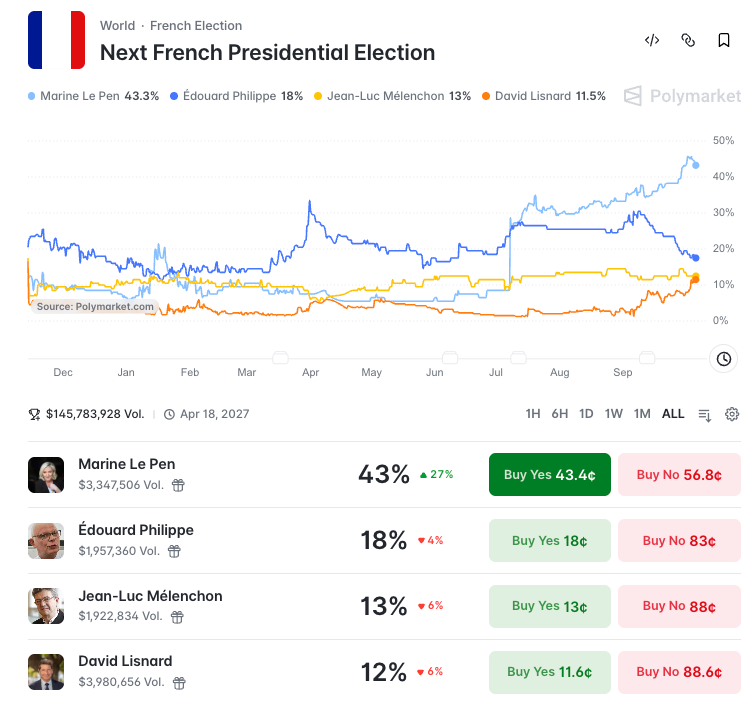
Macron has called an emergency meeting for Tuesday night to discuss the widening riots with officials. It appears Europe has tackled neither the far-left radicalization of its youth nor the left-wing groups likely responsible. In the US, meanwhile, the Trump administration has pressured these NGOs and unions, and, as if by magic, there have been no riots this summer or so far this fall.
END
SPAIN
Interventionism Created Spain’s Housing Crisis And Is A Warning To America
Wednesday, Oct 07, 2026 – 03:30 AM
Authored by Daniel Lacalle via dlacalle.com,
Socialist Americans are promising affordable housing through rent controls and government intervention. The evidence shows that these policies deliver the opposite.
Spain’s housing crisis is presented by socialists as proof that they must impose tougher rent controls, higher taxes on owners, tighter restrictions on investors, and broader intervention in the rental market. The evidence shows the opposite. Spain’s excessive intervention, regulation, and taxation have created a destructive combination of exploding demand, chronically insufficient construction, hostility toward private rental supply, and growing legal uncertainty for owners.
Spain’s socialist housing intervention has delivered the exact opposite of what it promised. Rents are up by more than 50% since Pedro Sanchez entered the government and started imposing interventionist policies; around 300,000 homes have vanished from the long-term rental market, and the government’s pledge to provide 270,000 public homes became a mirage. This is an indictment of a policy that punishes owners, hurts investment, elevates legal uncertainty, and then acts surprised when scarcity becomes permanent.
The result is not affordable housing. It is fewer homes available to rent, higher prices for the homes that remain, and a widening gap between housing demand and supply.
America should take these issues seriously. If the United States responds to its housing shortage by accelerating migrant demand while discouraging construction, investment, and property rights, it risks reproducing Spain’s failure on a much larger scale.
The Spanish housing crisis is entirely supply-driven. Between 2021 and 2025, Spain added approximately 1.2 million households but completed only 474,000 homes, including subsidized housing. That implies a cumulative deficit of at least 734,000 in just four years.
However, the problem has worsened. According to CaixaBank Research, Spain granted permits for 162,200 homes in 2025 with a net household formation of 226,000. The country continued to fall behind by more than 64,000 homes in one year, and completions are expected to remain below 100,000 units in 2026, according to the same report.
The Bank of Spain has estimated that the accumulated national shortage is around 750,000 homes. More concerning, the shortfall could rise above one million homes by 2028 if current policies remain in place. This is not merely a national average problem.
More than half of the gap between homes built and new households is concentrated in six provinces, Madrid, Barcelona, Alicante, Valencia, Murcia, and Málaga, with the largest cities showing the largest gap.
Housing demand does not disappear because governments publish a decree or law with an allegedly social title.
Land-use restrictions, slow approvals, high construction costs, and regulatory limits have made it harder to build. The Bank of Spain has identified land shortages, delays in urban-development projects, and planning-management constraints among the factors limiting construction. No amount of rhetoric against landlords changes that arithmetic.
Instead of concentrating on expanding supply, the socialist government’s housing policy has increasingly focused on attacking owners and investors. The 2023 Housing Law created the framework for declaring “stressed” rental zones and imposing restrictions on rents in designated areas. These zones may be declared when housing costs exceed 30% of average household income or when housing prices have risen at least three percentage points more than inflation over the previous five years. Supply of long-term rentals fell between 40% and 50% due to these laws, according to Idealista.
The political trick is evident. When rent is unaffordable, the government promises to limit it. But the price of a rental home is not an arbitrary number created by owner greed. It reflects the shortage of available homes, taxes, financing costs, maintenance, renovation, insurance, expected vacancy, legal risks, and the value of the capital invested in the property.
A cap only limits the advertised price of some existing homes in the short term, but it does not create a single additional apartment. It reduces the incentive to place homes on the long-term rental market, invest in maintenance, or finance new rental developments.
That is the rent-control paradox. It does not control rent. It makes housing scarcer and more expensive for the majority. One tenant may benefit if he or she is already living in a regulated property. However, the availability of homes in the regulated market disappears, and all other prospective tenants, including young workers, students, and new families, face soaring prices and a smaller pool of available homes.
The available evidence from Spain already shows this supply response. The long-term rental market has shrunk sharply. Estimates from the Observatorio del Alquiler indicate that the supply of long-term rental properties fell from about 813,850 homes in 2023 to 660,993 by the second quarter of 2026. That is a decline of 18.8%, or approximately 153,000 homes.
Other studies point to an even larger deterioration, with more than 300,000 homes disappearing from the conventional long-term rental market. Socialist laws have demolished rental supply just when demand is rising.
Owners faced with tighter rent controls, escalating regulatory requirements, risk of delayed eviction, and uncertainty over future rules have a rational incentive to sell, leave units vacant, lease seasonally, or seek more flexible forms of tenancy. The more governments restrict long-term renting, the more they make alternatives comparatively attractive.
Spain’s long-term rental listings reportedly fell by around 20% over three years, while seasonal-rental listings more than doubled. Just after the socialist Housing Law was approved, listings fell by 15% between the first quarters of 2023 and 2024. This is what happens when you penalize housing supply.
The left tries to make the housing crisis a conflict between tenants and financial investors. The reality is entirely different.
In Spain, about 92% of market-rate primary rental homes belong to individual owners rather than large institutional funds or wealthy owners of multiple properties. Most are retirees supplementing their pension and households that saved for years to buy an investment property.
When governments impose caps, extend mandatory contracts, shift costs to owners, delay the enforcement of contracts, or make evictions legally and politically difficult, they do not target “speculators.” They raise the risk of renting for ordinary people.
The consequences are especially negative for those that the socialists pretend to defend. Those with the weakest bargaining position. A well-paid tenant with a stable employment record may still obtain one of the few available properties. A young person, immigrant, self-employed worker, single parent, student, or low-income household will find it almost impossible to rent.
Rent controls are not pro-tenant. They are anti-tenant. The people who most need mobility and access to housing are left competing for a vanishing supply.
Socialist policies have also demolished legal certainty. Housing supply requires long-term capital. A developer may need years to acquire land, secure permits, finance a project, construct homes, and sell or rent them. A private owner who leases a property is also making a long-term economic decision based on the expectation that contracts will be enforceable and that property can be recovered if legal obligations are not met.
When the state weakens legal security, it raises the cost of housing.
Spain’s socialist policy direction has increasingly included extended intervention in rental contracts, rent-increase limitations, stronger barriers to eviction, and additional restrictions on property transactions and institutional purchasers. These measures may be politically popular because they appear to protect tenants in the short term. However, they impose a cost on owners and investors that worsens the situation.
If a household needs protection from eviction or emergency accommodation, the state should fund that protection from the public budget. What it should not do is treat an individual property owner as an unpaid social services department.
The same principle applies to squatters and “ocupación,” the unlawful occupation of property. Any society can and should establish proportionate safeguards for vulnerable people, but it cannot normalize the idea that a private owner may face eternal uncertainty, costs, and delayed judicial remedies when someone occupies a property without permission. The more uncertain and expensive recovery becomes, the higher the risk premium embedded in rental decisions. Some owners will demand higher rents. Others will simply decline to rent.
America’s housing problem differs from Spain’s in scale and institutional structure, but the economic mechanism is the same. In many U.S. metropolitan areas, demand has outpaced supply for years because restrictive zoning, lengthy permitting, inadequate infrastructure, limited buildable land, construction costs, and local opposition have prevented enough homes from being built.
The wrong lesson from rising rents is that private property, investment, and market pricing are the problem. They are signals of a supply shortage created by intervention and regulation.
If the United States follows the socialist Spanish path, increasing population by incentivizing migration without adequate construction, rent caps instead of new homes, hostility toward investors, higher taxes on owners, and weakening legal certainty, it will not make housing more accessible. It will create a smaller and more expensive rental market.
The solution is not to defend unaffordable housing. It is to build enough housing so that affordability does not depend on rationing. That means faster approvals, predictable regulation, more developable land where demand is strongest, lower barriers to construction, better infrastructure, and targeted public support for genuinely vulnerable households.
Spain’s experience shows that socialism always hurts those it pretends to defend. Socialism does not create affordable housing; it worsens it. The result is not more housing justice. It is less housing and more scarcity.
END
EUROPE
Cowardly Europe Fears Dissent
Wednesday, Oct 07, 2026 – 02:00 AM
Authored by J.B. Shurk via American Thinker,
Orwellian brutes now govern Europe…

Former-banker-turned-tiny-French-President Emmanuel Macron blasted what he called “American free speech” while speaking to reporters last week. Defending the European Union’s robust censorship policies, le petit fromage insisted that Europe’s speech-policing Digital Services Act should censor information that governments consider false “much more extensively, much faster, and much more forcefully.“
Macron then did his Orwellian best to condemn free speech as oppression and praise censorship as liberation: “So-called American ‘free speech’ – at least as it exists today and has been promoted by some people – is the opposite of free speech.” The terribly disliked French leader continued, “My freedom cannot mean that I am free to…insult you or vandalize the public square that belongs to everyone. Yet that is some people’s idea of ‘free speech.'”
Then the little mouse of a man roared, “Until we hold those who disseminate content on social media accountable, we will not be able to regulate it.” Furthermore, if “someone writes something” that is “false,” then that person should be “held accountable.” Tough talk from an insecure man afraid of words.
What is going on in Europe? Why is the whole continent so scared of public debate and dissent? If the political Establishment is unable to defend its ideas and policies without censoring the opposition, then its ideas and policies are absolute rubbish! The people who have willed their way to power across Europe apparently believe that they cannot win an argument unless they are the only ones permitted to speak!
That’s a bit like a puny pugilist demanding that referees tie another boxer’s hands behind his back before declaring himself world heavyweight champion!
Personally, I think mini-mouse Macron is just tired of people pointing out that he married his grandmother (or his grandfather, as the case might be). We used to teach our children, “Sticks and stones may break my bones, but words will never hurt me.” Now Western leaders are so terrified of words that they’d rather imprison everyone with an opinion than learn to take a joke or hear a contrary point of view.
Here’s the truth that Macron and his fellow Euro-weenie censors refuse to understand: Free speech is free only when a speaker can say something offensive or controversial without fear of the State’s wrath.
Although Macron wants to criminalize speech that he considers untrue, he spreads endless falsehoods of his own! While beseeching British Prime Minister Andy Burnham to betray the will of voters who chose to leave the European Union ten years ago, the Napoleon-complex-afflicted French president whined, “Brexit is the biggest lie of the last thirty years!” That boast is absurdly false (or what European censors call criminal “misinformation”). The British people did vote to separate themselves from Queen Ursula von der Leyen’s European empire.
Even though Brexit fearmongers predicted imminent economic collapse should the British people choose to rule themselves – and despite the best efforts of Brexit saboteurs at home and abroad – the United Kingdom is currently outperforming France and other major European economies, having led the G7 in growth during the first half of 2026. One reason Brexiters voted to leave the E.U. in 2016 was because British citizens did not want their military to be swallowed into a European Army beyond their control – a prospect, ironically enough, which pro-E.U. stalwarts once called “disinformation” but which has proved increasingly prescient.
Queen von der Leyen and her Brussels Eurocrats are working feverishly today to use the Russia-Ukraine War as an excuse to create increasingly centralized European defense structures.
It’s also worth remembering that European expansionists originally promoted the Union as an intergovernmental body meant to boost European economic markets and promised that the supranational institution would never directly usurp national sovereignties. That was a clear case of “misinformation” and certainly one of the biggest lies of the last half-century!
Speaking of lies that European leaders have promoted as “truths,” the Russia Collusion Hoax against President Trump (which British and Ukrainian intelligence agencies helped to propagate), the “global warming” apocalypse (which was scheduled to kill us all fourteen years ago), and the “Reign of COVID Error” (during which “health experts” lied about the virus arising from nature instead of a Chinese laboratory and then lied about fake “vaccines” being “safe and effective”) are three of the biggest mass frauds and information warfare campaigns ever perpetrated by governments against the public.
Macron has never called for these lies to be censored from social media platforms. He just doesn’t like it when random Americans point out that the European Union is an undemocratic and totalitarian system of governance that should be burned to the ground. And he really doesn’t like it when commoners correctly point out that his old high school teacher – and abusive wife – sometimes slaps him around.
Unfortunately, Macron’s inability to understand the importance of free speech is a European-wide learning disability.
In the U.K., a member of the public has filed a Prevent referral against eighty-six-year-old comedy legend John Cleese because he continues to make fun of Islam’s love for rape and murder. The complaint argues that Cleese should be considered a “moderate to high risk” for “radicalisation, communal tension, and hate incidents” for writing, among other things, “I personally prefer a culture that does not approve of FGM, Child Marriage and Killing Infidels.”
The complaint accuses Cleese of “anti-Muslim hate” and seeks further scrutiny of the cultural icon. In response to news of the referral, the Monty Python alum wrote, “The Islamic male ego becomes so bloated by its lack of restraint that it believes any criticism is blasphemy,” and, “I look forward to being arrested.” Later, he declared his targeting “One of the proudest moments of my life.“
Meanwhile, a retired police officer was recently fined more than £1,000 under the U.K.’s Communications Act for reposting a bacon joke ridiculing Islam. As one free speech advocate rightly observed, “No-one making a similar joke about Jesus would face prosecution.”
At the same time that it targets retired cops for having a sense of humor, the British government continues to hand out “skilled worker sponsorship licenses” to Islamic bookstores that sell books on jihad!
An Islamic preacher in London encourages Muslim men to beat their wives if they refuse to obey. The same Islamic cleric describes “acceptable” execution methods for gay men, including throwing them off tall buildings and pummeling their bodies with rocks. These sermons are available on YouTube.
Nevertheless, the mosque still enjoys charitable status in the U.K. Islamic jihadists preach violence and murder, and law enforcement agencies ignore their threats, just as they ignored – for decades – Islamic men raping tens of thousands of young girls across Britain.
However, when a comedian and a retired police officer mock Islam’s penchant for violence, the British government scrutinizes their speech as “threats.” That should be no surprise when U.K. police forces instruct officers that Nigel Farage’s immigration beliefs are “Islamophobic hate crimes” and encourage non-Muslim staff to fast during Ramadan in “solidarity” with their Islamic conquerors.
Two-tiered “free speech” is official government policy. Furthermore, a Home Office-linked unit has been recording social media criticism of the government’s Prevent program, including 77 observations concerning people and organizations criticizing Prevent on X and Reddit. Documents show that government-linked officials are monitoring and recording the speech of people who publicly challenge this controversial counter-extremism policy.
Orwellian brutes now govern Europe. Need further proof? The Green Party in the U.K. wants to replace “mother” and “father” with more “inclusive” terms. Meanwhile, the Germans just awarded the Westphalian Peace Prize to NATO’s military alliance.
Parents are strangers. War is peace. Free speech is violence. Censorship promotes liberty.
In truth, freedom in Europe is dead.
GERMANY
Germany’s Former Spy Chief Arrested In Biggest Espionage Scandal Of The Century
Tuesday, Oct 06, 2026 – 04:00 PM
August Hanning, former head of the German BND foreign intelligence agency, which is Germany’s equivalent of the CIA, has been arrested on espionage charges in a shocking and unprecedented situation in which a country’s top intelligence officer and head of a national spy agency was caught spying for another state.
The 80-year-old faces formal charges including “treasonous espionage, spying out state secrets, attempted treason, and espionage” – according to German media. While an official statement from the prosecutor’s office has not yet identified the foreign service he’s suspected of working for, Israel has been widely named, also given this past well-documented associations and links.

Curiously, Hanning’s arrest at his home in Nordwalde in western Germany comes a full two decades after he left the top intelligence post. He served as BND chief from December 1998 to November 2005 before moving to the Federal Interior Ministry.
In short, it appeared he not only illegally held on to thousands of classified documents, but used them over the years to peddle influence – including preparing a presentation for a foreign intelligence service based on the internal government docs. What’s more is he was covertly obtaining new documents even many years out of office.
Israeli media itself is highlighting that the way Hanning was caught actually involves shady Israeli operatives:
The affair rocking Germany involves thousands of classified documents, suspected payments, contacts with foreign intelligence officials and a surprising connection to Israel: The investigation that led to its exposure actually began with the case involving the abduction of millionaire heiress Christina Block’s children, in which Israelis were also implicated.
International reports at the time: “According to prosecutors, August Hanning, who once headed Germany’s domestic intelligence service, allegedly approached Peri [ex-Shin Bet head], now owner of the Israeli consulting firm CGI Group, to organize a team of Israeli operatives for the abduction. The team allegedly assaulted Hänsel, kidnapped the children, smuggled them into Germany, and handed them over to Block. A Danish court later ordered her to return the children to their father.”

According to a summary of the plot coming to light through the high profile Christina Block case via Channel 7 Israel National News:
Hanning had already come under scrutiny by authorities as part of an entirely separate case – the case of Christina Block, heiress to a German restaurant empire, who is standing trial over the abduction of two of her children from Denmark to Germany amid a bitter custody dispute with her former husband.
That case also attracted attention in Israel. The investigation implicated Israelis, including security personnel, and reports about the affair also mentioned former members of Israel’s security establishment.
Hanning’s name was linked to allegations concerning an earlier attempt to return the children to Germany, claims that he denied. As part of that investigation, investigators searched his home and office in September of last year and seized equipment for examination.
That, according to the German investigation, is where the case took a dramatic turn. Secret BND documents were discovered on an electronic storage device seized from Hanning. The problem was obvious: Hanning had left the intelligence service in November 2005 and therefore should not have had access to current intelligence material.
More insane details from the Block case and kidnapping plot via The Guardian:

A second former high-ranking BND official has also been arrested, and the person’s home also searched. That official is accused of handing over to Hanning additional secret documents in exchange for payment.
Some of the alleged details of the Block case are wild. It was Hanning that set up Block with the brutal Israeli contractors who dragged the children into the forest and bound them up:
That official has been identified only as Manfred D. – Hanning’s own former chief of staff when he had been BND chief. Manfred D., who had continued on as chief of staff for Hanning’s successors, was apparently from 2012 to March 2026 continuing to hand over a wealth of classified files to Hanning, despite his long having been out of government. Manfred D. is charged with “aiding and abetting attempted treason and espionage against the state.”
German media is widely describing the espionage case as the “biggest espionage scandal of the century.” Marc Henrichmann, who chairs the German parliament’s intelligence oversight committee, declared in the wake of the high level arrests that “whoever allies themselves with the enemies of our liberal democracy will be found out.”
END
FINLAND
Forest Majeure: Finland Orders Google To Halt Work At Two Data Centers Less Than A Month After €13BN Splash
Tuesday, Oct 06, 2026 – 09:42 PM
The data center delay contagion has officially gone global.
Just hours after we laid out how Oracle’s 1.3GW Wisconsin campus became the next domino to slip after the indefinite delay of the company’s New Mexico-based, Project Jupiter, and on the same day Google locked up 3.6GW of Constellation’s nuclear output in PJM, Finland’s Supervisory Agency (LVV) ordered a halt to construction work at two planned Google data centers, in Muhos and Kajaani, after more than 300 hectares of forest were cleared without a mandatory environmental impact assessment. The sites are part of the €13 billion ($15 billion) investment Google announced less than a month ago, which it billed as its largest single investment in Europe.

For those keeping count, that’s two of Oracle’s flagship Stargate campuses, SoftBank’s SB Energy, a statewide halt in Texas, PJM’s emergency power auction and now Google’s biggest European project, all in the span of about three weeks. Which is why, having flagged the first Oracle data center delays back in December, we can now say with some confidence that the bottleneck in the AI buildout is no longer the chips. It’s the permits.
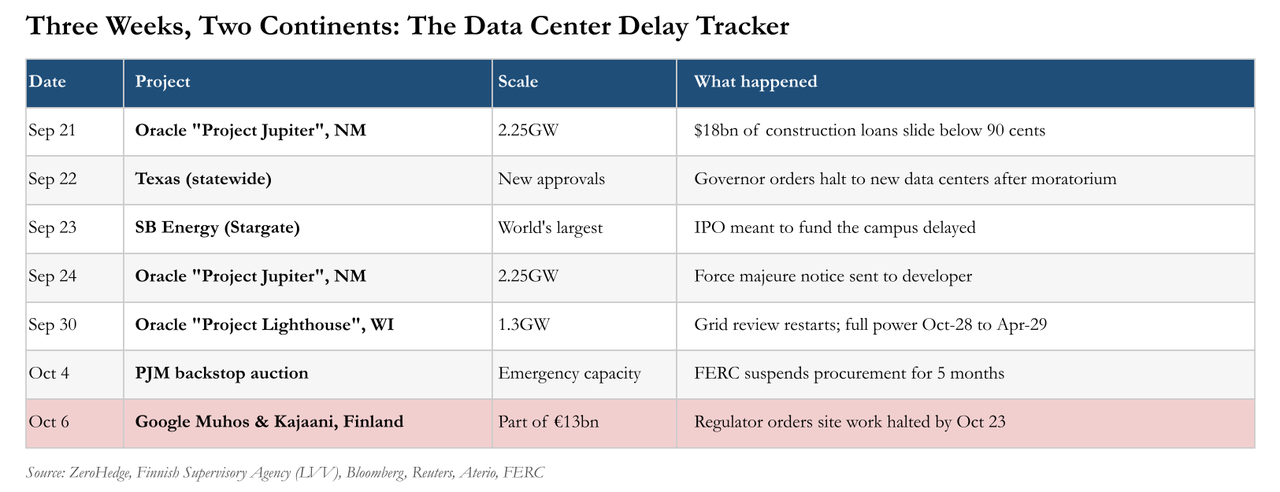
Below we walk through what Finland ordered, why the timing is awkward for Google, and why Morgan Stanley thinks the politics of compute could end up helping the hyperscalers (for now).
420 Football Fields, Zero Assessments
According to the BBC, which first reported the order, the LVV found that work at one of the sites went ahead without the mandatory environmental impact assessment, and ordered Google’s project company, Tuike Finland, to suspend all measures that would “significantly alter the environment” by October 23. Tuike has until October 14 to explain itself and lay out how it intends to proceed, failing which the agency says it could start enforcement proceedings. The work in question, per the LVV’s head of environment Tommi Muilu, included felling trees, stripping topsoil, building site roads and storage areas, and rerouting ditches. In other words, everything you do before you build a data center.
The Helsinki Times adds that the banned list also covers excavation, blasting and crushing, and that the bulk of the clearing, more than 300 hectares, took place at the Leppiniemi site in Muhos, a town of roughly 8,800. For scale, the AFP pegged it at about 420 football fields. Under Finnish rules, converting more than 200 hectares calls for an environmental assessment before the chainsaws come out, which is the order in which these things are generally supposed to happen.
None of this came out of the blue. The Finnish Association for Nature Conservation first raised the alarm in September, and the LVV opened an investigation on September 19, at which point Google insisted the trees had been felled in “full compliance with the Forest Act.” Two and a half weeks later, the message has changed somewhat: Google now says it has “fallen short of our own high standards in this instance” and will follow the agency’s guidance, while still maintaining it acted in good faith and promising to replant trees across 130 hectares at Muhos.
That’s 130 hectares replanted for 300+ cleared. Net zero, Google-style.
Meanwhile, the public mood isn’t helping: a citizens’ initiative demanding stricter data center rules reportedly gathered more than 50,000 signatures in three days.
Europe’s Biggest Google Bet… Paused
The timing could hardly be worse. When Google unveiled the Finnish plan on September 9, it was a showcase: at least €13 billion over 2027 and 2028 for new data centers in Kajaani, Muhos and Vaala plus an upgrade at its existing Hamina facility, a claimed 37,000 jobs supported during construction and an average €3.6 billion a year added to Finland’s economy. The centerpiece was the power: a 22-year purchase agreement for up to half the output of Fortum’s Loviisa nuclear plant, which extends the plant’s life to 2050 from a previous 2030 shutdown date.
Which, as regular readers know, is exactly the kind of firm, carbon-free, dedicated power we have been pounding the table for. And yet here we are: the power was never the problem in Finland. The forest was.
It’s also not the first time the Finnish plan has hit a wall. Back in October 2025, Alphabet put the expansion on hold while the government floated raising the electricity tax on data centers roughly 40-fold, from 0.05 cents to 2.19 cents per kWh. And the day after the €13 billion announcement, Finland’s opposition parties told Reuters the country needs a national permitting system for data centers to head off power shortages and soaring prices, with the Centre Party’s Antti Kaikkonen complaining that nobody is minding the overall picture. The Social Democrats, who lead the polls ahead of April’s election, called electricity availability an internal security issue.
Put differently, the regulatory risk premium on Nordic data centers just got repriced, and the election hasn’t even happened yet.
The irony is hard to miss: as we noted in July, Finland has the highest unemployment rate in the OECD at 10.8%, with youth unemployment at 23%. A country in that position just froze part of a project promising 37,000 jobs over two years. Principled, certainly. Whether Finland’s jobless see it that way is another matter.
From New Mexico To Old Muhos
The Finnish order lands on top of what has been the worst three weeks for the data center trade since the AI buildout began. Recall that it started on September 21, when the $18 billion of loans backing Oracle’s Project Jupiter slid below 90 cents. The next day Texas Governor Abbott ordered a halt to new data centers, and a day later SB Energy delayed the IPO meant to fund the world’s largest data center. Then on September 24 Oracle declared force majeure on Jupiter, and its bonds plunged to a record low the next day. Barclays was among the first to spell out the knock-on effect for everyone selling picks and shovels:
Since then, PJM’s emergency backstop auction for data center power was suspended by FERC for five months (a power auction for data centers… delayed), and Oracle’s Project Lighthouse in Wisconsin saw its grid approval go back to square one, which as we detailed earlier today pushes full power to somewhere between October 2028 and April 2029. That’s on a campus Oracle still guides to “customer delivery in the second half of 2027.”
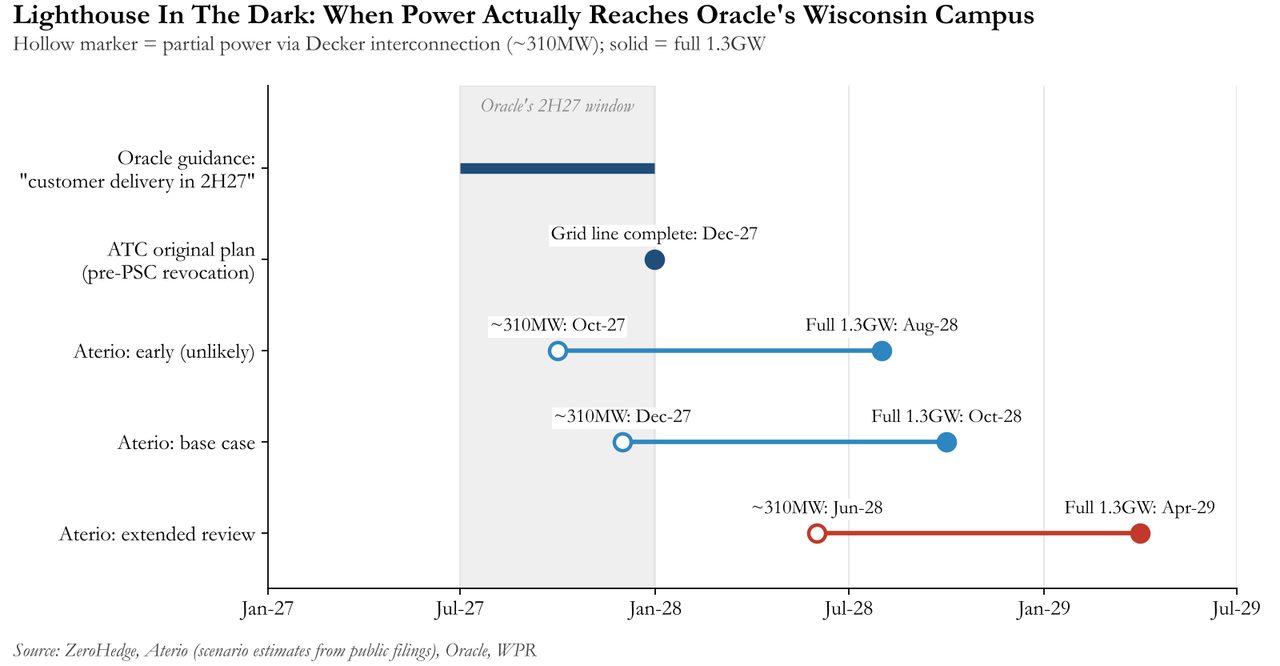
Finland is a different flavor of the same disease. In the US, it’s grid hookups and local revolt. In Finland, it’s environmental permitting. The result is identical: steel in the ground, nothing switched on, and a capex schedule that only goes one way.
“The Politics Of Compute” Goes International
The backlash itself is nothing new: we’ve covered 142 anti-data center rallies across 42 states this summer and why most Americans hate the idea of AI data centers next door. Last month, Morgan Stanley’s Vishwanath Tirupattur put numbers on it in a Sunday Start note that we published in full (available for pro subs): a Gallup poll found seven in ten Americans oppose a data center in their community, roughly 500 US jurisdictions have enacted bans or moratoriums, and an estimated ~$156 billion of projects were cancelled or delayed in 2025, with another ~$130 billion hit in 1Q26. Support has been collapsing for a year:
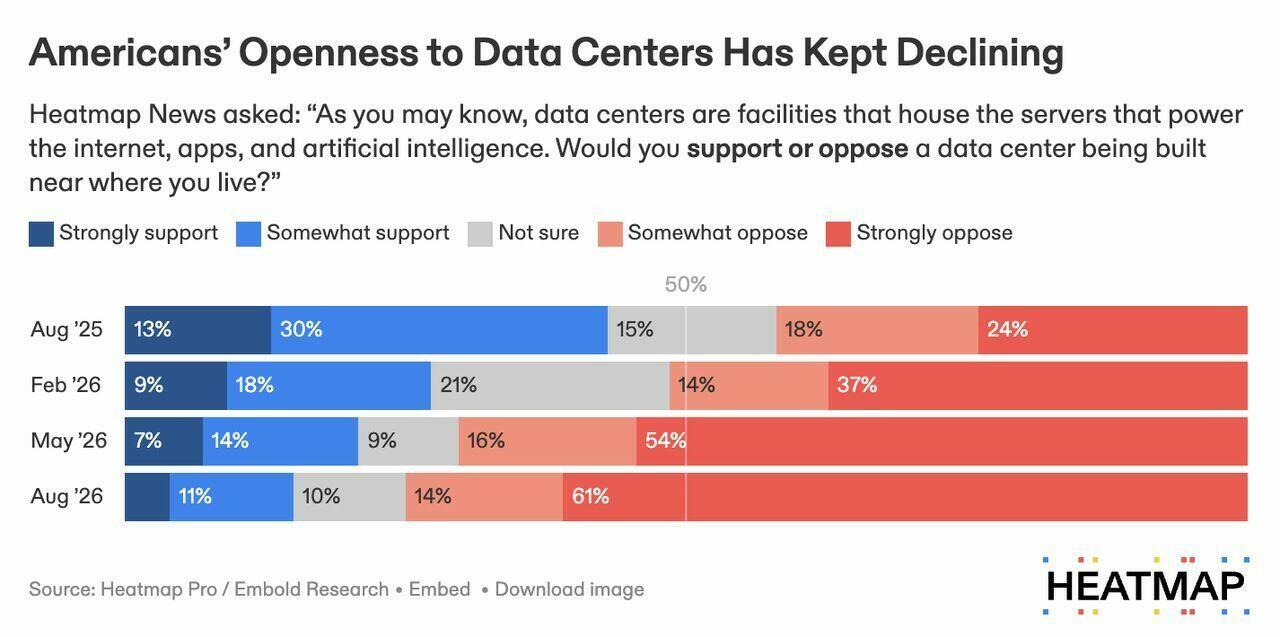
Why it matters for the macro: Morgan Stanley’s economists estimate that AI-related investment added 0.6pp to real US GDP growth in 2025 and 0.8pp in 1H26, roughly a third of all growth, and expect 0.85pp of the 2.6% they forecast for 2027.
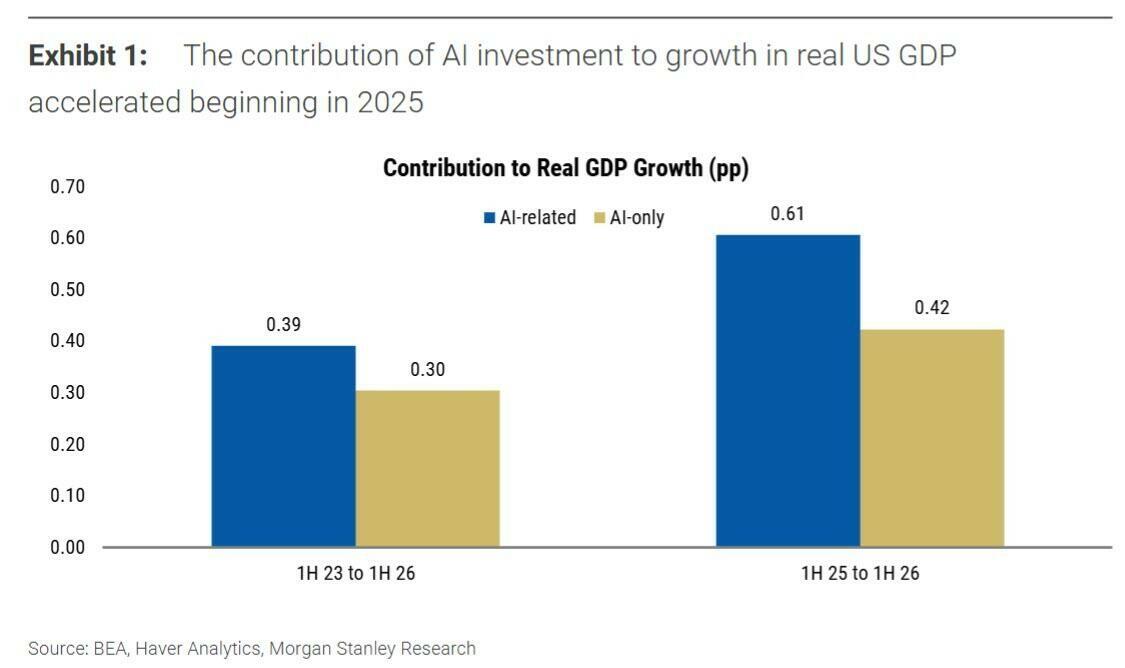
But here is the counterintuitive part of the MS view, and it’s worth quoting because it’s also the bull case:
“Here, the constraints are political and regulatory, not insufficient demand for compute or a shortage of capital to fund it. Demand for compute already far exceeds available supply. A deceleration in capacity additions would intensify and prolong the existing shortfall in compute. For equity markets, this could strengthen the position of the ‘merchants of compute’ – hyperscalers – by increasing the scarcity value of their installed base and enhancing their pricing power.”
Translation: every delayed data center makes the ones already running more valuable. Morgan Stanley even argues credit spreads could tighten if delays mean less AI debt issuance. Maybe so… for those who already own the compute. For those who borrowed against the promise of compute coming online on schedule (hello, Oracle, and most hyperscalers), the scarcity value of someone else’s installed base is cold comfort. And Google, which reported yet another capex guidance hike this year, is now in both camps at once.
Bring Your Own Power… And Your Own Paperwork
We have been saying for almost a year that the only way through the grid crunch is to take the grid out of the equation:
Last week Goldman joined that camp, with Michele Della Vigna’s team raising its behind-the-meter forecast to 67GW by 2030 and now expecting on-site gas and fuel cells to supply 25% of global data center power demand by 2030, versus “effectively 0%” in 2025 (in the Carbonomics report, available to pro subs). And Google has done everything right on that front in Finland: a dedicated nuclear plant, plus the 629MW of new wind and 94MW of batteries it lined up alongside.
The Finnish halt is the reminder that power is only one of the permits. You can bring your own reactor and still get stopped by the local park ranger (especially if he doesn’t fully share your political and technological views). Behind-the-meter fixes the interconnection queue; it does nothing for environmental reviews, water rights, zoning boards or 50,000 angry signatures. And with every jurisdiction now watching the next one, the playbook for slowing a data center down has never been easier to copy.
Bottom Line
Taken on its own, a Finnish forestry dispute over two sites is fixable: Google files its explanation by October 14, does its assessment, and the 2027-28 timeline may well survive. But it isn’t on its own. It’s the latest entry in a list that started with one stressed loan in New Mexico three weeks ago and now spans two continents, four flagship AI campuses, a state government and the biggest US grid.
Morgan Stanley’s verdict was that the backlash is real, but that it “remains unclear” whether it turns into a sustained capex slowdown. We’ll make the call for them: the delays are the new normal, not a series of one-offs, and every 2027 capacity schedule, along with the revenue ramps and debt service built on top of it, is now a 2028 schedule until proven otherwise. The hyperscalers with installed compute may well benefit, as MS argues. Everyone who borrowed trillions in off-balance sheet SPV debt against compute that hasn’t been switched on yet… not so much.
Next catalysts to watch: Tuike Finland’s reply on October 14, and the October 23 deadline to put down the chainsaws.
Much more in the full Morgan Stanley Sunday Start and Goldman’s “Behind-the-meter power solutions for data centers” note, both available to pro subs.
END
UK
UK Makes 7th Arrest Over Security Incident Near RAF Fairford Airbase
Wednesday, Oct 07, 2026 – 06:30 AM
Authored by Ryan Morgan via The Epoch Times,
Authorities in the United Kingdom have announced the arrest of another suspect in connection with a recent security incident near the RAF Fairford airbase used by U.S. forces.

On Oct. 6, the UK’s Office for Counter Terrorism Policing announced the arrest of a 22-year-old male British national in the Westminster borough of London. Authorities detained the man on suspicion of preparing terrorist acts.
The 22-year-old is the seventh to be arrested after authorities were alerted to suspicious activity near the airbase in Gloucestershire on Sept. 27.
U.S. President Donald Trump and British Prime Minister Andy Burnham have both publicly indicated the Sept. 27 incident may be linked to an Iranian plot.
Authorities initially arrested five British nationals on Sept. 27, on suspicion of committing offenses under the UK’s Explosives Act. These five men were subsequently released on police bail.
On Oct. 1, authorities announced the arrest of a sixth individual, whom they identified as a 25-year-old British-Iranian national. Authorities have since released this sixth individual on police bail.
“This remains a live investigation, and our specialist teams continue to pursue multiple lines of inquiry into the circumstances surrounding events near RAF Fairford,” senior national coordinator for Counter Terrorism Policing Vicki Evans said on Tuesday.
Evans thanked the public for their patience as police continue their work.
“We’re acutely aware of the public interest in this investigation, and we are working around the clock, and at pace, to identify the motivation behind events in Gloucestershire,” Evans said. “We remain committed to investigating all possible angles.”
Over the weekend, the U.S. Air Force withdrew its B-1B Lancer long-range bombers from their forward positions at RAF Fairford.
Addressing the decision to pull U.S. bombers away from the airbase, Trump expressed concerns about a lingering threat.
“We had an idea that there might be a threat,” the president told reporters on Oct. 5.
Separately, Vice President JD Vance said the decision to remove the bombers from RAF Fairford was taken out of an abundance of caution.
When asked if Iran-linked actors may have brought armed drones into the UK to carry out attacks, Trump said, “I can’t tell you that. But if they did, they’ll suffer greatly.”
During the initial set of arrests on Sept. 27, authorities searched multiple vehicles deemed suspicious. They said they found no explosive devices, but did recover some quantity of gasoline.
While British and American officials have suggested Iran may be behind the Sept. 27 security scare at RAF Fairford, Iranian officials have denied Tehran’s involvement.
“You’re barking up the wrong tree,” Iranian Foreign Minister Abbas Araghchi said on Sept. 30.
Though Tehran has denied any connection to the recent security alert near RAF Fairford, Iran’s Islamic Revolutionary Guard Corps previously said it would treat any bases used to launch strikes on Iranian territory as legitimate targets for retaliation.
The British government has authorized U.S. forces to use some of its bases, including RAF Fairford, to launch strikes on Iranian missile sites that have targeted international shipping.
Last year, Ukrainian forces snuck more than 100 explosive-laden drones deep inside Russia’s border to carry out extensive attacks on bases hosting Russian strategic bomber forces.
END
SWEDEN/IMMIGRATION VOTING
GATESTONE..
Ballot Box Jihad: The Non-Violent Conquest Of The West
Wednesday, Oct 07, 2026 – 05:00 AM
Authored by Robert Williams via Gatestone Institute,
“This could be the first election in Sweden where the Muslim immigration that we have had is decisive in a parliamentary election,” predicted the leader of the Sweden Democrats, Jimmie Åkesson, days before Sweden’s election on September 13.

He was right. Sweden’s center-right Sweden Democrats government indeed lost the elections by a razor-thin margin – reportedly just 50,000 votes – corresponding to just three seats in parliament.
The next government will almost certainly be a socialist one.
“Voters who, or whose parents, grew up outside Europe overwhelmingly favoured the Left,” Brussels Signal wrote in its analysis of an exit poll by SVT, Sweden’s national public broadcaster:
“The Social Democrats received 38 per cent of their votes, the Left Party 21 per cent, the Greens 7 per cent and the Centre Party 4 per cent. Together, these parties accounted for 70 per cent, against 27 per cent for the four parties of the outgoing right-wing bloc.“
The tiny socialist majority was won through heavy voter mobilization within immigrant communities, which tipped the balance. Turnout rose around 3 points to 67.5% in the almost exclusively urban districts, where mainly Muslim immigrants live.
“This election has in part been about voter mobilisation, which is unusual in Sweden,” noted to Gustav Karreskog Rehbinder, founder of AI analysis firm Vera Policy, which broke down the election results for Reuters.
According to Fredrik Karrholm, a member of the Swedish parliament and the author of Gangster Violence:
“A poll by the respected Novus institute before the election found that of Muslim respondents, around 80 per cent intended to vote for either the Social Democrats or the Left party.
“In some districts with large immigrant populations, the results are striking. For example, in Rosengård Centrum in Malmö, the Social Democrats and Left Party together received, according to the preliminary count, 95.2 per cent of the vote…
“This pattern predates the present government…
“During the last parliamentary term, around 200,000 people were given citizenship under rules that imposed very few demands on applicants – not even a requirement to speak or write Swedish. The majority of those granted citizenship were from outside Europe….
“Immigration to Sweden has not only brought crime, social problems and unemployment – now the government that was successfully starting to solve these problems has been voted out because of immigration itself.”
For a brief moment, it had seemed as if Sweden was finally beginning to turn things around. In 2022, Sweden voted in a center-right government that ruled with the parliamentary backing of the Sweden Democrats – a first in Swedish politics. This government sought to implement the most restrictive overhauls of Swedish asylum and immigration policies in Swedish history with crackdowns on asylum and migrant flows, while making it harder for immigrants to acquire permanent residence and Swedish citizenship.
After decades of lawlessness, the center-right government, now voted out, had also sought to crack down on crime by finally openly linking migration to gang violence, parallel societies, and integration failures.
The results were dramatic: In December 2025, Reuters reported:
“The number of shootings in Sweden has more than halved since hitting a peak in 2022, reflecting new policing approaches introduced by the right-wing government, which is readying for parliamentary elections next year. Shooting incidents fell to 147 so far this year, a 63% decrease compared to 2022 when there were 390 shootings and a 49% decrease compared to 2024, according to a Reuters analysis of official figures.”
The government also began to scrutinize the detrimental effects of Islam in Sweden, including the launch of a government investigation into the Islamist infiltration of Swedish society. This past spring, the government announced that it would be dropping the entire concept of “Islamophobia.”
Sweden, in short, had been on the road to becoming Swedish again – but if the election results lead to a new socialist government, that will no longer happen: The Left Party alone is deeply infiltrated by Islamists and terrorist supporters, with several of its politicians caught celebrating the October 7, 2023 Hamas invasion of Israel, with some handing out candy on the streets to mark their joy at the massacres of Israelis. In addition, several candidates were found to have shared content praising or expressing support for designated terrorist organizations, including Hamas, Hezbollah, the PFLP and Al-Qaeda, while multiple candidates shared classic antisemitic tropes, Holocaust denial and homophobia.
These revelations, all dug up by the Swedish press, forced the Left Party to remove at least 33 of its most extremist candidates, an astounding number.
Many other radicals within the party kept their parliamentary seats, including MPs Ilona Szatmári Waldau and Samuel Gonzalez Westling, who sent open letters of support to Palestinian terrorists held in Israeli prisons for serious offenses, such as ordering suicide bombings and torturing and murdering an Israeli soldier. In October 2025, the party’s top leadership, including party leader Nooshi Dadgostar, hosted two visiting Palestinians from the Fatah Revolutionary Council inside the Swedish Parliament. The two guests were known for having publicly praised terrorist acts and spreading Jew-hatred.
If you think any of this harmed the party, you would be wrong: The scandals actually served to boost it: they gained the party six new seats in the election.
There is a name for what just happened in Sweden: Ballot box jihad. It is an Islamist tactic, favored by the Muslim Brotherhood.
“In the Middle East, democracy and elections are various means to one end: the establishment of a decidedly undemocratic form of law – Islamic, or Sharia Law,” Raymond Ibrahim wrote about the Egyptian elections in 2012, which, for a brief moment, brought the Muslim Brotherhood to power.
“An Egyptian cleric, Dr. Talat Zahran, proclaimed that it is ‘obligatory to cheat at elections, a beautiful thing’ — meaning that voting is a tool, an instrument, the only value of which is to empower Sharia. Another cleric, Hazim Shuman… issued a fatwa that likened voting for Islamist candidates to a ‘jihad,’ or a holy war, adding that paradise awaits whoever is ‘martyred’ during the electoral campaign.”
The same tactic applies to the Islamist project of nonviolent conquest of the West. The late spiritual leader of the Muslim Brotherhood, Yusuf al-Qaradawi, speaking in Qatar in 2007, said that “Islam will conquer Europe without resorting to the sword or fighting. The conquest will be through da’wah [proselytizing] and ideology.”
Ballot box jihad is part of achieving this conquest. Sameh Egyptson, an Egyptian-Swedish academic, writer and expert on political Islam, has been warning about Islamist infiltration of the political system for years. He has recently cautioned, among other things, against clan voting as an erosion of democracy. Clan voting is when extended families and even entire ethnic communities vote collectively as a bloc for the same candidate or party. Although clan voting as such is not illegal in Sweden, two newly elected Muslim candidates from the Left Party are already suspected of electoral fraud, including bribing or unduly influencing voters to vote for them and pre-marking their own names on ballots.
This outcome is possibly what many socialists have been planning all along: To stay in power forever by importing new voters from the Third World.
Sweden is a warning, not only to the rest of Europe but to the Western world at large.
We publish a variety of perspectives. Nothing written here is to be construed as representing the views of ZeroHedge.
END
EURO AND THE EU//AI
The Euro Has A Much Bigger Problem Than France
France is currently the acute flashpoint for eurozone stress, but the deeper structural flaws of the monetary union itself—and the erosion of its traditional anchors—are larger and more enduring problems.As of early October 2026, markets are focused on France: public debt around 115–120% of GDP (and rising toward 130% in some projections), deficits persistently above 5% of GDP, political gridlock ahead of the 2027 presidential election, and French 10-year yields near or above 5% with spreads over German Bunds widening to levels last seen in the 2011–2012 sovereign debt crisis. The euro has fallen to multi-month lows against the dollar amid contagion fears to Italy, Belgium, Greece and others. France’s size makes this different from the earlier periphery crises—it is too big to fail easily and too big to bail without severe political costs.
theguardian.com
Yet France is a symptom more than the root cause. The euro was designed as a currency without a full fiscal or political union, relying on rules (Maastricht criteria, Stability and Growth Pact) that have been repeatedly bent or broken, plus the implicit backstop of German fiscal credibility and ECB intervention capacity. That architecture creates chronic tension: a single monetary policy that is often too tight for high-debt, low-growth members and too loose for others, limited automatic stabilizers across borders, and persistent divergence in competitiveness, productivity, and debt dynamics.Key deeper issues include:
- Germany’s weakened role as anchor. Once the growth engine and fiscal disciplinarian, Germany has faced prolonged stagnation or near-stagnation in recent years, industrial headwinds (energy costs after the end of cheap Russian gas, competition from China, bureaucracy, labor shortages), and rising fiscal pressures of its own. Growth forecasts remain modest even in recovery phases, and political constraints limit its willingness or ability to underwrite the system indefinitely. When the “core” itself underperforms, the whole construct looks less stable.
- Incomplete architecture and moral hazard. Without deeper fiscal integration, capital markets union, or credible enforcement of rules, high-debt countries face less market discipline in good times and greater pressure (or reliance on ECB tools) in bad times. The original “no bailout” principle collided with reality in 2010–2012; tools like the ESM and OMT exist now, but using them for a large core economy raises existential questions about mutualization and sovereignty. Political resistance to further integration remains strong in several countries.
- Structural economic headwinds across the bloc. Aging demographics, high public spending ratios in several large members, energy dependence and price shocks (exacerbated by geopolitical events such as conflict involving Iran), lagging productivity relative to the US (especially in tech/AI), and exposure to Chinese industrial competition compound debt sustainability problems. One-size-fits-all interest rates amplify divergences rather than resolve them.
- Political fragmentation. Rising polarization, minority governments, and upcoming elections reduce the capacity for painful fiscal adjustment precisely when markets demand credibility. Contagion risk is real not because every country is identical to France, but because investors reprice risk across the shared currency when confidence in the rules or the backstop wavers.
In short, France’s fiscal and political troubles are serious and market-moving right now because of the country’s weight. The bigger, longer-term problem is that the euro remains a half-built house: a common currency without the full set of institutions, fiscal capacity, and political cohesion needed to handle asymmetric shocks or large-member debt dynamics sustainably. Past crises were managed; the underlying design tensions have not been resolved.
END
GERMANY
ABOUT TIME!!
Better Late Than Never? EU Prepares Import Cap On Chinese Hybrids As Germany’s Industrial Base Burns
Wednesday, Oct 07, 2026 – 10:40 AM
Some ten years after it should have, Europe is finally reaching for the brakes.
According to Bloomberg, the European Commission is preparing so-called safeguard measures to limit imports of Chinese hybrid vehicles, most likely via tariff-rate quotas that slap a levy on anything above a set volume. The cap would be time-limited, and Brussels plans to use hybrids as a “test case” which, if successful, could be replicated in other sectors where the bloc is drowning in Chinese imports.
Our reaction this morning was short and to the point:
The market liked it anyway: Volkswagen jumped as much as 4.6%, Renault 6.1% and Mercedes 2%, while Goldman’s European autos basket (GSXEAUTO) was up 90bps mid-morning, helped by a parallel headline that Germany and France want to water down the EU’s combustion-engine rules.
The Loophole Was Always The Hybrids
Why hybrids? Because when Brussels slapped tariffs on Chinese EVs in late 2024, Beijing simply did what any exporter would do and drove around the wall. Chinese hybrids don’t face the steep levies applied to EVs, and the result is exactly what you would expect: Chinese-made hybrids now account for a quarter of all hybrid sales in Europe, and one in three plug-in hybrids. Monthly imports of Chinese hybrids into the EU have exploded from 3,800 vehicles in October 2024 to 50,000 in July 2026, a roughly 13-fold surge (per FT data cited by Brussels Signal).

Overall, Chinese brands grabbed a record share of Europe’s car market in August: 11.7% of all new-car registrations, up from 7.1% a year earlier (Dataforce), with BYD alone selling 26,007 cars, up 128% YoY. In Germany, where the pain is most acute, Chinese registrations jumped around 90% in August, lifting their share to a record 8% from 4.4% (EY analysis of KBA data).
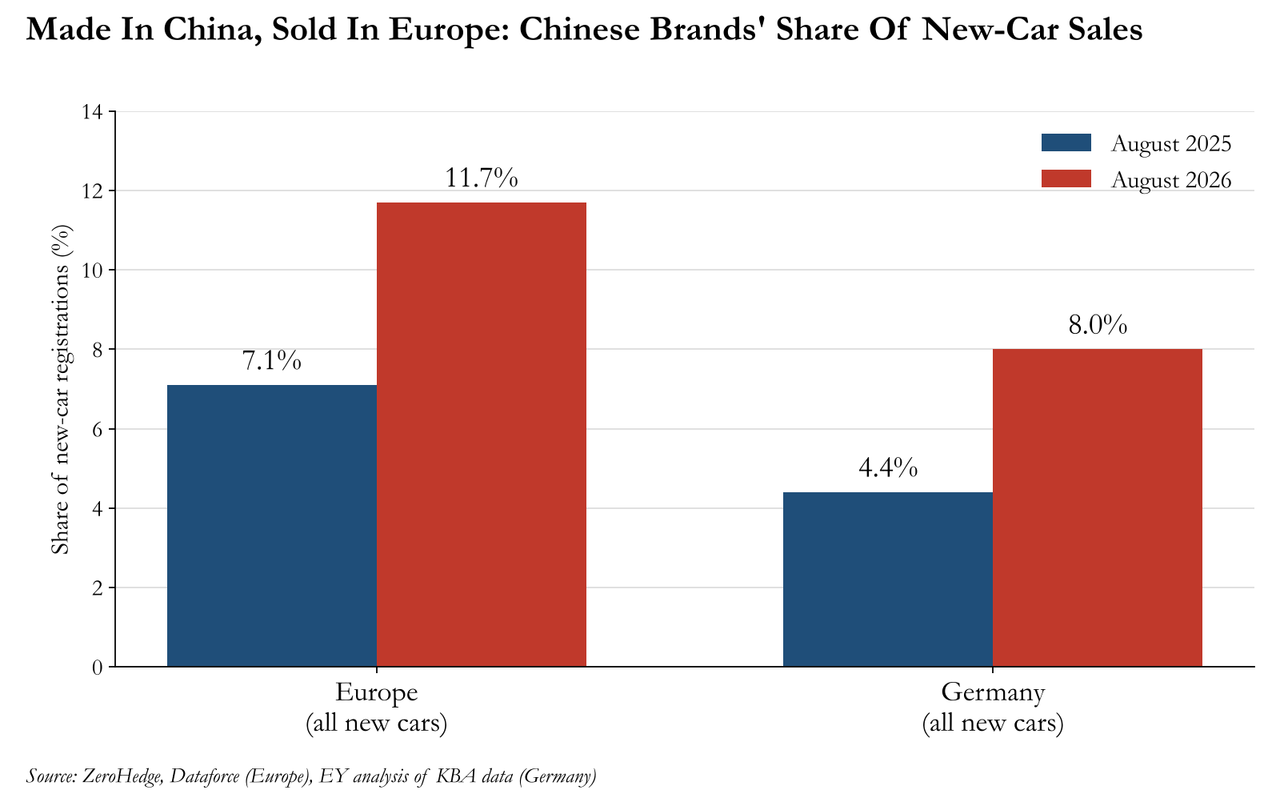
Regular readers know we have been tracking this flood for a while, from “China Floods Europe With Cheap Cars, Grabs Record Market Share As Domestic Brands Buckle” two weeks ago, to “BYD’s EU Invasion Deepens Germany’s Auto Industry Crisis“, and all the way back to June 2024, when Beijing dangled perks to German automakers to kill the EV tariffs (spoiler: Berlin duly voted against them, only to end up destroying its local manufacturing base).
Meanwhile, In Germany…
The timing of Brussels’ epiphany is hardly a coincidence. Just yesterday, German factory orders plunged 10.6% MoM in August, ten times worse than the 1.0% drop expected and among the biggest monthly drops on record.
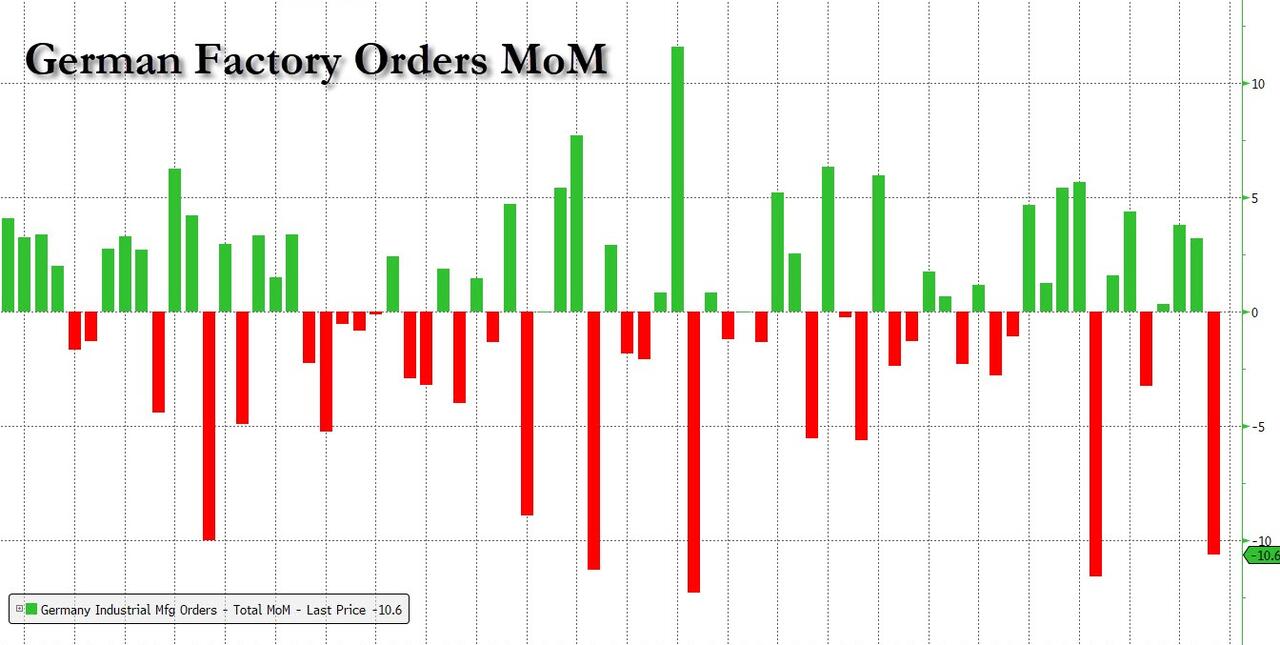
To be fair, much of the drop was a reversal of July’s surge in large orders for aircraft, ships, trains and military vehicles, which tumbled 61.5% after more than doubling the prior month. In other words, the only thing that had been propping up German industrial demand was the debt-fueled arms spending boom (which has sent formerly frugal Germany’s debt soaring), and when that took a breather, the floor fell out: domestic orders crashed 17.3% and capital goods orders 15.3%. On a less volatile three-month basis, orders ex-large contracts were down 2.6%, which is “underlying weakness” in Destatis-speak.
And while this morning’s industrial production print was a pleasant surprise (+2.0% MoM vs +0.5% expected), it was all construction (+9.3%). Auto production fell 5.4%, after a 9.2% plunge in July, and manufacturing output is still down 0.4% YoY. Nothing says “industrial renaissance” like a factory economy where the only thing growing is cement and tanks.
As we put it last month, when the Bundesbank’s Nagel blamed the AfD for scaring off investors:
“The Second China Shock”
Even Deutsche Bank, which has rarely been accused of anti-Beijing hysteria, now openly talks of “the second China shock hitting the European manufacturing sector.” In a note published this morning ahead of Trade Commissioner Šefčovič’s trip to Beijing (“Crunch time for EU-China trade relations”, available to pro subs), DB’s Marion Muehlberger writes that Germany is the most exposed of the large EU economies:
Back in 2013, China had a 5% market share in global car exports. This has moved to 11% as of 2023 and to 15%, on par with Germany, as of 2025.
And cars are actually the good news: in specialised industrial machinery, the crown jewel of the Mittelstand, China overtook Germany back in 2023, and in general industrial machinery China’s share of global exports is now well above Germany’s.
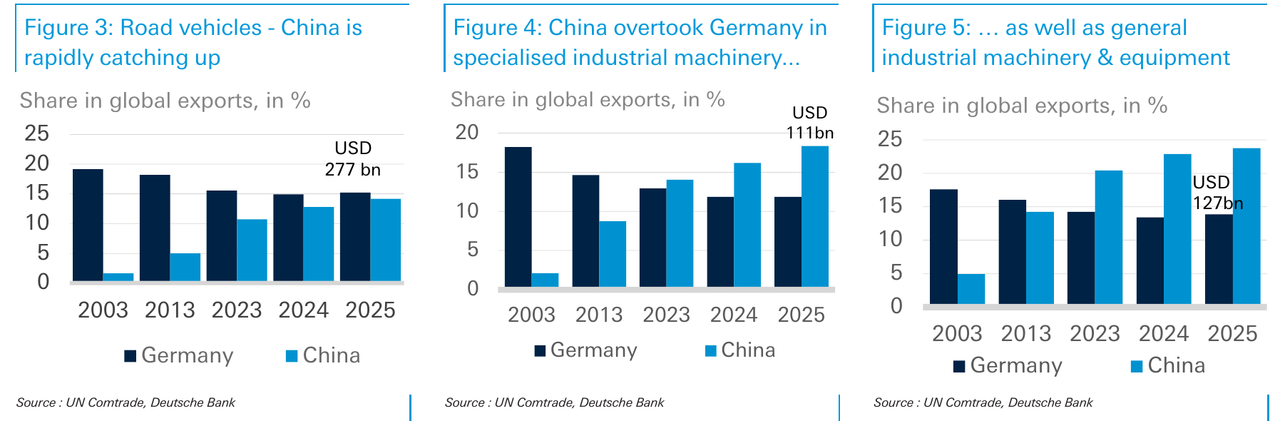
Meanwhile, the bilateral trade deficit with China has blown out again to around 2% of EU GDP. Or, as Bloomberg puts it, more than €1 billion… per day.
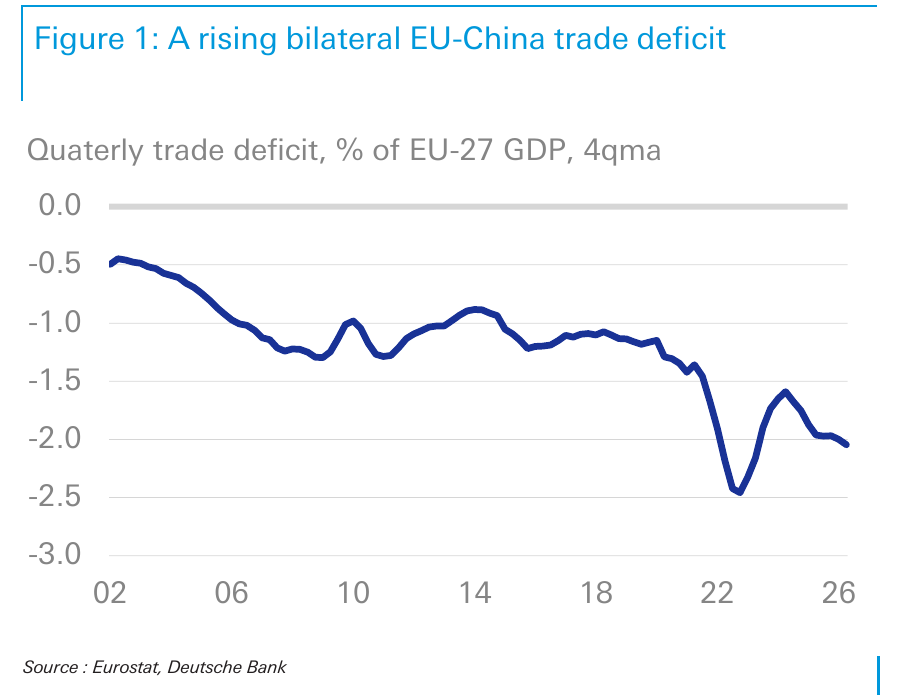
That said, DB is far from convinced Brussels will actually follow through on a hard stance. The bank expects this week’s Šefčovič-Wang meeting to bring “no major breakthrough,” with perhaps some Chinese concessions on market access but “little movement on the EU’s demand to restrain exports to Europe.” The likely next step after the October 15-16 EU summit is an anti-subsidy probe into Chinese plug-in hybrids, with tariffs taking effect “in early 2027 at the earliest.” Overall, DB expects EU leaders “to continue their rather minimalist approach.”
Translation: Brussels will do just enough to make a headline, and not enough to make Beijing angry. Indeed, per Bloomberg, a key aim is to “keep the cap on hybrids low enough to avoid a retaliatory response from Beijing”, which kinda defeats the purpose. China, for its part, already dismissed earlier talk of voluntary export caps last month as a “serious violation” of WTO rules, which is rich coming from the world’s champion of subsidized overcapacity.
Bottom Line
Goldman’s European trading desk was similarly underwhelmed, noting that the hybrid levy headlines “are not new, repeating what we heard in recent months,” and that “the hesitation is the likely backlash from China and the fact that these measures will only briefly limit China’s market share gains.”
We agree. A temporary, carefully calibrated quota designed not to upset the country flooding your market is certainly not a trade policy – it’s just a press release pretending to show Beijing that Brussels can be a tough guy. By the time it takes effect, BYD’s Hungarian plant will be churning out “European” cars, and Germany’s auto industry, where 140,000 jobs are at risk at VW alone, will have shrunk some more. As we warned a year ago, Germany’s industrial core is collapsing; Brussels just noticed.
Better late than never… but only just.
Much more in the full Deutsche Bank “Crunch time for EU-China trade relations” note, available to pro subs.
END
5.RUSSIA AND ISRAEL AND MIDDLE EASTERN AFFIARS
ISRAEL/USA/IRAN/WEDNESDAY
Pezeshkian Calls On Iranians To Ration Electricity, ‘Stand Up’ To US, As Negotiations ‘Stalemated’
Wednesday, Oct 07, 2026 – 12:55 PM
Saudi Arabian state-owned outlet Al Hadath is reporting what many might consider obvious: Stalemate in mediation efforts between Washington and Tehran, the source reports Wednesday.
US officials are continuing to tell Tehran that there will be “no progress” in negotiations until there’s progress on the nuclear file and that Hormuz is no longer a priority after Iran “lost control of it”.
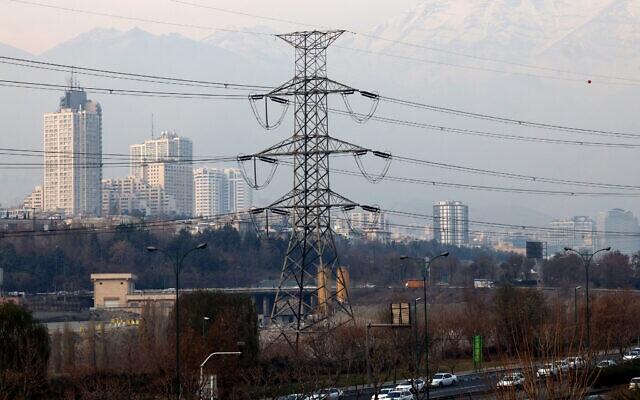
And yet, there’s been possibly a dozen or more Iranian drone attacks on foreign vessels transiting the Strait of Hormuz in the last eight days.
All of this comes as President Masoud Pezeshkian has urged the Iranian public to ‘stand up’ against the US and West, as Washington’s sweeping sanctions as well as US naval blockade actions against Iranian ports continue to bite.
“We must not allow the production cycle to be damaged. We will reduce the consumption of electricity, gas, gasoline, water and other energy sectors,” he said to semi-official Fars news agency.
“The condition for resistance and standing up to the West is for everyone to endure hardship,” Pezeshkian added, saying that “if necessary, cultural and sport complexes will be closed in Iran to provide electricity and energy needed for industrial production” – as the US blockade hammers Iran’s economy.
The rial has cratered, and the fallout has begun to severely impact neighboring Iraq and its Tehran-aligned economy and government, as we previously detailed.
Fars also quoted Pezeshkian as saying Wednesday, “Iran is fully prepared to reach a balanced and fair agreement that ensures lasting peace and security in the region.”
“Our red line is the national interests and rights of the Iranian people. If the United States adheres to international legal frameworks, reaching an agreement is not out of reach,” he added.
There’s also this admission (but which could also be interpreted as pushback) from Iranian state media, in the face of Scott Bessent’s recent assertions that Iran’s crude exports have fallen to near ‘Zero’:
Iranian media is reporting a 60 percent decrease in oil passing through the Strait of Hormuz, saying that the flow of crude oil has faced a significant drop in the last two days, reaching around 3.8 million barrels per day.
The weekly average of oil passing through the Strait is estimated to be about 9.3 million barrels per day, Tasnim news agency said.
The claim comes as an IRGC adviser said that the strait is “fully controlled” by Iran and will remain closed until the US accepts its demands, adding that the volume of oil currently being smuggled out is “very small”.
But ultimately, Iran is admitting it is enduring severe economic hardship amid a heavily sanctioned wartime economy.
There’s a battle of narratives over Hormuz and markets as well as mainstream Western media are simply favoring once side while ignoring the claims of the other at this point:
The stalemate looks to endure past the November midterm elections in the US, as even President Trump has seemed to lately suggest this status won’t change until after the US vote. He has also signaled a heavy bombing campaign against the Islamic Republic could ensue by November’s end.
END
ISRAEL/TBN
SAUDI ARABIA/HOUTHIS
Pakistan, Turkey & Saudi Arabia Trigger Mecca Defense Pact
Wednesday, Oct 07, 2026 – 09:45 AM
In a historic first, the Mecca Defense Pact between Saudi Arabia, Pakistan and Turkey is now in force, according to the allies at an emergency meeting in Riyadh.
It was only signed in August, but soon after it was formalized an all-out war between the Houthis and Saudi coalition in Yemen erupted, with the Ansar Allah movement now increasingly targeting Saudi civilian infrastructure, including airports and energy infrastructure.
The Monday emergency meeting of foreign and defense ministers resulted in the top committee agreeing to deploy Pakistani and Turkish forces to Saudi territory. The pact is modeled on NATO’s Article 5 and ‘collective defense’. Saudi authorities have argued the kingdom is under direct attack from neighboring Yemen and its Houthi rebels, backed by Tehran.

It marks a quite a dramatic, though somewhat anticipated step, but it remains an open question the degree to which the external troops will directly support the ongoing anti-Houthi operation, which has focused on recapturing the Red Sea coast of late.
“The Committee decided to move immediately to the practical implementation of the collective defense commitments and to take the necessary measures to provide the agreed military forces and capabilities and ensure their rapid deployment in the Kingdom, in accordance with the approved arrangements and the national legislation of the Parties,” said a joint statement made public by Pakistan’s Foreign Office.
Pakistani Defense Minister Khawaja Asif sought to clarify in a statement to Geo News while speaking from Riyadh, “The forces of Turkiye and Pakistan are playing a supporting role. We are definitely involved in reconnaissance and such things, but the combat is practically being conducted by Saudi Arabia’s own forces, and they are the ones retaking those areas.”
Apparently the Mecca pact took on more urgency after claims that the Houthis targeted the Islamic holy site of Mecca last month – something which the Houthis vehemently denied. Pakistan has said when pressed by reporters for details: “The operational details of the actualization of the collective deterrence are a matter of operational confidentiality and may not be made subject of media speculation.”
It should be noted that Pakistan has already long had a large and long-running contingent of troops inside the kingdom, and working with the Saudi armed forces. Pakistan’s air force has also had fighter jets and support aircraft in the kingdom.
Turkey’s role will be much less clear, and Turkish parliament must ultimately authorize sending troops abroad for any kind of large-scale deployment. Unlike Pakistan, the Turks do not have any level of an existent official military footprint in Saudi Arabia.
Emerging reports say the Turks preparing aircraft deployments along with troops…
A big question remains, with the Mecca pact having been formally triggered, will the situation spiral into Pakistani and Turkish troops actually joining the fighting in Yemen? If so it would have serious implications for the broader region as the conflict spills over borders and into strategic waterways like the Bab al-Mandab Strait.
END
After Iran’s Rial, Hormuz Claims Its Second Currency: Iraq Devalues Dinar 13% To Keep Paying Salaries
Wednesday, Oct 07, 2026 – 10:10 AM
Last weekend, we noted that the clearest scorecard of the US economic war on Iran is the rial, which cratered to a record 2.7 million per dollar (the slide that we first flagged in “Iran’s Deadline Expires Today”… Rial Collapses, and which has only accelerated since). Turns out Tehran has company.
On Wednesday, Iraq devalued its currency by 13%, with the central bank raising the dollar-selling price for the public to 1,520 dinars from roughly 1,320. Per Reuters, the cabinet adopted the new structure on Tuesday, effective Wednesday: the Finance Ministry now sells its oil dollars to the CBI at 1,500, banks get them at 1,510 and the public pays 1,520.
That makes Iraq, as Bloomberg notes, the first Gulf Arab state to devalue since the US-Israel war on Iran began in late February. It probably won’t be the last thing in the region to break, but it is the first currency peg to do so, which is a different kind of milestone.
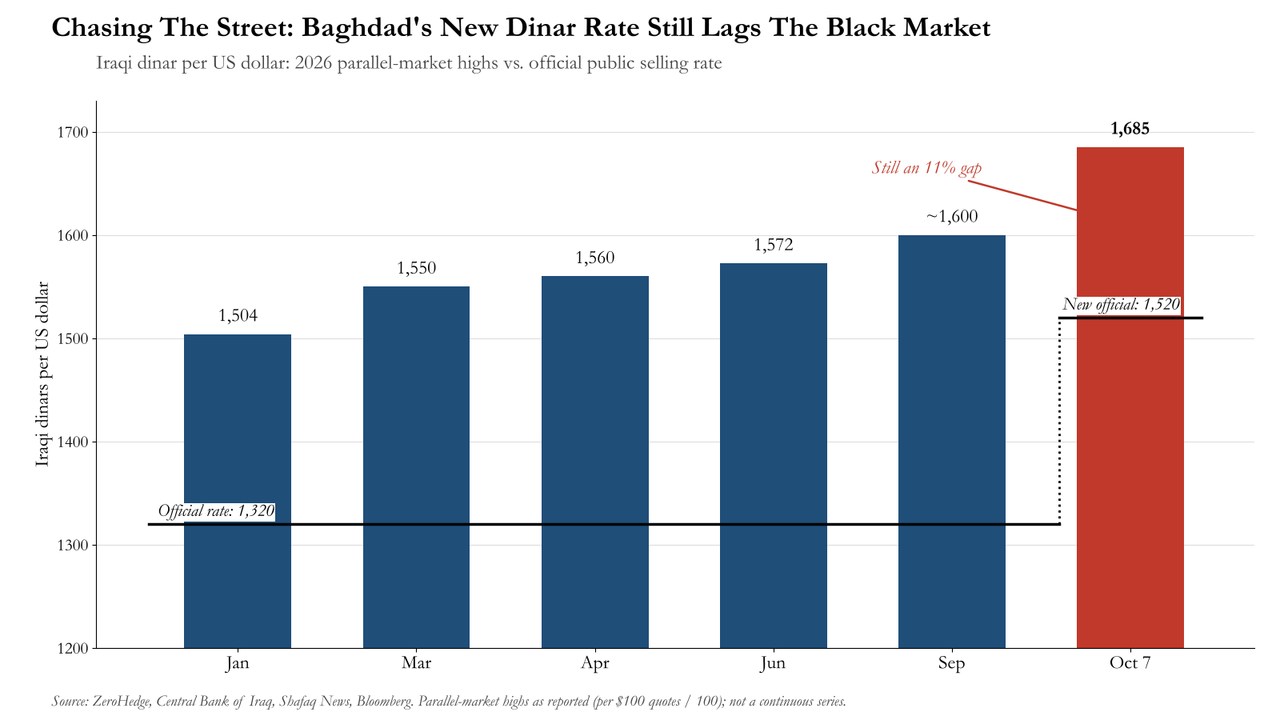
The central bank’s official explanation was a masterpiece of the genre: the decision was taken “in view of the current economic and financial conditions, and based on the recommendation of the cabinet,” and, rest assured, foreign reserves are “sufficient to finance external trade, settle overseas bank-card transactions and provide cash to travelers.” Translation: we have enough dollars, which is why we just made each one cost 15% more.
Below we look at why Baghdad blinked, why the street isn’t buying it (yet), and why the timing is stranger than it looks given that Goldman says Gulf oil exports are already back to pre-war levels.
Salaries Or The Dinar: Pick One
Iraq is one of the most oil-dependent economies on the planet: crude sales generate around 90% of government revenue, and those sales go almost entirely out through the Strait of Hormuz. Which is why, from day one of the war, we flagged that Iraq would be the most exposed producer in the Gulf. Back on March 3, as storage filled with nowhere to ship, we tweeted this:
A week later it was this:
Seven months later, the bill has arrived. Bloomberg estimates Iraqi crude exports have averaged only about 1.25 million barrels a day since the start of March, compared with almost 3.5 million last year. SOMO, the state oil marketer, put the country’s cumulative oil losses at around $80 billion last month. Even with a recovery, Reuters says exports were just 2.34mb/d in August, versus more than 3.6mb/d before the war.
Meanwhile, the one line item that never shrinks kept on growing. Bloomberg’s chief EM economist Ziad Daoud summed it up:
“Every past oil shock has pushed Iraq into trouble. That happened in 2008, 2014, and 2020. The closure of the Strait of Hormuz and the drying up of oil revenues in 2026 marks another episode. Baghdad had to choose between paying its public-sector salaries and defending the dinar’s value — it picked the former.“
The math behind that choice is not complicated. Iraq had roughly $100 billion in FX reserves when the war began; by August that had dropped to $80 billion. Public-sector salaries alone cost about $5 billion a month, per Daoud.
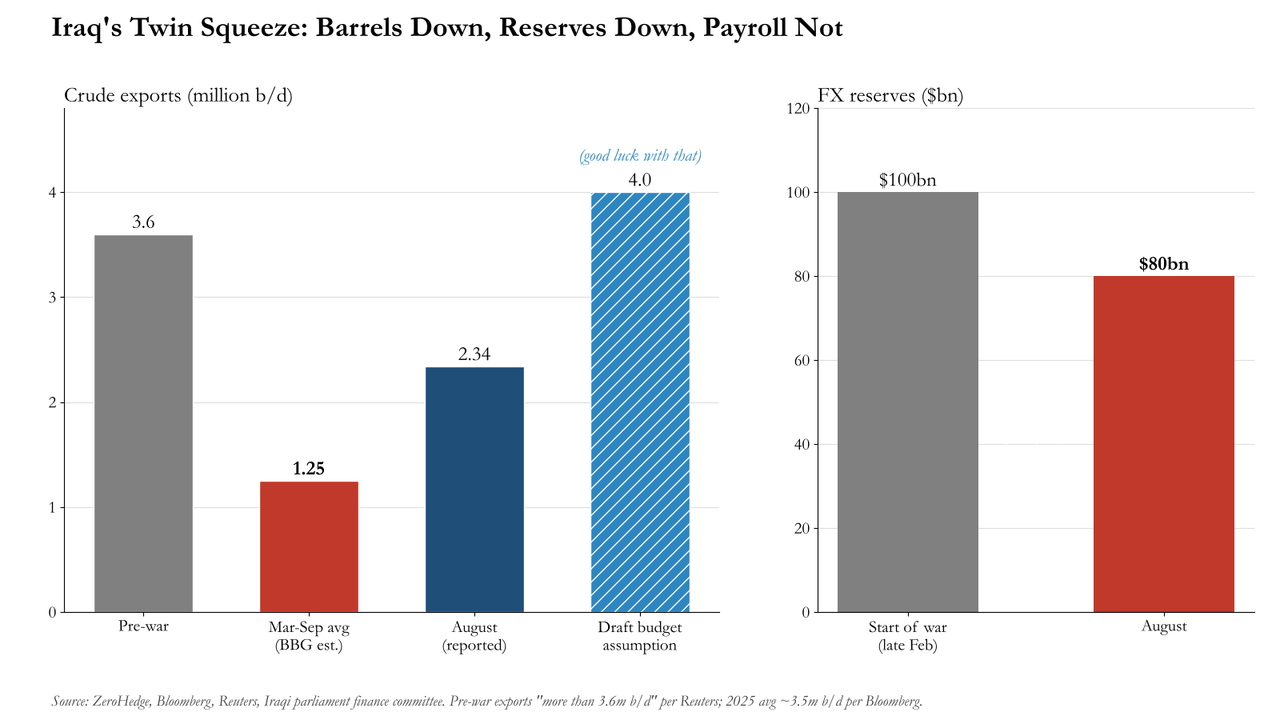
Put differently, $20 billion of reserves went out the door in roughly six months, and what’s left covers about 16 months of payroll with nothing else, ever, being imported. Hence the devaluation, which, as Iraqi analyst Mohammed al-Saffar told Reuters, is “essentially a fiscal response to the shock to Iraq’s oil revenues”: it “gives the government more dinars for each dollar of oil revenue, but raises import costs and reduces households’ purchasing power.”
Some napkin math (approximate): at 1,320, a 6.6 trillion dinar monthly wage bill eats about $5 billion of oil dollars. At 1,520, the same dinar payroll costs just $4.3 billion, a saving of roughly $650-700 million a month, or ~$8 billion a year. That is a 13% real pay cut for every public-sector worker in Iraq, delivered without anyone having to announce a pay cut. Diversification at its finest.
The Street Got There First
Of course, devaluations rarely happen to the market; they usually happen after it. According to Shafaq News, the dollar set six new parallel-market highs in Baghdad this year, from 150,400 dinars per $100 in January to roughly 160,000 in September, and 168,500 per $100 (1,685 per dollar) after the announcement. In other words, even at the new official rate, the black market still prices the dinar about 11% weaker, and local currency traders are already talking about a test of 180,000.
And the real economy is not taking it gracefully. Iraqi News reports Baghdad’s Shorja wholesale market was “completely paralyzed” on Wednesday as merchants shuttered stores, distributors suspended deliveries, and food staples in Saladin jumped about 25% almost overnight. One MP has already demanded an emergency session of parliament to reverse the decision. (We’ll take the under on that.)
Readers will also recall that Iraq’s dollars aren’t entirely Iraq’s to begin with. As we discussed in “The Hidden Mechanism Behind Washington’s Control Of Iraq’s Oil Money” just last week, every barrel Iraq sells settles into a CBI account at the New York Fed, and Washington has not been shy about using that tap: in January it threatened to “starve” Iraq of its oil revenue if pro-Iran parties joined the government, and in April it blocked the regular $500 million cash pallets flown to Baghdad. Add the last US troops leaving Iraq on Sept 30 and Bessent’s “frank discussion” with Iraq’s foreign minister the very next day on “Iraq’s progress in demilitarizing Iranian militias,” and one can see why holding dinars has lately lost some of its appeal.
The Barrels Came Back… The Dollars Didn’t
Here is the twist: the devaluation comes just as the physical oil picture is improving dramatically. In their latest Oil Comment, “Adaptation: Persian Gulf Exports Return to 2025 Level” (available to pro subs), Goldman’s commodity team led by Daan Struyven writes:
“We estimate that Persian Gulf oil exports, including estimated “dark exports”, have recovered to 23.3mb/d over the last week, in line with their 2025 average, as exports doubled in September. Increased Hormuz exports, including via ship-to-ship transfers, have driven this exports recovery despite the attack on the Saudi East-West pipeline, which disrupted oil flows to Yanbu for nearly two weeks, and the continuing Houthis blockade of Saudi exports via Bab-al-Mandab.”
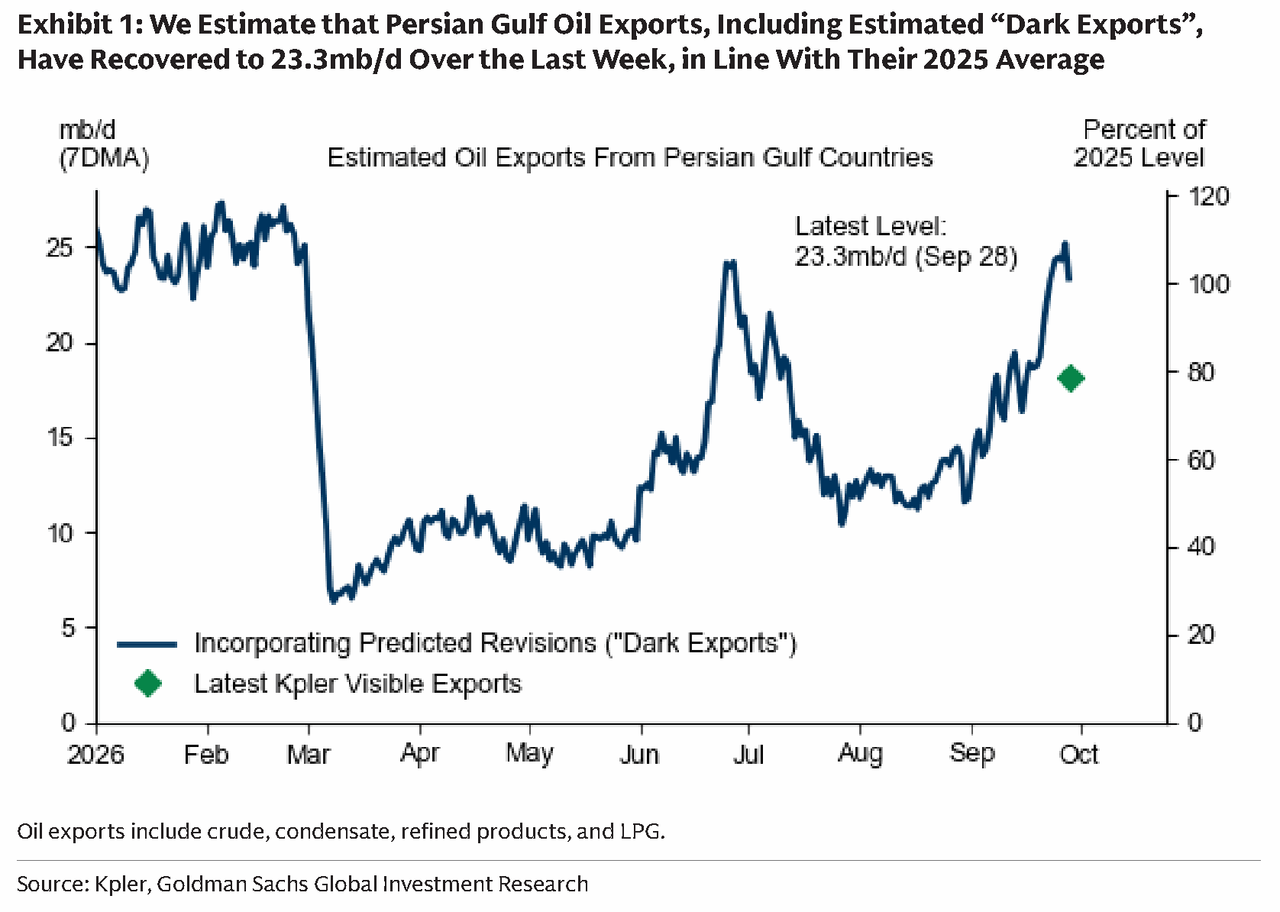
But the recovery is far from evenly shared. Saudi exports “more than doubled in September and rose above their 2025 average, reaching 11.6mb/d,” and UAE exports are also above their 2025 levels. Iraq? Just 82% of its 2025 average as of Sep 28, even including Goldman’s estimate of dark exports, and that’s after a remarkable September. Kuwait and Qatar are stuck around 50%, while Iran shipped essentially nothing by sea.
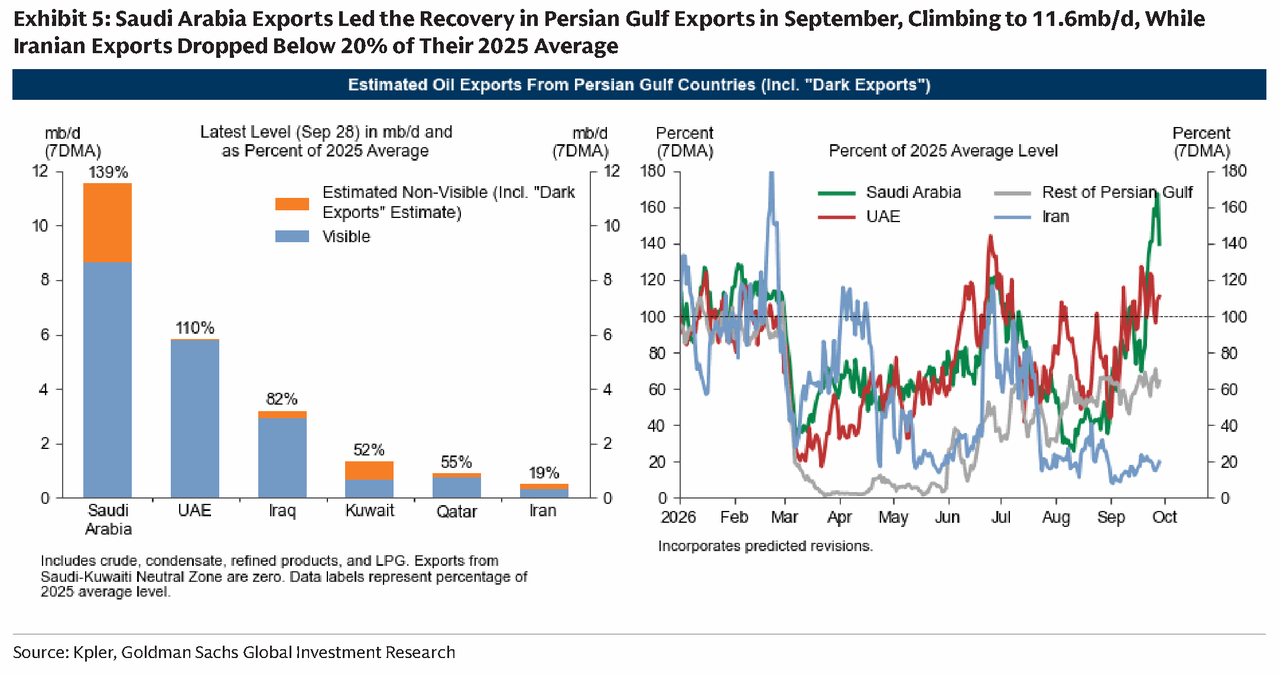
Struyven repeated the message in the latest edition of Goldman’s “Connecting You to GS” desk email (available to pro subs), with Gulf exports now at 23.6mb/d, and a breakdown that shows just how improvised the recovery is: only 7.5mb/d is going through the Strait of Hormuz in the conventional sense, with another 4.5mb/d via the Gulf of Oman, 4.6mb/d out of Saudi Arabia’s Yanbu, 2.9mb/d via Fujairah (a bypass hub we said would become the focus back in March) and a token 0.2mb/d through Iraq’s own Botas-Ceyhan pipeline to Turkey. The rest is Goldman’s 4mb/d estimate of “dark” flows.
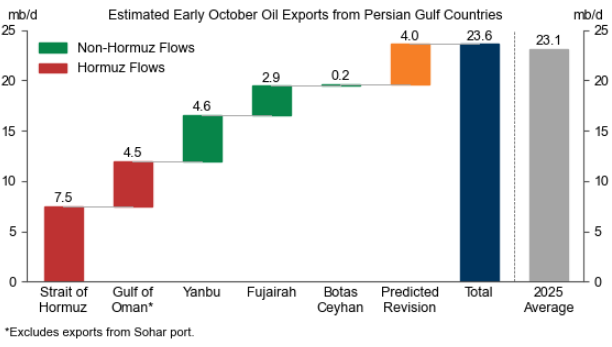
Which brings us to the problem for Baghdad: Saudi Arabia has a Red Sea pipeline and the UAE has Fujairah; Iraq has a 0.2mb/d trickle to Ceyhan and a Syria pipeline that is three to four years away, at best. It is reduced to chasing more tankers to get through Hormuz on Iran’s terms. And with dated Brent near $120 and Goldman forecasting Brent “moderates to $85/bbl by year-end and to $80 in 2027,” the window in which higher prices offset lower volumes is, according to Goldman at least, closing.
Put another way, the barrels are coming back, but the $80 billion in lost revenue and the $20 billion hole in reserves aren’t, and the price of oil the draft budget assumes is $58 per barrel, so nobody in Baghdad is counting on a windfall.
A Budget Written In Wishful Thinking
Speaking of the draft budget, the numbers lawmakers shared with Reuters are a work of art. It projects spending of 217 trillion dinars, which Reuters converts to about $166 billion (implying the old ~1,300 rate). At the new 1,520 rate, that same dinar spending is just $143 billion, which is the point. The plan also forecasts a deficit of more than 40 trillion dinars and assumes crude exports of around 4 million barrels per day, including Kurdistan.
For context, that is above pre-war levels, about 70% more than Iraq actually exported in August, and more than three times the average since March. If the Strait doesn’t cooperate, the devaluation is simply the plan B that is already in place: when the barrels don’t show up, print more dinars per barrel.
And the pain doesn’t stop at the Iraqi border. The IMF projects Iraq’s $265 billion economy will shrink by almost 7% this year, and Bloomberg notes Saudi Arabia, Kuwait and Qatar are all expected to contract as well. In the bond market, Goldman’s EM credit strategist Mikhail Galkin lists Bahrain among his relative dislikes “with a view of protracted Iran conflict” in his latest “EM Credit: The Big Picture… Heading into Q4” note (also available to pro subs), noting that BHRAIN bonds are down roughly 10% YTD, among the worst in EM.
Bottom Line
Iran’s rial collapsed because Washington wanted it to. Iraq’s dinar fell because Baghdad chose to let it, which in some ways is the more telling of the two. The Gulf’s dollar pegs were built on an assumption that oil, and therefore dollars, would always flow. For seven months, for the most Hormuz-dependent producer in the region, they haven’t.
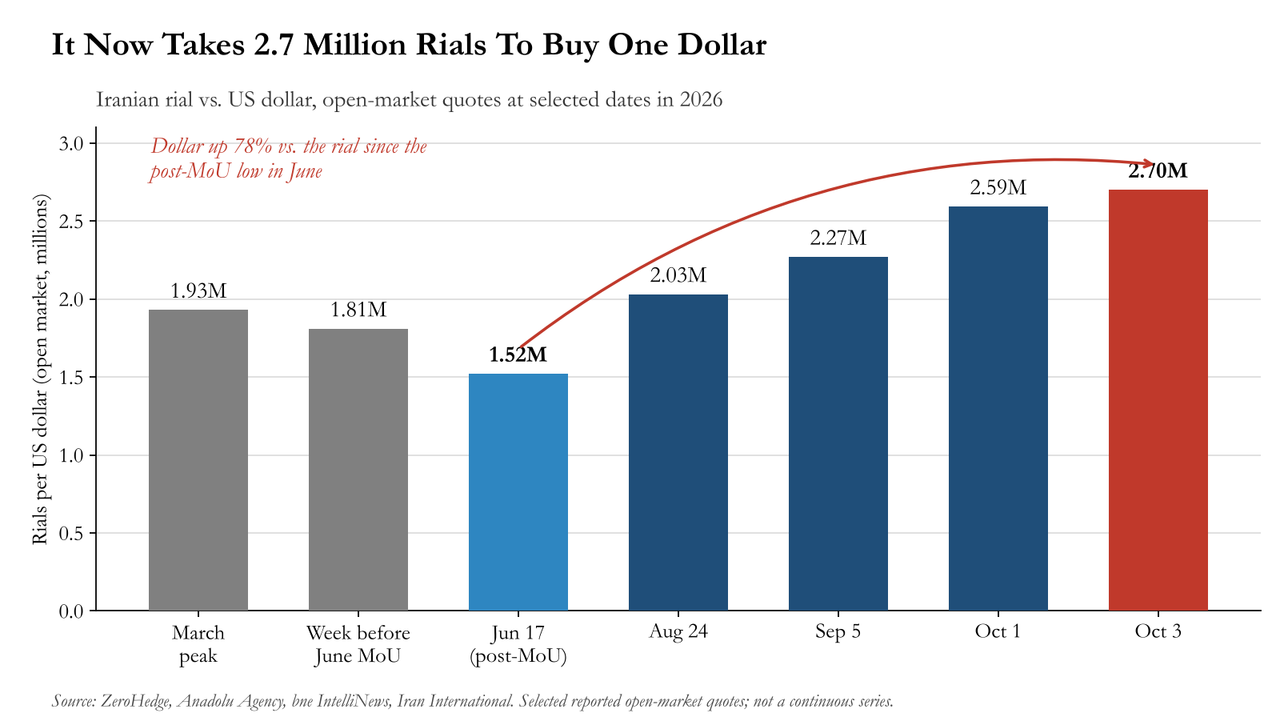
Daoud’s framing is the right one: every oil shock eventually lands on Iraq’s currency. The question now is whether 1,520 is the new floor or just the first stop. With the parallel market already at 1,685, traders eyeing 1,800, food prices up a quarter overnight and a budget that only works with 4mb/d of exports, we’d bet on the latter, especially if the Monday de-escalation headlines keep reversing by Friday’s close. Iraq picked salaries over the dinar this time. The next time, it may not get to pick.
Much more in the full Goldman “Persian Gulf Exports Return to 2025 Level” and the “EM Credit: The Big Picture… Heading into Q4” notes, both available to pro subs.
END
SYRIA/IRAQ
oil route: Iraq (from Basra) overland through Syria to Banyias to the Med.
Iraq Formally Requests Syria Act As ‘Hormuz Bypass’ Route For Its Crude
Wednesday, Oct 07, 2026 – 02:35 PM
Syria’s geography has long given the country huge economic opportunities as a major energy transfer hub connecting Middle East states to the Mediterranean.
But as the last decade plus of proxy war which resulted in the overthrow of Bashar al-Assad demonstrated, Syria has also long been target of foreign machinations bent on seeing a puppet state installed in Damascus. The US-Gulf allies broadly waged war against the so-called ‘Shia crescent’ represented in the old Baghdad-Damascus-Hezbollah axis.
Henry Kissinger famously stated of its opportunity-rich geography, “you can’t make war in the Middle East without Egypt and you can’t make peace without Syria.” The historiographical term Pax Syriana also captures this concept: as goes Syria, so goes the whole region.

Of course, the external powers which have long sought to dominate the region both politically and on the energy front know this full well, which makes it all the more shameful and ironic that mainstream media and government officials had long derided as ‘conspiracy theorists’ anyone who connected a ‘pipeline wars’ theme with Washington’s covert war on Syria.
Widespread derision was the reaction of MSM punditry when back in 2016 Robert F. Kennedy Jr. penned the following excellent lengthy investigation:
Fast-forward to 2026, amid Trump’s Iran war and the Strait of Hormuz crisis, and another conspiracy theory becomes conspiracy fact (as we’ve been documenting of the great crude transit ‘rewiring’ efforts to erode Iran’s leverage over the Hormuz passage).
On Wednesday, cue a new Bloomberg headline: Syria Set to Emerge as Hormuz-Bypass Option for Iraq’s Crude Oil.
The deserts of Western Iraq and Eastern Syria are set to look like a scene out of Max Max, apparently. “Syria is set to provide a route for Iraqi crude exports to avoid the hazardous Strait of Hormuz, with a stream of trucks being lined up to haul oil overland to a port on the Mediterranean Sea,” Bloomberg writes.
“The Iraqi government asked Syria to help with the export of crude in addition to existing flows of fuel oil, Yousef Qiblawy, chief executive officer of the state-owned Syrian Petroleum Co., said in an interview with Bloomberg News,” the report continues.
To some degree, this overland route was already being ‘tested’ during the latter years of the Syrian proxy war, when US forces occupied Syria’s oil and gas fields of Deir Ezzor and Al-Hasaka regions.
Reviving land corridors from Iraq to the Mediterranean:
They had run tanker trucks in the other direction – from Syria into Iraq, siphoning off Syrian oil and its sovereign resources, after President Trump during his first term hailed that the Pentagon would ‘secure the oil’.
Read our: Mystery Explosions: Syria’s Recovering Gas Network Keeps Getting Sabotaged
As for actual pipeline routes from Iraq to the Mediterranean via Syria being revived, major hurdles remain and its not just the gargantuan cost of reviving the derelict hardware – but there’s an obvious security problem in a country that’s seen mysterious armed groups constantly bomb Syrian energy infrastructure – both during the Assad years and now under Jolani.
END
RUSSIA VS UKRAINE
Massive Smoke Plume As Tanker Erupts In Flames, Spills Oil Off Russia’s Sochi Coast
Tuesday, Oct 06, 2026 – 04:40 PM
The Black Sea tanker wars have continued Tuesday. In the latest tit-for-tat episode, a large so-called ‘shadow fleet’ tanker is ablaze close to the Russian Black Sea port of Sochi.
The vessel, identified in reports as likely being the Aframax Rio, which was previously sanctioned by Ukraine for alleged involvement in Russian oil exports, is producing a massive smoke plume and has been photographed and filmed by shocked onlookers at Sochi’s shores. Images like the below are widely circulating on Russian Telegram channels.

Russian regional authorities in nearby Sirius have since confirmed in a public announcement that a tanker had caught fire in the Black Sea.
Reuters writes that “The beaches in the settlement in Russia’s south Krasnodar region are closed to the public, the authorities said, without giving any details of the cause of the fire.”

Some open source media accounts have described that the Liberian-flagged oil tanker was “loaded almost to the brim” transporting crude oil from Russia to India.
Speculation is growing that it was hit by uncrewed surface vessels while carrying its crude cargo.
Maritime Executive says that the fire is so extensive likely due to significant oil spillage.
Another image circulating…

“The vessel is readily visible from shore, and multiple videos depicting the fire have appeared on Russian social media channels,” the maritime publication writes.
“The bystander-image sequence begins with a substantial fire centered on cargo tanks amidships, followed by obvious signs of burning oil spreading aft down the starboard side,” it adds. “Later videos and photos show a large pool of burning oil on the water aft of the vessel and a towering column of smoke.”
END
6/.GLOBAL ISSUES, COVID ISSUES, VACCINE INJURIES/HEALTH ISSUES
HEALTH ISSUES\
Nurse: Stillbirths Exploded After COVID Shots Hit Maternity Wards
Tuesday, Oct 06, 2026 – 07:15 PM
Authored by Steve Watson via Modernity.news,
A California labor-and-delivery nurse says her Fresno hospital went from a handful of stillbirths a year to more than 20 in a single month once COVID shots were pushed on pregnant women, then answered the pile-up with an email on how to handle the dead.

The same product is now sitting in a federal file parents were told not to worry about. An analysis of the National Health Interview Survey, published yesterday, finds COVID-vaccinated children had higher odds of autism, ADHD, anxiety and special-education use than children who never received the shot, and the authors say the shots in children should stop.
Michelle Spencer has worked the antepartum, postpartum and labor-and-delivery floor at Community Regional Medical Center in Fresno since 2017. In interviews that Children’s Health Defense aired, she described the unit before the pregnancy rollout as a place that saw about four stillbirths a year. After the shots started going into pregnant women, she said, it became four a week, and it did not stop.
A total of 22 stillborn babies in 30 days against a baseline of four a year is more than the previous five years combined, on the order of a 6,500 percent jump in a single month. Spencer’s July 30, 2025 complaint in Fresno County Superior Court used a baseline of one fetal death a month before spring 2021 and about 20 a month after, and calls the rise a statistically significant surge of more than 400 percent.
She has said she cannot pull the hospital’s full record, so the monthly figure is her estimate from the floor. The document that is not an estimate is the email.
In September 2022, nurse manager Julie Christopherson wrote to nursing and technical staff about what the hospital called “demise patients.”
“Well, it seems as though the increase of demise patients that we are seeing is going to continue,” she wrote. “There were 22 demises in August, which ties the record number of demises in July 2021, and so far in September there have been 7 and it’s only the 8th day of the month.”
She told the bedside nurses the work was burying her other patients. “I know of a few more that are scheduled to deliver in the week ahead, so unfortunately the process is going to be very familiar with all of you.” The note walked staff through handling remains after a dead fetus had been mishandled. It did not ask why the babies were dying.
Spencer’s complaint says she “was gaslit by management who continued to make unsubstantiated excuses such as ‘pesticides’ as a more likely cause of the record high dead babies.” The institution’s documented move was procedural, not investigative.
When she leaked the email, the hospital opened an investigation into her, denied her a $5,000 retention bonus in December 2022 on the grounds she was no longer in good standing, and reprimanded her for telling patients about vaccine risk. Children’s Health Defense is funding the suit.
Her lawyer, Greg Glaser, put the allegation in one line: “The hospital possessed vaccinated versus unvaccinated comparison data. The numbers proved the vaccines were causing miscarriages and more in the vaccinated group. We know hospital management analyzed the data because they said so, and we see they concealed it from regulators because that file requested by regulators is empty.”
The complaint says one managing nurse told a staff member that nearly all of the stillbirths were in vaccinated mothers, and that fetal deaths in mothers who did not get the shot stayed at the old rate of about one a month. Spencer told The New American: “Healthy moms and healthy babies were suddenly being replaced by babies born dead, and nobody seemed to care. I saw a pattern, clear as day, and I couldn’t stay silent.”
The hospital has never accepted that framing. In 2022, after the email first leaked, Sarah Putman, then director of women and newborn health at Community Regional, said the memo was about policy, that fetal demise has many causes, and that “neither COVID-19 nor vaccines were mentioned.“
The California Department of Public Health said at the time it had seen no significant statewide rise in stillbirths since the shots arrived, and no stillbirth certificate naming vaccination.
The case is still open. What the email itself records is the count, and the decision to train nurses on the bodies rather than on the cause.
The full interview with Spencer:
As we have previously highlighted, a Nobel laureate warned Anthony Fauci in February 2021 that COVID shot contents were reaching the placenta and the fetus and provoking an immune response in the amniotic fluid. Fauci told the public there were no red flags.
Nobel Winner Warned Fauci: The COVID Shot Goes To The Fetus
Fauci knew it hit the baby, he said nothing
 modernity
Meanwhile, yesterday’s paper, posted on Zenodo by epidemiologist Nicolas Hulscher, cardiologist Peter McCullough and colleagues, pools the 2022-2024 National Health Interview Survey Sample Child files: 21,990 children aged 0-17 with a recorded COVID vaccination status, and 19,882 aged 2-17 for the autism, ADHD and learning-disability items. “Unvaccinated” here means no COVID shot. It does not mean the child skipped the routine schedule.
Set against children who never received a COVID shot, COVID-vaccinated children had 32 percent higher odds of current autism, 26 percent higher odds of a lifetime autism diagnosis, 33 percent higher odds of ADHD, 23 percent higher odds of any neurodevelopmental diagnosis, 19 percent higher odds of special-education use, 24 percent higher odds of asthma, 27 percent higher odds of daily or weekly anxiety, 57 percent higher odds of mental-health medication and 60 percent higher odds of mental-health therapy.

Federal Survey Of 21,990 Kids Ties COVID Shots To AUTISM, ADHD
Researchers using official U.S. data say the signal was strongest in the youngest multiply dosed children
The odds climbed with the dose count. Against children who received none, current-autism odds were 3 percent higher after one dose, 25 percent higher after two, and 40 percent higher after three or more. Among children aged 5 to 7, three or more COVID shots were linked to 154 percent higher odds of current autism.
Hulscher told The Gateway Pundit the association “persisted across numerous adjustment strategies, strengthened with increasing dose count, and reached its largest estimate in some of the youngest multiply vaccinated children.”
He added: “This is a safety signal that must not be ignored. Endangering the developing brain is a red line. COVID-19 ‘vaccination’ of children should cease immediately.”
The authors say the autism signal held after controls for age, sex, race, income, parental education, insurance, region, healthcare access, wellness visits, emergency-room use, hospitalization, prescription use and influenza vaccination. Influenza and HPV shots, run as comparison exposures, did not reproduce it. Children who received a COVID shot but not a flu shot had 45 percent higher autism odds than children who received a flu shot but not a COVID shot.
The design is cross-sectional. It cannot put the shot before the diagnosis on a calendar, and the authors say so. That limit is real. It is also the comparison the CDC, the FDA and the manufacturers did not run on their own books while the product was being sold to pregnant women and then to toddlers as a routine precaution. Pediatric trials were never powered for autism, ADHD or a special-education placement.
Health Secretary Robert F. Kennedy Jr. had already put the wider denial in plain language in April 2025. “It’s clear that the rates are real. Year by year there is a steady, relentless increase,” he said. “This is a preventable disease. We know it’s an environmental exposure. It has to be. Genes do not cause epidemics.”
CDC surveillance now puts autism at 1 in 31 American 8-year-olds, 1 in 20 boys, and about 1 in 12.5 boys in California, the state where Spencer works. President Trump’s line at the same moment was shorter: “They pump so much stuff into those beautiful little babies, it’s a disgrace.”
Spencer is still on the Fresno floor. The complaint says the deaths have not gone back to the old rate. The federal survey says the children who made it out of those wards are carrying a dose-linked signal the agencies spent four years calling a conspiracy.
GLOBAL ISSUES
HEALTH
Forget The Plague, CDC Reports Recent Surge In Deadly Brain Fungus Cases
Wednesday, Oct 07, 2026 – 03:10 PM
Authored by Jack Phillips via The Epoch Times,
The U.S. Centers for Disease Control and Prevention has said in a recent report that healthcare officials and providers should be aware of a rare but deadly fungal infection that can affect the brain and has seen a surge in recent years.

Published on Oct. 2, the agency’s Morbidity and Mortality Weekly Report called for greater surveillance of Cladophialophora bantiana, which U.S. officials have said is known to cause brain abscesses.
According to the report, the infection is linked to a 60 to 70 percent fatality rate. However, CDC researchers said in the report that national surveillance efforts currently don’t exist, and that the fungus’s “environmental reservoir” as well as the “route of infection” is not completely known.
Between January 2009 and July 2026, there have been 48 confirmed cases and one possible case of Cladophialophora bantiana found in samples obtained primarily from central nervous system tissue, the CDC said.
But from 2023 to 2025, “detections of the fungus increased approximately fourfold,” according to the CDC report.
Researchers said that it’s not clear why there has been an increase in recent years but stressed that more research into its risk factors “and potentially evolving virulence are warranted.”
In patients with a brain abscess, healthcare providers should now consider whether it’s due to a fungus, the report said, adding that infected people will require prompt antifungal therapy and possible surgery.

“Surgical excision might improve patient outcomes,” it said. Meanwhile, “patients with infection require prompt antifungal therapy, and surgical excision might improve patient outcomes,” it added.
Led by Joshua Lieberman of the University of Washington School of Medicine in Seattle, the researchers added that the presumed route of infection is inhalation of the fungus or direct inoculation following a skin injury.
The fungus “is a rare but important cause of brain abscess in both healthy and immunosuppressed people,” Lieberman told MedPage Today in an interview published on Oct. 5, adding that the reason it goes to the brain is “a little bit of a mystery.”
What is worrying about the infection, he added, is that “people who have apparently healthy immune systems get the infection and are also at high risk of death.”
“It’s alarming that it occurs outside of those typical high-risk populations who have pretty profound immunosuppression,” Lieberman stated.
The median age of those who contracted the infection was 68 years, according to the CDC report.
Cases have been found in 21 states across the United States, as well as the District of Columbia, the CDC report said. California had the most, with six cases, while Florida and Texas each reported five, and Pennsylvania confirmed four.
Aside from Cladophialophora bantiana, the CDC has also issued reports about a drug-resistant type of fungus known as Candida auris, which is a yeast that is known to spread in healthcare settings.
END
COVID VACCINE INJURY: DR MARK CRISPIN MILLER
In memory of those who “died suddenly” in the United States and worldwide, September 28-October 5, 2026Actors Mark Mortimer (59, C), Robert Kelker-Kelly; Big Black (The Howard Stern Show); storyboardist J. Todd Anderson (C); comic Joey Sorice; celebrity chef Ryan Tapp (37); 3 pro wrestlers; & moreMark Crispin MillerOct 7     READ IN APP READ IN APP A survey of the likely global toll of COVID “vaccination,” based on the reports collected by our worldwide team of researchers this past week.Note: Because of a computer problem, this week’s compilation is shorter, especially from Canada and New Zealand.Note: These reports are not arbitrarily included. For a list of the criteria we use, see this footnote.¹To help support our work, consider subscribing or making a donation.UNITED STATES (141)Another World Star Mark Mortimer Dead at 59October 5, 2026 A survey of the likely global toll of COVID “vaccination,” based on the reports collected by our worldwide team of researchers this past week.Note: Because of a computer problem, this week’s compilation is shorter, especially from Canada and New Zealand.Note: These reports are not arbitrarily included. For a list of the criteria we use, see this footnote.¹To help support our work, consider subscribing or making a donation.UNITED STATES (141)Another World Star Mark Mortimer Dead at 59October 5, 2026 Mark Mortimer, who starred on Another World as Nick Hudson from 1996 until the show’s final episode in 1999, died at the age of 59 on September 23, 2026, following what his obituary describes as “a fearless journey with cancer.” Mortimer made his television debut on Another World. After he was diagnosed with cancer in 2024, he and Christie created the Integrative Access Foundation. According to its mission statement, “This foundation exists to ensure that cancer patients are not confined to a single path simply because of barriers beyond their control. We believe patients deserve transparency, education, and support when exploring integrative and unconventional care options. Healing should not be dictated by access alone.”‘Days Of Our Lives’ Actor Robert Kelker-Kelly Cause of DeathOctober 5, 2026 Mark Mortimer, who starred on Another World as Nick Hudson from 1996 until the show’s final episode in 1999, died at the age of 59 on September 23, 2026, following what his obituary describes as “a fearless journey with cancer.” Mortimer made his television debut on Another World. After he was diagnosed with cancer in 2024, he and Christie created the Integrative Access Foundation. According to its mission statement, “This foundation exists to ensure that cancer patients are not confined to a single path simply because of barriers beyond their control. We believe patients deserve transparency, education, and support when exploring integrative and unconventional care options. Healing should not be dictated by access alone.”‘Days Of Our Lives’ Actor Robert Kelker-Kelly Cause of DeathOctober 5, 2026 Robert Kelker-Kelly, best remembered for playing Bo Brady on Days of Our Lives, has died. He was 62. The actor died on Oct. 3, according to TMZ. The outlet later reported that he died after complaining of chest pains and became unresponsive in his Missouri home. Officers from the St. Peters Police Department arrived at his property on Oct. 3 around 8:16 after receiving a report that an unconscious man was not breathing. CPR was already underway when police and EMS were in transit for his home, according to information reported by TMZ. Officers and paramedics were unable to save his life. Law enforcement informed TMZ that they do not believe anything suspicious occurred at the scene, which appeared to be consistent with a medical event.No cause of death reported.Big Black, Howard Stern’s Wack Packer known for candid interviews, dies at 64October 3, 2026Big Black has died at age 64. A recurring personality on The Howard Stern Show, Big Black, whose real name was Ronnie Benjamin, is said to have died from arteriosclerotic cardiovascular disease. Limited details have been revealed about the television personality’s death, although the New York City Medical Examiner’s Office told TMZ that his death was from natural causes. Big Black used to appear alongside Lawrence Coward on Howard’s show, where they would have candid, humorous conversations about their lives. Big Black was named among Howard Stern’s Wack Pack crew in 2006 after making multiple appearances on the show.Coen Brothers’ Longtime Collaborator Dies at 67October 5, 2026 Robert Kelker-Kelly, best remembered for playing Bo Brady on Days of Our Lives, has died. He was 62. The actor died on Oct. 3, according to TMZ. The outlet later reported that he died after complaining of chest pains and became unresponsive in his Missouri home. Officers from the St. Peters Police Department arrived at his property on Oct. 3 around 8:16 after receiving a report that an unconscious man was not breathing. CPR was already underway when police and EMS were in transit for his home, according to information reported by TMZ. Officers and paramedics were unable to save his life. Law enforcement informed TMZ that they do not believe anything suspicious occurred at the scene, which appeared to be consistent with a medical event.No cause of death reported.Big Black, Howard Stern’s Wack Packer known for candid interviews, dies at 64October 3, 2026Big Black has died at age 64. A recurring personality on The Howard Stern Show, Big Black, whose real name was Ronnie Benjamin, is said to have died from arteriosclerotic cardiovascular disease. Limited details have been revealed about the television personality’s death, although the New York City Medical Examiner’s Office told TMZ that his death was from natural causes. Big Black used to appear alongside Lawrence Coward on Howard’s show, where they would have candid, humorous conversations about their lives. Big Black was named among Howard Stern’s Wack Pack crew in 2006 after making multiple appearances on the show.Coen Brothers’ Longtime Collaborator Dies at 67October 5, 2026 J. Todd Anderson, a frequent collaborator of Joel and Ethan Coen who storyboarded films such as Raising Arizona, The Big Lebowski, and Fargo, has died at 67 after a battle with cancer, according to Variety. The storyboard artist kicked off his career in the late 1980s with Raising Arizona, the Coens’ second feature film. Anderson went on to storyboard all of the brothers’ subsequent films, including their solo endeavors such as Ethan’s Drive Away Dolls and Joel’s The Tragedy of Macbeth.LA’s Italian festival is abruptly cancelled as popular comedian and founder dies suddenlyOctober 4, 2026 J. Todd Anderson, a frequent collaborator of Joel and Ethan Coen who storyboarded films such as Raising Arizona, The Big Lebowski, and Fargo, has died at 67 after a battle with cancer, according to Variety. The storyboard artist kicked off his career in the late 1980s with Raising Arizona, the Coens’ second feature film. Anderson went on to storyboard all of the brothers’ subsequent films, including their solo endeavors such as Ethan’s Drive Away Dolls and Joel’s The Tragedy of Macbeth.LA’s Italian festival is abruptly cancelled as popular comedian and founder dies suddenlyOctober 4, 2026 Los Angeles, CA – Los Angeles’ popular LA Italian Festival was abruptly cancelled after its founder died suddenly on the eve of the eighth edition. Joey Sorice [63], the CEO of the festival and a comedian, suffered a heart attack at his home Saturday morning, organizers announced. The event was supposed to have been held at the iconic intersection of Hollywood Boulevard and Highland Avenue, on Sunday, Oct. 4. Sorice was widely recognized as half of the comedy team Jimmy and Joey, a duo whose impact earned them a permanent spot on the walls of The Comedy Store.Researcher’s note – L.A. County plans to require proof of vaccination [sic] at indoor bars, nightclubs, breweries, wineries: https://www.latimes.com/california/story/2021-09-15/la-to-require-covid-19-vaccines-at-bars-nightclubs-breweries-wineriesCelebrity chef Ryan Tapp dead at 37 after he was ‘found unresponsive in his own Houston restaurant’October 1, 2026 Los Angeles, CA – Los Angeles’ popular LA Italian Festival was abruptly cancelled after its founder died suddenly on the eve of the eighth edition. Joey Sorice [63], the CEO of the festival and a comedian, suffered a heart attack at his home Saturday morning, organizers announced. The event was supposed to have been held at the iconic intersection of Hollywood Boulevard and Highland Avenue, on Sunday, Oct. 4. Sorice was widely recognized as half of the comedy team Jimmy and Joey, a duo whose impact earned them a permanent spot on the walls of The Comedy Store.Researcher’s note – L.A. County plans to require proof of vaccination [sic] at indoor bars, nightclubs, breweries, wineries: https://www.latimes.com/california/story/2021-09-15/la-to-require-covid-19-vaccines-at-bars-nightclubs-breweries-wineriesCelebrity chef Ryan Tapp dead at 37 after he was ‘found unresponsive in his own Houston restaurant’October 1, 2026 HOUSTON [TX] residents are mourning the sudden loss of celebrity chef Ryan Tapp, who was found dead in his own restaurant. The famous restaurateur owned and operated Nola’s Chicken & Waffles in the Edridge/West Oaks area of the city. Houston police confirmed on Tuesday that Ryan, who split his time between Houston and New Orleans, died on Sunday. A Houston Police Department spokesperson revealed that officers responded to a call at Nola’s, where they found the 37-year-old unresponsive. According to the Harris County Institute of Forensic Sciences, the internet personality was declared dead around 12:09 p.m. on Sunday. Details of his death are unknown at this time, but no foul play is suspected. Ryan also recently opened Taste of H-Town Bar & Grill in Midtown Houston, which he began promoting in June.One Love – West Hollywood Street Artist Scott Froschauer Dies at 57October 1, 2026 HOUSTON [TX] residents are mourning the sudden loss of celebrity chef Ryan Tapp, who was found dead in his own restaurant. The famous restaurateur owned and operated Nola’s Chicken & Waffles in the Edridge/West Oaks area of the city. Houston police confirmed on Tuesday that Ryan, who split his time between Houston and New Orleans, died on Sunday. A Houston Police Department spokesperson revealed that officers responded to a call at Nola’s, where they found the 37-year-old unresponsive. According to the Harris County Institute of Forensic Sciences, the internet personality was declared dead around 12:09 p.m. on Sunday. Details of his death are unknown at this time, but no foul play is suspected. Ryan also recently opened Taste of H-Town Bar & Grill in Midtown Houston, which he began promoting in June.One Love – West Hollywood Street Artist Scott Froschauer Dies at 57October 1, 2026 West Hollywood [CA] is mourning the unexpected death of artist and sculptor Scott Froschauer, whose colorful public artworks turned familiar street signs into messages of kindness, optimism and reflection. Froschauer died Wednesday at age 57, according to friends who shared news of his death on social media. Friends said he died peacefully in his sleep.No cause of death reported.R’n’B Singer Turned Reality Star Confirms Death Of Husband, Aged 58October 1, 2026 West Hollywood [CA] is mourning the unexpected death of artist and sculptor Scott Froschauer, whose colorful public artworks turned familiar street signs into messages of kindness, optimism and reflection. Froschauer died Wednesday at age 57, according to friends who shared news of his death on social media. Friends said he died peacefully in his sleep.No cause of death reported.R’n’B Singer Turned Reality Star Confirms Death Of Husband, Aged 58October 1, 2026 Von Scales has sadly passed away at the age of 58. He was the husband of Trina Braxton, who rose to fame as a member of the R’n’B group ‘The Braxtons.’ According to a source close to the family, Von passed away around 2 AM on Thursday, Oct. 1, in Atlanta [GA]. Currently, there is no information regarding a cause of death. However, TMZ has reported that he’d previously been dealing with heart issues.Three pro wrestlers “died suddenly”:Indie Wrestler SoCal Crazy Passes Away At Age 47September 30, 2026 Von Scales has sadly passed away at the age of 58. He was the husband of Trina Braxton, who rose to fame as a member of the R’n’B group ‘The Braxtons.’ According to a source close to the family, Von passed away around 2 AM on Thursday, Oct. 1, in Atlanta [GA]. Currently, there is no information regarding a cause of death. However, TMZ has reported that he’d previously been dealing with heart issues.Three pro wrestlers “died suddenly”:Indie Wrestler SoCal Crazy Passes Away At Age 47September 30, 2026 The wrestling community lost another gem when the news of Nestor’s death was first shared on Wednesday, September 30. He lost a battle to colon cancer, which he was first diagnosed with in 2022. In a courageous and inspiring move, SoCal Crazy continued to wrestle after his cancer diagnosis, taking part in nearly fifty matches after receiving the news. His last match saw him team with El Mexica to face The Lucha Kings (Bamboo & El Rey) at a SoCal Pro Wrestling event in June. There is an ongoing GoFundMe page where you can donate funds to support his wife, Khai Karma, who is currently battling an autoimmune disease.Charlie ‘Chicken Finger’ King Passes AwayOctober 3, 2026 The wrestling community lost another gem when the news of Nestor’s death was first shared on Wednesday, September 30. He lost a battle to colon cancer, which he was first diagnosed with in 2022. In a courageous and inspiring move, SoCal Crazy continued to wrestle after his cancer diagnosis, taking part in nearly fifty matches after receiving the news. His last match saw him team with El Mexica to face The Lucha Kings (Bamboo & El Rey) at a SoCal Pro Wrestling event in June. There is an ongoing GoFundMe page where you can donate funds to support his wife, Khai Karma, who is currently battling an autoimmune disease.Charlie ‘Chicken Finger’ King Passes AwayOctober 3, 2026 Indie wrestler Charlie King, better known by his ring name “Chicken Finger,” has passed away at the age of 25. Rocket City Championship Wrestling announced King’s death, expressing heartbreak over the loss of the young wrestler and announcing that the promotion would celebrate his life. King was a familiar presence on the independent wrestling scene, frequently competing for both Rocket City Championship Wrestling and Spartan Pro Wrestling.No cause of death reported.Former ECW wrestler Metal Maniac Jeff Miller dies at 65October 3, 2026 Indie wrestler Charlie King, better known by his ring name “Chicken Finger,” has passed away at the age of 25. Rocket City Championship Wrestling announced King’s death, expressing heartbreak over the loss of the young wrestler and announcing that the promotion would celebrate his life. King was a familiar presence on the independent wrestling scene, frequently competing for both Rocket City Championship Wrestling and Spartan Pro Wrestling.No cause of death reported.Former ECW wrestler Metal Maniac Jeff Miller dies at 65October 3, 2026 The wrestling world has lost another old-school warrior The wrestling world has lost another old-school warrior  Veteran wrestler Jeff Miller, better known as “Metal Maniac,” has passed away. Miller’s career began in the early 1990s and took him through Eastern Championship Wrestling before it became the ECW fans would later know, along with NWA-affiliated promotions and independent territories across the Northeast and Canada. Outside of professional wrestling, Miller maintained ties to the music industry. Raised playing bass guitar in New Jersey, his family owned and operated the House of Music recording studio. His background in rock music served as the foundation for his “Metal Maniac” in-ring moniker.No cause of death reported.Manuel Seal, Producer of Mariah Carey’s ‘We Belong Together,’ Dead at 66September 30, 2026Manuel Seal, award-winning songwriter and producer of hits for Mariah Carey, Janet Jackson, Usher, and Aretha Franklin, has passed away at 66. The cause of death has not been publicly revealed. A native of Chicago, IL, Seal played an integral role in creating So So Def’s sonic blueprint, lending his skills as a musician, songwriter, and producer to many of the label’s biggest releases and collaborations.Rock/Country Singer Dies After Becoming ‘Very Sick’ on Tour: Peers Remember Russell ScottSeptember 30, 2026 Veteran wrestler Jeff Miller, better known as “Metal Maniac,” has passed away. Miller’s career began in the early 1990s and took him through Eastern Championship Wrestling before it became the ECW fans would later know, along with NWA-affiliated promotions and independent territories across the Northeast and Canada. Outside of professional wrestling, Miller maintained ties to the music industry. Raised playing bass guitar in New Jersey, his family owned and operated the House of Music recording studio. His background in rock music served as the foundation for his “Metal Maniac” in-ring moniker.No cause of death reported.Manuel Seal, Producer of Mariah Carey’s ‘We Belong Together,’ Dead at 66September 30, 2026Manuel Seal, award-winning songwriter and producer of hits for Mariah Carey, Janet Jackson, Usher, and Aretha Franklin, has passed away at 66. The cause of death has not been publicly revealed. A native of Chicago, IL, Seal played an integral role in creating So So Def’s sonic blueprint, lending his skills as a musician, songwriter, and producer to many of the label’s biggest releases and collaborations.Rock/Country Singer Dies After Becoming ‘Very Sick’ on Tour: Peers Remember Russell ScottSeptember 30, 2026 Rockabilly musician Russell Scott died after becoming seriously ill while on tour with Big Sandy and His Fly-Rite Boys. He died in a Nebraska hospital after being hospitalized two days earlier, according to fellow musicians. Derek “Deke” Dickerson shared news of Scott’s death on Instagram, remembering the longtime friend and musician he had known for nearly four decades. “It looks like the news is breaking on the Internet that our good friend Russell Scott passed away yesterday, on the road touring with Big Sandy and the Fly-Rite Boys. Russell had been very sick on this tour, and after being hospitalized two days ago, passed away in a hospital in Nebraska.” Rockabilly musician Russell Scott died after becoming seriously ill while on tour with Big Sandy and His Fly-Rite Boys. He died in a Nebraska hospital after being hospitalized two days earlier, according to fellow musicians. Derek “Deke” Dickerson shared news of Scott’s death on Instagram, remembering the longtime friend and musician he had known for nearly four decades. “It looks like the news is breaking on the Internet that our good friend Russell Scott passed away yesterday, on the road touring with Big Sandy and the Fly-Rite Boys. Russell had been very sick on this tour, and after being hospitalized two days ago, passed away in a hospital in Nebraska.” |
…
DR PAUL ALEXANDER
RABOBANK/MICHAEL EVERY/OR OR PICTON/GIFFIN OR RABOBANK EXECUTIVE/COMMENTARY ON WORLDLY AFFAIRS
7. OIL AND NATURAL GAS/ENERGY COMMENTARIES
WEATHER: OIL RIGS
Isaias Forecast To Become Season’s First Atlantic Hurricane, Threatening Gulf Coast Rigs, Major Refineries
Wednesday, Oct 07, 2026 – 08:25 AM
Tropical Storm Isaias is forecast to strengthen into a Category 2 hurricane, with the northern US Gulf Coast in its crosshairs later this week. The cone of uncertainty includes critical energy assets, such as offshore oil rigs and major refineries.
Isaias was about 285 miles west of Progreso, Mexico, with maximum sustained winds of 40 miles per hour, the National Hurricane Center wrote in its latest advisory. It is expected to become a hurricane Thursday.
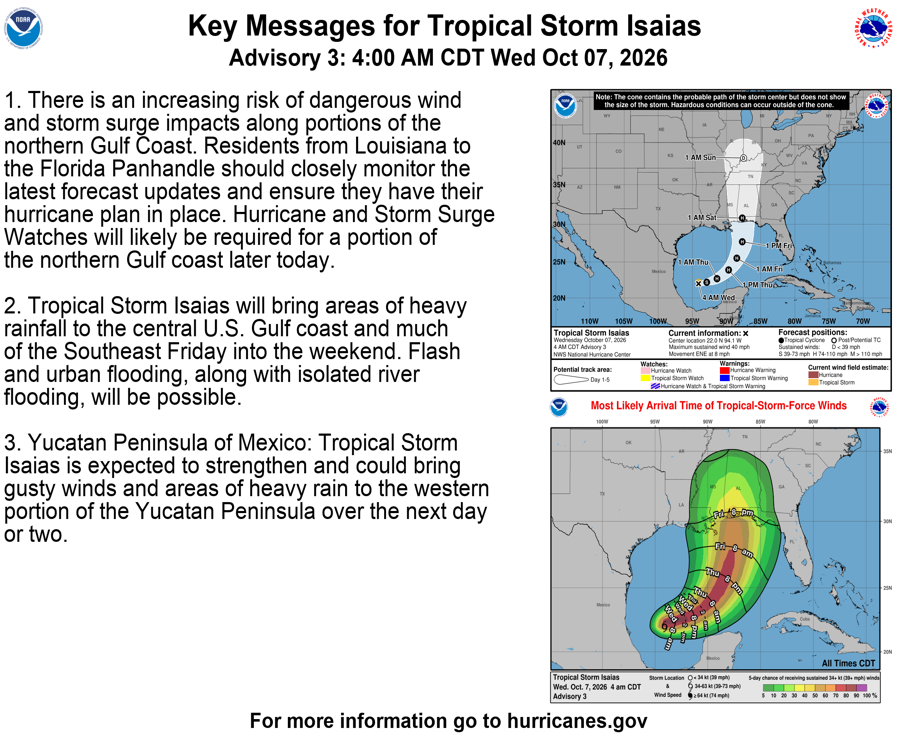
Dozens of offshore oil and natural gas rigs are in the storm’s path. Chevron is evacuating nonessential personnel from its Gulf platforms as a precaution.
Isaias’ projected landfall area currently spans Louisiana, Alabama, Mississippi, and the Florida Panhandle.
One notable refinery in thestorm’ss path is Chevron’s Pascagoula refinery, located on Mississippi’s Gulf Coast, which can process 369,000 barrels of crude a day. The refinery produces gasoline, diesel, jet fuel, and premium base oils.
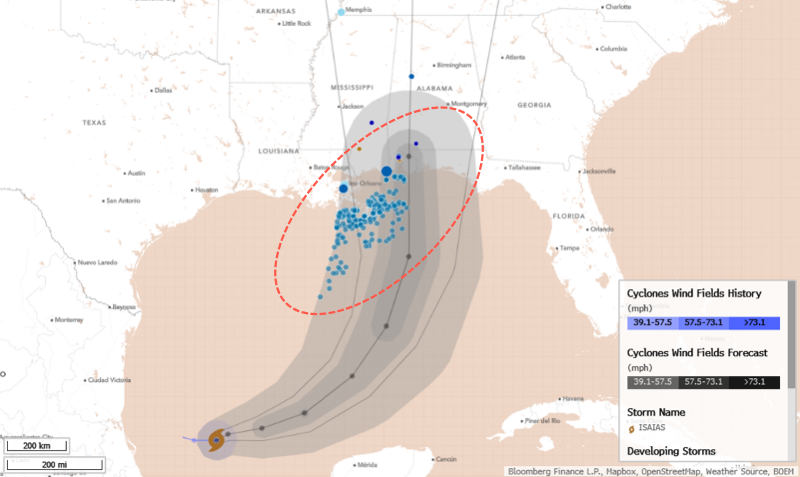
List of major US refineries in the storm’s path:
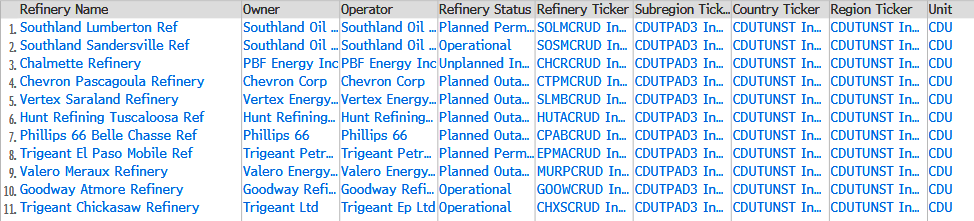
September ended without a hurricane for the first time in 32 years, as strong wind shear associated with El Niño disrupted tropical development. Isaias is expected to become the first Atlantic hurricane of the season.
END
ASIA//OILPRICE.COM
World Bank Warns Asia Is Running Out Of Money To Fight Energy Shock
Wednesday, Oct 07, 2026 – 08:05 AM
Authored by Irina Slav via OilPrice.com,
Asian countries have responded more aggressively than others to the energy supply crunch caused by the U.S. and Israeli war on Iran and now they are running out of resources to continue their response, the World Bank warned in a new report.

The report actually focuses on the potential of artificial intelligence to help Asian economies grow but names energy import vulnerability as one major headwind to that growth.
“Subsidies have been by far the most common policy response [to the crisis] among emerging and developing economies,” the World Bank said, adding that “Countries with substantial subsidies in place generally have had smaller increases in retail gasoline prices than non-subsidizers, but this relationship weakened considerably for headline inflation.”
Energy remains a spot of weakness for Asian countries due to their overwhelming dependence on imports but, according to the World Bank, AI can change that by motivating a shift towards greater domestic electricity generation, which would in turn lead to lower demand for imported energy commodities.
Meanwhile, Asian countries’ response to the energy crunch has led to lower prices at the cost of lower foreign exchange reserves, the lender also said. The longer the crisis continues, the greater the effect on their fiscal health would be, the World Bank warned, noting as examples Indonesia, Thailand, and Vietnam, which saw their dollar reserves decline by between 15% and 40% since the start of the war because of their crisis response actions.
These response actions, however, have had no effect on inflation anywhere in the world, and “headline inflation has sharply increased in many countries, even as core inflation has remained more subdued.”
For Asia, however, there is hope for a reversal, driven by information technology generally and AI specifically, according to the World Bank.
“The region’s dependence on AI-related industrial activity has been a source of strength, but it could become a weakness if global AI activity slows or reverses,” the institution said in its report.
END
OILPRICE.COM..
Standard Chartered Says Hormuz Oil Flows Are Far From Normal
Wednesday, Oct 07, 2026 – 07:20 AM
Authored by Alex Kimani via OilPrice.com,
- Gulf oil exports rebounded to roughly 16.5 million bpd in September, near pre-war levels, despite only 60% of those barrels crossing Hormuz versus 83% before the war.
- Exporters have adapted through pipelines, bypass ports and extensive ship-to-ship transfers, but the system is more expensive, inefficient and increasingly stretched, with elevated freight and security costs.
- Iran’s ability to choke off regional oil exports has weakened, while its own seaborne crude exports have fallen from around 1.7 million bpd to near zero.
Oil flows through the Middle East have staged an impressive rebound, with export volumes recovering to near pre-war levels even as traffic through the Strait of Hormuz remains well below normal. Standard Chartered estimates crude and condensate exports from the Gulf, excluding Iran and including bypass routes such as Fujairah and the Red Sea, reached roughly 16.5 million barrels per day (bpd) in September, broadly back to pre-war volumes. But only 60% of those barrels crossed the Strait of Hormuz, compared with 83% before the war. Standard Chartered says the numbers show resilience rather than normalization: exporters have found ways to move the oil, but they are doing it less efficiently and at considerably higher cost.

The system has been forced to use more complex workarounds, particularly a vessel-intensive chain of ship-to-ship (STS) transfers. Shuttle tankers are increasingly moving crude through Hormuz before transferring it to larger vessels in the Gulf of Oman, while exporters are also making greater use of pipelines and ports that bypass the strait. The southern route along the Omani coast has become an important route for shuttle vessels moving through Hormuz. Standard Chartered says STS capacity appears saturated, vessel utilization remains inefficient, voyage times have lengthened and both freight and security costs remain elevated.
Saudi Arabia perhaps best illustrates both the success and limits of this adaptation. Following the early-September damage to the East-West pipeline, exports shifted sharply to the east coast. Standard Chartered estimates total Saudi exports rebounded to roughly 6.9 million bpd in September from 2.45 million bpd in August, with 19 VLCCs transiting Hormuz in one week alone. The restart of the East-West pipeline and Yanbu loadings has restored another route to market and reduced the immediate risk of shutting in production, although pipeline throughput remains below nameplate capacity and exposed to further attacks. The workarounds are also expensive, with reports of discounts of up to $9 per barrel on cargoes loaded offshore Oman to compensate for the added logistical costs.
The recovery in physical flows has reduced the probability of the most extreme shortage scenarios and should gradually remove some of the scarcity premium in oil prices. But those barrels are moving at higher cost, with longer voyage times, heavier use of tankers and less spare capacity in the logistics system. Standard Chartered says the improvement is bearish compared with a market pricing a prolonged physical supply loss, but does not justify a return to pre-war risk premiums. Exporters have shown they can move far more crude than many expected, but the system has less room to absorb another major disruption.
The tactical success of Gulf exporters has also altered regional dynamics. Seaborne crude exports from Iran fell to near zero in September, down from roughly 1.7 million bpd before the war, after the U.S. naval blockade sharply curtailed Tehran’s ability to move crude through Hormuz. Consequently, Iran’s ability to weaponize its chokehold on the Strait of Hormuz is breaking down, though this increases the risk of unpredictable military escalation.
Iran remains defiant and reiterated Sunday that the Strait of Hormuz will remain closed until the United States fulfills seven conditions contained in the June interim agreement. Foreign Minister Abbas Araghchi said separately that Tehran’s latest proposal could lead to the strait reopening within seven days if Washington accepts Iran’s terms.
Tehran has denied reports that it offered international nuclear inspections in exchange for sanctions relief. Araghchi has said Iran hopes Washington will pursue diplomacy, but warned that the country is better prepared than before to respond if the U.S. opts for further military action.
END
Oil Drops Despite 3.1 Million Drop In Crude Inventories, Diesel Spikes
Wednesday, Oct 07, 2026 – 11:18 AM
Oil prices were largely unchanged, trading near session lows, after today’s DOE inventory data affirmed the latest downbeat API prints from Tuesday afternoon, showing that the crude draw in the last week was even bigger than what API reported (-2.1MM), and far worse than the +1.9MM expected increase, printing at -3.186MM, the biggest draw in 6 weeks.
API
- Crude -2.1mm (vs +1.0mm last)
- Gasoline -1.4mm (vs +3.0mm last)
- Distillates +0.5mm (vs -0.3mm last)
- Cushing +0.9mm, (vs +0.2mm last)
DOE
- Crude -3.186mm, the biggest drain in 6 weeks, and far below the exp. +1.915MM
- Gasoline +382k
- Distillates -42k
- Cushing +444K
And visually:
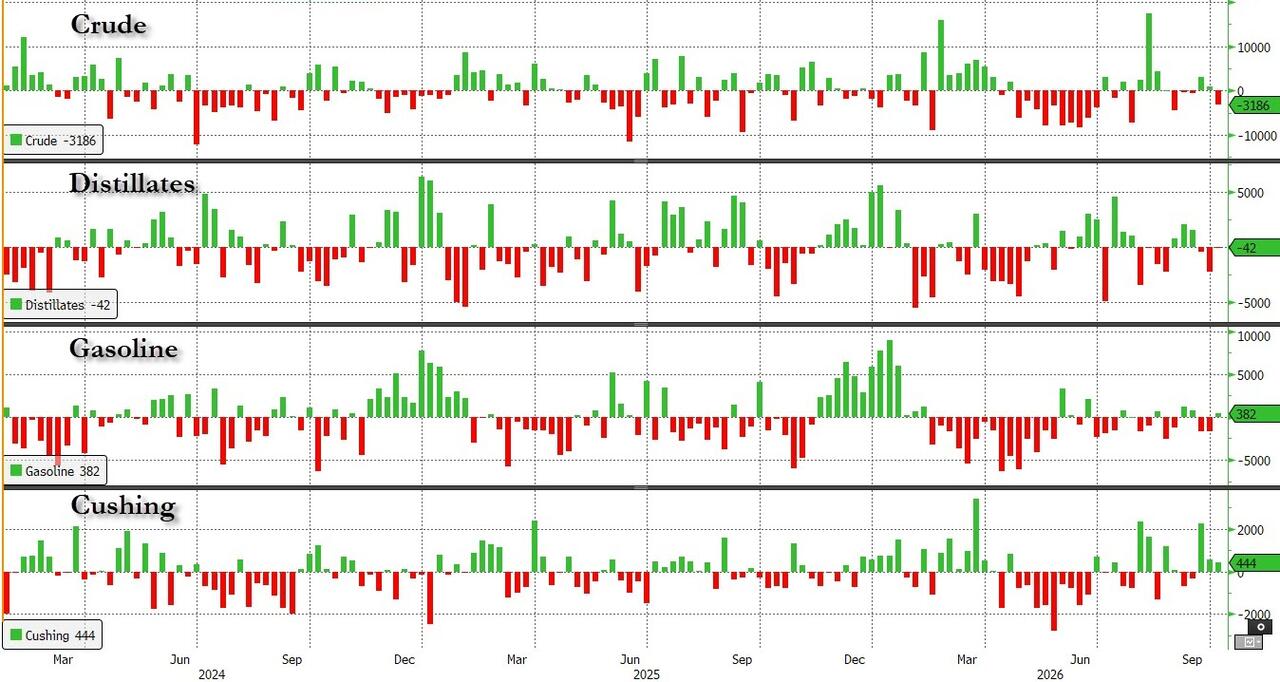
The decrease in commercial crude stockpiles was boosted by another 784,000 barrels withdrawn from the Strategic Petroleum Reserve.
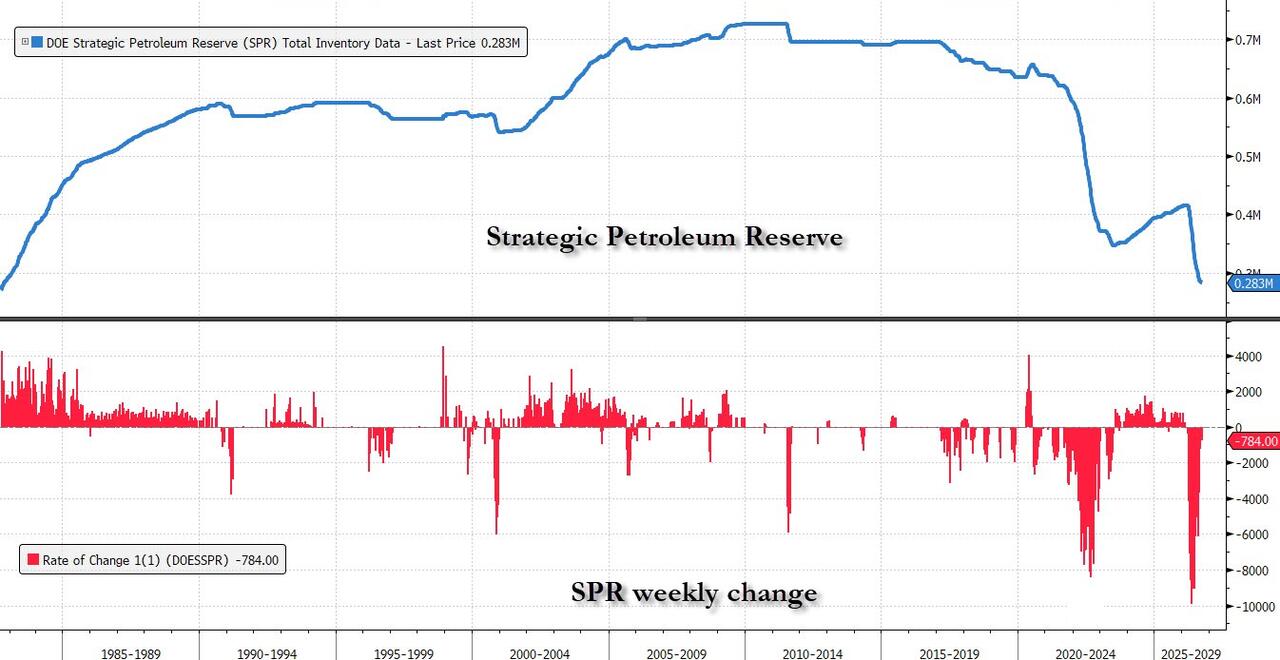
That increased the overall nationwide crude draw to 3.97 million barrels in the week leading up to Oct. 2. A total of 132.5 million barrels of crude has been taken out of the SPR since late March under a program to release 172 million barrels as part of a relief plan from the International Energy Agency aimed at lowering energy costs.
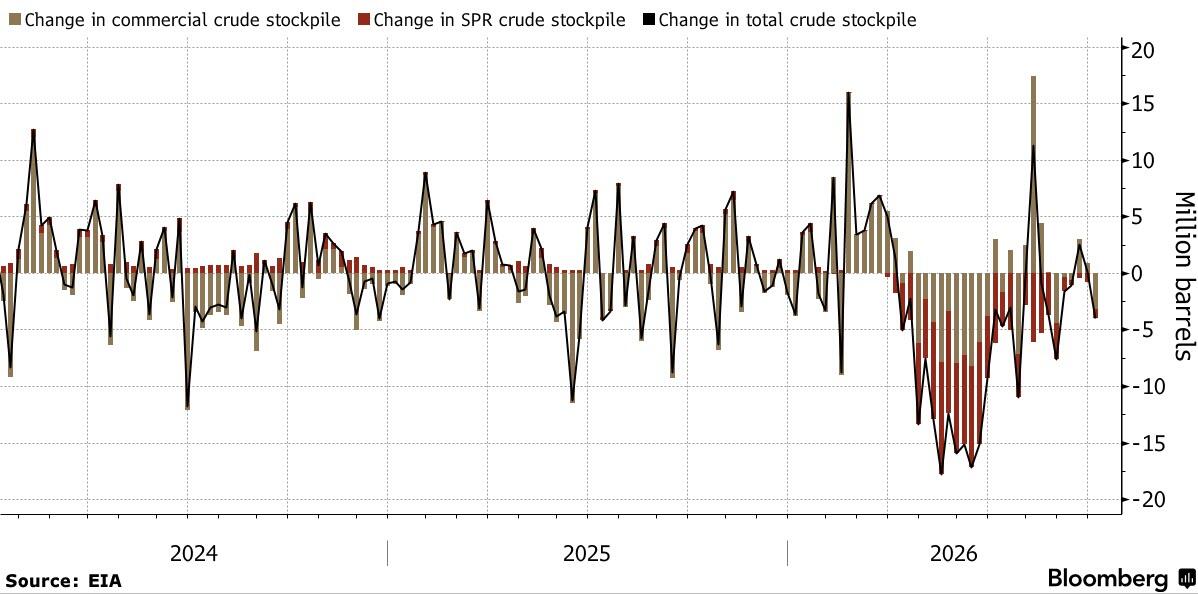
Meanwhile, Cushing stockpiles rose for the third consecutive week to 24.7 million barrels. That has inventories at the hub at the highest since May and even further away from the 20-million barrel mark generally seen as “tank-bottoms.”
Some more details from the report: distillate fuel stockpiles were down 42,000 barrels, while gasoline stockpiles rose around 380,000 barrels. Diesel futures are little changed, but gasoline futures appear to be selling off on the news, erasing most of the day’s gains to trade around $3.31 a gallon.
West Coast crude imports surged to the highest level since August 2025. There are a few potential reasons for that, but it’s likely tied to Middle East cargoes that loaded during a recent pause in hostilities. Imports into PADD 5 are now at about 1.6 million barrels a day and shipments last week rose by the most since April 2021.
With diesel spreads not too far from all time highs, and forcing refiners to pick between gasoline and diesel, the all important refinery crude runs rebounded following three weeks of drawdowns. Crude processing increased by 223,000 barrels a day and now are back to the highest on record for this time of the year.
And speaking of gasoline, Bloomberg suggests that the 1.4mm drop was less bearish than it seems. The additions to stocks occurred exclusively on the East Coast. Meanwhile in a reversal of last week’s drop to all time lows, Midwest gasoline stockpiles posted a modest recovery, rising by just over 600K.
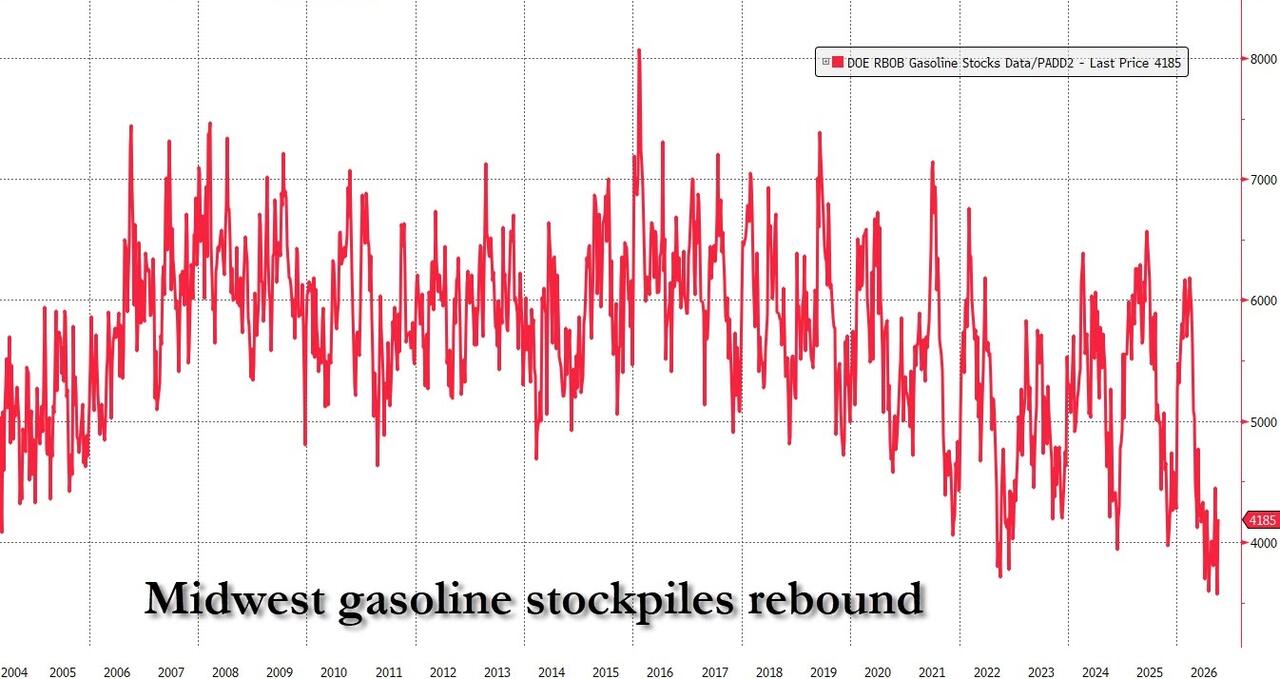
On the Gulf Coast, where the bulk of gasoline production occurs, stockpiles are at their lowest since September 2017.
Digging in a little further: The bulk of the gasoline stockpile additions occurred in the Central Atlantic, which encompasses Maryland, New York and Pennsylvania. The addition was considerably smaller in New England, and stockpiles actually fell in the Lower Atlantic states.
Also worth noting is that among all the talk of a diesel export ban, diesel exports surged 235,000 barrels a day to 1.76 million barrels a day. That’s the highest readout since August, and sets a new seasonal record. Meanwhile, diesel supplies on the East Coast ticked down once again last week. They’re now back where they were in early September and still sitting at the lowest they’ve ever been on record heading into the fall.
On the other side of the table, crude production rose to a new high of about 14 million barrels a day last week, up by 24,000 barrels a day from the previous week, and keeping pace with the recent surge in oil drilling rigs. Rebalancing the weekly numbers against the monthly figures published in the latest Short-Term Energy Outlook added “less than 50,000 barrels a day” to last week’s number. This increase came as one more rig was put into operation, according to Baker Hughes.
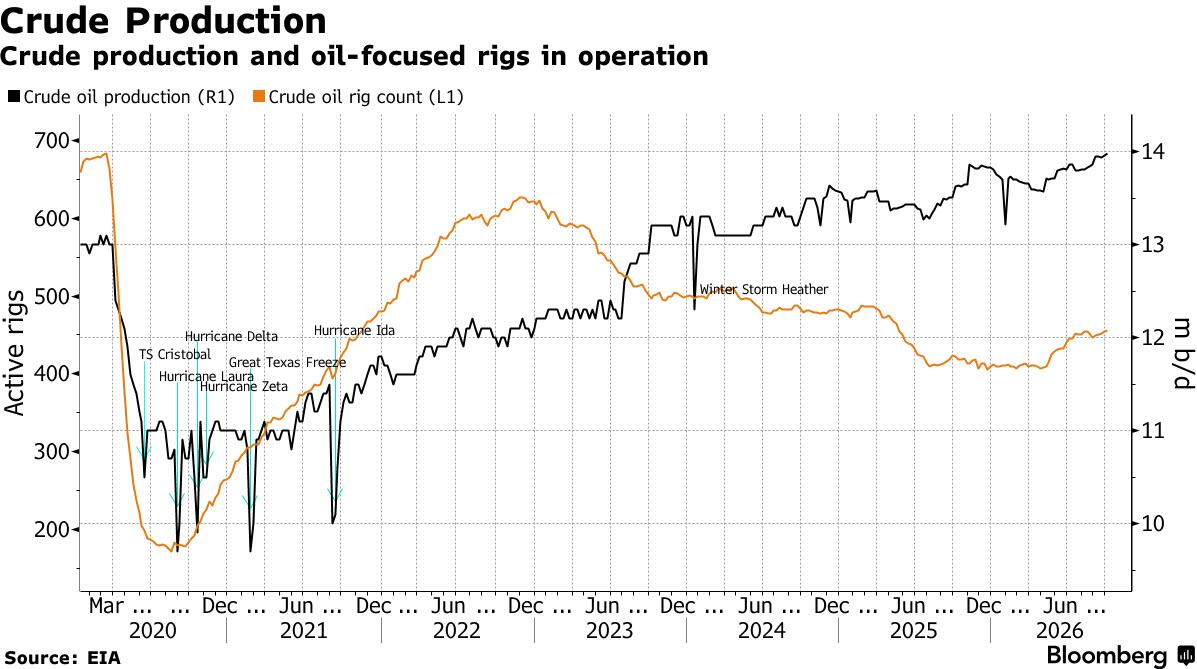
Summarizing today’s data, via BBG:
- Total crude and products exports soared to the highest since late May, returning to a seasonal record. The increase was driven largely by crude shipments, which climbed to the highest since mid-September. October-loading volumes are expected to trend higher compared with September, as refiners in Asia and Europe sought to lock in US supplies following the mid-September shutdown of Saudi Arabia’s East-West pipeline.
- Gasoline stockpiles rose around 380,000 barrels with much of that occurring in the Central Atlantic, which encompasses New York and Pennsylvania. But on the Gulf Coast, where the bulk of gasoline production occurs, stockpiles are at their lowest since September 2017. Gasoline imports remain well below seasonal norms, but they ticked up last week. Those imports are particularly important to the East and West coasts, which have less refining capacity overall.
- Refinery crude runs rebounded following three weeks of drawdowns. Crude processing increased by 223,000 barrels a day and now are back to the highest on record for this time of the year. Midwest crude processing bounced back big time but is still below last year’s levels. It’s an indication that fall refinery maintenance is heavier than in previous years.
WTI futures edged lower to trade near session lows of $89.50 even as the EIA data indicated that US crude stockpiles fell 3.2 million barrels. Still, stocks at the key hub in Cushing, Oklahoma, expanded slightly, easing some concerns of glaring physical market tightness. Gasoline stockpiles also rose, though as Will pointed out earlier, that may be less bearish than it appears.
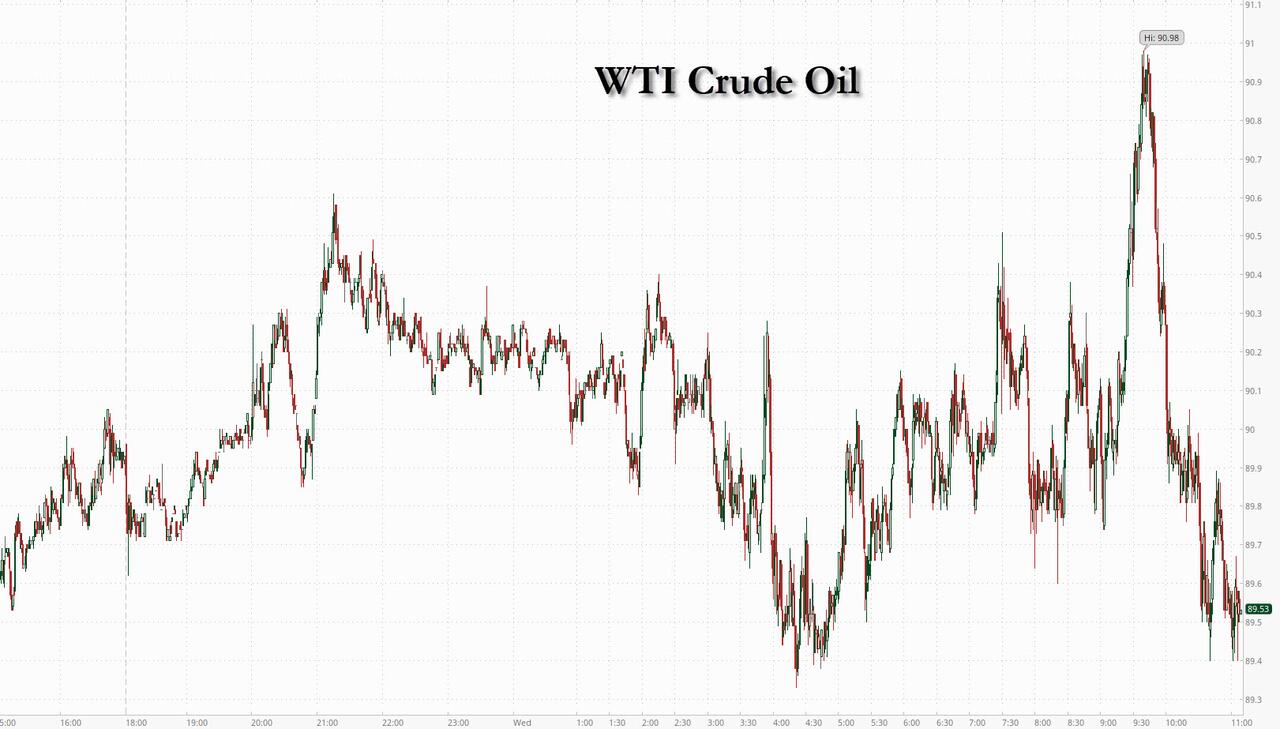
But while oil dropped, far more concerning is that diesel led the US energy complex higher, rising about 3% on the day to trade at $4.72 a gallon, while diesel crack spreads are now well above where they were when Trump announced the latest emergency release from the Diesel reserve. It’s the kind of futures price that creates serious headaches for anyone who needs to buy diesel for their truck or tractor.
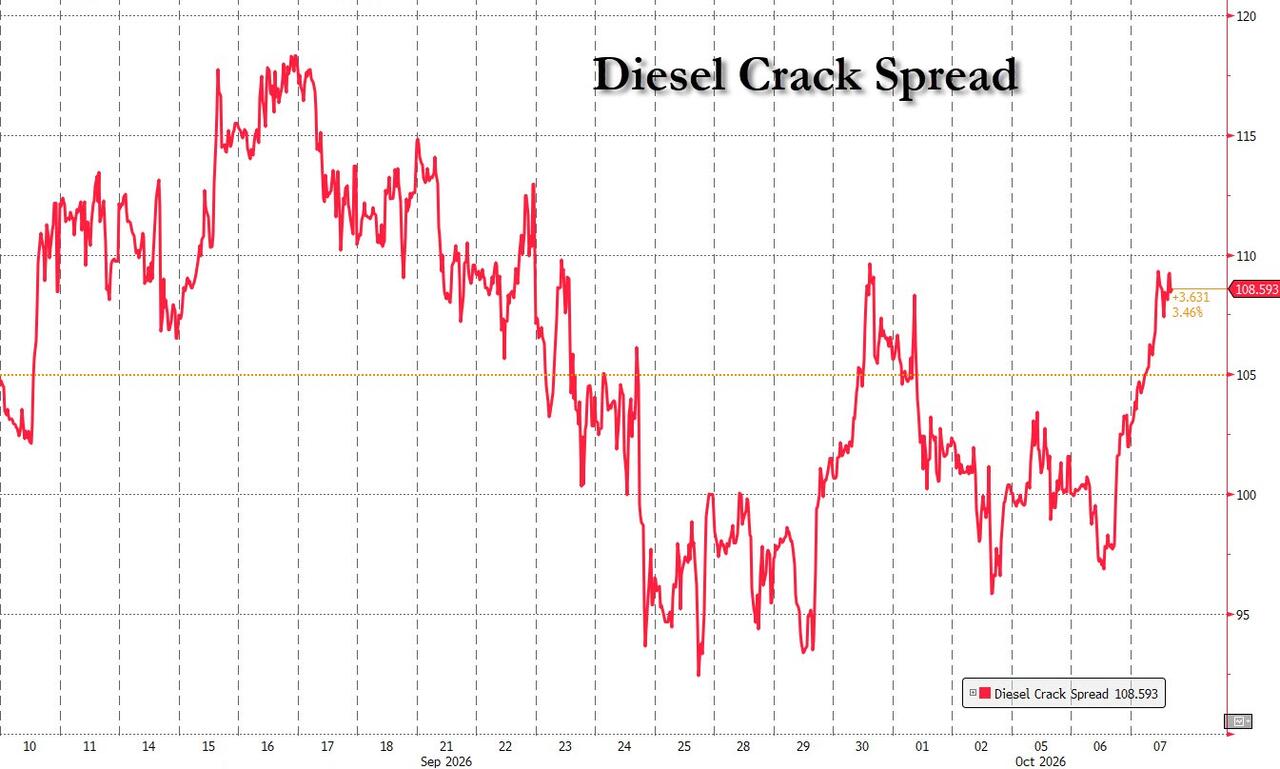
8. EMERGING MARKETS//AUSTRALIA NEW ZEALAND ISSUES
VENEZUELA\
Explosion Rocks Venezuela’s Second-Largest Refinery
Tuesday, Oct 06, 2026 – 08:05 PM
More bad news for the global refining market broke late Tuesday when Venezuela’s second-largest refinery halted operations after a fire erupted at the facility.
The 310,000-barrel-a-day Cardon refinery shut down earlier today, according to a Reuters report citing people familiar with the matter, who said a gas line connected to its diesel hydrotreater exploded.
Footage:
Cardon forms part of the 955,000-barrel-a-day Paraguana Refining Center, Venezuela’s largest refining complex. State-owned PDVSA operates the refinery.
Venezuela’s refineries are in poor condition after years of underinvestment, deferred maintenance and recurring equipment failures.
“Venezuela’s Cardon and Amuay refineries are part of the Paraguana Refining Center, which is one of the world’s largest but has been operating at a fraction of capacity for the last decade because of lack of maintenance,” the Energy Information Administration wrote in a recent report.
Paraguana has historically supplied fuel to China, Singapore and Cuba, with European markets also among its export destinations. However, increased US involvement in Venezuela’s oil industry has likely rerouted some of those flows.
END
U.S./GOLD AND SILVER PRICING/ASIAN CLOSING MARKETS AND EUROPEAN BOURSE OPENING AND CLOSING/ INTEREST RATE SETTINGS WEDNESDAY MORNING 6;30AM//OPENING AND CLOSING\
OPENING LEVELS OF CURRENCIES// AND CLOSING ASIAN STOCK MARKET AND OPENING EUROPEAN STOCKS:6 AM EST
EURO VS USA DOLLAR: 1.1140 DOWN 0.0062
USA/ YEN 158.07 DOWN 0.225 NOW TARGETS INTEREST RATE AT 1.75% AS IT WILL BUY UNLIMITED BONDS TO GETS TO THAT LEVEL…//YEN STILL FALLS//END OF YEN CARRY TRADE BEGINS AGAIN DEC 2024/Bank of Japan raises rates by .25% TO 1.75 ..TAKAICHI NEW PM AS YIELDS RISE//JAPAN DEEPLY IN TROUBLE WITH RISING RATES AND A FALLING YEN!! BANK OF JAPAN WILL NO LONGER DO QE. URGES PENSION AND INSUANCE FUNDS TO BUY JAPANESE BONDS//
YEN CARRY TRADERS MURDERED
GBP/USA1.3237 DOWN 0.0029 OR 29 BASIS PTS
USA/CAN DOLLAR: 1.4229 UP 0.0017 //CDN DOLLAR DOWN 17 BASIS PTS//
Last night Shanghai COMPOSITE CLOSED HOLIDAY UNTIL THURSDAY
Hang Seng CLOSED DOWN 195.86 PTS OR 0.81%
AUSTRALIA CLOSED DOWN 0.01%
// EUROPEAN BOURSE: ALL RED
Trading from Europe and ASIA
I) EUROPEAN BOURSES: ALL RED
2/ CHINESE BOURSES / :Hang SENG CLOSED DOWN 195.56 PTS OR 0.81%
/SHANGHAI CLOSED
AUSTRALIA BOURSE CLOSED DOWN 0.01%
(Nikkei (Japan) CLOSED DOWN 533.98 PTS OR 0.76%
INDIA’S SENSEX IN THE RED
Gold very early morning trading: $4129.50
silver:$60.44
USA DOLLAR VS TRY (TURKISH LIRA): 49.20 UP 2 BASIS PTS AND NOW WE SEE THEIR STUPIDITY OF SELLING SOME OF THEIR GOLD AND ALL OF THEIR USA DOLLAR RESERVES. THE COUNTRY IS IN BIG FINANCIAL TROUBLE
USA DOLLAR VS RUSSIAN ROUBLE: 85.60 ROUBLE// DOWN 0 ROUBLE AND 86 BASIS PTS.
UK 10 YR BOND YIELD: 5.4149 UP 4 BASIS PTS
UK 30 YR BOND YIELD: 5.9410 UP 4 BASIS PTS
FRENCH OAT 10 YR BOND YIELD: 4.850 UP 10 BASIS PTS.
CDN 10 YR BOND YIELD: 3.9280 DOWN 2 BASIS PTS
CDN 5 YR BOND YIELD; 3.598 DOWN 2 BASIS PTS
USA dollar index early WEDNESDAY MORNING: 102.03 UP 44 BASIS POINTS FROM TUESDAY’s CLOSE
WEDNESDAY MORNING NUMBERS ENDS
And now your closing WEDNESDAY NUMBERS 10.00 AM
Portuguese 10 year bond yield: 4.042% UP 7 in basis point(s) yield
JAPANESE BOND 10 yr YIELD: +3.134% UP 3 FULL POINTS BASIS POINTS /JAPAN losing control of its yield curve/
JAPAN 30 YR: 4.229 DOWN 1 BASIS PTS//
SPANISH 10 YR BOND YIELD: 4.170 UP 7 in basis points yield
ITALY 10 YR BOND: 4.694 UP 15 points in basis points yield ./
GERMAN 10 YR BOND YIELD: 3.5274 UP 4 BASIS PTS
IMPORTANT CURRENCY CLOSES : MID DAY WEDNESDAY
Closing currency crosses for day /USA DOLLAR INDEX/USA 10 YR BOND YIELD/10:00 AM
Euro/USA 1.1179 DOWN 0.0073 OR 73 basis points
USA/Japan: 158.31 UP 0.018 OR YEN IS DOWN 2 BASIS PTS// HIGHLY INFLATIONARY TO JAPAN
Great Britain 10 YR RATE 5.4915 UP 12 BASIS POINTS //
GREAT BRITAIN 30 YR BOND; 6.0235 UP 12 BASIS POINTS.
FRANCE 10 YR: 4.916 % UP 17 BASIS PTS
CANADIAN DOLLAR DOWN 47 BASIS PTS TO 1.4259
xxxxxxxxxxxxxxxxxxxxxxxxxxxxxxxxxxxxxxxxxxxxxxxxxxxxxxxxxxxxxxxxxxxxxxxxxxxxxxxx
The USA/Yuan CNY 6.7046 ON SHORE ..OFF
THE USA/YUAN OFFSHORE// CNH DOWN TO 6.7064
TURKISH LIRA: 49.20 UP 2 EXTREMELY DANGEROUS LEVEL/DEATH WATCH/HYPERINFLATION TO BEGIN.//
Your closing 10 yr US bond yield UP 9 in basis points from TUESDAY at 5.354% //trading well ABOVE the resistance level of 2.27-2.32%)
USA 30 yr bond yield 5.723 UP 8 basis points /10:00 AM
USA 2 YR BOND YIELD: 4.8314 UP 4 BASIS PTS.
GOLD AT 10;00 AM $4094.95
SILVER AT 10;00: $59.88
Your 11:00 AM bourses for Europe and the Dow along with the USA dollar index closing and interest ratesWEDNESDAY
DAY CLOSING TIME/ 12:00 AM///
London: CLOSED DOWN 83.19 PTS OR 0.79%
GERMAN DAX: CLOSED DOWN 344.83 PTS OR 1.25%
FRANCE: DOWN 95.86 OR 1.22 PTS
Spain IBEX CLOSED DOWN 326.20 PTS OR 1.68%
Italian MIB: CLOSED DOWN 1,289.15 PTS OR 2.51%
WTI Oil price 90.08 10.00 EST/
Brent Oil: 101.80 10:00 EST
USA /RUSSIAN ROUBLE: 85.48/// ROUBLE UP 0 AND 10/ 100
CDN 10 YEAR RATE: 4.001 UP 7 BASIS PTS.
CDN 5 YEAR RATE: 3.662 UP 6 BASIS PTS
CLOSING NUMBERS: 4 PM//
Euro vs USA 1.1197 DOWN 0.0055 OR 55 BASIS POINTS//
British Pound: 1.3215 DOWN 0.0051 OR 51 basis pts/
BRITISH 10 YR GILT BOND YIELD: 5.4482 UP 5 FULL BASIS PTS//
BRITISH 30 YR BOND YIELD: 5.9675 UP 3 IN BASIS PTS.
FRENCH 10 YR BOND: 4.860 % UP 12 BASIS PTS
JAPAN 10 YR YIELD: 3.107% UP 1 FULL BASIS PTS (DANGEROUS TO THEIR ECONOMY
JAPANESE 30 YR BOND: 4.217 DOWN 1 PTS AND STILL VERY DANGEROUS TO THEIR ECONOMY
USA dollar vs Japanese Yen: 158.00 DOWN 0.342 OR YEN UP 34 BASIS PTS//GETTING FURTHER AWAY FROM 160.00/ EXTREMELY DANGEROUS
USA dollar vs Canadian dollar: 1.4256 UP 0.0043 PTS// CDN DOLLAR DOWN 43 BASIS PTS
West Texas intermediate oil: 88.86
Brent OIL: 101.01
USA 10 yr bond yield UP 1 BASIS pts to 5.286
USA 30 yr bond yield: UP 1 PTS to 5.666%
USA 2 YR BOND 4.768 DOWN 5 PTS
CDN 10 YR RATE 3.946 UP 2 BASIS PTS
CDN 5 YEAR RATE: 3.610 UP 2 BASIS PTS
USA dollar index: 102.03 DOWN 3 BASIS POINTS
USA DOLLAR VS TURKISH LIRA: 49.20 UP 2 BASIS PTS GETTING QUITE CLOSE TO BLOWING UP/IDIOTS SOLD GOLD
USA DOLLAR VS RUSSIA//// ROUBLE: 85.48 DOWN 0 AND 90 /100 roubles //
GOLD $4,107.00 3:30 PM)
SILVER: 59.71 3;30 PM)
DOW JONES INDUSTRIAL AVERAGE: DOWN 341.11 POINTS OR 0.66%
NASDAQ 100 DOWN 64.61 PTS OR 0.21%
VOLATILITY INDEX 15.03 UP 0.02 PTS OR 0.13%
GLD: $ 375.88 DOWN 6.39 PTS OR 1.67%
SLV/ 53.82 PTS DOWN 1.63 OR 2.74%
TORONTO STOCK INDEX// TSX INDEX: CLOSED DOWN 608.96 PTS OR 1.71%
end
TRADING today ZEROHEDGE 4 PM: HEADLINE NEWS/TRADING
Stocks Slide From All Time High Amid Rising Turmoil Just Below The Surface
‘WRAP UP
FOMC
Hawkish FOMC Minutes Show All 19 Fed Officials Supported Rate Hike, “Most” Assess Another Hike “By Year End Is Appropriate”
Wednesday, Oct 07, 2026 – 02:14 PM
The September FOMC minutes struck a distinctly hawkish tone, as all 19 Fed officials backed a rate hike in September, with many supporting the move to protect against the risk of intensifying inflation pressures. A separate group of officials said higher rates were necessary based on their outlook for the economy, signaling greater concern for elevated inflation, according to minutes of the Sept. 16 FOMC meeting released Wednesday. The Committee unanimously raised the fed funds rate 25bp to 3.75%-4.00% and signaled that further tightening is likely by year-end.
“Most participants assessed that another increase in the target range for the federal funds rate would likely be appropriate by year end,” the minutes said, and also said that “Several participants commented that the underlying momentum in the economy appeared to have increased.”
Policymakers remain concerned that inflation is proving sticky. August headline PCE inflation was estimated at 3.8% and core PCE at 3.4%, with higher energy costs, geopolitical tensions, and AI-related investment contributing to price pressures. Participants generally viewed inflation risks as skewed to the upside.
The economy continues to show resilience. GDP growth remained solid, consumer spending held up, and business investment was supported by the ongoing AI buildout. Labor market conditions were viewed as close to full employment, with unemployment at 4.1%.
Several participants noted that AI is boosting both investment and productivity prospects but could also contribute to inflation through stronger demand, rising input costs, and increased financing needs. Market participants likewise cited AI-related borrowing as a factor pushing Treasury yields higher.
Overall, the Committee judged that stronger growth, elevated energy prices, and persistent inflation warranted a more restrictive policy stance, with most members expecting another rate increase before year-end.
Here are the key highlights from the Fed minutes:
- Participants generally emphasized inflation remained elevated while the job market appeared near full employment.
- Participants offered a range of views for why they supported a rate increase.
- Participants generally saw inflation risks skewed to the upside, with some seeing those risks becoming more skewed in recent months.
- Almost all participants saw inflation risks tilted to the upside, while job market risks were broadly balanced.
- Some participants saw AI buildout possibly causing aggregate demand to outpace supply over the medium term, putting upward pressure on inflation.
- The staff economic outlook was stronger than the one prepared for the July meeting.
- Many participants noted that despite the recent climb in long-term Treasury yields, financial conditions appeared supportive of economic growth.
- A few participants observed that the Treasury market had been functioning smoothly, but noted the importance of planning for market stress.
- Changes in real rates contributed to most of the net increase in longer-maturity Treasury yields.
- Nominal yields increased around 35 basis points across the 2- to 10-year segment of the yield curve. Part of the increase reflected the higher expected path of monetary policy and the strength of economic data. Market commentary pointed to geopolitical developments, uncertainty related to the US Treasury’s announcement and implementation of the buyback program, and competition for capital from heavy private debt issuance to finance the development of AI infrastructure as also contributing to higher term premiums and Treasury yields
The FOMC was also increasingly vocal on the inflationary impacts of AI:
- “Several participants observed that the rate of price increases in the core goods category also remained elevated, as effects of the AI buildout appeared to increase while the effects of tariff increases waned”
- “Some participants commented that increased energy prices and the ongoing AI buildout were contributing to cost pressures faced by businesses, including higher costs for transportation and input materials.”
- “Some participants commented that the AI buildout could cause aggregate demand to outpace aggregate supply over the medium term, putting upward pressure on inflation.”
- “Some participants observed that strong demand for skilled workers in sectors related to the ongoing AI buildout had been driving strong wage gains for these workers”
- “Participants noted that the ongoing AI buildout was boosting business investment. Several participants commented that the scale and pace of the AI buildout had continued to surprise to the upside”
The record also revealed a discussion about financial conditions. Many officials commented that despite the recent rise in longer-term Treasury yields, “financial conditions appeared to be supportive of economic growth, with equity prices having risen substantially this year and spreads on corporate bonds having remained narrow.”
Some officials, including three who voted against the FOMC decision to hold steady in July, could dissent again in favor of another increase if the majority votes to leave rates unchanged at the October meeting.
“Several participants stated that they viewed the current policy rate as not restrictive or only mildly restrictive,” the minutes
Chairman Kevin Warsh told reporters following the Sept. 16 decision the move was aimed at removing a “dose of accommodation” as inflation remained stubbornly high. His comments fueled market bets for another increase in October.
The Fed also said that the joint U.S.–Japan intervention to support the yen in late July also directly contributed to dollar depreciation, given the yen’s considerable weight in currency indexes. The manager noted that the Desk, acting purely as fiscal agent for the U.S. Treasury, intervened in the currency market using U.S. Treasury funds; the System Open Market Account portfolio was not involved.
The Fed’s rate hike prompted criticism from President Trump, who blamed the rate increase on Warsh’s colleagues, whom he claimed were being “very political.” Since the meeting, however, a series of comments from key Fed officials have indicated the central bank may be in no rush to raise rates again.
Fed Vice Chair Philip Jefferson and New York Fed President John Williams said in separate speeches last week they believed the central bank has time to assess the economy before considering another rate increase. Investors promptly reeled in their expectations for a rate hike this month.
Investors are currently pricing in a roughly 20% chance of another quarter-point hike at the Fed’s Oct. 27-28 meeting, down from around 70% in the days following the September decision, based on federal funds futures. Yields on two-year Treasuries, seen as the most sensitive to Fed policy, dropped more than 10 basis points in the past week to near 4.8%.
Bloomberg notes that last week’s remarks by Williams and Jefferson don’t mean the Fed won’t adjust policy any further. Officials continue to warn that inflation is too high. The CPI report due Oct. 14 might yet revive calls for a near-term hike.
USA DATA RELEASES
One-Year Inflation Expectations Jump To 3 Year HIgh: NY Fed Survey
Wednesday, Oct 07, 2026 – 12:25 PM
Americans’ expectations for inflation over the near-tern jumped last month while their sentiment toward the labor market improved, the latest NY Fed Federal survey of consumer expectations showed on Wednesday.
Consumers’ estimates for inflation one-year ahead rose to a median 3.9% in September, up from 3.6% the prior month, reaching the highest level since May of 2023. At the same time, inflation expectations increased 0.1% to 3.3% at three-year horizon, and were unchanged at 3.0% at five-year horizon.
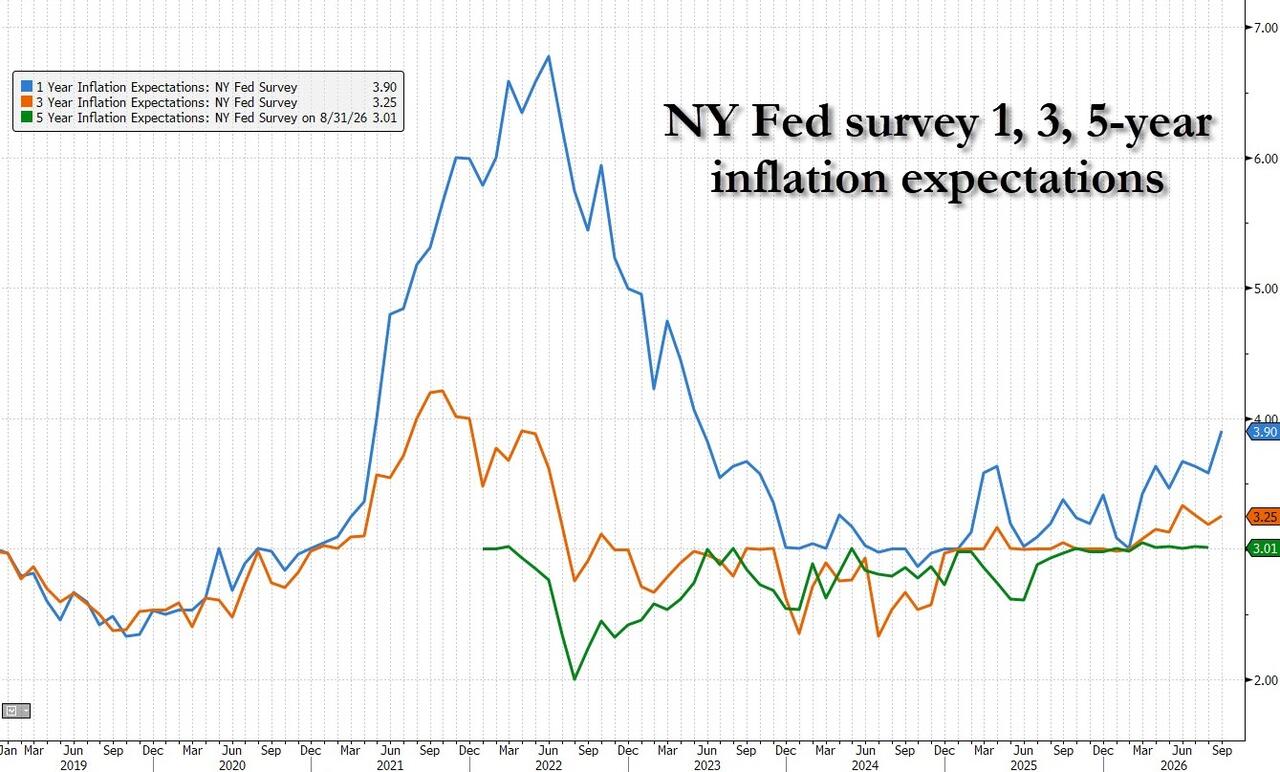
Over the next year consumers expect gasoline prices to rise 4.8%; food prices to rise 5.5%; medical costs to rise 9.2%; the price of a college education to rise 7.5%; rent prices to rise 6.8%
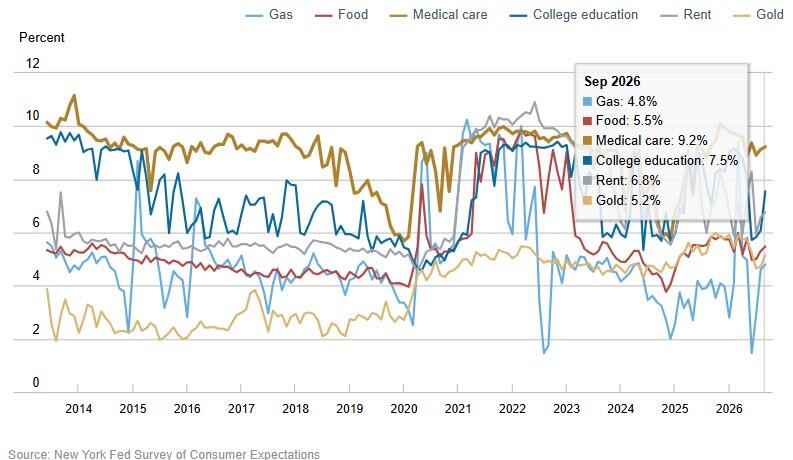
While the inflation outlook deteriorated, views on the labor market improved as workers saw a lower probability of losing their jobs and higher odds of voluntarily quitting, the New York Fed’s monthly consumer expectations survey showed. The proportion of respondents expecting the overall unemployment rate to rise in the next year fell fractionally to around 44%. Their perceived chances of finding a new role in the next three months if they lost their current job increased to 46%.
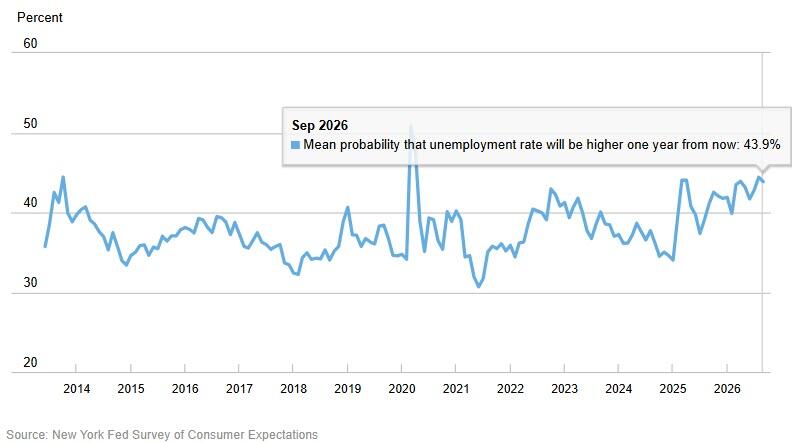
Consumers’ expectations of losing their jobs in the next year fell, with the outlook improving the most for workers between 40 and 60 years old and with annual household incomes above $100,000. Chances of leaving a post voluntarily also rose, especially among workers without a bachelor’s degree and above 40 years old.
Released less than a month away from the November mid-term elections, the New York Fed data is the latest survey highlighting Americans’ persistent pessimism around an economy that’s according to government data is expanding, if only for data centers and affiliated workers and billionaires. Separate data released in recent weeks showed that consumer sentiment fell to a four-month low in September and the unemployment rate rose slightly but remained historically low.
That’s the good news: the bad news is that the survey also found that year-ahead earnings growth expectations fell back to 12-month average of 2.6%. At the same time, the survey showed consumers’ perceptions of their own finances worsened for the second straight month. Around 42% of households said their situation is much or somewhat worse than a year ago, while around 18% said it had improved. More households also said they expected their financial outcomes to worsen in the year ahead, and more consumers now say it’s harder to get credit than it was a year ago.
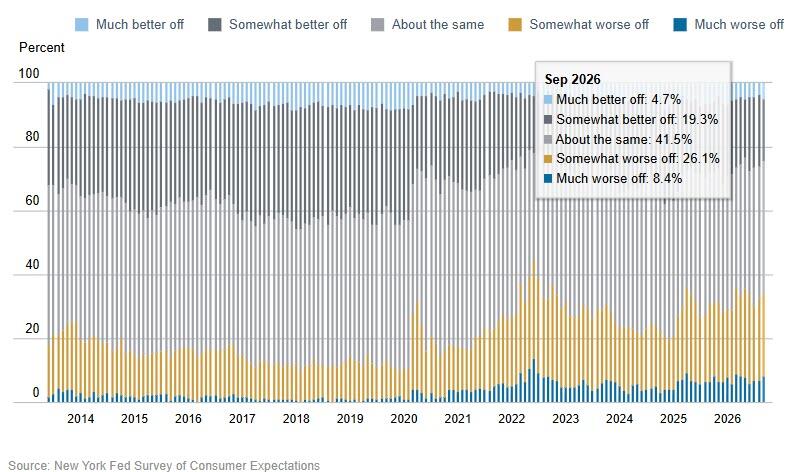
With inflation expected to jump, consumers are finding ways to keep their wallets open. Expected spending growth for the year ahead rose to the highest since May 2023, up to 5.5%, an increase that was broad-based across age and education groups. Consumers continue to expect their spending growth to outpace their income growth. At the same time, perceived chances of missing a debt payment over the next three months fell slightly to 12%.
A smaller percentage of consumers, 12.20% vs 13.16% in the prior month, expect to not be able to make minimum debt payments over the next three months
USA ECONOMIC REPORTS
USA: THE PETRODOLLAR
NICK GIAMBRUNO…..
The Petrodollar Could Break Soon – And Upend The Global Financial System
Tuesday, Oct 06, 2026 – 11:25 PM
Authored by Nick Giambruno via InternationalMan.com,
The Iran war could claim a casualty far more consequential than a missile battery, an air base, or an oil tanker: the petrodollar system.
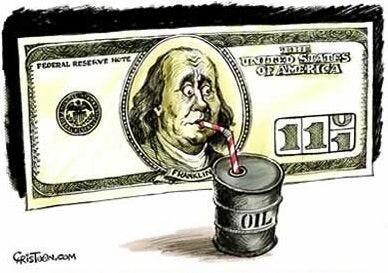
For more than 50 years, US protection of the Gulf monarchies has helped support global demand for dollars and US government debt. That bargain may now be coming under strain.
The concept is straightforward.
The US provides military protection to countries such as Saudi Arabia, Kuwait, the United Arab Emirates, Bahrain, and Qatar.
In return, these countries price much of their oil in US dollars and recycle large amounts of their oil revenue into US financial assets, including Treasuries.
Call it an alliance.
Call it a strategic partnership.
I prefer to call it a protection racket.
Whatever name you choose, the arrangement has provided enormous support for the dollar since Nixon severed its last link to gold in 1971.
Oil sits at the center of the global economy. Every industrial economy needs it. If countries need dollars to participate in the global oil trade, they have a powerful reason to hold dollars.
That creates demand for the currency that has nothing to do with buying American goods or services.
It also creates demand for US financial assets.
Oil exporters earn dollars. They need somewhere to put them. For decades, a large portion flowed back into US banks and Treasury securities.
That helped deepen the Treasury market, support the dollar, suppress US borrowing costs, and finance deficits that no other country could sustain.
But every protection racket depends on one thing:
The protector must provide protection.
The Iran war threatens that premise.
If the Gulf monarchies conclude that the US cannot protect their oil infrastructure, shipping lanes, cities, and regimes from Iran, why should they continue upholding their side of the bargain?
That question could reshape the international monetary system.
And one man warned almost exactly 20 years ago about the signal that would tell us this shift had begun.
Ron Paul Saw This Coming 20 Years Ago
On February 15, 2006, Congressman Ron Paul delivered a little-known but prophetic speech on the floor of the House of Representatives called “The End of Dollar Hegemony.”
He identified the signal investors should watch for:
“The chaos that one day will ensue from our 35-year experiment with worldwide fiat money will require a return to money of real value. We will know that day is approaching when oil-producing countries demand gold, or its equivalent, for their oil rather than dollars or euros. The sooner the better.”
I discussed this subject with Ron Paul at an investment conference years ago. He stood by that assessment.
His point was simple.
Watch the oil producers.
The day they start moving away from dollars and toward gold – or a monetary system that gives them access to gold – the foundation beneath the dollar-based financial system starts to crack.
We may now be approaching that point.
Why the Gulf States Could Turn East
The Gulf Cooperation Council includes Saudi Arabia, Kuwait, Qatar, Bahrain, Oman, and the United Arab Emirates. Together, these countries rank among the most important oil exporters on Earth.
China sits on the other side of that trade.
It is the world’s largest oil importer and the GCC’s largest trading partner.
That creates a natural relationship: China needs enormous quantities of energy, and the Gulf states need enormous markets for their oil.
For years, China and the Gulf states have discussed ways to conduct more trade outside the dollar system.
But the Gulf monarchies faced a constraint.
They depended on the US security umbrella.
Moving too far toward China risked alienating the country they counted on to protect them.
The Iran war changes that calculation.
If the Gulf states conclude that Washington cannot protect them from Iran – and that the American military presence can turn their countries into targets – the value of that security guarantee falls.
They then have a powerful incentive to reach an accommodation with Iran while deepening economic ties with China.
That would weaken one of the political foundations supporting the petrodollar.
And China has spent years building an alternative.
From the Petrodollar to the Petroyuan – and Gold
China understands the biggest problem with asking an oil producer to accept yuan.
Why would Saudi Arabia, the UAE, or another exporter want to accumulate piles of Chinese currency?
Beijing has spent years developing an answer.
In 2018, the Shanghai International Energy Exchange launched a yuan-denominated crude oil futures contract. That gave oil producers another mechanism for pricing and trading crude outside the dollar.
But China has also built something that makes the yuan far more useful to commodity exporters: a path from yuan into physical gold.
An oil producer can sell crude into the Chinese market, receive yuan, spend those yuan on Chinese goods, or use China’s financial and gold-market infrastructure to convert surplus yuan into physical bullion.
That changes the proposition. The exporter does not have to choose between holding dollars and accumulating piles of yuan. It can turn part of its trade surplus into an asset with no issuer, no counterparty, and no foreign government standing between the owner and the wealth.
Think about the difference.
Under the dollar system, an oil exporter sells a finite natural resource and receives financial claims issued by the US government.
Those claims carry political risk.
Washington demonstrated that risk when it froze Russia’s reserves after the invasion of Ukraine.
Gold carries no such counterparty risk.
Nobody can print it.
Nobody can default on it.
And once an oil producer takes physical possession, no foreign government can freeze it with a keystroke.
From the perspective of a country trying to reduce its exposure to Washington, that has obvious appeal.
A viable path from oil to yuan to physical gold gives Gulf producers a way to reduce their dependence on the dollar without accumulating large reserves of Chinese currency. If the Iran war weakens confidence in US protection, the financial infrastructure needed to move away from the petrodollar already exists.
The Gulf states have a path from oil to gold that bypasses the dollar. But what happens to your wealth if they take it?
A loss of demand for dollars and US debt could erode your purchasing power and shake your investments. The time to prepare is before that shift gathers force.
We publish a variety of perspectives. Nothing written here is to be construed as representing the views of ZeroHedge.
END
NatGas Rises As Forecasts Signal Looming “Arctic Blast”
Wednesday, Oct 07, 2026 – 01:40 PM
Natural gas futures climbed on Wednesday morning as cooler weather forecasts across the Lower 48 pointed to stronger heating demand next week and as LNG exports from Gulf states reduced supplies available to the domestic market.
NatGas futs rose 5.3 cents, or 1.7%, to $3.167 per million British thermal units on the New York Mercantile Exchange in the early US cash session.
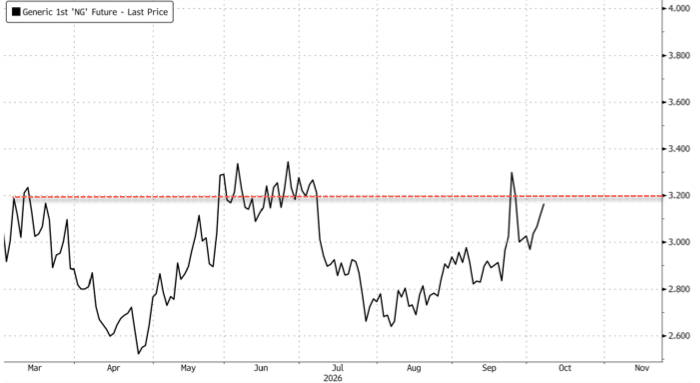
Forecasts shifted toward cooler conditions across the northern half of the US. Average temps across the Lower 48 are expected to drop below 30-year seasonal norms next Wednesday. Unseasonably cool temperatures could linger through the 19th before returning to normal.
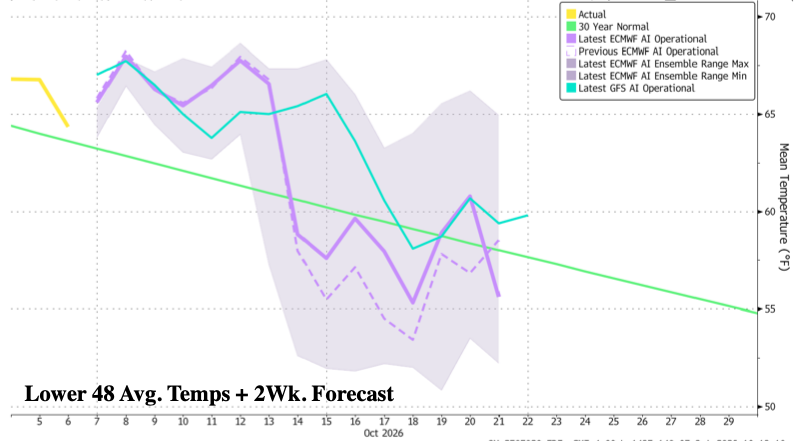
The shift could lift consumption in regions where heating demand typically begins earlier.
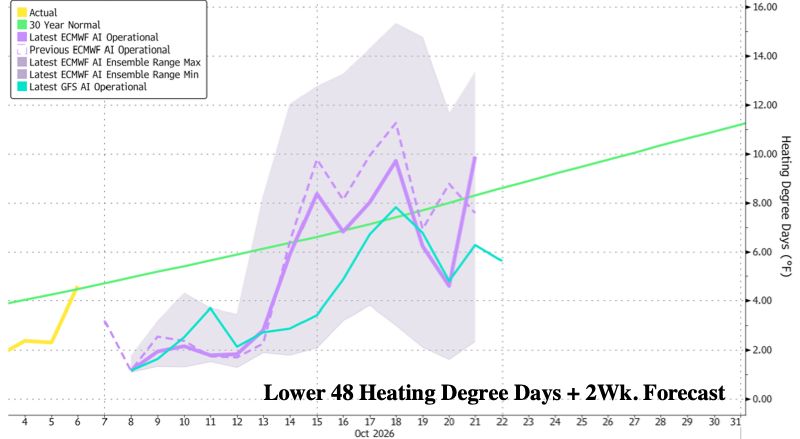
“Looking for a shift to a cooler-than-normal pattern across the South? I’m eyeing the week of October 19 for temperatures to finally dip below seasonal norms,” WTVY Chief Meteorologist David Paul wrote on social media.
Paul said, “The ECMWF model weeklies have been doing a pretty good job. Here’s the outlook for October 19-25.”
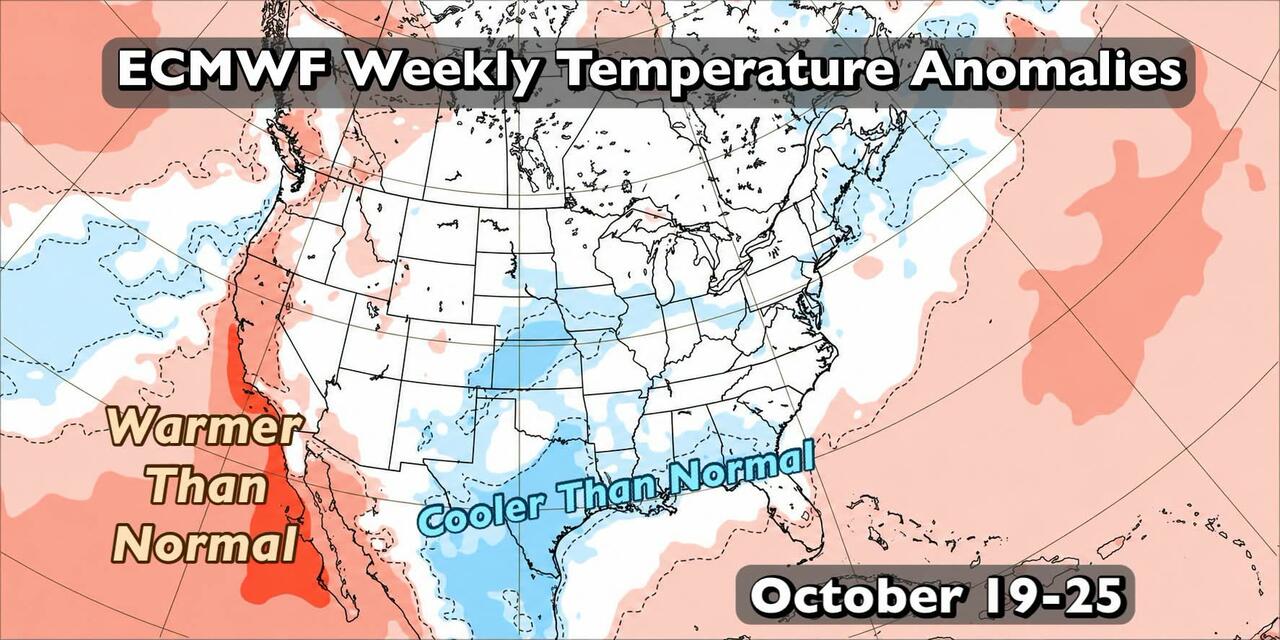
The latest cost of a cord of wood in the tri-state area (data via Angi):
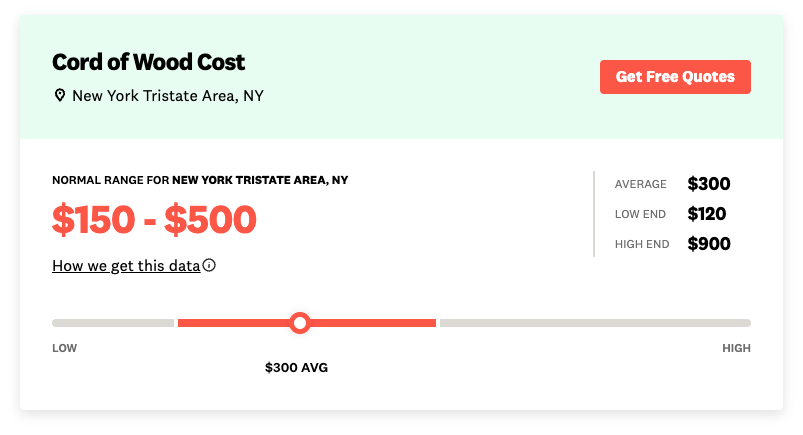
The question is whether a strong El Niño will bring warmer-than-usual temperatures to parts of the Lower 48 …
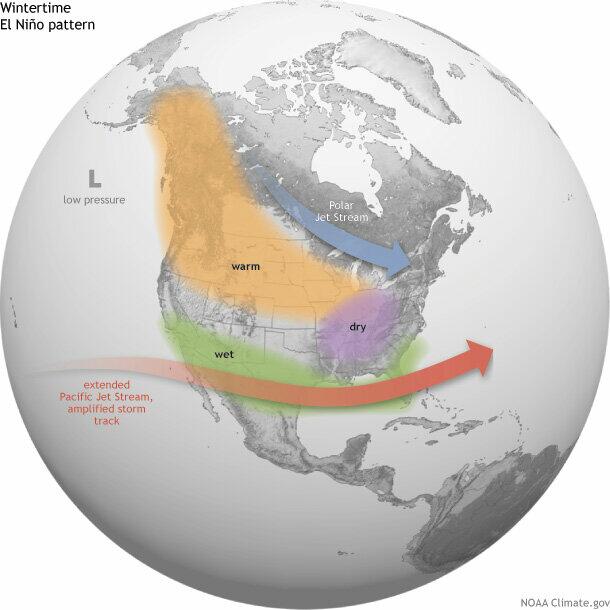
… or whether this is a taste of a severe winter.
PARAMOUNT: ITS BONDS!!
(zerohedge)
Skyfall: Fitch Downgrade Sends Legacy Paramount Bonds To Record Low As Merger Closes
Tuesday, Oct 06, 2026 – 10:49 PM
Last week, when we documented how Paramount’s record bond offering cratered before the ink was dry, we flagged one line from the Bear Traps chat as deserving extra attention: “Paramount’s existing unsecured bonds? Primed.” Today, with the $110 billion Warner Bros. Discovery takeover officially closed and the combined company (now simply “Skydance”, although “Skyfall” is certainly more appropriate) open for business, Fitch made it official.
In a rating action timed to the close, Fitch cut Paramount Skydance and WBD’s issuer ratings deeper into junk territory, to BB from BB+, citing “materially higher leverage” and “significant execution and integration risks.” But the real damage was further down the stack: Paramount’s legacy senior unsecured notes were downgraded to BB- with a Recovery Rating of RR5, which in Fitch-speak means expected recovery of just 11% to 30% in a default. WBD’s leftover unsecured notes fared worse still, cut to B+/RR6 (0% to 10%).
The market got the message. The old Paramount 6.875% notes due 2036 (originally Viacom paper) plunged to a record low of 77.7, down from 105 a year ago and roughly 92 as recently as mid-September. That’s ~14 points in three weeks, and a yield of roughly 10.6% by our math, on a bond that was trading above par last fall.
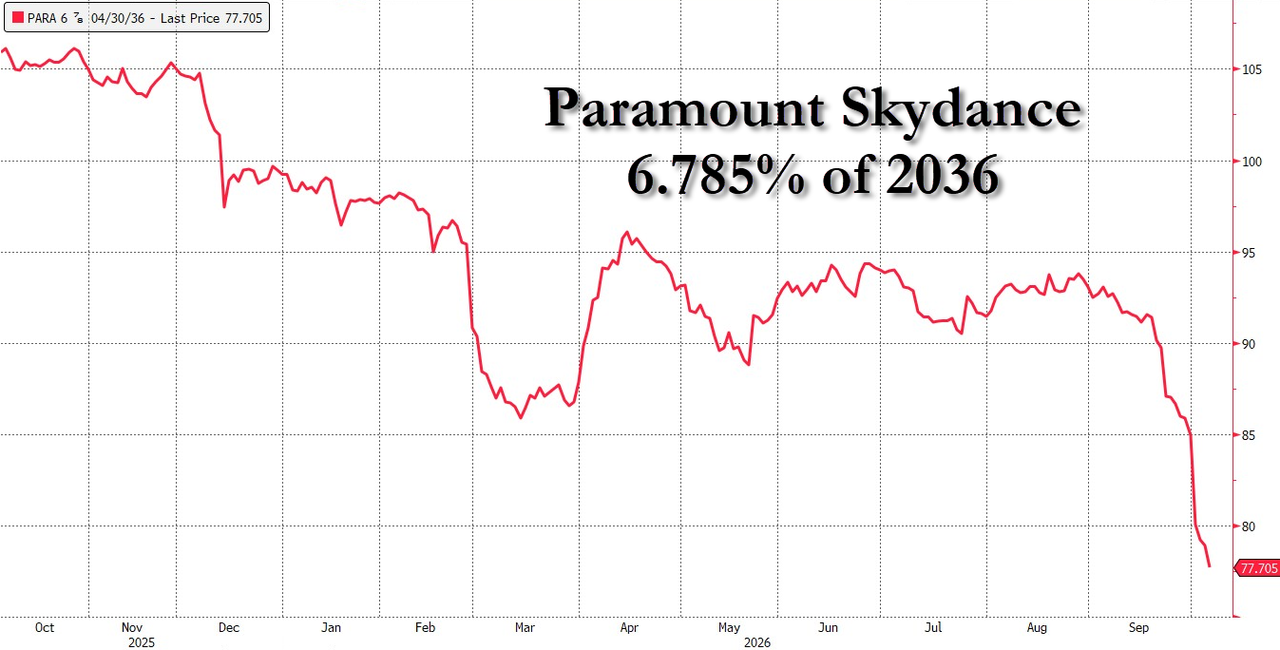
Get In Line
The logic is simple enough. Before the deal, legacy Paramount unsecured holders sat near the top of a ~$14 billion capital structure. After it, per Fitch, the combined company carries about $87.5 billion of total debt, including $44.5 billion of first-lien secured debt (rated BBB-/RR1) – still viewed as investment grade but not for long – and $12.4 billion of new second-lien secured paper (BB/RR4), all of which now ranks ahead of the old unsecured notes. Put differently, roughly $57 billion of secured creditors just cut in line.
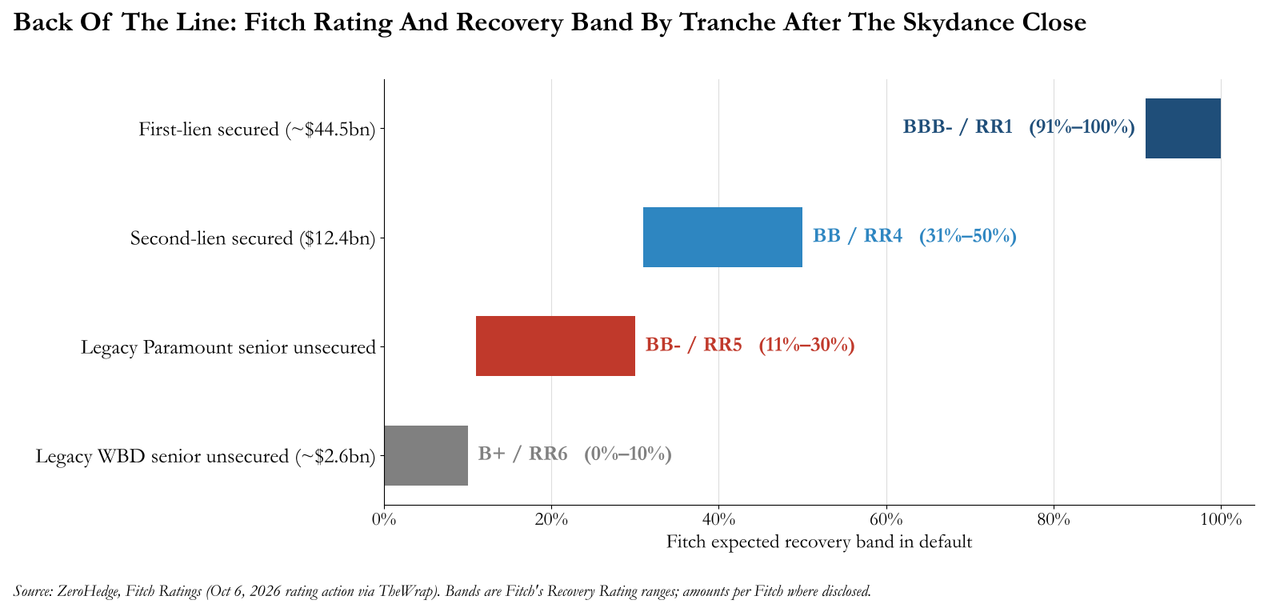
And here is the delicious irony: at ~10.6%, the legacy unsecured 2036s now yield more than the brand new second-lien junk bonds did at the very worst of last week’s puke, when the 8-year 2Ls traded a touch above 95 for a ~9.7% yield. The old bonds now trade like they’re junior to the junk, because they are.
Fitch Doesn’t Believe The Deleveraging Story Either
Fitch pegs leverage at 7.8x for fiscal 2026 after ~$57 billion of acquisition debt is added, falling to 6.2x in 2027 and 4.5x in 2028 if merger cost savings materialize. The company’s target is net leverage of 3x by the end of 2029, which leans heavily on $6 billion of synergies (read: mass layoffs, most likely from CNN) in three years. Fitch was blunt that this won’t be enough on its own:
“Execution risk stems from combining operations, realizing synergies and managing a higher debt burden. The transaction also requires integration of content, streaming technology, corporate systems and operating models… Delays or weaker execution could reduce planned cost savings and slow deleveraging.”
Translation: to hit the 2028 and 2029 targets, Fitch believes issuing equity or selling assets would be required on top of synergies and free cash flow. That’s the same equity we noted last week Paramount is “still looking for.” The agency also flagged that linear TV generated about 86% of the combined company’s pro forma 2025 EBITDA on just 52% of revenue, which is a polite way of saying the cash engine funding this deleveraging is the one business everyone agrees is in secular decline.
Throw in the commitments from the settlement with 12 state AGs (which Fitch says are “largely achievable” but could “constrain cost actions and operating flexibility”) and you have a cost-cutting plan that the regulators have partly pre-empted. Good news for Hollywood’s unions. Bondholders might see it differently.
Goldman’s Credit Desks: “One Of The Worst First-Day Performances”
The legacy bonds’ collapse comes on top of what Goldman’s credit desks are now openly calling a historic flop. In his weekend Lev Fin reading (available to pro subs), Goldman’s KC O’Connor wrote that the $12.4 billion second-lien deal…
“…had one of the worst first-day performances for a new deal in recent leveraged finance history. The new 5-year, 8-year, and 10-year 2L tranches underperformed what felt like a well-placed 1L deal, finishing the week 2.125 to 4.5pts below their original issue prices after just two full trading sessions, shaking market confidence.”
Goldman’s IG desk (Brad Shelofsky’s IG Credit Week in Review) wasn’t more charitable and noted the PSKY 9.125% 2036 2Ls fell as much as 6 points on Thursday before closing the week roughly 4 points below issue, while the first-lien PARA 7.9% 2036 closed around +280, 17bps wider than pricing: “Tough tone setter for the second largest IG deal of the year.” Goldman’s weekly credit digest summed it up best: SoftBank was absorbed cleanly, “PSKY was not,” which “demonstrated that strong order books do not necessarily translate into secondary sponsorship at current valuations.”
Which is exactly what we said the night the bonds broke:
Goldman’s high-yield desk, for its part, expects “inbound will remain elevated for the newly combined entity” given the price action since new issue. We’ll go out on a limb and agree.
Bottom Line
When Paramount won the bidding war for Warner Bros. back in February after Netflix walked because the deal was “no longer financially attractive,” the question was always who would end up footing the bill. Last week it was the new-issue buyers who got a full allocation. This week it’s the legacy unsecured holders, who never signed up for a 7.8x-levered media conglomerate and now find themselves behind $57 billion of secured debt with an 11%-30% recovery estimate.
The company’s CFO called last week’s selloff “one-day choppiness.” The legacy 2036s are now on their third week of “chop”, at a record low, with a fresh downgrade. And with equity issuance or asset sales now effectively a prerequisite for Fitch’s deleveraging path, the more likely next leg is more of the same, not a bounce. At least they did get a new name out of it.
Much more in the full Goldman Lev Fin Weekend Reading and “IG Credit Week in Review” notes, both available to pro subs.
END
From 3-Year Lows To 3-Year Highs In Nine Months: Mortgage Rates Surge To 7.49% As Bond Rout Hits Main Street
Wednesday, Oct 07, 2026 – 12:54 PM
Last December, we wrote that mortgage rates had dipped to 3-year lows. Nine months, one Middle East war and one global bond rout later, they are at 3-year highs.
According to the latest weekly data from the Mortgage Bankers Association, the average 30-year fixed-rate mortgage jumped another 19bps to 7.49% in the week ended October 2, the highest since November 2023, and up from 7.30% the week before, which itself was a fresh 3-year high.
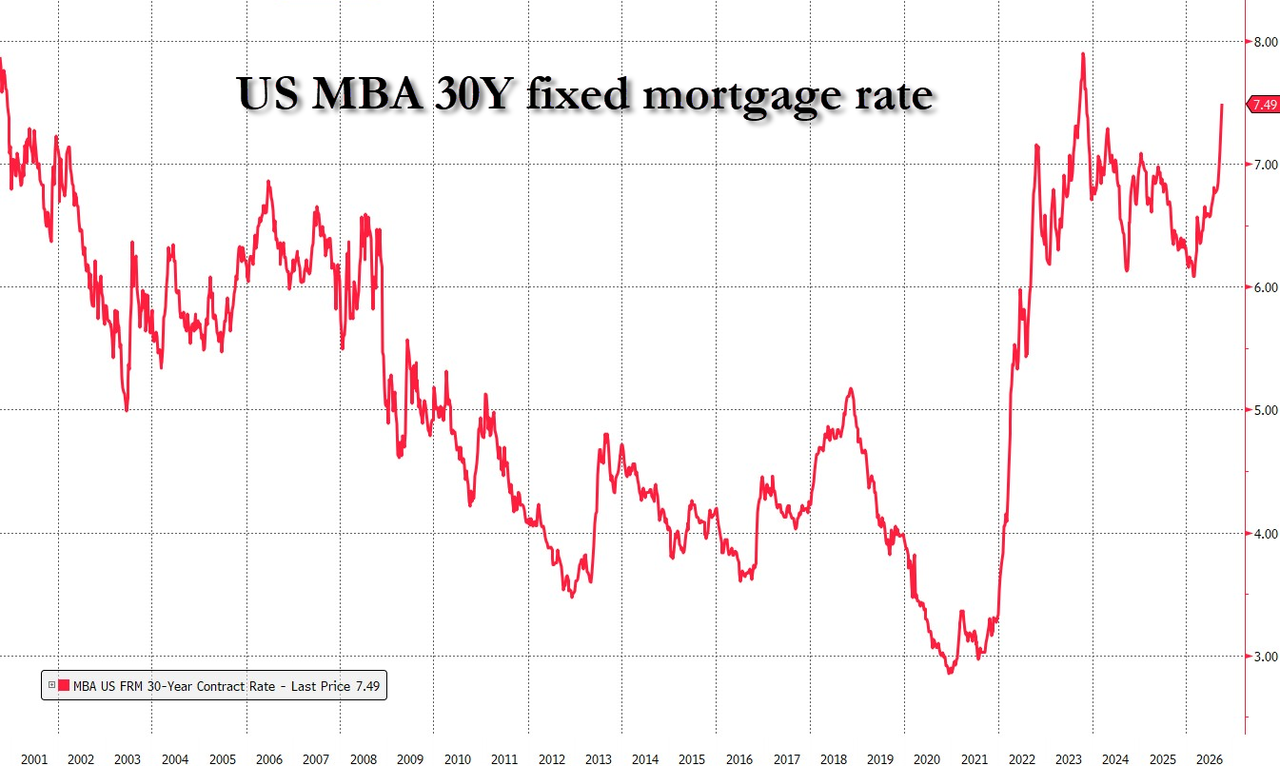
The culprit is not exactly a mystery. Mortgage rates track the 10Y Treasury, and the 10Y just had its biggest quarterly jump since 1994, hitting 5.34% last week, the highest since 2002. And with the long end leading the latest leg of the selloff, this morning the 30Y climbed to 5.70%, also the highest since 2002, while the 10Y was trading around 5.32%.
Below we look at why the bond rout has finally landed on Main Street, what it is doing to housing (spoiler: nothing good), and why the sell-side’s perennial “yields will fall from here” call is now 0 for 9.
Follow The 10Y (Then Add A War)
As Reuters notes, home borrowing rates are up about 1.4 percentage points since US-Israeli strikes against Iran began in late February, closely tracking the jump in the 10Y yield, which was back above 5.3% on Monday. The drivers are the usual suspects: inflation fears from triple-digit oil (Brent was back above $101 this morning as Iran stepped up attacks on Hormuz tankers), surprisingly resilient growth, a Fed that is now hiking, and a bond market that has to absorb record Treasury supply and the AI debt binge at the same time.
And it’s not just a US story. On Monday, we put out this chart showing that global 10Y+ bond yields are now the highest since 2002:
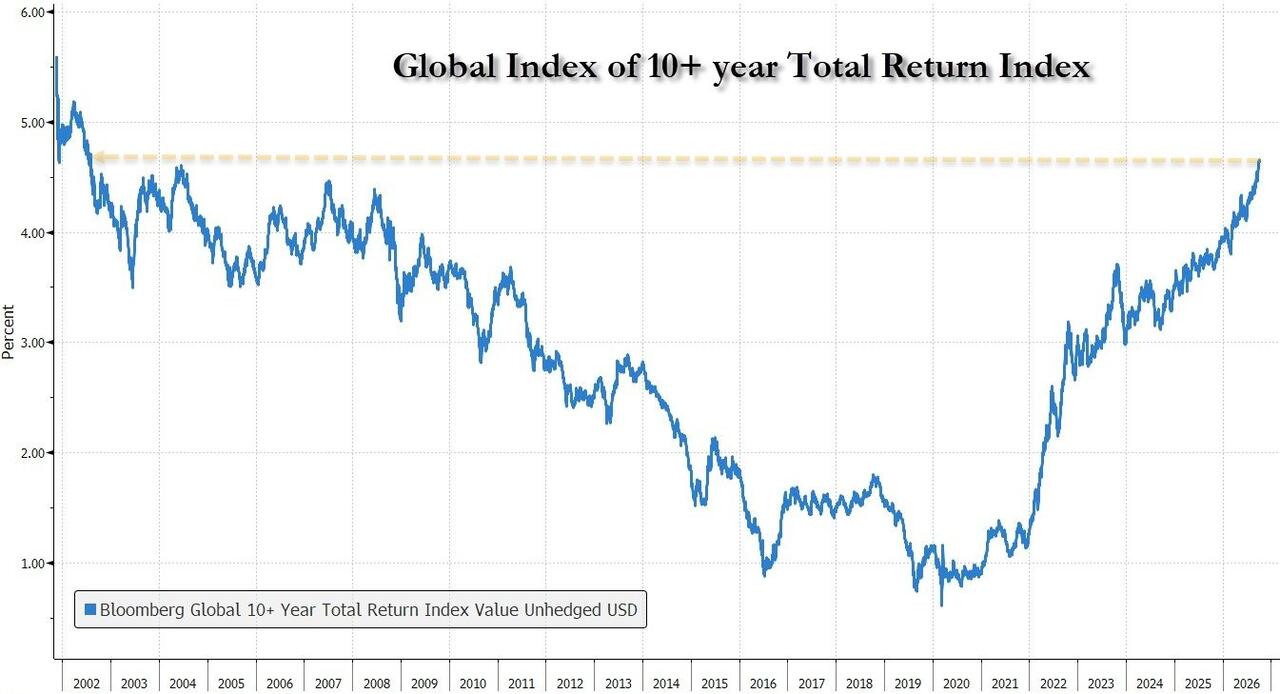
Since then it has only gotten worse: UK 30-year gilt yields hit a 28-year high this morning, while in France, where the OAT-Bund spread is back out to 140bps, European banks are tumbling as the French bond crash reactivates the “doom loop” (something we discussed earlier in “Bonds & Stocks Are Pricing A Fundamentally Different Macro Regime“). And as regular readers know, we’ve pinned much of the relentless Treasury selling on Japan, which has little reason to stop repatriating when its own long bonds yield near record highs.
Translation: the global bid for duration is gone, and the US homebuyer is the marginal price-taker. Yesterday’s subpar 3Y auction priced at the highest yield in 20 years as foreign demand slumped, and today the Treasury tries its luck with $39BN in 10Y paper at 1pm.
“Showings Have Stopped”… And So Have Applications
We have been tracking the slow-motion seizure of the housing market since late May, when refi activity plummeted as mortgage rates hit 9-month highs. By late September, homebuyers were turning to riskier mortgages as rates topped 7%, and last Thursday, after Freddie Mac’s 30Y rate posted its biggest weekly jump since October 2022 to 7.28%, real estate agents told us that “showings have stopped”.
Today’s MBA data confirms it. Mortgage applications fell another 4.2% last week, with refinancing applications dropping sharply. Overall application volume is now the lowest since February 2025, and has collapsed by nearly 50% since January. Or, in the dry words of MBA deputy chief economist Joel Kan, very few homeowners have an incentive to refinance “at these rates“, while the jump in borrowing costs has pushed many would-be buyers out of the purchase market altogether.
Some napkin math shows why. On a $400,000, 30-year mortgage, principal and interest at 7.49% comes to roughly $2,794 a month. At the ~6.1% that prevailed before the war, it was about $2,424. That’s $370 more every month, or 15%, for the exact same house – and 68% more than the borrower who locked in at the 2021 lows (who, naturally, is not selling).
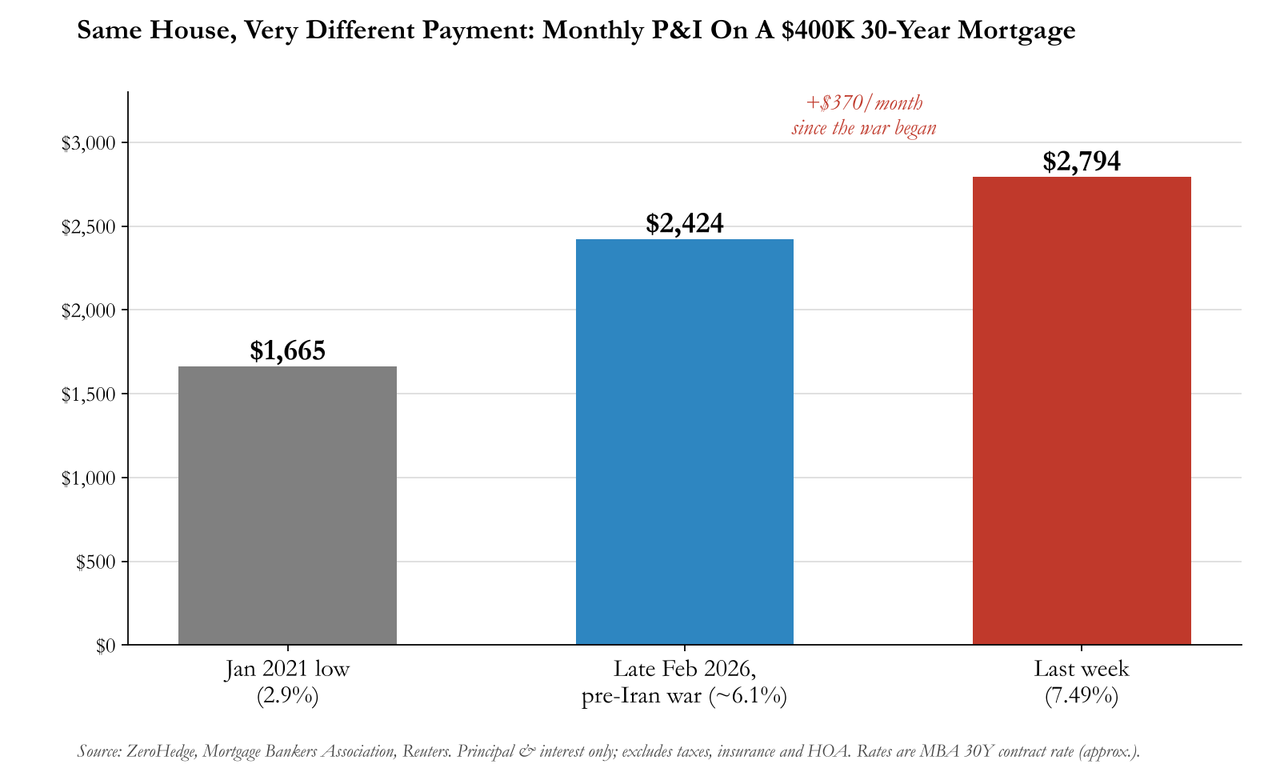
That last point is the real problem. The lock-in effect, which was finally starting to ease over the summer as inventory approached prepandemic levels, is now back with a vengeance: sellers with 3% mortgages have zero reason to move, and buyers facing 7.5% have every reason to wait. Even BofA’s REIT team, in its weekly U.S. REIT Weekly (available to pro subs), cites persistently high mortgage rates and elevated for-sale housing costs as a key reason renters are staying put longer – good news for apartment landlords; first-time buyers might see it differently.
Not that the administration isn’t trying. Just last Thursday:
Mortgage rates rose 19bps that week. The bond market, it seems, did not get the memo, or more likely got it and sold anyway.
“Rates May Be Biting”
So where do we go from here? According to BofA’s rates team led by Mark Cabana, the selloff only ends when it starts to hurt. In his latest Global Rates Weekly, “Start of rates bite” (available to pro subs), Cabana writes that the impact of higher rates is starting to bite broader financial conditions, with spreads widening in OATs, the EU periphery and US high yield, before adding:
“Rates restricting financial conditions is a precondition for the selloff to stop (unless macro data softens first). Central banks are starting to push back but will only be credible if conditions stay tight / tighten further or upcoming data softens.”
In other words, the cure for high yields is… a housing market that stops working. Mission, at least partially, accomplished.
Notably, September’s selloff was concentrated in the US: BofA calculates the US 2-10Y sector rose 50bps last month, a 2x standard deviation move in the 10Y, as global central banks swung from pricing cuts in Q1 to 100bp+ of hikes in most regions. BofA still expects the Fed to hike 75bps between September and December, and only sees the 10Y ending the year at 5.00%.
Then there’s the mortgage-specific part of the equation. As BofA’s securitized team led by Chris Flanagan notes in its September returns review (also available to pro subs), Agency MBS delivered a -3.3% total return in September and -1.0% in excess returns versus Treasuries, underperforming even IG corporates (-2.6%). And the bank isn’t rushing to buy the dip: it stays “basis-neutral” on agency MBS and would only turn more positive if the current coupon spread, now 120bp, widens to the 125-130bp area.
Put differently, even the professional buyers of mortgage paper want more spread on top of a 10Y that is already at a 24-year high. Which means that unless Treasuries rally hard, the path of least resistance for mortgage rates is even higher.
Strategists: 0 For 9 (And Counting)
Of course, if you ask Wall Street, relief is just around the corner. In a Reuters poll of nearly 60 fixed income strategists conducted October 5-7, the median forecast has the 10Y easing to 5.00% by year-end, 4.90% in six months and 4.75% in a year.
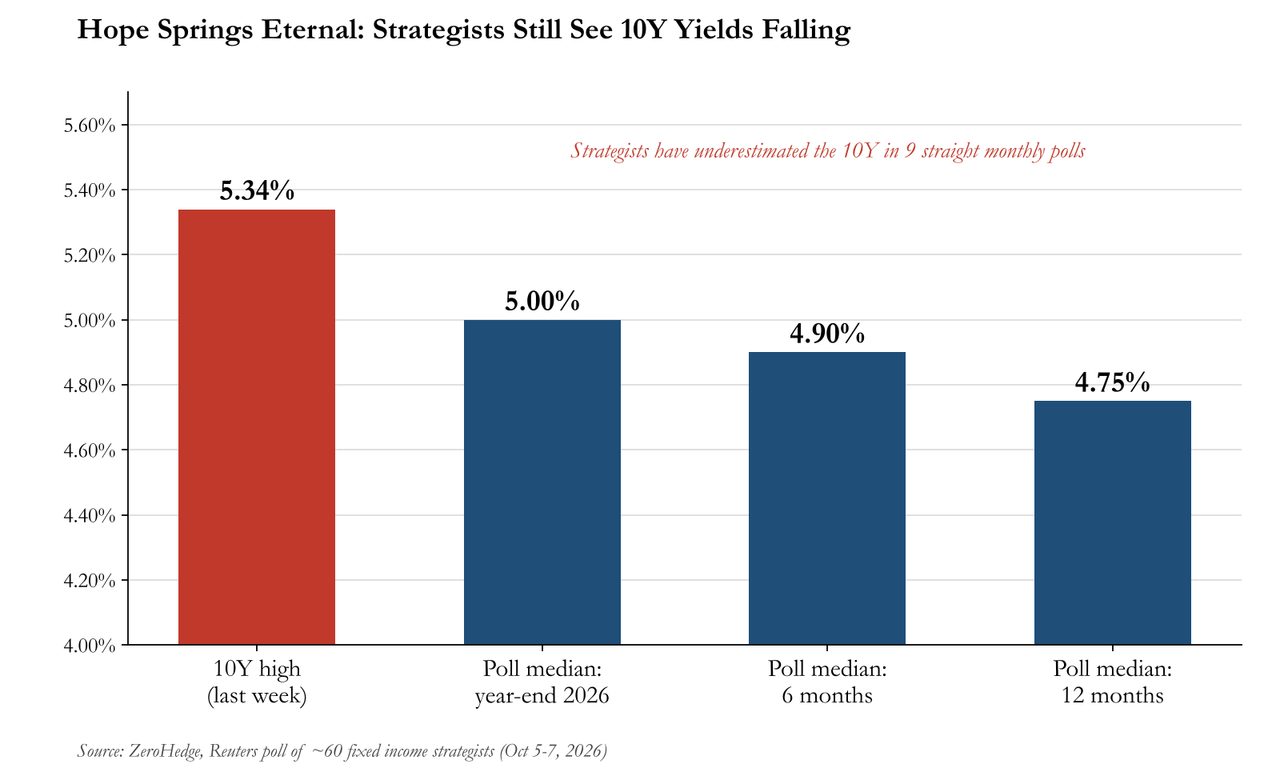
The same strategists have underestimated the 10Y in nine straight monthly polls this year, and got the direction mostly wrong in six of the most recent months. Perhaps sensing this, all but 2 of 30 forecasters surveyed said the 10Y is more likely to overshoot their forecast than undershoot it near term, which is a remarkably candid way of saying “we have no idea, but probably higher.”
The more honest take came from BofA’s own US rates strategist Meghan Swiber, who told Reuters rates have entered “a different regime” from anything since the GFC, and that a Fed which fails to tighten financial conditions will pay for it through higher long-term rates.
Midterm Math
All of this lands four weeks before the November 3 midterms. A Reuters/Ipsos poll completed Monday found the cost of living is the top issue on voters’ minds, which helps explain why Trump’s approval rating sits at a record low 32%. With PCE inflation at 3.4% in August and the Fed signaling another hike by year-end after September’s increase, the White House is running out of levers: today Trump said he is considering suspending the federal gas tax. Expect the “lower mortgage rates” talking points to get louder. Expect mortgage rates to ignore them.
Bottom Line
BofA’s Cabana frames the endgame neatly: the selloff stops when rates restrict financial conditions, or when the data rolls over first. In housing, that test is already being passed with flying colors: applications are down by half this year, showings have stopped, and refis have all but vanished.
The question is whether the bond market cares, after all it is financing AI hopes and dreams that may (perhaps) materialize sometime in the 2030s with an ROIC that isn’t negative triple digits. In other words, the runway for said hopes and dream is long and much more debt will flow before it reverses. Until then, however, broader rates will keep rising and rising, as the US now directly competes with data centers (most of which will never be plugged into a grid that simply can not support that kind of electricity demand) for funding.
With oil back above $100, the Fed hiking, Japan repatriating, France going all PIIGS on the OAT market and Treasury supply only going one way, we think the more likely outcome is that 7.49% is just another waypoint, and hardly a peak – and that the strategists’ “5% by year-end” joins the previous eight forecasts in the bin.
Then again, stocks closed at a record high yesterday, so maybe everything is fine… just don’t try to buy a house.
Much more in the full BofA Global Rates Weekly “Start of rates bite“, the Securitized Products “September 2026 returns” review and the U.S. REIT Weekly, all available to pro subs.
KING NEWS
| The King Report October 7, 2026 Issue 7842 | Independent View of the News |
| French bonds rallied sharply, boosting bonds globally, on Marine Le Pen’s pledged for sharp budget cuts. Le Monde: Le Pen vows drastic budget cuts to prevent French ‘default’ on debtFar-right presidential election candidate Marine Le Pen presented her party’s shadow budget plan, which promises €140 billion in cost savings over five years, bringing the deficit back under 3% of GDP by 2030 and a budgetary referendum… warning that without change France was “heading toward default” on its debt… The current frontrunner in the presidential race, Le Pen made the announcement in a bid to stake out her credibility on the economy and regain momentum after her top ally Jordan Bardella was accused of making antisemitic comments, which he has denied…https://www.lemonde.fr/en/france/article/2026/10/06/le-pen-vows-drastic-budget-cuts-to-prevent-french-default-on-debt_6758304_7.html President Donald Trump signs executive order to bring down diesel costs during Nebraska rallyThe executive order gives people access to tax-free red-dye diesel by deferring the federal diesel tax through the end of the year.https://justthenews.com/politics-policy/all-things-trump/president-donald-trump-signs-executive-order-bring-down-diesel With bonds behaving, the S&P 500 Index, Nasdaq, and Nvidia opened at all-time highs on Tuesday. Tuesday’s King Report: Nasdaq hit a record high on Monday. With the S&P 500 Index near (7773.95) its all-time high of 7816.70 on August 13, 2026, the usual suspects, barring news, will ‘shoot for the number’ and try to foment buying on the S&P 500 Index printing at a new all-time high. At 10:42 ET: SPCX +2.24%, NVDA +1.39%, MU +0.1%, AMD +2.78%, SNDK -2.11%, TSLA +0.61%, AVGO +4.05%, MDFT +1.76%, NETA -0.08%, INTC -1.7%, AAPL +0.29% SP Sectors at 10:42 ET: Utes +1.88%, Consumer Discretionary +0.9%, Info Tech +0.9%, Real Estate +0.83%, Consumer Staples +0.79%; Health Care -0.52% Despite the robust rally in interest-sensitive issues and sectors, USZs were only +4/32 at 10:36 ET, and down 10/32 from their 102 26/32 high (+20/32), which occurred at 7:42 ET on the French bond rally. USZs then sank to 102 5/32, -1/32, at 9:45 ET. Plus, energy commodities were down smartly. Nov WTI -$1.60, Dec Brent -$1.89, Nov Diesel -11.84¢, Nov Gasoline -5.07¢ at 10:45 ET. The S&P 500 Index opened at 7805.96, which was the session low, and did an ABC rally to 7844.52 at 11:26 ET. The A and C wave rallies had acute ascending angles, like the Monday rally. This indicates persistent and determined, if not manic, buying. Fed’s Schmid (KC Pres): Still have a way to go in beating inflationFed’s Schmid: Inflation is frustrating, must be fixedFed’s Schmid: AI is now one of the largest drivers of inflationFed’s Schmid: Fed’s credibility at stake in fighting inflationhttps://seekingalpha.com/news/4650656-big-drivers-of-inflation-right-now-are-energy-prices-ai-driven-demand-kc-feds-schmid After a steady decline to 7817.64 at 13:20 ET, the S&P 500 Index rebounded to a double top of 7831.15 at 14:10 ET and 7830.73 at 15:05 ET. Astute traders recognized the double top and lack of organic buying after making an all-time high. So, they unloaded; the S&P fell to 7817.85 at 15:54 ET. The routine late markup pushed the S&P 500 to 7820.78 at 15:58 ET; but the S&P slid into a 7818.93 close. Positive aspects of previous session Nasadq made a 2nd consecutive closing all-time high. The S&P 500 Index closed at an all-time high.S&P 500 +0.58%, DJIA +0.49%, Nasdaq +0.45%, Nas 100 +0.48%, SOX +0.34%SP Utes +3.01%, Cons Discr +1.39%, Real Estate +1.13%, Consumer Staples +0.96%; Industrials +0.9%, Materials +0.65%, Info Tech +0.55%, Energy +0.44%, Financials +0.18%, Comm Services +0.16%Energy commodities declined moderately except for Diesel, which rallied a cent and change Negative aspects of previous session S&P 500 Index, Nasdaq, and Nas 100 hit highs, including all-time, in the morning but then faltered.DJTA -0.45; SP Health Care -0.15% Ambiguous aspects of previous session Are stocks tired after the S&P and Nasdaq hit new highs but no afternoon follow through? First Hour/Last Hour NYSE Action [S&P 500 Index]: 1st Hour: Up; Last Hour: Down Pivot Point for S&P 500 Index [above/below indicates daily trend to day traders]: 7823.14 Previous session (S&P 500 Index) High/Low: 7844.52 (11:26 ET); 7805.96 (9:30 ET) @NEWSMAX: Trump said Monday that he will consider establishing a U.S. military base in Lithuania. Today – Nasdaq and the S&P 500 made all-time highs on Tuesday. However, the S&P 500 Index hit its daily high at 11:26 ET; the Nasdaq 100 hit its high at 11:15 ET; and Nasdaq hit its high at 11:20 ET. The indices then sank into the close. This indicates a lack of organic buying; and trader buying early in the session on ‘shooting for the number.’ The First-Hour Indicator could be very useful today in navigating stock indices. If the 1st Hour high or low is breached, there should be a spirited move in the direction of the breach. ESZs +9.25; NQZs +25.75, USZs -15/32, Nov WTI +$0.82, Nov Gas +0.06¢, Yen/158.39 at 20:300 ET Expected economic data: Aug Consumer Credit $14.4B exp; FOMC Minutes 13:00 ET; 10-year US Bond Auction ($39B, Reopening 9-year 10-month) S&P 500 50-day MA: 7673; 100-day MA: 7572; 200-day MA: 7235 (Close 7818.93, +0.58%)Nasdaq 100 50-day MA: 29,581; 100-day MA: 29,537; 200-day MA: 25,541 (Close 31,224.5 +0.48%) DJIA 50-day MA: 52,683; 100-day MA: 52,090; 200-day MA: 50,307 (Close 51,521.28 +0.49%) (Green is positive slope; Red is negative slope) @paulsperry_: Federal records show ex-Trump prosecutor Jack Smith, who claims politics played no role in his witch hunt targeting 430+ Republican orgs, donors & senators, is married to a Democrat activist who gave at least $2,220 to Biden + other Dems; meanwhile, IRS records reveal his wife Katy Chevigny also makes Soros-backed films inclg a hagiography about Michelle Obama, while her mother was a George Soros Senior Justice Fellow at Open Society FoundationBiden FBI tracked Melania and Barron Trump’s travel – and even tapped Susie Wiles’ phone, documents show https://trib.al/bd61gqR The fact that NO one from the Obama and Biden regimes has been prosecuted for egregious and unconstitutional acts is infuriating and provokes fear of a rig to protect the Establishment and Deep State – just like the non-prosecutions for Epstein. Somali gangs blamed for shooting at Minneapolis homecoming game that left 2 wounded, fans fleeing in panic (Thank you, Obama!) https://trib.al/HDV9yUZ @RubinReportShow: Paris erupts in chaos as massive riots break out, Palestine flags dominate the streets, overwhelmed riot police fight to regain control, foreign crowds flood the city, and leftists spiral into frenzy. https://x.com/RubinReportShow/status/2107494033769844750 @realDonaldTrump: What’s happening in France is nothing less than out of control mass migration. This isn’t about schools; this is about Islam wanting to take over a once great Country! Oct 06, 11:25 AM @johnddavidson: The problem looming over these riots is that France has a large population of young people who are immigrants or the children/grandchildren of immigrants that are simply not employable. They will not work and employers will not risk hiring them. They are not citizens in any meaningful sense, but an unassimilated third world horde, unemployable and ultimately ungovernable. @WesternLensman: Kamala wonders where her applause is after delivering what she thought was a killer line, then bursts into hysterical cackling. Audience mercy claps. She’s gonna run and subject the country to two more years of this. https://x.com/WesternLensman/status/2107568846060097948 Former German spy chief (August Hanning) arrested for espionage and treason: BBChttps://www.bbc.com/news/articles/c58jzyer1kr0o | |
SWAMP STORIES FOR YOU TONIGHT
GREG HUNTER…
SEE YOU TOMORROW


