
SILVER: 59.19 3;30 PM)
EXCHANGE: COMEX
CONTRACT: OCTOBER 2026 COMEX 100 GOLD FUTURES
SETTLEMENT: 4,113.800000000 USD
INTENT DATE: 10/07/2026 DELIVERY DATE: 10/09/2026
FIRM ORG FIRM NAME ISSUED STOPPED
152 C DORMAN TRADING, LLC 10
363 H WELLS FARGO SECURITI 34
365 C MAREX CAPITAL MARKET 120
686 C STONEX FINANCIAL INC 1
737 C ADVANTAGE FUTURES 145
880 C CITIGROUP 10
905 C ADM 2
991 H CME 8
TOTAL: 165 165
MONTH TO DATE: 12,074
GOLD: NUMBER OF NOTICES FILED FOR OCT./2026: 165 CONTRACTs NOTICES FOR 16,500 OZ or 0.5132 TONNES
total notices so far: 12,074 contracts FOR 1,207,400 OZ OR 37.555 TONNES
SILVER NOTICES: 330 NOTICE(S) FILED FOR 1.650 MILLION OZ /
total number of notices filed so far this month : 2767 CONTRACTS (NOTICES) for 13.835 million oz
GLD
SHANGHAI CLOSED DOWN 30.29 PTS OR 0.79%
HANG SENG CLOSED DOWN 356.00 PTS OR 1.58%
Nikkei CLOSED DOWN 791.71 PTS OR 1.13%
//Australia’s all ordinaries CLOSED DOWN 0.75%
//Chinese yuan (ONSHORE) CLOSED UP AT 6.7027
/ OFFSHORE CLOSED UP AT 6.7033 Oil UP TO 91.62 dollars per barrel for WTI and BRENT UP TO 104.13 Stocks in Europe OPENED ALL RED
ONSHORE USA/ YUAN// WITH YUAN TRADING 6.7029 (STARTING TODAY) OFFSHORE YUAN TRADING UP TO 6.7033 ONSHORE YUAN TRADING ABOVE LEVEL // OFF SHORE AND UP ON THE DOLLAR)// / AND THUS STRONGER/OFF SHORE YUAN TRADING UP AGAINST US DOLLAR/ AND THUS STRONGER
XXXXXXXXXXXXXXXXXXXXXXXXXXXXXXXXXXXXX
| Gold | Ounces |
| Withdrawals from Dealers Inventory in oz | nil |
| Withdrawals from Customer Inventory in oz | 2 ENTRIES i) Brinks 1993.362 oz (62 kilobars) ii) Manfra: 96.43 oz (3 kilobars) total withdrawal: 2089.865 oz |
| Deposit to theDealerInventory in oz | 0 ENTRIES |
| Deposits to the Customer Inventory, in oz | DEPOSITS/CUSTOMER//gold 0 ENTRIES xxxxxxxxxxxxxxxx |
| No of oz served (contracts) today | 165 CONTRACTS 16500 OZ 0.5132 TONNES OF GOLD |
| No of oz to be served (notices) | 135 Contracts 13500 OZ 0.4199 TONNES |
| Total monthly oz gold served (contracts) so far this month | 12,074 notices 1,207,400 OZ 37.555 TONNES |
| Total accumulative withdrawals of gold from the Dealers inventory this month | NIL oz |
| Total accumulative withdrawal of gold from the Customer inventory this month |
dealer deposits: 0
xxxxxxxxxxxxxxxxxxx
DEPOSITS:
ENTRIES: 0
xxxxxxxxxxxxxxxxxx
comex withdrawal
2 ENTRIES
i) Brinks 1993.362 oz (62 kilobars)
ii) Manfra: 96.43 oz (3 kilobars)
total withdrawal: 2089.865 oz
adjustments: 2
DEALER TO CUSTOMER ACC’T
a) Brinks: 6,269.445 oz
b) Manfra 1416.745 oz
COMEX IS DRAINING GOLD
chaos inside the comex
THE FRONT MONTH OF OCT OI STANDS AT 300 CONTRACTS HAVING A GAIN OF 76 CONTRACTS.
YESTERDAY WE HAD 1,205,200 OZ ( 37.486 TONNES) OF GOLD STANDING FOR DELIVERY: TODAY: 1,220,900 OZ OR 37.975 TONNES FOR A GAIN OF 15,700 OZ (0.4833 TONNES) OR 157 CONTRACTS UNDERWENT A QUEUE JUMP FOR 15,700 OZ (.4883TONNES) AS THEY SEEK PHYSICAL GOLD ON THIS SIDE OF THE POND.
NOVEMBER LOST 39 CONTRACTS FALLING TO 4097
DECEMBER, THE LARGEST DELIVERY MONTH IN THE CALENDAR, ITS OI FALLS BY 232 CONTRACTS DOWN TO 323,410.
.
We had 165 contracts filed for today representing 16500 oz
Today, 0 notice(s) were issued from J.P.Morgan dealer and 0 notices issued from their client or customer account. The total of all issuance by all participants equate to 165 contract(s) of which 0 notices were stopped (received) by j.P. Morgan dealer and 0 notice(s) was (were) stopped (received) by J.P.Morgan//customer account
To calculate the INITIAL total number of gold ounces standing for OCT /2026. contract month, we take the total number of notices filed so far for the month (12,074) to which we add the difference between the open interest for the front month of OCT (300 CONTRACTS) minus the number of notices served upon today 165 x 100 oz per contract) equals 1,220,900 OZ OR(37.975 Tonnes of gold) to which we add our first exchange for risk in Oct totalling 836 contracts for 83,600 oz or 2.600 tonnes. Thus Oct standing for gold advances hugely to 40.575 tonnes
THUS: INITIAL total number of gold ounces standing for OCT. /2026. contract month,we take the total number of notices filed so far for the month (12,074) to which we add the difference between the open interest for the front month of OCT(300) contracts minus the number of notices served upon today 165 x 100 oz per contract) equals 1,222,900 OZ OR(37.975 Tonnes of gold) plus our first exchange for risk totalling 836 contracts//83600 oz//2.600 tonnes//standing advances to 40.575 tonnes
new total of gold standing in OCT becomes 40.086 TONNES//
TOTAL COMEX GOLD STANDING FOR OCT.: 40.575 TONNES WHICH IS NOW VERY STRONG FOR THIS NON ACTIVE DELIVERY MONTH OF OCT./
WEDNESDAY VOLUME: 188,351 POOR
COMEX GOLD INVENTORIES/CLASSIFICATION
NEW PLEDGED GOLD:
241,794.285 oz NOW PLEDGED /HSBC 5.94 TONNES
204,937.290 OZ PLEDGED MANFRA 3.08 TONNES
83,657.582 PLEDGED JPMorgan no 1 1.690 tonnes
265,999.054, oz JPM No 2
1,152,376.639 oz pledged Brinks/
Manfra: 33,758.550 oz
Delaware: 193.721 oz
International Delaware:: 11,188.542 oz
total pledged gold: 1,721,684.952 oz 53.55 tonnes pledged gold lowers
total inventories in gold declining rapidly
total pledged gold: 1,721,684.952 tonnes oz 53.55 tonnes
TOTAL OF ALL GOLD ELIGIBLE AND REGISTERED GOLD 23,477,528.707oz//
TOTAL REGISTERED GOLD 15,067,141.026 tonnes (468.65 tonnes)
TOTAL OF ALL ELIGIBLE GOLD 8,410,387.681 oz.
REGISTERED GOLD THAT CAN BE SERVED UPON 13,345,457oz ((REG GOLD- PLEDGED GOLD)=
415.090 Tonnes //
total inventories in gold declining rapidly
SILVER COMEX
OCT DELIVERY MONTH
OCT 8
| Silver | Ounces |
| Withdrawals from Dealers Inventory | NIL oz |
| Withdrawals from Customer Inventory | 5 entries i) Out of Asahi 1,194,841.09 oz. ii) Out of Brinks 957.300 oz iii) Out of CNT 604,294.615 oz iv) Out of JPMorgan: 1,311,808.000 oz v) Out of Loomis: 569,279.990 oz total withdrawal: 3,681,180.995 oz |
| Deposits to the Dealer Inventory | 0 ENTRY |
| Deposits to the Customer Inventory | ENTRIES: 2 i) Into Asahi: 601,503,800 oz ii) Into CNT 599,953.970 oz total deposit: 1,201,457.770 oz |
| No of oz served today (contracts) | 330 CONTRACT(S) ( 1.650 MILLION OZ) |
| No of oz to be served (notices) | 726 Contracts (3.630 MILLION oz) |
| Total monthly oz silver served (contracts) | 2767 contracts 13.835 MILLIONoz |
| Total accumulative withdrawal of silver from the Dealers inventory this month | NIL oz |
| Total accumulative withdrawal of silver from the Customer inventory this month |
DEPOSITS INTO DEALER ACCOUNTS
ENTRY:0
DEPOSIT ENTRIES/CUSTOMER ACCOUNT
2 ENTRIES:
i) Into Asahi: 601,503,800 oz
ii) Into CNT 599,953.970 oz
total deposit: 1,201,457.770 oz
xxxxxxxxxxxxxxxxxxxxxxxxx
withdrawals:
5 entries
i) Out of Asahi 1,194,841.09 oz.
ii) Out of Brinks 957.300 oz
iii) Out of CNT 604,294.615 oz
iv) Out of JPMorgan: 1,311,808.000 oz
v) Out of Loomis: 569,279.990 oz
total withdrawal: 3,681,180.995 oz
adjustments : 1//Asahi dealer to customer:
602,047.800 oz
xxxxxxxxxxxxxx
TOTAL REGISTERED SILVER: 102.215 MILLION OZ//.TOTAL REG + ELIGIBLE. 333.068 Million oz
registered silver dropping in numbers
CALCULATIONS FOR THE NEW STANDING FOR SILVER FOR OCT
FRONT MONTH: SILVER OPEN INTEREST CONTRACTS: 1056 FOR A LOSS OF 145 CONTRACTS.
WEDNESDAY WE HAD 17.620 MILLION OZ STAND: TODAY: 17.465 MILLION OZ FOR A LOSS OF 0.155 MILLION OZ OR 155,000 OZ (31 CONTRACTS). THUS A STRONG EXCHANGE FOR PHYSICAL TRANSFER TO LONDON WHERE THEY WILL TAKE DELIVERY OVER ON THE LONDON SIDE OF THE POND.
NOVEMBER GAINED 477 CONTRACTS UP TO AN OI OF 1749
DECEMBER GAINED 284 CONTRACTS DOWN TO AN OI OF 83,236
TOTAL NUMBER OF NOTICES FILED FOR TODAY: 330 or 1.650 MILLION oz
CONFIRMED volume WEDNESDAY; 53,715 // poor/
AND NOW OCT. DELIVERIES:
To calculate the number of silver ounces that will stand for delivery in OCT. we take the total number of notices filed for the month so far at 2767 X5,000 oz = 13.835 MILLION oz.
Then we take the difference between the front month of OCT. and the number of notices filed for today x 5000 to give us our standing
Thus the standings for silver for the OCT 2026 contract month: (2767 )Notices served so far) x 5000 oz + OI for the front month of OCT (1056) minus number of notices served upon today ( 330 x 5000 oz) equals silver standing for the OCT .contract month equating to 17.465 MILLION OZ to which we add silver’s TWO exchange for risk for 450 contracts (2.25 million oz).. total standing reduces to 19.715 million oz//. ( a very strong delivery month)
We must also keep in mind that there is considerable silver standing in London coming from our longs
There are ONLY 102.215 million oz of registered silver
JPMorgan as a percentage of total silver: 128.132/333.068 million: 38.43%
The record level of silver open interest is 234,787 contracts set on April 21./2017 with the price on that day at $18.42.
The previous record was 224,540 contracts with the price at that time of $20.44.
BOTH GLD AND SLV ARE MASSIVE FRAUD
XXXXXXXXXXXXXXXXXXXXXXXXXXXXXXXXXXXXXXXXXXX
OCT 8//2026/WITH GOLD UP $16.85 /HUGE CHANGES IN GOLD AT THE GLD: A DEPOSIT OF 3.703 TONNES OF GOLD INTO THE GLD//: //:/INVENTORY RESTS AT 1059.873 TONNES
OCT 7//2026/WITH GOLD DOWN $46.70 /NO CHANGES IN GOLD AT THE GLD:: //:/INVENTORY RESTS AT 1056.27 TONNES
OCT 6//2026/WITH GOLD UP $30.60 /HUGE CHANGES IN GOLD AT THE GLD:: A DEPOSIT OF 0.754 TONNES OF GOLD INTO THE GLD// //:/INVENTORY RESTS AT 1056.27 TONNES
OCT 5//2026/WITH GOLD DOWN $2.20 /HUGE CHANGES IN GOLD AT THE GLD:: A WITHDRAWAL OF 0.854 TONNES OF GOLD INTO THE GLD// //:/INVENTORY RESTS AT 1055.696 TONNES
OCT 2//2026/WITH GOLD DOWN $43.00 /HUGE CHANGES IN GOLD AT THE GLD:: A DEPOSIT OF 0.854 TONNES OF GOLD INTO THE GLD// //:/INVENTORY RESTS AT 1056.55 TONNES
OCT 1//2026/WITH GOLD UP $19.55 /HUGE CHANGES IN GOLD AT THE GLD:: A WITHDRAWAL OF 1.711 TONNES OF GOLD OUT OF THE GLD// //:/INVENTORY RESTS AT 1055.696 TONNES
SEPT 30//2026/WITH GOLD UP $7.80 /HUGE CHANGES IN GOLD AT THE GLD:: A DEPOSIT OF 2.847 TONNES OF GOLD INTO THE GLD// //:/INVENTORY RESTS AT 1057.407 TONNES
SEPT 29//2026/WITH GOLD UP $11.75 /NO CHANGES IN GOLD AT THE GLD //:/INVENTORY RESTS AT 1054.56 TONNES
SEPT 28//2026/WITH GOLD DOWN $150.20 /NO CHANGES IN GOLD AT THE GLD //:/INVENTORY RESTS AT 1054.56 TONNES
SEPT 25//2026/WITH GOLD DOWN $150.20 /NO CHANGES IN GOLD AT THE GLD //:/INVENTORY RESTS AT 1054.56 TONNES
SEPT 24//2026/WITH GOLD DOWN $18.70 /HUGE CHANGES IN GOLD AT THE GLD A DEPOSIT OF 1.43 TONNES OF GOLD INTO THE GLD://:/INVENTORY RESTS AT 1056.84 TONNES
SEPT 23//2026/WITH GOLD DOWN $58.00 /HUGE CHANGES IN GOLD AT THE GLD://:/INVENTORY RESTS AT 1055.41 TONNES
SEPT 22//2026/WITH GOLD DOWN $6.30 /HUGE CHANGES IN GOLD AT THE GLD://A DEPOSIT OF 0.31 TONNES OF GOLD INTO THE GLD/:/INVENTORY RESTS AT 1055.41 TONNES
SEPT 21//2026/WITH GOLD DOWN $41.20 /HUGE CHANGES IN GOLD AT THE GLD://A DEPOSIT OF 2.26 TONNES OF GOLD INTO THE GLD/:/INVENTORY RESTS AT 1055.10 TONNES
SEPT 18//2026/WITH GOLD UP $26.45 /HUGE CHANGES IN GOLD AT THE GLD://A DEPOSIT OF 0.85 TONNES OF GOLD INTO THE GLD/:/INVENTORY RESTS AT 1052.84 TONNES
SEPT 17//2026/WITH GOLD UP $14.05 /HUGE CHANGES IN GOLD AT THE GLD://A DEPOSIT OF 1.71 TONNES OF GOLD INOT THE GLD/:/INVENTORY RESTS AT 1051.99 TONNES
SEPT 16//2026/WITH GOLD UP $53.40 /HUGE CHANGES IN GOLD AT THE GLD://A DEPOSIT OF 2.86 TONNES OF GOLD INOT THE GLD/:/INVENTORY RESTS AT 1050.28 TONNES
SEPT 15//2026/WITH GOLD DOWN $19.45 /NO CHANGES IN GOLD AT THE GLD://A WITHDRAWAL OF 0.353 TONNES OF GOLD FROM THE GLD/:/INVENTORY RESTS AT 1047.420 TONNES
SEPT 14//2026/WITH GOLD DOWN $54.50 /SMALL CHANGES IN GOLD AT THE GLD://A WITHDRAWAL OF 0.353 TONNES OF GOLD FROM THE GLD/:/INVENTORY RESTS AT 1047.420 TONNES
SEPT 11//2026/WITH GOLD UP $1.05 /SMALL CHANGES IN GOLD AT THE GLD://A WITHDRAWAL OF 0.353 TONNES OF GOLD FROM THE GLD/:/INVENTORY RESTS AT 1050.277 TONNES
/SEPT 10//2026/WITH GOLD UP $50.60 /NO CHANGES IN GOLD AT THE GLD://:/INVENTORY RESTS AT 1050.63 TONNES
SEPT 9//2026/WITH GOLD UP $20.40 /HUGE CHANGES IN GOLD AT THE GLD:A WITHDRAWAL OF 1.43 TONNES OF GOLD OUT OF THE GLD/ ////:/INVENTORY RESTS AT 1050.63 TONNES
SEPT 8//2026/WITH GOLD DOWN $34.20 /HUGE CHANGES IN GOLD AT THE GLD:A WITHDRAWAL OF 1.42 TONNES OF GOLD OUT OF THE GLD/ ////:/INVENTORY RESTS AT 1052.06 TONNES
SEPT 4//2026/WITH GOLD DOWN $63.50 /HUGE CHANGES IN GOLD AT THE GLD:A WITHDRAWAL OF 3.14 TONNES OF GOLD OUT OF THE GLD/ ////:/INVENTORY RESTS AT 1053.48 TONNES
SEPT 3//2026/WITH GOLD UP $141.55 /HUGE CHANGES IN GOLD AT THE GLD:A DEPOSIT OF 9.98 TONNES OF GOLD INTO THE GLD/ ////:/INVENTORY RESTS AT 1056.62 TONNES
SEPT 2//2026/WITH GOLD UP $19.25 /HUGE CHANGES IN GOLD AT THE GLD:A DEPOSIT OF 4.28 TONNES OF GOLD INTO THE GLD/ ////:/INVENTORY RESTS AT 1046.64 TONNES
SEPT 1//2026/WITH GOLD DOWN $80.25 /NO CHANGES IN GOLD AT THE GLD:// ////:/INVENTORY RESTS AT 1042.36 TONNES
GLD INVENTORY: 1059.973 TONNES, TONIGHTS TOTAL GOLD INVENTORY
SILVER
OCT 8 WITH SILVER DOWN $0.74 : :SMALL CHANGES IN INVENTORY AT THE SLV:A WITHDRAWAL OF 532,000 OZ FROM THE SLV// // :INVENTORY RESTS AT 492.278 MILLION OZ
OCT 7 WITH SILVER DOWN $1.36 : :SMALL CHANGES IN INVENTORY AT THE SLV:A WITHDRAWAL OF 451,000 OZ FROM THE SLV// // :INVENTORY RESTS AT 492.910 MILLION OZ
OCT 6 WITH SILVER UP $0.31 : :NO CHANGES IN INVENTORY AT THE SLV: // :INVENTORY RESTS AT 493.361 MILLION OZ
OCT 5 WITH SILVER UP $0.87 : :NO CHANGES IN INVENTORY AT THE SLV: // :INVENTORY RESTS AT 493.361 MILLION OZ
OCT 2 WITH SILVER DOWN $0.74 : :NO CHANGES IN INVENTORY AT THE SLV: // :INVENTORY RESTS AT 493.578 MILLION OZ
OCT 1 WITH SILVER UP $0.57 : :HUGE CHANGES IN INVENTORY AT THE SLV: A WITHDRAWAL OF 1.400 MILLION OZ OUT OF THE SLV// :INVENTORY RESTS AT 493.578 MILLION OZ
SEPT 30 WITH SILVER DOWN $0.55 : :HUGE CHANGES IN INVENTORY AT THE SLV: A DEPOSIT OF 994,000 OZ INTO THE SLV// :INVENTORY RESTS AT 494.978 MILLION OZ
SEPT 29 WITH SILVER DOWN $0.58 : :SMALL CHANGES IN INVENTORY AT THE SLV: A WITHDRAWAL OF 566,000 OZ FROM THE SLV// :INVENTORY RESTS AT 493.984 MILLION OZ
SEPT 28 WITH SILVER DOWN $2.91 : :SMALL CHANGES IN INVENTORY AT THE SLV: A DEPOSIT OF 0.542 MILLION OZ FROM THE SLV// :INVENTORY RESTS AT 494.436 MILLION OZ
SEPT 25 WITH SILVER DOWN $2.91 : :SMALL CHANGES IN INVENTORY AT THE SLV: A DEPOSIT OF 0.542 MILLION OZ FROM THE SLV// :INVENTORY RESTS AT 494.436 MILLION OZ
SEPT 24 WITH SILVER DOWN $0.96 : :HUGE CHANGES IN INVENTORY AT THE SLV: A WITHDRAWAL OF 0.813 MILLION OZ FROM THE SLV// :INVENTORY RESTS AT 493.533 MILLION OZ
SEPT 23 WITH SILVER UP $1.58 : :HUGE CHANGES IN INVENTORY AT THE SLV: A WITHDRAWAL OF 1.716 MILLION OZ FROM THE SLV// :INVENTORY RESTS AT 494.346 MILLION OZ
SEPT 22 WITH SILVER UP $0.10 : :NO CHANGES IN INVENTORY AT THE SLV: :INVENTORY RESTS AT 496.062 MILLION OZ
SEPT 21 WITH SILVER UP $1.04 : :HUGE CHANGES IN INVENTORY AT THE SLV: :INVENTORY RESTS AT 489.558 MILLION OZ
SEPT 18 WITH SILVER UP $1.04 : :NO CHANGES IN INVENTORY AT THE SLV: :INVENTORY RESTS AT 489.558 MILLION OZ
SEPT 17 WITH SILVER UP $1.10 : :HUGE CHANGES IN INVENTORY AT THE SLV: A WITHDRAWAL OF 1.265 MILLION OZ FROM THE SLV/ :INVENTORY RESTS AT 489.558 MILLION OZ
SEPT 16 WITH SILVER UP $0.95 : :HUGE CHANGES IN INVENTORY AT THE SLV: A WITHDRAWAL OF 813,000 OZ FROM THE SLV/ :INVENTORY RESTS AT 490.823 MILLION OZ
SEPT 15 WITH SILVER DOWN $0.16 : :HUGE CHANGES IN INVENTORY AT THE SLV: A WITHDRAWAL OF 813,000 OZ FROM THE SLV/ :INVENTORY RESTS AT 491.636 MILLION OZ
SEPT 14 WITH SILVER DOWN $0.91 : :NO CHANGES IN INVENTORY AT THE SLV:/ :INVENTORY RESTS AT 492.449 MILLION OZ
SEPT 11 WITH SILVER DOWN $3.50 : :NO CHANGES IN INVENTORY AT THE SLV:/ :INVENTORY RESTS AT 492.449 MILLION OZ
SEPT 10 WITH SILVER DOWN $3.50 : :NO CHANGES IN INVENTORY AT THE SLV:// / :INVENTORY RESTS AT 493.171 MILLION OZ
SEPT 9 WITH SILVER UP $0.56 : :NO CHANGES IN INVENTORY AT THE SLV:// / :INVENTORY RESTS AT 493.171 MILLION OZ
SEPT 8 WITH SILVER UP $0.31 : :HUGE CHANGES IN INVENTORY AT THE SLV:/ A DEPOSIT OF 0.632 MILLION OZ INTO THE SLV// / :INVENTORY RESTS AT 493.171 MILLION OZ
SEPT 4 WITH SILVER UP $2.20 : :NO CHANGES IN INVENTORY AT THE SLV:/// / :INVENTORY RESTS AT 492.539 MILLION OZ
SEPT 3 WITH SILVER UP $2.20 : :HUGE CHANGES IN INVENTORY AT THE SLV:A WITHDRAWAL OF 1.293 MILLION OZ FROM THE SLV//// / :INVENTORY RESTS AT 492.539 MILLION OZ
SEPT2 WITH SILVER UP $0.15 : :NO CHANGES IN INVENTORY AT THE SLV:// / :INVENTORY RESTS AT 493.832 MILLION OZ
SEPT1 WITH SILVER DOWN $1.43 : :NO CHANGES IN INVENTORY AT THE SLV:// / :INVENTORY RESTS AT 493.832 MILLION OZ
CLOSING INVENTORY 492.278 MILLION OZ OF SILVER
GOLD COMMENTARIES:
1.PETER SCHIFF//JOHN RUBINO//RAVEN
RAVEN:
What If The Oil Crisis Gets Much, Much Worse?

by quoth the raven
Thursday, Oct 08, 2026 – 14:00
Submitted by QTR’s Fringe Finance
What if the global oil crisis gets much, much worse?
I’m not talking about another $10 move in crude. I’m talking about a genuine global energy emergency, where oil reaches $150 or even $200 a barrel, physical shortages begin shutting down meaningful portions of the global economy, and central banks find themselves confronting an inflationary recession.
I don’t think it is going to happen, but that I think investors would be making a serious mistake to dismiss the possibility entirely. The likely scenario remains some combination of restored shipping, emergency government intervention, reduced demand, and additional supply eventually stabilizing the situation.
But it must be noted…we’re in historically extraordinary territory, and I think it’s worth understanding just how fragile the situation could become if the next major development is another disruption rather than a resolution.
The easiest way to understand the problem is to think about how much oil the world uses and how little room there is for that supply to be interrupted.
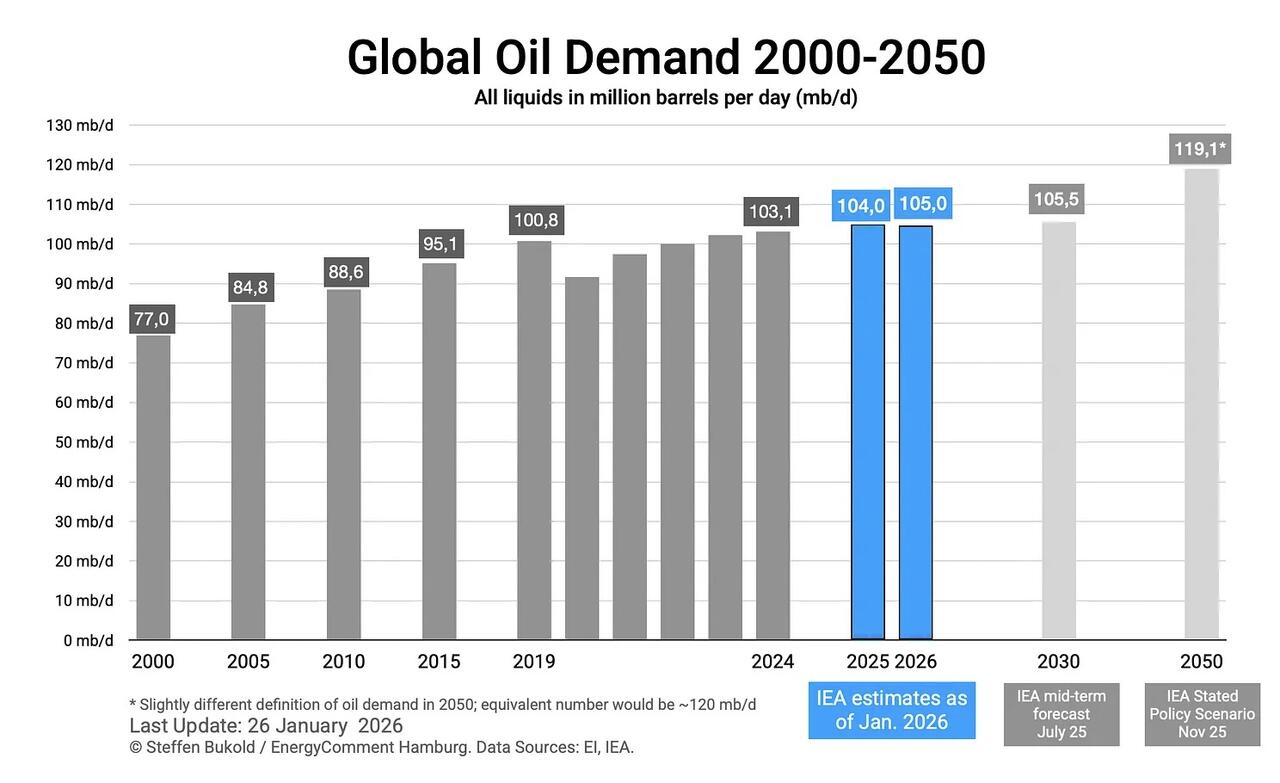
Global consumption runs at roughly 100 million barrels per day. That oil powers cars, trucks, airplanes, ships, agricultural equipment, factories, and enormous portions of the world’s transportation and industrial infrastructure. It also provides the raw materials for plastics, chemicals, packaging, and countless manufactured products.
Under normal circumstances, this gigantic system operates almost invisibly. Oil is pumped out of the ground, loaded onto tankers or moved through pipelines, delivered to refineries, and transformed into the fuels and materials that keep the global economy functioning.
If oil cannot be transported from Saudi Arabia to a refinery in Asia, or if a refinery cannot obtain the particular crude it needs, that supply effectively disappears from the market until the problem is resolved.
And that’s exactly the kind of disruption the world has been dealing with…(READ THIS FULL ARTICLE HERE).
END
1 B // JAMES RICKARDS/MATHEW PIEPENBURG/ALASDAIR MACLEOD..
ALASDAIR MACLEOD…
3. CHRIS POWELL AND HIS GATA DISPATCHES
4. ANDREW MAGUIRE//KINESIS LIVE FROM THE VAULT/293
END
5. COMMODITY REPORT: GOLD//BIG STORY
Gold: Pension Funds Are Selling Bonds to Make Room for gold:

by VBL
Thursday, Oct 08, 2026 – 6:00
WGC: How Pension Funds Make Room for Gold
Authored by GoldFix
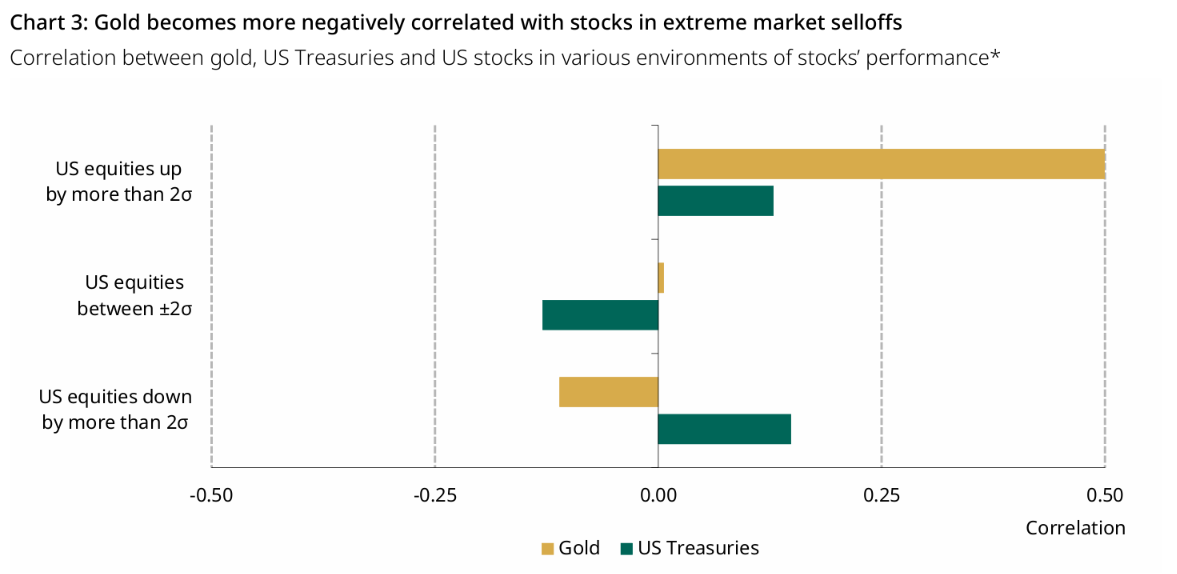
When stocks and government bonds fall together, a pension fund takes losses on both sides of the book. Several funds already hold gold to provide another source of diversification.
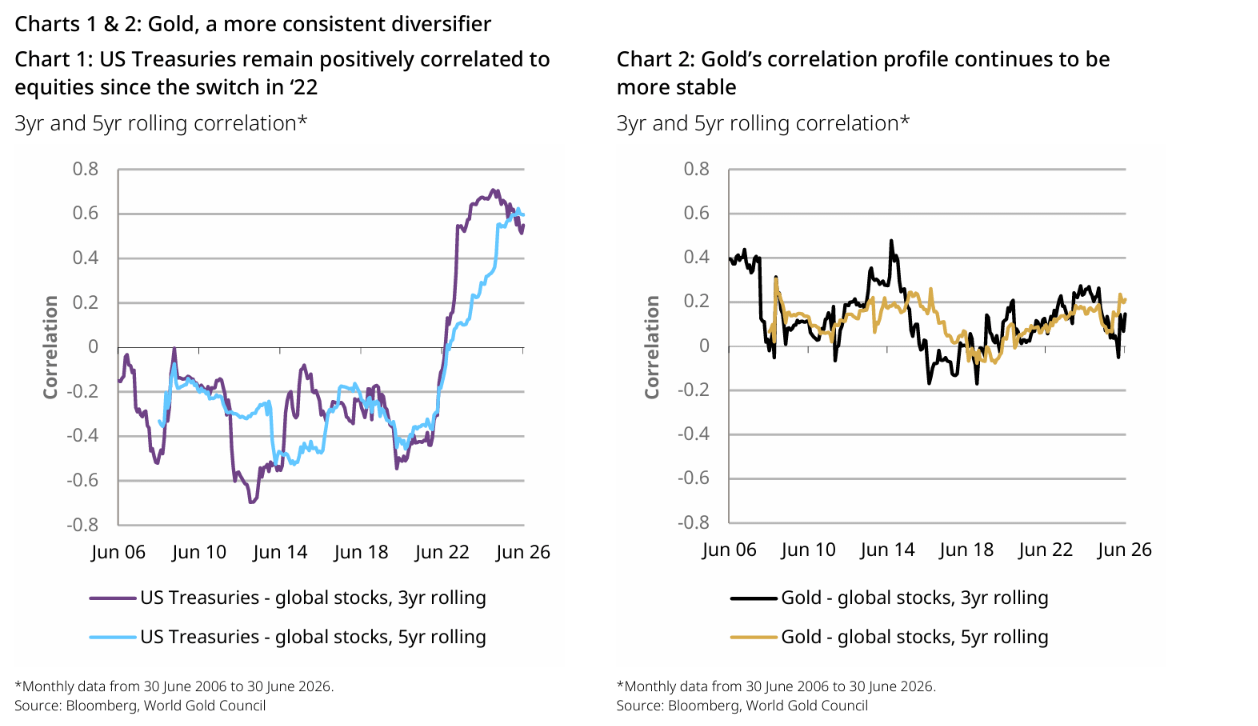
The Bond Hedge Has Become Less Reliable
The three-year and five-year rolling correlations show US Treasuries and global equities moving into positive correlation following the 2022 shift. Gold’s equity correlation varied within a narrower range. Both charts cover June 2006 through June 2026.
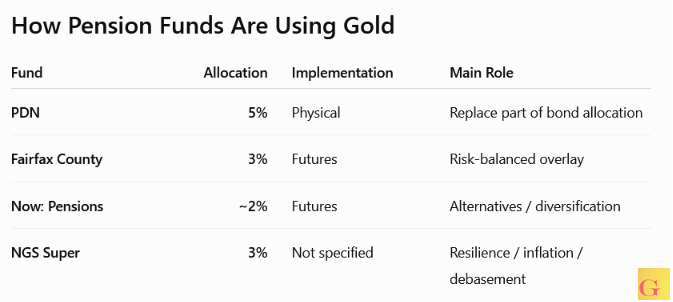
Pensioenfonds PDN, with €7.7 billion in assets, began buying gold in October 2020, reaching its 5% target in April 2021 after a 2020 asset and liability management study by DPS.
WGC describes the trade:
The study was undertaken during a period in which nominal interest rates on German government bonds had fallen to negative levels, including at longer maturities. According to DPS this raised questions about the role of such investments in the portfolio. The study also identified inflation as a concern in light of policy responses to the pandemic, including rising debt levels and money supply.
Against that backdrop, the Pensioenfonds PDN board funded an investment in a physical allocation to gold by a 10% reduction in the fund’s exposure to government bonds: half of the proceeds were allocated to gold and the remainder to equities, real estate and infrastructure.
DPS reported lower expected portfolio risk without lower expected returns. The note supplies no subsequent performance comparison for that allocation.
Goldman: Buy Gold Not Bonds— “The 60/40 is Dead”
May 31, 2025
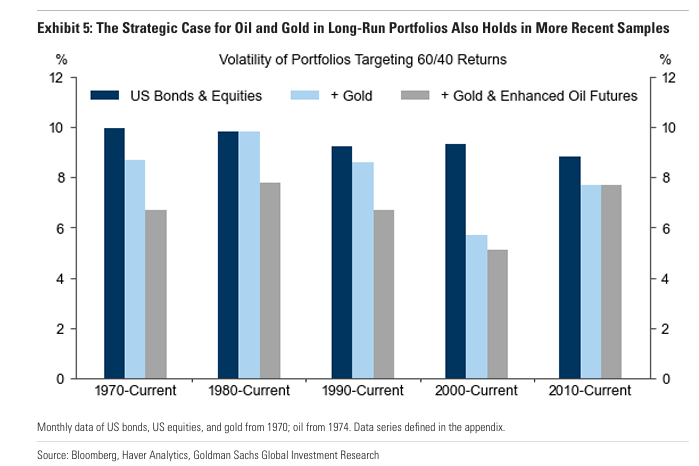
Goldman Sachs is urging pension funds to replace a portion of their bonds with gold as Treasuries struggle to protect portfolios when stocks fall.
END
YOUR EARLY CURRENCY VALUES/GOLD AND SILVER PRICING/ASIAN AND EUROPEAN BOURSE MOVEMENTS/AND INTEREST RATE SETTINGS THURSDAY MORNING.7:30 AM
SHANGHAI CLOSED DOWN 30.29 PTS OR 0.79%
HANG SENG CLOSED DOWN 356.00 PTS OR 1.58%
Nikkei CLOSED DOWN 791.71 PTS OR 1.13%
//Australia’s all ordinaries CLOSED DOWN 0.75%
//Chinese yuan (ONSHORE) CLOSED UP AT 6.7027
/ OFFSHORE CLOSED UP AT 6.7033 Oil UP TO 91.62 dollars per barrel for WTI and BRENT UP TO 104.13 Stocks in Europe OPENED ALL RED
ONSHORE USA/ YUAN// WITH YUAN TRADING 6.7029 (STARTING TODAY) OFFSHORE YUAN TRADING UP TO 6.7033 ONSHORE YUAN TRADING ABOVE LEVEL // OFF SHORE AND UP ON THE DOLLAR)// / AND THUS STRONGER/OFF SHORE YUAN TRADING UP AGAINST US DOLLAR/ AND THUS STRONGER
XXXXXXXXXXXXXXXXXXXXXXXXXXXXXXXXXXXXX
ONSHORE YUAN: CLOSED UP TO 7.027
OFFSHORE YUAN: UP TO 6.7033
1A.HANG SANG CLOSED DOWN 356.00 PTS OR 1.58%
1 B. SHANGHAI CLOSED DOWN 30.29 PTS OR 0.79%
2. Nikkei closed DOWN 791.71 PTS OR 1.13%
WEST TEXAS INTERMEDIATE OIL UP TO 91.62
BRENT; 104.13
3. Europe stocks SO FAR: ALL RED
USA dollar INDEX UP 7 BASIS PTS TO 102.08// EURO FALLS TO 1.1194 DOWN 6 BASIS PTS
3b Japan 10 YR bond yield:FALLS TO. +3.091 DOWN 2 FULL BASIS PTS/ VERY TROUBLESOME//Japan buying 100% of bond issuance)/Japanese YEN vs USA CROSS NOW AT 158.22… JAPANESE YEN NOW FALLING AS WE HAVE NOW REACHED THE ENDING OF THE YEN CARRY TRADE AGAIN AND THE REPATRIATION OF YEN DENOMINATED BONDS TRADING IN THE USA/EUROPE. JAPAN 30 YR BOND YIELD: 4.187 DOWN 3 FULL BASIS PTS
3c Nikkei now ABOVE 17,000
3d USA/Yen rate now well ABOVE the important 120 barrier this morning
3e Gold UP /JAPANESE Yen UP//CHINESE ONSHORE YUAN: UP (7.027) AND OFFSHORE: UP AT 6.7033
3f Japan is to buy INFINITE TRILLION YEN worth of BONDS. Japan’s GDP equals 5 trillion USA. CENTRAL BANK OF JAPAN WILL NO LONGER DO QE.
Japan to buy 100% of all new Japanese debt and NOW they will have OVER 50% of all Japanese debt. GOVERMENT ASKED JAPAN PENSION FUNDS AND INSURANCE FUNDS TO BUY MORE JAPANESE BONDS AND REPATRIATE ALL FOREIGN BONDS.
3g Oil UP for WTI and UP for Brent this morning
3h European bond buying continues to push yields HIGHER on all fronts in the EU German 10yr bund YIELD UP TO +3.5072/ Italian 10 Yr bond yield UP AT 4.698/ SPAIN 10 YR BOND YIELD UP TO 4.163%
3i Greek 10 year bond yield UP TO 4.5317%
3j Gold at $4118.50 /Silver at: 58.95 1 am est) SILVER NEXT RESISTANCE LEVEL AT $100.00
3k USA vs Russian rouble;// Russian rouble DOWN 0 AND 18/ 100 roubles/85.66
3m oil (WTI) into the 92 dollar handle for WTI and 104 handle for Brent/
3n Higher foreign deposits moving out of China// huge risk of outflows and a currency depreciation. This can spell financial disaster for the rest of the world/
JAPAN ON JAN 29.2016 CONTINUES NIRP. THIS MORNING RAISES AMOUNT OF BONDS THAT THEY WILL PURCHASE UP TO .5% ON THE 10 YR BOND///YEN TRADES TO 158.22 // 10 YEAR YIELD AFTER FIRST BREAKING .54% LAST YEAR NOW EXCEEDS THAT LEVEL TO 3.0910% DOWN 2 BASIS PTS STILL ON CENTRAL BANK (JAPAN) INTERVENTION//YEN CARRY TRADE NOW UNWINDING//YEN BOND TRADING OVERSEAS TO BE REPATRIATED.//JAPAN 30 YR: 4.187 DOWN 3 PTS..: USA/SF this 0.8333 as the Swiss Franc . Euro vs SF: 0.9330
USA 10 YR BOND YIELD: 5.333 UP 6 BASIS PTS…NOW ABOVE 5.00%
USA 30 YR BOND YIELD: 5.714 UP 5 BASIS PTS/REFUSES TO GO DOWN WITH BESSENT’S QE TWIST
USA 2 YR BOND YIELD: 4.802 UP 0 BASIS PTS
USA DOLLAR VS TURKISH LIRA: 49.22 UP 2 BASIS PTS/LIRA GETTING KILLED//IDIOTS FOR SELLING GOLD AND USA DOLLAR RESERVES.
10 YR UK BOND YIELD: 5.4851 UP 4 PTS
30 YR UK BOND YIELD: 6.007 UP 6 BASIS PTS
10 YEAR FRENCH BOND YIELD; 4.916 % //UP 6 BASIS PTS
10 YR CANADA BOND YIELD: 3.9480 UP 2 BASIS PTS
5 YR CANADA BOND YIELD: 3.614 UP 2 BASIS PTS.
1a New York Opening report
Futures Slide As Oil Jumps On Iran Strike Report, Bond Rout Resumes Ahead Of 30Y Auction
Thursday, Oct 08, 2026 – 08:27 AM
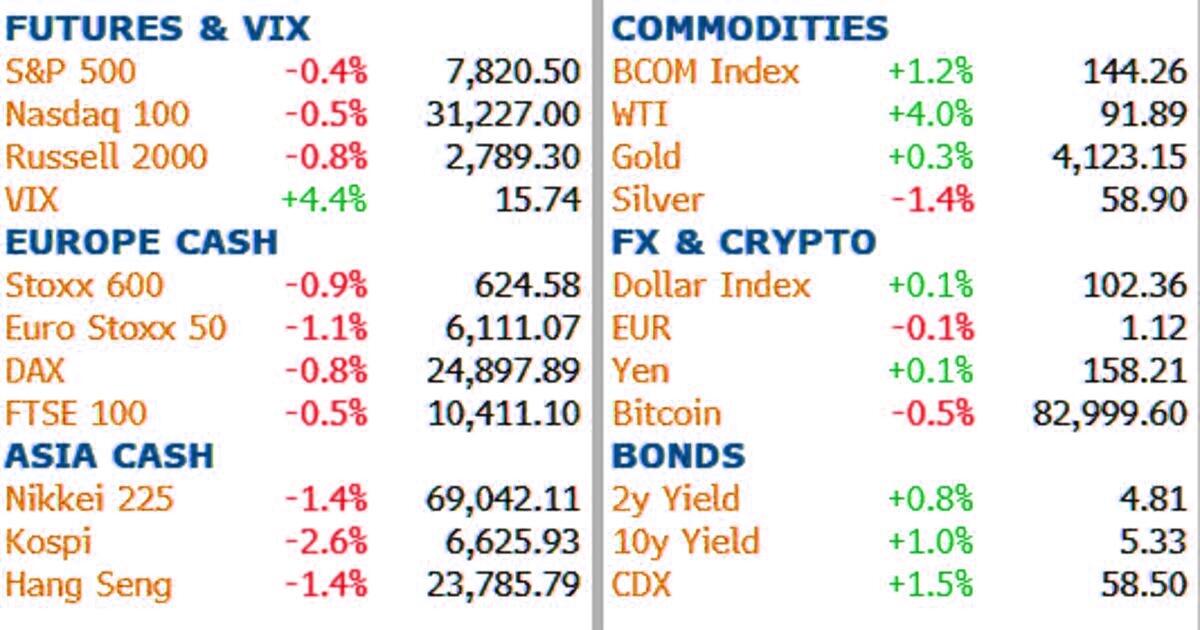
US equity futures are lower, extending Wednesday’s decline, with the S&P sliding further from Tuesday’s record high as oil spikes on reports that Trump may order fresh strikes on Iran before the midterms, a tanker was hit off Qatar in the first strike deep inside the Persian Gulf in about a month, and an approaching storm has shut some US output; as a result the global bond rout picks up where it left off with 10Y yields hitting 5.35%. As of 8:00 am ET, S&P futures are 0.4% lower at 7,820 and Nasdaq futures are down 0.5%, while Dow and Russell futures are both down 0.8%. This follows a session in which the S&P (-0.2%) slipped from its record, almost three-quarters of the index fell and the Russell 2000 (-1.3%) sank to a 4-month low. In premarket trading, Tesla and Nvidia underperform their Mag 7 peers as chip, growth and AI-related stocks trend lower, while Microsoft and Apple edge higher; Defensives lead Cyclicals with Energy the bright spot as hurricane Isaias forces Gulf producers to shut in wells. Wolfspeed soars 17% on a $1.5 billion DoD loan commitment and Palantir gains 2.2% on a Goldman upgrade. The day’s driver is oil (again): Brent has jumped 5% to above $105 and WTI is up around 5% after The Atlantic reported the White House asked the Pentagon for Iran strike options that could be executed before November, a tanker was hit off Qatar and the Houthis fired a ballistic missile at Riyadh’s airport. Treasuries are 5-7bp cheaper across the curve with the belly leading, and the 10Y is near session highs around 5.35%, a whisker from Wednesday’s 24-year high of 5.36%, ahead of today’s $22BN 30Y reopening. The Bloomberg dollar index is flat near a 3-month high and the DXY trades around 102.36; USDJPY is at 158.2 and EURUSD is stuck near 1.12, its lowest since May 2025. In commodities, Energy is bid while the rest of the complex is weaker: gold is up 0.3% to $4,123, silver is down 1.4% at $58.90, US natgas is up 1% to $3.24 and European TTF gas is above €80/MWh. Bitcoin is down 0.5% at around $83,000. US economic data slate includes initial jobless claims (8:30am, est. 200k) and August wholesale inventories (10am). Fed speaker slate includes Kashkari (10:40am) and Musalem (1:40pm); Waller already spoke at 4:30am. Treasury sells $22BN of 30-year bonds at 1pm.
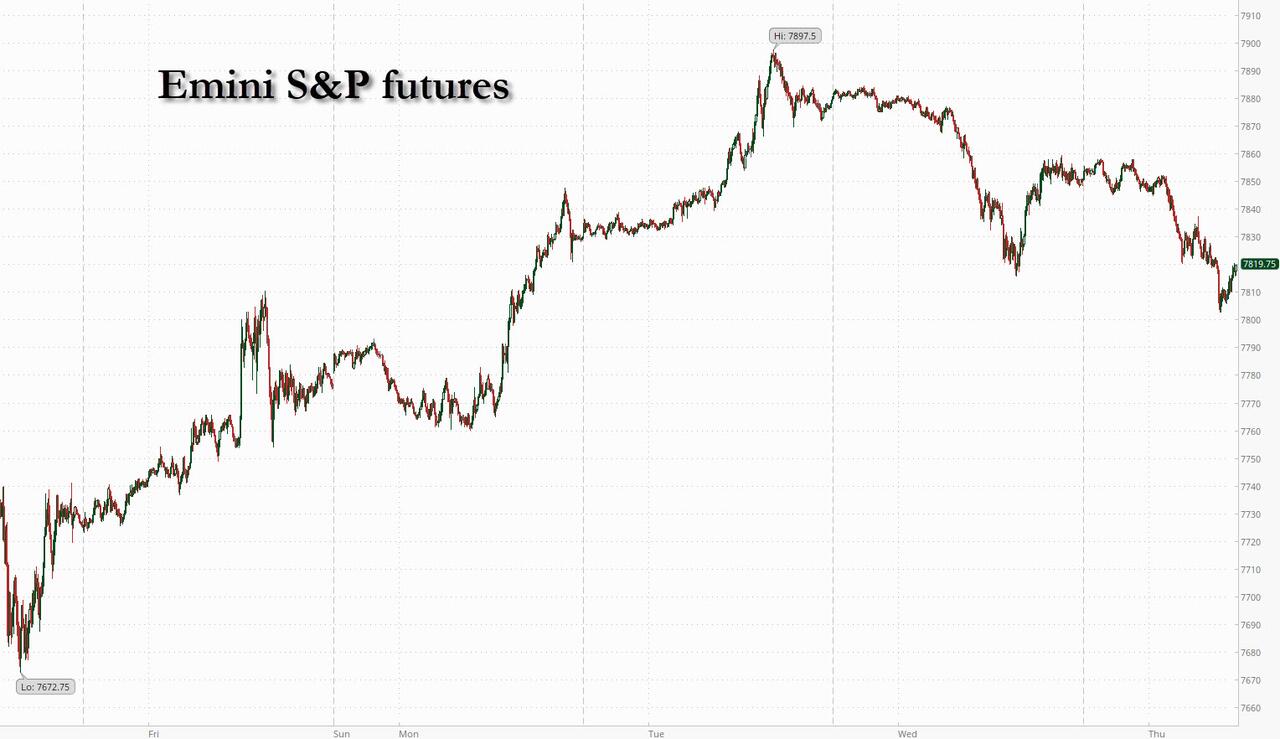
In premarket trading, Tesla and Nvidia are underperforming Magnificent 7 peers, as chip, growth and other AI-related stocks are trending lower. Meanwhile, Microsoft and Apple edge higher: Tesla (TSLA) -1.1%, Nvidia (NVDA) -1%, Alphabet (GOOGL) -0.9%, Meta Platforms (META) -0.7%, Amazon (AMZN) -0.7%, Apple (AAPL) +0.1%, Microsoft (MSFT) unchanged
- Generac Holdings Inc. shares (GNRC) are up 1.4% outperforming amid weakness in many other industrial names, after two bullish nods on Wall Street.
- Goldman Sachs (GS -1.5%) and Wells Fargo (WFC -1%) are buys at TD Cowen, while Morgan Stanley (MS -1.2%) is rated a hold on valuations.
- Levi Strauss (LEVI) falls 3.4% after the denim retailer posted the slowest growth in its direct-to-consumer channels since late 2022.
- NXP Semiconductors NV shares (NXPI) are down 3.5% after Citi downgraded the chipmaker to neutral from buy, writing that it’s becoming “increasingly selective.”
- Palantir shares (PLTR) gain 2.6% as Goldman Sachs upgrades to buy from neutral as the stock has underperformed this year.
- PepsiCo shares (PEP) are up 2.2% after the food and beverage company reported third-quarter core earnings per share above what analysts expected.
- Shares in energy and utilities companies (CVX +1.9%, OXY +2.6%) are rising as hurricane Isaias develops in the Atlantic, with oil and gas producers shutting in wells and evacuating personnel as the storm tracks toward the Gulf Coast.
- Shares of Haemonetics (HAE) rise 18% after CSL Plasma expanded its relationship with the maker of blood-processing systems.
- Spotify Technology SA (SPOT) falls 0.5% as it is being started with a neutral rating and $540 price target at Piper Sandler, which writes that it is “looking for a catalyst” to get more excited about the audio-streaming company.
- Wolfspeed (WOLF) jumps 14% after Department of Defense announced a $1.5b conditional loan commitment to the company.
In other corporate news, Crescent Energy agreed to buy Devon’s Eagle Ford assets for $4.22 billion in cash. David Ellison and his family invested approximately $17 billion to complete Paramount Skydance’s acquisition of Warner Bros. Discovery. Broadcom, fresh off the launch of a $60 billion debt financing to help fund Anthropic’s AI build-out, is already sketching out plans for its next blockbuster deal, and is said to be in talks to arrange about $30 billion in debt financing to help OpenAI buy the custom AI chips the two are developing together. Isomorphic Labs, spun out of Google’s DeepMind, is in early talks to raise new funds at a valuation of at least $40 billion. Tencent is mulling a $5 billion bond sale. Blue Origin is likely to pursue an IPO within the next several years, Jeff Bezos said; SK Hynix’s Solidigm has picked lead banks for its US IPO next year, and spinal disc maker Centinel Spine filed for an IPO. Energy Capital Partners offloaded about $890 million of Constellation Energy shares. Apollo’s £5.7 billion EasyJet takeover is on track for completion early next year. The AI data center boom has ignited a bidding war for a critical TDK unit; FedEx and Advent reached a 98.49% stake in InPost. PepsiCo cut its full-year core constant currency EPS growth outlook. And Goldman’s special bonus for its top brass is set to exceed $500 million (the bond market isn’t the only thing hitting multi-decade highs).
The global selloff is back. Oil jumped again after a report that the White House asked the Pentagon to draw up strike options against Iran coupled with news that a tanker was hit off Qatar in the first strike deep inside the Persian Gulf in about a month, and the resulting bond selloff has been fairly uniform, with US, UK and German 10-year yields rising 4-5bps each, while the Stoxx 600 drops 0.8%. Futures point to a weaker open as the convergence of AI-fueled capex inflation, mounting energy supply pressures, and a Fed that appears far from finished with its tightening cycle weigh on sentiment, as Bloomberg’s Neil Campling puts it. After stocks managed to grind higher for days even as the long end made fresh 24-year highs, the cracks are now visible above the surface too (as we noted last night in “Stocks Slide From All Time High As Gaping Cracks Form Just Below The Surface“). The FOMC minutes showed all 19 officials backed September’s hike with “most” seeing another by year end, which sits awkwardly with the roughly 17-20% odds priced for October, and Fed Governor Waller this morning said further hikes will likely be needed, though there is “some flexibility” on timing and they don’t need to come at consecutive meetings. Wednesday’s stellar 10Y auction bought the bond market exactly one evening of peace.
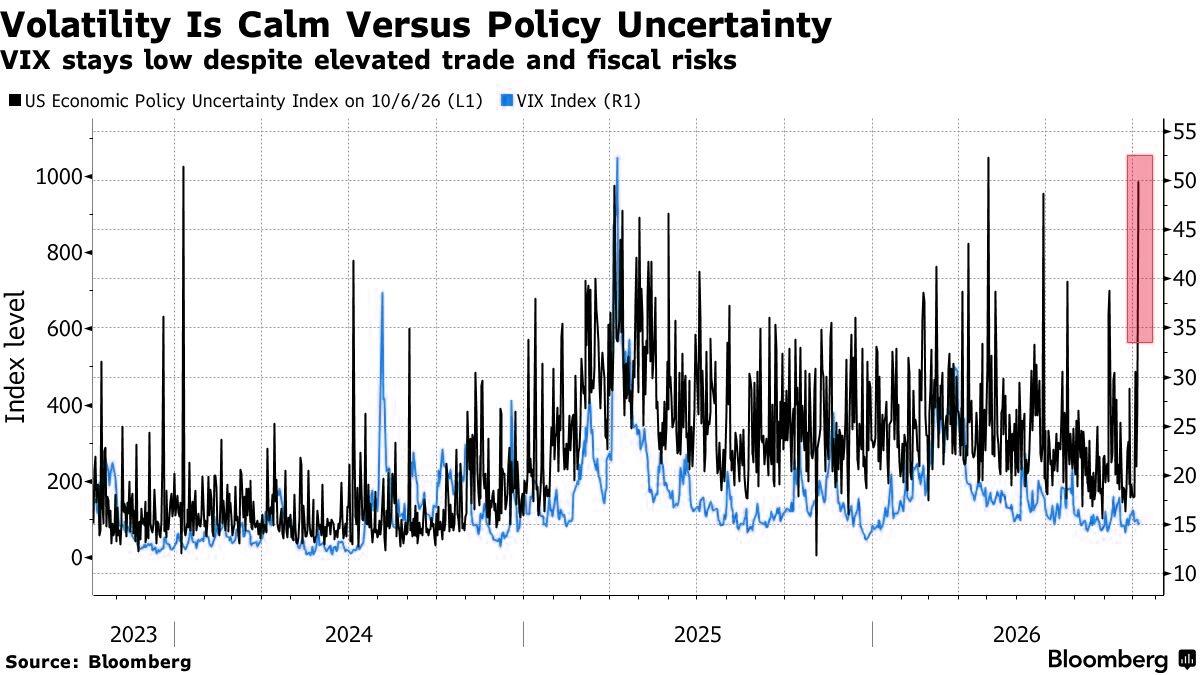
Doubts over policy have seldom been greater, with an index tracking US economic policy uncertainty registering one of its biggest spikes in three years. Yet volatility remains subdued, and the implied volatility ratio between the High Yield Corporate Bond ETF and the SPY is near year-to-date highs.
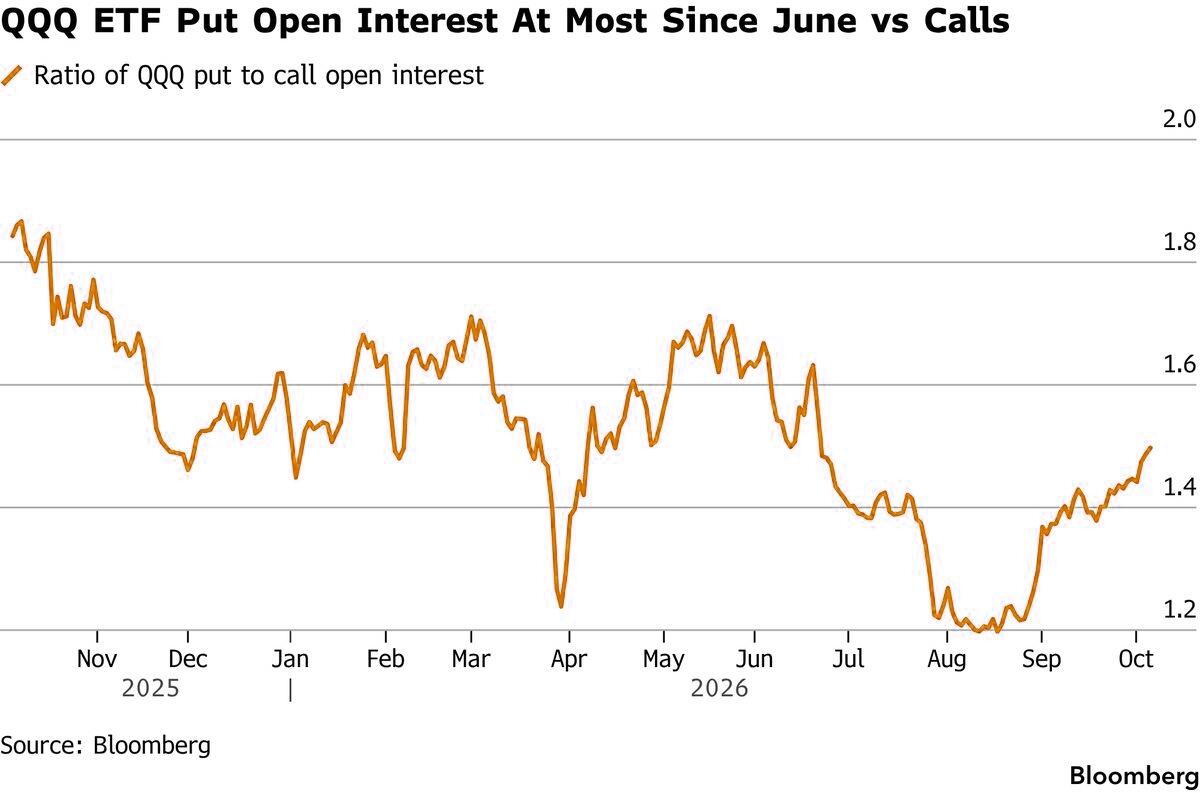
Divergent reactions to AI are showing up across the globe. Samsung’s record-breaking quarterly preliminary results failed to meet the highest of expectations while TSMC posted 51% sales growth. AI angst is showing up elsewhere too: Australian data center company Firmus Grid closed the books on its IPO amid concerns the deal could be pulled due to inadequate support, hours after San Francisco passed a temporary ban on new data centers within its borders, and the head of market strategy at Panmure Liberum warns an AI bubble risk could soon trigger the most severe crash since the global financial crisis. Meanwhile, the ratio of open interest in put options on the QQQ has reached its highest level since June relative to calls, a sign investors may be increasing protection against a decline in the Nasdaq 100.
“Higher bond yields will certainly put the spotlight on the equity market, and it would put blaring lights on the emerging markets, in particular, and within emerging market sectors such as Singapore banks would be facing vulnerabilities,” said Nirgunan Tiruchelvam, an analyst at Aletheia Capital.
JPM’s Market Intel desk under Andrew Tyler sums up the morning: futures are weaker as oil and bond yields move higher, with yields up 4-5bp across the curve and the USD setting a new 52-week high; Memory and Semis lag, and “in a similar pattern to yesterday, Defensives are leading Cyclicals with Energy the bright spot.” The bigger warning is in positioning: JPM’s Positioning Intel flags crowding in NDX longs (98th percentile) and RTY shorts (3rd percentile); in recent unwinds that pair has lost 1.9% over a month vs. gaining 80bp in a typical month. JPM’s Manish Sinha says the bank’s Macro Conditions indicator has tightened to above the 95th percentile, “levels last seen during the 2025 tariff escalation,” leaving Momentum vulnerable either way, and recommends buying protection into year-end/earnings. On the cash desk, Matt Reiner says high-touch volumes are tracking 57% below the 5-day average because “confidence is shot,” quoting a client: “I’m right one day, wrong the next.” And TMT’s Brian Heavey sees a “clear de-risk in Europe spilling over to US tech.” Still, the team sticks with its Tactically Bullish view, with Tech the core long, and notes the biggest upside catalyst would be a US/Iran deal (which, judging by this morning’s headlines, is not imminent).
Goldman’s Rich Privorotsky frames the problem: “the AI micro continues to accelerate while the macro backdrop gets progressively more difficult. Strong earnings simply aren’t enough to offset the pressure from rates, energy and capital supply.” With SpaceX reportedly seeking $40bn and Broadcom exploring more than $50bn of financing, he warns “the crowding out effect is potentially immense,” asking “why rush to buy sovereign duration when an extraordinary amount of high quality private sector paper is coming at you?” (see “SpaceX Credit Risk Hits New High As AI Debt Binge Fears Spook Bondholders“). On oil: “With the midterms approaching, I am less convinced we have a credible off ramp.” He notes the Russell has underperformed the NDX in 17 of the last 20 sessions. Meanwhile, Goldman’s Prime book shows net exposure to the Mag7 at ~22% of total US exposure, the highest on record since the start of 2022 (see “The Asymmetry Has Shifted“), while semis are ~12% of US exposure vs ~6% at the start of the year. On the Fed, Goldman economists still expect a second hike in December, but see “a strong chance the FOMC ultimately concludes further tightening is unnecessary,” and Abhay Duggirala estimates about three-fourths of this year’s core PCE overshoot is mismeasurement or one-offs.
Retail is in focus with PepsiCo earnings and a host of household names including Target, Lowe’s and embattled Nike set to appear at a retail and consumer conference in New York. Costco reported 13% year-over-year net sales growth in September, supported by a 4.7% increase in traffic. Watch US insurers, utilities and home improvement retailer stocks as hurricane Isaias develops, with oil and gas producers shutting in wells and evacuating personnel as the storm tracks toward the Gulf Coast.
In Europe, France remains the epicenter. The Franco-German 10-year spread widened 12bps on Wednesday to almost 140bps after the WSJ reported Paris is weighing more short-dated issuance, Bank of France Governor Moulin said “the conditions are not met today for an intervention from the ECB,” and this morning five-year OAT yields are up another 9bps to 4.33%. Nearly €215 billion of France’s corporate bonds now trade as if they were safer than the government’s, an almost 18-fold increase since the start of 2026, and the euro is pinned near $1.12, its lowest since May 2025. French banks are once again taking the sovereign hit (see “European Banks Tumble As French Bond Crash Reactivates “Doom Loop”“), while Italian PM Meloni needs to win a confidence vote today to avoid further bond-market tensions, according to Citi.
In Europe, the Stoxx 600 is down 0.8% to 625.65, with 409 members down and 180 up, extending Wednesday’s losses as the jump in oil fans inflation fears and puts it on course for a second straight losing week. Media, Energy and Utilities lead, while Banks, Health Care and Construction lag; JPM notes its Stagflation basket is near the top of the leaderboard alongside MidEast Escalation plays and Quality, while Growth, LT Momentum and semis underperform as “Beta is being sold alongside Momentum.” The CAC 40 slid further into a correction. Morgan Stanley’s Marina Zavolock says European stocks may be approaching levels where they typically stabilized in previous episodes of sharply rising bond yields. Here are the biggest European movers:
- Argenx shares slump as much as 17%, the steepest drop since December 2023, after the biotech firm discontinued a phase 3 trial of a drug for Sjogren’s disease, a chronic autoimmune disorder.
- Tesco shares rise as much as 3.9% as analysts said the company’s first-half results were strong and pointed to a £200m increase in share buyback plans.
- ALK-Abello rises as much as 7.7%, the most in more than five months, after again upgrading its guidance for the year. The Danish pharmaceutical company’s latest boost implies about 4% upside to consensus profit expectations, Jefferies writes in a note.
- Standard Life shares fall as much as 8.3%, the most in 18 months, after shareholder Aberdeen Group offered up to 52m shares in the insurer at a discount to Wednesday’s close.
- Imperial Brands shares rise as much as 4% after the company reaffirmed its adjusted operating profit forecast for the full year.
Asian stocks were set for their lowest close since mid-September as rising oil prices and elevated bond yields fueled inflation concerns, with MSCI’s Asia Pacific Index dropping as much as 1.8%. South Korea’s Kospi led losses, sliding 2.6% and closing below its 50dma as foreigners sold for a fourth session (about $1.1bn in tech) after Samsung’s record profit, a nearly nine-fold rise, still missed lofty expectations. This is happening just as the flood of corporate buybacks is coming to an end, which we warned – correctly – would slame the index.
Well, oops https://t.co/ZITFhC9NKo pic.twitter.com/81RGVevonB— zerohedge (@zerohedge) October 8, 2026
Japan’s Nikkei fell 1.4% back below 70,000 and the Topix underperformed (TOPIX Banks -3%) after the TSE announced plans to cut the index’s constituents by about 40%. The Hang Seng fell 1.4% to its lowest since July 7, and mainland Chinese shares declined as trading resumed after the Golden Week holiday, with the CSI 300 down 1.35% and the Star50 at a six-month low intraday. Singapore’s Straits Times dropped 3% as banks extended losses after JPMorgan warned surging long-term yields will hurt Southeast Asian lenders’ earnings, and the ASX 200 fell 0.8%. India’s Nifty slid 1.6% after the RBI’s hawkish shift. Goldman’s Rachel Hu notes that “both the Nikkei and TOPIX surrendered all afternoon gains in the final hour as US equity futures weakened sharply.”
In FX, the Bloomberg Dollar Spot Index is flat, close to its highest in more than three months, while the DXY trades in a narrow 102.13-102.39 range. The loonie leads G10 on the bid in energy, while the yen lags on widening yield differentials, with USDJPY at 158.2. EURUSD holds near recent lows just shy of 1.12, and options traders are paying a premium to hedge against euro losses versus the pound for the first time in more than two years. The PBOC said it has no intent to devalue the yuan for trade advantage ahead of EU trade talks. “With BBDXY hovering around 3-month highs, dollar bulls are likely to need a fresh catalyst to push the dollar to test the June highs,” said Sean Callow, a senior analyst at ITC Markets in Sydney.
In rates, Treasuries pressured lower over the London session, driven by sharp gains in oil prices following the bigger Middle East escalation. US yields are cheaper by 5bp to 7bp across the curve with the belly leading losses, cheapening the 2s5s30s fly by around 3bp, and the 10Y is near session highs around 5.35%. Ahead of the 30Y reopening, 30-year yields trade up almost 6bp on the day, adding some late concession: the $22 billion sale at 1pm has the WI trading around 5.725%, ~42bp cheaper than the September stop-out, which tailed by 0.4bp. Bunds are outperforming by 1bp in the 10-year sector while gilts lag, with five-year gilt yields up 7bps to 5.05%; money markets price around 23bps of BOE hikes for November and 4bps of ECB hikes this month. NatWest, meanwhile, picked a fine moment to announce it will exit as a primary dealer for US and European government bonds. The IG dollar issuance slate includes a couple of deals; this week’s volume is set to significantly miss the $25 billion low end of syndicate forecasts. Fed speaker focus is on Kashkari and Musalem after Waller’s hawkish-leaning comments.
JPM’s Nick Panigirtzoglou, author of Flows and Liquidity, flags a bifurcated positioning picture in bonds, with quant funds benefiting from short duration exposures while discretionary managers scramble to contain long duration and spread overhangs, and says his bias is that discretionary managers “amplify the current negative momentum” in the near term.
In commodities, WTI has risen to a $92.03 high from $88.77 and Brent extended gains to 5%, trading above $105 a barrel, as US-Iran tensions escalate and Hurricane Isaias, packing 80 mph winds, makes its way across the Gulf, shutting in some output. Saudi Arabia is in talks to formalize Hormuz shuttle services, while Iraq cut November prices to Asia and ADNOC set Murban at an $11 premium to Dubai. European diesel cracks have leapt and TTF gas rose to a €80.67/MWh high. Spot gold recovered from $4,103 to $4,143 before fading, silver fell to $58.71, and LME copper trades on either side of $14,500/t. Goldman’s commodity team argues China’s petchem oil demand weakness, which helped shrink the deficit from the Hormuz shock, is mostly unsustainable.
US economic data slate includes initial jobless claims (8:30am, est. 200k) and August wholesale inventories (10am). Fed speaker slate includes Kashkari (10:40am) and Musalem (1:40pm). Treasury sells $22BN in 30-year bonds at 1pm and conducts a buyback of up to $6BN of longer-dated debt.
PepsiCo is the only significant earnings report before the bell, and the ECB publishes the account of its September meeting at 7:30am ET. Target, Lowe’s and Nike appear at a retail and consumer conference in New York, and JPM hosts a trading desk call at 10am covering macro, the midterms and earnings season.
Market Snapshot
Top Overnight News
- The White House has asked the Pentagon to develop strike options against Iranian targets that could be exercised ahead of the midterms, according to two administration officials. The planning underscores just how much the president wants to reduce gas prices and demonstrate progress in the conflict before the vote. The Atlantic
- The US military has been ordered to be ready for possible Iran strikes as President Trump weighs the timing, with the Pentagon said to have instructed CENTCOM several days ago to conclude preparations for resuming major combat operations in Iran; any campaign is expected to be a joint US-Israeli one including large bombing of Iranian energy, infrastructure and nuclear targets. Axios
- Attacks on tankers sailing through the Strait of Hormuz hit their highest last week of any week since the Iran war began, according to maritime security sources tracking incidents, amid a bigger export push by Gulf producers. RTRS
- The EU is taking a more assertive approach to China as it heads into talks aimed at avoiding a trade war. The meeting comes as the EU prepares to curb Chinese hybrid-car imports. BBG
- Japan’s 30-year government bond auction drew firm demand as elevated yields attracted investors. The bid-to-cover ratio at Thursday’s sale was 3.88 compared with 3.79 at the previous auction and a 12-month average of 3.56. Japan’s bonds were steady after the sale.
- The BoJ said price increases driven by higher raw material costs were spreading to consumer goods with some firms hiking prices more often, signaling its concern over broadening inflationary pressure. RTRS
- France is considering boosting issuance of shorter-term debt, as investors grow more hesitant to lend to the debt-laden country for longer periods. WSJ
- France Finance Minister Roland Lescure told the BBC that there is still investor demand for government bonds. About 38% of France’s high-grade corporate bonds now trade at lower yields than comparable sovereign debt. BBG
- Broadcom is said to be in talks to arrange about $30 billion in debt financing to help OpenAI buy custom AI chips the companies are developing together. Tencent is mulling a $5 billion bond sale, people familiar said. BBG
- The Fed’s Christopher Waller said further rate hikes will probably be needed, though officials have some flexibility on timing. BBG
- Crescent Energy to buy Devon’s Eagle Ford assets for $4.22 billion in cash. BBG
- Hurricane Isaias is in the US Gulf with 80 mph winds and still strengthening, with Gulf producers shutting in wells and evacuating personnel. BBG
- Saudi Arabia is in talks to formalize Hormuz shuttle services in a fight for market share. BBG
- Germany doubled its 2026 growth outlook as manufacturing rallies. BBG
- NatWest is pulling back from dealing US and European government bonds, exiting as a primary dealer. BBG
- Goldman’s special bonus for top brass is set to exceed $500 million. BBG
- US President Trump administration moves towards temporary sales of some unapproved peptides: Washington Post.
- US is set to announce commitments from AI firms to provide more than USD 1bln in computing credits: Washington Post.
- BofA Total Card Spending (w/e Oct 3rd) +3% Y/Y (prev. +5.6%); lower income spending growth continued to outpace higher income. Newsquawk
- Net exposure to the Mag7 on Goldman’s Prime book is ~22% of total US exposure, the highest on record since the start of 2022; US Tech saw its largest monthly % buying since Feb ’25 in September. GS Prime
- JPM Positioning Intel flags crowding in NDX longs (98th percentile) and RTY shorts (3rd percentile), warning of near-term RTY outperformance risk. JPM
A more detailed look at global markets courtesy of Newsquawk
APAC stocks were mostly on the back foot following the negative handover from Wall St, where stock markets pulled back from recent record highs amid bond market volatility, while sentiment overnight was pressured as oil rebounded amid geopolitical risks after reports that the US military has been ordered to be ready for possible Iran strikes, with President Trump weighing the timing and could resume strikes before the Midterm elections, but with no decision made. ASX 200 was dragged lower as weakness in miners, materials and resources clouded over the gains in energy and resilience in defensives, while there was also an uptick in inflation expectations. Nikkei 225 retreated back beneath the 70,000 level as it continued to fade the recent tech-driven rally, while the TOPIX underperformed following the announcement that the Tokyo Stock Exchange plans to reduce the number of constituents in the index by about 40% to 986 stocks. KOSPI was pressured alongside indecision in Samsung Electronics shares following its preliminary Q3 earnings results, which showed operating profit surged 783% Y/Y, but missed the lofty expectations. Hang Seng and Shanghai Comp were subdued despite the resumption of trading in the mainland following a week-long hiatus, with pressure seen in tech stocks and sentiment was also not helped by trade frictions as the EU is said to be preparing a temporary import cap on Chinese hybrid cars.
Top Asian News
- China is building data centres at rapid speed across its energy-rich rural areas as Beijing seeks to turn abundant electricity and cheap land into an advantage in a global race to develop AI, according to FT.
- Japan’s PM Takaichi said fiscal stability is a pre-requisite to policy and said consumption tax cut won’t create social security gap. Furthermore, Takaichi said that they are aiming to win markets trust by maintaining communication with the market with high transparency, and that they respect the BoJ’s monetary policy. On JGBs, she said they will work to keep JGB sales around FY25’s JPY 40tln level. Later, Kyodo reported that Japan PM Takaichi said that they will decide flexibly on extending tax cuts in an emergency.
- Japan reportedly plans 5.4% sales subsidy for farmers, Kyodo reported.
- A Japanese official said strengthening oil reserve capacity across Asia is a priority area in cooperation with ASEAN and a special meeting with Middle East oil-producing countries will be held on Thursday after the conclusion of the ASEAN ministerial meeting.
European bourses (STOXX 600 -0.8%) are lower across the board, weighed by the upside across the energy complex amidst reports of potential US strikes on Iran before the midterms (see geopolitics section for details). Outside of the aforementioned geopolitics, Samsung Electronics and TSMC reported Q3 metrics. For the former, its revenue and operating profit missed estimates; on the other hand, the latter beat forecasts. Samsung shares fell 2.4% in Asia trade following its metrics, despite reporting a near nine-fold rise in quarterly operating profit, while TSMC (-1.4%) also slipped, although to a lesser degree. Sectors point to the negative bias. Media tops the sector pile, closely followed by Energy and Utilities. Underperformance comes from Banks, Health Care and Construction. US equity futures follow their European peers amid the rise in energy prices. Well-known investor Paulson has recently highlighted that the last time oil was above USD 100/bbl, US yields were above 5% and the USD was elevated, the S&P 500 dropped as much as 15% in the following three to five months. TSMC (2330 TT) Q3 Revenue TWD 1.49tln (exp. 1.46tln); Sept. Revenue 551.9bln (prev. 331bln Y/Y). Samsung Electronics (005930 KS) Prelim. Q3 (KRW): Operating Profit 107.4tln (exp. 108.7tln), Revenue 195tln (exp. 199tln).
Top European News
- BoE Credit Conditions Survey Q3’26: Lenders reported that the availability of secured credit to households decreased.
- BoE Bank Liabilities Survey Q3’26: Lenders reported that total funding volumes increased in the three months.
- Italy Deputy Economy Minister said that they are in talks with banks and energy groups over the contribution to state finances as it finishes its 2027 budget plan.
FX
- G10s are mixed against the USD; the Loonie holds towards the top of the pile, given the bid in energy benchmarks, whilst the JPY lags on widening yield differentials. Oil prices have taken another leg higher following reports that President Trump could strike Iran before the midterms; moreover, a hurricane in the Gulf of Mexico has led to supply disruptions in the region. (Please see commodities for details)
- DXY is essentially flat and trades within a narrow 102.13 to 102.39 range. Rangebound trade in the aftermath of an uneventful FOMC Minutes, but despite the rise in energy prices. Most recently, the Fed’s Waller provided some hawkish-leaning comments. He mentioned that more rate hikes are likely needed to tame inflation, but there is flexibility over the pace, and hikes do not need to be consecutive. This spurred some initial two-way action, before the index climbed higher, but remained within earlier ranges.
- EUR is essentially flat this morning, and holds near recent lows just shy of the 1.12 mark. Political updates have taken a breather this morning, but still remain a key theme in the region. Germany’s coalition meeting took place in the prior session, which did not yield any significant progress, but perhaps more pertinently, a major breakdown from the coalition has to have occurred. Over in France, the OAT-Bund spread remains elevated at 142bps – with eyes now on October 13th for the start of the budget debate. Politics aside, EU-China trade relations have been shaken in recent days after reports that the EU is to impose a temporary import ban on Chinese hybrid EVs. EU Trade Commissioner Sefcovic is currently in China and is set to hold meetings with the Chinese Commerce Minister in hopes of easing tensions. Notable talking points will be on addressing the massive trade deficit with China and discussions on critical minerals.
- PBoC does not intend to devalue the CNY currency for trade advantages.
Central Banks
- Fed’s Waller (Voter, Dovish) said more rate hikes are likely needed to tame inflation, but there is flexibility over the pace and hikes do not need to be consecutive. On inflation, Waller said inflation remains too high, with AI investment and the ongoing energy shock among persistent inflationary forces. On the labour market, he said it was solid and stable in September despite weaker job creation and added that there is evidence that the economy is strengthening in H2’26. On Fed communication, Waller said communications can avoid promises of forward guidance while improving outcomes by signalling to markets about possible policy choices.
- BoJ maintained the assessment for seven of Japan’s nine regions in its quarterly report, and raised assessment for two of the regions. Said many regions said firms continue to offer high wages, while some regions said firms are struggling to pass on costs could curb wage increases. Many regions said firms were passing on rising costs from Middle East conflicts, weak yen, as well as distribution and labour costs while some regions said that some firms in the areas were raising prices more frequently than in the past.
- BoE’s Pill said current price pressures are concerning and need to be addressed and that monetary policy must focus strongly on inflation.
- BoE’s Greene said she thinks the UK will see some second round effects from current inflation and that there are early indications that UK wages will grow around 3.5% next year, which is worrying.
- ECB’s Dolenc said inflation risks are skewed to the upside on oil, gas, food and strong growth, and added that more stable core inflation provides some reassurance that broader price pressures are contained. Dolenc reiterated a meeting-by-meeting approach and added that monetary policy is transmitted more or less homogeneously into broader financial conditions.
- ECB’s Moulin said that inflation is clearly 100% energy and does not see second round effects, while adding that the geopolitical shock is transmitting into financial shock. Furthermore, Moulin said that economic growth in the Euro area has been quite resilient.
- ECB’s Sleijpen said the energy shock is quite persistent and that inflation expectations are well anchored. Sleijpen added that he does not expect second-round inflation effects.
- ECB’s Zigman said the October meeting will involve intensive discussions.
- ECB’s Wunsch said that the case for lifting the minimum reserve requirement is not very clear or convincing.
- SNB’s Martin said inflation pressures have slightly increased since June and the recent rise is due to a lift in oil prices. Martin added that they are not observing any second round inflationary effects, which is extremely reassuring, while stating that there is no need to change monetary policy at this stage.
Fixed Income
- A bearish session thus far for fixed after the slightly firmer bias that was ultimately seen on Wednesday in USTs. Currently, USTs are lower by about 10 ticks and at the lower end of 104-04+ to 104-15+ parameter. Fed’s Waller sparked a very slight hawkish reaction, as his comments on future tightening were slightly more hawkish than what we saw from him before the September meeting; but, as he voted for a hike in September, the language today is not particularly surprising.
- Otherwise, the focus has been on geopolitics as crude posts gains in excess of USD 3/bbl after the escalation in tensions overnight on reports that the US is preparing for potential fresh action in Iran.
- Updates that have lifted yields across the curve, which is bear-steepening once again stateside while the belly is subject to the most upside in Europe.
- EGBs directionally in-fitting, though magnitudes somewhat more contained with Bunds lower by just 10 ticks or so, at a 120.61 base. However, OATs once again lag as the energy situation ties in with ongoing fiscal concern/pressures in France, sufficient so far to widen the OAT-Bund 10yr yield spread to a 142bps high for the session.
- Gilts under pressure given the energy moves and the sensitivity of the UK economy to energy prices, particularly as we get ever closer to the first Burnham/Healey budget. At an 83.26 base, looking to 83.20 from Wednesday and then last week’s 83.17 contract low.
- Japan sells JPY 450.7bln 30-yr JGBs; b/c 3.88x (prev. 3.79x), average yield 4.109% (prev. 4.079%), Tail in price 0.16 (prev. 0.28).
Commodities
- WTI Nov and Brent Dec futures are firmer, extending their rebound from yesterday’s lows as US-Iran tensions continue to escalate (see below for details). WTI has risen to a USD 92.03/bbl high from USD 88.77/bbl (vs yesterday’s USD 87.96-90.98/bbl range), while Brent has climbed to USD 104.44/bbl from USD 100.76/bbl (vs yesterday’s USD 99.61-102.59/bbl range). Eyes are also on Hurricane Isaias which is making its way across the Gulf Coast.
- Dutch TTF is underpinned as renewed Middle Eastern escalation risks add to concerns around regional gas supplies and shipping routes. The broader energy complex has also been supported by the prospect of further military action, although the extent of any actual disruption remains uncertain. TTF has climbed from a EUR 79.31/MWh low to a EUR 80.67/MWh high.
- Precious metals are mixed, with spot gold modestly firmer as geopolitical risks provide some support, although upside remains constrained by global yields and expectations of further Fed tightening, with Fed Waller’s recent hawkish-leaning remarks, alongside the upticks in the DXY, not helping. The FOMC Minutes were largely a non-event and showed all participants supported September’s 25bps hike, with most expecting another increase by year-end. Spot gold has recovered from a USD 4,103/oz low to a USD 4,143/oz peak before waning again, nonetheless still well within yesterday’s USD 4,067-4,170/oz range, while spot silver has underperformed, falling from a USD 60.59/oz peak to a USD 58.71/oz low.
- Base metals are mixed, with copper initially benefiting from the return of Chinese buyers following the week-long National Day holiday, although the broader risk-off tone and higher energy prices have since weighed on the complex. Reports that the EU is preparing a temporary import cap on Chinese hybrid cars have also added to trade concerns, while Goldman Sachs flagged subdued Chinese gasoline and diesel demand amid high domestic prices. 3M LME copper trades on either side of USD 14.5k/t in a USD 14,445.78-14,652.90/t range.
- US NHC noted that hurricane warnings were issued for parts of the northern Gulf Coast ahead of hurricane Isaias. NHC later said that Hurricane Hunter reconnaissance shows Hurricane Isaias is still strengthening and preparations across the Gulf Coast warning area for storm surge and destructive winds should be completed today.
- Saudi Arabia is said to be in talks to formalise Hormuz shuttle services in a push for market access, according to Bloomberg.
- Iraq’s SOMO set the official November selling price for Basrah Medium crude to Asia at a USD 2.80/bbl discount to the Oman/Dubai average; to Europe at a USD 3.85/bbl discount to dated Brent; to North and South America for November at a USD 3.10/bbl premium to Argus Sour crude.
- UAE’s ADNOC set November crude OSP at a premium of USD 11/bbl to Dubai quotes.
- Venezuela’s Cardon refinery is resuming crude distillation after a fire, according to workers.
- Earthquake of magnitude 6.18 has struck Vanuatu Islands, according to GFZ.
- Goldman Sachs sees gasoline and diesel demand remaining depressed due to high China product prices.
Trade/Tariffs
- EU Trade Commissioner Sefcovic said EU businesses need improved access to China market; goal of trip to China is to rebalance China trade deficit.
Geopolitics: Middle East
- US President Trump stated that he doesn’t think an Iran deal is something he wants to do. It was separately reported that Trump said the Iranians are ready to offer us anything to stop what’s happening, even though an agreement with them is not the option he truly wants, while Trump was also reported to say that Witkoff is now working on reaching an agreement with Iran and is making very good progress, according to Al Jazeera.
- The US military has been ordered to be ready for possible Iran strikes as President Trump weighs the timing, with the Pentagon said to have instructed US CENTCOM several days ago to conclude preparations for resuming major combat operations in Iran, according to Axios. The directive didn’t include a specific date for launching strikes and President Trump hasn’t made any final decisions, although US and Israeli sources said it could happen before the US midterm election. Furthermore, it was stated that if major combat operations resume, they are likely to be a joint US and Israeli campaign and expected to include large bombing of Iranian energy, infrastructure and nuclear targets.
- US President Trump and his national security team have discussed possibly resuming large-scale US military operations in Iran in the coming weeks, including the option of launching strikes before the midterm elections next month, according to NBC.
- The US is stepping up preparations and has completed operational plans in case President Trump orders strikes against Iran, i24 News reported citing sources. The report added that forces at Fort Bragg are ready to deploy to any theatre within 18 hours.
- Iran’s working assumption is that there will be a US attack, according to Jerusalem Post’s Stein, citing two regional diplomats, while the debate in Tehran is if they should attack first.
- US CENTCOM rejected IRGC claims that the Strait of Hormuz is closed and that Iran has full control over it, while it stated that traffic is flowing through the strait carrying commercial goods and energy supplies, including 20mln bbls of crude.
- Iran’s Foreign Ministry spokesperson Baghaei said Iran’s considerations and conditions for ending the war on all fronts and restoring security to the Persian Gulf region and the Strait have been clearly and firmly explained, and the necessary response to US proposals will be provided through mediators. He also stated that Iran will continue its efforts to strengthen trust and interaction between regional countries, while he stated that Tehran has spared no effort, in consultation with Oman as another coastal state, to restore security to the Strait of Hormuz, and the two sides had agreed on the geographical coordinates for safe transit routes and on how the agreement will be presented internationally, while the agreement between Iran and Oman on the safe routes of Hormuz will soon be reflected in international references.
- Iranian intelligence services are reportedly targeting the US Ramstein and Spangdahlem air bases in Germany, WiWo reported. The report added that Iranian intelligence services are reportedly also targeting other US bases in Europe and planning complex attacks, with the UK also said to be a potential target.
- Pakistan’s Army Chief said they are working to reduce the differences between the US and Iran, according to Nour News.
- Reports of explosions heard and fires visible in Riyadh, Saudi Arabia, according to Sabereen News. Satellite images also showed smoke rising from the Abqaiq oil facilities in Saudi Arabia, and a fire at both Abqaiq facilities and Tanjib gas plant.
- Oil tanker assembly site reportedly exploded near UAE, Mizan reported; “Ocean sources reported the detection of a fire in the Gulf of Oman, approximately 30 nautical miles east of Fujairah.”
- Yemen’s Houthis said they attacked King Khalid International Airport in Riyadh with a ballistic missile and stated Saudi airspace will be a target of operations except over Mecca and Medina.
- Syria officially denied reports of sending troops to Yemen, with its presidential media advisor stating the reports are lies with no truth, and affirmed that Syria stands with Saudi Arabia’s security.
Geopolitics: Ukraine
- Russia’s Kremlin said the exact timing of a call between Russian President Putin and US President Trump will be agreed, adding that the call may take place, TASS reported.
- Ukrainian Forces strike an oil refinery in Russia’s Bashkortostan region and Russia’s Gazprom Neftekhim Salavat.
- UK Foreign Office said Foreign Secretary Miliband will say in Kyiv today that the UK remains firmly committed to supporting Ukraine.
Geopolitics: Other
- North Korea leader Kim’s sister Kim Yo-jong said South Korea’s preparations for sending medical aids is a political provocation and that hostile nature of inter-Korean relations and South Korea’s identity cannot change.
Crypto
- Bitcoin has almost pared the losses seen in the early hours of the Asian session and has now regained the USD 83k mark.
US Event Calendar
- 8:30am: Oct 3 Initial Jobless Claims, est. 200k, prior 197k
- 8:30am: Sep 26 Continuing Claims, est. 1700k, prior 1701k
- 10:00am: Aug F Wholesale Inventories MoM, est. 0.7%, prior 0.7%
- 11:30am: US to sell $110bn 4-week bills and $105bn 8-week bills
- 1:00pm: US to sell $22bn 30-year bond reopening
Central Bank Speakers
- 4:30am: Fed’s Waller Speaks on Economic Outlook
- 10:40am: Fed’s Kashkari Moderates Q&A
- 1:40pm: Fed’s Musalem Speaks at Bloomberg Event On US Economy, Policy
DB’s Jim Reid concludes the overnight wrap
Staying with France, it was again at the epicentre of a global bond market sell-off yesterday. In fact, at one point in the session, the Franco-German 10yr spread was on course for its biggest daily jump since the pandemic turmoil in March 2020, although it partially pulled back by the close to “only” rise +12.3bps on the day. This was around 3bps tighter than the peaks earlier in the session. Elsewhere, the UK’s 10yr gilt yield (+6.8bps) hit a post-2007 high of 5.44% while 10yr Italian yields rose by +9.7bps. US Treasuries did mostly stabilise amid a pullback in oil and a strong 10yr auction, but 30yr yields (+1.3bps) still reached a new post-2002 high of 5.67% and are back up +2.7bps this morning. The renewed stress led to mounting pressure on risk assets too. Indeed, the S&P 500 (-0.22%) slipped back from its record high on Tuesday, whilst France’s CAC 40 (-1.22%) slumped to a fresh six-month low.
Whilst there have been clear short-term catalysts for the recent move, including another round of oil price gains, there’s a long-term fundamental story of how French debt has been on an unsustainable trajectory for many years which Henry and I looked at in our note mentioned at the top with France not running a budget surplus since 1974, with its debt-to-GDP rising almost continuously in that time. One additional interesting graph in the note shows 10yr yields now being comfortably above nominal GDP after being below it for much of the last decade or so. So a worry for debt sustainability. That said, our rates strategists, after being bearish on French debt for many years, now believe it is cheap relative to fundamentals. Something we also highlight. So lots to consider.
In terms of the last 24 hours, it was clear that European contagion risk was back on the agenda, as there was a sharp widening in the spreads of multiple countries. So that marked a change in the mood relative to the last few days, as the financial market stress had generally been easing since last Friday. While there wasn’t a single driver of the renewed sell-off, the investor mood arguably wasn’t helped by comments from Bank of France Governor Moulin, who said that while the situation in France’s bond market was complicated “the conditions are not met today for an intervention from the ECB”. So in the end, the Franco-German 10yr spread (+12.3bps) was back up to 139bps by the close, and the 2yr spread (+9.7bps) also moved back up to 56bps. For now, those spreads are both beneath their peaks from last week, but it again helped push the Italian 10yr spread (+10.0bps) back up to 115bps, whilst Spain’s (+5.1bps) was up to 64bps, the widest in over a year. And it didn’t look much better in absolute terms either, with France’s 10yr yield (+11.8bps) up to 4.86%, in contrast to 10yr bunds (-0.4bps) which fell back slightly to 3.47%.
That bond market stress cascaded across multiple asset classes, with clear pressure across the board. For instance, French banks posted sharp losses again, with Société Générale (-5.01%), BNP Paribas (-3.88%) and Crédit Agricole (-3.45%) all losing significant ground. Moreover, it was another rough day for the Euro itself, which weakened -0.55% against the US Dollar to $1.1197, its lowest since May 2025. And as with last week, the moves led to growing questions about whether the ECB could even carry on hiking rates at all. Indeed, the probability of another ECB hike by December was down to just 85% by the close, which is the most dovish rates profile for 2026 in the last month. In other words, markets are increasingly pricing in a chance that the ECB press pause on the hiking cycle this year.
One of the drivers of the fresh bond selloff in Europe was a move higher in oil prices, which added to concerns given the continent’s dependence on imported energy. That said, this reversed as the session went on, with Brent crude settling around $101/bbl after trading above $102.50 shortly before Europe went home, while WTI (-1.28%) fell to its lowest level since August at $88.28/bbl. However overnight Brent is back up to $102.36 as The Atlantic reported that the White House has asked the Pentagon to draw up options on strikes against Iran prior to midterms. Back to yesterday and concerningly, European natural gas futures (+3.16%) rose to €78.08/MWh, closing back in on their recent high from September, while European diesel prices jumped by +5.96%. So overall there were few signs that the inflationary pressure was diminishing, and the Euro 1yr inflation swap (+9.9bps) was back up to 3.34%.
This backdrop of wider bond spreads and fresh inflation fears meant it was a rough day for risk assets. That was particularly clear in Europe, where the STOXX 600 (-1.00%) fell back after three consecutive gains, and there were even bigger losses for the CAC 40 (-1.22%) and Italy’s FTSE MIB (-2.51%) with European banks (-3.38%) bearing the brunt of the losses. That also carried over to the US, where the S&P 500 (-0.22%) slipped back from its record high the previous day. And while the headline decline moderated as the session went on, there were still signs of stress under the surface, with almost three-quarters of the index lower on the day as cyclical sectors including industrials (-2.14%) and materials (-1.53%) underperformed. And while relative resilience in tech stocks limited the losses for the Nasdaq (-0.22%) and Mag-7 (-0.20%), the small-cap Russell 2000 (-1.31%) sunk to a 4-month low.
As all that was happening, one asset class that did mostly stabilise was US Treasuries. The 10yr yield has been on course to rise to another post-2002 high, trading as high as 5.36% intra-day, but it was little changed on the day (+0.4bps) at 5.28% by the close. The pullback was helped by the retreat in oil prices, as well as a strong 10yr auction that saw $39bn of bonds issued -1.7bps below the pre-sale yield. That said, we did see a fresh milestone for 30yr yields (+1.3bps) which hit a post-2002 high of 5.67%. The rise in yields put fresh pressure on gold prices, reflecting how gold is a non-interest-bearing asset, with prices down -1.27% on the day to a two-month low of $4,111/oz. And as mentioned above, yields are back up 2-3bps from 10-30yrs this morning on the higher oil price.
The minutes of the September FOMC meeting offered more detail on the discussion behind the rate hike decision. “Many participants emphasized” that a higher policy rate path “would be prudent on risk-management grounds”, while others saw a higher path as “necessary based on their modal outlooks”. FOMC participants also noted that underlying momentum in the economy appeared to have increased, while the Fed staff forecasts did not see inflation hitting the 2% target until 2029. Still, with there being nothing to suggest urgency for the next hike, money markets continued to dial back the chances of an October Fed hike, which is now only 17% priced, while exactly 25bps of hikes are priced by December (-0.7bps on the day).
In Asia, the KOSPI (-1.24%) is the weakest main market, and it’s a sign of the times that Samsung reported a 9-fold increase in profits which disappointed some investors. The weakness in tech stocks is also impacting the Nikkei (-0.87%). Chinese markets reopened after the week-long Golden Week holiday on a positive note but have struggled to sustain their early gains with the CSI 300 (-0.43%) and Shanghai Composite (-0.27%) now lower. Elsewhere the Hang Sang (-0.69%) and the ASX (-0.74%) are also lower but with US and European equity futures broadly flat.
Finally, today will see the EU’s Trade Commissioner, Maroš Šefčovič, visit China for talks with Commerce Minister Wang Wentao. Our research colleagues in Frankfurt have written a note on EU-China trade relations and the talks, although they don’t think they’re likely to bring a major breakthrough. This meeting comes ahead of an EU leaders summit next week, where they expect EU leaders to continue their minimalist approach, i.e. mainly relying on established trade defence tools, whilst seeking to avoid a broader trade conflict with China.
Looking at the day ahead now, there are plenty of central bank speakers, including the Fed’s Waller, Kashkari and Musalem, the ECB’s Moulin, Sleijpen, Zigman and Stournaras, BoE Governor Bailey, and the BoE’s Greene, Pill and Lombardelli. We’ll also get the accounts of the ECB’s September meeting. Otherwise, data releases include the US weekly jobless claims.
1b European opening report
Reports suggest that Trump may order strikes on Iran before midterms; energy prices higher, weighing on global sentiment – Newsquawk US Market Open

Thursday, Oct 08, 2026 – 06:15 AM
- Multiple reports suggest that US President Trump has ordered the military to be ready for possible Iran strikes, with the President weighing the timing of the strike.
- Iran’s working assumption is that there will be a US attack and the debate in Tehran is if they should attack first, according to Jerusalem Post’s Stein.
- Samsung reported preliminary Q3 metrics that disappointed, while TSMC Q3 revenue topped expectations.
- Global equities and fixed income come under pressure as the energy complex gains (Brent +4.2%), which is further lifting the USD.
- Looking ahead, highlights include US Initial Jobless Claims (Oct/03), Atlanta Fed GDP (Q3), ECB Minutes (Sep), UK Holborn and St Pancras parliamentary by-election, Speakers including BoE’s Bailey & Lombardelli, Fed’s Kashkari & Musalem, Supply from US.
SNAPSHOT

Newsquawk in 3 steps:
1. Subscribe to the free premarket movers reports
2. Listen to this report in the market open podcast (available on Apple and Spotify)
3. Trial Newsquawk’s premium real-time audio news squawk box for 7 days
EUROPEAN TRADE
EQUITIES
- European bourses (STOXX 600 -0.8%) are lower across the board, weighed by the upside across the energy complex amidst reports of potential US strikes on Iran before the midterms (see geopolitics section for details).
- Outside of the aforementioned geopolitics, Samsung Electronics and TSMC reported Q3 metrics. For the former, its revenue and operating profit missed estimates; on the other hand, the latter beat forecasts. Samsung shares fell 2.4% in Asia trade following its metrics, despite reporting a near nine-fold rise in quarterly operating profit, while TSMC (-1.4%) also slipped, although to a lesser degree.
- Sectors point to the negative bias. Media tops the sector pile, closely followed by Energy and Utilities. Underperformance comes from Banks, Health Care and Construction.
- US equity futures follow their European peers amid the rise in energy prices. Well-known investor Paulson has recently highlighted that the last time oil was above USD 100/bbl, US yields were above 5% and the USD was elevated, the S&P 500 dropped as much as 15% in the following three to five months.
- TSMC (2330 TT) Q3 Revenue TWD 1.49tln (exp. 1.46tln); Sept. Revenue 551.9bln (prev. 331bln Y/Y).
- Samsung Electronics (005930 KS) Prelim. Q3 (KRW): Operating Profit 107.4tln (exp. 108.7tln), Revenue 195tln (exp. 199tln).
- Click for the sessions European pre-market equity newsflow
- Click for the additional news
FX
- G10s are mixed against the USD; the Loonie holds towards the top of the pile, given the bid in energy benchmarks, whilst the JPY lags on widening yield differentials. Oil prices have taken another leg higher following reports that President Trump could strike Iran before the midterms; moreover, a hurricane in the Gulf of Mexico has led to supply disruptions in the region. (Please see commodities for details)
- DXY is essentially flat and trades within a narrow 102.13 to 102.39 range. Rangebound trade in the aftermath of an uneventful FOMC Minutes, but despite the rise in energy prices. Most recently, the Fed’s Waller provided some hawkish-leaning comments. He mentioned that more rate hikes are likely needed to tame inflation, but there is flexibility over the pace, and hikes do not need to be consecutive. This spurred some initial two-way action, before the index climbed higher, but remained within earlier ranges.
- EUR is essentially flat this morning, and holds near recent lows just shy of the 1.12 mark. Political updates have taken a breather this morning, but still remain a key theme in the region. Germany’s coalition meeting took place in the prior session, which did not yield any significant progress, but perhaps more pertinently, a major breakdown from the coalition has to have occurred. Over in France, the OAT-Bund spread remains elevated at 142bps – with eyes now on October 13th for the start of the budget debate. Politics aside, EU-China trade relations have been shaken in recent days after reports that the EU is to impose a temporary import ban on Chinese hybrid EVs. EU Trade Commissioner Sefcovic is currently in China and is set to hold meetings with the Chinese Commerce Minister in hopes of easing tensions. Notable talking points will be on addressing the massive trade deficit with China and discussions on critical minerals.
- PBoC does not intend to devalue the CNY currency for trade advantages.
FIXED INCOME
- A bearish session thus far for fixed after the slightly firmer bias that was ultimately seen on Wednesday in USTs. Currently, USTs are lower by about 10 ticks and at the lower end of 104-04+ to 104-15+ parameter. Fed’s Waller sparked a very slight hawkish reaction, as his comments on future tightening were slightly more hawkish than what we saw from him before the September meeting; but, as he voted for a hike in September, the language today is not particularly surprising.
- Otherwise, the focus has been on geopolitics as crude posts gains in excess of USD 3/bbl after the escalation in tensions overnight on reports that the US is preparing for potential fresh action in Iran.
- Updates that have lifted yields across the curve, which is bear-steepening once again stateside while the belly is subject to the most upside in Europe.
- EGBs directionally in-fitting, though magnitudes somewhat more contained with Bunds lower by just 10 ticks or so, at a 120.61 base. However, OATs once again lag as the energy situation ties in with ongoing fiscal concern/pressures in France, sufficient so far to widen the OAT-Bund 10yr yield spread to a 142bps high for the session.
- Gilts under pressure given the energy moves and the sensitivity of the UK economy to energy prices, particularly as we get ever closer to the first Burnham/Healey budget. At an 83.26 base, looking to 83.20 from Wednesday and then last week’s 83.17 contract low.
- Japan sells JPY 450.7bln 30-yr JGBs; b/c 3.88x (prev. 3.79x), average yield 4.109% (prev. 4.079%), Tail in price 0.16 (prev. 0.28).
COMMODITIES
- WTI Nov and Brent Dec futures are firmer, extending their rebound from yesterday’s lows as US-Iran tensions continue to escalate (see below for details). WTI has risen to a USD 92.03/bbl high from USD 88.77/bbl (vs yesterday’s USD 87.96-90.98/bbl range), while Brent has climbed to USD 104.44/bbl from USD 100.76/bbl (vs yesterday’s USD 99.61-102.59/bbl range). Eyes are also on Hurricane Isaias which is making its way across the Gulf Coast.
- Dutch TTF is underpinned as renewed Middle Eastern escalation risks add to concerns around regional gas supplies and shipping routes. The broader energy complex has also been supported by the prospect of further military action, although the extent of any actual disruption remains uncertain. TTF has climbed from a EUR 79.31/MWh low to a EUR 80.67/MWh high.
- Precious metals are mixed, with spot gold modestly firmer as geopolitical risks provide some support, although upside remains constrained by global yields and expectations of further Fed tightening, with Fed Waller’s recent hawkish-leaning remarks, alongside the upticks in the DXY, not helping. The FOMC Minutes were largely a non-event and showed all participants supported September’s 25bps hike, with most expecting another increase by year-end. Spot gold has recovered from a USD 4,103/oz low to a USD 4,143/oz peak before waning again, nonetheless still well within yesterday’s USD 4,067-4,170/oz range, while spot silver has underperformed, falling from a USD 60.59/oz peak to a USD 58.71/oz low.
- Base metals are mixed, with copper initially benefiting from the return of Chinese buyers following the week-long National Day holiday, although the broader risk-off tone and higher energy prices have since weighed on the complex. Reports that the EU is preparing a temporary import cap on Chinese hybrid cars have also added to trade concerns, while Goldman Sachs flagged subdued Chinese gasoline and diesel demand amid high domestic prices. 3M LME copper trades on either side of USD 14.5k/t in a USD 14,445.78-14,652.90/t range.
- US NHC noted that hurricane warnings were issued for parts of the northern Gulf Coast ahead of hurricane Isaias. NHC later said that Hurricane Hunter reconnaissance shows Hurricane Isaias is still strengthening and preparations across the Gulf Coast warning area for storm surge and destructive winds should be completed today.
- Saudi Arabia is said to be in talks to formalise Hormuz shuttle services in a push for market access, according to Bloomberg.
- Iraq’s SOMO set the official November selling price for Basrah Medium crude to Asia at a USD 2.80/bbl discount to the Oman/Dubai average; to Europe at a USD 3.85/bbl discount to dated Brent; to North and South America for November at a USD 3.10/bbl premium to Argus Sour crude.
- UAE’s ADNOC set November crude OSP at a premium of USD 11/bbl to Dubai quotes.
- Venezuela’s Cardon refinery is resuming crude distillation after a fire, according to workers.
- Earthquake of magnitude 6.18 has struck Vanuatu Islands, according to GFZ.
- Goldman Sachs sees gasoline and diesel demand remaining depressed due to high China product prices.
TRADE/TARIFFS
- EU Trade Commissioner Sefcovic said EU businesses need improved access to China market; goal of trip to China is to rebalance China trade deficit.
NOTABLE EUROPEAN HEADLINES
- BoE Credit Conditions Survey Q3’26: Lenders reported that the availability of secured credit to households decreased.
- BoE Bank Liabilities Survey Q3’26: Lenders reported that total funding volumes increased in the three months.
- Italy Deputy Economy Minister said that they are in talks with banks and energy groups over the contribution to state finances as it finishes its 2027 budget plan.
NOTABLE EUROPEAN DATA RECAP
- German Trade Balance (Aug) 19.5B vs. Exp. 19B (Prev. 21.3B).
- German Exports (Aug MM) -0.8% vs. Exp. 0.8% (Prev. -0.8%).
- German Imports (Aug MM) 0.9% vs. Exp. 2.8% (Prev. -5.7%).
- UK RICS House Price Balance (Sep) -32% vs. Exp. -30% (Prev. -28%).
CENTRAL BANKS
- Fed’s Waller (Voter, Dovish) said more rate hikes are likely needed to tame inflation, but there is flexibility over the pace and hikes do not need to be consecutive. On inflation, Waller said inflation remains too high, with AI investment and the ongoing energy shock among persistent inflationary forces. On the labour market, he said it was solid and stable in September despite weaker job creation and added that there is evidence that the economy is strengthening in H2’26. On Fed communication, Waller said communications can avoid promises of forward guidance while improving outcomes by signalling to markets about possible policy choices.
- BoJ maintained the assessment for seven of Japan’s nine regions in its quarterly report, and raised assessment for two of the regions. Said many regions said firms continue to offer high wages, while some regions said firms are struggling to pass on costs could curb wage increases. Many regions said firms were passing on rising costs from Middle East conflicts, weak yen, as well as distribution and labour costs while some regions said that some firms in the areas were raising prices more frequently than in the past.
- BoE’s Pill said current price pressures are concerning and need to be addressed and that monetary policy must focus strongly on inflation.
- BoE’s Greene said she thinks the UK will see some second round effects from current inflation and that there are early indications that UK wages will grow around 3.5% next year, which is worrying.
- ECB’s Dolenc said inflation risks are skewed to the upside on oil, gas, food and strong growth, and added that more stable core inflation provides some reassurance that broader price pressures are contained. Dolenc reiterated a meeting-by-meeting approach and added that monetary policy is transmitted more or less homogeneously into broader financial conditions.
- ECB’s Moulin said that inflation is clearly 100% energy and does not see second round effects, while adding that the geopolitical shock is transmitting into financial shock. Furthermore, Moulin said that economic growth in the Euro area has been quite resilient.
- ECB’s Sleijpen said the energy shock is quite persistent and that inflation expectations are well anchored. Sleijpen added that he does not expect second-round inflation effects.
- ECB’s Zigman said the October meeting will involve intensive discussions.
- ECB’s Wunsch said that the case for lifting the minimum reserve requirement is not very clear or convincing.
- SNB’s Martin said inflation pressures have slightly increased since June and the recent rise is due to a lift in oil prices. Martin added that they are not observing any second round inflationary effects, which is extremely reassuring, while stating that there is no need to change monetary policy at this stage.
NOTABLE US HEADLINES
- US President Trump administration moves towards temporary sales of some unapproved peptides, according to Washington Post.
- US is set to announce commitments from AI firms to provide more than USD 1bln in computing credits, according to Washington Post.
- BofA Total Card Spending (w/e Oct 3rd) +3% Y/Y (prev. +5.6%); lower income spending growth continued to outpace higher income.
GEOPOLITICS
MIDDLE EAST
- US President Trump stated that he doesn’t think an Iran deal is something he wants to do. It was separately reported that Trump said the Iranians are ready to offer us anything to stop what’s happening, even though an agreement with them is not the option he truly wants, while Trump was also reported to say that Witkoff is now working on reaching an agreement with Iran and is making very good progress, according to Al Jazeera.
- The US military has been ordered to be ready for possible Iran strikes as President Trump weighs the timing, with the Pentagon said to have instructed US CENTCOM several days ago to conclude preparations for resuming major combat operations in Iran, according to Axios. The directive didn’t include a specific date for launching strikes and President Trump hasn’t made any final decisions, although US and Israeli sources said it could happen before the US midterm election. Furthermore, it was stated that if major combat operations resume, they are likely to be a joint US and Israeli campaign and expected to include large bombing of Iranian energy, infrastructure and nuclear targets.
- US President Trump and his national security team have discussed possibly resuming large-scale US military operations in Iran in the coming weeks, including the option of launching strikes before the midterm elections next month, according to NBC.
- The US is stepping up preparations and has completed operational plans in case President Trump orders strikes against Iran, i24 News reported citing sources. The report added that forces at Fort Bragg are ready to deploy to any theatre within 18 hours.
- Iran’s working assumption is that there will be a US attack, according to Jerusalem Post’s Stein, citing two regional diplomats, while the debate in Tehran is if they should attack first.
- US CENTCOM rejected IRGC claims that the Strait of Hormuz is closed and that Iran has full control over it, while it stated that traffic is flowing through the strait carrying commercial goods and energy supplies, including 20mln bbls of crude.
- Iran’s Foreign Ministry spokesperson Baghaei said Iran’s considerations and conditions for ending the war on all fronts and restoring security to the Persian Gulf region and the Strait have been clearly and firmly explained, and the necessary response to US proposals will be provided through mediators. He also stated that Iran will continue its efforts to strengthen trust and interaction between regional countries, while he stated that Tehran has spared no effort, in consultation with Oman as another coastal state, to restore security to the Strait of Hormuz, and the two sides had agreed on the geographical coordinates for safe transit routes and on how the agreement will be presented internationally, while the agreement between Iran and Oman on the safe routes of Hormuz will soon be reflected in international references.
- Iranian intelligence services are reportedly targeting the US Ramstein and Spangdahlem air bases in Germany, WiWo reported. The report added that Iranian intelligence services are reportedly also targeting other US bases in Europe and planning complex attacks, with the UK also said to be a potential target.
- Pakistan’s Army Chief said they are working to reduce the differences between the US and Iran, according to Nour News.
- Reports of explosions heard and fires visible in Riyadh, Saudi Arabia, according to Sabereen News. Satellite images also showed smoke rising from the Abqaiq oil facilities in Saudi Arabia, and a fire at both Abqaiq facilities and Tanjib gas plant.
- Oil tanker assembly site reportedly exploded near UAE, Mizan reported; “Ocean sources reported the detection of a fire in the Gulf of Oman, approximately 30 nautical miles east of Fujairah.”
- Yemen’s Houthis said they attacked King Khalid International Airport in Riyadh with a ballistic missile and stated Saudi airspace will be a target of operations except over Mecca and Medina.
- Syria officially denied reports of sending troops to Yemen, with its presidential media advisor stating the reports are lies with no truth, and affirmed that Syria stands with Saudi Arabia’s security.
RUSSIA-UKRAINE
- Russia’s Kremlin said the exact timing of a call between Russian President Putin and US President Trump will be agreed, adding that the call may take place, TASS reported.
- Ukrainian Forces strike an oil refinery in Russia’s Bashkortostan region and Russia’s Gazprom Neftekhim Salavat.
- UK Foreign Office said Foreign Secretary Miliband will say in Kyiv today that the UK remains firmly committed to supporting Ukraine.
OTHER
- North Korea leader Kim’s sister Kim Yo-jong said South Korea’s preparations for sending medical aids is a political provocation and that hostile nature of inter-Korean relations and South Korea’s identity cannot change.
CRYPTO
- Bitcoin has almost pared the losses seen in the early hours of the Asian session and has now regained the USD 83k mark.
APAC TRADE
- APAC stocks were mostly on the back foot following the negative handover from Wall St, where stock markets pulled back from recent record highs amid bond market volatility, while sentiment overnight was pressured as oil rebounded amid geopolitical risks after reports that the US military has been ordered to be ready for possible Iran strikes, with President Trump weighing the timing and could resume strikes before the Midterm elections, but with no decision made.
- ASX 200 was dragged lower as weakness in miners, materials and resources clouded over the gains in energy and resilience in defensives, while there was also an uptick in inflation expectations.
- Nikkei 225 retreated back beneath the 70,000 level as it continued to fade the recent tech-driven rally, while the TOPIX underperformed following the announcement that the Tokyo Stock Exchange plans to reduce the number of constituents in the index by about 40% to 986 stocks.
- KOSPI was pressured alongside indecision in Samsung Electronics shares following its preliminary Q3 earnings results, which showed operating profit surged 783% Y/Y, but missed the lofty expectations.
- Hang Seng and Shanghai Comp were subdued despite the resumption of trading in the mainland following a week-long hiatus, with pressure seen in tech stocks and sentiment was also not helped by trade frictions as the EU is said to be preparing a temporary import cap on Chinese hybrid cars.
NOTABLE ASIA-PAC HEADLINES
- China is building data centres at rapid speed across its energy-rich rural areas as Beijing seeks to turn abundant electricity and cheap land into an advantage in a global race to develop AI, according to FT.
- Japan’s PM Takaichi said fiscal stability is a pre-requisite to policy and said consumption tax cut won’t create social security gap. Furthermore, Takaichi said that they are aiming to win markets trust by maintaining communication with the market with high transparency, and that they respect the BoJ’s monetary policy. On JGBs, she said they will work to keep JGB sales around FY25’s JPY 40tln level. Later, Kyodo reported that Japan PM Takaichi said that they will decide flexibly on extending tax cuts in an emergency.
- Japan reportedly plans 5.4% sales subsidy for farmers, Kyodo reported.
- A Japanese official said strengthening oil reserve capacity across Asia is a priority area in cooperation with ASEAN and a special meeting with Middle East oil-producing countries will be held on Thursday after the conclusion of the ASEAN ministerial meeting.
NOTABLE APAC DATA RECAP
- Taiwanese Trade Balance (Sep) 23.63B (Prev. 22.30B).
- Taiwanese Exports (Sep YY) 60.9% (Prev. 41.0%).
- Taiwanese Imports (Sep YY) 51.70% (Prev. 44.30%).
- Japanese Economy Watchers Survey Outlook (Sep) 47.4 (Prev. 48.3).
- Japanese Eco Watchers Survey Current (Sep) 47.0 vs. Exp. 46.8 (Prev. 46.4).
- Australian Consumer Inflation Expectations (Oct) 5.3% (Prev. 4.9%).
1 c Asian opening report
US President Trump may order another strike on Iran before the midterms; Brent +2% – Newsquawk EU Market Open
Thursday, Oct 08, 2026 – 01:45 AM
- US President Trump might order another Iran strike before the midterms, and Pentagon planners are crafting options, although no final decision has been made, Atlantic reports. On that note, the US military has been ordered to be ready for possible Iran strikes as President Trump weighs the timing, Axios reports. The directive did not provide a specific date.
- US President Trump stated that he doesn’t think an Iran deal is something he wants to do.
- Mediation efforts between Washington and Tehran have stalled, while Hormuz is no longer a priority for Washington after Iran lost control of it.
- APAC stocks were on the backfoot on added geopolitical risk; European bourses set for a flat cash market open.
- DXY rangebound with FOMC Minutes largely uneventful; G10s mixed against the USD.
- Crude benchmarks firmer on reports of an early strike on Iran by the US.
- Looking ahead, highlights include German Trade Balance (Aug), US Initial Jobless Claims (Oct/03), Atlanta Fed GDP (Q3), ECB Minutes (Sep), UK Holborn and St Pancras parliamentary by-election, Speakers including US President Trump, ECB’s Lane, BoE’s Greene, Bailey & Lombardelli, Fed’s Waller, Kashkari & Musalem, Supply from US, Earnings from PepsiCo.
SNAPSHOT
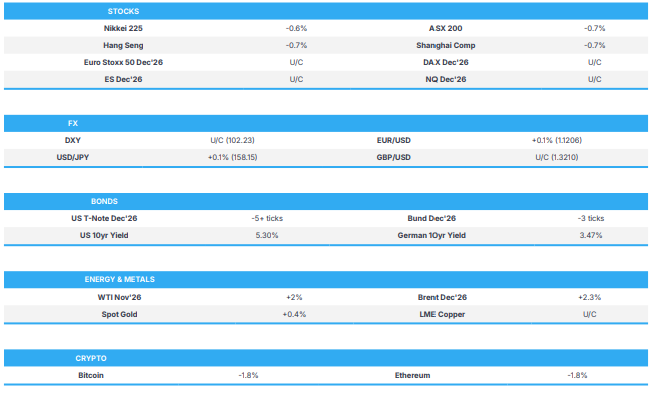
Newsquawk in 3 steps:
1. Subscribe to the free premarket movers reports
2. Listen to this report in the market open podcast (available on Apple and Spotify)
3. Trial Newsquawk’s premium real-time audio news squawk box for 7 days
LOOKING AHEAD
- Highlights include German Trade Balance (Aug), US Initial Jobless Claims (Oct/03), Atlanta Fed GDP (Q3), ECB Minutes (Sep), UK Holborn and St Pancras parliamentary by-election, Speakers including US President Trump, ECB’s Lane, BoE’s Greene, Bailey & Lombardelli, Fed’s Waller, Kashkari & Musalem, Supply from US, Earnings from PepsiCo.
- Click for the Newsquawk Week Ahead.
FOMC MINUTES
- FOMC Minutes stated that all participants supported the 25bps hike in September and most assessed another increase would likely be appropriate by the end of the year. Participants generally emphasised inflation remained elevated while the job market appeared near full employment. Participants offered a range of views for why they supported a rate increase and generally saw inflation risks skewed to the upside, with some seeing those risks becoming more skewed in recent months. Furthermore, almost all participants saw inflation risks tilted to the upside, while job market risks were broadly balanced.
IRAN CONFLICT
- US President Trump might order another Iran strike before the midterms, and Pentagon planners are crafting options, although no final decision has been made. White House has asked the Pentagon to develop strike options against Iranian targets that could be exercised ahead of the midterms, according to two administration officials. Furthermore, the size and targets of the potential strikes—and whether the administration will ultimately proceed—are still being debated.
- US military has been ordered to be ready for possible Iran strikes as President Trump weighs the timing, with the Pentagon said to have instructed US CENTCOM several days ago to conclude preparations for resuming major combat operations in Iran, according to Axios. The directive didn’t include a specific date for launching strikes and President Trump hasn’t made any final decisions, although US and Israeli sources said it could happen before the US midterm election. Furthermore, it was stated that if major combat operations resume, they are likely to be a joint US and Israeli campaign and expected to include large bombing of Iranian energy, infrastructure and nuclear targets.
- US President Trump and his national security team have discussed possibly resuming large-scale US military operations in Iran in the coming weeks, including the option of launching strikes before the midterm elections next month, according to NBC.
- US President Trump stated that he doesn’t think an Iran deal is something he wants to do. It was separately reported that Trump said the Iranians are ready to offer us anything to stop what’s happening, even though an agreement with them is not the option he truly wants, while Trump was also reported to say that Witkoff is now working on reaching an agreement with Iran and is making very good progress, according to Al Jazeera.
- US CENTCOM rejected IRGC claims that the Strait of Hormuz is closed and that Iran has full control over it, while it stated that traffic is flowing through the strait carrying commercial goods and energy supplies, including 20mln bbls of crude.
- Mediation efforts between Washington and Tehran have stalled, while Hormuz is no longer a priority for Washington after Iran lost control of it, according to sources cited by Al Hadath and Al Arabiya. Furthermore, it was stated that progress in negotiations is linked to Iran’s response to Trump’s demands regarding its nuclear capabilities, with Washington demanding that Iran acknowledge it will not continue developing its nuclear capabilities.
- Iran and Oman agreed on geographical coordinates of safe transit routes through the Strait of Hormuz and how they will be communicated to the relevant international authorities.
- Iran’s Foreign Ministry spokesperson Baghaei said Iran’s considerations and conditions for ending the war on all fronts and restoring security to the Persian Gulf region and the Strait have been clearly and firmly explained, and the necessary response to US proposals will be provided through mediators. He also stated that Iran will continue its efforts to strengthen trust and interaction between regional countries, while he stated that Tehran has spared no effort, in consultation with Oman as another coastal state, to restore security to the Strait of Hormuz, and the two sides had agreed on the geographical coordinates for safe transit routes and on how the agreement will be presented internationally, while the agreement between Iran and Oman on the safe routes of Hormuz will soon be reflected in international references.
- Iranian working assumption is that there will be a US attack, according to Jerusalem Post’s Stein, citing two regional diplomats, while the debate in Tehran is if they should attack first.
- UK MTO received a report of an incident 51nm North of Madinat Ash Shamal, Qatar, in which casualties have been reported, after a tanker was struck by multiple projectiles.
- Saudi-led coalition said it conducted another round of retaliatory strikes against Houthis and that attacks on civilian targets won’t go unpunished, while it destroyed a launcher used to attack Riyadh.
- Yemeni armed forces stated that 1,860 Houthi militia members were neutralised in the ‘Dawn of Yemen’ operation and that hundreds of pieces of equipment, supplies and military sites belonging to the Houthi militias were destroyed. Furthermore, it said 2,103 precision targeting operations were carried out against Houthi militias as part of the operation.
- Yemen’s Houthis said they attacked King Khalid International Airport in Riyadh with a ballistic missile and stated Saudi airspace will be a target of operations except over Mecca and Medina.
- Pakistani army confirmed the presence of its military forces in Saudi Arabia, while it stated that Pakistani soldiers are performing their duties in multiple capacities and areas.
- Syria officially denied reports of sending troops to Yemen, with its presidential media advisor stating the reports are lies with no truth, and affirmed that Syria stands with Saudi Arabia’s security.
US TRADE
EQUITIES
- US stocks finished lower following relatively broad-based weakness amid fluctuations in yields, with the Russell 2000 and equal-weight S&P 500 underperforming the major indices. The DJI also lagged, while the SPX and NDX saw more modest losses. Sectors were predominantly lower, with Industrials, Materials and Real Estate leading the declines, while Health Care outperformed.
- SPX -0.22% at 7,801, NDX -0.21% at 31,160, DJI -0.66% at 51,179, RUT -1.27% at 2,794.
- Click here for a detailed summary.
TARIFFS/TRADE
- US President Trump said if the US didn’t buy Swiss watches anymore, it would save USD 40bln, while he touted pharmaceutical company investments in the US. Trump also commented that Canada has been very difficult to deal with and that it would like to make a deal, but stated that they are not satisfied.
- USTR released a joint ministerial statement from 12 G20 countries plus the EU and Poland calling for steps to eliminate excess capacity and production in all economies.
- China has rejected an EU request to voluntarily restrict exports of hybrid cars to Europe, as the two sides enter last-ditch talks to avert a trade conflict, according to FT.
NOTABLE HEADLINES
- US President Trump said Fed Chair Warsh is great, but he’s “one vote”, while he added that interest rates should come down.
- US President Trump will attend a summit today meant to empower scientists and position the US as a leader in breakthroughs driven by “super intelligence,” while the White House is announcing more than USD 1bln in industry commitments for the Genesis Mission from AMD (AMD), OpenAI, Anthropic and others, according to Axios.
- US Treasury Secretary Bessent said regarding high bond yields that it is a global phenomenon and core inflation is approaching target, while he separately commented that the economy is strong, but the Fed should have an open mind.
APAC TRADE
EQUITIES
- APAC stocks were mostly on the back foot following the negative handover from Wall St, where stock markets pulled back from recent record highs amid bond market volatility, while sentiment overnight was pressured as oil rebounded amid geopolitical risks after reports that the US military has been ordered to be ready for possible Iran strikes, with President Trump weighing the timing and could resume strikes before the Midterm elections, but with no decision made.
- ASX 200 was dragged lower as weakness in miners, materials and resources clouded over the gains in energy and resilience in defensives, while there was also an uptick in inflation expectations.
- Nikkei 225 retreated back beneath the 70,000 level as it continued to fade the recent tech-driven rally, while the TOPIX underperformed following the announcement that the Tokyo Stock Exchange plans to reduce the number of constituents in the index by about 40% to 986 stocks.
- KOSPI was pressured alongside indecision in Samsung Electronics shares following its preliminary Q3 earnings results, which showed operating profit surged 783% Y/Y, but missed the lofty expectations.
- Hang Seng and Shanghai Comp were subdued despite the resumption of trading in the mainland following a week-long hiatus, with pressure seen in tech stocks and sentiment was also not helped by trade frictions as the EU is said to be preparing a temporary import cap on Chinese hybrid cars.
- US equity futures remained lacklustre following the subdued performance on Wall St.
- European equity futures indicate a flat cash market open with Euro Stoxx 50 futures unchanged after the cash market closed with losses of 1.5% on Wednesday.
FX
- DXY was range-bound after having benefitted yesterday alongside further bond volatility, while there was little in the way of fresh FX-moving catalysts overnight and the FOMC Minutes release was uneventful, in which it noted that all participants supported the 25bps hike in September and most assessed another increase would likely be appropriate by the end of the year.
- EUR/USD gradually rebounded from the prior day’s trough and just about reclaimed the 1.1200 status after suffering the previous day as French fiscal woes weighed on the single currency.
- GBP/USD attempted to nurse some of its recent losses but with the recovery hampered by the risk-off environment and as catalysts for the UK remained light, while several BoE speakers are scheduled today.
- USD/JPY was choppy with the pair continuing to oscillate around the 158.00 level in the absence of any tier-1 data and after recent fluctuations in global yields.
- Antipodeans were indecisive amid a rebound in commodities and the mostly negative sentiment.
- PBoC set USD/CNY mid-point at 6.7367 vs exp. 6.7254 (prev. 6.7351).
FIXED INCOME
- 10yr UST futures pulled back overnight after yields fluctuated yesterday alongside oil prices and with support from a strong 10yr auction, while FOMC Minutes were a non-event and noted that changes in real rates contributed to most of the net increase in longer-maturity Treasury yields.
- Bund futures took a breather after recent whipsawing and with German trade data scheduled later.
- 10yr JGB futures continued its rebound from the prior day’s trough despite a 30yr auction, which proved to be stronger-than-previous, while there were some comments from Japanese PM Takaichi that fiscal stability is a prerequisite to policy.
COMMODITIES
- Crude futures rebounded from the prior day’s trough after ultimately settling lower on Wednesday in choppy trade as participants weighed up supply and geopolitical-related updates. UKMTO announced that a tanker was struck by multiple projectiles near Qatar, which resulted in casualties, while risks of a resumption of strikes on Iran linger, with reports noting that the US military has been ordered to be ready for possible Iran strikes as President Trump weighs the timing, while Trump and his national security team have discussed possibly resuming large-scale US military operations in Iran in the coming weeks, including the option of launching strikes before the Midterm elections.
- US EPA Administrator said the EPA is days away from unveiling next oil and gas proposal. Venezuela’s Cardon refinery is resuming crude distillation after a fire, according to workers.
- EU will only conduct further releases of oil and diesel reserves after the IEA makes clear such a move would not damage the bloc’s energy security, according to Politico citing sources.
- EU Commission spokesperson said EU countries agreed that any release of oil stocks should be done under the IEA’s March stock release action.
- France will release 10mln barrels of diesel from reserves, according to France Info.
- Syrian Petroleum Company said an oil pipeline in the northeast of the country was subjected to a “sabotage attack” that caused damage, which was the third such incident in about 10 days.
- Spot gold edged amid a rebound in commodities and as the dollar faded some of its recent gains.
- Copper futures rallied with upside seen at the open of Shanghai Commodities trade as the metal’s largest buyer returned to the market following a week-long absence.
CRYPTO
- Bitcoin gradually declined and returned to beneath the USD 83,000 level.
NOTABLE ASIA-PAC HEADLINES
- China is building data centres at rapid speed across its energy-rich rural areas as Beijing seeks to turn abundant electricity and cheap land into an advantage in a global race to develop AI, according to FT.
- Samsung Electronics (005930 KS) Q3 (KRW) prelim. oper. profit rose 783% Y/Y to 107.4tln (exp. 108.7tln), rev. 195tln (exp. 199tln).
DATA RECAP
- Australian Consumer Inflation Expectations (Oct) 5.3% (Prev. 4.9%)
GEOPOLITICS
RUSSIA-UKRAINE
- US President Trump said regarding the lab death in Russia that he doesn’t think it is a bioweapon, while he added that Russia said it is under control but also stated Russia isn’t saying much.
- US President Trump said he has a call set up with Russian President Putin.
EU/UK
NOTABLE HEADLINES
- UK PM Burnham and German Chancellor Merz will hold security talks today, according to the BBC.
- French Finance Ministry said there is no change in bond issuance strategy and that French bond issuance strategy follows investor demand.
DATA RECAP
- UK RICS House Price Balance (Sep) -32% vs. Exp. -30% (Prev. -28%)
2.NORTH AND SOUTH KOREA/
SOUTH KOREA//NORTH KOREA
SOUTH KOREA/USA
JAPAN//
JAPAN//USA
4. EUROPEAN AND SCANDINAVIAN COMMENTARIES PLUS NATO
DENMARK
One Year For Killing A Young Father…
Thursday, Oct 08, 2026 – 08:05 AM
Authored by Steve Watson via Modernity.news,
A Copenhagen court has handed a one-year sentence to the African-born repeat offender who punched Swedish police officer and father of two Christian Zedig to death at a World Cup fan zone this past Summer.

The killer pleaded guilty and he will not appeal. The sentence is so lenient because under Danish law, killing a man who stepped in to ‘stop a fight’ is classed only as ordinary assault.
Nkumba Ludovic Tshiembe, 31, stood on a bench at Islands Brygge on 30 June, hurled beer cans at Scandinavian supporters, then drove a punch into Zedig’s neck, rupturing an artery. The 32-year-old police officer from Eksjö died in hospital on 3 July, leaving a wife and two daughters. On Wednesday the Copenhagen City Court ruled one year in prison and a one-year nightlife ban was sufficient punishment.
The charge was simple violence. Danish prosecutors treat a fist strike as “typically not dangerous,” and the absence of a proven intent to kill kept the case off the murder statute even after the victim died.
Special prosecutor Søren Harbo told the court there were no mitigating circumstances, that Zedig “neither started nor involved himself in a conflict,” and that it was the defendant who “behaved aggressively.”
The bench agreed, citing the aggressive and conflict-escalating conduct, the prior record for serious person-endangering crime, and the death itself. Defense lawyer Thomas Brædder had asked for no more than ten months. The court went to twelve. Harbo had asked for at least that. According to Danish law, that is the maximum possible sentence for this charge.
Tshiembe, a Danish citizen who arrived from an African country as an infant, has a prior rap sheet. He was convicted in 2014 of rape and gross violence. In 2017 a court gave him seven years for attempted murder after he stabbed a man in the heart at a Copenhagen disco.
Yes, really, he is a convicted rapist who also stabbed someone in the heart, but apparently that’s not enough to sentence him to longer than a year for actually killing a father of two, or to remove him from the country.
Expressen reported that earlier court papers described him as “without empathy,” and that preventive detention was never used.
Asked how he felt, Tshiembe told the prosecutor: “I feel terrible,” and said he was thinking of the Swede’s family. He also said beer had been splashed, that he became irritated, and that Zedig had given him no reason to be hit. In the Expressen account of the hearing he said “I don’t know why I hit” and “I just hit.” He declined a final word before the court retired.
Zedig’s wife, Emelie, was the last to speak. She and Christian met in high school, had known each other 17 years and been together nine. “My husband was our security,” she said. “Everything we had built a life around, that there would be two of us to raise our girls – now it is so clear that I am alone with all of it. It has destroyed everything.”
SVT quoted her separately: “Grief shapes our everyday life.”
The family’s counsel, Jakob Buch-Jepsen, is seeking about 1.9 million Danish kroner, roughly $285,000, for her and the two girls. The court ducked the claim and sent it to a committee.
Zedig was off duty in a Swedish national shirt, watching Norway against Ivory Coast on the big screen, when Ivory Coast supporters taunted the Scandinavian tables, threw beer, and rushed them after Erling Haaland’s late winner. He stepped in. He was punched, went down, and was kicked and stomped.

Father Of Two BRUTALLY Beaten To DEATH By African Mob At World Cup Fan Zone
Off-duty cop intervened to stop a brawl only to be stomped to death, leaving wife and two young girls without “the world’s best dad”
Emelie’s Facebook post in the days after the killing said their children’s lives “were turned upside down. Your life ended. Because some other person made that decision.” The girls would grow up without “the world’s best dad.” She would have to raise them without “the world’s best husband.” His sister wrote: “My beautiful and thoroughly good-hearted brother. How will we make it without you with us? Who gave them the right to take you away from us. The grief is never-ending.”
Sweden Democrats MEP Charlie Weimers forced the European Parliament to hold a debate on the repeated savage violence committed against Europeans by migrants. Social Democrats from his own country voted against even having it.
Watch: MEP Forces EU To Address Wave Of SAVAGE Migrant Attacks Throughout Europe
“These are not isolated incidents
“In recent days, Europe has once again been reminded of the very real threats to public security on our streets,” Weimers told the chamber. “These are not isolated incidents, they are part of a broader pattern that is undermining the safety of ordinary Europeans.” He had already called the killing “not a tragic accident” but “the direct consequence of the mass immigration and failed integration that the establishment in Sweden and the EU has forced upon us for decades.”
Danish prime minister Mette Frederiksen wrote on 6 July that “a deep sadness and great anger have filled me in recent days,” and later told a press conference the expected sentence was shocking. “It was shocking for many of us to see what sentence he risks getting. It only makes it worse.”
Her government has since said it wants longer terms for deadly violence by offenders already convicted of violent crime.
Rightful punishment and an end to the mass immigration agenda that perpetuates these atrocities is the only way forward.
END
GERMANY
Germany’s Political Firewall Against The AfD Party Is Crumbling
Thursday, Oct 08, 2026 – 02:00 AM
Authored by Remix News Staff via Remix,

After yesterday’s vote in the Saxony-Anhalt Landtag, the Alternative for Germany (AfD) now holds the office of state parliament president for the first time in any German state. After winning the role, which is similar to a speaker position, 35-year-old Tobias Rausch sent shockwaves through the German political establishment when he confirmed he won with the support of Christian Democratic Union (CDU) votes. The backing of four CDU lawmakers could be one of the most concrete signs that the political firewall against the AfD is crumbling.
The newly elected president of Saxony-Anhalt’s state parliament said Wednesday that members of the conservative CDU voted for him. Perhaps even more importantly, he said that four CDU lawmakers have agreed to back the AfD’s candidate for state premier in December, which means Ulrich Siegmund could soon be the first AfD politician leading a state government.
Rausch gave a direct “yes” when Nius editor-in-chief Julian Reichelt asked on “Nius Live” whether CDU deputies had helped elect him. Asked whether Tuesday’s result signaled that AfD candidate Ulrich Siegmund would safely take office as minister-president in December, Rausch replied, “That is to be assumed.”
He told the German press agency dpa that there were agreements with four CDU members of parliament for Siegmund’s election.
He added that more might become clear at a CDU state party conference on Dec. 5, but declined to elaborate. Acting state premier and CDU floor leader Sven Schulze did not comment on the claims when asked by dpa.
Rausch was elected Tuesday in the constitutive session of the 83-seat Landtag in Magdeburg with 48 votes, 29 against and five abstentions. It was the first time the AfD, parts of which are classified as extremist by German domestic intelligence, has held the presidency of a state parliament since the party was founded in 2013.
The AfD holds 39 seats after winning 43.8% of the vote in the Sept. 6 state election, three short of a majority. The five lawmakers of the Sahra Wagenknecht Alliance had said in advance they would support Rausch, accounting for 44 votes. The additional four came in a secret ballot. SPD, Green and Left lawmakers had said they would vote no. The CDU leadership had recommended that its members abstain; 14 of the party’s 15 deputies were present, but only five abstentions were recorded in the chamber.
The speaker chairs sessions, oversees the parliamentary administration and represents the Landtag externally, including at ceremonial events. However, the far more consequential vote is expected in December, when lawmakers choose a minister-president. Siegmund needs at least 42 votes, and so far, the BSW has not committed to supporting him for that post.
Meanwhile, Schulze of the CDU remains acting premier until a successor is chosen.
Later Tuesday, AfD lawmaker Hans-Thomas Tillschneider was elected a vice president with 44 votes to 38, even though the BSW said its members would not support him because of statements he had made on armaments policy.
CDU lawmaker Carsten Borchert was chosen as another deputy president with 64 votes in favor and 17 against. SPD candidate Armin Willingmann received 33 votes and failed.
AfD national co-leaders Alice Weidel and Tino Chrupalla congratulated the party and described the result as an end to the “firewall” that mainstream parties have maintained against cooperation with the AfD. However, the national CDU is not happy about the outcome in Saxony-Anhalt. CDU/CSU parliamentary group chairman Thorsten Frei said, “The fact that this is the case is, in my view, extremely concerning and worrying.”
END
SPAIN
Spain’s Government Revives Rent Cap Decrees Ahead Of Snap Election
Thursday, Oct 08, 2026 – 03:30 AM
Authored by Owen Evans via The Epoch Times,
Spain’s Socialist-led government on Tuesday reapproved two housing decree laws that Parliament rejected last week, a defeat that prompted Prime Minister Pedro Sánchez to dissolve the country’s Legislature and call a snap election.
The measures include rent caps, a temporary ban on evictions, and limits on corporate purchases of residential property, moves that followed protests triggered by the forced removal of an 87-year-old woman from her home.
Sánchez, the head of Spain’s main socialist party, said on Monday he was bringing forward an election on Nov. 29 previously scheduled for 2027.
“We need to mobilise and win a much larger progressive majority in parliament, one that will allow us to overcome vested interests, deliver new social advances and continue transforming Spain,” Sánchez said in a televised address.
By calling the election, Sánchez shifted approval of the new rules from the full Congress to a smaller caretaker body where his allies hold a narrow majority.
The measures will come into effect temporarily when the decree is published in the official government journal, the Boletín Oficial del Estado, but must then be sent for approval by the caretaker lawmakers who remain in place after Parliament is dissolved, Sánchez said.
Spain’s government approved two decrees on Sept. 29 to pause evictions from investment-fund-owned properties until 2030. The measures also included rules for small landlords, allowing tenants whose leases expire before the end of 2028 to stay for up to two additional years and capping rent increases at 2 percent through 2027.
The decrees failed after lawmakers from Catalan separatist party Junts, which was supporting the left-wing government, joined the opposition in voting it down, arguing that the proposals would reduce housing supply.
Junts parliamentary spokesperson Miriam Nogueras said the decrees would have the opposite effect of their stated aims.
“Finding housing will become more difficult every day. Our responsibility is to provide certainty, not uncertainty,” she said.
The opposition People’s Party also voted against the measures.
“Housing doesn’t become more affordable through decrees; it becomes more affordable by building more homes,” said PP lawmaker Juan Bravo. “We’re not going to lie to you – it’s not going to be easy, and it’s not going to happen quickly.”
Pedro’s government has reissued decrees that largely maintain the substance of the measures rejected by Parliament.
It also includes value-added tax on tourist flats, tax deductions for tenants, tax incentives for landlords who lower rents, help for first-time homebuyers, protections for the state housing stock, and a reduction in value-added tax on protected housing.
The interventionist measures will only serve to drive away the investment needed to increase supply, said Carolina Roca, president of the Association of Property Developers of Madrid.
“The legal uncertainty inherent in both decrees will result in a sharp slowdown in the limited investment secured to date in the construction of affordable housing,” she said.
The attempted eviction of 87-year-old Maricarmen Abascal in Madrid triggered nationwide protests.
Police evicted Abascal on Sept. 23 from her Madrid home of more than seven decades. The apartment in the capital’s affluent Retiro neighborhood was bought by investment fund Urbagestion, which sought a significant rent increase that Abascal could not afford.
“I’ve lived here for 71 years, and I don’t want to leave,” Abascal told reporters on the eve of the eviction.
Abascal’s lawyer told the BBC on Sept. 30 that she can now return to the property.
Beatriz Duro said at a press conference there had been “goodwill from both parties” and that she would pay a similar amount of rent under a new contract and not pay the increased amount.
On Sept. 23, Bank of Spain Deputy Gov. Soledad Núñez said that since 2021, an estimated shortfall of about 755,000 homes has built up, and that the gap could widen by another 300,000 between 2026 and 2028.
Reuters contributed to this report.
END
FRANCE
Le Pen Seen As Most Credible Presidential Candidate As French Bonds Suffer Worst Decade Since 1803
Thursday, Oct 08, 2026 – 08:20 AM
France’s politicians seem to be getting a dire warning from the bond market: rein in reckless spending or risk a fiscal crisis as borrowing costs skyrocket.
UBS strategist Julien Conzano, head of European macro credit strategy in London, sees bond market pressure pushing both the crisis-stricken Macron government and Marine Le Pen’s National Rally toward greater fiscal discipline, reducing the risk of an expansionary 2027 budget.
Deutsche Bank strategists Jim Reid and Henry Allen wrote in a note that French 10-year government bonds have posted their worst rolling decade of nominal returns since 1803, dating back to the Reign of Terror during the French Revolution.
The French welfare state’s bill is finally coming due: France’s budget deficit is forecast to be 5.4% of GDP this year, well above the EU’s 3% ceiling. The country has not balanced its budget since 1974.
On Tuesday, Le Pen unveiled her shadow budget for next year, should she win the presidential elections in mid-April. In it, she proposed steep deficit cuts.
Le Pen’s plan would shrink the deficit to 3.7% of economic output next year, well below the government’s 5% target, before bringing it to 2.2% by 2032. Savings would come largely from spending cuts, lower transfers to the EU and reduced migrant spending.
French 10-year bond yields rose sharply at the beginning of the week towards 5% before sliding to nearly 4.7% after Le Pen’s shadow budget reveal on Tuesday. But by the end of the week, the government debt yield rocketed back to nearly 4.96%.
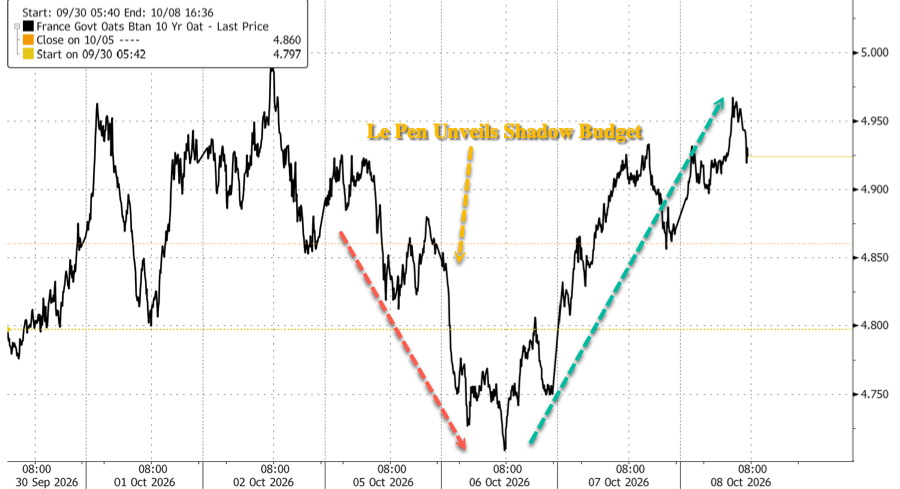
To save France from the brink of what we described as a “triple crisis“, which consists of far-left riots, a ticking debt bomb and mass migration all colliding at once, a new Verian survey conducted for local outlet Le Figaro Magazine found that 39% of respondents believe Le Pen has a clear vision to contain the crisis.
Le Pen’s 39% compared with just 27% for center-right rival Edouard Philippe and 18% for far-left candidate Jean-Luc Mélenchon.
The ongoing social unrest by the far-left, weaponizing young kids who have burned down schools and torched buses, has been the extra fuel to propel Le Pen, as her Polymarket odds of winning the “Next French Presidential Election” have skyrocketed over the last week to 43%.
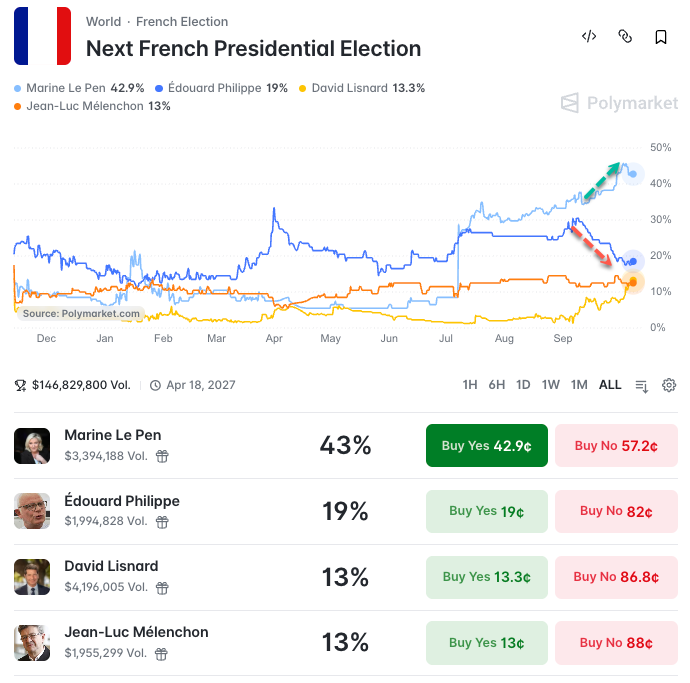
A consensus appears to be forming that Le Pen’s proposed fiscal discipline to rescue France from the brink of what she describes as a looming default, if the current trajectory continues, is a welcome relief for the market and voters. Nomura analysts described this theme in late August (read report), and they see Europe “lurching” right over the next 18-month election cycle.
Principal Asset Management’s Howe Chung Wan noted that one accelerator of France’s bond rout was the unwinding of carry positions, which helped drive the selloff and amplified pressure that sent yields soaring.
“You can see this time around in France, it took France and Italy … but it did not take Spain,” Howe said, adding, “So it tells you it’s about positioning. It tells you about who is on the trades.”
What’s happened so far this week:
- Spain Joins The Party: Snap Election Adds Madrid To Europe’s “Red October” Bond Crisis
- French Bonds Rally As Le Pen Unveils Shadow Budget To Pull France Back From Fiscal Brink
- France’s Triple Crisis: Far-Left Riots, A Ticking Debt Bomb, And Mass Migration Collide
Le Pen has tailwinds here as the spending bill for the failed progressive experiment and unfettered spending comes due. Nomura is correct: the market no longer fears right-wing candidates; it fears left-wing candidates and unhinged socialists.
FRANCE/
JONATHAN TURLEY…
Macron Goes Full Orwell
Thursday, Oct 08, 2026 – 05:00 AM
Authored by Jonathan Turley via JonathanTurley.org,
French President Emmanuel Macron went full Orwell this week. While long the darling of Western media, Macron has been one of the most anti-free-speech leaders in the world. This week, he declared that “The so-called American ‘free speech’ today, which some people have promoted, is the opposite of free speech.” Having Emmanuel Macron holding forth on free speech is akin to Joey Chestnut proselytizing on veganism.

France has been in a headlong plunge into censorship and speech criminalization. These laws criminalize speech under vague standards referring to “inciting” or “intimidating” others based on race or religion.
For example, fashion designer John Galliano has been found guilty in a French court on charges of making anti-Semitic comments in a Paris bar.
In another case, the father of French conservative presidential candidate Marine Le Pen was fined because he had called people from the Roma minority “smelly.” A French teenager was charged for criticizing Islam as a “religion of hate.”
Many of us were disgusted recently when Macron celebrated Brigitte Bardot’s life as someone who “embodied a life of freedom.” As discussed on this blog, the French government repeatedly prosecuted Bardot for speaking about her views.
Macron’s praise for Bardot’s “life of freedom” is reminiscent of the reaction of French officials to the massacre of editors at Charlie Hebdo, a satirical magazine. After hounding the victims for years with criminal investigations, the French government organized a march for free speech. As predicted, it then used the killing by Islamic extremists to further crack down on free speech.
In my book The Indispensable Right, I discuss how France has careened down the slippery slope of censorship for decades, and the desire to silence others has now become an insatiable appetite.
Macron has supported figures like his anti-free-speech ally Thierry Breton in globalizing the reach of the infamous Digital Services Act (DSA) to curtail speech, including Americans and American companies.
In his latest pitch for censorship, Macron pulls out an old saw that if everyone can speak freely, no one can speak freely.
Macron declared that “There is no freedom if there is no limit to my freedom, which begins with the freedom of others and respect for a common framework. I know this when I walk down the street: my freedom cannot mean hitting you, insulting you or trashing the public space we all share.”
That line is remarkably telling. It captures how even “insulting” language is treated as a crime in France.
Since then, France has been a leader in the rollback of free speech in the West, with ever-widening laws curtailing free speech. France regularly charges people for political and religious speech, including comedians and those criticizing the police.
Macron’s visceral reaction to free speech is shared by many in the European Union.
I spoke in Berlin at the World Forum, which boasted the slogan, “A New World Order with European Values.” Bill and Hillary Clinton and other Americans cheered on the European efforts.
The Digital Services Act bars speech that is viewed as “disinformation” or “incitement.” When it was passed over the condemnations of many of us in the free speech community, European Commission Executive Vice President Margrethe Vestager celebrated by declaring that it is “not a slogan anymore – that what is illegal offline should also be seen and dealt with as illegal online. Now it is a real thing. Democracy’s back.”
Despite his unpopularity in France, Macron remains a favorite of the establishment and the media in the United States. I was appalled years ago when he came to Congress to spread his anti-free speech gospel. Macron called for a joint war against “fake news” and declared, “Democracy is about true choices and rational decisions. The corruption of information is an attempt to corrode the very spirit of our democracies.”
Our representatives applauded like seals with little recognition that he was referencing censorship. Macron believes that he should be able to dictate which views are “corrosive” to the spirit of democracy.
The claim that more speech means less speech is an oxymoronic talking point of the anti-free speech movement. As I discussed in my book, there has not been a single censorship system in history that has worked to kill a single idea or movement. Instead, it has given more power to politicians like Macron to silence critics and intimidate opponents.
In the end, the only true solution to bad speech is better speech. The public can sort out their own values and weigh opposing views without the strict guidance of the government. Free speech serves as its own disinfectant.
Ultimately, allowing people not just free inquiry but free expression bends the arch of humanity toward truth. Hate and prejudice are inherently flawed values that tend to collapse when exposed to full, robust debate.
That does not mean that it will eliminate racism, sexism, or other forms of hate. Neither censorship nor free speech can make everyone better people. However, what Macron is peddling is the same tired, dishonest claim that free speech is harmful and the government must control what people see and say in public discourse.
This is a nation that still echoes the cry of Liberty, Equality, and Fraternity (“liberté, égalité, fraternité”). However, in today’s France, “liberté” remains a declining value. Individual rights of religion and speech are routinely sacrificed in the name of “equity” and “fraternity.”
Jonathan Turley is a law professor and the New York Times best-selling author of “Rage and the Republic: The Unfinished Story of the American Revolution.”
END
EUROPE
The European Bank Doom Loop Is Back AI
Yes—concerns about the classic European sovereign-bank “doom loop” have resurfaced in early October 2026 amid rising bond yields, fiscal pressures (especially in France and other high-debt countries), and banks’ large and growing holdings of government debt, though analysts stress it is weaker and different from the eurozone crisis era.
globalcapital.com
What the doom loop is
It refers to the feedback loop in which banks hold large amounts of their own (or other euro-area) sovereign bonds. Stress on the sovereign (higher yields, wider spreads, fiscal worries) hits bank balance sheets via mark-to-market losses or credit concerns; weaker banks then raise the risk of needing sovereign support, which further pressures government finances and bonds. This amplified the eurozone debt crisis roughly 15 years ago.
Current situation (as of early October 2026)
- Holdings have risen sharply: Morningstar DBRS data show euro-area banks’ sovereign exposures reached €4.54 trillion in June 2026—up 44% from €3.14 trillion at end-2022. Relative to capital this equals 264% of CET1 (up from 214%); as a share of total assets it is 14.7% (up from 11.6%). These are the highest levels since 2019. Portuguese, Italian, and Spanish banks are among the most exposed (CET1 ratios of ~367%, 361%, and 342%); German and Irish banks sit below the EU average. teleborsa.it
- Home bias has declined but remains material: The share of domestic sovereign debt in banks’ portfolios fell to 43% (from a 2021 peak of 53%), with Italy around 50%, Spain 46%, France 45%, and Germany lower. Diversification helps, but absolute exposures are still high and portfolios have lengthened (46% of exposures mature beyond five years; higher for Italian banks). teleborsa.it
- Market pressure is visible: A renewed global bond sell-off (higher yields, wider spreads in high-debt countries) hit European bank shares hard around 7 October 2026. The STOXX Europe Banks index fell ~3–3.5%, with French names (e.g., Société Générale), German, and Italian banks among the weakest. Contagion fears from French sovereign stress spilled into bank credit and equities; Italian banks are also watched closely because of their still-elevated domestic exposure. reuters.com
- Monetary and fiscal backdrop: The ECB raised its deposit rate to 2.50% in September; European sovereign yields are at multi-year highs. France’s debt-to-GDP has risen further (around 119% mid-2026 and projected higher), with persistent large deficits. Higher yields increase debt-servicing costs and reduce fiscal space across the EU. The ESRB has flagged rising financial-stability risks from this global yield rise and fiscal pressures. esrb.europa.eu
How the risk has evolved
DBRS and others note the traditional credit-loss channel (sovereign default risk feeding into banks) has weakened thanks to stronger capital, better supervision/resolution frameworks, and some diversification. The more relevant near-term risk is now interest-rate and valuation pressure on longer-duration bond portfolios as yields rise. Non-bank financial institutions have also become a bigger part of the broader sovereign nexus.
teleborsa.it
Analysts emphasize that this is not yet a full-blown crisis of the early-2010s variety: banks are far better capitalised and supervised, home bias is lower, and regulators have tools (including the ECB’s Transmission Protection Instrument) that did not exist then. DBRS concludes that sovereign exposure and higher yields alone are unlikely to trigger widespread rating actions.
globalcapital.com
Bottom lineThe structural link has not been fully broken—European banks still hold large sovereign portfolios at a time of rising rates and fiscal strain in several large economies—so market volatility can quickly revive “doom loop” language, especially when French or Italian spreads widen. Progress on banking-union completion (including deposit insurance) and further diversification would further weaken the nexus, but the absolute size of holdings and longer duration keep the sensitivity alive. Recent commentary frames the current episode more as “déjà vu” and a reminder of unfinished work than an imminent systemic crisis.
END
FRANCE
HUMOUR
Golden Naked Trump Statue Unveiled At European Parliament
Thursday, Oct 08, 2026 – 02:45 AM
A golden statue of a naked Donald Trump is on display at the European Parliament in Strasbourg, France, at one of the busiest intersections connecting two of the Parliament’s buildings, and is scheduled to stay until Thursday. Named Orange Plague, the 8.5-foot sculpture shows the US president holding justice scales and a long golf club, its ball made to look like the world, while sitting on the shoulders of a smaller, clothed man. Text on the plinth reads: “I am sitting on the back of a man. He is sinking under my burden. I will do anything to help him. Except stepping down from his back.”

Jens Galschiot, the Danish artist who created the sculpture, said: “Trump represents one of the greatest threats to the rules-based world order, democratic values and our common effort to solving the climate crisis.”
“We must address this issue and stand together against such destructive influence.”
Galschiot said the statue, covered in 23-carat gold leaf, was inspired by the story of The Emperor’s New Clothes, in which a vain leader parades naked through the street, believing he is dressed in the finest clothes.
In the fairytale, no one tells him that he is naked out of fear and flattery until a child points out his nudity and the emperor becomes a figure of ridicule.
Per Clausen, a Left-wing Danish European Parliament member, invited the artist to exhibit the statue in the building.
He said that he was not worried about a potential reaction from Trump, adding: “If someone is so thin-skinned that they cannot tolerate this sculpture being exhibited in the European Parliament, then they have no place on the world stage.”
The statue was previously on display during the 30th United Nations Climate Change Conference (COP30), which was held in Brazil last year. It also made an appearance in Germany during this year’s Munich Security Conference.
Worth reading in full over at The Telegraph.

5.RUSSIA AND ISRAEL AND MIDDLE EASTERN AFFIARS
ISRAEL/USA/IRAN/THURSDAY
Tanker Crews Running Hormuz Describe Risky Tactics: Lights Out, Sandbags Up, Hugging Coast
Thursday, Oct 08, 2026 – 05:45 AM
The Trump administration has been boasting of bigger than ever war time oil transit flows through the Strait of Hormuz, but it is happening still at great risk to tankers, captains, and crew members. American forces “have assisted thousands of ships through the Strait of Hormuz in recent months by providing coordinated protection,” US Central Command has said in a statement.
Nothing about this has been ‘easy’ or smooth in terms of operations and security, even when vessels do make it through the strait without being targeted. Just the last eight days has seen a dozen or more international vessels targeted by drones – a trend which has gone underreported after a long stalemate in negotiations.
In coordination with the US Navy, commercial tankers are essentially forced to go ‘dark’ – literally with lights off and with their Automatic Identification System (AIS) off – just to keep oil and gas moving through the contested waterway. While this trend of a growing number of stealthy ships making passage is nothing new, transits over the last several weeks have become more steady and greater in volume.
A recent Bloomberg report provided more color on what the ground reality looks like by interviewing ship captains and crewmembers. The report began, harrowingly: “The tanker captain summoned his years of experience when he saw the blast in front of him. He veered his 300-meter-long ship around the vessel ahead and could see a fire had started. He called the US Navy to tell them of the attack.”
“His vessel is among the ships engaged in shuttle runs through the strait, ferrying barrels often at night and with strict instructions about what equipment can be used — no lights, no phones and with only one radar,” the report continued.
The unnamed captain who is based out of the Philippines described the challenges of navigating a hostile waterway with no navigational lights, while largely relying on visually tracking the coastline and lighthouses (on the Omani side): “I’m just lucky because I still remember the traditional navigation, the old school.”
Wednesay (10/7): A tanker was hit by “multiple projectiles” about 51 nautical miles north of Qatar.
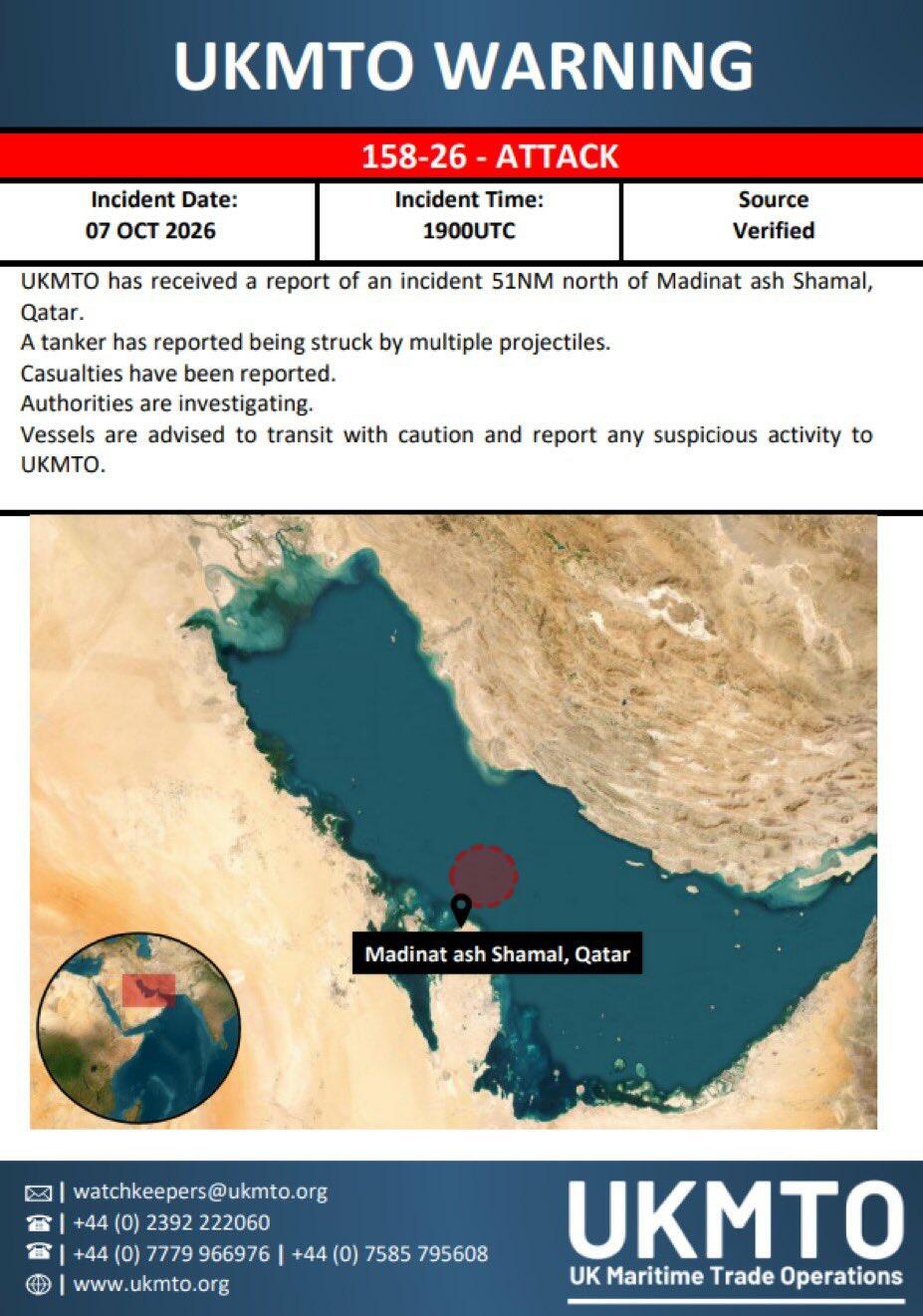
Ships have to treat the entire transit almost like a continuous emergency or fire drill, with pumps running and hoses at the ready – also after sandbagging the ship’s most vulnerable areas in case of drone or missile attack.
The same captain described further:
On one occasion he saw what he described as a jet plane flying above them, and also a helicopter.
The radio silence while crossing Hormuz made his time at sea even more unusual, he said. The lack of noise on the radio was only punctuated by the chatter of more people than usual manning the bridge to watch out for attacks.
All the while, the vessel must carefully traverse along US Navy-provided routes and specific waypoints, often closely hugging the coastline while ensuring waters are deep enough for heavy tankers.
The report says it has become routine for vessels to check in with the US Navy every 30 minutes.
For the litany of risks, crews are being offered multiples of their normal salaries, with some shipowners reportedly offered as much as six additional months of pay for Hormuz shuttle runs.
Meanwhile, some of the latest from US Central Command (CENTCOM):
After exiting, these ‘dark ships’ eventually transfer oil onto tankers that take the cargoes to buyers in Asia or elsewhere. One recent report reviews of the complex process:
Much of the higher volume is made possible now by ship-to-ship transfers, notes Amir Handjani, an energy lawyer and public affairs executive, in an interview with RS. This is where private companies come into ports and with AIS transponders off, undergo the very risky and expensive task of transferring fuel cargo into government “shuttle” vessels that travel through the strait “dark” and then offload onto larger tankers in safer, open waters. Ship-to-ship is also used for shuttling through Hormuz bypass routes.
“It’s not moving without cost and without huge investment by the U.S. Navy. Is that sustainable?” Handjani posed in the report. “I don’t know, I guess anything is possible.”
* * *
Needless to say, the Mideast chaos has sent crude tanker rates soaring.
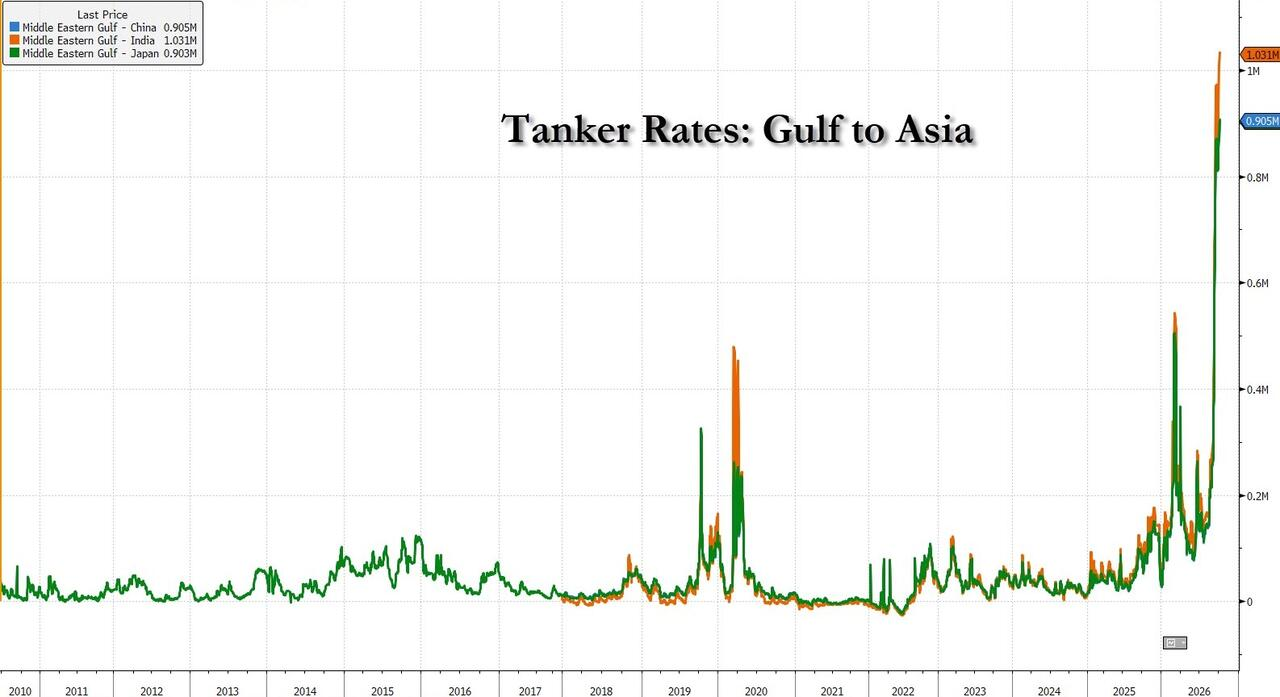
ISRAEL/USA/IRAN THURSDAY MID MORNING
Iran Expands Tanker Assaults Beyond Narrow Confines Of Hormuz In Rare Escalation
Thursday, Oct 08, 2026 – 09:45 AM
Iran has significantly widened its maritime operations by shifting attacks beyond the narrow confines of the Strait of Hormuz into the broader waters of the Persian Gulf and the Gulf of Oman. Over a recent 24-hour window, the Islamic Revolutionary Guard Corps (IRGC) may have struck two commercial ships outside traditional chokepoints, including a vessel off Qatar, as well as a Very Large Crude Carrier near the United Arab Emirates. The latter instance has less confirmation at this point.
This escalation indicates a tactical shift, given the IRGC is no longer waiting for vessels to explicitly violate its designated maritime enforcement corridors. Instead, any ship suspected of trying to bypass Iranian blockades now faces active targeting across the entire regional waterway. This at least is what Tehran is likely seeking to demonstrate to Washington and its Gulf allies, and comes after record numbers of vessels have been making it through so far this month under US naval watch and protocol.
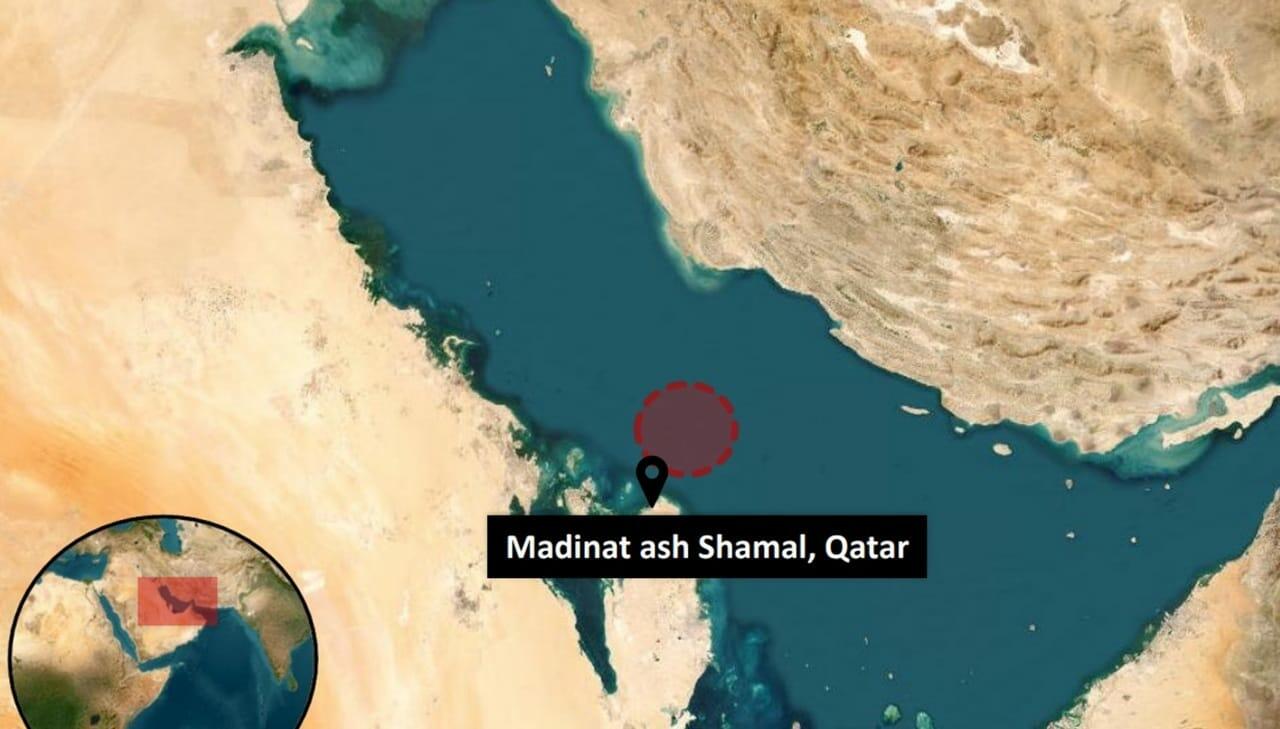
The first of these incidents, which was widely reported overnight and is now being given greater confirmation Thursday, occurred 51 nautical miles north of Madinat ash Shamal, Qatar. The vessel was struck multiple times, in what appears an effort to specifically to kill crew members. An unknown amount of casualties has been reported:
It said there were multiple casualties as a result of the attack. The extent of the casualties is unknown, however, in previous UKMTO warnings the word “casualties” has been used to describe seafarer deaths rather than injuries.
The Guardian details further of the unusual location of the attack:
The vessel was in the Gulf, about 500km (300 miles) west of the strait of Hormuz, when it reported being struck “by multiple projectiles”, the UK Maritime Trade Operations said on Wednesday. The UK authority did not specify the origin of the ship.
Wednesday’s attack comes as strikes on tankers sailing through the strait of Hormuz hit their highest weekly level since the Iran war began, according to maritime security firms, as oil prices climbed above $100 per barrel.
Oil Price writes, “A tanker has been struck by multiple projectiles north of Qatar’s tip in the first such attack deep within the Persian Gulf in nearly a month.” Not only have drone and missile attacks on vessels picked up over the last nearly two weeks, but casualties as well.
“In the week to 5 October, there were at least 12 attacks on oil, liquefied natural gas and liquefied petroleum gas tankers around the strait, according to data from three security sources,” continues The Guardian. “On Tuesday, India’s foreign ministry said 12 crew members were injured after an attack on a Panama-flagged oil tanker passing through the strait of Hormuz.”
The second of these events, off UAE, has been less confirmed. Newsquawk notes:
Oil tanker assembly site reportedly explodes near UAE, Mizan reports; “Ocean sources reported the detection of a fire in the Gulf of Oman, approximately 30 nautical miles east of Fujairah”
And via DropSite News:
Maritime and satellite open source channels have been observing a fire, with potential US military assets circling the area, at the below location:

If this second attack is confirmed, it marks a serious escalation in terms of Iran’s efforts to extend its own blockade and ‘answer’ to so many ships getting through under the US Navy’s protocol.
More Latest Regional Developments
via Newsquawk
- The White House has asked the Pentagon to develop strike options against Iranian targets that could be exercised ahead of the midterms, according to two administration officials. The planning underscores just how much the president wants to reduce gas prices and demonstrate progress in the conflict before the vote. The Atlantic
- The US military has been ordered to be ready for possible Iran strikes as President Trump weighs the timing, with the Pentagon said to have instructed CENTCOM several days ago to conclude preparations for resuming major combat operations in Iran; any campaign is expected to be a joint US-Israeli one including large bombing of Iranian energy, infrastructure and nuclear targets. Axios
- US President Trump stated that he doesn’t think an Iran deal is something he wants to do. It was separately reported that Trump said the Iranians are ready to offer us anything to stop what’s happening, even though an agreement with them is not the option he truly wants, while Trump was also reported to say that Witkoff is now working on reaching an agreement with Iran and is making very good progress, according to Al Jazeera.
- The US military has been ordered to be ready for possible Iran strikes as President Trump weighs the timing, with the Pentagon said to have instructed US CENTCOM several days ago to conclude preparations for resuming major combat operations in Iran, according to Axios. The directive didn’t include a specific date for launching strikes and President Trump hasn’t made any final decisions, although US and Israeli sources said it could happen before the US midterm election. Furthermore, it was stated that if major combat operations resume, they are likely to be a joint US and Israeli campaign and expected to include large bombing of Iranian energy, infrastructure and nuclear targets.
- US President Trump and his national security team have discussed possibly resuming large-scale US military operations in Iran in the coming weeks, including the option of launching strikes before the midterm elections next month, according to NBC.
- The US is stepping up preparations and has completed operational plans in case President Trump orders strikes against Iran, i24 News reported citing sources. The report added that forces at Fort Bragg are ready to deploy to any theatre within 18 hours.
- Iran’s working assumption is that there will be a US attack, according to Jerusalem Post’s Stein, citing two regional diplomats, while the debate in Tehran is if they should attack first.
- US CENTCOM rejected IRGC claims that the Strait of Hormuz is closed and that Iran has full control over it, while it stated that traffic is flowing through the strait carrying commercial goods and energy supplies, including 20mln bbls of crude.
- Iran’s Foreign Ministry spokesperson Baghaei said Iran’s considerations and conditions for ending the war on all fronts and restoring security to the Persian Gulf region and the Strait have been clearly and firmly explained, and the necessary response to US proposals will be provided through mediators. He also stated that Iran will continue its efforts to strengthen trust and interaction between regional countries, while he stated that Tehran has spared no effort, in consultation with Oman as another coastal state, to restore security to the Strait of Hormuz, and the two sides had agreed on the geographical coordinates for safe transit routes and on how the agreement will be presented internationally, while the agreement between Iran and Oman on the safe routes of Hormuz will soon be reflected in international references.
- Iranian intelligence services are reportedly targeting the US Ramstein and Spangdahlem air bases in Germany, WiWo reported. The report added that Iranian intelligence services are reportedly also targeting other US bases in Europe and planning complex attacks, with the UK also said to be a potential target.
- Pakistan’s Army Chief said they are working to reduce the differences between the US and Iran, according to Nour News.
- Reports of explosions heard and fires visible in Riyadh, Saudi Arabia, according to Sabereen News. Satellite images also showed smoke rising from the Abqaiq oil facilities in Saudi Arabia, and a fire at both Abqaiq facilities and Tanjib gas plant.
- Oil tanker assembly site reportedly exploded near UAE, Mizan reported; “Ocean sources reported the detection of a fire in the Gulf of Oman, approximately 30 nautical miles east of Fujairah.”
- Yemen’s Houthis said they attacked King Khalid International Airport in Riyadh with a ballistic missile and stated Saudi airspace will be a target of operations except over Mecca and Medina.
- Syria officially denied reports of sending troops to Yemen, with its presidential media advisor stating the reports are lies with no truth, and affirmed that Syria stands with Saudi Arabia’s security.
ISRAEL TBN
IRAN/USA
Trump Declares He Won’t Attack Iran Before Midterm Elections, Oil Plunges
Thursday, Oct 08, 2026 – 12:25 PM
Summary
- Oil plunged after Trump said on Truth Social the US will not attack Iran before the November midterms.
- Late Wednesday reports said Pentagon was ordered to prepare Iran attack options for before midterms.
- Iran expanded tanker attacks beyond the Strait of Hormuz into the Persian Gulf and Gulf of Oman.
- In Saudi Arabia, Riyadh airport suffers direct missile attack from Iran-aligned Houthis.
Oil Plunges As Trump Says No Attacks Before Midterms
President Trump just issued a new Truth Social Post Thursday just after noon time (eastern), wherein he declared “we will not be attacking Iran at any time prior to the Midterm Elections” in November. Oil dropped on the statement (though is still up on the day)…
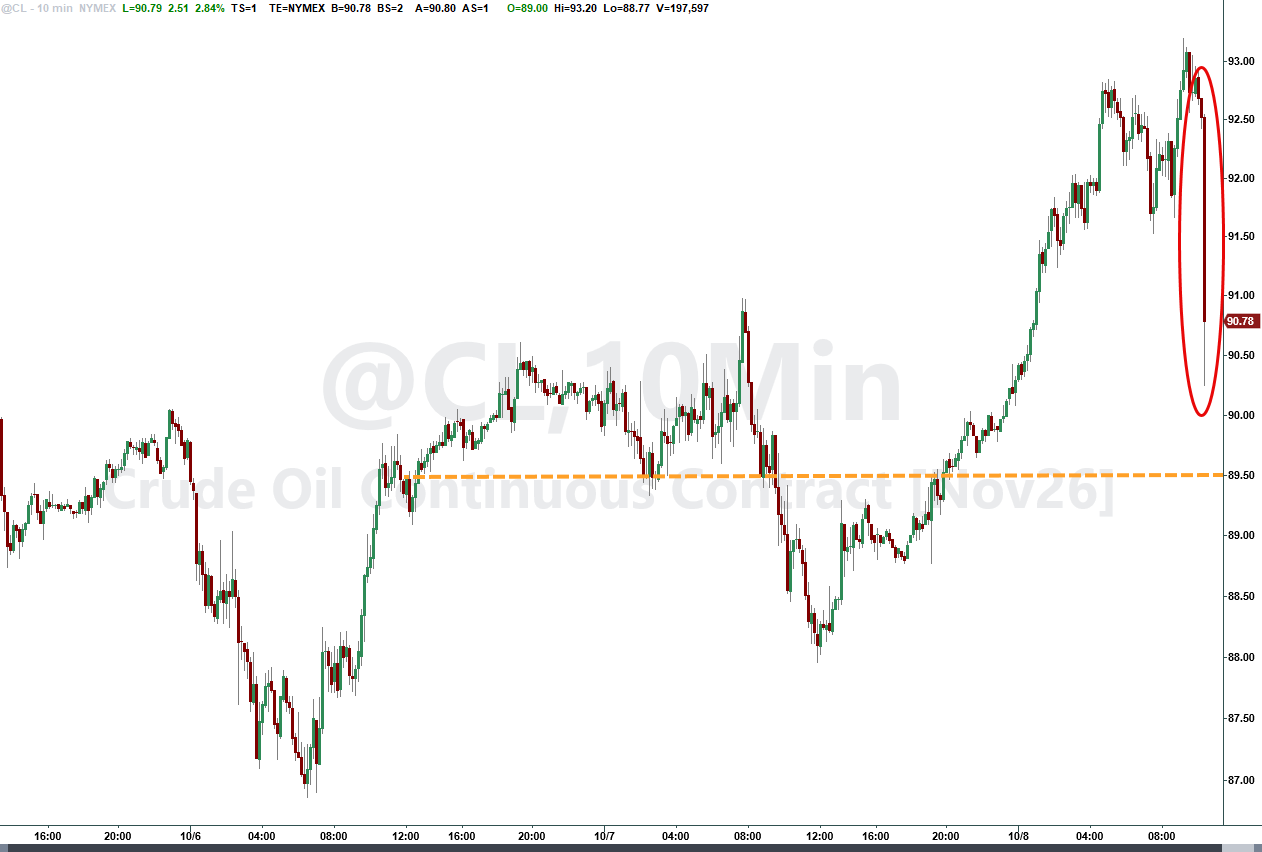
The full Trump post below, wherein Trump also claims that active discussions with the Iranians are still happening, and that oil is “flowing in record numbers”…
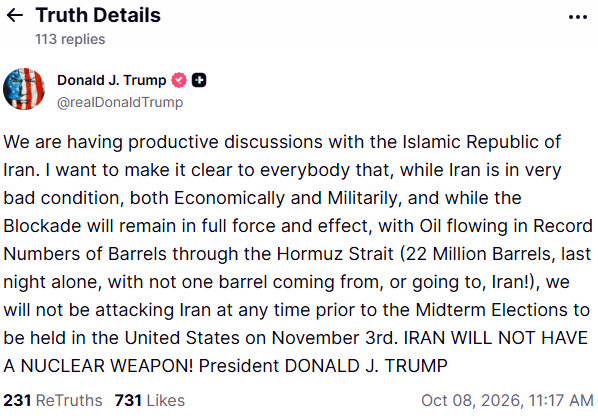
To recall, The Atlantic reported late Wednesday that the Pentagon is preparing strike options for the Commander-in-Chief to consider, and that Trump may actually pull the trigger before the midterm elections – though the report emphasizes that the decision was still being debated:
After months of on-again, off-again fighting, the United States hasn’t struck Iran in several weeks. The stretch of relative tranquility is coinciding with the final phase of the midterm-election campaign, and the assumption has been that President Trump will want to keep it going through November 3 so as not to remind voters of an unpopular war that is dragging Republican candidates down nationwide.
But that may not be what happens. The White House has asked the Pentagon to develop strike options against Iranian targets that could be exercised ahead of the midterms, according to two administration officials. The planning underscores just how much the president wants to reduce gas prices and demonstrate progress in the conflict before the vote, administration officials told us.
And yet a renewed outbreak of direct bombing would likely actually serve to do the opposite, given oil prices have tended to shoot up on headlines of major direct escalation.
Reports out of Iran confirmed earlier Wednesday that negotiations are ‘stalemated’ – also as the Iranians have ramped up targeting tankers with drones in the Strait of Hormuz over the last week.
Iran Expands Tanker Assaults Beyond Narrow Confines Of Strait Of Hormuz
Iran has significantly widened its maritime operations by shifting attacks beyond the narrow confines of the Strait of Hormuz into the broader waters of the Persian Gulf and the Gulf of Oman. Over a recent 24-hour window, the Islamic Revolutionary Guard Corps (IRGC) may have struck two commercial ships outside traditional chokepoints, including a vessel off Qatar, as well as a Very Large Crude Carrier near the United Arab Emirates. The latter instance has less confirmation at this point.
This escalation indicates a tactical shift, given the IRGC is no longer waiting for vessels to explicitly violate its designated maritime enforcement corridors. Instead, any ship suspected of trying to bypass Iranian blockades now faces active targeting across the entire regional waterway. This at least is what Tehran is likely seeking to demonstrate to Washington and its Gulf allies, and comes after record numbers of vessels have been making it through so far this month under US naval watch and protocol.
The first of these incidents, which was widely reported overnight and is now being given greater confirmation Thursday, occurred 51 nautical miles north of Madinat ash Shamal, Qatar. The vessel was struck multiple times, in what appears an effort to specifically to kill crew members. An unknown amount of casualties has been reported:
It said there were multiple casualties as a result of the attack. The extent of the casualties is unknown, however, in previous UKMTO warnings the word “casualties” has been used to describe seafarer deaths rather than injuries.
The Guardian details further of the unusual location of the attack:
The vessel was in the Gulf, about 500km (300 miles) west of the strait of Hormuz, when it reported being struck “by multiple projectiles”, the UK Maritime Trade Operations said on Wednesday. The UK authority did not specify the origin of the ship.
Wednesday’s attack comes as strikes on tankers sailing through the strait of Hormuz hit their highest weekly level since the Iran war began, according to maritime security firms, as oil prices climbed above $100 per barrel.
Oil Price writes, “A tanker has been struck by multiple projectiles north of Qatar’s tip in the first such attack deep within the Persian Gulf in nearly a month.” Not only have drone and missile attacks on vessels picked up over the last nearly two weeks, but casualties as well.
“In the week to 5 October, there were at least 12 attacks on oil, liquefied natural gas and liquefied petroleum gas tankers around the strait, according to data from three security sources,” continues The Guardian. “On Tuesday, India’s foreign ministry said 12 crew members were injured after an attack on a Panama-flagged oil tanker passing through the strait of Hormuz.”
Tanker Fire Off UAE: Second Vessel Attacked?
The second of these events, off UAE, has been less confirmed. Newsquawk notes:
Oil tanker assembly site reportedly explodes near UAE, Mizan reports; “Ocean sources reported the detection of a fire in the Gulf of Oman, approximately 30 nautical miles east of Fujairah”
And via DropSite News:
Maritime and satellite open source channels have been observing a fire, with potential US military assets circling the area, at the below location:
If this second attack is confirmed, it marks a serious escalation in terms of Iran’s efforts to extend its own blockade and ‘answer’ to so many ships getting through under the US Navy’s protocol.
Houthis Attacking Saudi Airports
From bad to worse in the Saudi-Houthi war…
More Latest Regional Developments
via Newsquawk
- The White House has asked the Pentagon to develop strike options against Iranian targets that could be exercised ahead of the midterms, according to two administration officials. The planning underscores just how much the president wants to reduce gas prices and demonstrate progress in the conflict before the vote. The Atlantic
- The US military has been ordered to be ready for possible Iran strikes as President Trump weighs the timing, with the Pentagon said to have instructed CENTCOM several days ago to conclude preparations for resuming major combat operations in Iran; any campaign is expected to be a joint US-Israeli one including large bombing of Iranian energy, infrastructure and nuclear targets. Axios
- US President Trump stated that he doesn’t think an Iran deal is something he wants to do. It was separately reported that Trump said the Iranians are ready to offer us anything to stop what’s happening, even though an agreement with them is not the option he truly wants, while Trump was also reported to say that Witkoff is now working on reaching an agreement with Iran and is making very good progress, according to Al Jazeera.
- The US military has been ordered to be ready for possible Iran strikes as President Trump weighs the timing, with the Pentagon said to have instructed US CENTCOM several days ago to conclude preparations for resuming major combat operations in Iran, according to Axios. The directive didn’t include a specific date for launching strikes and President Trump hasn’t made any final decisions, although US and Israeli sources said it could happen before the US midterm election. Furthermore, it was stated that if major combat operations resume, they are likely to be a joint US and Israeli campaign and expected to include large bombing of Iranian energy, infrastructure and nuclear targets.
- US President Trump and his national security team have discussed possibly resuming large-scale US military operations in Iran in the coming weeks, including the option of launching strikes before the midterm elections next month, according to NBC.
- The US is stepping up preparations and has completed operational plans in case President Trump orders strikes against Iran, i24 News reported citing sources. The report added that forces at Fort Bragg are ready to deploy to any theatre within 18 hours.
- Iran’s working assumption is that there will be a US attack, according to Jerusalem Post’s Stein, citing two regional diplomats, while the debate in Tehran is if they should attack first.
- US CENTCOM rejected IRGC claims that the Strait of Hormuz is closed and that Iran has full control over it, while it stated that traffic is flowing through the strait carrying commercial goods and energy supplies, including 20mln bbls of crude.
- Iran’s Foreign Ministry spokesperson Baghaei said Iran’s considerations and conditions for ending the war on all fronts and restoring security to the Persian Gulf region and the Strait have been clearly and firmly explained, and the necessary response to US proposals will be provided through mediators. He also stated that Iran will continue its efforts to strengthen trust and interaction between regional countries, while he stated that Tehran has spared no effort, in consultation with Oman as another coastal state, to restore security to the Strait of Hormuz, and the two sides had agreed on the geographical coordinates for safe transit routes and on how the agreement will be presented internationally, while the agreement between Iran and Oman on the safe routes of Hormuz will soon be reflected in international references.
- Iranian intelligence services are reportedly targeting the US Ramstein and Spangdahlem air bases in Germany, WiWo reported. The report added that Iranian intelligence services are reportedly also targeting other US bases in Europe and planning complex attacks, with the UK also said to be a potential target.
- Pakistan’s Army Chief said they are working to reduce the differences between the US and Iran, according to Nour News.
- Reports of explosions heard and fires visible in Riyadh, Saudi Arabia, according to Sabereen News. Satellite images also showed smoke rising from the Abqaiq oil facilities in Saudi Arabia, and a fire at both Abqaiq facilities and Tanjib gas plant.
- Oil tanker assembly site reportedly exploded near UAE, Mizan reported; “Ocean sources reported the detection of a fire in the Gulf of Oman, approximately 30 nautical miles east of Fujairah.”
- Yemen’s Houthis said they attacked King Khalid International Airport in Riyadh with a ballistic missile and stated Saudi airspace will be a target of operations except over Mecca and Medina.
- Syria officially denied reports of sending troops to Yemen, with its presidential media advisor stating the reports are lies with no truth, and affirmed that Syria stands with Saudi Arabia’s security.
Pentagon Prepares ‘Options’ For Trump To Strike Iran Before Midterms
Wednesday, Oct 07, 2026 – 04:15 PM
Update(1615ET): The Atlantic is reporting Wednesday afternoon that the Pentagon is preparing strike options for the Commander-in-Chief to consider, and that Trump may actually pull the trigger before the midterm elections – though the report emphasizes that the decision is still being debated:
After months of on-again, off-again fighting, the United States hasn’t struck Iran in several weeks. The stretch of relative tranquility is coinciding with the final phase of the midterm-election campaign, and the assumption has been that President Trump will want to keep it going through November 3 so as not to remind voters of an unpopular war that is dragging Republican candidates down nationwide.
But that may not be what happens. The White House has asked the Pentagon to develop strike options against Iranian targets that could be exercised ahead of the midterms, according to two administration officials. The planning underscores just how much the president wants to reduce gas prices and demonstrate progress in the conflict before the vote, administration officials told us.
And yet a renewed outbreak of direct bombing would likely actually serve to do the opposite, given oil prices have tended to shoot up on headlines of major direct escalation.
Reports out of Iran confirmed earlier Wednesday that negotiations are ‘stalemated’ – also as the Iranians have ramped up targeting tankers with drones in the Strait of Hormuz over the last week.
One peculiar and notable line from The Atlantic report is that Trump and the Republicans are looking for “some sort of victory” in a war that they promised would be swift and decisive, but instead has drifted into a seven-month quagmire:
The plans are being developed by U.S. Central Command, which is coordinating the war effort, a U.S. official told us. Even the plans’ advocates acknowledge that limited strikes would not, by themselves, bring Iran to the negotiating table, restore safe travel through the Strait of Hormuz, or lower gas prices before Election Day. But those in favor believe that further action after months of uneasy peace could allow Trump to demonstrate strength and potentially declare some sort of victory, giving Republicans much-needed momentum heading into the election.
Tehran has constantly signaled its military is at the ‘ready’ and that it is continuing to build up its ballistic missile arsenal, even as its exports have dropped dramatically due to the US naval blockade. Meanwhile…
Some of the latest out of state IRNA:
- Iran’s considerations and conditions for ending the war on all fronts and restoring security to the Persian Gulf region and the Strait have been clearly and firmly explained, and the necessary response to the other side’s proposals will be provided through mediators.
- “Iran will continue its efforts to strengthen trust and interaction between regional countries.”
- The agreement between Iran and Oman on the safe routes of Hormuz will soon be reflected in international references.
* * *
Saudi Arabian state-owned outlet Al Hadath is reporting what many might consider obvious: Stalemate in mediation efforts between Washington and Tehran, the source reports Wednesday.
US officials are continuing to tell Tehran that there will be “no progress” in negotiations until there’s progress on the nuclear file and that Hormuz is no longer a priority after Iran “lost control of it”.
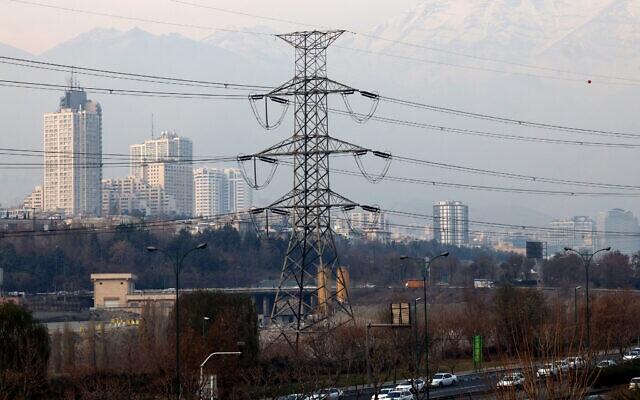
And yet, there’s been possibly a dozen or more Iranian drone attacks on foreign vessels transiting the Strait of Hormuz in the last eight days.
All of this comes as President Masoud Pezeshkian has urged the Iranian public to ‘stand up’ against the US and West, as Washington’s sweeping sanctions as well as US naval blockade actions against Iranian ports continue to bite.
“We must not allow the production cycle to be damaged. We will reduce the consumption of electricity, gas, gasoline, water and other energy sectors,” he said to semi-official Fars news agency.
“The condition for resistance and standing up to the West is for everyone to endure hardship,” Pezeshkian added, saying that “if necessary, cultural and sport complexes will be closed in Iran to provide electricity and energy needed for industrial production” – as the US blockade hammers Iran’s economy.
The rial has cratered, and the fallout has begun to severely impact neighboring Iraq and its Tehran-aligned economy and government, as we previously detailed.
Fars also quoted Pezeshkian as saying Wednesday, “Iran is fully prepared to reach a balanced and fair agreement that ensures lasting peace and security in the region.”
“Our red line is the national interests and rights of the Iranian people. If the United States adheres to international legal frameworks, reaching an agreement is not out of reach,” he added.
There’s also this admission (but which could also be interpreted as pushback) from Iranian state media, in the face of Scott Bessent’s recent assertions that Iran’s crude exports have fallen to near ‘Zero’:
Iranian media is reporting a 60 percent decrease in oil passing through the Strait of Hormuz, saying that the flow of crude oil has faced a significant drop in the last two days, reaching around 3.8 million barrels per day.
The weekly average of oil passing through the Strait is estimated to be about 9.3 million barrels per day, Tasnim news agency said.
The claim comes as an IRGC adviser said that the strait is “fully controlled” by Iran and will remain closed until the US accepts its demands, adding that the volume of oil currently being smuggled out is “very small”.
But ultimately, Iran is admitting it is enduring severe economic hardship amid a heavily sanctioned wartime economy.
There’s a battle of narratives over Hormuz and markets as well as mainstream Western media are simply favoring once side while ignoring the claims of the other at this point:
The stalemate looks to endure past the November midterm elections in the US, as even President Trump has seemed to lately suggest this status won’t change until after the US vote. He has also signaled a heavy bombing campaign against the Islamic Republic could ensue by November’s end.
END
IRAN/USA
Iran Slams Door On Nuclear Talks: No Deal Unless US Meets Its Conditions
Wednesday, Oct 07, 2026 – 08:05 PM
There have been no nuclear negotiations taking place between Washington and the Islamic Republic, Reuters reported on Wednesday, citing what it said was an Iranian official.
“No negotiations [have] taken place with the US about Iran’s nuclear program… Washington must first meet Tehran’s conditions before nuclear talks can start,” the source said.
“US recognition of Iran’s right to nuclear enrichment is Tehran’s red line … [Iran] will not show flexibility on [enrichment] in any way,” the source added, a day after US Vice President JD Vance called for a scale-back of Iranian uranium enrichment.

The source said that “Vance’s comments are Washington’s ideas and requests. … Americans are free to make requests and have ideas, but they are at odds with Iran’s demands.”
Vance had said on October 5th that Tehran must make a significant reduction in nuclear enrichment.
“I think if they want to show a commitment to not building a nuclear weapon, they would do something meaningful on their enrichment capacity,” he told Reuters.
He claimed that Iranian Foreign Minister Abbas Araghchi and President Masoud Pezeshkian were in talks with the US, but added that it was “unclear how much authority they wield within Iran’s power structure.”
“One of the things we picked up on is it’s not totally clear how their country makes decisions,” he went on to say.
US President Donald Trump also said again this week that nobody knows who is in charge in Iran.
“The problem is actually the opposite: it lies in the contradictory positions and mixed messaging from US officials,” Iranian Foreign Ministry spokesman Esmail Baghaei said in response.
Tehran has repeatedly vowed that it will not compromise on its peaceful nuclear enrichment program. Trump has repeatedly claimed that Iran’s nuclear program has been “obliterated.” However, US intelligence reports have refuted this.
The Wednesday Reuters report follows a Qatari Foreign Ministry statement to reporters saying that US–Iran talks were ongoing.
“I can confirm that the talks are continuing and the exchange of messages between different parties is continuing via Qatar and its regional partners,” Qatari Foreign Ministry official Ibrahim al-Hashmi said during a press briefing.
Last month, Iran was reported to have relayed a proposal to the US, offering to reopen the Strait of Hormuz and resume nuclear talks in exchange for a cessation of hostilities and the US lifting its naval blockade of Iranian ports.
Trump publicly rejected the reported offer and has since renewed his threats to resume bombardment of Iran.
At the UN General Assembly (UNGA) in September, Iran said that Tehran is demanding an end to the fighting on all fronts, a halt to US acts of aggression, the lifting of Washington’s naval blockade, an end to its economic war on Iran, and the release of Iranian assets in order for talks to resume.
As part of its overall demands for a final agreement, Iran is also demanding sovereignty over the Strait of Hormuz and a US military pullout from the region.
“The position of the Islamic Republic of Iran is completely clear and firm, and the Strait of Hormuz will not be opened until our seven conditions, based on the Islamabad memorandum of understanding, are met,” Iran’s Parliament Speaker Mohammad Bagher Ghalibaf said over the weekend.
END
SAUDI ARABIA// HOUTHIS
Explosions Rock Riyadh’s International Airport Amid Houthi Attack, Travelers Evacuate
Thursday, Oct 08, 2026 – 10:40 AM
King Khalid International Airport in Riyadh has come under Houthi attack once again on Thursday, and may have suffered a hit, as eyewitnesses have told Reuters of smoke rising from an aircraft at the major travel hub in the Saudi capital.
Witnesses were also cited in The Associates Press as having heard “several explosions” – after which an urgent evacuation notice was given.
The Houthis in Yemen have been going after airports as well as Aramco oil facilities. In two separate attacks on Tuesday and Wednesday, the kingdom’s Abha International Airport and King Khalid International Airport were targeted by Houthi missiles.
The AP details of the Thursday flight stoppage in Riyadh as follows:
King Khalid International Airport “closed again,” the Flightradar24 monitor said Thursday afternoon on X not long after the blasts. “Last landing 80+ minutes ago. Last take off 90+ minutes ago.”
Fire and ambulance crews deployed and smoke was visible, the witness said, speaking on condition of anonymity because they were not authorized to speak to the media.
The witness said outgoing flights were halted and passengers were instructed to leave checked-in luggage behind and evacuate. It was not immediately clear how many flights were disrupted.
The prior 72 hours has seen three civilians killed and 36 injured in Houthi-claimed attacks across Saudi Arabia. “An Egyptian and an Algerian national were killed at Abha airport, and a Sudanese national was killed at the airport in Riyadh, the agency said, with 36 people wounded in the attacks,” Middle East Eye details.
On Thursday, Saudi-led coalition spokesman Turki al-Maliki said his forces intercepted and destroyed a pair of Houthi ballistic missiles on Riyadh and towards Khamis Mushait.
As for the latest airport attack, which has reportedly shut down the international hub, the Houthis are claiming responsibility and say there was a direct hit and damage, while Saudi authorities have remained silent in the initial hours.
All of this, plus last evening’s headlines that President Trump is mulling a new bombing raid on Iran possibly before the November midterm elections, has pushed oil prices higher throughout the Thursday morning hours…
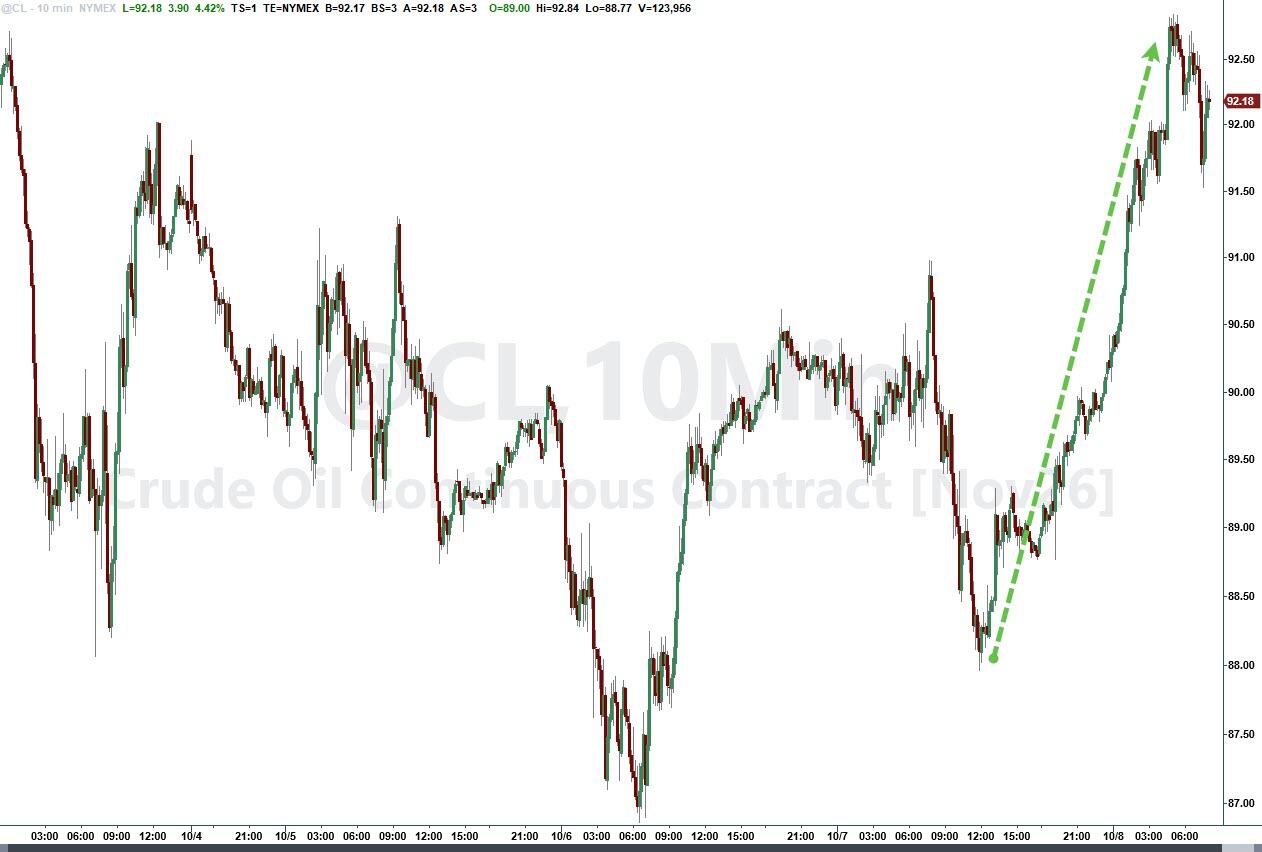
Over in Yemen, fighting has intensified in the Taiz region and in rural areas. Al Jazeera details:
Fighting is raging in al-Shamayatayn, al-Maafer and the southern and western countryside of Taiz governorate.
The Houthis are pushing into rural areas that have not seen conflict for years, aiming to open a supply route because their lines towards al-Kadaha and al-Waziiya, which link Aden, Lahij and Taiz, are nearly cut off by advancing government forces.
Those forces are moving towards al-Waziiya and the Kahboub Mountains overlooking Bab al-Mandeb.
Government forces expected a dangerous escalation over the next 48 hours after the defense minister said Houthi-held areas will be recaptured soon. Government forces reported more than 2,000 operations, including attacks, supply line cuts, repelled attacks and territory retaken.
The three deaths reported by the Saudis on Wednesday are the first civilian deaths reported in the kingdom since the conflict with the Houthis was renewed several weeks ago.
Crown Prince Mohammed bin Salman is likely going to press allies harder to join the counteroffensive against the Houthis in Yemen, after Pakistan and Turkey have announced defense assistance based on the Mecca Defense Pact.
END
SYRIA/HOUTHIS
Syria’s Jolani May Send Troops To Yemen To Fight Houthis
Wednesday, Oct 07, 2026 – 06:00 PM
Syria is said to be “cautiously” considering sending troops to assist Saudi Arabia in the fight against the Houthis in Yemen, Reuters and others are reporting Wednesday.
An anonymous US official described that this was a focus of conversation between Syria’s self-declared President Ahmed al-Sharaa and Saudi Crown Prince Mohammed bin Salman as the two met in Riyadh on Tuesday.
Ironically it was the Saudis that heavily supported Sharaa’s rise and overthrow of Bashar al-Assad in the first place. Sharaa, previously known as Abu Mohammad al-Jolani was the founder and leader of Syrian al-Qaeda (Nusra Front, later Hayat Tahrir al-Sham). He had also fought Assad while initially under ISIS, and had taken control of Idlib.

So while for many years foreign fighters flowed from Saudi Arabia into Syria, now the jihadi pipeline looks to go in the opposite direction.
The hardline Sunnis of the new Damascus government are well-known for viewing all Shiites as ‘apostates’ – and so there could be plenty of willing participants to go and fight the Houthis, who are Shia and backed by Iran. Some reports speculate there are already thousands of Syrian mercenaries as well as ‘volunteer’ fighters on the ground in Yemen.
“Options being considered include defensive aid to protect the kingdom from attacks, or deployment of forces in an offensive capacity to help Saudi-backed Yemeni troops fight the Houthis,” according to sources cited in the reports.
A US official has said that Riyadh has specifically requested the deployment of Syrian forces against the Houthis, perhaps as ‘payback’ for Saudi funding for the jihad in Syria over the prior decade.
However, a Syrian diplomatic source has also indicated Damascus is placing priority on its own continued problems inside the country, also given Israel currently occupies a swathe of southern Syria, and the economy has yet to rebound after years of US sanctions (recently lifted for post-Assad Syria).
Axios has noted in its reporting that Sharaa is “seriously considering it, but he hasn’t decided. Further, the Trump administration “not opposed in principle to such a move,” US officials cited in the same report said.
Below: Ansar Allah sources have meanwhile pointed out that Jolani’s militants are merely dozens of miles from Israeli positions and yet don’t fire a single shot toward them:
So it seems one additional benefit of the US-Gulf axis having a puppet in Damascus is that Syrian troops can be essentially used as fresh fodder to be thrown into regional proxy wars. It seems this is an option the Saudis are now pursuing, also as they seek greater military support from allies Islamic allies Pakistan and Turkey.
END
SAUDI ARABIA VS HOUTHIS
Houthis Escalate Saudi Strikes, Briefly Disrupt Riyadh Air Traffic, Hit Bases Near Border
Wednesday, Oct 07, 2026 – 09:30 PM
Wednesday has witnessed more direct attacks on Saudi territory launched by Yemen’s Ansar Allah movement, coming soon after Turkey, Pakistan, and Saudi Arabia announced they have triggered the Mecca Defense Pact.
Houthi spokesman Brig. Gen. Yahya Saree announced the fresh launch of ballistic missiles and drones targeting King Khalid International Airport in the capital of Riyadh; however, there’s as yet no evidence of any impact. The airport has suffered hits earlier in the conflict, or at least fuel storage tanks near it, also as Aramco sites have come under frequent attack.

Aviation tracking platform Flightradar24 indicated a brief halt to both inbound and outbound flights at the airport in the capital. Riyadh has already been targeted several times in a matter of weeks.
Saree further said Abha airport has been targeted again, after it also came under attack the day prior. The Houthis additionally said they hit an air base in the city of Khamis Mushait and two military bases, Najran and Asir – both near the border with Yemen.
The Saudi side has only offered confirmation that it has tracked and intercepted a ballistic missile north of Riyadh. A missile on the Saudi city of Khamis Mushait was also reportedly stopped by air defenses.
To review of Tuesday’s events, confirmation of destruction at least two Saudi airports has emerged, as The Wall Street Journal reports:
Attacks by Yemen’s Houthi rebels damaged two airports in southern Saudi Arabia near the border with the war-torn nation, the kingdom said Tuesday, marking the latest escalation in fighting that threatens global energy markets.
The attacks come after the kingdom and its allies in Yemen launched a counteroffensive seeking to retake territory along the Red Sea. The Houthis’ presence along the coast and the Bab al-Mandeb Strait threatens to further squeeze regional oil supplies.
Saudi Arabia’s General Authority of Civil Aviation said King Abdullah bin Abdulaziz International Airport, a dual-use airport in the Red Sea city of Jazan, and Najran International Airport, were damaged in the strikes. Three people were wounded, the agency said.
Meanwhile, inside Yemen Saudi coalition forces continue to try and take back control of the Red Sea coast areas, with conflicting reports centered on who has control of the strategic port city of Mocha.
The fighting continues to take a huge toll on the civilian population, with the International Organization for Migration saying that over 201,000 people have been displaced since the renewal of fighting. In mid-September the same agency’s tally was at 76,000 – suggesting a significant and rapid increase in displacement.
“People are running for their lives and finding nowhere safe to go,” agency chief Amy Pope stated. “They need a roof, food and safety today. Our teams are on the ground, but the funding is not. I am asking donors to act now because every day of delay costs lives.”
Already Yemenis were suffering from prior rounds of wars, given there’s been some level of a state of conflict between the Houthis and Saudis – and the Riyadh-backed Yemeni government – going back to at least 2014.
More Latest Developments
via Newsquawk…
- US President Trump said they have to finish up regarding Iran and that the question is how, while he added that we will soon find out how they will finish up Iran and stated that Iran’s drone-making capacity will soon be gone.
- US VP Vance told Reuters that Iran must make a “meaningful” reduction in its nuclear enrichment capacity to satisfy US demands and end the war. Vance added that the US remained open to an agreement but would require concrete Iranian nuclear concessions. Furthermore, the VP questioned who makes decisions in Tehran, following on from earlier comments by US President Trump saying that his biggest problem is that no one knows who is running Iran.
- US Secretary of State Rubio reiterated Iran cannot be allowed to have a nuclear program.
- Yemen’s Houthi forces said they used drones to attack King Khalid International Airport in Riyadh, while they targeted Abha Airport and Khamis Mushait using missiles and drones.
- Satellite imagery, cited by Sabereen, confirmed that there is still a fire at Saudi’s Khurais oilfield.
- An Asharq reporter posted that Syria may join the war in Yemen, with the idea said to be under discussion, citing multiple sources, although no final decision has been made; it follows Syria’s President visiting Saudi Arabia.
END
SAUDI ARABIA
Airlines Suspend Flights To Saudi Capital After Devastating Houthi Strikes On Airport
Thursday, Oct 08, 2026 – 04:04 PM
Update(1604ET): There are reports that possibly several parked aircraft were damaged or destroyed after the earlier Thursday Houthi ballistic missile attack on King Khalid International Airport in Riyadh. And now international reports are saying a slew of airliners are suspending flights to the city, some tentatively for up to a week:
In response to Thursday’s attack, Germany’s Lufthansa Group and Air India as well as two other carriers from the country, all suspended flights to the city.
The rebels had earlier warned global airlines “for the last time” about the consequences of operating in Saudi airspace, which they called a theatre for their military operations.
Saudi authorities issued a NOTAM, and so many more airlines are expected to cancel. Also quite significant is the US State Dept alert telling diplomatic personnel to not use the capital’s airport and to stay away from the border region with Yemen.
“U.S. government employees working in Saudi Arabia now require special authorization to use the King Khalid International Airport in Riyadh,” the fresh emergency notification says.
More emerging photos have shown extensive destruction:
* * *
King Khalid International Airport in Riyadh has come under Houthi attack once again on Thursday, and may have suffered a hit, as eyewitnesses have told Reuters of smoke rising from an aircraft at the major travel hub in the Saudi capital. Some new, unverified shocking images emerging…
Witnesses were also cited in The Associates Press as having heard “several explosions” – after which an urgent evacuation notice was given.
The Houthis in Yemen have been going after airports as well as Aramco oil facilities. In two separate attacks on Tuesday and Wednesday, the kingdom’s Abha International Airport and King Khalid International Airport were targeted by Houthi missiles.
The AP details of the Thursday flight stoppage in Riyadh as follows:
King Khalid International Airport “closed again,” the Flightradar24 monitor said Thursday afternoon on X not long after the blasts. “Last landing 80+ minutes ago. Last take off 90+ minutes ago.”
Fire and ambulance crews deployed and smoke was visible, the witness said, speaking on condition of anonymity because they were not authorized to speak to the media.
The witness said outgoing flights were halted and passengers were instructed to leave checked-in luggage behind and evacuate. It was not immediately clear how many flights were disrupted.
The prior 72 hours has seen three civilians killed and 36 injured in Houthi-claimed attacks across Saudi Arabia. “An Egyptian and an Algerian national were killed at Abha airport, and a Sudanese national was killed at the airport in Riyadh, the agency said, with 36 people wounded in the attacks,” Middle East Eye details.
On Thursday, Saudi-led coalition spokesman Turki al-Maliki said his forces intercepted and destroyed a pair of Houthi ballistic missiles on Riyadh and towards Khamis Mushait.
As for the latest airport attack, which has reportedly shut down the international hub, the Houthis are claiming responsibility and say there was a direct hit and damage, while Saudi authorities have remained silent in the initial hours.
All of this, plus last evening’s headlines that President Trump is mulling a new bombing raid on Iran possibly before the November midterm elections, has pushed oil prices higher throughout the Thursday morning hours…
Over in Yemen, fighting has intensified in the Taiz region and in rural areas. Al Jazeera details:
Fighting is raging in al-Shamayatayn, al-Maafer and the southern and western countryside of Taiz governorate.
The Houthis are pushing into rural areas that have not seen conflict for years, aiming to open a supply route because their lines towards al-Kadaha and al-Waziiya, which link Aden, Lahij and Taiz, are nearly cut off by advancing government forces.
Those forces are moving towards al-Waziiya and the Kahboub Mountains overlooking Bab al-Mandeb.
Government forces expected a dangerous escalation over the next 48 hours after the defense minister said Houthi-held areas will be recaptured soon. Government forces reported more than 2,000 operations, including attacks, supply line cuts, repelled attacks and territory retaken.
The three deaths reported by the Saudis on Wednesday are the first civilian deaths reported in the kingdom since the conflict with the Houthis was renewed several weeks ago.
Crown Prince Mohammed bin Salman is likely going to press allies harder to join the counteroffensive against the Houthis in Yemen, after Pakistan and Turkey have announced defense assistance based on the Mecca Defense Pact.
END
RUSSIA VS UKRAINE
BIG STORY!!
Russia’s Crown Jewel Refinery Ablaze After Drone Strike, Data Center Also Hit In War First
Thursday, Oct 08, 2026 – 11:40 AM
Ukrainian drones have hit a major Russian industrial hub and oil refinery which lies very far away from the front lines of fighting, in Western Siberia, north of the Kazakh border.
The Omsk Oil refinery and industrial complex is located well over 1500 miles from the Ukrainian border. Regional Governor Vitaly Khotsenko announced Telegram that several drones were shot down by air defenses, but that one made it through to impact.
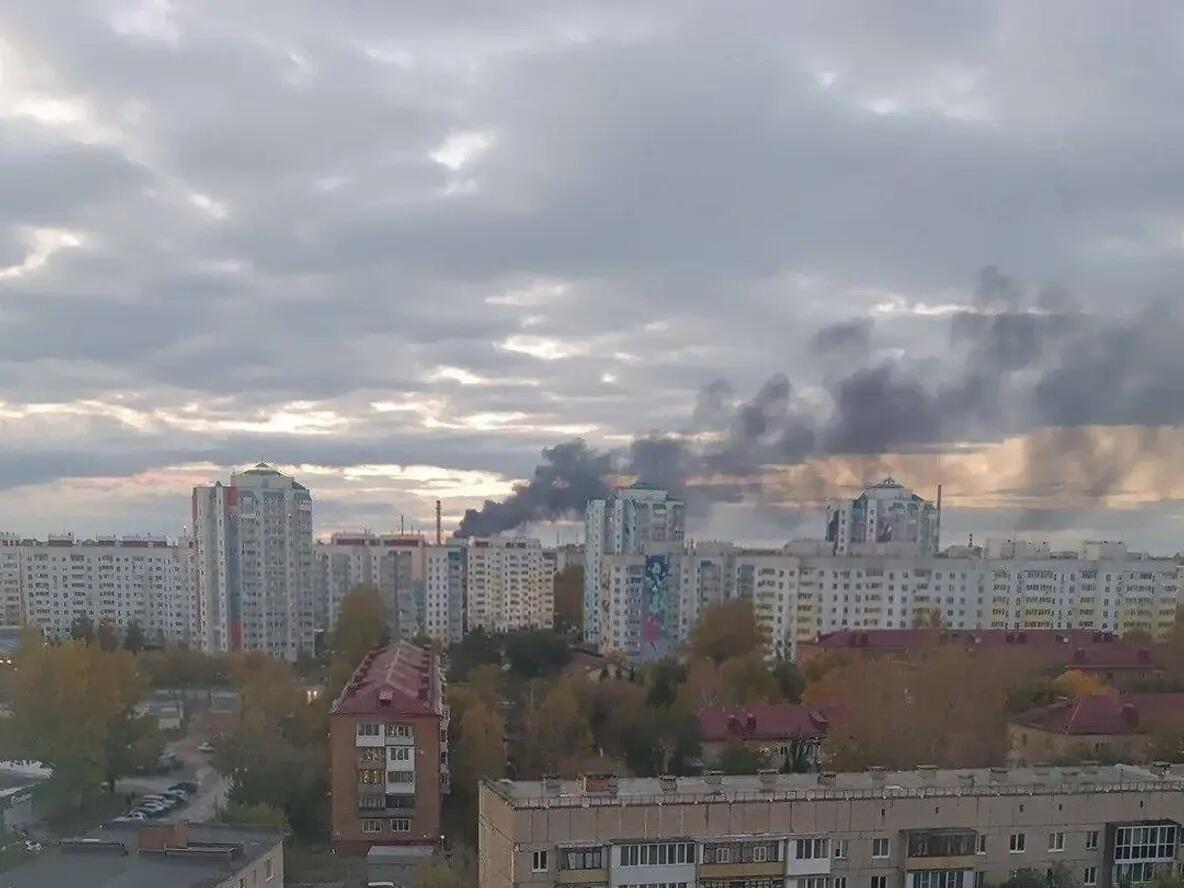
Ukraine’s General Staff was quick to own up to the Thursday attack, stating, “The destruction of such facilities is the exercise by Ukraine of its inalienable right to self-defense in accordance with Article 51 of the UN Charter and is aimed at reducing the military-economic potential of the Russian Federation.”
While the extent of potential damage to the refinery itself remains unknown images from local residents showed explosions and fire in the area near the oil refinery. Emergency crews are active at the scene of the facility, Russia’s largest, which is owned by Gazprom Neft
The same remote refinery was forced to halt operations when it came under a similar long-range drone attack in July. Bloomberg provides some additional details:
- In a separate statement, Ukrainian drone maker Fire Point said Ukraine’s forces attacked Russia’s largest oil refinery, over 2,500 km from the border, with upgraded FP-1 drones, confirming a hit
- Omsk refinery, owned by Gazprom Neft, processed ~22m tons of crude (~440k b/d) in 2024, producing 5m tons of gasoline and 8m tons of diesel.
Some regional reports have said that motorists in the same city have been forming long queues at gas stations, amid what has already been a situation of national fuel shortages.
Russian Data Center Attacked in First of War
Also, in the overnight hours there’s been another reported first of the war: Russian tech giant Yandex has reported its data center in the town of Sasovo, in Ryazan region, was attacked and caught fire.
“The attack marks the first confirmed strike against Russian data infrastructure since the 2022 invasion of Ukraine, weeks after Moscow launched attacks against Ukrainian data centers,” The Moscow Times underscores. Russia has long been going after data centers in Ukraine, however. The Kremlin has argued that these data centers support Ukrainian military operations, with the same accusations now being hurled the other way as well.
According to more from the same publication:
NASA’s fire monitoring service FIRMS showed a fire in Sasovo early Thursday morning. Outage tracking platform Downdetector recorded more than 1,300 user reports of disruptions affecting Yandex Cloud, Yandex Documents and Yandex Tables, while core consumer tools like search and taxi services remained online.
Yandex shares dropped more than 3.4% during Thursday morning trading on the Moscow Exchange.

A key element of Ukraine’s drone warfare strategy is to keep hammering away at Russian energy and industrial infrastructure in hopes of devastating the economy amid US-led sanctions, in order to ultimately force President Putin to the negotiating table on terms acceptable to Kiev and the West.
Mass Civilian Casualties in Ukraine
The Kremlin has of late made known that it would increasingly targeted Ukrainian civilian infrastructure as a result of Kiev forces doing the same in Russian territory with its nightly drone assaults.
This has already had tragic effect amid mass casualty events this week. The NY Times writes Thursday, “At least 30 people were killed in a Russian strike on a commuter bus in the country’s east, officials said, a day after an attack on an apartment building far behind the combat zone killed 22.”
Moscow has not commented on these alleged attacks. “Images posted by local prosecutors showed the burning metal shell of the bus along with debris and some of the victims on the road,” BBC also reports. It happened mid-morning and appears to have involved an aerial bomb dropped on a bus stop.

Far from being closer to some kind of US-mediated peace talks that President Trump is hoping for, the tit-for-tat strikes are getting nastier as the war continues to spiral. Ukraine’s President Zelensky is vowing revenge.
Speaking of the killings in the Donbass region, Zelensky said: “This strike will not go without our response.” He said further on Telegram: “Russia is trying to destroy all life in Donbas, and the world needs to react to this. React harshly – exactly as the Russians deserve for all the deaths they have caused.”
6/.GLOBAL ISSUES, COVID ISSUES, VACCINE INJURIES/HEALTH ISSUES
AI PROBLEMS
AUSSI (NVIDIA BACKED) SLASHES IPO…
Another One Bites The Dust: Nvidia-Backed Firmus Slashes IPO Price 25% As AI Data Center Window Slams Shut
Thursday, Oct 08, 2026 – 12:10 PM
Two weeks ago, when SoftBank’s SB Energy pulled the marketing of its giant IPO meant to find its even more giant data center, we wrote that “slowly the data center dream is turning into a nightmare” (“SB Energy Delays IPO Funding World’s Largest Data Center Amid Investor Revolt, Public Outcry”, Sep 22). Two days later we went a little further:
“All over” may be premature. “Next,” however, has arrived right on schedule.
Overnight, Bloomberg reported that Australian data center operator Firmus closed the books on its struggling IPO “without clear indication of the price or the deal structure,” as investors grew “increasingly concerned that the deal could be pulled.”

The Nvidia-backed company had been trying to raise as much as $5.5 billion at A$11 a share, which valued it at A$43.7 billion ($30.4 billion) and would have made it one of the largest listings in Australian history. By the time the books closed, the A$11 was gone: per the Australian Financial Review via Reuters Breakingviews, Firmus cut the price to as low as A$8, a 25% haircut, and was “scrambling” to hold it at A$8.25.
Put differently, the second mega data center IPO in a month has just hit the same wall as the first. This time the wall came with a twist, and that twist is why this story belongs in our long-running coverage of the debt holding up the AI supercycle.
Below we explain how Firmus got from a $5.5 billion private valuation to a $30 billion IPO in six months, why the “creative” valuation metric failed to sell it, and why at the reduced price the equity is worth less than the debt.
Books Closed, Price… TBD
The cracks were visible before the books closed. On Wednesday evening Goldman’s Sydney futures desk wrote in its morning comment that “the AFR reports bankers managing the IPO of Firmus are considering a potential cut in the listing price because of weak demand from foreign investors.” Within hours that “consideration” was a 25% cut.
Equity investors with direct exposure did not wait around. Shares of Firmus backer Maas Group fell as much as 30% in Sydney, the most on record, which prompted the company to note “significant market speculation and commentary” about whether the IPO would go ahead. Meanwhile Plato, an Australian fund manager running about $6 billion, called Firmus a “screaming short“, citing 30 “red flags” ranging from valuation to senior management.
Ten Cap’s Jun Bei Liu summed up the bookbuild on Bloomberg TV:
“I’ve never seen an IPO so polarizing. There was a lot of international investor interest, however, when it comes to the crunch, the demand seems like it isn’t there when they were asked to put up the capital that’s required.”
Translation: everyone loves AI infrastructure until they are asked to pay for it.
For the record, the bookbuild was pulled forward from Friday to Thursday just three days ago because of “early indications of demand in excess of the offer size.” That’s the same “oversubscribed” (just as the Paramount bond deal had over $100 billion in “demand” and its bonds are now crashing every day) deal now negotiating with itself over A$0.25 a share.
From $5.5 Billion To $30 Billion In Six Months
The rerating is the whole story. Firmus started out as a Bitcoin mining operation in 2019. In February it landed a $10 billion debt package led by Blackstone and Coatue. In April a Coatue-led round valued it at $5.5 billion. In August a $2 billion round with Nvidia, Coatue, Blackstone and Jane Street nearly doubled that to $10.5 billion. Then, less than two months later, the IPO asked public investors for three times the August price.
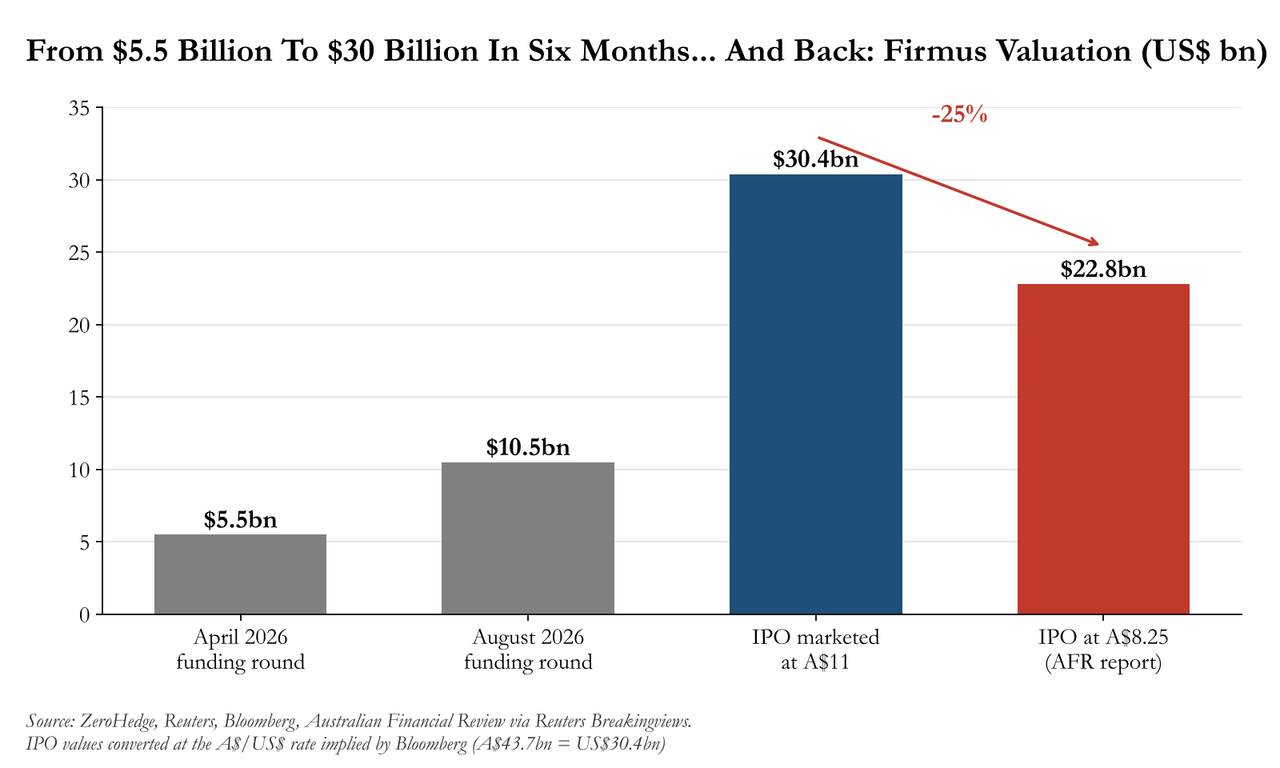
Behind that price tag, according to Breakingviews, Firmus has so far built just 42 megawatts of capacity out of a pipeline of about 1 gigawatt, or just over 4%. It recently shifted away from a mostly domestic partnership with CDC Data Centres toward Malaysia and Indonesia, to serve hyperscalers such as OpenAI and Meta. Per Reuters, the draft prospectus forecast a $77 million loss in the first half of FY27 and no forecasts at all beyond June 2027.
Australian fund managers were less than impressed. Morningstar’s Lochlan Halloway saw signs of a “boom phase,” pointing to the “wild increase in valuation in such a short period of time.” Merlon’s Kirit Hara said his process “prevents us from effectively buying into, kind of, the hopes and dreams.” Katana’s Romano Sala Tenna admitted “we are struggling with the fundamental arithmetic,” and Blackwattle’s Joseph Koh, who will not bid, put it more simply: “There are so many unknowns.”
Introducing “EV+1/EBIT+2”
When the arithmetic doesn’t work, you change the arithmetic. As Breakingviews’ Antony Currie explains, the deal leaned on a new valuation tool, “EV+1/EBIT+2.” It takes enterprise value using the net debt the company will have in 12 months and divides it by the EBIT it hopes to earn two years from now.
The logic is that data center developers fund up to 90% of construction with debt and can start generating revenue within a year, so today’s numbers flatter nobody. The problem, as Currie notes, is that the metric is “easy to manipulate.” Capex assumptions can be inflated to pump up EV, and any delay in permits, equipment, power or water means “EV+1 becomes +2 or +3, with EBIT delayed to +3, +4 or beyond.”
This is pure batshit insanity, and shows just how big the AI bubble has become for a company to realistically think that such “vibes” garbage can be credibly used an investment highlight for institutional investors.
Regular readers know how that goes: Project Jupiter declared force majeure and Oracle’s 1.3GW Wisconsin “Lighthouse” campus slipped earlier this week, so “+1” is the optimistic case. Then again, nothing says “mature asset class” like a valuation multiple whose denominator is two years in the future.
Half The Deal To… The Existing Shareholders
A second detail also spooked buyers. Firmus planned to allocate about half of the IPO to “selected existing strategic and financial investors”, a list that includes Nvidia, Coatue, Blackstone and Jane Street. At the same time, pre-IPO holders could reportedly sell up to 20% of their stakes from day one. Bloomberg says this overhang was what turned potential investors cautious, on top of “what some investors see as an aggressive pricing strategy.”
Then there is where the money goes. IPO proceeds would fund purchases of Nvidia GPUs for Firmus’ first project in Batam, Indonesia, built with DayOne as part of an eight-year partnership with Nvidia. In other words, Nvidia invests in Firmus, Firmus raises money partly from its own backers, and the money goes back to Nvidia for chips. We have seen this kind of Nvidia circular financing before, just never quite this small.
One more detail: the four joint lead managers are Bank of America, JPMorgan, Morgan Stanley and Morgans. That would explain the absence of sell-side research on the deal from three of the largest research shops in the world.
When The Equity Is Worth Less Than The Debt
This is where the deal stops being an IPO story and becomes a credit story. As one reader put it in a reply to our tweet, “At that point an AI data centre stops being a growth stock and starts being a credit.”
The napkin math is simple, and alarming. Morningstar estimates Firmus’ debt at about $30 billion, roughly six times its own forecast earnings. At A$11 the equity was worth about $30.4 billion, so the company was valued at about one dollar of equity for every dollar of debt. At A$8.25, and assuming the same share count, it is worth roughly A$33 billion, or about $23 billion, some $7 billion less than the debt it carries. At A$8 it is $22 billion.
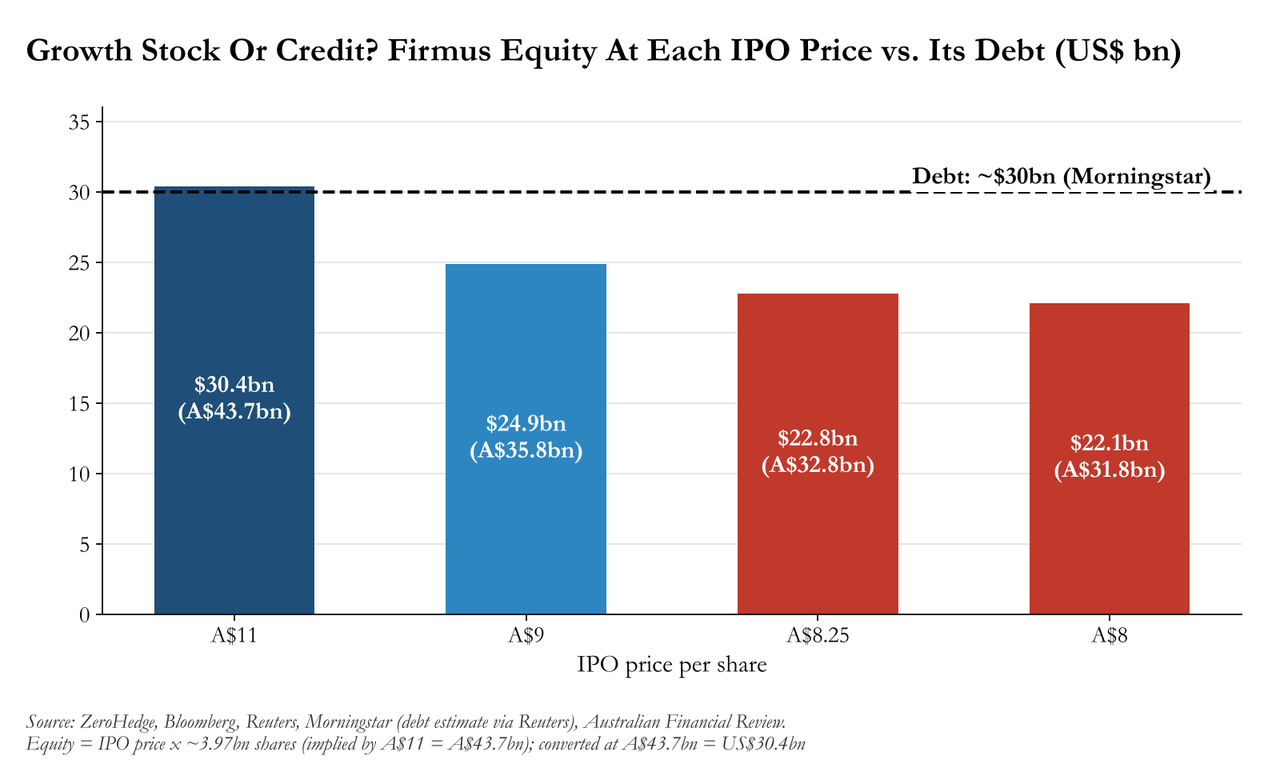
In other words, at the price the bankers are now “scrambling” to defend, the shareholders’ stake would be worth less than what Firmus owes its lenders, before the stock trades for a single day. That is a leveraged credit with an equity ticker, and it lands at the worst possible moment for AI credit, which we summarized yesterday afternoon:
Throw in 10Y Treasury yields that hit 5.36% on Wednesday, a 24-year high, per the same Goldman Sydney note, and the cost of carrying $30 billion of data center debt only goes one way.
SB Energy, Then Firmus… Then Who?
Firmus is the second data center mega-IPO to stumble in three weeks. SoftBank-backed SB Energy postponed marketing its IPO in late September after more SEC questions and investor pushback on a valuation of around $60 billion, and on its dependence on a single customer, OpenAI. Nvidia had agreed to guarantee up to $105 billion to help OpenAI lease SB Energy’s Ohio data center, while also investing $1.5 billion in SB Energy itself. Back then we asked the obvious question:
And the line behind them is long. Singapore’s DayOne, which also happens to be Firmus’ partner in Batam, wants to raise up to $5 billion at a $20 billion valuation in a US listing as soon as November. Switch has filed confidentially, Vantage and CyrusOne are exploring listings, and London’s Nscale just raised $3.36 billion in pre-IPO convertibles. As Shenton Research’s Ke Yan told Reuters, “the dividing line is whether demand is contracted and already energised, or only planned.” Firmus, with 42MW built against a gigawatt pipeline, is firmly on the “planned” side of that line.
Goldman: $1 Trillion Of AI Spending… And Everyone Hiding In The Mag 7
None of this means the AI spending boom is slowing. Goldman’s Global Corporate Access team flagged in Wednesday’s IR Kick-Start (available to pro subs) that GS Research now estimates global AI investment will exceed $1 trillion this year, with the US and Asia accounting for more than 80% of net data center additions (Europe gets about 10%).
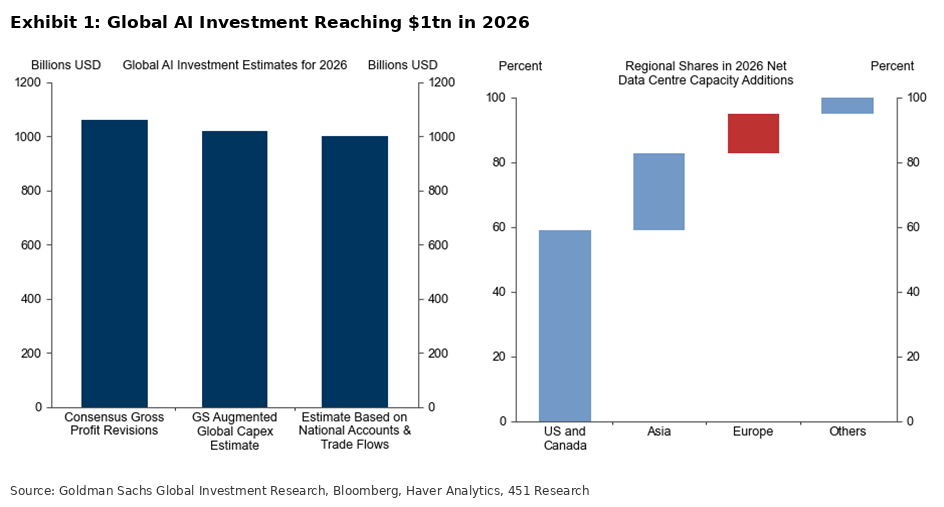
The question was never whether the money gets spent. It’s who funds it, and at what price. Goldman’s Asia sales desk answered part of that overnight in “Power Back On” (also available to pro subs): hedge funds have “certainly re-engaged in tech as a result of macro uncertainty,” with net exposure to the Mag 7 as a share of total US exposure on GS’ prime book at ~22%, the highest since the start of 2022.
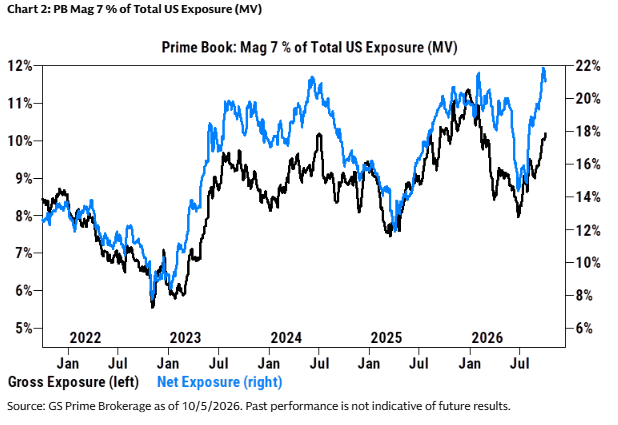
Put differently, investors still want AI, but they want it through companies with balance sheets that can fund a trillion dollars of capex, not through a 42-megawatt former Bitcoin miner levered six times its forecast earnings. The same GS desk notes that “the positioning within AI and large-cap tech no longer seem to be tailwinds,” which means the crowd is all on one side of the boat, and it’s not the side Firmus is on.
Bottom Line
This week, Mike Novogratz told the Greenwich Economic Forum that AI is the “biggest bubble of our lifetime,” but that it can’t burst yet because it “isn’t spectacular enough” (which we discussed earlier). Ray Dalio disagreed and speaking at a CEO conference in Singapore, called it a “classic bubble” nearing its bursting point because of rising rates and the debt behind AI infrastructure.
We side with Dalio, and the reason is the IPO window. Bubbles don’t end when the bulls run out of narrative; they end when the marginal buyer refuses to take paper off the hands of the early investors at the asking price. That has now happened twice in three weeks, first with SB Energy and now with Firmus. Each time the issue was the same: too much debt, too little contracted revenue, and existing backers looking for an exit.
Having warned since October 2025 that AI is a debt bubble too, something that virtually everyone – even the WSJ – now accepts, we’ll allow ourselves another prediction: when the equity cushion under a data center is smaller than the debt, the equity investors stop pricing a growth story, and it becomes the bondholders’ problem. Just ask Oracle’s lenders.
Firmus is scheduled to lodge its prospectus on October 12 and start trading on October 23, assuming there is still a deal. We’ll see whether the “+1” in EV+1 refers to years, or to the number of IPOs that follow it into the wall.
Much more in the full Goldman “Power Back On” and “IR Kick-Start” notes, both available to pro subs.
END
COVID VACCINE INJURY: DR MARK CRISPIN MILLER
DR PAUL ALEXANDER
RABOBANK/MICHAEL EVERY/OR OR PICTON/GIFFIN OR RABOBANK EXECUTIVE/COMMENTARY ON WORLDLY AFFAIRS
Thumos-Maxxing
Thursday, Oct 08, 2026 – 09:25 AM
By Benjamin Picton, senior market strategist at Rabobank
US sovereign yields steadied yesterday as a 10-year bond auction saw strong investor demand. $39bn of bonds were sold with a high yield of 5.30% with a bid to cover ratio of 2.77x and low primary dealer takedown. The result signals that investors are beginning to view government debt as attractive at current levels and eased fears of a disorderly correction in bond prices that had been sparked by a poor 5-year auction in late September that saw the second-longest tail on record.
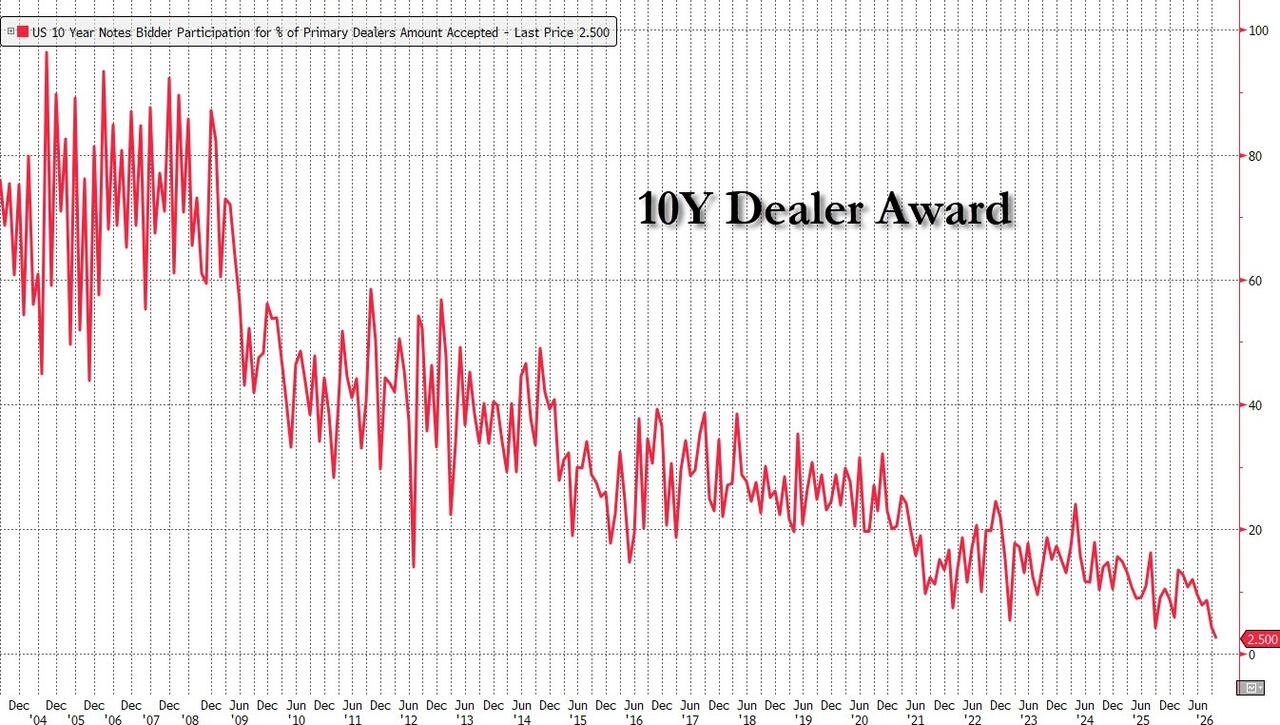
Relative valuations may be playing a role here as US equity indices pulled back from record highs. US equity market breadth is remarkably narrow, with AI-adjacent tech megacaps leading indices higher in recent times as many other sectors struggle for traction. The AI narrative had a wobble yesterday as SpaceX 5-year CDS spreads widened by 16.5bps to 197bps. That follows news that the company is seeking to raise $40bn in fresh debt financing to buy NVIDIA chips, with similarly large deals also in the works for Broadcomm ($50bn) and Oracle.
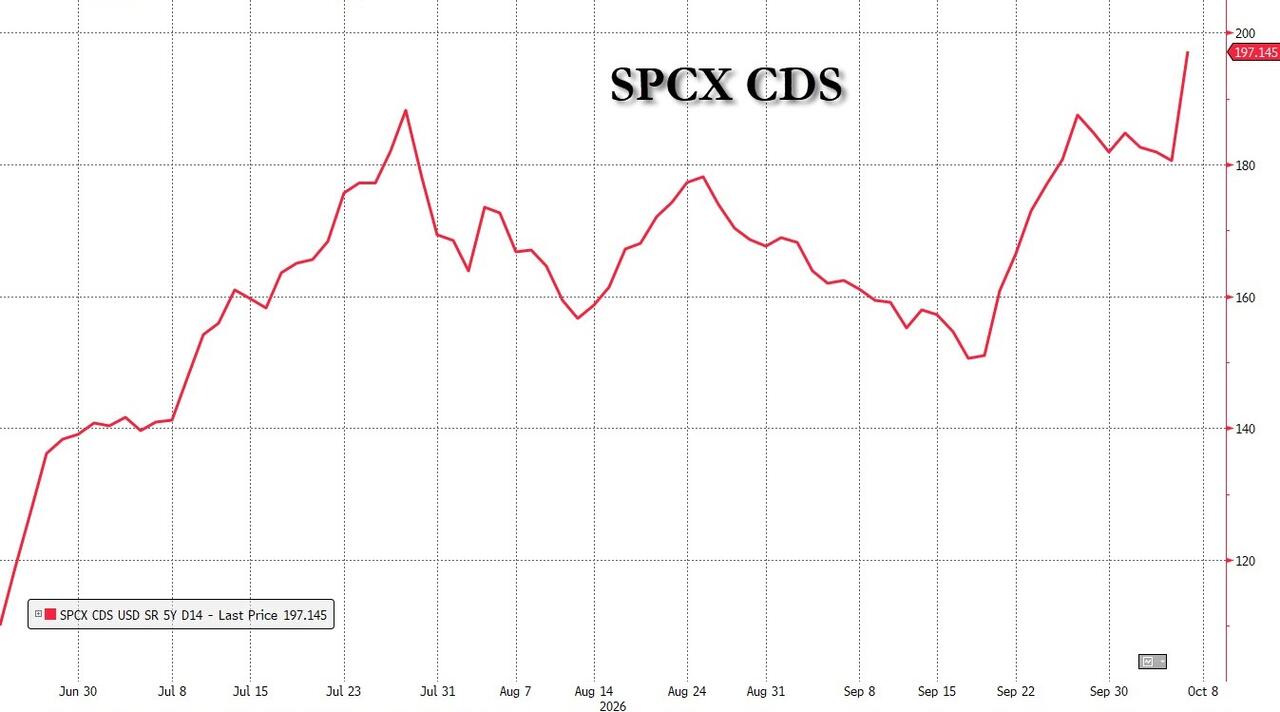
Markets were probably not reassured by comments published by the FT yesterday that “investors whom SpaceX has previously approached about financing its multibillion-dollar chip purchase said they only received a short two-page deal memo with pictures of outer space and an arrow pointing out that the company was going to build data centres “somewhere in the universe”.” The ambition is admirable, but for a market that is already running long on vibes this might have been a bridge too far.
Similar wobbles in the AI narrative have emerged Down Under as the Aussie market seeks to digest the initial float of data centre operator Firmus. Firmus had been seeking to raise $5.5bn at a valuation of approximately $30.5bn, which would have made it the second-largest IPO in Australian history, trailing only the privatisation of a public telecommunications monopoly in the late 1990s. The Australian Financial Review reports that the original offer price of A$11/share is now repricing closer to A$8.25/share as key local pension funds opted to pass on the float and demand from US long-only funds proved weaker than expected.
While US bonds were finding bids and investors were casting a more critical eye over the AI investment boom, European sovereign yields were again under pressure. French 10-year OAT yields were up by 11.8bps to 4.86%, Italian 10-year yields were up 9.7bps to 4.62% and Greek 10-year yields rose 8.9bps to 4.47%. Even the not-quite-European UK saw a sharp lift in borrowing costs, with 10-year gilt yields rising 6.8bps while Bunds bucked the trend to see yields finish slightly lower. The Wall Street Journal reports that France is considering issuing more short-dated debt; a fresh instance of a developed market economy behaving like an emerging market.
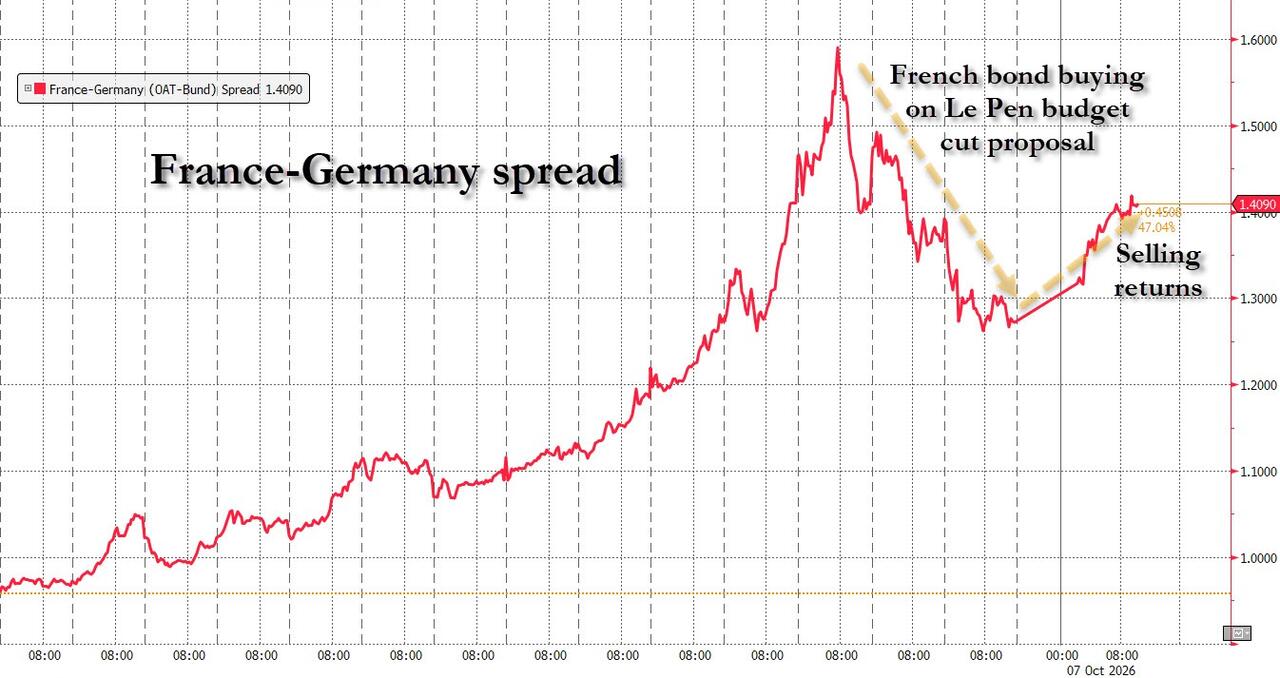
With the turmoil in European bonds ongoing, and riots across France generating unwelcome visual metaphors of people dining calmly as the streets burn, US Secretary of State Marco Rubio yesterday issued a rallying cry to Western civilization. He gave a speech in Athens with the Parthenon as the backdrop, urging the West to regain its Thumos, the “fire of passion, strength, courage, pride”. Rubio mounted a defense of nationalism, decrying the transfer of sovereignty to global bureaucracies. He argued that the West is now at a crossroads where decisions taken today will determine whether it remains pre-eminent or resigns itself to “atrophy and servitude and decline”.
According to Rubio, the US has chosen the former and is seeking to extend the frontier in advanced manufacturing, superintelligence, drones, weapons, warfare; chips, minerals, cyber, and “every other domain of human possibility”. Doubtless this is why recent calls from US tech CEOs to “pace the frontier” of artificial intelligence development were met with short shrift by the White House, and intrepid back-of-the-napkin risk taking is perhaps viewed more positively in the United States than elsewhere.
Rubio’s remarks were pointed directly at Europe, and particularly the European Union. The criticism of global bureaucracies reflects earlier criticisms in the US’s 2025 National Security Strategy where the US warned that Europe faces “civilizational erasure” and urged it to re-capture its civilizational self-confidence, stating clearly that the United States would seek to “cultivate resistance to Europe’s current trajectory” and lend support to “healthy nations” of Central, Eastern and Southern Europe.
These latter were widely interpreted as a pledge to support right-wing nationalist political movements on the continent in similar fashion to how the United States has (successfully) supported pro-US right-wing movements in South America. Newswires this morning are reporting that right-wing Brazilian presidential candidate Flavio Bolsonaro has won the support of four key centre-right parties ahead of a runoff vote against incumbent leftist Lula de Silva. Installing a more Washington-friendly (and perhaps China-unfriendly) government in Brasilia would be the last major piece of the puzzle for the Donroe Doctrine in South America, leaving only Canada as a problem to be solved in the Western hemisphere.
Rubio went on to say that there are emerging signs that Europe is beginning to awake from its “long slumber”, pointing to rising defense spending and the recent agreement over Greenland as examples of progress. He also pointed to expansion of production and manufacturing, though – perhaps politely – he declined to be specific in this area.
That’s as China yesterday rejected European calls to voluntarily limit exports of hybrid electric vehicles into the European market. It was hoped that China would agree to a soft quota that would reduce China’s share of the European market from 30% to 15%, and that the need for more overt trade restrictions to protect European industry and invite retaliation from the Chinese side might therefore be avoided.
Clearly, that is now unlikely to be the case. It’s worth noting that another broad policy ambition noted in the US National Security Strategy was “encouraging Europe to take action to combat mercantilist overcapacity…” Are we about to see that ambition realized through an assertive and self-confident European policy response? It would mark a departure from ten years of criticism of the United States doing exactly the same thing.
END
7. OIL AND NATURAL GAS/ENERGY COMMENTARIES
THURSDAY MORNING
25% Of US Offshore Gulf Oil Output Shut As Hurricane Isaias Nears, Threatens Refineries
Thursday, Oct 08, 2026 – 07:45 AM
Hurricane Isaias forced offshore oil and natural gas producers in the Gulf of America to halt a sizable amount of production as the Atlantic’s first hurricane of the season churned toward the coast, with potential landfall impacts across portions of Louisiana, Mississippi, Alabama, and the Florida Panhandle.
Isaias had sustained winds of 75 miles per hour and was about 460 miles south-southwest of the Mississippi River mouth overnight, according to the National Hurricane Center.
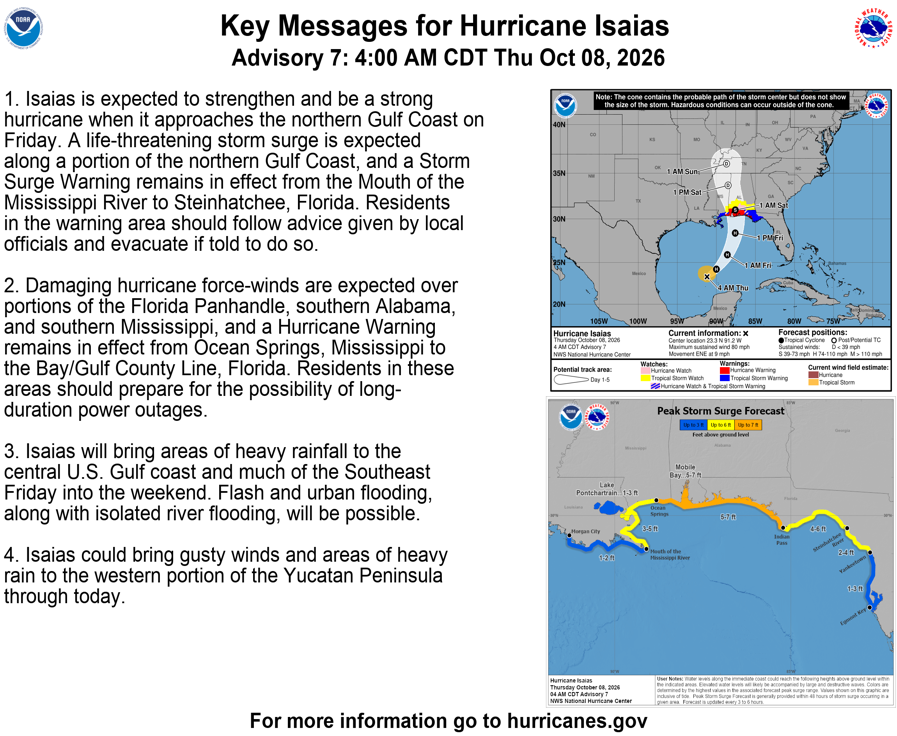
Producers with offshore rigs have already shuttered 25% of crude output and 16% of NatGas production and evacuated workers from eight platforms and two rigs.
Models increasingly point to landfall late Friday night or early Saturday morning east of major energy assets onshore and offshore in Mississippi and Louisiana.
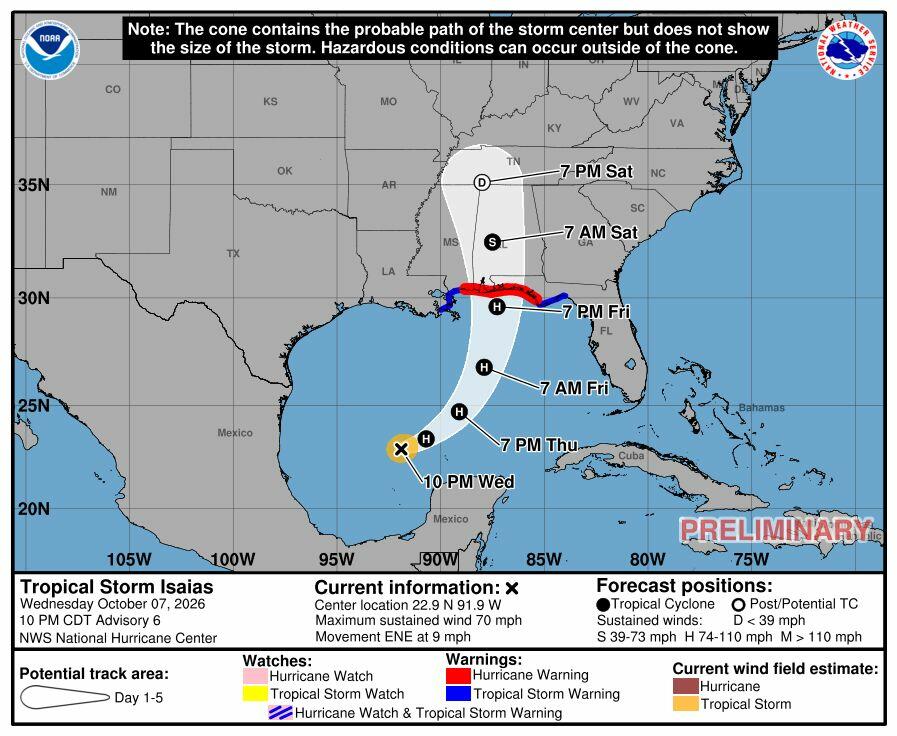
An abrupt westward shift in the hurricane’s cone of uncertainty would put major refineries at risk, including Chevron’s Pascagoula refinery on Mississippi’s Gulf Coast. It refines 369,000 barrels of crude a day into gasoline, diesel, jet fuel, and premium base oils.
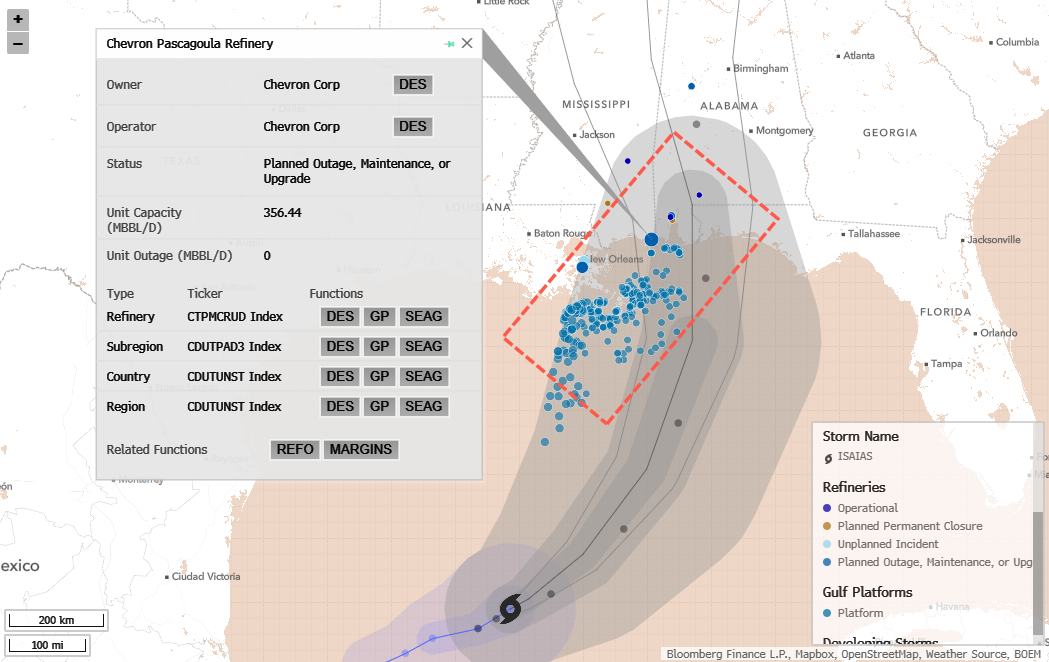
The disruption to offshore oil and NatGas rigs comes as a global refining crisis deepens, and there is little room for error in the US, as refineries operate near full capacity.
Enki Research risk modeler Chuck Watson said that oil and NatGas outages would likely last no more than a week if the forecast track holds.
END
THURSDAY AFTERNOON
Hurricane Shuts 63% Of US Gulf Oil Output, Threatens Refineries; Jefferies Warns Of “Fuel Supply Event”
Thursday, Oct 08, 2026 – 03:17 PM
Summary:
- Hurricane Isaias Landfall Forecasted For Late Friday/early Saturday
- Major US Refineries In Hurricane’s Projected Path
- 63% Of US Offshore Gulf Oil Output Shut
- 25% Of US Offshore Gulf Oil Output Shut As Hurricane Isaias Nears, Threatens Refineries
Hurricane Isaias Shutters 63% of US Gulf Oil Production
Bloomberg cites data from the Marine Minerals Administration showing US Gulf offshore oil producers have halted about 1.28 million barrels per day, equivalent to shutting in 63% of regional output.
Natural gas shut-ins reached 1.127 billion cubic feet a day, equivalent to 57% of the region’s production.
By noon Central Time, workers from 121 offshore platforms had evacuated, while four rigs had moved outside Hurricane Isaias’ cone of uncertainty.
This is a massive temporary hit to US crude supply. For NatGas, the national production impact is much smaller.
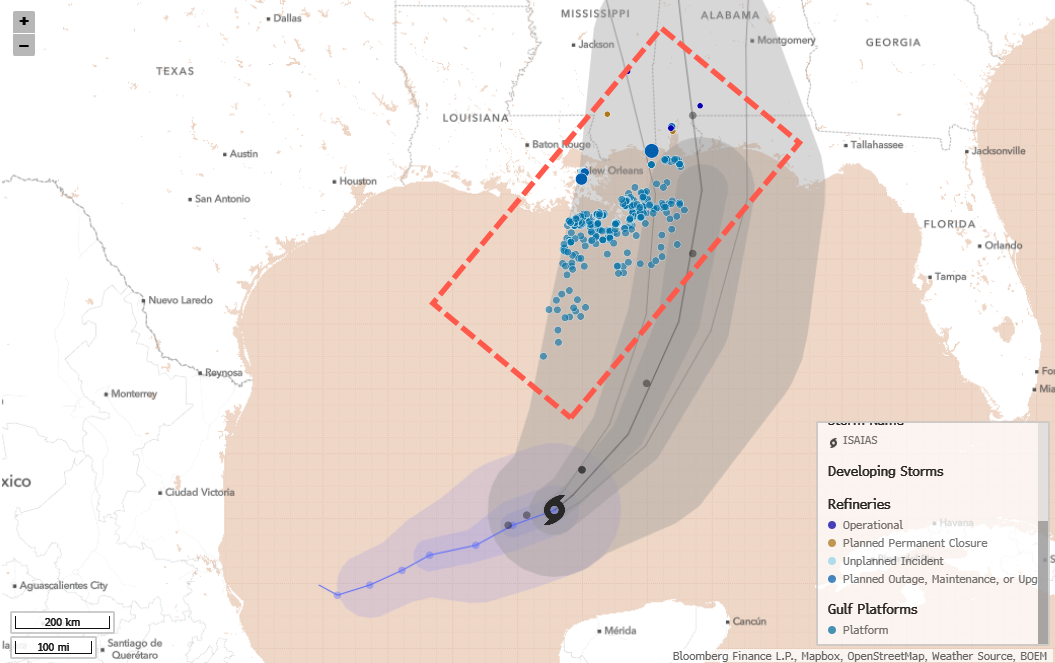
The next big issue is that refineries may see a decline in crude supply as offshore platforms reduce flows. Any refinery outage from storm-related damage would reduce fuel product production as a global refining crisis deepens.
Major Refineries In Crosshairs
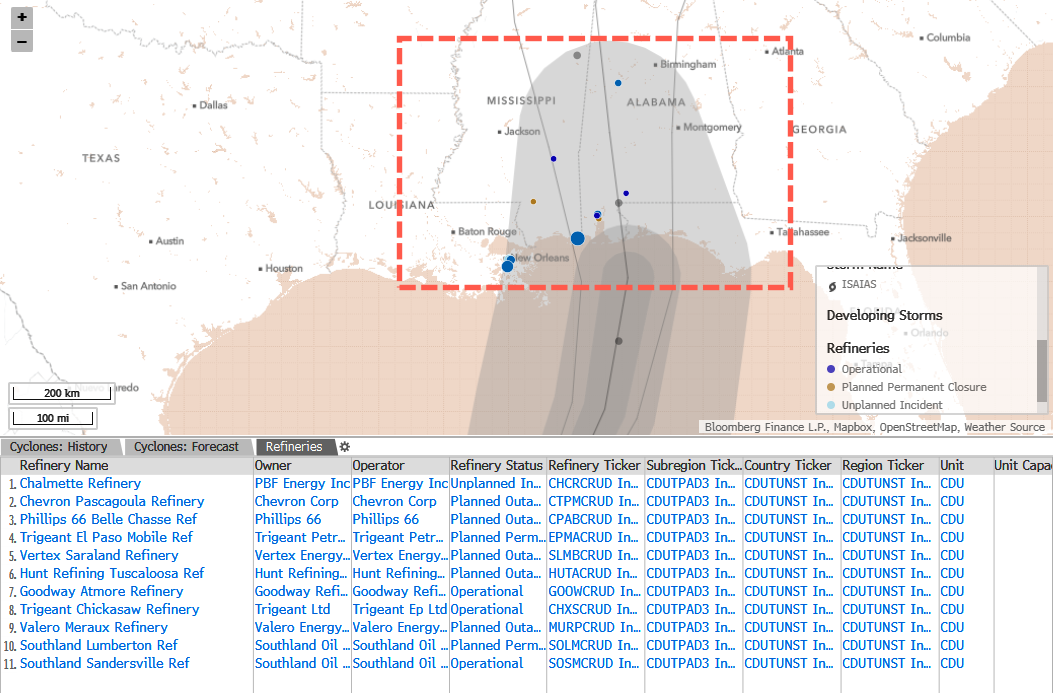
Jefferies consumer staples analyst Kaumil Gajrawala warned clients ealrier today: “Hurricane Isaias is a fuel supply event hitting a system already stretched by the Iran war. ~25% of Gulf crude output is shut in (~4% of US production), but fuel inventories are low and diesel is $6.30 vs. $3.68 a year ago. A small disruption now has outsized price consequences. The second-order effect is freight cost, which favors asset-light models like KO (Buy), where bottlers carry the fleet and fuel exposure.”
As we noted earlier today, any abrupt westward shift in the hurricane’s cone of uncertainty would put major refineries at risk, including Chevron’s Pascagoula refinery on Mississippi’s Gulf Coast. It refines 369,000 barrels of crude a day into gasoline, diesel, jet fuel, and premium base oils.
Landfall impacts for portions of Louisiana, Mississippi, Alabama, and the Florida Panhandle are expected late Friday into Saturday morning.
END
EARLIER TODAY
25% Of US Offshore Gulf Oil Output Shut As Hurricane Isaias Nears, Threatens Refineries
Hurricane Isaias forced offshore oil and natural gas producers in the Gulf of America to halt a sizable amount of production as the Atlantic’s first hurricane of the season churned toward the coast, with potential landfall impacts across portions of Louisiana, Mississippi, Alabama, and the Florida Panhandle.
Isaias had sustained winds of 75 miles per hour and was about 460 miles south-southwest of the Mississippi River mouth overnight, according to the National Hurricane Center.
Producers with offshore rigs have already shuttered 25% of crude output and 16% of NatGas production and evacuated workers from eight platforms and two rigs.
Models increasingly point to landfall late Friday night or early Saturday morning east of major energy assets onshore and offshore in Mississippi and Louisiana.
An abrupt westward shift in the hurricane’s cone of uncertainty would put major refineries at risk, including Chevron’s Pascagoula refinery on Mississippi’s Gulf Coast. It refines 369,000 barrels of crude a day into gasoline, diesel, jet fuel, and premium base oils.
The disruption to offshore oil and NatGas rigs comes as a global refining crisis deepens, and there is little room for error in the US, as refineries operate near full capacity.
Enki Research risk modeler Chuck Watson said that oil and NatGas outages would likely last no more than a week if the forecast track holds.
END
Qatar Masses Tanker Fleet With 2% Of Global LNG Shipping Capacity
Thursday, Oct 08, 2026 – 06:55 AM
Ongoing tensions in the Gulf region pushed Brent crude futures back above $101 a barrel. Reports of Houthi attacks in Saudi Arabia, missile interceptions near Riyadh, and concerns about tanker attacks in the Strait of Hormuz have produced a lot of uncertainty about supplies ahead of the Northern Hemisphere winter.
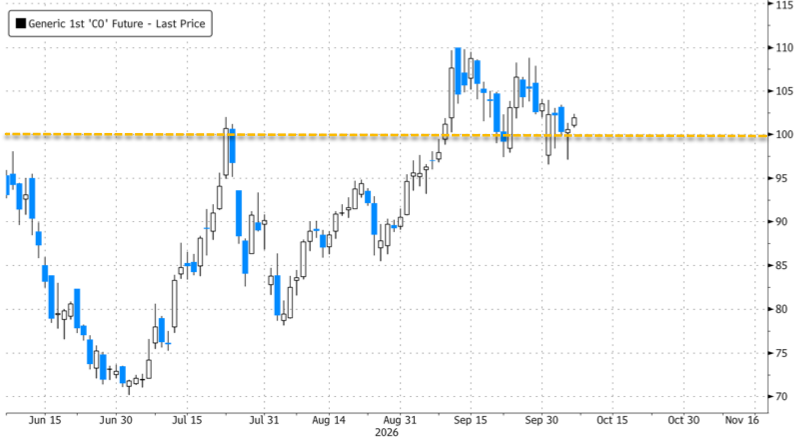
In recent weeks, crude flows through the Strait of Hormuz have increased, but only because of the US military presence in the critical waterway. Meanwhile, Trump administration officials have boasted that Iran’s exports have plunged to zero.
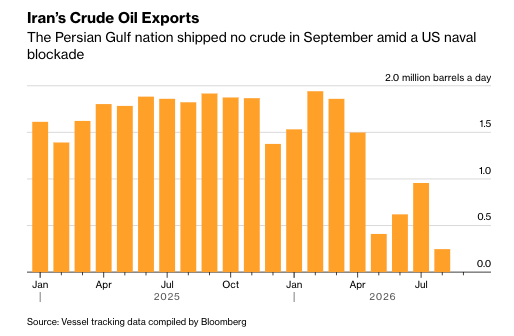
Iran reiterated earlier this week that the Hormuz chokepoint won’t reopen until US negotiators meet its conditions for a peace deal. The problem with that is that Goldman’s most recent report on Hormuz crude flows shows they are back to prewar levels as Tehran’s leverage erodes.
A new indication that Hormuz energy flows could ramp up comes from a Wednesday morning Bloomberg News report that Qatar has parked 12 empty liquefied natural gas carriers near its coast, signaling preparations to load them and soon transit the critical waterway.
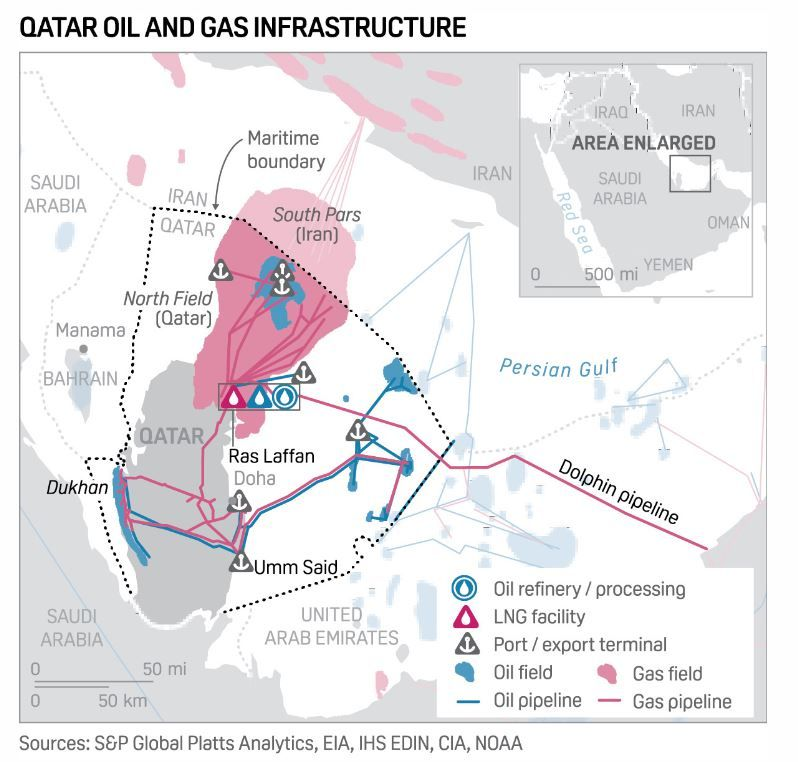
Here’s more color from the outlet:
At least 12 ballast LNG carriers owned or chartered by QatarEnergy are waiting in waters near the country, according to a Bloomberg News analysis of satellite images and ship-tracking data. Together, the vessels can hold about 1.1 million tons of LNG, or roughly 2% of the carrying capacity of the entire global tanker fleet.
There’s no guarantee the vessels will sail through Hormuz once loaded, particularly as Iranian attacks on ships have intensified. A Greek-owned LNG carrier was hit by an unidentified object while sailing near the waterway, Athens News Agency reported on Tuesday, citing Greece’s shipping ministry.
The signals from Qatar are a welcome sign of potential normalization of the maritime chokepoint, but all eyes should be on the Trump administration after the midterm elections because his latest comments indicate:
“We have a decision that I’ll make about Iran. Iran’s been decimated. So the only question is, it’ll either be the easy way or the hard way.”
The key question for Tehran, with oil revenues at or near zero, remains whether the regime holds out on signing a deal until after the US elections, as its move is clearly intended to boost US fuel prices to negatively impact midterm election results early next month, seen by some as asymmetric economic warfare. The clock is ticking for Tehran.
END
Cheap Drones, Costly Chokepoints: A New Layer of Inflation

by Phoenix Capital Research
Wednesday, Oct 07, 2026 – 7:57
Many of Ukraine’s long-range drones cost between $20,000 and $100,000, according to public estimates.
When one gets through, it can knock out refinery equipment that takes months to replace.
That cost math is the most important economic development of 2026 that few investors are pricing correctly.
Cheap drones, and the missiles and small boats that travel with them, have handed small and mid-sized combatants the ability to impose enormous costs on the world’s energy system. Ukraine is using them against Russia’s refineries. Iran is using them against tankers in the Strait of Hormuz. The Houthis are using them around the Red Sea.
Each campaign has its own politics. Economically, they all do the same thing: they add a new layer of cost to every barrel of fuel and every container that moves through a contested route. That cost is now working its way into inflation, and it is likely to stay there.
The first layer is the refinery.
The International Energy Agency (IEA) estimates a Russian refinery was hit on average once every three days during the first eight months of 2026. Ukrainian forces now send multiple waves of drones at a single site to overwhelm air defenses, and they are now hitting secondary processing units, which the IEA estimates may take six to eight months to replace.
The results show up in the numbers. The IEA expects Russian refineries to process about 4 million barrels per day for the rest of 2026 and all of 2027, roughly 30% below pre-invasion levels. Russia has barred diesel producers from exporting since July 8, a ban it just extended through October 31.
On Monday, President Trump made the connection himself. He said record barrels are now moving out of the Gulf and blamed rising gasoline prices on refineries, specifically Russia’s, which Ukraine keeps blowing up.
The campaign is unlikely to slow. Last month Trump urged Kyiv to ease off Russian oil installations because of the effect on diesel prices. Over the weekend, Zelensky said Ukraine would instead double down on refinery strikes in response to Russia’s escalating attacks on Ukrainian cities.
This is why diesel is the fuel to watch. Combined diesel exports from Russia and the Gulf in August were 1.6 million barrels per day below February levels, when the two accounted for almost 45% of global seaborne diesel trade. U.S. diesel has since topped $6 a gallon at the pump, an all-time high.
The second layer is the chokepoint.
Crude flows through the Strait of Hormuz have recovered to near pre-war levels. But that recovery rests on a major U.S. military commitment, and Iran has stepped up its attacks as volumes climb. Nearly 20 commercial ships, mostly tankers, came under attack in the Strait, the Persian Gulf or off the coast of Oman over the past month, according to the Joint Maritime Information Center.
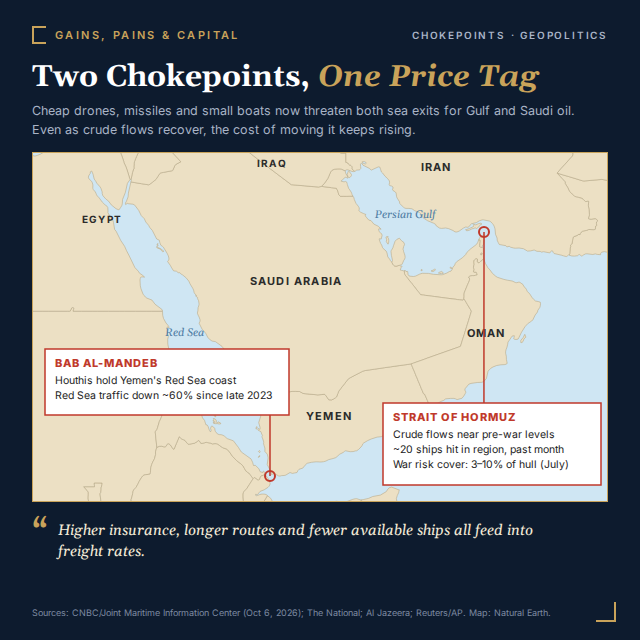
Every one of those attacks gets priced. Before the war, war risk insurance for a Hormuz transit ran about 0.25% of a ship’s hull value. By July it had jumped to between 3% and 10%, according to market rates reported by The National. For a $100 million tanker, that means a premium of $3 million to $10 million per voyage, up from roughly $250,000.
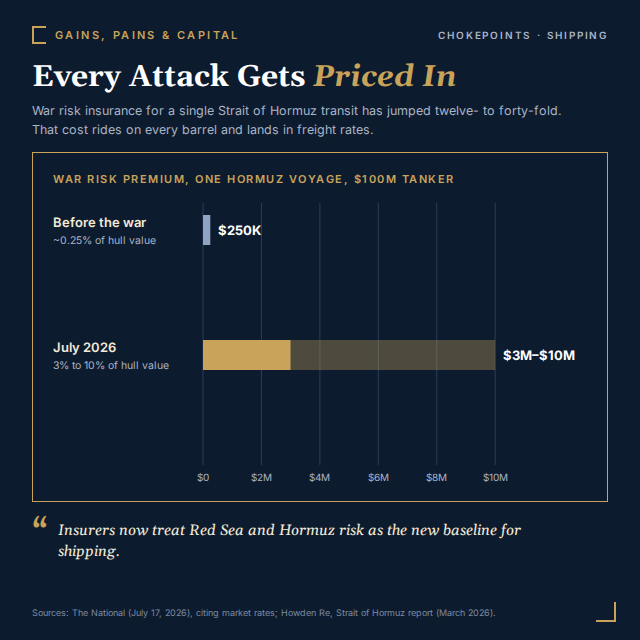
The Red Sea route tells the same story. The Houthis now control Yemen’s entire Red Sea coastline and effectively the Bab al-Mandeb strait. Red Sea traffic is running about 60% below levels before the late-2023 attacks, and ships that go around the Cape of Good Hope add roughly 10 days to an Asia-Europe voyage, according to ING.
Insurers are treating this as permanent. Reinsurance broker Howden Re described the Red Sea crisis of 2024 and 2025 followed by Hormuz in 2026 as a new baseline for marine war risk, calling it a permanent structural repricing.
Higher insurance, longer routes and fewer available ships all feed into freight rates. Freight rates feed into the price of nearly everything that crosses an ocean.
The third layer is the cost of defense, and this is where the asymmetry really bites.
A Shahed-type drone costs tens of thousands of dollars. A Patriot interceptor costs several million. Even Russia’s cheaper Pantsir missile runs about $300,000. Fire one at a $50,000 drone and Moscow spends six dollars for every dollar Ukraine spent, and the drones that get through can still take a refinery offline for months.
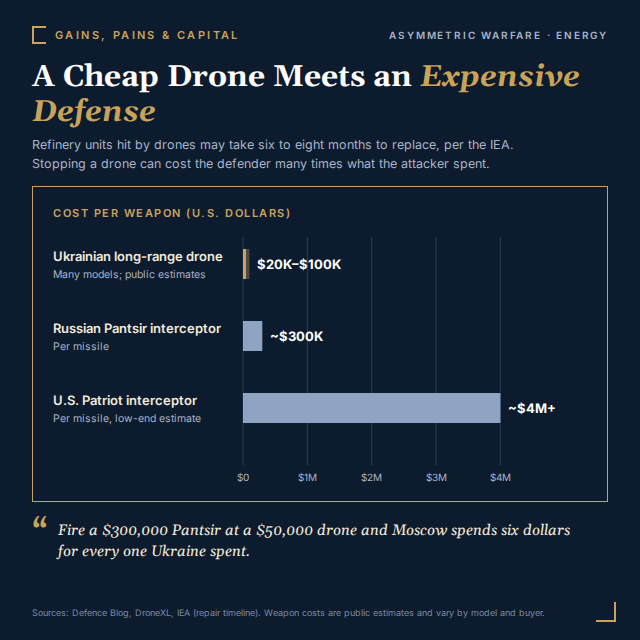
No country can afford to defend every refinery, pipeline, terminal and tanker with million-dollar missiles. So defenders do the next best thing: they spend heavily on escorts, interceptors and patrols, and they accept that some attacks will succeed.
The United States is carrying a large share of that bill. Hormuz flows depend on U.S. naval protection, and Washington is reportedly sending a third aircraft carrier strike group to the region. That spending lands on a federal budget that is already running large deficits.
In other words, the asymmetry shows up twice: once in the price of energy, and again in government borrowing.
This new layer of cost is already showing up in the inflation data, starting at the wholesale level.
In August, the Producer Price Index (PPI) rose 0.4% for the month and 5.4% from a year earlier. Diesel prices jumped 24.1% in that single month and accounted for more than a third of the increase in goods prices, according to the Bureau of Labor Statistics. Transportation and warehousing services rose 2.3%, and truck freight rose 2.0%.
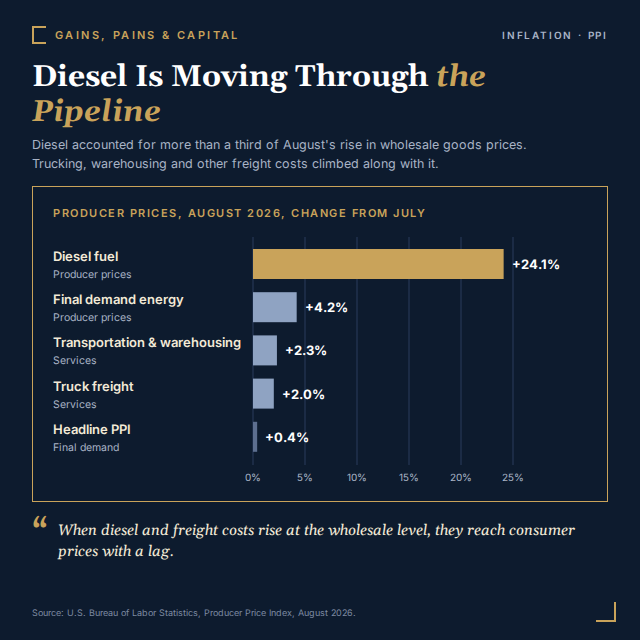
That is the pipeline. Diesel powers the trucks, trains, ships, tractors and construction equipment that every business relies on. When diesel and freight costs rise at the wholesale level, they reach consumer prices with a lag.
Consumer prices are starting to reflect it. The Consumer Price Index (CPI) rose 0.4% in August and 3.4% from a year earlier, with energy prices up 16.3%. September CPI comes out on October 14.
The bond market is uneasy as well. The 10-Year Treasury yield broke above 5% in mid-September and reached roughly 5.2% later in the month, its highest level since 2007. Heavy government borrowing is a big part of that move, and a fuel-driven inflation shock adds to the pressure.
Governments are trying to offset the damage. Last week the G7 agreed to release up to 100 million barrels of crude and diesel from emergency stocks over four months, and the IEA is meeting today to work out the details. That should help near term. But spread over four months, it works out to less than a million barrels per day, crude included, against a diesel export shortfall from Russia and the Gulf that the IEA put at 1.6 million barrels per day in August.
More importantly, emergency stocks address the symptom. The cause is that cheap weapons can now hold expensive energy infrastructure and shipping lanes at risk, and that capability is spreading. Damaged refinery units take months to rebuild. U.S. distillate inventories were about 13% below their five-year average in late September. And insurers have already reset their baseline for war risk at sea.
Even a ceasefire would leave much of this in place. The lesson every shipper, insurer and energy buyer has learned in 2026 is that a single chokepoint or a single refinery can be taken offline by a weapon that often costs less than a luxury car. That knowledge gets built into prices, contracts and inventories for years.
For investors, this means treating asymmetric warfare as a durable new input to inflation, alongside deficits and money printing. Assets that benefit from higher real-world prices for energy and commodities should hold up well. Long-duration bonds and companies with thin margins and long supply chains face a tougher road.
That is a signal to heed and invest around. To help you do that, I recently put together a special report titled Survive the Inflationary Storm. It details the investments I believe are best positioned to profit as inflation takes hold, including several with the potential to be huge winners.
It normally sells for $499. I’m releasing 100 copies free to Gains, Pains & Capital readers today, and when they’re claimed the offer closes.
To pick up your copy, Click Here Now!
Best Regards
Graham Summers
Chief Market Strategist
END
8. EMERGING MARKETS//AUSTRALIA NEW ZEALAND ISSUES
END
U.S./GOLD AND SILVER PRICING/ASIAN CLOSING MARKETS AND EUROPEAN BOURSE OPENING AND CLOSING/ INTEREST RATE SETTINGS THURSDAY MORNING 6;30AM//OPENING AND CLOSING\
OPENING LEVELS OF CURRENCIES// AND CLOSING ASIAN STOCK MARKET AND OPENING EUROPEAN STOCKS:6 AM EST
EURO VS USA DOLLAR: 1.1194 DOWN 0.0006
USA/ YEN 158.22 UP 0.120 NOW TARGETS INTEREST RATE AT 1.75% AS IT WILL BUY UNLIMITED BONDS TO GETS TO THAT LEVEL…//YEN STILL FALLS//END OF YEN CARRY TRADE BEGINS AGAIN DEC 2024/Bank of Japan raises rates by .25% TO 1.75 ..TAKAICHI NEW PM AS YIELDS RISE//JAPAN DEEPLY IN TROUBLE WITH RISING RATES AND A FALLING YEN!! BANK OF JAPAN WILL NO LONGER DO QE. URGES PENSION AND INSUANCE FUNDS TO BUY JAPANESE BONDS//
YEN CARRY TRADERS MURDERED
GBP/USA1.3201 DOWN 0.0012 OR 12 BASIS PTS
USA/CAN DOLLAR: 1.4248 DOWN 0.0011 //CDN DOLLAR UP 11 BASIS PTS//
Last night Shanghai COMPOSITE CLOSED DOWN 03.29 PTS OR 0.79%
Hang Seng CLOSED DOWN 356.00 PTS OR 1.58%
AUSTRALIA CLOSED DOWN 0.75%
// EUROPEAN BOURSE: ALL RED
Trading from Europe and ASIA
I) EUROPEAN BOURSES: ALL RED
2/ CHINESE BOURSES / :Hang SENG CLOSED DOWN 356.00 PTS OR 1.58%
/SHANGHAI CLOSED DOWN 30.29 PTS OR 0.79%
AUSTRALIA BOURSE CLOSED DOWN 0.75%
(Nikkei (Japan) CLOSED DOWN 791.71 PTS OR 1.13%
INDIA’S SENSEX IN THE RED
Gold very early morning trading: $4118,80
silver:$58.95
USA DOLLAR VS TRY (TURKISH LIRA): 49.22 UP 2 BASIS PTS AND NOW WE SEE THEIR STUPIDITY OF SELLING SOME OF THEIR GOLD AND ALL OF THEIR USA DOLLAR RESERVES. THE COUNTRY IS IN BIG FINANCIAL TROUBLE
USA DOLLAR VS RUSSIAN ROUBLE: 85.66 ROUBLE// DOWN 0 ROUBLE AND 18 BASIS PTS.
UK 10 YR BOND YIELD: 5.4851 UP 4 BASIS PTS
UK 30 YR BOND YIELD: 6.007 UP 6 BASIS PTS
FRENCH OAT 10 YR BOND YIELD: 4.916 UP 6 BASIS PTS.
CDN 10 YR BOND YIELD: 3.9480 UP 2 BASIS PTS
CDN 5 YR BOND YIELD; 3.598 UP 2 BASIS PTS
USA dollar index early THURSDAY MORNING: 102.03 UP 44 BASIS POINTS FROM WEDNESDAY’s CLOSE
THURSDAY MORNING NUMBERS ENDS
And now your closing THURSDAY NUMBERS 10.00 AM
Portuguese 10 year bond yield: 4.0002% DOWN 2 in basis point(s) yield
JAPANESE BOND 10 yr YIELD: +3.098% DOWN 3 FULL POINTS BASIS POINTS /JAPAN losing control of its yield curve/
JAPAN 30 YR: 4.185 DOWN 4 BASIS PTS//
SPANISH 10 YR BOND YIELD: 4.127 DOWN 4 in basis points yield
ITALY 10 YR BOND: 4.628 DOWN 1 points in basis points yield ./
GERMAN 10 YR BOND YIELD: 3.5037 DOWN 3 BASIS PTS
IMPORTANT CURRENCY CLOSES : MID DAY THURSDAY
Closing currency crosses for day /USA DOLLAR INDEX/USA 10 YR BOND YIELD/10:00 AM
Euro/USA 1.1185 DOWN 0.0015 OR 15 basis points
USA/Japan: 158.23 UP 0.132 OR YEN IS DOWN 13 BASIS PTS// HIGHLY INFLATIONARY TO JAPAN
Great Britain 10 YR RATE 5.4915 UP 12 BASIS POINTS //
GREAT BRITAIN 30 YR BOND; 6.0018 DOWN 3 BASIS POINTS.
FRANCE 10 YR: 4.885 % DOWN 3 BASIS PTS
CANADIAN DOLLAR DOWN 6 BASIS PTS TO 1.4265
xxxxxxxxxxxxxxxxxxxxxxxxxxxxxxxxxxxxxxxxxxxxxxxxxxxxxxxxxxxxxxxxxxxxxxxxxxxxxxxx
The USA/Yuan CNY 6.7023 ON SHORE ..UP
THE USA/YUAN OFFSHORE// CNH UP TO 6.7049
TURKISH LIRA: 49.22 UP 2 EXTREMELY DANGEROUS LEVEL/DEATH WATCH/HYPERINFLATION TO BEGIN.//
Your closing 10 yr US bond yield UP 4 in basis points from WEDNESDAY at 5.321% //trading well ABOVE the resistance level of 2.27-2.32%)
USA 30 yr bond yield 5.687 UP 3 basis points /10:00 AM
USA 2 YR BOND YIELD: 4.816 UP 3 BASIS PTS.
GOLD AT 10;00 AM $4116.50
SILVER AT 10;00: $58.75
Your 11:00 AM bourses for Europe and the Dow along with the USA dollar index closing and interest ratesTHURSDAY
DAY CLOSING TIME/ 12:00 AM///
London: CLOSED DOWN 11.40 PTS OR 0.11%
GERMAN DAX: CLOSED DOWN 273.54 PTS OR 1.09%
FRANCE: DOWN 35.86 OR 0.40 PTS
Spain IBEX CLOSED DOWN 58.80 PTS OR 0.30%
Italian MIB: CLOSED DOWN 480.26 PTS OR 1.16%
WTI Oil price 92.36 10.00 EST/
Brent Oil: 104.94 10:00 EST
USA /RUSSIAN ROUBLE: 85.25/// ROUBLE UP 0 AND 22/ 100
CDN 10 YEAR RATE: 3.989 UP 4 BASIS PTS.
CDN 5 YEAR RATE: 3.651 UP 4 BASIS PTS
CLOSING NUMBERS: 4 PM//
Euro vs USA 1.1210 UP 0.0010 OR 10 BASIS POINTS//
British Pound: 1.3226 UP 0.0013 OR 13 basis pts/
BRITISH 10 YR GILT BOND YIELD: 5.4270 DOWN 6 FULL BASIS PTS//
BRITISH 30 YR BOND YIELD: 5.9377 DOWN 6 IN BASIS PTS.
FRENCH 10 YR BOND: 4.897 % UP 3 BASIS PTS
JAPAN 10 YR YIELD: 3.090% DOWN 2 FULL BASIS PTS (DANGEROUS TO THEIR ECONOMY
JAPANESE 30 YR BOND: 4.191 DOWN 3 PTS AND STILL VERY DANGEROUS TO THEIR ECONOMY
USA dollar vs Japanese Yen: 157.85 DOWN 0.249 OR YEN UP 25 BASIS PTS//GETTING FURTHER AWAY FROM 160.00/ EXTREMELY DANGEROUS
USA dollar vs Canadian dollar: 1.4224 DOWN 0.0037 PTS// CDN DOLLAR UP 37 BASIS PTS
West Texas intermediate oil: 91.39
Brent OIL: 104.03
USA 10 yr bond yield DOWN 5 BASIS pts to 5.229
USA 30 yr bond yield: UP 1 PTS to 5.666%
USA 2 YR BOND 4.756 DOWN 1 PTS
CDN 10 YR RATE 3.9310 DOWN 2 BASIS PTS
CDN 5 YEAR RATE: 3.598 DOWN 2 BASIS PTS
USA dollar index: 101.93 DOWN 0 BASIS POINTS
USA DOLLAR VS TURKISH LIRA: 49.21 UP 1 BASIS PTS GETTING QUITE CLOSE TO BLOWING UP/IDIOTS SOLD GOLD
USA DOLLAR VS RUSSIA//// ROUBLE: 85.02 UP 0 AND 45 /100 roubles //
GOLD $4,131.80 3:30 PM)
SILVER: 59.19 3;30 PM)
DOW JONES INDUSTRIAL AVERAGE: UP 55.94 POINTS OR 0.11%
NASDAQ 100 DOWN 434.27 PTS OR 1.39%
VOLATILITY INDEX 15.56 UP 0.48 PTS OR 3.18%
GLD: $ 378.62 UP 2.74 PTS OR 0.73%
SLV/ 53.45 PTS DOWN 0.37 OR 0.69%
TORONTO STOCK INDEX// TSX INDEX: CLOSED UP 103.52 PTS OR 0.30%
end
TRADING today ZEROHEDGE 4 PM: HEADLINE NEWS/TRADING
Headline Roulette Is Back: MidEast Missiles & AI Angst Spark Chaos
‘WRAP UP
Stocks hit on AI concerns while oil rallies despite Trump pushback on pre-election strikes – Newsquawk US Market Wrap
Thursday, Oct 08, 2026 – 04:25 PM
- SNAPSHOT: Equities mixed, Treasuries up, Crude up, Dollar down, Gold up
- REAR VIEW: OpenAI’s annualised revenue is reportedly about $20bln less than has been previously signalled; Trump says won’t strike Iran before midterms following reporting that pointed towards the admin gearing up for strikes; Trump says had productive discussions with Iran; Average US 30yr bond auction; Fed’s Waller says more rate hikes are likely needed to tame inflation, but hikes do not need to be consecutive; US initial claims little changed; Satellite images show smoke rising from oil and gas facilities in Saudi Arabia; ECB Minutes reveal officials said repricing of yields could impact future stance; ORCL reportedly weighs power workaround at New Mexico data centre; Samsung Electronics prelim Q3 figures miss expectations; TSMC Q3 revenue beats
- COMING UP: Data: Norwegian CPI (Sep), Canadian Jobs Report (Sep), US University of Michigan Consumer Sentiment Prelim. (Oct). Speakers: ECB’s Cipollone, Schnabel; Fed’s Collins. Supply: Australia. Earnings: Delta Air Lines. Credit Ratings: S&P on the UK.
More Newsquawk in 2 steps:
- 1. Subscribe to the free premarket movers reports
- 2. Trial Newsquawk’s premium real-time live audio squawk for 7 days
MARKET WRAP
US indices were lower on Thursday, although losses were predominantly driven by technology, with underlying market breadth remaining positive. The Nasdaq fell c. 1.4%, while the equal-weight S&P 500 rose 0.6%, potentially reflecting some rotation out of highly valued technology stocks into other areas of the market. Sectors were mixed, with Energy the clear outperformer alongside Consumer Staples, while Technology lagged, followed by Health Care. Energy benefited from higher crude prices, while Consumer Staples was supported by gains in Coca-Cola (KO) and PepsiCo (PEP) following the latter’s earnings report.
Memory weakness began overnight following disappointing preliminary Samsung earnings, with operating profit and revenue missing expectations and the stock closing 2.4% lower in Asia. The results weighed on memory-related stocks, with the DRAM ETF falling c. 5%, alongside weakness in Samsung, SK Hynix, Micron and Seagate. AI-related names came under further pressure during US trade after the FT reported that OpenAI’s annual revenue was USD 20bln below previous estimates, at USD 50bln versus USD 70bln. The report weighed on Nvidia, Microsoft, AMD, Oracle, Broadcom, Amazon, Nebius and CoreWeave. However, CNBC later clarified that the discrepancy reflected differences in accounting methodology, with OpenAI excluding gross revenue from cloud partners, providing a cleaner measure of revenue.
Treasuries rallied amid the equity weakness, with the curve bull flattening as the long end led the move. US data and Fed commentary had little impact, although initial jobless claims remained below 200k, while Fed’s Waller echoed Williams and Jefferson in suggesting rate hikes do not have to occur at consecutive meetings, but did note additional rate hikes are likely needed. The 30-year Treasury auction was fairly average after a rally in long-end bonds reduced the concession ahead of the offering, while the subsequent 20-30-year buyback saw the Treasury accept the maximum USD 6bln.
Crude rallied following overnight reports that President Trump was considering strikes against Iran before the midterm elections. However, prices settled off their peaks after Trump pushed back on the reports, stating that the US would not strike Iran before the elections and that negotiations with Tehran were productive.
In FX, CAD outperformed alongside higher oil prices, while the Dollar weakened as US yields declined. AUD underperformed, while precious metals were mixed, with gold advancing but silver declining.
FED
WALLER (voter): Further rate hikes are likely needed to bring inflation under control, although the Fed has flexibility over the pace of tightening and increases do not need to occur at consecutive meetings. He warned that inflation remains too high, with strong AI investment and the ongoing energy shock contributing to persistent price pressures. On the economy, Waller noted signs of strengthening activity in H2 2026, while the labour market remained solid and stable in September despite weaker job creation. Regarding policy communication, he argued that the Fed can improve market understanding by signalling potential policy options without committing to explicit forward guidance.
MUSALEM (2028 voter, hawk): Inflation is elevated and being driven by persistent demand pressures and supply shocks. The key to bringing inflation back to 2% in a timely manner and limiting second-round effects is more tightening of monetary policy. Musalem said rates ought to be going up in the next six to nine months, and he goes into all meetings with an open mind. Meanwhile, his contacts are mostly worried about inflation and do not see job market worries. He described the economy as pretty strong right now, and the best thing the Fed can do is lower inflation. On yields, he noted nominal yields are rising because real yields are rising in part due to rate expectations; Market inflation expectations remain anchored; AI investment and the government deficit are also pressuring yields higher. Separately, he said financial conditions have tightened modestly but still are accommodative and supporting growth. Lastly, Musalem said credit conditions are solid and good amid some slight issues in the market.
DATA
JOBLESS CLAIMS: Initial jobless claims (w/e Oct. 3rd) printed 197k, more or less unchanged from the prior 199k, and marginally below the expected 200k, as the economy continues to showcase the low-hire, low-fire labour market. This meant the 4-wk average ticked lower to 198k from 200.5k. For the headline, the unadjusted figure was 170,333, +7.6% W/W, and the seasonal factors had expected an increase of 8.7%. Looking at the breakdown, the biggest increases were California (+4,578), Illinois (+1,154), and New York (+985). Continued claims (w/e Sept. 26th) came in at 1.716mln (exp. 1.710mln, prev. 1.699mln). Overall, jobless claims remain very low, and Oxford Economics adds that underlying job growth is steady and consistent with the labour market’s break-even pace of employment growth, while layoffs are low.
FIXED INCOME
T-NOTE FUTURES (Z6) SETTLED 7+ TICKS HIGHER AT 104-23
T-notes rally as AI concerns weigh on stocks, while Eurozone yields fall following ECB minutes. At settlement, 2-year -1.9bps at 4.751%, 3-year -3.0bps at 4.885%, 5-year -4.1bps at 4.987%, 7-year -5.1bps at 5.105%, 10-year -5.9bps at 5.227%, 20-year -7.0bps at 5.645%, 30-year -7.2bps at 5.601%.
THE DAY: T-notes appeared to benefit from haven demand on Thursday, with the curve bull flattening as the long end led the rally. The move coincided with a risk-off session for technology stocks, despite rising oil prices. Tech came under pressure following disappointing preliminary Samsung earnings, which weighed on the memory sector, while the FT reported during US trade that OpenAI’s annual revenue was USD 20bln lower than previously estimated, at USD 50bln versus USD 70bln. The report weighed on broader AI-related names, including NVDA, ORCL, AMD and INTC. However, while technology weakness dragged on the major indices, the decline in yields appeared to support the broader equity market, with market breadth remaining positive.
Attention was also on the USD 22bln 30-year Treasury auction. The substantial yield pickup from last month’s offering may have helped attract demand, although the rally in long-end Treasuries throughout Thursday reduced some of the concession ahead of the auction, with the high yield of 5.618% well below the roughly 5.773% peak seen earlier in the session. Ultimately, the auction was fairly average, with a marginal 0.1bp tail and weaker indirect participation than the previous offering. Nonetheless, the above-average B/C and relatively low dealer allocation suggested the auction was still reasonably well absorbed.
US data saw the latest weekly initial jobless claims remain under 200k yet again, bringing the four-week average also below the round number, suggesting an ongoing, low-hire, low-fire labour market. Fed speak saw Governor Waller echo sentiment from Williams and Jefferson that there is flexibility over the pace of hikes and that they do not need to be consecutive, but he did stress that more hikes are likely needed to tame inflation. Musalem also stressed that more hikes are required to bring inflation back to target, noting rates ought to be going up in the next six to nine months.
There may also have been some follow-through from European government bonds, with Eurozone yields declining following the ECB minutes. The minutes noted that higher long-end yields, provided the move remains orderly, support the intended monetary policy stance and could influence the future path of policy rates, suggesting that tighter financial conditions may reduce the need for additional ECB hikes. Meanwhile, Eurogroup President Pierrakakis said he was mindful, but not alarmed, by Eurozone bond spreads, adding that adopting a sound 2027 French budget would be key to calming markets. He also called for fiscal prudence. ECB President Lagarde acknowledged recent market moves, noting that the ECB remains attentive to developments and has tools available to counter unwarranted market dynamics.
Supply
Notes
- US sold USD 39bln of 30-year bonds; Tail 0.1bps.
Bills
- US sold 8-week bills at high rate of 3.980%, B/C 2.77x; sold 4-week bills at a high rate of 3.980%, B/C 2.40x
- US to sell USD 82bln 26-week bills, to sell USD 95bln 13-week bills, and to sell USD 95bln 6-week bills on October 13th; all to settle on October 15th
STIRS / OPERATIONS
- Fed Hike Pricing via CME FedWatch: Oct 4.3bps (prev. 4.9bps), Dec 24.1bps (prev. 25.5bps)
- EFFR at 3.88% (prev. 3.88%), volumes at USD 108bln (prev. USD 120bln) on October 7th
- SOFR at 3.88% (prev. 3.90%), volumes at USD 2.968tln (prev. USD 2.997tln) on October 7th
- NY Fed RRP op demand at 0.34bln (prev. 2.34bln) across 2 counterparties (prev. 15) on October 8th
- US Treasury Buyback [Liquidity Support, 20-30 year, max USD 6bln]: Accepts USD 6bln of USD 14.89bln offers; Accepts 10 of 34 eligible securities
CRUDE
WTI (X6) SETTLED USD 3.21 HIGHER AT 91.49/BBL; BRENT (Z6) SETTLED USD 4.08 HIGHER AT USD 104.28/BBL
The crude complex was firmer, albeit settling off highs, after Trump’s latest Truth pushed back on earlier reports. Benchmarks gained through the European session, and through the US day, amid initial ever-increasing US-Iran escalation risks, with reports that Washington had completed operational plans for potential strikes against Iran ahead of the November midterms, although no final decision had been made. As such, WTI and Brent hit highs of USD 93.20/bbl and 105.92/bbl, respectively, but they swiftly pared a chunk of their gains after US President Trump posted on Truth they are having productive discussions with Iran, and they will not be attacking Iran at any time before the midterms. Aside from these two major updates, for reference, benchmarks saw movement on three separate Middle East headlines, with upside on the first and third, and downside on the second; 1) Iranian supreme leader’s adviser said Strait of Hormuz will not reopen until outstanding issues are resolved; 2) Iranian Foreign Minister Araghchi remarked the negotiation process continues and will respond to the US proposal within days; 3) Houthi spokesperson warned “all employees, including experts, engineers, and workers, at all Saudi oil facilities against being present in areas that are targets for our forces”. WTI hit a low of USD 88.77/bbl and Brent 100.76/bbl following the aforementioned Trump Truth, as participants await any further updates or a response from Iran. Axios had later reported that if major US combat operations resume on Iran, they’re expected to include large-scale strikes on Iranian energy facilities, infrastructure and nuclear targets.
EQUITIES
CLOSES: SPX -0.49% at 7,764, NDX -1.39% at 30,726, DJI +0.10% at 51,232, RUT -0.03% at 2,792
SECTORS: Technology -1.78%, Consumer discretionary -0.47%, Health -0.41%, Utilities -0.26%, Communication services flat, Industrials +0.3%, Materials +0.46%, Real estate +0.58%, Financials +0.91%, Consumer staples +2.12%, Energy +2.92%.
EUROPEAN CLOSES: Euro Stoxx 50 -0.94% at 6,122, Dax 40 -1.12% at 24,823, FTSE 100 -0.16% at 10,442, CAC 40 -0.51% at 7,730, FTSE MIB -1.35% at 49,298, IBEX 35 -0.87% at 18,952, PSI +0.15% at 9,348, SMI -1.24% at 13,637, AEX +0.31% at 1,121
STOCK SPECIFICS:
- Oracle (ORCL) reportedly weighs power workaround at New Mexico data centre; could transport gas to site via truck in place of delayed pipeline; the news weighed on Bloom Energy (BE)
- OpenAI’s annualised revenue is about USD 20bln less than has been previously signalled, FT reports, citing sources. CNBC TV Clarified that the USD 50bln revenue number from OpenAI does not include gross revenue from cloud partners (whereas the USD 70bln included it).
- TSMC (TSM) Sept. rev. rose 54.6% Y/Y to TWD 511.86bln.
- WSJ says Broadcom (AVGO) is arranging >$50bln of financing for OpenAI’s custom AI chips.
- Wolfspeed (WOLF) announces conditional 30yr, $1.5bln loan commitment from US DoD
- Levi Strauss (LEVI) rev. light w/ weak next Q profit view
- PepsiCo (PEP) top & bottom line surpassed exp.
- argenx (ARGX) will discontinue Phase 3 UNITY study of efgartigimod subcutaneous
- Crescent Energy (CRGY) to buy Devon’s (DVN) Eagle Ford assets for $4.22bln in cash
- Viatris (VTRS) agrees to acquire Pacira Biosciences (PCRX) for $36.5/shr or $1.65bln; PCRX closed Wed. at $25.20/shr
- Samsung Electronics prelim Q3 op. profit +783% Y/Y & rev. +127% Y/Y, albeit both missed exp.
- Google (GOOGL) Cloud introduces Gemini agent
- GlobalFoundries (GFS) signs a five-year silicon interposer manufacturing agreement with TSMC (TSM), volume production expected to ramp up in H1’28.
- Starbucks (SBUX) has explored a potential takeover of Chipotle (CMG), FT reports; sources say talks may not lead to a transaction given the complexity of combining the two consumer giants.
- Disney (DIS) pitches Paramount (SKYD) and Universal (CMCSA) on a big-screen to compete with Imax (IMAX).
FX
USD was marginally weaker as yields pullback pressured the greenback, though risk-off trade across equities on AI concerns limited downside. The declines in yields came from a flight to haven amid risk-off, somewhat dovish ECB Minutes, and US President Trump saying no strikes on Iran will occur before the midterms amid “productive” talks with Iran. Despite Trump, in his comments, rejecting recent reports that the admin was gearing up for strikes on Iran before the midterms, oil prices held onto gains, as details beyond the midterms on resolve were absent. On the flip side, AI concerns arising from an unexpected USD 20bln shortfall in signalled OpenAI annualised revenue kept a floor for the DXY. DXY trades around 102.13 within a 102.033-102.467 intraday range.
Fed’s Waller offered a hawkish surprise, expecting additional hikes to support the return of inflation to 2% if inflation comes in as expected. He caveated that hikes do not need to be consecutive, but they should occur over an appropriate period of time.
CAD, CHF, EUR, GBP, and NZD saw modest strength against the buck; CAD outperformed on higher crude prices, while AUD lagged.
For the Euro, ECB Minutes were the highlight, which contained a dovish line. “The repricing at the long end of the yield curve, provided it remained orderly, also supported the intended monetary policy stance and could have implications for appropriate policy rates in the future.” This implies the ECB views recent yield moves as having helped its tightening aims, further dampening already declining rate hike expectations. EUR/USD rose back above 1.12 to ~1.1211 while the 10yr OAT-Bund spread fell 1.9bps to 136.1bps.
USA DATA RELEASES
Jobless Claims Confirm ‘Low-Hire, Low Fire’ Economy
Thursday, Oct 08, 2026 – 08:50 AM
For the fourth week in a row, the number of Americans filing for jobless benefits for the first time printed below 200k (197k) implying the layoff/separation rate is extremely subdued.
Employers are not cutting headcount in any meaningful way – job security for people who already have jobs is still pretty good.
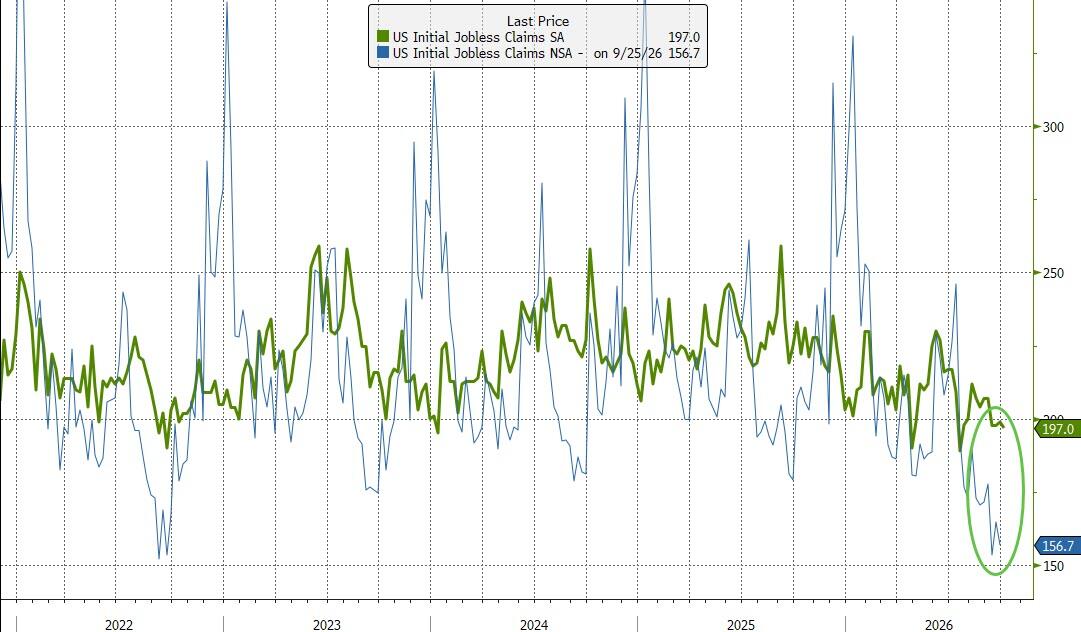
California saw by far the biggest jump in initial claims…
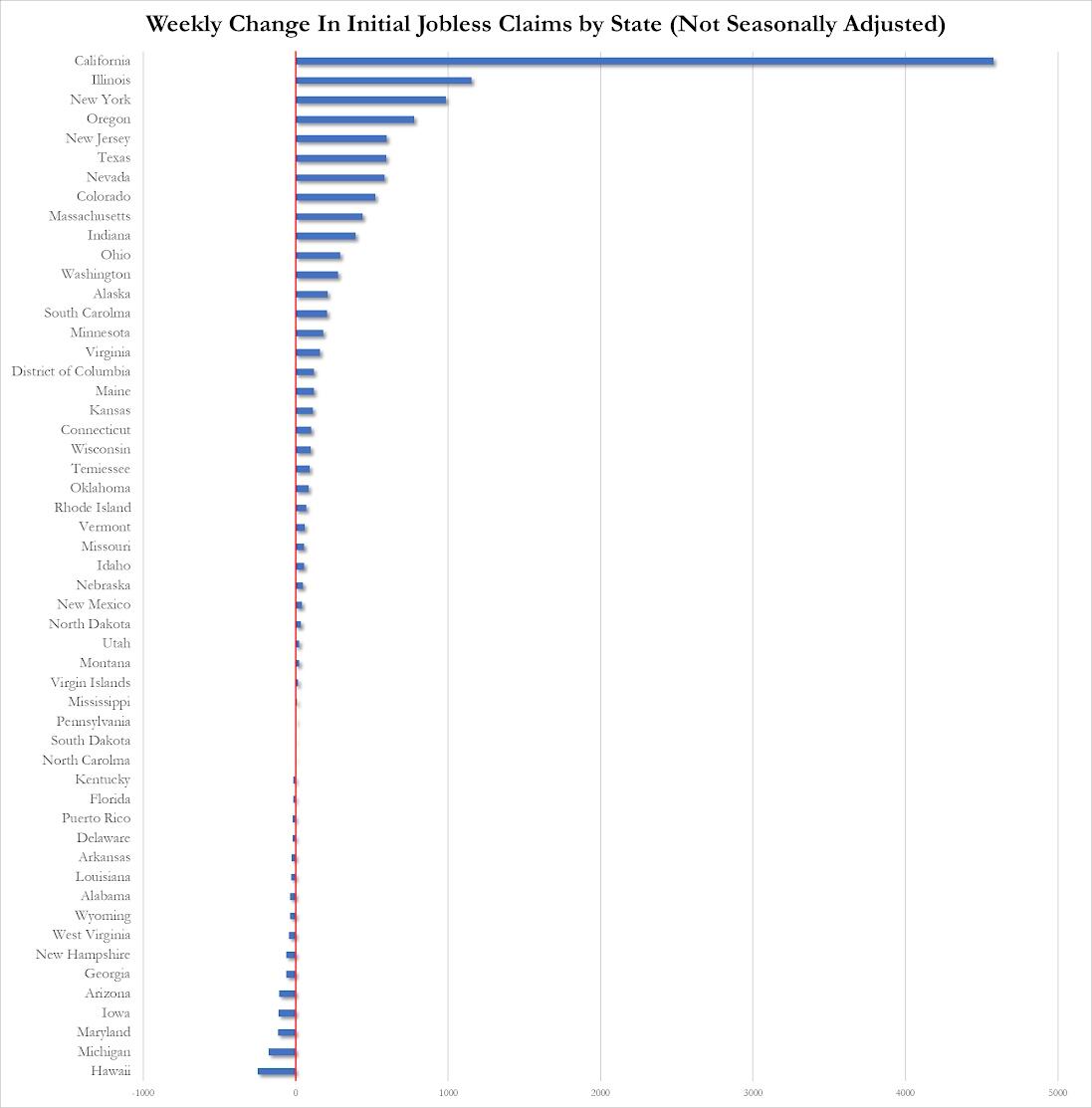
Continuing jobless claims fell once again – now at its lowest since April 2023…
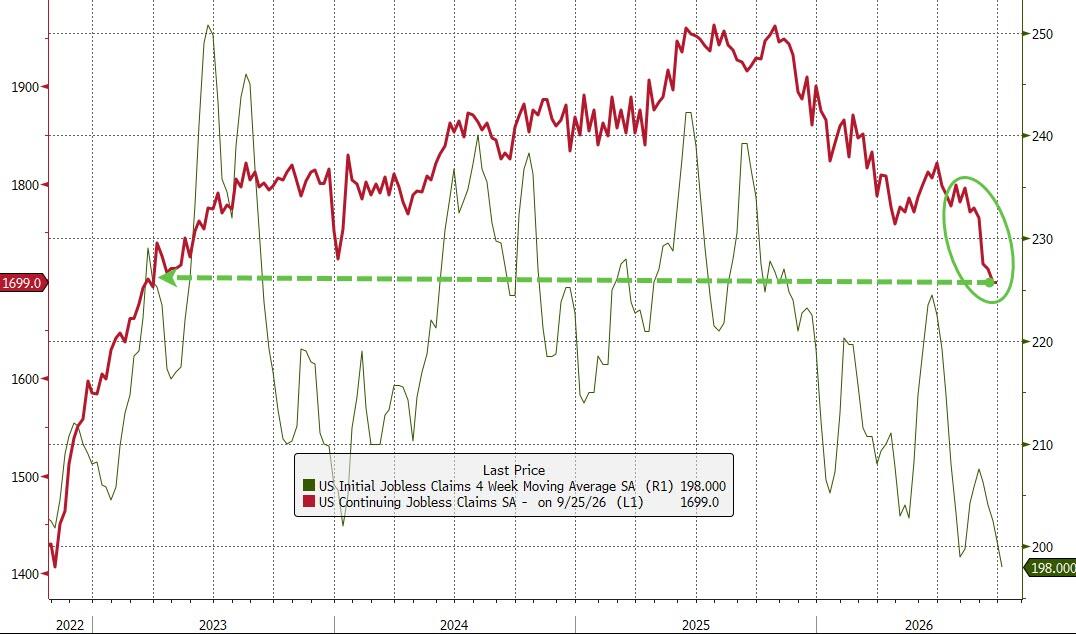
However, payrolls tell the other half of the story. September nonfarm payrolls came in at just +29k (with prior months revised down), well below the already modest recent trend. Net employment change is simply hires minus separations. When separations are that low but the net number is mediocre, hiring itself must have slowed substantially.
So the market has cooled mainly through reduced hiring rather than rising firings. That keeps the unemployment rate relatively contained (4.2% in September) even as it becomes harder for job seekers, switchers, and new entrants to land roles.
Economists (including various Fed research notes) have been describing this as a stable-but-fragile equilibrium for a while: low layoffs prop things up, but the low hiring rate leaves little cushion if demand weakens further or a shock forces companies to start cutting.
It’s also consistent with slower labor-force growth from demographics and reduced immigration – fewer people needing to be absorbed means weaker payroll growth can still leave unemployment from rising sharply.
The bottom line is simple: the ‘low-hire, low-fire’ economy continues to roll along with no obvious signs of AI’s productivity surge (or replacement projections).
USA ECONOMIC REPORTS
Trump Admin Cracks Down On Foreign Worker Fraud: Bans MSFT From H1-B Program, Probes 9 Colleges Over J-1 Visas, Hikes Costs For Students
Thursday, Oct 08, 2026 – 11:10 AM
In the last 24 hours, the Trump administration has announced three major efforts to crack down on foreign worker/student visa fraud.
First, US Vice President JD Vance said on Thursday that the federal government is suspending tech giant Microsoft from a program to apply for green cards for workers who come to the U.S. to live and work using an H-1B visa as it accuses the company of fraud.
“If you do the math, for every worker that Microsoft laid off, they replaced that worker with one and a half foreign indentured servants,” said Vice President JD Vance in a White House news conference announcing the decision.
Secretary of Labor Keith Sonderling added that some of the largest IT firms in the world would also be suspended from that program, including Cognizant, Infosys, Tata, Wipro, HCO and Capgemini, as well as Adobe.
Microsoft did not immediately respond to a request for comment.

Second, the Trump administration is going after nine elite universities on suspicion of visa fraud, accusing them of unlawfully benefiting financially from hiring and admitting foreign nationals.
Harvard, Yale, Stanford, Brown, the University of Pittsburgh, UC Davis, Caltech, Arizona State, and MIT are under examination by federal investigators, Vice President JD Vance announced Thursday, suggesting the schools are exploiting the J-1 visa program to import cheaper students from overseas and skirt employment obligations to US citizens.
“Something weird is going on at these universities,” said Vance.
“They’re using these visas way too much. They’re using them to undercut the wages of American grad students and American researchers, and it simply has to stop.”
The Labor Department is establishing a visa fraud strike team as part of the probe and subpoenas have already been sent to the schools.
“Nobody will be getting a free pass because their name is carved into an expensive building,” said Labor Department watchdog Anthony D’Esposito, who reported that 61% of post-grad students at US universities come from overseas.
“American taxpayers send billions of dollars to these universities to support research and innovation. They deserve to know where that money is be, where is going, and whether it’s being used lawfully.”
And finally, the Department of Homeland Security (DHS) is considering a new rule that would impose major fees for foreign students seeking to work in the United States.
The proposed rule, announced by the Trump administration on Oct. 7, would require colleges and universities to pay a $70,000 fee for each nonimmigrant student applying to participate in the Optional Practical Training program.
The program authorizes foreign students to temporarily work in the United States in jobs related to their field of study either during or after their time in school.
As Timothy Frudd reports further for The Epoch Times, the new proposal comes after the Trump administration was blocked last month from implementing limitations on F-1 visas, which allow nonimmigrant students to live and study in the United States.
DHS said Wednesday that the proposed rule is intended to reduce the influx of cheap labor into the United States, curb fraud and abuse, protect American workers, and strengthen the integrity of the immigration system.
“Optional Practical Training was never meant to be a back door into the American workforce, a subsidy for cheap labor, or a prize for those who game the system,” a DHS spokesperson said in a statement.
“DHS is upskilling OPT to require foreign students to justify their worth to employers. American workers should not have to compete against a program that has been turned into a pipeline for cheap foreign labor.“
In addition to the initial $70,000 fee for each nonimmigrant student participating in the optional practical training program, colleges and universities would also be required to pay a $30,000 fee for each renewal or extension of the program’s authorization for students.
Under the program, F-1 nonimmigrant students are required to receive a recommendation from a designated school official before applying for employment authorization with U.S. Citizenship and Immigration Services.
Students participating in the program are typically eligible to work in the United States for one year after graduation.
However, some students with degrees in science, technology, engineering, or mathematics are eligible to work for an additional two years.
More than 294,000 foreign students participated in the optional practical training program during the 2024-2025 academic year, according to the President’s Alliance on Higher Education and Immigration.
In Wednesday’s announcement, DHS said it was proposing the new rule in response to fraud and abuse discovered by the Student and Exchange Visitor Program.
As the program has expanded, schools, officials, employers, and F-1 nonimmigrant students have attempted to exploit regulations, including “problematic worksites and ‘pay-to-stay’ visa schemes,” according to DHS.
The department suggested the fees would encourage colleges and universities to employ additional oversight and be more selective of students recommended for the training program.
In response, Fanta Aw, CEO of nonprofit NAFSA: Association of International Educators, said in a statement that the program provides foreign students with the opportunity to have hands-on experience.
She said international students involved in the program also fill labor shortages in science, technology, engineering, or mathematics fields.
“Imposing this new fee structure on Optional Practical Training is the latest in a series of developments that creates deep uncertainty for international students,” Aw said.
“Driving away the talents, perspectives, and aspirations of international students will only hurt American innovation, economic growth, workforce development, and global leadership.“
A federal judge blocked another Trump administration rule on Sept. 14 that would limit students on F-1 visas to four years in the United States before requiring them to seek approval from U.S. Citizenship and Immigration Services to stay longer.
DHS said the limitation on F-1 visas was needed to address national security risks, including foreign spying at universities in the United States.
Judge F. Dennis Saylor IV of the U.S. District Court for the District of Massachusetts, who blocked the Trump administration from implementing the law while a legal challenge moved forward in court, said DHS did not explain how the rule would deter future spying or acts of sabotage.
In May 2025, the Trump administration attempted to revoke Harvard University’s certification to enroll foreign students under the Student and Exchange Visitor Program.
Harvard responded by suing the administration, and a federal judge blocked the government from preventing the university from enrolling foreign students through the program.END
END
Nasdaq Tumbles After FT Reports OpenAI Revenues Disappointing
Thursday, Oct 08, 2026 – 01:00 PM
…and just like that, the massive AI CapEx boom “excess demand” narrative is in doubt…
The Financial Times reports that OpenAI’s annualised revenue is about $20bn less than has been previously signalled, according to financial documents shared with investors, a massive gap likely to damp optimism about the growth of AI demand.

The company has recently told investors its revenues were approaching $50bn on an annualized basis at the end of September, far short of the $70bn reported by the FT and other media outlets late last month based on information that was provided to investors.
The most immediate reaction was in Nasdaq which tumbled over 1%…
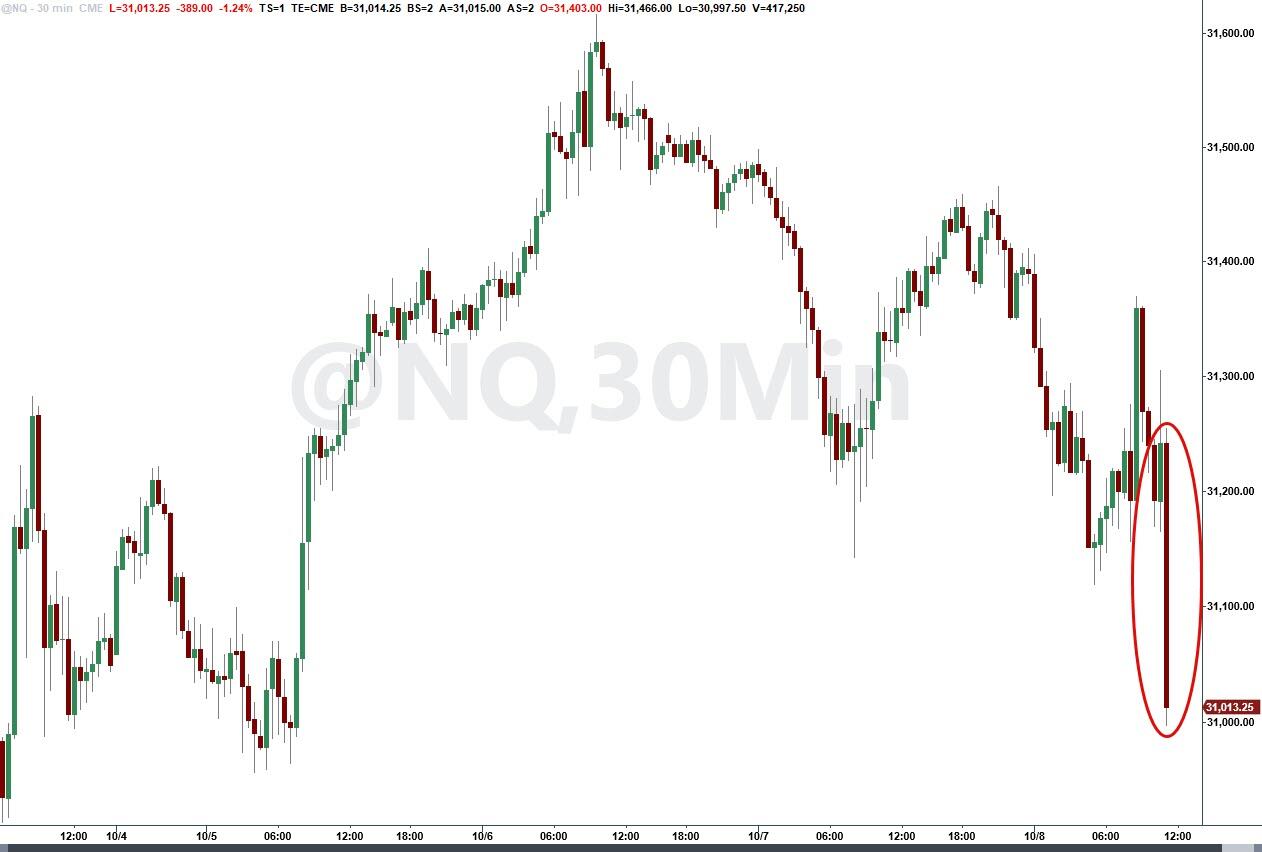
The Broad AI basket is getting whacked…
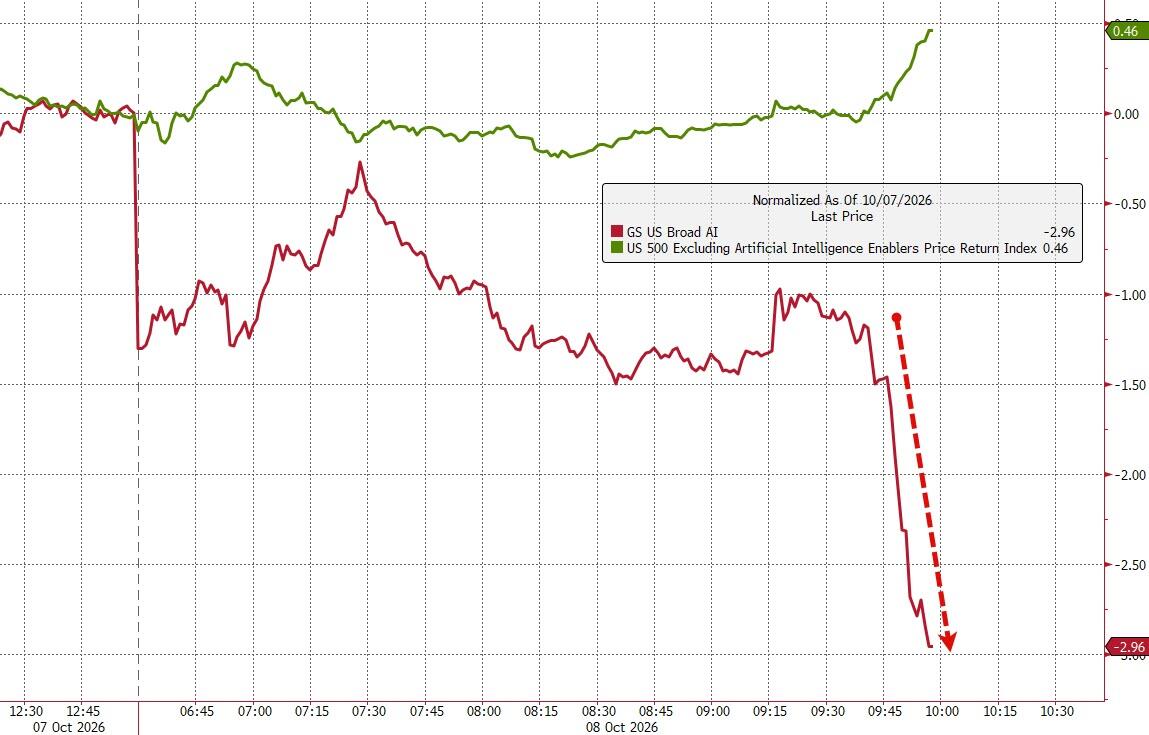
Who could have seen that coming with Token Costs plumbing new lows?
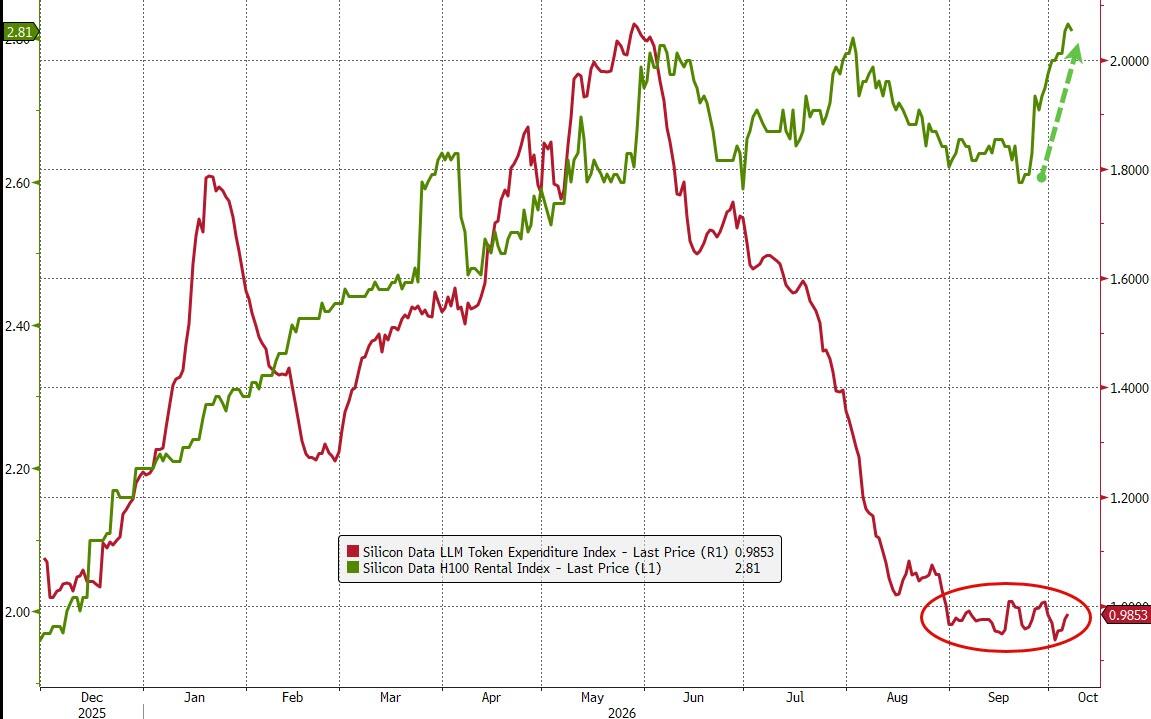
And in the tokenized stock market for OpenAI (PreStocks), things aren’t looking great:
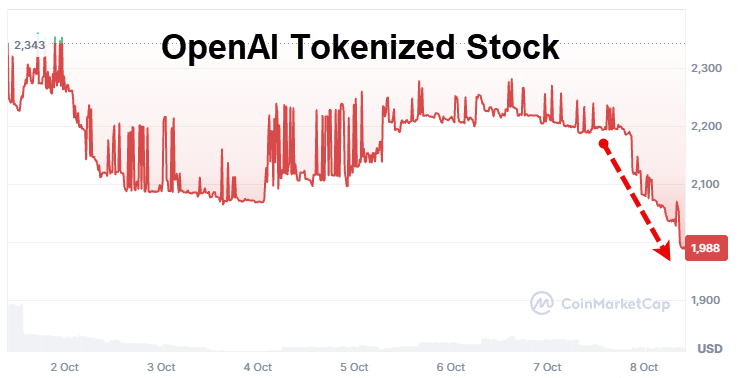
How many more of the prior statements are about to be proved false?
The entire shell-game is based on the ‘demand’… and if revenues are that big a miss from expectations, there is an even bigger disconnect relative to liabilities…
That’s ok, OpenAI only has $1.5 trillion in commitments to… checks circular financing diagram… EVERYONE…
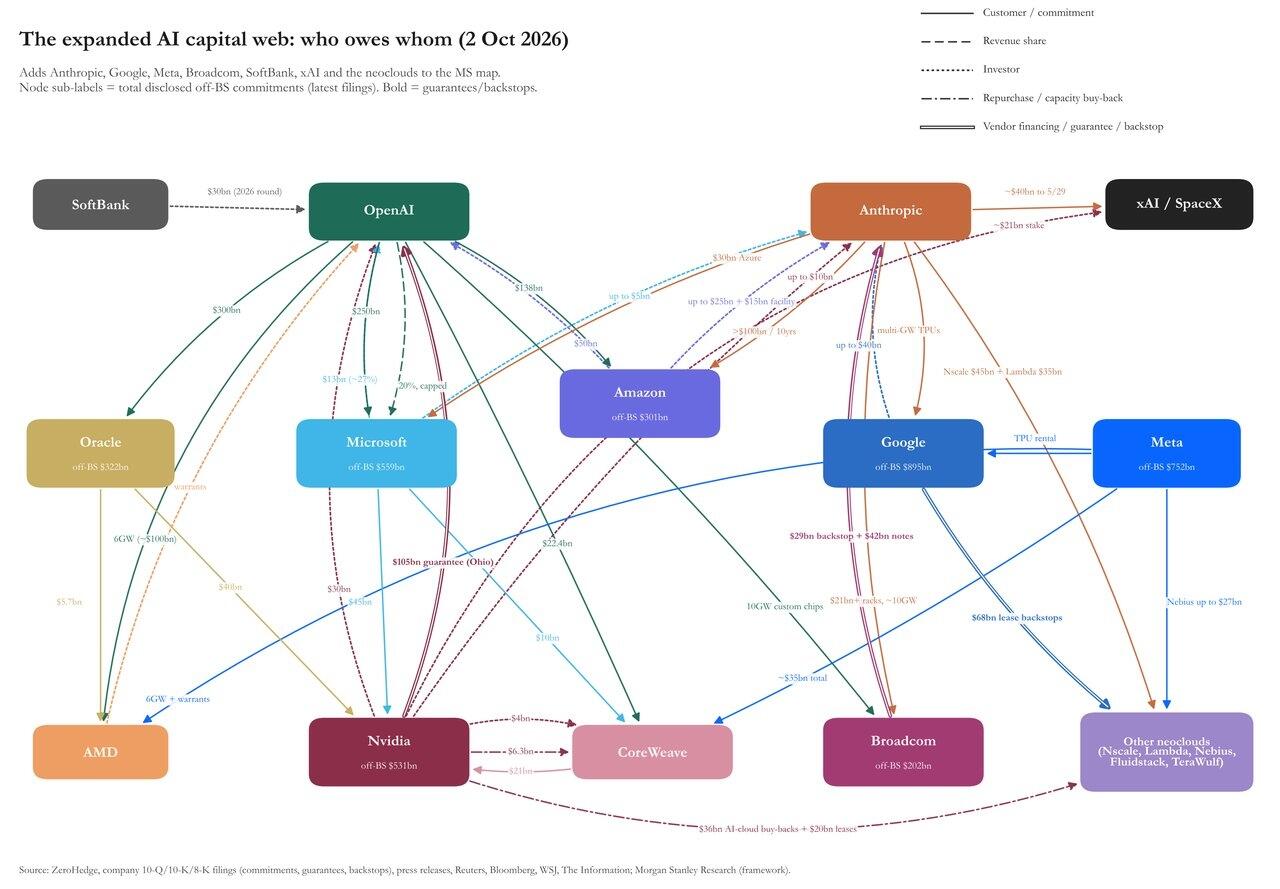
How long before the spins and denials?
END
ORACLE AND ITS OI JUPITER VENTURE;
From Force Majeure To Forced Haulage: Oracle Is Now Trucking Natural Gas To Its AI Data Centers
by Tyler Durden
Thursday, Oct 08, 2026 – 02:21 PM
Two weeks ago, Oracle told the world that Project Jupiter, its massive 2.45GW New Mexico mega-campus for OpenAI, was “on schedule.” It also sent a force majeure notice to the developer.
Today we found out how it plans to square that circle: with a lot of trucks.
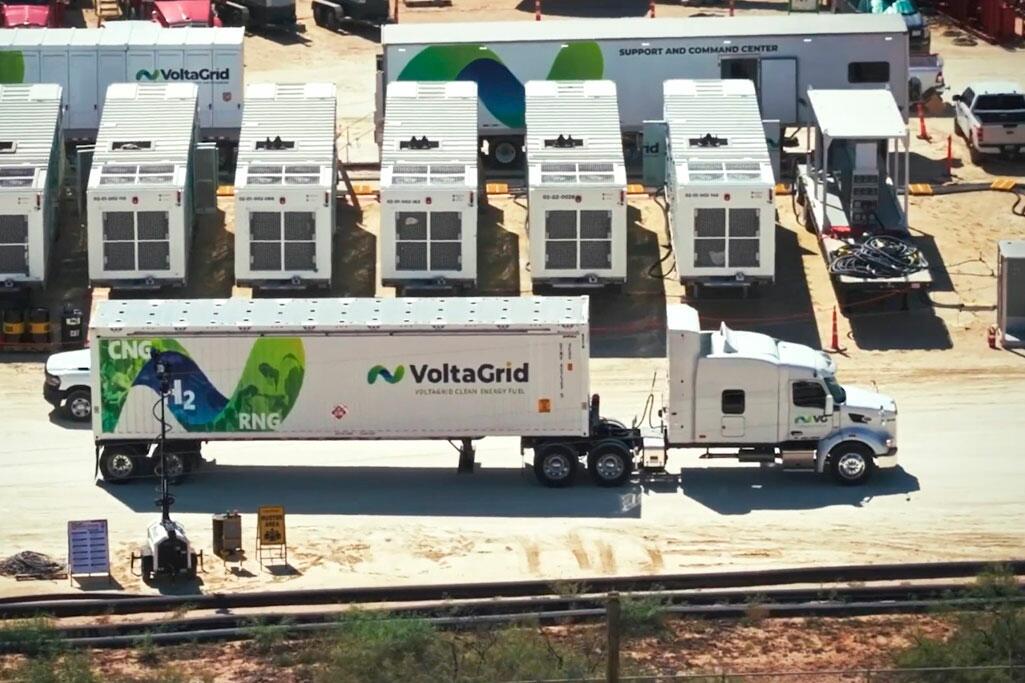
According to Bloomberg, Oracle has been quietly keeping several data centers on track by hauling compressed natural gas (CNG) by road straight to the server farms, and is now weighing the same stopgap for Project Jupiter, where the gas pipeline that is supposed to feed the campus is running late and threatening the timeline. The plan would let Oracle bring the early phases online before the pipe enters service.
Oracle shares slid about 5.5% on the report…
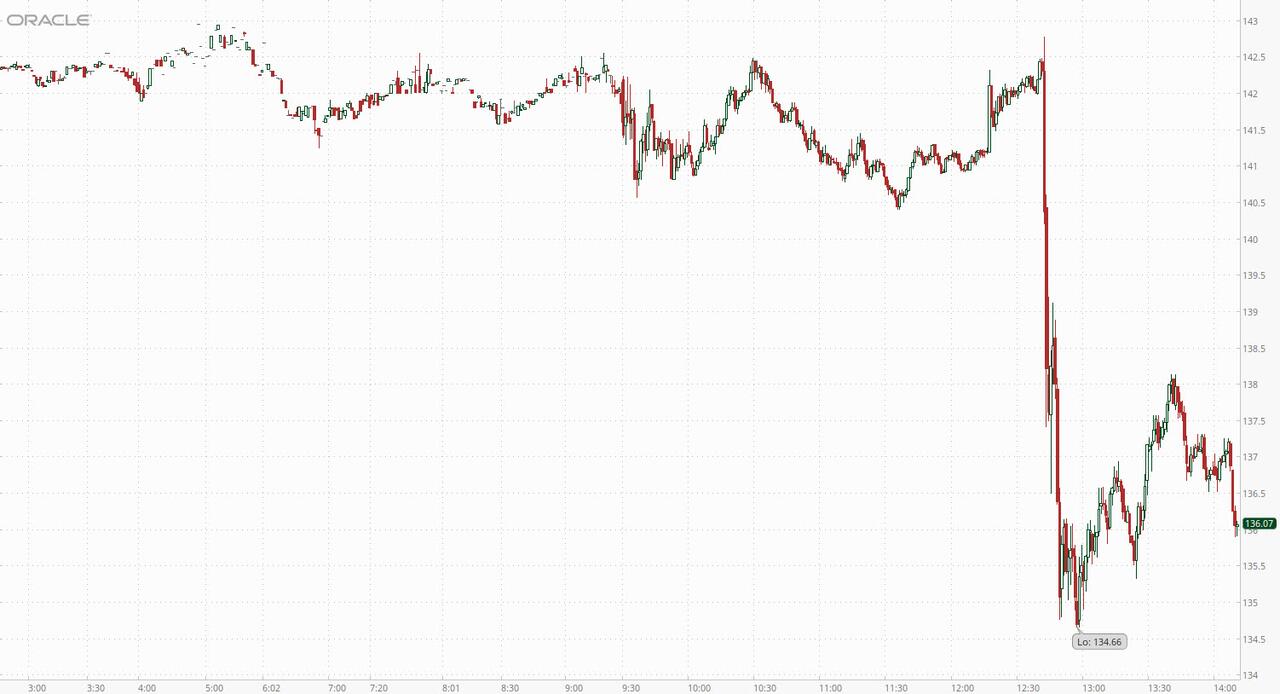
…. while Bloom Energy (BE), which happens to have a 2.4GW fuel cell contract for Project Jupiter (fuel cells which, last we checked, run on natural gas), tumbled 8%
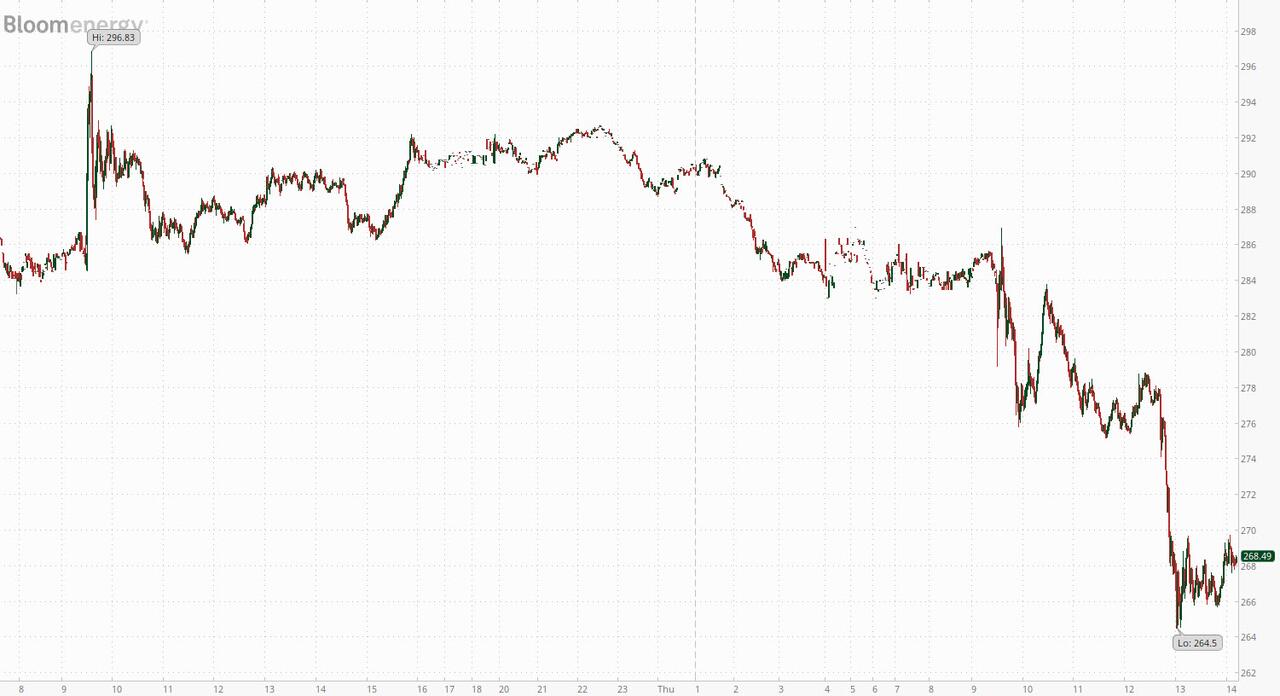
Regular Readers Will Recall…
Back on Sept 24, we reported that Oracle had sent a force majeure notice to Blue Owl’s Stack Infrastructure unit over Jupiter, citing potential power delays, and that Oracle and Bloom immediately launched a reassurance tour insisting everything was fine. Our take at the time: companies don’t issue force majeure notices because everything is going fantastically.
Today’s story suggests we were, if anything, too polite.
The root of the problem is a pipeline. Energy Transfer (ET) had to reroute the line that will ultimately power Jupiter after state regulators rejected the proposed route (per DCD, the rejection came in July after an initial application was denied in March), pushing the in-service date from this summer to next year. Meanwhile, Oracle has also put out an RFP for 2GW of new renewables in New Mexico, which tells you just how many backup plans the “on schedule” project now requires.
The “Virtual Pipeline”
And it’s not just New Mexico. Per Bloomberg, trucked gas kept an Oracle data center outside Salt Lake City moving for more than a year while it waited for its pipeline, with Superior Plus’s Certarus doing the hauling. Oracle is also using it for initial work at its OpenAI campus in Shackelford County, Texas, where VoltaGrid is the supplier.
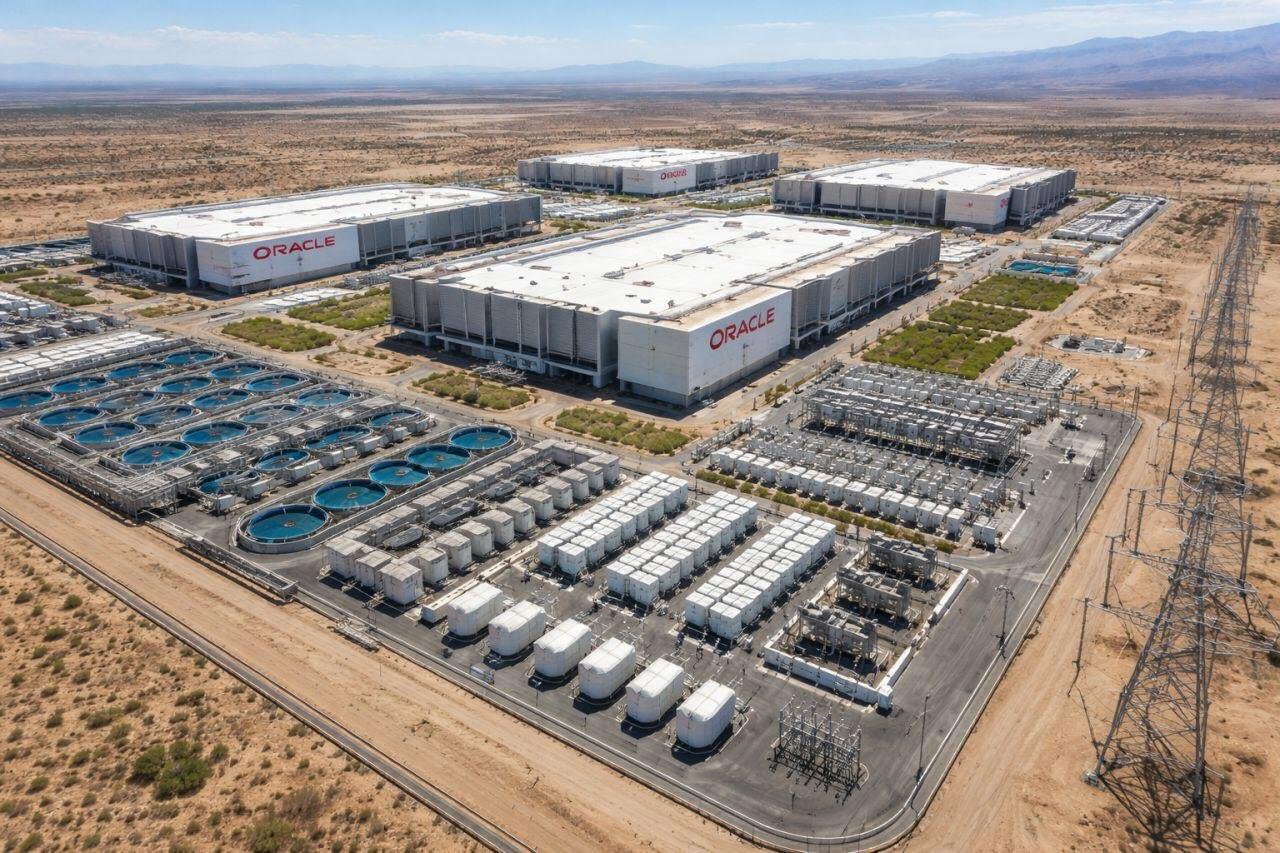
A small cottage industry of CNG haulers has spotted the opportunity and is now pitching “virtual pipeline” services to hyperscalers desperate to start generating compute before the actual pipes show up. Oracle, for its part, seemed thrilled, publicly thanking VoltaGrid on X for its “cost-effective power solutions” shortly after Bloomberg came asking questions.
About that “cost-effective” part.
East Daley Analytics’ Jack Weixel told Bloomberg that once you add up labor, specialized equipment and the diesel to move the trucks themselves, delivered CNG costs roughly four times the price of gas at a major pipeline hub. The process is about as elegant as it sounds: gas is pulled off a pipeline, compressed into a trailer, driven for hours to the site, then decompressed to feed the generators. Even a modest AI data center needs trucks arriving constantly around the clock. Diversification at its finest.
There is a reason this approach has historically been reserved for remote mines and oil rigs far from the grid, not for the crown jewels of the AI buildout.
The Napkin Math Gets Ugly Fast
The real question is scale. SemiAnalysis energy analyst Ellie Holbrook told Bloomberg that if Oracle ran just 100MW of Jupiter (roughly 4% of its eventual 2.45GW) on trucked gas, each large trailer would supply only about 40 minutes of electricity.
Let’s do the (approximate) math:
- 100MW at 40 minutes per trailer = ~36 trailers a day, or one every 40 minutes, 24/7/365.
- Scale that to the full 2.45GW and you need roughly 880 trailers a day, or one pulling up to the gate every 90 seconds or so… forever.
Put differently, trucking can get the lights on in the lobby, not power a gigawatt-scale AI campus. It’s a bridge, and a very expensive one, to a pipeline that New Mexico regulators have already sent back to the drawing board once.
And Oracle can hardly afford expensive bridges right now: as Bloomberg notes, the company’s free cash flow is negative and expected to stay that way until more of its AI data centers are completed, while it has staked billions (and its reputation) on delivering capacity for OpenAI on time. Paying a 4x premium on fuel to keep the schedule intact is exactly the kind of cost that never shows up in the investor-day slides, right up until it shows up in the margins.
Bottom Line
As we have argued for a long time, the binding constraint on the AI boom isn’t GPUs, it’s power, and the “solution” of building on-site gas generation only works if the gas actually arrives. When the gas comes by truck at four times the price, the “behind the meter” model starts to look a lot like “behind the 18-wheeler.”
Oracle insists Jupiter remains on schedule, and maybe it does. But when the fallback plan for a $165 billion, 2.45GW campus is an around-the-clock convoy of CNG trailers, the more likely outcome is the one hinted at by the force majeure notice: delays, higher costs, or both, with Bloom, Blue Owl and the rest of the Jupiter financing chain along for the ride.
Then again, nothing says “AI supercycle” quite like a trucking dispatch schedule.
KING NEWS
| The King Report October 8, 2026 Issue 7843 | Independent View of the News |
| Iran Ramps Up Ship Attacks in Hormuz as Oil, Gas Flows RiseUK Maritime Trade Operations has reported nine attacks in the waterway already this month, half the total number it reported for all of September in the Strait of Hormuz and Persian Gulf combined. Last month’s figure was boosted by four assaults in the final two days, underscoring the recent acceleration… https://www.insurancejournal.com/news/international/2026/10/07/888260.htm @NYFedResearch: SURVEY OF CONSUMER EXPECTATIONS Sept 2026Median inflation expectations increased by 0.3 ppt at the 1-yr horizon and by 0.1 ppt at the 3-yr horizon, to 3.9% and 3.3%, respectively. Expectations remained unchanged at the 5-yr-ahead horizon at 3.0%. https://nyfed.org/4wGc2Sd Energy commodities rallied sharply on the above news; bond and note yields rose smartly. The US 30-year hit its highest yield (5.731% at 9:38 ET) since 2002. The 10-year also hit a 24-year high yield (5.362% at 9:30 ET). The S&P 500 was -0.4% and Nasdaq was -0.7% minutes after the NYSE opening. The US 2-year yield hit 4.835% at 9:28 ET and then fell to 4.787% at 10:00 ET. WHY did bonds and notes experience a sudden rally/yield drop? USZs hit a daily low of 101 5/32 at 9:23 ET. Someone juiced them to 101 29/32 at 9:56 ET. WHY? To influence the US 10-year ($39B) Treasury Auction. This manipulation has occurred repeatedly under Bessent ahead of Treasury Auctions. One more thing: Trump was scheduled to speak about ‘Trump Accounts’ for children. He did just that AND highlighted Tuesday’s stock market record highs. Trump announces automatic enrollment of eligible minors in Trump accountsThe Trump accounts are government-maintained investment accounts that received money from the Treasury and private contributions… “Today, I’m pleased to announce that every single eligible minor child in America has now been automatically enrolled in a Trump Account,” Trump said…https://justthenews.com/nation/economy/trump-announces-automatic-enrollment-eligible-minors-trump-accounts @RapidResponse47” @POTUS: “Since launching in July, nearly eight million accounts have been created in three months. With today’s announcement, we’re building on that success by 70 million accounts of children across America — and they’ll all be enrolled into the @TrumpAccounts.”https://x.com/RapidResponse47/status/2107881458991796284 As of 2024, per various census, there about 73 to 74 million children under the age of 18 in the US. TRUMP: INTEREST RATES SHOULD COME DOWN ~ 13:40 ETTRUMP: WE SHOULD HAVE THE LOWEST INTEREST RATE IN THE WORLD – BBG Trump: YOU HAVE A FED BOARD THAT WOULD LIKE TO SEE THE COUNTRY DO BADLY, IN MY OPINION @FoxNews: President Trump reveals to @pdoocy his potential plans to build a presidential retreat similar to Camp David on part of Trump International Golf Club in West Palm Beach. Trump explains that the military and Secret Service suggested the idea because of the property’s security advantages. “They asked if I’d be willing to do it, and I said I would be. This wouldn’t be for me. This would be for all future presidents.” https://x.com/FoxNews/status/2107890286755971375 After Trump’s early afternoon presser, this appeared:The yen/$ hit 158.46 at 00:06 ET; it then sank to 157.91 at 4:16 ET from 158.30 at 4:45 ET. After a rebound to 158.33 at 9:18 ET, it sank to 157.90 at 13:44 ET. Numerous traders assumed interventions occurred. This assumption/perception induced bond buying. Minutes of the Federal Open Market Committee September 15-16, 2026Regarding balance sheet policy, a few participants observed that Treasury markets had beenfunctioning smoothly but noted the importance of planning for market stress. They suggestedstrengthening the Federal Reserve’s strategy, communications, and tools for addressing marketdysfunction, should it occur, while limiting the Federal Reserve’s footprint in the Treasury market…https://www.federalreserve.gov/monetarypolicy/files/fomcminutes20260916.pdf The Fed Minutes show members believe another rate increase would likely be appropriate by year-end. WSJ: Inside Bessent’s Treasury: Tension, Turnover and Unmet Economic GoalsAhead of midterms that could turn on high prices and borrowing costs, the secretary has dressed down senior advisers and junior staffers alike over issues large and small… Nov WTI Oil hit a high of 90.93 at 9:44 ET and then fell to 89.52 at 10:58 ET. The 10-year Auction went well, at 5.3%, 5.317% WI. Dealers immediately pushed USZs higher (102 9/32 at 13:09 ET) to euchre patsies into buying their inventory of bonds and notes. The 10-year fell to 5.282% at 13:25 ET. The S&P 500 Index gapped down on its open (7792.98, -25.95 pts) and proceeded to fall to a daily low of763.34 at 10:53 ET. The S&P 500 Index then tracked higher, with only 3 minor interruptions, and hit 7805.58 at 14:06 ET, which was minutes after DJT’s press conference. The S&P fell a tad and traded in a 5-handle range until the last-hour manipulation appeared at 15:00 ET. Alas, the S&P rallied only to 7807.02 (daily high) at 15:02 ET. The index then sank to 7795.74 at 15:48 ET. The illegal but encouraged late manipulation forced the S&P to 7803.54; the S&P closed 7801.77. @Hedgeye: U.S. bonds just posted their worst 10-year return in history (Is the tipping point nigh?)https://x.com/Hedgeye/status/2107468417934508092 WSJ: Oracle, Broadcom and SpaceX Seek Blockbuster Debt Deals to Pay for AI ChipsApollo, Blackstone and Goldman Sachs among lenders in talks to finance megadeals worth tens of billions of dollars apiece… Broadcom is arranging more than $50 billion in financing to support the custom AI chips and infrastructure it is developing alongside OpenAI…https://www.wsj.com/tech/oracle-broadcom-and-spacex-seek-blockbuster-debt-deals-to-pay-for-ai-chips-848e8032 Endless borrowing and credit for an AI as god presumption. We all know how this will end! Positive aspects of previous session Trump touted Trump Accounts in a schedule presser, which induced trader buying into the presser.The US 10-year Auction went well.SP Health Care +1.06% Consumer Discretionary +0.15%, Utes unchangedEnergy commodities declined after rallying early. Nov WTI -$0.38 & Nov Gas -2.64¢ at 16:15 ET Negative aspects of previous session S&P 500 Index -0.22%, DJIA -0.66%, DJTA -0.8*%, Nasdaq -022%, Nas 100 -0.21%, SOX -1.15%Industrials -2.14%, Materials -1.53%, Real Estate -1.35%, Energy -0.46%, Financials -0.44%,Info Tech -0.1%, Comm Services -0.07%USZs 102 2/32, -13/32, at 16:12 ET; 102 10/32 high, unchanged; 101 5/32 low, -1 12/32Dec Brent +$0.l42, Nov Diesel +10.05¢ at 16:14 ET Ambiguous aspects of previous session Did an intervention in the yen/$, which boosted financial assets, occur on Wednesday? First Hour/Last Hour NYSE Action [S&P 500 Index]: 1st Hour: Up; Last Hour: Down Pivot Point for S&P 500 Index [above/below indicates daily trend to day traders]: 7790.71 Previous session (S&P 500 Index) High/Low: 7807.02 (15:02 ET); 7763.34 (10:53ET) Why Political Polling Seems So UnreliableVeteran pollster Stefan Hankin points to several factors wrecking polling’s reputation. I’m going to argue 90 percent of the problems are in trying to figure out (a) who are the likely voters and then (b) getting those folks on the proverbial phone. So much more of what we do is texting people or sending out links to an online survey versus having the discussion over the phone… When I first got into this business in the early 2000s, we were pulling 20 to 25 names for every complete we wanted to get. So if we wanted 1,000 completes, we’re pulling 25,000 names. Now we’re in the 100 to 120 names per complete, just because it’s gotten that much tougher to get people to take surveys and to answer their phones.https://washingtonmonthly.com/2026/10/07/why-political-polling-seems-so-unreliable/ “Response Rates” to pollsters are abysmal – AND Republicans are far less likely to respond. @OpenSourceZone: Axios: A pollster says they are having a hard time getting Republican voters to respond to polls and says that might mean they may not vote. (No! It means they don’t want to be polled.) “We’re having problems just getting Republican voters to respond to polls… At what point do we think these guys aren’t showing up at the actual polls on Election Day?” If the polls end up missing, this may have been our early warning signIn 1936, polls had too many high-income voters. In 2016, too few non-college-educated whites answered their phones… This problem is called “non-response bias” — since the non-responders are biased compared to the responders… https://www.gelliottmorris.com/p/2026-10-06-survey-effort-nonresponse @Polymarket: James Talarico surges to record high odds in the Texas Senate race while sidelined from campaigning with “the flu,” canceling multiple events this week. 66% chance Talarico flips Texas blue.https://x.com/Polymarket/status/2107874139608678561 DJT-hating, GOPe Senator Cronyn lost to Ken Paxton, a horrible, but DJT-backed candidate in the GOP Primary. Now, the Bush Wing of the Texas GOP and Texas GOPe are torpedoing TX AG Paxton. Ken Paxton Says DC Controls His Texas Senate Campaign in Leaked Audio“I’ve never been in a race where I felt less control over the campaign and, like, what issues are going to matter because it’s all coming, you know, from D.C.,” Paxton said, in part, at a private fundraiser last month… The recording, obtained by Politico, surfaced amid growing tensions between Paxton and President Donald Trump, who has endorsed the Republican nominee and publicly criticized him on the campaign trail… “But Ken’s doing much better now…everybody is since starting three, four days ago, since starting the rallies, it’s brought a whole new awareness to how great the Republicans are doing, how great the economy is doing,” Trump added in part.https://www.newsweek.com/ken-paxton-says-dc-controls-texas-senate-campaign-leaked-audio-12524877 NYT: Amid Midterm Crunch, Trump Advisers Took Time to Help Russia-Aligned GovernmentJames Blair and Chris LaCivita, who are leading the president’s congressional campaign operation, traveled to Republika Srpska to provide election advice.https://www.nytimes.com/2026/10/06/us/politics/trump-advisers-republika-srpska.html Trump threatens to ‘terminate’ top campaign advisers after revelation of work for pro-Russia Bosnia party https://nypost.com/2026/10/07/us-news/trump-threatens-to-terminate-top-campaign-advisers-after-revelation-of-work-for-pro-russia-bosnia-party/ Here comes third-quarter earnings season. Booming profits could propel the S&P 500 to new heights – Analysts expect nearly 30% y/y earnings growth for the S&P 500, up from 26.7% on June 30th. Profits look healthy below the Mag-7 surface, including 19% growth this year for S&P 400 MidCap operating earnings… Estimated EPS growth for the tech sector has increased to 65% today from 57% on June 30, thanks partly to upward revisions for Nvidia and Micron Technology, FactSet notes… JPMorgan Chase, Goldman Sachs, Citigroup, and Wells Fargo report October 13…https://www.cnbc.com/2026/10/07/here-comes-third-quarter-earnings-season-booming-profits-could-propel-the-sp-500-to-new-heights.html Axios: Military ordered to be ready for possible Iran strikes as Trump weighs timing Today – Despite an assumed yen/$ intervention and a solid 10-year auction and a retreat in oil and gasoline and a DJT press conference to hawk Trump Accounts and the stock market, major equity indices declined moderately. The equity weakness was presaged on Tuesday when stocks declined after the S&P 500 Index and Nasdaq hit all-time high late in the morning. Our best guess is that traders will try to engineer a rally by pushing the S&P 500 Index well above 7800 and inducing momentum buying. Astute traders will carefully watch the yen/$ for intervention. If the US 30-year auction is not bad, bond traders will jack up USZs to unload what they bought from the US government this week to the masses. So, after auction results near 13:00 ET, be alert for a bond rally. As we opined weeks ago: Though there is a palpable AI Bubble and debt yields globally are hitting multiple decade highs, Team Trump will do everything and anything to keep stocks buoyant until the Midterm Elections on November 3. This is why traders are ignoring the above Axios story on Iran. You can expect more actions like those that appeared on Wednesday: Juicing USZs/bonds, talking up stocks, etc. So, trade and invest accordingly; but know that stocks can slip in coming days, but ‘they’ will not allow a meaningful decline for at least another four weeks. ESZs +0.25; NQZs +25.25, USZs -8/32, Nov WTI +$0.85, Nov Gas +0.015¢, Yen/157.95 at 20:03 ET Expected economic data: Initial Jobless Claims 200k, Continuing Claims 1.71m; St. Louis Fed Pres Musalem 12:40 ET; Fed Balance Sheet $6.743T; US 30-yr Auction, $22B reopening 29-yr, 10-mon S&P 500 50-day MA: 7680; 100-day MA: 7575; 200-day MA: 7240 (Close 7801.77, -0.22%)Nasdaq 100 50-day MA: 29,649; 100-day MA: 29,553; 200-day MA: 25,572 (Close 31,160.08 -0.21%) DJIA 50-day MA: 52,652; 100-day MA: 52,102; 200-day MA: 50,325 (Close 51,179.87, -0.66%) (Green is positive slope; Red is negative slope) Trump sons’ investments have won billions in Pentagon contracts since his electionThe contract for a new plant in Baltimore is the latest linked to the brothers… Congressional Oversight Democrats continue to demand the Pentagon’s inspector general investigate the approved deals…https://abcnews.com/Politics/trump-sons-investments-won-billions-pentagon-contracts-election/story WSJ: ‘Honey Please’: Kimberly Guilfoyle Pushed Donor to Wire $100,000 to Her Amex AccountText messages with a MAGA ally show her seeking funds and offering access to top administration officials ahead of her confirmation as ambassador to Greece… she reached out to a Trump donor with an urgent request: She needed $100,000 that she said she owed American Express—in a way that wouldn’t leave a paper trail. “It won’t show up anywhere if you wire money to American Express,” she wrote on Signal, according to messages reviewed by The Wall Street Journal. “Please.”… Donald Trump’s Ambassador Kimberly Guilfoyle Hit with Explosive Greece ClaimThe discussion reportedly involved the impending collapse of Romania’s government. Guilfoyle allegedly claimed the United States had influenced that situation. She reportedly then said, “We can do that to any country we want. We can do that here.“ Papastavrou allegedly pushed back against the remark. He reportedly reminded Guilfoyle that the U.S. could not replace Greece’s democratically elected government… The report also examined Guilfoyle’s efforts involving American liquefied natural gas. She reportedly promoted U.S. energy sales across Southeastern Europe. A separate focus involved businessman Christos Marafatsos. He reportedly accompanied Guilfoyle during several official meetings while representing Greek construction company Aktor. According to the report, Aktor paid Marafatsos $160,000 for lobbying work. His involvement reportedly raised questions about private interests entering diplomatic meetings…https://www.yahoo.com/news/politics/articles/donald-trump-ambassador-kimberly-guilfoyle-170530536.html Rubio Refuses to Address Allegations Around Kimberly Guilfoyle’s Ambassadorshiphttps://sg.news.yahoo.com/rubio-refuses-address-allegations-around-095515542.html @NEWSMAX: TRUMP on weaponization of the presidency: “I could have done very bad things to Hillary Clinton, I could have done very, very bad things to Joe Biden, I could have done very bad things to Barack Hussein Obama. I thought it was inappropriate to do so. Because you have to treat the Office of the Presidency with respect…” (But you pledged to ‘lock her up’ and hold Biden accountable!)https://x.com/NEWSMAX/status/2107903676241334313 It appears there will be NO accountability for US officials that engaged in bad behavior against Trump, his family, and associates. We cannot fathom why, except for MAD (Mutually Assured Destruction). @RapidResponse47: U.S. Attorney for Minnesota Dan Rosen says the FBI has arrested and charged 18-year-old Sheikhdoon Abdullahi Mohamud for planning a mass casualty attack in support of ISIS at the Mall of America (MN). https://x.com/RapidResponse47/status/2107882810078048676 Jaw-dropping new bodycam shows boy, 6, curse and threaten cops moments after he shot his teacher with gun he brought to school – The shooting also occurred on the student’s first day back in the classroom after he was suspended for slamming Zwerner’s phone. The boy’s mother, Deja Taylor, pleaded guilty to felony child neglect and was sentenced to two years in prison in 2023…https://www.dailymail.com/news/article-16190775/new-bodycam-boy-6-shot-teacher-virginia.html @AmiriKing: Bodycam footage from the January 6, 2023 shooting at Richneck Elementary School in Virginia has now been unsealed. A 6-year-old… student stole his mother’s loaded 9mm Taurus, brought it to school, and shot his first-grade teacher, Abby Zwerner. Listen to the kid cussing at the police. ‘F**k you, I shot my teacher!’ ‘F**k you b**ch.’ ‘I stole it because I needed to shoot my teacher.’ ‘If you want a piece of me, come get it!’ He even tries to punch the woman holding him. Keep in mind, this is after shooting his teacher at point blank range in a crowded elementary school classroom. Thankfully the gun jammed as several more rounds were still seated in the magazine. The bullet passed through Zwerner’s hand and entered her chest, collapsing her lung. She required life saving medical treatment but made a full recovery. Zwerner later won a $10 million civil verdict against former assistant principal Ebony Parker, who had received information that the kid might have a gun that day but still decided to do nothing. Ebony was also criminally charged with eight felony child-neglect counts for not preventing the shooting, but in May 2026 a judge dismissed all of those charges… The boy was not charged or prosecuted because of his age, while his mother faced separate criminal charges related to the firearm… https://x.com/_patriot1776q_ Danielle Carter-Walters @Dannic44: Crime is out of control. We are experiencing what I call a mass genocide, especially in the Black community. WHY? I don’t care how you feel about President Trump. I don’t care about your personal feelings or political disagreements. Your elected officials’ number-one duty should be to put the citizens FIRST. Put your egos aside and HELP THE PEOPLE! Why are our elected officials, Governor Pritzker and Mayor Brandon Johnson, seeing the violence and the lives being lost, especially in the Black community, but refusing to get the help that is necessary? Why aren’t they talking about it with the same urgency that families living through this violence are feeling every single day, the same urgency when ICE was here? Why are elected officials surrounded by police details protecting themselves and their families, paid for by taxpayers, while everyday Chicagoans are begging for safety in their own neighborhoods?… Put the politics aside. Put the egos aside. Put the citizens FIRST. How many more people have to die? How many more mothers , and fathers have to bury their children? How many more families have to suffer?… Danielle Carter-Walters for Mayor-2027 Iowa city council erupts after starting with satanic prayer: ‘A curse put on the city’ https://trib.al/StACIXU | |
SWAMP STORIES FOR YOU TONIGHT
Wells Fargo Faces Federal Probe Over $60 Billion Commitment To Black Homeownership
Thursday, Oct 08, 2026 – 03:40 PM
Wells Fargo is facing a federal investigation over mortgage programs designed to increase homeownership among Black Americans, as the Trump administration expands its campaign against corporate policies that make distinctions based on race, according to the Wall Street Journal.
According to The Wall Street Journal, the Department of Housing and Urban Development is examining whether the bank’s lending practices gave certain borrowers advantages because of their racial backgrounds, potentially running afoul of federal housing discrimination laws.
The controversy stems from a series of commitments Wells Fargo made beginning in 2017, including a plan to provide $60 billion in financing aimed at helping 250,000 additional Black Americans purchase homes over the following decade. The bank later introduced refinancing assistance targeting minority households, partly in response to criticism of its mortgage approval record.
The WSJ writes that by the end of 2023, Wells Fargo had delivered roughly 40% of the financing it originally promised. Its refinancing initiative had also reached approximately 5,100 borrowers, reducing their monthly payments by an average of $100. The bank has since largely stopped promoting these programs publicly.
HUD Secretary Scott Turner argued that the bank’s approach raises serious questions about whether Americans were being treated differently because of their race, regardless of the programs’ stated intentions.
“Even if Wells Fargo did not violate the law, its practice of dividing Americans based on race is immoral, unethical and un-American,” Turner said.
The investigation comes as Washington takes a more aggressive approach toward diversity-related corporate policies that became widespread following the racial justice protests of 2020. Other major companies, including IBM and Deloitte, have already reached multimillion-dollar settlements involving allegations tied to diversity considerations in employment decisions.
Federal housing officials are reportedly looking into comparable lending initiatives at other banks as well, suggesting Wells Fargo may be only the beginning of a much wider examination of race-conscious financial programs.
END
Trump Treasury Blocks $175 Million In Federal Payments To Dead Recipients\
Thursday, Oct 08, 2026 – 03:05 PM
Authored by AG News Staff via American Greatness,
The Treasury Department blocked $175 million in federal payments from going to deceased recipients in fiscal year 2026 as the Trump administration expanded efforts to prevent fraud and improper government spending.

Treasury screened more than 1.1 billion federal payments totaling approximately $3.7 trillion during the fiscal year, identifying and returning about 13,500 payments that otherwise would have gone to people listed as deceased, according to the department.
The results represent another step in President Donald Trump’s push to tighten safeguards around taxpayer money. Access to Treasury’s “Do Not Pay” system expanded from roughly 4 percent of federal programs at the end of fiscal 2025 to 99 percent in fiscal 2026.
“Treasury continues to transform how the federal government protects taxpayer dollars by using better data, stronger controls, and advanced technology to stop fraud and improper payments before money goes out the door,” Treasury Secretary Scott Bessent said.
The administration’s efforts received praise from Sen. John Kennedy, R-La., who spent years pushing legislation giving Treasury permanent access to Social Security death records.
“Unless you were playing Frisbee in the quad during Econ 101, you know the federal government shouldn’t be sending taxpayer money to dead people,” Kennedy said.
Congress advanced legislation to permanently authorize the Social Security Administration to share its full Death Master File with Treasury’s Do Not Pay system, giving federal agencies more complete death information when determining eligibility for payments.
Treasury has also added safeguards to verify bank account ownership and Taxpayer Identification Numbers associated with federal payments. Those capabilities became fully operational Sept. 30, allowing Treasury to flag payments that fail verification before the money leaves government coffers.
GREG HUNTER…
SEE YOU TOMORROW
H


